Page 623

Turkey’s Erdogan is facing re-election to hold onto power – can a divided opposition oust the strongman?

Source: The Conversation (Au and NZ) – By Khalid Al Bostanji, PhD candidate, Australian National University

Sedat Suna/ AP

As Turkish voters head to polls for the presidential and parliamentary elections on May 14, the biggest question is whether President Recep Tayyip Erdogan’s two-decade-long grip on power can be challenged.

Turkey’s main opposition parties have made a range of promises that include boosting the economy, democratising the political system, separating religion from state affairs and improving the country’s ties with the West.

However, it is increasingly clear there are significant differences in the positions of each party in the opposition coalition. Serious questions remain as to how much change one can expect to see, even if Erdogan is defeated.

Many Turkish citizens would like to see new policies to lift Turkey out of one of the most severe economic crises it has experienced in the last two decades. But the political issues are even more complex. Any issues related to the political system, secularism and foreign relations have become more polarised as Erdogan has consolidated his power in recent years.

Kemal Kilicdaroglu is the presidential candidate representing the Nation Alliance, an election coalition made up of six opposition parties.
Erdem Sahin/ EPA

A divided opposition

Turkey’s largest opposition party is the Republican People’s Party (the Turkish acronym for which is CHP). Formed by the founder of Turkey’s secular republic, Mustafa Kemal Ataturk, this party remains loyal to the ideology of Turkish nationalism and is considered to be in the centre-left of politics.

CHP has aligned itself with other nationalist and conservative forces in a coalition called the Nation Alliance, whose combined shares of the vote might be enough to defeat Erdogan’s Justice and Development Party (also known as the AK Party).


Read more:
Will the Turkish earthquakes affect how the country is governed?


While there is widespread scepticism about polling in Turkey, the most recent surveys have showed that CHP’s position is relatively strong in the presidential race. In the parliamentary elections, however, Erdogan’s conservative policies seem to be serving the AK Party well.

This is a problem for the opposition, which has not done enough to counter the conservative politics of the ruling alliance.

The leader of the opposition is Kemal Kilicdaroglu, whom the Nation Alliance has nominated as its presidential candidate. This is despite Kilicdaroglu’s relatively low credibility with the public, as compared to other CHP figures.

Kilicdaroglu has pledged to deport the large number of refugees who have sought shelter in Turkey since 2011 when the war began in Syria. The opposition has argued this is a primary reason why Turkey is suffering economically, despite the widely acknowledged role of Erdogan’s disastrous monetary policy.


Read more:
Turkey’s currency crisis is a textbook example of what not to do with interest rates


However, other nationalist and left-leaning forces with significant public support have decided to stay outside the Nation Alliance.

On the nationalist side, the opposition candidate for the 2018 presidential elections (Muharrem Ince) is running on behalf of his new Homeland Party. Ultra-nationalists are also being represented by the Ancestral Alliance coalition, led by Sinan Ogan.

Parties on the left, on the other hand, have only been able to run in the parliamentary elections. Potential candidates from Turkey’s large Kurdish minority have faced particular difficulty in nominating themselves for the presidential race. Many of them have been imprisoned on charges of being linked to the outlawed Kurdistan Workers’ Party. Their only option is to back Kilicdaroglu, which some have done.

Erdogan is, of course, the AK Party’s candidate for president. The party has been in power since 2002 when it won a majority of seats in the parliamentary elections for the first time. Erdogan became prime minister in 2003, and then won the presidential election in 2014 before being reelected in 2018. If he is elected, this would be his final term.

The AK Party is a conservative party with Islamist origins, currently in a coalition with the far-right Nationalist Movement that has become fragmented and unpopular. Despite this unpopular coalition, Erdogan himself has managed to maintain somewhat favourable ratings with the public.

No checks on the president

One of the biggest pledges the Nation Alliance has made is to return Turkey’s presidential political system back to a parliamentary system. Since Erdogan pushed through a referendum in 2017 to abolish the prime minister’s office, the president has been able to exercise an unprecedented level of power.

President Recep Tayyip Erdogan is believed to have forged strong ties with his Russian counterpart, President Vladimir Putin.
Alexander Zemlianichenko/ AP

Many observers blame the referendum for removing crucial checks on presidential power.

In addition, the opposition has also assured voters it will mend fences with Europe after ties deteriorated sharply under Erdogan’s rule. It would try to unfreeze Turkey’s European Union accession talks, which have been stalled since 2018 due to the country’s democratic backsliding. Turkey’s economic and political partnerships with Russia have also been an issue for the EU.

Perhaps more importantly, in terms of foreign policy, the opposition is promising to foster better relations with countries in the Middle East. These ties have frayed because of Turkey’s aggressive foreign policy and incidents like the murder of journalist Jamal Khashoggi at the Saudi consulate in Istanbul in 2018, which caused a rift between Turkey and Saudi Arabia.

The opposition is also pledging to expedite the country’s rapprochement with Israel, the Gulf states, Egypt and Syria.

Erdogan has yet to fully normalise relations with these states, as they are still wary of Turkey’s regional influence under the AK Party’s rule. Erdogan has positioned Turkey as a middle power with strategic influence in the Middle East and the wider region, particularly after the Arab Spring. This influence is unlikely to fade soon, regardless of the elections.

So, will a change in Turkish leadership transform Turkey and the region?

The answer is not simple. But it’s likely much will stay the same. Many key institutions in Turkey like the parliament, judicial system and press have lost their independence during the Erdogan era.

Erodgan’s party has become very influential in both domestic and foreign policy, which means his footprint will not disappear immediately, even if he is not re-elected. Rather, Erdogan will have a lasting social, economic and political legacy for both Turkey and its neighbours.

The Conversation

Khalid Al Bostanji does not work for, consult, own shares in or receive funding from any company or organization that would benefit from this article, and has disclosed no relevant affiliations beyond their academic appointment.

ref. Turkey’s Erdogan is facing re-election to hold onto power – can a divided opposition oust the strongman? – https://theconversation.com/turkeys-erdogan-is-facing-re-election-to-hold-onto-power-can-a-divided-opposition-oust-the-strongman-203563

A cancer centre is the latest victim of cyber attacks. Why health data hacks keep happening

Source: The Conversation (Au and NZ) – By Mohiuddin Ahmed, Senior Lecturer of Computing and Security, Edith Cowan University

Shutterstock

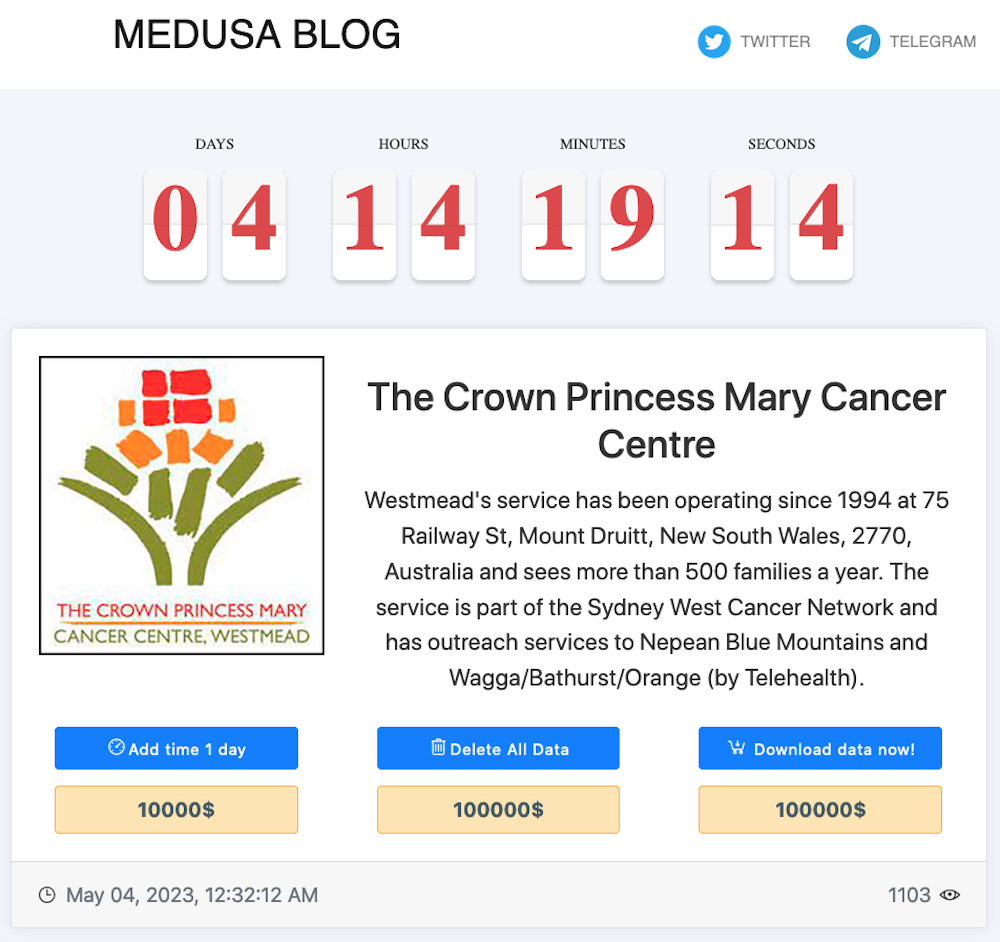
It seems hardly a day goes by without another report of a cyber crime incident. With Medibank still fresh in our minds, the latest attack is on a Sydney-based cancer treatment facility, Crown Princess Mary Cancer Centre in Westmead Hospital.

The cyber criminal group Medusa claims to have stolen thousands of files and is holding them to ransom.

Screenshot of Medusa Blog from Dark Web Site
Screenshot of Medusa Blog from Dark Web Site.
Author provided

In what has become a common practice, the criminal gang seems to be using double extortion. In such scenarios, criminals typically demand a fee to “release” the data back to the organisation – often with a “sample” made available to verify their claims.

The gangs then double-down with threats to publicise the data via their websites if payment isn’t made – in this case, a deadline of seven days.

Medusa is offering a range of options to delay the public release of data by 24 hours (US$10,000), to download and/or delete the data from the gang for US$100,000.

It’s currently unclear what will happen on Friday morning if the ransom is not paid. However, the Medusa Blog offers free access to data stolen from previous victims who did not pay the ransom by the deadline.

Victims data published on Medusa Blog
Victims data published on Medusa Blog.
Author provided

According to CyberCX, Medusa is the “second-most active cyber extortion group in the Pacific”. Medusa has been trying to compromise organisations in Australia and New Zealand since the beginning of 2023.


Read more:
Why are there so many data breaches? A growing industry of criminals is brokering in stolen data


Why target health services?

Any cyber attacks on the health sector are dangerous. While some cyber criminals have previously avoided schools and health-care organisations, it seems these are now fair game.

Knowing the services and data held by these organisations are critical, it’s not surprising to see so many ransomware attacks are launched against critical health-care infrastructure.

Some notable incidents targeting the Australian health systems have included Medibank, Melbourne Heart Group and Eastern Health which operates four hospitals in Melbourne’s east – an attack which resulted in elective surgeries needing to be postponed.

According to tech giant Microsoft, the health-care sector (and aligned industries) is one of the top targets for cyber criminals.

Ransomware incident and recovery engagements by industry.
Microsoft Digital Defense Report 2022


Read more:
Australian hospitals are under constant cyber attack. The consequences could be deadly


What are the impacts?

The health sector deals with our most private data – none of us want this data in criminal hands. Apart from the privacy issues, the inability to continue regular activities in any health-care facility poses life-threatening risks.

A recent study showed from 2016-2021, US health-care providers experienced 374 ransomware attacks that exposed the private health information of nearly 42 million patients.

Nearly half of these ransomware attacks disrupted the health-care services, with impacts including electronic system downtime, cancellations of scheduled care, and ambulance diversions.

Why do they keep happening?

Technical advances in the health industries have undoubtedly improved treatment and overall patient care. While this growth in technology is a positive for health care, it exposes health systems to cyber criminals.

With each passing year there is increased connectivity between clinical systems and medical devices. The health-care sector needs to be more staffed and heavily reliant on internet-connected systems also known as digital health. This inter-connectivity makes health systems more complex and harder to secure.

With the exception of state-sponsored groups, cyber criminals are primarily motivated by financial gain. Health care is undoubtedly one of the most promising targets as, if compromised, the organisations are more likely to pay the ransom – ultimately, because lives are at stake.

Cyber criminals capitalise on this and, even after good governance and enhanced cybersecurity within the sector, these incidents are likely to continue.


Read more:
Is Australia a sitting duck for ransomware attacks? Yes, and the danger has been growing for 30 years


Living with cyber criminals around us

So far, reports about the Cancer Centre at Westmead have not indicated that operations have been significantly impacted. This may imply no computing devices have actually been compromised and locked – this could be seen as a positive.

However, those who have examined the samples of data published on the Medusa Blog have suggested it seems genuine.

As Robert Mueller, former Director of the FBI, famously said:

There are only two types of companies: those that have been hacked and those that will be hacked.

Cyber crime has become a global industry with estimates predicting the impact at more than US$8 trillion in 2023. With such potentially lucrative benefits, we have to accept we will be sharing cyberspace with criminals for the foreseeable future.

There are, of course, actions that can improve our cybersecurity preparedness, regardless of the sector. While nothing will completely eliminate the risk, making ourselves a less attractive target helps to reduce the likelihood of being a victim. So it’s important to:

  • protect your systems: apply patches to all devices (including mobile phones); educate users to segregate personal and business activities; use strong and unique passwords for all systems/services
  • include all systems: don’t forget the internet of things and operational technology (all the devices and software we use that connect to the internet); check default settings (changing any default passwords); and plan the disposal of old systems
  • protect your data: data collected from all sources need to be kept in appropriate locations; think about how long you will keep data; and ensure data is protected from creation to destruction.
  • protect your people: educate all staff on basic cyber hygiene; vet new staff; and think about your off-boarding practices
  • seek advice: when things go wrong bring in the experts and liaise with law enforcement or other government agencies as appropriate.

And, finally, do not pay the ransom – it may be a difficult decision, but it only encourages the criminals behind the ransomware campaigns to keep going.


Read more:
Medibank won’t pay hackers ransom. Is it the right choice?


The Conversation

The authors do not work for, consult, own shares in or receive funding from any company or organisation that would benefit from this article, and have disclosed no relevant affiliations beyond their academic appointment.

ref. A cancer centre is the latest victim of cyber attacks. Why health data hacks keep happening – https://theconversation.com/a-cancer-centre-is-the-latest-victim-of-cyber-attacks-why-health-data-hacks-keep-happening-205131

NZ’s winter health plan fails to stem shortages, burnout, say frontline staff

By Stephen Forbes, Local Democracy Reporter

Te Whatu Ora’s new winter health plan fails to address workforce shortages and staff burnout in Aotearoa New Zealand, frontline healthcare workers say.

The organisation launched its 24-point plan on Wednesday, saying it would help hospitals and GPs cope with an expected surge in patient demand over the coming months.

Under the plan, people with minor ailments will be able to be assessed by a pharmacist and given free or subsidised medication in line with if they had visited their GP.

Local Democracy Reporting
LOCAL DEMOCRACY REPORTING: Winner 2022 Voyager Awards Best Reporting Local Government (Feliz Desmarais) and Community Journalist of the Year (Justin Latif)

Family doctors will also be able to refer patients for X-rays and ultrasounds in a bid to reduce hospital admissions.

Regional and national escalation plans will be in place to help improve hospital capacity by “diverting resources and patients within and across regions to support under-pressure facilities”.

But a doctor from Middlemore Hospital’s emergency department, who spoke on condition of anonymity, said while diverting patients and resources sounded “good in theory”, there needed to be the staff available to deliver that plan.

There was so much burnout among doctors and nurses, she said.

“You can’t flog a dead horse.

Staff ‘not available’
“In practice these escalation plans involve going through a checklist of different resources that can be provided to help, but you then find out they aren’t available — due to staffing issues.”

A nurse from the hospital’s ED agreed chronic workforce shortages would prevent many of the proposals ever working.

“It all sounds all great, but where is Te Whatu Ora finding all the staff to do these things and how are they going to do it in a healthcare system that is already understaffed and in crisis?”

Giving pharmacists a greater role to play could also be problematic as they were also busy and were not trained to diagnose patient ailments, the nurse said.

In February, Te Whatu Ora identified Middlemore Hospital as one of eight national ‘hotspots’ needing extra support before the winter flu season.

Former chairperson Rob Campbell admitted the workforce shortages plaguing Middlemore’s ED would not be addressed in time for the flu season.

It followed comments from frontline healthcare workers who said the hospital’s ED was haemorrhaging staff and they were concerned about its ability to function during winter.

‘Doing what we can’
In a statement, Te Whatu Ora (Counties Manukau) interim lead of hospital and specialist services Dr Vanessa Thornton said while there had been growth in staffing numbers nationally, it needed to continue to grow its workforce.

“We know that pressure from shortages across our workforce is being felt on the frontlines of our health system. We can’t fix those shortages quickly – but are doing what we can to alleviate pressure and get more staff into our hospitals and other services.”

She said that includes making it easier for internationally qualified staff to work here and assisting qualified nurses to return to practice.

Local Democracy Reporting is Public Interest Journalism funded through NZ On Air. It is published by Asia Pacific Report in collaboration.

Print Friendly, PDF & Email

Article by AsiaPacificReport.nz

How removing parenting payments when children turned 8 harmed rather than helped single mothers

Source: The Conversation (Au and NZ) – By Kristen Sobeck, Research Fellow, Tax and Transfer Policy Institute, Crawford School of Public Policy, Australian National University

As the government weighs up whether to extend single parenting payments to parents of children older than the present cutoff age of eight in this week’s budget, new information has come to light about what happened when the rules were tightened in 2013.

When then-Treasurer Peter Costello reduced the cutoff age from 16 in 2006, forcing single parents who hadn’t found work onto (much lower) unemployment benefits, he said it would “help them with higher incomes and better participation in mainstream economic life”.

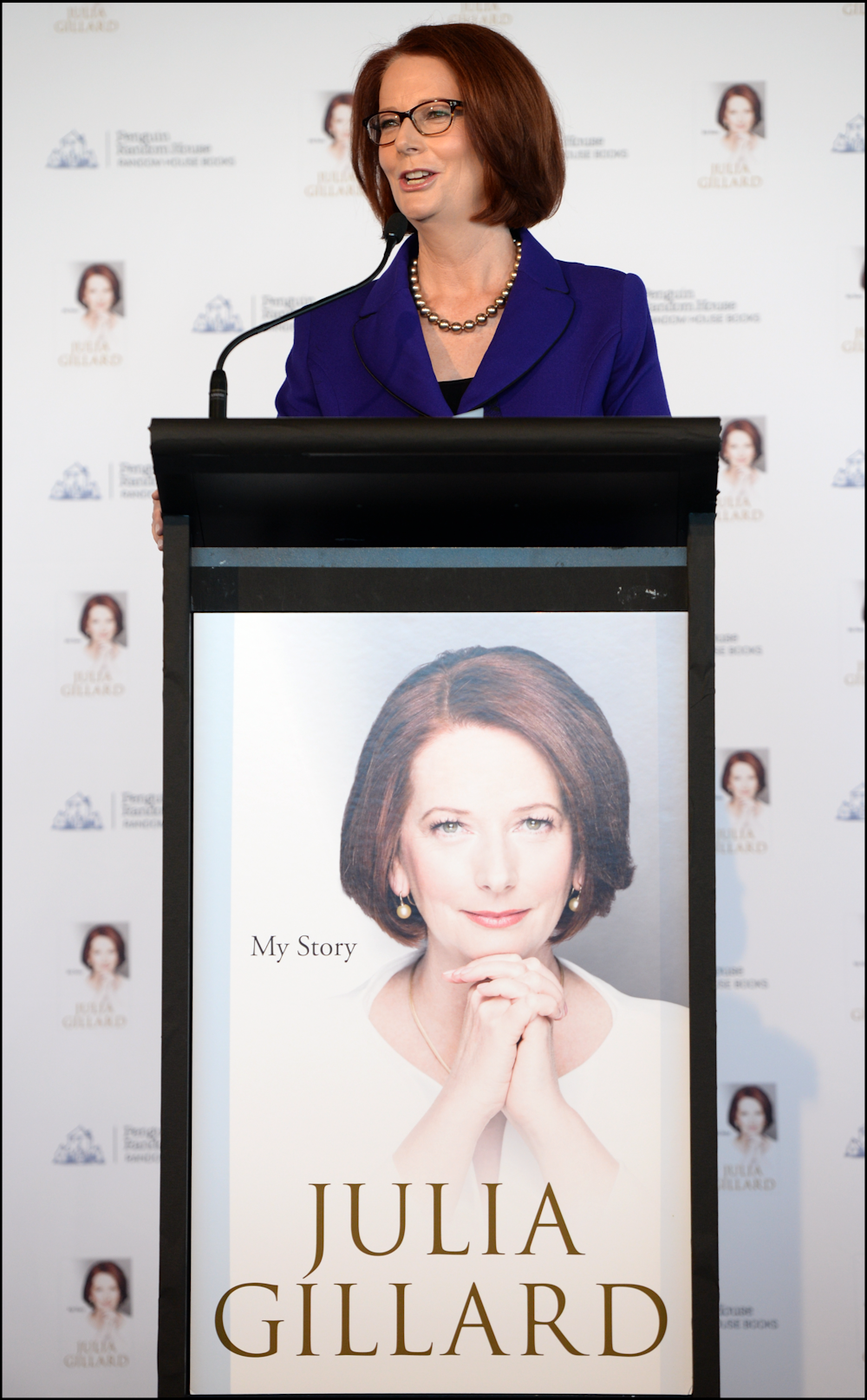
A few years later when then-Prime Minister Julia Gillard announced plans to remove a loophole that had allowed some parents with children over eight to continue receiving the payments, her treasurer Wayne Swan said it would “encourage re-entry into the workforce”.

Did the cutoff improve or harm lives?

Only now does recently available administrative data allow us to evaluate how single mothers fared after losing the payment when their children turned eight. Did they secure employment? Did they get higher incomes as a result of being pushed into work, or did their incomes sink?

Research Bob Breunig and I conducted on the changes enacted in 2013 finds that when taken together, the single mothers (they were overwhelmingly mothers) lost income.

On one hand, the change shifted a sizeable minority (about one-third) of single mothers off income support and into employment, boosting their incomes.

On the other hand, it left the majority on income support and on lower incomes – an effect that overwhelmed the increased incomes for those who left the payment and found jobs.

Multiple barriers to returning to work

What differentiates the (reduced income) majority from the (increased income) minority? While our particular dataset cannot identify characteristics that distinguish them from each other, there are two likely explanations.

First, individuals who have been on income support for long times tend to face multiple barriers to getting back to work, including illness and/or disability. In the case of single mothers, that illness or disability can also apply to their children.

Second is something more pernicious: domestic violence.

As prime minister, Julia Gillard tightened the rules removing single parenting payments when children turned eight.
Dean Lewins/AAP

A personal safety survey conducted shortly after the Gillard changes found 60% of single mothers who had ever had a partner had experienced partner violence in their lifetimes – an astonishingly high figure.

If domestic violence underlies welfare dependence among single mothers (and it likely does), it doesn’t take rocket science to appreciate the difficulty of getting those mothers into work.

Single parents face greater financial constraints relative to dual-income households and greater constraints on their time, in terms of school pick-ups, drop-offs, sick days and things such as help with homework.

Domestic violence tightens these constraints, adding to demands on time and resources the need to find safe lodging, attend court hearings, and especially, as victims of trauma, care for their own (as well as their children’s) mental and physical health.

The trauma engendered by domestic violence can also be very difficult to escape when it is triggered at every custodial hearing, divorce proceeding, non-custodial parental visitation or on the days child support payments are due.

So what are the policy solutions?

First, increases in employment, unaccompanied by increases in income, appear to have deleterious impacts on children. Insofar as mutual obligations lead to unstable and poorly remunerated employment, they are counterproductive and detrimental.

Our research shows that additional mutual obligations did little to improve the employment outcomes of single mothers.

Second, individuals facing multiple barriers need tailored support that identifies and helps address multidimensional challenges.

The effect of domestic violence is hard to pin down

Scaling up individualised support can prove challenging, which is where case management experiments at the local level can help. The new treasury evaluation unit will be in a good position to ensure these policies are designed to be evaluated and assess their results.

As importantly, we need to be able to measure the impact of domestic violence on the economic security, employment and health outcomes of survivors and their children over time, as is done in countries like Finland.


Read more:
Already badly off, single parents went dramatically backwards during COVID. They are raising our future adults


The datasets needed to do this in Australia already exist, but so far the government has not allowed the linkage of longitudinal data on domestic violence and labour market outcomes.

Without the information that would come from putting these datasets together, Australia risks introducing policies, including those designed to assist single mothers who are victims of domestic violence, without a means of evaluating their effectiveness.

Single mothers – whether in paid employment or not – are among the hardest-working members of our society. They deserve better.

The Conversation

Kristen Sobeck and Robert Breunig received funding from the Department of Social Services to conduct this research.

ref. How removing parenting payments when children turned 8 harmed rather than helped single mothers – https://theconversation.com/how-removing-parenting-payments-when-children-turned-8-harmed-rather-than-helped-single-mothers-204927

What’s the latest on GMOs and gene-edited foods – and what are the concerns? An expert explains

Source: The Conversation (Au and NZ) – By Karen Massel, Research Fellow, Centre for Crop Science, The University of Queensland

Shutterstock

Advances in genetic engineering have given rise to an era of foods – including genetically modified organisms (GMOs) and gene-edited foods – that promise to revolutionise the way we eat.

Critics argue these foods could pose risks to human health and the environment. Proponents point to their potential for enhancing yields, reducing food waste, and even combating climate change.

What are GMOs and gene-edited foods? And how are they shaping the future of our food systems?

GMOs and gene-edited foods aren’t the same

GMOs are organisms whose genetic material has been artificially altered by inserting a piece of foreign DNA. This DNA may be synthetic in origin or sourced from other organisms.

Gene editing involves making precise changes to an organism’s genome without the integration of foreign DNA elements. Using techniques such as CRISPR/Cas, scientists make precise “cuts” in the DNA to create new genetic variation. Unlike with GMOs, this introduces only minor modifications, which are indistinguishable from natural mutations.

Although GMOs and gene-edited foods have been in circulation for almost three decades, research in this space continues to deliver breakthroughs. These technologies are being applied to provide a range of benefits, from improved nutrition in food, to reduced food waste and increased crop tolerance against climate stresses.


Read more:
What is CRISPR, the gene editing technology that won the Chemistry Nobel prize?


What are the concerns?

The major criticisms of GMOs are related to the overuse of specific herbicides.

GMOs are mainly used to produce crops that are herbicide-resistant or produce pesticides. Farmers can then use herbicides on those crops to control weeds more effectively, without the plants themselves dying. This leads to higher yields on less land, and often with less chemicals used overall.

However, these crops rely on the use of said lab-made chemicals. And although the government regulates them, ethical and safety debates continue. People raise concerns over potential long-term health impacts, impacts on biodiversity and ecosystems, and the increased corporate control over agriculture.

Concerns generally aren’t related to the actual manipulation of the plants’ DNA.

Is genetic modification itself unsafe?

When it comes to the food we eat, how much do we really know about its DNA? Even among experts with genome-sequencing information, most have only one or a few sequenced “reference” varieties, and these often aren’t the same as the plants we eat.

The fact is, we don’t really understand the genomes of many plants and animals we eat. So there’s no reason to suggest tweaking their gene sequences will make consumption harmful. Moreover, there’s currently no evidence regulator-approved GMOs or gene-edited foods aren’t safe for human consumption.

In regards to food safety, one valid concern would be the potential creation of new allergens: proteins within the crop the body recognises and creates an immune response to.

But it’s important to remember many foods we eat are already allergenic. Common examples include wheat, peanuts, soy, milk and eggs. Some common foods are even toxic if consumed in large quantities or without appropriate preparation, such as rhubarb leaves, raw cassava, raw kidney beans and raw cashews.

Ironically, researchers are using gene editing to work towards eliminating proteins that cause allergies and intolerances. Gluten-free wheat is one example.

GMOs and gene-edited foods are widespread

Due to inconsistent rules about labelling GMOs and gene-edited foods around the world, many consumers may not realise they’re already eating them.

For example, the most widely used enzyme in cheese-making, rennet, is produced from a GMO bacterium. GMO microbial rennet produces a specific enzyme called chymosin, which helps coagulate milk and form curds. Historically, chymosin was extracted from young cow stomachs, but in the 1990s scientists managed to genetically engineer a bacterium to synthesise it.

GMOs and gene-edited cereal and oilseed products are also widely used in stockfeeds. There is ongoing research to improve feed through enhanced nutrition, and produce crops that will decrease methane emissions from cattle.

When it comes to modifying animals themselves, ethical considerations must be balanced alongside potential benefits.

In Australia, about 70% of cattle are genetically polled (hornless). Having polled cows improves meat quality through less injury to meat, and is considered better for animal welfare. In the US, fast-growing genetically modified salmon has been approved for consumption.

In a horticultural context, the genetically modified rainbow papaya stands out. It was developed in the late 1990s in response to a ringspot virus outbreak that nearly wiped out the global papaya industry. Researchers created the virus-resistant “transgenic” papaya, which now makes up the majority of papayas consumed worldwide.

Scientists in the US developed the rainbow papaya to be resistant to the papaya ringspot virus. It was commercialised in 1998.

In terms of boosting nutritional content, “golden rice” biofortified with Vitamin A (GMO) is being cultivated in the Philippines, as are tomatoes biofortified with Vitamin D (GE) in the United Kingdom, and GABA-enriched tomatoes (GE) in Japan.

Research is also being done to create non-browning mushrooms, apples and potatoes. A simple gene edit can help inhibit the browning oxidation reaction, leading to a longer shelf-life and less food waste.

Regulation in Australia and New Zealand

So why don’t you see non-browning mushrooms at your local supermarket?

In Australia, the Office of the Gene Technology Regulator regulates GMOs. It has approved four GMO crops for cultivation: cotton, canola, safflower and Indian mustard. However, many more are imported for food ingredients (including modified soy, cottonseed oil, corn and sugar beet) and stockfeed (canola, maize and soy).

Gene-edited foods can be cultivated without any regulatory restrictions or labelling in Australia. The Gene Technology Act 2000 deregulated these products in 2019.

On the other hand, New Zealand’s Environmental Protection Authority has maintained regulatory restrictions on both gene-edited foods and GMOs. Divergent definitions have led the bi-national agency Food Standards Australia New Zealand (FSANZ) to adopt a cautious approach, regulating gene-edited foods and feeds as GMOs.

The lack of alignment in definitions in Australian has confused producers and consumers alike. FSANZ has said it will continue to monitor developments in gene-editing technology, and will consider reviewing its regulatory approach.

Responsible research

Both GMOs and gene-edited foods offer great promise. Of course there are valid concerns, such as the potential to create new allergens, unintended consequences for ecosystems, and growing corporate control over food. But these can be addressed through responsible research and regulatory frameworks.

Ultimately, the development of future foods must be guided by a commitment to sustainability, social justice and scientific rigour.

The Conversation

Karen Massel does not work for, consult, own shares in or receive funding from any company or organisation that would benefit from this article, and has disclosed no relevant affiliations beyond their academic appointment.

ref. What’s the latest on GMOs and gene-edited foods – and what are the concerns? An expert explains – https://theconversation.com/whats-the-latest-on-gmos-and-gene-edited-foods-and-what-are-the-concerns-an-expert-explains-204275

Why do young children sometimes steal? And what should parents do about it?

Source: The Conversation (Au and NZ) – By Natalie Gately, Senior Lecturer and Researcher, Edith Cowan University

Shutterstock

When children steal, naturally parents can be very concerned. They might wonder if they’ve taught their child correctly, whether it’s just a phase or whether they’re going to have a young offender on their hands.

But before parents panic, they need to consider why their child may have taken something that doesn’t belong to them.

First, it’s important to consider the age of the child.

When do kids learn stealing is wrong?

Very young children don’t have a concept of ownership. If they see something that interests them, they are likely to reach out and just take it.

Child experts believe a sense of their own property begins at about two years old, but fully understanding ownership rights of other people develops at three to five years old.

Toddler plays with blocks
Children under five may not have a concept of ownership.
Shutterstock

The American Academy of Child and Adolescent Psychiatry advises that age three to five is a particularly important time for parents to actively teach children about property and honesty. Model good behaviour around respecting property, which means not bringing home extra stationery from work, or bragging about the cooked chicken on the supermarket trolley hook you got away with not paying for.

If they know it’s wrong, why do they do it?

Motives for stealing need to be explored and understood before deciding on a course of action, as it’s not necessarily a sign of moral failure.

Some young children with low impulse control might steal for immediate gratification – especially items perceived as low value. They might think it’s only a few lollies, or a biscuit or two, no one will notice.

Others may have difficulty imagining anyone would be cross or disappointed if they took another person’s belongings.


Read more:
Milestone developments at four years old help children tell lies, play hide-and-seek and read maps


Bored children may steal simply for a sense of excitement or to gain attention.

Another important aspect is whether they steal alone or with peers. Children may steal as part of pranking behaviour due to peer pressure or to impress their friends.

Girl in purple jumper looks at mobile phone
Children may steal because they’re pressured by peers.
Shutterstock

Children who come from impoverished backgrounds may steal to obtain items they can’t afford. The item may be particularly valued within their peer group, or it may be the latest fad item everyone else in the group has.


Read more:
‘I go for the food’: what children and young people told us about why they steal from houses


Some children may steal to gain attention from adults or peers. Or there may be emotional or psychological issues and the child uses stealing as a method of coping.

Stealing may indicate a child is struggling with something deeper and needs help addressing the root cause of their behaviour. Parents, caregivers and educators should approach the situation with empathy and understanding, and work with the child to find more constructive ways to cope with their emotions and needs.

My child has stolen something. What should I do?

Here are some steps parents and guardians can take:

1. Stay calm and avoid overreacting. Approach the situation calmly. Shouting or punishing children harshly can make them more likely to steal again in the future.

2. Talk to the child. Ask them why they stole and listen to their response. Try to understand what motivated them to steal and address any underlying issues. Explain why stealing is wrong and the consequences it can have.


Read more:
How to get your kids to talk about their feelings


3. Tell them stealing is wrong. It’s important to teach children the importance of honesty and trust. Explain how stealing can break trust between people and damage relationships.

4. Remove the goods, if possible. Make sure they don’t benefit from the theft or keep any goods. Sometimes parents may decide not to return goods for fear of the consequences, but your child should not be able to keep the goods.

5. Set clear consequences. Make sure they understand there are consequences to their actions. This could include returning the stolen item, apologising to the person they stole from, and completing chores or community service to make amends.

Mother talks to child
Explain how stealing can break trust.
Shutterstock

6. Avoid scare tactics. Don’t threaten to tell the police or continually label them as naughty, a thief or bad person. Once you have dealt with it, avoid bringing it up again.

7. Monitor their behaviour. Keep an eye on your child’s behaviour in the future to ensure they aren’t stealing again. Praise them when they make good choices and show honesty.

8. Seek professional help. If your child’s behaviour continues or escalates, it may be necessary to seek professional help from a psychologist who specialises in working with children.

Remember, stealing is not necessarily a serious issue, however it should not be ignored. With the correct approach and right support, parents and guardians can help their child develop a sense of ownership, understand the consequences of stealing, and prevent them stealing in the future.

The Conversation

The authors do not work for, consult, own shares in or receive funding from any company or organisation that would benefit from this article, and have disclosed no relevant affiliations beyond their academic appointment.

ref. Why do young children sometimes steal? And what should parents do about it? – https://theconversation.com/why-do-young-children-sometimes-steal-and-what-should-parents-do-about-it-200906

Tail first and making an early splash, some whales just can’t wait to be born

Source: The Conversation (Au and NZ) – By Vanessa Pirotta, Postdoctoral Researcher and Wildlife Scientist, Macquarie University

Imagine Earth Photography, shutterstock.com

Did you know whales are born tail first? They enter their water world being able to swim from day dot. From the moment they’re born, their first instinct is to swim to the surface for air.

While most enjoy the comforts of hanging out in mum’s tummy until she reaches warm northern Australian waters, some just can’t wait to enter the big blue.

May marks the official start to the whale watching season and we’ve already had an exciting teaser with the recent sighting of a pygmy blue whale mother and calf in Western Australian waters.

While this sighting is rare, it’s not likely to be the last mother and calf whale sighting we’ll see this year. We’ll soon start seeing various whale species moving along the west and east coasts of Australia.

Dr Vanessa Pirotta explains whale migration in Australian waters.


Read more:
Thar she blows! An expert’s guide to whale watching 101


Why are whales coming here?

Generally speaking, whales migrate to Australian waters in the winter to breed.

Depending on where you are on the Australian coast, you’ll probably see at least the main migratory baleen (toothless) whale species.

These include the iconic humpback whale, the southern right whale, dwarf minke whale (east coast mainly) and possibly the pygmy blue whale (west coast).

The first three species typically migrate north to warmer waters to breed and calve. They’ve spent the summer feeding in Antarctic/Southern Ocean waters, putting on a lot of weight. Now, they’re ready to spend their energy going north to reproduce.

In contrast, pygmy blue whales typically stay in Australian waters over summer. They then travel along the west coast of Australia, past Perth into international waters such as the Banda Sea where they are thought to breed during the winter.

The making of a whale calf

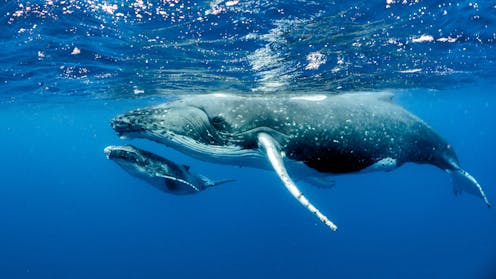
Baleen whales are mammals just like you and me. A humpback whale is pregnant for 11-12 months. So female humpback whales that fell pregnant in Australian waters during the last breeding season are likely to give birth this year.

A female humpback whale may mate with multiple males. Males may sing and/or fight to mate with females. Males provide no parental care for their young.

A humpback whale mother may produce a calf every two to three years. This is a relatively quick turnaround and is likely one reason why Australian humpback whale numbers have been recovering well post-whaling.

The ultimate water birth

Antarctic waters are too cold for a newborn calf. This is one reason why humpback whales travel to warmer water to breed.

Whales rely on a lot of blubber to keep them warm. Newborn calves are born with very little body insulation, so warm Australian waters are an ideal environment to be born into.

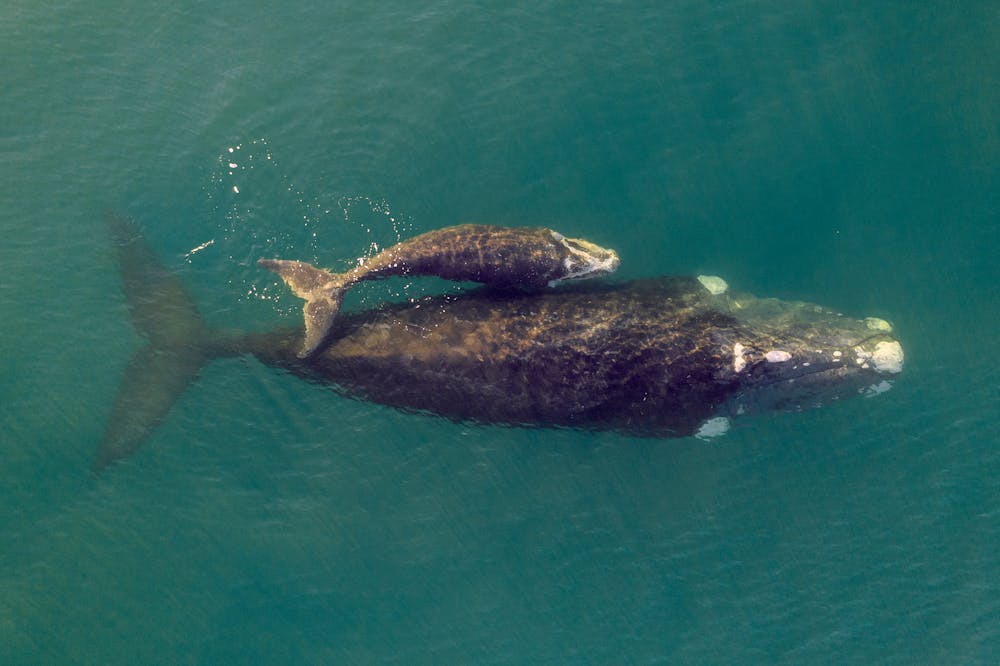
A southern right whale and newborn calf seen from above
Southern right whale mother and newborn calf swim side-by-side.
Ahturner, Shutterstock

Traditionally, northern breeding grounds for humpback whales in Australian waters occur in the Kimberley region on the west coast and in the Great Barrier Reef on the east.

Globally, humpback whale breeding waters are ideal at temperatures between 21℃ and 28℃. With climate change and an expansion of warming waters, this area is increasing.

Why do we sometimes see mothers with calves travelling north?

Sometimes we see mothers with newborn calves well south of traditional breeding grounds. This is most likely the case with the recent pygmy blue whale sighting.

On the east coast of Australia, both humpback and dwarf minke whale mothers have been observed travelling north with bubs in recent years. Perhaps this is a result of the waters being ideal and warm, or maybe some calves just can’t wait to enter the world. Maybe this happens more than we think, with efforts to document this still ongoing.

A humpback whale mother and young calf pass Sydney. The calf is just visible as it comes up for air
There’s growing evidence that humpback whales are observed with young before they reach the warm waters of their traditional breeding grounds. Here a humpback whale mother and young calf pass Sydney. The calf is just visible as it comes up for air.
Vanessa Pirotta, Author provided

On the swim for multitasking mothers

Once a calf is born, mothers continue to swim with the calf alongside her. This is the most efficient position where the calf is able to swim in her slipstream.

During this time, they may stop and rest. The calf is able to suckle milk from mum’s mammary glands. This fatty milk is perfect for putting on blubber. And don’t worry whale mums, humpback whale calves don’t have any teeth. In fact, all baleen whales, like humpback whales are toothless. Instead of teeth, they have baleen, which are long hair like structures they use to filter feed when they are older.


Read more:
Curious kids: why don’t whales have teeth like we do?


Breastfeeding duties also come at the time when the mother is migrating, when she must also keep an eye out for predators such as orcas, human hazards (such as ships, fishing gear/nets) and trying to avoid males who may wish to mate with her.

Impressively, she is also likely to be fasting at the same time, relying on energy stores obtained in Antarctic waters.

If conditions are favourable, she may also take the chance to feed in Australian waters. Talk about the ultimate underwater mother!

How can you see a mother with calf?

You just never know what you might see when whale watching. Although your chances of spotting a mother and calf pair is highest in those northern breeding areas, you could also spot them as they migrate northward, or on their return journey south to Antarctic waters. The good news is, whale watching can be done from both land and on the water, depending on where you are in Australia.

Fortunately, all whales in Australian waters are protected. Mothers with calves afford special protection. If on the water or flying a drone, please keep them safe and keep your distance.

Whale mothers truly are tremendous multi-taskers who never cease to amaze me.


Read more:
Humpback whales have been spotted ‘bubble-net feeding’ for the first time in Australia (and we have it on camera)


The Conversation

Vanessa Pirotta does not work for, consult, own shares in or receive funding from any company or organisation that would benefit from this article, and has disclosed no relevant affiliations beyond their academic appointment.

ref. Tail first and making an early splash, some whales just can’t wait to be born – https://theconversation.com/tail-first-and-making-an-early-splash-some-whales-just-cant-wait-to-be-born-204620

Why unis and vocational colleges are key to Australia’s temporary migration challenge

Source: The Conversation (Au and NZ) – By Peter Hurley, Director, Mitchell Institute, Victoria University

Cottonbro Studio/Pexels

The number of temporary migrants in Australia is booming after falls during the pandemic. Of this group, current and former international students are the largest component.

This comes as the federal government’s new migration review found “hard choices are required” to halt the increase in “permanently temporary” migrants in Australia. These are people who have lived in the country for an extended period, but have no path to permanent residency or citizenship.

The review, led by former top public servant Martin Parkinson, made many recommendations.

They included changes to help international students get jobs and stay in Australia, particularly those with “high potential”. It also recommended the federal government “review the drivers” to minimise the number of international students becoming “permanently temporary” migrants in the first place.

This will need the government to take a better look at the role universities and vocational colleges play in migration to ensure we have both a sustainable migration system and a thriving education sector.


Read more:
Migration review warns against Australia becoming nation of ‘permanently temporary’ residents


The age of the temporary migrant

Temporary migrants have a visa allowing them to stay in Australia for an extended period, but they are not permanent migrants or Australian citizens. The recent migration review found the rise in “permanently temporary” visa holders “has caused harm” to Australia and migrants, noting both uncertainty and the “risk of migrant worker exploitation”.

International students have led the growth of this group. Since 2011, the number of current and former international students who are temporary migrants has increased from about 275,000 to more than 765,000.


Read more:
How to improve the migration system for the good of temporary migrants – and Australia


The pandemic saw the number of international students in Australia fall. Since borders reopened in December 2021, the number of international students in Australia has returned to record levels.

Signs suggest the numbers will continue to increase. The number of visas approved for international students are also at record levels.

The government has also committed to expanding post-study work rights for international graduates. These rights enable former students in certain courses to stay for a period after their course. This can range from 18 months to six years.

Why education providers are key

Education institutions play a vital role in driving the supply of temporary migrants. Enrolling in a university or vocational course can enable access to longer visas.

For example, a working holiday visa enables young people from some countries to live and work in Australia for one year. By enrolling in certain courses, a much larger pool of people from more countries can access extended visas. These can effectively enable someone to stay in Australia for up to ten years.

So it is difficult to disentangle education decisions from migration decisions. In many ways, an international student is not just purchasing a course but also a multi-year visa.

Our education institutions benefit from this arrangement. Courses that are most popular are those that entitle students to post-study visas or are aligned to permanent migration pathways. Arguably, pathways to temporary and permanent migration drive many enrolments.

A university can also receive two to three times the amount of money for an international student compared to a domestic student.


Read more:
Immigration system set for overhaul in wake of review’s damning findings


The benefits of international students are not shared

Australian students benefit from this arrangement too. It means our education institutions have more resources and better facilities.

But the benefits of international education are often concentrated in certain institutions. In the university sector, it is the larger, more prestigious universities who receive the most revenue from international students.

In the vocational education and training sector, the concentration of international students is even more stark.

Mitchell Institute analysis shows in 2021, of the ten vocational institutions with the highest international enrolments, nine were private colleges who catered largely to international students. In five of these colleges, 100% of enrolments were international students. These enrolments are largely in courses such as business, cookery and hospitality.

This means Australian students in our already underfunded vocational sector are missing out on the benefits international education brings.

Time for another look

Before the pandemic, international education brought about A$40 billion to the Australian economy. At its peak in 2019, institutions received about $16 billion annually, which had grown from about $2 billion in 2002.

The migration review has highlighted how the increase in temporary migrants is a by-product of this growth. If we want to gain more control over the total pool of migrants, we need to examine the role of universities and vocational colleges.

These may not be easy discussions to have. But they can begin by more closely examining the role of education institutions in the migration process. This could include better using these universities and vocational colleges in the process to identify “high potential” international students the migration review says Australia should aim to keep.

Meanwhile, international students remain vital to the health of our education system. We need more targeted policies to ensure the benefits of international education go to the parts of the education system that need it the most.


Read more:
The Universities Accord will plan for the next 30 years: what big issues must it address?


The Conversation

Peter Hurley does not work for, consult, own shares in or receive funding from any company or organisation that would benefit from this article, and has disclosed no relevant affiliations beyond their academic appointment.

ref. Why unis and vocational colleges are key to Australia’s temporary migration challenge – https://theconversation.com/why-unis-and-vocational-colleges-are-key-to-australias-temporary-migration-challenge-205011

The case for boosting JobSeeker for all: younger people report greater financial hardship

Source: The Conversation (Au and NZ) – By Peter Siminski, Professor of Economics, University of Technology Sydney

Shutterstock

In response to calls to raise the JobSeeker payment, the Albanese government is expected to announce an increase in Tuesday’s budget only be for recipients aged 55 and over.

Doing so will fuel the familiar generational debate about comparative levels of hardship experienced by older and younger Australians.

JobSeeker’s current single rate is $49.51 a day, about 65% of the age pension and 18.5% of average full-time earnings. Last month, the government’s own Economic Inclusion Advisory Committee recommended it be raised to 90% of the age pension.

This age targeting is reportedly justified on the basis that older recipients are more likely to be long-term unemployed, and majority female.

But are younger recipients less needy? Our research suggests their need may well be greater, reporting far higher levels of hardship than older Australians, even when depending on JobSeeker.


Read more:
Boosting JobSeeker is the most effective way to tackle poverty: what the treasurer’s committee told him


Measuring financial hardship

Our results are drawn from the Household, Income and Labour Dynamics in Australia survey – better known as the HILDA survey – which each year since 2001 has polled a representative sample of about 18,000 Australians on many aspects of their lives.

Our first graph shows average financial hardship by age.


We compiled this index from answers given by HILDA participants to seven indicators of their material hardship over the previous nine months. These were, due to a shortage of money:

  • could not pay electricity gas or telephone bills on time
  • could not pay the mortgage or rent on time
  • pawned or sold something
  • went without meals
  • was unable to heat home
  • asked for financial help from friends or family
  • asked for help from welfare or community organisations.

About 22% of those aged 20-80 reported at least one hardship, with the average hardship of those in their 20s being 2.9 times more than those aged 55 to 69.

The next graph shows the constituent elements of the composite measure.


While the responses to “asking for help” – with young people presumably asking parents first – do seem to skew the results, five of the other six measures follow the same pattern. (The exception is “unable to heat home”, where there’s no significant age trend.)

One reason for this distinct pattern is home ownership and wealth accrual over time. Young people are typically more financially stressed because they have had less time to accumulate liquid assets, such as cash and bank deposits.

It’s also possible that younger people are more likely to admit to hardship, though our research suggests this is not a significant factor.

What about JobSeeker recipients?

The next graph shows financial stress among JobSeeker recipients by age before and during 2020. It also shows the effect of higher payments in 2020, when the federal government doubled the JobSeeker rate for six months (known as the Coronavirus Supplement).


Thanks to those payments, financial stress among the young fell to its lowest level in at least two decades. But that still meant, on average, those younger than 55 were 2.5 times more likely to report being financially stressed than those 55 and older.

The Coronavirus Supplement experiment in 2020 taught us that a higher JobSeeker payment rate can make a meaningful difference to the financial wellbeing of all Australians, both young and old.

We will find out shortly what the federal government has learned from this policy lesson.


Read more:
Presented with a JobSeeker finding too clear to ignore, he changed the subject: how Jim Chalmers is shaping the budget


The Conversation

The authors do not work for, consult, own shares in or receive funding from any company or organization that would benefit from this article, and have disclosed no relevant affiliations beyond their academic appointment.

ref. The case for boosting JobSeeker for all: younger people report greater financial hardship – https://theconversation.com/the-case-for-boosting-jobseeker-for-all-younger-people-report-greater-financial-hardship-205015

WHO covid-19 status changed but still NZ’s infectious ‘number one killer’

RNZ News

The World Health Organisation’s decision to remove covid-19 as a global health emergency is the right move, epidemiologist Professor Michael Baker says.

The organisation said the virus was now an established and ongoing health issue that no longer constituted a public health emergency of international concern.

Professor Baker said the global status change made sense at this stage, but it did not impact on whether covid-19 was still a pandemic.

Covid-19 was still New Zealand’s number one killer when it came to infectious disease and people should make sure they were vaccinated and take sensible precautions, he said.

“There might be some scaling down in the international reporting of cases, but really it doesn’t make a difference to somewhere like New Zealand.

“It makes no practical difference whatsoever to how countries manage this infection.”

World Health Organisation chief Tedros Adhanom Ghebreyesus
WHO chief Dr Tedros Adhanom Ghebreyesus says it is likely about 20 million people have died globally from covid-19. The organisation estimated there were about 3500 deaths a week by late April 2023. Image: RNZ Pacific/AFP

1000 NZ deaths predicted this year
Professor Baker earlier said that this year covid-19 was on track to kill some 1000 people in New Zealand and hospitalise around 10,000.

The threat of long covid also loomed — with one recent study suggesting as many as one in five New Zealanders reported lingering symptoms after their first infection.

He emphasised the need for caution in easing our few remaining protections.

The latest vaccine was one of the best things people could do to guard against the disease, because it included protection against omicron — the current dominant variant circulating in the community.

“You have to always think why the World Health Organisation assigned it [a global health emergency originally] and it’s really related to these certain criteria.

“It is about how severe and how unexpected [the disease is], but it’s really about whether an international response is needed and whether there’s potential for international spread.”

This article is republished under a community partnership agreement with RNZ.

Print Friendly, PDF & Email

Article by AsiaPacificReport.nz

View from The Hill: Budget ‘centrepiece’ will be $14.6 billion cost-of-living package

Source: The Conversation (Au and NZ) – By Michelle Grattan, Professorial Fellow, University of Canberra

original

A $14.6 billion four-year cost-of-living package will be the centrepiece of Labor’s second budget, which seeks to balance spending restraint with its election commitment to not leave people behind.

The latter days of preparing the budget – which was printed at the weekend – have seen mounting pressure, including from outspoken members of the Labor caucus, for greater help for the disadvantaged.

A strong revenue flow, including from a pick-up in wages, appears to have made it possible for the government to do somewhat more on welfare payments than it originally intended.

There was speculation at the weekend, which the government refused to confirm or deny, of a possible modest across-the-board rise in JobSeeker. Earlier, the JobSeeker assistance was expected to be confined to those 55 and over.

At the same time the budget is tipped to see a surplus this financial year, although Treasurer Jim Chalmers constantly stresses the pressure it will be under in later years.

The government says its cost-of-living plan, which includes already flagged relief on power bills and cheaper medicines, will not be inflationary but will directly lower price pressures and the CPI in 2023-24.

On Sunday Chalmers, who did a round of media interviews, said five and a half million households would get help with their electricity bills, as would about a million small businesses.

Asked the maximum price relief on energy bills, Chalmers said, “people will be getting several hundred dollars if they’re on pensions and payments or a small business.”

The government has struck deals with states and territories and the relief will vary in different parts of the country.

There will also be investments in energy efficiency.

About 40% of the upgrade in revenue comes from strong employment growth and a pick-up in wages growth. Some 20% is from higher commodity prices, and the rest comes from other sources including higher company profits in the non-mining and finance sectors.


Read more:
Budget shows real wages expected to start growing early next year and promises effort to ‘shift the needle’ in disadvantaged communities


The Treasurer said the budget would be “in the best Labor tradition – help for the vulnerable with cost-of-living pressures, an eye on the future, and responsible economic management”. It would have substantial savings, substantial spending restraint, and “modest but meaningful tax changes”.

Among the tax changes will be an extension of the petroleum resource rent tax that will mean the offshore LNG industry pays more tax, earlier. Deductions will be limited under the changes. This will increase receipts by $2.4 billion over the forward estimates.

The Australian Petroleum & Exploration Association reacted benignly.

APPEA chief executive Samantha McCulloch said: “The changes aim to get the balance right between the undeniable need for a strong gas sector to support reliable electricity and domestic manufacturing for decades to come and the need for a more sustainable budget”. She said the announcement would “provide greater certainty” for the industry.

Meanwhile Opposition Leader Peter Dutton faces fresh pressure with another byelection looming, following the weekend announcement by former minister Stuart Robert that he will quit parliament soon.

Robert, who is shadow treasurer, holds the Gold Coast seat of Fadden. He said he wanted to spend more time with his family.

Robert has suffered some bad publicity relating to various controversies, and was one of the ministers with oversight of Robodebt, on which a royal commission report will come down mid year. He admitted to the commission his serious doubts about the scheme – which was found to be illegal – but argued he had to defend it because of cabinet solidarity,


Read more:
Government to spend $11.3 billion over four years to fund 15% pay rise for aged care workers


Though spooked by the loss of the Victorian seat of Aston at a byelection, the Liberals would be confident of holding Fadden, which is on a margin of more than 10%. Queensland is a strong state for the Coalition and Dutton’s home state.

Nevertheless Dutton at the weekend stressed the importance of getting a local as the Fadden candidate. One – though not the main – factor in the Aston loss was that the Liberal candidate came from another part of Melbourne.

“We’ll preselect somebody who understands that part of the Gold Coast, and we should be in that seat, frankly, preselecting somebody who can be a future cabinet minister or a leader of our party. So, we will work hard with the LNP in Queensland to make sure that we do win,” Dutton said.

There is also an expectation that former prime minister Scott Morrison will resign from parliament before long.

The Conversation

Michelle Grattan does not work for, consult, own shares in or receive funding from any company or organisation that would benefit from this article, and has disclosed no relevant affiliations beyond their academic appointment.

ref. View from The Hill: Budget ‘centrepiece’ will be $14.6 billion cost-of-living package – https://theconversation.com/view-from-the-hill-budget-centrepiece-will-be-14-6-billion-cost-of-living-package-205192

Easy Liberal wins likely in byelections in Robert’s and Morrison’s seats; support for rise in JobSeeker

Source: The Conversation (Au and NZ) – By Adrian Beaumont, Election Analyst (Psephologist) at The Conversation; and Honorary Associate, School of Mathematics and Statistics, The University of Melbourne

Mick Tsikas/AAP

On Saturday former Liberal minister Stuart Robert announced that he would soon retire from politics, setting up a byelection in his Queensland seat of Fadden.

There has been recent speculation that former Liberal PM Scott Morrison will also soon retire, which would mean a byelection in his New South Wales seat of Cook.

At the 2022 federal election, Robert won Fadden by a 60.6-39.4 margin over Labor, while Morrison won Cook by a 62.4-37.6 margin over Labor.

At the April 1 federal Aston byelection, Labor had a 6.4% swing in its favour to overturn a 52.8-47.2 Liberal margin at the 2022 election. Even if Labor achieved such a swing in its favour in Fadden and Cook, these seats would still be comfortable holds for the Liberals.

As they are very unlikely to win either Fadden or Cook at byelections, and could be embarrassed if there were a swing to the Liberals in either seat, I do not expect Labor to contest either byelection.

Pre-budget Essential poll: 53-41 to Labor including undecided

In last week’s pre-budget federal Essential poll, conducted in the days before May 2 from a sample of 1,130, Labor led by 53-41, an increase from 52-43 four weeks ago. Primary votes were 33% Labor (down one), 32% Coalition (up one), 14% Greens (steady), 5% One Nation (down one), 2% UAP (down one), 8% for all Others (down one) and 5% undecided (up one).

Despite the Coalition’s primary vote gain, Labor increased their two party lead. That suggests respondent preference flows to Labor were stronger than previously.

By 48-29, respondents supported raising the JobSeeker rate without a cost of living component in the question (this applied to half the sample). With the cost of living component, support was 50-29. An additional question from the April Resolve poll had support for increasing JobSeeker at 43-31.

Respondents were asked to rate Anthony Albanese and Peter Dutton from 0 to 10, then ratings of 0-3 were counted as negative, 4-6 as neutral and 7-10 as positive. Albanese improved to a 41-24 positive rating from 40-27 in March, while Dutton dropped to 35-23 negative from 33-26.

Asked to name the treasurer, 33% correctly named Jim Chalmers. By 41-27, voters approved of his job performance. By 45-42, voters thought the budget could make a difference to the cost of living.

For health, education and social security, far more people thought government spending was too low rather than too high. For renewable energy projects and the NDIS, the difference between too low and too high was much reduced. For defence, more people thought spending too high than too low.

On taxes, far more thought personal taxes too high rather than too low, but too low and too high were equal for taxes on oil and gas producers and too low was far ahead for taxes on international corporations.

By 52-22, voters supported allowing New Zealanders who have lived in Australia for at least four years to become Australian citizens.

Morgan poll: 53.5-46.5 to Labor

In last week’s weekly federal Morgan poll, conducted April 24-30, Labor led by 53.5-46.5, a three-point gain for the Coalition since the previous week. Primary votes were 36% Labor, 35.5% Coalition, 13% Greens and 15.5% for all Others. I believe this is Labor’s worst result in a Morgan poll since late November 2022.

UK local elections were disappointing for Labour

I covered Thursday’s United Kingdom local government elections for The Poll Bludger. The Conservatives lost over 1,000 councillors, but Labour only had a nine-point margin over the Conservatives on the BBC’s Projected National Share.

While that’s Labour’s best performance since they were last in government nationally in 2010, it was much worse than current national polls that give Labour about a 17-point lead.

A United States debt default could occur as early as June 1 if no action is taken by Congress to lift the debt limit. The May 14 Turkish election and May 21 Greek election were also covered.

Incumbents easily re-elected at Tasmanian upper house elections

Every May two or three of Tasmania’s 15 upper house seats are up for election for six-year terms. On Saturday there were elections in Rumney, Murchison and Launceston. Independents in the latter two held with over 70% of the primary vote, while Labor’s Sarah Lovell won 50.5% of the primary in Rumney, with 26.5% for the Liberals and 16.6% for a conservative independent.

These results mean the status quo in the upper house is retained. Analyst Kevin Bonham said there are four Labor out of 15, four Liberals, three left-wing independents, one centrist independent and three conservative independents. The Liberals hold a majority in the lower house.

The Conversation

Adrian Beaumont does not work for, consult, own shares in or receive funding from any company or organisation that would benefit from this article, and has disclosed no relevant affiliations beyond their academic appointment.

ref. Easy Liberal wins likely in byelections in Robert’s and Morrison’s seats; support for rise in JobSeeker – https://theconversation.com/easy-liberal-wins-likely-in-byelections-in-roberts-and-morrisons-seats-support-for-rise-in-jobseeker-204798

Why Australia and NZ could become republics – and stay in the Commonwealth

ANALYSIS: By James Mehigan, University of Canterbury

The coronation of King Charles III is an ideal time for Australia and New Zealand to take stock of the British monarchy and its role in national life — including certain myths about what becoming a republic might mean.

In particular, there is a common assumption that both nations must remain monarchies to retain membership of the Commonwealth of Nations. It might sound logical, but it’s entirely wrong.

There is no basis for it in the rules of the Commonwealth or the practice of its members. Australia could ditch the monarchy and stay in the club, and New Zealand can too, whether it has a king or a Kiwi as head of state.

Yet this peculiar myth persists at home and abroad. Students often ask me about it when I’m teaching the structure of government. And just this week a French TV station interpreted the New Zealand prime minister’s opinion that his country would one day ideally become a republic to mean he would like to see it leave the Commonwealth.


The United Kingdom’s first coronation in 70 years. Video: Al Jazeera

What does ‘Commonwealth’ mean?
The implication that breaking from the Commonwealth would be a precursor to, or consequence of, becoming a republic relies on a faulty premise which joins two entirely separate things: the way we pick our head of state, and our membership of the Commonwealth.

It would make just as much sense to ask whether Australia or New Zealand should leave the International Cricket Council and become a republic.

The confusion may derive from the fact that the 15 countries that continue to have the British sovereign as their head of state are known as “Commonwealth Realms”.

What we usually refer to as the Commonwealth, on the other hand, is the organisation founded in 1926 as the British Commonwealth of Nations. This is the body whose membership determines the competing nations of the Commonwealth Games, the highest-profile aspect of the Commonwealth’s work.

King Charles III is the head of state of the 15 Commonwealth Realms and the head of the international governmental organisation that is the Commonwealth of Nations. The Commonwealth has 56 members — but only 15 of them continue to have the king as head of state.

Joining the Commonwealth club
To be fair, confusion over who heads the Commonwealth is nothing new. A 2010 poll conducted by the Royal Commonwealth Society found that, of the respondents in seven countries, only half knew the then queen was the head of the Commonwealth.

A quarter of Jamaicans believed the organisation was led by the then US president, Barack Obama. One in ten Indians and South Africans thought it was run by former UN Secretary-General Kofi Annan.

Given the king’s overlapping leadership roles and the different use of the word in the contexts of Commonwealth Realms and the Commonwealth of Nations, these broad misunderstandings are perhaps understandable.

In fact, it was this ambiguity that allowed for the development of an inclusive Commonwealth during the postwar years of decolonisation.

However the confusion arose, it is also very simple to correct. The Commonwealth relaxed its membership rules regarding republics when India became one in 1950.

According to Philip Murphy, the historian and former director of the Institute of Commonwealth Studies, this decision was based on the erroneous idea that India’s huge standing army would underwrite Britain’s great-power status in the postwar world.

From that point on the Commonwealth of Nations no longer comprised only members who admitted to the supremacy of one sovereign. To make the change palatable, a piece of conceptual chicanery was needed. Each country did not need a king, but the king was to be head of the organisation comprising equal members.

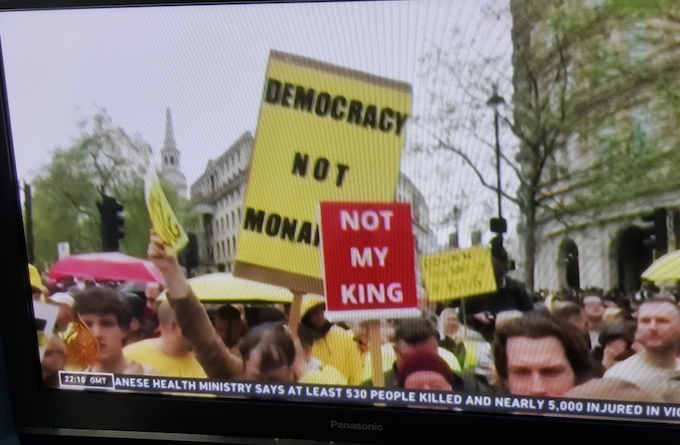
Republican protesters who want an elected head of state at the coronation
Republican protesters who want an elected head of state at the coronation . . . placards reading “Democracy not monarchy” and “Not my king”. Image: Al Jazeera screenshot APR

Monarchy optional
Since then, the number of Commonwealth members has steadily increased to the 56 we have today.

As early as 1995, membership was extended to countries with no ties to the former British Empire. With the support of Nelson Mandela, Mozambique became a member, joining the six Commonwealth members with which it shared a border.

Rwanda, a former German and then Belgian colony, joined in 2009. It became an enthusiastic member and hosted the biennial meeting of states known as CHOGM (Commonwealth Heads of Government Meeting).

The most recent countries to take up Commonwealth membership are the former French colonies of Togo and Gabon.

According to the Commonwealth’s own rules, membership is based on a variety of things, including commitment to democratic processes, human rights and good governance. Being a monarchy is entirely optional.

The new king offers the chance for a broader debate on the advantages of monarchy. But let us do so knowing Commonwealth membership is entirely unaffected by the question of whether or not the country is a republic.The Conversation

Dr James Mehigan, is senior lecturer in law, University of Canterbury. This article is republished from The Conversation under a Creative Commons licence. Read the original article.

Print Friendly, PDF & Email

Article by AsiaPacificReport.nz

Fiji prosecutor drops charges against PM Rabuka, ex-PM Bainimarama

By Talebula Kate in Suva

Fiji’s Office of the Director of Public Prosecutions will not lay charges against Prime Minister Sitiveni Rabuka and former prime minister Voreqe Bainimarama for allegedly urging political violence and urging communal antagonism due to “insufficient evidence”.

The two cases were among a list of other high profile cases in which the DPP’s office confirmed would not lay any charges.

In a statement yesterday, acting Director of Public Prosecutions David Toganivalu listed the high profile cases:

  • Sitiveni Rabuka and Sakiasi Ditoka — urging political violence and inciting communal antagonism
  • Voreqe Bainimarama — urging political violence and inciting communal antagonism
  • Ili Vunisuwai and Waisale Tikowale — urging political violence and inciting communal antagonism
  • Mosese Bulitavu — causing harm through electronic communication

The police files for the suspects were sent to the DPP for an assessment of the evidence and a decision on whether any charges should be laid following the complaints.

Toganivalu said after a review of the police docket and the evidence, it was their opinion that there was insufficient evidence to support any criminal charges against the suspects.

He said the docket had been returned to police with the instructions not to charge and no further action required.

RNZ Pacific reports Fiji’s former Attorney-General Aiyaz Sayed-Khaiyum was granted bail by a local court on Tuesday. Sayed-Khaiyum is charged with one count of abuse of office.

He was released on a Fijian FJ$10,000 (NZ$7000) bail by Magistrate Waleen George, according to local media reports.

Republished from The Fiji Times with permission.

Print Friendly, PDF & Email

Article by AsiaPacificReport.nz

‘We stand with you’ – Pacific overstayers called to speak out

By Lydia Lewis, RNZ Pacific journalist

The use of “dawn raid” tactics have trampled on Immigration NZ’s “very special relationship” with the Pacific communities, says Māngere MP Aupito William Sio.

The Minister of Immigration, six Pacific MPs and the head of Immigration NZ will meet in South Auckland tomorrow, following the revelation “dawn raid” tactics are still being used in Aotearoa.

“I was appalled, really appalling, I would describe it as Ua soli le mā, (a Samoan saying that roughly translates to ‘you’re trampling on the shame’).

“Meaning the way Immigration are conducting the use of their powers of deportation have trampled on a very special relationship with our Pacific communities of Aotearoa,” said Aupito, the former Minister for Pacific Peoples.

Senior Pacific lawyer Soane Foliaki broke the news, sharing a story of his client who was taken into custody after police knocked on his door in the early hours of the morning, frightening his children.

Aupito believes it is his responsibility to hold Immigration to account with recent events demonstrating there is a complete “lack of cultural intelligence” within the ministry.

“And I think Immigration needs to address that immediately,” he said.

In a statement, an Immigration New Zealand spokesperson said it had launched a review into “out of hours compliance visits” and pressed pause on all such operations until the review had been completed.

Tongan community leader Pakilau Manase Lua is not letting this moment slip by either.

In February this year Prime Minister Chris Hipkins told RNZ Pacific he would look at an overstayer petition that was launched by Pacific community leaders almost three years ago.

To be clear, this was a petition, not just for Pasifika, but for all overstayers in Aotearoa, Pakilau said.

When Hipkins was questioned on whether he would make changes to the government’s policy, he said: “I haven’t had an opportunity to look at that issue yet but I absolutely intend to look at it.”

Three months have passed and no changes have been made.

Manase Lua talks about the Dawn Raids period in NZ's history
Pakilau Manase Lua talks about the 1970s Dawn Raids period in NZ’s history. Image: Tikilounge Productions/RNZ Pacific

Pakilau has been fighting for change for years. The people he has been fighting for have legitimate reasons to stay and deserve compassion, he says.

“They might have been here during the lockdowns and they couldn’t go back. Or they were here on a temporary visa and it was difficult to go back due to the eruption,” Pakilau told RNZ Pacific in February.

For him the issue is personal — his uncle Teni is a Dawn Raids survivor.

“Teni was here with us in Auckland during the Dawn Raids of the 1970s as part of a migrant work scheme that brought him and countless thousands here to NZ to do work nobody here wanted to do,” he said.

He remembers his uncle calling from Mount Eden prison to say goodbye as he was deported back to Tonga.

Apology ‘still stands’
Jacinda Ardern humbled herself and apologised for the actions of the government in the 1970s.

For many, finding out similar tactics are still being used is painful and even retraumatising.

Aupito said the stakes were very high, the legacy of a very important apology which in his view “still stands” has been “trampled on” by Immigration New Zealand.

He wants Immigration to take a good hard look at its operations.

“I’m gutted, I’m just gutted that the the Ministry of Immigration does not seem to have understood at all the principles that the Ministry of MFAT are using as guiding principles for engagement; manaakitanga, kaitiakitanga, arohatanga,” Aupito said.

He has spoken with the Minister of Immigration, the new Pacific Peoples Minister and the Deputy Prime Minister who he says all feel the same way.

While Aupito has not spoken with Ardern this week, he has confidence in Michael Wood.

“I have faith that Minister Wood is someone from South Auckland and he understands what is at stake here and he will pursue that,” he said.

Time to front up
Wood and immigration officials will front up tomorrow at a community meeting.

Overstayers are called to turn up and be heard, not to hide in the shadows afraid.

“This is our time, people. Come and have your voices heard in our own backyard of Auckland,” Tongan community leader Pakilau Manase Lua said.

“Don’t worry if you are worried about being an overstayer they need to hear you. Don’t leave it too late. We are here. We stand with you.”

Aupito has a message for the family that lawyer Foliaki acts on behalf of.

“I just apologise to the family for the behaviour of Immigration,” he said.

  • The meeting is at 10am, May 6, at 25 Princes Street, Otahuhu.

This article is republished under a community partnership agreement with RNZ.

Print Friendly, PDF & Email

Article by AsiaPacificReport.nz

Budget shows real wages expected to start growing early next year and promises effort to ‘shift the needle’ in disadvantaged communities

Source: The Conversation (Au and NZ) – By Michelle Grattan, Professorial Fellow, University of Canberra

Real wages are expected to start growing slightly earlier and grow more strongly than previously forecast, according to the latest Treasury estimates.

Higher forecasts for wage growth and lower forecasts for inflation in 2023-24 than in the last budget are expected to bring forward the return for real wages growth to early 2024. In the October budget the return was put at mid 2024.

But unemployment is set to rise over the coming year.

Tuesday’s budget will forecast a growth in real wages of three quarters of a percentage point over the year to June 2024. This is an upgrade of half of a percentage point since the October budget.

The government says Treasury’s upgraded forecasts show a resilience in Australia’s labour market.

Unemployment is forecast to be 3.5% in the June quarter of this year increasing to 4.25% in the June quarter next year. This is an improvement of a quarter of a percentage point in both years since the October budget.

Unemployment is still expected to peak at 4.5% But this is now expected to be reached in 2024-25, compared to the expectation in the last budget that the peak would be in 2023-24.

The budget will forecast an additional 500,000 jobs will be created by the June quarter 2026. This is some 200,000 more than expected last October.

There has been speculation this financial year could see the budget in balance or even surplus. Treasurer Jim Chalmers would only say there would be a “substantial improvement in the near term”, but then the pressures on the budget would intensify.

Chalmers said the substantial improvement wasn’t just because of higher commodity prices. “It is also about lower unemployment and the beginning of wages growth”.

He said “getting wages growing again is central to our economic plan and our budget.

“We’re pleased to see signs that wages are moving,” he said.

“While this is a step in the right direction, we know that many Australians are still under the pump from cost-of-living pressures and rising interest rates. 

“A big part of tackling cost-of-living challenges is to help ensure ordinary Australian workers can earn enough to provide for their loved ones and get ahead.

“We also understand that securing real wages growth means getting inflation under control and our Energy Price Relief Plan is already helping with this.”

The budget “will be focused on targeted cost-of-living relief that doesn’t add to inflation, getting wages moving again and laying the foundations for a stronger and more resilient economy”.

Chalmers on Friday announced the budget would contain a program to tackle entrenched disadvantage in particular communities.

There would be a series of “place-based initiatives to try and shift the needle”.

Chalmers said there was concern that even with low unemployment there were pockets of disadvantage.

“We don’t want to see long-term unemployment. We don’t want to see entrenched intergenerational disadvantage.”

The $200 million program would back local leaders and organisations working on the difficult social and economic challenges in these areas.

“What that means is partnering with philanthropic organisations, it means investing in local community groups, it means doing something meaningful about impact investing. There are a number of different parts to our strategy.”

He said “to build the kind of economy that we want, we’ve got to align what we want to see in our economy with what we want to see in our society and in our communities.”

Australia, which generated remarkable opportunities for people in the broad, “needs to do a much better job of putting those opportunities within reach of more people”.

The Conversation

Michelle Grattan does not work for, consult, own shares in or receive funding from any company or organisation that would benefit from this article, and has disclosed no relevant affiliations beyond their academic appointment.

ref. Budget shows real wages expected to start growing early next year and promises effort to ‘shift the needle’ in disadvantaged communities – https://theconversation.com/budget-shows-real-wages-expected-to-start-growing-early-next-year-and-promises-effort-to-shift-the-needle-in-disadvantaged-communities-205133

Australia finally has a Net Zero Authority – here’s what should top its agenda

Source: The Conversation (Au and NZ) – By Kylie Turner, System Lead, Sustainable Economies, Climateworks Centre

The Albanese government has announced a Net Zero Authority to reduce national emissions and help industry, communities and workers manage the shift to a low-carbon economy.

The authority will be enshrined in law. It will seek to make Australia’s energy transition more coordinated, orderly and fair, and ensure regions and industry seize the huge economic opportunities on offer.

The authority is long overdue. Without such a body, Australia risked making the net-zero transition too slowly, or not at all.

Establishing this body is just the first step. So let’s take a look at how the Net Zero Authority can help Australia make the most of this once-in-a-generation economic transformation.

What will the Net Zero Authority do?

Australia has a national goal of reaching net-zero emissions by 2050, as part of the global effort to arrest climate change. Reaching the target requires a transformation of Australia’s economy away from emissions-intensive activities such as burning fossil fuels.

But without an organisation such as the Net Zero Authority, reaching this target was not assured, and workers and communities may have suffered along the way.

There have long been calls from industry, unions, green groups, academics and others for an overarching body to help co-ordinate the net-zero shift.

According to the federal government, the new authority will have three main jobs:

  • support workers in emissions-intensive sectors to transition to new jobs and learn new skills

  • coordinate programs and policies across government to help regions and communities attract and take advantage of new clean energy industries

  • help investors and companies take up opportunities in the net-zero transformation.

In our view, these are the right areas for the authority’s focus.

The authority will work with federal agencies and state, territory and local governments, existing regional bodies, unions, industry, investors, First Nations groups and others.

There will be a process to inform what approaches the new authority will adopt. That’s where our recent research may help.

Over the past three years, the Climateworks Centre at Monash University has been working with industry to examine what’s needed for Australia’s energy transition to succeed. The collaboration is known as the Australian Industry Energy Transitions Initiative.

Our findings suggest the Net Zero Authority is on the right track, and offers specific ways forward on policy.


Read more:
We need a National Energy Transition Authority to help fossil fuel workers adjust


two men wearing high vis in industrial setting
The authority will support workers in emissions-intensive sectors to transition to new jobs.
Dan Himbrechts/AAP

Co-ordination is key

As our report earlier this year stated, achieving the net-zero target needs coordinated action from finance, industry, community and all government departments at all levels. Without this, emissions reduction cannot happen at the pace and scale needed.

In June last year, for example, we released a study involving five industrial regions: the Pilbara and Kwinana in Western Australia, the Hunter and Illawarra in New South Wales and Gladstone in Queensland. Between them, they extract or make products such as iron ore, steel, aluminium, chemicals and liquified natural gas.

These regions are significant in terms of emissions and energy use, but also make a big contribution to the economy.

We found that while significant action is underway to decarbonise these regions, investment in both industry and the energy system must be significantly scaled up to achieve big emissions reductions and build the new industries needed.

The potential climate and investment gains are huge. We identified 70 million tonnes of emissions reduction in these five regions alone – representing an 88% reduction – if timely, effective action was taken. This would be equal to removing all emissions from cars and light commercial vehicles in Australia.

We found more work was required to coordinate the transition and help all stakeholders collaborate and attract investment. The Net Zero Authority promises to achieve this at a national level.

Let’s get together

The transformation to a decarbonised economy in Australia must take place at a dizzying scale. So how should it best be managed?

Our research suggests one approach: creating clusters of industrial businesses in one place, powered by 100% renewable energy.

We call these “renewable energy industrial precincts”. We identified 11 priority areas across Australia with the potential to host these precincts.

The precincts are a practical solution to scale up and accelerate climate solutions in carbon-intensive industries. It would allow businesses to share resources and knowledge, reduce costs and capitalise on Australia’s abundant renewable energy resources.

Under our proposal, businesses and governments would work towards a precinct-level net-zero target. The Net Zero Authority could manage this through national coordination.

A paper by Beyond Zero Emissions last year found such a precinct in Gladstone could unlock billions of dollars in new capital investment and create 11,000 new local jobs.


Read more:
The Morrison government is set to finally announce a 2050 net-zero commitment. Here’s a ‘to do’ list for each sector


Paying for the transition

As part of Friday’s announcement, the federal government allocated A$400 million from the Powering the Regions Fund to help existing and new industries through the economic shift.

This funding is welcome. Co-investment partnerships between federal agencies and state governments could offer even greater benefits.

Co-investment is a way for governments to combine multiple, smaller funding sources to achieve scale and efficiency. Precinct-based approaches work well for co-investment – for example, when state and federal governments chip in to pay for infrastructure used by several businesses, such as a rail line. A national authority can ensure such funding is coordinated.

Cross-government investment can also boost the confidence of private investors. Attracting private capital is important for reaching the scale of finance needed to fully decarbonise industry in key regional locations.

Seize the moment

Australia’s energy transition represents a moment of great opportunity. It’s time for us to create the future we want. But it means focusing on the needs of our workforce and industries and ensuring no-one gets left behind.

The Net Zero Authority is a crucial element for success. It will help ensure Australia’s industries, regions and communities are positioned to prosper in a decarbonising global economy.

The Conversation

Kylie Turner is an employee of Climateworks Centre which receives funding from philanthropy and project-specific financial support from a range of private and public entities including federal, state and local government and private sector organisations and international and local non-profit organisations.
Climateworks Centre works within Monash University’s Sustainable Development Institute.
Kylie Turner was most recently the program impact manager for the Australian Industry Energy Transitions Initiative funded by ARENA, philanthropy and industry participants, developing decarbonisation pathways to limit warming to 1.5℃.

Anna Skarbek is CEO of Climateworks Centre which receives funding from philanthropy and project-specific financial support from a range of private and public entities including federal, state and local government and private sector organisations and international and local non-profit organisations. Climateworks Centre works within Monash University’s Sustainable Development Institute. Anna is on the board of the Centre for New Energy Technologies, the Green Building Council of Australia, Sentient Impact Group and the Asia-Pacific Advisory Board of the Glasgow Financial Alliance on Net Zero. She is a member of the SEC Expert Advisory Panel, Grattan Institute’s energy program reference panel and the Blueprint Institute’s strategic advisory council.

ref. Australia finally has a Net Zero Authority – here’s what should top its agenda – https://theconversation.com/australia-finally-has-a-net-zero-authority-heres-what-should-top-its-agenda-205029

As Julia Gutman’s maverick collage wins the Archibald prize, the award is truly in the hands of a new generation

Source: The Conversation (Au and NZ) – By Joanna Mendelssohn, Honorary (Senior Fellow) School of Culture and Communication University of Melbourne. Editor in Chief, Design and Art of Australia Online, The University of Melbourne

Winner Archibald Prize 2023, Julia Gutman, Head in the sky, feet on the ground, oil, found textiles and embroidery on canvas, 198 x 213.6 cm © the artist, image © Art Gallery of New South Wales, Jenni Carter

Julia Gutman’s Archibald-winning portrait of the singer Montaigne and Zaachariaha Fielding’s winning entry, Inma, in the Wynne Prize have more in common than their youth – although it is worth noting they both represent a new generation of artists, a changing of the guard at the Art Gallery of NSW’s annual series of art prizes.

These works – with Montaigne as the sitter and Fielding as the painter – capture the culture of music and performance that is at the cutting edge of their generation.

Montaigne, the performing name of singer Jessica Cerro, is a longtime friend of Gutman. Both share an intellectual rigour and a highly personalised approach to their art.

It is fair to say that, until recently, Gutman’s portrait would probably not have been hung, let alone won, the Archibald Prize.

For most of the last century or so, entries were dominated by portraits accurately described as “pale, male and stale”.

The change from men in suits to women in jeans, from academic portraits in oils to a maverick collage, can be charted in the Australian Cultural Data Engine’s handy Archibald Prize database, which shows the many changes over the years, from the nature of the sitters, the age and genders of the winners, increases of the prize money and even the palette used by the artists.

As J. F. Archibald’s will stipulated that the judges must be Trustees of the Art Gallery of NSW, it also shows the impact of particular trustees on deciding the winners.

When the President of Trustees David Gonski announced this year’s winners, he made a point of noting that particular consideration had been given to the views of the two artist trustees, Tony Albert and Caroline Rothwell. However, as the voting was unanimous, the trustees as a whole have endorsed this expansion of definitions of what a painting may be.


Read more:
‘I think Archie would be pleased’: 100 years of our most famous portrait prize and my almost 50 years watching it evolve


Self-contained and vulnerable

The portrait of Montaigne, Head in the sky, feet on the ground, consciously quotes Egon Schiele’s Seated Woman with Bent Knees, a deliberately awkward, edgy composition by the Austrian artist.

The pose shows the artist as both self-contained and vulnerable, hugging one knee to her body, her feet bare and open.

Winner Archibald Prize 2023, Julia Gutman, Head in the sky, feet on the ground, oil, found textiles and embroidery on canvas, 198 x 213.6 cm © the artist, image © Art Gallery of New South Wales, Jenni Carter.

Gutman works in a combination of collage and paint, using materials either found or donated, roughly stitching the pieces of cloth together, happily revealing in the process. The modulated tones of the feet come from a combination of hessian and patches of gold cloth; a rainbow stripe helps define her top, a sleeve comes from the apron Gutman wore while teaching art to small children.

There is a delightful ambiguity in the landscape in which Montaigne is seated. The collage moves into paint, but the paint has been scratched so from a distance it looks as though it, too, is collage.

The painted trickery does not end here. Behind the figure a stitched in translucent panel reveals the struts supporting the painting’s stretcher: simultaneously revealing and concealing.

Including actual paint is a wise move as the Archibald has a history of discontented artists rushing off to the Supreme Court to contest the trustees decisions.

Painting the music

I first heard Montaigne’s distinctive soprano voice at a performance at the Black Dwarf theatre in 2020, just after it was announced she would represent Australia at the Eurovision song contest, only days before the world locked down for COVID – and Eurovision was postponed for a year.

The same world-changing event took Zaachariaha Fielding away from performing music in the duo Electric Fields, to making art in his home country of Mimili in the APY lands in remote South Australia.

Winner Wynne Prize 2023, Zaachariaha Fielding, Inma, acrylic on linen, 306.2 x 198.5 cm © the artist, image © Art Gallery of New South Wales, Jenni Carter.

Inma, which was awarded the Wynne Prize, is a visual celebration of the music he feels in the song and dance of this place of his childhood. Its limited palette emphasises the linear patterns and the music-like rhythm on the painted surface.

In his acceptance speech, which began with an attempt to have the waiting media throng respond to his song, Fielding paid tribute to the community arts workers of Mimili. He then led them in the song that is described in his gloriously complex and rhythmic painting.

Yet his was not the most surprising speech at the Archibald, Wynne and Sulman Prize announcements.

Winner Sulman Prize 2023, Doris Bush Nungarrayi, Mamunya ngalyananyi (Monster coming), acrylic on linen, 198 x 273.5 cm © the artist, image © Art Gallery of New South Wales, Jenni Carter.

That honour goes to Doris Bush Nungarrayi, the senior Luritja artist who was awarded the Sulman Prize for her painting Mamunya ngalyananyi (Monster coming) – a painting showing Mamu, the shapeshifting malevolent spirits that haunt the Anangu.

Her acceptance speech, all in language, was a passionate celebration of her victory, but also a recollection of her mother’s country and the deprivations that she and her people have suffered.

As a new generation wins the Archibald and Wynne Prizes, tradition is reinterpreted in the Sulman.


Read more:
From joyous celebration to the depths of grief: the new orthodoxy of the Archibald prize is there is no orthodoxy


The Conversation

Joanna Mendelssohn’s research includes the ACD Engine and has received funding from the Australian Research Council.

ref. As Julia Gutman’s maverick collage wins the Archibald prize, the award is truly in the hands of a new generation – https://theconversation.com/as-julia-gutmans-maverick-collage-wins-the-archibald-prize-the-award-is-truly-in-the-hands-of-a-new-generation-204262

New funds will tackle Indigenous smoking. But here’s what else we know works for quit campaigns

Source: The Conversation (Au and NZ) – By Christina Heris, Research Fellow, Australian National University

Studio Romantic/Shutterstock

Among all the talk this week about a crackdown on vaping – the most significant tobacco control reforms in a decade – has been the roll-out of another major document.

The National Tobacco Strategy 2023–2030 was launched this week.

A key priority of the strategy is Aboriginal and Torres Strait Islander smoking and Closing the Gap. We heard the Tackling Indigenous Smoking program would be extended and widened – with A$141 million funding – to reduce both vaping and smoking among Aboriginal and Torres Strait Islander people.

Here’s why that’s urgently needed and what needs to happen next to reduce smoking rates among Aboriginal and Torres Strait Islander people.


Read more:
We can cut Indigenous smoking and save lives – here’s how


Tobacco is still a killer

Tobacco legally kills over 57 Australians a day. That’s equivalent to extinguishing an entire country town of 21,000 every year.

It’s still the single biggest preventable risk factor for disease and premature death. For Aboriginal and Torres Strait Islander people, more than a third of all deaths are caused by tobacco. Over the past decade we have lost more than 10,000 Aboriginal and Torres Strait Islander lives due to smoking.

Multiple policy failures beyond health – from poverty, education, employment, housing, family removals, dislocation and the systematic embedding of tobacco as rations in lieu of wages – mean Aboriginal and Torres Strait Islander people are disproportionately impacted by the harms of Big Tobacco.

So the funding to expand the Tackling Indigenous Smoking program is urgently needed to have no more than 27% of Aboriginal and Torres Strait Islander smoking by 2030 (5% of all Australians).

There have been huge achievements in reducing Aboriginal and Torres Strait Islander smoking. In 2018–19, 40% of Aboriginal and Torres Strait Islander adults smoked daily, down from 50% in 2004–05. A target of 27% is achievable. But to get there we need something “extra” to accelerate those reductions.


Read more:
Here’s how to close the gap on Indigenous women smoking during pregnancy


We know what works

Tobacco campaigns are one of the most cost-effective interventions when evidence-based, market-tested, sustained and with support services at the end of the call to action. When they are adequately funded, they can impact inequities.

Campaigns must be personally relevant and meaningful to be effective. This makes the case for targeted approaches, including local level campaigns, reinforced by general, national activity. Audiences engage with the message when they can see themselves and their community members (sometimes actually) in the advertising.

We saw this nationally with Break the Chain starring Aboriginal actor and comedian Elaine Crombie. Originally this was a targeted campaign for Aboriginal and Torres Strait Islander people. But it then aired nationally targeting all Australians in 2014.

The ‘Break the Chain’ campaign featured Aboriginal actor and comedian Elaine Crombie.

Don’t Make Smokes Your Story was launched in 2016, as part of the Tackling Indigenous Smoking program. This was created by Indigenous agency Carbon Media, starring musician Fred Leone alongside real stories from community members.

‘Don’t Make Smokes Your Story’ campaign.

One of the most successful and innovative Aboriginal and Torres Strait Islander tobacco campaigns, it included a
toolkit for Aboriginal and Torres Strait Islander communities to use and adapt the national campaign to their local contexts.

An excellent example of this is from the Apunipima Tackling Indigenous Smoking team with its local campaign Don’t Make Smokes Your Story Cape York.

Campaigns can be localised, like this one from Cape York.

When Aboriginal and Torres Strait Islander people lead and promote smoke-free behaviours, communities are more interested in quitting.


Read more:
Telehealth has much to offer First Nations people. But technical glitches and a lack of rapport can get in the way


What works? Product, price, place and promotion

Social marketing campaigns, like the ones we’ve mentioned, really work well when they take on the Four Ps of product, price, place and promotion.

The beautifully produced ads, the “promotion”, can’t have impact on their own. This is where the rest of the National Tobacco Strategy comes in.

1. Product

We’ve reduced product appeal with plain packaging and graphic health warnings. This will be enhanced with new warnings, including on the sticks themselves, plus greater uniformity of standardised packaging and tightened rules around additives and flavours that make smoking palatable.

2. Price

Price increases reduce smoking and we’ll see a tax increase of 5% each year for three years across all different tobacco product types.

3. Place

We have known about the harms of commercial tobacco since at least 1950. Yet we still expect individuals to give up nicotine instead of removing this lethal product from sale at pretty much every supermarket, service station and convenience store.

The National Tobacco Strategy is considering a national licensing scheme, removing online sales and delivery services, and potential for reducing the number, type and location of tobacco outlets.

There will also be more action on smoke-free areas and making sure all health professionals (particularly in remote places) are equipped to support quit attempts.

The strategy states it will explore raising the age you can buy cigarettes and monitor how this works overseas.

4. Promotion

The commitment to close any last promotional loopholes for tobacco and e-cigarettes, particularly online is also important, along with local and national anti-smoking campaigns. But we know these are not enough on their own.

What we also need

Addressing all four Ps is what comprehensive tobacco social marketing would look like. It’s what’s required to accelerate the declines to get to the 27% target for Aboriginal and Torres Strait Islander peoples, and 5% nationally.

Targeted approaches are critical and can be effective, but they need to be supported by bigger, whole of population structural changes. The community-led campaigns, supported by national activity, will reinforce and amplify the policy changes that will come through on the tobacco product, its cost and its availability.

That’s how we realise our goals and ultimately eliminate tobacco related disease and death.

The Conversation

Christina Heris receives funding from the NHMRC Centre of Research Excellence on Achieving the Tobacco Endgame (NHMRC GNT1198301), and the Australian Government Department of Health and Aged Care for the Tackling Indigenous Smoking – Regional Grants Impact and Outcomes Assessment.

Lisa J Whop receives funding from the National Health and Medical Research Council and the Australian Research Council. She is also a member and incoming chair of Cancer Australia’s Leadership Group on Aboriginal and Torres Strait Islander Cancer Control.

Michelle Kennedy receives funding from the National Health and Medical Research Council, Medical Research Future Fund and the National Heart Foundation.

Raglan Maddox receives funding from from the NHMRC Centre of Research Excellence on Achieving the Tobacco Endgame (NHMRC GNT1198301), and the Australian Government Department of Health and Aged Care for the Tackling Indigenous Smoking – Regional Grants Impact and Outcomes Assessment.

Raymond Lovett receives funding from the NHMRC.

Tom Calma is the National Coordinator, Tackling Indigenous Smoking (TIS). This position is a consultancy to the Commonwealth Department of Health and Aged Care.

ref. New funds will tackle Indigenous smoking. But here’s what else we know works for quit campaigns – https://theconversation.com/new-funds-will-tackle-indigenous-smoking-but-heres-what-else-we-know-works-for-quit-campaigns-205016

Victorian Liberals’ bitter infighting seems more and more likely to end up in court. Can Dutton stop it?

Source: The Conversation (Au and NZ) – By Mark Kenny, Professor, Australian Studies Institute, Australian National University

The crisis consuming the Victorian branch of the Liberal Party sounds a warning to centre-right parties that pursuing the culture wars now gripping the United States and other countries brings dangerous volatility. And little public support.

After it was humiliated at the November 2022 election by a long-term Labor government beset with its own failings and character questions, the state division in the nation’s second-most populous state is regarded as a basket case.

The future of its moderate parliamentary leader, John Pesutto, who took over from the hapless Matthew Guy, now hangs in the balance.

A cabal of religious and hardline social conservatives in Pesutto’s party room is defying his attempts to shift the party closer to mainstream voter sentiment on key social policy debates.


Read more:
Victorian Liberals embarrassed by extremists within: how does this keep happening?


With the stoush dominating the headlines – even beyond Victoria – a clearly frustrated federal leader Peter Dutton has pointedly refused to rule out federal intervention to clean up the mess, which he says is harming the Liberal “brand” and letting the Andrews Labor government off lightly.

It is far from clear that a federal intervention is even practical. But Dutton’s comments represent a significant escalation in a crisis that seems increasingly likely to end up in the courts.

Pesutto’s removal is also now more likely given that several Liberals in his depleted caucus have backed rebel MP Moira Deeming.

Deeming is challenging her suspension from the party following her attendance at an anti-trans “Let Women Speak” rally in front of Parliament House. The event attracted extremists, including neo-Nazis.


Read more:
Australian conservatism succumbs to the same radical tendency as like-minded parties abroad


The outspoken MP has reportedly instructed lawyers to challenge a party-room ruling that she would not be expelled from the party – as Pesutto initially proposed – but would instead serve a nine-month suspension, during which she would sit on the crossbench.

Deeming says the compromise decision included Pesutto explicitly stating publicly that she was in no way a Nazi sympathiser, which she says he has not done.

Deeming’s supporters, who met at a country hotel last weekend and then used social media to advertise the fact, say she has been treated abysmally.

Amid the chaos, minutes of the March 27 party-room meeting show tempers were high. In the meeting, Pesutto was warned by senior figures against taking steps towards Deeming’s expulsion.

Deeming claims she has been effectively tagged with Nazi sympathies via a dossier circulated at the meeting. This is said to have linked the British social agitator Kellie-Jay Keen, who goes also by the name of Posie Parker, with fanatical authoritarians.

Pesutto denies anything in the dossier established Deeming herself as “a Nazi or having Nazi sympathies”.

Nevertheless, the unseemly public struggle for the soul of the Victorian Liberal Party has again drawn attention to the type of candidates chosen by local rank-and-file branch members. There are claims of “entryism” – an insidious form of political party infiltration whereby hardline forces, often associated with rightwing Pentecostal faith communities, join local party branches en masse to install like-minded candidates in winnable Liberal seats.

Liberal insiders say Dutton’s threat of federal intervention may be hard to deliver. Unlike the Australian Labor Party – which has a strong national structure – the Liberal Party is set up on federated lines, with each state division jealously guarding its own autonomy.


Read more:
Dutton’s high-wire act: holding the Coalition together while presenting as an alternative government


However, federal interventions have occurred in the past. One example was last year when, just before the federal election, a special committee featuring then prime minister Scott Morrison, then NSW premier Dominic Perrottet, and former party president Chris McDiven was empowered to crash through factional roadblocks to endorse candidates in several Liberal-held seats.

Sources say gaining support for such extraordinary powers is not straightforward. It would need to achieve a super-majority of the party’s federal executive – a three-quarters majority in favour of federal intervention in a state’s affairs. It may also require the backing of the Victorian state president.

Party insiders say such actions are inimical to Liberal Party philosophy and would only be granted in extreme circumstances, based on the narrowest of parameters and a short time frame.

The intervention itself would also be likely to end up in court, with opponents challenging its legality and the force of its decisions.

In any event, courts have shown reluctance to adjudicate on internal political party disputes, generally regarding them as matters for the parties and individuals involved.

The Victorian Liberals’ problems are merely the latest example of a tendency in conservative politics to prosecute niche or peripheral social policy campaigns against advances in Indigenous rights, gender fluidity and identity, feminism, sexuality, and birth control.

Given Dutton’s own antagonism for what his party dismissively describes as “wokeism” and “corporate activism” on the Voice and other questions, moderates may view his threat of federal intervention as an attempt to press Pesutto and other moderates into backing down by readmitting Deeming to the party room.

But after his own party’s performance in the federal Aston byelection, in which the Liberals surrendered a seat to a Labor government for the first time in more than 100 years, Dutton’s cache in the state is questionable.

The Conversation

Mark Kenny does not work for, consult, own shares in or receive funding from any company or organisation that would benefit from this article, and has disclosed no relevant affiliations beyond their academic appointment.

ref. Victorian Liberals’ bitter infighting seems more and more likely to end up in court. Can Dutton stop it? – https://theconversation.com/victorian-liberals-bitter-infighting-seems-more-and-more-likely-to-end-up-in-court-can-dutton-stop-it-205119

Qantas can’t charge these prices forever: the challenge ahead for new chief Vanessa Hudson

Source: The Conversation (Au and NZ) – By Volodymyr Bilotkach, Associate Professor, Purdue University

Vanessa Hudson, who will replace Alan Joyce as Qantas Airlines’ chief executive in November, inherits an airline still struggling to resume services after the pandemic and border closures shuttered much of the global aviation industry in 2020.

The silver lining for Qantas has been that high demand for air travel has enabled it to charge higher airfares. It even managed to report a A$1.43 billion profit in the second half of 2022.

But these conditions won’t last. As Hudson – an accountant who joined Qantas in 1994 and has been chief customer officer since 2018 – deals with the highly unusual short-term challenges that come with recovery, she will increasingly have to turn her mind to all the long-term challenges that existed for Australia’s flagship airline before 2020.

High demand, but not enough planes or staff

There are two main reasons demand for air travel is recovering faster than supply.

First is the time and effort to return to service the aircraft stored during the pandemic, parked at regional inland airports and plane storage sites. Qantas put about 100 of its 126 planes into storage, retired six ageing Boeing 747s and deferred delivery of new Airbus A321neo and Boeing 787-9 planes.

A Qantas plane parked at Southern California Logistics Airport in Victorville, California, in December 2022.
Shutterstock

Never in the history of civil aviation have airlines had to store so many aircraft. Returning them to service requires exhaustive maintenance checks and tests. Limited skilled maintenance crew can only ready so many aircraft to return to flying.

Which leads to the second, more important, issue: the need to fill jobs.

Even before the pandemic, the industry was grappling with a global shortage of experienced pilots. Now it’s grappling with replacing all the workers – air and ground crew – retrenched when borders were closed in 2020.

Qantas laid off almost a third of its 30,000 employees, included unlawfully retrenching almost 2,000 ground-crew workers. It now looking to recruit about 2,000 workers by the end of 2024 and a total of 8,500 by the end of the decade.

Many who have found employment in different industries are not returning. Some in the industry fear aviation is no longer an attractive career. And the pilots, flight attendants and mechanics that are being re-employed all require refresher training before being cleared to work.


Read more:
Averting a plane crash: what to do about the global pilot shortage


Labour shortages are affecting the entire aviation supply chain, including manufacturers. Qantas currently faces delays of about six months on new aircraft deliveries.

Competing for customers

Competition for customers will be a relatively minor concern as Qantas struggles to catch up to demand. But this won’t last as airlines rebuild fleet capability, and current high prices for air travel decline. In the US market, for instance, airfares returned to their pre-pandemic levels (in inflation-adjusted terms) at the end of 2022.

By the end of 2023 or early 2024, I expect Qantas will be grappling with substantially the same competitive pressures that drove its pre-pandemic cost-cutting and outsourcing. For this, it can partly blame global government assistance to airlines, which had the perverse consequence of fewer airline collapses in 2020 than in 2018 or 2019.

While Qantas turned a profit for each year between 2015-2019, profit margins were quite thin.

There has been a lot of talk that the pandemic changed the air-travel market irrevocably. Business travel, for example, may never recover. Consulting firm McKinsey predicted in February 2021 that the post-pandemic market of business travel would be 20% smaller.

With the jury still out on this and other questions, the challenge for Qantas and other airlines will be to plan and adapt services accordingly.


Read more:
Qantas, the trying kangaroo: why things won’t get better any time soon


New challenges for an ageing fleet

Longer term, Qantas must reduce its environmental footprint.

From 2027, all international air carriers will be required to offset the carbon emissions associated with flights – a condition set by the International Civil Aviation Organization’s Carbon Offsetting and Reduction Scheme for International Aviation.

More generally, the drive to decarbonise commercial aviation also makes stricter domestic environmental requirements very likely.

This will be harder for Qantas than competitors, due to airline’s extensive network of medium and long-haul flights (which use more fuel) and ageing, less fuel-efficient fleet.

The average age of the Qantas fleet is just over 15 years, more than double that of rivals such as Singapore Airlines. Fleet renewal will be a formidable task.

The Conversation

Volodymyr Bilotkach is an External Instructor for IATA Training.

ref. Qantas can’t charge these prices forever: the challenge ahead for new chief Vanessa Hudson – https://theconversation.com/qantas-cant-charge-these-prices-forever-the-challenge-ahead-for-new-chief-vanessa-hudson-204903

After decades of trying, how can we deliver more effective alcohol regulation in the NT?

Source: The Conversation (Au and NZ) – By Elizabeth Crawford Spencer, Professor of Law, Charles Darwin University

Kristen Gelineau/AP

The Northern Territory continues to report the highest levels of alcohol consumption and harm in Australia, despite decades of reform.

As we’ve seen over the years, there’s been a concerning link between alcohol consumption and domestic violence, crime and antisocial behaviour. When federal laws restricting access to alcohol lapsed last year, it led to a surge in crime that many had warned about. The alcohol ban was swiftly reinstated.

But NT-based and Indigenous communities have long argued that banning alcohol is only part of the solution to a complex problem. The challenge is to find a more long-term, sustainable solution to alcohol consumption that incorporates a mix of policy, legislative, industry and community strategies.

Here are three possible strategies for the NT:

1) Controlling supply and distribution

The simplest way governments can reduce alcohol-related harm is to decrease supply and access to alcohol.

The NT has done this by regulating alcohol outlet availability and density in cities, limiting the hours and days when alcohol can be sold, and enhancing enforcement of laws restricting or banning alcohol. The public anger over the planned opening of a Dan Murphy’s near three dry communities in 2021 indicates that Territorians understand the link between supply and harm.


Read more:
‘Just ask us, come and see us’. Aboriginal young people in the Northern Territory must be listened to, not punished


There is also compelling evidence that restrictions on Good Friday and Christmas Day – which are common throughout Australia – are associated with a decreased incidence of alcohol-related harm.

In addition, the NT government has recently announced plans to buy back liquor licences, which has been welcomed by health, First Nations and other community groups.

We can also learn from other countries how to take a more comprehensive approach.

In Norway, for instance, the government controls production and distribution through a state-owned monopoly called Vinmonopolet, which decides where outlets will be located, the hours of operation and stock.

These measures are combined with targeted and adequately resourced alcohol-related public health campaigns, such as a recent one aimed at reducing the supply of alcohol to minors.

2) Changing purchasing and consuming behaviour

The NT was the first jurisdiction to introduce a minimum unit pricing scheme, a policy that sets a minimum price at which alcohol can be sold per unit of alcohol, currently at $1.30. This has proven effective in reducing alcohol consumption – especially for wine products.

However, recent research from the UK shows that when higher-percentage alcohol products go on sale (which happens more frequently than for lower- or zero-percentage alcohol products), minimum unit pricing can be less effective.

More broadly, there have been calls to increase regulations on retail alcohol outlets. Currently, alcohol regulation is more extensive for hotels, pubs and clubs than retail outlets.

As a result, consumers may be motivated by the cheaper cost and reduced scrutiny when buying alcohol from a bottle shop. This dynamic can also facilitate risky patterns of consumption, such as pre-drinking.

Another way of changing behaviour is through health messaging. Most alcohol labelling is covered under Australia’s food standards code – with a strong pregnancy focus.

However, a recently published study found that using both words and images on health warning labels can better informs people about the health risks associated with alcohol (including cancer). This would be similar to the warnings used on tobacco labels.

These enhanced warning labels also lead people to form stronger intentions to reduce consumption, compared to text or photograph warnings alone.


Read more:
Alcohol bans and law and order responses to crime in Alice Springs haven’t worked in the past, and won’t work now


3) Empowering community-led approaches

Another way governments and communities can manage alcohol-related harm is to promote drink-free activities and one-month alcohol abstinence campaigns, such as “dry July”. These types of campaigns have lasting positive effects on health, wellbeing and maintaining control over drinking.

Some Darwin locals have also formed a social sober club, where socialisation without alcohol is emphasised.

However, such efforts often go against entrenched drinking norms in Australia.

And many people drink not for socialisation, but to cope with broader social problems and stressors. Issues such as unemployment, housing stress and mental health are linked to alcohol use, which are especially relevant in regional and remote areas in the NT.

Similarly, the continued effects of colonisation and intergenerational trauma experienced by First Nations people necessitate an approach that emphasises the right to self-determination in addressing alcohol-related issues.

We need to provide adequate resources and support to help communities alleviate these sources of stress and trauma, which will hopefully have an impact in reducing alcohol-related harm.

A way forward

Ultimately, effective reform will require deep reflection on what alcohol means to us as individuals, and as a society.

In the NT, we need a consultative, co-design process that brings together the territory and Commonwealth governments, representatives from the alcohol industry, the alcohol rehabilitation community, tourism providers, pub owners and leaders from Indigenous communities.

By learning from the successes and failures elsewhere, we can deliver a tailored approach for the NT that will have a better chance of success in the long term.

The Conversation

The authors do not work for, consult, own shares in or receive funding from any company or organisation that would benefit from this article, and have disclosed no relevant affiliations beyond their academic appointment.

ref. After decades of trying, how can we deliver more effective alcohol regulation in the NT? – https://theconversation.com/after-decades-of-trying-how-can-we-deliver-more-effective-alcohol-regulation-in-the-nt-202731

Inspiration, influence and theft: what the Ed Sheeran case can tell us about 70 years of pop music

Source: The Conversation (Au and NZ) – By Jadey O’Regan, Lecturer in Contemporary Music, Sydney Conservatorium of Music. Co-author of "Hooks in Popular Music" (2022), University of Sydney

Earlier today, a US court ruled in favour of singer-songwriter Ed Sheeran, agreeing his song Thinking Out Loud did not breach musical copyright.

The high-profile court case, brought by the estate of soul singer Marvin Gaye, claimed Sheeran’s song was too similar to Gaye’s song Let’s Get It On.

On the stand, Sheeran defended his songwriting process, stating: “I draw inspiration from a lot from things in my life and family.”

Sheeran’s case brought up some difficult questions around what we understand as inspiration and influence, and what we may hear as theft.

Musical copyright cases are part of songwriting history. Radiohead’s Creep was found to be too similar to the Hollies’ The Air That I Breathe, and in 2018, Lana Del Rey’s Get Free was found to plagiarise Creep.

Mark Ronson and Bruno Mars altered the credits to Uptown Funk to acknowledge the similarity to The Gap Band’s Oops Upside Your Head.

Here in Australia, the flute solo in Men at Work’s Down Under, which quoted the melody of folk song Kookaburra Sits in the Old Gum Tree, was ruled as plagiarism.

In this case against Sheeran, the song’s chord progression was at the heart of the claim. The prosecution argued Sheeran’s chord progression was too similar to the chord progression of Gaye’s.

But can we copyright a chord progression if it is used extensively in other pop songs?

Gaye’s song uses four chords that gradually move upward (I-iii-IV-V). These same chords can be heard in the Beach Boys’ I Can Hear Music, the Seekers’ Georgy Girl, the Beatles’ I Feel Fine, in the Motown tune This Old Heart of Mine by the Isley Brothers, Elvis Presley’s Suspicious Minds, Cher’s Believe and ABBA’s Knowing Me Knowing You, among many others.

This chord progression and many others are part of the songwriting toolkit of rock and pop and have been heard continuously over the past 70 years.


Read more:
The Down Under book and film remind us our copyright law’s still unfair for artists


The 12 bar blues

A chord progression is the main instrumental part you hear in most pop music, usually played by a guitar, piano or synth.

One of the oldest chord progressions in pop is the 12-bar blues – a looping pattern of three chords that is very identifiable.

As the name suggests, this set of chords stems from early blues and was a way for musicians to easily play together and improvise. A version of this progression can be heard in Muddy Waters’ I’m Your Hoochie Coochie Man or John Lee Hooker’s Boom Boom.

You can also hear this progression in a number of other pop songs – listen to verses of Queen’s I Want to Break Free and Kiss by Prince – both use the same chord progression, but sound very different to each other.

More recently, Lizzo’s Better in Colour uses the 12-bar blues in a way that makes an old formula fresh.

The ‘doo-wop’ progression

The “doo-wop” progression has appeared in pop music for close to 80 years, and is named because most doo-wop songs feature this chord progression – it was an essential part of its sound.

You can hear it in 1950s hits such as the Penguins’ Earth Angel and Frankie Lymon and the Teenagers’ Why Do Fools Fall in Love?.

The strength of these chords means they are used in pop music of all kinds, including ELO’s Telephone Line, Don’t Dream it’s Over by Crowded House, Destiny’s Child’s Say My Name, Blank Space by Taylor Swift, and Flowers by Miley Cyrus.

Despite its consistent use, these chords still cross genres and eras, and still catch our ears.

Comedy act Axis of Awesome use a similar progression in their video for 4 Chords, where they cleverly play almost 50 different songs with a variation on these four simple chords.

The I-IV-V (the ‘one, four, five’)

Perhaps the most common chord progressions in rock and pop are those that use the I, IV and V chords in various combinations.

They’re usually the first three chords you learn on an instrument and open up thousands of songs to play – from the rock and roll of Summertime Blues by Eddie Cochran, the garage rock of Wild Thing by the Troggs, the bubblegum of Hanson’s Mmmbop and the indie rock of Coldplay’s Yellow, to the modern pop of bad guy by Billie Eilish and good 4 u by Olivia Rodrigo.

Going forward

Rock, pop, blues, doo wop and other musical genres can often be defined by their use of repeated chord progressions. These chord progressions are part of a songwriter’s toolkit in a similar way to how an artist may use different paint brushes.

As Sheeran’s lawyer Ilene Farkas noted, chord progressions are:

the letters of the alphabet of music […] these are basic musical building blocks that songwriters now and forever must be free to use.

It is how these “building blocks” are used, and in what combinations, that gives us a great variety of pop songs over many decades. The true craft of great pop music is to take these formulas and turn them into something unique (while simultaneously making it sound easy).

The ruling in Sheeran’s case supports the rights of musical artists to continue to use these progressions as part of a songwriter’s toolkit, and to build from the artists who came before them. It also acknowledges that influence and inspiration from previous works are part of the construction of the pop music we love.


Read more:
Why Ed Sheeran’s court victory sounds good for the music industry


The Conversation

Jadey O’Regan does not work for, consult, own shares in or receive funding from any company or organisation that would benefit from this article, and has disclosed no relevant affiliations beyond their academic appointment.

ref. Inspiration, influence and theft: what the Ed Sheeran case can tell us about 70 years of pop music – https://theconversation.com/inspiration-influence-and-theft-what-the-ed-sheeran-case-can-tell-us-about-70-years-of-pop-music-204747

Bus rapid transit can avoid traffic chaos for the AFL’s new stadium and transform Hobart – and other cities too

Source: The Conversation (Au and NZ) – By Jason Byrne, Professor of Human Geography and Planning, University of Tasmania

Following a decision to fund an AFL stadium on Hobart’s waterfront, the Tasmanian premier announced plans for a new bus rapid transit (BRT) system and ferry services to avoid traffic congestion. These plans are linked to Hobart’s City Deal and promise to reinvigorate the city’s ailing public transport system.

Hobart once led transport innovation. It was the first city in the southern hemisphere with an electric tram system. At its peak, these trams handled 40% of journeys in the city.

Since the 1970s, though, following the closure of Hobart’s last passenger rail service, the city’s public transport network has suffered from dwindling investment and patronage (now under 5% of journeys). Could bus rapid transit help combat the city’s notorious car dependence?


Read more:
Growth pains and gridlock come to Hobart, and building more roads is not the best way out


What is bus rapid transit?

Bus rapid transit systems typically run buses along dedicated corridors, taking the bus out of traffic. They can be highly effective people-movers. Many such systems have achieved passenger capacities comparable to light rail.

For example, bus rapid transit systems move more than 40,000 passengers per hour in Bogota, Colombia, and around 20,000 in Brisbane. The vehicles are no ordinary bus – they can carry nearly 200 passengers in comfort.

Modern articulated electric BRT vehicles provide a similar ride experience to light rail. And bus rapid transit stations have the look and feel of rail stations.

A rapid bus transit station next to lanes of traffic in Bogota, Colombia
The rapid bus transit system in Bogota, Colombia, can carry 40,000 passengers an hour.
Shutterstock

Is this system a better choice than light rail?

A key question some Hobart residents are asking is why the Tasmanian government has chosen bus over light rail. A major reason is the cost-effectiveness of this sort of bus system. A state government-funded report estimated the construction cost of Hobart’s rapid bus transit system at A$445 million, versus $596 million for light rail.

Recognising that these are pre-COVID numbers, costs will now be much higher. For example, while Canberra’s light rail cost $675 million, the cost of stage 3 of the Gold Coast light rail has blown out from around $600 million to $1.2 billion.

Bus rapid transit vehicles also cost less, but their passenger capacities are comparable to light rail vehicles. The Canberra light rail vehicle can carry 207 passengers. Brisbane’s Metro rapid transit bus will have a capacity of 150-180 people.


Read more:
Why cities planning to spend billions on light rail should look again at what buses can do


The benefits of bus rapid transit for fighting congestion.

How do we ensure it works in Hobart?

Research has identified several important principles that need to be met if the new Hobart bus system is to be effective. These include reliable, high-frequency services, effective station design, quality station amenities, ride quality and passenger experience.

Investing in quality infrastructure will be essential. As Brisbane’s busway has shown, it is vital that buses coming into a station don’t clog up the corridor when passengers alight. Station designs must allow room for multiple vehicles, with by-pass lanes around stations to allow express services to continue unimpeded.

The vehicles must have multiple doors so passengers can get on and off quickly.

As research on Melbourne’s tram system shows, if public transport gets stuck in traffic, patronage will suffer. That’s because the system is then slower (average 15 kilometres per hour) than taking a car and much more unreliable.

For this reason, the new bus rapid transit system must have its own dedicated corridor and not share intersections with other traffic – or else traffic lights must give priority to the buses. Research shows this will enable the vehicle to increase its average speed to more than 50km/h (maximum 80km/h). Because the Gold Coast light rail does not have a dedicated corridor for parts of its route, its average operating speed is only 27km/h.

The passenger experience will also be crucial for the system’s success. Research shows passengers have a low tolerance for waiting around and having to transfer between routes and to other transit modes (such as ferries).

Experience elsewhere also shows it is important that passengers get tickets at the station, not on the bus. A ticketing system that allows seamless transfer between bus rapid transit, regular buses and ferries will be vital to maximise efficient travel. It’s also important to design stations and vehicles to provide universal access, so everyone can use the new system.

Rapid bus transit has broader impacts too

The impacts of bus rapid transit on a city are broader than transport. It has important land-use planning benefits. A well-designed system can increase housing densities and thus improve housing options, including affordable housing, along the corridor.

A bus rapid transit network can also connect people with jobs, education, healthcare, childcare and recreation opportunities. Councils along the new transit corridor in Hobart will need to protect adjoining land from speculative investment to manage gentrification. They will also have to develop sound design guidelines to steer desirable types of development, such as medium-density neighbourhoods – the “missing middle”.


Read more:
People want and need more housing choice. It’s about time governments stood up to deliver it


Bus rapid transit is emerging as a very viable way to deliver quality transport solutions for cities. It’s especially suitable for those with limited resources, such as smaller cities and those in the developing world. While Hobart’s bus rapid transit is explicitly linked to the new stadium, cities like Barcelona have shown such urban revitalisation investment can have transformative benefits for cities.

The Conversation

Jason Byrne receives funding from the Australian Research Council. He is an ARC Future Fellow, working on green-space and thermal inequity. Jason is also a recipient of a Natural Disaster Risk Reduction Grant, assessing exposure to extreme heat events in Launceston and Hobart, Tasmania.

Graham Currie receives funding from the Australian Research Council. The chair of public transport is funded by Government and transport authorities in Victoria to provide independent advice on improving public transport systems. He is also a researcher and advisor on transport systems development in every State and Territory of Australia and many overseas authorities.

ref. Bus rapid transit can avoid traffic chaos for the AFL’s new stadium and transform Hobart – and other cities too – https://theconversation.com/bus-rapid-transit-can-avoid-traffic-chaos-for-the-afls-new-stadium-and-transform-hobart-and-other-cities-too-204920

PNG politician orders police to ‘shoot to kill’ drug runners along border

PNG Post-Courier

North Fly MP James Donald has ordered Papua New Guinean police to shoot to kill drug and gun runners along the Indonesian border.

Donald said this after police in Kiunga had raided Mepu village along the border and arrested and charged three men from Hela for being in possession of 3.4kg of marijuana with a street value of K50,000 (NZ$23,000).

The men have been detained and were expected to appear before Kiunga District Court this week.

Donald called on police to shoot to kill those involved in smuggling drugs to exchange with money and guns along the border with the Indonesian region of Papua.

“I wish to commend the policemen and women for doing a good job,” he said.

“It is not the first time that men from Tari and Upper Highlands, including locals from Nomad, have been involved in smuggling drugs into Kiunga and Tabubil for exchange for money and guns.

“I must warn everyone that those caught involved in smuggling drugs will face the full force of the law.”

‘Destroying society’
He said his orders were for anyone caught with clear possession of drugs to be immediately “shot on the spot to eliminate the bad one” and stop them from “destroying the society”.

“I am going to step up the laws and give such tough penalty directives to men in blue in my electorate to carry out without fear or favour because I am tired of such bad drug issue with the ongoing law and order issues,” he said.

“If you enter Indonesia with a drug you will be shot dead on the spot. Likewise, I will implement the same policy in North Fly. Enough is enough.

“The drugs are smuggled through Iowara Rampsite way and others who fly in by air from Hagen and Telefomin are given caution also.

“This country needs to now be serious and that means we have to step up as law and order issues in PNG have gone to the dogs,” Donald said.

Republished with permission.

Print Friendly, PDF & Email

Article by AsiaPacificReport.nz

Pacific Islands Forum Media Freedom Day message: Truth without fear

By Henry Puna, Secretary-General of the Pacific Islands Forum

On World Press Freedom Day the world remembers the importance of a free and independent media as the cornerstone of thriving and healthy democracies.

For our developing and developed Pacific nations of the Blue Continent, the 30th anniversary of World Press Freedom Day is also an opportunity to acknowledge the role of journalists whose first rule is to uphold the news creed — to tell the truth without fear or favour, to serve the public interest, to hold power to account.

For our Forum leaders, the primacy and importance of independent reporting and communication of Forum decisions goes back to our beginnings.

One of the key decisions in those early years more than five decades ago was the mandate to communicate, recognising the benefits of sharing information about the leaders meetings and decisions.

I am pleased to note our strong relationship with Pacific media continues to this day.

Across our key regional leader meetings, we actively partner with and brief news journalists to ensure quality reporting of the issues shaping our world. We recognise that editorial independence and quality journalism rely on strong access to facts, information, and certainty.

The watchdog and public interest role of the press as the Fourth Estate complementing the other three — the legislature, the executive, and the judiciary, has never been more important to public accountability, transparency, and good governance.

Together, they ensure engaged, active, and informed Pacific citizens. This level of empowerment sets the basis for a Pacific future that is safe, secure, and peaceful.

From the Biketawa Declaration on Good Governance to the Boe Declaration on Regional Security and the Teieniwa Vision on Anti-Corruption, our leaders are demonstrating their understanding that independent and free media are part of the work we do.

The digital age, amid times of covid and climate crisis, has also brought a new layer of transformative disruption and opportunity.

A free, thriving, and diverse Pacific press is a key partner to our Blue Pacific strategy to 2050. Today we can all celebrate the independence and impact of quality news journalism led by news and media practitioners across the Pacific and globally.

Despite often harsh work conditions, they continue a vocation for a news agenda of truth, transparency, and accountability.

The global rights-based theme of this year’s World Press Freedom Day is a timely recognition that in serving the public interest, the journalist is often the implementing arm of the people’s right to know. Independent truth telling and investigation is not an easy or popular calling.

World Press Freedom Day allows us to reiterate the safety and the rights of journalists, particularly women in journalism.

Without this ability to do their work without fear or favour, we cannot count on the facts that matter, that stand out in a world of fake news, misinformation, and noise.

Today, I join those who pay tribute to all journalists who frame the stories of our times in the values of truth, balance, and our collective right to know. Vinaka vakalevu, thank you.

PIF Secretary-General Henry Puna gave this message for the 30th anniversary of World Press Freedom Day on 3 May 2023. It has been republished from The Fiji Times with permission.

Print Friendly, PDF & Email

Article by AsiaPacificReport.nz

Pacific journalists around region mark progress but warn of new risks

By Finau Fonua, RNZ Pacific journalist

World Press Freedom Day has been marked by journalists around the world, including the Pacific.

Launched by the United Nations in 1998, May 3 is a day of solidarity among the world’s media, in particular with journalists who are being persecuted in autocratic nations and war zones.

It serves as a day of celebrating the development and improvement of media landscapes.

Perhaps the biggest trophy for press freedom in 2023 has been the return of press freedom in Fiji via the repeal of the repressive media law — the 2010 Media Industry Development Act.

“It hung over our heads like the sword of Damocles , forever threatening the very foundation of media freedom,” said Fiji Times editor-in-chief Fred Wesley.

The draconian law introduced by former Prime Minister Voreqe Bainimarama imposed severe restrictions on freedom of expression and the ability of the press to report on any controversies involving the government.

Fiji Media Act repealed on Thursday. 6 April 2023
Reporter Rakesh Kumar (left) and chief editor Fred Wesley of The Fiji Times celebrate the repeal of the Fiji Media Industry Development Act on Thursday, 6 April 2023. Image: Lydia Lewis/RNZ Pacific

It was a dark era for the independent media, who endured intimidation and the threat of imprisonment.

“Liabilities applied if the ‘content of any media service which is against public interest or order, or national interest, or which offends against good taste or decency and creates communal discord’,” said Wesley.

“An editor was liable for a fine of $25,000 and two years in jail.

“With that repeal we are now free to report freely and to express opinions freely.”

The ousting of Bainimarama’s government in last year’s general election would change everything.

Incoming leader Prime Minister Sitiveni Rabuka had promised to bring back media freedom, and on April 6 Fiji’s Parliament voted to repeal the act.

“I remember an overflowing of emotions that morning,” said Wesley.

“It was overwhelming, I remember trying to keep the tears away but it was truly emotional, it was like a weight had been lifted off the shoulders.”

PNG journalists threatened with state control
While Fiji’s media has been liberated, their Melanesian counterparts in Papua New Guinea are facing the potential threat of state control.

In March this year, a media act was drafted in PNG’s Parliament, proposing the creation of a state body to replace the independent Media Council of Papua New Guinea which regulates the licensing of journalists.

“We still enjoy media freedom in Papua New Guinea but currently we have a proposal by the government to control the media, but it’s still in the draft form,” said journalist Gorothy Kenneth of the PNG Post-Courier.

Scott Waide, an independent journalist and former Lae-based deputy editor at EMTV, is equally concerned.

“The Media Council is working through this, trying to restructure itself, trying to get everybody on board so that this policy in its current form doesn’t get through,” said Waide.

Scott Waide
Scott Waide speaks at a Transparency International PNG youth programme. Image: Transparency International PNG

“I guess the overall picture is that we need a lot of help in terms of welfare of journalists, in terms of training so that is a message we have conveyed to the policy makers.

“We have a relatively free media, we can say what we want, but do we get resistance from various sectors.”

Press freedom flourishing in Tonga
For Tongan journalists, the kingdom’s media landscape is a vast improvement from the past when they endured repressive media laws.

The young democracy has undergone a rocky transition from an absolute monarchy to an unsettled democracy.

Taimi ‘o Tonga editor Kalafi Moala was jailed in 1996 for contempt of Parliament, and his paper was temporarily banned in 2003.

“It’s so much better today, nobody is in jail and nobody has been persecuted for anything,” said Moala.

RNZ Pacific correspondent Kalafi Moala
Former Taimi ‘o Tonga editor and now RNZ Pacific correspondent Kalafi Moala was jailed in 1996 for contempt of Parliament . . . now “freedom to publish and to broadcast – it’s alive in Tonga. And we’re enjoying it.” Image: RNZ Pacific

“There are defamation laws that anybody can take the media to court if they feel there has been irresponsible reporting, but in terms of freedom to speak, freedom to publish and to broadcast — it’s alive in Tonga.

“And we’re enjoying it.”

Samoan journalists hurdle barriers
Media freedom continues to thrive in Samoa but accessibility to information remains a challenge for journalists.

Complaints have arisen over late government media updates, and during the 2021 general election, several villages banned journalists from attending district gatherings.

“Freedom of the press is something that is not a part of our culture,” said Lagi Keresoma, head of the Journalist Association of Samoa (JAWS), who is hoping things will improve.

“We’re still facing barriers in getting information, not only from the government, but from other organisations.”

“We have a new government that we hope will address these issues — they still have open door policies unlike the previous government, but there are still times where they give us the runabout.”

Varied freedoms in Micronesia
For the Micronesian nations, the journalistic landscape varies.

In Nauru, a nation of about 12,000 people, there is no independent media and foreign journalists are required to pay a visa of US$6,000.

TVNZ journalist Barbara Dreaver speaks to the media after she was released by Nauru Police.
TVNZ journalist Barbara Dreaver speaks to the media after she was released by Nauru police in 2018. Image Jason Oxenham/New Zealand Herald

In 2018, TVNZ Pacific correspondent Barbara Dreaver was detained by authorities after visiting a refugee camp on the island.

The closed-off environment means there is low transparency of the issues in Nauru and the controversial Australian detentions camps that hold refugees.

It’ is the opposite case for the Marshall Islands where independent media thrives.

Recently two Marshallese MPs proposed greater media regulation, but it was struck down.

“The appreciation of most people, both in government and in the public about media freedom is really good,” said the editor of the Marshall Islands Journal, Giff Johnson.

“It’s meant that we have a fairly robust and open ability to publish what we want to.”

According to UNESCO, 87 journalists and media workers were killed in 2022 around the world — an average of one fatality a day and a 50 percent jump from the previous year.

High profile deaths included Fox News camera man Pierre Zakrzewski covering the war in Ukraine, and Al Jazeera journalist Shireen Abu Akleh, a Palestinian covering the Israel occupation in the West Bank.

In the latest World Press Freedom Index issued by Reporters Without Borders, Samoa has been ranked 19th, up from 45th.

Tonga is ranked 44th, Papua New Guinea 59th and Fiji is 89th, up from 102nd last year.

Each year, Reporters Without Borders evaluates the environment for journalism in 180 countries and territories.

This article is republished under a community partnership agreement with RNZ.

A portrait of Al Jazeera journalist Shireen Abu Akleh
A portrait of Al Jazeera journalist Shireen Abu Akleh, killed by Israeli soldiers on 11 May 2022, painted on the separation wall in the West Bank town of Bethlehem. . Image: Virginie Haffner/Hans Lucas/AFP/RNZ Pacific
Print Friendly, PDF & Email

Article by AsiaPacificReport.nz

Humanity’s tipping point? How the Queen’s death stole a climate warning’s thunder

Source: The Conversation (Au and NZ) – By Darren Ray, PhD candidate | Paleoclimate, University of Adelaide

Bernhard Staehli, Shutterstock

Think back to September last year. What happened early that month? What news shook the world and reverberated for weeks, if not months?

That’s a question I’ve been asking friends and colleagues lately.

On September 8, 2022, at 6.30pm in Britain, Buckingham Palace announced the death of Queen Elizabeth II. The news broke just 30 minutes before the press embargo lifted on a major review of climate change tipping points in the journal Science.

The paper in Science was truly earth-shattering, as it heralded changes that could threaten the future of civil society on this planet. But it was the other news that captured the world’s attention.

So, in case you missed it, I’d like to alert you to this important paper by British climate researcher David Armstrong MᶜKay and colleagues.


Read more:
Climate tipping points could lock in unstoppable changes to the planet – how close are they?


Climate Tipping Points: The Point of No Return? A Quick Guide.

Grappling with tipping points

The question of when global warming might push elements of the climate system past points of no return has come into focus over last the decade or so. And tipping points once thought to be far off in the distance have come into sharp relief.

The research examines major features of the global climate system, such as ice sheets, glaciers, rainforests and coral reefs. It asks when melting of ice sheets on Greenland and West Antarctica would become irreversible, ultimately contributing many metres to sea level. Or when thawing of frozen ground in the Arctic might start producing so much methane and carbon dioxide (CO₂) that it blows the global emissions budget.

Amazonian forest die-back is another major part of the Earth’s climate system. Global heating and regional reductions in rainfall could cause trees to die, releasing large amounts of greenhouse gases. Fewer trees ultimately means less rainfall for those that remain, creating a vicious cycle.

The pivotal paper in Science reviewed more than 220 papers published since 2008 to estimate what level of global temperature rise (relative to pre-industrial levels) would trigger each of the global and regional climate tipping points.

A bar chart from the original paper in Science showing the likely warming threshold for various tipping points
Global warming threshold estimates for climate tipping elements, ranging from the minimum in yellow where tipping is possible, through to maximum in dark red where tipping is very likely, central dotted line is the best estimate. Compare to the Paris Agreement range of 1.5℃ to <2℃ (green horizontal bar). Future projections are shown in more detail in (B) along with estimated 21st century warming trajectories. In (C), the number of thresholds potentially passed in the coming decades (depending on warming trajectory) is shown per decade (bars) and cumulatively (lines).
Reprinted with permission from David I. Armstrong McKay et al., Science 377:eabn7950 (2022). (https://www.science.org/doi/full/10.1126/science.abn7950)

The world has already warmed 1.1℃ (see the horizontal line “current warming” in the chart above). The 1.5℃ and 2℃ lines represent the Paris Agreement on climate change targets agreed to internationally in 2016.

Once initiated, irreversible melting of the Greenland Ice Sheet would add about 5m to global sea level. Disturbingly, the threshold for this tipping point may have already been crossed. If not, it is “very likely” to be crossed at 2℃.

Ice sheets in West Antarctica contain about another 3.5m of sea level rise, and again, irreversible melting is likely to begin at around 2℃.

So, that’s about 5m from Greenland and another 3.5m from West Antarctica. Add thermal expansion from warming oceans, and mountain glacier melt, and we have more than 10m of sea level rise to contend with.

While that will unfold over many centuries, it will be irreversible and inexorable. It means children born today will likely see sea levels rise by well over 1m early in the 22nd century. Longer-term, these changes will shape the planet for the next 150,000 years or so, until the next ice age.

Consider how 10m of sea level rise might change the map at ClimateCentral.


Read more:
Torrents of Antarctic meltwater are slowing the currents that drive our vital ocean ‘overturning’ – and threaten its collapse


Much of the world’s tropical coral reefs will likely die at 1.5℃ to 2℃ of warming. And thawing of Arctic permafrost would start releasing vast amounts of greenhouse gases, equal to about 10% of human emissions. That would likely push global temperature up by another 0.5℃ to 1.0℃ (on top of 2℃).

Thankfully, logging and wildfire aside, the Amazon forest looks relatively safe until about 3℃ of warming. But the combination of some of those other tipping points might get us there, setting off a further cascade of tipping points.

Can we avoid disaster?

After decades of delay, our chances of keeping global warming below 1.5℃ are pretty slim. But, clearly, this research shows that limiting warming to 2℃ will not keep us safe.

The focus on “net zero by 2050” has in fact done us a disservice. If we let emissions remain anywhere near current levels for much longer, by 2030 we will have used up the carbon emissions budget that would allow us to stay near 1.5℃.

We need to act quickly and at least halve current emissions by 2030 on the way to net zero before 2050. This research shows that failing to do so will trigger 10m or more of sea level rise. That will gradually displace hundreds of millions of people and many of the world’s major cities.

The Intergovernmental Panel on Climate Change (IPCC) has begun talking about the possible failure of civil society in response to increasing extreme events. We are seeing early indicators of this in Australia, with people living in tents for years after floods made worse by climate change. They face decisions about whether or not to rebuild on that land.

How long will there be money available to provide disaster relief in Australia and around the world? Where will hundreds of millions of people go after being displaced by extreme wet bulb temperature, crop failure, fire, flooding and sea level rise?

How did we get here?

Arriving at this juncture in human history feels like a massive failure. A failure of leadership, of decision making, of information dissemination through media, and perhaps our priorities, has left us in this extremely challenging position.

Many factors have conspired against us. These include fossil fuel companies funding misinformation and climate-related “green washing” – exaggerating or misrepresenting their climate credentials. Elected leaders being influenced by donations from the fossil fuel industry. Earlier low-resolution climate models failing to capture local scale processes, and therefore underestimating climate system sensitivity. Poor media communication of the urgency of the issue. And throw in some good old human “optimism bias” towards positive outcomes.

As a climate scientist, with almost 18 years experience in operations at the Bureau of Meteorology and more recently, in my work on high resolution climate projections for state government, I deeply know the climate grief so eloquently communicated by climate researcher Joelle Gergis.

In response, I have had to draw on tools such as meditation and mindfulness to deal with the awareness the science presents including the likely future suffering of so many. It is challenging to see where we are heading and – with what is at stake – to see life going on as if everything is fine.


Read more:
Introducing Fear and Wonder: The Conversation’s new climate podcast


A turning point

Future events are going to challenge us in many ways. Humanity faces a choice between retreat into fear and war, or cooperation and collaboration. There is much already happening and a lot we can do, as individuals and communities. We can restore landscapes, reward sustainability, create a circular economy and electrify everything. But we need to act fast.

So, as King Charles III’s coronation plays across our TV screens and media feeds in coming days, keep the incredibly urgent climate crisis in mind. Ask our leaders to step up. Do not be distracted, as future generations will judge us for the choices we make today.


Read more:
‘It can be done. It must be done’: IPCC delivers definitive report on climate change, and where to now


The Conversation

Darren Ray receives a Federal Govt RTPS postgraduate scholarship, and is the recipient of funding associated with a SUBAK Australia Fellowship. Darren Ray is a past employee of the Bureau of Meteorology.

ref. Humanity’s tipping point? How the Queen’s death stole a climate warning’s thunder – https://theconversation.com/humanitys-tipping-point-how-the-queens-death-stole-a-climate-warnings-thunder-203143

Record low Antarctic sea ice is another alarming sign the ocean’s role as climate regulator is changing

Source: The Conversation (Au and NZ) – By Craig Stevens, Professor in Ocean Physics, National Institute of Water and Atmospheric Research

Getty Images

A changing climate is upon us, with more frequent land and marine heatwaves, forest fires, atmospheric rivers and floods. For some, it is the backdrop to day-to-day life, but for a growing number of people it is a life-changing reality.

It is now more remarkable when a year is not the hottest since our species began to develop civilisations.

Whenever we experience extreme climate events, it can be hard to engage with the concept that they are minor blips in the planetary experiment we are conducting. But the main act is taking place elsewhere in the oceans, which soak up more than 90% of the excess heat energy.

We are winding up a clockwork spring without knowing exactly when, how fast and how it will unspool. Ocean heating is not so much a canary in a coal mine but a thrashing shark we’ve inadvertently (at least initially) hauled up into our fishing boat.

A bonfire of records

A drop in the area covered by sea ice, both in the Arctic and more recently also in Antarctica, is one of the latest record-breaking changes. These floating expanses of frozen seawater are central to how our world works. They regulate how much light our planet reflects, help ventilate the oceans, and host important ecosystems in the form of algal meadows on their underside.

But now, due to the warming of the ocean, we have the lowest sea ice area ever recorded.

Ocean scientists are not used to thinking of rapid change, but the trajectory of the global average temperature on the surface of the ocean has now entered uncharted territory – and fast.

This graphs shows global ocean surface temperatures, with the 2023 track at the top.
This graph shows global ocean surface temperatures, with the 2023 track at the top.
climatereanalyzer.org, CC BY-ND

We know about the scale of this thanks to satellite technology that can sense small changes in temperature at the ocean surface.


À lire aussi :
How much will our oceans warm and cause sea levels to rise this century? We’ve just improved our estimate


These surface data are just that: the temperature of the very skin of the ocean. To get a sense of warming in the deeper ocean, we use ship-based measurements and a fleet of underwater robots known as Argo.

A ship deploys instruments to measure temperature just below the ocean surface.
What satellites measure can differ from temperatures just below the surface or in the deeper ocean.
Author provided, CC BY-ND

The global ocean heat transport

The deep ocean is clearly changing. This is because polar sea ice acts as a connector between the atmosphere, the surface of the ocean and deeper waters. With less sea ice, there is less cold, salty, oxygenated water sinking to the deep ocean.

These freezing coastal waters of Antarctica are a crucial engine room for global currents that convey energy around the planet – and this ocean transport mechanism is now changing.


À lire aussi :
Torrents of Antarctic meltwater are slowing the currents that drive our vital ocean ‘overturning’ – and threaten its collapse


One of the unknowns of ocean warming is how the oceans will adjust and store all the heat. Heating the ocean surface makes the upper reaches more stable. This in turn changes how the upper ocean absorbs carbon dioxide.

The difficulty for researchers determining how best to respond is that the processes that move and mix this heat operate over very small scales. It is beyond even our most powerful climate simulators to model exactly how the heat is spread, making predictions less certain.

Even if our models could work at very big and very small scales at the same time, they would have few data for validation. This is because very little of the ocean’s mixing has been observed directly.

While we can predict some of this mixing, the ocean is full of surprises. Recently, the Drake Passage has been shown to be even more of a mixing hotspot than previously thought.

An ocean turbulence sensor being deployed in rough conditions.
Author provided, CC BY-ND

A warming Pacific

A map showing surface temperatures around Aotearoa for May 1, 2023, with stippled areas marking marine heatwaves.
Surface temperatures around Aotearoa NEW Zealand for May 1, 2023. The stippled areas mark marine heatwave conditions.
Ben Noll/NIWA/NOAA

Despite the connected ocean, the individual basins have their own characteristics and contributions to climate. Aotearoa New Zealand sits in the southwest corner of the Pacific Ocean, which covers about a third of the globe’s surface.

The Pacific is so large it has its own internal cycles, such as the El Niño Southern Oscillation (ENSO). We have to disentangle these to understand long-term changes.

While El Niño conditions can bring marine heatwaves to some areas of the Pacific, the oceans around Aotearoa New Zealand, especially to the south, are already experiencing nearly constant marine heatwaves.


À lire aussi :
It might be the world’s biggest ocean, but the mighty Pacific is in peril


The scale of the oceanic contribution to storing heat means any small change to how this has operated over the past millennia may have very large impacts. It is impossible to overstate the urgency with which we need to reduce greenhouse gas emissions.

Technologies that can capture already emitted carbon dioxide have many proponents, but they must not come at the expense of efforts to turn off emission sources. Without removing the drivers of emissions, these stop-gap measures will only delay the inevitable. As the Intergovernmental Panel on Climate Change put it in its latest report:

There is a rapidly closing window of opportunity to secure a liveable and sustainable future for all.

The Conversation

Craig Stevens receives funding from the New Zealand Ministry for Business, Innovation and Employment (MBIE) Antarctica New Zealand Antarctic Science Platform (ASP), MBIE Strategic Science Investment Fund and the New Zealand Royal Society Te Apārangi Marsden Fund. He is on the Council of the New Zealand Association of Scientists.

ref. Record low Antarctic sea ice is another alarming sign the ocean’s role as climate regulator is changing – https://theconversation.com/record-low-antarctic-sea-ice-is-another-alarming-sign-the-oceans-role-as-climate-regulator-is-changing-204680

Curious Kids: What happens when you flush a toilet on a plane?

Source: The Conversation (Au and NZ) – By Doug Drury, Professor/Head of Aviation, CQUniversity Australia

AirP72/Shutterstock

What happens when you flush a toilet on a plane? –Lily, aged 6, Harcourt

Lily this is a great question! It doesn’t work like your toilet at home, which uses gravity to remove waste from our toilets into the sewer system. An aeroplane toilet uses a vacuum system along with a blue chemical that cleans and removes odours every time you flush.

A smelly tank

The waste and blue cleaning fluid ends up in a storage tank under the floor, in the very back of the cargo hold of the aeroplane. With so many people on the plane using the toilets, you can imagine how big the storage tank is!

The system is designed very much like the vacuum cleaners we use around the house to remove dirt and dust from our floors. This dirt and dust ends up in a container that we empty into a garbage bin. Similarly, the aeroplane’s toilets need the vacuum pressure system to move all the waste from the toilet into the plumbing pipe that connects the toilet to the storage tank, and finally into the tank.

There is a valve on the storage tank that opens when a toilet is flushed and closes when the toilet is not in use – to prevent odours from leaving the tank. This helps to keep the smell down from so many people using the toilet during a flight. The blue chemical helps to keep the smell down as well.

Where does it go once the plane lands?

A special truck comes to the aircraft after it lands and connects a hose to remove the waste and blue cleaning chemical into a storage tank on the truck. The truck plugs a hose into the airplane’s waste tank valve and removes all of the waste into the tank on the back of the truck.

The truck then takes the waste to a special area at the airport reserved for the waste from all aeroplanes, and the toilet waste is emptied into the sewer system for that airport. The training to operate the truck takes three days.

The nose of a parked plane with several vehicles next to it, along with a fuel hose snaking along the ground
Various trucks and vehicles will service the plane, load fuel, load cargo and take away waste at the airport.
aappp/Shutterstock

Watch out for blue ice

It has also been reported that sometimes, particularly on older planes, the valve where the waste truck connects to the aeroplane can leak a small amount of the waste and blue chemical. This turns to ice as the temperature at normal cruising altitude of 30,000 feet is normally around -56℃ and the chemical turns to “blue ice”. This blue ice remains attached to the plane as long as the temperature remains below freezing.

Once the aeroplane begins to descend to land at the destination airport, the blue ice begins to thaw and may even fall off. There have been several occasions reported in the news where people have witnessed this flying poo!

In case you were wondering, the captain of the plane doesn’t have a button to release the waste from the storage tank while the plane is flying. Any waste that might leak out of the plane would be totally accidental.

Some people do think aeroplane contrails (the white lines planes sometimes leave in the sky) are either a special mind-control chemical or toilet waste. This is not true! What you are actually seeing are water vapours coming from the engine becoming ice crystals – like a thin cloud in the sky.


Read more:
Curious Kids: where do clouds come from and why do they have different shapes?


The Conversation

Doug Drury does not work for, consult, own shares in or receive funding from any company or organization that would benefit from this article, and has disclosed no relevant affiliations beyond their academic appointment.

ref. Curious Kids: What happens when you flush a toilet on a plane? – https://theconversation.com/curious-kids-what-happens-when-you-flush-a-toilet-on-a-plane-201464

Remarkable new tech has revealed the ancient landscape of Arnhem Land that greeted Australia’s First Peoples

Source: The Conversation (Au and NZ) – By Jarrad Daniel Kowlessar, Associate Lecturer, Flinders University

The view from the Arnhem Land escarpment over the floodplains that contain a hidden landscape. Ian Moffat, Author provided

Many visitors to Arnhem Land in the Northern Territory are struck by the magnificent cliffs, stunning bird life and extraordinary rock art. Some may know this landscape includes the earliest evidence of human occupation in what is now Australia, at Madjedbebe, where signs of habitation have been dated to 65,000 years ago.

Most people, however, ignore the expansive floodplains surrounding these sites, especially when they are covered by water during the wet season.

Our research, recently published in PLOS One, shows these floodplains hide a complex landscape buried deep underground critical to understanding the deep history of the region. We have mapped the cliffs and rivers, more than 15 metres below the current surface, which would have greeted the first people to arrive here.

Red Lily Lagoon

This landscape has been transformed by a sea-level rise of more than 120 metres, which brought the coastline from more than 200 kilometres away to lap directly on the cliffs in the Red Lily Lagoon area in Western Arnhem Land.

Since then, the East Alligator River has filled this region with sediment and the coast has retreated 60 kilometres to the northeast, leaving the current landscape of jagged sandstone cliffs surrounded by flat floodplains, which are seasonally flooded.

Arnhem Land is home to an extraordinary array of rock art.
Ian Moffat

The buried landscape we have mapped contains a sandstone escarpment, now buried underground, which has great potential to contain archaeological sites. This overlooked a deep valley that contained a river system, which is now buried by more than 15 metres of sediment.

Eventually, around 8,000 years ago, this river system was flooded by sea-level rise, leading to mangroves filling the valley and levelling it with marine sediments built up between the roots of the mangrove trees.

Two photos: the top one shows a flat plain with a rocky escarpment in the background, the bottom shows the same view but with the foreground filled with brackish water and mangrove trees.
A digital reconstruction shows a view of the Red Lily Lagoon area today (top) and the same view around 7,000 years ago (bottom), when the ocean lapped against the rocky escarpment.
Jarrad Kowlessar, Author provided

These major changes in the local environments are also visible through materials excavated from Madjedbebe and other sites in the area.

The excavations show people in the area ate land animals and freshwater fish before the valley flooded. But afterwards, diets changed to take advantage of the ample supply of shellfish.


À lire aussi :
Buried tools and pigments tell a new history of humans in Australia for 65,000 years


Modern maps of an ancient landscape

Previous work in Arnhem Land using drilling has provided some information about the history of the landscape, but our research achieves much greater detail.

Our work used a technique called electrical resistivity tomography. This is when we pass an electrical current through the ground to measure the nature of the sediments and rocks beneath the surface. This method can map more than 50 metres below the surface, and because it doesn’t involve digging or drilling, we could work right up to existing archaeological sites.

Electrical resistivity tomography equipment used to image the subsurface of the floodplains near Red Lily Lagoon, Arnhem Land.
Ian Moffat

We combined this data with aerial mapping of the modern landscape undertaken with a drone and an airborne laser. This allows us to compare the subsurface results to the contemporary land surface and get a good understanding for just how much change has occurred up to the present day.

While geophysics techniques like these are often used to find and map archaeological sites, we instead focused on reconstructing the ancient landscape itself. Knowing how landscapes have changed provides important context for understanding choices people may have made about where to live, what to eat and how to move around.

What lies beneath?

This research paints a new picture of the landscape that greeted the First Peoples on their arrival. This older buried landscape, which is so different to the modern one, was occupied for most of the history of human activity in the area – starting over 60,000 years ago and lasting until just 8,000 years ago.

The past 8,000 years have seen dramatic changes, from a dry river valley to a mangrove forest to today’s seasonally inundated flood plains. These changes would have had important implications for people, including in terms of what they could eat and drink, and where they could live.

Some archaeologists have questioned the accuracy of the dates of occupation determined from the Madjebebe site. Criticism has focused on possible disturbance to the site by termite activity, and also the lack of other sites of a similar age in the region.

Our research shows why a lack of other sites may not be surprising: the most likely places for people to have lived when they first occupied this area are now buried more than 10 metres beneath the floodplain.

‘We want people to see’

Beyond Red Lily Lagoon, the methods we have used will give archaeologists a low cost, non-invasive way to understand ancient landscapes on a broad scale. Better models of how the environment has changed let us ask new questions about how people lived.

This is useful, not just as a tool for understanding why sites are where they are but also how people may have responded to the landscape around them. For example, we may have a different view of a rock art panel if we can understand what the artist could see around them when they painted it.

The research provides a new perspective on the history of the Arnhem Land region, which is important for First Nations people.
Ian Moffat

This research also has important implications for First Nations people. Alfred Nayinggul, a senior Erre Traditional Owner from Arnhem Land and co-author of this research, said:

We want people to see and want people to know what’s been happening many thousand years ago in the past. We need to know where those other places in Australia are, and that it was different before, and how it was formed, and we didn’t know what it was. We need to know, us Bininj, and everyone in the world with this new technology, bringing that up to our country. I need to know, and the rest of the world would see, what was in the past.

The Conversation

Jarrad Kowlessar receives funding from Flinders University.

Daryl Wesley receives funding from the Australian Research Council, the Australian Nuclear Science and Technology Organisation, the Museum and Art Gallery of the Northern Territory, National Geographic Research Scheme and Flinders University.

Ian Moffat receives funding from the Australian Research Council, the Australian Nuclear Science and Technology Organisation, the Museum and Art Gallery of the Northern Territory and Flinders University.

Alfred Nayinggul ne travaille pas, ne conseille pas, ne possède pas de parts, ne reçoit pas de fonds d’une organisation qui pourrait tirer profit de cet article, et n’a déclaré aucune autre affiliation que son organisme de recherche.

ref. Remarkable new tech has revealed the ancient landscape of Arnhem Land that greeted Australia’s First Peoples – https://theconversation.com/remarkable-new-tech-has-revealed-the-ancient-landscape-of-arnhem-land-that-greeted-australias-first-peoples-201394

Busting a king-sized myth: why Australia and NZ could become republics – and still stay in the Commonwealth

Source: The Conversation (Au and NZ) – By James Mehigan, Senior Lecturer in Law, University of Canterbury

Getty Images

The imminent coronation of King Charles III is an ideal time for Australia and New Zealand to take stock of the British monarchy and its role in national life – including certain myths about what becoming a republic might mean.

In particular, there is a common assumption that both nations must remain monarchies to retain membership of the Commonwealth of Nations. It might sound logical, but it’s entirely wrong.

There is no basis for it in the rules of the Commonwealth or the practice of its members. Australia could ditch the monarchy and stay in the club, and New Zealand can too, whether it has a king or a Kiwi as head of state.

Yet this peculiar myth persists at home and abroad. Students often ask me about it when I’m teaching the structure of government. And just this week a French TV station interpreted the New Zealand prime minister’s opinion that his country would one day ideally become a republic to mean he would like to see it leave the Commonwealth.

What does ‘Commonwealth’ mean?

The implication that breaking from the Commonwealth would be a precursor to, or consequence of, becoming a republic relies on a faulty premise which joins two entirely separate things: the way we pick our head of state, and our membership of the Commonwealth.

It would make just as much sense to ask whether Australia or New Zealand should leave the International Cricket Council and become a republic.


Read more:
From evolving colony to bicultural nation, Queen Elizabeth II walked a long road with Aotearoa New Zealand


The confusion may derive from the fact that the 15 countries that continue to have the British sovereign as their head of state are known as “Commonwealth Realms”.

What we usually refer to as the Commonwealth, on the other hand, is the organisation founded in 1926 as the British Commonwealth of Nations. This is the body whose membership determines the competing nations of the Commonwealth Games, the highest-profile aspect of the Commonwealth’s work.

King Charles III is the head of state of the 15 Commonwealth Realms and the head of the international governmental organisation that is the Commonwealth of Nations. The Commonwealth has 56 members – but only 15 of them continue to have the king as head of state.

Joining the Commonwealth club

To be fair, confusion over who heads the Commonwealth is nothing new. A 2010 poll conducted by the Royal Commonwealth Society found that, of the respondents in seven countries, only half knew the then queen was the head of the Commonwealth.

A quarter of Jamaicans believed the organisation was led by the then US president, Barack Obama. One in ten Indians and South Africans thought it was run by former UN secretary-general Kofi Annan.


Read more:
What is it about a republic that stumps our leaders?


Given the king’s overlapping leadership roles and the different use of the word in the contexts of Commonwealth Realms and the Commonwealth of Nations, these broad misunderstandings are perhaps understandable. In fact, it was this ambiguity that allowed for the development of an inclusive Commonwealth during the postwar years of decolonisation.

However the confusion arose, it is also very simple to correct. The Commonwealth relaxed its membership rules regarding republics when India became one in 1950.

According to Philip Murphy, the historian and former director of the Institute of Commonwealth Studies, this decision was based on the erroneous idea that India’s huge standing army would underwrite Britain’s great-power status in the postwar world.

From that point on the Commonwealth of Nations no longer comprised only members who admitted to the supremacy of one sovereign. To make the change palatable, a piece of conceptual chicanery was needed. Each country did not need a king, but the king was to be head of the organisation comprising equal members.


Read more:
God save the King: why the monarchy is safe in Aotearoa New Zealand – for now


Monarchy optional

Since then, the number of Commonwealth members has steadily increased to the 56 we have today.

As early as 1995, membership was extended to countries with no ties to the former British Empire. With the support of Nelson Mandela, Mozambique became a member, joining the six Commonwealth members with which it shared a border.

Rwanda, a former German and then Belgian colony, joined in 2009. It became an enthusiastic member and hosted the biennial meeting of states known as CHOGM (Commonwealth Heads of Government Meeting). The most recent countries to take up Commonwealth membership are the former French colonies of Togo and Gabon.

According to the Commonwealth’s own rules, membership is based on a variety of things, including commitment to democratic processes, human rights and good governance. Being a monarchy is entirely optional.

The new king offers the chance for a broader debate on the advantages of monarchy. But let’s do so knowing Commonwealth membership is entirely unaffected by the question of whether or not the country is a republic.

The Conversation

James Mehigan does not work for, consult, own shares in or receive funding from any company or organisation that would benefit from this article, and has disclosed no relevant affiliations beyond their academic appointment.

ref. Busting a king-sized myth: why Australia and NZ could become republics – and still stay in the Commonwealth – https://theconversation.com/busting-a-king-sized-myth-why-australia-and-nz-could-become-republics-and-still-stay-in-the-commonwealth-204750

What does a king actually do?

Source: The Conversation (Au and NZ) – By Jess Carniel, Senior Lecturer in Humanities, University of Southern Queensland

Stefan Rousseau/AP/AAP

This weekend’s coronation ceremony formally invests the monarch with their regnal powers – but King Charles III has been doing the job since he was proclaimed king in September 2022. So what does a monarch actually do?

Historically, the role of the monarch was to maintain the peace of the realm, oversee the administration of justice, and to upload the rule of law in the land. While the king still represented the nation symbolically, it was a far more hands-on, practical role than monarchs of today.

Roles and responsibilities

The monarch’s position description, so to speak, includes the roles of head of state, head of nation, head of the Church of England, head of the Armed Forces, and head of the Commonwealth. These are largely ceremonial and symbolic roles – the king does not intervene in the day-to-day running of these institutions.

As head of state, the king performs certain constitutional duties. These include appointing a prime minister and inviting them to form a government, forming and dissolving parliament, opening and closing parliament each year, and signing legislation.

Upon election, the prime minister meets with the king, who formally invites them to form a government. While monarchs are expected to remain non-partisan and apolitical, they are kept informed on state matters daily and meet with the prime minister each week. These meetings are private and no record is kept of what is discussed – so, yes, those scenes in The Crown are complete fiction. The king can consult and advise, but the prime minister is under no obligation to follow any advice he provides.

Meetings between a monarch and a prime minister are kept secret.
Aaron Chown/AP/AAP

The king’s parliamentary roles are largely ceremonial, with one exception. The king can dissolve parliament. The last king to do this was William IV in 1831 during the Reform Crisis.

Throughout the Commonwealth, such as Australia, the king is represented by governors-general. They perform for these nations the same constitutional duties performed by the king for the UK. Governor-General Sir John Kerr famously dismissed Prime Minister Gough Whitlam and dissolved Australian parliament in 1975. After decades of speculation about the role of the Queen in the dismissal, the so-called Palace Papers revealed that while the Palace was interested in the matter, Kerr had acted independently.


Read more:
Australian politics explainer: Gough Whitlam’s dismissal as prime minister


In international affairs, the king can act as a representative of the United Kingdom, such as meeting political leaders and hosting state functions, but cannot act politically on its behalf.

As head of nation, the king is a “focus for national identity”, symbolising its unity and continuity. In this role, the king recognises citizen achievements, attends events, and broadcasts special messages to the nation. This may include annual messages, such as the Christmas message, or special broadcasts, such as the Queen’s address at the height of the pandemic.

The king is also the head of the Church of England and Defender of the Faith. However, prior to his ascension to the throne, Charles expressed a more inclusive desire to be the defender of faiths, reflecting the multicultural and multi-faith reality of the UK and the Commonwealth.

Although the king served in all three arms of the British forces and still maintains several ceremonial rankings, the role of Head of Armed Forces is also symbolic. Should the UK go to war, the king won’t determine its defence strategy, but he will officially declare both when the country is at war and when it is over.

During the second world war, the royal family played an important role in fostering national and military morale. Then-Princess Elizabeth famously joined the Auxiliary Territorial Service when she turned 18, and trained as a mechanic.

In addition to these roles, the king also holds various royal patronages. This involves providing support to his chosen organisations by attending events and bringing publicity to the causes.

As the Prince of Wales, Charles held over 420 patronages. He inherited a further 600 following the death of Queen Elizabeth II. Some patronages were associated with the rank of Prince of Wales, so have been passed on to Prince William. Others may be redistributed amongst the senior royals in order to ensure a manageable royal workload.


Read more:
King Charles will redistribute hundreds of charity patronages – here’s why they are such an important part of royal life


Senior royals and Counsellors of State

Although there is only one monarch (it’s in the name, after all), the king does not work alone. He is often assisted in his representational duties by a group of family members referred to as the “senior” or “working royals”. These are members of the royal family who carries out duties on behalf of the Crown. Traditionally, the senior royals comprise the monarch’s consort, the heir and the heir’s spouse and children, and other children and their spouses. However, the current list of senior royals includes the king’s brother, Prince Edward, and his wife, Countess Sophie, and the king’s sister, Princess Anne.

The senior or ‘working’ royals also have an important role to play alongside the king.
Yui Mok/AP/AAP

The Duke and Duchess of Sussex (aka Harry and Meghan) famously resigned from their role as senior royals in early 2020. Prince Andrew has been removed from public duties due to allegations of sexual abuse and his association with the convicted sex trafficker, Jeffrey Epstein.

However, both Prince Harry and Prince Andrew remain among the Counsellors of State. Counsellors are determined by law – the Regency Act – and are authorised to carry out minor official constitutional duties of the king if he is overseas or unwell, such as attending Privy Council meetings and signing routine documents. But they can’t perform major duties such as appointing prime ministers or dissolving parliament.

Counsellors of State are appointed from the four adults next in succession who have reached the age of 21. The monarch’s spouse is also eligible for appointment, even though they are not in line to the throne. This meant that following the ascension of King Charles, the Counsellors of State were Queen Camilla, Prince William, Prince Harry, Prince Andrew, and Princess Beatrice.

However, as Prince Harry and Prince Andrew are not actively carrying out royal duties, and Prince Harry is no longer resident in the UK, there was some concern about the appropriateness and the sheer logistics of the current list of counsellors. To address this, the Counsellors of State Act 2022 expanded the Regency Act to specifically include Prince Edward and Princess Anne, providing the king with two more local, active, and experienced counsellors to call on.


Read more:
Why Prince Andrew and Prince Harry can fill in for the King, and how the law might change


Questioning the monarchy today

King Charles’ ascension to the throne in September 2022 prompted various national conversations around the Commonwealth of Nations about the prospect of becoming republics.

The monarch’s various duties may be largely symbolic, but symbols are powerful articulations of particular values, relationships, and histories. It is important for the various nations of the Commonwealth to reflect on their symbols and institutions as they look toward their futures.

The Conversation

Jess Carniel does not work for, consult, own shares in or receive funding from any company or organisation that would benefit from this article, and has disclosed no relevant affiliations beyond their academic appointment.

ref. What does a king actually do? – https://theconversation.com/what-does-a-king-actually-do-203842

Homelessness today sees workers and families with nowhere stable to live. No wonder their health is suffering

Source: The Conversation (Au and NZ) – By Rachel D Zordan, Research Fellow, St Vincent’s Hospital Melbourne and Honorary Research Fellow, Department of Medicine, The University of Melbourne

Shutterstock

During the current housing affordability crisis, we’re seeing people who work and families with children becoming homeless or living in unstable housing.

They may be living in a motel room, vehicle, tent or caravan park. They may be on a friend’s couch or on the street.

They may be exposed to health hazards, including excessive heat or cold, poor ventilation or mould, injury, overcrowding, vermin, violence, or a combination of these – all while trying to hold down a job or getting their kids to school.

The lack of affordable housing and its impact on homelessness is a talking point ahead of next week’s federal budget.

Here are some of the unique physical and mental health challenges of being homeless today.


Read more:
We identified who’s most at risk of homelessness and where they are. Now we must act, before it’s too late


Housing is too expensive

Unaffordable housing is a leading cause of homelessness in Australia. And having a job no longer guarantees secure housing.

A recent report from Anglicare Australia described just how hard it is to afford a private rental in 2023, even if working full time on the minimum wage.

Women tend to earn less than men and are among the fastest growing groups of people who experience homelessness in Australia.

Families with children are homeless and living in insecure housing, too. Figures from the last census show around 19,400 children aged up to 14 years were homeless that night, either with their families or alone.


Read more:
‘I left with the kids and ended up homeless with them’: the nightmare of housing wait lists for people fleeing domestic violence


Impacts on health

For decades, we’ve known people’s health suffers if they experience homelessness. This has included our own research into homelessness among people who attend emergency departments, which shows the long-term consequences of unstable housing.

We found that even being marginally housed (at risk of homelessness) was enough to increase mortality rates. These people died, on average, six years earlier than people who were housed.

Steep housing costs, poor dwelling conditions, overcrowding, and evictions leave people vulnerable to illness, injury, and victimisation.

For example, people who live in housing that’s too hot or too cold are more likely to have breathing problems, including asthma, or heart problems.

We know overcrowding directly contributes to poor physical health, such as infectious diseases and injuries.

Unstable housing contributes to unhealthy behaviours, such as substance use and poor diet, which can compound over time. Unstable housing may also disrupt access to health care, including to prescription medications, causing people to delay seeking care.

Being homeless increases the likelihood of being the victim of violent crime, which threatens physical and psychological health in the short and long term.


Read more:
Disempowered, shut off and less able to afford healthy choices – how financial hardship is bad for our health


Understandably, the psychological wellbeing of adults experiencing homelessness is worse than the general population.

Lack of routine and loss of a sense of home and community can lead to social isolation and onset or recurrence of mental illness. Indeed, post-traumatic stress disorder, substance use disorders, and suicidality (thinking about or attempting suicide) are more common in people who experience homelessness.


Read more:
How financial stress can affect your mental health and 5 things that can help


Impacts on children

Children and young people may be particularly vulnerable to the health consequences of poor housing. For instance, cold, damp conditions lead to higher rates of breathing problems.

When crammed into undersized spaces or places not meant for people to live, a lack of space for cooking, playing, or schoolwork can have their effects, particularly on children.

For instance, children who live in overcrowded homes are more likely to have poorer mental health and do less-well at school.

Children’s long-term health may also be affected if preventative health care, such as immunisations or dental visits, are missed.

Working while homeless has extra challenges

Working while homeless is uniquely challenging.

People who work and are homeless may hide their homelessness out of shame, fear of judgement, and worry about losing their job.

The stress of being homeless can affect work performance and the ability to hold down a job. Taking time off from work to seek stable accommodation may further jeopardise employment.

Workers who are rough sleeping report particular struggles. Getting adequate sleep is difficult and even risky. Maintaining good hygiene and clean clothing is tough. Transport to and from work may become difficult to afford.


Read more:
This is what the lives of Big Issue sellers tell us about working and being homeless


It’s a human rights issue

Health and housing are basic human rights. And stable housing is a critical determinant of health.

But as recent evidence shows, even renting is unaffordable for some, despite working full time.

It’s time we acknowledged the impact of structural issues on homelessness, including housing affordability and the job market, rather than blaming individual risk factors, such as substance use or mental health difficulties.

We also need to tailor support services for homeless people so they are suitable and affordable, as well as being close to family, friends and children’s schools.

The Conversation

Rachel D Zordan receives funding from St Vincent’s Health Australia.

Vijaya Sundararajan receives funding from St Vincent’s Research Endowment Fund.

Jessica L Mackelprang does not work for, consult, own shares in or receive funding from any company or organisation that would benefit from this article, and has disclosed no relevant affiliations beyond their academic appointment.

ref. Homelessness today sees workers and families with nowhere stable to live. No wonder their health is suffering – https://theconversation.com/homelessness-today-sees-workers-and-families-with-nowhere-stable-to-live-no-wonder-their-health-is-suffering-202955

We won’t solve the teacher shortage until we answer these 4 questions

Source: The Conversation (Au and NZ) – By Hugh Gundlach, Lecturer in Education, The University of Melbourne

Shutterstock

Schools and students around Australia continue to face a teacher shortage.

This means some schools have gone back for term two unable to offer certain subjects. Some might have composite classes, larger classes or disrupted units of study.

This also means some students will not have the best possible chance at learning skills, developing a passion for a subject, or achieving their potential.

There are already several national and state policy moves to try to address the shortage and its potential causes. As part of these, teachers’ workloads, wellbeing, working conditions and pay have been raised as key factors.

Over the past five years, I have studied the career decisions of more than 1,000 Australian teachers across all school years.

At the moment, we are trying to solve the teacher shortage without all the key information. Here are four questions we need to answer to really address this issue.

1. Who is leaving?

We know the teacher shortage is an issue around the country, at all year levels. But beyond this, it’s hard to get specific details.

One point often lost in discussions about the teacher shortage is teachers are not a homogeneous group: they teach students from the first years of schooling to the last, and specialise in everything from languages to science to music.

This means vacant roles are also not homogeneous.

In the past ten years there has been concern about shortages of teachers in science, maths and languages, as well as early career teachers, male primary teachers and teachers in remote, rural and disadvantaged schools. Each of these groups will not necessarily be retained with the same strategy.

There is also a potential mismatch between the supply of teachers being trained in certain areas and the demand from schools.

So we need to know who is leaving and what is their expertise.

2. How do turnover numbers connect with reasons for leaving?

In the past, teacher turnover research has been dominated by large-scale reports with national data from the United States. These do not adequately connect teacher departures with the reasons for leaving, or necessarily reflect Australian trends.

Smaller studies are more common in Australia, especially those looking at teachers’ motivations and reasons for leaving. These often rely on hypothetical career intentions only, not real quitting behaviours.

This is not enough, as many teachers stay in schools and the profession despite an intention to leave. Decisions to leave are also not always planned.

Quitting can be based on time (such as the number of years’ service or after earning long-service leave), life stage (such as starting a family), contingencies (such as a promotion or raise), and impulsivity (such as interpersonal conflict).

We need to connect how and why teachers leave with who they are.


Read more:
Higher salaries might attract teachers but pay isn’t one of the top 10 reasons for leaving


3. Are teachers leaving or simply changing jobs?

In a systematic review of the past 40 years of teacher turnover research, I found the majority of past studies did not adequately distinguish between teachers who simply go to a different school, and those who leave the profession altogether.

We also need to know who is just moving schools and who is leaving the profession. Policy makers and schools can help develop understanding of shortages by tracking destinations of departing teachers and their reasons for leaving through data collection and exit interviews.

This helps work out whether there is a migration issue or an attrition issue.

The effect of a teacher’s absence on students’ learning and schools’ operations may be the same. But the shortage solutions are likely to differ for migration and attrition.

4. Are we losing ‘quality’ teachers?

In my research, I also reviewed more than 200 quantitative studies with data on teacher turnover and retention. Only one study had a measure of teacher quality.

We need to consider the quality of teachers who are leaving and staying. We should worry most about losing high-performing teachers, as opposed to those who were not a good fit for the profession or who left for personal reasons or reasons outside a school’s control.

We should also be most concerned with teachers who are high-performing, who leave due to a difficult environment. After all, teachers’ working environments are the students’ learning environments.

Involuntary retention of employees – those who want to leave but cannot or do not – is not necessarily preferred to a teacher shortage.

We want children’s teachers to be in the classroom because they are satisfied in their jobs and passionate about education and young people, not because they are incentivised by another force such as extra pay or a lack of other employment opportunities.


Read more:
Australian teachers are dissatisfied with their jobs but their sense of professional belonging is strong


What next?

A uniform approach to the teacher shortage will not work. Solving it requires matching up teacher types, quitting types and the reasons for leaving, with relevant initiatives for retention.

Collecting teacher turnover figures along with information such as year level taught, subject area, location, age, gender and years of experience will help.

Schools, school systems and governments should work together to create a fuller picture of who is leaving and why.

The Conversation

This article is based on research partially funded by the Victorian Department of Education and Training’s Strengthening Teachers Initiative, and the Australian Department of Education, Skills and Employment Research Training Program Fees Offset and Stipend.

ref. We won’t solve the teacher shortage until we answer these 4 questions – https://theconversation.com/we-wont-solve-the-teacher-shortage-until-we-answer-these-4-questions-203843

Queen Charlotte has her own Bridgerton spinoff on Netflix – but who was she really? And why was she obsessed with Australia?

Source: The Conversation (Au and NZ) – By Lorinda Cramer, Research Fellow, Australian Catholic University

Netflix

Queen Charlotte captured viewers’ attention in the Netflix series Bridgerton as the snuff-sniffing, gossip-greedy, biracial wife of the “mad king” George III.

As the spin-off Queen Charlotte: A Bridgerton Story – billed as an “epic love story” – launches, just who was Charlotte? And why was she obsessed with Australia?

From German princess to British queen

Seventeen-year-old Princess Charlotte of Mecklenburg-Strelitz married George III in 1761, the year after his accession to the throne. She had been chosen, dispassionately, from a list of suitable wives for the young king.

Charlotte arrived in London from her northern German home speaking no English, though she would soon acquire it.

She brought with her a fascination of science – Charlotte adored botany – and the arts. A talented singer and harpsichord player, Charlotte would later be accompanied by a young Mozart.

She is also said to have brought the German tradition of the Christmas tree to Britain, with Queen Victoria making it popular.


Read more:
A story of legends, families and capitalism: a candid history of the Christmas tree


Charlotte and George III’s marriage was a success. Contemporaries spoke of their devotion to each other, unlike other kings who strayed.

They had 15 children, 13 living to adulthood. Two sons – George IV and William IV – would later be king. Their granddaughter, Victoria, served as the longest-reigning British monarch.

Some thought Charlotte dull, preferring domestic life to court. Others called her power-hungry as George III suffered a series of bouts of mental illness, possibly caused by the blood disorder porphyria, though this is still debated.

More recently, Charlotte’s ancestry has been examined, sparked by her “African features” in portraits by Allan Ramsay. As fascinating as this is, more historians are sceptical of the claim that Charlotte was Black than support it.

Portrait of Queen Charlotte by Thomas Gainsborough (1781)
Wikimedia

Charlotte and the natural world

Across the 57 years that Charlotte was queen consort, Britain undertook an ambitious program to expand its empire and further knowledge of the natural world.

In 1768, seven years after Charlotte married into the royal family, George III commissioned James Cook with an ambitious voyage of discovery: to view the transit of Venus in Tahiti, then search the oceans for the “undiscovered southern land”.

On a weather-beaten ship, Cook changed course to chart the eastern coastline of New Holland (Australia) in 1770. Across the four months that the Endeavour sailed up the coast, Joseph Banks – the naturalist and botanist who joined Cook’s voyage – collected plants and animals.

Banks returned to England with a staggering bounty of specimens, presenting them to Charlotte and George III shortly after. This launched the collection of Australian plants and animals across decades to follow.

Portrait of Joseph Banks by Joshua Reynolds (1771-1773)
Wikimedia

Charlotte’s “cangaroos”

Charlotte penned an unusual passage in her diary in 1794. Describing some remarkable creatures that had been held beneath deck for months as they crossed the seas, then released into her menagerie, she wrote of glimpsing “the Young Cangeroo”.

“The Animal being of the Opossum kind Carries its Young in a Pouch”, Charlotte marvelled.

Banks and the Endeavour’s crew had been astonished from their first fleeting glimpse of the animals two decades earlier, likening them to greyhounds that flashed through the bush.

The kangaroos that later arrived in Britain alive – though many would not survive the crossing – symbolised power. They were coveted by the elite and other European rulers. Napoleon’s wife Josephine had kangaroos of her own.

Unlike anything seen before, Charlotte was awed by their tiny forelimbs and strong tail. She was fascinated by how kangaroos moved, hopping on their powerful hind legs.

She was especially intrigued by the kangaroo’s pouch. So were scientific men who studied the queen’s kangaroos, attempting to unravel the mystery of how they reproduced and cared for their young.

So successfully did Charlotte’s prized kangaroos breed that her flock grew to 20.

The Kongouro from New Holland (Kangaroo) 1772 by George Stubbs. The work was commissioned by Joseph Banks and based on the inflated skin of an animal he had collected from the east coast of Australia in 1770.
Wikimedia

Charlotte’s Australian plants

As Charlotte’s kangaroos hopped through her menagerie, the neighbouring Royal Gardens at Kew became the storehouse for plants from across the empire.

Banks, then Kew’s de facto director, encouraged his global networks to collect for the queen. To the second New South Wales governor, John Hunter, Banks urged:

[…]when you make your excursions or when you send parties into new districts, you will not forget that Kew Garden is the first in Europe & that its Royal Master & Mistress never fail to receive personal satisfaction from every Plant introduced there from foreign parts.

The year before, Banks had assessed a remarkable herbarium offered to Charlotte that included rare Australian specimens. Amassed by French botanist Jacques Labillardière, then seized during the French Revolutionary Wars, the gift was not to be. Returned to Labillardière, he used the specimens to write the most comprehensive description of Australia’s flora.

Death of the queen

Charlotte remained queen until her death in 1818. It took months for the news to reach Australia.

When it did, the Hobart Town Gazette declared that Britain’s loss “will be not less felt in its remotest Dependencies”.

The settlement mourned Charlotte by firing guns, flying flags at half-mast and tolling church bells, though she had never set foot on Australian soil.

The Conversation

Lorinda Cramer receives funding from the Australian Research Council.

ref. Queen Charlotte has her own Bridgerton spinoff on Netflix – but who was she really? And why was she obsessed with Australia? – https://theconversation.com/queen-charlotte-has-her-own-bridgerton-spinoff-on-netflix-but-who-was-she-really-and-why-was-she-obsessed-with-australia-200077

Research shows giraffes can use statistical reasoning. They’re the first animal with a relatively small brain known to do this

Source: The Conversation (Au and NZ) – By Scarlett Howard, Lecturer, School of Biological Sciences, Monash University

Bernard Dupont / Flickr

Humans make decisions using statistical information every day. Imagine you’re selecting a packet of jellybeans. If you prefer red jellybeans, you will probably try to find a packet that shows the most red (and less of the dreaded black ones) through the small window.

Since you can’t see all the jellybeans at once, you’re using statistical reasoning to make an informed decision. Even infants have this capability.

And as it turns out, humans aren’t alone in using statistical inferences to make decisions. Great apes, long-tailed macaques and keas have all been shown to use the relative frequencies of items to predict sampling events.

Now a new study has added giraffes to this list. The research, published today in Scientific Reports, shows giraffes can use statistical inferences to increase their likelihood of receiving carrot slices rather than zucchini – much like a human picking jellybeans.

The researchers worked with four giraffes – Nakuru (M), Njano (M), Nuru (F) and Yalinga (F) – living at the Zoo of Barcelona.
Alvaro L. Caicoya, CC BY-NC

Brain size and statistical skills

Until now, primates and birds were the only animals to show evidence of statistical reasoning. Both are considered to have large brains relative to body size, which is often linked with higher intelligence.

Researchers at the University of Barcelona, University of Leipzig, and Max Planck Institute for Evolutionary Anthropology wanted to test whether an animal with a small brain relative to its body size could perform statistical reasoning.

Giraffes were an ideal choice. They have already demonstrated an ability to perform quantity discrimination (being able to tell a larger amount of items from a smaller amount), and their social systems and dietary breadth have been linked with the emergence of complex cognition.


Read more:
Polly knows probability: this parrot can predict the chances of something happening


How does a giraffe demonstrate statistical reasoning?

As it turns out, giraffes love carrots but have only a lukewarm appreciation for zucchinis, making these foods ideal to use in a statistical reasoning task.

Working with four giraffes, the researchers placed different proportions of carrot and zucchini slices into transparent containers to test if the giraffes could predict a higher likelihood of receiving a carrot in three tests of different treat quantities.

Each test consisted of 20 trials in which a researcher selected a piece of food from each container without showing the giraffe. The giraffe then touched the hand it wanted to eat from, using only the information it had from the containers.

The giraffes were reliably able to select the correct container in the trials of the first test, wherein the correct choice had both a higher quantity of carrots and lower quantity of zucchini slices.

In the second test, the quantity of carrots was the same in both containers, but the correct choice had fewer zucchini slices. Again, the giraffes were able to select correctly.

In the third test, the quantity of zucchini slices remained the same, but the correct container had a larger quantity of carrots. Yet again the giraffes chose correctly.

Each test of the experiment used different stimuli. Left to right: test 1, test 2 and test 3.
Alvaro L. Caicoya et al/Scientific Reports

The combined results informed the researchers whether giraffes were using relative frequencies (statistical reasoning) or simply comparing absolute quantities of their preferred or non-preferred food.

Since the giraffes succeeded in all three tests, the researchers concluded they had used statistical inferences. If the giraffes had only been looking at the absolute quantities of the carrots, they would have succeeded in the first and second tests only, and failed the third.

Do you need a large brain for statistical reasoning?

Evidence of statistical reasoning in giraffes suggests relatively large brains are not required to evolve complex statistical skills – at least in vertebrates (animals with backbones). Furthermore, the authors propose the ability to make statistical inferences may actually be widespread in the animal kingdom.

The question now is: how many other animals with small brains relative to their body size could also succeed in this task?


Read more:
One, then some: how to count like a bee


The Conversation

Scarlett Howard received funding from Australian Government Research Training Program (RTP) Scholarship, RMIT University, Fyssen Foundation, L’Oreal-UNESCO for Women in Science Young Talents French Award, and Deakin University. She is affiliated with Pint of Science Australia as the Media Manager volunteer.

ref. Research shows giraffes can use statistical reasoning. They’re the first animal with a relatively small brain known to do this – https://theconversation.com/research-shows-giraffes-can-use-statistical-reasoning-theyre-the-first-animal-with-a-relatively-small-brain-known-to-do-this-204808