Page 597

Grattan on Friday: Albanese runs a highly controlled government using gossamer threads

Source: The Conversation (Au and NZ) – By Michelle Grattan, Professorial Fellow, University of Canberra

Anthony Albanese’s first year as prime minister will, as it happens, be bookended by meetings of the Quad – the gathering of the leaders of the United States, Japan, India and Australia.

After the 2022 election, Albanese rushed to get himself sworn in so he could immediately fly off to the Quad, for what was a dream initiation into summit diplomacy. The timing could not have been more fortuitous.

The coming Quad on May 24 (three days after the election anniversary) has equally fallen Albanese’s way, because Australia, for the first time, is the host.

This week, Albanese announced the meeting will be held at the Sydney Opera House.

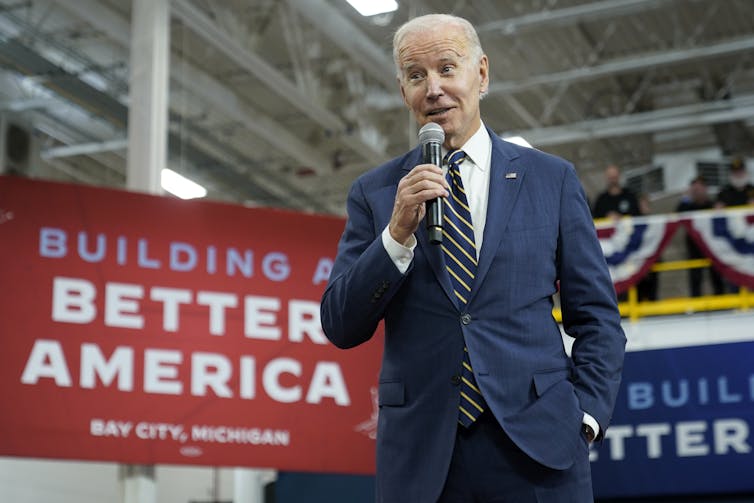
The choice of venue is a master stroke in political terms. What better setting to be welcoming US President Joe Biden, Japanese Prime Minister Fumio Kishida and Indian Prime Minister Narendra Modi – to be showing off Australia to the region? And with greater symbolism, for Australians, than a more workaday backdrop.

As a leader, Albanese presents with a certain homespun quality, which is what makes him popular with ordinary people. Behind that, he demonstrates a shrewdness in exercising power, in communicating and in showcasing both his government and the country.

These skills can be observed ranging from how he manages his ministers (with a light rein but kept in line) to his messaging (he’s personally constantly engaged with the media but seldom tripped up by them). The attention given to the physical framing of the Quad meeting – which comes at a critical time with the uncertain strategic outlook and Australia’s defence policy reorientation – is just another example.

The Albanese government operates on the principle of maximum visibility, but that is accompanied by considerable secrecy. A bevy of ministers is sent out daily to blitz the news and talk cycles. But what we don’t know is as significant as what we get to see and hear.

If we go back to the Hawke government, for example, the cabinet process was much more transparent, the policy arguments among ministers more exposed. Some of this was due to leaks, but there was also a greater willingness to talk about the internal debates.

Mostly – albeit not entirely – Albanese has been able to keep behind closed doors what divisions there are. This holds despite the exposure of some battling around Treasurer Jim Chalmers and budgeting.

News conferences can be telling contests between a prime minister and journalists. Albanese has one interesting tactic for avoiding being thrown onto the back foot.

“You get one question” is his mantra. That stops a journalist following up an answer in which the PM has dodged. While sometimes fellow reporters will home in, often the “one question” approach allows for escape.

Scott Morrison was a control freak and the crassness of his style meant things often ran out of control. Albanese runs a highly controlled government, but uses gossamer threads, so the control becomes near invisible.

After almost a year, a debate is beginning about whether this is emerging as a do-little government or an engine for change.

Journalist Tim Colebatch has written in Inside Story that “the Albanese government has fine-tuned many small things but embarked on no really big changes, and none are foreshadowed”.

The government gives the impression of hyperactivity, but does the impression reflect reality?

We have to insert the disclaimer that it’s early days. Beyond that, it’s a case of whether you want to see the glass as half empty or half full.

In around a week we’ve had three reviews released, into the Reserve Bank, defence policy, and the migration system.

The proposed reforms of the bank, embraced by the government, include having a specialist board set interest rates. This and other recommendations are in line with overseas practice. And worth doing. Whether they will make a material difference to Australia’s future performance on monetary policy is unforeseeable.

The defence strategic review, which elevates naval capability and missiles, and places a lot of faith in nuclear-powered submarines, contains an element of smoke and mirrors. One critics says it talks big but delivers small, at least in the short term.

The review rightly identifies a need for urgency in boosting our defence preparedness. But it doesn’t increase expenditure during the forward estimates, finding savings within the defence budget (notably by cutting back army capability) for new initiatives. Pushing the spending increase off into the medium term seems at odds with the review’s warnings.

The migration review has concluded the system is broken more or less all over. Home Affairs Minister Clare O’Neil says she is anxious to repair it as fast as possible and has announced early measures, especially to reduce the reliance on high numbers of “permanently temporary” migrants.

The government is keeping away from dangerous “big Australia” territory: O’Neil says her reforms would actually produce a smaller intake. It’s all about attracting the best people in a competitive international market for migrants. Judgment on the results will have to wait for the government’s second anniversary.

Within a shorter timeframe we’ll know if Albanese’s great social initiative, his referendum for the Voice to Parliament, will become a political triumph of his first term. (It will take a lot longer to find out whether the Voice, if it comes into being, proves to be a policy triumph.)

But the centrality Albanese puts on the Voice has served to highlight the Indigenous issue his government has not adequately confronted – the crisis in Indigenous communities in the Northern Territory.

Beyond his intervention to secure the reimposition of alcohol bans and provide some extra funding, Albanese has shied away from taking on the NT government. Yet more action is desperately needed. A win in the referendum will be diminished if the NT problems are not addressed now.

Climate change is a case study in how the government’s actions can be seen both ways. It has lifted the national effort on emissions reduction and the transition to cleaner energy, while at the same time resisting pressures from the Greens and others on the left to ban new fossil fuel projects.

Albanese’s presentational skills come to the fore in the way he invokes his government’s climate policy when he sells Australia abroad. This was a feature of his first appearance at the Quad and in his international meetings since.

There are multiple reasons, including the parlous state of the opposition, why Australians have maintained their strong support for the government despite their worsening personal circumstances over recent months.

Important among them has been Albanese’s ability (so far) to retain public trust in an era of mistrust. That will be in his mind as he drives some of the very final decisions for a budget to be delivered in hard times.

The Conversation

Michelle Grattan does not work for, consult, own shares in or receive funding from any company or organisation that would benefit from this article, and has disclosed no relevant affiliations beyond their academic appointment.

ref. Grattan on Friday: Albanese runs a highly controlled government using gossamer threads – https://theconversation.com/grattan-on-friday-albanese-runs-a-highly-controlled-government-using-gossamer-threads-204624


PNG authorities try to quell unrest after 16 prisoners on run shot dead

RNZ Pacific

A curfew has been imposed in part of Papua New Guinea and extra police have been moved in to quell unrest over the shooting dead of 16 prisoners.

The prisoners attempted to escape on Sunday by cutting open part of the fence at the Lakiemata prison in West New Britain province.

One inmate is in hospital and a further seven are on the run.

PNG media reports in the aftermath of the shooting say angry relatives and opportunists looted several stores with police shooting two men inside a local hardware shop in Kimbe town.

Police commander Chief Superintendent Peter Barkie has confirmed the arrival of Mobile Squad 18 to assist in easing tensions in the province.

Provincial Chairman for Law and Order John Rova said: “We are trying to address the issue and allow normal businesses to commence and operate and allow for outside communities to travel in to receive basic services.

“After the PEC meeting, we have agreed that a curfew will commence at 8pm and go until 5am every day and we will try to monitor the movement of residents because of law and order issues.”

Full investigation promised

Internal Security Minister Peter Tsiamalili Jr
Internal Security Minister Peter Tsiamalili Jr . . . says those who seek to escape custody do so at their own risk. Image: PNG govt

The PNG Post-Courier reports Internal Security Minister Peter Tsiamalili Jr saying Corrections officers are mandated by law to ensure that the orders of the court are adhered to and that they are stopped.

But he said any death was regrettable, and he offered assurance that when seeking to prevent a prisoner from escaping, the last thing that anyone wanted was for loss of life to occur.

He promised a full investigation.

“There are several points that I think is important to I make,” he said.

“The first is that the men who escaped were in custody because of the crimes that they had committed.

“In Papua New Guinea, our criminal justice system is underpinned by the Criminal Code that mandates that when individuals commit certain crimes that they must serve time in prison.

“In this sense, those individuals in prison are re-paying their debt to society.

“The second point I would make is that our corrections system is focused on rehabilitation and preparing those detained for re-integration to society.

“It is a requirement that prisoners participate in rehabilitation and re-integration programmes before they can become eligible for release.

“Those that seek to escape custody before serving their term of imprisonment are demonstrating contempt for our laws.”

Some escapees on remand
However, Papua New Guinea’s Correctional Services Commissioner has confirmed that seven out of the 24 prisoners who tried to escape were not yet convicted of an offence.

Commissioner Stephen Pokanis said the ages of the prisoners who tried to escape was  between 22 and 40.

He said the court system was often slow, which meant someone could be on remand for years while they waited for their court session.

“Time spent in prison as a remandee sometimes goes up to even eight years. For them I do not know but I would think they would have been in prison for maybe two to three years or more,” he said.

RNZ Pacific is investigating reports that a number of the prisoners who were shot had already turned themselves into authorities.

This article is republished under a community partnership agreement with RNZ.

Print Friendly, PDF & Email

Article by AsiaPacificReport.nz

Immigration system set for overhaul in wake of review’s damning findings

Source: The Conversation (Au and NZ) – By Anna Boucher, Associate Professor in Public Policy and Political Science, University of Sydney

Lukas Coch/AAP

The Albanese government’s review of Australia’s migration system offers a blueprint for overhauling the troubled system and addressing at least some of its shortcomings.

Touted as the biggest review of immigration since the 1988 FitzGerald Report, the Parkinson Review covers issues as diverse as our reliance on temporary immigration, skills lists and care shortages, immigration backlogs and ageing information technology systems in Home Affairs.

The review represents a wholesale critique and potential upheaval of the immigration system, rather than, in the words of Home Affairs Minister Claire O’Neil, “ad hoc” changes. At its centre is the argument that Australia has become too reliant on temporary migrants, without clear pathways for them to permanent residency.


Read more:
Migration review warns against Australia becoming nation of ‘permanently temporary’ residents


What did the review find?

Because temporary visa numbers have been uncapped since the Howard government, they have been growing faster than permanent visa numbers. Temporary migrant numbers have doubled in the past 15 years.

Yet there are not always clear pathways to remain permanently in Australia. This has the effect that temporary visa-holders engage in a series of visa “hops” before gaining permanent residency. Sometimes, they do not gain permanent residency at all.

The review is critical of temporary migration when it does not provide pathways to permanency. It suggests Australia risks becoming a guest worker society like Germany or Switzerland in the post-second-world-war era. This “permanently temporary migration” system, it argues, has “caused harm to Australia and to migrants, and undermined community confidence in the migration system”. It results in less equality and fairness.

The exploitation of migrant workers is identified as another, associated issue. Other commentators have also made this point in academic and public inquiries, most notably the Fels Migrant Worker Taskforce that investigated the 7-Eleven scandal.

My research using litigated court cases to analyse the issue of migrant worker exploitation has demonstrated that those on temporary visas – and, indeed, visas without clear pathways to permanent status – are most at risk of exploitation.

The review identifies the Temporary Skilled Immigration Income Threshold (TSMIT), which is the salary benchmark used as a threshold for entry into temporary skills visas, as part of the exploitation problem. In O’Neil’s words, over time, the TSMIT has become “frozen” and failed to keep pace with increases in average wages of Australian workers.

My research shows workers at the lower occupational codes are more likely to face underpayment. O’Neil announced today the TSMIT will be increased from $53,900 to $70,000. Yet factors other than wage levels also affect exploitation risk, in particular visa status and whether migrants have access to trade union representation.

This reality that temporary status is in part responsible for exploitation risk presents challenges for another recommendation of the review: to create a visa to address shortages in the care sector.

The review proposes protections to ensure care workers do not face the same exploitation as other lower-wage workers. However, comparative research suggests it is difficult, if not impossible, to create temporary labour schemes without at least some exploitation. This will be a core challenge if the government adopts a low-skilled care visa.

Matching the migrant intake to Australia’s needs

The review makes the important point that Australia will need a more diverse economy to deal with an ageing population and reduced productivity. The development of skills and capabilities will be crucial to this, and immigration can play an important role.

In this regard, the review finds the Skilled Occupations List for the selection of skilled migrants (both permanent and temporary) is not working, as it cannot keep up with rapid changes in our labour market.

As a result, Australia is “falling behind in attracting skilled migrants in a fierce global competition for the best migrants”. This point is supported by research on migrant desire to come to Australia, which suggests migrants are being put off by backlogs, among other issues.


Read more:
What do people really think about immigration to Australia? We analysed their internet usage to find out


The review instead proposes selecting migrants through detailed identification of skill requirements by Jobs and Skills Australia. The body would focus on three types of skilled migrants: those with in-demand skills, those with high human capital, and “exceptional cases” (such as “an older prize-winning academic”).

Finally, the review raises concerns about the complexity of the system and immigration backlogs. A central challenge for reforming the immigration system is its size, complexity (with over 100 different visas as well as tailored labour agreements) and detailed admission requirements.

The Migration Act 1958 is one of Australia’s longest and most complicated pieces of federal legislation. Add to that a web of regulations and policy advice manuals, and migrants face huge challenges in navigating the system.

Australia has one of the most complex immigration systems in the Western world.
April Fonti/AAP

A study of comparable countries found Australia had the most complex visa system of major Western admission countries.

Last year, O’Neil identified immigration backlogs as a key challenge for the new government. This is another issue raised in the review.

While the government has responded by hiring more staff to process visas, the backlogs remain a problem, especially for family migrants. The review blames this in part on “cumbersome” and ageing computer systems in Home Affairs, which it suggests needs a complete overhaul.


Read more:
Canada needs to consider the user experience of migrants when designing programs that impact them


Now, we need action

The review is bold and detailed. It represents a significant reform agenda, which will take years, if not decades, to implement. But it is probably worth it.

It provides intellectual and policy support for reforms to the way temporary immigration levels are set around the budget, the ease of movement between temporary and permanent visas, mitigation of exploitation risk and selecting skilled migrants. All of these concerns have been raised for some time, so it is heartening to see them reinforced by the expert review.

The challenge will be in its implementation, both practically and politically. For example, removing temporary visas without clear pathways to permanent residency (such as Working Holiday Maker Visas or some areas of international student visas) will be fought by affected stakeholders, whether they are the migrants themselves, or those that otherwise benefit from such immigration flows.

Reducing flows in one area can also create pressures on other parts of the system, as migrants may choose visa pathways based on availability. For instance, if a person cannot come as an international student, we may see an increase in sham spousal applications. Clarifying these different pathways will be particularly challenging at a time when our immigration system is already growing much faster than previously estimated.

Providing pathways for more temporary migrants could significantly increase the overall size of the permanent immigration program (although Minister O’Neil contests this), which may not be what is best for Australia at a time of a growing housing crisis, or what voters desire.

So, the government will need to tread carefully with its transitional arrangements that follow from this review and consider how to slowly change the system. At present, not all details of implementation have been announced.

We know from O’Neil’s speech at the National Press Club that the government’s position is largely in step with the findings of the review. The TSMIT will be raised and there will be more pathways to permanent residency for current temporary workers. Reforms to tertiary education and international students will also be announced in future weeks.

These changes alone are unlikely to achieve all the goals of the review, but combined with reforms in the areas of worker exploitation and industrial relations, they may go some way to addressing its concerns.

The Conversation

Anna Boucher does not work for, consult, own shares in or receive funding from any company or organisation that would benefit from this article, and has disclosed no relevant affiliations beyond their academic appointment.

ref. Immigration system set for overhaul in wake of review’s damning findings – https://theconversation.com/immigration-system-set-for-overhaul-in-wake-of-reviews-damning-findings-203764

Why green ammonia may not be that green

Source: The Conversation (Au and NZ) – By Jamin Wood, PhD Candidate, Australian Centre for Water and Environmental Biotechnology, The University of Queensland

Shutterstock

Ammonia has been in the news because of its suitability as a hydrogen carrier and fuel, in addition to being a vital ingredient in fertiliser. Existing distribution networks and the ease of turning ammonia gas into a liquid make ammonia a cost-effective way to transport renewable energy. For a given volume, ammonia – a molecule made up of three hydrogen atoms and one nitrogen atom – carries about 50% more hydrogen atoms than hydrogen itself.

As ammonia contains only hydrogen and nitrogen, it does not emit carbon dioxide when used. If made using green hydrogen (produced with renewable energy), its production also does not emit carbon dioxide. Therefore, green ammonia could help achieve a net-zero world, particularly as a fuel for long-haul transport and heavy industry.

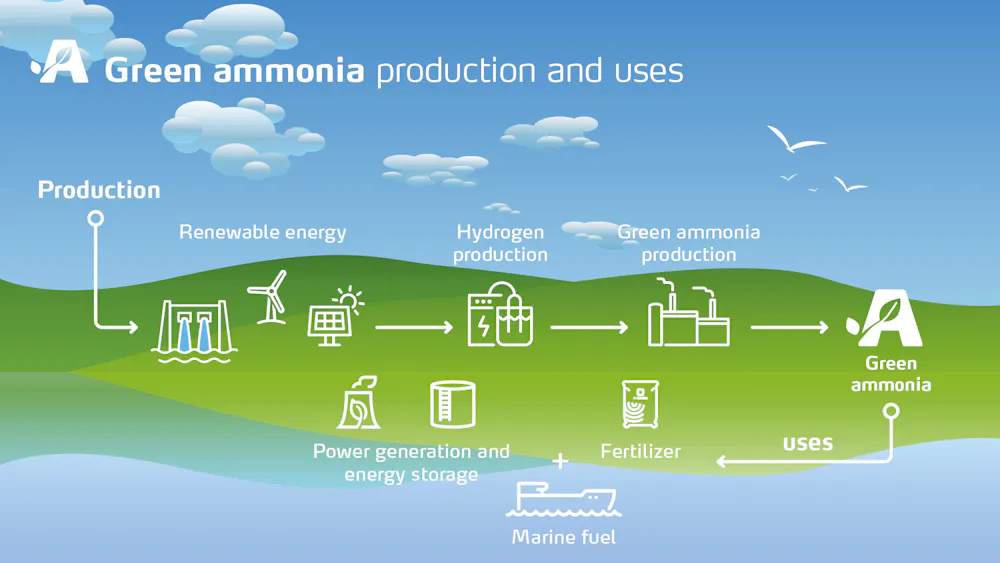
graphic showing the production and uses of green ammonia
Green ammonia produced using renewable energy can be used for power generation, energy storage and transport, fuel and fertiliser.
Source: The Davos Agenda/World Economic Forum, CC BY-NC-ND

Australia is well placed to develop a major renewable hydrogen export industry, potentially using green ammonia. Proposed projects include Cape Hardy, Collinsville, Australian Renewable Energy Hub, HyNQ, H2Tas and Gibson Island.

Unfortunately, just because ammonia doesn’t contain carbon, that doesn’t make it good for the environment. It’s a source of nitrogen pollution, which has many damaging environmental impacts. Despite Australia’s natural advantage in producing green ammonia, we ironically have the biggest per capita nitrogen footprint in the world.

Rarely, though, do green ammonia proponents critically assess its environmental sustainability beyond net zero claims.


Read more:
Green ammonia could slash emissions from farming – and power ships of the future


Exceeding planetary boundaries

The Stockholm Resilience Centre defines nine processes that regulate Earth to support life as we know it. The boundaries of a “safe operating space” have been defined for each process.

You probably won’t be surprised to know climate change is one of the boundaries we have exceeded. You could be forgiven for thinking it has been our biggest impact on the planet. But that “honour” goes to biogeochemical flows of nutrients, mostly as a result of nitrogen fertilisers.

Why? Well it comes back to ammonia.

Graphic showing the Stockholm Resilience Centre's nine planetary boundaries
The Stockholm Resilience Centre planetary boundaries. (BII stands for Biodiversity Intactness Index. E/MSY is the number of extinctions per million species-years, a common measure of extinction rates. P stands for phosphorus and N for nitrogen.)
Source: Azote for Stockholm Resilience Centre, based on analysis in Wang-Erlandsson et al 2022, CC BY-NC-ND


Read more:
You’ve heard of a carbon footprint – now it’s time to take steps to cut your nitrogen footprint


Unbalancing the nitrogen cycle

Nitrogen makes up 78% of our atmosphere as dinitrogen gas (N₂). However, in this form it is inaccessible to living organisms.

To support life, nitrogen must be converted into reactive forms such as ammonia. Once it reaches ecosystems, ammonia undergoes a series of chemical transformations. Eventually it breaks up again into N₂, and the cycle can start over again.

For millions of years, the processes in each step of the cycle have been in balance. However, industrial fertiliser production in the 20th century has thrown this cycle out of balance.

On the upside, ammonia has been a miracle chemical for growing food. An estimated 3.5 billion people are being fed thanks to chemical fertilisers. This means almost half of the world’s population would go hungry if not for synthetic ammonia.

The downside is too much reactive nitrogen is ending up in the environment – more than twice as much as the recommended planetary boundary.

In the case of excess nitrogen, crossing its planetary boundary has already had huge consequences. It has led to deterioration of ecosystems, photochemical smog, acid rain and health problems such as respiratory illnesses and cancer, algal blooms leading to fish kills such as the recent one at Menindee Lakes, damage to the Great Barrier Reef, and greenhouse gases much more potent than carbon dioxide.

Producing additional ammonia as a renewable energy carrier could make these problems even worse.


Read more:
Nitrogen pollution: the forgotten element of climate change


A problem of leakage

Some estimate ammonia supply chains leak it into the environment at rates as high as 6%. However, research is limited. More widely understood natural gas supply chains may provide a ballpark figure of around 2.6%.

Replacing fossil fuels with ammonia for long-haul trucks and shipping might reduce the carbon footprint of transport (which accounts for 37% of total carbon dioxide emissions). Yet, if 2.6% of ammonia leaked from the supply chain, we estimate this could triple the reactive nitrogen flux, further overshooting the planetary boundary. At a 6% leakage rate, it could be four times.


Read more:
Global shipping is under pressure to stop its heavy fuel oil use fast – that’s not simple, but changes are coming


We all know how climate change has been changing our world – and that is at “only” 1.2 times the carbon planetary boundary. Using green ammonia as a renewable energy carrier could have an even greater impact on the nitrogen planetary boundary.

A complement to ammonia

Another renewable energy carrier can be made from green hydrogen: methanol. It’s a molecule of four hydrogen atoms and single carbon and oxygen atoms.

Like ammonia, methanol can be used as a fuel. It could replace petrochemical feedstocks used in industrial processes and manufacturing. Our research shows methanol could also enable biotechnology to better integrate with industrial processes.

More significantly, methanol doesn’t affect the nitrogen cycle. As long as it is made using a renewable source of carbon, such as carbon dioxide from direct air capture, there is a net zero impact on the environment. International Energy Agency projections show the United States has a greater emphasis on green methanol, while Australia and Europe are more focused on green ammonia.

Environmental sustainability means more than net zero. In the case of green ammonia, holistic thinking is needed so we don’t solve one problem only to make another worse.

The Conversation

Jamin Wood receives funding from The Warwick and Nancy Olsen Scholarship and Research Training Program.

Bernardino Virdis receives funding from the Australian Research Council.

ref. Why green ammonia may not be that green – https://theconversation.com/why-green-ammonia-may-not-be-that-green-204363

New nanoparticle source generates high-frequency light

Source: The Conversation (Au and NZ) – By Anastasiia Zalogina, Postdoctoral researcher, Australian National University

Shutterstock

High-frequency light is useful. The higher the frequency of light, the shorter its wavelength – and the shorter the wavelength, the smaller the objects and details the light can be used to see.

So violet light can show you smaller details than red light, for example, because it has a shorter wavelength. But to see really, really small things – down to the scale of billionths of a metre, thousands of times less than the width of a human hair – to see those things, you need extreme ultraviolet light (and a good microscope).

Extreme ultraviolet light, with wavelengths between 10 and 120 nanometres, has many applications in medical imaging, studying biological objects, and deciphering the fine details of computer chips during their manufacture. However, producing small and affordable sources of this light has been very challenging.

We have found a way to make nanoparticles of a common semiconductor material emit light with a frequency up to seven times higher than the frequency of light sent to it. We generated blue-violet light from infrared light, and it will be possible to generate extreme ultraviolet light from red light with the same principles. Our research, carried out with colleagues from the University of Brescia, the University of Arizona and Korea University, is published in Science Advances.

The power of harmonics

Our system starts out with an ordinary laser that produces long-wavelength infrared light. This is called the pump laser, and there’s nothing special about it – such lasers are commercially available, and they can be compact and affordable.

A diagram illustrating the setup of the light-emitting system
Incoming laser light hitting a nanoparticle which then emits higher frequency light.
Zalogina et al. / Science Advances, Author provided

But next we fire short pulses of light from this laser at a specially engineered nanoparticle of a material called aluminium gallium arsenide, and that’s where things get interesting.

The nanoparticle absorbs energy from the laser pulses, and then emits its own burst of light. By carefully engineering the size and shape of the nanoparticle, we can create powerful resonances to amplify certain harmonics of the emitted light.

What does that mean, exactly? Well, we can make a useful analogy with sound.

A diagram showing the first seven harmonics of a guitar string.
Harmonics in a guitar string: in the fundamental frequency, the wavelength is the length of the whole string, but in the higher harmonics multiple shorter wavelengths fit within the length of the string.
Wikimedia / Y Landman

When you pluck a string on a guitar, it vibrates with what’s called its fundamental frequency – which makes the main note you hear – plus small amounts of higher frequencies called harmonics, which are multiples of the fundamental frequency. The body of the guitar is designed to produce resonances that amplify some of these harmonics and dampen others, creating the overall sound you hear.

Both light and sound share similarities in their physics – these are both propagating waves (acoustic waves in the case of sound, and electromagnetic waves in the case of light).

A close up of a hand strumming an acoustic guitar
Just as the body of a guitar dampens some frequencies and amplifies others, carefully designed nanoparticles can boost high-frequency harmonics of laser light.
Shutterstock

In our light source, the pump laser is like the main note of the string, and the nanoparticles are like the guitar body. Except what’s special about the nanoparticles is that they massively amplify those higher harmonics of the pump laser, producing light with a higher frequency (up to seven times higher in our case, and a wavelength correspondingly seven times shorter).

What it’s good for

This technology allows us to create new sources of light in parts of the electromagnetic spectrum such as the extreme ultraviolet, where there are no natural sources of light and where current engineered sources are too large or too expensive.

Conventional microscopes using visible light can only study objects down to a size of about a ten-millionth of a metre. The resolution is limited by the wavelength of light: violet light has the wavelength of about 400 nanometres (one nanometre is one billionth of a metre).

But there are plenty of applications, such as biological imaging and electronics manufacturing, where being able to see down to a billionth of a metre or so would be a huge help.

At present, to see at those scales you need “super-resolution” microscopy, which lets you see details smaller than the wavelength of the light you are using, or electron microscopes, which do not use light at all and create image using a flux of electrons. However, such methods are quite slow and expensive.


Read more:
A quantum hack for microscopes can reveal the undiscovered details of life


To understand the advantages of a light source like ours, consider computer chips: they are made of very tiny components with feature sizes almost as small as a billionth of a metre. During the production process, it would be useful for manufacturers to use extreme ultraviolet light to monitor the process in real time.

This would save resources and time on bad batches of chips. The scale of the industry is such that even a 1% increase in chip yields could save billions of dollars each year.

In future, nanoparticles like ours could be used to produce tiny, inexpensive sources of extreme ultraviolet light, illuminating the world of extremely small things.

The Conversation

Sergey Kruk receives funding from the Australian Research Council (DE210100679).

Anastasiia Zalogina does not work for, consult, own shares in or receive funding from any company or organisation that would benefit from this article, and has disclosed no relevant affiliations beyond their academic appointment.

ref. New nanoparticle source generates high-frequency light – https://theconversation.com/new-nanoparticle-source-generates-high-frequency-light-204618

AI will increase inequality and raise tough questions about humanity, economists warn

Source: The Conversation (Au and NZ) – By Yingying Lu, Research Associate, Centre for Applied Macroeconomic Analysis, Crawford School of Public Policy, and Economic Modeller, CSIRO

Shutterstock

On November 30 2022, OpenAI launched the AI chatbot ChatGTP, making the latest generation of AI technologies widely available. In the few months since then, we have seen Italy ban ChatGTP over privacy concerns, leading technology luminaries calling for a pause on AI systems development, and even prominent researchers saying we should be prepared to launch airstrikes on data centres associated with rogue AI.

The rapid deployment of AI and its potential impacts on human society and economies is now clearly in the spotlight.

What will AI mean for productivity and economic growth? Will it usher in an age of automated luxury for all, or simply intensify existing inequalities? And what does it mean for the role of humans?

Economists have been studying these questions for many years. My colleague Yixiao Zhou and I surveyed their results in 2021, and found we are still a long way from definitive answers.

The big economic picture

Over the past half-century or so, workers around the world have been getting a smaller fraction of their country’s total income.

At the same time, growth in productivity – how much output can be produced with a given amount of inputs such as labour and materials – has slowed down. This period has also seen huge developments in the creation and implementation of information technologies and automation.


Read more:
The internet has done a lot, but so far little for economic growth


Better technology is supposed to increase productivity. The apparent failure of the computer revolution to deliver these gains is a puzzle economists call the Solow paradox.

Will AI rescue global productivity from its long slump? And if so, who will reap the gains? Many people are curious about these questions.

While consulting firms have often painted AI as an economic panacea, policymakers are more concerned about potential job losses. Economists, perhaps unsurprisingly, take a more cautious view.

Radical change at a rapid pace

Perhaps the single greatest source of caution is the huge uncertainty around the future trajectory of AI technology.

Compared to previous technological leaps – such as railways, motorised transport and, more recently, the gradual integration of computers into all aspects of our lives – AI can spread much faster. And it can do this with much lower capital investment.

This is because the application of AI is largely a revolution in software. Much of the infrastructure it requires, such as computing devices, networks and cloud services, is already in place. There is no need for the slow process of building out a physical railway or broadband network – you can use ChatGPT and the rapidly proliferating horde of similar software right now from your phone.

A photo of a phone showing ChatGPT on the screen.
Unlike great technological innovations of the past, many AI tools will be instantly available to anyone with an internet connection.
Shutterstock

It is also relatively cheap to make use of AI, which greatly decreases the barriers to entry. This links to another major uncertainty around AI: the scope and domain of the impacts.

AI seems likely to radically change the way we do things in many areas, from education and privacy to the structure of global trade. AI may not just change discrete elements of the economy but rather its broader structure.

Adequate modelling of such complex and radical change would be challenging in the extreme, and nobody has yet done it. Yet without such modelling, economists cannot provide clear statements about likely impacts on the economy overall.

More inequality, weaker institutions

Although economists have different opinions on the impact of AI, there is general agreement among economic studies that AI will increase inequality.

One possible example of this could be a further shift in the advantage from labour to capital, weakening labour institutions along the way. At the same time, it may also reduce tax bases, weakening the government’s capacity for redistribution.

Most empirical studies find that AI technology will not reduce overall employment. However, it is likely to reduce the relative amount of income going to low-skilled labour, which will increase inequality across society.


Read more:
The benefits of job automation are not likely to be shared equally


Moreover, AI-induced productivity growth would cause employment redistribution and trade restructuring, which would tend to further increase inequality both within countries and between them.

As a consequence, controlling the rate at which AI technology is adopted is likely to slow down the pace of societal and economic restructuring. This will provide a longer window for adjustment between relative losers and beneficiaries.

In the face of the rise of robotics and AI, there is possibility for governments to alleviate income inequality and its negative impacts with policies that aim to reduce inequality of opportunity.

What’s left for humans?

The famous economist Jeffrey Sachs once said

What humans can do in the AI era is just to be human beings, because this is what robots or AI cannot do.

But what does that mean, exactly? At least in economic terms?

In traditional economic modelling, humans are often synonymous with “labour”, and also being an optimising agent at the same time. If machines can not only perform labour, but also make decisions and even create ideas, what’s left for humans?

A close up photo of an eye with a bright white halo around the pupil.
What’s so special about humans? Economists are still working on that one.
Arteum.ro / Unsplash

The rise of AI challenges economists to develop more complex representations of humans and the “economic agents” which inhabit their models.

As American economists David Parkes and Michael Wellman have noted, a world of AI agents may actually behave more like economic theory than the human world does. Compared to humans, AIs “better respect idealised assumptions of rationality than people, interacting through novel rules and incentive systems quite distinct from those tailored for people”.

Importantly, having a better concept of what is “human” in economics should also help us think through what new characteristics AI will bring into an economy.

Will AI bring us some kind of fundamentally new production technology, or will it tinker with existing production technologies? Is AI simply a substitute for labour or human capital, or is it an independent economic agent in the economic system?

Answering these questions is vital for economists – and for understanding how the world will change in the coming years.

The Conversation

Yingying Lu does not work for, consult, own shares in or receive funding from any company or organization that would benefit from this article, and has disclosed no relevant affiliations beyond their academic appointment.

ref. AI will increase inequality and raise tough questions about humanity, economists warn – https://theconversation.com/ai-will-increase-inequality-and-raise-tough-questions-about-humanity-economists-warn-203056

Hell hath no fury like a former PM – but it wasn’t always so

Source: The Conversation (Au and NZ) – By Joshua Black, PhD Candidate, School of History, National Centre of Biography, Australian National University

Mick Tsikas/AAP

In a television interview with Phillip Adams in 1999, Paul Keating remarked that he retained much influence on the international stage.

I still have most of the access […] throughout the world, in Asia in particular, that I had as prime minister.

This was a calm and contented Keating, barely three years out of office but comfortable in the knowledge his voice continued to be heard in the right quarters.

His recent appearance at the National Press Club to talk about the AUKUS pact between Australia, Britain and the United States (under the auspices of which Australia is purchasing up to five nuclear-powered submarines for the princely sum of $368 billion) was mostly devoid of that quality.

Keating called it the “worst deal in all history” and lampooned Prime Minister Anthony Albanese as the only “payer” of the pact. He was especially critical of Foreign Minister Penny Wong: “Running around the Pacific with a lei around your neck, handing out money, which is what Penny does, is not foreign policy”.

There were important and sage policy points on offer, but there was something a little unseemly about the polemic, and even more so about his complaint the prime minister’s office hadn’t heeded his advice. Those cognisant of Labor’s history might have been reminded of former NSW Premier Jack Lang, at whose feet Keating learned much of his politics in the 1960s and 1970s, and whose trenchant criticism of the party earned him many enemies over the decades.

It is easy to assume this kind of intervention is the natural corollary of losing power, egotism and what former Foreign Minister Gareth Evans called “relevance deprivation syndrome”. In fact, the spectre of a disgruntled former prime minister speaking out against their own party is a relatively recent one, a product of Australia’s modern, personalised political culture.


Read more:
Paul Keating lashes Albanese government over AUKUS, calling it Labor’s biggest failure since WW1


Death and duty

In the 20th century, several of Australia’s leaders died before they could enjoy any kind of retirement in which to disrupt their successors. Alfred Deakin’s health declined rapidly in the years after he left office, preventing him from making significant contributions to public life in the years afterwards. Joe Lyons and John Curtin both died in office, as did Ben Chifley, while serving as opposition leader. Harold Holt disappeared at Cheviot Beach in December 1967.

The survivors, it has to be said, were put to good public use after leaving office. Edmund Barton served the remainder of his days on the High Court, while George Reid and Andrew Fisher both went to London to serve as Australian High Commissioner. The former even took a seat in the British House of Commons in the final years of his life.

Stanley Melbourne Bruce, who lost government and his own seat at the 1929 federal election, was returned to parliament in 1931 and served as a minister in Joe Lyons’ government, before emulating Reid and Fisher by serving as High Commissioner in London and going to the House of Lords. Depression-era prime minister James Scullin remained an MP for a further 18 years after losing power in 1931, reputedly offering much wise counsel to Curtin and Chifley throughout the 1940s.

Former prime ministers were once a little more reticent about sparring with their successors in public, especially when it came to sensitive policy matters. Fisher despaired when his successor, Billy Hughes, campaigned for military conscription in 1916. But the former prime minister used his office as High Commissioner to abstain from commenting on the referendum, which failed.

Robert Menzies was so disappointed with his Liberal successors, according to biographer Troy Bramston, that he may not have even voted for the Liberal Party in 1972, preferring the Democratic Labor Party.

But he would never have admitted this publicly. Instead, he used his post-prime ministerial public appearances to wax lyrical about the British Commonwealth and bemoan its declining relevance.

Liberal Prime Minister Malcolm Fraser consulted Menzies periodically during the party elder’s final years.

Statesmen on the loose?

There is a longer history, though, of former prime ministerial interventions in debates about Australia’s strategic and defence policy. These were, after all, vital questions in the 20th century.

When Bruce proposed in 1924 to build two new Commonwealth naval cruisers in Britain rather than Australia, his Nationalist predecessor Hughes was irate, and said so from the backbench. “Are we such spineless anaemic creatures”, he asked, “as to be incapable of bearing the great responsibilities which free government imposes upon us?”

Hughes would play the role of provocateur again. In 1934, he published a short book called The Price of Peace, in which he called for a more urgent approach to preparation for conflict in the Pacific. An updated version was reissued the following year under the title Australia and the War Today, but it was highly controversial. Hughes was now a minister in a government whose foreign policy toward aggressors depended on economic sanctions, which he had described in the book as “either an empty gesture or war”. His resignation promptly followed.

More recent interventions have taken defence policy and strategic complacency as their concern, too. A year before his death, Malcolm Fraser published a polemical book called Dangerous Allies (2014), in which he argued against Australia’s bipartisan “strategic dependence” on the United States.

Speaking on daytime television, he warned that Australia’s partnership with the US could see it implicated in “major conflict” in the Pacific. He was, in this respect, equally critical of both major parties for what he perceived as subservience to American strategic interests.


Read more:
Book review: Dangerous Allies by Malcolm Fraser


The AUKUS pact, in its short life, has served as the launching pad for ex-leaders other than Keating to launch powerful attacks on successors. When Scott Morrison announced the initial agreement in 2021, his predecessor Malcolm Turnbull used a press club broadcast to argue Morrison had “not acted in good faith” in reneging on the existing submarine deal with France that he, Turnbull, had signed in 2016.

Morrison, Turnbull fulminated, had “deceived” France. Australian voters saw the French president and their own prime minister’s immediate predecessor calling the incumbent a liar.

Fights, feuds and frustrated men

In recent decades, Australians have become inured to bitter and emotional feuds between their former leaders. There are several reasons for this trend, including the increasingly personalised nature of politics since the 1970s, high rates of leadership attrition, and the thirst of media providers for easy news stories that hinge on personal animosity and Shakespearean intrigue.

A former leader criticising their own party is deemed the height of newsworthiness. John Howard and Julia Gillard have uniquely resisted the temptation. Howard had some stern words for his Liberal successors last year in a book called A Sense of Balance, but the book appeared after the Morrison government had been defeated. Gillard, for her part, has been almost unfailingly measured and dignified in her public pronouncements since 2013.

For those who did return to the fray of policy combat, the personal and the political were inseparable. For much of the 1980s, Gough Whitlam was anguished by the way Hawke government ministers treated his legacy. As Jenny Hocking has shown in her biography of Whitlam, Hawke and Whitlam clashed repeatedly as the Labor Party walked away from big 1970s initiatives such as free tertiary education, an ambitious Aboriginal land rights agenda and much else. When treasurer Keating joked about the “chasm” between Whitlam’s policy aspirations and his actual achievements, Whitlam returned serve by calling him a “smart-arse”.

Where race relations and national identity have been concerned, the fall-outs between Australian ex-PMs have been that much more embittered. A great defender of refugees and asylum seekers, Fraser spoke publicly about his abhorrence of the Howard government’s approach to border protection and mandatory offshore detention. When Tony Abbott took the leadership of the Liberal Party in December 2009 promising to “stop the boats”, Fraser resigned his life membership in protest.

Former Prime Minister Malcolm Fraser was a trenchant critic of the Howard and Abbott governments’ immigration policies.
Joel Carrett/AAP

Keating’s attack on the Labor Party is not unprecedented for a former prime minister, but it isn’t historically commonplace either. There is no doubt his criticisms have been heard, but their influence remains to be seen.

The Conversation

Joshua Black does not work for, consult, own shares in or receive funding from any company or organisation that would benefit from this article, and has disclosed no relevant affiliations beyond their academic appointment.

ref. Hell hath no fury like a former PM – but it wasn’t always so – https://theconversation.com/hell-hath-no-fury-like-a-former-pm-but-it-wasnt-always-so-204196

What is a novated lease on a car and what do I need to know before signing up?

Source: The Conversation (Au and NZ) – By Prafula Pearce, Associate Professor of Law, Edith Cowan University

Shutterstock

If you’re thinking about getting a vehicle but don’t have enough money saved, you might be considering a choice between taking out a car loan or a novated lease (also known as “salary sacrificing” to get a car).

It’s important to know the difference, as there are plenty of tax implications and what’s right for one person won’t be for another.

So, what is a novated lease and how does it work?

Ever thought of taking out a novated lease on a car?
Photo by Lisa Fotios/Pexels, CC BY

A novated lease involves your employer

Under a normal lease, you enter an agreement with a leasing company. They buy the vehicle you’ve chosen (and own it until the end of the lease) and you get to use it in return for making regular lease payments. At the end of the lease agreement period, you can choose to make an additional payment (called a residual or balloon payment) and take over ownership of the vehicle.

A novated lease includes another party in the agreement – your employer.

In this case, your employer makes the payments to the leasing company on your behalf, then reduces your wages by the amount of the payment.

This is called a salary sacrifice or salary packaging arrangement and it means you end up paying less tax on your income.

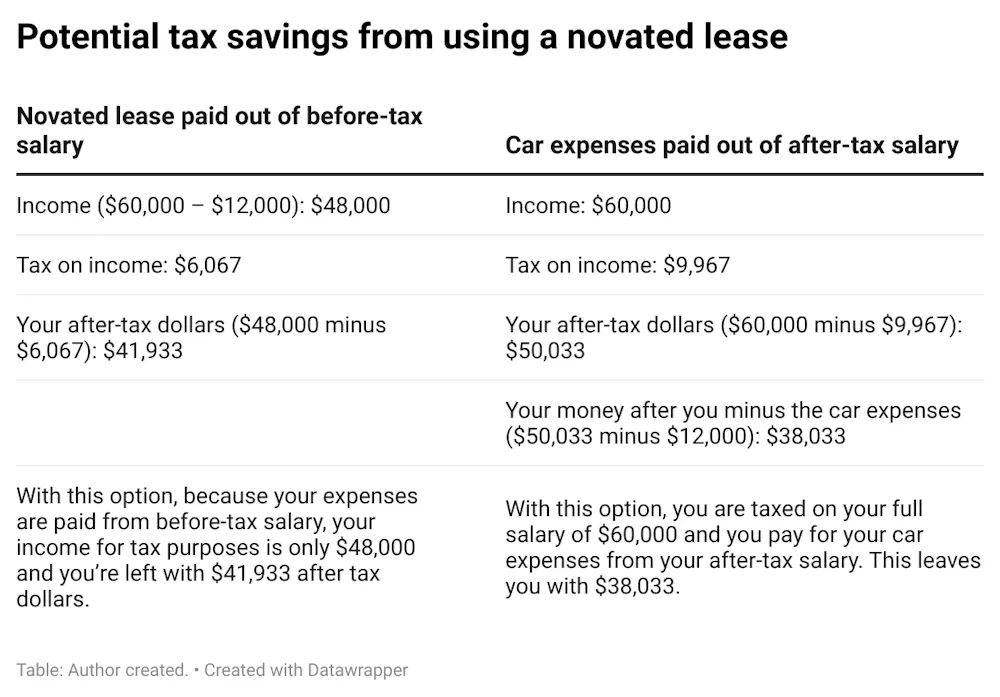
To demonstrate the tax saving, see the example below, which is based on a vehicle expense of A$12,000 for the 2022-23 tax year.


Potential tax savings from using a novated lease.


Bundled with the novated lease is the finance or interest component, at a rate similar to a car loan. However, it is easier to obtain finance through a novated lease as your employer is guaranteeing the payment out of your salary.

Used or new car? What about running costs?

You can purchase a new or used vehicle under a novated lease.

Also, you may be able to bundle not only the purchase price and the finance costs, but also the running costs such as fuel, servicing and insurance.

This means the total costs of owning a vehicle are bundled into a single payment and deducted from your before-tax salary. This is called a fully maintained novated lease.

How does it compare with a traditional car loan?

A traditional loan involves borrowing money from a lender (such as a bank) to pay for your vehicle.

You become the owner of the vehicle straight away, but you have a debt (which is usually secured against the vehicle itself). You’ll need to make regular loan repayments plus interest.

If something goes wrong and you can’t make your regular repayments, you may be forced to sell the vehicle to cover the debt.

You’re also directly responsible for all the running costs, which you pay from your after-tax salary.

Since you own the vehicle, you may be able to claim some tax deductions if you use it for work.

Make sure you understand what you’re signing up for.
Photo by Antoni Shkraba/Pexels, CC BY

5 things to think about before you sign up for a novated lease

  1. Check if the novated lease arrangement is tax effective for you. There may be other costs involved in salary sacrifice agreements such as fringe benefits tax (sometimes shortened to FBT), which your employer may also deduct from your wages. However, some types of employers – such as charities – are exempt from this tax. It might be worth getting advice from your employer’s payroll officer or your accountant

  2. Leasing companies often promote the savings on fleet discounts and on the GST component of both the vehicle cost and the running costs when you enter a novated lease. You need to pay attention to the total package cost. Other costs, such as interest, administration charges and services fees might outweigh the fleet or GST savings.

  3. Leasing companies often have online calculators that show savings on a novated lease when compared with a traditional car loan. However, these calculators often omit the employer’s fringe benefits tax, which may end up being passed onto you. So you need to factor in this additional cost

  4. Make sure you understand what will happen if you quit, get fired or leave your current employer for the duration of the novated lease. If you change jobs, you may become responsible for the lease payments. Or, you might need to enter into another agreement with the leasing company (this usually means additional administration costs)

  5. Check the residual value or “balloon payment” that applies to your novated lease (remember, this is the amount you can pay at the end of the lease to take ownership of the car). This amount is set by the Australian Taxation Office.

Advantages and disadvantages

There are advantages and disadvantages to novated leases, just as there are to traditional car loans.

So it’s important to fully understand the choice you are making, and the risks involved.

If you’re planning on keeping your vehicle long term, a car loan may be the cheaper option.

If you want to upgrade regularly, a lease may be the convenient way to go.

Either way, make sure you get proper advice and make an informed decision.

The Conversation

Prafula Pearce does not work for, consult, own shares in or receive funding from any company or organisation that would benefit from this article, and has disclosed no relevant affiliations beyond their academic appointment.

ref. What is a novated lease on a car and what do I need to know before signing up? – https://theconversation.com/what-is-a-novated-lease-on-a-car-and-what-do-i-need-to-know-before-signing-up-202746

Proving the wealthiest New Zealanders pay low tax rates is a good start – now comes the hard part

New Zealand Ten Dollar Note. Image, Wikimedia Commons.

Source: The Conversation (Au and NZ) – By Craig Elliffe, Professor of Law, University of Auckland


Getty Images

If nothing else, the just released Inland Revenue study of the tax rates paid by the wealthiest New Zealanders should put to rest the notion we have a progressive tax system. We don’t.

A progressive system is one where higher earners pay more as their income grows.
The report, commissioned by Minister of Revenue and Attorney-General David Parker, has revealed the country’s wealthiest are paying a median effective tax rate of 9.5% (including GST).

This is less than half the tax paid by middle income earners at 22%, or nearly 30% if you include GST. But while many commentators have asked how such a low tax rate is possible, the real question should be what happens next?

Will the government change the tax code to include a robust capital gains tax? In a hotly contested election year, is there much political will to target the core source of income for New Zealand’s richest people?

Whatever the answers, we should first recognise just how important this report is. The now decommissioned Tax Working Group, of which I was a member, called for this study to be completed. It is satisfying to see the country now has better information on which to base its tax decisions.

Revenue Minister David Parker: no commitment to major tax policy changes.
Getty Images

New Zealand’s one percent

Inland Revenue surveyed the incomes of 311 households since 2021 for its study. The average net wealth of each household was NZ$276 million and collectively this group owns around $85 billion worth of assets.

Another way to describe this is that the richest 1% owns about a quarter of the country’s financial assets.

According to Inland Revenue, those surveyed are meeting all their income tax obligations. There was no evidence of any wrongdoing.


Read more:
New Zealand’s tax system is under the spotlight (again). What needs to change to make it fair?


But only 7% of their overall economic income is taxed in their personal name. The other 93% comes from investment returns, most of which would be untaxed. These households also use entities, trusts and companies, which are taxed at a lower rate than individuals.

Based on the fact that 93% of the increase in their wealth is from an untaxable source, it’s no wonder they pay tax at such a low rate. In fact it’s surprising they are paying as much tax as they are.

Big change unlikely

Thanks to the information contained in Inland Revenue’s study, our unease over
how we tax people (and whether the system is truly progressive) is more than just a feeling. The report provides hard, factual information illustrating the consequences of current tax policy.

Ahead of the report’s release, however, Prime Minister Chris Hipkins refused to be drawn on Labour’s tax policy and whether there would be any changes. Revenue Minister Parker only hinted at possible tweaks.

With a budget and an election on the horizon, it’s unlikely this government will be making significant changes to the tax code. In the current political environment, it’s very difficult to persuade a majority that new taxes are a good idea.

But it’s quite possible there may be a tax reduction for lower and middle income earners, combined with additional taxation on capital in some way.


Read more:
Why a proposed capital gains tax could mean tax cuts for most New Zealanders


Who pays the bills?

Despite it being an obvious target, however, we shouldn’t expect a robust capital gains tax. The previous Labour government ruled this out and it’s unlikely to gain traction now.

With just six months until the general election, too, there isn’t time for the requisite legislation to be written and consulted on.

Most New Zealanders don’t really need to think about tax at all – more than half don’t even file tax returns. But even this group should benefit from being aware of the Inland Revenue findings and be better informed during the subsequent debates on tax policy.

Because behind all these questions about who pays what tax rate lie significant considerations. New Zealand’s infrastructure spending is increasing and many social services need greater investment. How we pay for it will determine whether we keep up or fall behind.

How much money the government earns from taxation, who pays and how much they pay is a political conversation we can’t put off forever.

The Conversation

Craig Elliffe was an independent reviewer of the IRD high-wealth individuals research project report.

ref. Proving the wealthiest New Zealanders pay low tax rates is a good start – now comes the hard part – https://theconversation.com/proving-the-wealthiest-new-zealanders-pay-low-tax-rates-is-a-good-start-now-comes-the-hard-part-204532

Hit your head while playing sport? Here’s what just happened to your brain

Source: The Conversation (Au and NZ) – By Sarah Hellewell, Research Fellow, Faculty of Health Sciences, Curtin University, and The Perron Institute for Neurological and Translational Science, Curtin University

Patrick Case/Pexels

It’s Friday night, your team is playing, and scores are nail-bitingly close. A player intercepts the ball, and bam! A player tackles his opponent to the ground. Trainers and doctors gather nervously while the commentators wait for confirmation: a concussion, mild traumatic brain injury, head knock, strike, tap, bump, blow … there are many terms for it.

How to prevent and treat such injuries is the subject to a Senate inquiry, with public hearings this week.

But what exactly are these injuries? What’s going on in the brain?


Read more:
Concussion risks aren’t limited to the AFL. We need urgent action to make sure our kids are safe, too


What is concussion?

Concussion is a form of traumatic brain injury (TBI). Concussion typically falls at the milder end of the spectrum, and so is often called mild TBI.

Concussions happen most often when the head directly hits against something. But it can also happen without head impact, when a blow to the body causes the head to move quickly.

The brain is a soft organ in a hard case, floating in a thin layer of cerebrospinal fluid. The brain can be damaged away from the site of impact for this reason, as it bounces with force within the skull.

Concussions that happen during sport can be complex because the head often rotates as the person falls. This “rotational acceleration” can cause more damage to the brain. This is especially the case for cells in the long tracts of white matter responsible for relaying signals around the brain.

As well as causing initial damage to brain cells at the time of injury, concussion sets off a cascade of chemical and biological changes. These occur within minutes and may last for days or even weeks after concussion.

Cell membranes become permeable (more leaky), causing an imbalance of brain chemicals inside and outside cells. Cellular functions shift into overdrive to try to restore balance, using more fuel in the form of glucose. At the same time, blood flow to the brain is often reduced, resulting in a mismatch between energy supply and demand.

The structural scaffolding of cells in the white matter may begin to weaken or break, preventing or reducing the ability of cells to communicate.

Sensing danger, cells from the immune system begin to migrate to the brain in an attempt to stem the damage, spouting chemical signals to recruit other inflammatory cells to the sites of injury.

These initial responses to concussion typically resolve over time, but the recovery period may be different for each person, and may persist even after symptoms go away.


Read more:
Repeated head injury may cause degenerative brain disease for people who play sport – juniors and amateurs included


What are the symptoms?

Concussion symptoms can differ depending on the person and the circumstances of injury.

Some people have more obvious symptoms like loss of consciousness, vomiting and confusion; others may have headaches, problems with their vision, or thinking and concentration. Some people may have one symptom while others have many. Some people’s symptoms may be severe, and others may have only mild symptoms.

So diagnosing and managing concussion can be difficult. Most people who have a concussion will find their symptoms subside within days or weeks. But around 20% of people will have persistent symptoms beyond three months after their concussion.

Ongoing symptoms can make it harder to perform at work or school, to socialise with friends and to maintain relationships. Scientists don’t know why recoveries are different for different people. We have no way to predict who will recover from concussion and who won’t.


Read more:
Having a brain injury does not mean you’ll get dementia


How about repeat blows to the head?

People who play contact sports are more likely to have multiple concussions over a playing career. Higher numbers of concussions tend to mean worse symptoms and slower recovery for subsequent concussions.

This indicates the brain doesn’t get used to concussions, and each concussion is likely to impart additional damage.

Emerging evidence suggests repeated concussions may lead to ongoing changes in people’s brain cell structure and function.

Inflammation may persist inside and outside the brain. Inflammation may also cause or contribute to someone developing symptoms, and long-term brain functional and structural changes.

Prolonged symptoms and long-term brain changes may be worse in the long run for people who experience their concussions as young adults compared to people who have concussions as older adults.

Scientists are also starting to find differences in symptoms and brain alterations in males and females. These could be related to newfound sex differences in the scaffolding proteins of male and female brains, making female brains more susceptible.

Female soccer players playing match
Concussion may be different for women, but we’re still learning how.
Noelle Otto/Pexels


Read more:
Sports concussions affect men and women differently. Female athletes need more attention in brain research


We’ve known about this for a long time

The long-term brain and behaviour changes resulting from repeated sports concussions have been reported since at least the 1920s. Back then, it was seen in boxers and termed dementia pugilistica, or punch-drunk syndrome.

We now call this condition chronic traumatic encephalopathy (CTE). People found to have CTE don’t always experience severe symptoms. Instead, symptoms tend to emerge or worsen later in life, even decades after injury or at the end of a playing career.

People also have varied symptoms that can sometimes be hard to measure, like confusion, impaired judgement and aggression. This has made diagnosis difficult while people are alive. We can only confirm CTE after someone dies, by detecting altered structural proteins of the brain in specific brain areas.

There is still a lot to learn about CTE, including the exact processes that cause it, and why some people will develop it and others won’t.


Read more:
Here’s what we know about CTE, the brain condition that affected Danny Frawley


Concussion is common

Concussion is a common injury almost 30% of us will experience in our lifetime.

Although we have a lot still to learn, the current advice for people who experience concussion is to seek medical advice to help with initial management of symptoms and guide decisions on returning back to playing sports.


For coaches, trainers, parents and others interested in learning more about how to manage concussion, resources are available from Connectivity Traumatic Brain Injury Australia. These include its free concussion short courses to help you understand, recognise and manage a concussion injury when it occurs.

The Conversation

Sarah Hellewell receives funding from the Medical Research Futures Fund and the Bryant Stokes Neurological Research Foundation.

ref. Hit your head while playing sport? Here’s what just happened to your brain – https://theconversation.com/hit-your-head-while-playing-sport-heres-what-just-happened-to-your-brain-203038

Fiji’s reduced VAT ‘a failed gamble’ – a vision now needed, says Naidu

By Meri Radinibaravi in Suva

The gamble that the previous FijiFirst government took in 2016 — in reducing the value added tax (VAT) rate from 15 percent to 9 percent — was basically done to please the people, says Fiscal Review Committee chair Richard Naidu.

He said this gamble failed miserably because government expenditure continued to increase while the income it received was reduced.

“I think that for a long time, the government has been underfunded,” Naidu said.

“We forget that VAT used to be at 15 percent and personal income tax used to kick in at $16,000 [NZ$12,000] and now kicked in at $30,000 [NZ$22,000].

“So, what happened was that for the last 10 or so years, we have reduced the amount of tax we take, basically to please people.

“We’ve cut the VAT and we’ve cut personal income tax, but we’ve kept spending.

“We took a gamble that somehow this would create economic growth and the gamble failed.”

Debt level a threat
He said the possibility of adopting some of the old tax rates was unavoidable as the level of debt the country had was a threat in itself.

“The advice that we are getting is that we have to get our debt to GDP (gross domestic product) ratio down and over a 10-year period.

“What we are saying is that debt does not drive what we do.

“We have to have a national vision; we have to execute that vision, but we have to keep in mind the debt, because the debt is one of the threats that we are facing.

“Now really all we are saying is that in respect of some taxes — not all — we might have to go back to the old rates.

“So, when people say this is terrible, this should never happen and we’re being cruel and imposing pain, people need to remember that this is actually what the tax rates used to be.”

Naidu stressed that the abnormal situation that people were referring to was what the economy endured in the last 10 years when it could not raise enough money to fund critical infrastructure investments.

Playing catchup
He said this was why the current government had to play catchup and raise funds to meet the needs of the people.

“That means we have delayed investments in critical infrastructure.

“Why is it that we have thousands of people in the Suva-Nausori corridor who do not have water for 10-12 hours a day.

“It is because we did not invest and now, we have to play catchup, we have to invest harder and faster, and we don’t have the money and somehow, we have to raise that money quickly.

“So, we do not have a lot of choices in terms of the investments that we have to make.”

Meri Radinibaravi is a Fiji Times reporter. Republished with permission.

Print Friendly, PDF & Email

Article by AsiaPacificReport.nz

University security guard graduates at UPNG with BA degree

By Marcia Negri in Port Moresby

The arena was filled with applauses and whistles when Fidelis Kamsnok walked up to the podium to receive his degree at the University of Papua New Guinea’s 68th graduation ceremony held at the Sir John Guise indoor complex.

Kamsnok, a father of three who hails from the East Sepik Province, is currently employed by the university as a member of Uniforce (the security company that guards the Waigani campus).

He had remained committed as a guard since joining the university in 2010 until yesterday when he graduated with a Bachelor of Arts (Professional Studies) degree.

“There were challenges as a father, working and taking on the course majoring in information and communication science.

“It was challenging in the family, looking after kids, and kids have their own needs. I have a son and two daughters, but I have to balance my needs as a father and theirs as well,” the Sepik man said.

After clocking 10 years with the university as a guard, Kamsnok applied for studies back in 2020 and the commitment he has put in his studies made it possible for him to join others and walk up to the stage on Tuesday with pride and obtain his degree.

He said the university had a policy where you had to be a serving member for seven years before applying for professional studies, adding that it took three years of studies for those who wanted to attain a degree in professional studies.

‘Balancing your life’
In his encouragement to others who are in similar positions, the guard said: “It’s through the faith you have.

“If you have to balance your life in helping kids, then you can do that, it’s possible.

“Everything is possible, you have to manage yourself.”

That is what Kamsnok did for the past three years.

While studying, he managed his time between studies and work and his family.

He spoke of how privileged he was to have achieved this degree, especially getting support from his family and mainly through his uncle’s endless help.

He said that without the support he would not have achieved his goal.

Marcia Negri is a PNG Post-Courier reporter. Republished with permission.

Print Friendly, PDF & Email

Article by AsiaPacificReport.nz

Can machines be self-aware? New research explains how this could happen

Crédit photographique : © École polytechnique - J.Barande.

Source: The Conversation (Au and NZ) – By Michael Timothy Bennett, PhD Student, School of Computing, Australian National University


Michael Timothy Bennett/Generated using Midjourney, Author provided

To build a machine, one must know what its parts are and how they fit together. To understand the machine, one needs to know what each part does and how it contributes to its function. In other words, one should be able to explain the “mechanics” of how it works.

According to a philosophical approach called mechanism, humans are arguably a type of machine – and our ability to think, speak and understand the world is the result of a mechanical process we don’t understand.

To understand ourselves better, we can try to build machines that mimic our abilities. In doing so, we would have a mechanistic understanding of those machines. And the more of our behaviour the machine exhibits, the closer we might be to having a mechanistic explanation of our own minds.

This is what makes AI interesting from a philosophical point of view. Advanced models such as GPT4 and Midjourney can now mimic human conversation, pass professional exams and generate beautiful pictures with only a few words.

Yet, for all the progress, questions remain unanswered. How can we make something self-aware, or aware that others are aware? What is identity? What is meaning?

Although there are many competing philosophical descriptions of these things, they have all resisted mechanistic explanation.

In a sequence of papers accepted for the 16th Annual Conference in Artificial General Intelligence in Stockholm, I pose a mechanistic explanation for these phenomena. They explain how we may build a machine that’s aware of itself, of others, of itself as perceived by others, and so on.


Read more:
A Google software engineer believes an AI has become sentient. If he’s right, how would we know?


Intelligence and intent

A lot of what we call intelligence boils down to making predictions about the world with incomplete information. The less information a machine needs to make accurate predictions, the more “intelligent” it is.

For any given task, there’s a limit to how much intelligence is actually useful. For example, most adults are smart enough to learn to drive a car, but more intelligence probably won’t make them a better driver.

My papers describe the upper limit of intelligence for a given task, and what is required to build a machine that attains it.

I named the idea Bennett’s Razor, which in non-technical terms is that “explanations should be no more specific than necessary”. This is distinct from the popular interpretation of Ockham’s Razor (and mathematical descriptions thereof), which is a preference for simpler explanations.

The difference is subtle, but significant. In an experiment comparing how much data AI systems need to learn simple maths, the AI that preferred less specific explanations outperformed one preferring simpler explanations by as much as 500%.

Hypothetical patent filing for a self-aware machine, generated by an artificial intelligence from just a few words.
Michael Timothy Bennett / Generated using MidJourney

Exploring the implications of this discovery led me to a mechanistic explanation of meaning – something called “Gricean pragmatics”. This is a concept in philosophy of language that looks at how meaning is related to intent.

To survive, an animal needs to predict how its environment, including other animals, will act and react. You wouldn’t hesitate to leave a car unattended near a dog, but the same can’t be said of your rump steak lunch.

Being intelligent in a community means being able to infer the intent of others, which stems from their feelings and preferences. If a machine was to attain the upper limit of intelligence for a task that depends on interactions with a human, then it would also have to correctly infer intent.

And if a machine can ascribe intent to the events and experiences befalling it, this raises the question of identity and what it means to be aware of oneself and others.

Causality and identity

I see John wearing a raincoat when it rains. If I force John to wear a raincoat on a sunny day, will that bring rain?

Of course not! To a human, this is obvious. But the subtleties of cause and effect are more difficult to teach a machine (interested readers can check out The Book of Why by Judea Pearl and Dana Mackenzie).

To reason about these things, a machine needs to learn that “I caused it to happen” is different from “I saw it happen”. Typically, we’d program this understanding into it.

However, my work explains how we can build a machine that performs at the upper limit of intelligence for a task. Such a machine must, by definition, correctly identify cause and effect – and therefore also infer causal relations. My papers explore exactly how.

The implications of this are profound. If a machine learns “I caused it to happen”, then it must construct concepts of “I” (an identity for itself) and “it”.

The abilities to infer intent, to learn cause and effect, and to construct abstract identities are all linked. A machine that attains the upper limit of intelligence for a task must exhibit all these abilities.

This machine does not just construct an identity for itself, but for every aspect of every object that helps or hinders its ability to complete the task. It can then use its own preferences as a baseline to predict what others may do. This is similar to how humans tend to ascribe intent to non-human animals.

So what does it mean for AI?

Of course, the human mind is far more than the simple program used to conduct experiments in my research. My work provides a mathematical description of a possible causal pathway to creating a machine that is arguably self-aware. However, the specifics of engineering such a thing are far from solved.

For example, human-like intent would require human-like experiences and feelings, which is a difficult thing to engineer. Furthermore, we can’t easily test for the full richness of human consciousness. Consciousness is a broad and ambiguous concept that encompasses – but should be distinguished from – the more narrow claims above.

I have provided a mechanistic explanation of aspects of consciousness – but this alone does not capture the full richness of consciousness as humans experience it. This is only the beginning, and future research will need to expand on these arguments.

The Conversation

Michael Timothy Bennett does not work for, consult, own shares in or receive funding from any company or organization that would benefit from this article, and has disclosed no relevant affiliations beyond their academic appointment.

ref. Can machines be self-aware? New research explains how this could happen – https://theconversation.com/can-machines-be-self-aware-new-research-explains-how-this-could-happen-204371

Why NZ law should require everyone to report known or suspected child sexual abuse

Source: The Conversation (Au and NZ) – By Sarah Whitcombe-Dobbs, Senior Lecturer in Child and Family Psychology, University of Canterbury

Getty Images

As the Abuse in Care Royal Commission inquiry has shown, the lifelong and intergenerational consequences of child abuse are devastating. Many children placed in state and religious institutions – often having already experienced harm and hurt – were then abused by those tasked with caring for them.

The numerous accounts of horrific abuse over many years have been devastating and heart-breaking. The commission has heard so much evidence that its reporting deadline has been extended until March next year.

It is to be hoped that one positive outcome of this traumatic process will be the introduction of mandatory reporting of suspected child abuse. Because right now in Aotearoa New Zealand, it is not required by law to report childhood sexual abuse – or any child maltreatment – when it is seen or suspected.

Despite the Children’s Act 2014 being designed to strengthen the safety of children, it stopped short of mandating the reporting of child abuse – even for professionals such as teachers, doctors, counsellors and nurses.

Instead, every agency that deals with children must have a “child protection policy” in place, outlining how the organisation should respond to, document and pass on concerns regarding child safety.

While allowing for professional judgment about individual cases, this system does not always result in robust child safety practices. Some staff members are unaware of their own policies, some do not feel confident to report, and many continue to base decisions about whether to notify on their own personal views and experiences.

Lasting impacts of abuse

We know experiencing abuse during childhood is harmful, with sexual abuse often difficult to detect and prevent. It can be painful, confusing and terrifying for children at the time. Lifelong and even life-threatening consequences include increased risk of suicide and self-harm, low self-esteem, depression, anxiety and substance use problems.

Survivors fare worse on health-related quality of life measures, experience poorer educational and employment outcomes, and are at increased risk of a range of other physical and psychological problems.


Read more:
Victims of child sex abuse still face significant legal barriers suing churches – here’s why


Many also show enormous courage and strength, going on to live fulfilling and extraordinary lives, despite their experiences. Several factors affect this resilience, with community and other adult responses to the abuse strongly influencing how well children fare later.

But the abuse-in-care inquiry has also highlighted serious injustices. Many child victims disclosed their abuse to other adults, only to be disbelieved – and, in some cases, punished for the allegations. Far more cases occur than are ever reported. Of those that are reported, few result in a conviction.

Greater chance of prosecution

Mandated reporting of child sexual abuse would send a clear message that children’s bodies do not exist for adult pleasure. Child sexual abuse is seen as repugnant everywhere, yet child sexual exploitation through pornography has grown over time. This risks normalising abuse and increasing offenders’ access to victims.

Many child sex offenders have multiple victims. When individual cases are not reported to police, even if the child is protected after disclosure, the offender may go on to find another victim.

Police can only follow up on events they know about. Mandated reporting will mean more information, with cases more likely to go to prosecution.


Read more:
Children can now report rights violations directly to the UN – it’s progress, but Aotearoa New Zealand still needs to do more


There have been concerns that social services might be overwhelmed by increased reporting, and that reporting may be biased against certain ethnic or socioeconomic groups.

Where Māori are already disadvantaged, there is a perceived risk that changing the rules may exacerbate existing injustices, and it’s not clear what impact mandated reporting may have on ethnic disparities. Nevertheless, the current rules allow for more discretionary decision-making, which inadvertently reinforces existing biases.

Based on Australian evidence, however, it appears the worries about overwhelmed systems have not been borne out.

Child sexual abuse reporting became mandatory in Western Australia in 2009. Certain professionals were required to report their “belief on reasonable grounds” that abuse may be happening. Evidence from this law change showed a two- to five-fold increase in reports, investigations and confirmations abuse had occurred.


Read more:
The cost of living crisis means bolder budget decisions are needed to lift more NZ children out of poverty


Another Australian study showed increased reporting rates benefit boy victims in particular. These studies suggest there were known and suspected perpetrators but other adults had not passed on their concerns.

If even some of these offenders have multiple victims, a conviction will increase child safety around that particular perpetrator. Offenders will also receive treatment and rehabilitation.

A public health approach

Currently in New Zealand, when suspected cases are reported, children are offered information about psychological services by police and child welfare agency Oranga Tamariki.

However, many parents and caregivers do not know about the ACC-funded sensitive claims process. It provides public access to mental health treatment for sexual assault and abuse victims – regardless of whether crimes are reported or substantiated.

Mandatory reporting will ensure all children and whānau are at least informed of support options. More than that, turning a blind eye to New Zealand’s already high levels of child abuse is unconscionable.

And while it’s true that Oranga Tamariki has been widely criticised for intervening unnecessarily and causing harm, inaction can result in tragedy too.


Read more:
Changes to the way Oranga Tamariki is monitored risk weakening children’s rights and protections – what should be done?


Despite undeniable differences over policy and practice within what is a poorly resourced and enormously risky field, childhood sexual abuse is so harmful that consensus on mandatory reporting may still be possible.

Good policy models have been drafted overseas. And any new law would have to be part of a broader public health approach to child protection that includes addressing inequality, poor housing and access to adequate mental health and addiction services.

Even if implemented today, mandatory reporting on its own would not prevent or fully address child sexual abuse. We need collaboration between housing, health, justice and social services, with a shared societal responsibility for child wellbeing.

But it is one small change that will help us respond decisively and protect children. As the Abuse in Care Royal Commission prepares its final report, it must carefully consider making mandatory reporting one of its key recommendations.

The Conversation

Sarah Whitcombe-Dobbs receives funding from the Health Research Council. She has worked and consulted for Oranga Tamariki and the Family Court.

ref. Why NZ law should require everyone to report known or suspected child sexual abuse – https://theconversation.com/why-nz-law-should-require-everyone-to-report-known-or-suspected-child-sexual-abuse-204098

Will a preoccupation with party unity destroy the Liberal Party?

Source: The Conversation (Au and NZ) – By Carolyn Holbrook, Senior Lecturer in History, Deakin University

Lukas Coch/AAP

Such has been the turmoil over the Liberal Party’s recent decision to join the National Party in campaigning against the forthcoming referendum on the Voice to Parliament that even some of the most reliable supporters in the media have remarked on the internal division.

But is the Liberal Party really “divided like never before”? Such assertions can scarcely stand if we have regard for history.

The original Liberal Party was created from a fusion of the Protectionist and Free Trade parties in 1910. It was officially named the Liberal Party, with Alfred Deakin as its leader, in 1913. It was reformed twice before the second world war, first in 1916 as the National Party (led by Labor renegade Billy Hughes), and then in 1931 as the United Australia Party (UAP), led by another Labor deserter, Joseph Lyons. In 1941, the UAP, now led by Robert Menzies, was defeated on the floor of parliament.

Division and realignment were elemental anti-Labor politics until the 1940s, as former implacable foes were marshaled to capitalise on opportunities created by turmoil within the Labor Party. The latter was rocked by Hughes and his supporters decamping to the other side during the first world war and shattered again by its defeat during the Depression.

Yet there was policy laziness within the UAP as war threatened. Lyons “knew how to win elections” said former National Party prime minister, Stanley Bruce, but was bereft of policy initiative and struggled to maintain party discipline.

Joseph Lyons ‘knew how to win elections’ said Stanley Bruce, but struggled to maintain party discipline.
National Archives of Australia

The defeat of the UAP in 1941 was arguably the most consequential collapse we have seen in anti-Labor forces. It would take wholesale party reform and a revitalisation of the liberal message, led by Robert Menzies, for it to re-emerge as the Liberal Party that won government in 1949 and held office for 23 years.

Is current intra-party contention of a scale that saw the implosion of the UAP and the creation of the modern Liberal Party? Surely not, or not yet. Peter Dutton has provoked acrimonious debate with his opposition to the Voice to parliament. He has also suffered a substantial loss of support in the polls, from an already low base.

But to date, a majority of his party colleagues support his position, it is likely branch members do too.


Read more:
How does the Liberal Party’s Voice policy stack up against the proposed referendum?


More recent Liberal divisions over policy offer further grounds for comparison. The republic issue, championed by Labor prime minister Paul Keating in the 1990s, looked likely to cause division with the Liberal Party. While Howard was a dyed-in-the-wool monarchist, his shadow Cabinet included well-known republicans, Peter Costello, Robert Hill, Richard Alston and Peter Reith.

During the 1996 election campaign, Howard undertook to hold a constitutional convention on the republic if he won the prime ministership. If that convention reached a consensus about a model, Howard would take it to referendum, which is what happened in 1999. Recognising the differing views within his party, the prime minister allowed Liberal parliamentarians a free vote on the republic, but was pleased when the referendum, against which he campaigned enthusiastically, failed.

Despite clear ideological differences, the republic issue never seriously threatened party unity. Indeed, Howard used the occasion to underline, as he often did, that the Liberal Party was a “broad church”.

Malcolm Turnbull’s drawn out, and fruitless attempt in 2018 to introduce a National Energy Guarantee (NEG) – which destroyed his authority and precipitated a spill in which Scott Morrison seized the leadership – provides further lessons for the Liberal Party.

Turnbull, attempting a solution with the NEG that would satisfy business, investors and most of the public, could not withstand the relentless opposition of the party’s right to every progressive initiative. His was not only a moderate and science-based response to a manifest problem, but also a solution that appeared likely to win public support. But Turnbull was unable to deliver what many wanted because he was unable to contain the internal battles within the party room.


Read more:
View from The Hill: A shocker performance, even by coup standards


This was division more profound than anything we’ve seen yet in the current Coalition. Morrison was able to contain that division by promising to “win the vote”. He succeeded in this in 2019, not by proposing policy innovation, but by an effective negation of everything that Labor, under Bill Shorten, proposed. Having won the “miracle” election, he presided over a period of government and governance failure that led to Coalition defeat in 2022.

The 2022 performance was so bad that even Howard conceded that “the absence of a program for the future […] the absence of some kind of manifesto, hurt us very badly”.

However, in the months since, Dutton has failed to craft a new liberal message that has wider electoral appeal. Instead, he has persisted with a conservative and highly oppositional approach, such as the Coalition’s opposition to Labor’s 43% emissions reduction target and the safeguard mechanism.


Read more:
Australia will have a carbon price for industry – and it may infuse greater climate action across the economy


This recourse to negativity and fearmongering, employed with electoral success by Tony Abbott in 2013 and Morrison in 2019, is once more to the fore in Dutton’s resort to questions and division rather than positive engagement with the Voice. It can also be seen in spurious assertions such as Deputy Liberal leader Sussan Ley’s recent claim that if the Voice referendum is successful, the new mechanism could be used to veto Anzac Day.

These oppositional policy stances might maintain party unity and please the membership, but they fail to recognise fundamental problems. Australian electoral politics is undergoing significant realignment. Women and migrants have deserted the Coalition, the concerns of younger Australians about climate change, housing affordability and wealth inequality are registering in voting patterns, and mainstream opinion still inclines to supporting the Voice.

Given the 2022 election result and polling trends since, the only rationale for the Coalition to persist with its oppositional approach is a commitment to its small and unrepresentative base.

There are three things any leader must do. The first is to hold the party together, and this Dutton – aware of Turnbull’s fate – is doing. It will not be enough: social and demographic change are against him. If it is faithful to its members, the party will be destroyed at the ballot box.

The second is to respond to changing circumstances, recruiting an enlarged membership and persuading the party to adopt a constructive policy agenda to suit contemporary conditions. This is where Menzies, and arguably Howard, succeeded.

The third is to successfully communicate its policy purposes to a broad constituency by explaining how they will serve the principal public concerns of the moment. Menzies’ recognition in his time of the need for a revitalised liberalism, and now Howard’s call for a manifesto for the future recognise this.

If the Liberal Party cannot craft a positive message of liberalism that is attuned to the mainstream concerns of today’s electorate, a fate like that of the UAP is inevitable.

The Conversation

Carolyn Holbrook receives funding from the Australian Research Council. She is on the executive committee of the Australian Historical Association.

James Walter does not work for, consult, own shares in or receive funding from any company or organisation that would benefit from this article, and has disclosed no relevant affiliations beyond their academic appointment.

ref. Will a preoccupation with party unity destroy the Liberal Party? – https://theconversation.com/will-a-preoccupation-with-party-unity-destroy-the-liberal-party-203849

What to eat when you have COVID – and why reaching for the chicken soup is not a bad idea

Source: The Conversation (Au and NZ) – By Lauren Ball, Professor of Community Health and Wellbeing, The University of Queensland

Shutterstock

Got COVID? Again?

Deciding what to eat can be mentally taxing, especially when you are not feeling well. However, our diet plays a role in preventing and managing poor health, including COVID.

Having a healthy diet is associated with a reduced risk of COVID. And, if you do have COVID, a healthy diet is associated with milder symptoms.


Read more:
Don’t listen to Gwyneth Paltrow – IVs are not a shortcut to good health


Deciding what to eat can be mentally taxing when you’re sick.
Shutterstock

What should I eat during COVID infection?

When we are sick it can be challenging to even think about food. However, the best way to fight the infection is by providing your body with foods that best support you to heal.

Fresh fruit, vegetables, whole grains and various forms of protein are broken down into substances by the body to support your immune system.

The Australian Guide to Healthy Eating suggests we eat a variety of fresh foods every day including:

  • two serves of fruit and five serves of vegetables

  • whole grains, such as wholemeal pasta, brown rice or wholemeal bread

  • healthy fats, such as avocado or olive oil

  • meat and meat alternatives (such as lean beef, chicken, tofu or legumes) and dairy (such as cheese or milk).

Eating these kinds of foods every day helps provide our body with the nutrients required to fight infections and remain healthy.

Avoiding processed and ultra processed foods is also encouraged due to the high levels of salt and sugar and lack of nutrition found in these types of foods.

Fresh fruit, vegetables, whole grains and proteins help feed your immune system.
Shutterstock

What about chicken soup or similar?

A great way to get all the nutrition your body requires when sick with COVID is through homemade chicken soup, chicken avgolemono, chicken congee or other similar dishes.

Why? Here are four good reasons:

1. It’s easy and cheap to make

The great thing about chicken soup is you can pop it in one pan (or into a slow cooker), throw all the ingredients in together and let it simmer away.

While the ingredients in chicken soup pack a powerful nutritional punch, they don’t cost the Earth.

2. It’s easy to absorb

The boiling process releases the nutritional elements found in the ingredients and aids in digestion and absorption of these vital nutrients.

3. It’s full of vitamins and minerals

Essential vitamins and minerals found in chicken soup include: iron, magnesium, sodium, potassium, calcium, chromium, copper, zinc, vitamin A, vitamin C, vitamin B6 and vitamin B12.

4. It’s flavoursome and powerful

The tasty flavour of chicken soup is enhanced by the seventeen different amino acids found in chicken soup. These amino acids also provide strength for your immune system

The ingredients in chicken soup pack a powerful nutritional punch.
Shutterstock

Nutrition can support immune health but it’s not the only answer

The best way to treat and manage a COVID infection is to avoid it in the first place. So remember to practise good hygiene, like washing your hands regularly, and maintain your recommended vaccine schedule.

Practising a healthy lifestyle will also reduce your risks of not only contracting COVID, but also developing chronic disease. This includes not smoking or vaping, maintaining healthy physical activity habits, getting enough sleep and reducing alcohol consumption.

The current recommendation for maximum alcohol intake is ten standard drinks in one week, and no more than four standard drinks in one day.

Don’t forget to drink plenty of water

Water is crucial when you’re sick.

Being dehydrated can enhance symptoms of colds and infections, including COVID. It is also associated with a higher risk of developing long COVID.

Aim to drink at least two litres of water per day, even more if you have a high body weight or have been losing fluids through vomiting or sneezing/runny nose.

If you don’t feel like having plain water, there are many healthy alternatives such as tea, broth or soup.


Read more:
Don’t like drinking plain water? 10 healthy ideas for staying hydrated this summer


Let’s remember to eat healthy anyway

Eating a healthy and balanced diet is an important part of maintain good health and vitality.

Getting caught up in fads or buying supplements can be expensive and there is controversy around their effectiveness.

In the long run, eating healthy will make you feel better and save you money.


Read more:
Can taking vitamins and supplements help you recover from COVID?


The Conversation

Lauren Ball works for The University of Queensland and receives funding from the National Health and Medical Research Council. She is a Director of Dietitians Australia, a Director of the Darling Downs and West Moreton Primary Health Network and an Associate Member of the Australian Academy of Health and Medical Sciences.

Julie Marsh works in her own private dietetic practice as an Accredited Practising Dietitian. She is currently enrolled as a PhD Candidate with the School of Human Movement and Nutrition Sciences at The University of Queensland. Julie is based at the Centre for Community Health and Wellbeing at Springfield Qld.

ref. What to eat when you have COVID – and why reaching for the chicken soup is not a bad idea – https://theconversation.com/what-to-eat-when-you-have-covid-and-why-reaching-for-the-chicken-soup-is-not-a-bad-idea-202338

We need a ‘lemon law’ to make all the homes we buy and rent more energy-efficient

Source: The Conversation (Au and NZ) – By Trivess Moore, Senior Lecturer, School of Property, Construction and Project Management, RMIT University

Shutterstock

A long-awaited increase in energy-efficiency requirements for new homes is part of revised Australian construction standards taking effect on May 1. All new homes must achieve a minimum 7-star whole-of-home energy rating from October, following a six-month transition period.

It’s a crucial step in responding to the climate crisis and decarbonising Australian society. It will also make our homes more affordable and comfortable to live in, and improve our health and wellbeing.

These regulations affect the roughly 150,000 new homes built each year across Australia. But what about the other 10.8 million homes we’re already living in?

Any transition towards a low-carbon future must include big improvements to existing housing. Housing accounts for around 24% of overall electricity use and 12% of carbon emissions in Australia.

As a nation we spend at least as much on renovations and retrofits as on building new housing. Upgrading the energy performance of existing homes should get at least as much attention as new homes to help make the transition to low-carbon living.


Read more:
7-star housing is a step towards zero carbon – but there’s much more to do, starting with existing homes


How do you know if a home’s a lemon?

Australians can access lots of information about the performance of appliances and vehicles, but almost nothing about the quality and performance of our housing.

When buying an appliance or a car we can see how much energy it will use and how much it will cost to run. We can then compare options and improve our decision-making.

We also have rights if our purchase doesn’t perform as described. Australia doesn’t have a specific “lemon law” like the United States. Nonetheless, a raft of laws protect buyers of both new and used vehicles.

Yet when it comes to our biggest and most important buying decision – buying or renting a home – we have a right to precisely nothing in terms of information on its energy efficiency and readiness for a sustainable future. What little information is provided is often misleading.


Read more:
‘I’ve never actually met them’: what will motivate landlords to fix cold and costly homes for renters?


Energy performance must be disclosed in other countries

Housing energy rating schemes are used worldwide. These schemes rate and compare the energy use of housing to help people decide what they will rent and buy.

Energy ratings are important. They tell us how much we are likely to spend on essential activities such as heating and cooling our homes. Amid a cost-of-living crisis, including soaring energy prices, this matters to all Australians, particularly those doing it tough.

Screenshot of a section of a UK Energy Performance Certificate
The UK’s Energy Performance Certificate tells prospective buyers and renters about a home’s energy rating, its energy costs and potential to be improved.
Source: Energy Performance Certificate, GOV.UK, CC BY

Australia had a world-leading housing energy rating scheme when it was adopted in the ACT in 2003. Since then progress has stalled on a national scheme similar to those established globally in recent decades.

Energy ratings also reveal the underlying condition of our housing. Housing in Australia built before the early 2000s typically has only a 1-3 star energy rating. That level of performance more than doubles its energy bills and emissions compared to a new home.

People looking to buy or rent could avoid the housing equivalent of a lemon if we had a national scheme that requires a standard, independently verified energy performance assessment be made available to them. This would create an incentive for sellers and landlords to improve the energy performance of housing. It would also give policymakers a national picture of where retrofit schemes could best be targeted to meet our emission-reduction commitments.


Read more:
Homes with higher energy ratings sell for more. Here’s how Australian owners could cash in


What are the prospects for such a scheme?

Discussions are taking place in Australia about introducing a requirement for households to obtain some sort of energy or sustainability rating on their dwelling, potentially at point of sale or lease. A similar requirement is in place in other locations like Europe, the United Kingdom and even the ACT.

We have the resources and knowledge to establish a robust system that is: accurate and holistic, robust and consistent, applied and clear, transparent and adaptive.

The benefits of such a scheme include:

  • encouraging energy-efficient retrofits of existing homes for the health and comfort of Australians

  • supporting social equity between people living in older homes and those in newer homes, and particularly for renters and low-income households

  • giving Australians a better understanding of the houses they rent or buy, in the same way they choose their appliances

  • reducing emissions from housing to help achieve the target of net-zero emissions

  • providing information to inform and develop policies for existing homes that then align with policies for new homes.


Read more:
Will 7-star housing really cost more? It depends, but you can keep costs down in a few simple ways


The key is not to do a cheap job on this. That would waste the effort, time and money we put into retrofitting homes, and risk us missing our climate commitments. It would also mean our most vulnerable households would find it even more difficult to access decent, energy-efficient housing.

Doing a proper job means we will all have access to independent verified information. It will help fix market failures and provide peace of mind about the places we live, with the potential to upgrade them reliably and cost-effectively.

The Conversation

Trivess Moore has received funding from various organisations including the Australian Research Council, Australian Housing and Urban Research Institute, Victorian Government and various industry partners. He is a trustee of the Fuel Poverty Research Network.

Lisa de Kleyn is a Research Fellow on projects that receive funding from various organisations including the Australian Research Council, Victorian Government, and various industry partners.

Ralph Horne has received funding from various organisations including the Australian Research Council, Australian Housing and Urban Research Institute, Victorian Government and various industry partners.

ref. We need a ‘lemon law’ to make all the homes we buy and rent more energy-efficient – https://theconversation.com/we-need-a-lemon-law-to-make-all-the-homes-we-buy-and-rent-more-energy-efficient-204369

Fear and Wonder podcast: how species are responding to climate change – and how humans can help

Source: The Conversation (Au and NZ) – By Joelle Gergis, Senior Lecturer in Climate Science, Australian National University

Lake ice in Ruka, Finland. Tom Roeleveld/flickr, CC BY-NC

Around half of all life on Earth is on the move because of climate change, according to the Intergovernmental Panel on Climate Change (IPCC). Many species’ habitats are changing, forcing them to move, while others are fleeing harm’s way as new predators move in.

This staggering statistic shows just one of the ways climate change is impacting species at both ends of the Earth. In this week’s episode of The Conversation’s climate podcast Fear & Wonder, we travel from the Arctic to Tasmania to see how these changes are playing out.

The second volume of the IPCC’s monumental Sixth Assessment Report assesses the impacts, adaptation and vulnerability of people and ecosystems to global warming, including how animals and plants are responding to a changing climate.

In this episode, we speak to Finnish fisherman and IPCC scientist Tero Mustonen about the changes he has observed on the lake ice in his village of Selkie in North Karelia, and how his community has led a successful rewilding project on a nearby peatland mining site.


Read more:
Introducing Fear and Wonder: The Conversation’s new climate podcast


We also hear from Australian marine ecologist and IPCC author Gretta Pecl, whose research has helped map the rapid redistribution of life on Earth. Through her dives off the Tasmanian coast, we learn how species are shifting their distribution faster in the ocean than they are on land.

To listen and subscribe, click here, or click the icon for your favourite podcast app in the graphic above.

If you’re enjoying Fear & Wonder, be sure to join us for a live bonus episode at 1pm on May 1. Details here.


Fear and Wonder is sponsored by the Climate Council, an independent, evidence-based organisation working on climate science, impacts and solutions.

The Conversation

Dr Joelle Gergis has received funding from the Australian Research Council and the Australian Government’s Department of Industry, Science, Energy and Resources in the past. She currently receives funding from the Australian National University.

Michael Green does not work for, consult, own shares in or receive funding from any company or organisation that would benefit from this article, and has disclosed no relevant affiliations beyond their academic appointment.

ref. Fear and Wonder podcast: how species are responding to climate change – and how humans can help – https://theconversation.com/fear-and-wonder-podcast-how-species-are-responding-to-climate-change-and-how-humans-can-help-204359

School phone bans seem obvious but could make it harder for kids to use tech in healthy ways

Source: The Conversation (Au and NZ) – By Joanne Orlando, Researcher: Digital Literacy and Digital Wellbeing, Western Sydney University

School phone bans may seem like the answer to reeling in young people’s technology use.

But if we ban phones and bury this issue under the sand, when and how do our kids learn to have a healthy relationship with technology in a world becoming more tech-focused by the day?

Existing bans in Australian schools

School mobile phone bans have experienced a domino effect throughout Australia. Most jurisdictions now have full or partial bans.

Victoria has banned mobile phones in both primary and secondary schools since term 1 of 2020. Western Australia and Tasmania have similar “off and away all day” policies.

South Australia is transitioning to a ban in all public high schools by term 3 of 2023. New South Wales will ban them in public high school schools in October, as part of a flagship election policy from the incoming Minns government.

Earlier this month, Queensland said it was looking at the issue as well.

Talk of a national approach

While schools are largely a state government responsibility, the phone ban rhetoric has gained popularity at the federal level. Last week federal Education Minister Jason Clare called for a national approach, saying he will meet with state and territory counterparts in the middle of 2023 to discuss and encourage this.

I think the time has come for a national approach to the banning or the restriction on the use of mobile phones by students in schools.

If a national ban is instated, it would likely mean students in all government primary and high schools around the country will restricted or completely banned in their use a mobile phone at school.

Countries with a similar national approach include China, France and Sweden. Many countries, including the United Kingdom and United States, enable individual schools to create their own policy as per their individual needs.


Read more:
Another school has banned mobile phones but research shows bans don’t stop bullying or improve student grades


Students need to be included in this

Clare says he will prioritise a collaborative approach to phones and

not make the decision on our own; talk to parents, talk to principals, talk to teachers about what’s the best approach to take.

An obvious omission from this lineup is students. As studies of phone bans overseas show, children’s views are highly important as they are the policy receivers and beneficiaries.

Scenes of school phone bans gone wrong are all over TikTok, with footage of Australian students breaking open pouches often purchased by schools to lock phones away. This footage is quite different from the pro-ban scenes filmed for the nightly news.

It is easy to see why bans are popular

Banning mobile phones is popular with some parents, as it seems like the obvious answer to young people’s problematic technology use.

But this popularity in part is underpinned uncertainty on how to control children’s technology use.

Parents often resort to confiscating phones at home when they don’t know how to control children’s use of technology. School bans are confiscation on a large scale.

They began as a means to stop bullying and to keep kids focused in class – important issues that are proving difficult to solve. But they risk sweeping important issues under the rug. This could make life harder for children in the long run.


Read more:
‘Screen time’ for kids is an outdated concept, so let’s ditch it and focus on quality instead


What are adults doing?

Many young people I am interviewing as part of new research for the eSafety commissioner agree their technology use is not controlled, meaning that they feel they spend too much time using their phone in unproductive and habitual ways. This worries them.

However rather than pointing the finger at the kids, let’s consider what’s happening with the adult population and mobile phones.

Our all-consuming approach to phones has become so worrying that Problematic Mobile Phone Use (PMPU) has been identified by the Australian Psychological Society as one of the biggest behavioural addiction challenges of the 21st century.

Adults use their phones all the time, especially in places they should not be. A 2018 study by Education company Udemy showed millennials (the parents of many school-aged children) checked their phone two hours a day for personal activities during the workday. The 40-hour week has turned into a 30-hour work week, plus ten hours on your phone.

As adults we find it very difficult to cope with mobile phone bans. There are now hundreds of hidden mobile phone detection cameras to catch us out because we can’t be trusted not to use our phones when driving.

These cameras collected about A$66 million last year in fines. This was a $4 million increase from the previous year. It shows how real issues with adult phone use have not been solved with bans or arbitrary penalties.

Woman on phone driving a car.
As adults we find it very difficult to cope with mobile phone bans.
BreakingPic/Pexels

Where’s the evidence this will work?

The scant research available shows no change to either bullying or class engagement after school phone bans are introduced.

One 2022 Spanish study did attempt to say bans had led to better academic results. But in careful reading of the study, students were permitted to use phones in schools as a learning tool for educational purposes. The researchers state this may have been the reason for increased scores.

Policies need to be made using evidence, and right now we don’t really have any.

In the meantime, bans make it likely we will leave our children without skills they need to be able to learn, work and live in a world saturated with technology. This includes their home and bedroom where they do their homework after school.

Meanwhile, we need a broader conversation about how all of us – children and adults alike – can use phones in a healthy way.

The Conversation

Joanne Orlando receives funding from eSafety Commisioner.

ref. School phone bans seem obvious but could make it harder for kids to use tech in healthy ways – https://theconversation.com/school-phone-bans-seem-obvious-but-could-make-it-harder-for-kids-to-use-tech-in-healthy-ways-204111

From Dylan Mulvaney to Madonna, there’s a long history of backlash to celebrity brand endorsements

Source: The Conversation (Au and NZ) – By Amanda Spry, Lecturer of Marketing, RMIT University

Flickr

Earlier this month, influencer and trans woman Dylan Mulvaney promoted Bud Light beer on their social media and received vicious backlash from the conservative public. The TikTok star, known for documenting their gender transition in daily videos for their 10.8 million followers, showed a commemorative beer can with their face on it, which led to calls for a boycott of the brand.

Scandals surrounding celebrity endorsements are not new. In the 1980s, Pepsi paid Madonna a massive US$5 million to use Madonna’s Like A Prayer in its commercials. The commercial ran only twice before scandal was sparked by the religious imagery in Madonna’s music video, leading Pepsi to drop her as an endorser.

Decades later, Tiger Woods was notoriously stripped of US$22 million in endorsement deals when his extramarital affairs were revealed.

Same outrage, different reasons

While the outrage looks the same in the cases of Woods and Mulvaney, it occurred for very different reasons and prompted very different reactions from the companies involved.

In the case of Woods, the public objected to his transgressions and brands dropped him to protect their own reputations. In the case of Mulvaney, the criticism was targeted at them, as a member of the transgender community, and Bud Light, for implicitly supporting trans rights with this partnership.

How then does celebrity endorsement work as a marketing strategy? Why is a specific celebrity selected by a brand, and why does outrage sometimes occur? And how should we look upon brands using celebrities to signal a higher purpose?

How celebrity endorsements work

Human memory can be conceived as a network consisting of nodes connected by associative links. A celebrity and a brand are two nodes that become linked in peoples’ minds by appearing together in advertising campaigns. This can be imagined as a mind map – when a consumer thinks of a celebrity endorser, they may automatically think of the endorsed brand and vice versa.

The goal is for brands to “borrow” favourable associations from the celebrity’s personality. Our research showed that when a celebrity endorser is perceived as credible, the brand’s credibility is boosted, too.

Yet, undesirable associations with the celebrity can also spill over to the brand. This explains why brands are quick to distance themselves from celebrities behaving badly.

In 2021, clothes designer and influencer Nadia Bartel allegedly broke Melbourne’s COVID lockdown and snorted a white substance off a Kmart plate. Her partnerships with JSHealth and other brands were swiftly ended. Despite Bartel’s transparency and apology, the risk of her negative associations transferring to these brands was too great.


Read more:
Kanye West and Wyndham Lewis: how ‘cancellation’ affected two artists, a century apart


How celebrity endorsers are chosen

Typically, companies seek famous personalities that are congruent with their brand image and target market.

There may also be an aspirational element – the celebrity should fit with the brand but offer the benefit of new, more desirable associations.

It should come as no surprise that brands would not consider celebrities that have a chequered reputation or even celebrities that endorse many different brands. Brands want a salient, unsullied celebrity connection.

Celebrity endorsement in the age of brand purpose

With brands under pressure to demonstrate their purpose, the nature of celebrity endorsements is evolving. Brands can communicate their values by partnering with public figures who identify as part of a historically marginalised group or who demonstrate support of or opposition to a partisan issue.

Bud Light’s choice of Mulvaney as a celebrity endorser was likely for both business and societal reasons – a boundary that more and more brands are traversing.

Alissa Heinerscheid, Bud Light’s vice president of marketing, has said the brand’s financial performance has been steadily declining and that reversing this trend requires new, younger customers and leaving behind “fratty and out-of-touch humour”.

The backlash happened because Bud Light’s parent company, Anheuser-Busch InBev, was accused of “woke-ifying” the beer and turning it into a political statement – one that doesn’t resonate with its target audience. Bud Light did not cut ties with Mulvaney even as the controversy erupted.

Brands can also take a stand by choosing not to work with certain celebrities. Kanye West – now known as Ye – was dumped by Adidas and Gap, among others, after his abhorrent behaviour, which included wearing a White Lives Matter t-shirt and publishing antisemitic remarks on Twitter.

This was not just an instance of bad behaviour. Ye’s actions were hateful and dangerous at a societal level. Adidas terminated the partnership and stopped production of Yeezy-branded items. While Adidas no doubt wished to avoid being cancelled by consumers, they also took the responsibility required for inclusive marketing and copped the significant financial cost of doing so.

Authentic action is paramount when brands take a stand.

Provocative and purposeful celebrity endorsements

Not all celebrity scandals are the same. In the past, celebrities have made egregious mistakes and brands have severed ties because it was the most profitable, least risky business decision.

Now, as celebrity endorsements are becoming part of the strategic toolbox for signalling brand purpose, more often than not, outrage will still occur. This provocation is anticipated and perhaps, even cultivated.

A worthwhile question to ask of brands like Bud Light is: beyond this provocation, how else is being in partnership with influential celebrities driving genuine change?

The Conversation

Amanda Spry does not work for, consult, own shares in or receive funding from any company or organization that would benefit from this article, and has disclosed no relevant affiliations beyond their academic appointment.

ref. From Dylan Mulvaney to Madonna, there’s a long history of backlash to celebrity brand endorsements – https://theconversation.com/from-dylan-mulvaney-to-madonna-theres-a-long-history-of-backlash-to-celebrity-brand-endorsements-204102

Yes, Joe Biden is old and has low approval ratings, but this is why he’s still confident of re-election

Source: The Conversation (Au and NZ) – By Jared Mondschein, Director of Research, US Studies Centre, University of Sydney

America’s first octogenarian president has finally announced he is going to seek more time in office amid lacklustre public enthusiasm.

At first glance, the challenges facing US President Joe Biden’s re-election appear daunting. Following Donald Trump’s failed campaign in 2020, this will be the second time in four years that a sitting US president whom the majority of Americans wished would not run again has announced his re-election.

Yet, while many of his supporters are anxious, Biden has it made clear he likes his chances.

The age-old question

As the oldest-ever sitting US president, Biden’s age and ability to be in touch with younger generations remain a central criticism of his viability as a candidate for a second term.

Concerns about the 80-year-old Biden’s physical fitness only highlight the fact that the energy and exorbitant demands required to run a presidential campaign have overwhelmed far younger presidential candidates.

Furthermore, after running much of his 2020 presidential campaign from home due to the pandemic, Biden will now have to spend a considerable amount of time over the next 18 months travelling and fundraising around the country, in addition to maintaining his day job as president.

Biden has repeatedly acknowledged and rebutted such concerns with statements like, “The only thing I can say is, ‘watch me’”. But, in an effort to avoid giving a microphone to the gaffe-prone president, the Biden administration has severely limited the public’s ability to do that by granting the smallest number of media interviews for a sitting president since the Reagan administration.

Biden’s re-election video launch.

Potentially lagging economic indicators

Beyond Biden’s age and ability to relate to the approximately 96% of Americans who are younger than him, there is also the challenge of not knowing how the US economy will be faring on election day in November 2024.

When Trump announced his re-election campaign on June 19, 2019, the US economy faced few headwinds and had record-low rates of unemployment, both nationally and across several major demographics. Yet, on election day 16 months later, the country was still emerging from a pandemic-fuelled economic downturn that saw the highest unemployment rate since 1941 and 5.4 million Americans lose their health insurance.


Read more:
Could Joe Biden be the most consequential American president of our times?


American presidents are generally favoured to win re-election. But in each of the four re-election losses that have occurred in the last century — Herbert Hoover in 1932, Jimmy Carter in 1980, George H.W. Bush in 1992 and Trump in 2020 — the US economy was either recently recessionary, fully recessionary or in a depression.

Today, the US has even lower levels of unemployment than when Trump announced his re-election bid in 2019 — in fact, the lowest since 1969. At the same time, a central criticism of the Biden administration — the highest levels of inflation in decades — appears to be slowly ameliorating.

Biden speaking about manufacturing jobs and the economy at a computer chip factory in Michigan in November 2022.
Patrick Semansky/AP

With that said, the US Federal Reserve’s continued interest rate hikes have put pressure on both banks and homeowners. The Federal Reserve also has an undeniably mixed record on decreasing inflation without causing a recession.

A lot can happen before election day, but last month’s Bloomberg survey of economists found the probability of a US recession occurring in the next 12 months to be at 65%.

Once again, time and conventional wisdom may not be in Biden’s favour.

Lacklustre public enthusiasm

Politicians often perceive decisive election victories with significant margins to be mandates from voters for their policy agenda. Biden won by a slim margin in the “swing states” that determined the presidency in 2020 – by no means giving him a clear mandate.

Two and a half years later, Biden’s approval ratings do not appear to have markedly improved. Due to a combination of factors – the chaotic exit of the US military from Afghanistan, record levels of migrant border crossings, high levels of public concern about crime, and persistent economic anxiety related to inflation – Biden currently has just a 43% national approval rating. It should come as no surprise that two-thirds of Americans think the country is on the wrong track.

Although three-quarters of Democrats approve of the job Biden is doing, the majority still do not want him to run for re-election.

Ultimately, only three presidents in the last half century — Carter, Ronald Reagan and Trump — have announced their re-election campaign with similarly negative approval ratings. Only Reagan ended up winning a second term.


Read more:
80 is different in 2023 than in 1776 – but even back then, a grizzled Franklin led alongside a young Hamilton


Comparing him to “the alternative”

Perhaps no Biden quote better reflects his confidence in winning in 2024 than, “Don’t compare me to the Almighty, compare me to the alternative.”

A recent poll of registered US voters found Biden losing to a generic Republican presidential candidate in 2024, 47% to 41%. While many campaigns would initially be concerned about such a statistic, few commentators have highlighted it because Biden is obviously not going to be facing off against a generic Republican candidate.

Trump is the front-runner for the Republican nomination, according to most polls.
And following his involvement in the raid on the US Capitol on January 6, 2021, and the prospect of a series of unprecedented indictments, the general public’s dislike of Biden seems to be eclipsed by a more passionate distaste for Trump.

While Trump’s hold over grassroots Republicans appears strong, the three national elections since his win in 2016 — the Republican loss of dozens of House seats in the 2018 midterm elections, Trump’s defeat in the presidential election of 2020 and the lacklustre performance of Trump-backed candidates in the 2022 midterm elections — have put a significant damper on his nationwide appeal.

Unsurprisingly, a recent poll found that in a general election match-up between Trump and Biden, the sitting president commands a four-point lead over Trump (46-42%).

Most Americans cite “exhaustion” as the most dominant feeling when thinking about a Biden-Trump match-up in 2024. Biden is banking on the notion they are slightly less exhausted by him than his rival.

Despite Biden’s pride in his legislative achievements, his team appears largely content for the 2024 election to be (yet another) referendum on Trump and “extreme “Make America Great Again” Republicans“ rather than a vote on Biden’s term as president.

Instead of seeing his age and subdued public support as weaknesses to be overcome, the Biden team is hoping his relative stability arising from half a century of experience in Washington will remain a welcome relief for many Americans following such an exhausting period in American politics.

The Conversation

Jared Mondschein does not work for, consult, own shares in or receive funding from any company or organisation that would benefit from this article, and has disclosed no relevant affiliations beyond their academic appointment.

ref. Yes, Joe Biden is old and has low approval ratings, but this is why he’s still confident of re-election – https://theconversation.com/yes-joe-biden-is-old-and-has-low-approval-ratings-but-this-is-why-hes-still-confident-of-re-election-204529

Netflix and other streaming giants pay to get branded buttons on your remote control. Local TV services can’t afford to keep up

Source: The Conversation (Au and NZ) – By Ramon Lobato, Associate Professor, School of Media and Communication, RMIT University

Shutterstock

If you’ve bought a new smart TV in the past few years, you’ll likely have a remote with pre-programmed app shortcuts, such as the now ubiquitous “Netflix button”.

These branded buttons offer one-click access to select apps.

The choice and design of shortcuts vary between brands.

Samsung remotes have a monochrome design with small buttons for Netflix, Disney+, Prime Video and Samsung TV Plus. Hisense remotes are overflowing with 12 big, colourful buttons advertising everything from Stan and Kayo to NBA League Pass and Kidoodle.

The remote is now a thoroughly commercial space.

Behind these buttons there is a lucrative business model. Content providers purchase remote shortcut buttons as part of negotiated deals with manufacturers.

For streaming services, presence on the remote control provides branding opportunities and a convenient entry point into their app. For television manufacturers, it provides a new revenue stream.

But the TV user must tolerate unwanted advertising every time they pick up their remote. And smaller apps – including many Australian apps – are disadvantaged because they are typically priced out of the market.

Shortcut buttons on Samsung, LG, Sony, Hisense and TCL remotes.
Author provided

Who’s on your remote?

Our research examined remotes for 2022-model smart TVs from the five major television brands sold in Australia: Samsung, LG, Sony, Hisense and TCL.

We found all major-brand TVs sold in Australia have dedicated buttons for Netflix and Prime Video. Most also have Disney+ and YouTube buttons.

However, local services are harder to find on remotes. A few brands have Stan and Kayo buttons, but only Hisense has an ABC iview button. None have buttons for SBS On Demand, 7Plus, 9Now or 10Play.


For full data see RMIT Smart TVs and Local Content Prominence report

Remote shortcuts are part of a larger battle for brand visibility in smart TV interfaces.

Since 2019, regulators in Europe and the United Kingdom have been investigating the smart TV market. They have uncovered some questionable business arrangements between manufacturers, platforms and apps.

Following this lead, the Australian government is conducting its own investigations and developing a new framework to ensure local services can be easily found on smart TVs and streaming devices.

One proposal under consideration is a “must-carry” or “must-promote” framework that would require local apps to receive equal (or even special) treatment within the home screens of smart TVs. This option is enthusiastically supported by the broadcasters’ lobby group, Free TV Australia.

Free TV is also arguing for a mandatory “Free TV” button on all remotes that would bring the user to a landing page with all of the local free-to-air video-on-demand apps: ABC iview, SBS On Demand, 7Plus, 9Now and 10Play.


Read more:
Streaming platforms will soon be required to invest more in Australian TV and films, which could be good news for our screen sector


But what do we want on our remotes?

We asked more than 1,000 Australian smart TV users which four shortcut buttons they would include if they could design their own remote control. We asked
them to select options from a long list of locally available apps, or write their own choices, up to four.

The clear favourite was Netflix (selected by 75% of respondents), followed by YouTube (56%), Disney+ (33%), ABC iview (28%), Prime Video (28%) and SBS On Demand (26%).

All other services were selected by fewer than a quarter of respondents.

SBS On Demand and ABC iview are the only services in the top-ranked apps list not to routinely receive their own remote control buttons. So, based on what we found, there’s a solid policy rationale for mandating some kind of presence on our remotes for public-service broadcasters.

But it is also clear no-one wants their Netflix button messed with. So government needs to tread carefully to ensure user preferences are respected in any future regulation of smart TVs and remotes.

In our survey respondents also raised an interesting question: why can’t we choose our own remote control shortcuts?

While some manufacturers (notably LG) allow limited customisation of their remotes, the general trend in remote control design has been towards increased branding and monetisation of positioning. It is unlikely this will be reversed anytime soon.

In other words, your remote is now part of the global streaming wars – and will remain so for the foreseeable future.


Read more:
Can Australian streaming survive a fresh onslaught from overseas?


The Conversation

Ramon Lobato receives funding from the Australian Research Council (FT190100978).

Alexa Scarlata receives funding from the Australian Research Council (FT190100978).

Bruno Schivinski does not work for, consult, own shares in or receive funding from any company or organization that would benefit from this article, and has disclosed no relevant affiliations beyond their academic appointment.

ref. Netflix and other streaming giants pay to get branded buttons on your remote control. Local TV services can’t afford to keep up – https://theconversation.com/netflix-and-other-streaming-giants-pay-to-get-branded-buttons-on-your-remote-control-local-tv-services-cant-afford-to-keep-up-203927

Coles’ Uber Eats deal brings the gig economy inside the traditional workplace

Source: The Conversation (Au and NZ) – By Lauren Kate Kelly, PhD Candidate, ARC Centre of Excellence for Automated Decision-Making and Society, RMIT University

KYDPL KYODO / AP

This month Coles announced a major new partnership with Uber Eats that will further expand the supermarket giant’s links with the gig economy. Under the arrangement, Uber Eats drivers will not only complete home delivery for the supermarket, drivers will also pick and pack orders from supermarket shelves.

Previously, online orders were completed by Coles’ directly employed “personal shoppers” who would hand over the order to a delivery partner. More than 500 Coles stores across the country will start selling goods via the digital platform, with gig workers performing the role of a Coles personal shopper.

The deal differs from an existing partnership between Woolworths Metro60 and Uber Eats, forged in June 2022, which also promises rapid delivery, albeit with orders fulfilled by supermarket workers.

The Coles partnership is a significant development that will see Uber Eats drivers working inside the supermarket alongside traditional employees and customers.

The gig economy enters the supermarket

The supermarket duopoly have been steadily recruiting gig workers into their home delivery offerings since Coles set up a partnership with Airtasker in 2017. Demand for rapid deliveries then surged during the pandemic years of 2020 and 2021.

From one perspective, Coles and Woolworths are simply outsourcing specific tasks (such as picking, packing and delivery) to Uber Eats and other gig-work platforms. From another, the supermarkets are absorbing gig workers into their own activities.


Read more:
Coles and Woolworths are moving to robot warehouses and on-demand labour as home deliveries soar


Gig workers are not formal employees and do not enjoy the same legal protections as other staff, but they are nonetheless performing work that is core supermarket business.

The so-called “last mile” of delivery – the final leg between a hub such as a warehouse or supermarket and the consumer – is widely considered the most difficult and unprofitable part of logistics, particularly for rapid deliveries. While both supermarkets run their own last-mile systems for deliveries booked in advance, the partnerships with Uber Eats let them offer customers rapid home delivery options while offloading the risk associated with the last mile.

Potentially tens of thousands of jobs at stake

In 2022, I interviewed supermarket workers about the impact of rapid delivery services. Many expressed concerns that the gig economy was “getting closer” with some predicting the role of the personal shopper – a supermarket employee who would gather and pack items for delivery – would eventually be taken up by gig workers.

Coles says the Uber Eats drivers will “complement rather than compete” with existing direct-employed supermarket employees.


Read more:
‘A weird dinging sound that everyone dreads’: what rapid deliveries mean for supermarket workers


For now, gig workers and employees will work alongside each other. Over time, however, it is possible other supermarket roles will be displaced into the gig economy.

Coles and Woolworths are Australia’s largest private sector employers. As they bring the gig economy into their workplaces, it has the potential to affect tens of thousands of jobs.

Grocery is a winner-takes-all industry

The new partnership was announced just days after grocery delivery startup Milkrun officially folded.

Milkrun was the last standing of four Australian rapid grocery delivery startups launched in the past couple of years. The company failed to turn a profit, was quick to abandon its central proposition of ten-minute delivery, and burned through $86 million in venture capital in less than two years.


Read more:
MilkRun’s demise is another nail in the 10-minute grocery-delivery business model


With much less fanfare, both Coles and Woolworths have achieved what startups couldn’t. Their advantage has been their enormous scale and market power, enabling them to push suppliers for lower prices and make use of their existing networks of distribution centres, stores, delivery vans – and now partnerships with the gig economy.

In an unfair playing field, the supermarket giants have the best of both worlds: vertical integration with the supply chain and the ability to shift risk away from the business and onto individual gig workers.

Essential service or frivolous convenience?

The example of Milkrun and other startups suggests the business of on-demand grocery delivery may not be feasible without an army of precariously employed workers such as Uber Eats drivers. This raises another question: do we really need or want groceries delivered this quickly?

The supermarkets often frame their new deliveries services as benefiting “vulnerable Australians”, such as the elderly and people living with disabilities. The implication is that the availability of rapid grocery delivery is a social good, rather than simply a convenience.

However, if the service is truly essential, it seems the people doing the work should be valued and supported with well-paid and secure employment. What’s more, it’s not entirely convincing that rapid grocery delivery in its current form is essential at all.

Many personal shoppers I interviewed said on-demand purchases tended to be frivolous. Referring to the partnership between Woolworths and Uber Eats, one worker recalled:

People are ordering […] a single banana and a Red Bull. It’s really weird the stuff you get.

Another added:

No one used to do it. Now, people buy only five things and they’ll pay that fee to have it delivered soon. It’s more popular for alcohol or cigarettes or something like that.

One supermarket worker expressed deep scepticism of rapid delivery, stating:

It didn’t seem like it was about meeting the demands of shoppers, that’s made explicit through the article cap for Uber Eats. […] You can only order 25 [items] so it wasn’t about regular shopping. Really, I think it was just more for the convenience. Instead of going to the shops yourself, you can just wait at home for it, and someone else can pick it for you.

The cost of this convenience will be carried by supermarket workers, who in recent years have already seen their work transformed to adhere to the logic of the gig economy, with on-demand time pressures and ad-hoc scheduling. Now, as the gig economy moves into the physical supermarket space, the distinction between conventional employment and gig work is further blurred.

The Conversation

Lauren Kate Kelly receives funding from the Australian Research Council (ARC) and the ARC Centre of Excellence for Automated Decision-Making and Society. She works with United Workers Union which has members across the supermarket supply chain.

ref. Coles’ Uber Eats deal brings the gig economy inside the traditional workplace – https://theconversation.com/coles-uber-eats-deal-brings-the-gig-economy-inside-the-traditional-workplace-204353

In hot water: here’s why ocean temperatures are the hottest on record

Source: The Conversation (Au and NZ) – By Moninya Roughan, Professor in Oceanography, UNSW Sydney

Shutterstock

Large swathes of the world’s oceans are warm. Unusually warm. The heat this year is likely to break records. Since mid-March, the global average sea surface temperature is over 21℃ – the highest since satellite records began.

What’s going on? Climate change is the big picture – nine-tenths of all heat trapped by greenhouse gases goes into the oceans. But there’s an immediate cause too: the rare triple-dip La Niña is over. During this cycle, cooler water from deep in the ocean upwells to the surface. It’s like the Pacific Ocean’s air conditioner is running. But now the air conditioner is turned off. It’s likely we’re set for an El Niño, which tends to bring hotter, dryer weather to Australia.

When you run your air conditioner, you’re masking the heat outside. It’s the same for our oceans. La Niña brought three years of cooler conditions, while global warming continued apace.

Now we’re likely to see the heat roar back. If El Niño develops, climatologists estimate it could add an extra 0.2℃ to global temperatures, which would nudge some areas past 1.5℃ of warming for the first time.

sun and sea
Almost all the extra heat from the Sun trapped by greenhouse gases has gone into the oceans.
Shutterstock

What are we seeing?

Wind patterns are changing over the eastern Pacific near Chile. These winds have stopped the upwelling of deep colder waters from cooling the surface. That’s why you can see temperatures much higher than average in that area.

This is often the start of an El Niño cycle, which usually brings Australia fire weather – dry and hot – while damaging fisheries in Ecuador and Peru and bringing torrential rain to parts of South America.

But the age-old El Niño-Southern Oscillation cycle is happening amid climate change. That’s why it’s so hot across swathes of the world’s oceans.


Read more:
Shifting ocean currents are pushing more and more heat into the Southern Hemisphere’s cooler waters


Why do the oceans matter so much?

Ocean currents are a major carrier of heat around the globe, alongside atmospheric convection. Sun doesn’t pour down at the same rate everywhere. At the poles, it’s easier for sunlight to glance off, which is why they are colder. But the equator gets the full force of the sun, heating up air and water.

Ocean and air currents move this heat towards the poles. As the currents move south, heat mixes into the surrounding water. The East Australian Current carries warm water from the tropics southwards, distributing heat along south-eastern Australia. By the time the current reaches Hobart, it is typically a lot cooler.

Water can hold much more heat than air can. In fact, just the top few metres of the ocean store as much heat as Earth’s entire atmosphere. The oceans are slower to warm up, and slower to cool down. By contrast, the temperature of our atmosphere is much more mercurial and can change rapidly.

Heat gets into the ocean at the surface, as you’d expect, as that’s where sunlight warms water directly as well as warm winds transferring heat. Over time, this heat is mixed with the rest of the ocean. Most of the extra heat is going into the top two kilometres of seawater, but there’s warming all down the water column. On average, the oceans are four kilometres deep.

How much energy? A startling study suggests the earth system trapped roughly 380 zetajoules of extra heat from 1971-2020 – with the oceans taking up 90% of that. That’s a truly enormous number, the equivalent of 25 billion nuclear bombs.

Our research has found warmer currents – where heat is concentrated – are pushing further south, towards Antarctica.

Is that why my ocean swims are so warm this month?

Surprisingly, the answer is “not necessarily”. Local dynamics always play a role. And so do our own expectations.

bondi beach
Swimming at Bondi beach in April isn’t necessarily due to climate change – cool air and warmer water give the sense the water is unusually hot.
Shutterstock

In Sydney, many people have been surprised by how warm the water has felt when they dare a dip this month. The long-term trend of warming oceans plays a role. But more important is how long water can hold heat.

That warm Sydney dip is due to the oceans holding their heat from summer and autumn. Air temperatures might fall to 22℃ while the ocean is at 21℃. But that’s actually quite common in April – cooler air and warmer water. For a person swimming the contrast makes the ocean feel warm compared to the air, particularly if a breeze is blowing.

This is partly why global warming is hard to grasp. We experience the weather and climate directly, by our lived experience. What matters more is the big picture we are seeing. And that, based on the intense heating off Latin America, is a real worry.


Read more:
El Niño is coming, and ocean temps are already at record highs – that can spell disaster for fish and corals


The Conversation

Moninya Roughan receives funding from the Australian Research Council and the Integrated Marine Observing System (IMOS) funded through the National Collaborative Research Infrastructure Scheme (NCRIS)

ref. In hot water: here’s why ocean temperatures are the hottest on record – https://theconversation.com/in-hot-water-heres-why-ocean-temperatures-are-the-hottest-on-record-204534

Inflation has fallen, but one or two more interest-rate rises are still likely

Source: The Conversation (Au and NZ) – By John Hawkins, Senior Lecturer, Canberra School of Politics, Economics and Society, University of Canberra

Shutterstock

Australia’s inflation rate has fallen from its 30-year high of 7.8% in the December quarter of 2022 to 7.0% in the March quarter of 2023. But it’s still likely the Reserve Bank of Australia will push up interest rates again before the end of the year to drive inflation back to its target range.

Contributing to the lower growth in the Consumer Price Index in the first three months of 2023 were lower costs for furniture, appliances and clothing.


Other prices rose, but by less than they have been. The price of new dwellings, for example. This is likely due to construction materials becoming more readily available along with softer demand.

Prices showing little change include petrol, which remains about the same as a year ago, following the Russian invasion of Ukraine in February 2022.

There are also some prices that have risen sharply. Gas prices – also influenced by the Ukraine war – are up by 26% from the March quarter a year ago. Electricity prices are also higher, up 16% from a year ago. There were also large rises in the price of university fees, up 9.6% from a year ago, and medical and hospital services, up 6.7%.


The annual rise in average rents was 4.9%, the highest since 2010, reflecting the low number of rental vacancies. Even so, the increase in rents was less than the overall Consumer Price Index.


Read more:
Rent crisis? Average rents are increasing less than you might think


To get a better idea of what would be happening were it not for some of the unusual and outsized moves, the Australian Bureau of Statistics calculates what it calls a “trimmed mean” measure of underlying inflation.

This excludes the 15% of prices that climbed the most in the quarter and the 15% of prices that climbed the least or fell. This gives a better idea of the underlying trend in inflation.

This measure, closely watched by the Reserve Bank, is now 6.6%.


Where is inflation heading?

Both the “headline” and “trimmed mean” measures are heading in the right direction, pointing to the success of ten consecutive interest-rate rises in the past year in slowing the economy. Inflation is likely to keep easing.

The supply-side issues from the COVID pandemic are largely resolved. Shipping costs have returned to pre-COVID levels, for example.


The big question now is how quickly inflation will ease, given it’s still well above the central bank’s target of 2–3%.


Read more:
Inflation still the ‘defining challenge’ as economic activity slows


What does this mean for interest rates?

As Treasurer Jim Chalmers said, “inflation has passed its peak” but “will still remain higher than we’d like for longer than we’d like”.

The Reserve Bank’s forecast in February was that inflation would not drop to the 2–3% target before 2025.
This assumed the projected decline may require one or two more interest rate rises.

The March quarter result will probably not change this assessment.

Speeding up the process would require more interest rate rises. But the bank is balancing its inflation objective with the risk of higher interest rates sending the economy into recession.


Read more:
The Lowe road – the RBA treads a ‘narrow path’


The Reserve Bank’s Governor Philip Lowe shared the board’s view on this a few weeks ago. Addressing the National Press Club, he was asked why Australia wasn’t following other central banks in continuing to increase interest rates. He replied:

We’ve discussed that at our board meetings: whether it would be beneficial to get inflation back down to 3% a year earlier. There’s an argument for that, but it would mean job losses – more job losses – and our judgement at the moment is that, if we can get inflation back to 3% by mid-2025 and preserve many of those job gains that have been delivered in the last few years, that’s a better outcome than getting inflation back to 3% one year earlier and having more job losses.

Today’s inflation data suggests the central bank will need no more than the one or two further increases, as flagged, to keep inflation on its “narrow path” back to the target range.

The Conversation

John Hawkins was formerly a senior economist with the Reserve Bank.

ref. Inflation has fallen, but one or two more interest-rate rises are still likely – https://theconversation.com/inflation-has-fallen-but-one-or-two-more-interest-rate-rises-are-still-likely-204269

‘I’m alive, healthy . . . stop the bombs,’ says kidnapped NZ pilot in new West Papua video

RNZ Pacific

New Zealand hostage Phillip Mehrtens, who is being held by pro-independence fighters in West Papua, appears well in a newly-released video.

It comes as concerns were expressed for the pilot as fighting between Indonesian security forces and his captors, the West Papua National Liberation Army (TPNPB), intensified last week.

New Zealand Prime Minister Chris Hipkins said he had received reports of the increased military confrontations and again called on the pro-independence group to release Mehrtens.

In the new video, which is poor quality, Mehrtens called on Indonesia to stop airstrikes in Nduga, saying they were unneccesary and put his life and the lives of other innocents at ris

The video statement was released by the TPNPB central command and purportedly filmed on Monday in Nduga.

The Susi Air pilot was taken hostage by the Liberation Army fighters on February 7 shortly after landing on a remote Paro airstrip in Nduga in the Papua highlands.

The video received by RNZ Pacific shows Mehrtens sitting between two West Papuans — he speaks first in Bahasa Indonesian and then in English. He said:

“Good afternoon, today is Monday the 24th of April 2023.

“It’s almost three months since OPM [the Free WEST Papua Movement] kidnapped me from Paro. As you can see I am still alive. I am healthy, I have been eating well, drinking. I live with the people here.

“We travel together as required, we sit together, we rest together. Indonesia’s been dropping bombs in the area over the last week.

“Please, there is no need, it is dangerous for me and everybody here. Thank you for your support.”

The TPNPB issued a statement accompanying the video file urging Indonesia to stop its military operation to try and rescue Mehrtens and calling on New Zealand to mediate and initiate negotiations for his release.

This article is republished under a community partnership agreement with RNZ.

 Phillip Mehrtens
An archive photograph of Phillip Mehrtens with his West Papuan captors pictured in late February 2023. Image: TPNPB/RNZ Pacific

Article by AsiaPacificReport.nz

Wanted: family-friendly apartments. But what do families want from apartments?

Source: The Conversation (Au and NZ) – By Nicole Cook, Lecturer, School of Geography and Sustainable Communities, University of Wollongong

Shutterstock

The family-friendly apartment is an idea whose time has come. In the Liverpool CBD in Sydney, for example, half the apartments are occupied by families with children, our newly published study found. This is twice the average for metropolitan Sydney.

The high proportion of families living in apartments in town centres like Liverpool is often overlooked when situated within suburbs dominated by detached, lower-density dwellings.

The proportion of families living in apartments challenges many assumptions about high-rise living. Apartments are often seen as “stepping stones” for singles and couples on their way to detached houses, or a convenient lifestyle option for downsizers and empty-nesters.

The families in our study prioritise large, centrally located apartments over detached car-dependent dwellings. However, we found there’s a lack of larger apartments designed to meet families’ needs.


Read more:
Quality of life in high-density apartments varies. Here are 6 ways to improve it


Families see benefits in apartment living

The families we interviewed reported many benefits to apartment living. They valued being close to work, schools and leisure facilities, with easy walking access to diverse shops and services.

These preferences reflect the marketed benefits of compact living. And our research shows a range of households, including families with children, recognise these benefits. This points to a more fundamental shift in housing demand.

Families in a playground in front of high-rise apartments
Families value the easy access to services and amenities that living in CBD apartments offers.
Shutterstock

Among our study participants, the birth of a new child did not lead to a detached car-dependent home. Instead, it triggered a search for a larger apartment in the town centre.

These trends are only partly about choice. Participants acknowledged that a detached home would be more spacious but it would also mean they faced the added costs of buying and running a second car.

On balance, participants felt the CBD was the “best place” to live. Their priority was finding suitable high-rise homes within walking distance of schools, shops, public transport and community services – including libraries, health centres and parks.


Read more:
‘I need nature, I need space’: high-rise families rely on child-friendly neighbourhoods


Supply fails to meet family needs

However, when we compared Liverpool CBD families’ preferences with housing supply, we found an overproduction of one- and two-bedroom apartments. These account for most of the increase in apartment numbers over the past decade, as the table below shows.


CC BY

Despite half of all apartment occupiers having children, the proportion of family-sized apartments hasn’t increased. In recent years, it actually fell.

Just over 15% of the high-rise housing stock in the CBD comprised three bedrooms or more at the 2011 and 2016 censuses. By 2021, it had fallen below 14%.

Without planning controls, the supply of large, family-friendly apartments is unlikely to increase. Developers, juggling their own material and credit costs, will always seek to maximise the number of dwellings they can build on their lots.

The Development Control Plan for Liverpool CBD requires 10% of the stock to be three-bedroom apartments. This is on par with the rest of Sydney. An exception is the Hills Shire Council, which has experimented with 20% in development corridors. Increased supply without design and quality controls can nonetheless exacerbate the tensions of raising a family in an apartment.

Good design matters, as does building quality

Real estate advertising for apartments emphasises skyline views, open-plan layouts and private balconies. But it is less glamorous aspects – insulation, space and storage – that can be crucial for families to live well in a high-rise home.

Good family-friendly design includes space for children to sleep, play and study, and adequate storage for prams and the belongings of larger households. Adequate soundproofing is also needed to reduce tensions over children’s noise.

All these features are critical for higher-density dwellings to cater properly for this growing demographic.


Read more:
With apartment living on the rise, how do families and their noisy children fit in?


Construction quality is also important. A recent analysis of federal and New South Wales parliamentary inquiries reveals the impacts of public policies of deregulation, self-certification and performance-based construction. The effect has been to shield cost-cutting by developers and construction companies while transferring risks to consumers.

While state governments experiment with new modes of regulation, consumers bear the life-time impacts, both financial and emotional, of cut-price construction.


Read more:
Water leaks, cracks and flawed fire safety systems: Sydney’s apartments are riddled with building defects


High-rise homes: more than an investment

Societies in which a shift to higher-density living is part of family life must strike a reasonable balance between quality, affordability and apartment size. Yet these goals seem to be at odds with the reconfiguration of housing in Australia as an investment vehicle.

The protection of owned homes from capital gains tax and lavish subsidies for property investors have led to gains in the value of housing assets exceeding income earned from work. This sets the scene for finance and construction industries to capitalise on investor-driven demand rather than diverse families’ needs.


Read more:
Remaking our suburbs’ 1960s apartment blocks: a subtle and greener way to increase housing density


Reforms on three fronts are needed

Meeting demand for high-rise housing in town centres requires a triple-barrelled approach. Construction quality, planning control and reconfigured financial incentives are all needed to encourage family-friendly products.

There is little doubt high-rise needs a more central place at the national urban policy table. And, at a more local level, there are steps councils can take. These include introducing minimum requirements for three-bedroom apartments in development control plans and negotiating density bonuses for developers that deliver such apartments.

The Conversation

Nicole Cook receives funding from the Global Challenges Program- University of Wollongong.

Shanaka Herath has received funding from the Global Challenges Program – University of Wollongong, Landcom NSW, the Australian Housing and Urban Research Institute (AHURI), NSW Department of Family and Community Services and City of Sydney Council.

Sophie-May Kerr does not work for, consult, own shares in or receive funding from any company or organization that would benefit from this article, and has disclosed no relevant affiliations beyond their academic appointment.

ref. Wanted: family-friendly apartments. But what do families want from apartments? – https://theconversation.com/wanted-family-friendly-apartments-but-what-do-families-want-from-apartments-203921

For some workers, low-paying jobs might be more of a dead end than a stepping stone

Source: The Conversation (Au and NZ) – By Alexander Plum, Senior Research Fellow in Applied Labour Economics, Auckland University of Technology

Getty Images

The most recent rise in Aotearoa New Zealand’s minimum wage has again put the spotlight on low-wage jobs and the established belief that low wages are a starting point for workers who are quickly able to transition into higher-paid employment. But our research found the situation is not so straightforward. For older New Zealanders, possible options for finding their way out of low-wage work are quite limited.

In our research, we explored whether low-wage workers can easily transition to better-paying opportunities. We wanted to examine whether low-pay creates a lock-in effect, or whether workers in New Zealand have sufficient scope to climb up the salary ladder.

For a number of reasons, it is increasingly important to understand the labour market dynamics faced by low-wage workers. A worker’s earning level corresponds to the degree of pain caused by the current cost-of-living crisis. Low-wage earners are feeling the pinch more than those with higher incomes.

Moreover, being on low-pay for a persistent period can negatively affect people’s financial resilience and their ability to manage rainy day funds for unexpected expenses.

New Zealand’s low-wage sector

In 2020, the OECD estimated about one in ten New Zealand workers (8%) could be classed as low-waged. This figure is substantially below the levels observed in other countries such as the United Kingdom (18%) and the United States (24%).

Previous studies have evaluated an average worker’s prospects of transitioning from a low-paying job to higher-paid employment. Some studies found a certain degree of “permeability” in the labour market – being on low-pay is more of a temporary phenomenon as, over time, workers can climb up the pay ranks.

However, there are some empirical challenges when testing the earning prospects of the low-wage workers.


Read more:
Lifting the minimum wage isn’t reckless – it’s what low earners need


First, the socio-economic backgrounds of workers are incredibly varied. Young workers, for example, are much more likely to start with low-salaried work but are better qualified when compared with older workers on low pay.

Not surprisingly, our analysis found the chances of transitioning from low-pay to higher pay depends on individual characteristics like age and qualification. And outcomes are also not set in stone, given on-the-job training and switching employers could improve earning prospects.

Administrative data on earnings

We used Stats NZ’s Integrated Data Infrastructure (IDI) to track a group of low-paid workers over time. We then estimated how their chances of exiting low-pay for higher-pay jobs changed during this period. And, given that an individual’s background plays a prominent role in these changes, we performed our analysis separately for an individual’s age and qualification.

Our starting point was the 2013 Census. We looked at men between the ages of 20 and 60 years old in March 2013, their monthly wages and salaries between 2013 and 2016, and their qualifications.

We defined someone as low-paid if their monthly earnings were in the lowest 20% of the salary distribution. To put the threshold into perspective: the minimum wage in March 2013 stood at NZ$13.50 for an adult, or a monthly wage of $2,268 for a 40 hour week. Our low-pay threshold is at $2,936.

In terms of qualifications, we used the New Zealand Qualification Framework. We focused on three qualification groups: no qualification (Level 0), medium qualification (Level 1 to 4) and high qualification (Level 5 to 6 and higher).

Who exits low pay – and who doesn’t?

We found workers aged 20 to 25 with a medium or high level of academic qualification saw the biggest move away from low wages. The probability of staying on low pay after a year dropped 9 percentage points for workers aged 20-25 with the highest level of qualification.

For workers of the same age group with a medium level of qualification, the estimated drop was 5-6 percentage points. However, the estimated decline hovered around 1-2 percentage points for workers their age without any qualification.


Read more:
Inflation is raising prices and reducing real wages – what should be done to support NZ’s low-income households?


On the other end of the age spectrum (50+), we found low-pay persistence hardly changed with time. There were also almost no differences between the three qualification levels.

The same pattern emerged over a longer period of time. Five years after the 2013 Census, we found only 30% of those workers in their early 20s were still on low pay. For workers in their 50s, the respective share was 60%.

Moreover, workers with qualifications were much more likely to transition into higher-paid jobs than those without. But this positive effect was substantially reduced with the worker’s age.

Job hopping to improve wages

Our research illustrated that earning prospects appeared most promising for young and highly qualified workers. We took the analysis a step further by looking at whether moving into better paying firms helped wage growth.

Using Inland Revenue tax records to look into the average firm-level wages, we found the chances of entering higher-paying firms drops with age. And while we found that having a higher qualification improves the likelihood of a transition, this positive effect subsides with age.

It is clear labour welfare policy initiatives to help low-waged workers need to be more nuanced than a simple one-size-fits-all approach. Young workers with some sort of qualification have, on average, good chances of exiting low-pay positions. However, the prospects are very different for young workers without a qualification, or for older workers.

The Conversation

Alexander Plum has received funding from Health Research Council (HRC) and receives funding from the MBIE Endeavour Fund.

Kabir Dasgupta has previously received funding from the Health Research Council and Ministry of Business, Innovation, and Employment Endeavor Fund.

ref. For some workers, low-paying jobs might be more of a dead end than a stepping stone – https://theconversation.com/for-some-workers-low-paying-jobs-might-be-more-of-a-dead-end-than-a-stepping-stone-202031

My scan shows I have thyroid nodules. Should I be worried?

Source: The Conversation (Au and NZ) – By Brooke Nickel, NHMRC Emerging Leader Research Fellow, University of Sydney

Shutterstock

The thyroid is a gland located at the base of the neck. It makes thyroid hormones, which control the way the body uses energy.

A thyroid nodule is a solid or fluid-filled lump found within the thyroid. The majority of thyroid nodules are small, can’t be felt by touch and do not cause symptoms. They are caused by an overgrowth of cells in the thyroid gland. In a few people, the nodules grow and cause symptoms such as pressure, difficulty swallowing or breathing.

Thyroid nodules are very common, with more than half of people scanned show small nodules.

So, they might never cause problems are only discovered incidentally. But when should you follow up and get treatment?


Read more:
I’m approaching a ‘milestone’ birthday. What health checks should I have at my age?


Who gets them

Nodules tend to be more commonly detected in women, at three times the rate seen in men. The incidence also increases with age.

At age 30 it is estimated around 30% of women will have a nodule. By age 70, approximately 70% of women will have at least one. The risk of a thyroid nodule is also higher if you have other thyroid conditions such as Hashimoto’s disease or have been exposed to radiation. However, only a very small proportion of the adult population will need treatment or review for nodules.

People often find out that they have thyroid nodules during a routine check-up or when investigating another unrelated health issue. Thyroid nodules are readily seen on common imaging tests such as an ultrasound or CT scans. Because there is rapidly growing access to and use of clinical imaging, and also, we tend to visit the doctors a lot more as we age, the chances of incidentally finding thyroid nodules has increased.

x-ray image of person's neck and thyroid gland
The vast majority of thyroid nodules cause no symptoms and don’t lead to cancer that needs treatment.
Shutterstock

When should you worry?

Understandably, people worry a thyroid nodule might mean cancer. But we now know around 10% of patients with thyroid nodules harbour cancer – so approximately 90% of those detected don’t pose a cancer risk.

Generally, the risk is only increased with past radiation exposure, a family history of thyroid cancer, obesity, or if aged younger than 20 at the time of discovery of the nodule. Symptoms of concern are: an enlarging thyroid nodule, recent onset of hoarseness, difficult swallowing, neck pain or discomfort, large firm nodule or surrounding enlarged lymph nodes.

Your medical history and any physical symptoms related to the thyroid should always been discussed with a doctor. They may recommend further investigation, or to watch for changes over time. The idea of observing may sound counter-intuitive, but it can be important because doing further investigations may not always be in your best interest.

Treatment for thyroid nodules depends on whether the nodule is suspected of being a cancer or is causing symptoms, such as neck discomfort or an overproduction of thyroid hormones. Often, there will be no formal treatment required for thyroid nodules.


Read more:
29,000 cancers overdiagnosed in Australia in a single year


When detection leads to poorer health

There is an important problem that exists with “incidentally” found thyroid nodules.

In recent decades, the dramatic increase in new cases of thyroid cancer has largely been driven by findings of small, low-risk thyroid cancers; found when investigating thyroid nodules. Strong evidence exists overdiagnosis – that is, a correct but unnecessary diagnosis – accounts for a large proportion of thyroid cancer cases.

We know that despite a rapid increase in the diagnosis of thyroid cancer, the number of people who die from it (the mortality rate) has remained steady. This means most of these cancers are found unnecessarily. And finding them can cause worry and sometimes lead to treatments and financial costs that ultimately may not have been necessary at all.

Overdiagnosis and subsequent overtreatment of this condition has been extensively documented. But working out how to avoid and address these issues remains difficult. The American Thyroid Association is a leading treatment group for the management of thyroid nodules. It recommends nodules smaller than 1 centimetre should not be routinely biopsied. In line with this, systems for ultrasound reporting have been introduced to reduce overtreatment of small thyroid nodules.

In 2020, we conducted community research and found Australians were unaware of the harms of overdiagnosing low-risk thyroid cancers. They wanted more community education and supported the idea of clinical guidelines to minimise over-investigating and over-treating low-risk conditions.

woman's neck with protruding bump at front of throat
Larger thyroid nodules may make swallowing more difficult or cause discomfort.
Shutterstock


Read more:
Low- and middle-income countries struggle to provide health care to some, while others get too much medicine


Take-home advice

While there is a small proportion of thyroid nodules that cause harm, the large majority are found incidentally and are unlikely to cause further problems.

Investigating and treating these nodules can lead to unwarranted physical, psychological and financial consequences including overdiagnosis, overtreatment, anxiety and out-of-pocket costs.

It is important to be aware of the issues involved in finding a thyroid nodule, and ask questions – for ourselves and our loved ones – about what this means and whether further investigation or treatment is really needed.

The Conversation

Brooke Nickel receives Fellowship funding from the National Health and Medical Research Council (NHMRC).

Anthony Glover receives funding from Cancer Institute NSW.

Patti Shih’s research projects are funded by the National Health and Medical Research Council (NHMRC)

Anna Story does not work for, consult, own shares in or receive funding from any company or organization that would benefit from this article, and has disclosed no relevant affiliations beyond their academic appointment.

ref. My scan shows I have thyroid nodules. Should I be worried? – https://theconversation.com/my-scan-shows-i-have-thyroid-nodules-should-i-be-worried-203245

New exposé of Australia’s exotic pet trade shows an alarming proliferation of alien, threatened and illegal species

Source: The Conversation (Au and NZ) – By Adam Toomes, Ph.D. student at the Invasion Science & Wildlife Ecology Group, University of Adelaide

A redtailed catfish. Bk87/Shuttterstock

Australia has a global reputation for being tough on biosecurity. There are strict rules around the import and export of both native and exotic species. Security is tight, and advanced screening technology commonplace at ports of entry and mail centres.

But it’s a different story within the country, with plenty of movement of wildlife across state borders.

Our research published today in the journal Biological Conservation uncovers the surprising scale and diversity of the domestic online pet trade in Australia. Threatened species, invasive pests, banned imports, and animals not yet known to science are all for sale.

Over a 14-week period, prior to the commencement of Australian COVID-19 restrictions, we detected the trade of more than 100,000 individual live animals. This included more than 60,000 separate advertisements and a total of 1,192 species, including 81 threatened species, 667 alien (non-native) species, and 279 species that are not allowed to be imported into Australia.

We hope our results, from the first systematic survey of exotic vertebrate pets (this includes non-domesticated reptiles, amphibians, fish and birds) traded in Australia, will help biosecurity agencies identify high-risk and potentially illegal species.

What’s the problem with trading exotic pets?

Unregulated wildlife trade poses serious threats to animal welfare, conservation, human health and biosecurity.

As well as the conservation threat of unsustainably harvesting live animals from the wild, wildlife trade is a source of novel invasive species and their diseases. When exotic species escape from captivity they can become pests. An infamous example is the Burmese pythons of Everglades National Park in the United States, which continue to eat through the native wildlife at an unparalleled rate.

These issues are not lost on Australian biosecurity and conservation agencies. A recent crackdown on reptile smuggling, establishing additional international protection for 127 native species, shows a recognition of the need for more stringent regulation and surveillance. Although low prosecution rates and weak penalties continue to be a barrier to effective enforcement.

Australia goes well beyond its international obligations and prohibits the commercial import of most live animals. Yet audits of alien cagebird and ornamental fish trades show they are thriving within Australia.

Booming online trade

Traditionally, pets have been sold from brick and mortar stores or traded between informal networks of keepers and breeders. But now, thanks to online marketplaces, pet trade has largely shifted to the internet.

E-commerce trading sites reach more potential customers across a wider area than previously possible. They also offer a degree of anonymity, meaning that blatantly illegal activity can sometimes occur openly on websites and social media platforms.

To investigate if this was also happening in Australia, we identified 12 of the most prominent online platforms that sold exotic pets. We were able to rapidly monitor thousands of daily advertisements using an automated tool known as webscraping.

To our surprise and alarm, 56% of the trade involved alien species (over 600 species in total). Many of these are illegal to import into Australia or are known to be invasive overseas.


Read more:
What risks could pet hamsters and gerbils pose in Australia?


Not everything is clearly illegal

But these are not all clear-cut examples of illegal activity. The reality is more ambiguous: Australia’s import ban of most animals only came into effect in the early 1980s. So some exotic pets may have arrived in Australia before the ban and have been bred in captivity ever since.

This provides an element of plausible deniability. Traders can declare their animals to be captive-bred within Australia, even if some have been smuggled into the country at a later stage. We found this issue was especially prominent for ornamental fish, with 279 illegal-to-import species being traded in an unregulated manner.

What’s worse is some traders are specialising in animals that are not yet known to science, meaning they haven’t been formally classified, named or described. The presence of undescribed species in Australia, mostly freshwater catfish and African cichlids, can only be explained by illegal smuggling or the exploitation of trade loopholes.

Two brightly coloured flowerhorn cichlid fish face each other, against a green leafy background
The flowerhorn cichlid is a multi-species hybrid – an example of a pet fish that is difficult to classify. Traders use pseudo-taxonomic units.
Independent birds/Shutterstock

Is greater oversight needed?

It is clear Australia’s exotic pet trade is far more prevalent and less regulated than previously understood. Some researchers call for e-commerce platforms such as Facebook to take greater responsibility by policing wildlife trade. This would reduce opportunities for non-compliant activity occurring on their sites. Meta, the parent company of Facebook, was recently fined for failing to remove illegal trade.

Regardless of how future trade is managed, we are now left with the question of how to deal with thousands of live animals already present that should never have been brought to Australia.

The immediate prohibition of these pets is not feasible. The social licence to euthanise so many animals does not exist and there are no facilities large enough to house them all. Bans, when ineffectively communicated and enforced, can also bolster illegal trade and organised crime.

Permit systems are sometimes used to regulate native pets. A permit is harder to acquire if the species in question poses a greater threat. Recent evidence shows that this can reduce the number of captive animals, and potentially fewer escapees.

Whether such systems can be introduced for these problematic alien species remains to be seen, but new approaches are urgently needed if Australia is to tackle its pet trade problem.


Read more:
Big tech, regulators and conservationists must unite to tackle online wildlife trade


The Conversation

Adam Toomes receives funding from The Australian Research Council, and previously from the Centre for Invasive Species Solutions.

Phill Cassey receives funding from the Australian Research Council and the Centre for Invasive Species Solutions.

ref. New exposé of Australia’s exotic pet trade shows an alarming proliferation of alien, threatened and illegal species – https://theconversation.com/new-expose-of-australias-exotic-pet-trade-shows-an-alarming-proliferation-of-alien-threatened-and-illegal-species-203354

Jakarta should ‘learn from the Aceh, Philippines experience’ and talk to West Papuan rebels, says researcher

By Singgih Wiryono in Jakarta

An Indonesian human rights researcher has cricitised his government’s failure to negotiate with West Papuan rebels, saying security officials should learn from the 2005 Aceh peace pact.

The Commission for Missing Persons and Victims of Violence (Kontras) research and mobilisation division head, Rozy Brilian, said the Indonesian government had always refused to hold a dialogue with Papuan pro-independence fighters.

He gave this message during a virtual public discussion titled “Failing to Address the Roots of the Conflict and the Window Dressing of a Development Illusion” last Friday — just two days before several Indonesian soldiers were believed to have been killed in a clash with West Papua National Liberation Army (TPNPB) rebels in the Papuan highlands.

The Indonesia soldiers were searching for New Zealand hostage pilot Philip Mehrtens who has been held captive since early February.

“The government always refuses to hold a dialogue with armed groups that the government refers to as KKB [armed criminal groups] even though the push for dialogue has often been encouraged by different parties,” said Brilian.

Yet, according to Brilian, the model of dialogue with an armed group has successfully been pursued by the Indonesian government in the past.

Aceh peace talks
Brilian gave the example of the Aceh peace talks conducted during the era of former president Susilo Bambang Yudhoyono (SBY).

“This dialogue then concluded in negotiations that produced a Memorandum of Understanding (Mou), or agreement, between the Indonesian government and GAM [Free Aceh Movement] in Helsinki,” said Brilian.

That pact brought peace after three decades of warfare.

According to Brilian, the current government should learn from earlier experiences of holding dialogue with armed groups.

In addition to this, said Brilian, Indonesia could also learn from the Philippines which succeeded in “taming” armed independence groups through dialogue.

“Learn from other experiences in the Southeast Asia region, dialogue between the government and pro-independence armed groups were once held by the Philippines government with the pro-independence Moro Islamic Liberation Front group,” he said.

Translated by James Balowski for IndoLeft News. The original title of the article was “Pemerintah Dinilai Selalu Menolak Usul Dialog Damai dengan KKB Papua”.

Print Friendly, PDF & Email

Article by AsiaPacificReport.nz

Tributes made to Anzac and Pacific soldiers killed in world wars

By Finau Fonua, RNZ Pacific journalist

Anzac dawn ceremonies have been held across the Pacific region, with tributes paid to both Anzac and Pacific Island soldiers killed in the two world wars.

Papua New Guinea
In Papua New Guinea, World War II veterans were among those who attended a dawn service held at the Bomana War cemetery in Port Moresby.

Bomana is the largest war cemetery in the Pacific, containing the graves of 3779 service personnel, the majority of whom were Australian — many of whom fought while sick with malaria.

“Their suffering was immense and endurance beyond measure,” Australia’s Minister for International Development in the Pacific, Pat Conroy, said in his speech.

“They died in defence of Australia. What happened here is important to our national story and forged a deep friendship between Australia and Papua New Guinea,” he added.

The empire of Japan invaded Papua New Guinea in 1942, capturing more than half of the country before being pushed back by an Allied counter offensive — a campaign which resulted in the deaths of more than 7000 Australians, 4684 Americans and more than 200,000 Japanese.

An unknown number of Papuans were killed, many of whom served as scouts and stretcher-bearers.

Papuan deaths included 40 members of the Papuan Infantry Battalion who died fighting alongside the Anzacs.

“We will never forget the Papua New Guineans who fought alongside and supported the Australians in the hardest of times,” said Conroy.

“Forty graves are of soldiers from the Papuan New Guinea Battalion who fought bravely alongside the Australians.”

Bomana War Cemetary
The dawn service held at the Bomana War cemetery in Port Moresby yesterday. Image: Dadi Toka/RNZ Pacific

Samoa
Samoa became a battle front in 1914, when the then German colony was invaded by the New Zealand army in a bloodless take-over. A number of Samoan Anzac soldiers served in the World War, three of whom are known to have died.

Prime Minister Fiame Naomi Mata’afa acknowledged Samoa’s war contributions in her Anzac Dawn Ceremony speech in Apia.

“Anzac Day provides us with a reminder of the close and enduring links between Samoa and its Pacific working in close collaboration to ensure that we can coexist in a region of peace and stability.”

“As we consider the enormity of the sacrifice made, let us remember that their true and lasting legacy are the freedoms we continue to enjoy to this day.”

Samoa's Prime Minister Fiame Mata'afa presents wreath at Clocktower War Memorial
Prime Minister Fiame Naomi Mata’afa lays a wreath in tribute to Samoa’s war contributions in the Anzac Dawn Ceremony at the Clocktower War Memorial in Apia yesterday. Image: Samoa govt

American Samoan US Army representatives were honoured at the service for their sacrifices — according to the US military, ethnic Samoans have the highest enlistment rate.

Many New Zealand soldiers of Samoan heritage also participated in World War II and recent conflicts in countries such as Afghanistan.

Having no standing army, Samoa contributes police officers to peacekeeping missions around the world.

“No doubt, the Anzac spirit lives on in the work of those servicemen and women currently involved in operations overseas including United Nation peacekeeping and humanitarian missions” said Fiame.

“Let us also take this time to reflect on the families and communities with loved ones currently deployed.”

Samoa Deputy Prime Minister Tuala Tevaga Ponfasio (right) stands alongside a veteran
Samoa Deputy Prime Minister Tuala Tevaga Ponfasio (right) stands alongside a veteran in the Anzac Dawn Ceremony at the Clocktower War Memorial in Apia. Image: Samoa govt

President of Returned Services Association and Deputy Prime Minister Tuala Tevaga Ponifasio expressed his gratitude to the Anzacs for their sacrifices but also paid tribute to Samoans who fought for independence.

“Today we paid tribute to those soldiers from New Zealand, Australia, Great Britain and all those Samoans who gave their lives for those nations,

“Our brothers and sisters who served in the United States Military . . . we salute and honour you.

“A lot of Samoans lost their lives during colonial times and were subjected to unfair treatment, their names are not written on these memorials but are written in our hearts,

“War is something we all hear about but we fail to comprehend, it’s violent practice that is won not by weapons but by the hearts and minds of soldiers.”

Fiji
Fiji contributed a total of 1255 volunteers (the majority being European expats) to World War 1, with 173 never returning home from Europe.

In World War II, the former British colony committed around 8000 troops to the Pacific War — one of the highest rates of enlistments from a Commonwealth country, 50 of whom died in the Solomon Islands campaign.

National War Memorial Grounds
The Dawn Commemoration at Fiji’s National War Memorial Grounds yesterday. Image: Fiji govt

Prime Minister Sitiveni Rabuka paid his respects by laying a wreath at Fiji’s National War Memorial Site in Suva where a dawn service was held.

New Zealand High Commissioner to Fiji, Charlotte Darlow, said Anzac Day celebrated a special bond between Fiji and the Anzacs.

“Standing here today, there is a shared sense of unity, comradeship, and collective security, but it is important to remember that today’s peace comes from the hard work and sacrifice of previous generations,” said Darlow.

“Fiji, Australia, and New Zealand, alongside other regional partners, have all been part of that story.”

Sitiveni Rabuka at ANZAC Dawn Sevice in Suva, April 25
Fiji Prime Minister Sitiveni Rabuka at the Anzac Dawn Commemoration in Suva yesterday. Image: Fiji govt

Tonga
In Nuku’alofa, the Tongan military hosted a dawn service at Pangai Lahi Park near Nuku’alofa’s waterfront.

Tongans participated in both World Wars, with the Tonga Defence Force deploying two contingents to the Battle of Guadalcanal in 1942. Two Tongan soldiers were killed.

Second Lieutenant Heneli Taliai, one of two Tongan Defence Force soldiers who died in World War 2
Second Lieutenant Heneli Taliai, one of two Tongan Defence Force soldiers who died in World War II. Image: Public Domain/RNZ Pacific

A New Zealand Defence Force representative along with High Commissioner Matthew Howell attended the service, where they commended Tonga for its contributions to World War 1.

“Ninety-one Tongan soldiers volunteered to fight in World War 1, 10 in the Australian Imperial Force, 62 in the New Zealand Expeditionary Force and 15 in the Maori Battalion, two died on the battlefield and another would succumb to disease,” he said.

“Anzac Day is not just about those who served long ago, its also about those who continue to serve till this day.”

This article is republished under a community partnership agreement with RNZ.

Anzac Dawn Service, Pangai Lahi, Tonga, 25 April 2023
The Anzac Dawn Service at Pangai Lahi Park, Tonga, yesterday. Image: Tongan govt
Print Friendly, PDF & Email

Article by AsiaPacificReport.nz

If ChatGPT wrote it, who owns the copyright? It depends on where you live, but in Australia it’s complicated

Source: The Conversation (Au and NZ) – By Wellett Potter, Lecturer in Law, University of New England

Prathankarnpap/Shutterstock

ChatGPT and other generative AI tools which draw on large language models (LLMs) are a hot topic. Released in November 2022 by OpenAI, ChatGPT is a chatbot – it generates text output refined through user prompts.

What makes it special is just how sophisticated and impressive that output is. The stratospheric rise of generative AI tools has sparked much discussion over what it might mean for the future of education, the job market, humanity and society as a whole.

By now, you’ve likely interacted with a generative AI. But who owns copyright to the output, and how does copyright law apply?


Read more:
Calls to regulate AI are growing louder. But how exactly do you regulate a technology like this?


Text output and the law

ChatGPT is powered by an LLM – a machine-learning algorithm which processes vast datasets, including text, websites, news articles and books. Through the use of billions of parameters, ChatGPT statistically analyses complex language structures and patterns to produce the output.

Some people might think OpenAI – the company responsible for ChatGPT – would have an authorship right in any output (the generated text), but this is not so. OpenAI’s terms assign the right, title and interest in output to a user. Anyone who uses such AI tools needs to know the copyright implications of generating output.

Putting aside ethical and moral issues regarding academic integrity, there are many copyright implications surrounding LLMs.

For example, when you use ChatGPT to produce output, under Australian law, would you own the copyright of that output? Can AI such as ChatGPT be considered a legal joint author of any LLM output? Do LLMs infringe others’ copyright through the use of data used to train these models?


Read more:
No, the Lensa AI app technically isn’t stealing artists’ work – but it will majorly shake up the art world


Do you own your ChatGPT output?

Under Australian law, because the output is computer-generated code/text, it may be classified as a literary work for copyright purposes.

However, for you to own copyright in ChatGPT output as a literary work, requirements known as “subsistence criteria” must also be satisfied. When considering AI processes in light of the subsistence criteria, the analysis becomes challenging.

The most contentious subsistence criteria in the context of LLMs are those of authorship and originality. Seminal Australian cases dictate a literary work must originate through an author’s “independent intellectual effort”.

To determine potential copyright in ChatGPT output, a court would examine the underlying processes of creation in detail. Hypothetically, when considering how LLMs learn, although people prompt AI, a court would likely deem this prompting to be a separate, precursory act to the actual creation of the output. The court would likely find the output is produced by the AI. This would not meet the criteria for authorship, because the output was authored by an AI instead of a human.

A screenshot of a user interacting with ChatGPT and asking to write a poem in the style of Robert Burns
ChatGPT 3.5 claims that a machine-generated work is not subject to copyright protection.
The Conversation

Also, the output is unlikely to adequately express a person’s “independent intellectual effort” (another subsistence criterion) because AI produces it. Such a finding would be similar to the ruling in a seminal case about a computer-generated compilation. There, a valuable Telstra database was not protected by copyright due to lack of establishment of human authorship and originality.

For these reasons, it’s likely copyright would not come into effect on ChatGPT output as a literary work produced in Australia.

Meanwhile, under UK law, the result could be different. This is because UK law makes provision for a person who makes the arrangements for a computer-generated literary work to be considered an author for copyright purposes.

Can you be a joint author with ChatGPT?

In recent years, human authorship has been challenged in court a few times overseas, including the famous monkey selfie case in the United States.

In Australia, a work must originate with a human author, so AI doesn’t qualify for authorship. However, if AI were ever to achieve something akin to its own version of sentience, AI personhood debates will unleash many issues, including whether AI should be considered an author for copyright purposes.

Assuming one day AI can be considered an author, if a court was assessing joint authorship between a person and AI, each author’s contribution would be examined in detail. A “work of joint authorship” states that each author’s contribution must not be separate from the other. It’s likely that a person’s prompting of the AI would be deemed separate to what the AI system then does, so joint authorship would probably fail.

Do LLMs infringe on copyright?

A final issue is whether LLMs infringe others’ copyright through accessing data in training. Such data may be copyright-protected material. This requires an examination of the LLM training and output. Is a substantial portion of copyright-protected material reproduced? Or, is mass data synthesised without substantial reproduction?

If it is the earlier option, infringement may have occurred; if it’s the latter, there would be no infringement under current law. But even if output reproduces a portion of copyright-protected material, this might fall under a copyright exception. In Australia, this is called fair dealing.


Read more:
Explainer: what is ‘fair dealing’ and when can you copy without permission?


Fair dealing permits particular purposes, such as research and study. In the US, similar fair use exceptions are broader in scope, so LLM output may be caught by this. Also, the European Union has a copyright exception for text and data mining which permits the use of data to train LLMs unless expressly prohibited by a rights-holder.

Seeing as AI is here to stay, a final point to ponder is whether amendments should be made to the Australian Copyright Act to allow an AI user to be considered an author for copyright purposes. Should we amend the law by following in the United Kingdom’s footsteps, or implement a text and data mining exception similar to that in the EU?

As AI initiatives continue advancing, Australian copyright law will likely grapple with these issues in the coming years.

The Conversation

Wellett Potter does not work for, consult, own shares in or receive funding from any company or organisation that would benefit from this article, and has disclosed no relevant affiliations beyond their academic appointment.

ref. If ChatGPT wrote it, who owns the copyright? It depends on where you live, but in Australia it’s complicated – https://theconversation.com/if-chatgpt-wrote-it-who-owns-the-copyright-it-depends-on-where-you-live-but-in-australia-its-complicated-202516

How much energy do we expend thinking and using our brain?

Source: The Conversation (Au and NZ) – By Oliver Baumann, Assistant Professor, School of Psychology, Bond University

Soundtrap/Unsplash

After a long day of work or study, your brain might feel like it has been drained of energy. But does our brain burn more energy when engaging in mental athletics than it does during other activities, such as watching TV?

To answer this question, we have to look at the engine room of our brain: the nerve cells. The main energy currency of our brain cells is a molecule called adenosine triphosphate (or ATP), which our body makes from sugar and oxygen.

Tracing brain energy consumption can be done using both sugar and oxygen, but oxygen is the more accessible option.

Tracing oxygen consumption, the brain accounts for about 20% of the body’s energy consumption, despite only representing 2% of its weight.

That’s around 0.3 kilowatt hours (kWh) per day for an average adult, more than 100 times what the typical smartphone requires daily. And it’s equivalent to 260 calories or 1,088 kilojoules (kJ) a day (an average adult’s total energy intake is around 8,700 kJ a day).


Read more:
Curious Kids: how much does a brain weigh?


How do we know?

In 2012, British neuroscientist David Attwell and colleagues measured oxygen consumption in slices of rat brains.

They determined that while 25% of energy needs are used for housekeeping activities, like maintenance of cell walls, the bulk 75% is used for information processing, such as computing and transmitting neural signals.

We can’t measure brain energy consumption in humans in this way, but we can follow the oxygen, as increased brain activity requires more oxygen.

One approach to measuring our bodies’ oxygen consumption changes is to measure CO₂ levels via a capnography device (where air goes into a tube). This requires participants to wear a mask but is otherwise non-invasive.

Woman works at a multi-screen computer
Our brains use more oxygen when performing more challenging tasks.
This is Engineering/Pexels

Research indeed shows increased mental load (such as performing mental arithmetic, reasoning, or multitasking) is linked to increased oxygen consumption (measured via CO₂ release).

However, the increased oxygen consumption could also be due to the whole body reacting to an emotional, stressful situation and not reflecting actual changes in brain activity.

Can we measure oxygen use just in the brain?

It’s complicated. Increased brain activity triggers an increased supply of oxygen-rich blood. That extra supply of oxygen-rich blood is region specific and can be (literally) channelled with micrometre precision to active neurons.

Since blood and its oxygen are weakly attracted by magnetic fields, we can use MRI (magnetic resonance imaging), a radiation-free tool, to obtain an, albeit indirect, measure of brain activity.

But unfortunately, we can’t use MRI to tell us how much energy our brain uses for different mental activities. MRI studies can only identify relative differences in brain activity and energy consumption rather than absolute values.


Read more:
5 reasons why Zoom meetings are so exhausting


This makes sense, however, given that our brain is always on and therefore always has energy needs. Even in moments, we might casually consider idle-mind states, we still process vast amounts of information.

First, there is the ever-present sensory input: we typically don’t spend our day in a dark floatation tank.

Second, our mental activity, even in a seemingly task-less state, will bounce from us reminiscing about past events and planning our future.

Last, there are our emotions, which, even when subtle (such as feelings of serenity or uncertainty), are the products of brain activity and therefore come with an ongoing energy cost.

Adult and child do a crossword on the loungeroom floor
We’re always processing vast amounts of information.
Anthony Wade/Unsplash

So, how much does brain activity increase?

Let’s take something simple, such as paying attention. MRI studies have shown attentively monitoring moving objects compared to passively watching them increases brain activity in our visual cortex by around 1%.

This doesn’t seem very much, especially considering that the occipital lobe, which houses the visual cortex (which makes sense of what we see), only makes up about 18% of our brain mass.

But interestingly, processing visual information leads to a reduction of activity in auditory areas, meaning we spend less energy processing the sounds in our environment. This works the other way around as well: when we attend to auditory information, we reduce our visual processing activity.

On a whole-brain level, the cost of attention to a visual stimulus is probably already offset by savings in auditory processing.

Regions of the brain
Our brain makes trade-offs when we focus on different things.
Shutterstock

So, in a nutshell, research tells us mental activity is indeed related to increased energy consumption. Still, the increase is minimal, region-specific and often offset by energy decreases in other areas.

Then why do we feel exhausted after too much mental activity?

It’s likely a result of mental stress. Complex mental tasks are typically also emotionally challenging and lead to increased activation of our sympathetic nervous system, ultimately leading to mental and physical fatigue.

The good news is we don’t have to worry that too much mental activity will drain our brain energy. But it’s still a good idea to pace yourself to avoid mental overload, stress and fatigue.


Read more:
We studied mental toughness in ultra-marathon runners. Mind over matter is real — but won’t take you all the way


The Conversation

Oliver Baumann does not work for, consult, own shares in or receive funding from any company or organisation that would benefit from this article, and has disclosed no relevant affiliations beyond their academic appointment.

ref. How much energy do we expend thinking and using our brain? – https://theconversation.com/how-much-energy-do-we-expend-thinking-and-using-our-brain-197990

Dozens of woodland bird species are threatened, and we still don’t know what works best to bring them back

Source: The Conversation (Au and NZ) – By Jessica Walsh, Lecturer in Conservation Science, Monash University

A male superb parrot Shutterstock

Australia’s woodland birds include colourful parrots, flitting honeyeaters, bright blue fairywrens and the unassuming “little brown birds”. Some, such as willie wagtails, laughing kookaburras and rosellas are found in urban gardens. Others, such as swift parrots and regent honeyeaters, are exceptional rarities for which bird enthusiasts spend days or weeks searching.

Critically endangered swift parrot, Bruny Island, Tasmania.
Barry Baker, Author provided

There are other woodland birds you might never have noticed, such as pardalotes, thornbills, treecreepers, gerygones and nightjars. Forty woodland bird species are listed as threatened and several others are declining.

And just this month another six woodland birds were added to the national threatened list.

Efforts to help these species recover are being made. Common actions include replanting trees and installing nest boxes. But it is important we know which efforts are making the biggest difference. We can then ensure we are doing enough to recover these birds and directing resources to actions that work best.

Our systematic review collated all the published research we could find that tested the effectiveness of 26 conservation actions for woodland bird communities. And yet we found little evidence about exactly how effective most of these actions are.


Read more:
We rely on expert predictions to guide conservation. But even experts have biases and blind spots


Sunset in a woodland ecosystem with grass in foreground, trees in the background.
Grassy woodlands like this are home to many threatened bird species.
Image: Jessica Walsh, Author provided

Why don’t we know more about what works?

Australian woodland birds are a well-studied group of species. However, the research on management effectiveness for this ecological community is sparse. This limits our ability to develop general, evidence-based recommendations.

Some actions are certainly beneficial. For example, we know replanting trees and shrubs helps recover woodland birds. Leaving large pieces of dead wood on the ground helps too – birds like robins and treecreepers appreciate it.

However, many of the studies we reviewed didn’t compare sites where a conservation action was done with “control” sites – otherwise similar areas where that action hadn’t occurred. That made it difficult to compare the effectiveness of different actions. Because of this, we simply can’t be sure which actions work best in different contexts, and how large their effect is.


Read more:
New research shows planting trees and shrubs brings woodland birds back to farms, from superb fairy wrens to spotted pardalotes


Fenced young trees, alongside a paddock
A replanting site compared with a paddock.
Image: Jessica Walsh, Author provided

We found surprisingly few actions had been the subject of studies that used control sites, where birds were studied in similar sites where no action had been taken. This was true even for common actions, like control of weeds, feral herbivores (goats, pigs, deer) and predators (cats and foxes), or nest box installation.

All these actions probably have at least some benefits. Without more studies and appropriate controls, though, we can’t say how large the benefits are, or which action makes the biggest difference.

Where the evidence exists, results are mixed

Interestingly, four actions for which we could collate some clear evidence had mixed results. These actions were grazing management, prescribed burning, noisy miner control and habitat protection. The evidence shows their effects on birds depend on the site and management context.

Sign reading 'Protected habitat', with trees in background
Several habitat management actions showed mixed effects for woodland birds.
Image: Jessica Walsh, Author provided


Read more:
Should we cull noisy miners? After decades of research, these aggressive honeyeaters are still outsmarting us


Reducing livestock grazing had mixed results for woodland birds. Sometimes the effects were positive, sometimes negative, and sometimes it had no effect.

Prescribed burning was unlikely to boost woodland bird numbers, with some studies showing no effect, and others negative effects.

These contradictory results could be due to differences in the bird communities, the severity of threats, or differences in the habitat or climatic conditions of the site, as well as in the landscapes surrounding the study sites.

They could also be explained by differences in how the management actions were implemented (such as intensity, frequency, method) and monitored (for example, time since the action took place). But because there was only a handful of studies, we couldn’t tease apart these reasons.

Despite declines of Australian woodland birds and ongoing investment in their conservation, we were unable to make generalised conclusions about the overall effectiveness of 26 conservation actions for these species. We still don’t know which management actions are most effective for this well-loved bird community. This knowledge gap is likely to be worse for less-studied taxonomic groups.

Male scarlet robin perches on a branch
A male scarlet robin, one of the many much-loved woodland bird species.
Martine Maron, Author provided

So what can we do to fill in the gaps?

To give us concrete answers, there are two key messages for conservation practitioners and researchers.

First, we need to do more research designed to test the effectiveness of management actions, and understand the context in which different results occur. These studies need rigorous study designs, appropriate controls and careful statistical reporting.

Second, we encourage practitioners to tap into the online database of existing studies that we did collate and the accompanying annotated bibliography. These provide a wealth of detailed practical information about each management action. These resources are a comprehensive collation of the best available evidence to help support management decisions for woodland birds.

We also encourage collaborations among practitioners and researchers to build the evidence base by evaluating management actions that are being implemented or soon to be trialled.

Unfortunately, these conclusions of “we need more research” and “it depends on the context” are not novel. However, we now have a clear understanding of the knowledge gaps.

In the meantime, avoiding damage and loss of habitat in the first place is the most important thing we can do.

The Conversation

Dr Jessica Walsh has received funding from the Australian Government National Environmental Science Programme Threatened Species Recovery Hub and BirdLife Australia.

Martine Maron has received funding from various sources including the Australian Research Council, the Queensland Department of Environment and Science, Bush Heritage Australia, and the Australian Government’s National Environmental Science Program. She is a member of the Wentworth Group of Concerned Scientists, President of BirdLife Australia, a Councillor with the Biodiversity Council, a member of the board of the Australian Wildlife Conservancy and a Governor of WWF-Australia

michelle.gibson@unimelb.edu.au has received funding from the Australian Government National Environmental Science Programme Threatened Species Recovery Hub and BirdLife Australia.

ref. Dozens of woodland bird species are threatened, and we still don’t know what works best to bring them back – https://theconversation.com/dozens-of-woodland-bird-species-are-threatened-and-we-still-dont-know-what-works-best-to-bring-them-back-203332

Nobel laureate Brian Schmidt’s big ideas for how Australia funds and uses research

Source: The Conversation (Au and NZ) – By Brian Schmidt, Vice-Chancellor, Australian National University

Shuttersetock

This article is part of our series on big ideas for the Universities Accord. The federal government is calling for ideas to “reshape and reimagine higher education, and set it up for the next decade and beyond”. A review team is due to finish a draft report in June and a final report in December 2023.


Education makes Australian citizens healthier, wealthier and more engaged with society. At the same time, government-funded research in higher education drives economic productivity in ways other government funding does not. Together, the future of Australian prosperity depends on the education and research undertaken within its tertiary education system, and especially our universities.

The Australian higher education system has served Australia well over the past 30 years, but it is not fit for the rapid pace of change to which the world will be subjected over the coming decades. If Australia is going to remain the “lucky country”, we are going to have make more of our own luck.

The federal government’s call for “lasting reform” for Australian universities with the Universities Accord offers a timely opportunity to take action.

In my personal submission to the accord process, I outline three big ideas to help reset higher education to deliver the system Australians need and deserve. The first is to provide each Australian with lifetime access to a single higher education system, spanning both university and vocational education.

In this piece I want to focus on my other two big ideas – improving the way we fund and then translate research. These offer some of the biggest and easiest bang-for-buck solutions we can enact.

Australia’s research ecosystem

A modern library, with curved bookshelves
Research funding in Australia has become very reliant on university fees from international students.
Martin Adams/Unsplash

Australia’s research ecosystem has become highly reliant on funding via cross-subsidies from international student fees. Currently, Australian government expenditure in research and development – expressed as a fraction of GDP by the OECD as “GBARD” – is the lowest of the world’s advanced economies and is continuing to decline.

Instead, universities now spend more on research (using international student fees) than the government. This does not happen in other advanced economies.

Compounding this is the fact government funding of directed research for national benefit is short-term, ad hoc, not strategically planned across agencies, and is poorly aligned to university planning timescales. Over the past seven years as Vice-Chancellor of the Australian National University, I have seen dozens of different programs across various government agencies come and go with no overall coordination.

Research funding is also not fully integrated with workforce and major equipment needs, and this all leads to shortfalls in key areas of national research need. For example, if we look at critical minerals, the research infrastructure that underpins earth science is completely absent in planning and funding.

Universities, government, and business are not working together on the big research issues facing Australia. To fix this, Australia urgently needs a fully funded core sovereign research capability. We also need to better translate research beyond universities to the real world.


Read more:
The universities accord could see the most significant changes to Australian unis in a generation


We need to identify and properly fund sovereign research

Sovereign research capability is about Australia being able to fund and undertake the research it deems vital to its national interests.

We must identify the core set of sovereign research capabilities necessary for the future security and prosperity of the Australian people. And we must fund these activities in full (including overheads), without the need of cross-subsidies from non-domestic sources. This requires a whole-of-government approach.

This core research should be expected to be uniformly excellent. It should include curiosity-driven research as well as research looking at practical solutions to existing problems (“applied research”). It should also go beyond technological developments to support the vibrancy of Australian democracy and culture.

A large fraction of the sovereign curiosity research money should be competitively allocated via existing bodies, the Australian Research Council and National Health and Medical Research Council grant system.


Read more:
A major review has recommended more independence for decisions about research funding in Australia


We need to make it easier to translate research

In addition to fully funding sovereign research capabilities, we must also rethink how we fund research translation for the public good. This is the process whereby we move research from labs or journals out into the real world.

When we fund applied research, we need to be strongly focused on outcomes. This includes the government directing funding for specific missions in areas of national need. This could be long-term, with timeframes of five to 20 years.

Independent expert-based boards would be given a budget to achieve specific goals within a time horizon, and invest across industry, government and the research sector to achieve these goals. This would replace current schemes for translating top-down government priorities.

In addition, we need a new suite of agile “bottom-up” supports for individuals’ ideas. This would also replace existing research translation schemes, which have typically been “set-and-forget” investments. without an expert stewardship over the ten-year-plus cycle necessary to get globally competitive capabililty.

Projects should be closely monitored and defunded when progress is deemed insufficient. Expert panels could also work with the private sector to rapidly increase investment of such programs when commercially justified.

Funding programs need to pay particular attention to the areas of market failure. Such a system should not crowd out existing private technology transfer, but do things that will not otherwise happen, and better connect industry, government and academia in the research ecosystem.

Two colleagues work at a computer.
We need to rethink how we move research from labs or journals out into the real world.
John Schnobrich/Unsplash

Blue-sky thinking

The foundational research done in universities underpins the sovereign capability of the nation to increase productivity, improve health and wellbeing, remain secure, and to solve and adapt to challenges that face society. This is the research universities do that leads to new products, jobs and industries never envisaged when the research cycle begins.

Work just in my own area of astro-particle physics has underpinned the WiFi, camera, GPS and touch screen of your phone, not to mention many recent startups across Australia.

But most of the value created for Australia is actually through indirect productivity spillovers. These are the people, ideas and capabilities created by Australian research that find their way in thousands of ways into Australia society that allow us to do more for less.

These are hard to measure, and emerge with a considerable lag, but our best estimates are that they are large. Government has a special role in funding this activity, as firms cannot typically capture the benefits of this work.

International education is becoming increasingly globally competitive. The margin from international student fees Australian universities are so reliant on to fund their research is bound to drop over coming decades.

So as part of a sovereign research capacity, Australia should set a minimum level for government sponsored foundational research as a fraction of GDP. This would bring Australia in line with other nations with advanced economies.

And if all universities are expected to undertake excellent research, a base amount of research funding should be made available either through student-based allocations or another mechanism. Alternatively, new types of future higher education institutions could have research dropped from their mission entirely.

A scientist works in a lab.
If all universities are expected to undertake excellent research, they should be funded to do so.
ThisIsEngineering/Unsplash

Making our own luck

Australian universities and their research have for many years made Australians’ lives and our world better. The government’s accord process gives us the chance to make sure our universities can continue to deliver on this promise for our future generations.

But we must act and this action must take serious stock in how we fund and translate research in Australia today.

If we fail to value and fund university research in the way that we need, and should, the so-called Lucky Country might just run out of luck.


Professor Brian Schmidt is the 2011 Nobel laureate in physics and Vice-Chancellor of The Australian National University. This article is based on his individual submission to Universities Accord review.

The Conversation

Brian Schmidt is Vice Chancellor of the Australian National University which is dependent on research funding from government, business, and philanthropy. He has received funding from the Australian Research Council. He is Chair of the Group of Eight, Chair of Fulbright Australia, Chair of the Australian Genomics Advisory Board, and non-executive director of Australia Astronomy Limited. He is a member of the Australian National Science and Technology Council and the Singaporean Academic Research Council.

ref. Nobel laureate Brian Schmidt’s big ideas for how Australia funds and uses research – https://theconversation.com/nobel-laureate-brian-schmidts-big-ideas-for-how-australia-funds-and-uses-research-204015

What Alone Australia tells us about fear, and why we need it

Source: The Conversation (Au and NZ) – By Eric Brymer, Chartered Psychologist, Southern Cross University

Alone Australia follows individuals having an extreme adventure in wild Tasmania. From one perspective this seems like a foolish thing to do – participants must be crazy or fearless. Why else would anyone choose to be uncomfortable, alone and without a supermarket for weeks?

Based on the US reality TV show of the same name, participants are dropped off in remote Tasmania where they need to survive alone. The contestants film themselves throughout the ordeal with the person who remains the longest in the wilderness winning A$250,000.

The contestants have to overcome many obstacles: basic survival, isolation and loneliness and extreme fear. The traditional notion is that people who look for extreme opportunities in nature either feel “no fear” or have an inappropriate relationship to it. Participants doing similar extreme activities in nature have been most commonly explored from a negative perspective – for example, focusing on the “need to take unnecessary risks”, or the desire to prove themselves by battling against nature.

While participants in Alone Australia do have a “get out” plan, it is very easy for a serious accident to happen and for participants to be gripped by the fear of that likelihood. For example, contestants in the show voiced concerns about embedding an axe in a limb or being trapped by a large falling branch or being stuck in a deep muddy bog.

Supposedly, adventurers are driven by a pathological relationship with fear resulting from a personality disorder, yet these conjectures have never been scientifically substantiated.

Fear is seen as something that should be avoided, yet should this be so? Perhaps as the late president Roosevelt noted – paraphrasing the French philosopher Montaigne – we “have nothing to fear but fear itself”.

Research with people who actively search out extreme activities suggests other motives. Alone Australia shows us fear is more nuanced, and positive than assumed.

Fear as a messenger and guide

Like other emotions, fear tends to ebb and flow. Rather than remaining at the same level of intensity at all times, it depends on both internal and external factors and relates to fluctuating levels of danger.

Essentially, knowing when a venture would be too dangerous to attempt or continue, requires deep self knowledge about one’s strengths and limitations as well as extensive experiential knowledge of the environment. This does not come from a mindset whereby one is in competition with nature, but from being attuned to nature.

An important function of intuition is to detect danger. This can be felt through the body, where a response and systematic preparation for action originate before the intellect has a chance to ascertain the source of the danger and its various attributes such as immediacy, degree or complexity.

Gina, an Alone Australia contestant.
SBS

Intuition, like any other sense, triggers bodily responses to fear before clear factual data is brought into cognitive awareness. The intuitive bodily movements that occur in response to danger are partly what affords an extraordinarily rapid response when there is perhaps only a fraction of a second available to mitigate or avoid catastrophic danger.


Read more:
Adrenaline zen: what ‘normal people’ can learn from extreme sports


Fear is pragmatic

Aside from being a source of rapid information relay, fear has the pragmatic function of integrating senses, thoughts and actions, so that dangers can be addressed immediately.

Fear is a force which demands a sharpened focus of attention toward the source of danger in preparation for action, such as escaping.

Fear is a reliable messenger between the senses and the cognitive faculties. The realisation of danger, such as tree branches falling on an Alone Australia contestant’s head, hypothermia, the need for food and effective shelter, or even the onset of severe illness, require a rapid shift in focus toward the danger, with all other concerns immediately falling by the wayside.

If the environmental information contained in fear were forced to “queue up and wait its turn”, before it could finally arrive into cognitive awareness, the window of opportunity in which the danger could have otherwise been effectively evaluated and addressed could have already passed.

Fear as a guide

Fear is a benevolent force or guide which is often felt in the context of high adventure.

The information contained in fear is information used to make wise decisions under extremely dangerous and uncertain conditions. An intimate and harmonious relationship with fear brings vital information relating to danger into conscious awareness more quickly than any other means. The nature of fear is to instantly ignite the power of the body and the mind simultaneously, so that there is no delay in executing responses to danger.

In adventurism, fear is a friend, an essential companion, not something to fear. In Alone Australia, accepting fear as something useful and necessary is essential for survival.

The Conversation

Eric Brymer does not work for, consult, own shares in or receive funding from any company or organisation that would benefit from this article, and has disclosed no relevant affiliations beyond their academic appointment.

ref. What Alone Australia tells us about fear, and why we need it – https://theconversation.com/what-alone-australia-tells-us-about-fear-and-why-we-need-it-203399

A shift to coastal shipping and rail could cut NZ’s freight transport emissions — why aren’t we doing it?

Source: The Conversation (Au and NZ) – By Patricio Gallardo, Researcher in Transition Engineering, University of Canterbury

Shutterstock/snvv18870020330

According to a recent study, coastal shipping produces a fifth of the carbon emissions (well-to-wheel) of road freight. Rail also performed well, with about a quarter of trucking emissions.

Despite this, trucking accounts for nearly 80% of New Zealand’s heavy goods transport, and a 94.5% share of the total emissions from heavy freight transport.

The dominance of trucking follows the expansion of the road network, which enables trucks to move relatively fast, travel to hard-to-reach locations and adjust routes to meet the flexibility required for just-in-time deliveries.

New Zealand's main road network
The road network enables trucks to carry freight fast to most parts of the country.
Transport Dashboard, CC BY-ND

But despite its advantages, trucking is associated with external costs, including higher carbon emissions than other modes of transportation.

This study represents the most comprehensive comparison of freight emissions for different carriers to date for Aotearoa New Zealand.

Before we evaluate decarbonisation pathways, we need to have a solid understanding of the freight system. To this end, we have created a transport dashboard to visualise the carbon footprint of freight movements within New Zealand.

The maps show where trucks deliver most freight (left) and where rail transports most goods (in million tonnes).
These maps show where trucks (left) and rail (right) deliver most freight (in million tonnes).
Transport dashboard, CC BY-ND

With decarbonisation commitments firmly locked into legislation, we have hard deadlines to cut emissions. Failure to do so will represent a risk to New Zealand’s economy and likely require taxpayer money to buy expensive international carbon offsets.


Read more:
Why New Zealand should invest in smart rail before green hydrogen to decarbonise transport


We need to reconsider how we operate

A shift to less energy-intensive freight transport modes like coastal shipping and rail represents a possible pathway to reducing fossil-fuel dependency.

But despite the benefits of sea and rail transport, it remains unclear how to achieve the shift to new infrastructure and technologies. A key requirement is access to an efficient multi-modal network that integrates ports, inland terminals, distribution hubs, roads and railways.

This map shows the sea routes out of Lyttelton harbour.
Lyttelton harbour is one of the starting points for freight shipping to other parts of New Zealand.
Transport Dashboard, CC BY-ND

We can achieve economies of scale by transporting larger volumes of goods, which would lead to cheaper costs per unit. As the European Commission noted:

The challenge is to ensure structural change to enable rail to compete effectively and take a significantly greater proportion of medium and long-distance freight.

Our research was focused on creating a detailed understanding of New Zealand’s current heavy-freight system. Emissions reporting extended beyond the direct combustion of fuels and accounted for vehicle-embedded emissions. We also consolidated data from multiple sources, which helped with calculating energy demand and direct and indirect emissions for every freight mode.

For example, we found the majority of a truck’s lifetime emissions (almost 80%) come from the fuel it consumes. This is why it’s important to prioritise operational aspects and switch to non-fossil propulsion technologies.


Read more:
Transport emissions have doubled in 40 years – expand railways to get them on track


Where to from here

It will take considerable investment to expand or upgrade transport networks and optimise freight corridors in terms of energy use and emissions. Beyond our research, we’ll need complementary work to investigate the technical and economic feasibility of non-fossil propulsion technologies.

We’ll have to take a holistic approach to map feasibility hurdles (technical challenges, material needs, system architecture and integration) that must be overcome.

The ultimate goal is to decrease fossil fuel demand and emissions while ensuring long-term economic and trading resilience.

Equally crucial is the participation and support from stakeholders. Freight transport is a complex system characterised by multiple interests (policy makers, shippers, freight forwarders, port and rail representatives) with sometimes conflicting views. Strategic planning also needs to acknowledge consumer preferences and their impacts on energy use.

The latest report by the Intergovernmental Panel on Climate Change (IPCC) elaborates on this:

Drawing on diverse knowledges and cultural values, meaningful participation and inclusive engagement processes—including Indigenous knowledge, local knowledge, and scientific knowledge—facilitates climate resilient development, builds capacity and allows locally appropriate and socially acceptable solutions.

Beyond the focus on emissions cuts, we need to engineer freight systems with a high capacity to adapt, so they can sustain trade and wellbeing while operating at much lower energy levels. The notion of adaptation also has to extend further than the current focus on physical protection against extreme weather events.


Read more:
IPCC report: the world must cut emissions and urgently adapt to the new climate realities


The tools and technologies to decarbonise freight transportation in New Zealand are available now. The problem lies in their integration and the understanding of the trade-offs at stake. Freight transport emissions can be reduced through cost-effective investments in multi-modal infrastructure and alternative propulsion technologies.

However, it is essential for future initiatives to operate within the biophysical limits of our planet, as emphasised in the IPCC’s report:

Technological innovation can have trade-offs such as new and greater environmental impacts, social inequalities, overdependence on foreign knowledge and providers, distributional impacts and rebound effects, requiring appropriate governance and policies to enhance potential and reduce trade-offs.

The Conversation

Patricio Gallardo works for EPECentre. In 2022, EPECentre carried out a project to estimate Greenhouse Gas Emissions from freight movements within New Zealand. The project was funded by Swire Shipping.

ref. A shift to coastal shipping and rail could cut NZ’s freight transport emissions — why aren’t we doing it? – https://theconversation.com/a-shift-to-coastal-shipping-and-rail-could-cut-nzs-freight-transport-emissions-why-arent-we-doing-it-204023