Page 598

A shift to coastal shipping and rail could cut NZ’s freight transport emissions — why aren’t we doing it?

Source: The Conversation (Au and NZ) – By Patricio Gallardo, Researcher in Transition Engineering, University of Canterbury

Shutterstock/snvv18870020330

According to a recent study, coastal shipping produces a fifth of the carbon emissions (well-to-wheel) of road freight. Rail also performed well, with about a quarter of trucking emissions.

Despite this, trucking accounts for nearly 80% of New Zealand’s heavy goods transport, and a 94.5% share of the total emissions from heavy freight transport.

The dominance of trucking follows the expansion of the road network, which enables trucks to move relatively fast, travel to hard-to-reach locations and adjust routes to meet the flexibility required for just-in-time deliveries.
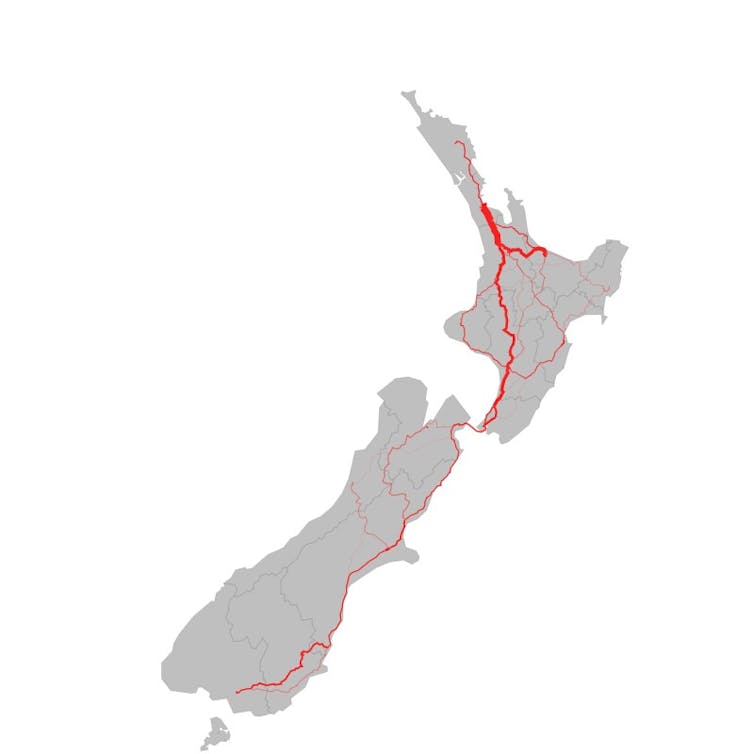
New Zealand's main road network
The road network enables trucks to carry freight fast to most parts of the country.
Transport Dashboard, CC BY-ND

But despite its advantages, trucking is associated with external costs, including higher carbon emissions than other modes of transportation.

This study represents the most comprehensive comparison of freight emissions for different carriers to date for Aotearoa New Zealand.

Before we evaluate decarbonisation pathways, we need to have a solid understanding of the freight system. To this end, we have created a transport dashboard to visualise the carbon footprint of freight movements within New Zealand.
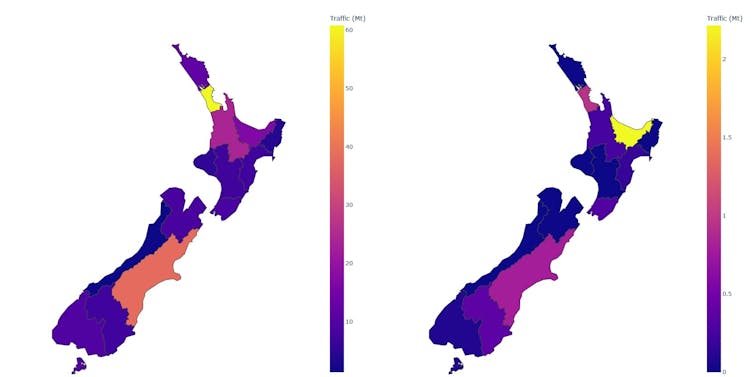
The maps show where trucks deliver most freight (left) and where rail transports most goods (in million tonnes).
These maps show where trucks (left) and rail (right) deliver most freight (in million tonnes).
Transport dashboard, CC BY-ND

With decarbonisation commitments firmly locked into legislation, we have hard deadlines to cut emissions. Failure to do so will represent a risk to New Zealand’s economy and likely require taxpayer money to buy expensive international carbon offsets.


Read more:
Why New Zealand should invest in smart rail before green hydrogen to decarbonise transport


We need to reconsider how we operate

A shift to less energy-intensive freight transport modes like coastal shipping and rail represents a possible pathway to reducing fossil-fuel dependency.

But despite the benefits of sea and rail transport, it remains unclear how to achieve the shift to new infrastructure and technologies. A key requirement is access to an efficient multi-modal network that integrates ports, inland terminals, distribution hubs, roads and railways.
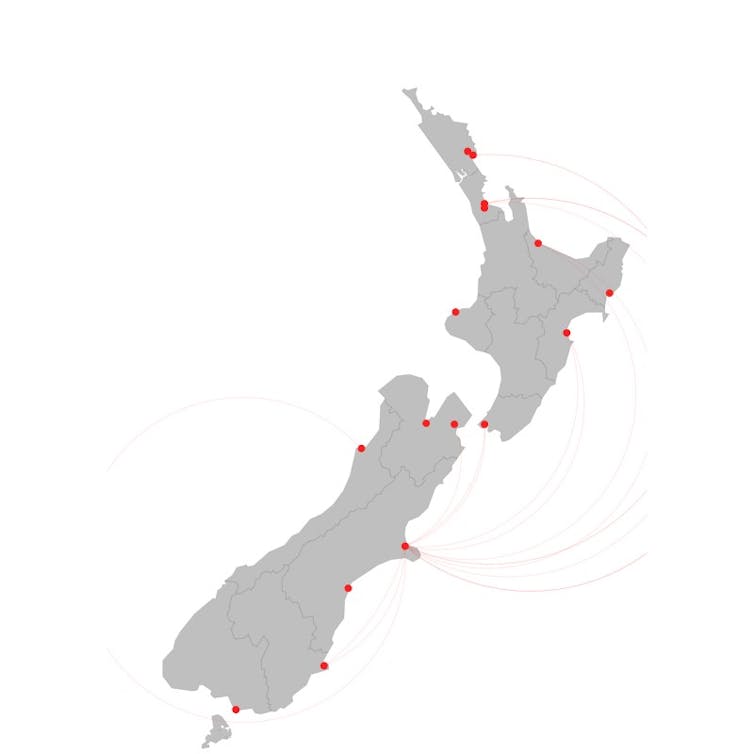
This map shows the sea routes out of Lyttelton harbour.
Lyttelton harbour is one of the starting points for freight shipping to other parts of New Zealand.
Transport Dashboard, CC BY-ND

We can achieve economies of scale by transporting larger volumes of goods, which would lead to cheaper costs per unit. As the European Commission noted:

The challenge is to ensure structural change to enable rail to compete effectively and take a significantly greater proportion of medium and long-distance freight.

Our research was focused on creating a detailed understanding of New Zealand’s current heavy-freight system. Emissions reporting extended beyond the direct combustion of fuels and accounted for vehicle-embedded emissions. We also consolidated data from multiple sources, which helped with calculating energy demand and direct and indirect emissions for every freight mode.

For example, we found the majority of a truck’s lifetime emissions (almost 80%) come from the fuel it consumes. This is why it’s important to prioritise operational aspects and switch to non-fossil propulsion technologies.


Read more:
Transport emissions have doubled in 40 years – expand railways to get them on track


Where to from here

It will take considerable investment to expand or upgrade transport networks and optimise freight corridors in terms of energy use and emissions. Beyond our research, we’ll need complementary work to investigate the technical and economic feasibility of non-fossil propulsion technologies.

We’ll have to take a holistic approach to map feasibility hurdles (technical challenges, material needs, system architecture and integration) that must be overcome.

The ultimate goal is to decrease fossil fuel demand and emissions while ensuring long-term economic and trading resilience.

Equally crucial is the participation and support from stakeholders. Freight transport is a complex system characterised by multiple interests (policy makers, shippers, freight forwarders, port and rail representatives) with sometimes conflicting views. Strategic planning also needs to acknowledge consumer preferences and their impacts on energy use.

The latest report by the Intergovernmental Panel on Climate Change (IPCC) elaborates on this:

Drawing on diverse knowledges and cultural values, meaningful participation and inclusive engagement processes—including Indigenous knowledge, local knowledge, and scientific knowledge—facilitates climate resilient development, builds capacity and allows locally appropriate and socially acceptable solutions.

Beyond the focus on emissions cuts, we need to engineer freight systems with a high capacity to adapt, so they can sustain trade and wellbeing while operating at much lower energy levels. The notion of adaptation also has to extend further than the current focus on physical protection against extreme weather events.


Read more:
IPCC report: the world must cut emissions and urgently adapt to the new climate realities


The tools and technologies to decarbonise freight transportation in New Zealand are available now. The problem lies in their integration and the understanding of the trade-offs at stake. Freight transport emissions can be reduced through cost-effective investments in multi-modal infrastructure and alternative propulsion technologies.

However, it is essential for future initiatives to operate within the biophysical limits of our planet, as emphasised in the IPCC’s report:

Technological innovation can have trade-offs such as new and greater environmental impacts, social inequalities, overdependence on foreign knowledge and providers, distributional impacts and rebound effects, requiring appropriate governance and policies to enhance potential and reduce trade-offs.

The Conversation

Patricio Gallardo works for EPECentre. In 2022, EPECentre carried out a project to estimate Greenhouse Gas Emissions from freight movements within New Zealand. The project was funded by Swire Shipping.

ref. A shift to coastal shipping and rail could cut NZ’s freight transport emissions — why aren’t we doing it? – https://theconversation.com/a-shift-to-coastal-shipping-and-rail-could-cut-nzs-freight-transport-emissions-why-arent-we-doing-it-204023

New lessons about old wars: keeping the complex Anzac Day story relevant

ANALYSIS: By Katie Pickles, University of Canterbury

What happened on the Gallipoli peninsula in Turkey 108 years ago has shocked and shaped Aotearoa New Zealand ever since. The challenge in the 21st century, then, is how best to give contemporary relevance to such an epochal event.

The essence of the Anzac story is well known. As part of the first world war British Imperial Forces, the Australian and New Zealand Army Corps (Anzacs) landed at Gallipoli on April 25 1915. For eight months they endured the constant threat of death or maiming in terrible living conditions.

Ultimately, their occupation of that narrow and rugged piece of Turkish coast failed. The 30,000 Anzacs were evacuated after eight months. More than 2700 New Zealand and 8700 Australian soldiers died, with many more wounded.

The first anniversary of the landing was a day of mourning, with Anzac Day becoming a public holiday in 1922. A remembrance day of sorrow mixed with pride, it has grown over the years to include all those who served and died in later international conflicts.

Over time, various narratives and themes have emerged from that Gallipoli “origin story”: of Aotearoa New Zealand’s emergence as a nation, proving itself to Britain and Empire; of the brave, fit, loyal soldier-mates who emblemised the Kiwi spirit of egalitarianism, fairness and duty. All this mingled with the lasting shock and underlying anger at class hierarchy and the British leadership’s incompetence.

But historians know well that the “Anzac spirit” is a complex and ever-evolving idea. In 2023, what do we teach school-aged children about its meaning and significance? One way forward is to rethink those Anzac narratives and tropes in a more complex way.

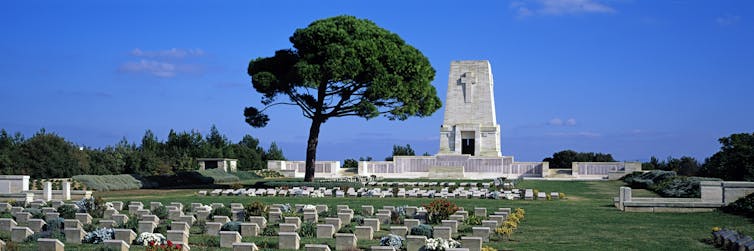
Lone Pine cemetery
The cemetery at Lone Pine commemorates more than 4900 Anzac servicemen who died in the area. Image: Getty Images/The Conversation

Colonialism and class
The Anzac story is tied up in the nation’s history as part of the British Empire. The Anzac toll was just part of a staggering 46,000 “Britons” — including many from India and Ireland — who died at Gallipoli.

Some 86,000 Turks also died defending their peninsula. We need to teach about the Anzac sacrifice in the context of a global conflict where the magnitude of loss was horrific.

Importantly, Anzac themes are bound up in early forms of colonial nationalism: New Zealand proving itself to Britain and developing its own fighting mentality on battlefields far from home.

Part of this involves the notion of incompetent British commanders who let down the Anzac troops — but this is part of a bigger story.

Focusing on imperial and class hierarchies of the time can place what happened in that broader context. The legendary story of Chunuck Bair, taken on August 8 by Colonel William Malone’s Wellington Regiment, but where most of the soldiers were killed when they were not relieved in time, is particularly evocative.

The New Zealand Wars memorial in New Plymouth
The New Zealand Wars memorial in New Plymouth . . . our other “great war”. Image: CC BY-SA/The Conversation

Māori and the imperial project
From our vantage point in the present, of course, we cannot ignore the Māori experience of war and colonialism. As the historian Vincent O’Malley has suggested, New Zealand’s “great war” of nation-making was actually Ngā pakanga o Aotearoa — the New Zealand Wars.

It’s time to teach the complexity of this past and the multiple perspectives on it. For example, Waikato leader Te Puea Hērangi led opposition to World War I conscription and spoke against Māori participation on the side of a power that had only recently invaded her people’s land.

Conversely, Māori seeking inclusion in the settler nation did participate. On July 3, 1915, the 1st Māori Contingent landed at Anzac Cove. Te Rangi Hiroa (Sir Peter Buck) (Ngāti Mutunga) was to say:

Our feet were set on a distant land where our blood was to be shed in the cause of the Empire to which we belonged.

These words echo the familiar Anzac trope of the New Zealand nation being born at Gallipoli. Such sentiments led to postwar pilgrimages to retrace the steps of ancestors and claim the site as part of an Anzac heritage — a corner of New Zealand even.

For many young New Zealanders it has become a rite of passage, part of the big OE. That a visit to Anzac Cove is still more popular than visiting the sites of Ngā pakanga o Aotearoa is something our teaching can investigate.

Mateship and conformity
The notion of the Anzac soldier as courageous and beyond reproach, willing to make the ultimate sacrifice for nation and empire, is also overdue for revision. The “glue” of mateship — a potent combination of masculine bravery and strength with extreme loyalty to fellow soldiers — is again a contested narrative.

By the 1970s, as historian Rowan Light’s work shows, there was a significant challenge to such perceptions from the counterculture, peace protesters and feminists. And by the 1980s, veterans were sharing their stories more candidly with writer Maurice Shadbolt and war historian Chris Pugsley.

Teaching about the meaning of mateship might examine the history of those peer-pressured into participating in war, those who were conscripted and had no choice, and more on the fate of conscientious objectors like Archibald Baxter. At its worst, the idea of mateship was window dressing for uniformity and parochialism.

New Zealanders today have complex multicultural and global roots. We have ancestors who were co-opted to fight on different sides in 20th-century wars, including those who fought anti-colonial wars in India, Ireland and Samoa.

Some came here as refugees escaping conflict. Jingoism and what it really represents deserves critical analysis.

Poppies and peace
The ubiquitous poppy, an icon much reproduced in classrooms, is also ripe for contextualisation and debate over its meaning. In the age of global environmental crisis, it can be seen as more than a symbol of sacrifice immortalised in verse and iconography.

The poppy also reminds us of the landscapes devastated by the machinery of war that killed and maimed people, plants and animals. It contains within it myriad lessons about the threats science and technology can pose to a vulnerable planet.

Anzac Day rose from the shock, loss and grief felt by those on the home front. And beyond the familiar tropes of nationalism, mateship and egalitarianism, this remains its overriding mood.

Remembering and learning about the terrible physical and mental cost of war is the real point of those familiar phrases “lest we forget” and “never again”. That spirit of humanitarianism chimes with Aotearoa New Zealand’s modern role and evolving self-image as a peacekeeping, nuclear-free nation.

Anzac Day also speaks to the need for global peace and arbitration, and how war is no viable solution to conflict. Those are surely lessons worth teaching.

Dr Katie Pickles is professor of history, University of Canterbury. This article is republished from The Conversation under a Creative Commons licence. Read the original article.

Print Friendly, PDF & Email

Article by AsiaPacificReport.nz

Decolonisation tensions rise in New Caledonia as Kanaks accuse France of opposing ‘wind of history’

By Walter Zweifel, RNZ Pacific reporter

New Caledonia’s largest pro-independence party has been told that France is “panicking” and afraid of losing New Caledonia.

The head of the Caledonian Union Daniel Goa briefed the party in Koumac after a week of meetings of a cross-section of New Caledonian politicians with the French government in Paris earlier this month.

Goa said Paris kept reneging on earlier undertakings by pressing ahead with efforts to undo the 1998 Noumea Accord on the territory’s decolonisation in order to maintain its international influence.

He said there was major incomprehension on part of the French government of what the bilateral talks in Paris were supposed to be about.

Goa said Paris wanted concrete decisions in circumstances favouring the French government.

However, Goa said the decolonisation process and New Caledonia’s accession to sovereignty would be discussed in New Caledonia.

He again warned France against opening up the restricted electoral roll used for provincial elections.

Bid to extend voting rights
Anti-independence parties have urged Paris to extend voting rights for the 2024 elections after the 2021 referendum saw a majority of voters reject full sovereignty.

The pro-independence side, however, largely abstained from the vote in 2021 because of the covid-19 pandemic and still refuses to recognise the result as the legitimate outcome of the decolonisation process.

Under the terms of the Noumea Accord voting in provincial elections is restricted to indigenous Kanaks and those who have been residents in the territory since 1998.

About 40,000 French citizens are excluded from provincial elections but can take part in France’s parliamentary and presidential elections.

Goa warned of what he called irreversible solutions if France imposed a change to the rolls, adding that there would be a risk of there never being any election.

He said the survival of the Kanaks hinged on this issue.

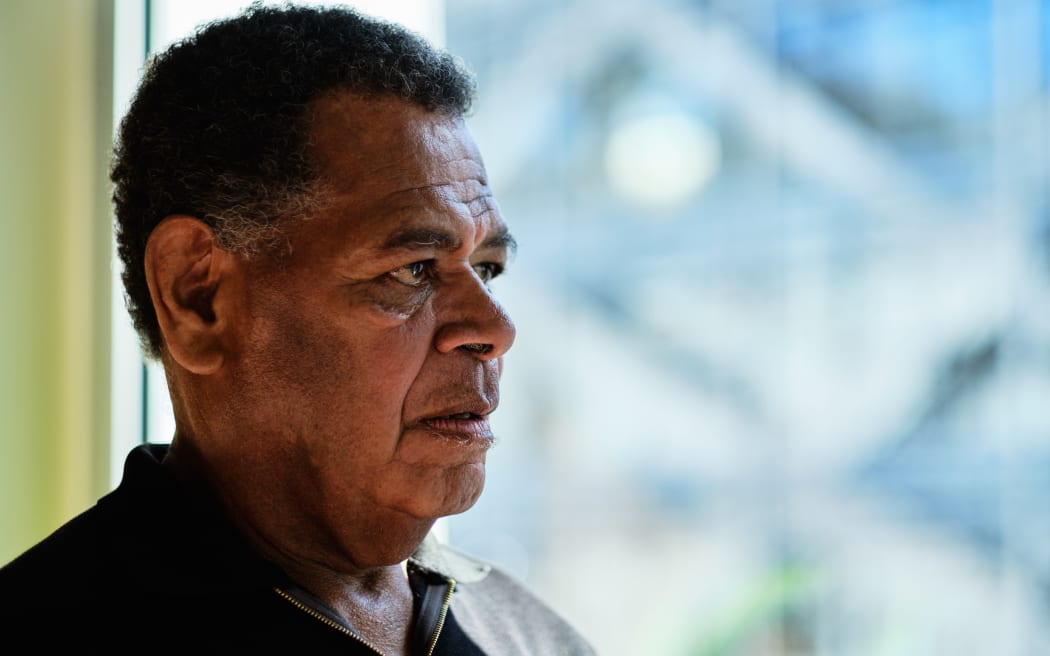
Head of the Caledonian Union, Daniel Goa
Caledonian Union’s Daniel Goa . . . France needs to choose between moving in the direction of history or ending up in the “rubbish bin of colonial history”. Image: RNZ Pacific/AFP

Goa said opening the roll to recent arrivals would create a new imbalance and extinguish the Kanaks’ vision of politics.

‘Colonial state’ opposed
He stressed that the Kanaks would no longer allow the colonial state to impose itself.

He said the French state was pushing the Kanaks to their last entrenchments, but they would be present in their own way to take responsibility to liberate their country.

Goa said the Kanaks’ sovereignty was no longer negotiable, adding that the land is not a land of France and will never be a land of France.

He said it was a shame to imagine the worst, but France was going against the “wind of history” as the United Nations kept calling for the eradication of colonialism.

Goa said France had to choose between moving in the direction of history or ending up in the “rubbish bin of colonial history”.

He put Paris on notice that a refusal to restore the territory’s sovereignty would drive the Kanak people to seek support elsewhere.

Goa said France did not and would not recognise the Kanaks’ rights, which would prompt the pro-independence camp to turn to new allies.

France ‘lonely in Pacific’
He said all major powers were around the Pacific rim but France, as only a small European country, was lonely in the Pacific.

Goa said the French army never defended New Caledonia when it was threatened, but only killed Kanaks, plundered their land, carried out punitive expeditions, brutally treated and displaced Kanak populations, and killed their elders.

He also castigated President Emmanuel Macron’s China policy, asking whether France could be trusted.

Goa said France still wanted to give the illusion of existing in a concert of nations but the President, out of clumsiness, had betrayed his European and American allies by pledging allegiance to China.

He said in the Pacific context, France would on one hand “sell” New Caledonia to China and on the other hand, France kept saying not to deal with China in whatever way, brandishing the “Chinese threat” as the worst thing that could happen.

Goa said with the French presidency and the country adrift, there was a risk for New Caledonia to be dragged into a void.

Sonia Backes
Southern Province president Sonia Backes . . . threats of action in case of changes to the rolls “unacceptable”. Image: RNZ Pacific

Backes slams Goa’s speech
Daniel Goa’s speech was criticised by a leading anti-independence politician, Sonia Backes, who regarded Goa’s comments about the electoral rolls as a call to violence.

Backes, president of the Southern Province and a junior member of the French government, told La Première television that Goa’s threats of action in case of changes to the rolls were unacceptable.

She also took issue with Goa’s warning that the Kanaks would ally themselves with other powers, should their ambition to attain independence be thwarted by France.

Backes said the anti-independence coalition had referred the speech to the public prosecutor for alleged calls for violence and sedition.

She wondered if Goa considered that those opposed to independence had no place on this world and could not be asked to discuss the future.

Backes said the other side needed to explain itself.

Institutions not functioning
She said her side had an interest in finding a consensus because New Caledonia’s institutions no longer functioned.

She added that it was no longer possible to have 45,000 people excluded from the rolls and do nothing for them while waiting for a possible consensus on how to open the rolls.

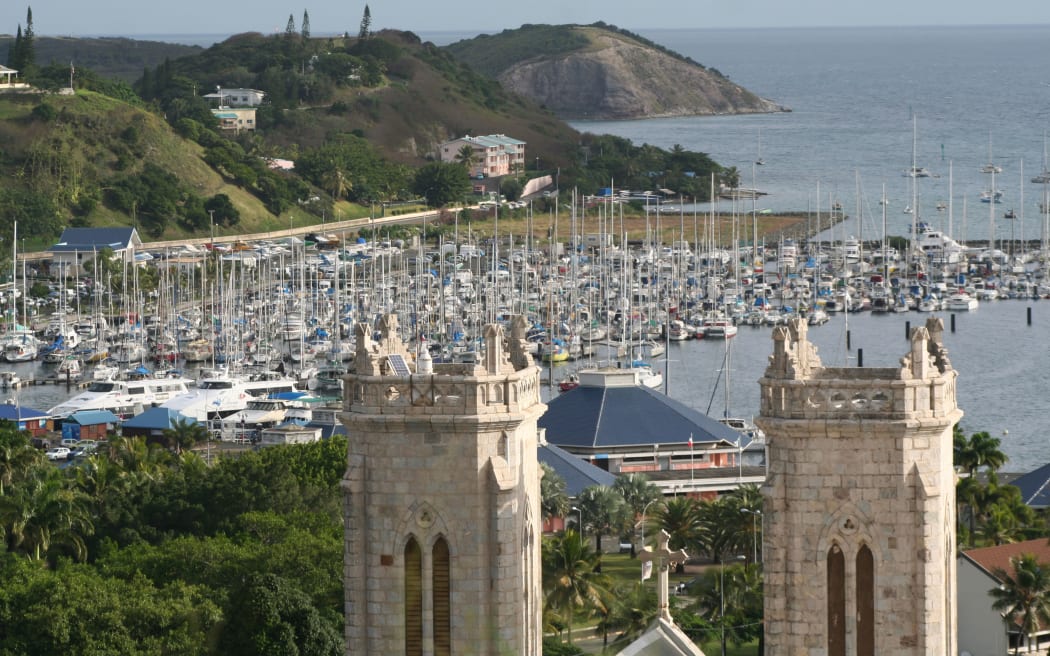
Noumea
Noumea’s marina . . . the anti-independence parties want Paris to realign the territory with France. Image: Johnny Blades/RNZ Pacific

After the rejection of full sovereignty in three referendums and the expiry of the Noumea Accord, a new statute for New Caledonia has to be created.

While the pro-independence parties want Paris to give a timetable to full independence, the anti-independence parties want Paris to realign the territory with France.

After this month’s talks in Paris, discussions will be continued in Noumea in June when  French Interior Minister Gerald Darmanin plans his next visit.

His ministry said in May he would go to the United Nations in New York to discuss the situation in New Caledonia.

The territory has been on the UN decolonisation list since 1986, based on the Kanak people’s internationally recognised right to self-determination.

This article is republished under a community partnership agreement with RNZ.

Print Friendly, PDF & Email

Article by AsiaPacificReport.nz

AI to Z: all the terms you need to know to keep up in the AI hype age

Source: The Conversation (Au and NZ) – By Samar Fatima, Research Fellow Enterprise AI and Data Analytics Hub, RMIT University

Deepmind/Unsplash/Artist: Champ Panupong Techawongthawon, CC BY-NC-SA

Artificial intelligence (AI) is becoming ever more prevalent in our lives. It’s no longer confined to certain industries or research institutions; AI is now for everyone.

It’s hard to dodge the deluge of AI content being produced, and harder yet to make sense of the many terms being thrown around. But we can’t have conversations about AI without understanding the concepts behind it.

We’ve compiled a glossary of terms we think everyone should know, if they want to keep up.

Algorithm

An algorithm is a set of instructions given to a computer to solve a problem or to perform calculations that transform data into useful information.

Alignment problem

The alignment problem refers to the discrepancy between our intended objectives for an AI system and the output it produces. A misaligned system can be advanced in performance, yet behave in a way that’s against human values. We saw an example of this in 2015 when an image-recognition algorithm used by Google Photos was found auto-tagging pictures of black people as “gorillas”.

Artificial General Intelligence (AGI)

Artificial general intelligence refers to a hypothetical point in the future where AI is expected to match (or surpass) the cognitive capabilities of humans. Most AI experts agree this will happen, but disagree on specific details such as when it will happen, and whether or not it will result in AI systems that are fully autonomous.


Read more:
Will AI ever reach human-level intelligence? We asked five experts


Artificial Neural Network (ANN)

Artificial neural networks are computer algorithms used within a branch of AI called deep learning. They’re made up of layers of interconnected nodes in a way that mimics the neural circuitry of the human brain.

Big data

Big data refers to datasets that are much more massive and complex than traditional data. These datasets, which greatly exceed the storage capacity of household computers, have helped current AI models perform with high levels of accuracy.

Big data can be characterised by four Vs: “volume” refers to the overall amount of data, “velocity” refers to how quickly the data grow, “veracity” refers to how complex the data are, and “variety” refers to the different formats the data come in.

Chinese Room

The Chinese Room thought experiment was first proposed by American philosopher John Searle in 1980. It argues a computer program, no matter how seemingly intelligent in its design, will never be conscious and will remain unable to truly understand its behaviour as a human does.

This concept often comes up in conversations about AI tools such as ChatGPT, which seem to exhibit the traits of a self-aware entity – but are actually just presenting outputs based on predictions made by the underlying model.

Deep learning

Deep learning is a category within the machine-learning branch of AI. Deep-learning systems use advanced neural networks and can process large amounts of complex data to achieve higher accuracy.

These systems perform well on relatively complex tasks and can even exhibit human-like intelligent behaviour.

Diffusion model

A diffusion model is an AI model that learns by adding random “noise” to a set of training data before removing it, and then assessing the differences. The objective is to learn about the underlying patterns or relationships in data that are not immediately obvious.

These models are designed to self-correct as they encounter new data and are therefore particularly useful in situations where there is uncertainty, or if the problem is very complex.

Explainable AI

Explainable AI is an emerging, interdisciplinary field concerned with creating methods that will increase users’ trust in the processes of AI systems.

Due to the inherent complexity of certain AI models, their internal workings are often opaque, and we can’t say with certainty why they produce the outputs they do. Explainable AI aims to make these “black box” systems more transparent.

Generative AI

These are AI systems that generate new content – including text, image, audio and video content – in response to prompts. Popular examples include ChatGPT, DALL-E 2 and Midjourney.

Labelling

Data labelling is the process through which data points are categorised to help an AI model make sense of the data. This involves identifying data structures (such as image, text, audio or video) and adding labels (such as tags and classes) to the data.

Humans do the labelling before machine learning begins. The labelled data are split into distinct datasets for training, validation and testing.

The training set is fed to the system for learning. The validation set is used to verify whether the model is performing as expected and when parameter tuning and training can stop. The testing set is used to evaluate the finished model’s performance.

Large Language Model (LLM)

Large language models (LLM) are trained on massive quantities of unlabelled text. They analyse data, learn the patterns between words and can produce human-like responses. Some examples of AI systems that use large language models are OpenAI’s GPT series and Google’s BERT and LaMDA series.

Machine learning

Machine learning is a branch of AI that involves training AI systems to be able to analyse data, learn patterns and make predictions without specific human instruction.

Natural language processing (NLP)

While large language models are a specific type of AI model used for language-related tasks, natural language processing is the broader AI field that focuses on machines’ ability to learn, understand and produce human language.

Parameters

Parameters are the settings used to tune machine-learning models. You can think of them as the programmed weights and biases a model uses when making a prediction or performing a task.

Since parameters determine how the model will process and analyse data, they also determine how it will perform. An example of a parameter is the number of neurons in a given layer of the neural network. Increasing the number of neurons will allow the neural network to tackle more complex tasks – but the trade-off will be higher computation time and costs.

Responsible AI

The responsible AI movement advocates for developing and deploying AI systems in a human-centred way.

One aspect of this is to embed AI systems with rules that will have them adhere to ethical principles. This would (ideally) prevent them from producing outputs that are biased, discriminatory or could otherwise lead to harmful outcomes.

Sentiment analysis

Sentiment analysis is a technique in natural language processing used to identify and interpret the emotions behind a text. It captures implicit information such as, for example, the author’s tone and the extent of positive or negative expression.

Supervised learning

Supervised learning is a machine-learning approach in which labelled data are used to train an algorithm to make predictions. The algorithm learns to match the labelled input data to the correct output. After learning from a large number of examples, it can continue to make predictions when presented with new data.

Training data

Training data are the (usually labelled) data used to teach AI systems how to make predictions. The accuracy and representativeness of training data have a major impact on a model’s effectiveness.

Transformer

A transformer is a type of deep-learning model used primarily in natural language processing tasks.

The transformer is designed to process sequential data, such as natural language text, and figure out how the different parts relate to one another. This can be compared to how a person reading a sentence pays attention to the order of the words to understand the meaning of the sentence as a whole.

One example is the generative pre-trained transformer (GPT), which the ChatGPT chatbot runs on. The GPT model uses a transformer to learn from a large corpus of unlabelled text.

Turing Test

The Turing test is a machine intelligence concept first introduced by computer scientist Alan Turing in 1950.

It’s framed as a way to determine whether a computer can exhibit human intelligence. In the test, computer and human outputs are compared by a human evaluator. If the outputs are deemed indistinguishable, the computer has passed the test.

Google’s LaMDA and OpenAI’s ChatGPT have been reported to have passed the Turing test – although critics say the results reveal the limitations of using the test to compare computer and human intelligence.

Unsupervised learning

Unsupervised learning is a machine-learning approach in which algorithms are trained on unlabelled data. Without human intervention, the system explores patterns in the data, with the goal of discovering unidentified patterns that could be used for further analysis.

The Conversation

Kok-Leong Ong receives funding from NHMRC, MRFF and CSIRO.

Samar Fatima does not work for, consult, own shares in or receive funding from any company or organization that would benefit from this article, and has disclosed no relevant affiliations beyond their academic appointment.

ref. AI to Z: all the terms you need to know to keep up in the AI hype age – https://theconversation.com/ai-to-z-all-the-terms-you-need-to-know-to-keep-up-in-the-ai-hype-age-203917

Auxiliary power: in wartime, Australian women fought germs, fired shells – and took on gender norms

Source: The Conversation (Au and NZ) – By Jason Smeaton, PhD Candidate, Australian Catholic University

Members of the Australian Army Medical Women’s Service at work in the sterilising room of a military hospital, 1943. State Library of Victoria

Sheila Sibley enlisted in the Australian Army in 1942 with a vision of becoming a wartime nurse – “an angel of mercy, the wounded man’s guide … the Rose of No-Man’s Land”, in her own words.

Many women wanted to “do their bit” during the second world war, and nursing had previously been the only avenue for women to join the military. They had historically been excluded from traditionally masculine roles within the armed forces.

Sibley, however, never became a nurse. Ideas of becoming “this war’s Florence Nightingale” were let go, and nursing was left to those who had trained for it.

Private Sheila Sibley instead served in a hospital kitchen and then laundry.

The establishment of women’s auxiliaries to Australia’s military in the early 1940s created new opportunities for women. This included expanded roles in military hospitals, but also jobs that reached far beyond the hospital ward. Women were called to serve as signallers and telegraph operators, mechanics, and even coastal artillery and anti-aircraft gunners.

These jobs were a clear break from the expected role of women at the time.

However, my research shows servicewomen like Sibley had to fight on another front: to have their contributions to the war acknowledged, in a time when much of their efforts were considered “women’s work”.

The battle for hygiene

In January 1941, 200 Australian servicewomen marched-in as orderlies to support Army nurses working in the Middle East. At first, they were given laborious jobs such as reclaiming bandages for reuse, “regardless of how revolting they were”, according to Sibley’s colleague Alice Penman.

Soon the nursing sisters trained the female orderlies in tasks such as dressing patient wounds.

Stories from servicewomen in the Middle East were returned to Australia and they encouraged other women to join them. “Work hard,” said servicewoman Rita Hind, “because I am sure it is going to be a marvellous experience.”

Military officials also heard the stories of these women and noticed they had become a skilled and useful resource for the hospital.

In December 1942, these servicewomen were given their own branch of the Army, known as the Australian Army Medical Women’s Service. With the creation of the new auxiliary, servicewomen’s roles in military hospitals expanded to include those alongside nurses in patient wards and operating theatres, to those “behind the scenes” of hospitals such as in pathology laboratories, kitchens, laundries, and postal and telegraph offices.

Assigned duties that were considered then as “menial”, “domestic” or the “work of a housewife”, servicewomen working in the fundamental areas of hospital efficiency struggled to be seen.

Today, the COVID pandemic has illustrated the important work of all those who contribute to the health system. But there are few stories told about the historical work of women who toiled behind the scenes to ensure military hospitals ran efficiently and effectively during the second world war.

Private Sheila Sibley, at the 115th Australian General Hospital in Heidelberg in Melbourne’s northeast, c.1943.
State Library of Victoria

Posted to duty in the laundry of the 115 Australian General Hospital (AGH) at Heidelberg, Victoria, Sibley came to appreciate that the laundry was fundamental to the maintenance of hygiene in hospitals. “Everyone who works in a laundry at an AGH,” Sibley suggests, “is fighting for the lives of the wounded as steadfastly as that clever surgeon.”

The correlation between hygiene and the health and recovery of patients was still in its infancy in the 1940s. Laundry work was also still considered to be “women’s work”.

Sibley stood up against the gendered portrayals of her wartime work. A hospital laundry bears no resemblance to its domestic counterpart with its industrial machinery to wash, dry, iron and fold linen and clothes. To Sibley, the laundry was the battlefront and the machines her weapons. She wrote:

What may look like a washing machine in our big military hospitals is really artillery firing its rounds of good clean washing against the enemies, disease and death.

Fighting stereotypes

The strategy of other servicewomen to break from gendered boundaries was less overt.

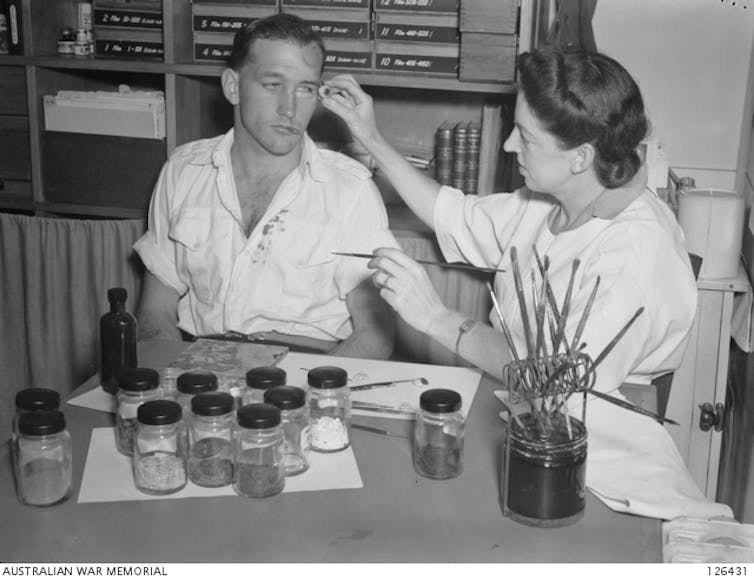
Sergeant Thelma Powell quietly worked in her role at the No. 1 Facio-Maxillary and Plastic Unit where she became an artist painting artificial eyes for injured soldiers.

Private EM Boyle sitting for Sergeant Thelma Powell, 1946.
Australian War Memorial

Before the war, Powell had an interest in fine art through her hobby of smoke-etching china. It was through her fine attention to detail and her meticulous care in the highly technical work of painting artificial eyes that Powell pushed back on expectations of women at the time.

Powell showed that the skills from a “hobby for women” could be applied to an important occupation directly affecting the rehabilitation and lives of injured men.

Given the ingrained gendered expectations within society at the time, the attempts of those like Powell and Sibley to highlight servicewomen’s work and afford their labour proper recognition were overshadowed.

Patients noticed their care, and medical professionals relied on their service, but their stories have not been told.


Read more:
Ladies to the front: the hidden history of women in Australian airforce bands


The Conversation

Jason Smeaton does not work for, consult, own shares in or receive funding from any company or organisation that would benefit from this article, and has disclosed no relevant affiliations beyond their academic appointment.

ref. Auxiliary power: in wartime, Australian women fought germs, fired shells – and took on gender norms – https://theconversation.com/auxiliary-power-in-wartime-australian-women-fought-germs-fired-shells-and-took-on-gender-norms-203841

Treatment for drug and alcohol misuse should involve families and communities

Source: The Conversation (Au and NZ) – By Katinka van de Ven, Alcohol and other drug specialist, University of New South Wales &, University of New England

Shutterstock

Alcohol and other drug treatment in Australia is generally only provided for individuals, often away from their families.

Treatment can include withdrawal from the substance, counselling and residential rehabilitation. All these treatments work to improve health and wellbeing and reduce the harms from substances.

But people’s families and communities can influence substance use and have the potential to aid the healing journey of people in treatment.


Read more:
Why do some people struggle to make ‘healthy’ decisions, day after day?


For a lot of First Nations peoples, health and wellbeing is not just about the individual. It’s interconnected with family, culture, belonging and Country.

That’s why treatment services such as Pinangba in Queensland – a First Nations alcohol and other drug service whose approach we have been researching – includes families, culture and Country in treatment.

This way of pursuing treatment should be available for everyone.

The role of families in treatment

Families and community can play an essential role in giving up alcohol and other drugs and avoiding relapse. Research shows advice or encouragement from family members is an important reason for giving up or reducing problematic substance use.

However, some people who attend treatment facilities alone often have limited support back home in their communities to maintain sobriety or reduced consumption.

Family and communities do not always have the right tools to support the individual in treatment, and some family members may experience problematic substance use themselves.

Couple hugging
Family members may not have the tools to support a loved one after treatment.
Shutterstock

What happens at Pinangba?

Pinangba is an Indigenous-led residential rehabilitation service in Queensland. It’s one of a small number of alcohol and other drug treatment services in Australia that take in the entire family unit of adults and children for the residential stay.

Pinangba adopts a systemic family therapy model. The therapist is invited to consider not only the context of the individual within their family but also consider the context of the family in relation to the broader social, political and historical systems.

There is an emphasis on building, strengthening and repairing relationships as part of the healing work of the client.

Pinangba also considers the environments most influential in a client’s life (social services, work, court) that may impact their healing journey.

Its family-based approach helps clients to engage and stay in treatment, stay abstinent and improve relationships. This approach also positively impacts the alcohol and other drug use of other family members and improves the functioning of their children.

Pinangba family therapy approach to addiction has been positively received by clients, families, community, and other health and social service providers.


Read more:
Alcohol problems aren’t for life, and AA isn’t the only option. 8 things film and TV get wrong about drug and alcohol treatment


Non-Indigenous people also benefit from this model. Family-focused interventions for non-Indigenous people with substance use issues have been effective for both young people and adults. Not only do these interventions reduce substance use, they also improve family functioning compared to individual-based treatment.

Despite these positive outcomes, family-focused interventions within alcohol and other drug services is still uncommon.

Barriers to implementation are not only related to the individualised treatment focus, but also to issues such as difficulties of involving family in treatment, limited staff time, lack of experience and insufficient training.

Corridor
A number of barriers need to be overcome to roll it out more widely.
Shutterstock

Expanding access 3 ways

For this family-focused model of care to be incorporated into both Indigenous and non-Indigenous alcohol and other drug services we need better data collection and better funding. Here are three important steps towards this implementation:

1. Careful evaluation of programs with family engagement, family therapy and holistic treatment.

There is currently little knowledge about the effectiveness of this model for First Nations people. That is exactly what we are doing with Pinangba: with funding from the Queensland Mental Health Commission we are building an evaluation integrated into routine service delivery, to demonstrate how such holistic, family-oriented treatment works.

It is vital that data are collected as part of routine practices so an evidence-base can be built up.

2. Routine data collection practices that does not rely on external funding.

Organisations that fund alcohol and other drug treatment for First Nations peoples (including the Commonwealth, Primary Health Networks and state governments) should ensure funding levels adequate so services can spend time collecting and entering data on client progress and outcomes.

This is currently not the case. Collecting evaluation data is seen as an added extra, not as an essential part of ongoing service delivery. This needs to change.


Read more:
What is ‘success’ in drug rehab? Programs need more than just anecdotes to prove they work


3. Funding that looks beyond individual models of care.

Newer ways of working, where families become the “treatment unit” will involve new costs, new buildings, new ways of working, new data collection, and will require more funding and planning.

If we were really thinking about families, we need to think about treatment with a family, not an individual. This shift in thinking needs to occur across all levels of the system.

The Conversation

Katinka van de Ven receives funding from state and territory governments including the Queensland Mental Health Commission.

Alison Ritter receives funding from the NHMRC, the ARC, and state/territory governments.

Erin Cunningham receives funding from Queensland Mental Health Commission for the Pinangba Research Project.

ref. Treatment for drug and alcohol misuse should involve families and communities – https://theconversation.com/treatment-for-drug-and-alcohol-misuse-should-involve-families-and-communities-197536

Climate isn’t a distraction from the military’s job of war fighting. It’s front and centre

Source: The Conversation (Au and NZ) – By Matt McDonald, Associate Professor of International Relations, The University of Queensland

It was pitched as the “most significant” shift in Australia’s armed forces in decades. And among the headline announcements, climate change was recognised as an issue of national security.

But the strategic review of Australia’s military released yesterday doesn’t go a lot further than that when it comes to the climate crisis. The review devotes just over one of its 100 pages to what climate change means for defence.

And while overseas analysts and militaries seriously address the strategic effects of climate change and the role for defence, the Australian review focused more on climate change as a potential distraction from the military’s core business of war fighting. As our armed forces are increasingly called to respond to natural disasters, the review reports, they are less ready to fight a war.

This focus is too narrow. It’s also a long way from what the research is telling us, and a long way from what our allies are doing.

What’s the link between climate change and national security?

At a fundamental level, security doesn’t mean much if it doesn’t extend to conditions of survival. The climate emergency has been described as a direct threat to both human and ecological security.

But climate change also hangs over the traditional security agenda, which is to defend against any attacks. Forward-thinking militaries around the world have begun to prepare for these effects.

Climate change could make armed conflict more likely by acting as a “threat multiplier”.

Climate-driven droughts, desertification, changing rainfall patterns and the loss of arable land could lead to the collapse of governments or a fleeing population.

Former UN Secretary-General Ban Ki Moon and some analysts have pointed to the role of climate change in contributing to armed conflict in Sudan’s Darfur region and Syria’s civil war.

Unchecked climate change is likely to trigger more demand for armed forces to respond to natural disasters, predicted to increase in intensity and frequency on a hotter planet.


Read more:
Climate change poses a ‘direct threat’ to Australia’s national security. It must be a political priority


Yesterday’s strategic review focuses on this demand, and for good reason – it’s already happening.

Increasingly, the army and air force are being called on to respond to Australia’s tide of “unprecedented disasters” like the floods of the last three years, and the summer of fire in 2019–20. Navy ships evacuated hundreds from the beach at Mallacoota in Victoria, under eerie light.

And then there’s the world. The demand for army-backed humanitarian help is rising. Our neighbours are among the most vulnerable in the world to the effects of natural disasters.

Beyond responses to refugees, conflict and natural disasters, there’s the question of how militaries are equipped, trained and resourced.

Higher temperatures, rising seas and natural disasters could threaten defence infrastructure and bases. Australia’s defence department is the largest landholder in the country, much of it in exposed coastal areas.

Our military has a substantial “carbon bootprint”, given it relies heavily on machines which burn fossil fuels, from destroyers to tanks. Ensuring these have enough fuel in the future is a concern, especially if the substantial military contribution to greenhouse gas emissions comes under more scrutiny.

In this sense it was good to see the review note the importance of the military accelerating a transition to clean energy. But the urgency of the climate crisis suggests our military should also be factoring climate change into procurement considerations and equipment management now. To date, there’s little evidence Australia has done so.

What are other countries doing?

Key partners like America, the UK and many other countries are well ahead of us. In my ongoing research, I’ve analysed climate responses and interviewed policymakers from other nations. This suggests we’re lagging well behind.

The US military began analysing what climate change would mean for it back in the 1990s. Biden’s government has given climate change greater priority in its National Security Council and firmly linked climate and security in what one interviewee told me was a “game changer”.

The UK has an expert body within its defence ministry examining the security implications of climate change. In 2021, it produced a strategic document with emissions cut goals for its armed forces, as well as investment to make the transition possible.

New Zealand has gone beyond reactive responses and embraced an active role for its military in responding to natural disasters at home and in the region. One interviewee told me this was central to the military’s “social licence”.

New Zealand’s position has been strongly influenced by the concerns of its Pacific neighbours. Wellington decision makers also decided defence will not be exempt from government-mandated goals to get to net zero.

France has taken a similar position on humanitarian assistance and disaster relief focused on its overseas territories and the wider Francophone world. These operations are presented not as a distraction but as a core commitment.

Sweden and Germany used their time on the UN Security Council in recent years to push for a resolution on the organisation’s role in addressing the international security implications of climate change. And when Sweden joins NATO, it’s likely to push for more military preparation for climate change given recent NATO commitments on this front.

Can Australia catch up?

Yes. But the first step is to recognise where we are – and where the world is heading.

Australia’s defence sector must seriously engage with what climate change will bring, not least given our region’s acute vulnerabilities and the existential concerns of our Pacific neighbours.

Unfortunately, yesterday’s review suggests our defence establishment does not wholly share these concerns.


Read more:
Australia’s finally acknowledged climate change is a national security threat. Here are 5 mistakes to avoid


The Conversation

Matt McDonald has received funding from the Australian Research Council and the UK Economic and Social Research Council. Research for this article was funded by an Australian Research Council grant: DP190100709.

ref. Climate isn’t a distraction from the military’s job of war fighting. It’s front and centre – https://theconversation.com/climate-isnt-a-distraction-from-the-militarys-job-of-war-fighting-its-front-and-centre-204362

3 sales tactics rife in the real estate industry, and why they work

Source: The Conversation (Au and NZ) – By Peyman Khezr, Senior Lecturer in Economics and Director of Behavioural Business Lab, RMIT University

Shutterstock

Buying a home is likely to be the biggest financial transaction you will ever make, and you’re at a distinct disadvantage. You’re an amateur up against professionals – real estate agents – versed in psychological tricks to get you excited about owning a property and paying more than you planned.

These tricks start with comparatively simple things such as making rooms look bigger in adverts by using a wide-angle photography. They extend all the way to the point of sale.

None of these tactics necessarily involve outright lying – there are laws against false and misleading conduct. But they are manipulative, exploiting the fact that humans are emotional beings with many “cognitive biases” – a perception of reality that is more emotional ratther than rational.

The three most common tactics come down to manipulating your confidence in your own decisions. Close to 80 studies suggest overconfidence is one of the most significant cognitive biases influencing behaviour in the real estate market.

1. Underquote, entice the bargain hunters

You see a property in your price range that’s everything you want. You call the agent, inspect the property, then prepare for the auction. It sells for $200,000 more.

Underquoting involves deliberately advertising a property significantly lower than its likely sales price. While the prevalence of the practice is disputed, with industry representatives saying most agents do the right thing, anecdotal evidence points to underquoting being very common.

Underquoting is effective because it attracts more interested buyers and increases the number and intensity of bidding. It exploits two of the most ubiquitous cognitive biases – herd behaviour and irrational exuberance.

More interest doesn’t just increase competition. A real estate agent will communicate that interest to us, confirming our desire in the property is justified.

This tendency to “follow the herd” and imitate others, as US economist Robert Shiller noted in an influential 1995 paper, is built on the assumption others have information that justifies their actions.

This helps explain pretty much every stockmarket bubble since tulipmania in the 17th century, including the Global Financial Crisis of 2007-8 and speculation on cryptocurrency. We are emotionally swayed by the decisions of others, assuming their decisions are rational, even when they are not. This is fertile ground for our own decisions to be manipulated.


Read more:
From tulips and scrips to bitcoin and meme stocks – how the act of speculating became a financial mania


2. Hide reality, inflate expectations

Real estate agents will generally favour auctions to extract the maximum sales price, for the reasons outlined above and the prospect of auction fever – when carefully decided limits are forgotten in the thrill of the moment.

But that’s not always the case. In a soft market with few buyers, agents may instead opt for a private sale, sometimes called a “silent auction”. The goal here is to cause you to overestimate the degree of competition and thus make a bigger offer.

An agent might assist this perception by instead supplying you with information from previous public auctions of similar properties more favourable to their preferred narrative.

The value of hiding information also explains why you may come across so many sold listings with labels such as “price not disclosed” or “price withheld.” The reason for this may well be that the property sold for less than hoped.

Hiding information the agent doesn’t want you to think about depends principally on exploiting our cognitive bias towards overconfidence – assuming we are smarter, more knowledgeable or better skilled than we actually are.

In lieu of that negative information, you are more likely to focus on the available information – particularly if it suits what you want to believe.


Read more:
When your house has a (disturbing) history, what should buyers be told about its ‘past’?


3. Talk up nominal gains

You may have heard the old saying that property values double every 10 years. Stressing what a property is likely to be worth in a decade based on what it was worth a decade ago can be a powerful motivator to bid more.

As Robert Shiller noted in his 2013 book The Subprime Solution (about the property-buying mania that led to the Global Financial Crisis), homes are such significant investments that we tend to recall their prices from the distant past (unlike, say, like a loaf of bread or bottle of milk).

This tendency results in an unconscious focus on nominal values rather than real (inflation-adjusted) values. This cognitive bias is known as the money illusion, a mental miscalculation that may increase your willingness to pay more for the property.

In conclusion…

There’s a case for laws to increase transparency and the accuracy of information available in the real estate market.

But in the meantime, if you’re buying a home, it’s wise to acknowledge your limitations. Do your homework, seek out independent advice and even consider hiring a professional advocate with the knowledge and experience to balance emotional and rational thoughts.

The Conversation

Peyman Khezr does not work for, consult, own shares in or receive funding from any company or organization that would benefit from this article, and has disclosed no relevant affiliations beyond their academic appointment.

ref. 3 sales tactics rife in the real estate industry, and why they work – https://theconversation.com/3-sales-tactics-rife-in-the-real-estate-industry-and-why-they-work-202960

It might be tempting to blame inflation on profits, but the reality is still about high demand and short supply

Source: The Conversation (Au and NZ) – By Michael P. Cameron, Professor of Economics, University of Waikato

Getty Images

Despite the latest inflation figures for New Zealand coming in slightly lower than expected by many economists, the rate remains stubbornly high. At 6.7% for the year to March 2023, the inflation rate is more than double the Reserve Bank’s target range of 1-3%.

But not everyone seems to be feeling the pain of increasing prices.

Major banks, retailers, and other corporates are reporting, or expected to report, record profits this year. It is tempting to ask, as others have overseas and in New Zealand, to what extent corporates’ mega profits and pricing are driving inflation.

The answer may surprise you. The reality is that corporate profit-making contributes very little to the inflation rate.

Market power and inflation

When a seller has the ability to choose the price, economists say that the firm has market power. But their ability to raise prices is not unlimited. Just consider the case of Arivale, a health-tech startup in the United States that ultimately failed because it set the initial price of its offering too high.

The extent of market power determines how high a business can set its price above its costs (its markup) in order to maximise its profitability. The optimal markup for a business depends on how sensitive its customers are to price changes.


Read more:
Four reasons inflation will stay stubbornly high for some time


In markets where customers are very sensitive to price changes, businesses will set lower prices (a lower markup) than in markets where customers are less sensitive to price changes. The optimal markup (as a percentage of the price) won’t change unless there is a change in customers’ price sensitivity.

Higher inflation is unlikely to cause consumers to suddenly become less sensitive to price changes. If anything, they will become more price sensitive and optimal markups should fall. That is why a strong majority (79%) of economists recently polled by the University of Chicago disagreed or strongly disagreed that market power was a significant factor in higher US inflation.

If not profit, then what?

So, if businesses aren’t profiting by increasing their markups, what explains the increased profits in a period of high inflation?

There are two other reasons why prices may rise, one of which may contribute to higher profits.

First, businesses may face an increase in demand for the goods or services they provide. With historically low interest rates (until recently), coupled with the wage and other subsidies as we emerged from the pandemic, a lot of money was chasing the same number of goods and services. That sort of increased demand pushes up prices and makes businesses more profitable.


Read more:
Modern monetary theory: the rise of economists who say huge government debt is not a problem


Second, businesses face higher costs because of inflation, including wage inflation. When costs are higher, businesses pass on some of those higher costs onto their customers in the form of higher prices. For most businesses, higher prices arising from higher costs will not lead to higher profits.

Taking those two factors together (higher demand leading to increasing prices and profits; and higher costs leading to increasing prices), it is likely that increased profits are not a cause of inflation, but are themselves a consequence of the other underlying causes of higher inflation.

Recent work by economists at the Treasury showed that the surge in New Zealand inflation was one-third driven by demand-side factors, one-third by supply-side factors, and the remaining one-third was ambiguous (it could be demand-side or supply-side). All of the recent increases in food prices was able to be attributed to demand-side or supply-side factors. That again suggests that there has been little scope for businesses’ profit-seeking to contribute to inflation.

Periods of high inflation are unwelcome. We may be tempted to blame corporate profits as they represent an easily identifiable target. However, it is unlikely that profits are contributing much, if anything, to the inflation we are currently facing.

The Conversation

Michael P. Cameron does not work for, consult, own shares in or receive funding from any company or organization that would benefit from this article, and has disclosed no relevant affiliations beyond their academic appointment.

ref. It might be tempting to blame inflation on profits, but the reality is still about high demand and short supply – https://theconversation.com/it-might-be-tempting-to-blame-inflation-on-profits-but-the-reality-is-still-about-high-demand-and-short-supply-204181

Much wow, very meme: what the revival of the ancient doge meme tells us about the lifecycle of the internet

Source: The Conversation (Au and NZ) – By Laura Glitsos, Lecturer in Arts and Humanities, Edith Cowan University

Shutterstock

In early April, when Elon Musk randomly and very briefly replaced the Twitter bird logo with the face of the “doge” meme, the value of the dogecoin both rose and fell by a matter of billions of dollars in value on the cryptomarket.

Internet users revelled in the idea that a simple doge meme could impact the real world in such a dramatic way. This relative absurdity is also coupled with the fact that dogecoin itself was started in 2013 as a “joke coin”, but is now the seventh biggest cryptocurrency in the world.

The fact that a meme, based on a “peculiar” but largely unremarkable rescue dog, could rule over the fate of billions of dollars worth of market value speaks to the totally remarkable nature of the strange phenomenon of Internet memes.

At one time in our internet’s history, memes were perhaps regarded as mere playful and inconsequential byproducts of online culture. However, now, it is clear that memes have very real impacts on our world. Things that leave impacts also leave history.

So not only do memes play a clear role in public discourse, but we are now appreciating that the family tree of memes holds memory. Memes are simultaneously a fascinating historical record of digital culture as well as the detritus of the cyber age.

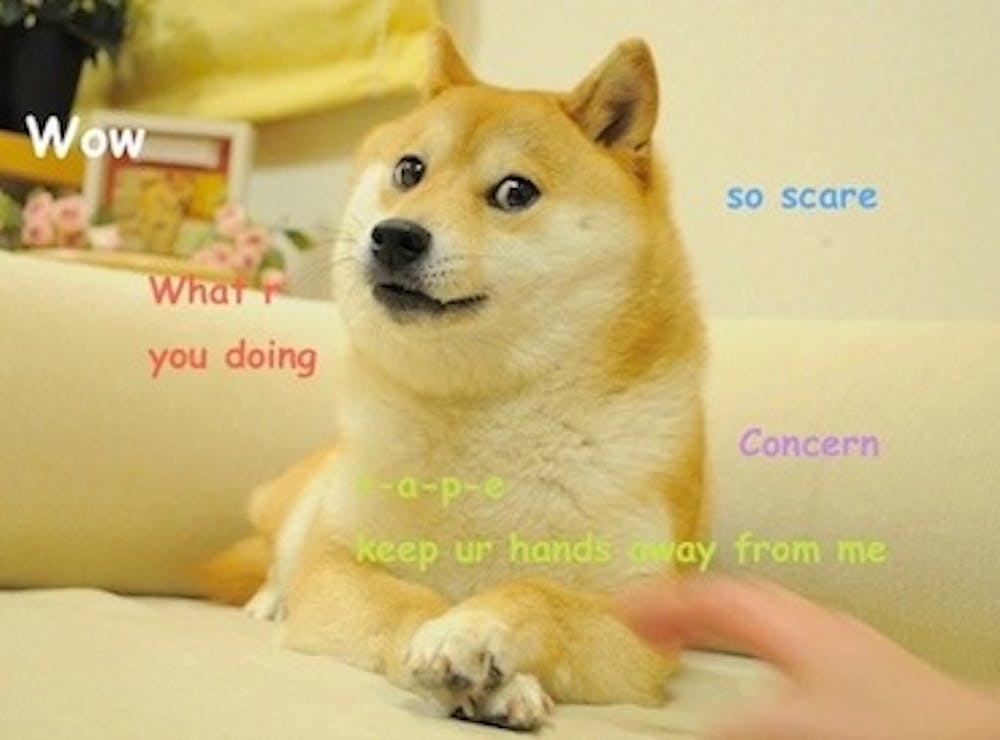
What’s a doge?

Originally, a random internet user posted a photograph of their shiba inu dog on their blog, after which another user saw the image and posted it to the Reddit platform. This is where the image was first paired with the word “doge” (and the word doge has its own separate history).

Some memes come and go, ending as cyber-waste in the internet graveyard – these are the cringe memes like Minions or Bad Luck Brian that haunt early Facebook timelines.

Other memes have the capacity to hold so much meaning that they have impressive longevity and traverse endless iterations, mutations and politics. The reasons for this are many and varied, but my research shows that in the case of doge, as in the case of Pepe the Frog, the anthropomorphic nature of the icon is part of the longevity and adaptability.

We laugh at animals because they remind us of the foibles of human nature. They are easy to laugh at because they are not us, but they are enough like us that we can project our weaknesses and vulnerability on them – and laugh about them.

An early example of the Doge meme.
Wikimedia Commons

What is a meme?

I say, of course, internet memes because the term “meme” actually existed prior to the home-based use of the internet.

In a research project by James Hall and myself, we explain that even though there is some contestation about the first uses of the term, as well as its usefulness in theoretical application, it is generally conceded that Richard Dawkins coined the term in the iconic book The Selfish Gene published in 1976.

We need a name for the new replicator, a noun that conveys the idea of a unit of cultural transmission, or a unit of imitation . ‘Mimeme’ comes from a suitable Greek root, but I want a monosyllable that sounds a bit like ‘gene’. I hope my classicist friends will forgive me if I abbreviate mimeme to meme.

At the time of writing, of course, Dawkins was not referring to the classic image macros usually thought of as memes. He was referring to other cultural units, such as: “…tunes, ideas, catchphrases, clothes fashions, ways of making pots or of building arches”.

Dawkins felt that:

Just as genes propagate themselves in the gene pool by leaping from body to body via sperms or eggs, so memes propagate themselves in the meme pool by leaping from brain to brain via a process which, in the broad sense, can be called imitation.

As many concepts do, the term finally leeched out of the academic realm and into the popular vernacular.

The Success Kid is an example of an early and popular meme.
Wikimedia

What’s in a meme?

So, what is it about memes that is so impactful?

The answer lies in understanding one of the most basic human drives: to communicate. The desire to reach out beyond the self. To be heard and, if we’re lucky, understood.

Tens of thousands of years ago, prehistoric humans painted on cave walls to communicate what was important to them. In 2023, we scrawl memes across the internet. These two practices are, essentially, the same thing.

Media theorist Mark Deuze has made this point before:

It’s like cave paintings; what are we painting on the wall – stories about who we are, where do we belong and what really matters to the community that we think we are a part of – that’s the definition of every status update […] it used to be that only a privileged few could paint the walls of the cave; now we’re all doing it.

Just as we use cave paintings today in order to reflect on the very origins of the human condition, in time, we will use the archive of memes as a tree of knowledge to appreciate the complex web of communication we are building for ourselves on the grand project of the internet. They will help to archive the very earliest incarnations of how humans felt about communicating on digital platforms.

For those of us who grew up before the internet, it is almost bizarre to think that not only are memes a legitimate genre that holds masses of cultural information, but they also have history, even memory.

They may not be high art and they may be totally organic and spontaneous, but perhaps that is why we feel they are so authentic. They document – in fantastically messy and complex ways – how cultural material moves around, grows, dies and, in the case of doge, becomes born again.

The Conversation

Laura Glitsos does not work for, consult, own shares in or receive funding from any company or organization that would benefit from this article, and has disclosed no relevant affiliations beyond their academic appointment.

ref. Much wow, very meme: what the revival of the ancient doge meme tells us about the lifecycle of the internet – https://theconversation.com/much-wow-very-meme-what-the-revival-of-the-ancient-doge-meme-tells-us-about-the-lifecycle-of-the-internet-203560

The most significant defence review in 40 years positions Australia for complex threats in a changing region

Source: The Conversation (Au and NZ) – By Adam Lockyer, Associate Professor in Strategic Studies, Macquarie University

Petty Officer 3rd Class Isaak Martinez/Australian Defence Force/AP

Before today’s release of the government’s defence strategic review, Defence Minister Richard Marles said it would be the most important examination of Australia’s defence capabilities since the 1986 “Dibb Report” authored by Professor Paul Dibb.

As such, direct comparisons of the two documents were already being made before today’s release.

The Dibb Report told a compelling story. It began by stating unequivocally that Australia was “one of the most secure countries in the world” and argued we should adopt a “strategy of denial”, which would

allow our geography to impose long lines of communication on an adversary and force an aggressor to consider the ultimate prospect of fighting on unfamiliar and generally inhospitable terrain.

The Dibb Report maintained the sea and air gap to Australia’s north could be made impassable if the Australian Defence Force (ADF) leveraged its technological edge in naval, air and surveillance capabilities. In turn, the demonstrated ability of the ADF to sink or shoot down any enemy units attempting to cross the moat would deter other countries from deciding to attack.

Unsurprisingly, the Australian army saw itself as the big loser in the Dibb Report, being relegated to collecting any stray enemy forces that washed ashore across Australia’s northern coastline.

Three different schools of thought on defence

Today’s defence strategic review begins by outlining the fundamental geopolitical changes that have occurred in Australia’s region over the past few decades. The review is significant in openly stating the US no longer enjoys hegemony in the region, with China now being a great power peer and competitor.

In my book, Australia’s Defence Strategy, I identify several different traditions within Australian defence policy.

The first is that defence of the continent should be Australia’s preeminent strategic objective. There is some disagreement within this school of thought about whether Australia requires the capability to stop an opponent outright as it crosses the sea, air or cyber gap to attack Australia.

Or, as defence expert Hugh White tends to argue, simply making it too risky and costly for an enemy is sufficient to deter an attack.


Read more:
The much-anticipated defence review is here. So what does it say, and what does it mean for Australia?


Another school of thought, which I call the “status quo defence policy” tradition, maintains that as long as there’s a favourable balance of power in our region, Australia will remain relatively secure.

This logic was once tied to imperial defence – as long as Britain ruled the waves, Australia would be relatively safe from attack.

Later, this thinking was redirected toward American primacy in the Asia-Pacific region. This viewpoint argued Australia’s defence was maintained by throwing our weight behind our great power security guarantor, even if it meant fighting far from our shores.

Finally, there is a tradition that argues defence thinking has been too focused on traditional threats from other nations. Defence policy should be treated as “national security”, which would better capture threats emerging from non-state actors such as terrorists, failed states, infectious diseases and climate change.

A convergence of the three traditions

We can clearly see the influence of all three of these traditions in the new defence strategic review.

First, the “strategy of denial” returns to the centre of Australia’s defence posture. Consequently, there is a strong emphasis on the security of the waters around Australia and our ability to prevent enemies from operating here.

The army sees itself being sidelined again and is less than pleased. Retired Major General Mick Ryan, for example, describes the government’s planned cut of infantry fighting vehicles from 450 to 129 as “a kick in the guts to the army”.

Although the defence strategic review means the army will be asked to head in a very different direction from the one it had hoped to follow, it should not believe it is once again being relegated to Australia’s strategic goalkeeper.

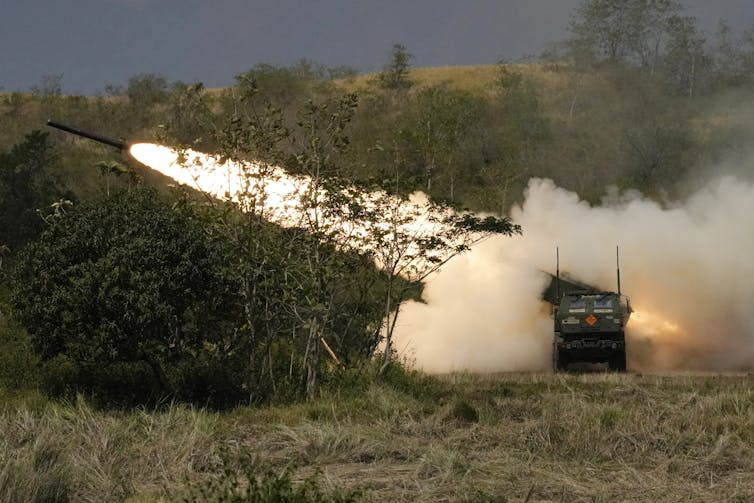
The review argues for the accelerated acquisition of medium- and heavy-landing craft and the US-made High Mobility Artillery Rocket (HIMARS) system currently being used to great effect by Ukraine’s army against Russian forces. This would give Australia unprecedented long-range missile strike capability from land.

The intention is clearly to send the army forward to deny the sea, air and land to opponents far from Australia’s own coastline. My research team and I have previously analysed the geostrategic importance of Manus Island for such a role.

This reflects similar thinking in the US Marine Corps, under its Force Design 2030 restructuring plan, which will see land forces being deployed in maritime environments armed with long-range precision strike capabilities to restrict an opponent’s ability to manoeuvre.

A HIMARS missile being launched during a joint military drill between the Philippines and the US in March.
Aaron Favila/AP

Doubling down on the American alliance

The defence strategic review also doubles down on Australia’s alliance with the US.

The 1986 Dibb Report argued the US was a global power with global interests and, consequently, Australia would be wise to emphasise “self-reliance” for all potential low- and medium-level conflicts.

The assumption in the current strategic review is that China is the greatest geopolitical challenge facing both Washington and Canberra, and this convergence of strategic interests and focus will result in a closer alliance between the two.

This section of the document reflects the “status-quo defence policy” tradition within Australian strategic thinking – if American power alone cannot maintain a favourable balance of power in the region, then Australia, Japan, India and other like-minded nations should throw their weight onto the scales.

A new threat: climate change

Finally, one of the most striking features of the review is the amount of time devoted to the impacts of climate change on the Australian Defence Force.

Although previous defence white papers have mentioned climate change, these references have generally only been made in passing. The review delves into far more depth and even advocates for defence procurement to move away from fossil fuels, which could have both positive operational and environment effects.

This follows the final school of thought on the importance of recognising non-traditional threats to our security, such as climate change.


Read more:
Climate change poses a ‘direct threat’ to Australia’s national security. It must be a political priority


Why the review is happening now

Overall, the defence strategic review had extremely ambitious objectives and was produced on a very tight timeline.

A comparison with the Dibb Report allows for some strengths and weaknesses to be identified in the current review. Ironically, these strengthens and weaknesses can be seen as different sides of the same coin.

The review’s main strength is combining the main traditions of Australian strategic thought into one document. Its key weakness is that some of these traditions pull in different directions. The kind of capabilities Canberra would probably need to defend the Australian continent would not be best suited to contributing to US-led multinational coalitions across the Indo-Pacific.

1986 was a simpler time. The defence strategic review makes clear that a newly multipolar Asia will require a more nuanced and sophisticated defence posture.

The Conversation

Adam Lockyer has received funding from the Australian Department of Defence’s Strategic Policy Grants Program. He is also a non-resident fellow at the Sea Power Centre – Australia.

ref. The most significant defence review in 40 years positions Australia for complex threats in a changing region – https://theconversation.com/the-most-significant-defence-review-in-40-years-positions-australia-for-complex-threats-in-a-changing-region-200070

The much-anticipated defence review is here. So what does it say, and what does it mean for Australia?

Source: The Conversation (Au and NZ) – By John Blaxland, Professor, Strategic and Defence Studies Centre, Australian National University

The Albanese government on Monday released a declassified version of the much-anticipated defence strategic review, authored by former defence chief Angus Houston and former defence minister Stephen Smith.

The report looks at Australia’s defence equipment and resourcing, but it also looks beyond just acquisitions.

So what’s in the report? What were some of the political drivers of the decisions taken, and what does it tell us about Australian defence strategy in the mid-2020s?

Increasing risks

The review builds on the Defence Strategic Update of 2020, which stressed the time we’d have to prepare for a potential conflict is reducing.

It highlights a shift from describing the defence of Australia in narrow, conventional military terms to a broader approach that requires a “whole-of-nation effort”.

It describes Australia’s strategic environment in the Indo-Pacific as one that

faces increasing competition that operates on multiple levels – economic, military, strategic and diplomatic – all interwoven and all framed by an intense contest of values and narratives.

A large-scale conventional and non-conventional military build-up without strategic reassurance is contributing to the most challenging circumstances in our region for decades.

It adds that “the risks of military escalation or miscalculation are rising”.

It mentions that climate change complicates our challenges further. It also notes that “economic coercion” and “other actions that fall short of kinetic conflict” are impinging upon the ability of “countries to exercise their own agency and decide their own destinies”.

In response, the paper declares “we must sharpen our focus on what our interests are, and how to uphold them”. It focuses on the need for Australia to develop long-range strike capabilities, notably with longer-range missiles (it says we’re in the “missile age”) and advanced nuclear-powered submarines.

The ADF has long focused on maintaining a “balanced force” for three concentric circles: defending the continent, regional engagement, and contributions further afield as a “good global citizen”.

But the focus in this review shifts. It emphasises what it calls a “focused force”, with five tasks:

  • defence of the nation

  • deterrence through denial (that is, deterring adversaries by reducing any possible benefits of engaging in an attack)

  • protection of economic connections

  • working with regional partners

  • and supporting the so-called rules based global order.

Four of these five tasks involve acting well beyond Australia’s shores. That’s a significant shift.

6 priorities going forward

The report lists six priorities, and 62 recommendations, for defence acquisitions.

The first priority is acquiring nuclear-powered submarines, of which Australia already has a plan following the AUKUS announcement in March. The government recognises conventional diesel-electric submarines are now vulnerable to detection, due to advances in surveillance. Nuclear-powered subs are less likely to be spotted as they don’t have to come up for a “snort” to refuel.

Second is improving our precision strike capability. Guided weapons and explosives are in short supply, in part thanks to the war in Ukraine, but also because we’ve tended not to develop large stockpiles. The government also plans to invest in developing the ability to manufacture advanced munitions onshore, especially long-range guided weapons. Officials privately advise that they expect we will produce licensed versions of United States’-sourced weapons systems to equip the ADF.

The third priority is about supporting the second pillar of the AUKUS (the first pillar is the submarines). This focuses on acceleration of technology such as artificial intelligence, hypersonics, and longer-range precision guided munitions.

Fourth is the redevelopment of Australia’s northern bases, from Cocos (Keeling) Islands ranging to the air bases and other defence infrastructure across northern Australia.

Fifth is investment in recruitment and retention of ADF personnel. The previous federal government projected a nearly 20,000 increase in uniformed defence personnel. The current government committed to follow through on that, with an increase of 5% per year, but there was little to show for any further surge.

Sixth is an emphasis on improving relations with the region, with a particular focus on Pacific Island nations.

Significant adjustments

The review does not abandon the army. But it significantly cuts back its planned acquisition of infantry fighting vehicles intended to replace its Vietnam War-era armoured personnel carriers. It reduces the planned acquisition from 450 to 129 vehicles.

What’s more, the review says Australia must cancel the planned acquisition of addition mobile (or “self-propelled”) artillery. It advocates for weapons with a longer range instead, such as “HIMARS” (high mobility artillery rocket systems), which is currently being used by Ukrainian forces on the battlefield.

So the army will need to make some significant adjustments.

The report also calls for a review into the navy surface combat fleet. Australia has been planning to construct 12 offshore patrol vessels and nine Hunter-class frigates for the coming years, but there’s expectations both numbers will be rejigged. The challenge is to get this smaller naval review done quickly. Australia’s naval shipbuilding capability atrophies quickly if left dormant and delays have already seen the naval shipbuilding industry under stress.

The thinking now is not just about air, land and sea forces, but also cyber and space. The report emphasises a robust cyber capability. The Australian Signals Directorate’s cyber program, called REDSPICE, is part of the mix.


Read more:
Paul Keating lashes Albanese government over AUKUS, calling it Labor’s biggest failure since WW1


The review is largely internally coherent, but there’s a dissonance between the rhetoric and the substance – noting the absence of substantial additional resource allocation. Perhaps this reflects the political headwinds faced by the Albanese government.

With the left wing of the ALP spooked by former Prime Minister Paul Keating’s aggressive teardown of AUKUS and defence policy writ large, coupled with calls for great expenditure on health, education and welfare, the government is reluctant to spell out how the increases in budget forecast in the review will come to fruition.

But it seems clear the Albanese cabinet has an acute appreciation of the security challenges butting up against the mood of a more sanguine political base.

The Conversation

John Blaxland does not work for, consult, own shares in or receive funding from any company or organisation that would benefit from this article, and has disclosed no relevant affiliations beyond their academic appointment.

ref. The much-anticipated defence review is here. So what does it say, and what does it mean for Australia? – https://theconversation.com/the-much-anticipated-defence-review-is-here-so-what-does-it-say-and-what-does-it-mean-for-australia-204267

Lachlan Murdoch could well have won his Crikey lawsuit, so why did he drop it?

Source: The Conversation (Au and NZ) – By Michael Douglas, Senior Lecturer in Law, The University of Western Australia

Late last week, Lachlan Murdoch dropped his defamation claim against key figures behind online publication Crikey.

Murdoch had a strong case. So why would he choose to drop it?


À lire aussi :
Why Fox News’ settlement with Dominion Voting Systems is good news for all media outlets


The facts of the case

For those under a rock: Lachlan Murdoch is the son of Rupert. He is an Aussie-American-Brit leading News Corp and Fox Corporation. His empire includes Fox News in the US and Sky News in Australia.

Murdoch was suing over a June 2022 article on the subject of the January 6 insurrection at the US Capitol. The piece called Donald Trump a “traitor”, and Lachlan Murdoch Trump’s “unindicted co-conspirator” – a reference to Richard Nixon’s treatment by a grand jury with respect to the Watergate scandal.

The underlying allegation was that Fox News had supported Trump’s “Big Lie” that the 2020 US presidential election was stolen, which led to the insurrection; and that Lachlan Murdoch was responsible for Fox’s role in spreading the Big Lie.

After the article was published, Murdoch sent the publishers of Crikey a “concerns notice”, essentially threatening to sue them.

In response, the publishers almost dared Murdoch to sue. They even went so far as to take out an ad in The New York Times. According to Murdoch, those behind Crikey used his defamation threat as part of marketing campaign to drive subscriptions.

Challenging a billionaire to a defamation fight may not have been the smartest move. In September 2022, Murdoch commenced proceedings in the Federal Court of Australia. He sued the company publisher of Crikey, its editor, and the article’s author. Later, he also sued the chair and chief executive of that company.

Crikey’s defences may have failed

The Crikey respondents were defending the case on a number of bases. Each of these defences relies on legal principles that excuse the publication of content that is defamatory for the sake of other important interests.

Perhaps their strongest defence was a new one: a statutory defence of “publication of matter in the public interest”. The defence became law in 2021. It means a defamatory publication is defensible if two conditions are met.

First, the publication must concern an “issue of public interest” – which the Crikey article clearly did. Second, the publishers must have “reasonably believed” that the publication of the matter (the article) was in the public interest.

The case may have turned on this second element of the new defence. What did the publishers believe? Was their belief about the public interest, or driving subscriptions for Crikey? There was a decent risk a court would have gone with the second option, and the defence would have failed.

If the defences had have failed, Murdoch would have won. So why would he choose to discontinue his case?

The backdrop of the Dominion v Fox case

Just days ago, Murdoch’s Fox settled what would have been one of the biggest defamation case of all time. Dominion Voting Systems had sued Fox in the US, seeking a whopping US$1.6 billion damages.

It is extremely difficult to succeed in a defamation case against a media company under US law. But if ever there was a case where it could happen, this was it.

Through pre-trial procedures, Dominion had uncovered a treasure trove of evidence from people at Fox – including from the likes of Tucker Carlson and Rupert Murdoch himself.

There was plenty of ammo for Dominion to argue Fox was deliberately spreading lies about Dominion, which would have been required for Dominion to succeed.

Just before the trial was about to start, Dominion agreed to put an end to the case in exchange for a US$787.5 million payment from Fox.

This was a steep price for Fox to pay but a loss would have cost substantially more in damages. And it would have cost more than money.

If the case had proceeded to trial, it would have caused tremendous damage to the Fox brand and that of its talking heads, further alienating the audience on which they depend. The evidence already uncovered was ugly, but it was about to get even uglier.

Discontinuing the defamation case was a sound decision

If Lachlan Murdoch continued the Crikey case, then all of the dirty laundry that was to be aired in the Dominion case could have been aired in Australia.

According to the principle of open justice, that evidence would have been heard in open court, with the global media watching.

Fox’s key benefit of the Dominion settlement – making the story go away, and not having to uncover further evidence – would have been destroyed. It would have been a massive own goal.

It’s likely Lachlan Murdoch himself would have been cross-examined.

There are other reasons Murdoch would want the case to end now

Say the case continued, and Lachlan Murdoch won. This would mean the Crikey respondents failed in their reliance on the statutory defence of “publication of matter in the public interest”.

The resulting judgment could set a precedent undermining the value of the new defence.

It is in Lachlan Murdoch’s ultimate interest that the defence remains strong: it will protect News Corp rags from publishing defamatory articles, which they are prone to do. Laying down his weapons now avoids that scenario.

And there is a reason Lachlan Murdoch has himself given for ending his case: he does not want to give Crikey any more ammo for a marketing campaign to attract subscribers.

Murdoch insists he was confident he would have won his case. He may have won defamation damages but he could have lost far more.

Murdoch may end up having to pay the legal costs of the Crikey respondents. But this case was never really about money. As the judge said a few weeks ago, it was more about “ego and hubris”. Many defamation cases are.


À lire aussi :
Murdoch v Crikey highlights how Australia’s defamation laws protect the rich and powerful


The Conversation

Michael Douglas is a consultant in a litigation firm, where he has worked on defamation matters and acted for plaintiffs. He has been a member of the ALP and the Australian Republic Movement.

ref. Lachlan Murdoch could well have won his Crikey lawsuit, so why did he drop it? – https://theconversation.com/lachlan-murdoch-could-well-have-won-his-crikey-lawsuit-so-why-did-he-drop-it-204279

We want more climate ambition in our foreign policy – here’s how we can do it

Source: The Conversation (Au and NZ) – By Wesley Morgan, Research Fellow, Griffith Asia Institute, Griffith University

Last week, foreign minister Penny Wong laid out the strategic challenges facing Australia in a major speech.

Wong described great power competition involving China, America and Russia. She warned of the risk of conflict in our region as China expands its sphere of influence. And she defended the AUKUS nuclear submarine deal with the United States and United Kingdom.

But these are traditional challenges: nation against nation. Australia needs a similar declaration of the catastrophic security implications of climate change.

While Wong did mention climate change, it was secondary, set in the context of regional outreach.

As the climate crisis worsens, we must do more. Climate change is a threat. Maybe even the threat. We need to use every tool we have to tackle it – including our diplomats.


Read more:
AUKUS submarine plan will be the biggest defence scheme in Australian history. So how will it work?


Climate change threatens our neighbours – and us

Australia is a big fish in a big, sparsely populated pond. Our neighbours in the Pacific see sea-level rise and ocean acidification as existential threats. For island nations, this is the big one – well above geostrategic competition.

To Wong’s credit, she understands this.

But climate damage isn’t restricted to island nations. Countries across South and Southeast Asia are also on the front line of warming, as this month’s record-breaking heatwaves show.

Just this weekend, people in Bangkok were warned not to go outside due to extreme heat. The apparent temperature – what the temperature feels like when combined with humidity – hit a record 54℃.

In our region, governments typically avoid close alignment with great powers and blocs. Yet there is no doubt rising temperatures are a key threat to all countries. Australia might have a tougher time remaining a credible partner to the region without a greater climate focus here too.

Back up words with serious action

Under Labor, our political and financial climate commitments have certainly increased.

Despite this, our domestic emissions trajectory is still not compatible with keeping global warming to 1.5℃ this century.

And, as of 2022, Australia was paying just a tenth of its fair contribution to the climate fund set up at the 2009 UN conference in Copenhagen.

Contrast this to the vast sum of money we have committed to spending on traditional security threats, especially the nuclear submarine deal which could cost up to A$368 billion.

Australians want to see more foreign policy ambition on climate front. A United States Studies Centre poll last year found 75% of us want climate action at the heart of our alliance with America. By contrast, only 52% of survey respondents felt the nuclear subs deal was a good idea.

What should Australia do?

It’s hard to imagine Australia – or any other country – financing climate action at a level on par with traditional security threats.

But there are actions we could take to help close the gap. We could rejoin and boost funding to the UN-aligned Green Climate Fund, which the previous Australian government left in 2018.

We should also retool our export credit and development finance to invest in climate-friendly assets and stop them funding more fossil fuel extraction.

At the same time, Australia could signal our serious climate commitments by continuing to strengthen domestic policies to ensure the reformed safeguard mechanism actually leads to genuine emission cuts. This would mean closing glaring loopholes, such as allowing major emitters to keep pumping out carbon pollution by purchasing carbon offsets.

As the global energy transition gathers pace, the federal government should do more to support clean energy exports. Australia is well placed to provide critical minerals and the green metals, fertiliser and transport fuels that the rest of the world needs. But we must act fast to secure lucrative opportunities –and to tell the world we are open for green business.

The way we communicate progress to the world is critical. For years, we have been seen as laggards and hold-outs, one of the few developed nations resisting the change which must come. It’s time for us to lead.


Read more:
6 reasons 2023 could be a very good year for climate action


The Conversation

Wesley Morgan is a Senior Researcher with the Climate Council of Australia.

James Bowen does not work for, consult, own shares in or receive funding from any company or organisation that would benefit from this article, and has disclosed no relevant affiliations beyond their academic appointment.

ref. We want more climate ambition in our foreign policy
– here’s how we can do it – https://theconversation.com/we-want-more-climate-ambition-in-our-foreign-policy-heres-how-we-can-do-it-204124

How do I do ‘suicide watch’ at home?

Source: The Conversation (Au and NZ) – By Sarah Wayland, Associate Professor, University of New England

Shutterstock

Some people still at imminent risk of suicide leave hospital to be cared for at home by their partner.

So their partner becomes their carer. That person is then on alert for extended periods of time for future suicide attempts. This is all while helping with their loved one’s medication, liaising with health professionals, working or looking after other family members.

But there’s hardly any advice for carers on how to do “suicide watch” at home. Partners can be left to improvise, leading to high levels of distress. In a recent disclosure, one woman described how she tied herself to her suicidal partner for nine days before finding help for him.

We’re social workers with a special interest in grief, and preventing suicide and related distress. Here’s what can help while doing “suicide watch” at home and how to get support.


Read more:
Suicide risk is high for military and emergency workers – but support for their families and peers is missing


Left to cope

We’ve conducted our own research into available supports for family carers with a loved one at home who’s at risk of suicide.

What we’ve found so far is that mental health services often provide surveillance for people in their facilities who are at risk of taking their lives. But there’s not always enough beds in crisis wards, space in emergency departments or culturally safe care available.

This means partners, family and friends are left to provide practical surveillance at home.

A 2020 report we prepared for the Prime Minister’s National Suicide Prevention Adviser described carers’ experiences.

Carers told us they felt ill-equipped when asked, or felt they had to do “suicide watch”, given the gravity of the situation.

Often carers were told by health professionals, while waiting for crisis care, or when discharged after the immediate suicide crisis had subsided, to keep an eye on the person at all times. They were also told to check for access to means of suicide to keep the house “safe”.

The effect of the intense monitoring meant carers, who did have to leave the house to go to work or to seek their own support, had to ask friends and extended family to take on, or help with, surveillance duties.

Male couple, one sitting in bed, the other sitting on edge of bed, looking worried
Carers felt ill-equipped when left to cope at home.
UfaBizPhoto/Shutterstock

Carers in this situation are a distinct group of people who need support and resources. That’s because their role complements the work of crisis and community mental health services.

But when we looked at what was available for them online – clear and logical information about how to keep an eye on a person – we couldn’t find any single Australian resource that identified the practical aspects of doing “suicide watch” at home.


Read more:
Why are we losing so many Indigenous children to suicide?


What practical things might help?

Here are some practical tips, mainly based on what carers say works:

  • talk to the person you are caring for, using some of these conversation starters. These conversations will help shape how you might keep an eye on them, with their consent

  • ensure you have consent from the person you are caring for to speak to their GP, or treating team and know the phone numbers for crisis mental health when your concern levels rise

  • start a conversation with the person about developing a safety plan, which may change over time. This will help you understand what the possible risks might be in the home. You can then support that person to enact their safety plan, empowering them and yourself

  • lock medication cupboards, remove access to toxic substances, or any other means that might place a person at risk. This can increase safety in the short term

  • sleep close to the person’s room. Go to them if they call out or if you are concerned about how they are coping

  • reach out to other people in your family or friend network to say you are keeping an eye on a loved one. This may help share the tasks and give you some time out. Carers have a right to look after their own needs, alongside caring for a family member or friend.


Read more:
How to ask someone you’re worried about if they’re thinking of suicide


What needs to happen next?

Vague directives to carers to “just keep an eye on them” until care arrives, or services become available, can make people feel ill-equipped and unsupported when providing care at home.

No-one should have to tie themselves to their loved one for nine days to remain vigilant about the risk of suicide until accessing help.

We also need longer-term practical and emotional supports for carers, beyond immediate advice on how to do “suicide watch” at home. We need adequate health funding to do this.


If this article has raised issues for you, or if you’re concerned about someone you know, call Lifeline on 13 11 14. If you are a carer and would like support, contact Carers Australia on 1800 422 737.

The Conversation

Sarah Wayland receives funding from SANE Australia and the National Mental Health Commission

Myfanwy Maple receives funding from SANE Australia and the National Mental Health Commission.

ref. How do I do ‘suicide watch’ at home? – https://theconversation.com/how-do-i-do-suicide-watch-at-home-202845

If the camera was there with the blessing of Father Bob Maguire, people felt safe: my relationship with a marvellous man

Source: The Conversation (Au and NZ) – By Stephen Luby, Lecturer, Master of Screen Producing, Victorian College of the Arts, The University of Melbourne

They told me the church was my mother. I learned that at school, and in the seminary. ‘Holy Mother Church’, they said. But I soon discovered that she was a bitch.

This was one of the first things Father Bob Maguire ever said to me in a background interview I did with him in 1990 as part of my research for a television documentary about youth homelessness.

I guffawed, and I could see by the sparkle in his eyes he knew he had drawn me into his comical, satirical, deeply serious take on the world – and that I was intently listening.

What he always had to say, as I would learn, often after an opening zinger like this, was in his actions as much as in his marvellous wordplay.

He may have been comically scathing of the institutional church, but there was another church he really believed in: the community of people who worked together to advance the welfare, dignity and just treatment of the disadvantaged, the homeless, the addicted and the forgotten.

Everyone was welcome in this church. Very aptly, the charitable foundation Father Bob established in 1979 was named the Open Family Foundation.

In 1990, I was a junior television producer who had found my way into filmmaking after some years as a youth worker. Father Bob had established a profile as a champion of “street kids” through his work at Open Family, so he seemed like a good place to start my research into homelessness.

Meeting him was like walking through a portal. Father Bob and his team of outreach workers took me with them into derelict squats, seedy back alleys, soup kitchens and dumpster bins.

One of our interviewees took us on a tour of the Fitzroy backstreet doorways and dumpsters he slept in on cold nights. He even had a ratings system for them.

Then there was the trans sex worker who earned her living in and around Darlinghurst’s notorious beat, “The Wall”. In a dingy late-night café around the corner, she told me her poignant, funny story. Initially, she wanted her face blurred on camera, but after five minutes she changed her mind and became quite expansive.

If the camera was there with the blessing of Father Bob or his team, people felt safe.

To be trusted like this with a television camera – which for many we met was normally a symbol of intrusive voyeurism – was an incredible privilege. I went over that interview perhaps 100 times while editing the program, looking for the right moments. I recall crying as I did so, at the raw honesty and the pain.


Read more:
Religious groups are embracing technology during the lockdown, but can it replace human connection?


‘They are one of us’

A key member of Father Bob’s team was Henry Nissen, an ex-boxer whose concern for the disadvantaged had led him into outreach work with Open Family.

“The most Christian person I have ever met is a Jewish pugilist,” said Father Bob of his protégé.

Nissen would be paid by Open Family whenever the organisation could afford it, but pay or not he spent many nights a week scouring the streets of inner-city Melbourne making contact with itinerant young people.

He knew all the haunts, drug dens and under-bridge camps. A figure would emerge from the shadows and in the gentlest of voices, Henry would call: “Is that you X….?”, and they would step out into a beam of moonlight or streetlamp.

At a little distance, I could see and hear Nissen encouraging, advising and sometimes admonishing or pleading. He might offer a lift to a hostel or entry to a detox centre or one of the many emergency services Father Bob had established.

Around the same time, I was also researching another project on the newly emerging scandal of the stolen generations. My investigations led me to a simple weatherboard house in Preston where a young Indigenous man gave me three hours and five cups of tea as he told me his story of losing and finding his family.

His name was Archie Roach and he had just recorded an album of songs inspired by these experiences. A few months later, Charcoal Lane was released and became a huge hit.

One of the songs, Down City Streets, was written by Roach’s partner, Ruby Hunter, about her experience as a street kid. As I sat in the edit suite, reviewing all the material we had gathered over many months with Father Bob, that song seemed to encapsulate the many stories I was trying to weave together.

Roach very kindly gave us permission to use this song in the program and eventually as the title of the documentary. Down City Streets was broadcast on the Seven Network in 1991.

Father Bob made a telling comment in the program, which we had treated with a reverb effect: “No matter who a person is, what they have done, what has happened to them […] they are one of us.”

That reverb continues 30 years later.


Read more:
Archie Roach: the great songman, tender and humble, who gave our people a voice


The Conversation

Stephen Luby owns and operates the film production company Ruby Entertainment.

ref. If the camera was there with the blessing of Father Bob Maguire, people felt safe: my relationship with a marvellous man – https://theconversation.com/if-the-camera-was-there-with-the-blessing-of-father-bob-maguire-people-felt-safe-my-relationship-with-a-marvellous-man-204286

New lessons about old wars: keeping the complex story of Anzac Day relevant in the 21st century

Source: The Conversation (Au and NZ) – By Katie Pickles, Professor of History, University of Canterbury

What happened on the Gallipoli peninsula in Turkey 108 years ago has shocked and shaped Aotearoa New Zealand ever since. The challenge in the 21st century, then, is how best to give contemporary relevance to such an epochal event.

The essence of the Anzac story is well known. As part of the first world war British Imperial Forces, the Australian and New Zealand Army Corps (Anzacs) landed at Gallipoli on April 25 1915. For eight months they endured the constant threat of death or maiming in terrible living conditions.

Ultimately, their occupation of that narrow and rugged piece of Turkish coast failed. The 30,000 Anzacs were evacuated after eight months. More than 2,700 New Zealand and 8,700 Australian soldiers died, with many more wounded.

The first anniversary of the landing was a day of mourning, with Anzac Day becoming a public holiday in 1922. A remembrance day of sorrow mixed with pride, it has grown over the years to include all those who served and died in later international conflicts.

Over time, various narratives and themes have emerged from that Gallipoli “origin story”: of Aotearoa New Zealand’s emergence as a nation, proving itself to Britain and Empire; of the brave, fit, loyal soldier-mates who emblemised the Kiwi spirit of egalitarianism, fairness and duty. All this mingled with the lasting shock and underlying anger at class hierarchy and the British leadership’s incompetence.

But historians know well that the “Anzac spirit” is a complex and ever-evolving idea. In 2023, what do we teach school-aged children about its meaning and significance? One way forward is to rethink those Anzac narratives and tropes in a more complex way.

The cemetery at Lone Pine commemorates more than 4,900 Anzac servicemen who died in the area.
Getty Images

Colonialism and class

The Anzac story is tied up in the nation’s history as part of the British Empire. The Anzac toll was just part of a staggering 46,000 “Britons” – including many from India and Ireland – who died at Gallipoli.

Some 86,000 Turks also died defending their peninsula. We need to teach about the Anzac sacrifice in the context of a global conflict where the magnitude of loss was horrific.


Read more:
Less than illustrious: remembering the Anzacs means also not forgetting some committed war crimes


Importantly, Anzac themes are bound up in early forms of colonial nationalism: New Zealand proving itself to Britain and developing its own fighting mentality on battlefields far from home. Part of this involves the notion of incompetent British commanders who let down the Anzac troops – but this is part of a bigger story.

Focusing on imperial and class hierarchies of the time can place what happened in that broader context. The legendary story of Chunuck Bair, taken on August 8 by Colonel William Malone’s Wellington Regiment, but where most of the soldiers were killed when they weren’t relieved in time, is particularly evocative.

The New Zealand Wars memorial in New Plymouth: our other ‘great war’.
CC BY-SA

Māori and the imperial project

From our vantage point in the present, of course, we cannot ignore the Māori experience of war and colonialism. As the historian Vincent O’Malley has suggested, New Zealand’s “great war” of nation-making was actually Ngā pakanga o Aotearoa – the New Zealand Wars.

It’s time to teach the complexity of this past and the multiple perspectives on it. For example, Waikato leader Te Puea Hērangi led opposition to WWI conscription and spoke against Māori participation on the side of a power that had only recently invaded her people’s land.

Conversely, Māori seeking inclusion in the settler nation did participate. On July 3 1915, the 1st Māori Contingent landed at Anzac Cove. Te Rangi Hiroa (Sir Peter Buck) (Ngāti Mutunga) was to say:

Our feet were set on a distant land where our blood was to be shed in the cause of the Empire to which we belonged.

These words echo the familiar Anzac trope of the New Zealand nation being born at Gallipoli. Such sentiments led to postwar pilgrimages to retrace the steps of ancestors and claim the site as part of an Anzac heritage – a corner of New Zealand even.

For many young New Zealanders it has become a rite of passage, part of the big OE. That a visit to Anzac Cove is still more popular than visiting the sites of Ngā pakanga o Aotearoa is something our teaching can investigate.

Mateship and conformity

The notion of the Anzac soldier as courageous and beyond reproach, willing to make the ultimate sacrifice for nation and empire, is also overdue for revision. The “glue” of mateship – a potent combination of masculine bravery and strength with extreme loyalty to fellow soldiers – is again a contested narrative.

By the 1970s, as historian Rowan Light’s work shows, there was a significant challenge to such perceptions from the counterculture, peace protesters and feminists. And by the 1980s, veterans were sharing their stories more candidly with writer Maurice Shadbolt and war historian Chris Pugsley.


Read more:
Peter Weir’s Gallipoli 40 years on: deftly directed and still devastating


Teaching about the meaning of mateship might examine the history of those peer-pressured into participating in war, those who were conscripted and had no choice, and more on the fate of conscientious objectors like Archibald Baxter. At its worst, the idea of mateship was window dressing for uniformity and parochialism.

New Zealanders today have complex multicultural and global roots. We have ancestors who were co-opted to fight on different sides in 20th-century wars, including those who fought anti-colonial wars in India, Ireland and Samoa. Some came here as refugees escaping conflict. Jingoism and what it really represents deserves critical analysis.


Read more:
For many Australians, Anzac Day has been defined by a pilgrimage to Gallipoli. Can we mark the day differently?


Poppies and peace

The ubiquitous poppy, an icon much reproduced in classrooms, is also ripe for contextualisation and debate over its meaning. In the age of global environmental crisis, it can be seen as more than a symbol of sacrifice immortalised in verse and iconography.

The poppy also reminds us of the landscapes devastated by the machinery of war that killed and maimed people, plants and animals. It contains within it myriad lessons about the threats science and technology can pose to a vulnerable planet.

Anzac Day rose from the shock, loss and grief felt by those on the home front. And beyond the familiar tropes of nationalism, mateship and egalitarianism, this remains its overriding mood.

Remembering and learning about the terrible physical and mental cost of war is the real point of those familiar phrases “lest we forget” and “never again”. That spirit of humanitarianism chimes with Aotearoa New Zealand’s modern role and evolving self-image as a peacekeeping, nuclear-free nation.

Anzac Day also speaks to the need for global peace and arbitration, and how war is no viable solution to conflict. Those are surely lessons worth teaching.

The Conversation

Katie Pickles does not work for, consult, own shares in or receive funding from any company or organisation that would benefit from this article, and has disclosed no relevant affiliations beyond their academic appointment.

ref. New lessons about old wars: keeping the complex story of Anzac Day relevant in the 21st century – https://theconversation.com/new-lessons-about-old-wars-keeping-the-complex-story-of-anzac-day-relevant-in-the-21st-century-204013

Hasty Tahiti electoral alliance accused of serving up ‘same soup’ by rival

By Walter Zweifel, RNZ Pacific reporter

Politicians in French Polynesia have reacted with scorn over the ruling party’s hastily-convened electoral alliance with an opposition party, which has been eliminated from the territorial elections after failing to reach the 12.5 percent threshold.

Under the deal, President Édouard Fritch’s Tapura Huiraatira ceded four positions to Amuitahiraa on the list of candidates for next week’s run-off round.

Fritch warned of “chaos” should his party lose power to the pro-independence Tavini Huiraatira, which won most votes in the first round a week ago.

The Tavini’s Moetai Brotherson, who wants to succeed Fritch in the top job, derided the arrangement, saying that Fritch and the Amuitahiraa leader Gaston Flosse were serving up the “same soup” by warning that white people would be chased away and independence would “usher in misery” if Tavini formed government.

Nuihau Laurey of A Here Ia Porinetia said while he also stood for continued autonomy, it was very hard to work with people who admitted that they had lied for 30 years, a reference to Fritch’s admission in 2018 that he had lied about the French weapons tests.

The Greens’ Jacky Bryant said that the hasty deal was serious as this way of doing politics contributed to voter apathy.

Coup for Fritch, Flosse?
He said Fritch and Flosse must “feel horror” if they believed they could be a uniting force, in particular since Flosse for years “vomited” over the Tapura.

Tauhiti Nena of Hau Māohi said it was a coup for Fritch and Flosse because if they managed to combine the two parties’ support from the first round, they would win.

In the first round of the territorial elections, Fritch’s Tapura party came second, winning 30 percent of the votes against Tavini’s 35 percent, with Amuitahiraa on 11 percent.

Flosse, who leads the party despite being ineligible because of corruption convictions, had been campaigning for French Polynesia becoming a sovereign state in association with France.

While in opposition, he claimed that Fritch was the worst president in the territory’s history.

In the last elections in 2018, the Tapura won two thirds of all seats.

This article is republished under a community partnership agreement with RNZ.

President Édouard Fritch
Tahiti’s incumbent President Édouard Fritch … accused of being the “worst president” in the territory’s history. Image: APR File
Print Friendly, PDF & Email

Article by AsiaPacificReport.nz

A decade after the Rana Plaza garment factory disaster, New Zealanders still rely on fast fashion

Source: The Conversation (Au and NZ) – By Mike Lee, Associate Professor of Marketing, University of Auckland

Getty Images

Ten years to the day after the collapse of the Rana Plaza garment factory in Bangladesh, a disaster that killed more than 1,100 workers and injured another 2,500, the global addiction to cheap clothing remains strong.

In New Zealand, fast fashion has gone from strength to strength, fuelled by the ongoing cost of living crisis, low wages and accessible cheap clothing.

And it is understandable.

When you’re struggling to pay rent or put food on the table, it’s a lot harder to think about the needs of others – particularly those overseas and essentially invisible in your daily life.

Our research has shown that a person’s subjective wellbeing – how they evaluate their life circumstances, experiences and feelings in relation to the people around them – needs to be good before they have room for moral and ethical consumer dilemmas such as sustainability, the environment and fair wages.

The cracks that killed

There were a number of factors that led to the Rana Plaza disaster. The eight-storey building had visible – and growing – cracks in a wall that were worsened by the vibrations of a two-tonne generator on the roof.

Garment workers, working in conditions akin to modern slavery, raised their concerns with managers but were told they would lose their jobs if they didn’t continue to work in the building.


Read more:
Fast Fashion: Why garment workers’ lives are still in danger 10 years after Rana Plaza — Podcast


A power cut on the morning of April 24, 2013, led to the use of the generator, causing the building to collapse. Garment labels for a number of global brands were found in the rubble. Rana Plaza is considered one of the worst industrial disasters ever, second only to the 1984 Union Carbide accident that killed 3,787 people in Bhopal, India.

In the Rana Plaza aftermath, the building’s owner, factory bosses and the Bangladesh government were blamed. But the spotlight was also shone on the fast fashion phenomenon. The workers and factory owners were under intense pressure to meet relentless production deadlines for clothing brands around the world, and do so at minimum cost.

Cheap, abundant clothing is a staple of the Western consumer economy.
Shutterstock

Low cost, high price

Fast fashion refers to the rapid and cheap design, manufacturer and marketing of high volumes of clothing. The garment production often uses low-quality materials (like synthetic fabrics) and low-cost labour in countries like Bangladesh and China.

It is fairly well agreed that fast fashion exploits people and the environment. So, why don’t we stop? The answer may lie in why we shop.


Read more:
Fast fashion: why your online returns may end up in landfill – and what can be done about it


Consumers buy things for three main reasons: function (because we need it to do something), symbolic reasons (to associate with others or develop a unique identity) or experience (to feel something special).

When it comes to fashion there’s a tension between functionality – the bang for buck that fast fashion gives you – versus the symbolism that is associated with sustainable clothing.

But when money gets tight, symbolism and experience lag far behind functionality.

The luxury of ethical shopping

Previous consumer research looked at whether certain behaviours – like ethical shopping and minimalism – lead to an improved outlook in how people viewed their wellbeing in comparison to others.

We flipped that idea and asked whether people need to first feel good about themselves and their place in the world before they can engage in good consumer behaviour.


Read more:
‘I can only do so much’: we asked fast-fashion shoppers how ethical concerns shape their choices


What we found is that people with higher levels of subjective wellbeing had increased capacity to practice anti-consumption and pro-environmental behaviour. People with less subjective wellbeing, however, found it harder to go against brands they otherwise might have wanted to reject.

And that is a problem during a cost-of-living crisis.

New Zealand is a relatively low-wage economy, meaning price is a significant motivation when we shop. At the same time, goods tend to be more expensive due to our small scale and high shipping costs. Rising inflation has put further pressure on households.

People who are stressed about their finances, paying the rent, dealing with rising interest rates and the rising price of food will not care about where or how a pair of socks is made.


Read more:
Sustainable fashion expert: why I’m cutting my wardrobe down to ten items this month


Consumers can’t do everything

With rising prices and a low-wage economy, it is probably too much to ask for New Zealand consumers to lead the charge against fast fashion. While shoppers can buy less, most will still be looking for the cheapest deals on items they need.

There is an argument for greater regulation and government intervention at the point of production. But these manufacturing nations depend on the wealth produced by their garment workers. Pushing up prices to improve regulations could cause brands to go elsewhere.

Businesses could reduce profit margins in favour of decent pay and working conditions. However, the current business model that puts shareholders first means it’s unlikely most corporations (particularly those that compete on low cost) will place people over profits.

Currently there is no perfect solution, but leaving consumers to resolve the fast fashion dilemma on their own might be the least promising approach.

Multilateral government oversight of working conditions (at the point of production) combined with further regulations encouraging ethical supply chains (at the point of import), may be a more effective way to reduce the chances of another Rana Plaza.

The Conversation

Mike Lee does not work for, consult, own shares in or receive funding from any company or organisation that would benefit from this article, and has disclosed no relevant affiliations beyond their academic appointment.

ref. A decade after the Rana Plaza garment factory disaster, New Zealanders still rely on fast fashion – https://theconversation.com/a-decade-after-the-rana-plaza-garment-factory-disaster-new-zealanders-still-rely-on-fast-fashion-204192

Labor gains in Newspoll but Voice support slumps in other polls; NSW final results and Queensland polls

Source: The Conversation (Au and NZ) – By Adrian Beaumont, Election Analyst (Psephologist) at The Conversation; and Honorary Associate, School of Mathematics and Statistics, The University of Melbourne

Mick Tsikas/AAP

A federal Newspoll, conducted April 19-22 from a sample of 1,514, gave Labor a 56-44 lead, a one-point gain for Labor since the previous Newspoll, three weeks ago. Primary votes were 38% Labor (steady), 33% Coalition (steady), 11% Greens (up one), 7% One Nation (down one) and 11% for all Others (steady).

Despite Labor’s gain on voting intentions, Prime Minister Anthony Albanese’s net approval dropped five points to +16, with 53% satisfied (down three) and 37% dissatisfied (up two). This is Albanese’s worst net approval in Newspoll since becoming PM.

Liberal leader Peter Dutton’s net approval was also down six points to a new low of -19. Albanese led Dutton by 54-28 as better PM, a narrowing from 58-26 previously. Newspoll figures are from The Poll Bludger.

The Resolve poll below gave Labor a much bigger lead, but Resolve has skewed to Labor since the 2022 federal election, and Morgan and Essential polls last week also implied little change in Labor’s lead.

Two polls below show support for the Indigenous Voice to parliament slumping since December, but Essential and Resolve polls last week had the Voice’s support slightly up since March. The Morgan poll was particularly bad for the Voice at 54-46 “yes” excluding undecided.


À lire aussi :
Voice support increases in Essential and Resolve polls


Resolve poll gives Labor massive lead

A Resolve poll for Nine newspapers, conducted April 12-16 from a sample of 1,609, gave Labor 42% of the primary vote (up three since March), the Coalition 28% (down two), the Greens 12% (down one), One Nation 6% (up one), the UAP 1% (steady), independents 9% (steady) and others 2% (steady).

Resolve does not give a two party estimate until close to elections, but applying 2022 election preferences to these primary votes gives Labor over a 61-39 lead, a two-point gain for Labor since March. Resolve has been the most pro-Labor regular pollster since the last federal election.

Albanese extended his lead over Dutton as preferred PM from 51-22 in March to 55-21. By 56-30, voters thought Albanese was doing a good job; his net approval of +27 was up three points since March. Dutton’s net approval crashed 17 points to a new low of -28, as he had a 54-26 poor job rating.

Labor widened its lead on economic management over the Liberals to 36-30 from 33-32 in March. On keeping the cost of living low, Labor’s lead increased to 31-21 from 29-22.

Support for Voice slumps in Morgan and Freshwater polls

A Morgan SMS poll, conducted April 14-18 from a sample of 1,181, gave “yes” to the Voice 46% (down seven since December), “no” 39% (up eight) and undecided 15% (down two). If undecided is excluded, “yes” leads by 54-46. This is the narrowest lead for “yes” in any Voice poll.

Other polls, like Essential which gave “yes” a 60-40 lead last week, have had high levels of Coalition support; Essential had 41% of Coalition voters supporting “yes”. In Morgan, just 6% of Coalition voters supported The Voice, with 74% opposed.

A Freshwater poll for Sky News, conducted April 9-12 from a sample of 1,002, had “yes” to the Voice at 42% (down eight since December), “no” at 34% (up eight) and 24% undecided (steady). On a two-answer choice, “yes” led by 56-44.

NSW upper house final result: 21-21 tie between left and right

The New South Wales upper house has 42 members, with 21 up for election every four years, so members serve eight-year terms. All 21 are elected by statewide proportional representation with optional preferences. A quota for election is 1/22 of the vote or 4.5%.

At last Wednesday’s distribution of preferences, the Coalition’s seventh candidate defeated Animal Justice by over 10,000 votes or 0.05 quotas to win the 21st and final seat. The margin narrowed only slightly from the 0.07-quota gap on primary votes.

This means Labor won eight of the 21 seats up for election on March 25 (up one), the Coalition seven (down two), the Greens two (steady), One Nation one (up one), Legalise Cannabis one (up one), the Liberal Democrats one (up one) and the Shooters one (steady). Animal Justice and the Christian Democrats lost their two seats.

The seats won are compared with those won in 2015, the last time these 21 seats were up for election. Defections are ignored.

The overall upper house will have 15 Labor out of 42, 15 Coalition, four Greens, three One Nation, two Shooters, and one each for the Liberal Democrats, Animal Justice and Legalise Cannabis.

Left-wing parties (Labor, the Greens, Legalise Cannabis and Animal Justice) won the 21 seats up at this election by 11-10, but the right had an 11-10 win in 2019. So the overall upper house is tied 21-21 between left and right. The seats elected in 2019 will be up for election in 2027.

The president of the NSW upper house does not vote except to break ties. If Labor can persuade a right-winger to take the presidency, the left would have a 21-20 floor majority. Otherwise, Labor will need at least one vote from the right to pass legislation.

LNP takes lead in a Queensland state poll

The next Queensland state election is in October 2024. A YouGov poll for The Courier Mail, conducted March 30 to April 5 from a sample of 1,015, gave the LNP a 51-49 lead, a one-point gain for the LNP since December. Primary votes were 39% LNP (up one), 33% Labor (down one), 13% Greens (steady), 10% One Nation (down one) and 5% for all Others (up one).

Premier Annastacia Palaszczuk’s lead over LNP leader David Crisafulli as preferred premier slumped to 31-29 from 39-28 in December. The LNP led Labor on best party to manage cost of living, health and youth crime, with Labor only ahead on delivering the Olympics. Poll figures are from The Poll Bludger.

A Queensland Resolve poll for The Brisbane Times, conducted between mid-January and mid-April from a sample of 945, gave Labor 35% of the primary vote (down two since September to December), the LNP 33% (down two), the Greens 12% (up one), One Nation 7% (up one), independents 10% (up three) and others 2% (down two).

Analyst Kevin Bonham estimated this poll would be 53-47 to Labor, unchanged on September to December. Palaszczuk’s lead as preferred premier narrowed from 42-30 to 39-31. Palaszczuk’s net ratings became negative after registering +8 last time.

Fieldwork for the Resolve poll began in January, and Resolve’s federal and state polls have generally shown a pro-Labor skew relative to other polls. So the YouGov poll is likely to be closer to voting intentions now.

The Conversation

Adrian Beaumont ne travaille pas, ne conseille pas, ne possède pas de parts, ne reçoit pas de fonds d’une organisation qui pourrait tirer profit de cet article, et n’a déclaré aucune autre affiliation que son organisme de recherche.

ref. Labor gains in Newspoll but Voice support slumps in other polls; NSW final results and Queensland polls – https://theconversation.com/labor-gains-in-newspoll-but-voice-support-slumps-in-other-polls-nsw-final-results-and-queensland-polls-204107

The Australian War Memorial must deal properly with the frontier wars

Source: The Conversation (Au and NZ) – By Carolyn Holbrook, Senior Lecturer in History, Deakin University

The recent media rounds of the new chair of the Australian War Memorial Council, Kim Beazley, appear to presage a major shift in the institution’s attitude to the frontier wars. Beazley explained it is “enormously important” that the current $550 million renovation of the war memorial provides significant coverage of violent conflict between settler and Indigenous Australians. He elaborated:

We must give the Aboriginal population the dignity of resistance.

Beazley’s attitude, which complements that of Veterans’ Affairs Minister Matt Keogh, signals that the Australian War Memorial is not impervious to the changed political landscape. Yet there remains resistance to Beazley’s vision on a war memorial council composed of Coalition government appointees and ex officio military officers, and among conservatives more generally.

A constantly evolving memorial

Some of those who are resistant to coverage of the frontier wars assert the war memorial is hamstrung by its legislation, which restricts its remit to overseas wars or those fought by uniformed personnel. In truth, the Australian War Memorial Act 1980 contains a very broad definition of the institution’s role as

a national memorial to Australians who have died as a result of any war and warlike operations.

In any case, over its history, the memorial has adapted to shifting political imperatives and social mores.

Charles Bean conceived the Australian War Memorial during the first world war. After serving as Australia’s official correspondent, he dedicated his life to sanctifying the Anzacs. Through his editorship of the 12-volume Official History of Australians in the War of 1914-1918, and his advocacy for a shrine that would also serve as a museum and archive, he did more than anyone to promote the belief that the Anzacs had made the nation.

Charles Bean working on the Official History of Australians in the War of 1914–1918.
Wikimedia Commons

When the war memorial opened in 1941, it was already apparent that a new world war would need to be recognised. In 1952, during the Korean War, the memorial’s charter was altered so it could cover all wars in which Australia had been, or would be, involved.

The war memorial has changed so much since Bean first conceived it, that former director Brendan Nelson included a space for “emotional release” in the blueprint for the current expansion. Bean might have been puzzled by Nelson’s claim that the memorial should provide “a therapeutic milieu” for veterans.

A wealth of historical research to draw from

Aside from claiming that frontier violence sits outside the memorial’s governing legislation, opponents routinely deride the issue as a “woke” preoccupation.

They might be surprised to learn it was the conservative historian Geoffrey Blainey who suggested more than 40 years ago that what he termed “irregular warfare” between Indigenous and settler Australians be depicted in the memorial.

While the Australian War Memorial dissembled, historical research consolidated the claim that there had indeed been a violent and sustained conflict on the frontier that should be understood as warfare.

Jeffrey Grey’s A Military History of Australia, first published in 1990, left readers in no doubt on this score. A chapter titled “The Military and the Frontier, 1788-1901” explored such things as doctrine, technology, tactics and morale in seeking to understand how the war was “fought and why the outcome was so decisive”.

Grey’s argument received powerful confirmation in the more detailed research of historians John Connor and Stephen Gapps for the period before 1838.

A large body of writing on frontier violence across Australia, including Ray Kerkhove’s recently published How they Fought, has disclosed the use of military-style forces and tactics to suppress Indigenous resistance.

Significant research such as the University of Newcastle’s massacre mapping project, Colonial Frontier Massacres, Australia, 1788 to 1930, and the recent television series The Australian Wars, likely contributed to an environment in which the war memorial felt it needed to gesture towards the demand for recognition.

Trailer for the three-part documentary series, The Australian Wars.


Read more:
In The Australian Wars, Rachel Perkins dispenses with the myth Aboriginal people didn’t fight back


How to properly capture the gravity of the tragedy?

The war memorial’s plans at present seem rather modest. As David Stephens, Peter Stanley and Noel Turnbull of the Honest History group have pointed out, the current plan is for the addition of a small amount of space to the Colonial Conflicts (Soldiers of the Queen) gallery, from 385 to 408 square metres. They rightly argue that such an approach is unsatisfactory given the importance of the frontier wars in Australia’s history.

According to the director, this will be renamed the Pre-1914 Galleries – a choice that ignores the killing of First Nations people in northern Australia well into the 1920s. The war memorial is still apparently committed to the idea that the frontier wars, if they are to be acknowledged as wars at all, were some kind of distant and unrelated prehistory to Anzac.

There is a need for serious research, reflection and discussion on how to create a gallery worthy of the gravity and tragedy of the frontier wars.

How, for instance, will native mounted police – Indigenous men recruited to use violence to overcome resistance by other Indigenous people – be represented?

How will settler deaths be framed? How will the war memorial deal with those old settler family names that figure in the context of frontier warfare – names that will sometimes also appear in the present Roll of Honour?


Read more:
Friday essay: it’s time for a new museum dedicated to the fighters of the frontier wars


The Australian War Memorial is a morally charged national space that promotes a powerful national origin story. National character finds its purest expression in Anzac, we are told.

The story of frontier warfare is another powerful – and arguably alternative – foundation story. It tells us Australia was built on invasion, dispossession and violence, and that the nation can only ever approach authenticity and wholeness once it gives a proper recognition to this reality.

As we prepare to head to a referendum later this year to vote on the proposal for an Indigenous Voice to Parliament, it is worth remembering that the Voice is the proposed first stage in a three-step process: Voice, Treaty, Truth.

For the Australian War Memorial to include meaningful exhibits about the wars that were fought on this land would be a powerful act of truth-telling in service of the nation.

The Conversation

Carolyn Holbrook receives funding from the Australian Research Council. She is a member of the Executive Committee of the Australian Historical Association.

Frank Bongiorno is President of the Australian Historical Association and is a Past President of Honest History

Michelle Arrow is the Vice-President of the Australian Historical Association. She receives funding from the Australian Research Council.

ref. The Australian War Memorial must deal properly with the frontier wars – https://theconversation.com/the-australian-war-memorial-must-deal-properly-with-the-frontier-wars-203851

Flu or COVID? You can now test for both at home with a single swab. Here’s what you need to know

Source: The Conversation (Au and NZ) – By Thea van de Mortel, Professor, Nursing, School of Nursing and Midwifery, Griffith University

Shutterstock

If you have respiratory symptoms as we head towards winter and flu season, could it be COVID or the flu? Or something else entirely?

Now, we have a range of home tests that can distinguish between flu and COVID with one swab. They use technology you might be used to. They’re rapid antigen tests or RATs.

Here’s what you need to know about the tests, why they might be useful, and what they don’t tell us.

What’s new about these tests?

Most people were introduced to RATs while testing at home for COVID.

But RATs to detect the flu have been available for years, albeit used by health workers to test patients.

The latest RATs are different for two reasons. One, they detect both COVID and flu with one swab (a “combo” test). Two, they can be used at home.

The first of these combo home tests for flu/COVID was approved in September 2022. Now several are on the market.

These tests let you check, with one test kit, if you are infected with two types of flu (influenza A and B) and SARS-CoV-2 (the virus that causes COVID).


Read more:
Are flu cases already 100 times higher than last year? Here’s what we really know about the 2023 flu season
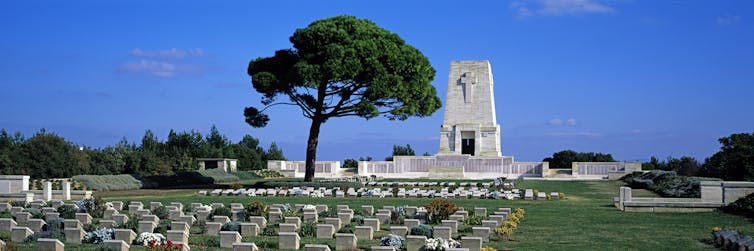

How do they work?

These RATs contain antibodies that can detect influenza A, influenza B, and SARS-CoV-2.

Some kits have a test cassette with one well to add drops to and one window labelled: C (control), A (influenza A), B (influenza B) and T (test for COVID).

Some tests have two wells and two test windows. You view the influenza results in one window and the COVID results in the other.

Test cassette of combined flu/COVID rapid antigen test
Some test cassettes have two wells, like this one.
TGA

In the influenza window you will see markings C, A and B. If a line becomes visible at A (and C), you have tested positive for influenza A. If a line becomes visible at B (and C), you are positive for influenza B. If lines are visible at A, B and C you have tested positive for both influenza A and B.

If either A or B has a line but not C, or if none of them do, the test is invalid and you will need to take a new one.

The COVID window works the same way as in a standard RAT for COVID. If a line becomes visible at C and T, you are COVID-positive. If there is a line at C but not T, you are COVID-negative. If there is no line at C the test is invalid.


Read more:
Is my RAT actually working? How to tell if your COVID test can detect Omicron


Why take the test? 3 reasons

If you have respiratory symptoms, there are some practical reasons for knowing whether you are positive for COVID or flu.

One, if you know you have COVID, this will affect the timing of your booster vaccine. The Australian Technical Advisory Group on Immunisation recommends adults wait six months after a COVID infection to get a booster to increase the time you have protective immunity. So it helps to know if you have been infected.

Two, if you need antiviral treatment, the medications differ depending on whether you have flu or COVID.

Three, knowing you have flu or COVID means you can take steps to protect others. This could mean working at home, avoiding contact with vulnerable people, and wearing a mask in company.

Woman's holding Paxlovid pill in one hand, glass of water in other, Paxlovid, thermometer in background
If you know you have COVID, you may be eligible for antiviral treatment.
MargJohnsonVA/Shutterstock

Which test to use? When to use it?

The Therapeutic Goods Administration (TGA) lists approved tests on its website. Type the term “combination” in the search box. All combo tests currently listed use nasal swabs to collect the sample.

Most are listed as “very high sensitivity”. This means they get the same result in detecting positive cases as the gold standard PCR test 95% of the time. The others have “high sensitivity” (90% agreement with a PCR).

The best time to take the test is within four days of developing symptoms, as this is when it is easiest to detect both flu and COVID. The tests are more reliable if you have symptoms.


Read more:
15 things not to do when using a rapid antigen test, from storing in the freezer to sampling snot


What if I have symptoms but the test is negative?

One possibility is that your viral load was not high enough to be detected. You could take another test a day or so later to check again.

Another is you may have a different virus. Viruses that cause respiratory symptoms include rhinoviruses, adenoviruses, respiratory syncytial virus and common cold coronaviruses.

Other pathogens (disease-causing microorganisms) or health conditions can also cause respiratory symptoms. If you are concerned, consult your doctor for medical advice.


Read more:
Haven’t had COVID or a vaccine dose in the past six months? Consider getting a booster


What else should I know?

As each test differs, make sure you follow the instructions for that specific test.

The price of combo kits advertised online varies from A$8.95 to $59 (excluding delivery) so it pays to shop around.

It’s worth trying to avoid catching the flu rather than testing for it later. Flu vaccination reduces your chances of catching the flu by 40-60% when the vaccine is well matched to circulating strains. Flu vaccines for the 2023 flu season are available now.

The Conversation

Thea van de Mortel teaches into the Master of Infection Prevention and Control program at Grififth University.

ref. Flu or COVID? You can now test for both at home with a single swab. Here’s what you need to know – https://theconversation.com/flu-or-covid-you-can-now-test-for-both-at-home-with-a-single-swab-heres-what-you-need-to-know-204119

Australian unis could not function without casual staff: it is time to treat them as ‘real’ employees

Source: The Conversation (Au and NZ) – By Kathleen Smithers, Lecturer, Charles Sturt University

ThisIsEngineering/Pexels

This article is part of our series on big ideas for the Universities Accord. The federal government is calling for ideas to “reshape and reimagine higher education, and set it up for the next decade and beyond”. A review team is due to finish a draft report in June and a final report in December 2023.


University working life may conjure up images of professors with book-lined offices, built up over a decades-long career in the one institution. But the reality is precarity has become the norm in Australian higher education teaching and research.

According to the Universities Accord discussion paper stakeholders have already

raised concerns about insecure work and underpayment in the higher education sector, particularly for casual or sessional staff.

The discussion paper also notes 50 to 80% of undergraduate teaching in Australia is now done by casual or sessional staff (who are hired for a semester). However, the true figure is likely to be higher as universities report on “full-time equivalent” staff rather than the actual number of people employed on contracts.

The Universities Accord represents the best opportunity in a generation to fix the dire employment practices in higher education.

If it is going to do this, it needs to recognise the significant contribution of those in precarious employment to both teaching and research in Australian universities. We must stop treating casuals as though they are an afterthought, rather than a vital part of higher education.

A huge rise in casual staff

Employment of casual staff has been on the rise since the late 1980s. According to the National Tertiary Education Union, the number of casual and fixed-term staff in higher education grew 89% between 2000 and 2019. The number of continuing (or permanent) staff increased by 49% over the same period.

The union also estimates more than A$100 million in unpaid wages is owed to casual academic staff in Australia.

A tutor speaks to a group of students
Up to 80% of Australian undergraduate teaching is done by casual or sessional staff.
Fauxels/Pexels

Precarious employment is also common in universities across the globe. Around half of all academic staff in the United Kingdom and more than 70% of staff in the United States are “non-tenure track”, meaning that they are employed on short-term contracts without any promise of ongoing work or career progression.

A key difference for Australian academics is the proliferation of highly casualised project-specific roles. These roles lead to semester-based employment for teaching and hours-based contracts for research work.

So, rather than being employed by one institution for a fixed period, Australian academics juggle a variety of contracts in both teaching and research, across multiple universities. This sees them work long hours with little time for their own research – an imperative for researchers looking to make a career in academia.

There are no statistics for the number of people employed at multiple institutions, but most casual academics we encountered in our research work across multiple universities. This has also been reported in media investigations about casual staff in the higher education sector.

Our research: ‘a trend of overwork’

Our research investigates the experiences of those employed in precarious positions in Australia. Between 2018 and 2019, we spoke with 27 academics employed in a range of insecure roles at universities in Australia and the UK.

Two of the main issues for casuals is insecurity and a lack of career progression. As one researcher, with more than a decade of experience, told us:

I did have someone I was working with one time saying, ‘Oh, you need to think about your career, and your career path’ and I just thought, ‘I’ve got too much to do to think about my career’. I think really […] if you can just get a job and keep working, that’s an achievement in itself.

Our interview research also showed contract researchers are often employed on grant funding for projects in which they may have little expertise. These researchers frequently work additional unpaid hours to “prove their worth” and increase the possibility of future employment.

As one interviewee who has worked on a number of hours-based contracts in social sciences notes:

I’d work probably three or four days, at the start, for just one day of [paid] work. So, I think there is very much a trend of wanting to overwork, when you’re starting out as a casual research assistant, because you really want to prove your worth.

Despite the huge proportion of contract researchers, interviewees report they are treated as disposable and not part of the “real” academic workforce. Unfortunately, there is no requirement for universities to report on the continuation of contracts or career development for those in precarious positions.

Sessional teaching staff face similar challenges, with some allocated only ten minutes to read a piece of work and provide feedback. They are also not given any paid time to support struggling students.

The temporary nature of the funding means there is little oversight of their employment conditions, training or career progression. A 2019 union survey of more than 6,000 casuals found only 18% were satisfied with their “mode” of employment. More than two thirds of those surveyed preferred permanent work.


Read more:
‘Some of them do treat you like an idiot’: what it’s like to be a casual academic


What needs to happen instead

A dramatic overhaul of university employment structures is required.

This should begin by including practices that are considered “normal” in other industries, namely: payment for all work completed, payment for attendance at compulsory meetings, payment for a minimum number of hours per “shift”, adequate time to complete work, career progression, professional development and stability of income.

Universities should also recognise the diversity of employees’ employment aims and focus on fair conditions for all staff. For example, not all academics would like to work full-time or undertake research. Universities could create part-time teaching-focused roles for those who would like to maintain currency in their industry whilst working at a university, or for those who want flexible working arrangements.

A pile of open books.
Casual staff should be paid for all the work they do.
Lum3n/Pexels

These jobs should not be considered peripheral to the “real” work of universities but acknowledged as a core component of modern university employment structures. Those who choose to remain in causal employment should be paid fairly for all work completed and have easier mechanisms to convert to permanent employment should they wish to do so.

Universities should also support academics in ongoing employment to have the time and capacity to improve their supervision and mentoring of casual or contract staff.


Read more:
Here’s what the government and universities can do about the crisis of insecure academic work


As part of this, stable and continuous funding to universities is essential.

To start with, the percentage of Gross Domestic Product invested in research could be increased. Australia spends 1.8% of GDP on research, down from 2.25% in 2008 and well behind the OECD average of 2.68%. 2020 figures show universities funded more than half of their own research and development, which accounts for 36% of all Australian research.

The current lack of funding certainty makes it much harder to plan projects and employ researchers in an ongoing capacity.

More secure funding along with policy settings that steer universities away from a corporatised model (where spending on staff is cut in the name of budget bottom lines), could have a significant difference on how universities employ staff.

The impacts of these changes extend beyond the individual employee. If staff are more secure and better supported, this will also support improvements in teaching and learning as well as world-leading research.

The Conversation

The authors do not work for, consult, own shares in or receive funding from any company or organisation that would benefit from this article, and have disclosed no relevant affiliations beyond their academic appointment.

ref. Australian unis could not function without casual staff: it is time to treat them as ‘real’ employees – https://theconversation.com/australian-unis-could-not-function-without-casual-staff-it-is-time-to-treat-them-as-real-employees-203053

Suzume builds on a long line of Japanese art exploring the impacts of trauma on the individual and the collective

Source: The Conversation (Au and NZ) – By Gwyn McClelland, Senior Lecturer, Japanese Studies, University of New England

IMDB

Makoto Shinkai has found a winning formula with the release of his newest anime Suzume, already the fourth-highest-grossing anime film of all time.

Shinkai released his debut animated feature film, The Place Promised in our Early Days, in 2004. Popularly referred to as the “new Miyazaki”, Shinkai is known for his detailed and realistic scenery.

His seventh feature film, Your Name (2016), about a pair of teenagers who have never met but randomly start swapping bodies, became an international sensation and brought Shinkai to mainstream attention.

In Suzume, the teenage titular character travels across Japan with a cat and a mysterious young-man-turned-talking-chair, sealing doors between worlds to prevent natural disasters.

In many ways, Suzume is light-hearted and action-filled, but at its core it is a tale of courage in the face of trauma.

Themes of disaster, loss and the environment are common across many of Shinkai’s films. But this film is his clearest exploration yet of the alignment of collective and personal trauma.


Read more:
Miyazaki’s legacy is sure to live on … whether or not he retires


The earthquake in art

The 2011 Japanese earthquake, referred to colloquially as the “triple disaster” due to the subsequent tsunami and meltdown at the Fukushima Dai-ichi Nuclear Plant, looms omnipresent in contemporary Japanese fiction and film.

Kazuto Tatsuta’s manga Ichi-F(いちえふ) (2013-15) explored the author’s experience cleaning up after the disaster as a worker at the plant in 2011.

An archive of oral histories, photographs and real-time tweets about the disaster, named The East Japan Earthquake Archive, includes oral testimonies geomapped onto a Google Earth map.

Chinese artist Ai Weiwei completed a Fukushima Art Project in 2015, visiting the nuclear exclusion zone and installing two art installations in response.

Fukushima 50 (2020) is a movie telling the story of how the employees of Fukushima Dai-ichi responded to the nuclear meltdown. Homeland (2014) is the story of a young man who returns to live in the no-go zone of Fukushima. Odayaka (2012) follows flatmates in Tokyo concerned about radiation and toxicity immediately after the earthquake.

Shinkai’s Your Name has been interpreted as his own indirect response to the catastrophe. In this anime, Taki’s hometown Itomori is wiped out by a comet – Shinkai’s reference to the earthquake.

Suzume is part of an ongoing project for many Japanese creators: to represent the trauma of disaster through a personal, empathetic story.


Read more:
Fukushima: ten years on from the disaster, was Japan’s response right?


Exploring trauma

There is more than one type of trauma.

There is the trauma experienced by the individual, and cultural trauma shared among a wider population.

In Suzume, Shinkai tackles individual trauma, but the film also reflects a wider cultural trauma.

When she was five, Suzume lost her mother during the chaos following the 2011 earthquake and tsunami. Now 17, she carries the burden of this childhood trauma.

Memories of this event return in her dreams and as she nears her childhood home. But she is not just experiencing her own individual trauma. She shares the wider trauma of the memory of Fukushima and the earthquake with others.

When Suzume prevents new disaster by desperately remembering those who lived in these towns, she draws upon and connects with this collective memory and loss.

The art of recovery

The film follows Suzume’s journey to north-east Japan, beginning by ferry boat from Kyushu to Shikoku, then on to Kobe, Tokyo and Tohoku.

The threat of earthquakes is an everyday reality: notifications light up phones, crowds stand on sidewalks waiting to see what will happen, and then – after the shock – ordinary life returns.

Shinkai’s depiction of devastated countryside, destroyed homes and displaced ships in Suzume’s memories directly draws on footage that emerged from the Tohoku region in 2011, combining Shinkai’s trademark realism with a nation-wide memory of disaster.

Although the film alludes to the nuclear accident through contaminated soil trucks in one scene, this is not the main focus. The focus is on the survivors of the earthquake and tsunami, which claimed 15,500 lives and left 450,000 people homeless.

Suzume has limited but painful memories of this time when she lost both her mother and the world as she knew it. Her only record is a diary where she blacked out those days.

In Suzume, trauma is a “black hole” in which there is no light and in which time does not pass.

This is depicted in the liminal space of tokoyo (“ever after”), a concept from Japanese mythology: a timeless space Suzume enters via wooden doors dotted across Japan. In mythology, tokoyo can also mean the place of the dead. In this film, Suzume became lost in the tokoyo as a girl. In returning to tokoyo, she can seek out and attempt to comfort her childhood self.

She can seek to comfort herself and understand the experience, but she cannot erase the tragic events or their impact.

Moving forward

Suzume could be seen as scriptotherapy – a story written to help the author come to terms with a traumatic event and rediscover a sense of control.

The film uses the journey across Japan, fantastical imagery and evocative comedic music to represent collective and personal healing.

Some of the film’s representations of trauma are a little too clean: ultimately, Suzume’s emotional release is fully achieved through returning an item tied to her lost mother to her younger self.

Yet the film stands its ground in the large collection of films and literature coming to terms with the memory of Japan’s 2011 triple disaster. It also invites consideration of how we might continue to heal from and memorialise our current era: how will we ultimately remember the trauma of the COVID pandemic and what stories will we tell?

Suzume is in Australian cinemas now.

The Conversation

Gwyn McClelland has previously received funding from the Japan Foundation, Tokyo.

Laura Emily Clark has previously received funding from the Japan Foundation, Sydney.

Lili Pâquet does not work for, consult, own shares in or receive funding from any company or organisation that would benefit from this article, and has disclosed no relevant affiliations beyond their academic appointment.

ref. Suzume builds on a long line of Japanese art exploring the impacts of trauma on the individual and the collective – https://theconversation.com/suzume-builds-on-a-long-line-of-japanese-art-exploring-the-impacts-of-trauma-on-the-individual-and-the-collective-203920

The IPCC’s calls for emissions cuts have gone unheeded for too long – should it change the way it reports on climate change?

Source: The Conversation (Au and NZ) – By Ralph Sims, Emeritus Professor, Energy and Climate Mitigation, Massey University

Gary Hershorn/Getty Images

Emissions from human activities are substantially increasing the atmospheric concentrations of the greenhouse gases CO₂, methane, CFCs and nitrous oxide. These increases will enhance the greenhouse effect, resulting on average in an additional warming of the Earth’s surface.

Long-lived gases would require immediate reductions in emissions from human activities of over 60% to stabilise their concentrations at today’s levels.

These are not statements from the latest report released by the Intergovernmental Panel on Climate Change (IPCC). They come from its first assessment in 1990.

Back then, the IPCC acknowledged there were uncertainties in the predictions due to incomplete scientific understanding of sources and sinks of greenhouse gases. But what has actually happened in the 30 years since largely matches the predictions:

  • an average rate of global sea level rise of 30-100mm per decade due to the thermal expansion of the oceans and the melting of some land ice

  • an increase of global mean temperature of about 0.3℃ per decade under business as usual.

The IPCC also predicted the rise in temperature would slow as we ramped up efforts to cut emissions, but this scenario hasn’t been tested because emissions reductions never happened.

In 1990, the IPCC also presented the first warnings about potential climate change impacts. It then repeated them in one form or another in the following five assessment reports. But emissions continued to rise each year, resulting in a global temperature increase of 1.1-1.2℃.


Read more:
IPCC’s conservative nature masks true scale of action needed to avert catastrophic climate change


We know how to reduce emissions

On a more positive note, annual emissions from 18 countries have peaked during the past decades – but not always as a result of climate policies. For example, the UK’s manufacturing capacity reduced significantly as companies moved off-shore. Nevertheless, global emissions kept rising.

Chapters in IPCC reports covering agriculture, land-use change, energy supply, transport, buildings, industry and urban settlements repeatedly provided clear guidance on emissions cuts, such as this section from 2001:

Hundreds of technologies and practices for end-use energy efficiency in buildings, transport and manufacturing industries account for more than half of the potential to reduce greenhouse gas emissions.

Details of how to reduce emissions from improved energy efficiency in all sectors have been repeated in all six IPCC assessments. But many opportunities to reduce energy demand, and save costs, have not been implemented. Although scientific knowledge has advanced since 1990 and a range of low-carbon technologies have evolved and improved, the key IPCC messages have remained the same.

Given the many repeated warnings, why have global greenhouse gas emissions continued to rise? Typical answers include population growth, the rise of the middle classes in many developing countries, increased consumerism, greater tourism, lobbying by the fossil fuel industry and higher consumption of animal proteins.

National and local governments have also struggled to implement strong climate policies because the majority of their citizens and businesses remain unwilling to change their behaviour. This is even the case when co-benefits are clearly evident, including improved health, reduced traffic congestion and lower costs.

People celebrating at the end of a session by the IPCC
The conclusion of the IPCC’s latest report earlier this year marked the end of its sixth assessment cycle.
Earth Negotiations Bulletin, CC BY-ND

A possible future for the IPCC

Having assessed thousands of published research papers over 33 years, what has the IPCC actually achieved since its inception in 1988? And what should be its future role given that many of its strong messages have largely gone unheeded?

Arguably, present and future climate impacts would have been even worse without the IPCC’s work. With each report, the urgency to act on both mitigation and adaptation increased. Few climate deniers now remain. More people want their governments to act.


Read more:
Climate change: multi-country media analysis shows scepticism of the basic science is dying out


Although total global emissions continue to rise, energy-related carbon dioxide emissions may be reaching a plateau. According to the International Energy Agency, these emissions rose by under 1% in 2022 – less than initially feared after the COVID dip – largely because of the growth of solar, wind, electric vehicles, heat pumps and improved energy efficiency measures.

So there is hope. But after 25 years of personal involvement with six IPCC reports, my view is that it’s time to review the role of the IPCC and its three main working groups before the next assessment cycle begins.

Since climate science continues to evolve, the IPCC’s Working Group One on the science of the climate system should continue to assess and present the latest knowledge every five to six years.

The need for adaptation and resilience is finally receiving greater attention, mainly as a result of more extreme climate impacts and growing insurance claims. Therefore, Working Group Two should continue but report every two years so that both scientific analyses and local real-world experiences can be shared quickly between local and national governments.


Read more:
Communicating climate change has never been so important, and this IPCC report pulls no punches


Measures to cut emissions have evolved as newer technologies have been developed and refined. The present understanding of the policies and solutions to reducing emissions across all sectors is similar to 1990 knowledge – we just need to get on with implementing solutions by removing remaining barriers through regulation and advice.

Research to reduce and capture carbon dioxide emissions will continue, but given the urgency, it is too risky to hope that new low-carbon technologies and systems will one day prove to be commercially successful. Overall, the IPCC’s Working Group Three on mitigation has done its job and should be replaced by a new working group on changing human behaviour.

Behavioural science has been included in various chapters within more recent IPCC reports. Without significant social change in the near term, the emissions curve will not bend downwards. Renewed emphasis on how to best achieve societal change across cultures as a matter of urgency is crucial.

The Conversation

Ralph Sims has received travel funding from NZ Government to support his previous role as an IPCC author.

ref. The IPCC’s calls for emissions cuts have gone unheeded for too long – should it change the way it reports on climate change? – https://theconversation.com/the-ipccs-calls-for-emissions-cuts-have-gone-unheeded-for-too-long-should-it-change-the-way-it-reports-on-climate-change-202837

Fiji tax system – ‘we’ll look after our vulnerable people’, says Prasad

By Shayal Devi in Suva

Any attempt to review or change Fiji’s existing taxation system will be done with proper consideration of all reports and recommendations on the issue, says Fiji’s finance minister.

Professor Biman Prasad, who is also co-deputy Prime Minister, said that any decision to make such changes lay solely with the government.

“We are obviously going to look at all the reports, all the recommendations, but at the end of the day, it’s government that will decide what is the best course of action,” he said.

“We want to balance our revenue, our expenditure — but also our support and continue assistance to those who are most vulnerable, those who may be living in poverty, those who have low income.

“This is a government which had started already on a good footing.”

He said they were committed towards assisting the people, as they had done through the back-to-school assistance and extension of the bus fare subsidy.

“This government is firmly focused on looking after our people, but also making sure that we improve our health infrastructure, health services and that is what has come out of this [National Economic Summit].

“We are confident that despite all the big challenges that we have, the government is firmly focused on taking this country forward.”

Shayal Devi is a Fiji Times reporter. Republished with permission.

Print Friendly, PDF & Email

Article by AsiaPacificReport.nz

Australia announces pathway to citizenship for New Zealanders

By Giles Dexter, RNZ News political reporter

The Australian government has announced a direct pathway to citizenship for New Zealanders, ending a tension between the two countries that has lasted for more than 20 years.

Since 2001, New Zealanders in Australia have been able to reside there on a Special Category Visa. While it has allowed them to remain in Australia indefinitely, getting permanent residency and citizenship has been much more difficult.

It has meant New Zealanders have been unable to access benefits such as student loans, join the Defence Force, or even vote.

In contrast, Australians in New Zealand have had a clear pathway to citizenship after five years.

But from 1 July, New Zealanders who have been on the Special Category Visa and lived in Australia for four years will be able to get citizenship.

They will still need to meet standard criteria (such as pass a character check, a language test, and intend to stay in Australia), and attend a citizenship ceremony.

The pathway is retrospective, meaning those in Australia since 2001, when the SCV came into effect, will be able to apply for citizenship without gaining permanent residence first.

Citizens at birth
Kiwi children born in Australia will become citizens at birth, rather than waiting until they are 10 years old.

“This is a fair change for New Zealanders living in Australia, and brings their rights more in line with Australians living in New Zealand. This is consistent with our ambition to build a fairer, better managed and more inclusive migration system,” the Australian government said in a statement.

Prime Minister Chris Hipkins said the announcement has brought the nations closer together.

“This is the biggest improvement in the rights of New Zealanders living in Australia in a generation,” he said.

“Most of us know someone who’s moved across the Tasman. They work hard, pay taxes and deserve a fair go. These changes deliver that and reverse erosions that have taken place over 20 years.”

The announcement has been deliberately timed to be close to Anzac Day, with Hipkins flying to Brisbane to mark the occasion.

This year marks the 40th anniversary of the Closer Economic Relations agreement between the two countries, as well as the 50th anniversary of the Trans-Tasman travel arrangement, which allowed each country’s people to live and work in the other country.

Deep friendship
“Australia and New Zealand have a deep friendship, which has been forged through our history, shared values and common outlook.

“As we mark the 50th anniversary of the Trans-Tasman Travel Arrangement, I look forward to strengthening our relationship,” said Australian Prime Minister Anthony Albanese.

The two prime ministers will celebrate the announcement with a community barbecue and citizenship ceremony in Brisbane on Sunday.

They will also visit a cemetery to attend the unveiling of plaques for previously unmarked graves of soldiers who served during World War I and World War II.

This article is republished under a community partnership agreement with RNZ.

Print Friendly, PDF & Email

Article by AsiaPacificReport.nz

American Samoa confirms a case of measles – day care centres close

RNZ Pacific

Daycare centres have been shut down in American Samoa following confirmation of an eight-year-old girl with measles.

The territory’s Department of Health (DOH) said samples from the child, who was seen at a community centre with symptoms on March 27, were sent for testing in California and returned positive.

Day cares are now closed to protect babies from being exposed to the virus, as infants under six months are not eligible for the Measles, Mumps and Rubella (MMR) vaccine.

Kanana Fou Elementary School in Tafuna, where the girl attends, has also been closed.

The Health Department will monitor the situation as to whether more schools will be closed, said Director of Health Motusa Tuileama Nua.

“This is is highly contagious disease and can spread quickly and poses a serious threat to individuals who are not vaccinated or who have weakened immune systems,” Nua said.

“We are working closely with healthcare providers, local officials, and other stakeholders to coordinate our response efforts and provide necessary support to those affected,” he said.

“We will continue to monitor for any other cases and provide updates as necessary.”

The Department of Health has the names of children who have not received the first and second measles vaccinations and will be contacting their parents to get them immunised.

Parents have been urged to check on their children’s measles vaccination.

Symptoms of measles include a fever, a rash, runny nose, and reddening of the eyes.

This article is republished under a community partnership agreement with RNZ.

Print Friendly, PDF & Email

Article by AsiaPacificReport.nz

Indonesian security crackdown in West Papua – ‘traumatising raids, torture’

Asia Pacific Report

Indonesian security forces have intensified operations in various conflict areas in West Papua, reports Human Rights Monitor.

According to information received by the international watchdog, security force members have raided villages and set residential houses on fire.

The raids reportedly occurred in conflict hotspots in West Papua, predominantly in the Puncak, Nduga, and Intan Jaya regencies, but also in less conflict-affected places such as the districts Elilim and Apahapsili in the Yalimo regency on 1 and 2 April 2023 – two weeks  before last weekend’s clash between Indonesian soldiers and pro-independence militia.

Indigenous Papuans, including women and children, were arrested and tortured.

Observers predicted an aggravation of the conflict weeks ago after the Indonesian military deployed more than 2000 additional personnel to West Papua throughout March 2023.

‘Ground combat ready’
Meanwhile, the Indonesian chief-of-armed forces, General Laksamana Yudo Margono, announced that the mode of operations against the West Papua National Liberation Army (TPNPB) was switched from a “soft approach” to “ground combat ready” operations after a disputed number of soldiers were killed in a firefight with TPNPB members in Nduga on 15 April 2023.

Meanwhile, the increased security force presence comes with government-driven “socialisation” programmes, where military and police members directly interact with local communities.

They participate in collective work, visit schools, and take over or accompany essential healthcare services.

For decades, many indigenous Papuans have been traumatised due to the history of violent military operations in West Papua, says Human Rights Monitor.

They fear becoming victims of arbitrary arrest, torture, killings, or enforced disappearance.

The military presence in schools, health facilities, and churches limits indigenous Papuans from accessing essential public services.

Print Friendly, PDF & Email

Article by AsiaPacificReport.nz

Remembering Barry Humphries, the man who enriched the culture, reimagined the one man show and upended the cultural cringe

Source: The Conversation (Au and NZ) – By Anne Pender, Kidman Chair in Australian Studies and Director, JM Coetzee Centre for Creative Practice, University of Adelaide

Barry Humphries began his career as a Dadaist. His street performances around Melbourne in the early 1950s foreshadowed performance art in Australia. He was the most daring student prankster Melbourne University had ever known.

Years later, academic Peter Conrad accurately described Humphries’ adolescence as a “one man modern movement”.

The young man secured his first paid acting role after a number of complaints from various women about a Dadaist event called Call Me Madman!, staged at the University of Melbourne’s Union Theatre in 1953. It was anarchic, just like the early Dada shows of the Cabaret Voltaire in Zurich several decades earlier.

Call Me Madman! opened with a single musical phrase played on a violin over and over again, then a pianist sitting out of view of the audience sounded the same chords and notes in repetition, and ended in a ferocious food fight, with Humphries hiding in a cupboard from the outraged students who stormed the stage.

This parody taught him how to provoke his audience, securing their complicit and violent participation in his act. It also gave him his first taste of the power of an audience to determine what happens in the theatre. It was both risky and intoxicating.

When John Sumner, founder of the burgeoning Union Theatre Repertory Company (which would go on to become Melbourne Theatre Company), heard the complaints about the revue, he offered the young man a job.


Read more:
Does Australia ‘get’ culture?


The birth of Edna

On a tour of country Victoria with the company, Humphries performed a spidery Orsino in Twelfth Night, directed by Ray Lawler with Zoe Caldwell as Viola.

Humphries entertained the cast on the long bus rides, with falsetto speeches in cruel but hilarious parody of the predictable words of thanks given in every town by ladies of the Country Women’s Association over tea. The character invented to pass the time on the bus made her debut in Lawler’s Christmas revue in 1955.

Edna was a composite portrait of various women whose mannerisms had imprinted themselves in his brain as a boy, growing up in staid Camberwell.

With his new character, Humphries summoned a whole new world to the stage and created a comedy of ordinariness that had never been presented before.

This Mrs Average took on a life of her own and shone as the centrepiece of Humphries’ theatrical world for the next 60 years, becoming Dame Edna Everage – elevated by the Prime Minister Gough Whitlam himself – in Barry McKenzie Holds His Own in 1974.

Just two years later, Humphries’ extravaganza Housewife Superstar! charmed the West End. Wearing a massive hat sculpted to resemble the Sydney Opera House, Edna stopped the crowds at Royal Ascot that year.

The image of her in that sumptuous creation (now in the Victoria and Albert Museum) launched Edna and Humphries around the world.

Conquering the world

Edna hosted a series of chat shows on British television, watched every week by an audience of eight million. She skewered dozens of politicians, pop stars, singers and actors who graced the program every week.

Her appearance with Jerry Hall singing Stand by your Man remains one of the most hilarious television moments of that time.

Humphries’ success on British television in the 1980s and 1990s were among the major achievements of his career. He created his very own theatre of the absurd with his reinvention of the chat show. The me-generation could not get enough.

After that, Edna conquered Broadway.

Humphries’ theatrical magic also included dozens of other characters, all of them parodic and sharply satirical, such as the hard-drinking diplomat Sir Les Patterson.

He delighted audiences and prosecuted his satirical attacks on Australian life. On stage and on television, his ingenuity as a performer derived from his instinct for improvisation. At his best, the audience was treated to exceptional satirical theatre.

The early years

John Barry Humphries was born February 17 1934, the oldest child of Eric and Louisa Humphries. Eric ran a flourishing building business (he might be called a developer nowadays) and Louisa was a homemaker. As a child, Barry was close to his sister, Barbara. Barry also enjoyed adult company. He loved dressing up and accompanying his mother on trips to the city or out for lunch with other ladies.

At Melbourne Grammar, Humphries found the boys who excelled in sports rewarded and praised for their achievements. Everyone else was a second-class citizen. An interest in art or music was considered by the headmaster to be suspicious, a disappointment for Humphries, passionate about art.

In time, Humphries found a way to survive Melbourne Grammar – through provocation. When he was reprimanded for failing to cut his hair to regulation length, he stared coolly at the headmaster and said, “There’s one man in the chapel with hair that is longer than mine. His name is Jesus”.

Humphries’ comment was not punished. Before long everyone had heard of his audacious retort.

On icy winter afternoons at the MCG – compelled to watch the titans of the school wrestle in the mud – Humphries found an ingenious way of expressing his view of proceedings. He positioned himself in a chair with his back to the football field, facing the spectators.

Slowly he drew out of his specially made Gladstone bag a set of large knitting needles and ball of wool; he would sit for the duration of the match calmly knitting a cardigan.

A transformational artist

Humphries was resilient and indomitable. He defeated alcoholism. He was generous, competitive and single minded.

With his mask off he was as witty as when he wore it. He married four times and raised two daughters and two sons.

He is survived by his wife Lizzie Spender, and children Tessa, Emily, Oscar and Rupert.

Humphries transformed Australian comedy, bringing an astringent and anarchic Australian theatre to the world. Manning Clark called him one of the “mythmakers and prophets of Australia […] enriching the culture which had been dominated by the straiteners”.

He certainly enriched the culture, reimagined the one man show and upended the cultural cringe. Bravo Barry. Farewell.


Read more:
Friday essay: Barry Humphries’ humour is now history – that’s the fate of topical, satirical comedy


The Conversation

Anne Pender received funding from the Australian Research Council for a project on Barry Humphries. Anne’s biography of Humphries, One Man Show: The Stages of Barry Humphries, was published in 2010.

ref. Remembering Barry Humphries, the man who enriched the culture, reimagined the one man show and upended the cultural cringe – https://theconversation.com/remembering-barry-humphries-the-man-who-enriched-the-culture-reimagined-the-one-man-show-and-upended-the-cultural-cringe-188719

Networks of silver nanowires seem to learn and remember, much like our brains

Source: The Conversation (Au and NZ) – By Alon Loeffler, PhD researcher, University of Sydney

Shutterstock

Over the past year or so, generative AI models such as ChatGPT and DALL-E have made it possible to produce vast quantities of apparently human-like, high-quality creative content from a simple series of prompts.

Though highly capable – far outperforming humans in big-data pattern recognition tasks in particular – current AI systems are not intelligent in the same way we are. AI systems aren’t structured like our brains and don’t learn the same way.

AI systems also use vast amounts of energy and resources for training (compared to our three-or-so meals a day). Their ability to adapt and function in dynamic, hard-to-predict and noisy environments is poor in comparison to ours, and they lack human-like memory capabilities.

Our research explores non-biological systems that are more like human brains. In a new study published in Science Advances, we found self-organising networks of tiny silver wires appear to learn and remember in much the same way as the thinking hardware in our heads.

Imitating the brain

Our work is part of a field of research called neuromorphics, which aims to replicate the structure and functionality of biological neurons and synapses in non-biological systems.

Our research focuses on a system that uses a network of “nanowires” to mimic the neurons and synapses in the brain. These nanowires are tiny wires about one thousandth the width of a human hair. They are made of a highly conductive metal, such as silver, typically coated in an insulating material like plastic.

Left: microscope image of silver nanowire networks, from our Science Advances paper. Right: strengthened and pruned (weakened) pathways in nanowire networks.

Nanowires self-assemble to form a network structure similar to a biological neural network. Like neurons, which have an insulating membrane, each metal nanowire is coated with a thin insulating layer.

When we stimulate nanowires with electrical signals, ions migrate across the insulating layer and into a neighbouring nanowire (much like neurotransmitters across synapses). As a result, we observe synapse-like electrical signalling in nanowire networks.

Learning and memory

Our new work uses this nanowire system to explore the question of human-like intelligence. Central to our investigation are two features indicative of high-order cognitive function: learning and memory.

Our study demonstrates we can selectively strengthen (and weaken) synaptic pathways in nanowire networks. This is similar to “supervised learning” in the brain. In this process, the output of synapses is compared to a desired result. Then the synapses are strengthened (if their output is close to the desired result) or pruned (if their output is not close to the desired result).

We expanded on this result by showing we could increase the amount of strengthening by “rewarding” or “punishing” the network. This process is inspired by “reinforcement learning” in the brain.


Read more:
Neuronlike circuits bring brainlike computers a step closer


We also implemented a version of a test called the “n-back task” which is used to measure working memory in humans. It involves presenting a series of stimuli and comparing each new entry with one that occurred some number of steps (n) ago.

The network “remembered” previous signals for at least seven steps. Curiously, seven is often regarded as the average number of items humans can keep in working memory at one time.

When we used reinforcement learning, we saw dramatic improvements in the network’s memory performance.

In our nanowire networks, we found the formation of synaptic pathways depends on how those synapses have been activated in the past. This is also the case for synapses in the brain, where neuroscientists call it “metaplasticity”.

Synthetic intelligence

Human intelligence is still likely a long way from being replicated.

Nonetheless, our research on neuromorphic nanowire networks shows it is possible to implement features essential for intelligence – such as learning and memory – in non-biological, physical hardware.


Read more:
Five ways the superintelligence revolution might happen


Nanowire networks are different from the artificial neural networks used in AI. Still, they may lead to so-called “synthetic intelligence”.

Perhaps a neuromorphic nanowire network could one day learn to have conversations that are more human-like than ChatGPT, and remember them.

The Conversation

Zdenka Kuncic owns shares in Emergentia, Inc.

Alon Loeffler does not work for, consult, own shares in or receive funding from any company or organisation that would benefit from this article, and has disclosed no relevant affiliations beyond their academic appointment.

ref. Networks of silver nanowires seem to learn and remember, much like our brains – https://theconversation.com/networks-of-silver-nanowires-seem-to-learn-and-remember-much-like-our-brains-204115

Most people already think climate change is ‘here and now’, despite what we’ve been told

Source: The Conversation (Au and NZ) – By Ben Newell, Professor of Cognitive Psychology and Director of the UNSW Institute for Climate Risk and Response, UNSW Sydney

Julentto Photography/Unsplash

A quick search on the internet for “climate change images” readily yields the familiar photograph of a lone polar bear on a shrinking block of ice. Despite signifying an impending crisis, such images make climate change seem abstract – happening a long way off (for most of us), to animals we’ve probably never encountered.

The idea that climate change is perceived as “psychologically distant” – happening in the future, in distant places, to other people or animals – has long been presented as a major barrier to action on climate change.

Despite the intuitive appeal of this idea, new research published today in the journal One Earth by behavioural scientists at the University of Groningen now challenges it. The authors argue the psychological distance of climate change has been overestimated – according to their results, most people view climate change as “psychologically close”.

A review of the evidence

To investigate how prevalent psychological distance to climate change really is – and whether it might prevent climate action – the researchers systematically reviewed the available evidence.

First, they analysed data from 27 public opinion polls from around the world – including China, the US, UK, Australia and the EU – finding that most people perceive climate change as happening now and nearby. And this was not just in recent polls. Data from as far back as 1997 indicated almost half of US respondents believed climate change was already occurring.

Second, based on an analysis of past studies, they found people who perceive climate change as more distant do not necessarily engage in less climate action. Indeed, some studies have shown the opposite pattern. People who perceived climate change as affecting people in far-away locations were more motivated to support climate action.

In short, the evidence for the idea that psychological distance is preventing us from climate action is very mixed.

Third, after examining 30 studies, the team found very little evidence that experiments aimed at changing people’s perception of the psychological distance of climate change actually increase their climate action. For example, studies where people watch videos about the impacts of climate change in local versus distant locations do not show these people having different intentions to engage in environmental behaviour.

As I’ve written in an article on the new study, these results remind us that evidence should always trump intuition when it comes to applying psychological theory. The conclusions also echo earlier calls by me and colleagues to be cautious about the relevance of psychological distance when it comes to climate action.

A thin polar bear trying to jump across melting ice in a wide-angle shot
Polar bears became an early symbol of the devastating results of climate change in the media.
FloridaStock/Shutterstock

How should we communicate about the climate, then?

Climate communication strategies and guidelines from a host of different organisations have popularised the idea that climate change is perceived as psychologically distant.

Our own Australian Psychological Society recommends reducing psychological distance by making the local impacts of climate change more salient. For example, highlighting the increase in the number of extreme heat days in one’s town or region.

But if the aim here is to increase climate action, is this good advice?

There is a trade-off between using psychological distance to capture attention, and the idea that it provides a scientific explanation for why people aren’t doing something.

I’ve often used the idea of psychological distance in talks, and spoken to journalists about it, because it starts a conversation and can be a good way to engage otherwise hard-to-reach audiences. But there is a risk of mixing up the narrative appeal with the scientific support.

At worst, repeating ideas about psychological distance could lead people to overestimate the extent to which others think climate change is psychologically distant. In turn, this might demotivate action. If everyone else thinks this is a problem for the future, why should I do something about it now?


Read more:
For fossil-fuel reliant governments, climate action should start at home


We already know it’s here, now let’s act

Another implication is that advocacy groups and governments could be wasting effort on information campaigns that focus on reducing the psychological distance of climate change. If people know that climate change is near and now, why do we need to reinforce that idea?

Our efforts might be better spent increasing people’s belief in being able to take climate action (“self-efficacy”), and that those actions will be effective (“response-efficacy”).

This implies a need to make pro-environmental actions like driving less or eating more plant-based foods easier and cheaper. But it also highlights the need for structural and societal changes that incentivise behavioural change: from offering subsidies for electric vehicles or renewable energy installation, to international agreements on carbon emissions.

There is also a need to remind people of the moral imperative of taking action.


Read more:
Climate change: multi-country media analysis shows scepticism of the basic science is dying out


Climate change hasn’t moved ‘closer’

There is no doubt climate change is becoming more “real” and more concerning for most of us. From 2018 to 2022, the number of Australians “very concerned” about climate change has nearly doubled, from 24% to 42%.

These changes in attitude are almost certainly linked to the Black Summer bushfires of 2019-20. But does explaining this shift as a reduction of psychological distance add anything to our scientific understanding?

The results of this new study strongly suggest the answer is no. It is time we moved on from considering psychological distance as an impediment to action.

We know climate change is affecting polar bears, but we also know it is affecting us right now. Our efforts now must be focused on changing behaviour at both the societal and individual level.


Read more:
Why attending a climate strike can change minds (most importantly your own)


The Conversation

Ben Newell receives funding from The Australian Research Council.

ref. Most people already think climate change is ‘here and now’, despite what we’ve been told – https://theconversation.com/most-people-already-think-climate-change-is-here-and-now-despite-what-weve-been-told-203425

Solicitor-general confirms Voice model is legally sound, will not ‘fetter or impede’ parliament

Source: The Conversation (Au and NZ) – By Harry Hobbs, Associate professor, University of Technology Sydney

The federal government today released the long-awaited legal advice on the Voice to parliament from Australia’s solicitor-general, Stephen Donaghue.

In it, Donaghue states that the proposed model for the Voice “will not fetter or impede the exercise of existing powers of Parliament”, adding that the proposal

is not just compatible with the system of representative and responsible government prescribed by the Constitution, but an enhancement of that system.

The advice makes clear the Voice is legally sound.

The Voice to parliament

In the Uluru Statement from the Heart, Aboriginal and Torres Strait Islander people expressed the “torment of our powerlessness”. They explained that they do not feel they are heard in the design of law and policy that affects them. They called for a Voice to be put in the Constitution to allow them to have a say.

In our system of government, proposed laws are developed within the executive, which includes the cabinet and government departments. Then they’re presented to parliament. This means that if an Aboriginal and Torres Strait Islander Voice is to be able to inform law and policy, it needs to speak to both the parliament and the executive.

The Albanese government’s proposed constitutional amendment recognises this. Section 129(2) provides that the Aboriginal and Torres Strait Islander Voice “may make representations” to the parliament and the executive government on matters relating to Aboriginal and Torres Strait Islander people.

This language was developed with the advice of some of the nation’s leading constitutional law experts. However, some concerns have been raised about the proposal.

For example, Opposition Leader Peter Dutton has argued that allowing the Voice to present its views to the executive will mark a radical change in Australia’s system of government. Conservative commentators have suggested the Voice will delay or derail proper administration. They argue ministers and public servants will need to give the Voice time and information to enable the Voice to make representations. Ministers may even be obliged to consult and adopt those representations.

The solicitor-general has dismissed these concerns.


Read more:
Why can’t we just establish the Voice to Parliament through legislation? A constitutional law expert explains


Who is the solicitor-general?

The solicitor-general is Australia’s second highest-ranking law officer, after the attorney-general. However, while the attorney-general is a political position filled by a member of parliament, the solicitor-general is independent. Their job is to provide independent legal advice to the government and represent the Commonwealth in legal proceedings.

The solicitor-general was asked to advise the government on two questions.

  1. whether the proposed amendment is compatible with Australia’s system of government

  2. and whether the proposed amendment gives parliament the power to decide the legal effect of any representation, or whether parliament and the executive are required to consider or follow those representations.

What does the advice say?

Question 1

The solicitor-general was very clear. The Voice “would not pose any threat” to our system of government. In fact, it would “enhance” our system.

Donaghue reached this conclusion for two reasons. First, the Voice does not alter the powers of parliament or government in any way. Section 129(2) makes clear the Voice has no veto. Section 129(2) also does not impose any obligation on parliament or the executive to consult with the Voice or follow its advice.

Second, more fundamentally, the Voice would remedy a “distortion” in our system of government. The solicitor-general explained that the Voice would help overcome “barriers that have historically impeded effective participation by Aboriginal and Torres Strait Islander people in political discussions and decisions that affect them”. In short, it would improve our democracy by ensuring Indigenous people can have their voices heard.

Question 2

The second question was directed at the scope of the Voice’s power. It asked whether the parliament or executive would be required to consider or follow representations made by the Voice.

Once again, the solicitor-general was very clear: the answer is no. Donaghue explained that although it would “plainly be desirable for the Executive Government to consider any representations that the Voice makes to it”, parliament has the ultimate say.

This means parliament could enact a law to require ministers or public servants take the advice of the Voice into account when making decisions. However, parliament could always amend or remove such a requirement. The Voice is subject to parliament.

What happens next?

The Voice is a proposal which seeks to ensure Aboriginal and Torres Strait Islander people can participate “in the democratic life of the state”. It seeks to provide an opportunity for them to have their voices heard in the design and delivery of law and policy that affects them.

Prime Minister Anthony Albanese has argued the solicitor-general’s advice “puts to bed” concerns raised by Dutton and others. While the Opposition may disagree, the advice strengthens the view that the Voice is legally sound.

The Conversation

Harry Hobbs is a member of the ALP.

ref. Solicitor-general confirms Voice model is legally sound, will not ‘fetter or impede’ parliament – https://theconversation.com/solicitor-general-confirms-voice-model-is-legally-sound-will-not-fetter-or-impede-parliament-204266

UK minister grilled on West Papua human rights in House of Lords

By Finau Fonua, RNZ Pacific journalist

The United Kingdom’s commitments to upholding human rights have come under question this week over the West Papua issue, resulting in a heated exchange between a government representative and five members of the House of Lords.

The exchange occurred on Monday after the Minister of State for the United Nations, Lord Tariq Ahmad of Wimbledon, responded to a question posed by Lord Harries of Pentregarth on what progress had been made in obtaining access to West Papua for the UN High Commissioner for Human Rights.

Lord Ahmad said the UK government welcomed recent engagements between the UN and Indonesia to meet the recommendations of a Universal Periodic Review, calling for the UN to access and review the human rights situation in West Papua.

He said Indonesia was an important bilateral partner.

“We recognise that a significant amount of time has passed since the visit was first proposed, but we hope that both parties can come together to agree dates very soon,” Lord Ahmad said.

The statement was unsatisfactory for Lord Harries, who pointed out that the UK was not among the eight countries which had endorsed the universal periodic review, and demanded clarity on where the UK stood.

“He (Lord Ahmad) mentioned the universal periodic review of Indonesia. He will know that, at that review, a number of major countries, including the United States, Australia and Canada, called for an intervention from the UN in Indonesia and an immediate visit by the UN High Commissioner for Human Rights,” Lord Harries said.

Support not clear
“It is not at all clear that the United Kingdom was among those supporting that call. Perhaps the minister will be able to enlighten us.”

Lord Ahmad acknowledged a visit by the UN human rights chief to West Papua had been “pending for a long time” but added that the conservative government supported an earlier visit.

Lord Ahmad, House of Lords, 17 April 2023
Minister of State for the United Nations Lord Tariq Ahmad . . . acknowledges a visit by the UN human rights chief to West Papua has been “pending for a long time”. Image: UK Parliament TV/RNZ Pacific

The answer was not well received by Lord Lexden, who condemned Indonesia’s control over the Melanesian region.

“Is it not clear that this small country is suffering grievously under a colonial oppressor,” Lord Lexden said.

“Indonesia, which is busily exploiting the country’s rich mineral resources and extensive forests in its own interests? Will the government do all in their power, in conjunction with Commonwealth partners in the region, to get the UN to act and to act decisively?”

Lord Hanny of Chiswick, Lord Kennedy of Southwark and Lord Purvis of Tweed shared their frustrations, describing the details of human right reports on West Papua and pressing Lord Ahmad on why the UK was not among 8 countries that endorsed the Universal Periodic Review.

“It is over a year since the UN special rapporteur’s allegations of extrajudicial killings, enforced disappearances, and the forced displacement of thousands of indigenous Papuans,” Lord Kennedy said.

Foreign Office ‘does nothing’
“What is the point of the Foreign Office highlighting human rights concerns if it does nothing about them in its negotiations with the country in question?,” Lord Purvis said.

“Why the UK does not seem to have been part of that group of eight countries that pressed for an early visit by the High Commissioner for Human Rights?” Lord Hannay of Chiswick said.

“It is surely reasonable to ask a democratic country such as Indonesia to admit the high commissioner to look into abuses of human rights. That is what it should do, and I hope that we will press that strongly,” Lord Hannay added.

Lord Ahmad said he had spoken to the High Commissioner of Rights about the situation, and acknowledged that a visit was overdue.

He said, the alleged human rights abuses, are regularly brought up in bilateral talks between Indonesia and the UK.

“My Lords, I assure the noble Lord that we engage with them quite regularly,” he said.

“As I said earlier, Indonesia is an important bilateral and regional partner with which we engage widely on a range of issues of peace, conflict and stability in and across the region; it is a key partner.

“In all our meetings, we raise human rights in the broad range of issues, and we are seeing some progress in Indonesia, including on freedom of religion or belief,” he added.

This article is republished under a community partnership agreement with RNZ.

Print Friendly, PDF & Email

Article by AsiaPacificReport.nz

Senior PNG police officer calls for mandatory drug tests for all cops

By Miriam Zarriga in Port Moresby

A senior Papua New Guinea police officer has called for mandatory drug tests because the National Capital District (NCD) and Central police command has been hard hit by “rogue” trade and consumption of methamphetamine among its ranks.

NCD/Central divisional commander Anthony Wagambie Jr said this while confirming that the dangerous drug known as meth had hit the streets of Port Moresby.

“This is one of my worst fears. The illegal synthetic drug is a very potent and addictive drug which has worrying effects on the well being of the user,” he said.

“I will not hide the fact that certain rogue elements within the constabulary, more specifically and rampant in the NCD/Central command, have been facilitating the trade and also have become consumers.

“The actions by a few rogue elements are tarnishing the [image of the] constabulary and its members.

“We have to be trusted by the community and to do that we have to win back that trust and we need to weed out the drug dealers and users within the constabulary.

“So far arrests have been made on certain individuals by the special investigation team from Police HQ and national drug and vice squad. My office has been supporting this operation by utilising NCD internal investigations unit.

“Our police legal team will have to create a policy around this.

New challenge
This was a new and emerging challenge faced by the constabulary and the country, Commander Wagambie said.

“I have mobilised the majority of members for us to crack down on drug addicted personnel who have become traders. This is very dangerous not only for themselves but for their families, the public and other police personnel.

“I have reached a consensus among my senior officers that we should have a mandatory testing of all personnel.

“I have made this known to our deputy commissioners and Commissioner of Police that we request for mandatory testing to be done.”

Miriam Zarriga is a PNG Post-Courier reporter. Republished with permission.

Print Friendly, PDF & Email

Article by AsiaPacificReport.nz

Surgeon warns Fiji nurses exodus will put strain on health sector

RNZ Pacific

A senior health practitioner in Fiji has warned that the exodus of nurses will put significant strain on the country’s health sector.

According to orthopaedic surgeon Dr Eddie McCaig, nurses are leaving in droves, with more than 800 — more than a quarter of the workforce — migrating overseas in 2019 alone.

Dr McCaig told delegates at the inaugural National Economic Summit in Suva that healthcare workers were opting to exit because of several factors, but their primary concerns were poor compensation and working conditions, a challenging political environment, and to seek better opportunities for their children.

“Last year, we lost 807 nurses which equates to 26.7 percent of 3056 nurses,” he revealed on Thursday.

He said the standard of patient care provided by health care professionals had also declined because of socio-economic issues.

“We do not have the resources to provide all the care that is promoted by providers and desired and demanded by the public,” he said, adding that FijianS also had “unrealistic expectations”.

The Fiji government has allocated almost FJ$800 million to the health and medical services ministry in the 2021-2022 and 2022-2023 budget cycles.

However, ageing infrastructure and the inability to retain medical workers has remains a problem.

Less than a week ago, Health Minister Ratu Antonio Lalabalavu declared that his ministry would work to improve staff living and working standards.

Ratu Atonio Lalabalavu
Fiji’s Health Minister Ratu Antonio Lalabalavu . . . seeking to improve medical staff living and working standards. Image: Health Ministry/FB/RNZ Pacific

According to FBC News, Ratu Lalabalavu has toured more than 50 of the 220 medical services facilities in the country.

The Health Minister found that the majority of the medical facilities were in unsatisfactory condition due to damaged infrastructure, lack of maintenance, as well as poor water and sanitation, the state broadcaster reported.

“The government of the day is ready to work with nurses and find solutions to their grievances and this will be done in a consultative manner,” Ratu Lalabalavu said at the Fiji Nursing Association annual meeting on April 15.

This article is republished under a community partnership agreement with RNZ.

Print Friendly, PDF & Email

Article by AsiaPacificReport.nz

Tahiti’s Fritch warns against ‘chaos’ if his anti-independence party loses

By Walter Zweifel, RNZ Pacific reporter

French Polynesia’s President Édouard Fritch has warned of “chaos”, should his party lose power to the pro-independence Tavini Huira’atira.

In last Sunday’s first round of the territorial elections, his Tapura Huira’atira came second, winning 30 percent of the votes against Tavini’s 35 percent.

Fritch’s Tapura has now joined forces with the opposition Amuitahiraa to have a joint list of candidates in next week’s run-off round.

Amuitahiraa failed to get enough support to qualify for the run-off but with the list merger, four of its candidates are allowed to stand again.

Fritch said French Polynesia is now in a “state of emergency” and could not be allowed to go towards independence.

The Amuitahiraa leader, Gaston Flosse, who runs the party despite being ineligible because of corruption convictions, has been campaigning for French Polynesia to become a sovereign state in association with France.

In the last elections in 2018, the Tapura won two thirds of all seats.

This article is republished under a community partnership agreement with RNZ.

Print Friendly, PDF & Email

Article by AsiaPacificReport.nz

Australians lost more than $3bn to scammers in 2022. Here are 5 emerging scams to look out for

Source: The Conversation (Au and NZ) – By Cassandra Cross, Associate Dean (Learning & Teaching) Faculty of Creative Industries, Education and Social Justice, Queensland University of Technology

Facebook

The Australian Competition and Consumer Commission’s latest Targeting Scams report indicates Australians reported more than A$3 billion lost to fraud in 2022. This is about a $1 billion increase on reported losses from 2021.

Year upon year, we’re witnessing a rise in monetary losses to fraud. Behind these figures sit millions of Australians who experience a range of financial and non-financial harms.

Here’s what we’ve learned from the latest report – and some advice on what to look out for in the year ahead.

2022 at a glance

Of the reported $3 billion lost, about half was stolen as part of investment schemes – more than double the $701 million figure from 2021. A desire to invest in cryptocurrency has driven up these losses, with potential investors inadvertently transferring money to offenders advertising a range of falsehoods.

Remote access schemes – in which a scammer convinces the victim to grant them access to their computer – jumped into second place, with $229 million in reported losses. This was followed by payment redirection scams (also known as business email compromise fraud).

Those who reported directly to Scamwatch lost an average of $19,654 – an increase of 54% from the $12,742 reported in 2021.

The report also shows not all victims are targeted equally; people aged 65 years and older reported the highest losses across all demographics. Indigenous Australians, people with a disability, and those from culturally and linguistically diverse backgrounds were also overrepresented.

For the first time in many years, text message was the most popular method for offenders to target victims. And while bank transfers were the most popular way to send funds to offenders, cryptocurrency transfers continue to increase in popularity – rising 162.4% in one year.

Scammers are always looking for new ways to deceive people, and this often involves trying to build rapport.
Michael Lucy

There was, however, a reduction in fraudulent phone calls. This is likely attributable to the introduction of regulatory action to block known scam calls. It’s a bright spot in an otherwise dark report.


Read more:
Scammers can slip fake texts into legitimate SMS threads. Will a government crackdown stop them?


Trends to look out for

The Targeting Scams report demonstrates the many ways offenders seek to defraud victims. On one hand, people are becoming more aware of common scam tactics. On the other, criminals are adjusting their methods to gain the upper hand.

Here are five types of relatively lesser-known frauds everyone should be aware of.

1. Romance baiting

Also known as “cryptorom” or “pig butchering”, this scam is a convergence of investment fraud and traditional romance fraud approaches.

The offender first initiates a relationship with the victim – through dating apps, websites or social media platforms. Once they’ve established trust, they encourage the victim to put their money into an “investment” opportunity, often cryptocurrency. The victim will then unknowingly transfer their money to the offender, who is under a different guise.

This kind of romance baiting raises fewer red flags than directly asking for money, and is targeting a younger demographic compared to more traditional romance fraud.

Such deceptions are coded under investment schemes. This is likely driving the surge in investment scheme losses reported in recent years, while also accounting for a lack of substantial increases in romance fraud.

2. Online shopping fraud

Offenders are skilled at creating fake websites and product advertisements that look genuine.

Often these fake sites will have only subtle differences from their real counterparts. Consumers may not be able to tell the difference. Criminals can directly access funds through victims’ credit card details obtained on these sites.

Online shopping fraud targets a range of demographics. It’s happening on stand-alone websites, social media platforms and online marketplaces.

3. Jobs and employment fraud

Research has indicated that working from home and flexible working conditions are strong indicators of a fraudulent job listing.

But in a post-COVID world, flexibility at work is often a key criterion for job seekers, if not a deal-breaker. Offenders have noticed this, and are responding by posting attractive job advertisements that offer flexibility and high incomes.

Victims submit their CVs and personal credentials (setting themselves up for identity crime), or may be required to pay upfront for training or materials costs for a job that doesn’t exist.

Employment scams are targeting younger people in particular, as they’re more likely to have experienced job loss and insecurity in the wake of the pandemic.

4. Recovery schemes

Many fraud victims will want to take whatever action possible to recover lost funds.

To exploit this, offenders will trade the details of victims with each other. They will then pose as authorities (often law enforcement, banks or private agencies) who are aware of the victim’s circumstances and promote their ability to regain the missing funds for a fee.

In this way, victims who are desperate to recover losses are manipulated into paying even more money to offenders.

5. Remote access schemes

Receiving a phone call from a computer technician advising of a problem with your computer and offering to fix it is a common experience for many. While this approach isn’t new, it made a strong resurgence in 2022 – particularly targeting older people.

These scam calls often come through landlines and prey on people’s fear for the security of their bank details and other personal data. The fraudsters often invoke a sense of urgency about needing to rectify the “problem”, and victims are persuaded to give the offender remote access to their computer.

The criminal can then access a wealth of personal information. They can gain direct entry to bank accounts to transfer funds, and can access identity credentials and other sensitive details to commit identity crime in the future.

Change is needed to protect the public

The threat of fraud will only increase alongside technological evolution. Experts are concerned about artificial intelligence tools such as ChatGPT and image and video generators giving cybercriminals yet another tool to add to their arsenal.


Read more:
Scams, deepfake porn and romance bots: advanced AI is exciting, but incredibly dangerous in criminals’ hands


The latest Scamwatch report is further evidence banks and financial institutions need to implement measures to help reduce fraud losses; among these, the checking of account names against BSB numbers for all transactions. The UK has a confirmation-of-payee policy that does this.

The government is attempting to address the continued surge in fraud losses through the revision of its cybersecurity strategy and the potential establishment of a National Anti-Scams Centre.

These are both positive steps but it’s clear there’s a need for more work to be done.

If you or someone you know has been a victim of fraud, you can report it to ReportCyber. For support, contact iDcare. For prevention advice, consult Scamwatch.

The Conversation

Cassandra Cross has previously received funding from the Australian Institute of Criminology and the Cybersecurity Cooperative Research Centre.

ref. Australians lost more than $3bn to scammers in 2022. Here are 5 emerging scams to look out for – https://theconversation.com/australians-lost-more-than-3bn-to-scammers-in-2022-here-are-5-emerging-scams-to-look-out-for-204018