Page 596

Wild-caught seafood is often untraceable – and some industry players don’t want that to change. Here’s why

Source: The Conversation (Au and NZ) – By Benjamin Thompson, Lecturer in Human Geography, Monash University

Shutterstock

The wild-caught fish you buy was landed far away from cameras or scrutiny. So how do you know it really is what the label says? How do you know it was caught in a sustainable fishery? Even in regulated fisheries like Australia’s, the answer is, broadly, you don’t.

That’s because most wild-caught seafood is untraceable. Yes, it could have been caught sustainably by pole and line fishers. But it could have been relabelled as a different fish altogether. Worldwide, seafood fraud is rampant. That’s why conservationists ask fish buyers to use apps like GoodFish to check.

And while technologies now exist to solve this problem and make opaque supply chains transparent, our new research suggests many players in the Australian industry are not interested in change – particularly large wholesalers, processors and fish markets.

prawn dinner
Where did the prawns on your plate come from – and how do you know?
Shutterstock

What did we find?

We interviewed people who work in seafood supply chains in Australia – from fishers and aquaculture companies to seafood traders and restaurants.

These insiders believed bigger supply chain actors were often not doing the right thing, by concealing trade information, manipulating prices, and with little concern about product origin.

Fishers and fish farmers explained that once their catch departs for the big seafood markets, they “lose control of the supply chain”, have “no idea where they go”, and that it’s “impossible to keep track of any of it”.


Read more:
Where is your seafood really from? We’re using ‘chemical fingerprinting’ to fight seafood fraud and illegal fishing


Our interviewees told us a degree of food fraud still exists. This is when a species is incorrectly labelled by name, origin or how it was caught.

This can be accidental, or done deliberately to mask certain information or to justify selling it at a higher price. For example, critically endangered species such as the school shark are being mislabelled as gummy shark – which is sustainably caught in Australia.

Chefs told us about regularly seeing species labelled as locally caught when they knew they were out of season in their state.

Fish farmers told us cheap overseas fish of questionable quality would often be sold as their fish. As one barramundi farm representative told us:

It honestly really frustrates and upsets me because you do all this work and your barramundi is happily substituted.

Fishers, fish farmers, and restaurants were largely supportive of traceability technologies. But they feared a backlash from the wholesalers on which their sales relied. Some interviewees reported experiences of threatening, bullying and cajoling from some wholesalers.

As one interviewee told us:

I know that these guys [wholesalers], right or wrong, can hold me to ransom. If they don’t buy my fish, we don’t have ability to send [high volumes] to anyone else.

How would traceability improve the situation?

At present, tracking where fish, prawns, shellfish and other seafood come from relies on largely paper-based systems. These are prone to human error, negligence, or manipulation.

In an effort to fix the problem, several traceability platforms have been developed in Australia. These tend to rely on blockchain, where encrypted “blocks” of product, trade, and price data are stored along a digital “chain” which is publicly visible.

This data is linked to a QR code on individual fish or boxes of fish. Data added include the species name, time of catch, product weight, and the time of each physical handover point – with new data being verified against preexisting data in the chain. Traders and consumers can scan these QR codes to access information on the seafood product in front of them.

In short, digital tracing of seafood would create a transparent trading environment by making public how the market operates, from buyers and sellers to the prices paid, and the ability to track seafood from ocean to plate.

A system like this would also give fishers more power. At present, wholesalers are often able to name a price that fishers simply have to accept.

Fishers would much prefer to be able to set their own prices. Traceability technology could help here too, to give fishers a sense of which seafood products are in demand right now and allow them to price their products accordingly.

seafood tracing
What if seafood was trackable from ocean to plate?
Sascha Rust, Author provided

Australia should embrace greater seafood transparency

Estimates of food fraud in global fisheries range widely, from 20% up to 90%. That is to say, we know there’s a real problem here – we just don’t know exactly how large. But we do know there are very real problems in the world’s wild-caught fisheries.

Australia could have a role here to demonstrate what good fisheries can look like. At present, our fishing authorities are primarily concerned with catch regulations at sea.

There’s not enough focus on what happens next. Our label-based traceability systems are weak compared to the European Union which has the strict import laws and seafood labelling standards that conservationists in Australia are pushing for.

But digital technology could offer something even better. While the EU’s solution is positive, it’s been criticised by scholars for being overly bureaucratic and not delivering the same depth of information.

Could it happen? Yes – but it would have to happen over the protests of those who would be disadvantaged, such as some seafood wholesalers.

One way it could happen is if the government adds more information disclosure requirements to laws governing fair competition. This would give the market the nudge required to see traceability technologies more rapidly adopted.

If nothing is done, Australia’s seafood industry could become less viable since illegal fishing practices would remain difficult to identify, putting strain on fish stocks. But we are optimistic that innovators will eventually succeed in bringing together enough actors across the supply chain to make the shift to digital traceability happen.

While many academics, disruptors and commentators often laud blockchain as a way to rapidly drive sustainable change, our research suggests this will only occur if the most influential supply chain actors see value in using it.


Read more:
Blockchains can trace foods from farm to plate, but the industry is still behind the curve


The Conversation

This article is based on research co-authored with my industry partner Sascha Rust, who currently works for a digital technology developer operating in the Australian seafood industry. I undertook the data collection, interviews and analysis independently.

ref. Wild-caught seafood is often untraceable – and some industry players don’t want that to change. Here’s why – https://theconversation.com/wild-caught-seafood-is-often-untraceable-and-some-industry-players-dont-want-that-to-change-heres-why-204195


An epic global study of moss reveals it is far more vital to Earth’s ecosystems than we knew

Source: The Conversation (Au and NZ) – By David John Eldridge, Professor of Dryland Ecology, UNSW Sydney

Dylan Shaw/Unsplash

Mosses are some of the oldest land plants. They are found all over the world, from lush tropical rainforests to the driest deserts, and even the wind-swept hills of Antarctica.

They are everywhere; growing in cracks along roads and pathways, on the trunks of trees, on rocks and buildings, and importantly, on the soil.

Yet despite this ubiquity, we have a relatively poor understanding of how important they are, particularly the types of moss that thrive on soil.

New global research on soil mosses published today in Nature Geoscience reveals they play critical roles in sustaining life on our planet. Without soil mosses, Earth’s ability to produce healthy soils, provide habitat for microbes and fight pathogens would be greatly diminished.

Soil moss with fruiting bodies (capsules). David Eldridge, Author provided.

A global survey of soil mosses

The results of the new study indicate we have probably underestimated just how important soil mosses are.

Using data from 123 sites across all continents including Antarctica, we show that the soil beneath mosses has more nitrogen, phosphorus and magnesium, and a greater activity of soil enzymes than bare surfaces with no plants.

In fact, mosses affect all major soil functions, increasing carbon sequestration, nutrient cycling and the breakdown of organic matter. These processes are critical for sustaining life on Earth.

Our modelling revealed that soil mosses cover a huge area of the planet, about 9 million square kilometres – equivalent to the area of China. And that’s not counting mosses from boreal forests, which were not included in the study.

The strength of the effect mosses have on soil depends on their growing conditions. They have the strongest effect in natural low productivity environments, such as deserts. They are also more important on sandy and salty soils, and where rainfall is highly variable.

Not unexpectedly, mosses have the strongest effects on soils where vascular plants – those that contain specialised tissues to conduct water and minerals – are sparse.


Read more:
Silver moss is a rugged survivor in the city landscape


An intimate connection

Mosses lack the plumbing that allows vascular plants to grow tall and pull water from beneath the soil. This keeps them relatively short, and means they develop an intimate connection with the uppermost soil layers.

Mosses are extremely absorbent and can attract airborne dust particles. Some of these particles are incorporated into the soil below. It is not surprising then that they have such a strong effect on soils.

Our modelling shows that, across the globe, mosses store 6.4 gigatonnes more carbon than soils without plant cover.

Losing just 15% of the global cover of soil mosses would be equivalent to global emissions of carbon dioxide from all land use changes over a year, such as clearing and overgrazing.

A forest floor with rich green moss cover seen in the foreground
Without mosses, the world’s ecosystems wouldn’t thrive nearly as well.
Eric Prouzet/Unsplash

Not all mosses are equal

We also found some mosses are more effective at promoting healthy soils than others. Long-lived mosses tended to be associated with more carbon and greater control of soil pathogens.

The ability of mosses to provide ecosystem services and support a diverse community of microbes, fungi and invertebrates was strongest in locations with a high cover of mat- and turf-forming mosses such as Sphagnum, which are widely distributed in boreal forests.

Soils are a huge reservoir of soil pathogens, yet the soil beneath mosses had a lower proportion of plant pathogens. Mosses can help to reduce the pathogen load in soils. This ability may have originated when mosses evolved as land plants.

A special group in the desert

A special type of moss flourishes in deserts. They either live hard (perennial mosses) or die young (annual mosses).

Mosses in the family Pottiaceae are uniquely suited to life under dry and inhospitable conditions. Many have specialised structures that allow them to survive when water is scarce. These include boat-shaped leaves with long hairy tips that help to funnel water into the centre of the plant. Some mosses twist around their stem to reduce the area exposed to the sun and conserve moisture.

Long hair points on the leaves of Campylopus sp.
David Eldridge, Author provided

Desert mosses also protect the soil against erosion, influence how much water moves through the upper layers and even alter the survival chances of plant seedlings.

Other mosses have special moisture-absorbing cells (papillae) that swell up and provide them with a moisture reserve when conditions are dry.

Papillae on the leaf of the moss Crossidium davidai.
David Eldridge, Author provided

Our global study showed that mat- and turf-forming mosses such as Sphagnum had the strongest positive effects on the diversity of microbes, fungi and invertebrates, and on critical services such as nutrient supply. Predictably, longer-lived mosses supported more soil carbon and had greater control of plant pathogens than short-lived mosses.

Protect the mosses

Overall, our work shows mosses influence important soil processes and function in the same way vascular plants do. Their effects may not be as strong, but their total cover means mosses are potentially as significant when summed across the whole globe.

But mosses are under increasing threats globally; disturbance by livestock, overharvesting, land clearing and even changing climates are the greatest threats.

We need a greater acknowledgement of the services that soil mosses provide for all life on this planet. This means greater education about their positive benefits, identifying and mitigating the main threats they face, and including them in routine monitoring programs.

Soil mosses are everywhere, but their future is far from secure. They are likely to play increasingly important roles as vascular plants decline under predicted hotter, drier and more variable global climates.


Read more:
Antarctica’s ‘moss forests’ are drying and dying


The Conversation

David John Eldridge receives funding from The Hermon Slade Foundation.

Manuel Delgado-Baquerizo receives funding from the British Ecological Society, the Spanish Ministry of Science and Innovation, and Junta de Andalucía.

ref. An epic global study of moss reveals it is far more vital to Earth’s ecosystems than we knew – https://theconversation.com/an-epic-global-study-of-moss-reveals-it-is-far-more-vital-to-earths-ecosystems-than-we-knew-203141

Picking up a King Charles III coronation commemorative plate? You’re buying into a centuries-old tradition

Source: The Conversation (Au and NZ) – By Sarah Bendall, Research Fellow, Gender and Women’s History Research Centre, Institute for Humanities and Social Sciences, Australian Catholic University

Dutch delftware with a double portrait of William III and Mary II, ca. 1690. The Metropolitan Museum of Art

Mugs and plates celebrating the coronations, marriages and deaths of British royalty are not unusual sights in the Australian home. With the forthcoming coronation of King Charles III on May 6, such memorabilia cluttering our cupboards are only likely to increase.

Guides to “the best King Charles III memorabilia” are already advising what souvenirs to buy, including commemorative coins, biscuit tins, tea towels, plates and, of course, mugs.

Yet the royal souvenir is not a recent invention.


Read more:
We’ve been collecting souvenirs for thousands of years. They are valuable cultural artefacts – but what does their future hold?


History of the royal mug

The tradition of celebrating royal events with a mug or drinking vessel dates to at least the 17th century when the current king’s ancestor and namesake, Charles II, was restored to the English throne in 1660-1.

Several mugs and cups produced at the time have survived and depict the “merry monarch”.

Cup, tin-glazed earthenware (delftware), with a bust portrait of Charles II, probably Southwark, 1660-1665.
Victoria and Albert Museum

The restoration of Charles II (after his father Charles I had been executed by order of parliament in 1649) was greeted with rejoicing throughout England, Scotland and Ireland.

The famous social climber and diarist Samuel Pepys embodied the general feeling of this time when he wrote that on the day of Charles II’s coronation he watched the royal procession with wine and cake and all were “very merry” and pleased at what they saw.


Read more:
Beheaded and exiled: the two previous King Charleses bookended the abolition of the monarchy


Drinking and eating in celebration may account for why mugs and plates were, and remain, such popular forms of royal memorabilia; they were used to drink loyal toasts of good health to the monarch on special days of celebration.

While a strong ale was the preferred liquid for 17th-century toasts, as the British Empire expanded tea drinking became a common pastime. Teacups became popular royal souvenirs during the reign of Queen Victoria in the 19th century.

Commemorative teacup for Queen Victoria Diamond Jubilee, 1896.
McCord Stewart Museum

Fostering support

The earthenware mugs made for Charles II’s coronation were relatively inexpensive, but not produced on a mass scale.

With the industrial revolution of the 19th century and the rise of souvenir culture, royal memorabilia in all forms became more popular and widespread.

Since 1900, royal births, deaths, marriages and coronations have been big money for manufacturers of royal memorabilia.

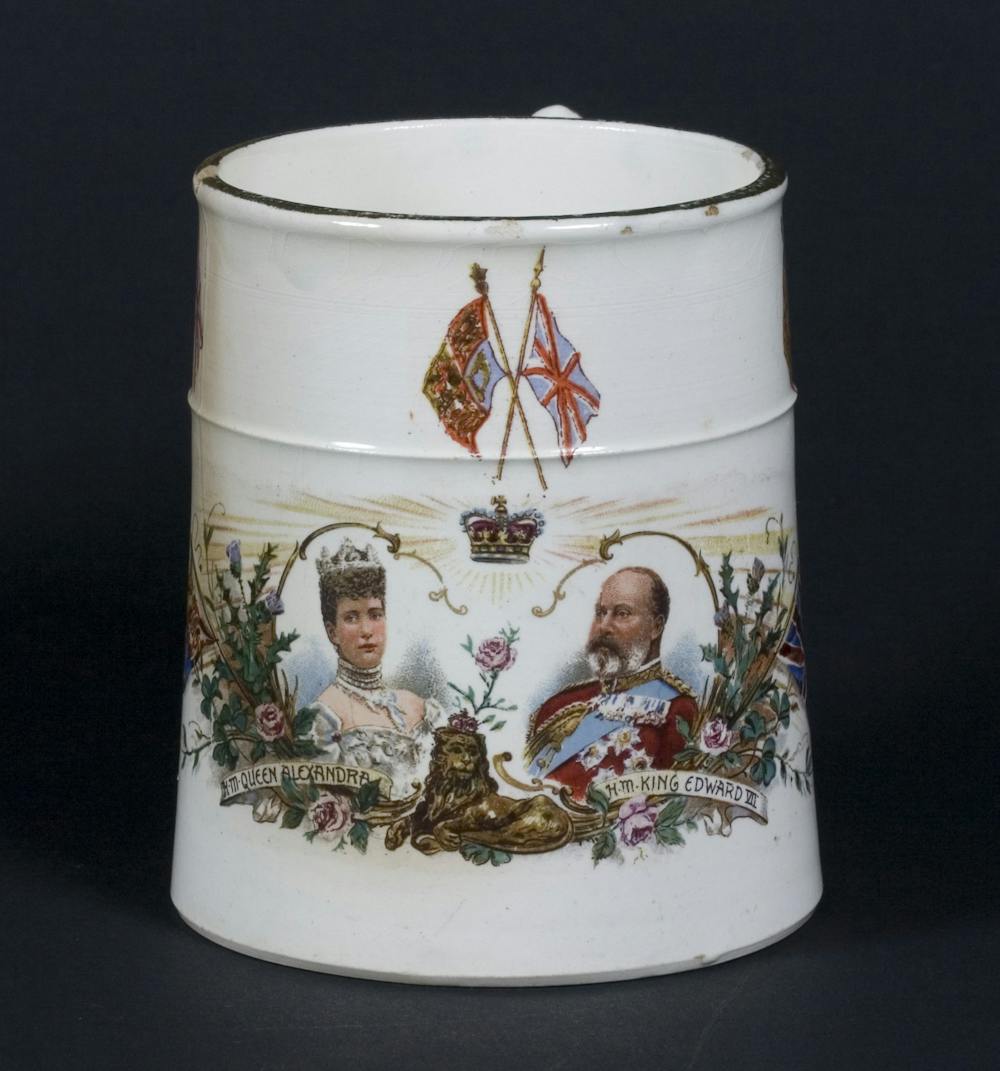
Mug celebrating the coronation of Edward VII in 1902.
Te Papa (CG000043/B), CC BY-NC-SA

The pitfalls of mass production were realised in 1936 when Edward VIII abdicated from the throne just months before his planned coronation in May 1937. Manufacturers were stuck with thousands of mugs, plates and other items celebrating the coronation of a king that would not happen.

Many of these mugs still made their way out to the market, while other manufacturers such as Royal Doulton adapted existing designs and used them for the coronation of his brother, George VI.

Mug commemorating the planned coronation of Edward VIII.
Powerhouse collection. Gift of the Royal Australian Historical Society, 1981. Photographed by Bob Barker.

English monarchs were not the only royals to encourage the use of their image on objects collected, worn or used by their subjects.

Renaissance Italian princes popularised the portrait medal and the Holy Roman Emperor and King of Spain, Charles V, fostered support in his vast territories using mass-produced medallions bearing his image.

An enamel medallion depicting Emperor Charles V (1500–1558), ca. 1518–20.
The Metropolitan Museum of Art

Objects with images of royalty served similar functions in the 20th century. Australian school children were often given medals to commemorate coronations, while children in England were gifted pottery mugs to drink to the sovereign’s health.

When Elizabeth II was crowned in 1953, English children received mugs, tins of chocolate and a spoon or coin.

Measuring popularity

Royal memorabilia don’t just foster support but act as a barometer of the popularity of the royal family around the globe.

Coronation mugs became popular in the reign of Charles II in 1661 because these objects captured the joyous feeling of a nation that had endured 20 years of warfare and political chaos.

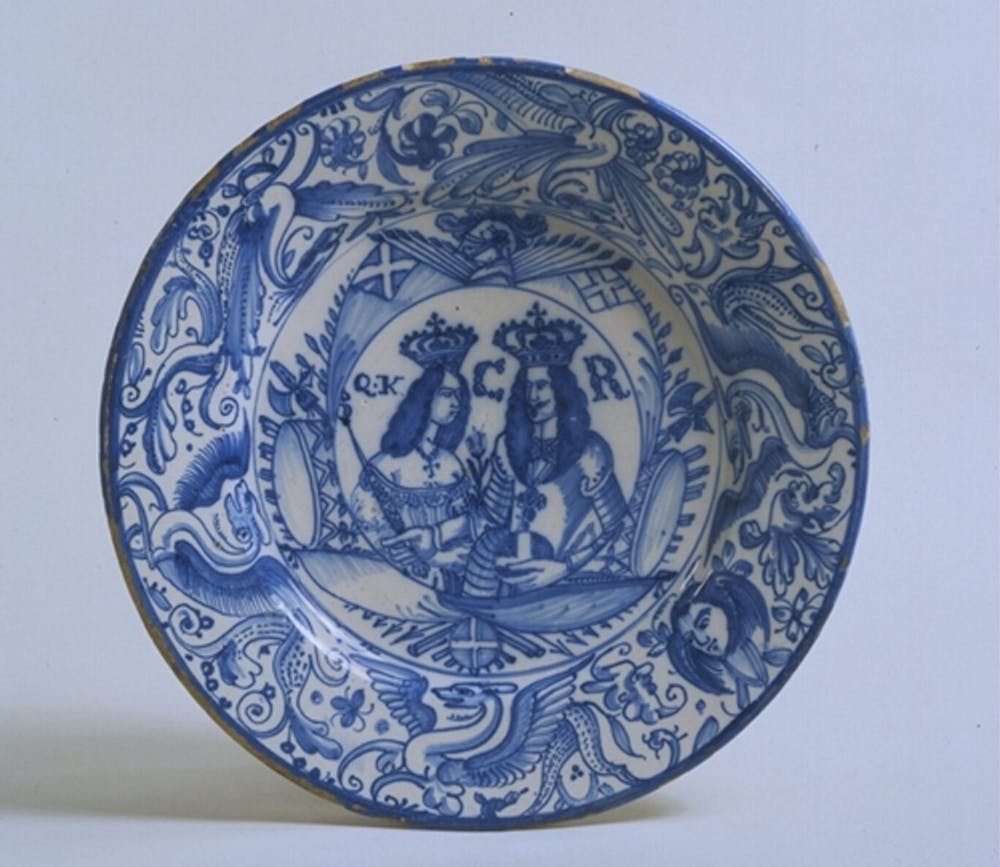
Delftware featuring Charles II and Catherine of Braganza, likely commemorating their wedding. ca. 1662-1685.
Victoria and Albert Museum

Support for the royal family has often been shown through royal weddings and marriages: plates depicting Charles II and his Portuguese bride, Catherine of Braganza, were made to celebrate their union in 1662.

Recently a gold pendant inscribed with the initials of Henry VIII and his first wife, Catherine of Aragon, likely worn by a supporter, was also discovered.

Gold pendant associated with Henry VIII and Catherine of Aragon, ca. 1509-1530.
Birmingham Museums Trust, CC BY

For Prince William and Kate Middleton’s highly anticipated wedding in 2011, thousands of types of mundane and wacky souvenirs were produced, such as plates, mugs, magnets, graphic novels, toilet seat covers and PEZ dispensers.

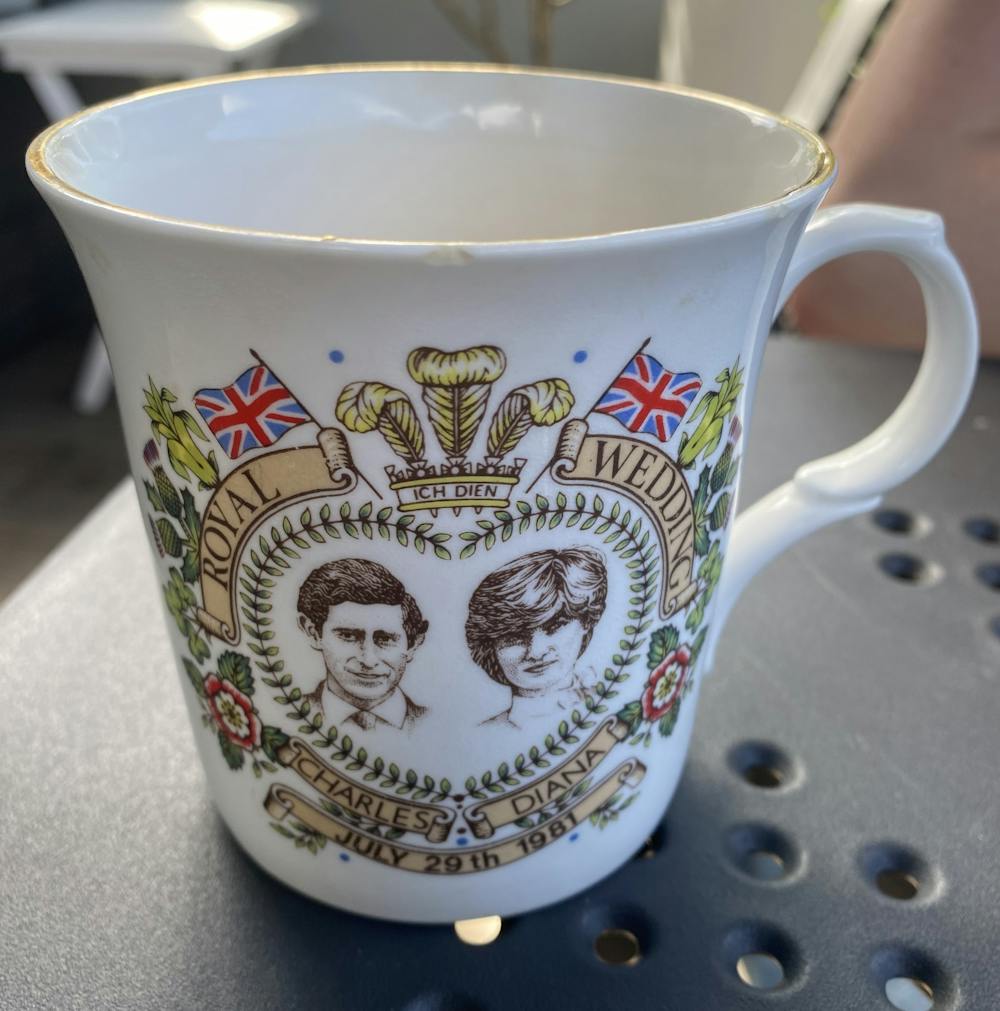
Over 1,600 lines of official merchandise were produced for the marriage of Princes Charles to Lady Diana Spencer in 1981. Less than 25 lines were produced for Charles’ unpopular second marriage to Camilla Parker Bowles in 2005.
Charles and Diana cup to commemorate their wedding on July 29 1981.
Author provided

While Charles may not be as popular as his mother, coronation fever has most definitely taken hold in the United Kingdom. Royal fans are set to spend £1.4 billion (A$2.6 billion) on coronation parties and souvenirs.

The availability of coronation souvenirs and party supplies in Australia is somewhat more limited – perhaps an indicator of Australia’s diminishing appetite for the royal family amid increased calls for another vote on a republic.


Read more:
What King Charles III’s coronation quiche tells us about the history of British dining


The Conversation

Sarah Bendall does not work for, consult, own shares in or receive funding from any company or organization that would benefit from this article, and has disclosed no relevant affiliations beyond their academic appointment.

ref. Picking up a King Charles III coronation commemorative plate? You’re buying into a centuries-old tradition – https://theconversation.com/picking-up-a-king-charles-iii-coronation-commemorative-plate-youre-buying-into-a-centuries-old-tradition-200646

Government will require bosses to pay workers their super on payday

Source: The Conversation (Au and NZ) – By Michelle Grattan, Professorial Fellow, University of Canberra

A government change requiring superannuation to be paid on payday could mean a young employee will be several thousand dollars better off by retirement.

The reform – which will not come in until July 1 2026 – will benefit the retirement incomes of millions of Australians, according to Treasurer Jim Chalmers and Assistant Treasurer Stephen Jones.

They give the example of a 25-year-old median income earner presently receiving their super quarterly and their wages each fortnight, who could be about $6000 (or 1.5%) better off when they retire.

The ministers argue there will be benefits to bosses, as well as to the workers, in the change. “More frequent super payments will make employers’ payroll management smoother with fewer liabilities building up on their books.”

They say payday super will mean employees can keep track of the payments more easily and it will be more difficult for disreputable employers to exploit them.

“While most employers do the right thing, the Australian Taxation Office (ATO) estimates $3.4 billion worth of super went unpaid in 2019-20

The ATO will get extra resourcing to help it detect unpaid super payments earlier.
Treasury and the ATO will consult stakeholders on the changes later this year.

The ministers say the July 1 2026 start will give employers, superannuation funds, payroll providers and other parts of the superannuation system enough time to get ready for the change.

The Conversation

Michelle Grattan no recibe salario, ni ejerce labores de consultoría, ni posee acciones, ni recibe financiación de ninguna compañía u organización que pueda obtener beneficio de este artículo, y ha declarado carecer de vínculos relevantes más allá del cargo académico citado.

ref. Government will require bosses to pay workers their super on payday – https://theconversation.com/government-will-require-bosses-to-pay-workers-their-super-on-payday-204759

Albanese government launches war on vaping, declaring it the ‘number-one behavioural issue in high schools’

Source: The Conversation (Au and NZ) – By Michelle Grattan, Professorial Fellow, University of Canberra

original

The federal government is declaring war on vaping, announcing measures to stamp out its recreational use – especially among the young – including by stronger legislation and enforcement action.

In a tough message to be delivered on Tuesday, Health Minister Mark Butler declares: “Vaping has become the number one behavioural issue in high schools. And it’s becoming widespread in primary schools.”

The government will work with the states and territories to clamp down on the increasing black market in vaping, including to stop the illegal import of non-prescription vapes.

The minimum quality standards for prescription vapes will be increased, with restrictions on flavours and colours.

Prescription vapes will have to come in “pharmacy-like packaging” (following the example of plain packaging for cigarettes). The permissible nicotine concentrations and volumes will be reduced, and single-use, disposable vapes will be banned.

The governments will work with other jurisdictions to shut down the sale of vapes, ending sales at convenience stores and other retailers. But it will also make it easier for people to get a prescription for legitimate therapeutic use.


Read more:
How can I help my teen quit vaping?


Next week’s budget will provide $234 million to address smoking and vaping.

In an extract released ahead of delivery of his National Press Club speech, Butler warns the gains made in the fight against smoking “could be undone by a new threat to public health”.

“Vaping was sold to governments and communities around the world as a therapeutic product to help long-term smokers quit,” Butler says.

“It was not sold as a recreational product – especially not one for our kids. But that is what it has become: the biggest loophole in Australian history.

“One in six teenagers aged 14-17 has vaped. One in four people aged 18-24 has vaped.


Read more:
From October, it will be all but impossible for most Australians to vape — largely because of Canberra’s little-known ‘homework police’


“By contrast, only one in 70 people my age has vaped.

“And when more than a thousand teenagers aged 15 to 17 were asked where they could get vapes, four out of five of them said they found it easy or somewhat easy to buy them in retail stores.

“This is a product targeted at our kids, sold alongside lollies and chocolate bars,” Butler says.

“Over the past 12 months, Victoria’s poisons hotline has taken 50 calls about children under four becoming sick from ingesting or using a vape.”

Butler says that just as with smoking, “Big Tobacco has taken another addictive product, wrapped it in shiny packaging and added flavours to create a new generation of nicotine addicts.

“Vapers are three times as likely to take up smoking, which explains why under 25s are the only cohort in the community currently recording an increase in smoking rates.

“This must end,” Butler says.


Read more:
Everyone is NOT doing it: how schools and parents should talk about vaping


The budget money includes $63 million for a public health campaign to discourage people taking up smoking and vaping and encourage quitting. Some $30 million will be put into support programs to help people quit, and into education and training for health professionals.

Another $140 million will go to the Tackling Indigenous Smoking program, including widening it to tackle vaping.

The Conversation

Michelle Grattan does not work for, consult, own shares in or receive funding from any company or organisation that would benefit from this article, and has disclosed no relevant affiliations beyond their academic appointment.

ref. Albanese government launches war on vaping, declaring it the ‘number-one behavioural issue in high schools’ – https://theconversation.com/albanese-government-launches-war-on-vaping-declaring-it-the-number-one-behavioural-issue-in-high-schools-204760

Why was Bruce Lehrmann given the all-clear to sue media for defamation? A media law expert explains

Source: The Conversation (Au and NZ) – By David Rolph, Professor of Law, University of Sydney

Former Liberal Party staffer Bruce Lehrmann has been given the all-clear to continue with defamation proceedings against several media outlets and journalists regarding reporting about Brittany Higgins’ rape allegations.

Lehrmann has always maintained his innocence, and no finding has been made against him. The rape trial was abandoned last year following juror misconduct, and a second trial was not pursued amid fears for Higgins’ mental health.

Lehrmann is suing the Ten Network and former presenter of The Project Lisa Wilkinson, as well as News Life Media (the publisher of news.com.au) and journalist Samantha Maiden.

In New South Wales since 2002, and across Australia since the beginning of 2006, the limitation period for defamation claims is one year. However, the court has the power to extend the limitation period for up to three years.

Lehrmann needed the court to extend the limitation period because both Maiden’s story on news.com.au, and Wilkinson’s interview with Higgins on The Project, took place in mid-February 2021. Lehrmann commenced his defamation proceedings in the Federal Court almost two years later.

On Friday, Justice Michael Lee of the Federal Court of Australia extended the limitation period in these two defamation proceedings brought by Lehrmann.

As Justice Lee observed at the outset of his judgement:

Any sentient person with an interest in newsworthy events in Australia would be familiar with the general background to the present disputes.

To have the limitation period extended, Lehrmann needed to persuade the court that it was “not reasonable in the circumstances” for him to have commenced his proceedings within the one-year limitation period.

If the court was persuaded, it would be required to extend the limitation period, although it had discretion as to the length of the extension.

Justice Lee was satisfied that it was “not reasonable in the circumstances” for Lehrmann to have commenced defamation proceedings within the one-year limitation period.

This was mainly because it was not reasonable to commence defamation proceedings while criminal allegations were unresolved. This was the legal advice Lehrmann received from the solicitor with criminal law expertise he consulted.


Read more:
Why was the Lehrmann trial aborted and what happens next?


As Justice Lee stated:

Whatever way one looks at it, for Mr Lehrmann to have started defamation proceedings absent the resolution of the criminal allegations would have been for him to take a step into the unknown. Everything might well have worked out, and all respondents may have been passive, but one cannot discount as misconceived advice that taking the risk of starting was imprudent and distracting while criminal allegations were unresolved.

Justice Lee’s decision followed a decision of the Full Federal Court in Joukhador v Ten Network Pty Ltd in 2021.

In that case, the court stated that, in general, where a person is facing a criminal charge and the publication being sued upon raises an issue about the person’s guilt or innocence, it will ordinarily not be reasonable to commence defamation proceedings within the one-year limitation period.

Justice Lee therefore extended the limitation period in both of the proceedings.

In April this year, Lehrmann also commenced defamation proceedings against the ABC. This concerned the broadcast of the National Press Club address by Higgins and Grace Tame in February 2022.

Justice Lee indicated that he was inclined to hear all three proceedings together.

Justice Lee also raised the prospect that the case may be an appropriate one for trial by jury. This is significant because civil trials in the Federal Court are presumptively heard by a judge sitting alone. However, the court has the power to order trial by jury if “the ends of justice appear to render it expedient to do so”.

The Federal Court has only ordered a jury trial in civil proceedings once before. In 2009, Justice Rares ordered a jury trial in defamation proceedings brought against The Daily Telegraph for reporting about sexual servitude allegations (the matter then settled before the trial).

Justice Lee sought submissions from the parties as to whether there should be a jury trial in this case. Jury trials tend to take longer and are therefore costlier than trials by judge alone.


Read more:
Can juries still deliver justice in high-profile cases in the age of social media?


If a defamation case is brought in a State Supreme Court (other than in South Australia), either party can elect to have trial by jury. Juries are not available in defamation cases in the territories.

The possible trial date is mid-November this year, lasting for approximately four weeks.

The Conversation

David Rolph previously received funding from the Australian Research Council that ended in 2014.

ref. Why was Bruce Lehrmann given the all-clear to sue media for defamation? A media law expert explains – https://theconversation.com/why-was-bruce-lehrmann-given-the-all-clear-to-sue-media-for-defamation-a-media-law-expert-explains-204683

1 in 4 households struggle to pay power bills. Here are 5 ways to tackle hidden energy poverty

Source: The Conversation (Au and NZ) – By Nicola Willand, Senior Lecturer, School of Property, Construction and Project Management, RMIT University

Shutterstock

One in four Australian households are finding it hard to pay their gas and electricity bills. As winter looms, energy price rises will make it even harder. Cold homes and disconnections resulting from energy poverty threaten people’s health and wellbeing.

Income support for welfare recipients and retrofitting homes to make them more thermally efficient – by adding insulation, for example – can ease the burden. And when homes are not too cold or hot, people’s health benefits. This in turn eases pressure on the public health system.

However, many people are missing out on assistance as programs often do not recognise their difficulties. Their energy vulnerability is hidden.


Read more:
If you’re renting, chances are your home is cold. With power prices soaring, here’s what you can do to keep warm


What forms does hidden energy poverty take?

Our newly published study has revealed six aspects of hidden energy vulnerability. These are:

  1. underconsumption – households limit or turn off cooling, heating and/or lights to avoid disconnections

  2. incidental masking – other welfare support, such as rent relief, masks difficulties in paying energy bills

  3. some households disguise energy poverty by using public facilities such as showers or pooling money for bills between families

  4. some people conceal their hardship due to pride or fear of legal consequences, such as losing custody of children if food cannot be refrigerated because the power has been cut off

  5. poor understanding of energy efficiency and the health risks of cold or hot homes adds to the problem

  6. eligibility criteria for energy assistance programs may exclude some vulnerable households. For example, people with income just above the welfare threshold are missing out on energy concessions. Energy retailer hardship programs also ignore people who have voluntarily disconnected due to financial hardship.


Read more:
‘Die of cold or die of stress?’: Social housing is frequently colder than global health guidelines


5 ways to help these households

Our studies suggest trusted intermediaries such as people working in health, energy and social services can play a vital role in identifying and supporting such households.

First, energy efficiency and hardship initiatives may be integrated into the My Aged Care in-home care system. Energy poverty risk identification, response and referral could be built into the national service’s assessment form. This could leverage existing client screening processes.

The system’s front-line staff could connect at-risk householders with energy counsellors. These counsellors could help people access better energy contracts, concessions, home retrofits and appliance upgrade programs.

A new Commonwealth “energy supplement” could help pay for essential energy-related home modifications. This would help avoid My Aged Care funds being diverted from immediate healthcare needs.


Read more:
We need a ‘lemon law’ to make all the homes we buy and rent more energy-efficient


Second, general practitioners and other health professionals could help identify energy vulnerability among patients with medical conditions of concern. They could also provide letters of support emphasising renters’ health-based need for air conditioners or heaters.

Third, energy providers could use household energy data to identify those that seem to be under-consuming or are often disconnected. They could also identify those that are not on “best offer” deals. They could be proactive in checking struggling householders’ eligibility for ongoing energy concessions and one-off debt relief grants offered by states and territories.

Energy providers could also make it easier for social housing providers to ensure concessions for tenants renew automatically.

Fourth, local councils could use their data to identify at-risk householders. They might include those with a disability parking permit, discounted council rates or in arrears, on the social housing waiting list, Meals on Wheels clients and social housing tenants. Maternal and child health nurses and home and community care workers making home visits could call attention to cold or hot homes.

Councils could employ in-house energy counsellors to provide assistance and energy literacy training. Council home maintenance teams could develop bulk-buying, insulation and neighbourhood retrofit programs.

Strategies to reduce vulnerability to energy poverty should be part of municipal public health and wellbeing plans. Under these strategies, net-zero-carbon funds set up by states and local councils to reduce emissions could finance targeted housing retrofits.

We also suggest setting up a central helpline to improve access to energy assistance via local referrals.

Fifth, residential energy-efficiency programs could become more person-centric. For example, we already have Residential Efficiency Scorecard audits to assess the thermal quality of a home. These audits could also explore whether concessions and better energy deals are available to the household.


Read more:
We all need energy to survive. Here are 3 ways to ensure Australia’s crazy power prices leave no-one behind


Building capacity at all levels

Capacity-building strategies are needed at all levels – individual, community and government – to overcome the challenges of reducing energy poverty. Current obstacles include the competing priorities of service providers, lack of time and resources, and poor co-ordination between siloed programs and services.

Access to essential energy services should be part of state and local governments’ strategic health plans. Housing, energy and health departments could work together to include housing retrofits in preventive health programs.

A comprehensive approach is needed to overcome hidden energy poverty. It must include public education, integrated services and well-funded energy-efficiency programs. Regulatory reforms and ongoing funding are both needed to improve the availability of energy-efficient, affordable homes for tenants.

Our suggested strategies start with improving the skills and knowledge of trusted intermediaries. Doctors, social workers, housing officers, community nurses and volunteers can play a central role. Using these front-line professionals to help identify and act on energy poverty offers a novel, cost-effective and targeted solution.

The Conversation

Nicola Willand receives or has received funding for research from various organisations, including the Australian Research Council, the Victorian State Government, the Lord Mayor’s Charitable Foundation, the Australian Housing and Urban Research Institute, the Future Fuels Collaborative Research Centre and the Australian National Health and Medical Research Centre. She is affiliated with the Australian Institute of Architects.

Nooshin Torabi receives or has received funding for research from various organisations, including the Lord Mayor’s Charitable Foundation,

Ralph Horne receives or has received funding for research from various organisations, including the Australian Research Council, the Victorian State Government, the Lord Mayor’s Charitable Foundation, and the Australian Housing and Urban Research Institute.

ref. 1 in 4 households struggle to pay power bills. Here are 5 ways to tackle hidden energy poverty – https://theconversation.com/1-in-4-households-struggle-to-pay-power-bills-here-are-5-ways-to-tackle-hidden-energy-poverty-204672

NDIS cost scrutiny is intensifying again – the past shows this can harm health and wellbeing for people with disability

Source: The Conversation (Au and NZ) – By Samia Badji, Research Fellow, Centre for Health Economics, Monash University

Getty

Those in the disability field have been expressing a sense of whiplash since Friday. Many had felt buoyed by reassurances from Bill Shorten, minister for the National Disability Insurance Scheme (NDIS), at the National Press Club the previous week that a reboot would ensure the scheme was “here to stay”. Yet a week later, the word from the National Cabinet meeting of state and territory leaders, was that NDIS growth would need to be constrained in order for the scheme to be sustainable.

An independent review of the NDIS, is due to report before October this year. Ahead of its findings, critics have been quick to pass judgement on the financial outlay of the NDIS without comprehending the significance of cutting spending on the lives of Australians with disability and their families.

But people with disability have been here before. Our recent research shows people’s wellbeing deteriorates when their supports are threatened. We need to learn from their experiences before putting them in that same position again.


Read more:
Health and housing measures announced ahead of budget, and NDIS costs in first ministers’ sights


Enormous investment

The NDIS provides funding for more than 550,000 Australian with permanent and severe disabilities to receive the services and supports they need. However, with the current budget at A$29.2 billion and estimated future costs at $60 billion per year it is consistently being raised as a budgetary concern.

Similarly, spending on the Disability Support Pension, which provides required income support for people with long-term disability, is at $18.3 billion per year. In total, these two schemes amount to a $47.5 billion a year investment into the wellbeing of Australians with disability and their families.

The previous government already implemented significant changes and reviews for those receiving the Disability Support Pension and also sought to introduce independent assessments for NDIS participants.

While independent assessments are off the table for the current government, participants undergo regular reviews of their plans. They have been undertaken annually but the National Cabinet announced multiyear plans will now be implemented.

People on the Disability Support Pension have also experienced the threat of losing support. In 2012, new impairment tables were brought in for them and in 2014 it was decided to review people under 35 who had been deemed eligible under the old impairment tables. Some later described how being under medical review proved particularly stressful and negatively impacted their health.

person sitting next to person in wheelchair holds their hand for comfort
Package and eligibility reviews have harmed wellbeing before.
Shutterstock


Read more:
The NDIS is set for a reboot but we also need to reform disability services outside the scheme


What we looked at

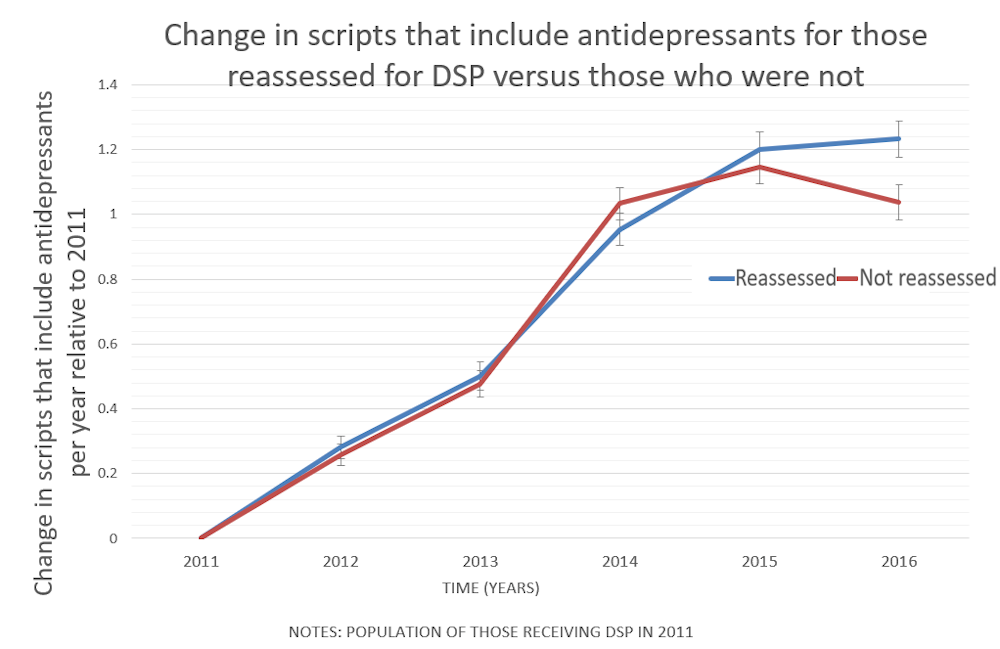
Our new study based on anonymous administrative data on all welfare recipients and healthcare use has shown the medical review of Disability Support Pension recipients under 35 led to significant increases in GP and specialist visits. We wanted to investigate whether this was due to additional consultations to prove eligibility or from the need to manage the stress of the review process itself.

To investigate this, we looked at several types of medications and found that the group that includes antidepressants was the only one that increased for those targeted by the review. The increase was not driven by the few who stopped getting disability support, but by those who still received the Disability Support Pension after the review. This indicates the reassessment process itself contributed to poorer health.

Increased health-care use was likely just the tip of the iceberg, with many people experiencing mental distress as the result of the reassessment likely suffering in silence.

nervous system reassessed.

Taxpayers also contributed more than $4 million to cover the additional healthcare expenses incurred by the review, on top of the $21 million in government costs to conduct the reviews. These financial costs do not account for the additional time contacting Centrelink, finding healthcare professionals, attending visits and appealing the process. Such costs are not only borne by people with disabilities but also their carers, as well as the not-for-profit sector and other government sectors such as the judicial system. These efforts reduce the time people have available for finding work or contributing to society more broadly.


Read more:
Inclusion means everyone: 5 disability attitude shifts to end violence, abuse and neglect


Caution ahead

Given these findings, a cautious approach to examining the cost of disability support is indicated. Medical Disability Support Pension reviews were eventually stopped and planned NDIS independent assessments were abandoned. But the spectre of these reviews and investigations remains.

The conclusions from NDIS independent review and the Royal Commission into Robodebt will help us understand the consequences of procedures that review entitlements and ensure that they do not harm Australians.

It is important we shift the focus from solely considering the NDIS and Disability Support Pensions in terms of their budgetary cost and measure their performance in terms of their impact on the health and wellbeing of people with a disability, their families and carers.

The NDIS is investing in a wellbeing measure for participants and the government has developed a Disability Strategy Outcomes Framework to “measure, track and report on how things are improving for people with disability”.

But as cost and growth scrutiny intensifies, policies must strike the right balance between the budgetary impact and the wellbeing of people with disabilities and their families.

The Conversation

Samia Badji receives funding from the National Disability Insurance Agency (NDIA). She has previously received funding from the World Health Organization (WHO) and the Department of Social Services (DSS).

Anne Kavanagh receives funding from the National Health Medical Research Council, the Australian Research Council and the Victorian and Commonwealth governments.

Dennis Petrie receives funding from the Australian Research Council (ARC), the National Health and Medical Research Council (NHMRC), WISE employment, the National Disability Insurance Agency and the World Health Organisation (WHO).

ref. NDIS cost scrutiny is intensifying again – the past shows this can harm health and wellbeing for people with disability – https://theconversation.com/ndis-cost-scrutiny-is-intensifying-again-the-past-shows-this-can-harm-health-and-wellbeing-for-people-with-disability-203336

Why Australia would be smart to recruit soldiers in the Pacific – a Fijian who served in the British Army explains

Source: The Conversation (Au and NZ) – By William Waqavakatoga, PhD candidate, University of Adelaide

Fiji has a track record of service to the British crown. Travel to Hereford, where the Special Air Service is based, and you will find a statue of Sergeant Talaiasi Labalaba, who was one of the 212 Fijians who joined the British Army in 1961 and gave his all in the 1972 Battle of Mirbat in Oman.

When you arrive at Nadi International Airport in Fiji, there is another statue honouring his sacrifice.

Opposition defence spokesperson Andrew Hastie’s call for foreigners, including from the Pacific, to enlist in the Australian Defence Force (ADF), is therefore neither new, nor necessarily unwelcome, in parts of the Pacific.

If Australia wanted to recruit Fijians into the ADF tomorrow, it would have no problem raising a battalion in one day.

Fiji has what is called a “youth bulge”, which occurs when a country’s youth population is particularly large compared with other age ranges. Unemployment is a challenge, and recruits might see enlisting in the ADF as one of their few routes to economic opportunity – and eventual Australian citizenship.

The challenge will be finding the ideal recruits that meet the standards for the required roles needed for the ADF. Therefore, strict criteria for entry should be considered, given there will be no shortage of volunteers.

Why I chose to join the British Army

Since 1998, thousands of young Fijian men and women have travelled to the United Kingdom to fill in the gaps of the British armed forces. I was one of them. I served in the 1st Battalion Duke of Wellington’s Regiment (now Royal Yorkshire Regiment) with multiple tours to Iraq.

No one joins the British Army with the hope of going to war. The September 11 attacks changed everything and new theatres opened up in Afghanistan and Iraq. Fijian men and women served in these wars, and some paid with their lives. There is nothing unique about this. It is the cost for taking the queen’s shilling. Fijians in the British Army understand they are not special, and should not be given any special treatment because of where they have travelled from.

When I joined the British Army in 2001, I was 19 attending the University of the South Pacific with a full scholarship, studying chemistry. I made a calculated decision to join given what was going on in the country at the time. The 2000 coup had recently taken place and I was concerned for my future. Like any young person, the opportunity to travel and see the world through the army appealed.

Observers may question whether recruiting Fijians or other Pacific citizens constitutes exploitation. But Fijians who join the British Army do not feel exploited; they see it as an honourable duty that comes with economic benefits to improve their own welfare and those of their families. There have been hundreds of Fijian soldiers completing their 22 years of service in the British Army from last year. They are entitled to retire with a full pension after this length of service.

Australia should consider targeting these Fijians first if they are serious about recruitment and wish to test the idea.

If not, consider recruiting those who are still serving with the British Army. Fijians would prefer to be closer to home with the same economic value they get out of the UK forces. They would have already been vetted from a security standpoint, too.

A statue of Talaiasi Labalaba at Nadi International Airport in Fiji.
Wikimedia Commons

Developing trust in the Pacific

Recruitment from the Pacific Islands should also be considered a smart security strategy for Australia. This kind of policy change goes beyond any memorandum of understanding or government security agreement.

In Fiji, households that have sent their sons and daughters to serve in the British armed forces develop a close connection with the United Kingdom. Fijian servicemen and women are remembered in the prayers in the households of these families.

Australia has already developed this kind of trust by helping Fiji during natural disasters. Former Prime Minister Frank Bainimarama’s government softened its tone with Canberra after Australia provided critical support in the aftermath Cyclone Winston in 2016. The sight of HMAS Canberra arriving in Fiji was a welcome one.

Australian tourists have also been coming to Fiji for decades contributing to Fiji’s economic growth, so the close relationship with Fiji is already there. And then there is our nations’ shared love of rugby.

The currency of meaningful relationships is valued in the Pacific Islands region. Get this right, and you have trust.

If I had the opportunity to join the Australian Army back in 2001, I would have been outside a recruitment centre in record time. An opportunity is presenting itself here which will simultaneously be a step towards fulfilling Australia’s security needs, while also helping Fiji.


Read more:
Penny Wong said this week national power comes from ‘our people’. Are we ignoring this most vital resource?


The Conversation

William Waqavakatoga served in the British Army.

ref. Why Australia would be smart to recruit soldiers in the Pacific – a Fijian who served in the British Army explains – https://theconversation.com/why-australia-would-be-smart-to-recruit-soldiers-in-the-pacific-a-fijian-who-served-in-the-british-army-explains-204748

Devils in the detail: an economist argues the case for a Tasmanian AFL team – and new stadium

Source: The Conversation (Au and NZ) – By Tim Harcourt, Industry Professor and Chief Economist, University of Technology Sydney

The Australian Football League’s announcement of a Tasmanian football club – likely to be called the Tassie Devils – is now a formality, after the federal goverment’s pledge of A$240 million to a new stadium and precinct in Hobart.

A new stadium is the last of 11 AFL requirements for a Tasmanian club to become the league’s 19th team, joining ten Victorian clubs and two each from the other four states.

The view was that UTAS stadium in Launceston could be upgraded but that upgrading Hobart’s Bellerive Oval (known as Blundstone Arena) made less sense than a new facility in Hobart’s CBD, on Macquarie Point, north of Hobart’s Constitution Dock.

The Tasmanian government wants the stadium, which it will own, to anchor a new “arts and sports” precinct. It will contribute $375 million of the estimated cost of $715 million. Another $85 million will come from loans against future land sales and leases in the revitalised area. The AFL will contribute the final $15 million. There will also be $10 million to build a headquarters for the new club.

This is part of $360 million the AFL will spend on AFL in Tasmania over the next ten years, with $209 million to subsidise the new club and $120 million to support grassroots participation and the development of talented players.

Compared with the $3.4 billion the federal government has committed to buildings for the 2032 Brisbane Olympics, its contribution to the Hobart arena is relatively minor.

But critics say the stadiums in Hobart and Launceston are adequate, and that the money would be better spent on public housing – with rents having risen 45% in the past five years. As novelist Richard Flanagan put it:

Tasmania doesn’t have a stadium problem. It has a housing and homelessness problem.

The problem with this argument is that economies are dynamic, not static. Was it also wrong to have built the Sydney Opera House because of housing issues in the late 1960s?

Without an AFL team and new stadium, Tasmania is likely to still have a homeless problem. In fact, the problem may even be worse without economic activity the new team and stadium will bring.

Economic rationale

The rationale for the federal and state governments is that a new stadium is a precondition for a Tasmanian AFL, and that both together will generate $2.2 billion in economic activity over 25 years according to Tasmanian government.

Governments favour infrastructure projects because construction has a high “multiplier effect” – generating flow-on benefits. The Tasmanian government estimates construction will generate $300 million in economic activity and 4,200 jobs. It expects the stadium when operational to sustain 950 jobs and generate $85 million in economic activity a year.

This will depend on hosting major events along with AFL fixtures. The Tasmanian government’s business case anticipates the venue hosting at least 44 events a year, attracting 123,500 overseas and interstate visitors.

These expectations will be buoyed by the success of the AFL’s “Gather Round” in mid-April, in which all AFL games were played in South Australia. A reported $15 million state government contribution generated an estimated $85 million in economic benefit from 60,000 interstate fans.

The case for a Tassie team

In assessing this decision, we can’t just consider the business case for the stadium. It’s about the case for a Tasmanian AFL club.

Tasmania may only have a total population of 558,000 (with 247,000 in Hobart) but its claim to have an AFL is a good as the Gold Coast (home of the Suns, population 640,000) or even Geelong, (home of the Cats, population about 280,000). Townsville, where the North Queensland Cowboys play in the NRL, has 235,000 people.


Read more:
Loud, obnoxious and at times racist: the sordid history of AFL barracking


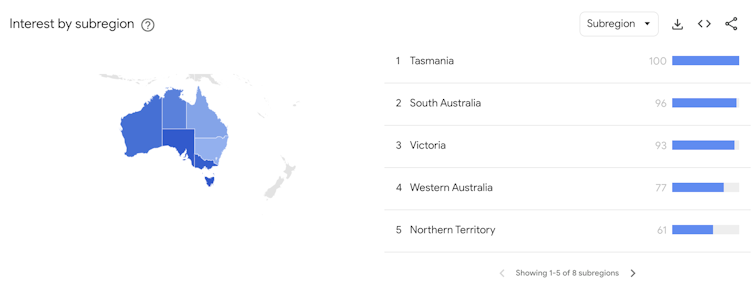
According to James Coventry’s 2018 book Footballistics: How the Data Analytics Revolution is Uncovering Footy’s Hidden Truths, no other state has a higher percentage of AFL fans. In WA it’s 62.3%, in South Australia
75.7%. In Victoria, 70.2%. In Tasmania it’s 79%.


Google Trends result for 'AFL', 12 months to April 2023.
Google Trends result for ‘AFL’, 12 months to April 2023.
CC BY

Aussie Rules is really the only game in town on the Apple Isle, writes Hunter Fujak his 2021 book Code Wars, which explores the nation’s “Barassi Line
split between AFL and National Rugby League. The percentage of Tasmanians that only follow the AFL is 35%, compared to the national average of 19%.


Read more:
The Barassi Line: a globally unique divider splitting Australia’s footy fans


More than the bottom line

Yes, the AFL is a multimillion-dollar business, but it’s also a community organisation, managing a public good. As the Richmond president Peggy O’Neal put it in Coventry’s book:

It’s sort of a blend of strict financial business and not for profit […] If we wanted just to make money, our model would be quite different.

This explain the AFL’s preparedness to commit $345 million over the next decade to support the new club, as well as grassroots football across Tasmania, to ensure local community footy doesn’t lose out from the resources and energy being put into the AFL team. This will include building 70 new ovals across the state, and funding football academies in Hobart, Launceston and Penguin (west of Devonport on the north coast).

The AFL has subsidised the AFLW for similar reasons. It’s about more than just the bottom line.

Tasmania has waited far too long for a team of its own. The entry of the Tassie Devils into the AFL can be justified on economic, social and (most of all) footy grounds.

The Conversation

Tim Harcourt does not work for, consult, own shares in or receive funding from any company or organization that would benefit from this article, and has disclosed no relevant affiliations beyond their academic appointment.

ref. Devils in the detail: an economist argues the case for a Tasmanian AFL team – and new stadium – https://theconversation.com/devils-in-the-detail-an-economist-argues-the-case-for-a-tasmanian-afl-team-and-new-stadium-204678

While the Voice has a large poll lead now, history of past referendums indicates it may struggle

Source: The Conversation (Au and NZ) – By Adrian Beaumont, Election Analyst (Psephologist) at The Conversation; and Honorary Associate, School of Mathematics and Statistics, The University of Melbourne

Aaron Bunch/AAP

Support for the Indigenous Voice to Parliament has dropped since the first polls that asked about it in late 2022. Analyst Kevin Bonham has plotted all the poll results, and the average Voice support is down from 65% in August 2022 to 57% now.

Last week’s Morgan (a “yes” lead of just 54-46) was particularly concerning for Voice supporters, given the history of support for referendum proposals collapsing as the referendum draws near.


Read more:
Labor gains in Newspoll but Voice support slumps in other polls; NSW final results and Queensland polls


The Sydney Morning Herald reported Sunday that a YouGov poll of over 15,000 respondents, for the group behind the Uluru Statement from the Heart, had “yes” to the Voice leading nationally by 51-34, and in every state and territory, with Queensland the closest at 47-40 “yes”.

However, this poll was conducted March 1-21, so it is well over a month out of date.

To win a constitutional referendum in Australia, a majority of the states as well as an overall majority must vote “yes”. This means at least four of the six states need to vote “yes”.

History of past referendums

Only eight of 44 proposed referendums have succeeded. There have been five instances where “yes” has won nationally, but failed to win a majority of states.

I have investigated whether referendum proposals were attempted by Labor or conservative governments, and whether those held concurrently with a general election were more successful. Referendum results and dates are here, governments formed after each election here and House of Representatives election dates are here.

The first ten years after federation in 1901 were before the development of the two party system, and Labor was part of a government led by the Protectionists that passed the 1906 referendum. Since then, only one of 25 referendums proposed by Labor governments have succeeded.

Conservative governments have had more success with six of 18 referendums proposed by non-Labor governments succeeding. Analyst Peter Brent wrote in Inside Story that conservative oppositions nearly always oppose Labor referendum proposals, while Labor oppositions sometimes support conservative government proposals.

While not doing well enough to pass when held with a general election, Labor government proposals have performed better when held with an election than at midterm referendums. The four 1988 midterm referendums all failed with between 31% and 38% support nationally, while the four that were held with the 1974 election had 47% to 48% support.

Brent says that elections are about who will form the next government, and referendums held with elections benefit from not being the focus of attention. But midterm referendums are the focus, and can become like a byelection, at which governments usually do badly.

Early polling for referedums is not predictive. Brent said the 1988 referendums were polling in the 60s and 70s in May 1988, before crashing into the 30s at the September referendum.

The record “yes” vote of 90.8% at the 1967 referendum is not a guide to the result of the Voice referendum, as this earlier referendum was proposed by the Coalition and supported by Labor. Brent also thinks this referendum benefited from being the second question asked in 1967; the first was heavily defeated.


Read more:
‘Right wrongs, write Yes’: what was the 1967 referendum all about?


In 2017, the plebiscite that allowed same-sex couples to marry was passed with 61.6% support (this was not a referendum as it did not require a change to the constitution to implement).

This plebiscite was initiated by the Coalition with Labor support, and the large majority of voters would have known someone who was homosexual, and were therefore inclined to be sympathetic to same-sex marriage. By contrast, most Australians do not have regular contact with Indigenous people.

If the Voice is to defy the history of Labor-initiated referendums that were opposed by the Coalition, particularly at midterm referendums, the Albanese government will need to continue to poll at honeymoon levels until the referendum date. Labor’s history-making win at the federal Aston byelection gives the Voice some chance of passing, but history suggests it will be a struggle.

UK local elections and the US debt limit

I wrote for The Poll Bludger last Thursday that UK local elections will be held this Thursday. Labour has a large poll lead, but it is being reduced.

Last Thursday AEST, Republicans passed a bill that would raise the US debt limit in return for spending cuts that are strongly opposed by Democrats through the House of Representatives. The US is headed for a crisis over the debt limit later this year. Donald Trump’s lead in national Republican primary polls continues to widen. Polls for the May 14 Turkish elections were also covered.

Victorian Resolve poll: Labor still way ahead

A Victorian state Resolve poll for The Age, conducted with the federal March and April Resolve polls from a sample of 1,600, gave Labor 42% of the primary vote (up one since February), the Coalition 30% (steady), the Greens 10% (down three), independents 12% (down one) and others 5% (up one).

Resolve does not provide two party estimates until close to elections, but Labor is clearly still far ahead. This poll was taken before the corruption watchdog’s report that criticised the Labor government. Incumbent Daniel Andrews led the Liberals’ John Pesutto by 49-28 as preferred premier (50-26 in February).

Liberal MP Moira Deeming attended an anti-trans rights rally that was gatecrashed by neo-Nazis. Pesutto tried to expel her, but was forced to settle for suspending her for nine months.

The poll article says that 23% wanted Deeming expelled, but 20% said she deserved less punishment than her suspension. “About one-third” were unsure or indifferent as to her punishment, leaving 24% who presumably supported the nine-month suspension.

The Conversation

Adrian Beaumont does not work for, consult, own shares in or receive funding from any company or organization that would benefit from this article, and has disclosed no relevant affiliations beyond their academic appointment.

ref. While the Voice has a large poll lead now, history of past referendums indicates it may struggle – https://theconversation.com/while-the-voice-has-a-large-poll-lead-now-history-of-past-referendums-indicates-it-may-struggle-204365

Fair representation in news makes multicultural Australians feel more at home: new research

Source: The Conversation (Au and NZ) – By Sora Park, Professor of Communication, News & Media Research Centre, University of Canberra

Steven Saphore/ AAP

Belonging can be defined as a settled feeling. It is about feeling attached to the community and society you live in. Not only does belonging make people feel at home, but it can also help people participate in society.

More than 5 million Australians use a language other than English at home, of which 15% have low English proficiency. Almost one-third (28%) are born overseas. How do we ensure they are part of the society?

A new report unveils research examining the impact of news representation on multilingual audiences’ sense of belonging to broader Australian society. The report employed a survey combining face-to-face, phone, and online methods to ask questions of five multilingual groups: Arabic, Cantonese, Italian, Mandarin, and Vietnamese speakers.

Participation in society by sense of belonging

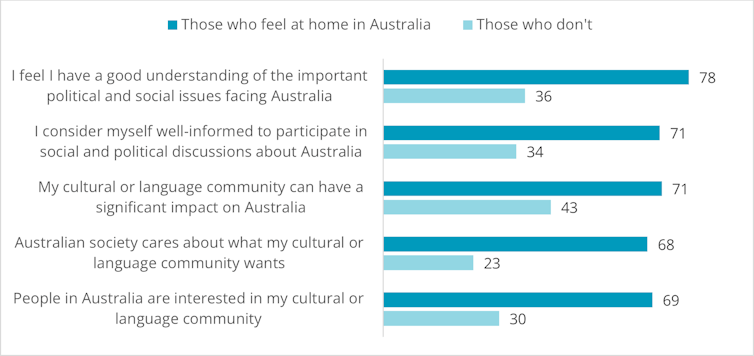
The study found that multilingual Australians’ sense of belonging is closely related to their confidence in participating in society. Compared to those who say they don’t belong, people who feel “at home” in Australia are twice as likely to say they have a good understanding of political and social issues facing Australia.

Furthermore, among those who feel at home in Australia, the majority agree they are well informed (71%) and think their cultural community can have a significant impact on society (71%).

Where does this confidence to participate come from?

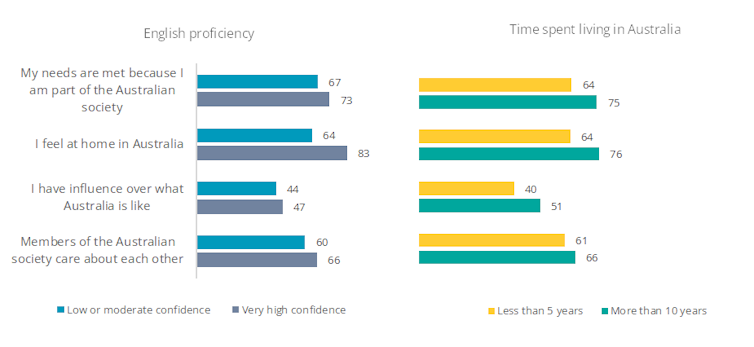
We found that time spent in Australia and proficiency in English are both related to belonging.

It seems to take more than 10 years for migrants to find a sense of belonging in Australia; 76% of those who have lived in Australia for more than 10 years feel at home in Australia compared to only 64% of those who arrived here less than five years ago. Having high confidence in English is also a factor.

Sense of belonging by English proficiency and lenght of stay

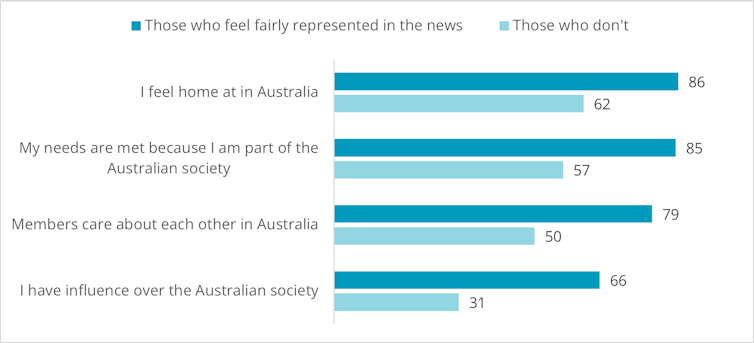
Furthermore, the study found that feeling represented in the news is strongly related to multilingual audiences’ sense of belonging.

Those who feel fairly represented in the news are much more likely to feel a sense of belonging to the Australian society. The majority (86%) of those who feel adequately represented in the news “feel at home”, compared to only 62% of those who don’t feel represented.

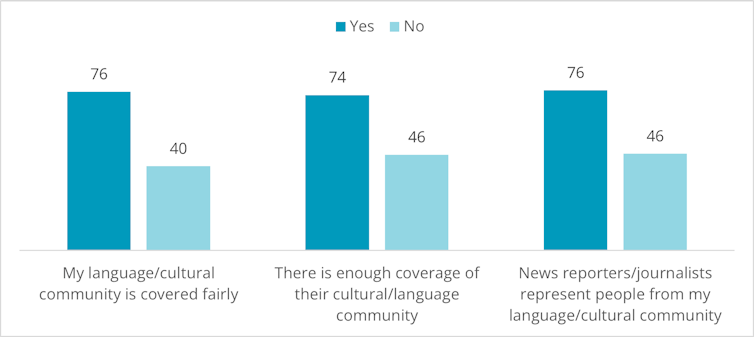
This may be because perceptions of news representation foster trust in news. We found that multilingual audiences who believe they are sufficiently and fairly represented in the news have a much higher level of trust in news compared to those who feel under- or misrepresented.

Three-quarters (76%) of multilingual audiences who feel their cultural community is fairly covered in the news say they trust the news. This trust level drops to 40% if they don’t feel they are represented.

Sense of belonging by fair news representation

Misrepresented and under-represented in the media

The problem is that many migrants feel under- or misrepresented in Australian news.

Only 42% say news in Australia covers their cultural or language community fairly, while just 38% say there is enough coverage. Even fewer (33%) say journalists in the news represent people like them. Compared to the general public, where more than half (52%) think their ethnic group is portrayed fairly in the news, this is a much lower figure.

There is simply not enough coverage in mainstream news that linguistically and culturally diverse Australians can relate to.

A recent study found 78% of presenters, commentators and reporters had an Anglo-Celtic background. In a survey of Australian journalists, we found less than one-third say there is enough ethnic diversity in their news organisation.

Trust in Australian news media

These findings suggest there is room for improved recruitment and reporting practices in the news industry. By providing news that is trustworthy and representative, news media can help all Australians to stay informed. Informed citizens are more likely to be empowered to participate in social and political issues facing society.

Providing relevant, localised information, including news in languages, that multicultural audiences can relate to, is an important way in which the news media can play a role in social cohesion. By reflecting the diverse cultural perspectives and experiences of its audiences, news media can drive a greater sense of belonging.

The Conversation

Sora Park receives funding from the Australian Research Council, Australian Community Media and Australia Council for the Arts.

Jee Young Lee receives funding from the Australian Research Council, Australian Community Media and Australia Council for the Arts.

Kieran McGuinness has received funding from Google News Initiative and the Australian Communications and Media Authority.

ref. Fair representation in news makes multicultural Australians feel more at home: new research – https://theconversation.com/fair-representation-in-news-makes-multicultural-australians-feel-more-at-home-new-research-204104

Isotope analysis helps tell the stories of Aboriginal people living under early colonial expansion

Source: The Conversation (Au and NZ) – By Shaun Adams, Archaeologist, Griffith University

Queensland Police Museum, CC BY-NC-SA

Acknowledgement: we would like to extend our thanks to the Gkuthaarn and Kukatj People who invited us to work on this sensitive project through the lens of truth-telling – particularly Phillip George, Richie Bee and Francine George – whose insights have formed a key pillar of the work.


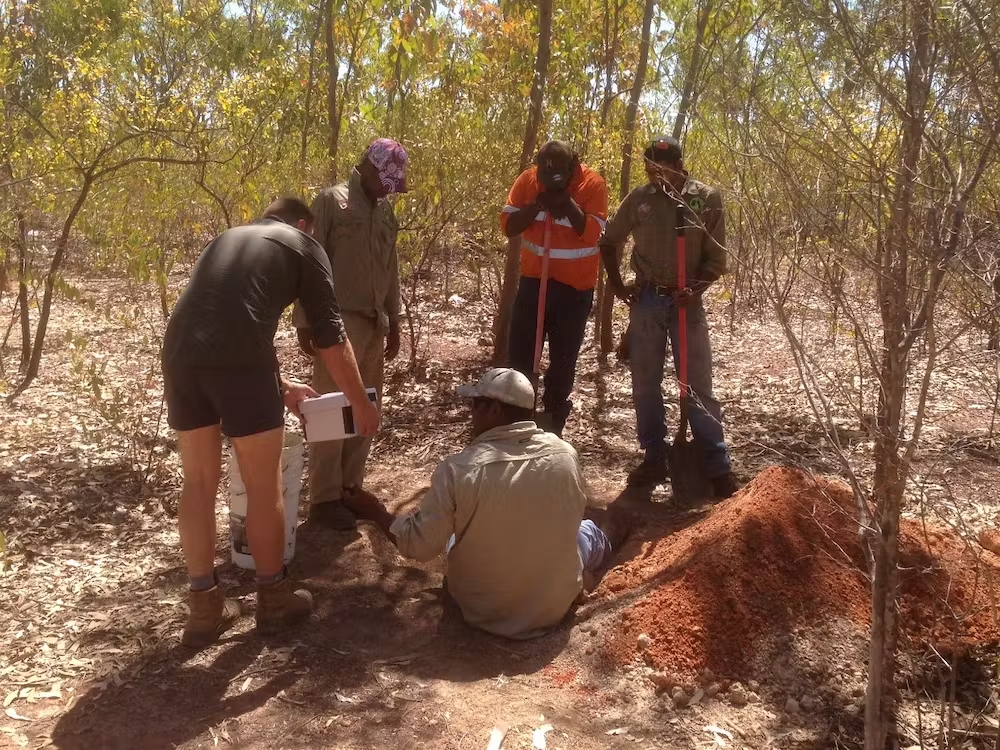
In 2015, Gkuthaarn and Kukatj community members of Queensland’s Gulf Country invited us to excavate, analyse, and rebury the skeletal remains of eight young Indigenous people who died near the town of Normanton in the late 1800s.

The remains were acquired by Walter Roth (1861-1933). Roth was a medical doctor, anthropologist, and the first Northern Protector of Aboriginal people. He eventually sold the remains to the Australian Museum in Sydney, which held them for almost a century before repatriating them to the Traditional Owners in the 1990s.

The remains were reburied, but later exposed by erosion – which prompted Gkuthaarn and Kukatj community members to invite us to collaborate with them.

In research published in Archaeologies, we show how bioarchaeological techniques have helped shed light on the experiences of these young Indigenous people who were displaced by European colonisation.

Unfortunately, we only know the name of one of the eight individuals – a young woman named Dolly. Roth’s records indicate Dolly was a member of the Gkuthaarn and Kukatj People, and was working at the police barracks (shown in the banner image) in the town of Cloncurry, about 382km south of Normanton, when she died.

Gkuthaarn and Kukatj rangers reburied the remains in the Normanton Aboriginal Cemetery in 2015.
Author provided, Author provided

Driven from their lands

In 2018, we published a study that showed these individuals had experienced nutritional stress and, in some cases, syphilis. These findings are consistent with other evidence relating to the experience of Aboriginal people living on the Gulf Country during colonial expansion.

Archaeological data and historical documents indicate Aboriginal people on the Gulf Country lived as foragers until the mid-1800s, when their lands were occupied by Europeans and stocked with cattle. The cattle depleted resources that were critical for a foraging lifestyle, and conflict ensued.

As a result of the violence and loss of resources, many Aboriginal people on the Gulf Country became refugees in their own land. They had little choice but to move into camps on the fringes of towns such as Normanton. These camps were overcrowded and unhygienic, and many occupants died from infectious diseases as a result.

We spoke to several Gkuthaarn and Kukatj people during the course of our research. One senior person expressed feeling relief when the remains were safely retrieved and reburied:

[Researchers] put a tarp over and dug it [the remains] up real steady. [They were] fragile from the sun […] We felt like we was just welcome [by the spirits of the people connected with these remains], like they wanted to get reburied. [We] just had that feeling they wanted to get reburied; was a couple of times they had been exposed.

Insight into displacement, disease and diet

In our recent study, we analysed strontium, carbon, and oxygen isotopes from the teeth of six of the eight individuals.

Measuring isotope ratios in human bones and teeth can reveal information about an individual’s diet and geographical movements prior to their death. When we compare strontium isotope values from tooth enamel to an isotope map (called an “isoscape”) constructed for this project, we can see where the six individuals grew up.

Dolly’s strontium value suggests she grew up near the Gulf of Carpentaria. This is consistent with Roth’s suggestion that Dolly was a member of the Gkuthaarn and Kukatj People, as their traditional territory extends to the coast. The strontium results for the other individuals suggest they grew up some distance to the east or northeast of Normanton.

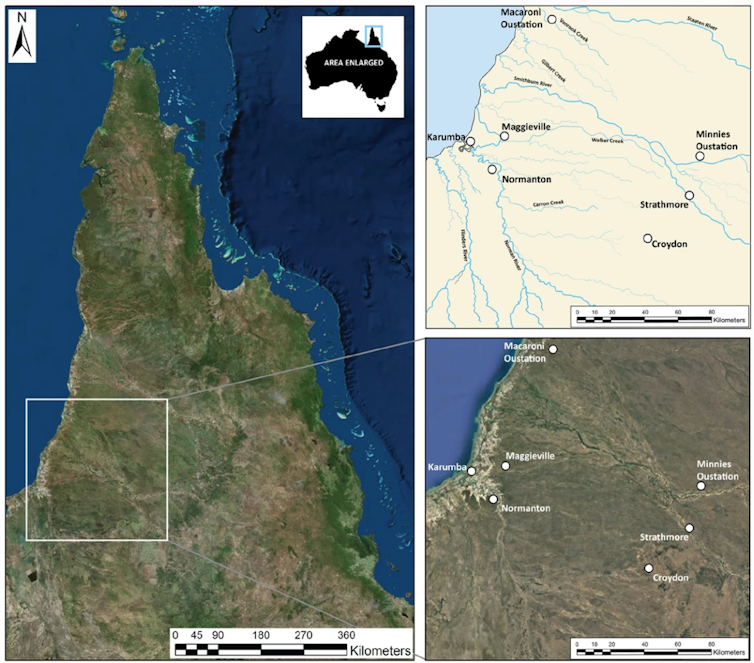
Maps showing the location of Normanton relative to the Gulf Plains region and Cape York.
Author provided

Carbon isotope results indicate that in their early years, all six individuals had diets dominated by tropical plants and/or marine foods. However, Dolly’s carbon value suggests her diet was especially high in such foods. This is again consistent with her having lived near the Gulf of Carpentaria when she was young.

The oxygen isotope results we obtained are also high when compared to international samples. We suspect these elevated values can be explained by a combination of the environmental conditions in the Gulf Country, and the effects of infectious diseases that spread into the region with European settlers.

Based on the formation times of Dolly’s tooth samples, and her strontium and oxygen values, we estimate she moved from the Gulf of Carpentaria to the Cloncurry area sometime between the age of 2.5 and 10. Our analyses also suggest she was a young adult when she died.

These assessments are in line with Roth’s reports from the Gulf Country, which state that Indigenous girls were often taken from their families and made to work for Europeans, and that it was common for such individuals to succumb to diseases early in life.

Speaking on the findings, one Gkuthaarn and Kukatj person told us:

I am sad to learn of our people getting horrible diseases and, with the study completed, these were young people who left behind such a sad story that needs to be told so non-Indigenous people, not just throughout Australia
but particularly in our region, know and understand that these traumas still
impact on our people 120 years later.


Read more:
First Nations people have made a plea for ‘truth-telling’. By reckoning with its past, Australia can finally help improve our future


The Voice

Combined with historical documents and information from contemporary Gkuthaarn and Kukatj People, our results provide new individual-level insight into the devastating impact of European colonisation on Aboriginal people of the Gulf Country.

Australians are currently debating a constitutional amendment to create an Aboriginal and Torres Strait Islander Voice to Parliament. The proposed amendment is a key recommendation of the Uluru Statement from the Heart. Another key recommendation is that of “truth-telling” about the experiences of Aboriginal people during European colonial expansion.

Science can’t tell us whether the Voice is the correct course of action. Yet our findings about these individuals – whose remains we have been honoured to analyse – reveal that scientific work conducted with and by First Nations people has an invaluable role in the process of truth-telling.

We hope such work will help reveal more truth of the experiences of those rendered voiceless by the violence of colonisation. As one Gkuthaarn and Kukatj person explained:

My old grandmother was one of those people who said they was horrible
and didn’t want to repeat it [i.e. they did not want to tell accounts of colonial violence to subsequent generations], but I believe it should be repeated [to] help us understand more about what really happened.

People [are] just listening to one side of it. You’ve got people who say Aboriginals just live off the welfare, but there was a reason why that happened. Aboriginal people fought for this country. You’ve got people who say you’ve gotta get over that [colonial violence], but what I say is: lest we forget.


We would like to thank our co-author Susan Phillips for her involvement in this research.

The Conversation

Shaun Adams receives funding from the Australian Research Council.

Mark Collard receives funding from the Canada Research Chairs Program, the Canada Foundation for Innovation, the British Columbia Knowledge Development Fund, and Simon Fraser University.

Michael Westaway receives funding from the Australian Research Council.

Richard Martin receives funding from the Australian Research Council. Dr Martin has also undertaken commissioned research relating to native title claims and cultural heritage protection for Aboriginal organisations around the Gulf Country.

David McGahan does not work for, consult, own shares in or receive funding from any company or organisation that would benefit from this article, and has disclosed no relevant affiliations beyond their academic appointment.

ref. Isotope analysis helps tell the stories of Aboriginal people living under early colonial expansion – https://theconversation.com/isotope-analysis-helps-tell-the-stories-of-aboriginal-people-living-under-early-colonial-expansion-203342

Australians should be wary of scare stories comparing the Voice with New Zealand’s Waitangi Tribunal

Source: The Conversation (Au and NZ) – By Michael Belgrave, Professor of History, Massey University

Fragment of the Treaty of Waitangi, signed in 1840.

Australian Senator Jacinta Nampijinpa Price’s recent claim that New Zealand’s Waitangi Tribunal has veto powers over parliament was met with surprise in New Zealand, especially by the members of the tribunal itself. That’s because it is just plain wrong.

As the debate around the Voice to Parliament ramps up, we can probably expect similar claims to be made ahead of this year’s referendum. But the issue is so important to Australia’s future that such misinformation should not go unchallenged.

From an Australian perspective, New Zealand may appear ahead of the game in recognising Indigenous voices constitutionally. But that has certainly not extended to granting a parliamentary power of veto to Māori.

The Waitangi Tribunal was originally established as a commission of inquiry in 1975, given the power only to make recommendations to government. And so it remains. The Crown alone appoints tribunal members and many are non-Māori.

As with all commissions of inquiry, it’s up to the government of the day to make a political decision about whether or not to implement those recommendations.

Deceptive and wrong

Price’s claim echoed a February article and paper published by the Institute of Public Affairs, aimed at influencing the Voice referendum. Titled “The New Zealand Māori voice to Parliament and what we can expect from Australia”, it was written by the director of the institute’s legal rights program, John Storey.

The paper makes a number of assertions: the Waitangi Tribunal has a veto over the New Zealand parliament’s power to pass certain legislation; the Waitangi Tribunal was established to hear land claims but its brief has expanded to include all aspects of public policy; and the Waitangi Tribunal “shows the Voice will create new Indigenous rights”.


Read more:
What Australia could learn from New Zealand about Indigenous representation


The last of the statements is deceptive and the others are completely wrong. The Waitangi Tribunal’s jurisdiction was largely set in stone by the New Zealand parliament in 1975 when it was established.

Far from investigating land claims, it initially wasn’t able to examine any claims dating from before 1975. Parliament changed the tribunal’s jurisdiction in 1985, giving it retrospective powers back to 1840 (when the Treaty of Waitangi/te Tiriti o Waitangi was signed).

The tribunal then started hearing land claims. But in its first decade, it focused on fisheries, planning issues, the loss of Māori language, government decisions being made at the time and general issues of public policy.

Honouring the Treaty: New Zealand Prime Minister Chris Hipkins at the 2023 Waitangi Day commemorations.
Getty Images

Historic grievances

Over the past 38 years, the tribunal has focused on what are called “historical Treaty claims”, covering the period 1840 to 1992. In 1992 a major settlement of fishing claims began an era of negotiation and settlement of these claims, quite separate from the tribunal itself.

With the majority of significant historic claims now settled or in negotiation, that aspect of the tribunal’s work is coming to an end. It has returned to hearing claims about social issues and other more contemporary issues.


Read more:
Solicitor-general confirms Voice model is legally sound, will not ‘fetter or impede’ parliament


Far from expanding its jurisdiction, the tribunal’s powers have been steadily reduced in recent decades. In 1993, it lost the power to make recommendations involving private land – that is, land not owned by the Crown. In 2008 it lost the power to investigate new historical claims, as the government looked to close off new claims that could undermine current settlements.

There is one area where the tribunal was given the power to force the Crown to return land. The 1984-1990 Labour government set a policy to rid itself of what were seen as surplus Crown assets. A deal was struck between Māori claimants and the Crown to allow the tribunal to make binding recommendations to return land in very special cases.

This compromise was not created by the tribunal but through ambiguity in legislation, which was resolved in favour of Māori claimants in the Court of Appeal. The ability to return land has almost never been used and is being progressively repealed across the country as Treaty settlements are implemented in legislation.

Wide political support

Storey quotes a number of tribunal reports, which make findings about the Crown’s responsibilities, as if these findings are binding on the Crown or even on parliament. This is not the case. The Waitangi Tribunal investigates claims that the Crown has acted contrary to the “principles of the Treaty”.

The Waitangi Tribunal establishes what those principles are, but they are binding on neither the courts nor parliament. Having made findings, the tribunal makes recommendations – not to parliament, as Storey suggests, but to ministers of the Crown. Some recommendations are implemented, others are not.


Read more:
Explainer: the significance of the Treaty of Waitangi


Where there is a dispute between the Crown and Māori, the tribunal has often recommended negotiation rather than make specific recommendations for redress.

Storey has elsewhere referred to the tribunal as a “so-called advisory, now binding, Māori Voice to Parliament” that has “decreed” certain things. In the longer paper he does admit the “tribunal cannot dictate the exact form any redress offered by government must take”. But he then falls back on the notion of a “moral veto” – that its status is so elevated that parliament is forced, however reluctantly, to do its bidding.

Yet not only does the Crown ignore tribunal recommendations as it chooses, it refuses even to be bound by the tribunal’s expert findings on history in negotiating settlements.


Read more:
What actually is a treaty? What could it mean for Indigenous people?


The Waitangi Tribunal will remain a permanent commission of inquiry because there is wide political support for its work. Nor can be it held solely responsible for increasing Māori assertiveness or political engagement with government, even if this was in any way a bad thing.

A larger social shift has taken place in Aotearoa New Zealand over the past few decades. No fiat from the Waitangi Tribunal has eliminated the cultural misappropriation of Māori faces and imagery – something Storey warns could mean “tea towels with a depiction of Uluru/Ayers Rock, or boomerang fridge magnets, would become problematic”.

The Waitangi Tribunal has often done no more than make Māori histories, Māori perspectives and Māori values accessible to a non-Māori majority. It has certainly had no power to control where debates on Indigenous issues fall.

The Conversation

Michael Belgrave was Research Manager for the Waitangi Tribunal, 1990-1993, and was commissioned at various times until 2006 to undertake historical research for the Tribunal.

ref. Australians should be wary of scare stories comparing the Voice with New Zealand’s Waitangi Tribunal – https://theconversation.com/australians-should-be-wary-of-scare-stories-comparing-the-voice-with-new-zealands-waitangi-tribunal-204676

Tahitian voters go to polls for crucial run-off territorial election

RNZ Pacific

Voting has started in French Polynesia in the second round to elect a new Territorial Assembly for a five-year term.

About 200,000 voters can choose among three lists of candidates vying for the assembly’s 57 seats.

The lists of the pro-independence Tavini Huira’atira, which won the first round two weeks ago, and of the autonomist A Here Ia Porinetia are unchanged.

For today’s run-off round, the ruling Tapura Huira’atira changed its list by adding four candidates of the opposition Amuitahiraa, which had been eliminated in the first round.

The list winning most votes today will get a third of all seats as a bonus, which will give it an absolute majority.

The remaining two thirds of the seats will then be distributed according to the lists’ relative strength.

To promote gender parity the lists must alternate male and female candidates.

Closing times of the polling stations vary, but unofficial results are expected by the end of the day.

Publishing any result before all stations are closed is prohibited and can incur a fine of US$80,000.

The elected assembly representatives will meet in mid-May to elect a new president.

The three candidates are Tavini’s Moetai Brotherson, the incumbent Édouard Fritch and the first ever woman seeking the top job, Nicole Sanquer of A Here Ia Porinetia.

Activist dies in accident
Meanwhile, a leading activist of the pro-independence Tavini Huira’atira party and the anti-nuclear movement has died in an accident.

Media reports said Ralph Taaviri, who was an experienced hunter, disappeared in the Punaruu valley of Tahiti.

Searchers found his body at the bottom of a cliff and a helicopter was needed to recover it.

Taaviri was one of the co-founders of the environmental NGO Faatura te rahu a te Atua.

This article is republished under a community partnership agreement with RNZ.

Print Friendly, PDF & Email

Article by AsiaPacificReport.nz

‘Drunkards urinating, fights – Nadi is like Beirut’, says McDonalds Fiji boss

By Arieta Vakasukawaqa in Suva

Drunkards urinating in public, people fighting and nightclub goers passed out on the streets are usually the first things tourists arriving in Fiji through Nadi International Airport see while being taken to their hotels.

McDonalds Fiji managing director Marc McElrath highlighted this while sharing his views at a consultation for the review of the opening of nightclub hours at Suvavou House in Suva this week.

“There are 16 nightclubs in Nadi and that is a big number for a small town,” McElrath said.

He said every day around 4am, drunkards were often scattered along the streets when nightclubs closed for business.

McElrath said they had raised the issue with the police many times.

“Tourists arriving from the USA — or wherever they come from — at 6am, when they come through Martintar, it looks like they’re driving through Beirut,” he said.

“There are people knocked out on the footpaths, drunkards fighting, people punching each other, and they urinate all over the place.

“It really doesn’t look good for our tourists.

“The issue we face in Nadi is the fact that a lot of people who come out of nightclubs at around 4am to 5am are drunk and it spills out onto the streets.”

He said the police did not have the manpower to control the issue of early morning drunkards in Nadi.

“The issue is that we have 16 nightclubs with six police officers — the police are overwhelmed, there are drunk people and then fights.”

McElrath called on the authorities to consider the safety of people while reviewing the opening hours for nightclubs.

“I understand there are special zones, and I am not an expert on these hours.

“I think the hours need to be reduced in certain areas where police can’t control the overwhelming numbers.”

Arieta Vakasukawaqa is a Fiji Times reporter. Republished with permission.

Print Friendly, PDF & Email

Article by AsiaPacificReport.nz

The Universities Accord should scrap Job-ready Graduates and create a new multi-rate system for student fees

Source: The Conversation (Au and NZ) – By Andrew Norton, Professor in the Practice of Higher Education Policy, Australian National University

shutterstock

This article is part of our series on big ideas for the Universities Accord. The federal government is calling for ideas to “reshape and reimagine higher education, and set it up for the next decade and beyond”. A review team is due to finish a draft report in June and a final report in December 2023.


The university fees (known as “student contributions”) paid by most domestic undergraduates are a difficult issue for the Universities Accord review.

Student contribution rates have significant consequences for student, university and government finances. The success or failure of the whole reform process may depend on managing the politics of who pays and how much.

Some university lobby groups are calling for a flat rate student contribution for all subjects and courses. This would reduce costs for many students but substantially increase student contributions for politically sensitive groups, including teaching and nursing students.

A multi-rate student contribution system – with the aim of making average student debt repayment times similar across different courses – would be more politically acceptable.


À lire aussi :
The inequity of Job-ready Graduates for students must be brought to a quick end. Here’s how


Current student contributions

The Morrison government’s Job-ready Graduates policy set current student contributions in 2021. For subjects the government deemed “job ready” or “national priorities,” student contributions were lowered to attract students. Other subject prices were set at neutral levels or increased to deter students.

The cheapest annual charge for a 2023 full-time student is A$4,124 for nursing, teaching and agriculture. Engineering, science, IT, allied health and performing arts cost $8,301. Students in medicine, dentistry and veterinary science pay $11,800. The highest rates are for law, business and most arts disciplines, set at $15,142.

These student contributions are added to federal government subsidies called “Commonwealth contributions”, which also vary by discipline, to create a total funding rate received by universities.

A student walks past a row of bikes at Sydney University.
Arts, business and law student fees are now more than $15,000 a year.
Shutterstock

What are university groups calling for?

Two university lobby groups, the Group of Eight (which includes the University of Melbourne and University of Sydney) and the Australian Technology Network (which includes Curtin, Deakin and RMIT universities), want a single student contribution rate regardless of subjects taken.

The Innovative Research Universities group (which includes Flinders, Griffith and James Cook universities) recommends a two or three tier student contribution system, with prices varying according to graduate employment outcomes.

Before the Job-ready Graduates scheme was introduced, student contributions were roughly linked to future expected earnings in a similar way.


À lire aussi :
Nobel laureate Brian Schmidt’s big ideas for how Australia funds and uses research


My submission to the Universities Accord

Job-ready Graduates assumes student contributions significantly influence student course choices.

But student interests, and within those interests employment prospects and expected salaries, are the main drivers of course choices.

In practice, the Job-ready Graduates scheme delivers financial penalties and rewards for course choices students would mostly have made anyway. For students who borrow under the HELP loan scheme, this means longer or shorter repayment times than previously.

My submission to the Universities Accord review focused on practical consequences for students, the government and universities.

Consequences for students

On the surface, a single annual student contribution rate makes repayment burdens more equal.

Students in longer courses would pay more in total, but final HELP debts on completion would be more similar across courses than under Job-ready Graduates or the previous student contribution system.

In practice, however, the same debt has different on-average consequences depending on degree taken. Annual HELP debt repayments are based on the debtor’s income, so students with degrees leading to better-paid occupations make more annual progress towards paying off their HELP debt.

With a single student contribution level graduates in high-paying fields would repay their debt much more quickly than graduates in lower-paying fields.

Slow repayments mean a larger number of years of outstanding HELP debt being indexed to inflation. This year’s indexation will be 7.1%. With more debt to repay as a result, repayment times will increase.

Student contributions based on expected future income narrow these differences in repayment times. The available analyses of repayment times have flaws, (including mixing HELP debtors who started and finished their degrees at different times) but nonetheless support this proposition.

For example, before Job-ready Graduates law students were charged more than humanities students, but graduates from both fields on average took nine years to repay their HELP debt. Typically law graduates earn more than arts graduates and so repay more debt each year.

Setting student contributions based on future income leads to more equality of effort in repaying than a flat rate student contribution system.

Consequences for government

HELP debt costs the government money as well as students. Normally the government incurs interest subsidy costs, calculated as the difference between what it costs the government to borrow money in the bond markets and the CPI-linked indexation rate.

Unusually CPI exceeds the bond rate this year, but this is not expected to last. Not all HELP debtors repay, with 15% of new debt estimated to be eventually written off at taxpayer expense.

Job-ready Graduates made HELP more costly. For example, more than doubling the debt of humanities graduates means they will take much longer to repay fully than previously, if they ever do. Interest and bad debt costs will increase.

A repayment times-based policy would help manage the government’s own financial risks by allocating a high share of HELP debt to students likely to repay in full.

Consequences for universities

For universities, the total funding rate matters more than how it is divided between Commonwealth and student contributions. But student contributions matter independently in one specific set of circumstances: when universities “over-enrol”.

This happens when a university reaches its maximum level of Commonwealth contribution funding. Any additional students are funded at the student contribution rate only.

Student contributions alone may not cover costs in courses with labour-intensive teaching methods or practical training components. For students in health courses, for example, universities pay hospitals and other health services for clinical placements.

Job-ready Graduates significantly cut student contributions for teaching and nursing, which have compulsory work placements. Universities would lose money if they over-enrol in these courses, discouraging them from offering more student places.

Both the single rate and tiered student contribution systems would be an improvement on Job-ready Graduates, by improving on the economics of over-enrolment in teaching and nursing.


À lire aussi :
Why arts degrees and other generalist programs are the future of Australian higher education


The politics of single rate student contributions

A flat student contribution that left the government and universities in the same financial position as now would be about $10,000 per year for a full-time student.

$10,000 is more than double what teaching and nursing students pay now. While most would still pursue their career goals, a large price increase would confuse the messaging when policymakers are trying to increase enrolments in these fields.

Nursing and teaching students need to pay more than now to make the system work for all stakeholders, but a multi-rate system would put them in a low or mid-tier student contribution band of less than $10,000 a year.

Teaching and nursing are highly feminised and popular with low socioeconomic status (SES) students. Based on 2021 enrolment data, a flat student contribution would, on average, lead to women paying slightly more than under Job-ready Graduates. Low SES students would also, on average, pay slightly more.

The dollar differences are not huge, at about $1,000 extra for women and $1,500 more for low SES students on average over a three year degree. But again, it would confuse the government’s messaging, with the Universities Accord terms of reference requiring policies to increase low SES enrolments.

What now?

A flat rate student contribution would be simple and improve on Job-ready Graduates for universities and students in high student contribution courses.

But a three or four-tier student contribution system would do more to equalise repayment burdens between students. It would be fairer overall, and politically easier for the government to sell.

The Conversation

Andrew Norton is on the Universities Accord Ministerial Reference Group, an unpaid advisory committee.

ref. The Universities Accord should scrap Job-ready Graduates and create a new multi-rate system for student fees – https://theconversation.com/the-universities-accord-should-scrap-job-ready-graduates-and-create-a-new-multi-rate-system-for-student-fees-203910

Australia wants to build a laser that can stop a tank. Here’s why ‘directed energy weapons’ are on the military wishlist

Source: The Conversation (Au and NZ) – By Sean O’Byrne, Associate Professor, Deputy Head of School (Research), School of Engineering and Information Technology, UNSW Canberra, UNSW Sydney

TRW INC / AP

“God mode”, for those who aren’t gamers, is a mode of operation (or cheat) built into some types of games based around shooting things. In God mode you are invulnerable to damage and you never run out of ammunition.

There’s no God mode in real life, of course, but the world’s military organisations are very interested in weapons that promise something like it: lasers and other “directed energy weapons”. The US government, for example, is spending nearly US$1 billion per year on directed energy projects.

Australia is not immune to the appeal. The 2020 Force Structure Plan called for a directed energy weapon system “capable of defeating armoured vehicles up to and including main battle tanks”.


Read more:
The much-anticipated defence review is here. So what does it say, and what does it mean for Australia?


In March this year, Deputy Prime Minister Richard Marles launched Australian startup AIM Defence’s new directed energy testing range on the outskirts of Melbourne. In April, the Defence Science and Technology group announced a A$13 million deal with British defence technology company QinetiQ to develop a prototype defensive laser.

And directed energy technology is a priority in the new A$3.4 billion Advanced Strategic Capabilities Accelerator (ASCA) program.

What is directed energy?

A directed energy weapon concentrates large amounts of electromagnetic energy on a remote target. This energy might be in the form of light (a laser), but microwaves or radio waves can also be used.

In the interest of brevity, we’ll concentrate on laser-based directed energy weapons here, but much of the argument also applies to the other types.

Depending on how much energy is focused on the target, these weapons can damage the delicate electronic systems that control devices and the people who operate them, or melt or burn sturdier hardware.

A black and white photo of a metal missile shell on a stand, appearing to explode.
The US tested experimental laser weapon systems in the 1980s.
AP

Because electromagnetic waves travel at the speed of light, they are much faster than even the fastest traditional weapons. Take a hypersonic missile travelling at ten times the speed of sound towards a target 10 kilometres away. It would have moved only about 10 centimetres by the time the directed light energy from a high-power laser would have reached the target.

What’s more, because these weapons project light rather than munitions, they will never run out of ammunition. This also means ammunition does not have to be manufactured in a factory and transported to the weapon.

Directed energy is not affected by gravity like missiles and bullets are, so it travels in a straight line. This makes aiming and targeting easier and more reliable.

And because directed energy weapons cause damage by heating up a target area, they have less potential to hit nearby objects or send shrapnel flying.

So why doesn’t everyone use directed energy weapons?

Although directed energy weapons have all these advantages over conventional weapons, useful ones have proven difficult to build.

One problem faced by laser weapons is the huge amount of power required to destroy useful targets such as missiles. To destroy something of this size requires lasers with hundreds of kilowatts or even megawatts of power. And these devices are only around 20% efficient, so we would require five times as much power to run the device itself.

We are well into megawatt territory here – that’s the kind of power consumed by a small town. For this reason, even portable directed energy devices are very large. (It’s only recently that the US has been able to make a relatively low-power 50kW laser compact enough to fit on an armoured vehicle, although devices operating at powers up to 300kW have been developed.)

A photo of an armoured vehicle
The US’s Directed Energy Maneuver-Short Range Air Defense, or DE M-SHORAD, is a 50kW laser system mounted on an armoured vehicle.
Jim Sheppard / US Army

Also, all that heat needs to be removed from the delicate optical equipment that produces the light very rapidly, or it will damage the laser itself. This has proved difficult, though laser technologies with more efficient heat transfer have gradually increased the amount of light energy that can reliably be produced.

Another side effect of dealing with such large amounts of energy is that any imperfections in the optical systems used to focus and direct the light can easily cause catastrophic damage to the laser system.

Nor is it easy to focus a laser on a spot the size of a 10 cent piece tens of kilometres away, through atmospheric turbulence and dust or rain. Add to this the difficulty of holding the energy in the same location on a fast-moving target for tens of seconds, and the practical difficulties become apparent.

Having said this, technologies to overcome all of these obstacles continue to improve.

Directed energy weapons will need a whole industry

But suppose all the technical problems of directed energy weapons are overcome. Even then, to manufacture them in quantity we will face significant supply chain and infrastructure challenges.

There are companies in Australia with the expertise to make such devices. However, to develop and mass-produce directed energy weapons requires an industrial capacity for the fabrication of the necessary laser diodes and high-quality optics, which does not exist in Australia.

To have a “sovereign capability” – being able to produce these weapons without relying on inputs from overseas – we will need to develop such industries.


Read more:
The defence review fails to address the third revolution in warfare: artificial intelligence


This is a time-consuming and expensive national infrastructure investment. In peacetime, it is relatively easy to acquire the raw materials for a directed energy weapon from overseas, but in a large-scale conflict countries that are able to produce these devices will likely be producing them for their own needs.

The potential military advantages of directed energy weapons, and the consequences of an adversary having them, mean Australia and many other countries will maintain an interest in developing them. But as recent policy decisions about nuclear submarines have shown, it is no easy task to quickly develop an industrial capability in technologies that our industrial base has until now largely ignored.

The Conversation

Sean O’Byrne receives funding from DST group for a directed energy research project and was previously funded by Lockheed Martin Corporation to study the physics of high-powered gas lasers.

ref. Australia wants to build a laser that can stop a tank. Here’s why ‘directed energy weapons’ are on the military wishlist – https://theconversation.com/australia-wants-to-build-a-laser-that-can-stop-a-tank-heres-why-directed-energy-weapons-are-on-the-military-wishlist-204623

The Liberals are the fifth iteration of Australia’s main centre-right party. Could the Voice campaign hasten a sixth?

Source: The Conversation (Au and NZ) – By Chris Wallace, Professor, School of Politics Economics & Society, Faculty of Business Government & Law, University of Canberra

Party stability on the progressive side of politics, and repeated party reconfiguration on the conservative side of politics, is a marked contrast in the history of Australia’s two-party political system.

That history is relevant now, as the Liberals find themselves in the electoral wilderness, and as a schism emerges over its stance on the referendum for an Indigenous Voice to the Australian parliament.

It raises a legitimate question about whether, as has happened several times in the past, the Liberal Party might be superseded by a new vehicle that better represents mainstream liberal and conservative voters’ interests and provides a viable electoral alternative to Labor.

A party of many iterations

In contrast to the Australian Labor Party, which predates Federation in 1901 and has existed continuously since, the Liberal Party was formed in 1944 and formally launched in 1945. It is the fifth iteration of the main vehicles through which the centre-right has sought federal parliamentary representation.

Federally, the Liberal Party’s genealogy is:

  • Protectionist Party, Free Trade Party (1901-1909)

  • Commonwealth Liberal Party (1909-1917)

  • Nationalist Party (1917-1931)

  • United Australia Party (1931-1945)

  • Liberal Party (1945+).

The earliest parliaments were dominated by, as Alfred Deakin famously dubbed them, “the three elevens” – because it was like having three cricket teams play the same match. They were the Deakin-led Protectionist Party, the Free Trade Party (later renamed the Anti-Socialist Party) and the Labor Party.

In 1909 the Protectionist Party and Anti-Socialist Party united to create the Commonwealth Liberal Party to compete with Labor, ushering in the “two party” era.

The next two iterations saw the main anti-Labor party unite, from opposition, with Labor breakaways to form a new party.

In 1917, the opposition Commonwealth Liberals merged with Billy Hughes’ breakaway National Labor Party to form the Nationalist Party, which held office under the prime ministership of Hughes and later Stanley Melbourne Bruce.

In 1931, the Nationalist Party opposition and Labor defector Joseph Lyons and his allies joined to form the United Australia Party (UAP). This was the vehicle for Lyons’ prime ministership and, on his death, Robert Menzies’ first prime ministership.

The UAP became increasingly dysfunctional after Lyons’ death. Menzies proved a poor war-time prime minister, was unpopular with colleagues, and resigned as prime minister in 1941. The coalition UAP-Country Party government of Arthur Fadden fell several weeks later after losing a confidence motion on the floor of parliament, succeeded by the Curtin Labor government.

The United Australia Party became increasingly dysfunctional after the death, in office, of Prime Minister Joseph Lyons.
Stanley Heritage Walk

Labor’s landslide 1943 election win finished the UAP as a political force. The party’s primary vote slumped to 21.9% and it won just 14 of the federal parliament’s then 74 seats.

Menzies drove the Liberal Party’s foundation as a fresh start for centre-right politics in Australia.

His insight that the UAP was terminal was partly driven by the large amount of political activity that sprang up from centre-right forces outside the party’s bounds. This included a large number of independent anti-Labor candidates running at the 1943 election.

The upsurge in centrist community independent candidates – notably the Teals ¬– running at the 2022 federal election is a striking parallel.


Read more:
The Liberal Party is in a dire state across Australia right now. That should worry us all


Could the Liberal Party be reborn again?

Forming a new political party is a drastic move. The calculus on whether an existing party is still viable and can be renewed, or whether, as Menzies judged with the UAP, it is too far gone and needs to replaced, is a delicate one.

Former prime minister and Liberal leader John Howard declared after the 2022 election that “we have to hold ourselves together”, arguing Peter Dutton was the right man for the job.

Holding the Liberal Party together has since become established as the benchmark for Dutton’s success or failure as opposition leader. This is either a low bar or it’s a sign that the Liberal Party is indeed at risk of breaking apart.

These tensions date from the early 1980s under Howard’s aegis, when the conservative push to crush moderate viewpoints began in earnest.

Howard and conservative Liberal leadership successors since demanded the selling out of principled centrist policy positions as the price of moderates’ inclusion in cabinet and shadow cabinet.

Liberal moderates persistently paid that price in exchange for ministerial advancement. This in turn hastened the Liberals’ lurch to the right. The party become less and less reflective of mainstream Australia even as some visible moderates survived and rose through the ministerial ranks.

Women especially feel unwelcome in the party. The bullying of MP Julia Banks and her subsequent resignation from the Liberals in 2018 became emblematic of the party’s toxic masculinity problem.

Former prime minister Scott Morrison’s misogynistic handling of sexual violence allegations concerning Liberal Party figures followed. Female voters remember this in the ballot box.

The pervasiveness of evangelical Christians and conservative Catholics in the branch membership combined with, under the influence of Sky News “After Dark” programming, US Republican-style fringe interests and agendas, are alienating people who in other eras could or would have been branch members. There seems to be little space now for moderate Liberals.

People trying to improve things quietly from the inside are frustrated by the hardened factionalism and capture of key party organs by warring right-wing factions. There are too few mainstream people to coalesce with to drag the party back towards the centre.

Combined with the demographic changes noted by Redbridge analysts Kos Samaras and Tony Barry after the Liberals’ poor showing at the Victorian state election and federal Aston by-election, the picture for the party looks bleak.

As well as losing support among women, the Liberals have lost it among young people, Samaras and Barry note. This is compounded, they say, by young people now not becoming conservative as they age: those who once would have developed into Liberal voters simply aren’t doing so.


Read more:
Will a preoccupation with party unity destroy the Liberal Party?


The Teals who won traditional blue riband Liberal seats in Sydney, Melbourne and Perth at the 2022 election are essentially moderate Liberals sitting on the crossbench, because sensible centrists are repellent to, and repelled by, the Liberal Party in its current state.

The entropy is gathering pace.

Less than a year ago, Indigenous MP Ken Wyatt was a Liberal cabinet minister before losing his seat at the 2022 election. In April this year, Wyatt resigned from the party in frustration over the Liberals’ opposition to the Indigenous Voice to Parliament, the co-design of which he himself commissioned and took to cabinet in the expectation of support. He was disappointed.

The resignation of the Dutton opposition’s Indigenous affairs spokesperson, Julian Leeser – a Voice supporter like Wyatt and a significant number of other Liberals – breaks the pattern of moderates selling their soul for career advancement. While admirable, there’s a lot less to lose taking a principled stand like this in opposition than government, but it’s a start.

Now Voice-supporting Liberals are forming WhatsApp groups to co-ordinate their actions in the “yes” campaign. This will likely bring them into campaigning contact with centrist Teals in those traditional blue riband seats the Liberals lost at the 2022 election.

Could that create a chemistry that spurs development of the Liberal Party’s next iteration?

Who knows? But remnant centrists inside the Liberals finding common cause with Teals and their allies outside it, campaigning if not together then at least in close proximity around a galvanising issue of national importance, does make it more rather than less likely.

Opposition Leader Peter Dutton’s defensive posture of just appealing to “the base’” and trying to hold the Liberals together may prove the losing gambit in this fifth iteration of Australia’s main party of the centre-right. As Dutton would know from sport, purely playing defence rarely wins the game.

The Conversation

Chris Wallace has received funding from the Australian Research Council.

ref. The Liberals are the fifth iteration of Australia’s main centre-right party. Could the Voice campaign hasten a sixth? – https://theconversation.com/the-liberals-are-the-fifth-iteration-of-australias-main-centre-right-party-could-the-voice-campaign-hasten-a-sixth-203654

Some projects in $120 billion federal infrastructure pipeline set to be scrapped

Source: The Conversation (Au and NZ) – By Michelle Grattan, Professorial Fellow, University of Canberra

Some projects in the $120 billion federal infrastructure investment pipeline that the Albanese government inherited from the Coalition will soon be on the chopping block.

This follows the announcement of a 90-day review of the pipeline, and sharp criticism by Infrastructure Minister Catherine King of the Coalition program.

There have been large cost escalations in many projects. Apart from inadequate costing to start with, supply chain pressures have drastically increased the costs of major projects.

The infrastructure pipeline includes rail and road projects in the capitals as well as rail and road construction and upgrades in regional and outback areas.

The government is keeping the size of the pipeline the same, but with its content changing. The review’s outcome is expected to be announced in the mid-year budget update released in December. There will not be new infrastructure projects announced in the May 9 budget.

King said the government was committed to delivering on its election promises and following through on projects now under construction.

The ambitious Brisbane to Melbourne inland railway has already been reviewed and guaranteed. The review, by Kerry Schott, recommended a number of ways to improve its delivery.


Read more:
Grattan on Friday: Chalmers grapples with a budget where economics and politics pull in different directions


King said that under the Coalition, the number of projects had blown out from from nearly 150 to 800.

“Projects were left without adequate funding or resources, projects without real benefits to the public were approved, and the clogged pipeline has caused delays and overruns in important, nation building projects,” she said.

Many projects never started, and some 160 had a commitment of $5 million or under.

The government needed to fix the situation. “Australia should have a pipeline of land transport infrastructure projects that are genuinely nation-building, economically sustainable and resilient to our changing climate,” King said.

The review will be done by Reece Waldock, a former director-general of the Western Australian transport department, Clare Gardiner-Barnes, a member of the Infrastructure Australia board, and Mike Mrdak, who once headed the federal infrastructure department.

States, territories and local government will be consulted in the review. It is seen as an opportunity for states to name any projects they are no longer committed to.

“A properly functioning infrastructure investment pipeline means projects can be delivered with more confidence about timeframes and budgets,” King said.

“Easing the pressure on the construction sector will help drive inflation lower and deliver more predictable investment and delivery outcomes from governments.”

Labor accuses the Coalition of using the infrastructure program for massive pork barrelling. It says when it took office only 19% of the infrastructure investment program projects with a federal government contribution under $50 million were in seats the ALP held before the election.

The Conversation

Michelle Grattan does not work for, consult, own shares in or receive funding from any company or organisation that would benefit from this article, and has disclosed no relevant affiliations beyond their academic appointment.

ref. Some projects in $120 billion federal infrastructure pipeline set to be scrapped – https://theconversation.com/some-projects-in-120-billion-federal-infrastructure-pipeline-set-to-be-scrapped-204741

No, you can’t blame all your health issues on ‘high cortisol’. Here’s how the hormone works

Source: The Conversation (Au and NZ) – By Theresa Larkin, Associate professor of Medical Sciences, University of Wollongong

Kinga Howard/Unsplash

Have you been craving certain foods and gaining weight? Maybe you’re fatigued and can’t concentrate, then wake up in the middle of the night. The latest TikTok wellness trend would have you believe high cortisol levels are to blame.

It’s true that cortisol affects our weight, energy balance, metabolism and sleep. But so do thyroid hormones, appetite hormones and sex hormones, as well as diet and physical activity.

Cortisol also does more than this and regulates many other biological functions. It affects nearly all the cells of our body and is essential for survival.


Why is cortisol portrayed as bad?

Some of what is being blamed on cortisol are symptoms of chronic stress or depression – which makes sense, since these are linked.

Cortisol is the main “stress hormone” of the body. This might make people think cortisol is bad for them, but this is not the case.

Stress is an inevitable part of life, and our stress response has evolved as a survival mechanism so we can react quickly to dangerous situations. Both psychological and physical stresses elicit the stress response.

Cortisol is essential for a healthy stress response

Our immediate reaction to a sudden threat is the fight-or-flight response. Adrenaline is released from the adrenal glands into our bloodstream. This instantly increases our heart rate and breathing rate so we can be ready to act quickly to escape or avoid danger. However, the adrenaline response is only very short-lived.

When a threat or stress persists for minutes rather than seconds, cortisol is released from the adrenal glands. Its main role is to increase blood glucose (sugar) for energy.


Read more:
Three reasons to get your stress levels in check this year


Cortisol affects the liver, muscle, fat and pancreas to increase glucose production and mobilise stored glucose. This increases glucose to the brain so that we are mentally alert and to the muscles so we can move.

In a healthy and normal stress response, cortisol rises quickly in response to the stress and then rapidly reduces back to baseline levels after the stress has passed.

However, chronic stress and ongoing increased cortisol secretion are not healthy. Chronic stress can cause dysregulated cortisol secretion: when cortisol remains high even in the absence of an immediate stress.

It can take weeks for cortisol dysregulation to return to normal after chronic stress.

What’s the link with depression?

Emerging evidence suggests chronic stress and dysregulated cortisol may contribute to the development of depression. Our research team has shown that people with depression have, on average, higher cortisol than people who don’t have depression. We also found that higher cortisol was associated with more negative thinking and lower quality of life.

The symptoms described on TikTok as being due to high cortisol may be caused by stress, depression or anxiety. Depression can also cause insomnia, increased appetite, and weight gain or loss.

Man looks at sugary drinks at the supermarket
Tiredness and cravings can be caused by a number of different things.
Unsplash/Atoms

The relationship between cortisol, weight changes and depression are complex. High cortisol also increases the activity of adrenaline. This explains why when you are stressed you can be extra reactive and snap into fight-or-flight mode quickly.

However, some of the symptoms described on TikTok as due to “high cortisol” may actually reflect low cortisol. Low cortisol can be caused by chronic stress and high cortisol during childhood or earlier in life. This is why some people with depression, particularly those with a long history of depression, have low rather than high cortisol.

Low cortisol causes fatigue and weight gain. This is more common in women and we found this was linked to leptin, a satiety hormone.

How do you know if your cortisol is too high or low?

Despite claims on TikTok, we cannot tell whether our cortisol is in balance or high or low.

The only way to know is to have your blood, urine or saliva analysed in a laboratory. This is not done routinely and would be a waste of resources. A doctor would only check this if they suspected you had a disorder of cortisol production, but these are rare.

Besides, your cortisol levels vary considerably across different times of the day and night.

Cortisol affects your body clock

One of the most important roles of cortisol is in the circadian system of the body. The hypothalamus in the brain sets the circadian (approximately 24-hour) rhythms of our biological functions to match the light-dark cycle. Cortisol communicates these signals from the brain to the rest of the body.


Read more:
Chemical messengers: how hormones help us sleep


Cortisol secretion from the adrenal glands increases in the early hours of the morning, peaks at about 7am, and then is lowest from about midday until early morning.

Cortisol is our body’s natural alarm clock. Higher cortisol during the morning or at the end of the sleep period stimulates wakefulness, increased energy, and physical activity. Lower cortisol during the night encourages sleep and restorative functions.

How can you maintain healthy cortisol levels?

You can try to maintain healthy levels of cortisol by addressing the underlying causes of cortisol dysregulation.

Meditation, mindfulness and cognitive behavioural therapy can reduce the reactivity of the stress response.

Exercise during the day and good sleeping habits also help to reduce chronic stress and high cortisol.

Finally, a healthy balanced diet gives your body the building blocks for good hormone health.

If this article has raised issues for you, or if you’re concerned about someone you know, call Lifeline on 13 11 14.

The Conversation

The authors do not work for, consult, own shares in or receive funding from any company or organisation that would benefit from this article, and have disclosed no relevant affiliations beyond their academic appointment.

ref. No, you can’t blame all your health issues on ‘high cortisol’. Here’s how the hormone works – https://theconversation.com/no-you-cant-blame-all-your-health-issues-on-high-cortisol-heres-how-the-hormone-works-203162

Drone seeding and E-seeds sound exciting, but ecosystem restoration needs practical solutions

Source: The Conversation (Au and NZ) – By Simone Pedrini, Lecturer in ecological restoration, Curtin University

Simone Pedrini, Author provided

A drone drops a small wooden projectile with three spiral tails and a seed mounted on the tip. It gently lands on the bare ground and sits there, exposed to the elements, until it rains. Then, the moisture penetrates the wood fibres, and the spiral tails start twisting, slowly pushing the seed into the ground, where it will germinate.

The design of this incredible depth-seeking seed carrier, recently published in Nature, was inspired by the self-burying mechanism of a few grass species, such as those of the genus Erodium.

According to the authors, these seed carriers, also known as E-seeds, can be built in various sizes for different species and dropped by aeroplanes or drones to restore degraded ecosystems.

This bio-inspired engineering marvel has received a vast and well-deserved share of attention and praise.

But, from a restoration practitioner’s point of view, it has logistical issues that can greatly limit its application at scale.

Unproven ‘game-changers’

E-seeds are the latest of many technologies presented as restoration “game-changers”.

Numerous private companies have entered the market with revolutionary devices (mostly drones), claiming to restore ecosystems by planting billions of trees. Yet, to date, there is little evidence of their efficacy.

This fascination with shiny technological gadgets might divert scarce resources from practical, on-the-ground solutions that will seriously affect our ability to restore degraded ecosystems globally.

A vast portion of the world’s ecosystem has been damaged or destroyed due to human activities. Global initiatives, such as the UN Decade for Ecosystem Restoration and the Bonn Challenge, promote international cooperation to restore 350 million hectares by 2030.

For decades, scientists and practitioners have been working on solutions to support and accelerate the recovery of degraded ecosystems.


Read more:
Restoring forests often falls to landholders. Here’s how to do it cheaply and well


Most seeds fail

Often, the first step for initiating the natural recovery of terrestrial ecosystems is to establish native vegetation. Tree planting is a common approach, but it can be expensive on a large scale. Direct seeding is faster and cheaper, but also riskier.

For a start, seeds need to reach the right place in the soil to germinate and grow.

If seeds are scattered (seed broadcasting) on the soil surface by hand, tractor or drone, they can be blown off by the wind or eaten by animals. Even if they germinate, the seedling can dry up and die. As a result, most seeds will not become a plant.

This is why seed penetration in the soil is the key to improving a seed’s chance of success. Generally, the bigger a seed is, the deeper it can go. This is often achieved using precision seeders, similar to those used in agriculture. These machines open up the soil, deposit the seed at a precise depth, and cover it. The E-seed can achieve a similar result, ideally making seed broadcasting as effective as precision seeding.

Close-up of a tractor with equipment attached that features rows of digging and seed-depositing tools
Precision agricultural seeder used with native species in Western Australia.
Simone Pedrini, Author provided

Unfortunately, this approach presents two problems: scalability and logistics. First, it’s unlikely that the multi-step process needed to manufacture E-seeds can be scaled to the many billions of seeds across thousands of species we need to restore entire ecosystems.

Second, the tails of the E-seeds could easily get tangled with each other, either clogging the seed delivery mechanism or being released in clumps. The authors solved this problem by dividing the seeding box into compartments containing a single E-seed. This stopped the seed from clumping but greatly reduced the number of seeds that could be delivered on each drone flight.

This clumping seeds issue is also common when dealing with native species, such as the grasses that inspired the design of the E-seed. A simpler, less technological solution currently used in restoration is to actually remove the tails.

This reduces the seed volume for storage and delivery, and improves the seed flow through seeding equipment. In some cases, the removal of appendages could also improve seed germination.

Such approaches are not as spectacular as E-seeds dropped from drones. Still, in most scenarios, they are the most cost-effective way to reintroduce native vegetation to a degraded site at scale.

Close-up of various brown and yellow seeds, most of them round
Native seed mix of Western Australian species.
Kingsley Dixon, Author provided

Effective, not flamboyant

Ecological restoration is an incredibly complex activity that goes beyond vegetation establishment.

It must consider the complex and dynamic interactions of organisms and their environment, while accounting for social and economic implications for local communities. Therefore, we must approach ecosystem restoration holistically and not get carried away by the lure of shiny technologies.

Funders with limited appreciation of restoration’s ecological and practical complexities are keen to embrace and invest in charismatic, yet often unproven technologies.

For example, a start-up focused on drone seeding raised a A$200 million investment, double the amount the Australian federal government has dedicated to the environmental restoration fund over four years. But science is yet to demonstrate if drone seeding can work at scale to rebuild Australia’s degraded landscapes and ecosystems.

We should welcome any attempt to improve the success of ecological restoration, and promote the implementation of novel technologies.

But new technologies must prove their worth and practicality. We should focus on the most effective ways to restore native ecosystems, not the most flamboyant.


Read more:
Australia could ‘green’ its degraded landscapes for just 6% of what we spend on defence


The Conversation

Simone Pedrini received funding from the Australian Research Council through the Centre for Mine Site Restoration. He is the Chair of the International Network for Seed-Based Restoration and board advisor for the Europen Native Seed Producers Association.

Jorge Castro Gutiérrez receives funding from Spanish government (project TED2021-129690B-I00).

Kingsley Dixon receives funding from the Australian Research Council through the ARC Centre for Mine Site Restoration. He is the Chair of the Society for Ecological Restoration.

ref. Drone seeding and E-seeds sound exciting, but ecosystem restoration needs practical solutions – https://theconversation.com/drone-seeding-and-e-seeds-sound-exciting-but-ecosystem-restoration-needs-practical-solutions-204274

The tricky economics of subsidising psychedelics for mental health therapy

Source: The Conversation (Au and NZ) – By Cathy Mihalopoulos, Professor, Monash University

Shutterstock

Australia is the world’s first country to legalise the medical use of psychedelics. But not everyone is sure the timing is right. There are still major issues to work out for this move to benefit those most in need.

In particular, there is the question of whether psychedelic medicines will be publicly subsidised, given the lack of data about their cost-effectiveness compared with other treatments.

From July 1 2023, authorised psychiatrists will be able to prescribe psilocybin and MDMA for post-traumatic stress disorder and psilocybin for treatment-resistant depression, to be used in conjunction with psychotherapy.

The Therapeutic Goods Administration (TGA), which regulates medicines and medical devices in Australia, made this decision in February, reclassifying psilocybin and MDMA from “Schedule 9” (prohibited substances, only legally available for use in research) to “Schedule 8” (controlled substances).

Many in the field were surprised. Advocacy group Mind Medicine Australia, which lobbied hard for the decision, was delighted. But mental health experts such as former Australian of the Year Patrick McGorry questioned the sufficiency of evidence.


Read more:
The TGA has approved certain psychedelic treatments: the response from experts is mixed


The TGA considered the effectiveness and safety of psilocybin and MDMA, as the regulator is supposed to do, but not their cost-effectiveness. This is not a requirement of TGA approval processes, but it is for the regulatory bodies that must approve these treatments for a public subsidy.

The paucity of such evidence is going to be a high hurdle.

Will they be subsidised?

How much will such therapy cost? One estimate is $20,000 to $30,000, comprising the cost of the medication and therapists’ time for sessions.

The pharmaceutical-grade psilocybin and MDMA used in Australian clinical studies has largely been supplied free by US-based not-for-profit organisations such as the Usona Institute and Multidisciplinary Association for Psychedelic Studies. The bureaucratic requirements to import these medications include a permit from the TGA and an import licence and permit from the Office of Drug Control.

Australian clinical trials with psilocybin and MDMA have relied on imports provided free by not-for-profit research groups such as the Multidisciplinary Association for Psychedelic Studies in California.
Shutterstock

Increasing supply will require streamlining these import controls. There is also work to be done on the potential for local production. But for now the major determinant of costs for patients will be if the medicines and therapy are subsidised, as many psychological treatments and most psychiatric medications are now.

A subsidy for the psilocybin/MDMA component will require approval by the Pharmaceutical Benefits Advisory Committee, the independent body of medical experts that advises the federal health minister on which drugs should be listed on the Pharmaceutical Benefits Scheme.

This will require a detailed submission (usually from the pharmaceutical supplier) explaining how the medicine will be prescribed, its effectiveness, safety and cost-effectiveness compared with alternatives. Submissions must also include budget impact analysis – that is, how much it will cost if the medicine is listed on the PBS.


Read more:
Explainer: how is the price of medicine decided in Australia?


A subsidy for the psychotherapy component will require listing on the Medicare Benefits Schedule, which funds services such as blood tests, diagnostics and allied health services. This will need endorsement from the Medicare Services Advisory Committee (MSAC), which is not a statutory committee like the Pharmaceutical Benefits Advisory Committee but has a similar function.

Are they cost-effective?

To date there are no published studies on psilocybin’s cost-effectiveness, and only three on MDMA – all on its use in treating PTSD.

The first of these studies was published in 2020, the second in February 2022 and the third in March 2022. All three used economic modelling to to simulate long-term benefits and costs of MDMA-assisted psychotherapy compared with standard health care, extrapolated from the results of clinical trials (involving a few hundred people).

alt text here
Phase 3 clinical trials show therapy with MDMA and psychotherapy substantially reduces PTSD symptoms compared to psychotherapy and placebo.
Shutterstock

All three conclude MDMA-assisted therapy is a potentially cost-effective treatment for people with chronic and severe PTSD. However, the modelling assumes the effects of MDMA-assisted psychotherapy taken from clinical trials of relatively short durations (with maximum follow up of 18 weeks) will extend over 10 to 30 years. This may be overly optimistic. They were also based on the treatment patterns and costs from the US that differ to those in Australia.

PBAC and MSAC will likely need to carefully weigh this type of evidence to make an assessment about cost-effectiveness.


Read more:
Psychedelics researchers balance trippyness with scientific rigor after history of legal and cultural controversy – podcast


Estimating ‘off-label’ use

Another issue to be carefully considered is how many people will likely use these medicines in routine practice. Such estimates are complicated by the risk of off-label use – psychiatrists prescribing psilocybin and MDMA for purposes not listed by the TGA.

An estimated 40–75% of anti-psychotic medicine use is “off-label”. For example, the anti-psychotic medicine quetiapine is registered for treating schizophrenia and bipolar disorder, but is often used off-label for conditions such as anxiety or insomnia. This is despite the rules for prescribing quetiapine (the prescriber must state why they are prescribing it).

Allowing only authorised prescribers of psilocybin and MDMA may reduce the risk but not eliminate it. It could mean the cost of the medicines to the health budget ends up being a lot higher than estimated.

The upshot of all this means, in practice, Australia is still a way off from offering a public subsidy for these psychedelic treatments. Which means, come July 1, the number of Australians able to afford these treatments will be small.

The Conversation

Cathy Mihalopoulos was a member of the Economics Sub-Committee of the Pharmaceutical Benefits Advisory Committee from 2012 to 2022. She receives funding from organisations including National Health and Medical Research Council, Medical Research Future Fund, Department of Health, the Butterfly Foundation. She is an investigator on a clinical trial evaluating psilocybin-assisted psychotherapy for treatment resistant depression with Swinburne University and Woke Pharmaceuticals.

Christopher Langmead receives funding from the National Health and Medical Research Council, Medical Research Future Fund, Therapeutic Innovation Australia, and Servier Australia. He is co-founder and chief executive of Phrenix Therapeutics Pty Ltd, a biotechnology company developing new medicines for mental health disorders.

Mary Lou Chatterton receives funding from multiple organisations including National Health and Medical Research Council, Medical Research Future Fund, Department of Health, and the Butterfly Foundation. She is an investigator on a clinical trial evaluating psilocybin-assisted psychotherapy for treatment resistant depression with Swinburne University and Woke Pharmaceuticals. She is also an investigator on a trial of MDMA-assisted therapy for alcohol use disorder and post-traumatic stress disorder funded through the Medical Research Future Fund.

ref. The tricky economics of subsidising psychedelics for mental health therapy – https://theconversation.com/the-tricky-economics-of-subsidising-psychedelics-for-mental-health-therapy-201462

Beware red flags and fakes: how to buy authentic First Nations designs that benefit creators and communities

Source: The Conversation (Au and NZ) – By Nicola St John, Lecturer, Communication Design, RMIT University

Warlukurlangu Artists, Author provided

From souvenir shops to art galleries, First Nations designs are big business. Australia’s Productivity Commission estimates about $250 million of Indigenous-style art and consumer products are sold annually. But just 16% of that ends up in the hands of Aboriginal and Torres Strait Islander artists.

When it comes Indigenous-style souvenirs, the commission says about 75% aren’t authentic. The art market is a little better, but fakes are prevalent enough for one to have appeared in comedian Ricky Gervais’ sit-com Afterlife.

To support First Nations artists and communities, here’s what you need to know, and need to ask, before buying.

Home is where the art is

Aboriginal and Torres Strait Islander art is more than aesthetically pleasing shapes and colours. It is a cultural expression, a means of passing information from one generation to the next, of telling stories.

These stories may be about sacred knowledge and dreamings specific to an individual, a family or a community – stories not culturally permissible for others to tell. Those stories share commonalities but also differ according to place – plants, animals, customs and laws.

Each of Australia’s more than 200 Indigenous nation groups – comprised of clans that share a common language and kinship systems – will use designs, colours and materials related to place.

Dot painting, for example, is specific to the desert interior of Western Australia, Northern Territory and South Australia.

Dot painting by an artist from Yuendumu, about 300 km northwest of Alice Springs in the Northern Territory.
Warlukurlangu Artists, Author provided

Cross-hatching and “x-ray” paintings come from Arnhem Land in north-east Northern Territory.

Arnhem Land artist Glen Namundja at work in 2014.
Mark Roy/Wikimedia Commons, CC BY

Depictions of “Wandjina” spirits come from the Kimberley coast in northern Western Australia. The Wandjina are the most powerful creation spirits, symbolising rain. They are often depicted with bodies of dots, representing rainfall.

Wandjina rock art near the Barnett River, in the Kimberley, north Western Australia.
Graeme Churchard/Wikimedia Commons, CC BY

Ochre pigments, derived from soil, are used across the east Kimberley, Arnhem Land and central Northern Territory.

Art for sale at the Warmun Art Centre in the east Kimberley.
Bo Wong/West Australian Museum, CC BY

Any authentic piece of Indigenous art tells a story. Before you buy, get to know that story.

What’s the story?

There’s one simple rule when buying First Nations art or crafts: the more information the better.

Artists have two main ways to sell their art. For original art, it’s through a gallery, which takes a hefty commission. If it’s a design on a product, licensing is more common: the artist gives permission for the reproduction of their work in exchange for a one-off payment or an ongoing commission, usually linked to sales.

In either case, a legitimate gallery or licensee has a vested interest in assuring you of the authenticity of what they are selling, and that the artist is benefiting from your purchase.

They should be able to provide you with:

  • the artist’s name and biography, including their language or nations group
  • evidence of the work’s authenticity, such as photographs of the artist at work
  • how they pay the artist, and how much
  • evidence of commitment to efforts to improve the industry, such as the Indigenous Art Code.
Hilda Nakamarra Rogers, a member of the Warlukurlangu Artists Aboriginal Corporation
Hilda Nakamarra Rogers, a member of the Warlukurlangu Artists Aboriginal Corporation.
Warlukurlangu Artists, CC BY-NC-ND

If there’s no information on who created an artwork and where they’re from, it is most likely fake.

In short: buy from sellers with transparent policies. On their website and in person they should provide clear information on all off the above. Reluctance to share this information is a red flag.

Look for community connections

Galleries and other intermediaries may be Indigenous or non-Indigenous-owned. They may be private for-profit businesses or community-owned.

Private businesses can be highly ethical and reinvest in their community, but there is greater assurance of this happening with collectively owned businesses established specifically for the benefit of local artists, to employ local people and fund community projects.

An example is the Warlukurlangu Artists Aboriginal Corporation, a not-for-profit company owned by artists from the Yuendumu community in the Northern Territory, about 300 kilometres northwest of Alice Springs. Founded in 1985, the company uses its surpluses to fund community projects such as a health program and a dog program, which cares for the local dog population.

At work at the Warlukurlangu Artists art centre.
Warlukurlangu Artists, Author provided

There are more than 100 such independently governed First Nations art and craft centres in Australia, including umbrella organisations in the following areas:

Art centres sell online. They may have arrangements to sell artwork through commercial galleries nearer population hotspots. They may also license art for use on homeware and souvenirs.

In the wider market for First Nations designs and products, look for evidence of Indigenous ownership, commitment to compensate artists, and other evidence of community engagement. Most First Nations-run businesses are proud to acknowledge their heritage.

There is a federal scheme, called Supply Nation database, that verify Aboriginal and Torres Strait Islander businesses. But because this is focused on government and commercial procurement, it has few listings for arts, craft, and design business.

So use your best judgement. Ask the right questions, expect full answers.

What about product certification?

What about certifying products? This is done for Australian Made goods. Why not for First Nations-made products?

The problem, according to the Productivity Commission, is that certification schemes need high producer take-up and high consumer recognition to succeed. That would require resources the artists don’t have.

The commission has recommended an alternative approach, mandatory labelling of inauthentic products, through amending the Australian Consumer Law.

It has also recommended new “cultural rights” legislation, giving traditional owners control over cultural assets such as stories, symbols and motifs, with power to take legal action when the infringement of their rights.

So far, however, the federal government has given no indication of if and when it will act on these recommendations.

Until it does, and there are more legal protections and clear labelling – of fake or authentic good – take the time to ask the right questions and get the right answers.


Read more:
Labelling ‘fake art’ isn’t enough. Australia needs to recognise and protect First Nations cultural and intellectual property


The Conversation

Nicola St John receives funding from The Australia Council for the Arts, the Australian Government’s principal arts investment, development and advisory body. She also consults to Solid Lines, Australia’s only First Nations led illustration agency.

Emrhan Sultan has received funding from The Australia Council for the Arts, the Australian Government’s principal arts investment, development, and advisory body. Emrhan is the co-founder and manager of Solid Lines, Australia’s only First Nations led illustration agency.

ref. Beware red flags and fakes: how to buy authentic First Nations designs that benefit creators and communities – https://theconversation.com/beware-red-flags-and-fakes-how-to-buy-authentic-first-nations-designs-that-benefit-creators-and-communities-196290

Anzac ceremony to recall those who died on torpedoed Japanese freighter

RNZ Pacific

An Anzac memorial service was held above the site in the South China Sea where a Japanese freighter — which had been carrying more than a 1000 prisoners — was sunk by an American submarine in 1942.

The Montevideo Maru, carrying soldiers and civilians captured when Japan invaded Rabaul in Papua New Guinea in January 1942, was torpedoed by the USS Sturgeon off the coast of the Philippines in July 1942.

A total of 979 people died, almost all Australian, but there were a number of other nationalities, including three New Zealanders.

The wreck was located last week by the research vessel Fugro Equator and the Silentworld Foundation, using an autonomous underwater vehicle.

One of those on board the Fugro Equator is Andrea Williams, the chair of the Rabaul and Montevideo Maru Society, who said the site, at more than 4000m deep, will remain untouched and be treated as a sacred place.

She said the crew on the Fugro held a service on Anzac Day over the site of the wreck.

“That was a tremendously moving experience as you can imagine,” she said.

“You know, being out on the Fugro Equator, and you have had the vast deep blue ocean just spread all around you, and just think about all the lives that were lost. So having a service over the site was tremendously special and very, very moving.”

Williams, who lost an uncle and her grandfather on the ship, helped form the Rabaul and Montevideo Society in 2009, after the sinking had been largely ignored by the Australian government and media.

Members of the Silent World Foundation, including expedition team, including Andrea Williams (centre)
Members of the Silent World Foundation expedition team. The chair of the Rabaul and Montevideo Maru Society, Andrea Williams, is in the centre. Image: Silent World Foundation

She said ahead of each Anzac Day she would write to media outlets asking them to cover the sinking, which remains the worst maritime disaster in Australian history.

But Williams said more and more people linked to the society found the gatherings were “really comforting for the families because they could talk about it to other people who understand their generational grief really, I think”.

“And you find in the early days you have more of the siblings of those who had died on the Montevideo Maru, and also more of the children.”

She said with the greater recognition it was rewarding to know that the men lost on the Montevideo Maru were not forgotten.

This article is republished under a community partnership agreement with RNZ.

Print Friendly, PDF & Email

Article by AsiaPacificReport.nz

Vila-based Indonesian ‘troll’ page targets Papuan advocates

By David Robie

As part of an Indonesian-backed disinformation and troll campaign against West Papuan pro-independence activists, a Facebook page has emerged making bitter and slanderous attacks on campaigners, Papuan exiles and media people in the Pacific region.

Among the targets for this page — dubbed “View Information”, purportedly based in the Vanuatu capital of Port Vila — are Pacific Council of Churches general secretary Reverend James Bhagwan over a “false campaign” on Papua, and Australian-based Indonesian human rights lawyer Veronica Koman who is accused of being “an imposter”.

Other targets include London-based United Liberation Movement for West Papua (ULMWP) president Benny Wenda for “masterminding the Wamena riots” in 2019, Canberra-based youth advocate and activist Ronny Kareni for “cultural mockery” and New Zealand academic and journalist David Robie.

I am accused of “continuously meeting” Benny Wenda to discuss issues relating to Papua and of “ignorance and prejudice”.

True, I did meet Benny when we hosted him at the Pacific Media Centre during his New Zealand visits in 2013 and 2017 and our team interviewed him at the time. Indeed, he was interviewed by several journalists and appeared on a number of programmes such as RNZ Pacific.

Benny Wenda visits the Pacific Media Centre in 2017
Benny Wenda (centre) visits the Pacific Media Centre in Auckland, Aotearoa New Zealand, in 2017. Image: PMC Toktok

He does an extremely impressive job as a tireless and impassioned advocate for his indigenous people and independence.

One of the regular themes of the View Information page is the plight of the New Zealand pilot, Philip Mehrtens, being held hostage since February 7 by pro-independence fighters of the West Papua National Liberation Army (TPNPB-OPM).

Broker negotiations
Originally the fighters wanted New Zealand to broker negotiations with the Indonesian government in Jakarta, but the military and political authorities have refused to talk, endangering the life of the Susi Air pilot.

“Philip Mark Mehrtens is a human being and deserve[s] medical attentions [sic] as we do not know under what conditions he is living in. This sepratist [sic] are abusing his freedom and holding him against his consent and will,” says View Information.

“Isn’t this an abuse of human rights?

“[These] separatists are abusing his right to freedom from being held as a captive for unreasonable grounds. He is treated as some kind of product in a grocery store.”

About the Pacific Conference of Churches (PCC), View Information page claims: “PCC considers Papuans as [a] product or commodity in grocery stores.” That phrase again!

“PCC has become a parody conquistador for the religious groups in the Pacific and a sign of betrayal to the Papuans.

“Papuans are this cheap that the PCC has to sell them for money.

“Say no to PCC before it is too late.”

Riots ‘mastermind’
About the 2019 rioting in Wamena and across the region characterised by advocates of an independent West Papua as the “Papuan Rising” and likened to the Arab Spring: “The Papua Extremist Group (ULMWP) led by Benny Wenda is the mastermind behind the West Papua riots.

“They were designed a riot exactly one day before the UN General Assembly (24/9) began with student access campaign.”

Like most of the other claims on this FB page, there is not a single source given in any attempt to back up the hostile statements. Genuine information about the ULMWP is available here.

About the United Nations, View Information claims: “The UN has never declared there is genocide taking place in Papua or West Papua. It has addressed issues of civilians being killed by the armed separatists in Nduga Regency.”

This another lie. The UN has reported about allegations of “slow genocide” in Papua in 2014 and on other occasions, and last year UN special rapporteurs reported on the “shocking abuses against Indigenous Papuans”. There have been countless such reports and a 2018 agreement by Jakarta for the UN Commissioner for Human Rights to visit Papua to make an independent report has never materialised.

A feature of this propaganda page is the wild and sweeping statements and allegations without a shred of evidence. No information about the “publishers” or “writers” is divulged, although it claims to provide “factual, balanced, quality and fair reporting”.

Jakarta causing confusion
Jakarta’s misinformation campaign that has been causing confusion throughout the world has been stepped up in recent months.

“Indonesian intelligence has allocated considerable funds globally, especially in Oceania, to target and discredit any person or institution sharing information about the genocide in West Papua,” says Yamin Kogoya, a regular contributor and commentator for Asia Pacific Report.

“The same thing is happening inside West Papua – the spreading of fake, false information often under the names of OPM, ULMWP and other groups advocating for a free West Papua.

“The internationalisation of West Papua’s issue has been Jakarta’s primary concern, knowing how they stole it — West Papua’s sovereignty — 60 years ago.”

Print Friendly, PDF & Email

Article by AsiaPacificReport.nz

West Papuan rebels condemn NZ for ‘collusion’ with Indonesia, risks to hostage pilot safety

Jubi News in Jayapura

Captured pilot Philip Mehrtens has called on the Indonesian government to stop military operations in the Nduga highlands in a bid to rescue him while his West Papuan rebel captors have condemned New Zealand for alleged “collusion” with Jakarta.

According to Mehrtens, last weekend the Indonesian military (TNI) dropped bombs on an area where he was being held along with other Nduga residents.

“Indonesia dropped bombs on this [Nduga] area last weekend, and it was unnecessary because it was dangerous for me and the people here,” Mehrtens said via a video recording made on Monday and received by Jubi yesterday.

In the 1min 38sec video, Mehrtens was seen wearing a black t-shirt and shorts. He was sitting flanked by two men, allegedly West Papuan National Liberation Army (TPNPB) members. He also said he was in good health.

“Today, April 24, 2023, it has been almost three months since the TPNPB captured me in Paro.

“I am alive and well. I live with the people here, sit together, walk together, rest together, there is no problem with me,” Mehrtens said in the poor quality video, alternating between two languages, Bahasa Indonesian and English.

In a written statement, TPNPB spokesperson Sebby Sambom urged President Joko Widodo to immediately stop military operations in Nduga and asked Indonesia to open negotiations.

‘Negotiations, not military operations’
i“We emphasise that the release of Philip Mark Mehrtens must be through negotiations, not through military operations. Therefore, Indonesian President Joko Widodo must stop military operations in Nduga immediately, otherwise they only jeopardise the pilot’s life,” Sambom said.

TPNPB-OPM Jeffrey Bomanak
TPNPB-OPM leader Jeffrey Bomanak . . . “Your [Australian and New Zealand] governments helped Indonesia to steal the land that has never been theirs.” Image: SBS screenshot APR

In a separate statement received today by Asia Pacific Report from the Free Papua Movement (OPM) leader, Jeffrey Bomanak, the pro-independence fighters called on New Zealand Prime Minister Chris Hipkins to “resign” over a failure to press the Indonesian government for a negotiated solution.

In the statement dated April 28 and addressed to the New Zealand and Australian parliaments, Bomanak said:

“My people have been in a war of liberation from Indonesia’s illegal invasion and annexation for six decades. Our fallen number hundreds of thousands of men, women, and children.

The Free Papua Movement-OPM statement
The Free Papua Movement-OPM statement today. Image: OPM

“Your governments helped Indonesia to steal the land that has never been theirs. You call it ‘Cold War geopolitics’. We call it collusion and complicity in six decades of Indonesia’s crimes against humanity.

“You call it ‘national interest”. We call it being a wilful accessory to allow you to plunder a vulnerable people … an accessory in the manipulation of events for the economic rape of our ancestral lands.

“You call it ‘foreign policy’. We call it treachery and deceit of the same people who were your friends and allies during the Second World War.

‘Why are you afraid of Indonesia?’
“Our rights to freedom and nation-state sovereignty are no different to yours … no different to the valiant Ukrainian people, whom you have no problem supporting.

“Why are you so afraid of Indonesia? Why can East Timor be liberated and not West Papua?”

Earlier, Sambom said the video containing the Mehrtens testimony was also addressed to the New Zealand government and Mehrtens’ family.

“We initially made a video showing Mehrtens in good health for the New Zealand government and the pilot’s family in New Zealand. However, because Indonesia is bombing the Nduga Region, we want the people to know,” he said.

Mehrtens has been held hostage by the TPNPB for 79 days since he was arrested on February 7.

The Indonesian government so far has increased the status of military operations.

Indonesian military (TNI) commander Admiral Yudo Margono
Indonesian military (TNI) commander Admiral Yudo Margono announces that the operation to free the Susi Air pilot in Papua has become a “land combat alert” operation during a media conference at Yohanis Kapiyau Airbase, Timika, Central Papua on Tuesday. Image: Rabin Yarangga/Jubi News

‘Land combat alert’
On April 18 in Timika, TNI commander Admiral Yudo Margono upgraded operations in Papua to a “land combat alert”.

Admiral Margono said the operation was upgraded after the TPNPB attacked TNI troops on April 15.The casualties were unconfirmed as the military admitted one soldier had been killed while the rebels claimed up to 13 dead and several captured.

He said the increase in the status of this operation aimed to awaken the combat instincts of TNI soldiers.

“The land combat alert means the operation is increased,” Admiral Margono said at the time at Yohanis Kapiyau Air Base in Central Papua’s Timika.

A military observer from the Institute For Security and Strategic Studies (ISSES), Khairul Fahmi, said the combat alert in Papua meant that all troops were ready to fire.

“’Combat alert’ is the term for the condition of the troops ready for battle. This means that soldiers are allowed to shoot their weapons at any time whenever the threat is present,” Fahmi said.

“The troops no longer need to hesitate to open fire if there is an obstacle or attack.”

Republished from Jubi News with permission.

Print Friendly, PDF & Email

Article by AsiaPacificReport.nz

Premier League’s front-of-shirt gambling ad ban is a flawed approach. Australia should learn from it

Source: The Conversation (Au and NZ) – By Samantha Thomas, Professor of Public Health, Deakin University

“Excellent decision.”

This was the reaction from English football great Gary Lineker to the announcement that the English Premier League has agreed to voluntarily “withdraw gambling sponsorship from the front of their matchday shirts”.

The league announced its decision after an “extensive consultation” with the UK government about its review of gambling legislation.

This decision was held up by the government as a key strategy to reduce children’s incidental exposure to gambling logos while watching football, in the UK’s gambling white paper released Thursday.

The white paper also identified the front-of-shirt ban as part of an effort to move towards “socially responsible” sports sponsorship.

Some UK campaigners cautiously welcomed the decision, saying it was an important admission from the Premier League that gambling advertising is harmful.

In Australia, some gambling reform groups said the measure was great news, and that Australian sporting codes should do the same.

However, in the following days, extensive criticism of the deal emerged. Public health experts and other stakeholders argued the measure was more about public relations than harm prevention.

Experts argued the ban would do little to tackle the entrenched relationship between the gambling industry and sport, and could even be a step backwards.

Many were concerned the measure deflected from the urgent need for comprehensive restrictions on gambling marketing – a measure widely supported to prevent the normalisation of gambling for children.

And the UK white paper did little to implement the comprehensive restrictions needed to reduce children’s daily exposure to gambling promotions.

A flawed approach

At the heart of the criticisms were that the decision, as well as related measures, did very little to address the proliferation of gambling marketing in sport.

The agreement:

  • only removes a small part of marketing on the front of matchday shirts. This leaves the door open for gambling branding to remain on other parts of the uniform, and on other kits

  • doesn’t address marketing or branding around sporting grounds

  • will not be implemented until the end of the 2025-26 season – hardly a sign of an urgent imperative to reduce the marketing of a harmful product

  • includes a promise to establish a “new code for responsible gambling sponsorship”

  • and seemingly ignores the evidence that voluntary codes serve primarily to protect the interests of advertisers, not the community.

The flaws with the Premier League’s decision highlight the significant problems with allowing those with vested interests to make decisions about what they’re prepared to engage in (or not) to protect the health of the public.

History shows these types of initiatives are rarely effective in reducing marketing for these products, or in protecting children.

Far from signalling progress, they serve to delay regulation that would protect public health. Voluntary measures and self-regulation are convenient for governments that don’t want to regulate a powerful industry. They form part of the narrative for government that “something is being done”.

Vested interests

In Australia, sporting organisations have a significant vested interest in making money from gambling products, sponsorships and promotions. Some, including the AFL, also receive a cut of gambling turnover on matches.

Peak sporting bodies claim sport delivers “long-term social, health, community and economic benefits”. While this is clearly true in many cases, it’s inconsistent with the stance many Australian sporting codes have taken on gambling. This is especially so given the irrefutable links between gambling and some of Australia’s most pressing health and social problems, including homelessness, family violence, criminality and mental health issues.

Instead of taking a strong stand to restrict gambling marketing, some sporting codes have continued to normalise the promotion of gambling products. We saw this all too clearly in the recent testimonies of the chief executives of the AFL and NRL to the current Australian Parliamentary Inquiry into Online Gambling.

The AFL and NRL chiefs, Gillon McLachlan and Andrew Abdo, did acknowledge concerns about gambling marketing, and said responsibility to the community was taken “seriously”. But both spoke repeatedly about the need for regulatory “balance” in relation to gambling.

McLachlan added: “I don’t believe that brand advertising per se is too much.”

But our research tells a different story.

Normalising gambling for kids

Children as young as eight have awareness and recall of gambling brands and promotions. They can name multiple gambling brands, describe the advertising in detail, and even tell us what colours certain gambling companies are. Young people tell us that much of this awareness comes from seeing gambling marketing in sport.

The gambling industry is also becoming more creative in linking gambling with sport. This includes promotions on platforms such as TikTok. Sportsbet chief executive Barni Evans justified these promotions by telling the parliamentary inquiry “we only work with partners such as TikTok who have reliable and robust age-gating technology”.

Learning from tobacco control

Government action is clearly the most effective intervention in curbing marketing for harmful products. That’s why governments took decisions about advertising and sponsorship away from the tobacco industry.

Sporting organisations also resisted restrictions on tobacco advertising and sponsorship (with many of the same arguments now used in defence of gambling promotions).

But history shows us that legislated bans on tobacco advertising through sport made a huge difference to preventing young people from being exposed.

VicHealth anti-smoking campaign poster.
Strong action was taken by governments on tobacco sponsorship in sport.
© Victorian Health Promotion Foundation (VicHealth)


Read more:
Gambling needs tobacco-like regulation in sports advertising and sponsorship


An opportunity for change

The Australian parliamentary inquiry into online gambling is looking at how to best respond to gambling marketing. It’s important we don’t follow the ineffective voluntary approach to marketing restrictions that the UK is taking.

As public pressure for action grows, we’re likely to see vested interests offering further minor concessions that have little impact on their advertising or their capacity to target young people.

We need strong action by governments, not small steps that lead nowhere. Gambling and sporting bodies should play no part in decisions about keeping young people and the community safe from this predatory industry.

And their predatory ads should be removed completely from the sporting arena, not just the front of matchday shirts in the English Premier League.

The Conversation

Samantha Thomas has received funding for gambling research from the Australian Research Council, Healthway, the Victorian Responsible Gambling Foundation, and the NSW Office for Gambing. She is currently the Editor in Chief of Health Promotion International, an Oxford University Press Journal.

Dr Hannah Pitt has received funding for gambling research from the Australian Research Council, the Victorian Responsible Gambling Foundation, the NSW Office for Responsible Gambling, VicHealth and Deakin University.

Dr Simone McCarthy has been employed on research projects that are funded by the Australian Research Council and the Victorian Responsible Gambling Foundation.

ref. Premier League’s front-of-shirt gambling ad ban is a flawed approach. Australia should learn from it – https://theconversation.com/premier-leagues-front-of-shirt-gambling-ad-ban-is-a-flawed-approach-australia-should-learn-from-it-204105

The defence review fails to address the third revolution in warfare: artificial intelligence

Source: The Conversation (Au and NZ) – By Toby Walsh, Professor of AI, Research Group Leader, UNSW Sydney

Shutterstock

Throughout history, war has been irrevocably changed by the advent of new technologies. Historians of war have identified several technological revolutions.

The first was the invention of gunpowder by people in ancient China. It gave us muskets, rifles, machine guns and, eventually, all manner of explosive ordnance. It’s uncontroversial to claim gunpowder completely transformed how we fought war.

Then came the invention of the nuclear bomb, raising the stakes higher than ever. Wars could be ended with just a single weapon, and life as we know it could be ended by a single nuclear stockpile.

And now, war has – like so many other aspects of life – entered the age of automation. AI will cut through the “fog of war”, transforming where and how we fight. Small, cheap and increasingly capable uncrewed systems will replace large, expensive, crewed weapon platforms.

We’ve seen the beginnings of this in Ukraine, where sophisticated armed home-made drones are being developed, where Russia is using AI “smart” mines that explode when they detect footsteps nearby, and where Ukraine successfully used autonomous “drone” boats in a major attack on the Russian navy at Sevastopol.

We also see this revolution occurring in our own forces in Australia. And all of this raises the question: why has the government’s recent defence strategic review failed to seriously consider the implications of AI-enabled warfare?

AI has crept into Australia’s military

Australia already has a range of autonomous weapons and vessels that can be deployed in conflict.

Our air force expects to acquire a number of 12 metre-long uncrewed Ghost Bat aircraft to ensure our very expensive F-35 fighter jets aren’t made sitting ducks by advancing technologies.

On the sea, the defence force has been testing a new type of uncrewed surveillance vessel called the Bluebottle, developed by local company Ocius. And under the sea, Australia is building a prototype six metre-long Ghost Shark uncrewed submarine.

It also looks set to be developing many more technologies like this in the future. The government’s just announced A$3.4 billion defence innovation “accelerator” will aim to get cutting-edge military technologies, including hypersonic missiles, directed energy weapons and autonomous vehicles, into service sooner.

How then do AI and autonomy fit into our larger strategic picture?

The recent defence strategy review is the latest analysis of whether Australia has the necessary defence capability, posture and preparedness to defend its interests through the next decade and beyond. You’d expect AI and autonomy would be a significant concern – especially since the review recommends spending a not insignificant A$19 billion over the next four years.

Yet the review mentions autonomy only twice (both times in the context of existing weapons systems) and AI once (as one of the four pillars of the AUKUS submarine program).

Countries are preparing for the third revolution

Around the world, major powers have made it clear they consider AI a central component of the planet’s military future.

The House of Lords in the United Kingdom is holding a public inquiry into the use of AI in weapons systems. In Luxembourg, the government just hosted an important conference on autonomous weapons. And China has announced its intention to become the world leader in AI by 2030. Its New Generation AI Development Plan proclaims “AI is a strategic technology that will lead the future”, both in a military and economic sense.

Similarly, Russian President Vladimir Putin has declared that “whoever becomes the leader in this sphere will become ruler of the world” – while the United States has adopted a “third offset strategy” that will invest heavily in AI, autonomy and robotics.

Unless we give more focus to AI in our military strategy, we risk being left fighting wars with outdated technologies. Russia saw the painful consequences of this last year, when its missile cruiser Moscova, the flagship of the Black Sea fleet, was sunk after being distracted by a drone.

Future regulation

Many people (including myself) hope autonomous weapons will soon be regulated. I was invited as an expert witness to an intergovernmental meeting in Costa Rica earlier this year, where 30 Latin and Central American nations called for regulation – many for the first time.

Regulation will hopefully ensure meaningful human control is maintained over autonomous weapon systems (although we’re yet to agree on what “meaningful control” will look like).

But regulation won’t make AI go away. We can still expect to see AI, and some levels of autonomy, as vital components in our defence in the near future.

There are instances, such as in minefield clearing, where autonomy is highly desirable. Indeed, AI will be very useful in managing the information space and in military logistics (where its use won’t be subject to the ethical challenges posed in other settings, such as when using lethal autonomous weapons).

At the same time, autonomy will create strategic challenges. For instance, it will change the geopolitical order alongside lowering costs and scaling forces. Turkey is, for example, becoming a major drone superpower.

We need to prepare

Australia needs to consider how it might defend itself in an AI-enabled world, where terrorists or rogue states can launch swarms of drones against us – and where it might be impossible to determine the attacker. A review that ignores all of this leaves us woefully unprepared for the future.

We also need to engage more constructively in ongoing diplomatic discussions about the use of AI in warfare. Sometimes the best defence is to be found in the political arena, and not the military one.


Read more:
‘Bet you’re on the list’: how criticising ‘smart weapons’ got me banned from Russia


The Conversation

Toby Walsh receives funding from the Australian Research Council as an ARC Laureate Fellow. He has been banned indefinitely from Russia for his outspoken criticism of Russia’s use of AI weapons in Ukraine.

ref. The defence review fails to address the third revolution in warfare: artificial intelligence – https://theconversation.com/the-defence-review-fails-to-address-the-third-revolution-in-warfare-artificial-intelligence-204619

‘Life changing’ – what 50 years of community-controlled housing at Yumba-Meta tells us about home and health

Source: The Conversation (Au and NZ) – By Jessa Rogers, First Nations Senior Research Fellow, Queensland University of Technology

Getty/Attila Csaszar

How does having a safe, reliable place to call “home” affect the health of people and communities across generations? We spoke to staff and families at Yumba-Meta Ltd in Townsville, Queensland to find out.

Yumba-Meta is a community-controlled organisation that has delivered comprehensive support programs for 50 years to Aboriginal and Torres Strait Islander people. This includes short-term accommodation, such as for people experiencing homelessness, domestic violence, or people at risk of incarceration due to intoxication. Medium to long-term housing options include community home ownership, seniors’ housing, and transitional housing to facilitate employment, education or to break the cycle of addiction.

Our collaborative research project with Yumba-Meta, which will be released mid-year for Yumba-Meta’s 50th anniversary, explores the power of home and how services can support intergenerational wellbeing.


Read more:
Treatment for drug and alcohol misuse should involve families and communities


What we did

We interviewed Yumba-Meta staff and used yarning and photoyarning with Yumba-Meta residents and Elders to hear about the history and evolution of Yumba-Meta. Photoyarning draws on Indigenous storying and conversation. Photographs are used as both prompts and a way for participants to share their thoughts and ideas.

One staff member described the generational change she has seen at Yumba-Meta over time:

[…] young kids, they see you’ve got a home, Mum or Dad, or both […] being able to […] improve their lives […] then those kids are the next ones. The importance of education, the importance of having a job. We do see that […] someone who’s been chronic homeless for ten years and then is able to sustain a tenancy, that’s when changes it for some of their families to go, “oh, I think I might be able to do that too!” You do see it. That’s a long process…before you actually see that happening, I think.“

Yumba-Meta has grown from managing eight houses, to now managing over 203 tenancies. This includes homes under the employment and education program, supported accommodation, women’s shelters and diversionary places. Yumba-Meta has also developed a housing estate, Hillside Gardens with 41 privately-owned lots.

Older man gestures to aerial view of housing on projector screen.
Participant photoyarning about housing developments undertaken by Yumba-Meta.
Author provided


Read more:
First Nations children are still being removed at disproportionate rates. Cultural assumptions about parenting need to change


Safe at home

Our research found a sense of pride is instilled when families and individuals have a home – somewhere grandchildren can visit, a place where young people can learn from Elders, and a safe place to go.

We found health improves over time with safe and affordable housing, especially for older generations who have struggled in the past with housing issues such as chronic overcrowding, and racism that prevents Indigenous people renting and purchasing homes in Townsville.

Those we spoke with talked of a “new normal” being conveyed to children. Young people saw that having their own bed and homes with less people allowed better sleep and space for learning and study. Reliable sanitation practices and facilities (including bathrooms and toilets) along with healthy and sufficient nutrition had direct health benefits.

Overcrowded housing has been linked to chronic eye and ear infections, skin problems, gastroenteritis, respiratory infections, exacerbation of family violence and mental health issues.


Read more:
First Nations mothers are more likely to die during childbirth. More First Nations midwives could close this gap


Before and after

One interviewee said sustainable housing was transformative for families.

Seeing […] people coming from the park and getting into house, like, the pride they have in there […] it’s life changing for them […] and they say, ‘Oh, my grandkids are coming over on the week’, their faces are lit up like this [smiling]

For residents who had experienced homelessness and addiction, having a safe and affordable home was spoken of as a major achievement. Descriptions of life living rough with little ability to eat healthy food were juxtaposed with their new life in a stable home: having food in the fridge and cupboard, and making good personal choices.

These yarns showed the impact organisations like Yumba-Meta can have, by providing supports on multiple fronts while people heal and make positive changes in their lives.

A bit of money I made […] to buy more, more stuff for my little place […] to do it up, and I take pride in my place […] Furniture you know, and things that are needed. A bed and washing machine, and fridge and all that sort of stuff and few other things to brighten my place up, you know […] and I got ornaments, you know […] and make it comfortable for me. That I call ‘home’.

woman at table with photos on it
Participant photoyarning with Dr Rogers (author), sharing memories of her Yumba-Meta home.
Author provided

What ‘home’ means

So, “home” was about physical resources: access to washing, showers, toilets, health care providers, medicines and opportunities to remain sober and access healthy food. But it was also spiritual: feeling connected, strong in spirit, good about one’s self. It fulfilled emotional needs with space to grieve loss, talk about feelings, heal from relationship breakdown and domestic violence, pass on culture and stories and a place to hold photos of family and ancestors.

Home was described as somewhere family can be raised with continuity and stability, where children do not need to move schools all the time and where neighbours become friends. These things might be taken for granted in other communities, but previously for Yumba-Meta residents, this stability was often out of reach.

Yumba-Meta continues to have a lasting positive impact on the Townsville community, through provision of safe, secure and affordable housing and “wrap-around” services. Support for community-controlled housing like Yumba-Meta will help more Aboriginal and Torres Strait Islander families remain strong and connected, through improved intergenerational wellbeing.

The Conversation

Jessa Rogers is a First Nations Senior Research Fellow in the Digital Media Research Centre at Queensland University of Technology (QUT). She receives funding from the Australian Research Council as a DECRA Fellow. Jessa is a board member of Wesley Mission Queensland.

Vicki Saunders is a Gunggari woman and Senior Research Fellow in the Jawun Research Centre at Central Queensland University (CQU). She currently receives funding from the Medical Research Futures Fund (MRFF) and from The Centre for Research Excellence: Stengthening Systems for Indigenous Health Care Equity (CRE-STRIDE) Research Fellow.

Janya McCalman does not work for, consult, own shares in or receive funding from any company or organization that would benefit from this article, and has disclosed no relevant affiliations beyond their academic appointment.

ref. ‘Life changing’ – what 50 years of community-controlled housing at Yumba-Meta tells us about home and health – https://theconversation.com/life-changing-what-50-years-of-community-controlled-housing-at-yumba-meta-tells-us-about-home-and-health-203907

Won’t somebody please think of the children? Their agency is ignored in the moral panic around drag storytime

Source: The Conversation (Au and NZ) – By Sarah Austin, Lecturer in Theatre, The University of Melbourne

Multnomah County Library/ Flickr

Protesters derailed a Monash City Council meeting on Wednesday, demanding the cancellation of a sold-out drag storytime event at Oakleigh Library in Melbourne’s south-east.

This is just the latest in a string of drag performances for children throughout Victoria being cancelled or postponed in response to protest.

The central message of these campaigns (accompanied by varying levels of vitriol) is the same: “let our kids be kids”, “protect our children” and “hands off our kids”, while simultaneously labelling performers and supporters of the events “paedophiles”.

This is part of a global backlash. Similar protests and cancellations have happened in New Zealand, the United Kingdom and the United States.

The argument in support of drag emphasises the impact on the performers at the centre of these events and queer community, arguing that the cancellation of these events is a form of discrimination and a contravention of human rights.

But the debate so far overlooks the agency and rights of the events’ intended audiences: children and young people.

Children as citizens

Calls to “protect the children” from drag performers and trans people assume children are, in fact, in need of safeguarding.

Such messaging is rooted in a tendency for Western societies to reduce childhood to an idyllic innocence, which positions children as “in need of protection” and amplifies their constant vulnerability.

Children’s vulnerability played a critical role in motivating the adoption of the United Nations’ Convention on the Rights of the Child in 1989.

Since the adoption of the charter, new laws and policies have been established in Australia to criminalise forced marriage, to remove children from detention and to change the Family Law Act to better protect the rights of children.

The charter details children’s need for safeguarding and special care. But it also confirms the evolving capacity of children to assert their rights as cultural citizens and their need for freedom of thought and expression.

The power of drag and imaginative play

Drag as a form of creative, physical and spiritual expression has existed within theatre and cultural performance for millennia.

Drag and queer performance studies have given rise to understandings of gender as an everyday performance: from the clothes we pick out, to the products we gravitate towards in supermarkets, to our repeated physical and vocal gestures.

Drag pokes fun at the gender binary and, in doing so, it aims to blur the boundaries and expose the artificiality of gender roles.

While the success of television shows like RuPaul’s Drag Race have established drag as something more accessible and relatable for a range of audiences, the visibility of queerness that comes with drag – especially when moving outside designated queer spaces – is an apparent step too far.


Read more:
Explainer: the difference between being transgender and doing drag


But the way drag asks us to question the socially constructed nature of gender offers children a vision of self-determination. You can do what you want to do, you can be who you want to be.

The potentiality within the play of drag engages the power of children’s imaginations today to conceive better tomorrows.

Philosopher David Harvey refers to moments of “free play” as fertile ways of exploring and expressing a vast range of ideas, of taking on power structures and social practices, and imagining new possibilities for how we structure and support community.

The insights of the child

In post-plebiscite Australia, the success of targeted campaigns against drag-themed events for children exposes certain conditions around what are “acceptable” encounters of queer expression for children.

The all-too-familiar campaign messages that swirled around the marriage debate – “protect the sanctity of marriage”, “protect families” – are rearing up again with only a minor rhetorical shift.

The more obvious difference now is that the messages have been co-opted by extreme groups who are targeting individuals and threatening violence.

The drag storytime event at the centre of the protests at Monash City Council remains scheduled to take place at Oakleigh Library on May 19. At the time of writing, an online petition to cancel the event has 820 supporters, while another in support of the event has over 3,300 signatures.

Perhaps, then, the social temperature is not as heated towards drag performers as recent cancellations suggest. Instead, a minority of vocal and visible dissenters are dictating the rights and freedoms of the majority.

A drag queen reads children’s stories at the drag story hour in Saint John, Canada.
Shutterstock

The image of a drag performer in relation to a child elicits violent responses for some because it is an image of progress and change and of queer acceptance and love set against a long history of homophobia and transphobia in this country.

But there are two figures in this image and one has been kept silent.

In debating rights and agency, perhaps it’s time to ask and be guided by the insights of the child.

The Conversation

The authors do not work for, consult, own shares in or receive funding from any company or organization that would benefit from this article, and have disclosed no relevant affiliations beyond their academic appointment.

ref. Won’t somebody please think of the children? Their agency is ignored in the moral panic around drag storytime – https://theconversation.com/wont-somebody-please-think-of-the-children-their-agency-is-ignored-in-the-moral-panic-around-drag-storytime-204182

From joyous celebration to the depths of grief: the new orthodoxy of the Archibald prize is there is no orthodoxy

Source: The Conversation (Au and NZ) – By Joanna Mendelssohn, Honorary (Senior Fellow) School of Culture and Communication University of Melbourne. Editor in Chief, Design and Art of Australia Online, The University of Melbourne

Archibald Prize 2023 finalist, Jill Ansell, Looking east, oil on board and assemblage in found tin, 10.8 x 16.5 cm © the artist, image © Art Gallery of New South Wales, Jenni Carter

About 50 years ago an unknown artist entered a portrait of the artist Russell Drysdale in the Archibald Prize. They had painted the artist as a craggy head, emerging from the landscape. The gallery trustees, who knew Drysdale well, loved it – but it was never hung. In their collective opinion the Archibald Prize was a serious art competition. Its subject should never be mocked, even with affection.

How times have changed. The current generation of trustees still take the prize seriously, but not only as an exhibition. The prize has evolved to being an annual snapshot of Australia. It shows a selection of the personalities who are valued both by the artists who paint them and the trustees who select the lucky few to be on view (it is worth noting that while 57 works have been hung, 949 were entered).

This year the exhibition reveals a colourful display of a multitude of styles and subjects. The new orthodoxy is that there is no orthodoxy. There is a similar inclusive sensibility on display in the Wynne Prize for landscape painting or figurative sculpture, and the Sulman Prize for best subject painting, genre painting or mural project exhibitions, although these works tend to be overlooked in the annual festival of art.


Read more:
‘I think Archie would be pleased’: 100 years of our most famous portrait prize and my almost 50 years watching it evolve


The trifecta

Perhaps the work that best encapsulates 2023’s Archibald is Kaylene Whiskey’s Cooking my famous Indulkana soup, a joyous celebration of raw ingredients, pop culture and Aboriginal heritage. It rightly hangs in a prominent position, opposite the podium where the final judgement will be announced.

Archibald Prize 2023 finalist, Kaylene Whiskey, Cooking my famous Indulkana soup, acrylic on linen, 152.3 x 122 cm © the artist, image © Art Gallery of New South Wales, Jenni Carter.

Whiskey is also exhibiting Come see Kaylene in the Sulman Prize, a reworked Northern Territory tourism poster from the days when TAA flew “the friendly way”. Those who have come to see her include good friends Wonder Woman and Dolly Parton.

Sulman Prize 2023 finalist, Kaylene Whiskey, Come see Kaylene, acrylic on found poster, 96 x 59 cm © the artist, image © Art Gallery of New South Wales, Jenni Carter.

Jason Phu has managed the trifecta this year, with entries hung in all three competitions. His Archibald portrait of William Yang, cameras are the best, cameras are the worst, implies Yang’s trademark low-key inscrutability.

Archibald Prize 2023 finalist, Jason Phu, cameras are the best, cameras are the worst, acrylic on canvas, 153 x 137 cm © the artist, image © Art Gallery of New South Wales, Jenni Carter.

In all three of Phu’s paintings thin paint runs down the surface, making it look as though we are seeing the images through wet glass.

This is most disconcerting in his Wynne entry, EVERYTHING STINKS UNDER A STINKING HOT SUN, EVERYTHING GROWS UNDER A SEXY SEXY SUMMER SUN (after a pile of dead rats on a lovely flower bed in the rocks), based on memories of an incident when he was a “dish pig” in a tourist restaurant in The Rocks.

Wynne Prize 2023 finalist, Jason Phu EVERYTHING STINKS UNDER A STINKING HOT SUN, EVERYTHING GROWS UNDER A SEXY SEXY SUMMER SUN (after a pile of dead rats on a lovely flower bed in the rocks), acrylic on canvas, 213.5 x 198.3 cm © the artist, image © Art Gallery of New South Wales, Jenni Carter.

I suspect the Trustees will find it hard to judge this year’s Wynne as there are many very strong entries, including sculptures.

Billy Bain’s Blak Excellence is a light-hearted collection of five Aboriginal sports people, all of whom are both stars in their field, all of whom have helped change some negative stereotypes some would impose on Aboriginal Australians.

Wynne Prize 2023 finalist, Billy Bain, Blak excellence, ceramic with underglaze, glaze and enamel, dimensions variable © the artist, photo © Art Gallery of New South Wales, Jenni Carter.

Probably the most beautiful of the sculptural entries is Pippin Drysdale’s Wolfe Creek Crater Installation, consisting of 17 individual porcelain pieces. However the most memorable is James Powditch’s The Wynne Club Championship, a mock honour board for the previous winners of the grand old prize.

Wynne Prize 2023 finalist, James Powditch, The Wynne Club Championship, oil, acrylic and pen on board, found objects, 180 x 316 cm © the artist, photo © Art Gallery of New South Wales, Jenni Carter.

Life is short, art is long

But the Archibald remains the main game.

When trying to assess this year’s exhibition I keep on thinking of Sydney’s Royal Easter Show. It is enormously popular with the general public for it sideshows and baby animals, magnificent displays of agricultural produce, fairy floss and CWA scones. But at its heart there is the very serious purpose of competition – from fine wool sheep and beef cattle to dogs and poultry. The day trippers enjoy the spectacle but the competitors mean business. And so it is with the Archibald.

When the packing room judges gave the amuse bouche of the Packing Room Prize to Andrea Huelin, they set a high bar for those judging the main event.

Packing Room Prize 2023 winner, Andrea Huelin, Clown jewels, oil on board, 120.2 x 120.1 cm © the artist, image © Art Gallery of New South Wales, Jenni Carter.

In the past it would be fair to describe the gallery’s packing crew as “good old boys”: the early winners were, more often than not, paintings otherwise destined for the reject pile.

This year’s winning portrait, Clown Jewels, is a credible finalist. It sits well with academic portraits by Judith Sinnamon, Tsering Hannaford and Marie Mansfield.

Archibald Prize 2023 finalist, Emily Crockford, Jeff’s pink daisy eyelash clash, acrylic on canvas, 101.7 x 76.7 cm © the artist, image © Art Gallery of New South Wales, Jenni Carter.

The exhibition is enlivened by Ryan Presley’s whimsical but tough Blood money – infinite dollar note – Aunty Regina Pilawuk Wilson, the sheer energy of Emily Crockford’s Jeff’s pink daisy eyelash clash and Abdul Abdullah’s playful Self-portrait after MD 2.

Archibald Prize 2023 finalist, Abdul Abdullah, Self-portrait after MD 2, oil on linen, 40.7 x 51.5 cm © the artist, image © Art Gallery of New South Wales, Jenni Carter.

But the painting that haunts me, that I cannot forget, is Danie Mellor’s A portrait of intimacy. The subject is Gene Sherman, whose husband Brian died less than a year ago.

Archibald Prize 2023 finalist, Danie Mellor, A portrait of intimacy, acrylic on board with gesso and iridescent wash, 93 x 60 cm © the artist, image © Art Gallery of New South Wales, Jenni Carter.

She sits in profile, her face controlled in grief, staring ahead, focusing on infinity, eyes protected by her tinted glasses, hands gripping the arm of the chair. Sherman’s pose echoes a translucent background image of Alesso Baldovinetti’s Portrait of a Lady in Yellow.

Life is short, art is long, and will outlive us all.


Read more:
Judging the Archibald: the rules of the game


The Conversation

Joanna Mendelssohn has in the past received funding from the Australian Research Council

ref. From joyous celebration to the depths of grief: the new orthodoxy of the Archibald prize is there is no orthodoxy – https://theconversation.com/from-joyous-celebration-to-the-depths-of-grief-the-new-orthodoxy-of-the-archibald-prize-is-there-is-no-orthodoxy-204261

With the COVID crisis easing, is the National Cabinet still fit for purpose?

Source: The Conversation (Au and NZ) – By Jacob Deem, Lecturer – Law, CQUniversity Australia

Australian political leaders are good crisis managers. The establishment of the National Cabinet in March 2020, which brought together the prime minister, state premiers and territory chief ministers to coordinate the national response to the COVID pandemic, played into this strength.

Compared to other intergovernmental forums, the National Cabinet was designed to be nimble, decisive and not weighed down by bureaucracy.

However, three years on, and with the pressing nature of the pandemic easing, it’s time to rethink the National Cabinet. With the leaders gathering today in Canberra, a central question looming over the meeting is whether the group is still fit for purpose.

Late last year, Griffith University’s Policy Innovation Hub convened a workshop bringing together experts, politicians and other stakeholders to review National Cabinet’s performance and identify how it can be improved in the future. We reached three main points of agreement.

1. An informal approach is no longer sustainable

While the current model for National Cabinet worked well at the height of the pandemic, the same approach is not ideal today.

Since the abolition of the Council of Australian Governments (COAG) in 2020, National Cabinet has served as the primary forum for Australia’s leaders to meet and consider important issues facing the country.

But National Cabinet’s emphasis on informality, which came to be valued by political leaders during the pandemic, is not a sound basis on which to deal with the complex challenges facing the nation.

While avoiding the mire of bureaucracy might often be a good thing, we also need to develop a set of principles or touchstones to guide and monitor the success of the National Cabinet. We also need greater selectivity and justification of the projects the cabinet focuses on, and a reasonable balance between stability, flexibility and priorities.

2. The veil of secrecy must be lifted

The National Cabinet is still shrouded in secrecy. From the outset, then-Prime Minister Scott Morrison argued it was protected by cabinet confidentiality, which prevented public disclosure of discussions and documents considered by the body.

This argument was rejected by the Administrative Appeals Tribunal in 2021. Federal Court Justice Richard White held that simply naming the institution a “cabinet” did not automatically grant it confidentiality.


Read more:
Morrison government loses fight for national cabinet secrecy


But even after that decision, both the Morrison and Albanese governments have refused Freedom of Information requests for National Cabinet documents.

As a federation, Australia already struggles with accountability, as it can be easy for governments to shift blame to one another. For example, the federal and Victorian governments argued over who was to blame for COVID outbreaks in aged care centres in 2020.

Adding in a policy of blanket secrecy about National Cabinet further constrains our ability to hold governments accountable and undermines public trust.

To be sure, there is some value in preserving the privacy of National Cabinet discussions. In a regular cabinet, for example, it allows members to have rigorous debate and consider all options before coming to a unified position.

The key, then, is to strike a balance between encouraging frank discussions between our leaders and promoting transparency. A good starting point would be to return to the partial Freedom of Information exemption that operated under COAG. This allowed for documents to be released under a Freedom of Information request – with the agreement of all jurisdictions – while preserving the confidentiality of the details of the leaders’ discussions.


Read more:
Nowhere to hide: the significance of national cabinet not being a cabinet


3. National Cabinet must have a true federal-state balance

Australia is at its best when it operates as a true federation, with state governments given space to innovate, learn from one another and collaborate.

The response to the pandemic is a good example: as infection patterns varied around the country, each state was able to respond to local conditions as needed. If the National Cabinet is to succeed into the future, its participants must be committed to the aims of federalism.

Any reform of National Cabinet should ensure it is a truly federal body. An intergovernmental agreement could formalise the National Cabinet’s governance arrangements and clarify its role and function. It could also add innovations, such as a a joint Commonwealth-state secretariat.

The National Cabinet, like COAG before it, is currently a top-heavy body.

The topics the Commonwealth government deems important tend to be prioritised and the states have limited opportunities to raise issues they see as important. In addition, the Commonwealth has a bias towards uniform policies rather allowing variation to suit local needs. The Commonwealth also has a larger revenue base, giving it a stronger bargaining position compared to the states.

These issues remain a challenge to fostering greater equality in the National Cabinet and optimising our federation to the greatest advantage.


Read more:
Will national cabinet change federal-state dynamics?


Where to from here?

The National Cabinet played a vital role in seeing Australia through the worst of the pandemic. But the transition from COAG to the National Cabinet was so swift, there was no opportunity to develop a truly workable, sustainable model. We need a body suited to meet the substantial challenges the nation faces into the future.

Australians have a well-honed scepticism of bureaucratic talk fests, but there is also frustration at the perceived inability of government to undertake long-term reform. The National Cabinet has an opportunity to learn from the deficits of COAG and create a lasting model of federal cooperation and achievement.

The Conversation

Jacob Deem receives funding from the Australian Research Council, Victorian Department of Health and Telematics Trust.

Jennifer Menzies does not work for, consult, own shares in or receive funding from any company or organisation that would benefit from this article, and has disclosed no relevant affiliations beyond their academic appointment.

ref. With the COVID crisis easing, is the National Cabinet still fit for purpose? – https://theconversation.com/with-the-covid-crisis-easing-is-the-national-cabinet-still-fit-for-purpose-202145

First Nations students are engaged in primary school but face racism and limited opportunities to learn Indigenous languages

Source: The Conversation (Au and NZ) – By Jessa Rogers, First Nations Senior Research Fellow, Queensland University of Technology

Aboriginal and Torres Strait Islander peoples’ school experiences are often inaccurately described through what researchers call “deficit perspectives”. This means their experiences are spoken about by others in ways that aren’t representative of lived experience.

It is rare to hear from Indigenous students and young people directly in research and reports.

Indigenous students, their parents and their teachers shared their experiences as part of the federal government’s ongoing “Footprints in Time” study. Our research using this data set illuminates Indigenous primary school experiences.

Our findings show young Indigenous school students are engaged in their school lives. But they and their families still experience significant levels of racism and want more teaching of Indigenous culture and language.

Meanwhile, teachers say they do not have adequate training to value and teach Indigenous cultures in their classrooms.

Our research

Footprints in Time is also known as the Longitudinal Study of Indigenous Children. Since 2008, it has followed the development of Indigenous children to understand what they need to grow up strong.

It involves annual waves of data collection and follows about 1,700 Aboriginal and Torres Strait Islander children living in urban, regional and remote locations. Interviewers have spoken with more than 1,200 of the original families for most of the study’s 15 years.

Our new primary school report has been produced as the majority of children in the study have now completed primary school. For this, we used data collected between 2009 and 2019.

Here are some of our early findings, ahead of our full report due to be released in mid-2023.

Students are engaged

There is a prevailing assumption in education debates that school engagement is a struggle for Indigenous students and their families.

Yet more than half of the children in this data set were very highly and consistently engaged with school right across the primary years.

Parents’ trust and engagement with schools was also high – with high rates of visiting the classroom (76%), attending school events (76%), talking to other parents (72%) and contacting the teacher (68%).


Read more:
How can Australia support more Aboriginal and Torres Strait Islander teachers?


Racism is a problem (despite what some teachers think)

Our report found a disconnect between teachers’ approaches to cultural identity, the training they have received and racism experienced by parents and students.

Many teachers spoke of taking a “colourblind” approach, with teachers having the general sense racism is not an issue in their classrooms.

As one teacher noted:

I aim to treat each child the same as any other in terms of race. I also aim to teach this to my students. I emphasise that a colour or religion is not what makes us different.

Another teacher stressed students were simply treated the “same” to foster a culturally inclusive classroom:

We treat ALL students the same. Culturally our students don’t know they are different/same; five out of six are Aboriginal students.

But this approach does not appear to be working. Almost a quarter (24%) of students said they had experienced racist bullying at school, while 22% of parents said they had experienced racism at their child’s school.

Meanwhile, 53% of teachers also said they had insufficient cultural competency training.

Despite many schools noting that they celebrate Indigenous days of significance, 41% of parents surveyed reported no or limited representation of Indigenous teachers or staff at their child’s school.


Read more:
Racism hits Indigenous students’ attendance and grades


Time to change homework approaches?

Teachers were asked what strategies they used to encourage parents to support children’s learning at home. Of more than 400 responses, homework was in the top three. This included weekly homework to revise what is taught in class, as well as readers and flash cards.

This was despite there being little evidence for academic benefits of homework in the primary years.

When asked what they would like to change about school, children reported reduced homework. They also said they wanted to see less staff turnover, better play areas and less bullying.

Opportunities to learn Indigenous languages

While learning to read and write in Standard Australian English is important, so too are Indigenous literacies and languages.

Almost 90% of parents surveyed said they wanted their child to learn an Indigenous language at school, but only 21% of children had this opportunity. Most teachers (57%) reported their schools were not delivering an Indigenous language program.

There was also very little access to specialist language teachers in remote areas, despite the fact most children in the study who had an Indigenous language as their first language lived in remote regions.

Primary school teachers most frequently reported they would benefit from learning to teach Indigenous children successfully (61%), followed by learning about Indigenous culture in the local area (59%), and then learning to teach Indigenous knowledge appropriately (58%).

Roughly 18% of teachers were confident they had sufficient training. Overall, an average of 84% of teachers across the primary years said they felt they would benefit from some form of additional training. This reflects the words of one parent who shared their own experience at school:

I was always proud to be Black, but we didn’t learn any (Indigenous) history.


Read more:
Tradition and innovation: how we are documenting sign language in a Gurindji community in northern Australia


What next?

Our report highlights several areas where we can make positive – and necessary – changes. These include:

  • improve cultural competency training for teachers. This training is the responsibility of schools, policy makers, and universities alike

  • professional learning should explicitly address race-based bullying and racism, providing teachers with clear strategies to put into practice

  • it is essential that teachers personally reflect on their approaches and how a “colourblind” approach may not be working

  • teachers should act to strengthen relationships with families and build opportunities for engagement with parents throughout the primary school years

  • we need to make Aboriginal and Torres Strait Island histories and cultures a national priority across the curriculum. It should be delivered fully and universally, regardless of location, and Aboriginal and Torres Strait Islander student numbers

  • homework policies across primary schools in Australia should be transparent and evidence-based. Consideration needs to be given as to whether homework is an engagement barrier for Indigenous children

  • the overall lack of provision of Indigenous language programs is of significant concern and a national plan to address this should be a top priority for government.

The National School Reform Agreement

These priorities should be addressed in the next National School Reform Agreement.

The agreement is a joint agreement between the Commonwealth, states and territories, designed to lift student outcomes in Australian schools.

The current agreement will expire in December 2024. And the new one is now being examined by an expert panel, with a report due in October. The government has asked it to look at supporting students, student learning and achievement, attracting and retaining teachers and data collection.

Indigenous voices are key to improving each of these areas and should be central to future discussions.

The Conversation

Jessa Rogers receives funding from the Australian Research Council as a DECRA Fellow. She has previously received research funding from the AuDA Foundation. The Longitudinal Study of Indigenous Children: Primary School Report was funded through a competitive tender, commissioned by the Department of Social Services.

Kate E. Williams has previously received funding from the Australian Research Council, National Health and Medical Research Council, and Queensland Department of Education. The Longitudinal Study of Indigenous Children: Primary School Report was funded through a competitive tender, commissioned by the Department of Social Services. Kate is affiliated with Play Matters Australia, currently holding the role of Executive Manager Operations for the company. She is an Adjunct Professor in the School of Early Childhood & Inclusive Education at the Queensland University of Technology.

Kristin R. Laurens received funding from an Australian Research Council Future Fellowship (2018-2022), and has received funding from the National Health and Medical Research Council and Medical Research Future Fund. The Longitudinal Study of Indigenous Children Primary School Report was funded through a competitive tender, commissioned by the Department of Social Services.

ref. First Nations students are engaged in primary school but face racism and limited opportunities to learn Indigenous languages – https://theconversation.com/first-nations-students-are-engaged-in-primary-school-but-face-racism-and-limited-opportunities-to-learn-indigenous-languages-203408

No, vapes aren’t 95% less harmful than cigarettes. Here’s how this decade-old myth took off

Source: The Conversation (Au and NZ) – By Michelle Jongenelis, Associate Professor, Melbourne Centre for Behaviour Change, The University of Melbourne

Shutterstock

It’s 2013. The Harlem Shake is on the radio and e-cigarettes are becoming a thing. A group of researchers convene to discuss these and other products containing nicotine.

In a 2014 paper detailing the outcomes of that meeting, the authors rated “electronic nicotine delivery systems” (e-cigarettes) as having “only 4%” of the maximum relative harm of cigarettes.

Critically, the authors stated their “understanding of the potential hazards” of e-cigarettes was “at a very early stage” because they lacked “hard evidence for the harms of most products on most of the criteria” they examined.

In other words, they noted their work was methodologically weak and their estimates were just that – guesses based on their opinions rather than scientific evidence.

But one of those “guesstimates” has gone on to become the most cited piece of vaping misinformation globally: e-cigarettes are 95% less harmful than tobacco cigarettes.

The problem is, it’s wrong.


Read more:
Sex and lies are used to sell vapes online. Even we were surprised at the marketing tactics we found


How the guesstimate took off

Public Health England used the 95% figure in its 2015 review of e-cigarettes, but failed to mention the caveats of the guesstimate.

This prompted widespread criticism from experts. An editorial in The Lancet medical journal labelled the 2014 paper “an extraordinarily flimsy foundation” on which to base the major conclusion of Public Health England’s review.

The Lancet editorial notes Public Health England used the guesstimate despite it being based on “the opinions of a small group of individuals with no prespecified expertise in tobacco control” and “an almost total absence of evidence”.

The 2015 editorial also raised concerns about conflicts of interest, noting that some researchers involved in developing the guesstimate had connections to Big Tobacco. These conflicts were described further in the British Medical Journal in September and November.

Despite this, the 95% figure remained in Public Health England’s communications. It had also spread to e-cigarette advertising.

By 2020, the guesstimate had become a “factoid”: unreliable information repeated so often it becomes accepted as fact. Yet given the growing evidence of harms associated with e-cigarette use, the factoid was even less valid seven years later.

How it has been used in Australia

The industry and its allies have been so effective at publicising this unscientific guesstimate, it continues to be used to undermine Australia’s public health policy.

In submissions made to Australia’s 2020 Senate Inquiry into Tobacco Harm Reduction, industry bodies and allies leaned heavily on the factoid in their arguments for legalising e-cigarettes.

They continued to do so in the 2020 Therapeutic Goods Administration’s consultation on the rescheduling of nicotine as prescription only and most recently in the 2022 consultation on proposed reforms to the regulation of vaping products to limit importation and improve product standards.

Why does it matter?

Although this factoid has been debunked, it continues to influence people’s thinking. Misinformation researchers refer to this as the continued influence effect: once it takes hold, it’s notoriously difficult to dislodge.

As a digestible, attention-grabbing stat, it circulates in the media, and is repeated again and again. And because we are more likely to believe false information when it has been repeated many times (the illusory truth effect), the misinformation becomes “truth”, even after we have been told it’s false.

Even this year, harm-reduction experts have used the factoid to argue vaping is less harmful than smoking and that Australia could look to other countries that legally sell vapes to adults without prescription.


Read more:
How bad is vaping and should it be banned?


What’s the solution?

We must debunk the myth that e-cigarettes are 95% less harmful than tobacco cigarettes often and with factual evidence.

Here is that evidence:

  • e-cigarette use involves the inhalation of toxic substances and is associated with poisoning, lung injury and burns

  • nicotine e-cigarettes can cause dependence or addiction in non-smokers

  • young non-smokers who use e-cigarettes are more likely than non-users to initiate smoking and become regular smokers

  • e-cigarettes do not result in reduced harm if users continue to smoke (which most do). This study found no difference between e-cigarette users’ and smokers’ rates of smoking-related disease and self-reported health six years later.

Public health policies should be informed by impartial evidence, not industry-backed guesses. It’s time to leave the factoid back in 2013 with The Harlem Shake.


Read more:
My teen’s vaping. What should I say? 3 expert tips on how to approach ‘the talk’


The Conversation

Michelle Jongenelis receives funding from the National Health and Medical Research Council. She is affiliated with the Australian Council on Smoking and Health, the Public Health Association of Australia, and the World Federation of Public Health Associations’ Tobacco Control Working Group.

ref. No, vapes aren’t 95% less harmful than cigarettes. Here’s how this decade-old myth took off – https://theconversation.com/no-vapes-arent-95-less-harmful-than-cigarettes-heres-how-this-decade-old-myth-took-off-203039

Study reveals at least 11% of child maltreatment in NZ could be due to heavy drinking by caregivers

Image; The Conversation (Gettys).

Source: The Conversation (Au and NZ) – By Taisia Huckle, Associate Professor in alcohol policy, Massey University


Getty Images

More than one in ten children who are maltreated suffer because of the second-hand effects of alcohol, according to our recently published research.

This is the first national cohort study in Aotearoa New Zealand focused on child maltreatment among children under 18 and alcohol use by adults caring for them. We estimate at least 11% of maltreatment could be due to hazardous or severe drinking among carers.

This is also the first study globally to examine all five domains of child maltreatment – physical abuse, neglect or abandonment, emotional or psychological abuse, sexual abuse and exposure to family violence – using data from child protection, hospitals and police linked to hazardous or severe alcohol consumption among parents.

Our findings show children exposed to this level of drinking among their caregivers have a 65% increased risk of maltreatment. But current alcohol policy does not reflect this. We argue it could play an important role in the prevention of harm to children.

Alcohol and the risk of child maltreatment

Carers who drink may be less vigilant, or cause conflict or violence. It is important to reduce this harm, given children are largely unable to remove themselves from the harmful environment.

We analysed data from 58,359 children aged 0–17 and their parents, from 2000 to 2017. Parents with hazardous or severe alcohol use were identified from hospitalisations or their use of mental health and addiction services, including community services.

Across all five domains of child maltreatment, 14% of children experienced at least one maltreatment event. This percentage was as high as 34% for emotional abuse. The next most common types were neglect and exposure to family violence in the household, both around 20%.

Hazardous or severe alcohol consumption among parents increased the risk of child maltreatment by 65%.


Read more:
Major study reveals two-thirds of people who suffer childhood maltreatment suffer more than one kind


The burden of alcohol on child maltreatment

We also analysed data from one year – 2017. We found between 11.4% and 14.6% of child maltreatment could be due to hazardous or severe consumption among parents. This impact of alcohol on maltreatment is similar to traffic crash deaths caused by others drinking (13%), highlighting the size of the problem.

A drunk adult with a child holding a teddy.
Children born into a family with existing problems, including heavy drinking, face a higher risk of maltreatment.
Shutterstock/M-Production

Hazardous alcohol exposure is involved in child maltreatment as part of a cluster of precipitating factors. This often reflects other types of adversities families experience.

In our study, the risk of child maltreatment was greater for children born into a family with already existing adversities, such as heavy use of other drugs, mental health issues or the mother’s age at childbirth.

If a family had a history of hazardous drinking, this accrued more risk for maltreatment than if the family developed alcohol problems as the child was growing up. Children from families with low education status had almost five times the risk of maltreatment, relative to families with high education status.


Read more:
Why New Zealand must consider restricting alcohol sponsorship of broadcast sports as part of a wider law reform


We argue alcohol policy has a place in preventing child maltreatment related to alcohol. It is critical children receive more attention in the alcohol policy debate.

We know from previous research that increasing tax on alcohol, banning or reducing alcohol marketing and reducing the availability of alcohol will work to reduce heavy drinking among adults. This can, by default, protect children from the second-hand effects of alcohol.

These policies are cost-effective in reducing harm from alcohol and do not further burden child protection services.

Lack of health regulations for alcohol

There are challenges implementing effective alcohol policy. We still don’t have any internationally binding health regulations in place for alcohol. Alcohol remains the sole major addictive substance without such oversight.

The structure and practices of the alcohol industry, as with other industries producing and marketing unhealthy products, also play a crucial role in this challenge.

The primary source of contention between the alcohol industry and the public health community stems from the industry’s reliance on heavy consumption for sales and profits. This conflict of interest is a powerful motivator for industry interference in both effective policy development and implementation.

Nevertheless, children have rights to be protected from maltreatment (Article 19 of the UN Convention on the Rights of the Child). Good public policy can reduce some of the burden of alcohol on child maltreatment, and also lessen prenatal exposure to alcohol and fetal alcohol spectrum disorder.

The Conversation

Taisia Huckle receives funding from The Health Research Council of New Zealand.

Jose S. Romeo does not work for, consult, own shares in or receive funding from any company or organisation that would benefit from this article, and has disclosed no relevant affiliations beyond their academic appointment.

ref. Study reveals at least 11% of child maltreatment in NZ could be due to heavy drinking by caregivers – https://theconversation.com/study-reveals-at-least-11-of-child-maltreatment-in-nz-could-be-due-to-heavy-drinking-by-caregivers-204113

Restoring forests often falls to landholders. Here’s how to do it cheaply and well

Source: The Conversation (Au and NZ) – By Penny van Oosterzee, Adjunct Associate Professor James Cook University and University Fellow Charles Darwin University, James Cook University

Penny van Oosterzee, Author provided

From the outside, planting trees seems simple. Seedlings want to grow – pop them in the soil, water them and walk away.

But Australia has never seriously invested in restoration and has barely monitored outcomes when it has been done. Recent research into the replanting of 20 million trees nationwide found little impact on the threatened species these trees were meant to support.

This matters, because Australia is a major global deforester. Efforts to preserve forests are important, but the remnants that remain are highly fragmented. Before 1788, forest covered an estimated 30% of the continent. Only half of Australia’s forest coverage has survived colonisation.

For a little over a decade, we’ve experimented with different planting methods on our own land in Queensland’s wet tropics. In our recent research, we collated what works well and cheaply. Use a planter spade, make sure both sapling and soil are wet, gently press the seedling into the hole, and only spray weedkiller where needed.

reforestation
Our saplings at Thiaki thrive on good treatment.
Penny van Oosterzee, Author provided

Australia still isn’t serious about restoration

Forests support most of life on Earth. But in just the last century, the world has lost as much forest as it had in the previous 9,000 years. Today half of the Earth’s land previously covered by trees has been cleared. Of the forests remaining only 40% have high ecosystem integrity.

Under First Nations stewardship, around 30% of Australia was originally covered with forest.


Read more:
Nature is in crisis. Here are 10 easy ways you can make a difference


Australia remains one of the world’s top deforesters – the only developed nation on the list.

All climate action pathways limiting warming to 1.5℃ rely on intact forests. But we still lack basic information on how to do restoration best. Most native species have not been tested for their survival and growth rates.

Globally, improving seedling survival has proved difficult because of lack of evidence of best practices. The evidence we do have shows seedling mortality can be as high as 30-40%.

Landscape-scale restoration now relies largely on private investment, often done at small scale on bush blocks owned by individuals and small groups.

A major problem is money. Community restoration in the wet tropics, for instance, has been estimated to cost over A$60,000 a hectare for densely planted native seedlings. This cannot stretch to the scale of restoration desperately needed across Australia’s iconic landscapes.

But there’s good news – since 2011, we’ve been experimenting with how to restore land effectively and for much, much less money.

daintree from lookout
The Daintree is a surviving fragment of the larger wet tropics tropical rainforest.
Shutterstock

Restoring forests means mastering replanting

Eighteen years ago, we bought Thiaki – 180 hectares of land on the Atherton Tablelands, in Queensland’s wet tropics. Covering just 0.3% of Australia, this biome supports more species diversity than anywhere else, including cassowaries, tree kangaroos, striped and lemuroid possums.

Much was cleared early on for dairy. But since the 1940s, many farmers have left the industry due to new economic realities. This has provided new opportunities for restoration.

atherton tablelands
The Atherton Tablelands were largely cleared for dairy farming.
Shutterstock

We bought a patch of forest and set it up as a research project looking at cost-effective restoration for carbon and biodiversity using native species.

While the immediate challenge was cost, there were other challenges. Which trees do you plant, where do you plant them and what time of year? How do you plant them quickly and cost-effectively?

Here’s what works

In our latest research, we tested many combinations of technique, spacing and planting care across three landscape-scale experiments. What we found sounds simple. But recreating a forest relies on doing these things right.

Here are five tips:

  1. Use a spade: Using a two-person tree planting auger made no difference to survival versus a simple planter spade. But the humble planter spade was four times cheaper and four times faster, which substantially reduces costs of restoration.

  2. Saturate the seedling and the soil. This sounds like common sense, but it’s often overlooked, particularly when plantings are scheduled for drier months. When we planted seedlings into drying soil, we lost up to 40% in the first four months.

  3. Treat saplings with care. Damaging roots by yanking a seedling out of the tube or kicking them instead of closing the soil gently with the toe of your boot can cut survival by 20%.

  4. Don’t lose sleep over spacing. We found the distance between plants had little impact on survival. It didn’t matter whether we planted six or 24 different species.

  5. Don’t blanket the area with weedkiller. In places like the wet tropics, fast-growing grasses can make it impossible for trees to establish. But spraying weedkiller across an entire area isn’t necessary. We found just spraying the rows where seedlings will be planted gave the same survival rates. This cuts costs, reduces erosion and protects soil biodiversity.

What else did we learn?

It’s vital to maximise survival in the first months. Boosting survival rates by 10% in the first four months of a planting program proved to be an indicator of up to 40% better survival rate 18-20 months later.

Many restoration programs plant species expecting them to grow as they do in intact forests. Their behaviour in the wild, however, does not necessarily translate to saplings in restoration projects. So it’s also important to take on board experience of sapling survival in other plantings, and nursery experience and provenance.

We kept a close record of costs, and found it was possible to slash restoration costs more than seven-fold, to below $8,000 a hectare – even in areas where costs are usually higher. When you bring the cost down this low, it makes carbon farming worthwhile in agricultural landscapes (if prices are above $37/tonne of CO₂).

Some of these tips may not be as important in every ecosystem. But caring for saplings will be true everywhere.

To help Australians at work restoring their bush blocks, it would be useful to have regional best-practice guidance documents – particularly around cost-effective planting, monitoring, species selection and case studies.

While the work of individual landowners is laudable, it won’t be enough – even if carbon farming and biodiversity markets take off.

Ideally, governments would knuckle down and help restore these denuded landscapes at scale. But if they prefer to stand back, the only option will be to set prices for carbon and biodiversity to reflect the true value of bringing our forests back.


Read more:
Fungi: the missing link in tree planting schemes


The Conversation

Penny van Oosterzee is a Director of Biome5 Pty Ltd which was a linkage partner in an ARC research project on cost-effective restoration for carbon and biodiversity. Penny has recently published a book with Allen & Unwin based on the Thiaki restoration projects.

Noel D Preece is a Director of Biome5 Pty Ltd which derives some income from Australian Carbon Credit Units. He has been an Investigator on several Australian Research Council grants associated with reforestation and restoration in the Wet Tropics of Australia. He does not currently receive funding from any institutions. Noel is a non-executive Director of Terrain NRM Ltd.

ref. Restoring forests often falls to landholders. Here’s how to do it cheaply and well – https://theconversation.com/restoring-forests-often-falls-to-landholders-heres-how-to-do-it-cheaply-and-well-204123

The public history, climate change present, and possible future of Australia’s botanic gardens

Source: The Conversation (Au and NZ) – By Susan K Martin, Emeritus Professor in English, La Trobe University

Botanic Gardens in Hobart, 1859. Libraries Tasmania

Can we justify maintaining water-hungry botanic gardens in an age of climate change and rising water prices?

Perhaps such gardens are no longer suited to Australia’s changing climate – if they ever were.

It is easy to argue Australian botanic gardens are imperial remnants full of European plants, an increasingly uncomfortable reminder of British colonisation.

But gardens, and their gardeners, aren’t static. They are intrinsically changing entities.

A brief history

Most Australian botanic gardens were established in the 19th century, starting with the garden in the Sydney Domain around 1816.

The earliest gardens served multiple functions.

They were food gardens. They were test gardens used to establish the suitability of crops and vegetables introduced from Europe and other colonies.

Ferns line a path.
The Sydney Botanic Gardens, photographed here between 1860 and 1879, were established in 1816.
Trove

Nostalgia, European ideas of beauty and the desire to test introduced varieties meant botanic gardens were planted with trees familiar to British visitors. Oaks, elms and conifers were all planted, along with the kinds of flowers and shrubs naturalised in British private and public gardens.

Introduced plants and trees were distributed to settlers as part of acclimatisation – the introduction of exotic plants intended to transform the Australian landscape to a more familiar one and make it “productive”.

Botanic gardens also reversed this exchange by collecting, cultivating and internationally distributing Australian native plants deemed potentially useful or beautiful.

A pressed wattle branch.
Australian specimens were often collected by botanic gardens and sent to Europe.
© copyright of the Board of Trustees of the Royal Botanic Gardens, Kew


Read more:
Friday essay: the forgotten German botanist who took 200,000 Australian plants to Europe


Finally, and most controversially, they were public spaces.

Australian public gardens drew on then new ideas from European social reformers and progressive politicians. These gardens were seen as providing healthy air for the citizens of increasingly crowded cities. They were also built on older ideas about commons and provision of shared public space for the recreation of the poorer classes.

Vintage photo. A woman and two children sit on a bench, watching swans.
Australia’s botanic gardens were public spaces.
State Library South Australia.

These different uses sometimes clashed. Ferdinand Mueller, director of the Melbourne Botanic Gardens, was arguably displaced from his role because his vision of the garden was as an instructional botanical nursery. Public demand had shifted to a desire for a more aesthetic and usable garden.

Facing the climate emergency

Water for trees and decorative plants drawn from very different climates were always an issue for these gardens.

As early as 1885, Richard Schomburgk in his role of director of the Adelaide Botanic Gardens told Nature about the drought affecting that city and the drastic impact it was having “upon many of the trees and shrubs in the Botanic Garden, natives of cooler countries”.

Palms
Drought was affecting the Adelaide Botanic Gardens as early as 1885.
State Library South Australia.

As the climate has shifted, droughts, changes in water table and climate change uncertainty have foregrounded the plight of these thirsty trees, and some have died.

The Geelong Botanic Gardens, established in 1851, provide an example of water demand and the work done to retain historic trees, using wastewater to maintain these plantings. The garden also now has a “21st-Century Garden” focused on sustainability, containing hardy natives including acacias, eremophila, saltbush and grasses.

Today’s botanic gardens are still test gardens, and are now important sites for global climate change research. They demonstrate what not to plant, but also that not all introduced plants are unsuited to Australian conditions.

Adelaide Botanic Gardens offer a plant selection guide where residents can check whether a plant is suited to their local conditions.

A rose bush.
The Melbourne Royal Botanic Gardens include a display of roses suited for an Australian climate.
Shutterstock

The Melbourne Royal Botanic Gardens have a “climate ready” rose display, a reframing of the decimated species rose collection, which adjusts exotic planting to climate change, without throwing the baby out with the (diminishing) bath water.

Some European, Mediterranean, North and South American plants are exactly suited to Australian climates, or are robust enough to adapt to changes which include increased drying and heat in many areas, but also the possibility of increased humidity in formerly arid zones.

Colonial memorials

There has been a recent trend to erase reminders of our colonial past.

Do the best lessons come from removing colonial memorials, or from rewriting their meaning? Pull out the giant trees and exotic gardens, or use them to demonstrate and examine the assumptions and mistakes of the past, as well as to design the future?

Various garden exhibitions, such as the touring Garden Variety photography exhibition, do the latter, foregrounding the problematic history as well as the future possibilities of the space.

Many gardens also now include Indigenous acknowledgement and content: heritage walks, tours, and talks by Indigenous owners to demonstrate the long history, naming and uses of local plants which overturn their colonial positioning.

Shifting landscapes

Australia’s botanic gardens have changed a lot over the past 200 years.

Botanic gardens are adapting to climate change, replacing dying and stressed trees and outdated gardens with hardier varieties and new possibilities, conserving endangered species and acting as proving grounds for climate impacts.

For decades, state and national gardens like the Western Australian Botanic Garden and regional gardens like Mildura’s Inland Botanic Gardens have installed indigenous, native or climate-focused gardens, as well as or instead of the traditional heritage European style.

Native plants grow on a hill.
Gardens like the Western Australian Botanic Garden are increasingly showcasing native plants.
Shutterstock

Botanic Gardens Australia and New Zealand offers a landscape succession toolkit: a guide for mapping out what is doomed, what most needs preserving and what adaptations are most pertinent for our botanic gardens of the future.

Finally, we don’t need to rip out non-hardy introduced trees: climate change will progressively remove them for us.

The Conversation

Susan K Martin has received ARC funding from the Australian Research Council for projects on Gardens and environment including currently ‘Parched: Cultures of Drought in Regional Victoria’. She is a member of Landcare.

ref. The public history, climate change present, and possible future of Australia’s botanic gardens – https://theconversation.com/the-public-history-climate-change-present-and-possible-future-of-australias-botanic-gardens-198864