Page 1195

New Timor treaty will finally set borders to resolve oil, gas row

ANALYSIS: By Tom Clarke

Timor-Leste and Australia has signed a maritime boundary agreement at the UN headquarters in New York today, putting their long-running border dispute to rest.

Although the finer details of the treaty remained under wraps, all reports suggest that the Timorese will secure their permanent maritime boundaries and a fairer share of government revenues from the Greater Sunrise gas field.

Such an outcome will be testament to the determination of the Timorese people and their governments to stand firm in the face of a neighbouring bully and claim their sovereign rights.

This debate has never been about charity, it has always been about justice and what the Timorese are legally entitled to.
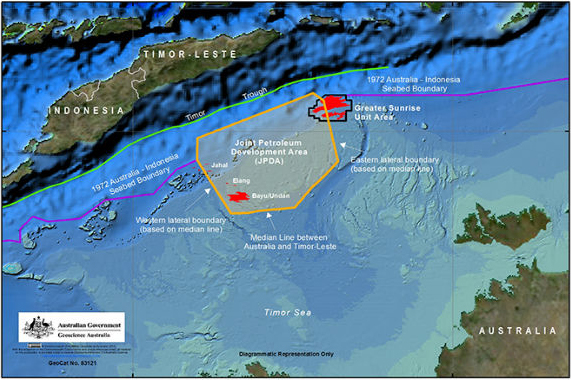
The new boundaries, according to an Australian government supplied map.

Successive Australian governments, wanting to keep the riches of the Timor Sea to themselves, have deliberately and persistently frustrated Timor-Leste’s attempts to establish permanent boundaries.

Even though all of the oil and gas fields contested over the years are located closer to Timor than to Australia, the federal government has doggedly tried to short-change the Timorese at every opportunity.

After Australia had unilaterally tapped the Laminaria Corallina fields – without the Timorese receiving a single cent, it jostled Timor into a temporary resource-sharing agreement, the Timor Sea Treaty, that allowed it to take a slice of the revenue from the Bayu-Undan fields, which were the fledgling nation’s most important source of revenue.

Miserly Australian proposal
Australia then set its sights on the massive Greater Sunrise gas field. Its initial proposal was to allow Timor a miserly 18 percent of the government revenue.

The prevailing legal consensus is that if permanent maritime boundaries were established in keeping with current international law, then most, if not all, of the field would be located within East Timor’s exclusive economic zone.
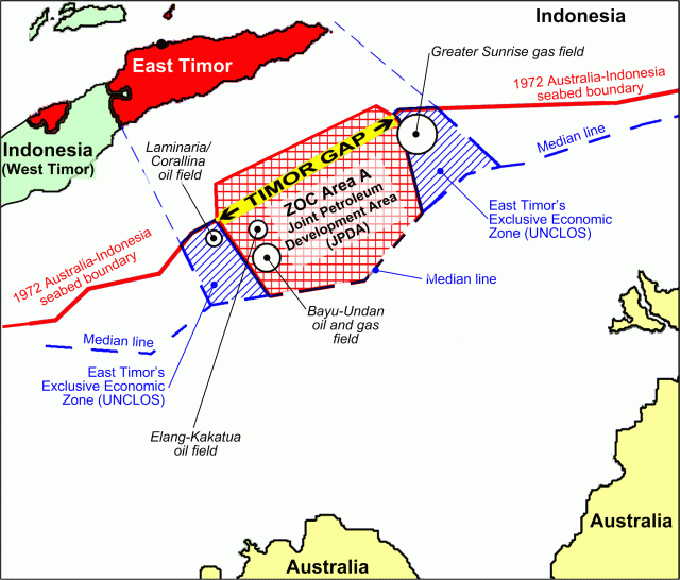
Timor Sea disputed boundaries prior to the new agreement. Map: ETAN.org

But international law was of little relevance to Australia. Just two months before Timor-Leste became independent in 2002, the Australian government withdrew its recognition of the maritime boundary jurisdiction of the International Court of Justice.

Put simply, the Australian government turned its back on the independent umpire signalling that it had no intention of playing by the rules.

So despite Timor-Leste wanting to establish permanent maritime boundaries, in 2006 the Australian government managed to walk away with another “temporary” agreement.

This one, CMATS, would postpone for 50 years discussions about sovereignty – ie. which nation actually owns the area – and would see the government revenue from Greater Sunrise split 50/50.

Exactly how Australia managed to get such a deal was exposed in 2013 when a senior intelligence officer revealed that an AusAid project was used as a cover to bug the Timorese cabinet room during the negotiations.

Timorese upset
The Timorese government was understandably upset and triggered a conflict resolution mechanism set out in the Timor Sea Treaty, to prompt mediation in The Hague.

But just days before the meeting was to take place, an ASIO raid was ordered on the Canberra offices of Timor’s legal team and the passport of “Witness K” was seized preventing him from travelling to The Hague to present evidence.

This allowed Timor to take legal action against Australia and in a provisional judgement, the International Court of Justice slammed the heavy-handed actions and issued an unprecedented order for the Australian government to stop interfering with Timor’s communications.

With the upper hand in what would have been a long and embarrassing legal battle for Australia, Timor-Leste finally had some bargaining power. But in an extraordinary act of good faith, Timor traded that away – it withdrew its case in return for Australia agreeing to return to the negotiating table to discuss permanent boundaries.

But true to form, Australia soon reverted to its belligerent tactics and the talks were on a road to nowhere.

Eventually in 2016 with nowhere else to turn, the Timorese launched a “compulsory conciliation” procedure at the UN. This is a mechanism that had never been used before and exists specifically for when one country refuses to recognise the jurisdiction of the independent umpire that would normally settle such disputes.

The Australian government’s long held stonewalling tactics began to crumble after its undignified attempt to wriggle out of the process was soundly rejected by the UN-constituted commission.

The new treaty
The resulting treaty will set a permanent boundary along the median line halfway between the two coastlines. This is great news, but the exact placement of the all-important lateral, or side, boundaries which will determine the scope of Timor’s exclusive economic zone, is still unknown.

Recent media reports claim the treaty will give a much larger share of the government revenue from the Greater Sunrise field to Timor: 80 percent if the gas is piped 450 km to Darwin for processing where Australia will reap the downstream economic benefits of jobs and related activities, or 70 percent if the gas is piped 150 km to East Timor.

Even if the new treaty turns out to be less than ideal in regards to the size of Timor’s sovereign territory, it gets the job done in that it delivers what the Timorese have always wanted – permanent maritime boundaries – and it appears that the revenue share reflects the likely outcome had the maritime boundaries been set in keeping with contemporary international law.

It seems that it has also managed to do so without Australia having to concede territory it had not already conceded to Indonesia in 1972. So the politicians on both sides of the Timor Sea have saved face.

Whatever devils might be in the detail, there is little doubt that this new treaty will be a far better deal for East Timor.

This is a big win for the Timorese and also a reminder of the importance of the UN’s peaceful arbitration processes.

It is also a win for the Australian citizens who stood up in solidarity with the Timorese people to demand that the federal government do the right thing. It’s been a long time coming.

Tom Clarke is a spokesperson for the Timor Sea Justice Campaign.

Article by AsiaPacificReport.nz

]]>

PNG’s earthquake death toll in Highlands now tops 75

By Sylvester Gawi in Limu village, Hela, Papua New Guinea

Thousands of people have been displaced and are still waiting for relief assistance in disaster affected areas in Hela and Southern Highlands provinces a week after the 7.5 magnitude earthquake destroyed their homes and food gardens in Papua New Guinea.

Aftershocks below 5 magnitude have been experienced in the last 7 days with locals on high alert and awaiting relief supplies and assistance in evacuations to safer grounds.

Hela Provincial Hospital in Tari confirmed a total of 38 deaths and 8 unconfirmed deaths yesterday afternoon. A medical team was deployed into Limu and Homapawa villages in the Benere ward area where a a total of 21 deaths were confirmed.

Homapawa village confirmed 10 deaths and Timu 11. Of the 11 in Timu, 4 have been retrieved and given proper burial while another 7 (a family of six and another teenage girl) are still buried under the debris along with their house.

Efforts by locals to retrieve their bodies are slowly progressing at this stage.

Timu villagers who have lost all their houses and food gardens are now taking refuge at their local EBC Church building in the village.

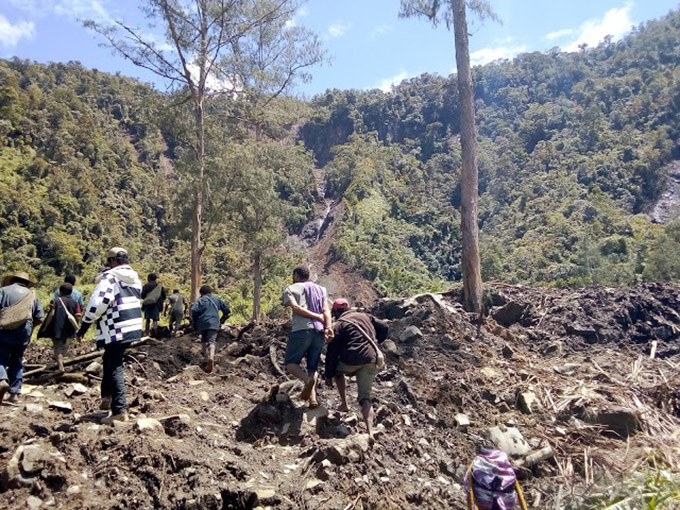
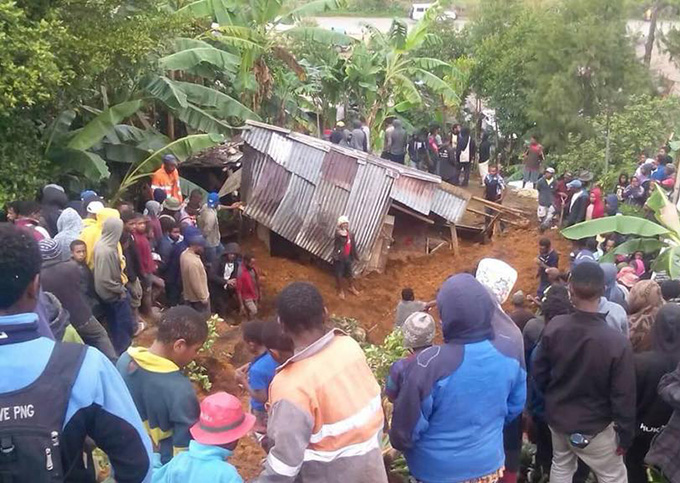
Locals at Limu village at the disaster site where bodies of an entire family of seven are still buried under the debris. Image: Sylvester Gawi/Graun Blong Mi- My Land

Another 12 confirmed deaths have been reported at the Mt Bosavi area in the Komo-Magarima district of Hela. Nearby Mananda village also reported 5 confirmed deaths and houses and food gardens destroyed by the disaster.

More deaths reported
Health officials are yet to verify uncomfirmed reports of some more deaths in Magarima and Pandoka.

So far Hela province has reported a total of 38 confirmed deaths while Southern Highlands has reported 37 deaths so far. This now brings the death toll to 75 as at yesterday afternoon.

Affected communities are facing severe food, clothing and fresh water shortages as relief efforts are slowly progressing at this stage. Most of these villages in Hela are situated along the pipelines areas of the oil and gas plants in Southern Highlands and Hela provinces.

Humanitarian relief agencies are also doing their best to get into affected communities which most communities are inaccessible by road or the road links cut off by the disaster.

Oil Search Limited has committed K6 million in cash and kind towards the disaster while EXXON Mobil has committed K3 million towards relief assistance.

Oil Search has already began distributing relief supplies to parts of Southern Highlands while relief supplies were also delivered by the Australian Defence Force Hercules aircraft to Moro in Hela.

The National Disaster Centre in a statement released yesterday said it was still waiting for accurate data to reach it so that it could act.

However, people from the affected communities have pleaded for the government to fast track relief assistance and also address resettlement issues as they were still in fear following aftershocks over the past week.

Journalist Sylvester Gari blogs at Graun Blong Mi-My Land where this article was first published.

Article by AsiaPacificReport.nz

]]>

K150m released to PNG’s earthquake-ravaged districts in more relief efforts

Prime Minister Peter O’Neill visiting disaster-hit areas at the weekend. Video: EMTV News

Pacific Media Centre Newsdesk

Provinces affected by Papua New Guinea’s 7.5 magnitude earthquake a week ago will continue to experience aftershocks.

Prime Minister Peter O’Neill said that while minor tremors would still be felt, the national government was finalising arrangements to airlift relief supplies to affected communities, reports EMTV News.

Close to a million people in over five districts remain affected.

Scott Waide of EMTV News reported on his blog that 66 deaths had been confirmed so far – 37 in the Southern Highlands, 17 in Hela and 13 in Western Province.

Loop PNG’s Imelda Wavik reports that the first K150 million of the K450 million funding for the earthquake stricken areas was to be be released into a trust account yesterday.

This was announced by the Emergency Controller, Dr Bill Hamblin, in a press conference, which was also attended by members of the committee including secretaries for works and finance, national disaster director and representatives from ExxonMobil and Oil Search.

The Emergency Controller said the funds would go towards the aid. However, there would be specific requirements for funds to be used.

Transparency and order
He said there would be transparency and order in using the funds for relief and humanitarian purposes.

Dr Hamblin also reaffirmed that the money will go specifically towards the general aid programmes.

The controller noted that K1 million has already been set aside for food and water, which had already been approved for dispatch any time this week, while K3 million would go towards medical supplies.

Due to lack of road access into the affected areas, air aid was most needed at this time. About five helicopters were being used by the emergency restoration team.

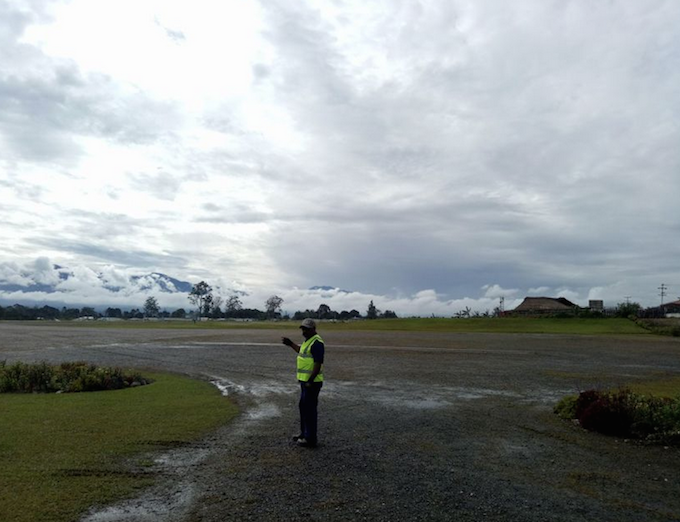
Tari Airport, where earthquake survivors are being brought in for treatment. Image: Scott Waide/EMTV

Article by AsiaPacificReport.nz

]]>

Undecided ‘up for grabs’ and decisive for Fiji election, says academic

By Nasik Swami in Suva

Fiji’s 2018 General Election is going to be a close contest between the ruling FijiFirst and the opposition parties, according to a leading New Zealand-based Fiji academic.

Professor Steven Ratuva, political sociologist and director of the MacMillan Brown Centre for Pacific Studies at the University of Canterbury, says the election will be “won and lost” over the undecided, currently a third of the eligible voters.

Dr Ratuva made the comment in response to a Tebbutt-Times poll conducted on February 5-8 with 1000 randomly sampled people who were eligible voters.

Professor Steven Ratuva … staggering 34 percent undecided. Image: Pacific Scoop/PMC

According to the results of the poll on the public’s voting intention, a staggering 34 percent said they were not sure who to vote for, 8 percent declined to answer the question and half a percent said they did not intend to vote.

Thirty-two percent said they would vote for FijiFirst, 22 percent for Social Democratic Liberal Party (SODELPA), 3 percent for National Federation Party (NFP) and 1 percent for Fiji Labour Party (FLP).

When looking only at the percentages for those who selected a party (removing the undecided voters), 56 percent selected FijiFirst, 38 percent SODELPA, 5 percent NFP, 1 percent FLP, 0.2 per cent Unity Fiji Party, and 0.1 per cent independent.

Slender lead
Dr Ratuva said of those who expressed their party preferences, FijiFirst had a slender lead of 6 percent with a total of 32 percent (or equivalent to 16 seats) compared with 26 percent (or 13 seats) by all the other opposition parties combined.

“The interesting factor here is the large number of undecided voters totalling 34 percent (or 21 seats).

“This is where the election will be won and lost. So very hypothetically, 21 seats are up for grabs,” said Dr Ratuva.

He said FijiFirst would need at least 18 percent and above of these undecided voters to get over the 50 percent barrier and win the election while the opposition parties needed 24 percent.

“These results show that there have been a lot of movement’s since the last election in terms of people’s preferences as a result of changing perceptions of issues, perceptions of parties, experience of changing circumstances and how they respond to these.

“Whichever way the votes shift, we can be certain that the election might be very close. The next three political party-based polls will begin to provide a much clearer picture of where things are moving as campaigns begin in earnest and the elections come closer.”

Analysing the results, University of the South Pacific economist Dr Neelesh Gounder said the support for FijiFirst had reached an all-time low since the 2014 election, when it had received almost 60 percent of all the votes cast.

Bainimarama’s popularity rises
“While Bainimarama’s popularity has increased by 20 percent in February 2018 compared with February 2017, FijiFirst party as the preferred choice has decreased by 5 percent during the same period (from 37 percent in February 2017 to 32 percent in February 2018),” Dr Gounder said.

He said comparing poll results of preferred party with preferred PM, there was now a clear “delink” between the two.

“It seems there is no clear link between Bainimarama’s popularity as the PM and FijiFirst party as the preferred party.

“On the other hand, both opposition parties SODELPA and NFP have gained in terms of the choice for preferred party.

“SODELPA, in particular, has strengthened its position with a 9 percent increase in preferred party choice (from 13 percent in February 2017 to 22 percent in February 2018).

“Support for NFP has increased from 1 percent to 3 percent.”

He said also interesting was the percent of undecided voters.

“Despite the reduction in undecided voters, 34 percent [from 40 percent] is large and can play a significant role in which party or parties form government after the 2018 election. The challenge for SODELPA and NFP is the continuation of the momentum towards attracting undecided voters towards their party and candidates,” Dr Gounder said.

“For FijiFirst, given how this scenario has evolved since 2014, it might be beneficial to have elections sooner than later. This strategy might avoid FijiFirst 2014 voters who are now undecided from moving to the opposition.”

Article by AsiaPacificReport.nz

]]>

37 deaths in Southern Highlands, 16 in Hela as PNG relief efforts go on

By Sylvester Gawi in Mendi

Local community leaders have taken charge of care centres in the Southern Highlands province of Papua New Guinea as they await food, clothing and other relief supplies to be delivered.

Acting Southern Highlands Provincial Administrator Thomas Eluh said six care centres had been set up around SHP by locals.

The death toll yesterday stood at 37 while there have been 25 unconfirmed deaths reported. Sixteen deaths have been reported in Hela.

Road links into most of the affected villages have been blocked by debris from landslips piling up. Some sections of the roads were badly damaged by the movement from the earthquake.

Police from the Mobile Squad based in Mendi have been grounded in the last 24hours after their fuel supply tanks were also damaged by the earthquake.

Most shops and fuel stations have been reportedly closed following damages from Monday’s earthquake and the aftershocks that are constant in the province.

The Agiru Centre which houses the provincial administration has also reported damages to its offices and equipment and has been condemned by authorities. The provincial administrator and the disaster team are now operating out of the provincial police command in Mendi.

Nursing school destroyed
The Mendi School of Nursing was one of the institutions I have visited that has most of its buildings destroyed by the earthquake.

There is now a greater need for funding to be made available through the National Disaster Office so that logistical support can be provided to distribute relief supplies.

In Hela, a total of 16 deaths have been confirmed by the Hela Provincial Hospital in Tari. More causalties are expected to be reported in the coming days as volunteers are dispatched to gather reports.

Tari-Pori MP and Finance Minister James Marape said about 40 percent of Papua New Guinea’s revenue would be affected if the Hides operations was shut down.

Minister Marape said the government is confident that this would not really affect the budgetary allocation for 2018.

Hela’s political leaders also joined Minister Marape and Governor Philip Undialu to show solidarity and support towards addressing the plight of their people affected.

The provincial disaster response team in Hela is also working together to address the situation.

Funding allocations
The National Government has committed K450 million towards the disaster. The disaster committee has made allocations for the initial K100:

  • K40 million will be spent to fix the road infrastructures damaged by the earthquake so that affected areas are accessible for relief supplies to be delivered.
  • K10 million to assist schools and education institutions buildings damaged by the disaster and another K10 million for health services.
  • K23 million has been set aside for transport, logistical support and other areas to provide relief assistance.

The remaining K350 million will also be spent on the same purposes once assessment reports of the extent of the damages are confirmed and brought to the disaster team’s attention.

In a statement released yesterday, Oil Search has committed K6 million in donations in cash and kind in disaster relief efforts to both Hela and SHP.

The Australian government has begun to fly its supplies to Moro on its Australian Defence Force Hercules plane loaded with relief supplies.

New Zealand’s donations will arrive today.

Sylvester Gawi is a Papua New Guinea journalist who blogs at Graun Blong Mi- My Land where this article was first published. It has been republished by Asia Pacific Report with permission.

Article by AsiaPacificReport.nz

]]>

Gender and diversity research at AUT turns 10

By Helen Twose in Auckland

Auckland University of Technology’s Gender and Diversity Research Group has reached a significant milestone, celebrating 10 years of research and debate on gender and diversity issues within the community.

Formed in 2007 with the aim of establishing a network of researchers within (and beyond) AUT who share an interest in gender and diversity, the research group has developed a thriving research community the institution and internationally through an active research programme of applied and theoretical research, and contributing to new approaches to gender and diversity research in the academic community.

The group commemorated the significant milestone with a research day that included reflection and looking backwards as well as looking forward and imagining new futures for gender and diversity research, said Professor Judith Pringle, founder of the Gender and Diversity Research Group.

“Particularly pleasing was the high attendance from a broad range of people, from academics to those outside the university, including business community and NGOs, who have a very high commitment to reducing inequality among groups, organisations and society,” Professor Pringle said.

Beginning with a keynote from Professor Pringle looking at the evolution of gender and diversity research over the last 30 years, which has fed into the strong establishment of gender and diversity research at AUT, the day included an in-depth discussion from emerging scholars looking at the importance of Māori research and knowledge and its place in academia, the #MeToo movement, and the role of arts in gender and diversity research.

Turning to the future, the group envisioned an “ideal” world without gender and diversity inequality, and how to get there. In the words of one participant: “My two favourite ideas I took from the day are the need to build strong networks within your community of work and the re-imagining of research”.

Event organisers, Dr Katherine Ravenswood and Dr Barbara Myers, said that while the group’s success and longevity was significant – especially in an environment which has seen the demise of Women’s Studies programmes and research groups at universities in New Zealand – it was also confronting.

Valuing Te Ao Māori research
In spite of increased attention to issues of discrimination, the topics addressed on the day, such as sexual harassment, the valuing and contribution of Te Ao Māori research, gendered occupational segregation and glass ceilings, were just as pertinent as 10 years ago.

“The need for the critical, brave research this research group conducts has not diminished. As participants discussed we need to continue to build communities, develop new research methodologies, and to continue to tell the stories and experiences of women from a feminist perspective,” they said.

Key research undertaken by the group includes :

  • Submission on the 2017 Draft Employment (Pay Equity and Equal Pay) Bill and research into the gendered valuing of work
  • Research into the careers of older women self-initiated expatriates
  • Commissioned research into women’s careers in the professions, such as law
  • Supporting the development of feminist teaching and research through development workshops
  • Postgraduate scholarships to encourage new and emerging researchers

Article by AsiaPacificReport.nz

]]>

How Jack Mawe died trying to save his wife and child in PNG earthquake

By Scott Waide of EMTV News

While the multibillion dollar mammoth petroleum company Exxon declared “force majeur” and another counted its financial losses, one family from Magarima in the Southern Highlands was this weekend mourning the devastating loss of their last born son and his young family.

Twenty-one-year-old Jack Wapol Mawe had already run out of the house he and is family had been sleeping in that night.

But then when he went back into the small building to pull out his wife and baby, the landslip buried them in the house.

“We found him frozen in motion… his hands reaching out to his young wife and first born son when they were all buried,” said Fr Pius Hal the Catholic priest at the Mendi Diocese and an uncle to Jack Mawe.

Jack had recently married Regina. They were transiting through Mendi with their son when the earthquake struck and killed all three of them.

Yesterday, doctors at the Mendi Hospital completed the post mortem and today, the family was taken by road to Magarima where they are from.

“I had not seen him for a long while. I think he was feeling a bit shy of talking to me because he had married quite early. He would have been about 20 or 21. His wife would have been about the same age.

“They had come from Hagen. It was the first time I had seen him in many years. That night he was gone.”

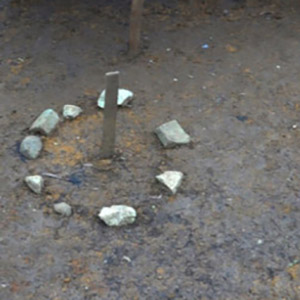
The simple stone memorial for the Mawe family. Image: This Land, My Country

Circle of rocks memorial
At the site of the landslip in the centre of Mendi town behind the local CLC church, a small circle of rocks with a short wooden stake in the middle marks the place of death.

“They’re gone,” says a relative. “We’re looking after the place.”

Much of the house is still buried. The hauskrai is deserted. Three young lives were cut short just as they begun their journey together as a family.

In distant Komo, several hours from Mendi town, the roads are cut off. From the air, it looks like it’s been cut to shreds by giant claws that ripped the ground open.

An Indian priest who travelled in from Tari today, said his parishioners told him at least 14 people have died. Some of the areas are too far to reach and too difficult without road access.

Help is coming, the government says. A state of emergency has been declared and K450 million allocated.

The Australian government, MAF and Oil Search are on the ground in the three provinces of hela, Southern Highlands and Western Highlands but it will take weeks before everyone who needs it receives it.

Scott Waide, a Lae-based senior journalist for EMTV News, blogs at My Land, My Country, where this article was first published. He also posted a short update on The Pacific Newsroom today saying the Acting Administrator for Southern Highlands, Thomas Eluh, had confirmed that 37 deaths had been reported with 25 more unaccounted for so far. He appealed for more aid.

Article by AsiaPacificReport.nz

]]>

NZ Foreign Minister questions China’s influence in the Pacific

Foreign Minister Winston Peters flags a stronger NZ Pacific aid policy and prime ministers Jacinda Ardern and Malcolm Turnbull discuss New Zealand and Australia friendship and differences in policies. Video: Qldaah/ABC

New Zealand’s Foreign Minister Winston Peters has again hinted the Ardern government may exit China’s One Belt One Road initiative as Wellington “resets” its strategic focus to the Pacific.

With Prime Minister Jacinda Ardern beginning her first trip across the region today, Peters told Television New Zealand’s Q & A show the Pacific was where New Zealand mattered and could do most.

But, alluding to China’s influence, he said a number of countries had been intervening in the Pacific in ways that were “not helpful”.

“Our job is to ensure that the engagement of other countries in the Pacific is for the interests of the Pacific and the security and prosperity of the neighbourhood,” he said.

Peters said the previous government had been too hasty to sign up to China’s One Belt One Road initiative, with the implications for New Zealand unclear.

His coalition government would instead move slower in relation to the deal.

‘Shifting the dial’
“It’s a case of shifting the dial, it’s a case of having our eyes wide open, it’s a Pacific reset in circumstances where we must do far better,” he said.

“Our aid, for example, is on the decline, to go down to 0.21 (per cent of gross domestic product) from 0.30 (per cent) just eight years ago.”

He said low aid levels from New Zealand would not “stack up against countries with a big cheque book”, who were not always acting in the Pacific’s interest.

Fresh from a diplomatic trip across the Tasman, Ardern departs for Samoa today on the first leg of her first annual Pacific Mission.

She and a team of politicians, representatives from charities and Pasifika community leaders will then travel to Tonga, Niue and the Cook Islands during the week, engaging in diplomacy and taking in the local hospitality.

Ardern on Friday said there was a range of issues facing the Pacific, including climate change, resource use and globalisation.

New Zealand and Australia’s role was to “amplify the voice of our Pacific neighbours and do so in partnership with them”, she said.

This year’s Pacific Mission will also take particular note of the recovery of Tonga and Samoa after Cyclone Gita in February.

Article by AsiaPacificReport.nz

]]>

‘Play for our people’ call by Southern Highlands musicians after PNG quake

Elizabeth Tondoa appeals to Southern Highlands musicians to join her in next week’s fundraising concert. Video: EMTV News

Pacific Media Centre Newsdesk

Southern Highlands singers Elizabeth Tondoa and Augustine Emil are calling on all fellow musicians from their region to come together to hold a concert in Port Moresby next week to raise funds for the disaster-struck areas.

The funds raised at the concert on March 10 will be passed on to the National Capital District Governor Powes Parkop as part of the people of NCD’s contribution to the earthquake affected areas.

Tondoa challenged artists from other provinces to join in the cause.

Making the appeal on EMTV News, she said: “The people with money, come with money at this time to support those people in pain, and those who have need.

“Those with clothes, give clothes.

“Like myself, I am a musician and I don’t have that money. But I have the talent and I want to use that talent to help my people.”

Then she burst into tears.

So far, B-Rad from, B Rad studios has given his support to take part in the concert as well.

EMTV News items are republished by Asia Pacific Report by arrangement.

Article by AsiaPacificReport.nz

]]>

Tongan police charge Lord Tu’ivakanō with bribery in passport saga probe

By Kalino Latu, editor of Kaniva News

The king’s noble and former Prime Minister, Lord Tu’ivakanō has been charged with passport offences, money laundering and bribery.

Police arrested the former Speaker of Parliament yesterday.

“Lord Tu’ivakanō has been charged with numerous crimes, including making a false statement for the purpose of obtaining a passport, perjury, acceptance of bribery and money laundering,” Police Commissioner Steve Caldwell said.

Kaniva News reported last year that Lord Tu’ivakanō and his wife, Joyce Robin Kaho, had been listed by the Tonga National Reserve bank as being allegedly involved in suspicious money transfers.

It followed with a claim by a former staff member at Parliament that Lord Tu’ivakanō used parliamentary staff to improperly transfer money overseas. The noble denied the claim.

“If that was illegal you know which place to take it up with. Anyone in the office of the Parliament is free to do the same thing,” Lord Tu’ivakanō said in response to the former staff.

Passports abuse
Prime Minister ‘Akilisi Pōhiva told the House during a debate in 2013, while he was leader of Opposition and Lord Tu’ivakanō was Prime Minister, that he had information that Tongan blank passports were being abused.

He described the mishandling of the Tongan blank passports as a “net that was thrown outside the circle of the Tongan authorities”.

In 2014, Kaniva News revealed e-mails between staff of the Ministry of Foreign Affairs which alleged Lord Tu’ivakanō ignored King Tupou VI’s warning not to issue any more diplomatic passports to Chinese national Sien Lee.

According to the e-mails, Sien Lee is a close friend of the Queen Mother.

At the time, the former Auditor-General, who is now Minister of Finance, Pōhiva Tu’i’onetoa, told Kaniva News Tonga’s passport scandal was one of the two biggest he had come across in the previous three years.

This morning the Police Commissioner said although he was confined by what he could say publicly, he took the opportunity to thank and commend the Passport Taskforce for their methodical and professional investigation.

“As criminal charges are now before a Court of Law no further comments
will be made at this time. The Passport investigation continues.”

Asia Pacific Report republishes Kaniva News reports by arrangement.

Article by AsiaPacificReport.nz

]]>

PNG declares state of emergency in wake of quake devastation

Communities struck by the 7.5 magnitude earthquake in Papua New Guinea’s Hela province remain confused as aftershocks continue. Despite the arrival of National Disaster Officers in Tari yesterday, many remain traumatised. Video: EMTV News

By Gorethy Kenneth in Port Moresby

The Papua New Guinea government has declared an immediate state-of-emergency for the earthquake-devastated provinces of Hela, Southern Highlands, Western and Enga provinces.

Cabinet met yesterday and also set aside K450 million for relief and service restoration operations.

Prime Minister O’Neill also announced yesterday that cabinet had approved the establishment of a restoration authority that would manage long-term reconstruction efforts during a four-year period to fully restore normalcy.

O’Neill said that an emergency session of Parliament would be called soon to approve the legislation setting up the restoration authority.

He said K100 million would be released immediately and the remaining K300 million spread over a long term arrangement.

A committee assisted by the Works Department under an emergency disaster restoration team, led by Dr William Hamlin, as the emergency controller would be announced today.

Dr Hamlin and team would manage and co-ordinate all restoration activities working with provincial authorities.

Unprecedented disaster
O’Neill said that this was an unprecedented disaster in the Highlands region with an appropriate response underway by the National Government.

He said while all these decisions were being made, relief efforts were already underway, and further assessments provided to focus operations to areas in need.

“A state-of-emergency has been declared to expedite the restoration of essential public services including healthcare services, schools, road access, airports, power and communications facilities,” O’Neill said.

“An emergency session of Parliament will be convened for the presentation of legislation that will establish the restoration authority, with the date of the session to be announced by the Speaker of Parliament.

“Members of the PNG Defence Force and disaster officers were dispatched to the affected areas immediately following the earthquake, and are working with provincial authorities, particularly with the governors of Hela and Southern Highlands provinces.

“Essential government departments are already delivering relief, and we are further working with partners in the international community to utilise specialist relief capabilities to reach our people and communities affected by the earthquake.”

Gorethy Kenneth is a senior PNG Post-Courier journalist.

Article by AsiaPacificReport.nz

]]>

Politics Newsletter: New Zealand Politics Daily – March 02 2018 – Today’s content

Politics Newsletter: New Zealand Politics Daily – March 02 2018 – Today’s content Editor’s Note: Here below is a list of the main issues currently under discussion in New Zealand and links to media coverage. [caption id="attachment_297" align="aligncenter" width="640"] The Beehive and Parliament Buildings.[/caption] Below are the links to the items online. The full text of these items are contained in the PDF file (click to download). Foreign affairs and trade Sam Sachdeva (Newsroom): Big issues on the table for trans-Tasman talks Tracy Watkins (Stuff):Jacinda Ardern and Malcolm Turnbull’s date a toast to trans-Tasman tradition Tracy Watkins (Stuff): PM Jacinda Ardern arrives in Australia ahead of talks with Aussie PM Barry Soper (Newstalk ZB): Jacinda Ardern pressing the flesh of Malcolm Turnbull Chris Bramwell (RNZ): PM angling for business deal in Australia RNZ: PM will raise Australian deportation issues Newshub: Ardern to discuss treatment of Kiwi prisoners in Australia Herald: Malcolm Turnbull’s night with Jacinda Ardern Audrey Young (Herald): ‘We don’t want Arderned crims’ insists Aussies as NZ PM arrives in Sydney Audrey Young (Herald): Malcolm Turnbull to host Jacinda Ardern and Clarke Gayford to dinner at home Michelle Grattan (The Conversation): Politics podcast: Jacinda Ardern on her political life Stuff: Aussies take the mickey out of awkward Jacinda interview Sam Sachdeva (Newsroom): Peters plans ‘Pacific reset’ Chris Bramwell (RNZ): NZ to increase aid to the Pacific – Peters Michael Reddell (Croaking Cassandra): New Zealand and the PRC: links and questions John Cousins (Bay of Plenty Times): China backlash feared Edward Miller (Newsroom): Opinion: Can Labour bring labour rights to RCEP? Jo Moir (Stuff): Former ministers doing a great job of turning select committee into theatre Kirk Hope (Stuff): CPTPP ‘levels the playing field’ in Japan Jonathan Guildford (Press): Anti-TPPA protesters lock themselves to railway track in Christchurch Bill English leaves Parliament Tim Murphy (Newsroom): English leaves the front page, for good Tess Nichol (Herald): Tearful Bill English bids farewell to Parliament after 27 years in politics Stacey Kirk (Stuff): Goodbye Bill: Parliament’s southern gentleman, Bill English, bows out of politics RNZ: English bids farewell, talks of privilege of public service 1News: ‘Give me $200 cash’ – how Bill English almost didn’t make it into parliament Newstalk ZB: Bill English: It’s taught me Humility Brad Flahive (Stuff): Wellington cartoonist Walt Hamer, 12, says Bill English had a good ‘walk-run’ as leader National Party Graham Adams (Noted): Bridges and Bennett: National’s B-Team Wayne Mapp (Spinoff): How Simon Bridges can scrap his way to becoming PM in 2020 Leonie Hayden (Spinoff): How to tell if you’re Māori Dan Satherley (Newstalk ZB): Judith Collins happy to take on Labour ‘without even getting paid’ Chris Trotter (Daily Blog): The Making Of A National Party Leader John Minto (Daily Blog): Simon Bridges and Maggie Thatcher Martyn Bradbury (Daily Blog): Simon & Paula’s Māori Blood percentage: Watching Identity Politics eat itself Jason Walls (Interest): New National leader Simon Bridges is making no apologies for what he calls his ‘firm but fair’ approach Jamie Mackay (Herald): Listen: Simon Bridges – ‘I am very farmer friendly’ Amy Diamond (Bay of Plenty Times): What do you want to see Simon Bridges tackle first? Ben Uffindell (The Civilian): National hopes Simon Bridges will broaden its appeal to other young, Māori former Cabinet ministers Justice and prisoner rights Gordon Campbell: On why prison inmates should be allowed to vote Anna Loren (Stuff): Wig-wearing murderer Phillip John Smith has no rights to hairpiece, court rules No Right Turn: Missing the obvious Andrew Geddis (Spinoff): The bizarre case of the NZ court case hidden from public and media scrutiny Sam Hurley (Herald): Cancelled passport and classified information reason behind secret court hearing Stuff: Secret court hearing in Wellington for passport case, top judge confirms Laura Walters (Stuff): Huge rise in female prison population ‘a problem’: Corrections boss Education Jack Boyle (Herald): Teachers’ pay has fallen too low to recruit enough people Camilla Highfield (Newsroom): How our teacher shortage affects everyone Jared Nicoll (Stuff): Survey reveals primary school principals are overworked and struggling to sleep Megan Gattey (Stuff): Axed private school scholarships ‘made the impossible possible’ – solo mother Stuff: Education Ministry to asses whether Tuturumuri school in rural Wairarapa with low enrolment should close RNZ: Polytechnic mergers not ruled out – Hipkins Herald: Education Minister says change is coming for polytechs: ‘Status quo is not an option’ Herald: Chris Hipkins: ‘Bureaucratic’ competitive tertiary funding model expelled Talisa Kupenga (Māori TV): Govt acts as polytechs face ‘financial crisis’ Jim Tucker (Taranaki Daily News): Happy reforming, Minister Hipkins Richard Shaw (Stuff): Stop bagging the Bachelor of Arts Dominic O’Sullivan (The Conversation): Australia could look to New Zealand to increase the number of Indigenous academics and students Greens co-leader contest Henry Cooke (Stuff): Green Party co-leadership debate between Marama Davidson and Julie Anne Genter Henry Cooke (Stuff): Both Green Party leadership candidates express doubt about budget rules The Standard: Genter and Davidson Parliament and democracy Chris Trotter: “A Giant Beast Called The Government” Chris Trotter (Bowalley Road): Talking About Their Generation No Right Turn: Time to lower the voting age No Right Turn: Worth an OIA: Ministerial weekly briefings Kate Hawkesby (Newstalk ZB): I vote to let kids be kids 1News: ACT leader’s attempt to condemn South African govt over land expropriation blocked Jessica Mutch (1News): List of people facing legal action from Winston Peters over privacy issues could grow Russell McVeagh and sexual harassment Press Editorial: Time’s up for sexist legal culture Tom Hunt (Stuff): Scathing letter from Auckland University to Russell McVeagh outlines decision to cut ties Sasha Borissenko (Newsroom): All six law schools cut ties with Russell McVeagh Herald: Six NZ universities cut ties with law firm Russell McVeagh in wake of sexual harassment claims Katarina Williams and Nick Truebridge (Stuff): Russell McVeagh barred from University of Canterbury campus Catriona MacLennan (Newsroom): When ‘ethics’ hurt careers 1News: Legal profession’s current sexual harassment complaint process can ‘re-victimise’ complainants, says Law Society Stuff: Law Society takes action following Russell McVeagh allegations RNZ: Law Society working group to tackle sexual harassment reporting Mike Hosking (Newstalk ZB): Fairfax’s ‘Me Too’ campaign tasteless, tacky and tabloid Tess Nichol (Herald): TVNZ bosses say sexual harassment policies up to scratch Media Jane Patterson (RNZ): National raises questions about RNZ commentator Thomas Coughlan (RNZ): RNZ eyes evolution rather than ‘big bang’ Pattrick Smellie (BusinessDesk): TVNZ unfazed by RNZ plans Tom Pullar-Stecker (Stuff): No new television channel for RNZ, says chairman Martyn Bradbury (Daily Blog): Clare Curran’s Public Media Panel feels like an enormous missed opportunity Environment Thomas Couglan (Newsroom): Greenhouse emissions growth slows, but so does tree-planting Ewan McGregor (Herald): A billion extra trees needs to include pine forests Health Herald Editorial: New Govt under pressure to spend on health David Menkes and Deborah Gleeson (Newsroom): Govt should move now to ban drug advertising Rodeo and animal welfare Stacey Kirk (Stuff): Government says ‘no’ to calls for rodeo bans Tess Nichol (Herald): Government won’t ban rodeo, animal welfare Minister says Katie Bradford (Stuff): Government to look at use of electric prodders and tail twisting at rodeos – but doesn’t want a ban Newshub: Govt won’t ban rodeos but will look into improving animal welfare 1News: SAFE say government have made a ‘good start’ on rodeos as animal welfare practices looked at 1News: ‘Go and read the science!’ – Michael Laws passionately defends rodeo’s animal welfare record while firing up at Jack Tame Inequality and poverty Sarah Harris (Herald): Minister orders probe after Work and Income reports mum to Ministry for Children after eviction notice Shannon Haunui-Thompson (RNZ): Te Puea puts homeless families in touch with employers Susan Edmunds (Stuff): Worried Kiwis spend work day juggling bills Housing Bryn Jones (Spinoff): Housing is a health issue too Dan Satherley (Newshub): MBIE wrong about KiwiBuild costs – Twyford Laura Dooney (RNZ): Wellington council spends up on housing Henry Cooke (Stuff): Up to 155 new state homes for regions ready by June Henry Cooke and Mahvash Ali (Stuff): 82 state homes replace 16 in Auckland’s New Lynn Teresa Ramsey (Stuff): Council seeks amendment to foreign buyer ban Bill Primary industries RNZ: Funding available for some farmers hit by Gita Anusha Bradley (RNZ): Fruit growers need to pay pickers more – Minister Paula Hulburt (Stuff):‘Politically correct’ A&P Show ditches rifles for Nerf guns in possum potshot comp Alexa Cook (RNZ): ‘No one wants to see honey bees die’ Shannon Haunui-Thompson (RNZ): Protest over planned mega chicken farm Auckland RNZ: Commuters waste 80 hours stuck in traffic Michael Neilson (Herald): Goff: Fuel tax ‘not enough’ to fix Auckland’s transport woes RNZ: Building insider says gridlock has doubled cost of deliveries Simon Wilson (Herald): Cycle lanes will save this city Todd Niall (RNZ): Ratepayers cover a $566 laundry bill and a $1.75 snack Other RNZ: Homeowners left in limbo after faulty EQC repairs RNZ: ‘Withdraw this safety video immediately’ – Antarctic expert Eric Crampton (Offsetting Behaviour): Racist donuts? Romany Tasker-Poland and Shomi Yoon (ISO): A response to Erin Polaczuk]]>

Politics Newsletter: New Zealand Politics Daily – March 01 2018 – Today’s content

Politics Newsletter: New Zealand Politics Daily – March 01 2018 – Today’s content Editor’s Note: Here below is a list of the main issues currently under discussion in New Zealand and links to media coverage. [caption id="attachment_297" align="aligncenter" width="640"] The Beehive and Parliament Buildings.[/caption] Below are the links to the items online. The full text of these items are contained in the PDF file (click to download). National Party Hamish Rutherford (Stuff): New Zealand opts for change, but owes a debt to Bill English Gwynn Compton (Libertas Digital): Leaders who bring out the worst in their opposition Morgan Godfery (Spinoff): Is Simon Bridges our first Māori prime minister? Laura Walters (Stuff): Political representation is becoming more diverse – but so what? Bryce Edwards (Herald): Political Roundup: Who gets to decide if Simon Bridges is ‘Maori enough?’ Brian Edwards: New Voice for National Mike Hosking (Herald): The pressure is all on Simon Bridges as the National Party’s new leader Peter Dunne (Interest): Bridges has an opportunity to fill the current void for a party appealing to the liberal, urban, middle-class Tom Sainsbury (Spinoff): Kiwis of Snapchat: Simon Bridges celebrates his win Newshub: Panel: Trish Sherson, Chris Trotter on Simon Bridges Claire Trevett (Herald): Simon Bridges leaves MPs hanging for reshuffle Newshub: National Party to undergo major reshuffle as ‘fresh talent’ moves up 1News: ‘Leaders in their own right’ – Simon Bridges won’t punish vanquished colleagues in reshuffle RNZ: Tauranga mayor says Bridges will unite caucus 1News: ‘If I think about it I’ve had a few’ – Simon Bridges talks political regrets and gay marriage stance 1News: Watch: Simon Bridges insists his social conservatism ‘not my focus’ in leading National Party, the economy is Herald: National leader Simon Bridges answers Herald readers questions in live Q and A Stacey Kirk (Stuff): National leader Simon Bridges hints at social spending over tax Ella Prendergast (Newshub): National open to working with Greens, NZ First – Simon Bridges Zaryd Wilson (Wanganui Chronicle): MP Harete Hipango says National Party united behind Simon Bridges RNZ: Peters’ legal action against National party continuing – lawyer Claire Trevett (Herald): Winston Peters drops legal action against National Party Newshub: Judith Collins discusses Auckland mayoralty run Susan Edmunds (Stuff): Former PM gets promoted to Australian bank job 1 News: Former Prime Minister Sir John Key has been named to the board of Australia International relations Pattrick Smellie (Stuff):Making trouble in our own backyard Jim Rolfe (Politik): New Zealand goes it alone with China Sam Sachdeva (Newsroom): Finding a foothold in the new world order Justice RNZ: Hearing shrouded in secrecy at High Court in Wgtn Stuff: Part of Wellington court closed off for secret hearing No Right Turn: No place for secret trials in New Zealand David Fisher (Herald):Burning prison love forces Corrections to send in the riot squad David Farrar (Kiwiblog): Good move by Labour on Bill of Rights Regional development Benedict Collins and Jane Patterson (RNZ): Flagship regional development programme ‘on ice’ Audrey Young (Herald): Bridges attacks payment as ‘incompetent’ but National paid the same company Barry Soper (Newstalk ZB): Simon Bridges’ rubbish first full day as National Party leader Martin van Beynen and Nick Truebridge (Stuff): Government grant stalled over links to businessman under Serious Fraud Office probe RNZ: Bridges says government is deflecting No Right Turn: A failure of due diligence Jane Patterson (RNZ): Govt-funded project: ‘I don’t think it’s a train wreck, it’s a road kill’ Mark Patterson (Southland Times): Provinces deserve, and need, growth fund Parliament Stacey Kirk (Stuff): Children’s Commissioner calls for discussion on lowering voting age to 16 Herald: Lower voting age to 16, urges Children’s Commissioner Judge Andrew Becroft Mei Heron (RNZ):MPs urged to consider lowering voting age to 16 Mike Hosking (Newstalk ZB): Andrew Beacroft’s idea of 16-year-olds voting isn’t mad, but kids need to be kids Catherine Delahunty (Spinoff): Question Time Blues: confessions of a recovering MP Phillipa Webb (The Wireless): Growing up in politics No Right Turn: Updating our democracy Tess Nichol (Herald): Prime Minister’s puppet unveiled at Backbencher pub in Wellington Katarina Williams (Stuff): Prime Minister immortalised as DJ puppet at Wellington’s Backbencher pub Craig McCulloch (RNZ): Political puppetry leaves Bridges unsculpted Newshub: Jacinda Ardern puppet unveiled at Backbenchers pub Russell McVeagh and sexual harassment Sasha Borissenko (Newsroom): Five law schools cut ties with Russell McVeagh Olivia Wensley (Stuff): We need to talk about law’s dirty little secret Cecile Meier (Stuff): Sexual harassment is a legal industry norm, former lawyer says Vaimoana Tapaleao (Herald): Former lawyer speaks out about sexual harassment at work: ‘It was like a frat house’ Leith Huffadine (Stuff): Alison Mau launches #metoonz investigation into sexual harassment in New Zealand Environment 1News: Deadly myrtle rust disease confirmed in native bush for the first time Nita Blake-Persen (RNZ): ‘Tidy Kiwi’ resurrected for new generation to keep NZ beautiful No Right Turn: Will Sage stop tenure review? Education RNZ: Polytech leaders hold crisis meeting Amy Baker (North Harbour News): It shouldn’t cost this much to send students to school, parents say Health Katie Kenny and Laura Walters (Stuff): ‘Zero tolerance of suicides in services’ recommended by Mental Health Commissioner Cecile Meier (Press): Claims antidepressants don’t work ‘dangerous’, doctors say Te Ahua Maitland (Stuff): Sir Owen Glenn pulls $4.5 million donation from Waikato medical school Ian Telfer (RNZ): Iwi-led Dunedin health centre brings family to fore Hamish McNeilly (Stuff): Iwi-driven health village opens in Dunedin Rosemary McLeod (Stuff): Fun and games don’t stop just because you’re old Housing Anna Bracewell-Worrall (Newshub): Housing NZ ready to ramp up state housing – now it’s up to the Government Shane Te Pou (Newsroom): Press conferences don’t build houses Mike Hosking (Newstalk ZB): Here’s where things start to hit the fan RNZ: New National leader says there is a housing crisis in NZ Henry Cooke (Stuff): New National leader Simon Bridges says there was a housing crisis ‘for some’ Herald: Simon Bridges: National could have done more on housing Employment Madison Reidy (Stuff): Unions decline Fu Wah migrant tradie application, citing exploitation Teuila Fuatai (Newsroom): Fly-in workers to be paid 3/4 of NZ wage Chloe Winter (Stuff): Rainbow, LGBTTI diversity needs to be more than a ‘token effort’ Media David Farrar (Kiwiblog): Unwise meeting and answers Te Aniwa Hurihanganui (RNZ):Iwi radio stations: ‘Don’t forget about us’ Jack van Beynen (Stuff): Seven Sharp’s ‘leftbook’ story was dangerously out of touch Madeleine Chapman (Spinoff): How to tell if your child has fallen victim to a liberal meme hate group Act Anna Bracewell-Worrall and Emma Hurley (Newshub): David Seymour’s meat t-shirt ‘huge lapse of judgement’ – Golriz Ghahraman Chris Chang (1News): Golriz Ghahraman and David Seymour beef over ACT leader’s ‘Meat Club’ t-shirt Michael Daly (Stuff): ACT MP David Seymour defends Meat Club t-shirt with woman’s silhouette Alex Casey (Spinoff): The best of David Seymour defending the mythical sexy meat Minotaur EQC ODT Editorial: EQC must do better in future Oliver Lewis (Press): Dame Annette King appointed interim Earthquake Commission chair Local government and transport Todd Niall (RNZ): America’s Cup: No alternative site for big mast maker Herald Editorial: Trains, drains, and kauri disease warrant additional rates Dominion Post Editorial: Release the brakes, and get Wellington moving Newshub: Gareth Morgan applauds ‘fantastic’ Auckland Council cat cull plans Bob Kerridge (Herald): Campaign against cats is using shonky evidence Alice Peacock (Herald): Congestion chaos: Aucklanders spend 80 hours a year stuck in traffic jam Primary Industries Lois Williams (RNZ): Opposition building against mega chicken farm plan Anusha Bradley (RNZ): Slim pickings: Worker shortage leaves apple farms frantic Historic NZ assassination attempt on Queen Hamish McNeilly (Stuff): The Snowman and the Queen: Declassified NZ intelligence service documents confirm assassination attempt on Queen Newswire: SIS files confirm Dunedin teen tried to shoot Queen Other Sophie Boot (BusinessDesk): Business confidence stays low in first 2018 survey RNZ: Business outlook bounces back Pat Veltkamp Smith (Southland Times): Need help with the Census? May I?]]>

31 deaths so far in PNG quake, but ‘hit-and-miss’ on rural area statistics

Professor Chalapan Kaluwin of the University of Papua New Guinea’s School of Natural and Physical Sciences says the country should prepare itself for more natural disasters. EMTV News

By Scott Waide of EMTV News

Our biggest challenge as Papua New Guinean journalists has been verifying the statistics from rural areas with limited resources. As much as possible, I’ve tried to talk to a victim of the earthquake or someone close to a victim.

Over the last 24 hours, it has been more of a “hit-and-miss” situation. People have been sending me text messages at 2am in the morning when they are in a mobile coverage area.

Then they have have to go back to their villages or deal with the ongoing tremors. Getting in touch has been difficult.

READ MORE: Earthquake disaster death toll stands at 31

Papua New Guinean quake survivors trudge to safety. Image: My Land, My Country

So far, the current death toll from Monday’s 7.5 magnitude earthquake stands at 31.

The three separate sources in Southern Highlands, Hela and Western Provinces have also said the number of those injured and missing remain uncertain at this stage.

I note that overseas media is quoting a figure of 300. Truth is, we don’t really know.

Village deaths
With the help of Milton Kwaipo, I was able to get a recorded interview of Firmin Tiki, from Pureni village, Hela province who confirmed six deaths in his village alone.

Several of those injured by the quake have been take to Tari hospital for treatment. Again, we don’t know how many have been injured.

“Six people died. I don’t know how many injured. But there are many.”

Tiki, a rice farmer at a National Agriculture Research Institute (NARI), had just returned to his village when the quake struck early Monday.

“All our houses, our gardens have been destroyed. I don’t know about other places but we were hit hard,” he said.

It has been difficult getting in tough with Tari hospital.

Although I note the doctors have been working under difficult conditions to get through their surgeries using mobile phones torches.

13 people buried
Across the Strickland River in villages near the epicentre on the Hela-Western border, a community Health Worker, Paul Isilawa, confirmed that 13 people were buried on Monday.

They belong to the Edolo tribe whose hamlets are located in an area difficult to get to.

Sally Lloyd who grew up in the Western Province said nine of those who died are from Fau and four are from Aiya. Both villages are within Hela Provincial boundary. The reports were sent from the Mogulu Mission Station in Western Province by two-way radio.

In Mendi, Catholic Priest Fr. Pius Hal, said that 11 people including four children are confirmed dead. Two of the children belong to a local level government president. One family is still buried under a landslip.

“I am at the site where the family is buried. There is a lot of uncertainly about whether help will come. People are traumatised and they need to be comforted.

“The family who is buried are my relatives. They had just returned from Hagen the day before,” he said.

Many thanks
A great many thanks to the families of those on the ground. Thank you also to the police who were kind enough to provide verification and direction.

My gratitude also goes to the many “citizen journalists” who provided contacts, independent reports, pictures, audio recordings and videos of the destruction. There are too many people to name.

Mobile phone towers destroyed by the quake are slowly being repaired. So far, other information coming from far flung areas has remained unverified. The death toll is expected to rise as new information becomes available.

We still have a lot of work to do.

Scott Waide is the Lae bureau chief of EMTV News and began his career with EMTV in 1997 as a news and sports reporter and anchor. He and has been a media professional for more than 19 years. This article is from his personal blog My Land, My Country.

A damaged house in the Southern Highlands. Image: Sally Lloyd/Facebook

Article by AsiaPacificReport.nz

]]>

Marites Vitug: Duterte’s dangerously zero idea of independent journalism

ANALYSIS: By Marites Dañguilan Vitug in Manila

A year ago, the White House barred some members of the press from attending an informal briefing, a rarity in a country that was regarded as the beacon of democracy.

Excluding reporters from The New York Times, CNN, Politico, BuzzFeed, and the Los Angeles Times – all accredited by the White House – was then part of President Donald Trump’s intensifying war against the news media.

Today, President Rodrigo Duterte is taking a leaf from Trump’s undemocratic playbook by banning journalists from Rappler, Pia Rañada and Maria Ressa, from the Malacañang presidential palace.

Pia Rañada is an accredited reporter who has been covering Duterte since he assumed office. Image: Rappler

Rañada is an accredited reporter and has been covering Duterte since he assumed office, while Ressa is Rappler CEO and executive editor. However, the ban is not just for a single event, as what happened in the White House, but for an extended period.

The New York Times, in its editorial then, pointed out that nothing of this sort happened during various crises that gripped US presidents, including Watergate, the Iran-contra scandal, and the Monica Lewinsky affair.

Neither did this happen under Duterte’s predecessors. This is the first time in the post-Marcos era that a ban from the entire Malacañang compound has been slapped on journalists.

Corazon Aquino, Fidel Ramos, Gloria Macapagal Arroyo, Joseph Estrada, and Benigno Aquino III had their run-ins with the media but they never banned news organisations from the entire compound.

Critical reporting
At no time during the “Hello, Garci” scandal, Mamasapano fiasco, Baby Arenas affair, and Estrada impeachment were reporters barred from Malacañang for critical reporting.

There were times when these presidents were upset by certain news reports. Some held off granting interviews or flatly refused these requests. One president, we were told, gave a gag order to members of the Cabinet only when it came to a particular news outlet.

Sure, there was tension between the president, his aides and journalists, an unavoidable occurrence in a democracy where the media dutifully pursue their role as watchdogs. But the interaction was civil and a certain respect for institutions remained.

What makes Duterte different and dangerous is the context in which the ban is happening. He has weakened the country’s democracy by undermining institutions including the judiciary, Office of the Ombudsman, the Commission on Human Rights, and the media.

His war on drugs has led to thousands of killings, creating a climate of fear. He has threatened his opponents and showed utter vindictiveness, the most disturbing reminder of which is Senator Leila de Lima’s year-long detention.

Duterte’s contempt for the media has resulted in the decision of the Securities and Exchange Commission to shut Rappler. He has been going against the Inquirer and ABS-CBN whose owners, he has always said, are oligarchs who take advantage of their position to violate laws.

Inquirer is negotiating its sale to a new owner, Ramon Ang, a wealthy businessman close to Duterte; and ABS-CBN is on the edge as Duterte has vowed to block the renewal of its franchise which expires within his term.

Personalistic style, yes men
Two things have surfaced, yet again, during this recent presidential tantrum: Duterte’s personalistic style of leadership and the inability – bordering on paralysis – of his aides to persuade their boss to stand tall and remind him of his earlier statement that he is not the enemy of the press.

“I am not your enemy,” he said in a speech at the Malacañang Press Corps Christmas party he hosted last year. “Your quest for truth, that’s your business, not mine. At the end of the day, it’s not my property.”

It is easy to imagine the Executive Secretary Salvador Medialdea, his Senior Deputy Menardo Guevarra, and the Spokesperson Harry Roque, shaking in their suits, dredging their minds for reasons to justify a decision that goes against this recent pronouncement.

Fear has taken the better of them.

It turns out that this declaration about having an adversarial relationship with the media is simply a shell. Duterte’s latest action of banning Ranada from Malacañang, denying her access to sources of information, in effect curtailing her freedom to do her duty as a journalist, reflects his true attitude.

Everything is personal. As Roque put it, “Nabuwisit siya (He was annoyed).”

Roque likened the President to a homeowner who, in a fit, threw out a “rude” guest, referring to Ranada. This means that Duterte personalises his relationship with the press.

That he considers them “guests” shows that he thinks the reporters owe their presence in Malacañang to him. He has given them the privilege to enter his office.

Taxpayers’ money
First, Malacañang is not the private home of Duterte. It is where he temporarily holds office while he is president of the Philippines. Taxpayers’ money sustain the operations of his office, including his billions of pesos in intelligence and confidential funds, and his salary.

Second, Ranada is not a guest, far from it. She is a journalist assigned by her news organisation to cover the President.

The president is an elected official who is accountable to the public. The press reports on him, his statements, actions, behavior, comings and goings – as long as they have to do with public interest. He is fair game.

Duterte has apparently mistaken the friendliness and politeness of reporters for loyalty. He has given Rañada and other reporters access, bantered with them, exchanged laughs, showed them acts of kindness.

In return, he expects them to be grateful and report nothing unsettling about him and people close to him.

What is disturbing is that it is not only the President who thinks this way. At least one reporter expressed a similar view.

This truly reflects the sad state of journalism in the Philippines. It shows the swath of reality that independent journalism has not yet taken root in our society. I’ve said this before: in my heart is a core of profound sadness that in our country, we seem not to understand the meaning of independence and the role of journalists.

There is such a thing as heeding the call of our profession: to shed light on dark corners. This, we cannot stray from.

Marites Dañguilan Vitug is one of the Philippines’ most experienced journalists. For close to a decade, Vitug—a Nieman fellow—edited Newsbreak magazine, a trailblazer in Philippine investigative journalism. Her recent book, Shadow of Doubt: Probing the Supreme Court, which exposed critical weaknesses in the country’s highest court, has become a bestseller.

Article by AsiaPacificReport.nz

]]>

Bryce Edwards’ Political Roundup: Who gets to decide if Simon Bridges is “Maori enough”?

Current National Party leader, Simon Bridges.

Bryce Edwards’ Political Roundup: Who gets to decide if Simon Bridges is “Maori enough”?

[caption id="attachment_13635" align="alignright" width="150"] Dr Bryce Edwards.[/caption] The National Party has elected its first Maori leader, Simon Bridges. And to make it even more significant, deputy leader Paula Bennett is also Maori. The Labour Party has never elected a Maori leader, and that means Bridges is also the first ever Maori leader of a major party. And he might well be New Zealand’s first Maori prime minister.

***

[caption id="attachment_15887" align="alignleft" width="387"] New Zealand National Party leader, Simon Bridges.[/caption] The media is rightly highlighting this milestone. See for example The Guardian’s article on this by Eleanor Ainge Roy – New Zealand: National party elects Maori leader and deputy to take on Jacindamania. Criticism from National’s opponents There are legitimate and complex questions about the significance of this achievement, including how important it is for Maori voters and for advancing Maori interests, and what impact it might have on politics. Unfortunately, much of the questioning so far has been along the lines of: How Maori is Simon Bridges really? Is he Maori enough? I raised this on TVNZ’s Breakfast today, saying “There’s been a lot of people suggesting he’s not really a ‘proper’ Maori, questioning his Maori-ness and I think that won’t go down well with the public and I think it will backfire because it’s becoming increasingly unacceptable really to question whether someone is Maori or not” – see: Questioning Simon Bridges’ ‘Maoriness’ will ‘backfire’ and he’s the ‘right choice’ to lead National Party, says political commentator. Most of the questioning of Bridge’s Maori “authenticity” has taken place on social media, especially by some on the political left. Gwynn Compton suggests it’s evidence that “Bridges Derangement Syndrome” is already in full swing. He says Bridges opponents are dogmatically obsessed with finding something to criticise the politician for, and are as bad as those who have criticised Jacinda Ardern, John Key and Helen Clark in a similarly petty way – see: Leaders who bring out the worst in their opposition. Compton hits back hard against those questioning Bridges’ Maori identity, and is worth quoting at length: “This absurd line of attack seems to draw on two equally as stupid measures: one being what percentage of Māori ancestry they have, and the other being whether they’re either fluent in te reo or able to recite a mihi. What makes these lines of argument absurd, and essentially racist, is that they completely ignore the fact that both Bridges and Bennett’s experience of being urban Maori are largely representative of urban Maori in general over the past century. The migration of Maori from rural New Zealand to urban centres over the past century, combined with backwards policies towards Maori culture for much of that time, saw many Maori separated from their cultural identity.” An excellent response to Bridges’ ethnicity deniers comes from Ward Kamo, writing in the Herald today: “Unfortunately there is going to be a period where some will attempt to question ‘the Maoriness’ of these leaders. Winston Peters has already run that gauntlet and Bridges better get his running shoes on. Except that Bridges should just not run that race. It’s just insulting for that question to even be raised. As we say in Maori – his whakapapa is his whakapapa and no one can question that. And that’s my point. To be Maori is to have a whakapapa and a right to exercise that if it is your wish. You are not less Maori if you don’t go to the marae, if you don’t speak te reo, if you don’t fit ‘what a Maori is’. Your heritage is your heritage. All the leaders of Maori decent in Parliament have acknowledged their Maori whakapapa and it’s a beautiful thing” – see: Today is a watershed moment for Maori in NZ politics. Media coverage of Simon Bridges’ ethnicity It’s not only Bridges’ leftwing opponents who are questioning Bridges’ Maori identity. Newstalk ZB’s political editor Barry Soper made similar arguments in his column today: “Bridges’ generational change then is about as solid as his claims to his Maori heritage and that of his deputy, neither of whom have made much of it in their rise up through the ranks, not altogether surprising considering their new leader is just three sixteenths Maori and Bennett’s grandmother was half-Maori. They’re now fully fledged tangata whenua it seems and he’s pleading for the Maori vote which is unlikely to wash” – see: National selecting Simon Bridges counts itself out of next election. And Audrey Young has pointed out that Bridges has referred to Maori in ways in which suggest he doesn’t identify as Maori himself, saying “although like Winston Peters he tends to describe Maori in terms of ‘they’ rather than ‘we’.” – see: New National leader Simon Bridges brings out mongrel in Jacinda Ardern. But Maori TV’s Jessica Tyson reports Bridges as saying: “I think it’s definitely a part of who I am. It’s a part of what makes me and I hope Maori New Zealanders see that and are excited about that. It shows them that actually they can achieve and they can do interesting things with their lives and there’s a lot of opportunity in this country” – see: Simon Bridges is the new leader of the National Party. This report also says that “Bridges grew up in Te Atatu in west Auckland, with a pakeha mum and a Maori dad, who was a Baptist minister.” And previously on Maori TV, Bridges has explained himself further: “I understand my whakapapa. As a minister, professionally, I’ve spent a lot of time with iwi. My first three years in Parliament I was in the Maori Affairs select committee… I hope I can be a drawcard to Maori, and to a wide cross-section of New Zealanders” – see: National leadership contenders throw their hats in the ring. You can watch a ten-minute segment of an interview in which I asked him about his Maori heritage and orientation – see: Vote Chat with Simon Bridges – Part 2. Maori reactions Many Maori leaders and public figures have been far more accepting of Bridges. Maori TV’s Talisa Kupenga reports the reactions of a number of Labour Maori MPs to Bridges’ election, and emphasises the tribal affiliations of the new leadership team – see: Maniapoto-Tainui iwi duo new National Party leadership. For example, Labour’s Willie Jackson responds, saying “Maori are looking at this very closely, and are surprised – but it is a big honour for him and for Ngati Maniapoto.” Annabelle Lee, the executive producer of TV Three’s the Hui, has been reported saying that “Maori will be waiting to see if Mr Bridges lives up to his promises” – see Newshub’s Maori leaders doubt Simon Bridges. She says: “Simon is strongly identifying through this leadership process as being Maori and in doing so there is a lot of expectation he will stand and deliver when it comes to kaupapa Maori issues.” Bridges has received strong endorsements from two former Maori politicians, Marama Fox and Tau Henare – see Jenna Lynch’s Maori leaders ‘proud’ of new National leader Simon Bridges. Fox, in particular, goes against the idea that Maori have to wait and see: “People have debated, [saying] ‘well actually start walking the walk and then we might be proud of you’ – but I’m proud of him as he is, the person that he’s been… He’s come up through the ranks, he’s smart, he’s intelligent, he’s articulate and he’s Maori. Good on him.” Many on social media have made much of Bridges’ inability to speak te reo Maori, suggesting this makes him less Maori. Bridges has responded to questions about his language skills, saying “I’ve tried about four or five times. I’d love to speak te reo” – see 1News’ ‘I’d love to speak te reo’ – Simon Bridges praises Maori language revitalization. Real diversity or just symbolism? Questions of political representation and demographics always raise difficult but important questions about identity, and how best to fix problems relating to inequality of power and resources in society. But there’s no doubt that New Zealand is currently witnessing some real improvements in terms of diversity in politics. Today’s Otago Daily Times celebrates this in its editorial, which says Bridges’ win is “another sign of New Zealand politics being able to cope with youth, gender and diversity” – see: Bridges, not barriers. The newspaper points out the bigger picture improvement: “Five leaders or deputy leaders of political parties are now Maori. New Zealand has a young female prime minister and a gay finance minister in Grant Robertson – diversity indeed. The Green Party will soon elect its female co-leader to replace Metiria Turei, who is no longer in Parliament. There is a sea-change within the major parties represented in the House, which can only be healthy.” This significant increase in Maori political leaders is an issue of great importance according to Ward Kamo, who explains, with reference to the election of Barack Obama in the US: “A black man was elected by a predominantly white electorate to run the biggest economy and most powerful country in the world. I can’t overstate what this meant to countless brown and black-skinned people in the world. The symbolism was immense. Well, we are now in our own NZ watershed moment. We have Maori in positions of power as of merit. From Kelvin Davis within the Labour Government, Winston Peters of NZ First, to Simon Bridges of National, our political world is changing. And the beauty is these leaders are all infinitely electable in their own right. Not one of these leaders is there as some sort of nod to PC culture. They are not there as part of the ‘Maori quota’. No, these leaders are there because their parties back them to win your vote.” Part of the problem for Bridges’ opponents is that his election as Leader of the Opposition, has occurred in a centre-right party, and not the Labour Party. After all, it has always rankled with many on the left that National’s Jenny Shipley was New Zealand’s first woman prime minister. Indeed, much effort still goes into explaining that Jenny Shipley’s achievement wasn’t as significant as that of Helen Clark, who got the top job as a result of a general election rather than a leadership change. And today, Morgan Godfery usefully raises some similar points in his Spinoff article, calling on Labour to catch up with National. He suggests they can do so by electing a Maori leader after Jacinda Ardern: “if the party wants the mana of a Maori prime minister they had better start looking for their first Maori leader.” Similarly, he argues for the Greens to elect Marama Davidson as their co-leader. Godfery thoughtfully raises the question of whether such achievements are really just a mirage, especially when it comes to the political right electing Maori leaders: “This is progress. But is it false progress? When Maori make it to the top it often obscures how outcomes at the bottom remain more or less the same”. But Godfery suggests that identity is treated more superficially on the political right: “you can spot the difference between the right and left. For the right politics is about making space, whether for the first woman prime minister or the first Maori prime minister. Their identity only matters in so far as it’s a signifier (‘if Simon Bridges can make it, there’s no excuse for Maori who can’t). But for the left politics is about actually making demands for power, sometimes putting leftist Māori offside with voters, colleagues and even comrades.” For more on these identity politics issues, see Laura Walters’ latest article, Political representation is becoming more diverse – but so what? She interviews Bridges about his Maori identity, and also seeks the views of two political scientists – Victoria University of Wellington’s Hilde Coffe and Massey University’s Grant Duncan. Coffe is reported as believing that “having a diverse representation was important for both symbolic and substantive reasons.” She is quoted as saying that diversity of MPs helps show that being in politics is “not something that only Pakeha, middle-aged, white men do”. In contrast, Duncan believes that some people take “identity politics too far”, and that there are “more substantive things to discuss”. In the case of Simon Bridges, he says it’s important not to “lose sight of the bigger picture: what does the new leader of the opposition actually stand for?” Finally, for more examples of the social media arguments about ethnicity and leadership, see my blog post, Top tweets about Simon Bridges being Maori.]]>

‘I won’t resign – yet,’ says Natuman over Vanuatu obstruction case

By Glenda Willie and Jonas Cullwick

Vanuatu’s Deputy Prime Minister and Minister for Tourism, Trade, Commerce and Ni-Vanuatu Business Joe Natuman has pleaded guilty to two counts of obstructing or interfering with the execution of a criminal process, contrary to section 79 (c) of the Penal Code [CAP 135].

Natuman was joined by the other defendant in the Criminal Case 188 of 2016, former Acting Police Commissioner, Aru Maralau, who also pleaded guilty to one count of complicity to obstruct or interfere with the execution of a criminal process contrary to sections 30 and 79 (c) of the Penal Code.

Natuman and Maralau entered guilty pleas yesterday morning ahead of the initial trial date which was set for March 15-16. The sentencing is scheduled for March 16.

In 2016, their case was committed to the Supreme Court by the Chief Magistrate, Felix Stevens after a Preliminary Inquiry confirmed they have a case to answer.

The charges were brought against the Deputy Prime Minister in 2014 when he was Prime Minister.

On September 19, 2014, Natuman, in his capacity as the Prime Minister and the Minister responsible for Vanuatu Police Force instructed the then Acting Commissioner of Police, Maralau, to stop a police investigation team from carrying out an investigation into a mutiny case involving senior police officers.

Following the mutiny saga, Maralau assisted in suspending the investigations.

Moana Carcasses, who was Opposition Leader in Parliament at the time, filed a complaint against Natuman and Maralau.

‘No case’ submission
During a “no case” submission in relation to this criminal case last December, the court heard that the initial motive behind the then Prime Minister’s actions and decision was made for the best interest of the Vanuatu Police Force, to unite the Force.

DPM Natuman is not the first Member of Parliament to plead guilty while occupying a ministerial portfolio. In 2015, then Finance Minister Willie Jimmy became the first Vanuatu MP since independence to plead guilty on two counts, one under the Leadership Code.

The Deputy Prime Minister will continue to hold the position of DPM and the portfolio of Tourism, Trade, Commerce and Ni-Vanuatu Business, following an agreement with the Prime Minister, Charlot Salwai, after he pleaded guilty to the charges in court yesterday morning.

Natuman told the Daily Post yesterday afternoon that he would hold the offices until his sentencing on March 16.

“Depending on how heavy or light the sentence will be, it will then be up to the Prime Minister or even myself,” he said on his future.

The DPM added that he pleaded guilty in court on advice from his lawyers to a charge over an incident in which he acted in good faith, but did not realise it was against the law.

Section 3 (1) of the country’s Members of Parliament (Vacation of Seats) Act, which can be viewed on the PacLII website states: “If a member of Parliament is convicted of an offence and is sentenced by a court to imprisonment for a term of not less than 2 years, he shall forthwith cease to perform his functions as a member of Parliament and his seat shall become vacant at the expiration of 30 days thereafter: Provided that the Speaker, or in his absence, the Deputy Speaker, may at the request of the member from time to time extend that period for further periods of 30 days to enable the member to pursue any appeal in respect of his conviction, or sentence, so however that extensions of time exceeding in the aggregate 150 days shall not be granted without the approval of Parliament signified by resolution”.

Subsection (2) asserts: “If at any time before the member vacates his seat his conviction is set aside or a punishment other than imprisonment is substituted, his seat in Parliament shall not become vacant as provided by subsection (1), and he may again perform his functions as a member of Parliament”, followed by (3): “For the purpose of subsection (1) no account shall be taken of a sentence of imprisonment imposed as an alternative to or in default of the payment of a fine”.

Glenda Willie and Jonas Cullwick are journalists with the Vanuatu Daily Post.

Article by AsiaPacificReport.nz

]]>

14 confirmed dead in PNG Highlands quake, aftershocks

Two PNGDF helicopters had been deployed to the earthquake-hit Highlands region to assist National Disaster officials carry out initial assessment, says Chief-of-Staff Colonel Ray Numa. Video: EMTV News

By Johnny Poiya in Mendi

Fourteen people have been killed in Papua New Guinea’s Southern Highlands and Hela Provinces by the powerful earthquake and aftershocks that hit early Monday morning.

This figure is down from an estimated more than 30 deaths reported by the Post-Courier yesterday.

Acting Hela police commander Thomas Levongo said nine people were reported killed in Hela while sources in Mendi claimed five killed.

All were killed reportedly when they were sleeping by their falling houses.

Landslips and sinkholes in many parts of the two provinces had created unprecedented catastrophies, ammounting to millions of kina in repair costs.

A damaged house in the Southern Highlands house. Image: Sally Lloyd/Facebook

Several sections of the highway were blocked by landslips and sinkholes while structural damages included cracks on the road surfaces.

The earthquake which struck around quarter to four caused whole mountain sides to fall off, rumbling towards villages below, sending unsuspecting sleeping locals to wakeup and flee for their lives.

The quake caused massive destruction right across the two provinces with the most notable areas near the Highlands Highway in villages of Assisi in Imbongu, Nipa, Poroma, Tari and Komo-Margarima districts.

Heavy trembling from aftershocks continued sparodically in the two provinces throughout the day and night on Monday and yesterday.

A whole section of the Tubiri limestone near Mendi town, made famous by local artist Agustine Emil in his song “TLS”, broke off and rumbled down to the Mendi River.

The earthquake which is alleged to be the biggest in the region, caused communication and power blackouts in Hela and Southern Highlands on Monday and yesterday.

The massive earthquake toppled a very large number of houses, fences, walls, power pylons and trees.

Johnny Poiya is a PNG Post-Courier reporter.

Article by AsiaPacificReport.nz

]]>

Politics Newsletter: New Zealand Politics Daily – February 28 2018 – Today’s content

Politics Newsletter: New Zealand Politics Daily – February 28 2018 – Today’s content Editor’s Note: Here below is a list of the main issues currently under discussion in New Zealand and links to media coverage. [caption id="attachment_297" align="aligncenter" width="640"] The Beehive and Parliament Buildings.[/caption] Below are the links to the items online. The full text of these items are contained in the PDF file (click to download). National Party Ward Kamo (Herald): Today is a watershed moment for Maori in NZ politics Audrey Young (Herald): Simon Bridges has been building his support in caucus since the early days John Armstrong (TVNZ): ‘The inescapable impression in the wake of one of the most pivotal caucus meetings in the recent history of the National Party was of a job half-done’ Richard Harman (Politik): How Bridges won and why it might make life difficult Tim Murphy (Newsroom): Simon Bridges ought to be roadkill, but… Claire Trevett (Herald): Simon Bridges’ first test: Steven Joyce and Judith Collins Shane Cowlishaw (Newsroom): Bridges straightens his tie, and marches on Claire Trevett (Herald): Get your motor running: Simon Bridges on his accent, and on being a petrolhead RNZ: New National leader Simon Bridges: ‘A great privilege’ 1News: ‘I’d love to speak te reo’ – Simon Bridges praises Maori language revitalization 1News: Questioning Simon Bridges’ ‘Maoriness’ will ‘backfire’ and he’s the ‘right choice’ to lead National Party, says political commentator Audrey Young (Herald): New National leader Simon Bridges brings out mongrel in Jacinda Ardern Barry Soper (Newstalk ZB): National selecting Simon Bridges counts itself out of next election Dominion Post Editorial: Much to build for new leader Bridges ODT Editorial: Bridges, not barriers NZ Herald editorial: Simon Bridges is National’s answer to Jacinda Ardern David Slack (RNZ): Boss Bridges: ‘Tomorrow’s man’? Jane Patterson (RNZ): Reshuffle will show Bridges’ commitment to renewal Gordon Campbell (Werewolf): On the poisoned chalice Simon Bridges has won Tracy Watkins (Stuff): National’s new leader Simon Bridges has a mountain to climb Liam Hehir (Newsroom): Bridges must move quickly on strategy Brigitte Morten (RNZ): Building Bridges: Nats’ new target should be Peters Claire Trevett (Herald): New National leader Simon Bridges sets out first priorities Eleanor Ainge Roy (Guardian): New Zealand: National party elects Maori leader and deputy to take on Jacindamania Talisa Kupenga (Māori TV): Maniapoto-Tainui iwi duo new National Party leadership Jessica Tyson (Māori TV): Simon Bridges is the new leader of the National Party 1News: ‘I hope Maori are proud of me’ – Bridges and Bennett National’s first Maori leadership team Newshub: Māori leaders doubt Simon Bridges Jenna Lynch (Newshub): Māori leaders ‘proud’ of new National leader Simon Bridges Stacey Kirk and Laura Walters (Stuff): Simon Bridges: Not great on a date, or even a sports field, but ‘aspirational’ and ready for 2020 Ryan Dunlop (RNZ): New National Leader Simon Bridges says Prime Minister’s biggest weakness is her unusual rise to power Newswire: Ardern sure she can beat Bridges in 2020 Henry Cooke (Stuff): Bridges offers olive branch out to Greens, only to be quickly shot down Jason Walls (Interest): Bridges says his party will be placing an emphasis on environmental policies and could work with the Greens – are we seeing the early stages of a ‘teal deal’? Leith Huffadine and Tracy Watkins (Stuff): Bridges and Ardern – the young guns who are now in charge Kate Hawkesby (Newstalk ZB): National’s leadership result? Labour’s been handed a second term Stacey Kirk (Stuff): Simon Bridges emerges as next National Party leader, Paula Bennett his deputy Anna Bracewell-Worrall (Newshub): National chooses Simon Bridges RNZ: New National leader Simon Bridges: ‘I can’t wait to get to work’ 1News: ‘Caucus has an incredible depth of talent’- National’s first Maori leader, Simon Bridges, says he’s ready to aim up at ‘struggling’ Government Emma Hurley (Newshub): Video: National leader Simon Bridges takes on Prime Minister Jacinda Ardern in Parliament Bay of Plenty Times: Simon Bridges as National Party leader is ‘brilliant news’ for Tauranga Jo Lines-MacKenzie (Waikato Times): Nats’ new leader not in a position for Waikato favours Cherie Sivignon (Stuff): National leader Simon Bridges to be a match for Ardern, says Nick Smith Mark Quinlivan (Timaru Herald): Rangitata MP Andrew Falloon is thrilled to have Simon Bridges as new National Party leader Emma Hurley (Newshub): Who is Simon Bridges, the new leader of the National Party? Stuff: Where new National Party leader Simon Bridges stands on issues you care about Alex Braae (Spinoff): Who the hell is new National leader Simon Bridges? Gwynn Compton (Libertas Digital): Simon Bridges becomes Leader of the National Party Juliet Rowan (Bay of Plenty Times): Natalie Bridges: The woman behind the new National leader Zoe Hunter (Bay of Plenty Times): Natalie Bridges: ‘The hard work begins now’ Herald: National Party leaders: A potted history of past … and present Pete George (Your NZ): Ages of leaders Henry Cooke (Stuff): National leadership races of days gone by Jamie Mackay (Herald): Listen: ‘A very fine Prime Minister’ Sir John Key on Bill English NZ First Jo Moir (Stuff): NZ First appoints Fletcher Tabuteau as its new deputy leader – rolling Ron Mark Alice Guy (Rotorua Daily Post): NZ First deputy leader Fletcher Tabuteau ‘stoked’ by promotion Newshub: Ron Mark rolled as deputy leader of New Zealand First Herald: New Zealand First deputy Ron Mark replaced by Fletcher Tabuteau RNZ: Fletcher Tabuteau named new deputy leader of NZ First International relations BusinessDesk: Ardern: NZ government will not single out China for criticism Sam Sachdeva (Newsroom): Ardern articulates values-based foreign policy RNZ: New Zealand can do better in the Pacific and will – Ardern Audrey Young (Herald): Jacinda Ardern revives disarmament and arms control role to stress anti-nuclear stance Sam Sachdeva (Newsroom): Ardern creates nuclear disarmament role Newswire: Winston Peters tasked with promoting nuclear disarmament Russell McVeagh Tim Murphy (Newsroom): University stops visit from Russell McVeagh Steph Dyhrberg (RNZ): Law firm scandal: ‘We need our male colleagues to step up’ Kate Davenport (Newsroom):#timesup for the legal profession Peter Cullen (Stuff): There’s no excuse for sexual harassment Justice David Fisher (Herald): ‘They will strike’ – Chief Ombudsman’s warning over less mental health treatment for prisoners in crowded prisons Mike Houlahan (ODT): Rights Bill getting some teeth Leah Te Whata (Māori TV): Govt to consider $1bil prison expansion Employment Jared Savage (Herald): Operation Spectrum: Immigration fraud charges for boss of construction company Reesh Lyon (RNZ): Illegal immigrants seen as ‘cheap, hassle free labour’ Stuff: Women labourers’ wages still below $20 an hour Environment Leith Huffadine (Stuff): New enviro-economic accounts warmly received as a key environmental policy shift Jamie Morton (Herald): NZ economy growing faster than emissions rate Stuff: New government accounts show value of NZ environment, and human impact Charlie Dreaver (RNZ): NZ economy gains outstripping gas emission increases – report Ralph Sims (The Conversation): Why New Zealand should not explore for more natural gas reserves RNZ: Call for NZ to become leader against plastic pollution Frances Cook (Herald): Government considering ban on plastic bags Ged Cann (Stuff): Petition calling for an end to plastic bags has gone to parliament Marty Hoffart (Spinoff): Recycling in New Zealand: not so green, not so clean Regional development Benedict Collins (RNZ):Businessman referred to SFO connected to govt-funded project Eric Frykberg (RNZ): Ministry lifts ‘failed’ myrtle rust controls Education Bali Haque (Taranaki Daily News): The failure of the National Standards system Faith Hancock (Newsroom): Critical thinking in an age of fake news Herald: Families cutting food budgets and kids missing meals because of back-to-school costs Tess Nichol (Herald): Teacher shortage a ‘ticking time bomb’ Government says Nicole Lawton (Stuff): Auckland education crisis: 6500 more high school teachers needed over next 20 years No Right Turn: National’s teacher shortage Megan Gattey (Stuff): Government scraps private school scholarship scheme for underprivileged kids Joe Bennett (Dominion Post): Some life lessons for the blackboard jungle Herald: Student blocked from wearing colander as ‘religious headwear’ hits back Te Aniwa Hurihanganui (RNZ): Hundreds on wait-lists for beginner reo classes John Gerritsen (RNZ): Failing West Coast polytech gets $33m bailout Stuff: Cash injection for struggling West Coast polytech after damning report findings Defence Paul Buchanan: NZDF links in the Iraq “kill chain.” Brian Rudman (Herald): Turn our defence arsenal on the stink bugs Primary Industries Eric Frykberg (RNZ): Survey shows drop in support for farming Jo McKenzie-McLean (Stuff): Rabbit virus to be released nationwide Alexa Cook (RNZ): Long-awaited rabbit virus released Southland Times: Southland company convicted for illegal grazing on conservation land Gerard Hutching (Stuff): Synlait buys land in North Waikato for $260 million infant formula plant Health Cecile Meier (Stuff): Antidepressants don’t work and mental health system is failing, experts say Marty Sharpe (Stuff): Released documents reveal lack of control over thousands of dollars in DHB funds Phil Pennington (RNZ): Report reveals toxic foam contamination in Auckland waters Phil Pennington (RNZ): Banned toxic foam found at Nelson Airport RNZ: Little asks Law Commission to look at abortion law Media Duncan Greive (Spinoff): RNZ and NZ on Air are battling over Labour’s $38m media funding windfall Alex Casey (Spinoff): Bargain: cancelled TVNZ drama Filthy Rich has joined Trademe to sell some very fancy stuff 1News: 60 Minutes journalist hits back at ‘the vile meanness of semi-literate social media’ after his Jacinda Ardern interview Housing Newshub: Jacinda Ardern wants $350k KiwiBuild apartments Nichole Brown (Spinoff): My daughter and I lived in 17 different homes last year 1News: Jacinda Ardern calls on Wellington landlords raising students’ rents to do what’s ‘morally right’ Transport Te Aniwa Hurihanganui (RNZ): Petition to exempt Māori land from Public Works Act rejected Collette Devlin (Dominion Post): Wellington City Council proposes to spend $230m on transport over next decade Laura Tupou (RNZ): Auckland councillor calls for bus booze ads to be dumped  Act RNZ: David Seymour grilled over ‘sexist’ meat shirt Herald: ACT leader David Seymour defends wearing raunchy meat T-shirt to university barbecue Other Max Towle (The Wireless): Turkish woman deported despite discrimination and sexual violence fears David Williams (Newsroom): What the minister told EQC’s board chair 1News: ‘We were to be nice brown white men’ – the second great migration of Maori Chloe Winter (Stuff): Kiwi companies stop sponsoring rodeos Pippa Brown (Stuff): Maori Ward petition opposes Kaikōura Council vote and forces public poll No Right Turn: OIA handling is getting worse Anne Gibson (Herald): Outrage from retirement giants over proposed government ban on foreign investors Phil Goff (Herald): Auckland Council’s ten-year budget will fix sewage, traffic and kauri Tom Hunt (Stuff): Five Eyes residents needed to clean Wellington’s GCSB spy hub Bevan Chuang: Debate on Identity]]>

Where were the Pacific activists and independent media at climate summit?

Report by Dr David Robie – Café Pacific.Papua New Guinea’s Northern Province Governor Gary Juffa …he asked what about the climate change activists and West Papuan advocates? Where were they? Image: David Robie/PMC By David Robie at Te Papa A recent Andy Marlette cartoon published by the Statesman Journal in Salem, Oregon, depicted a bathtub-looking Noah’s Ark with a couple of stony-faced elephants on board with a soddenThis article was first published on Café Pacific.]]>

Asia Pacific Journalism projects 2018

Pacific Media Centre
Tuesday, February 27, 2018

The Pacific Media Centre is running several Asia-Pacific projects again this year and Journalism has a new special paper to match – International Journalism Project (JOUR810).

The deadline for applications is Friday, March 2, at 4pm.

This year’s projects on offer:

Bearing Witness climate change project: Two weeks in Fiji in mid-semester break to experienmce and cover climate issues. Based at the University of the South Pacific. The PMC pays for return airfares, accommodation and a living koha. Apply and if selected, this counts towards JOUR810 international Journalism Project. Contact: david.robie@aut.ac.nz
Possibly a Fiji elections project in the Second Semester mid-semester break (watch this space).

Pacific Media Watch freedom project: 10 hours a week, paid at HRT08 rates, reporting and editing on media freedom, ethics, educational, training and ownership issues for the digital websites Asia Pacific Report and Pacific Media Watch. Contact: david.robie@aut.ac.nz

NZ Institute for Pacific Research reporting Pacific research project: A part-time internship with the University of Auckland’s Centre for Pacific Studies, but working out of AUT. Organised by the Pacific Media Centre in collaboration with NZIPR. 10 hours a week, paid at HRT08 rates. This assignment involves researching and news gathering and writing profiles about Pacific researchers and their projects. Contact: david.robie@aut.ac.nz Managed by Research Operations Manager Dr Gerry Cottrell at NZIPR.

Asia Pacific Report international news website: Internships are available on application. Contact: david.robie@aut.ac.nz

Postgraduate students are preferred but there may be opportunities for final-year journalism major students.

Below: Kendall Hutt, one of the 2017 Bearing Witness climate journalists, talks to David Robie about the project. Video: PMC

Attachment Size
Asia Pacific Journalism Studies_2018flyer.pdf 561.13 KB
JOUR810 International Journalism Project – climate change FIJI_2018flyer.pdf 663.61 KB
PMW project2018_editorjobdesc_sem1-2.pdf 453.23 KB
PACIFIC RESEARCH JOURNALISM PROJECT 2018 Final.pdf 412.54 KB

Report by Pacific Media Centre ]]>

More than 30 feared dead after quake hits PNG’s Hela, Southern Highlands

By Jeffrey Elapa in Port Moresby

More than 30 people are believed to have been killed in the massive 7.5 magnitude Papua New Guinean earthquake that hit Hela and Southern Highlands Provinces yesterday.

Provincial authorities say more than 300 mainly villagers have been injured and properties destroyed.

Although the communication network into the two provinces has been cut-off, reports through satellite by Hela Provincial Administrator William Bando said there had been unconfirmed reports of more than 30 deaths.

Sketchy reports indicated that more than 13 people have been reportedly killed in the Southern Highlands capital Mendi, while a further 18 people have also been reportedly killed in the most affected areas of Kutubu and Bosave.

The quake, reported widely by the world media, hit in the early hours at a relatively shallow depth of 25 kilometres.

Developers of the multi-million LNG project in Hela and Southern Highlands are preparing to evacuate non-essential staff because of this.

Bando said it was a severe natural disaster which had claimed the lives of many in the two provinces, creating sinkholes and landslides.

Flights cancelled
Electricity supply in the two provinces has been disrupted while flights have also been cancelled.

He said the Komo Airport was believed to have suffered damages to half of the runway.

Bando, who was to fly to Tari from Port Moresby, was also unable to leave because the airport was reportedly closed.

Unconfirmed reports from Mendi said that the earthquake was so powerful that people did not sleep, while there has been reports of landslides, landslips and sinkholes in several places and deaths.

The Department of Mineral Policy and Geohazard Management said the 7.5 magnitude earthquake was centered about 30km south of Tari and 40km northwest of Lake Kutubu, (in Bosave) Southern Highlands Province, at a depth of 25km.

It said that the earthquake occurred as a result of fault movements in the Papuan Fold and Thrust Belt, which runs parallel to the axial mountain range of PNG.

“There is potential for significant damage from this earthquake because of the large magnitude and shallow depth of the event. A number of aftershocks have occurred, and more are likely in the coming days,” department said.

“The largest of the aftershocks so far is M5.5. There is little possibility that this earthquake would have generated a tsunami.”

Series of aftershocks
Oil Search Limited, the developer of oil and gas developments in Hela and Southern Highlands, said in an email that the quake struck about 3.44am yesterday.

There had also been a series of aftershocks.

The company said its primary concern was the safety of its employees and contractors and that no injuries had been reported.

Oil Search said that as a precautionary measure and in order to assess any damage to facilities, its production operations in the PNG Highlands is in the process of being shutdown.

ExxonMobil PNG Ltd, the developer of the PNG LNG, also confirmed that the PNG LNG Project facility at Hides has also been safely shut down. It said that all its employees and contractors at its Hides facilities have been accounted for and are all safe.

“As a precaution, ExxonMobil PNG Limited has shut its Hides gas conditioning plant to assess any damages to its facilities,” the management said.

Meanwhile, Oil Search and ExxonMobil said they were also monitoring the impact on people in the local communities and would assist the relevant authorities, where possible.

Assessing damage
“We are continuing to assess damage to our facilities in Southern Highlands and Hela provinces. The Hides gas conditioning plant has been safely shut down and our wellpads have been shut in as a precaution until full assessments can be completed.

“Preliminary reports from the Hides Gas Conditioning Plant indicate the administration buildings, living quarters and the mess hall have sustained damage. Flights into the Komo airfield have also been suspended until we are able to survey the runway.

“The safety and security of our employees and contractors is top priority. Due to the damage to the Hides camp quarters and continuing aftershocks, ExxonMobil PNG is putting plans in place to evacuate non-essential staff.

“We are also concerned about the impact the earthquake is having on our nearby communities. Telephone communications have been impacted in the region, and we are working with aid agencies and our community partners to better understand damage in the local area,” ExxonMobil said in a statement.

The developers had a briefing with the department of Petroleum and Energy yesterday and big rivers like the Tagali and Hegego have been blocked and building up dams, threatening lives down stream in Kutubu and the Gulf Province.

The gas to electricity that powers Porgera gold mine is also said to be affected while the Ok Tedi mine has also reported to have been affected.

Infrastructure like roads and bridges have all been destroyed, cutting off traffic in the two provinces.

Disaster reports
However, National Disaster director Martin Mose said all reports on the overall damages should be ready by today when the government team flies in to access the situation, some 28 hours after the disaster.

Chief Secretary Isaac Lupari said the National Government has dispatched disaster assessment teams to parts of Southern Highlands and Hela following the earthquake.

“The National Disaster Centre is working with provincial authorities to assess any damage and impacts on service delivery in the area.

“The Papua New Guinea Defence Force has also been mobilised to assist with the assessment and the delivery of assistance to affected people, as well as the restoration of services and infrastructure.

“Information will be provided as this is made available from assessment teams in the area.

“As this assessment process is underway, it is important that people in the Southern Highlands and Hela be aware of the dangers of earthquake aftershocks. It is advisable to stay out of multi-story buildings, to be aware of the potential of landslides, and to be prepared to move to open ground in the event that an aftershock is felt,” Lupari said.

Jeffrey Elapa is a journalist with the PNG Post-Courier.

Article by AsiaPacificReport.nz

]]>

Climate change media tools helpful, but more Pacific indigenous perspectives needed

Pacific Media Centre
Sylvia Frain
Tuesday, February 27, 2018

Sylvia Frain profiles the achievements and challenges of four days at the second Pacific Ocean Climate Change Conference, Cyclone Gita interrupted the timely and relevant second Pacific Ocean Climate Change Conference held at Te Papa Tongarewa museum in Wellington last week. I was fortunate to arrive on the last flight before Wellington Airport closed on Tuesday afternoon in anticipation for Gita’s arrival. Many presenters and participants had their flights delayed or cancelled, which solidified the urgency and importance of the conference. As independent researcher and keynote speaker Aroha Te Pareake Mead pointed out, Air New Zealand acknowledges the disruptions and increased storm activities and is currently working on developing digital solutions and asks its customers for patience and flexibility. While the Pacific Media Centre featured several pieces highlighting speakers at the conference, the pre-conference workshops and public lecture set the tone for the next few days. The gathering provided a platform for researchers and scientists, practitioners and state representatives to collaborate, share knowledge and plan for the future. The Climate Change Media and Communication pre-conference workshop, facilitated by Dacia Herbulock, senior media advisor at the Science Media Centre, included media professionals, freelancers, and those using visual and written communications to convey the depth and urgency of climate change. Visual stereotypes
The visual stereotypes and the challenges of long-term reporting in a fast-paced media environment dominated the discussion of how to best, and most appropriately, make a relatively “abstract” issue seem “real”. Participants provided practical solutions, including creative strategies and diverse delivery mechanisms for academic researchers to produce text, audio, video, and used new media platforms to reach a wider audience. Two examples are the interactive piece by Charlie Mitchell, “The Angry Sea Will Kill Us All: Our Disappearing Neighbours” on Stuff, organised in a new multimedia format. The second online outlet is The Conversation, (the academic and journalism collaboration currently in Australia, and soon to be launched in New Zealand) which provides researchers and academics editorial support and the ability to track and evaluate the online publication’s reach and audience. While these platforms are improving climate change reporting capabilities, there remains an urgent need to ensure that Pacific and indigenous perspectives are at the forefront directing climate change resiliency and adaption policies. This is a reminder that current climate change is a contemporary manifestation of colonialism and the continued exploitation of stolen land and resources. While Pacific and indigenous populations are not the leading contributors to emissions, they are on the frontlines experiencing the impacts disproportionally. ‘Discoveries’ already known
Catherine Murupaenga-Ikenn highlighted how “a significant proportion of [scientific] ‘discoveries’” are not discoveries at all, but that “indigenous peoples already knew about many of these ‘scientific’ ideas”. She called upon the Western scientific community to follow the example of the World Council of Churches, who in 2012 denounced the Doctrine of Discovery, and “denounce the ‘Doctrine of Scientific Discovery’ as it relates to indigenous knowledge”. She also invited scientists, journalists, and policymakers “to build good faith collaborative partnerships with indigenous peoples so we can together explore ‘consciousness’ with a view to identifying ‘technologies’ that would help mitigate and adapt to climate crisis”. She reminded the audience that Albert Einstein said, “No problem can be solved from the same level of consciousness that created it.” While the law and legal frameworks can be a tool to encourage states to make commitments to lower emissions and create national standards, there are limitations to enforcement and accountability.

During the pre-conference public lecture, Law as an Activism Strategy, Julian Aguon of Blue Ocean Law, spoke of how he “practices law for change” and “uses international human rights law for self-determination” for Guam. His work is currently focused on deep sea mining, (DSM), an experimental and newly emerging form of mineral extraction. The Pacific Region is seen as the “latest frontier” which is more politically stable with less potential for conflict than other mineral-rich regions of the globe. However, the minerals are hundreds of kilometres under the sea – a region that is relatively unknown. Aguon discussed how scientists know more about the moon’s surface than about deep sea ecologies, hydrothermal vents, and tectonic environments. Asia Pacific Report coverage of the conference
 

This work is licensed under a Creative Commons Attribution-NonCommercial 3

SECOND PACIFIC OCEAN CLIMATE
CHANGE CONFERENCE

CLIMATE: Sylvia Frain: Cyclone Gita interrupted the timely and relevant second Pacific Ocean Climate Change Conference held at Te Papa Tongarewa museum in Wellington last week.

http://www.confer.co.nz/pcc2018/
Dacia Herbulock, senior media advisor at the Science Media Centre,speaking at the media and climate change communication pre-conference workshop. Image: David Robie/PMC

Report by Pacific Media Centre ]]>

Politics Newsletter: New Zealand Politics Daily – February 27 2018 – Today’s content

Politics Newsletter: New Zealand Politics Daily – February 27 2018 – Today’s content Editor’s Note: Here below is a list of the main issues currently under discussion in New Zealand and links to media coverage. [caption id="attachment_297" align="aligncenter" width="640"] The Beehive and Parliament Buildings.[/caption] Below are the links to the items online. The full text of these items are contained in the PDF file (click to download). National Party Toby Manhire (Spinoff): New poll on National leadership gives late boost to outsiders Audrey Young (Herald): Steven Joyce and Judith Collins win National campaign but not the contest’ Richard Harman (Politik): Steven Joyce: “All or bust” Sam Sachdeva (Newsroom): New National leader faces uphill battle Liam Hehir (Stuff): Government must do plenty wrong for Labour to lose ascendancy Newshub: Next National Party leader will lose to Jacinda Ardern – Bryce Edwards Claire Trevett (Herald): National Party leadership goes down to the wire – will it be Amy Adams or Simon Bridges? Jane Patterson (RNZ): Close race for new National leader to be decided today Newstalk ZB: Crunch day as Nats prepare to pick new leader Chris Trotter (Bowalley Road): Note To National MPs: Pick Judith, Or The Members Will Pick Her For You Bryce Edwards (Herald): Amy Adams – the compromise candidate Zoe Hunter (Bay of Plenty Times): ‘Nervous’ Bridges ready to step up as National’s leader TVNZ: Jeremy Wells goes speed dating with National’s Steven Joyce – ‘The mind boggles’ Herald: One last pitch to rule them all: National leadership 1News: Watch: National Party’s leadership candidates tell Kiwis why they should get the top job ahead of tomorrow’s vote Lloyd Burr, Isobel Ewing and Jenna Lynch (Newshub): National leadership: We rank the contenders Stacey Kirk (Stuff): National party hopefuls round the home stretch, as caucus prepares to elect new leader RNZ: Collins on leadership race: ‘I’m the only one who’s been in Opposition’ Dan Satherley (Newshub): National Party leadership conjecture a ‘load of bollocks’ – Collins Sam Sachdeva and Shane Cowlishaw (Newsroom): Collins chipper as National vote draws closer David Farrar (Kiwiblog): Vote now for National Leader Gwynn Compton (Libertas Digital): Final thoughts on National’s leadership contest Mike Hosking (Herald): No reason for National to panic Kate Hawkesby (Herald): New National leader a chance to look forwards, or backwards Bill Ralston (Listener): Does it even matter who wins National’s leadership contest? Tess McClure (Vice): National’s Wannabe Leaders on Abortion, Pot, Feminism and Euthanasia Stephanie Rodgers: Whoever wins, National is going conservative PM’s 60 Minutes interview Tess Nichol (Herald): ‘Iwasn’t offended’: Jacinda Ardern responds to ‘sexist’ 60 Minutes controversy Sophia Duckor-Jones (RNZ): Ardern thrown but not offended by Australian interview Ryan Dunlop (Herald): TV reporter Charles Wooley defends calling Prime Minister Jacinda Ardern ‘attractive’ on 60 Minutes Emma Hurley (Newshub): 60 Minutes defends Jacinda Ardern interview Colin Peacock (RNZ): Portrait of the PM goes sour Steve Braunias (Herald):Jacinda Ardern co-stars in new Australian horror movie Barry Soper (Herald): Trolls can’t watch Jacinda Ardern’s 60 Minutes interview objectively Martyn Bradbury (Daily Blog): That gross 60Minute Interview and Twitter Offence Chitra Ramaswamy (Guardian): Jacinda Ardern’s 60 Minutes interview and the fatberg of sexism faced by powerful women Eleanor Ainge Roy (Guardian):‘Sexist, creepy’: Jacinda Ardern’s 60 Minutes interview angers New Zealand Anna Bracewell-Worrall (Newshub): The most confounding moments from that Jacinda Ardern interview Newshub:Jacinda Ardern interview on 60 Minutes slammed as ‘bloody painful’ by Australians Sophia Duckor-Jones (RNZ): Australian interview with Ardern slammed online Stuff: Richardson: Ardern ‘big enough’, ‘apparently not-so-ugly enough’ to look after herself Regional development Herald: NZ Herald editorial: First round of regional grants look suitably cautious ODT Editorial: Provinces missing millions from fund Bryan Gould: How to make the regional development fund an even better idea Tom O’Connor (Waikato Times): Waikato Māori step up to help entire region Herald: Shane Jones’ fund: Work already underway on Napier-Wairoa rail Eric Frykberg (RNZ): Work begins on Napier to Wairoa rail line Russell McVeagh Linda Clark (Spinoff): How the legal profession has excused and minimised the Russell McVeagh scandal RNZ: Sexual misconduct in law firms an ‘open secret’ for decades Shane Cowlishaw (Newsroom): Government has no plans to ditch law firm Craig McCulloch (RNZ): Govt has no plans to cut relationship with Russell McVeagh Emma Hurley (Newshub): ‘Entirely appropriate’ Russell McVeagh review culture – Prime Minister International relations Michael Reddell (Croaking Cassandra): A semi-official take on New Zealand and China Siah Hwee Ang (Stuff): An alternative to China’s Belt Road initiative Martyn Bradbury (Daily Blog): Chinese quisling tells NZers to welcome our new Totalitarian Communist Overlords Maire Leadbeater (Daily Blog): 60 Years of diplomatic relations with Indonesia: black marks on the record card Henry Cooke (Stuff): PM reinstates minister for arms control in first foreign policy speech Justice Chris Trotter (Stuff): Crime and punishment: professional dreams versus political realities Audrey Young (Herald): Courts will be given power to send laws back to Parliament for a rethink if inconsistent with Kiwis’ Thomas Coughlan (Newsroom): Our unwritten constitution gets extra bark Stuff: Government approves in principle to give greater protection to Kiwis’ human rights RNZ: Bill of Rights: Courts now allowed to declare inconsistencies Matthew Whitehead (Standard): Respecting our Rights and the New Zealand Constitution Southland Times Editorial: Haines’ warning demands attention No Right Turn: Justice denied CTV building collapse and earthquake preparedness Rebecca Macfie (Listener): CTV: New documents reveal why police backed away from prosecution David Williams (Newsroom): Liability concerns delay quake work Ian Telfer (RNZ): Southland town fears for future Employment Press Editorial: Youth wages are unfair in principle and ineffective in practice John Gerritsen (RNZ): Exploitation of Indian students: Money ‘can’t be tracked or traced’ Stuff: Low salaries lock people out of NZ housing market, data shows Aimee Shaw (Herald): How New Zealand’s tech sector can improve gender equality Martin Hawes (Stuff): Paying NZ Super at 65 is like buying a sports car when you can’t afford it Health Kathy Spencer (Stuff): 12 years in court and still fighting: Disabled adults and their carers deserve better RNZ: Women’s Refuge shocked by response to survey Environment Graham Cameron (Spinoff): Māori need to do more for our Pacific cousins Herald: Climate scientist Jim Salinger: a letter to my grandchildren Jamie Morton (Herald): Report: NZ could have a greener, bio-fuelled future Herald: Helen Clark backs call to ‘ban the bag’ Newshub: Helen Clark, Sam Neill and Dr Jane Goodall support plastic bag ban Dan Satherley (Newshub): Ex-ACT leader says ‘pleasure’ of using plastic straws more important than the ocean Anusha Bradley (RNZ): Further scrutiny over Te Mata Peak track Phil Pennington (RNZ): Hobsonville Point development cleared of contamination Alexa Cook (RNZ): Hopes nitrogen sensor will help farmers reach targets Education Simon Collins (Herald): Auckland high-school teacher shortage tipped to hit 3000 by 2027 Pii-Tuulia Nikula (Briefing Papers): Food for Thought – Free of charge school lunches Simon Collins (Herald): Bullied girl says charter school told her to enter by back door to avoid the bully Liana MacDonald (E-Tangata): Why I didn’t sit with the other Māori girls at school Road safety Benedict Collins (RNZ): Dramatic reduction in roadside breath tests No Right Turn: Why the road toll is rising Act Party Laura Walters (Stuff): David Seymour has big plans to refine ACT’s vision in time for 2020 Jason Walls (Interest): David Seymour says the end of the ‘English era’ spells good news for ACT Media Tom Pullar-Strecker (Stuff): ‘Non-secret’ revealed by Cabinet paper formatting error Dale Husband (E-Tangata): Keith Ikin: Steering Māori Television along new paths RNZ: Shadbolt in Southland’s first defamation trial for 100 years Adele Redmond (Stuff): Jury selected for defamation trial against Invercargill Mayor Tim Shadbolt and Stuff.co.nz Other Moana Jackson (E-Tangata): Understanding racism in this country Stuff: Australian passport ‘more powerful’ than New Zealand’s Tom Pullar-Strecker (Stuff): Digital tax debate could make past arguments small beer Jason Paul Mika (The Conversation): Strong sense of cultural identity drives boom in Māori business RNZ: Obama’s NZ visit: What’s on the agenda? Bruce Logan (Herald): Mallard’s secular prayer offers no limit on state power Greg Clydsdale (NZCPR): Focus on the Parents Muriel Newman (NZCPR): Child Poverty: Real or Rhetoric?]]>

Bryce Edwards’ Political Roundup: How corruption-free is New Zealand?

Bryce Edwards’ Political Roundup: How corruption-free is New Zealand?

[caption id="attachment_13635" align="alignright" width="150"] Dr Bryce Edwards.[/caption] New Zealand might be officially the least corrupt country on earth, but that doesn’t mean there’s nothing wrong here. Plenty of concerning issues exist about integrity and transparency in political and public life. But at the same time, it’s worth celebrating the positives. New Zealand’s #1 status Yesterday, the global anti-corruption NGO Transparency International released its annual Corruption Perception Index for the last year, which gave New Zealand the status of least corrupt country – see Newshub’s coverage of this: New Zealand ranked least-corrupt country in the world, again. Local Transparency International director David McNeill says New Zealanders “should be proud of their ranking” and gives one explanation for the public’s intolerance of more wide-scale corruption: “They understand what a fair go is, and nobody likes to see corruption where resources are transferred from the many to the few”. But he also points out that much more work is needed to fight corruption from growing here. The Chair of Transparency International New Zealand, Suzanne Snively, also calls for more work to be done: “This includes more open public involvement in Government decision-making and a publically accessible registry of the beneficial owners of companies and trusts.” These reports always ignite debate. For example, the Newshub story above was shared nearly 10,000 times on Facebook, and the Newshub Facebook post garnered 182 comments, many of which questioned the validity of the finding for New Zealand. On the Herald’s Facebook post on the Corruption title, there was even more furious debate – 262 comments, with one commenter declaring: “this is by far the most carcinogenic comment section I’ve ever read through”. The Herald’s story also reported the Government’s reaction to the news, saying “Open Government Minister Clare Curran said she was pleased to see New Zealand’s public service maintain its high standards. But there was still plenty of work to be done” – see more at: New Zealand ranked least corrupt country in the world. Of course, Transparency International isn’t claiming New Zealand is corruption-free, but instead that the situation here isn’t as bad as elsewhere. And you can see more material about our ranking on Transparency International New Zealand’s website – see: Corruption Perceptions Index. This also presents possible factors that contribute to New Zealand’s number one status. Nonetheless, critics of the report are right to question whether the Corruption Perception Index is entirely authoritative. After all, as Transparency International points out, it’s very difficult to measure corruption – because by its very nature it tends to be hidden. Therefore the methodology for this research largely rests on perception. For a discussion of some of these issues, see Dan Hough’s Washington Post article yesterday: The yearly Corruption Perceptions Index just came out. Who got the gold medal? Here in New Zealand, anti-corruption campaigners aren’t using the latest index to say there are no problems here. As Transparency’s David McNeill points out, “Corruption will always be with us and we need to be ever vigilant.” He’s interviewed in the NBR, saying “It’s now beholden on us to show leadership. We can’t continue to rely on the same policies, we have to continue to innovate. The top ranking doesn’t mean we are perfect, [only that] we are relatively better than other places in the world” – see Nevil Gibson’s NZ’s public service again ranks least corrupt in the world (paywalled). Some reasons to be positive about integrity in New Zealand Other recent international reports are positive about the state of democracy here – for instance, earlier this month, The Economist produced its annual democratic-health index, which showed New Zealand as the fourth most democratic in the world – you can see the full report here: Democracy Index 2017 Free speech under attack. Although another less well-known group ranked the country less kindly on its World Electoral Freedom Index – see Newshub’s New Zealand ranked 112th in world for ‘elector empowerment’. New Zealand is also signed up to the Open Government Partnership project, which has previously given rather negative feedback on New Zealand’s efforts to improve transparency. But the latest draft progress report by an independent examiner is very positive – you can download the report here: Mid-Term Report 2016-2018. Local blogger and expert in this area, No Right Turn, has written in praise of this – see: Open Government: A progress report. The Tax Justice Network has also given New Zealand a good report card in terms of transparency in open financial dealings. Its Financial Secrecy Index, released in January, “ranks countries on issues such as banking secrecy, the ability to dodge taxes, hide assets, launder money, and whether they co-operate internationally” – see Gyles Beckford’s NZ’s financial transparency ranking improves. The new government is also showing positive signs that it will make improvements in issues of transparency and integrity. This is reflected in an interview with the new Minister in charge of “open government” – see Shane Cowlishaw’s December piece, Clare Curran is planning a few shake-ups. Around this time, I also published my own reasons to have hope for positive change – see: Optimistic for open government. More recently, the government is also indicating there will be reform of the rather backward law on whistleblowers, the Protected Disclosures Act – see Derek Cheng’s article from last week, Govt wants stronger protections for whistle-blowers. This is evaluated by No Right Turn in the blog post, Whistleblower protection. Some Reasons to question integrity in New Zealand public life There are also plenty of reasons to believe that nothing much has changed recently. The most important story in this regard is Asher Emanuel’s article published on The Spinoff yesterday about a lobbyist working for the new Government – see: Conflict of interest concerns over lobbyist turned chief of Jacinda Ardern’s staff. This follows on from my roundup column earlier in the week, The Government’s revolving door for lobbyists. And today, Newsroom has published my call for the media to scrutinise lobbying more – see: More light on revolving door lobbyists. What about the age-old issue of political appointments made by governments? There is a good case to be made for governments putting their own allies, or people they trust, into important positions. Nonetheless, a good dose of scrutiny of this is required. Two weeks ago, Claire Trevett reported that former deputy Labour leader Annette King would soon be appointed by Winston Peters as the next High Commissioner to Australia – see: Former MP Dame Annette King tipped to be next High Commissioner to Australia. As Trevett points out, any appointment of King should be surprising, because “In the past, Foreign Minister Winston Peters has railed against “plum” postings for former MPs, saying it was doing experienced senior diplomats out of a post and if he was Foreign Minister again he would recall those he did not believe were suited to the job.” Trevett also pointed out: “Peters and King have a respectful relationship and the posting was understood to be an unwritten understanding of the coalition relationship.” Such “unwritten understandings” should be challenged. And No Right Turn adds: “If true, this is simply more cronyism. While heads of mission are technically appointed by the Governor-General rather than the Chief Executive, they still become public servants. The principle of appointment on merit should apply – especially to our most important diplomatic position. The idea that you just appoint a crony as a political favour so they can drink themselves senseless for three years at public expense is a loathsome relic of the British monarchy and belongs in the dustbin of history with the rest of the imperial baggage” – see: A crony appointment. See also, another blog post with the same name, but about a different Labour Government appointment: A crony appointment. Late last year, two political scientists published some important results about how the public service is faring at the moment, suggesting that officials are increasingly failing to get their neutral, “free and frank” advice to government Ministers, largely due to the interventions of politicised ministerial staff – see Chris Eichbaum and Richard Shaw’s ‘Not as frank and free as we thought’. See also RNZ’s Free and frank? Not so much. At local government level, there have been plenty of examples recently of questionable spending and a lack of accountability. This was examined in a scathing piece at the end of last year by Karl du Fresne – see: A rampant culture of entitlement. He concludes that “A pervasive culture of entitlement and self-indulgence seems to have taken root in some of our public institutions.” What about the “shell companies” that authorities are charged with overseeing? Can we have faith that these are under control? Not according to Gareth Vaughan, who writes: Six years after then Commerce Minister Simon Power detailed extensive problems with NZ shell companies, the problem persists. Finally, for a counter to Transparency International awarding New Zealand “least corrupt” status, it’s worth going back a few months to see the results of the Deloitte Bribery and Corruption Survey 2017. As reported by Gyles Beckford, the results of this show that “New Zealand is not as honest and free of corruption as it likes to believe” – see his article, ‘Corruption is real in New Zealand, it’s happening. And you can listen to yesterday’s RNZ eight-minute Panel discussion, involving Deloitte forensic director Lorinda Kelly: New Zealand least corrupt in the world.]]>

Philippine bishops call for vigilance amid ‘creeping dictatorship’

By Paterno Esmaquel II in Manila

Bishops have called for vigilance in the face of a “creeping dictatorship,” as the Philippines marked the 32nd anniversary of the EDSA People Power Revolution yesterday – February 25.

Caloocan Bishop Pablo Virgilio David said Filipinos should “celebrate” and also “guard” the gift of democracy, which Filipinos gained after toppling dictator Ferdinand Marcos on 25 February 1986.

READ MORE: EDSA: ‘Hand of God’ seen from the House of Sin

“One of the gifts that we have received as a nation is freedom and democracy. And we tend to take that for granted,” Bishop David said in an interview after the Walk for Life staged by Catholics a day earlier on Saturday.

Asked if he agrees there is a “creeping dictatorship” in the Philippines, Bishop David said: “It will creep on if we are not vigilant.”

He added: “We must guard our democracy. We must guard our freedom as a people, our civil liberties. We must not take that for granted.”

Bishop David, one of the bishops most outspoken against drug war killings, is also vice-president of the Catholic Bishops’ Conference of the Philippines (CBCP).

Lingayen-Dagupan Archbishop Socrates Villegas, former president of the CBCP, challenged Filipinos to “regain” the mission of the EDSA People Power Revolution.

Story about people
“The EDSA story is about people, not personalities. It is about nationalism, not personal gain. It is about the power of prayer, not about strategies and plots. It is God guiding his people,” Villegas explained.

“It is glorious but it entrusted us with a mission. Unfortunately we basked in the glory too long. The mission was laid aside. We can still regain it if we want,” the former CBCP president said.

The CBCP, in a January 29 statement after its twice-a-year meeting, had already voiced its fears of a “creeping dictatorship” in the face of “self-serving” motives for Charter Change.

Days later, President Rodrigo Duterte said he needed to be a dictator so that he could change the country.

In a separate interview with reporters on Saturday, Manila Auxiliary Bishop Broderick Pabillo also called for vigilance among Filipinos.

Pabillo earlier said the Walk for Life, an event to oppose drug war killings, the death penalty, and other anti-life measures, can be linked to the 32nd anniversary of the People Power Revolution.

“Alam naman natin ano ang resulta ng dictatorship – pag-aabuso ng human rights, pag-aabuso ng buhay. Kaya nga ayaw din natin na maulit uli ‘yung dictatorship. Kaya dapat panindigan natin at maging vigilant tayo sa mga nangyayari ngayon,” Pabillo said.

(We know the results of dictatorship – abuses of human rights, abuses of life. That’s why we don’t want dictatorship to happen again. That’s why we need to stand up and remain vigilant about the things happening today.)

About 2000 Catholics attended the Walk for Life on Saturday, according to the Philippine National Police.

Tagle stresses ‘active non-violence’
In that event, Manila Archbishop Luis Antonio Cardinal Tagle presided over a mass and delivered a homily on treating people as gifts, not commodities.

Hours later, Tagle presided over another Mass at EDSA Shrine, this time to mark the feast of Our Lady of EDSA, or Mary, Queen of Peace.

“Peace is not only the absence of violence,” Tagle said in his mass at EDSA Shrine.

Citing Pope Saint John XXIII, Tagle said peace could only come from justice, truth, love, and respect. “Kapag ‘yan ay itinanim at lumago, ang aanihin natin, kapayapaan,” he said. (If that is planted and then it grows, we will sow peace.)

The cardinal also emphasised the need for “active non-violence,” a message he also made during the first Walk for Life held at Quirino Grandstand in February 2017.

“Kapag napoot ka, nainis ka, sa napopoot sa iyo, lumilinaw sa kanya, ‘Talagang kaaway ako. Pinatunayan niya na kami’y magkaaway.’ Eh ‘di tuloy ang away,” Tagle said.

(If you bear a grudge, if you get angry, at the person who bears a grudge against you, it becomes clear to him, “I am really an enemy. He proved that we are really enemies.” Then you will continue fighting.)

“Pero kapag siya, galit na galit sa iyo, poot na poot sa iyo, tapos pinakita mo, kaya mong mahalin, at pinagdarasal mo pa siya, nalilito na siya: ‘Ano ba ako? Kaaway ba ako o kaibigan?’ Sa kalituhan niya, hindi niya na alam kung lalaban siya o hindi.”

(But if he is really angry at you, really furious at you, then you show that you can love him, and you’re even praying for him, he becomes confused: “What am I? Am I an enemy or a friend?” In his confusion, he no longer knows if he will fight or not.)

“Unti-unti, siya ay nababago,” Tagle said. “Kasi paano siya lalaban, wala na siyang kaaway? Nabago siya ng pagmamahal.” (Slowly he is being changed. Because how will he fight when he no longer has an enemy? He is changed by love.)

Paterno Esmaquel II is a journalist with the independent website Rappler.

Article by AsiaPacificReport.nz

]]>

Tuila’epa calls for urgent action over climate change for Pacific survival

By Nanette Woonton at Te Papa

The stark realities of climate change were laid bare at the opening of the Pacific Ocean, Pacific Climate Conference in Wellington last week.

Calls from the Prime Minister of Samoa for urgent action were made as climate change is put under the microscope during the conference.

Coordinated by the Victoria University of Wellington in partnership with the Secretariat of the Pacific Regional Environment Programme (SPREP) the three-day conference brought together different voices spanning a range of sectors for a diverse discussion on climate change and an exchange of ideas on how to address this issue together.

The conference scene was set with Samoan Prime Minister Tuila’epa Dr Sa’ilele Malielegaoi presenting the opening keynote address on Wednesday, highlighting the challenges of climate change across Samoa and the Pacific, and showcasing the action undertaken to address these.

Samoa’s Prime Minister Tuila’epa Dr Sa’ilele Malielegaoi … “we all have a role to play.” Image: David Robie/PMC

“We all have a role to play in seeking the greatest level of ambition from all parties to the Paris Agreement. We understand that there are challenges for all countries but through cooperation, understanding and good faith, we can overcome these,” said Prime Minister Tuila’epa.

“Promises are not enough, now is the time for action and we must all act now.”

The actions of Samoa both in climate change adaptation and mitigation were highlighted, helping to empower discussions over the days ahead.

100% renewable energy
Samoa has a target of generating 100 percent of its electricity from renewable energy sources by 2025, taking into account the anticipated increase in electricity demand.

In its commitment to climate action, Samoa is also preserving its biodiversity, ensuring mangroves as crucial marine ecosystems are conserved and protected, in turn helping to strengthen resilience against the impacts of climate change.

Samoa is also working to keep its waters clean and healthy from land-based pollution with legislation and regulations. Around 80 percent of marine debris is from land-based sources, all of which present a threat to Samoa’s marine wildlife.

“Pacific Island countries face numerous challenges with sustainable development. We are small in size and population. We have small markets and limited trade. We are remote and our resource bases are limited,” said Prime Minister Tuila’epa.

“Yet we have so much to be proud of. Pacific Island countries have made significant steps forward, and despite our challenges, our economies are growing. We are implementing innovative adaptation measures against climate change impacts.

“We made considerable progress in moving our economies towards renewable energy, despite being responsible for a very, very, very tiny proportion of greenhouse gas emissions.”

For the next three days there was much discussion and exchange of ideas as the momentum gained to tackle climate change together as members of a Pacific and global community were propelled forward by words of empowerment from the Prime Minister of Samoa.

Global outlook needed
“The recognition of our earth without borders resonates with the need for a global outlook, international cooperation and a shared strategy to address the challenges we face, after all as the Prime Minister of Tuvalu always ardently advocates – Save Tuvalu and you will save the world.”

The Pacific Ocean, Pacific Conference is the second Pacific Climate Change Conference held at Te Papa Museum from February 21-23.

The parallel sessions consisted of a range of presentations held under different themes from different speakers. Each day started with two keynote addresses as well as another two keynote addresses after lunch.

Nanette Woonton is communications officer of the Secretariat of the Pacific Regional Environment Programme (SPREP).

Article by AsiaPacificReport.nz

]]>

Bryce Edwards’ Political Roundup: Amy Adams – the National Party’s compromise candidate

]]>

Bryce Edwards’ Political Roundup: Amy Adams – the compromise candidate

[caption id="attachment_13635" align="alignright" width="150"] Dr Bryce Edwards.[/caption] As the National Party well knows, being the most popular doesn’t guarantee victory. There is continued resentment that last year’s election delivered National by far the highest vote (44.5 per cent), but it wasn’t enough to be elected. Similarly, there’s a very good chance that Simon Bridges initially has the most support in the National caucus to be leader, but Amy Adams might well win the prize.  With some similarities to coalition formation under MMP, a candidate needs to win 50 per cent of the vote. In the case of National’s leadership race, the caucus will hold progressive rounds of voting, with the weakest candidate dropping out on each round, until there is a candidate with enough votes. Commentary on Adams gathering second-preference votes [caption id="attachment_7705" align="alignleft" width="300"] National Party leadership candidate, Amy Adams.[/caption] Today there are plenty of articles that proclaim what has really been the case since the start of this contest – that it’s a two-horse race between Bridges and Adams. They all emphasise that Bridges has the highest number of first preferences amongst his colleagues. He reportedly has strong and concentrated support – perhaps as many as 27 votes. The problem is, he has essentially turned out to be a polarising candidate and may struggle to pick up second preferences. That could deny him the chance to be leader. In contrast, Adams has less initial support than Bridges, but might be able to pick up the support of caucus members whose first preference is for Steven Joyce, Judith Collins, or Mark Mitchell. See, for example, Audrey Young’s Simon Bridges ahead all the way but still not assured of success in National leadership race. Today, Richard Harman of Politik says: “Adding up what multiple sources told Politik last night it looks as though Simon Bridges and Amy Adams have around 17 – 23 votes each. But they need 29 to win. And that is where the second preferences come in. There are at least ten votes – possibly as many as over 20 split between the three ‘minor’ candidates” – see: National MPs angling for Deputy or Finance. [caption id="attachment_15887" align="alignleft" width="300"] National Party MP, Simon Bridges.[/caption] Newshub’s Lloyd Burr has also been busy trying to gauge the current vote numbers, and yesterday said: “Simon Bridges has around 23 votes, while Amy Adams is up there too with 22 MPs supporting her. In third place is Steven Joyce with five votes, then it’s newbie Mark Mitchell with four votes and in last place is Judith Collins, with two votes – one is her own” – see: National Party leadership battle settles into two-horse race. An earlier report from Burr also attempted to name all the candidates’ supporters, with Adams supposedly having some important backers, such as Bill English and Paula Bennett – see: Dissecting National’s leadership camps. And for more on how many of the factions could be effectively ganging up on Bridges to prevent his victory, see Audrey Young’s Paula Bennett may have big influence over outcome of National leadership contest. Even the current deputy, Paula Bennett, might be willing to help put Adams into the top spot, despite an Adams victory making it unlikely that she could retain the deputy position. Chris Trotter has also written about how Adams might win by appealing to Steven Joyce, Mark Mitchell, and their supporters – see: National’s moderates may win this leadership battle – but can they win the war? In this he argues that Adams will be horse-trading for influence: “”The pressure is, therefore, on Adams to accede quickly to Joyce’s and Mitchell’s demands, so that, having pocketed their votes, she can commence the deal-making required to deflate Bridge’s numbers. This is the point at which Bridges would be well advised to secure what he can from his position (a place in Adam’s “Kitchen Cabinet”, perhaps?) by magnanimously marching as many of his followers as possible into her camp and, figuratively, crowning her National’s Queen before the smoke of battle has had time to clear.” The “Compromise candidate” Amy Adams isn’t only the “compromise candidate” in terms of winning those second preference votes – it’s essentially her whole political strategy. She has positioned herself as a politician “in the middle” who doesn’t take ideological or policy stances that might alienate supporters. Unlike Simon Bridges – and Judith Collins, as an extreme example – she can appeal to the widest possible number of voters in the National caucus, as well as the wider population. Being bold and brave is not always a successful political strategy. Sometimes it’s better not to ruffle too many feathers, and instead unite different pools of possible support. Hence, in his commentary on the leadership race, Toby Manhire often refers to Adams as the “compromise candidate” – see, for example, The unstoppable ticking sound begins for Bill English and Paula Bennett. In another column, Who will replace Bill English? The contenders for next National leader, power ranked, Manhire ranks Adams as the second most likely winner, and describers her this way: “The compromise candidate. The continuity candidate. The – gulp – Phil Goff candidate? A consistent and respected politician, with the added advantage of an always funny name confusion with an award winning Hollywood actor.” For Matthew Hooton, Adams is a mixture of continuity and change. Whereas Collins, and to some extent Bridges, represent more of a shakeup of the party, and Steven Joyce and Mark Mitchell represent business as usual, Adams is somewhere in the middle. And in Hooton’s latest NBR column he forecasts a “compromise leadership team to emerge after a deal this weekend or a fourth ballot on Tuesday” – see: Nats risk picking a Goff as leader (paywalled). Hooton says National MPs generally listen to the instructions of the “Old Guard” in the party, and this makes a compromise option likely. However, he warns this outcome might not be the best way ahead: “Instead of a decisive result, however, expect a compromise leadership team to emerge after a deal this weekend or a fourth ballot on Tuesday. As with Labour’s Phil Goff after 2008, the new leader will have no independent mandate and will remain hostage to the previous top team. A necessary civil war will ensue. It will continue until the remnants of Mr Key’s old guard finally accept it is time for them to leave the field.” A recent Herald editorial also pointed Adams out to be a compromise candidate, saying along with Joyce, “as high ranking ministers in the previous Government, [they] represent continuity” – see: National has too many contenders for comfort. The newspaper adds: “Under Adams the party might make more compromises with the Government’s direction.” Jason Walls sums up Adams’ approach: “If it ain’t broke, don’t fix it… but feel free to tinker with it a bit” – see: Does Amy Adams have what it takes to lead her party into the 2020 election? He quotes Adams, herself, saying how changes would look under her leadership: “It’s not going to be a ground up, overturning of what we have done because I have been very proud of what we have done over the last nine years.” And Walls adds: “she won’t say what changes she plans to make. Any changes she does make, however, won’t be very dramatic”. Endorsements and evaluations of Adams The strongest media endorsement for Amy Adams so far has come from Newstalk ZB’s Kate Hawkesby: “I like the strong silent type. The hard worker, shunning spotlight opportunities for the spotlight’s sake, considering her thoughts before spewing them out, and actually doing the hard grind. If you want to put style to one side and go with substance, she’s your woman. She has the credentials. She’s a straight bat. Image-wise she’s a slow burner, a nerd. But nerds are good. She’ll get there. She seems the most decent, and the least there for self-interest purposes” – see: Amy Adams the clear frontrunner. Claire Trevett has outlined Adams’ positive political attributes like this: “A steady hand with brains and a measured approach. Was one of former PM John Key’s favourites. Impressive in her ministerial portfolios” – see: Pros and cons: Who will be National’s next leader? National-aligned commentator Gwynn Compton says this about Adams: she “has a strong grasp of policy and a well respected record during her tenure as a Minister. Adams also kept her powder dry during the post-Key leadership contest” – see: Previewing 2018: National. He also says that, “With her background and links to rural New Zealand, Adams offers an opportunity for National to go after New Zealand First in provincial New Zealand.” Longtime observer of New Zealand politics, Rob Hosking wrote late last year that Adams would be a good pick for leader because: “Adams would be the least divisive internally, and would make an intriguing counterpoint to prime minister designate Jacinda Ardern: less prone to indulge in high flown fluff, more no-nonsense, matter of fact in style” – see: National needs to be a ‘practical and sceptical’ opposition. About the same time, Henry Cooke surveyed the potential leaders, saying that “Adams has been quietly achieving for years and has a warm personality that swing voters might love, while her rural roots could keep the base happy” – see: If Bill English goes, these people are his likely replacements. It’s Amy Adams’ potential for winning over “middle New Zealand” that will be making her an attractive option for many National MPs. And they will be very aware of the UMR poll published by The Spinoff, which showed the public was generally more favourable to Adams than her rivals – see Toby Manhire’s Poll gives Judith Collins slim lead as preferred National leader. Although in this poll, both the general public and National voters showed more support for the likes of Judith Collins and Steven Joyce as leaders, the unfavourable ratings for those candidates were very high, whereas Adams scored very well. You can also see these figures in full in David Farrar’s UMR poll on National leadership candidates. Similarly, see Horizon’s poll, which showed Adams is a particularly popular choice for non-National voters: National MPs face difficult leadership choices. Finally, for some satire about Amy Adams and the other leadership candidates, see Toby & Toby’s The rival pitches for the National leadership, digested, Andrew Gunn’s The Mostly-Famous Five go up in a trial balloon, and Steve Braunias’ Secret Diary of the National Party Leadership race, and Secret diary of Cyclone Gita.]]>

Politics Newsletter: New Zealand Politics Daily – February 26 2018 – Today’s content

Politics Newsletter: New Zealand Politics Daily – February 26 2018 – Today’s content Editor’s Note: Here below is a list of the main issues currently under discussion in New Zealand and links to media coverage. [caption id="attachment_297" align="aligncenter" width="640"] The Beehive and Parliament Buildings.[/caption] Below are the links to the items online. The full text of these items are contained in the PDF file (click to download). National Party Audrey Young (Herald): Simon Bridges ahead all the way but still not assured of success in National leadership race Richard Harman (Politik): National MPs angling for Deputy or Finance Audrey Young (Herald): National’s biggest challenge lies within its ranks Tracy Watkins (Stuff): Final countdown in National’s leadership race Tracy Watkins (Stuff): A glimpse behind the scenes in the corridors of power Audrey Young (Herald): Paula Bennett may have big influence over outcome of National leadership contest Lloyd Burr (Newshub): National Party leadership battle settles into two-horse race Barry Soper (Newstalk ZB): Anything can happen in National leadership battle John Armstrong (1News): Judith Collins ‘will almost certainly be spared’ joy of leading National Party with vote just days away Critic: Judith Collins: Critic Takes on the Crusher Duncan Garner (Stuff): Key, English, then Joyce – experience counts Claire Trevett (Herald): Dope, gay marriage, abortion… Where the National leadership candidates stand Terry Barnes (Herald): National needs to pick leader for the long haul and MPs should look across ditch before they vote Stacey Kirk (Stuff): Head to head: The candidates fighting to be the next National Party leader Steve Braunias (Herald): Secret diary of Cyclone Gita Andrew Gunn (Stuff): The Mostly-Famous Five go up in a trial balloon Stacey Kirk (Stuff): The leadership vote where everyone is confident of their numbers Seven Sharp: ‘Would you share my toothbrush?’ Jeremy Wells speed dates both Simon Bridges and Amy Adams Heather Roy: National needs an MMP Leader Daniel Walker (Newstalk ZB): No clear leader in National leadership race Chris Trotter (Bowalley Road): Prepare Ye The Way Of The Lord! Daniel Couch (Stuff): Dear Mark Mitchell: New Zealand deserves answers, not insults, on war for profit Jason Walls (Interest): Interest.co.nz spoke to each candidate  Elizabeth Gordon (The Spinoff): Simon Bridges has the accent of New Zealand’s future. Get used to it Dan Satherley (Newshub): National Party leadership hopeful Judith Collins urges opponents to quit before next week’s vote Regional development Henry Cooke (Stuff): Shane Jones rolls out the pork barrel to save NZ First Mike Hosking (Herald): This could be the Labour-led government’s stroke of genius Claire Trevett (Herald): Shane Jones starts to splash from his ‘big risk’ fund Claire Trevett (Herald): PM Jacinda Ardern and Shane Jones launch $3 billion fund for regions Henry Cooke and Marty Sharpe (Stuff): Shane Jones doles out millions of dollars to Northland, Hawke’s Bay, and rail regeneration Jane Patterson (RNZ): Back on track: Chunk of $60m regional fund goes to rail Claire Trevett (Herald): Billion trees to cost $180 million: Shane Jones Anna Bracewell-Worrall (Newshub): Government announces half-million dollar irrigation scheme Zaryd Wilson (Wanganui Chronicle): Government earmarks $6 million for Whanganui’s port and rail Nicola Russel (Newshub): Shane Jones stands by appointment of Roger Finlay 1News: Jacinda Ardern urges solo mums to ‘stay ambitious’ while out promoting new Provincial Growth Fun RNZ: ACT leader questions level of regional funding for Northland Russell McVeagh Danyl McLauchlan (Spinoff): Russell McVeagh and the limits of the law Melanie Reid and Tim Murphy (Newsroom): Law firm faces new sex claims Herald: Fresh claims of sex in toilet after heavy drinking at Russell McVeagh law firm Joel Maxwell (Stuff): Russell McVeagh responds to fresh accusations of inappropriate behavior Herald: Fresh allegations against law firm Russell McVeagh RNZ: New allegations over inappropriate sexual conduct at law firm Newsroom: “This letter is not intended to threaten Newsroom…” Newsroom: ‘Review could cause more harm than good’ Sasha Borissenko (Newsroom): Law firm commissions inquiry into itself David Fisher, Charlotte Carter and Cherie Howie (Herald): Russell McVeagh sexual harassment allegations: Former employee’s mixed feelings about planned independent review into incidents involving senior staff and law students Charlotte Carter (Herald): Russell McVeagh launches independent review of sexual harassment allegations Jessica Long and Susan Edmunds (Stuff): Russell McVeagh announced external review following sex assault complaints TVNZ: Top Wellington law firm orders external review of its offices over alleged sexual harassment of female interns Chris Morris (ODT): Otago law student among harass David Slack (SST): A morality tale for our times International relations and aid Stephen Jacobi (Herald): Criticism of China connection is more insinuation than fact Golriz Ghahraman (Newshub): Not a Muslim? Then don’t make assumptions about Islamic culture Weekend Herald editorial: Iran’s no-handshake rule did not deserve a rude response Michelle Duff (Stuff): Women’s rights or cultural customs: It’s not black and white Stacey Kirk (Stuff): Iran Embassy says handshake request, of Labour MP, out of respect Laura Walters (Stuff): Judith Collins: Women’s rights trump cultural customs in NZ Heather du Plessis-Allan (Herald): Labour’s no-shake ‘ballsy’ and deserves respect Martyn Bradbury (Daily Blog): Male Labour MPs take Twitter offence at Iranian handshakes (and what’s worse, you allowed Judith Collins to crow) Bali Haque (Stuff): A kick back to the Mike Hosking boot into aid agencies Justice and police Nicholas Jones (Herald): The Police, the cocaine bust and the racism row NZ Herald editorial: Racial profiling should not negate crime RNZ: Put money where mouth is, Salvation Army tells Little David Fisher (Herald): Corrections on ‘disaster’ footing as ballooning inmate numbers drove creation of a mega prison Dave Armstrong (Stuff): Locking away the logic and throwing away the key Martyn Bradbury (Daily Blog): Labour – between a hard rock and a Megaprison – the one question media isn’t answering yet Newshub: There’s only 300 beds left in New Zealand prisons, but do we need a 3000-bed facility? RNZ: Bail law changes led to prison population increase – Little RNZ: Collins defends previous govt’s bail law changes Nick Truebridge (Stuff): Judith Collins warns Andrew Little over possible bail law changes Nikki Macdonald (Stuff): ‘Access to justice is being denied to almost all’: Human Rights Review Tribunal chairman Rodger Haines Rob Stock and Madison Reidy (Stuff): Cost vs justice: Should tax dodgers go to jail? David Farrar (Kiwiblog): Little wants shorter sentences for criminals David Garrett (Kiwiblog): Labour’s goal of a safer society doomed to fail – unless there is a radical re-think Stuff Editorial: Why are more New Zealand women going to jail? 1News: ‘Structural issues’ are to blame for the increase of young women offending, not social media – youth justice advocate Kerre McIvor (Herald): Social media great for vain crims 1News: Sewing workshop surprise hit at NZ’s largest prison Newswire: Government opens Rangatahi Court in Whangarei to ‘deliver greater access to justice for young Maori’ EQC and Canterbury earthquakes John McCrone (Press):Buried trouble: Christchurch’s next insurance battle over the ‘on-solds’ Michael Hayward (Stuff): EQC introduces special unit for settling remaining Canterbury claims Press Editorial: Seven years in EQC limbo is too long Nick Truebridge (Stuff): EQC chairman Sir Maarten Wevers resigns, admits some claimants were not supported No Right Turn: Finally, some action on EQC Herald: The cost of the Christchurch earthquakes Democracy and integrity Simon Sheppard (Newshub): Wealthy investors meet for exclusive million-dollar lunch Peter McKenzie (Newsroom): MPs should be free to take an independent stand Life after parliament Jonathan Milne, Audrey Malone and Craig Hoyle (Stuff): Life after politics: Former PMs advise Bill English on what to do – and what not to do Kate Hawkesby (Herald): What next for Bill English – and why he’d make a great corporate leader Jonathan Milne (Stuff): Former PM Mike Moore struggles to walk and talk, but not scared of hard work Dionne Christian (Herald): Political theatre as ex-MP Catherine Delahunty takes to the stage PM and Labour Party Herald: 60 Minutes reporter Charles Wooley slammed for ‘repugnant’ interview with Jacinda Ardern Stuff: Jacinda Ardern endures uncomfortable Aussie 60 Minutes interview Herald: Jacinda Ardern described as ‘young, honest and pregnant’ by 60 Minutes Australia Anna Bracewell-Worrall (Newshub): ‘Young, honest and pregnant’: Aussie media fawns over Ardern Peter Eley (Stuff): PM’s partner Clarke Gayford prepares for parenthood and the catch of a lifetime Herald: Prime Minister Jacinda Ardern serenaded by school choirs Florence Kerr (Stuff): Labour MP Jamie Strange rocks out at Waikato University Herald:‘Let’s do this’ condom giveaway at University of Canterbury event Education Brittany Keogh (Herald): Ministry and school clash over ‘flexible learning spaces’ ODT Editorial: The changing face of education Newshub: Charter school fight will end up in court – David Seymour John Gerritsen (RNZ): Little benefit from zero-fee policy – universities Adele Redmond (Stuff): Large loss to international student economy looms under Govt immigration plans Ophelia Buckleton (Herald):Top Kiwi chef among huge number of Kiwis wanting to learn te reo Maori Employment and retirement Jared Savage (Herald): Operation Spectrum: Immigration fraud on Auckland building sites, nearly 200 illegal workers found RNZ: Illegal Malaysian workers deported Hamish Rutherford (Stuff): Labour warned if economy turns, minimum wage plans will hit the young and unskilled 1News: ‘Now I can start fighting again’ – 2018 New Zealander of the year Kristine Bartlett Herald: New Zealander of the Year Kristine Bartlett pinged by pricey Jetstar flight change fee Anuja Nadkarni (Stuff): Law firm boss says bad behaviour in workplaces must be stamped out Sam Price (WSWS): Job cuts continue in New Zealand under Labour government Herald: A third of women have less than $5000 in KiwiSaver accounts Cameron Bagrie (Stuff): Raise retirement age or create a crisis Defence Audrey Young (Herald): Defence Minister says NZ has no ulterior motive to be in Iraq Tony Wright (Newshub): New Zealand needs to drop its pacifist outlook Piers Fuller (Stuff): New Zealanders and Japanese unite to remember ‘Featherston Incident’ Tax Brian Easton (Pundit): Taxing for Wellbeing Tom Pullar-Strecker (Stuff): Has Labour’s tax agenda just been Trumped? Media Tom Pullar-Strecker (Stuff): Commission could report directly to Parliament on RNZ, public media funding Newshub: Advisory group set up for Public Media Funding Commission John Drinnan (ZagZigger): Branding Checkpoint Max Towle (RNZ): WWE on Māori TV? Bring it on, say Māori leaders Emma Espiner (Newsroom): Time for a Māori Black Panther Housing Rob Stock (Stuff): Leave regions and millionaires’ mansions out of foreign ownership ban, MPs told Thomas Coughlan and David Williams (Newsroom): Businesses question foreign buyers ban The Standard: Special laws for rich people Bryan Cadogan (Southland Times): If we made landlords, not tenants, seek the rent supplement . . . Eric Crampton (Interest): Fixing problems constraining infrastructure financing and with local government housing supply incentives must be the Govt’s most important task Shomi Yoon (International Socialists): The housing crisis hits – again Health Cecile Meier and Liz McDonald (Stuff): Long wait times for mental health patients in ED ‘unacceptable, discriminatory’ Karen Brown (RNZ): Long wait times for mental health patients in ED ‘disturbing’ Tony Reeder (ODT): Long past time for effective Govt action on skin cancer levels in NZ 1News: Northland health authorities claim $25m funding hit from poor census participation RNZ: Govt subsidy for medicinal cannabis firm unlikely – Jones Newswire: How $160m medical cannabis deal could transform a small East Coast town Ruby Nyika (Stuff): Crisis in aged care looms Nicole Skew-Poole (Spinoff):It’s okay to be uncomfortable about abortion Environment Anthony Hubbard (Stuff): National Portrait: Parliament’s green watchdog, Simon Upton James Shaw (Idealog): Great adaptations: James Shaw says climate change is not going away. So we all need to change – now No Right Turn: No “breakthrough” in the Mackenzie country Alison Mau (Stuff): We have a split personality when it comes to cats Primary industries Keith Woodford (Stuff): High country farming is a battleground Gerard Hutching (Stuff): Farmers make a point with wool gifts for Prime Minister’s baby Newshub: Foreign farm owners need to let Kiwis through – lobby group Obama visit Herald: Barack Obama to visit New Zealand next month Tom Pullar-Strecker (Stuff): Barack Obama to visit New Zealand in March RNZ: Obama visit confirmed for March Other Liam Dann (Herald): GDP is great but how good is the economy really? Tony Wall (Stuff): Taharoa tensions: Community fights back amid claims of corporate greed at min Scott Hamilton (Spinoff): Peter Thiel is looking for paradise in New Zealand. History is against him Cherie Howie (Herald): Who are we, New Zealand? Lawyer Mai Chen champions new social media campaign #myidentity Al Williams (Stuff): Michael Laws promises to be a $25,000 knight in shining armour for the rodeo Susan Strongman (RNZ): Why this year’s census won’t ask questions about sexual orientation, diverse gender and sexual identities Rod Oram (Newsroom): NZ leads digital race Newswire: Kiwis want Govt services through single app – survey Collette Devlin (Dominion Post): Wellington City rates sitting at 4.5 per cent increase – mayor wants to trim more fat Audrey Malone (Stuff): The Chiefs have their first chairwoman, and isn’t it bloody great?]]>

Tongan churches failing to provide climate leadership, says researcher

By Philip Cass of Kaniva News

Tonga’s churches are failing to provide leadership over climate change and it is up to young people to join with church goers to take action, according to research by an Anglican priest.

Speaking at last week’s Pacific Ocean Climate Change conference in Wellington, Fr Laiseni Fanon Charisma Liava‘a said that while the Tongan government was desperately lobbying developed countries about Tonga being on the frontline of climate change, the issue was not a priority for the kingdom’s churches.

The former Tongan Navy officer said his research, conducted in Tonga in June last year, showed that climate change was still a relatively new issue at the local church level.

It was still much managed and communicated as an elite level issue while the majority of the people at the community and grassroots level were left uninformed.

He said the churches displayed a lack of care and collective responsibility about the seriousness of the issue and its threat to people’s lives.

The churches failed to understand the significance of climate change and did not communicate its importance, especially to young people.

“The majority of church leaders still do not fully believe climate change is a serious issue and that it is not the responsibility of the church to combat its impact,” Fr Liava’a said.

Perpetuated behaviour
Churches continued to perpetuate behaviour and practices that did not help mitigate its effects.

He said because some church leaders were employed in public and private sector boards or foreign funded projects on climate change, people thought they only pushed a climate change agenda because they were paid to do so.

Fr Liava’a worked for the Pacific Community-Focused Disaster Risk Reduction Tonga Project in 2009 and as the National Climate Change Coordinator of Tonga’s Third National Communication Project from 2013 to 2014.

He said the main factors holding the churches back were lack of informed understanding, lack of moral leadership and deficiencies in Biblical and theological comprehension of climate change issues.

Fr Liava’a said people he spoke with said the churches were selective when it comes political and public issues.

“The urgency of the need for response and combat climate change demands young people and churchgoers to take action, together,” Fr Liava’a said.

“It has to start with education.”

Strong leadership needed
He said Tonga needed strong leaders to take action on climate change.

“Leaders need to step up and set examples. People can follow.”

The exclusion of spiritual/Christian principles and values from the climate change message was also a problem.

“The people in Tonga cannot be separated from God because that is what they believe,” he said.

“My research findings showed that one of the reasons why churches do not always support the government is because the government does not build on Christian principles to the climate change work.”

Rev’d Liava’a said that when serving as an officer in the Tongan Navy from 1999-2002 he had seen a number of areas where people had now retreated from the sea because of climate change.

These included Makaunga to Navutoka on the eastern side, Kanokupolu and south of Ha’atafu on the western side of Tongatapu and Lifuka in the Ha’apai group.

Dr Philip Cass is a media academic and an adviser to Kaniva News. He is also a research associate of the Pacific Media Centre.

Article by AsiaPacificReport.nz

]]>

More frontline research ‘by Pacific for Pacific’ plea at climate summit

Trailer for the controversial climate change documentary Anote’s Ark – former Kiribati President Anote Tong opened the first Pacific Climate Change Conference in Wellington in 2016.

By David Robie at Te Papa

A recent Andy Marlette cartoon published by the Statesman Journal in Salem, Oregon, depicted a bathtub-looking Noah’s Ark with a couple of stony-faced elephants on board with a sodden sign declaring “Climate change is a hoax”.

The other animals on board floating to safety were muttering among themselves: “The elephants won’t admit that these 100-year events are happening once a month …”

At the other end of the globe in Wellington this week for the second Pacific Ocean Climate Conference at Te Papa Museum, I encountered a fatalistic message from a Tongan taxi driver counting down the hours before the tail-end of Tropical Cyclone Gita struck the New Zealand capital after wreaking a trail of devastation in Samoa, Tonga and Fiji.

He had it all worked out: “We don’t need climate conferences,” he said. “Just trust in God and we’ll survive.”

However, a key takeaway message from the three-day conference was just how urgent action is needed by global policymakers, especially for the frontline states in the Pacific – Kiribati, Marshall Islands and Tuvalu, where none of the sprawling atolls that make up those countries are higher than 2m above sea level.

Many of the predictions in assessments by the Intergovernmental Panel on Climate Change (IPCC) are being revised as being too cautious or are already exceeded.

The hosting Victoria University of Wellington’s Antarctic Research Centre director Professor Tim Naish, for example, says the sea level rise from the ice sheet from the frozen continent may be double the earlier estimates and could by rise by 2m by 2100.

Bleak news for the Pacific at least. Glaciologist Dr Naish is working on a project to improve estimates of sea level rise in New Zealand and the Pacific.

A Pacific Climate Warrior … from a slide by activist lawyer Julian Aguon of Guam. Image: PMC

More Pacific research needed
Another critical takeaway message was the vital need for “more Pacific research, by the Pacific and for the Pacific”, as expressed by 2007 Nobel Peace Prize co-recipient Professor Elizabeth Holland, director of the University of the South Pacific’s Pacific Centre for Environment and Sustainable Development (PaCE-SD).

Many of the global models drawn from average statistics are not too helpful for the specifics in the Pacific where climate change is already a daily reality.

Dr Holland was a keynote speaker on the final day. Describing herself as a “climate accountant” making sense of the critical numbers and statistics, she said it was vital that indigenous Pacific knowledge was being partnered with the scientists to develop strategies especially tailored for the “frontline region”.

“Local research in the region is of utmost importance, leading to informed development choices and is the best way forward as it creates a direct connection between the research and the communities once it is implemented” she says.

“Our Big Ocean States are the most vulnerable to the impacts of climate change and remote research does not suffice, calling for the creation of leaders and experts locally through joint Pacific-led research.”

USP’s Nobel Peace Prize co-recipient Professor Elizabeth Holland … “connecting the dots for Big Oceans States”. Image: David Robie/PMC

Scientists, researchers and postgraduate students were at Te Papa in force among the 240 delegates or so at the conference.

Deputy director Dr Morgan Wairiu was among them, speaking on “Engaging Pacific Islands on SRM Geoengineering Research”.

USP is one of only two regional universities in the world – the other is in the Caribbean. Its PaCE-SD is a centre for excellence in environmental education and engagement, and a global climate change research leader, especially with its focus on the Pacific region and island countries.

The university has 12 member countries with campuses or centres in each.

Local researchers are highly motivated and passionate about studies dealing with the effects of the changes occurring in their environment first hand.

Professor Michael Mann … countering the “madhouse effect” caused by the climate change deniers. Image: David Robie/PMC

The conference speakers included some the leading and innovative global climate science thinkers and advocates, such as Dr Michael E. Mann, distinguished professor of atmospheric science at Pennsylvania State University.

He is the author of several revealing books on the subject, including The Madhouse Effect: How Climate Change Denial is Threatening our Planet, Destroying our Politics, and Driving us Crazy, and The Hockey Stick and The Climate Wars, who spoke about “Dire predictions” in a keynote.

“There are droughts, wildfires and floods that are occurring now that are without any precedent in the historical record and where we can now use modelling simulations, climate models,” he says.

“You can run two parallel simulations. You can run a simulation where the carbon dioxide levels are left at pre-industrial levels, and a parallel simulation where you increase those levels in response to the burning of fossil fuels. And you can look at how often a particular event happened.”

Perhaps the most innovative ideas speaker over the three days was Dr Daniel Nocera, the Patterson Rockwood professor of energy at Harvard University, with his groundbreaking research on renewable energy, especially the solar fuels process of photosynthesis – a process of splitting water into hydrogen and oxygen using sunlight.

He developed the artificial leaf from this theory, a project named by Time magazine as Innovation of the Year for 2011. Since then he has elaborated this invention with a partner in India to develop a production pilot deploying a complete artificial photosynthetic cycle.

He argues that it is developing countries that may play a more crucial role in harnessing renewable energy discoveries because the massive vested interest infrastuctures built around fossil fuels in Western countries hamper rapid progress.

Many speakers gave an indigenous perspective on climate change, arguing that a holistic approach was needed, not just focusing on the science and political solutions.

Aroha Mead … an indigenous message for a holistic “total package” approach to climate change. Image: David Robie/PMC

Independent researcher Aroha Te Pareake Mead gave an inspiring message about “Indigenous peoples and our knowledge – we’re a total package” and the Mataatua Declaration on the Cultural and Intellectual Property Rights of Indigenous Peoples 1993 and what has been achieved since.

The Mana Wahine panel – Associate professor Leonie Pihama, Dr Naomi Simmonds and Assistant Professor Huhana Smith – gave an inspirational sharing on “transforming lives through research”.

Mana Wahine … “transforming lives through research”. Image: David Robie/PMC

Law graduate Sarah Thompson spoke about her legal challenge last year to the previous National-led New Zealand government over the emissions target, and although she eventually lost the High Court case for a judicial review, she opened the door to future climate change lawsuits that may prove more successful.

However, former prime minister Sir Geoffrey Palmer, Victoria University’s Law Faculty distinguished fellow, was far more cautious, saying that there was better chance of persuading politicians and trying to develop climate change policy through the courts.

He also warned that countries, New Zealand included, would be ignoring an impeding climate change governance upheaval “at their peril”.

Dr D. Kapua Sproat, acting director of Ka Huli Ao Centre for Excellence in Native Hawai’ian Law and director of the Environmental Law clinic at the University of Hawai’i at Manoa, said Native Hawai’ians could invoke indigenous rights to environmental self-determination.

Julian Aguon of Guam, founder of boutique Blue Ocean Law, said it was a challenge to confront deep-sea mining negotiators and corporate lawyers in “wild west” style cases in the Pacific.

Papua New Guinea’s Northern Province Governor Gary Juffa … what about the climate change activists and West Papuan advocates? Image: David Robie/PMC

Papua New Guinea’s Northern Governor and tribal chief Gary Juffa gave three compelling talks – none of them originally in the programme – on corruption and the barriers it poses for climate action and protecting his country’s forests.

But he also pointed out that more media, climate change frontline activists such as the Climate Warriors, and West Papuan advocates – “where horrendous climate and cultural abuses are happening” – needed to be included in such a conference.

In the concluding panel, the joint Victoria University and SPREP organisers, led by Professor James Renwick and “spiritual leader” Assistant Vice-Chancellor (Pacific) Luamanuvao Winnie Laban, pulled together these core themes for going forward for the next conference in two years “somewhere in the Pacific”:

• Urgency of action
• Pacific on the frontline of climate change
• Multiple voices, and legitimacy of Pacific voices
• New, more and better capacity-building in the Pacific
• Action on all fronts – top down and bottom up
• Need more effective laws
• Transformative change is needed

Article by AsiaPacificReport.nz

]]>

Juffa blasts PNG resources ‘sell out’ but tells of Managalas hope

Rapacious logging cartels feature in PNG’s Northern Province Governor Gary Juffa’s speech. Video: Café Pacific

By David Robie at Te Papa

Northern Province Governor Gary Juffa made a blistering attack on politicians who are “selling out” Papua New Guinea to foreign cartels with an open door policy over extraction industries, but offered some good news too.

Speaking at the Second Pacific Ocean Climate Conference at Te Papa Museum in Wellington this week, he cited the 3600 sq km Managalas Conservation Area collaborative project between the Rainforest Foundation Norway (RNF) and local landowners as an encouraging pointer to the future.

It has taken more than three decades for the area to be declared at Itokama village last November 29 by Juffa and the Environment and Climate Minister John Pandari.

Northern Province Governor Gary Juffa (second from left) with the Minister for Environment and Climate John Pundari and Beate Gabrielsen from the Norwegian Embassy at the Managalas declaration ceremony. Image: Rainforest Foundation Norway

The conservation region, known as the Managalas Plateau, in Juffa’s home province is the largest to be declared in the country and has expansive tracts of primary rainforest.

The Managalas Conservation Area in Papua New Guinea. Map: Global Forest Watch

The conservation area will protect the plateau from large-scale encroachment from the logging, oil palm and mining cartels while protecting the sustainable and traditional forest lifestyles of the 21,000 local people, said Juffa.

However, as one of just five opposition MPs in PNG’s 111-seat National Parliament, Juffa was highly critical at the conference about the current political system and rampant corruption in the country.

He said most Papua New Guinean politicians, once they were elected to Parliament, no longer represented the interests of the people who had voted for them.

Jumped sides
An example was how quickly opposition MPs, such as the Pangu Pati, jumped to the Prime Minister Peter O’Neill government’s side after the general election last July.

O’Neill was reelected as prime minister by 64-40 votes in August and his ruling People’s National Congress has now decimated the opposition. Twenty one parties are represented in Parliament.

The logging cartels did their best to unseat Juffa and put up six candidates against him because of his outspoken opposition to the extraction industries.

“When I was a customs officer I had some amazing experiences combating this particular group of characters,” he said.

“Papua New Guinea had introduced a new policy in 1995 as a shift away from the West towards Asia. But really it was an effort to try to open the doors to the cartels that were hell bent on coming in to rape our rainforests.”

Governor Juffa on the opening up of Papua New Guinea to the Asian logging cartels and mining companies. Video: Café Pacific

Juffa has currently turned to working more closely with local politicians and landowners in an effort to educate leaders in a more productive way of helping their people life a sustainable lifestyle.

The governor is a prolific user of social media in Papua New Guinea to get his message across to the public and in a Facebook posting this week he said:

Land PNG’s security
“Land is Papua New Guinea’s only true security [and] is once more for sale.

“Sadly the colonised mindset is enthusiastically embracing the scam … forgetting the terrible record of the government in protecting state land from theft and fraud.

“The corporate pirates are now attacking your future. You will be owned – and a landless people.”

Juffa criticised the lack of media – and coverage – at the conference, and also the shortage of climate activists and absence of West Papuan human rights advocates.

He suggested the organisers might prioritise such “frontline” activists for the next conference in two years time.

Governor Gary Juffa on the “absence” of the media. Video: Café Pacific

Article by AsiaPacificReport.nz

]]>

Underestimate climate change legal upheaval ‘at peril’, warns former PM

By David Robie at Te Papa

A former New Zealand prime minister has warned that climate change has the potential to force a legal and political upheaval that the world would underestimate “at its peril”.

Speaking at the Pacific Ocean Climate Conference at Te Papa Museum in Wellington yesterday, Sir Geoffrey Palmer said a largely unexplored aspect of climate change lay in the “potential to force the revision of many fundamental and long accepted methods of doing government and organising its institutions”.

New Zealand would not be able to solve this problem alone and it would need levels of international cooperation “not yet achieved”.

“The four horsemen of the Apocalypse in the [biblical] book of Revelation were pestilence, war, famine and death. Climate change has the capacity to produce those conditions to a worrying extent in the future,” said Sir Geoffrey, now distinguished fellow in Victoria University’s Faculty of Law.

“We underestimate at our peril the challenges that it will bring and that it has brought already.”

He cited riots and massive refugee flows as some early examples.

Sir Geoffrey said New Zealand would need to ensure that the instruments of government – both domestically and internationally – were adjusted to meet the challenges and this “poses a formidable set of issues”.

Climate change lawsuit
Sir Geoffrey made the comments in an analysis of a recent landmark, but unsuccessful, legal challenge to the New Zealand government over climate policy made by a 26-year-old law student, Sarah Thompson.

He also gave an in-depth overview of the state of environmental law in the country.

Commentators at the Te Papa conference, including Sir Geoffrey, hailed Thompson for bringing the test case, which sought a court ruling over the National-led government’s two key climate goals and argued these no longer met New Zealand’s obligations under the COP21 Paris targets.

Media publicity about Justice Jillian Mallon’s 25-page judgement delivered on November 2 was relatively muted, however, given that New Zealand’s climate policies changed with a Labour-New Zealand First-Green government taking office.

Sir Geoffrey said Sarah Thompson’s name would always be remembered in relation to climate change lawsuits.

“Endless further iterations of the Paris agreement will be necessary before substantial progress is made [over climate change jurisprudence],” Sir Geoffrey said.

He added that as he had written in other legal papers, he was “not sanguine that the mechanisms for making international law and enforcing it effectively are adequate to allow us to be confident that climate change can be properly addressed”.

In Paris in June 2017, the Global Pact for the Environment had been unveiled and it was a “powerful document that would remedy many difficulties with the international law for the environment were it binding”.

Not binding
The problem was that it was not binding and there did not seem “an immediate possibility” that it would become binding.

New Zealand’s domestic legal situation now needed to be designed with a durable framework that could endure over time and would not be the subject of “sudden policy lurches” due to changes of government.

Sir Geoffrey said the Parliamentary Commissioner for the Environment and the Waitangi Tribunal had the potential to provide alternatives to the official narrative and “these could both be helpful in stimulating public opinion to demand more from elected representatives”.

Also, New Zealand was one of only three countries in the world without a written constitution and provision of an environmental right in such a written, codified constitution would offer the courts “more capacity than they have now” to rule on climate change issues.

However, it was unrealistic to expect the courts to become major players in climate change policy.

“You would be better off talking to politicians,” he added.

Two activist lawyers from the North Pacific disagreed with Sir Geoffrey’s pessimistic view in the same Te Papa conference session, although they were dealing mostly with American-based legal jurisdictions.

Invoking indigenous rights
Dr D. Kapua Sproat, acting ditector of Ka Huli Ao Centre for Excellence in Native Hawai’ian Law and director of the Environmental Law clinic at the University of Hawai’i at Manoa, said Native Hawai’ians could invoke indigenous rights to environmental self-determination.

She said human rights and constitutional restorative justice legal principles could and were being used to challenge the dominant culture.

Julian Aguon of Guam, founder of boutique Blue Ocean Law, said it was a challenge to confront deep-sea mining negotiators and corporate lawyers in “wild west” style cases in the Pacific.

He said he had been working on the issue in several countries and was concerned that 27 deep sea exploration contracts had been awarded in a field of law where there was no or little oversight or regulation.

Aguon said an unsavoury “cast of characters” had embarked on a new “minerals gold rush” in the Pacific’s so-called “rim of fire” region since 2012.

He was dedicated to protecting indigenous customary and traditional rights, which were already being negatively impacted on by the deep-sea exploration disturbances.

Lawyer Julian Aguon … tackling the “wild west’ deep sea mining industry. Image: David Robie/PMC Instagram

Article by AsiaPacificReport.nz

]]>

Politics Newsletter: New Zealand Politics Daily – February 23 2018 – Today’s content

Politics Newsletter: New Zealand Politics Daily – February 23 2018 – Today’s content Editor’s Note: Here below is a list of the main issues currently under discussion in New Zealand and links to media coverage. [caption id="attachment_297" align="aligncenter" width="640"] The Beehive and Parliament Buildings.[/caption] Below are the links to the items online. The full text of these items are contained in the PDF file (click to download). National Party Graham Adams (Noted): Judith Collins and the Holy Grail Chris Trotter (Bowalley Road): Of Radical Conservatism and Illiberal Democracy Claire Trevett (Herald): Bridges ahead – but still at risk in National’s leadership race Richard Harman (Politik): National’s leadership stalemate Interest: She’s the only National leadership hopeful who has spent time in Opposition – but what policy changes does she have up her sleeve? Interest: Rodney MP Mark Mitchell is seen by many as the underdog of National’s leadership race – what does he bring to the table? Stacey Kirk (Stuff): National leader hopeful Mark Mitchell on defence contractors, his military past and ‘war for profit’ John Tamihere (Western Leader): Former Labour MP John Tamihere weighs in on National Party leadership contenders Herald: The Country: Listen: Bill English looks back on his career Jono Galuszka (Stuff): National MP Barbara Kuriger’s husband and son face animal cruelty charges Herald: Taranaki-King Country National MP Barbara Kuriger’s husband, son charged with animal cruelty RNZ: National MP says party informed of animal cruelty charges Anna Bracewell-Worrall (Newshub): National MP’s son and husband face 11 animal cruelty charges each TVNZ: MP addresses media after husband and son charged with alleged animal cruelty offences   Integrity and corruption Bryce Edwards (Newsroom): More light on revolving door lobbyists Asher Emanuel (Spinoff): Conflict of interest concerns over lobbyist turned chief of Jacinda Ardern’s staff RNZ: NZ whistleblowers need more protection – Chief Ombudsman Newshub: Amnesty praises NZ over refugee quota lift   International relations Sam Sachdeva (Newsroom): NZ ‘must stake out view’ on China’s rise Michael Reddell (Croaking Cassandra): “We could be the next Albania” –Brady RNZ: Cooks won’t raise UN issue during Ardern visit Dan Satherley (Newshub): Iranian delegation meant no disrespect – Minister for Women Laura Walters (Stuff): Judith Collins: Women’s rights trump cultural customs in NZ Herald: Diplomatic incident: Iranian delegation refuse to shake Labour MP Jo Luxton’s hand Laura Walters (Stuff): Female MP Jo Luxton advised against shaking hands with male members of Iran delegation Newshub: Labour ‘appalled’ after Iranian delegation refuses handshake with female MP Barry Soper (Newstalk ZB): Surely a handshake isn’t too much to ask Pramuk Perera (Herald): What is NZ’s Sri Lanka plan? Laura Walters (Stuff): NZ gives $1.5m in aid to Syria, bringing total to $23.5m   Primary Industries Herald: All major NZ supermarkets to drop cage eggs RNZ: MPI failed to notice inaccurate increase in dolphin deaths Bay of Plenty Times: ‘Huge concerns’ at fishing bycatch error – Forest and Bird Tom Hunt (Dominion Post): Dolphin, dolphin, bird: MPI’s spot the difference fail Matthew Littlewood (Timaru Herald): Mackenzie Basin ecology in race against intensification   Employment Dominion Post Editorial: Trialling the future of jobs Lincoln Tan (Herald): Union boss: Migrant business owners bring attitudes from home and are ‘exploiting own people’ Jo Moir (Stuff): NZ needs another 51,000 construction workers and it’s set to get worse Anuja Nadkarni (Stuff): Immigration figures show tradies’ visas outnumber professionals for the first time Gill Bonnett (RNZ): Tradies outnumber profs for visas for first time – figures Simon Wallace (Herald): Immigration OK for KiwiBuild but what about aged care? TVNZ: Equal pay champion Kristine Bartlett named 2018 New Zealander of the Year Stuff: Equal pay champion Kristine Bartlett named 2018 New Zealander of the Year   Russell McVeagh Melanie Reid (Newsroom): Law firm vs law firm Craig McCulloch (RNZ): MBIE faces questions over using Russell McVeagh services Herald: Criminal Bar Association to survey lawyers about harassment, bullying   Justice and police David Fisher (Herald): Andrew Little: ‘Longer sentences, more prisoners – it doesn’t work and it has to stop’ Laura Walters (Stuff): 44 per cent of Australian criminal deportees have reoffended in NZ Laura Walters (Stuff): Police Commissioner tells minister 1800 extra cops will cost about $252m, says he can deliver on new recruits Benedict Collins (RNZ): ‘Some of those crimes are committed for notoriety’ Jo Lines-Mackenzie (Stuff): Hamilton’s Iwi Māori panel targeting low-end offenders   Media Herald: NZME plans to put up paywall around premium journalism on website RNZ: NZME’s revenue drops, profits 4% below expectations Alexa Cook (RNZ): Ditched newspapers the ‘lifeblood’ of rural communities RNZ: Te Karere celebrates 35 years John Drinnan (Herald): Current affairs gets a new look Karl du Fresne (Dominion Post): Baby bumps up the feel-goodism factor. Woe betide if you don’t buy into that mood Mike Hosking (Newstalk ZB): Why is taxpayer money being used to show WWE on Maori TV?   Education Press Editorial: Planning for education’s future Darrell Latham (Stuff): Reform of Tomorrow’s Schools must not repeat the mistakes of the past Herald Editorial: Tomorrow’s schools will still need to compete despite proposed changes Bernard Hickey and Shane Cowlishaw (Newsroom): Export educators face Chinese revolt Jessie Chiang (RNZ): Chinese students in limbo after school closes Stuff: Chinese students lose thousands as NZQA shuts down business college Adele Redmond (Stuff): Entire charter schools authorisation board to step down in protest Lloyd Burr (Newshub): Obama to the rescue? David Seymour invites Barack Obama to visit charter schools Herald: Top boys’ school builds unisex toilets for transgender students Susan Edmunds (Stuff): More overseas-based borrowers repay student loans Kate Hawkesby (Herald): What is the point of Labour’s free fees policy for university students?   NZ First  Jo Moir (Stuff): NZ First deputy leader Ron Mark looks set to be rolled at caucus on Tuesday Lloyd Burr (Newshub): Is NZ First manufacturing a deputy leadership stoush?   Parliament Jack van Beynen (Stuff): Grabbing opportunity: How images of our politicians have changed with our needs RNZ: Four members’ bills drawn from ballot Florence Kerr (Stuff): Former rock star sheds MP image for one show only   Canterbury earthquakes RNZ: PM: More mental health support for Canterbury RNZ: EQC settles with homeowner on quake’s 7th anniversary Maja Burry (RNZ): Minister wants anchor projects in Christchurch completed   Local government Benedict Collins (RNZ): Government open to reviewing Māori ward law Janine Rankin (Manawatū Standard): Campaigners gear up for Māori wards polls No Right Turn: Disappointed Lois Williams (RNZ): New mayor promises fresh start for Kaipara   Human Rights Commission Stuff: Human Rights Commission in denial about problems with its own staff harassment procedures, says Andrew Little Mandy Te (Stuff): Racism complaints to Human Rights Commission hit five year high   Child welfare Aaron Smale (Spinoff): A perpetrator can’t be a saviour: the state abuse historic claims system must go Phil Pennington (RNZ): Excluding Church from inquiry would be an ‘abject failure’ Phil Pennington (RNZ): Australian abuse survivors criticise NZ inquiry Virginia Fallon (Stuff): Child abuse cases increasing in Porirua as mayor turns to prime minister for help   Transport and road safety RNZ: NZ police to cross ditch to study saliva testing Tina Law (Press): Government rules out Christchurch fuel tax for now Henry Cooke (Stuff): Economic growth linked to road fatalities by NZTA   America’s Cup and Auckland Simon Wilson (Herald): At last, a decent plan for the Cup Bernard Orsman (Herald): Team NZ slams new plan by wealthy landowners for America’s Cup bases Sally Murphy (RNZ): Stark warning over Auckland’s beaches and waterways   Health John Anthony (Stuff): Funding in Auckland health sector not keeping up with population growth, politicians told Thomas Manch (Stuff): Labour dodges the question on third medical school   Other Gordon Campbell (Werewolf): On the David Parker and MFAT claims about the CPTPP Marty Sharpe (Stuff): Mana whenua members walk out of meeting over Te Mata peak track Mei Heron (RNZ): RNZ: Council wants luxury homes exempt from sale ban No Right Turn: But why would we want to do that? Patrick O’Meara (RNZ): Obama’s NZ visit could rile Trump supporters Tom Pullar-Strecker (Stuff): Google tax breakthrough as it follows Facebook booking ad revenues in NZ]]>

Politics Newsletter: New Zealand Politics Daily – February 22 2018 – Today’s content

Politics Newsletter: New Zealand Politics Daily – February 22 2018 – Today’s content Editor’s Note: Here below is a list of the main issues currently under discussion in New Zealand and links to media coverage. [caption id="attachment_297" align="aligncenter" width="640"] The Beehive and Parliament Buildings.[/caption] Below are the links to the items online. The full text of these items are contained in the PDF file (click to download). CPTPP Hamish Rutherford (Stuff): David Parker delivers just enough wins to take heat out of CPTPP signing Chris Trotter (Daily Blog): Too Little, Too Late: The Opportunity To Stop the CPTPP Has Passed Barry Soper (Newstalk ZB): Being part of the CPTPP is a no brainer Richard Harman (Politik): Remember when Labour used to hate the TPP? — now they love its successor Patrick O’Meara (RNZ): New TPP could add up to $4 billion to NZ economy Anna Bracewell-Worrall (Newshub): CPTPP full text released: Good for kiwifruit, but is it good for Kiwis? Henry Cooke (Stuff): CPTPP gains downgraded after US withdrawal Sam Sachdeva (Newsroom): Full text of CPTPP released ODT Editorial: Trade-deal text a win for New Zealand Susan Edmunds (Stuff): Threshold raised for overseas investment deals RNZ: Greens remain opposed to TPP Barry Coates (Daily Blog):It doesn’t stack up: Economics of TPP-11 Steven Cowan (Against the current): The CPTPP: The same old rotten corporate charter   National Party Toby Manhire (Spinoff): Exclusive: Poll gives Judith Collins slim lead as preferred National leader David Farrar (Kiwiblog): UMR poll on National leadership candidates Claire Trevett (Herald): National’s Monty Python code of conduct Claire Trevett (Herald): National Party leadership contenders resist using jobs for votes Herald Editorial: National has too many contenders for comfort Newshub: Winston Peters gives an update on National Party odds Gwynn Compton (Libertas Digital): A bizarre take on the history of private military forces Max Towle (Wireless): Max 5 questions for National’s 5 contenders Pete Burdon (Media Training): New National leader and McDonalds Mary-Jo Tohill (Stuff): Wedding bells for Clutha-Southland MP Hamish Walker   Government Sam Sachdeva (Newsroom): Treasury lifts lid on wellbeing work Bryce Edwards (Herald): The dangers of the waka-jumping bill   NZ First deputy leader Richard Harman (Politik): Is Peters behind move to roll Ron Mark? Laura Walters (Stuff): NZ First MP Fletcher Tabuteau won’t rule out making play for party deputy Craig McCulloch (RNZ): Shane Jones rules out shot at NZ First deputy leadership Anna Bracewell-Worrall (Newshub): Shane Jones ‘unlikely’ to go for deputy leader of NZ First   Transparency International Corruption Perception Index Newswire: New Zealand ranked least corrupt country in the world Dan Satherley (Newshub): New Zealand ranked least-corrupt country in the world, again Stuff: NZ ranked least corrupt country, again   Media Colin Peacock (RNZ): Big publisher culls community papers Tim Miller (ODT): Concerns as Fairfax drops community, rural papers Mike Hosking (Newstalk ZB): End game – Fairfax is a company in trouble Daniel Venuto (Herald): Endgame or classic sacrifice: Stuff’s great print jettison RNZ: Stuff to cut 28 newspapers and magazines nationwide Madeleine Chapman (Spinoff): ‘We’ll be kinder? I absolutely reject that’: The Spinoff grills NZ’s top political editors   Education Shane Cowlishaw (Newsroom): Boards of Trustees could be scrapped in education reform Anna Bracewell-Worrall (Newshub): Major overhaul: Govt eyes up education from preschool to tertiary RNZ: Government to review education system RNZ: NZ govt focuses on educational outcomes for Pacific children Laura Walters (Stuff): National hits back at planned education overhaul: ‘another day, another review’ TVNZ: Paula Bennett in feisty exchange with PM over Kelvin Davis’ charter schools ‘conflict of interest’, before Winston leaps to her defence Nicholas Jones (Herald): ‘Grossly inequitable’ fees-free warning from universities   Canterbury earthquake anniversary Michael Hayward (Press): Seven years on: Seven challenges for post-quake Christchurch Liz McDonald (Press): Canterbury seven years on: More people, bigger incomes, dearer housing Michael Wright (Press): Christchurch 2025: What will quake recovery look like? Cecile Meier (Stuff): Mental health announcement for Canterbury expected on quake anniversary Michael Hayward (Press): CTV site reopens as peaceful shared space, seven years after 115 died in building collapse Kurt Bayer (Herald): New memorial blessed at CTV building collapse site where 115 died in 2011’s February 22 quake Michael Hayward (Press): Prime Minister Jacinda Ardern to attend memorial service for Christchurch earthquake victims Tina Law (Stuff): Christchurch City Council wants to introduce fuel tax to pay for road repairs   Environment Mike Joy (Herald): Chlorinating water is admitting environmental failure Phil Pennington (RNZ): Firefighting foam investigations spread to Auckland Jamie Morton (Herald): Sage wants NZ sea lion decline reversed Edward Ashby (Spinoff): Auckland Council vote ‘āe’ on the rāhui Victoria University of Wellington (Newsroom): NZ’s duty to help “vulnerable Pacific nations” Luamanuvao Winnie Laban (Newsroom): Pacific must look inwards for climate answers   Health Donna Chisholm (North & South): New cancer treatments: How can New Zealanders get access? Audrey Young (Herald): Huge demand for services in Auckland stretches health system to the limit say bosses Laura Tupou (RNZ): Doctors to resit test after DHB roster reshuffle Herald: Louisa Wall’s alcohol license bill passes first reading   Regional development Pattrick Smellie (Stuff): NZ First’s future could rest on Jones’ regional development roll-out Southland Times Editorial: Time for regional development news   Human Rights Commission RNZ: ‘Fundamental flaws’ in handling of sexual harassment case at HRC Harrison Christian (Stuff): Government announces review of culture at HRC after sexual harassment scandal Herald: Human Rights Commission backs Andrew Little’s review into sexual harassment   Census Hannah Martin (Stuff): What is the census and why should we care? Hannah Martin (Stuff): Online-first census to revamp ‘unsustainable’ pen and paper model David Williams (Newsroom): More backroom tremors for census IT system   Kim Dotcom David Fisher (Herald): Exclusive: Inquiry into deporting Kim Dotcom is complete but Immigration NZ is keeping its findings secret – even from its minister RNZ: Immigration keeps mum on Dotcom decision   Defence  Robert Ayson and David Capie (Incline): Groundhog Day for New Zealand’s Iraq Deployment? Sam Sachdeva (Newsroom): Ron Mark praises troops after Taji trip   Prisons David Fisher (Herald): Mega prison plans head to Cabinet as Jacinda Ardern urged to keep Waitangi promise Matt Stewart (Stuff): Prisons under ‘immense pressure’ with only enough space for 300 more inmates   Disaster preparedness Michael Daly, Megan Gattey and Ged Cann (Stuff): State of Emergency: Is New Zealand prepared for the worst? Press Editorial: Disaster readiness is the new normality   Other Farah Hancock, Melanie Reid and Sasha Borissenko (Newsroom): Why wasn’t the Law Society told? Craig McCulloch (RNZ): State Services defends million-dollar makeover Herald: Driver licence scandal: hundreds of licences chucked out after officer accepted bribes for passes RNZ: Homelessness jumps up in Tauranga Henry Cooke (Stuff): National synthetic cannabis bill could pass with NZ First support Herald: Auckland councillor Cathy Casey hoping for unanimous support ahead of vote to ban the sale of fireworks Heather Roy: Women Leading by Example Michael Reddell (Croaking Cassandra): Other people OIA the Reserve Bank too]]>