Newsletter: New Zealand Politics Daily – September 5 2018
Editor’s Note: Here below is a list of the main issues currently under discussion in New Zealand and links to media coverage.
[caption id="attachment_297" align="aligncenter" width="640"] The Beehive and Parliament Buildings.[/caption]
Pacific Forum, Nauru
Herald Editorial: Jacinda Ardern is obliged to raise refugees with Pacific Islands Forum host
Barry Soper (Newstalk ZB): Actions, not words, needed if Govt wants to help Nauru refugees out
Laura Walters (Newsroom): Could politicking set back refugee plan?
Mike Hosking (Newstalk ZB): Winston Peters is saving this Government from itself
RNZ: Pacific Islands Forum masking human rights abuse – advocate
Murdoch Stephens (RNZ): Peters’ ‘economic refugees’ comments miss the mark
Ann Beaglehole (Stuff): Labour raised expectations on refugee quota. It should deliver
Sam Sachdeva (Newsroom): Ardern ‘outrage’ ignores cost of political work
Matthew Hooton (RNZ): MPs’ travel expenses are a necessary cost, not a scandal
Tracy Watkins (Stuff): No reason for Jacinda Ardern to stay home from Pacific Forum
Nick Perry (AP): Tensions run high over China and refugees at Pacific Islands Forum
Jenna Lynch (Newshub): Pacific Islands Forum on Nauru causing headaches for the Prime Minister
1News: If refugees using New Zealand as backdoor to Australia barrier to taking Nauru offer, ‘we can fix that up’ – Winston Peters
Henry Cooke (Stuff): Winston Peters suggests closing backdoor to Australia for Nauru refugees
Lucy Bennett (Herlad): Winston Peters suggests law change could allay Australian fears over refugees
Michael Daly (Stuff): Winston Peters casts doubt on rise in refugee quota
Moana Makapelu Lee (Māori TV): Labour remain intent on lifting refugee quota
Anna Bracewell-Worrall (Newshub): Jacinda Ardern, Winston Peters clash over migrants using NZ to access Australia
AAP/1News: New Zealand’s offer to take in refugees for Nauru, Australia and US to decide, says Winston Peters
RNZ: Nauru refugee tells Peters: ‘I want to have a better life’
Herald: Labour and NZ First give conflicting views on refugee quota increase
RNZ: NZ to help fund dedicated Pacific TV channel
Charles Anderson (Guardian): Jacinda Ardern queried for taking costly flight to minimise time away from baby
David Farrar: The $80,000 flight
Martyn Bradbury (Daily Blog): Duncan Garner compares apples with fish
1News: ‘Damned if I did and damned if I didn’t’ – Jacinda Ardern between ‘rock and a hard place’ over Nauru flight
Lucy Bennett (Herald): Prime Minister Jacinda Ardern looked at all options on Nauru flight
Newshub: Duncan Garner clashes with Wendyl Nissen over Jacinda Ardern flight, living wage
RNZ: Pacific leaders assert common values and strength
TVNZ’s Barbara Dreaver detained by police in Nauru
Chris Bramwell (RNZ): PM to ask questions of NZ journalist’s detention in Nauru
Newshub: ‘No one’s missing?’ Jacinda Ardern jokes with NZ journalists after detention of reporter
Newshub: Tensions high in Nauru after TVNZ reporter detainment
1News: Watch: 1 NEWS’ Barbara Dreaver describes being detained by police while trying to interview refugee on Nauru
1News: 1 NEWS Pacific correspondent Barbara Dreaver released after being detained by police in Nauru
RNZ: Nauru government defends treatment of NZ journalist
Henry Cooke (Stuff): TVNZ reporter Barbara Dreaver released after being detained in Nauru
Herald: 1 News Pacific correspondent Barbara Dreaver released by police after being detained in Nauru
Newshub: TVNZ reporter Barbara Dreaver released after police detention on Nauru
1News: 1 NEWS Pacific correspondent Barbara Dreaver detained by police in Nauru while interviewing refugee
Helen Davidson (Guardian): New Zealand reporter detained by police on Nauru after refugee interviews
Pacific Media Centre: Nauru authorities detain TVNZ Pacific reporter for interviewing refugee
No Right Turn: No press freedom in Nauru
Government
Guyon Espiner (RNZ): This government has lost its luggage and flight plan
Craig McCulloch (RNZ): Labour Māori MPs support sidelined minister in chair role
Sophie Bateman (Newshub): Police won’t act on alleged Meka Whaitiri assault
Herald: Police refuse to act on Meka Whaitiri criminal complaint laid by Graham McCready
Talisa Kupenga (Māori TV): Police won’t act further on alleged Whaitiri assault
Stacey Kirk (Stuff): Simon Bridges says inquiry into Meka Whaitiri is unnecessary
Susan Hornsby-Geluk (Stuff): Whaitiri case shows difficulties of working for politicians
Lucy Bennett (Herald): Parliament holds urgent debate on Clare Curran’s Cabinet sacking
1News: Watch: Simon Bridges calls Government ‘absolute amateurs’ after ‘a torrid and incompetent, shambolic few days‘
Newstalk ZB: Simon Bridges rants about Govt: ‘It has the air of asbestos’
Britt Mann (Stuff): PM Jacinda Ardern, Clarke Gayford and baby Neve star in new kids’ book
Environment and conservation
Dominion Post Editorial: Time for politicians to step up on climate change
Richard Harman (Politik): How James Shaw wants to change the NZ landscape
Sophie Bateman (Newshub): James Shaw sings National’s praises on bipartisan climate negotiations
Thomas Coughlan (Newsroom): Farm vs town in climate debate
Eric Frykberg (RNZ): ‘Delaying action is likely to make the transition costlier’
Jenée Tibshraeny (Interest): NZ needs to generate 65% more electricity in the next 30 years
Herald: Emissions proposals could harm rural communities and farm balance sheets
Michael Reddell: The Productivity Commission’s zeal for net-zero
No Right Turn: Climate change: Reinventing the wheel
Veronika Meduna (Listener): Climate change is no longer a distant, slow-moving emergency
Robin Martin (RNZ): Gas company seeks to discharge chemicals into sea
Mark Dawson (Wanganui Chronicle): Editorial: Mining denied and lessons to be learnt
Katie Doyle (RNZ): Court ruling sinks teeth into shark cage diving
Alice Angeloni (Stuff): Police attend 1080 protest after report of ‘disorder’
Māori TV: Iwi place ban on Castle Rock
Racing industry
Bridget Tunnicliffe (RNZ): Harness racing probe: Seven people charged after police raids
Herald: Seven people charged after police race-fixing raids at 10 Canterbury, Manawatu and Invercargill stables
1News: Seven people charged as police investigate alleged race-fixing in NZ harness racing industry
Newshub: Racing: Seven charged over alleged harness race-fixing
Michael Guerin (Herald): The evidence that could bring racing industry to its knees
Greg Tourelle (Stuff); Focus on harness racing as police conduct raids on stables
1News: Jail sentences a possibility as arrests to be made over race-fixing in harness racing industry
1News: Stables raided throughout New Zealand in police sting on alleged race-fixing in harness racing industry
Herald: Harness racing probe: Police expect to make arrests, lay charges later today
RNZ: Horse stables raided in racing corruption investigation
Newshub: Police raid ten harness racing properties as part of alleged race-fixing investigation
Herald: Harness racing race-fixing, corruption probe prompts police raids
RNZ: Sunday Morning: Sheldon Murtha: racing industry has had its head in the sand
Housing
1News: Rental housing availability could drop next winter as insulation deadline looms, expert says
Mei Heron (1News): Tougher rules could be on the way for landlords in move to create warmer and healthier homes
Damian George and Thomas Manch (Stuff): New rules proposed to bring rental homes up to adequate health standards
Katie Fitzgerald and Alex Baird (Newshub): Government reveals what’s being considered for new rental standards
Greg Ninness (Interest): Government releases proposals that could set new standards for heating, ventilation, dampness and draught control in rental homes
Geoff Simmons (Interest): Keep Crown debt low – get rid of Housing NZ and replace with regional ‘associations’ tasked with providing affordable and state housing
Susan Edmunds (Stuff): Properties give their owners a tax-free windfall – is that fair?
Newshub: Aucklanders need three times median income to afford home – data
Eric Crampton: Vacancy rates
National Party
Jo Moir (RNZ): Expenses leak inquiry: MPs to hand over communications
Lucy Bennett (Herald): National MPs sign privacy waiver as leak probe continues
Chelsea Manning
1News: US whistle-blower Chelsea Manning granted work visa, will appear in two NZ shows
Herald: Chelsea Manning granted NZ work visa
Newshub: Chelsea Manning granted NZ work visa
Stuff: Chelsea Manning granted New Zealand work visa, Think Inc says
NIgel Farage visits NZ
Anneke Smith (RNZ): Nigel Farage’s fans greeted by boos, cheers at Auckland event
Newshub: Protests planned as Nigel Farage arrives in Auckland
Herald: Nigel Farage on tour: Populist revolt is here to stay
State sector
Simon Chapple (Herald): Govt commissions experts because departments are run down
Lucy Bennett (Herald): State Services Minister Chris Hipkins announces consultation on public service review
Labour Party summer camp
Sam Hurley (Herald): Labour Party summer camp indecent assault accused keeps name suppression
1News: Labour Party youth camp accused allowed to keep his name secret until any trial ends
RNZ: Man charged over Labour camp assaults to keep suppression
Justice, corrections
Eva Corlett (RNZ): Corrections admits ‘pervasive’ violence in Whanganui prison
Newshub: Violence and intimidation rife at Whanganui Prison – Ombudsman
Wanganui Chronicle: Urgent action needed to stop violence at Whanganui Prison, ombudsman says
1News: Chief Ombudsman: ‘Whanganui Prison needs to urgently address inmate violence’
Sam Kelway (1News): First ‘Prison Home’ opens in Tauranga – ‘Weave the community back together’
Matt Shand (Stuff): Home for prisoners hopes to curb reoffending rates in New Zealand
Mere McLean (Māori TV): Tauranga opens transition house for ex-convicts
Lisette Reymer (Newshub): Whare 4 Freedom works to reintegrate prisoners
Police
Anna Leask (Herald): Under fire top cop Wally Haumaha to speak at international justice conference
Sam Hurley (Herald): Police spend nearly $1m on defamation defence against disgruntled employee
Sophie Bateman (Newshub): Police officers reject first pay offer from the Government
Laura Walters (Stuff): Police officers reject pay offer
Health
Stacey Kirk (Stuff): Damning report into beleaguered $90m health project released
Lucy Bennett (Herald): Health Minister David Clark suspends troubled Oracle DHB IT project
Herald: Schools need national health food policy, researchers say
Anne Marie May (RNZ): Study on growing serving sizes highlights obesity problem
Regan Paranihi (Māori TV): Te Rau Matatini host Māori Health Summit
Michelle Cooke (RNZ): Checkpoint: Amputee named in court stoush: ‘The pain is just too intense’
Janine Rankin (Stuff): Mental health crises increase fivefold in three years
Isaac Davison (Herald): ‘I wanted to get out of the black hole’ – Lifeline supporter Mary Haddock-Staniland
Isaac Davison (Herald): Financial services need to give more, says Simplicity after $72k boost to Lifeline
Tom Pullar-Strecker (Stuff): ACC ‘doubles down’ with $669m transformation project
Farah Hancock (Newsroom): Is it time to change our mind on GMOs?
Newshub: Half the Wellington ICU patients have flu
Karl du Fresne (Dominion Post): The moral crusade against alcohol continues
Abby Hartley
RNZ: Checkpoint: NZer in coma in Bali didn’t declare medical condition to insurer
Katrina Tanirau (Stuff): District rallies to support Hartley family who’re working to get their mother back from Bali
Canterbury
Dominic Harris (Press): Christchurch councillor in trouble over staff ‘tampering’ claims
1News: Forty thousand Canterbury homes could be sitting on damaged ring rubble foundations
Newshub: Newshub’s first report on the 2010 Canterbury earthquake
Education
Simon Collins (Herald):
Jobs tempt more young Kiwis into leaving school without University Entrance
Newshub: More young Kiwis leaving high school, getting jobs early
John Gerritsen (RNZ): Universities block course survey results
RNZ: Unitec’s extreme financial distress detailed in documents
Eleisha Foon (Newshub): The shocking disparities in pass rates across NZ’s law schools
Gill Higgins (TVNZ): New mum frustrated by student allowance rules now she’s a parent – ‘I assumed there’d be a wee bit more help’
Jacob McSweeny (Wanganui Chronicle): Rangitikei College scraps fees for Year 9 students
Tema Hemi (Māori TV): Moko Foundation seeks to save charter schools
Māori TV: Rangatahi share their stories – Part One
Rukuwai Tipene-Allen (Māori TV): The magic school bus meets mātauranga Māori
Newshub: Boys do better at schools without girls – study
Employment
Emma Hatton (RNZ): Worker drives through intersection as boss remotely turns off vehicle
Herald: Workplace bullying a reality for one in five Kiwis: Report
Kate Dickie-Davis (Daily Blog): Policy not procrastination
Virginia Nicholls (ODT): Many reasons to say no to Mecas
Business, economy, trade
Hamish Rutherford (Stuff): A decade on from the GFC, the world is less equipped to cope with the next crisis
Craig Hudson (Herald): It’s not panic stations for small businesses
Patrick O’Meara (RNZ): Revised TPP to come into force within months
Jason Young (Newsroom): What ‘Belt and Road’ could mean for NZ
Local government
Brian Rudman (Herald): Minister’s tough turn on housing hard to justify
ODT Editorial: Self-belief Invercargill’s biggest asset
RNZ: Ports of Auckland pleads not guilty over swimmer’s death
Newshub: Ports of Auckland pleads not guilty after death of swimmer Leslie Gelberger
Transport
Simon Wilson (Herald): Road deaths up sharply so speed limits will fall
1News: Auckland eyes large-scale speed limit reductions amid ‘unacceptable’ crisis of deaths and serious injuries
Matthew Theunissen (RNZ): Auckland’s ‘roading crisis’ may prompt speed limit drop
Vaimoana Tapaleao (Herald): Auckland Transport cutting back speed limits around the city in bid to save lives
Zane Small (Newshub): The first road to be funded by Auckland’s Regional Fuel Tax
Waitangi National Trust
1News: Waitangi Treaty Grounds trust ex-employee with ‘plumb the size of a coconut’ says sorry for $1.2m fraud
Edward Gay (RNZ): Former Waitangi Treaty Grounds trust finance head admits $1.2m theft
Susan Edmunds and Chris Harrowell (Stuff): Former Waitangi Treaty Grounds employee pleads guilty to fraud
Māori TV: Manager admits $1.2mil Waitangi fraud
Herald: Manager Wallace Tamamotu Te Ahuru admits stealing $1.2 million from Waitangi National Trust
Helen Clark
RNZ: Helen Clark: Women, Equality & Power
Alex Braae (Spinoff): ‘So much unfinished business’: Helen Clark on feminism, factions and equality
Primary industries
Esther Taunton (Stuff): Tail docking of cattle and dogs to be banned
Andrew Curtis (Herald): Noisy opposition to dams will leave us short of water
Marama Fox
Patrick Gower (Newshub): Marama Fox’s landlord evicted her after she failed to pay thousands in rent
Te Aniwa Hurihanganui (RNZ): Travel agent left with $40k debt from Marama Fox’s expenses
Other
Rachel Stewart (Herald): Time to crash the over-share market
Martyn Bradbury (Daily Blog): How TOPs re-entry changes 2020 and the worst case scenario for the Progressive Left is highly likely
Tom Pullar-Strecker (Stuff): Too much pinned on CTO appointment, industry body suggests
RNZ: Concerns over majority of young drivers without insurance‘
Phil Pennington (RNZ): Grenfell-like cladding on NZ buildings not audited correctly
Lincoln Tan (Herald): Spike in number of South Asian domestic violence victims seeking culturally appropriate help
Brad Lewis (Newshub): Former Football Ferns coach Andreas Heraf slams New Zealand culture, media
Leonie Hayden (Spinoff): Whakawhiti te rā: New Zealand sport, haka and the Māori perspective
Gareth Vaughan (Interest): New Zealand Bankers’ Association advertising for a new CEO after Karen Scott-Howman departs
John Boynton (RNZ): Hapū voices making mark on Auckland mainstream boardrooms
Regan Paranihi (Māori TV): Taking up the Mahuru Māori challenge
Te Kuru o te Marama Dewes (Māori TV): Taura Whiri releases tech words resource
Stuff: Jury mistake on Colin Craig’s defamation defence, Supreme Court told
Melissa Nightingale (Herald): Colin Craig and Jordan Williams back in court over defamation
John Stringer (Kiwiblog): Multiple NZ Churches to Leave Anglican Fold
Point of Order: Ontario has a lesson for NZ on how to deal with universities which constrain freedom of speech
Stephanie MItchell (Stuff): New Plymouth residents petition against freedom campers
Scott Yeoman (Bay of Plenty Times): Bella Vista collapse: Liquidators demand $2 million]]>
The Beehive and Parliament Buildings.[/caption]
Pacific Forum, Nauru
Herald Editorial: Jacinda Ardern is obliged to raise refugees with Pacific Islands Forum host
Barry Soper (Newstalk ZB): Actions, not words, needed if Govt wants to help Nauru refugees out
Laura Walters (Newsroom): Could politicking set back refugee plan?
Mike Hosking (Newstalk ZB): Winston Peters is saving this Government from itself
RNZ: Pacific Islands Forum masking human rights abuse – advocate
Murdoch Stephens (RNZ): Peters’ ‘economic refugees’ comments miss the mark
Ann Beaglehole (Stuff): Labour raised expectations on refugee quota. It should deliver
Sam Sachdeva (Newsroom): Ardern ‘outrage’ ignores cost of political work
Matthew Hooton (RNZ): MPs’ travel expenses are a necessary cost, not a scandal
Tracy Watkins (Stuff): No reason for Jacinda Ardern to stay home from Pacific Forum
Nick Perry (AP): Tensions run high over China and refugees at Pacific Islands Forum
Jenna Lynch (Newshub): Pacific Islands Forum on Nauru causing headaches for the Prime Minister
1News: If refugees using New Zealand as backdoor to Australia barrier to taking Nauru offer, ‘we can fix that up’ – Winston Peters
Henry Cooke (Stuff): Winston Peters suggests closing backdoor to Australia for Nauru refugees
Lucy Bennett (Herlad): Winston Peters suggests law change could allay Australian fears over refugees
Michael Daly (Stuff): Winston Peters casts doubt on rise in refugee quota
Moana Makapelu Lee (Māori TV): Labour remain intent on lifting refugee quota
Anna Bracewell-Worrall (Newshub): Jacinda Ardern, Winston Peters clash over migrants using NZ to access Australia
AAP/1News: New Zealand’s offer to take in refugees for Nauru, Australia and US to decide, says Winston Peters
RNZ: Nauru refugee tells Peters: ‘I want to have a better life’
Herald: Labour and NZ First give conflicting views on refugee quota increase
RNZ: NZ to help fund dedicated Pacific TV channel
Charles Anderson (Guardian): Jacinda Ardern queried for taking costly flight to minimise time away from baby
David Farrar: The $80,000 flight
Martyn Bradbury (Daily Blog): Duncan Garner compares apples with fish
1News: ‘Damned if I did and damned if I didn’t’ – Jacinda Ardern between ‘rock and a hard place’ over Nauru flight
Lucy Bennett (Herald): Prime Minister Jacinda Ardern looked at all options on Nauru flight
Newshub: Duncan Garner clashes with Wendyl Nissen over Jacinda Ardern flight, living wage
RNZ: Pacific leaders assert common values and strength
TVNZ’s Barbara Dreaver detained by police in Nauru
Chris Bramwell (RNZ): PM to ask questions of NZ journalist’s detention in Nauru
Newshub: ‘No one’s missing?’ Jacinda Ardern jokes with NZ journalists after detention of reporter
Newshub: Tensions high in Nauru after TVNZ reporter detainment
1News: Watch: 1 NEWS’ Barbara Dreaver describes being detained by police while trying to interview refugee on Nauru
1News: 1 NEWS Pacific correspondent Barbara Dreaver released after being detained by police in Nauru
RNZ: Nauru government defends treatment of NZ journalist
Henry Cooke (Stuff): TVNZ reporter Barbara Dreaver released after being detained in Nauru
Herald: 1 News Pacific correspondent Barbara Dreaver released by police after being detained in Nauru
Newshub: TVNZ reporter Barbara Dreaver released after police detention on Nauru
1News: 1 NEWS Pacific correspondent Barbara Dreaver detained by police in Nauru while interviewing refugee
Helen Davidson (Guardian): New Zealand reporter detained by police on Nauru after refugee interviews
Pacific Media Centre: Nauru authorities detain TVNZ Pacific reporter for interviewing refugee
No Right Turn: No press freedom in Nauru
Government
Guyon Espiner (RNZ): This government has lost its luggage and flight plan
Craig McCulloch (RNZ): Labour Māori MPs support sidelined minister in chair role
Sophie Bateman (Newshub): Police won’t act on alleged Meka Whaitiri assault
Herald: Police refuse to act on Meka Whaitiri criminal complaint laid by Graham McCready
Talisa Kupenga (Māori TV): Police won’t act further on alleged Whaitiri assault
Stacey Kirk (Stuff): Simon Bridges says inquiry into Meka Whaitiri is unnecessary
Susan Hornsby-Geluk (Stuff): Whaitiri case shows difficulties of working for politicians
Lucy Bennett (Herald): Parliament holds urgent debate on Clare Curran’s Cabinet sacking
1News: Watch: Simon Bridges calls Government ‘absolute amateurs’ after ‘a torrid and incompetent, shambolic few days‘
Newstalk ZB: Simon Bridges rants about Govt: ‘It has the air of asbestos’
Britt Mann (Stuff): PM Jacinda Ardern, Clarke Gayford and baby Neve star in new kids’ book
Environment and conservation
Dominion Post Editorial: Time for politicians to step up on climate change
Richard Harman (Politik): How James Shaw wants to change the NZ landscape
Sophie Bateman (Newshub): James Shaw sings National’s praises on bipartisan climate negotiations
Thomas Coughlan (Newsroom): Farm vs town in climate debate
Eric Frykberg (RNZ): ‘Delaying action is likely to make the transition costlier’
Jenée Tibshraeny (Interest): NZ needs to generate 65% more electricity in the next 30 years
Herald: Emissions proposals could harm rural communities and farm balance sheets
Michael Reddell: The Productivity Commission’s zeal for net-zero
No Right Turn: Climate change: Reinventing the wheel
Veronika Meduna (Listener): Climate change is no longer a distant, slow-moving emergency
Robin Martin (RNZ): Gas company seeks to discharge chemicals into sea
Mark Dawson (Wanganui Chronicle): Editorial: Mining denied and lessons to be learnt
Katie Doyle (RNZ): Court ruling sinks teeth into shark cage diving
Alice Angeloni (Stuff): Police attend 1080 protest after report of ‘disorder’
Māori TV: Iwi place ban on Castle Rock
Racing industry
Bridget Tunnicliffe (RNZ): Harness racing probe: Seven people charged after police raids
Herald: Seven people charged after police race-fixing raids at 10 Canterbury, Manawatu and Invercargill stables
1News: Seven people charged as police investigate alleged race-fixing in NZ harness racing industry
Newshub: Racing: Seven charged over alleged harness race-fixing
Michael Guerin (Herald): The evidence that could bring racing industry to its knees
Greg Tourelle (Stuff); Focus on harness racing as police conduct raids on stables
1News: Jail sentences a possibility as arrests to be made over race-fixing in harness racing industry
1News: Stables raided throughout New Zealand in police sting on alleged race-fixing in harness racing industry
Herald: Harness racing probe: Police expect to make arrests, lay charges later today
RNZ: Horse stables raided in racing corruption investigation
Newshub: Police raid ten harness racing properties as part of alleged race-fixing investigation
Herald: Harness racing race-fixing, corruption probe prompts police raids
RNZ: Sunday Morning: Sheldon Murtha: racing industry has had its head in the sand
Housing
1News: Rental housing availability could drop next winter as insulation deadline looms, expert says
Mei Heron (1News): Tougher rules could be on the way for landlords in move to create warmer and healthier homes
Damian George and Thomas Manch (Stuff): New rules proposed to bring rental homes up to adequate health standards
Katie Fitzgerald and Alex Baird (Newshub): Government reveals what’s being considered for new rental standards
Greg Ninness (Interest): Government releases proposals that could set new standards for heating, ventilation, dampness and draught control in rental homes
Geoff Simmons (Interest): Keep Crown debt low – get rid of Housing NZ and replace with regional ‘associations’ tasked with providing affordable and state housing
Susan Edmunds (Stuff): Properties give their owners a tax-free windfall – is that fair?
Newshub: Aucklanders need three times median income to afford home – data
Eric Crampton: Vacancy rates
National Party
Jo Moir (RNZ): Expenses leak inquiry: MPs to hand over communications
Lucy Bennett (Herald): National MPs sign privacy waiver as leak probe continues
Chelsea Manning
1News: US whistle-blower Chelsea Manning granted work visa, will appear in two NZ shows
Herald: Chelsea Manning granted NZ work visa
Newshub: Chelsea Manning granted NZ work visa
Stuff: Chelsea Manning granted New Zealand work visa, Think Inc says
NIgel Farage visits NZ
Anneke Smith (RNZ): Nigel Farage’s fans greeted by boos, cheers at Auckland event
Newshub: Protests planned as Nigel Farage arrives in Auckland
Herald: Nigel Farage on tour: Populist revolt is here to stay
State sector
Simon Chapple (Herald): Govt commissions experts because departments are run down
Lucy Bennett (Herald): State Services Minister Chris Hipkins announces consultation on public service review
Labour Party summer camp
Sam Hurley (Herald): Labour Party summer camp indecent assault accused keeps name suppression
1News: Labour Party youth camp accused allowed to keep his name secret until any trial ends
RNZ: Man charged over Labour camp assaults to keep suppression
Justice, corrections
Eva Corlett (RNZ): Corrections admits ‘pervasive’ violence in Whanganui prison
Newshub: Violence and intimidation rife at Whanganui Prison – Ombudsman
Wanganui Chronicle: Urgent action needed to stop violence at Whanganui Prison, ombudsman says
1News: Chief Ombudsman: ‘Whanganui Prison needs to urgently address inmate violence’
Sam Kelway (1News): First ‘Prison Home’ opens in Tauranga – ‘Weave the community back together’
Matt Shand (Stuff): Home for prisoners hopes to curb reoffending rates in New Zealand
Mere McLean (Māori TV): Tauranga opens transition house for ex-convicts
Lisette Reymer (Newshub): Whare 4 Freedom works to reintegrate prisoners
Police
Anna Leask (Herald): Under fire top cop Wally Haumaha to speak at international justice conference
Sam Hurley (Herald): Police spend nearly $1m on defamation defence against disgruntled employee
Sophie Bateman (Newshub): Police officers reject first pay offer from the Government
Laura Walters (Stuff): Police officers reject pay offer
Health
Stacey Kirk (Stuff): Damning report into beleaguered $90m health project released
Lucy Bennett (Herald): Health Minister David Clark suspends troubled Oracle DHB IT project
Herald: Schools need national health food policy, researchers say
Anne Marie May (RNZ): Study on growing serving sizes highlights obesity problem
Regan Paranihi (Māori TV): Te Rau Matatini host Māori Health Summit
Michelle Cooke (RNZ): Checkpoint: Amputee named in court stoush: ‘The pain is just too intense’
Janine Rankin (Stuff): Mental health crises increase fivefold in three years
Isaac Davison (Herald): ‘I wanted to get out of the black hole’ – Lifeline supporter Mary Haddock-Staniland
Isaac Davison (Herald): Financial services need to give more, says Simplicity after $72k boost to Lifeline
Tom Pullar-Strecker (Stuff): ACC ‘doubles down’ with $669m transformation project
Farah Hancock (Newsroom): Is it time to change our mind on GMOs?
Newshub: Half the Wellington ICU patients have flu
Karl du Fresne (Dominion Post): The moral crusade against alcohol continues
Abby Hartley
RNZ: Checkpoint: NZer in coma in Bali didn’t declare medical condition to insurer
Katrina Tanirau (Stuff): District rallies to support Hartley family who’re working to get their mother back from Bali
Canterbury
Dominic Harris (Press): Christchurch councillor in trouble over staff ‘tampering’ claims
1News: Forty thousand Canterbury homes could be sitting on damaged ring rubble foundations
Newshub: Newshub’s first report on the 2010 Canterbury earthquake
Education
Simon Collins (Herald):
Jobs tempt more young Kiwis into leaving school without University Entrance
Newshub: More young Kiwis leaving high school, getting jobs early
John Gerritsen (RNZ): Universities block course survey results
RNZ: Unitec’s extreme financial distress detailed in documents
Eleisha Foon (Newshub): The shocking disparities in pass rates across NZ’s law schools
Gill Higgins (TVNZ): New mum frustrated by student allowance rules now she’s a parent – ‘I assumed there’d be a wee bit more help’
Jacob McSweeny (Wanganui Chronicle): Rangitikei College scraps fees for Year 9 students
Tema Hemi (Māori TV): Moko Foundation seeks to save charter schools
Māori TV: Rangatahi share their stories – Part One
Rukuwai Tipene-Allen (Māori TV): The magic school bus meets mātauranga Māori
Newshub: Boys do better at schools without girls – study
Employment
Emma Hatton (RNZ): Worker drives through intersection as boss remotely turns off vehicle
Herald: Workplace bullying a reality for one in five Kiwis: Report
Kate Dickie-Davis (Daily Blog): Policy not procrastination
Virginia Nicholls (ODT): Many reasons to say no to Mecas
Business, economy, trade
Hamish Rutherford (Stuff): A decade on from the GFC, the world is less equipped to cope with the next crisis
Craig Hudson (Herald): It’s not panic stations for small businesses
Patrick O’Meara (RNZ): Revised TPP to come into force within months
Jason Young (Newsroom): What ‘Belt and Road’ could mean for NZ
Local government
Brian Rudman (Herald): Minister’s tough turn on housing hard to justify
ODT Editorial: Self-belief Invercargill’s biggest asset
RNZ: Ports of Auckland pleads not guilty over swimmer’s death
Newshub: Ports of Auckland pleads not guilty after death of swimmer Leslie Gelberger
Transport
Simon Wilson (Herald): Road deaths up sharply so speed limits will fall
1News: Auckland eyes large-scale speed limit reductions amid ‘unacceptable’ crisis of deaths and serious injuries
Matthew Theunissen (RNZ): Auckland’s ‘roading crisis’ may prompt speed limit drop
Vaimoana Tapaleao (Herald): Auckland Transport cutting back speed limits around the city in bid to save lives
Zane Small (Newshub): The first road to be funded by Auckland’s Regional Fuel Tax
Waitangi National Trust
1News: Waitangi Treaty Grounds trust ex-employee with ‘plumb the size of a coconut’ says sorry for $1.2m fraud
Edward Gay (RNZ): Former Waitangi Treaty Grounds trust finance head admits $1.2m theft
Susan Edmunds and Chris Harrowell (Stuff): Former Waitangi Treaty Grounds employee pleads guilty to fraud
Māori TV: Manager admits $1.2mil Waitangi fraud
Herald: Manager Wallace Tamamotu Te Ahuru admits stealing $1.2 million from Waitangi National Trust
Helen Clark
RNZ: Helen Clark: Women, Equality & Power
Alex Braae (Spinoff): ‘So much unfinished business’: Helen Clark on feminism, factions and equality
Primary industries
Esther Taunton (Stuff): Tail docking of cattle and dogs to be banned
Andrew Curtis (Herald): Noisy opposition to dams will leave us short of water
Marama Fox
Patrick Gower (Newshub): Marama Fox’s landlord evicted her after she failed to pay thousands in rent
Te Aniwa Hurihanganui (RNZ): Travel agent left with $40k debt from Marama Fox’s expenses
Other
Rachel Stewart (Herald): Time to crash the over-share market
Martyn Bradbury (Daily Blog): How TOPs re-entry changes 2020 and the worst case scenario for the Progressive Left is highly likely
Tom Pullar-Strecker (Stuff): Too much pinned on CTO appointment, industry body suggests
RNZ: Concerns over majority of young drivers without insurance‘
Phil Pennington (RNZ): Grenfell-like cladding on NZ buildings not audited correctly
Lincoln Tan (Herald): Spike in number of South Asian domestic violence victims seeking culturally appropriate help
Brad Lewis (Newshub): Former Football Ferns coach Andreas Heraf slams New Zealand culture, media
Leonie Hayden (Spinoff): Whakawhiti te rā: New Zealand sport, haka and the Māori perspective
Gareth Vaughan (Interest): New Zealand Bankers’ Association advertising for a new CEO after Karen Scott-Howman departs
John Boynton (RNZ): Hapū voices making mark on Auckland mainstream boardrooms
Regan Paranihi (Māori TV): Taking up the Mahuru Māori challenge
Te Kuru o te Marama Dewes (Māori TV): Taura Whiri releases tech words resource
Stuff: Jury mistake on Colin Craig’s defamation defence, Supreme Court told
Melissa Nightingale (Herald): Colin Craig and Jordan Williams back in court over defamation
John Stringer (Kiwiblog): Multiple NZ Churches to Leave Anglican Fold
Point of Order: Ontario has a lesson for NZ on how to deal with universities which constrain freedom of speech
Stephanie MItchell (Stuff): New Plymouth residents petition against freedom campers
Scott Yeoman (Bay of Plenty Times): Bella Vista collapse: Liquidators demand $2 million]]>
Great Barrier Reef Foundation chief scientist: science will lie at the heart of our decisions

The Conversation (Au and NZ) – By Peter J Mumby, Chair professor, The University of Queensland
Much has been made of the federal government’s decision to invest A$500m into management of the Great Barrier Reef (GBR), A$443.3m of it to be administered by the Great Barrier Reef Foundation, of which I am the chief scientist.
If my conversations with colleagues in the reef research field are any guide, there is still a lot of confusion over the intended use of these funds, the disbursement process, and whether big business will interfere with how the reef is managed.
Filling funding gaps
Over the past five years, the foundation has funded or managed multiple research projects that aim to support long-term management of the reef. Many of these projects would be considered either too risky or not “pure science” enough to be funded by the Australian Research Council (the exception being the ARC Linkage program).
I mean “risky” not in the sense of posing a risk to the GBR, but rather to describe research plans that are at the cutting edge, where the potential rewards are high but so is the risk of failure.
In this way, the GBR Foundation has filled a critical gap in funding researchers who are working at the interface of science, climate change, and reef management. This has included teams from multiple universities, the Australian Institute of Marine Science (AIMS), and CSIRO.
Decisions over funding allocations are made through a conventional procedure involving external and internal review and two scientific advisory committees with representatives from each of the major research organisations (the University of Queensland, James Cook University, AIMS and CSIRO), the Great Barrier Reef Marine Park Authority, and an independent chair.
Read more: $500 million for the Great Barrier Reef is welcome, but we need a sea change in tactics too
As a professor of coral reef ecology at the University of Queensland, I participated in the foundation’s technical advisory group for several years and collaborated on several of the funded projects. As my own research focus includes how management can improve coral reef resilience, I was invited some months ago to serve as the GBR Foundation’s chief scientist, a part-time role alongside my main job as a University of Queensland professor.
I accepted this position for several reasons. First, scientists and practitioners have been calling for a major government investment in the GBR and I am keen to help steer the process in the most cost-effective way possible. I can help by ensuring that the right people are engaged in the process and that projects are subject to intense scientific scrutiny.
Second, having been involved with the GBR Foundation for some time, I know that its approach is both inclusive and merit-based, soliciting the best minds irrespective of which insitution they work for. This is important if we are to deliver the best value for taxpayers’ money.
Third, the foundation’s decision-making process is science-led, and I have never seen any interference from the board. Although some people have expressed concerns over the board’s links to the fossil fuel industry, climate change has been the focus of the foundation’s funded research for as long as I can remember.
Funding focus
The government’s decision to entrust environmental management and research to a private foundation is not unprecedented internationally. The US National Fish and Wildlife Foundation, for example, receives funds from both government agencies and private donations, which it uses to fund a range of conservation programs.
The A$443.3m provided to the GBR Foundation is intended to pursue a range of aims:
-
improving the quality of freshwater reaching the reef (A$201m)
-
reducing the impact of crown-of-thorns starfish (A$58m)
-
engaging traditional owners and the broader community in reef conservation (A$22.3m)
-
improving monitoring of reef health (A$40m)
-
supporting scientific research into reef restoration, with a specific focus on tackling challenges created by climate change (A$100m).
The latter is particularly significant because this program aims to expand the toolbox of interventions available to reef managers as climate change continues to intensify.
Of course, reef researchers and managers can’t fix climate change on their own. Other funding and incentives will also be needed to help our wider society reduce greenhouse emissions.
But here’s the important point: dealing with climate change will necessitate a wide range of responses, both to address the root cause of the problem and to adapt to its effects. The A$443.3m will help Australia do the latter for the GBR.
Clarifying misconceptions
I’d like to clarify some of the misconceptions I have heard around the funding awarded to the GBR Foundation.
The funds do indeed consider the impacts of climate change, specifically in helping coral reefs – and the associated management practices – adapt to the coming changes.
Science will lie at the heart of the decisions over how best to parcel out the funds, and although the foundation’s board will sign off on the approvals, it will have no say in what is proposed for funding.
Those research and management projects that do receive funding will be carried out by the most appropriate agencies available, whether that be universities, small or large businesses, other charities, AIMS, CSIRO, Natural Resource Management organisations, and so on. All of these agencies are well used to applying for funding under schemes like this.
Read more: The science and art of reef restoration
Finally, I have heard concerns about the involvement of major corporations on the Foundation’s board. Everyone is, of course, entitled to their view on the appropriateness of this. But for what it’s worth, my own is that progress on climate change will be strengthened, not weakened, by a close dialogue between those responsible for managing the impacts of climate change and those in a position to exert significant change in our society.
Many of world’s greatest innovations occur in major industry, and I hope this will also apply to the Great Barrier Reef.
– Great Barrier Reef Foundation chief scientist: science will lie at the heart of our decisions– http://theconversation.com/great-barrier-reef-foundation-chief-scientist-science-will-lie-at-the-heart-of-our-decisions-102653]]>
Dementia patients’ thinking ability may get worse in winter and early spring

The Conversation (Au and NZ) – By Rachel Buckley, Research Fellow, Harvard Medical School, Research Fellow, Florey Institute of Neuroscience and Mental Health
The seasons may affect the memory and thinking abilities of healthy older adults. A new study suggests changes in cognitive function may be associated with the time of year, declining significantly in winter and early spring. We also see new cases of mild cognitive impairment and dementia in these seasons.
Published today in the journal PLOS One, the study suggests fluctuations in memory and thinking performance across seasons are equivalent to an approximate four-year difference in age. That is, the performance of people given memory and thinking tests in the summer and autumn would be equivalent to those about four years younger than when tested in spring and winter.
The authors also found new cases of mild cognitive impairment (a transitional diagnosis given prior to a dementia diagnosis) and dementia were 30% more likely in spring and winter relative to summer and autumn.
Dementia is when a person experiences a significant deterioration in memory and thinking abilities (cognitive function), noticed by themselves or a significant other. This goes together with a decline in their ability to perform everyday tasks such as paying bills, keeping on top of work, or even keeping themselves oriented to time and place, as well as mood changes.
These findings suggest there may be a need for more dementia care resources and community awareness during these colder months.
What the research showed
A group of researchers from Canada and the United States sought to answer the question of whether the season might influence poorer cognition in healthy adults, as well as those with dementia. Their questioning was based on previous findings in other areas of human biology, such as seasonal affective disorder (depression associated with seasonal changes) and first-episode schizophrenia. These findings suggest an association with time of year.
Read more: Seasonal Affective Disorder: why you feel under the weather
Researchers have suggested these seasonal peaks in psychosis could be associated with stress and other social factors that may correspond with seasonal trends.
In the current study, the authors investigated data on around 2,700 healthy older adults from Chicago and around 500 dementia patients from Toronto. They found individuals tested in the months of July to October (summer-autumn in the Northern Hemisphere) displayed better performance than those tested in other months. This was true for both healthy adults and those with a dementia diagnosis.
They also found working memory (the ability to hold things in mind for a short time, such as memorising someone’s phone number) and speed of processing (how quickly someone is able to perform a task such as drawing a clock on a piece of paper) were most affected by the season. And the findings did not change if they accounted for the person’s mood, level of physical activity, sleep quality, time of day of testing, or thyroid integrity.
The study authors argue being less physically active during the colder months wouldn’t make a difference to the findings. Matthew Bennett/Unsplash, CC BYSo, the authors argued this association was unlikely to be driven by outside environmental factors such as lower physical activity in winter months. Other confounding influences cannot be discounted. These include season-related injuries or pain such as arthritis, social isolation, changes in exposure to pollution or unaccounted-for biological factors.
Biological changes
Researchers also found changes in the biology of Alzheimer’s disease associated with the season. Alzheimer’s disease is a form of dementia mainly defined by two hallmark pathologies in the brain – a buildup of proteins called amyloid and tau.
In the purest sense, Alzheimer’s disease can only be diagnosed after death. But it is possible to measure levels of amyloid and tau during life using an imaging technique known as positron emission tomography (PET). This technology is still largely confined to research.
Read more: What causes Alzheimer’s disease? What we know, don’t know and suspect
Amyloid is known to become abnormal very early in the disease process. Examining spinal fluid extracted from participants, researchers found amyloid protein fluctuations in the cerebrospinal fluid of healthy older adults became more abnormal during winter months.
While the authors could not provide an explanation for this cyclical pattern in amyloid levels in the spinal fluid, they pointed out this aligned closely with memory and thinking patterns seen in the same adults.
How should we read the findings?
These findings are interesting and are some of the first in this area. But they need to be interpreted with a degree of scientific caution.
One major drawback is they’re predicated entirely on cross-sectional data. That is, people were not specifically followed during each season across the year to determine changes in their cognition. Researchers analysed data already available.
Further, these studies rely entirely on Northern Hemisphere data. This might not be applicable to the Southern Hemisphere.
These findings are correlational, so it cannot be said a particular season causes cognitive decline – it is merely associated with it. What one can imply from these data is more dementia care resources and community awareness may be needed during these months.
At a population level, these findings suggest a trend towards poorer cognitive performance and greater incidence of dementia cases in spring and winter, which might not simply be a case of “the winter blues”. These findings remind us to be mindful of dementia in our community, and that some may be particularly vulnerable at certain times of the year.
Read more: Getting the temperature just right helps people with dementia stay cool
What remains to be done are studies specifically set up to measure cognitive performance in individuals throughout each season to determine if there really is something to feeling a bit mentally sluggish in the winter months.
We are looking for volunteers to take part in our ongoing study to understand brain health and ageing. If you are interested, and between the ages of 40 and 65, please head to The Healthy Brain Project.
– Dementia patients’ thinking ability may get worse in winter and early spring– http://theconversation.com/dementia-patients-thinking-ability-may-get-worse-in-winter-and-early-spring-102706]]>
First Nations dancers are stepping into the void left by Australia’s politicians

The Conversation (Au and NZ) – By Justine Shih Pearson, Honorary Associate, Department of Theatre and Performance Studies, University of Sydney
In the space of a few short weeks, I have seen two world premieres of dance theatre by First Nations artists: Le Dernier Appel (The Last Cry) and plenty serious TALK TALK. Both put front and centre the lived experience of Indigenous peoples at a time when they have been sidelined in Australian politics.
Australians are still waiting for a serious political conversation in response to last year’s momentous Uluru Statement from the Heart. This has been topped off, most recently, by the appointment of Tony Abbott as special envoy on Indigenous Affairs.
Read more: Turnbull government says no to Indigenous ‘Voice to Parliament’
In this context, performance presents an opportunity to voice First Nations experiences and allow the broader public to engage in a conversation that might help to move the political debate along.
The first performance, Le Dernier Appel (The Last Cry), is collaboration between Broome-based intercultural dance theatre company Marrugeku and New Caledonian company Centre Culturel Tjibaou. The piece was inspired by the upcoming New Caledonian referendum on independence in November 2018 and the ongoing task of constitutional recognition for First Nations people in the Australia.
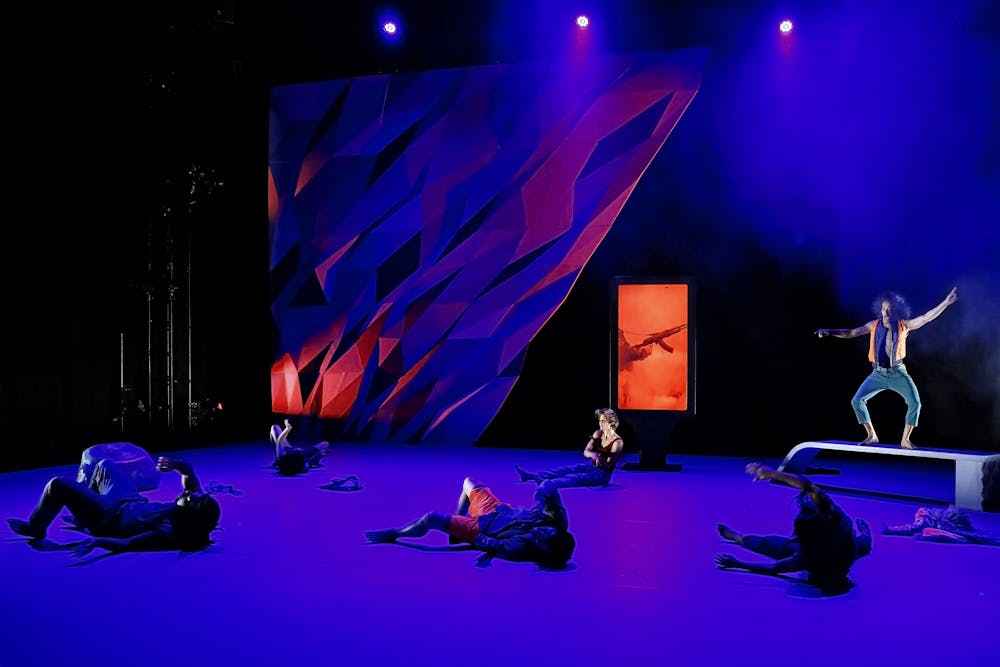
Dancers in Le Dernier Appel. Prudence UptonThe two situations are not identical. New Caledonia lives with the memory of a violent Kanak freedom movement in the 1980s; and as Senator Patrick Dodson pointed out in a talk during the season (he is patron and cultural consultant to Marrugeku), the Australian context is marked by a long “dragging out of the inevitable recognition” of our First Peoples, as the same debates are had century after century.
An unrelenting wave of shaking, stamping, falling, fighting, punching, and pulling, Le Dernier Appel paints a world full of emotion – of anger, of hurt and aggression. The opening scene sees the ensemble of six performers spread out across the stage. Facing the audience, feet planted, they seethe with energy barely contained.
Gradually, small ticks and quivers begin to show, before the inevitable explosion. Less didactic than Marrugeku’s previous ensemble works (such as Cut the Sky, Burning Daylight), this time “voice” is given over to the poetics of the moving body. The message is straightforward: there is immense physical endurance going on here.
Le Dernier Appel. Prudence UptonThere are three Australian dancers: Dalisa Pigram, with strong, serpentine Yawuru-inspired movement, and long hair flailing; Bundjulung/Ngāpuhi woman Amrita Hepi whose gestural repertoire stutters and scratches like old-school rap; and Miranda Wheen whose quiet presence grows into all-in, risky abandon.
They are joined by New Caledonian b-boys Krylin Nguyen, who hits the floor in airflares that defy gravity to increase in speed and power as he goes; Stanley Nalo, phasing between muscular pops and liquid flight; and the hugely expressive Yoan Ouchot.
Once let loose, movement spills out of the dancers in ever-changing groupings, reorganising them but leaving them stuck with little hope of resolution.
The image that will stay with me is a section worked along the diagonal, all six dancers pushing and shoving and gesticulating wildly in repeated onslaught towards a bright light (the possible future? a deaf authority?), only to be pushed back to regroup and repeat again and again. Le Dernier Appel suffers from an unresolved ending, but really, what ending is possible?
A dazzling performance
The second work, plenty serious TALK TALK, is a solo by the independent choreographer Vicki Van Hout, presented by FORM Dance Projects. This is one brilliant show. In a series of impeccably performed monologues and dances, Wiradjuri woman Van Hout invites a complex conversation about Aboriginal sovereignty and land rights, identity and cultural ownership.
Vicki Van Hout in plenty serious TALK TALK. Heidrun Löhr.With winning showmanship and cutting satire she sends up obligations to Welcome to Country and auctions off Indigenous dance steps. She invokes the persona “Ms Light Tan” who likes living on the edge and wonders what people would pay to buy her indigeneity (and its attendant “benefits”).
She worries about whether she is appropriating Aboriginal and Torres Strait dances (as well as technique from Martha Graham). In the darker second half, she recalls a frightening trip to hospital and re-enacts a brutal police bashing.
I am left dazzled by the virtuosity of Van Hout’s performance, her unmatched skill as a dancer and the biting creativity of her writing. But the show prompts us to be more than just dazzled — it asks us to go to some very uncomfortable places despite its light touch, and to consider the difficult cultural work that is required by our First Nations people. Van Hout stops and starts, changes tack, ties herself in knots, hits the ground hard from an unseen punch and rights herself again.
Our politicians, like many of us, may have the privilege to turn away from the work of truth-telling and treaty, leaving it for yet another generation. But this is not an option for First Nations people who bear the brunt of colonisation’s effects.
We may wish for theatre to give us the sense of reconciliation that eludes us in real life. But these two performances don’t offer an easy balm or cure-all: “the message is that we can talk,” the New Caledonian Centre Culturel Tjibaou director Emmanuel Tjibaou said in an interview while in Australia, “if it is a trauma to be colonised, then let’s talk about it and face it together.”
Le Dernier Appel (The Last Cry) was staged at CarriageWorks, Sydney, from August 18-20. It will be touring New Caledonia, Europe and Australia. plenty serious TALK TALK was staged at Parramatta Riverside from August 30.
– First Nations dancers are stepping into the void left by Australia’s politicians– http://theconversation.com/first-nations-dancers-are-stepping-into-the-void-left-by-australias-politicians-102645]]>
Media freedom commentators condemn Nauru ‘gag’ actions

 Television New Zealand Pacific correspondent Barbara Dreaver talks to media in Nauru yesterday following her release after being detained by police for almost four hours. Image: RNZ Pacific
New Zealand Prime Minister Jacinda Ardern arrived today for the leader’s retreat at the Pacific Islands Forum in Nauru where she is expected to ask for details about the detention of TVNZ journalist Barbara Dreaver yesterday.
Dreaver, who is there to cover the Forum, was interviewing a refugee outside a restaurant when she was picked up by police.
She says they asked for her visa, told her she was breaching her conditions and cancelled her accreditation for the Pacific Islands Forum.
 It is part of a wider pattern of restricting media coverage across the Pacific.
Sally Round is among a team of RNZ Pacific reporters who have been covering Nauru for many years.
Professor David Robie is the director of the Pacific Media Centre at Auckland University of Technology.
They talk to Susie Ferguson.
Both commentators criticised the media restrictions and obstruction by Nauruan authorities.
“There is nothing like being on the ground in a place when you are covering it – you get the firsthand view of everything,” Round said.
Having the Forum in Nauru presented the first opportunity for many years for journalists to be on the ground to independent reporting of the country.
There is no independent media on the island.
“We were building up to this with the ban on the ABC participating. It’s a clear pattern that’s being going on,” said Dr Robie.
“In fact, I’d say there has been erosion of peace freedom in the Pacific steadily over the last five years – ironically over the same period of the detention centres in Nauru and on Manus.”

Article by AsiaPacificReport.nz
]]>Pacific student uncertainties over climate impact outweighs Fiji poll

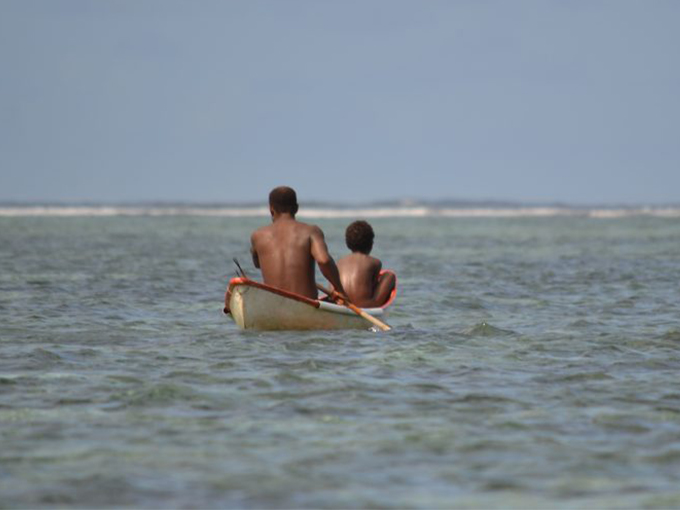 Final year University of the South Pacific student journalist Elizabeth Osifelo, from the Solomon Islands, has witnessed the rise in sea level each time she travels home from Suva. Image: PIFS/Wansolwara
Climate change issues seem to loom larger than the impending Fiji general election in the minds of University of the South Pacific students. Pacific Media Centre’s Sri Krishnamurthi speaks to students about their thoughts.
COP23, which refers to the 23rd annual Conference of the Parties to the 1992 United Nations Framework Convention on Climate Change (UNFCC), and Fiji holding the presidency over the last year is the reason university students in Fiji are alarmed at the rapid changes in their environment.
“As someone from the Pacific, there is a strong concern about climate change. The thing which I see in the Pacific as part of climate change is the burden that it is not of our own doing, but unfortunately, we are the losers who are putting it out there,” says Mohammed Ahmed, a Bachelor of Arts student at the regional University of the South Pacific.
“For example, in one of the conventions in which all the countries are represented, there is a decision made to reduce carbon emissions by 10 percent.
 FIJI PRE-ELECTION SPECIAL REPORTS
“To countries like China and America, which are industrial nations, that’s applicable but to a country in the Pacific which has a substantially insignificant carbon footprint that wouldn’t apply.”
Climate change is foremost on the minds of USP students rather than an impending Fiji general election that has still not had a declared date.
 USP Bachelor of Arts student Mohammed Ahmed … “climate change is a burden not of our doing.” Image: Sri Krishnamurthi/PMC/Wansolwara
Koroi Tadulala, a final-year journalism student, is deeply concerned about what climate change means for his generation.
“For the young generation, the issue today is climate change because there is strong focus on Fiji,” he said.
“One of the major highlights that I want to point out is the presidency [held by the Prime Minister of Fiji, Voreqe Bainimarama] of COP23 last year, its Fiji’s advocacy on climate change, and the talanoa concept that was developed and has now become a global thing.
Talanoa dialogue
“I am very concerned about the environment. I took part in the talanoa dialogue. I was at COP23 in Bonn, Germany, as a youth ambassador.
“It was really interesting because we got a global perspective in one confined space. We had leaders brainstorming solutions and innovative ways which we can combat this global issue.”
Regardless of the politics of Fiji, he had nothing but praise for the way his Prime Minister handled himself on the world stage.
“I’d say he has delivered very well as president of COP23. He still continues to fight climate change and he remains active about the issue.”
It worries Elizabeth Osifelo, who hails from the Solomon Islands, because she observes the rising sea levels each time she goes home from Suva.
“I am concerned because I come from a low-lying area, which is by the sea. I always go back home during Christmas and every time I go back, year after year, I can see changes,” she said.
There are similar concerns voiced for the environment in the Solomon Islands.
Eliminating plastic
“I know a lot of Pacific Island nations are in the process of eliminating plastic bags and rubbish like in Fiji and Vanuatu, which has taken the lead in banning plastic bags.
“I hope that the Solomon Islands will come that soon so that we are more active in the way we look after our environment,” she said.
Kritika Rukmani from the nearby tourism mecca of Pacific Harbour could not put it more succinctly.
“I am very passionate about climate change. We, as an island nation, should be concerned because we are very small compared with other countries. We will sink at a faster rate than anyone else,” she said.
Adi Anaseini Civavonovono believes that individuals cannot shirk their responsibility and leave it all to the authorities or the private investors.
“How we look after the environment is up to individuals we cannot depend on government initiatives or climate change financiers. Climate change is a concern not only for Fiji but for the Pacific region because we are the most affected,” she summed up.
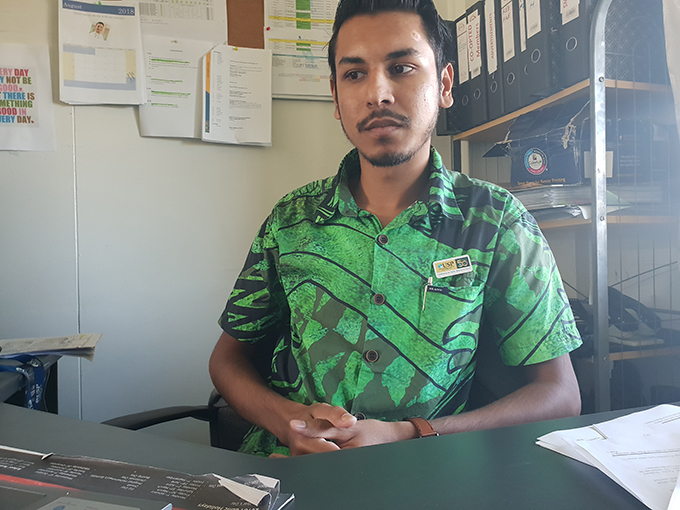 Auckland speaker Aneet Kumar, a student working and studying at USP, takes a wider view on climate change. Image: Sri Krishnamurthi/PMC/Wansolwara
Keynote speaker
Having travelled near and far in the past two years and being involved in the NGO sector, Aneet Kumar was invited to Auckland last month to be the keynote speaker at the Peace Foundation’s Auckland Secondary Schools’ Symposium.
Working and studying at the USP, he takes a wider view on the subject.
“As a young person who has been to a number of countries, I can say Fiji has made significant progress in terms of representations on international bodies and agencies like the United Nations. That is one way of dealing with threats to our futures,” said Kumar.
“This week I was reading about our permanent representative to the UN [Satyendra Prasad], who had raised his concerns at the UN Security Council’s Peaceful Mediation process, on the importance of the UN Security Council to consider rigorously and debate climate change issues and issue of disputes between countries. Hopefully something good comes out of it.”
Perhaps the last words on the touchy topic for students comes from Mohammed Ahmed who aptly sums up, “As a person that is concerned about climate change, we have talked a lot but we have dragged our feet as well”.
Sri Krishnamurthi is a journalist and Postgraduate Diploma in Communication Studies student at Auckland University of Technology. He is attached to The University of the South Pacific journalism programme, filing for USP’s Wansolwara News and the AUT Pacific Media Centre’s Asia Pacific Report.
Article by AsiaPacificReport.nz
]]>The synthetic biology revolution is now – here’s what that means

The Conversation (Au and NZ) – By Claudia Vickers, Director, Synthetic Biology Future Science Platform, CSIRO
We live in an era where biotechnology, information technology, manufacturing and automation all come together to form a capability called synthetic biology.
Technological revolutions are significant because they shape the future of social and cultural development – as is evident for the industrial revolution, the “green revolution”, and the information technology revolution.
Now synthetic biology is shaping up to be the dominant technology of this century, and Australia has made clear moves to be on board.
Read more: How to grow crops on Mars if we are to live on the red planet
What is synthetic biology?
Synthetic biology is the design and construction of new, standardised biological parts and devices, and getting them to do useful things.
Parts are encoded using DNA and assembled either in a test tube or in living cells – and then applied to deliver many different kinds of outcomes.
“Cell factories” for production of industrial chemicals is one way synthetic biology is applied.
The chemical butanediol is used to make 2.5 million tonnes of plastics and other polymers each year, including half a million tonnes of Spandex (Lycra). In 2011 all of this molecule came from petrochemicals. Biotech and chemical companies Genomatica and BASF collaborated to engineer a commercially viable synthetic biology production route for butanediol – it went from lab to commercial scale in just five years.
Many other global businesses are also investing heavily in the use of whole cells – so-called chassis cells – to produce useful chemicals.
Medicine, the environment and agriculture
Significant medical breakthroughs are happening via synthetic biology.
The antimalarial treatment artimisinin can now be produced by yeast, avoiding the need to isolate it from Chinese sweet wormwood plant. This helps to stabilise global prices.
In 2016 a new immune cell engineering treatment resulted in a 50% complete remission rate in terminally ill blood cancer patients, with a 36% remission rate achieved in a 2017 trial. A similar approach has been used just recently to cure an advanced breast cancer.
Biomonitoring is another exciting area for synthetic biology developments. Highly specific, tiny biosensors can be engineered to detect an enormous range of molecules – such as hydrocarbon pollutants, sugars, heavy metals, and antibiotics.
These can be applied to measure aspects of health, and in environmental sensing systems to identify contaminants.
Synthetic biology could lead to highly sensitive tests for contaminants in water. from www.shutterstock.comSynthetic biology also has agricultural applications. It can provide more precision and sophistication than earlier gene technologies to help increase crop and livestock yields, while reducing environmental impact by limiting the use of chemicals and fertilisers. More efficient plant use of water and nutrients, photosynthetic performance, nitrogen fixation and better resistance to pests and diseases are all being developed using synthetic biology.
Consumer benefits may include nutritional improvements, enhanced flavour and the removal of allergenic proteins from milk, eggs and nuts.
Most of these synthetic biology applications rely on altering, adding or deleting gene functions by targeted genetic modifications. Based on past consumer resistance to genetically modified food products, progress in this area is more likely to be limited by the degree of public acceptance than it is by the technological possibilities.
Synthetic biology also provides the opportunity to use agricultural production systems for cheap, large-scale production of products such as drugs and antibodies for medical treatments.
Read more: Custom-built DNA could be used as a sensor probe
On the up and up
International growth in synthetic biology is remarkable. In 2015 the synthetic biology component market (DNA parts) was worth $US5.5 billion – by 2020, it will approach $US40 billion. Those figures don’t count sales revenue from synthetic biology products.
Product markets are also growing dramatically. In 2008, bio-based chemicals were only 2% of the US$1.2 trillion dollar global chemical market. In 2025, that will rise to 22%, driven by development of synthetic microbial factories.
Government investment into synthetic biology has been very strong over recent years. Road-maps and associated development structures have been developed through public agencies in many advanced economies, including the US, UK, EU, China, Singapore and Finland.
Private investment in synthetic biology is also growing at a remarkable rate. According to the US-based synthetic biology advocacy organisation Synbiobeta, American synbio companies raised around US$200 million in investment in 2009. In 2017 it rose to US$1.8 billion and as of July 2018 it was already US$1.5 billion, with a projected 2018 investment of just over US$3 billion.
Read more: Budget 2018: when scientists make their case effectively, politicians listen
Australia is catching up
In Australia, synthetic biology is less developed – but things are moving fast.
In 2014, the professional society Synthetic Biology Australasia formed, and several specialist synthetic biology conferences and workshops have been held.
In 2016, CSIRO invested A$13 million into the CSIRO Synthetic Biology Future Science Platform (SynBioFSP). Internal reporting shows SynBioFSP is now a A$40 million research and development portfolio driven by a collaborative community of over 200 scientists from CSIRO and over 40 national and international partner organisations, contributing to 60 research projects.
Synthetic biology was recognised as a priority area in the 2016 National Research Infrastructure Roadmap. A special call for synthetic biology was made in 2017 and a steering committee to examine Australia’s synthetic biology infrastructure needs has recently been created.
Read more: Explainer: the National Collaborative Research Infrastructure Strategy (NCRIS)
This week the Australian Council of Learned Academies released Synthetic Biology in Australia: An Outlook to 2030 as part of its horizon scanning series. We are two of the authors on this report, which examines the opportunities and challenges for getting the most out of synthetic biology in the Australian context.
Synthetic biology is an extremely fast-moving technology with extraordinarily diverse applications. It offers massive potential for Australia in terms of developing new markets, and in future proofing in the long term.
– The synthetic biology revolution is now – here’s what that means– http://theconversation.com/the-synthetic-biology-revolution-is-now-heres-what-that-means-102399]]>
Pacific Islands Forum masking Nauru human rights abuse, says advocate

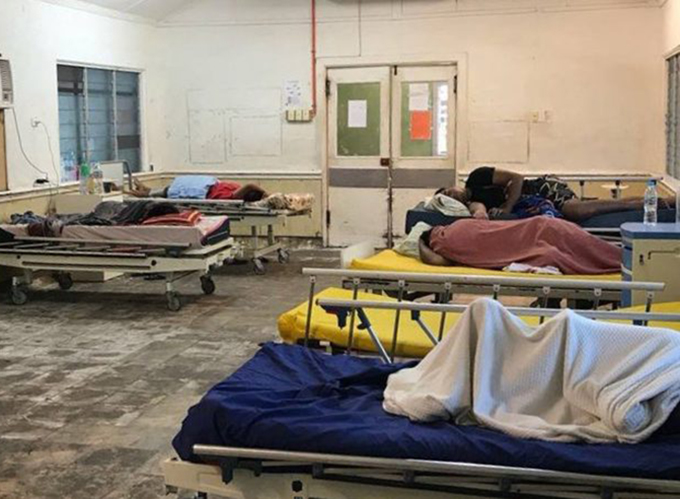 A ward at the RON Hospital on Nauru Image: Asylum Seeker Resource Centre/RNZ Pacific
By RNZ Pacific
A refugee advocate says behind the scenes of the Pacific Islands Forum on Nauru human rights abuses are continuing.
Ian Rintoul from the Refugee Action Coalition said journalists attending the forum need to look at the bigger picture.
Rintoul said to avoid scutiny, staff working at Australia’s refugee detention centres on the island have been told not to speak to the media.
He said despite the Nauru president’s denial of a mental health crisis among about 900 refugees on the island, self harm was continuing.
“There’s a woman on Nauru at the moment who’s swallowed a razor blade,” Rintoul.
“There have been recommendations from doctors on Nauru and in Australia that she can’t be treated on Nauru.
“She needs to be taken off Nauru for that treatment. She was sent home from the RON (Republic of Nauru) hospital last night come back when you start vomiting blood.”
Ian Rintoul said Nauru’s hospital were inadequate and in a poor state compared to facilities prepared for the forum.
“It’s one of the things the Australian government boasts about, how much money has been spent on the RON hospital. But when you look at photos of the hospital compared to facilities built for the forum you will see where the money has gone,” he said.
“It’s not just refugees, Nauruan people can’t get the treatment they need at the hospital.
“We’ve got hundreds of people (refugees) who’ve had to be sent off Nauru to Australia and other countries for medical treatment they can’t get on Nauru.”
This article is republished under the Pacific Media Centre’s content partnership with Radio New Zealand.
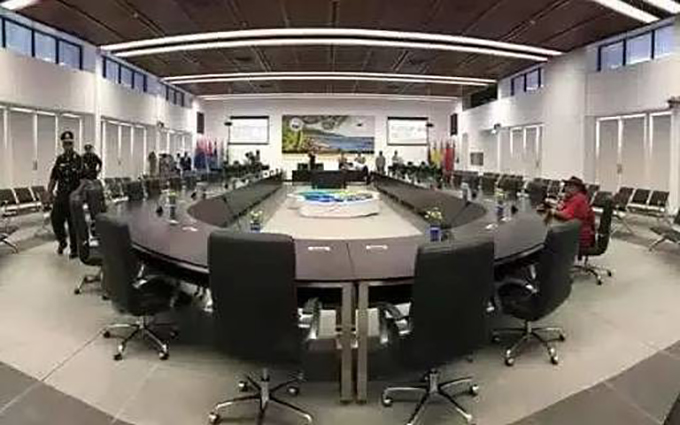 The Nauru Civic Centre. Image: Refugee Action Coalition/RNZ Pacific
Article by AsiaPacificReport.nz
]]>Australia’s UN report card: making progress, could do better on inequality and climate

The Conversation (Au and NZ) – By John Thwaites, Chair, Monash Sustainable Development Institute & ClimateWorks Australia, Monash University
Visiting drought-affected farmland in NSW last week, new PM Scott Morrison said he was not interested in considering the role of climate change on the drought because he was “practically interested in the policies that will address what is going on here, right now.”
A narrow focus on the short term is common in politics, but it won’t make the long-term problems go away. Drought and other issues like inequality, housing affordability, obesity and the loss of Australia’s rich natural heritage will only get worse.
The UN Sustainable Development Goals adopted by Australia and all nations in 2015 are a way to help countries focus on these longer-term challenges. They are a set of goals and targets for economic prosperity, social justice and environmental sustainability to be met by 2030.
In addition to governments, more and more businesses are now reporting on their progress towards these global goals, too.
How is Australia going?
This week, the National Sustainable Development Council with the Monash Sustainable Development Institute published the Transforming Australia: SDG Progress Report. It examines trends between 2000 and 2015 to assess whether Australia is on track to meet the 2030 targets.
The report highlights strong progress in health and education, but poor performance in addressing inequality, climate change and housing affordability. Of 144 indicators assessed across the 17 goals, 35% were on track, 41% needed improvement and 24% were off-track or deteriorating.
Read more: Australia falls further in rankings on progress towards UN Sustainable Development Goals
Despite some progress, the report found almost every goal has at least one target where an important indicator is off-track or will require a breakthrough to be achieved.
For example, income poverty in Australia has decreased since 2000. But a person on Newstart, who would have been near the poverty line in 2000, is now 25% below the poverty line due to the lower indexation rate for Newstart payments.
Life expectancy in Australia is among the highest in the world and has increased from 79.3 to 82.5 years between 2000 and 2015. Smoking rates and road traffic deaths have fallen dramatically, as well. However, Australia still has a high prevalence of lifestyle-related risks, such as obesity, and deaths due to road accidents in remote areas remain five times higher than in cities.
On the positive side, Australia is an increasingly educated society. The proportion of the working age (25-64) population holding tertiary qualifications increased markedly from 27.5% to 43.7% between 2000 and 2015, one of the highest percentage of tertiary qualifications in the world.
While Australian student performance on the Program for International Student Assessment (PISA) benchmark has been declining across science, maths and reading, Australian students perform very well as collaborative problem solvers – an increasingly important indicator for the jobs of the future. On the downside, investment in early childhood education and care remains low.
The report also highlights key challenges in achieving Australia’s economic goals, with relatively low investment in research and innovation, increasing underemployment and high levels of household debt.
While Australia has enjoyed a record period of economic growth and disposable incomes per capita grew strongly from 2000-2012, wage growth has stalled since then and cost of living pressures are now putting a strain on families.
Not there yet
Two persistent challenges identified in the report are continuing inequality and Australia’s poor performance on climate action and the environment.
Despite strong economic growth since 2000, Australia’s income inequality did not improve and wealth inequality got worse.
The glass ceiling remains firmly in place and structural inequalities continue to prevent women from reaching their potential. In 2017, just 11 women led ASX200 companies, while only 30% of Australian parliamentarians are female .
Read more: UN delivers strong rebuke to Australian government on women’s rights
Meanwhile, the gender pay gap has barely narrowed in 20 years and women’s superannuation balances at retirement remain 42% below those of men. And the Closing the Gap report illustrates the vast inequality gulf between Indigenous and non-Indigenous Australians.
Of all the UN Sustainable Development Goals goals, taking urgent action to combat climate change is the area where Australia is most off track.
Greenhouse gas emissions, the highest per capita in the OECD, are roughly the same now as in 2000 and are projected to be even higher in 2030. We are nowhere near meeting even Australia’s modest Paris target of a 26% emissions reduction by 2030.
Are we ready for the future?
It is clear that Australia has a considerable way to go to achieve most of the UN Sustainable Development Goals and it will require a major change from business as usual.
Despite our history of strong economic growth, our children and grandchildren face the prospect of being worse off than we are unless we address inequality, climate change and cost of living pressures.
In an increasingly polarised political and media landscape, we should be looking to strengthen collaboration between government, business, social enterprise and society. To achieve the 2030 Sustainable Development Goals, we need to overcome the short-term focus that currently dominates our political landscape and work collectively if we are to achieve a “fair go” for the next generation.
This article is the first in a series looking at Australia’s progress toward meeting the UN Sustainable Development Goals, based on a report published by the Monash University Sustainable Development Institute.
– Australia’s UN report card: making progress, could do better on inequality and climate– http://theconversation.com/australias-un-report-card-making-progress-could-do-better-on-inequality-and-climate-102630]]>
We asked five experts: do we have to poo every day?

The Conversation (Au and NZ) – By Alexandra Hansen, Health + Medicine Section Editor/Chief of Staff, The Conversation
Some days you might find yourself in and out of the toilet, and some days might go by without a single visit for a Number Two. Should this be a cause for concern?
We asked five experts if we have to poo every day.
Five out of five experts said no
Here are their detailed responses:
If you have a “yes or no” health question you’d like posed to Five Experts, email your suggestion to: alexandra.hansen@theconversation.edu.au
Disclosures: Damien Belobrajdic has worked on projects commissioned by food companies manufacturing cereal, dairy and oil products.
– We asked five experts: do we have to poo every day?– http://theconversation.com/we-asked-five-experts-do-we-have-to-poo-every-day-98701]]>
Why Australia should invest in paying early childhood educators a liveable wage

The Conversation (Au and NZ) – By Karen Thorpe, Professor, Deputy Director, Institute for Social Science Research, The University of Queensland
Today, across the nation, educators who work in long day care centres are walking off the job for the fourth time in 18 months. In February this year, an attempt to bring a pay equity case through the Fair Work Commission was dismissed.
Read more: Low-paid ‘women’s work’: why early childhood educators are walking out
Early childhood educators are seeking improved wages and recognition of the value of their work in early childhood education and care. Without a liveable wage many of these educators will be compelled to walk out the door of these centres – not just today, but forever.
This comes at a high cost to Australia’s aspiration for world-class, high quality education for its youngest children.
Educators frequently leave their centre
Many of those working in the early childhood education and care sector earn little above the minimum wage. Yet all are required to hold a vocational qualification and work to regulated professional standards to promote the learning, development and wellbeing of Australia’s youngest citizens. Even those with a four-year teaching degree are paid on average A$10,000 less per year than those working in the schools sector – without the long holiday breaks.
Additionally, they have few opportunities for non-contact time to undertake the significant demands of planning each child’s education program and recording their learning. Caring for multiple young children is physically and emotionally demanding, but not recognised in liveable rates of pay. A liveable rate of pay would enable them to afford the basic costs of housing, food, health and transport.
While most educators say they love their work, continued participation in the workforce often comes at a significant personal cost. Low wages restrict workers’ abilities to live self-sufficient lives.
Early childhood educators will walk off the job for the fourth time in a year and a half. United Voice/flickr, CC BY-NDFor example, younger educators discuss their inability to leave home. Partnered educators remain dependent on the income of their spouse or even a former spouse, to cover basic living expenses. Those who don’t have additional financial support live precariously under persistent financial stress which impacts on their emotional well-being.
Under these circumstances it’s not surprising staff frequently leave their centre, or the sector entirely. Our recent study of early childhood education and care centres in metropolitan, regional and remote Australia found a turnover rate of 37% a year, with rates in remote areas at 45%. International comparisons suggest these turnover rates are high.
Where do the educators go?
Our study suggests educators pursue a range of options. The degree-qualified move up to the few better paid administrative roles within the sector or move out to the schooling sector where pay, conditions and status are higher.
Diploma and Certificate trained educators may move around within the sector looking for marginal gains in pay or conditions. Such “churn” is enabled by significant under-supply of qualified early childhood educators. Others move to less demanding work outside the sector.
Read more: Early childhood educators rely on families to prop up low income, research finds
In our study, about half of those leaving the sector expressed a high level of dissatisfaction with their pay and conditions.
Losing skilled, experienced educators takes its toll
High turnover represents unnecessary loss and significant personal and economic cost. Most noticeable is the loss of skilled and experienced educators in the sector.
In our study, 40% were Certificate trained, 26% held a Diploma and 16% held a degree. Many were undertaking further study and all participated in ongoing professional development.
The loss of educators also takes its toll on children’s development, well-being and learning experiences. Turnover causes significant disruptions to attachment relationships with children and partnerships with parents.
High turnover in the sector comes at a great cost to workers, children in their care, and society. Brendan Esposito/AAPEven more concerning is that turnover is highest in areas of greater socioeconomic disadvantage where the role of early childhood education and care is especially important in supporting school readiness and ongoing educational progress.
Turnover has a societal cost
There is compelling evidence for the value of high quality early childhood education and care in supporting positive life outcomes for children, enabling parents to participate in the workforce, and yielding long-term economic growth for the nation. Yet, Australia has largely taken the significant contributions of the people who design and deliver early education programs for the 1.57 million Australian children who attend long day care in Australia each week for granted.
Three decades of neuroscience, developmental science and economic modelling tells us this work is not merely unskilled or instinctive. Rather, it’s crucial to the opportunities and life course outcomes of each child.
Read more: What outcomes parents should expect from early childhood education and care
Valuing the skills and contributions of our skilled educators and reversing the high rates of turnover is critical and can only be achieved through fair pay and rewards.
As educators walk out today, they’re supported by the many families who use early childhood education and care. Politicians who focus on the cost of early childhood education and care rather than its quality should take heed of this support. Compared with many OECD nations Australian parents foot a higher proportion of the child care bill.
– Why Australia should invest in paying early childhood educators a liveable wage– http://theconversation.com/why-australia-should-invest-in-paying-early-childhood-educators-a-liveable-wage-102396]]>
Our urban environment doesn’t only reflect poverty, it amplifies it

The Conversation (Au and NZ) – By Jenny Donovan, Urban Designer and Sessional Lecturer, La Trobe University
The poorer you are, the harder it is to participate in and contribute to society. My experience as a practising urban designer and my research in the area have led me to conclude that the way people’s surroundings are designed reflects and amplifies this profound injustice.
Busy and fast roads, for instance, encourage driving while at the same time deterring walking and other forms of street life, isolating people from their neighbours.
Physical activity, interacting with others, setting and meeting challenges, and experiencing nature are all essential to our well-being. But humans aren’t good at prioritising our needs. We often make decisions that deny us these and other essential experiences.
This is particularly the case in poorer communities where shared and public spaces – the settings for many of these essential activities – tend to be poorly maintained, mundane and utilitarian.
Read more: Designing the compassionate city to overcome built-in biases and help us live better
Indifference without invitation
In such generic or inappropriately designed places, indifference or avoidance becomes more likely. Faced with the lukewarm appeal of these places, and sometimes active deterrence, people are more likely to be seduced by “easier”, but not needs-fulfilling, ways to spend their time. They may choose to drive rather than walk, or play on screens rather than in the open with others.
Places like this offer little invitation to walk, play or exercise. Jenny Donovan, Author providedIf these people are to escape the call of the TV and computer, the “heavy lifting” will need to come from personal motivation to fill the gap left by the paucity of invitation from their surroundings.
In such places, if someone does choose to walk, cycle or play or participate in any of the activities that support health and well-being, they are doing so because they are determined to, rather than because their surroundings offer the pulling power to motivate them.
Making the same street friendlier makes meeting needs easier and, for some people, possible. Jenny Donovan, Author providedMany people do somehow overcome even the most difficult circumstances and thrive. But many others find this prohibitively difficult or are unaware of the need to make different choices. Their surroundings lead them to inadequate physical activity, isolate them from others, limit potential to find like-minded people around which community can coalesce, offer little enjoyment of nature and few opportunities to set and meet self-determined challenges.
We can see the effects of these issues through increased rates of obesity, loneliness and many diseases that diminish people’s quality of life.
A conducive environment helps people meet their needs, thrive and fulfil their potential. Jenny Donovan, Author providedRepeated over a neighbourhood or a city and concentrated in poorer areas, this can create arbitrary barriers that make winners and losers of their inhabitants. Extended over many years, these effects create huge social and health costs and can lock people into disadvantage.
Read more: Want to improve the nation’s health? Start by reducing inequalities and improving living conditions
These places deny people the inspiration of the crowd. If you rarely see someone else play on the street, run or cycle, you are less likely to consider it among the choices open to you.
You’re much less likely to go for a run if nobody else is doing it around you. from shutterestock.comBeyond the suburb
Disadvantaged communities lack the ability to influence the design process, make positive change happen themselves or protect what they value. Research has found people in communities with low socioeconomic status get left out of the decision-making process. When they do receive attention it is not as wholehearted or appropriately applied as it would be for wealthier communities.
We wear our surroundings like a cloak. Poor physical and social conditions often reflect poorly on their inhabitants, contributing to lower expectations of those people. This soft prejudice even means they are less likely to be considered for jobs that don’t match perceptions of what people from that postcode are like.
People with less buying power end up in less supportive environments, priced out of more nurturing places. Poorer people are getting pushed out of former working-class inner-city neighbourhoods that attract people and investment. This leaves less attractive places as the realm of concentrated poverty.
Read more: Look up #happycity and here’s what you’ll find
So, what can we do about it?
The obvious answer is to invest in design and the design process. But this is only part of the solution.
We need to reassess what good urban design is. Good design will need to be inexpensive to avoid lumbering communities with debt and ensure it can be spread widely. It needs to be tailored to provide the right invitations to those who most need it. It gives greater weight to designing for the social landscape of the community, and less to the aesthetic values of the designer and client.
Good design enables those who are being designed-for to participate in the design and creation of their surroundings wherever possible. This allows them the experience of developing and realising change, taking responsibility and exercising self-determination.
This takes time. The emotional capital this process demands of the designer and the community are immensely powerful but volatile resources. The designs that arise may not immediately be recognised by many designers as good design.
But if our present approach leaves people isolated and uninspired to do the things they need to do to thrive, we must reassess what good design really is and see it not as a luxury but as a right.
– Our urban environment doesn’t only reflect poverty, it amplifies it– http://theconversation.com/our-urban-environment-doesnt-only-reflect-poverty-it-amplifies-it-98561]]>
The new and more efficient payments system means new and more efficient payments fraud. Here’s how to prepare

The Conversation (Au and NZ) – By Steve Worthington, Adjunct Professor, Swinburne University of Technology
Most credit card fraud takes place online or over the phone. It’s not the cards that are stolen, but the details. The Australian Payments Network finds they are used to amass 85% of the money stolen using Australian credit cards, without the need to steal the cards themselves.
Usually, we are not liable for the money lost. It is reimbursed through our card provider if we have quickly reported the breach and taken due care.
The launch this February of the New Payments Platform owned by both the banks and Reserve Bank will make payments instant. It isn’t yet fully adopted, but when it is it’ll allow any financial institution to transfer money from any of its accounts to any other account near instantaneously.
Those transfers will be impossible to reverse.
While each institution will be able to impose limits on the upper value of transfers, the designers of the system expect them to be higher than credit card limits – more like the very high limits at present in place for transfers using BSB numbers.
It will makes them magnets for fraud, as they have become in Britain. The UK Faster Payments System was launched ten years ago. In 2010, the transaction limit was lifted to £100,000. In 2015, it it was lifted to £250,000.
Among the most lucrative frauds involves conveyancing, known as “Friday afternoon fraud”, as in the UK this is the day that many property sales are due for settlement and funds are transferred from payer to payee.
Fraudsters hack into emails between solicitors and their home-buying clients and then on the day the money is about to be moved, impersonate the solicitor and send the client an email saying the bank account details have changed and the payments should be made to a different account, created by the fraudster.
The Faster Payments system ensures the money is transferred immediately. The victim usually doesn’t know about it until the following week when they look for confirmation, and find they’ve sent the money to the wrong account.
In the UK, financial institutions have until now avoided paying compensation to the victims, because they themselves authorised the payments. However in August the UK Financial Ombudsman Service told the institutions to stop automatically blaming victims and take a fairer approach.
It said:
We often hear from banks that their customers have acted with ‘gross negligence’ and that this means that they are not liable for the money that their customers have lost. However gross negligence is more than just being careless or negligent. The evolution of criminal methods – in particular their sophisticated use of technology, means that gross negligence is an increasingly difficult case to make.
The UK Financial Conduct Authority is considering requiring financial institutions to handle payments fraud complaints in line with other complaints and to publish data about the extent of complaints.
Banks are introducing round-the-clock fraud detection help lines and fast response teams. Defrauded customers will in future only have to deal with their own bank and not the bank into which their funds have been paid.
In Australia, as in Britain, the best advice is to be extremely vigilant about checking emails that ask for payments. Often it will be worth ringing to check that the demands are real.
Extreme vigilance is easy to prescribe and hard to practice. But with payments under the new system impossible to reverse, and with our banks likely to be be initially reluctant to help out, as they were in the UK, we’re going to have to become more suspicious.
– The new and more efficient payments system means new and more efficient payments fraud. Here’s how to prepare– http://theconversation.com/the-new-and-more-efficient-payments-system-means-new-and-more-efficient-payments-fraud-heres-how-to-prepare-102449]]>
How unearthing Queensland’s ‘native police’ camps gives us a window onto colonial violence

The Conversation (Au and NZ) – By Lynley Wallis, Senior research fellow, University of Notre Dame Australia
In 19th century Queensland, the Native Mounted Police were responsible for “dispersing” (a euphemism for systematic killing) Aboriginal people.
This government-funded paramilitary force operated from 1849 (prior to Queensland’s separation from New South Wales) until 1904. It grew to have an expansive reach throughout the state, with camps established in strategic locations along the ever-expanding frontier, first in the southeast and then west and north. While staffed with non-Indigenous senior officers, the bulk of the force was made up of Aboriginal men and, sometimes, boys.
We have been exploring the remote Queensland outback for traces of the base camps of the Native Mounted Police. There were nearly 200 such camps. So far we have visited more than 45 of them.
Our archaeological work is revealing the day-to-day livelihoods that underpinned the chilling work of these police. This is an important part of reckoning with Australia’s colonial violence, given the difficulties in identifying physical evidence of massacres in the archaeological record, despite recent efforts to map massacre sites from oral and written sources.
Rather than maintaining order among the European population, the Native Mounted Police’s role was to protect squatters, miners and settlers on the frontier, by whatever means necessary. Their well documented method of “protection” was to mount patrols and kill Aboriginal people who were trying to protect their land, lives and loved ones. There were literally hundreds of such events.
Members of the NMP photographed on 1 December 1864 at Rockhampton. In the back row from left to right are Trooper Carbine, George Murray, an unknown 2nd Lieutenant, an unknown Camp Sergeant and Corporal Michael. In the front row from left to right are Troopers Barney, Hector, Goondallie, Ballantyne and Patrick. Reproduced with permission of Queensland State Library (negative no 10686). State Library of QueenslandOn February 10 1861, for instance, a detachment led by Sub-Inspector Rudolph Morisset shot at least four, possibly more, Aboriginal men on Manumbar Station (about 160 km northwest of Brisbane). This was in reprisal for Aboriginal people killing cattle on the run. We know about these particular deaths because John Mortimer, one of the station owners, complained in the local press about the police’s behaviour. He also gave evidence to an 1861 inquiry into the activities of the Native Mounted Police.
Around Christmas 1878 meanwhile, on the banks of a waterhole near Boulia, some Aboriginal people killed one or more Europeans looking after stock. The reprisal massacres of Aboriginal men, women and children that followed — with one, possibly two, survivors — are known from a written account, and from various oral accounts documented in the months and years after. The Burke River Native Mounted Police, stationed just outside Boulia, commanded by Sub-Inspector Ernest Eglinton, and assisted by at least one prominent pastoralist, Alexander Kennedy, were responsible for the Aboriginal murders.
Excavating the past
Similar to the forts built on the plains of North America during the “Indian” Wars, or the offices of the Third Reich in Nazi Germany, Native Mounted Police camps formed the force’s administrative backbone. More than 450 non-Indigenous officers lived on these bases, along with at least 700 Aboriginal men, through the force’s 50-year history.
Like other bureaucratic systems, their very domestic ordinariness — providing insights into what the police ate, drank and how they lived — belies the conflict that took place beyond their boundaries.
Archaeologists and students excavating at the Native Mounted Police camp at Burke River in southwest Queensland. Photo courtesy of Andrew Schaefer.Many camps were short-lived, sometimes being occupied for only a few months; in such cases their physical imprint is limited. In other situations — particularly where the terrain was rugged and higher population densities meant Aboriginal people were able to mount more effective campaigns of resistance — camps were occupied for longer periods, sometimes several decades. These left a clearer impression on the landscape.
Even so, what is left is not what you might normally associate with a frontier war. There are no battlefields, in the traditional sense of the word, to be seen. No victims with bullet wounds, no mass graves, and no large fortified buildings. Instead, the Native Mounted Police camps are ordinary, banal even, revealing the detritus of everyday life: stone fireplaces, segments of post and rail fences, sections of pathways, clearings and the occasional rubbish dump strewn with broken bottles.
Perhaps more telling, are the large numbers of bullets and spent cartridges from government-issue Snider rifles. These were rarely owned by private citizens but were issued to the Native Mounted Police for decades.
At each of the Burke River, Cluney and Boralga camps we have catalogued more than 100 bullets and cartridges, an unexpected situation given that most killings of Aboriginal people by the Native Mounted Police occurred outside the confines of the camps. Perhaps the abundance of these objects in the camps is the result of regular target practice by troopers, or maybe the result of having to hunt kangaroos at the local waterhole to supplement their meagre rations. Military-style buttons from uniforms – with ornate monograms, sometimes including a royal cipher and crown – serve as a bleak reminder that the violence associated with the Native Mounted Police was endorsed by the state.
An 1861 painting of the Wills Tragedy, a pivotal moment in the Queensland frontier wars. State Library of Queensland/Wikimedia CommonsThe Burke River camp
Burke River near Boulia in southwest Queensland – the base for Sub Inspector Eglinton and his detachment – was described in 1882 by a visitor as
the most respectable looking native police camp I have seen in Queensland, there seems to be a place for everything and everything in its place.
This camp sits beside a waterhole that is associated with Dreaming stories – an Aboriginal stone arrangement and the thousands of flaked stone artefacts along the edge of the watercourse are testament to it being an important living and ceremonial place. The establishment of a police camp on the site was likely to have been viewed by local Aboriginal people as both inappropriate and insulting – but of course their views were not a concern.
There are two stone buildings, likely built to house equipment, guns, ammunition and dry foodstuffs, and possibly the officer’s quarters. Further away again is a series of small mounds – so slight that unless you know what to look for you would not even see them. These mounds are a treasure trove of discarded rubbish. The fish hooks, flaked glass artefacts and animal remains we have recovered from them indicate they are likely the remains of the troopers’ huts. They serve to remind us that, despite the job they were hired to carry out, they too were just men trying to survive.
Read more: Friday essay: the ‘great Australian silence’ 50 years on
Sites of colonial violence are difficult to locate exactly. As such, there is ongoing debate about its scale and nature. Aboriginal people have always referred to these events as a war. Such statements are often dismissed by critics as unreliable. Yet 19th century European authors also described the frontier killings as a war. The archaeology of Native Mounted Police camps is the closest material indication we have of the scale of suppression of Aboriginal people through the 19th century.
While some of these camps are recognised on Queensland’s Aboriginal heritage list, none can be found on the broader State Heritage Register – despite 200 sites that refer to the regular Queensland Police Force in some manner. We believe this should change to give more formal recognition to the dark past of the State’s foundations.
– How unearthing Queensland’s ‘native police’ camps gives us a window onto colonial violence– http://theconversation.com/how-unearthing-queenslands-native-police-camps-gives-us-a-window-onto-colonial-violence-100814]]>
Gender inequalities in science won’t self-correct: it’s time for action
The Conversation (Au and NZ) – By Sarah Hamylton, Senior Lecturer, School of Earth and Environmental Sciences, University of Wollongong
Harassed on fieldtrips. Excluded from projects. On the receiving end of micro-aggressions. A lack of female role models.
These are some of our collective experiences as women working in science and engineering.
Such experiences erode research opportunities and career progression, leading to the loss of many brilliant women from our disciplinary field – along similar lines as we’ve recently seen exposed in Australian federal parliament.
Today we published a global snapshot of the status of women in coastal science and engineering. The results show that gender inequity is still a major problem in the daily work lives of women globally.
And since gender inequalities in science won’t self-correct, we’ve developed some solutions based on our findings.
Tokenism is real in science. Naomi Edwards, Author providedWorking at the water’s edge
We work in coastal geoscience and engineering, a broad discipline focused on physical processes at the interface of land and sea. Here’s one of our experiences:
For twenty years people had been telling me how lucky I was to be in our field of research because “things” were changing for young women.
This didn’t resonate with my experiences. Twenty years later “things” had not changed and I was no longer a young woman. I started talking to other women and found that they had faced similar challenges, and wanted to see change. – Ana Vila-Concejo
To catalyse change, we founded the Women in Coastal Geoscience and Engineering (WICGE) network in 2016. Our first project was a study to understand the main issues faced by women who work in our field.
I’m pregnant, I’m a scientist. Now what? Naomi Edwards, Author providedGlobal snapshot
We surveyed 314 members of the coastal science and engineering community and analysed the gender representation in 9 societies, 25 journals, and 10 conferences.
We found that while women represent 30% of the international coastal science community, they are consistently underrepresented in leadership positions (such as being on journal editorial boards and as conference organisers). This situation was clearly acknowledged by the coastal sciences community, with 82% of females and 79% of males believing that there are not enough female role models.
Female representation in prestige roles was the highest (reaching the expected 30%) only when there was a clear entry pathway that gave women an opportunity to volunteer for a role.
Female representation was the lowest for the traditional “invite-only” prestige roles.
A significantly larger proportion of females felt held back in their careers due to gender than their male counterparts (46% of females in comparison to 9% of males).
Reasons for this include:
- a “glass ceiling” of informal workplace cultures and customs that reduce womens’ chances of promotion
- gender stereotyping of women not being competent in STEM disciplines
- a “boys’ club” tendency to favour men in recruitment and collaboration, and
- widely held assumptions that a woman’s job performance will be impacted by her having children (the “maternal wall”).
Fieldwork emerged as a key area of inequity, with female respondents being excluded or outright banned from research ships. For those respondents who made it to the field, many of them reported experiencing gender stereotyping and/or sexual harassment.
We used our survey to ask some forthright, open-ended questions about peoples’ experiences and observations of gender equality.
As a study author, the day I went over the responses was one that I will never forget. Stories of bullying, abortion and sexual harassment had me in tears at my desk. Inequality was consistent, pervasive and, in many cases, traumatic. – Sarah Hamylton.
So, what can be done?
Seven steps toward improving gender equity
Gender imbalances in science, technology, engineering and maths (STEM) are not a self-correcting phenomenon – so here are some ways to make science more inclusive for women.
Ways to make science more inclusive for women. Naomi Edwards, Author provided-
Advocate for more women in prestige roles: Ensure fair representation of women as keynote speakers at conferences, on society boards and journal editorial boards. Have clear pathways to prestige roles giving women an opportunity to apply if they wish to do so.
-
Promote high-achieving females: Recognise the achievements of females, and select them for roles that increase their visibility as role models.
-
Be aware of gender bias: Consciously reflect on personal biases when hiring, promoting and mentoring staff.
-
Speak up, call it out: Point out to conference organisers all-male panels and keynote programs and, where they are underrepresented, write to chief editors suggesting women for editorial boards.
-
Provide better support for returning to work after maternity leave: Higher levels of support and more flexible conditions for women returning from maternity leave encourage women to stay in their employment after having children, thereby increasing their prospects of reaching more senior posts.
-
Redefine success: Recognise the diverse range of definitions of what it means to be a successful researcher.
-
Encourage women to enter the discipline at a young age: Many school-age girls are put off the idea of entering STEM disciplines as they are socially and culturally deemed to be “male” pursuits. This needs to be addressed.
The Women in Coastal Geoscience and Engineering network is already successfully implementing some of these steps.
By choosing to ignore inequity for women, you become accountable for allowing it to continue. Speak up, promote the work of your female colleagues and give them voice and visibility.
This problem transcends STEM disciplines. It is crucial that the wider community becomes aware of the extent of inequity so that, where necessary, everyone can take action to improve the governance and culture of their work place.
– Gender inequalities in science won’t self-correct: it’s time for action– http://theconversation.com/gender-inequalities-in-science-wont-self-correct-its-time-for-action-99452]]>
Politics podcast: Judith Troeth on the Liberal party’s woman problem and asylum seekers
The Conversation (Au and NZ) – By Michelle Grattan, Professorial Fellow, University of Canberra
Former Victorian Liberal senator Judith Troeth is no stranger to speaking out forthrightly on issues, even when that goes against her party’s position.
In this podcast, Troeth says the party should adopt quotas to rectify the “abysmally low numbers” of Liberal women in parliament. “We should have quotas, but not forever … to get the numbers up”.
One of the group of moderates when she was in parliament (1993- 2011), Troeth is concerned about the party’s drift to the right. “Sometimes i feel as though i am standing on the extreme left … when everyone who knows me knows I’m certainly not”. She partly attributes the present situation to newer MPs being reluctant to rock the boat. Troeth’s advice to them? “Be brave and let your conscience be your mouth piece.”
On asylum seekers – an issue over which she confronted then prime minister John Howard – Troeth believes “quite strongly” that on humanitarian grounds people who have been processed and found to be refugees on Manus and Nauru should be allowed to come to Australia and stay.
– Politics podcast: Judith Troeth on the Liberal party’s woman problem and asylum seekers– http://theconversation.com/politics-podcast-judith-troeth-on-the-liberal-partys-woman-problem-and-asylum-seekers-102664]]>
TVNZ Pacific reporter released after being detained in Nauru

Television New Zealand Pacific correspondent Barbara Dreaver tells media of her three-hour detention by Nauru police after interviewing a refugee today. Her was stripped of her Forum accreditation. Video: RNZ Pacific Pool
By RNZ Pacific
Journalist Barbara Dreaver has been released after being detained in Nauru today while covering the Pacific Islands Forum summit, reports TVNZ.
RNZ’s reporter on Nauru said it was understood Dreaver was taken to the police station on the island after trying to interview a refugee outside of the camp.
She said they asked for her visa, told her she was breaching her conditions and stripped her of her accreditation for the Pacific Islands Forum (PIF) leaders summit being held on the island.
EARLIER STORY: TVNZ’s Barbara Dreaver detained
World Vision New Zealand said it helped Dreaver connect with refugees on Nauru and it was contacted by its liaison person this afternoon.
A spokesperson said Dreaver’s interview had been stopped by the Nauru police, and she was taken by them.
The Nauru government has limited the movements of journalists covering the summit and placed restrictions on who they can talk to.
An official from the Ministry of Foreign Affairs and Trade was with Dreaver during the ordeal.
PM pleased over release
Prime Minister Jacinda Ardern said she was pleased that Dreaver was released.
Ardern leaves for Nauru early tomorrow morning, and says once she gets there she will seek more advice about the situation.
She said the New Zealand government believed in freedom of the press throughout the world, and that includes the entire Pacific region.
The Nauru government had limited the journalists covering the summit and placed restrictions on those who got approval to go, limiting who they could talk to and what issues they could discuss.
The Australian Broadcasting Corporation (ABC) was also banned from covering the Forum summit after the Nauruan government accused the public broadcaster of “continued biased and false reporting” about the country.
This article is republished under the Pacific Media Centre’s content partnership with Radio New Zealand.
Article by AsiaPacificReport.nz
]]>A nostalgic journey through the evolution of web design
The Conversation (Au and NZ) – By Jo Jung, Lecturer, Edith Cowan University
The World Wide Web was invented almost 30 years ago by Tim Berners Lee to help people easily share information around the world. Over the following decades, it has changed significantly – both in terms of design and functionality, as well its deeper role in modern society.
Just as the architectural style of a building reflects the society from which it emerges, so the evolution of web design reflects the changing fashions, beliefs and technologies of the time.
Web design styles have changed with remarkable speed compared with their bricks and mortar cousins. The first website contained only text with hyperlinks explaining what the web was, how to use it, and basic set-up instructions. From those early days to the present, web design has taken a long and winding journey.
Early Facebook. Internet ArchiveRead more: Poor design means terrible websites still haunt the web
In the beginning
In the early 1990s, we welcomed the first publishing language of the Web: Hypertext Markup Language, or HTML.
But the language – used to share text-only pages via a simple browser – was limiting. Many early web sites were basic, using vertically structured, text-heavy pages with few graphics. People quickly adapted to vertically scrolling text and eye-catching blue underlined hypertext to navigate the virtual Web space.
The first website – restored by CERN in 2013. Internet ArchiveTables!
In the mid- to late-1990s, designers became more involved in the development of websites, and along came the Graphical User Interface (GUI), which allowed designers to incorporate images and graphical icons into websites.
When the Web started to gain popularity as a means of communicating information, designers saw an opportunity to use tables for arranging text and graphics.
Apple’s website in 1997. Internet ArchiveBefore the introduction of tables as a web page structure, there were few design components in websites, and there was no way to emulate the layouts of conventional printed documents.
But while tables allowed designers to arrange text and graphics easily, the code required to build them was more complex than methods that came later.
Early eBay. Internet ArchiveFlashy design
In the late 1990s, a new technology appeared on the scene: Flash.
Flash was a software platform that allowed designers to incorporate music, video and animation into websites, making for a more dynamic audio-visual experience. Flash also gave designers more freedom to make websites interactive. This was indeed the era of a creative and technological breakthrough in web design. Interactive menus, splash pages, decorative animations, and beautifully rendered bubble buttons dominated the web design trend to wow people.
The concept of the Web was still new to many people, and these visually exciting designs had a double purpose. They were not only bright and attention-grabbing, but they also introduced unfamiliar technology to novice users: “Look at me”, they screamed. “I look like a real button. Press me!”
Screen capture demo of the award-winning Levi’s 150th Anniversary web site back in the early 2000s.But the popularity of Flash was short-lived. It required users to have the latest Flash plugin installed on their computers, limiting the usability and accessibility of websites.
Read more: A new way to fix those frustrating websites
Everyone is a web designer
Although Flash didn’t live up to expectations, it changed the way websites were designed and used.
People became sophisticated at browsing the Web, and the design elements no longer had to educate in a way that visually articulates the functionality, such as blue underlined hyperlinks.
Then social media emerged and demanded even greater flexibility. This led to the birth of Cascading Style Sheets (CSS).
CSS were used to define particular styles – such as larger font sizes for sub-headings – across multiple pages of a single website without having to code each element individually. The idea behind CSS was to separate the content (HTML) of websites from the presentation (CSS).
Web design templates began to surface, allowing everyday people to create and publish their own websites. Unfortunately this was often at the expense of usable, accessible and aesthetically pleasing design.
The International Online Fan Club website for the TV show ‘Home Improvement’. Wayback MachineFlat design
Fast forward to 2010 when a new web design approach called responsive web design was created by Ethan Marcotte. This introduced a different way of using HTML and CSS.
The main idea underpinning responsive design was that a single website could respond and adapt to different display environments, facilitating use on different devices. People would have the same experience on their mobile device as on their desktop computer, meaning increased efficiency in web development and maintenance.
This led to another wave of web design trend: flat design. This trend embraced an efficient and visually pleasing minimalist two-dimensional style. It emphasises functionality over ornamental design elements.
Fremantle Arts Centre’s website was a winner of the 2017 Australian Web Awards. Fremantle Arts CentreToday, flat design is still going strong. Web design has made a full circle back to the beginning of the Web, prioritising the content and the communication of information. Buttons and icons have taken a back seat, gracefully bowing to the content as the forefront of websites, and reduced complexity in design.
Read more: Google wants more mobile-friendly websites in its mobile searches
The future…
The history of Web is relatively short, yet it has gone through a succession of renaissances in a short period of time.
Previously, technology drove advances in web design. But I believe we are at a point where web design is no longer limited by technology. Virtually, we can do pretty much everything we might want to do on the Web.
The future of web design is no longer about what we can do, but rather about what we should do. That means being considerate about how design can affect the people who use it, and designing websites that result in positive experiences for users.
You can look up previous incarnations of your favourite website using the Wayback Machine.
The Conversation when it launched in March 2011. Internet Archive – A nostalgic journey through the evolution of web design– http://theconversation.com/a-nostalgic-journey-through-the-evolution-of-web-design-98626]]>
Nauru authorities detain TVNZ Pacific reporter for interviewing refugee

 TVNZ’s Barbara Dreaver … a respected Pacific correspondent who has reported the region for many years. Image: TVNZ screenshot
By RNZ Pacific
New Zealand journalist Barbara Dreaver has been detained by authorities in Nauru while covering the Pacific Islands Forum summit, reports Television New Zealand.
TVNZ said Dreaver was conducting an interview with a refugee when detained by police early this afternoon.
READ MORE: TVNZ reporter released after being held 4 hours
An official from the Ministry of Foreign Affairs and Trade was with Dreaver but TVNZ reported that it was unsure of her whereabouts.
The Nauru government had limited the journalists covering the summit and placed restrictions on those who got approval to go, limiting who they could talk to and what issues they could discuss.
The Australian Broadcasting Corporation (ABC) was also banned from covering the Forum summit after the Nauruan government accused the public broadcaster of “continued biased and false reporting” about the country.
This article is republished under the Pacific Media Centre’s content partnership with Radio New Zealand.
Article by AsiaPacificReport.nz
]]>RSF condemns jail terms for two Myanmar journalists in ‘sham trial’

 Turmoil outside the Yangon court at the end of the trial of Kyaw Soe Oo (below) and Wa Lone in Myanmar yesterday. Image: Ye Aung Tha/AFP/RSF
Pacific Media Watch Newsdesk
Reporters Without Borders has condemned the seven-year prison sentences imposed on two Reuters reporters in the Myanmar city of Yangon yesterday at the end of a “sham trial”.
The Paris-based global media watchdog reaffirmed its call for their immediate release.
On what was a dark day for press freedom in Myanmar, Kyaw Soe Oo and Wa Lone were convicted of violating the country’s colonial era Official Secrets Act for investigating a massacre of 10 Rohingya civilians by soldiers exactly a year and a day ago in Inn Dinn, a village in the north of Rakhine state.
READ MORE: Trial will test Myanmar’s ‘democracy’
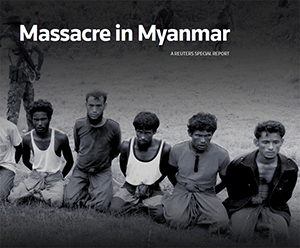 The atrocity being investigated by the imprisoned journalists.
“The conviction of Kyaw Soe Oo and Wa Lone is a terrible blow to press freedom in Myanmar,” RSF secretary-general Christophe Deloire said.
“As the justice system clearly followed orders in this case, we call on the country’s most senior officials, starting with government leader Aung San Suu Kyi, to free these journalists, whose only crime was to do their job.
“After a farcical prosecution, this outrageous verdict clearly calls into question Myanmar’s transition to democracy.”
The massacre investigated by Kyaw Soe Oo and Wa Lone was acknowledged by the army and seven soldiers were sentenced to 10 years in prison, an RSF statement said.
During the preliminary hearings in the case of the two journalists, a police officer admitted that his superiors framed them by giving them supposedly classified documents and then immediately arresting them.
The entire prosecution case was based solely on this “trumped-up evidence”, RSF said.
Myanmar is ranked 137th out of 180 countries in RSF’s 2018 World Press Freedom Index.

Kyaw Soe Oo outside the Yangon court in Myanmar yesterday. Images: Ye Aung Tha/AFP/RSF
Article by AsiaPacificReport.nz
]]>
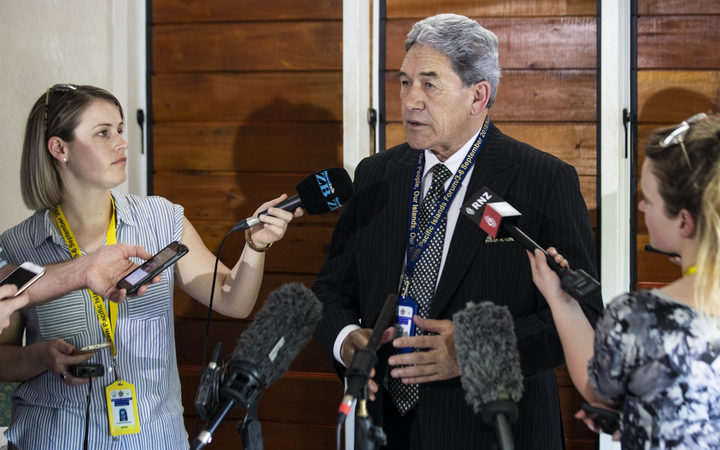


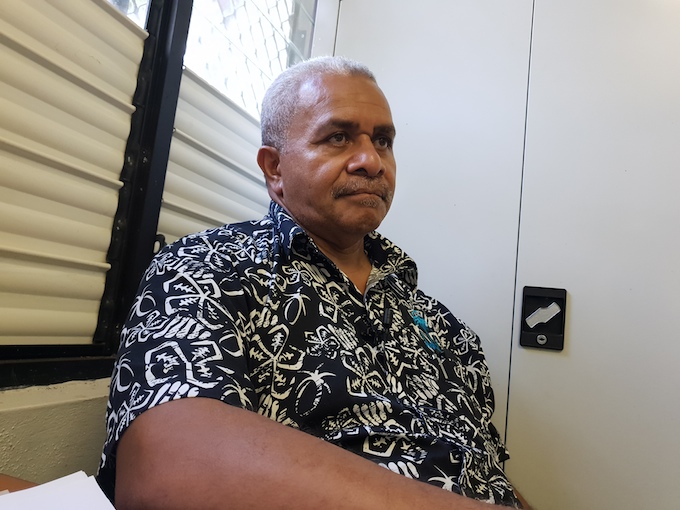




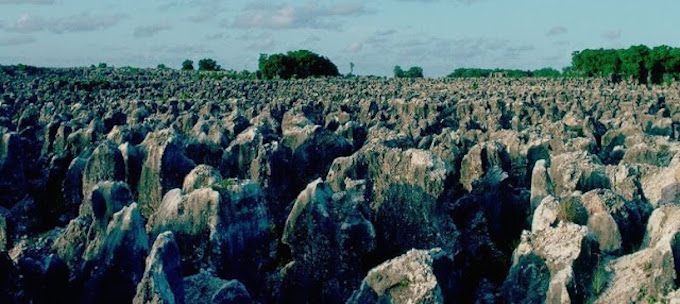 About 90 percent of Nauru is covered in jagged and exposed heaps of petrified coral … unsuitable for both building and agriculture. Image: CWB
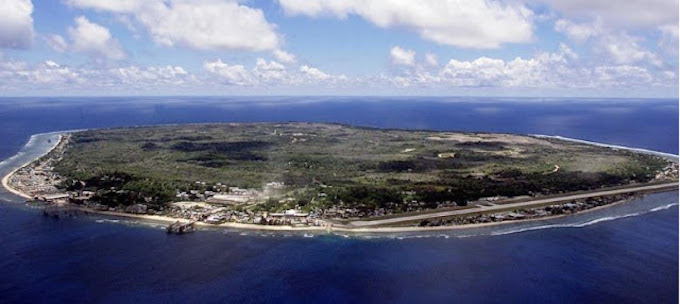 An out-of-court settlement rehabilitated some of the mined-out areas on Nauru. By 2000 no marketable phosphate remained. Image: CWB