Page 1137

Vital Signs. Yet another year of steady rates. What’s the point of the RBA inflation target?

]]>

Source: The Conversation (Au and NZ) – By Richard Holden, Professor of Economics, UNSW

The Reserve Bank kicks off its first meeting for the year next Tuesday facing the same dilemma it did throughout last year.

It hasn’t got easier.

The bank has a very public, fairly clear objective: to keep inflation between 2% and 3%. But it keeps missing it. Over and over and over again, and on the downside.

As the following chart shows, inflation has been below the bank’s target band for nearly all of the past four years.


During his decade in office, the previous governor Glenn Stephens achieved an average inflation rate of 2.46% – almost bang in the centre of the target band.

During his subsequent two and half years in the job, Philip Lowe has averaged just 1.87%. At no point during Lowe’s term of office has the average fallen within the target band. The rate for December, released on Wednesday, was 1.8%.

Next Wednesday Lowe will make an unusual address to the National Press Club, during which he will outline his thoughts about the year ahead.

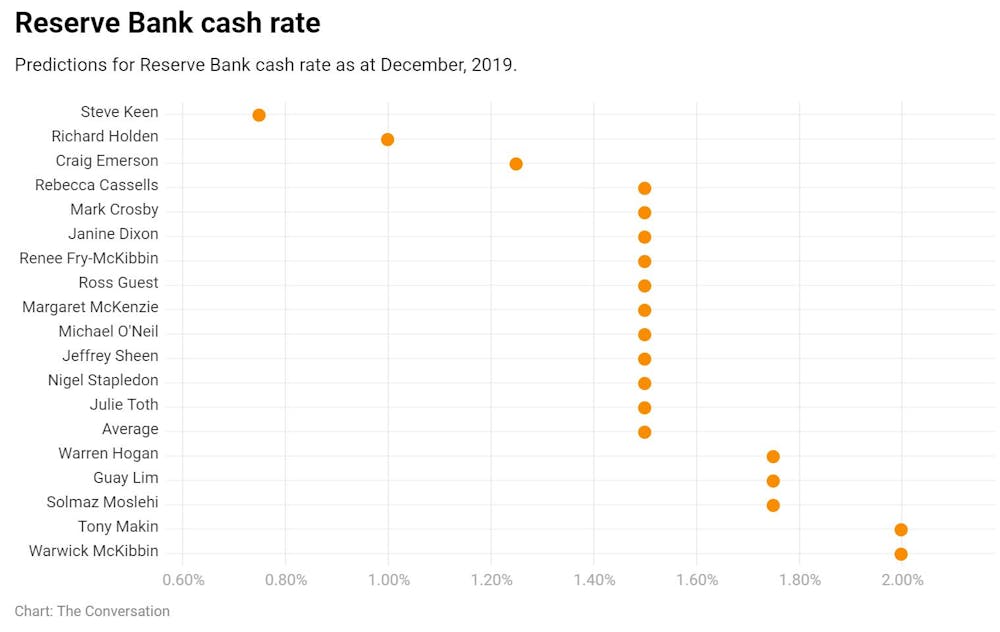
It is a year which The Conversation’s forecasting panel predicted will be free of interest rate adjustments, making it a record 40 months without a rate move – Lowe’s entire term in office.


The RBA has more than one target

Although the inflation target is an important part of the Reserve Bank’s mandate, it is also asked to focus on other things. Among them are GDP growth, employment, and (probably less explicitly) the Australian dollar and house prices.

And therein lies the problem. Unless the rate moves needed to meet all those objectives point in the same direction, the bank needs to make trade-offs, or sideline one or more of its objectives.

A classic principle of economics is that a policy-maker needs one instrument (or policy tool) for each objective. It is called the Tinbergen Rule, after the 1969 Nobel Laureate.

The bank has four or five objectives, but really only one tool – the cash rate, stuck at 1.5% since Lowe took the job.

Throw in the ability to partially shape market expectations through speeches by Lowe and Deputy Governor Guy Debelle (so-called “open mouth” operations), and maybe it has two.

Since Lowe took office, the casualty of this imbalance between instruments and objectives has been the inflation target. And it’s unlikely to change for some time.

So why is inflation so low?

Australia is not alone. Advanced economies around the world have had several years of low wages growth, low productivity growth, and low inflation. Populations are ageing, less keen on spending, and have a glut of excess savings.

Add to this the fact that technology and international trade have made a whole range of goods probably permanently cheaper and it’s hard to find inflationary pressure.


Read more: Vital Signs: inflation misses again, so where does the RBA go next?


Potentially making things worse in Australia is the decline in house prices in Sydney and Melbourne eating into consumer confidence and with it, spending. With well over half of the economy coming from private spending, already soft consumer spending could be hit further.

So far, RBA Governor Philip Lowe has been doing an admirable impression of Mr Micawber, in the Charles Dickens novel David Copperfield. When it comes to inflation, he is hoping “something will turn up”. But it hasn’t, even with historically low levels of unemployment.

Worse still, it doesn’t even seem to really be ticking up in the United States, despite the lowest year-end unemployment rate since 1969.

And why does it target inflation?

The bank targets inflation in order to maintain credibility.

The high levels of inflation in the 1970s and ‘80s – despite quite high levels of unemployment – led to the realisation that expectations had a lot to do with it.

Put simply, if people believe prices are going to rise sharply they will demand steep wage rises, which will cause prices to rise sharply. It becomes a “wage-price spiral”.

Macroeconomists and central bankers realised that a credible commitment to keep inflation low would remove the need for the large wage rises, cutting off the spiral before it got going.

The bank describes the rationale for its inflation target this way:

The Governor and the Treasurer have agreed that the appropriate target for monetary policy in Australia is to achieve an inflation rate of 2–3%, on average, over time. This is a rate of inflation sufficiently low that it does not materially distort economic decisions in the community. Seeking to achieve this rate, on average, provides discipline for monetary policy decision-making, and serves as an anchor for private-sector inflation expectations.

That’s been the logic for the past 25 years. We have certainly done away with inflationary spirals. We are in the age of secular stagnation, with an excess of savings chasing too little spending. A world where, since the turn of this century, robust growth has only really been possible when accompanied with financial bubbles–first in dot-coms, then in housing.

So what’s a central banker to do?

There is an active debate among central bankers and leading macroeconomists about whether to abandon the inflation targeting framework.

Luminaries like former US Treasury Secretary Larry Summers argue that inflation targets are, to borrow from Hamlet, “more honour’d in the breach than the observance”.

Right now Lowe faces a real dilemma. If he doesn’t cut rates, the inflation target will become more and more of a joke. It will add to pressure on him to articulate a new monetary policy framework for a new secular-stagnation era.

If he does, he risks re-inflating the housing bubble, boosting already sky-high household debt, and giving himself even less wiggle room if a recession hits.

On Tuesday he’ll leave the cash rate at 1.50%. And on the first Tuesday of the next month, and the the next, and the one after that…

But I think he’ll begin serious internal discussions about a new monetary policy framework, and the mechanics of getting into (and out of) a massive bond-buying program (otherwise known as quantitative easing or printing money) if needed to ward off the next recession should the cash rate remain or get so low he can’t cut it further.

He might have already started. He might drop further hints on Wednesday.


Read more: No surplus, no share market growth, no lift in wage growth. Economic survey points to bleaker times post-election


ref. Vital Signs. Yet another year of steady rates. What’s the point of the RBA inflation target? – http://theconversation.com/vital-signs-yet-another-year-of-steady-rates-whats-the-point-of-the-rba-inflation-target-110574

Five ways to boost Australian writers’ earnings

]]>

Source: The Conversation (Au and NZ) – By Rebecca Giblin, ARC Future Fellow; Associate Professor, Monash University

Who makes the money in publishing? Nobody. This often repeated dark joke highlights a serious issue. The most recent figures show that Australian authors earn just $12,900 a year from writing work (the median, at $2,800, was even worse). Indeed, authors can gross less than $5,000 for Miles Franklin-nominated titles that took two or more years to write.

Fixing this isn’t as simple as reaching more deeply into publisher pockets, because most of those are empty too. While the major international houses are thriving (Simon & Schuster and Penguin Random House recently reported 16% profits), publishing Australian stories can be financially perilous.

In independent publishing, 10% of the book sale goes to the author, perhaps another 10% to the printer, and up to a whopping 70% for distribution. What’s left has to pay the publisher, editor, marketers, admin staff and keep the lights on.

But we can improve our approach to author rights. Here are five lessons we can learn from elsewhere to help Australian writers earn more money.


Read more: Scrounging for money: how the world’s great writers made a living


#1: Give authors stronger out of print rights

Traditionally, contractual “out of print” clauses have let authors reclaim their rights when a print run has sold out and the publisher doesn’t want to invest in another. But in our recent analysis of almost 150 contracts in the Australian Society of Authors archive, we found 85% of contracts with these clauses allowed authors to reclaim their rights only when the book was “not available in any edition”.

These days, books can be kept available (at least digitally or via print-on-demand) forever – but that doesn’t mean their publishers are still actively promoting them.

A better approach is to allow authors to reclaim their rights towards the end of a work’s commercial life, determined with reference to objective criteria like the number of copies sold or royalties earned in the previous year. The Australian Society of Authors recommends authors only sign contracts that have this meaningful kind of out-of-print clause – but many publishers still try to get authors to sign up to unacceptable terms.


Read more: How to read the Australian book industry in a time of change


A growing number of countries (including France, Romania, Slovenia, Spain, Macedonia and Brazil mandate author rights based on objective criteria. The French law is an interesting model. There, authors can get their rights back if a book has been published for at least four years, and they haven’t been credited royalties for at least two. This opens up new possibilities for the author to license it to another publisher, or even sell it directly to libraries or consumers.

Rebecca Giblin on the problems with publishing contracts and the case for new author rights.

#2: ‘Use it or lose it’: return author rights when they’re not being used

Publishers take very broad rights to most books: in our recent archival analysis we found 83% took worldwide rights, and 43% took rights in all languages. It’s easy to take rights – but if publishers do so, they should be obliged to either use them or give them back.

To that end we can learn from the “use it or lose it” laws that bind publishers in some parts of Europe. In Spain and Lithuania, for example, authors can get their rights back for languages that are still unexploited after five years.

#3: Introduce a ‘bestseller’ clause to contracts

Of course, it’s not always the case that there’s no money in publishing: sometimes a title that was expected to sell 5,000 copies sells 5,000,000. That changes the economics enormously: but in many cases, the contract only provides the same old 10% revenue for the author. For works that achieve unexpected success, we can learn from Germany and the Netherlands (and the proposed new EU copyright law). They have “bestseller” clauses that give authors the right to share fairly in unexpected windfalls arising from their work.

#4: Legally enshrine the right to fair payment

Even where there’s not much money to be made, the author should still receive a fair share. Again, Germany and the Netherlands lead the way on this. There, authors are entitled to “fair” or “equitable” payment for their work – and can enforce those rights if their pay is too low.

These laws don’t set a dollar amount, since what is “fair” depends on all the circumstances. However, such laws at least provide a minimum floor. If the contracted amount is unfair or inequitable, authors have a legal right to redress.

#5: Put time limits on transfers

In Australia, copyright lasts for the life of the author, and then another 70 years after that. Publishers almost always take rights for that full term – only 3% of the contracts between publishers and authors we looked at took less. But publishers don’t need that long to recoup their investments. In the US, authors can reclaim their rights from intermediaries 35 years after they licensed or transferred them.

In Canada, copyrights transfer automatically to heirs 25 years after an author dies. We used to have the same law in Australia, but it was abolished for spurious reasons about 50 years ago. If we reintroduced a similar time limit on transfers, it would open up new opportunities for authors and their heirs (for example, to license or sell to a different publisher, libraries or direct to the public).

It’s true that there’s often not much money in publishing. But by changing our approach to author rights, we can help writers earn more and make Australian books more freely available.

ref. Five ways to boost Australian writers’ earnings – http://theconversation.com/five-ways-to-boost-australian-writers-earnings-110694
Grattan on Friday: What Labor has to fear is the Big Scare

]]>

Source: The Conversation (Au and NZ) – By Michelle Grattan, Professorial Fellow, University of Canberra

Asked this week to nominate Labor’s main problem, one insider said “time”. As the very remote possibility of a March election drifted away, the opposition bunkered down for the long wait until May 11 or 18.

Labor has an entrenched lead in the polls and, from its frontbench to its campaign planning, it is match-ready. But there’s no match at the moment. While some government MPs worry things will get even worse for them as time passes, it can equally be argued that the downside risk for Labor is as great.

This revolves around how effective the scares being rolled out against the ALP will be.

Though it is generally believed a minor miracle would be needed to rescue the Morrison government, the Coalition judges the best way to “save furniture” is to wave the fear flags.

“Scare” campaigns are distasteful but potent: Labor’s Mediscare in 2016 was dishonest but brutally effective.

This is well-ploughed territory. In notes written at the time, then Liberal federal director Tony Eggleton documents the success of the Coalition’s 1980 fear-mongering.

The election “was particularly heavy going … the opinion polling was not encouraging” for the Fraser government, Eggleton wrote. Then “Labor inadvertently tossed us a lifeline in the final stages of the campaign.

“One of their spokesmen cost the opposition dearly by raising, albeit tentatively, the prospect of capital gains taxes on the family home. We jumped on this and the unpalatable new tax was made the dominant issue for the last week of the campaign.

“Television and radio messages and full page press advertisements warned of Labor’s threat to the family home. The day before election day our pollster Gary Morgan was able to report that for the first time in the campaign the polls showed us drawing ahead of Labor. He predicted the possibility at the last minute we had enough momentum to get over the line”.

Which Malcolm Fraser duly did.

Eggleton also recorded that “the negativity and the tactics were controversial even among the Liberals but the political hardheads were of the view that the end justified the means”.

The Morrison government has been stepping up its scares since the start of the year. Two major targets are Labor’s proposed crackdown on negative gearing and capital gains and its plan to scrap cash refunds for franking credits (both cast against the background of Labor raising taxes). A more general scare is being run claiming a Shorten government would harm the economy.

The latter illustrates how scare campaigns can be complex and carry the danger of backfiring.

In a Tuesday speech Scott Morrison claimed a Labor government would lead to a “weaker” economy. He didn’t say it would put Australia into recession, but he highlighted that many workers hadn’t experienced a recession – enough for an Age headline “PM warns recession on way under Labor”. Defence Minister Christopher Pyne declared unequivocally: “There will be a recession in Australia if Labor wins”.

Morrison then found himself on the spot, caught between what he’d said, what he was taken as implying, and what Pyne had asserted.

Amid the confusion, it’s unclear whether this scare would have been a plus or a minus for the government. It contained another risk too – any talk of a recession is itself bad for the economy, including for overseas perceptions of Australia.

The scares over the negative gearing and franking policies are less complicated, focusing on and magnifying the losers.

Labor first announced its negative gearing revamp last term, when house prices were rising. Since then, prices in Sydney and Melbourne have been falling.

This has made it easier for the government to whip up concerns about the impact of the policy on house values.

The centrality of their house in the thinking of so many Australians makes this hazardous territory for Labor, however rational its policy.

In the changing circumstances, Labor does have a modest element of flexibility to play with, because it has not yet announced the start date.

But to fireproof itself on negative gearing, Labor needs to work harder on both reassurance (the fact existing negatively-geared properties would be grandfathered) and selling the policy’s advantages (linking it more strongly to the aspirations of first home buyers).

Anything that affects retirees is another highly sensitive area electorally.

It has been reported that Labor is discounting the political impact of its franking credits policy because it calculates that many of those hit are already likely to be Liberal voters.

But it would be unwise to be complacent – in the way the Liberals were for a time about Mediscare in 2016.

And in the hyped climate before an election, any throwaway line can be weaponised, as shadow treasurer Chris Bowen found this week.

Under questioning about a listener’s view on the franking issue, Bowen told the ABC: “I say to your listener: if they feel very strongly about this, if they feel that this is something which should impact on their vote they are of course perfectly entitled to vote against us”.

It was a statement of the obvious, although it also came across as reflecting some frustration.

But the comment took off in the media. “ALP goads seniors: vote against us”, The Australian headlined its Thursday lead story. Morrison said the Bowen comment was “arrogant”; Bill Shorten was grilled.

None of the above is to overlook that the government has had another bad few days, despite Newspoll giving it a small summer lift (from trailing 45-55% before Christmas to 47-53% now).

Two more ministers, Michael Keenan and Nigel Scullion, have announced they will leave at the election.

Three high profile independents have emerged in heartland Liberal seats: Zali Steggall in Warringah; Oliver Yates in Kooyong, and Julia Banks (Liberal defector now on the crossbench) who plans to run in Flinders.

All three are highlighting climate change and the fractures in the Liberal party.

The chances of Yates and Banks are low but Steggall is a real threat to Tony Abbott in Warringah.

The government in general remains in bad shape on multiple fronts, and Scott Morrison often sounds desperate.

The Coalition does have the April 2 budget as an opportunity to improve its fortunes – on the other hand, if that goes badly it will be another own goal.

The budget will offer the sugar, the incentives, the bribes to voters. But it will be the scares that will be the government’s strongest ammunition. The question will be: how far can these bullets penetrate Labor’s armour?

ref. Grattan on Friday: What Labor has to fear is the Big Scare – http://theconversation.com/grattan-on-friday-what-labor-has-to-fear-is-the-big-scare-110910

Why Australians are falling in love with American football, and what it means for local leagues

]]>

Source: The Conversation (Au and NZ) – By Adam Karg, Senior research fellow, Swinburne University of Technology

When the New England Patriots face the Los Angeles Rams in the Super Bowl on Sunday night (US eastern time), they will be cheered on by about 75,000 fans in the stadium, more than 100 million television viewers across the United States, and an estimated 50 million more around the world.

An increasing number of Australians will be tuning into the United States’ biggest annual sporting event, too.

Why many will be taking time off work on Monday morning to watch tells us a lot about what is happening to sport in the 21st century, as a commoditised product in a globalised media entertainment complex.

That American football is even popular with Americans can often be a mystery to foreigners. It’s easy, for instance, for a diehard Australian Football League fan to dismiss it as helmeted hoopla.

Take game time. In the typical Aussie Rules game, lasting about 2.5 hours, there is about 80 minutes of play. The typical NFL game, by comparison, takes three hours but has less than 12 minutes of actual play.

What fills the time? For one thing, advertising. During this year’s Super Bowl you can expect to watch about 50 minutes of pure commercial breaks, with 30-second slots costing advertisers more than US$5 million.

So what makes American football increasingly attractive to people who have grown up playing and watching Aussie Rules, Rugby League, Rugby Union or the world game? Why is the number of Australians tuning into the Super Bowl expected to exceed the 390,000 who watched last year?

Super Bowl LIII is being played at Mercedes-Benz Stadium in Atlanta, Georgia. Tannen Maury/EPA

Marketing power

Some will simply enjoy the Super Bowl as a spectacular event. For others it is part of increasing engagement with both the NFL and other overseas sports.

A huge range of sports are being marketed to Australians through both global and local media channels.

Successfully marketing a “culturally alien” sport to a new audience is not simple. The division in Australia between the Aussie Rules and Rugby League states shows that carving out a niche can be a long and hard process. Nonetheless there are some critical characteristics for success.

First, the sport “product” requires high visibility and awareness.

Second, the sport “content” needs to be accessible, and leverage a range of connection points to engage media audiences, and socialise or connect networks of fans. Much of sports’ value is about sharing experiences with friends, colleagues and family. So high-profile, accessible and entertaining content is a valuable marketing tool.

The NFL scores high on both.

Star and stripe power: singer Pink sings the national anthem prior to Super Bowl LII in 2018. Craig Lassig/EPA

Most Australians know the game due to the familiarity of American culture through films and television. And now the NFL is widely broadcast in Australia. You can watch live games and replay packages on television channels, on the NFL’s own streaming platform or on social media and e-commerce sites.

The content is virtually 24/7, with the NFL at the top of the mega-sport league in supplying round-the-clock content.

This starts with live games themselves. The NFL first grasped the ratings logic of spreading out games for prime-time television audiences in the 1960s. The modern-day outcome is that an Australian fan can watch games from Friday to Tuesday from September through January.

Then there’s the highlights repackaging. Though there’s less than 15 minutes of actual action during an NFL game, that time is made up of 55-70 plays per team, each lasting an average of four seconds. What happens in a four-second play, however, can be dissected and analysed for far longer.

Los Angeles Rams cornerback Dominique Hatfield, right, fends off New Orleans Saints middle linebacker Alex Anzalone. The Rams won the game, qualifying to play in the Super Bowl. Dan Anderson/EPA

It might involve profiling the speed, power or athleticism of a particular player. Or doing a detailed breakdown of both the offensive strategy and the defensive response. There is also a growing market for analytics and statistics, given the growth of sports betting.

On all these fronts the NFL provides “engagement points”.

Acute levels of analysis fuel other content. Included here are panel shows, podcasts, reality shows and documentaries that profile and build awareness of athletes and teams from high school to professional levels. Much of this content is now available in Australia.

In short, the NFL leverages high visibility and a well-developed content strategy to engage fans in a variety of ways on and beyond game days; and it has more money to do it better than anyone else.

Threat to local leagues

So should Australia’s existing sporting businesses be concerned about NFL?

For our most popular codes, like Aussie Rules and Rugby League, that answer is no.

Indeed, any sport that is already popular enough to have coverage on free-to-air television is unlikely to see interest in NFL impact its ratings or bottom line.

But for the sports at a lower level of popularity and revenue, without considerable free-to-air coverage or a strong digital footprint, the NFL juggernaut definitely presents a threat.

Of course, it is quite common for sports fans to follow different sports, including local and global leagues. But even the most dedicated sports fans have finite time, and so must prioritise their preferences.

In the British market the NFL has outlined a explicit strategic goal to be a second, third or fourth preference option among sports fans. To this extent, as consumers prioritise the watching and following of new (global) sports, this pushes other sports down the preference list, impacting their popularity and revenue potential.

In Australia, a much smaller market where the top end of the sports preference list is already crowded, that potentially makes the NFL a real game-changer.

ref. Why Australians are falling in love with American football, and what it means for local leagues – http://theconversation.com/why-australians-are-falling-in-love-with-american-football-and-what-it-means-for-local-leagues-110705

Digitally tracking student behaviour in the classroom encourages compliance, not learning

]]>

Source: The Conversation (Au and NZ) – By Jamie Manolev, Research assistant, University of South Australia

ClassDojo is one of the most popular classroom communication apps in the world. It claims to assist teachers to create happier classrooms and bills itself as “the simple way to build an amazing classroom community”.

Since it was released in 2011, it has rapidly spread to be used in more than 180 countries worldwide and over half of Australian primary schools. But new research looks beneath ClassDojo’s friendly exterior to carefully consider the implications of tracking student data on discipline and behaviour.


Read more: Teachers shouldn’t have to manage behaviour issues by themselves – schools need to support them


It’s important teachers, parents and school leaders look more closely at how it works, especially because its use of surveillance, competition and long-lasting behaviour records influence classroom learning and students.

Why is ClassDojo so popular with teachers?

Teachers use ClassDojo to manage classrooms and student behaviour, and as a platform to communicate with parents. It’s colourful, friendly and easy to use. And it’s free.

How does the behaviour component of ClassDojo work?

The ClassDojo feedback feature works like a traditional classroom points system, but records more information and is done using a computer, iPad or smart-phone. It is an electronic way of tracking student behaviours and providing immediate feedback to students and parents.

Teachers can award positive or negative points to students for displaying a range of behaviours. They can use ClassDojo to provide visual and audio cues to students that reflect the positive and negative feedback.

“Positive” feedback is coloured green and arrives with a pleasant ding sound. “Needs work” feedback is coloured red and arrives with a harsh buzz sound. These cues can be used publicly so the whole class is made aware feedback has been given.


Read more: Are Australian classrooms really the most disruptive in the world? Not if you look at the whole picture


Over time, points accumulate to produce a personal behaviour score. ClassDojo automatically tracks and stores every piece of student feedback data. This allows teachers to create reports on students that show data on:

  • details of the behaviour or skill points are awarded for

  • the time and date when points were awarded

  • number of accumulated “positive” points

  • number of accumulated “needs work” points.

Reports provide a green and red donut chart and percentages of “positive” and “needs work” points awarded. These behaviour reports can be easily shared with parents.

Why should we be concerned?

ClassDojo encourages surveillance. For example, its surveillance techniques include:

  • teachers monitoring students constantly to award points, positive or negative

  • public displays of class points on large classroom screens making each student’s behaviour score visible to anybody in the class

  • building student behaviour profiles that can be viewed by teachers, parents and school leaders throughout their schooling

  • parents can be notified via text message whenever their child receives behaviour feedback in the form of points

  • registered parents are reminded via a weekly email to check their child’s behaviour profile report.

Too much surveillance is not good for students. from www.shutterstock.com

Surveillance

Too much surveillance is not good for kids. This level of surveillance used to monitor and influence student behaviour focuses on controlling them to behave in certain ways. It’s a way of promoting compliance and conformity.

Having control in the classroom is important, but this is different to controlling students. Controlled students get little chance to learn how to make sensible decisions about their own behaviour. They rely on others to tell them.

Experts argue surveillance erodes trust and has a chilling effect on creativity. They also indicate students take fewer risks because their mistakes might count against them.

Encouraging risk-taking is important and improves students’ learning. And, negative student data profiles can influence the way teachers regard their students.

Competition

Points systems and rankings promote competitive environments. These are fine in some circumstances, such as in competitive sports, but not as the main way of supporting students in classrooms.

Competitive environments create conflict and unease, particularly for students who find themselves regularly at the bottom. And when positive and negative ClassDojo points are publicly announced it can humiliate or shame students. This affects students’ attitudes to learning.

Long lasting behaviour records

The creation of digital behaviour profiles on students could have a long-lasting impact. Old fashioned points systems such as star charts were temporary, had a short life, and weren’t terribly effective. ClassDojo collects and retains all recorded data on students.

Star charts were temporary, but not very effective. from www.shutterstock.com

Concerns have been raised over who owns this behaviour data and how it might be used in the future. There is potential for behavioural data profiles to follow students through school. It’s too early to tell how they might be used in the future and what problems this might present.

What should schools do?

Teachers should approach school discipline in an educational manner. They should see behaviour in a similar way to curriculum – something that can be taught.

Teachers should understand the ways their teaching and the curriculum influence student behaviour. They should seriously reconsider using technology to monitor behaviour because of the negative impact it could have on students.

Schools need to create safe and secure environments that are orderly and allow learning to happen. This doesn’t mean students need to be controlled though constant surveillance. Simply controlling student behaviour has little educational value. This approach provides a disservice to our students.


Read more: How teachers are taught to discipline a classroom might not be the best way


School discipline should be about building respectful relationships and educating students about how, why and when certain behaviours are appropriate. This will support students to become successful, independent learners and citizens.

This educational approach is supported by classroom management and school discipline research which says schools should focus on relational aspects of schooling based on respect, dignity and caring. Schools should also make sure their approach to discipline is learning-oriented and seeks to develop self-regulation and trust.

ref. Digitally tracking student behaviour in the classroom encourages compliance, not learning – http://theconversation.com/digitally-tracking-student-behaviour-in-the-classroom-encourages-compliance-not-learning-110181

How we traced the underwater volcanic ancestry of Lord Howe Island

]]>

Source: The Conversation (Au and NZ) – By Maria Seton, ARC Future Fellow, University of Sydney

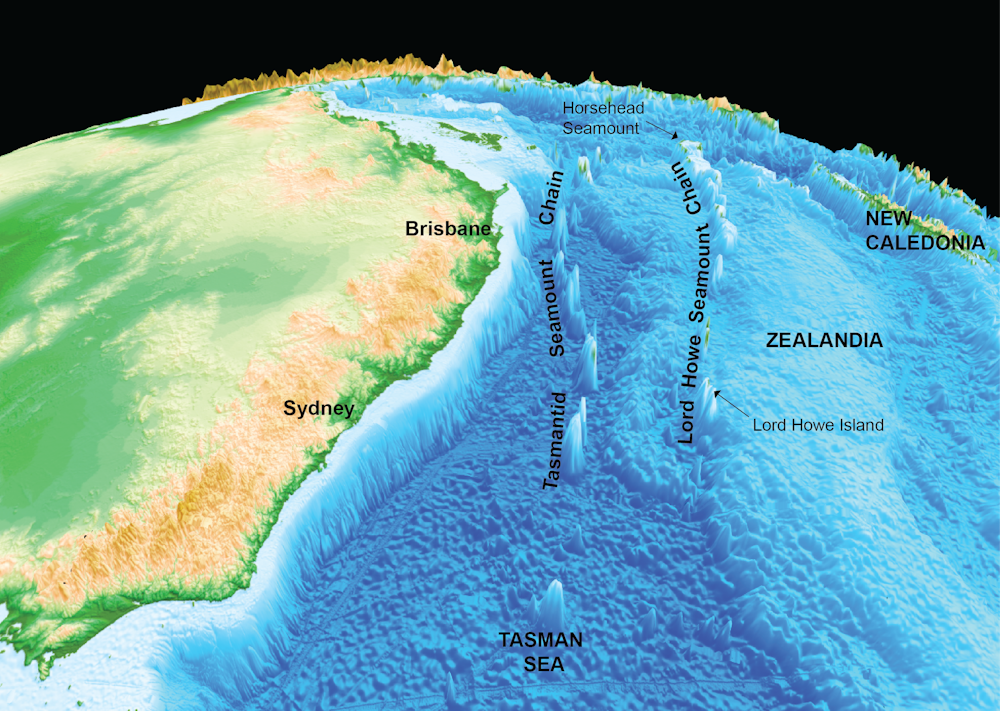
Lord Howe Island is a beautiful and incredibly isolated world heritage site some 600km off the coast of New South Wales, lauded for its unique volcanic landforms and endemic species.

In a study published this month in Geological Magazine, we traced the volcanic ancestry of Lord Howe Island much further back in time than previously possible.

Geologists have known for some time the island is an extinct volcano that last erupted about seven million years ago.


Read more: When Thailand and Australia were closer neighbours, tectonically speaking


Only more recently has it emerged that the island is part of a family of volcanoes, hidden from our view by the deep blue waters of the Tasman and Coral seas.

All aboard

Our own story begins in 2012 when we set off from Cairns aboard Australia’s national research vessel, the RV Southern Surveyor (on one of its final voyages before it was retired and replaced by the new RV Investigator).

Location map showing eastern Australia and the two parallel hotspot trails offshore. Maria Seton, Author provided

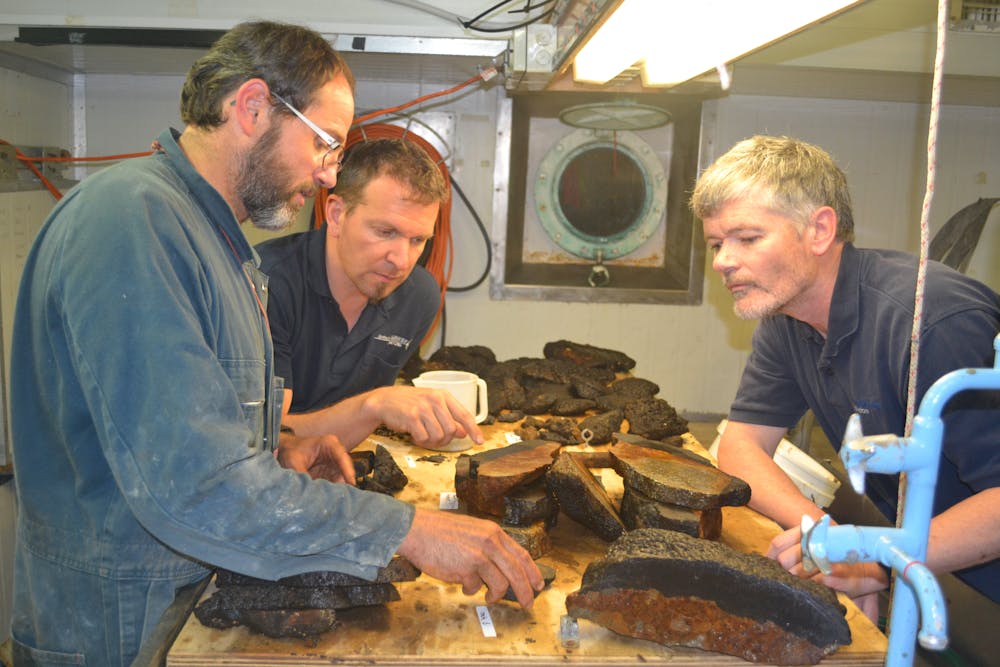
As part of this voyage, we collected the first rock samples of lava from a volcanic seamount, 1,000km northeast of Brisbane and 1,500km north of Lord Howe Island. Because of its shape we nicknamed it Horsehead Seamount.

Breaking up rocks on the back deck of the RV Southern Surveyor. Maria Seton, Author provided

Back on land, our analysis showed that Horsehead lavas had distinctive chemical signatures that match those found at Lord Howe Island. But the ages we got from the Horsehead lavas showed they erupted between 27 million and 28 million years ago, some 20 million years before the eruptions that formed Lord Howe Island.

How could the Horsehead and Lord Howe volcanoes, so far apart and of such different ages, be related to one another?

Examining the volcanic rocks in the wet lab on the RV Southern Surveyor. Maria Seton, Author provided

Plates and hotspots

The answer lies in the combination of two fundamental processes that shape our planet: plate tectonics and convective movement of Earth’s mantle.

Earth’s tectonic plates are moving slowly across the planet’s surface at speeds of 1cm to 10cm per year. Meanwhile, hot (more than 1,400℃), finger-like plumes of molten material remain anchored deep in Earth’s mantle. These hotspots remain roughly fixed at the same latitudes and longitudes.

When these rising plumes reach the surface they produce distinctive lavas that erupt as hotspot volcanoes. As tectonic plates move over rising plumes, chains of volcanoes are formed that track the motion of the plates over the plume.

This process formed the undersea Hawaiian-Emperor chain of volcanoes in the central Pacific that is so visible on maps (see below), and which erupted spectacularly last year.

Australia on the move

This global plate tectonic and mantle activity helps us understand the relationship between Horsehead Seamount and Lord Howe Island.

About 28 million years ago the entire Australian tectonic plate and Horsehead Seamount actually lay about 1,600km further south – right on top of the fixed hotspot plume that produced the volcanic seamount. As the Australian plate moved northwards, the volcano moved off the plume and stopped erupting.

A few million years later, the process of building a volcano started all over again on a fresh part of the Australian plate. Over tens of millions of years the hotspot burned a series of volcanoes onto the Australian plate, forming a north-south trail. Lord Howe Island is one of the youngest volcanoes in this so-called Lord Howe Seamount Chain.

We estimate that the total volume of lava erupted along the 1,500km-long Lord Howe Seamount Chain is 320,000km3, enough to cover all of Victoria with a layer more than 1km thick.

The Lord Howe Seamount Chain is not the only trail of hotspot volcanoes to have left its mark on the Australian Plate this way. Another trail of seamounts runs through the Tasman Sea to the west, and previous work to determine their ages shows they also record the northward motion of Australia, over a different hotspot.

Watch an animation showing how trails of volcanoes form in the Tasman Sea as Australia moves northwards.

Another trail of volcanism runs through Australia itself, from Cape Hillsborough on the central Queensland coast to Cosgrove in Victoria, and is the longest continental hotspot chain in the world, but it is more difficult to spot.

The magma has to try much harder to break through the thick Australian crust, and once it does the volcanoes are quickly eroded away. By contrast, seafloor volcanoes provide a relatively pristine record of events that happened tens or sometimes hundreds of millions of years ago.

Other islands to discover and ‘undiscover’

The hotspots that created the seamount trails in the Tasman Sea are likely still present. By reconstructing plate motions, we can make a rough estimate of where the next volcanoes could form, and also where they won’t.

On the final leg of our voyage back to Brisbane, we passed by another supposed island that appeared on some maps but whose geological origins had remained elusive.


Read more: How we wiped out the invasive African big-headed ant from Lord Howe Island


The mystery took another turn when we found that the island did not exist – we had “undiscovered” it – a story that captured public attention.

Reassuringly for those who have booked their holiday, Lord Howe Island still exists. Now we can be sure not only that it is still there, but also how it came to be in the first place.

The airport at Lord Howe Island, welcoming visitors and their luggage. Dietmar Müller (used with permission), Author provided

ref. How we traced the underwater volcanic ancestry of Lord Howe Island – http://theconversation.com/how-we-traced-the-underwater-volcanic-ancestry-of-lord-howe-island-110503

Australia is counting on cooking the books to meet its climate targets

]]>

Source: The Conversation (Au and NZ) – By Alan Pears, Senior Industry Fellow, RMIT University

A new OECD report has warned that Australia risks falling short of its 2030 emissions target unless it implements “a major effort to move to a low-carbon model”.

This view is consistent both with official government projections released late last year, and independent analysis of Australia’s emissions trajectory. Yet the government still insists we are on track, with Prime Minister Scott Morrison claiming as recently as November that the 2030 target will be reached “in a canter”.

What’s really going on? Does the government have any data or modelling to serve as a basis for Morrison’s confidence? And if so, why doesn’t it tell us?


Read more: Australia is not on track to reach 2030 Paris target (but the potential is there)


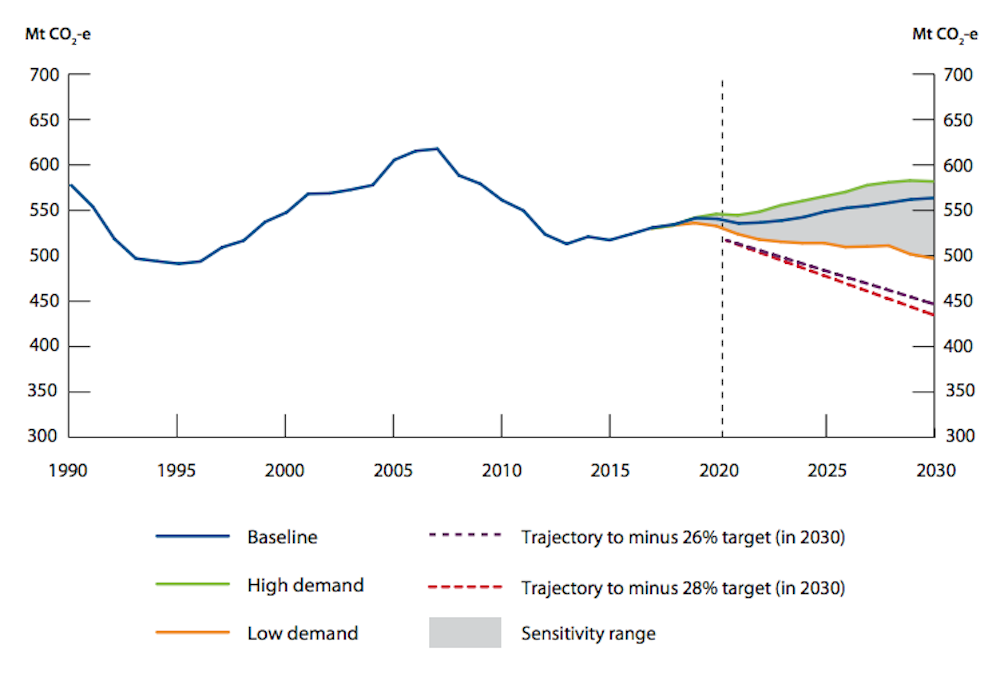
The government’s emission projections report actually presents three scenarios: the “baseline” projection, which forecasts that emissions will rise by 3% by 2030, plus two other scenarios in which economic growth (and thus demand for fossil fuel consumption) is higher or lower than the baseline.

Range of scenarios for Australian emissions. Vertical axis represents greenhouse emissions measured in millions of tonnes of carbon dioxide equivalent. Australian Emissions Projection Report, Figure 15

As the graph shows, all three of these scenarios would see Australia miss its 26-28% emissions reduction target by a wide margin. So why claim that our emissions are on track? The answer, as is so often the case with emissions targets, lies in the fine print.

The government is indeed poised to deliver on the “letter of the law” of its Paris commitment if two things play out. First, if it claims credit from overdelivering on Australia’s 2010 and 2020 commitments. And second, if the “low demand” scenario is the one that eventuates.

To reach our Paris target, the government estimates that we will need to reduce emissions by the equivalent of 697 million tonnes of carbon dioxide before 2030. It also calculates that the overdelivery on previous climate targets already represents a saving of 367Mt, and that low economic demand would save a further 571Mt. That adds up to 938Mt of emissions reductions, outperforming the target by 35% – a canter that would barely work up a sweat.

How would this scenario actually eventuate?

Let’s leave aside the technical question of whether it’s legitimate to count past performance towards future emissions targets, and focus for now on how the low-demand economic scenario might become reality.

The government’s report contains no discussion on the basis of the “low demand” scenario. But history suggests the annual baseline estimates of 2030 emissions have overestimated future emissions, with revisions downwards over time. For example, the 2018 projection for 2030 emissions is 28% lower than the 2012 projection for the same date (see figure 2 here).

In the real world, meanwhile, change is evident. Households and businesses are installing solar panels, not least to guard against high power bills. Businesses are signing power purchase agreements with renewable energy suppliers for much the same reason. State and local governments are pursuing increasingly ambitious clean energy and climate policies. Some energy-intensive industries may be driven offshore by our high gas prices.

New technology such as electric vehicles, ongoing improvement in energy efficiency, and emerging business models that break the power of big energy companies are transforming our economy. Investment in low-emission public transport infrastructure means its share of travel will increase. Farmers are cutting methane emissions by installing biogas production equipment.

Other studies also support the idea that Australia may indeed outperform its baseline emission scenario. ANU researchers recently predicted that “emissions in the electricity sector will decline by more than 26% in 2020-21, and will meet Australia’s entire Paris target of 26% reduction across all sectors of the economy (not just “electricity’s fair share”) in 2024-25”.

The government’s baseline electricity scenario uses the Australian Electricity Market Operator’s “neutral” scenario. But AEMO’s “weak” scenario would see 2030 demand in the National Electricity Market 18% lower than the neutral scenario (see figure 13 here).

Of course, many of these changes are happening in spite of the government’s policy settings, rather than because of them. Still, a win’s a win!

Emissions in context

But is hitting the target in purely technical terms really a win? In truth, it would fall far short of what is really necessary and responsible.

This is partly because of the plan to use prior credit for previous emissions targets to help get us across the line for 2030. This may be allowed under the international rules. But we would be leveraging extremely weak earlier commitments.

For example, Australia’s 2010 Kyoto Protocol target of an 8% increase in emissions was laughably weak in comparison with the developed world average target of a 5% cut. Our 2020 5% reduction target is also well below the aspirations of most other countries. What’s more, several major nations have declared that they will exclude past “overachievements” from their 2020 commitments.

The government has obfuscated the issue further by deliberately conflating our electricity emission reductions target, which will be easily met, with our overall economy-wide target, which presents a much tougher challenge.

There’s more. Australia’s Paris pledge to reduce emissions from 2005 levels by 26-28% between 2021 and 2030 is inconsistent with our global responsibilities and with climate science. The target was agreed to by the then prime minister Tony Abbott in 2015 as the minimum needed to look credible. But as the Climate Change Authority pointed out, a 2030 target of 40-60% below 2000 levels is more scientifically responsible.


Read more: Australia’s 2030 climate target puts us in the race, but at the back


What is Australia’s “fair share” of the heavy lifting needed to stay below 2℃ of global warming, as agreed in Paris? If all humans were entitled to release the same greenhouse emissions by 2050, the average would be around 2 tonnes of CO₂ per person in 2050. In 2018, the average Australian was responsible for 21.5 tonnes.

There is plenty of heavy lifting still to do, and no point in pretending otherwise. The government must publish its data and modelling in full if its canter claims are to have any credibility.

ref. Australia is counting on cooking the books to meet its climate targets – http://theconversation.com/australia-is-counting-on-cooking-the-books-to-meet-its-climate-targets-110768

Precarious politics pose threats to world’s three biggest rainforests

]]>

By Sara Stefanini

Political uncertainty hangs over large swathes of the world’s tropical forests this year, raising the risk of more destruction and carbon emissions.

Recent leadership changes in Brazil and the Democratic Republic of Congo, and presidential elections in Indonesia in April, are fuelling concerns that politics could side with industries such as palm oil, timber, mining and agriculture in the world’s three biggest rainforest countries.

Brazil’s new right-wing president Jair Bolsonaro campaigned on promises to open the Amazon up to development. In his first foray on the international stage last week, he called on international businesses to invest in the country’s natural resources.

READ MORE: France aims to ban deforestation imports by 2030

The DRC’s peaceful presidential election of Felix Tshisekedi last month was the first democratic transfer of power since independence in 1960 – although the African Union and European Union questioned the results and The Financial Times reported “massive electoral fraud”.

It now remains to be seen whether Tshisekedi’s government curbs forest clearing and cracks down on the corruption that undermines conservation efforts. He gave little indication during the campaign.

-Partners-

Meanwhile in Indonesia, the two presidential candidates – incumbent Joko “Jokowi” Widodo  and ex-army officer Prabowo Subianto – have given vague promises of environmental protection but few details. That said, Jokowi, who won as an outsider populist in 2014, has done more than some expected to tackle deforestation.

As of 2015, Brazil was home to 12 percent of total forest global cover, the DRC nearly 4 percent and Indonesia 2 percent, according to the UN’s Food and Agriculture Organisation. But tree cover in all three nations continues to shrink.

Worst effects
The actions of the new governments could determine the world’s ability to avoid some of the worst effects of climate change.

“Forests could provide about a third of the solution to climate change, but at the moment they’re more part of the problem because of deforestation,” said Tim Christophersen, head of UN Environment’s freshwater, land and climate branch in Kenya.

“If that was stopped and we could restore forests at a large scale, we could probably close about a third of the current emissions gap.”

For now, efforts to stem deforestation have mostly failed to make a dent. The tropics lost an area the size of Vietnam over 2016 and 2017, when tree cover shrunk by record levels, according to the data and monitoring website Global Forest Watch.

Brazil’s deforestation in 2017 was equivalent to 365 million tonnes of CO2 and jumped by almost 50 percent over the three months of campaigning before Bolsonaro was elected last year. The DRC’s tree cover loss was equivalent to 158Mt last year and Indonesia’s to 125Mt.

Environmentalists are particularly concerned about Brazil. In his speech at the World Economic Forum in Davos last week, Bolsonaro stressed Brazil’s history of environmental protection while touting its economic opportunities.

But the “wave of forest destruction and violence” started when Bolsonaro immediately removed environmental and human rights safeguards, said Christian Poirier, programme director at the NGO Amazon Watch.

Reckless moves
“These reckless moves, tailored to serve Brazil’s agribusiness and extractive industries, undermine fundamental constitutional protections that preserve forests and assure the safety of the indigenous and traditional communities who call them home,” he said.

In the Democratic Republic of Congo, deforestation remains relatively high and driven by clearing for agriculture, the use of wood for energy, timber and mining, said Christophersen.

The UN’s REDD+ programme, which pays developing countries to reduce their deforestation, is starting to work in some places. But it was forced to freeze payments to the government last year amid concerns over the awarding of new logging concessions to Chinese companies. Peatlands across the Congo Basin could release huge stocks of carbon if developed for mining and fossil fuels, Christophersen added.

There is more optimism around Indonesia, although environmentalists are still wary.

Jokowi initially raised concerns that he would not follow through on his predecessor’s commitments on forestry, but then made progressive moves such as creating a new peatland restoration agency and extending a 2011 moratorium on licenses in forest and peatland, said Frances Seymour, distinguished senior fellow at the World Resources Institute.

Still, it will be up to the next president to cement that ban and push Indonesia’s large palm oil industry to become more sustainable, said Panut Hadisiswoyo, founding director of the Orangutan Information Centre in Indonesia. The country has around 69 percent of its natural forest intact, he said.

“I worry that with the current visions of the presidential candidates, they have no specific calls for the protection of this remaining forest,” Hadisiswoyo said. “This natural forest is the last limit for sustaining our biodiversity. I worry that this forest will have no guarantee to strive, to be kept as forest.”

Good signs
There are some good signs. Costa Rica’s tree cover grew from 20 perecent to around 50 percent over 30 years, Christophersen noted. And Indonesia’s loss dropped by 60 percent year-on-year in 2017, which Global Forest Watch attributed in part to a 2016 moratorium on peat drainage, educational campaigns and stronger enforcement.

“Without political leadership, we would not see with those kinds of successes,” Christophersen said.

However the potential for more damage remains strong – especially at a time of more nationalistic populist leaders such as Bolsonaro.

“A cross-cutting issue is how this global wave of populism plays out in the climate change debate, and in these countries how it plays out with respect to land use in particular,” said Seymour.

  • France intends to stop importing soy, palm oil, beef, wood and other products linked to deforestation and unsustainable agriculture by 2030, shooting ahead of the rest of the European Union, reports Climate Change News.

The new national strategy to combat imported deforestation, released by the environment ministry late last year, will use trade to help decouple economic development from tree-cutting and unsustainable agriculture in poorer countries.

Sara Stefanini is a senior journalist with Climate Change News.

Print Friendly, PDF & Email

Article by AsiaPacificReport.nz

Courthouse torched, police assaulted during Rapa Nui unrest

]]>
An angry mob torches the courthouse on Rapa Nui. Image: Latercera Online/RNZ Pacific

By RNZ Pacific

Rapa Nui has been hit by serious disturbances after a family tried to lynch a homicide suspect, reports Chilean news media.

The news site Ahora Noticias reports that police were assaulted and injured, and a court building and a registry office in Hanga Roa were torched by the victim’s relatives.

Police had arrested a 51-year-old man accused of killing a 34-old-man with a knife.

The victim’s family then attacked the police vehicle with the suspect inside and set fire to the buildings.

This article is republished under the Pacific Media Centre’s content partnership with Radio New Zealand.

Print Friendly, PDF & Email

Article by AsiaPacificReport.nz

How Australia’s political ageism may be robbing us of our best leaders

]]>

Source: The Conversation (Au and NZ) – By Mark Kenny, Senior Fellow, Australian Studies Institute, Australian National University

Nancy Pelosi is back. Back throwing her weight around. Back in charge.

As the newly-elected Speaker of the US House of Representatives – arguably the most powerful position after the president – the top-ranking Democrat is suddenly the closest thing America has to an incumbent “opposition leader”.

Not before time. Last week, after Pelosi forced President Donald Trump into a humiliating retreat from his partial government shutdown, a former administration official texted Axios reporter Jonathan Swan with the words: “Trump looks pathetic… he just ceded his presidency to Nancy Pelosi”.

For astonished Australians, the mercurial Trump’s adolescent theatrics merely underscore the value of our Westminster parliamentary tradition.

This is the “oppositional” system in which an alternative prime minister, with a fully-formed shadow ministry, is not only appointed in plain view, but also goes about releasing detailed alternative policy. All while holding the government to account.

However, comparisons to the US are not always so kind. Pelosi’s late-career revival at the age of 78 highlights a cultural point of difference somewhat less flattering to Australia.

It’s a difference that hints at a corrosive ageism in Australian public life that is so normal it goes unremarked — a tendency to over-value the new and reward hyper-ambitious individuals while squandering the wisdom amassed through years in service.

It is a mentality that:

  • short-changes the electorate by failing to extract full value from its investment in seasoned representatives

  • elevates MPs before they are ready and discards them when they are

  • works disproportionately against women, by making the early to mid-career years — during which women typically require time away for childbirth — the crucial ones.

Is it merely coincidence that the two most successful women in recent Australian leadership on each side, Julia Gillard and Julie Bishop, did not weather such career absences? Or that some of the bigger names on the rung immediately below them did not either — think Penny Wong, Michaelia Cash, and going back further, Amanda Vanstone?


Remember the Howard and Costello years?

This unspoken antipathy to experience is not new. Nearly 20 years ago, John Howard purchased an internal truce by flagging his voluntary retirement as early as 63. Sure, it was designed to hold off the rising Peter Costello, but the deal flew because it rang true. Of course the PM would hand over in his mid-60s. Who would credibly seek high office beyond that?

Howard told the ABC in July 2000:

I have said before that if the party wants me to lead it to another election, which will be at the end of next year, I am happy to do so. After that obviously one has to recognise, I’ll then be in my 63rd or 64th year, and you start to ask yourself and that’s fair enough. And nothing is forever.

How odd this seems in light of Pelosi’s game-changing return. Still active in the Liberal Party, Howard is only fractionally older than the American.

How about Paul Keating?

Labor’s Paul Keating, the man Howard succeeded in 1996, is younger than both of them. At 75, this former PM is still a force in business and public policy discussions, despite being officially retired from politics for nearly 23 years.

Yet when Trump lines up for his second term late next year, he’ll be just a year shy of what Keating is now.

His Democratic opponent could conceivably be older.

Among the bigger names frequently mentioned are Hillary Rodham Clinton, who would be 73 at election time – an entry age all but unimaginable in Australian politics.


Read more: Hillary Clinton and Julia Gillard: how the media shape our view of leaders as ‘women’


Another is the former vice president, Joe Biden, who will be 78 in November 2020.

Or the Democrats could turn to the man Clinton bested in the last primaries, Bernie Sanders, knocking on the door of 80 come his inauguration.

Even the new kid on the Democratic left, Massachusetts senator Elizabeth Warren, will be 71 by polling day.

Then there’s the UK’s Jeremy Corbyn

It’s not just in the US that age presents no automatic barrier to high office.

British Labour’s Jeremy Corbyn is mysteriously popular with the party’s younger membership despite his flaccid opposition to Brexit. Odds on to be the next British PM, Corbyn is already 69 and will be seeking to commence his prime ministership (if the beleaguered May government runs to full term), the same month he turns 73.

Again, these numbers simply don’t scan in the Australian context – a country where premiers, prime ministers, and their mandarins are routinely hurried into a post-public twilight between 50 and 60. And where High Court Justices have to retire at 70, regardless of their legal mastery.

Of course, the causes and circumstances of individual retirements are unique. But taken together, we see the outlines of a particularly Australian perspective on age and authority.

How about pollies who ‘retire’ early?

These outlines get even sharper if we consider the early departure of some of the leading lights in Australia in recent times – names that had been pencilled in as future leaders.

It is a long list, but among them is the former attorney-general Nicola Roxon, who upped stumps on a stellar career at just 46.

Craig Emerson is another leading Labor light who still looks young having pulled the pin on a senior ministerial career at 59.

Former Labor minister Kate Ellis (41) will depart at the election, and just days ago it was the turn of Human Services Minister, Michael Keenan (46) to announce the same intention.

And of course, there’s Gillard who rose to the very top but was gone at 52.


Read more: The political tragedy of Julia Gillard


Only last week there were calls for the return of Peter Costello with some dubbing the country’s longest serving treasurer, “the best prime minister we never had”.

Costello left Canberra shortly after the 2007 loss to Kevin Rudd’s Labor, and is still just 61.

Yet in Australia at least, that’s old. Indeed, the Liberal former Victorian Premier Jeff Kennett used the recent resignation of Kelly O’Dwyer (at just 41) to call on MPs of Costello’s vintage to make way for new talent.

Among those he identified were Kevin Andrews and Julie Bishop. The two Liberals have little in common besides being fitter than most younger MPs due to daily cycling and running.

But at 63 and 62 respectively, they would be young leaders in some countries.


Read more: Volatility, thy name is Trump


Pelosi is not infallible but she is vastly experienced, and it has already paid big dividends. As a counterpoint to a vainglorious and dangerously naive president, her election serves an obvious national interest.

At 78, she is just getting started (again). Make that 79 in March.

ref. How Australia’s political ageism may be robbing us of our best leaders – http://theconversation.com/how-australias-political-ageism-may-be-robbing-us-of-our-best-leaders-110491

Curious Kids: will I go blind if I shut my eyes and face the Sun?

]]>

Source: The Conversation (Au and NZ) – By Jason Yosar, Associate Lecturer, School of Medicine, The University of Queensland

Curious Kids is a series for children. If you have a question you’d like an expert to answer, send it to curiouskids@theconversation.edu.au You might also like the podcast Imagine This, a co-production between ABC KIDS listen and The Conversation, based on Curious Kids.


Will I go blind if I shut my eyes and face the Sun? – Samuel, age 9, Canberra.

Hi Samuel, thank you for your excellent question.

The short answer is if you squeeze your eyes shut very tight and then face the Sun, that should be enough to protect your eyes from damage. You won’t go blind.

But be careful because it is very easy to damage your eyes with sunlight. You should never look directly at the Sun, with or without sunglasses, even during a solar eclipse, because that can cause a lot of damage to the eyes. Sometimes this damage can be permanent.

In August 2017 a very silly man named Donald Trump shocked many people when he looked directly at the Sun without protecting his eyes. Everybody was gathered to see a solar eclipse, which is when the Moon gets in the way of the Sun and blocks out a lot of its light. This doesn’t happen very often and lots of people will gather around to watch one, but people usually wear special glasses (not normal sunglasses) to do it.

Don’t do this.

Sunlight and your eyes

Light from the Sun is very powerful and looking straight at it by accident will usually make you blink and close your eyes involuntarily. That means it happens by itself, without you having to think about it to make it happen.

It’s like how you start blinking when a bit of dust or sand enters your eyes. It’s our body’s way of protecting our eyes from damage. If you squeeze your eyes shut and then look at the Sun, your eyes should be OK.

But what would happen if you forced yourself to keep your eyes open and stared straight at the Sun? (Please don’t do this.)

If you do it for long enough, you might end up with a condition called “solar retinopathy”. This condition is rare because most people are thankfully sensible enough to not stare at the Sun. But it can happen to people who watch solar eclipses without eye protection, or people who stare at the Sun (by accident or on purpose) because they are under the influence of drugs, have a mental illness, or looked at the Sun through a telescope.

You need special glasses to view a solar eclipse. Erwyn van der Meer/Flickr, CC BY

In this condition, affected people will notice blurry vision (especially in the centre of their vision), a “blind spot” in one or both eyes, and distortion of their vision (things might look wavy or wobbly).

This happens because the light from the Sun essentially burns a small spot deep inside the eye on the spot on which it was focused. We unfortunately don’t have any way of treating this condition and if it happens, all we can do is wait and see if it gets better by itself. Most of the time it does, but sometimes the person might have that blind spot in their vision for a very long time, or for the rest of their life.

This is what the 2017 solar eclipse looked like. Flickr/Steve Byrne, CC BY

Flash burn

Something that happens more commonly than solar retinopathy is a condition called “photokeratitis” (most people call it “flash burn”).

This is like having sunburn but on the surface of your eye rather than on your skin. It is very, very painful and people who get it will often need very strong medicines to help with their pain.

Skiiers wear special goggles to protect their eyes from flash burn. Chris Hobcroft/Flickr, CC BY

You don’t usually get this condition from staring at the Sun, but from short bursts of huge amounts of powerful light, like the reflection of sunlight from snow (that’s why many skiers wear special goggles rather than normal sunglasses) or the light that comes from welding metal (which is why welders wear big helmets).

You can also get it if you don’t protect your eyes when using a tanning bed (but you shouldn’t use these anyway because they can cause skin cancer). Thankfully, unlike solar retinopathy, this condition usually gets better by itself in a few days and does not cause any permanent damage.

Your eyes will usually automatically close to protect them from bright light or dust. pixelarity/flickr, CC BY

Not staring straight into the Sun is very important, but so too is protecting your eyes. If you’re outside, always wear sunglasses – they will protect your eyes from the damage the sun causes over months and years.


Hello, curious kids! Have you got a question you’d like an expert to answer? Ask an adult to send your question to curiouskids@theconversation.edu.au

CC BY-ND

Please tell us your name, age and which city you live in. We won’t be able to answer every question but we will do our best.

ref. Curious Kids: will I go blind if I shut my eyes and face the Sun? – http://theconversation.com/curious-kids-will-i-go-blind-if-i-shut-my-eyes-and-face-the-sun-109070

Fresh clues to the life and times of the Denisovans, a little-known ancient group of humans

]]>

Source: The Conversation (Au and NZ) – By Zenobia Jacobs, Professor, University of Wollongong

We know that some modern human genomes contain fragments of DNA from an ancient population of humans called Denisovans, the remains of which have been found at only one site, a cave in what is now Siberia.

Two papers published in Nature today give us a firmer understanding of when these little-known archaic humans (hominins) lived.

Denisovans were unknown until 2010, when their genome was first announced. The DNA was obtained from a girl’s fingerbone found buried in Denisova Cave in the Altai Mountains of southern Siberia.

The new studies provide the first robust timeline for the Denisovan fossils and DNA recovered from the cave sediments, as well as the environments that the Denisovans experienced.


Read more: Borneo cave discovery: is the world’s oldest rock art in Southeast Asia?


A few Neanderthal fossils have also been retrieved from the site, along with their genetic traces in the sediments at Denisova Cave, which was first excavated 40 years ago.

Location map of Denisova Cave and photo (inset) of cave entrance. Institute of Archaeology and Ethnography of the Siberian Branch of the Russian Academy of Sciences/Bert Roberts, Author provided

Modern humans (Homo sapiens) arrived later, making the site unique in the world as home to three groups of humans at various times.

All fossils of Denisovans and Neanderthals, and hominin bones not assigned to either group, discovered at Denisova Cave. Next to each fossil is the specimen number (for example, Denisova 2 in the top-left corner). Zenobia Jacobs, Author provided

Who were the Denisovans?

We currently know much more about the DNA of Denisovans than we do about their physical appearance, as hominin fossils are exceedingly rare at the site.

Besides the fingerbone, a total of three teeth have been genetically identified as Denisovan. The DNA from a tiny fragment of long bone from the daughter of Denisovan and Neanderthal parents provides direct evidence that the two groups met and interbred at least once.

We know frustratingly little about the geographic distribution and demography of the Denisovans, except for the head-scratching finding that Aboriginal Australians and New Guineans are the only people alive today with substantial amounts of Denisovan DNA in their genome.

But while hominin fossils are few and far between at Denisova Cave, the deposits contain thousands of artefacts made from stone. The upper layers also contain artefacts crafted from other materials, including ornaments made of marble, bone, animal teeth, mammoth ivory and ostrich eggshell. There are also animal and plant remains that bear witness to past environmental conditions.

Selection of artefacts from Denisova Cave. a, Upper Palaeolithic; b, Initial Upper Palaeolithic; c, middle Middle Palaeolithic; and d, early Middle Palaeolithic. Institute of Archaeology and Ethnography of the Siberian Branch of the Russian Academy of Sciences, Author provided

Dating the Denisovans

Despite the importance of Denisova Cave to studies of human evolution, the history of the site and its inhabitants has persisted as a puzzle, due to the lack of a reliable timescale for the cave deposits and their contents.

With the publication of the two new papers, some of the critical pieces of this puzzle now fall into place.

The new studies build on the detailed work carried out by our Russian colleagues over several decades in all three chambers of Denisova Cave. They have painstakingly documented the complex layering of the deposits, along with the excavated cultural, animal and plant remains.

Sediment profiles (stratigraphy) in Denisova Cave: a, Main Chamber; b, East Chamber. The string lines in each photo are 50 cm apart. Institute of Archaeology and Ethnography of the Siberian Branch of the Russian Academy of Sciences, Author provided

We used optical dating to determine when the sediments were last exposed to sunlight and deposited in the cave. Optical dating has been applied to archaeological sites around the world, with the minerals quartz and potassium feldspar most often used.

We measured more than 280,000 individual grains of these minerals from more than 100 samples using a combination of well-established and new procedures.

This enabled us to carry out a variety of experimental cross-checks, identify parts of the deposit that had been disturbed, date the oldest sediment layers, and construct a robust chronology for the site.

Optical dating of sediments: a, Zenobia Jacobs in the red-lit laboratory at the University of Wollongong; b, Sample holder for 100 individual sand-sized grains; b, Sample holders loaded onto carousel for optical dating of individual grains; d, green laser beam used to stimulate quartz grains in optical dating. University of Wollongong/Erich Fisher, Author provided

To better constrain the ages of the hominin fossils, our colleagues at the University of Oxford, UK, and two of the Max Planck Institutes in Germany developed a new statistical (Bayesian) model.

The new studies show that hominins have occupied the site almost continuously through relatively warm and cold periods over the past 300,000 years, leaving behind stone tools and other artefacts in the cave deposits.

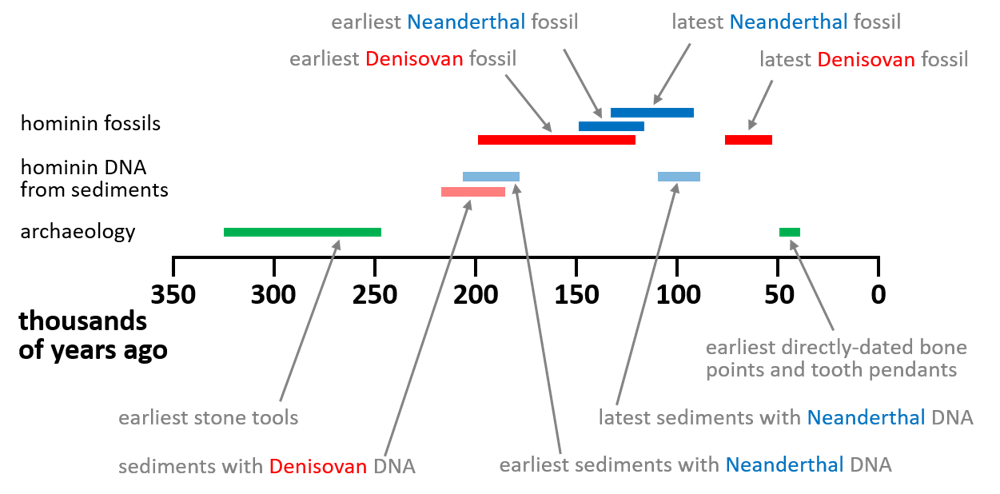
Fossils and DNA traces of Denisovans are found from at least 200,000 to 50,000 years ago, and those of Neanderthals from between 200,000 and 100,000 years ago. The girl with mixed ancestry reveals that the two groups of hominins met and interbred around 100,000 years ago.

Summary timeline for the archaeology, hominin fossils and hominin DNA retrieved from the sediments at Denisova Cave. All age ranges are shown at the 95.4% confidence interval. Bert Roberts, Author provided

Although Denisovans persisted at the site until 50,000 years ago, this does not preclude their later survival elsewhere. They were evidently a hardy bunch, living through multiple episodes of the cold Siberian climate before finally going extinct.

An incomplete history

We now know much more about the life and times of the Denisovans, but there are still many unanswered questions.


Read more: Ancient teenager the first known person with parents of two different species


For example, we don’t know the nature of any encounters between them and modern humans, who were already present in other parts of Asia and in Australia by 50,000 years ago.

So while our understanding of the history of Denisovans has come a long way since 2010, there are still many missing pieces of this intriguing puzzle.

ref. Fresh clues to the life and times of the Denisovans, a little-known ancient group of humans – http://theconversation.com/fresh-clues-to-the-life-and-times-of-the-denisovans-a-little-known-ancient-group-of-humans-110504

Hakeem Al-Araibi’s case is a test of world soccer’s human rights credentials. Here’s why

]]>

Source: The Conversation (Au and NZ) – By Sarah Joseph, Professor, Director, Castan Centre for Human Rights Law, Monash University

Hakeem Al-Araibi is a refugee from Bahrain who plays semi-professional soccer in Melbourne for Pascoe Vale. He is a former member of the Bahraini national football team. He is currently detained in Thailand, the subject of an extradition request by Bahrain. His extradition to that country would breach his human rights against refoulement (the forcible return of refugees) and torture.

Al-Araibi’s case has become a crucial test of world football’s commitment to human rights. Is this commitment real, or is it a public relations statement tossed aside when the going gets tough?

In 2012, Al-Araibi was allegedly one of several athletes who were detained and tortured after pro-democracy protests in Bahrain. Al-Araibi fled Bahrain in 2014, and was accepted as a refugee by Australia in 2017.

In 2014, he was convicted in absentia of vandalising a police station in 2012, for which he was given a sentence of ten years. This was despite an excellent alibi; he was playing in a televised football match at the time of the alleged crime.


Read more: Explainer: what is an Interpol red notice and how does it work?


In 2016, Al-Araibi spoke out against Sheikh Salman Bin Ibrahim Al-Khalifa, who was then running for president of FIFA. Al-Araibi claimed Salman should be investigated for possible involvement in the mass torture of athletes four years earlier. Salman, a member of Bahrain’s ruling royal family, lost his bid for the FIFA presidency. He is and has been the president of the Asian Football Confederation (AFC) since 2013, and a FIFA vice-president.

In late November 2018, Al-Araibi travelled from Australia with his wife for a holiday in Thailand. There he was detained under an Interpol red notice issued pursuant to a request from Bahrain. This notice breached Interpol’s own rules as it was issued against a refugee at the request of the country he had fled.

Al-Araibi has since languished in detention in Thailand for over 60 days. If he is sent back to Bahrain, Thailand will refouler a refugee – that is, return him to the state from which he fled persecution, a grave breach of human rights. There are legitimate fears that he faces torture upon return to Bahrain. His situation has become more dangerous as Bahrain has now formally requested his extradition.

The Australian government is seeking his safe return from Thailand. Former Socceroos captain Craig Foster has been tireless in leading the calls for Al-Araibi’s release and is supported by the World Players Association and the International Olympic Committee. But what of world soccer?

Former Socceroos captain Craig Foster arrives at FIFA headquarters in Switzerland to seek the release of refugee football player Hakeem Al-Araibi. AAP/EPA/Ennio Leanza

FIFA, which runs world soccer, has recently strengthened its human rights policy. This is part of its efforts to rehabilitate itself after the disgraceful reputation it garnered under the (former) presidency of Sepp Blatter. Its human rights policy filters down to office-holders in its regional confederations, including the AFC. Under its own policy and statutes (see Articles 3 and 4), it has a duty to step in and help Al-Araibi.

Hakeem’s predicament arises from football. His high profile from football is likely why he was tortured in the first place. His outspokenness against Sheikh Salman may be why Bahrain is relentlessly pursuing what looks like a bogus charge and conviction.

This matter is most certainly FIFA’s business. And even more clearly it is the business of the AFC.

FIFA took 45 days to call for Al-Araibi’s safe return to Australia. The AFC took 63 days, finally calling for Al-Araibi’s release on January 29.

Within the AFC, the matter is being managed by its senior vice-president, Praful Patel, with Sheikh Salman being deemed to have a conflict of interest in matters concerning AFC’s Western Zone, which includes Bahrain.


Read more: Qatar saga shows why FIFA should return football to the fans


The admission of such a large conflict of interest must raise questions over the viability of Salman’s position, aside from the implication of his involvement in Al-Araibi’s plight. How can the AFC continue with a president who must eschew involvement in one of only five zones?

The slowness of the FIFA-AFC reaction raises doubts over the robustness with which world soccer is prepared to address human rights issues. Forty-five days is a long time for a person to sit in detention contemplating torture. But … better late than never, perhaps.

Is there more that world soccer can do? In the bad old days of Blatter, FIFA claimed it was powerless to address soccer-related abuses, such as those related to labour rights in erecting stadiums in Qatar for the 2022 World Cup.

Yet that dainty approach to state sovereignty didn’t apply to its intervention in Brazil to ensure the sale of beer in its stadiums, which necessitated a change in Brazilian law for the 2014 World Cup, in aid of the interest of its sponsor Budweiser. In 2011, FIFA threatened to suspend Switzerland from world football after one of its local teams sought to challenge FIFA decisions in Swiss courts. FIFA has not flinched in suspending national football associations that have been deemed to breach FIFA codes, and forcing concessions from national governments.

FIFA has considerable power at its disposal and is capable of flexing its muscle much further in the Al-Araibi case.

Al-Araibi is in arbitrary detention in Thailand, pursuant to an Interpol red notice improperly issued and since cancelled. He is facing some of the most serious human rights breaches, refoulement and torture. The situation calls for urgent measures, including the threat of sporting sanctions against Thailand and Bahrain if Al-Araibi is not released immediately.

If strong measures are not taken in such a clear-cut situation of human rights abuse, FIFA and the AFC will be exposed as lacking the courage of their much-trumpeted human rights convictions. The new human rights policy will be revealed as words devoid of any intended practical effect.

FIFA has shown it can act quickly and decisively for the commercial interests of Budweiser. Now it must show it can act for the human rights of one of its own.


I would like to thank Francis Awaritefe for his assistance in providing materials for this article.

ref. Hakeem Al-Araibi’s case is a test of world soccer’s human rights credentials. Here’s why – http://theconversation.com/hakeem-al-araibis-case-is-a-test-of-world-soccers-human-rights-credentials-heres-why-110580

History, not harm, dictates why some drugs are legal and others aren’t

]]>

Source: The Conversation (Au and NZ) – By Nicole Lee, Professor at the National Drug Research Institute, Curtin University

Drug-related offences take up a lot of the resources within Australia’s criminal justice system. In 2016–17 law enforcement made 113,533 illicit drug seizures and 154,650 drug-related arrests.

Harm-reduction advocates are calling for the legalisation of some drugs, and the removal of criminal penalties on others. And there’s public support for both.

But how did some drugs become illegal in the first place? And what drives our current drug laws?


Read more: Three Charts on who uses illicit drugs in Australia


Legal status isn’t based on risk or harm

Most people assume drugs are illegal because they are dangerous. But the reasons aren’t related to their relative risk or harm.

In a 2010 study, experts ranked 20 legal and illegal drugs on 16 measures of harm to the user and to wider society. This includes health damage, economic costs, and crime.

Overall, alcohol was the most harmful drug. MDMA (ecstasy), LSD and mushrooms were among the least harmful.

At various times around the world, coffee has been illegal and cocaine has been widely available.

Many drugs that currently carry criminal penalties began life as useful medicinal therapies, such as opiates, cocaine, MDMA, and amphetamines. They were often available over the counter at pharmacies or through licensed sellers.

These special tax stamps were issued by the IRS in the United States to sellers of various drugs including opium, cocaine and tobacco. To show that the appropriate tax had been paid, stamps were purchased and either affixed to the taxed goods or displayed in the taxed place of business.

History of drug laws in Australia

Australia, like the rest of the world, has had a patchy approach to criminalising substances, driven mostly by a desire to maintain international relations – particularly with the United States – rather than by concern for the public’s health or welfare.

Before federation in 1901, very few laws regulated the use of drugs in Australia. The first Australian drug laws in the early 20th century imposed restrictions on opium, primarily as a means to discourage the entry of Chinese people to Australia.

The temperance movement, mostly known today for the prohibition of alcohol in the 19th and early 20th centuries, played a key role in shaping global drug policy. Influenced by temperance activists, US President Theodore Roosevelt convened an international opium conference in 1909, which eventually resulted in the International Opium Convention.

Australia signed up in 1913, and by 1925 the convention had expanded to include the prohibition of opium, morphine, heroin, cocaine, and cannabis.

These drugs were prohibited in Australia well before their use became widespread or problematic. It wasn’t until the 1960s that recreational drug use became a social concern. That’s when cannabis, heroin, and new psychedelic substances such as LSD became more commonly used for pleasure or in pursuit of spiritual enlightenment.


Read more: Weekly Dose: LSD – dangerous, mystical or therapeutic?


In 1961, the Single Convention on Narcotic Drugs updated all existing international conventions and moved toward a strictly prohibitionist approach to recreational drug use (except alcohol and tobacco).

LSD only became a social concern in the 1960s. Alexander_P/Shutterstock

One of the key contributing factors of drug consumption in Australia was the Vietnam War, during which soldiers provided viable markets for heroin, cannabis, and other illicit drugs.

By 1970 all Australian states had enacted laws that made drug supply a separate offence to drug use or possession, rather than merely a regulatory offence for misusing a medicine.

Drug use and related harms increased exponentially in Australia by the mid-1980s. The emergence of HIV/AIDS, as well as a dramatic increase in heroin-related deaths, led to calls for a more comprehensive approach to illicit drugs.

At that time, Australia led the world in a new way of thinking about drug policy. The National Drug Strategy came into effect in 1985, expanding from strict prohibition to explicitly include harm reduction, in addition to demand reduction (prevention and treatment) and supply reduction (customs and policing). In theory, that is. A recent study found just 2% of drug funding goes to harm reduction, while 66% goes to law enforcement.


Read more: Spending down on harm reduction for illicit drugs: report


Cannabis possession and use is currently illegal in Australia.

But starting around 30 years ago, several states and territories (South Australia, ACT and Northern Territory) removed the criminal penalties for personal use of cannabis. That means it’s illegal, but not a criminal offence.

In all other jurisdictions charges of possession can be subject to “diversion” by police or court, allowing offenders to avoid a criminal penalty.

Some Australian states have removed the criminal penalties for possession of cannabis. Thought Catalog

How are drugs currently classified as illegal?

To be criminalised, a drug needs to be specifically scheduled under the relevant Poison Standards as well as having separate criminal drug legislation.

Until recently, drugs needed to be specifically listed to be considered illegal, meaning legislation was constantly playing catch-up as new drugs were developed to circumvent the laws. Nearly 700 new psychoactive substances have been identified globally in the past decade. These synthetic drugs are designed to mimic the effects of common illicit drugs such as cannabis or cocaine.

Most Australian states and territories now ban the possession or sale any substance that has a “psychoactive effect” other than alcohol, tobacco and food. However, evidence from the United Kingdom indicates such broad bans are unlikely to be effective.


Read more: We predicted banning legal highs wouldn’t work – and a new review shows it’s as bad as we feared


Selective bans have resulted in some drugs that are relatively safe in their pure form becoming much more dangerous. Bans on MDMA, for example, have led to the manufacture of illegal preparations with unknown potency and ingredients.

Cannabis criminalisation has encouraged the production of more potent cannabis and, more recently, synthetic cannabinoids.

The effect has also been implicated in the rise of fentanyl use in the United States as authorities crack down on heroin and pharmaceutical opioids.

Why regulate illicit drugs?

The focus on reducing drug use doesn’t translate to reducing harms. In fact, harms continue to increase despite a decrease in alcohol and other drug use in Australia.

There is no evidence a prohibitionist approach to drug law has reduced the supply of illicit drugs. Instead, it has increased organised crime and acted as a barrier for people seeking help.

Given the failures of prohibition, jurisdictions around the world are starting to look at the issue differently. Several have brought cannabis under regulatory control, much like alcohol and tobacco, and others have removed criminal penalties associated with other drug use.

Canada recently legalised and started to regulate cannabis. Doug McLean/Shutterstock

Most of the arguments to maintain current prohibitionist drug laws continue the moral objection to drug use that began in Australia with our early race-driven opium laws.

Since the beginning of recorded history, people have been taking mind-altering substances. Around 43% of Australians have tried an illicit drug at least once in their lifetime.


Read more: Australia’s recreational drug policies aren’t working, so what are the options for reform?


Whether you morally agree with drug use or not, the current drug laws are neither reducing harm nor stopping use. It’s time for a different approach.

ref. History, not harm, dictates why some drugs are legal and others aren’t – http://theconversation.com/history-not-harm-dictates-why-some-drugs-are-legal-and-others-arent-110564

Aboriginal voices are missing from the Murray-Darling Basin crisis

]]>

Source: The Conversation (Au and NZ) – By Bradley J. Moggridge, Indigenous Water Research, University of Canberra

The Murray-Darling crisis has led to drinking water shortages, drying rivers, and fish kills in the Darling, Macintyre and Murrumbidgee Rivers. This has been the catalyst for recommendations for a Royal Commission and creation of two independent scientific expert panels.

The federal Labor party has sought advice from an independent panel through the Australian Academy of Science, while the Coalition government has asked former Bureau of Meteorology chief Rob Vertessy to convene a second panel. Crucially, the first panel contains no Indigenous representatives, and there is little indication that the second panel will either.


Read more: The Darling River is simply not supposed to dry out, even in drought


Indigenous meaning

Water for Aboriginal people is an important part of survival in the driest inhabited landscape on Earth. Protecting water is both a cultural obligation and a necessary practice in the sustainability of everyday life.

The Aboriginal peoples’ worldview sees water as inseparably connected to the land and sky, bound by traditional lore and customs in a system of sustainable management that ensures healthy water for future generations.

Without ongoing connection between these aspects, there is no culture or survival. For a people in a dry landscape, traditional knowledge of finding, re-finding and protecting water sites was integral to survival. Today this knowledge may well serve a broader vision of sustainability for all Australia.

While different Aboriginal Nations describe this in local ways and language, the underlying message is fundamentally the same: look after the water and the water will look after you.

Native title

In the current crisis in the Darling River and Menindee Lakes, the focus should be on the Barkandji people of western New South Wales. In 2015, the native title rights for 128,000 square kilometres of Barkandji land were recognised after an 18-year legal case. This legal recognition represented a significant outcome for the Barkandji People because water – and specifically the Darling River or Barka – is central to their existence.

Under the NSW Water Management Act, Native Title rights are defined as Basic Landholder Rights. However, the Barwon-Darling Water Sharing Plan provides a zero allocation for Native Title. The Barkandji confront ongoing struggles to have their common law rights recognised and accommodated by Australian water governance regimes.

The failure to involve them directly in talks convened by the Murray Darling Basin Authority and Basin States, and their exclusion from the independent panels, are further examples of these struggles.

Over the past two decades, Aboriginal people have been lobbying for an environmental, social, economic and cultural share in the water market, but with little success.


Read more: It’s time to restore public trust in the governing of the Murray Darling Basin


The modern history of Aboriginal peoples’ water is a litany of “unfinished business”, in the words of a 2017 Productivity Commission report.

In 2010 the First Peoples Water Engagement Council was established to advise the National Water Commission, but was abolished prior to the National Water Commission’s legislative sunset in 2014.

The NSW Aboriginal Water Initiative, tasked with re-engaging NSW Aboriginal people in water management and planning, ran from 2012 until the Department of Industry water disbanded the unit in early 2017. In a 2018 progress report the Murray-Darling Basin Authority described NSW as “well behind” on water sharing plans.

Even after a damning ABC 4Corners report shed light on alleged water theft and mismanagement, the voices of the Aboriginal people of the Murray-Darling Basin were absent.

In May 2018 the federal Labor party agreed to a federal government policy package of amendments to the Basin Plan, including a cut of 70 billion litres to the water recovery target in the northern basin, and further bipartisan agreement for better water outcomes for Indigenous people of the basin.


Read more: Explainer: what causes algal blooms, and how we can stop them


While the measures also included A$40 million for Aboriginal communities to invest in water entitlements, a A$20 million economic development fund to benefit Aboriginal groups most affected by the basin plan, and A$1.5 million to support Aboriginal waterway assessments, how worthwhile are they in a river with no water?

The recent crisis emphasises the perpetual sidelining of Aboriginal voices in water management in NSW and beyond. Indigenous voices need to be heard at all levels, with mechanisms that empower that involvement. Indigenous communities continue to fight for rights to water and for the protection of its spirit.

ref. Aboriginal voices are missing from the Murray-Darling Basin crisis – http://theconversation.com/aboriginal-voices-are-missing-from-the-murray-darling-basin-crisis-110769

Five tips to help year 12 students set better goals in the final year of school

]]>

Source: The Conversation (Au and NZ) – By Joanne Dickson, Associate Professor of Psychology, Edith Cowan University

The final year of high school is one of the most significant transition periods in a young person’s life. One of the least enjoyable by-products is the stress associated with year 12 – the daunting sense that it’s all come down to this.

Anxiety is already one of the most common disorders among young people, but it can be particularly bad in year 12. Even moderate levels of anxiety can negatively impact a young person’s social functioning, relationships, performance at school and social adjustment.


Read more: Know the curriculum and research your career: preparing for Year 12


Emerging research increasingly shows personal goal setting and motivation is tied to well-being and anxiety. But while there is substantial evidence to show pursuing goals is associated with well-being, setting goals itself is not a cure-all. How you set goals, think about them and pursue them can either promote well-being or worsen anxiety.

Focus on a positive target

Research shows our goals are set as either “approach-oriented” or “avoidance-oriented”. Approach-oriented goals focus on a positive target and involve trying to move toward this desirable outcome. For example, “I want to strive to get over 80% in biology.” Avoidance goals focus on avoiding negative outcomes. For example, “I want to avoid getting below 80% for biology.”

The final year of school can be daunting, but setting achievable goals will help keep you on track. from www.shutterstock.com

These two goals are essentially the same in content, but evidence shows people who set approach-oriented goals report better well-being. The tendency to predominantly set avoidance-oriented goals is associated with anxiety. Focusing on avoidance goals is more taxing and stressful. You typically have to monitor and prevent all the possible ways the negative outcome might happen.

Goals need to be meaningful and freely chosen

It’s important to think about why you set and pursue certain goals. Goals that are genuinely meaningful, rewarding, aim to fulfil your personal hopes/desires and are freely chosen represent internalised self-motivated goals and promote well-being.


Read more: HSC exam guide: how to use music to prepare for exams


On the other hand, goals that are a product of external or situation-specific pressures (such as perceived expectations of parents or society) have been linked with stress and anxiety. Research also indicates people who pursue goals for controlled or external reasons tend not to experience increases in well-being, even when they make progress.

Make sure your goals aren’t too general

Compared to overly generalised goals (such as “to try hard”), specific goals (for example, “to set aside four hours each week to try and achieve a 70% grade in maths by the end of term three”) are more likely to be achieved. Specific goals provide more mental cues to keep you on track and help monitor personal progress towards a goal.

If one of your goals isn’t achievable, you should consider dropping it and setting a new goal. from www.shutterstock.com

Similarly, the more specific a person’s goal plans are, the better. Goal plans should include smaller goals to help reach a particular goal. So, for example, successful study plans might include “to set aside two hours each night”, “to study in the library” and “to reward weekly tasks with some Netflix time”.

Flexibility is key

Inflexible goal-setting or having no “give” within a set of goals can set up a path to failure and is thought to maintain psychological difficulties. Sensible goal-making ensures you set realistic goals, which may mean adjusting your goals at times so they’re achievable.

A goal may serve to enhance the pursuit of other goals, such as “to keep fit” and “to eat healthily”. But at other times a goal may conflict with the pursuit of other goals – a goal to “spend more quality time with my friends” may conflict with a goal to “spend more time studying”. People typically have a limited set of personal resources such as time and energy, so it may be necessary to prioritise particular goals so they are achievable.


Read more: Study habits for success: tips for students


Alternatively, if a goal is unattainable, research indicates giving up is beneficial if it leads to the pursuit of a new, meaningful goal. This can reduce psychological distress and increase your sense of well-being.

Flexibility in goal-setting means even if you don’t meet a particular goal, you can still work towards those more important, overarching goals such as developing a sense of self-worth and self-esteem. It’s not all or nothing.

Set goals outside of academic achievement too

For the final year of schooling, it’s important to set goals that aren’t only linked to academic aspirations. Emotional well-being doesn’t happen by accident. Having goals in other life domains such as leisure and recreation, health and relationships will help enhance your sense of well-being. These goals will help you navigate year 12 and beyond.

It’s important to also set goals that involve leisure and spending time with family and friends. from www.shutterstock.com

Research shows the pursuit of goals itself is good for you, whether or not you achieve your goal. It helps you develop a sense of identity, make positive adjustments in life and promotes psychological well-being and resilience.

Resources for students

Sometimes life can also get in the way of our goals. If you’re experiencing severe stress and anxiety, there are support contacts and resources available. For example:

  • talking with a student welfare or pastoral care co-ordinator, school counsellor, a trusted adult or friend

  • phone support such as Lifeline (13 11 14)

  • online support services such as Beyond Blue and Headspace.

ref. Five tips to help year 12 students set better goals in the final year of school – http://theconversation.com/five-tips-to-help-year-12-students-set-better-goals-in-the-final-year-of-school-109954

Why outer suburbs lack inner city’s ‘third places’: a partial defence of the hipster

]]>

Source: The Conversation (Au and NZ) – By Peter Walters, Senior Lecturer in Sociology, The University of Queensland

One of the stark differences between neighbourhoods in the inner city and outer suburbs in Australia is the quality and type of retail offerings. Gentrifying inner-city suburbs – places like West End in Brisbane, Fitzroy in Melbourne and Newtown in Sydney – are characterised by independent owner-operated retail businesses. Busy “third places” such as cafes, bars and restaurants – where people spend time between home (“first” place) and work (“second” place) – are common.

These are the favoured haunts of the hipster. Hipsters have an uneasy place in our cultural landscape, not least of which is their role in gentrification. However, their role in the inner city is important in showing the rest of the city how to create contemporary, accessible and successful third places with low, non-gendered barriers to entry.

Third places provide residents and visitors with a variety of what Ray Oldenburg calls “the core settings of informal public life”. Cafes, bars, pubs, clubs or chess rooms (in some places) are places where people can meet informally or be “together alone”. They allow for planned and accidental encounters across different times of the day and are essential for a healthy neighbourhood social life or “sense” of community.

Cafes and bars provide a ‘third place’ where people can meet informally or be ‘together alone’, as seen here in St Kilda, Melbourne. Peter Walters, Author provided


Read more: Many people feel lonely in the city, but perhaps ‘third places’ can help with that


What’s missing from outer suburbs?

As we travel out of the inner city towards the outer suburbs, residents become increasingly deprived of these places. Suburban retail centres become less “local” – shopping centres are isolated from the surrounding neighbourhood, controlled by a single corporate landlord, marooned in a sea of parking and offer a predictable range of franchised outlets and national brands, often anchored by a large supermarket. At the district level are huge impersonal shopping malls.

None of this enables residents to take advantage of local third places or feel any sense of authorship over them, which is so important for creating place and community.

History has an obvious role to play. Inner-city suburbs were planned and built before widespread car ownership. Streets are laid out in grids, which make for easy and direct pedestrian or bicycle travel.

These areas were built before the introduction of strict “single use” zoning regimes, so have a good mix of land uses. Retail, residential and even industrial properties exist side by side. Property ownership has evolved so one landlord rarely controls an entire retail strip.


Read more: Reinventing density: bridging the live-work divide


Businesses open on to wide, protected footpaths which are thoroughfares for more than just the businesses located there. The built form is varied, interesting and vernacular and suited to small independent businesses.

Buildings are varied, interesting and vernacular and suited to small independent businesses in West End, Brisbane. Peter Walters, Author provided

Gentrification and the hipster

Inner-city neighbourhoods in recent decades have been gentrified as more affluent residents and businesses colonise formerly working class, migrant or Indigenous areas of inner cities. Gentrification takes place over a long time and in particular phases.

The first to colonise an area are “renter gentrifiers”. They are responsible for making the place hip or edgy through alternative music and art, underground fashion and an embryonic start-up business culture.

Despite the mockery they inspire, the hipsters’ pursuits create ‘third places’ that foster a sense of community. g-stockstudio/Shutterstock

This in turn attracts better-resourced gentrifiers who share the same cultural tastes as the renter gentrifiers but have money. This creates demand for a range of retail outlets, such as artisanal bakers, micro-breweries, tattoo artists, vintage fashions, vinyl record stores, independent bookstores and, most importantly, abundant bars, cafes and coffee shops.

These businesses are stereotypically run by hipsters, a subculture easily recognisable by their carefully curated full beards (male), artistic or ironic tattoos, skinny jeans and other vintage accessories. Hipsters are often disparaged for their lack of originality, for championing a look that mimics a historical period they never experienced. As Jake Kinsey writes sarcastically in a whole book that derides hipsters:

… creativity, genius, eternal value and mystery are inseparable from the hipster.

The quest for authenticity

Authenticity is a contested word, but if we think in terms of “authorship”, the independently owned and operated third place where both owner and customer feel a sense of ownership and reciprocal obligation provides much more authenticity than just another outlet in a chain of franchises.

While some hipster businesses that work in the gentrified inner city might not work so well in the outer suburbs, people who live in these suburbs are not a different species. The desire to get out of your house, to socialise, to see your neighbours out in the community or to be “together alone” is not limited to the inner city. There is no reason people in the suburbs would not respond to independently owned businesses, rather than the remotely controlled, rationalised franchises – see “McDonaldization” – that populate so many suburban shopping centres.

Quality third places are just as important in the outer suburbs, which are becoming increasingly diverse in terms of life stage, ethnicity, culture and employment type.

Keeping ‘McDonaldization’ at bay in Fitzroy, Melbourne. Peter Walters, Author provided


Read more: Can our cities’ thriving creative precincts be saved from ‘renewal’?


So what’s the solution?

Property developers are often quick to point out that local retail is not economically viable in new suburbs unless it consists of supermarkets and fast-food outlets and is surrounded by tarmac. Local (walkable) retail is invariably compared on price to the large impersonal shopping malls that draw shoppers in from the suburbs. However, the lure of a small local shopping precinct, where “third place” businesses such bars, cafes and restaurants and community hubs can operate at survivable rents, is a different proposition.

This is not a new suggestion. Various models have been proposed to subsidise retail rents, provide independent freehold of individual retail premises, or rent control.

Developers have been reluctant to help with this as it not profitable (for them). Local authorities have also been reluctant to engage developers on this front.

There are, however, some encouraging exceptions to this. Some more enlightened developers see the sustained benefit of creating community hubs. The argument is for a social good rather than a purely economic one.

The outer suburbs are spatially different to the inner city – history and late capitalism have taken care of that. Local authorities need to think about current inflexible zoning regimes and about how small socially beneficial businesses can be encouraged.

Suburbs do not empty out during the day. In a post-work and ageing society, suburbs will become socially barren places to live unless there are lively hubs where people can leave the private realm of the home and see each other in a welcoming environment in which they feel some authorship.

There’s more to the experience than just savouring the coffee in Fitzroy, Melbourne. Peter Walters, Author provided

ref. Why outer suburbs lack inner city’s ‘third places’: a partial defence of the hipster – http://theconversation.com/why-outer-suburbs-lack-inner-citys-third-places-a-partial-defence-of-the-hipster-110177

What banking regulators can learn from Deepwater Horizon and other industrial catastrophes

]]>

Source: The Conversation (Au and NZ) – By Andrew Hopkins, Emeritus Professor of Sociology, Australian National University

In its interim report published four months ago, the Banking Royal Commission chalks up shocking misconduct in the finance industry to greed – “the pursuit of short-term profit at the expense of basic standards of honesty”.

“How else,” it asks, “is charging continuing advice fees to the dead to be explained?”

It is seductively easy to explain misconduct in terms of this base human motive, one of the seven deadly sins. But moral failure does not satisfactorily explain why humans misbehave in organisations. There are also organisational reasons.

The royal commission is, of course, aware this. Its interim report points to greed stimulated by incentive payments or bonuses: “From the executive suite to the front line, staff were measured and rewarded by reference to profit and sales.”

Is the solution, then, to simply get rid of incentive payments?


Read more: We’ll wait an eternity for the banks to fix themselves. Here’s what we can do now


My view, based on many years looking at the causes of catastrophes such as the Deepwater Horizon disaster, is that there is no easy way to do this.

The uncomfortable reality is that incentive payments are an inherent aspect of modern capitalism.

The only effective way to detoxify the incentive individuals have to do the wrong thing in pursuit of bigger profits is to counterbalance them with equally compelling incentives to not act dishonestly.

The principal/agent problem

The interim report does not explicitly say incentive payments should be done away with, but it is the implication of much of the commentary.

It states (on page 317) the premise that staff and intermediaries will not do their jobs properly without incentive payments “must be challenged”.

It suggests there is too much conflict of interest in “customer-facing staff” being paid according to what they sell or advise customers: “And if customer-facing staff should not be paid incentives, why should their managers, or those who manage the managers?”

But it also acknowledges that attempts to change the incentive culture would most certainly be resisted: “Changing culture in the Australian banks may not be easy and may take time. It cannot be assumed that entities will embrace change willingly or immediately.”

Commissioner Ken Hayne at the initial public hearing, in February 2018, of the Royal Commission into Misconduct in the Banking, Superannuation and Financial Services Industry. Eddie Jim/AAP

It’s important to understand why the banks would be so hostile to such a change.

Incentive payments are a way to address a fundamental problem in modern capitalism, particularly in large publicly listed companies with multiple layers of managers.

In business literature it is called the “principal/agent problem” – the principal being the owner (or shareholder) and the agent being the manager (or executive) hired to run the business on behalf of the owner (or, in the case of a large company, many thousands of owners).

Agents have legal duty to put shareholder interests above all others. The “problem” is that, if left to themselves, they may in act in their own interest, putting their own wealth, power and prestige before the interest of the owners.

Tying executive remuneration to company financial performance has developed as a way to mitigate this problem. Remuneration consultants have developed very finely tuned schemes with huge incentives for top executives enrich themselves only by enriching their principals, through maximising total shareholder returns.


Read more: Will Hayne blink? The problems with banks demand tough measures that neither they nor their regulators want


Irresistable incentives

The downside, as the royal commission has exposed, is that such incentives also encourage executives to consider customers as sheep to be fleeced.

Key to this is how long-term incentive schemes are structured.

Short-term incentives are bonuses paid to top executives annually. In addition to these, each year a large bonus equal to or greater than their base salary is provisionally awarded. The payment is deferred for a period, often three years. The executive gets this long-term incentive only if certain conditions are met.

Those conditions largely concern the company’s financial performance in the intervening years. In most schemes the company’s performance must also be better than most of its competitors. Typically this is determined by comparing it with a select group of companies. If it achieves less than the median, the executive loses all or most of the long-term bonus.

It is hard to imagine a system better designed to pressure a chief executive to put profit ahead of all else.

Long-term bonuses operate in this way in many sectors of the economy, not just banking. They lie behind many of the major accidents in the oil and gas industry that I have written about.

Penalty counterbalance

So the problem with the banking and financial services sector is a whole system designed to maximise shareholder returns. It is the greed of shareholders that drives the system.

How can we mitigate the antisocial aspects?

One way is to ensure the huge incentives to do the wrong thing in pursuit of maximum profit are counterbalanced by the penalties. Right now that’s just not the case. The penalty for corporate malfeasance is often a fine, imposed on the company, not individuals.

We should hold top executives and even directors personally and criminally liable when companies fail to take proper account of the interests of consumers, customers and employees. This will ensures it will not always be in their interests to align their morality with the interests of shareholders.


Read more: Confiscate their super. If it works for sports stars, it could work for bankers


Health, safety and environment laws impose such criminal liabilities on senior office holders when they fail to protect their employees and the environment. Acute awareness of this liability has resulted in a much greater concern for the lives of workers and the environment than would be dictated by shareholder interests alone.

In my own research I have found the influence of corporate safety risk managers is enhanced when they can highlight the legal liability of their bosses. One might expect the influence of chief risk officers in financial institutions to be similarly strengthened.

It will be interesting to see how far the royal commission ventures down this path in its final report.

ref. What banking regulators can learn from Deepwater Horizon and other industrial catastrophes – http://theconversation.com/what-banking-regulators-can-learn-from-deepwater-horizon-and-other-industrial-catastrophes-108989

Hidden women of history: Kathleen McArthur, the wildflower woman who took on Joh Bjelke-Petersen

]]>

Source: The Conversation (Au and NZ) – By Susan Davis, Deputy Dean Research, Education and the Arts, CQUniversity Australia

In this series, we look at under-acknowledged women through the ages.

This year marks 50 years since the launch of one of Australia’s first major conservation battles, waged against Queensland’s ultra-conservative, pro-development premier Joh Bjelke-Petersen. It was for a location few had ever heard of – Cooloola, an area that stretches from Noosa to Rainbow Beach, around 70 km north.

Portrait of Kathleen McArthur by Lina Bryans (1960). Courtesy Alexandra Moreno

The unlikely leader of this campaign was a wildflower painter named Kathleen McArthur, who led the Caloundra branch of an environmental group the Australian newspaper called “the most militant of conservation cells”.

Kathleen, together with colleagues such as poet Judith Wright, pioneered and honed activist strategies that are still instructive today. She understood art’s ability to prompt human emotion and marshal the public support required to bring about change.

From her homebase at Caloundra in Queensland, Kathleen created nation-wide awareness of the existence of the Cooloola region, which incorporates internationally significant high dunes, coloured sands, rainforest and wallum heathland habitats. It is now part of Great Sandy National Park, but at the time was under threat from sand mining and development.

A highlight of the Cooloola campaign was the distribution of 100,000 protest cards across Australia, with at least 15,000 of them sent to Queensland’s then Premier. Conservationist Arthur Harrold described Kathleen as the “cunning mind” behind the cards.

The Cooloola campaign postcard, 1969. Wildlife Preservation Society of Queensland

Abandoning convention

Kathleen McArthur was born in 1915 into one of Brisbane’s leading families. Her parents were Daniel Evans of Queensland engineering company Evans Deakin, and Kathleen (Kit) Durack, of the Irish pastoralist family made famous via the books of cousin Mary Durack.

Christmas Bells by Kathleen McArthur. Courtesy Hugh McArthur and the Fryer Library, University of Queensland

Kathleen had an early life of considerable privilege. However, she turned away from the conventional life of the society matron. After a well-publicised marriage to military man Malcolm McArthur, and three children, Kathleen eschewed life on military bases or the city. The family bought a modest home at Caloundra that she later named Midyim.

Discovering her husband’s unfaithful ways, Kathleen initiated divorce proceedings in 1947. By the 1950s, she was a single mother of three. She lost her parents to illness in 1951.

From then on, Kathleen forged a new life for herself, writing about and illustrating Queensland wildflowers. She began painting in part to help identify the wildflowers in her local environment, there being a limited range of books to assist with their identification.

The Bush in Bloom by Kathleen McArthur (1982).

In 1953, Kathleen set herself the task of recording all the native plants in bloom across key locations of the Sunshine Coast region. This project fed into numerous publications including weekly newspaper columns and books. This year was also notable for a wildflowering expedition Kathleen took with her friend Judith Wright to the peak of Mt Tinbeerwah, which provided the spark of the idea for a national park at Cooloola.

Judith and Kathleen were among the founders of the Wildlife Preservation Society of Queensland, established in 1962, along with naturalist David Fleay and Jacaranda Press founder Brian Clouston. Brian offered to help their cause by publishing an educational wildlife magazine, which still exists today.

The ‘Mistress of Midyim’

A crisis point was reached for Cooloola in 1969, with mining applications pending for much of the region. Kathleen’s idea to use wildflower postcards activated the public campaign. She had been inspired by a US campaign utlising such cards and though others were sceptical, set about creating a postcard, a letter and a brochure that could be distributed far and wide. She also created wildflower cards and prints featuring her artwork, sold to help raise funds.

Just a few of the flood of letters Kathleen received during the Cooloola campaign, from the WPSQ collection held at the State Library of Queensland. Courtesy Susan Davis

After the postcard distribution, hundreds of letters of support flowed back to the “Mistress of Midyim”. The campaign was further promoted through feature articles and letters to editors, talks, a documentary and capitalising on a web of allegiances. From early on, the Wildlife society formed relationships with scientists such as Dr Len Webb, from the CSIRO, who played a central role.

Vanilla Lillies by Kathleen McArthur. Courtesy Hugh McArthur

Kathleen and the society communicated regularly with politicians from all sides of the house. Her local MP Mike Ahern was a Country Party member but sympathetic to the conservation agenda.

On 1 December 1969, Bjelke-Peterson issued a press release stating that “substantial areas” of the Cooloola sand mass would be set aside as a National Park. But this was by no means the end of the campaign. Six weeks later, it was revealed that applications had been lodged for sand mining leases within some areas of Cooloola. This delayed formal action on the declaration of a national park and required the campaigners to change tactics.

In the meantime, the newly formed South Queensland Conservation Council, the Cooloola Committee and Dr Arthur Harrold took on the next phase of the battle. While Kathleen gave up leadership of the campaign, she did not leave the fray entirely. As key hurdles were encountered she would return to letter writing and other forms of maintaining the rage.

Eventually, 22 years after Kathleen and Judith first stood on the peak of Mt Tinbeerwah, the Queensland parliament gazetted the Cooloola National Park in December, 1975. However Kathleen’s role is rarely mentioned in most accounts of the Cooloola campaign.

After Cooloola

Kathleen McArthur in the early 1960s. Author supplied

Kathleen refocussed on her art, wrote a suite of books and established a series of monthly presentations called “lunch-hour theatre”. She remained involved with her local branch of the wildlife preservation society, prepared the submission to have Pumicestone Passage added to the register of the National Estate, and campaigned to protect beach dunes. She also identified areas that should be protected as reserves, including one posthumously named Kathleen McArthur Conservation Reserve just north of Lake Currimundi. After a period of illness she died in 2000, the same year as her friend Judith Wright.

Because of the likes of Kathleen McArthur, today there are national parks, beaches protected by dunes rather than rock walls, and birds calling from humble heathlands where gentle wildflowers bloom. She is but one of a number of women from the period who could be “wild”, radical and difficult, but who was passionate about wildflowers and protecting our natural environments.

A ‘Wild/flower Women’ exhibition will be on display at the Fryer Library, University of Queensland throughout 2019, with an online exhibition to be available via their website. A public lecture and performance will be staged in late March as a part of the Fryer Fellowship program.

ref. Hidden women of history: Kathleen McArthur, the wildflower woman who took on Joh Bjelke-Petersen – http://theconversation.com/hidden-women-of-history-kathleen-mcarthur-the-wildflower-woman-who-took-on-joh-bjelke-petersen-110269

Vanuatu’s ‘shared vision 2013’ tourism shakeup – pipe dream or survival plan

]]>

By Dan McGarry

The government of Vanuatu has convened three major tourism and travel stakeholders this week to announce a major shakeup in the sector.

Dubbed Shared Vision 2030, the plan commits Air Vanuatu, the Vanuatu Tourism Office, and Airports Vanuatu Ltd to an ambitious expansion strategy.

The Vanuatu Daily Post reported yesterday that Air Vanuatu intends to build an actual international fleet of up to eight jet aircraft. Airports Vanuatu Ltd has almost completed the essential Bauerfield runway upgrade. It is also lining up support for an ambitious new facility plan that can accommodate and service Air Vanuatu’s fleet.

READ MORE: Vanuatu and New Caledonia hold historic talks on tourism

For its part, the Tourism Office is being asked to transform itself into a more dynamic organisation, in touch with modern travellers and modern tech.

The government is being asked to stump up no less than VT500 million (NZ$6.6 million) in new money every year for the next five years to back this play.

-Partners-

The plan unveiled on Monday raises countless questions.

Where will Air Vanuatu find the pilots? How will it finance the planes? A new Airbus A320 lists for US$101 million, and a Boeing 737-800 costs about a million dollars more.

Leasing isn’t cheap
Leasing even one isn’t cheap. How will Air Vanuatu afford 6 of them?

A new terminal isn’t just a building. It’s the air traffic control centre, hangars, fuel depot, service bays, fire-fighting and emergency response facilities, food preparation, administration… the list is long and exacting.

All things considered, a price tag of more than  VT10 billion (NZ$130 million) won’t be hard to reach.

The argument in support of the plan is simple. We can either grow now, or run the risk of our economy withering away.

Vanuatu’s economy suffered badly in 2018. Few businesses thrived, and many struggled. VAT revenues are one of the most reliable measures of overall commercial activity. They don’t look good.

Although monthly revenues have surged a few times over the same period in 2017, 2018 revenues overall were only about 10.2 percent higher than last year.

That’s a problem, because revenues should have risen at least 15 percent overall, given the 20 percent rise in the tax rate (2.5 is 20 percent of 12.5, so the rate rise is 2.5 percent, but revenues should increase by 20 percent). The trendline is pointing downward, when it should be sharply upward.

Tourism slump
Much of the commercial slowdown comes from slumping tourism revenues among traditional players. Larger resorts and hotels are struggling, to put it politely. The lucky ones are seeing 50 percent occupancy rates. The unlucky ones are far worse off.

Reduced tourism activity has effects throughout the economy, dragging industry, services and agriculture down with it.

Tourism officials are quick to crow about ‘record’ air arrival numbers. The numbers are real, but they hide a number of problems. First, these numbers have only just managed to rebound from 2014 levels, before the twin catastrophes of cyclone Pam and the Bauerfield runway debacle decimated air arrival numbers.

Second, everyone’s strategic plan expected continuous growth through that period. But we’re barely ahead of where we were in 2014. That puts us almost five years behind schedule.

Lastly, travellers are planning differently. They’re not following the beaten path as much. The advent of social media changed the way people decide where to go, how they book their reservations, and what they do when they’re away.

Referrals matter more than ever. More people ask for input about possible destinations on social media than ever before, and a large number of people decide where to go based on what they hear.

AirBnB is affecting traditional booking patterns enough to make it hurt, especially for larger resorts. Unless arrival numbers rise significantly, it will be impossible to convince new investors to come, and some existing investors could well begin planning an exit.

No middle ground
The plan’s proponents argue that Vanuatu can either rise in popularity, or expect to be ignored by the next generation of travellers.

And based on which path we choose our economy will either grow, or shrink. There’s no middle ground, they say.

But we have to walk before we run. Tourism and travel industry experts tell the Daily Post that the first priority is getting maximum value from existing markets. Expect to see service to Melbourne announced soon, and increased flights to all existing destinations.

One insider told the Daily Post that there is a shortage of aircraft worldwide. Forbes reports that in the USA, for example, “More than three-quarters of the fleet for sale is more than a decade old, [with a] decreasing quantity and quality of less-than-decade-old aircraft.”

Vanuatu will have to acquire ‘new iron’ for its own routes, rather than trying to seduce outside airlines to come here.

One major challenge that has yet to be addressed is the 140 new pilots who will be needed to fly the fleet.

The greatest shortage in the aviation industry right now is pilots. This means more competitive salaries and better working conditions will be needed to convince commercial plots to come, and our own pilots to stay.

Air Vanuatu is holding a press conference today to discuss these and other issues. The Daily Post will be following the story as it develops.

Dan McGarry is media director of the Vanuatu Daily Post group.

Print Friendly, PDF & Email

Article by AsiaPacificReport.nz

Janet Tupou: Speaking life into your goals and seeing dreams come true

]]>
Dr Janet Tupou … injecting diversity into university communications space. Image: AUT Pacific

By Dr Janet Tupou

Hand over heart, speaking life into your goals and dreams can see them come true.

After sitting in my first ever lecture at university, I knew that I wanted to be the one on the other side of the lectern. Week after week for three years in my undergraduate studies, I failed to see any Māori or Pasifika educators on the stage.

It was during those years that I set out the goal to be a university lecturer to inject some diversity into that space. Six years on, you can find me in front of the lecture stage and classroom, doing just that.

After completing a Bachelor of Communications Studies and honours degree, I began studying a Masters focusing on emotional labour. In other words, I call it ‘mastering the art of wearing different masks.’

As I was studying, I began teaching on undergraduate papers, the very same ones I had taken a few years back. It was such a surreal moment, to be lecturing alongside the same educators that once taught me. And it still is.

I then began studying a PhD called (De)constructing Tongan Creativity: A talanoa about walking in two worlds, which was recently awarded. The topic came to me after noticing a lack of scholarship around creativity in Tongan culture while I was teaching.

-Partners-

I wanted to show all sides of the story, particularly from a Tongan perspective. I therefore wanted to explore what creativity meant for Tongan people, specifically Tongan youth in New Zealand, and that’s exactly what I did.

Identity crisis
Creativity is seen as a concept that can be seen as a threat to the Tongan culture. For example, for Tongans who are born in New Zealand, there can be an identity crisis in how to express one’s Tonganness in a Western world.

I found there is a lack of awareness of how much creativity and studying creative subjects at a higher level can better Tongan people.

My passion of exploring the notion of creativity at a deeper level is also put into practice in my teaching approaches, by way of allowing students to share their creative outlooks, voices and perspectives on any given topic that is discussed in a safe space. At the same time, to back up my talk, I walked the walk by studying my Graduate Diploma in Tertiary Teaching.

As well as lecturing full time, I am also a part time real estate salesperson. I use my skills to help educate and shed light on the complicated terminology and processes in this industry that often exploits people. How did I get to where I am today?

As a Christian, my faith has helped me power through achieving goals. Supportive family and friends, commitment and taking up incredible opportunities at institutions such as AUT has also played a huge part in my journey.

My ultimate goal as a teacher is to nurture belief in students to dream big and to achieve big. The classroom is my space to encourage students to be the best versions of themselves, because “Hand over heart, speaking life into your goals and dreams can see them come true.”

Dr Janet Tupou is a lecturer in Communication Studies and chair of the AUT School of Communication Studies diversity committee. This article was first published by Spasifik magazine and is republished by Asia Pacific Report with permission.

Print Friendly, PDF & Email

Article by AsiaPacificReport.nz

Why slow TV deserves our (divided) attention

]]>

Source: The Conversation (Au and NZ) – By Aaron Burton, Lecturer in Media Arts, University of Wollongong

SBS’s suite of slow TV programs, “Slow Summer”, arrived at a fortuitous time in our annual media trajectory, when we were briefly relieved of the busyness plaguing our lives.

On the back of last year’s successful trip on The Ghan, SBS commissioned Sydney-based Mint Pictures to produce two more journeys, The Indian Pacific: Australia’s Longest Train, and The Kimberley Cruise: Australia’s Last Great Wilderness. The programs were each three hours long on SBS. Longer versions (17 and 14 hours respectively) screened on SBS’s Viceland channel.

Others airing are BBC Four’s All Aboard! The Canal Trip (a mere two hours), and North to South, a three-hour, Tolkien inspired, multiple vehicle journey through New Zealand’s Middle-earth.

Ratings have fallen somewhat compared to last year’s efforts. (The three-hour versions of the Indian Pacific and Kimberley Cruise programs had reached around 1-1.3 million viewers a week after the broadcast, compared with last year’s 1.7 million for The Ghan.) Still, slow TV is actually the perfect genre for today’s viewing habits.

What is slow TV?

In its purest, Norwegian-inspired form, slow TV is characterised by minute-by-minute footage of a culturally significant journey, event, or activity, edited together chronologically from numerous camera angles, resulting in an unconventionally long viewing experience.

While The Ghan: The Full Journey might sound long (16 and a half hours), this pales in comparison to Norwegian public broadcaster NRK’s 134-hour live broadcast aboard the cruise ship Hurtigruten in 2011.

SBS first screened The Ghan in 2018.

Multiple cameras are often fixed onto the moving subject, notably the classic “phantom ride” perspective from the front of a train, but aerial shots, drones, and subtle tripod movements are also used. The editing pace is slow: most shots last at least 30 seconds, but a single perspective can linger for over an hour.

Apart from a few notable exceptions, such as an isolated cow or the Queen of Norway as she sails by, the journey tends not to single out particular characters. Noticeably absent is the voice of a narrator, nor is there a host, nor even music. Instead, sound emanates from the environments we see (that’s “diegetic sound” in cinema speak).

In short, slow TV is “slow” because it lacks the rollercoaster of emotional cues, narrative guides, and breathless editing pace we have come to expect from television.

Our multitasking age

The long duration is the first obvious challenge slow TV has when attracting viewers. But if you consider our fondness for sport, we’re experts at that. A single day of test cricket usually runs longer than six hours. The 1.5 million of us who tuned in to the men’s Australian Open final on Sunday were disappointed Nadal and Djokovic couldn’t reignite their five hour and 53-minute battle of 2012.

Apart from sport, and whatever happened to Big Brother, most of us are now binge-watching our favorite shows. According to Deloitte’s most recent media consumer surveys, around two thirds of us are bingeing, defined as watching three or more consecutive TV episodes in one go, with almost half of us paying for a subscription video on demand service such as Netflix or Stan. Deloitte’s 2017 survey of over 2000 consumers suggests we are spending around 17 hours per week watching movies or TV across our devices.

The promotional video for SBS’s Slow Summer.

Despite our appetite for prolonged screen exposure, slow TV is so unconventional that SBS has pitched it as a dare for us to watch. Embracing divided responses from last year’s foray with The Ghan, this year’s Slow Summer promo video features a series of rival tweets: “Literally as exciting as watching paint dry”; “This is f-ing ART!”; “Yawn… I’m Ghan to bed” ; “#TheGhan a goddam masterpiece”.

This promo captures one of the secrets to the genre’s success: online participation and interaction through social media makes it a collective viewing experience. Travelling across the Nullarbor on The Indian Pacific by yourself would be as lonely as midnight infomercials, but #SlowSummer fills the carriages with discussion, commentary, and comraderie.

While reality television and talk shows have been capitalising on social media interaction for some time, slow TV opens up an entirely new approach to producing content for audiences to provide their own commentary.

The Indian Pacific: Australia’s Longest Train aired as part of SBS’s Slow Summer programming. SBS

Perhaps the most striking finding from Deloitte’s 2018 survey is that 91% of us are now multi-tasking while watching TV (up from 79% in 2014): in other words, we might be “passively” consuming what we’re watching.

So the real brilliance of slow TV is its ability to meet the needs of both passive and active consumption. It works on two levels: as a beautiful view in the living room, kitchen, and wherever else your flat-screens might be, and on the other hand if you give it the attention it deserves, you might find yourself embarking on an intellectually stimulating and imaginative journey.

It is precisely the lack of narration and character driven narrative that opens up the space for interpretation and opinion.

While the Slow Summer programs are only available online temporarily, as with as regular programs, their unique capacity to inspire audiences means they should remain of interest for decades to come.

Our politicians and media consistently chase short-term achievements. As we all rush back to work, perhaps revising our KPIs and considering the value of “slow ratings” might make our collective journey more enjoyable.

ref. Why slow TV deserves our (divided) attention – http://theconversation.com/why-slow-tv-deserves-our-divided-attention-110695

A Trump-aligned World Bank may be bad for climate action and trade, but good for Chinese ambitions

]]>

Source: The Conversation (Au and NZ) – By Usman W. Chohan, Economist, UNSW

The seat of World Bank president is becoming vacant. Its president, Jim Yong Kim, will step down on January 31, three years earlier than his term formally ends.

His move – described as “sudden” and a “shock,” particularly since the World Bank has been going through significant internal restructuring – gives US president Donald Trump the chance to appoint a replacement more aligned with his outlook.


Read more: World Bank president: list of reforms African states should be demanding


This is because, since the World Bank’s establishment in 1945, the United States has had outsized influence as its largest shareholder. Its president has always been an American citizen nominated by the US government. Kim was chosen by the Obama administration in 2012.

Rumours circulated early on that Trump was considering his daughter Ivanka for the job. Even though that has since been denied, it’s likely he will choose a candidate sympathetic to his worldview.

This may mean a substantial change in the World Bank’s priorities. In particular, in two areas the bank has played an important and positive role: funding sustainable projects to deal with climate change (“climate resilience”); and encouraging robust international connectivity through trade.

Focus on climate resilience

The World Bank has put substantial emphasis on funding projects in developing countries that address climate change. Last financial year 32% of its financing – a total of US$20.5 billion – was climate-related.

Recently approved World Bank projects included climate resilient transport in the Oceania region (such as in Tonga and Samoa), and solar projects across Sub-Saharan Africa. This is all part of a detailed five-year Climate Change Action Plan underway since 2016.

This concern about the consequences of climate change stands in marked contrast to the Trump administration’s record.

Trump’s disregard of climate science is reflected in the defunding or reorganisation of climate-related research projects and institutions. His appointee to head the US Environmental Protection Agency, Scott Pruitt, played a key role in the US withdrawing from the Paris Climate Agreement and energetically worked to gut pollution protection regulations.

So there’s good reason to believe the Trump administration’s pick for the World Bank will reflect its hostility to climate security, and that the bank’s priority towards funding climate resilience will change as a result.

World Bank president Jim Yong Kim with fashion designer, author, reality television personality, businesswoman and trusted presidential advisor Ivanka Trump in July 2017. Michael Kappeler/DPA

Antipathy towards multilateralism

The Trump administration has already sought to curb salary growth among World Bank staff. More severely, Trump’s National Security advisor, John Bolton, has argued the World Bank should be privatised or simply shut down.

This is part of a wider “antipathy towards multilateralism” that includes institutions such as the United Nations and the World Trade Organisation.


Read more: Australia has to prepare for life after the World Trade Organisation


Trump’s belief that free trade has hurt the US is at odds with the World Bank’s long history of facilitating reforms designed to promote international trade.

Part of the original logic for the World Bank was that trade was seen as a means to create interdependence, and thus reduce economic conflict that might lead to war.

The Trump administration has shown it is more than willing to revert to an old-fashioned trade war.

Its tariff contest with China (which joined the WTO in 2001 with the World Bank’s help) is already hurting global manufacturing, with the International Monetary Fund downgrading its global economic growth forecasts as a result.

Though a Trump appointee might not upend the World Bank’s commitment to free trade in principle, the result might be an organisation less active in promoting multilateralism in practice.

Playing to China’s strengths

Ironically a Trump-compliant World Bank might result in promoting its sidelining to the advantage of China.

In its first six decades of existence the World Bank was an immensely powerful international institution. But its relevance to international development and finance is now being overshadowed by alternative funding mechanisms such as private-sector lending and particularly institutions related to Chinese international development initiatives.

China is planning through its Belt and Road Initiative to spend US$1 trillion on international infrastructure projects over the coming decade. Much of these are focused on Eurasian and African regions where the World Bank has struggled most to promote sustainable prosperity.

China has also has built a rival to the World Bank in the form of the Asian Investment Infrastructure Bank (AIIB), which has a sizeable balance sheet and a proactive approach to funding projects, including those in sustainable development.


Read more: US sparks new development race with China – but can it win?


But in climate resilience and global economic integration, the World Bank still retains the mantle of global leader. Thus far it has welcomed cooperation with the AIIB, signing a memorandum of understanding in 2017.

Blunt its work in these two areas and the World Bank becomes more irrelevant. Combined with the organisation’s serious governance problems, which are most unlikely to be addressed by a Trump appointee, the future for the World Bank is not bright.

ref. A Trump-aligned World Bank may be bad for climate action and trade, but good for Chinese ambitions – http://theconversation.com/a-trump-aligned-world-bank-may-be-bad-for-climate-action-and-trade-but-good-for-chinese-ambitions-110265

Poll wrap: Coalition gains in first Newspoll of 2019, but big swings to Labor in Victorian seats; NSW is tied

]]>

Source: The Conversation (Au and NZ) – By Adrian Beaumont, Honorary Associate, School of Mathematics and Statistics, University of Melbourne

This week’s Newspoll, conducted January 24-27 from a sample of 1,630, gave Labor a 53-47 lead, a two-point gain for the Coalition since the last Newspoll in early December. Primary votes were 38% Labor (down three), 37% Coalition (up two), 9% Greens (steady) and 6% One Nation (down one). This is the equal closest Newspoll result since Scott Morrison replaced Malcolm Turnbull as PM.

Despite the Coalition’s improvement on voting intentions, Morrison’s ratings went backwards. 40% were satisfied with him (down two), and 47% were dissatisfied (up two), for a net rating of -7, Morrison’s second worst. Bill Shorten’s net approval was up two points to -13. While still poor, this is Shorten’s equal best Newspoll net approval since May 2016. Morrison led Shorten by 43-36 as better PM (44-36 in December).

Since replacing Turnbull in August 2018, Morrison’s ratings have been better than we would expect given voting intentions, as voters gave him a personal “honeymoon”. In this Newspoll, Morrison’s net approval of -7 is very close to the Coalition’s voting intentions deficit of six points. In the future, Morrison’s ratings are likely to be more correlated with voting intentions.

The last Newspoll was taken after the final parliamentary week of 2018, when there was much media focus on politics. The lack of media attention on politics since mid-December may have assisted the Coalition. Analyst Kevin Bonham says Newspolls taken in December and January tend to be better for governments.

As the graph above shows, the incumbent government’s polling has tanked in February, when the media refocuses on politics. With the election due in May, the Coalition will need to avoid this February slump.

Housing prices have continued to fall. The NAB business survey had business conditions falling from +13 in November to +2 in December. The Westpac consumer survey had sentiment slumping from 104.4 in December to 99.6 in January.

Somewhat countering these gloomy economic reports, the ABS reported on January 24 that almost 22,000 jobs were added in December, and the unemployment rate fell 0.1% to 5.0%. The Australian stock market has gained in January, reversing much of December’s falls.

To make up for the likely loss of voters with a high level of educational attainment (see the seat polls below), the Coalition needs a strong economy to attract working class voters. A weaker economy is likely to help Labor.

Seat polls of Higgins, Flinders and Herbert

The Poll Bludger has details of recent ReachTEL polls of the Victorian federal seats of Higgins and Flinders, and a Newspoll of the Queensland seat of Herbert. All three polls were conducted January 24 from samples of 500-700. The Higgins poll was conducted for supporters of Peter Costello and the Flinders poll for the CFMMEU.

In Flinders, held by Greg Hunt, Labor led by 51-49, an eight-point swing to Labor since the 2016 election. In Higgins, held by the retiring Kelly O’Dwyer, Labor led by 52-48, a 13-point swing to Labor. In Herbert, which Labor barely won in 2016, they led by 51-49, a one-point swing to Labor.

In 2016, the Greens finished second in Higgins, ahead of Labor. In the Higgins poll, after excluding 8.4% undecided, the Liberals have 40.3% of the primary vote, Labor 27.1% and the Greens 19.3%. Full primary votes in Flinders were not reported.

In Herbert, primary votes were 32% Labor (30.5% in 2016), 32% LNP (35.5%), 9% One Nation (13.5%), 8% Katter’s Australian Party (6.9%), 8% for Clive Palmer’s United Australia Party and 7% Greens (6.3%). Palmer’s advertising campaign appears to have had an impact in Herbert. However, respondents expressed a negative, rather than a positive, view of Palmer by 65-24.

Seat polls are notoriously unreliable, but the big swings in Flinders and Higgins could reflect voters with high levels of educational attainment turning against the federal Coalition. I wrote on my personal website in August that these voters likely far preferred Turnbull to Morrison.

NSW Newspoll: 50-50 tie

The New South Wales election will be held on March 23. A Newspoll, conducted January 25-29 from a sample of 1,010, had a 50-50 tie, unchanged from the last NSW Newspoll in March 2018. Primary votes were 39% Coalition (up one), 36% Labor (up two), 10% Greens (down one) and 6% One Nation (down two).

This poll suggests movement back to the Coalition after a YouGov Galaxy poll and a ReachTEL poll in late November gave Labor leads of 52-48 and 51-49 respectively. YouGov Galaxy is the pollster that conducts Newspoll.


Read more: Historical fall of Liberal seats in Victoria; micros likely to win ten seats in upper house; Labor leads in NSW


41% were satisfied with Premier Gladys Berejiklian (down four since March 2018) and 43% were dissatisfied (up eight), for a net approval of -2, down 12 points. Michael Daley’s debut ratings as opposition leader were 41% dissatisfied, 33% satisfied. Berejiklian led Daley by 44-31 as better Premier.

Tuesday’s Brexit votes make a “no deal” Brexit more likely

On Tuesday, the UK House of Commons voted on several amendments that could have either delayed the Brexit date beyond March 29, or led to a second referendum on Brexit. All these amendments were defeated by at least 20 votes. The Commons rejected a “no deal” Brexit by eight votes, but this is only a motion that has no legislative force.

To appease her Conservative party’s right wing, PM Theresa May supported an amendment that requires alternative arrangements for the contentious Northern Ireland “backstop”. The Commons agreed to this amendment by a 16-vote margin, but it is very unlikely to be acceptable to the European Union.

Tuesday’s votes make it more likely that the UK will leave the European Union on March 29, with or without a deal. You can read about why I think a “no deal” Brexit is a plausible outcome on my personal website.

ref. Poll wrap: Coalition gains in first Newspoll of 2019, but big swings to Labor in Victorian seats; NSW is tied – http://theconversation.com/poll-wrap-coalition-gains-in-first-newspoll-of-2019-but-big-swings-to-labor-in-victorian-seats-nsw-is-tied-110684

Explainer: what is an Interpol red notice and how does it work?

]]>

Source: The Conversation (Au and NZ) – By Lorraine Finlay, Lecturer in Law, Murdoch University

The arrest and detention of former Bahraini national, footballer Hakeem Al-Araibi, has gained international attention. Al-Araibi fled Bahrain in 2014 and was subsequently granted refugee status in Australia. He was arrested after travelling to Thailand on his honeymoon late last year, and has now spent over 60 days inside Bangkok’s Remand Prison.

Thai authorities arrested Al-Araibi on the basis of an Interpol red notice that Bahrain had requested. Despite the red notice now being withdrawn, Al-Araibi remains in jail and Bahrain has formally filed extradition documents. There are fears Al-Araibi may be jailed and tortured if extradited to Bahrain. This week, Prime Minister Scott Morrison has written to his Thai counterpart, urging him to prevent Al-Araibi’s extradition and release him.

The footballer’s case raises important questions about how this arrest was able to take place. The case has also highlighted concerns about some states’ misuse of Interpol red notices to pursue refugees.


Read more: Explainer: how Australia decides who is a genuine refugee


What an Interpol red notice is (and is not)

The most common misconception about Interpol red notices is that they are international arrest warrants. They are not. Interpol is an international organisation of 194 member states (including Australia) created to enhance worldwide police cooperation. It does not have the power itself to arrest or detain anybody.

Interpol does, however, coordinate an international notice system that allows police in member states to share critical information. Interpol issues (or publishes) red notices as part of this system.

A red notice is effectively a request by a member state for other states to help locate and arrest a person wanted in a criminal matter, so that person can be extradited. Red notices are an increasingly significant law enforcement tool, with 13,048 issued in 2017.

While Interpol publishes and disseminates red notices, it is the requesting country that’s actually seeking help to find a wanted person. It is also important to note that this is a voluntary system. No state is legally obliged to arrest somebody based on a red notice. Interpol recognises that “each member country decides for itself what legal value to give a red notice within their borders”.


Read more: FactCheck: are Interpol red notices often wrong?


Certain criteria govern whether a red notice is published. Importantly, Interpol is strictly forbidden under its constitution from undertaking “any intervention or activities of a political, military, religious or racial character”, and is meant to act in “the spirit of the Universal Declaration of Human Rights”.

In terms of the red notice system, this means Interpol should not publish notices that are politically motivated or violate obligations imposed under international human rights law.

How about refugees?

There has been growing concern about the potential misuse of red notices to target refugees. The case of Hakeem Al-Araibi is unfortunately not an isolated incident.

Recent high profile examples include the arrest and detention of Russian activist Petr Silaev in Spain, Indian refugee Paramjeet Singh Saini in Portugal and Algerian human rights lawyer Rachid Mesli in Italy.

Reforms have been introduced to address these concerns, including a new Interpol refugee policy in 2015. In essence, this says that a red notice should not be issued against a refugee when it has been requested by the country from which the refugee initially fled.

Given this, Al-Araibi’s confirmed refugee status meant Interpol should have rejected Bahrain’s request for a red notice.


Read more: A triple execution in Bahrain has provoked national outrage – and international silence


Clearly, the red notice against Al-Araibi did not comply with Interpol rules. This is reinforced by the fact that it was so quickly withdrawn. Of course, by then the damage had already been done, as Al-Araibi had already been arrested and detained.

The difficulty lies in how this refugee policy is applied. Interpol examines red notice requests for compliance before publication. But it does not automatically have access to refugee status decisions by member states, nor should it, given the sensitivity of that information.

There is also too often a disconnect at the national level between law enforcement and immigration agencies. What this means is that information about refugee status may not automatically or necessarily be shared with the national law enforcement officers dealing with red notices.

What does this mean for Hakeem Al-Araibi and other refugees?

Hakeem Al-Araibi’s case highlights significant flaws in this system. A red notice should never have been issued. But it is easy to see how this could occur.

Interpol would not necessarily have been aware of Al-Araibi’s refugee status. However, questions have been raised about the involvement of Australian authorities, with confirmation that the Australian Federal Police advised Thai authorities of Al-Araibi’s scheduled arrival in Thailand. This type of information is routinely shared under red notices and it is entirely possible that the relevant Australian officers did so without being alerted to Al-Araibi’s refugee status.

While it is easy to see how this could occur, it is critical to ensure it never happens again. At the very least, Australia should make sure someone’s refugee status is routinely checked before it shares any information related to a red notice. We should also be conducting proactive screening to make sure no-one who is granted refugee status in Australia is subject to a red notice.

An important tool

The red notice system is an important tool for facilitating international police cooperation. Similarly, Australia has a strong national interest in maintaining cooperative relationships with neighbouring law enforcement agencies.

However, Al-Araibi’s case highlights the life-threatening consequences that can result from the misuse of cooperative mechanisms like red notices.

Australia needs to do everything it can to bring Hakeem Al-Araibi home. And we must also immediately put in place safeguards to ensure it never happens again.

ref. Explainer: what is an Interpol red notice and how does it work? – http://theconversation.com/explainer-what-is-an-interpol-red-notice-and-how-does-it-work-110688

Racism in a networked world: how groups and individuals spread racist hate online

]]>

Source: The Conversation (Au and NZ) – By Ana-Maria Bliuc, Senior Lecturer in Social Psychology, Western Sydney University

Living in a networked world has many advantages. We get our news online almost as soon as it happens, we stay in touch with friends via social media, and we advance our careers through online professional networks.

But there is a darker side to the internet that sees far-right groups exploit these unique features to spread divisive ideas, racial hate and mistrust. Scholars of racism refer to this type of racist communication online as “cyber-racism”.

Even the creators of the internet are aware they may have unleashed a technology that is causing a lot of harm. Since 2017, the inventor of the World Wide Web, Tim Berners-Lee, has focused many of his comments about the dangers of manipulation of the internet around the spread of hate speech, saying that:

Humanity connected by technology on the web is functioning in a dystopian way. We have online abuse, prejudice, bias, polarisation, fake news, there are lots of ways in which it is broken.

Our team conducted a systematic review of ten years of cyber-racism research to learn how different types of communicators use the internet to spread their views.


Read more: How the use of emoji on Islamophobic Facebook pages amplifies racism


Racists groups behave differently to individuals

We found that the internet is indeed a powerful tool used to influence and reinforce divisive ideas. And it’s not only organised racist groups that take advantage of online communication; unaffiliated individuals do it too.

But the way groups and individuals use the internet differs in several important ways. Racist groups are active on different communication channels to individuals, and they have different goals and strategies they use to achieve them. The effects of their communication are also distinctive.

Individuals mostly engage in cyber-racism to hurt others, and to confirm their racist views by connecting with like-minded people (seeking “confirmation bias”). Their preferred communication channels tend to be blogs, forums, news commentary websites, gaming environments and chat rooms.

Channels, goals and strategies used by unaffiliated people when communicating cyber-racism.

Strategies they use include denying or minimising the issue of racism, denigrating “non-whites”, and reframing the meaning of current news stories to support their views.

Groups, on the other hand, prefer to communicate via their own websites. They are also more strategic in what they seek to achieve through online communication. They use websites to gather support for their group and their views through racist propaganda.

Racist groups manipulate information and use clever rhetoric to help build a sense of a broader “white” identity, which often goes beyond national borders. They argue that conflict between different ethnicities is unavoidable, and that what most would view as racism is in fact a natural response to the “oppression of white people”.

Channels, goals and strategies used by groups when communicating cyber-racism.


Read more: How the alt-right uses milk to promote white supremacy


Collective cyber-racism has the main effect of undermining the social cohesion of modern multicultural societies. It creates division, mistrust and intergroup conflict.

Meanwhile, individual cyber-racism seems to have a more direct effect by negatively affecting the well being of targets. It also contributes to maintaining a hostile racial climate, which may further (indirectly) affect the well being of targets.

What they have in common

Despite their differences, groups and individuals both share a high level of sophistication in how they communicate racism online. Our review uncovered the disturbingly creative ways in that new technologies are exploited.

For example, racist groups make themselves attractive to young people by providing interactive games and links to music videos on their websites. And both groups and individuals are highly skilled at manipulating their public image via various narrative strategies, such as humour and the interpretation of current news to fit with their arguments.


Read more: Race, cyberbullying and intimate partner violence


A worrying trend

Our findings suggest that if these online strategies are effective, we could see even sharper divisions in society as the mobilisation of support for racism and far-right movements spreads online.

There is also evidence that currently unaffiliated supporters of racism could derive strength through online communication. These individuals might use online channels to validate their beliefs and achieve a sense of belonging in virtual spaces where racist hosts provide an uncontested and hate-supporting community.

This is a worrying trend. We have now seen several examples of violent action perpetrated offline by isolated individuals who radicalise into white supremacist movements – for example, in the case of Anders Breivik in Norway, and more recently of Robert Gregory Bowers, who was the perpetrator of the Pittsburgh synagogue shooting.

In Australia, unlike most other liberal democracies, there are effectively no government strategies that seek to reduce this avenue for the spread of racism, despite many Australians expressing a desire that this be done.

ref. Racism in a networked world: how groups and individuals spread racist hate online – http://theconversation.com/racism-in-a-networked-world-how-groups-and-individuals-spread-racist-hate-online-109072

Not another online petition! But here’s why you should think before deleting it

]]>

Source: The Conversation (Au and NZ) – By Sky Croeser, Lecturer, School of Media, Creative Arts and Social Inquiry, Curtin University

Online petitions are often seen as a form of “slacktivism” – small acts that don’t require much commitment and are more about helping us feel good than effective activism. But the impacts of online petitions can stretch beyond immediate results.

Whether they work to create legislative change, or just raise awareness of an issue, there’s some merit to signing them. Even if nothing happens immediately, petitions are one of many ways we can help build long-term change.

A history of petitions

Petitions have a long history in Western politics. They developed centuries ago as a way for people to have their voices heard in government or ask for legislative change. But they’ve also been seen as largely ineffective in this respect. One study found only three out of 2,589 petitions submitted to the Australian House of Representatives between 1999 and 2007 even received a ministerial response.

Before the end of the second world war, fewer than 16 petitions a year were presented to Australia’s House of Representatives. The new political landscape of the early 1970s saw that number leap into the thousands.

In the 2000s, the House received around 300 petitions per year, and even with online tools, it’s still nowhere near what it was in the 70s. According to the parliamentary website, an average of 121 petitions have been presented each year since 2008.


Read more: Changing the world one online petition at a time: how social activism went mainstream


Although petitions rarely achieve direct change, they are an important part of the democratic process. Many governments have attempted to facilitate petitioning online. For example, the Australian parliamentary website helps citizens through the process of developing and submitting petitions. This is one way the internet has made creating and submitting petitions easier.

There are also independent sites that campaigners can use, such as Change.org and Avaaz. It can take under an hour to go from an idea to an online petition that’s ready to share on social media.

As well as petitions being a way for citizens to make requests of their governments, they are now used more broadly. Many petitions reach a global audience – they might call for change from companies, international institutions, or even society as a whole.

What makes for an effective petition?

The simplest way to gauge if a petition has been successful is to look at whether the requests made were granted. The front page of Change.org displays recent “victories”. These including a call to axe the so-called “tampon tax” (the GST on menstrual products) which states and territories agreed to remove come January 2019.

Change.org also boasts the petition for gender equality on cereal boxes as a victory, after Kelloggs sent a statement they would be updating their packaging in 2019 to include images of males and females. This petition only had 600 signatures, in comparison to the 75,000 against the tampon tax.

In 2012, a coalition of organisations mobilised a campaign against two proposed US laws that many saw as likely to restrict internet freedom. A circulating petition gathered 4.5 million signatures, which helped put pressure on US representatives not to vote for the bills.

However, all of these petitions were part of larger efforts. There have been campaigns to remove the tax on menstrual products since it was first imposed, there’s a broad movement for more equal gender representation, and there’s significant global activism against online censorship. None of these petitions can claim sole victory. But they may have pushed it over the line, or just added some weight to the groundswell of existing support.

Online petitions can have the obvious impact of changing the very thing they’re campaigning for. However, the type of petition also makes a difference to what change it can achieve.

Choosing a petition worth signing

Knowing a few characteristics of successful petitions can be useful when you’re deciding whether it’s worth your time to sign and share something. Firstly, there should be a target and specific call for action.

These can take many forms: petitions might request a politician vote “yes” on a specific law, demand changes to working conditions at a company, or even ask an advocacy organisation to begin campaigning around a new issue. Vague targets and unclear goals aren’t well suited to petitions. Calls for “more gender equality in society” or “better rights for pets”, for example, are unlikely to achieve success.

Secondly, the goal needs to be realistic. This is so it’s possible to succeed and so supporters feel a sense of optimism. Petitioning for a significant change in a foreign government’s policy – for example, a call from world citizens for better gun control in the US – is unlikely to lead to results.


Read more: Why #metoo is an impoverished form of feminist activism, unlikely to spark social change


It’s easier to get politicians to change their vote on a single, relatively minor issue than to achieve sweeping legal changes. It’s also more likely a company will change its packaging than completely overhaul its approach to production.

Thirdly, and perhaps most importantly, a petition’s chance of success depends largely on the strength of community supporting it. Petitions rarely work on their own. In her book Twitter and Teargas, Turkish writer Zeynep Tufekci argues the internet allows us to organise action far more quickly than in the past, outpacing the hard but essential work of community organising.

We can get thousands of people signing a petition and shouting in the streets well before we build coalitions and think about long-term strategies. But the most effective petitions will work in combination with other forms of activism.

Change happens gradually

Even petitions that don’t achieve their stated aims or minor goals can play a role in activist efforts. Sharing petitions is one way to bring attention to issues that might otherwise remain off the agenda.

Most online petitions include the option of allowing further updates and contact. Organisations often use a petition to build momentum around an ongoing campaign. Creating, or even signing, online petitions can be a form of micro-activism that helps people start thinking of themselves as capable of creating change.

Signing petitions – and seeing that others have also done so – can help us feel we are part of a collective, working with others to shape our world.

It’s reasonable to think carefully about what we put our names to online, but we shouldn’t be too quick to dismiss online petitions as ineffective, or “slack”. Instead, we should think of them as one example of the diverse tactics that help build change over time.

ref. Not another online petition! But here’s why you should think before deleting it – http://theconversation.com/not-another-online-petition-but-heres-why-you-should-think-before-deleting-it-110029

Sperm donation is testing what it means to be a legal parent, all the way to the High Court

]]>

Source: The Conversation (Au and NZ) – By Hannah Robert, Lecturer in Law, La Trobe University

The family courts have historically treated legal parentage as a question of who has “begotten or borne” a child. But increasingly complex family situations created as a result of donor conception, surrogacy, IVF and DNA testing are sorely testing this biblical-sounding definition.

In 2019, the Australian High Court will be hearing the appeal concerning the legal parentage of a child born via sperm donation. This is a crucial opportunity for the court to reconsider the “begotten or borne” definition, and the emphasis currently placed on biology and how someone was conceived.

Some time this year, the High Court will be telling an 11-year-old girl (let’s call her Billie) who her legal parents are. By the age of 11, most of us have a pretty clear picture of who our parents are, and chances are, Billie does too. She and her younger sister live most of the time with their two mums (Susan and Margaret Parsons), and have regular time with their dad (Robert Masson) and his partner Greg.*


Read more: Mum, dad and two kids no longer the norm in the changing Australian family


Why is this case significant?

Billie’s family is in the High Court because her mums want to re-locate to New Zealand, and her dad objects. Whether the Parsons family should be allowed to relocate is a parenting order decision, in which the best interests of Billie and her little sister must, under the Family Law Act, be paramount.

But because Australian family law puts a big emphasis on “the benefit to the child of a meaningful relationship with both parents” when deciding the best interests of the child, whether Robert is considered Billie’s legal parent will influence the outcome.

Billie’s case is significant because at its heart is a curly question: what does it mean to be a legal parent? Pull at this thread, and it unravels many other questions. What counts when judges are deciding a child’s legal parentage? Should the court consider the circumstances of the child’s conception, birth and genetic relatedness? Are the intentions of the people who helped bring the child into the world relevant? What about whether they have functioned as the child’s parents so far? And is the child’s perspective relevant?


Read more: Connecting ‘diblings’: how the law is failing to keep up with modern families


Family law has struggled to keep up with developments in assisted reproduction, paternity testing and the increasing diversity of Australian families. Parentage issues arise not just as a result of assisted conception, such as in cases donor conception or surrogacy. Issues also arise when children are raised by a non-genetic parent for cultural reasons (such as in some Aboriginal or Torres Strait Islander families), or where a man has been raising a child who he later discovers is not his biological offspring.

Why is Australian parentage law so messy?

Australian parentage law is particularly complex because of uncertainty surrounding the way the federal Family Law Act interacts with state or territory laws.

There is, as one senior judge points out, “serious divergence of judicial opinion in this area” and the Family Law Act does not provide any clear answers.

The overall lack of flexibility for diverse families has led the Family Law Council to conclude the present framework does not “reflect the reality of parenting and family life for many children in Australia” and that comprehensive federal legislation that defines legal parentage across all circumstances is needed.

How can we clarify the law?

With such statutory complexity, the High Court may be limited in what it can do to clarify the law in Billie’s case. For decades, the Family Court has debated whether the provisions in the Family Law Act regulating legal parentage for children conceived via assisted reproduction exclusively define legal parentage for these children, or merely enlarge the category of people who can be determined a parent. Neither of these approaches, however, adequately respond to the bigger issue of how “parent” is defined.

When interpreting the term “parent” within the Family Law Act, judges have assumed the use of the term “both parents” means a child may have a maximum of two parents, each of whom has “begotten or borne” the child (unless an adoption order is in place, or a statutory exception applies).


Read more: Victoria’s world-first change to share sperm or egg donors’ names with children


This biological interpretation is at odds with understandings of the meaning of “parent” in other areas of law. For example, in migration law, the Full Federal Court held in 2010 that the word “parent” is not limited to biological parents. Rather, it “is used today to signify a social relationship to another person” often characterised by “intense commitment to another, expressed by acknowledging that other person as one’s own and treating him or her as one’s own”.

In a number of other jurisdictions, including Canada’s British Columbia, children can have more than two legal parents, where that reflects the intentions of all the adults before conception.

Should children have a voice?

But something important is missing from this debate. At 11 and ten, Billie and her younger sister could probably tell the court a lot about who they regard and rely on as their parents. Their legal parentage forms a crucial part of their legal kinship identity, and therefore part of their personal identity. It affects their legal relationships not just with their legal parents, but with one another as siblings and with extended family.

Yet amendments to the Family Law Act in 2012 explicitly removed decisions surrounding legal parentage from “parenting orders” (ie, orders that state the parenting arrangements for a child, including matters such as who they live with and when). This means that when making decisions about a child’s parentage, the best interests of the child are not paramount and there is subsequently no requirement that the child’s views be considered.

When the trial judge first heard Billie’s case in the Family Court, she discussed the children’s understanding of their family in the basic sense of who the children called “mummy” and “daddy”.

Ultimately, however, the judge emphasised Robert’s genetic contribution, and his intention to be a father in deciding that he was a legal parent (and that Margaret, who had been present at Billie’s conception, and has been one of her primary care-giving parents from birth, was not).

Achieving a more child-centred model of legal parentage is likely to be a long process, requiring significant changes to legislation. How the High Court responds to this case, and the curly problems of legal parentage it raises, may help shape reform.


* This article uses the same pseudonyms used by the Family Court

ref. Sperm donation is testing what it means to be a legal parent, all the way to the High Court – http://theconversation.com/sperm-donation-is-testing-what-it-means-to-be-a-legal-parent-all-the-way-to-the-high-court-109140

Death by 775 cuts: how conservation law is failing the black-throated finch

]]>

Source: The Conversation (Au and NZ) – By April Reside, Researcher, Centre for Biodiversity and Conservation Science, The University of Queensland

Nearly 20 years ago, Australia adopted national environmental legislation that was celebrated widely as a balanced response to Australia’s threatened species crisis. In the same year, Queensland introduced its Vegetation Management Act. Together, these laws were meant to help prevent further extinctions.

But have they worked?

A famous finch

We investigated whether these laws had successfully protected the habitat of the endangered southern black-throated finch.

Our study found that, despite being nominally protected under federal environmental law, habitat for the species has continued to be cleared. Just three out of 775 development applications that potentially impacted the endangered southern black-throated finch were knocked back, according to our new research.


Read more: Queensland coal mines will push threatened finch closer to extinction


Defining exactly what is habitat for the black-throated finch is tricky – we don’t have oodles of data on their habitat use over time, and the extent of their sightings has declined substantially. But Queensland has excellent vegetation mapping, and we recorded all of the vegetation types in which the southern black-throated finch has been seen.

We then mapped the extent of this habitat in three different time periods: historically; at the advent of the environmental laws (2000); and current day.

Clear danger

We found that most of the black-throated finch’s habitat had been cleared before 2000, mainly for agriculture before the mid-1970s. The black-throated finch hasn’t been reliably seen in New South Wales since 1994 and is listed there as “presumed extinct”.

We looked at all the development proposals since 2000 that were referred to the federal government due to their potential impact on threatened species. 775 of these development proposals overlapped areas of potential habitat for the black-throated finch.

Only one of these projects – a housing development near Townsville – was refused approval because it was deemed to have a “clearly unacceptable” impact to the black-throated finch.

In addition to these projects, over half a million hectares of the cleared habitat were not even assessed under federal environmental laws.

We estimate that the species remains in just 12% of its original range. Yet despite this, our study shows that the habitat clearing is still being approved within the little that is left.

So in theory, Australia’s and Queensland’s laws protect endangered species habitat. But in practice, a lot has been lost.

Critical habitat

The highest-profile development proposal to impinge on black-throated finch habitat loss is Adani’s Carmichael coalmine and rail project. Adani has been given approval to clear or otherwise impact more than 16,000 hectares of black-throated finch habitat, a third of which Adani deemed “critical habitat” But there are four other mines in the Galilee Basin that have approved the clearing of more than 29,000 ha in total of black-throated finch habitat.

But it’s not just the mines. In 2018 the federal government approved clearing of black-throated finch habitat for a housing estate and a sugar cane farm, both near Townsville. Several solar farms have also been proposed that would clear black-throated finch habitat around Townsville.

To further complicate matters, the black-throated finch’s habitat is also threatened with degradation by cattle grazing. The finch needs year-round access to certain grass seeds, so where grazing has removed the seeding part of the grasses, made the ground too hard, or caused the proliferation of introduced grasses such as buffel, the habitat suitability can decrease until it is no longer able to support black-throated finches.

So while they are losing their high-quality habitat to development, a lot of their habitat is being degraded elsewhere.

Heavy cattle grazing degrades habitat for the southern black-throated finch by removing edible grass seeds. April Reside

The federal government has placed conditions on approved clearing of black-throated finch habitat, often including “offsetting” of any habitat loss. But securing one part of the black-throated finch’s habitat in exchange for losing another still means there is less habitat. This is particularly problematic when the lost habitat is of very high quality, as is the case for Adani’s Carmichael coalmine lease.

Little by little

Our research suggests there is a real danger of the black-throated finch suffering extinction by a thousand cuts – or perhaps 775 cuts, in this case. Each new development approval may have a relatively modest impact in isolation, but the cumulative effect can be devastating. This may explain why a stronger environmental response has not occurred so far.


Read more: Does ‘offsetting’ work to make up for habitat lost to mining?


So how can we prevent the black-throated finch from going extinct? The finch is endangered because its habitat continues to be lost. So its recovery relies upon halting the ongoing loss of habitat – and ultimately, increasing it. Achieving this would require a political willingness to prioritise endangered species protection.

Australia has already lost hundreds of its unique plants and animals forever. In just the last few years, we have seen more mammals and reptiles disappear to extinction. If we continue on our current path, the southern black-throated finch could be among the next to go.

ref. Death by 775 cuts: how conservation law is failing the black-throated finch – http://theconversation.com/death-by-775-cuts-how-conservation-law-is-failing-the-black-throated-finch-110704

Here’s what happens to our plastic recycling when it goes offshore

]]>

Source: The Conversation (Au and NZ) – By Monique Retamal, Research Principal, Institute for Sustainable Futures, University of Technology Sydney

Last year many Australians were surprised to learn that around half of our plastic waste collected for recycling is exported, and up to 70% was going to China. So much of the world’s plastic was being sent to China that China imposed strict conditions on further imports. The decision sent ripples around the globe, leaving most advanced economies struggling to manage vast quantities of mixed plastics and mixed paper.


Read more: China’s recycling ‘ban’ throws Australia into a very messy waste crisis


By July 2018, which is when the most recent data was available, plastic waste exports from Australia to China and Hong Kong reduced by 90%. Since then Southeast Asia has become the new destination for Australia’s recycled plastics, with 80-87% going to Indonesia, Malaysia, Thailand and Vietnam. Other countries have also begun to accept Australia’s plastics, including the Philippines and Myanmar.

Destination of plastic exports from Australia between January 2017 and July 2018. Click image to zoom. Source: UTS Institute for Sustainable Futures, based on Comtrade data

But it looks like these countries may no longer deal with Australia’s detritus.

In the middle of last year Thailand and Vietnam announced restrictions on imports. Vietnam announced it would stop issuing import licences for plastic imports, as well as paper and metals, and Thailand plans to stop all imports by 2021. Malaysia has revoked some import permits and Indonesia has begun inspecting 100% of scrap import shipments.

Why are these countries restricting plastic imports?

The reason these countries are restricting plastic imports is because of serious environmental and labour issues with the way the majority of plastics are recycled. For example, in Vietnam more than half of the plastic imported into the country is sold on to “craft villages”, where it is processed informally, mainly at a household scale.

Informal processing involves washing and melting the plastic, which uses a lot of water and energy and produces a lot of smoke. The untreated water is discharged to waterways and around 20% of the plastic is unusable so it is dumped and usually burnt, creating further litter and air quality problems. Burning plastic can produce harmful air pollutants such as dioxins, furans and polychlorinated biphenyls and the wash water contains a cocktail of chemical residues, in addition to detergents used for washing.

Working conditions at these informal processors are also hazardous, with burners operating at 260-400℃. Workers have little or no protective equipment. The discharge from a whole village of household processors concentrates the air and water pollution in the local area.

Before Vietnam’s ban on imports, craft villages such as Minh Khai, outside Hanoi, had more than 900 households recycling plastic scraps, processing 650 tonnes of plastics per day. Of this, 25-30% was discarded, and 7 million litres of wastewater from washing was discharged each day without proper treatment.

Author provided

These plastic recycling villages existed before the China ban, but during 2018 the flow of plastics increased so much that households started running their operations 24 hours a day.

The rapid increase in household-level plastic recycling has been a great concern to local authorities, due to the hazardous nature of emissions to air and water. In addition, this new industry contributes to an already significant plastic litter problem in Vietnam.

Green growth or self-preservation?

A debate is now being waged in Vietnam, over whether a “green” recycling industry can be developed with better technology and regulations, or whether they must simply protect themselves from this flow of “waste”. Creating environmentally friendly plastic recycling in Vietnam will mean investment in new processing technology, enhancing supply chains, and improving the skills and training for workers in this industry.

Engineers at the Vietnam Cleaner Production Centre (which one of us, Thinh, is the director of) have been working on improving plastic processing systems to recycle water in the process, improve energy efficiency, switch to bio-based detergents and reduce impacts on workers. However, there is a long way to go to improve the vast number of these informal treatment systems.

What can we do in Australia?

While Australia’s contribution to the flow of plastics in Southeast Asia is small compared to that arriving from the United States, Japan and Europe, we estimate it still represents 50-60% of plastics collected for recycling in Australia.

Should we be sending our recyclables to countries that lack capacity to safely process it, and are already struggling to manage their own domestic waste? Should we participate in improving their industrial capacity? Or should we increase our own domestic capacity for recycling?


Read more: A crisis too big to waste: China’s recycling ban calls for a long-term rethink in Australia


While there may be times it makes sense to export our plastics overseas where they are used for manufacturing, the plastics should be clean and uncontaminated. Processes should be in place to make sure they are recycled without causing added harm to communities and local environments.

Australia and other advanced economies need to think seriously about the future of exports, our own collection systems and our “waste” relationships with our neighbours.

ref. Here’s what happens to our plastic recycling when it goes offshore – http://theconversation.com/heres-what-happens-to-our-plastic-recycling-when-it-goes-offshore-110356

When the heat hits: how to make our homes comfortable without cranking up the aircon

]]>

Source: The Conversation (Au and NZ) – By Trivess Moore, Lecturer, RMIT University

Summer in Australia seems to bite harder each year. Adelaide set a record maximum temperature for the nation’s capital cities of 46.6°C last week and there have been extreme heatwaves around Australia. The challenge to remain at a comfortable temperature in our homes is unprecedented.

Early European design influence used shade and ventilation strategies. The wrap-around veranda and classical Queenslander are examples that respond to the harsh Australian summer. This design response was typically paired with behaviour like children playing under the lawn sprinkler, or sleeping under the veranda to catch the evening breeze.

The rise of air conditioning has moved us away from climatically and culturally sensitive ways to deliver comfort during extremes. For many, the press of a button provides superior and controllable comfort. This has led to high energy and energy infrastructure costs, especially when used in peak heatwave periods. It also increases carbon dioxide emissions, which are driving climate change.


Read more: Buildings produce 25% of Australia’s emissions. What will it take to make them ‘green’ – and who’ll pay?


Design for climate

Low-energy and zero-energy homes can reduce energy demand and environmental impact. They can also improve liveability, affordability and the health of occupants.

These homes represent a modern reinterpretation of design for climate, based on the science of energy and materials. Such homes are a marriage of passive solar design, building material characteristics and technologies to reduce energy use and provide energy on site.

In this context, recently published research conducted in South Australia asks: are we unlearning coping strategies used to actively manage our thermal comfort? We interviewed householders of the Lochiel Park green village in Adelaide to explore individuals’ housing histories to understand the changing relationship between the occupant, the building and the resultant energy use.

Lochiel Park was Australia’s first large-scale attempt to create homes that use near net zero energy in a net zero-carbon precinct. The homes are rated a minimum 7.5 NatHERS stars. They have double glazing, ceiling fans, solar water heaters, solar PV, energy-efficient appliances and energy-feedback displays. All of these features were, and remain, well above the requirements of building regulations.


Read more: Getting practical with push for zero-carbon homes

Read more: Sustainable housing’s expensive, right? Not when you look at the whole equation


Solar PV and water heating are standard on Lochiel Park houses, but like many features of low-energy homes are not required by Australian building regulations. University of South Australia, Author provided

The research revealed occupants had used a wide range of practices to adapt to extremes in their previous houses. They discussed strategies like sleeping downstairs, in well-vented hallways, or outside under the veranda where it cooled down more quickly at night. Typical behavioural responses included active management of homes like closing curtains and blinds to shut out the sun, fixing temporary shade-screens or opening the house to gully breezes each evening.

The introduction of the air conditioner changed buildings and lifestyles. Single-room air conditioners redefined strategies: instead of sleeping outdoors, residents might drag mattresses into the lounge room. No longer did the local swimming pool look as inviting. As one resident put it: “… I’m not going to go outside in the heat to get in the pool.”

External shading or heavy drapes were no longer seen as necessary. Venetian blinds and other lightweight window furnishings became popular. Active operation by opening and closing windows, doors and curtains became less important.

Relearning almost-forgotten strategies

New generations of families grew up in an environment where they did not need to learn those previously essential active coping strategies. The move to a purpose-built low-energy home, designed to include active participation by occupants, has reintroduced some of these almost-forgotten coping strategies.

However, they have been placed in the contemporary context of societal perceptions of public safety. For example, one householder noted:

You’d sleep outside of a night. Do that now, you might not wake up in the morning.


Read more: How safe is Australia? The numbers show public attacks are rare and on the decline


New research on Lochiel Park looked at what households are doing to cope with heatwaves. Stephen Berry, Author provided

For some, the homes held the promise of “perfect comfort” without the need for cooling. The research finds that moving to a “low-energy” home has reduced, rather than eliminated, their active involvement.

Data from monitoring temperature and energy use show that Lochiel Park homes perform significantly better than most other dwellings. The houses are only 7.5 stars out of a 10-star NatHERS scale, however, so their investment has not afforded occupants year-round “perfect comfort” without the need for adaptation or active heating or cooling.

Tracing the housing histories of residents has revealed an ongoing dynamic of coping with extremes and trying to create a comfortable indoor environment. Comfort has been transformed from being mostly an achievement of the householder to an outcome of technology and, more recently, to an attribute that occupants expect their building to provide.

It remains to be seen if and when net-zero-energy homes will replace the current housing stock. What is clear is that even in high-performance housing residents still have a role in creating a comfortable temperature and coping with extremes of climate.

A key concern is the high risk that “unlearning” traditional comfort practices increases our vulnerability and reduces adaptive capacity to heatwaves. As we saw last week with rolling blackouts hitting more than 200,000 homes in Victoria, relying on air-conditioning creates challenges for our energy networks during extreme weather. The impact on emissions makes this reliance doubly problematic.

ref. When the heat hits: how to make our homes comfortable without cranking up the aircon – http://theconversation.com/when-the-heat-hits-how-to-make-our-homes-comfortable-without-cranking-up-the-aircon-110496

How creativity can help us cultivate moral imagination

]]>

Source: The Conversation (Au and NZ) – By Elizabeth Reid Boyd, Senior Lecturer School of Arts and Humanities, Edith Cowan University

She had quite forgotten the Duchess by this time, and was a little startled when she heard her voice close to her ear. “You’re thinking about something, my dear, and that makes you forget to talk. I can’t tell you just now what the moral of that is, but I shall remember it in a bit.”

“Perhaps there isn’t one,” Alice ventured to remark.

“Tut tut child!” said the Duchess. “Everything’s got a moral, if only you can find it.”

~ Lewis Carroll: Alice in Wonderland, 1865.

We’re all familiar with the word empathy. We may not be as familiar with the name of the radical woman who brought the word into the English language.

Violet Paget (1856 – 1935) was a Victorian writer who published under the more gender-ambiguous Vernon Lee. Known as one of the cleverest women in Europe, as well as for her preference for dressing a la garconne, Lee coined the term “empathy” after noticing the physical absorption of her partner, Clementina Anstruther-Thompson, while viewing a painting.

John Singer Sargent, portrait of Vernon Lee, 1881. Wikimedia Commons

According to Lee, Clementina (or Kit, as she was known) was “in feeling” with the painting. To describe this embodied process of appreciating the arts, Lee translated the German term einfuhlung into “empathy”.

Lee’s ideas resonate powerfully with the increasing interest today in how empathy is connected to creativity. Experiencing and enhancing creativity is one of the ways we can understand ourselves and others – body and mind. The poetic 19th century term for this process, with which Vernon Lee would have been familiar, is “moral imagination”.

To imagine is to form a mental image, to think, to believe, to dream, to picture. It is both idea and ideal. Our dreams can take us from small acts of empathy to noble visions of equality and justice. Imagination charges the flame: it puts us in touch with our creativity, our life force. In a world of increasing global conflict, imagination has never been more important.

“The great instrument of moral good is the imagination,” wrote the poet Shelley in his Defence of Poetry (1840).

The great secret of morals is love, or a going out of our own nature, and an identification of ourselves with the beautiful which exists in thought, action, or person, not our own. To be greatly good, we must imagine.


Read more: Friday essay: can looking at art make for better doctors?


Moral imagination is creative. It helps us to find better ways of being. It’s a form of empathy that encourages us to be kinder and more loving to ourselves and each other. “Beauty is truth, truth, beauty – that is all ye know on earth and all ye need to know,” declared the poet Keats. “I am certain of nothing but the holiness of the heart’s affection and the truth of the imagination.”

Our moral imagination can put us in touch with all that is truthful and beautiful in the world, in ourselves, and in each other. “All worthy things, all worthy deeds, all worthy thoughts, are works of art or of imagination”, wrote W. B. Yeats in his preface to the poetry of William Blake.

Shelley believed that we can exercise our moral imagination “in the same manner as exercise strengthens a limb”.

A moral workout

Percy Bysshe Shelley by Alfred Clint, 1819. Wikimedia Commons

We can all engage in some moral exercise.

Pick up some poetry. You don’t have to lift a heavy-weight tome. Whether you read it online or in a dusty old volume, Shelley argued that poetry is capable of “awakening and enlarging the mind itself by rendering it the receptacle of a thousand unapprehended combinations of thought.” It is “the most unfailing herald, companion, and follower of the awakening of a great people to work a beneficial change in opinion or institution.”

Rep your reading. Doing your reps has never been so easy. Just read it again. Vernon Lee suggested in her book Hortus Vitae (1903):

The greatest pleasure of reading consists in re-reading. Sometimes almost in not reading at all, but just thinking or feeling what there is inside the book, or what has come out of it, long ago, and passed into one’s mind or heart, as the case may be.

Alternatively, a more energetic “close reading” might engender critical empathy, a deliberate method of thinking, aimed at being value-neutral.

Build your movie muscle. Tap into the big magic of creativity via the movies. Take regular visits to a relaxing moral realm to build up some strength, and don’t fear becoming a couch potato. Writer Ursula Le Guin suggests that while viewing a story on screen is a passive exercise, it still engages us in another world, where, for a while, we can imagine ourselves to be.

Ursula K. Le Guin in 2008. Wikimedia Commons

Let art energise you. View and display inspiring and thought-provoking artworks. Vernon Lee claimed that spectators empathise with works of art when they call up memories and associations. This can cause bodily changes in posture, such as standing still or slowing our breathing.

Let music move you. To en-chant means “to infuse with song”. While music can be wordless, it infuses us with empathy. According to recent (2018) research published in Frontiers journal, “music is a portal into the interior lives of others”. Dance can also contribute to what has been conceptualised as “kinesthetic empathy”. Spectators can internally mimic or simulate the movement of dancers.

Give your own creativity a work-out. It doesn’t matter how out of shape you are. Whether it’s painting, writing, music making, singing, dancing, crafting – “the Possible’s slow fuse is lit by the Imagination,” wrote poet Emily Dickinson.

The arts are alchemical, transformative processes. Being creative helps us to find new, true, better ways of being. “We may behave imaginatively; envisioning and eventually creating what is not yet present,” wrote Mary Richards, author of Opening our Moral Eye.

Today’s current populiser of empathy, Brene Brown, has argued that creativity is vital in order to “dare greatly”. Whether it’s a painting, or a patchwork quilt, when we create something, we step into the future, we trust in the destiny of our own creations. We learn to trust that we can create our own reality.

Imagine.

ref. How creativity can help us cultivate moral imagination – http://theconversation.com/how-creativity-can-help-us-cultivate-moral-imagination-101968

Bees can learn the difference between European and Australian Indigenous art styles in a single afternoon

]]>

Source: The Conversation (Au and NZ) – By Andrew Barron, Associate Professor, Macquarie University

We’ve known for a while that honey bees are smart cookies. They have excellent navigation skills, they communicate symbolically through dance, and they’re the only insects that have been shown to learn abstract concepts.

Honey bees might also add the title of art connoisseur to their box of tricks. In part one of ABC Catalyst’s The Great Australian Bee Challenge, we see honey bees learning to tell the difference between European and Australian Indigenous art in just one afternoon.

Does this mean honey bees are more cultured than we are?

Perhaps not, but the experiment certainly shows just how quickly honey bees can learn to process very complex information.


Read more: Bees join an elite group of species that understands the concept of zero as a number


How the experiment worked

Lightning in the Rock by Noŋgirrŋa Marawili won the Bark Painting Award at the 2015 Telstra National Aboriginal and Torres Strait Islander Art Award. AAP/PR Handout Image

Bees were shown four different paintings by the French impressionist artist Claude Monet, and four paintings by Australian Indigenous artist Noŋgirrŋa Marawili.

At the centre of each of the paintings was placed a small blue dot. To make the difference between the artists meaningful to the honey bees, every time they landed on the blue dot on a Marawili painting they found a minute drop of sugar water. Every time they visited the blue dot on a Monet painting, however, they found a drop of dilute quinine. The quinine isn’t harmful, but it does taste bitter.

Having experienced each of the Monet and Marawili paintings the bees were given a test. They were shown paintings by the two artists that they had never seen before. Could they tell the difference between a Marawili and a Monet?

All the trained bees clearly directed their attention to the Marawili paintings.

This experiment was a recreation of a study first conducted by Dr Judith Reinhard’s team at the University of Queensland. In the original study, Reinhard was able to train bees to tell the difference between paintings by Monet and Picasso.


Read more: Are they watching you? The tiny brains of bees and wasps can recognise faces


Bees are quick to learn

This kind of work does not show bees have a sense of artistic style, but it does show how good they are at learning and classifying visual information.

Different artists – be they Marawili, Monet or Picasso – tend to prefer different forms of composition and structure, different tones and different pallets in their art. We describe this as their distinctive style. These styles are recognisable to us, even if most of us would be hard pressed to describe exactly what makes a Marawili different from a Monet.

When the honey bees were trained on the paintings, every Monet they visited was a bitter experience, while every Marawili was sweet. This motivated the bees to learn whatever differences best distinguished the set of Marawili paintings from the set of Monets.

Bee colour vision is excellent, if different from ours. Bees can see ultraviolet wavelengths of light, but not red. Bees can pick up structure and edges in paintings by zipping quickly back and forth in front of them to detect abrupt changes in the brightness of an image.

In our experiment, bees could detect enough differences between the Marawili and Monet paintings to learn to tell them apart. The bees were not memorising the paintings; instead they were learning whatever information best distinguished a Monet from a Marawili. They could then maximise their collection of sugar, and avoid any bitter surprises.

Learning the visual differences between one set of Monet and Marawili paintings was enough for the bees to correctly choose between Monet and Marawili paintings they had never seen before.


Read more: Bees get stressed at work too (and it might be causing colony collapse)


Similarities between art and flowers

This experiment taps into a highly evolved honey bee skill. Bees did not evolve to differentiate between artists, but their survival depends on learning to tell which flowers are most likely to offer the best pollen and nectar they need to feed their hive.

Because of this, bees have evolved the ability to very quickly process complex and subtle visual information. These learning skills are on display when bees forage on flowers. Bees quickly learn to pick up on the subtlest distinction between fresh and older flowers, be it colour, odour or texture, which can betray the blooms that are most likely to contain a drop of nectar.

A bee lands on a daisy flower.

Honey bees break any stereotypes we may have that insects are dumb, instinct-driven animals. They have an intelligence that is very different from ours, but one that has evolved to be fit for the task of a bee doing what a bee has to do.

It is hard not to admire such clever and discriminating creatures.


Part two of the ABC’s The Great Australian Bee Challenge airs on the 5th February.

ref. Bees can learn the difference between European and Australian Indigenous art styles in a single afternoon – http://theconversation.com/bees-can-learn-the-difference-between-european-and-australian-indigenous-art-styles-in-a-single-afternoon-110494

Health Check: what causes bloating and gassiness?

]]>

Source: The Conversation (Au and NZ) – By Vincent Ho, Senior Lecturer and clinical academic gastroenterologist, Western Sydney University

Your trousers fit when you put them on in the morning. But come mid-afternoon, they’re uncomfortably tight – and you didn’t even overdo it at lunchtime. Sound familiar?

Around one in six people without a health problem and three in four people with irritable bowel syndrome (IBS) report problems with bloating. In fact, for people with IBS and constipation, bloating is their most troublesome symptom.


Read more: Explainer: what is irritable bowel syndrome and what can I do about it?


Bloating is, of course, a feeling of increased abdominal pressure, usually related to gas. It may or may not be accompanied by visible enlargement of the waist (known as abdominal distension).

But contrary to popular belief, bloating and abdominal distention isn’t caused by an excessive production of gas in the intestines.

What causes intestinal gas?

Gas in the upper gut can come from swallowed air, chemical reactions (from neutralising acids and alkali) triggered by food, and dissolved gas moving from the bloodstream into the gut.

Food products that are poorly absorbed in the small intestine can travel lower down to the large intestine where they’re fermented by bacteria. This process can produce carbon dioxide, hydrogen or methane gas.

Gas from the gut can come out through belching or passing wind, or by being absorbed into the blood or consumed by bacteria.

How much wind is normal?

Back in 1991, researchers in the UK tracked the farts of ten healthy volunteers. The volume of gas they expelled in a day varied from 214 mls (on a low-fibre diet) to 705 mls (on a high fibre diet).


Read more: Health Check: what happens when you hold in a fart?


The participants passed wind an average of 14 to 18 times per day, and it was comprised mainly of carbon dioxide and hydrogen.

In the fasting state, the healthy gastrointestinal tract contains around 100 mls of gas which is distributed almost equally among six segments of the gut: the stomach, small intestine, ascending colon, transverse colon, descending colon and lower (pelvic) colon.

Tefi/Shutterstock

After eating, the volume of gas in the gut can increase by about 65% and tends to be located around the pelvic colon.

As the stomach stretches and small bowel is stimulated, the passage of gas accelerates and you might feel the urge to fart.

But for people with a high-fat diet, fats inside the small bowel can delay this passage and make you retain the gas.

Bloaters don’t produce more gas

A 1975 study compared the amount of intestinal gas between people who reported being bloated and those who said they were not.

The researchers pumped (inert) gas through a tube directly into the participants’ intestines at a relatively high flow of 45 mls per minute. Then they recovered the gas via a plastic tube from their rectum.

The researchers found no difference in the levels of gas collected between the bloating and healthy subjects.

Not everyone who feels bloated will have a distended stomach. siam.pukkato/Shutterstock

More recent research using abdominal CT scans has shown that people with bloating have similar volumes of intestinal gas as those who don’t feel bloated.

Likewise, although people with IBS experience more abdominal distention, they do not produce more intestinal gas than other people.

This leads us to believe the volume of gas in the gut itself isn’t the main mechanism for bloating.

When gas gets trapped

Most people tolerate intestinal gas really well because they can propel and evacuate gas very efficiently. As a result, only a relatively small amount of gas remains inside the gut at a given time.

In one study, researchers pumped just over 1.4 litres of gas in two hours into the mid-small bowel of healthy volunteers. This led to only a very small change in waist circumference: no more than 4mm.

On the other hand, people with abdominal conditions such as IBS or functional dyspepsia (indigestion), show impaired gas transit – in other words, the gas ends up being trapped in different parts of the bowel rather than moving along easily.


Read more: What’s the best way to go to the toilet – squatting or sitting?


Studies show people with abdominal conditions tend to retain a relatively large proportion of gas pumped into the mid small bowel. They may even have notable increases in waist circumference without any gas being pumped in.

This impairment was confirmed in a study comparing 20 participants with IBS to a control group of 20 healthy participants. All received gas pumped directly into the mid-small bowel.

Some 90% of IBS participants retained the gas in their intestines compared to only 20% of control subjects. The researchers found abdominal distension was directly correlated with gas retention.

Some people also have problems evacuating this gas, or farting. People with IBS and chronic constipation, for instance, may have difficulty relaxing and opening their anal sphincter to release farts.

This can lead to intestinal gas retention and symptoms of bloating, abdominal pain and distension.

Pain without looking bloated

Despite feeling extremely bloated, some people have minimal or no distension of their stomach.

Research among people with IBS suggests this pain and discomfort may be due to a heightened sensitivity in the gut when a section of the abdomen stretches.

In fact, one study found those with bloating alone had more abdominal pain than those with who had symptoms of bloating and abdominal distension.

If you’re sensitive to this stretching, are unable to move gas throughout your gut, and can’t get rid of it, you’re likely to have bloating and pain, whether or not there’s any visual sign.


Read more: Nervous tummy: why you might get the runs before a first date


ref. Health Check: what causes bloating and gassiness? – http://theconversation.com/health-check-what-causes-bloating-and-gassiness-107605

Why Trump’s wall rhetoric is about power rather than policy

]]>

Source: The Conversation (Au and NZ) – By Richard Shaw, Professor of Politics, Massey University

The nation whose anthem lauds “the land of the free and the home of the brave” and whose constitution was drafted “in order to form a more perfect union … and secure the blessings of liberty” continues to flirt with the prospect of authoritarian rule.

In the aftermath of his decision to temporarily reopen the federal government, President Trump is once again threatening to declare a state of emergency to allow him to spend public money on the construction of a wall on the United States-Mexico border without congressional approval.

The weakened position Trump finds himself in now makes such drastic action unlikely. But one of the lessons to be taken from Trump’s presidency is to expect the unexpected.


Read more: Separation of powers: An invitation to struggle


Should he do so, it would not, of course, be the first time an American president has asserted this prerogative.

Current crisis not about policy

Generally, there can be compelling reasons for declaring a state of emergency, but Trump would have been perhaps the first to invoke this prerogative in order to fulfil a (subtly altered) campaign promise.

While there is a legitimate debate about whether or not there actually is an emergency at the border, the crisis that would be created should Trump declare an emergency in order to secure public funding for his “big, beautiful wall” would not primarily be about policy. It would concern more fundamental matters, such as the efficacy of America’s much-vaunted constitutional system of checks and balances.

The US constitution established three branches of government: legislative, executive, and judicial. It apportions power to each branch so none can dominate the others. But the American constitution pays relatively little attention to the presidency. There are only four short sections concerning the office, only one of which contains much detail about presidential powers.

This means the powers of the president remain under-articulated. The constitution is also silent on how states of emergency should be managed. Taken together, this means it’s not entirely clear that legislative and judicial institutions can rein in a president who declares a state of emergency on spurious grounds.

In effect, by declaring a state of emergency a president assumes additional powers by essentially creating exceptions to rules and laws that normally constrain them. The courts can and likely would review the legality of any such action. But rulings against presidents are the exception.

Battle for the GOP

More prosaically, if the “Trump shutdown” strained relations within the Republican Party imagine what a “Trump state of national emergency” might do. The party’s establishment has proved willing to accept various affronts to presidential conventions of conduct.

This includes Trump’s propensity to play fast and loose with the truth, his lack of appetite for work and limited grasp of policy detail as well as his inability to serve as a president for all Americans.

But it is clear the partial shut-down has significantly ratcheted up tensions within the party and added to speculation Trump will face a primary challenge some time before the 2020 presidential election.

In that context, it is conceivable that a presidential declaration of a state of emergency for wall funding might at last be the moment when Republicans – or at least enough of them to give Trump pause for thought – act in the long-term interests of the country.

More likely, there will be a point at which political self-interest trumps Trump. Republicans seeking to hold onto seats in 2020 in districts won by Hilary Clinton in 2016, or in which the Democratic Party was resurgent in last year’s midterms, may well peel away from Trump if his already soft approval rating continues to slide. There are already signs that some establishment figures are putting daylight between themselves and the president, and as the Republican convention and the 2020 presidential election move into view, more may choose to follow suit.

Road to tyranny

Under these scenarios, Republicans may take a closer interest in restraining Trump than they have done so far. Seriously spooked Republicans may prove more amenable to the notion of impeaching the president. And because a president cannot dissolve Congress, Trump would be unable to get in a preemptive strike should the House move to impeach him.

None of this may come to pass. Trump may well be on the defensive right now but his chances of being re-elected in 2020 will be seriously (and perhaps fatally) compromised if he backs down on the wall issue again when congressional negotiations on immigration and border security wrap up on February 15. During the two years of his administration he has proved perfectly happy to plough on regardless of public or political sentiment for far less significant issues. It is conceivable that he will do so again.

He has also demonstrated that he chafes against constraints on presidential agency, wishes to expand the reach of the executive branch and responds badly to criticism. In short, he is a poor fit for a liberal democracy but potentially a rather good one for an autocracy.

ref. Why Trump’s wall rhetoric is about power rather than policy – http://theconversation.com/why-trumps-wall-rhetoric-is-about-power-rather-than-policy-110499