Headline: Research Link: The 42 Group Q1/Q2 2020 Report. – 36th Parallel Assessments
From time to time 36th Parallel features the work of guest analysts. This time we feature the latest offering from The 42 Group, an independent strategic analysis collective based in New Zealand that focuses on military, security and geopolitical analyses. While 36 Parallel is not affiliated with The 42 Group and does not endorse all of its findings, we believe that it is a healthy addition to the strategic analysis coming out of the country.
With 61% of enrolled voters counted in Saturday’s Northern Territory election, the ABC has Labor winning 11 of the 25 seats, the Country Liberals (CLP) two, independents two and there are ten undecided seats. Labor needs two of the undecided seats for a majority.
Territory-wide vote shares were 39.3% Labor (down 2.9% since the 2016 election), 31.4% CLP (down 0.4%), 13.0% Territory Alliance (up 10.0%) and 4.3% Greens (up 1.5%).
The Territory Alliance had hopes of supplanting the CLP, but have disappointed. The only seat they currently lead is Araluen (by just 13 votes over the CLP), and their leader, Terry Mills, finished a distant third behind Labor and the CLP in his seat of Blain.
Several seats are in doubt because the electoral commission selected the wrong candidates for the two-candidate count, and has to realign this count. The Poll Bludger lists Arnhem (Labor vs independent), Blain (Labor vs CLP) and Fong Lim (Labor vs CLP) in this category. In Blain and Fong Lim, the Territory Alliance were expected to make the final two.
Some postal votes are outstanding. Postal votes usually assist conservative candidates, so Labor’s position is likely to worsen on late counting.
State and territory parties usually do better when the opposite party is in power federally. With the Coalition in power federally, the CLP had a difficult task against a first-term Labor government. As there is very little polling in the NT, we do not know whether the coronavirus crisis had an impact.
Federal Newspoll aggregate has Coalition leading by 59-41 in Queensland
Newspoll recently published aggregate data from federal surveys conducted from June 3 to August 8. Overall, the Coalition led by 51-49, but there were large state differences. In Queensland, the Coalition led by 59-41.
The Coalition also led by 54-46 in WA, but Labor led by 51-49 in NSW and 56-44 in Victoria. It was tied 50-50 in SA.
The Coalition led by 53-47 among voters without any tertiary education. Labor led by 52-48 among university-educated voters.
The federal Queensland Newspoll result is in line with the Queensland result at the 2019 federal election (58.4-41.6 to Coalition). The popularity of the federal Coalition in Queensland probably explains why state Labor is narrowly trailing (51-49 in the latest Queensland state Newspoll) despite the boost to Labor Premier Annastacia Palaszczuk’s ratings from the coronavirus crisis.
Mixed results at Tasmanian upper house elections
Elections to the Tasmanian upper house are normally held every May, with two or three of the 15 seats up for election on a rotating six-year cycle. Owing to coronavirus, this year’s elections for Huon and Rosevears were delayed until August 1. There was no two-candidate count until the August 11 distribution of preferences.
In Huon, Labor defeated the conservative incumbent independent by a 57.3% to 42.7% margin. In Rosevears, the left-wing independent incumbent retired, and the Liberals defeated an independent by a narrow 50.6% to 49.4%.
According to Tasmanian analyst Kevin Bonham, the upper house used to be dominated by conservative independents, but now endorsed party candidates have a majority in the upper house for the first time, with eight of the 15 seats (five Labor, three Liberals).
The results are a continuation of the north vs south divide in Tasmania. Rosevears is in the north, while Huon in the south. At the 2019 federal election, Labor lost the northern Tasmanian seats of Bass and Braddon to the Liberals.
US election update
In the past two weeks, Joe Biden selected Kamala Harris as his vice presidential candidate and the Democratic national convention was held. The Republican convention will be held next week.
Biden currently leads Donald Trump by 51.1% to 42.4% in the FiveThirtyEight aggregate of national polls. In the key states, Biden leads by 7.8% in Michigan, 6.9% in Wisconsin, 6.1% in Pennsylvania, 6.0% in Florida and 4.4% in Arizona.
In the past two weeks, the gap between the national vote and the “tipping-point state” in the Electoral College has increased from about 1.5% to 2.7%. That is, Trump is doing almost 3% better against Biden in Pennsylvania than nationally. If Trump reduces the national margin to less than five points, he could win the Electoral College again.
The discrepancy between the national vote and the Electoral College is one reason the FiveThirtyEight forecast model gives Biden only a 73% chance of winning. Trump could also benefit from a strong economic recovery from coronavirus.
There is no death penalty in New Zealand, unlike the United States. But Christchurch terrorist Brenton Tarrant, due for sentencing this week, will be going to jail for a very long time.
A minimum of 17 years is required for a murder committed as part of a terrorist act, and Tarrant has admitted to 51 such murders (among other crimes).
Also unlike the US, New Zealand does not allow cumulative sentences on indeterminate sentences (such as life imprisonment). But it does allow for the imposition of what could become an indeterminate sentence with no minimum parole period.
To lock Tarrant up in perpetuity will be very expensive. He is currently costing just over NZ$4,930 a day due to the extra levels of security, considerably more than the average of about $338 for a standard prisoner.
The next two years alone will cost New Zealand taxpayers about $3.6 million. The final sum for the 28-year-old terrorist will depend on how long he lives and the ongoing level of security he requires. If he has a normal life span the cost may be in the tens of millions per decade.
Should he stay or go? In the minds of many, the costs and hassle of incarcerating Tarrant will be an acceptable price to pay. Foreign citizen or not, there is a symbolic and ethical responsibility for us to keep the rat we caught.
The two were handed back to France as part of a reconciliation deal. But the French government quickly broke the terms of agreement, repatriating the prisoners from their detention on the South Pacific atoll of Hao to a normal life in France.
Another such act of bad faith is unlikely, as Tarrant has no government in his corner arguing for his repatriation. He does, however, have a government behind him that has implemented specific legislation to obtain the transfer of its own citizens when incarcerated in foreign countries, to serve their sentences on home soil.
This is not unusual legislation. Although there is no overarching international law, regional and bilateral initiatives are common. Australia’s International Transfer of Prisoners Act, for example, aims to facilitate the transfer of prisoners between Australia and countries with which it has agreements.
Prisoners can serve their prison sentences in their country of nationality or in countries with which they have community ties. There are strong economic, social and humanitarian reasons for this approach.
The deportation of ex-prisoners will increase Here is the catch. New Zealand has no such relationship with Australia. Unlike most comparable countries, we have little interest in the international transfer of prisoners, preferring to take a hard line when it comes to Kiwis in foreign jails.
Partly because of this, since 2014 Australia has allowed non-citizens to have their visas cancelled on character grounds, including having been sentenced to prison for more than 12 months.
So, although New Zealand prisoners in Australian jails may not be transferred to serve their sentences at home, they will be deported at the end of their sentences.
From early 2015 to mid-2018, about 1,300 New Zealander ex-prisoners had been deported from Australia. After a brief interlude due to covid-19, the deportations resumed.
It is no exaggeration to say this policy (and the cruel standards by which it is applied) are a significant irritant between the two countries.
If it doesn’t change it’s likely to get worse, too. As of mid-2019, New Zealand prisoners made up 3 percent of the total Australian prisoner population (43,028) – about 1,100 people.
Conversely, there were only about 35 Australians in our jails, out of about 320 foreigners in New Zealand’s much smaller prison population (9,324 as of March, 2019).
Time for new deal on expat prisoners Somewhere in the middle of this darkness there is a glimmer of hope – the chance of a deal and a better relationship between the two countries.
Sign a prisoner transfer agreement. Exchange Tarrant and make him serve out his sentence in Australia, as ruled by the New Zealand judicial system.
Revise the rules for the deportation of New Zealanders who have committed crimes in Australia but been resident for a long time. Move the threshold for deportation from one to three years in prison and make it reciprocal.
Thereafter, recent arrivals in either country who commit serious crimes (such as Brenton Tarrant) are transferred home to serve their time in accordance with their sentences.
“Following advice from health officials late last night our 70 people on the processing day shift are now in self-isolation until Saturday, August 29,” he said.
“This is for the remainder of the two-week incubation period from when the last infectious staff member was on site, which was Friday, August 14.”
More than 300 people from NZ Post’s Auckland operations centre have been tested since two positive tests were returned from people on its day shift last week.
There have been no further positive results, although Stewart said two people were unwell.
Planned for different scenarios “We’ve been planning for different scenarios in general, let alone since we had the two positive cases, so we have been able to move quickly into action.
He said the first consideration was the wellbeing of staff and others who could be affected.
“This is an unsettling time for our people and their families. We are supporting those who are directly affected, respecting their personal situation and supporting other teams at NZ Post who are concerned about their colleagues and for each other,” he said.
“NZ Post has strict safety measures in place under alert level 3 and 2. This includes two-metre physical distancing, mask wearing and hygiene measures at the Auckland Operations Centre and we are very vigilant about following them.
“This will of course continue to be a priority for us.”
A second deep clean of the facility is taking place today.
Stewart said there could be a delay of up to two days for parcels but mail was “not affected by these delays at this stage”.
Six new community cases The Health Ministry reported six new cases of covid-19 in the community today, reports RNZ.
There are nine people with covid-19 in hospital, including three in intensive care. There are two cases in Auckland City Hospital, four people in Middlemore – which includes the three in ICU – two people in North Shore Hospital and one person in Waikato Hospital.
There was no media conference today.
This article is republished by the Pacific Media Centre under a partnership agreement with RNZ.
If you havesymptomsof the coronavirus, call the NZ Covid-19 Healthline on 0800 358 5453 (+64 9 358 5453 for international SIMs) or call your GP – don’t show up at a medical centre.
The Papua New Guinea government will not allow the use in the country of any vaccine to treat the covid-19 coronavirus which has not been approved by the World Health Organisation (WHO), an official says.
National Pandemic Response Controller David Manning issued a new order this week requiring that no covid-19 vaccination or unapproved pharmaceutical intervention should be provided to anybody in the country.
“The new measure also states that no vaccine testing or trials for the covid-19 shall occur in PNG,” he said.
[Asia Pacific Reports that Asia Times named the company as the China Metallurgical Group Corporation (MCC) – which controls a major nickel mine in the country, Ramu NiCo. RNZ Pacific also reports on the “vaccine diplomacy” stir caused by the Chinese company’s action.]
Manning said they would investigate the report and whether the 48 people mentioned had been vaccinated in China before arriving.
WHO does not recognise vaccine He said WHO did not recognise the vaccine and anyone using the vaccine would be penalised under the legislation.
He also said the Covid-19 National Control Centre would investigate the mining company in PNG.
Manning said a flight from China carrying employees of a Chinese mining company in PNG had to be cancelled because of the vaccination allegations.
He said because of the lack of information on the issue, flights from China would be stopped “in the best interest of the people as authorities investigate the allegations of vaccinations”.
Meanwhile, National Control Centre Incident Manager Dr Esorom Doani said they were working on a standard operating procedure for children who tested positive. There are three cases.
A 10-year-old boy was confirmed with covid-19 on April 16 and a two-year-old was confirmed on August 7 both in Western.
The third was a two-year-old case tested at the Port Moresby General Hospital after the child was brought in with respiratory problems on Aug 12.
Test results positive “The test results came back positive. But the mother did not leave any address details. So a doctor from the Port Moresby General Hospital took it upon himself to find them.
“He managed to find them at Korobosea. The mother and child will be brought in tomorrow [Friday]. The mother will also be swabbed before they are taken to the Rita Flynn Isolation Centre.
“We will also start contact tracing for the two-year-old’s family tomorrow [Friday],” he said.
A call has been made to members of the Pacific community in New Zealand to check on loved ones during the current Auckland lockdown and to remember there is no stigma or shame in getting tested for covid-19.
Dr Jemaima Tiatia-Seath, co-head of the School of Māori Studies and Pacific Studies at the University of Auckland, said it was important in these extraordinary times to check in on family, friends, colleagues and students.
“Through my work around suicide prevention, it has always been a key message to check in on each other, and that was born from siblings checking in on each other once they have lost a loved one to suicide,” Dr Tiatia-Seath said.
Dr Tiatia-Seath, a specialist in mental health and well-being among Pacific people, said it made complete sense to continue such connection in the Covid-19 era.
“Sometimes we get so caught up in our own bubbles that we seem to not realise that other people may not be doing so well, and it is so hard to detect that when you’re not physically near or seeing people on the daily,” she said.
The Auckland family at the centre of the current covid-19 cluster received a lot of negative comments on social media, and Dr Tiatia-Seath said the stigmatisation of that response had not helped with stress levels in the Pacific community.
“Covid-19 knows no ethnicity, so it was extremely unhelpful to point out the ethnicity of the family. The virus is the problem here,” she said.
Negative social media The Auckland family at the centre of the current covid-19 cluster received a lot of negative comments on social media, and Dr Tiatia-Seath said the stigmatisation of that response had not helped with stress levels in the Pacific community.
Auckland University Pacific studies lecturer Dr Jemaima Tiatia-Seath … “Sometimes we get so caught up in our own bubbles that we seem to not realise that other people may not be doing so well.” Image: RNZ/Auckland University
“Covid-19 knows no ethnicity, so it was extremely unhelpful to point out the ethnicity of the family. The virus is the problem here,” she said.
Dr Tiatia-Seath pointed out that when people are disconnected from others, it could be hard to pick up signs of distress without being physically present.
“I think when you notice people close down their social media accounts, people that were usually active or engaging online have suddenly gone quiet, I would check up on that person.
“Ensuring families in need have food, checking that our elderly are okay and connected and that our young people are staying engaged after being disconnected from their schools. These are the kind of people we need to look out for,” she said.
The University of Auckland academic said parents needed a lot of support especially if they were having to also be educators for their children.
“We need to be vigilant about our own wellbeing as well as other people’s. Part of that is watching for digital fatigue.
Long Zoom calls “Zoom video calls should not be so long, and be mindful and respectful of the spaces people are in. It can sometimes be intrusive for some, as you are inviting people into your home.”
She said not spending a lot of time on social media could also be beneficial for wellbeing.
“There’s no stigma or shame in being tested for covid-19”
Pacific union members also encouraged people in the communities to get tested for covid-19 if they were showing symptoms.
Komiti Pasefika, the Council of Trade Unions Pacific Island worker representative group, have learnt through their engagement with Pacific workers that there was fear in regards to taking a test.
“A negative test provides the assurance that you and your family are safe. Where there is a positive result then it is about following the correct procedures to make sure our families are safe and well,” co-convenor Brian Palalagi said.
“We encourage our Pacific families that if they are not well, go and get tested.
Time for GP “Take the time to go to your GP or Community Based Assessment Centres (CBAC) to get tested.
Palalagi said if people are were concerned about what this means for their work, talk to their union organiser or union delegate in the workplace.
“Our view is that you should be accommodated with full pay to be able to make your contribution to the team of 5 million who are wanting to stamp this virus out of our communities.
He agreed with Tiatia-Seath that people were the solution to the coronavirus.
“We know that covid-19 is a tricky virus, which doesn’t discriminate who it infects. The virus doesn’t discriminate, and neither should we,” Palalagi said.
This article is republished by the Pacific Media Centre under a partnership agreement with RNZ.
If you havesymptomsof the coronavirus, call the NZ Covid-19 Healthline on 0800 358 5453 (+64 9 358 5453 for international SIMs) or call your GP – don’t show up at a medical centre.
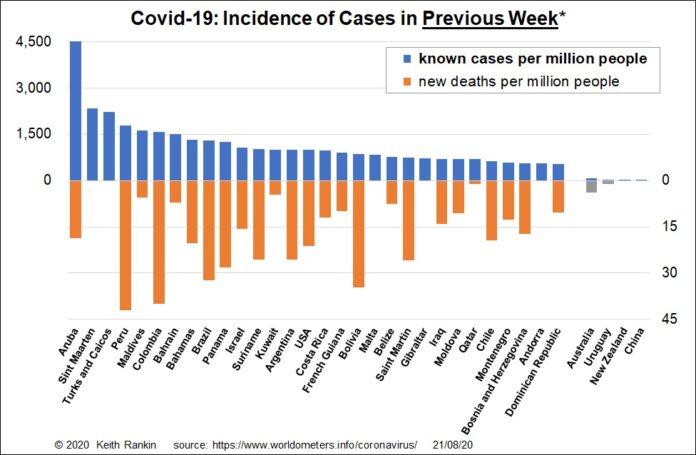
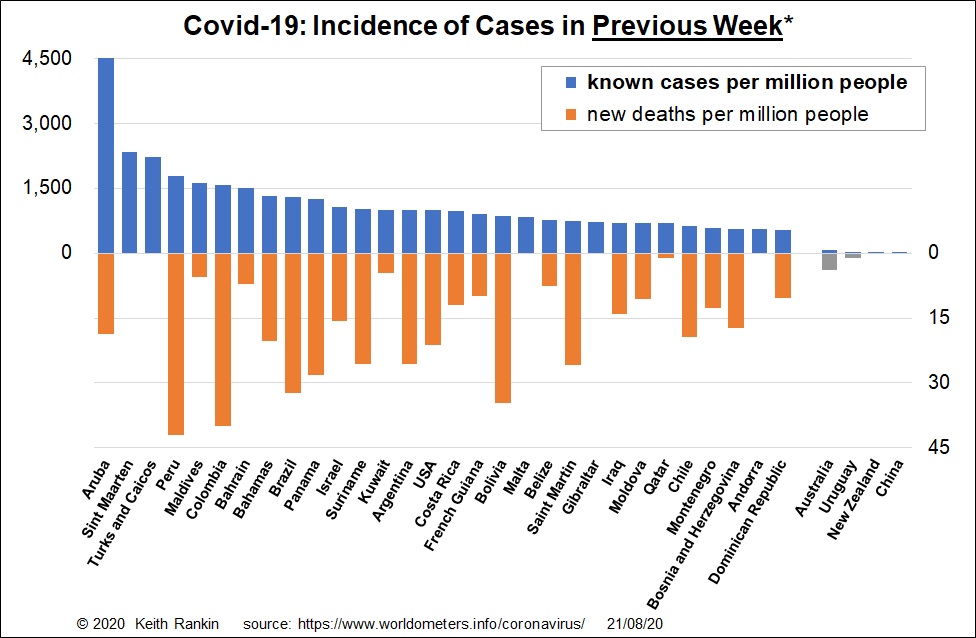
This week’s chart shows the most current Covid19 outbreaks, including all the little countries. As in March 2020, some of these are the worst affected. It also gives lie to the claim that New Zealand is advantaged by being an island country.
In the gold and silver position are Aruba and Sint Maarten, both Caribbean overseas territories of the Netherlands. These two relate to the Netherlands much as the Cook Islands and Niue relate to New Zealand. Sint Maarten and Aruba were one of the worst affected places in the world back in March. Also badly affected then and now(and on my chart) – has been Saint Martin, the French neighbour of Sint Maarten.
Other places of note in this regard – and on the chart – are the nearby Turks and Caicos (a British overseas territory), Suriname, the Bahamas, the Maldives, French Guiana, Gibraltar. The Dominican Republic is possibly the most popular foreign destination for American holidaymakers; made possible after 1966 when the Americans invaded it to prevent it from becoming a second Cuba. And Belize – a former British Caribbean dependency – also has a fast-growing tourist industry.
These are places where Dutch, French, British and American jetsetters take their holidays, and pass on Covid19 to the locals engaged in the hospitality industries. Sint Maarten has more gaming machines per resident than any other country in the world. And the Netherlands (here and here) – like Sweden – has been one country that has not really taken Covid19 seriously. (My May 11 chart of ‘excess deaths’ showed that Netherlands was one of the worst culprits in underreporting Covid19 deaths. Since then, The Economist has undertaken a major analysis of the true impact of Covid19 on mortality.)
Another interesting case is the recent outbreak in Malta, a country in the European Union which had hitherto maintained very low rates of Covid19 despite its proximity to Italy. Again it’s a tourist country, especially in July and August.
Costa Rica is also now showing up; a peaceful country in Central America, with a very different reputation from its neighbours. This very profile also makes it into a ‘politically correct’ tourist destination for first world travellers.
We also note that the Arabian Gulf countries continue to have high infection rates.
I finish this chart by showing how Australia, New Zealand and China are much less affected by Covid19 than the big and little guns for whom Covid19 really is a nightmare that refuses to go away. And I note that, within South America, Uruguay – a country that has been often compared to New Zealand – has managed so far to contain Covid19 despite the experience of the rest of its continent.
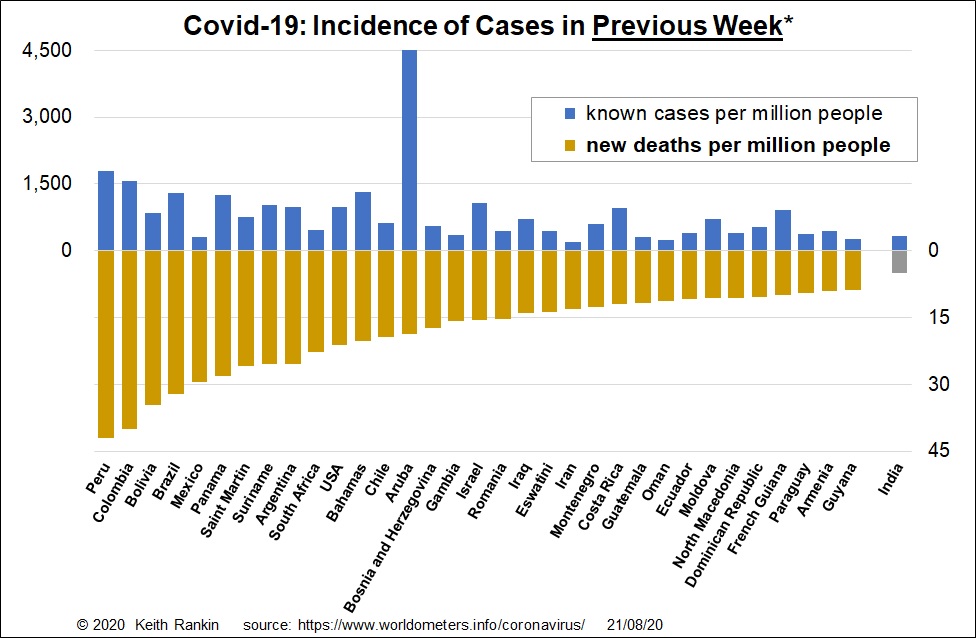
Still Latin America. Chart by Keith Rankin.
Once again, Latin America tops the league table for recent deaths. Peru, Colombia and Bolivia are worse than Brazil. (We may also note – though it is not shown here – that two countries in South America, Peru and Chile, have higher overall death rates than Brazil; this is despite their extensive lockdowns. It seems that Chile’s and Peru’s lockdowns were for nought, because they failed to secure their principal border – the airports of Santiago and Lima.)
The death statistics also highlight the Caribbean tourist destinations mentioned above. And it also shows that small countries in south-eastern Europe (plus Romania, which is not small) continue to be Covid19 hotspots. It is refreshing to see that Greece has never made it onto any of my charts.
India remains well short of the known Covid19 death rates of the worst affected countries. While Covid19 is clearly a huge problem in Maharashtra State (which includes Mumbai) and New Delhi. While it’s likely that death rates are understated by India’s official statistics, so are the death rates in many of the countries shown in the charts. (Just look for the true Mexico City death rate, in the Economist article.; much worse than Rio de Janeiro. Moscow, while not as bad as these two, is also a significant Covid19 deathspot, with much higher excess deaths than its official figures.)
One country which features on both charts is South Africa. Up until June, the successful lockdown there produced a death rate much less than usual for that country. But since the lockdown was released, excess deaths grew exponentially, to an extent much greater than official data show. South Africa – like Chile and Peru – is a country with a failed lockdown. The problem with South Africa – it would seem – is that its testing rates were far too low. Success in containing Covid19 requires quick responses to outbreaks, tight border management, and a high extent of awareness of who has it and who does not. New Zealand knows that it has very high testing capacity, and has very high negative results – ie well over 99% of tests undertaken in New Zealand come out negative.
University of Canberra Professorial Fellow Michelle Grattan and University of Canberra Assistant Professor Caroline Fisher discuss the week in politics.
This week the pair discuss a letter of intent signed by the Australian government to ensure distribution of a possible COVID-19 vaccine, next week’s abnormal parliamentary sitting, and an investigation which is underway by the Chinese government into Australia’s wine industry.
The headlines are grim. Alexei Navalny, a key leader of the Russian opposition, is currently fighting for his life in a coma after allegedly being poisoned in Siberia.
A medical team from Germany is en route to the hospital today to transport Navalny to Berlin for treatment.
Navalny, who has been the victim of numerous attacks over the years, was reportedly asked by a group of supporters in the city of Tomsk a day before he became ill why he wasn’t dead yet. According to one supporter,
He replied that it wouldn’t be beneficial for Putin. That it would lead to him being turned into a hero.
Who is Alexei Navalny?
Navalny is a key leader of the Russian opposition. Just 44 years old, he is a Moscovite lawyer who originally made his name as an anti-corruption blogger.
He then transformed his social media activism into a crowd-funded, anti-corruption organisation — the Anti-Corruption Foundation — that frequently releases slickly produced YouTube videos and reports detailing the high-level corruption in the Russian government.
To support his political movement, Navalny has built a large network of offices around Russia and currently leads the (still unregistered) political party “Russia of the Future.”
But there is little question his views and activism have earned him the attention of the authorities. He has been jailed on administrative charges numerous times and his brother was sent to prison for three years. He also has endured frequent police searches and had green dye thrown on his face, damaging his vision.
In recent months, there has been an escalation in the authorities’ attacks against him. In July, he was forced to announce he would shut down his Anti-Corruption Foundation due to hefty fines.
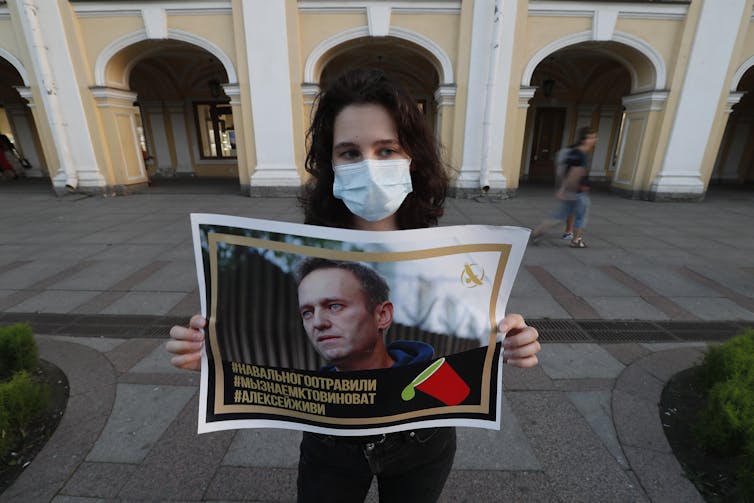
A woman holding a sign saying ‘Navalny was poisoned’ at a protest in St. Petersburg.ANATOLY MALTSEV/EPA
Amid all this activism, however, Navalny’s social media accounts are remarkably light-hearted and normal, often featuring pictures of him spending time with his family or jogging in his local Moscow park.
There is little question, therefore, that he is a key representative of a new generation of Russians who are not afraid to criticise the state and, after almost a century of nightmarish upheavals, want to finally live in a “normal country.”
A key part of this normality is reorienting Russia away from its backward-looking, post-imperial, Cold War posturing to become a forward-looking country focused on building better schools, infrastructure and health care.
The alleged Navalny poisoning takes place at a sensitive time for Putin and the Kremlin. Since the 2018 election, Putin’s popularity has been on the decline, hitting an all-time low of 59% in May, according to an independent polling agency.
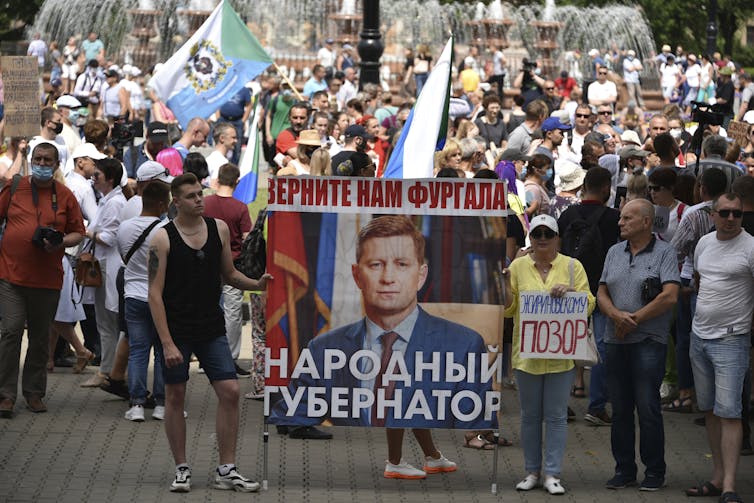
The coronavirus pandemic has accelerated this drop as the virus has exposed the poor health care infrastructure across the country. This “Putin fatigue” has been most recently on show in the Russian Far East, where the Kremlin’s decision to jail the elected governor triggered massive protests just last month.
Thousands have protested against Putin in the Russian Far East city of Khabarovsk in recent weeks.Igor Volkov/AP
The Kremlin has responded to this flagging popularity with a large, stage-managed constitutional amendment process that seeks to renew support for Putin and the regime.
To add to this, a massive protest movement has broken out in neighbouring Belarus — one of Russia’s most stalwart allies — over claims President Alexander Lukashenko rigged the recent election. More than 200,000 people marched last week demanding Lukashenko’s resignation.
This protest movement has galvanised many young Russians, who want similar changes in Russia. It has also likely sparked fear within the Kremlin, where the country’s leaders view mass protest as an existential threat to their control of the Russian political system.
Lukashenko has made urgent calls to Putin to intervene in Belarus’ protests and help keep him in power.Mikhail Klimentyev
Who could have poisoned Navalny?
Given this context, it is not clear who is responsible for the alleged poisoning of Navalny.
If it does turn out to be a poisoning, it certainly fits a larger pattern of suspicious “illnesses” suffered by individuals seen to be a threat to the Russian state.
And there are less well-known examples of suspected domestic poisonings. That same year, a key member of the opposition art group Pussy Riot — Pyotr Verzilov — was also apparently poisoned.
Although making Navalny a martyr certainly does not seem to help the Kremlin at this point, it is also possible the attack involved rogue elements of the Russian security state who were threatened by Navalny’s anti-corruption exposes. As one commentator in the UK put it:
What is more frightening, a state that kills, or a state that can’t control the killers?
If it does turn out to be a poisoning, we are unlikely to ever get definitive answers of who ordered the attack. But it does send a chilling message to those who criticise the current regime. And it is a sad reminder to the next generation of Russians that they do not (yet) live in a “normal country.”
Genome sequencing — mapping the genetic sequences of the virus from confirmed COVID-19 cases in a bid to track its spread — is now an integral part of New Zealand’s coronavirus response. It is providing greater certainty in identifying clusters and helps focus the investigations of contact tracers.
In contrast to the first outbreak, during which only 25 of the more than 1,000 positive samples had been genetically sequenced by mid-April, genome sequencing results are now available overnight, and sometimes even on the same day. This allows health authorities to infer a connection between cases or pinpoint potential sources of infection much more promptly than before.
So far, the technique has confirmed Auckland’s second wave of cases are all part of the same cluster, except for one case identified on Tuesday who contracted the virus via exposure to a returned traveller from the United States.
But despite our rapidly improving knowledge, we still don’t know how and where the current outbreak started.
Genome sequencing proves useful to understand the cluster
There are now 87 confirmed cases in the new Auckland cluster. All are in quarantine, along with some of their close contacts.
The sequencing technology has shown its value in three distinct ways since this new outbreak was confirmed last week.
First, it identified a new case without links to the current community cluster. A maintenance worker at the Rydges Hotel managed isolation facility tested positive on Sunday. By Tuesday, sequencing results showed this case was not part of the wider cluster, but rather that the genetic sequences matched those from a US returnee who had stayed at the Rydges before testing positive and being moved into quarantine.
Without rapid genome sequencing, contact tracers would have spent considerable effort looking for a link to the known cluster. Instead, their work is now focused on finding out how the worker got infected and whether there are any intermediate cases.
Second, genome sequencing has also shown that all other cases so far are part of a single cluster. This was mostly expected based on established physical links, but the genetic confirmation is nevertheless valuable.
Contact tracing casts a broad net. If a known case has visited a school, church or large workplace, many hundreds of people may need to be tested. Genomic evidence can tell us whether any of those contacts who subsequently test positive are indeed part of the same cluster, or whether they were infected elsewhere. When we look back at the first wave of infections, several of the cases that were assigned to the same cluster were shown not to be genetically related after all, showing contact tracing alone is not fail-safe.
Third, there were a few cases for which contact tracing produced only uncertain links between people, but sequencing confirmed they were part of the same cluster.
Looking for a source
So far, genomics has given us a lot of valuable information about New Zealand’s current round of infections. But it hasn’t established the ultimate source of this second-wave outbreak. However, it has yielded some clues.
It indicates the current cluster comes from the so-calledB.1.1.1 lineage, most frequently documented in the UK but more recently found in Europe, Australia and South Africa. This lineage has been seen once before in New Zealand, in a pair of cases in mid-April who were in managed isolation in Auckland.
This points to two possible scenarios. Either the second wave is due to a recent border incursion from a country where this viral lineage has been transmitted. Or, alternatively, it is the result of ongoing transmission in New Zealand starting from the pair identified in April.
Let’s tackle each in turn, starting with the recent border incursion theory.
The virus can be transmitted in managed isolation facilities, as the recent Rydges hotel case underlines. Around 40% of cases found in managed facilities have no available genome sequence because the sample contains too little viral material. This usually indicates a low viral load (and low level of infectiousness), but it does not rule out transmission. The source may be among one of these cases.
Neither can we rule out the possibility that a case in managed isolation or elsewhere at the border was not detected. Even testing twice (currently on days three and 12 of quarantine) is expected to miss at least 4% of cases, based on a false negative rate that is at best 20%. This high false negative rate is one reason to insist on 14 days of isolation.
Next, let’s look at the possibility of ongoing transmission in NZ since the first outbreak. With a close genomic match found, we can’t completely dismiss this possibility. But the theory also depends on some unlikely assumptions: that the infection leaked from managed isolation, was transmitted undetected for about 15 generations until finally being found, and mutated fairly slowly over that period.
This sounds very unlike the virulent, fast-spreading virus we think we know, although it’s also true the initial stages of growth of an outbreak can be slow.
Ideally, we would accurately calculate the likelihood of each scenario. But even so, recent transmission across the border is clearly more likely, given the presence of this strain around the world and the absence of any intermediate cases to link NZ’s first and second waves.
Even trying to determine the country of origin is hard. Many lineages, including B.1.1.1, have a wide global spread. We can understand the extent of the spread using GISAID, the global database in which viral genomes are shared. But with different countries having radically different sequencing efforts (of the 81,000 genomes on GISAID, 35,000 are from the UK alone), finding a link to a country could merely indicate that country has done lots of sequencing. An approach that combines genomic data with data on all international arrivals could be more fruitful.
Whatever the source, we can take heart in New Zealand’s response to this first known community transmission since the original epidemic. New systems to understand the epidemic have swung into action and quickly proved their worth.
Sequencing of viral genomes has become part of the pipeline to aid contact tracing. The resulting sequences will be useful to science well beyond the immediate response, as we seek to develop a deeper understanding of this virus, and epidemics more generally.
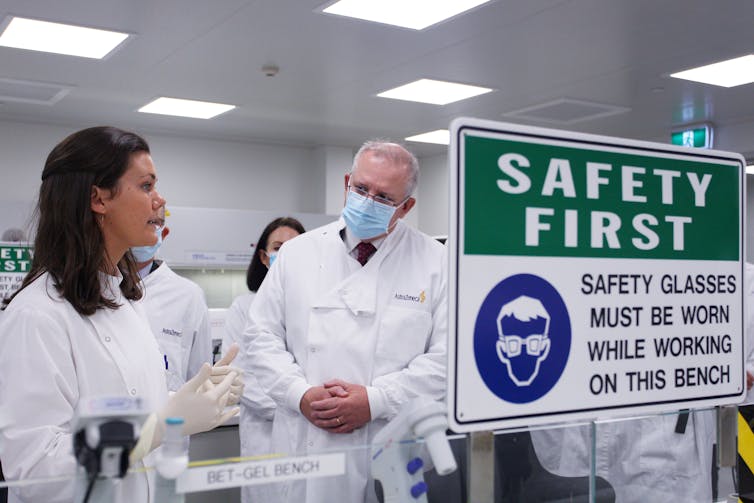
This week, Prime Minister Scott Morrison announced the Australian government has signed an agreement to produce a COVID-19 vaccine under development at the University of Oxford, if safety and efficacy trials are successful.
The announcement generated substantial media interest, and optimism among some people.
But positioning this vaccine as mandatory before it’s even available — let alone proven to be safe and effective — may seriously affect public trust and future vaccine acceptance.
Some people might refuse a COVID-19 vaccine
In April, an Australian study found 14% of adults would reject or were unsure about having a COVID-19 vaccine.
We may need up to 80% vaccine coverage to ensure herd immunity, and some people will likely be ineligible for the vaccine for medical reasons. So this target will be hard to achieve with high levels of refusal.
But these are unprecedented times, and we should expect people to have questions and concerns about these rapidly developed new vaccines. That doesn’t necessarily make them “anti-vaxxers” or science deniers.
Instead of focusing on rates of potential vaccine rejection, public messaging should highlight the much greater levels of public support for vaccines and normalise the expectation people will have concerns.
How can we boost vaccine acceptance?
We need to earn, build and maintain public trust if a COVID-19 vaccine is to be successful.
Beginning now, Australia needs to establish a transparent and coordinated communication effort setting accurate expectations about when the vaccine will be available, priority groups, risks, benefits and supply.
There are five key ways we can do this.
1. Use trusted spokespeople
People who are perceived as competent, objective and fair — like experts in science — should communicate messages around vaccines.
We also trust people who we feel represent us, so it’s critical the government engages with diverse communities to identify appropriate spokespeople like multicultural and religious leaders.
Research also suggests we see communicators who demonstrate genuine empathy as more credible and trustworthy. New Zealand’s largely successful COVID-19 response has been attributed in part to Jacinda Ardern’s empathic and open communication approach.
The person who delivers the message can affect the way we receive it.Lisa Maree Williams/AAP
2. Tailor information
Everyone needs to be able to access and understand messages about COVID-19 vaccination.
This means the language and communication formats used should be tailored for culturally and linguistically diverse groups, Aboriginal and Torres Strait Islander people, people with disabilities or communication difficulties, and any other groups with specific communication needs.
3. Identify, acknowledge, and respond to concerns
We know dismissive or judgemental language is ineffective when communicating with people who are hesitant about vaccination. Public communication about COVID-19 vaccines should be similarly respectful, and should acknowledge the validity of people’s concerns.
The most common vaccine concerns are generally around safety and effectiveness. The speed of vaccine development has been widely emphasised — the US even named its vaccination program Operation Warp Speed.
But this focus on speed can imply testing has been rushed and lead people to perceive the vaccine may be unsafe. Messaging should instead explain the rigour of the safety testing and describe how safety will be monitored once the vaccine is rolled out.
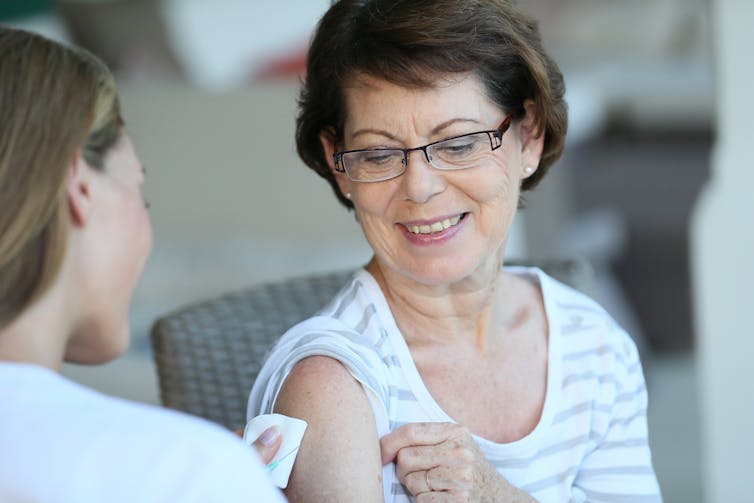
Public health messaging should also accurately describe potential side effects. A COVID-19 vaccine may be likely to cause side effects such as redness or swelling at the injection site, and some flu-like symptoms.
That doesn’t mean the vaccine is unsafe. However, if we don’t prepare people for these side effects, they may feel misled.
4. If you can’t be consistent, be transparent
Experts and spokespeople must transparently communicate what we know about the effectiveness of the vaccine. It’s possible we’ll need more than one dose, and we might need it each year like the flu shot.
Even when the vaccine becomes available, we’ll still most likely need to maintain social distancing, hygiene, and testing and tracing.
Consistency of messaging is hard to maintain in a rapidly evolving pandemic, as we’ve seen from changing evidence around restrictions and masks. To maintain trust in a vaccine, officials should be transparent and explain the evidence informing decisions, and acknowledge this will change as more evidence becomes available.
Communication around vaccination should acknowledge and respond to people’s concerns.Shutterstock
5. Seek feedback and monitor trust
Lastly, to inform communication strategies, we need to seek feedback from the public. Vaccine sentiment will likely change over time, so we should regularly monitor public trust and vaccine acceptance using validated surveys.
It’s too soon to consider making it mandatory
The first priority should be communicating the safety and efficacy of any COVID-19 vaccine. The target groups for the vaccine should be clearly defined, and the vaccine should be freely and easily accessible.
We should only consider mandates and targeted penalties for noncompliance if these conditions have been met, COVID-19 transmission rates remain unacceptably high and voluntary uptake is inadequate.
Transparent communication and community engagement to build trust and achieve vaccine acceptance, coupled with a safe and effective vaccine, will be our best chance to re-establish the way of life we knew before COVID-19.
The headlines are grim. Alexei Navalny, a key leader of the Russian opposition, is currently fighting for his life in a coma after allegedly being poisoned in Siberia.
A medical team from Germany is en route to the hospital today to transport Navalny to Berlin for treatment.
Navalny, who has been the victim of numerous attacks over the years, was reportedly asked by a group of supporters in the city of Tomsk a day before he became ill why he wasn’t dead yet. According to one supporter,
He replied that it wouldn’t be beneficial for Putin. That it would lead to him being turned into a hero.
Who is Alexei Navalny?
Navalny is a key leader of the Russian opposition. Just 44 years old, he is a Moscovite lawyer who originally made his name as an anti-corruption blogger.
He then transformed his social media activism into a crowd-funded, anti-corruption organisation — the Anti-Corruption Foundation — that frequently releases slickly produced YouTube videos and reports detailing the high-level corruption in the Russian government.
To support his political movement, Navalny has built a large network of offices around Russia and currently leads the (still unregistered) political party “Russia of the Future.”
But there is little question his views and activism have earned him the attention of the authorities. He has been jailed on administrative charges numerous times and his brother was sent to prison for three years. He also has endured frequent police searches and had green dye thrown on his face, damaging his vision.
In recent months, there has been an escalation in the authorities’ attacks against him. In July, he was forced to announce he would shut down his Anti-Corruption Foundation due to hefty fines.
A woman holding a sign saying ‘Navalny was poisoned’ at a protest in St. Petersburg.ANATOLY MALTSEV/EPA
Amid all this activism, however, Navalny’s social media accounts are remarkably light-hearted and normal, often featuring pictures of him spending time with his family or jogging in his local Moscow park.
There is little question, therefore, that he is a key representative of a new generation of Russians who are not afraid to criticise the state and, after almost a century of nightmarish upheavals, want to finally live in a “normal country.”
A key part of this normality is reorienting Russia away from its backward-looking, post-imperial, Cold War posturing to become a forward-looking country focused on building better schools, infrastructure and health care.
The alleged Navalny poisoning takes place at a sensitive time for Putin and the Kremlin. Since the 2018 election, Putin’s popularity has been on the decline, hitting an all-time low of 59% in May, according to an independent polling agency.
The coronavirus pandemic has accelerated this drop as the virus has exposed the poor health care infrastructure across the country. This “Putin fatigue” has been most recently on show in the Russian Far East, where the Kremlin’s decision to jail the elected governor triggered massive protests just last month.
Thousands have protested against Putin in the Russian Far East city of Khabarovsk in recent weeks.Igor Volkov/AP
The Kremlin has responded to this flagging popularity with a large, stage-managed constitutional amendment process that seeks to renew support for Putin and the regime.
To add to this, a massive protest movement has broken out in neighbouring Belarus — one of Russia’s most stalwart allies — over claims President Alexander Lukashenko rigged the recent election. More than 200,000 people marched last week demanding Lukashenko’s resignation.
This protest movement has galvanised many young Russians, who want similar changes in Russia. It has also likely sparked fear within the Kremlin, where the country’s leaders view mass protest as an existential threat to their control of the Russian political system.
Lukashenko has made urgent calls to Putin to intervene in Belarus’ protests and help keep him in power.Mikhail Klimentyev
Who could have poisoned Navalny?
Given this context, it is not clear who is responsible for the alleged poisoning of Navalny.
If it does turn out to be a poisoning, it certainly fits a larger pattern of suspicious “illnesses” suffered by individuals seen to be a threat to the Russian state.
And there are less well-known examples of suspected domestic poisonings. That same year, a key member of the opposition art group Pussy Riot — Pyotr Verzilov — was also apparently poisoned.
Although making Navalny a martyr certainly does not seem to help the Kremlin at this point, it is also possible the attack involved rogue elements of the Russian security state who were threatened by Navalny’s anti-corruption exposes. As one commentator in the UK put it:
What is more frightening, a state that kills, or a state that can’t control the killers?
If it does turn out to be a poisoning, we are unlikely to ever get definitive answers of who ordered the attack. But it does send a chilling message to those who criticise the current regime. And it is a sad reminder to the next generation of Russians that they do not (yet) live in a “normal country.”
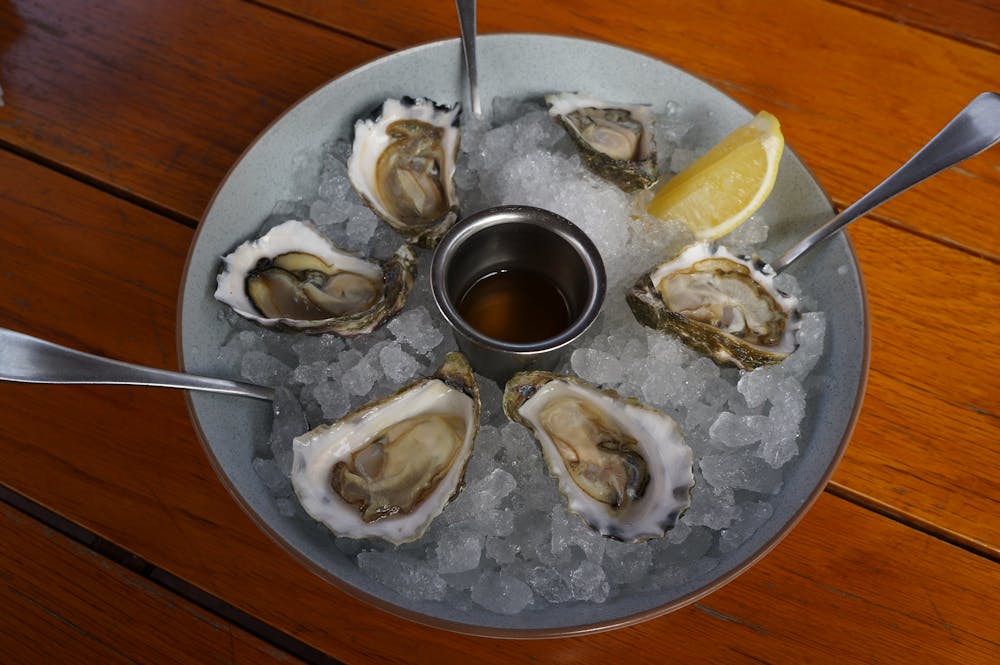
Oysters are filter feeders, extracting nutrients from the water, so that makes them very susceptible to water pollution such as that from bushfires.
We are trying to understand how ash from the 2019-20 bushfires has affected the waterways and oyster farms of New South Wales. Their production is worth more than A$59 million a year.
On the state’s south coast we’re working with oyster farmers as citizen scientists to determine how the ash can lead to harmful algal blooms and oyster deaths.
Over the past two years, farmers have taken more than 9,000 water and oyster samples across 13 estuaries. It’s the largest ever set of water quality and oyster health measurements from oyster-producing estuaries.
This spans the period before, during and after the recent bushfires, providing a unique opportunity to track their impact.
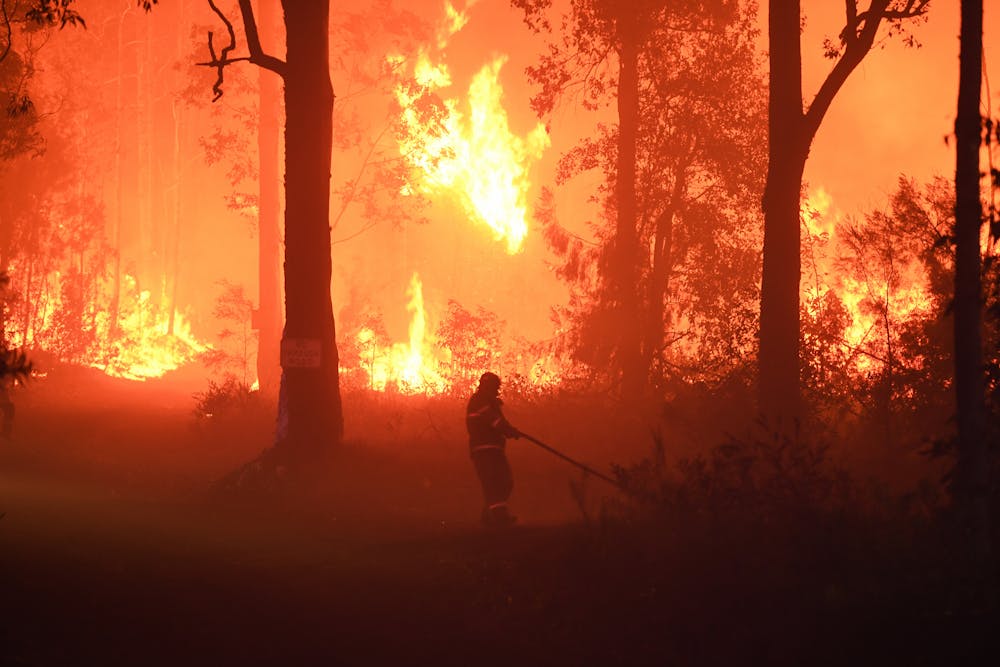
The bushfires leave ash which can pollute the waterways.Dean Lewins/AAP Image
We are still analysing results, but it’s already clear the combination of bushfire ash followed by rainfall led to large increases in microalgae (phytoplankton) in estuaries, including species that can cause harmful algal blooms.
From coast to coast
More than half of the value of Australia’s oyster industry comes from NSW. Along the state’s 2,000km coastline, oyster leases are found in 32 estuaries, north to the Tweed River near the Queensland border and south to Wonboyn Lake near the Victorian border.
Leases are occupied within estuarine ecosystems, with each of these estuaries having a unique climate, catchment condition, area and entrance type.
Some of the NSW farmers are both oyster farmers and Rural Fire Service members, who faced the unenviable task of trying to save both their livelihoods and their homes at the same time during the 2019-20 fire season.
Oysters provide ecosystem services to waterways in which they grow. They shelter invertebrates such as worms, crabs and snails, and they provide natural breakwalls for shoreline protection.
Oysters are used as early-warning biomonitors of waterway health in environmental monitoring programs around the world.
Our new approach to examine the effect of water quality on oyster health is to look at environmental DNA (eDNA). This means we filter water and extract DNA directly from the filtrate. We then use molecular genetic tools to detect and quantify harmful microalgae and bacteria.
The ripple effect: from bushfire to waterway
The recent bushfires were a timely reminder that what happens on land can impact waterways and that coastal regional areas are susceptible.
The NSW government says the 2019-20 bushfires covered 5.4 million hectares, roughly 7% of the state. Nationally, more than 17 million hectares were affected.
Many oyster-growing estuaries were impacted by bushfires in their catchments, especially on the NSW south coast.
While rain this summer gave a reprieve from the fires, it can wash ash into the estuaries, bringing with it excessive nutrients (nitrogen and phosphorus) or trace elements (iron, manganese, arsenic, chromium, aluminium, barium and lead).
These supplements can act as fertilisers, triggering the excessive growth of marine microalgae.
Harmful algal blooms
The growth of some microalgae is essential, but an excess of certain microalgal species (some of which can naturally produce toxins) can result in harmful algal blooms.
A harmful algal bloom in an estuary will trigger the closure of oyster harvesting until oysters are clean. One of the largest and most significant harmful algal blooms impacted the Tasmanian shellfish industry in 2012-13. It resulted in an economic loss of around A$23 million.
Bushfire ash may have a more direct impact, by covering the surface of the water so light, which microalgae need to grow, can’t penetrate. This can cause microalgae to die or grow very slowly.
A mass death of microalgae could then change the amount of oxygen available in the water for the growth of oysters and other marine life. Excessive particulate matter in the waterway can also clog the gills of oysters, affecting their ability to filter feed.
A sustainable food
In Australia, seafood is very safe to eat. Strict monitoring and testing by government regulators have ensured illnesses are extremely rare.
Government regulators are active participants in developing new, more streamlined approaches to food safety monitoring. This combination of scientists, government regulators and oyster farmer citizen scientists working together is a model for a healthy and viable future for oyster aquaculture in the face of challenging events.
After all, oysters are regarded as one of the most sustainable forms of animal protein so they need our protection.
A recent study showed that replacing 10% of animal protein with oysters in the diet of the US population would lead to greenhouse gas savings equivalent to taking 11 million cars off the road.
Australia also has a rich heritage of oyster aquaculture. For thousands of year, oysters were a staple food of First Nations people.
The Sydney Rock Oyster is one of the native species that’s been cultivated as a profitable industry in Australia since European habitation.
They’ve been farmed sustainably for more than 150 years. These oysters are still the basis of a profitable industry, which has grown in size over recent years.
We hope the results of our research will ensure the long-term viability of an industry worth millions of dollars to the Australian economy but, just as importantly, helps support many coastal communities.
How do bees make honey? Finn, age 7, Sunshine Coast, Queensland
Hi Finn, that’s a sweet question!
Well, when we talk about “bees”, we’re usually referring to the European honey bee (its scientific name is Apis Mellifera). Humans have been drooling over its honey and taking advantage of its pollination powers for thousands of years.
So how do these insects make honey, you ask? You’ll find the task is one requiring teamwork and organisation.
Busy buzzing bees
You probably already know about the most important ingredient needed to make honey: flowers.
A colony of bees can visit up to 50 million flowers each day, with as many as 60,000 bees in each colony. They’re not called busy bees for nothing!
Honey bees work together as a team to make decisions about where the best flowers are. They communicate with each other using bumps, noises and even dance moves known as the waggle dance.
Some bees do the “waggle dance”.
All bees during their life have different roles, depending on how old they are. To make honey, worker honey bees fly up to 5km searching for flowers and their sweet nectar. Usually, they’ll visit between 50 and 100 flowers per trip.
Nectar is the main ingredient for honey and also the main source of energy for bees. Using a long straw-like tongue called a proboscis, honey bees suck up nectar droplets from the flower’s special nectar-making organ, called the nectary.
When the nectar reaches the bee’s honey stomach, the stomach begins to break down the complex sugars of the nectar into more simple sugars that are less prone to crystallization, or becoming solid. This process is called “inversion”.
Once a worker honey bee returns to the colony, it passes the nectar onto another younger bee called a house bee (between 12-17 days old).
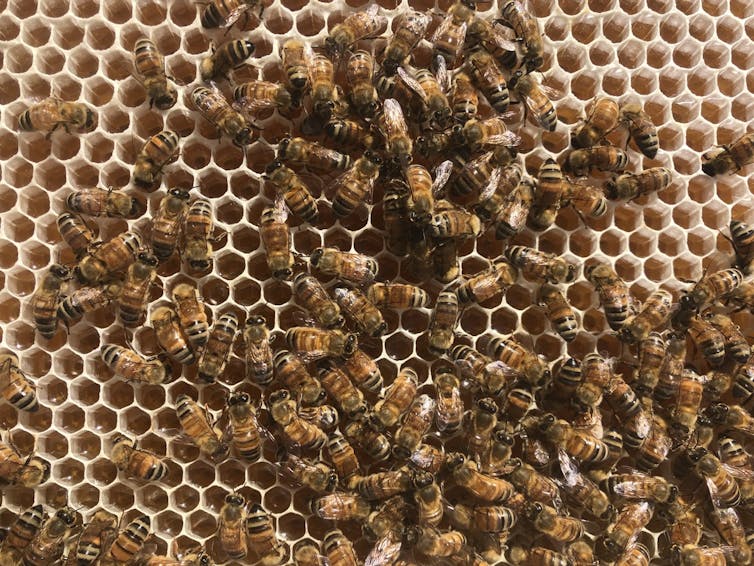
House bees take the nectar inside the colony and pack it away in hexagon-shaped beeswax honey cells. They then turn the nectar into honey by drying it out using a warm breeze made with their wings.
Honey bees filling honey beeswax cells before ‘capping’ the cells.Cooper Schouten/Author provided
Once the honey has dried out, they put a lid over the honey cell using fresh beeswax – kind of like a little honey jar. In the winter, when the flowers have finished blooming and there’s not as much nectar available, the bees can open this lid and share the honey they saved.
Honey: a food fit for all workers, human and bee
Because nectar comes from flowers, there are hundreds of different types of honey with different colours, smells and flavours. Some honey can even be used as medicine.
Also, bees don’t just collect nectar to make honey. When they visit flowers, they also collect pollen – which is a great source of protein to keep them healthy and strong.
Pollen is a kind of powder which flowering plants, trees and grasses make (and must spread) to help more of the same plants grow around them. Pollen can spread in ways such as being blown around by the air, or being carried between two of the same plant by an insect.
So by transferring pollen between flowers, bees also help pollinate flowers. These often turn into the seeds of the fruit and nuts we eat. In fact, about one-third of the food we eat is pollinated by bees.
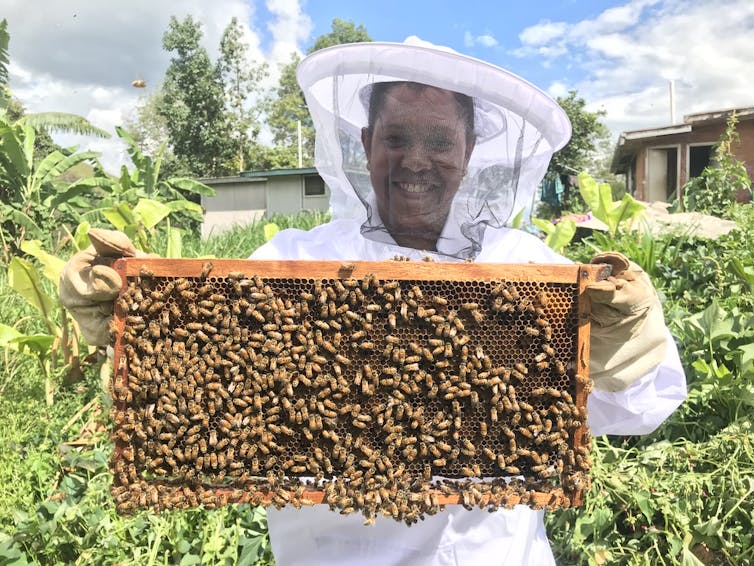
Beekeeping entrepreneur and manager at Highlands Honey, Henao Longgar, holds up a bee-utiful pollen frame covered in bees in the Eastern Highlands of Papua New Guinea.Cooper Schouten/Author provided
Pollinators around the globe
Did you know the yellow fuzzy honey bee is just one of over 20,000 bee species in the world? There are more than 1,700 in Australia alone, some of which can make honey.
Some native stingless bees only found in Australia, such as Tetragonula carbonaria and Austroplebeia australis, produce honey too.
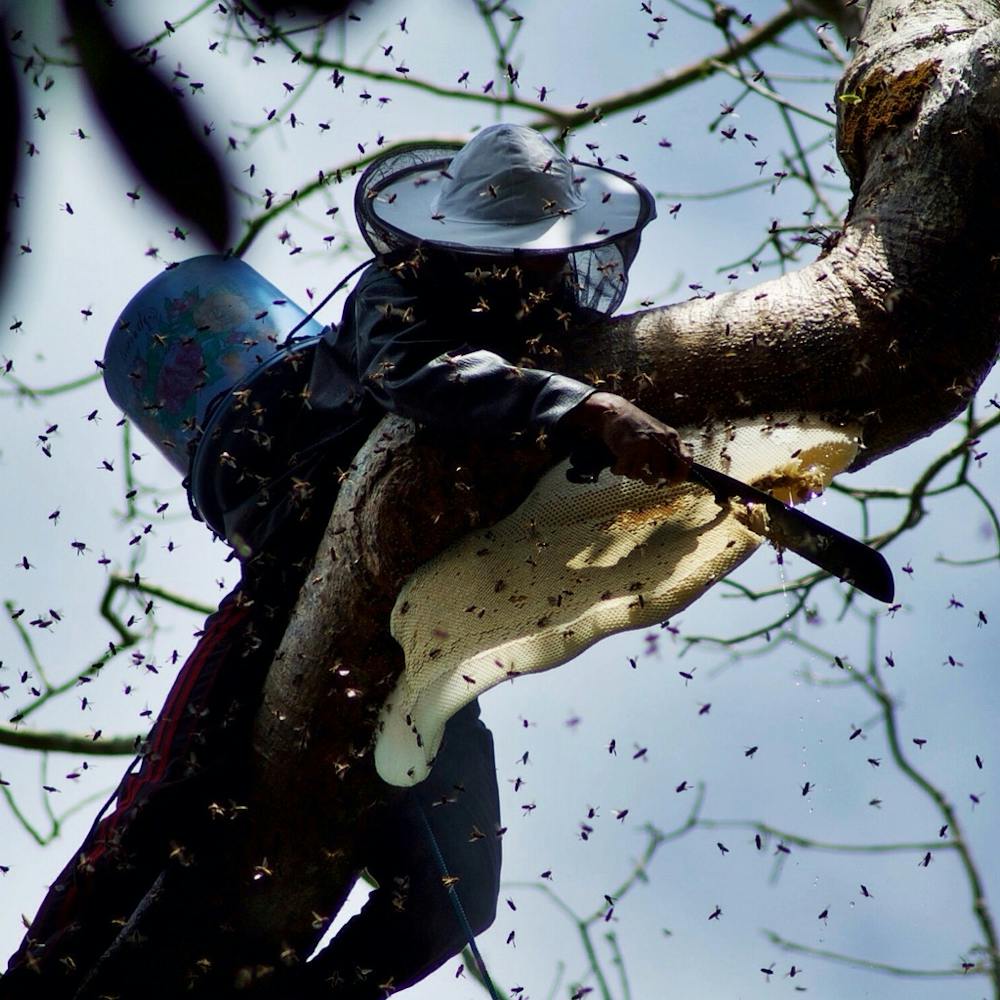
Collecting honey made by giant honey bees in Sumbawa, Indonesia.Cooper Schouten/Author provided
There are also ten other honey bee species overseas, such as the giant honey bee (Apis dorsata) in Nepal and Indonesia, which live at the top of high cliffs and large trees.
There’s also the Eastern honey bee (Apis cerana) which is managed by beekeepers in rural and remote areas throughout Southeast Asia.
There’s never been a better time to put in native flowering plants and stop to smell the flowers. It’s important to remember, just like your puppy or kitten, bees need to be looked after too.
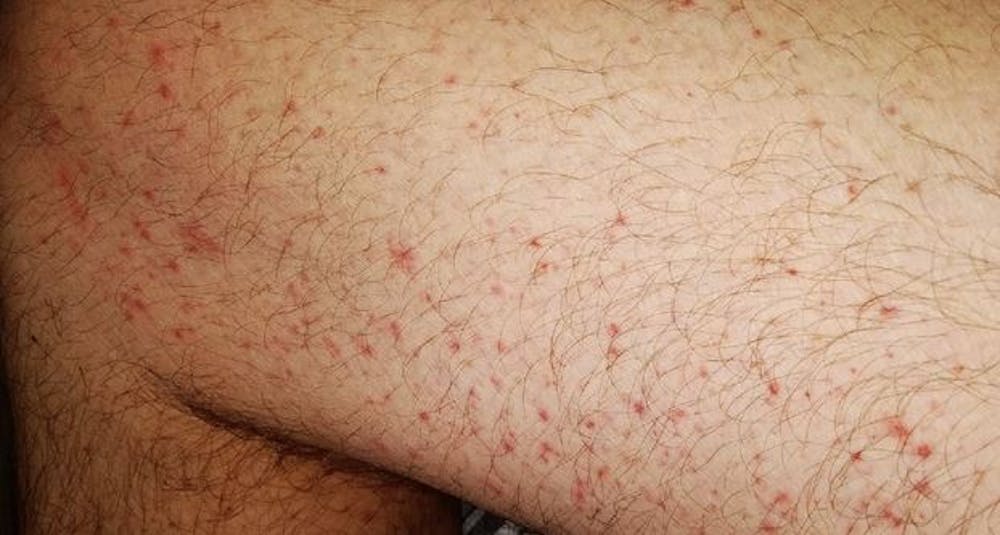
As the pandemic progresses, we’re growing increasingly aware COVID-19 affects multiple parts of the body beyond the lungs. That includes the skin.
We’ve seen reports of skin symptoms ranging from “COVID toes” to hair loss, and different types of rashes.
Some skin symptoms appear soon after infection, while others arise later or in more severe disease. Most get better with time.
Researchers are also beginning to work out what causes these skin conditions, whether it’s the body’s immune response to infection, or whether hormones are involved.
2. redness of the whites of the eyes. This conjunctivitis is most common later in the disease and in more severe disease
3. chilblain-like symptoms, commonly called ‘COVID toes’. These can affect hands or feet, or both at the same time. The red-purple discoloured skin can be painful and itchy, and there are sometimes small blisters or pustules. These chilblain-like lesions often appear late in the disease, after other symptoms, and are most common in children
4. hives or urticaria are pink or red itchy rashes that may appear as blotches or raised red lumps (wheals). They range from the size of a pinhead to a dinner plate. Swellings usually disappear within minutes to hours in one spot, but may come and go. Mostly hives clear within ten days. They occur at the same time as other symptoms, in all ages, and are associated with more severe disease
These water blisters, or vesicular eruptions, are more common in middle-aged people with COVID-19.British Journal of Dermatology
5. water blisters, or vesicular eruptions, are small fluid-filled micro-blisters that may appear early in the disease or at any time, often on the hands. Middle‐aged patients suffer more commonly. The blisters last just over ten days, and are associated with medium-severity disease
6. ‘fishing net-like’ red-blue pattern on the skin, or livedo, sometimes with tiny bruises (purpura), is associated with more severe disease and older age groups. This pattern is thought to be due to blockages of the blood vessels that arise as part of the body’s immune response to the virus
7. rash associated with multisystem inflammatory syndrome in children or MIS-C. This “immune system overdrive” triggers an inflammation of the heart and blood vessels, resulting in blood clots and symptoms of shock. This very rare complication can occur up to three months after a child has had COVID-19
8. hair loss (telogen effluvium) occurs in many severe illnesses, including COVID-19. This is the body shutting down unnecessary activity in times of stress. Provided people’s iron levels are normal, the hair will recover in time
COVID-19 serious enough to take people to hospital also seems to be more common in people with male-pattern baldness. One study found up to 79% of hospital admissions for COVID-19 were balding men.
An increased level of the hormone dihydrotestosterone is thought to increase the numbers of ACE2 receptors, which is how the virus enters the body. In other words, male-pattern baldness may predispose people to more severe disease.
Some of the COVID-19 rashes are not caused by the virus itself, but by the body’s immune response to the virus.
For instance, research suggests some may be caused by over-activation of a part of the immune system known as the “complement” response. This leads to the blood vessel damage seen in the chilblain-type symptoms (point 3 above) and in livedo (point 6).
Complement activity is also increased in elderly people and may well explain many of the more serious COVID-19 outcomes we see in this age group.
How do I know if my skin rash is COVID-19?
If you’re concerned about any skin symptoms, check them against the photos in this article. Then you can consult your GP or dermatologist via a telehealth appointment for further advice.
You might be infectious. Get tested and self-isolate until you receive your test results. If you feel unwell, your GP or COVID clinic will be able to coordinate your care.
New Zealand has today reported nine new cases of covid-19 in the community and two in the country’s managed isolation and quarantine facilities while Prime Minister Jacinda Ardern has warned the nation against “vilifying those who have caught the virus”.
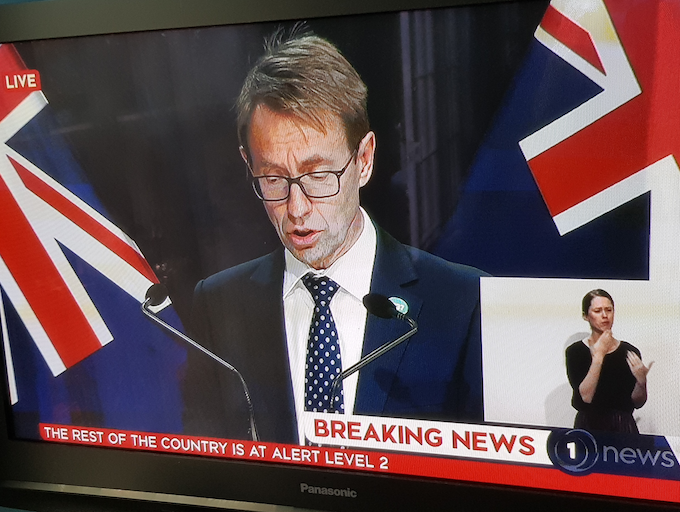
Director-General of Health Ashley Bloomfield said there were eight people in hospital due to covid-19 – two in Auckland City, one in North Shore Hospital and five in Middlemore Hospital, including one in an intensive care unit (ICU).
An additional person in Waikato Hospital was hospitalised but not as a direct result of covid, Dr Bloomfield said.
Dr Bloomfield also confirmed that the St Lukes case had now been linked to larger cluster through genome tracing, and that the person may have been on the same bus with another case.
The possibility that the Rydges hotel maintenance worker caught the coronavirus from the lift was still being investigated.
One of the new imported cases is a female in her 30s who travelled from London via Hong Kong and arrived in NZ on 15 August, before becoming unwell on August 19.
The second is a male in his 50s who returned from Basrah via Dubai and Sydney between August 6 and 17. Both cases have been transferred to isolation facilities.
Church related Of the nine new community cases, five were related to different churches in South Auckland and four were household contacts.
Dr Bloomfield said 88 of the 89 cases in the community are linked to the cluster and one is under investigation.
Today’s covid media conference. Video: RNZ News
Dr Bloomfield said there were 223 contacts from churches linked to the main cluster in this country – 170 tested, and further tracing would continue.
There were now 143 people linked to community cluster in quarantine, with positive tests. There were not a total of 1315 confirmed cases, including 105 active cases and 16 in managed isolation.
Dr Bloomfield said surge testing of border workers was nearly done – further testing in Auckland will start next week and then regular testing will begin.
Director-General of Health Dr Ashley Bloomfield … surge testing of border workers is nearly done. Image: PMC screenshot
Vilifying ‘dangerous’ Cabinet met this morning to review the settings for the alert level restrictions throughout the country and Prime Minister Jacinda Ardern said it will meet to decide the next steps in the plan – and the alert levels for Auckland and rest of country – on Monday.
Ardern said the range of the cluster had been identified and New Zealand was not dealing with multiple outbreaks – the majority of cases had already been contacted traced and put in isolation.
She said the country was getting in front of the virus.
The Prime Minister began her comments at today’s press conference by thanking those who had been tested.
“We would not have got in front of this cluster without them.
“Vilifying those who have caught the virus, or those who helped keep us safe by getting tested is something that I simply will not tolerate,” she said.
“It is those who shame others, those who seek to blame – they are the dangerous ones.
“They are the ones who cause people to hesitate before getting a test, they are the ones who make people feel afraid.”
She said New Zealanders needed to stick together, supporting each other and acting responsibly to defeat covid-19.
This article is republished by the Pacific Media Centre under a partnership agreement with RNZ.
If you havesymptomsof the coronavirus, call the NZ Covid-19 Healthline on 0800 358 5453 (+64 9 358 5453 for international SIMs) or call your GP – don’t show up at a medical centre.
China didn’t feature prominently in Prime Minister Scott Morrison’s speech last month to announce Australia’s $270 billion defence update, but it was clear this was the country on everyone’s minds.
We have become very China-centric in our strategic thinking in Australia — and this could be to our detriment. Beijing’s deepening defence ties with Russia remain a blind spot in our public debate that we need to start paying attention to.
China and Russia, once unlikely partners, have grown much closer in recent years, especially when it comes to security and defence. The two countries are closer now than at any point since late 1940s-early ‘50s.
Still, instead of taking a serious look at this publicly described “comprehensive strategic partnership” between Russia and China, we largely play down what unites these two major nuclear powers and the world’s most potent militaries outside the Unites States.
Troubled relations in the past
China and the Soviet Union (now Russia) didn’t used to be so close. In 1969, ideological and political tensions between the countries led to limited but violent border clashes.
Though both run by communist governments, China and the Soviet Union continued to view one another with mistrust and hostility until the mid-1980s, when they engaged in a gradual deescalation of tensions.
Following the downfall of the USSR in the 1990s, the two former rivals began to look for ways to partner in a common strategic agenda — namely to challenge US dominance in international affairs.
Not a renewed love affair but a closeness of convenience
Relations today are remarkably different from the 1960s-70s, largely because of the converging agendas of presidents Vladimir Putin and Xi Jinping.
Last June, Putin and Xi declared a “new starting point” in bilateral relations during a state visit by the Chinese leader to Moscow.
According to the Chinese state media, the leaders agreed to upgrade relations to a “comprehensive strategic partnership” — diplomatic speak for much closer friends, but not yet allies. And Xi remarked that the China-Russia relationship is “at its best in history”.
Xi Jinping followed his visit to Russia last June by attending a conference in Tajikistan with Putin.ALEXEI DRUZHININ / SPUTNIK / KREMLIN POOL
Then, in September, Russian and Chinese defence ministers announced a new defence agreement between the two powers.
Russia and China now appear poised to transform their partnership into something that looks more like an almost fully developed strategic alliance.
This closeness is based on some key mutual interests:
their shared geopolitical and military interests (such as offsetting US dominance and challenging the international rules-based order)
securing geopolitical, economic and military dominance over Eurasia, as well as significant influence in northeast and southeast Asia
and increasing rejection of Western liberal values in support of their shared values.
As part of this final point, Xi referenced the second world war in a phone conversation with Putin in May, emphasising that
China and Russia, as the main theatres in Asia and Europe during the war, made tremendous sacrifices for and indelible contributions to its final victory, thus saving humankind from demise.
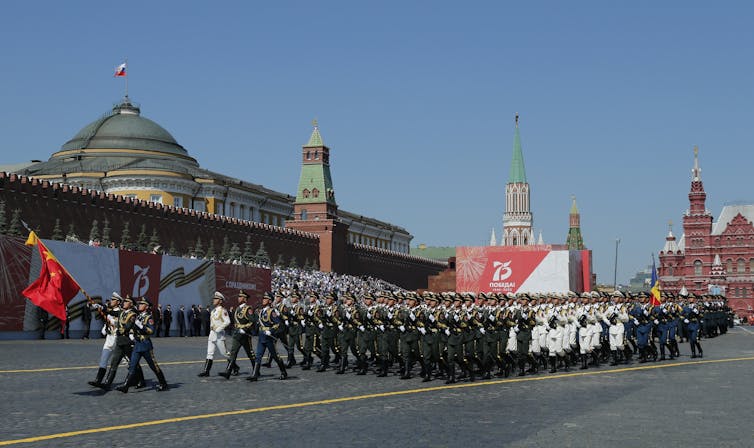
It came as no surprise that a month later, the honour guards of the People’s Liberation Army marched in Red Square as part of grand celebrations to mark the 75th anniversary of Soviet victory over Germany.
The event was heavy on symbolism — yet another way for the two rivals to signal their growing closeness.
But according to China’s state-run Global Times, there was another objective: it was a way for Russia to show off its latest military hardware to a potential “client”.
Soldiers from China’s People’s Liberation Army march toward Red Square during the Victory Day military parade.Alexander Zemlianichenko/AP
Russian arming and training of the PLA
Indeed, Russia remains a pivotal supplier of core advanced military technologies to the PLA and a major reason for its rapid growth as a modern fighting force — despite the fact China’s share of Russian arms exports declined from 60% in 2005 to around 14% by 2018.
Last October, for example, Putin revealed Russia was assisting China in acquiring an anti-ballistic missile defence warning and detection system.
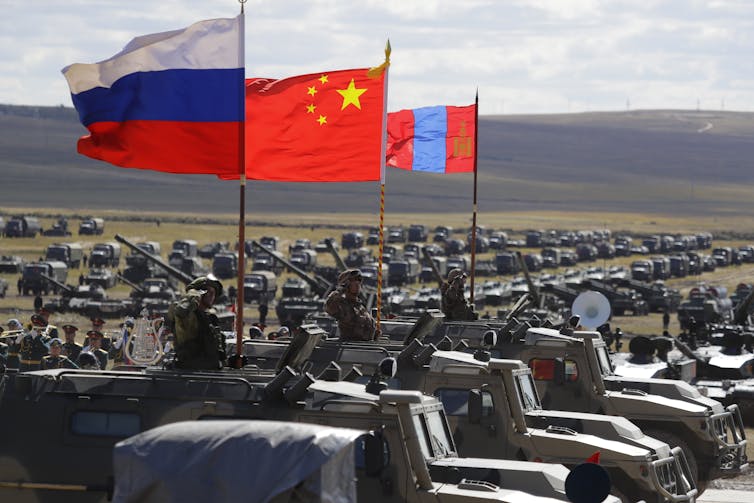
In another sign of their growing closeness, the two militaries have also engaged in two to three war games per year, on average, over the past decade. Some 3,500 Chinese troops took part in Russia’s Vostok-2018 war games in 2018 — the largest exercise Russia has staged in 40 years.
The Vostok war games spanned vast expanses of Siberia, the far East and the Arctic and Pacific oceans.Sergei Grits/AP
And last year, China sent 20 warplanes, including nuclear-capable bombers, to the Tsentr–2019 war games.
Li Zhanshu, a member of China’s Politburo Standing Committee, said at the time,
The US is double deterring China and Russia and attempting to separate us, but we understand their game and will not succumb. We will support each other’s national interests and security.
Despite popular assumptions that Moscow will always be Beijing’s junior partner, the PLA is actually the one that benefits most from these regular joint interactions with the Russian military.
The PLA is currently in the midst of the most ambitious and potentially far-reaching reform in its history. Despite being a massive army, it lacks operational and combat experience, as well as an understanding of how to plan and execute large-scale joint force operations against a technologically advanced adversary.
In this context, the PLA can gain invaluable experience taking part in war games and other joint missions with the Russian military, a battle-hardened force that achieved its own remarkable transformation in recent years.
The current state of strategic intimacy between these two military powers and nuclear-armed neighbours can no longer be ignored. Japan, for one, is clearly paying attention, with its 2020 Defence White Paper warning,
The authorities of both countries clearly denied that they would form a military alliance, but attention should be paid to future developments in light of the recent advancement in their military cooperation.
India, a longtime partner of Russia’s and rival of China’s, is also closely watching the situation. As one commentator put it,
When Russia and China seem to be in a close embrace, New Delhi has no option but to seek closer ties with Washington.
Other experts, however, remain highly critical of any prospects of Russia and China forging an alliance.
This is a mistake. For now, Russia and China find the current status quo practical and convenient, and something they can use to support each other in strategic hedging against the West.
At the same time, the state of “comprehensive strategic partnership” does not preclude Moscow and Beijing from joining forces to respond militarily to mutual threats across the Indo-Pacific and beyond.
Our current debate about future strategic risks needs to consider this evolving reality.
The annual chief executive pay report produced by the Australian Council of Superannuation Investors is a must-read for shareholders and members of superannuation funds.
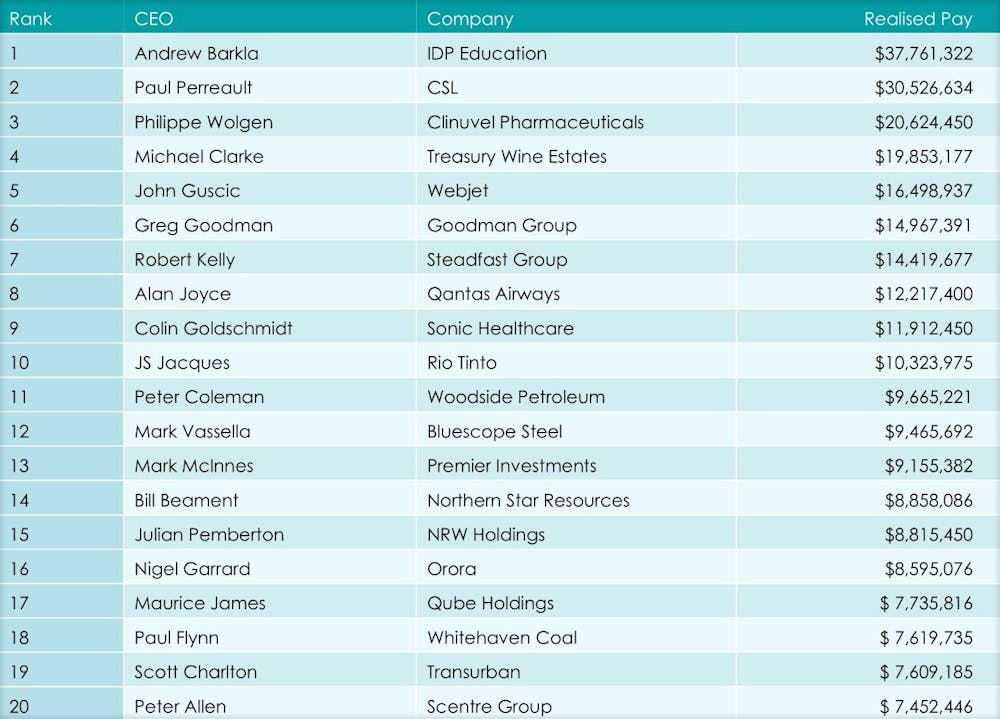
The latest report, relating to the financial year that ended in 2019, reveals a new record for the money actually paid in one year, so-called realised remuneration, of AU$37.7 million.
The extraordinary sum went to Andrew Barkla, the chief executive of a little-known company, IDP Education. He beat the previous record set by the chief executive of Domino’s Pizza Don Meij who took home $36.84 million in 2017.
Paul Perreault from CSL took out second place with realised pay of $30.5 million, followed by Philippe Wolgen from Clinuvel Pharmaceuticals with $20.6 million and Michael Clarke from Treasury Wine Estates with $19.9 million.
Andrew Barkla’s payment was largely the result of the exercise of share options granted prior to the company’s share market listing in 2015.
Long-term incentives that aren’t long-term
Share options are meant to align executives’ interests with shareholder interests.
They are given shares which they won’t be able to sell until the “vesting” date, some years in the future.
How much they get when they sell them depends on the share price when their shares vest, meaning they can boost their payout by maximising the price. One way they can do it is through share buybacks. A company buying back its own shares is ostensibly returning capital. But it is also pushing up its share price, and can do it near to vesting day.
A recent US study points to a surge in buy-backs, and hence share prices, ahead of vesting dates. After vesting dates, share prices tend to fall, perhaps because companies that have bought back shares are left with less money with which to expand and withstand shocks.
This suggests buy-backs serve short-term rather than long-term goals.
Andrew Barkla took home a record $37.7 million.
Regardless of whether or not share prices are ramped up ahead of vesting dates (and there is no suggestion this happened at IDP Education) most long-term incentives aren’t long-term at all.
A typical “long-term” incentive for a chief executive lasts three years, whereas super funds and many other investors have longer 10-20 year horizons.
The time-limited nature of “long-term” incentives might explain why firms fail to come to grips with climate change and other long-term threats.
Why would you, as chief executive, make investments that will make sense over 10 to 20 years, when you are only paid to consider three years?
Andrew Barkla’s case is instructive.
He was paid $37.7 million for outstanding performance up to the middle of 2019, before the pandemic hit. His firm’s share price peaked at $24.60 in February this year and now sits at $19.25, a fall of 22%.
The risks inherent in its business model have become clear in a way they weren’t when he received the payout.
There’s hope
The Australian Council of Superannuation Investors represents institutional investors including super funds. Between them they own an average of 10% of each company on the ASX200.
They have has been campaigning for greater accountability to stop poor performing executives receiving high bonuses when they are not deserved.
There are promising signs. Twelve chief executives in the Australian Securities Exchange’s top 100 companies received zero bonuses in the 2019 financial year, compared to only one in 2018.
North Fly MP James Donald yesterday made an appearance in Papua New Guinea’s Waigani Committal Court to face cyber crime charges for allegedly publishing defamatory materials against a lawyer and the management team of OK Tedi River Development Foundation.
Magistrate Garry Unjo, reading the MP’s charges, said Donald, from Gasuke village in North Fly district in Western Province, had allegedly published defamatory materials against Young and Williams principal lawyer Greg Sheppard and Ok Tedi River Development Foundation (OTRDL) chairman Steven Bagari, and Samson Jubi.
Donald was charged with a count each of attempting to pervert the court of justice, and publishing defamatory materials.
Police alleged that Donald had posted a false and misleading defamatory article titled “Where is the money?” on his personal Facebook page on July 26, alleging that Sheppard and Bagari had misappropriated more than K250 million ($110 million) in funds that belonged to the Ok Tedi landowners.
Other articles also signed and approved for release by him were allegedly published in the two daily newspapers, the PNG Post-Courier and The National.
According to the police summary of facts, Donald had allegedly posted defamatory materials against Sheppard, Bagari and Jubi intentionally to tarnish the reputation of the three men without factual evidence to support his claims on Facebook.
Police further alleged that Donald’s defamatory publications were made despite him knowing there was a writ of summons, filed by Young and Williams Lawyers on behalf of OTFRDL in the High Court of Singapore (HC/S628/2020 between OTFRDL and others, Vs James Donald).
His alleged accomplice, Phillip Baindridge, is the chairman of PNG Sustainable Development Progamme (PNGSDP).
The summons sought to retrieve funds worth more than K250 million (NZ$110 million) back to PNG and put into the control of foundation and the people affected.
Trevor Wahuneis a University of Papua New Guinea journalism graduate and reporter on the OPNG Post-Courier.
Papua New Guinea has reported its fourth covid-19 death with infection cases now reaching 361, reports NBC News.
National Coordination Centre (NCC) Incident Manager Dr Daoni Esorom told a media briefing yesterday of the case of a 72-year old male who had tested positive on August 12 and died two days later.
Dr Esorom said, the deceased was admitted at the Port Moresby General Hospital and had respiratory distress coupled with other illnesses like diabetes among others.
“Severe respiratory distress is a common or a very severe symptom of patients who have covid-19.
He was tested positive on Gene-Xpert at the Port Moresby General Hospital. He also had a history of diabetes and hypertension.
The patient was ventilated and incubated at the same time, and immediately as soon as the results came out, relayed and contact tracing done. He lived around the Boroko area, Dr Esorom said.
Meanwhile, the country’s covid-19 cases now stand at 361 – 198 of them are recovered cases and 163 are active.
Dr Esorom said these cases were from 11 provinces out of the 21 provinces, including the Autonomous Region of Bougainville.
He said the nation’s capital had the highest total with 244 cases as of Thursday, August 20, with Western Province second with 98 cases, most of whom were from the Ok Tedi mining cluster.
Dr Esorom said Central and Morobe had 5 cases each, East New Britain had 2 cases, West Sepik, Eastern Highlands, Southern Highlands, New Ireland, Milne Bay and the Autonomous Region of Bougainville had one case each.
Human faces are arguably the most important things we see. We are quick to detect them in any scene, and they command our attention.
Faces express a wealth of important social information, such as whether another person is angry or scared, which in turn allows us to prepare for fight or flight.
Does this mean facial expressions are universal? It’s a question scientists have debated for half a century, and it remains without a definitive answer.
A new study that asked modern Westerners to judge the facial expressions of sculptures made thousands of years ago in Mesoamerica may shed new light on the question – but it’s far the from the final word on the subject.
Did our facial expressions evolve for survival?
Charles Darwin was the first to propose that facial expressions evolved because they enabled our ancestors to solve particular survival problems. If this is the case, we might expect them to be universal – that is, the same in all cultures and throughout history.
Darwin suggested that a number of basic emotions exist with distinct universal signals – facial expressions – that are recognised and generated across cultures.
Facial expressions are produced by coordinated contraction of muscle groups. For instance, activation of the zygomaticus major muscle elevates the lips to form a smile. The corrugator supercilii muscle knits the eyebrow to produce a frown.
Charles Darwin believed the facial expressions that correspond to some basic emotions may be the same in all cultures.Shutterstock
To date, the question of the universality of facial expressions has been investigated by using observers across different present-day cultures. The usual test is to match posed facial expressions to six basic emotions (anger, disgust, fear, happiness, sadness and surprise).
People across cultures tend to label the expressions (using equivalent terms in their own language) with the same emotion. The accuracy is not perfect, but it’s better than random.
The most convincing evidence that expressions are universal has come from research by Paul Ekman with preliterate cultures, such as the Fore people of Papua New Guinea.
The Fore could label these basic emotions much as we do, though they did not discriminate between surprise and fear in the same way as Western researchers. They also generated facial expressions that were well recognised by other cultures. This research suggests the capacity to generate and recognise these basic emotions was not attributable to Western influence.
However, there is also evidence to show we recognise expressions more accurately in members of our own culture.
Research showing cultural differences in the expression and recognition of emotions has suggested that facial expressions may not be universal after all. Critics have suggested research on universality often uses methods that may inflate the accuracy of results.
Ancient statues may show expressions transcend time
Now, Alan Cowen and Dacher Keltner have published research in Scientific Advances showing a new way to explore evidence for the universality of facial expressions.
Instead of modern photos, the researchers used facial expressions from ancient sculptures from the Americas dating back to 1500 BCE. Since there is no way these artistic portrayals could be linked to Western culture, they may provide more evidence for universality.
The authors hunted through thousands of Mesoamerican artefacts from reputable museums to find genuine works that showed faces of people in recognisable contexts, such as holding a baby.
They identified 63 suitable artworks across eight different contexts (being held captive, being tortured, carrying a heavy object, embracing someone, holding a baby, in a fighting stance, playing a ball sport, and playing music).
A group of 325 Western participants then rated the 63 artworks on 30 emotion categories such as anger and sadness, as well as 13 broader emotional dimensions, such as valence (the degree of pleasantness), and arousal (level of emotional intensity).
The researchers also collected judgements from a separate group of 114 participants, to determine the emotions that Westerners would expect someone to express in each of the eight contexts, using these same emotion categories and dimensions.
Using a statistical analysis to determine the similarity between the judgements of the facial expressions and expectations of the emotions someone would express in the contexts, the researchers found the artworks conveyed five distinct emotions. These were pain (in the context of torture), determination or strain (in the context of heavy lifting), anger (in the context of combat), elation or joy (in the context of social or familial touch, such as holding a baby) and sadness (in the context of being held captive).
Authenticity, artistic licence, and limited range
Does this mean we can close the book on the question of whether facial expressions are universal? Not quite.
The research has its limitations. First, there are concerns regarding the authenticity of the ancient artworks, although the researchers’ attempted to verify authenticity using conservative criteria.
Second, it’s unclear whether the artistic portrayals are true to the lives and emotional experiences of the people portrayed. That is, the artworks may not provide a direct insight into the emotions of ancient Americans.
Third, the sculptures include some basic emotions (such as anger, happiness and sadness), but not all of the basic emotions that are argued to be universal.
Future research that could expand on the emotions and contexts using a similar approach would provide novel insights and further evidence to understand emotions in history.
While the COVID-19 pandemic is dominating domestic politics and will likely feature prominently in the upcoming Queensland election, there are other issues at play in this weekend’s election in the Northern Territory.
China has long been a politically sensitive issue in the territory. The decision by the NT government to lease the Darwin port to a Chinese company for 99 years remains a sore point for many. It was meant to symbolise Darwin as a “gateway to Asia”, but has been seen by some as China’s “gateway south”, into the territory.
The NT election has focused attention on Chief Minister Michael Gunner’s trade mission to China last October as photographs appeared showing him signing documents with Chinese officials.
His office hasn’t disclosed to the public what they were, but Gunner’s spokesman has denied the government has already signed up to the BRI or any related projects.
The NT Independent has filed a freedom of information request to force the government to release details of any deals it has signed with China, but the newspaper says the government has yet to act on it.
Gunner and the incumbent Port of Darwin member, Paul Kirby, have been quick to remind the electorate that it was not a Labor government that leased the Darwin Port. However, when the chief minister hosted the Chinese ambassador, Cheng Jingye, at a reception in Darwin in October, he described the port deal as a “win” for Australia.
The CLP, meanwhile, says if it wins the election, it would work with the federal government to take advantage of the “economic interests China presents”. This is generally in line with the position advocated by the NT Australia-China Business Council.
The leader of the new Territory Alliance party, Terry Mills, who is a former NT chief minister, also says his party would develop “constructive” relationships with China. He added, however, that the NT’s “most critical infrastructure relationship is with the Commonwealth government.”
Why is Belt and Road so important to China?
China’s domestic politics are vital to understanding the BRI. This is President Xi Jinping’s initiative, enshrined in the Communist Party constitution at its 2017 National Congress. This means it is directly connected to the party’s legitimacy.
The BRI is an evolving, ambiguously-defined network of deals in which China agrees to invest in other countries’ infrastructure development, including roads, rail and ports. The Chinese enterprises involved in the projects can be aligned with local Chinese governments and not necessarily Beijing. But at its centre lies the Communist Party’s ubiquitous power.
Chinese diplomats can chalk up victories at home if they can entice even provincial politicians overseas to sign a memorandum of understanding to join the BRI — even if these are not legally enforceable or economically important.
For instance, when Gunner hosted the Chinese ambassador in October, he described the BRI as a “win-win for China and Australia” and a way to “work together to develop common bonds”.
Securing deeper access to the resources-rich Northern Territory would be seen as a boon within China. Gunner’s speech would have played well domestically, even though the NT is not well known to most Chinese.
Xi Jinping launched BRI shortly after becoming leader in 2013. Last year, Italy became the first Group of Seven country to join.Andrew Medichini/AP
Potential benefits and risks to the NT
The economic impact of COVID-19 has been disastrous for the NT, with its debt set to hit $8.2 billion this financial year. This makes China — and the investment it can bring — alluring.
Indeed, when Gunner was in the southern Chinese cities of Guangzhou and Shenzhen in October, he touted the benefits of doing business in the NT, particularly for companies in information technologies. He said,
We have a lot of raw resources in the NT — lithium, rare earths and vanadium. … We can produce what Shenzhen needs to manufacture.
Chief Minister Michael Gunner (left) announcing a new shipbuilding deal at Darwin Harbour last year.GREGORY ROBERTS/AAP
However, tensions at the federal level between Australia and China have escalated during the pandemic and cannot be ignored. Seeking to clarify the federal government’s stance on the BRI in June, Trade Minister Simon Birmingham said:
In terms of the difference between a national government signing an agreement and a state or territory government signing an agreement – [this] goes to the fundamental premise [that] the Australian government sets Australian foreign policy in our engagement with other nations, and it shouldn’t be outsourced or run by separate … state or territory governments.
While there are potential benefits for the NT when it comes to increased trade with China, there are clearly risks as well.
China has used its trade leverage to impose hefty tariffs on Australian beef and barley exports and, this week, targeted the wine industry. Beijing has also made thinly veiled threats that Chinese students will find it more difficult to study in Australia.
None of this is lost on the NT electorate. These are very persuasive reasons to diversify markets and supply chains.
The lure of Chinese markets and investment remains irresistible to many politicians in the NT and elsewhere. But such opportunities must be met with caution. The BRI is vital to China’s ability to influence international trade, finance and legal frameworks. There are serious concerns that it could also be a trojan horse for military expansion.
Northern Territory voters are well aware that geopolitics hover over their election due to their location. All they can do is demand greater awareness of the risks involved and more transparency from their leaders about any over-reliance on a single market.
In Victoria there are nearly 80 active COVID-19 cases linked to more than 50 disability accommodation sites. At least two people have died.
These don’t sound like big numbers in the context of Victoria’s second wave, and particularly when we compare it to the COVID-19 crisis in residential aged care.
But similarities between residential disability care and aged care — including vulnerable residents and a casualised workforce — give us cause for concern.
Recent experience in Victoria’s aged-care sector shows the potential for the current outbreaks to escalate very quickly.
What is residential disability care?
When we talk about residential disability care, this includes group homes and respite services. Usually these have fewer than six residents.
We’re also talking about larger facilities such as supported residential services. These privately-run services accommodate between ten and 80 residents.
In Victoria, around 6,500 people receive disability accommodation or respite services.
We’ve already seen COVID-19 outbreaks in group homes, respite services and supported residential services in Victoria. One notable example is Hambleton House in the Melbourne suburb of Albert Park, where 15 residents and one staff member tested positive.
The Victorian government recently requested help from the federal government following outbreaks at a number of disability accommodation sites.
An ‘at risk’ group
Australians with disability are at heightened risk during COVID-19 because many have other health conditions (for example, problems breathing, heart disease, diabetes). This makes them more likely to be sicker or die if they become infected.
People with disability are also more likely to be poorer, unemployed and socially isolated, making them more likely to experience poor health outcomes during the pandemic.
People with a physical disability or an intellectual disability can be at higher risk from coronavirus.Shutterstock
Many people with disability, particularly those with complex needs, require personal support, which puts them in close contact with other people. Different workers will come through residential disability-care settings, sometimes moving between multiple homes and services, just as in aged care.
The potential for coronavirus spread is also high because some residents may have difficulties with physical distancing and personal hygiene. They may have trouble understanding public health recommendations and/or have behavioural or sensory issues that make these recommendations hard to follow.
Federal NDIS Minister Stuart Robert has said disability and aged-care settings differ because aged-care settings tend to be larger than disability accommodation, and this is generally true.
But as well as their vulnerable residents, they share many important similarities — including communal living arrangements and a highly mobile, precariously employed workforce.
This is a significant risk factor because casual, low-paid workers have greater incentive to come to work when they’re sick. Recent government moves to provide financial compensation or paid pandemic leave when workers need to take time off to get tested and/or self-isolate are welcome, but came too late.
The disability sector also lacks a “surge workforce” — people skilled in disability support who are able to step in and provide care in the event usual workers become sick. In aged care we’ve seen a lack of appropriate workers during the pandemic lead to neglect.
A lack of planning and preparedness
Since at least April, disability advocates have been warning about the potential for COVID-19 outbreaks in residential disability care. But there’s been little active work to develop preventative strategies or plans to deal with an outbreak.
A national plan has addressed the needs of people with disability in relation to COVID-19, and state and territory governments have also produced their own plans. But these plans don’t include effective strategies specifically for residential disability settings.
Our research found disability support workers feel inadequately prepared in the use of PPE.Shutterstock
Importantly, disability support staff appear to be be inadequately trained and prepared with regards to personal protective equipment (PPE).
We recently surveyed 357 disability support workers from around Australia. More than one-quarter reported cancelling shifts because they feared they might contract coronavirus at work. Not all workers had accessed even basic infection control training, and of those who had, half wanted more.
Even those properly trained to use PPE can’t necessarily access it. Distribution of PPE has been beset with difficulties and the disability workforce hasn’t been a priority.
So the outbreaks we’ve witnessed among residents and support workers in disability accommodation are not particularly surprising. They indicate services, workers and governments weren’t as prepared as they should’ve been to respond to this public health emergency.
What now?
Here’s how we could prevent the current COVID-19 infections in residential disability care in Victoria from becoming more widespread, and avoid the deaths we’ve seen in residential disability services in other countries.
First, we should reduce the number of workers who support people across multiple sites. Some states have banned staff working across multiple aged care sites to minimise contacts. This approach might be more difficult in disability services, but we should encourage it wherever possible within workforce constraints.
The federal government should update current guidelines for disability support workers around PPE and enhance their training in its use.
Where residents are suspected or confirmed to have coronavirus they must be separated from uninfected residents to prevent spread. If the facility they’re in is too small to accommodate this, it may mean moving them to another appropriate location.
Finally, we need urgent action to create surge disability support workforce capacity and trained health staff who can be rapidly deployed to work alongside disability support workers if the situation deteriorates.
Between 115,000 and 11,700 years ago, the Earth would have been almost unrecognisable. Massive ice-sheets covered northern Europe and northern Asia, and about half of North America, and global sea-levels were as much as 130 meters lower than today.
In this period, known as the “last glacial period”, the climate was much cooler and drier than today. It was punctuated by some of the largest and most rapid climate change events in Earth’s recent geological history.
For a long time, scientists have pondered how closely timed these abrupt climate change events were between Greenland and other regions of the world — far beyond the Arctic.
In our research, published today in Science, we’ve shown abrupt climate changes across the Northern Hemisphere and into the southern mid-latitudes occurred simultaneously, within decades of each other, throughout the last glacial period. We’ve also determined exactly when the abrupt changes occurred, much more precisely than before.
This can help us predict how abrupt climate changes might play out in the future.
A series of abrupt climate changes
Scientists can peer into Earth’s climate history through long ice cylinders, called “ice cores”, drilled from the Greenland ice sheet. Changes in the chemical composition of these ice cores reveal that the surrounding atmospheric temperature repeatedly warmed by 8-16℃, and each time within just a few decades.
An ice core. Ancient ice can reveal what the surrounding climate was once like.AAP Image/ACECRC
Each warming event was followed by a more gradual period of cooling. These abrupt warming and cooling events happened more than 25 times throughout the last glacial period, and are known as Dansgaard-Oeschger events. They reflect changes in circulation patterns of the Atlantic Ocean.
While we have records of climate changes from many regions, the relative timing of these changes between Greenland and across the northern hemisphere into the southern sub-tropics is not well understood.
This has been difficult to resolve because we need very precisely dated records to make exact comparisons in timing. Ice cores provide a wealth of information about Dansgaard-Oeschger events. But while they faithfully reproduce the patterns of past climate, they are difficult to date very precisely.
Crystal time capsules beneath our feet
For our study, we turned to more precisely datable climate records: those from cave stalagmites.
Stalagmites are cave mineral deposits, which build up layer-by-layer on the cave floor. Their growth is fed by water dripping from the cave ceiling, which carries with it a chemical signal of temperature and rainfall conditions above the cave at that time. This signal is trapped in the crystal structure of the growing stalagmite.
Stalagmites can be dated very precisely, by measuring the decay of minute amounts of uranium trapped in them. This key feature enables us to compare the timing of climate events from place to place.
Stalagmites hold chemical signals that reveal what the climate above the cave was like thousands of years ago.Shutterstock
However, long, high-quality stalagmite records are rare. Scientists from around the world have been working for more than 20 years to produce these records. Only now that enough records are available, we are able to make precise comparisons of the timing of Dansgaard-Oeschger events between different regions.
We collated and compared 63 published stalagmite records from caves in Asia, Europe and South America, and we determined the timings of abrupt climate changes in each.
What we found
Our results show that during each Dansgaard-Oeschger event, climate changes felt in Asia, South America and Europe occurred within decades of one another. Being able to determine this level of synchrony is remarkable, given we are looking at events that occurred many tens of thousands of years ago.
This means that as large temperature increases were occurring in Greenland, abrupt changes were also occurring in air temperature and rainfall in Europe, and in the monsoon systems in Asia and South America.
So why is this important? First of all, finding that climate change events occurred in lots of different parts of the world within decades provides clues as to how they started in the first place.
It tells us the changes were likely propagated from the North Atlantic region to these locations through the re-organisation of patterns in atmospheric circulation. And knowing this can help scientists narrow down the underlying triggers, which are still not conclusive.
And our findings mean the precise ages from the stalagmites can be used to better date ice cores, enhancing one of the most important records we have of the last glacial climate.
In the last glacial period, vast ice sheets covered much of the world.Shutterstock
Implications for the future
The abrupt climate changes we studied occurred under very different conditions compared to the climate of today.
While our ancestors lived through the last glacial period, humans are unlikely to experience Dansgaard-Oeschger events for many thousands of years, until the earth has again cooled to glacial temperatures.
However, piecing together the puzzle of how abrupt climate changes took place in the past will help us to understand how abrupt climate changes might occur in the future. For example, our findings will help validate climate models used to predict climate changes.
Showing that profound changes in climate can occur simultaneously across large regions of the Earth highlights just how unstable and interconnected our climate system can be.
Students failing at university is not a problem of “extremes”, as federal Education Minister Dan Tehan would have it. A large proportion of students fail units of study. And, surprisingly, our research found about a third do nothing about it. However, students who received targeted help from their university on average halved their failure rate.
The government is right to be concerned about high rates of failure among students who accrue HECS-HELP debt even if they don’t graduate. Its proposed amendments to the Higher Education Support Act mean students who fail half their subjects across two semesters would lose Commonwealth support.
The changes would extend conditions applying to non-university providers to universities. They would also increase the powers of the regulator, the Tertiary Education Quality and Standards Agency (TEQSA), and the Department of Education to enforce those rules.
The question is: will the treatment cure the disease? And is it reasonable in terms of its consequences for universities and their students?
Failure is common
Our large study of the prevalence and reasons for academic failure of undergraduate students at an Australian university found 40% failed at least one unit. These students were four times more likely to drop out. And 58% of those who persisted with their studies failed again.
All universities have procedures to identify students who fail multiple units in a semester or fail the same unit multiple times. These processes would pick up students who fail half their units, especially in their first year.
The question is what happens next? A university would ordinarily develop a plan to support the student to improve their performance. This may include advice to attend the language and learning skills centre, to seek support for mental well-being and/or to reduce study load if possible. Universities differ in how much practical assistance they give students to recover from failure and complete their course.
Targeted help makes a difference
Swinburne University of Technology has a comparatively comprehensive process to support students identified as being at risk. This includes students who have to “show cause” why they should not be excluded from their course.
Highly trained academic development advisers (ADAs) reach out to the students individually. Students are asked to attend a one-on-one session to work through the reasons that led to unit failure and discuss how they will respond to these challenges. They can see the ADA multiple times.
The ADAs also run a facilitated peer support program, called Back on Track, over the semester. It’s aimed at changing behaviour and developing new study habits as well as building a personal support network.
The outcomes of the Back on Track program are impressive. The 213 participants in the second semester of 2019 almost halved their fail rate from the first semester. Some students did not fail any units.
Dropping study load to improve pass rates was an important strategy. Almost half of the cohort did this.
Supporting students after academic failure is resource-intensive because of the numbers involved. The Swinburne ADA team works with about 2,000 students a year. This is in addition to the administrative staff who identify students and the academic staff involved in the “show cause” process.
While Swinburne leads in proactive support of students, all universities have robust processes for dealing with poor academic progress.
Students must learn to help themselves
Offering support is only part of the story. Students must also adapt their behaviour following academic failure. At Swinburne, many “at risk” students don’t engage with the ADA support system.
In our study, we asked students what they did in response to failing. One-third of respondents who had failed but persisted with their study answered: “Nothing”.
A third of students continuing with study after failing units said they did ‘nothing’ in response to their failure.Shutterstock
This is obviously of concern, especially for students who have failed multiple units. Of those who had failed repeatedly but did “nothing”, 43% were international students and 26% were online students. They struggled with exam anxiety and exam situations, especially the international students, and reported problems with workload and time management.
These students had not yet worked out how to help themselves, or where to go for help.
Most students named multiple and compounding reasons for failing, including financial struggles, disability, and care or work responsibilities. These underlying issues cannot be resolved quickly, by students or universities.
Everyone has a role to play
Universities could do more to help students in practical ways to get back on track. Combined use of predictive learning analytics (drawing on multiple data points to identify students at risk) and learning advisers who intervene early is showing promise and could be rolled out across the sector. The government, through the Higher Education Standards Framework, could encourage this.
Reducing study load is an effective strategy but can have negative consequences for Centrelink support and, in many cases, scholarships. The government could help improve pass rates by further relaxing the Centrelink requirement that students must study full-time to receive benefits.
If the debt burden on failing students is the issue, relaxing Centrelink rules so they can reduce study loads and pass would make sense.Shutterstock
The proposed 50% fail rule for Commonwealth-supported places seems an overreaction to some extreme cases. The solution to these extremes could be found in the Commonwealth Higher Education Student Support Number (CHESSN) and a better IT system. The Education Department could then police the issue of students enrolling in multiple courses at multiple institutions behind the scenes.
We know students who fail 50% of their units in a semester are a significant minority. If institutions had to justify to the department why they are not excluding these students, the administrative burden would be substantial.
The more serious concern is what such a process would teach students about their ability to recover from failure and make changes in response to feedback and advice. The proposed policy risks adding stress for students who are already struggling with their life load and is likely to punish those who are already disadvantaged.
First, a grammar quiz. Which of these sentences do you think begins the Eric Carle classic, The Very Hungry Caterpillar?
a) A little egg lay on a leaf in the light of the moon.
b) On a leaf, in the light of the moon, a little egg lay.
c) In the light of the moon, a little egg lay on a leaf.
Grammatically speaking, all three options are correct. But you’ve probably got an opinion on which of these grammatical constructions is best.
Perhaps you chose (a) because you know what is happening in the first few words through the subject (“a little egg”) and its verb (“lay”). Maybe you chose (b) because the prepositional phrases (“on a leaf” and “in the light of the moon”) create an ambient setting before introducing the subject.
The only way to know which one Carle chose to begin the caterpillar’s epic adventure is to open the first page. But I’ll save you the trouble: it’s (c). I’ll let you ponder why Carle might have chosen it.
So, how was this a grammar question?
In each option, the same three parts were arranged in a different order, which creates a different effect. Knowing how these parts function to create the effect is a type of grammatical knowledge. Even if you were unaware of terms like subject or verb, you could probably still make sense of what each does.
A way to make meaning; not a set of rules
Let’s try again. Take a look at the next line in the story and decide which clause best completes the sentence.
One Sunday morning, the warm sun came up and — pop! —
a) out of the egg came a tiny and very hungry caterpillar.
b) a tiny and very hungry caterpillar came out of the egg.
The author of The Very Hungry Caterpillar chose his phrases carefully to express precise meaning.Shutterstock
While option (b) has a more typical structure, the one Carle chose was (a). You might have noticed that the inverted structure in (a) seems to flow more easily from the first clause. But why?
The prepositional phrase (“out of the egg”) first creates an image of something we already know. The directional verb (“came”) shows the movement towards us, the reader, as opposed to away from us (“went”). Finally, after a little pre-modifier for description (“a tiny and very hungry”), we reveal the subject (“the caterpillar”) in all its glory at the end of 21 words of anticipation.
A child with a broad repertoire of grammatical knowledge can skilfully choose how to phrase what they want to say. It is useful to know how adverbial phrases (such as “with its legs”) add specific detail to verbs to show when, where, how, or why (“the caterpillar felt the leaf with its legs”), or how repeated clause structures attract attention to themselves.
This isn’t limited to literature. You’ll see children playing with grammar in unconventional ways when they text. It’s common to see words, letters and punctuation omitted in textese resulting in phrases like “am goin out now c u soon”.
If we want children to use pronouns effectively in their writing, we need to teach them how authors use them for literary effect in texts. Research has shown children learn to apply grammar in their writing carefully and creatively when we teach it in the following ways.
Provide a clear link between a piece of grammatical knowledge and how authors use it to make meaning. So, rather than telling your child to “use more determiners and pronouns”, show them how determiners and pronouns create cohesion between ideas.
For example:
Earth turns on its axis in a full rotation. Each takes 24 hours, and this is what creates day and night.
Each of the bolded words points back to another word (“its” back to “Earth” and “each” back to “rotation”) or phrase (“this” back to “each rotation”) that ties the text together.
This makes the text flow. Imagine how cumbersome and confusing it would be to read a book if words repeated themselves instead of being “pointed” back to.
2. Use examples and make them authentic
Grammar is abstract, so use examples rather than lengthy explanations. The best kind of example is one you find in published literature. Open a book or article and highlight where the grammar exemplifies what you want to teach.
When I want to teach a student to “zoom in” on an object using specific nouns, I open up the first page of Neil Gaiman’s The Graveyard Book, which reads:
There was a hand in the darkness, and it held a knife.
This grammatical construction dehumanises the person whose hand it is, giving agency to the hand. It’s a spooky effect cemented by the final noun — knife.
3. Make room for discussion
Ask your child what they are trying to write. For instance: “What effect are you trying to create here?”
Then use this information to decide what kind of grammar will help them do that. For instance: “Try using the passive voice, like “His eyes were drawn to the fire”, to make the character feel like they’re not in control”.
Ask your child to tell you how they might use it
How could you use the passive voice here to create this effect?“
4. Encourage language play
We saw with our Very Hungry Caterpillar example that playing with parts of sentences helps authors make grammatical choices. Ask your child to experiment by reordering parts or splitting the subject and verb, and then notice what happens. You’ll be surprised by a child’s intuitive grammatical knowledge.
Source: The Conversation (Au and NZ) – By Christine Braid, Professional Learning and Development Facilitator in Literacy Education, Massey University
Meet Otis. He’s eight years old and until recently he didn’t want to read or write. Then his teacher changed the way she taught and things began to improve.
After a few weeks, Otis (not his real name, but he’s a real child) wanted to read and write at every opportunity. With this new-found knowledge and motivation his skill increased too. And his confidence.
So what was different? Technically, Otis’s teacher had begun using what is known as a structured approach to teaching literacy. Essential for children with a literacy learning difficulty such as dyslexia, it has been shown to be beneficial for all children.
The structured approach is a departure from what is known as the “implicit” teaching approach most teachers have used in the classroom. There are now calls for “explicit” instruction to be adopted more generally, including a petition recently presented to the New Zealand Parliament.
New data suggest this is an urgent problem, with growing numbers of young people turning off reading. According to a recent report from the Education Ministry’s chief education science adviser, 52% of 15-year-olds now say they read only if they have to – up from 38% in 2009.
The report made a number of recommendations, including that the ability to “decode” words become a focus in the first years of school. The importance of decoding to literacy success was reiterated by learning disability and dyslexia advocacy group SPELD NZ. It called for a change in teacher training and urgent professional development in structured literacy teaching.
Structured literacy teaching means the knowledge and skills for reading and writing are explicitly taught in a sequence, from simple to more complex. Children learn to decode simple words such as tap, hit, red and fun before they read words with more complex spelling patterns such as down, found or walked.
Learning correct letter formation is a priority. Mastery of these skills builds a strong foundation for reading and writing, without which progress is slow, motivation stalls and achievement suffers.
The simple spelling in structured literacy texts helps children decode the words and build confidence.Author provided
The books children first read in a structured approach employ these restricted spelling patterns. Reading these with his teacher’s help, Otis built on his skills with simple words and progressed to decoding words with advanced spelling patterns.
These structured lessons also allowed him to master letter and sentence formation, so he made progress in writing too.
Old approaches aren’t working
By contrast, an implicit approach to teaching reading essentially means children have lots of opportunities to read and write, and learn along the way with teacher guidance.
Unfortunately, children like Otis can get lost along the way, too.
Implicit reading books use words with a variety of spelling patterns – for example: Mum found a sandal. “Look at the sandal,” said Mum.
When Otis tried to read these books, he looked at the pictures or tried to remember the teacher’s introduction before attempting the words. But he was not building his skills and was getting left behind.
Otis is not alone, and New Zealand’s literacy results support the calls for change. Despite many interventions and the daily hard work of teachers, it is common for schools to report 30% of children with low reading results and 40% with low writing results.
However, a Massey University study in 2019 found reading outcomes improved when teachers were trained in a structured approach. The results were particularly good for children with the lowest results prior to intervention.
Overall, the findings suggest the change in teaching had a positive effect on children’s learning.
An example of how structured literacy is taught in the US; methods vary depending on the country.
Change is already happening
Fortunately for children like Otis, more teachers are now seeking training in a structured approach. One project based on the Massey research involved more than 100 teachers in over 40 schools. Teacher comments suggest the knowledge and training support has helped them change their teaching for the benefit of the whole class.
Further signs of hope include recent Ministry of Education efforts to develop structured approach teaching materials, and the resources now available for teachers on the ministry’s Te Kete Ipurangi support site.
No one pretends change is easy in a complex area such as literacy teaching. But every child like Otis has the right succeed, and every teacher has the right to be supported in their approach to helping Otis and his peers learn.
With courage and effort at every level of the system – not just from classroom teachers – a structured approach to literacy teaching can improve outcomes and have a positive impact that will stay with children for the rest of their lives.
Last week Reserve Bank of Australia Governor Philip Lowe, and his top lieutenants, appeared before the House of Representatives Standing Committee on Economics.
This time-honoured tradition goes roughly as follows.
The governor makes an opening statement that contains nothing not said before in public.
Committee members then take turns trying to trick the governor into agreeing to some policy position those members hold.
Being experienced and smart, the governor politely sidesteps these questions and repeats some version of part of their opening remarks.
For example, Craig Kelly (the Liberal member of the southern Sydney seat of Hughes) asked Lowe the following:
What about the effects on the long-term dynamism of the economy? If I’m at the university now and I’m thinking what my future career would be, if I look at it and I go down the track of the Public Service, I’m not affected economically by something like a pandemic, but if I’m in a small private enterprise it could wipe me out. Doesn’t that tend to tip the balance towards less dynamism in the economy?
Lowe responded with 160 words that said precisely nothing.
Despite this theatre, the governor’s testimony provides a useful opportunity to reflect on exactly where Australia’s policy response to the current economic crisis is up to, and the Reserve Bank’s likely future role.
Lowe reaffirmed what our political leaders – along with the overwhelming majority of the Australian public – agree on: the nation (despite the Victorian quarantine debacle) has pursued the right strategy to COVID-19, investing in the long-term good of the economy by containing the virus, so consumer and business confidence can return.
As Lowe put it:
From the outset there was a very strong sense that we needed to build a bridge to the other side when the virus is contained. As things have turned out, that bridge has had to be longer and stronger than we might have hoped would be necessary. Even so, it has been the right strategy.
COVID19 testing in Melbourne on August 18 2020.James Ross/AAP
There’s not much more monetary policy can do
Lowe reiterated that the rather extraordinary measures taken by the Reserve Bank are essentially all it can do in terms of monetary policy.
It has cut the cash interest rate to an historic low of 25 basis points (0.25%) thereby lowering mortgage rates and corporate borrowing costs. Lowe has said repeatedly he regards this as low as the Reserve Bank should go.
At the same time it is working on keep longer-term interest rates low. Its principle mechanism to do this has been through buying federal and state government three-year bonds. So far it has spent about A$55 billion buying bonds from private holders like banks and hedge funds. It being willing to buy any amount at a given price means the market has to clear at that price. This means governments can find buyers at a low rate of interest.
The Reserve Bank’s policy is to buy enough bonds to keep the yield down at 25 basis points. These lower bond rates help keep debt costs down for governments and private companies, who often borrow on three-year timelines.
The committee’s deputy chair, Andrew Leigh (Labor’s shadow assistant treasurer) asked a smart question about the Reserve Bank also buying longer-term bonds, like ten-year securities. Being able to borrow at low rates locked in for a decade would give companies a great ability to plan and ride out the crisis. This may be something the Reserve Bank considers, but doing so will not constitute a fundamental rethinking of its strategy.
Lowe repeatedly said a negative cash rate wasn’t impossible, but very unlikely.
He also offered a welcome reiteration of eight decades of economic wisdom, beginning with John Maynard Keynes and John Hicks, by clearly rejecting the idea of “modern monetary theory” (MMT).
This theory argues that circumstances mean governments can now issue bonds or even print money with abandon, because there’s little chance of causing inflation. Harvard economics professor Lawrence Summers (among other things a former US Treasury secretary) has equated this to the “voodoo” of 1980s supply-side economics – a valid idea “stretched by fringe economists into ludicrous claims”.
This is what Lowe said:
One monetary policy option that has been the subject of recent discussion is the possibility of the RBA creating money to directly finance government spending — so-called MMT. To some, this offers the possibility of a free lunch. The harsh reality, though, is there’s no free lunch. There’s no magic pudding here and there’s no way of putting aside the government’s budget constraint permanently.
What flows from there not being much more that monetary policy can do?
It means the government needs to do more. Lowe addressed this at the end of his opening statement, noting the priority to boost jobs:
The Reserve Bank will do what it can, with its policy instruments, to support the journey back to full employment. Beyond that, government policies that support people’s incomes, that add to aggregate demand through direct government spending and that make it easier for firms to hire people all have important roles to play.
He then concluded:
As I have said a number of times before, we need to make sure that Australia is a great place for businesses to expand, to invest, to innovate and to hire people.
So governments need to both boost demand (through spending) and reduce imposts on business (through lowering taxes).
The nation’s strong fiscal position going into the pandemic – with net debt just 18% of GDP – and the current opportunity to borrow money very cheaply gives us the “fiscal space” to work on both the demand and supply sides of the economy.
We should, and we must. Even if there is no magic pudding.
Masks have emerged as unlikely fashion heroes as the COVID-19 pandemic has developed. Every conceivable colour and pattern seems to have become available, from facehuggers to Darth Vader to bejewelled bridal numbers.
Many show how brevity and style can combine to protect the wearer, offsetting the fear the sight of a respiratory or surgical mask usually inspires.
Diamonds are a mask’s best friend at the De Beers Diamond International Award in 2000.AP Photo/Naokazu Oinuma
Some, like those produced by not-for-profit enterprises including the Social Studio and Second Stitch, use on-trend fabrics and benefit both the wearer and the makers. Meanwhile, an Israeli jeweller has designed a white gold, diamond-encrusted mask worth US$1.5 million (A$2.1 million).
Yet, masks remain fundamentally unnerving. Mostly intended to either protect or disguise, they are designed to cover all or part of the face. In societies where emotions are read through both eyes and mouth, they can be disorienting.
In many places around the globe, masks have played an important role in conveying style, spirituality and culture for thousands of years. They have been a part of western fashion for centuries. Here are some of the highlights (and lowlights) of masks as fashion items.
“And make our faces vizards to our hearts/Disguising what they are” – Macbeth
One of the most bizarre accessories in 16th-century fashion was the vizard, an oval-shaped mask made from black velvet worn by women to protect their skin whilst travelling.
A woman wearing a vizard, c.1581, France.Wikimedia
In an age where unblemished skin was a sign of gentility, European women took pains to avoid sunburn or significant sun tan. Two holes were cut for the eyes, sometimes fitted with glass, and an indentation was created to accommodate the nose. Disturbingly, they did not always have an opening for the mouth.
To hold the mask in place, wearers gripped a bead or button between their teeth, prohibiting speech. To the contemporary feminist, the mask raises associations with the scold’s bridle: a method of torture and public humiliation for gossiping women and suspected witches.
During the following century, masks continued to be fashionable although the guise of protection gave way to mystique and desire. The small “domino” mask – seen in a 17th century Netherlands example below and still worn by superheroes from Batman to Harley Quinn – covered the eyes and tip of the nose. It was usually made from a strip of black fabric. For warmer months, a lighter veiling could be substituted.
The look for Winter by Wenceslaus Hollar (1643).Rijksmuseum
Venice has long been associated with masks, thanks to its history of carnival and masquerade. Their theatrical nature might lead to an assumption masks were always worn to deceive or seduce. Travellers expecting a masked amoral free-for-all in the early 18th century were surprised at how “innocent” the accessory really was in everyday life.
When worn at a masquerade, masks encouraged “safe” contact between the sexes – bringing them close enough to mingle but maintaining the social distance between strangers that etiquette required. In this scenario, masks also encouraged a kind of egalitarianism by allowing people of disparate social classes to mix – a freedom never allowed in normal social gatherings.
The gnaga mask, with its cat shape, allowed men to dress as women and skirt Venetian homosexuality laws. Venetian prostitutes were at various times prohibited from wearing or required to wear masks in public, yet married women were required to wear masks to the theatre, fostering an association between masks and sex.
Masquerades encouraged contact between the sexes while maintaining acceptable social distance.Unsplash/Llanydd Lloyd, CC BY
Conversely, the infamous Harris’s List of Covent Garden Ladies, published annually between 1757 and 1795, provided a catalogue of prostitutes to hire in London. One entry from 1779 described a woman who …
by her own confession has been a votary to pleasure these thirty years, she wears a substantial mask upon her face, and is rather short.
John Cleland’s controversial 1748 book Memoirs of Fanny Hill describes Louisa, a prostitute, being made “violent love to” by a “gentlemen in a handsome domino” as soon as her own mask was removed.
Charming possibilities
“A mask tells us more than a face”, wrote Oscar Wilde in his 1891 dialogue Intentions, yet by the 19th century the mask as fashion accessory was démodé. Masks were generally only mentioned in newspapers and fashion magazines when referring to fancy dress and masked balls, which still took place in the homes of the wealthy.
“Society is a masked ball”, wrote one American columnist in 1861 mirroring Wilde’s famous quote, “where everyone hides his real character, and reveals it by hiding”.
Although masks were no longer recommended for maintaining a pale complexion, women’s faces were still covered by veiling in certain situations: including, for the first time, weddings. Ironically, one Australian fashion column in 1897 decried the fashion, stating:
Veils are largely responsible for poor complexions … This fine lace mask – for it is nothing else – hinders the circulation … but does far more injury by keeping the face heated.
As if this were not enough, veils blew dust from the street into “open pores” and retained dirt, redistributing it onto the skin every time it was worn.
A precursor to today’s sheet beauty treatments.Shutterstock
Veiling still had some fans, who touted its health and beauty benefits, and connotations of intrigue and excitement. “It suggests such charming possibilities beneath it”, a columnist in The Australasian wrote in 1897.
Fashionable or not, some masks were still worn behind closed doors. Enter the most bizarre masked accessory since the vizard: the toilet mask or “face glove”.
Devised by a Madame Rowley in the 1870s-80s, the rubberised full-face covering was advertised as an:
aid to complexion beauty … treated with some medicated preparation … the effects of the mask when worn at night two or three times in the week are described as marvellous.
The advent of the automobile in the early 20th century brought a whole new fashion range into the public arena. Motorists needed protection from weather, dust and fumes, so accessories had to be practical. For women, protection took the fashionable form of coats and face coverings.
Veils and hoods were wrapped around stylish large hats of the day, and fastened under the chin so that the entire face was safely covered.
Advertisements in the early 1920s describe a “complete face mask” for drivers – ostensibly men as the accessory “buttoned to the cap and [is] equipped with an adjustable eye shield against glaring headlights”.
A design for women in 1907 was described as a “window hood”, which completely engulfed the hat beneath and closed with a drawstring around the neck. It had a gauze “window” for the eyes and another smaller opening at the mouth.
Creations past to present at the Pierre Cardin Museum, Paris.EPA/YOAN VALAT
By the swinging 1960s, the cultural and sartorial landscape couldn’t have been more different – and yet, masks made an unlikely appearance in “space age” fashion championed by designers such as André Courrèges and Pierre Cardin. Metallic mini dresses and one-piece suits were topped with “space helmets” that left an opening for the entire face or eyes.
More commonly adopted were plastic visors worn separately or as part of a hat, sometimes covering forehead to chin and taking on the appearance of a welders’ shield – or indeed, the face shields worn by health workers today.
Plastic fantastic looks of the sixties.
Sunglasses, a kind of mask in their own right, were taken to the extreme by Courrèges with his infamous solid white shades with only a slit for light. Life described this as a “built-in squint” in 1965 – a design that “dangerously narrows the field of vision”.
Discussions during the 1918-19 Spanish flu pandemic around whether masks would be a fad, how long they would be required, and how to create your own at home, seem eerily prescient now.
This darkly comic mask from 1918 demonstrates the same wish for ingenuity and levity that exists today:
The skulls and cross bones embellishment was a joke, rather than standard issue in 1919.State Library of NSW/Flickr
Lebanese fashion designer Eric Ritter has sported a similarly macabre aesthetic. He was already thinking and writing about masks on Instagram in January before coronavirus spread around the world …
In Australia, entertainer Todd McKenney has launched an online marketplace for costume designers to make and sell one-of-a-kind masks directly to the public.
Face masks don’t have to be created by artists, designers or couture fashion houses to make them appealing. But a look through our fashion history shows that ingenuity and humanity have long influenced our face wear – whether for the purposes of allure, space travel or pandemic protection.
Most of us are only starting to realise how grim this Christmas is likely to be. Not only will so many people be without jobs, but lots of usual family get-togethers will be stymied because of restricted travel. An overseas holiday is out of the question. And the virus will still be around potentially to cause sporadic havoc and panic.
Hopefully Victoria will have successfully dealt with its second wave by then, but the situation could remain precarious. Cases will continue to pop up elsewhere. Premiers will probably stay inward-looking. The political blame game, now in full swing, won’t have abated.
As the flowering wattle and blossoms tell us spring is almost here, the summer that follows will be anything but relaxed and comfortable. And for many Australians it will come after they were hit by last summer’s blazes and smoke.
Scott Morrison at the moment is deeply frustrated – by the bleakness, by those state and territory leaders in their fortified fiefdoms (with whom he is negotiating on a piecemeal basis), by the criticism he’s copping over his government’s poor performance in protecting the elderly in residential aged care.
When he finds himself on the back foot, Morrison’s response is to look for a way to jump onto the front one. This week he used as his springboard the announcement that Australia has signed a letter of intent with the company AstraZeneca for a supply of Oxford University’s COVID-19 vaccine, if its trials are successful.
“Today is a day of hope – and Australia needs hope, the world needs hope,” he declared, as he undertook on Wednesday the sort of publicity blitz prime ministers do after a budget.
And hope is what we’re talking about here. Not certainty. The world doesn’t yet have a vaccine, from anywhere.
It has maximum effort to produce one, many trials, encouraging signs – although the pessimists note there has never been a vaccine for this type of virus. Even assuming a vaccine arrives, it might be with limitations. Some people who have flu injections still get the flu.
And if it comes, that could be a considerable while away. Morrison said if the trials were successful “we would hope that this would be made available early next year – if it can be done sooner than that, great”. But experts often have a longer timetable – mid-year or later.
All the same, critics say Australia has been slow to the party, with the United States, the United Kingdom and the European Commission each already having several agreements.
Morrison might expect that if it turns out he has over-egged the vaccine story, people will have forgotten what he said when reality dashes the dream. Anyway, if that happens he, and we as a community, will be in such difficulties his false prophecy will be the least of them.
If the vaccine materialises, the immediate issue will be to triage who gets it first, but a more fundamental one will be to ensure enough people get it.
Morrison says a 95% take-up would be needed for proper community protection (this figure would be lower with a totally effective vaccine). He made it clear he thought that, medical exceptions aside, everyone should have to be jabbed.
“I would expect it to be as mandatory as you can possibly make [it],” he said. As social services minister he brought in the “no jab no pay” policy, which denies certain government payments to those whose children aren’t immunised.
This is sensitive territory. Not only would the vaccine have the anti-vaxxers out in force, but quite a few people would worry about its newness, or have other fears, however unjustified. Remember the controversy about the pretty harmless COVIDSafe app.
Unless it was mandatory, the take-up could be inadequate, with some young people, for example, not bothering – just as a portion of the population persists in not having flu shots.
Pauline Hanson was predictable: “I’m angry. You have no right to say I have to have this vaccination, because I won’t be having it,” she said.
Morrison quickly saw the suggestion of the vaccine being mandatory threatened to play badly (even though we have been living for months with massive degrees of compulsion, and Victoria currently is as close as Australia will ever get to a police state).
By late Wednesday he was becoming exasperated, saying on 2GB: “Can I be really clear to everyone? … It’s not going to be compulsory to have the vaccine. Okay?
“There are no compulsory vaccines in Australia. … I mean, we can’t hold someone down and make them take it.”
The Melbourne Institute’s Taking the Pulse of the Nation survey published on Thursday highlights how acceptance of COVID measures varies, including among particular cohorts of the population, pointing to the importance of building consensus around them.
The August 3-8 wave of the regular survey asked people: “Which mandatory government regulations would you be willing to accept to allow a return to normal activities?” It didn’t ask about vaccination but its findings are relevant for that debate.
In the survey all groups, regardless of age, gender, income, education or politics, were willing to wear masks, self-quarantine if exposed and face capacity restrictions on public transport.
But there was much less acceptance of routine weekly testing, closure of non-essential businesses and contact tracing with mobile phone data. Moreover younger people (under 35) were notably less willing than older people to accept measures such as weekly testing and phone tracing.
Analysing the results, Marco Castillo and Ragan Petrie, from the institute, conclude that if the virus persists, “solutions that balance public safety and the return to normal economic activity may be needed.
“Measures like routine weekly testing and use of mobile phone data for contact tracing can help transition out of the current restrictions and help open the economy.”
But such measures throw up the problem of divided opinion and the challenge of consensus-building, they say.
If we get a vaccine, strong support for it can be expected. But its effectiveness could be undermined by activist opponents, the worried and the “I don’t need it” brigade. Even combined, they might add to only a small proportion. But given the virus’s virulence, they could reduce its community effectiveness.
How to maximise coverage will be a priority for when (or if) there actually is a vaccine, but the government needs to start working hard well beforehand on creating overwhelming backing, allaying fears and countering critics and contrarians.
A federal cabinet minister has lashed out with an extraordinary attack on premiers, declaring Friday’s national cabinet meeting “has become a flashpoint for the future of Australia’s federation”.
Agriculture minister David Littleproud accused premiers of “city centric decisions” and said unless they “commit to work with one another to find workable solutions to state border issues for regional Australians … they risk states becoming irrelevant to modern Australia”.
Alan Joyce, chief executive of Qantas, which on Thursday announced a loss of nearly A$2 billion for the year to June 30, also hit out over the internal borders.
“We don’t have clear guidelines for when the borders will open, when they will close,” he said.
“So we have this situation where there are large numbers of states and territories that have zero cases and they’re not even open to each other.”
Business generally is highly critical that premiers have been digging in behind their closed borders. The tourist industry is being especially hard hit.
Littleproud’s public anger reflects the frustrations of Scott Morrison and other ministers.
While accepting the need for the Victorian border to be shut, the federal government believes the broader closures are unnecessarily holding back the economy’s recovery.
It is also angry at the difficulty of getting specific issues resolved such as transits for agriculture workers and medical cases. Morrison this week has been negotiating with individual states on problems.
The borders will be a major issue at the national cabinet. Morrison has set out principles he wants to see followed when borders are closed – these deal the federal government into the discussion. But the power over their borders is with the state and territory governments.
With elections looming in Queensland and Western Australia, their premiers are convinced their voters prefer closed borders to keep them safe. This has been supported in polls. The Northern Territory, which has strict quarantine arrangements for people from COVID hot spots, goes to the polls on Saturday.
Littleproud said premiers must urgently consult with one another and regional communities to deliver practical resolutions, “and not rely on city centric policy formation forgetting a third of the country’s population and our agricultural production systems.
“While we support evidence-based restrictions to protect human health, ongoing border restrictions on large sections of Queensland, New South Wales, Victoria and South Australia that have no COVID-19 cases are posing major challenges on agricultural supply chains, as well as on the health and welfare of residents,” he said.
He said recent announcements to deal with cross-border issues hadn’t been developed in partnership with regional communities, or didn’t seem “genuine in rectifying the serious impacts on many families, communities, workers and industries.
“What these city centric decisions fail to acknowledge is that modern regional Australia has outgrown state lines, and that many regions share strong economic, social and community links across borders.
“The integrated and connected nature of many regional economies is also exposing the limitations of the states and these border closures are becoming a flashpoint for our federation and the future role and relevance of the states in our nation.
“The inability or unwillingness of our premiers to work with each other to find common-sense and practical solutions to restrictions that they have imposed is becoming a major test of their leadership.
“Premiers must remember that they are not just premiers of capital cities.”
Littleproud said premiers should visit affected border regions and thrash out solutions with local governments, people, businesses and organisations.
National cabinet will also discuss joint federal-state emergency response plans for aged care.
In a new submission to the Royal Commission on Aged Care the Australian Medical Association has called for every residential aged care home in the country to be urgently and comprehensively assessed for its ability to safely care for residents during COVID.
AMA President, Dr Omar Khorshid, said this week, “Aged care was in crisis long before the pandemic started, and the failures of clinical care and clinical governance in aged care homes have simply been amplified by COVID-19”.
He said hundreds of elderly people had died needlessly.
“Last year, the AMA and our colleagues in the nursing profession joined forces to campaign for urgent changes to our aged care system. We said then that care can’t wait.
“Had our calls and recommendations over the past decade been heeded and implemented, we would not be facing the crisis to the extent we are currently seeing in aged care in Victoria”
Source: The Conversation (Au and NZ) – By Richard Eckard, Professor & Director, Primary Industries Climate Challenges Centre, University of Melbourne
The National Farmer’s Federation says Australia needs a tougher policy on climate, today calling on the Morrison government to commit to an economy wide target of net-zero greenhouse gas emission by 2050.
It’s quite reasonable for the farming sector to call for stronger action on climate change. Agriculture is particularly vulnerable to a changing climate, and the sector is on its way to having the technologies to become “carbon neutral”, while maintaining profitability.
A climate-ready and carbon neutral food production sector is vital to the future of Australia’s food security and economy.
Agriculture comprises 51% of Australia’s land use.Shutterstock
Paris Agreement is driving change
Under the 2015 Paris Agreement, 196 countries pledged to reduce their emissions, with the goal of net-zero emissions by 2050. Some 119 of these national commitments include cutting emissions from agriculture, and 61 specifically mentioned livestock emissions.
Emissions from agriculture largely comprise methane (from livestock production), nitrous oxide (from nitrogen in soils) and to a lesser extent, carbon dioxide (from machinery burning fossil fuel, and the use of lime and urea on soils).
In Australia, emissions from the sector have fallen by 10.8% since 1990, partly as a result of drought and an increasingly variable climate affecting agricultural production (for example, wheat production).
But the National Farmers’ Federation wants the sector to grow to more than A$100 billion in farm gate output by 2030 – far higher than the current trajectory of $84 billion. This implies future growth in emissions if mitigation strategies are not deployed.
Farm machinery spreading fertiliser, which is a major source of agriculture emissions.Shutterstock
Runs on the board
Players in Australia’s agriculture sector are already showing how net-zero emissions can be achieved.
Our research has shown two livestock properties in Australia – Talaheni and Jigsaw farms – have also achieved carbon neutral production. In both cases, this was mainly achieved through regeneration of soil and tree carbon on their properties, which effectively draws down an equivalent amount of carbon dioxide from the atmosphere to balance with their farm emissions.
Most of these examples are based on offsetting farm emissions – through buying carbon credits or regenerating soil and tree carbon – rather than direct reductions in emissions such as methane and nitrous oxide.
But significant options are available, or emerging, to reduce emissions of “enteric” methane – the result of fermentation in the foregut of ruminants such as cattle, sheep and goats.
Some Australian wineries have gone carbon neutral.Shutterstock
For example, livestock can be fed dietary supplements high in oils and tannins that restrict the microbes that generate methane in the animal’s stomach. Oil and tannins are also a byproduct of agricultural waste products such as grape marc (the solid waste left after grapes are pressed) and have been found to reduce methane emissions by around 20%.
Other promising technologies are about to enter the market. These include 3-NOP and Asparagopsis, which actively inhibit key enzymes in methane generation. Both technologies may reduce methane by up to 80%.
There are also active research programs exploring ways to breed animals that produce less methane, and raise animals that produce negligible methane later in life.
On farms, nitrous oxide is mainly lost through a process called “denitrification”. This is where bacteria convert soil nitrates into nitrogen gases, which then escape from the soil into the atmosphere. Options to significantly reduce these losses are emerging, including efficient nitrogen fertilisers, and balancing the diets of animals.
There is also significant interest in off-grid renewable energy in the agricultural sector. This is due to the falling price of renewable technology, increased retail prices for electricity and the rising cost to farms of getting connected to the grid.
What’s more, the first hydrogen-powered tractors are now available – meaning the days of diesel and petrol consumption on farms could end.
Renewable energy on farms can be cheaper and easier than grid connection.Yegor Aleyev/TASS/Sipa
More work is needed
In this race towards addressing climate change, we must ensure the integrity of carbon neutral claims. This is where standards or protocols are required.
Australian researchers have recently developed a standard for the red meat sector’s carbon neutral target, captured in simple calculators aligned with the Australian national greenhouse gas inventory. This allow farmers to audit their progress towards carbon neutral production.
Technology has moved a long way from the days when changing the diet of livestock was the only option to reduce farm emissions. However significant research is still required to achieve a 100% carbon neutral agriculture sector – and this requires the Australian government to co-invest with agriculture industries.
And in the long term, we must ensure measures to reduce emissions from farming also meet targets for productivity, biodiversity and climate resilience.
It’s on again. This time it’s Australia’s wine industry that’s under investigation in China for allegedly violating anti-dumping rules.
The investigation has sent shock waves through the wine industry and beyond.
Broadly speaking, anti-dumping rules prohibit producers from selling anything for less than its market value.
The Chinese industry body claims that the market share of Chinese wine has fallen from about 75% to just under 50% over the past four years.
It says this is due to the sale of Australian wine being dumped (sold at less than market prices) in China. It has asked for the imposition of an anti-dumping tariff of 202.70%, which would triple the price at which Australian wine is sold.
In the past financial year, nearly 40% of Australian wine exports (worth AU$1.1 billion) went to China.
The proposed duty would effectively exclude Australian wine from the Chinese market.
This comes after a highly publicised interview in April in which China’s Ambassador to Australia Jingye Cheng said the Chinese public was “frustrated, dismayed and disappointed” at Australia’s stance on a number of issues and might boycott Australian goods and services.
Among those issues was Australia’s call for an investigation into China’s handling of the coronavirus outbreak.
Other irritants include Australia’s criticism of the new Hong Kong security law and its decision to ban China’s Huawei from involvement in Australia’s 5G network.
Anti-dumping investigations turn on highly technical data, often obtainable only through the analysis of confidential business information.
This latest probe can be looked at in two ways:
1. Tit for tat
One is that it is just a tit for tat action following Australian anti-dumping measures against Chinese electric cables, wind towers, glass, A4 copy paper, chemicals, herbicides and aluminium products and steel.
Australia has more anti-dumping measures in place against China than it does against any other country.
Australian anti-dumping and countervailing measures by country, March 2020
The ministry could find Australia’s wine industry is in a particular market situation, a technical term relating to government intervention and subsidies that Australia uses when it imposes anti-dumping duties.
Standing in the way of such action is the presence of Chinese investors in Australian wineries that sell directly to China via their own distribution networks. It would be difficult to design an anti-dumping penalty that didn’t also hit them.
2. Geo Economics
Another possibility is that China is trying to inflict economic pain to send a political message.
Using wine would be a shrewd move. China doesn’t need it for its economic growth. It has the added benefit of upsetting Australia’s powerful agricultural lobby which has the ear of governments.
The latest probe follows sanctions against Australian coal, barley and beef.
The aim might be for the targeted industries, and their workers, to pressure the Australian government to be less confrontational with China.
A related strategy might be to portray Australia in a negative light. China (questionably) claimed that it stopped Australian coal and beef shipments for quality and hygiene reasons. Along with travel warnings, it is a way of turning the sentiment of Chinese citizens against Australia.
It’s hard to know which way to jump
It’s too early to tell whether China is simply expressing its dissatisfaction with Australian anti-dumping actions against it, or whether it is hoping to make Australia more politically malleable.
Each would require a different response.
The anti-dumping investigation might take up to 18 months, as did the investigation into Australian barley which resulted in extra tariffs.
Both countries stand to lose from a protracted battle.
But China can get its coal, barley, beef and wine from elsewhere, although at potentially higher cost or lower quality. It is also trying to diversify its sources of iron ore.
The uncomfortable truth is that Australia’s economy relies on China far more than China’s relies on Australia.
We are now learning, from Covid19, one thing above all else. With epidemics, it is early identification and action that matters. When our Prime Minister, Jacinda Ardern, says that New Zealand’s government approach is to “go hard and go early”, she is only partly correct. What matters is that by going early you may not have to go hard; and that having (and understanding) information both enables early responses to outbreaks, and makes it possible to go no harder than is necessary.
Radio New Zealand ran a story this morning (9:20am) “Is business support shifting away from government elimination goal?”. As is often the case, the headline missed the nuanced point being made by the interviewee, Auckland Chamber of Commerce CEO Michael Barnett. The point being made was that, to avoid repeated hard and disruptive responses to each epidemic outbreak, early and precise action was required – in particular, through smart-testing and smart-confinement.
Smart testing means: symptomatic testing of people whose lives involve significant close contact with other people, sample asymptomatic testing of people who work at or travel through international or quarantine borders, and follow-up genomic testing (for positive cases) and sample antibody testing (serology). This is the information component of a smart-response strategy.
Smart confinement means focussing on restricting the pathogen rather than restricting the people; in the case of Covid19, the pathogen is the coronavirus SARS-Cov2. The major tools here are contact tracing, the temporary mandatory use of face masks in sensitive environments until an outbreak is contained, and the temporary closures of sensitive environments for which mask use is not always possible (such as premises that involve eating or drinking, or singing). The general idea is that speedy containment should minimise the time for which such temporary mandates and closures are required.
With regard to contact tracing, having a smart public health app and a smart public health card are complementary. A public health card (a ‘Covid Card’, kept in the same place as one’s drivers licence or ‘hop card’), which logs offline records of contacts can complement an app that, when deployed, can trigger a notification of a casual contact or a place recently frequented by a possibly infectious person.
Bureaucratic Bungles
There is much chatter this month about the failures of managers to keep critical facilities safe; facilities such as ‘managed isolation and quarantine’ (MIQ), ports of entry into New Zealand, rest homes, and medical facilities.
This is a systemic problem that is due in large part to a tone-deaf management culture which emphasises financial/accounting ‘costs’ over economic costs, and largely underestimates benefits; indeed, economic costs include the foregone benefits of cost-cutting measures. (See RNZ’s Doctors pen warning to Christchurch over DHB, and my Counting the Cost of Government Action and Inaction.)
This management culture in New Zealand goes back to the 1987 Treasure Briefing to government, called ‘Government Management’. (This policy briefing of course reflected management practices that were already fashionable in some other countries.) By and large, all government in New Zealand since 1987 have been responsible for the creation of a bureaucratic culture that overemphasises financial and accounting costs, and deemphasises societal benefits. David Clark was a Minister of Health who epitomised and reinforced this culture.
In practice, it means that if a government asks its officials to implement a policy, but makes some aspects of that policy ‘optional’, then these bureaucrats will choose to save costs by not implementing those parts of the policy, or by implementing a scaled down version of the policy. Further, such managers in charge of stockpiled resources – such as personal protective equipment (PPE) – will be reluctant to deploy or relocate such resources; much as misers who ‘save for a rainy day’ refuse to spend their savings when it rains on the grounds that it might rain even harder tomorrow.
The problem is compounded by management structures, where Ministries act as intermediaries between ministers and operational managers, and where ‘spending ministers’ – such as the Ministers of Health and Education – are intermediaries between their ministries and the Treasury ministers. If the Prime Minister mandates some policy, it has to pass through a whole bureaucratic chain – a chain which may have multiple points of resistance. The chain is from Prime Minister, to Treasury Ministers (who authorise a pot of money, even when there may be no practical reason for capped funding), to spending Minister, to the Ministry, to – in the case of public health – the District Health Boards (DHBs).
DHBs’ managers may interpret and respond to the mandate they receive in different ways, depending on the different extents of culturation present in each institution. A good manager will have heard the mandate from the top, and will question any discrepancies between the spirit and the letter of their instructions. Tone-deaf managers will take their filtered instructions literally, and will try to comply by spending as little money as possible. One result which we are familiar with is the grudging minimalist approach by managers towards upholding the safety of clinical staff.
Economic Principle
The general economic principle that should guide action is that of economic efficiency, which enters public policy as cost-benefit analysis.
The principle is that, if the marginal benefit of a policy action exceeds the marginalcost of that action, then that action should be undertaken (albeit with the possibility that parties who would bear that cost should receive appropriate compensation). By marginal, we mean ‘additional’. For example, in our present context, there may be a proposal to add a restriction to a society which is currently at New Zealand’s epidemic alert Level Two. If the best estimate of the benefit of the additional measure is that it outweighs the (best estimate) cost of that measure, then the measure should be implemented. And if the marginal cost outweighs the marginal benefit, then the additional policy measure should not be implemented.
(This process of analysis also applies to proposals to remove a measure that is currently in force.)
The most difficult part of this process is to produce unbiased estimates of these benefits and costs. And, within that, the difficulty exists in both estimating and discounting long term benefits and costs. By ‘discounting’, we mean weighting immediate benefits and costs against expected future benefits and costs. What matters is that the cost calculus used to make such a policy decision is transparent – publicly available, and able to be challenged. It does not mean that policy action must wait until challenges are exhausted. Rather, the process of challenge is a process of learning, and refinement of the analysis in light of new information.
One way that we can attempt to estimate long run benefits and costs is to evaluate past comparable episodes. The past episode that I find to be interesting here, is that of tuberculosis. We note here that the classic tuberculosis ‘pandemic’ began in the eighteenth century and only ended in the mid-twentieth century with the development of an antibiotic effective in treating the tuberculosis bacteria. (With ongoing global poverty and antibiotic resistance, it has been argued – by Frank Snowden – that the world is already in a second tuberculosis pandemic.)
Pandemics and Society: the Long Term
Yesterday I read They say, ‘learn to live with Covid-19. Here’s what I say back, by scientist Siouxsie Wiles. The most interesting part of Dr Wiles’ article was its discussion of the harmful aspects of Covid19 infection other than the possibility of imminent death. In this regard, Covid19 can be usefully compared with tuberculosis.
In Frank Snowden’s 2019 book Epidemics and Society, the emphasis is on the social causes and social consequences of epidemic diseases. Tuberculosis was a reality of life for two centuries that people had to live with knowing there was no cure. An interesting story – told by Margaret Heffernan in Uncharted, how to Map the Future Together – is one about the history of economic forecasting. The three pioneers of this statistical art – Irving Fisher, Roger Babson and Warren Persons – were all diagnosed with tuberculosis. (Two of these lived beyond the age of 80, and may have been false positives.) It meant that they lived their lives under the cloud of considerable personal uncertainty, and that circumstance most likely contributed to their quests to minimise economic uncertainty.
Until the end of the nineteenth century – when Robert Koch proved that tuberculosis was an infectious disease – the disease had ‘romantic’ connotations. (Indeed, the pale and drawn appearance of women with tuberculosis seems to have been the precursor for the widespread twentieth century preference for skinny models in the fashion industry.) In the ‘Romantic era’, tuberculosis was seen as an inherited condition that particularly affected creative white people (it was called the ‘white plague’). So, while suffering from tuberculosis would usually lead to an early death, there was no stigma attached to it. Tuberculosis escaped the attentions of the ‘sanitary movement’ of the 1830s to 1850s; the movement that attributed most other diseases to ‘filth’. (In fact, tuberculosis existed in poor and non-white communities, but was largely undiagnosed and unnoticed.)
After the 1880s, tuberculosis gradually came to be understood as a contagion – typically but not only passed from person to person – that caused substantial damage (scarring) to a person’s lungs and could also damage other organs. It was revealed to be a ‘tricky’ disease of remissions rather than cure; an ailment that might activate at any time in an infected person’s life, and an ailment that would typically and substantially reduce both quantity and quality of life. It was discovered that fresh air – preferably dry mountain air – and minimal stress could substantially extend tuberculosis remissions. More generally, it came to be understood that people benefited from remission from work. Tuberculosis may have played a large part in the perception from the 1880s to the 1930s that the most important improvements to living standards were increased leisure rather than increased household incomes; in those years productivity growth did not mean economic growth.
These points are very pertinent today, because the bodily damage created by SARS2 (Covid19) and SARS1 may be similar to that created by tuberculosis; ongoing though intermittent, and requiring affected people to lead less stressful and less precarious lives than the lives they might have been anticipating in 2019. We no longer live in a world – as we did in the later decades of the twentieth century – where young adults could believe that they could get infectious diseases with impunity, knowing that their diseases would either self-cure or be cured with drugs such as antibiotics.
Conclusion
Covid19 is taking us – in a way that cannot pass unnoticed (as SARS1 did) – into a new era of changing estimations of long-run costs and benefits. It is a disease that, while survivable for most, is a disease that nobody wants to get. Nevertheless – like tuberculosis in the nineteenth century – a substantial minority of the world’s population will have it, and will have their whole lives physically and psychologically affected by it. At the very least, this experience will modify the future economic choices that most of us make.
Source: The Conversation (Au and NZ) – By Maria O’Sullivan, Senior Lecturer, Faculty of Law, and Deputy Director, Castan Centre for Human Rights Law, Monash University
Prime Minister Scott Morrison took many people by surprise this week when he said a COVID-19 vaccine would be “as mandatory as you could possibly make it”.
Although he later backtracked on the use of the word “mandatory”, he made clear the government is aiming for a 95% vaccination rate in Australia.
There appears to be strong community support for the vaccine, but it is not yet clear there will be enough people willing to take it voluntarily to reach that target. Therefore, it is likely there will have to be some sort of incentive or compulsion by the government to ensure nationwide compliance.
What, then, are the legal limits to compelling people to be vaccinated? There are myriad questions that could be raised, such as:
can workplaces require that workers take the vaccination as a condition of employment?
can airlines require an immunisation certificate to permit people to travel?
should people be able to claim a non-medical exemption, such as a conscientious objection to vaccines or on religious grounds?
This is an important debate we need to have about how to balance the rights of the community versus those of the individual in a public health emergency and how the law should be used to ensure the efficacy of a COVID-19 vaccine.
Can the government mandate vaccinations?
The right to bodily integrity is a fundamental legal principle in Australia. This means a person cannot be subject to medical treatment without consent.
However, there are exceptions to this under state and territory public health laws. For instance, sections 116 and 117 of the Victorian Public Health Act permit public health orders to compel people to undergo a medical examination, testing and treatment without consent if it is required to address a public health issue.
There may be a legal argument here that a vaccination is not “treatment”. But that could be dealt with via an amendment to the legislation.
Can workplaces and businesses require vaccines?
There is a strong case for requiring particular workers (for example, those in aged care facilities) to be subject to mandatory vaccinations. However, many other workplaces in Australia may also require COVID-19 vaccination certificates under Occupational Health and Safety policies.
The legal dynamics here are different to a government-mandated vaccination if it is required as a condition of employment (which is a private law matter).
There is precedent for this: some states and territories have adopted a mandatory vaccination policy for staff working in close contact with patients or infectious materials. In the ACT, for example, all ACT Health staff are subject to an “occupational assessment, screening and vaccination procedure”, which requires them to be immunised against diseases including influenza, diphtheria and hepatitis B.
A potential COVID-19 vaccine has shown positive results during phase one human trials in Adelaide.DAVID MARIUZ/AAP
Similarly, businesses could require an immunisation card to be presented as a condition of entry. This could include airlines requiring proof of vaccination as evidence of “fitness to fly”.
There are more complex legal questions when it comes to requiring vaccines for students to be admitted to schools or universities.
This was hotly debated in those states that introduced a “no jab, no play” mandatory vaccination regime for access to child care services, as well as the federal “no jab, no pay” policy.
Despite differing rules around the country, all states and territories have fairly consistent rates for childhood vaccinations — with a nationwide coverage rate of 91%. Whether the same rate could be reached for a COVID-19 vaccine remains to be seen.
Would this infringe on people’s human rights?
Challenges could be made to any compulsory COVID-19 vaccination policy under the human rights charters in Victoria, Queensland and the ACT, which aim to protect rights such as freedom of expression, thought, conscience, religion and belief.
Here, much will depend on who is requiring the vaccination (a public body or private business) and whether there are punitive measures in place for non-compliance (for example, the use of fines or imprisonment).
If there are punitive measures for non-compliance, these may be deemed as disproportionate by a court — even if it could be argued compulsory vaccines are necessary and reasonable for public health reasons.
The use of compulsory vaccination programs also has specific implications for children’s rights. The UN Convention on the Rights of the Child provides that every child has the right to “the enjoyment of the highest attainable standard of health”.
However, children also have the right to an education. Therefore, punitive measures to compel parents to vaccinate their children against COVID-19, such as keeping them out of school, could violate the core principles of this convention.
Can people argue for a vaccine exemption?
There is no recognised right to conscientious objection to vaccinations under Australian law. Therefore, any person who is not willing to be vaccinated cannot merely argue an “objection” to it.
A religious body, however, may be able to argue a federal compulsory vaccination policy interferes with the freedom of religion protections under the Australian constitution, but that is a complex legal question.
One religious group did successfully claim an exemption to mandatory childhood immunisations — the Christian Scientists. This “conscientious objection” exemption was removed in 2016, but it does provide an example of how such an exemption could be dealt with under the law.
The federal government has invested $5 million in the University of Queensland’s COVID-19 vaccine development.Glenn Hunt/AAP
How to create good law during a crisis
Governments clearly have an obligation to protect the public’s health and welfare and vaccinations are an important means of ensuring this.
But while punitive legal measures such as fines may be effective in compulsory mask usage, they are not necessarily going to be effective when it comes to something much more invasive like a vaccine.
Serious thought must not be given just to what the law can do to achieve a high COVID-19 vaccination rate, but also what good law is. That is, we must pursue measures that will be sufficiently accepted by the community.
Source: The Conversation (Au and NZ) – By Ben Egliston, Postdoctoral research fellow, Digital Media Research Centre, Queensland University of Technology
There has been a clash of clans in mobile gaming, with angry birds Apple, Google and Epic Games in a saga over in-app payments.
Video game developer Epic’s massively popular “battle royale” game Fortnite was removed from Apple’s App Store and the Google Play Store last week.
Android players can still download the game directly via the Epic Games mobile app, but for Apple iOS users the decision means no new downloads. Currently installed versions of the game will still work, but iOS players will be unable to update the game and participate in the next season of Fortnite, beginning on August 27.
The boot from Apple and Google was in response to Epic’s implementation of a direct in-app payment system, designed to circumvent Apple’s and Google’s own payment systems and their 30% fee charged on in-app purchases and app sales. Epic’s move is a clear violation of Apple’s rules for app monetisation.
Epic taking charge
Following Apple’s and Google’s removal of Fortnite from their app stores, Epic filed an antitrust lawsuit against Apple in Californian courts, followed by another against Google.
The game develoepr also launched the hashtag #FreeFortnite and aired an in-game parody of Apple’s famous “1984” ad which, at the time it was released, was Apple’s own response to IBM’s dominance of the computing industry.
Apple’s iconic 1984 ad launching its Macintosh computers.
The parody renders the ad in Fortnite’s graphical style, but retains its original symbolism of oppression and control. Epic, valued at US$17 billion, is attempting to portray itself as Apple did back in 1984: as an underdog facing down a corporate behemoth.
Epic Games’s parody ad appropriated the 1984 Apple commercial, aired on television during the Super Bowl.
What’s at stake in this show of platform power?
The fight escalated this week, with Apple threatening to terminate Epic’s enrolment in the Apple Developer Program should it not resolve its breach of Apple’s policy.
Membership in the program is required for creating and distributing iOS software. Losing its enrolment wouldn’t just affect Epic, or Fortnite, but potentially anyone using Epic’s widely adopted Unreal Engine game development technology.
Considering there are more than a billion users of Android and iOS based mobile devices, these punitive responses (particularly from Apple) are being characterised by many as anti-competitive and monopolistic, including by Epic’s chief executive Tim Sweeney.
In the past, other companies such as Spotify, Microsoft and Amazon have also protested Apple’s 30% fee and strict control over the App Store. But none has so brazenly attacked Apple in the public sphere.
Apple’s and Google’s response to this saga has highlighted the power of big tech platforms. As in the case of app stores, these platforms are enclosed and tightly regulated systems. You must play by the owner’s rules, or you’re expelled.
In this case, Apple and Google know their app stores – where millions of users download their apps – are crucial to the financial success of developers on their platform.
As such they can exert their power over developers, who don’t really have anywhere else to go.
According to Fortnite’s Twitter account, more than 12 million concurrent players got online for an event earlier this year.Shutterstock
Reminiscent of antitrust charges against Microsoft in the 1990s, critics of Apple and Google have described the tech behemoths as anti-competitive monopolies charging an unreasonable 30% transaction fee.
This falls to 15% in the case of subscription-based apps but only after an initial year of Apple charging the 30% fee. For perspective, PayPal only charges 2.9% of the value of each transaction.
What does Epic want?
Epic argues the mobile games market should be more like the PC market. For instance, Microsoft and Apple don’t get to charge a percentage on every transaction we make through our computers just because they developed the operating system.
Is Epic’s lawsuit ultimately aiming to renegotiate the percentage of app store cuts?
Maybe Epic believes it’s in a strong enough position to push back against Apple and Google, given Fortnite’s massive popularity and revenues, as well as the uptake of and value created by software using the Unreal Engine.
Or perhaps, given Apple’s previous pre-emptive bans of Google Stadia and Microsoft xCloud, Epic believes Apple has overplayed its hand.
The mobile games industry is a massive source of revenue for app store operators. Perhaps Epic is banking on Apple and Google eventually deciding gaming is too lucrative to cast aside, and hoping they will succumb to renegotiating fees.
Epic will probably be fine
Epic claims, in the long run, it’s doing this for everyone.
If it can force Apple to reduce the 30% fee, or launch an alternative game store on iOS with lower fees, developers will have to sell fewer game copies to make a profit. According to Epic, this means more games for everyone.
But it’s also an opportunity for Epic to amplify its platform power by more aggressively expanding its games store into the mobile marketplace.
Regardless of what happens now, don’t feel too sorry for Epic. It’s one of the world’s most profitable video game developers and a platform owner in its own right (although at 12% it takes a smaller app store cut than Apple).
While Android players can still access Fortnite, only iOS players who already have the game installed will be able to keep playing. Alternatively, they may have to shell out thousands for a secondhand iPhone with Fortnite installed.
And whether or not iOS players will experience much of the upcoming season – that will be determined by Epic’s next move.
The chair of the Pasifika GP Network is calling on the government to ensure there is a Pacific voice on the new group overseeing testing at the country’s border.
Prime Minister Jacinda Ardern yesterday announced a small team to work with health officials running the testing regime.
It will be led by Heather Simpson, who recently did a review of the country’s health system, and Sir Brian Roche, who led the review of PPE use.
But Dr Api Talemaitoga said for the group to be effective, meaningful Pacific involvement was vital.
“It’s just an opportunity that I hope we do not lose, with 70 percent of the cases in the current cluster being of Pasifika decent.”
“I think all the talk about equity, which seems to be the latest fashion accessory, needs to be put into practice and we need a Pasifika voice.”
Pacific leadership needed There needed to be a Pacific leadership with the current cluster, he said.
“There was no signalling to the Pacific community that ‘yes, we care about you, you’re very badly affected, you’re coming up with good testing numbers but we will wrap around a service led by one of your own who can really go to the community and get the community together…’”
Dr Talemaitoga said there was not a shortage of people who would be capable of taking on this role.
“This blindspot is a lost opportunity to get better culturally appropriate and sensitive advice during a pandemic.”
If the government does not have a Pasifika person at the table when there are high rates among the community in the current cluster, it would be a big failure, he said.
This article is republished by the Pacific Media Centre under a partnership agreement with RNZ.
If you havesymptomsof the coronavirus, call the NZ Covid-19 Healthline on 0800 358 5453 (+64 9 358 5453 for international SIMs) or call your GP – don’t show up at a medical centre.
In our series Art for Trying Times, authors nominate a work they turn to for solace or perspective during this pandemic.
This road down to Nashville is like crystal and stone,
it’s a place where a man sells his soul for a song
The house is creaking, buffeted by westerly winds, Brisbane’s annual curse. The sleep owed me by the long day is held to ransom by the racket rising through the floorboards, the windows edging open, sending doors slamming. Cardboard boxes tumble and slide on the cold concrete below, and the patio roofing lifts at the edges, beating a random rhythm, tempered by the pretty pentatonic windchimes hitched up to a beam somewhere down in the dark. We don’t hear them often, those lullaby chimes.
The westerlies slide in and out through the Brisbane winter, settling around August with the usual winter ills. But this year, there’s no flu and few colds. The world is trembling under the looming Virus. And in the quieter, slower life that is now the norm, we have more time to listen and read and scan the channels.
I don’t know, can’t remember, what brought this album into my sight. I had seen his name, associated with Nashville songwriters — Kristoffersen, Cash, van Zandt — and with the arrangement of “An American Trilogy”, Elvis’ big closing number in his 72/73 shows. Dylan made sure he touched base with Newbury when he was recording Nashville Skyline in 1969.
Mickey Newbury was born in Texas in 1940 and died in Oregon in 2002. He moved to Nashville in 1965, and by 1969 had racked up a string of hits … for other singers. Sweet Memories, Funny Familiar Forgotten Feelings — in 1968 he had hits across four different charts.
The album I’ve been falling into, relying on in this quiet time, is called Winter Winds. Released in 2002, it is an extended version of the 1994 live album Nights When I Am Sane. An odd thing to do, re-release a live album, but Winter is markedly different from Sane.
The picked guitar fades up, the voice, wordless, floats around a cello and settles into the verse. And when the chorus comes: “It’s the 33rd of August and I’m finally touching down”, we get this guy. He’s the guy whose “demons dance and sing their songs within [his] fevered brain” and we know him well.
We’ve all had those days, those mornings when brutal reality slouches in, slides onto the sofa and lights a cigarette. Looks at you sideways.
A storyteller’s voice
But it’s the second song, Ramblin’ Blues, that sends my neck hairs crazy. Newbury has a storyteller’s voice. You can smell the phone box, the fear, hear the kids yelling in the distance at the other end of the line — and in the chorus the voice soars, untethered, on a landscape of strings.
These strings set the album apart from its older twin. The strings, the sound effects — the wintry winds — the bass and mandolin, were all added later to Newbury and Jack Williams’ delicate guitars. Some purists hate them, but these embellishments helped me love this record. That, and the whistling!
Yes, the strings drew me in. They’re not cinematic, or showy. They just wrap the words and melodies in harmony and warmth. They’re structural and sometimes a bit dramatic, but carefully considered.
A few tracks in and we arrive at I Just Dropped In (To See What Condition My Condition Was In); the cello swooping up to meet Newbury in his delirium —
I woke up this morning, the sundown was shining in / I found my broken mind in a brown paper bag but then / I tripped on a cloud and fell eight miles high / Tore my mind on a jagged sky
I just dropped in to see what condition my condition was in
This song has crept into the zeitgeist, thanks to the Coen Brothers, who used the very groovy first edition version in The Big Lebowski dream sequence, and on it travelled – True Detective, Fargo, on and on. You can smell the trip gone wrong, the metallic fear, the suffocating.
Dark moments
There are lots of dark moments on this album. As there are love songs, full of heartache. The lost love of San Francisco Mabel Joy, of Genevieve, of Angeline. Aching, relentless loss in this soaring voice, the voice of a troubled mind.
Oh, what will I do / Till the need in me subsides? / Simply close my eyes / And try to sleep / And try to sleep.
And then, just the sound of the chill wind, and finally the distant train whistle, reaching into the fitful slumber. And then it’s gone.
So that’s been my accompaniment since the beginning of the year. I listened to Winter Winds when we were at airports and on planes. And then the planes went away, so I listened to it in the car, combing the empty streets just to get out of the house in the early lockdown. I have it on in the background when I write, keeping my words company.
But mainly I just relax into Newbury’s wonderful voice, and my spirit rises with those notes, and skips with the whistling, and settles into his sad and beautiful stories.
Some parting advice from Mickey:
I’ve been dying all my life … You should do the things today that need to be done. Tomorrow is too late.
Samoa’s Director-General of Health says the country remains free of the covid-19 coronavirus so the public should not believe rumours to the contrary.
Leausa Dr Take Naseri held his first covid press conference since March yesterday and spent the time highlighting the government’s work to prevent the virus from entering the country.
His comments came after public concern that a 27-year-old seasonal worker, who had returned from overseas, had died of covid-19.
The worker had spent 14 days in quarantine and had earlier tested negative for the coronavirus.
Leausa said a post mortem would be done soon but it was likely the man had suffered from heart issues.
He said people needed to be sensible.
“The local community as I said, we are still covid-free, I don’t think anyone will respond. It has now become a stigmitised disease.
“People are now reacting to covid unnecessarily, they panic.”
Post mortem delayed Earlier, Leausa said the postmortem was delayed by the search for a suitable forensic pathologist.
Meanwhile, the director indicated Samoa was discussing with regional governments, the possibility of having a common covid-19 tracing app.
Leausa said Samoa’s government was not resting on its laurels.
He said it was preparing a burial site for a potential outbreak, looking at further border restrictions and discussing more amendments to the State of Emergency declaration.
He added that, in light of the latest outbreak in New Zealand, it had proposed the tracing app.
“Where we can trace, not just Samoa and New Zealand, Cook Islands, Tonga, Fiji, because there is a lot of traffic between there,” he said.
“If they come from New Zealand, they can tell us, this guy, you can contact [trace], he’s in our system.”
Leausa said while the government was preparing for a possible outbreak, there was still no need to panic.
This article is republished by the Pacific Media Centre under a partnership agreement with RNZ.
If you havesymptomsof the coronavirus, call the NZ Covid-19 Healthline on 0800 358 5453 (+64 9 358 5453 for international SIMs) or call your GP – don’t show up at a medical centre.