International reporting has hardly been a strong feature of New Zealand journalism. No New Zealand print news organisation has serious international news departments or foreign correspondents with the calibre of such overseas media as The Sydney Morning Herald and The Age.
It has traditionally been that way for decades. And it became much worse after the demise in 2011 of the New Zealand Press Association news agency, which helped shape the identity of the country for 132 years and at least provided news media with foreign reporting with an Aotearoa perspective fig leaf.
It is not even much of an aspirational objective with none of the 66 Voyager Media Awards categories recognising international reportage, unlike the Walkley Awards in Australia that have just 34 categories but with a strong recognition of global stories (last year’s Gold Walkley winner Mark Willacy of ABC Four Cornersreported “Killing Field” about Australian war crimes in Afghanistan).
Aspiring New Zealand international reporters head off abroad and gain postings with news agencies and broadcasters or work with media with a global mission such as Al Jazeera.
Consequently our lack of tradition for international news coverage means that New Zealand media tend to have many media blind spots on critical issues, or misjudge the importance of some topics. Examples include the Samoan elections in April when the result was the most momentous game changer in more than four decades with the de facto election of the country’s first woman prime minister, unseating the incumbent who had been in power for 23 years.
The recent Israel-Palestine conflict in May was another case of where reporting was very unbalanced in favour of the oppressor for 73 years, Israel. Indonesian’s five decades of repression in the Melanesian provinces of West Papua is also virtually ignored by the mainstream media apart from the diligent, persistent and laudable coverage by RNZ Pacific.
There is a deafening silence about the current brutal and draconian attack on West Papuan dissidents in remote areas with the internet unplugged apart from insightful journalists such as Johnny Blades.
No threat to status quo
As national award-winning cartoonist Malcom Evans wrote in a Daily Blog column on the eve of last week’s Voyager Media Awards that whoever won prizes, “it’s a sure bet that, he or she, won’t be someone whose work threatens the machinery that manufactures our consent to a perpetuation of the status quo”.
He continued:
“There will be no awards for anyone like Julian Assange or Edward Snowden, but none either for our own Nicky Hager or Jon Stephenson, who exposed war crimes committed in Afghanistan by New Zealanders, and none for Chris Trotter, Bryan Bruce or Susan St John whose writings have consistently exposed the criminal outcomes wrought on New Zealanders by neo-liberalism.”
Evans also cited “Indonesia’s rape of West Papua and East Timor” and the “damning Israel’s treatment of the Palestinians” as examples of lack of media exposure of “New Zealand duplicity and connivance”.
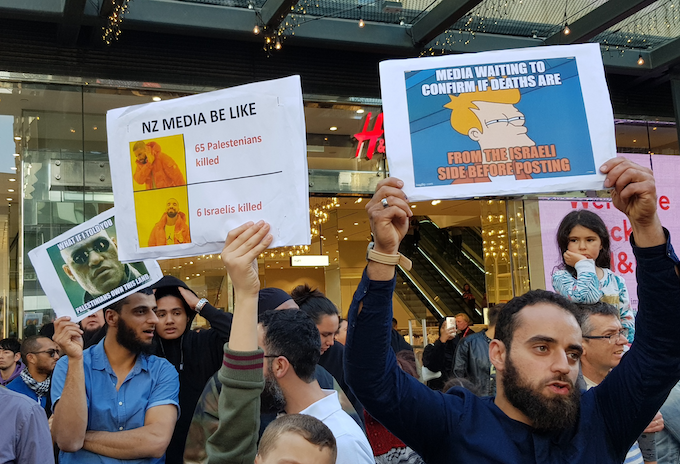
Palestinian protesters target NZ media “bias” at the first
Nakba Rally in Auckland last month. IMAGE: David Robie/APR
Hanan Ashrawi, the first woman member of the Executive Committee of the Palestine Liberation Organisation (PLO), told Middle East Eye in the wake of the conflict that left 256 Palestinians — including 66 children — and 13 Israelis dead that it was illogical to expect Israel to be both the “gatekeeper and to have the veto”.
“Israel has never implemented a single UN resolution at all, since its creation [in 1948]. And Israel has always existed outside the law. So why do you expect Israel suddenly to become a state that will respect others, human rights, international law and the multilateral system.
“Israel is the country, the only country that legislated a basic law that says only Jews have the right to self-determination in this land which is all of historical Palestine.
“Israel has destroyed the two-state solution.
When Israel opens up …
“Only when Israel opens up, when this system of discrimination, repression, apartheid is dismantled, only then will you begin to see that there are opportunities of equalities and so on.”
However, Ashrawi was complimentary about the new wave of youth leadership and support for the Palestinian cause sweeping across the globe. She was optimistic that a new political language, new initiatives for a solution would emerge.
RNZ Mediawatch’s Hayden Donnell was highly critical over the lack of news coverage of the “newsworthy and historic” Samoan elections on April 9, commenting: “For nearly two days, RNZ was the only major New Zealand news website carrying information about the election results, and analysis of the outcome.”
As he pointed out, since 1982, the Human Rights Protection Party (HRPP) had been in power and the current prime minister, Tuila’epa Sa’ilele Malielegaoi (now caretaker), had been prime minister since 1998.
“It’s very monumental that we’ve had a political party [opposition FAST Party led by Fiame Naomi Mata’afa] come through so quickly within 12 months to challenge the status quo in many different ways.”
Fiame has a slender one seat majority, 26 to 25, in the 51-seat Parliament, and was sworn in as government in still-disputed circumstances. But the New Zealand media coverage has still been patchy in spite of the drama of the deadlock, with the notable exception of journalists such as Barbara Dreaver,Vaimoana Tapaleao, Teuila Fuatai, and Michael Field at The Pacific Newsroom.
Woke up to Samoa crisis
The New Zealand Herald, for example, finally woke up to the crisis and splashed the story across its front page on May 25, but then for the next three days only published snippets on the crisis, all drawn from RNZ Pacific coverage. For the actual election result, the Herald only published a single paragraph buried on its foreign news pages.
As for West Papua, the silence continues. Not a single major New Zealand newspaper has given any significant treatment to the current crisis there described by The Sydney Morning Herald as a “manhunt for 170 ‘terrorists’ slammed as a ‘licence’ to shoot anyone”.
Singapore-based Chris Barrett and Karuni Rompies reported that “Indonesian forces are chasing 170 members of the West Papua National Liberation Army (TPNPB), the armed wing of the Free Papua Movement [OPM]. The crackdown has reportedly displaced several thousand people.
“Tensions have been high since the separatists’ shooting in April of two teachers suspected of being Indonesian spies and the burning of three schools in Beoga, Puncak.”
This is the worst crisis in West Papua since the so-called Papuan Spring uprising and rioting in protest against Indonesian racism and repression in August 2019.
The Jakarta government was reported to have deployed some 21,000 troops in the Melanesian region, ruled since the fiercely disputed “Act of Free Choice” when 1025 people handpicked by the Indonesian military in 1969 voted to be part of Indonesia. The latest crackdown followed the killing in an ambush of a general who was head of Indonesian intelligence on April 25.
Discrimination against Papuans This latest round of strife marks widespread opposition to Indonesia’s 20-year autonomy status for the region which is due to expire in November and is regarded by critics as a failure.
Interim president Benny Wenda of the United Liberation Movement of West Papua (ULMWP) denounces Indonesian authorities who have variously tried to label Papuan pro-independence groups “separatists”, “armed criminal groups”, and “monkeys” (this sparked the 2019 uprising).
“Now they are labelling us ‘terrorists’. This is nothing but more discrimination against the entire people of West Papua and our struggle to uphold our basic right to self-determination,” he says.
Wenda has a message for the United Nations and Pacific leaders: “Indonesia is misusing the issue of terrorism to crush our fundamental struggle for the liberation of our land from illegal occupation and colonisation.”
The West Papua issue is a critical one for the Pacific, just like East Timor was two decades ago in the lead-up to its independence. Why is our press failing to report this?
International reporting has hardly been a strong feature of New Zealand journalism. No New Zealand print news organisation has serious international news departments or foreign correspondents with the calibre of such overseas media as The Sydney Morning Herald and The Age.
It has traditionally been that way for decades. And it became much worse after the demise in 2011 of the New Zealand Press Association news agency, which helped shape the identity of the country for 132 years and at least provided news media with foreign reporting with an Aotearoa perspective fig leaf.
It is not even much of an aspirational objective with none of the 66 Voyager Media Awards categories recognising international reportage, unlike the Walkley Awards in Australia that have just 34 categories but with a strong recognition of global stories (last year’s Gold Walkley winner Mark Willacy of ABC Four Cornersreported “Killing Field” about Australian war crimes in Afghanistan).
Aspiring New Zealand international reporters head off abroad and gain postings with news agencies and broadcasters or work with media with a global mission such as Al Jazeera.
Consequently our lack of tradition for international news coverage means that New Zealand media tend to have many media blind spots on critical issues, or misjudge the importance of some topics. Examples include the Samoan elections in April when the result was the most momentous game changer in more than four decades with the de facto election of the country’s first woman prime minister, unseating the incumbent who had been in power for 23 years.
The recent Israel-Palestine conflict in May was another case of where reporting was very unbalanced in favour of the oppressor for 73 years, Israel. Indonesian’s five decades of repression in the Melanesian provinces of West Papua is also virtually ignored by the mainstream media apart from the diligent, persistent and laudable coverage by RNZ Pacific.
There is a deafening silence about the current brutal and draconian attack on West Papuan dissidents in remote areas with internet unplugged.
No threat to status quo As national award-winning cartoonist Malcom Evans wrote in a Daily Blog column on the eve of last week’s Voyager Media Awards that whoever won prizes, “it’s a sure bet that, he or she, won’t be someone whose work threatens the machinery that manufactures our consent to a perpetuation of the status quo”.
He continued:
“There will be no awards for anyone like Julian Assange or Edward Snowden, but none either for our own Nicky Hager or Jon Stephenson, who exposed war crimes committed in Afghanistan by New Zealanders, and none for Chris Trotter, Bryan Bruce or Susan St John whose writings have consistently exposed the criminal outcomes wrought on New Zealanders by neo-liberalism.”
Evans also cited “Indonesia’s rape of West Papua and East Timor” and the “damning Israel’s treatment of the Palestinians” as examples of lack of media exposure of “New Zealand duplicity and connivance”.
Palestinian protesters target NZ media “bias” at the first Nakba Rally in Auckland last month. Image: David Robie/APR
Hanan Ashrawi, the first woman member of the Executive Committee of the Palestine Liberation Organisation (PLO), told Middle East Eye in the wake of the conflict that left 256 Palestinians — including 66 children — and 13 Israelis dead that it was illogical to expect Israel to be both the “gatekeeper and to have the veto”.
“Israel has never implemented a single UN resolution at all, since its creation [in 1948]. And Israel has always existed outside the law. So why do you expect Israel suddenly to become a state that will respect others, human rights, international law and the multilateral system.
“Israel is the country, the only country that legislated a basic law that says only Jews have the right to self-determination in this land which is all of historical Palestine.
“Israel has destroyed the two-state solution.
When Israel opens up … “Only when Israel opens up, when this system of discrimination, repression, apartheid is dismantled, only then will you begin to see that there are opportunities of equalities and so on.”
However, Ashrawi was complimentary about the new wave of youth leadership and support for the Palestinian cause sweeping across the globe. She was optimistic that a new political language, new initiatives for a solution would emerge.
RNZ Mediawatch’s Hayden Donnell was highly critical over the lack of news coverage of the “newsworthy and historic” Samoan elections on April 9, commenting: “For nearly two days, RNZ was the only major New Zealand news website carrying information about the election results, and analysis of the outcome.”
As he pointed out, since 1982, the Human Rights Protection Party (HRPP) had been in power and the current prime minister, Tuila’epa Sa’ilele Malielegaoi (now caretaker), had been prime minister since 1998.
“It’s very monumental that we’ve had a political party [opposition FAST Party led by Fiame Naomi Mata’afa] come through so quickly within 12 months to challenge the status quo in many different ways.”
Fiame has a slender one seat majority, 26 to 25, in the 51-seat Parliament, and was sworn in as government in still-disputed circumstances. But the New Zealand media coverage has still been patchy in spite of the drama of the deadlock.
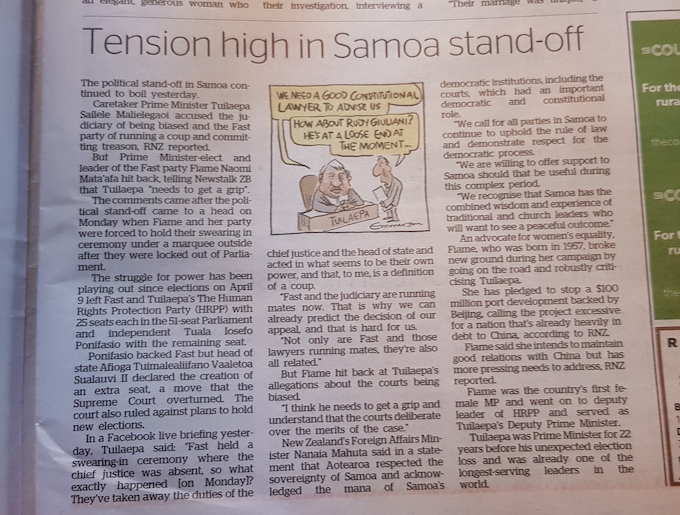
“Tension high in Samoa stand-off” – New Zealand Herald on 26 May 2021. Image: APR screenshot
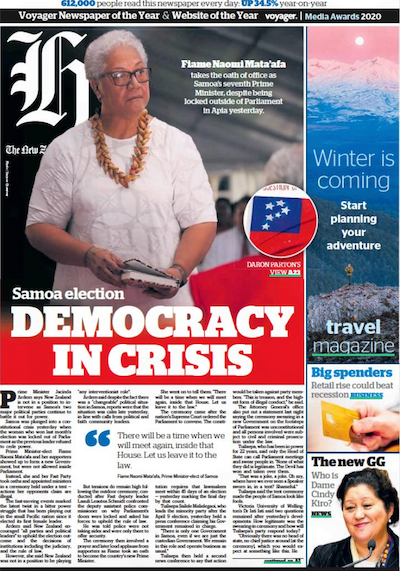
Woke up to Samoa crisis The New Zealand Herald, for example, finally woke up to the crisis and splashed the story across its front page on May 25, but then for the next three days only published snippets on the crisis, all drawn from RNZ Pacific coverage. For the actual election result, the Herald only published a single paragraph buried on its foreign news pages.
“Democracy in crisis” – New Zealand Herald on 25 May 2021. Image: APR screenshot
As for West Papua, the silence continues. Not a single major New Zealand newspaper has given any significant treatment to the current crisis there described by The Sydney Morning Herald as a “manhunt for 170 ‘terrorists’ slammed as a ‘licence’ to shoot anyone”.
Singapore-based Chris Barrett and Karuni Rompies reported that “Indonesian forces are chasing 170 members of the West Papua National Liberation Army (TPNPB), the armed wing of the Free Papua Movement [OPM]. The crackdown has reportedly displaced several thousand people.
“Tensions have been high since the separatists’ shooting in April of two teachers suspected of being Indonesian spies and the burning of three schools in Beoga, Puncak.”
This is the worst crisis in West Papua since the so-called Papuan Spring uprising and rioting in protest against Indonesian racism and repression in August 2019.
The Jakarta government was reported to have deployed some 21,000 troops in the Melanesian region, ruled since the fiercely disputed “Act of Free Choice” when 1025 people handpicked by the Indonesian military in 1969 voted to be part of Indonesia. The latest crackdown followed the killing in an ambush of a general who was head of Indonesian intelligence on April 25.
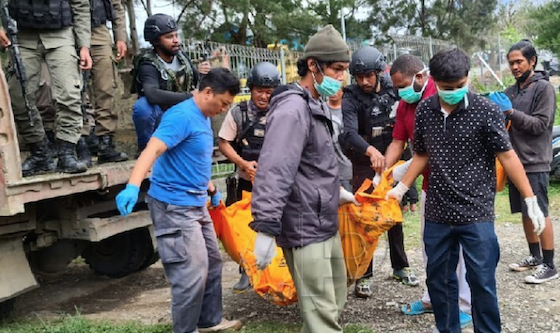
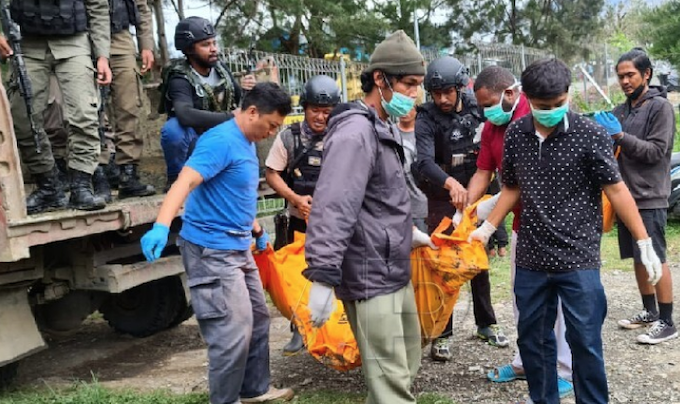
Indonesian police carry a body in the current crackdown near Timika, Papua. Image: seputarpapua.com
Discrimination against Papuans This latest round of strife marks widespread opposition to Indonesia’s 20-year autonomy status for the region which is due to expire in November and is regarded by critics as a failure.
Interim president Benny Wenda of the United Liberation Movement of West Papua (ULMWP) denounces Indonesian authorities who have variously tried to label Papuan pro-independence groups “separatists”, “armed criminal groups”, and “monkeys” (this sparked the 2019 uprising).
“Now they are labelling us ‘terrorists’. This is nothing but more discrimination against the entire people of West Papua and our struggle to uphold our basic right to self-determination,” he says.
Wenda has a message for the United Nations and Pacific leaders: “Indonesia is misusing the issue of terrorism to crush our fundamental struggle for the liberation of our land from illegal occupation and colonisation.”
The West Papua issue is a critical one for the Pacific, just like East Timor was two decades ago in the lead-up to its independence. Why is our press failing to report this?
The head of the Fiji’s defence force has rejected claims by opposition MPs in Parliament this week and has called for an apology over the “simply, wrong” allegations.
In a statement, Commander Viliame Naupoto said there was no “factual evidence” to suggest that the defence force had caused the initial breach.
Commander Naupoto said the military was carrying its own investigations.
Health officials have also said medical and military personnel in Fiji who have been infected with covid-19 are not part of the frontline response teams.
The assurance comes amid an escalating number of cases on the main island, Viti Levu, with clusters in both hospitals and the Navy.
Health Secretary Dr James Fong said the frontline public health response teams were conducting surveillance and containment efforts in the communities.
He said the ministry screened and tested its frontline personnel for their safety and the public’s safety because “they come into contact with persons who have been exposed to the virus”.
Risk eliminated Dr Fong said this also ensured the risk to the public from contact with their trace and containment teams was eliminated.
He said the ministry expected all frontline teams would “carefully observe the covid-safe protocol and we appreciate the feedback we get from the public in this regard”.
“Covid-safe behaviour needs to be maintained by all sections of the community, but especially those in the front line of the public health response and clinical response,” he said.
“At this time, when we have seen an escalation of cases, we wish to remind all frontline workers of the higher level of covid-safe behaviour expected by the community and our profession.
“The same is true for all community leaders and persons in leadership positions in our community in setting an example of a high standard for covid-safe behaviour at all times.”
Dr Fong said last night that 23 of the latest count (28) were linked to existing clusters.
The navy cluster began when an officer contracted the virus at a funeral and later infected members of his ship. This cluster continues to grow with 31 more cases this week alone.
The infected officers were isolated onboard three separate ships anchored in Suva.
Military headquarters locked down The military headquarters in Suva has been locked down in recent weeks after four soldiers tested positive.
Mingling between personnel at a quarantine facility in April has also been linked to cases.
The army said it was continuing to provide security services for the covid response teams.
It said two separate bubbles were already in place to contain the spread of the virus at the Queen Elizabeth Barracks (QEB).
Concerns were raised by people on social media over members of the defence forces being infected with the virus.
In Parliament yesterday, opposition MPs Lynda Tabuya and Simione Rasova criticised the military over its handling of officers who had breached managed isolation protocols at a government facility in April.
Tabuya claimed the “military officers caused the original breach and Navy officers also breached Covid borders”.
Rasova said “army and navy officers were spreading covid”.
Commander rejects claims But Commander Naupoto rejected their claims.
He said there was no sharing of cigarettes as mentioned in the earlier press conferences by health officials, adding that one of the soldiers was in his room when the sharing of cigarettes was alleged to have taken place.
He claimed this was proven by CCTV footage.
Commander Naupoto said there was also an allegation that a soldier had come into contact with a repatriated citizen while the officer was carrying out an inspection without wearing any protective clothing, “again this was proven wrong by CCTV footage”.
“The whole border quarantine process is being reviewed by the quarantine experts in the Ministry of Health to plug any gaps that may exist in the current protocols that are being used and there are systemic issues that need to be reviewed.”
Fiji has recorded 536 cases since March 2020, 466 from the current outbreak which began in April while 349 patients remain infected with covid-19.
Four people have died.
This article is republished under a community partnership agreement with RNZ.
Buoyed as he is by [Wednesday’s] court decision, Samoa’s caretaker Prime Minister has shown a character flaw weighing down upon our national politics: an inability to face up to hard truths.
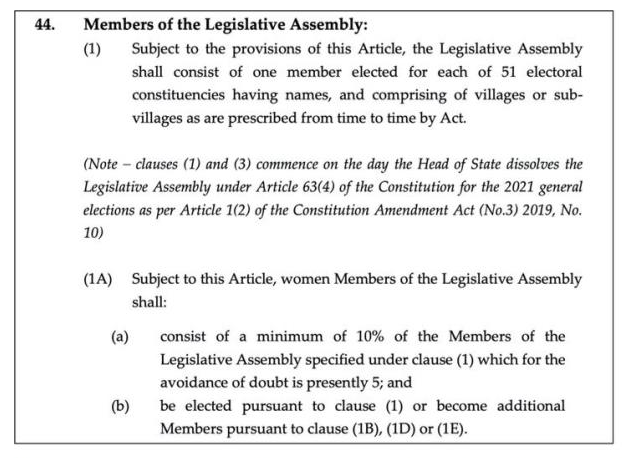
Despite Tuilaepa Dr Sa’ilele Malielegaoi having just alleged the judiciary was conspiring against him, the Appellate Court ruled in favour of his argument that a minimum of six women MPs need to be appointed to meet a mandated quota in our 51-seat Parliament. We don’t expect that contradiction to be explained anytime soon.
The victory has been seized upon by supporters of the Human Rights Protection Party (HRPP), many of whom have incorrectly concluded the decision will lead to the installation of Aliimalemanu Alofa Tuuau and a Parliament in which the opposing party cannot form government.
They must read the court’s words, reprinted in today’s edition, more closely. In fact, the court voided Aliimalemanu’s warrant of election.
Aliimalemanu herself acknowledged this very point when she told the Samoa Observer that she did not mind which woman MP ended up being elected nor which party they were from, rather she was pleased to have struck a blow for female representation.
And, like the court we applaud her for her devotion to that worthy cause.
The reason Aliimalemanu’s election was voided was because it will not be until after the Supreme Court sorts through some 28 petitions and more counter-petitions that the rule requiring six women will be applied.
There are another six petitions involving women challenging or defending an election result alone, let alone other women candidates who could be elected if byelections are called if a legal challenge to a result is upheld. The number of women elected to the 17th Parliament of Samoa could be higher than the threshold, or it could be much much lower.
Exactly what role this unforeseen constitutional mandate will figure in the final election results is entirely unknowable.
That means two things of extreme significance for the immediate political future of this nation – neither of which Tuilaepa was willing to face up to when speaking on Wednesday afternoon.
For the time being, the Fa’atuatua i le Atua Samoa ua Tasi (FAST) party will retain its 26-25 lead over the HRPP until the election is completely finalised.
How long the courts take to settle the dozens of legal challenges before them will likely be a matter of weeks, not months.
Tuilaepa is increasingly being less seen as a strongman who can be depended upon to steer Samoa through choppy waters as an immovable object with whom much of the political deadlock originated.
Until that time, they notionally — depending, of course — on the outcome of a legal case about the validity of the party’s swearing in, the opponents should notionally have some political breathing room to establish government.
But speaking on Wednesday, Tuilaepa sounded like a man who had not familiarised himself with even the most elementary aspects of the judgment.
He asserted the decision cemented Aliimalemanu’s election and a 26-26 tie between FAST and the HRPP and his rightful place and the ongoing future “custodian” of government in Samoa.
No person with basic literacy skills could have reached either of these conclusions after reading what the court had to say in a succinct and articulate 12-page judgment.
Fiame Naomi Mata’afa, the leader of FAST, took a different and more reasonable view of the judgment, which, as it was, a victory in principle for the HRPP but one with few practical consequences for Samoa’s immediate future.
FAST, she said, had the numbers in Parliament for now and was ready to proceed to transition to a new government, just as previous Parliaments have sat while petitions are in progress.
That puts the two leaders on a collision course that cannot spell good outcomes for this nation.
But the decision also casts in stark relief the fact that the caretaker Prime Minister has shown himself at his most arrogant during a week when he should have learned about humility.
For so many years, Tuilaepa’s tendency toward over-the-top statements have merged with his public-political persona. But it is only in recent weeks as he has begun to feel his power ebb in the wake of an election defeat that we have seen the true depth of the caretaker Prime Minister’s unrelenting self-regard.
He dared to allege only a little more than a week ago that there was a conspiracy against him being cooked up by the nation’s judiciary after his party lost four court battles in a row while trying to use the courts to prevent a new government forming.
Tuilaepa then sought to assume for himself a merged role of judge, jury and Prime Minister by condemning FAST for holding an improvised swearing-in ceremony in order to uphold the constitution.
“I am well versed with this law because I own it; it’s mine,” he said.
Only weeks earlier he said that he was “appointed by God” to lead Samoa and that the judiciary had no authority over his appointment.
The recent decisions of the Supreme Court should have disabused him of the idea that the rule of law is something one man can own.
But the public of Samoa, in one way or another, be it by way of the ballot box or making their feelings known will prove decisive in the resolution of this seemingly endless political saga.
In this time of crisis Tuilaepa’s bombastic persona is no longer proving a political asset but rather something which grates upon the voters of Samoa, and he is losing support evidently.
He is increasingly being less seen as a strongman who can be depended upon to steer Samoa through choppy waters as an immovable object with whom much of the political deadlock originated.
The HRPP have been champing at the bit for another election to be called as a recourse to holding onto power.
But despite winning an absolute number of votes in the April election, almost every step taken by the party and its leader in the interim has done little to endear Tuilaepa to the public. If things continue as they are, the political confidence he had in April is likely to have evaporated by this month’s end.
We saw just as much at the Immaculate Conception Cathedral at Mulivai on Monday evening when he became the subject of a sermon and a general character appraisal by the Archbishop of the Catholic Church, Alapati Lui Mataeliga.
Tuilaepa, not known for welcoming differences of opinion, looked every inch a man in a furnace.
With his eyes closed and fan working overtime, he almost appeared to be hoping to deflect the Archbishop’s words.
It did not, of course.
His Grace’s sentiments are still lingering, long since his homily concluded.
The Archbishop referred to himself as Tuilaepa’s “spiritual father” and indeed he performed his role in this respect by dispensing some home truths to a man — and a nation — in need of them.
Speaking on the eve of Independence Day, His Grace noted that Samoa has had a history of oppression before; we have been colonised by Tongan, German and New Zealand forces in our recent history. Our paramount chiefs have had their natural status constrained and our people have suffered under the yoke of colonial governments which have misused their powers for personal gain.
The historical parallel was obvious.
The Archbishop lamented the current state of the nation which became the first in the Pacific to free itself from colonial rule but only after a long struggle.
“There is no peace and there is no unison and it appears as if our forefather’s shed blood for no reason,” he said.
“We are affected by [our leaders] abusing power due to high-mindedness and dictatorship.
“Without Samoa, there would be no leaders and the people should be well aware of that, the power in which is being abused by these leaders was given to them by us, the members of the public.”
Perhaps Monday’s homily dispossessed him of the conviction that he has a divine right to the Prime Minister’s chair.
It is impossible that Tuilaepa does not realise that his recent actions have sown division in this country.
The government’s recent decree that there be no public celebration of Independence Day clearly reflected a political fear of that day’s symbolism. The notional excuse provided, that large gatherings posed a risk to the public health, was undermined completely the day before when the Prime Minister addressed more than one thousand political supporters.
To have the head of your faith tell hurtful and shabby truths about your conduct must, even for a man of Tuilaepa’s bravado, be a wounding experience. For the sake of the country’s immediate future, we must hope against every indication it was also, deep down, a humbling one.
The Samoa Observer editorial of 2 June 2021. Republished with permission.
The International Federation of Journalists has called for the urgent reinstatement of Nasser Abu Bakr, head of the Palestinian Journalists Syndicate, following his victimisation by the French news agency AFP.
Abu Bakr, who has worked for Agence France-Presse (AFP) for more than 20 years, was sacked without valid reason, in what the IFJ’s leading body has called “a clear case of victimisation for his trade union activities, in contravention of the law and international standards”.
Abu Bakr, who is an elected member of the IFJ’s executive committee, had been instrumental in filing complaints about the systematic targeting of Palestinian journalists by Israeli forces to the United Nations Special Rapporteurs and in documenting and exposing attacks on Palestinian journalists and media.
The IFJ will launch a global campaign to demand justice for Nasser.
Already support has flowed in from public bodies in Palestine, from unions around the world and from the Palestinian General Federation of Trade Unions.
Journalists in Palestine have staged protests outside the offices of AFP. Unions representing staff at AFP’s headquarters and other offices around the world have pledged their support.
The IFJ has already been in contact with AFP management in Paris.
IFJ general secretary Anthony Bellanger said: “The dismissal of Nasser, an elected trade union leader, for nothing more than giving a voice to Palestinian journalists under threat and facing daily attacks is totally unacceptable.
“He must be reinstated.”
12 plus Palestinian journalists arrested Al Jazeera reports that more than a dozen Palestinian journalists were recently arrested by Israeli authorities after attempting to report the news under often “extremely stressful and dangerous” conditions.
Wahbe Mikkieh, one of the journalists detained and later released, told Al Jazeera the message the Israeli police was trying to send was meant to frighten journalists.
“The occupation forces claimed that I tried to obstruct the arrest of my colleague Zeina [Halawani] and that I assaulted the occupation army. That did not happen,” said Mikkieh, who was hit on the head with the butt of a gun causing him to bleed, describing the five days in prison as the hardest in his life.
Republished from the International Federation of Journalists.
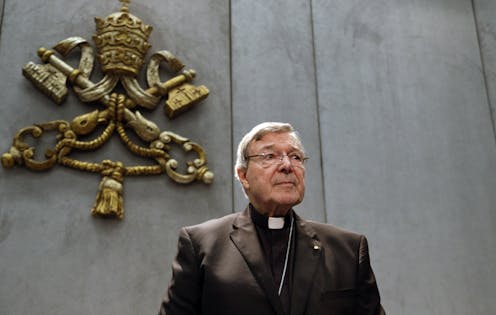
Cardinal George Pell preparing to make a statement at the Vatican in 2017.Gregoria Borgia/AP/AAP
In February, Australian media companies pleaded guilty to contempt of court over their reporting of Cardinal George Pell’s conviction on sexual abuse charges.
The most heavily hit were the The Age ($450,000) and news.com.au ($400,000). Other high-profile programs, such as the Today Show also copped fines ($30,000). These heavy fines were meted out despite the fact that the media companies had apologised to the court and had even agreed to pay the prosecution’s legal costs.
There are many ways the law restricts media freedom in Australia, including laws regarding defamation. But contempt of court, seen here by the media’s breaching of a suppression order, is one of the more controversial mechanisms. It is, however, a limitation the courts impose regularly, and take very seriously.
How did this start?
Back in December 2018, the court placed a suppression order on the Pell conviction when he was initially found guilty by a jury (his conviction was quashed in April 2020).
At the time, various media outlets referred to a trial of great importance and, by implication, a guilty verdict that would have been of great interest to the public.
The implicit, not explicit, nature of the reporting raises an important point. No Australian media company actually named Pell, but some directed their audiences to international online stories. The Herald Sun published a white headline “CENSORED” across a black front page, thereby piquing Victorians’ interest in seeking out international media reports and internet commentary.
As the paper reported,
The world is reading a very important story that is relevant to Victorians.
The point is had any member of the public wanted to find out what the media were talking about, they could have done so.
Why did the court issue the order?
So why was there a suppression order on the conviction?
This was to try and ensure a fair trial. At the time of the guilty verdict in December 2018, Pell was also facing a second trial over different charges related to similar alleged conduct. Ultimately, as it happened, the second trial did not proceed after charges against Pell were dropped in February 2019. But the possibility of a second trial was alive at the time of the first trial guilty verdict.
There is a principle in law that a jury must decide guilt or innocence on the basis of the evidence before them, and not to allow other evidence (for example, a conviction for a similar crime) to taint their deliberations.
So it was important a jury in that second trial (had it gone ahead) could not know of the first conviction. Otherwise, it would be breaking the rule against using “similar fact evidence”.
The rules are clear
Suppression orders are a significant limitation on the freedom of the press to report what happens in our criminal courts, but they exist to guarantee that people who come before the courts get a fair trial.
Contempt of court is a serious offence and can result in jail time. Indeed, journalists have been jailed in the past for similar indiscretions. However, no action was ultimately pursued against individuals here. The court determined the appropriate penalty was for fines to be imposed on media organisations.
In contempt matters, the amount of any fine is open-ended and, in this case, we see very heavy penalties. This is because Justice John Dixon took a dim view of what he surmised were the motives of the media corporations.
constituted a blatant and wilful defiance of the court’s authority […] each took a deliberate risk by intentionally advancing a collateral attack on the role of suppression orders in Victoria’s criminal justice system.
In his view the “timing” of the media apology – made contemporaneously with the contempt guilty plea – “did not demonstrate any significant degree of remorse and contrition.”
The judge added media companies had not only usurped the function of the court, but had taken it “upon themselves” to decide “where the balance ought to lie” between the cardinal’s right to a fair trial and the public’s right to know about it.
While people might debate the politics and huge public interest in the Pell case, the law is clear — that balance is a matter for the courts and the courts alone to determine.
Rick Sarre is affiliated with the SA Council for Civil Liberties
Two COVID-19 cases previously linked to Melbourne’s current outbreak have now been reclassified as false positives.
They’re no longer included in Victoria’s official case counts, while a number of exposure sites linked to these cases have been removed.
The main and “gold standard” test for detecting SARS-CoV-2, the virus that causes COVID-19, is the reverse transcriptase polymerase chain reaction (RT-PCR) test.
The RT-PCR test is highly specific. That is, if someone truly doesn’t have the infection, there is a high probability the test will come out negative. The test is also highly sensitive. So, if someone truly is infected with the virus, there is a high probability the test will come back positive.
But even though the test is highly specific, that still leaves a small chance someone who does not have the infection returns a positive test result. This is what’s meant by a “false positive”.
First off, how does the RT-PCR test work?
Although in the age of COVID most people have heard of the PCR test, how it works is understandably a bit of a mystery.
In short, after a swab has been taken from the nose and throat, chemicals are used to extract the RNA (ribunocleic acid, a type of genetic material) from the sample. This comprises a person’s usual RNA and RNA from the SARS-CoV-2 virus, if present.
This RNA is then converted to deoxyribonucleic acid (DNA) — this is what the “reverse transcriptase” bit means. To detect the virus, the tiny segments of the DNA are amplified. With the help of some special fluorescent dye, a sample is identified to be positive or negative based on the brightness of the fluorescence after 35 or more cycles of amplification.
The main reasons for false positive results are laboratory error and off-target reaction (that is, the test cross-reacting with something that’s not SARS-CoV-2).
Laboratory errors include clerical error, testing the wrong sample, cross-contamination from someone else’s positive sample, or problems with the reagents used (such as chemicals, enzymes and dyes). Someone who has had COVID-19 and recovered might also show a false positive result.
There are a few reasons an RT-PCR test can result in a false positive. Shutterstock
How common are false positive results?
To understand how often false positives occur, we look at the false positive rate: the proportion of people tested who do not have the infection but return a positive test.
The authors of a recent preprint (a paper which hasn’t yet been peer-reviewed, or independently verified by other researchers) undertook a review of the evidence on false positive rates for the RT-PCR test used to detect SARS-CoV-2.
They combined the results of multiple studies (some looked at PCR testing for SARS-CoV-2 specifically, and some looked at PCR testing for other RNA viruses). They found false positive rates of 0-16.7%, with 50% of the studies at 0.8-4.0%.
The false positive rates in the systematic review were mainly based on quality assurance testing in laboratories. It’s likely that in real world situations, accuracy is poorer than in the laboratory studies.
A systematic review looking at false negative rates in RT-PCR testing for SARS-CoV-2 found false negative rates were 1.8-58%. However, they point out that many of the studies were poor quality, and these finding are based on low quality evidence.
Let’s say for example, the real-world false positive rate is 4% for SARS-CoV-2 RT-PCR testing.
For every 100,000 people who test negative and truly don’t have the infection, we would expect to have 4,000 false positives. The problem is that for most of these we never know about them. The person who tested positive is asked to quarantine, and everyone assumes they had asymptomatic disease.
This is also confounded by the fact the false positive rate is dependent upon the underlying prevalence of the disease. With very low prevalence as we see in Australia, the number of false positives can end up being much higher than the actual true number of positives, something known as the false positive paradox.
Because of the nature of Victoria’s current outbreak, authorities are likely being extra vigilant with test results, potentially making it more likely for false positives to be picked up. The Victorian government said:
Following analysis by an expert review panel, and retesting through the Victorian Infectious Diseases Reference Laboratory, two cases linked to this outbreak have been declared false positives.
This doesn’t make clear whether the two people were retested, or just the samples were retested.
Either way, it is unlucky to have two false positives. But given the large numbers of people being tested every day in Victoria at present, and the fact we know false positives will occur, it is not unexpected.
The RT-PCR test for SARS-CoV-2 is highly accurate, but not perfect. Shutterstock
The broader implications
For an individual who received a false positive test result, they would be forced to go into quarantine when there was no need. Being told you have a potentially lethal disease is very stressful, especially for elderly people or those at risk because of other health conditions. They would also likely be worried about infecting other members of their family, and could lose work while in quarantine.
Particularly given authorities initially pointed to these two cases as examples of transmission of the virus through “fleeting” contact, no doubt many people have wondered whether without these cases, Victoria might not be in lockdown. This is just conjecture and we can’t really know one way or the other.
False negative results are clearly very concerning, as we don’t want infectious people wandering around the community. But false positives can also be problematic.
Adrian Esterman does not work for, consult, own shares in or receive funding from any company or organisation that would benefit from this article, and has disclosed no relevant affiliations beyond their academic appointment.
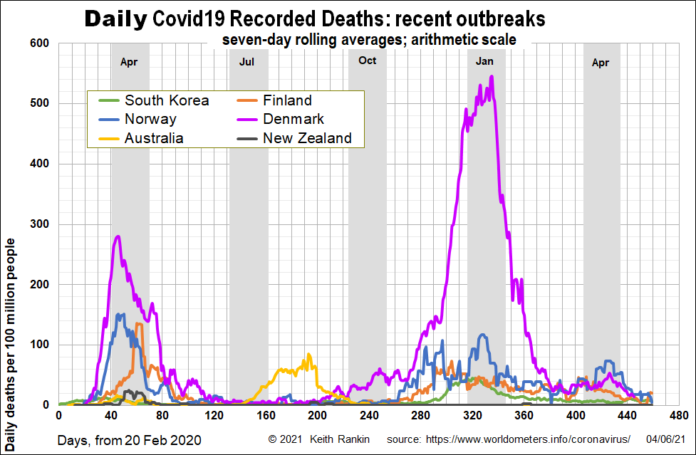
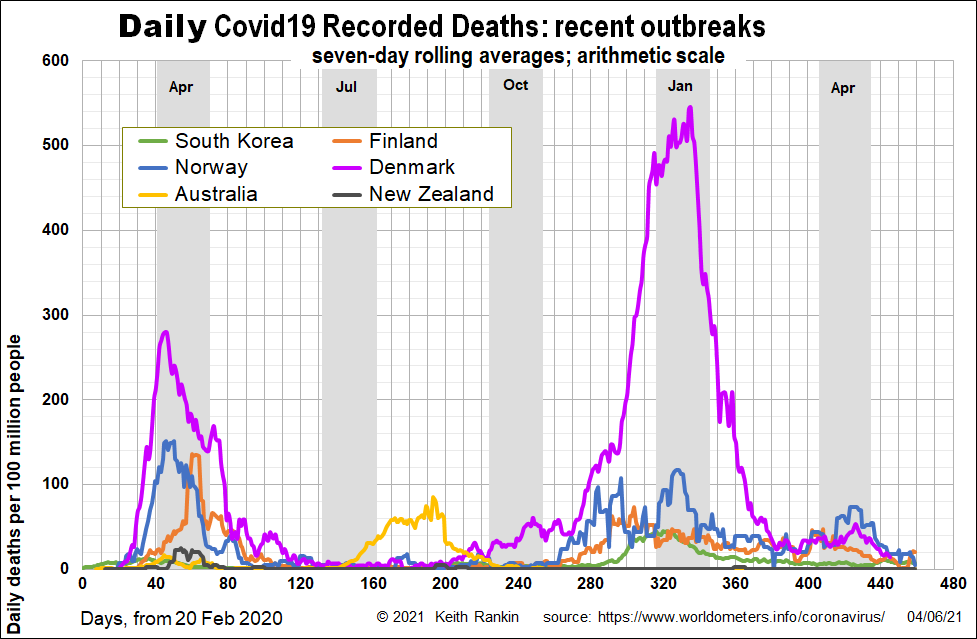
Of these, only Denmark has high official Covid19 death spikes. Chart by Keith Rankin.
Analysis by Keith Rankin.
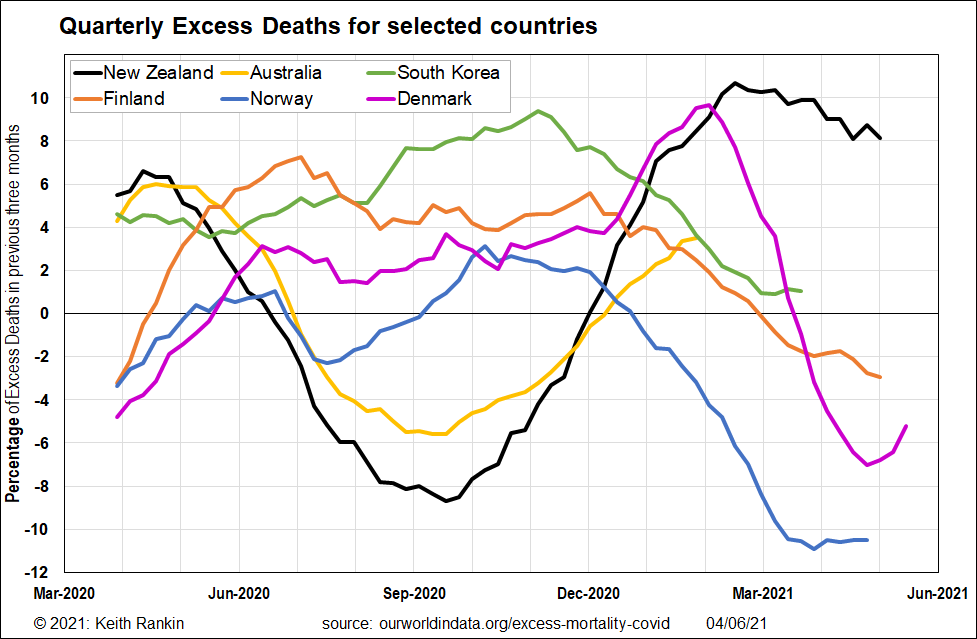
New Zealand has excess non-Covid19 deaths. Chart by Keith Rankin.
New Zealand’s rosy Covid19 picture does not look so good, once we do an analysis of excess deaths. Calculating excess deaths is the new statistical procedure to evaluate the true toll of Covid19. (I did an excess deaths’ Smithometer analysis of the 1918 influenza pandemic in New Zealand.)
For this chart, I have selected countries comparable to New Zealand, and for which the excess deaths analysis has been done. Australia, unfortunately, seems to be slower than the others in releasing its death statistics.
The first thing to note is that New Zealand, Australia and South Korea all had significant numbers of excess deaths pre-pandemic (although South Korea was getting some Covid19 deaths in March 2020). This suggests that both New Zealand and Australia have a social (or socio-economic) problem that is causing death rates to increase. While an aging population is probably part of the reason, this does not show up in Scandinavian countries which also have aging populations.
Norway had an early Covid19 outbreak, but got it under better control than European Union countries. So, in the second quarter of 2020, Norway had negative excess deaths despite having significant numbers of Covid19 deaths. Excess deaths plunged in New Zealand and Australia, thanks to the lockdowns in both countries; there were very few deaths resulting from winter influenza, and Covid19 deaths barely registered. It was only the big winter outbreak in Melbourne that caused Australia’s reduction in winter deaths to be less than New Zealand’s.
The most alarming feature of the chart is New Zealand’s huge resurgence in deaths in the spring and summer; a resurgence that barely abated in the autumn of 2021. New Zealand – essentially free of Covid19 – outstripped Denmark, which had a major Covid19 outbreak in the northern autumn.
New Zealand’s death surge will have been in part due to deaths postponed by the 2020 lockdown (lockdowns for Auckland). But, this is clearly only a part of the story. New Zealand’s significant socio-economic problems – especially inequality and housing – are almost certainly taking their toll. While something similar may be also happening in Australia, it would appear to be to a lesser extent there.
Of these, only Denmark has high official Covid19 death spikes. Chart by Keith Rankin.
We compare the first chart with the chart that shows the official Covid19 death rates, for these countries.
We can see the deaths in the Scandinavian countries in the early days of the pandemic. And we can see Denmark’s huge December-January spike in Covid19 deaths. Yet that spike was matched in New Zealand by excess non-Covid19 deaths.
For Australia, we can see the early death toll (April 2020) and the much bigger August toll. And, unlike the other four countries in the charts, we see that both Australia and New Zealand had minimal contribution of Covid19 to its death statistics.
New Zealand has big problems which are being reflected in our mortality statistics. And that alarming death data would have been worse were it not for Covid19.
The National Party has a major problem with standards, especially amongst its MPs and election candidates. The latest controversies involve the resignation of their longest-serving MP Nick Smith over an employment dispute, and allegations of abhorrent behaviour by election candidate Jake Bezzant.
The party has been beset by a series of scandals in recent times, including revelations that National had to get rid of their sitting MP Jian Yang who exited (alongside Labour’s Raymond Huo) after an intelligence agency briefing. And then, of course, last year the party was embroiled in scandals involving the downfall of MPs Andrew Falloon and Hamish Walker, alongside senior party figure Michelle Boag.
Does this mean the party is toxic? Or is it incompetence? Either way, who is responsible? And can the party clean up its candidate selection process to fix the problem?
Former National staffer Matthew Hooton has written about all this today in a must-read Herald column that argues the party’s current crisis is due to “poor candidate vetting and selection, and a lack of seriousness when allegations emerge, whether of spying, sexual harassment, bullying, fake CVs, poor business practice or just plain old not being up for the job” – see: National’s woes go right to the top (paywalled).
Hooton goes through a list of seven self-inflicted scandals in “four disastrous weeks” leading up to the 2020 election, involving Jian Yang, Hamish Walker, Michelle Boag, Todd Muller, Andrew Falloon, Nick Smith, Jake Bezzant, as well as the botched candidate selection to replace Nikki Kaye in Auckland Central.
Hooton lays the blame for all of this ultimately at the feet of party president Peter Goodfellow. Here’s his conclusion about the disastrous place National is now in: “That speaks to governance, identified as a serious problem in National’s still secret post-election review. Goodfellow has been party president since 2009. He has taken a close interest in all key candidate selections and all long-term strategic decisions, and would be responsible for them even had he not. After 12 years, whatever shape the party is in now is his legacy. In my opinion it is time for him to take responsibility and go, and for the party membership to elect a new board of competent people willing to deal with the current crisis – if they can find any. National will achieve no long-term operational success until its members demand accountability from those they elect to run the party’s affairs.”
This story reports: “Newshub understands concerns were raised about Bezzant during last year’s election campaign when questions were swirling around embellishments on his CV. National’s campaign team came to the conclusion he should go.” This is all put to party leader Judith Collins, who directs attention to Goodfellow, saying “I think you’d need to take that back to the party president”.
Harman outlines how last year he spoke to a number of Bezzant’s colleagues in a tech company who claimed “Bezzant was a fantasist who had run the company into the ground” and they “also raised questions about his private life”. Harman then put these allegations to the party organisation, which investigated and apparently cleared Bezzant. Harman says: “There the matter rested though there are suggestions that both leader, Judith Collins, and campaign chair Gerry Brownlee, were still concerned that Bezzant could be a liability.”
For Harman, “the whole affair has raised questions about how much due diligence National does when it selects candidates. That has apparently been discussed at some of the party’s regional conferences, with concerns about the Auckland Central selection being highlighted.”
For more on the allegations about Bezzant, see Derek Cheng’sNational candidate Jake Bezzant cuts ties with party following explosive claims. Here’s the key part: “National candidate Jake Bezzant has parted ways with the political party following explosive claims that he impersonated his ex-partner online, shared explicit photos and even pretended to be her during cyber sex. Bezzant’s former partner, Tarryn Flintoft, has gone public with the claims in an hour-long podcast shared online this week. Bezzant, who unsuccessfully ran for the Upper Harbour seat last election, told the Herald there is no truth to the accusations. The National Party touted Bezzant as a promising part of its intake of fresh talent in 2019.”
The Nick Smith scandal
Nick Smith announced his resignation on Monday night, citing an employment investigation about him being carried out by Parliamentary Service, which he believed was about to be made public the following day. The media story never eventuated, and the details have been incredibly murky since then.
For the best overall account of what has happened with Smith, it’s well worth reading Jo Moir’s in-depth story published today on Newsroom, which outlines the whole saga – see: The warning that ended Nick Smith’s career. According to this account, back in mid-2020, “Smith lost his temper and had a yelling match with his young male staffer, which included swearing at him. Another National Party staffer, who didn’t work in Smith’s office, recorded the verbal altercation and reported the incident to Parliamentary Service (the employer of the National Party staffers).”
Moir reports that National insiders say Smith has a long history of volatility: “MPs and staff, both former and current, spoken to by Newsroom say Smith has a history of treating staff poorly, and it was well-known around Parliament. One former senior MP described Smith as having a ‘volatile personality’ and was often ‘outright rude to officials and staffers’. The former MP said Smith had entered politics at a very young age and had ‘never managed anyone and didn’t know how to deal with people’.”
This account is in line with how Hooton sums up the situation in his column today: “he had been behaving in roughly the same way he had been allowed to by successive leaders for 30 years.”
For example, one stated: “Nick’s irrational and verbally abusive behaviour towards his staff was one of Parliament’s worst-kept secrets. Everyone from Ministerial Services, Parliamentary Services, the Prime Minister’s Office and the bullying inquiry knew about it yet Nick’s staff continued to be collateral damage.” In contrast, however, the article also quotes a number of current National MPs denying that the party has any problems with bullying.
Here’s the key part: “Collins told Smith last Friday a story would appear this Tuesday. Smith has said that it was his understanding that a story would appear which persuaded him to resign. But so far, no story has appeared other than those reacting to his resignation. It appears either by accident or intent that Collins forced Smith’s resignation because of her claims of the imminent publication of the story. It also seems likely that she had known about the incident that lies behind the resignation for nearly a year and not acted on that information.”
However, today Jo Moir reports Collins as stating: “Nick Smith is absolutely clear that at no stage was he ever told to leave Parliament”.
The Jian Yang scandal
The other scandal relating to National MP standards is Richard Harman’s revelation last month that both the National and Labour parties made an agreement to quietly get rid of their two China-born MPs, Jian Yang and Raymond Huo, “because of growing security concerns” – see: The cooling of relations with China: Why two MPs retired last year (paywalled). Harman says he “learned from multiple official and political sources” that the “almost simultaneous [retirement] announcements were orchestrated by the offices of Jacinda Ardern and Todd Muller working together”.
Matthew Hooton, who was working for then National leader Todd Muller at the time the two MPs resigned from Parliament, confirmed the report, writing his own account for the Herald, stating the “deal was based on briefings from the New Zealand intelligence agencies expressing concern about the two MPs’ relationships with the Chinese Government” – see: Chinese Government associates alleged to have infiltrated National and Labour (paywalled).
Hooton explained how he thought National had got into this situation: “Selection procedures in both main parties are well known to be lax, as evidenced by the quality of MPs we attract. Both main parties are keen for Chinese-born MPs, both for the votes from new immigrants they might bring, and also because of their fundraising abilities and political and commercial connections with New Zealand’s biggest export market. National Party President Peter Goodfellow, for example, is very proud of his fundraising abilities from the Chinese community.
RNZ confirmed the story, with reporter Craig McCulloch stating that “Another source also confirmed to RNZ that an agreement was reached during a meeting attended by the parties’ chiefs of staff” – see: Labour, National tight-lipped on former Kiwi-Chinese MPs’ departure.
Reforming the National Party
National is in a dysfunctional state, and it’s not clear that it can quickly or easily reform its culture and raise its standards enough to make it fit to govern anytime soon. As Hooton says today, National is “in a world of chaos and pain that not even Labour endured through the 2010s” and “is in worse shape than even Helen Clark’s Labour in 1995 or Bill English’s National in 2003.”
Heather du Plessis-Allan has also argued the party isn’t about to turn its fortunes around, given what the latest scandals say about its culture – see: National is the most toxic brand in Parliament.
Here’s her main point: “It always going to be tough-going for National to have a serious shot at the next election, but after two resignations in a week I’d say their odds just got that much longer. Simply because they are wasting valuable rebuild time on continuing to trash their own brand. Brands take a long time to build, and the clock starts again when you have something as repulsive as an alleged sex scandal and questions over whether the leader has engineered the resignation of veteran MP Nick Smith, who himself is facing bullying allegations.”
Jo Moir’s column today discusses the National Party’s new code of conduct, which sets out behavioural expectations for MPs, noting that Smith’s altercation “pre-dates this”.
Moir also explores the party’s “candidate college” process, used to vet prospective politicians, with the suggestion from both a former MP and a candidate that this is no longer fit for purpose. Moir reports the former MP saying: “Since about 2008 when the party decided it was invincible, the purpose of the College has fallen away”, and believing “the party no longer had any mechanisms operating that would vet the likes of Falloon and Bezzant.” Similarly, a former candidate is reported as being “surprised the vetting process wasn’t more comprehensive.”
This issue of quality assurance is also the focus of a column today by political commentator and National Party member Liam Hehir, who argues his party needs to raise standards, but also move away from looking for “stars”, especially “flashy and ambitious people claiming glittering careers in industries that themselves are known to have toxic cultures” – see: Reforming the National Party.
Hehir also has a number of other suggestions for improving candidate selection: “I believe some form of basic psychometric testing would be a good idea. That kind of thing is hardly foolproof since skilled manipulators are unsurprisingly good at manipulating testing. Still, it would weed out enough bad eggs to be a worthwhile exercise. Personal patronage is also something that ought to be discouraged. It is a serious barrier to renewal when existing party heavyweights do things like drive their champions to candidate selections. Informal practices like expectations around ranking existing members of caucus above newcomers on the party list ought to go.”
Source: The Conversation (Au and NZ) – By Joanna Mendelssohn, Principal Fellow (Hon), Victorian College of the Arts, University of Melbourne. Editor in Chief, Design and Art of Australia Online, The University of Melbourne
Peter Wegner’s Guy Warren in his 100th Year, winner of the 2021 Archibald Prize.AGNSW/Peter Wegner/Photo Jenni Carter
The artist Guy Warren gave the best summary of this year’s centenary Archibald Prize, telling the crowd assembled for the official announcement: “It’s a lot of fun”.
Appropriately, as well as praising Peter Wegner, whose portrait of the centenarian won this year’s Archibald Prize, Warren congratulated the many artists whose works hang alongside his likeness.
Warren is an Archibald realist. He knows the almost random nature of the first cull where the Trustees decide which works have a chance to be considered for hanging, while the great majority go directly to the stacks of rejects.
In 1985 both Warren and his good friend, the artist Bert Flugelman, entered portraits of each other. Portraiture was a departure in style for both men. Although he had worked for some years as a graphic artist, Warren was best known for both experimental work and fluid semi-abstract landscapes. Flugelman had an established reputation as a sculptor.
Flugelman’s portrait of Warren was not hung. Guy Warren’s portrait, Flugelman with Wingman won the prize. With this year’s prize, Warren therefore has the rare distinction of both winning the prize and being the subject of a winning painting.
Our public institutions are keenly aware of gender equity in 2021. Art Gallery of NSW director Michael Brand was at pains to tell the assembled throng of journalists, photographers, film crew, artists and actors (including Rachel Griffiths in prime position to film both the crowd and the podium for her forthcoming documentary) that more works by women than men had been hung this year.
Jude Rae and Pat Hoffie were highly commended by judges. But the tradition of giving the big prize to a portrait of a man, by a man, prevailed.
And it’s not a bad painting. The artist-subject is shown sitting on a chair, with his arms awkwardly placed, staring into the distance. He looks somewhat frail. Because of the echoes of history, it will be both a popular choice and a reminder that, at its core, the Archibald is a prize for social history, not art.
The other prizes announced at the same time reflect both old traditions and the new.
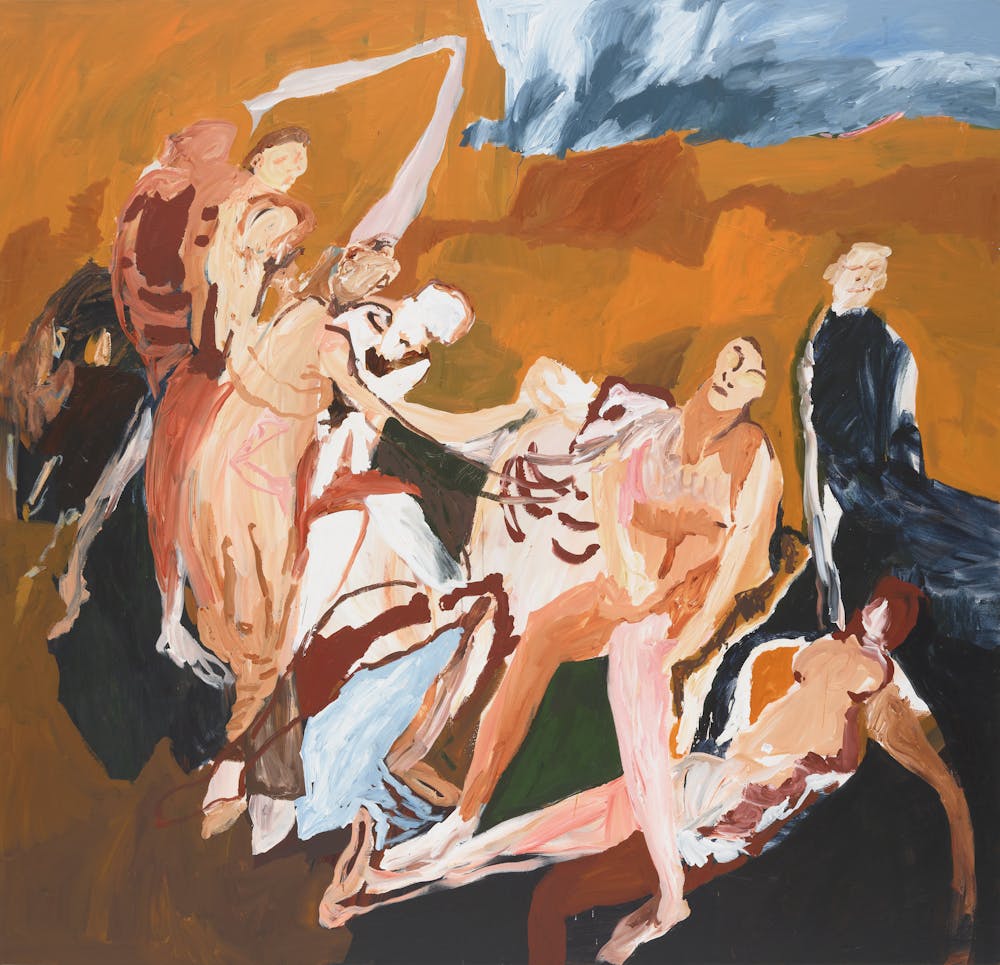
It was not a surprise that Georgia Spain, whose Getting down or falling up was awarded the Sulman Prize. Guest judge Elisabeth Cummings, was one of her favourite artists, the winner told the crowd. Indeed, there are strong echoes of Cummings’ painterly approach in Spain’s work.
Georgia Spain’s Getting Down or Falling Up won the Sulman Prize. Photo: AGNSW, Mim Stirling
The Sulman, unlike the other prizes, is judged by a different artist each year. Those considering entering the prize should always look at the judge’s art before entering their own.
In recent years the Wynne Prize has been dominated by work by Aboriginal artists from either central or northern Australia, and this year is no exception. Yolŋu artist Nyapanyapa Yunupiŋu’s Garak Night Sky, is muted in tone, but stunningly beautiful.
It is a retelling of one of the great narratives of Aboriginal Australia — the Seven Sisters, the constellation also referred to in non-Indigenous cultures as Pleiades.
Nyapanyapa Yunupingu’s Garak Night Sky won the 2021 Wynne Prize. Photo: AGNSW, Mim Stirling
The story of the Seven Sisters is repeated in Tjungkara Ken’s painting, which was awarded the Roberts Family Aboriginal and Torres Strait Islander Prize this year. Just as European artists can paint infinite variations on the theme of the Nativity, so the Seven Sisters remain an ever fertile subject for Indigenous artists.
Leah Bullen’s Arid garden, Wollongong was awarded the Pring Prize for a watercolour by a woman. In times past so few women entered (or were hung) in the Wynne that this prize was sometimes not awarded. This year the competition was stronger.
Now that the judges have spoken, it is time for the people to have their say. For the last 33 years the gallery has awarded the ANZ People’s Choice award, with votes cast by visitors to the exhibition. Occasionally, but rarely, the people agree with the judges.
All finalists in the Archibald, Wynne and Sulman Prizes 2021 will be exhibited at the Art Gallery of NSW from 5 June to 26 September 2021, then tour regionally.
Joanna Mendelssohn has received funding from the Australian Research Council
Source: The Conversation (Au and NZ) – By Yogi Vidyattama, Associate Professor, National Centre for Social and Economic Modelling, University of Canberra
Among the bolder claims in last month’s budget was that “under the Coalition, home ownership will always be supported”.
Since the Howard government took office in 1996, the proportion of Australian households owning the home they live in has fallen from 70% to 66%.
The proportion having paid off their mortgage has fallen from 40% to 30%.
The proportion renting privately has climbed from 20% to 27%.
In the lead up to the budget, home prices began climbing again, soaring 8.5% in Melbourne and 11% in Sydney.
The response was a series of measures designed to look as if they would help people buy their own homes.
Shuffling the queue
On examination, each measure is less than it could be, although each helps some people more than others.
Usually first home buyers with less than a 20% deposit need to pay lenders’ mortgage insurance.
Under two of the schemes they can effectively get this cost met by the government.
Extending the First Home Loan Deposit Scheme will allow 10,000 more first home buyers to buy newly-constructed dwellings with a 5% deposit.
They add to demand for housing but not its supply.
Not quite helping those most in need
This means that while the schemes assist (doubtless worthy) people buy homes, they do it at the expense of others who miss out.
Homebuilder, used for knockdowns and rebuilds. Twin Sails/Shutterstock
They shuffle rather than shrink the queue.
A separate measure since closed, HomeBuilder, awarded grants for the construction of homes, but it was also available for knockdowns, rebuilds and extensions rather than being directly targeted at increasing supply.
Only three economists responding to the Economic Society of Australia’s post-budget survey referred to the housing measures and none were supportive.
Our calculations using NATSEM’s STINMOD+ model suggest that even if these schemes were not limited to 10,000 applicants, there may not have been many households able to take them up.
Only 5% of private renters, and 7% of single parents, have enough savings to enter the housing market, even with the promised mortgage insurance guarantee.
Young urban professionals
Of these, more than 85% would then be paying more in servicing costs than they currently pay in rent, even at today’s historically low interest rates.
They might not regard this as an improvement in affordability.
In any case, it wouldn’t be the poorest households being helped.
Our calculations suggest the poorest fifth of households would be unlikely to have enough savings to use the deposit insurance schemes.
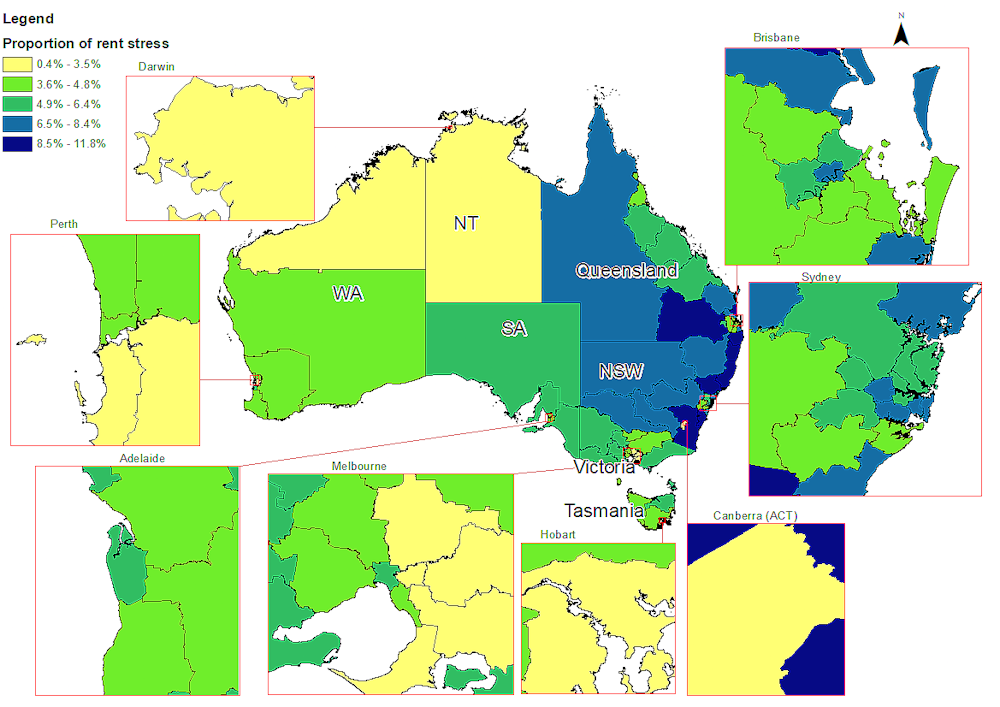
Those most likely to use them are on higher incomes but still renting. They include young urban professionals in the eastern and northern suburbs of Sydney.
The blue areas on this map show the regions with the most households who might benefit.
The schemes would be more helpful for potential homebuyers in regional areas than in cities, but they are less likely to have the income and savings needed to take advantage of them.
The schemes also have price caps below the median house price in most capital cities, making it hard for people such as parents who need extra bedrooms to take advantage of them.
The downsizer initiative will help
A more promising initiative in the budget is lowering the minimum age at which downsizers can access the downsizer contributions scheme from 65 to 60.
This scheme allows older Australians to downsize and put the proceeds into lightly-taxed superannuation.
This will free up family homes for the younger generations, although it will not help those on low incomes buy them.
Yogi Vidyattama previously received funding from ACT Government for economic research related to housing.
John Hawkins was the secretary to the Senate Select Committee on Housing Affordability in Australia.
Source: The Conversation (Au and NZ) – By Philip Russo, Associate Professor, Director Cabrini Monash University Department of Nursing Research, Monash University
Earlier this year, we visited the Howard Springs quarantine facility in the Northern Territory, Australia’s alternative to the hotel quarantine system.
Now Victoria is set to build its own dedicated COVID-19 quarantine facility, with backing from the federal government, at a yet-to-be-confirmed location.
There is much we can learn from what Howard Springs provides, in terms of how it’s staffed and its physical infrastructure. There’s a lot that’s working really well.
But if we were designing something from scratch, what could it look like? Here’s are some of our thoughts on how it could work.
We want to minimise people interacting
We want to minimise the number of unnecessary face-to-face interactions between staff and residents, and similarly avoid moving residents where possible.
We need to support and meet the medical needs of residents. However, where these or any other support services can be done remotely or through technology, this should be encouraged. By doing this, we reduce the number of staff at the facility.
We also want to prevent residents from physically interacting with each other. These measures reduce the chance of being exposed to the virus, and spreading it.
At Howard Springs, residents are right next to each other, in separate but neighbouring cabins. When they’re on their verandah, they can potentially come into close contact with a person on the verandah next to them. That’s not surprising as Howard Springs was designed to accommodate miners, not as a quarantine facility.
So in a dedicated new facility, we need to design to avoid these types of close contacts and to have clear separation of residents’ living quarters.
Howard Springs provides a separate cabin per person, in line with its original function as a mine camp. But in a newly-built facility we need to provide a variety of separate living quarters, such as separate units or apartments. For instance, we need to be able to accommodate not just single people, but family groups, especially ones with young kids.
There must be no communal areas, such as shared playgrounds, which can be challenging for young kids who want to go out and play.
There must be no shared kitchens or laundry facilities. This might mean designing units with a small kitchenette or simple laundry facilities, such as a sink and a washing line.
We don’t want anything too complex that will be difficult to maintain. Maintenance means people coming in from outside, which we want to avoid.
Well ventilated and easy to clean
Each unit needs its own ventilation system; there must be no shared ventilation between units. In Howard Springs, there’s an individual split-system airconditioning unit (to allow heating and cooling) per cabin.
Windows need to open, for ventilation. Importantly, air flow must not create a risk to others, either in other rooms or people coming to the door.
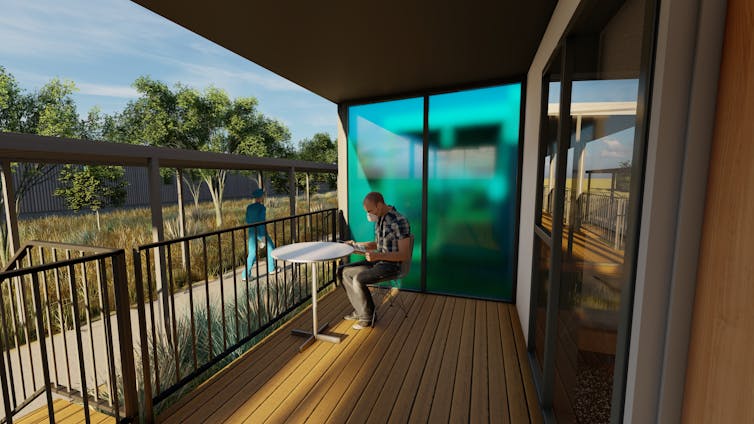
Each unit should have its own outdoor area, such as a verandah. But it needs to be covered, to allow residents to be protected from the weather (particularly for Melbourne’s climate).
Sitting on a verandah also allows residents to see other residents across the pathway, and to safely talk to them, from several metres away. If safe social contact is possible through design, that would be ideal.
Verandahs are also where all interactions between staff and residents can take place, such as swabbing of residents for COVID testing.
All rooms should have a their own ventilation systems, and a verandah. Graphic render supplied by the Victorian Government
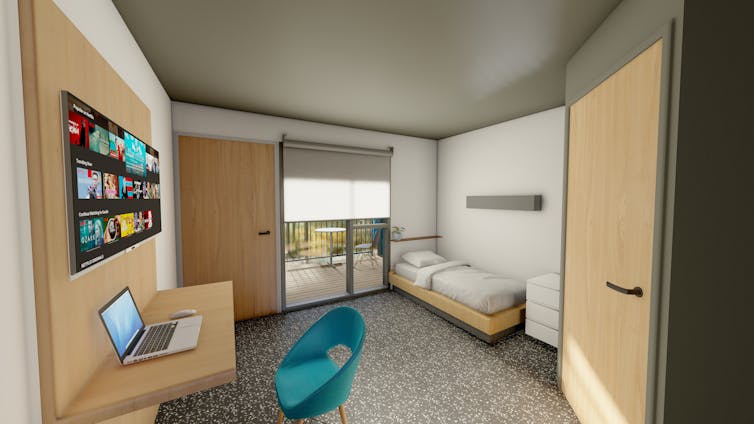
Units need to be easy to clean and wipe down. We need hard surfaces, like the ones we might see in a hospital, and ones that can be disinfected.
All up, the design of these units needs to be pretty simple. They need to be single-level, not double. That means residents can see each other, and staff can better keep an eye on residents.
Rooms should have hard surfaces that are easy to clean. Graphic render supplied by the Victorian Government
We need an on-site clinic
We need a GP-type clinic on site. For example, there will be pregnant women who need antenatal check-ups and people with chronic diseases who need monitoring. Then there should be protocols for transferring people to hospital, if they need higher levels of care.
We’ll need health-care workers — primarily nurses but also doctors. While the level of medical care is not going to be particularly complex or high, health-care workers clearly need advanced skills in infection prevention and control. Auditing and monitoring compliance with infection control measures, including cleaning, will be important.
Like health-care workers, security staff and cleaners also need to be trained and tested in using personal protective equipment, such as masks and gloves.
All staff need to be fully vaccinated (with two doses) of the COVID vaccine.
We need a good understanding of who’s arriving. Do they have specific medical needs? Do they have dietary requirements? We need to ask them before they arrive in Australia, so staff can prepare.
We also need clear and consistent policies about infection control, COVID-19 testing, and transfers of residents, both in and out of the facility.
We are uniquely placed to build a dedicated, purpose-built quarantine facility, not only for this pandemic, but for future ones. Including suggestions like these will place Victoria and Australia well to meet these challenges.
Philip Russo receives funding from the National Health and Medical Research Council, and has received research funding from the Rosemary Norman Foundation, Cardinal Health, Australian College of Nursing and the Cabrini Institute. He is the President of the Australasian College for Infection Prevention and Control, a member of the COVID19 Evidence Taskforce Steering Committee, the Australian Strategic and Technical Advisory Group on AMR, the Healthcare Associated Infection Advisory Committee to the Australian Commission on Safety and Quality in Health Care, a member of the Australian College of Nursing, is a credentialed Expert by the Australasian College for Infection Prevention and Control, and was involved in a review of hotel quarantine for the Victorian Department of Health.
Brett Mitchell has received research funding from the NHMRC, HCF Foundation, Medtronics, Australasian College for Infection Prevention and Control, Nurses Memorial Centre, Senver, GAMA Healthcare, Ian Potter Foundation and Commonwealth (Innovation Connections grant). Professor Mitchell is a Fellow of the Australasian College for Infection Prevention and Control and a Fellow of the Australian College of Nursing. He has run infection prevention and control programs for hospitals and at a State level, and is a credential Expert by the Australasian College for Infection Prevention and Control.
Source: The Conversation (Au and NZ) – By Richard Colledge, Associate Dean (Learning and Teaching), Faculty of Theology & Philosophy, Australian Catholic University
Rob Crandall/Shutterstock
The Job-Ready Graduates Package is nearing the end of its first full semester of implementation. Its basic premise is that the main reason the modern Australian university exists is to train the next generation in areas of economic need.
“Universities must teach Australians the skills needed to succeed in the jobs of the future,” said the then federal education minister, Dan Tehan, when introducing the package. His successor, Alan Tudge, has described this task as universities’ “core business”.
As former University of Melbourne vice chancellor Glyn Davis has pointed out, our universities have always had a strong focus on professional vocational preparation. Yet even alongside enhanced international research rankings, Australian higher education has drifted further towards massified vocational training over the past decade (the demand-driven era). The 2020 legislation accentuated this trend, in terms of both the government’s “job-ready” rhetoric and financial incentives to deter enrolment in courses deemed to lack immediate vocational focus.
This reshaping of the meaning of higher education raises significant concerns. If our universities are to retain some balance between the imperatives of education and training, perhaps the time has come to reimagine the possibilities.
One way of doing so is to consider the merits of North American-style “general education”. How might it be applied in Australia’s quite different system?
Contrasting models of higher education
To use very broad categorisations, Australian undergraduate education essentially follows the English (not Scottish) model. It is based on three-year discipline-specific courses that prepare graduates for employment. Comparable European systems enhance this with deeply integrated industry apprenticeships.
In contrast, the traditional North American system works on the basis of a four-year bachelor’s degree. Roughly a third to a half of that comprises elective studies, before the student selects a major.
If the English/European undergraduate systems prioritise depth of specialisation, the North American system prioritises breadth. The former assumes general education is the job of secondary schooling. The latter provides advanced general education well into university. Technical professional training is provided largely at postgraduate level.
Models of general education
“Gen ed” is itself diverse, and each model has its own benefits.
Some approaches simply prioritise “breadth requirements”. This ensures students deepen their experience of a range of disciplines in their first and second years. They can then choose their major in a more informed way.
Other models focus more strategically on developing transferable skills – critical thinking and problem solving, teamwork, leadership, adaptability, communication and so on. These skills are applicable across industries.
Some have a strong focus on civics and global citizenship. It is worth noting the attraction of North American gen ed for many Asian universities, including institutions in Hong Kong, Taiwan and mainland China.
Further, “core curriculums” have different emphases. Some programs have a decidedly “great books” approach focusing on intellectual and literary heritage. Others have more mission-focused curriculums such as those developed by American Catholic universities.
Of course, such models are not mutually exclusive. Aspects of each can be productively combined.
Admittedly, arguments based on affordability and immediate employability contribute strongly to the case for specialised undergraduate degrees. But is the education of the average 17 or 18-year-old matriculant sufficiently broad and deep to then focus simply on career training?
Further, significant specialisation is already baked into Australian Year 11-12 schooling. This is a result of ATAR scores inevitably being prioritised in the quest for entry into professional undergraduate courses. For many students, broad education in the humanities and the natural and social sciences is heavily curtailed by the age of 14-15.
In this context, gen ed advocates point to the intrinsic, if hard to quantify, benefits of a citizenry that is highly and broadly educated and critically trained. They also cite the pragmatic benefits to both individual long-term prospects and to the economy as a whole.
Can gen ed work in Australia?
As long as the three-year undergraduate degree continues to shoulder the burden of pre-employment professional training, significant gains in this area will be difficult. Australia’s most ambitious recent effort in this regard is the so-called Melbourne Model. As its framers concluded, moving unilaterally to a North American four-year undergraduate structure is currently untenable.
Meanwhile, professional accreditation requirements within three-year vocational degrees leave little room for elective subjects.
Nonetheless, several Australian institutions already carve out limited space for broader strategic educational goals. Examples include the core curriculum programs run by Bond (focusing on transferable skills), ACU and UNDA (focused on the Catholic intellectual tradition).
Amid the fetishisation of “job-readiness”, Australian universities would do well to look at creative ways to develop a more holistic educational experience for all their students. This would contribute to the long-term benefits of broadly educated and critically skilled graduates.
Richard Colledge does not work for, consult, own shares in or receive funding from any company or organisation that would benefit from this article, and has disclosed no relevant affiliations beyond their academic appointment.
Bilbies and bandicoots are less famous than koalas and kangaroos, but several species of these small Australian marsupials are highly threatened. Most of us are unlikely to encounter the nocturnal mammals in the wild, though some species of bandicoots are familiar visitors to gardens in urban areas.
Bandicoots and bilbies are also elusive in the fossil record. Fewer than 25 fossil species have been named to date.
Our research published in Alcheringa: An Australasian Journal of Palaeontology, describes the discovery of new fossil species. These include the oldest known bilby and bandicoot fossils, which will allow us to understand better the evolution of these enigmatic marsupials.
Pieces of a very incomplete puzzle
The first fossil bilby ever recovered was discovered by an American palaeontologist, Ruben Stirton, in South Australia in 1955. This fossil was 3.9 million years old, and consisted of a single lower jaw with a few teeth from a species dubbed Ischnodon australis. No other specimens of that species have been recovered since.
Despite many decades of fossil collecting around Australia, no other fossil bilbies were found until 2014. I was researching fossils from the Riversleigh Word Heritage Area in Queensland when I was lucky enough to spot a few teeth which turned out to belong to a primitive bilby.
The new fossil was about ten million years older than Ischnodon australis, and I named the new species Liyamayi dayi. Until now, that was the end of what we know about fossil bilbies.
We have done much better with bandicoot fossils. The first fossil bandicoot, Perameles allinghamensis, was discovered by Michael Archer in 1976 in northern Queensland.
Since then more than 20 species of fossil bandicoots have been named, the bulk of which came from the Riversleigh World Heritage Area. The oldest bandicoot known to date, Bulungu muirheadae, was found in South Australia, and it is about 24.9 million years old.
The discovery of the oldest fossils known
Reconstruction and fossil of the oldest bilby Bulbadon warburtonae. Art by George Aldridge / photo by Kenny Travouillon., Author provided
For many years, I was lucky enough to work with Michael Archer and colleagues on the fossils from Riversleigh World Heritage Area. The diversity of marsupials discovered there has massively increased our knowledge of their evolution.
I was later able to work with Judd Case at the Eastern Washington University in Spokane. Case has visited Australia on several occasions to collect fossils in South Australia. Fossil sites around Lake Eyre and surrounding lakes have produced some of the oldest fossil marsupials related to our modern species.
Case had also worked with Michael Archer, hunting fossils in the Lake Eyre reigion. During my visit to the US, Case invited me to study all the bilby and bandicoot fossils he had collected.
In this material, I identified four new species. Two of these are the oldest known fossil bandicoot (Bulungu minkinaensis) and the oldest known bilby (Bulbadon warburtonae).
Putting a clock on the evolution of endangered species
Fossils of three newly discovered bandicoot species. Kenny Travouillon, Author provided
Once a new species is discovered, the next step is to work out how it is related to all other known species. This is done with a phylogenetic analysis, which produces a sort of family tree placing the most similar species close together.
My colleague Robin Beck and I found that our oldest bandicoots were part of an ancient group of bandicoots that went extinct around 10 million years ago. In contrast, modern bandicoots have evolved more recently.
Our oldest bilby, however, confirmed previous genetic work showing that bilbies evolved around 30 million years ago. They have slowly adapted as Australia has become more arid, especially since the climate change of the middle Miocene around 15 million years ago.
Kenny Travouillon receives funding from Churchill Trust (Churchill Fellowship, sponsored by the Australians Biological Resources Study (ABRS)) .
South Sea Islander children in Queensland, around 1902-05. Queensland State Library
There are moves afoot to scrub colonial businessman Benjamin Boyd’s name from the map. The owners of historic Boydtown on the NSW south coast are planning to change its name, while Ben Boyd National Park may also be renamed. Residents in North Sydney will take part in a survey to rename Ben Boyd Road, too.
The reason: Boyd’s links to “blackbirding” in the 19th century.
Blackbirding was a term given to the trade of kidnapping or tricking Pacific Islanders on board ships so they could be carried away to work in Australia.
Boyd instigated this practice in the late 1840s, bringing the first group of Pacific Islanders to work on land in the Australian colonies. Although his scheme ultimately failed, other labour traders would deliver approximately 62,000 islanders to Queensland and NSW between the 1860s and 1900s.
The moves to rename the NSW sites are largely due to Australian South Sea Islanders’ struggles for recognition of what their ancestors endured. They often prefer the term slavery to indentured labour and demand full acknowledgement of what happened.
One way this might be achieved is by tracing Pacific Islander blackbirding back to its roots and placing it within the global context of slavery.
This history — painful and provocative as it might be — offers a way to bridge the divisions between those who are proud of Australia’s sugar pioneers and Australian South Sea Islanders who are still dealing with the losses from this ugly past.
To take this broader perspective, we need to reexamine Boyd’s early life. Boyd was the son of a wealthy London slave trader, Edward Boyd, whose business shipped several thousand enslaved people to sugar plantations in the Caribbean and fought against the abolition of the slave trade in 1807.
This matters. Benjamin Boyd claimed to be a self-made man, but his education, home life, connections and worldview were fostered by his father’s profession and the wealth it had created.
Benjamin Boyd portrait by unknown artist, 1830s. State Library of New South Wales
As Marion Diamond wrote in her 1988 biography of Boyd, he had grown up in Britain with an African servant named Dick. As a child aboard one of Edward Boyd’s slave ships, Dick had become too sick to make a profit at market. Instead of being thrown overboard as “refuse”, as was usual, Dick was taken to Britain to be a servant.
Benjamin’s preconceived ideas of “Black” labour and his own place in the world were based on these early experiences of being served tea by Dick.
He was hardly alone among blackbirders in having such a background. It would be extraordinary if he had been.
The reason the importation of Pacific labourers took off in the 1860s, following Boyd’s earlier example, was the fledgling Australian sugar industry.
Sugar had profoundly changed the Americas by this time, creating unparalleled wealth for Britain, France, the Netherlands and other colonisers. It also played a central role in industrialisation.
Sugar’s voracious labour demands — and massive profit margins — accounted for a vast percentage of the 12 million or so African captives delivered for sale in the Americas.
Sugar and slavery created many of Britain’s richest men. And when slavery was abolished in much of the British empire in 1833-34, sugar planters gained by far the biggest compensation payouts for the loss of their human property.
Sugarcane field on the Clarence River in northern NSW, 1921–23. State Library of New South Wales
Australian-Caribbean connections
It is no wonder many of Australia’s sugar pioneers and blackbirders had family backgrounds, fortunes and/or experiences from the slave-sugar complex of the Caribbean (as well as Mauritius in the Indian Ocean). I have so far found more than 200 such people who came to Australia to start again.
Among them was Louis Hope, celebrated as Queensland’s sugar pioneer, who came from a West Indies slave trading and owning family. Ormiston House, Hope’s former home, contains a fawning plaque to him, which mentions neither his pioneering use of South Sea Islander workers, nor his family’s past connections to slavery.
John Ewen Davidson, the “doyen” of the Mackay sugar industry, was also from one of the wealthiest slave-owning dynasties in the West Indies going back four generations.
Caribbean planters and their children did not only bring money to Australia, but also ideas of how sugar could best be grown. They were experts in what labourers should look like: dark-skinned, cheap and easy to control by restricting options for escape.
They sought managers from the West Indies to run their plantations, such as John Buhot of the Barbados, for whom there is a plaque in Brisbane’s Botanic Gardens. Buhot’s parents were minor slave owners and he had trained there as a sugar boiler and manager.
John Buhot is celebrated as a pioneer in Queensland’s sugar industry. Queensland State Archives
Other managers were recruited from the US, Cuba and Brazil, where slavery was either just ending or not yet abolished.
In other words, the men who had experience managing enslaved African people in the Americas were sought to oversee Pacific Islanders, despite them being not legally enslaved in Australia. It was thought to be expedient.
The naming of Australian places
These connections to the Atlantic slavery trade dot Australia. The central NSW coastal suburb of Tascott, for instance, is named for Thomas Alison Scott, who had previously worked at his uncle’s slave-trading company and then as a manager at his father’s plantation in Antigua.
Australian South Sea Islander worker standing among sugar cane on a plantation in Mackay, Queensland, 1895. State Library of Queensland
When Scott arrived in Australia, he appropriated the sugar-growing successes of a black Antiguan slave as his own.
For others, the use of Caribbean names for Australian locations was both commemorative and hopeful of the wealth they hoped to reproduce. The Brown brothers, whose mother was from the West Indies, settled on the Fraser Coast and named their sugar plantation Antigua. This name remains in use today.
Far more notable were the Longs, who had been among the wealthiest and most influential slaveholders in Jamaica since 1655. They also relocated to Queensland in the 19th century and named their plantation north of Mackay for Cuba’s capital, Habana.
Connections to the Caribbean were celebrated in this way even after Britain became fervently anti-slavery.
If Pacific labour is seen not as an Australian peculiarity but instead as part of the global slave trade, it becomes far easier to grasp the scope of the grief and disadvantage that Australian South Sea Islanders are still dealing with.
As Pacific Islanders have been demanding for some time, we need to examine and confront this history before we can move forward.
Emma Christopher does not work for, consult, own shares in or receive funding from any company or organization that would benefit from this article, and has disclosed no relevant affiliations beyond their academic appointment.
Michelle Grattan discusses the week in politics with University of Canberra Associate Professor Caroline Fisher.
This week the pair discuss the government’s coronavirus support payment for Victorians who have lost work as a result of the latest lockdown – and the wider state/federal relations underpinning it.
Also discussed are this week’s GDP figures, Christian Porter’s decision to cease his defamation action against the ABC, and the difficulty the government has had in vaccinating aged care workers and residents.
Michelle Grattan does not work for, consult, own shares in or receive funding from any company or organisation that would benefit from this article, and has disclosed no relevant affiliations beyond their academic appointment.
Source: The Conversation (Au and NZ) – By Rajib Dasgupta, Chairperson, Centre of Social Medicine and Community Health, Jawaharlal Nehru University
One of the more recent and worrying consequences of COVID-19 in India is the emergence of mucormycosis and other fungal co-infections.
Media reports use black, white and yellow fungus to refer to mucormycosis, aspergillosis, candidiasis and cryptococcosis. Together, they are referred to as invasive fungal infections, and they usually infect people with an impaired immune system, or with damaged tissue.
Some 12,000 cases of mucormycosis have been reported across the country in recent months.
These are said to have been caused by misuse of steroids and antibiotics (which impair our ability to fight these fungal infections) in COVID treatments, and high numbers of patients with poorly controlled diabetes where tissue is damaged.
Mucormycosis most commonly manifests in the nose and sinuses, but from there can spread to the eyes, lungs and brain. It also affects other organs including the skin.
Wide-scale shortages of Amphotericin B, the mainstay therapy for mucormycosis, are being reported. Citizens have had to turn to social media and courts to procure the medicine.
The central government has granted approval to five companies to produce the drug, in addition to the six that already do so.
Could the situation have been averted? Perhaps, if the government had considered recent evidence and issued clear guidelines on using steroids and antiobiotics in treating COVID-19.
Over the last year, COVID-19-associated invasive fungal infections have been reported from across several countries. In India, they were reported as early as April last year, during the first wave.
These infections have also been reported during previous epidemics such as SARS in 2003.
The infection is often fatal. Deaths due to the fungal infection in previous coronavirus outbreaks such as SARS ranged from 25% to 73%.
The two most recent versions of COVID treatment guidelines in India (June 27, 2020 and May 24, 2021) rightly state antibiotics should not be prescribed routinely.
Instead, they urge doctors to consider “empiric” antibiotic therapy as per a “local antibiogram” when COVID patients have moderate secondary infections. Empiric antibiotic therapy implies making a diagnosis based on what the literature says is the most likely pathogen (or bug) causing the infection. Antibiograms are sent out to hospitals periodically and they describe the current infections circulating in the area and which antiobiotics work against them.
For severe secondary infections, the guidelines suggest conducting blood cultures to check which antibiotic might work, ideally before the medication is started.
An empirical approach can work effectively only if a majority of COVID facilities treating moderate cases have access to local antibiograms. If they don’t, doctors will usually end up prescribing broad-spectrum antibiotics. Broad-spectrum antiobiotics kill a range of bugs, rather than a specific one, which is risky because they can also kill the good bugs we use to fight off things like fungal infections.
A study of ten Indian hospitals found 74% of patients with secondary infections during the first wave were given antibiotics the World Health Organization has said should be used sparingly, and another 9% received antibiotics that were not recommended.
The guidelines should advise the same procedure for moderate and severe cases, that is, to conduct blood cultures before starting patients on antimicrobial therapy to ensure the antibiotics will work, and that they won’t lead to a secondary fungal infection.
One of the recommended COVID treatments of the National Institute of Health in the US is 32mg a day of the steroid methylprednisolone.
In March 2020, Indian guidelines for treatment recommended 1-2mg methyprednisolone per kilo of body weight for patients with severe symptoms (so 70-140mg for a 70kg person).
This was updated in June 2020 with a lower dose of methylprednisolone (35–70mg per day for a 70kg person) for three days for moderate cases and the original recommended dose (70–140mg per day for a 70kg person) for five to seven days for severe cases.
The most recent guideline of April 2021 does not alter the dosage per day but recommended an increased duration of therapy, five to ten days, for both moderate and severe cases.
Despite that, the Indian recommendation still works out to a wide range across moderate and severe categories — from a low of about 35 mg to a high of 140 mg (for a 70kg person). This is in sharp contrast to the 32mg (total daily dose) recommendation in the US.
Indian government spokespersons have attributed the rise in fungal infections to the fact doctors in the country may have irrationally used steroids.
But given the government’s own guidelines for steroid use are so much higher than in other countries, there should be analysis into whether this may be contributing to the significant rise in fungal infections.
Those findings would have profound implications on India’s pandemic management.
Rajib is currently co-investigator of two projects. One funded by the UKRI-GCRF, United Kingdom and one funded by the Novo Nordisk Foundation, Denmark.
Source: The Conversation (Au and NZ) – By Rodney Tiffen, Emeritus Professor, Department of Government and International Relations, University of Sydney
“Not a great week for journalism at the ABC”, News Corp’s Sharri Markson tweeted on Monday, when the week was barely a day old.
It is hard to remember the last time a News Corp columnist declared it was a great week for journalism at the ABC. Markson’s tweet linked to a story in The Australian which quoted Attorney General Christian Porter saying his dropping of his defamation claim against the ABC was “a humiliating backdown by the ABC”.
Apart from reporting the settlement, the main basis for the article was that the ABC had warned its staff not to claim victory following Porter’s withdrawal, and to be careful in the way they talked about it.
At such a legally sensitive moment, one might have thought the ABC warning to staff was mere prudence, but it also points to more recurring issues about how media organisations view their journalists’ statements on social media. These issues are likely to become more common, not less.
Last weekend, the Sydney Morning Herald published a story quoting Liberal Senator and former ABC journalist Sarah Henderson saying the national broadcaster’s social media policy was “woefully inadequate”.
There are genuine dilemmas here. Journalists as professionals and employees are subject to certain disciplines. What they tweet can and will affect the way others perceive their work.
Conversely, as citizens, they also have the right to free expression.
In April, The Australian’s economics editor, Adam Creighton, sent this tweet:
Does such a cri de coeur affect how readers regard his judgement and capacity to report? Or should he have the right to say how he feels?
What constitutes crossing the line?
The ABC is the Australian media organisation which has most earnestly sought to resolve these dilemmas. It has four eminently sensible guidelines:
do not mix the professional and the personal in ways likely to bring the ABC into disrepute
do not undermine your effectiveness at work
do not imply ABC endorsement of your personal views
do not disclose confidential information obtained through work.
Henderson pointed to two breaches of these guidelines. One was from an ABC lawyer who called the Coalition government “fascist” and Prime Minister Scott Morrison “an awful human being” on Twitter, and then resigned. Henderson said he should not have been allowed to resign, but should have been fired.
Her other example involved what she called “Laura Tingle’s trolling of a prime minister” last year. This is an inaccurate use of the word trolling, but increasingly politicians (and journalists) seem to equate any criticism of themselves on social media as trolling.
Tingle’s single offending tweet concluded “we grieve the loss of so many of our fine colleagues to government ideological bastardry. Hope you are feeling smug Scott Morrison”. The tweet was posted late at night after a farewell function for her friend and colleague Philippa McDonald, and it was deleted the next morning.
It is asking a lot of ABC journalists to feel detached and impartial about government cutbacks to their own organisation which adversely affect the careers of their colleagues. Nevertheless, the ABC has a large investment in Tingle’s public credibility, and the tweet was immediately addressed internally.
Anderson injected an unusual note of common sense when he was asked whether Tingle was reprimanded during a Senate estimates hearing. He called Tingle’s tweet “an error of judgement” and said “there’s a proportionality that needs to be applied”.
The dangers of an unduly restrictive approach
The larger danger is that journalists, especially those at the ABC, will get caught up in public controversies surrounding their own work. While at one level they clearly should have the right to defend themselves, the problem is the temptation to succumb to the cheap point-scoring in which critics often engage, to be dragged down from the professional standards of the original program.
Though recent public controversies have focused on apparent breaches on social media not being sufficiently punished, there are also dangers and potential injustices in an unduly restrictive approach.
The most obvious victim of a journalist being punished for social media activity was SBS football commentator Scott McIntyre, who posted a series of tweets on ANZAC Day in 2015 about the “cultification of an imperialist invasion”.
Then-Communications Minister Malcolm Turnbull thought they were “despicable remarks which deserve to be condemned”, and contacted the head of SBS, Michael Ebeid. Ebeid fired McIntyre the same day.
Human Rights Commissioner Tim Wilson was then quoted as saying McIntyre’s freedom of speech was not being curtailed, and that his historical claims “will be judged very harshly”.
Whatever the merits of his ANZAC tweets, they had no relationship to his role as a football commentator. Is his reporting on soccer compromised by his views on the ANZAC tradition?
This episode illustrates that “political correctness” and “cancel culture” are found across the political spectrum — and media organisations will continue to grapple with these issues as the social media profiles of their journalists continue to grow.
Rodney Tiffen does not work for, consult, own shares in or receive funding from any company or organisation that would benefit from this article, and has disclosed no relevant affiliations beyond their academic appointment.
NASA has selected two missions, dubbed DAVINCI+ and VERITAS, to study the “lost habitable” world of Venus. Each mission will receive approximately US$500 million for development and both are expected to launch between 2028 and 2030.
It had long been thought there was no life on Venus, due to its extremely high temperatures. But late last year, scientists studying the planet’s atmosphere announced the surprising (and somewhat controversial) discovery of phosphine. On Earth, this chemical is produced primarily by living organisms.
The news sparked renewed interest in Earth’s “twin”, prompting NASA to plan state-of-the-art missions to look more closely at the planetary environment of Venus — which could hint at life-bearing conditions.
Ever since the Hubble Space Telescope revealed the sheer number of nearby galaxies, astronomers have become obsessed with searching for exoplanets in other star systems, particularly ones that appear habitable.
But there are certain criteria for a planet to be considered habitable. It must have a suitable temperature, atmospheric pressure similar to Earth’s and availabile water.
In this regard, Venus probably wouldn’t have attracted much attention if it were outside our solar system. Its skies are filled with thick clouds of sulphuric acid (which is dangerous for humans), the land is a desolate backdrop of extinct volcanoes and 90% of the surface is covered in red hot lava flows.
Despite this, NASA will search the planet for environmental conditions that may have once supported life. In particular, any evidence that Venus may have once had an ocean would change all our existing models of the planet.
And interestingly, conditions on Venus are far less harsh at a height of about 50km above the surface. In fact, the pressure at these higher altitudes eases so much that conditions become much more Earth-like, with breathable air and balmy temperatures.
If life (in the form of microbes) does exist on Venus, this is probably where it would be found.
The DAVINCI+ probe
NASA’s DAVINCI+ (Deep Atmosphere Venus Investigation of Noble gases, Chemistry, and Imaging) mission has several science goals, relating to:
Atmospheric origin and evolution
It will aim to understand the atmospheric origins on Venus, focusing on how it first formed, how it evolved and how (and why) it is different from the atmospheres of Earth and Mars.
Atmospheric composition and surface interaction
This will involve understanding the history of water on Venus and the chemical processes at work in its lower atmosphere. It will also try to determine whether Venus ever had an ocean. Since life on Earth started in our oceans, this would become the starting point in any search for life.
Surface properties
An artist’s concept of the NASA DAVINCI+ probe descending in stages to the surface of Venus. NASA/GSFC
This aspect of the mission will provide insights into geographically complex tessera regions on Venus (which have highly deformed terrain), and will investigate their origins and tectonic, volcanic and weathering history.
These findings could shed light on how Venus and Earth began similarly and then diverged in their evolution.
The DAVINCI+ spacecraft, upon arrival at Venus, will drop a spherical probe full of sensitive instruments through the planet’s atmosphere. During its descent, the probe will sample the air, constantly measuring the atmosphere as it falls and returning the measurements back to the orbiting spacecraft.
The probe will carry a mass spectrometer, which can measure the mass of different molecules in a sample. This will be used to detect any noble gases or other trace gases in Venus’s atmosphere.
In-flight sensors will also help measure the dynamics of the atmosphere, and a camera will take high-contrast images during the probe’s descent. Only four spacecraft have ever returned images from the surface of Venus, and the last such photo was taken in 1982.
Maat Mons is the highest shield volcano on Venus and the second-highest mountain on the planet. NASA
VERITAS
Meanwhile, the VERITAS (Venus Emissivity, Radio Science, InSAR, Topography, and Spectroscopy) mission will map surface features to determine the planet’s geologic history and further understand why it developed so differently to Earth.
Historical geology provides important information about ancient changes in climate, volcanic eruptions and earthquakes. This data can be used to anticipate the possible size and frequency of future events.
The mission will also seek to understand the internal geodynamics that shaped the planet. In other words, we may be able to build a picture of Venus’s continental plate movements and compare it with Earth’s.
In parallel with DAVINCI+, VERITAS will take planet-wide, high-resolution topographic images of Venus’s surface, mapping surface features including mountains and valleys.
At the same time, the Venus Emissivity Mapper (VEM) instrument on board the orbiting VERITAS spacecraft will map emissions of gas from the surface, with such accuracy that it will be able to detect near-surface water vapour. Its sensors are so powerful they will be able to see through the thick clouds of sulphuric acid.
Key insight into conditions on Venus
The most exciting thing about these two missions is the orbit-to-surface probe. In the 1980s, four landers made it to the surface of Venus, but could only operate for two days due to crushing pressure. The pressure there is 93 bar, which is the same as being 900m below sea level on Earth.
Then there’s the lava. Many lava flows on Venus stretch for several hundred kilometres. And this lava’s mobility may be enhanced by the planet’s average surface temperature of about 470°C.
Meanwhile, “shield” volcanoes on Venus are an impressive 700km wide at the base, but only about 5.5km high on average. The largest shield volcano on Earth, Mauna Loa in Hawaii, is only 120km wide at the base.
There are only three bodies in our solar system with confirmed active fire volcanoes: Earth, Mars and Jupiter’s Io moon. But recent research has proposed Idunn Mons (pictured), a volcanic peak on Venus, may still be active. EarthSky
The information obtained from DAVINCI+ and VERITAS will provide crucial insight into not only how Venus formed, but how any rocky, life-giving planet forms. Ideally, this will equip us with valuable markers to look for when searching for habitable worlds outside our solar system.
Gail Iles does not work for, consult, own shares in or receive funding from any company or organisation that would benefit from this article, and has disclosed no relevant affiliations beyond their academic appointment.
Source: The Conversation (Au and NZ) – By Charles Livingstone, Associate Professor, School of Public Health and Preventive Medicine, Monash University
This week the Victorian Royal Commission into Crown Resorts’ Melbourne casino heard from Sonja Bauer, Crown Melbourne’s general manager for responsible gambling. Her evidence revealed a series of deficiencies in the way Crown goes about its “responsible gambling” practices.
These include allowing a patron at the casino to gamble for 34 hours straight, and regularly letting people gamble for 12 hours or more before suggesting they take a break.
Bauer told the commission Crown Melbourne employed 12 staff as responsible gambling liaison officers. Their job is to monitor gamblers for signs of gambling harm.
Commissioner Ray Finkelstein (a former Federal Court judge) wondered how 12 staff could monitor a casino – one of the world’s biggest, with more than 2,600 gaming machines and 540 gaming tables – that attracted an average 64,000 visitors a day.
“I’m just trying to work out how a handful of people can look out for people suffering from gambling problems,” he told Bauer. “It can’t be done. It is physically, humanly impossible.”
The 12 officers are, at least, an improvement from the seven employed up until 2019. That increase was brought about by the Victorian Commission for Gambling and Liquor Regulation’s 2018 review of Crown Melbourne.
The review reported the seven officers spent most of their time dealing with breaches of self-exclusion orders – by which people who recognise they have a gambling problem voluntarily ask gambling venues to keep them out – or queries about revoking self-exclusion. In 2017 and 2018 the officers identified an average of just 112 patrons a week exhibiting signs of potential gambling harm.
An odd way to minimise harm
The Victorian gambling regulator requires Crown Melbourne to operate with a “responsible gambling code of conduct”. This code states the casino will intervene when people display signs of harmful gambling. It advises that patrons will have access to the “YourPlay” system, to allow them to set limits on time and money spent gambling.
YourPlay has not been an overwhelming success in pubs and clubs, as a 2019 evaluation found. There has been significant uptake at the casino, however. This is because using it in conjunction with Crown’s loyalty program means gamblers can access the casino’s 1,000 unrestricted poker machines. These allow for unlimited bets, and can be operated continuously.
That’s why Crown was giving patrons plastic “picks” to jam the buttons of machines, so they could play without pushing the buttons.
The Victorian gambling regulator banned this practice after it was drawn to the regulator’s attention, but it did not impose a penalty.
Not fit for purpose
These arrangements seems like a strange way to minimise harm. In fact, “responsible gambling” has come under significant criticism in recent years.
Gambling operators adopted the concept to defend themselves against concern over the rising tide of gambling harm. This followed widespread gambling liberalisation in the latter part of the 20th century.
However, it is increasingly seen as not fit for purpose. It is not concerned with preventing harm, and it frequently fails to minimise it.
A review I and colleagues did in 2014 found little if any evidence to support most responsible gambling “interventions”. Although there is evidence to support the idea that gamblers experiencing harm can be identified via observation, there is no evidence that intervening produces benefits.
And, of course, an intervention needs to occur – which the evidence from venue observations and from the royal commission this week suggests is very unlikely.
Crown Melbourne has 25 times more poker machines than the next largest Victorian venue. We know big venues are the most harmful. Crown should, arguably, have the most active harm prevention and minimisation system in the country. It doesn’t. Its approach to harm prevention and minimisation appears as well considered and implemented as its approach to money laundering.
How can Crown Resorts, along with other gambling venues, stop the appearance, if not the reality, of being harm production factories?
Public health principles can readily be adopted to prevent and reduce gambling harm. Just as with the COVID-19 pandemic, tobacco control and motor vehicle injury reduction – in all of which Australia has been world-leading – public health can prevent gambling harm.
This means the “responsible gambling” mantra has to come to an end.
As colleagues and I argued in a 2019 report prepared for the Victorian Responsible Gambling Foundation, public health can identify multiple “strategies, policies and interventions likely to prevent or minimise harm associated with gambling”.
First among these is a major overhaul of how gambling harm is viewed. Up to this point gambling harm has been seen as synonymous with the concept of the “problem gambler”. This term is stigmatising and effectively blames individuals, which of course suits an industry eager to deflect responsibility.
Legislation should focus on the harms of gambling and how to prevent them. There are myriad effective ways to achieve this, including:
cashless gambling systems based on accounts (as is to be trialled in NSW, and operates in Norway)
adopting statewide and effective self-exclusion systems
improving transparency of data about gambling activities at the casino and elsewhere
a better resourced and adequately powered regulator
distancing of gambling interests from political parties and government.
Crown Resorts has been in the spotlight through the Victorian royal commission, the West Australian royal commission into its Perth casino and the NSW Independent Liquor and Gaming Authority’s inquiry into its fitness to operate the Barangaroo casino. But all forms of gambling can impose harms – none more so than poker machines.
Effective regulation can prevent harm. We know what to do. Ditching “responsible gambling”, the emptiest of empty vessels, would be a great start.
Charles Livingstone has received funding from the Victorian Responsible Gambling Foundation, the (former) Victorian Gambling Research Panel, and the South Australian Independent Gambling Authority (the funds for which were derived from hypothecation of gambling tax revenue to research purposes), from the Australian and New Zealand School of Government and the Foundation for Alcohol Research and Education, and from non-government organisations for research into multiple aspects of poker machine gambling, including regulatory reform, existing harm minimisation practices, and technical characteristics of gambling forms. He has received travel and co-operation grants from the Alberta Problem Gambling Research Institute, the Finnish Institute for Public Health, the Finnish Alcohol Research Foundation, the Ontario Problem Gambling Research Committee, and the Problem Gambling Foundation of New Zealand. He was a Chief Investigator on an Australian Research Council funded project researching mechanisms of influence on government by the tobacco, alcohol and gambling industries. He has undertaken consultancy research for local governments and non-government organisations in Australia and the UK seeking to restrict or reduce the concentration of poker machines and gambling impacts, and was a member of the Australian government’s Ministerial Expert Advisory Group on Gambling in 2010-11. He is a member of the Australian Greens.
NASA has selected two missions, dubbed DAVINCI+ and VERITAS, to study the “lost habitable” world of Venus. Each mission will receive approximately US$500 million for development and both are expected to launch between 2028 and 2030.
It had long been thought there was no life on Venus, due to its extremely high temperatures. But late last year, scientists studying the planet’s atmosphere announced the surprising (and somewhat controversial) discovery of phosphine. On Earth, this chemical is produced primarily by living organisms.
The news sparked renewed interest in Earth’s “twin”, prompting NASA to plan state-of-the-art missions to look more closely at the planetary environment of Venus — which could hint at life-bearing conditions.
Ever since the Hubble Space Telescope revealed the sheer number of nearby galaxies, astronomers have become obsessed with searching for exoplanets in other star systems, particularly ones that appear habitable.
But there are certain criteria for a planet to be considered habitable. It must have a suitable temperature, atmospheric pressure similar to Earth’s and availabile water.
In this regard, Venus probably wouldn’t have attracted much attention if it were outside our solar system. Its skies are filled with thick clouds of sulphuric acid (which is dangerous for humans), the land is a desolate backdrop of extinct volcanoes and 90% of the surface is covered in red hot lava flows.
Despite this, NASA will search the planet for environmental conditions that may have once supported life. In particular, any evidence that Venus may have once had an ocean would change all our existing models of the planet.
And interestingly, conditions on Venus are far less harsh at a height of about 50km above the surface. In fact, the pressure at these higher altitudes eases so much that conditions become much more Earth-like, with breathable air and balmy temperatures.
If life (in the form of microbes) does exist on Venus, this is probably where it would be found.
The DAVINCI+ probe
NASA’s DAVINCI+ (Deep Atmosphere Venus Investigation of Noble gases, Chemistry, and Imaging) mission has several science goals, relating to:
Atmospheric origin and evolution
It will aim to understand the atmospheric origins on Venus, focusing on how it first formed, how it evolved and how (and why) it is different from the atmospheres of Earth and Mars.
Atmospheric composition and surface interaction
This will involve understanding the history of water on Venus and the chemical processes at work in its lower atmosphere. It will also try to determine whether Venus ever had an ocean. Since life on Earth started in our oceans, this would become the starting point in any search for life.
Surface properties
An artist’s concept of the NASA DAVINCI+ probe descending in stages to the surface of Venus. NASA/GSFC
This aspect of the mission will provide insights into geographically complex tessera regions on Venus (which have highly deformed terrain), and will investigate their origins and tectonic, volcanic and weathering history.
These findings could shed light on how Venus and Earth began similarly and then diverged in their evolution.
The DAVINCI+ spacecraft, upon arrival at Venus, will drop a spherical probe full of sensitive instruments through the planet’s atmosphere. During its descent, the probe will sample the air, constantly measuring the atmosphere as it falls and returning the measurements back to the orbiting spacecraft.
The probe will carry a mass spectrometer, which can measure the mass of different molecules in a sample. This will be used to detect any noble gases or other trace gases in Venus’s atmosphere.
In-flight sensors will also help measure the dynamics of the atmosphere, and a camera will take high-contrast images during the probe’s descent. Only four spacecraft have ever returned images from the surface of Venus, and the last such photo was taken in 1982.
Maat Mons is the highest shield volcano on Venus and the second-highest mountain on the planet. NASA
VERITAS
Meanwhile, the VERITAS (Venus Emissivity, Radio Science, InSAR, Topography, and Spectroscopy) mission will map surface features to determine the planet’s geologic history and further understand why it developed so differently to Earth.
Historical geology provides important information about ancient changes in climate, volcanic eruptions and earthquakes. This data can be used to anticipate the possible size and frequency of future events.
The mission will also seek to understand the internal geodynamics that shaped the planet. In other words, we may be able to build a picture of Venus’s continental plate movements and compare it with Earth’s.
In parallel with DAVINCI+, VERITAS will take planet-wide, high-resolution topographic images of Venus’s surface, mapping surface features including mountains and valleys.
At the same time, the Venus Emissivity Mapper (VEM) instrument on board the orbiting VERITAS spacecraft will map emissions of gas from the surface, with such accuracy that it will be able to detect near-surface water vapour. Its sensors are so powerful they will be able to see through the thick clouds of sulphuric acid.
Key insight into conditions on Venus
The most exciting thing about these two missions is the orbit-to-surface probe. In the 1980s, four landers made it to the surface of Venus, but could only operate for two days due to crushing pressure. The pressure there is 93 bar, which is the same as being 900m below sea level on Earth.
Then there’s the lava. Many lava flows on Venus stretch for several hundred kilometres. And this lava’s mobility may be enhanced by the planet’s average surface temperature of about 470°C.
Meanwhile, “shield” volcanoes on Venus are an impressive 700km wide at the base, but only about 5.5km high on average. The largest shield volcano on Earth, Mauna Loa in Hawaii, is only 120km wide at the base.
There are only three bodies in our solar system with confirmed active fire volcanoes: Earth, Mars and Jupiter’s Io moon. But recent research has proposed Idunn Mons (pictured), a volcanic peak on Venus, may still be active. EarthSky
The information obtained from DAVINCI+ and VERITAS will provide crucial insight into not only how Venus formed, but how any rocky, life-giving planet forms. Ideally, this will equip us with valuable markers to look for when searching for habitable worlds outside our solar system.
Gail Iles does not work for, consult, own shares in or receive funding from any company or organisation that would benefit from this article, and has disclosed no relevant affiliations beyond their academic appointment.
NASA has selected two missions, dubbed DAVINCI+ and VERITAS, to study the “lost habitable” world of Venus. Each mission will receive approximately US$500 million for development and both are expected to launch between 2028 and 2030.
It had long been thought there was no life on Venus, due to its extremely high temperatures. But late last year, scientists studying the planet’s atmosphere announced the surprising (and somewhat controversial) discovery of phosphine. On Earth, this chemical is produced primarily by living organisms.
The news sparked renewed interest in Earth’s “twin”, prompting NASA to plan state-of-the-art missions to look more closely at the planetary environment of Venus — which could hint at life-bearing conditions.
Ever since the Hubble Space Telescope revealed the sheer number of nearby galaxies, astronomers have become obsessed with searching for exoplanets in other star systems, particularly ones that appear habitable.
But there are certain criteria for a planet to be considered habitable. It must have a suitable temperature, atmospheric pressure similar to Earth’s and availabile water.
In this regard, Venus probably wouldn’t have attracted much attention if it were outside our solar system. Its skies are filled with thick clouds of sulphuric acid (which is dangerous for humans), the land is a desolate backdrop of extinct volcanoes and 90% of the surface is covered in red hot lava flows.
Despite this, NASA will search the planet for environmental conditions that may have once supported life. In particular, any evidence that Venus may have once had an ocean would change all our existing models of the planet.
And interestingly, conditions on Venus are far less harsh at a height of about 50km above the surface. In fact, the pressure at these higher altitudes eases so much that conditions become much more Earth-like, with breathable air and balmy temperatures.
If life (in the form of microbes) does exist on Venus, this is probably where it would be found.
The DAVINCI+ probe
NASA’s DAVINCI+ (Deep Atmosphere Venus Investigation of Noble gases, Chemistry, and Imaging) mission has several science goals, relating to:
Atmospheric origin and evolution
It will aim to understand the atmospheric origins on Venus, focusing on how it first formed, how it evolved and how (and why) it is different from the atmospheres of Earth and Mars.
Atmospheric composition and surface interaction
This will involve understanding the history of water on Venus and the chemical processes at work in its lower atmosphere. It will also try to determine whether Venus ever had an ocean. Since life on Earth started in our oceans, this would become the starting point in any search for life.
Surface properties
An artist’s concept of the NASA DAVINCI+ probe descending in stages to the surface of Venus. NASA/GSFC
This aspect of the mission will provide insights into geographically complex tessera regions on Venus (which have highly deformed terrain), and will investigate their origins and tectonic, volcanic and weathering history.
These findings could shed light on how Venus and Earth began similarly and then diverged in their evolution.
The DAVINCI+ spacecraft, upon arrival at Venus, will drop a spherical probe full of sensitive instruments through the planet’s atmosphere. During its descent, the probe will sample the air, constantly measuring the atmosphere as it falls and returning the measurements back to the orbiting spacecraft.
The probe will carry a mass spectrometer, which can measure the mass of different molecules in a sample. This will be used to detect any noble gases or other trace gases in Venus’s atmosphere.
In-flight sensors will also help measure the dynamics of the atmosphere, and a camera will take high-contrast images during the probe’s descent. Only four spacecraft have ever returned images from the surface of Venus, and the last such photo was taken in 1982.
Maat Mons is the highest shield volcano on Venus and the second-highest mountain on the planet. NASA
VERITAS
Meanwhile, the VERITAS (Venus Emissivity, Radio Science, InSAR, Topography, and Spectroscopy) mission will map surface features to determine the planet’s geologic history and further understand why it developed so differently to Earth.
Historical geology provides important information about ancient changes in climate, volcanic eruptions and earthquakes. This data can be used to anticipate the possible size and frequency of future events.
The mission will also seek to understand the internal geodynamics that shaped the planet. In other words, we may be able to build a picture of Venus’s continental plate movements and compare it with Earth’s.
In parallel with DAVINCI+, VERITAS will take planet-wide, high-resolution topographic images of Venus’s surface, mapping surface features including mountains and valleys.
At the same time, the Venus Emissivity Mapper (VEM) instrument on board the orbiting VERITAS spacecraft will map emissions of gas from the surface, with such accuracy that it will be able to detect near-surface water vapour. Its sensors are so powerful they will be able to see through the thick clouds of sulphuric acid.
Key insight into conditions on Venus
The most exciting thing about these two missions is the orbit-to-surface probe. In the 1980s, four landers made it to the surface of Venus, but could only operate for two days due to crushing pressure. The pressure there is 93 bar, which is the same as being 900m below sea level on Earth.
Then there’s the lava. Many lava flows on Venus stretch for several hundred kilometres. And this lava’s mobility may be enhanced by the planet’s average surface temperature of about 470°C.
Meanwhile, “shield” volcanoes on Venus are an impressive 700km wide at the base, but only about 5.5km high on average. The largest shield volcano on Earth, Mauna Loa in Hawaii, is only 120km wide at the base.
There are only three bodies in our solar system with confirmed active fire volcanoes: Earth, Mars and Jupiter’s Io moon. But recent research has proposed Idunn Mons (pictured), a volcanic peak on Venus, may still be active. EarthSky
The information obtained from DAVINCI+ and VERITAS will provide crucial insight into not only how Venus formed, but how any rocky, life-giving planet forms. Ideally, this will equip us with valuable markers to look for when searching for habitable worlds outside our solar system.
Gail Iles does not work for, consult, own shares in or receive funding from any company or organisation that would benefit from this article, and has disclosed no relevant affiliations beyond their academic appointment.
At the tail end of winter in 2015, the ground in the Wimmera in northeastern Victoria had been a little dry but conditions weren’t too bad for farmers. The crop season was going well.
The start of September looked promising. It was cool, and there were decent rains. One Wimmera lentil grower said, “As long as it doesn’t get too hot, we should actually be OK.”
A few weeks later, summer weather had arrived early. At the start of October, the soils were baked dry. Lentils and other pulse crops were devastated.
This kind of event, where drier-than-normal conditions transform into severe or extreme drought in the space of weeks, is called a “flash drought”. While flash droughts are still not well understood, our research studies how they occur in Australia – which may help move us toward being able to warn of flash drought in advance.
The different kinds of drought
Scientists typically talk about drought as a lack or deficit of available moisture to meet various needs, such as in agriculture or for water resources. We often classify different types of drought depending on where there is a lack of water, or what its effects are:
meteorological drought is a deficit of rain or other precipitation
agricultural drought is a deficit of moisture in the soil and evaporating or transpiring into the air
hydrological drought is a deficit of water in runoff and surface storage such as dams
socioeconomic drought is a lack of water that affects the supply and demand of economic goods and services.
Different types of drought can occur at the same time, or a drought may evolve from one type to another. Droughts can last from months to decades, and can cover areas from a local region to most of the continent.
The different types of drought, showing how long they last and the size of the area they affect. Ailie Gallant, Author provided
Recently, a new characterisation of drought has been added to the drought spectrum: “flash” drought.
What causes flash droughts?
Flash droughts are droughts that begin suddenly and then rapidly become more intense. Droughts only occur when there is insufficient rainfall, but flash droughts intensify rapidly over timescales of weeks to months because of other factors such as high temperatures, low humidity, strong winds and clear skies.
These conditions make the air “thirsty”, which meteorologists call “increased evaporative demand”. This means more water evaporates from the surface and transpires from plants, and moisture in the soil is rapidly depleted.
Under these conditions, evaporation and transpiration increase for as long as moisture is available at the surface. When this moisture is depleted and there is no rain to replenish it, the lack of water limits evaporation and transpiration – and vegetation becomes stressed as drought emerges.
When there is a lack of rain accompanied by high temperature, low humidity, strong wind and clear skies, conditions are right for flash drought. Tess Parker, Author provided
Why haven’t we heard about flash drought before?
Flash droughts have always existed, and were first described in 2002. However, some particularly devastating flash droughts over the past decade have led to a surge of interest among researchers.
One such drought happened in the US Midwest. In May 2012, 30% of the continental United States was experiencing abnormally dry conditions. By August, that had extended to more than 60%. Although other rapidly developing droughts had been seen before, the widespread impacts of this event caught the attention of the US public and government.
Flash droughts are also increasingly a focus of attention in China and Australia. One of the few studies of flash drought in Australia examined an event when conditions in the country’s east suddenly changed from wet in December 2017, to dry in January 2018.
Anecdotal reports from farmers in the northern Murray–Darling Basin indicated removal of livestock from properties, and sheep numbers at record lows. By June 2018, there were reports of trees dying and a desert-like landscape, with little grass cover.
What happened in the Wimmera?
Our recent study of flash drought in Australia used several different measurements to capture a range of conditions related to drought.
precipitation describes the supply of moisture from the atmosphere to the surface
evaporative demand is the atmospheric demand for moisture from the surface
evaporative stress is the supply of moisture from the surface relative to the demand from the atmosphere
soil moisture is the wetness or dryness of the land surface.
The index we used to determine the atmospheric demand shows that the speed of development and the intensity of flash drought are driven by high temperatures, low humidity, strong winds and clear skies. All of these increase the demand for moisture from the surface.
After a drier than normal winter, southeast Australia experienced a cool and wet start to September 2015, with some rain in the first week of the month. Humidity and surface air pressure were roughly average, and surface sunshine below average, suggesting normal evaporative demand.
A warm spell began in mid-September, and intensified into a severe heatwave by early October, with temperatures over 35℃ persisting for several days in some areas. Throughout this period the overlying air became very dry. A persistent high-pressure system brought clear skies and increased sunshine.
By the end of October, the Wimmera was in severe or extreme drought conditions, devastating pulse and grain crops. Analysts estimated wheat production fell by 23%, with a loss of A$500 million in potential yields.
Flash drought in Australia
Flash droughts in Australia occur in all seasons. In the Wimmera, flash droughts are most frequent in summer and autumn. They can end as rapidly as they start, but in some cases may last many months.
In several instances, flash droughts in the Wimmera have started in summer or autumn, and the region has remained in drought through the following winter, and sometimes into spring. In this way, flash drought can be the catalyst for the common droughts lasting 6-12 months typical of southeast Australia.
But there is some potential good news. We have long known that seasonal-scale droughts in Australia are strongly related to the El Niño-Southern Oscillation (ENSO), which gives us some ability to predict them.
ENSO strongly affects rainfall, which means it can also be linked to flash droughts in winter and spring.
Further, sub-seasonal forecasting, which predicts the climatic conditions weeks to a month in advance, has improved considerably in recent years. Given flash droughts occur on these timescales, we can be optimistic that prediction of flash droughts may be possible.
This research was funded by the Australian Government’s National Environmental Science Programme Earth Systems and Climate Change Hub (NESP-ESCC)
Ailie Gallant receives funding from the Australian Research Council through the Centre of Excellence for Climate Extremes, and from the National Environmental Science Programme Earth Systems and Climate Change Hub (NESP-ESCC). She is the Deputy Director of the Monash Climate Change Communications Research Hub.
In the beginning there was no New Zealand honours system at all. New Zealanders received British honours as British subjects. So the very local honours handed out this Queen’s Birthday weekend also recognise how far Aotearoa New Zealand has come since the colonial era.
The British honours system originated in medieval times when knights on steeds fought chivalrously for ladies. In rewarding service, loyalty and gallantry, the monarchy was moving away from gifting land and money to the favoured few towards offering orders of chivalry identified by insignia.
The modern system advanced with empire. From a small number of highly exclusive orders restricted to the aristocracy and high-ranking military, British subjects serving in the colonies began to receive honours in the 19th century.
In 1848 George Grey – soldier, governor, premier and scholar – was the first New Zealand resident to receive a Knight Commander of the Civil Division of the Most Honourable Order of the Bath (KCB).
By the first world war, honours had expanded beyond military and public service to include science, the arts and commerce. From 1917, the Order of the British Empire became popular for colonials, cultivating national identity out of British values.
As New Zealand evolved from crown colony to dominion to self-governing constitutional monarchy within the Commonwealth, the British honours system itself continued to evolve and grow — according to historian Karen Fox, quoting author and historian Philip Temple, as part of the “imperial hangover”.
The 2009 investiture ceremony for the 72 New Zealand dames and knights who took up the offer of redesignation after the government reinstated titular honours.
The colonies grow up
By 1919, unimpressed by unpopular awards and honours-selling scandals in Britain, Canada was questioning its deference to the British system and stopped making recommendations. The Order of Canada was established in 1967, emphasising equality by being non-titular.
The Australian Labor Party had also been keen to end titles from 1918, but it took until 1975 for Gough Whitlam’s government to institute the Order of Australia. Originally non-titular, Malcolm Fraser added knights and dames in 1975, only for Bob Hawke to remove them again in 1986. (They were briefly brought back by Tony Abbott in 2015, but just as quickly dropped.)
Meanwhile, loyal New Zealand retained British honours until 1975 when an embryonic national awards system began with the Queen’s Service Order (QSO) and Queen’s Service Medal (QSM).
Despite the Order of New Zealand (ONZ) being created in 1987, a confusing mix of British and New Zealand awards persisted until 1996, when a single system was finally established with the New Zealand Order of Merit (NZOM). The NZOM includes five tiers, the top two (mildly controversially) being titular.
Elitism in an egalitarian land
The British imperial honours system had been an increasingly uneasy fit with New Zealand’s self-image as an egalitarian, new world society. In that vein, the Labour government removed the remaining titles in 1999, only for the next National government to reinstate them ten years later.
Of those eligible to retroactively take up the title of dame or knight, nearly all (72 of 85) of the 2000–2008 recipients did. Two of the 13 who declined already had a title.
From 1987, the ONZ has reigned as the country’s single highest honour. It recognises “outstanding service to the Crown and people of New Zealand in a civil or military capacity”.
Whereas the Order of Canada and Order of Australia became widely awarded in those countries, the ONZ is limited to 20 living people (although additional and honorary members can be appointed).
While proudly non-titular, putatively egalitarian and nation-centred, the ONZ actually resembles the truly elite British Order of Merit. Also non-titular, this is restricted to 24 members who have excelled in the arts, learning, literature and science.
Lingering male bias
What does an analysis of the 32 ordinary and additional ONZ appointees from 2000 reveal about New Zealand’s most esteemed citizens?
First, it appears chivalry is not quite dead: 75% of ONZ appointees are men, leaving women starkly under-represented. Furthermore, Karen Fox’s analysis of 20th-century dames in New Zealand shows they were considered exceptions to the rule.
After all, the modern honours system has evolved from clearly masculine origins, as we can see in the “courtesy” title of “lady” for those married to knights. The husband of a dame, awarded in her own right, does not have any reciprocal right to be called “sir”.
It has been observed of the Australian honours system that the higher the award, the fewer women receive it — and this appears to hold for New Zealand, too.
Balancing the tendency to recognise traditionally masculine roles in the military and civil service, there have been more awards for voluntary community service. Of course, this is often the site of women’s unpaid labour, and these awards are at the bottom of the honours hierarchy.
Youngest ONZ: Richie McCaw lifts the Webb Ellis Cup following the All Blacks’ second consecutive Rugby World Cup victory in 2015. GettyImages
An antidote to individualism and celebrity
Perhaps unsurprisingly, ONZ recipients tend to be older, with an average age of 73 at appointment. Recognition has come after a lifetime of achievement, their service record largely complete. The exception is former All Black Richie McCaw, who in 2015 received the ONZ aged 35, shortly after leading New Zealand to a second consecutive Rugby World Cup victory.
But as a snapshot of national values, New Zealand’s honours system represents a kind of continuity. Monarchs rewarded service and loyalty to power and authority, and politicians still make up the biggest ONZ recipient group.
On the other hand, in a nuclear-free, peace-keeping society, military service has seen only one appointment — and that was Prince Philip, the Duke of Edinburgh. Given its focus on profit rather than service, business makes only a small appearance.
Significantly, the nation-building qualities of the creative arts are highly valued. Sport, science and social sciences, and Te Ao Maori feature strongly, with religion, law and health noticeably present. Reflecting the country’s developing multiculturalism, there is a Pasifika presence, too.
Ironically, there seems to be more unease about honours in the former imperial centre than elsewhere. In 2004, former British prime minister John Major suggested “Excellence” might be substituted for “Empire” in the OBE. The system’s complicity in colonisation and racism has also been questioned. There have been recent calls for reform to recognise acts of service and bravery in the battle with COVID-19.
Currently, though, New Zealand seems comfortable with its quaint, devolved, largely uncontroversial system. In an age of individualism and celebrity, these regular rewards for service to community and nation are generally seen as a welcome tonic and well worth toasting.
Katie Pickles does not work for, consult, own shares in or receive funding from any company or organisation that would benefit from this article, and has disclosed no relevant affiliations beyond their academic appointment.
The idea of cute puppy dogs playing a role in leading us out of this pandemic is about as tantalising a story anyone could conjure up right now.
It’s the type of good-news story you see at the end of the evening news bulletin involving cute animals making us healthier or happier. This time it involves using sniffer dogs to detect COVID-19.
So can dogs sniff out COVID-19? Before examining the evidence, there’s no suggestion dogs would replace the PCR test, the best diagnostic test we have for COVID-19 presently.
Instead, researchers hope dogs will be used for mass screening. This might be useful for quickly picking out individuals with COVID-19 in large crowds, say at airports, sports stadiums or concerts.
How do we know if dogs are up to the job?
The best way to evaluate the performance of a test (in this case a trained dog’s nose) is to compare its results with the best test available (in this case the PCR test).
We want to know how good dogs’ noses are at correctly identifying people who:
have COVID-19 (as determined by a PCR test), a measure known as sensitivity
don’t have COVID-19 (as determined by a PCR test), a measure known as specificity.
A good screening test will have both a high sensitivity and a high specificity. If a test has a low sensitivity, it will often misclassify people as not having the disease when they do (false negatives). And if a test has a low specificity it will often misclassify people as having the disease when they don’t (false positives).
The great news is dogs seem to perform exceptionally well in screening for COVID-19. Two recent preliminary studies suggest they can do this with high sensitivity and high specificity.
One study, which has yet to be independently verified by other researchers (peer reviewed), involved training six dogs to alert their handlers when they detected the scent of COVID-19 on clothing from an infected person. This study found a sensitivity of 82-94% and a specificity of 76-92%.
A secondstudy, which was presented at a conference and again has not been independently verified, involved training nine dogs. They identified cases from pieces of fabric that had been wiped on people’s armpits and put in a jar. This found a sensitivity of 97% and a specificity of 91%.
Taken together, it seems dogs are very good at rapidly detecting individuals with COVID-19 and don’t often get it wrong.
But hang on a minute
It’s important to temper our enthusiasm with the usual caveats:
we need to interpret all study findings cautiously until they are independently verified by other researchers (peer reviewed)
it would give us more confidence in the findings if other researchers reproduced these findings using more people
there is a big difference between dogs detecting COVID-19 in the controlled laboratory environment and the real world, which is messy, chaotic and full of other smells and distractions.
Yet, I think these results are promising enough to justify some serious tail wagging.
But there are a few important operational limitations, the kind only revealed when you move dogs out of the laboratory. According to a Thai researcher:
5pm is their dinner time. When it’s around 4.50, they will start to be distracted. So, you can’t really have them work anymore. And we can’t have them working after dinner either because they need a nap.
These are limitations we can all relate to and shouldn’t detract from the cutest possible addition to our fight against COVID-19.
Hassan Vally does not work for, consult, own shares in or receive funding from any company or organisation that would benefit from this article, and has disclosed no relevant affiliations beyond their academic appointment.
If you gaze at the ocean this winter, you might just be lucky enough to spot a whale migrating along Australia’s coastline. This is the start of whale season, when the gentle giants breed in the warm northern waters off Australia after feeding in Antarctica.
This north-south migration happens every year, but the whales can still surprise us. Thanks to a citizen scientist and his drone, humpback whales were seen feeding in a mass super group and “bubble-net feeding” off the New South Wales coast last year.
As my new research paper confirms, this a big deal for two reasons: it’s only the second time a super group of humpbacks has been observed in the southern hemisphere (a first for Australia) and the first time bubble-net feeding has been seen in Australia.
So what is bubble-net feeding, and why are these observations so important?
Blowing bubbles, catching krill
Bubble-net feeding is when whales deliberately blow bubbles from their noses to encircle their food — krill and fish — like a net, concentrating their prey into a tight ball. Then, the whale or group of whales swim together from beneath, rise to the surface opening their mouths, and gulp up their prey.
It remains a mystery as to why the whales feed in this way and how they learned to do it.
Drone footage of a super group of humpback whales, some of which are bubble-net feeding. Video: Brett Dixon.
2020 was a year full of unprecedented events, and the humpback whales certainly didn’t disappoint.
Humpback whales in this eastern Australian population are usually observed lunge feeding on their side, or feeding below the surface. Bubble-net feeding, on the other hand, is mostly documented in some Northern Hemisphere populations.
But we know there are individual whales in the eastern Australian humpback population who bubble-net feed in Antarctic waters. This means the unique behaviour in Australian waters may have evolved independently, or through cultural transmission (learning new behaviours from different whales).
The drone footage and observations made in September from whale-watching boats was the first to document bubble-net feeding. To add to the excitement, citizen scientists also documented bubble-net feeding behaviour further south of Tasmania a month later.
Drone footage captures humpback whales feeding in large numbers off the New South Wales coast. Brett Dixon
Using stills from the September drone footage, an estimated 33 humpback whales can be seen feeding at the same time. Unfortunately, it’s not known exactly what the whales were feeding on.
Until then, humpback whale congregations this large had never been observed in Australian waters.
In fact, the only other time a mass humpback feeding event has been seen in the Southern Hemisphere was off South Africa in 2011 (this now occurs regularly there). This was the first time the term “super group” was used to describe a group of 20 or more whales feeding this way.
Humpback whale rising up in the middle of a visible bubble-net to engulf its prey. Jessica Millar/Sapphire Coastal Adventures
But why were they feeding in ‘breeding waters’ anyway?
The majority of the east Australian humpback whale population spends the summer months feeding in Antarctic waters. They then head north to warm breeding waters in the Great Barrier Reef during winter (June-August) to mate and give birth.
They forego feeding for love — humpbacks can go for months without eating, relying instead on energy reserves in order to reproduce. Animals that do this are called capital breeders.
From August to November, humpbacks migrate southward back to Antarctica. Along the way, they sometimes take a “pit-stop” on parts of Australia’s east coast to feed.
It was originally thought this population never fed along the migratory route. However, we know they do now to possibly supplement their energy intake as they migrate.
Humpback whales migrate along the east coast of Australia annually for warmer breeding waters in the Great Barrier Reef. Dr Vanessa Pirotta
So why are these observations important?
Whales play important an important role in the ecosystem of the ocean because they feed in one area and poo in another.
This action — known as the “whale pump” — moves nutrients around the ocean. Their poo feeds tiny organisms, such as plankton, which are eaten by krill, and then eaten by whales.
Seeing these super group feedings highlights changes in our marine environment we might not have otherwise been aware of.
Bubble net feeding in Antarctica.
One possible explanation for this behaviour could be favourable environmental conditions. A combination of ideal water temperatures and nutrients may have resulted in an abundance of food, which saw large numbers of humpback whales feeding in the same area.
Or perhaps it has something to do with the recovery of the east coast humpback whale population, which has been increasing in numbers since whaling ended in the 1960s.
Humpback whales engulfing their prey after bubble-net feeding cooperatively off the New South Wales coast. Wayne Reynolds/Sapphire Coastal Adventures
Regardless, it’s important to understand how changes in the marine environment influence the extent humpback whales depend on feeding opportunities along their migratory route.
This will help to predict how whale populations respond to future changes in the ocean. This includes climate change, which will warm ocean temperatures and alter when and where the prey of humpback whales are found. As a result, humpback whales will also move to different locations.
One thing, at least, is abundantly clear: more eyes on land and sea through citizen science will provide a valuable opportunity to document such exciting future events. So keep your eyes peeled for whales this season, and be sure to tell a scientist if you see something unexpected.
Vanessa Pirotta does not work for, consult, own shares in or receive funding from any company or organisation that would benefit from this article, and has disclosed no relevant affiliations beyond their academic appointment.
As part of efforts to decarbonise urban transport, Australianstates and the ACT have announced various zero-emission bus trials and targets for replacing diesel buses. These trials are designed to help resolve some of the complex technical and contractual issues facing bus operators and public transport agencies.
It is important to remember the vital role of buses, and public transport more generally, in decarbonising the transport sector — Australia’s third-largest source of greenhouse gas emissions. We fear this point has been lost in recent climate advocacy highlighting the slow pace of the transition to green propulsion for private cars in Australia.
Our research aims to learn more about the obstacles to an effective transition to zero-emission buses. We are engaging mainly with groups connected with the trial announced by the Victorian Department of Transport in late 2020, but the issues are similar across Australia.
Why can’t we rely on electric cars?
Even if Australia’s transition to green-electric cars is successful, the climate benefits will be less than we need. The carbon costs of manufacturing replacements for Australia’s 20 million-strong vehicle fleet will be equivalent to around 20 years’ emissions from Australia’s dirtiest brown coal generator at Yallourn. And tonnes of concrete and bitumen will continue to be laid for new toll roads and car parks.
A city of electric vehicles will also perpetuate the fatal burdens of car dependence: urban sprawl, inequitable access to the riches of city life, suppression of cycling and walking, and a host of health risks ranging from physical inactivity to air pollution. Even if exhausts were cleaner, recent UK research shows a significant proportion of damaging particulates come from worn tyres and brake linings.
To protect the climate and to make city life safer, fairer and healthier, we need policies that take cars off the roads, regardless of how they are fuelled.
Apart from emissions, electric cars won’t solve the other problems associated with heavy car use – such as traffic jams – and could even make them worse. Orderinchaos/Wikimedia Commons, CC BY-SA
The technical complexities of the transition to zero-emission buses could, if we are not careful, lead governments to lose sight of this bigger picture. Buses can help reduce demand for car travel, but only if they operate as effective links in a seamless public transport network.
In Melbourne, for example, many buses run almost empty. Routes are convoluted and services infrequent. It would be a travesty to invest millions in moving to greener buses without improving services in ways that increase patronage.
The first technical challenge is to decide between electric battery and hydrogen power. Most governments are leaning towards batteries. This is largely because the technology and its support systems are more evolved.
However, not all battery buses are created equal. One configuration might work well for a bus that will operate on short routes and can easily return to base to recharge. A bus that will operate on longer or steeper routes might need a different set-up. Operators will need to understand these trade-offs before they order new vehicles.
One of Sydney’s ‘Electric Blu’ buses running on the Balmain route – operators must select battery-powered buses that suit their intended route. MDRZ/Wikimedia Commons, CC BY-SA
As established supply chains and cost structures for fossil fuels become obsolete, operators will also need to come to grips with the intricacies of Australia’s electricity market. At the same time, the power industry is grappling with new forecasts for demand and the infrastructure required for secure supply. Added to this, there are fears of a repeat of the “gold-plating” by private energy providers and distributors that has plagued the industry in recent years.
The change of power source also creates new challenges for fleet managers. If the transition takes several years, how will an operator manage the changing demands on depot space for refuelling and maintenance? Are depots in the right locations for new patterns of refuelling and deployment? How will the workforce gain the new skills they will need?
These issues and other technical questions can certainly be resolved. However, the institutional framework in which this must occur makes it hard to imagine it can be done quickly.
In Melbourne, buses operate under more than 15 different contracts, some with multinationals and others with tiny family businesses. These contracts vary in their provisions for determining routes and frequencies, for fleet and depot ownership, and for rollover or re-tendering. This complexity is a historical legacy compounded by decades of political and bureaucratic inertia.
The challenge for governments is to find a path to introducing zero-emission buses and reforming bus networks that deals with the technical uncertainties and the allocation of cost and risk in a fragmented market. The arrival of new commercial players — offering combined bus procurement, operation, charging infrastructure and energy supply — makes the market all the more complex. Nevertheless, success is crucial for the climate and for the health of our cities.
John Stone has received funding from the ARC and other Australian and international research bodies and has consulted to state and local governments. He provides volunteer support to the Friends of the Earth Sustainable Cities campaign.
Iain Lawrie and Nat Manawadu do not work for, consult, own shares in or receive funding from any company or organisation that would benefit from this article, and have disclosed no relevant affiliations beyond their academic appointment.
The Australian Securities & Investment Commission issued an information sheet this week regarding so-called “activist short selling”.
The document outlines a number of “better practices” it wants short sellers to adhere to, and some “actions that we may take” if they don’t.
Translation: “Hey hedge-fund folks, do this stuff or we’ll make life difficult for you.”
The problem is not that the corporate regulator can’t do so. It is that these “better practices” are likely to lead to less efficient markets.
In short (pun absolutely intended), this is bad idea.
What is activist short selling?
Short selling involves selling a security (like a share of stock in an exchange-listed company) you don’t own. The way this is typically done is to borrow that security from someone who does own it, with a promise to return it at a later date.
The idea is that when the security goes down in price, you can buy a replacement security for the person you borrowed from at a cheaper price than what you sold theirs, thus pocketing the difference.
Basically it’s a bet that the price of something is going to go down. For an alternative explanation see this scene from The Big Short, the 2015 film about the housing bubble and subprime mortgage crisis that led to the Global Financial Crisis of 2007-2008.
Short selling explained by Margot Robbie in ‘The Big Short’.
Activist short selling involves taking a short position and then publicising it. This could be through media interviews, social media posts or otherwise providing detailed accounts of concerns with the target entity.
Perhaps the best example of this was investor George Soros’ 1992 bet against the British Pound (and other currencies) he rightly thought were overvalued against Germany’s Deutsche Mark and were being propped up by central banks like the Bank of England.
ASIC itself says its research indicates “activist short selling campaigns tend to target entities with complex and opaque corporate structures and accounting practices, or poor disclosure”.
So short selling can help discourage such practices. That’s a good thing. Yet ASIC wants to discourage shorting. What gives?
Short selling improves market efficiency
Why was there a housing bubble in the US in the early 2000s?
There were many causes, including absurdly lax lending standards and outright fraud by those issuing loans and the creation of complex financial products such as synthetic collateralised debt obligations (synthetic CDOs).
For an explanation of these see this, also from the Big Short, by Nobel prize-winning University of Chicago economist Richard Thaler and the almost-as-famous actor and recording artist Selena Gomez.
Thaler and Gomez on synthetic CDOs.
But there was also little that those who believed the housing market was dangerously overvalued could do to “bet against” it.
Eventually, as Michael Lewis’ book The Big Short: Inside the Doomsday Machine (on which the movie is based) recounts, a handful of unusual characters managed to get Wall Street to create a specialised instrument called a “credit default swap” to let them do so.
Had there been an easy way to short the housing market earlier, the bubble might never have gotten out of control. The horrific crash of 2008 that caused the greatest financial crisis since the Great Depression might have been avoided.
Short selling punishes speculation by putting a check on out-of-control markets.
It motivates investors to keep an eye on fundamentals, not just get carried away with what John Maynard Keynes labelled “animal spirits” – the impulses that help drive speculative bubbles and busts.
There’s only so much that can be done with the housing market, which is inherently difficult to bet against.
But Australia’s corporate regulator wants to restrict short selling in the stock market, in which it’s relatively easy to take a short position.
ASIC is obviously aware of the argument that short selling improves market efficiency, but has chosen to discount it. It has opted for rules that push Australia closer to European countries rather than the US – the largest, most liquid, and most important capital market in the world.
Australian short sellers are being told to stop
The corporate watchdog has outlined a number of “actions” it might take if short sellers don’t play ball:
engaging with market operators (such as the Australian Stock Exchange) on the timing of trading halts
examining trading activity of short sellers, particularly “short and distort” campaigns
assessing if a short seller has conducted a financial service in Australia and holds the necessary licence
testing the veracity of claims and how conflicts of interest are disclosed
where an activist short seller is based abroad, engaging with their “home regulator”
taking action for breaches of the law.
Many of these may sound mild but are in fact quite extraordinary. They constitute a (very) thinly veiled message that overseas hedge fund managers should knock it off with activist shorting in Australia.
This combines, to a remarkable degree, ugly nativism and regulatory capture – the phenomenon by which a regulator, even without malicious intent, comes to represent the interests of those it regulates, rather than the public good. (The theory of regulatory capture was pioneered by another Chicago economist and Nobel winner, George Stigler.)
Who will breathe easier as a result of ASIC’s new guidelines? Companies with opaque accounting practices, inadequate corporate disclosures and even those that may be acting unlawfully.
The losers are equally easy to identify. Some rich hedge fund folks in Greenwich, Connecticut, sure. But also the Australian public, whose superannuation funds are invested in Australian markets.
We all have a big interest in ensuring the informational efficiency and market transparency. Bubbles are bad for regular investors. Regulations and securities laws play a crucial role in achieving those goals. So do activist short sellers.
ASIC should reconsider its stance. It will only serve to damage the credibility of Australian securities markets, the Australian public, and their own reputation as a wise regulator.
Richard Holden is president-elect of the Academy of the Social Sciences in Australia.
A crocodile known locally as ‘Barrat’ emerges from the water of the lower Daintree River, Far North Queensland.Kevin Crook
The wet season in tropical Australia begins with tension. Physical tension, caused by the friction of earth and clouds. Mental tension, caused by the heat, and the expectation of rain and relief. It is also an ecological tension, where every plant and animal is poised — genetically, physiologically — to grow, reap, sow and copulate within a few short months.
We call it the build-up. The tension builds, and then it breaks. It was at the point of breaking when Val Plumwood, a young philosopher from the temperate south, was taken by a crocodile.
She was an environmental activist, exploring Kakadu to experience the wilderness she’d had a hand in protecting. She was paddling upstream in a small, red, low-sided canoe when it began to rain. There are many attacks on visitors to the tropics, especially those in small watercraft, but we know more about this one than any other.
When Val began fighting for the protection of wild places in the 1970s, the saltwater crocodile was rare almost to the point of extinction. By the mid ‘80s they were protected, plentiful, and in remote places, lacked memory of the hunters’ gun. When Val climbed into her vessel that morning in 1985, she did so in good faith. They were not a known threat to someone travelling by canoe in a back channel lagoon.
But crocodiles are a threat. Young salties eat fish and crabs. As they grow, they move on to larger prey — dogs, pigs, people, horses and buffalo. Our species fits comfortably in their diet, slipping into the line-up between pigs and horses.
Crocodiles may be opportunistic hunters, but their encounters with prey aren’t chance. They think about it. They watch, and they learn. Wash your pots and pans on the riverbank every evening, and you are inviting an attack. For people along the coastline of the tropical arc between Eastern India and Australia, they colour the water’s edge with a lurking malice and the threat of a violent death.
A crocodile in Kakadu. Dean Lewins/AAP
We share our world with other dangerous animals. Sharks, for instance, kill every year. Poisonous snakes too. However, there is a difference. Snakes strike when threatened, usually by an unintentional kick in the ribs. Sharks do bite when unprovoked, but rarely, and they almost never consume us. We share our beaches with them, but you can spend your life in the water and never get bitten. The saltwater crocodile is a different beast, and it boils down to intent. As crocodile researcher Professor Grahame Webb has put it:
There is no way of avoiding nor sugarcoating the predatory nature of saltwater crocodiles. If you dive off the Adelaide River bridge, 60 km east of Darwin’s city centre, and start swimming, there is a 100% chance of being taken by a saltwater crocodile. It is not the same as swimming with sharks.
Like Val Plumwood, I too had come up north from the temperate south, and was not used to sharing my world with something that wanted to eat me.
There is a mountain range in north Queensland, cut off from the mainland by the sea. The space between is filled with a tangle of mangrove trees and snaking waterways. Heading down one of these channels in the early morning, my small boat cut around a bend, and on the far bank I saw a crocodile basking in the sun.
Hinchinbrook Channel, North Queensland. Kevin Crook
I eased back on the throttle and let my boat drag through the water. This was my chance to see one up close, as long as I didn’t scare it off. I was a young scientist, new to the tropics, and hadn’t yet seen a croc up close. I’d glimpsed them sliding off the banks as I motored past, or as eyes above the waterline, following my boat with interest.
I drifted closer, engine idling.
It was big. I turned the engine off to let momentum and the current take me closer. I didn’t want to disturb the creature. Apart from the occasional snapping of pistol shrimp in their burrows, the air was still and quiet. The forest around us was a deep green, reflected in the greasy green of the water. The mud bank was almost black with silt; waist-deep, from recent experience. I could see the heft of the animal as I approached.
Its muscular tail rested in an arc, and the great mass of its body bulged, unsupported on dry land. It didn’t flinch as I drew closer, it held its jaws open in a permanent, basking yawn.
Now I was close enough to see very clearly its long pointed teeth ringing the muscular bed of the lower jaw. I could see sinew and texture in the enormous muscle that connects upper and lower jaw, allowing it to slam the two shut with the bite force of Tyrannosaurus rex. I could see it too well. Current and momentum had conspired to bring me right to the bank where the animal lay. I was no longer worried about disturbing the creature. I was within striking distance. I was an outsider, intruding, and I was afraid.
The fear and fascination never quite reconciled. I had seen the crocodile as an indicator, both in the ecological sense, as my training had described, but also in a personal sense.
A crocodile in the mangroves of the lower Daintree River, Far North Queensland. Kevin Crook
Ecologists like indicator species, because they tell us about a complex world in a very simple way. They stand in for a whole range of factors.
A caddis-fly larva can tell you about the purity of the alpine pond you found it in, how recently it was frozen and the stability of the seasons. A stingray can tell you about the flooding patterns of a sandbank and the abundance of invertebrates therein. They do this just by showing up. Crocodiles, to me, indicated nutrient rich tropical waters providing a glut of large bodied prey. Warm winters and big barramundi.
The author baiting a camera trap. Sheree Marris
They indicated the sanctuary of the wild. Here was a place beyond the realm of humankind, remote, beautiful, and my place of work. They punctuated the landscape, and their presence transformed the place. In the temperate south, a bank in an inlet might be a good place to pull up for lunch, or cast a line. Here, it’s a place you don’t want to linger.
A floating log becomes an object of suspicion, and the value of a swimming hole, no matter how inviting, is measured in downstream barriers. We tend to hold crocs up as a symbols, and dangle the fact of their existence in front of southerners and tourists to prove our rugged credentials. But I had not reckoned with the animal itself.
As I fumbled for the ignition, the crocodile turned its full attention to me and slid down the bank. In one easy motion it slipped under the surface, and swam toward our boat.
I kicked the engine into gear. As the roar of my 15-horse motor sped us to safety, I wondered how on earth we live alongside these creatures. I also wondered how many of those 15 horses that croc could eat in its lifetime.
Living on the water’s edge
Crocodiles are not symbols — I was about to learn — they are living beasts capable of real material damage. I could venture into their world, but spent most of my time high above the waterline. For other people in that Indo-Pacific arc, contending with these animals is daily life. Work brought me to the islands of Papua New Guinea, where crocodiles are a threat to both people and property. While it might sound far flung, New Guinea is closer to my home in North Queensland than any Australian capital. It’s part of the same great landmass of Sahul, and shares a recognisable fauna and flora.
In the places I worked, people built their villages at the water’s edge, on volcanic black-sand beaches. That strip of coast contains all of everyday life; houses, fishing nets, canoes, livestock, children, dogs and cooking fires. So, when the largest reptile in the world crawls from the ocean of a nighttime, and carries away a squealing pig, it seems a reasonable price to pay. Especially considering the other potential prey sleeping in their beds.
Moving through a back channel of the Langalanga estuary, West New Britain, Papua New Guinea. Michael Bradley
I came across one of these sacrificial pigs, postmortem. I was investigating the small estuaries along the coast with a local man named Alfonse. We turned into a small creek, hidden from view by the angle of its entrance and a tall forest of mangrove trees. Estuaries in the tropics have a certain smell caused by things that want to rot, but don’t have the air to do so. Sealed under the mud, they turn black and change their chemistry. Mixed in with this is the salt, and the fresh-sap of the mangrove leaves. Some people hate it, but I relish it.
This creek had an altogether different odour. It was the smell of rotting flesh, but not the dry waft of roadkill by the side of the road. This was wet-rot. The pig had been stashed in a dead tree on the bank, and its skin was beginning to trail in the current. Crocodiles don’t like a fresh kill; they like to let it soften. That pig would have fed a village and perhaps been the central meal of a wedding or a funeral. Now it was bloating in the muddy water.
On a different trip, Alfonse told me the story of a fatal attack in his village. Alfonse is a serious man with a young family, a gentle sense of humour and a legitimate hatred of Malaysian logging companies. We were working in a system called the Langalanga, a great palm swamp, almost cut off from the sea. In the slanted afternoon light, the marine palms reflect crazily on the black water, and their fruit-rot nectar clots the air.
Some of Alfonse’s family were camped on the edge of the swamp, and had set out in a canoe to collect mussels — a happy scene repeated on occasion throughout the seasons.
A few years back, another family was doing the same, when the father was taken by a crocodile. As he was being dragged under by the legs, his wife held on to his arms, and in that brief battle there was enough time for him to say “take care of the kids”. By the time I left, a man from our team was taken by a crocodile somewhere in that same labyrinth of palms.
Late afternoon in the palm swamp, Langalanga estuary, West New Britain, Papua New Guinea. Michael Bradley
We are food
Crocodiles are murderous creatures. Not indifferent to our suffering, but actively in pursuit of it. They crave us, like we might crave a pizza, and they act on those impulses.
Val Plumwood learned this too, from the vantage point of her red canoe, as her path converged suspiciously with a floating log. The log was a crocodile, and from that point on, she was prey. The animal charged her craft several times. She tried to escape by climbing an overhanging tree. It burst from the water between her legs and clamped down on her torso. In that moment, in the force of realisation that accompanied the puncture wounds to her abdomen, she saw very clearly that she was food.
Murderous creatures: a crocodile in Kakadu. Dean Lewins/AAP
She was thrown into a death roll — crocodiles thrash with such force that all the air and struggle is sucked out of their prey, which they then hold underwater until drowned. Val, somehow, survived this experience. It was then repeated.
Incredibly, she surfaced and climbed to safety in the overhanging tree. She was plucked from the tree again, by her left leg, and the horror was repeated for the final time.
But, inexplicably, the crocodile’s jaws relaxed. Val wrestled free and scrambled up the mud bank. Her lower half was shredded, and she could see the raw meat of her leg muscle hanging from the bone. She staggered back through the bush until she began losing consciousness.
She gave out at the edge of the swamp, as the wet season floodwater rose around her. Here she accepted her end as food for the crocodiles waiting in the rising lagoon.
We know so much about this attack because Val survived it. But also because she was a philosopher. She didn’t just survive it, she thought about it, she examined its consequences, and she wrote about it.
The Australian philosopher Val Plumwood pictured in 1990. In her work, Val interrogated the human-nature dualism that lies at the heart of modern culture. Wikimedia Commons
One of the key Australian thinkers of our time, she challenged the way we look at the natural world. It took her the rest of her life to fully reckon with the experience of being prey. The result is a revelation of a book, pulled together posthumously, (Plumwood died of a stroke in 2008), called The Eye of the Crocodile. Val’s experience has become a centre point for me, around which all my encounters with crocodiles now pivot. The anchoring wisdom in a confusing set of facts and impulses.
At the heart of her insight is the knowledge that we are food — “juicy, nourishing, bodies” for the rest of the animal kingdom. We forget that. Or perhaps, we never really come to know it. Val knew, but when she found herself as prey, she rejected the idea. I’ll let her speak for herself here:
My disbelief was not just existential but ethical — this wasn’t happening,
couldn’t be happening. The world was not like that! The creature was breaking the rules, totally mistaken, utterly wrong to think I could be reduced to food. As a human being, I was so much more than food. Were all the other facets of my being to be sacrificed to this utterly undiscriminating use, was my complex organisation to be destroyed so I could be reassembled as part of this other being?
With indignation as well as disbelief, I rejected this event. It was an illusion! It was not only unjust but unreal! It couldn’t be happening. After much later reflection, I came to see that there was another way to look at it. There was illusion alright, but it was the other way around. It was the world of ‘normal experience’ that was the illusion, and the newly disclosed brute world in which I was prey was, in fact, the unsuspected reality, or at least a crucial part of it… both I and the culture that shaped my consciousness were wrong, profoundly wrong —about many things, but especially about human embodiment, animality and the meaning of human life.
In the end, we are just another animal, scratching around on the surface of the earth. Like a few other terrestrial vertebrates, we sometimes forage in shallow seas and there, form part of the coastal food chain. In the Indo-Pacific arc, at this moment in ecological history, that food chain finishes with the saltwater crocodile.
They are simply the inheritors of their evolutionary mantle, held long before we ever dipped our toes in the water. In our brief history on this earth, we have rarely been at the top of our own food chains.
We are food, and not just for crocodiles. We live our lives trying to avoid eye contact with the fact, but it is always there in our peripheral vision. We are victim to a constant gnawing of insects, bacteria, fungus, and when we die — no matter how hard we try to bury and embalm — we finally succumb. Diseases like Ebola haunt our collective imagination, but their worst symptoms are simply the failing of our own immune system to hold back the flood of decay that will find us all when we stop breathing.
‘Life as a circulation’
Ecologists no longer talk about food chains as if there is a top and a bottom. Food loops, cycles of productivity and nutrients, hold the great ecosystems of this earth in place, as vast organised structures of recycling viscera. Our denial of our place in them is what Val came to see as “dualism” — the belief in a hierarchy of nature with ourselves at the top; different, unique, separate. Outsiders on our own planet. Because of this, crocodiles seem like monsters of a senseless world, a world to be feared.
We think of ourselves as somehow separate from the rest of nature’s bloom and rot. This man vs wild illusion butts up against reality in ways that now threaten our existence.
The experience of being outside of nature allows us to deny the urgency of the many crises now facing our planet. We see the signs, but it is easy to distance the collapse of the natural world from the continuity of our own lives, and hold an unreasonable faith that the human world will go on indefinitely. But this is denial. Nature, as we know, can crush us in its jaws. To face the reality that confronts us as a species, we must feel like insiders — part of our own planet. But what would that look like?
In Arnhem Land, where Val was attacked, people have lived alongside crocodiles for thousands of years. They see themselves differently — not as outsiders, but as part of the landscape. Indigenous philosophies, such as those of the Yolngu, see human or animal life as existing for others, not just itself. The crocodile is not hideous for eating humans. They are animals to be understood and respected, through the kind of insider knowledge gained over thousands of years. They take life, but are also capable of acting in good faith.
A saltwater crocodile named Brutus pictured on the Bloomfield River, north of Daintree in Queensland, in 2014. Mike Darcy/AAP
Their maternal tenderness is equally important. They punctuate the landscape as powerful beings, reminding us to tread carefully, because the world is not arranged for our pleasure alone. This resonated with Val who understood “life as a circulation, as a gift from a community of ancestors”. Death, whether by crocodile or otherwise, is recycling, a “flowing into an ecological and ancestral community of origins”.
In the time it took me to write this, a man named Andrew Heard was taken from his dingy in that tangle of creeks in North Queensland where I still work. The police found his vessel upside down and some of his remains in the mangroves. They caught a four-metre crocodile, cut it open, and found the rest of him inside.
Then they killed another one. We could just keep going, get rid of them all. Fifty years ago, we almost did. At a time like this, with everyone reeling in shock, and grappling with some measure of personal fear, I understand the impulse.
I’m going out there again tomorrow, as usual. Older now, my fear and fascination have turned into something else. Despite their intentions for us, I like having them around. To me, they are indicators — but they indicate more than warm winters and big barramundi. They indicate a living world, giving and taking, and a society that’s starting to find its place in it.
As I motor down the creek, they punctuate the landscape, reminding me that we’ve decided, together, there are lives that matter beside our own. That despite the pain we may face in the future, we’re beginning to find our way. They indicate hope.
This essay received an Honourable Mention in the 2021 Nature Writing Prize.
Michael Bradley does not work for, consult, own shares in or receive funding from any company or organisation that would benefit from this article, and has disclosed no relevant affiliations beyond their academic appointment.
Indonesia has cut off the internet in West Papua to conceal its crackdown on the peaceful liberation movement, says a leading Papuan campaigner.
Benny Wenda, interim president of the United Liberation Movement of West Papua (ULMWP), has condemned the internet gag while Indonesia’s leading English-language daily newspaper, The Jakarta Post, has also criticised Jakarta’s actions.
In an editorial last Friday, the Post said that many people “suspect that the disruption to the [Papua] internet service in April was actually a deliberate move to silence anti-government critics and activists”.
“The government has been cutting off Papua from the outside world for decades by measures that included restricting foreign visitors, especially foreign journalists,” the newspaper said.
Jakarta remained “stubbornly insistent on maintaining its isolation policy for Papua”.
Erik Walela, secretary of the ULMWP’s “Department of Political Affairs”, is now in hiding, and two of his relatives — Abi, 32, and Anno, 31 — were arrested by the Indonesian colonial police on June 1.
Victor Yeimo, spokesperson of the KNPB, had already been arrested.
Stigmatised as ‘terrorists’ “I am concerned that all the ULMWP leaders and departments inside West Papua are now at risk after Indonesia has tried to stigmatise us as ‘terrorists’,” said Wenda.
“The head of Indonesia’s National Counterterrorism Agency (BNPT) has stated that it considers the entire liberation movement, including anyone associated with me, to be terrorists.
“Anyone who stands up to injustice in West Papua is now in danger. Indonesia is cutting off the internet to conceal its crackdown and military operations, continuing its long tradition of concealing information from the world by banning international journalists and spreading propaganda.
“The only way anyone can currently access the internet inside is by standing near a military, police, or government building.”
Wenda said Indonesian authorities had tried to label Papuan pro-independence groups “separatists”, “armed criminal groups”, and in 2019, “monkeys’”.
“Now they are labelling us ‘terrorists’. This is nothing but more discrimination against the entire people of West Papua and our struggle to uphold our basic right to self-determination,” he said.
“I want to remind the United Nations and the Pacific and Melanesian leaders that Indonesia is misusing the issue of terrorism to crush our fundamental struggle for the liberation of our land from illegal occupation and colonisation.”
Papua New Guinea’s Minister for Climate Change is calling on the international community to take responsibility for a food security crisis in the Carteret Islands, and some of the other remote atolls of Bougainville.
Minister Wera Mori recently returned from a fact finding mission to the region and he was “horrified” by what he saw.
He said the PNG government was taking steps to ensure that food could be grown elsewhere, and supplies to those who need them were maintained.
But he said that in the long term, industrialised nations, which he accused of causing the climate change related crisis in the first place, needed to step in and assist with measures to prevent the islands from slipping any further under the waves.
“One of the big islands, part of it has been covered by the sea, so basically now instead of one island, you have two,” Mori told ABC’s Pacific Beat.
“Parts of Bougainville, south-east of Solomon Islands … we have coastlines that have been washed away.”
Scott Morrison operates on former Labor powerbroker Graham Richardson’s well-tried “whatever it takes” principle.
“What it takes” in the COVID era is never-ending public money and policy flexibility. We’ve seen both from the Morrison government.
It also takes highly competent implementation, of which we are not seeing enough at the moment.
This week Morrison tried to hold out on giving assistance to Victorians, hoping the state’s latest lockdown would last only seven days. He didn’t want to provide what he regards as encouragement for shuttering.
But with the extension of the closure in Melbourne, the prime minister had to capitulate. He went out of his way, however, to insert as much federal control as he could, with a “temporary COVID disaster payment” that will go to affected workers in a “hotspot” identified by the Chief Medical Officer under the Commonwealth definition.
This will apply in any state when lockdowns last beyond a single week. While there’s no dispute between the CMO and the Victorian government that Melbourne is at present a “hotspot”, if a federal-state difference arose in future, the federal rule would apply.
Morrison might be furious at Victoria’s caution in managing COVID, very different from NSW’s less restrictive but effective approach. But, as the PM has been reminded so often during this crisis, the premiers (or in Victoria’s case the acting premier) have the say. And it’s no good bitching about them, because the “quiet Australians” don’t like such fighting.
Meanwhile the government is dipping into the till to finalise a deal on a stand-alone quarantine facility near Melbourne. This is just weeks after senior cabinet minister Peter Dutton dismissed Victoria’s plan as “political smoke and mirrors”.
It will be some days before it’s clear whether Victoria is on top of the present outbreak (which originated in South Australia). A frightening development came when it started to touch nursing homes – so far, thankfully, exposure has been extremely limited.
But politically, the Morrison government this week has had maximum and very negative exposure on aged care, which is its responsibility.
Not only was parliament sitting but the Health Department had two days before a Senate estimates committee, occasions that leave most news conferences for dead when it comes to applying heat to feet.
Aged Care Services Minister Richard Colbeck received yet another doing over, as did Health Department Secretary Brendan Murphy. Colbeck couldn’t say how many aged care workers have been vaccinated. Murphy was quizzed (among much else) on Morrison using him as a shield for the PM’s unfortunate “it’s not a race” line.
In question time in the House, Health Minister Greg Hunt had to admit to getting a key number wrong.
The various interrogations added to the existing picture of a rollout that’s been, and continues to be, shambolic.
It was always going to be difficult. But among the many issues, there is no excuse for the aged care tardiness and other failures (and it’s worse in the disability sector). And why chemists haven’t been accelerated into the general rollout remains a mystery. Anyone who has a flu shot knows it’s quicker and easier to get it at a pharmacy than go to a doctor.
Although Morrison is very aware that in the pandemic it is never a good time to leave the country, he regards the G7 meeting, to which Australia has been invited, as a top priority, not least because it will enable his first face-to-face meeting with Joe Biden since he became president.
With fingers crossed, Morrison departs for Britain next week, travelling via Singapore and leaving Michael McCormack as acting PM, which carries the risk of a foot-in-mouth outbreak. The PM will miss part of the next parliamentary fortnight and be on remote (in quarantine) for the rest of it.
The government will endure a lot of political pain over the rollout for months to come. But by early next year the job surely will be more or less done, though a portion of the population will remain, for one reason or another, unvaccinated. Will what’s happening – or not happening – now be affecting Morrison’s fortunes then?
Assuming the virus does not in coming months erupt into a big new wave – and those cautious premiers are the best protection against that – Morrison may have shed much of today’s rollout baggage by then.
He told his party room again this week the election would be next year. We know from 2019 it’s unwise to predict results. But the underlying conditions at the moment set Morrison up well.
No state or territory leader has lost an election since the pandemic started. Apart from governments’ success in containing COVID, people are wary of change in these uncertain times.
This week’s national accounts reaffirmed the economy is recovering strongly (1.8% growth in the March quarter, 1.1% annual).
And, although its COVID attack is sharp and to the point, the opposition is weak at a more fundamental level. Anthony Albanese is still struggling to make his mark, and Labor has serious policy dilemmas, including on climate and energy and its stance on the 2024-25 legislated tax cuts.
For many voters, the opposition’s “story” is not, at least at this point, a compelling read. Nor is it obvious how it can make it so.
Despite the pressure he and his government are under on the rollout, Morrison has a united team behind him (with one notable qualification – he’s constrained on climate and energy policy, these days mostly by vocal Nationals outriders).
Given the extent of Morrison’s authority, the spectacle of him and senior ministers being cut down to size by Speaker Tony Smith in this parliamentary fortnight was all the more arresting.
Smith has been an impressive, fair-minded speaker, but the House’s question time has remained unruly, and ministers have babbled on rather than addressing the questions asked by the opposition.
Smith suddenly decided to up the ante, cracking down on the chaotic behaviour from both sides, and forcing discipline on ministers. The latter came as an unpleasant shock to Morrison, Hunt, Treasurer Josh Frydenberg and other frontbenchers.
Morrison was humiliated last week in an exchange after Smith insisted he be relevant to the question. “I’m happy to do that, Mr Speaker,” Morrison said, to which Smith snapped back, “I don’t care whether you’re happy or not.”
“Okay,” said a startled PM.
For an instant, Morrison found he wasn’t the most powerful person in the room. It was a character-building moment.
Smith told the House on Thursday: “Obviously in the course of the last week I’ve enforced the standing orders vigorously. I intend to keep doing that.”
The reason, he said, was “to get an improvement in parliamentary standards”.
Some old hands on the Liberal backbench have been stunned at the length to which Smith has been willing to go. They recalled the fate of the late Bob Halverson, who became speaker after the election of John Howard in 1996, only to be pushed out of the position two years later because the government thought he was too impartial.
Smith is not at any immediate risk of such a fate. But what about after the election if the government is returned?
Smith’s commendable courage suggests he thinks one of two things. He judges his position is secure as long as he wants it and the Coalition is in government. Or he believes the cause is important enough to say to hell with the consequences.
Michelle Grattan does not work for, consult, own shares in or receive funding from any company or organisation that would benefit from this article, and has disclosed no relevant affiliations beyond their academic appointment.
Samoa’s Court of Appeal (CA) ruled yesterday that Article 44(1A) of the Constitution requires that six women should sit in Parliament. With all due respect, I believe that the CA’s decision was incorrect.
This is on the grounds that the CA has overreached its powers by encroaching on the law-making powers of Parliament and has made an unpragmatic (or impractical) decision that has now prolonged and further complicated Samoa’s constitutional crisis.
While the CA’s decision is final and cannot be appealed, I believe that it is still important that this decision be critiqued because the decision has set a dangerous precedent for future judges interpreting the Constitution — a precedent which essentially signals to them that they can disregard the clear and unequivocal words of the Constitution and insert their own words as they see fit.
To be clear, nothing in this critique should be taken as my disapproval or dissatisfaction with the fact that more women are now required to sit in Parliament.
It goes without saying that having only six women in a Parliament with 51 seats is shameful for any country and is representative of a deeply entrenched gender inequity problem in Samoa that must be addressed.
Fuimaono Dylan Asafo … “it’s important for all Samoans to understand both the dangerous precedent that’s been set by the CA and the wider implications.” Image: RNZ
However, I believe that it is important for all Samoans to understand both the dangerous precedent that has been set by the CA and the wider implications of the decision on Samoa’s constitutional crisis.
Accordingly, I set out three reasons here why I believe that that the CA’s decision was incorrect:
1. The CA encroached on the law-making powers of Parliament by ignoring the explicit wording of Article 44 of the Constitution As stated in the Supreme Court’s judgment, the court’s function is to “give primary attention to the words used, and the Court does not have the power and ability to go beyond the clear and unequivocal words used”. This function was made clear in three previous landmark Court of Appeal cases on constitutional interpretation: Attorney-General v Saipaia Olomalu, Mulitalo v Attorney General, and Jackson & Ors v Attorney General.
This statement of the court’s function recognises the fundamental importance of the doctrine of separation of powers in any democracy. The doctrine of separation of powers follows that it is only for the democratically elected Parliament to make and amend the law (including the Constitution) and the courts, as the unelected independent body, should only interpret and apply the law as Parliament intended and not make or amend the law themselves.
In this case, the “clear and unequivocal words” of Article 44(1A)(a) that the Court of Appeal had to apply are: “…women Members of the Legislative Assembly shall: (a) consist of a minimum of 10 percent of the Members of the Legislative Assembly specified under clause (1) which for the avoidance of doubt is presently 5”.
Therefore, the CA’s decision to ignore the explicit wording of Article 44(1A) demonstrates that it consciously chose not to take the correct approach to interpret the Constitution that has been laid down in key landmark cases.
In the CA’s judgment, they state that “there is a principled way to resolve the two ideas which are presently before the court…guided by well-established principles of interpretation from earlier rulings of this Court”.
In my view, the CA’s approach to constitutional interpretation was not at all “principled”, but bizarre and dubious in a way that hopefully would not be adopted by any courts after them. This dubious approach was supported and encouraged by the arguments submitted by counsel for the appellants, that in my view, were insincere and unduly motivated by political gain.
In adopting this dubious approach, the CA deliberately ignored the great (if not determinative) significance of the passing of the Constitution Amendment Act 2019. This 2019 Act amended Article 44 to increase the number of seats in Parliament from 49 to 51 specifically for the “2021 general elections”
The wording of Article 44 in the Samoan Constitution.
If they gave proper consideration to the impact of the 2019 Act, the CA would have recognised that if Parliament wanted to increase the minimum number of seats for women to six, they would have changed “five” to “six” while amending Article 44 for the “2021 general elections” when they had the chance. However, Parliament did not do this, and the courts are not authorised to do this for them.
Parliament’s choice to leave “five” in Article 44(1A)(a) untouched while amending other parts of the Article 44 specifically should be taken as a clear indication that they intended the minimum number of women to remain “five” and not “six” for the “2021 general elections”. Again, it should be emphasised that under the doctrine of the separation of powers, only Parliament can amend the Constitution as the democratically elected body – not the unelected judiciary.
In an attempt to reason or justify their disregard for the clear and unambiguous wording of the Constitution, the CA looked to the overall purpose of Article 44(1A) and said that: “We consider that Article 44 1A [of the constitution] is ambiguous as to the ideas it promotes and that primacy should be given to whichever of the competing ideas best promotes the establishment of human rights practice in Samoa.”
However, the CA knew, or should have known, that it is not for them, as a body of unelected apolitical justices, to consider political matters like what “best promotes the establishment of human rights practice in Samoa”. It is only for Parliament to do so as the democratically elected body which has been chosen by the people of Samoa to debate and legislate on these political issues.
This particular separation of powers is in place for a very good reason — Parliament is the only body that has the capabilities, time and resources to consider submissions from people in Samoa, (including experts and groups specialising in the relevant issues) in order to make the best laws possible that represent the will of the people. In contrast, the courts do not have the capabilities, time and resources to fully consider matters of great importance before making or amending the law (including the Constitution).
More fundamentally, judges and justices of the courts have not been elected by the people or appointed by elected officials based on their political views or sensibilities as MPs have. In fact, they have the constitutional mandate to act apolitically and objectively when interpreting and applying the law.
Therefore, I believe that the CA’s decision sets a dangerous precedent for other courts to possibly follow, where they have signalled to other judges and justices who’ll interpret the Constitution that they’re permitted to disregard clear and unequivocal words of the Constitution and insert their own words as they see fit.
2. The CA has encroached on the law-making powers of Parliament by creating its own process for Article 44(1A)
Another major part of the CA’s decision is the finding that a sixth woman can only be added only after all petitions and potential byelections have been completed.
For reasons similar to the ones I have given above, I argue that the CA’s creation of a process for Article 44(1A) was an overreach of their powers because it is only for Parliament to design and explicitly set out this process in the Constitution or any relevant legislation (i.e. the Electoral Act).
This was rightfully respected by Justice Tuatagaloa and Justice Vaai in the Supreme Court, who observed in their joint judgment that Parliament needed to provide:
“Some clarity as to the ‘process’ to be followed when Article 44(1A) is activated. There is no process provided in regards to a woman candidate appointed pursuant to Article 44(1A). Section 84 of the Electoral Act refers to successful candidates or elected candidates. Section 2 of the Electoral Act defines the word ‘election’ means the election of a Member in a general election or byelection to represent a constituency. The woman candidate coming in through Article 44(1A) is (in our view) not ‘elected’.”
Here, Justice Tuatagaloa and Justice Vaai acknowledge that Parliament (in 2013 and 2019) unfortunately did not provide a clear process for the activation of Article 44(1A). However, both justices chose not to go beyond their constitutional powers to engineer and create this process themselves.
Instead, they appreciated that it is only appropriate for Parliament to create this process lawfully and transparently after they have taken the time to fully consider the merits of different options and ideas.
Unfortunately, the CA did not show such respect for Parliament and the separation of powers and decided to engineer and create their own process for Article 44(1A) in less than three days.
In my view, the CA should have simply interpreted the clear and unambiguous words of Article 44(1A) as mentioned above, and stated that it was therefore unnecessary for them to discuss the process as this was a matter for Parliament to determine.
While the CA attempted to design their process with some regard to the practical realities surrounding election petitions, counter petitions and potential byelections — it was still wrong for them to create this process in the fraught context of a dispute in which arguments from parties, namely the appellants, are motivated by political gain.
Therefore, it would not be surprising if the rushed and unprincipled manner in which the CA created the process provides even more confusion, ambiguity, conflict and controversy in the near or distant future. In any case, it is hoped that the new Parliament takes the time needed to fix the problems with Article 44(1A), before designing a new process following its activation, fairly and democratically.
3. The CA’s process for Article 44 is unpragmatic for prolonging and further complicating Samoa’s constitutional crisis
Aside from the issues with the CA’s problematic interpretation of the Constitution, the CA’s decision should also be criticised as being unpragmatic (or in other words, impractical) for having the effect of prolonging and further complicating Samoa’s constitutional crisis.
The CA’s finding that a sixth woman can only be added after all petitions and potential byelections have been completed (and there are still only five women MPs), means that the addition of another woman MP could be several months away. This is due to the sheer volume of petitions that the courts are due to consider next week, a reality the CA was no doubt aware of.
While the courts are not necessarily required to be influenced by what is pragmatic and best for the general wellbeing and smooth running of the country, it is hoped that they at least do not go out of their way to make decisions that would create further uncertainty and delay in a country suffering from an already drawn out constitutional crisis.
Of course, there is already a degree of uncertainty around which party would hold the majority of seats due to the unprecedented number of petitions that have been filed and are yet to be heard,
However, adding the potential activation of Article 44(1A) to the mix does not help things at all. This has already been seen by how both the leaders of the FAST party and the HRPP have interpreted the CA’s decision to mean that their parties hold the majority in judgement and should be able to govern until the election petitions and any potential by-elections are completed.
In my view, had the CA interpreted Article 44(1A) in the correct, honest and principled manner (to find that the minimum number of seats for women is “five” and not six) this would not be a legitimate dispute as the leader of the HRPP would not have any real reason to believe that a sixth woman MP could be added as a 52nd seat in parliament in their favour.
FAST would then have a clearer path for transitioning into the government — a path which I believe they legitimately have because in my view, their convening of parliament was legitimate and constitutional in the extraordinary circumstances Samoa was facing. [NOTE: Although the constitutionality of FAST’s swearing-in on 24 May 2021 is another matter due to be heard by the courts on Friday, I have argued in a previous opinion piece that their swearing-in was constitutional and that the courts should declare this when they do rule on this case — most likely sometime next week.]
Another practical problem the CA could have (and should have) avoided was the risk of creating an even-numbered hung Parliament of 52, with each party having 26 seats. When Article 44(1A) was introduced in 2013, the parliament of that day (and any day up to the 2021 general election) didn’t foresee that its activation could lead to an even-numbered hung parliament which could create major issues in the future. For example, a hung 52 seated parliament (with 26 seats for both parties) could lead the Head of State to use their powers under Article 63 to dissolve parliament and call for a new general election on the grounds that the office of the Prime Minister has vacant beyond a “reasonable period” of time (Article 63(2)) or that the Prime Minister does not command the majority in parliament (Article 63(3)). With due respect, it can only be hoped that this wasn’t the underlying motivation behind the CA’s decision.
In any case, there is an urgent need for a government to come into power to govern Samoa. This is not only because Samoa is in a global pandemic, but also because the government should have already set and announced its annual budget by this time in the year. Therefore, the CA’s decision shows an unfortunate lack of pragmatism for which the people of Samoa will continue to bear the costs.
A case of ‘judicial activism’? Some might celebrate and defend the CA’s decision as a case of “judicial activism” because it was apparently decided in the interests of gender equality and human rights in Samoa.
“Judicial activism” is a term that refers to when judges go outside their apolitical and objective roles to become “activists” in the courtroom pursuing their political agendas. They do this by interpreting and applying laws in a way that is obviously incorrect and contrary to established legal principles because they believe that the outcome would be morally unacceptable and unjust according to their political beliefs if they did not.
One key instance of “judicial activism” in New Zealand was in the 1985 case of Finnigan v New Zealand Rugby Football. In this case, the Court of Appeal of NZ disregarded well established legal principles in order to prevent the All Blacks from touring South Africa during the nation’s apartheid era.
It is well known now that the justices hearing this case were influenced not only by anti-apartheid protests outside the courtroom but by their own values and beliefs against South Africa’s racist system.
Of course, anyone committed to anti-racism (and the fundamental human right to freedom from discrimination) would not question or fault the Court of Appeal of NZ for being judicial activists in the Finnigan case. However, in my view, the CA’s decision should not be seen or understood as a legitimate and justified case of “judicial activism” like that in Finnigan.
Some may disagree and argue that the need to have six women (rather than five) in Parliament is a critically urgent and important human rights and social justice issue that is analogous or comparable to the moral dilemma the NZ justices faced in the Finnigan case.
However, if anything, this litigation has shown that Article 44(1A) is a deeply flawed mechanism for ensuring the representation of women in Parliament and upholding Samoa’s obligations under the Convention on the Elimination of All Forms of Discrimination Against Women (CEDAW). In my view, instead of further complicating a deeply flawed mechanism during a constitutional crisis, the CA should have upheld the observations of Justice Tuatagaloa and Justice Vaai in the Supreme Court to allow Parliament (and the people of Samoa whose voices they represent) to improve Samoa’s deeply entrenched gender inequity issue in the fair and transparent manner that is expected of a democratic state.
In terms of what a new gender-based quota system for Samoa would look like, it is clear that the new Parliament will need to pay closer attention to the laws and experiences of other democratic countries that have introduced similar gender-based quota laws, such as Finland, Sweden, Norway, and Denmark who have since achieved an average of 40 percent women in their parliaments.
It’s also important that the new Parliament tackle deeply entrenched gender inequity in Samoan politics more broadly. A 2015 report on “Political Representation and Women’s Empowerment in Samoa” by the Centre for Samoan Studies at the National University of Samoa (NUS) found that Article 44(1A) would “not address what this research found to be the core issue: the barriers to women’s equal participation in local government” and that Samoa does not have gender parity laws and candidate pre-selection mechanisms that other countries like France, Timor-Leste, Senegal and Rwanda have introduced to increase the number of women in their parliaments.
Similarly, Kiki Matire has commented that while Article 44(1A) would increase the representation of women in Samoa’s parliament, “much more needs to be done to address the cultural and tangible obstacles to women as political leaders”.
Fuimaono Dylan Asafo is a law lecturer at the Faculty of Law at the University of Auckland. He holds a Master of Laws from Harvard University and a Master of Laws (First Class Honours) from the University of Auckland. This article is republished under a community partnership agreement with RNZ.
Prime Minister Voreqe Bainimarama describes FRIEND as a “proxy for the opposition”. Video: Fiji Village
By Dhanjay Deo in Suva
Opposition National Federation Party (NFP) leader Professor Biman Prasad says this week’s attack by Economy Minister Aiyaz Sayed-Khaiyum on the non-government organisation, Foundation for Rural Integrated Enterprises Development (FRIEND) is “shameful and disgraceful”.
Prasad said this in Parliament yesterday after Sayed-Khaiyum had claimed that FRIEND was making a “lot of political mileage” for its work and was the only organisation that the opposition kept talking about.
Dr Prasad said FRIEND was doing a lot of good work for the people.
Sayed-Khaiyum had said in Parliament that there were several other faith-based organisations and NGOs that were doing their work quietly and did not seek public attention. They also did not get in touch with politicians.
He said there were many members of NGOs and civil society organisations that had given food ration packs to members of the public who needed it as they had not been working in areas like Nadi and Lautoka.
Fiji Village tried to get comments from FRIEND director Sashi Kiran, who later said she was “flabbergasted” by the attack.
Fiji Labour Party leader Mahendra Chaudhry also described Sayed-Khaiyum’s attack on FRIEND, well known for its charitable works, as not only unwarranted but “disgusting and shameful”.
Chaudhry said FRIEND was not a political organisation and its work in promoting the welfare of the rural communities and assisting the needy was much appreciated and admired by the people.
He said thousands of people were grateful for the help they had received from FRIEND when the government failed to reach them.
Chaudhry said instead of being critical, Sayed-Khaiyum should have acknowledged and thanked FRIEND for their good work.
The leaders of Samoa’s two main political parties have finally found something to agree upon since the April 9 general election – they will meet.
Following yesterday’s Court of Appeal ruling, both the caretaker prime minister Tuila’epa Sa’ilele Malielegaoi and prime minister-elect, FAST Party leader Fiame Naomi Mata’afa, announced they plan to meet.
Fiame told local media that with those numbers, they will be looking to meet with Tuila’epa to discuss his departure from office.
“We hope to meet with Tuila’epa, the leader of the HRPP and one who has been at the helm of our government, so we can discuss a transition based on the results as they stand of 26 FAST and 25 HRPP,” she said.
Tuila’epa, however, said he believed that his government was still the caretaker government until all election petitions and any resulting by-elections were completed.
In its decision the court said it held that the determination under Article 44(1A) of the Constitution must be made on the basis of the general election results as finally determined after the results of any electoral petitions under the Electoral Act 2019 and byelections pursuant to the terms of that Act.
Tuila’epa said it is clear that Parliament cannot convene until then.
“We have a chance to settle this in the traditional way,” he said.
It is not known when the meeting will take place.
This article is republished under a community partnership agreement with RNZ.
A Court of Appeal decision today may pave the way for the FAST party to assume control of the Samoan government.
Samoa’s Court of Appeal has voided the legal challenge by a Human Rights Protection Party (HRPP) women’s candidate, who said she was wrongly removed as an MP.
Ali’imalemanu Alofa Tuuau had been appointed as the sixth woman’s MP by the Electoral Commissioner, but then had her appointment rescinded in a decision by the Supreme Court.
That decision gave the newcomer Fa’atuatua i le Atua Samoa ua Tasi (FAST) party the slimmest majority in the new Parliament, and this latest decision now confirms that.
But, as FAST party lawyer Taulapapa Brenda Heather-Latu explained, the court also ruled that six women MPs was the correct number under the Samoan system of reserving parliamentary seats for women.
“But, that the decision whether or not to add a woman to make up the six cannot be determined until after the electoral petitions and the byelections are complete,” she said.
“So that there is certainty as to the exact members that make up the Parliament.”
Attempts by FAST to assume power have been thwarted at several points by HRPP leader Tuila’epa Sa’ilele Malielegaoi, who had been prime minister since 1999.
What does this decision mean? HRPP leader Tuila’epa welcomed the Court of Appeal’s decision in clarifying the interpretation of Article 44 of the Constitution, which allows for no less than 10 percent of the elected members of parliament to be women.
The decision clarified that 10 percent of the elected members should be calculated as six women, and not five, as the FAST Party argued.
But the Court of Appeal did not allow the Electoral Commissioner’s appeal, and said he acted unconstitutionally when he appointed the sixth woman member, Ali’imalemanu Alofa Tuuau.
The Appeal Court panel of Chief Justice Satiu Simativa Perese and Justices Tafaoimalo Leilani Tuala-Warren and Fepulea’i Ameperosa Roma said the sixth women’s seat could not be declared until all election petitions, and any subsequent byelections, were completed.
Speaking on TV3 this afternoon, Tuila’epa confirmed that his party now had 25 seats.
The ruling indicated that if a woman should win a byelection then there would be no need to activate Article 44 of the Constitution.
Tuila’epa said he would again seek a meeting with the leadership of FAST to discuss the way forward, but he argued that his caretaker government would remain until all petitions and byelections had been completed.
Last week, the FAST party swore themselves in as the next government, installing leader Fiame Naomi Mata’afa as the Prime Minister.
This article is republished under a community partnership agreement with RNZ.
Samoa’s 59th Independence Day has come and gone, without the usual fanfare and intense patriotism we have grown accustomed to from previous years.
What we’ve seen for the last few weeks and indeed months has tested the strength of our democracy at the highest of levels and the lowest of lows.
Our Independence document, our Constitution, set out the supreme law for self-governance. The preamble outlines what Samoa stands for as a sovereign nation.
IN THE HOLY NAME OF GOD, THE ALMIGHTY, THE EVER LOVING WHEREAS sovereignty over the Universe belongs to the Omnipresent God alone and the authority to be exercised by the people of Samoa within the limits prescribed by God’s commandments is a sacred heritage. WHEREAS the Leaders of Samoa have declared that Samoa should be an Independent State based on Christian principles and Samoan custom and tradition AND WHEREAS the Constitutional Convention, representing the people of Samoa, has resolved to frame a Constitution for the Independent State of Samoa WHEREIN the State should exercise its powers and authority through the chosen representatives of the people WHEREIN should be secured to all the people their fundamental rights WHEREIN the impartial administration of justice should be fully maintained AND WHEREIN the integrity of Samoa, its independence, and all its rights should be safeguarded NOW THEREFORE, we the people of Samoa in our Constitutional Convention, this 28th day of October 1960, do hereby adopt, enact and give to ourselves this Constitution.
The founding document of our government has undergone the toughest stress test it has ever had to go through, with poking and prodding and pulling and tugging from legal minds, concerned citizens, inquisitive media and the endless electioneering of politicians.
All while the silent backdrop of a global pandemic and economic recession keeps us wary of possibly greater perils.
So what is there to feel proud of this Independence Day?
Well, despite the challenges and political instability, we have not descended in to chaos or a state of anarchy. The people of this country continue to keep the engines moving, whether they are the struggling private sector or threatened public service.
While the question of Parliamentary majority remains unknown with an appeal pending before the Courts, and both the Faatuatua i le Atua Samoa ua Tasi (FAST) and Human Rights Protection Party (HRPP) staking their claims on the executive government, Samoa has remained peaceful and mostly respectful of each other.
Where we find deficiencies in leadership, we take the reins and steer our own families and communities towards peaceful accord.
There may be passionate differences of opinion, but for the most part we are still in this rocky boat together.
As we have seen with the unusual sight of protests in recent weeks, our people are able to defy cultural norms and use their constitutional rights to protest peacefully.
The Samoa Solidarity International Group (SSIG) protests were led by a woman. The Women Empowerment march was led by women. These are the pae and auli of our families and communities. They are generally seen to be the background advisors and soothsayers. And yet there they were, front and center on the national stage, speaking up for what they believe.
This year’s Independence may be a muted affair, but its significance is great as we remember the rights and privileges that come with being citizens of a sovereign nation.
All citizens have the right to freedom of speech and expression; to assemble peaceably and without arms; to form associations or unions and to move freely throughout Samoa and reside in any part.
We have seen this exemplified in recent weeks and months with the people of this country using their right to assemble and listen to election campaigning, to form supporter groups and debate one another on the merits of their chosen political affiliations.
This newspaper has also used its privilege to bring to light issues that best reflect its values and adherence to journalism standards and ethics.
All people are equal before the law and entitled to equal protection under the law. We have seen this in action as our Police have done their best to provide protection and lawful interventions across the board during this political crisis.
The Head of State’s Independence Address calls for a return to Christian values as a way to solve the political impasse. He called on the people of Samoa to reflect and remember our ancestors and those who fought for Samoa’s freedom, whose sacrifices enabled us to live as an independent nation.
This was his first public statement in over a week; since his proclamation to suspend an earlier call for Parliament to convene. He called on all leaders – church, government, private sector, political – and every citizen to seek guidance from God to solve the current political impasse.
The carefully worded speech by the Head of State acknowledges that our crisis will take all of us to fix. His reference to youth is also noteworthy.
“On this day, the youth of Samoa should feel the special pride of being citizens of a free nation; let us ensure this is a legacy they will be proud to pass on,” he said.
At this very moment in our history, the impasse is not a legacy anyone should be proud to pass on. But the peacefulness of our people, in this crisis, most definitely is.
Last year’s announcement of a muted national celebration, without a parade and the singing and dancing of villages assigned the honour of entertaining our dignitaries and our country, was met with disappointment. But we accepted the decision due to concerns over the coronavirus.
This year, a call to have another virtual ceremony to mark our 59th Independence, appears to be less about public health concerns and more about our political instability.
After all, how would you host an official celebration with two prime ministers staking their claim on this country?
So we are grateful for the resilience and independent spirit of our people, who took it upon themselves to host their own celebrations.
As shown in our Tuesday edition, Samoa Primary held their own Independence Day fete on Monday with tributes to Samoan tradition such as artwork displays, dancing and singing, the preparation and serving of Samoan food. They even had a float parade.
“Every year’s celebration is remembering our forefathers who have fought for the independence of Samoa and for that we give the opportunity to the students to expand their minds and research former leaders and also those who were fighting for the sake of our country,” said principal Anne Leauga.
On Independence Day itself, we witnessed a few community events starting with Falelauniu, where the Church of Nazareth braved the rain and put on a parade in the early hours of Tuesday morning.
Pastor Toeleiu Alatise told this newspaper that he hoped the youth find the spirit of Independence, despite there not being any national celebrations.
“It took two weeks to prepare this event for the children as we had received news that there will be no Independence celebrations, so we prepared this,” he said.
The Marist Old Pupils Association also came together and hosted their own Independence parade, flag raising and celebrations.
The keynote address was given by the Association’s Patron, 81-year-old Tuala Tom Annandale.
“I am happy to see each and every one of our Marist brothers participating in the celebration of the 59th independence day of Samoa,” he said.
“We leave politics aside and focus on the celebration itself as we are all one; we are all called the children of Mother Mary.
“Once you enter the gate, whatever title you have will stay behind gates. We are known as one.”
In whatever way you celebrated Samoa’s 59th Independence Day, we hope you did so in the spirit of appreciation for the great privilege we have been given, to live freely and to choose our own paths as individuals and as a nation.
The Samoa Observer editorial on 2 June 2021. Republished with permission.
“We, the TPNPB under the leadership of General Goliath Tabuni reject [a bipartite] dialogue with Jakarta,” said Sambom, reports CNN Indonesia.
However, the armed resistance is urging the Indonesian government to hold tripartite negotiations with the TPNPB-OPM Tabuni leadership and all components of the Papuan liberation movement who have been resisting Jakarta rule.
This dialogue, he said, must be mediated by a third party, and the third party must come from the United Nations.
“We don’t have an agenda for a dialogue, but our agenda is tripartite negotiations, namely negotiations mediated by a UN organisational body,” he said.
“So a Jakarta-Papua dialogue will not be realised, if the main actor is not involved,” he explained.
Earlier, the TPNPB-OPM designated Puncak Ilaga, Papua, as a battleground against joint forces from the TNI (Indonesian military) and Polri (Indonesian police). It designated this region because it was far away from civilian settlements and would not endanger Papuan civilians.
Negotiations rather than war On the other hand, the TNI was not concerned about the designation of Puncak Ilaga as a battleground to fight the OPM.
However, Regional Representatives Council (DPD) member from Papua, Filep Wamafma, is asking that the Indonesian government endeavour to open diplomatic communications with the TPNPB-OPM rather than conducting an open war in Ilaga.
“I hope that there will be political diplomacy between the TNI, Polri and the OPM in order to reach the best solution, to safeguard civilians,” Wamafma told CNN Indonesian.
CNN Indonesia has attempted to contact Join Regional Defence Command III spokesperson Colonel Czi IGN Suriastawa and Coordinating Minister for Security, Politics and Legal Affairs Mahfud MD by text message and telephone about the offer to mediate with the involvement of the UN.
Neither Suriastawa nor Mahfud had responded when this article was published.
Even by the standards of previous Israeli coalitions, the new government that’s just been announced includes strange bedfellows.
The eight parties in the coalition range from the right-wing nationalist Yamina party to social-democratic Labor and left-wing Meretz. And for the first time in Israeli history, the coalition includes an Arab-Israeli party, Ra’am, whose four Knesset (parliament) seats enable the coalition to reach a majority.
Another oddity of the new government is that Yamina leader Naftali Bennett will have the first two-year turn of a rotating four-year prime ministership with Ya’ir Lapid, leader of centrist party Yesh Atid.
The new government still has to survive a confidence vote in the Knesset, which is expected within the next week.
Given its ideological differences, the common goal uniting the new coalition is ousting Benjamin Netanyahu, who has been prime minister since 2009. Netanyahu is desperate to hold onto power, not least because being in office provides him with some protection against fraud charges now making their way through the courts.
Netanyahu was bolstered by his handling of the recent conflict with Hamas, but it wasn’t enough for him to hold onto power. Sebastian Scheiner/AP
In the coming days, Netanyahu is expected to offer blandishments to everyone in the coalition in an effort to entice even one to defect. If he can do that, a new election would be likely (Israel’s fifth since 2019), giving him another chance to survive.
Ra’am leader Mansour Abbas will also be under pressure. Other Israeli-Arab parties and Palestinians in the Occupied Territories have criticised him as a defector. His response is that by joining the coalition he will win increased social and economic benefits for all Arab-Israelis.
No new impetus for a two-state solution
A further consequence of the coalition’s fragile make-up: it will almost certainly eschew initiatives to advance negotiations between Israel and the Palestinian Authority for a two-state solution.
Bennett, the prime-minister-in-waiting, is in some ways more right-wing than Netanyahu.
Netanyahu paid lip service to a two-state solution during his long time in office, mainly to placate the US, though he never sought to advance it. Bennett, by comparison, has made his name in Israeli politics through strong support of the West Bank settler movement. He has also rejected a separate Palestinian state and called for Israeli annexation of the settler blocs.
Any moves in that direction are probably on hold for now because they would almost certainly cause Meretz and Ra’am to leave the coalition. Instead, the new government is expected to concentrate on domestic concerns, chief among them rebuilding the economy in the wake of the pandemic.
This leaves Palestinians in the West Bank and Gaza in a bind – but also with an opportunity.
On the face of it, they face a seemingly dire situation if the new government is confirmed. The Palestinians already feel deserted by two Arab states, the United Arab Emirates and Bahrain, when they signed an accord with Israel last year. They must now be fearful that Ra’am’s move undermines them further.
Moreover, the Palestinian movement is split between Fatah, which predominates in the West Bank, and Hamas, which has ruled Gaza since 2007. Israeli politicians regularly claim Israel is ready to negotiate but has “no partner for peace”.
Israel, regardless of its governing coalition, is comfortable with the current situation. It’s under no pressure to make concessions to the Palestinians. And when conflict breaks out with Hamas, it deploys overwhelming force to quell it – “mowing the grass,” as Israeli military strategists describe it.
The US approach is little more than formulaic. Following the latest Gaza flare-up, President Joe Biden called for resumption of talks on a two-state solution – which his advisers, if not he, must know is now out of reach.
But Biden has also made clear he wants out of the Middle East so he can focus on more pressing foreign policy problems, like China.
There remain two alternatives for the Palestinians: maintaining the status quo with recurring conflict stretching into the future – or a one-state solution.
Revisiting a one-state solution
The one-state solution would merge Israel, the West Bank and the Gaza Strip into one country. This idea started to emerge among Palestinians as Israeli settlements in the West Bank grew after the 1967 Arab-Israeli war and took on permanent status.
It fell out of favour when Israeli Prime Minister Yitzhak Rabin and Yasser Arafat, chairman of the Palestine Liberation Organization, signed the Oslo Accords in 1993. This agreement provided a framework for negotiations aimed at a two-state solution. But these talks have continued to no avail.
A one-state solution is not perfect, either. For starters, it would require Palestinians to give up their claims to a separate state. They would have to acknowledge Israel’s creeping annexation in the West Bank has made a second state in historical Palestine unviable. They would have to accept they are part of one state controlled by the Israeli government.
To jettison the two-state ideal would be contrary to the self-determination that generations of Palestinian nationalists have demanded and fought for. Both Fatah and Hamas would likely both reject it, as they would also lose power in the areas they nominally control.
Any Israeli government would also likely reject such a proposal. To accept it would undermine the Zionist ideal on which Israel was established.
Palestinians in Israel and the Occupied Territories already outnumber Jewish Israelis. As such, it would no longer be realistic for Israeli governments to designate Israel a Jewish state, which happened when the Knesset passed the “nation-state law” in 2018 – effectively making Palestinian Israelis second-class citizens.
What it would take to get there
But under such a system, Palestinians could demand equal citizenship, with all the civil rights now denied to them. And for Israel, it would offer a path towards a real peace, though it would require major compromises on its founding ideology.
To counter the self-interest of their politicians and hard-line attitudes on both sides, ordinary Palestinians would have to start a grassroots movement to push for this solution. This would require the emergence of more enlightened Palestinian leadership. It would also require support from liberal Jewish Israelis.
Both might be difficult to achieve. Although support for one state has increased among Palestinians, it’s still only favoured by a third of those living in the West Bank and Gaza, according to a recent poll. And just 10% of Jewish Israelis support such a plan, according to a 2020 poll.
Critics of the one-state solution will say it is unrealistic, that there is too much accumulated hatred on both sides. But at this stage Palestinians have nothing to lose. As it is, they are effectively living in one state now, with Palestinians in Israel having fewer rights than Israelis, and Palestinians in the Occupied Territories living under Israeli laws they have no say in making.
And Palestinians would be putting the negotiating ball firmly in Israel’s court – which is where Israel’s new government does not want it.
Ian Parmeter does not work for, consult, own shares in or receive funding from any company or organisation that would benefit from this article, and has disclosed no relevant affiliations beyond their academic appointment.
Prime Minister Scott Morrison has announced a new temporary payment to support workers locked down in Melbourne.
This follows growing pressure to provide specific support to those without work and heading into their second week of lockdown — particularly since JobKeeper ended in March.
What is it, who can get it, and who misses out?
What is the payment?
The payment is $500 or $325 — depending on a perspon’s pre-lockdown work hours. The payment is temporary and will be made on a week-by-week basis.
It will be part of a broader national scheme, called a “temporary COVID disaster payment”. It will be paid if a lockdown lasts for more than a week and the federal government defines a location as a “hotspot”.
Who can get it?
Those in greater Melbourne will be able to apply from next Tuesday, June 8. The payment will be available to people over 17 who have less than $10,000 in liquid assets.
Melbourne has been locked down four times since the pandemic began. Luis Ascui/AAP
In terms of the two levels of payment, people who usually work more than 20 hours a week will be eligible for the full $500. Those who work fewer, will receive the $325.
A person must declare that had it not been for lockdown, they would have worked and will now lose income. They must have used up all their pandemic sick leave or other leave if their employer offers it. This does not include annual leave.
We are talking about somebody getting through the next week. Someone who would normally be in an economic situation where every dollar counts.
Given this, it is surprising people who receive other kinds of support payments from the federal government, like JobSeeker, will not be able to access the payment.
Virtually by definition, people receiving income support are the poorest in the community. Our income support system has also been designed to encourage people in this situation to work part-time to supplement their very low payments, which are some of the lowest among developed nations in the OECD.
We know many welfare recipients work
Government data also tells significant numbers of people who receive welfare payments also do some work.
April 2021 figures from the Department of Social Services show nearly 29% of women and 16% of men receiving JobSeeker were receiving earnings (other than their welfare payments). This adds up to 22% of the total 1.06 million Australians on JobSeeker.
Of the nearly 117,000 people receiving Youth Allowance for the unemployed, 29% of the women and 19% of the men (24% of the total) were also receiving earnings.
Of the total number of people receiving either JobSeeker or Youth Allowance for the unemployed, around 23% were in Victoria. This suggests there are more than 50,000 in these groups potentially facing income losses in the state.
On top of this, nearly 30% of people receiving Parenting Payment Single and 40% of those receiving Youth Allowance as students also reported earnings in March 2021 .
The number in Melbourne will of course be less than the overall state figure, as many restrictions will lift for regional Victoria by Friday.
Also, those on JobSeeker, Youth Allowance or Parenting Payment will receive some partial compensation for lost earnings because of the income tests applying to these payments. For every dollar they earn over the income test free area, their welfare support drops by between 40% and 60% of their earnings. So, any losses in earnings will mean their payments increase correspondingly.
Debate should not just be about who pays
Nevertheless, these groups — clearly those who have the greatest difficulty in making ends meet and paying rent — will see their incomes fall.
National cabinet is due to discuss how the scheme will be funded on Friday. In among the debate about who will pick up the cheque, it is important that all those adversely affected by the necessary lockdowns are able to continue to meet their existing financial needs.
Peter Whiteford has received funding from the Australian Research Council and the Department of Social Services. He is a Policy Advisor to the Australian Council of Social Service and a Fellow of the Centre for Policy Development.