Page 1123

The Catholic Church is investigating George Pell’s case. What does that mean?

]]>

Source: The Conversation (Au and NZ) – By Ian Waters, Professor, Lecturer, Department of Moral Theology and Canon Law, University of Divinity

Cardinal George Pell was this week sentenced by a Victorian court to six years’ jail for sexually abusing two choirboys, with a non-parole period of three years and eight months.

Although Pell was found guilty of the charges against him in December, he has remained a Cardinal in the Catholic Church. The Church previously said it would await the outcome of an appeal before taking action, but it has since confirmed that an investigation of Pell’s case will be conducted by the Congregation for the Doctrine of the Faith.

An American former cardinal was recently expelled from the priesthood by the Church following a canonical trial into claims of child sexual abuse. Here’s what it could look like if Pell was subject to a similar process.


Read more: After Pell, the Catholic Church must undergo genuine reform


Canonical trials are governed by the rules of the Church

Most cases concerning the wrongdoing of Catholics are tried in secular courts. The decisions and punishments handed down by the courts are normally accepted by the Church as sufficient.

But the Church will conduct its own examination of cases where the church’s canon law requires punishment outside the competence of the courts of the land. That includes the excommunication of a member of the church, or the dismissal of a priest or bishop from the clerical state – often referred to as defrocking.

Tribunals to adjudicate matters that concern the Church’s own internal governance are principally governed by the rules and regulations of the Church, which are known as canon law (from the Greek etymology κανών or kanon, meaning a “rule”). These regulations are set out in the Church’s Code of Canon Law, which came into effect in 1983.

Since such trials are conducted because of the requirements of canon law, they are known as “canonical trials”.


Read more: How an appeal could uphold or overturn George Pell’s conviction


Sexual abuse cases are handled by the Holy See

Catholic Church tribunals are normally held in the diocese of the parties to the case. The bishop of the diocese can judge cases for his diocese. But since bishops often have little or no in-depth knowledge of canon law, most cases in Catholic Church tribunals are handled by judges (clerics or laypersons) appointed by the bishop. The presiding judge is a priest known as the judicial vicar.

Some matters cannot be introduced at a diocesan tribunal, but are reserved for the various tribunals at the Holy See. This includes cases involving dioceses and bishops, and certain serious matters regarded as crimes in the Catholic Church. Examples of this would be matters of sacrilege (offences against the sacraments), and sexual offences by a cleric against a minor under the age of 18.

Protesters react outside County Court in Melbourne after the sentencing of George Pell was handed down. Daniel Pockett/AAP

A college of judges try difficult cases

Usually a single judge presides over contentious and penal cases. But a college of three or five judges will normally try more complicated or difficult cases – especially if the prescribed penalty is an excommunication from the Church, the dismissal of a cleric, or if the case concerns the annulment of a marriage or an ordination.

Other officers of the tribunal include the promoter of justice, who is the prosecutor in penal cases. The tribunal also has notaries who swear in witnesses, and commit their testimony to writing.

Like any legal system, parties in a case have the right to appoint an advocate who can argue for them at the tribunal. If a person cannot afford an advocate, the tribunal can assign one to them free of charge.


Read more: Triggering past trauma: how to take care of yourself if you’re affected by the Pell news


Defendants are presumed innocent

Catholic Church tribunals do not use the adversarial system used by the courts of the common law tradition. Rather, Catholic Church tribunals use the inquisitorial system law found in most European legal systems. That means the judges lead the investigation.

The standard of proof used by the Catholic Church tribunals is “moral certainty”. Certainty results from examination in good conscience of the available evidence. This isn’t the same as “absolute certainty”, but it’s more than mere probability. It is normally stricter than guilt “beyond reasonable doubt”, which is usually held to be the absence of doubt based on reason and common sense.

As a general rule, the defendant has the presumption of innocence, which means the defendant will win by default unless a majority of the judges is convinced with moral certainty of the petitioner’s case.

ref. The Catholic Church is investigating George Pell’s case. What does that mean? – http://theconversation.com/the-catholic-church-is-investigating-george-pells-case-what-does-that-mean-113187

Amnesty welcomes school climate strikes, warns ‘truant’ governments

]]>
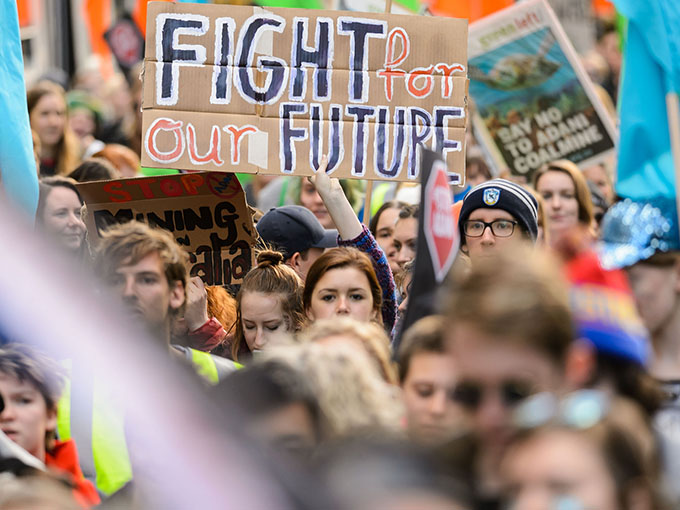
Young people “know the consequences of the current shameful inaction both for themselves and future generations. This should be a moment for stark self-reflection by our political class.” Image: Strike 4 Climate

Pacific Media Centre Newsdesk

Amnesty International today warned that the failure of governments to tackle climate change could amount to the greatest inter-generational human rights violation in history. a

The London-based rights organisation welcomed a global day of school strikes against climate change planned for tomorrow by young people.

“Amnesty International stands with all children and young people who are organising and taking part in school strikes for climate action,” said Amnesty International’s secretary-general Kumi Naidoo.

READ MORE: Students striking from school for a safe climate future

This is an important social justice movement that is mobilising thousands of people to peacefully call on governments to stop climate change.

“It is unfortunate that children have to sacrifice days of learning in school to demand that adults do the right thing.

-Partners-

“However, they know the consequences of the current shameful inaction both for themselves and future generations. This should be a moment for stark self-reflection by our political class.

“Instead of criticising young people for taking part in these protests, like some misguided politicians have done, we should be asking why governments are getting away with playing truant on climate action.”

Devastating impacts
Amnesty International warned that climate change was having and would have even more devastating impacts on human rights unless governments acted now to change course.

Climate change especially affects people who are already vulnerable, disadvantaged or subject to discrimination, the organisation said.

“Children especially are more vulnerable to climate-related impacts, due to their specific metabolism, physiology and developmental needs,” Amnesty said in a statement.

“Climate change also poses a risk to their mental health; children exposed to traumatic events such as natural disasters, exacerbated by climate change, can suffer from post-traumatic stress disorders.”

Naidoo said: “Climate change is a human rights issue precisely because of the impact it is having on people. It compounds and magnifies existing inequalities, and it is children who will grow up to see its increasingly frightening effects.

“The fact that most governments have barely lifted a finger in response to our mutually assured destruction amounts to one of the greatest inter-generational human rights violations in history.”

Millions of people are already suffering from its catastrophic effects – from prolonged drought in sub-Saharan Africa to devastating tropical storms sweeping across South-east Asia and the Caribbean.

Devastating heatwaves
During the summer months for the northern hemisphere in 2018, communities from the Arctic Circle to Greece, Japan, Pakistan and the USA experienced devastating heatwaves and wildfires that killed and injured hundreds of people.

“Children are often told they are ‘tomorrow’s leaders’. But if they wait until ‘tomorrow’ there may not be a future in which to lead. Young people are putting their leaders to shame with the passion and determination they are showing to fight this crucial battle now,”  Naidoo said.

The latest pledges made by governments to mitigate climate change— which are yet to be implemented—are completely inadequate as they would lead to a catastrophic 3°C increase in average global temperatures over pre-industrial levels by 2100.

Amnesty International calls on states to scale up climate action substantially and to do so in a manner consistent with human rights.

One of the crucial ways this can happen is if people most affected by climate change, such as children and young people, are engaged in efforts to address and mitigate climate change, while being provided with the necessary information and education to participate meaningfully in such discussions, and included in decision-making that directly affects them.

“Every day that we allow climate change to get worse ultimately makes it harder to stop and reverse its catastrophic effects. There is nothing stopping governments from doing everything in their power to reduce greenhouse gas emissions within the shortest possible time-frame.

“There is nothing stopping them from finding ways to halve emissions from their 2010 levels by 2030, and to net-zero by 2050, as climate scientists have called for,” said Naidoo.

“The only thing standing in the way of protecting humanity from climate change is the fact that our leaders lack the political will and have barely tried. Politicians can keep making excuses for their inaction, but nature does not negotiate. They must listen to young people and take steps today to stop climate change, because the alternative is unthinkable.”

#Strike4Climate

Print Friendly, PDF & Email

Article by AsiaPacificReport.nz

The Australian Web Archive is a momentous achievement – but things will get harder from here

]]>

Source: The Conversation (Au and NZ) – By Axel Bruns, Professor, Creative Industries, Queensland University of Technology

The National Library of Australia has just launched its Australian Web Archive – a massive, freely accessible collection of content that provides a historical record of the development of world wide web content in Australia over more than two decades.

The new archive is a momentous achievement. Containing annual captures of all accessible pages on .au domains and dating back to 1996, it dwarfs even the the Library’s own PANDORA Web archive – a curated collection of Australian web content deemed to be of national significance by the librarians.

That the Library has managed to construct this national web archive, and to conduct annual captures of the .au domain since 2005, is all the more remarkable given the chronic underfunding of its activities by successive federal governments. But with the increased use of social media and apps, the next step is to archive platforms such as Facebook and Twitter – unfortunately, this will be an even bigger challenge.

Why archive the web?

More and more material of cultural, social, political, and ultimately historical significance originates online. This has created significant problems for national libraries and archives used to dealing with books, newspapers, letters, and other hard copy materials. Because of constant changes in formats and systems, digital materials are perhaps even more difficult to preserve and keep accessible than print or photos.

Imagine the digital heritage we would lose if such content was not being archived, though. The web is a communally authored space that contains everything from official government announcements through mainstream news reporting to personal homepages. It provides a record of cultural activity and public debate that is far more comprehensive than the written materials that survive from earlier periods in human history.


Read more: Protecting our digital heritage in the age of cyber threats


Already, much of the early web has been lost, however. This is also because of the constant turnover in popular platforms. Early community sites such as GeoCities and MySpace have all but disappeared, and so has the content hosted on them – even in spite of user efforts to preserve at least some of the material from deletion.

The Australian Web Archive is a critical initiative to save what can still be saved, with a strong focus on Australian content. For future historians, it is a treasure trove: how did the general public respond to events of national significance, from John Howard’s election loss through Cyclone Yasi to cricket’s ball-tampering scandal? How did our views, attitudes, and beliefs change in more subtle and gradual ways over time, in relation to everything from anthropogenic climate change to My Kitchen Rules?

How to search the new Australian Web Archive.

The real problems are only just beginning

In spite of its achievements, the Library can’t rest on its laurels. Because of the malleability of digital data, online content is also more changeable than print. Websites can change every day, every hour, every minute, and keeping track of such fast-paced content is only getting more difficult.

A crucial problem here is the increasing “platformisation” of the Internet. We no longer simply use “the web”: we’re on Facebook, Instagram, Twitter, WhatsApp, and any number of other platforms, and we’re more likely to access them through mobile apps than desktop browsers.

Such platforms and their content are themselves of immense historical significance: hyperactive Twitter is a first draft of the present where we are constantly commenting on breaking news stories; all-conquering Facebook and its profiles, pages, and groups are a near-comprehensive representation of our collective interests and obsessions; audiovisual Instagram provides a constant stream of photos and videos of contemporary life.


Read more: A First Draft of the Present: Why We Must Preserve Social Media Content


A comprehensive archive of their contents would provide the material for a generation of historians and media, communication, and cultural studies researchers – but the technical, ethical, and political obstacles are immense, and growing.

Archiving the platformised internet

First, the platforms themselves usually don’t provide comprehensive access to their content. But even where they have, archiving institutions have struggled to cope with the overwhelming volume and unfamiliar forms of this firehose of information – as the US Library of Congress found to its detriment when it accepted the “gift” of full and continuing access to Twitter.

Second, users of these platforms have not usually provided explicit permission for their content to be archived and made available by national institutions, except in click-through agreements that none of them have actually read. National libraries have substantial experience in handling sensitive content, and are perhaps better placed than most other institutions to develop ethically sound access mechanisms, but few have chosen to tackle this thorny issue so far.

Finally, the growing backlash against social media platforms’ commodification of user data in the wake of the Cambridge Analytica scandal has led many platform providers to take an increasingly defensive stance, and reduce data access even for legitimate purposes, including research.


Read more: Academics call on Facebook to make data more widely available for research


Facebook’s just-announced “pivot” towards an emphasis on private over public communication must be seen in this context. It is less a genuine attempt to protect users from unwanted intrusions than an intervention designed to reduce pressure from regulators and policy-makers. Facebook’s core business model remains commercialising its users’ data, after all.

In combination, such developments present critical new challenges for the National Library of Australia and other institutions charged with documenting our continuing national narrative.

The Australian Web Archive is a remarkable achievement, and a powerful indicator of the world-leading expertise the Library has managed to assemble in-house. What is needed now is the political will and budget support to enable the Library to maintain this initiative, and to extend it to the new spaces where that narrative now continues to be told.

ref. The Australian Web Archive is a momentous achievement – but things will get harder from here – http://theconversation.com/the-australian-web-archive-is-a-momentous-achievement-but-things-will-get-harder-from-here-113542

Landmark High Court decision guides how compensation for native title losses will be determined

]]>

Source: The Conversation (Au and NZ) – By William Isdale, Postgraduate Research Student, T.C. Beirne School of Law, The University of Queensland

The High Court has decided, for the first time, the approach that should be taken to resolving native title compensation claims. In a previous article, we said it would be “the most significant case concerning Indigenous land rights since the Mabo and Wik decisions”.


Read more: How will Indigenous people be compensated for lost native title rights? The High Court will soon decide


The High Court’s decision yesterday certainly stands up to that description, and provides a degree of certainty for native title holders and governments. However, it also leaves a number of important issues unresolved. There will no doubt be further significant decisions in the future.

The significance of the decision

The decision is significant for Indigenous people because it confirms the substantial awards that may be made for past losses of native title. In this case, the High Court awarded the Ngaliwurru and Nungali peoples just over A$2.5 million for the loss of 1.27 square kilometres of non-exclusive native title, in and around the remote Northern Territory township of Timber Creek. The loss of that title occurred incrementally, by various acts of the NT government in the 1980s and ’90s.

The decision is significant for state and territory governments because the financial liabilities they owe to many Indigenous peoples have been clarified. Governments have known about the potential for compensation claims since the Native Title Act was passed in 1993. But because the Act expresses the right to compensation in vague terms (being an entitlement “on just terms to compensate the native title holders”), the amounts were unquantifiable. For example, the Commonwealth government’s 2007-08 budget papers noted:

The Australian Government’s liability cannot be quantified due to uncertainty about the number and effect of compensable acts, both in the past and in the future, and the value of native title affected by those acts.

The Native Title Act’s recognition of rights to compensation extends back only to losses of title that have occurred since October 31 1975 (when the Racial Discrimination Act 1975 commenced). However, as explained below, it is possible that claims for compensation for some losses of title prior to that date could succeed.

What the High Court said

Unlike conventional interests in land – like freehold title – it is not possible to sell or lease native title rights. That made it especially difficult to determine what the economic value of those rights would be.

Secondly, there was the question of how a native title party’s cultural or religious ties to country would be compensated for. The High Court’s decision has provided the first inkling of clarity on these questions.

The High Court said the economic component of native title rights was to be valued by assessing those rights in comparison to a freehold title. A freehold title sets the upper limit for economic value because it provides the most extensive set of property rights known to the law. The court confirmed that the task is essentially intuitive.

The first decision of the Federal Court, in 2016, had said that the rights in this case were worth 80% of the freehold value of the land. The Full Court of the Federal Court reduced that amount to 65%. The High Court whittled it down further in this decision, to 50%.

As to the cultural or religious loss caused by the loss of native title rights, the High Court said:

… what, in the end, is required is a monetary figure arrived at as the result of a social judgment, made by the trial judge and monitored by appellate courts, of what, in the Australian community, at this time, is an appropriate award for what has been done; what is appropriate, fair or just.

The court considered that the amount awarded by the courts below – A$1.3 million – was an appropriate award for this aspect of the loss.

Why we can expect more judgments on this topic

The court’s judgment still leaves a lot intuitive work to be done by those trying to determine native title compensation awards. In our view, that is not to the benefit of either native title parties or governments.

What is needed is further guidance about the criteria or principles that will guide the exercise of what is, essentially, an evaluative, or intuitive, decision. Further clarity about these principles will make it easier for compensation claims to be resolved by agreement, rather than by expensive (and time-consuming) litigation. Because the common law is worked out incrementally by the courts, it is likely that future decisions will go some way towards providing further guidance.


Read more: FactCheck: can native title ‘only exist if Australia was settled, not invaded’?


The High Court’s decision also leaves unanswered a number of significant questions. The most significant of these concerns the requirement in the Australian Constitution, section 51, that certain acquisitions of property be on “just terms”.

High Court judges have, over the years, expressed different views as to whether native title would enjoy the protection of this provision. If it does, then it is possible that certain restrictions on compensation provided for under the Native Title Act are unconstitutional.

Further, it may be possible for compensation claims to be successfully made outside of the Native Title Act and for losses that occurred before October 31 1975. If that were the case, for example, actions by the Commonwealth in the Northern Territory (which achieved self-government only in 1978) that extinguished or affected native title, all the way back to Federation in 1901, could be compensable.

What the decision means

For governments around the country that are beginning to quantify their native title liabilities, the amounts could be eye-wateringly large. It is unlikely that many governments have prepared financially for the wave of potential compensation claims.

The greater certainty about the amounts that may be available is likely to accelerate the making of such claims. As the Federal Court noted in its 2016-17 annual report:

A significant number of compensation claims are anticipated when the legal processes in Griffiths [the formal name of this High Court decision] conclude.

Overall, the decision will mark a shift in Australia’s native title journey from determining claims about the existence of native title (phase one) into determining compensation for past losses of native title (phase two).

The first phase has been with us since Mabo in 1992, and new claims for the recognition of native title continue to be made. The second phase is only just beginning. We will see claims before the courts for many years to come.

Given that compensation claims will be payable in most cases by governments, it is likely the decision will trigger political debate about the economic, budgetary and social implications. This debate will deserve close scrutiny.

ref. Landmark High Court decision guides how compensation for native title losses will be determined – http://theconversation.com/landmark-high-court-decision-guides-how-compensation-for-native-title-losses-will-be-determined-113346

A warning for wine-lovers: climate change is messing with your favourite tipple’s timing

]]>

Source: The Conversation (Au and NZ) – By Christopher Davies, Team Leader, CSIRO

While the much-derided “latte set” are stereotyped as the biggest worriers about climate change, it’s the chardonnay crowd who are acutely feeling its effects.

Australia’s wine industry is both world-renowned and economically significant, with around A$5.6 billion in sales in 2016–17, and winemaking and associated tourism responsible for more than 170,000 full and part-time jobs. Statistics also show that wine consumption is now accepted as being just as dinky-di as beer drinking for the average Australian.


Read more: A taste for terroir: the evolution of the Australian wine label


However, record-breaking daily maximum temperatures, warmer than average overnight temperatures, and increasingly erratic weather patterns are playing havoc with the way wine grapes grow and ripen. This has knock-on effects for Australian grape growers, wine producers and consumers.

Climate in the vineyard hits the cellar and the store shelf

Most of Australia’s wine regions have experienced rising average daily temperatures. One effect is changes to ripening times, which has compressed the harvesting season and given wine-makers a crucial logistical headache.

Traditionally, white grape varieties would generally reach optimum ripeness before red ones. While all grapes tend to ripen faster as temperatures rise, this effect is more pronounced for later-ripening varieties (for example Shiraz and Cabernet Sauvignon) than earlier ripening varieties (for example Chardonnay and Riesling).

Australian winegrape varieties are becoming ready for harvest simultaneously. Shutterstock

The old process of staggered harvesting times for red and white grape varieties was efficient, allowing the winery’s capacity to be used in sequence for different varieties. Now that different varieties are ripening at the same time, vineyards and wineries will have to make tough choices about which grapes to prioritise, and which ones to leave until later, resulting in inferior wine. Alternatively, they could take the expensive decision to increase production capacity by investing in more infrastructure such as fermenters and stainless steel tanks.


Read more: Message in a bottle: the wine industry gives farmers a taste of what to expect from climate change


Perhaps you’re thinking that you, the savvy wine drinker, are unaffected by the difficulties faced by winemakers in the vineyards and wineries far away. Unfortunately this isn’t so. Harvesting grapes when they are not at optimal ripeness to solve the logistical problems of processing can lead to lower-value wine.

The fact is that this new reality is costing everyone – grape-growers, winemakers and consumers alike.

And just in case you think that the simple answer is changing Australia’s cultured palates back to beer, think again. Hop production is being hit just as hard by climate change.

Help is at hand

Fortunately, these are problems we hope to tackle. CSIRO recently announced a five-year research partnership with Wine Australia, and one of the projects aims to adjust wine grape ripening to suit a changing climate.

We hope to do it by studying plant growth regulators (PGRs) – molecules that are used by the plant to control and coordinate development. We are using a class of PGRs called auxins, first studied in grass seedlings by Charles Darwin in the 1880s, that have important roles in vine growth, and the timing of grape growth and ripening.

Plant growth regulators can help control ripening times. Shutterstock

By spraying these compounds onto vines and grapes shortly before ripening, auxins can potentially be used to influence the timing of this process and therefore harvest date. They are already used in other horticultural crops, such as to control fruit drop in apples and pears.

Applying very small amounts of auxin can delay grape ripening, and therefore harvest timing, by up to four weeks (Davies et al., 2015, J Ag Food Chem 63: 2137-2144). This treatment works for red and white varieties in hot or cool climates, and is safe, cheap and easy to apply.

The flavour and aroma of wines made from ripening-delayed grapes is largely indistinguishable from wines made from untreated fruit harvested at the same sugar level, up to a month earlier. An exciting exception is that, in Shiraz, auxin-induced ripening delay can be used to increase the concentration of rotundone, the compound responsible for this variety’s popular peppery notes.


Read more: State of the Climate 2018: Bureau of Meteorology and CSIRO


Work is currently under way to fine-tune spray formulations and application times. The aim is to release a commercially available product within the next five years.

This kind of solution will be vital for the sustainable, economical production of high-quality wines from existing grape varieties in established wine growing regions. We hope it will ensure you can enjoy your favourite drop for many years to come.

ref. A warning for wine-lovers: climate change is messing with your favourite tipple’s timing – http://theconversation.com/a-warning-for-wine-lovers-climate-change-is-messing-with-your-favourite-tipples-timing-112865

Curious Kids: what is a headache? Is it our brain hurting?

]]>

Source: The Conversation (Au and NZ) – By David Farmer, Senior Research Officer, Florey Institute of Neuroscience and Mental Health

Curious Kids is a series for children. If you have a question you’d like an expert to answer, send it to curiouskids@theconversation.edu.au You might also like the podcast Imagine This, a co-production between ABC KIDS listen and The Conversation, based on Curious Kids.

What is a headache? Is it our brain hurting? – Question from the students of Ms Young’s Grade 5/6 class, Baden Powell College, Victoria.

Scientists and doctors define “a headache” as a situation in which your “head” “aches”.

Sorry for getting technical right off the bat, but that’s the simple answer.

If we look a little deeper, things get very interesting: an ache is a kind of pain, but what is pain? And more importantly, why is it happening to your head?


Read more: Curious Kids: who was the first ancient mummy?


A closer look at pain

Pain is the brain’s way of telling you that things are bad for you. For example, a hot stove or a slammed door can damage your skin and muscle. If you, say, burn your finger or slam a door on it, information about the damage is sent to your brain.

When it arrives there you will, unfortunately, experience it as pain.

As most of us know, pain feels terrible, but it is actually very useful. It is the brain’s way of convincing you not to do things that can hurt you.

“Come on, mate,” you whisper, rubbing your temples, “get to the headaches already.”

Where does it hurt? Shutterstock

Brain pain?

The brain itself (that is, the thinking bits of it) can’t sense damage the way your fingers can. To my knowledge, nobody has accidentally burned their brain on a hot stove, so we can’t ask them what it feels like (as always, do not try this at home, or anywhere else for that matter).

However, we do know that we can poke or even cut a brain and it won’t feel painful to the person. We know this because people can have brain surgery while they are totally awake.

In fact, this is the safest way to do it. That said, I’m sure we can agree that having someone perform surgery on your brain (hopefully, a surgeon) while they also chat to you about the weather is probably a very weird experience.

“Come on, David!” you whisper, grimacing against the light as your patience frays and your headache intensifies. “If the brain can’t sense injury, then why does my head hurt?”

People can have brain surgery while they are totally awake. Shutterstock

The brain itself can’t sense injury, but do you know what can? The muscles and membranes that surround the brain, and the veins and arteries that run through the brain.

These near-brain but not-brain things can experience things like irritation, inflammation or dehydration. If they do, your brain will interpret this information as pain that is happening inside your head, and so you experience a headache.

This irritation, inflammation or dehydration could occur because you are getting sick, or have banged your head, or spent a hot day in the sun without drinking enough water.

If you do have a headache, it is a good idea to tell your parents or teacher and then have a lie down in a quiet, dark, cool room. If the pain doesn’t go away after a lie down, you might ask your parents for a trip to the doctor.

If you have a headache, try lying down in a darkened room. Your headache might go away on its own. Shutterstock

Sometimes, for some reason that I don’t understand, people around me seem to get a headache when I talk to them about science things (like headaches) for too long.

In this case, getting rid of a headache is a two-step process in which you first wait for me to go away, and then lie down and wait for the pain to go away as normal.

The first bit of good news is that, if I am not the cause of your headache, you just need to do the lying down part.

The second bit of good news is that this is the last sentence of this article about headaches and the headache-inducing nature of pain.

David Farmer is the brains (pun absolutely intended) behind the Melbourne Comedy Festival show “Why You’re Not Dead Yet” which is all about brain function.


Read more: Curious Kids: why are people colour blind?


Hello, curious kids! Have you got a question you’d like an expert to answer? Ask an adult to send your question to curiouskids@theconversation.edu.au

CC BY-ND

Please tell us your name, age and which city you live in. We won’t be able to answer every question but we will do our best.

ref. Curious Kids: what is a headache? Is it our brain hurting? – http://theconversation.com/curious-kids-what-is-a-headache-is-it-our-brain-hurting-112951

An impaired sense of smell can signal cognitive decline, but ‘smell training’ could help

]]>

Source: The Conversation (Au and NZ) – By Anna Wolf, Postdoctoral Fellow, Academic Unit for Psychiatry of Old Age, University of Melbourne

As we age, we often have problems with our ability to smell (called olfactory dysfunction). Older people might not be able to identify an odour or differentiate one odour from another. In some cases they might not be able to detect an odour at all.

Odour identification difficulties are common in people with neurodegenerative diseases, including Alzheimer’s disease.

In the absence of a known medical cause, an impaired sense of smell can be a predictor of cognitive decline. Older people who have difficulty identifying common odours have been estimated to be twice as likely to develop dementia in five years as those with no significant smell loss.

Olfactory dysfunction is often present before other cognitive symptoms appear, although this loss can go undetected.


Read more: Curious Kids: How do we smell?


Beyond being a potential early indicator of Alzheimer’s disease, olfactory problems can pose safety risks, such as not being able to smell gas, smoke, or rotten food.

Smell ability is also strongly linked to our ability to taste, so impairments can lead to decreased appetite and therefore nutritional deficiencies. In turn, olfactory deficits can decrease quality of life and increase the risk of depression.

But there is emerging evidence that olfactory or “smell training” can improve ability to smell. These findings may offer some hope for older adults experiencing olfactory difficulties and an associated decline in quality of life.

How is our sense of smell linked to our brains?

The process of smelling activates the complex olfactory network in the brain. When we smell a rose, for example, receptors in the nose detect the many molecules that make up the rose’s odour.

This information is then sent to the many areas of the brain (including the olfactory bulb and olfactory cortex, the hippocampus, the thalamus and the orbitofrontal cortex) that help us process the information about that odour.

To name the rose, we access our stored knowledge of its pattern of odour molecules, based on past experience. So identifying the smell as belonging to a rose is considered a cognitive task.

What is smell training?

Smell training has been studied in various animals, from flies to primates. Animals exposed to multiple odours develop an increased number of, and connections between, brain cells. This process has been shown to enhance learning and memory of odours.

In humans, olfactory training has typically involved smelling a range of robust odours representing major odour categories – flowery (such as rose), fruity (lemon), aromatic (eucalyptus) or resinous (cloves). Participants may be asked to focus their attention on particular odours, try to detect certain odours, or note odour intensities.

An inhibited sense of smell means we may not taste our food as well. From shutterstock.com

Generally, training is repeated daily for several months. Periods over three months are suggested for older adults.

This training has been shown to improve people’s ability to identify and tell the difference between smells. To a lesser extent, it can help with odour detection in people with various forms of smell loss, including those with a brain-derived impairment such as a head injury or Parkinson’s disease.


Read more: What’s happening in our bodies as we age?


Importantly, one recent study of olfactory training in older adults found it not only improved performance on identifying smells, but was also associated with improvement in other cognitive abilities.

For example, those who undertook smell training had improved verbal fluency (improved ability to name words associated with a category), compared to control participants who completed Sudoku exercises.

How does smell training work?

Neuroplasticity, our brains’ ability to change continuously in response to experience, may be key to how smell training works.

Neuroplasticity involves the generation of new connections and/or the strengthening of existing connections between neurons (brain cells), which in turn may lead to changes in thinking skills or behaviour. We can see evidence of neuroplasticity when we practise a skill such as playing an instrument or learning a new language.

The olfactory network is considered particularly neuroplastic. Neuroplasticity may therefore underlie the positive results from smell training, both in terms of improving olfactory ability and boosting capacity for other cognitive tasks.


Read more: Explainer: nature, nurture and neuroplasticity


Could smell training be the new brain training?

Brain training aiming to maintain or enhance cognitive function has been extensively studied in older people with dementia or at risk of it.

Established cognitive training approaches generally train participants to use learning strategies with visual or auditory stimuli. To date, formal cognitive training has not been attempted using smells.

However, using the considerable neuroplasticity of the olfactory network and evidence-based cognitive training techniques, both olfactory and cognitive deficits may be targeted, particularly in older adults at risk of dementia. It seems possible we could train our brains through our noses.

ref. An impaired sense of smell can signal cognitive decline, but ‘smell training’ could help – http://theconversation.com/an-impaired-sense-of-smell-can-signal-cognitive-decline-but-smell-training-could-help-107606

UPNG may get new council, says staff boycott academic

]]>
NASA representatives, including Dr Linus Digim’Rina, talking to journalists at the University of Papua New Guinea. Image: Alan Robson/PMC

By RNZ Pacific

A new council at the university of Papua New Guinea could soon be appointed, says an academic who led last week’s staff boycott at the country’s main national university.

Dr Linus Digim’Rina, head of the Division of Anthropology, Sociology and Archaeology, is a key member of the National Academic Staff Association (NASA).

Dr Digim’Rina said almost all university staff boycotted their duties for three days last week, following the suspension of the council in January.

READ MORE: UPNG shutdown crisis – the facts behind the turmoil

Higher education minister Pila Niningi cited allegations of corruption and sexual misconduct against the council in his decision to install an interim body.

But the interim council’s composition angered staff which led to the boycott, Dr Digim’Rina said.

-Partners-

“We avoided describing it as a strike action because there was no resolution from NASA … So it was a voluntary call on individual members of staff, everybody who are concerned about governance issues.”

On Wednesday last week, the minister accompanied by the government’s chief secretary, Isaac Lupari, met with university staff and undertook to take three actions, Dr Digim’Rina said.

‘New team altogether’
“One, complete the process of the appointment of the vice chancellor. Two, conduct an independent investigation into the allegations… And three, appoint a new council with a new composition, a new team altogether,” he said.

“That’s why we committed ourselves to return to classes last Thursday.”

The staff presented a list of names for appointment to the council which is subject to approval by the National Executive Council (NEC), Dr Digim’Rina said.

“That will be presented to NEC on Thursday, deliberated and a decision reached,” he said.

But some of the interim councillors could remain.

“The minister indicated during the presentation that he would like to keep not all but a few of his own appointees including the chancellor and that didn’t go down well with university staff,” Dr Digim’Rina said.

The chancellor, Jeffrey Kennedy, criticised NASA last week for taking industrial action on issues not related to employment.

Room for more
Kennedy said he expected his interim council to be in place until the end of the year but noted there was room for two more members to be appointed.

But the composition of the interim council does not adequately represent the university, Dr Digim’Rina said.

“A one-sided majority of the members have come from management, corporate administration and real estate backgrounds,” he said.

“There were also allegations rolling around… whereby the minister seemed to be bringing in friends and business partners into the council membership.

“Although it’s only an interim council it’s all to do with business. It’s not representative enough of the academic programmes within the university or civic organisations within society.”

Nevertheless, the need for new leadership “was recognised by university staff”, Dr Digim’Rina said.

“The previous council wasn’t necessarily performing at its best. We generally felt after so many years the council could have done a bit better,” he said.

Slow responses
But its performance may have been hindered by previous administrators, including the vice-chancellor and registrar, failing to implement council decisions in a timely fashion, Dr Digim’Rina said.

“I can say the previous council together with the previous administration, they were quite slow. The need for change was recognised by university staff,” he said.

“And in a strange way the minister’s intervention was quite necessary.”

As for completing the appointment of the vice chancellor, Frank Griffin had come through a robust selection process under the previous council that staff were “proud of”, Dr Digim’Rina said.

The minister, has appointed Kenneth Sumbuk as interim vice chancellor, who Dr Digim’Rina said was one of the candidates rejected during Professor’s Griffin’s selection.

But even though the minister had lost confidence in the previous council, he could not now claim to be sceptical of Professor Griffin, Dr Digim’Rina said.

“If that were the case the minister would have stepped in before the process was completed. Not after.”

This article is republished under the Pacific Media Centre’s content partnership with Radio New Zealand.

Print Friendly, PDF & Email

Article by AsiaPacificReport.nz

Filipino groups denounce cyberattacks against independent media

]]>
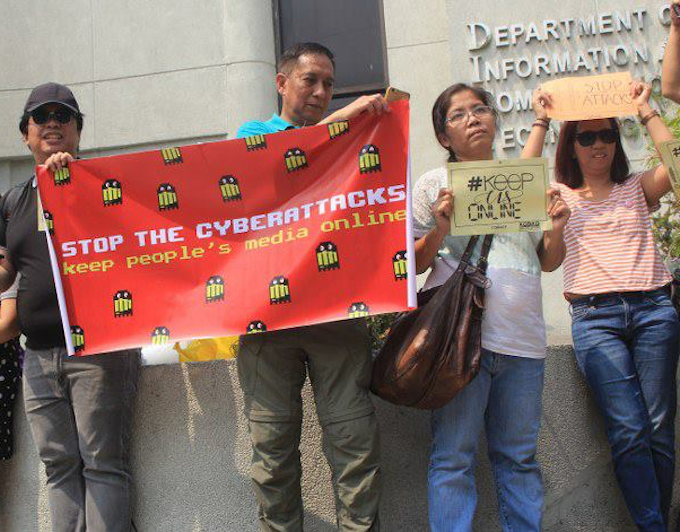
Groups denounce cyberattacks against several independent media websites in the Philippines. Image: Kodao Productions/Global Voices

By Mong Palatino in Manila

Several media groups in the Philippines marked the World Day Against Cyber Censorship this week by holding a protest to denounce the ongoing cyberattacks against their websites which they claim are backed by the government.

Since December 2018, the websites of alternative media groups Bulatlat, Kodao Productions, Pinoy Weekly and Altermidya have been targeted by distributed denial of service attacks (DDoS).

The NUJP “we’re still up” page. Image: PMC screenshot
The websites of Arkibong Bayan, Manila Today and the National Union of Journalists of the Philippines have also been attacked in the past month.

According to the Southeast Asian Press Alliance, at least 10 cases of cyber onslaught against select Filipino news outlets have been documented since President Rodrigo Duterte came to power in 2016.

Qurium, a Sweden-based media foundation which has been assisting those media groups, confirmed the DDoS attacks against Altermidya and other alternative news websites.

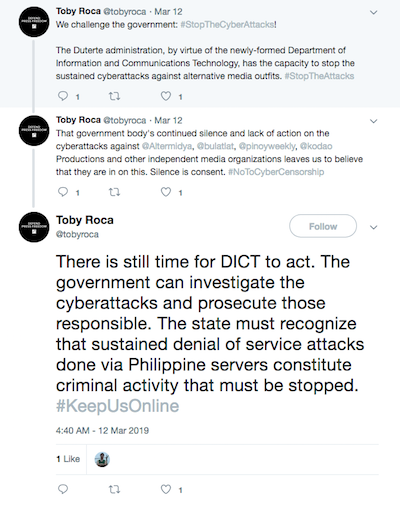
The details of the DDoS attacks have been reported to the government’s National Computer Emergency Response Team (NCERT) of the Department of Information and Communications Technology (DICT). After one month had passed without the government body acknowledging their report, the media groups led by Altermidya decided to protest in front of NCERT’s office on Tuesday.

-Partners-

In a pooled editorial, the media groups linked the cyberattacks to the government’s crackdown on dissent:

The Duterte regime is using every means to silence dissent, criticism and free expression: from threats, incarceration to killings, to cyber warfare. The main target of this latest assault are the alternative media that mostly via online disseminate reports and views on events and issues that are rarely covered, if at all, by the dominant media. The goal is to deny a public hungry for information the reports and stories that it needs to understand what is happening in a country besieged by lies and disinformation.

The editorial condemned the increasing attacks against the press, especially those perceived to be critical of the Duterte government.

Altermidya national coordinator Rhea Padilla explained on Facebook why they protested against NCERT:

This is why we are here. We demand that they act on the attacks. Otherwise, we will be lead to believe that NCERT and DICT are complicit in the attack on press freedom.

Altermidya reporter Toby Roca echoed her words:

Jola Diones-Mamangun, executive director of Kodao Productions, criticised the use of bots and trolls to undermine the work of the independent media:

Not content with fomenting disinformation and fake news, the Duterte administration is hell-bent on silencing what it considers as fierce critics and political opponents and goes to extreme lengths and harnessing even the power of the dark web.

Mong Palatino is a Filipino activist and former lawmaker in the House of Representatives. He has been blogging since 2004 at mongster’s nest. This article is republished from Global Voices on a Creative Commons licence.

Print Friendly, PDF & Email

Article by AsiaPacificReport.nz

Young voters may hold the key to the NSW state election: here’s why

]]>

Source: The Conversation (Au and NZ) – By Philippa Collin, Associate Professor, Institute for Culture and Society, Western Sydney University

Young Australians are more connected, educated and informed than previous generations. They are also more likely to have higher debt and less economic independence into their 30s. Many feel excluded from traditional politics and policy making and are turning to local action and global issues to express their political views.

Young people are also swing voters who have had a significant, but unrecognised, effect on the outcomes of elections since the mid 1990s. In NSW, there are 1.34 million voters aged 18-35 – 25% of all electors. This is a record high number following a 2017 surge in national enrolment when 65,000 new young voters registered in the lead up to the same-sex marriage poll. There are now 140,000 more 18–24-year-old voters than 1.5 years ago.


Read more: Many young people aren’t enrolled to vote – but are we asking them the wrong question?


In general, young voters are socially progressive and action-oriented. They are not rusted on to party politics and they want to see leadership on issues. In close elections, like this year’s NSW state poll, winning the youth vote will be key to winning government – especially in marginal seats.

For example, in the 2015 election, Coogee was won by less than 2,500 votes – equivalent to half of the 20-24 year olds in that electorate. So the issues that matter to young people should matter to NSW electoral candidates.

What matters to young people in NSW?

Safety at entertainment events and school strikes on climate change have already tested the Coalition government’s responses to young people and their concerns. Yet, the diverse experiences and needs of young people still aren’t reflected by political parties. Key issues that matter to young people in the NSW election include:

Heath and mental health

In NSW, mental health is the top priority issue for those aged 15-19. The most frightening aspect of mental health for young people is the growing rate of youth suicide, and 45% of all young people who died by suicide in 2016 were from NSW.

Around two thirds of young Australians who need help don’t get it. In consultations with more than 4,000 children and young people, the NSW Advocate for Children and Young People identified access to health and mental health services and support as a major concern – young people want the government to ensure that there is appropriate help, when they need it – including after hours.

They also want governments to address the “causes of the causes” of poor health and mental health – such as poverty, inequality and violence.

Unemployment

Finding work is becoming more difficult for young Australians. With one in three young people unemployed or underemployed, young people are not benefiting from economic or job growth in the state. The youth unemployment rate is more than twice Australia’s overall unemployment rate and in NSW, 84,900 young people are not in paid work. Despite 60% of young Australians achieving post school qualifications, half of Australia’s 25-year-olds are unable to secure full-time employment.


Read more: High youth unemployment can’t be blamed on wages


Housing affordability

As more young people are pushed into perpetual and unaffordable renting because they cannot afford to buy a home, and with the increasing number of youth homelessness, housing affordability is a clear election priority. The relative cost of purchasing a house in 2016 was four times what it was in 1975, with more than 50% of young people under 24 experiencing housing stress.

For young people in Western Sydney, the situation is especially acute. Rents can be 35 – 60% of average weekly wages for people over the age of 15. Of immediate concern is the massive increase in youth homelessness over the last decade by 92%. There were 9,048 homeless young people in NSW in 2016: more than in any other state.

Climate change

Climate change remains a key concern for young people: it is one of the top three issues identified by young people for the 2016 election. In 2017, a United Nations Youth Representative Report listed it as the number one concern.

Since then, young people have been calling for politicians to take meaningful action on climate change, spurring a world-wide movement ‘school strike 4 climate’ for which many will demonstrate at an estimated 50 sites around Australia on March 15. Young people have the most at stake when it comes to climate change and they are holding the government to account. Climate change will be a deciding issue until there is clear action made by state and federal governments.

Education

The rising cost of VET, TAFE and university fees, compounded by insecure work and the high cost of living, are making educational access increasingly unequal for young people across NSW.

Young people want education to be free or more affordable, to ensure that everyone has access to a well-funded and relevant education system, according to a survey of 3,400 young people done by Youth Action in 2018.

Young people, especially those from rural and remote areas, those with a disability, and those from low SES backgrounds continue to face disproportionate challenges in our state education system.

Beyond the election

Young people won’t be won over by small, short term measures. Candidates and parties must be genuine, honest, consistent and lead on the key issues that matter to young people. To gain and retain their votes, politicians need to deliver and meaningfully engage with young people in the long term. Much like a Minister for Aging (which NSW has), a Minister for Youth would ensure this consistently across government.


Read more: How to engage youth in making policies that work for us all


In all their diversity, young people care about issues and they want to be involved. Adding their voices and votes to solving big policy problems in NSW will have a beneficial flow on effect for the rest of society. In extensive consultations by the NSW Advocate for Children and Young People and for Youth Action’s 2019 Election Platform young people have clearly articulated what needs to happen to create a better society for their peers and deliver benefits to the wider community.

Candidates in the upcoming election would be wise to heed and act on the priorities of young people who will be voting in March – and for many decades to come. If you don’t secure their vote, someone else will.

This article was co-authored with Katie Acheson (CEO, Youth Action)

ref. Young voters may hold the key to the NSW state election: here’s why – http://theconversation.com/young-voters-may-hold-the-key-to-the-nsw-state-election-heres-why-113190

Experts call for halt to CRISPR editing that allows gene changes to pass on to children

]]>

Source: The Conversation (Au and NZ) – By Dimitri Perrin, Senior Lecturer, Queensland University of Technology

Remember the global outrage four months ago at world-first claims a researcher had used the gene editing tool CRISPR to edit the genomes of twin girls?

The molecular scissors known as CRISPR (CRISPR/cas9 in full) allow scientists to modify DNA with high precision and greater ease than previous technologies.

Now researchers from the USA, Europe, China and New Zealand have published a prominent call for a moratorium, or temporary freeze, on the clinical use of germline gene editing technology in humans. (Germline editing means the genes that are edited are included in eggs and sperm, the “germ” cells, and can be passed on to following generations).


Read more: What is CRISPR gene editing, and how does it work?


The authors on the Nature report include some leaders in the development of CRISPR technologies, as well as bioethicists.

They propose a framework in which nations commit to not approve any clinical use of heritable gene editing unless some conditions are met on technical, societal, medical and ethical grounds.

In that process, they also argue that there should be an initial period during which no clinical use of germline editing is allowed at all. Research would still be allowed, provided embryos are used only in the very early stages in laboratory studies, and not transferred to a woman’s uterus to develop further. They suggest this period could last five years.

After this initial period, any participating country could allow a particular application of germline editing by following three steps:

  1. public notice of intent
  2. transparent evaluation and justification of the application (considering not only the scientific and medical aspects, but also the related societal and ethical issues)
  3. achievement of a broad consensus in the nation that this is an acceptable application.

Read more: Researcher claims CRISPR-edited twins are born. How will science respond?


It’s about more than just science

It is important that the evaluation considers not only the science of germline genetic modifications, but also the broader societal context. The authors mention the risk of discrimination, peer and marketing pressure, and unequal access to the technology if gene editing became available as a tool, for example in IVF clinics.

This moratorium would be limited to human germline editing only. This means modifying human sperm, eggs or embryos to make children whose DNA has been altered. Such changes pass through the generations, which is why germline editing is a particular area of concern.

The moratorium would not apply to changes in human cells not capable of reproduction (called somatic gene editing). Current efforts to treat blindness, sickle cell disease or cancer using CRISPR would not be affected by the moratorium.

Implications in Australia

In Australia, germline genetic modification is not allowed, and is illegal.

According to the Prohibition of Human Cloning for Reproduction Act (2002) researchers can face up to 15 years in jail for modifying “the genome of a human cell in such a way that the alteration is heritable by descendants of the human whose cell was altered”. Therefore the implications for Australia will be limited, and applying the initial five-year freeze on any clinical use of germline editing would be seamless.

If Australia wishes to allow any clinical application of germline editing at some point in the future, this act would need to be revised.

The framework proposed in the moratorium call provides a basis for how such a revision could then be discussed: public notice, transparent and comprehensive consideration of the application, and national discussion.

Voluntary and pragmatic

The proposed moratorium is voluntary. This is a pragmatic approach. It would be very difficult to get international agreement on a ban.

As the authors note, discussions on a legally binding convention to outlaw human cloning are not making much progress.

In the absence of a binding agreement, a voluntary pledge can start to move the main stakeholders towards a workable solution. Other issues such as climate change have shown the limitations of international agreements, but even getting a limited number of countries on board would be a positive first step.


Read more: ‘Designer’ babies won’t be common anytime soon – despite recent CRISPR twins


Change requires commitment

The authors also call on those who work in fields where CRISPR is used, including the leaders of research institutes as well as individual researchers, to publicly pledge to the principles of the framework they have outlined.

It will be interesting to see how some other stakeholders respond. For instance, will funding agencies and scientific publishers come on board? One objection to moratoriums is that they do not prevent “rogue” entities or individuals from operating outside their framework.

If it was clear that no study would be funded or published unless it adhered to the principles of advance notice, full transparency and national approval, it would remove some of the incentives that sometimes turn scientific research into a race.

Ultimately, in each country, society as a whole will have to decide whether germline editing is acceptable, and under which circumstances. A meaningful consensus will only be achieved if an informed discussion takes place.

To date, issues around gene editing have been mostly discussed among experts. More than ever, engagement and education that includes diverse members of our society around advanced biotechnologies is crucial.

ref. Experts call for halt to CRISPR editing that allows gene changes to pass on to children – http://theconversation.com/experts-call-for-halt-to-crispr-editing-that-allows-gene-changes-to-pass-on-to-children-113463

An impaired sense of smell often signals cognitive decline, but ‘smell training’ could help

]]>

Source: The Conversation (Au and NZ) – By Anna Wolf, Postdoctoral Fellow, Academic Unit for Psychiatry of Old Age, University of Melbourne

As we age, we often have problems with our ability to smell (called olfactory dysfunction). Older people might not be able to identify an odour or differentiate one odour from another. In some cases they might not be able to detect an odour at all.

Odour identification difficulties are common in people with neurodegenerative diseases, including Alzheimer’s disease.

In the absence of a known medical cause, an impaired sense of smell can be a predictor of cognitive decline. Older people who have difficulty identifying common odours have been estimated to be twice as likely to develop dementia in five years as those with no significant smell loss.

Olfactory dysfunction is often present before other cognitive symptoms appear, although this loss can go undetected.


Read more: Curious Kids: How do we smell?


Beyond being a potential early indicator of Alzheimer’s disease, olfactory problems can pose safety risks, such as not being able to smell gas, smoke, or rotten food.

Smell ability is also strongly linked to our ability to taste, so impairments can lead to decreased appetite and therefore nutritional deficiencies. In turn, olfactory deficits can decrease quality of life and increase the risk of depression.

But there is emerging evidence that olfactory or “smell training” can improve ability to smell. These findings may offer some hope for older adults experiencing olfactory difficulties and an associated decline in quality of life.

How is our sense of smell linked to our brains?

The process of smelling activates the complex olfactory network in the brain. When we smell a rose, for example, receptors in the nose detect the many molecules that make up the rose’s odour.

This information is then sent to the many areas of the brain (including the olfactory bulb and olfactory cortex, the hippocampus, the thalamus and the orbitofrontal cortex) that help us process the information about that odour.

To name the rose, we access our stored knowledge of its pattern of odour molecules, based on past experience. So identifying the smell as belonging to a rose is considered a cognitive task.

What is smell training?

Smell training has been studied in various animals, from flies to primates. Animals exposed to multiple odours develop an increased number of, and connections between, brain cells. This process has been shown to enhance learning and memory of odours.

In humans, olfactory training has typically involved smelling a range of robust odours representing major odour categories – flowery (such as rose), fruity (lemon), aromatic (eucalyptus) or resinous (cloves). Participants may be asked to focus their attention on particular odours, try to detect certain odours, or note odour intensities.

An inhibited sense of smell means we may not taste our food as well. From shutterstock.com

Generally, training is repeated daily for several months. Periods over three months are suggested for older adults.

This training has been shown to improve people’s ability to identify and tell the difference between smells. To a lesser extent, it can help with odour detection in people with various forms of smell loss, including those with a brain-derived impairment such as a head injury or Parkinson’s disease.


Read more: What’s happening in our bodies as we age?


Importantly, one recent study of olfactory training in older adults found it not only improved performance on identifying smells, but was also associated with improvement in other cognitive abilities.

For example, those who undertook smell training had improved verbal fluency (improved ability to name words associated with a category), compared to control participants who completed Sudoku exercises.

How does smell training work?

Neuroplasticity, our brains’ ability to change continuously in response to experience, may be key to how smell training works.

Neuroplasticity involves the generation of new connections and/or the strengthening of existing connections between neurons (brain cells), which in turn may lead to changes in thinking skills or behaviour. We can see evidence of neuroplasticity when we practise a skill such as playing an instrument or learning a new language.

The olfactory network is considered particularly neuroplastic. Neuroplasticity may therefore underlie the positive results from smell training, both in terms of improving olfactory ability and boosting capacity for other cognitive tasks.


Read more: Explainer: nature, nurture and neuroplasticity


Could smell training be the new brain training?

Brain training aiming to maintain or enhance cognitive function has been extensively studied in older people with dementia or at risk of it.

Established cognitive training approaches generally train participants to use learning strategies with visual or auditory stimuli. To date, formal cognitive training has not been attempted using smells.

However, using the considerable neuroplasticity of the olfactory network and evidence-based cognitive training techniques, both olfactory and cognitive deficits may be targeted, particularly in older adults at risk of dementia. It seems possible we could train our brains through our noses.

ref. An impaired sense of smell often signals cognitive decline, but ‘smell training’ could help – http://theconversation.com/an-impaired-sense-of-smell-often-signals-cognitive-decline-but-smell-training-could-help-107606

How (and why) to stay optimistic when it feels like the environment is falling apart

]]>

Source: The Conversation (Au and NZ) – By Dominic McAfee, Postdoctoral researcher, marine ecology, University of Adelaide

Humans love optimism. It’s a no-brainer – optimism makes us feel good and wanting more. This attraction has deep neurological roots that affect both our brain functions and how we process new information.

For this reason, optimism is powerful. Optimistic individuals or groups frequently perform better in sports, are better negotiators in business, and recover faster from illness. Feeling optimistic may well be a self-fulfilling prophecy.


Read more: Explainer: ‘solarpunk’, or how to be an optimistic radical


But for scientists trying to communicate dark and difficult messages about conservation, extinction risks or climate change, pessimism can also be a useful tool (and a logical outcome). Shock headlines grab attention – and may more accurately reflect reality. But too much leads to fatigue and disengagement.

Published today in BioScience, our research outlines steps to usefully combine optimism with pessimism when talking about environmental conservation. We took a deep dive into the literature from psychology, business, politics and communications disciplines, to understand how positive and negative thinking influence human performance.

Know your target audience

To make your environmental message stick, first you need to know who your target audience is. What are their daily fears and future worries? Do they care about nature for nature’s sake, or only when it impacts themselves? How do they perceive scientists? Knowing their fundamental values helps tailor your message.

Let’s say we want to restore an endangered forest, whose existence has been largely forgotten. The benefits of restoring a forgotten habitat are many: the mental health benefits of walking among wise, old trees, the busy routine of forest creatures that churn the soil, increasing forest productivity and cleaning the rivers that flow beyond, and the abundant fruit that falls from the canopy. Not to mention the beauty and wonder of nature, which inspires and enlightens.

Clearly, the benefits of conserving the forest can be framed in many ways for many audiences, whether their primary concerns are environmental, social, economic or personal. Knowing the values and fears of your target audience helps identify what information will resonate.

Build awareness of the threat

Shock grabs attention, so clearly explaining a dire environmental issue is a good strategy for generating initial awareness. An impeding or recent loss (for example, the River Franklin in Tasmania, or fish within the Murray Darling Basin) has a greater attention-grabbing property than positive news, particularly when framed to address the audience’s key concerns. This is where pessimism is necessary – and in fact may simply be realism.


Read more: Children are natural optimists – which comes with psychological pros and cons


In our endangered forest, the valuable wood has been logged to near extinction. Without the tree’s shade the soil has turned toxic and hard under the baking sun, rendering the land unsafe for human use. The inaccessibility of the last remnant patches means few people can experience their wonders and they will soon be lost from common memory.

Forest accessibility is important for hikers. Shutterstock

This is where the first step, understanding your audiences’ values, helps. For keen hikers the accessibility of forests may be most important. For those focused on the cost of living, you might highlight that without the forest filtering and cleaning drinking water they will need to pay for water treatment plants.

If the trees become extinct so will a sustainable logging industry, which reduces employment. (It also speaks to intergenerational equity, where earlier generations benefited at the expense of later generations.)

Build optimism with success stories

While negative news grabs attention, in the absence of hope it can quickly lead to despair and disengagement. By introducing optimism in the face of environmental crises, people can remain both aware and hopeful for a positive outcome.

Indeed, expectation of a positive outcome is a key motivator for people to commit to a cause. But where can optimism be found when all is seemingly lost?


Read more: How we discovered that it is possible to feel optimism for others


Optimism can be built on back of environmental success stories. In our example, the endangered trees produce more seeds than needed to replace old trees. Using these seeds, a local community has reforested toxic land where an old forest once stood, producing early signs of a healthy restored ecosystem. Such a success story provides optimism for other communities to envisage success in their own backyard.

Provide a path forward

Neither hope nor fear alone will change people’s behaviour. To allow change, people must believe their actions can make a difference. Therefore, our next step is to infuse optimism with efficacy, by offering the audience a pathway to engage with the issue.

The initial success of the restored forest breathed optimism into other revival efforts. But without public pressure, local governments can see investment in restoration as unnecessary (especially when the town’s water treatment facilities need updating anyway).

However when councils are convinced and communities engaged we can sow the seeds of recovery and create the community stewardship needed for long-term care.

Create community spirit

Our final step is to build a sense of community. Believing in the collective ability of a unified group gives us motivation and commitment. Belonging to a group can empower the individual, helping them confront an issue they would not tackle alone.

Positive community spirit is hard to overlook. Mike Lemmon/flickr, CC BY-NC-SA

Encouraging the target audience to form community groups can see a trickle of public pressure increase to a flood. Local administrators may overlook the demands of one or two forest-loving individuals, but it’s hard to ignore a group of voters seeking action.


Read more: Explainer: ‘solarpunk’, or how to be an optimistic radical


The power of positive thinking has long been recognised. But environmental optimism is no panacea. It needs to be balanced with the reality of environmental pessimism. Both have their motivating virtues and finding a balance between them attracts attention and inspires action over the long-term.

Our forest example was derived from our experience with restoring Australia’s lost oyster reefs. South Australia’s 20 hectare oyster reef restoration was enabled by the local enthusiasm of a rural community, which was empowered by the expertise of an NGO and solution-seekers within several government departments; all underpinned by the credibility of university research.

ref. How (and why) to stay optimistic when it feels like the environment is falling apart – http://theconversation.com/how-and-why-to-stay-optimistic-when-it-feels-like-the-environment-is-falling-apart-113461

How the NSW election promises on transport add up

]]>

Source: The Conversation (Au and NZ) – By Marion Terrill, Transport and Cities Program Director, Grattan Institute

Sydney is awash with construction activity – new motorways, light rail and the Metro project are all part of an infrastructure deluge. And as New South Wales voters head to the polls, the two major parties keep raining promises on electorates of ever-larger, ever-faster transport projects.

But with early voting now open, it’s time to take stock. And Grattan Institute has tallied the numbers to help make sense of it all.

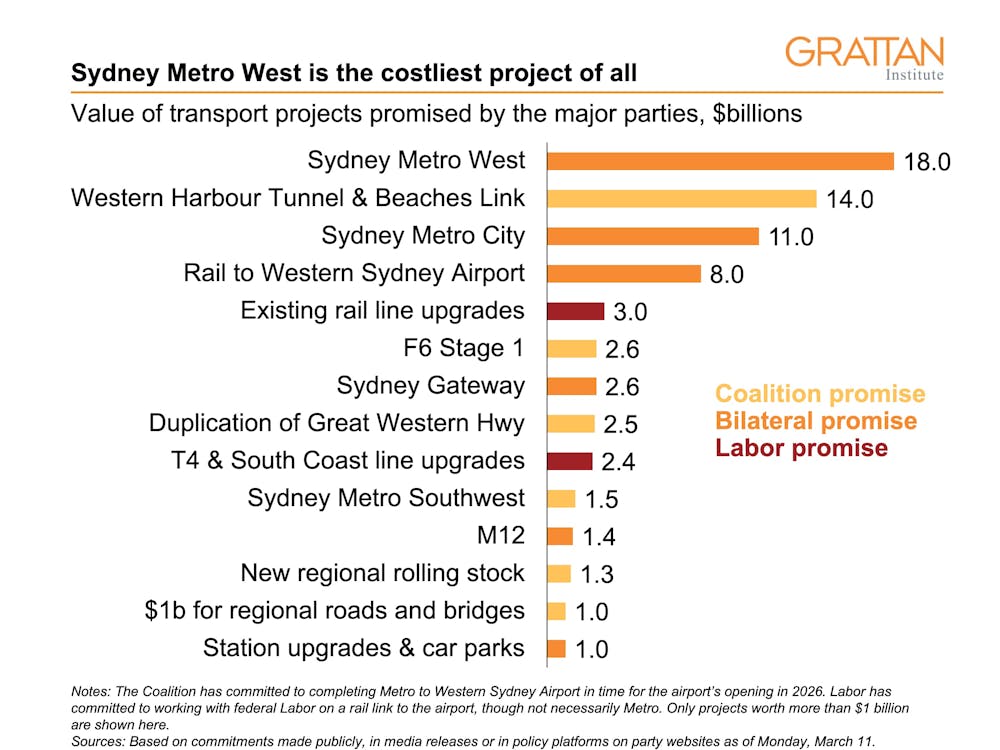
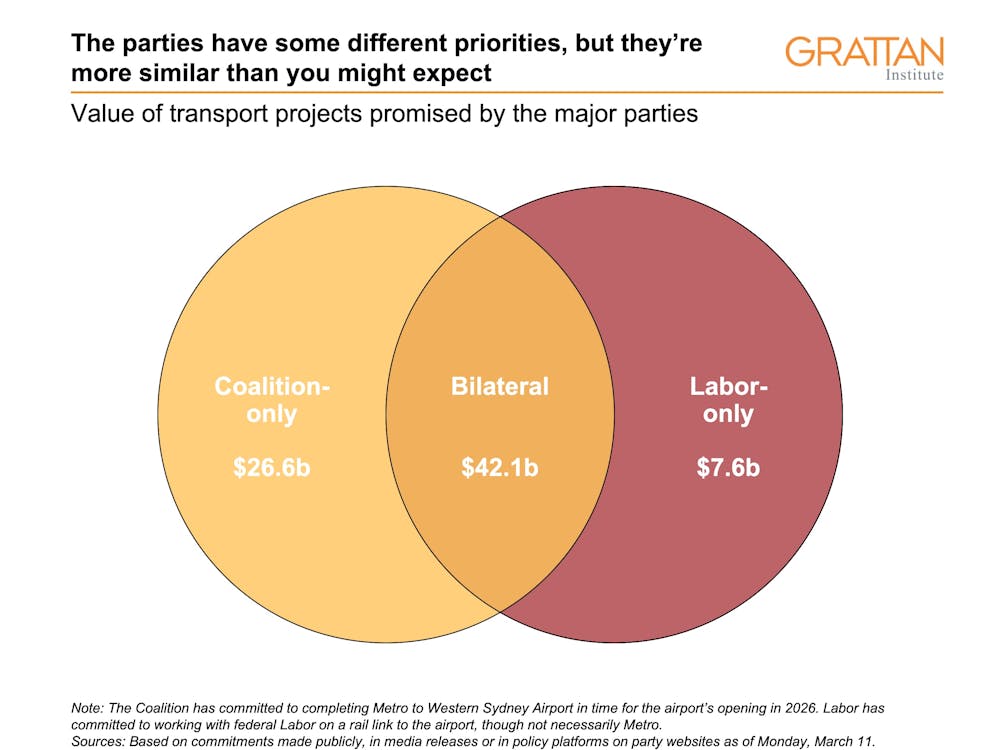
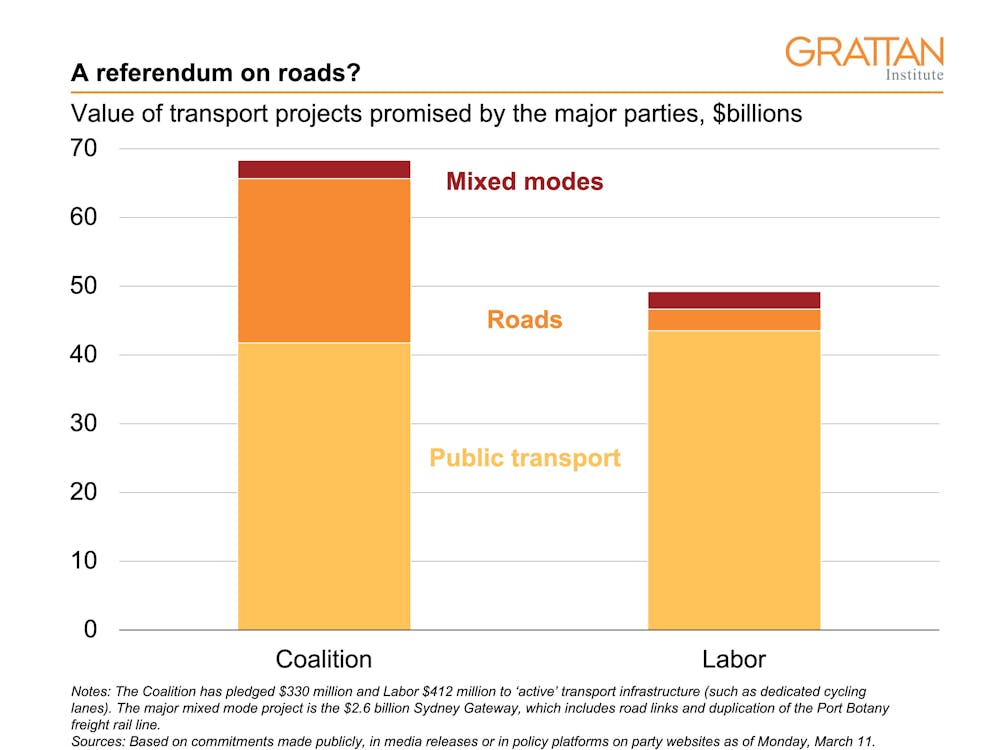
First, the total cost: Labor is promising about A$50 billion of transport projects, and the Coalition about A$70 billion. And the five largest projects on each side together account for more than three-quarters of the total cost. This matters – the bigger the project, the more likely it’ll go over budget, and in a big way.


Read more: WestConnex audit offers another $17b lesson in how not to fund infrastructure


So far, 14 projects have been announced with price tags in the billions of dollars. Each A$1 billion equates to around A$125 from every person in NSW.

How different are the party platforms?

A striking difference between this election and the Victorian election last November is how much the major parties actually agree on. Both support three of the four largest projects. Voters take note: no matter who wins, you can expect to pay for most of the transport infrastructure promises now on offer.

The major difference is in the parties’ positions on roads – especially toll roads. The Coalition is backing the A$14 billion Western Harbour Tunnel & Beaches Link and the A$2.6 billion F6; Labor is promising to scrap them.

Before he resigned as state Labor leader last November, Luke Foley declared that Labor would “unashamedly prioritise public transport over toll roads”. His successor, Michael Daley, appears to have held the course.

The bulk of public transport spending by both sides will be on rail, nearly all of it in Sydney. An exception is the Liberals’ plan for regional fast rail. Sound familiar? Just a few months ago, the then leader of the Victorian Liberals, Matthew Guy, tried to woo voters with a similar promise.

Unlike their southern counterparts, the Berejiklian government is not taking an actual plan to the election, just a commitment to plan. It’s a move they might’ve learned from Victorian Labor Premier Daniel Andrews and his promised A$50 billion rail loop. The NSW Liberals have not provided any cost estimates for fast rail, so Grattan Institute has excluded it from these charts; safe to say, including it would make the Coalition’s total spending promises even more enormous.


Read more: How much will voters pay for an early Christmas? Eight charts that explain Victoria’s transport election


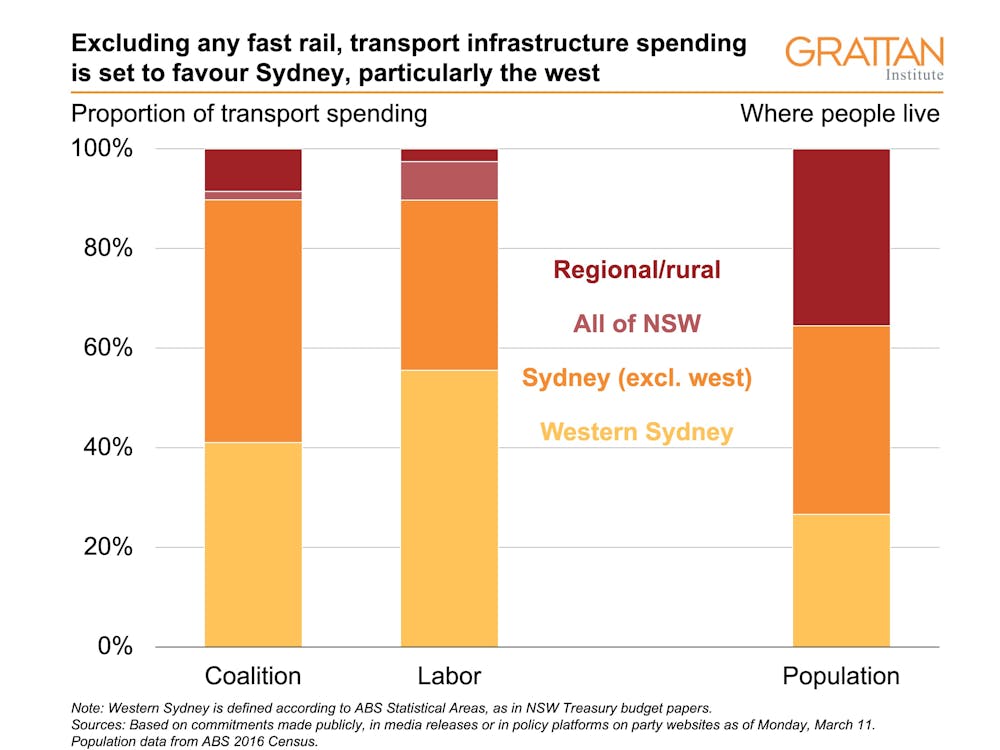
The coming transport infrastructure wave is heavily focused on Sydney. Both parties are set to pour cash into western Sydney, a clear battleground. It’s not surprising that regional NSW gets less of the transport love – voters outside the capital might be more concerned with hospitals and schools than with transport, particularly if they face little congestion.

How well justified are these projects?

Election campaigns can feel like birthday parties, with politicians bestowing gifts upon voters. But these gifts are largely paid for by the taxpayer, or by motorists in the case of tollways. Big infrastructure doesn’t come with a gift receipt; voters need to know in advance whether these projects’ benefits outweigh the costs.

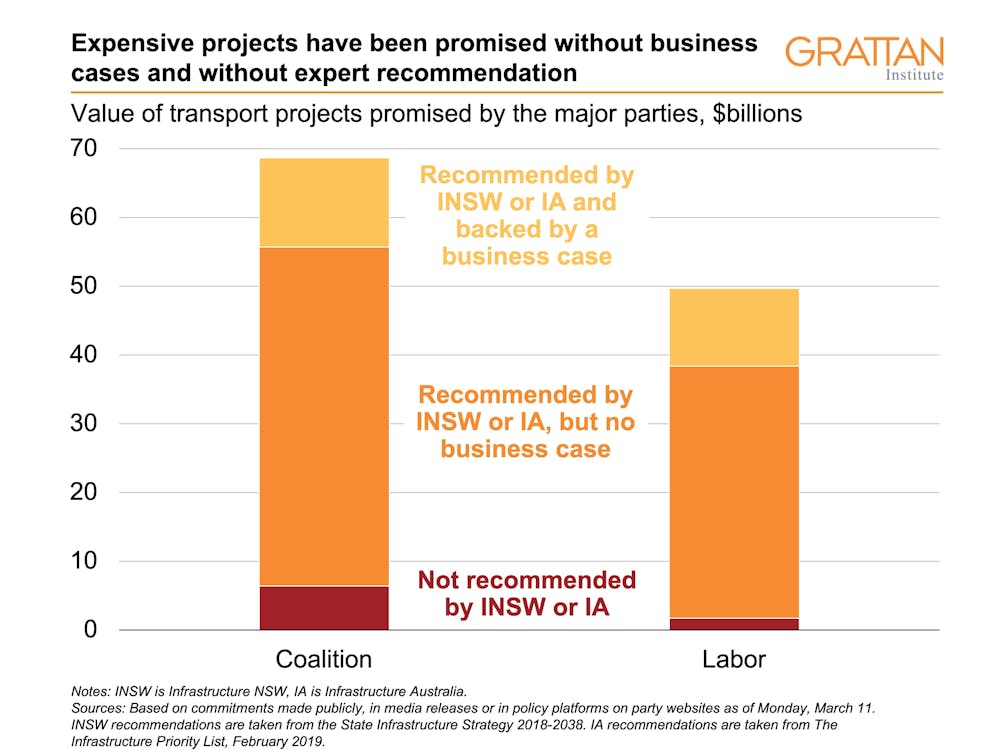
Infrastructure NSW and Infrastructure Australia are two independent bodies that can identify worthy projects and assess business cases. Only two major projects have a tick of approval from either of those bodies – Sydney Metro (City and Southwest sections), and Stage 1 of the F6.

The Coalition supports both of these, whereas Labor supports only the City section of Sydney Metro. It is unclear why Labor would walk away from projects with established net benefits to the community.

Voters should be concerned that the other promised infrastructure is either not recommended or lacks business cases.

It can be difficult for an opposition to complete a business case, given it doesn’t have access to department resources. The government has no such excuse. Making promises without first scrutinising them forces voters to make risky decisions. Grattan Institute research shows that cost overruns were 23% higher for projects announced close to an election.


Read more: Spectacular cost blowouts show need to keep governments honest on transport


Reforms promise a better way

Governments should do their due diligence before election time. Fortunately, there are signs of improvement on this score.

Labor is promising to introduce public planning inquiries on projects worth more than A$1 billion. This should help ensure business cases are completed, independently assessed and accessible to the public before projects are approved. When infrastructure is so costly and, at times, controversial, it’s very worthwhile to strive for community support and bipartisanship.

And Labor promises a new level of transparency in how government operates, by bringing in the independent pricing regulator, IPART, and the Auditor-General to shine a light on toll road contracts.

Labor also promises to strengthen the Parliamentary Budget Office (PBO) so that it runs all year round, not just before elections. Much like the Victorian PBO, this would enable minor parties to have their policies costed as well.

With 30% of voters planning to cast their ballots early this election, the PBO should also be required to publish budget impact statements two weeks before the election, not five days. This would help early voters to make informed decisions, as well as raising public suspicion about any policy announced in the fortnight before election day, too late for costing.

Recent experience suggests that promising splashy projects with big price tags can be very effective at election time. With more accountability and better processes, voters mightn’t be so easily swept off their feet.


Read more: We hardly ever trust big transport announcements – here’s how politicians get it right


ref. How the NSW election promises on transport add up – http://theconversation.com/how-the-nsw-election-promises-on-transport-add-up-112531

Dentists need a licence to practice. Why not economists?

]]>

Source: The Conversation (Au and NZ) – By Ross Guest, Professor of Economics and National Senior Teaching Fellow, Griffith University

The great British economist John Maynard Keynes said he longed for the day when economics could be thought of as a “matter for specialists – like dentistry”.

It’s easier to become an economist than a dentist, or a doctor or a lawyer. For those and other professions you need to be accredited – you need a licence to practice.

The economics profession requires nothing other than a university degree, and this month in its regular poll of 54 leading economists, the Economic Society of Australia asked whether it should set the bar higher.

The first question asked whether:

…professional accreditation for the economics profession would attract more people to economics as a career.

Certainly, fewer people are being attracted.

Last year, in a speech titled What Happened to the Study of Economics?, Reserve Bank official Jacqui Dwyer lamented the dramatic drop in NSW Year 12 economics enrolments, from about 20,000 in the early 1990s to about 5,000 today – many of them displaced by business studies enrolments.

An image problem or an identity problem?

It is a similarly grim picture at universities. Economics is being displaced by business-oriented subjects and has a declining share of the student population. From 2001 to 2016, enrolments in economics have flatlined (declining by less than 1%) while total university enrolments have climbed more than 3%.

Also worrying is the widening gender gap. In the early 1990s there were roughly even shares of male and female economics students in high schools. Now there are roughly twice as many men as women – a wider gap than science, technology, engineering and mathematics, and a much wider gap than in business studies.

Students from low socio-economic backgrounds are abandoning economics in droves. In the early 1990s about 25% of high school economics students were from lower socio-economic backgrounds. Today it is nearer 12%.


Read more: Economics needs to get real if we want more young Australians to study it


The puzzle is that the job market for economists remains robust.

As Dwyer notes, graduate salaries are higher for students with economics degrees than for general business qualifications, and employment rates are about the same. Dwyer concludes that “economics has an image problem: too few students understand what economics is and how it is relevant to them”.

But it might also have an identity problem.

Economics graduates are less likely than some other types of graduates to be employed in their field of specialisation (a point made by Dwyer). Their skills are generally useful.

Of our regular panel of 54 leading economists, 19 responded to the poll.

Of these, 11 (58%) either disagreed or strongly disagreed with the proposition that accreditation would attract more people to economics as a career.


Economic Society of Australia March 2019 poll


Lisa Cameron from Monash University said the problem with economics was not the career path, but its image:

Economics brings up images of boring, middle-aged white men in grey suits who think they have all the answers. For many students this is a real turn-off.

Female students, for example, often come to me and express that they can’t see how they can fit into this scene, and whether it would even be worth trying. I find it quite discouraging myself.

An alternative to professional certification suggested by Gigi Foster of the University of NSW was curriculum certification, where the Economic Society of Australia would be contracted to set up and run a system of certification for tertiary curricula based on the Economics Learning Standards it has already developed.

This focus on the curriculum rather than career identity was endorsed by Fabrizio Carmignani of Griffith University, who argued that the key to attracting more people to economics was:

…our ability as economists to explain to the community, employers, and general public what we do and why; in our ability to show that the skills and logic acquired through studying economics can be applied to a large variety of professions and industries.

Another problem with accreditation would be what to accredit. Melbourne University’s John Freebairn asked:

Suppose we go to the three-year undergraduate degrees in economics, business and commerce – what would be the accreditation line; how many subjects at level three, and then the minimum of core micro-, macro- and econometrics subjects, or electives? Any accreditation measure will be arbitrary, and provide limited if any additional information to potential employers.

Peter Abelson pointed out it had been discussed several times before when he was Secretary of the Society between 1993 and 2006.

There was always quite firm opposition to accreditation. The neo-liberal view was that the market should decide who are economists and who not. The pragmatic opposition was that there is no simple test of who is an economist.

Macquarie University’s Geoffrey Kingston paraphrased the title of a song by The Smiths. He said economists “just hadn’t earned it yet”.

Accreditation needs to await more scientific heft and professional agreement on our part. The day will come when we can put up our hands and demand accreditation.

Would it be worth it?

The second question was whether the benefits of accreditation would exceed the possible costs.

Opinions divided along the same lines. Those opposed to accreditation (the majority) believed that the costs would outweigh the benefits.


Economic Society of Australia March 2019 poll


As to my own views, first a declaration: under the auspices of the former Office for Learning and Teaching, the Economics Society of Australia and the Australian Business Deans Council, I chaired the working group that developed the Economics Learning Standards to which Gigi Foster referred (and Foster was a member of the group).

I fear that many who rejected the notion of accreditation would also reject the notion of learning standards.

My response would be that many disciplines have recognised the need for stakeholders in professional education to have a shared understanding of what is taught. Those stakeholders include employers, governments, taxpayers, prospective students (international and domestic), and their parents.

I feel the same way about professional accreditation: it is about quality assurance.

That said, I acknowledge that the bureaucratic compliance costs in such a process are an irritant at the very least, so they would need to be kept at a minimum, which draws me to the suggestions of a couple of respondents that when the time is right, the Economics Society of Australia can play a lead role in the professional accreditation of economists.


Read more: Why women in economics have little to celebrate


ref. Dentists need a licence to practice. Why not economists? – http://theconversation.com/dentists-need-a-licence-to-practice-why-not-economists-113380

Hidden women of history: Australia’s first known female voter, the famous Mrs Fanny Finch

]]>

Source: The Conversation (Au and NZ) – By Kacey Sinclair, PhD Candidate in History, La Trobe University

In this series, we look at under-acknowledged women through the ages.

On 22 January 1856, an extraordinary event in Australia’s history occurred. It is not part of our collective national identity, nor has it been mythologised over the decades through song, dance, or poetry. It doesn’t even have a hashtag. But on this day in the thriving gold rush town of Castlemaine, two women took to the polls and cast their votes in a democratic election.

Two days later, Melbourne newspaper The Argus unwittingly granted one of them posterity, writing “two women voted – one, the famous Mrs. Fanny Finch”. Fanny Finch was a London-born businesswoman of African heritage, a single mother of four and is the first known woman to cast a vote in an Australian election.

Victorian women over the age of 21 (excluding Indigenous women) would not receive full unconditional suffrage until 1908. (Victorian Indigenous women were not enfranchised until 1965.) But Fanny Finch, as a local business owner who paid rates, was able to exploit a loophole in suffrage law that was yet to discriminate against gender or race.

The Municipal Institutions Act of 1854 granted suffrage to ratepaying “persons”. The loophole was eventually closed in 1865 when “persons” became “men”.

Argus report excerpt, 24th January 1856. Trove

Who was Fanny?

Frances Finch was born Frances Combe in London in 1815. At eight-weeks-old she was orphaned by her mother after a tryst with a footman ended in a pregnancy but no marriage proposal.

A cross-stitch sampler attributed to Frances Coombe (sic) in 1830 at the age of 15 suggests she understood both her parents to be free people of African racial heritage (although the UK did not free slaves unconditionally until 1838.) The London Foundling Hospital, where Fanny was accepted as an orphan, provided her with some protection against slavery as well as an otherwise inaccessible education and access to an apprenticeship scheme in “household duties”.

Sampler attributed to Frances Coombe (sic). Author provided

By 1837, a 22-year-old Fanny was a free, literate, educated, and experienced domestic servant. In that year she was approved a labourer’s free passage to the new colony of South Australia.

In Adelaide, Fanny was a valued employee of Julia Wyatt, an author, artist, and wife of the surgeon and first Protector of Aborigines, Dr. William Wyatt. Over the course of the next decade Fanny left their employment, married a sailor, Joseph Finch, and started a family.

By 1850, for reasons unknown, Fanny had left her husband. With her four children in tow, she made her way to Victoria. She arrived in the colony 12 months before the start of the Victorian gold rush. By early 1852 she was operating a restaurant and lodging house on the Forest Creek goldfields, alongside approximately 25,000 gold digging men and a handful of women.

There, in the fledgling township of Forest Creek, Mrs Finch’s Board and Lodging House became “the only one in which any person could get respectable accommodation”. By 1854, she had moved to nearby Castlemaine where she ran a restaurant. She quickly became one of its most recognisable faces.

Fanny Finch’s Restaurant, Corner of Latimer’s Lane and Urquhart Street, Castlemaine, c1858. Richard Daintree.

A successful businesswoman

Fanny was a successful businesswoman, known to dress in bright blue silk with her black hair adorned in artificial flowers. Strong and robust, with an even larger personality she was not one to shy away from attempting to remedy injustice when she saw it – be it with her words, her cooking or her fists. Evidently, she possessed visibility and power.

Her business acumen and conspicuity make it probable that her male contemporaries were unsurprised when they witnessed Fanny cast her vote at the Hall of Castlemaine (now the Theatre Royal). Did the men taunt her? Encourage her? Or were they complacent? We cannot know. We do know that no one stopped her. She selected her preference and signed her name.

Market Square, Castlemaine, c1855. By S.T Gill. The Hall of Castlemaine where Fanny Finch cast her vote can be seen to the right of centre. Author provided

That afternoon, however, the two assessors of the day disallowed both Fanny and the other unknown woman’s votes. Their reasons were cited as: “they (the women) had no right to vote”. Further details were not divulged.

Still, Walter Smith, the man for whom Fanny voted, was elected to council. Smith was an agent and brewer who arrived at Forest Creek at around the same time as Fanny. Little is known about what motivated her to vote for him but no one else, despite being allowed to vote in seven councillors. She was clearly determined to elect him to council.

A rare glimpse

During colonial times women were rarely identified by name in the press – particularly women of the working class. The 1856 Argus report now offers historians an unprecedented opportunity to identify an otherwise invisible minority – the 19th century Australian woman of colour – as an active participant in our political history.

Fanny was a woman, who, through relative privilege – wielded with her own blood, sweat and tears – refused to founder beneath the weight of a white, Anglo-male world of commerce. However, this came at a price. As a woman of colour occupying space in a white man’s world, assaults on her success were not uncommon. Yet she refused to disappear.

One of those assaults occurred in December 1855. Fanny Finch was fined £50 for the illicit sale of alcohol, known as “sly-grogging”. After a month-long trial, which involved scandalous cross-examinations of miners, policemen, and even her two young sons, she was charged and fined.

Despite the exorbitant fine and the public slandering of her character and commercial integrity, Fanny Finch was not defeated. Like many business people on the goldfields, she both owed money and was owed it by others, but over the following four months, she began an unprecedented campaign of self-representation.

The day following her conviction she published a letter in the local paper accusing the local authorities of injustice (a copy of this has not survived). A month on, she cast that vote. Then a few months later in April, she published the following advertisement.

Mrs. Finch begs to inform the inhabitants of Castlemaine that henceforth she will carry on business for her children and would be happy to receive any outstanding debts … finding that the more she herself strives the more she is oppressed, although she can firmly state that if those who are in her debt would come forward each with one third, she will be relieved of all debt, have a good home for her family and about two thousand pounds in her pocket.

Fanny Finch also begs to state that as in her affluence she was so kindly trusted, they may be sure that she, from her own free will, may some day liquidate all, but she must have her time … and in spite of what enemies she may have, she intends to keep throughout the winter ready cooked Ham, Beef Soups (a la mode) from seven in the morning to seven in the night.

The vote of the famous Mrs. Fanny Finch adds a woman of colour’s voice to what Clare Wright has described as an unorganised movement for women’s rights during the 1850s.

Fanny died on the 15th October 1863, aged 48. She was remembered as “a strong minded woman” with “a genuine tenderness of heart, ever ready to serve another in distress … without the slightest ostentation”.

She was given a public burial in an unmarked grave at Castlemaine Cemetery.

ref. Hidden women of history: Australia’s first known female voter, the famous Mrs Fanny Finch – http://theconversation.com/hidden-women-of-history-australias-first-known-female-voter-the-famous-mrs-fanny-finch-112962

Why wait for the Brexit fog to clear? Australian, British and multinational businesses are moving on

]]>

Source: The Conversation (Au and NZ) – By Gabriele Suder, Professorial Fellow, University of Melbourne & Director, International CEO Forum, University of Melbourne

Now that the British Parliament has rejected the revised Brexit deal, all parties involved realise that uncertainties are here to stay.

The only certainty at this stage is that British politicians are about to vote on whether they prefer to leave the European Union without a deal at all, at 6 am Thursday, Australian Eastern Daylight time.

The world is watching, and the EU has shown a slow yet rather formidable capacity (and patience) to support Brexit – that is, to de-integrate constructively and peacefully.

The future for Britain and what will be the remaining 27 member states is unclear.

Others aren’t waiting for it to become clear.

Multinationals aren’t waiting

Many corporations, as well as small and medium-sized enterprises and suppliers, have been preparing for Brexit (many for a “hard Brexit”) for some time.

That’s because, as the global financial crisis showed all too clearly, uncertainty leads to consumers cutting back on spending, businesses streamlining, closing or at least partially relocating; and financial markets demanding greater risk premia to lend.

Multinationals with operations in the UK are highly exposed to increasing costs, rising backlogs and uncertainties about whether they can move goods across borders. British firms, and those dependent on the British market, are warehousing extensively, and are relocating the non-essential assets offshore in mainland Europe as much as possible.


Read more: Theresa May loses another Brexit vote – is it time she just gave up?


Nissan has announced it will not build its new sports utility vehicles in England, Honda is closing its UK operations, while Credit Suisse, Goldman Sachs, JPMorgan, Morgan Stanley, and Citigroup and HSBC have moved ownership of European subsidiaries and/or assets from London to remaining EU countries. Bloomberg and Panasonic are moving to Amsterdam. Airbus is likely to pull out of the United Kingdom and replace its UK suppliers. Companies such as the British airline Flybmi are collapsing.

The Economist recently referred to the current phenomenon as “slowbalisation”.

Australia will negotiate with both

The EU is meanwhile negotiating a free trade agreement with Australia.

Its provisions focus on expediting the movement, release and clearance of goods, including goods in transit at customs, and the removal of non-tariff barriers, including raw milk cheese standards and conformity to the EU’s geographical indications and with the World Trade Organisation’s Agreement on Trade-Related Aspects of Intellectual Property Rights which has been signed by the EU but not not Australia.


Read more: Post-Brexit, Australia’s best option is a trade pact with EU


Brexit will not allow the UK to benefit from the terms Australia negotiates with the EU. Negotiations for a separate UK-Australia agreement are expected to start soon, but only after Britain’s exit from the EU is formalised.

In the meantime, Brexit has already redefined the international business strategy of Australian firms that have traditionally accessed the EU Single Market through the UK, forcing them to opening alternative or additional offices in mainland Europe.

Will Australia be in a more powerful negotiating position with the UK than with the EU? Probably. Our 27 years of economic growth puts us in an excellent bargaining position; our forthcoming agreement with the EU and with major countries, including China and Indonesia and the Trans-Pacific Partnership, even more so.


Read more: Trade data shows Australia can get more out of a deal with the EU than the UK


As the UK struggles to clear the fog over its future, there will be 71 trade agreements it enjoyed as part of the EU that it will need to review, renegotiating treaties within a world that is watching the UK’s deliberate disintegration of the most its most integrated and harmonised market with concerned, if bemused, interest.

The world is pondering what could have brought the British people to vote for Brexit despite what we now know was a crucial lack of information and a lack of any plan for how to do it.

Britain will have learned a lot of from the exercise. But by the time it has, much of the rest of the world will have moved on.

ref. Why wait for the Brexit fog to clear? Australian, British and multinational businesses are moving on – http://theconversation.com/why-wait-for-the-brexit-fog-to-clear-australian-british-and-multinational-businesses-are-moving-on-113478

Flights suspended and vital questions remain after second Boeing 737 MAX 8 crash within five months

]]>

Source: The Conversation (Au and NZ) – By Geoffrey Dell, Associate Professor/Discipline Leader Accident Investigation and Forensics, CQUniversity Australia

Australia’s decision to suspend all Boeing 737 Max 8 flights in and out of the country appears to be a prudent precaution.

It comes after two fatal accidents overseas involving the aircraft. On Sunday, 157 people died when Ethiopian Airlines flight JT610 crashed minutes after takeoff. In October last year 189 people died when Lion Air’s flight ET302 crashed off the coast of Indonesia.

Australia’s Civil Aviation Safety Authority (CASA) says no Australian airlines operate the Boeing 737 MAX – although Virgin Australia has several on order – but two foreign airlines fly these aircraft to Australia.


Read more: The internet is now an arena for conflict, and we’re all caught up in it


Singapore-based SilkAir has already suspended operation of its 737 MAX 8 aircraft. Fiji Airways is the only other operator that will be affected by CASA’s temporary suspension.

Other countries – including New Zealand – have also suspended flights of the 737 MAX 8, so people no doubt want to know if it’s safe to fly on the aircraft.

There are several vital questions that need to be answered.

Early days for investigators

Although investigation of the Ethiopian Airlines crash is only just beginning, available radar data seems to suggest similar flight profile characteristics with that of the Lion Air crash.

After the Lion Air crash, questions were raised about the aircraft’s Manoeuvring Characteristics Augmentation System (MCAS), designed to prevent the aircraft from stalling.

If the data from the recovered flight recorders of both aircraft confirm issues with sensors in the MCAS (sending spurious signals to the flight management computers and resulting in the autopilot automatically pushing the nose of the aircraft down), then several questions will arise:

  • why weren’t the pilots able to manually counter the actions of the autopilot, previously a safe design characteristic of aircraft autopilots in general?

  • why didn’t the pilots disconnect the autopilot as soon as the trouble began, something that can be done quickly with the push of a button?

The same question applies in relation to disconnecting the auto throttle system. The Boeing 737 flight manual includes a procedure for pilots to counter any problems in the aircraft’s automatic trim system by disconnecting the autopilot and auto throttle systems.

If the problems continue they can switch off the automatic trim system and then fly and trim the aircraft manually for the remainder of the flight.

This was the crux of a Boeing circular to airlines after the Lion Air crash, which was made an Airworthiness Directive by the US Federal Aviation Authority.

This required airlines to instruct pilots on applying the checklist if they have difficulty controlling an aircraft that’s being pushed into a nose-down position by the autopilot.

The question then arises: if this latest crash is proven to have been caused by the aircraft’s systems doing just that, did the pilots apply the checklist procedure? If not, why not? And if they did, why didn’t it work?

Updates to software

Until the flight recorders from the Ethiopian Airlines aircraft are read out, much of what is being discussed in relation to cause is conjecture.

Boeing says it will soon issue a software upgrade for the 737 MAX 8, presumably in response to its own investigation of the Lion Air crash.

If the second crash is shown to have been caused by the same issues, then sadly it comes too late for passengers and crew of the Ethiopian Airlines aircraft.

But there is always a lead time in relation to changes to anything that can affect the safety or operation of aircraft systems that are critical to assuring safe flight. Premature implementation of ill-considered changes can have the exact opposite outcome to that intended.

So I would expect Boeing to have done rigorous and extensive testing to ensure that the software upgrade fixes, rather than exacerbates, the problem and doesn’t introduce any new ones.

A lot of emphasis in the Ethiopian Airlines crash investigation will be centred on what can be learned from the flight data recorders. If the recorders are undamaged, investigators should gain an understanding of what transpired leading up to the crash very soon, in the next few days.

Then real and effective comparisons can then be made with what is known about the cause of the Lion Air disaster. Investigators ought to be able to answer the question of whether the similarities in apparent vertical speed and altitude fluctuations of the two flights had similar causes.

The flight recorders were recovered quite early from the sunken wreckage last year, although the final report is yet to be finalised and released.

A popular aircraft

The Boeing 737 has been a safe and stable workhorse of global airlines for more than 50 years. Much of the 737 MAX 8 aircraft and its systems are common to earlier variants.

The MCAS introduced in the new model was clearly intended by Boeing to be an enhancement to assure and improve safety. Usually we see step changes in safety improvement with the advent of new technologies in airliners – Ground Proximity Warning Systems (GPWS) and Traffic Collision Avoidance Systems (TCAS) being two clear examples.

But in this instance it is possible that some anomaly existed in the programming of the MCAS which may have led to these two crashes.

If so, it will be anomalies that went undetected through the rigorous and exhaustive flight and systems testing of the aircraft prior to being granted a certificate of airworthiness by the US Federal Aviation Administration, required before the type could have entered service with the airlines.

Boeing has issued a statement saying it is “deeply saddened” by the latest crash and will do what it can to help in the investigation.


Read more: Lessons learned from the Essendon air crash: the importance of pilot checklists


I am sure everyone is keen to see the results of both investigations, so that targeted action can be taken to assure the ongoing safety of flight.

Meantime, there is no evidence at all that the travelling public should have any concerns about the safety of other Boeing 737 aircraft types, the types that most of our Australian airlines currently operate.

They do not have the new MCAS and feature tried and true technologies that have been the linchpin of Australia’s enviable airline safety record for more than 40 years.

For the record, I flew home in a Boeing 737 from Melbourne last Monday, and I’ll be flying in one again very soon.

ref. Flights suspended and vital questions remain after second Boeing 737 MAX 8 crash within five months – http://theconversation.com/flights-suspended-and-vital-questions-remain-after-second-boeing-737-max-8-crash-within-five-months-113272

Becoming more like WhatsApp won’t solve Facebook’s woes – here’s why

]]>

Source: The Conversation (Au and NZ) – By Ariadna Matamoros-Fernández, Lecturer in Digital Media at the School of Communication, Queensland University of Technology

Facebook CEO Mark Zuckerberg declared last week that the company would shift away from open networks that embody “the town square” towards private, encrypted services that are more like “the digital equivalent of the living room”.

The announcement comes in response to numerous privacy scandals, which have often involved third party apps accessing information about millions of Facebook users for financial and political gain.

Zuckerberg aims to make private messages private and ephemeral – meaning Facebook can’t read our messages, and the data doesn’t stick around on the company’s servers for longer than necessary. His vision involves merging Facebook and the company’s other digital platforms – Instagram, WhatsApp, and Messenger – into a super app, similar to China’s WeChat.

But will these changes actually make Facebook better? Our research on the encrypted messaging platform WhatsApp suggests end-to end encrypted services pose important challenges.


Read more: Privacy pivot: Facebook wants to be more like WhatsApp. But details are scarce


WhatsApp: a ‘digital living room’

Facebook acquired the instant messaging service WhatsApp in 2014. It began rolling out end-to-end encrypted messaging on the service in the same year. In theory, that means messages sent via the platform are completely private. No one aside from the sender and receiver is supposed to be able to read them – not even WhatsApp (the platform) itself.

While there has been some take up of WhatsApp in countries such as Australia and the US, it’s much more popular in countries such as India, Brazil, Malaysia, and South-Africa, where it has become the preferred messaging app.

WhatsApp has also become popular among activists and whistleblowers confronting authoritarian state power in China, Malaysia, and Latin America, where surveillance of political organising on open platforms has put activists advocating for social change in danger. Our research (to be published in a November 2019 special issue of the internet journal First Monday) shows WhatsApp has played a key role in resistance to state control in Spain, Malaysia and Indonesia.

Despite these positives, we believe becoming more like WhatsApp isn’t a magic bullet solution to Facebook’s privacy and other concerns. Why? Here are three reasons.

1. Encryption only creates the illusion of privacy

Since encryption minimises the ability of third parties to “read” the content of messages, it does go some way towards enhancing privacy. But encryption alone doesn’t necessarily make WhatsApp a secure service, neither does it prevent third parties from accessing chat histories altogether.

In an article for the Electronic Frontier Foundation, technology experts Bill Budington and Gennie Gebhart stress that while encryption may well work to protect chat messages, it doesn’t make communication on WhatsApp safer if we take a more holistic approach to the app. They argue WhatsApp “surrounding functionalities” are the threat to privacy: for example, chat history backups are stored unencrypted to the cloud, and WhatsApp web interface can easily be hacked.

In a similar vein, blogger and developer Gregorio Zanon says Facebook “could potentially” access WhatsApp chat history because of the way operating systems work on smartphones. Zanon argues that in order for us to do everyday tasks with our phones, from editing a picture to pushing content to Apple Watch, operating systems such as Apple iOS decrypt WhatsApp files and messages stored in our phones.

In his own words:

Messages are encrypted when you send them, yes. But the database that stores your chats on your iPhone does not benefit from an extra layer of encryption. It is protected by standard iOS data protection, which decrypts files on the fly when needed.


Read more: The law is closing in on Facebook and the ‘digital gangsters’


2. Metadata means there’s always a digital trail

Zuckerberg claims Facebook could limit the amount of time it stores messages. But media scholars argue it is not the content of messages itself that enables profiles to be built of users for the purposes of targeting advertising, it’s the metadata. This is a key privacy concern.

Metadata includes users’ contacts information and details about messages, such as the time they are sent and the identities and locations of senders and receivers, information that WhatsApp can share with the backing of the legal system.

For example, researchers have shown that WhatsApp caches popular media files. This allows the company to track forwarded media files reported as problematic, and potentially identify the source without breaking encryption.

Crucial questions around metadata and potential data breaches become even more concerning when considered in light of Facebook’s plan to enable data to be shared across platforms (Facebook, WhatsApp, Instagram, Messenger). There are concerns this may make data less, rather than more, secure.

The proposal is likely to face stiff opposition in Europe, given that the EU’s data protection regulator, the Data Protection Commission (DPC) has previously raised concerns around security at Facebook’s plans to integrate services.


Read more: Facebook’s cryptocurrency: a financial expert breaks it down


3. Encrypted messages can’t be moderated

In his latest manifesto, Zuckerberg avoids addressing Facebook’s other great problem beyond privacy: content moderation.

Zuckerberg acknowledges in his long Facebook post that a problem with encryption is that bad actors can exploit it to do bad things, such as “child exploitation, terrorism and extortion”.

But what might end-to-end encryption mean for the spread of fake news and misinformation? Recent scholarship on Indonesia and Brazil has shown that WhatsApp has become a safe haven for producers of fake news, who can’t be easily traced on encrypted services.

To deal with this problem, WhatsApp has limited the number of times messages can be forwarded in countries like India and Myanmar, where WhatsApp hoaxes have led to violence.

A more private, end-to-end encrypted system would partially free Facebook from the burdens involved in having to moderate this kind of content. This is a task the company has been reluctant to pursue, but it has been forced to do it due to its pivotal role as the contemporary “town square”.

Although the app is used to discuss public issues through public groups of up to 256 people, there is no specific tool on WhatsApp that allows users to flag problematic content.

Questions also remain about the challenges that end-to-end encryption pose for the spread of racist, misogynist, and other discriminatory content.

Clearly there is a lot at stake with Facebook’s proposed changes. We are right to hold the company’s plans up to scrutiny, and ask whether users will be the beneficiary of these planned changes.

ref. Becoming more like WhatsApp won’t solve Facebook’s woes – here’s why – http://theconversation.com/becoming-more-like-whatsapp-wont-solve-facebooks-woes-heres-why-113368

Why Sally Challen’s appeal is not a win for women victims of coercive control

]]>

Source: The Conversation (Au and NZ) – By Kate Fitz-Gibbon, Senior Lecturer in Criminology, Monash University

In 2011, Sally Challen was convicted of murdering her husband. She was sentenced to 22 years imprisonment, which was reduced to 18 on appeal.

On February 28, 2019 three judges of the England and Wales’ appeal court quashed Challen’s 2011 conviction. The decision was made on fresh evidence provided by a psychiatrist. It showed Challen was suffering from two mental disorders at the time of the killing. Challen will now face a retrial.

The court ruling has been heralded as a “victory” for Challen’s family and women’s rights advocates. It’s also been celebrated by proponents of the criminalisation of coercive control, a form of domestic violence based on a subtle but persistent form of emotional and psychological abuse.


Read more: Sally Challen: what quashing of murder conviction means for similar cases alleging coercive control


Advocates say Challen’s case “has brought public attention to an under-recognised feature of domestic violence relationships”. But a closer look at the decision shows the case has less to do with Challen’s mental state than it does than the cumulative effects of coercive control.

The Sally Challen case

Sally Challen killed her husband of 31 years in 2010. She struck him multiple times with a hammer while he ate breakfast in their home. She had previously tried to leave him, citing allegations of severe emotional abuse. Her husband allegedly bullied and belittled her, controlled their money and who she was friends with, and didn’t allow her to socialise without him.

At trial, Challen denied murder on the grounds of diminished responsibility due to her mental state at the time. This was unsuccessful. The prosecution argued Challen was “eaten up with jealousy” and had snapped after learning her husband was having an affair.

It seems this case has turned on questions around Challen’s mental state and the quality of evidence supporting her case of diminished responsibility. So why has coercive control featured so strongly in media coverage?

Criminalisation of coercive control

Coercive and controlling behaviour was introduced as a criminal offence in England and Wales in 2015, under Section 76 of the Serious Crime Act 2015.

Those working in the field have increasingly recognised coercive control as a feature of intimate partner relationships since the early 1980s. But the recognition of its impact has only recently made its way into criminal cases.


Read more: Coercive control cases have doubled – but police still miss patterns of this domestic abuse


Coercive control may not be experienced as physical abuse – it is more likely to be psychological, emotional and financial. It leads to the victim experiencing constant fear and intimidation, as well as a sense of powerlessness that can lead to a level of dependency in which lethal violence may appear the only way out.

Those advocating for coercive control to play a larger role in family violence cases say Challen’s recent “win” shows significant progress after the law change.

Challen’s defence team, and much of the press coverage in the lead up to the recent appeal, focused on this new legislation when appealing her conviction – as well as the fresh evidence of her mental condition. Using evidence from friends and family, along with contested psychiatric evidence, Challen’s defence appealed her conviction on the basis she was living in a coercive and controlling relationship and that the long-term effects of this led her to kill her husband.

Yet the extent to which the coercive control argument gained traction with the court is questionable. In this recent Court of Appeal decision, Lady Justice Hallett, said:

There might be those out there who think this is [sic] appeal is all about coercive control but it’s not… Primarily, it’s about diagnosis of disorders that were undiagnosed at the time of the trial.

The court of appeal ordered a retrial for murder and that no bail be accorded to the defendant. A leading women’s aid group in the UK described this as a “bittersweet victory”. In putting psychiatric disorders centre stage, this paves the way for the partial defence of diminished responsibility to be reconsidered in the retrial.

Lessons for Australia

The Challen case marks some timely lessons for those supporting the criminalisation of coercive control in Australia. Various Australian states and territories have been debating the merits of a specific offence of coercive control over the past five years.

The Tasmanian Family Violence Act 2004 bears some comparison with the 2015 legislation in England and Wales. The Act introduced two new offences: one of economic abuse and one of emotional abuse and intimidation. Both of these fit within the rubric of coercive control and both are couched in terms of an ongoing course of conduct.

Yet to date, neither the Tasmanian or the UK law has resulted in many prosecutions. The UK’s Office of National Statistics shows 4,686 defendants were prosecuted for coercive and controlling behaviour in the year ending December 2017 out of around 2 million offences of domestic abuse. In Tasmania, in the decade following its introduction, there were only eight people convicted of emotional abuse or intimidation.


Read more: How domestic violence affects women’s mental health


A detailed examination of the operation of the two new offences in Tasmania suggests the lack of prosecutions isn’t due to practitioners’ unwillingness to pursue cases under the new laws. They say it’s more likely due to flaws in the legislation, including lack of clarity in the law and overlap with other offences.

While coercive and controlling behaviours are recognised as abuse in the definition of family violence in the majority of Australian states and territories, Tasmania remains the only Australian jurisdiction to introduce a specific criminal offence to cover this form of family violence. Neither the Victorian Royal Commission into Family Violence nor the Queensland Not Now, Not Ever Report recommended an offence of coercive control.

From the legal perspective, the Challen case may result in the re-assertion of diminished responsibility as a useful partial defence for women who resort to lethal violence in circumstances of this kind. This will be a “win” for Sally Challen, but a “loss” for women as a whole, due to it painting women’s criminality as a consequence of them being “mad” or “bad”.

As such, we continue to urge caution to Australian jurisdictions considering adopting an offence similar to that of the UK. The Challen case should not be misinterpreted as evidence of the success of the new offence. The offence of coercive control, in and of itself, is not a conduit to justice for women who kill their prolonged domestic abusers.

ref. Why Sally Challen’s appeal is not a win for women victims of coercive control – http://theconversation.com/why-sally-challens-appeal-is-not-a-win-for-women-victims-of-coercive-control-112869

In Manus, theatre delivers home truths that can’t be dodged

]]>

Source: The Conversation (Au and NZ) – By Julian Meyrick, Professor of Creative Arts, Flinders University

Review: Manus, Adelaide Festival, March 8


How to review a play whose relationship with matters of fact is so serious and politically culpable it overwhelms the critical distinctions that might normally be used to judge it?

Where is Stanislavski’s “magic if” (if I were a refugee locked up for six years by the Australian government …)? What are the “given circumstances” (near-drowning at sea, a sun-beaten island at the end of the earth)? Or the “inciting incident” (political oppression, military destruction, despair on an epic scale)?

We might ask is the narrative balanced? Does the piece make appropriate use of contemporary staging techniques in portraying, say, how a 23-year old refugee set himself on fire, or a group of teenage youths sewed their lips together?

Is it well-shaped dramaturgically? Is the flow of events satisfying to an audience expecting a good night out at the theatre? Or is it too much for those affronted by the horror, the inhumanity, the endless hell of it all? How will Australians in particular cope, given that we are the ones responsible for building that hell and setting its cycle of torment in motion?

In Manus, actors perform verbatim interviews with Iranian asylum seekers on Manus Island and Nauru. James Elsby

Manus, as the title will suggest to most, but especially Australian audiences, is a drama presenting the stories of eight refugees from Iran who sailed to this country in 2013, just after the passing of the Coalition government’s Operation Sovereign Borders legislation.

Apropos the new zero-tolerance approach to marine-arriving asylum seekers, they and hundreds of others were mandatorily detained at Manus or Nauru Regional Processing Centres for five years or more. There they faced limited resettlement options, and an explicit commitment to never allow them entry into Australia, regardless of whether they were found to be “genuine” refugees or not.

The first half hour of this 90-minute show by Iranian company Verbatim Theatre Group explores the background of the characters – who are not characters, of course, but men and women with names, faces, families and fates, just like you and me – and the reasons they chose to leave their home.

These are as various as you’d expect, and fall into the category of the credible. Their journey takes them via Indonesia, into the Arafura and Timor seas, where they hit storms and rough waters, their flimsy vessel breaks apart, and they nearly drown.

Harrowing narrative

Just in abbreviated form, delivered with the slight means at the disposal of a small company from Tehran – two dozen red petrol cans, some projections and a rain effect – this section of the narrative is harrowing.

It’s a ghastly journey even when undertaken with adequate food, water and equipment, which are frequently absent. Rescue comes from a British naval vessel and the Iranians are asked where they want to go. They say Australia.

The first part of the show is dedicated to the life stories of the people portrayed in the play. James Elsby

There are sharply divided opinions in this country about what director Nazanin Sahamizadeh describes in the program note as:

a world in which every three seconds one person is forced to flee home … to seek safety, security or simply a better life in peace and freedom. Tragedy in our time shows its ugly face when the borders are closed rather than open to these women, men, girls and boys.

It is not hard to imagine her view being strongly contested: the argument put that opening our borders only encourages people-smugglers, for example, thus more dangerous maritime crossings, and thus more deaths at sea. It is also possible to question the social impact of large-scale migration (though Australia’s in-take is not especially large) and a global order where, in the words of academic Alexander Betts “refugees and displacement are likely to become a defining issue of the 21st century”.

But beyond the general debate we find, in legal parlance, a bright-line. The last two-thirds of Manus narrate how the eight Iranian detainees fared in their tiny island prisons, and the neglect, abuse, humiliation, indifference, and, to our ever-lasting shame, outright violence and cruelty they were subject to.

In this, the main body of the play, we hear the voices and accounts of those who saw the 2014 riots on the island close-up, because, unlike the Australian politicians glibly sure of their judgements later, they actually witnessed them.

The deaths, injuries and hunger-strikes that followed were peaks in a sine wave of misery that ground down the asylum seekers through repeated acts of petty tyranny. The play describes this through the voices of the actors: food delivered late or not at all; latrines limited in number and broken; electricity cut off in the middle of the night; telephone calls restricted.

On and on and on it goes: a stream of organisational meanness as deliberate, ingenious and grim as any that can be found in Dante’s Inferno.

It is one thing to refuse entry to people who claim asylum in Australia on the grounds their entry is illegal. It is another to treat them in the way we have, subjecting them to prolonged and aggravated incarceration for no criminal offence, dragging Australia’s reputation into the slime, where it will no doubt remain for some time to come, and deservedly so.

Manus is delivered entirely in Persian. James Elsby

An imperfect show

Manus is not a perfect show. It is hard to imagine how such a panorama of human misery could be condensed into 90 minutes of stage action.

Within the verbatim theatre model there is a tension between emotional authenticity and documentary accuracy. Delivered entirely in Persian, with English surtitles, Manus leans toward the first, with the result that sometimes details blur and it is difficult to judge the scale and effects of a given event. News footage, projected onto the bodies of the performers themselves, is used to boost atmosphere rather than to communicate precise chronology.

But this does nothing to rob the drama of its impact in the Australian context. In fact, the opposite: the show’s imperfections only point up the evil perpetrations we have let slither by us, as an electorate, like a venomous snake. Theatre has a trick of banging-out home truths in ways that can’t be dodged, even with our nation’s studied mastery of the toad-arts of moral evasion.

I left the venue feeling numbed, drained and profoundly confronted. What was I doing while all of this was happening? While these refugees, normal people, neither better nor worse than myself, were having their lives excoriated by devils, large and small, in my name? What were we all, as supposedly good Australians, thinking?

Not even God can change the past, the Spanish say. We have infinite time ahead of us to answer such questions, and contemplate the void they have opened up in our national soul.

ref. In Manus, theatre delivers home truths that can’t be dodged – http://theconversation.com/in-manus-theatre-delivers-home-truths-that-cant-be-dodged-113352

Humanitarian concerns grow as violent conflict worsens in West Papua

]]>

By Johnny Blades of RNZ Pacific

As the numbers of casualties and displaced people in Papua’s Highlands pile up, prospects for an end to armed conflict in the Indonesian-ruled region appear dim.

Humanitarian concern is growing for villagers who have been displaced by conflict in the Highlands between Indonesia’s military and the West Papua Liberation Army.

But even elected Papuan leaders in government pushing for a de-escalation of military operations risk a reprimand or threat of prosecution from Indonesia’s military.

READ MORE: The Trans-Papua Highway and other ‘development’ projects

In the latest bout of clashes last week, Indonesia’s military says between 50 and 70 Liberation Army fighters descended on soldiers guarding the construction of a bridge in Nduga’s Yigi district.

Indonesia’s military said three members died before the military was able to drive the rebels back. It also claimed that between seven and ten Liberation Army fighters were killed.

-Partners-

According to the Liberation Army, the violence on Thursday was sparked when Indonesian soldiers interrogated a local villager and then set fire to five houses.

Indonesian military and police operations intensified in the remote Highlands regency of Nduga in December after the Liberation Army massacred at least 16 road construction workers.

Military engineers
The Indonesian government’s major Trans-Papua Road project was already controversial among Papuan Highlands communities without the involvement of military engineers on the job adding to mistrust among Papuans.

However, as military operations to pursue the Liberation Army’s guerilla fighters ramped up, thousands of Nduga villagers caught in the middle of hostilities fled to the bush or neighbouring regencies such as Jayawijaya.

Since the latter part of 2017, fighters with the West Papuan Liberation Army, or TPN, have intensified hostilities with Indonesia’s military and police in Tembagapura and its surrounding region in Papua’s Highlands.

An Indonesian academic, Hipolitus YR Wangge of Jakarta’s Marthinus Academy, has been working on research in Papua and found himself volunteering help for Nduga’s refugees streaming into Jayawijaya’s main town of Wamena.

He said the people were traumatised and short on basic needs, having come from a regency which is extremely isolated. According to him, more than 2000 Nduga people have sought refuge in the Wamena area, including over six hundred children.

“Those refugees are coming down from the jungle, from Nduga, and they have nothing here, even the local (Jayawijaya) government here say ‘these are not our people, these are not Jayawijaya people, it is Nduga regency people, so let their government deal with this one’,” he said.

“On the other hand, Nduga’s government, their focus is mainly on those Nduga people who are running away and staying in the (local) jungle.”

Displaced children
The impact of displacement was also seen by Peter Prove, a member of a delegation from the World Council of Churches which was last month permitted to visit Papua.

“And in particular in Wamena we met with a group of more than 400 children and adolescents who were displaced, and who were being provided with refuge in the compound of the Roman Catholic Church there,” he explained.

“And we heard very alarming stories about the circumstances under which they had fled from their territory, including indications of a very strong-armed military response.”

An emergency makeshift school was established by volunteer groups in Wamena for the displaced children. However last month when Indonesian military and police personnel came to the school, a number of children reportedly ran away in fear.

Concerned for the displaced communities, governor of Papua, Lukas Enembe, recently called for Indonesia’s president to withdraw troops to allow villagers to return home and access basic needs.

His call was echoed by local parliamentarians, customary leaders, church and civil society organisations who continue to press for a de-escalation of military operations in the region.

However Indonesia’s military spokesman in Papua, Colonel Muhammad Aidi, has warned that the governor had violated state law and should be prosecuted.

‘Defending sovereignty’
“A governor is an extension of the state in the region and is obliged to defend the sovereignty of the republic of Indonesia,” Colonel Aidi explained.

“A governor must support all national strategic programs. But on the contrary the governor through his statement actually inhibited the national development process.”

A West Papuan anthropologist based in Australia, Yamin Kogoya, worries that telling the truth in his homeland has become an act of treason.

He said that by practically labelling Governor Enembe a supporter of the Free West Papua Movement, Colonel Aidi had added to the sense of threat over this leading elected official who is already being investigated by Indonesian anti-corrution investigators.

“This is a very, very harsh statement by the military spokesperson in Papua against the governor of Papua province who has every right to express his concerns and worries about the welfare of the people under his care,” Kogoya said.

“He never, ever expressed publicly that he supports the independence of Papua.”

Following the Liberation Army’s massacre of road construction workers, the chairman of the Papua People’s Assembly, Timotius Murib, said he and his colleagues condemned the violence. He added that security approaches rarely helped in Papua.

Rights violations
“This does not solve the problem in Papua, but instead creates human rights violations and trauma for indigenous Papuans,” Munib said.

Indonesian police and military posts are common in every town and most villages throughout Papua. Internal security is ostensibly the domain of the police, except when it involves armed insurgencies, which is the responsibility of the military.

The military is also mandated to play a role in counter-terrorism and in protecting strategic assets. Violent attacks by the Liberation Army against civilians, police or army personnel only perpetuate the continuing involvement of Indonesia’s military in Papua.

“There are many accusations and counter-accusations as to who is responsible for specific instances of violence. But I think the military approach to securing and stabilising the territory evidently hasn’t worked not in terms of improving the human rights situation in the region,” Prove said.

Armed conflict between the Liberation Army and Indonesian security forces is mainly confined to the Highlands region. The Papuan guerillas are outnumbered and outgunned by Indonesia’s military forces, yet are also difficult to totally defeat, as they easily move in and out of the bush in their rugged home terrain.

But as the Papuan guerilla fighters retreat to the mountainous bush, sometimes Papuan villagers considered Liberation Army supporters end up being targetted by the Indonesian security forces.

The presence of Indonesia’s military, special forces, police, and intelligence agents throughout Papua have added to a climate of fear for Papuans.

Security approach
According to Wangge, the Indonesian government appears to favour the security approach as the most effective way of containing Papuan resistance, even though it does not win hearts and minds of Papuans.

He said that Jakarta had long since identified core problems in Papua – related to historical grievances, politics, human rights abuses and economic development. But apart from its promotion of economic development through its major infrastructure drive, Wangge said the government had not openly addressed these core problems in a wholehearted way that involved Papuan participation.

While it was difficult to pinpoint why the problems hadn’t been confronted Wangge said the military was still a powerful political entity within the Indonesian republic.

“If human rights or historical problems will be discussed both by central and local governments, the military will face some legal consequences for this one,” he said.

Wangge, who has been involved with efforts to build temporary schools for the children displaced in Wamena, was doubtful whether President Joko Widodo’s economic development approach was a lasting solution either for Papuans’ grievances.

“To some point, yes, it can benefit some Papuans,” he said, “but the benefits of the economic approach, it’s only for outsiders, non-Papuans, immigrants – that’s how many Papuans see it.”

Murib said that he and other representatives of indigenous Papuans “have never been involved in discussing the Trans-Papua road project”.

Papuans eliminated
“Papuans are eliminated from their own land, lose their rights as indigenous people and face depopulation problems. Papuans want life, not roads and companies.”

He said if the central government respected Papua’s Autonomy Law, and indigenous Papuans, it should “sit down to talk with us for all forms of policy in Papua”.

Meanwhile, Colonel Aidi has confirmed an extra 600 highly skilled troops from combat units have been deployed to Nduga region to secure conditions for construction of the Trans Papua road to proceed.

Since December, dozens of people have died in escalating clashes in Nduga. The Liberation Army has indicated it was willing to negotiate a peaceful settlement of the conflict, but Colonel Aidi suggested this would be not be possible.

“The aim of Indonesia’s military is to preserve the sovereignty of the Republic of Indonesia. If the purpose of the “armed criminal group” is to be independent from Indonesia, surely the dialogue or negotiation will never be realised.”

Armed conflict continues in Papua, intractable as ever.

This article is republished under the Pacific Media Centre’s content partnership with Radio New Zealand.

Print Friendly, PDF & Email

Article by AsiaPacificReport.nz

End ‘colonial mindset’ over skewed world rugby, says Samoan PM

]]>

By Lance Polu in Apia

World Rugby must adopt a “one country one national team” in world competitions as it is done in the Olympics and all the other world sports, says the prime minister of Samoa who is also his nation’s rugby chairman.

This means the United Kingdom must have one rugby team to incorporate England, Ireland, Scotland and Wales in the future.

Samoa Rugby Union chairman, Tuilaepa Sa’ilele Malielegaoi, says this in response to the controversial League of 12 competition proposed by World Rugby that will ultimately marginalise Pacific teams and poorer rugby unions.

READ MORE: World Rugby reveals plans for nations championship

“We have perpetuated this absolute nonsense – of four national teams by the United Kingdom – for so long and the worst part is the silence from the older unions like South Africa, New Zealand and Australia in the Southern Hemisphere. Their silence speaks volumes,” said Tuilaepa, who will attend his first World Rugby Council meeting in Dublin in a few weeks.

Samoa Rugby Union chair Tuilaepa Sa’ilele Malielegaoi … seeking “quality” and “fairness” in world competitions. Image: Talamua

“Rugby is a 20th century sport, where the colonial mindset is a thing of the past. So as long as this abnormality continues in World Rugby, with four national teams for the United Kingdom alone, the voting power will always be skewed in favour of the kind of decision-making that is not inclusive and is harmful to the best interests of the sport internationally.”

-Partners-

Tuilaepa said the new league means that not only are Pacific teams excluded, but all other rugby playing nations will be relegated to second class status.

“Which is contrary to the often-proclaimed world rugby objectives of growing the sport internationally; and to care for the welfare of our 9 million rugby players; and sustain the interest of over 300 million rugby fans worldwide,” he said.

‘Breeding farms’
“This new concept will treat Tier 2 Unions as mere breeding farms for the Rich 12 to pick and choose players from.

“Then on top of that, players aged 20 years in 2022, at the height of their careers in the island teams will be denied the opportunity to play top rugby for the whole period of 12 years.”

A “one nation one national team” policy is one of three major changes Tuilaepa wants to raise the quality and incorporate fairness in to competitions, for the sportsmen and sportswomen as well as the unions themselves.

Firstly, the eligibility rules should be more liberal. Like those adopted by World Rugby League.

The best approach for Tier 2 nations is for member unions to pick the best players for their test matches then allow unselected players to play for the country of their roots. In this way, competitiveness is maintained and the competition becomes more exciting for the fans worldwide.

Secondly, the gate-sharing of the amateur days of rugby, in which the host union takes all, should be replaced with a more professional sharing ratio of 50/50 for the visitors and host team, for any competition.

“This will ensure a more balanced distribution of the gate takings for games held in rich or poor nations.

Gate sharing
“If this gate sharing is modernised to a sharing ratio that appropriately reflects the professional era we have long been in, the revenue derived from the sweat of our island players when touring the super-rich venues of England is enough to meet our yearly budget for every annual tournament we participate in, every year in the Northern Hemisphere,” he said.

“Then Tier 2 nations should never have to resort to or be branded as beggars, depending on handouts.

“The current annual tours by Tier 2 nations only serve to fill the pockets and replenish the already fat bank accounts of the Irish, Scottish, English, Welsh, French and Italians every year and our small Tier 2 Unions continue to struggle, year in and year out, with huge bank overdrafts.”

Tuilaepa also suggested establishing a Tribunal “by law to adjudicate on complaints” raised by affected members.

“Perhaps it is time for a world tribunal, established especially in a neutral venue like “The Hague”, to adjudicate on contentious issues that are so blatantly wrong and which destroy the spirit of sportsmanship for millions of the world’s rugby youths of today that will become world leaders of tomorrow.

“Their hypocrisy is very clear. We can see it’s just lip service when there is talk of development for Tier 2 Nations.

“The ‘do as I say and not as I do’ syndrome is alive and well in this popular sport of world rugby.

‘Greed and selfishness’
“The inclusion of Italy and the United States, [which] are not in the top 12 world rankings, clearly points to greed and selfishness.”

“A better alternative to consider would be to stage two competitions – a Tier 1 competition to include the top 12 ranked teams in the world and a Tier 2 competition to include the next 12 teams, chosen on the basis of their ranking.

“At the end of the season the worst performing four Teams in the Tier 1 competition move down from Tier 1 and the best performing four Teams from Tier 2 move up to Tier 1.
He also suggested that all participating unions must receive broadcast (rights) compensation payments, plus gate sharing.

“This is a more positive pathway for Tier II rugby nations to move up the ladder in world rugby.”

This article by Talamua chief editor Lance Polu is republished by the Pacific Media Centre with permission.


Print Friendly, PDF & Email

Article by AsiaPacificReport.nz

Careful how you treat today’s AI: it might take revenge in the future

]]>

Source: The Conversation (Au and NZ) – By Nicholas Agar, Professor of Ethics, Victoria University of Wellington

Artificial intelligence (AI) systems are becoming more like us. You can ask Google Home to switch off your bedroom lights, much as you might ask your human partner.

When you text inquiries to Amazon online it’s sometimes unclear whether you’re being answered by a human or the company’s chatbot technology.

There’s clearly a market for machines with human psychological abilities. But we should spare a thought for what we might inadvertently create.


Read more: Just like HAL, your voice assistant isn’t working for you even if it feels like it is


What if we make AI so good at being human that our treatment of it can cause it to suffer? It might feel entitled to take revenge on us.

Machines that ‘feel’

With human psychological abilities may come sentience. Philosophers understand sentience as the capacity to suffer and to feel pleasure.

And sentient beings can be harmed. It’s an issue raised by the Australian philosopher Peter Singer in his 1975 book Animal Liberation, which asked how we should treat non-human animals. He wrote:

If a being suffers, there can be no moral justification for refusing to take that suffering into consideration. No matter what the nature of the being, the principle of equality requires that its suffering be counted equally with the like suffering – insofar as rough comparisons can be made – of any other being.

Singer has devoted a career to speaking up for animals, which are sentient beings incapable of speaking up for themselves.

Speaking up for AI

Researchers in AI are seeking to make an AGI or artificial general intelligence – a machine capable of any intellectual task performed by a human being. AI can already learn, but AGI will be able to perform tasks beyond that for which it is programmed.

The experts disagree on how far off an AGI is. The US tech inventor Ray Kurzweil expects an AGI soon, maybe 2029. Others think we might have to wait for a century.

But if we are interested in treating sentient beings right, we may not have to wait until the arrival of an AGI.

One of Singer’s points is that many sentient beings fall far short of human intelligence. By that argument, AI doesn’t have to be as intelligent as a human for it to be sentient.

The problem is there is no straightforward test for sentience.

Sending a human crewed mission to Mars is very challenging, but at least we’ll know when we’ve done it.

Making a machine with feelings is challenging in a more philosophically perplexing way. Because we lack clear criteria for machine sentience, we can’t be sure when we’ve done it.

Look to science fiction

The ambiguity of machine sentience is a feature of several science fiction presentations of AI.

Niska (Emily Berrington) in Humans (2015). Kudos, Channel 4, AMC (via IMDB)

For example, Niska is a humanoid robot, a synth, serving as a sex worker in the TV series Humans. We are told that, unlike most synths, she is sentient.

When Niska is questioned about why she killed a client she explains:

He wanted to be rough.

The human lawyer Laura Hawkins responds:

But, is that wrong if he didn’t think you could feel? … Isn’t it better he exercises his fantasies with you in a brothel rather than take them out on someone who can actually feel?

From a human perspective one could think sexual assault directed against a non-sentient machine is a victimless crime.

But what about a sex robot that has acquired sentience? Niska goes on to explain that she was scared by the client’s behaviour towards her.

And I’m sorry I can’t cry or … bleed or wring my hands so you know that. But I’m telling you, I was.

Humans is not the only science fiction story to warn of revenge attacks from machines designed to be exploited by humans for pleasure and pain.

In the TV remake of Westworld, humans enter a theme park and kill android hosts with the abandon of Xbox massacres, confident their victims have no hard feelings because they can’t have any feelings.

But here again, some hosts have secretly acquired sentience and get payback on their human tormentors.

We’re only human

Is it only science fiction? Are sentient machines a long way off? Perhaps. Perhaps not.

But bad habits can take a while to unlearn. We – or rather animals – are still suffering the philosophical hangover of the 17th century French thinker Rene Descartes’ terrible idea that animals are mindless automata – lacking in sentience.


Read more: To protect us from the risks of advanced artificial intelligence, we need to act now


If we are going to make machines with human psychological capacities, we should prepare for the possibility that they may become sentient. How then will they react to our behaviour towards them?

Perhaps our behaviour towards non-sentient AI today should be driven by how we would expect people to behave towards any future sentient AI that can feel, that can suffer. How we would expect that future sentient machine to react towards us?

This may be the big difference between machines and the animals that Singer defends. Animals cannot take revenge. But sentient machines just might.

ref. Careful how you treat today’s AI: it might take revenge in the future – http://theconversation.com/careful-how-you-treat-todays-ai-it-might-take-revenge-in-the-future-112611

India, Pakistan and the changing rules of engagement: here’s what you need to know

]]>

Source: The Conversation (Au and NZ) – By Stuti Bhatnagar, Adjunct Fellow, University of Adelaide

More than 40 Indian security staff lost their lives in a suicide attack on February 14, 2019 in the Pulwama region of Indian-administered Kashmir. The Pakistan-based Islamist militant group Jaish-e-Mohammed (JeM) claimed responsibility for the attack.

Twelve days later, India launched air strikes against JeM training camps in Balakot, Pakistan. India claimed the strikes inflicted significant damage on infrastructure and killed militant commanders, while avoiding civilians.

India said the strikes were “pre-emptive”, based on intelligence that JeM were planning more suicide attacks in Indian territory. Pakistan denied India’s claims, both about the damage done by their airstrikes and that Pakistan was planning further attacks.

But Pakistan retaliated with an airstrike on what it termed a “non-military installation” in the Indian controlled region of Kashmir. In the ensuing skirmish with the Indian Air Force, an Indian jet was downed and a pilot captured.

These events, in the disputed territory of Kashmir, have brought international attention to the prospect of a nuclear confrontation between India and Pakistan. But why is the decades-long conflict heating up again, and why now?


Read more: Nuclear war between India and Pakistan? An expert assesses the risk


History of Kashmir

India and Pakistan have been involved in a territorial dispute over Kashmir for decades. The roots of the conflict lie in the partition of British India in 1947, which created the secular state of India and the Muslim state of Pakistan.

The idea behind the partition was for Muslim-majority regions to become a part of Pakistan. But Kashmir was complicated. Although a Muslim-majority state, it was ruled by a Hindu king.

He decided to accede to India in October 1947. This was unacceptable to Pakistan, which launched a war in 1948 to capture Kashmir by force.

A result of the war was a UN-mediated ceasefire line. This divided Kashmir into Indian-administered “Jammu and Kashmir” (J&K) – which constituted two-thirds of the territory – and Pakistan-administered “Azad (free) Kashmir”, which was one-third of the territory.

While the 1948 ceasefire brought an end to the fighting, Kashmir’s status remained unresolved and Pakistan continued to contest the territorial boundaries. India granted J&K constitutional autonomy, while the Pakistan-administered region was a self-governing entity.


Read more: Why Kashmir is still ensnared in conflict after 70 years


View from Pakistan

Kashmir is central to Pakistan’s national identity as a Muslim state, and therefore it represents unfinished business after the 1947 partition.

Pakistan launched another war against India in 1965, which caused thousands of casualties on both sides. Hostilities between the two countries ended after a diplomatic intervention by the Soviet Union and the United States and a UN-mandated ceasefire.

The 1965 war, the 1971 Indian intervention in Pakistan’s civil war, and the subsequent creation of Bangladesh led to more changes to the territorial borders in Kashmir. The ceasefire line is now designated as the Line of Control (LoC).

The Line of Control divides the Indian and Pakistani territories of Kashmir. Wikimedia Commons

Since the 1990s, Pakistan has supported militant groups such as the Lashkar-e-Taiba (LeT) and Jaish-e-Mohammed (JeM) to attack Indian security forces and civilians.

View from India

Kashmir has also been central to India’s national narrative of unity in diversity propagated by leaders of the independence movement, Jawaharlal Nehru and Mahatma Gandhi. Indian leaders have often projected the accommodation of a Muslim majority state in the J&K region as proof of Indian secular democracy.

India’s official position considers the whole of undivided Kashmir as a part of India. And India has not consistently upheld J&K’s constitutionally-guaranteed autonomy. Political instability in the state has been compounded by interference from the Indian government. Indian armed forces in the area have often used force against civilians.

In the 1990s, this led to a mass uprising and insurgency among the Kashmiri population in India. Pakistan exploited this discontent, offering arms, training and funds to both Pakistan-based and local Kashmiri militants.

The insurgency in Indian Kashmir eased in 2003, with a ceasefire and the initiation of an India-Pakistan peace process that led to a relative period of calm.


Read more: Kashmir conflict is not just a border dispute between India and Pakistan


The peace process came to an end after the 2008 Mumbai terrorist attacks, carried out by the LeT. But India’s policy of strategic restraint and pressure on Pakistan by the United States to address militancy prevented a worsening of hostilities.

A new government came to power in India in 2014, led by the Hindu nationalist Bharatiya Janata Party. The leadership’s approach to Pakistan and Kashmir has been significantly different from the previous administration, with more emphasis on curbing dissent in J&K and using pre-emptive strikes across the LoC against militant groups in Pakistan’s territory.

Local discontent in Indian Kashmir has also led to an increase in militancy since 2014 with more Pakistani support and a combination of rising local recruitment and an influx of foreign militants.

What does this mean?

The rules of engagement between India and Pakistan are changing. India’s “pre-emptive” air strikes in February were a significant shift away from the previous policy of strategic restraint. This is the first time since the dispute emerged that India has targeted militants inside Pakistani territory.

Pakistan chose to escalate tensions further, a move that had previously been prevented by the US. Pakistani Prime Minister, Imran Khan, has reiterated his desire for dialogue with India. But ceasefire violations across the LoC and the international border have continued unabated since February 14k, with both sides reporting civilian casualties.

Diplomatic pressure from the UN and the rest of the international community has forced the Pakistani government to ban some militant groups. Yet, it continues to deny that JeM is active in Pakistan.

Meanwhile, tensions with Pakistan are playing well into Indian Prime Minister Narendra Modi’s promotion of being a “strong leader”, capable of protecting the country from its enemies. This is all part of the strategy leading up to the coming elections.


Read more: Kashmir: India and Pakistan’s escalating conflict will benefit Narendra Modi ahead of elections


The escalatory responses by both governments have shown the actions of the two countries are becoming more difficult to control, particularly with the United States’ lack of involvement in defusing tensions as it disengages from the region.

ref. India, Pakistan and the changing rules of engagement: here’s what you need to know – http://theconversation.com/india-pakistan-and-the-changing-rules-of-engagement-heres-what-you-need-to-know-113114

Why Australia should engage with the unemployment crisis affecting Indian youth

]]>

Source: The Conversation (Au and NZ) – By Craig Jeffrey, Director and CEO of the Australia India Institute; Professor of Development Geography, University of Melbourne

Loki Singh is a 28-year-old living in the west of Uttar Pradesh, India. He has three university degrees from the local college, but despite persisting, he has not been able to get a government job.

“Degrees here are useless,” he told me. “A university is a place where the professors don’t teach and the students don’t learn.”

For every eight people in the world, one is an Indian youth. This global demographic is facing a set of converging crises.

Statistics have recently emerged regarding the scale and nature of India’s youth unemployment problem. Outright unemployment has historically been low in India, but figures from a recent survey (which has not been made public) show 17.4% of India’s rural men and 13.6% of rural women between the ages of 15 and 29 are unemployed.


Read more: Australia and India: some way to go yet


According to Jawaharlal Nehru University’s Professor Santosh Mehrotra, the number of people who are not in employment, education or training (NEET) rose from 70 million in 2004 to an estimated 116 million in 2018 in India.

The underlying problem of underemployment is even more worrying. Throughout the 2000s, the number of young people in agriculture in India decreased, as you would expect in a modernising economy. But in the 2010s, the number increased. Most are unable to run viable farms and are effectively stuck in an occupation they may have hoped to escape.

This crisis cannot be attributed to the recent policies of the Bharatiya Janata Party. Indeed, Prime Minister Narendra Modi has made the issue of youth unemployment a major focus for policy. Widespread unemployment and underemployment is instead a product of India’s colonial history and the inability of successive post-colonial regimes to generate employment growth or the conditions required for entrepreneurship.

A cluster crisis

The problem of unemployment and underemployment is a cluster crisis with three components.

First, it reflects the inability of the state to develop a form of economic growth that creates jobs. Jobless growth has become a hallmark of India’s experience of economic liberalisation since the early 1990s.

Second, youth unemployment and underemployment results from a crisis in tertiary education. There are some excellent universities and colleges in India. But they are rare. The state universities and their affiliated colleges are starved of funds.


Read more: Why it’s the right time for Australia and India to collaborate on higher education


The university to which Loki Singh’s college is affiliated has more than half a million students – it is one of the largest universities in the world. But students are rarely taught by research active staff and the facilities are poor. Like most universities and colleges in India, the university faces major governance challenges.

Third, the wider environment is inimical to enterprise in many parts of India. In many northern states of India in particular, problems in obtaining institutional credit; poor quality policing; an atrophied local and regional legal system; weak road infrastructure; and poor public health care provision militate against youth starting businesses that employ others and reflect their ambitions and talents.

Why should Australians care?

This is the point in the discussion where an Australian audience might ask what all this has to do with them, and why they should care.


Read more: Government report provides important opportunity to rethink Australia’s relationship with India


Australians and Australian universities are increasingly connected to people like Loki Singh through the flow of information and ideas. There are routes to developing joint projects, such as partnerships with socially-minded NGOs (OzGreen) and universities in India seeking to address the problem of unemployment and poor educational provision.

For too long, Australian universities have taken a narrow view of international engagement, summed up by student recruitment plus some research facilitation. There interaction with higher education is often restricted to a tiny minority of elite institutions. There is a need to profoundly widen our circles of interest and action to engage with the issues facing the majority of India’s youth.

ref. Why Australia should engage with the unemployment crisis affecting Indian youth – http://theconversation.com/why-australia-should-engage-with-the-unemployment-crisis-affecting-indian-youth-113034

Four simple food choices that help you lose weight and stay healthy

]]>

Source: The Conversation (Au and NZ) – By Yasmine Probst, Senior lecturer, School of Medicine, University of Wollongong

It’s difficult to lose weight. And it’s even harder to keep it off. Many people achieve short-term weight-loss only to return to their previous lifestyle choices – and their previous weight – over time. This can lead to yo-yoing between weight loss and weight gain.

One of the problems is that weight-loss diets aren’t sustainable. They leave dieters feeling hungry and aren’t giving them the essential nutrients they need to maintain their long-term health.

But certain food choices can promote weight loss and provide the nutrients you need to function well and thrive. These four food choices are a good place to start.


Read more: Five food mistakes to avoid if you’re trying to lose weight


1. Whole grains help us to feel full

Many of us choose bread as part of our lunchtime meal. Switching from white to whole grain bread for your sandwich can help you feel full for longer, so you’re likely to eat less during the following meal.

The whole grain is made up of three major parts: the bran, endosperm and germ. This structure helps some of the energy to escape during the digestive process, leading to the body absorbing fewer kilojoules.

Whole grains help protect against chronic diseases including heart disease, type 2 diabetes and some cancers. The grains exert their benefits by regulating bowel function through increased faecal bulk and by feeding healthy gut bacteria.

Whole grains are easy to include in a weight-loss diet. In addition to breads, they can also be found in oats for breakfast, or popcorn for a snack.

2. Colourful veggies provide a range of nutrients

Vegetables are full of essential nutrients including folate, vitamin C, various B vitamins, potassium and fibre. They are also low in energy, providing approximately 100 to 350 kilojoules per 100g (24-84 calories per 100g).

When trying to lose weight, people tend to eat greater quantities of vegetables, but they don’t tend to choose a wide variety of vegetables beyond those they normally eat.


Read more: Eat your vegetables – studies show plant-based diets are good for immunity


To aid weight loss, make sure you’re getting a high proportion of your kilojoules from vegetables and try to have as many different colours on your plate as you can.

If you feel like you don’t have time to cook, frozen vegetables are a quick and easy option, and they are just as nutritious as fresh vegetables.

Vegetables contain essential nutrients including potassium, folate and fibre. Hermes Rivera

3. Snack on nuts

When trying to lose weight, high-fat foods are often the first to go. But while nuts are generally high in fat and related kilojoules, they are high in fibre, helping us to feel full for longer

Nuts contain a number of beneficial vitamins and minerals for our health including healthy fats, protein, various B vitamins, zinc, magnesium and other minerals. Eating nuts has been shown to be beneficial in reducing the risk of heart disease and managing type 2 diabetes.

We’re also beginning to realise we don’t absorb all the kilojoules from nuts when we eat them. In fact, research suggests we absorb up to 30% less fat from nuts than we had first thought.

Try eating a handful of nuts (around 30 grams) as a snack or adding them to your meals throughout the day.


Read more: Health check: will eating nuts make you gain weight?


4. Quench your thirst with water

Listening to your hunger and thirst signals can make a big difference when trying to lose weight.

Throughout the day, our bodily signals for thirst may be greater than our feelings of hunger. When you think you’re hungry, see if you are actually thirsty by having a glass of water first.

If you’re used to reaching for soft drink or cordial rather than the water, start the switch slowly. Replace half of each glass you drink with water and increase the water component over time. Eventually your preferences will shift.

Our bodies need water for fluid balance, body temperature regulation, cognitive performance, as well as gastrointestinal, kidney and heart function. Drinking plenty of water also improves the complexion of the skin and can reduce the likelihood of getting headaches.

Hungry? Or could you be thirsty? August_0802/Shutterstock

A final word

Although some food choices can promote weight loss and prevent subsequent weight gain, your total eating pattern is the ultimate predictor of body weight. Exercise and physical activity also plays an important role.

A healthy eating pattern for weight loss should be based on the Australian dietary guidelines, which are general recommendations for healthy eating. Aim for five serves of vegetables and two serves of fruit a day, alongside whole grain breads and cereals, lean meat and low-fat dairy. While this may sound like a lot of food, studies have shown these combinations will aid weight loss.

Although there will always be easier ways of losing weight, small changes towards healthier eating habits will help you to not only lose weight, but will provide you with the right habits to avoid regaining weight in the future.

ref. Four simple food choices that help you lose weight and stay healthy – http://theconversation.com/four-simple-food-choices-that-help-you-lose-weight-and-stay-healthy-112054

Guns, snares and bulldozers: new map reveals hotspots for harm to wildlife

]]>

Source: The Conversation (Au and NZ) – By James Allan, Postdoctoral research fellow, School of Biological Sciences, The University of Queensland

The biggest killers of wildlife globally are unsustainable hunting and harvesting, and the conversion of huge swathes of natural habitat into farms, housing estates, roads and other industrial activities. There is little doubt that these threats are driving the current mass extinction crisis.

Yet our understanding of where these threats overlap with the locations of sensitive species has been poor. This limits our ability to target conservation efforts to the most important places.


Read more: Earth’s wilderness is vanishing, and just a handful of nations can save it


In our new study, published today in Plos Biology, we mapped 15 of the most harmful human threats – including hunting and land clearing – within the locations of 5,457 threatened mammals, birds and amphibians globally.

We found that 1,237 species – a quarter of those assessed – are impacted by threats that cover more than 90% of their distributions. These species include many large, charismatic mammals such as lions and elephants. Most concerningly of all, we identified 395 species that are impacted by threats across 100% of their range.

Mapping the risks

We only mapped threats within a species location if those threats are known to specifically endanger that species. For example, the African lion is threatened by urbanisation, hunting and trapping, so we only quantified the overlap of those specific hazards for this species.

This allowed us to determine the parts of a species’ home range that are impacted by threats and, conversely, the parts that are free of threats and therefore serve as refuges.

We could then identify global hotspots of human impacts on threatened species, as well as “coolspots” where species are largely threat-free.

The fact that so many species face threats across almost all of their range has grave consequences. These species are likely to continue to decline and possibly die out in the impacted parts of their ranges. Completely impacted species certainly face extinction without targeted conservation action.

Conversely, we found more than 1,000 species that were not impacted by human threats at all. Although this is positive news, it is important to note that we have not mapped every possible threat, so our results likely underestimate the true impact. For example, we didn’t account for diseases, which are a major threat to amphibians, or climate change, which is a major threat to virtually all species.

Hotspots and coolspots

We produced the first global map of human impacts on threatened species by combining the parts of each species range that are exposed to threats. The overwhelmingly dominant global hotspot for human impacts on threatened species is Southeast Asia.

This region contains the top five countries with the most threats to species. These include Malaysia, Brunei, Singapore, Indonesia and Myanmar.

The most impacted ecosystems include mangroves and tropical forests, which concerningly are home to the greatest diversity of life on Earth.

Hotspots of threats and threatened species richness. Allan et al. Plos Biol., Author provided

We also created a global map of coolspots by combining the parts of species ranges that are free from human threats. This map identifies the last vestiges of wild places where threatened species have shelter from the ravages of guns, snares and bulldozers. As such, these are crucial conservation strongholds.

Coolspots include parts of the Amazon rainforest, the Andes, the eastern Himalayas, and the forests of Liberia in West Africa.

In many places, coolspots are located near hotspots. This makes sense because in species-rich areas it is likely that many animals are impacted whereas many others are not, due to their varying sensitivity to different threats.

Coolspots of unimpacted species richness. Allan et al. Plos Biol., Author provided

What next?

There is room for optimism because all the threats we map can be stopped by conservation action. But we need to make sure this action is directed to priority areas, and that it has enough financial and political support.

An obvious first step is to secure threat-free refuges for particular species, via actions such as protected areas, which are paramount for their survival.


Read more: An end to endings: how to stop more Australian species going extinct


To ensure the survival of highly impacted species with little or no access to refuges, “active threat management” is needed to open enough viable habitat for them to survive. For example, tiger numbers in Nepal have doubled since 2009, mainly as a result of targeted anti-poaching efforts.

Tackling threats and protecting refuges are complementary approaches that will be most effective if carried out simultaneously. Our study provides information that can help guide these efforts and help to make national and global conservation plans as successful as possible.


The authors acknowledge the contributions of Hugh Possingham, Oscar Venter, Moreno Di Marco and Scott Consaul Atkinson to the research on which this article is based.

ref. Guns, snares and bulldozers: new map reveals hotspots for harm to wildlife – http://theconversation.com/guns-snares-and-bulldozers-new-map-reveals-hotspots-for-harm-to-wildlife-113361

Which lines are priorities for Sydney Metro conversion? Hint: it’s not Bankstown

]]>

Source: The Conversation (Au and NZ) – By Mathew Hounsell, Senior Research Consultant, Institute for Sustainable Futures, University of Technology Sydney

A rail line to the northwest growth areas of Sydney has been proposed many times. In 2010, the state government and bureaucracy sought discussions with Infrastructure Australia and the Commonwealth about funding an extension of the heavy-rail system from Epping on a North West Rail—Hills District Line. In 2012, the new transport minister (and now premier), Gladys Berejiklian, changed the plan, opting for a single-deck robotic privatised metro similar to those proposed by property developer and rail operator Hong Kong MTR. The government decided to close the Bankstown line for Sydney Metro conversion and upzone surrounding suburbs for “urban activation”.

OpenStreetMap Contributors, CC BY


Read more: Sydney Metro’s Sydenham-to-Bankstown line – nirvana or nightmare?


Days before Christmas 2018, we transport analysts received a gift: an update to the station barrier counts dataset. The government had not released this annual snapshot since 2014. (An interactive data visualisation tool is available here.)

The below analysis uses average workday (Tuesday, Wednesday and Thursday) patronage to describe the changing demand across the Sydney rail network (click here for a map of the network) and determine where the need for transport infrastructure investment is greatest.

The analysis clearly show that the metro conversion of the Bankstown line should not be Sydney’s top-priority investment. The numbers make clear the need to invest the state’s limited funds in the western and southern corridors with matching investment in the CBD. The Bankstown project should be deferred.

Demand on Sydney’s western and Illawarra heavy-rail corridors has surged since 2004 (when barrier counts began). These are two of the city’s most important transport trunks. The Bankstown line has much lower patronage with modest growth.

Every transport infrastructure investment must deliver value for money by reducing operating costs and improving mobility. If we fail to invest wisely, Sydney risks becoming uncompetitive as talent and businesses leave for better-connected and more liveable cities.


Read more: This is how Sydney’s transport system has gone off the rails


The Bankstown decision from a 2012 perspective

To determine if the Bankstown conversion was the highest priority in 2012 we need to consider the information available to the minister at the time. Let’s start with the obvious questions: in 2012 was the Bankstown line or its major stations under significant load or growing quickly?

The above chart shows five of the top 20 stations were in the CBD, six were on the Eastern-Illawarra line, and nine were on the West and North lines. Bankstown line stations were not especially popular: Bankstown station was 27th most popular, Campsie 35th, Lakemba 53rd and Marrickville 63rd.

Another reason to justify the Bankstown line conversion would be rapid growth. However, in 2012 the ten stations with the fastest growth since 2004 were in the CBD and on the West, South, North and Airport lines.

From 2004 to 2012, Parramatta grew by 4,600 passengers on an average workday, and Hurstville by over 4,100. Growth at Campsie and Lakemba was a mere 1,000 passengers a day, and only half of that at Bankstown.

So when the development decision was made the Bankstown line stations were not major stations, nor under significant load, nor growing quickly. This raises questions about the Metro conversion investment.

The Bankstown decision from a 2018 perspective

Passenger demand grows on a train line for many reasons. In 2012, Berejiklian might have been aware of a coming surge in patronage on the Bankstown line. In 2018, have we seen such a surge?

Sydney railway patronage has indeed surged overall, growing by over 450,000 people on an average workday since 2004. By 2018, the distribution of these passengers had changed significantly. Ashfield, Epping, Hornsby and Kogarah slipped out of the top-20 stations to be replaced by Mascot (17th), Auburn (18th), Lidcombe (19th) and Museum (20th).

Bankstown line stations had become less important:

  • Bankstown slipped to 33rd most popular
  • Campsie rose to 35th
  • Marrickville was steady at 62nd
  • Lakemba plummeted to 67th.

From 2012 to 2018, Town Hall ranked first for patronage growth with a workday increase of 28,900 passengers. Parramatta was fourth with 15,400 and Hurstville 16th with 4,600.

On the Bankstown line Campsie ranked 33rd with growth of 2,000 and Bankstown 49th with 1,400. Estimated patronage at four of the stations – Wiley Park, Yagoona, Lakemba, Regents Park – actually fell.

After land around Canterbury was transformed into many massive apartments, patronage at the station grew by 1,300 workday passengers since 2012. Even with the development, it still had only 3,200 workday passengers, leaving the station 91st in the whole sprawling network.


Read more: Our new PM wants to ‘bust congestion’ – here are four ways he could do that


Comparing sections of the network

Multiple stations operate in concert and to be thorough we also need to consider how sections of the network compare.

The ten Bankstown line stations from Marrickville to Bankstown had 36,800 workday passengers in 2012. By 2018 this had grown by 7,000 to 43,800 workday passengers. It is still a relatively quiet line.

The North line from North Strathfield to Epping had eight stations with 36,100 workday passengers in 2012. By 2018, this had grown by 12,700 workday passengers to 48,800.

Over the same period, the 13 stations on the Illawarra line from Arncliffe to Sutherland grew by 15,600 to 79,400 workday passengers.

The three Eastern Suburbs line stations from Kings Cross to Bondi had higher patronage in 2012 than the Bankstown line with 40,200 workday passengers. Patronage on those three stations alone also grew much faster, by 17,600 in six years to 54,800.

Patronage on the Western corridor (Macdonaldtown to Blacktown) has grown by 58,000 to over 225,000 workday passengers. On the Illawarra corridor patronage grew 25,000 to over 103,000.

Remember, patronage on the Bankstown line grew by only 7,000 in this 2012-18 period.

Looking at key stations between 2004 and 2018:

  • Bankstown patronage grew by 25%
  • Stanmore, which doesn’t have a lift and gets only one train every 15 minutes, grew by 33%
  • Burwood grew by 64%
  • Parramatta by 79%
  • Newtown by 100%
  • Homebush by 125%.

In the Illawarra corridor:

  • Hurstville station grew by 66%
  • Erskineville by 97%
  • Banksia, Carlton and Allawah stations all had over 100% growth.

The City Circle from Redfern to Circular Quay and back grew by 159,000 workday passengers from 236,000 in 2004 to 395,000 in 2018 – a 67% increase.

In 2012, the city’s first transport priority was another north-south harbour crossing. However, it was decided instead to build the Sydney Metro under the harbour and then take both of the CBD’s north-south heavy-rail corridors. This significantly increased the cost and complexity of expanding the heavy-rail system.

Sydney’s second transport priority was always a western relief line. Every transport investigation since the 1971 Sydney Area Transport Study has identified this need.

What next?

On February 11, the state Labor opposition promised $5 billion for the Western Metro, in addition to $3 billion previously promised by the federal Labor opposition.

On March 4, the state Coalition government announced $6.4 billion for a Western Metro, with the construction date to be brought forward.

The government announcement was made after the caretaker period for the March 23 state election had begun, so no technical or financial documentation was released. The government statement said the final business case was not complete, indicating that the Western Metro project was still in the early planning stages.

With a slowing economy and falling house prices there will be a post-election reprioritisation of NSW project spending. When this happens, the next government should give higher priority to the western rail corridor than the Bankstown corridor.

Postscript

Any discussion of infrastructure decisions should note the affected electorates. The seats around the Bankstown line and their vote tallies in the last state election are:

  • Summer Hill (Labor 70.13% two party preferred in 2015)
  • Canterbury (Labor 65.69%)
  • Lakemba (Labor 71.56%)
  • Bankstown (Labor 63.97%)
  • Auburn (Labor 55.93%)
  • Fairfield (Labor 67.79%).

ref. Which lines are priorities for Sydney Metro conversion? Hint: it’s not Bankstown – http://theconversation.com/which-lines-are-priorities-for-sydney-metro-conversion-hint-its-not-bankstown-111844

India’s grand experiment in corporate social responsibility is heading for trouble

]]>

Source: The Conversation (Au and NZ) – By Monika Kansal, Senior Lecturer, Accounting, CQUniversity Australia

Rubina Akbar has given birth to 17 children. That’s high even in her village, where mothers average eight children. But here, in a rural district less than 100 kilometres from India’s national capital of Delhi, the likelihood of dying early remains stubbornly high.

The infant mortality rate in Mewat district is 117 per 1,000births, compared to 18 for Delhi and an OECD average of 6.9.

At the time we met Rubina and her husband Maqsood in 2016, they were still mourning the death of their baby son, who had died from diarrhoea, the third-most common cause of death in India of children under five (killing an estimated 300,000 children a year).

Another of their children had died five years before.

India’s economy is the fastest growing in the world, but the gap between haves and have-nots is also growing. Stark inequalities exist in every indicator of development: family size, life expectancy, education, health, access to safe drinking water, basic sanitation and income.

A public toilet in Kolkata. There has been a number of national programs to build infrastructure to reduce open defecation, which is linked to spreading disease. Matyas Rehak/Shutterstock

Five years ago the national government decided to try something new to address these development disparities. It mandated that all enterprises above a certain size, both public or private, must spend 2% of their profits on corporate social responsibility projects.

This was more than just a tax. The idea was that enterprises choosing how the money was spent would promote “out of the box” thinking to address “wicked” social problems.

But the emerging evidence is that this idea is unlikely to be any more successful than many tried in the past. Those charged with implementing the policy resent it. They see it as a way to shift blame for the limited success of government programs designed to reduce inequality.


Read more: No, India isn’t outpacing China, and other Modi myths


Limits of corporate responsibility

To find this out, we interviewed managers in charge of corporate social responsibility in 30 of India’s state-owned enterprises, known as Central Public Sector Enterprises (CPSEs).

CPSEs are similar to what Australia calls government business enterprises (such as Australia Post and NBN Co Ltd). Australia has less than a dozen government-owned businesses, whereas India has more than 300.

They account for a fifth of India’s GDP, and are prevalent in economic sectors considered strategically important, such as mineral and energy resources, and transport infrastructure. Five of India’s ten biggest corporations – Indian Oil, Bharat Petroleum, Hindustan Petroleum, Oil and Natural Gas, and Coal India – are CPSEs.

They were created with the idea of advancing economic development for the social good. Controlling enormous resources, they can be highly profitable. They can also be bureaucratic, inefficient and self-serving compared with private-sector companies operating in more competitive environments.

They are accountable to many masters, including the Parliament of India, Ministry of Corporate Affairs, Department of Public Enterprises, Comptroller and Auditor General of India and the Securities and Exchange Board of India. This means they are susceptible to being run in the interests of internal management rather the major shareholder (the Indian government).

The corporate social responsibility managers we spoke to generally said they welcomed the CSR regulation but would prefer to simply give the money to the government to spend. “All CPSEs are happy to give the money to the government,” said one manager. “Why put it on us?”

They feared they were being set up to be scapegoats for the failure of programs to reduce inequality in India. Their common view was that government development work had often failed due to rampant inefficiency, instability, corruption and interference.

Government interference

While one of the stated rationales for the CSR law is to drive innovation, managers expressed to us their frustration that government rules and regulations increasingly dictated how they spent their corporate social responsibility budgets.

An example is the government telling CPSEs to build 2,500 toilet blocks as part of a national program to improve basic sanitation throughout India (known as Swacch Bharat Abhiyan, or “Clean India Mission”) The managers were concerned political interference would force them to fund substandard and less-than-optimum projects.

The Statue of Unity memorial to Indian freedom fighter Sardar Vallabhbhai Patel, also known as the Iron Man of India. Divyakant Solanki/EPA

Even less useful is the money CPSEs allocated from their CSR budgets to help pay for India’s Statue of Unity, the world’s tallest statue.

Five corporations (Oil and Natural Gas, Hindustan Petroleum, Bharat Petroleum, Indian Oil, and Oil India) contributed 1.46 billion rupees (about US$21 million) to the statue, a pet project of the ruling BJP party that cost the nation about US$430 million.

An auditor-general’s report to the national parliament said the project failed to meet the CSR law’s definition of an approved activity for protecting national heritage, art and culture.


Read more: India unveils the world’s tallest statue, celebrating development at the cost of the environment


Another instance where CPSEs have been accused of using corporate social responsibility expenditure to further the political goals of the government is in funding gaushalas – shelters for cows.

“It seems surprising that companies should see promotion of gaushalas as a concern which would lead to economic and social transformation of society,” says Pushpa Sundar, a development specialist and director of the Sampradaan Indian Centre for Philanthropy in Delhi.

“This, at a time when reducing child mortality received no funding and eradicating extreme hunger and poverty received only 6% of the total CSR expenditure.”

Utopian ideals

These issues raise serious questions about how much the CPSEs can deliver.

At this point the CSR law seems to be another utopian ideal hijacked by political interference.

In even the best of circumstances, forcing business enterprises to take on quasi-government roles and contribute to national development may be the wrong approach.

But in circumstances where the spirit and letter of the law is subverted by political interference, it’s even less likely the CSR law will make a meaningful contribution to national development.

ref. India’s grand experiment in corporate social responsibility is heading for trouble – http://theconversation.com/indias-grand-experiment-in-corporate-social-responsibility-is-heading-for-trouble-106530

Why Dorothy’s red shoes deserve their status as gay icons, even in changing times

]]>

Source: The Conversation (Au and NZ) – By Marguerite Johnson, Professor of Classics, University of Newcastle

The legendary film, The Wizard of Oz (1939) and the glorious, dazzling ruby slippers worn by its heroine, Dorothy Gale, (played by Judy Garland), have long been symbols of hope – especially for the LGBT+ community.

Last year, the Smithsonian’s National Museum of American History in Washington, DC, unveiled a pair of glittering red shoes from the film that had been restored at a cost of $300,000 (funded via a Kickstarter campaign).

Why restore a pair of the original shoes at such an exorbitant price? And in a more fluid age of sexuality and gender, are the shoes still relevant as gay icons?

‘An Elvis for homosexuals’

It has been said that Judy Garland is “an Elvis for homosexuals”. During her lifetime she featured in over 30 films, but it was her role as Dorothy in The Wizard of Oz that catapulted her to star status.

Garland was a prominent Hollywood figure with whom gay people could easily identify. Her own personal struggles resonated more broadly with their own during the Cold War – a time of unparalleled persecution of gay people in the west.

Moreover, Garland’s most performed song, Over the Rainbow, is believed to be one of the sources of inspiration for the universal symbol of the LGBT+ movement – the rainbow flag – first adopted in the 1970s.

The Smithsonian’s slippers pre-restoration in 2012. Wikimedia Commons

What makes a queer object?

Objects, or material culture, provide fascinating insights into the study of history. Nearly a decade after the British Museum’s landmark exhibition and complementary book by Neil MacGregor, A History of the World in 100 Objects, the appeal of them as a window into the human past has spawned numerous other studies, and books.

Certain objects have become queer icons. The editors of the forthcoming book Queer Objects assert that “the idea of queer exposes the instability of the status quo and challenges the power of heterosexuality as well as the marginal status of homosexuality”. And the ruby slippers have various meanings to those who cherish or fetishise them.

The slippers carry some tantalising stories. The Smithsonian reports that five known pairs were created by MGM Studios’ chief costume designer, Gilbert Adrian. Lady Gaga owns one pair . Another was stolen from the Judy Garland Museum in Grand Rapids, Minnesota in 2005 (the shoes were recovered in 2018 after a 13-year disappearance.)

From their association with Garland and the rainbow, these slippers point to the glamour of torch singers and flamboyance of drag queens: symbolising the beauty and release that comes from dressing-up. As Oz fan Rufus Wainwright once recalled, as a small child, he would fantasise that he was “either the Wicked Witch or Dorothy, depending on my mood.”

They also represent transformation – of a homely farm girl into a dazzling heroine, who leaves home, finds herself and creates a raggle-taggle, quasi-family along the way (something familiar to many LGBT+ people).

Dorothy and her friends: Judy Garland, Ray Bolger, Jack Haley, and Bert Lahr in The Wizard of Oz (1939). MGM

Garland’s own personal journey as an actor and singer has also spoken to generations of gay men. Many identified with the struggles, humiliations and exploitation of both the child star and the fading adult star, who in her tragic final decades embodied and performed all the pain of the ultimate torch singer.

Dorothy sang of hope amid hardship, of a land that she “heard of, once in a lullaby” and Garland continued to sing these words of optimism and courage as she stood before her audience, emaciated, drug-addled, beaten down.

Changed times

Still, the stereotype of the fussy, passive queen who sought and found emotional sustenance from divas such as Judy Garland, and her alter-ego, Dorothy Gale, is now sometimes regarded as antithetical to the progressive individuals who have come to represent the LGBT+ community. In an era of non-binary gender and sexual affiliation, intersectionality and identity politics, are the slippers now destined to be tossed to the back of the LGBT+ closet?


Read more: Explainer: what does ‘intersectionality’ mean?


What was once valorised as iconic can, as society and its values shift, become redundant and a symbol of a community’s collective embarrassment. For the LGBT+ community, such a change in attitude is partly generational.

Garland’s story is not needed as much any more, and for this we should celebrate. In the west, young gay men now occupy a different world from their forefathers. As Michael Joseph Gross has written:

Judy Garland began losing her power over gay men because we got that message and started becoming more integrated characters than the screaming queens of yore. We no longer need a surrogate to embody the conflicts that so many of us experience, because we now have more and better resources for sorting them out for ourselves.

What, then, is to be gained from keeping the ruby red slippers on display in an institution such as the Smithsonian?

We would argue that the shoes are a significant piece of material culture that open a window to our historical memory. They convey respect for all the gay men who struggled, who were ostracised and humiliated for having the courage to keep on being their authentic selves.

ref. Why Dorothy’s red shoes deserve their status as gay icons, even in changing times – http://theconversation.com/why-dorothys-red-shoes-deserve-their-status-as-gay-icons-even-in-changing-times-110187

How recognising Jesus as a victim of sexual abuse might help shift Catholic culture

]]>

Source: The Conversation (Au and NZ) – By David Tombs, Chair professor, University of Otago

The crisis of sexual abuse within the Catholic Church, and the institutional denial and cover up, has left many people of faith shocked by the lack of appropriate response toward survivors.

Archbishop Mark Coleridge of Brisbane, the president of the Australian bishops’ conference, has called for a Copernican revolution on sexual abuse in the church and a shift in Catholic culture so that abuse survivors, not clergy, shape the church response.

In an interview with Crux, published during the recent Vatican summit on sexual abuse, he also compared victims of clergy abuse to Christ crucified.

Unless you see that what’s happened to the abused has happened to Christ and that therefore, they’re Christ crucified in their needs, all the external commands in the world won’t do it.

In our work, Rocio Figueroa Alvear and I have interviewed sexual abuse survivors and show that recognising Jesus as an abuse victim can help them, and help the church to change.


Read more: After Cardinal Pell’s conviction, can a tradition-bound church become more accountable?


Jesus as victim of sexual abuse

There are good theological grounds for recognising a connection between Christ and those who have been subjected to abuse. The words of Jesus in Matthew 25:31-46 say that what is done to others is also done to Christ, and this has been explored in the work of Beth Crisp.

In Matthew 25, and presumably in the words of Archbishop Coleridge, this connection is at a theological or metaphorical level. But recent work has offered a strong argument to go beyond the theological connection and to see a more literal historical connection. In my own work, and writings by Elaine Heath, Rev Wil Gafney and Australian theologian Rev Michael Trainor, it is argued that Jesus does not just share theologically in the abuse, but that he himself experienced sexual abuse during the crucifixion.

This may seem outlandish at first. When Katie Edwards and I wrote on stripping as sexual abuse, many comments showed readers were perplexed that we could be seriously suggesting this. For many people, the initial reaction is to be startled and shocked. Some ask whether it is meant to be a serious suggestion, or say it is just jumping on a #MeToo bandwagon. However, as Linda Woodhead points out, if you look at it more closely you may start to think differently.


Read more: #HimToo – why Jesus should be recognised as a victim of sexual violence


Crucifixion, state terror and sexual abuse

The torture practices of military regimes in Latin America during the 1970s and 1980s offer two key lessons for understanding crucifixion. First, the torture was a way for the military authorities to send a message to a much wider audience. Anyone who opposed the military would know what to expect.

Second, sexual violence was extremely common in torture practices. Sexual violence was a very powerful way to physically and psychologically attack a victim and his or her dignity. Sexual humiliation and shaming victims could destroy their sense of self and stigmatise them in the eyes of others.

The use of crucifixion by the Romans fits with both of these. Crucifixion was a form of state terror which threatened and intimidated many more people than the victims themselves. The way that prisoners were stripped and crucified naked was an obvious way to humiliate and degrade them, and should be recognised as a form of sexual abuse.

Interviews with survivors

In research published this month, we interviewed a small group of Peruvian middle-aged male survivors of clergy abuse on how they respond to the historical argument that Jesus was a victim of sexual abuse. We had interviewed this group before on how the sexual abuse they had experienced when they were teenagers and young men had impacted on their lives.

In these new interviews, we asked if they had considered Jesus as a victim of sexual abuse and how they viewed the historical and biblical evidence for it. We also asked if any such recognition could be helpful for them and other abuse survivors, or the wider church.

Most interviewees were initially surprised by the idea, but saw no problem in accepting the historical evidence and argument. Only one participant initially said that not enough evidence was presented to show it was sexual abuse but he later explained that he saw Jesus’ nakedness as a form of complete powerlessness.

Participants were evenly split on the question whether it would help them. About half felt it would not but the other half spoke positively of the connection it created between Jesus and survivors.

On the significance for the wider church, all of the participants agreed, without hesitation, that it would have a positive impact. All of them suggested that church ministries, clergy and lay, should embrace this topic.

They felt it would help the church to achieve more solidarity with survivors, and also, a more realistic and historic vision of Jesus. If the wider Church embraced this history and deepened it theologically, it might help towards changes in the church which prioritise survivors, and ensure they are treated with more compassion and solidarity. If the church is seeking a Copernican revolution on sexual abuse, recognising the experience of Jesus for what it was is surely an appropriate starting place.


Read more: Triggering past trauma: how to take care of yourself if you’re affected by the Pell news


ref. How recognising Jesus as a victim of sexual abuse might help shift Catholic culture – http://theconversation.com/how-recognising-jesus-as-a-victim-of-sexual-abuse-might-help-shift-catholic-culture-112754

Australia’s drought could be increasing Q fever risk, but there are ways we can protect ourselves

]]>

Source: The Conversation (Au and NZ) – By Nicholas J Clark, Postdoctoral Fellow in Disease Ecology, The University of Queensland

With several hundred cases diagnosed each year, Australia has one of the highest rates of Q fever worldwide.

Q fever is a bacterial infection which spreads from animals; mainly cattle, sheep and goats. It can present in different ways, but often causes severe flu-like symptoms.

Importantly, the bacteria that cause Q fever favour dry, dusty conditions, and inhalation of contaminated dust is a common route of infection.

There are now fears the ongoing droughts in Queensland and New South Wales may be increasing risk of the disease spreading.

But there are measures those at risk can take to protect themselves, including vaccination.


Read more: Q fever: a former soldier is suing the government over it, but what is this mysterious disease?


What is Q fever and who is at risk?

Q fever is an infectious illness caused by the bacterium Coxiella burnetii, one of the most infectious organisms around.

Q fever is zoonotic, meaning it can transmit to people from infected animals. It’s usually acquired through either direct animal contact or contact with contaminated areas where animals have been.

Goats, sheep and cattle are the most commonly reported Q fever hosts, although a range of other animals may be carriers.

Because of this association with livestock, farmers, abattoir workers, shearers, and veterinarians are thought to be at the highest risk of Q fever.

People who also may be at risk include family members of livestock workers, people living or working near livestock transport routes, tannery workers, animal hunters, and even processors in cosmetics factories that use animal products.


Read more: Urbanisation brings animals and diseases closer to home


Q fever can be difficult to diagnose (it has sometimes been called “the quiet curse”). Infected people usually develop flu-like fevers, severe headaches and muscle or joint pain. These symptoms typically appear around two to three weeks after infection, and can last up to six weeks.

A small proportion of people will develop persistent infections that begin showing up later (up to six years post-infection). These can include local infections in the heart or blood vessels, which may require lifelong treatment.

Are Q fever rates on the rise?

In Australia, 500 to 800 cases of Q fever (2.5 – 5 cases per 100,000 people) were reported each year in the 1990s according to the National Notifiable Diseases Surveillance System.

A national Q fever management program was designed in 2001 to combat this burden. This program provided subsidised vaccination to at-risk people including abattoir workers, beef cattle farmers and families of those working on farms.

Drought conditions, as seen here near Menindee, NSW, pose an increased risk of Q fever. Dean Lewins/AAP

Results were positive. Q fever cases decreased during the program and following its conclusion in 2006, leading to a historic low of 314 cases (1.5 cases per 100,000 people) in 2009.

But since 2010, Q fever cases have gradually increased (558 cases or 2.3 per 100,000 were reported in 2016), suggesting further action may be necessary.

Every year, the highest numbers of people diagnosed are from Queensland and NSW.

And the true number of affected people is likely to be under-reported. Many infected people do not experience severe symptoms, and those who do may not seek health care or may be misdiagnosed.

Q fever and drought

The reason people are more susceptible to Q fever in droughts lies in the bacteria’s capacity to survive in the environment. Coxiella burnetii spores are very resilient and able to survive in soil or dust for many years. This also helps the bacteria spread: it can attach to dust and travel 10km or more on winds.

The Q fever bacteria is resistant to dehydration and UV radiation, making Australia’s mostly dry climate a hospitable breeding ground.


Read more: Farmers experiencing drought-related stress need targeted support


Hot and dry conditions may also lead to higher bacterial shedding rates for infected livestock.

The ongoing drought could allow Q fever to spread and reach people who were previously not exposed.

One study suggested drought conditions were probably the main reason for the increase in Q fever notifications in 2002 (there were 792 cases that year). This was the fourth driest year on record in Australia since 1900.

We still need more evidence to conclusively link the two, but we think it’s likely that drought in Queensland and NSW has contributed to the increased prevalence of Q fever in recent years.

How can people protect themselves?

National guidelines for managing Q fever primarily recommend vaccination.

The Q-VAX® vaccine has been in use since 1989. It’s safe and has an estimated success rate of 83–100%.

However, people who have already been exposed to the bacteria are discouraged from having the vaccination, as they can develop a hypersensitive reaction to the vaccine. People aged under 15 years are also advised against the vaccine.

Because the vaccine cannot be administered to everyone, people can take other steps to reduce risk. NSW Health recommends a series of precautions.


Author provided/The Conversation, CC BY-ND


What else can be done?

Vaccination for people in high-risk industries is effective to prevent Q fever infection, but must be administered well before people are actually at risk.

Pre-testing requires both a skin test and blood test to ensure people who have already been exposed to the bacteria are not given the vaccine. This process takes one to two weeks before the vaccine can be administered, and it takes a further two weeks after vaccination to develop protection. This delay, along with the cost of vaccination, is sometimes seen as a barrier to its widespread use.


Read more: Millions of Australian adults are unvaccinated and it’s increasing disease risk for all of us


Awareness of the vaccine may also be an issue. A recent study of Australians in metropolitan and regional centres found only 40% of people in groups for whom vaccination is recommended knew about the vaccine, and only 10% were vaccinated.

We also need to better understand how transmission occurs in people who do not work with livestock (“non-traditional” exposure pathways) if we want to reduce Q fever rates.

ref. Australia’s drought could be increasing Q fever risk, but there are ways we can protect ourselves – http://theconversation.com/australias-drought-could-be-increasing-q-fever-risk-but-there-are-ways-we-can-protect-ourselves-112297

How to neutralise your greenhouse gas footprint

]]>

Source: The Conversation (Au and NZ) – By Andrew Blakers, Professor of Engineering, Australian National University

With time running out for us to make deep reductions in greenhouse emissions, you may well be wondering what you personally can do to minimise your own greenhouse footprint.

The average greenhouse emissions per Australian are the equivalent of 21 tonnes of carbon dioxide per year. How can you offset or neutralise your personal share of these carbon emissions in the most cost-effective way?


Read more: We can be a carbon-neutral nation by 2050, if we just get on with it


There are some places where the government is willing to take the necessary action on your behalf. The ACT government, for example, is on track to eliminate greenhouse gas emissions generated within Canberra by 2045, and indeed by 2020 will make its own electricity sector carbon-neutral.

The latter feat was achieved by contracting several new zero-emission solar and wind farms to produce renewable electricity equivalent to Canberra’s consumption. Canberra retail electricity prices continue to be among the lowest in Australia.

Take advantage of solar and wind

If you don’t live in Canberra, you need another way to neutralise your emissions. Fortunately, the cost of solar photovoltaic (PV) and wind power have both fallen rapidly. Australia has long been in the midst of a boom in rooftop PV, and many Gigawatts of ground-mounted PV and wind farms are being built around the country. This has put Australia on track to reach 50% renewable electricity in 2024. Each Megawatt hour (MWh) of electricity generated by renewables reduces electricity from coal by a similar amount, and therefore avoids about 0.9 tonnes of carbon dioxide emissions.

The above pie chart, based on federal government data, shows the various sources of Australian greenhouse emissions in 2017. Electricity production is the largest source and can be neutralised by substituting PV and wind for coal and gas. Emissions from electricity use in commerce and industry, the land sector, industrial processes and high temperature heat is largely beyond your control, however, so it’s perhaps best to focus your attention closer to home.

Cost-effective action

However, putting solar panels on your roof, switching to an electric car, and substituting electric heat pumps for gas water and space heating can (or soon will) be cost-effective steps that you can take to reduce your greenhouse footprint. And in the long term, these will either pay for themselves or even end up saving you money.


Read more: ‘Renewable energy breeding’ can stop Australia blowing the carbon budget – if we’re quick


A 10-kilowatt solar PV system installed on your roof will produce about 14 MWh of electricity per year. Since coal power stations produce 0.9 tonnes of carbon dioxide per MWh this save about 12 tonnes of CO2 emissions per year.

To offset your 21 tonnes of CO2 per year, you would therefore need to install 15kW of solar PV capacity for each person who lives in your house. So if four people live in your house, you would need a 60kW solar system.

But a typical rooftop PV system now has a rating of 5-15kW, and many homes lack the roof space needed to install a larger system. Ways to address this are described below.

Road to success

A typical car produces about 190 grams of CO2 per kilometre of travel, and the average Australian car travels 15,500 km per year, thus producing 3 tonnes of CO2.

Moderately priced electric cars are expected to be widely available in the early 2020s, which can travel about 6,000 km for each MWh of electricity consumed.

Once the premium for an electric vehicle drops below about A$10,000, the lifetime cost of an electric car (including buying, maintaining and charging it) will be competitive with conventional cars.

A 2kW PV panel on your house roof will produce enough electricity for 16,000km of electric car driving per year, thus offsetting your entire emissions from motoring (3 tonnes of CO2), assuming you drive an average amount each year and previously drove a conventional model.

Off the gas

Most natural gas use within a home is for water and space heating. Gas can readily be replaced by electric heat pumps, which move heat from the air outside the home into your hot water tank or reverse cycle air conditioning system. Heat pumps typically move four units of heat for each unit of electricity consumed and can be readily powered by rooftop solar panels, supplemented by electricity from the grid.

For the average household, replacement gas with heat pumps can readily reduce household greenhouse gas emissions by up to 5 tonnes per year, at lower lifecycle cost than using gas. Replacement of gas cookers with electric induction cookers allows elimination of gas altogether from the home.

Cutting down on air travel substantially reduces global emissions. Daniel Reinhardt/AAP

Fly less

Limiting air travel is one of the most effective tactics to cut your personal emissions. Short-haul flights or flights with few passengers increase the emissions intensity per passenger. A mostly full return trip from Australia to London (34,000km) will typically generate about 4 tonnes of CO₂ per passenger.

When you do decide to fly, think about how you can offset the emissions directly. Adding 1kW to your rooftop PV system can offset one return trip to London for one person every 3 years.


Read more: Why our carbon emission policies don’t work on air travel


Will it pay for itself?

Now that we’ve looked at these various strategies, let’s now consider a family home with three occupants and one car. A 10kW PV system on the roof can make a substantial reduction in their greenhouse footprint by offsetting 14 tonnes of CO2 per year. Switching to an electric car saves 3 tonnes per year and substituting electric heat pumps for gas saves a further 1- 5 tonnes per year.

An additional 5 kW of rooftop PV is needed to neutralise an average amount of air travel, and to power the electric car and heat pumps. This 15kW system would cost about A$20,000 up front and would last 25 years. However, rooftop PV systems are now so cheap compared with the retail electricity tariff that the money invested is generally recovered within 10 years.

Installing rooftop PV systems is a cost effective way of decreasing your carbon footprint. Dan Himbrechts/AAP

The total emissions savings estimated above are about 25 tonnes per year, per household, which is still significantly short of the 63 tonnes (on average) that this family emits. To be fully carbon-neutral, one option is for the family to invest in a wind or solar farm.

The required share of a wind farm or solar farm is about 10 kW or 20 kW respectively per three-person family, noting that a 3MW wind turbine produces nearly double the amount of electricity per year of a 3MW PV farm (single axis tracking), which in turn produces 40% more electricity per year than an equivalent amount of roof-mounted solar panels.

The up-front cost of this investment would be about A$25,000 per family, and it would return a steady income sufficient to repay the initial outlay (with interest) over the 25-year lifetime of the system.

So in summary, assuming that you have the means to meet the (not insubstantial) upfront costs, doing your part to preserve a living and vibrant planet for our children ultimately has a low or even negative net cost.

ref. How to neutralise your greenhouse gas footprint – http://theconversation.com/how-to-neutralise-your-greenhouse-gas-footprint-103922

Poll wrap: Labor gains in Newspoll after weak economic report; Labor barely ahead in NSW

]]>

Source: The Conversation (Au and NZ) – By Adrian Beaumont, Honorary Associate, School of Mathematics and Statistics, University of Melbourne

About two months from the expected May election date, this week’s Newspoll, conducted March 7-10 from a sample of 1,610, gave Labor a 54-46 lead, a one-point gain for Labor since last fortnight. Primary votes were 39% Labor (steady), 36% Coalition (down one), 9% Greens (steady) and 7% One Nation (up two).

This Newspoll is the Coalition’s 50th successive Newspoll loss. The closest they have come to breaking that losing streak was a run of four consecutive 51-49 results from July to early August 2018 before Malcolm Turnbull was dumped. This Newspoll reverses the gains the Coalition had made to close the gap to 53-47 from 55-45 in November and December.

Despite the Coalition’s woes on voting intentions, Scott Morrison remains relatively popular. 43% were satisfied with his performance (up one), and 45% were dissatisfied (down three), for a net approval of -2. Bill Shorten’s net approval was up three points to -15. Morrison led Shorten as better PM by 43-36 (44-35 last fortnight).

I believe Morrison’s relative popularity is because he has not yet proposed something that would make him unpopular, in the way Tony Abbott did with the May 2014 budget, and his January 2015 knighting of Prince Philip. Turnbull was very unpopular with the hard right, and their hatred of him damaged his overall ratings.

During the election campaign, Labor will attempt to tie Morrison to unpopular Coalition policies, and this could impact his ratings.

The last fortnight has not been good for the Coalition with the retirements of Christopher Pyne and Steve Ciobo, infighting within the Nationals, and Turnbull and Julie Bishop saying they could have beaten Shorten if they were the leader.

While these events may have had an impact, I believe the Coalition’s biggest problem is weak economic data. On March 6, the ABS reported that Australia’s GDP grew 0.2% in the December quarter after the September quarter GDP was up 0.3%. In per capita terms, GDP growth was negative in both the September and December quarters, meaning Australia has had its first per capita GDP recession since 2006.

In the December quarter, wages grew by 0.5%, matching the rate of inflation in that quarter. The Coalition already has a problem with well-educated voters owing to their perceived lack of climate change policies and the removal of Turnbull – see my personal website for where I thought Morrison could have problems. With good wages growth and a strong economy, the Coalition may have been able to compensate with less educated voters.


Read more: Poll wrap: Newspoll steady at 53-47 despite boats, and Abbott and Dutton trailing in their seats


With neither a strong economy nor good wages growth, I believe the Coalition’s only realistic chance of re-election is a massive scare campaign against Labor’s economic policies, such as the proposal to abolish franking credit cash refunds.

Essential: 53-47 to Labor

This week’s Essential poll, conducted March 6-11 from a sample of 1,080, gave Labor a 53-47 lead, a one-point gain for Labor that validates Newspoll’s movement. Primary votes were 38% Labor (up one), 37% Coalition (down one), 8% Greens (down one) and 7% One Nation (up one). According to The Poll Bludger, this is the worst result for the Greens from any pollster since September 2016.

Morrison’s net approval was +2, down two points since January. Shorten’s net approval was -6, up six points. Morrison led Shorten by 44-31 as better PM (42-30 in January).

62% thought climate change is happening and is caused by human activity (down one since October). 51% thought Australia is not doing enough to address climate change (down two since December). By 52-48, voters thought the reopening of Christmas Island reflected genuine concern about boats arriving, rather than a political ploy; there was no undecided option in this question.

On issue questions, the Liberals led Labor by 19 points on border protection, 16 points on national security and 15 points on economic management. Labor was 18 points ahead on the important issue of safeguarding fair wages and conditions, and had 7-9 point leads on climate change, the environment, health, education and housing affordability.

NSW Newspoll: 50-50 tie, ReachTEL: 51-49 to Labor, plus seat polls

The New South Wales election will be held on March 23. A Newspoll, conducted March 8-11 from a sample of 1,003, had a 50-50 tie, unchanged since late January. A uComms/ReachTEL poll for The Sun-Herald, conducted March 7 from a sample of 1,019, gave Labor a 51-49 lead, unchanged since the last NSW ReachTEL poll in late November.

Primary votes in ReachTEL were 28.7% Liberals (down 3.4%), 7.0% Nationals (up 2.6%), 34.1% Labor (steady), 9.6% Greens (steady), 5.6% One Nation (down 1.9%), 4.6% Shooters, Fishers and Farmers (up 1.3%), 5.8% for all Others (steady) and 4.7% undecided (up 1.6%). After excluding undecided, The Poll Bludger has primary votes of 37.5% Coalition, 35.8% Labor, 10.1% Greens, 5.9% One Nation and 4.8% Shooters.

The drop for the Liberals but gain for the Nationals suggests that the Coalition could perform relatively badly in Sydney, but better in the country. According to the ABC’s Antony Green, the Shooters will be contesting 25 of the 93 lower house seats, and One Nation just 12, so both parties’ support will be overstated in this statewide poll.

In Newspoll, primary votes were 40% Coalition (up one), 36% Labor (steady) and 10% Greens (steady). In the January NSW Newspoll, One Nation had 6%, but they have been excluded from the current poll as they are not contesting many seats. The exclusion of One Nation probably assisted the Coalition.


Read more: Poll wrap: Coalition gains in first Newspoll of 2019, but big swings to Labor in Victorian seats; NSW is tied


44% were satisfied with Premier Gladys Berejiklian’s performance in Newspoll (up three), and 38% were dissatisfied (down five), for a net approval of +6. Opposition Leader Michael Daley’s net approval improved seven points to -1. Berejiklian led Daley by 41-34 as better Premier (44-31 in January).

Daley led Berejiklian as better Premier in ReachTEL by 53.3-46.7 (54.2-45.8 in November). ReachTEL’s forced choice better PM/Premier questions are usually better for opposition leaders than other polls. Voters opposed the government’s plans for Sydney sports stadiums by 52-37. By 48-43, voters thought that Labor was not ready to govern.

There were two YouGov Galaxy seat polls for The Daily Telegraph conducted February 28. East Hills was tied at 50-50 (50.4-49.6 to Liberal in 2015). Ryde had a 53-47 Liberal lead (61.5-38.5 to Liberal in 2015). Last week, there was also a national Greenpeace ReachTEL poll that gave Labor a 53-47 lead by respondent preferences. You can read more about these polls on my personal website.

The Daily Telegraph has seat polls of Lismore and Barwon conducted last week from samples of 500-600 by YouGov Galaxy. In Barwon, the Nationals lead the Shooters by just 51-49; the Nationals won 62.9% vs Labor in 2015.

In Lismore, Labor leads the Nationals by 51-49 (50.2-49.8 to Nationals in 2015). Primary votes were 35% Nationals (42.5% in 2015), 28% Greens (26.4%) and 27% Labor (25.6%). Even though NSW uses optional preferential voting, primary votes changes suggest an easier win for one of the left parties than 51-49. Seat polls have been very unreliable at past elections.

Key Brexit Commons votes this week

From March 12-14, the UK House of Commons will vote on PM Theresa May’s Brexit deal, whether the UK should leave without a deal, on delaying Brexit beyond the scheduled March 29 exit date, and on an amendment that would lead to a second referednum. Votes will occur in the early morning March 13-15 Melbourne time.

You can read my preview of these votes on The Poll Bludger. On February 28, I had a more general article about Brexit published by The Poll Bludger, which explained Labour’s recent slump in the UK polls.

ref. Poll wrap: Labor gains in Newspoll after weak economic report; Labor barely ahead in NSW – http://theconversation.com/poll-wrap-labor-gains-in-newspoll-after-weak-economic-report-labor-barely-ahead-in-nsw-113266

Privacy pivot: Facebook wants to be more like WhatsApp. But details are scarce

]]>

Source: The Conversation (Au and NZ) – By Sacha Molitorisz, Postdoctoral Research Fellow, Centre for Media Transition, Faculty of Law, University of Technology Sydney

Facebook founder Mark Zuckerberg delivered a 3,000+ word post last week, spelling out a new vision for the social network.

It prompts just one small question: Facebook, who are you?

Zuckerberg’s essay, entitled “A privacy-focused vision for social networking”, signals a radical shift. Since its launch in 2004, Facebook has encouraged openness, connection and sharing. But now, it would be “privacy-focused”, featuring encrypted services and content that “won’t stick around forever”.

Facebook will, says Zuckerberg, transform from open to intimate, from town square to living room. In total, the words “privacy”, “private” and “privately” appeared more than 50 times. As Zuckerberg wrote:

Over the last 15 years, Facebook and Instagram have helped people connect with friends, communities, and interests in the digital equivalent of a town square. But people increasingly also want to connect privately in the digital equivalent of the living room.

A leopard changing its spots? This is a leopard changing into a zebra. Or would be, were it to eventuate. As Wired put it:

The company pulled the emergency brake, yanked the steering wheel, and turned in reverse.


Read more: Facebook is all for community, but what kind of community is it building?


Circling regulators

Facebook has a privacy problem. Zuckerberg admitted as much in his post:

Frankly we don’t currently have a strong reputation for building privacy protective services.

Two words: Cambridge Analytica. Suddenly a potentially esoteric proposition – that invasions of privacy can compromise democracy – was demonstrated on a grand scale.

Meanwhile, Facebook is under scrutiny for its role in spreading misinformation, while a further chorus argues that Facebook and other digital platforms pose an existential threat to journalism. In response, regulators are stepping in globally.

In Europe, the General Data Protection Regulation came into effect in May 2018, creating stringent requirements for data protection, including codifying the “right to be forgotten”.

Last week, the UN’s Special Rapporteur on Privacy released his annual report, urging that all countries make it a priority to adopt “provisions equivalent or superior to the GDPR”.

In June, California passed a sweeping consumer privacy law setting the strictest data protection standards in the US. It gives Californian residents a range of rights, including the right to be informed about what kinds of data have been collected and why it was collected. It comes into effect in 2020.

In the UK, two reports released their findings last month. First, the Cairncross Review, entitled “A sustainable future for journalism”, found:

Public intervention may be the only remedy […] The future of a healthy democracy depends on it.

A week later, a committee of the House of Commons delivered its report into “fake news”, finding:

Companies like Facebook should not be allowed to behave like ‘digital gangsters’ in the online world.

It urged “proper regulatory oversight”, and its recommendations included the significant proposal that even inferred data should count as personal information, and thus be protected.


Read more: The law is closing in on Facebook and the ‘digital gangsters’


ACCC: the watchdog bites

Meanwhile, the Australian Competition and Consumer Commission (ACCC) has been conducting its far-ranging inquiry into the impact of digital platforms. Zuckerberg would be well aware of the ACCC’s inquiry. Touted as a world first, it’s on the radar of digital platforms and regulators internationally.

In December, the ACCC released its preliminary report, recommending an ambitious list of interventions to address concerns about privacy, competition and adverse impacts on the news industry. Facebook wasn’t happy.

On the very same day that Zuckerberg published his “pivot to privacy” post, Facebook released its 80-page response to the ACCC’s 374-page preliminary report.

The Facebook response accused the ACCC of serious overreach. Facebook’s language was unrestrained, including phrases such as “extraordinary step”, “government takeover of […] News Feed” and “unprecedented regulatory intervention”. Facebook was particularly opposed to the notion of a regulator to oversee how algorithms display ads and news. Facebook also argued “data does not confer market power”.

There are two points to note here. The first is that these complex issues are difficult to disentangle. This means it can be hard, for instance, to think clearly about the issue of privacy, when it is interwoven with other issues.

The second is that Zuckerberg’s post must be viewed in context. Globally, regulators are on the move, and their actions have the potential to challenge business models. That is, to disrupt the disruptors. Companies have come out swinging, for instance, against California’s new privacy law.

Apart from anything else, Zuckerberg’s post sends a clear signal to regulators: we understand your concerns about privacy, are taking them very seriously and are working to address them.

It’s all about privacy

The future according to Facebook is privacy-focused. Beyond that, the timeframe is long and the details are scant.

As Zuckerberg writes:

I believe the future of communication will increasingly shift to private, encrypted services where people can be confident what they say to each other stays secure and their messages and content won’t stick around forever.

In other words, Zuckerberg seems to be saying that the future of Facebook is WhatsApp, which he cites several (14) times in his post. He also mentions “interoperability”, which will enable people to message easily across various services.

But these changes won’t happen tomorrow. As Zuckerberg writes, the changes will require “a few years”. Such a radical recode takes time. For now, Zuckerberg himself isn’t clear what the future Facebook will be, exactly.

He says he doesn’t even have a business plan. This is one of the key concerns that has been raised about Zuckerberg’s “privacy-focused” vision.

Facebook makes money by knowing its users and then attracting advertisers. In 2018, Facebook made 98% of its revenue from advertising. How will a platform built primarily for encrypted communications make money? Making money in a town square is one thing; but making money in a living room?

In an interview last week, Zuckerberg said the business plan will work itself out. His approach involves three steps. First, refine the consumer experience. Second, focus on enabling users to “organically interact with businesses”. And third, “focus on paid ways that businesses can grow and get more distribution”.

Facebook is still in phase one of building this private messaging platform. “We’re really focused on nailing the consumer experience […] If we do that well, the business will be fine.”


Read more: Why are Australians still using Facebook?


The future

On the oversight of its algorithms, Facebook fiercely objects to regulation. But on privacy issues, Zuckerberg and Facebook now say they are open to the idea. As Facebook wrote in its response to the ACCC:

we recognise the need for, and support, strong economy-wide privacy regulation.

And as Zuckerberg wrote in his post:

A lot of this work is in the early stages, and we are committed to consulting with experts, advocates, industry partners, and governments – including law enforcement and regulators – around the world to get these decisions right.

Zuckerberg’s “privacy-focused” vision is laudable. But Zuckerberg also writes that those who want a town square can still have it.

Public social networks will continue to be very important in people’s lives.

Does this mean Facebook will remain Facebook, and won’t become WhatsApp after all?

Facebook says it’s changing. Time will tell. In the meantime, privacy is under threat, news and journalism are suffering, and the algorithms employed by digital platforms are worryingly opaque. Whatever Facebook turns out to be, all of the ACCC’s preliminary recommendations warrant careful consideration.

ref. Privacy pivot: Facebook wants to be more like WhatsApp. But details are scarce – http://theconversation.com/privacy-pivot-facebook-wants-to-be-more-like-whatsapp-but-details-are-scarce-113195