You’re walking on a public footpath when a jogger overtakes you from behind, well inside the recommended two-metre physical distance. What to do? By the time you’ve reacted it’s too late. Just another random encounter in the strange new world of COVID-19.
New Zealand’s alert level 2 restrictions ask that we “consider others” by keeping two metres from strangers when “out and about”. In reality, we’ve seen a rise in anxiety on public transport and airlines.
With social gatherings up to 100 people allowed from May 29, such anxieties may only increase.
Debate about social distancing often pits “COVID-19 is gone” against “COVID-19 might not be gone, let’s be careful”. It’s an unwinnable argument: because of the virus’s incubation period we still don’t know.
It’s also a red herring, because if we focus only on risk we overlook consent.
Consent is one of the most important ethical doctrines. It means respecting people’s right to free choice within agreed legal parameters and according to their ability to exercise that right.
When it comes to consent, New Zealand gets a “can do better” grade. We’ve even had public education programs about sexual consent, such as the Don’t Guess the Yes campaign from the New Zealand Police.
While this article is not about sexual consent, social distancing requirements offer an opportunity to learn more about consent in general. This might then equip us better to navigate other situations.
Consent 101: an introduction
Living in a cohesive society means we give up some autonomy. We agree to live by the law – or to go into lockdown when asked by our government. We still retain plenty of personal control within that social contract. Ethically, someone can only remove that remaining autonomy with our informed consent.
Consent is usually a process of communication. A capable person is given enough information to voluntarily make a knowledgeable decision about participating in an activity.
Power and vulnerability are complicating factors. The principles of consent aim to protect vulnerable people from being exploited by those with more resources, including more information.
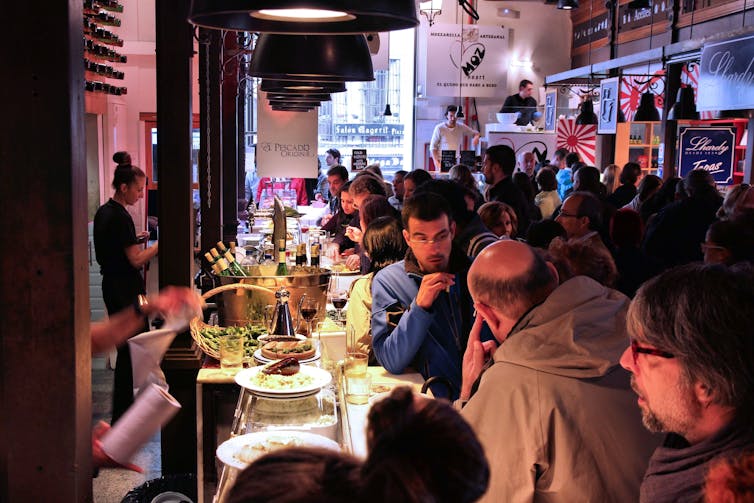
For example, intoxicated people are vulnerable. A drunk person can’t consent to anything, including a breach of their social distance. It’s why bars took longer to reopen than restaurants while safety systems were set up.
Alcohol and consent don’t mix – that’s why bars selling alcohol but not food took longer to reopen as precautions were put in place.www.shutterstock.com
Back to our hypothetical jogging incident. Was there informed consent? Before COVID-19, choosing to be in a public place implied accepting proximity with others. Currently, though, there is a public health directive to stay apart.
Assuming the jogger did not have a (socially distanced) friendly chat with the walker to obtain their informed consent to breach their government-recommended minimum distance, can they ethically presume to make that decision on another’s behalf?
First, is there a power difference between the jogger and the walker? Arguably, the person breaking distancing holds more power. Once it’s done, it can’t be undone.
In this instance, the jogger also has more power than the walker because they have more information. They can see ahead, predict a breach is likely to occur, and decide how to react. The walker cannot see behind them.
Was our walker vulnerable? Our jogger does not know. They cannot tell whether the walker is in a vulnerable COVID-19 category, lives with a newborn baby, has cancer or is a carer for someone elderly.
Finally, what does our social contract suggest? In New Zealand everyone has equal rights to use public walkways. As fair-minded people it’s unlikely we’d want vulnerable people’s disadvantage worsened by removing their right to go out for a walk.
Assume other people are vulnerable
On all counts, our jogger can best fulfil their ethical duties by assuming the walker is vulnerable and actively protecting them from potential harm.
Under level 4 restrictions, Prime Minister Jacinda Ardern suggested we act as though we have COVID-19. It’s what is known as a heuristic – a useful mental shortcut to help us make decisions. Perhaps it’s time for a new one.
It may be most helpful now to act as though everyone we encounter in public is vulnerable. It is easier to imagine other people being vulnerable than to trick our brains into thinking we are unwell when we feel fine.
Presuming the vulnerability of others until proven otherwise ticks the consent box: an easy rule of thumb for doing the right thing.
Consent is sometimes described in the literature of ethics as a “social gift”. By upholding consent we give the gift of respect for others’ right to choose when they want to step beyond their own “bubble”.
A sense of doing the right thing is also psychologically rewarding for the giver – it makes us feel positive about ourselves.
Understanding consent means that as we jog (or cycle, or get on a bus or plane) we can leave the job of calculating current COVID-19 risks to the experts. Instead we can focus on something within our immediate control: by the simple social gift of stepping back, waiting or veering around them, we recognise and validate the humanity and personal autonomy of others.
Yesterday was National Sorry Day in Australia. It marks the anniversary of the tabling of the Bringing Them Home report, which chronicles decades of removals of Aboriginal and Torres Strait Islander children from their families.
Sorry Day also acknowledges the strength of the Stolen Generations survivors and reflects on the role everyone can play in healing our country.
Yesterday was also the third anniversary of the release of the Uluru Statement from the Heart, which poignantly notes:
Proportionally, we are the most incarcerated people on the planet. We are not an innately criminal people. Our children are aliened from their families at unprecedented rates. This cannot be because we have no love for them. And our youth languish in detention in obscene numbers. They should be our hope for the future.
And this week is National Reconciliation Week, which represents a time for all Australians to learn about our shared histories, cultures and achievements. The theme this year is “In This Together”.
However, a new report released today makes clear the treatment of First Australians during the COVID-19 outbreak is not the same as for non-Indigenous Australians.
The report by Change the Record, the First Peoples-led justice coalition of peak bodies and allies, highlights numerous ways Aboriginal and Torres Strait Islander peoples have been disproportionately affected by the more punitive and restrictive policy responses to the pandemic.
Among the findings were:
First Nations people have experienced an increased use of lockdowns in prisons and have had reduced access to lawyers and visits from families
some prisons have required people in prison “to pay exorbitant fees to call loved ones”
victim-survivors of family violence have been unable to access police protection and support services due to staffing shortages (a particular concern because there is evidence such violence is increasing)
Aboriginal and Torres Strait Islander legal services have reported “substantial challenges” in working with their clients and are concerned about a spike in legal demand as soon as restrictions are lifted
the closures of residential drug and alcohol facilities have led to people being sent home, leaving some people without alternative and safe living arrangements
First Nations parents have had access to their children in out-of-home care restricted, causing “distress and anxiety in a time of heightened stress for everyone”
there has been over-policing of First Nations people for offences such as public nuisance, public drunkenness, fare evasion and failure to comply with move on orders. There have been high numbers of fines issued in small towns with high First Nations populations and low levels of COVID-19.
Governments’ COVID-19 prison policies have been inadequate
As we have argued in open letters to governments and elsewhere, the risk of transmission of COVID-19 in prisons has been a concern requiring immediate action across the country.
First Nations people are particularly at risk of infection, due to:
The government response to prevent the spread of coronavirus in prisons has included restrictions on visitors (especially family members), enforced isolation and lockdowns of people.
The Change the Record report chronicles the despair of First Nations people in prisons and their lack of access to services and support.
An Aboriginal man, Daniel, has been remanded in prison in Tasmania since early 2020. … Daniel is not allowed any visits with his family or his lawyer because of COVID-19 restrictions. He reports feeling lost in the legal proceedings because he cannot have a decent chat with his lawyer about the matters and get advice.
The report makes recommendations for people in prisons, including:
the release of First Nations people in prisons who are low-risk, on remand, elderly or at increased risk of COVID-19, as well as children and those with chronic health conditions
protecting the human rights of First Nations people in prison, by ensuring access to oversight and monitoring agencies, family, legal services, mental health care, education and programs
The impact of COVID-19 restrictions on children
Some of the invisible victims in the pandemic are the children of prisoners. Imprisonment disrupts family life, especially in cases when a First Nations mother or primary caregiver is incarcerated.
Because physical visits have been suspended, children’s access to their imprisoned parents has been even more constrained.
The Change the Record report also notes how First Nations parents are unable to visit with their children in out-of-home care.
Julia had been having multiple face-to-face visits with her child every week. Due to COVID-19, Julia’s contact with her daughter has been reduced to one phone/video call a week. … When children cannot engage in this mode of communication, for some parents contact with their children has stopped all together.
The report makes recommendations for policies affecting children during the pandemic, including:
increasing support and access to safe accommodation for First Nations families fleeing family violence to stop further removals of children
implement legislative changes to ensure parents of First Nations children in out-of-home care don’t lose their children to permanent care during COVID-19.
The report also calls for:
rebuilding our justice system after COVID-19 to focus on investing in community, not prisons, to increase community safety and prevent black deaths in custody.
No return to status quo
We endorse these recommendations, especially the final call to rebuild our justice system. As we emerge from the immediate threat of the pandemic, it is vital that we not return to the status quo.
If Reconciliation Week is to be meaningful, governments must take action to heal, rather than jail, First Nations people. In the current circumstances, this includes acting on Change the Record’s recommendations.
Pacific governments are being warned to put urgent covid-19 safety measures into place at ports as foreign fishing boats emerge as a new point of transmission.
One Ecuadorian vessel is now at sea with 29 out of 30 of its crew covid-positive and there are suspicions of more.
Another issue has arisen with workers for the Dalian Ocean Fishing Company, a Chinese-owned company.
Four Indonesian crew members have died working for the company, all with the same covid-19 symptoms: chest pain, swelling and breathing difficulties.
– Partner –
It’s not known whether the men were covid-positive; the captains did not get help for them and their bodies were thrown overboard.
“We condemn the inhumane treatment against our crew members working at the Chinese fishing company,” Indonesian Foreign Minister Retno Marsudi said.
Another vessel had been fishing near Samoa and its government has held grave concerns for some time.
Infection possible “We have the merchant shipping bringing goods and also some fishing boats, it is quite possible an infection could come to Samoa,” Samoan Prime Minister Tuilaepa Sailele Malielegaoi said earlier this month.
Bubba Cook works closely with Pacific governments to manage tuna stocks and said urgent action was needed.
“We should be monitoring these vessels when they are out at sea and when they come in, test, trace, track, ensure that the disease is not entering into these communities through these fishing vessels and the fishermen on board,” he said.
Last week, French Polynesia came to the aid of a seriously ill suspected covid-19 case on board an Ecuadorian fishing vessel.
The man was taken to Tahiti for urgent medical treatment, but the other 29 of the 30 crew who all tested covid-positive have been sent back out to sea.
“The anxiety on board will be very high because you are on a floating piece of steel in the middle of nowhere,” fisheries consultant Francisco Blaha said.
Strong unions With strong unions, Ecuador’s crews are generally well cared for, unlike many Asian fishing vessels.
Instead it is often a transmission hotbed on board and captains often won’t get sick crew the help they need, driven by the need to stay at sea.
“You are talking in the Pacific alone, in the tuna fisheries, in the order of billions of dollars,” Cook said.
Wealth is too often trumping health, proving a red alert for Pacific ports.
Last week, a 17-year-old boy in Toronto was charged with an act of terrorism in the alleged killing of a woman with a machete – the first time such a charge has been brought in a case involving “incel” ideology.
Also last week, a 20-year-old man who self-identified as an “incel” – short for “involuntary celibate” – allegedly went on a shooting spree in Arizona, targeting couples to express his anger over the fact women had rejected him.
These are just two of the most recent attacks attributed to incels. Incel-related violence has been on the rise for the past seven years, and according to our research, has been linked to the deaths of at least 53 people and scores of injuries.
Incel is the name adopted by an online community comprised almost entirely of men and boys who rage against women and blame them for their sexless lives.
While many are simply lonely and use the community for support in an age of digital isolation, some radicals advocate for social and sexual rebellion. These extremist incels seek revenge through violent attacks against people they call “Chads and Stacys”, a reference to men and women they perceive as very successful when it comes to sex.
In our new research, we argue governments should recognise incels as ideological extremist organisations and, through stronger policies and laws, start combating misogyny in the same way they fight Islamic extremism.
What do incels believe?
In our research, we reviewed incel attacks over the past seven years, looking at what the perpetrators were posting online and how they were engaging with others in the community.
We found incels are angry because they believe the sexual revolution has made women promiscuous and manipulative. They believe feminism, the contraceptive pill and women’s involvement in politics have fuelled this promiscuity.
But they believe women are choosing to have sex only with “Chads”, not incels, and feel a sense of injustice and persecution as a result.
According to the incel-run “Incel Wiki” website, these men view Chads as “the only male beneficiaries of the sexual revolution”. They hate Stacys because they are “vain and obsessed with jewellery, makeup and clothes”, and are “entitled whores”.
These misogynistic views connect incels to other alt-right, anti-women groups like Pick Up Artists and Men’s Rights Activists, which believe feminine values have come to dominate society and men must fight back against a politically correct and misandrist culture to protect their very existence.
They use online forums to spread their messages of hate, convincing other would-be incels they can blame their social and sexual difficulties on others. Some fantasise about committing acts of violence.
This was the case for Alek Minassian, who has admitted to driving a van onto a sidewalk in Toronto in 2018, killing 10 people. Minassian has told police he was radicalised by other incels online.
the Incel Rebellion has already begun! We will overthrow all the Chads and Stacys! All hail the Supreme Gentleman Elliot Rodger!
The last part of the quote refers to Elliot Rodger, who published a 141-page incel manifesto online before killing six people in a shooting and stabbing spree in California in 2014. He has since become a martyr in the incel community.
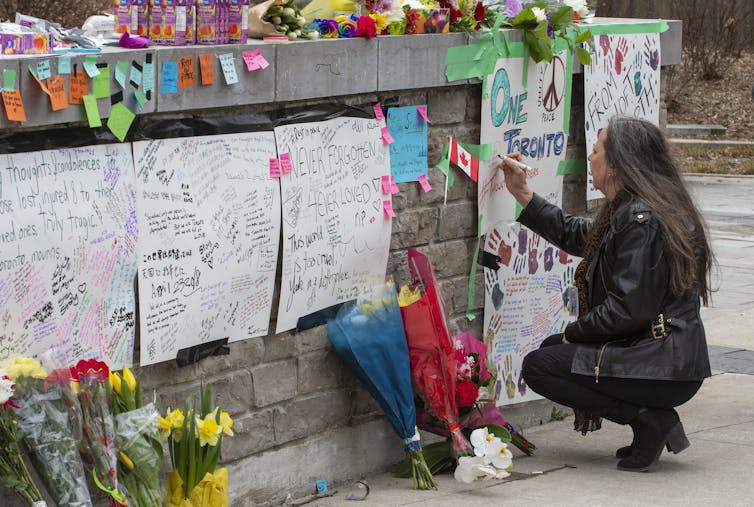
A memorial to the victims of the van attack in Toronto.WARREN TODA/EPA
Addressing misogyny at a societal level
Our research shows incel violence presents a similar threat to public safety as religious extremism – and it’s increasing.
Incel extremism fits the definition put forth by Home Affairs for violent extremism:
the use or support of violence to achieve ideological, religious or political goals.
However, Home Affairs apparently does not view misogynistic extremism as such a pressing issue. While some states have developed “threat assessment centres” that could be used to monitor radical incels, the federal government has not provided important leadership by labelling incels or misogyny a security threat.
Understanding the threat posed by incels is difficult because it requires unpacking and critiquing the misogynistic views that underpin their behaviours. Some men misread this as an attack.
Some lessons can also be learned from strategies to counter other forms of violent extremism.
Targeting specific groups can create “suspect communities” and contribute to feelings of persecution. This, in turn, can increase the chances of people becoming violent. Incels already feel disempowered and victimised, so creating a “suspect community” could exacerbate the problem.
Our research suggests the most effective interventions should occur at a societal level.
One reason for this is the anonymous nature of the incel movement. These men tend not to admit to their beliefs in public, relying instead on comments from opinion leaders to legitimise them. If we counter these types of misogynistic statements and deem them a security threat, it could lessen their impact with individual men.
This also means not allowing the mainstream media, politicians or public commentators to excuse or justify gendered violence when it happens.
Targeting individuals before radicalisation happens
Beyond this, health, education and social workers could be trained to spot at-risk behaviours in individual men and act when appropriate.
Following ideas surfaced by other researchers on countering violent extremism, we advocate taking a “public health approach” that allows us to address the feelings of isolation and alienation among incels and intervene at early stages to prevent violence from occurring.
Waiting for radicalised people to start planning attacks is too risky. Germany and Norway have had significant success changing opinions and behaviours by targeting “at-risk” individuals at earlier stages of potential radicalisation.
It is time for Home Affairs to end its preoccupation with external threats and instead address the threats within. Misogyny needs to be understood as a real threat to our public and private security.
Amid the coronavirus pandemic we are being warned of a “second wave” of mental health problems that threatens to overrun an already weakened mental health service.
As we emerge from this crisis, while some people may need specialist help with treating mental illness, everybody can benefit from strategies to improve mental health.
This is because mental health is more than just the absence of mental illness. Positive mental health is a combination of feeling good and functioning well.
With physical health, some days we naturally feel stronger and more energetic than others. Similarly, some days our mental health is worse than others, and that too is a natural part of being human. We may feel tired, grumpy, sad, angry, anxious, depressed, stressed, or even happy at any point in time. These are all normal human emotions, and aren’t on their own a sign of mental illness.
Someone living with a mental illness can be experiencing optimal mental health at any point in time, while someone else can feel sad or low even in the absence of a mental illness.
Differentiating between poor mental health and symptoms of a mental illness is not always clear-cut. When poor mental health has a sustained negative impact on someone’s ability to work, have meaningful relationships, and fulfil day-to-day tasks, it could be a sign of mental illness requiring treatment.
Mental health and mental illness are not the same thing. You can have poor mental health in the absence of a mental illness.Supplied, adapted from Keyes 2002.
Positive mental health and well-being is a combination of feeling good and functioning well. Important components include:
experiencing positive emotions: happiness, joy, pride, satisfaction, and love
having positive relationships: people you care for, and who care for you
feeling engaged with life
meaning and purpose: feeling your life is valuable and worthwhile
a sense of accomplishment: doing things that give you a sense of achievement or competence
emotional stability: feeling calm and able to manage emotions
resilience: the ability to cope with the stresses of daily life
optimism: feeling positive about your life and future
self-esteem: feeling positive about yourself
vitality: feeling energetic.
How can I cultivate my mental health?
Your mental health is shaped by social, economic, genetic and environmental conditions. To improve mental health within society at large, we need to address the social determinants of poor mental health, including poverty, economic insecurity, unemployment, low education, social disadvantage, homelessness and social isolation.
Positive mental health involves being able to cope with the challenges of daily life.Shutterstock
On an individual level, there are steps you can take to optimise your mental health. The first step is identifying your existing support networks and the coping strategies that you’ve used in the past.
There are also small things you can do to improve your mental health and help you to cope in tough times, such as:
doing things you enjoy and that give you a sense of accomplishment.
How do I know if I need extra support?
Regardless of whether you are experiencing a mental illness, everyone has the right to optimal mental health. The suggestions above can help everyone improve their mental health and well-being, and help is available if you’re not sure how to get started.
However, when distress or poor mental health is interfering with our daily life, work, study or relationships, these suggestions may not be enough by themselves and additional, individualised treatment may be needed.
Source: The Conversation (Au and NZ) – By Bill Hare, Director, Climate Analytics, Adjunct Professor, Murdoch University (Perth), Visiting scientist, Potsdam Institute for Climate Impact Research
Every few years, the idea that gas will help Australia transition to a zero-emissions economy seems to re-emerge, as if no one had thought of it before. Federal energy minister Angus Taylor is the latest politician to jump on the gas bandwagon.
Taylor wants taxpayer money invested in fast-start gas projects to drive the post-pandemic recovery. His government plans to extend the emissions reduction fund to fossil fuel projects using carbon capture and storage.
The government’s “technology investment roadmap”, released last week, said gas will help in “balancing” renewable energy sources. And manufacturers advising the National COVID-19 Coordination Commission want public money used to underwrite a huge domestic gas expansion.
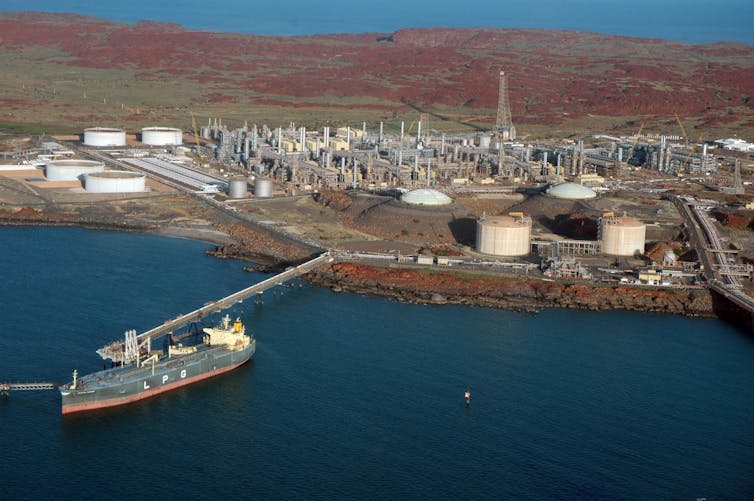
Amid all these gas plans, there is little talk of the damage this would wreak on the climate. We need only look to Woodside’s Burrup Hub proposal in Western Australia to find evidence of the staggering potential impact.
By the end of its life in 2070, the project and the gas it produces will emit about six billion tonnes of greenhouse gas. That’s about 1.5% of the 420 billion tonnes of CO2 world can emit between 2018 and 2100 if it wants to stay below 1.5℃ of global warming.
This project alone exposes as a furphy the claim that natural gas is a viable transition fuel.
Woodside chief executive Peter Coleman. The company wants to build a large gas hub in northern WA.Richard Wainwirght/AAP
Undermining Paris
The Burrup Hub proposal involves creating a large regional hub for liquified natural gas (LNG) on the Burrup Peninsula in northern WA. It would process a huge volume of gas resources from the Scarborough, Browse and Pluto basins, as well as other sources.
We closely examined this proposal, and submitted our analysis to the WA Environmental Protection Authority and the federal environment department, which are assessing the proposal.
The likely scale of domestic emissions from the Burrup Hub will significantly undermine Australia’s efforts under the Paris climate agreement. To meet the Paris goals, Australia’s energy and industry sector can emit 4.8-6.6 billion tonnes of carbon dioxide between 2018 and 2050. By 2050, the Burrup Hub would emit 7-10% of this.
Woodside’s investors are clearly concerned at the potential impact of the company’s emissions. On April 30 more than half its investorscalled on the company to set emission reduction targets aligned with the Paris agreement for both its domestic emissions and those that occur when the gas is burned overseas.
Woodside’s existing northwest shelf gas plant in WA.Rebecca Le May/AAP
Not a climate saviour
Woodside has claimed the proposed Burrup Hub project would help the world meet the Paris goals by substituting natural gas for coal. This claim is often used to justify the continued expansion of the LNG industry.
But in several reports and analyses, we have shown the claim is incorrect.
If the Paris goals are to be met, the use of natural gas in Asia’s electricity sector – a major source of demand – would need to peak by around 2030 and then decline to almost zero between 2050 and 2060.
Globally (and without deployment of carbon capture and storage technology), demand for gas-fired electricity will have to peak before 2030 and be halved by 2040, based on 2010 levels.
Our analysis found that by 2050, gas can only form just a tiny part of global electricity demand if we are to meet the Paris goals.
The electricity sector is the main source of global LNG demand at present. Emissions from gas-fired electricity production can be lowered by 80-90% by using carbon capture and storage (CCS), which traps emissions at the source and injects them underground. But this technology is increasingly unlikely to compete with renewable energy and storage, on either cost or environmental grounds.
As renewable energy and storage costs continue to fall, estimates of costs for CCS in gas power generation have increased, including in Australia. And the technology doesn’t capture all emissions, so expensive efforts to remove carbon dioxide from the atmosphere would be required if the Paris goals are to be met.
Beyond the Burrup proposal, Woodside says its broader LNG export projects will help bring global emissions towards zero by displacing coal. To justify this claim, Woodside cites the International Energy Agency’s Sustainable Development Scenario. However this scenario assumes a rate of coal and gas use incompatible with the Paris agreement.
This problem is even starker at the national level. We estimate LNG extraction and production creates about 9-10% of Australia’s greenhouse gas emissions. If we include exported LNG, the industry’s entire emissions would roughly equal 60% of Australia’s total emissions in 2017.
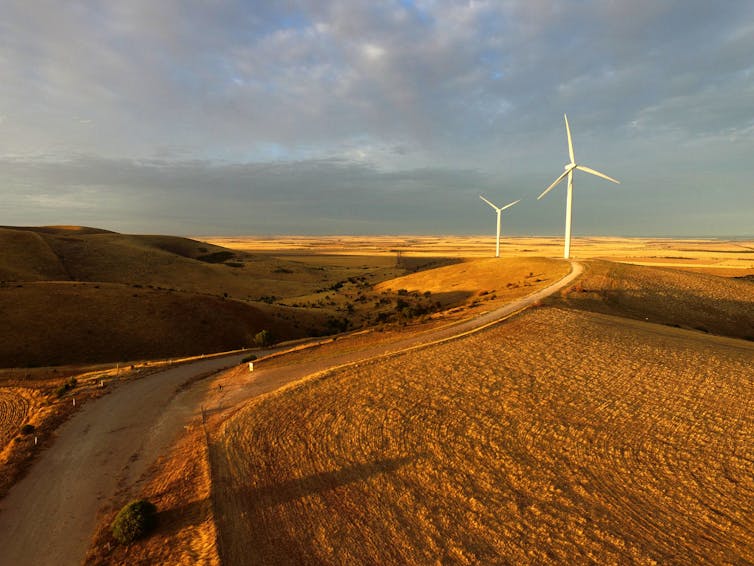
As renewables costs fall, CCS becomes less feasible.Flickr
A big financial risk
If the world implements the Paris agreement, demand for gas-fired electricity will likely significantly drop off by 2030. Technology trends are already pointing in that direction.
This creates a major risk that gas assets will become redundant. Australia will be unprepared for the resulting job losses and economic dislocation. Both WA and the federal government have a responsibility to anticipate this risk, not ignore it.
The Reserve Bank of Australia has warned of the economic risks to financial institutions of stranded assets in a warming world, and the Burrup Hub is a prime example of this.
The economic stimulus response to COVID-19 presents a major opportunity for governments to direct investments towards low- and zero-carbon technologies. They must resist pressure from fossil fuel interests to do the opposite.
In response to the claims raised in this article, Woodside said in a statement:
We support the goal of the Paris Agreement to limit global temperature rises to well below 2℃, with the implicit target of global carbon neutrality by 2050. At Woodside, we want to be carbon neutral for our operations by 2050.
Independent expert analysis by ERM, critically reviewed by CSIRO, shows Woodside’s Browse and Scarborough projects could avoid 650 Mt of CO2 equivalent (CO2-e) emissions between 2026 and 2040 by replacing higher emission fuels in countries that need our energy.
This means every tonne of greenhousa gas emitted in Australia from our projects equates to about 4 tonnes in emissions reduced globally. To put that in context, a 650 Mt CO2-e reduction in greenhouse gas is equivalent to cancelling out all emissions from Western Australia for more than eight years.
To have reliable energy and lower emissions, natural gas is essential. As a readily dispatchable power source, gas-fired power is an ideal partner with renewables to provide the necessary system stability.
Woodside remains committed to realising our vision for the Burrup Hub, despite the delay to final investment decisions on the projects in response to the COVID-19 pandemic and rapid decline in oil prices. We believe these projects are cost-competitive and investable, with 80-90% of their gas reserves to be produced by 2050.
The Burrup Hub developments have the potential to make a significant contribution to the recovery of the West Australian and national economies when we emerge from the impact of COVID-19. They will provide thousands of jobs, opportunities for local suppliers and tax and royalty revenues to the state and Australia.
Climate Explained is a collaboration between The Conversation, Stuff and the New Zealand Science Media Centre to answer your questions about climate change.
If you have a question you’d like an expert to answer, please send it to climate.change@stuff.co.nz
I would like to know if New Zealand’s carbon emissions of 0.17% include emissions produced from products manufactured overseas and then imported for the New Zealand consumer?
The latest Ministry for the Environment report, published last month, shows New Zealand contributes 0.17% of the world’s total greenhouse gas emissions.
New Zealand’s population represents just 0.06% of the world’s population (New Zealand 5 million, global 7.8 billion), which means it has a disproportionately high share of emissions for its population size. This is sometimes represented as per capita emissions – and in 2017, New Zealand ranked sixth highest among developed and transitioning countries, at 17.2 tonnes of carbon dioxide equivalent emissions per person. This is almost three times the average per capita share.
The reason for this can be partly explained by the way countries account for their greenhouse gas emissions.
Countries generally use “production-based accounting” to quantify their greenhouse gas emissions. This approach counts emissions from all activities that happen within a country’s territory – which means goods manufactured elsewhere and then imported are not included.
It also means that if a country exports more goods and services than it imports, it will likely have disproportionately higher per capita emissions.
It can be argued that if a country can produce these goods more efficiently (with lower emissions) than other countries, this may be the preferred situation. This is the case for New Zealand’s agricultural production. Research shows New Zealand’s pasture-fed agricultural systems are efficient in producing meat and dairy products – per kilogram of meat or litre of milk, New Zealand emits less than many other countries.
Although most of these products are exported, the emissions from their production count towards New Zealand’s greenhouse gas inventory. In fact, almost half of New Zealand’s emissions in 2018 came from agriculture, and just under three-quarters of these agricultural emissions were methane from cows and sheep.
From a global perspective, climate policy needs to recognise the advantage of producing goods where they can be made with lower emissions. Otherwise there is a risk industries relocate to other (typically less developed) countries with less stringent climate change regulations, and global greenhouse gas emissions rise as a result. This is known as “carbon leakage”.
Patterns of consumption
But there is an important corollary to all of this: considering only the production-based emissions of countries is not enough to address the climate crisis. Even if New Zealand can produce agricultural goods more efficiently than other countries, should these be produced at the current volume – or at all?
Ultimately we need to consider patterns of consumption and assess whether they are in line with a sustainable future for the world.
In practical terms, this means that we should be accounting for both consumption and production-based emissions. An accounting system based on consumption would assess greenhouse gases emitted in the production of goods and services consumed by New Zealanders. This includes imported goods as well as everything that is produced and then consumed in New Zealand – and it excludes exported goods and services.
Two New Zealand studies (for 2011 and 2012) show the biggest contribution to consumption-based emissions comes from three sectors: construction, food and beverages, and education and health services. For food and beverages, animal protein and processed meat contributes 35% of the emissions associated with an average adult New Zealand diet.
But accounting for emissions from consumption comes with challenges. It requires tracing the point of origin of imported products, often in countries with less stringent emission inventories. There are two types of modelling we can use to support consumption-based analysis. Life cycle assessment starts with a product – say an apple or packet of milk powder – and tracks the entire supply chain back through the retail, distribution and agricultural production. Other models integrate environmental and economic data across multiple regions.
Such data and the insights we glean from both production and consumption accounting could guide future climate policies to enable New Zealand to reduce emissions both within the country and internationally.
In certain situations, people with anxiety may find their heart beats quicker as adrenalin is released into their blood stream, more oxygen flows to the blood and brain, and even digestion may slow down.
These are helpful responses if you need to run away or fight danger. But social situations are generally not life threatening, and these physical symptoms can interfere with socialising.
People with social anxiety may fear looking silly, being judged, laughed at or being the focus of attention. For anyone, such experiences might be unwelcome but for those with social anxiety they pose an unacceptable threat.
Social anxiety in Australian children
One Australian report found that about 6.9% of children and adolescents surveyed have a diagnosed anxiety disorder, 4.3% experience separation anxiety and 2.3% a social phobia.
Social phobia (social anxiety) is more common in adolescents, whereas separation anxiety (intense anxiety over leaving caregivers, such as parents) is more prevalent in children.
These figures only account for those who have a diagnosis of anxiety. They do not include undiagnosed young people who experience high stress in social situations.
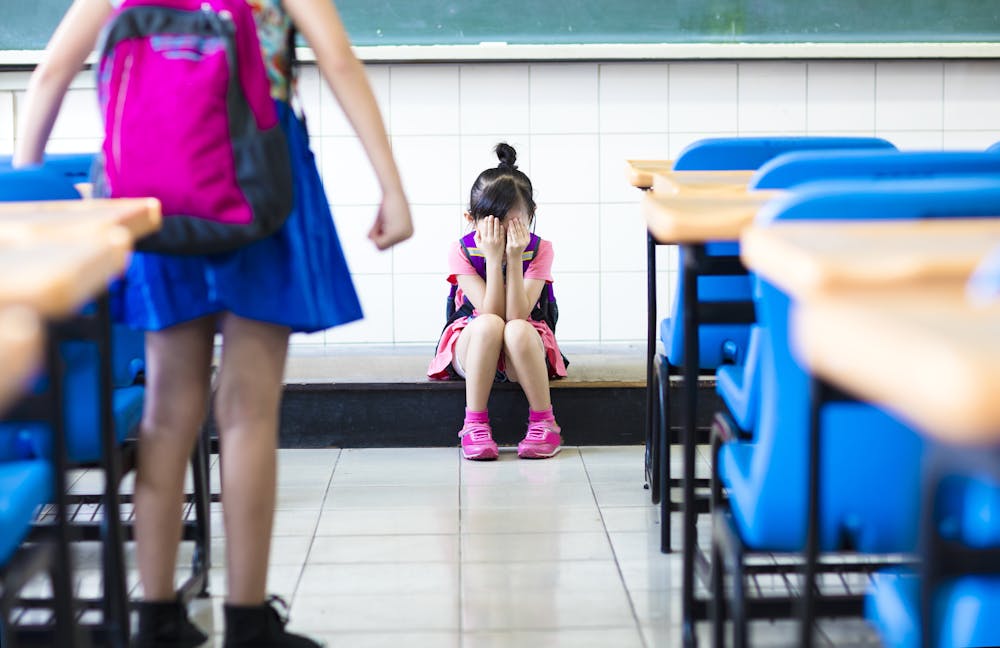
Not all children will be happy to be back in school.Tom Wang/Shutterstock
Any recent prolonged absence from school may have increased social anxiety, as avoiding what you fear can make your fear become greater.
This is because you do not get to learn that the thing you fear is actually safe. Your beliefs about the threat go unchallenged.
Anxiety can also increase through what pyschologists call reduced tolerance. The more children withdraw from the situations that cause them fear, the less tolerance they have for those situations.
Anxiety can affect education
The educational cost for students with anxiety is considerable.
The research shows students with poor mental health can be between seven to 11 months behind in Year 3, and 1.5 – 2.8 years behind by Year 9.
That’s because these students experience more absences from school, poorer connection to school, lower levels of belonging and less engagement with schoolwork.
7 strategies to help overcome social anxiety
So what can children do to overcome anxiety as they return to school? Here are some useful tips.
deal with some of the physical symptoms. It is hard to think if your body is stressed. Use calming strategies like mindfulness or breathing exercises. Slowing your breathing can reduce symptoms of anxiety, depression, anger and confusion. Useful apps to help you control your breathing include Smiling Mind (iOS and Android) or Breathing Bubbles (Android only).
anxiety increases while using avoidance techniques such as avoiding eye contact, not raising your hand to answer a question, or not attending school. So the most effective way to deal with social anxiety might be to face it. Allow your child to have small experiences of social success – give their opinion to one person, start a conversation with someone they know – so they can learn to feel safe in these social situations.
fear and anxiety are normal and benefit us by helping us to respond efficiently to danger. Rather than read your body as under threat, think about the changes as helpful. Your body is preparing you for action.
while avoiding your fears is not the answer, being fully exposed to them is not the answer either. Providing overwhelming social experiences may lead to overwhelming fear and failure, and may make anxiety sufferers less likely to try again – or at all. Start small and build their courage.
supportive listening and counselling are less effective than facing your fears because these approaches can accommodate the fears. While you want to support your child by providing them with comfort and encouragement – ensure you also encourage them to face the fears that cause the anxiety.
you cannot promise negative things won’t happen. It is possible you will be embarrassed or be judged. Rather than try to avoid these events, try reframing them. Remember that that we all experience negative social feedback, and this does not make you silly or of less value. It makes you normal. Or, rather than see it as embarrassing, maybe it can be funny.
remember it is the “perception” that something is a threat – not the reality. Reasoning with your child to help them see your perspective may not change theirs. This reality only changes with positive real experiences.
Breathing Bubbles in action.
What we think is truth is often revealed as untrue when we face our fears. There is joy in social situations. Keep turning up to them.
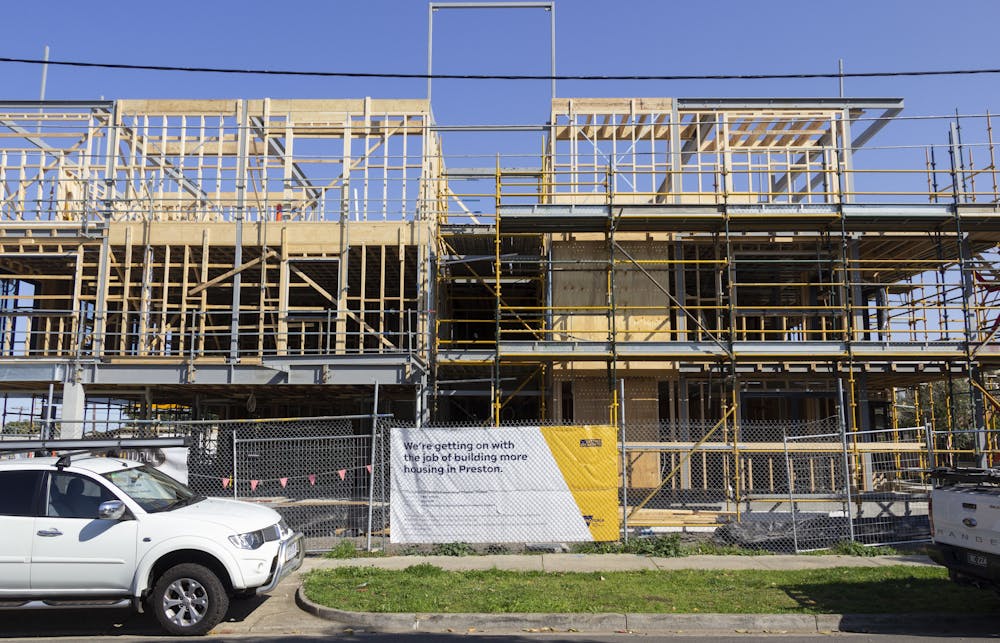
The need for public housing is greater than ever before – Australia has a shortfall of at least 433,000 dwellings. Using public land for public housing is a no-brainer. But, at the time of writing, the Victorian government is preparing to sell over 2,646 hectares of land. Our analysis reveals 24 of these sites are suitable for delivering high-quality, well-located public housing in places where the need is high.
This is nothing new. As our recent research has shown, successive governments in Victoria have been systematically selling public land.
The twin health and economic crises created by the COVID-19 pandemic will add to the shortfall of public housing. And yet the government shows no sign of rethinking its land sales.
We examined the land parcels listed as being prepared for sale by the Victorian Department of Treasury and Finance in April and May 2020. We assessed each parcel for suitability as residential, based on zoning and on liveability criteria from the Australian Urban Observatory.
Our analysis shows 90.9 hectares, across 24 individual sites, would be suitable for public housing. Around 55 hectares is in metropolitan Melbourne. As the map below shows, other key sites are in regional centres such as Bendigo, Geelong, Mildura and Sale. (Scroll to resize and hover cursor over locations to see details of sites.)
Together, these sites could yield between 1,350 and 1,800 public housing dwellings, depending on the density. The Victoria Planning Authority has a density target of 15 dwellings per hectare. Plan Melbourne aspires to 20 dwellings per hectare.
The total cost would be A$405-540 million, assuming costs of $300,000 per dwelling. While this cost is higher per unit than some studies have suggested is possible, it provides a realistic path to a high-quality outcome.
Such investment would deliver an immediate public good with a lasting positive impact on Victoria. It would be a good first step in a long-term public housing works program.
This available public land is located in areas with high priority housing needs. Using data from the Victorian Housing Register, we analysed where this need is significant. As the map below shows (hover cursor over each area for details), high numbers of people are applying for social housing in Melbourne’s west, north and outer south-east, and the central belt of Victoria.
Public land in these high-need areas is also being lost through the Victorian Government’s Public Housing Renewal Program. This program will redevelop well-located public housing estates in Melbourne into mostly private apartments and some community housing. Virtually all this high-value land and the public housing on it will be privatised – right where it is needed most.
This is happening at a time when the supply of public housing in Victoria has reached critically low levels. The waiting lists for housing are at a record high of about 100,000 people and growing.
Public housing tenancy as a proportion of total occupants in Victoria is at its lowest level since the 1954 Census, the first to ask about public housing tenancy. Public housing stock has been declining in real terms since the mid-1990s. Victoria has the least public housing, relative to all dwellings, anywhere in Australia.
And this is just the tip of the affordable housing problem. Tens of thousands more people are in housing stress and eligible for housing assistance.
Despite these trends, the twin policy failures of selling public land and disinvesting in public housing have been a feature of Victorian government for decades. The Andrews Labor government continues to ignore the importance of using strategically placed government-owned land for the public good.
This also disrespects the spirit of treaty negotiations with First Peoples now under way in Victoria.
Build public housing to spur recovery
The state government has responded to a wide range of calls to invest in social housing as part of a stimulus package. The announcement of A$500million investment in upgrading 23,000 public housing dwellings and building 168 new ones is very welcome. Direct state investment in public housing can throw the construction sector a lifeline.
For modest investment, Victoria could build thousands of public housing dwellings in excellent locations to deliver the basic infrastructure of life: a place to call home. If we are serious about a construction-and-infrastructure-led recovery, now is the time to finally realise that housing is essential infrastructure.
Roland Postma contributed to this article. The authors acknowledge that the lands discussed in this article are the unceded lands of Traditional Owners. The article was written on Wurundjeri Country and we pay our respects to Woiwurrung Elders and ancestors.
Extreme shortages of toilet paper, pasta and other pantry products defined the early weeks of the COVID-19 pandemic for many shoppers around the world. Availability of most these goods has returned to normal.
But not for baking goods – flour in particular.
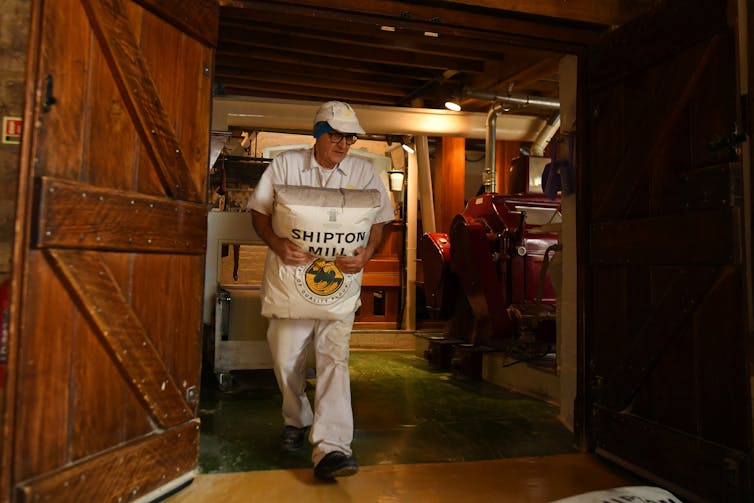
In Britain the flour shortage has led to the thousand-year-old Sturminster Newton Mill, established in 1016, cranking back into production. Sales by small artisan outfits – such as the Shipton Mill, mentioned in the Domesday Book of 1086 – have surged. It’s the same in France.
Shipton Mill, a family-run boutique organic flour miller in Tetbury, England, has seen demand for its produce skyrocket as flour has become scarce in supermarkets.Dylan Martinez/Reuters
So why are there flour shortages from Europe to the United States and Australia?
The answer is both simple and complex.
It is partly to do with the basic economics of demand and supply. Demand for baking ingredients has spiked because people staying home (and not going to restaurants or cafes) cook more.
More fundamentally it is about the structure of concentrated food distribution systems geared to supply commercial rather than retail demand.
The inflexibility of those channels highlights a key issue in discussions about food security – that is, ensuring people have access to food. It is not just a matter of how much food is produced but how it is distributed.
Changing consumption patterns
Supermarket shortages of toilet paper and pasta were mostly attributed to a surge in demand driven by panic-buying and stockpiling, along with a lag in supply chains geared to provide just enough product to stores to avoid storing inexpensive but bulky inventory.
As stock disappeared from supermarket shelves, other consumers afraid of being caught short also started buying more than they normally would. Responding to that surge in demand and increasing supply took producers time – usually at least a month.
But a less-discussed part of the problem was the shift in consumption patterns, as stay-at-home rules resulted in toilet paper demand from workplaces and public buildings declining and home demand increasing. And the toilet paper that commercial buyers want is different to what people buy for themselves.
In the case of flour, the split between supplying commercial and retail demand has been an even more significant factor.
Until the pandemic, retail demand was a small (and diminishing) part of the flour market. In Britain, for example, it represented just 4% of flour consumption. The rest went to commercial bakers and food manufacturers.
While the quality of flour commercial users buy is not necessarily different, the size of the packages in which they buy is – bags of 12, 25 of 32 kilograms, rather than the 1kg or 2kg bags that home bakers prefer.
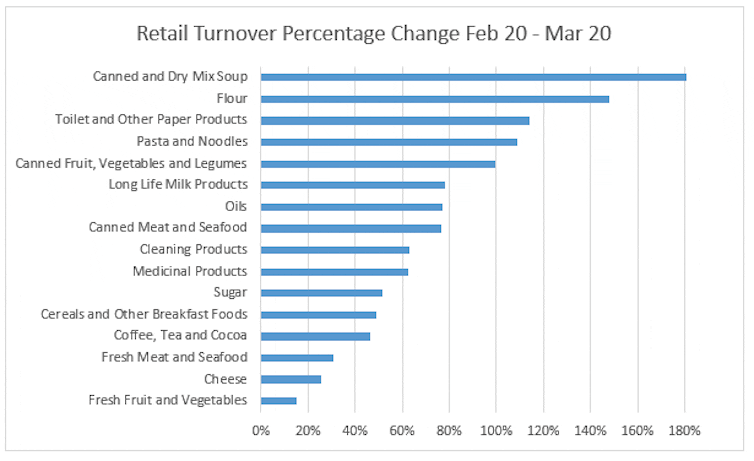
With home demand spiking – in Australia, for example, retail flour sales rose 140% in March – the large flour-milling operations quickly reached the limits of their equipment and processes to package flour in smaller bags.
Hence the supermarket shortages – and the opportunity that presented for boutique millers.
Industry concentration
Also contributing to the slowness of flour millers in responding to higher retail demand (compared to eggs, for instance) is the level of industry concentration.
Concentration in the supermarket sector has not helped either. Increasingly, supermarket chains cut out intermediaries (wholesalers) from their supply chains and buy directly from producers. This has made changing their sources more difficult.
Production versus distribution
The rigidity of food supply chains in responding to changes in consumption by moving food distribution from commercial to retail channels can also be seen in cases of European and American farmers reportedly pouring milk down the drain and leaving vegetables to rot in their fields.
As we ponder how to ensure food security, we will need to address these systemic issues. We cannot think problems are solved just by increasing supply. It is distribution that is key.
Digital fitness is enjoying a COVID-19 boom. Online fitness technology provider Virtuagym reports a 400% increase in engagement and a 300% increase in the use of online workouts. Gyms, barre instructors, and yoga studios have been on a steep learning curve to become online businesses. And social media feeds have been flooded with home fitness options.
Women have long been the focus of home fitness programs – so it makes sense they are at the forefront of this shift, finding ways to connect and fit more fitness into their day.
Health clubs around Australia are set to reopen between now and mid-June. But the gains women have made online might make them less inclined to return to the gym once restrictions ease.
Livingroom fitness
While many people are using free content on YouTube during social isolation, others are sticking with fitness instructors who usually run classes in gyms, parks or studios.
By becoming digital providers, instructors can support their loyal clientele through difficult times while protecting their livelihoods during a massive industry downturn .
Big industry players are getting in on the action, with Nike’s Livingroom Cup and Strava’s range of stay active at home challenges aiming to provide motivation and connection with others.
Previous studies have shown people with gym memberships are more likely to meet weekly fitness benchmarks than those without, perhaps due to the financial commitment they’ve made. Older studies have looked at the tribal appeal of group fitness and the influence of others.
Global fitness celebrities like Les Mills, Kayla Itsines, Sam Wood and Chris Hemsworth are offering free program trials during lockdown. They hope mass uptake will convert to longer term paid subscriptions.
Fit women goals
Research shows women find it difficult to exercise for reasons including caring commitments, and feelings of intimidation and judgement in public leisure settings. Digital fitness offers privacy, safety and convenience.
There are also economic and time-saving benefits for women, who have less time for leisure than men and less money to spend on fitness.
Digital technologies and programs can also help women build supportive online social networks around their workouts. Facebook groups include Fitness First at Home with 10,000 members and the hashtag #GotAHomeGotAGym.
With 12.5 million followers, the dominant face of online fitness is Kayla Itsines. Her success can be attributed in part to her effective use of digital platforms to build a fitness community.
In our study of Itsines’ fitness followers on Instagram, we found sharing photos, stories and advice was important for staying motivated.
Statements from followers such as “I want you to know that whatever you are going through – it’s OKAY!” and “You have to tell yourself each day ‘I got this, I’m gunna get those abs and lose this muffin top’”, show how women connect and relate to each other online by disclosing feelings of insecurity as well as hopes for overcoming them. These connections can feel especially meaningful for women at home or exercising alone.
As part of research soon to be published, we interviewed a dozen Melbourne women who are using Instagram for fitness. They repeatedly identified the value in the communities they found online. One interviewee said:
I feel that I, through Instagram, have got to know more people and I learn a lot of things from them and it’s a source of inspiration for me.
Another said:
I’d moved to a city where I didn’t really know anyone, so it was quite isolating for a period of time. I’ve always thrived on health and fitness so I still trained, but in the last two years with this [online] running community … I have my sense of belonging back, and I feel like I’ve got my people again.
During COVID-19 lockdowns, people are using digital technologies to connect with existing fitness communities. Others are discovering online communities for the first time. This is especially important amid concerns about the mental health impact of social isolation. Experts know that physical exercise can help.
Of course, connection leaves room for comparison. While comparison can be motivating, digital exercise communities also fuel pressures on women to demonstrate feminine success through physical and psychological means.
Performing fit femininity online can impose new demands of self-love, body positivity and ongoing self-improvement. These values are captured in inspirational fitness quotes that encourage women to accept who they are while simultaneously aspiring to a better version of themselves.
Fitspiration quotes with empowering messages are popular.Pinterest
In our research on the Itsine’s #BBG fitness community, we studied thousands of women from around the world – of all different body shapes and sizes – “brought together in a shared motivation for a changing body, the becomings of a ‘better’ body”.
The presentation of positive emotion through and about the body was prevalent in the images and text, with posts carrying affirming hashtags like #selflove #strongnotskinny #bodypositive #healthyandhappy”.
How women’s exercise efforts are responded to by others through comments and reactions, can shape women’s digital fitness participation.
Women’s fitness beyond COVID-19
With the gradual loosening of COVID-19 restrictions, gyms will reopen and many free programs will cease to be available.
Some people will return to leisure centres and fitness studios over the coming weeks, driven by the physical connections, infrastructure and the sense of familiarity these spaces provide. However, we anticipate that many women will maintain their home workout habits because of the value found in these online offerings.
Scott Morrison has indeed taken to heart that adage about not wasting a crisis. He insists he is going to put to advantage the opportunity brought by these most unfortunate circumstances.
His plan for a government-employer-union-community effort to reform this country’s industrial relations will, if it comes off, be a substantial achievement (although the actual magnitude would depend on just how much was done).
Politically, success would give Morrison something positive for the next election, which will be fought in the testing circumstances of likely high unemployment and sectors of the economy still struggling.
Labor would be outflanked.
If Morrison’s effort ends as a busted flush, he’ll say he tried and move on to something else.
Despite his pragmatism, Morrison aspires to be remembered as a leader who delivered reform. Remember when as treasurer under Malcolm Turnbull, he pushed strongly to change the GST and talked up his mission?
In Tuesday’s address to the National Press Club, he was the ambitious consensus prime minister, declaring “we’ve booked the room, we’ve hired the hall”, to get everybody to the table in pursuit of better industrial relations arrangements.
The present system had “retreated to tribalism, conflict and ideological posturing,” he said. It had “settled into a complacency of unions seeking marginal benefits and employers closing down risks, often by simply not employing anyone”.
As a “good faith” gesture, the government won’t pursue another Senate vote on its controversial Ensuring Integrity bill which would give the Federal Court the power to cancel the registration of a union or an employer organisation and introduce a public interest test for the amalgamation of such organisations. The Senate rejected the legislation last year.
In his speech Morrison announced a structure for talking, and broad topics to talk about. Industrial relations minister Christian Porter will chair five groups – they will consider award simplification; enterprise agreements; casuals and fixed term employment; compliance and enforcement, and greenfield agreements for new enterprises.
“Membership of each group will include employer and union representatives, as well as individuals chosen based on their demonstrated experience and expertise and that will include especially small businesses, rural and regional backgrounds, multicultural communities, women and families,” Morrison said.
The process will run until September. “It will become apparent very quickly if progress is to be made,” he said.
Indeed, it is not as if Porter is starting from scratch. After being appointed industrial relations minister following the 2019 election, Porter set up a process of IR reform which has produced several discussion papers and consultations on a range of issues.
A frustrating feature of the Coalition government, if you take it as a whole from its election in 2013, is its failure to finish what it starts. Key reform processes have previously begun but run up dry gullies or been overtaken.
For instance Tony Abbott commissioned white papers on taxation and federalism. After overthrowing Abbott, Turnbull aborted the white papers. Turnbull in turn flirted with tax change, not just possible GST reform but even the states raising their own income tax. Tax reform as well as federalism are among the issues Morrison has in his sights.
As for Morrison’s declared determination to get a better system for training and skilling workers for the jobs of the present and the future – we have heard this from governments of both stripes for a very long time.
Of course, the past isn’t necessarily a guide to the future, and Morrison’s handling of the pandemic points to his adaptability as a leader.
His agenda appears broad and ambitious (although we can’t be definitive ahead of the detail). He has talked skills and industrial relations this week, but there’s also deregulation (another recurring Coalition theme) and energy as well as tax and the federation.
Admittedly it is not a matter of all-or-nothing. Worthwhile but limited changes would be better than not making the effort.
The extent to which Morrison succeeds will depend on a number of factors.
On industrial relations, it is whether employers and unions put the interests they share above those that divide them – whether each side will be willing to give ground for a larger common cause. The chance of agreement will differ according to the issue.
ACTU secretary Sally McManus responded on Tuesday: “The ACTU will measure any changes to industrial relations law on the benchmarks of: will it give working people better job security, and will it lead to working people receiving their fair share of the country’s wealth?”
They could be challenging benchmarks.
A co-operative discussion will go against the instincts of some of the Coalition’s anti-union hardliners, and be resisted by some in McManus’s constituency.
Asked his message to people in his own party who might see this as an opportunity to finally neuter the union movement, Morrison said: “I think everybody’s got to put their weapons down on this”.
On making progress with reforms involving federal-state relations, including the training system, the attitude of the states will be crucial.
Morrison lauds the national cabinet, and the government contrasts it with the more bureaucratic Council of Australian Governments processes.
But national cabinet and COAG are the same people. The difference is national cabinet is operating in a crisis and totally focussed on that, and on the moment.
COAG deals with everything, and is mostly putting in place measures for the longer term. Inevitably, interests will diverge and corners are harder to cut (which doesn’t mean COAG’s working can’t be usefully shaken up).
Even if national cabinet continued, on some of these reform measures the states would probably behave more like they were in COAG – that is, there’d be more “process”.
Finally, there’s whether a crisis really does produce a climate conducive to reform.
It certainly concentrates attention, turns the page, sweeps away most else. (Asked on Tuesday about the timetable for the religious freedom legislation and the proposed anti-corruption body, Morrison had no answers. It was almost as though they were from another era.)
The road out of this crisis will be very tough for many people. Extensive reform is often painful. Whether the Australian public will be in the mood for it as they cope with the aftermath of such a trauma is an open question.
Source: Council on Hemispheric Affairs – Analysis-Reportage
COHA supports this campaign to award the Nobel Prize to the Cuban Henry Reeve Brigade, due to its valuable contribution to the well-being and healthcare of millions of people. We publish this statement prepared by the International Committee for Peace, Justice and Dignity.
By The International Committee for Peace, Justice and Dignity
The International Committee for Peace, Justice and Dignity calls on the friends of Cuba and advocates of mutual assistance among nations to support the nomination of the “Henry Reeve International Medical Brigade Specialized in Disaster Situations and Serious Epidemics” for the Nobel Peace Prize for its significant contribution to humanity in the face of the pandemic caused by the Covid-19 coronavirus.
More than 1,500 Cuban health professionals, doctors, specialists and nurses were requested by 23 countries in Europe, Africa, the United Arab Emirates, Latin America and the Caribbean to help them in this global crisis and are now working in those countries.
Other requests for cooperation are underway, constituting the only international medical contingent to provide a scientific and humanitarian response to the pandemic on a global scale.
The medical cooperation that took place in Pakistan and Haiti after the devastating earthquakes, and the extraordinary success in the face of major epidemics such as Ebola in Africa demonstrates their outstanding medical-scientific training, the capacity and experience to save lives in situations of natural disasters and serious epidemics, and underscores their great values of altruism, solidarity and humanism. “The Henry Reeve Brigade has spread a message of hope throughout the world. Its 7,400 volunteer health professionals have treated more than 3.5 million people in 21 countries in the face of the worst disasters and epidemics of the last decade,” said the World Health Organization when it presented the Dr Lee Jong-wook Public Health Award at a ceremony for them in Geneva in May 2017 during the 70th World Health Assembly.
The initiative to nominate the Henry Reeve Brigade for the Nobel Peace Prize, that has appeared in social networks since March, has taken shape in groups of friendship and solidarity with Cuba such as the Association Cuba Linda, the Association France-Cuba and Cuba Cooperation of France; the Circle of Granma in Italy; the page created in the social network Facebook, on behalf of the Greek solidarity groups by the outstanding friend of Cuba Velisarios Kossivakis, under the name “Nobel Prize for the Doctors of Cuba”, which has more than 13 thousand endorsers in Greece and tens of thousands of messages and interactions; the International Committee for Peace, Justice and Dignity of Brazil; Cubanismo of Belgium; the Movement of Solidarity and Mutual Friendship Venezuela-Cuba; Australia-Cuba Friendship Society, ACFS WA branch; the Association of Latin American Arab Solidarity José Martí of Lebanon; and Madres Sabias of Spain.
They are joined by solidarity groups in the US, such as the Network in Defense of Humanity – US Chapter; the National Network on Cuba (NNOC); IFCO/ Pastors for Peace; Code Pink and the US Chapter of the International Committee for Peace, Justice and Dignity.
We ask the community to strengthen the bonds between all of us to work in unity of action and achieve the nomination of the Cuban International Medical Brigade “Henry Reeve” for the Nobel Peace Prize.
While the US intensifies the blockade, it prevents Cuba from even acquiring the health supplies required to face the pandemic and puts pressure on other countries by launching a campaign of lies and slander against Cuban doctors.
The rhetoric of hatred, expressed by US President Donald Trump, Mike Pompeo and servile OAS Secretary Luis Almagro, seems to have no end. Recently an additional two million dollars has been allocated to the USAID to attack Cuban medical collaboration. “Instead of wasting money on aggressions against international cooperation and the health of the people, the U.S. government should focus on preventing the illness and death of its citizens in the face of Covid-19,” Cuban Foreign Minister Bruno Rodríguez said on Twitter.
In August 2019, to serve this same purpose, USAID, which provides resources to subversive programs against the Cuban government, allocated three million dollars. In less than a year, they have directed at least $5 million taken from the pockets of American taxpayers to destabilize a program aimed exclusively at providing health care to those who need it most, during this current pandemic, especially the countries of the Third World.
The small and besieged Cuba continues its heroic resistance, leaving no one behind, preserving its social conquests, its sovereignty and independence. Faithful to its principles of internationalism and cooperation, as recently expressed before the NAM summit by Cuban President Miguel Díaz Canel.
Cuba and its doctors are giving the greatest example of giving solidarity and love to the world.
The International Committee for Peace, Justice and Dignity is a network of concerned individuals from several countries of Europe, Latin America and North America who are dedicated to help defend the sovereignty of developing nations. Formerly named “International Committee for the Freedom of the Cuban 5”. Its main objective is to raise awareness among the people of the United States regarding the effects of the US blockade against the Cuban people. More informationhere.
In the age of covid-19 we are Jacinda’s team of five million, except for some.
There has rarely been a more blatant case of discrimination against beneficiaries than Grant Robertson’s announcement yesterday that people who have lost their jobs because of the coronavirus will receive weekly payments of $490 per week for 12 weeks and $250 per week for part time workers.
On top of that, the new benefit also allows people in relationships to access support if they meet the criteria and their partner earns less than $2000 per week before tax.
And unlike the usual system, the new payments do not appear to be age dependent. So the historically ridiculous assumption that the younger you are, the less money you need to live on does not apply to this new category of claimants.
– Partner –
In extending this support to one group of unemployed people – those losing their jobs because of covid-19 between 1 March and 30 October 2020 – the Labour-led government has, inadvertently or otherwise, made even more apparent the urgency of the recommendations made in 2018 by its very own Welfare Expert Advisory Group (WEAG).
These include lifting benefit levels, introducing individual entitlement to Jobseeker Support while retaining a couple-based income test, and removing youth rates for main benefits.
Why not all? If some people deserve higher benefits, to be treated as individuals when they lose their jobs, and to not have lower benefits because they are under 25, why not all?
Labour has revealed once again its decades-long predilection for categorising people into the “deserving” and “undeserving” poor, an ideology straight out of the 19th century England from which many Pākehā settler forebears came.
It is also impossible not to speculate that this is a rather unsubtle way of shoring up support for the government in the months leading up to the election. For the newly unemployed, a higher benefit for the period ending October 30 fits nicely with the September 19 election date.
Many of us who have been spent decades fighting out here in the community for the rights of unemployed workers and beneficiaries were hoping that the covid-19 crisis would mean a transformational shift in how political parties viewed the welfare system.
With so many people likely to become newly jobless, surely the pressure on Labour and its partners would be enough to jolt this government into, for example, implementing the WEAG recommendations, and/or establishing an equitable and sufficient basic income.
Instead, Labour seems to believe that the rightful admiration they’ve earned with their effective action on the health aspects of the virus allows them to carry on as usual when it comes to the fate of the most vulnerable people in the country, including a disproportionate number of Māori, Pasifika and stranded migrant workers.
With the September election in sight, Labour is declaring that people who are on benefits not related to covid-19-related unemployment or are stranded migrants simply don’t matter; that their votes – if they do vote – don’t count.
Flawed, punitive welfare system For over three decades, we’ve had governments who politically and through the administration of a flawed, punitive welfare system have blamed unemployed people and beneficiaries for their situation, rather than treating “them” as “us”.
Yesterday, Labour brought this two-class system into stark focus once again, as it did when it introduced the discriminatory “In Work” payment as part of Working for Families back in the mid-2000s.
During his Budget speech on May 14, Grant Robertson evoked the “great traditions of the First Labour government who rebuilt New Zealand after the Great Depression”.
I reckon the employed and unemployed workers and their families who brought the first Labour government to power in 1935 would be scandalised by Robertson’s evocation of that era at a time when his government is entrenching a brutal divide between the worthy and unworthy poor.
With a hefty lead in the polls, a support party in the Greens who back welfare reform and a population which faces the gravity of high and rising unemployment daily, now is the time for the transformation of our welfare system.
Labour – you could do it, if you only listened to the calls of your true political ancestors and to the voices of all those who most need help now – not just some of them.
Sue Bradford was a Green MP for 10 years 1999-2009, with a focus on employment, social services, economic development and childrens’ issues. Prior to that she worked for 16 years in the unemployed workers’ movement. She continues to be active on community and political issues.This article was first published by Pundit and RNZ today and the Pacific Media Centre/Asia Pacific Report has a partnership agreement with RNZ. This article is republished with the permission of the author.
But the need to seek the NSW Supreme Court’s advice about how to spend the funds also demonstrates how tricky things can become when large amounts of money are involved.
As someone who researches the regulation of philanthropy and the not-for-profit sector, the episode is both a lesson in reading the fine print and the need for simpler donations laws.
But it should not deter public-spirited celebrities from fundraising in the future.
Celeste Barber’s big fundraising win
The summer bushfires saw an outpouring of generosity, with Australians donating vast sums towards various charities and causes.
Barber has family on the NSW South Coast, which was badly hit by the fires. The well-known comedian responded by setting up a Facebook fundraiser.
Comedian Celeste Barber raised more than $51 million through her fundraising campaign.Joel Carrett/AAP
The beneficiary was the Trustee for NSW Rural Fire Service (RFS) and Brigades Donation Fund and the target was to raise $30,000.
The fundraiser went viral and saw millions of dollars pour in from around the world. As donations skyrocketed, Barber told her fans via Instagram she planned to spread the money raised around:
I’m going to make sure that Victoria gets some, that South Australia gets some, also families of people who have died in these fires, the wildlife.
Ultimately, Barber raised more than $51 million from about 1.3 million donors. Facebook’s fundraising partner, PayPal Giving Fund, then passed the money on to the NSW RFS donation fund.
The $51 million question
But spending the money was not straightforward.
The RFS donation fund is governed by a “trust deed,” which limits what it can use donations for. This means it can only spend funds received on equipment, training and resources or administrative costs for RFS brigades.
It does not allow donations to be passed on to fire services in other states or to other charities.
On Monday, the court handed down its decision, and depending on your perspective, it’s a mix of good and bad news.
On the one hand, the court confirmed that donations can’t be passed on to fire services in other states or to other charities.
The funds raised can’t be passed on to other charities.James Gourley/AAP
But it found funds can be spent to support rural firefighters injured while firefighting and the families of rural firefighters killed while firefighting. The funds can also be spent on physical and mental health training, as well as trauma counselling.
Where to from here?
The effect of the court’s decision is that the funds will stay with the RFS, where they will no doubt be used for important purposes.
But the decision may disappoint some donors, who thought the money would be able to be used to help the broader response to the bushfires. That includes supporting relief and rebuilding efforts in communities devastated by the fires, or helping injured wildlife.
The decision did flag that individual donors could bring their own court case if they believed the funds they donated where not being used for the purposes they were donated for. But this is unlikely – if you’ve donated $25, then you may not want to spend lots of time and expense pursuing a court case.
The NSW Parliament could pass legislation to broaden the purposes for which the donation fund can spend donations. And NSW Greens MP David Shoebridge has proposed a bill to do just that.
But NSW’s Coalition government is unlikely to back a Greens-sponsored bill.
What lessons can we lean?
The main lesson is that if you’re setting up a fundraiser, or looking to donate to a particular charity, do some due diligence first.
For example, the national charities regulator, the Australian Charities and Not-for-profits Commission has a free public register where you can look up information about individual charities.
To be fair to Barber, she did only intend to raise $30,000 for the RFS, and only expressed a desire to broaden the beneficiaries of her fundraiser when it took off.
But it’s important to read the fine print and to understand what you can and can’t do as part of a fundraiser.
The episode also shows us that the laws governing charities and philanthropy in Australia are complex.
If the federal government introduced simpler laws to regulate “deductible gift recipients” (organisations that can receive tax deductible donations), then it’s likely the problem with Barber’s fundraising would have been easier to resolve.
This is because the activities of organisations wouldn’t need to as tightly confined as they are currently required to be.
We don’t need to leave fundraising to the professionals
In a short statement on Monday, Barber noted: “turns out that studying acting at university does not make me a lawmaker”.
Some people may think the court’s involvement means we should leave fundraising to the professionals, and that celebrity fundraisers do more harm than good. I disagree.
One of the powerful aspects of philanthropy is that anybody can see an area of need, donate money and rally others to do so.
That is something we should encourage. Whilst it’s important to do due diligence, celebrities can play an important role by using their platform to promote giving.
Barber’s bushfire fundraiser was a powerful example of this, and we shouldn’t let the legal issues detract from it.
Wallace Chapman: “Are we setting up our future generations, our future children, to be born into a life of national debt?” [He mentions the on-line Fabian Society discussion, held on 23 May, and introduces Geoff Bertram.]
Wallace Chapman: “Need we be concerned about this massive debt that we are getting into?”
Geoff Bertram: ” I don’t think we need to be for a number of reasons. First off, we have lived with, for decades, a set of ideas about public finance that are intensely conservative. They lead to the Budget Responsibility rules, the idea that the government should be a small part of the economy, the idea that budgets should always be balanced, and most importantly, the idea that we can never print money to fund a deficit under any circumstances. Those three propositions go out the window now. You are looking at a situation where the economy has crashed; the only agency you have to pick it up and get it back on its feet is government. … The budget stimulus itself is completely manageable. … The old austerity story that most of the media tell and indeed the government itself has been telling – with the budget responsibility rules – isn’t the story we should have in our heads. … Government has an important role stabilising the economy, and in the face of a major downturn, expansionary fiscal policy is exactly what needs to be done. What happens to the money supply is a secondary concern. … “
Wallace Chapman: “Can’t we compare the analogy of a house? So, if I have a house, I have a budget for that house, and I have to even up the expenses and the incomings; I can’t be spending more than the household earns.”
Geoff Bertram: “That’s the analogy that’s completely wrong. Government is not a household.”
Wallace Chapman: “How so?”
Geoff Bertram: “Well it doesn’t have to have money in advance, it doesn’t have to have the funding in hand before it goes and buys something. If you are a household and you want to buy something, you have to have cash or you get a loan from the bank or the hire-purchase company before you can make the transaction. If you are government, you write the cheque, that’s it.”
Keith Rankin.
Geoff Bertram, at Victoria University of Wellington, was my best economics’ lecturer; both from his breadth of knowledge and insight in economics, and, generally, as a teacher and communicator.
It was so refreshing to hear a view on the media that reflects economics, without the bourgeois continence that comes with so much financial commentary and policymaking these days.
Counter-Cyclical Spending: the Advantage of being a Large Organisation
The above discussion contains two main ideas – ‘counter-cyclical spending’ and ‘printing money’ – and how they relate to each other.
In a short radio interview, it can be very difficult to make fully-nuanced points; its really a matter of getting out the main message as simply as possible, something Geoff Bertram did very well.
So let’s consider the difference between a household and a government. In some respects they represent the opposite ends of an organisational spectrum, with businesses and non-government non-profit organisations in the middle. One of the important distinctions is size; the smaller an organisation generally the less able is it to spend without having prior income.
For the most part, households spend pro-cyclically, meaning they spend more when their incomes are higher, and less when their incomes are lower. (This tends to be true of businesses as well.) Nevertheless, even small households have credit facilities, such as credit cards, pre-arranged overdrafts and flexible mortgages. Additionally, households can negotiate credit facilities on an ‘as-required’ basis (such as hire-purchase). And, many households have past savings to draw on; sometimes quite substantial savings.
These households can, to some extent, spend countercyclically. This means, to spend more when household incomes are lower, and to spend less when household incomes are higher. Indeed, such spending is guided by changes in interest rates. When household incomes are lower, then interest rates should be low, encouraging households to save less (including withdraw more from past savings) and to borrow more (especially to borrow using already available credit lines).
The key message here is that deficit spending (preferably quick deficit spending making use of credit facilities already in place), at the appropriate phase of the economic cycle, has a stabilising impact on the wider economy in which these households exist.
While interest rates represent one incentive to practice countercyclical spending, the wider knowledge that such spending is stabilising for one’s community and society will also motivate some people to follow such a spending strategy. In other words – when people become ‘we’-focussed rather than ‘I’-focused, which is the mindset which we understand the Covid19 restrictions are all about – people may behave in a way that can best be described as ‘community altruism’. Countercyclical community altruists spend more when other people are spending less, and they spend less when other people are spending more.
Businesses can follow similar strategies, using their credit lines to invest at times when sales are low. Generally, bigger businesses can do this more easily than smaller businesses, because they have deeper pockets and more developed (and often cheaper) credit lines. While most businesses do not behave this way, there are some which do so; some of these do so by being smart rather than being altruistic. Such countercyclical businesses buy assets when they are cheap and sell assets when they can get a good price for them. (While these latter businesses do, incidentally, help to stabilise ‘the economy’, they may also aggravate inequality; already-rich businesses are the best placed to become even richer this way.)
How should governments behave? The neoliberals (who Bertram might call ‘extreme financial conservatives’) intimate that governments should behave procyclically, like the households Chapman referred to. Further, in this regard, four of the five parties in the New Zealand are essentially neoliberal (New Zealand First is the only exception). These four parties worship the neoliberal sacred cow of ‘fiscal responsibility’.)
The alternative is ‘old-fashioned Keynesian’ policymaking, as Geoff Bertram put it. The emphasis here is countercyclical fiscal policy. Labour (as in the biggest party of government in New Zealand) sometimes uses countercyclical rhetoric, and, as the principal party of government, has indeed agreed to expand its outlays during the Covid19 emergency. However, its willingness to do so remains very measured.
Bertram states that only governments can act in a sufficiently countercyclical way to get economies out of a ‘major downturn’. While he is correct, countercyclical spending by other parties still helps; further, countercyclical spending by a wide range of government and non-government parties able to do so generally smooths out the boom-bust business cycle, minimising the incidences of major downturns.
The message is, in troubled times, deficit spending is good; indeed, it is very good. ‘Deficit’ is not a dirty word.
Big governments are generally better placed than small governments to do this. In particular, when there is a global economic emergency, enlightened governments behave countercyclically to support the global economy, and not just to support the national economy. (This is where New Zealand First, and nationalist parties in other parts of the world, fall down.) Thus we saw, after the 2008 global financial crisis (the GFC), the Chinese government – and to a lesser extent the governments of the other BRIC countries (Brazil, Russia, India) – spent on investment projects sufficiently to get the world economy out of what some economists call the ‘great recession’.
Another reason why governments should take the lead in deficit spending is that governments – with their very large balance sheets – can generally borrow at lower interest rates (lower financial costs) than other parties. This is, for the most part, because governments have the reserve power of taxation. Creditors favour lending to governments at times when many households and businesses are practically insolvent.
Financing Government Deficits
The second main point that came up in the interview related to ‘printing money’. This is not a useful term, because it is used too easily in a pejorative way; further ‘printing money’ is a somewhat out of date term, as is the expression ‘writing a cheque’.
I find it most helpful to think of money as a social technology, a man-made medium that circulates through the economy as a lubricant. It makes no sense for any machine (in a sense, ‘the economy’ is a machine) to operate with less than the optimum amount of lubricant; further, while there is no reason why anybody would want a machine to be over-lubricated, the costs of over-lubrication are substantially lower than the costs of under-lubrication.
Essentially, Geoff Bertram was saying that the Government has no credit limit with the country’s Reserve Bank. So, when a government ‘writes a cheque’ using its account at the Reserve Bank, the Reserve Bank will not bounce the cheque. It is not only governments that have this special privilege; so do registered trading banks. But governments can make most use of this facility, because governments have ‘customers’ with substantial and immediate spending needs; new money lent to governments can be injected directly into circulation in the wider economy.
New money is created whenever a bank acquires a promise; it means that the bank’s balance sheet expands on both sides of its ledger. There is no necessary requirement for a bank to shrink its ledger tomorrow, having enlarged its ledger today.
The promise may be a new promise – which counts as a new loan; especially in our context, a new loan to the government. Or it maybe an existing promise – a bond – that is already in circulation.
For the most part, the (notionally independent) Reserve Bank of New Zealand buys existing bonds when it wishes to increase the amount of money in circulation. The sellers of those bonds – usually financial businesses – lend this new money to the government (creating new government bonds) through a competitive tendering process. In a depressed economy, interest rates will be very low.
(The other way the Reserve Bank increases the money supply is by lowering its interest rate, thereby incentivising the commercial banks to lend more to businesses, households and other organisations.)
It’s a somewhat convoluted financial mechanism, in New Zealand at least, to create money. The net effect, however, is that the government borrowing from the Reserve Bank creates new money, and injects it into circulation by spending it or by paying benefits to households. When there is ‘fiscal space’ – as in a major downturn or a pandemic – the government can draw on its overdraft facility, to the extent that it needs to.
In an economic emergency, this ‘government borrowing’ / ‘money printing’ is not in any way inappropriate or irresponsible. It is what a government must do. Further, when the economy does revive, taxation revenue automatically increases, meaning that most likely some of that government borrowing will be paid back; indeed as other new money is created due to increased private borrowing from banks, private debt can supplant government debt. But never will all that government debt be paid back, because a responsible government itself never wants to be the agent of economic depression; no government wants the economy that it rules over to have too little money in circulation.
To Finish
Money and debt are matters that – like people having sexual relations – enable sustained and flourishing intergenerational societies. Yet – like sex – they can be matters of prurience, misunderstanding, and ignorance. We do ourselves a great disservice when we hold these attitudes towards important day-to-day matters of normal life.
PS Follow this link for a chart and comments, relating to Japan’s history of budget deficits, and its resulting government debt.
Source: The Conversation (Au and NZ) – By Tim Adair, Principal Research Fellow, Melbourne School of Population and Global Health, University of Melbourne
People living in socially disadvantaged areas and outside major cities are much more likely to die prematurely, our new research shows. The study, published in the journal Australian Population Studies, reveals this gap has widened significantly in recent years, largely because rates of premature death among the least advantaged Australians have stopped improving.
These inequalities were already evident long before the enormous economic and social impacts of the coronavirus pandemic. While Australia (unlike the United States and some European nations) has so far avoided widespread deaths due directly to COVID-19, there may well be longer-term health impacts of the pandemic caused by widespread job losses and societal disruption, particularly among the most vulnerable.
This could well have a flow-on effect in terms of poorer health behaviours and access to health care, leading to adverse health outcomes, including a higher risk of death. Indeed, studies predict the pandemic will exacerbate these existing health inequalities.
While the longer-term impact of COVID-19 on Australia’s death rate will not be known for some time, we know there were already significant inequalities in our society regarding the risk of premature death.
Our research analysed trends in deaths between ages 35 and 74 years from 2006-16. We found people living in the 20% most socio-economically disadvantaged areas are twice as likely to die prematurely than those in the highest 20%.
More worryingly, this gap in death rates between the most and least well-off sectors of the Australian population grew wider between 2011 and 2016. It widened by 26% for females and 14% for males.
These figures would probably be higher still if we measured the socio-economic status of individuals, rather than the area they live in. People living in outer regional, remote and very remote areas have death rates about 40% higher than those in major cities. In 2006, this gap was smaller, at 30%.
What’s the cause?
These growing inequalities are the result of recent stagnation of premature death rates in the lowest socioeconomic areas and outside of major cities. In contrast, rates of premature death have continued to decline in the most affluent areas of major cities.
One particular concern is the rapid slowdown in improvements to death rates from cardiovascular conditions such as heart disease and stroke. These are Australia’s leading causes of death, and largely explain the significant gains in life expectancy in Australia and other high-income countries over the past few decades. Our results suggest these gains may now be drying up among Australia’s most disadvantaged people.
The most disadvantaged Australians are three times more likely to smoke than the least disadvantaged.Sam Mooy/AAP Image
The socio-economic and regional inequalities in rates of early death are likely due to a wide range of factors. Smoking, poor diet and excessive alcohol consumption are more prevalent in lower socioeconomic groups and outside major cities, and are likely to be major contributors to the trend. People in the lowest 20% socio-economically are almost three times more likely to smoke than those in the highest 20%.
The higher rates of premature death outside major cities are also likely to be linked to differences in access to essential health care. People aged 45 years and over and living outside major cities are less likely to have a GP or specialist nearby.
While Australia’s public health leaders are rightly focused on controlling the COVID-19 pandemic, they should not ignore the wide and growing health inequalities that were already entrenched in our society.
Reducing this widening gap in rates of premature death will require a major policy effort. We need to understand and improve the many factors involved – including smoking, diet and alcohol use, education, employment, housing, and access to health care.
We need to ensure policies and information campaigns are targeted to the population groups where death rates are highest and improvements have been slowest. Without a comprehensive approach, the COVID-19 pandemic will likely turn this widening gap into a chasm.
The qualities that have made Jacinda Ardern New Zealand’s most popular prime minister in a century were on display this week as she took an earthquake in her stride during a live television interview.
“We’re fine,” she declared cheerfully as the 5.9-magnitude quake shook New Zealand’s parliament house in Wellington for 15 seconds. “I’m not under any hanging lights.”
Her coolness under pressure, self-discipline and the decisiveness of her government’s response to the COVID-19 pandemic has led some to call Ardern the most effective national leader in the world.
But the key ingredient to her popularity and effectiveness is her authenticity.
In the words of Helen Clark, New Zealand’s prime minister from 1999 to 2008, Ardern is a natural and empathetic communicator who doesn’t preach at people, but instead signals that she’s “standing with them”:
“They may even think: ‘Well, I don’t quite understand why the government did that, but I know she’s got our back.’ There’s a high level of trust and confidence in her because of that empathy.”
These insights are confirmed by my own research into authentic leadership.
How we respond to authentic leaders
As a lecturer in business leadership, I’m particularly interested in the value of authenticity in the workplace. Part of my research (with colleagues Steven Grover and Stephen Teo) has involved surveying more than 800 workers across Australia to find out how the behaviour of their leaders shapes their feelings about work.
For better or worse, leaders often represent the entire organisation to their employees. How we feel about our boss transfers into how we see the company as a whole, just as political leaders represent the nation.
The results from that survey were decisive: employees were, on average, 40% more likely to want to come to work when they saw their line manager as an authentic leader; and those who came to work because they wanted to were 61% more engaged and 60% more satisfied with their jobs.
At a time when careers routinely span multiple organisations and the nature of work becomes more transient, these results demonstrate the value of positive personal connections in the workplace.
Our research also sheds light on four qualities we value in authentic leaders.
But first, let’s dispel a common misconception.
What authentic leadership isn’t
Authentic leadership doesn’t just mean “being true to yourself”. This notion has led some to describe the likes of Donald Trump as authentic.
Donald Trump speaks during a news conference at the White House on May 22 2020.Andrew Harrer/Pool/Sipa USA
But authentic leaders are not simply callous, self-serving individuals with no social filter. According to Claudia Peus and her co-authors of a seminal 2012 article on authentic leadership:
“Authentic leaders are guided by sound moral convictions and act in concordance with their deeply held values, even under pressure. They are keenly aware of their views, strengths, and weaknesses, and strive to understand how their leadership impacts others.”
1. Authentic leaders know themselves
Authentic leaders manifest the Ancient Greek maxim to “know thyself”. They know what truly matters to them, and their own strengths and weaknesses.
Our values are often hidden assumptions; revealing them requires an active and honest process of personal reflection.
Before we can lead others, we must first lead ourselves.
Authentic leaders have the courage to stand up and act on their values, rather than bending to social norms. Doing what you feel is right is rarely easy, especially when lives are on the line, but that’s when it matters the most.
The last time businesses around the world were struggling this badly during the 2008 GFC, the Board at US-based manufacturing company Barry-Wehmiller got together to discuss layoffs, and CEO Bob Chapman refused.
Instead, Chapman asked everyone to take four weeks’ unpaid leave, saying that: “It’s better that we should all suffer a little than any of us should have to suffer a lot.”
3. They appreciate their own biases
Authentic leaders are aware of their own biases and strive to see things from multiple viewpoints. We cannot know all sides to an issue and must work to understand and respect others’ perspectives before forming opinions or making decisions.
Acting in the best interests of the collective requires a lucid and compassionate understanding of how our actions affect other people.
Authentic leaders cultivate open and honest relationships through active self-disclosure. Dropping one’s guard and letting people in isn’t always easy, especially in the workplace. Yet only when we allow ourselves to be vulnerable in front of another person can they open up to us in return.
Australian prime minister Scott Morrison appears to have learnt this lesson since the beginning of the year, when his response to Australia’s catastrophic bushfire season led to unfavourable comparisons with Ardern.
Support for an authentic leadership approach isn’t unanimous. A notable critic, professor Jeffrey Pfeffer, has stated that: “Leaders don’t need to be true to themselves; in fact, being authentic is the opposite of what they should do.”
But our research reveals the power of authenticity to unite people behind a collective cause. Relationships built on mutual trust and shared values are the key.
Jacinda Ardern’s unprecedented popularity mirrors these results. When we see authentic leadership, we know instinctively that we prefer it.
This week, Australia’s finance minister Mathias Cormann told ABC radio he didn’t “accept [the] proposition” workers in the arts and entertainment industry were missing out on wage subsidies through the government’s Jobkeeper program.
If they’re not receiving JobKeeper, he said:
… that must mean they can’t demonstrate they’ve had relevant falls in their revenue. […] To the extent [artists are] sole traders […] if their revenue drops on the same basis as any other Australian in similar circumstances in another industry, of course they would be able to participate.
Prior to lockdown, the creative arts contributed an esitmated A$14.7 billion to Gross Domestic Product and employed 193,600 people. The arts also create work of immense value to society in and of itself.
But how exactly are artists employed, and are they eligible for JobKeeper and JobSeeker? The answer is complicated.
Eligibility dilemmas
Some artists and arts workers are eligible for JobKeeper and JobSeeker, while others are not.
Where these workers invoice for their work, they operate as sole traders, setting up an Australian Business Number (ABN) and running their business as an individual. In this, the finance minister is correct in lumping sole trading artists in with any other Australian sole traders.
However, many artists and arts workers do not operate as sole traders and do not issue invoices using an ABN. They are instead employed on contracts for periods under 12 months. This includes actors at major theatre companies, people in the film industry, and administrators moving from festival to festival. If these workers weren’t on contracts when JobKeeper began – or if companies weren’t able to forward JobKeeper payments and so let go of staff – they are ineligible.
Festivals like Dark MOFO, cancelled for 2020, rely on short-term contract workers who may have been excluded from JobKeeper.Andrew Drummond/AAP
Many Australian artists have portfolio careers. They do core creative work, arts related work and non-arts related work often on the same day and often on a casual basis. This is why many in the sector are hurting: they don’t qualify for JobSeeker because their work is a mix of short-term contracts across jobs and across sectors. While their overall income may have fallen by more than 30%, the income earned on their ABN may not have fallen enough to be eligible.
35% of Media Entertainment and Arts Alliance members surveyed were ineligible for JobKeeper. The union is requesting proof from the Morrison government that its JobKeeper and JobSeeker programs will boost the arts industries by $4-$10 billion, as claimed by arts minister Paul Fletcher.
Not only was the minister’s $4-10 billion estimate based on a working paper published two years ago, it has emerged in the past week that the Treasury’s forecast for JobKeeper spending was out by $60 billion. This estimate of boosting the arts was relative to JobKeeper pumping $130 billion into the economy, not $70 billion.
Realities of arts work
The word “gig” in the term “gig economy” originated in the arts. 81% of artists work as freelancers or are self-employed, with 43% relying on contracts and 35% of artists income from royalties and advances.
Musicians were the original gig workers.Jay Wennington/Unsplash
These royalties and advances are a form of capital, further complicating matters and differentiating some artists from other workers. While labour income may have been instantly cut off during the shutdown, capital income from royalties may complicate attempts to claim JobKeeper.
The arts are a public good. Artistic creativity is beneficial in and of itself. While it is difficult to define how far is “enough” when it comes to something as open ended as artistic creativity, international comparisons can be used as reference points.
Germany’s federal government is providing sole traders, freelancers and firms with up to five employees a one-off payment of up to €9,000 (A$15,000). The German equivalent of JobKeeper (known as Kurzarbeitergeld) pays between 60%-80% of a worker’s pre-pandemic salary, with extra allowances for workers with children.
Access to basic income support for unemployed workers has also been simplified and they doubled the Neustart fund providing grants of between €10,000 and €50,000 (A$16,650 – A$83,250) for small-to-medium arts companies reopening after lockdown.
A comprehensive listing of hundreds of different international measures is available here.
Arts hearts
International comparisons are not new and, as an advocacy approach, there is scant evidence Australian governments pay them much attention.
A better way forward during the current crisis could lie in touting Australians’ enduring desire to enjoy the arts.
As we dust ourselves off after lockdown, high on our lists will be (carefully) returning to pubs playing live music, to regional towns with proud local galleries, making the pilgrimage to green-field summer festivals, sipping bubbly at an edgy exhibition opening at – dare we hope – a resurrected Carriageworks.
The arts are – in their own right – essential threads in the fabric of Australian life. Australians want the arts to still be there on the other side of COVID-19. Let’s try putting this role at the heart of an arts advocacy in a time of crisis.
As the COVID-19 pandemic has swept the world, politicians, medical experts and epidemiologists have taught us about flattening curves, contact tracing, R0 and growth factors. At the same time, we are facing an “infodemic” – an overload of information, in which fact is hard to separate from fiction.
Misinformation about coronavirus can have serious consequences. Widespread myths about “immune boosters”, supposed “cures”, and conspiracy theories linked to 5G radiation have already caused immediate harm. In the long term they make may people more complacent if they have false beliefs about what will protect them from coronavirus.
Social media companies are working to reduce the spread of myths. In contrast, mainstream media and other information channels have in many cases ramped up efforts to address misinformation.
But these efforts may backfire by unintentionally increasing public exposure to false claims.
News media outlets and health and well-being websites have published countless articles on the “myths vs facts” about coronavirus. Typically, articles share a myth in bold font and then address it with a detailed explanation of why it is false.
This communication strategy has been used previously in attempts to combat other health myths such as the ongoing anti-vaccine movement.
One reason for the prevalence of these articles is that readers actively seek them out. The Google search term “myths about coronavirus”, for example, saw a prominent global spike in March.
According to Google Trends, searches for ‘myths about coronavirus’ spiked in March.Google Trends
Debunking false information, or contrasting myths with facts, intuitively feels like it should effectively correct myths. But research shows that such correction strategies may actually backfire, by making misinformation seem more familiar and spreading it to new audiences.
Familiarity breeds belief
Cognitive science research shows people are biased to believe a claim if they have seen it before. Even seeing it once or twice may be enough to make the claim more credible.
This bias happens even when people originally think a claim is false, when the claim is not aligned with their own beliefs, and when it seems relatively implausible. What’s more, research shows thinking deeply or being smart does not make you immune to this cognitive bias.
The bias comes from the fact humans are very sensitive to familiarity but we are not very good at tracking where the familiarity comes from, especially over time.
One series of studies illustrates the point. People were shown a series of health and well-being claims one might typically encounter on social media or health blogs. The claims were explicitly tagged as true or false, just like in a “myth vs fact” article.
When participants were asked which claims were true and which were false immediately after seeing them, they usually got it right. But when they were were tested a few days later, they relied more on feelings of familiarity and tended to accept previously seen false claims as true.
Older adults were especially susceptible to this repetition. The more often they were initially told a claim was false, the more they believed it to be true a few days later.
For example, they may have learned that the claim “shark cartilage is good for your arthritis” is false. But by the time they saw it again a few days later, they had forgotten the details.
All that was left was the feeling they had heard something about shark cartilage and arthritis before, so there might be something to it. The warnings turned false claims into “facts”.
The lesson here is that bringing myths or misinformation into focus can make them more familiar and seem more valid. And worse: “myth vs fact” may end up spreading myths by showing them to new audiences.
Repeating a myth may also lead people to overestimate how widely it is accepted in the broader community. The more often we hear a myth, the more we will think it is widely believed. And again, we are bad at remembering where we heard it and under what circumstances.
For instance, hearing one person say the same thing three times is almost as effective in suggesting wide acceptance as hearing three different people each say it once.
The concern here is that repeated attempts at correcting a myth in media outlets might mistakenly lead people to believe it is widely accepted in the community.
Memorable myths
Myths can be sticky because they are often concrete, anecdotal and easy to imagine. This is a cognitive recipe for belief. The details required to unwind a myth are often complicated and difficult to remember. Moreover, people may not scroll all the way through the explanation of why a myth is incorrect.
Take for example this piece on coronavirus myths. Although we’d rather not expose you to the myths at all, what we want you to notice is that the fine details needed to debunk a myth are generally more complicated than the myth itself.
Complicated stories are hard to remember. The outcome of such articles may be a sticky myth and a slippery truth.
Making the truth stick
If debunking myths makes them more believable, how do we promote the truth?
When information is vivid and easy to understand, we are more likely to recall it. For instance, we know placing a photograph next to a claim increases the chances people will remember (and believe) the claim.
Making the truth concrete and accessible may help accurate claims dominate the public discourse (and our memories).
Other cognitive tools include using concrete language, repetition, and opportunities to connect information to personal experience, which all work to facilitate memory. Pairing those tools with a focus on truth can help to promote facts at a critical time in human history.
In the early 1970s, when rising inflation and unemployment tore through the economy, someone coined the aphorism “one man’s wage increase is another man’s job” (unfortunately, most of the talk was about men in those days).
It took off, in part because it appealed to common sense. If the price of something (workers) went up, employers would want would want less of them (workers).
In Harper, former head of the Fair Pay Commission.ALAN PORRITT/AAP
Employers have used it to oppose every wage increase or improvement in working conditions in history, and still are.
Sometimes they are supported by widely respected economists, such as Ian Harper, who as head of the Fair Pay Commission in 2009 delivered Australia’s last freeze in minimum wages amid forecasts that unemployment was about to climb.
Now he and other economists are calling for another freeze, for the sake of jobs, in the downturn caused by the coronavirus.
Wages are more than prices
But the price of labour is different to other prices. While it represents the cost of buying a service, it also represents an income, one that bundled together with other incomes pays for the service.
When wages grow, spending grows (so-called “aggregate demand”), and so does the economy, as measured by gross domestic product.
Nevertheless, the standard neoclassical growth model used by the treasury and Reserve Bank doesn’t recognise this. Instead, it assumes that over the medium term economic growth is entirely determined by supply rather than demand, and that supply is a function of the three Ps: productivity, population and workforce participation.
Demand is said to merely cause short term fluctuations around the medium term growth path, and it is thought to be the job of monetary and fiscal policy to iron out the fluctuations to avoid unnecessary inflation or unemployment.
There are a number of other peculiar things about the model. It assumes that there are constant returns to scale, that technological progress favours neither labour nor capital, and there is perfect competition.
These assumptions effectively mean the distribution of income between wages and profits is constant and can be ignored.
The model that continually gets it wrong
Fluctuations in wages growth are presumed to be cyclical, amenable to correction by by monetary policy (interest rates), with fiscal policy (tax and government spending) held in reserve.
The model hasn’t performed well.
Over the past decade the treasury and Reserve Bank have persistently overestimated wage growth.
Wage growth has almost halved during the time it was overestimated, and it seems likely this is related to a similar decline in the growth of GDP.
Treasury and the Reserve Bank overestimated wage growth because, when combined, the three Ps of productivity, population and workforce participation were growing strongly.
Their thinking was that if wage growth wasn’t climbing as expected, that was mainly due to a cyclical downturn. All that was needed were some interest rate cuts.
We’ve had 17 interest rate cuts in the past decade the treasury and Reserve Bank have continued to forecast wage growth while taking the cash rate all the way down from 4.75% to close to zero.
There are better models
A better model, used by post-Keynesian economists, treats economic growth as being determined by aggregate demand, both in the short and longer terms. Aggregate demand can be either wage or profit-led.
Wage growth can lead to growth in consumer spending, profit growth can lead to growth in business investment.
Profit growth can be enhanced by changes in the profit share of income, which is the other side of the wage share of income. When the wage share of income goes up, the profit share goes down.
But profit growth can also be affected by capacity utilisation, which is the extent to which factories and the like are operating at their full capacity. The more consumers spend, the greater the rate of capacity utilisation and the greater are profits.
Very large increases in real wages can most certainly dent economic growth.
They cut profits and business investment by more than they increase consumer demand and capacity utilisation, as happened in the early 1970s when between 1973 and 1975 nominal wages increased at an average annual pace of 23.2 per cent and real wages increased at an average pace of 8.9 per cent – way ahead of annual productivity growth of 1.3 per cent.
But mostly, wage rises boost consumer demand by more than they cut business investment.
Indeed, they can actually push business investment higher. This is because profits are often more responsive to the increase in capacity utilisation that results from increased consumer demand than to a lower profit share.
We’ll need to boost incomes, if not wages
This seems to explain the economic stagnation we have experienced since the global financial crisis. Low wage growth has held back consumer demand, which has also held back business investment.
There are three possible policy responses.
One is to boost household incomes in a way that doesn’t involve boosting wages, perhaps by government payments and/or tax relief. A downside is that they add to the budget deficit and public debt.
Another is to try and increase wages. Tools could include include government support for higher wages, starting with support for a modest increase in the minimum wage case now before the Fair Work Commission.
Longer term, a more effective and lasting increase in wages could be achieved by better education and training to better skill workers. These proposed courses of action are not mutually exclusive. We will probably need to adopt all three.
But we will need to understand that improving our economic circumstances will require a combination of wage increases and increased government support.
The more the government opposes wage increases, the more pressure there will be for it to increase spending and/or offer more tax relief if we want the economy to grow at its potential and to lift that potential.
Source: The Conversation (Au and NZ) – By Dominic O’Sullivan, Adjunct Professor, Faculty of Health and Environmental Sciences, Auckland University of Technology, and Associate Professor of Political Science, Charles Sturt University
It looked just like any posed political picture. The politician, in this case the National Party’s newly elected leader, Todd Muller, standing by a bookcase. So far so normal. It wasn’t even a new photo.
Except that clearly visible in the lower left-hand corner was a powerful piece of political symbolism – a red Make America Great Again (MAGA) hat.
Nothing to see here, Muller responded when questioned about the hat’s significance. It was just a souvenir from Donald Trump’s America; he had Hillary Clinton memorabilia too.
The debate quickly became tribal: the offence taken reflected the left’s obsession with identity politics, it was a Wellington beltway issue nobody else cared about, the hat was about nothing more than Muller’s interest in US politics.
Muller has subsequently said he found Trump’s style of politics “appalling” and the hat will be retired from view. That it didn’t necessarily reflect Muller’s own views was possibly why the Labour-led government didn’t play on the controversy.
But people were curious, which meant Muller was forced to spend too much of his first weekend as leader explaining it.
Suddenly he was not in control of the agenda. And if he’d really wanted to convince people the hat didn’t matter he might have been better off, as the Islamic Women’s Council advised, to leave it at home. The council’s Aliya Danzeisen put its case succinctly:
That hat represents the denial of the freedom of beliefs. That hat represents the denial of minority voices. That hat represents the vitriol that has been harming that nation and has been harming the world for the last four years.
From whichever perspective, the hat – and Muller’s defence of owning it – brought his political judgement into question.
Preception is reality it politics
Understanding the power of symbolism in politics is important for any leader. It was why people cared about the hat but not the Clinton campaign badge Muller also brought back from his trip to observe the 2016 US election.
US President Donald Trump at a rally in February 2020: not the politics of inclusion New Zealand leaders need to cultivate.www.shutterstock.com
The MAGA hat has become a symbol of violence, division and exclusion. Those were not the values Muller set out in his speech accepting his party’s leadership last week:
Fundamentally I don’t believe that for each and every one of us to do better, someone else has to be worse off.
Nor were those the values that will re-engage women, ethnic and religious minorities who, according to recent opinion polls, are among those who have shifted their support from the National Party to Labour.
Swinging voters are by definition in the middle. They are not part of Trump‘s base. But if they are not part of Muller’s New Zealand he won’t get to form a government after the election in September.
Muller knows who these people are. He wanted to appeal to “the people who help their elderly neighbours with the lawns on the weekend, the dad who does the food stall at the annual school fair, the mum who coaches a touch rugby team”.
Some of them are the sorts of people MAGA rallies target.
No ordinary souvenir
New Zealand politics can be passionate, of course. Racism and misogyny have their influence. In 2004, then National leader Don Brash showed the power of divisive rhetoric with his “Orewa speech” that alleged Maori privilege. He took his party’s poll ratings from 28% to 45%.
Brash confronted what he called a Maori “birthright to the upperhand”. In fact, Maori politics was concerned only with a birthright to be Maori.
For women, for ethnic and religious minorities, and for whoever else there might be political mileage in vilifying, the MAGA hat also represents the denial of a birthright to be who they are.
The MAGA hat and the movement that wears it represent a denial of the liberty at the heart of the American dream. The message is clear: you don’t belong.
That is why the MAGA hat is no ordinary symbol of partisan politics. And it takes on a particular resonance when displayed in a parliamentary office. It represents the violent expression of anti-democratic ideals.
At another tactical level, the hat is problematic. If National’s biggest obstacle is Prime Minister Jacinda Ardern’s well-regarded and so far effective response to the COIVD-19 pandemic, why get too close to a president whose leadership of the pandemic response has been among the most ineffective in the world?
Because in politics perceptions count. So too do distractions. Like the perception that Muller is trying to create that Ardern’s Cabinet is full of “empty chairs” – and which may be gaining early traction.
But encouraging the perception that he has a broad, inclusive and distinctive vision for economic recovery was what Muller most needed to be doing right away. That would have been more effective than defending his ownership of a hat that is emblematic of the opposite of each of those aspirations.
Source: Council on Hemispheric Affairs – Analysis-Reportage
By Roger D. Harris Corte Madera, California
As Venezuelan Foreign Minister Jorge Arreaza spoke to COHA Friday night, five Iranian oil tankers headed to Venezuela in defiance of Washington.Within hours the first tanker arrived through the Caribbean where an armada of US warships were deployed. The Venezuelan navy escorted the Iranian ship into Puerto Cabello serving the El Palito refinery, followed by a second ship. This was a victory for Venezuela and Iran, which are both heavily sanctioned by the US, but have joined in mutual aid.
Arreaza spoke from Caracas in a special video interview arranged by the Council on Hemispheric Affairs (COHA), aired on Facebook Live and YouTube. COHA co-director Patricio Zamorano moderated from Washington, D.C., and Senior Research Fellows Alina Duarte from Mexico City and Danny Shaw from New York City, asked questions. Co-director Fred Mills from Washington DC expressed COHA’s commitment to fostering critical dialogue in the spirit of its founder, Larry Birns.
As Arreaza explained, “Venezuela is in the epicenter of this part of the world because we are trying to build our own democracy our own way.” Before the Bolivarian Revolution, which brought first Hugo Chávez (1998) and then his successor Nicolás Maduro (2013, 2018) to the presidency, for some Venezuela was considered almost a colony under US influence.
COHA’s Editorial Board and Senior Research Fellows participated in the video-interview of Foreign Affairs Minister of Venezuela, Jorge Arreaza.
Because of illegal US sanctions, Venezuela has been unable to use the international banking system, making it virtually impossible to engage in foreign trade or refinance their debt. This has caused shortages of fuel, food, and medicines and it is further crippling the economy. Arreaza defended the shipment of gasoline and related products from Iran as a legal commercial activity protected by international law. Because of the US blockade, Venezuela has been unable to buy the necessary parts to service its own oil industry or purchase additives to refine its own petroleum. Hence the need to import gasoline to support essential services in this time of pandemic.
Now, Arreaza observed, “the sanctions are much worse than the coronavirus” in terms of the human toll. Over 100,000 Venezuelans have perished from lack of essential medicines and food. But, he added, “I would not say ‘devastating,’ because we have managed to control the situation.”
The key to the incredible resistance of Venezuela has been the unity of the government with the people. “We are not only resisting but we are constructing.”
Arreaza views the American people as Venezuela’s “friends” and “the first victims of imperialism.” “We want a good relationship with Washington, working together. What the US wants is to overthrow our government and establish a government of neoliberalism.” He warned that “If the US were to invade Venezuela, we will respond. Like what happened in Vietnam, we will prevail. But it would be a disaster for both parties.”
Three weeks ago, Venezuela thwarted an incursion of mercenaries, including former US Special Forces veterans. While the US government claimed “plausible denial,” theirfingerprintswere all over the botched coup. Arreaza revealed that the Venezuelans had infiltrated the operation and knew it was happening. Regretting that eight people had been killed, Arreaza admonished that more of the same is expected because the US backs these acts of aggression and has even posted multi-million-dollar bounties for top Venezuelan officials.
Arreaza denounced Colombia as complicit, doing what the US dictates. He was critical of the Colombian government’s failure to stop the illegal bases inside its territory where some 60 Venezuelan deserters and other paramilitary forces had been training for the raid into Venezuela with full knowledge of Colombian authorities.
Before Chávez, Arreaza related, the Venezuelan military was viewed by him and most Venezuelans as an occupying army under the control of the US. “Now we have a civil-military union” along with three million armed citizens in the militia. Proof of this patriotic unity came, Arreaza pointed out, when the mercenaries attacked three weeks ago, and local fishermen and the militia were the ones who first detained the invaders.
The US proxy self-proclaimed president for Venezuela, Juan Guaidó, has “broken all the laws.” But it is up to the independent judicial branch of government, Arreaza clarified, and not the executive, to prosecute. Within the opposition, Arreaza explained, Guaidó and his boss Leopoldo López have lost their legitimacy but are still backed by the most powerful nation in the world. So, the opposition has only a “fake unity,” which is unraveling.
Reflective of the democratic aspirations of his government, Arreaza said, “we don’t want a one-party state; we want an opposition.” But Venezuela needs an opposition that is independent of a foreign power and wants to serve the interests of the Venezuelan people. Guaidó, in contrast, has welcomed the sanctions by the US, punishing the Venezuelan people, and has even endorsed a US invasion. Arreaza is hopeful regarding the moderate opposition that is committed to the electoral process. Guaidó, who espouses violent overthrow of the elected government, is finding himself increasingly isolated.
Arreaza espoused a multipolar world, respecting the sovereignty of nations. An informal group of states in defense of the UN charter is developing with allies and friends of Venezuela such as Cuba, Nicaragua, China, Russia, and Iran. “We need international law and not the law of the empire of the US.”
“The future of the world will be different after the coronavirus [passes]; people are rethinking; something new is coming.” The Bolivarian Revolution is now in a better position than three years ago, according to the Foreign Minister. “We are on the right side of history.” Venezuela’s contribution to the world has been, Arreaza concluded, “to prove that we can resist. We know how to resist, adapt, and advance.”
Since the Indian Ocean tsunami of 2004, disaster recovery plans are almost always framed with aspirational plans to “build back better”. It’s a fine sentiment – we all want to build better societies and economies.
But, as the Cheshire Cat tells Alice when she is lost, where we ought to go depends very much on where we want to get to.
The ambition to build back better therefore needs to be made explicit and transparent as countries slowly re-emerge from their covid-19 cocoons.
The Asian Development Bank attempted last year to define build-back-better aspirations more precisely and concretely. The bank described four criteria: build back safer, build back faster, build back potential and build back fairer.
The first three are obvious. We clearly want our economies to recover fast, be safer and be more sustainable into the future. It’s the last objective – fairness – that will inevitably be the most challenging long-term goal at both the national and international level.
– Partner –
Economic fallout from the pandemic is already being experienced disproportionately among poorer households, in poorer regions within countries, and in poorer countries in general.
Some governments are aware of this and are trying to ameliorate this brewing inequality. At the same time, it is seen as politically unpalatable to engage in redistribution during a global crisis.
Broad-brush policies Most governments are opting for broad-brush policies aimed at everyone, lest they appear to be encouraging class warfare and division or, in the case of New Zealand, electioneering.
Banda Aceh, Indonesia, after the 2004 tsunami … the impact of disaster was not felt equally by all. Image: The Conversation/www.shutterstock.com
In fact, politicians’ typical focus on the next election aligns well with the public appetite for a fast recovery. We know that speedier recoveries are more complete, as delays dampen investment and people move away from economically depressed places.
Speed is also linked to safety. As we know from other disasters, this recovery cannot be completed as long as the covid-19 public health challenge is not resolved.
The failure to invest in safety, in prevention and mitigation, is now most apparent in the United States, which has less than 5 percent of the global population but a third of covid-19 confirmed cases. Despite the pressure to “open up” the economy, recovery won’t progress without a lasting solution to the widespread presence of the virus.
Economic potential also aligns with political aims and is therefore easier to imagine. A build-back-better recovery has to promise sustainable prosperity for all.
The emphasis on job generation in New Zealand’s recent budget was entirely the right primary focus. Employment is of paramount importance to voters, so it has been a logical focus in public stimulus packages everywhere.
Fairness, however, is more difficult to define and more challenging to achieve.
Under-prepared and under-resourced … the hospital ship Comfort arrives in New York during the covid-19 crisis. Image: The Conversation/www.shutterstock.com
Rising economic tide While a rising economic tide doesn’t always lift all boats – as the proponents of growth-at-any-cost sometimes argue – a low tide lifts none. Achieving fairness first depends on achieving the other three goals.
Economic prosperity is a necessary precondition for sustainable poverty reduction, but this virus is apparently selective in its deadliness.
Already vulnerable segments of our societies – the elderly, the immuno-compromised and, according to some recent evidence, ethnic minorities – are more at risk. They are also more likely to already be economically disadvantaged.
As a general rule, epidemics lead to more income inequality, as households with lower incomes endure the economic pain more acutely.
This pattern of increased vulnerability to shocks in poorer households is not unique to epidemics, but we expect it to be the case even more this time. In the covid-19 pandemic, economic devastation has been caused by the lockdown measures imposed and adopted voluntarily, not by the disease itself.
Many low-wage workers also work in industries that will be experiencing longer-term declines associated with the structural changes generated by the pandemic: the collapse of international tourism, for example, or automation and robotics being used to shorten long and complicated supply chains.
Poorer countries in worst position Poorer countries are in the worst position. The lockdowns hit their economies harder, but they do not have the resources for adequate public health measures, nor for assisting those most adversely affected.
In these places, even if the virus itself has not yet hit them much, the downturn will be experienced more deeply and for longer.
Worryingly, the international aid system that most poorer countries partially rely on to deal with disasters is not fit for dealing with pandemics. When all countries are adversely hit at the same time their focus inevitably becomes domestic.
Very few wealthy countries have announced any increases in international aid. If and when they have, the amounts were trivial – regrettably, this includes New Zealand. And the one international institution that should have led the charge, the World Health Organisation, is being defunded and attacked by its largest donor, the US.
Unlike after the 2004 tsunami, international rescue will be very slow to arrive. One would hope most wealthy countries will be able to help their most vulnerable members. But it looks increasingly unlikely this will happen on an international scale between countries.
Without global empathy and better global leadership, the poorest countries and poorest people will only be made poorer by this invisible enemy.
At age 77, in his twilight years, the third time was the charm for Joe Biden.
He prevailed over a field of 24 Democrats from across the political spectrum and has emerged as his party’s nominee for president in a manner unthinkable in January: a united party, from left to right, across race and creed, age and ideology. He is the victor despite mediocre fundraising, no digital media traction, no base of wild enthusiasts. Voters had to consider his appeals before coming to understand and then accept that it was indeed Joe Biden, who failed in his bids for the White House in 1988 and 2008, who was the strongest Democrat to go up against Donald Trump and take him out.
Biden’s essence is unchanged from that first race more than three decades ago. As Richard Ben Cramer reported in his legendary account of the 1988 campaign, What It Takes, Biden realised:
What Americans wanted from their government [was] just a helping hand, to make the fight for a better life for their kids, just a platform to stand on, so they could reach higher … That was his life: he was just a middle-class kid who’d got a little help along the way … and that was all he had to show. But that’s what connected him to the great body of voters in the country. That’s all he needed!
Fast-forward to Biden as vice president in the Obama administration. I captured his addresses to the Democrats in the House of Representatives. This is how I recorded two journal entries for my book (with co-author Bryan Marshall) The Committee, on Obama’s historic legislative agenda in Congress.
In 2010:
We have to help the middle class and working Americans – the people who sent us here.
In 2012:
It is absolutely clear that the decisions we made are working. And the public understands they are working […] The American people understand that the Republicans have rejected the notion of compromise. That’s not the way the American people want us to do business […] We can’t straighten them out, but the American people will in November […]
We will win based purely on the merits of our position. America is going to get an absolutely clear comparison this year. It’s a stark, stark, stark, contrast […] Osama bin Laden is dead and General Motors is alive.
This has been Biden’s whole life – connecting with the gut of middle America. His 2020 message is the same as he ran on in 1988. And the task is the same as when he was on the ticket with Obama in 2008: to ensure America recovers from the worst economic crisis since the Great Depression.
Biden was responsible for ensuring the delivery of the American Recovery Act – the first piece of major legislation enacted after Obama and Biden took office. Ultimately, it spurred a decade of economic growth and full employment. So Biden has been there and will work to do it again.
President Barack Obama and Vice President Joe Biden at the White House in 2015.AAP/EPA/Jonathan Ernst
A vice president to pick
We know only that it will be a woman. The oped pages and social media are on overdrive on who is best. Two things are paramount to Biden, because he knows the job and he knows what has to work.
Especially given his age, it is imperative the vice president be fully qualified and capable to step in to serve as president on her first heartbeat after his last – and is seen as such by the American people. This is where Sarah Palin was such a failure for John McCain in 2008.
Other mediocrities, both callow (Dan Quayle under George H.W. Bush) and criminal (Spiro Agnew with Richard Nixon) served but did not ascend to the presidency. Others, starting with Walter Mondale under Jimmy Carter, and then Al Gore under Bill Clinton, and Dick Cheney under George W. Bush, became true partners in governance, with real power and responsibility, and remade the office. That is the Biden template.
Biden insisted on – and received from Obama – a promise that he would be the last person in the room with the president before major decisions were taken, so he could give the full benefit of his judgment – whether the president took it or not. (Obama did not take Biden’s advice on the raid that killed Osama bin Laden.)
Biden wants a vice president who can do the same with him. The virtues she would bring to the ticket, such as Amy Klobuchar’s ability to drive votes for Biden in the Midwest, and Kamala Harris, who can bring a surge of African American voters to the polls, are but the icing on the judgment Biden will make.
The second factor is chemistry: Biden has to feel with his selection the same intensity that marked Obama’s bond with him over their eight years together. So a woman who is absolutely qualified and star-studded won’t get it if Biden feels they cannot do great things together through shared conviction and trust.
Given the strike rate of vice presidents who have become president – five of the past 11 since 1952 – Biden’s choice will likely affect the future of the Democratic Party and the country for perhaps the next 12 years.
An election to win
Ask anyone in America who is politically attuned and they will tell you this is the most important election of their lifetimes. President Donald Trump has the bully pulpit of the White House where, as we have seen during the pandemic crisis, he can command the airwaves for hours every day to pound home his message. He has a TV network that has effectively become a state media channel. He has a Republican senate that will provide no check on his misbehaviour and no effort to protect the election against Russian interference or voter suppression.
Trump has 90% loyalty in the Republican Party. He has the power to declare national emergencies and launch military action to defend the United States. His campaign has a viciously effective social media war machine. He will conservatively outspend Biden by well over US$100 million. His base has not cracked – it is solid at 46% – after the pummelling Trump triggers from what he calls “fake news” and “the enemy of the people”, and after the disgrace of impeachment.
Trump’s avalanche of lies will continue unabated. He is the most shameless and relentless campaigner in modern American history. And if gets enough votes in the key states he won in 2016, he can be re-elected.
Biden’s task is clear: to take back those traditionally Democratic states – Pennsylvania, Michigan, Wisconsin – that Trump won in 2016’s outburst of populist anger at the political establishment, which included Hillary Clinton. And he must withstand and neuter the unprecedented charges of conspiracy and corruption that Trump is unleashing with “Obamagate”.
As of now, Biden leads Trump nationally by three to nine points in the polls. He is leading in three key battleground states, including Florida, and has a chance to capture Arizona and North Carolina. Trump is targeting Minnesota, New Hampshire and New Mexico. The consensus today is if the election was held now, Biden would win.
November is increasingly becoming a referendum on Trump and his management of the pandemic, and whether voters, facing disastrous hardship (over 16 million Americans lost their health insurance when they lost their jobs), trust Trump to restore the economy.
Biden’s message is already clear: Trump’s failures to appreciate the pandemic and act to protect the American people unnecessarily cost tens of thousands of lives. Biden helped bring the nation back from the Great Recession in 2009 – and knows how to do it again in 2021.
I wrote at the time [of Nazis marching in Charlottesville in 2017] that we’re in the battle for the soul of this nation. Well, that’s even more true today. I believe history will look back on four years of this president and all he embraces as an aberrant moment in time. But if we give Donald Trump eight years in the White House, he will forever and fundamentally alter the character of this nation — who we are — and I cannot stand by and watch that happen […] The core values of this nation, our standing in the world, our very democracy, everything that has made America America, is at stake. … Even more important, we have to remember who we are. This is America.
In the late stages of the primaries, the overwhelming sentiment of most Democrats was simple: get rid of Trump. As voters could see limits to the appeal of Bernie Sanders and Elizabeth Warren, as Kamala Harris and Amy Klobuchar and Pete Buttigieg simply could not reach critical mass, they decisively concluded it was Biden that everyone knew and trusted to do the job and free the country of Trump.
Amid COVID-19, gardeners gathered online and community gardens around the world brought people together through gardening and food. In some areas, community gardens were declared essential because of their contribution to food security. Although Australian community gardens paused their public programs, most remained open for gardening adhering to social distancing regulations.
Community gardens have an important role to play in food resilience.Andrea Gaynor
We always dig deep in a crisis
Vegetable gardening and poultry-keeping often surge in popularity during times of social or economic insecurity, such as the COVID-19 pandemic.
These responses are built on an established Australian tradition of home food production, something I have researched in depth.
Yet history tells us it’s not easy to rapidly increase self-provisioning in times of crisis – especially for those in greatest need, such as unemployed people.
This is another reason why you should plant a vegetable garden (or keep your current one going) even after the lockdown ends, as part of a broader suite of reforms needed to make our food systems more fair and resilient.
In the second world war, for example, Australian food and agricultural supply chains were disrupted. In 1942-3, as the theatres of war expanded and shortages loomed, the YWCA organised women into “garden armies” to grow vegetables and the federal government launched campaigns encouraging home food production.
Community-based food production expanded, but it was not possible for everyone, and obstacles emerged. In Australia, there were disruptions in the supply of seeds, fertiliser and even rubber for garden hoses. In London, resourceful gardeners scraped pigeon droppings from buildings to feed their victory gardens.
Another problem was the lack of gardening and poultry-keeping skills and knowledge. The Australian government’s efforts to provide good gardening advice were thwarted by local shortages and weather conditions. Their advertisements encouraging experienced gardeners to help neighbours may have been more effective.
Australian government ‘Grow Your Own’ campaign advertising, 1943.National Archives of Australia, Author provided
Home food production has also increased during times of economic distress. During the Great Depression in the 1920s and 1930s, a health inspector in the inner suburbs of Melbourne reported, with satisfaction, that horse manure was no longer accumulating:
… being very much in demand by the many unemployed who now grow their own vegetables.
The high inflation and unemployment of the 1970s – as well as the oil shocks that saw steep increases in fuel prices – saw more people take up productive gardening as a low-cost recreation and buffer against high food prices.
The urge to grow your own in a crisis is a strong one, but better preparation is needed for it to be an equitable and effective response.
How to grow your own vegetables… as long as you like endive.Andrea Gaynor
We need to develop more robust local food systems, including opportunities for people to develop and share food production skills.
These could build on established programs, such as western Melbourne’s My Smart Garden. Particularly in built-up urban areas, provision of safe, accessible, free or low-cost gardening spaces would enable everyone to participate.
More city farms with livestock, large-scale composting and seed saving, can increase local supplies of garden inputs and buffer against external disruption.
Like other crises before it, COVID-19 has exposed vulnerabilities in the systems that supply most Australians with our basic needs. While we can’t grow toilet paper or hand sanitiser, there is a role for productive gardens and small-scale animal-keeping in making food systems resilient, sustainable and equitable.
Self-provisioning doesn’t replace the need for social welfare and wider food system reform. But it can provide a bit of insurance against crises, as well as many everyday benefits.
The coronavirus pandemic has affected our cities in profound ways. People adapted by teleworking, shopping locally and making only necessary trips. One of the many challenges of recovery will be to build on the momentum of the shift to more sustainable practices – and transport will be a particular challenge.
While restrictions are being eased, many measures in place today, including physical distancing and limits on group numbers, will remain for some time. As people try to avoid crowded spaces, public transport patronage will suffer. Thousands of journeys a day will need to be completed by other means.
But not everyone can walk or ride a scooter or bike to their destination. Public transport must remain at the heart of urban mobility.
We will have to rethink public transport design to enable physical distancing, even though it reduces capacities.
Impact of physical distancing on public transport capacity.International Transport Forum, OECDThe NSW government estimates public transport will run at a quarter of its pre-pandemic capacity with physical distancing in place.Sean Fitzpatrick/AAP Graphics
Public transport drivers need protection. Some responses such as boarding from back doors and sanitising rolling stock are needed but don’t reduce crowding. Crowding at platforms, bus and tram stops also has to be avoided.
Crowding on public transport puts lives at risk. A recent study that looked at smartcard data for the Metro in Washington DC showed that, with the same passenger demand as before the pandemic, only three initially infected passengers will lead to 55% of the passenger population being infected within 20 days. This would have alarming consequences.
More measures are needed. There are things we need to stop doing or start doing, and others that need to happen sooner.
Increasing capacities by running more services, where possible, will help. Staggering work hours will reduce peak demand. Transport demand management must also aim to reduce overall need for travel by having people continue to work from home if they can.
Managing passenger flow and decreasing waiting times will also help avoid crowding. Passenger-counting technologies can be used to monitor passenger load restrictions, control flow and stagger ridership.
Passenger-counting technologies can be used to monitor and manage flows.
We need to start trying new solutions using smart technologies. Passengers could use apps that let them find out how crowded a service is before boarding, or to book a seat in advance.
Other solutions to trial include thermal imaging at train stations and bus depots to identify passengers with fever. There will be many technical and deployment challenges, but trials can identify issues and ease the transition.
One solution for transport hubs is thermal imaging technology that detects passengers who have a fever.Shutterstock
We need to accelerate digitalisation and automation of public transport. This includes solutions for contactless operations, automated train doors and passenger safety across the whole journey.
Public transport also has to be expanded and diversified to be effective in dense areas and deliver social value to residents. In some areas, it may function as a demand-responsive service and be more agile in its ability to transport people safely and quickly.
The lessons we have learnt about adapting how we live and work should guide recovery efforts. The recovery must improve the resilience of public transport.
Infrastructure investments, which are crucial for rebuilding the economy, must target projects that protect against future threats. Public transport will need reliable financial investment to provide quality of service and revive passenger confidence.
The pandemic has shown how fragile urban systems like public transport are in the face of acute stresses.Shutterstock
Importantly, the harm this pandemic is causing has not been equitable. The most vulnerable and the most disadvantaged have been hit hardest by both its health and economic impacts.
While many people are able to work from home, staying at home remains a luxury many others cannot afford. People who need to return to work must be able to rely on safe public transport.
By the time the lockdown is over, many of our old habits will have changed. The notion that we need to leave home to work every day has been challenged. The new habits emerging today, if sustained, could help us solve tricky problems like traffic congestion and accessibility, which have challenged our cities for a long time.
If there’s one principle that should underpin recovery efforts, it should be to make choices today that in future we’d want us to have made. If driving becomes an established new habit, congestion will spike and persist, as will greenhouse gas emissions. Faced with these kinds of challenges, rash “business as usual” measures and behaviours will not protect us from this emergency or future crises.
Cities that seize this moment and boost investment in social infrastructure will enter the post-coronavirus world stronger, more equitable and more resilient.
Let us commit to shaping a recovery that rebuilds lives and promotes equality and sustainability. By building on sustainable practices and a momentum of behavioural change, we can avoid repeating the unsustainable mistakes of the past.
With remarkable speed, numerous children’s books have been published in response to the COVID-19 global health crisis, teaching children about coronavirus and encouraging them to protect themselves and others.
Children’s literature has a long history of exploring difficult topics, with original fairy tales often including gruesome imagery to teach children how to behave. Little Red Riding Hood was eaten by the wolf in a warning to young ladies to be careful of men. Cinderella’s stepsisters had their eyes pecked out by birds as punishment for wickedness.
But this wave of coronavirus books is unique, being produced during a crisis rather than in its aftermath.
Many have been written and illustrated in collaboration between public health organisations, doctors and storytellers, including Hi. This is Coronavirus and The Magic Cure both produced in Australia.
These books explore practical ways young children can avoid infection and transmission, and provide strategies parents can use to help children cope with anxiety. Some books feature adult role models, but the majority feature children as heroes.
The best of these books address children not just as people who might fall ill, but as active agents in the fight against COVID-19.
Written in consultation with an infectious diseases specialist and illustrated by Axel Scheffler of The Gruffalo, this nonfiction picture book offers children information about transmission, symptoms and the possibility of a cure, reassuring readers that doctors and scientists are working on developing a vaccine.
The last few pages answer the question “what can I do to help?”
Coronavirus: A Book for Children shows a diversity of characters taking action to manage the effects of the virus. Children are told to practice good hygiene, not to disturb their parents while they are working from home and keep up with their schoolwork.
It is also hopeful: reinforcing the idea that the combination of scientific research and practical action will lead to a point when “this strange time will be over”.
Written and illustrated by Helen Patuck, My Hero is You! is an initiative of a global reference group on mental health, and is a great book for parents to read with their children.
Sara, daughter of a scientist, and Ario, an orange dragon, fly around the world to teach children about the coronavirus.
Ario teaches the children when they feel afraid or unsafe, they can try to imagine a safe place in their minds.
Based on a global survey of children and adults about how they were coping with COVID-19, My Hero is You! translates the results of this comprehensive survey into a reassuring story for kids experiencing fear and anxiety. It also acknowledges the global nature of the health crisis, showing children they are not alone.
The Princess in Black is an existing series, with seven books published since 2014 and over one million copies sold. In the books, Princess Magnolia enlists children to help with a problem she cannot defeat alone: here, of course, that problem is coronavirus.
For fans of the series, Magnolia and her pals are familiar characters encouraging readers to solve the problem of coronavirus by washing their hands, staying at home, and keeping their distance.
The Princess in Black shows a deft use of humour to introduce children to complex ideas in a familiar and friendly manner.
Little heroes
Children’s books have often sought to entertain and educate children at the same time. The immediacy of these books, with their practical solutions and strategies for children to manage fears and anxieties about sickness and isolation, is a phenomenon we haven’t seen before.
With free online distribution and simple messages, these books present children with individual actions that have both personal and collective benefits.
Importantly, the heroes identified in these stories include children themselves. Their fears are acknowledged, but at the same time they are told they can fight the virus successfully.
A frequently updated list of children’s books on the pandemic is available from the New York School Library System’s COVID-19 page.
Former Prime Minister Peter O’Neill says the National Executive Council of the then Papua New Guinea government approved the purchase of two heavy duty power generators for PNG Power to solve longstanding blackouts in Lae and Port Moresby.
The allegation against him is that due process was not followed to enable PNG Power to fix this the blackout emergency, he says in a statement.
O’Neill said the case was “highly politicised” and that it had been “influenced and pushed by dark and shadowy figures” behind the scenes wanting to force an arrest.
O’Neill was arrested on Saturday when he arrived back in the country at Jackson’s International Airport after being stranded in Brisbane due to a covid-19 coronavirus lockdown.
He was questioned by PNG police and charged with misappropriation, official corruption and abuse of office and was released on K5000 bail.
– Partner –
O’Neill blamed current Prime Minister James Marape as he had been Finance Minister at the time and had allegedly signed the instrument exempting the process to allow PNG Power to enter into a contract to purchase the generators.
O’Neill questions police independence O’Neill said if the police were truly independent, charges should be also laid against Marape for not following the process.
Prime Minister James Marape had recently posted on his social media page assuring the nation that the work of the police would not be impeded by him as Prime Minister in the face of many allegations, including himself.
He made the statement due to a purported copy of a Section 61 instrument being released into the public domain and allegations that he was a “player” in the saga.
Marape said he would offer his statements as a state witness and would never use the office of prime minister to stop or encourage police not to carry out their constitutional duties.
In relation to O’Neill’s arrest, Marape said the former leader was innocent until proven guilty.
Scott Morrison says it is vital to get the Australian economy “out of ICU” and “off the medication” of government support “before it becomes too accustomed to it”.
In speech on his government’s plans to reset economic growth over the next three to five years, Morrison says, “We must enable our businesses to earn our way out of this crisis.
“That means focusing on the things that can make our businesses go faster.”
Part of the address, to the National Press Club, has been released ahead of its Tuesday delivery.
Morrison’s strong emphasis on business leading the recovery further sets up the contrast with Anthony Albanese, who has outlined an agenda placing much more stress on the role of government.
The Prime Minister outlines principles that will guide the pursuit of a “JobMaker plan for a new generation of economic success”.
This speech deals with skills and training – flagging extra federal resources would be available for a better system – and with industrial relations (although the IR section hasn’t been released). Morrison has previously flagged he would like a compact involving employers and unions to promote change.
Areas including tax reform, deregulation, energy and federation will be addressed later.
Morrison says the reset’s overwhelming priority “will be to win the battle for jobs”, with the October budget important in this.
He paints a dark background against which the budget will be framed, including “an historic deficit”, debt above 30% of GDP, unemployment about 10% and global trade expected to fall by up to a third.
Five principles will guide the JobMaker plan.
First, Australia will “remain an outward-looking, open and sovereign trading economy”, that won’t “retreat into the downward spiral of protectionism” – but also won’t trade away its values for short term gain.
The second principle “is caring for country, a principle that indigenous Australians have practiced for tens of thousands of years”.
This involves “responsible management and stewardship of what has been left to us to sustainably manage for current and future generations. We must not borrow from future generations what we cannot return to them.
“This is as much true for our environmental, cultural and natural resources as it for our economic and financial ones. Governments must live with their means, to not impose impossible debt burdens on future generations.”
The third principle is leveraging and building on strengths.
These include “an educated and highly-skilled workforce that supports not just a thriving and innovative services sector, but a modern and competitive advanced manufacturing sector.
“Resources and agricultural sectors that can both fuel and feed large global populations, including our own and support vibrant rural and regional communities. A financial system that has proved to be one of the most stable and resilient in the world.
“World leading scientists, medical specialists, researchers and technologists. An emerging space sector.”
Fourthly, “ we must always ensure that there is the opportunity in Australia for those who have a go, to get a go”.
Under this falls “access to essential services, incentive for effort and respect for the principles of mutual obligation. All translated into policies that seek not to punish those who have success, but devise ways for others to achieve it.”
And fifthly is “doing what makes the boat go faster”.
“To strengthen and grow our economy, the boats we need to go faster are the hundreds of thousands of small, medium and large businesses that make up our economy and create the value upon which everything else depends.”
To go faster, businesses need skilled labour, affordable and reliable energy, research and technology they can use, investment capital and finance, markets, and economic infrastructure.
Also relevant are the amount of government regulation they must comply with, and the level and efficiency of the taxes they have to pay, in particular whether these encourage them to invest and employ people.
Morrison says changing the skills and training system will be a priority, to better prepare people for the jobs businesses will create.
Present arrangements are too clunky and unresponsive, he says. Clear information is lacking about the skills needed now and in the future, so the right training and funding can be provided. There are inconsistencies and incoherence in the funding arrangements, with little accountability back to outcomes.
Changes are required to:
better link funding to forward looking skills businesses need
simplify the system, with greater consistency between jurisdictions and between VET and higher education
increase the transparency of funding and the monitoring of performance
better coordinate the subsidies, loans and other funding sources, to make the most of the support provided.
“Our national hospital agreement provides a good model for the changes we need to make. Incorporating national efficient pricing for training and activity based funding models would be a real step forward,” Morrison says.
“That is a system my government would be prepared to invest more in.”
Speaker Tony Smith has announced July 4 for the byelection in the Labor NSW seat of Eden-Monaro, which will be the first electoral test between Scott Morrison and Anthony Albanese.
For health reasons this will coincide with the start of schools holidays, usually not thought ideal timing for elections or byelections.
Smith said in a Monday statement: “In normal circumstances, the Australian Electoral Commission advises it is preferable not to have elections during school holidays. With the current challenges created by the coronavirus pandemic, the advice is different on this occasion.”
Smith said the AEC had consulted extensively, including with the NSW education department, because of the number of polling places which were at schools.
“As a result, the AEC has advised me it is preferable to have a polling date where students and staff do not return to school on the very next Monday. This will then enable a thorough sanitising clean after the completion of voting and counting at polling booths in NSW schools”.
Smith also said he was delaying issuing the writ until Thursday to give the AEC extra time, which will enable it to consult stakeholders about the byelection’s conduct during this time.
Both the ALP and the Liberal party are fielding women candidates with strong roots in the electorate. The Liberals have just endorsed Fiona Kotvojs, a small businesswoman and farmer, who ran Labor’s Mike Kelly very close at the last election. The seat is now on a margin of just under 1%, and has become vacant with the resignation of Kelly on health grounds.
Labor leader Anthony Albanese has already been campaigning extensively with Labor’s candidate Kristy McBain, who has stepped aside as mayor of Bega to contest the seat.
Both sides are putting jobs at the centre of their campaigns.
Morrison, appearing with Kotvojs on Sunday, said “job-making is honestly what this byelection is going to be about”.
The revelation that a wrong treasury forecast means JobKeeper will cost $60 billion less than the original $130 billion estimate has given Labor greater opportunity to campaign in the seat on that program, which it says should be broadened to a range of people now excluded. The government has rejected this.
The plight of the local tourist industry will also be a squeaky wheel in the campaign, as will bushfire recovery, with complaints about aid flowing too slowly. The royal commission into the fires is currently underway.
Labor will home in on climate change, in the context of the devastating summer experience.
Kotvojs went out of her way on Sunday “to make clear my position on climate change”.
“I believe that the climate is changing. I believe that humans contribute to that changing climate and I believe that we need to have a reduction in emissions, that we need to look at approaches to be adaptive and to have our communities resilient. … We’re on target to reducing emissions”.
Last year Kotvojs, who is a development specialist with experience working across the Pacific, wrote an article disputing that climate change was a threat to these countries with rising sea levels.
“The main cause of erosion on these islands is not sea level rise. Instead it is the construction of poorly designed boat ramps and boat channels, seawalls and reclamation works,” she wrote.
“The population of Tuvalu will be destroyed by diabetes long before the island is drowned by a rising sea level”.
Stuff chief executive Sinead Boucher has purchased Stuff from its Australian owners Nine Entertainment for $1 to return the media company to New Zealand ownership.
The sale is expected to be completed by May 31.
“Our plan is to transition the ownership of Stuff to give staff a direct stake in the business as shareholders,” Boucher said in a statement.
“Local ownership will bring many benefits to our staff, our customers and indeed to all Kiwis, as we take advantage of opportunities to invest in and grow the business.”
Nine will retain ownership of Stuff’s Petone printing plant site and lease it back to the media company. And Stuff will receive a percentage of the proceeds of its sale of Stuff Fibre to Vocus.
– Partner –
“As a result of the successful completion of the Stuff Fibre sale on 20 May 2020, Nine will receive 25 percent of those proceeds before completion of the Stuff sale, plus up to a further 75 percent over the subsequent 36 months, depending on the Stuff business’ ability to raise funding,” Nine said in a statement to the Australian stock exchange.
NZME had entered negotiations with Stuff’s owner on 23 April and earlier earlier this month announced it wanted to buy Stuff for $1 and asking for urgent government legislation allowing it to skirt the need for Commerce Commission approval.
Merger attempts knocked back The owner of the Herald and Newstalk ZB had been trying to acquire Stuff since 2016, with its merger attempts knocked back by the Commission and the Court of Appeal.
Nine Entertainment insisted deal had been agreed and negotiations with NZME were already over, and the spat ended up in the High Court with NZME denied an injunction against the Nine.
Stuff journalists reacted positively to the news with one saying it’s the “best possible outcome” for the company, though several said they were under no illusions about the financial challenges facing the business, Mediawatch reported.
Employees were last month asked to take a 12-week pay cut because of the impact of the Covid-19 crisis.
“We have always said that we believe that it was important for Stuff to have local ownership and it is our firm view that this is the best outcome for competition and consumers in New Zealand,” Nine chief executive Hugh Marks said.
This article is republished by the Pacific Media Centre under a partnership agreement with RNZ.
If you havesymptomsof the coronavirus, call the NZ Covid-19 Healthline on 0800 358 5453 (+64 9 358 5453 for international SIMs) or call your GP – don’t show up at a medical centre.
Many Australians have welcomed the gradual easing of coronavirus restrictions. We can now catch up with friends and family in small numbers, and get out and about a little more than we’ve been able to for a couple of months.
All being well, restrictions will continue to be lifted in the weeks and months to come, allowing us slowly to return to some kind of “normal”.
This is good news for the economy and employment, and will hopefully help ease the high levels of distress and mental health problems our community has been experiencing during the pandemic.
For some people, however, the idea of reconnecting with the outside world may provoke other anxieties.
We surveyed a representative sample of Australian adults at the end of March, about a week after restaurants and cafes first closed, and with gatherings restricted to two people.
Even at this early stage, it was clear levels of depression and anxiety were much higher than usual in the community.
Surprisingly, exposure to the coronavirus itself had minimal impact on people’s mental health. We found the social and financial disruption caused by the restrictions had a much more marked effect.
Many people in our survey reported the restrictions also benefited them in some way. Around two-thirds of people listed at least one positive impact coronavirus has had on them, such as spending more time with family.
For many people, lockdown has been an opportunity to enjoy more time with family.Shutterstock
Another positive thing we’ve seen is communities coming together in new ways. For instance, teddy bears have appeared in windows for neighbourhood children to find, with We’re Going On a Bear Hunt Australia connecting more than 20,000 followers on Facebook.
More than half of our survey respondents were hopeful “society will have improved in one or more ways” after the pandemic.
Adjusting to the ‘new normal’
Our findings show adverse events can affect mental health and well-being in unanticipated and mixed ways.
Because we haven’t experienced anything like the coronavirus pandemic in recent history, we simply don’t know how our community will readjust as restrictions ease.
Some people may feel particularly anxious about reconnecting. For example, people with social anxiety might experience heightened anxiety about the prospect of socialising again.
One of the main evidence-based treatments for social anxiety is exposure therapy. When social exposure is reduced, as has been the case over the last couple of months, social anxiety may flare up, making returning to social gatherings particularly daunting.
Meanwhile, people who fear germs, such as some people with obsessive compulsive disorder (OCD), might worry about re-entering public spaces.
Even people who don’t normally have these tendencies might share similar worries. Our survey found around half of Australians were at least moderately concerned about becoming infected with COVID-19.
People who experienced psychological conditions before the pandemic may be able to draw on skills they’ve learned through therapy to help them re-engage. But people without any prior experience of anxiety or depression could struggle more because they have never had to manage these conditions before.
Tips for people who are feeling anxious
Whether you have previously experienced anxiety or not, there are several strategies you can use to manage your worries around re-engaging.
One effective psychological approach to managing anxiety is cognitive behavioural therapy (CBT).
CBT involves learning about how your thoughts affect your mood, and developing strategies to manage problematic thinking patterns. Importantly, CBT can be effectively delivered online.
CBT might also include developing a social or germ “exposure hierarchy”. For instance, working up from seeing a few people briefly to longer interactions, with more people. There are some critical ingredients that make exposure therapy work though, so it’s important to get advice from a psychologist or follow an evidence-based online program.
If you’re feeling anxious about coming out of your isolation bubble, you’re probably not the only one.Shutterstock
If you or someone you know is feeling distressed, it may also be helpful to contact relevant support services in your area – many of which now have telehealth options.
The public health measures implemented to mitigate coronavirus risk have worked to stop the spread of the virus, but they’ve also disrupted the way we live.
There’s much speculation on what the future will look like, resulting in the “new normal” terminology. A key concern as we continue to navigate this new normal is our collective mental health.
Japan experienced a 20% decrease in suicides in April 2020 relative to April 2019. Yet predictive modelling raises concerns about suicide rates potentially rising after the pandemic recedes.
But it’s important to remember no model can perfectly predict the complex impacts of this unprecedented pandemic.
We’ll need ongoing data collection to assess how community mental health is faring over the coming months. And we’ll need to use this data to implement evidence-based mental health strategies and policies as and when they’re needed.
Beijing’s recent announcement it would authorise the Standing Committee of the National People’s Congress – China’s rubber-stamp parliament – to draft a national security law for Hong Kong caught most off guard.
Beijing’s decision to bypass the Hong Kong’s legislature and directly impose a national security law is widely seen as a violation of the joint treaty signed between China and the UK when Hong Kong was handed over in 1997.
It could jeopardise the rule of law and civil liberties currently enjoyed in the city, and ultimately, be the death knell for the “one country, two systems” framework that Beijing has touted to integrate Hong Kong into the mainland and compel Taiwan to move towards unification.
Now that Beijing has made its play, it’s up to the US and its allies to decide how to respond. And the situation could have more serious geopolitical consequences if neither side backs down.
The law, if formally adopted this week, would prohibit treason, secession, sedition, subversion and the theft of state secrets. And it would legitimise the presence of China’s state security apparatus in the city.
The timing of the move by the Chinese government appears to be opportunistic. It comes as the year-long pro-democracy protests in Hong Kong have waned due to the COVID-19 pandemic. Western countries, the traditional supporters of Hong Kong’s push for freedom, have been distracted by their own responses to the pandemic.
For Beijing, the move kills two birds with one stone. In the short term, it should help quell – through intimidation – the civil unrest that has been raging in the city for over a year.
More profoundly, in the longer term, it could be the decisive blow for rule of law in Hong Kong – and the city’s autonomy.
Masked protesters again clashed with police in Hong Kong on Sunday.Jerome Favre/EPA
The costs for China could be massive
What should be noted here is the significance of Beijing’s top-down, unilateral approach. This is, indeed, an audacious move considering the potential costs down the road.
The announcement will certainly fuel a new wave of protests in Hong Kong, this time with much higher stakes. Though some in the pro-democracy movement have expressed feelings of hopelessness recently, thousands still took to the streets on Sunday, leading to clashes with police.
China risks a severe backlash in the international arena. The UK, Canada and Australia have issued a joint statement saying they were “deeply concerned” about the proposed legislation.
The United States has reacted more forcefully by “condemning” the move and urging “Beijing to reconsider its disastrous proposal”. President Donald Trump has threatened to respond “very strongly” if Beijing follows through with the new law.
This, however, would represent the “nuclear option” for the US. Under the act, the US could revoke Hong Kong’s preferential trading status if the city’s autonomous status within China is compromised. This means the same tariffs and export controls the US now imposes on China would extend to Hong Kong, putting at risk some US$67 billion in annual trade.
There is growing support in the US to apply sanctions to mainland Chinese officials behind the proposed security law.
The aim of this kind of response would be to hurt China by hurting Hong Kong. This comes at a time when Beijing needs Hong Kong, an international finance hub, to attract foreign investment as it deals with the ongoing trade war with the US and its post-pandemic economic recovery.
Beijing’s credibility could be severely damaged if it fails to honour its treaty obligations with regards to Hong Kong. This runs contrary to the image Beijing has been painstakingly building in recent years of a responsible great power and an emerging leader of the world.
Given the potential costs, it is all the more extraordinary that Beijing is taking this approach. What, then, could have driven such a move?
Protesters have increasingly appealed to western powers to support their bid for greater freedoms.Sipa USA Ivan Abreu / SOPA Images/Sipa US
Beijing signals readiness for new cold war
For Beijing, this is a public acknowledgement of its inability to resolve the political unrest in Hong Kong without resorting to violence, and that the ongoing protests could ultimately undermine its own national security.
It is a sign that Beijing has lost patience with the “one country, two systems” approach to slowly incorporate Hong Kong into the fold and provide a road map for Taiwan’s eventual unification with the mainland.
As Taiwan has drifted further away from Beijing’s overtures in recent years, the Chinese government has felt less obliged to keep up the “one-country, two systems” window dressing in Hong Kong.
The strategy is no longer to win hearts and minds, but to impose fear.
Beijing is counting on Washington and its allies to come to the realisation that hurting Hong Kong would not be in their own economic interests and eventually back away from their threats to take action.
If anything, this is a dual crisis in the making. It is a constitutional crisis for Hong Kong that could irrevocably redefine the nature of its autonomy and rule of law in the city moving forward.
It also has the potential to become a diplomatic crisis. There’s a chance Beijing may have miscalculated the situation and the US and its allies will retaliate with economic or other punishments.
The Chinese leadership is unlikely to back down and be seen as giving in to external pressures.
This puts China even more firmly on a collision course with the US and suggests the Chinese leadership is as determined as ever to fight a new cold war with its western adversaries.
And Hong Kong is in the middle, poised to become, as pro-democracy activist Joshua Wong, put it, “the new Berlin”.
Performers and sole traders find it hard to get JobKeeper in part because they are behind on their paperwork
Are sole traders falling through the JobKeeper cracks?
JobKeeper is working out awfully for performers.
Although the arts industry has been hit harder than any other apart from tourism according to the Australian Bureau of Statistics, performers are finding it hard to get JobKeeper.
Many are sole traders, providing services engagement-by-engagement.
Sole traders are meant to have access to the $1,500 per fortnight payment if their turnover has fallen or is likely to fall 30% or more, assuming their turnover is less than $1 billion.
That many haven’t got it, may be in part because they are behind in their paperwork.
Behind on paperwork
Business Activity Statement, of the kind sole traders fall well behind on.Australian Tax Office
We’ve seen some up to 20 years behind (that is, up to 80 statements behind).
If a business is cash-strapped and the owner is struggling financially and psychologically struggling, a visit to a tax accountant tends not to be high priority, if indeed the business has the cash to pay the agent.
In practice, our clinic supervisors are seeing many financially vulnerable sole traders opt instead for the lower-paying JobSeeker.
It means many of the most financially-vulnerable small businesses are slipping through the cracks because they can’t afford an accountant.
Being behind on tax returns can prevent access to other Centrelink benefits including child support.
Behind means further behind
It puts people who were already in financial hardship at a further disadvantage, one that is set to grow.
By the end of the year, deferred mortgages, loans and rent payments will recommence. This will happen at the same time as JobKeeper and the JobSeeker Coronavirus Supplement run out (both of which can incur tax).
Many financially vulnerable people will have used up their superannuation savings to pay off things like credit card bills when they could have been eligible for hardship variations or waivers on those debts.
It builds a powerful case for providing good quality independent tax advice to those who are most likely to need it and can least afford it.
Free advice is the best way out
To its credit, the Commonwealth government funds a relatively new National Tax Clinic Program launched in 2019 following the successful prototype set up by Curtin University in 2018.
Operating out of ten universities, students studying tax-related courses assist qualified professionals in providing tax advice.
These clinics help address the tax advice gap between free tax help offered by the Australian Tax Office and independent advice normally only available for a fee – a gap that is likely to grow in the downturn ahead.
One of the hopes for the program is that it will act as a bellwether for issues affecting often-marginalised and silent Australians, bringing their problems into the open and fuelling research.
Many also need financial counselling, and so the program has partnered with Financial Counselling Australia and the state financial counselling associations in Victoria, NSW, Queensland, South Australia, the Northern Territory and Western Australia.
For further details please see: Kayis-Kumar, Noone, Martin and Walpole, “Pro Bono Tax Clinics: An international comparison and framework for evidence-based evaluation” (2020) Australian Tax Review (forthcoming).
If you are in genuine financial hardship and need tax advice but cannot afford it, please contact: UNSW Tax Clinic: (02) 9385 8041, taxclinic@unsw.edu.au
World leader in government debt. Chart by Keith Rankin.
Analysis by Keith Rankin.
Surpluses and Deficits of Different Economic Sectors
This new series of weekly charts looks at forty years of surpluses and deficits in different countries, showing what makes these countries tick, and why they were where they were – financially speaking – at the end of the 2010s. (We may note, for comparative purposes, two-decade financial balance charts for New Zealand, United Kingdom and European Union’s Eurozone were published last week.)
While we should be careful about regarding any particular financial signature as good or bad, it is probably true to say that the ideal signature would be that, for each of the main sectors – private, government and foreign – its balance would be zero. That would make for very uninteresting charts!
Second from ideal would be that features preponderant in one decade would be offset by opposite features in other decades, meaning that – in the long run – each sector would be in something close to balance. Our first country, Japan, is far from meeting these ‘ideal’ criteria.
Japan is the world’s country with easily the largest public debt, at 238 percent of GDP in 2018(compared to 19.9% for New Zealand). Yet Japan is, and has been for at least four decades, an economic powerhouse. Indeed, Japan has at least as much economic capacity (relative to population) to deal with the Covid19 pandemic as New Zealand does. The level of public debt prior to a pandemic is of little consequence.
Japan’s Signature
The dominant feature of Japan’s financial signature is its persistent – and persistently high since the mid-1990s – private sector financial surpluses. Japan is very much a nation of excess saving. (The saving sectors are the sectors with positive financial balances.)
What is generally meant to happen is that the two parts of the private sector complement each other: households save, and businesses borrow to invest. Thus, private sector balances should be close to zero, most of the time.
We see from the chart that it is normal for the Japanese private sector to not spend at least five percent of its income; that would normally be understood as Japanese businesses being unable or unwilling to invest at anything like the level required to dispose of household savings. The story however, at least from the early 1990s, is that Japan’s business sector – like its household sector – has been larging a saving sector, rather than an investing sector.
So, Japan’s private savings have been lent to other sectors. Who has spent, as debt, what the private sector could have, but didn’t?
The answer, for the most part, is Japan’s governments – especially its central government. That is indicated by all the red below the chart’s zero balance line. Japan’s government-sector debt is so large because in just about every year the government sector has run a deficit. In many of those years, the government deficits have been higher than five percent of GDP. Simply put, those many years of deficits, unbroken since 1992, have added up to an overall public debt of nearly 240% of GDP.
Not all of Japan’s savings have been spent by its government. In every year since 1980, Japan’s private sector has been a net lender to the rest of the world; to Japan’s (green) foreign sector. This shows up in Japan’s national accounts as an ongoing current account surplus; we may think of it as an excess of exports over imports. Or, put another way, Japan’s private savings (Japan’s credit) have been, to some extent, the means of payment for the rest of the world’s imports of Japanese goods and services. These imports from Japan have been paid for using credit extended by Japan; these imports have – so far – been paid for by Japanese people, not by the foreign purchasers of these imports.
While the Japanese government has spent far more than it has collected in taxes, Japan as a whole – Japan Inc. – has spent significantly less than its national income. Japan is a creditor nation, not a debtor nation; a creditor nation with a debtor government.
From Japan’s point of view, the foreign sector is the entire world outside of Japan. This ‘rest of the world’ has, in total, bought more than it has sold. This is because Japan has sold more goods and services than it has purchased; after all, for the whole world, the amount of goods bought must exactly equal the amount of goods sold.
Japan’s Financial Crisis 30 Years Ago
Japan, along with a number of other countries (eg Australia), had its big financial crisis in the early 1990s. On the chart, it is easy to see when Japan’s financial behaviour deviated from its signature pattern, in the late 1980s.
The late 1980s was a time when Japan, while still an important exporter of high tech manufactured goods, got caught up in a wave of financial speculation, triggered by a big rise in the Yen to US dollar exchange rate. This wave of speculation included an extraordinary real estate bubble. Even Japan’s businesses started borrowing heavily and spending the borrowed money on land and other temporarily appreciating assets.
These speculative private sector ‘behaviours’ were out of character for Japan. Not all Japanese indulged; Japan’s private sector only ran a deficit in one year, 1990.
The result was that huge swathes of Japanese businesses were technically insolvent through the 1990s, and even into the early 2000s. Nevertheless, most the insolvent businesses were able to carry on, so long as they were still able to sell goods to their government, and to foreigners. Japan’s private sector paid down its huge debts as fast as it could, and took on very little new debt despite record low interest rates. (Much of the huge private surpluses in the 1990s were private debt repayments, rather than new savings.)
If Japan’s government had not increased its debt – ie acted as debtor of last resort – then capitalism would have collapsed in Japan. The Japanese government did – thankfully – what all governments should do when interest rates are close to zero. It borrowed.
Japan’s Aversion to Tax Increases
Japanese people dislike paying taxes. In 2014, and again very recently, a seemingly small increase is sales tax has led to significant cutbacks in consumer spending, creating recessions.
The Japanese middle class prefers to lend to its government, rather than be unduly taxed. (It turns out that this is true for many other countries too.) Taxation is a method through which governments force households to not spend part of their income. Saving for the indefinite future – ie saving without any intent to spend the savings – is a method that enables the government to spend money that would otherwise have been taxed. The method, of governments taxing less and borrowing more, works surprisingly well.
The orthodox ‘macroeconomic’ view is that governments should run ‘cyclical’ deficits during economic contractions (eg recessions and other periods of below-average economic growth) and run surpluses during economic expansions. Japan’s government does not follow that prescription. Rather, Japan’s government run’s structural deficits because Japan’s private sector runs structural surpluses. Not only does it work, but it would work just the same if Japan’s accumulated government debt was 500% of GDP.
Japan’s Fiscal Contract
Japan’s implicit contract is that its households will only ask the government to pay back the money if they face some kind of financial emergency. Indeed individual households do face emergencies sometimes, and do get to withdraw their savings. Japan’s middle class knows that, because they happily let the government spend their money, then the chance of a major national emergency is minimised. They expect that, as a sector, Japan’s private households will almost always have savings, and who better to spend those surplus balances than the government. With wholesale interest rates around zero, the Japanese government doesn’t even have to pay interest on its debt.
It is also worthy of note that, over the last five years, Japan’s Budget deficit has been around five percent of GDP every year. Yet its public debt to GDP has only increased from 231% of GDP in 2015 to 238% in 2018, according to tradingeconomics.com.
Japan’s government does not pay back its public debt. Instead, it invests in Japan. Thus, Japan can afford the Olympic Games in 2021; because of its public debt, not despite it. Further, Japan has one of the highest life expectancies in the world, and relatively low inequality. Japan’s people have no reason to fear government debt.
It is low tide at the end of the wet season in Broome, Western Australia. Shorebirds feeding voraciously on worms and clams suddenly get restless.
Chattering loudly they take flight, circling up over Roebuck Bay then heading off for their northern breeding grounds more than 10,000 km away. I marvel at the epic journey ahead, and wonder how these birds will fare.
In my former role as an assistant warden at the Broome Bird Observatory, I had the privilege of watching shorebirds, such as the bar-tailed godwit, set off on their annual migration.
I’m now a conservation researcher at the University of Queensland, focusing on birds. Populations of migratory shorebirds are in sharp decline, and some are threatened with extinction.
Bar-tailed Godwits and great knots on migration in the Yellow Sea, China.photo credit: Yong Ding Li
What are migratory shorebirds?
Worldwide, there are 139 migratory shorebird species. About 75 species breed at high latitudes across Asia, Europe, and North America then migrate south in a yearly cycle.
Some 61 migratory shorebird species occur in the Asia-Pacific, within the so-called East Asian-Australasian Flyway. This corridor includes 22 countries – from breeding grounds as far north as Alaska and Siberia to non-breeding grounds as far south as Tasmania and New Zealand. In between are counties in Asia’s east and southeast, such as South Korea and Vietnam.
Map of the East Asian-Australasian Flyway (bounded by blue line) showing schematic migratory movements of shorebirds.figure credit: Jen Dixon
The bar-tailed godwits I used to observe at Roebuck Bay breed in Russia’s Arctic circle. They’re among about 36 migratory shorebird species to visit Australia each year, amounting to more than two million birds.
They primarily arrive towards the end of the year in all states and territories – visiting coastal areas such as Moreton Bay in Queensland, Eighty Mile Beach in Western Australia, and Corner Inlet in Victoria.
Numbers of migratory shorebirds have been falling for many species in the flyway. The trends have been detected since the 1970s using citizen science data sets.
During their migration, shorebirds stop to rest and feed along a network of wetlands and mudflats. They appear predictably and in large numbers at certain sites, making them relatively easy targets for hunters.
Estimating the extent to which birds are hunted over large areas was like completing a giant jigsaw puzzle. We spent many months scouring the literature, obtaining data and reports from colleagues then carefully assembling the pieces.
We discovered that since the 1970s, three-quarters of all migratory shorebird species in the flyway have been hunted at some point. This includes almost all those visiting Australia and four of the five globally threatened species.
Some records relate to historical hunting that has since been banned. For example the Latham’s snipe, a shorebird that breeds in Japan, was legally hunted in Australia until the 1980s. All migratory shorebirds are now legally protected from hunting in Australia.
We found evidence that hunting of migratory shorebirds has occurred in 14 countries, including New Zealand and Japan, with most recent records concentrated in southeast Asia, such as Indonesia, and the northern breeding grounds, such as the US.
For a further eight, such as Mongolia and South Korea, we could not determine whether hunting has ever occurred.
Our research suggests hunting has likely exceeded sustainable limits in some instances. Hunting has also been pervasive – spanning vast areas over many years and involving many species.
Shorebirds being sold as food in southeast Asia, 2019.Toby Trung and Nguyen Hoai Bao/BirdLife
National governments, supported by NGOs and researchers, must find the right balance between conservation and other needs, such as food security.
Efforts to address hunting are already underway. This includes mechanisms such as the United Nations Convention on Migratory Species and the East Asian-Australasian Flyway Partnership. Other efforts involve helping hunters find alternative livelihoods.
Our understanding of hunting as a potential threat is hindered by a lack of coordinated monitoring across the Asia-Pacific.
Additional surveys by BirdLife International, as well as university researchers, is underway in southeast Asia, China, and Russia. Improving hunting assessments, and coordination between them, is essential. Without it, we are acting in the dark.
The author would like to acknowledge the contributions of Professor Richard A. Fuller (University of Queensland), Professor Tiffany H. Morrison (James Cook University), Dr Bradley Woodworth (University of Queensland), Dr Taej Mundkur (Wetlands International), Dr Ding Li Yong (BirdLife International-Asia), and Professor James E.M. Watson (University of Queensland).
The demand for online shopping has obviously increased since COVID-19 restrictions were put in place.
But less obvious are the subtle psychological drivers behind our collective online shopping splurge. In fact, online shopping can relieve stress, provide entertainment and offers the reduced “pain” of paying online.
In the last week of April, more than two million parcels a day were delivered across the Australia Post network. This is 90% more than the same time last year.
More recently, data based on a weekly sample (from May 11-17) of transactions revealed food delivery increased by 230%, furniture and office goods purchases rose 140% and alcohol and tobacco sales rose 45%.
Meanwhile, we’ve seen thousands of retail job losses, with Wesfarmers announcing plans on Friday to close up to 75 Target stores around the country, and Myer finally reopening stores after nearly two months of closure.
Why the shopping frenzy?
Online sales of many product categories have increased, including for food, winter clothes and toys. This isn’t surprising given people still need to eat, winter is coming and we’re bored at home.
But beyond the fact most people are spending more time at home, there are a range of psychological factors behind the online shopping upheaval.
Shopping can be a way to cope with stress. In fact, higher levels of distress have been linked with higher purchase intentions. And this compulsion to buy is often part of an effort to reduce negative emotions.
A 2013 study compared people living close to the Gaza-Israel border during a period of conflict with those from a central Israeli town that wasn’t under duress. The researchers found those living in the high-stress environment reported a higher degree of “materialism” and a desire to shop to relieve stress.
We want things now. Even with stay-at-home orders, we still want new makeup, clothes, shoes, electronics and housewares.
Another pleasant aspect of online shopping is it avoids the typical “pain of paying” experienced during in-person transactions.
Most people don’t enjoy parting with their money. But research has shown the psychological pain produced from spending money depends on the transaction type. The more tangible the transaction, the stronger the pain.
Interestingly, online shopping also allows high levels of anonymity. While you may have to enter your name, address and card details – no one can see you.
Sales of lingerie and other intimate apparel have also reportedly jumped 400%.
COVID-19 aside, shopping addiction (formally known as compulsive buying disorder) is a real disorder that may affect as many as 1 out of 20 people in developed countries.Shutterstock
How have businesses responded?
With advertising spend down, businesses have responded in different ways to recent changes in online shopping.
Many are offering discounts to encourage spending. Last week’s Click Frenzy became a central hub for thousands of deals across dozens of retailers such as Telstra, Target and Dell.
Others have moved operations online for the first time. If you scroll through any major food delivery app, you’ll see offers from restaurants that previously specialised in dine-in services.
Meanwhile, existing meal delivery services such as HelloFresh and Lite n’ Easy are updating their methods to guarantee hygienic packing and transport.
Even established brands are getting creative. For example, Burger King outlets in the US are offering free burgers to customers who use one of their billboards as a virtual backdrop during conference calls.
Don’t buy better, be better
Unfortunately, with the ease of online purchasing, and our increased motivation to give in to improve our mood or seek entertainment, many people are now at risk of overspending and landing in financial stress.
It’s important to control spending during this fraught time. Simple ways to do this include creating a budget, avoiding “buy now, pay later” schemes, recognising your spending “triggers” and planning ahead.