Page 978

Why Hong Kong isn’t dead yet – ‘It’s not power, it’s political violence’

By Lokman Tsui in Hongkong

This story is an edited version of a post published by the author on Facebook on Friday, May 22, reflecting on the possible consequences of the end of “One Country, two Systems” – a principle written into the Sino-British Joint Declaration in 1984 to safeguard Hong Kong’s political autonomy-following Beijing’s proposal of a new draft law.


May 22 – last Friday, Hong Kong. It’s a really bad day. And we have been having lots of bad days in Hong Kong lately. Bad months. Bad everything.

We’ve been living with the coronavirus since January. In November last year, the police attacked my university campus. And it’s been almost a full year since we came out to protest against the extradition bill.

But today Beijing imposed the “national security” law in Hong Kong. This law will give them broad powers to go after anyone they don’t like. Anyone who criticises them. Anyone who disagrees with them or disobeys them. Or also, anyone who hurts their feelings.

READ MORE: HK police fire tear gas at rally against proposed security law

Officially, the list of new offences will be “secession, subversion of state power, terrorism and foreign interference.” They say new categories might be added in the future.

– Partner –


I did not sleep well last night. It felt like I was waking up into a nightmare this morning.

Almost everyone I have talked to is speechless.

“I don’t know what to say.”

“I can’t even…”Or just simply “….”.

Fighting for our freedom
We have been fighting for our freedom and autonomy. We have been fighting for our right to elect the people who govern us.

The government that is grabbing power in Hong Kong now is a government that censors Peppa Pig and Winnie the Pooh. It is a party that routinely arrests feminists, lawyers, intellectuals and keeps ethnic minorities in concentration camps.

This is what we are fighting against. It is why we are deflated, why we are in despair in the wake of the recent news. We are all very tired.

But let’s be clear: Beijing knows that they are paying a high price – the full price – for this. And we here in Hong Kong have made them pay it.

I’m pretty sure even Beijing would have preferred not to exercise this nuclear option. They would have preferred to let the pro-Beijing party and the rigged Legislative Council in Hong Kong do the dirty work. But we made Beijing pay the full price.

Hannah Arendt teaches us that power is to act in concert. But Beijing is acting solo now.

This is not an example of Beijing being powerful – it is Beijing being forceful. It is not political power. It is political violence.

We did our part
I’m not saying this is a win, or that this is something to celebrate. But we did our part. We made them work really hard for it. Everyone in Hong Kong is watching.

The Hang Seng stock market index dropped a thousand points this morning already. Taiwan is watching. The United States is watching. Beijing is on notice, in front of the entire world.

So what now? What can we in Hong Kong do? What can anyone do?

I tell myself this is the moment where I need to take care of myself and take care of those around me. Because we need to take this hit, get up, and live to fight another day.

To quote Rocky’s famous cliché:

“[Life] ain’t about how hard ya hit. It’s about how hard you can get hit and keep moving forward. How much you can take and keep moving forward.”

What Beijing does not want you to do is to get up. To keep fighting. To have hope. Though why would anyone in their right mind in Hong Kong have hope right now?

Here’s Rebecca Solnit’s take:

“[Hope] it is not the belief that everything was, is, or will be fine. . . . The hope I’m interested in is about broad perspectives with specific possibilities, ones that invite or demand that we act.”

Act to make a beginning
So what does it mean to act? According to Arendt, to act is to make a beginning. It is to do something surprising and unexpected and that will then have a life of its own because it will have inspired others, because others will follow, because we act in concert.

Maybe it’s time to remind ourselves that Hong Kong has been really good at protesting, at acting, at being creative and surprising.

We surprised the government when half a million of us came out to stop the original national security bill in 2003.

Last summer, we surprised the world with a one million-person march. And then we surprised the world again, this time with a cool two million-strong march. We got the extradition bill killed.

In one of the most capitalist cities of the world, we surprised ourselves by forming labour unions to get ourselves organised and protect ourselves against the government.

Doctors, nurses surprised government
This paid off when, earlier this year, doctors and nurses surprised the government by going on strike to force them to close the borders to protect us against the coronavirus.

We let hundreds of Lennon walls blossom and bloom, in Hong Kong and around the world. We started the yellow economic circle to continue to innovate on how we protest.

And we swept the district council elections in November 2019.

We refuse to be domesticated. Freedom is never free. But we earn our souls.

Please practice self-care. We have hope because we act. We take the hit, we get up and we live to fight another day.

Print Friendly, PDF & Email

Article by AsiaPacificReport.nz
Can’t resist splurging in online shopping? Here’s why

Source: The Conversation (Au and NZ) – By Adrian R. Camilleri, Senior Lecturer in Marketing, University of Technology Sydney

The demand for online shopping has obviously increased since COVID-19 restrictions were put in place.

But less obvious are the subtle psychological drivers behind our collective online shopping splurge. In fact, online shopping can relieve stress, provide entertainment and offers the reduced “pain” of paying online.

In the last week of April, more than two million parcels a day were delivered across the Australia Post network. This is 90% more than the same time last year.

More recently, data based on a weekly sample (from May 11-17) of transactions revealed food delivery increased by 230%, furniture and office goods purchases rose 140% and alcohol and tobacco sales rose 45%.

Meanwhile, we’ve seen thousands of retail job losses, with Wesfarmers announcing plans on Friday to close up to 75 Target stores around the country, and Myer finally reopening stores after nearly two months of closure.

Why the shopping frenzy?

Online sales of many product categories have increased, including for food, winter clothes and toys. This isn’t surprising given people still need to eat, winter is coming and we’re bored at home.

But beyond the fact most people are spending more time at home, there are a range of psychological factors behind the online shopping upheaval.

Recent months have been stressful due to financial uncertainty, the inability to visit loved ones and changes to our daily routines.


Read more: Coronavirus could spark a revolution in working from home. Are we ready?


Shopping can be a way to cope with stress. In fact, higher levels of distress have been linked with higher purchase intentions. And this compulsion to buy is often part of an effort to reduce negative emotions.

In other words, shopping is an escape.

A 2013 study compared people living close to the Gaza-Israel border during a period of conflict with those from a central Israeli town that wasn’t under duress. The researchers found those living in the high-stress environment reported a higher degree of “materialism” and a desire to shop to relieve stress.

When mall trips aren’t an option

Indeed, in a time when typical forms of entertainment such as restaurants and cinemas are inaccessible, shopping becomes a form of entertainment. The act of shopping alone produces increased arousal, heightened involvement, perceived freedom, and fantasy fulfillment.

It seems the stress and boredom brought on by this pandemic has intensified our will to spend.

What’s more, psychology research has demonstrated humans’ inability to delay gratification.

We want things now. Even with stay-at-home orders, we still want new makeup, clothes, shoes, electronics and housewares.

Another pleasant aspect of online shopping is it avoids the typical “pain of paying” experienced during in-person transactions.

Most people don’t enjoy parting with their money. But research has shown the psychological pain produced from spending money depends on the transaction type. The more tangible the transaction, the stronger the pain.

Simply, paying for a product by physically giving cash hurts more than clicking a “buy now” button.


Read more: 90% out of work with one week’s notice. These 8 charts show the unemployment impacts of coronavirus in Australia


Clear browsing history

Interestingly, online shopping also allows high levels of anonymity. While you may have to enter your name, address and card details – no one can see you.

It’s easier to buy “embarrassing” products when no one is looking. Apart from lockdown restrictions making it more difficult to date, this may also help explain why sex toy sales have surged during the pandemic.

Sales of lingerie and other intimate apparel have also reportedly jumped 400%.

COVID-19 aside, shopping addiction (formally known as compulsive buying disorder) is a real disorder that may affect as many as 1 out of 20 people in developed countries. Shutterstock

How have businesses responded?

With advertising spend down, businesses have responded in different ways to recent changes in online shopping.

Many are offering discounts to encourage spending. Last week’s Click Frenzy became a central hub for thousands of deals across dozens of retailers such as Telstra, Target and Dell.

Others have moved operations online for the first time. If you scroll through any major food delivery app, you’ll see offers from restaurants that previously specialised in dine-in services.

Meanwhile, existing meal delivery services such as HelloFresh and Lite n’ Easy are updating their methods to guarantee hygienic packing and transport.

Several small Australian businesses have also pivoted. Clarke Murphy Print responded to slowing print jobs by starting Build-a-Desks.

Even established brands are getting creative. For example, Burger King outlets in the US are offering free burgers to customers who use one of their billboards as a virtual backdrop during conference calls.

Don’t buy better, be better

Unfortunately, with the ease of online purchasing, and our increased motivation to give in to improve our mood or seek entertainment, many people are now at risk of overspending and landing in financial stress.

It’s important to control spending during this fraught time. Simple ways to do this include creating a budget, avoiding “buy now, pay later” schemes, recognising your spending “triggers” and planning ahead.

As isolation increases materialism, it’s also important to keep in touch with family and friends, whether that’s in person (if allowed in your area), via video calls or phone.

So the next time you’re thinking of pulling out your credit card, why not get Skype up on the screen and play a virtual game of Pictionary instead?

ref. Can’t resist splurging in online shopping? Here’s why – https://theconversation.com/cant-resist-splurging-in-online-shopping-heres-why-138938

Three years on from Uluru, we must lift the blindfolds of liberalism to make progress

Source: The Conversation (Au and NZ) – By Stan Grant, Vice Chancellors Chair Australian/Indigenous Belonging, Charles Sturt University

The Uluru Statement from the Heart offered a new compact with all Australians that would reset our national identity and enhance our political legitimacy. But its poetic vision and pragmatism proved its death knell.

Trying to reconcile two historically divergent if not hostile ideas – Indigenous sovereignty and the sovereignty of the Commonwealth – asked the nation to embark on a project of rehabilitation: “Voice, Treaty, Truth”.


Read more: Listening with ‘our ears and our eyes’: Ken Wyatt’s big promises on Indigenous affairs


The proposed constitutionally enshrined Voice to Parliament was rejected; treaty remains a dream, and the Australian people appear generally indifferent to historical introspection.

The Uluru Statement offered nation-building for a nation that seems content with itself.

It was an easy target for conservative politicians.

The great lie of the Turnbull government – that the Voice would be a “third chamber” of parliament – prevailed over Indigenous truth because to enough ears it sounded right.

The appearance of Indigenous people enjoying rights not shared by other Australians was cast as offensive to liberal principles. Indigenous advocates had no simple answer to the bumper-sticker slogan that they were putting race in the constitution.

They were left to try to convince Australians with complicated, long-winded arguments about the scientific fiction of race. The Voice would not be a veto; the “truth” would set us free.

The Uluru Statement was junked and Australians, hitherto generous to the idea of constitutional recognition, barely raised a whimper.

What should have been a high watermark of Australian liberalism became instead a victim of Australian liberalism.

It poses an existential question: can liberal democracy meet the demands of First Nations people?

For classical liberals the answer is no, if it means privileging group rights over the individual.

Some Indigenous people reject liberalism itself as an inherently and irredeemably racist colonial project.

They adopt an ethical stance of “refusal”, citing Canadian First Nations scholar Glen Coulthard, who argues that the liberal form of political recognition reproduces:

the very configurations of colonialist, racist, patriarchal, state power that Indigenous people […] have historically sought to transcend.

Indigenous liberals are in a bind: caught between other Indigenous people who share their struggle and liberals with whom they seek to find common cause.

Can we untie this Gordian knot? Political philosopher Duncan Ivison believes so.

The Uluru Statement, he argues, presented an opportunity for “a refounding of Australia”.

It was an invitation to re-imagine Australian liberalism around what the profoundly influential American political thinker John Rawls called “reasonable pluralism”.

Can a liberal state negotiate unavoidable deep moral and political disagreements without fracturing civic unity?

Take the issues of rights and history: the Scylla and Charybdis of Australian politics.

Navigating the straits between them is treacherous, invariably triggering culture wars over who owns the truth.

Ivison says if Indigenous people are to accept the legitimacy of the state, then the most important shift liberalism can make is to “embrace a more historically informed approach to justice”.

Yet liberalism is a progressive idea that seeks to transcend history.

Political scientist Francis Fukuyama went as far as to declare the Cold War triumph of liberal democracy over Soviet communism the “end of history”.

There is a persuasive imperative of “forgetting”: to “move on” to build a peacefully reconciled nation, free of historical grudges.

Australians may be interested in learning more about our past, but that stops short of national catharsis.

Australians generally don’t think history is a debt to be repaid. Liberalism looks forward, not back.

Symbolic acts of reconciliation – the Stolen Generations apology – are okay, but separate rights not so much.


Read more: Constitutional recognition for Indigenous Australians must involve structural change, not mere symbolism


Any full consideration of rights is beyond this article, cutting across issues like recognition, identity and political power.

The pertinent tension here is between group rights or individual rights.

Ivison concedes it is a tight fit.

It is not beyond the scope of liberal democracies to embrace group rights.

Ivison’s native Canada incorporates what’s been called “a doctrine of Aboriginal rights”: not so Australia.

Even Native Title – a group right – was a legislative response to rein in the scope of the historic Mabo High Court decision amid concerns among pastoralists and miners, and a scare campaign that Australians could lose their backyards.

Indigenous rights challenge the Australian identity as egalitarian, multicultural, and tolerant: the fair go does not mean a better go.

Australians can support assimilationist projects of equality as they did overwhelmingly in the 1967 referendum when they were told Aborigines “want to be Australians too”.

However, mischievous politicians miscast the Indigenous Constitutional Voice as quasi-separatism. The inference was it was not just illiberal, but un-Australian.

To change Australia, Australians must want to change.

Consistent polling shows healthy support for the concept of constitutional recognition, but history reminds us how goodwill can dissolve against a fear campaign.

Ivison and other like-minded liberals make a heroic attempt to renovate Australian liberalism, but the people seem content with the liberalism they have.

To paraphrase Bertolt Brecht: what do you want to do, elect a new people?

Like Ivison, I believe liberalism is an idea worth preserving.

The Uluru Statement was a clarion call for all Australians to walk together for a better future.

To find our way, we may first have to lift some of the blindfolds of our liberalism.

ref. Three years on from Uluru, we must lift the blindfolds of liberalism to make progress – https://theconversation.com/three-years-on-from-uluru-we-must-lift-the-blindfolds-of-liberalism-to-make-progress-138930

High-speed rail on Australia’s east coast would increase emissions for up to 36 years

Source: The Conversation (Au and NZ) – By Greg Moran, Senior Associate, Grattan Institute

Bullet trains are back on the political agenda. As the major parties look for ways to stimulate the economy after the COVID-19 crisis, Labor is again spruiking its vision of linking Melbourne, Sydney, Canberra and Brisbane with high-speed trains similar to the Eurostar, France’s TGV or Japan’s Shinkansen.

In 2013 when Labor was last in government, it released a detailed feasibility study of its plan. But a Grattan Institute report released today shows bullet trains are not a good idea for Australia. Among other shortcomings, we found an east coast bullet train would not be the climate saver many think it would be.

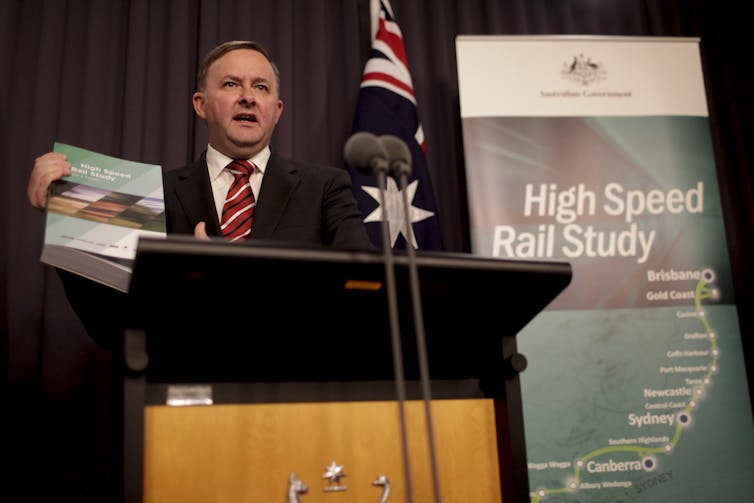
Anthony Albanese releasing a high-speed rail study in 2013. The idea has long been mooted. AAP/Lukas Coch

The logic seems simple enough

Building a bullet train to put a dent in our greenhouse gas emissions has been long touted. The logic seems simple – we can take a lot of planes and their carbon pollution out of the sky if we give people another way to get between our largest cities in just a few hours or less.

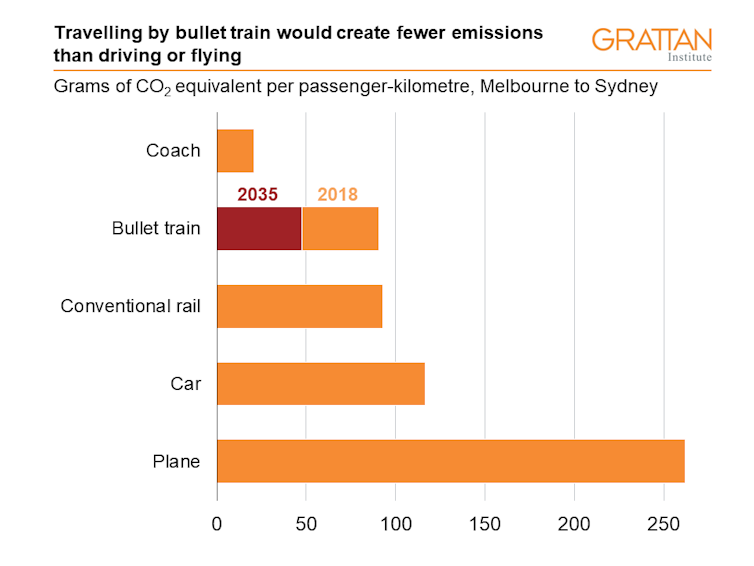
And this is all quite true, as the chart below shows. We estimate a bullet train’s emissions per passenger-kilometre on a trip from Melbourne to Sydney would be about one-third of those of a plane. We calculated this using average fuel consumption estimates from 2018 for various types of transport, as well as the average emissions intensity of electricity generated in Australia in 2018.


Read more: Coronavirus is a ‘sliding doors’ moment. What we do now could change Earth’s trajectory


If we use the projected emissions intensity of electricity in 2035 – the first year trains were expected to run under Labor’s original plan – the fraction drops to less than one-fifth of a plane’s emissions in 2018.

It should be remembered that while coaches might be the most climate-friendly way to travel long distances, they can’t compete with bullet trains or planes for speed.

Notes: Average occupancy estimates are 38.5 (coach), 320 (bullet train), 119 (conventional rail), 2.26 (car), and 151.96 (plane). Plane emissions include radiative forcing. For more detail, see ‘Fast train fever: Why renovated rail might work but bullet trains won’t’.

There’s a catch

So, where’s the problem? It lies in construction. A bullet train along Australia’s east coast would take about 15 years of planning, then would be built in sections over about 30 years. This construction would generate huge emissions.

In particular, vast emissions would be released in the production of steel and concrete required to build a train line from Melbourne to Brisbane. These so-called “scope 3” emissions can account for 50-80% of total construction emissions.


Read more: Look beyond a silver bullet train for stimulus


Scope 3 emissions are sometimes not counted when assessing the emissions impact of a project, but they should be. There’s no guarantee the quantities of concrete and steel in question would have been produced and used elsewhere if not for the bullet train.

And the long construction time means it would be many years before the train actually starts to take planes out of the sky. This, combined with construction emissions, means a bullet train would be very slow to reduce emissions. In fact, we found it would first increase emissions for many years.

Slow emissions benefit

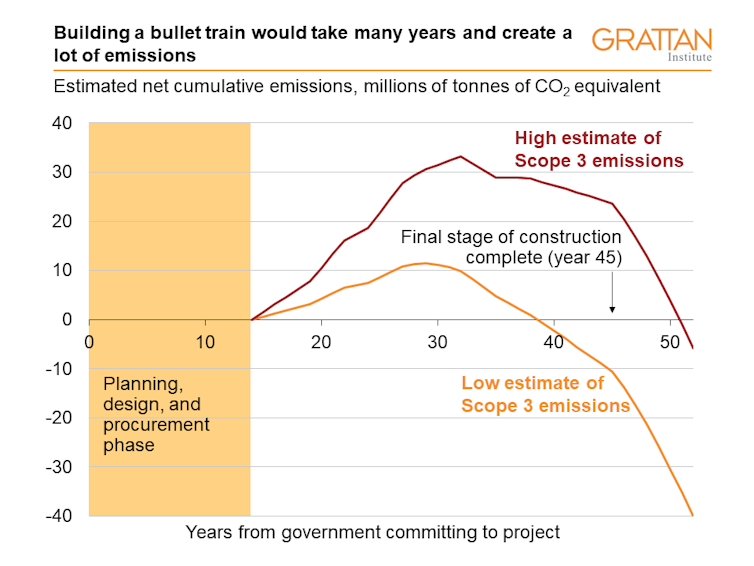
As the chart below shows, we estimate building the bullet train could lead to emissions being higher than they otherwise would’ve been for between 24 and 36 years.

This period would start at year 15 of the project, when planning ends and construction starts. At the earliest, it would end at year 39. This is the point at which some sections of the project would be complete, and at which enough trips have been taken (and enough plane or car trips foregone) that avoided emissions overtake emissions created.

This means the train might not actually create a net reduction in emissions until almost 40 years after the government commits to building it – and even this is under a generously low estimate of scope 3 emissions. If scope 3 emissions are on the high side, emission reductions may not start until just after the 50-year mark – 36 years after construction began.

Notes: Estimates derived from the 2013 feasibility study of the Melbourne-to-Brisbane bullet train, and other sources. The feasibility study assumed that government would commit to the project in 2013. For more detail, see ‘Fast train fever: Why renovated rail might work but bullet trains won’t’.

The bullet train would create a net reduction in emissions from the 40- or 50-year mark onwards. But the initial timelines matter.

The world needs to achieve net zero emissions by about 2050 if we’re to avoid the worst impacts of climate change. All Australian states and territories have made this their goal. Unfortunately, a bullet train will not help us achieve it.

The way forward

Hitting the 2050 net-zero emissions target implicit in the Paris Agreement remains a daunting but achievable task. Decarbonising transport will play a big part, including the particularly tricky question of reducing aviation emissions.

But during the most crucial time for action on emissions reduction, a bullet train will not help. Our efforts and focus ought to be directed elsewhere.

Milan Marcus assisted in the preparation of this piece.


Read more: Delays at Canberra: why Australia should have built fast rail decades ago


ref. High-speed rail on Australia’s east coast would increase emissions for up to 36 years – https://theconversation.com/high-speed-rail-on-australias-east-coast-would-increase-emissions-for-up-to-36-years-138655

The problem with arts funding in Australia goes right back to its inception

Source: The Conversation (Au and NZ) – By Karen Hands, Lecturer – Creative Industries, University of the Sunshine Coast

The arts and culture sector has had its share of trouncing in recent years: funding dropped 4.9% in the decade 2007-2008 to 2017-2018, promised arts policy was short-lived, or not realised at all, then the erasure of “arts” from the overseeing government department’s title was perceived as reducing the public status of the sector.

In March, 65 organisations lost their Australia Council funding and then COVID-19 and social isolation saw performing arts venues among the first businesses to close. They will likely be the last to open.

Yet funding shortfalls and lack of understanding about the role of the arts in public life are not new. These problems are embedded in the 66-year history of contemporary Australian arts funding. The current crisis provides an opportunity to examine the model.

Temporary support

To offset the devastating financial consequences of social restrictions, funds have been set aside by state and Northern Territory governments. Combined with $5 million of redirected funds from the Australia Council, this represents $45 million allocated to assist the arts sector through the pandemic shutdown. But these funds won’t remedy the financial woes of the sector.

Ray Lawler’s Summer of the Seventeenth Doll went on to tour overseas. J. Fitzpatrick/National Archives of Australia

Contemporary funding of the Australian arts sector began in 1954 through the Australian Elizabethan Theatre Trust (“the Trust”). The concept is founded on principles of Keynesian economics – conceived by British economist John Maynard Keynes – whereby market demand and stable employment is supported by a public agency at arm’s length to government.

The belief is that public goods make life better, and by doing so, contribute to the potential output of the economy. The Trust disbursed funds to the performing arts, which – by bringing audiences together for shared experiences – were well placed to achieve morale-boosting, character-forming productions after the second world war.

By 1955 the Trust had refurbished the old Majestic Theatre at Newtown and renamed it The Elizabethan. It opened with Terence Rattigan’s The Sleeping Prince and the Trust’s Australian Drama Company produced Medea in September. In 1956, Ray Lawler’s Summer of the Seventeenth Doll was the Trust’s first commercially successful Australian play. The Australian Ballet, Opera Australia, National Institute of Dramatic Arts, Performing Lines and The Bell Shakesepeare Company were all established with support from the Trust.

Under ‘Nugget’ Combs, The Trust established many of Australia’s major arts organisations. National Archives of Australia

Keynesian economics, however, advocates for short-term support while the free market takes over. This temporary nature of the Trust’s support was made explicit in an article written by H.C. “Nugget” Coombs, founding chair of the Trust, which was published in a 1954 issue of Meanjin.

“The ultimate aim of the Trust must be to establish a native drama, opera and ballet which will give professional employment to Australian actors, singers and dancers and furnish opportunities for those such as writers, composers and artists whose creative work is related to the theatre,” Coombs wrote, hoping to help artists “come to flower, when many of them now are mute and inglorious from lack of opportunity”.

Coombs wrote it was “not the intention of the Trust to build theatres or provide permanent subsidies”. Companies supported by the Trust were selected on their capacity to be self-supporting in time.

The Trust was originally intended to establish the sector, not sustain it. So why has public funding continued?

A costly pursuit

Since the Trust, there have been several attempts to transition the arts sector to a more self-sustainable financial position. The creative industries, advocated in former prime minister Paul Keating’s 1994 Creative Nation policy, were one attempt that promoted commercialisation and exploitation of artistic product in exchange for income.

But the free market is a poor fit for a sector whose capacity for income is limited by a “cost disease” identified by economists William Baumol and William Bowen in 1965.

This theory recognises the cost of labour increases with time (thanks to technology and productivity gains), but this doesn’t necessarily correlate to an increase in income for live work such as concert performances, doctor examinations, university lectures, soccer matches and oil changes.

In other words, there is no economy of scale in producing the arts: the cost of presenting the arts to 10 paying audience members is typically the same as the cost of presenting the arts to 1000 paying audience members.

This sees pricing in the arts become a critical dilemma: ticket prices can’t increase to cover rising labour costs because audiences won’t buy them; nor can ticket prices be determined by the market (like petrol prices), as this would result in unsustainable losses.

Similarly, programming “popular” work in the hope that more people buy tickets ignores the social responsibility of the arts to challenge audiences, expand its form, and provide the public good.

Ballet dancers from the Australian Ballet in Sylvia at the Sydney Opera House in November 2019. AAP/Bianca De Marchi

So, the arts still need support

These complexities are restrictive and mean public funding will be an ongoing necessity. While the Trust was not successful in achieving a financially self-sustaining sector, it did establish the infrastructure and opportunities to foster a vibrant, productive arts community.

But there is room to review how the arts are funded and our expectations of them to thrive. The architecture of the sector was borne as the nation emerged from the global crises of WWII. As we emerge again from another crisis, it is an opportune time to rethink the value of the arts, and how we speak about their financial and artistic success.

In a post-pandemic world, we will need the promise of shared experiences more than ever.

ref. The problem with arts funding in Australia goes right back to its inception – https://theconversation.com/the-problem-with-arts-funding-in-australia-goes-right-back-to-its-inception-138834

Coronavirus has changed our sense of place, so together we must re-imagine our cities

Source: The Conversation (Au and NZ) – By Tony Matthews, Senior Lecturer in Urban and Environmental Planning, Griffith University

Is it time to re-imagine our fundamental relationship with cities?

People bring cities to life. They interact, work, socialise and travel. Without this, cities are just collections of buildings and infrastructure.

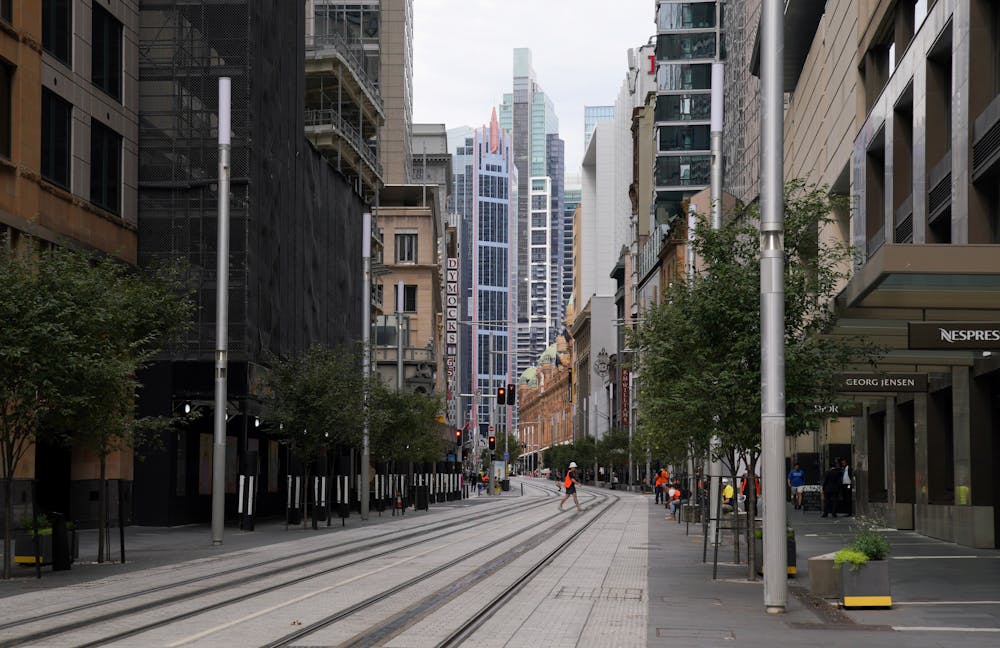
This relationship is now on hiatus all over the world. The COVID-19 pandemic left thousands of cities empty, eerie and listless.

The centre of Sydney was eerily quiet at the peak of the pandemic in Australia. Loren Elliott/AAP

Read more: Public spaces bind cities together. What happens when coronavirus forces us apart?


We connect to cities by developing a “sense of place”. The concept describes how we perceive and attach to places through use. Our connection with cities changes over time but is always grounded in sense of place.

COVID-19 is fundamentally disrupting sense of place. It is causing transformative change in cities all over the world. Daily parts of city life, like shared seating, busy trains and eating out, have suddenly become threatening.

Many urban dwellers are redefining their sense of place in response. We may not view our cities the same way after this pandemic. Our perceptions and priorities may change, perhaps permanently.

As we start planning for cities after this pandemic, we should recognise this task is as much philosophical as practical.


Read more: Reconnecting after coronavirus – 4 key ways cities can counter anxiety and loneliness


Transforming the present

It is useful to consider what exactly the COVID-19 pandemic represents for cities and why it can change people’s sense of place so profoundly.

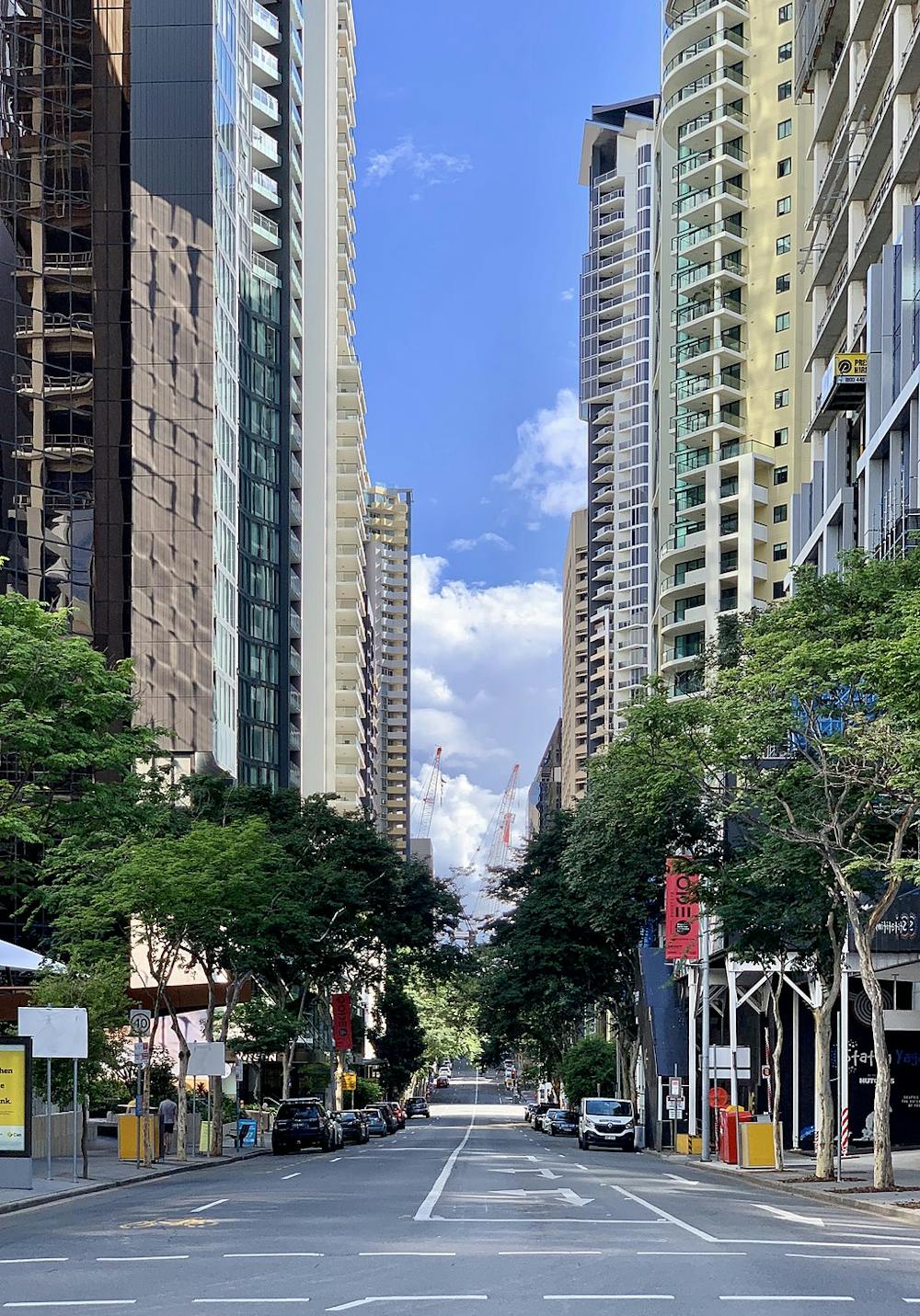
Mary Street, Brisbane, during the lockdown. Kgbo/Wikemedia Commons, CC BY-SA

The pandemic impacts are so severe it can be classified as a “transformative stressor”. These rare events cause severe and intense social, environmental and economic impacts. They are felt at every level of society and throughout social institutions.

Profound shocks are felt all at once in economic activity, human health and social order. Impacts occur at all scales. Almost everybody endures multiple forms of disruption.

Transformative stressors can be unforgiving in exposing problems and weaknesses in systems. They can be catastrophic in cities because so many systems are integrated, creating multiple points of impact.

COVID-19 also fits the transformative stressor model because it might not be possible to fully manage it. Recovery planning needs to account for the possibility COVID-19 might never disappear. It could become an ongoing risk of city life.

What was a distant worry becomes an immediate threat when a transformative stressor hits a city. Things that were once reliable and comfortable no longer are. Our behaviour changes in response, causing us to reconsider our sense of place over time.

How does sense of place change when the familiar becomes sinister? Tony Matthews, Author provided

Read more: Cities will endure, but urban design must adapt to coronavirus risks and fears


Co-creating the future

The transformative impacts of this pandemic are upending established norms. But policy innovation can flourish at times like this. Transformative stressors give policymakers unique opportunities to work outside their normal methods.

People have stoically endured lockdowns in many countries. Working from home with limited mobility will further prompt many to re-evaluate their sense of place. Many people will want a big say in the fundamental decisions to be made on the future of their cities after this.


Read more: If more of us work from home after coronavirus we’ll need to rethink city planning


As they seek innovative ways to help cities recover, planners can learn important lessons by consulting urban residents. Online co-creation processes and workshops are excellent tools for gathering the people’s thoughts and aspirations at this unique time.

Will we still see meeting friends at a cafe as a refuge from the cares of the world? Loren Elliott/AAP

Participating in workshops can also help residents redefine their sense of place in cities disrupted by COVID-19. They can describe how the crisis changed their perceptions and use of space. This allows them to redefine their sense of place by considering the future with full acknowledgement of the past.

Residents are engaging more closely with their own neighbourhoods at the moment. This allows them to reconsider their local sense of place. New trends will be revealed through engagement with the public, reflecting changes in their sense of place.

At minimum, there is likely to be more community interest in improving active transport options. Many people have been reminded of the pleasures of walking and cycling. Other new priorities may be more green space and better social infrastructure.


Read more: Coronavirus reminds us how liveable neighbourhoods matter for our well-being


On the other hand, enthusiasm for public transport might fall and car ownership rates could rise.

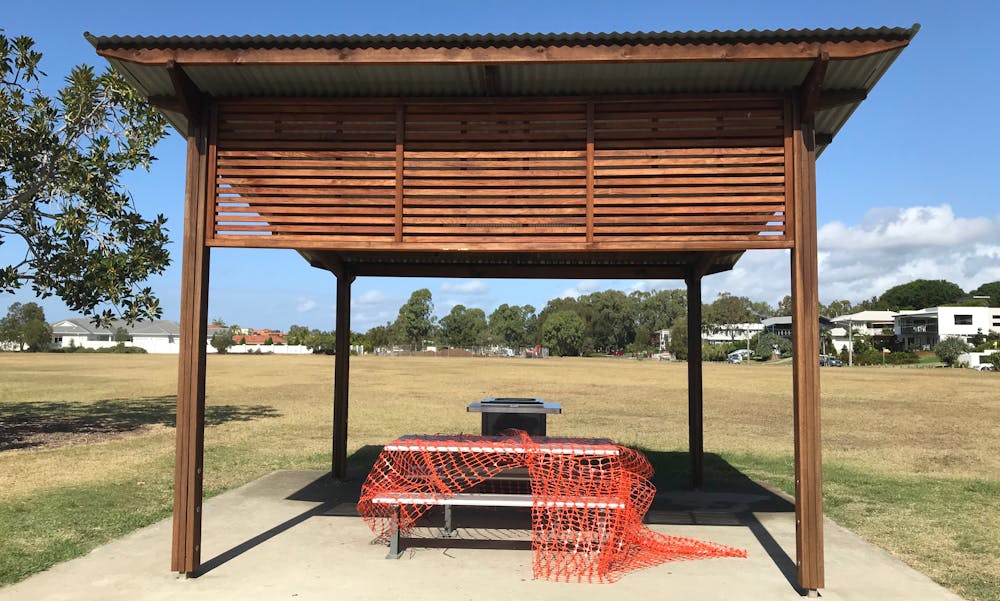
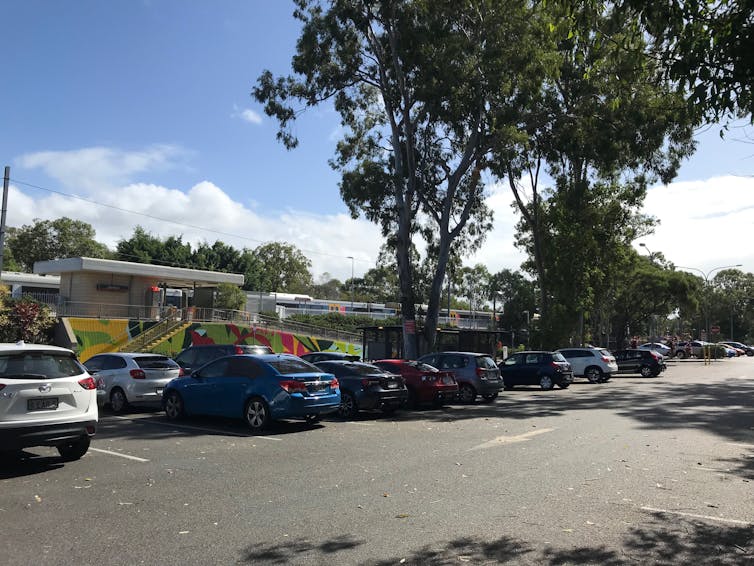
Plenty of parking spaces at this suburban train station. Will we be comfortable taking public transport after lockdowns end? Tony Matthews

The road ahead

The transformative impacts of this pandemic prompt fundamental questions. Do people have the same enthusiasm for city living? Is it time for new urban realities? What would new realities look like? How would they be achieved?

These are extraordinary times that call for extraordinary responses. It is not a time for planners and policymakers to plan for people; it is a time to plan with people.

Many innovations in urban planning are founded in efforts to improve human health. COVID-19 will undoubtedly prompt a new round of thinking about how cities can be re-imagined. It will be a big adjustment for urban planning, which has traditionally relied on the relative predictability of how people use space.

People’s perception and attachment to places is changing, perhaps forever. Decisions on where to go from here will be better made if planners understand how people are redefining their sense of place in this time of profound upheaval.


Read more: Reclaiming the streets? We all can have a say in the ‘new normal’ after coronavirus


ref. Coronavirus has changed our sense of place, so together we must re-imagine our cities – https://theconversation.com/coronavirus-has-changed-our-sense-of-place-so-together-we-must-re-imagine-our-cities-137789

‘Don’t leave us with no hope,’ plead Filipino migrants in NZ

By Tess Brunton, Otago/Southland reporter of RNZ News

The Queenstown Association of Migrant Pinoys says more than 500 Filipino migrants have sought welfare support in the resort town.

The future is uncertain for many migrant workers in Queenstown. [file pic] Photo: RNZ / Belinda McCammon

Migrant workers have been hit hard in Queenstown, many facing redundancies and high rents in the wake of Covid-19.

READ MORE: Al Jazeera coronavirus live updates – India records highest covid-19 spike

Association leader Dennis Navasca and his wife moved to Queenstown about six years ago with hopes to start a new chapter of their lives.

He said that future was now uncertain.

– Partner –

“My wages per week cover all the rent plus the power, and my wife, she can cover our groceries and some other bills, so at least we can survive at the moment,” he said.

“But the issue is those people who are not able to pay their other bills like some other migrants, because they also have a family in the Philippines that they need to send some money to and unluckily some migrants only receive the subsidy.

‘A lot of anxiety’
“Not like me, I receive a subsidy plus my employer gives me a top up a bit so at least I can survive.”

There was a lot of anxiety about what would happen in the migrant community, he said.

“Some of us here invested things that [sic] need to ask for bank loan. And now, how can you expect them to pay their debts? I know everyone showing empathy especially for us with temporary visa.”

While redeployment has been discussed by some employers, he said it was impossible for many companies to hire staff during the crisis.

The uncertainty was tough, Navasca said.

“Fears of losing what we save, fear of starting over again and fear of lost future. We are now in the moment of accepting it, maybe some of us, but others are still in grief.”

He was thankful for the welfare support from community agencies.

Navasca has a message for Queenstown’s leaders: “We are the builders of (the) foundation of this prosperous economy. Some are front liners, cleaners, construction workers, waiters, room attendants, all hard knock jobs.

“Don’t leave us hopeless in times we needed you most.”

  • This article is republished by the Pacific Media Centre under a partnership agreement with RNZ.
  • If you have symptoms of the coronavirus, call the NZ Covid-19 Healthline on 0800 358 5453 (+64 9 358 5453 for international SIMs) or call your GP – don’t show up at a medical centre.
  • Follow RNZ’s coronavirus newsfeed
Print Friendly, PDF & Email

Article by AsiaPacificReport.nz

View from The Hill: JobKeeper $60 billion snafu like your house builder revising quote: Morrison

Source: The Conversation (Au and NZ) – By Michelle Grattan, Professorial Fellow, University of Canberra

Campaigning in Eden-Monaro with just-selected Liberal candidate Fiona Kotvojs, Scott Morrison on Sunday turned folksy to present the upside of the $60 billion JobKeeper forecasting snafu.

“If you’re building a house and the contractor comes to you and says it’s going to cost you $350,000 and they come back to you several months later and say, well, things have changed and it’s only going to cost you $250,000, well, that is news that you would welcome.”

Two things happened with the JobKeeper estimate.

First, treasury made wrong assumptions about the likely numbers and cost. The about 6 million employees anticipated to access the program has shrunk to some 3.5 million, so the $130 billion cost has fallen to $70 billion.

Second, The Tax Office didn’t spot treasury’s bad forecasting for a long time because it failed to pick up that its own data was flawed due to some employers filling in their forms wrongly.

Treasury says it erred in part because things didn’t get as bad as it had expected. Also, there was the “inherent uncertainty” in estimating the take-up of a demand-driven program.

It’s notable however, that writing in The Conversation in late April, Melbourne University economists Roger Wilkins and Jeff Borland pointed to a disparity between the drop of 2.6 million full time jobs implied by the Reserve Bank and the 6.6 million jobs their calcuations suggested treasury was preparing to fund under JobKeeper.

Given this big discrepancy, one might have thought the treasury bureaucrats would have kept a careful eye on the numbers. But they were falsely reassured by the Tax Office’s incorrect figures.

Presciently, the academics wrote: “Forecasts – even those based on the most relevant and up-to-date information – can be wrong. This isn’t a criticism. Making forecasts is hard.

“But it might be that 6.6 million turns out to be an overestimate.”

They argued that “if so, it creates an opportunity.

“It would allow JobKeeper to be extended to some of the workers who at present miss out, among them casual employees in their job for less than 12 months and the temporary visa holders who are currently excluded.”

This is just what the government doesn’t want to do.

Inevitably the huge looming underspend has intensified the widespread calls for JobKeeper to be broadened.

Asked on Sunday about using the money to extend the program to more people or beyond September, Morrison replied, “If the suggestion is that we should be increasing borrowing more than would be needed to deliver the program that we’ve designed and [are] delivering, well, the answer is no”.

But Morrison also said JobKeeper was not the only programs the government had. He noted hard-pressed sectors such as tourism, the arts and media, and housing. He said, “we will continue to target our support and it will become more targeted as time goes on.”

“There are many challenges that the economy will face beyond September. We know that and there are particular sectors that will feel this for longer, particularly those who are particularly dependent on international borders. We understand that and we’ll be considering that carefully.”

Morrison is leaving the way open for further assistance, but would seem to prefer not to give it via substantial changes to JobKeeper.

Still, there has been speculation about JobKeeper being phased out rather than having the proposed hard finish in late September. And there is a review of it reporting in June. So the government has wriggle room.

Whatever the mechanism, there’ll be a lot of pressure to extend more funding to the tourist industry in the context of the Eden-Monaro by-election, especially with Morrison declaring that “job-making is honestly what this byelection is going to be about”.

The windfall also puts pressure on over JobSeeker.

A poll released by The Australia Institute, a progressive think tank, found 59% of Eden-Monaro voters want a permanent increase to the JobSeeker payment (all or some of the Coronavirus Supplement of $275 a week retained). The poll was done May 12 of 978 residents. At present the payment is due to snap back to the old level at the end of September – $282.85 for a single recipient without dependants, roughly half of what they are getting now.

The opposition has leapt on the massive forecasting/monitoring snafu to call for Treasurer Josh Frydenberg to appear before the Senate committee that is examining the government’s COVID measures.

But Morrison on Sunday ruled this out, and Frydenberg can’t be compelled.

While the government under the Westminster system must accept responsibility for the incorrect forecasting and poor monitoring – and Morrison did so – it is the officials that have the detailed information about how it went wrong.

Morrison said he had “a great deal of confidence in our public service and the officials”. He wouldn’t be wanting to say anything else given, as he noted, “there are many, of course, who live here in the Eden-Monaro electorate”. Indeed it has the highest proportion of government workers of any electorate outside the ACT.

The Tax Office has admitted its attention was on making the early payments and it didn’t have its eyes on the estimates of numbers.

But treasury? While it has given some reasons, there are surely more questions, in light of what seemed obvious to the academics weeks earlier.

The value of having the Senate committee is it can get quickly from the public servants a fuller explanation of what was not a black hole but a over-inflated balloon.

ref. View from The Hill: JobKeeper $60 billion snafu like your house builder revising quote: Morrison – https://theconversation.com/view-from-the-hill-jobkeeper-60-billion-snafu-like-your-house-builder-revising-quote-morrison-139282

Former PM O’Neill granted bail on corruption claims and will self-isolate

Pacific Media Centre

Papua New Guinea’s former Prime Minister Peter O’Neill was granted bail last night at the Waigani National Court after being arrested by police over his alleged role in the 50 million kina (US$14 million) purchase of two generators from Israel, reports the PNG Post-Courier.

The court after granting bail ordered that he must pay K5000 before close of business tomorrow.

Further orders were that he remained at his Touaguba Hill residence self-isolated until June 2 when the covid-19 coronavirus state of emergency lapses.

READ MORE: Al Jazeera coronavirus live updates – Guatemala angry over covid-19 infected deportees from US

He was arrested at Jackson’s International Airport in Port Moresby by police yesterday afternoon over allegations of abuse of office and corruption.

Assistant Commissioner Crimes Hodges Ette confirmed that O’Neill was brought in for questioning at the Fraud Squad office in Konedobu upon his return from Brisbane, Australia.

– Partner –

ACP Ette said that all covid-19 protocols were strictly observed when O’Neill was brought in for questioning.

Israeli generators deal allegations
Police allege that:

  • O’Neill directed payments for the purchase of the two generators from Israel without due consideration for procurement processes as required under the Public Finance Management Act as purchase of the two generators was not approved by the National Parliament; the purchase did not go through tender processes;
  • there was no legal clearance from the State Solicitors for such payment; and
  • O’Neill directed the National Executive Council to convene and approved the payment of K50 million for the generators after the purchase was made.

Ette said there was “reasonable evidence of misappropriation, abuse of office and official corruption”.

ABC Radio Australia reports that O’Neill led Papua New Guinea for seven years, before quitting in 2019 after a string of high-profile resignations from his government.

Police attempted to arrest O’Neill in October last year over a different issue.

He denied any wrongdoing and said it was a “political witch hunt”.

Police withdrew that warrant after O’Neill challenged its validity in court.

Print Friendly, PDF & Email

Article by AsiaPacificReport.nz
Beware the ‘cauldron of paranoia’ as China and the US slide towards a new kind of cold war

Source: The Conversation (Au and NZ) – By Tony Walker, Adjunct Professor, School of Communications, La Trobe University

In September 2005, before an audience of some of the most powerful business figures in the United States, then US Deputy Secretary of State Robert Zoellick unveiled his “responsible stakeholder” formula for China’s global engagement.

China is big and growing… For the United States and the world the essential question is how will China use its influence… We need to urge China to become a responsible stakeholder in that system.

This is how the China as a “responsible stakeholder” template for the West’s conduct of relations with an emerging power was born. It was not a superpower at that stage, but a rising one.

Later in that same speech, Zoellick added:

Many Americans worry that the Chinese dragon will prove to be a fire breather. There is a cauldron of anxiety about China.

If there was a “cauldron of anxiety” then, it is “cauldron of paranoia” now as the US slips towards a new Cold War.

It’s not there yet, but the possibility of a permafrost can’t be discounted. This would include a decoupling of the US and Chinese economies and a deepening technology war in which competing technologies would seek to get the upper hand inside and outside cyberspace. It would also include an all-out arms race.

Rising tensions

Washington’s campaign to deprive China’s telecommunications giant Huawei from access to US-designed microchips for its artificial intelligence processors, mobile phones and networking capabilities is aimed squarely at denying the Chinese company a technological edge.

The Huawei decision is one of several designed to squeeze Chinese access to US technology, and in the process disrupt global supply chains.

China regards the US campaign against Huawei as highly provocative, if not war by another means.

These are sobering moments as the world contemplates getting dragged into a “cauldron” of superpower tension not witnessed since the 1950s.


Read more: Australia has dug itself into a hole in its relationship with China. It’s time to find a way out


Middle-sized players like Australia risk getting trampled. Prime Minister Scott Morrison is discovering to the cost of his country’s agriculture and mining sectors that it is better to stay out of the way of bull elephants in a global jungle. His ill-advised solo intervention in calls for an independent inquiry into a pandemic has backfired as China picks off vulnerable Australian exports for reprisals.

An American “cauldron of anxiety” has spilled over.

The US problem

I was in that New York City hotel ballroom for the Zoellick speech as North American correspondent for The Australian Financial Review. I had no doubt it was a significant moment in America’s attempts to address an emerging challenge from an economically resurgent China, but this challenge needed to be kept in proportion.

Bear in mind China’s president at the time was the cautious bureaucrat, Hu Jintao. The country had not yet left behind paramount leader Deng Xiaoping’s advice to colleagues that when it came to demonstrating China’s newfound might, it was better to “hide your capabilities, bide your time”.

It was seven years before the “China first” Xi Jinping became China’s most powerful leader since Deng, and possibly since Mao Zedong himself.

Zoellick’s speech was delivered more than a decade before a New York property developer named Donald Trump became an “America first” president ill-equipped to deal with complexities involved in managing a relationship with a surging China.

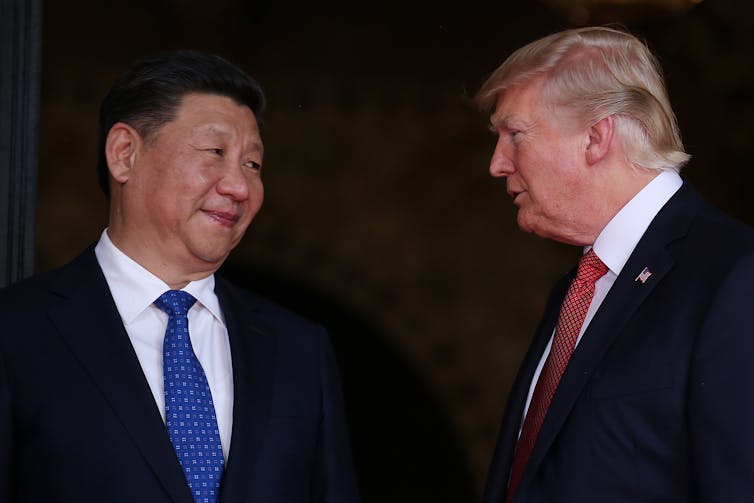
AAP/EPA/Carlos Barria

Trump’s mixture of bombast, bellicosity, prejudice, impulsiveness, and apparent lack of a sense of history makes him particularly ill-suited to cope with the world’s biggest foreign policy challenge since the second world war.

That includes the Cold War with the former Soviet Union. That conflict could be managed by a policy of containment and mutually assured destruction.

At a time when the western alliance cries out for leadership, America is consumed, even torn apart, by internal divisions. Those divisions are likely to be rubbed raw in this year’s presidential election, in which China will be the focus of the sort of fearmongering that characterised American internal debates about the Soviet Union in the 1950s.

Trump’s contribution to that debate in the midst of a pandemic may not be surprising given his intemperate use of language generally, but in the circumstances it was shocking nevertheless.

This is what he tweeted on May 20:

Let that sink in. The latest occupant of the Oval Office, successor to some of the great figures of world history, has accused China of being responsible for “mass worldwide killing”.

China’s mishandling of the early stages of the coronavirus pandemic deserve investigation and censure, but Trump himself bears responsibility for his own “incompetence” and that of his administration in managing America’s response to the crisis.

In its early stages he declared the virus would simply vanish. He used the word “hoax”, allegedly cooked up by his political enemies, to dismiss the contagion. As a consequence valuable time was lost in responding.

America now has the worst record globally in dealing with the pandemic. Things being equal this will constitute a significant drag on Trump’s re-election prospects, hence his flailing about in search for scapegoats.

Leaving aside American domestic politics – the Democrats will not want to be accused of being soft on China in a presidential election cycle – the much bigger question is the extent to which the pandemic will disrupt, even overturn, a globalising world.

A new, shaky world order

The journal Foreign Policy has made a useful contribution to the debate in its latest issue – The Great Decoupling – in which it seeks to frame what is happening now historically. History is not kind to a process in which states decouple, pull up the drawbridges, roll back trade and investment ties and, in the United Kingdom’s case, depart a trading bloc that had served it well.

America is far from the only nation state succumbing to the forces of nationalism and populism. It is a worrying trend for open-market trading countries like Australia, dependent on increasing economic integration.

This is how Foreign Policy framed issues involved in what it perceives to be a disrupted moment in history in which a status quo power is being obliged to confront the reality of challenges to its brief moment as a hyperpower following the fall of the Berlin Wall.

The threat of the great decoupling is a potentially historic break, an interruption perhaps only comparable to the sundering of the first huge wave of globalization in 1914, when deeply intertwined economies such as Britain and Germany, and later the United States, threw themselves into a barrage of self-destruction and economic nationalism that didn’t stop for 30 years. This time, though, decoupling is driven not by war but peacetime populist urges, exacerbated by a global coronavirus pandemic that has shaken decades of faith in the wisdom of international supply chains and the virtues of the global economy.


Read more: US-China relations were already heated. Then coronavirus threw fuel on the flames


This scenario might be regarded as alarmist, even implausible, given difficulties that would arise in dismantling a highly integrated global economy. However, if a pandemic and response to it are a guide against the background of growing tensions between the US and China, the implausible becomes possible.

In the past week, Trump has opined about “cutting off the whole relationship” with China. He has also speculated about not repaying US$1 trillion in debt to China.

These are ridiculous statements, but the fact an American president in an election year could say such things is indicative of the sort of atmosphere that prevails in a country where a populist leader has been wounded by his own ineptitude.

However, if the 2016 US presidential election demonstrated anything, it was that a significant proportion of the American electorate will embrace an “America First” mindset that is antagonistic to the outside world.

Nationalistic Sinophobes on Trump’s immediate staff feed his populist impulses and his anti-China rhetoric at the risk of deepening a global recession or even depression.

If we have another pandemic, or environmental issues, or financial sector issues, or Iran, or North Korea, how effective are you going to be if you don’t have a working relationship with China?

It’s a good question.

ref. Beware the ‘cauldron of paranoia’ as China and the US slide towards a new kind of cold war – https://theconversation.com/beware-the-cauldron-of-paranoia-as-china-and-the-us-slide-towards-a-new-kind-of-cold-war-139023

Former PNG PM O’Neill arrested for alleged ‘abuse’ on return home

By RNZ Pacific

Papua New Guinea’s former Prime Minister Peter O’Neill has been arrested after arriving back in the country.

Police say O’Neill was arrested on suspicion of misappropriation, abuse of office and official corruption, regarding the purchase of two generators from Israel.

The Police Assistant Commissioner of Crimes, Hodges Ette, confirmed the MP was brought in for questioning yesterday afternoon in Port Moresby after flying in from Australia where he has been for much of the year.

READ MORE: Al Jazeera coronavirus live updates – Far-right protests in Spain over lockdowns

While anti-fraud police investigators have sought him for questioning for months, O’Neill was reportedly unable to return to PNG since March when border closures were implemented as part of the country’s covid-19 state of emergency.

The allegations against the Ialibu-Pangia MP relate to a purchase he made as prime minister in 2013 involving two 15-megawatt generators for PNG from an Israeli company, LR Group.

– Partner –

PNG’s parliamentary opposition filed a police complaint about the purchase in 2014.

Police allege that O’Neill directed payments for the purchase of the two generators from Israel without due consideration for procurement processes as required under the Public Finance Management Act.

Purchase not approved
The purchase of the two generators was not approved by the national Parliament, while police allege that the purchase did not go through required tender processes, nor was there legal clearance from the State Solicitors for such payment.

O’Neill is alleged to have directed the National Executive Council to convene and approve the payment of 50 million kina (US$14 million) for the generators after the purchase was made.

Ette said there was reasonable evidence for misappropriation, abuse of office and official corruption.

The former prime minister, who lost power to incumbent prime minister James Marape a year ago, is being allowed bail.

He is expected to be quarantined at his own residence for the next 14 days after the interview, as required under PNG’s covid-19 emergency measures for all citizens repatriating.

  • This article is republished by the Pacific Media Centre under a partnership agreement with RNZ.
  • If you have symptoms of the coronavirus, call the NZ Covid-19 Healthline on 0800 358 5453 (+64 9 358 5453 for international SIMs) or call your GP – don’t show up at a medical centre.
  • Follow RNZ’s coronavirus newsfeed
Print Friendly, PDF & Email

Article by AsiaPacificReport.nz
Bainimarama offers Eid greetings to Fiji’s Muslim community

By Koroi Tadulala in Suva

Prime Minister Voreqe Bainimarama has shared warm greetings as the month of Ramadan ends and has wished the Muslim members of the Fiji community and all Fijians a Happy Eid today.

Bainimarama said he understood the importance of Eid for Muslims and thanked them for their willpower in observing the covid-19 coronavirus pandemic restrictions in place.

All houses of worship were closed throughout the duration of Ramadan.

READ MORE: Muslims in Fiji and around the world celebrate Eid today

The Prime Minister said that without physically gathering as a community, this year’s Ramadan felt different. However, he was proud to watch Fijian Muslims like all other religious bodies show that faithfulness could not be broken by distance or disease.

“I thank those who showed patience by forgoing the usual mass prayers. And I thank those who fortified their faith, knowing that these changes to our routines were for the greater good.”

– Partner –

Bainimarama added that the sacrifice for the past months had proven Fiji’s commitment to eliminating covid-19 and that the people of Fiji could “emerge as victors”.

Fiji has had 18 confirmed cases of covid-19 and all have recovered.

Koroi Tadulala is a multimedia journalist of FBC News.

Print Friendly, PDF & Email

Article by AsiaPacificReport.nz
Tehran-Caracas Cooperation Defends Venezuelans against Illegal US Sanctions

Source: Council on Hemispheric Affairs – Analysis-Reportage

COHA urges Washington to allow safe passage of the Iranian fuel tankers. Any action to impede their arrival at Venezuelan ports would be illegal, counter-productive, and could ignite an international conflict with unforeseeable consequences. It is time for the US to end the use of economic sanctions and join international efforts to fight the pandemic and save lives everywhere, regardless of ideological differences.

COHA Editorial
Washington DC

Tensions between the US and two governments it has targeted for regime change –Iran and Venezuela– are mounting, as five Iranian oil tankers carrying approximately 60 million gallons of gasoline and other fuel products make their way to the Caribbean coast of Venezuela. This act of mutual assistance challenges a US blockade that limits access of millions of Venezuelans to food, fuel,  and medical supplies. The delivery of gasoline is now of vital importance to the very survival of the Bolivarian revolution.

According to a report by the Center for Economic and Policy Research (CEPR) the illegal sanctions implemented by the US government have caused an estimated 40,000 deaths from 2017 to 2018. In March 2020, human rights expert, Alfred de Zayas, said that fatalities had risen to 100,000, principally on account of a dearth of medicines caused by sanctions. Now, in the face of the COVID-19 pandemic, challenging this crime against humanity takes on even more urgency. COHA maintains that Venezuela has every legal and moral right to solicit and accept urgently needed supplies and trade with any nation it chooses. 

The battle of ideas proceeds at full steam as Iranian tankers are scheduled to arrive at Venezuelan ports in the coming days. Washington and its allies in Bogota argue that Iranian fuel shipments to Venezuela represent a new chapter of Iranian inroads in the US “neighborhood”, and that with this comes the threat of terrorism. Iran and Venezuela, however, have been close allies for more than two decades. They have collaborated on oil production policy through their memberships in OPEC and often have raised their diplomatic voices in unison in favor of a multipolar world and against US interventions in Latin America and the Middle East. In 2005 VenIran was established in the state of Bolivar to assemble tractors. In 2009 Chavez committed to selling gasoline to Iran when it was suffering shortages. The only acts of terrorism in the “neighborhood,” recently have been the foiled mercenary incursions into Venezuela. This paramilitary operation was launched from Colombia, not Iran, and it has been directly linked to the US backed self-declared president of Venezuela, Juan Guaidó.

The Maduro administration and its international allies have been appealing to the UN to defend Venezuela’s right to engage in commerce without interference. The UN High Commissioner for Human Rights, Michelle Bachelet, has called for the lifting or suspension of sanctions to allow nations to obtain the materials they need to deal with the crisis. Venezuela maintains that there is nothing illegal per se about trade between two sovereign nations and rejects the dubious legal doctrine that US unilateral coercive measures constitute legitimate additions to international law. In the face of a pandemic, economic warfare, and paramilitary attacks, Venezuela continues to defend its sovereignty.

This battle of ideas parallels actions on the ground. According to Reuters, an anonymous senior Trump administration official said the Iranian fuel shipment “is not only unwelcome by the United States but it’s unwelcome by the region, and we’re looking at measures that can be taken.” The US has deployed additional navy ships to augment its military presence in the Caribbean, ostensibly as part of counter-narcotics operations. Venezuela’s Defense Minister Vladamir Padrino announced that ships and planes of the Bolivarian National Armed Forces (FANB) will escort the Iranian oil tankers once they reach Venezuela’s economic zone. Iran, meanwhile, is warning of retaliation in areas of the Middle East where it can do damage to US interests should its tankers come under attack. The stage is set for a possible confrontation.

COHA urges Washington to allow safe passage of the Iranian fuel tankers. Any action to impede their arrival at Venezuelan ports would be illegal, counter-productive, and could ignite an international conflict with unforeseeable consequences. It is time for the US to end the use of economic sanctions and join international efforts to fight the pandemic and save lives everywhere, regardless of ideological differences.

Support this progressive voice and be a part of it. Donate to COHA today. Click here

FLNKS wants New Caledonia vote on independence delayed by two months

By RNZ Pacific

New Caledonia’s pro-independence FLNKS movement has asked Paris for the referendum on independence from France to be deferred by up to two months because of the covid-19 coronavirus pandemic.

The plebiscite is due on September 6, but the FLNKS leaders have said they want it to be rescheduled for either October 25 or November 1.

The FLNKS has argued that covid-19 impacted on the calendar by prompting a delay of the municipal elections by three months and that they do not want to mix up the local election campaign with the referendum debate.

READ MORE: New Caledonia vote stirs painful memories – and a hopeful future

It also said that Paris would not give its official position on the consequences of a possible yes-vote until July 13 which would give little time to incorporate the policy into the campaign.

The FLNKS also pointed out that with the September date, quarantine provisions could affect the deployment of the UN observers and the more than 200 French magistrates who were scheduled to be flown to help supervise the referendum.

– Partner –

Currently, anyone arriving in New Caledonia must be quarantined for three weeks.

The timing of the referendum was already discussed with French Prime Minister Edouard Philippe via phone at the start of this week.

Anti-independence leader firmly opposed
A leading anti-independence politician, Sonia Backes, said she was firmly opposed to a delay when it was first raised with Prime Minister Philippe.

Backes, who is president of the Southern Province, said the September date was set last year and she wanted it to be kept, accusing the rival side of posturing to pressure the French state.

The pro-independence side had wanted the vote to be held as close as possible to the cut-off date of November 4 while the anti-independence camp want it brought forward to July.

In the previous referendum, in 2018, just under 57 percent voted for the status quo.

Should voters again reject independence this year, another referendum can be called by New Caledonia’s Congress within the following two years.

  • This article is republished by the Pacific Media Centre under a partnership agreement with RNZ.
  • If you have symptoms of the coronavirus, call the NZ Covid-19 Healthline on 0800 358 5453 (+64 9 358 5453 for international SIMs) or call your GP – don’t show up at a medical centre.
  • Follow RNZ’s coronavirus newsfeed
Print Friendly, PDF & Email

Article by AsiaPacificReport.nz

Court ruling reveals new possible Stuff buyer in NZ media crisis

By Hayden Donnell, RNZ Mediawatch producer

A High Court judgment has revealed that an entity other than New Zealand Herald owner NZME is interested in buying the country’s biggest news publisher Stuff – and a deal could be done by the end of this month.

Stuff’s owner – Nine Entertainment in Australia – abandoned its negotiations with NZME after getting another offer from a prospective buyer, the judgment from Justice Sarah Katz revealed this week.

But the identity of the prospective owner is still under wraps.

READ MORE: A NZ without journalists: The implications of the combustion of our biggest news groupsJames Hollings

NZME went to court last week seeking an injunction to prevent Nine Entertainment bargaining with any other buyer. It argued Stuff’s owner had breached the 14-day exclusive negotiation agreement it entered into with NZME on April 23.

Earlier it had announced it wanted to buy Stuff for $1 and asked the government to pass legislation expediting the deal, allowing it to skirt the need for Commerce Commission approval.

– Partner –

Nine Entertainment insisted no such deal had been agreed and negotiations with NZME were already over.

In court, Nine Entertainment’s lawyer accused NZME of damaging Stuff with its actions.

Commerce Commission permission not needed
Nine Entertainment said the alternative offer wouldn’t require permission from the Commerce Commission. It is now planning to complete the sale with the prospective third-party buyer on May 31.

So far NBR owner Todd Scott – who recently completed a buyout of the publication which began in 2012 – is the only person to publicly express interest in buying the business.

“We are very serious about taking over the liabilities of Stuff NZ,” he said in an online post earlier this month.

He said the Commerce Commission, the Minister of Broadcasting and the opposition Broadcasting spokesperson had been informed of his plan.

On Wedesday, he described Nine’s move as “logical” on Twitter and shared a link to an under-construction website combining the names of two Stuff newspapers – DominionPress.co.nz

Scott has named Australian private equity firm Anacacia Capital as a backer. Last week the firm refused to confirm to RNZ if it had an interest in a deal for Stuff.

In the judgment outlining her reason for declining NZME’s application for an injunction against Nine Entertainment, Justice Sarah Katz said on the face of it, there was a legitimate argument that Nine Entertainment breached the conditions of its exclusive negotiations period with NZME.

Unlikely Nine would accept NZME offer
But she concluded that the potential cost to Nine Entertainment of forcing it back into exclusive negotiations outweighed the price NZME would have to pay if she refused an injunction.

It was unlikely Nine Entertainment would accept NZME’s offer even if she forced it back to the bargaining table, because it didn’t want to accept a deal that would require Commerce Commission approval. Katz pointed to the fact that the government had already signaled it wouldn’t pass special legislation to allow the NZME-Stuff merger.

Meanwhile, Nine Entertainment’s separate deal with a third party might fall through if it had to resume negotiations with NZME, the decision said. Justice Katz noted that would also essentially force Nine to open its books to a competitor, despite having no intention of selling Stuff to that business.

Print Friendly, PDF & Email

Article by AsiaPacificReport.nz
Sing the pandemic away – Papua rapper, police chief join in virus fight

Sing the pandemic away. Video: The Jakarta Post

Pacific Media Watch

In a bid to advise people to follow health instructions to contain the spread of the covid-19 coronavirus pandemic in the West Papua region capital of Jayapura, Papuan rapper Epo D’fenomeno has collaborated with Jayapura police chief Adjunct Senior Commissioner Gustav R. Urbinas.

To avoid making his song sound just like another PSA song or jingle, Epo said he wrapped the song in a love theme so that youngsters could relate to it.

They youth had to endure staying away from their romantic partners during the virus outbreak.

The song has gone viral among Indonesian netizens.

Print Friendly, PDF & Email

Article by AsiaPacificReport.nz
TVNZ’s Pacific correspondent Barbara Dreaver wins Voyager media awards

Pacific Media Watch

Television New Zealand’s journalists have come out on top at the annual Voyager Media Awards last night, scooping a number of awards in key categories, reports TVNZ 1 News.

1 News Pacific correspondent Barbara Dreaver was recognised for both the Best TV/Video News Item and Best Coverage of a Major News Event for her leading coverage of the Samoan measles crisis last year.

Sunday’s Jehan Casinader was awarded Broadcast Reporter of the Year and Best TV/Video Current Affairs, Short, for his feature Black Friday.

READ MORE: Voyager Media Awards 2020


Grief in Samoa ‘next level’ as measles epidemic claims at least 68 lives – TVNZ 1 News

TVNZ’s online news and current affairs platform Re: rounded out the Best TV/Video Current Affairs Category, winning the Long section for the feature Rediscovering Aotearoa: aroha/love.

– Partner –

The runner-ups for those categories were TVNZ’s Seven Sharp for Harri Brown’s story and Sunday’s feature on The Numbers Game.

In other categories, Re: reporter Cass Marrett won Best Video Journalist – Junior, while Mava Enoka received the Peter M Acland Fellowship, which will see her undertake a placement at Al Jazeera international television network Southeast Asia headquarters in Kuala Lumpur.

The 1 News design team won Best Artwork/Graphics, with their high-end augmented reality work featuring highly on 1 News’ news bulletins.

The major media awards were conducted remotely this year due to the covid-19 corovavirus pandemic gathering restrictions.

Other major categories include Newspaper of the Year and Website of the Year, both of which went to The New Zealand Herald.

All winners at the Voyager Media Awards 2020

Best headline, caption or hook  – Barnaby Sharp, Nelson Mail/Stuff

Best artwork / graphics – 1 NEWS Design Team, TVNZ

Best interview or profile – Michelle Langstone, NZ Herald/NZME

Cartoonist of the Year – Toby Morris, The Spinoff

Opinion Writer of the Year – Emma Espiner, Newsroom

Reviewer of the Year – Paul Little, North & South/Bauer Media

Travel Journalist of the Year – Mike White, North & South/Bauer Media

Editorial Executive of the Year – Annabelle Lee-Mather, The Hui GSTV for MediaWorks

Best feature or current affairs video – single video journalist – Luke McPake with “Death Bed: The Story of Kelly Savage”, RNZ

Best video journalist – junior – Cass Marrett, Re: / TVNZ

Video Journalist of the Year – Lawrence Smith, Stuff

Best TV/video documentary – Stuff Circuit/Stuff and Māori Television, “Infinite Evil”

Best TV/video news item – 1 NEWS/TVNZ with Barbara Dreaver, “Measles lockdown”

Best TV/video current affairs, short (up to 10 mins) – Sunday/TVNZ with Jehan Casinader, “Black Friday”

Best TV/video current affairs, long (between 10 mins and 20 mins) – Re:/TVNZ, “Rediscovering Aotearoa: aroha/love”

Reporting – crime and justice – Blair Ensor, The Press/Stuff

Reporting – social issues, including health and education – Emma Russell, NZ Herald/NZME

Reporting – general – Patrick Gower, Newshub/MediaWorks

Best reporting – Māori Affairs – Te Aniwa Hurihanganui, RNZ

Environmental/Sustainability Award – Kate Evans, New Zealand Geographic/Kōwhai Media

Science Journalism Award – Eloise Gibson, newsroom.co.nz

Best individual investigation – Patrick Gower for “Exposing white supremacy in New Zealand”, Newshub/MediaWorks

Best team investigation – Stuff, “Product of Australia”

Best (single) news story / scoop – Melanie Reid, newsroom.co.nz

Best coverage of a major news event – 1 News/TVNZ with Barbara Dreaver, “Samoan measles crisis”

Best editorial campaign or project – newsroom.co.nz, “Oranga Tamariki uplifts”

Best Reporter – junior – Logan Church, RNZ

Student Journalist of the Year – Ashley Stanley, newsroom.co.nz

Community Journalist of the Year – Virginia Fallon, Kāpiti Observer/Stuff

Regional Journalist of the Year – Hamish McNeilly, The Press/Stuff

Sports Journalist of the Year – Dana Johannsen, Stuff

Business Journalist of the Year – Tim Hunter, NBR

Political Journalist of the Year – Audrey Young, NZ Herald/NZME

Broadcast Reporter of the Year – Jehan Casinader, Sunday/TVNZ

Reporter of the Year – Guyon Espiner, RNZ

nib Health Journalism Scholarship – junior – Emma Russell, NZ Herald/NZME

nib Health Journalism Scholarship – senior – Nicholas Jones, NZ Herald/NZME

Regional Journalism Scholarship – Natalie Akoorie, NZ Herald/NZME; Aaron Leaman, Waikato Times/Stuff

Peter M Acland Foundation Fellowship – Mava Enoka, TVNZ; Charles Anderson, Vanishing Point Studio

Feature writing – crime and justice – Mike White, North & South/Bauer Media

Feature writing – social issues, including health and education – Florence Kerr, Stuff

Feature writing – general – Steve Braunias, NZ Herald/NZME and newsroom.co.nz; Duncan Greive, The Spinoff

Best first-person essay or feature (no word limit) – Tayi Tibble, newsroom.co.nz

Best feature writer – junior (no word limit) – Joel MacManus, Stuff

Feature Writer of the Year – short form (up to 3500 words) – Nicholas Jones, NZ Herald/NZME

Feature Writer of the Year – long form (3500+ words) – Aaron Smale, RNZ

Best magazine cover – HOME New Zealand/Bauer Media

Best magazine design – HOME New Zealand/Bauer Media

Best newspaper-inserted magazine – Sunday Magazine, Sunday Star-Times/Stuff

Best trade/specialist publication, free magazine and/or website – Air Force News/Defence Public Affairs

Magazine of the Year – Metro magazine/Bauer Media; New Zealand Geographic/Kōwhai Media

Best photography – features (including portraits, fashion, food and architecture) – Braden Fastier, Nelson Mail/Stuff

Best photography – news – George Heard, The Press/Stuff

Judges’ prize for the single best news photo – Stacy Squires, The Press, Dominion Post, Sunday Star-Times/Stuff

Best photography – sport – Mark Baker, Associated Press

Best photo-story/essay – Cameron McLaren, New Zealand Geographic/Kōwhai Publishing

Photographer of the Year – Alan Gibson, NZ Herald/NZME

Best newspaper front page – The Press/Stuff

Community Newspaper of the Year – The Beacon/Beacon Media Group

Newspaper of the Year (up to 30,000 circulation) – Waikato Times/Stuff

Newspaper of the Year (more than 30,000 circulation) – NZ Herald/NZME

Weekly Newspaper of the Year – Sunday Star-Times/Stuff

Voyager Newspaper of the Year – NZ Herald/NZME

Podcast – Best narrative/serial – “White Silence”, RNZ and Stuff

Podcast – Best episodic/recurrent – “He Kakano Ahau”, RNZ and Ursula Grace Films; “Out of My Mind”, Stuff

Best innovation in digital storytelling – “Fighting the Demon”, NZ Herald/NZME and Greenstone

Best news website or app – nzherald.co.nz/NZME

Website of the Year – nzherald.co.nz/NZME

Print Friendly, PDF & Email

Article by AsiaPacificReport.nz

Treasury revises JobKeeper’s cost down by massive $60 billion, sparking calls to widen eligibility

Source: The Conversation (Au and NZ) – By Michelle Grattan, Professorial Fellow, University of Canberra

The federal treasury has revised down by a massive $60 billion the estimated cost of the JobKeeper wage subsidy program, from an original $130 billion to $70 billion.

Treasury revealed its huge recalculation in a joint statement with the Australian Taxation Office, which also revealed there had been a large reporting error in estimates of the number of employees likely to access the program.

The costings revision, while highly embarrassing for treasury, is extremely good news for the government, which had committed around $200 billion to support measures to get the country through the pandemic.

Treasurer Josh Frydenberg said: “It is welcome news that the impact on the public purse from the program will not be as great as initially estimated”.

The government will be able to use money saved to reduce projected deficit and/or for other spending.

The news of the revision immediately prompted calls for JobKeeper to be widened to include workers, especially many casuals, who are not covered under its present rules.

But Frydenberg told the ABC: “We’re not making wholesale changes to the JobKeeper program. We’ll have a review, as we’ve always stated, mid-way through the program, and we’ll wait for the results of that review if there are to be any changes.”

When JobKeeper was developed, Treasury anticipated about 6.5 million employees would access the program, which provides a flat $1500 a fortnight for workers who remain connected to their employer. The assistance is available to employees of businesses which have had at least 30% fall in their turnover, or 50% in the case of big businesses.

Writing in The Conversation in late April, Melbourne University economists Roger Wilkins and Jeff Borland pointed to a disparity between the dive of 2.6 million full time jobs expected by Reserve Bank Governor Philip Lowe and the 6.6 million jobs the Treasury was preparing to fund under JobKeeper.

“What is surprising is the size of gap between the predicted number of payments and the predicted number of jobs at risk,” they wrote.

Treasury now expects only some 3.5 million workers to need JobKeeper.

While the Treasury revision of the scheme’s likely cost is driven by the fact circumstances have not born out its original assumptions, a reporting error by many businesses masked what was actually happening, so treasury’s numbers for a time appeared correct.

At a Senate committee hearing on Thursday Treasury was still talking about the program covering more than six million employees.

Explaining the wrong forecast, Friday’s statement said the original cost estimate was made when COVID-19 cases were “growing significantly” in Australia and restrictions were being tightened here and abroad.

“The difference between Treasury’s estimates at the time and the number of employees now accessing the JobKeeper program partly reflects the level and impact of health restrictions not having been as severe as expected and their imposition not having been maintained for as long as expected at the time.

“This has been reflected in some improvement to the outlook for the economy since the original estimate was developed,” the statement said.

“The variation in estimates also reflects the inherent uncertainty associated with estimating the take up of a demand driven program in the current circumstances.”

The enrolment forms completed by 910,055 businesses had indicated the program would cover about 6.5 million eligible employees – in line with treasury’s thinking.

But the ATO has now found about 1,000 of these businesses had made big mistakes in estimating eligible workers.

“The most common error was that instead of reporting the number of employees they expected to be eligible, they reported the amount of assistance they expected to receive.

“For example, over 500 businesses with ‘1’ eligible employee reported a figure of ‘1,500’ (which is the amount of JobKeeper payment they would expect to receive for each fortnight for that employee).”

The reporting error does not affect the payments already made to businesses.

This is because those payments are linked to a later declaration from a business in relation to every eligible worker.

“This declaration does not involve estimates and requires an employer to provide the tax file number for each eligible employee.”

The information where the reporting error occurred was just collected to obtain an early indication of how many employees were likely to go onto JobKeeper.

The mistakes were detected when the Tax Office investigated the large gap between the expected number who would go onto JobKeeper and the much smaller number actually accessing it.

By May 20, 910,055 businesses had enrolled in the program, with 759,654 making claims for eligible employees; $8.7 billion had been paid to those businesses, covering about 2.9 million employees.

Anthony Albanese said: “This is a mistake you could have seen from space. This is a government that couldn’t run a bath, let alone be good economic managers.”

Calls for the scheme to be revamped came from both the employer and employee sides.

The Australian Industry Group said the government should address the program’s anomalies and alter “rules which leave many employees without support and mean that many employers are facing unfair competition.

“With the estimated budgetary costs reduced by $60 billion there is considerable scope for refinements to the program,” the Ai Group said.

It urged the inclusion of low-margin businesses which had not had a 30% reduction in turnover but were “under greater stress than higher-margin businesses that do qualify for Jobkeeper”.

The ACTU tweeted “We have millions of workers who were left out of #JobKeeper on the premise that there wasn’t enough money. Now we know that it’s been underspent by $60 billion. There is no excuse – @JoshFrydenberg can fix this with a stroke of his pen. Expand JobKeeper now.”

The Transport Workers’ Union said the government should immediately pay the thousands of airport workers shut out of the scheme.

The Greens said the revision meant the government had “no excuse to return the Jobseeker payment to $40 a day at the end of September”.

Treasury still expects unemployment to reach 10% and says it would have reached 15% without JobKeeper.

ref. Treasury revises JobKeeper’s cost down by massive $60 billion, sparking calls to widen eligibility – https://theconversation.com/treasury-revises-jobkeepers-cost-down-by-massive-60-billion-sparking-calls-to-widen-eligibility-139231

West Papua’s highway of blood – a case of destruction not development

Report by Dr David Robie – Café Pacific.

A Papuan with a face painting of the banned Papuan independence flag Morning Star. Image: The Road

REVIEW:By David Robie

The 4300-km Trans-Papua Highway costing some US$1.4 billion was supposed to bring “wealth, development and prosperity” to the isolated regions of West Papua.

At least, that’s how the planners and politicians envisaged the highway far away in their Jakarta offices.

President Joko “Jokowi” Widodo is so enthusiastic about the project as a cornerstone for his infrastructure strategies that he had publicity photographs taken of him on his Kawasaki trail motorbike on the highway.

But that isn’t how West Papuans see “The Road”.

In reality, writes Australian journalist John Martinkus in his new book The Road: Uprising in West Papua published this week, the highway brings military occupation by Indonesian troops, exploitation by foreign companies, environmental destruction and colonisation by Indonesian transmigrants.

“The road would bring the death of their centuries-old way of life, previously undisturbed aside from the occasional Indonesian military incursion and the mostly welcome arrival of Christian missionaries.

The Road cover

In reality, writes Australian journalist John Martinkus in his new book The Road: Uprising in West Papua published today, the highway brings military occupation by Indonesian troops, exploitation by foreign companies, environmental destruction and colonisation by Indonesian transmigrants.

“The road would bring the death of their centuries-old way of life, previously undisturbed aside from the occasional Indonesian military incursion and the mostly welcome arrival of Christian missionaries.

“It was inevitable, really, that the plan by the Indonesian state to develop the isolated interior of the West Papua and Papua provinces would meet resistance.”

Nduga pro-independence stronghold

The Nduga area in the rugged and isolated mountains north of Timika, near the giant Freeport copper and gold mine, has traditionally been a stronghold of pro-independence supporters.

For centuries the Dani and Nduga tribespeople had fought ritualistic battles against each other – and outsiders.

That is, until the Indonesians brought troops and military aircraft to the highlands that “did not play by these rules”.

On 1 December 2018, a ceremony marking the declaration of independence from the Dutch in 1961 by raising the Morning Star flag of a free Papua – as Papuans do every year – ended in bloodshed.

Usually the flag waving – illegal as far the Indonesian authorities are concerned – goes unnoticed. But the highway has now come to this remote village.

Indonesians took photos on their cellphones of the flag raising and this sparked the kidnapping of 19 road construction workers and a soldier (although pro-independence sources argue that many of the workers are in fact soldiers) and they were shot dead.

The Indonesian military have carried out reprisal raids In the 18 months since then forcing some 45,000 people to flee their villages and become internal refugees. Two thousand soldiers, helicopters and 650 commandos are involved in security operations and protecting the highway.

Trans-Papuan Highway
Part of the Trans-Papuan Highway … Two thousand soldiers, helicopters
and 650 commandos are involved in security operations
and protecting the road. Image: Mongabay

‘Helicopters are the worst’

“It is the helicopters that are the worst. They are used as platforms to shoot or drop white phosphorous grenades or bomblets that inflict horrible injuries on the populace,” writes Martinkus.

The Trans-Papua Highway would realise the boast of the founding Indonesian President Sukarno for a unified nation – “From Sabang to Merauke”, is what he would chant to cheering rallies.

Sabang is in Aceh in the west of the republic and Merauke is in the south-east corner of Papua, just 60 km from the Papua New Guinean border.

The Indonesian generals, not wanting anything to interfere with their highway exploitation plans, have vowed to “crush” the resistance. However, the contemporary Papuan rebels are better armed, better organised and more determined than the earlier rebellion that followed the United Nations mandated, but flawed, “Act of Free Choice” in 1969 when 1026 handpicked men and women voted under duress to become part of Indonesia.

Martinkus, a four-time Walkley Award-nominated investigative journalist specialising in Asia and the Middle East, has travelled to both ends of this highway. He reported in the early 2000s from West Papua until the invasion of Iraq and Afghanistan became his major beats.

His earlier book A Dirty Little War exposed the hidden side to the Timor-Leste struggle for independence.

The Road
traverses the winding down of Dutch rule, early history of Indonesian colonialism in West Papua, the environmental and social devastation caused by the Grasberg mine, the petition to the United Nations, the Nduga crisis, the historic tabling of a 40 kg petition – 1.8 million signatures – by the United Liberation Movement for West Papua calling for a referendum on independence, the so-called 2019 “monkey” uprising that began as a student clash in the Java city of Surabaya and led to rioting across Papua, and now the coronavirus outbreak.

Tribute to journalists reporting

Martinkus pays tribute to the handful of earlier journalists who have risked much to tell the story that Australian and New Zealand diplomats do not want to hear and has been denied by Indonesian authorities. An ABC Foreign Correspondent programme, including West Papuan journalist Victor Mambor, last week was one of the rare exceptions.

Amnesty International has estimated that more than 100,000 Papuans have died since the Indonesian takeover. Four Australian-based researchers have embarked on a new project to map the violence in West Papua.

“Eventually in the 1980s and the 90s, writers such George Monbiot ventured into the areas cleared out by the Indonesians [for palm oil plantations and timber]. Robin Osborne also produced a landmark account of that time,” he writes.

“Filmmaker Mark Worth, photojournalist Ben Bohane and ABC-then-SBS reporter Mark Davis continued to try to cover events in West Papua. Lindsay Murdoch of Fairfax provided excellent coverage of the massacre on the island of Biak, off the north coast of Papua.”

As in Timor-Leste, Martinkus recalls, the fall of the Suharto regime in May 1998 provided a “period of confusion among the military commanders on the ground”.

“They didn’t know if they could expel, arrest or kill journalists as they had in the past, and it created an environment where it was finally possible for reporters to get to previously inaccessible places and speak to people.

“The turmoil in Jakarta had created a kind of stasis among the military commanders in the far-flung provinces.”

Nevertheless, the Indonesian military watched and waited – and noted and recorded who the Papuan dissenters were. Who to arrest and kill when political conditions became more helpful.

The Papuan story and gatekeepers

Why has it been so difficult to tell the Papuan story – to get past the media gatekeepers? There are several reasons, according to Martinkus.

Nduga refugees
Nduga families fleeing the conflict. Image: The Road

First, the daily oppression that West Papuan people face – and have faced for half a century – was of little interest to news editors.

“But it [is] that daily fear, and the casual violence and intimidation, that [is] the story,” says Martinkus.

“For Papuans it [has] become a way of life: constant intimidation and violence and extortion by the Indonesian military, punctuated by short, sharp moments of protest and resistance, followed by the inevitable crackdown.”

Martinkus recalls his experience of when reporting in East Timor, “in order to get a story run you had to have more than 10 dead; the daily grind of one shot there, one beating there, one arrest there, never made it into the press.

“I’ll never forget the cynical words delivered down the phone by one Australian editor after I had wanted a man – a boy, really – shot dead in front of my eyes as I cowered in a ditch to avoid Indonesian gunfire in East Timor.

“’So what are your plucky brown fellows up to today?’ he said. He didn’t run the story.”

‘Cosy relationship’ between Australia, Indonesia

Another factor is the “cosy relationship” between Indonesia and Australia (and New Zealand) and Martinkus describes how this was tested in January 2006 when 43 Papuan asylum seekers beached in Cape York, Queensland. They had sailed for five days from the southern coast of Papua to escape Indonesian “genocide”.

While they were detained on the remote Christmas Island centre for refugees, they were all – except one – eventually granted with a temporary visa.

Another reason for the media silence, according to Martinkus, is the “lingering memory of the Balibo Five” – the Australian-based journalists, including a New Zealander, who met their fate in East Timor in 1975.

“They were killed in cold blood in the border town of Balibo as the Indonesians prepared to invade, and [a sixth executed] at the wharf in Dili on the first day of the invasion.

“The ruthlessness of those killings, the utter disregard of any international norms and the spineless and reprehensible cover up of the circumstances of their deaths by both the Indonesian and Australian governments had spooked the journalists and media organisations.

“If the Indonesians said you couldn’t go to an area, you didn’t go; the assumption was that they would kill you and no one would intervene.”

Martinkus says that “same attitude prevailed” when he began reporting in Indonesia in the mid-1990s.

‘Random killings, endless arrests’

The author is critical of the “centrist” President Widodo who was elected in a landslide in 2014 – and for a second term last year – on a promise of a more relaxed policy on access to West Papua.

“Six years later, the random killings, endless arrests and egregious torture continue.

“One recent video shows a Papuan man being bound the sliced with a large military knife as Indonesian troops stand around laughing.

“Another shows a Papuan man restrained in a cell as Indonesian soldiers throw in a snake and take pictures of his terror.”

Martinkus questions the cruel rationale for the need of Indonesian soldiers and police to “drip-feed appalling abuses” on social media.

“Is it some kind of warning to Papuans not to support independence, or just a symptom of the moral vacuum they enter once they are deployed to Papua?”

Martinkus believes that, in spite of the bravado and harsh treatments, Indonesians are “fundamentally scared of the Papuans”.

Although Indonesians have been in West Papua for more than 50 years, “West Papua and its people are still very foreign to them.” They have tried to create a society that is a “mirror image of their own in a land they occupied against the wishes of the local population”.

The attempt has failed, and the Papuans will never stop resisting until they are free.

This article was first published on Café Pacific.

Coronavirus casualty – NZ opposition leader dumped by unknown Muller

By RNZ News

New Zealand’s opposition National Party leader Simon Bridges was today dumped by a relative unknown, agriculture and biosecurity spokesperson Todd Muller.

Commentators believe he has been a victim of the covid-19 coronavirus pandemic, as he often adopted a negative tone that caused a backlash among voters.

He was also overshadowed by the blanket media coverage given to Prime Minister Jacinda Ardern as she deftly handled the pandemic crisis.

READ MORE: Al Jazeera live updates – India reports biggest rise in coronavirus cases

Bridges went into the emergency caucus meeting at midday saying he was confident of retaining his job. However, two abysmal polls this week appeared to have sealed his fate.

They showed that not only did voters overwhelmingly favour Ardern as prime minister, but support for National had also dipped to as low as 29 percent – its worst showing in 17 years.

– Partner –

New leader Todd Muller, meanwhile, is relatively unknown outside the regions and will need to act fast with the election just four months away.

“We should all be proud of what we have achieved together. Covid-19 has hurt us,” he said at his first media briefing as party leader.

“My absolute focus as the National Party leader will be New Zealand’s economic recovery.”

No caption
Newly elected … New Zealand’s opposition National Party leader Todd Muller (left) and deposed … former leader Simon Bridges. Images: RNZ

First new covid-19 case in five days
One new confirmed case of Covid-19 was announced after four days with none.

The case is linked to the St Margaret’s cluster in Auckland and is a household contact of an earlier case.

Today’s case means the country’s total number of confirmed cases of Covid-19 is 1154. The combined total of confirmed and probable cases is 1504.

Meanwhile, the NZ Covid Tracer app has recorded 293,000 registrations.

Finance Minister Grant Robertson speaks to media during a press conference on Covid-19 at Parliament on May 22, 2020 in Wellington, New Zealand.
Finance Minister Grant Robertson … provided an economic update. Image: Hagden Hopkins/Pool/Getty

43,000 more people on Jobseeker benefit
There are now 43,000 more people on the Jobseeker Support benefit, since 20 March, Finance Minister Grant Robertson said while providing an economic update.

More than 1600 were granted the Jobseeker Support benefit last week.

And $10.9 billion has been paid out so far from the government’s wage subsidy scheme for businesses.

In other developments, the company behind the World of Wearable Arts has laid off two-thirds of its staff, the retail chain Smiths City has been placed into receivership to allow a quick sale to a private investment company Polar Capital, and one of the country’s biggest tourism companies – Wayfare – has begun consulting its staff about proposed changes across its businesses, including Real Journeys, Go Orange and the International Antarctic Centre.

International media have taken note of a suggestion by Prime Minister Jacinda Ardern that four-day work weeks are one possible option workplaces could consider as part of economic recovery.

Ardern made the remarks in Rotorua earlier this week, as a way to encourage more domestic tourism.

  • This article is republished by the Pacific Media Centre under a partnership agreement with RNZ.
  • If you have symptoms of the coronavirus, call the NZ Covid-19 Healthline on 0800 358 5453 (+64 9 358 5453 for international SIMs) or call your GP – don’t show up at a medical centre.
  • Follow RNZ’s coronavirus newsfeed
Print Friendly, PDF & Email

Article by AsiaPacificReport.nz

Internet traffic is growing 25% each year. We created a fingernail-sized chip that can help the NBN keep up

Source: The Conversation (Au and NZ) – By Bill Corcoran, Lecturer & Research Fellow, Monash Photonic Communications Lab & InPAC, Monash University

Our internet connections have never been more important to us, nor have they been under such strain. As the COVID-19 pandemic has made remote working, remote socialisation, and online entertainment the norm, we have seen an unprecedented spike in society’s demand for data.

Singapore’s prime minister declared broadband to be essential infrastructure. The European Union asked streaming services to limit their traffic. Video conferencing service Zoom was suddenly unavoidable. Even my parents have grown used to reading to my four-year-old over Skype.

In Australia telecommunications companies have supported this growth, with Telstra removing data caps on users and the National Broadband Network (NBN) enabling ISPs to expand their network capacity. In fact, the NBN saw its highest ever peak capacity of 13.8 terabits per second (or Tbps) on April 8 this year. A terabit is one trillion bits, and 1 Tbps is the equivalent of about 40,000 standard NBN connections.


Read more: Around 50% of homes in Sydney, Melbourne and Brisbane have the oldest NBN technology


This has given us a glimpse of the capacity crunch we could be facing in the near future, as high-speed 5G wireless connections, self-driving cars and the internet of things put more stress on our networks. Internet traffic is growing by 25% each year as society becomes increasingly connected.

We need new technological solutions to expand data infrastructure, without breaking the bank. The key to this is making devices that can transmit and receive massive amounts of data using the optical fibre infrastructure we have already spent time and money putting into the ground.

A high-speed rainbow

Fortunately, such a device is at hand. My colleagues and I have demonstrated a new fingernail-sized chip that can transmit data at 40 Tbps through a single optical fibre connection of the same kind used in the NBN. That’s about three times the record data rate for the entire NBN network and about 100 times the speed of any single device currently used in Australian fibre networks.

The chip uses an “optical micro-comb” to create a rainbow of infrared light that allows data to be transmitted with many frequencies of light at the same time. Our results are published in Nature Communications today.

This collaboration, between Monash, RMIT and Swinburne universities in Melbourne, and international partners (INRS, CIOPM Xi’an, CityU Hong Kong), is the first “field-trial” of an optical micro-comb system, and a record capacity for such a device.

The internet runs on light

Optical fibres have formed the backbone of our communication systems since the late 1980s. The fibres that link the world together carry light signals that are periodically boosted by optical amplifiers which can transmit light with a huge range of wavelengths.

To make the most of this range of wavelengths, different information is sent using signals of different infrared “colours” of light. If you’ve ever seen a prism split up white light into separate colours, you’ve got an insight into how this works – we can add a bunch of these colours together, send the combined signal through a single optical fibre, then split it back up again into the original colours at the other end.


Read more: What should be done with the NBN in the long run?


Making powerful rainbows from tiny chips

Optical micro-combs are tiny gadgets that in essence use a single laser, a temperature-controlled chip, and a tiny ring called an optical resonator to send out signals using many different wavelengths of light.

(left) Micrograph of the optical ring resonator on the chip. Launching light from a single laser into this chip generates over 100 new laser lines (right). We use 80 lines in the optical C-band (right, green shaded) for our communications system demonstration. Corcoran et al, N.Comms, 2020

Optical combs have had a major impact on a massive range of research in optics and photonics. Optical microcombs are miniature devices that can produce optical combs, and have been used in a wide range of exciting demonstrations, including optical communications.

The key to micro-combs are optical resonator structures, tiny rings (see picture above) that when hit with enough light convert the incoming single wavelength into a precise rainbow of wavelengths.

The demonstration

The test was carried out on a 75-km optical fibre loop in Melbourne.

For our demonstration transmitting data at 40 Tbps, we used a novel kind of micro-comb called a “soliton crystal” that produces 80 separate wavelengths of light that can carry different signals at the same time. To prove the micro-comb could be used in a real-world environment, we transmitted the data through installed optical fibres in Melbourne (provided by AARNet) between RMIT’s City campus and Monash’s Clayton campus and back, for a round trip of 75 kilometres.

This shows that the optical fibres we have in the ground today can handle huge capacity growth, simply by changing what we plug into those fibres.

What’s next?

There is more work to do! Monash and RMIT are working together to make the micro-comb devices more flexible and simpler to run.

Putting not only the micro-comb, but also the modulators that turn an electrical signal into an optical signal, on a single chip is a tremendous technical challenge.

There are new frontiers of optical communications to explore with these micro-combs, looking at using parallel paths in space, improving data rates for satellite communications, and in making “light that thinks”: artificial optical neural networks. The future is bright for these tiny rainbows.


We gratefully acknowledge support from Australia’s Academic Research Network (AARNet) for supporting our access to the field-trial cabling through the Australian Lightwave Infrastructure Research Testbed (ALIRT), and in particular Tim Rayner, John Nicholls, Anna Van, Jodie O’Donohoe and Stuart Robinson.

ref. Internet traffic is growing 25% each year. We created a fingernail-sized chip that can help the NBN keep up – https://theconversation.com/internet-traffic-is-growing-25-each-year-we-created-a-fingernail-sized-chip-that-can-help-the-nbn-keep-up-138620

The WHO’s coronavirus inquiry will be more diplomatic than decisive. But Australia should step up in the meantime

Source: The Conversation (Au and NZ) – By Anthony Zwi, Professor of Global Health and Development, UNSW

This week the World Health Assembly, the governing structure of the World Health Organization, endorsed a resolution that comprehensively addressed the global COVID-19 response.

Buried almost at the end, in the penultimate clause of the seven-page document, was the outcome several nations (including Australia) have been clamouring for – or a version of it, at least. The resolution calls for a global investigation into the origins of the COVID-19 outbreak, albeit not in the strongest of terms.

With noticeable caution, it calls on the WHO to:

…initiate, at the earliest appropriate moment, and in consultation with Member States, a stepwise process of impartial, independent and comprehensive evaluation, including using existing mechanisms, as appropriate, to review experience gained and lessons learned from the WHO-coordinated international health response to COVID-19.


Read more: The World Health Organization must answer these hard questions in its coronavirus inquiry


Specifically, the inquiry will investigate:

  1. the effectiveness of the mechanisms at WHO’s disposal to deal with pandemics

  2. the functioning of the International Health Regulations – a globally agreed set of rules for controlling diseases across borders – and whether prior recommendations had been implemented

  3. WHO’s contributions to the United Nations’ disease control efforts

  4. the specific actions taken by WHO and the timeline of the pandemic response.

The inquiry will also seek recommendations to improve future pandemic preparedness and responses, including potentially strengthening WHO’s powers.

Vindication for Australia?

Some media and politicians hailed the resolution as a vindication of Australia’s call for a deep and searching independent investigation, with a particular spotlight on China’s role in containing the initial outbreak. But China has branded this claim “a joke”.

So what does the resolution actually add, and is it likely to deliver anything concrete?

It is a great example of well-constructed UN “bureaucratese”. It has something for everyone but demands little from anyone. But buried in the verbiage are some important considerations, which suggest how to forge the way ahead.

Australia can take comfort that there is to be an “impartial, independent and comprehensive evaluation”. But it’s not exactly what Australia had in mind. It is left to the WHO’s director general, Tedros Adhanom Ghebreyesus (himself a target of criticism by the United States), to initiate such an enquiry. The timing is vague, although a report on progress (which presumably could include delaying the inquiry altogether), is expected a year from now.

It will fall to WHO director general Tedros Adhanom Ghebreyesus to initiate the probe, perhaps not until after the pandemic is over. Salvatore di Nolfi/AAP Image

Many countries, including China and several European states, argue such an investigation is needed, but not now. They would like the pandemic to be under control first. But when might that be? It might yet intensify, and could grind on for years. Even if an effective vaccine is developed, getting it to the people of the world will take years, and until almost everyone is vaccinated, nobody will be entirely safe.

Previous efforts

The WHO has previously set up investigations into the H1N1 epidemic in 2009 and the 2015 Ebola outbreak. These were led by respected, independent, evidence-driven global health leaders. So we can be confident the WHO has access to people of the right calibre to mount a rigorous and critical inquiry.

Australia will presumably also be gratified by another clause of the resolution, which calls on the WHO, alongside the World Organisation for Animal Health (OIE) and the Food and Agriculture Organization (FAO), to identify the animal source of the virus and its route of introduction to the human population. Australia’s deputy chief medical officer, Paul Kelly, has cited the risk of such “zoonotic diseases” as a major concern.

Sitting outside the broader evaluation of the WHO response to the pandemic, Australia should actively support an in-depth study of the interfaces between animal and human diseases. Facilitating and resourcing such an investigation in relation to COVID-19, leading to evidence-informed guidance, would be a solid global contribution.

Australia and others can also draw satisfaction from a clause in the resolution calling on all countries to provide the WHO with “timely, accurate and sufficiently detailed” information on the COVID-19 pandemic. Improving incentives to report early and promptly, such as the offer of financial support to offset any recommended travel or trade restrictions, would sharpen the International Health Regulations which frame such action.

Despite being the source of the pandemic, the resolution does not single out China (or indeed any country) for particular scrutiny or accountability. Several clauses refer instead to “national context”, a commonly used piece of diplomatic language that glosses over political contentions.


Read more: Yes, we need a global coronavirus inquiry, but not for petty political point-scoring


With more than 5.1 million people infected and 332,000 deaths so far, the world needs cooperation, collaboration and coordination. The resolution offers important elements, and reinforces important values: balancing public health measures alongside human rights and economic concerns; transparency of information; solidarity with the people most affected; a focus on the most vulnerable; support to health workers; and global equity in access to testing, PPE and, ultimately, a vaccine.

All nations must play a part in the global push to curb COVID-19. The political blame games and the United States’ threat to cut funding to WHO are unhelpful.

The WHO should be supported and strengthened to puruse its vital work, and to overcome the weaknesses in current and previous epidemic responses. It needs to be better resourced, better structured and better respected to fulfil the roles we expect and demand of it.

Wealthy countries like Australia should do more to bolster multilateral institutions like the WHO as well as to support low and middle income country health systems. Since 2012 Australia’s official development assistance to health has fallen from almost A$1.8 billion in 2012 to A$1.1 billion in 2018. If Australia really wants its voice to be heard in a forum such as the World Health Assembly, it should step up and let others follow its example.

ref. The WHO’s coronavirus inquiry will be more diplomatic than decisive. But Australia should step up in the meantime – https://theconversation.com/the-whos-coronavirus-inquiry-will-be-more-diplomatic-than-decisive-but-australia-should-step-up-in-the-meantime-139030

Don’t blame COVID-19: Target’s decline is part of a deeper trend

Source: The Conversation (Au and NZ) – By Jason Pallant, Lecturer of Marketing, Swinburne University of Technology

Wesfarmers’ decision to close or rebrand up to 167 of its 284 Target and Target Country stores should not come as too much of a surprise.

The once popular store has been ailing for years, outmanoeuvred by its successful and popular sister business, Kmart.

Up to 75 Target and Target Country stores will be closed, with the balance being converted to Kmart stores.

Its decline is due to a combination of poor market positioning, confusing product strategies, a declining middle class consumer market and too much similarity with Kmart. The impacts of COVID-19 are just the icing on the cake.


Read more: How Kmart ate Target: a story of retail cannibalism


Spiralling sales and profit

Wesfarmers acquired both retail chains when it took over the Coles Group in 2007. At the time Target looked the stronger business, and Wesfarmers considered selling all or part of Kmart, or converting stores to the Target brand.

Just as well it decided to invest in Kmart instead.

Since 2012, Target’s profits and sales have deteriorated with Target realising its first loss of A$195 million in 2016.


How Target has performed since then has been obscured by Wesfarmers combining the business into a Department Stores Division including Kmart and Kmart Tyre and Auto Service. Target’s results were thus no longer reported separately.

But Wesfarmers’ 2019 annual report noted its trading performance highlighted “the need for ongoing repositioning to further elevate quality and style, expand its digital capabilities, and differentiate the business from Kmart and other competitors”.

High couture and cheap kettles

One way Target confused shoppers was to offer collaborations with high-end fashion designers like Missoni, Stella McCartney, Dion Lee and Dannii Minogue, alongside $2 kids’ tops and cheap kitchenware.

Australian model Nicole Trunfio at the official launch of the ‘Jean Paul Gaultier for Target’ collection in 2016. Julian Smith/AAP

The move frustrated customers unable to secure designer pieces and disenfranchised “value-seeking” customers. Many voted with their wallets, moving to Kmart.

Wesfarmers’ plans to differentiate Target from Kmart involved focusing on higher quality apparel, soft homewares and toys to compete against more specialty and middle market offerings.

But the middle market is a challenging sector. It is now dominated by “fast fashion” players offering on-trend clothing and home furnishing. The pressures have led to the collapse of other middle market chains.

Wesfarmers was very aware of the risks associated with this strategy.
Its 2017 annual report stated:

“Target’s strategy has been reset and the business is now focused on progressing changes to the operating model to better position the business to grow earnings into the future. This journey will be undertaken in an increasingly competitive apparel and general merchandise environment”.

Death of department stores

The attempted shift in focus to a middle market department store only created more problems.

Department stores worldwide have faced challenging times in recent years. The past year alone has seen department store icons including Barney’s, Debenhams and JCPenney file for bankruptcy or close for good. Closer to home, Harris Scarfe went into receivership in December 2019, while Myer and David Jones have looked to consolidate stores.

Department stores face many challenges from competition and changing consumer behaviour. However, a broader challenge is a declining middle class that has been the cornerstone of the sector’s customer base.

Target’s strategy to move further into the middle market was always doomed for limited success.


Read more: Death of the department store: don’t just blame the internet, it’s to do with a dwindling middle class


Pandemic impacts

Adding to department store woes is the COVID-19 pandemic.

Already reeling from a weak Christmas period and the effects of the bushfires, retailers were hoping for a return to spending. Instead, they have been faced with store closures and possibly permanent shifts in consumer behaviour.

While some retailers have simply tried to survive the lockdowns, others are re-evaluating their future. For Wesfarmers, this means shifting focus from the struggling Target to the more popular and profitable Kmart.

But though the pandemic has undoubtedly had an unprecedented and substantial impact on the retail industry, in some cases it only accelerating outcomes already on the cards.

So Target is unlikely to be the last retailer to undergo radical surgery. Retailers like the Accent Group and PAS Group have flagged similar plans.

Expect further announcements as retailers evaluate how to survive.

ref. Don’t blame COVID-19: Target’s decline is part of a deeper trend – https://theconversation.com/dont-blame-covid-19-targets-decline-is-part-of-a-deeper-trend-139205

Is it time to reopen our borders? For states still recording new cases, it’s too soon

Source: The Conversation (Au and NZ) – By Adrian Esterman, Professor of Biostatistics, University of South Australia

This week, we’ve seen state governments in heated debate over the question of reopening borders between Australian states and territories.

New South Wales premier Gladys Berejiklian is arguing for the reopening of interstate travel, which will be important for Australia’s economic recovery from the pandemic.

Others, including Western Australian premier Mark McGowan and Queensland premier Annastacia Palaszczuk, have opposed reopening borders at this stage, on the basis the move risks new cases crossing state lines.

From an epidemiological perspective, I would argue the safest option is to wait until two states have achieved disease elimination before opening the borders between them.


Read more: Grattan on Friday: Border wars split political leaders and embroil health experts


States make their own rules

During a pandemic, it’s important we have disease control strategies in place at different levels: from individual and family to community, state and national.

Some states and territories have closed their borders to interstate travel in an attempt to reduce disease transmission.

The exceptions are NSW, Victoria and the Australian Capital Territory (though these states have still urged people to defer non-essential travel).

Jurisdictions that have closed their borders enforce their own exemptions and regulations, such as requiring entrants to self-quarantine for 14 days on arrival.

Some states are in disagreement over whether it’s safe to reopen borders. Dave Hunt/AAP

Prime Minister Scott Morrison recently announced a three-step roadmap to recovery for Australia. This set out the possibility of recreational interstate travel as part of step 2, but left it to each state and territory to decide the timing.

All states and territories except Western Australia remain in stage 1, and are unlikely to progress to stage 2 until June.

So, if we follow the three-step plan, states and territories pushing for interstate travel may be getting a bit ahead of themselves.

Elimination should be the green light

For disease elimination, there must be zero new cases of the disease in a defined geographic area.

There is no defined time period this needs to be sustained for – it usually depends on the incubation period of the disease (the time between being exposed to the virus and the onset of symptoms).


Read more: We may well be able to eliminate coronavirus, but we’ll probably never eradicate it. Here’s the difference


Since the incubation period for COVID-19 ranges from 1-14 days, it could be argued a state or territory has eliminated COVID-19 if there are no new cases over a 14-day period.

However, research has shown there’s a small chance (1%) someone could develop symptoms and become infectious beyond 14 days of quarantine. So to be completely safe, it would be prudent to extend this period.

A sensible approach might be to define the elimination of COVID-19 as a 28-day period of no new cases in any state or territory – double the incubation period. Any state or territory that achieves disease elimination could then reopen its borders with any other state or territory that has also achieved this.

Queensland chief health officer Jeanette Young has advocated for this kind of approach.

What might happen if states that have not achieved elimination allow interstate travel? The risk is an infectious person crosses into a state or territory that has achieved disease elimination and reseeds a new epidemic. The risk might be small, but the consequences could be severe.


Read more: Can you get the COVID-19 coronavirus twice?


We might also take this elimination approach with international borders (yesterday marked New Zealand’s fourth day in a row with no new cases), though this is a way off.

Are we there yet?

While Victoria and NSW continue to record a small number of new cases most days, for other states and territories, the prospect of elimination is in sight.

These data do differ slightly depending on the source, but by my definition, no state or territory has, to date, eliminated COVID-19. And as such, we’re not yet at the point we should be relaxing current border restrictions.

When domestic travel will be back on the agenda is largely up to the states and territories. Bianca De Marchi/AAP

There’s no question Australia is doing well. But we must remain vigilant, particularly with the current easing of restrictions, which might lead to a few clusters of new cases.

We’ll need safeguards in place

Establishing a threshold for when it’s safe for states to open their borders – namely 28 days with no new cases – will minimise the risk of transmission of new infections. It could also serve to stop the quarrelling between leaders over this question.

Even when we do move to open borders, we’ll need to tread carefully. Disease elimination is not the same as disease eradication; there’s still the possibility of the rare community-acquired case being out there. And unless every person in Australia is tested and quarantined if necessary, there’s still a chance of the epidemic restarting.


Read more: Can we really rely on people to isolate when they’re told to? Experts explain


A sensible approach might therefore be to test anyone crossing a border and asking them to self-isolate for 24 hours until their test results are ready. This would also help eliminate the unlikely chance of the person carrying the virus on their clothes or possessions.

ref. Is it time to reopen our borders? For states still recording new cases, it’s too soon – https://theconversation.com/is-it-time-to-reopen-our-borders-for-states-still-recording-new-cases-its-too-soon-139111

How universities came to rely on international students

Source: The Conversation (Au and NZ) – By Julia Horne, University Historian and Principal Research Fellow, History, University of Sydney

This essay is based on an episode of the University of Technology Sydney podcast series “The New Social Contract”. The audio series examines how the relationship between universities, the state and the public might be reshaped as we live through this global pandemic.


It’s sad times for public universities as they fight for their survival. Most are reeling from a severe financial hit due to the loss of international students.

Universities are estimated to lose around A$3-4.6 billion in revenue from international student fees in 2020 alone, and more in 2021.

The government has locked universities out of JobKeeper – its COVID-19 wage subsidy scheme – despite the fact the sector is projected to lose around 21,000 jobs, of which 7,000 are estimated to be research-related.

International onshore student revenue was, as a share of all universities’ revenue, 26.2% on average in 2018, just shy of A$9 billion. For some universities, the dependency on international students is even greater, at around 30-40%.


Read more: Why is the Australian government letting universities suffer?


Many in the government criticise universities for relying so heavily on international students for revenue. For instance, Senator James Paterson recently told the Senate:

Over the last few decades our universities have bet big on the international-student dollar. Their institutions have boomed from what has been a very lucrative business, but they have become badly overexposed […] Universities argue they have pursued this market by necessity. They argue insufficient government funding pushed them down this path. It’s a convenient story that attempts to absolve universities of responsibility for the decisions they have made, and it is a false one.

But such views are false. And they ignore the history of international students from Asia studying in our universities.

A history of international education

In 1923, Sydney University accepted its first Chinese overseas student, N.Y. Shah from Wuhan, who was studying to become a teacher back in China.

From the 1950s, children of Chinese diaspora parents from countries such as Indonesia, Singapore, Malaysia and Hong Kong began to arrive in Australia to study.

This rarely mentioned cohort of private overseas students studied alongside students supported by the well-known Colombo Plan – an intergovernmental effort to strengthen economic and social development of member countries in the Asia-Pacific region.

In fact, so prominent was the Colombo Plan’s efforts in bringing students to study in Australia, it is still incorrectly believed to be the first major source of overseas students.

The Colombo Plan began in the 1950s and sought to establish deeper ties with our Asian neighbours. ALAN PORRITT/AAP

Historian Lyndon Megarrity estimates the Colombo Plan brought less than one-fifth of overseas students to Australia in the 1950s and 1960s. The vast majority came as private overseas students.

They went to Australian schools, sat for university matriculation and for those who passed, proceeded to university either funded by the generous Commonwealth scholarship scheme or by paying substantially subsidised university fees, just like Australian citizens.

By 1966, archival research shows private overseas students constituted 8.9% of full-time university enrolments and their numbers were growing. Immigration restrictions were also loosened to mean citizenship was available to private overseas students who had lived in Australia for at least five years.


Subscribe to the New Social Contract podcast on your favourite podcast app: Apple Podcast, Spotify, Stitcher


Most met the conditions after attending two years of high school and the three year minimum for a degree.

While some stayed, of those I interviewed for a UNSW survey of overseas students who studied at the university in the 1950s and 1960s, it seems most returned to their home countries where an Australian university degree promised excellent career prospects.

There was obviously something about Australian education and society that appealed to our Asian neighbours, and pulled them to Australia where they lived for five years and more.

An unofficial government policy

In 1990 the Australian government introduced full fees for all international students. John Dawkins, the then Minister for Employment, Education and Training, saw an opportunity to establish university education as an export industry.

The year 1990 is significant because the Australian government was in the process of implementing the Dawkins reforms which reorganised the once diversified public higher education sector into a single national system.

The aim of the Dawkins reforms was to encourage more Australian school leavers to attend university and, on graduation, become part of a highly-skilled and educated national workforce.

To help fund this vastly expanded system and rein in costs, the government introduced HECS. Students could postpone subsidised and interest-free fees until their salary reached a certain level when they would repay the loan through the taxation system.


Read more: Universities have gone from being a place of privilege to a competitive market. What will they be after coronavirus?


International student fees at this stage were not a significant source of university income. But they became so from the early 2000s after a decade of reduced government funding and a significant expansion of local student numbers.

Since government funding no longer covered the full costs of expensive research or the strong growth in domestic students, universities had to find funds from elsewhere.

It can be said that international student fees have become an unofficial part of the funding policy of consecutive federal governments.

Government actions and inactions that led to such a reliance on international fee income have created a system that challenges a belief many of us hold dear – public universities should be able to draw on public funds for their operations.

Where in 1989 universities derived more than 80% of their operating costs from the public purse, now it is estimated to be less than 40% – a figure well below the OECD average for public investment in tertiary education.

Where to from here

Since the 2000s, the shortfall has been largely made up by international student fees which have enabled universities to punch above their weight. On a population parity basis we have more universities in the world’s top 500 (by some metrics) than Canada, the United Kingdom and United States.

And 2018 figures show we have some of the highest participation rates of school leavers in the world, at least 30% higher than is the case in the United Kingdom.

International student revenue funds a large proportion of university research. Shutterstock

Our universities also contribute enormously to national research and development – international student fees help sustain this. The Australian Bureau of Statistics confirmed this week more than half of the A$12 billion universities invest in research each year comes from a pool of funds that relies on international student fees.


Read more: More than 10,000 job losses, billions in lost revenue: coronavirus will hit Australia’s research capacity harder than the GFC


International students, however, should not simply be measured by the fees they pay. Evidence shows while here, students contribute to the well-being of Australians by fuelling economic growth and prosperity that provides jobs for Australians.

University doctoral students and postdoctoral fellows are a large component of Australia’s research and development workforce. International students make up 37% of this vital group, working on important projects like breeding drought resilient crops, developing cures for diseases like COVID-19, and world-leading efficient solar and plastic recycling technology.

Some international students remain in Australia as our largest single source of skilled migrants. Others return to their home country to become leaders in business, politics and cultural industries with a respect and appreciation of Australian culture. We should nurture this good will, not trash it.


The next article linked to the podcast will look at universities and the climate.

Context of the Crisis was made by Impact Studios at the University of Technology, Sydney – an audio production house combining academic research and audio storytelling.

ref. How universities came to rely on international students – https://theconversation.com/how-universities-came-to-rely-on-international-students-138796

7 questions answered on how to socialise safely as coronavirus restrictions ease

Source: The Conversation (Au and NZ) – By Hassan Vally, Associate Professor, La Trobe University

You can almost hear the collective sigh of relief as coronavirus restrictions are eased across Australia.

But as we emerge from our bunkers and dust off our social skills, we must think about how to navigate this transition safely.


Read more: As restrictions ease, here are 5 crucial ways for Australia to stay safely on top of COVID-19


The winding back of restrictions does not mean the pandemic is over, although it is a recognition of how well we have done to control the spread of COVID-19 in Australia. There is still a long way to go, and it’s everyone’s responsibility to limit the chances of the coronavirus spreading.

So what should a social gathering look like now we’re allowed to get together? Here are answers to some common questions.

How big should my gathering be?

At the time of writing, you can have five visitors in your home and gatherings of up to ten outdoors in Queensland, New South Wales and Victoria. In Tasmania you can only have two visitors to your home; in the ACT, South Australia and the Northern Territory you can have ten, while in Western Australia you can have 20.

Whatever the restrictions in your state or territory, it’s important not to crowd too close together. You need to use common sense in deciding how many people to invite.

Do we still need to socially distance and wash hands regularly?

Wes Mountain/The Conversation, CC BY-ND

We should carry on doing the things that have so far proved successful in curbing the coronavirus.

This includes staying at least 1.5 metres from other people, and being vigilant about hand hygiene.

Make sure you have plenty of hand sanitiser available if you are hosting or attending a social gathering, so you can disinfect your hands regularly without having to go to the bathroom repeatedly.


Read more: Economists back social distancing 34-9 in new Economic Society-Conversation survey


We must maintain social distancing, even though restrictions are relaxing. Dan Peled/AAP

How should we greet each other?

Wes Mountain/The Conversation, CC BY-ND

The same rules about physical contact still apply, so we should not be hugging for now. We could adopt some of the new ways of greeting, such as the elbow bump or the foot shake. Or just stick to saying hello for the moment.


Read more: Miss hugs? Touch forms bonds and boosts immune systems. Here’s how to cope without it during coronavirus


Should I bring my own cutlery to a dinner party?

Assuming you trust the general hygiene standards of your friends (which I sincerely hope you do), this is not necessary. Cutlery should be washed properly with detergent in hot water and handled only with freshly washed hands.

Cutlery is no different to any other food surface such as crockery, glassware or chopping boards – just make sure it’s as clean as possible.

Can we share food?

Wes Mountain/The Conversation, CC BY-ND

Although there is no evidence coronavirus is spread through food, there is still a risk of cross-contamination while eating food from a shared plate. So this is probably not a sensible thing to do right now.

While it might feel less sociable, avoiding shared grazing plates is a simple tactic to limit the risk of virus transmission. It might even stop your friend scoffing all the dip.

Similarly, avoid the temptation to clink glasses with your friends. It’s only a small risk but we should take every opportunity to reduce the virus’s chances.

Should I wear a mask?

A mask is not essential for social gatherings, assuming you maintain a safe distance and wash your hands regularly. Having said that, a mask can give people some extra reassurance so they can relax a bit more.

That’s assuming it is worn (and taken off) correctly, and that people understand a mask does not guarantee protection from infection. There is no harm in wearing one, but remember to be extra friendly as your friends can’t see your smile!


Read more: Are you wearing gloves or a mask to the shops? You might be doing it wrong


Masks are not required for socialising but can give an extra layer of protection – provided they’re used properly. Mikhail Tereshchenko/Sipa USA

I don’t feel 100% – should I take a raincheck?

It is important to factor in your personal health and risk factors in determining how you navigate your newly reinstated freedoms. For example, a 75-year-old with a pre-existing health condition, such as a heart condition or asthma, should still be very careful about limiting their contact with others, as the implications of getting sick are very serious.

You should also consider your responsibility to other people. A 25-year-old who feels slightly unwell should err on the side of caution and not socialise, to protect others.

Despite the lockdown lifting, we still need to take responsibility for our own health and also be considerate about the health of others. That way we can all start to enjoy one of the most rewarding aspects of humanity: being sociable.

ref. 7 questions answered on how to socialise safely as coronavirus restrictions ease – https://theconversation.com/7-questions-answered-on-how-to-socialise-safely-as-coronavirus-restrictions-ease-139109

What defines casual work? Federal Court ruling highlights a fundamental flaw in Australian labour law

Source: The Conversation (Au and NZ) – By Andrew Stewart, John Bray Professor of Law, University of Adelaide

A much-awaited ruling from the Federal Court has confirmed long-term casual workers can dispute their status and seek payments for entitlements such as annual leave.

The decision has been attacked by employer groups for allowing casual workers to “double dip” – because they are paid a loading to compensate for the lack of such benefits.

In response, federal industrial relations minister Christian Porter, has indicated the government will consider legislation to address these concerns.

The most likely response will be changing how casual work is defined in the Fair Work Act. This is an issue long overdue for resolution. Despite millions being employed on a casual basis, Australian labour laws provide no solid definition of casual work.

Proliferating ‘permanent casuals’

About a quarter of Australian workers – more than 2.6 million people – are employed as casuals (or at least were before COVID-19).

They get no annual leave, personal leave, notice of termination nor redundancy pay. To make up for that, they are generally entitled to a 25% pay loading.

Casual work is usually thought of as temporary, irregular or uncertain in nature. Some casual positions do fit that description. But research quoted in a 2017 Fair Work Commission case found 60% of casuals had regular rosters and were employed for at least six months. Just over a quarter (28%) had jobs lasting more than three years.


Read more: Self-employment and casual work aren’t increasing but so many jobs are insecure – what’s going on?


One reason for so many “permanent casuals” is that awards and enterprise agreements typically define a casual as anyone engaged and paid as such. This has encouraged the belief that, so long as a worker is labelled a casual by their employer, that’s what they are – no matter how stable and predictable their job.

Looking past the casual label

The Federal Court, however, has decided otherwise.

While the Fair Work Act does not define the term “casual”, the court affirmed previous rulings by deciding it should be given its “general law” meaning, with the “essence of casualness” being the:

“absence of a firm advance commitment as to the duration of the employee’s employment or the days (or hours) the employee will work”.

Its ruling this week against labour-hire company WorkPac is tied to a 2018 ruling against the company.

That case was brought against Workpac – which employs more than 6,000 workers on behalf of companies including Rio Tinto, Glencore, Wesfarmers, Anglo American and BHP Billiton – by fly-in-fly-out worker Paul Skene.

Skene worked for two years as a dump truck operator at two Queensland coal mines. Although engaged as a casual, he successfully argued his set rosters – working 12-hour shifts on a “seven days on, seven days off” basis – meant he should be treated as a permanent worker. As such, he was entitled to annual leave, and to be compensated for not getting it.

This week’s decision

Rather than appealing that decision to the High Court, Workpac took the unusual step of funding another former mine worker, Robert Rossato, to pursue similar claims against it for unpaid leave and public holiday pay. It did this to test out some defences it had failed to run in the Skene case.

Workpac argued, with the support of the federal government, that even if Rossato was really a permanent worker. it could “set off” the casual loading Rossato had been receiving. In other words, if he was entitled to the benefits he claimed, he had already been paid for them.

The Federal Court has rejected this argument conclusively, ruling Rossato, like Skene, should have been treated as a permanent worker.


Read more: Five questions (and answers) about casual employment


The central problem, the judges said, was that Workpac was effectively seeking permission to “prepay” entitlements that, under the Fair Work Act, are meant to be given or paid for in very different ways.

After the Skene decision, the Morrison government introduced a regulation it claimed would clarify the legal position on the “set off” argument.

However, the Federal Court found the regulation had no legal effect – an unsurprising ruling given the government’s own official explanation always made this clear!

Where to from here?

It seems highly likely Workpac and/or the Commonwealth will appeal the Rossato decision to the High Court.

If so, the main issue will probably be whether casual status should be determined according to the “essence” of a work arrangement, or the label an employer has chosen to put on it.

In the meantime, the many businesses with long-term casuals will be worried about the prospect of retrospective claims for unpaid entitlements that could run into billions of dollars.

But it’s important to keep those concerns in perspective.

If long-term employees have fluctuating patterns of work, that may be enough to justify their casual status, even if they have an expectation of ongoing employment. A 2019 ruling by the Federal Court confirming the casual status of an aircraft engineer suggests as much.

Whatever the position in the mining industry, where casuals often work full-time under set rosters, it may be easier to defend the labels placed on the much larger number of casuals who work in sectors such as retail and hospitality.


Read more: If we want workers to stay home when sick, we need paid leave for casuals


There is no excuse for the failure of the current and previous governments (both Coalition and Labor) to define casual employment and put appropriate limits on its use.

Opinions will reasonably differ on how the complex issue of long-term casual employment is to be addressed. But both businesses and workers deserve better than the present state of uncertainty.

ref. What defines casual work? Federal Court ruling highlights a fundamental flaw in Australian labour law – https://theconversation.com/what-defines-casual-work-federal-court-ruling-highlights-a-fundamental-flaw-in-australian-labour-law-139113

New shows tell our isolation stories on screen – making the most of what’s at hand

Source: The Conversation (Au and NZ) – By Aaron Burton, Lecturer in Media Arts, University of Wollongong

Coronavirus & Me is the kind of hybrid user-generated television production we can expect to see more of in coming months.

With the majority of Australia’s film and television industry shut down, and essential production shifting to bedrooms, YouTube style content is elbowing in to the free-to-air and subscription-video-on-demand (SVOD) experience.

Tinkering with whatever is at hand to produce media content reflects the emergence of “bricolage” culture into the mainstream.

Picking and choosing

Curating experiences is all the rage, from takeaway fine dining with Spotify playlists to delivered cheese platters and handpicked reading. But curation suggests a purposeful selection from premium products. Bricolage, on the other hand, makes the most out what’s within reach.

The French verb bricoler and noun bricoleur roughly translate as DIY tinkering and a professional handyman respectively. In fine art circles, bricolage refers to art made out a diverse range of non-traditional materials. Unlike collage or montage, the combined elements are unexpected and wouldn’t normally sit together.

The artistry of bricolage is how individual elements maintain their cultural and material provenance but the final arrangement invites new meanings and connections from the viewer.

Stories from home

New streaming platform, iWonder, was quick to respond to COVID-19, calling in March for short user-generated documentaries about Australians’ experiences. The initial 14-minute Coronavirus & Me compilation featuring five short stories was picked up by 7plus and aired at the end of April.

Coronavirus & Me, episode 1 trailer.

The appeal of user-generated content (UGC) to broadcasters is in the heightened authenticity of unmediated video diaries, remote production, and low costs. Amateur content on television isn’t new – see the 25-year legacy of Australia’s Funniest Home Videos – but it’s usually fronted by a charismatic host with theatrical music to smooth over imperfections.

Coronavirus & Me offers heartfelt video diaries from diverse and enjoyable personalities. There’s a little touching up, such as stock music and imagery, but no host.

Sydney-based director producers, Alex and Catherine Weinress of Hixon Films, have arranged the submissions into a meaningful journey: fleeing home to Sydney from Wuhan; a mortuary worker’s fears; a performing artist’s coping strategies; an Instagram-inspired parody of Tom Hanks’ Castaway; and a refined short film called Oma that documents a family’s trials in isolation with a grandma with Alzheimer’s disease.

A mixed bag of professional and amateur stories, Coronavirus & Me would usually inhabit far corners of the online universe. As a compilation, it contributes to a common understanding of shared adversity and community.

Expect the unexpected

ABC’s At Home Alone Together, an eight-part parody series hosted by Ray Martin, is another example of bricolage production. Supported by Screen Australia, the series provides opportunities for emerging writers and performers during lockdown.

Again, the mixed offering might not normally reach production, but its appeal is in the incongruous situation we all share. It’s hard to know what to expect from one segment to the next – an unusual quality to see in broadcast genres.

Ray Martin hosts the new ABC lifestyle parody series.

Making the most of whatever’s at hand during lockdown is producing some gems. Maria Albiñana and Luke Eve from More Sauce have launched a 10-part web series aptly titled Cancelled, which follows the actor and producer couple cancelling their wedding in Spain as they face lockdown away from home. The docu-drama strikes an elegant balance between the rawness of a smart phone diary and the artful storytelling of professional production.

Web series Cancelled is about a couple whose wedding cancellation puts them in lockdown away from home. Over 26,000 viewers tuned in within a week of its Facebook launch. More Sauce/Facebook

Orange Is The New Black creator Jenji Kohan is working on quarantine series Social Distance for Netflix. Writing and production will be done virtually and the cast will act and film themselves at home.

Stories in uncertain times

Understanding human experience is an important aspect of these emerging shows, streams and ways of watching. The process of reflecting and sorting experiences is inherent to the traditional written diary, addressing oneself in the future.

In Italy, director Olmo Parenti reversed this idea to capture the reported lag of other countries. He asked Italians in lockdown to record a message to their past self of 10 days prior.

America’s Public Broadcasting Service is providing an incredible bricolage of citizen experiences via text, video diaries, images, and gifs as American Portrait.

PBS American Portrait.

Meanwhile, the State Library of NSW has partnered with ABC Radio Sydney to collate written reflections in The Diary Files. The intention is to create a time capsule for future interpretation.

A decade ago, the promise of YouTube and other online media was to foster a more participatory culture. The pandemic and new examples of isolation content reveal the essential role of editors and producers as bricoleur – vital to piecing together our stories.

ref. New shows tell our isolation stories on screen – making the most of what’s at hand – https://theconversation.com/new-shows-tell-our-isolation-stories-on-screen-making-the-most-of-whats-at-hand-138112

A pretty good start but room for improvement: 3 experts rate Australia’s emissions technology plan

Source: The Conversation (Au and NZ) – By Jake Whitehead, Advance Queensland Industry Research Fellow & Tritum E-Mobility Fellow, The University of Queensland

Energy Minister Angus Taylor yesterday released his government’s emissions reduction technology plan, setting out priorities for meeting Australia’s climate targets while growing the economy.

The long-awaited Technology Investment Roadmap examined more than 140 technologies for potential investment between now and 2050. They include electric vehicles, biofuels, batteries, hydrogen, nuclear and carbon capture and storage.


Read more: Morrison government dangles new carrots for industry but fails to fix bigger climate policy problem


The discussion paper builds on the need for a post-pandemic recovery plan. It sets a positive tone, and highlights Australia’s enormous opportunities to support investment in low-emission technologies, while increasing prosperity.

But it’s not clear whether the government grasps the sheer scale of infrastructure and behaviour change required to meet our climate goals – nor the urgency of the task.

So let’s take a closer look at where the report hits the mark, and where there’s room for improvement.

The University of Queensland’s 78 megawatt solar farm at Warwick. Author provided

Positive signs

The paper gives a reasonably comprehensive overview of new and emerging technologies, and builds on a significant body of prior work and investment. This includes the CSIRO’s Low Emissions Technology Roadmap and ARENA’s Commercial Readiness Index.

Crucially, the paper recognises the need for government funding to help share the financial risks of deploying technologies in their early stages. It also acknowledges the need for partnerships between government, industry and research institutions to drive innovation.

Encouragingly, the paper recognises Australia’s responsibility to support our neighbours across the Indo-Pacific, to help reduce international emissions.


Read more: Coronavirus is a ‘sliding doors’ moment. What we do now could change Earth’s trajectory


The paper is a “living” document, designed to be updated in response to future developments in technology, domestic demand, international markets and so on. Progress will be reported through annual “low emissions technology statements”, and the roadmap can be adjusted as certain technologies flourish and others fail.

This process recognises the considerable uncertainties around the performance and costs of future technologies. It will allow ongoing assessment of where future technologies should be deployed, and can ultimately deliver the greatest emission reduction benefit.

The paper considers the role of both coal and natural gas in Australia’s transition to net-zero emissions. We don’t object to the inclusion of these energy sources, as long as they’re decarbonised, for example using carbon capture and storage or verifiable carbon offsets.

Coal and gas should be decarbonised if they are part of our energy future. Julian Smith/AAP

Room for improvement

The paper’s emphasis on technology and investment is clear. But what’s less clear is an appreciation of the sheer scale of change needed to support a low- or net-zero emissions future.

The roadmap would benefit from an assessment of the scale of investment and infrastructure needed to meet the long-term emissions goals of the Paris Agreement. This will require nations including Australia to reduce economy-wide emissions to net-zero.

We believe the lack of clarity around mid-century (and intermediate) emissions targets is a significant gap in the roadmap. It obscures the scale and pace of technological change required across all sectors, and has already prompted criticism.

The energy transition must start as soon as possible. It will involve unprecedented levels of behaviour change, infrastructure investment and technology deployment, which must be maintained over several decades.

The deployment of new technologies affects communities and natural landscapes. The paper touches on these issues, such as the use of water resources to produce renewable hydrogen.

But it does not sufficiently emphasise the need to consult a broad range of stakeholders, such as community, environment and business groups. This should happen before investment begins, and throughout the transition.

The paper also omits notable low-emission technologies already deployed in Australia. This includes zero-emission electric heavy vehicles such as buses, trackless trams and trucks. Future consultation on the paper will help fill these gaps.

The Brisbane Metro project involves electric buses.

Planning for an uncertain future

The roadmap process should explore the various technology pathways that could plausibly emerge between now and 2050, depending on how technologies progress and costs evolve, levels of public acceptance, and the nature of policies adopted.

The process should also seek to identify and deal with industrial, regulatory and social bottlenecks or constraints that might slow down technological efforts to decarbonise our economy, and those of our trading partners.


Read more: Wrong way, go back: a proposed new tax on electric vehicles is a bad idea


With Princeton University, we are co-leading such a project. Known as Rapid Switch, the international collaboration will determine the actions needed in various countries to reach net-zero emissions by 2050.

Our work highlights the need for most low-carbon technologies to be deployed at historically unprecedented rates. This wholesale transformation will have dramatic impacts on landscapes, natural resources, industries and current practices.

The road ahead

Overall, the Technology Investment Roadmap is a solid foundation for building a low-emissions future.

It should encourage the right technology investment, if supported by other policy mechanisms. These should include an expanded Renewable Energy Target and low-carbon fuel and material standards which, for example, would encourage the production of green hydrogen and steel.

But the divisive nature of Australia’s climate politics over the past decade shows that securing bipartisan support for this plan, and its implementation over the long term, is crucial.

The magnitude of the challenge of transitioning our economy must not be taken for granted. But with a few important changes, this roadmap could help get us there.

ref. A pretty good start but room for improvement: 3 experts rate Australia’s emissions technology plan – https://theconversation.com/a-pretty-good-start-but-room-for-improvement-3-experts-rate-australias-emissions-technology-plan-132866

From spit to scrums. How can sports players minimise their coronavirus risk?

Source: The Conversation (Au and NZ) – By Philip Russo, Associate Professor, Director Cabrini Monash University Department of Nursing Research, Monash University

As we emerge from lockdown, so does our sport. And many sporting bodies are grappling with the best way to do this while protecting their players, staff and fans from the coronavirus.

For instance, earlier this week, the International Cricket Council said using sweat to shine a cricket ball was OK, but not saliva.

The Australian Institute of Sport goes even further. It also bans using sweat.

But how realistic is this and other well-meaning advice? How do you stay 1.5m apart in a rugby scrum? And have we seen the end of communal showers?


Read more: Coronavirus: how long does it take to get sick? How infectious is it? Will you always have a fever? COVID-19 basics explained


All sports need to change

The SARS-CoV-2 coronavirus is transmitted via close contact with an infectious person, infectious droplets from coughs and sneezes, or contact with contaminated surfaces before touching your mouth or face.

So, all sports need to change how they operate by keeping these transmission methods in mind.

Transmission from person to person is more likely inside than outside; air changes dilute virus particles (the more air changes, the lower the risk).

For instance, a recent cluster of 112 COVID-19 cases in South Korea was linked to fitness dance classes held in confined and closed spaces. So if any sport can be played outdoors, it should be.

If players need to be inside, it’s best to avoid crowded and confined spaces. Players might want to change out of their kit or take a shower at home, rather than in a communal changing room.

Minimising the number of players and support staff who attend training and game days is also crucial. The fewer people around, the easier it is to socially distance and the less potential for transmission.


Read more: How to keep a coronavirus-safe distance when you’re jogging or cycling


Of course, if players or staff have come into close contact with a known or suspected case of COVID-19 or are unwell, they need to stay away. The Australian Institute of Sport suggests staying away if you’ve been unwell in the past 14 days.

Regular coronavirus testing may be possible in some elite sports. But for community sports, clubs might consider checking players’ temperatures or being alert for symptoms, such as a high temperature, cough, sore throat or shortness of breath.


Read more: How long are you infectious when you have coronavirus?


Personal hygiene is the other major intervention. Players should wash their hands before and after the game, and during breaks.

For most sports, handwashing with soap and water is best as this not only removes grime, the soap also kills the virus. Alcohol-based hand sanitisers aren’t as effective if your hands are visibly dirty.

Nevertheless, clubs should provide alcohol hand disinfectant stations throughout venues, for players, staff and fans.


Read more: The NRL should reconsider its comeback: it’s too soon


Changing rooms need to be frequently cleaned, if used at all. Areas that are touched frequently (for instance, door handles, taps, chairs, benches) need to be regularly and thoroughly cleaned.

Players need to keep their hands away from their face and cough into their elbow. And no sharing water bottles.

Scrums, pack marks are OK but group hugs are out

Contact sports present the biggest challenge. Close contact in rugby (think scrum), and AFL (pack marks) are crucial aspects of the game and are unavoidable. So we need to think about minimising contact elsewhere.

Keep physical contact to within playing the game and training. Avoid celebrating goals or victories with group celebrations and hugs. Keep 1.5m apart in team meetings and at half time. After the match, go home.

Balls, gloves, half-time fruit

We know the coronavirus survives on surfaces for varying length of times. Exactly how long depends on the temperature, humidity, how much of the virus is present (viral load) and the type of surface.

The good news is the virus can easily be killed.

So wash your balls. Yes, really. To minimise the risk of the virus passing between players, wash balls with common detergent as regularly as possible and dry them thoroughly before using them again. Have extra balls available to allow for this cleaning and drying.

Don’t share equipment such as gloves, head protection, pads and bats. Each player should have their own, and ensure players clean them regularly.

As for shared food at half time, such as fruit or lollies, best to avoid these for now.


Read more: We know how long coronavirus survives on surfaces. Here’s what it means for handling money, food and more


How about community sport and spectators?

Community sport is returning and so too will weekends spent ferrying the kids around to play.

But you’ll still need to apply the same important principles – physical distancing (keeping 1.5m away from each other), hand hygiene before and after attending, and not attending if you or your kids are feeling unwell.

Where you need to attend, limit this to one parent or guardian.

Here’s how community sport will change (Channel 9 News)

Some find it hard to follow the rules

Of course, all these recommendations are useless if people don’t follow them. We’re already seen several highly publicised breaches of coronavirus guidelines in sport. So we need to keep vigilant.

We cannot reduce the risk of coronavirus transmission entirely. But these measures will reduce the risks sufficiently for us to once again enjoy our sport for now.

ref. From spit to scrums. How can sports players minimise their coronavirus risk? – https://theconversation.com/from-spit-to-scrums-how-can-sports-players-minimise-their-coronavirus-risk-139034

Lockdowns, second waves and burn outs. Spanish flu’s clues about how coronavirus might play out in Australia

Source: The Conversation (Au and NZ) – By Jeff Kildea, Adjunct Professor Irish Studies, UNSW

In a remarkable coincidence, the first media reports about Spanish flu and COVID-19 in Australia both occurred on January 25 – exactly 101 years apart.

This is not the only similarity between the two pandemics.

Although history does not repeat, it rhymes. The story of how Australia – and particular the NSW government – handled Spanish flu in 1919 provides some clues about how COVID-19 might play out here in 2020.

Spanish flu arrives

Australia’s first case of Spanish flu was likely admitted to hospital in Melbourne on January 9 1919, though it was not diagnosed as such at the time. Ten days later, there were 50 to 100 cases.

Commonwealth and Victorian health authorities initially believed the outbreak was a local variety of influenza prevalent in late 1918.

Consequently, Victoria delayed until January 28 notifying the Commonwealth, as required by a 1918 federal-state agreement designed to coordinate state responses.


Read more: Fleas to flu to coronavirus: how ‘death ships’ spread disease through the ages


Meanwhile, travellers from Melbourne had carried the disease to NSW. On January 25, Sydney’s newspapers reported that a returned soldier from Melbourne was in hospital at Randwick with suspected pneumonic influenza.

Shutdown circa 1919: libraries, theatres, churches close

The NSW government quickly imposed restrictions on the population when Spanish flu first arrived. National Library of Australia

Acting quickly, in late January, the NSW government ordered “everyone shall wear a mask,” while all libraries, schools, churches, theatres, public halls, and places of indoor public entertainment in metropolitan Sydney were told to close.

It also imposed restrictions on travel from Victoria in breach of the federal-state agreement.

Thereafter, each state went its own way and the Commonwealth, with few powers and little money compared with today, effectively left them to it.

Generally, the restrictions were received with little demur. But inconsistencies led to complaints, especially from churches and the owners of theatres and racecourses.

People were allowed to ride in crowded public transport to thronged beaches. But masked churchgoers, observing physical distancing, were forbidden to assemble outside for worship.

Later, crowds of spectators would be permitted to watch football matches while racecourses were closed.

Spanish flu subsides

Nevertheless, NSW’s prompt and thorough application of restrictions initially proved successful.

During February, Sydney’s hospital admissions were only 139, while total deaths across the state were 15. By contrast, Victoria, which had taken three weeks before introducing more limited restrictions, recorded 489 deaths.

At the end of February, NSW lifted most restrictions.

Even so, the state government did not escape a political attack. The Labor opposition accused it of overreacting and imposing unnecessary economic and social burdens on people. It was particularly critical that the order requiring mask-wearing was not limited to confined spaces, such as public transport.

There was also debate about the usefulness of closing schools, especially in the metropolitan area.

But then it returns

In mid-March, new cases began to rise. Chastened by the criticism of its earlier measures, the government delayed reimposing restrictions until early April, allowing the virus to take hold.

This led The Catholic Press to declare

the Ministry fiddled for popularity while the country was threatened with this terrible pestilence.

Sydney’s hospital capacity was exceeded and the state’s death toll for April totalled 1,395. Then the numbers began falling again. After ten weeks the epidemic seemed to have run its course, but as May turned to June, new cases appeared.

The resurgence came with a virulence surpassing the worst days of April. This time, notwithstanding a mounting death toll, the NSW cabinet decided against reinstating restrictions, but urged people to impose their own restraints.

The government goes for “burn out”

After two unsuccessful attempts to defeat the epidemic – at great social and economic cost – the government decided to let it take its course.

It hoped the public by now realised the gravity of the danger and that it should be sufficient to warn them to avoid the chances of infection. The Sydney Morning Herald concurred, declaring

there is a stage at which governmental responsibility for the public health ends.

The second wave’s peak arrived in the first week of July, with 850 deaths across NSW and 2,400 for the month. Sydney’s hospital capacity again was exceeded. Then, as in April, the numbers began to decline. In August the epidemic was officially declared over.

Cases continued intermittently for months, but by October, admissions and deaths were in single figures. Like its predecessor, the second wave lasted ten weeks. But this time the epidemic did not return.


Read more: How Australia’s response to the Spanish flu of 1919 sounds warnings on dealing with coronavirus


More than 12,000 Australians had died.

While Victoria had suffered badly early on compared to NSW, in the end, NSW had more deaths than Victoria – about 6,000 compared to 3,500. The NSW government’s decision not to restore restrictions saw the epidemic “burn out”, but at a terrible cost in lives.

That decision did not cause a ripple of objection. At the NSW state elections in March 1920, Spanish flu was not even a campaign issue.

The lessons of 1919

In many ways we have learned the lessons of 1919.

We have better federal-state coordination, sophisticated testing and contact tracing, staged lifting of restrictions and improved knowledge of virology.

Australia’s response to coronavirus has seen sophisticated testing and contact tracing. Dean Lewis/AAP

But in other ways we have not learned the lessons.

Despite our increased medical knowledge, we are struggling to find a vaccine and effective treatments. And we are debating the same issues – to mask or not, to close schools or not.

Meanwhile, inconsistencies and mixed messaging undermine confidence that restrictions are necessary.

Yet, we are still to face the most difficult question of all.

The Spanish flu demonstrated that a suppression strategy requires rounds of restrictions and relaxations. And that these involve significant social and economic costs.

With the federal and state governments’ current suppression strategies we are already seeing signs of social and economic stress, and this is just round one.

Would Australians today tolerate a “burn out”?

The Spanish flu experience also showed that a “burn out” strategy is costly in lives – nowadays it would be measured in tens of thousands. Would Australians today abide such an outcome as people did in 1919?

It is not as if Australians back then were more trusting of their political leaders than we are today. In fact, in the wake of the wartime split in the Labor Party and shifting political allegiances, respect for political leaders was at a low ebb in Australia.

Australians today may not tolerate the large numbers of deaths we saw in 1919. James Gourley/AAP

A more likely explanation is that people then were prepared to tolerate a death toll that Australians today would find unacceptable. People in 1919 were much more familiar with death from infectious diseases.

Also, they had just emerged from a world war in which 60,000 Australians had died. These days the death of a single soldier in combat prompts national mourning.

Yet, in the absence of an effective vaccine, governments may end up facing a “Sophie’s Choice”: is the community willing and able to sustain repeated and costly disruptions in order to defeat this epidemic or, as the NSW cabinet decided in 1919, is it better to let it run its course notwithstanding the cost in lives?


Read more: Coronavirus is a ‘sliding doors’ moment. What we do now could change Earth’s trajectory


ref. Lockdowns, second waves and burn outs. Spanish flu’s clues about how coronavirus might play out in Australia – https://theconversation.com/lockdowns-second-waves-and-burn-outs-spanish-flus-clues-about-how-coronavirus-might-play-out-in-australia-138429

Accused PNGDF officers to appear before court on murder charge

By Theckla Gunga in Port Moresby

The two PNG Defence Force officers charged with the wilful murder of late Zone Three police commander Andrew Tovere are expected to appear before the Waigani District Court for a second mention next month on June 25.

Both accused, 48-year-old Lieutenant Richard Ule and 31-year-old Sargent Supa James, appeared for arraignment Wednesday last week after they were handed over to police.

After their charges were read out by the District Court Magistrate, each obtained a warrant of remand and both transferred to the Bomana Correctional Centre.

READ MORE: Former PNG Defence Force chief calls for inquiry after policeman killed

It is alleged that on May 9, Lieutenant Ule struck the late Tovere with a dried branch following a confrontation with a police officer known as John Martin at ATS Settlement.

Tovere was admitted to the Port Moresby General Hospital for treatment when he collapsed shortly after he was hit.

– Partner –

Tovere died on the evening of May 9 and his body is now at a funeral home.

Theckla Gunga of EMTV News is a graduate of the University of Papua New Guinea with majors in journalism and public relations. She reports on crime and court stories.

Print Friendly, PDF & Email

Article by AsiaPacificReport.nz
Australian quantum technology could become a $4 billion industry and create 16,000 jobs

Source: The Conversation (Au and NZ) – By Cathy Foley, Chief Scientist, CSIRO

Quantum technology is not a phrase discussed over kitchen tables in Australia, but perhaps it should be.

Australia’s quantum technology research has been breaking new ground for almost 30 years. Governments, universities and more recently multinationals have all invested in this research.

Quantum technology is set to transform electronics, communications, computation, sensing and other fields. In the process it can create new markets, new applications and new jobs in Australia.


Read more: Why are scientists so excited about a recently claimed quantum computing milestone?


So, what is quantum technology?

Quantum physics explains the behaviour of the world at the smallest scale. Scientists can now isolate individual quantum particles (such as electrons and photons) and detect and control their behaviour.

This opens the door to creating new types of quantum electronic devices. The possibilities range from precision sensors and secure communication networks to incredibly powerful computers to tackle problems that can’t be solved today.

Commercial applications of these technologies are emerging, and Australia is one of the leaders.

In the 1990s CSIRO led research into one of the first commercial applications of quantum research: using superconducting quantum interference devices to detect mineral deposits deep underground.

More recently the University of Adelaide developed a way to produce one billion electrons per second and use quantum mechanics to control them one-by-one. Advances like these are paving the way for quantum information processing in defence, cybersecurity and big data analysis.

Australia is also home to some of the top quantum technology companies in the world. They are working on advanced quantum control solutions (Q-CTRL), unique quantum computing hardware (Silicon Quantum Computing), and quantum-enhanced cybersecurity tools (Quintessence Labs).

Multinationals like Microsoft and Rigetti Computing have also set up shop in Australia to work with our quantum experts.

Quantum technology has applications in health, defence, mining, space and beyond. CSIRO, Author provided

A multi-billion-dollar opportunity

Australia has a strong research base in quantum technology. With the right approach, we at CSIRO believe this could become a A$4 billion dollar industry for Australia by 2040 and create around 16,000 new, high-value jobs.

This is a competitive area, and the world is racing. Since 2019, the UK, US, European Union, India, Germany and Russia have established multibillion-dollar quantum technology initiatives. Reports also suggest China has committed around US$10 billion to quantum research and development.

To maintain our leadership and capture this opportunity, Australia needs a coordinated, collaborative approach to growing our domestic quantum economy.


Read more: Quantum internet: the next global network is already being laid


A roadmap to 2040

CSIRO has collaborated with industry, research and government to produce a roadmap to help position Australia for success. We have together defined the opportunities and what we need to do to turn this significant investment into a high technology industry for Australia.

The big opportunities are around advanced sensors, secure communication networks and quantum computing. Quantum computing presents the largest long-term opportunity, with potential to create 10,000 jobs and A$2.5 billion in annual revenue by 2040, while spurring breakthroughs in drug development, industrial processes and machine learning.

While quantum computing is the big one, it may take a while to deliver benefits. We’re likely to see applications of quantum sensors and communication networks much sooner in defence, mineral exploration, water resource management and secure communication. These applications in turn could enhance productivity in Australian industries and help ensure our national security.

The roadmap identifies areas where Australia needs to act to make the most of the quantum opportunity, including continued investment in research and development and changes to support translating research into commercial products.

Crossing the “valley of death”

It’s a long way from a technically proven technology to a successful commercial application. The gap between the two is often referred to as the “valley of death”.

Australia often has trouble crossing this valley, where many of our innovations seem to wither. We need a concentrated effort to help our research make it through.

We need new ways to help universities and researchers navigate the valley, and support the prototypes, testing and marketing needed to get ideas off the bench. Investment in purpose-built facilities to help this process will help create the new markets and new jobs we need.

This system needs to be designed and developed jointly by federal and state governments, as well as industry and researchers. Success will only come from collective efforts and the collaboration of a strong network.

ref. Australian quantum technology could become a $4 billion industry and create 16,000 jobs – https://theconversation.com/australian-quantum-technology-could-become-a-4-billion-industry-and-create-16-000-jobs-138817

Behind China’s newly aggressive diplomacy: ‘wolf warriors’ ready to fight back

Source: The Conversation (Au and NZ) – By Rowan Callick, Industry Fellow, Griffith University

When former President Hu Jintao visited Australia in 2003, he began his address to parliament by describing the exploits of a 15th century Chinese admiral, Zheng He:

Back in the 1420s, the expeditionary fleets of China’s Ming Dynasty reached Australian shores … They brought Chinese culture to this land and lived harmoniously with the local people, contributing their proud share to Australia’s economy, society and its thriving pluralistic culture.

This account of explorer Zheng’s voyages has largely been dismissed by western historians.

But it indicates the extent of the regional ambition wrapped up in the Communist Party’s control of history today, including how the Chinese empire once presided over myriad subservient tribute states.

And this is crucial for its promotion of nationalism – an increasingly vital part of the party’s own legitimacy as its economy falters.

Projecting power under Xi Jinping

Since becoming general secretary of the Communist Party in 2012, President Xi Jinping has emphasised this “rejuvenation” of China, recalling two earlier golden eras during the Tang and High Qing dynasties.

At first, the Ministry of Foreign Affairs largely persisted with the traditional, polite diplomacy that had seen China’s influence grow steadily and quietly, commensurate with its economic heft.

But things changed as Xi’s new team pushed aside officials viewed as corrupt or inadequately responsive to his demands to more forcefully assert China’s rejuvenation, both at home and to the rest of the world.


Read more: Xi Jinping’s grip on power is absolute, but there are new threats to his ‘Chinese dream’


The Foreign Ministry was losing its influence as Xi’s tight inner circle centralised decision-making. Foreign diplomats came to understand they needed to go to party insiders if they wanted to understand or seek to influence Chinese policies.

A watershed moment came with the blockbuster success of the patriotic, Rambo-style film Wolf Warrior 2 in mid-2017. Its slogan, taken from a Han dynasty saying, is:

Whoever offends China will be punished, no matter how far they are.

At the end of the film, the red cover of a Chinese passport is displayed, accompanied by the message:

Citizens of the PRC: When you encounter danger in a foreign land, do not give up! Please remember, at your back stands a strong motherland.

At the huge exhibition accompanying the 19th party congress a few months later, the foreign ministry proudly exhibited a new hotline system that Chinese people abroad could use to call for help, “no matter how far they are”.

The People’s Liberation Army command was restructured and equipped to project power, including through a blue-water navy and its first overseas base in Djibouti, east Africa.

And Xi ordered massive new resources for diplomacy, doubling the foreign ministry budget from 2013-18, and since then raising it by double digits annually.

Top diplomat Yang Jiechi was also promoted to the Politburo and a new Central Foreign Affairs Commission was established, underlining Xi’s determination to elevate a more assertive foreign policy as a national priority.

Hawkish diplomats reinforce the message

China’s international messaging also changed rapidly. At the party to celebrate the 70th anniversary of the Chinese Foreign Ministry last year, Minister Wang Yi urged the country’s envoys to adopt a “fighting spirit” in the face of international challenges.

Although Twitter and Facebook are banned in China, diplomats quickly acquired accounts and followers, and began to use them to hammer the countries where they were posted.


Read more: Murky origins: why China will never welcome a global inquiry into the source of COVID-19


When diplomat Zhao Lijian returned from a posting to Pakistan last year, Reuters reported that “a group of young admirers” at the Foreign Ministry cheered him.

He had catapulted into global attention by labelling the US as racist and in a Twitter spat, telling former National Security Advisor Susan Rice she was “a disgrace” and “shockingly ignorant.”

In January, Zhao was promoted to a Foreign Ministry spokesman, highlighting that his was the path to diplomatic success.

In this new role, Zhao has tweeted to his 623,000 followers that US soldiers brought COVID to Wuhan when competing in the 2019 Military World Games.

He rebuked New Zealand for seeking Taiwan’s readmission to the World Health Organisation’s annual global health assembly, calling on it to

immediately stop making wrong statements on Taiwan, to avoid damaging our bilateral relationship.

Qin Xiaoying, formerly director of the Communist Party’s international propaganda department, commented that now is

the first time since 1949 that ‘new hawks’ have the power to reshape China’s diplomatic policy.

They have won their spurs by assiduously enlisting the support of countries that have received Chinese development loans to win votes in global bodies.

For instance, when 22 nations, including Australia, urged the UN Human Rights Council to call on China to end its massive detention program of Uyghurs in Xinjiang, Beijing swiftly signed up 37 countries, including many with majority Muslim populations, to defend its rule there.

Zhao Lijian has become a more recognisable face since being promoted to Foreign Ministry spokesman. CARLOS GARCIA RAWLINS / Reuters

Changing the narrative on coronavirus

The COVID-19 pandemic soon provided those hawks with an even better opportunity to prove their loyalty and value to Xi.

Wu Ken, the ambassador to Germany, provided a handy template to follow in December by warning that if Huawei was excluded from building Germany’s 5G network, “there will be consequences”, and pointing to the importance of China’s market for German cars.

In late January and early February, Xi appeared to be on the back foot as the virus began to erode China’s health and economy, and with it his own previously unquestioned authority.


Read more: How vulnerable is Xi Jinping over coronavirus? In today’s China, there are few to hold him to account


But as China began to receive criticism globally for its response to the virus, these newly assertive diplomats swung into action, proving their worth as front-line fighters.

Cheng Jingye, the ambassador to Australia, attacked Canberra’s call for an investigation into the cause of COVID, asking,

Maybe also the ordinary [Chinese] people will say why should we drink Australian wine or to eat Australian beef?

China’s ambassador to Australia, Cheng Jingye. The Chinese embassy mocked Australia’s call for a coronavirus inquiry as ‘nothing but a joke’ this week. Lukas Coch/AAP

Lu Shaye, the ambassador to France, was summoned by the French Foreign Ministry over a post on the embassy website claiming the French were “leaving their residents to die of hunger and disease.”

Politics above all else

The Foreign Ministry told Reuters this year, citing a Mao Zedong slogan:

We will not attack unless we are attacked. But if we are attacked, we will certainly counter-attack.

This may even come at a cost to China economically. But politics – and especially the push for rejuvenation – is upstream of all else in Xi’s “New Era”.

ref. Behind China’s newly aggressive diplomacy: ‘wolf warriors’ ready to fight back – https://theconversation.com/behind-chinas-newly-aggressive-diplomacy-wolf-warriors-ready-to-fight-back-139028

Low staff levels must be part of any reviews into the coronavirus outbreaks in NZ rest homes

Source: The Conversation (Au and NZ) – By Katherine Ravenswood, Associate Professor in Employment Relations, Auckland University of Technology

New Zealand’s residential aged care is the focus of three inquiries to understand why COVID-19 tore rapidly through some rest homes but not others.

These reviews are significant and urgent, but my research suggests they need to pay more attention to caregivers and their concerns about lack of support for quality aged care.

Of the 21 people who have died of COVID-19 in New Zealand, 12 were from one rest home, Rosewood, in Christchurch, another three at St Margaret’s Hospital rest home in Auckland. Of 16 existing clusters of cases, five are in residential aged care facilities, including a second in Christchurch, two in Auckland and one in Waikato.


Read more: We may well be able to eliminate coronavirus, but we’ll probably never eradicate it. Here’s the difference


A review of aged care facilities, led by the Ministry of Health together with the New Zealand Aged Care Association, is expected to report back by the end of May.

An audit of residential aged care homes is also under way, with the ombudsman’s office inspecting dementia units to ensure residents receive adequate care, especially if they have to live in isolation.

Minimal staffing

Rest homes are clearly under huge pressure during the pandemic. Securing supplies and personal protection equipment, managing isolation of vulnerable and sometimes confused residents, increasing cleaning schedules and developing staff rosters to reduce the chance of infection would add stress even in a well-staffed rest home.

But as I outlined to the Australian Royal Commission into Aged Care in February, the legal requirements for staff-to-resident ratios are surprisingly minimal.

Safety standards and the service agreements between district health boards and aged care providers specify high quality of care, with a goal of maintaining independence and social lives for residents that resemble what they experienced when they lived independently.

But this is expected on a prescribed minimum of three care staff on duty at all times – in a rest home with more than 60 residents.

In a small rest home with ten or fewer residents, only one caregiver is required at all times.

Of course, it is possible for a rest home to roster more than the minimum number of staff, but that is not often the case. It is common to have high numbers of residents to one caregiver.

Late last year, before COVID-19 reached New Zealand, a caregiver described to me her experience working in a rest home. She cared for 16 residents on her 3-11pm shift. During that time she had to ensure all 16 were cleaned and put to bed, fed dinner and supper, taken to the toilet and more.

She said it was stressful and there was not enough time to really care for residents. She added:

Bells are continually ringing because those at risk of falling have stood up by themselves; residents may need to be changed because they have soiled themselves and some ring the bell continuously because they are bored and confused. We are expected to answer all but invariably some will have to wait because we are already dealing with others.

A 2016 study reflects this experience. It shows only 58.6% of the caregivers surveyed agreed they had enough time to spend with each resident. A 2019 report into safe staffing levels surveyed more than 1,000 nurses and caregivers and found 73% thought there were not enough staff to provide good care.

Future proofing aged care

If we take this pre-pandemic situation into account, we can see how a virus that disproportionately affects older people would spread fast through rest homes. If each staff member looks after 16 or even 20 residents, how are they going to manage to clean all surfaces three times daily and ensure staff who work with an infected resident keep away from non-infected people and practise good hygiene?

Although the Ministry of Health’s review into rest home clusters mentions staffing numbers, training, qualifications and rosters as part of its scope, the terms of reference make little mention of caregivers or other staff.

This sector has a long history of excluding their caregiver employees – those who do the work and see residents every day – from reviews and negotiations that determine quality of care, funding and staffing levels. This looks set to continue as we examine how residential aged care as a sector, and in individual rest homes, responded to COVID-19.

One beacon of light is the ombudsman’s review into dementia units and the rights of those residents. That review specifically includes employees in consultations as well as interviews about how well supported they feel in the workplace.

This perspective does not take away from the residents and their rights, but recognises under-supported caregivers in understaffed facilities cannot provide quality care.


Read more: Creating new social divides: how coronavirus is reshaping how we see ourselves and the world around us


Last month, the government announced a NZ$26 million funding boost for residential aged care but it was unclear how the money would be used.

A one-off cash injection might add capacity during the pandemic, but it will not solve the persistent issue of low staffing levels – especially if none of the money is earmarked for staffing.

It is time policymakers, funders and aged care providers address the elephant in the room, that quality care requires more staff and more time. Higher staffing ratios will also provide more room for flexibility when crises occur.

Those caregivers (or their representatives) should be given a place at the table. If they had been listened to before, we would have been much better prepared.

ref. Low staff levels must be part of any reviews into the coronavirus outbreaks in NZ rest homes – https://theconversation.com/low-staff-levels-must-be-part-of-any-reviews-into-the-coronavirus-outbreaks-in-nz-rest-homes-137764

Australia, it’s time to talk about our water emergency

Source: The Conversation (Au and NZ) – By Quentin Grafton, Director of the Centre for Water Economics, Environment and Policy, Crawford School of Public Policy, Australian National University

The last bushfire season showed Australians they can no longer pretend climate change will not affect them. But there’s another climate change influence we must also face up to: increasingly scarce water on our continent.

Under climate change, rainfall will become more unpredictable. Extreme weather events such as cyclones will be more intense. This will challenge water managers already struggling to respond to Australia’s natural boom and bust of droughts and floods.

Thirty years since Australia’s water reform project began, it’s clear our efforts have largely failed. Drought-stricken rural towns have literally run out of water. Despite the recent rains, the Murray Darling river system is being run dry and struggles to support the communities that depend on it.

We must find another way. So let’s start the conversation.

It’s time for a new national discussion about water policy. Joe Castro/AAP

How did we get here?

Sadly, inequitable water outcomes in Australia are not new.

The first water “reform” occurred when European settlers acquired water sources from First Peoples without consent or compensation. Overlaying this dispossession, British common law gave new settlers land access rights to freshwater. These later converted into state-owned rights, and are now allocated as privately held water entitlements.

Some 200 years later, the first steps towards long-term water reform arguably began in the 1990s. The process accelerated during the Millennium Drought and in 2004 led to the National Water Initiative, an intergovernmental water agreement. This was followed in 2007 by a federal Water Act, upending exclusive state jurisdiction over water.


Read more: While towns run dry, cotton extracts 5 Sydney Harbours’ worth of Murray Darling water a year. It’s time to reset the balance


Under the National Water Initiative, state and territory water plans were to be verified through water accounting to ensure “adequate measurement, monitoring and reporting systems” across the country.

This would have boosted public and investor confidence in the amount of water being traded, extracted and recovered – both for the environment and the public good.

This vision has not been realised. Instead, a narrow view now dominates in which water is valuable only when extracted, and water reform is about subsidising water infrastructure such as dams, to enable this extraction.

The National Water Initiative has failed. Dean Lewins/AAP

Why we should all care

In the current drought, rural towns have literally run out of fresh drinking water. These towns are not just dots on a map. They are communities whose very existence is now threatened.

In some small towns, drinking water can taste unpleasant or contain high levels of nitrate, threatening the health of babies. Drinking water in some remote Indigenous communities is not always treated, and the quality rarely checked.

In the Murray-Darling Basin, poor management and low rainfall have caused dry rivers, mass fish kills, and distress in Aboriginal communities. Key aspects of the basin plan have not been implemented. This, coupled with bushfire damage, has caused long-term ecological harm.

How do we fix the water emergency?

Rivers, lakes and wetlands must have enough water at the right time. Only then will the needs of humans and the environment be met equitably – including access to and use of water by First Peoples.

Water for the environment and water for irrigation is not a zero-sum trade-off. Without healthy rivers, irrigation farming and rural communities cannot survive.

A national conversation on water reform is needed. It should recognise and include First Peoples’ values and knowledge of land, water and fire.

Our water brief, Water Reform For All, proposes six principles to build a national water dialogue:

  1. establish shared visions and goals
  2. develop clarity of roles and responsibilities
  3. implement adaptation as a way to respond to an escalation of stresses, including climate change and governance failures
  4. invest in advanced technology to monitor, predict and understand changes in water availability
  5. integrate bottom-up and community-based adaptation, including from Indigenous communities, into improved water governance arrangements
  6. undertake policy experiments to test new ways of managing water for all
The Darling River is in poor health. Dean Lewins/AAP

Ask the right questions

As researchers, we don’t have all the answers on how to create a sustainable, equitable water future. No-one does. But in any national conversation, we believe these fundamental questions must be asked:

  1. who is responsible for water governance? How do decisions and actions of one group affect access and availability of water for others?

  2. what volumes of water are extracted from surface and groundwater systems? Where, when, by whom and for what?

  3. what can we predict about a future climate and other long-term drivers of change?

  4. how can we better understand and measure the multiple values that water holds for communities and society?

  5. where do our visions for the future of water align? Where do they differ?

  6. what principles, protocols and processes will help deliver the water reform needed?

  7. how do existing rules and institutions constrain, or enable, efforts to achieve a shared vision of a sustainable water future?

  8. how do we integrate new knowledge, such as water availability under climate change, into our goals?

  9. what restitution is needed in relation to water and Country for First Peoples?

  10. what economic sectors and processes would be better suited to a water-scarce future, and how might we foster them?

Water reform for all

These questions, if part of a national conversation, would reinvigorate the water debate and help put Australia on track to a sustainable water future.

Now is the time to start the discussion. Long-accepted policy approaches in support of sustainable water futures are in question. In the Murray-Darling Basin, some states even question the value of catchment-wide management. The formula for water-sharing between states is under attack.


Read more: It’s official: expert review rejects NSW plan to let seawater flow into the Murray River


Even science that previously underpinned water reform is being questioned

We must return to basics, reassess what’s sensible and feasible, and debate new ways forward.

We are not naive. All of us have been involved in water reform and some of us, like many others, suffer from reform fatigue.

But without a fresh debate, Australia’s water emergency will only get worse. Reform can – and must – happen, for the benefit of all Australians.


The following contributed to this piece and co-authored the report on which it was based: Daniel Connell, Katherine Daniell, Joseph Guillaume, Lorrae van Kerkoff, Aparna Lal, Ehsan Nabavi, Jamie Pittock, Katherine Taylor, Paul Tregoning, and John Williams

ref. Australia, it’s time to talk about our water emergency – https://theconversation.com/australia-its-time-to-talk-about-our-water-emergency-139024

Rich and poor don’t recover equally from epidemics. Rebuilding fairly will be a global challenge

Source: The Conversation (Au and NZ) – By Ilan Noy, Professor and Chair in the Economics of Disasters and Climate Change, Te Herenga Waka — Victoria University of Wellington

Since the Indian Ocean tsunami of 2004, disaster recovery plans are almost always framed with aspirational plans to “build back better”. It’s a fine sentiment – we all want to build better societies and economies. But, as the Cheshire Cat tells Alice when she is lost, where we ought to go depends very much on where we want to get to.

The ambition to build back better therefore needs to be made explicit and transparent as countries slowly re-emerge from their COVID-19 cocoons.

The Asian Development Bank attempted last year to define build-back-better aspirations more precisely and concretely. The bank described four criteria: build back safer, build back faster, build back potential and build back fairer.

The first three are obvious. We clearly want our economies to recover fast, be safer and be more sustainable into the future. It’s the last objective – fairness – that will inevitably be the most challenging long-term goal at both the national and international level.

Economic fallout from the pandemic is already being experienced disproportionately among poorer households, in poorer regions within countries, and in poorer countries in general.


Read more: Recession hits Māori and Pasifika harder. They must be part of planning New Zealand’s COVID-19 recovery


Some governments are aware of this and are trying to ameliorate this brewing inequality. At the same time, it is seen as politically unpalatable to engage in redistribution during a global crisis. Most governments are opting for broad-brush policies aimed at everyone, lest they appear to be encouraging class warfare and division or, in the case of New Zealand, electioneering.

Banda Aceh, Indonesia, after the 2004 tsunami: the impact of disaster is not felt equally by all. www.shutterstock.com

In fact, politicians’ typical focus on the next election aligns well with the public appetite for a fast recovery. We know that speedier recoveries are more complete, as delays dampen investment and people move away from economically depressed places.

Speed is also linked to safety. As we know from other disasters, this recovery cannot be completed as long as the COVID-19 public health challenge is not resolved.

The failure to invest in safety, in prevention and mitigation, is now most apparent in the United States, which has less than 5% of the global population but a third of COVID-19 confirmed cases. Despite the pressure to “open up” the economy, recovery won’t progress without a lasting solution to the widespread presence of the virus.


Read more: New Zealand’s pandemic budget is all about saving and creating jobs. Now the hard work begins


Economic potential also aligns with political aims and is therefore easier to imagine. A build-back-better recovery has to promise sustainable prosperity for all.

The emphasis on job generation in New Zealand’s recent budget was entirely the right primary focus. Employment is of paramount importance to voters, so it has been a logical focus in public stimulus packages everywhere.

Fairness, however, is more difficult to define and more challenging to achieve.

While a rising economic tide doesn’t always lift all boats – as the proponents of growth-at-any-cost sometimes argue – a low tide lifts none. Achieving fairness first depends on achieving the other three goals.

Under-prepared and under-resourced: the hospital ship Comfort arrives in New York during the COVID-19 crisis. www.shutterstock.com

Economic prosperity is a necessary precondition for sustainable poverty reduction, but this virus is apparently selective in its deadliness. Already vulnerable segments of our societies – the elderly, the immuno-compromised and, according to some recent evidence, ethnic minorities – are more at risk. They are also more likely to already be economically disadvantaged.

As a general rule, epidemics lead to more income inequality, as households with lower incomes endure the economic pain more acutely.

This pattern of increased vulnerability to shocks in poorer households is not unique to epidemics, but we expect it to be the case even more this time. In the COVID-19 pandemic, economic devastation has been caused by the lockdown measures imposed and adopted voluntarily, not by the disease itself.

These measures have been more harmful for those on lower wages, those with part-time or temporary jobs, and those who cannot easily work from home.

Many low-wage workers also work in industries that will be experiencing longer-term declines associated with the structural changes generated by the pandemic: the collapse of international tourism, for example, or automation and robotics being used to shorten long and complicated supply chains.


Read more: Defunding the WHO was a calculated decision, not an impromptu tweet


Poorer countries are in the worst position. The lockdowns hit their economies harder, but they do not have the resources for adequate public health measures, nor for assisting those most adversely affected.

In these places, even if the virus itself has not yet hit them much, the downturn will be experienced more deeply and for longer.

Worryingly, the international aid system that most poorer countries partially rely on to deal with disasters is not fit for dealing with pandemics. When all countries are adversely hit at the same time their focus inevitably becomes domestic.

Very few wealthy countries have announced any increases in international aid. If and when they have, the amounts were trivial – regrettably, this includes New Zealand. And the one international institution that should have led the charge, the World Health Organisation, is being defunded and attacked by its largest donor, the US.

Unlike after the 2004 tsunami, international rescue will be very slow to arrive. One would hope most wealthy countries will be able to help their most vulnerable members. But it looks increasingly unlikely this will happen on an international scale between countries.

Without global empathy and better global leadership, the poorest countries and poorest people will only be made poorer by this invisible enemy.

ref. Rich and poor don’t recover equally from epidemics. Rebuilding fairly will be a global challenge – https://theconversation.com/rich-and-poor-dont-recover-equally-from-epidemics-rebuilding-fairly-will-be-a-global-challenge-138935