As the global climate shifts, it’s important to know which species have adaptations to survive. Our research published today in PNAS found it largely depends on where they evolved.
We looked at the capacity of life to respond to future climates in three different regions: temperate and subtropical regions, and in deserts. We did this by studying rainbowfishes from Australia.
The “winners” – those best at adapting to projected summer temperatures – evolved in the warm, subtropical regions. Those that evolved in cooler temperate ecosystems – the “losers” – risk becoming extinct.
This research is the first of its kind. It helps identify the types of biodiversity and ecosystems most vulnerable to climate change.
When migration is not an option
As local temperatures rise, some animals and plants might migrate from their native homes to colonise more favourable climatic regions elsewhere.
However, human activities, such as agriculture and urbanisation, are destroying and fragmenting habitats around the world. And this makes it impossible for many species to migrate away to safety.
This is where evolution comes in. Evolution creates adaptations over time that make organisms resilient to environmental changes. Species with higher “adaptive resilience” are more likely to keep up with changes in climate and survive.
The problem is, we don’t know which types of organisms might have evolved resilience, and which might be more vulnerable to projected climate change.
We know even less about how patterns of resilience vary across different climatic regions. This is what our research explored.
Using rainbowfish to study climate change adaptation
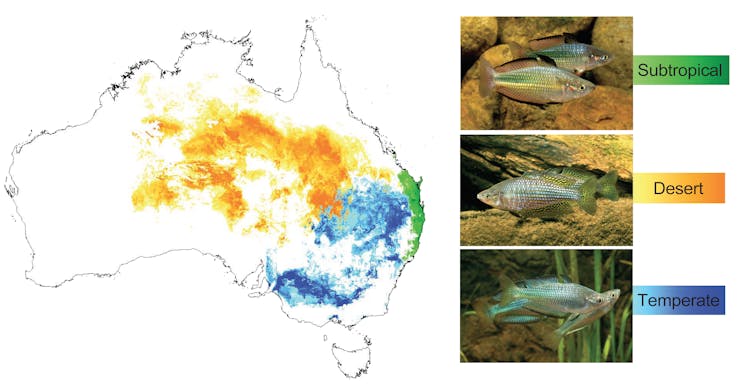
We studied three similar species of rainbowfishes from different climatic regions of Australia: the subtropics, the desert and the temperate region.
Rainbowfish are diverse, small and beautiful freshwater fishes that can be kept in captivity. Rainbowfish do not migrate, so we can compare populations that evolved in different climatic regions.
The ecological range of our study species of rainbowfishes (genus Melanotaenia). Photos by Gunther Schmida.
We used wild rainbowfishes separated in two groups. One group was kept at a contemporary average summer temperature (21℃). In the other, the temperature was slowly increased until it reached a summer temperature projected for 2070 under a high emission scenario (33℃).
After 14 days in these conditions, we humanely killed the fishes and removed their livers. This organ plays a central role in the body’s metabolism, including during heat stress. We used the liver samples to test how gene expression (which genes are activated within a cell) changed because of our experiments.
The results were striking. Although the three species activated thousands of identical genes in a contemporary climate, they used very different sets of genes to respond to a future climate.
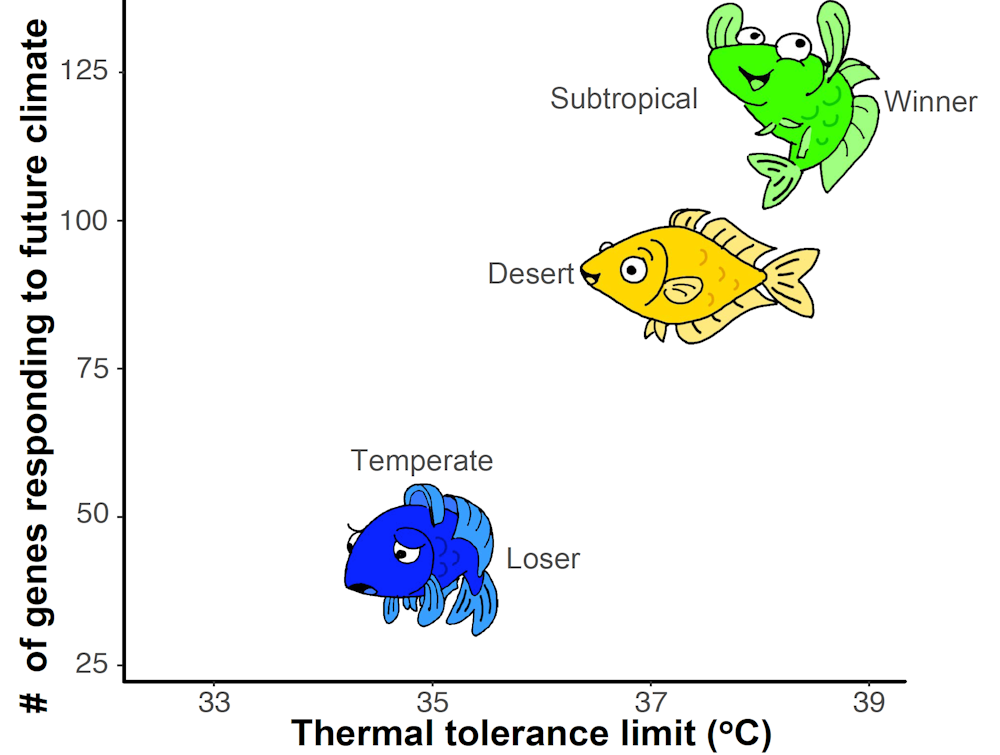
They also showed different levels of response in a future climate. Subtropical rainbowfish built a much larger response (with 109 genes activated) than the desert (84 genes) and the temperate rainbowfish (27 genes).
Strong association between genetic responses and heat tolerance
Alongside, we did another experiment to measure how much heat each species could tolerate (their “upper thermal tolerance limit”).
Here, rainbowfishes were exposed to increasing temperature until they showed loss of balance. As expected, the subtropical rainbowfish showed the highest tolerance, with their upper limit at 38℃. Desert rainbowfish could tolerate up to 37℃, while the temperate rainbowfish could tolerate up to 35℃.
With both experiments, we discovered a strong association between number of genes responding to projected temperatures and heat tolerance. In other words, “winners” can regulate the expression of a larger number of genes in future climates than “losers” can.
The capacity to respond to projected climates in rainbowfishes.Author provided
The signal of evolution on heat stress genes
It is difficult to determine whether a gene is responding just because of the environment, or because of a genetic constraint that came about from evolution.
Another fascinating discovery of our study is that evolution left a strong signal on many heat stress genes. These genes are known to play a central role in dealing with heat stress and allowing survival in a variety of vertebrates. This attests to their importance in providing long-term resilience to future climates.
Our findings indicate that resilience or vulnerability to rising temperatures is expected to be influenced by geographic factors, such as the climatic region where species evolved.
Subtropical species showed greater capacity to adapt to future climates, with temperate species being the most vulnerable. Desert species, which are predicted to be exposed to more extreme heatwaves and longer droughts in the future, are also vulnerable.
Habitat of the desert rainbowfish is predicted to shrink due to climate change. Photo by Gunther Schmida.
This information will help identify the types of biodiversity and ecosystems at high risk of extinction and to develop ways to help them to adapt and survive. This includes restoring lost habitat and actively moving populations to more favourable climatic locations.
The implications of our study can be extended to many non-migratory animals and plants – aquatic and terrestrial – under pressure due to climate change.
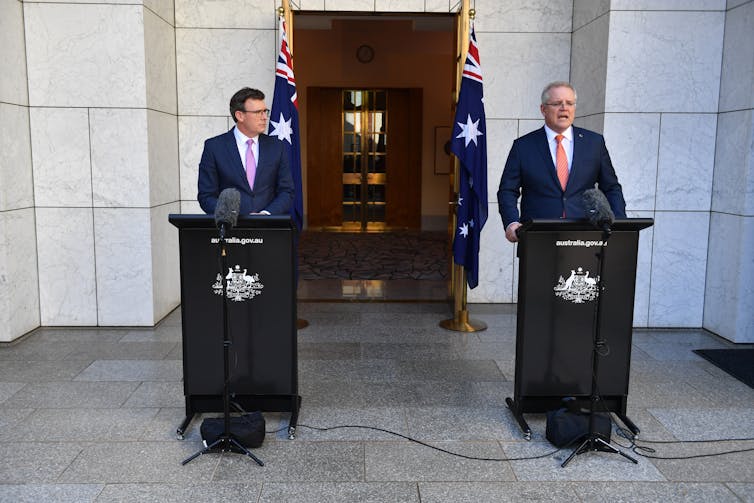
Federal Education Minister Dan Tehan released his Job-ready Graduates Package on June 19 2020. In his National Press Club address, he said it would help drive our economic recovery after COVID-19 and “put more funding into the system in a way that encourages people to study in areas of expected employment growth”.
He said the package would deliver an additional 39,000 university places by 2023 and 100,000 places by 2030.
But my analysis shows the growth in student places is illusory. It will not meet any additional demand from the COVID-19-induced economic slowdown or future growth in the university-age cohort.
I show that — over the period from December 2017 (when the government put a cap on demand-driven funding) to 2024 (when the job-ready policies are fully implemented) — the government will deliver itself an annual saving of nearly A$1 billion.
A bit of background
In 2018, the government used a legislative handbrake to stop student subsidies for bachelor degrees from growing by capping funding.
Before that, the government was providing funding to universities based on how many students had enrolled. A two-year freeze on funding was followed by population-based increases of less than the inflation rate.
This stopped new student places being subsidised. And over time, it eroded the number of places receiving a subsidy.
There was no coherent plan for longer-term growth. The Job-ready policies are meant to fix this. If legislation passes, they will start in 2021 and be fully phased in by 2024.
New subsidy and student contribution arrangements would replace the current arrangements. The total revenue for a student place would be better aligned with the estimated cost of teaching in each discipline, removing the surplus funding now spent on other things like research.
Student contributions are being set to encourage them to study things like maths and agriculture, and to discourage them from studying things like history and communications. The government subsidy meets the remainder of the cost in each discipline.
These changes save the government money, but it spends some of it on “additional student places”. It also spends some on grants to promote links with industry and on resuming inflation-linked increases of the subsidies for student places.
It is a complicated package. There is a three-year transition period in which existing students, whose contributions would otherwise increase, stay on the old funding arrangements.
If a university would get more funding for the same total number of students under the old funding arrangements, the government will make up the difference. Funding will be progressively increased to allow universities to provide more places over this three-year period.
The government didn’t release any analysis of the end point of its changes. What will have happened to university funding by 2024? Will there be more student places than when it first capped the system? Will it be spending more or less than in the past?
My calculations
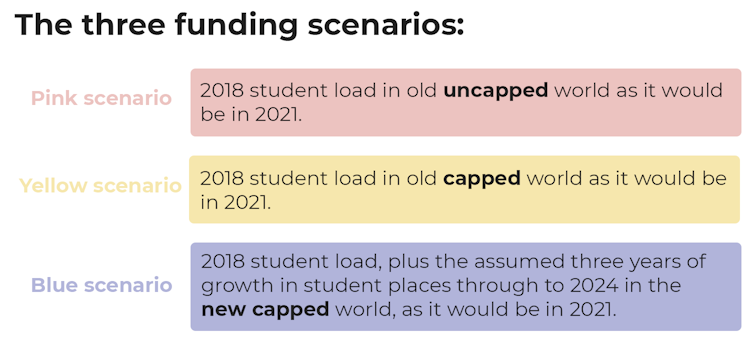
In the pink scenario (below), I calculate funding for 2018 student load using current 2021 funding rates and no funding cap.
In the yellow scenario, I calculate funding for 2018 student load using current 2021 funding rates and with the funding cap in place at its 2021 value. I calculate how many places are no longer funded due to the operation of the cap using the average funding rate for all places.
In the blue scenario, I calculate how much the 2018 student load, combined with the growth in student places to 2024, would be worth in 2021 (in 2021 dollars) with the new Job-ready graduate funding rates.
From 2018 to 2021, the funding cap has reduced university revenue by around $266 million, down to $12.6 billion. Using the average bachelor subsidy rate, around 23,000 student places are no longer subsidised.
Comparing the yellow and blue scenarios
University revenue declines by a further $0.5 billion to $12.1 billion. To earn this revenue, universities will have to provide around 11,700 more student places than in the yellow scenario.
Those 11,700 extra places arise from the Job-ready policy providing 3.5% growth for bachelor degrees at regional campuses, 2.5% for high-growth metropolitan campuses and 1% for low-growth metropolitan campuses.
The government is allocating other places to universities too (for national priorities, the University of Notre Dame Australia and Charles Sturt University’s medical school), but the total number of “new” places remains just over 15,000 – fewer than the 23,000 that have their funding taken away by the operation of the funding cap from 2018 to 2021.
While universities lose around $0.5 billion in student place funding, they receive an extra $222 million as Industry Linkage funding. We are yet to find out what they need to do for that funding.
The government makes large savings from two sources – students and universities. On average it increases contributions from students and every extra student dollar reduces what the government pays. It also reduces funding overall to more closely align with discipline teaching costs. My model estimates it goes to 94% of its former value.
Total student contributions rise by around $564 million a year in the change from current to new Job-ready graduate rates. Students will pay an average of 48-49% of costs by 2024.
The bottom line
Over the period from December 2017 to 2024, the government will deliver itself an annual saving of around $988 million. Around $266 million is from capping the system over the four years 2018 to 2021. Around $722 million is from the Job-ready policies.
Student choices will be little affected by changing student contribution levels, due to our income-contingent loan system, but restoring indexation of student subsidies is sensible policy. The lack of growth in student places into the future is not. It is essentially a policy to reduce higher education attainment levels.
Outside the US, however, the tide is heading in the other direction. China is deploying facial recognition on a vast scale in its social credit experiments, policing, and suppressing the Uighur population. It is also exporting facial recognition technology (and norms) to partner countries in the Belt and Road initiative. The UK High Court ruled its use by South Wales Police lawful last September (though the decision is being appealed).
Should Australia be using this technology? To decide, we need to answer fundamental questions about the kind of people, and the kind of society, we want to be.
It can verify individual identity by comparing a target image with data held on file to confirm a match – this is “one-to-one” facial recognition. It can also compare a target image with a database of subjects of interest. That’s “one-to-many”. The most ambitious form is “all-to-all” matching. This would mean matching every image to a comprehensive database of every person in a given polity.
Each approach can be carried out asynchronously (on demand, after images are captured) or in real time. And they can be applied to separate (disaggregated) data streams, or used to bring together massive surveillance datasets.
Facial recognition occurring at one end of each of these scales – one-to-one, asynchronous, disaggregated – has well-documented benefits. One-to-one real-time facial recognition can be convenient and relatively safe, like unlocking your phone, or proving your identity at an automated passport barrier. Asynchronous disaggregated one-to-many facial recognition can be useful for law enforcement – analysing CCTV footage to identify a suspect, for example, or finding victims and perpetrators in child abuse videos.
However, facial recognition at the other end of these scales – one-to-many or all-to-all, real-time, integrated – amounts to face surveillance, which has less obvious benefits. Several police forces in the UK have trialled real-time one-to-many facial recognition to seek persons of interest, with mixed results. The benefits of integrated real-time all-to-all face surveillance in China are yet to be seen.
And while the benefits of face surveillance are dubious, it risks fundamentally changing the kind of society we live in.
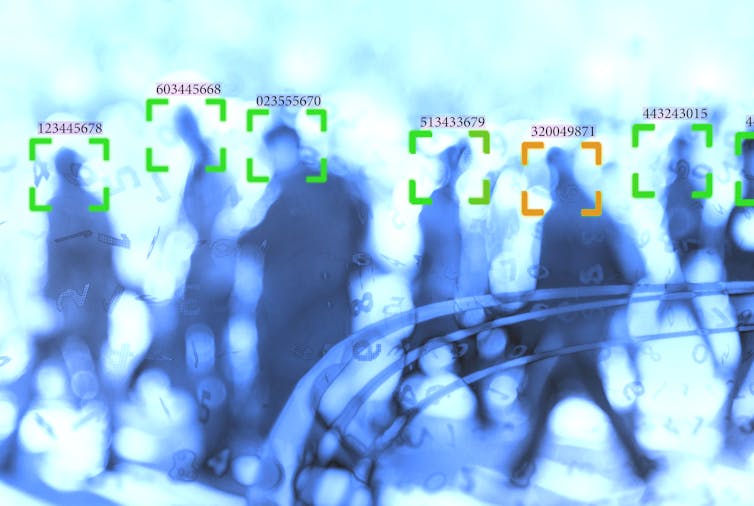
Real-time facial recognition applied to crowds amounts to face surveillance.Shutterstock
Face surveillance often goes wrong, but it’s bad even when it works
The errors tend to be false positives – making incorrect matches, rather than missing correct ones. If face surveillance were used to dole out cash prizes, this would be fine. But a match is almost always used to target interventions (such as arrests) that harm those identified.
More false positives for minority populations means they bear the costs of face surveillance, while any benefits are likely to accrue to majority populations. So using these systems will amplify the structural injustices of the societies that produce them.
Even when it works, face surveillance is still harmful. Knowing where people are and what they are doing enables you to predict and control their behaviour.
You might believe the Australian government wouldn’t use this power against us, but the very fact they have it makes us less free. Freedom isn’t only about making it unlikely others will interfere with you. It’s about making it impossible for them to do so.
Face surveillance relies on the idea that others are entitled to extract biometric data from you without your consent when you are in public.
This is false. We have a right to control our own biometric data. This is what is called an underived right, like the right to control your own body.
Of course, rights have limits. You can lose the protection of a right – someone who robs a servo may lose their right to anonymity – or the right may be overridden, if necessary, for a good enough cause.
But the great majority of us have committed no crime that would make us lose the right to control our biometric data. And the possible benefits of using face surveillance on any particular occasion must be discounted by their probability of occurring. Certain rights violations are unlikely to be overridden by hypothetical benefits.
Many prominent algorithms used for face surveillance were also developed in morally compromised ways. They used datasets containing images used without permission of the rightful owners, as well as harmful images and deeply objectionable labels.
Arguments for face surveillance don’t hold up
There will of course be counterarguments, but none of them hold up.
You’ve already given up your privacy to Apple or Google – why begrudge police the same kind of information? Just because we have sleepwalked into a surveillance society doesn’t mean we should refuse to wake up.
Human surveillance is more biased and error-prone than algorithmic surveillance. Human surveillance is indeed morally problematic. Vast networks of CCTV cameras already compromise our civil liberties. Weaponizing them with software that enables people to be tracked across multiple sites only makes them worse.
We can always keep a human in the loop. False positive rates can be reduced by human oversight, but human oversight of automated systems is itself flawed and biased, and this doesn’t address the other objections against face surveillance.
Technology is neither good nor bad in itself; it’s just a tool that can be used for good or bad ends. Every tool makes some things easier and some things harder. Facial recognition makes it easier to oppress vulnerable populations and violate everyone’s basic rights.
It’s time for a moratorium
Face surveillance is based on morally compromised research, violates our rights, is harmful, and exacerbates structural injustice, both when it works and when it fails. Its adoption harms individuals, and makes our society as a whole more unjust, and less free.
A moratorium on its use in Australia is the least we should demand.
Facial recognition technology is increasingly being trialled and deployed around Australia. Queensland and Western Australia are reportedly already using real-time facial recognition through CCTV cameras. 7-Eleven Australia is also deploying facial recognition technology in its 700 stores nationwide for what it says is customer feedback.
And Australian police are reportedly using a facial recognition system that allows them to identify members of the public from online photographs.
Facial recognition technology has a somewhat nefarious reputation in some police states and non-democratic countries. It has been used by the police in China to identify anti-Beijing protesters in Hong Kong and monitor members of the Uighur minority in Xinjiang.
With the spread of this technology in Australia and other democratic countries, there are important questions about the legal implications of scanning, storing and sharing facial images.
Use of technology by public entities
The use of facial recognition technology by immigration authorities (for example, in the channels at airports for people with electronic passports) and police departments is authorised by law and therefore subject to public scrutiny through parliamentary processes.
In a positive sign, the government’s proposed identity matching services laws are currently being scrutinised by a parliamentary committee, which will address concerns over data sharing and the potential for people to be incorrectly identified.
Indeed, Australian Human Rights Commissioner Edward Santow recently sounded an alarm over the lack of regulation in this area.
At the moment, there are not strong and clear enough legal protections in place to prevent the misuse of facial recognition in high stakes areas like policing or law enforcement.
Another specific concern with the legislation is that people’s data could be shared between government agencies and private companies like telcos and banks.
How private operators work
Then there is the use of facial recognition technology by private companies, such as banks, telcos and even 7-Elevens.
Here, the first thing to determine is if the technology is being used on public or private land. A private landowner can do whatever it likes to protect itself, its wares and its occupants so long as it doesn’t break the law (for example, by unlawful restraint or a discriminatory practice).
By contrast, on public land, any decision to deploy such tools must go through a more transparent decision-making process (say, a council meeting) where the public has an opportunity to respond.
This isn’t the case, however, for many “public” properties (such as sports fields, schools, universities, shopping centres and hospitals) that are privately owned or managed. As such, they can be privately secured through the use of guards monitoring CCTV cameras and other technologies.
Facial recognition is not the only surveillance tool available to these private operators. Others include iris and retina scanners, GIS profiling, internet data-mining (which includes “predictive analytics,” that is, building a customer database on the strength of online behaviours), and “neuromarketing” (the use of surveillance tools to capture a consumer’s attributes during purchases).
There’s more. Our technological wizardry also allows the private sector to store and retrieve huge amounts of customer data, including every purchase we make and the price we paid. And the major political parties have compiled extensive private databanks on the makeup of households and likely electoral preferences of their occupants.
Is it any wonder we have started to become a little alarmed by the reach of surveillance and data retention tools in our lives?
What’s currently allowed under the law
The law in this area is new and struggling to keep up with the pace of change. One thing is clear: the law does not prohibit even highly intrusive levels of surveillance by the private sector on private land in the absence of illegal conduct.
The most useful way of reviewing the legal principles in this space is to pose specific questions:
Can visitors be legally photographed and scanned when entering businesses?
The answer is yes where visitors have been warned of the presence of cameras and scanners by the use of signs. Remaining on the premises denotes implied consent to the conditions of entry.
Do people have any recourse if they don’t want their image taken?
No. The law does very little to protect those who may be upset by the obvious presence of a surveillance device on a door, ceiling or wall. The best option for anybody concerned about this is to leave the premises or not enter in the first place.
What about sharing images? Can private operators do whatever they like with them?
No. The sharing of electronic data is limited by what are referred to as the “privacy principles”, which govern the rights and obligations around the collection, use and sharing of personal information. These were extended to the private sector in 2001 by amendments to the Commonwealth Privacy Act 1988.
These privacy principles would certainly prohibit the sharing of images except, for example, if a store was requested by police to hand them over for investigation purposes.
Can private businesses legally store your image?
Yes, private or commercial enterprises can store images of people captured on their cameras in their own databases. A person can ask for the image to be disclosed to them (that is, to confirm it is held by the store and to see it) under the “privacy principles”. Few people would bother, though, since it’s unlikely they would know it even exists.
The privacy principles do, however, require the business to take reasonable steps to destroy the data or image (or ensure there is de-identification) once it is no longer needed.
What if facial recognition technology is used without warnings like signs?
If there is a demonstrable public interest in any type of covert surveillance (for example, to ensure patrons in casino gaming rooms are not cheating, or to ensure public safety in crowded walkways), and there is no evidence of, or potential for, misuse, then the law permits it.
Any change to the laws in this area is a matter for our parliamentarians. They have been slow to respond given the difficulty of determining what is required.
It will not be easy to frame legislation that strikes the right balance between respecting individuals’ rights to privacy and the desires of commercial entities to keep their stock, patrons and staff secure.
In the meantime, there are steps we can all take to safeguard our privacy. If you want to protect your image completely, don’t select a phone that switches on when you look at it, and don’t get a passport.
And if certain businesses want to scan your face when you enter their premises, give them a wide berth, and your feedback.
The coronavirus pandemic has forced many of us to work from home, often in less than ideal circumstances.
Many employees had little choice in the decision, limited time to prepare, patchy technology skills, and inadequate home workspaces. Some managers neglected remote workers, while others zealously monitored them.
And yet some people thrived. Having tried it, many employees anticipate they will continue to work from home, and value employers who encourage it.
So if you decide to continue working from home after the pandemic, is it good or bad for your health in the long run?
Easy access to snacks meant some employees may have gained weight while working from home during the pandemic. Some employees stared at their screen for hours, sitting in awkward positions with no breaks.
Sitting down all day is linked with various health problems. Employees working from home need to be supported to take breaks and engage in physical activity.Reuters/Abdel Hadi Ramahi
But properly supported working from home could improve employees’ health. It enables them to work toward aspirational fitness goals by scheduling workouts at convenient times.
It creates opportunities for employees to take breaks from the laptop to toss in a load of laundry, take the dog for a quick walk, vacuum the carpets, or do a few stretches in another room. Small bits of activity, interspersed throughout the day, have long-term positive impacts on physical and psychological health. Ten minutes of energetically climbing the stairs in your house could boost your lung capacity and raise your spirits.
Achieving those benefits requires employees to have control over their work schedule. Organisations can help by providing resources to design better home workspaces and software that nudges employees to take breaks throughout the day.
2. More free time, or just more time working?
Commuting — especially by car in dense communities — exposes employees to air pollution and raises their risk of respiratory or cardiovascular problems. In theory, working from home should let employees breathe easier, both physically and psychologically. Avoiding the commute saves time and money, two crucial resources that can be channelled to improve the quality of employees’ personal lives.
However, the commute serves a valuable function that is often overlooked. It gives employees time to transition between work and non-work roles, which is especially important for people in difficult service and professional jobs.
The loss of a 30-minute commute can blur boundaries and increase stress spillover between work and non-work. When we lose the defined “buffer zone” of a commute, too often the “saved time” is gobbled up by more work. Long work hours are associated with more stress, lower-quality sleep and higher blood pressure.
Working from home therefore needs to incorporate transitional periods that substitute for a commute. This might be as simple as a walk around the block before sitting down at the desk, or doing a meditation practice before cooking dinner.
Organisations need to respect role boundaries too. This involves clarifying when employees need to be available, and establishing clear policies about email and phone access outside business hours.
3. Less distraction, or lonely and disconnected?
Working from home can create opportunities for employees to engage in “deep work” — focusing on a demanding task without distraction. It helps employees fully engage with their work when they are working, and be more psychologically present with their family when they are not working.
Employees who work from home can intersperse their work and family time to benefit the entire family, for example by using a work break to read a story or share a meal. Quality moments of connection with parents have a more significant impact on children’s academic achievement, behaviour, and emotional well-being than the quantity of interactions.
Workers who engage in office chatter tend to enjoy work more.Shutterstock
But not every employee has those close family relationships, and contact with coworkers can be an essential source of support for many workers. Employees who participate in office small talk experience more positive emotions, go out of their way to help coworkers, and end the workday in a better frame of mind.
The spontaneity of office small talk is hard to replicate in a virtual context, so employees working from home can experience loneliness. This can lead to depression, insomnia, and substance abuse. In terms of death and disease, loneliness is in the same league as smoking, obesity and alcoholism.
Organisations can help by providing “virtual cafés” to foster informal interactions. Research also recommends hybrid models of remote work that can achieve the benefits of working from home (more focused time for deep work) alongside those of the office environment (more collaboration with coworkers). For example, employees might work from home four days a week, with the fifth day in the office.
Employees need to be supported
Working from home is not always better or worse for an employee’s health than traditional office arrangements.
It will be most beneficial when employees make wise decisions about their time, and employers provide support in the form of technology, ergonomic equipment, and managers trained to supervise remote workers.
Most importantly, when employees are given choice over the schedule and location of their work, the psychological, physical and productivity benefits can double.
When New Zealanders go to the polls in September, they will also be asked to vote in a referendum on assisted dying.
Parliament already passed the End of Life Choice Act in 2019, but the referendum will decide whether it comes into force.
We will be asked if we accept or decline the right of people to seek an assisted death, without the need for consultation with family and with no stand-down period other than a requirement of 48 hours to prepare the medication. The act would allow people to choose when they die and by what means, whether the medication is self-administered or given by suitably qualified clinicians.
This appears an ideal scenario, affirming the right to choose, but it is a deeply profound decision for the public to make. Many may be unaware of issues beyond the goal of ending suffering for people with life-limiting conditions.
My research shows an assisted death can have repercussions for many people — those left behind or others struggling with a chronic disease. Experiences from countries where assisted dying has been legal for some time have highlighted these challenges.
In the Netherlands, assisted dying has been legal for 18 years. Over time, there have been notable slips in the criteria that have to be met. This includes the level of physical suffering, which is a subjective experience, and the requirement that people must be competent to agree to an assisted death at the point of administration. This may not be possible for people with dementia who have previously given written consent but can no longer consent at the point of death.
While the law hasn’t changed, its interpretation has, and people with mental illness can now also request an assisted death. Data from the Netherlands show one in 30 people now die by euthanasia, compared to one in 90 when the law was introduced in 2002.
In Canada, where assisted dying has been legal for four years, the number of people seeking medical help to die has risen significantly, with figures more than doubling year on year. This has exposed unexpected consequences, such as fear of judgement for leaving family members unsupported after an assisted death and stigmatisation of clinicians, whether or not they support people choosing the time of their death.
To consider assisted dying legislation as an issue of individual autonomy denies that we are part of a much larger group with complex connections. This is particularly important when we consider Māori and Pasifika populations, whose voices are notably absent from the current act in New Zealand.
The act proposes people may seek assisted dying without any consultation with whānau (family), but the impact of an assisted death reaches far beyond relieving suffering for the individual. The ripple effects can fracture families and communities. As the act currently stands, it has the potential to cause greater harm than good.
The New Zealand legislation carries this risk. It includes restrictions on disclosure of the use of the law and on individuals being recorded as having died an assisted death, often for insurance purposes.
The contagion effect
There is another significant issue to consider. One person’s assisted death could influence the decisions of others — and this contagion effect could play out in two ways.
Those who are not aware of the legislation but discover a friend or family member is accessing it may consider using it themselves. More concerning is people with chronic conditions may feel obliged to seek assisted dying, should they feel burdensome to their family.
There is a notable difference in the New Zealand population in how support for elders or unwell family members is provided. Māori and Pasifika people tend to care for their sick and elders while pākehā (New Zealanders of European descent) often rely on external support. Our research shows when one family member has an assisted death, others with a chronic illness can feel an expectation for them to consider it.
Such broader consequences of introducing assisted dying legislation are often hidden, but they must be addressed as New Zealand moves towards the referendum. The current binary positioning of the debate focuses on autonomy of the individual versus protecting the public, whereas the reality is that assisted dying is more than merely either of these opposing values. It has already been demonstrated that the effects of assisted dying legislation reach beyond the individual and, as such, must be considered as we enter this referendum. The act lacks the necessary detail to make a fully informed decision.
The idea that choice is being given to a popular vote is, in itself, problematic. It is suggestive of a government unwilling to take responsibility for the fallout, should the referendum produce a supportive vote.
We need to safeguard our families and communities from these social consequences of assisted dying legislation. Vulnerable populations have to remain safe from persuasion to die and there has to be a supportive framework for those left behind after an assisted death, so they can grieve without feeling stigmatised.
This article is a preview of Flora, Fauna, Fire, a multimedia project launching on Monday July 13. The project tracks the recovery of Australia’s native plants and animals after last summer’s bushfire tragedy. Sign up to The Conversation’s newsletter for updates.
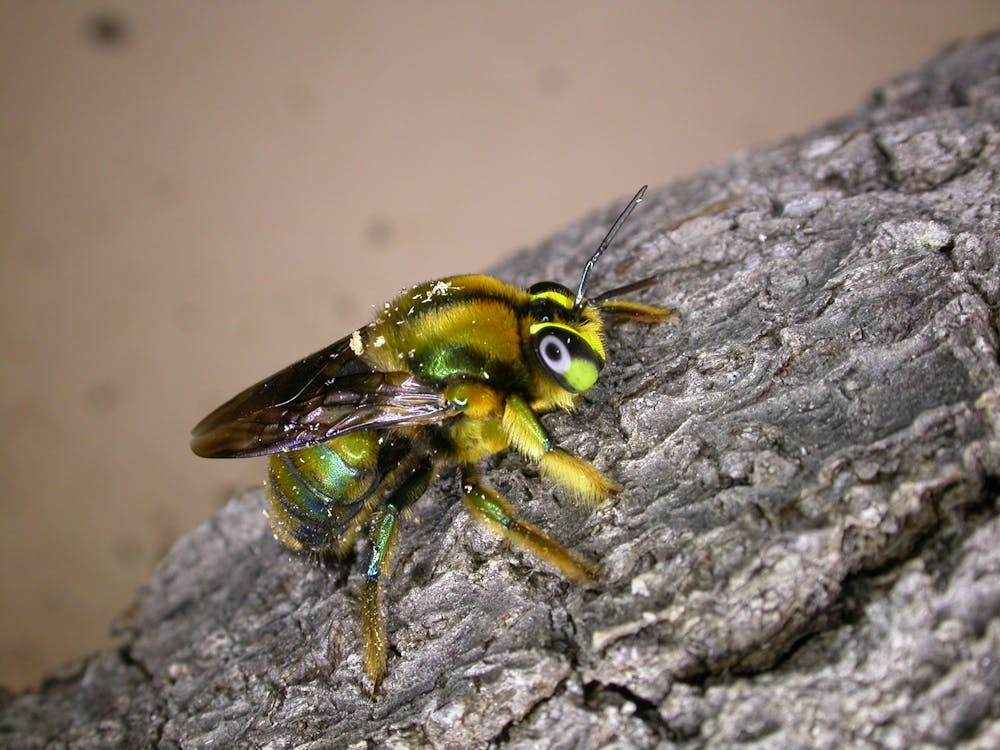
The green carpenter bee (Xylocopa aerata) is an iconic, beautiful native species described as a “jewel of nature” for its metallic green and gold colouring. Carpenter bees are so named because they excavate their own nests in wood, as opposed to using existing holes.
With a body length of about 2 centimetres, it is among the largest native bees in southern Australia. While not used in honey farming, it is an important pollinator for several species of Australian native plants.
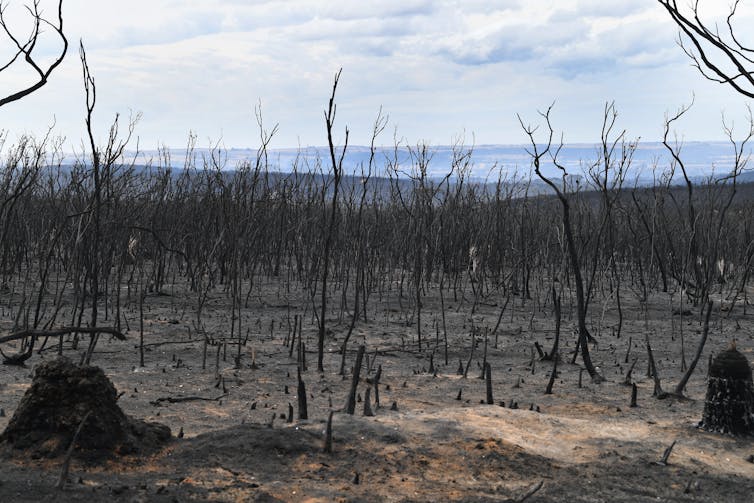
Last summer’s catastrophic bushfires significantly increased the risk of local extinctions of this magnificent species. We have studied the green carpenter bee for decades. For example, after the 2007 fires on Kangaroo Island, we bolstered the remaining population by providing nesting materials.
To see our efforts – and more importantly, most of the habitat these bees rely on – destroyed by the 2020 fire was utterly devastating.
Much of Kangaroo Island was incinerated by the summer bushfires.Daniel Mariuz/AAP
A crucial pollinator on the brink
The green carpenter bee is a buzz-pollinating species. Buzz pollinators are specialist bees that vibrate the pollen out of the flowers of buzz-pollinated plants.
Many native plants, such as guinea flowers, velvet bushes, Senna, fringe, chocolate and flax lilies, rely completely on buzz-pollinating bees for seed production. Introduced honey bees do not pollinate these plants.
The green carpenter bee went extinct on mainland South Australia in 1906 and in Victoria in 1938. It still occurs on the relatively uncleared western half of Kangaroo Island in South Australia, in conservation areas around Sydney, and in the Great Dividing Range in New South Wales.
Local extinctions were probably due to habitat clearing and large, intense bushfires. The last time the green carpenter bee was seen in Victoria was early December 1938 in the Grampians, which burnt completely during the Black Friday fires of January 1939.
There are several reasons green carpenter bees are vulnerable to fire, including:
the species uses dead wood for nesting, which burns easily
if the nest burns before the offspring matures in late summer, the adult female might fly away but won’t live long enough to reproduce again, and
the bees need floral resources throughout the year.
A male green carpenter bee.Remko Leijs, Author provided
Nowhere to nest
The bees mainly dig their nests in two types of soft wood: dry flowering stalks of grass trees and, crucially important, large dead Banksia trunks. The availability of both nesting materials is intricately connected with fire.
Green carpenter bees sometimes nest n the dried flowering stalks of grass trees, also known as Xanthorrhoea.Remko Leijs, Author provided
Grass trees flower prolifically after fire, but the dry stalks are only abundant between two and five years after fire. Banksia species don’t survive fire, and need to grow for at least 30 years to become large enough for the bees to use.
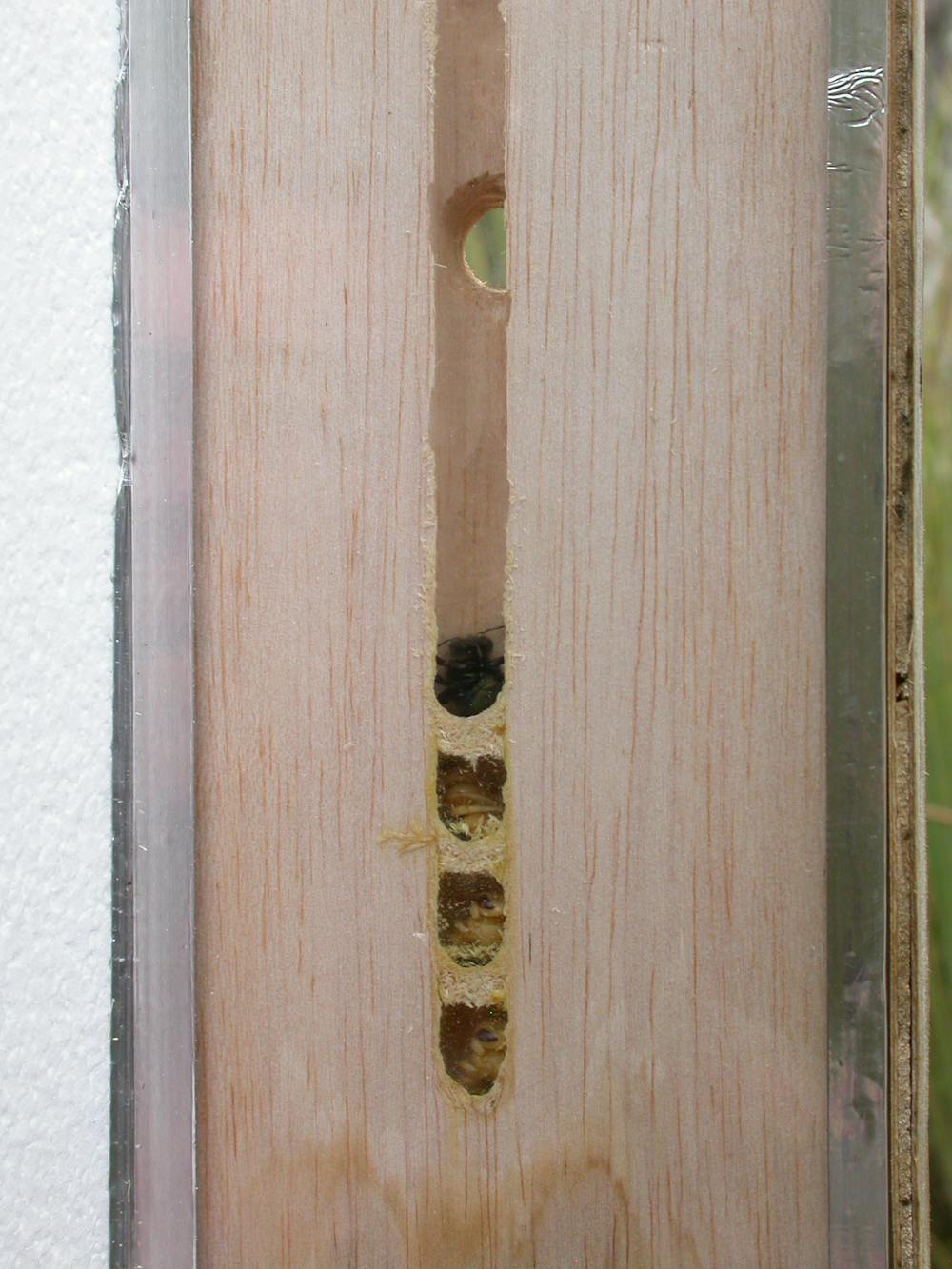
Bees nesting in an artificial stalk.Remko Leijs, Author provided
With increasingly frequent and intense fires, there’s not enough time for Banksia trunks to grow big enough, before they’re wiped out by the next fire.
A helping hand after the 2007 fires
In 2007, Flinders Chase National Park on Kangaroo Island burnt almost entirely.
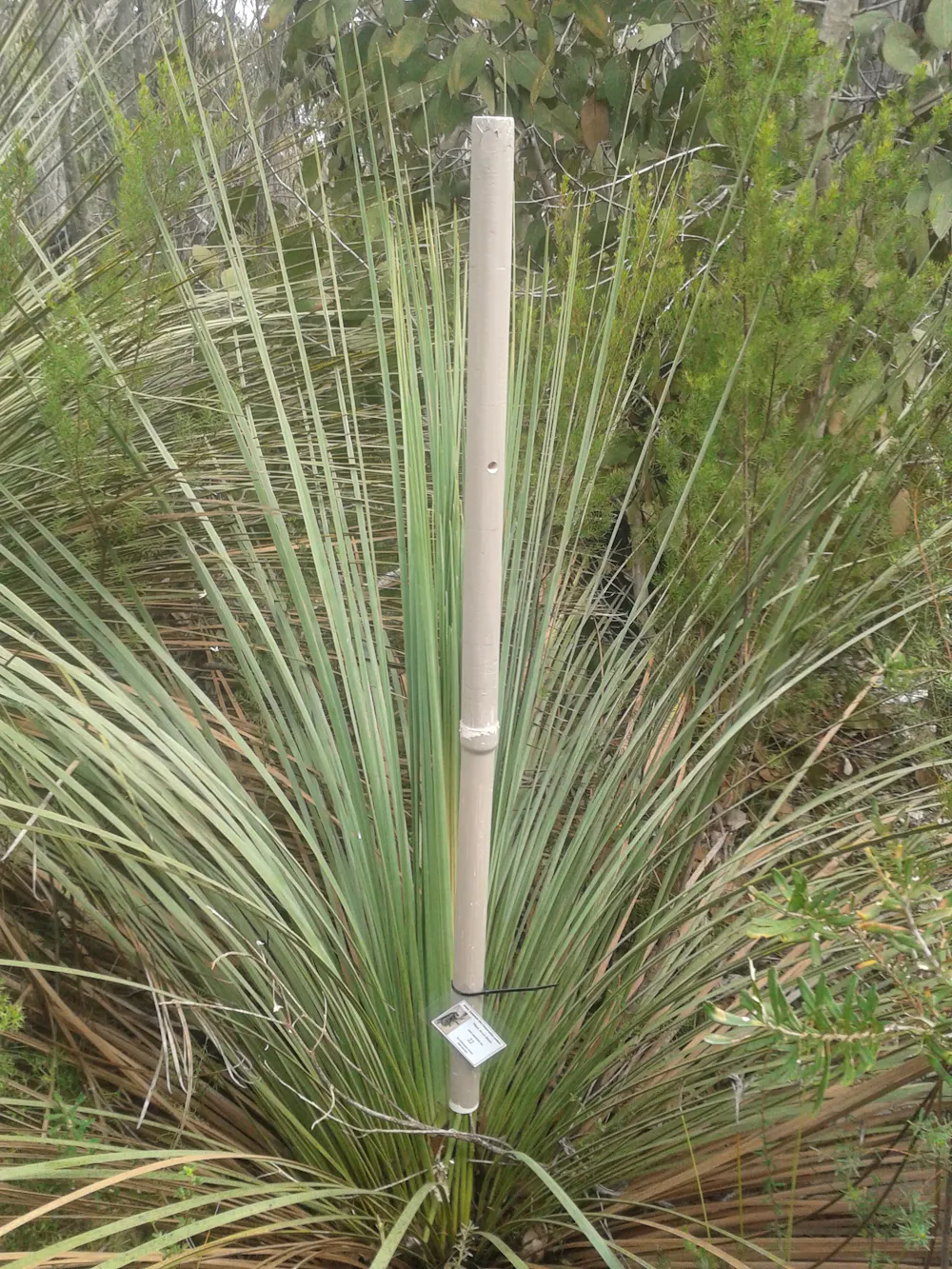
An artificial stalk nesting site installed in a Xanthorrea.Remko Leijs, Author provided
However, in long-unburnt areas adjacent to the park, carpenter bee nests were still present. From there, they colonised the many dry grass tree stalks that resulted from the fire in the park.
In 2012, most flowering stalks had decayed. In an attempt to bolster population size, we successfully developed artificial nesting stalks to tide the bees over until new Banksia, suitable for nesting, would become available.
Since then, each year we’ve placed artificial nesting stalks in fire-affected areas where the bee still occurred. Almost 300 female carpenter bees have successfully used our stalks to raise their offspring.
Then came the January 2020 fires
At the time of the 2020 fires on Kangaroo Island, there were more than 150 nests containing mature brood in the stalks we had provided.
We’d placed these in 12 sites in and around Flinders Chase National Park, to spread risk – to no avail, as they all burnt.
We were horrified to see the intensity and speed of the fire that turned our efforts to ash, along with most of the remnant, long (more than 60 years) unburnt Banksia habitat the bees rely on. In New South Wales, much of the species’ natural range was also burnt.
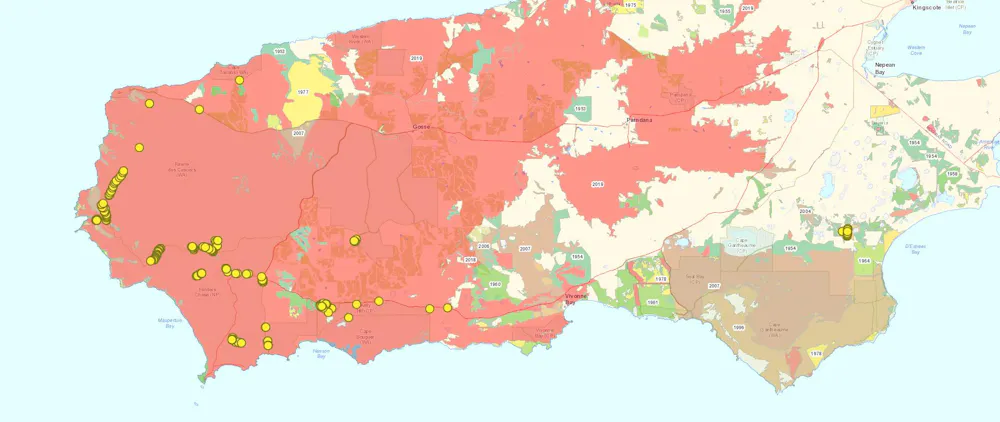
The yellow dots represent known green carpenter bee nests. In red: the area burnt in 2020. Only a subset of the remaining green and yellow patches still have the right vegetation for the green carpenter bee.Nature Maps SA/Remko Leijs, Author provided
What’s next for the green carpenter bee?
To fully appreciate the impact, we need to survey the remaining long unburnt areas on Kangaroo Island and in NSW.
Encouragingly, we have already found a few natural nests on Kangaroo Island, but the remaining suitable areas are small and isolated, and densities are likely to be low.
With funds raised through the Australian Entomological Society and the Wheen Bee Foundation, and with help of the Kingscote Men’s Shed, we are making new nesting stalks.
The Kingscote Men’s Shed on Kangaroo Island is helping build new nesting stalks.Remko Leijs, Author provided
With permission of landholders, we’ll place these new stalks in areas with good floral support, to enhance reproduction and help the bees disperse into conservation areas once suitable.
As we have learnt, success is not guaranteed. Extensive and repeated bush fires, combined with asset protection and fuel reduction burns, are making longtime unburnt habitat increasingly rare. It is this lack of old, continuous, unburnt forest that severely threatens the green carpenter bees’ existence.
The future of fire-vulnerable biodiversity
The carpenter bee is not the only species facing this problem. Many Australian plants and animals are not resilient to high frequency fires, no matter their intensity or time of year.
The ecological importance of longtime unburnt forest needs urgent recognition, as increased fire frequency – both of natural and “managed” fires – is likely to drive a suite of species to extinction.
Given the expected increase in fire frequency and intensity associated with global heating, it’s time we recognise fire-vulnerable species as a category that requires urgent habitat protection.
Women manage many overlapping responsibilities in both public and private spheres. Their busy routines leave them with just a little time to take a break or a pause in their activity. These pauses are a time for self or for activities other than home, work or care-giving responsibilities.
What is the role of such pauses in migrant women’s everyday lives? Interviews were conducted with 20 migrant women (mostly migrants from rural areas) in Hyderabad, India, and 19 Indian migrants in Melbourne, Australia, as part of doctoral research. From the interviews, these seemingly incidental pauses emerged as an integral part of their daily lives.
Each pause served a specific purpose and was itself as important as the women’s other routine activities. Pauses particularly helped the women strengthen their social ties in the community. Pauses also helped them get to know different (public) places.
Most of the participants were married women with children. They saw home and family as their primary responsibility. Some did paid work, or owned a small home-based business, while also managing domestic responsibilities.
What kind of pauses matter to these migrant women? It appears pauses in their busy routines were most important for:
social interactions
moments of self-reflection or relaxation
opportunities for work or other activities.
Social interactions
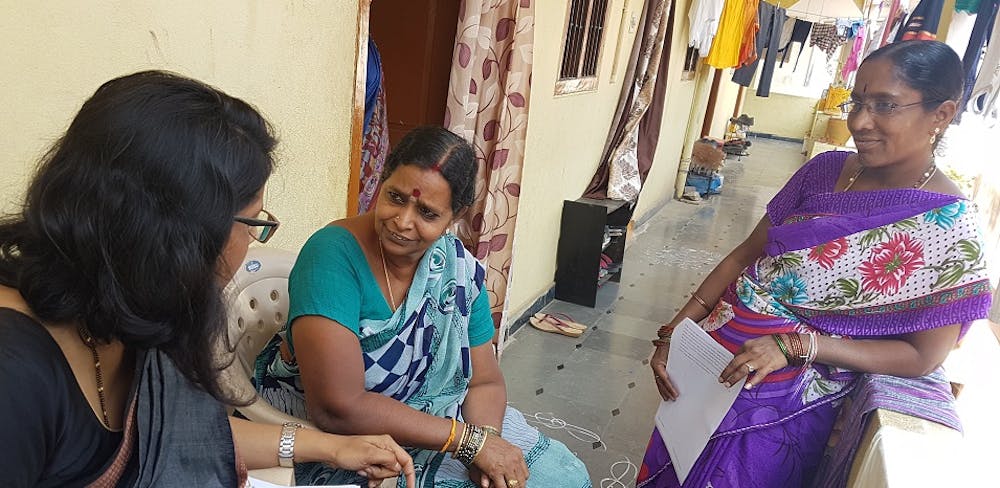
In India, we observed social interactions as pauses when the migrant women co-ordinated their chores or made trips in their neighbourhood. Washing and airing laundry or prepping meals while chatting together in the common corridors of apartment buildings was common during the day.
Socialising at the doorstep was convenient, accessible and easy to manage between chores. As Monica* explained:
Even if we are busy with work, we can step outside and rest for a bit […] Everyone can get back to their work after that!
Corridor spaces provide places for co-ordinated daily chores and casual interactions.Author provided
Trips on foot, to chaperone children to schools or to buy groceries, were similarly co-ordinated within small groups of women. Through these trips the migrant women identified others with similar cultural backgrounds and (migration) experiences and formed local connections.
Similarly, in Melbourne, women of similar ethnic or cultural backgrounds regularly co-ordinated lunch hours at work as time to “hang out” at a cafe or a restaurant. These acquaintances sometimes transformed into lasting friendships.
Self-reflection or relaxation
In India, the participants said their personal time was limited to only a short nap between chores when their spouse and children were away and if time permitted. In Melbourne, some used lunch hours at work for walks in the park, for both reflection and relaxation. Space for reflection helps cultivate self-awareness for any individual.
For Sejal*, this lunch hour was also an opportunity to spend quality time with her spouse during a brief period when they worked together in the CBD.
… because me and my husband never dated you know, (and) after one-and-a-half years (of marriage) I had a baby and that’s it … my life changed! […] So, I am spending it (that time) now … after 16 years of my marriage!
Opportunities for work and other activities
As women’s family responsibilities reduced at different life stages, some longer pauses appeared in their daily routines. For example in India, some women started a small home-based business like sewing or making handicrafts as their children got older. These activities were sometimes considered secondary, but provided a creative outlet and extra income for the family.
In Melbourne, some women felt they had lesser familial expectations than in their country of origin and they could pursue other interests. Nirmala* said that before migrating she had always felt the need to prioritise her children over her own needs.
‘Why do you want to study?’ they asked me, because I already have two children.
After her migration, Nirmala felt encouraged to study further, while continuing to be the primary carer at home.
Women’s everyday movements and activities have primarily emerged from gender norms shaped by patriarchy and societal expectations. Intervals of everyday casual interactions helped the women take a break from their “expected” responsibilities.
Pauses varied in duration and formats. They appeared in different spaces linked to the core routine activities of the women. These spaces ranged from home and its vicinity, to public spaces like streets and parks.
These interactions helped the women identify others (mainly women) with similar interests or backgrounds. This helps them overcome unfamiliarity with a new place due to limited social connections. Social and cultural connections are particularly necessary for migrants to build a sense of belonging in their new cities.
Interactions at a weekly informal market.Author provided
Further, through their individual and shared routines, the women identified familiar routes and “comfortable” places. For any individual, these routine and repetitive practices help develop an attachment to a place.
The process of migration is a complex social phenomenon affecting the women’s health and vulnerability. In today’s “new normal” of restricted mobility and social distancing, what becomes of these pauses? What are the impacts on women as they face an increased burden of domestic responsibilities and vulnerabilities while everyone stays home?
And what will these turbulent times mean for the migrants who are already experiencing instability? Will these pauses take a different social and spatial form, or be forever lost?
The pandemic has changed the way we think about supply chains, in particular the chains that feed our need for food, medical supplies, and defence equipment.
It has led Prime Minister Scott Morrison to frame access to supplies in terms of economic sovereignty.
Andrew Liveris, now an advisor to Morrison, and a former Dow Chemical Chief and advisor to both the Obama and Trump administrations, is pushing for re-shoring of critical supply chains.
“Australia drank the free-trade juice and decided that off-shoring was okay,” he is quoted as saying. “Well, that era is gone.”
But ensuring supplies can withstand shocks needn’t mean bringing production onshore. It might make it harder.
Stockpiling isn’t that useful
Firms usually talk about managing supply risk in terms of resilience or robustness.
Canada has a strategic maple syrup reserve.
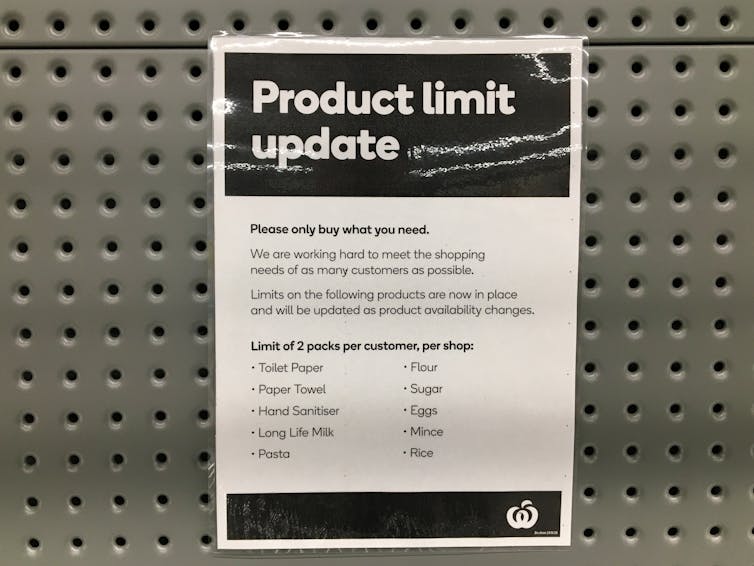
Robustness is the ability to continue supplying during a disruption (for a while we didn’t have this with toilet paper).
Resilience is the ability to get supplies back to normal in an acceptable time frame (which we had with toilet paper).
For critical supplies, robustness is the most important, but it hard to achieve for entire categories such as “medical equipment”. There, stockpiling is of limited use.
The United States has a stockpile of oil, enough to fill half of its car tanks. Canada has a vault of maple syrup, called a “strategic reserve” – about 80,000 barrels worth.
But when it comes to stockpiling “medical equipment” we might put a lot of effort into stockpiling ventilators, for example, only to find that the next emergency requires something different, or a different type of ventilator.
And it’s hard to stockpile fresh food.
We are exposed at choke points
Face masks and food illustrate the risks.
Half of global facemask production is concentrated in China. China’s factories closed during its lockdown at the time global demand simultaneously soared, resulting in a major shortages.
Australia is one of the most food-secure nations on earth, exporting far more than it needs, but a 2012 department of agriculture report found that many of the inputs, including pesticides and packaging, especially long-life packaging, were made overseas.
We got a taste of that vunerability in March 2020. After drought-breaking rains across the country generated a spike in demand for these essential farm inputs, supply tightened due to coronavirus-related restrictions in China.
The crunch led Australian farm supply firm Nufarm to publically warn that Australia was dangerously dependent upon China.
Disasters can happen here too
The best way to achieve supply chain robustness is to build supply chains involving more than one supplier, located in more than one national territory.
While worth considering as part of the solution, re-shoring won’t achieve this.
Japan’s 2011 Japan earthquake illustrates the point. Japan is self-sufficient in auto parts, but the earthquake hit the region that supplies them.
If we do re-shore, it will make sense to continue to use at least one international supplier to ensure diversification. Self sufficiency isn’t the same as robustness.
Building robustness will require a federally-directed supply chain risk diversification strategy.
Self-sufficiency isn’t robustness
Given the extent of our trade with China, the best approach might be China-Plus-One. It could mean one stream of the supply of a good coming through China and another coming through, for example, Vietnam.
Re-shoring can play a role, but we are going to need a top-down assessment of the risks facing supplies of critical goods, and quite possibly the imposition of robustness requirements on firms distributing them.
Those firms can be offered a diversification tax credit.
A robustness strategy would be more likely to be pro-trade rather than anti-trade, but we won’t know until we do the work. It’d be best to start before the next crisis.
Australia-wide, we’ve so far achieved a seven-day rolling average of a little more than 50,000 tests a day. The highest single-day record was 66,525 on June 22.
Since the beginning of the pandemic, proponents of mass testing having been arguing the need to test dramatically larger numbers.
One is US economist Paul Romer, who shared the 2018 Nobel Prize for economics for his work on the importance of knowledge and ideas in the economy. In late March he modelled a “frequent testing policy” in which:
7% of the population is randomly selected for testing each day. Over the 500 days illustrated in the plots and the animation, this means that the average person is tested about 30 times in 500 days – roughly once very two weeks.
This rate of testing would mean testing close to 2 million Australians a day. But even that is probably not enough.
The mathematics of mass testing
To appreciate why an even large number of tests is needed, imagine purely random testing is being used. That is, testing not focused on “hot spots” as has been the case in Melbourne.
Testing, tracing and isolating will only be effective if, on average, the process identifies cases before those people transmit the virus. Epidemiologists call the number of infections caused by a single case the “reproduction” (R) number. If it’s less than 1, the pandemic will die out. If it’s more than 1, the virus spreads.
When uncontrolled, COVID-19 spreads roughly once every six days. This corresponds to a reproduction number of 2.5 over the 15 days a person with COVID-19 is generally infectious.
Moreover, as Romer notes, current tests are far from perfect. He assumes a 20% false negative rate (tests results saying someone doesn’t have COVID-19 when they do) and a 1% false positive rate (results saying someone has it when they don’t).
The mathematics says to control the disease we need to test the entire population roughly every four days.
In a paper published by Harvard University’s Edmond J. Safra Center for Ethics, Divya Siddarth and Glen Weyl] calculate the 20% who are false negatives will, on average, pass the virus to 2.5 people. The other 80% of cases are caught on average halfway through the testing cycle.
To put it in basic maths terms, if we test people every “x” days, we catch those infections on average after half that time (x/2 days). To keep the effective reproduction rate at, say, 0.75 we need “x” to be 3.75. That means testing everyone roughly once every four days.
And that would mean testing more than 6.5 million Australians a day. Yikes!
Door-to-door checks and testing being done in the northern Melbourne suburb of Broadmeadows on June 25 2020.Daniel Pockett/AAP
Asymptomatic cases
Given the scale needed to make random testing a success, it is perhaps not surprising authorities have opted for targeted testing – focusing on transmission hot spots.
But Siddarth and Weyl explain the fatal flaw with any testing strategy reacting only to symptomatic cases:
By the time symptomatic patients show up, they will already have infected .833 people. Furthermore, 20% of those infected will be asymptomatic throughout the time they have the disease, and 20% of those tested will yield false negatives. This means that a policy of only testing those who present with symptoms and only quarantining those who test positive will lead an average infected individual to infect others at a rate of 1.4.
Being above 1, this means the virus still grows exponentially.
A better solution is to test based on rigorous contact tracing of known infections. This is why governments pinned such great hopes on the technology of tracing apps such as Australia’s COVIDSafe.
Siddarth and Weyl consider a kind of best-case scenario that traces everyone an infectious person has come into contact with, and everyone those people have come into contact with as well. They calculate this could lead to tracking down 75% of cases. Other transmission would be pursued through prompt testing of everyone with symptoms.
In the US this would require about 2 million tests a day. In Australia it would need about 150,000 tests a day – three times as many tests as are being done now.
Group testing
An intriguing solution is “group testing”. This idea has been around since the 1940s and involves pooling patient specimens for testing. If the pooled test is negative, the whole group is cleared. If the test is positive, more focused testing is done to identify individual cases.
The question, then, is what is the optimal group-testing strategy? For instance, what is the best group size to choose? Should some people be placed in multiple groups? Should there be multiple stages of group testing?
In a US National Bureau of Economic Research working paper published this month, four scholars from the University of California Berkeley show how machine learning can help to determine the optimal strategy.
For example, optimal group test size depends on the prevalence of the virus in the population. By estimating individual risk profiles – a person’s age, pre-existing health problems, where they live, if they work in a job that exposes them to risks, and so on – it is possible to target tests more efficiently than if treating everyone as equally at risk.
The goal is to improve predictive accuracy by incorporating as many observable characteristics that may influence risk as possible. This is a classic problem for “supervised machine learning”. Using machine learning could make group testing perhaps four to five times more efficient, the Berkeley researchers suggest.
Done this way, we might be able to achieve an effective strategy by testing as few as 30,000 to 40,000 Australians a day.
But the approach will need to be very different from now.
Our pre-vaccine future
Until an effective vaccine is found and widely deployed, testing is crucial to control COVID-19.
As the Berkeley authors emphasise, modern analytic techniques can make “high-frequency, intelligent group testing a powerful new tool in the fight against COVID-19, and potentially other infectious diseases”.
Source: The Conversation (Au and NZ) – By Jean Burgess, Professor and Director, Digital Media Research Centre, Queensland University of Technology
Perhaps no single character has been as iconic a symbol of Twitter as the now-ubiquitous hashtag.
The syntax of the hashtag has a few simple rules: it consists of the hash symbol (#) immediately followed by a string of alphanumeric characters, with no spaces or punctuation.
It is used routinely in social media communication across a number of platforms including Tumblr, Instagram, and even Facebook, but its most important point of emergence and polarisation has been in Twitter.
The hashtag remains most comfortable in Twitter, and it was Twitter that turned it into a highly significant, multi-functional feature. The hashtag has made its way off the internet, appearing regularly on television, in advertising, on products and on protest signs around the world.
From its beginnings as a geeky tool designed to help individual users deal with an increasingly fragmented information stream, Twitter made the hashtag a new and powerful part of the world’s cultural, social and political vocabulary.
The @ feature helped people organise into pairs and create conversational streams. The hashtag, which organises tweets into topics, publics, and communities, goes to the heart of a crucial question: how is the internet organised and for whom?
Although its use on Twitter was new, the # has a prehistory both as a punctuation mark and as part of internet communication. Imported from elsewhere, as was the @, the hashtag brought some of its prior conventional understandings with it.
Known as the “octothorpe” by typography experts, in early computer-mediated communication the hash or pound symbol was used to mark channels and roles in systems like Internet Relay Chat (real-time, online text messaging used as early as 1988). It therefore worked to both categorise topics and group users.
As the hashtag grew more common on Twitter, a clash of cultures emerged.Shutterstock
The # also became closely tied to crowd-sourced content tagging systems. On the music-streaming site Last.fm, users could tag artists and songs. The site used these tags as information to “learn” about music, fuelling recommendations and radio streams, and laying the groundwork for Spotify and other apps’ current recommendation algorithms.
User-contributed tags were important on the Flickr photosharing website, where they helped direct people to images and to one another — a practice that was carried over to Instagram. Crucially, users could add as many tags to their Flickr photographs as they liked, creating a system that was less a taxonomy (an expertly ordered system based on exclusive, hierarchical categories) and more a “folksonomy” (a crowd-sourced one, based on inclusive tags and aggregation).
Folksonomical ordering, in the mid-2000s, was widely imagined as a more efficient, organic way of ordering content than categories or directories, and it was this model that underpinned the popular social bookmarking service del.icio.us.
The Flickr folksonomy of user-contributed tags was paradigmatic of the Web 2.0 ideology — marked by a shift from the web 1.0 idea that web development was about serving content to audiences to one where the goal was building architectures for participation of users (sometimes distinguished from passive website “visitors”) and the expectation that the user community’s activities would add further value.
Reddit’s systems for upvoting user-curated content, subreddits and modern Twitter’s aggregated trending topics are contemporary versions of this early tag-based co-curation model.
As far as we know, the hashtag’s use in Twitter was first proposed in mid-2007 by Chris Messina in a series of blog posts.
In Messina’s view, the hashtag was a solution to a need. At this time, it was still possible to see a public feed of every single tweet from a public account. Topical conversations among people who did not follow one another were incoherent at best.
The users advocating for the hashtag were technically proficient (many of them also developers) with an active online presence, who positioned themselves as participants in a community of lead users.
While some users were experimenting with hashtags, Messina’s vision for them didn’t catch on widely until a particularly acute and sufficiently significant event — the San Diego brushfires in 2007.
With this event, Messina achieved wider take-up of the hashtag as a tool for coordinating crisis communication by actively lobbying other lead users and media organisations.
Although this rapidly unfolding disaster demonstrated a clear and legitimating use case, the broader meaning of the hashtag and its possible uses remained ambiguous. Despite this, Messina, as a tech-industry insider and lead user, continued to widely advocate for its use — even reportedly pitching it to the Twitter leadership.
Journalist Nick Bilton relates an encounter between Twitter founders Biz Stone and Ev Williams and Messina, at the Twitter offices, as follows:
‘I really think you should do something with hashtags on Twitter,’ Chris told them. ‘Hashtags are for nerds,’ Biz replied. Ev added that they were ‘too harsh and no one is ever going to understand them.’
Culture clash
Twitter had begun wrestling with the problem (which still haunts it) of conflict between the cultures of expert users that made the platform work for them and the new users they alienated but whom the company badly needed to sustain its growth. The hashtag provoked contestation between Twitter’s different cultures as it was taken up both for the serious uses – such as disaster and professional discussion Messina had envisioned – and to create sociable rituals and play.
From the beginning, there was debate around the right way to use hashtags.
As Messina’s historical documentation and that of others show, there were several competing models of how and why to coordinate Twitter activity as the flow of tweets started to grow beyond an easily manageable size.
Perhaps the # was a tag, designed to help organise collections of tweets on shared topics? Or was it a way to form channels, or groups of users interested in those topics?
Underlying these different models of what the hashtag could become were different models of Twitter: as an information network, a social networking site or online community, or a platform for discussion and the emergence of publics (organised communities).
Such ideas were still new and hotly contested at the time. Though the informational seems to have won out over the conversational model of Twitter, the hashtag remains, and is used for an astonishing array of social, cultural, and political purposes — some of them vitally useful, not all of them serious, and some of them downright toxic.
The website Hashtags.org was launched in December 2007, and provided a real-time tracking and indexing of hashtags before Twitter implemented search. Participants at an event, for instance, could visit the website to see other tweets from the same event.
The hashtags in the earliest archived version of the Hashtags.org homepage, from April 2008, include a number of academic and tech conferences (#EconSM, #netc08, #interact2008) and sporting and entertainment events (#idol, #yankees, #REDSOX), and tweet categories (#haiku). Hashtags were used for coordinating discussion topics and finding like-minded users (#seriousgames, #punknews, #college, #PHX), brands and products (#gmail, #firefox), and even people (such as Wired journalist #ChrisAnderson).
Back then, the most tweeted hashtags were represented as amassing tweets numbering in the tens or at most hundreds, a reminder of the modest scale of Twitter at the time. Uses of hashtags, such as for humour, activism or second-screen television viewing, had yet to emerge.
Social media hashtags can have real political impact, as shown by TikTok teens and K-pop fans.
More than chatter
Ever since those early debates about whether Twitter needed “channels” (of topics) or “groups” (of users), hashtags have continued to play both structural and semantic roles: that is, they coordinate both communities and topics, helping users find each other and encounter a range of contributions to the discussion of issues and events.
The hashtag has fostered the rise of Twitter as a platform for news, information and professional promotion, yet the forces that allowed hashtags to become influential are deeply rooted in its conversational and sociable uses.
The capacity of the hashtag to help people navigate real-time events such as disasters, protests and conferences, and to expand and solidify social connections and community, proved particularly ideal for social movements and activism.
Such uses have in many ways come to define both the hashtag and, increasingly, Twitter itself. Perhaps the most notable confluence of hashtags and bodies-in-the-street activism has come from #Blacklivesmatter. As US academics Deen Freelon, Charlton D. McIlwain, and Meredith D. Clark document:
The Twitter hashtag was created in July 2013 by activists Alicia Garza, Patrisse Cullors, and Opal Tometi in the wake of George Zimmerman’s acquittal for second-degree murder of unarmed Black teenager Trayvon Martin.
For more than a year, #Blacklivesmatter was only a hashtag, and not a very popular one: it was used in only 48 public tweets in June 2014 and in 398 tweets in July 2014. But by August 2014 that number had skyrocketed to 52,288, partly due to the slogan’s frequent use in the context of the Ferguson protests. Some time later, Garza, Cullors, Tometi, and others debuted Black Lives Matter as a chapter-based activist organization.
It’s easy to dismiss hashtag activism as a form of slacktivism rather than real political engagement. But the rise of #Blacklivesmatter and its ties to street protests and unjust policing serves as an important reminder of the embodiment and liveness of many events that might look merely like “data” or chatter when viewed as hashtags.
This is an edited extract from Twitter: A Biography by Jean Burgess and Nancy K. Baym, published by NYU Press.
Nancy K. Baym is Senior Principal Researcher, Microsoft Research and Research Affiliate in Comparative Media Studies/Writing, Massachusetts Institute of Technology, Cambridge Massachusetts.
Frederick B. Mills, Rita Jill Clark-Gollub, Alina Duarte From Washington DC
On October 21, 2019, the Organization of American States (OAS) issued a fateful communique on the presidential elections in Bolivia: “The OAS Mission expresses its deep concern and surprise at the drastic and hard-to-explain change in the trend of the preliminary results revealed after the closing of the polls.”[1] The mission’s report came in a highly polarized political context. Rather than wait for a careful and fair-minded analysis of the election results, it raised unsubstantiated doubts about the legitimacy of President Evo Morales’ lead as some of the later vote tallies were being reported. This was a bombshell report at a time when it appeared that Morales had garnered a sufficient margin of victory over his right wing opponent, Carlos Mesa, to avoid a runoff election.
The manufactured electoral fraud was quickly debunked by experts in the field. Detailed analyses of the election results were conducted by the Center for Economic and Policy Research (CEPR)[2] and Walter R. Mebane, Jr., professor of Political Science and Statistics at the University of Michigan in early November 2019.[3] These were later corroborated by researchers at MIT’s Election Data and Science Lab[4] and more recently by an article published by the New York Times[5] featuring the study of three academics: Nicolás Idrobo (University of Pennsylvania), Dorothy Kronick (University of Pennsylvania), and Francisco Rodríguez (Tulane University)[6].
All of these professional and academic analyses found the charges of fraud by the OAS to have been unfounded.
The OAS electoral mission, however, had already poisoned the well. The false narrative of electoral fraud gave ammunition to anti-Bolivarian forces in the OAS and the right wing opposition inside Bolivia to contest the outcome of the election and go on the offensive against Morales and his party, the Movement Towards Socialism (Movimiento al Socialismo, MAS). During a three-week period, a right wing coalition led protests over the alleged electoral fraud, while pro-government counter protesters defended the constitutional government. The military and police cracked down on the pro-Morales protesters, while showing sympathy for right wing demonstrators. Then, on November 10, 2019, in its “Electoral integrity analysis,” the OAS doubled down on its dubious claims, impugning “the integrity of the results of the election on October 20, 2019.”[7]
The track record of the OAS electoral mission, which was invited to observe and assess the election by the Bolivian government of Evo Morales, had already been stained by its 2015 debacle in Haiti.[8] In the case of Bolivia, the mission politicized election results and set the stage for murder by a coup regime. It appears that there is not much political daylight between the judgment of the OAS electoral commission and the rabidly anti-Bolivarian OAS Secretary, Luis Almagro. Far from finding that the coup against Morales constituted a breach in the democratic order of Bolivia, the OAS simply exploited its position as arbiter of the election to rally behind the right wing coup leaders.
Morales resigns and a “de facto” right wing regime unleashes a wave of repression
Despite the relentless drive by Washington against Bolivarian governments in the region, President Morales was apparently unprepared for the disloyalty within his security forces and he was caught off guard by the OAS propensity to serve US interests in the region. MAS activists, legislators, union activists, Indigenous organizations, and social movement activists, however, continued to resist the coup even as they faced arrest and violence from the de facto regime.
The coup forces exercised extreme violence against authorities of the Morales’ administration and MAS legislators (the majority of Congress). Several houses were burned down and some relatives of authorities were kidnapped and injured, all with total impunity and without protection by the security forces.[9]
With the OAS-instigated coup gaining traction within the security forces and police, as well as Morales’ political adversaries, the President chose the path of accommodation. He offered to reconstitute the electoral authority and hold fresh elections. This concession to OAS authority was met by calls from the police and military for his resignation. Rather than launch a campaign of resistance from the MAS stronghold of Chapare, Morales resigned his post, opting for exile in an unsuccessful bid to avoid further bloodshed. Jeanine Áñez, an opposition party senator with Plan Progreso para Bolivia Convergencia Nacional, proclaimed herself President after the resignation of Senate President Adriana Salvatierra, who refused to legitimize the coup with an unjustified “succession.”[10]
The scenes in the streets of Cochabamba turned ugly. It was a field day for racist attacks on the majority Indigenous population. The Indigenous flag–the wiphala–was burned in the streets, and much fanfare was made when Áñez, surrounded by right wing legislators, held up a large leather bible and declared, “The Bible has returned to the palace.” Such attempts to resubordinate Bolivia’s plurinational heritage were met with widespread resistance.
Workers of all industries and sectors keep protests against Áñez going, to protect social laws created under Morales’s government (photo credit: MAS-IPSP, http://www.masipsp.bo).
After thirteen years of impressive economic growth, poverty reduction, recovery of the nation’s natural resources, and the inclusion of formerly marginalized sectors in the political life of the country under the leadership of President Evo Morales, Bolivia had now suffered an enormous blow to the liberatory project of the 2009 Constitution. But the coup fit perfectly into the US-OAS drive to recolonize the Americas.
Secretary General Luis Almagro, who would never let an opportunity to attack the Bolivarian cause go to waste, immediately recognized self-proclaimed President, Senator Jeanine Áñez, adding yet one more crime to the long list from his shameful tenure at the OAS.[11] At a special meeting of the OAS on November 12, 2020 Almagro declared, “There was a coup in the State of Bolivia; it happened when an electoral fraud gave the triumph to Evo Morales in the first round.”[12]
During the meeting, 14 member states of the OAS (Argentina, Brasil, Canada, Chile, Colombia, Costa Rica, Ecuador, the US, Guatemala, Guyana, Honduras, Panama, Paraguay, Peru) and the unelected US-backed shadow government of Venezuela called for new elections in Bolivia “as soon as possible,” while Mexico, Uruguay and Nicaragua warned against the precedent being set by the “coup” against Evo Morales. The ambassador of Mexico to the OAS, Luz Elena Baños, described the coup against Morales as “a serious breach in the constitutional order by means of a coup d’etat,” adding “the painful days when the Armed Forces sustained and deposed governments ought to remain in the past.” [13] The Trump administration echoed Almagro’s declaration and moved quickly to endorse what was now a “de facto” government.[14] The OAS was now at the service of two unelected, US-backed, self-proclaimed presidents (Juan Guaidó for Venezuela and Jeanine Áñez for Bolivia).
What followed was the brutal repression of widespread protests amid grass roots clamor for the return of President Morales,[15] who, from his exile in Mexico and later Argentina, still held great clout among rank and file MAS militants and the popular movements. The horrific massacre in Sacaba, on November 15, followed by a massacre in Senkata, on November 19, carried out by the security forces, exposes the coup regime to future prosecution for crimes against humanity.[16] Rather than pacify the country, the repression only galvanized the MAS, which still held a majority in the legislature, as well as the peasant unions and grassroots organizations in their struggle to restore Bolivian democracy. There was indeed a coup, but it had not and still has not been consolidated.
New elections could be compromised by lawfare
Today, Bolivia stands at a crossroads. In June 2020, popular calls were mounting for new elections and the restoration of democracy, despite the ongoing repression. In response to this pressure, on June 22, Áñez signed off on legislation to hold new elections in September. Former president Carlos Mesa (2003-2005) of the right wing Citizens Community Party would face off against the MAS candidate, former Minister of Finance (2006-2019), Luis Arce. Áñez’s decision drew the ire of Minister of Government, Arturo Murillo, who characterizes the most popular political party in the country as narco-terrorist. Murillo even threatened MAS legislators with arrest if they refused to approve promotions for the very military officials responsible for the repression.[17]
Should democratic elections prevail, recent polls do not look good for the “de facto” regime. In a poll taken by CELAG between June 13 and July 3, the MAS candidate, Luis Arce, leads with 41.9% support, followed by Carlos Mesa, with 26.8%, and Áñez, with 13.3%.[18]
Luis Arce, from the MAS party, leads the presidential race in Bolivia (Source: CELAG, https://www.celag.org/wp-content/uploads/2020/07/panorama-politico-y-social-bolivia-web-2.pdf)
Although Áñez initially said she would not run for president,[19] she later decided to do so even over the objections of her fellow opposition members.[20] The latter said that this went against her purported objective of only serving as a transition government until new elections could be held—initially on May 3, but later canceled due to the COVID-19 pandemic. Not only was Áñez never a favorite in the polls, her de facto government has been unrelenting in its attempts to persecute the MAS and kick it out of the race.
On March 30 a government oversight agency (Gestora Pública de Seguridad Social de Largo Plazo) filed formal charges against MAS presidential candidate Luis Arce for “economic damages to the State” while he was Minister of Finance. According to the Bolivian Information Agency, his alleged crimes are linked to the contracting of two foreign companies to provide software for the administration of the national pension system.[21]
The charges state that the previous administration paid US$3 million as an advance for a contract valued at US$5.1 million to the Panamanian company Sysde International Inc. However, said company never delivered the software. Consequently, the MAS administration contracted the Colombian company Heinsohn Business Technology for US$10.4 million, on top of which payments were to be made of US$1.6 million annually for the license and source code.
Luis Arce responded to the charges during a press conference,[22] stating that during his tenure, “We entered into a contract for a system and the company failed us, so we filed suit against the company.” But he stressed that the charges simply seek to disqualify the MAS to prevent the party from participating in the presidential election.
Evo Morales took to Twitter to say, “The imminent electoral defeat of the de facto government is leading it to trump up new charges against the MAS-IPSP every day. Now, as we have denounced, they have filed charges based on false conjecture against our candidate to ban him from running for office because he is leading in the polls.”[23]
On July 6, the Attorney General of Bolivia charged Evo Morales himself. The charges are terrorism and financing of terrorism coordinated from exile, and preventive detention has been requested. This is a rehashing of similar charges brought last November, charges denied by Morales.[24]
The persecution against the overthrown government has not stopped. Seven former officials remain asylees at the Mexican Embassy in La Paz: the former Minister of the Presidency, Juan Ramón Quintana Taborga; the former Minister of Defense, Javier Zavaleta; the former government minister, Hugo Moldiz Mercado; the former Minister of Justice, Héctor Arce Zaconeta; the former Minister of Cultures, Wilma Alanoca Mamani; the former governor of the Department of Oruro, Víctor Hugo Vásquez; and the former director of the Information Technology Agency, Nicolás Laguna.
The current Minister of Government, Arturo Murillo, affirmed upon assuming power that the authorities of the constitutional government of Evo Morales would be “hunted” and imprisoned before any arrest warrant was issued.[25] And now, eight months after the coup d’etat, the de facto government has refused to deliver safeguards to the asylum seekers at the embassy even though Bolivia and Mexico are parties to the American Convention on Human Rights, which in its article 22 establishes the right to seek and receive asylum[26].
Calls for free and fair elections without subversion by the OAS
The consequences of the OAS’ bad faith monitoring of the 2019 Bolivian election cannot be overstated. Not only were lives lost in the chaos and violence spurred by the statements of the OAS Electoral Observation Mission, which also resulted in scores of injuries and detentions. But the de facto regime continues its reign of terror, even repressing people protesting hunger during the pandemic lockdown,[27] while it dismantles the extensive social programs put into place during the years of MAS government.[28] Despite the repression, grassroots social movements in Bolivia, most notably peasant and Indigenous women who have bravely withstood attacks by the de facto regime, continue to insist on true democracy. They are inspired by the 2009 Constitution creating the Plurinational State, with its promise of a “democratic, productive, peace-loving and peaceful Bolivia, committed to the full development and free determination of the peoples.”[29]
Indigenous women have been at the upfront of the fight to restore democracy in Bolivia (photo credit: MAS-IPSP, http://www.masipsp.bo).
On July 8, the MAS-IPSP “categorically” rejected the participation of an OAS electoral mission for the September presidential election, on account of their responsibility for the coup against the constitutional government.[30] The communique declared that “it is not ethical for [the OAS electoral mission] to participate again for having been part of and complicit with a coup against the democracy and Social State of Constitutional Law of Bolivia”, and “that [the OAS] is not an impartial organization to defend and guarantee peace, democracy and transparency, but rather a sponsor of petty interests that are foreign to the democratic will of the Bolivian people.” [31]
Bolivia is at a crossroads. Will the de facto regime of Jeanine Áñez, having completed a coup and in command of the security forces, allow a return to democratic procedures to resolve political differences? Or will she join her Minister of Government, Arturo Murillo, in seeking to undermine, through political persecution and lawfare, any chance that the MAS ticket will be on the ballot, let alone allow free elections to take place?
The condemnation of the coup by Mexico, Nicaragua and Uruguay on November 12 was just the start of international solidarity with the call for a return to democracy in Bolivia. On November 21, 31 US organizations denounced “the civic-military coup in Bolivia.” [32] On June 29, 2020 the Grupo de Puebla, a forum that convenes former presidents, intellectuals, and progressive leaders of the Americas, released a statement condemning the actions of the OAS. “The Puebla Group considers that what happened in Bolivia casts serious doubts on the role of the OAS as an impartial electoral observer in the future.”[33] The international community can honor the clamour for free and fair elections in Bolivia by condemning the de facto regime’s use of political persecution and lawfare, supporting democratic elections in September, and rejecting any further role of the OAS in monitoring elections in the Americas.
Patricio Zamorano provided editorial support and research for this article. Translations from Spanish to English are by the authors. Main photo: Protest in front of the OAS building to oppose the coup, November 2019. Credit: Cele León)
Luis Arce, presidential candidate, and David Choquehuanca, running for the vicepresidency. They lead all surveys so far (photo credit: MAS-IPSP, http://www.masipsp.bo/).
[5] “New York Times Admits Key Falsehoods that Drove Last Year’s Coup in Bolivia: Falsehoods Peddled by the US, its Media, and the Times,” https://theintercept.com/2020/06/08/the-nyt-admits-key-falsehoods-that-drove-last-years-coup-in-bolivia-falsehoods-peddled-by-the-u-s-its-media-and-the-nyt/. See also the study by CELAG, “Sobre la OEA y las elecciones en Bolivia”, (Nov. 19, 2019). CELAG conducted a study of both the OAS report and CEPR’s analysis and concluded: “The findings of the analysis allow us to affirm that the preliminary report of the OAS does not provide any evidence that could be definitive to demonstrate the alleged “fraud” alluded to by Secretary General, Luis Almagro, at the Permanent Council meeting held on November 12 . On the contrary, instead of sticking to a technically grounded electoral audit, the OAS produced a questionable report to induce a false deduction in public opinion: that the increase in the gap in favor of Evo Morales in the final section of the count was expanding by fraudulent causes and not by the sociopolitical characteristics and the dynamics of electoral behavior that occur between the rural and urban world in Bolivia.” https://www.celag.org/sobre-la-oea-y-las-elecciones-en-bolivia/
[10] “Salvatierra: Mi renuncia fue coordinada con Evo y Alvaro,” https://www.google.com/url?q=https://www.paginasiete.bo/nacional/2020/1/24/salvatierra-mi-renuncia-fue-coordinada-con-evo-alvaro-244454.html&sa=D&ust=1593696030403000&usg=AFQjCNE_kAMqtAOBGCXdjJV5nkBsfQEWPQ
SPECIAL REPORT:By David Robie, who sailed on the original Rainbow Warrior to Rongelap and is author of the bookEyes of Fire.
Thirty five years ago today the Greenpeace ship Rainbow Warrior was bombed in Auckland’s Waitematā Harbour by French secret agents in a blatant act of state terrorism, killing a photojournalist.
People’s campaigns have moved on since then from nuclear tests and refugees to climate justice – and future Pacific refugees.
The environmental campaign flagship was bombed on 10 July 1985 just weeks after it had been in the Marshall Islands carrying out four humanitarian voyages to rescue more than 320 Rongelap atoll villagers from the ravages of US nuclear tests and take them to a new home, Mejato island on Kwajalein atoll.
They were nuclear refugees seeking justice, relief and a healthy life far from the dangerous legacy left from 105 tests on Bikini and nearby atolls.
Ironically, the bombing in Auckland and mounting Pacific opposition led to a massive wave of New Zealand and Pacific anti-nuclear solidarity and ultimately to the halt of French nuclear testing at Moruroa and Fangataufa atolls in 1996 after 193 blasts.
The bombed ship’s pioneering environmental work has since been carried on by Rainbow Warrior II and the state-of-the-art eco campaign ship Rainbow Warrior III.
Today the focus is on climate refugees, the lack of adequate health compensation for the Polynesians who suffered radiation and failure to provide proper clean-up of the French nuclear testing zones that are still off-limits after almost a quarter century. Tests were carried out by balloon, derrick, in the lagoon and in a series of underground shafts which have threatened the stability of the 60 km long atoll, leaving it fractured “like Swiss cheese”.
Rongelap islanders with their belongings approach the Rainbow Warrior in May 1985. Image: (C) David Robie
Landmark ruling In January this year, in a landmark United Nations ruling, the International Covenant on Civil and Political Rights, governments have been told not to return people to countries where their lives might be threatened by climate change.
Climate action activists have greeted this ruling as a potential game changer for both climate refugees, or migrants, and for advocates for global climate action.
The UN Human Rights Committee ruled in the covenant that “without robust national and international efforts, the effects of climate change in receiving states may expose individuals to violations of their rights”.
The ruling applied to a humble New Zealand vegetable farm foreman, Ioane Teitiota, from the island nation of Kiribati, who had become a poster boy for climate refugee legal advocates even though he had little understanding of this concept.
Five years earlier, his lawyers had applied for protection for him in New Zealand after presenting a legal argument that he and his family’s lives were at risk from the impact of climate change and rising Pacific Ocean level in Kiribati as one of the “frontline states” facing global warming.
Although Teitiota and his lawyers lost the case because the threat to Kiribati was not deemed to be an imminent risk, the ruling opened the door to recognition of the existence of climate refugees and the possibility of legal refugee protection.
Climate change will force tens of millions of people to leave their homes in the next decade, according to a report by the Environmental Justice Foundation (EJF). And this would include many on low-lying atolls in the South Pacific.
‘Humanitarian visa’ In October 2017, New Zealand’s Climate Minister James Shaw announced that the incoming government was planning an “experimental humanitarian visa” category for Pacific Islanders forced to leave their homes. Partially inspired by the Teitiota case, it was envisaged that up to 100 people a year might settle in New Zealand under this scheme.
However, this humanitarian plan was quietly shelved because Pacific Islanders generally do not want to leave their homes. They prefer support for adaptation and mitigation for their continuing lives on ancestral land with refugee status as merely a last resort.
The Rainbow Warrior had visited Kiribati and Vanuatu on the voyage to New Zealand after the Marshall Islands mission. Crew members saw at first hand some of the climate pressures already apparent back then.
A panoramic view of Moruroa atoll, French Polynesia. Image: GW
Cancer sufferers seeking nuclear compensation from the French government under the controversial Morin law received a boost last month when a man who had developed bladder cancer as a result of the nuclear tests was awarded almost US$180,000 by the administrative court.
This news was welcomed by both health advocates and activists.
According to the local news service Tahiti-Infos, an earlier application for compensation had been turned down by the authority dealing with the case.
The compensation law has been tightened up again after being earlier relaxed with most claims being rejected between 2010 and 2017.
A French nuclear test balloon at Moruroa atoll. Image: Gerard Will
Uproar in Tahiti In May, there was an uproar in Tahiti when the French National Assembly attempted to include a clause about compensation over nuclear weapons testing into generic covid-19 legislation while the French Polynesian representatives were absent from the chamber because of the pandemic travel bans.
Tahiti’s Moetai Brotherson, one of the two French Polynesian representatives, described this move as a “scandal” and two nuclear test veteran advocacy groups, Moruroa e Tatou and Association 193, were also angry, reports RNZ Pacific.
During the three decades of French tests, the early atmospheric explosions had dusted atolls and islets with radioactive fallout.
Brotherson expressed disappointment that the French state had demonstrated yet again that it “detested” the Tahitian people. Moruroa e Tatou’s Hiro Tefaarere said he was “outraged” but not surprised because all French presidents from de Gaulle to Macron “couldn’t care less” about Polynesians.
During 2019, the French Polynesian social security agency CPS reported that it had spent US$770 million on health care costs for radiation-induced illnesses. The CPS, responsible for medical expenses and pension payments, has struggled with its budgets and wants France to take responsibility for compensation.
However, French authorities do not accept liability for test-related illnesses, claiming the nuclear blasts were “clean” unlike the earlier US and British tests in the Pacific.
The dumping of military waste at sea off Moruroa during the nuclear testing period. Image: GW
A French Watergate? Five years ago, the unmasked French bomber who sank the Rainbow Warrior in 1985 made some revealing comments during his interviews with the investigative website Mediapart and TVNZ’s Sunday programme, none more telling than that “the first bomb was too powerful, it should have ended as a Watergate” for French President François Mitterrand.
The last secret of the “Greenpeace affair”. Image: Mediapart
Mitterrand stayed in office for 14 years – a decade after the bombing and before he finally stepped down when his second presidential term ended in May 1995, the year before nuclear tests ended.
The bomber, retired colonel Jean-Luc Kister, added that had Operation Satanique – the sabotage plot – involved the United States, “more heads would have rolled”.
However, while the “innocent death” of Portuguese-born Dutch photographer Fernando Pereira has clearly played on his conscience for all these years, Kister’s sincere apology wasn’t without a hint of trying to rewrite history.
The claim that the secret sabotage operation never meant to kill anybody is unconvincing for anybody on board the Rainbow Warrior on that tragic night when New Zealand lost its political innocence and the crew lost a dear friend.
In 2005, two decades after the bombing and nine years after Mitterrand’s death, Le Monde published a leaked document revealing that the late president had personally approved the sinking of the ship.
The newspaper obtained a handwritten account of the operation, written in 1986 by Pierre Lacoste, who was sacked as head of the secret services.
The Democracy Now! report – Rainbow Warrior and President François Mitterrand. Video: Democracy Now!
‘Neutralise’ the Warrior He had testified that he had asked President Mitterrand for permission to “neutralise” the Rainbow Warrior at a meeting two months before the attack and would never have gone ahead without the president’s authorisation.
The so-called nuclear “war” in the Pacific dates back to the US bombing of Hiroshima and
Nagasaki in 1945. The bombing was followed by atmospheric nuclear testing by the United States in the Marshall Islands between 1946 and 1958, arguably the “dirtiest” nuclear testing.
The first so-called nuclear refugees in the Pacific were the Bikini atoll islanders who were relocated into “exile” for the first US weapons tests in 1946.
Then came the British tests at Christmas Island (now Kiribati) and in the Australian outback; the start of the French testing at Moruroa in 1966; more US tests at Johnston Atoll in the early 1960s; flight testing of ICBMs, anti-satellite weapons; and more recently “Star Wars” technology at the Kwajalein Missile Range in the Marshall Islands.
As the late Steve Sawyer, Greenpeace campaign coordinator on board the Rainbow Warrior and whose birthday was being celebrated on board the night of the bombing, noted, “the displacement of local populations and adverse health effects as a result of these programmes has not been without opposition.
“But that opposition has been so scattered and unorganised until recently that it has been little felt in Washington and Paris.”
And the Rainbow Warrior Pacific voyage was planned to make a global difference. It did, but one that shook the world and ended in tragedy.
Moruroa – “Military Grounds – Do Not Enter!” Image: GW
Scott Morrison summoned his self-restraint and resisted temptation. Invited on Thursday to attack the Victorian government over its disastrous decision to use private security guards to monitor people in hotel quarantine, the prime minister was careful.
He hadn’t seen himself as a “commentator” on state governments, he said. “I’ve seen myself simply seeking to help them deal with the problems that they’ve had.”
He added just a little dig, saying he understood many Victorians would be frustrated and angry and “I’m aware of where they’re directing that frustration and anger.”
“But it won’t help the situation if I were to engage in any of that. I have a good working relationship with the Victorian government.”
Morrison needs to keep his national cabinet as united as possible, and turning on Victoria would be counterproductive.
The cynics might also note there’s no imminent election in Victoria. Contrast the federal criticism of the Palaszczuk government, which goes to the polls in October, over its refusal to open its border (which it is finally doing this Friday, except to Victorians).
Federal Liberals from Victoria are sending mixed messages. Tim Wilson told Sky the Andrews government had put the interests of companies “that hired their union mates” above the public health of citizens.
But Russell Broadbent said now was the time to be “backing the premier, not attacking the premier. This is not a time for politics and divisions. We all make mistakes.”
This second wave of the coronavirus that’s hit Victoria will test whether the strong public support we’ve seen for Australian leaders during COVID will hold.
Morrison is being diplomatic but Daniel Andrews this week has come under intense criticism, especially from sections of the media, with calls for ministerial heads and greater accountability. Andrews’ decision to appoint a judicial inquiry into the quarantine disaster has been condemned as a way of avoiding having to answer immediate questions.
The premier was particularly exposed because early on, he had been so insistant there should be tough restrictions.
The reporting has also, naturally enough, focussed on the hardships stories. But it is yet to become clear what the majority of the community thinks, or how much more difficult the drastic new lockdown will be to run than the last one.
On treasurer Josh Frydenberg’s figures the lockdown will cost the Victorian economy $1 billion a week – and it goes for six weeks.
The rest of the country will pay for the mistakes and lapses in Victoria, even if it will be some time before we know how high the price will be.
The new situation will reset the parameters for the federal government’s July 23 economic statement, with even more spending needed after September than was anticipated.
The government is now framing that statement against a background of greater uncertainty than expected only weeks ago.
The Victorian outbreak has meant the state has not been able to accept flights of Australians returning from overseas. Other states want inflows of returnees restricted and national cabinet is set to cap numbers generally, adding to the hurdles faced by those who have delayed coming home. Federal and state governments are showing little sympathy for these laggards, believing they should have returned earlier.
On another front, the new outbreak means the hoped-for Tasman bubble – opening of travel between Australia and New Zealand – now seems a distant prospect, certainly at a national level. The Australian National University and the University of Canberra have delayed plans to bring back some overseas students.
If the second wave moves interstate, the consequences could be dire. No wonder premiers are erecting walls against Victorians. ACT chief minister Andrew Barr has even suggested some Victorian federal parliamentary backbenchers might be encouraged to stay at home.
A broader second wave would make the October budget much more difficult. Potentially it could become near impossible to pursue the substantial reform agenda which Morrison has flagged he wants. The government is talking about bringing forward the legislated tax cuts but that is not new reform.
The Victorian situation has reignited the issue of whether Australia should pursue an elimination strategy, rather than a suppression one.
Morrison, with an eye to the economy, early on embraced suppression.
He and the federal health authorities warned, as the economy’s reopening began, that there would be spikes – localised outbreaks that would have to be dealt with.
What was perhaps not adequately appreciated was the fine line between spikes and a new “wave”.
Admittedly an elimination strategy would not have prevented an outbreak caused by a lapse in quarantine arrangements for overseas returnees, although it might have been easier to control.
Morrison always preferred the suppression strategy because he thought the economic costs of pitching for “elimination” would be too high. But the cost-benefit weighting did depend on the “suppression” model working.
The benefits of elimination, despite the greater short-term pain of tougher lockdowns, are to be seen in New Zealand. As of Thursday there were 24 cases there, all overseas returnees and all in hotel quarantine. There is currently no community transmission. The NZ health ministry said it had been 69 days since the last case was acquired locally from an unknown source. The economy has been able to reopen.
The question is whether elimination would be practical for a bigger country like Australia. Some experts believe so.
Former secretary of the federal health department Stephen Duckett is arguing for an elimination approach to be adopted even now.
Duckett, with the Grattan Institute, and Will Mackey this week wrote in the Sydney Morning Herald that the Melbourne situation “lays bare the uncertainty that comes with the nation’s suppression strategy”.
“Australia’s national cabinet should explicitly pursue an elimination strategy similar to that of New Zealand. The current suppression strategy carries the certainty of repeated outbreaks and lockdowns, shattering business confidence, confusing the public, and prolonging the COVID-19 ordeal,” they wrote.
“It will cost the economy more than an elimination strategy. If we reassess and refocus, the benefits of elimination are within our reach. If not, we must all prepare to live with uncertainty.”
Health minister Greg Hunt dismissed of Duckett’s call, telling the ABC “to pretend we can wish the disease away is not … a realistic or responsible statement”.
In fact a number of states have in effect been pursuing elimination, through their border policies, and this has been largely successful.
But nationally, the suppression versus elimination debate is one that we’ve never properly had. Maybe it’s time we did.
Former National Party leader, Todd Muller, has resigned from Parliament, to take effect at the next election.
Editorial by Selwyn Manning.
Selwyn Manning, editor of EveningReport.nz.
New National Party leader Todd Muller has presented his party’s vision for New Zealand as it grapples with the economic cost of the Covid-19 pandemic. But Muller’s vision was unsurprisingly National while surprisingly short on economic detail. And, after a week where sordid privacy breaches plagued the party – leaving Muller exposed and scrambling to convince voters that National is credible, stable, honourable and ready to govern – Muller’s campaign vision was supposed to be a circuit-breaker. Instead, it left more questions than answers.
Last week private details of recently returned New Zealanders were leaked to a select grouping of media. The privacy breach was seen as the latest bungle by those charged with protecting New Zealanders against the Covid-19 virus.
National’s leader Muller was quick to apply election year politics to the breach and claim it as another example why voters should oust the Labour-led Government and vote for his National Party at the September elections.
But by Tuesday we learnt things were not as they seemed. After the Government had ordered a judicial inquiry into the matter, stating that the breach could potentially be deemed a criminal issue, a lone National MP put his hand up and admitted to have been the person who sent the private information to the media.
But how did the information come to be in MP Hamish Walker’s possession – information that named Kiwis who were in quarantine, detailed their health status, and indicated the location of their place of isolation?
At that point, National’s Machiavellian politics turned a shade dirty.
It was revealed, Walker was sent the private information from former National Party president Michelle Boag (who was also heading the deputy leader’s re-election campaign team). Boag had apparently received the information as acting manager of a prominent rescue helicopter entity, but, according to Boag, it was received via her personal email account.
By Wednesday, Boag had resigned her acting manager’s role and stood down from the deputy leader’s election campaign team.
Muller insists he knew nothing of Walker and Boag’s tactics and moved to stand his MP down stripping him of his portfolios and hinting that he should be jettisoned from the party referring the matter to the National Party’s board (the board however decided only to remove Walker as a candidate at the next election).
UPDATE: By Friday (July 10, 2020), It was revealed Boag had also provided National MP and health spokesperson, Michael Woodhouse, with private health details of patients. Woodhouse insists that ‘he deleted the information and did not pass any information on to others. He confirmed the information given to him by Boag was not the source of allegations regarding [what was reported as] lax security measures at the New Zealand border‘. (Stuff.co.nz, July 10, 2020)
Stuff reported: ‘Boag said she had sent “several” emails to Woodhouse in June. She described the emails as “comprising notification of a small number of then new Covid19 cases”‘.
Michelle Boag has now resigned her National Party membership.
Woodhouse said Friday he would cooperate fully with the judicial inquiry into the privacy breaches, led by Michael Heron QC.
But Woodhouse is not without blemish either. Earlier this week he told media the leak of patients’ health details was “another serious failing” of the Labour-led Government.
Woodhouse said: “Reports coming in this morning of personal details being leaked which reveals the identity of New Zealand’s current active cases, is yet another serious failing from this incompetent Government.“
“This is unconscionable and unacceptable that those suffering from the incredibly dangerous virus now have to suffer further with their private details being leaked.“
Woodhouse went on to say: “… it’s unfathomable that it couldn’t handle a simple task like this.“
It is ‘unfathomable’ why Woodhouse did not come clean with the knowledge that he himself had received private information of patients’ health details from Michelle Boag.
Woodhouse’s reputation now risks being in tatters. He needs to explain himself further.
What is potentially more damaging are New Zealand Herald revelations that leader Todd Muller knew Woodhouse had received patients’ private health information from Michaelle Boag. This, the Herald reported, Muller knew on Tuesday evening (July 7, 2020).
NZ Herald: A party spokeswoman said today Woodhouse told Muller this on Tuesday night.
‘Muller was specifically asked by reporters “have you checked with Woodhouse, specifically, whether he received that same information from Boag”. “No,” replied Muller and a reporter asked “why not?”
“It’s very clear from our perspective there’s a conversation that’s occurred between Michelle Boag and Hamish Walker. We are confident from what we can see that the issue here relates to Michelle Boag and Hamish Walker.”‘
‘Asked again if he had spoken to Woodhouse and if Boag was a Woodhouse source, Muller said: “No, I don’t really understand where you’re going with this.‘
‘The spokeswoman said Muller didn’t say something yesterday because “we had to look at what that information was and the nature”.
“We needed to assess the information.”‘
The whole deceitful saga leaves one with a sense that National remains bereft of a moral compass, indifferent to legal rights to privacy, manipulative of the public discourse, and prepared to manufacture scandal so as to advance its ambition to retake the Treasury Benches in 2020.
This week’s revelations expose National to a reality that Machiavellianism remains, that factions within National are prepared to operate from the shadows, that the end game justifies the means – to win at all costs.
It is reasonable to realise that Todd Muller was, at best, not respected, at worst, considered irrelevant.
But if Only It Was An Isolated Incident
With Todd Muller becoming leader, standing alongside his Deputy Nikki Kaye, many political observers considered National was sincere in removing dirty politics tactics from its 2020 election toolkit.
But since Todd Muller became leader of the National Party we have seen:
National’s new leadership team signal its MPs to go for it… that National has a moral obligation to win.
a culture of ‘politics placed before the public’s interest’ … gotcha politics designed to erode a public’s confidence in National’s opponents, placed ahead of serving the public interest.
Let’s look at a brief recap of previous happenings:
National chose to wait so they could use that knowledge in Parliament and deliver a political hit rather than alert health officials, the Government, and the media
The public’s right to know that information was denied them, for a time.
Clearly, the public deserved to know immediately so those who may have been in contact with the contagious women could self isolate and await to be tested.
But there’s more.
Also we have seen leaks from inside the National Party revealing how its private polling found it had been sinking in popularity after experiencing a short rise since Muller took the leadership. Its leader Todd Muller was disappointed in the leak having occurred. The leak indicates a lack of discipline inside National.
Is this an indisciplined party that is lacking in leadership, out of step with the New Zealand public’s expectations and interests? This whole saga raises the question: Is National fit to govern in 2020?
A Circuit-Breaker – A Vision – But Where’s The Plan?
After the revelations, and after National’s board failed to remove Hamish Walker from the party, Todd Muller needed a circuit-breaker to restore an impression of leadership. National’sPlan to get New Zealand working ought to have provided Muller with exactly that.
At the Christchurch Chamber of Commerce, on Thursday, Todd Muller indicated his Plan had five key pillars:
Responsible Economic Management
Delivering Infrastructure
Reskilling and Retraining our Workforce
A Greener, Smarter Future
Building Stronger Communities.
But beyond that, Muller gave little else away. He promised that “over the coming months, and into August, I will be releasing the lion’s share of our Plan in a series of major speeches and engagements.”
He added: “Our vision, our Plan and our direction for New Zealand will place jobs at the centre and deliver the results Kiwis need. We have a track-record that shows we do as we say and get the job done.”
He continued: “Over the next 72 days my team and I will be working hard to share our Plan with you.”
He said: “National believes in: An open and competitive economy; A broad-based, low-rate tax system; An independent central bank with the primary goal of price stability; The Fiscal Responsibility Act, now part of the Public Finance Act; and A flexible labour market, underpinned since 2000 by good faith.”
Then came a glimpse of the real plan. Muller said: “Under Helen Clark, John Key, Bill English and Jacinda Ardern, New Zealand has spent, in 2020 dollars, $505 billion on social welfare, $302 billion on health, $260 billion on education, and $27 billion on corrections. That is well over a trillion dollars on those four areas alone just since the year 2000, or well over $200,000 for every single person living in New Zealand today.
“When we see more than one in eight New Zealand children still living in material hardship; more than 310,000 Kiwis on a benefit even before Covid-19 (and now up to more than 350,000); more than a million food grants needed last year; and the state house waiting list having more than tripled since Labour was elected, then I don’t think anyone can believe we have achieved the best possible return on that trillion-dollar-plus investment.”
So what is Todd Muller suggesting here? Are we to believe that under his leadership National would embark on an austerity plan that would abandon community-led social investment, education, tertiary and trades-training investment (a raw point of failed social investment of former prime minister John Key’s so called ‘rock star economy’ that was publicly criticised by the OECD)?
Is Todd Muller suggesting a return to small government ideology akin to last century? If so, is that out of step with globalised and developed western economies that have embarked on fiscal stimulus plans more aligned with Keynesian economics than that of Milton Friedman and George Stigler’s Chicago school of economics theories that New Zealand zealously embraced from 1987 through to 2017?
Surely in the post-Covid recovery period economies will require governments to intervene, to commit to broad-based and bold fiscal stimulus, plans that lead toward a rebalancing between export-led recovery and domestic self sufficiency and societal progress?
Is there a role for business to work with government? Yes, certainly, it is a necessity. But in the immediate post-Covid recovery period the business sector will not be ready to pick up the shovel and rebuild to scale on behalf of a government that does not have the willpower to lead the effort.
Muller said on Thursday: “Let me tell you what that means in practice. In 2020/21 and 2021/22, my Government will not be scared of investing more in retraining, if we are confident it will genuinely improve productivity, lower unemployment, increase the tax take, reduce the cost of welfare and improve wellbeing over the following decade.”
Does this mean we would see an overhaul within a period of crisis where Government would constrain stimulus through targeted ‘investment’ to the private sector, relying on the latter to deliver once-government services and social programmes?
Will Todd Muller’s National Party outsource to the private sector its responsibility to deliver social welfare, health, education, corrections services?
Is this what Todd Muller’s key appointment, Matthew Hooton, has been working on since his appointment last month? Hooton’s political commentary is known to many and has contributed greatly to political discourse in New Zealand. Matthew Hooton is known as a proponent of small government, an advocate for the ideologies of right neo-liberal economics who earned his National Party stripes when the ideas of former minister of finance Ruth Richardson was all the rage. Hooton often criticised John Key and former finance minister Bill English for being too moderate and failing to deliver, while popular, reform that would further liberalise New Zealand economic environment.
If Todd Muller is to be regarded as a prime minister in waiting, then eliminating dirty politics from his party is only part of a necessary plan. Convincing a voting public that user-pays and the privatisation of essential social services – welfare, health, education, and corrections – may be truly testing.
But then, a real leader would demonstrate courage alongside convictions. And time, as they say, is not on his side.
Former Liberal Minister Christopher Pyne attracted critics for his political front. But he always had plenty of friends and networks, enabling him often to be a player, if not always a “fixer”.
After his election to the South Australian seat of Sturt at age 25, he went on to hold senior portfolios, notably education and defence, and to stride the parliamentary stage as Leader of the House of Representatives.
In his memoir, The Insider, the former politician provides his take, humorous and candid, on a tumultuous 26 parliamentary years.
In this podcast, Pyne talks about life after politics, and stories from the ‘Canberra bubble’.
“I don’t miss politics at all – because I left happy, and I wanted to go.
“So I’m not one of these politicians that was dragged kicking and screaming. I left when people wanted me to stay, which is a great rarity.”
Pyne is ultra candid about his ambition to be prime minister:
“I think when you’re 15, and you decided you want to be a member of the House of Representatives, you kind of think ‘I’m going to dream big.’ So of course I dreamt to be prime minister”.
Reality, it appears, didn’t hit for quite a while.
“I think that week when Malcolm [Turnbull] was deposed and nobody was suggesting that I should be running for leader, it dawned on me that the generation that was being elected, which was Scott Morrison and Josh Frydenberg, were a generation different to me.”
The new visa conditions come in response to China’s recent crackdown on protests and freedom of speech in Hong Kong. On Thursday, the Australian government also announced it will suspend its extradition treaty with Hong Kong.
However, while Australia’s changes in visa arrangements are humanitarian in motivation, what is really being offered is a range of temporary economic opportunities.
What did the Australian government announce?
The new measures involve Hong Kong passport holders on student, recent graduate and skilled worker visas.
Those who are here now can stay for another five years, on top of the time they’ve already been in the country. At the end of that five years, the government has announced there will be “pathways to permanent residency”.
Prime Minister Scott Morrison and acting Immigration Minister Alan Tudge announced new provisions for Hong Kong passport holders on Thursday.Mick Tsikas/AAP
Hong Kong passport holders overseas will need to meet existing visa criteria, including any skilled work or study requirements, but there is no doubt these new provisions will prioritise Hong Kong applicants.
For example, those with temporary graduate visas in the “post-study work stream,” typically stay two to four years.
At the same time, the government will “enhance efforts” to attract about 1,000 businesses based in Hong Kong, by offering incentives to relocate to Australia to companies with “a strong potential for future growth and employment of Australians”.
How many people will this involve?
The government says there are almost 10,000 Hong Kong visa holders in Australia who will be eligible for these special arrangements. There are a further 2,500 outside Australia and 1,250 who have applied. The government has stressed it is not expecting “large numbers” to make use of the new scheme.
As Morrison told reporters
This will all be accommodated very comfortably within the existing caps that we have on the overall level of visas for permanent residency into Australia.
Mixing up economic opportunities and humanitarian needs
There is no doubt the driver for the change in visa arrangements is China’s crackdown in Hong Kong.
For some Hong Kong passport holders, the crackdown might mean they meet the definition of a refugee under the Refugee Convention. This could see them fearing persecution “for reasons of political opinion” and open up eligibility for a protection visa under Australia’s Migration Act.
Morrison said this pathway remained open to people, but at the same time, no specific, extra provisions have been created for Hong Kong residents. As the Prime Minister said
I should also stress that the refugee and humanitarian stream remains available for those who are seeking to apply through that channel and that is available to people all around the world.
China’s warning
Before Morrison’s announcement, China warned against offering special visa arrangements for Hong Kong passport holders, telling Australia to “stop interfering in China’s internal affairs with Hong Kong as a pretext”.
China’s new security laws have sparked repeated protests in Hong Kong.SOPA Images/AAP
So, it is possible the Australian government decided to take a conservative approach to protecting Hong Kong passport holders, so as not to further antagonise the relationship with China.
The announcements are certainly a long way short of the United Kingdom’s plans to offer citizenship to almost three million Hong Kong passport holders.
They are also not as generous as the Hawke government’s permanent protection to 42,000 Chinese students in Australia following the 1989 Tiananmen Square massacre.
Pragmatic but confusing
The prime minister’s press release emphasised the economic benefit to Australia of the new visa arrangements, bringing in talented Hong Kong passport holders and successful businesses, and providing visa extensions to students, graduates and workers who can contribute to the Australian economy.
But the principle of humanitarian protection is not based on the potential contribution of those seeking protection. Indeed, humanitarian visas are offered with an expectation that refugees will require considerable assistance to overcome the trauma they have fled and to adjust to a new life in Australia.
While it may be politically pragmatic, the focus on economics rather than humanitarian need confuses the policy objectives.
Ambiguous ‘pathways to permanency’
At the conclusion of the visa extensions, the government has stated there will be “pathways to permanent residence”. The criteria to meet this pathway will be crucial for visa applicants.
If it is equivalent to existing criteria – satisfying the points test of independent skilled migration, or meeting the requirements for sponsorship by an existing employer – Hong Kong passport holders could be forgiven for feeling anxious about their future.
China passed its controversial nationals security law in June.SOPA Images/AAP
What if, at the conclusion of their five year visa, they happen to be out of work, or have not yet attained the points required for independent skilled migration?
There is a large body of research indicating the uncertainty associated with temporary protection is responsible for poor mental health outcomes for visa holders. This is for a range of reasons, including the prospect of return to a place they fear persecution, and the inability to commit to a new life in Australia.
It is also important to note that Australia may find that its limited visa offering is not particularly attractive to Hong Kong’s educated and skilled migrants, who will be concerned to find a country offering them genuine asylum.
Source: The Conversation (Au and NZ) – By Hannah Dahlen, Professor of Midwifery, Associate Dean Research and HDR, Midwifery Discipline Leader, Western Sydney University
The pandemic is prompting some Australian pregnant women to give birth at home without a midwife or registered health provider, according to a survey out this week. Another new survey helps explain why.
The number of women who say they have either had or were thinking about “freebirthing” is concerning, due to the increased risk to mothers and babies when unrecognised complications arise or emergencies occur.
So we need to support women to choose where they give birth, or they may be forced to choose this riskier option.
The evidence to date indicates the risk of COVID-19 for pregnant women and babies is not as high as other groups. But women have understandably been concerned.
This has led to a spike in inquiries from women wanting to change where they give birth. We see this trend, from hospital to home, in Australia and overseas.
For instance, in Victoria a publicly funded homebirth program tripled the number of homebirths provided from March to May compared to the previous year.
Now, a national survey the Australian College of Midwives conducted during the peak of the COVID-19 pandemic provides further evidence.
Out of 2,750 responses from women about their experience of maternity care, 26% reconsidered where they wanted to give birth and who provided their care.
Reasons ranged from fear of contracting COVID-19 in hospital to restrictions on support people allowed in hospital for pregnancy, birth and postnatal care.
Most of those who reconsidered their maternity care looked for a homebirth option. But of those who wanted a home birth, 60% couldn’t find a private midwife, and 39% found they were fully booked. Around 3% chose to freebirth.
Why do women choose to homebirth or freebirth?
We have just published the results of the largest survey in Australia examining why women choose to give birth at home. We conducted this survey before the COVID-19 pandemic, with 1,681 women responding.
Most women said they wanted to give birth at home with a midwife. But nearly half said they would consider a freebirth or finding an unregulated birth worker if they could not have a midwife. One in ten women had a freebirth.
Reasons for wanting to give birth at home included wanting to avoid medical interventions, such as induction of labour or episiotomy, or to avoid feeling pressured to have them, rather than being supported to have the birth they wanted.
Many of the women who responded to the survey described their previous hospital experience as traumatic (32%) or were diagnosed with post-traumatic stress disorder (6%).
Are homebirths safe?
In Australia only 0.3% of women are able to access a homebirth attended by a midwife.
This contrasts with other countries such as the Netherlands (12.7%) UK (2.1%), Canada (2%) and New Zealand (3.4%) where this birth option is funded and supported for low risk women by government and key obstetric colleges, such as those in the UK and Canada.
In Australia the obstetric college RANZCOG advises against homebirth.
Yet reviews published in 2018, 2019 and 2020 find strong evidence for the safety of a homebirth for low risk women with a midwife attending.
Having a homebirth with a midwife is more common overseas. So why not in Australia?from www.shutterstock.com
Women who live within 20-30 minutes of one of the 17 publicly funded homebirth programs (run out of public hospitals) and remain low risk, can birth at home. But these programs are oversubscribed and inaccessible to many women, especially in non metropolitan areas.
Others will try to find one of around 200 private midwives nationwide, who are not already fully booked, to care for them. They will pay up to A$6,000 for a private midwife to attend a homebirth, getting no Medicare rebate for the birth at home and little chance of private insurance rebates.
COVID-19 has escalated this demand for homebirth even further.
Here’s what we can do
We have writtenextensively about the reasons why women choose freebirth, and engage non regulated providers such as birth workers.
So we need to support women to choose where they give birth and not to be forced into less-safe options. Here’s what would make a difference:
make respectful care a reality for all women, to reduce birth trauma in the first place
support women’s access to their chosen place of birth and model of care
support midwifery care at home through funding and insuring midwifery care
offer more flexible, acceptable options for women experiencing risk factors during pregnancy and/or birth
get the policy, regulatory and educational framework right to enable safe and sustainable homebirth services.
Heather Sassine was the lead author of the study and undertook the survey as an honours student in the School of Nursing and Midwifery at Western Sydney University.
Source: The Conversation (Au and NZ) – By Louise Stone, General practitioner; Clinical Associate Professor, ANU Medical School, Australian National University
Metropolitan Melbourne and Mitchell Shire are beginning another six weeks of lockdown due to a spike in COVID-19 cases.
While this second round of lockdown may bring the case numbers under control, its effects on Victorians’ mental health could be significant.
Australians are already experiencing mental health fallout from COVID-19. A prolonged pandemic, and a second lockdown, might only make things worse.
COVID-19 and our mental health
Our mental health is affected by changes in our social circumstances, and no event in recent history has wrought havoc with our daily lives quite like COVID-19.
While we don’t yet know the full extent of the mental health fallout from COVID-19, we are seeing an increase in mental disorders like depression and anxiety.
A review of the literature around quarantine shows the mental health effects worsen with longer quarantine duration, infection fears, frustration, boredom, inadequate supplies, inadequate information, financial loss, and stigma.
The reality is we don’t know what the mental health effects of a second lockdown will be. But this second lockdown in Melbourne has all the features of a difficult quarantine situation, including enforced isolation from friends and relatives.
Another six weeks will likely bring frustration, anger and a sense of hopelessness, compounding the mental health effects we’ve felt up to this point.
Plus, any “novelty” we might have felt the first time has likely worn off.
This second lockdown also shows us COVID-19 is likely to be with us for a long time. Our hope for a quick resolution and return to normal is fading.
Not everyone across Melbourne will fare equally when it comes to the mental health effects of a second lockdown.James Ross/AAP
It won’t be the same for everyone
The effects of hardship, trauma and loss associated with lockdown and the pandemic more broadly are unlikely to be spread evenly across the population.
This week’s “hard lockdown” in the North Melbourne tower blocks is a stark reminder of the disproportionate effect this pandemic is having on vulnerable groups.
Professor Susan Rossell from Swinburne University has been tracking the mental health of 18-25-year-olds over the past three months, and has noted a serious spike in mental illness. The mental health impacts of COVID-19 also seem to be more severe for women, and those with existing mental illness.
In the past month, this spike was particularly noticeable in Victoria, presumably due to increasing numbers of new cases.
Young people seem to be struggling during the pandemic.Shutterstock
As a GP, I see people transition from their first episode of illness, where they hope everything will return to normal, to a more chronic course, where they gradually realise they need to adapt to a new and changing idea of what normal will become.
This second wave in Victoria shows us we can’t just wait for things to return to normal. The implications COVID-19 has on our lives — and the associated mental health effects — will be ongoing.
Somewhat like a patient with chronic illness, we need to adapt to the idea that change is the “new normal”. This uncertainty makes life profoundly difficult for people beginning to plan for their future, like young people, and people who have few resources to weather change.
More than ever, we need to offer medical and psychosocial care to the vulnerable people in our community if we’re to prevent mental illness becoming more damaging than the virus itself.
My new research shows how racism pervades the public service – one of the most important and powerful structures in the country.
The public service can develop all the strategies it likes. But these will mean nothing unless the public service invests in robust, anti-racist and Indigenous-led strategies.
Racism: every day in every way
In recent weeks, we have seen unprecedented conversations about racism, sparked by the brutal murder of George Floyd. In Australia, this focussed attention on the 430-plus Indigenous deaths in custody since the 1991 royal commission.
Australians have taken to the streets to protest against Indigenous deaths in custody.Richard Wainwright/ AAP
As these episodes show, we tend to only observe racism in its most overt and violent forms. But to understand how race works, we need to look at how it pervades all aspects of life.
If Australians really want to acknowledge the existence of systemic racism in this country, it is time to listen to the voices of Indigenous Australians and learn.
Australians also need to understand that racism is not a single event – it is embedded in all Australian systems, institutions and workplaces. Indigenous Australians experience racism every day in every way.
Racism in the public service
My book, Unmasking the racial contract, draws on the experiences of 21 Indigenous public servants, obtained through yarning sessions, or conversations.
I was an Indigenous employee of the public service for 14 years. The ongoing failure of the public service to accurately understand and acknowledge the experiences of its Indigenous employees led me to conduct my research.
I started by asking Indigenous employees to speak about their experiences with recruitment, career progression and everyday work. This revealed the ways that individual and systemic racism operate in the public service.
The importance of the public service
The Australian Public Service – which provides advice to the federal government of the day and implements its policies – is a microcosm of Australia.
In June 2019, there were 147,237 Australian Public Service employees, with 3.5% identifying as Indigenous (compared to approx 3.3% of the Australian population).
Indeed, it is one of the largest employers of Indigenous peoples in the country, and holds itself up as a bastion of support for equality and career progression through various Indigenous employment strategies, Reconciliation “action plans” and Indigenous cultural awareness initiatives.
The 2019 APS State of the Service Report indicated many Indigenous employees had positive attitudes about inclusion in the public service (for example, more than 80% agreed with the statement “my supervisor actively supports people from diverse backgrounds”). But this does not capture the actual experiences of Indigenous employees.
The myth of meritocracy
The public service is officially a meritocracy. It says it operates on the “merit principle,” underpinned by legislation.
But the idea that all employment, promotion and commendation decisions are made on an entirely neutral basis is a myth. A disproportionately high number of Indigenous employees languish on the lower rungs of the employment ladder.
Indigenous Australians make up a tiny fraction of senior public servants.Mick Tsikas/ AAP
According to 2019 data, Indigenous employment is concentrated at the lower APS 3 and 4 levels, while with non-Indigenous is concentrated at the higher, APS 5 and 6 levels.
Tellingly, Indigenous employees make up 1.2% of the public service’s Senior Executive Service (SES) workforce. This is just 32 Indigenous SES members out of a total of 2,780. As one interviewee observed
If you were to look at all the Aboriginal and Torres Strait Islander SES [staff] in Australia, you could probably name them … the percentage is so small. It’s certainly not that we’re not bright or capable or efficient or any of those things. So, what is the reason?
Meanwhile, they are leaving the public service at a faster rate than non-Indigenous employees. In 2018, 8.4% of Indigenous employees left the public service, compared to 6.5% of non-Indigenous employees.
‘Just here for the stats’
During my research, Indigenous employees reported that they felt tokenised and not seen as professionals with genuine skills or expertise to offer. They said they were valued only for their cultural knowledge: “It feels like I am just here for the stats”.
They also reported they were pigeonholed into Indigenous policy jobs and denied the chance to work in mainstream portfolios.
There was a little bit of that ‘black face’ — we better put you in a black program as opposed to thinking maybe mainstream might be a good opportunity to contribute.
Indigenous interviewees also raised concerns about the use of “identified positions” for Indigenous employees at all levels. Contrary to what might be expected, these were not restricted to Indigenous people
You’ll find most people who win those positions have been white people. A lot of the people that sit on these interview panels are white people.
Marginalised, ignored
Indigenous employees said they were were marginalised and silenced. If they spoke up, raising concerns about recruitment decisions or practices, they were ignored
A few of us senior people went to visit one of the deputy secretaries [senior leaders] who was responsible for HR management to talk about our concerns… we literally had the ‘face in the hand’ to stop talking because she didn’t wanna hear it.
Employees said there was an expectation that they leave their Indigeneity at the door when they came to work
You know I been asked to go to meetings with supervisors and warned before we get there that I’m only there as onlooker and told — just sit there — don’t say a thing.
They also reported being labelled as a “problem” employee if they raised issues about how they were treated
It’s almost like you have to make a choice whether you speak up about racism and get the finger pointed at you, like, ‘Oh. Don’t be so sensitive’.
The public service needs to listen more and learn
Indigenous employees have paid, and continue to pay, a high price for racism. One interviewee described how it ended their career in the public service
I had several acting branch manager stints, which was great. But in the end, I left for a job that paid less because I just didn’t feel I could influence or support any changes.
Shiny new plans and strategies are all well and good. But a more fundamental shift is needed: Indigenous employees must become a genuine and valued part of the public service.
Minister for Indigenous Australians Ken Wyatt has recently announced a new plan to boost the numbers of senior public servants.Mick Tsikas/AAP
A deeper understanding about what racism is and how race works is a good place to start. Non-Indigenous colleagues and managers must commit to anti-racist workplaces. This requires managers to act on reports of racism – the continued failure to do so makes them complicit in perpetuating white supremacy.
Structural change is also necessary. This requires non-Indigenous leaders relinquishing their automatic right to power and control – adopting principles of solidarity to work with us, not against us. Crucially, it means Indigenous employees must have a seat at the table and must be heard.
Indigenous resistance has been a 230-year journey of solidarity and survival. Indigenous Australian leadership has mobilised numerous protests and campaigns against systemic racism in solidarity with the Black Lives Matter movement, in a call to action for all Australians.
But the fight against racism must also extend to one of our our most important institutions – the public service – that shapes how government decisions are made and then carried out.
Source: The Conversation (Au and NZ) – By Russell Dean Christopher Bicknell, Post-doctoral researcher in Palaeobiology , University of New England
If you ventured to the New York seaside in summer, you might see a large dome-shaped animal with a spiky tail, slowly moving towards the water. These are horseshoe crabs – the animals time forgot.
Fossil records for horeseshoe crabs extend back about 480 million years. This is well over 200 million years before the dinosaurs.
More recently, horseshoe crabs have greatly helped advance modern medicine. Their blood is used to identify endotoxins in solutions. These are toxins found in bacteria, so anyone who has had an injection or surgery has been kept safe from dangerous toxins thanks to these creatures.
Unfortunately, the harvesting of their blood for this purpose is one reason horseshoe crabs are becoming an endangered group. Our research published today in Frontiers in Earth Science will hopefully aid conservation efforts to protect these enigmatic creatures.
The American horseshoe crab Limulus polyphemus.WikiCommons.
A modern medical marvel
Completely harmless, but spiky like a cactus, horseshoe crabs are not actually crabs. They don’t have the antennae or jaws their crustacean cousins do, and have additional pairs of legs (13 in total). In fact, they’re more closely related to spiders and scorpions than crabs.
Defined within their own order, Xiphosura, these animals are characterised by a horseshoe-shaped head section, a roundish hexagonal backside and a long tail. They are, in essence, a spider in a suit of armour that can swim upside down.
Horseshoe crabs have been used in medicine for at least the past 40 years. Their endotoxin-revealing blood is blue and copper-based (unlike our red, iron-based blood).
A chemical refined from their blood can be used to identify contaminants in medical equipment that is inserted into humans.
Blue blood is used to make sure injections, IV drips, and any implanted medical devices are safe for human use.
Blue bloodletting
However, to access this natural medicinal miracle, humans must collect horseshoe crabs and harvest their blood. While blood loss itself may not be the main cause of death, other factors such as capture and transport can impact group survival.
At present, with improved practices, between 6-15.4% of horseshoe crabs die from harvesting.
This process represents one of the main threats to them today, even though a synthetic substitute for blue blood has been available for nearly two decades. However, there is uncertainty around the efficacy of this alternative, so horseshoe crabs are still harvested.
As a result, two of the four living species – the Chinese horseshoe crab and American horseshoe crab (also called the Atlantic horseshoe crab) – have been placed on the International Union for Conservation of Nature’s vulnerable and endangered species list.
To help raise awareness about the challenges horseshoe crabs face, we created an atlas of all fossil and living Xiphosura. This free, open access collection contains photos of every horseshoe crab species ever described in the group’s 480-million-year history.
Alongside the photos, we provide outlines of how the four living species survived until now.
Building this atlas took three years. It involved emailing more than 100 researchers and museum managers, and even travelling from Australia to England, Germany, Russia, Slovenia and the United States to collect photographs.
Examples of fossil horseshoe crabs. Left to right: Pickettia carteri, Albalimulus bottoni, Sloveniolimulus rudkini, and Tasmaniolimulus patersoni.Reconstructions by Elissa Johnson and Katrina Kenny, Author provided
The result is an example of every single horseshoe crab species ever documented, living or extinct – more than 110 in total.
The ‘living fossil’ that roamed with dinosaurs
Our atlas can help highlight the unique and complex evolutionary history of horseshoe crabs.
These arthropods (invertebrates with an exoskeleton and jointed legs) survived all mass extinctions. Some have changed in appearance through time. For example, we have completely bizarre fossil forms, such as Austrolimulus – essentially a pick-axe in horseshoe crab form.
Austrolimulus fletcheri lived in the New South Wales area during the Triassic. They’re a truly unique species.Patrick Smith.
However, some fossil species look very similar to modern ones.
Mesolimulus walchi, from the Solnhofen Limestone in Germany.Russell Bicknell/Paläontologisches Museum, München specimen.
Compare the Jurassic-aged fossil Mesolimulus, found in Solnhofen Limestone in Germany, to American horseshoe crabs walking along the North American coast today. They are practically the same.
Apart from size differences, horseshoes crabs have changed very little over the past 150 million years or so, earning them the moniker “living fossils”. But while specimens in the fossil record are between 3-30cm long, horseshoe crabs today can grow to more than 80cm.
Unfortunately, horseshoe crab populations, especially the American horseshoe crab, have been decreasing significantly due to blood harvesting. There’s now genuine concern humans will drive these organisms to extinction.
Expanding our collective knowledge could help fuel future conservation efforts. Let’s prevent these unique icons of a bygone era from passing into the annals of history.
This week US President Donald Trump made good on his threat to withdraw the United States from the World Health Organisation (WHO) by sending a formal letter of withdrawal to the UN Secretary-General.
In so doing, the president has initiated the Congressionally-mandated 12-month countdown to withdrawal that will take effect in July 2021. That is, unless it is over-turned, as presumptive Democratic nominee Joe Biden has immediately pledged to do if elected.
But if the United States’ exit goes ahead, it will be a hit to global health cooperation and place lives at risk in the US and beyond.
Questions persist about the president’s legal authority to unilaterally withdraw the United States from the WHO. But under the conditions imposed by the US Congress in 1948, the president must first ensure payment of any outstanding dues before the withdrawal can take effect.
According to some estimates, the US government currently owes US$58 million to the WHO in unpaid dues, as well as a further $110 million to the Pan-American Health Organisation, the branch of the WHO covering North and South America.
The withdrawal threatens US lives
According to the American Medical Association, American lives will be placed at “grave risk” if Trump’s withdrawal from the WHO is not reversed. Digging a little deeper, it’s not hard to see why.
Twice a year, for example, the WHO Global Influenza Surveillance and Response System (GISRS) provides WHO member states with vital information on the dominant influenza strains circulating around the world. This data is then used to develop life-saving influenza vaccines. If enacted, the United States’ withdrawal will mean it’s officially excluded from this global network, placing the country at a distinct disadvantage ahead of every flu season.
The United States played a pivotal role in helping to create the WHO in 1948. Just over 70 years later, President Trump is withdrawing the country from the agency amid the COVID-19 pandemic.Martial Trezzini/EPA
Likewise, important international discussions about vaccine research and development on diseases that threaten American lives will likely now occur without US scientists being involved. International guidelines on best medical practice will continue to be produced by the WHO but without US input.
The US has benefited for decades from obtaining advance warning about disease outbreaks in other parts of the world through the WHO’s Event Information System, but this will no longer be possible. The US would be effectively cut off from such alerts, forced to rely on foreign media or public WHO announcements.
Aside from the notable health consequences, withdrawing from the WHO will mean the country no longer has a seat at the negotiating table on what future reforms are needed to make the WHO a more effective global health agency. This is something many of Trump’s advisers and supporters had wanted to see happen, but the president’s actions will relegate the United States to the sidelines.
The United States has traditionally remained one of the most generous contributors to WHO-led global health initiatives, providing almost twice as much as most other donors. Because of US withdrawal, the future viability of polio eradication, tuberculosis control, and access to HIV/AIDS treatment initiatives, just to name a few, are now all at risk.
US withdrawal is likely to have a significant impact on public health in the region. The Pan-American Health Organisation (PAHO) is on the verge of insolvency as a result of unpaid dues. The US is currently the primary debtor, owing 67% of the unpaid fees.
Even before the COVID-19 pandemic, PAHO provided vital technical assistance and expertise unavailable throughout many Latin American countries. In the event PAHO is allowed to go bankrupt, the impact on regional health programs such as maternal and child health, not to mention the pandemic response, will likely contribute to considerable loss of life.
For the World Health Organisation, the departure of the United States will be a significant blow. For many years the level and extent of technical cooperation between the global health agency and the US Government has contributed to making the world safer and healthier. Such collaboration is now under threat.
As with the EU’s approach to negotiations on the United Kingdom’s “Brexit”, the WHO’s remaining member states now have to make an example of the United States, ensuring that it is excluded from multiple WHO initiatives. If they do not, it risks more countries threatening to withdraw. The future of global public health is at stake, and the actions of one country cannot be allowed to undermine decades of multilateral efforts to improve the health and well-being of all peoples of the world.
In the event the United States does withdraw from the WHO it will sit in a unique category: that of a global health pariah.
America First is increasingly looking like the new reality will be America Alone.
COMMENT:By Benny Wenda, chair of the United Liberation Movement of West Papua
For over 50 years, Indonesia has been promising West Papua “autonomy”. Each time, underneath autonomy lies only bullets and killings.
As the 2001 Special Autonomy law expires this year, the United Liberation Movement (ULMWP) and all the people of West Papua are united in rejecting Indonesian-controlled “autonomy”. There is only one solution to our problem: an independence referendum.
In 1969, after the fake “vote” to legitimate Indonesia’s colonisation of West Papua, Indonesia promised we would be an autonomous region within Indonesia.
As an “autonomous” region for the next 30 years, hundreds of thousands of West Papuans, including most of my family, were killed by the Indonesian military and police. From the brutal military operations in the Papuan highlands of 1977-81 (“Operation Koteka” and “Operation Clean Sweep”) to the mass killing, rape and torture of hundreds on Biak Island in 1998, this fake “autonomy” for us meant one thing – genocide.
At the turn of the millennium, the West Papuan people came out peacefully and demanded their right to self-determination after 30 years of bloodshed. In response, the Indonesian State developed the 2001 “Special Autonomy” law (“Otsus”). Indonesia promised to West Papuans and the international community that they would facilitate development and democracy in West Papua, and reassess the outcome in 20 years.
We now know the outcome. Under this so-called Special Autonomy, we have only been further killed, marginalised and ethnically cleansed. Our environment and way of life has been destroyed in an unrelenting ecocide – our mountains have been mined, our rivers polluted, our forests torn down.
We completely reject the “autonomy” and “development” carried out by an illegal colonial occupation.
Under Special Autonomy, we witnessed the 2014 Paniai Massacre of four Papuan schoolboys. We suffered the invasion of Nduga and the murder of over 200 West Papuans in 2019-2020.
The position of the United Liberation Movement is clear. Indonesia cannot build development on top of mass killings. The only autonomy that exists is the autonomy of Indonesian military and police to kill.
There is only one just, democratic and feasible solution for West Papua: our right to self-determination, exercised through a referendum on independence.
In New Caledonia, South Sudan and Bougainville, the French, Sudanese and PNG governments made a timeline with the liberation groups to implement a referendum. Indonesia has never reached any understanding with the representatives of the people of West Papua.
We issued six demands for the Indonesian government in October last year. We have never received a response. Now, Indonesia must immediately arrange a referendum, mediated by third party international states and institutions, on independence for West Papua.
A referendum is a just solution for the people of West Papua, for Indonesian migrants in West Papua, for our regional neighbours in the Pacific, and for the international community. International states and institutions, particularly the European Union, World Bank, United States, Britain, New Zealand and Australia, must stop funding Indonesian occupation forces and “development” projects and help address the root causes of the conflict in accordance with the call of 79 countries in the African, Caribbean and Pacific (ACP) Group of States.
To my people: your destiny is in your hands. Your decisions today will set West Papua on its path for generations to come. Whether you are Indigenous West Papuan or an Indonesian migrant, it is time for us to come together to reject Jakarta’s lies and stand united for the only solution- a REFERENDUM and INDEPENDENCE.
Papua New Guinea’s Controller of the National Pandemic Response and Police Commissioner, David Manning, has told the public that a rumour circulating on social media about new cases of covid-19 in Port Moresby is false, the PNG Post-Courier reports.
He also cautioned the public from spreading misinformation and fake news which was detrimental to public safety.
It was also a criminal offence under the country’s cyber crime laws, he said.
To date, Papua New Guinea has 11 confirmed cases of covid-19, with the last case confirmed on June 15.
The ninth case has been repatriated to his home country, Australia, while the other two last cases, which are still active, are being monitored.
The rapid response team of the National Capital District continued to conduct case investigation and contact tracing, in collaboration with the teams from the Department of Health, the PNG Defence Force, the Australian Defence Force, St John Ambulance and the World Health Organisation.
Manning said that any new cases would be confirmed and announced to the public through the National Control Centre.
Call to be vigilant “I urge people to get your information from reliable sources and not share anything from unverified platforms. As we continue to be vigilant against covid-19, I urge you to also be mindful of the information you share,” Manning said.
He said the threat of covid-19 remained. He urged everyone to continue the “new normal” public health measures, which included:
Anyone who is sick must stay at home and must stay away from others. Limit social gatherings and time spent in crowded places;
Physical distancing of at least 1.5 metres must be adhered to in all public places. If physical distancing is not possible, wear a mask;
Wash your hands often. All business establishments and offices must have hand washing facilities and make available hand sanitizers for visitors;
Temperature checks must be consistently imposed and deny entry to those with symptoms; and
Practice respiratory etiquette – cover your coughs and sneezes with flexed elbow or tissue.
“I emphasise once again, anyone who is experiencing flu-like symptoms, fevers, coughs, sore throats, body aches or difficulty breathing must stay at home and immediately call our toll free line 1800 200,” Manning said.
Indonesian Ambassador Andriana Sutandy and PNG Border Security Minister Westly Nukundj … covid-19 discussions. Image: PNG Post-Courier/PNG Govt
Border covid security talks Meanwhile, the Minister for Immigration and Border Security, Westly Nukundj, has held discussions with the Indonesian Ambassador about the threat of covid-19 spreading into Papua New Guinea through the land border.
The Indonesians assured Nujukunj that the second batch of 100 PNG citizens will be repatriated to PNG later this month.
Nukundj on Wednesday accepted an invitation from the Indonesian Embassy in Port Moresby to meet with Ambassador Andriana Sutandy.
Discussions surrounded the areas of strengthening bilateral cooperation between the two nations in the areas of visas and border protection along the PNG-Indonesian borders, border infrastructure development within the covid-19 period and cooperation between the two nations after covid-19.
The meeting was a followup to earlier discussions between Prime Minister James Marape and Indonesian President Joko Widodo.
Indonesia has more than 66,000 cases of covid-19, including more than 2000 in West Papua.
Live on YouTube from 3pm WIB, 5 pm WIT, 6pm AEST today (Thursday, July 9). Use this link to watch.
For West Papuans in Indonesia and Indigenous Australians who live within systemic racism and oppression, #BlackLivesMatter resonated deeply.
Join Elvira Rumkabu, lecturer of international relations at Cenderawasih University, and Eddie Synot, a Wamba Wamba First Nations person and the Centre Manager of the Indigenous Law Centre at UNSW, to learn how racism and discrimination continues in Indonesia and Australia and how this global movement should force us all to confront past and current injustices.
Chaired by Prodita Sabarini, Editor at The Conversation Indonesia.
Elvira Rumkabu is a lecturer of international relations at Cenderawasih University based in Jayapura, Papua. She completed her Master’s Degree at the Australian National University. Her areas of expertise are conflict resolution, peace studies, and Papuan politics.
Elvira Rumkabu.
Elvira is a member of the Academics Forum for Papua Peace (FAPD), a forum established by Indonesian lecturers to initiate conflict resolution and peacebuilding in Papua.
She is actively involved in the Peaceful Papua Lobbying Team, initiated by the Democratic Alliance for Papua (ALDP).
Elvira has written about issues relating to the conflict in Papua in a number of publications. She has also spoken about conflict resolution in Papua, racism and marginalisation, and women, peace and security in national and international forums.
Eddie Synot is a Wamba Wamba First Nations person who writes about Indigenous experience at the intersections of law, culture and society, exploring how these different fields impact upon and affect different representations of Indigenous peoples. He is an Indigenous academic lawyer and researcher and the Centre Manager of the Indigenous Law Centre at UNSW.
Eddie Synot.
Eddie has worked in Indigenous higher education providing support to Aboriginal and Torres Strait Islander students studying at Griffith University through the GUMURRII Student Support Unit. Eddie is also currently completing his PhD with the Griffith Law School focusing on a critique of Indigenous recognition and the liberal rights discourse of Indigenous recognition.
Eddie has also taught Indigenous Studies and Law at Griffith University, teaching Reconstructing the Aboriginal Australian, Aboriginal Political Histories, Contemporary Aboriginal Issues and Property Law 1. Join us tonight for #BlackLivesMatters in the Asia Pacific – a free, live-streamed event from The Conversation
Source: The Conversation (Au and NZ) – By Christopher Blyth, Paediatrician, Infectious Diseases Physician and Clinical Microbiologist, University of Western Australia
A Victorian teenager holidaying on the NSW South Coast has been diagnosed with COVID-19, NSW chief health officer Kerry Chant said on Wednesday.
The revelation follows reports senior students at Al-Taqwa College in Melbourne are now considered the main source of Victoria’s second-biggest COVID-19 cluster.
These cases serve as a reminder that although children and teens are considered less likely than adults to catch and spread COVID-19, everyone with symptoms should get a test — including children and teens.
Children, teens and COVID-19 risk: what we know so far
In my field, paediatric infectious disease, new research is emerging all the time about how SARS-CoV-2 (the virus that causes COVID-19) affects children and teens. In short, the evidence so far says:
children and teens can contract and spread the disease — but compared to adults, several studies suggest that they are less likely to.
children and teens are much less likely to get severely unwell, be hospitalised or die compared to adults and older people.
tragically, children and babies overseas have died of COVID-19, but compared with adults, this is much less common. Thankfully, it has not yet occurred in Australia.
The current thinking is that for most of Australia, the benefit of keeping schools open outweighs the risk. (In metropolitan Melbourne and Mitchell Shire, however, school holidays have been extended for all students except for those in year 11 and 12 or specialist schools.)
In Australia, the youngest COVID-19 death has been a person in their 40s. Less than 7% of all cases in Australia have so far have been recorded in children and teenagers. This proportion may rise, depending on the demographics in areas where community transmission is occurring.
What about older teens?
The risk of becoming unwell with COVID-19 increases with age. We know older teens are very different to young teens, both in growth and development but also in their activities – many of these activities put older teens at greater risk.
As Victoria’s Chief Health Officer Brett Sutton has said
They are older kids, they tend to have more transmission that is akin to adults if they’re not doing the physical distancing appropriately.
And if teens do develop COVID-19, the disease can move incredibly quickly from person to person and may soon reach populations with much greater risk, such as older people.
That’s why the very best strategy we have is to get tested.
Most children or teens with COVID-19, and indeed most people, will experience a mild illness that improves by itself. However, a small proportion of the community will become severely unwell. I’d be encouraging parents to remember that having a test is not just about the child; it’s about the community, children, parents and grandparents.
Most children or teens, and indeed most people, who get COVID-19 will experience a mild illness that improves by itself.Shutterstock
Younger kids and the constant runny nose or cough
As we head into winter time, we’re starting see more children and adults with common cough and cold viruses. For many parents of younger children, runny noses and coughs are a constant part of life during this time.
To these parents I would say: if it is a new cough, a new fever or sore throat, consider getting the child tested. This is particularly important for those living in places where community transmission is occurring, such as Victoria.
Some children, particularly through winter, will have an ongoing sniffle or cough and one infection will roll into the next. In this situation, the thing to watch for is a worsening of a fever or cough. If this happens, do not hesitate to get tested.
To sum it up, testing is one of the key strategies to contain the spread of COVID-19 in Australia. One needs only look to Victoria to see what can happen when flare-ups occur. Although some of the public health interventions may appear draconian, we have to make sure people who are infectious are separated from those who are susceptible.
If your child is showing symptoms, you might be tempted to think “it’s just a cough” — and most of the time it will be just a cough. It’s not that we think every child with a cough has got coronavirus, but early detection — along with other measures such as physical distancing, staying home if unwell and hand hygiene — is absolutely crucial in our response.
This article is a preview of Flora, Fauna, Fire, a multimedia project launching on Monday July 13. The project tracks the recovery of Australia’s native plants and animals after last summer’s bushfire tragedy. Sign up to The Conversation’s newsletter for updates.
In late summer, male northern corroboree frogs call for a female mate. It’s a good time to survey their numbers: simply call out “Hey, frog!” in a low, deep voice and the males call back.
This year, the survey was vital. Bushfires had torn through the habitat of the critically endangered species. We urgently needed to know how many survived.
In late February we trekked into Kosciuszko National Park, through a landscape left charred by the ferocious Dunns Road fire.
We surveyed the scene, calling out: “Hey, frog!”. At ponds not severely burnt, reasonable numbers of northern corroboree frogs responded. At badly burnt sites where frogs had been found for 20 years, we were met with silence. The adults there had likely died.
After completing our surveys we collected melted cameras we’d deployed eight months earlier to monitor water levels in the ponds. Some weeks later, these would reveal just what the frogs had endured.
Northern corroboree frog on burnt moss after the fires.Ben Scheele
A tiny frog with a big problem
Northern corroboree frogs are tiny – no longer than three centimetres long – and feature distinctive yellow and black stripes. They are listed as critically endangered, but are more abundant than their close relative, the southern corroboree frog.
They’re found only in the high country of southern New South Wales and the ACT. Before last summer’s bushfires, just a few thousand northern corroboree frogs were thought to remain in the wild. Our preliminary post-fire assessment indicates a substantial number might have died where fires were severe.
Caught on camera
Of the frogs’ two key habitat areas in NSW, one was burnt by the fires and one was left untouched. Over the border in the ACT, the fire damage was relatively slight, but the worst came later.
Heavy rain after the fires filled ponds with ash and sediment.Ben Scheele
After the fires, heavy rain in denuded burnt catchments produced water runoff laden with sediment. Some frog breeding habitat was eroded and filled with silt and ash. Once-mossy ponds were now gravel and ash.
In March 2019, we’d set up cameras to take one photograph a day, to monitor water levels in ponds. The fires melted the cameras, and some were also waterlogged. One of the authors, Ben Scheele, took them home and left them in his garage, assuming the footage was lost.
But several weeks later, bored during the COVID-19 lockdowns, he chiselled open the warped casing and removed the memory cards. Amazingly, most still worked.
They contained a fascinating series of photos. Some revealed how some ponds largely escaped the fires, only to be destroyed afterwards by flooding.
The series below shows a pond in Kosciuszko National Park. Watch the transition from autumn to deep winter snow, then to dry earth before the fire and its smoky aftermath (when the camera had fallen to the ground):
A frog emergency
Australia is home to around 240 frog species, most found nowhere else in the world.
The expert panel advising the federal government on bushfire recovery has identified 16 frog species likely to be severely affected by last summer’s fires.
All but one was listed as threatened by the IUCN prior to the fires. Importantly, the panel noted not much is known about how Australian frogs respond to fire.
Many Australian frog species have adapted to survive fire. But last summer, fires tore through areas where such events are extremely rare.
This includes World Heritage rainforests in northern NSW, home to the mountain frog, found nowhere else on Earth. How these frogs will respond to the fires remains to be seen.
For species associated with streams, such as the Barred River frogs, the impacts of fire may not be immediately apparent. Males typically stay near streams and may have escaped the flames, but females spend much time away from streams and may have died. These frogs are long-lived, so it may be many years before population declines are detected.
A stuttering frog after a fire in Gibraltar Range National Park last summer.Jodi Rowley
A shared fate
The effects of last summer’s fires on frogs are likely to be felt for years to come. For example, regrowing forests use lots of water, which will affect species in forested areas such as the northern corroboree frogs. This compounds a trend towards less rainfall under climate change, which is already driving their decline.
Annual northern corroboree frog monitoring conducted under the NSW government’s Saving Our Species program has been in place since 1998. This, coupled with the fact about half the known sites were fire-affected, puts us in a good position to better understand the species’ responses to fire by comparing burnt and unburnt sites in coming years.
The NSW government’s Saving Our Species program, and Taronga Conservation Society Australia, have started work on a captive “assurance” population for the species. The project, supported by Commonwealth funding, involves collecting eggs from the wild to safeguard the species’ unique genetic diversity.
Ongoing monitoring of other frog species is also critical. Importantly, anyone can get involved in helping understand frog responses to fire through the FrogID app.
Habitat degradation, climate change and disease threaten frogs globally. In this, they have much in common with humans. Last summer’s severe fires were a direct result of climate change. And of course, COVID-19 has killed more than 500,000 people in recent months.
Perhaps humanity should reflect on the fate we share with wildlife, and act. Perhaps humanity should reflect on the fate we share with wildlife, and act.
David Hunter of the NSW Department of Planning, Industry and Environment contributed to this article.
Source: The Conversation (Au and NZ) – By Helen Joanne Adam, Senior Lecturer in Literacy Education and Children’s Literature: Course Coordinator Master of Teaching (Primary), Edith Cowan University
Global support for the Black Lives Matter movement isn’t only about standing up against the injustice done to George Floyd, or Indigenous Australians in custody. People are also standing up against the entrenched racism that leads to a careless approach towards the lives of people who aren’t white.
Research shows 75% of Australians hold an implicit bias against Indigenous Australians, seeing them negatively, even if this is unconscious. Children absorb this bias, which becomes entrenched due to messages in the media and in books, and continues to play out at school and the broader community.
Making sure children have access to books showing diversity is one step in breaking the cycle that leads to entrenched racism.
First Nations groups are commonly absent from children’s books. Excluding the viewpoints, histories and suffering of First Nations Peoples can misrepresent history, and teach kids a white-washed version of the past.
A world of children’s books dominated by white authors, white images and white male heroes, creates a sense of white superiority. This is harmful to the worldviews and identities of all children.
Sharing stories through books
Evidence shows sharing Aboriginal and Torres Strait Islander stories helps break down stereotypes and prejudice. And this, importantly, helps empower Aboriginal children and improve their educational engagement and outcomes.
Books can empower and validate children’s identities. But they can also make them feel inferior.Shutterstock
This can also help adults become informed about Australia’s colonial history. Reading these books can help challenge their own unconscious biases and misunderstandings.
The challenge for teachers and parents is to access suitable children’s books and share them with the children in their care. We can use these stories as a foundation for conversations about culture and community.
This can help to drive change and support reconciliation.
Other ways of sharing diverse stories
Creating Books in Communities is a pilot project run by the State Library of Western Australia that helps create books with families about their everyday experiences. These books represent the families’ culture and language.
Projects like these are another way we can recognise and extend the voices of Aboriginal and Torres Strait Islander peoples.
Another project, On Country Learning, involves children and teachers learning through culture alongside Aboriginal elders. A preliminary review of the program shows it enriches teacher knowledge and motivates all children to learn.
Reading and listening to the stories of Aboriginal and Torres Strait Islander peoples can help teachers gain important knowledge and understanding. This helps them effectively engage with and teach Aboriginal and Torres Strait Islander students.
And it helps them teach all students about Aboriginal and Torres Strait Islander languages, histories and cultures.
To see real and lasting change children need everyday story books with heroes and characters that reflect their diverse backgrounds. To help this happen we can support groups such as the We Need Diverse Books Movement and LoveOZYA , which actively call for and promote diverse books for young people.
Affirmation of all children’s culture, language and identity at this pivotal time in world history is critical to the future of all our children.
Source: The Conversation (Au and NZ) – By Flavio Romero Macau, Senior Lecturer in Supply Chain Management and Global Logistics, Edith Cowan University
You’re nervous, I get it.
Panic buying is back, not as strong as in March and more localised in Melbourne. Once again shop shelves have been emptied of pasta, toilet paper and other household items.
When will things get back to normal? Soon, more than likely in a matter of days, rather than weeks.
What is different now
Last time most of Australia was involved. Taken by surprise, supermarkets struggled with shoppers across the nation going into “hoard mode” simultaneously.
Normally supermarket supply chains run like well-oiled machines with highly predictable demand. Products move slowly and continuously from factories to distribution centres to stores. Supply chains are “skinny”, with stores ensuring they have just enough stock to meet that demand, particularly for low-margin products like toilet paper that take up a lot of shelf space.
A spike in demand can thus quickly empty shelves. It can prompt other shoppers to also start stockpiling, due to fear of missing out, making the problem worse.
Responding to this situation in March took weeks, as supermarkets adjusted their orders and manufacturers ramped up production to supply more products. The supermarket chains used every trick in the book to balance supply and demand – including imposing limits on the quantity of products shoppers could buy at any one time.
What is happening
This time suppliers are more prepared. Their lean supply chains have built some fat. Inventory has not been at a minimum. Limits on the amount customers can buy have been quickly reintroduced.
So why are shelves empty at all if this time businesses are more responsive?
Signage for product limits in a Woolworths supermarket in Melbourne.James Ross/AAP
Well, one thing has not changed: there’s still a lag in supply chains responding to any sudden change in demand.
With toilet paper, for example, orders are generally fulfilled in about ten days. Last time it took about three weeks for more paper to make to it shops.
But, given the information of a spike in demand in Victoria made its way from shops and distributors to manufacturers almost instantly, things should happen faster this time.
Retailers have already moved to answer the call by rerouting deliveries to increase supply where it is needed the most. The only thing stopping supply returning to normal is the speed of transportation and restocking.
Also, the spike in demand is heavily localised in Melbourne. While there have been reports of panic buying and stockpiling in other states, it’s nowhere near the level of a few months ago.
So shortages in Victoria will not be as prolonged as last time. Redirecting inventories will be a lot simpler.
Think of it this way. Panic buying during March was like a big detour in the supply-chain highway given the whole country was involved. Now it is more like a car with a flat tyre reducing traffic speed locally. It’s not less dramatic for the people affected, but much simpler from a supply-chain perspective.
So don’t panic. There’s less reason to join in the panic buying (or stockpiling, if you think of it as a rational response to lockdown) this time. We’re likely to experience these disruptions so long as COVID-19 outbreaks continue. The “new normal” is like a faulty switch. Regions will be on and off the spot until the pandemic is over.
But as long as the entire nation does not move backwards all at the same time, supply chains from one state will quickly support the one experiencing difficulties.
There’s really no reason for you to add to the problem.
It seems sometimes literary fiction performs a bellwether function: signalling changes; alerting us to the directions in which a society is headed.
The 2020 Miles Franklin shortlist seems to bear this out in six novels whose topics shimmer with relevance: the continuing wounds of colonisation (for people and the environment); language and all its possibilities and failures; ditto families; and the issues that are intrinsic to fiction, like conflict and character, trauma and resilience, sex and art. And, in the case of these six novels, lost or vanished family members and the uncertain status of the dead.
Islands
Peggy Frew’s Islands reads like a sequence of vignettes, focused through members of the Worth family and other, more tangential, characters. Frew demands and rewards a reader’s attention, because the impact of her structure is a lapidary arrangement of different voices, times, geographies.
The overall effect is of fragments of impressions, a prism that reflects and deflects the light cast by childhood: the presence and absence of the younger sister Anna, and then of the rejected mother and the incompetent father, until the remaining sister, Junie, is left almost alone, with every breath freighted by the disappearance of her sister:
Junie can look back on the past, when Anna was there. She can see, behind her, that world, where things were aligned. And then there is a signpost, a marker, which is Anna being gone. And after that the void opens …
The Yield
Tara June Winch’s The Yield is another story of family crisis, of a daughter gone missing, a family stranded in the midst of the enduring trauma of invasion and the newer catastrophe of environmental mismanagement. All that, and then the death of grandfather Albert Gondiwindi and the impending loss of their family home.
This sounds like an unrelieved tragedy but the novel is full of light, not least because of the writing: practically every sentence is a marvel, language that does not merely describe but perfectly fits the world of things. The characters, too, are beautifully rendered, with Albert and his widow Elsie demonstrating how one can live fully and hold close all that seems lost.
As his legacy, Albert has left a dictionary full of words from his apparently lost language, which come with advice and responsibilities:
The spirit woman was empty-handed and showed me her hands … and she said, ‘Wanga-dyung.’ ‘What’s that mean?’ She said, ‘It means lost, but not lost always.’ I said okay, and she told me to practise it.
The “not lost always” is bequeathed to his sad granddaughter August, who starts learning, as grandmother Elsie insists, “We aren’t victims in this story anymore”.
The White Girl
Another lost daughter, another unresolved mourning is at the heart of Tony Birch’s The White Girl, set during the period of the Aborigines Protection Act, which permitted white people to insult, assault, and confine Indigenous people without legal consequences.
Odette, grandmother of the eponymous “white girl”, has struggled to preserve her right to raise the baby, Sissy, left behind when her daughter disappeared. She struggles to maintain dignity in the face of unremitting abuse. When a local thug says to her, “I thought there was none of your lot left around here”, she replies, “Oh, my people are still here, son … We’ve always been here and we’re going no place”.
The name Odette recalls the swan: always just out of reach, always poised, always gracious. But she is also tough and decisive. When it’s time to leave town, illegally, to protect her granddaughter, and Sissy says, “We’re in trouble, aren’t we, Nan?”, Odette merely laughs:
Trouble? Our people have been in one sort of trouble or another from the first day we set eyes on a white person.
Exploded View
It wasn’t a good year for daughters.
Carrie Tiffany’s Exploded View works like a negative Bildungsroman, focusing on a girl who practices elective mutism because “You have to stop listening to yourself to be able to speak”.
She avoids human contact, creeping into neighbours’ homes when they are out, creeping out of her own home at night, entirely dissociated and alone. This is not surprising given her backyard mechanic and abuser “Father Man”; her Mother who escapes into fantasies; her isolation from friends and protectors. She identifies with car bodies and engines but also assaults them — dropping sewing needles into their delicate moving parts, hacking holes into pipes. She insists, “There are many happy times in my family”, but her example of a happy time is only the hunt for Mother’s lost contact lens.
There seems little hope in the exploded view this novel offers of abused adolescents, but it is leavened by her determination not to cave in: “You are only lost to others”, the unnamed girl? observes, “not inside yourself”.
The Returns
In The Returns, Philip Salom produces what in some lights reads like a metafiction.
It is the story of Trevor, an artist turned bookseller turned bookseller-artist whose dead father returns, inconveniently, to trouble him. It is the story of Elizabeth, daughter of an ex-cultist, a book editor who suffers from face blindness and recognises people by their shape and smell. It is the story of the art sector where only artists with a track record can expect to be exhibited, where “the book publishing scene looks like property management sometimes. Safe books in safe suburbs”.
Salom is a poet, and great swathes of this novel show this lineage:
[S]o many people want art to be romantic gestures and a clutch of the bowels, a dazzle born of insanity (first), suffering (second) or heroin, or beautiful lovers or genius from the fucking stars. Oh, art! Our body is made of stardust! No, it’s not.
Set in a slice of Melbourne struggling for recognition, between the dog shit and motor accidents and incompetent criminals, the cool eye of the painter and the cool voice of the editor deliver a cocktail of tenderness, irreverence and sometimes laugh-out-loud humour in the face of what feels a little like disaster.
No One
John Hughes’ No One follows the lonely narrator through his attempts to determine who or what he hit while driving past Redfern station one night. He can’t resolve the problem: there is no data to work with, and the absence in this accident operates as a sort of allegory for his life. He cannot, after all, resolve his own history – his lost homeland and parents, his invisibility.
“It’s like we walk on water”, he says, “so little trace do we leave of ourselves.” Even the strange relationship he develops with a young woman he calls the Poetess – one who carries the scars of her own abusive past – is built on water.
The narrative also seems an allegory of Australian history. Speaking of his history lecturer, he recalls:
You can’t alter historical injustice in the present, he said. Two hundred years after the fact – he was talking about colonisation – the crime continues, only it’s a criminal-less crime now, which means it can never be solved.
While this novel is desperately sad, the writing is exquisite, and the narrative offers the promise one can adapt; it is possible to achieve at least small moments of resolution.
The winner of the Miles Franklin will be announced on Thursday July 16.
Let’s be honest: during coronavirus lockdown it was hard to resist the allure of internet intimacy. Rates of watching porn skyrocketed in Australia during isolation.
But have you ever wondered what effects consuming adult content can have on your health?
We asked five experts whether watching porn is bad for our health.
Many Victorians returning to stage three lockdown will be looking for ways to pass the hours at home. And some will be turning to birdwatching.
When Australians first went into lockdown in March, the combination of border closures, lockdowns and the closure of burnt areas from last summer’s bushfires meant those who would have travelled far and wide to watch their favourite birds, instead stayed home.
Yet, Australians are reporting bird sightings at record rates – they’ve just changed where and how they do it.
In fact, Australian citizen scientists submitted ten times the number of backyard bird surveys to BirdLife Australia’s Birdata app in April compared with the same time last year, according to BirdLife Australia’s Dr Holly Parsons.
But it’s not just a joyful hobby. Australia’s growing fascination with birds is vital for conservation after last summer’s devastating bushfires reduced many habitats to ash.
Birds threatened with extinction
Australia’s native plants and animals are on the slow path to recovery after the devastating fires last summer. In our research that’s soon to be published, we found the fires razed forests, grasslands and woodlands considered habitat for 832 species of native vertebrate fauna. Of these, 45% are birds.
Some birds with the largest areas of burnt habitat are threatened with extinction, such as the southern rufous scrub-bird and the Kangaroo Island glossy black-cockatoo.
But citizen scientists play an important role in recovery too, in the form of monitoring. This provides important data to inform biodiversity disaster research and management.
Record rates of birdwatching
Birdwatchers have recorded numerous iconic birds affected by the fires while observing COVID-19 restrictions. They’ve been recorded in urban parks and city edges, as well as in gardens and on farms.
In April 2020, survey numbers in BirdLife Australia’s Birds in Backyards program jumped to 2,242 – a tenfold increase from 241 in April 2019.
Change in the number of area-based surveys by Australian citizen scientists over the first six months of 2019 compared with 2020. Data sourced from BirdLife Australia’s Birdata database.
Similarly, reporting of iconic birds impacted by the recent bushfires has increased.
Between January and June, photos and records of gang-gang cockatoos in the global amateur citizen science app iNaturalist increased by 60% from 2019 to 2020. And the number of different people submitting these records doubled from 26 in 2019 to 53 in 2020.
What’s more, reporting of gang-gangs almost doubled in birding-focused apps, such as Birdlife Australia’s Birdata, which recently added a bushfire assessment tool .
The huge rise in birdwatching at home has even given rise to new hashtags you can follow, such as #BirdingatHome on Twitter, and #CuppaWithTheBirds on Instagram.
A gang-gang effort: why we’re desperate for citizen scientists
The increased reporting rates of fire-affected birds is good news, as it means many birds are surviving despite losing their home. But they’re not out of the woods yet.
Their presence in marginal habitats within and at the edge of urban and severely burnt areas puts them more at risk. This includes threats from domestic cat and dog predation, starvation due to inadequate food supply, and stress-induced nest failure.
That’s why consolidating positive behaviour change, such as the rise in public engagement with birdwatching and reporting, is so important.
A female superb lyrebird calling to her reflection in a parked car in suburbia. Her nest was later discovered 100 meters from the carpark.
For example, improved knowledge about where birds go after fire destroys their preferred habitat will help conservation groups and state governments prioritise locations for recovery efforts. Such efforts include control of invasive predators, supplementary feeding and installation of nest boxes.
Gang gang Cockatoo hanging out on a street sign in Canberra.Athena Georgiou/Birdlife Photography
Better understanding of how bushfire-affected birds use urban and peri-urban habitats will help governments with long-term planning that identifies and protects critical refuges from being cleared or degraded.
And new data on where birds retreat to after fires is invaluable for helping us understand and plan for future bushfire emergencies.
So what can you do to help?
If you have submitted a bird sighting or survey during lockdown, keep at it! If you have never done a bird survey before, but you see one of the priority birds earmarked for special recovery efforts, please report them.
There are several tools available to the public for reporting and learning about birds.
iNaturalist asks you to share a photo or video or sound recording, and a community of experts identifies it for you.
BirdLife’s Birds in Backyards program includes a “Bird Finder” tool to help novice birders identify that bird sitting on the back verandah. Once you’ve figured out what you’re seeing, you can log your bird sightings to help out research and management.
The majority of habitat for Kangaroo Island glossy black cockatoos burnt last summer.Bowerbirdaus/Wikimedia, CC BY-SA
For more advanced birders who can identify birds without guidance, options include eBird and BirdLife’s Birdata app. This will help direct conservation groups to places where help is most needed.
Finally, if there are fire-affected birds, such as lyrebirds and gang-gang cockatoos, in your area, it’s especially important to keep domestic dogs and cats indoors, and encourage neighbours to do the same. Report fox sightings to your local council.
If you come across a bird that’s injured or in distress, it’s best to contact a wildlife rescue organisation, such as Wildcare Australia (south-east Queensland), WIRES (NSW) or Wildlife Victoria.
By ensuring their homes are safe and by building a better bank of knowledge about where they seek refuge in times of need, we can all help Australia’s unique wildlife.
Source: The Conversation (Au and NZ) – By James Lesh, Postdoctoral Research Fellow, Australian Centre for Architectural History, Urban and Cultural Heritage, University of Melbourne
The roar of the crowd at the stadium. Jostling to see the New Year fireworks in the public square. Captivated by the band at the pub. Meeting mates outside the train station. These experiences conjure sites of importance for each of us.
As a Melburnian, places that come to mind for me are the MCG, Federation Square, Flinders Street Station and Festival Hall. Sydneysiders could be thinking about the Opera House, Central Station, the Enmore Theatre and Homebush Stadium.
It’s people that make these places important. Without crowds, an idling Gabba in Brisbane or an empty Cottesloe Beach in Perth is a less exciting place.
Each of the above places possesses outstanding social value. It’s why state heritage laws and local planning schemes can protect places of community importance.
Although data are scarce, the numbers are likely similar for heritage lists across Australia. This leaves treasured meeting places – neighbourhood pubs are a prime example – at risk.
Interactions between people and places over time give places their cultural heritage significance.Joel Carrett/AAP
With restrictions on public gatherings, urban heritage places of social significance have more allure than ever. Just as we are distanced from each other, we are separated from these places. Their temporary absence in our lives, and the sense of community and comforting memories we associate with them, only add to their cultural significance.
However, heritage typically gives more priority to the historic and aesthetic integrity of older fabric, buildings and structures than to ongoing social and cultural relationships between people and built places.
A lack of participatory methods to involve the public in heritage decisions is another problem with how authorities and the private sector manage the cultural values of historic places.
Since the 1970s, additional cultural values – social, scientific and spiritual – have been inscribed in heritage practice. Yet, as I explore in my research, traditional ideas of aesthetic and historic value have been privileged in conservation. Other significant cultural values have not been treated as equally important.
Heritage systems have traditionally performed well when managing grand 19th century public buildings.Luis Enrique Ascui/AAP
The introduction of social value saved Flinders Street Station when it was threatened with demolition in 1972 for high-rise development.
Model of Flinders Gate Project, 1974.Wolfgang Sievers/State Library of Victoria (reproduced with SLV permission)
The National Trust wanted to preserve the train station. But its committee of architects perceived it as an “architectural monstrosity” because its Edwardian Baroque style was out of favour.
After long deliberations, the National Trust deemed the station a
landmark […] a major focal point of Melbourne’s city life [with] the Clocks! section [sic] inextricably bound to the social fabric of Melbourne and Victoria.
The famous clocks overlook the intersection of Flinders and Swanston streets, pictured here in the early 1970s.Rennie Ellis/State Library of Victoria (reproduced with SLV permission)
So Flinders Street Station was protected for its lasting importance to Melburnians. Only later would it be recognised for its architecture.
Despite its social value, when the station was repainted in original colours in 2017, there was little public engagement in this decision. Research on people’s perceptions of historic places has shown they often prefer agedness and wornness over traditional conservation works that make places look new again: the patina of age has value. Public participation could have resulted in a different conservation decision based on Melburnians’ preferred colours and textures.
Flinders Street Station was preserved because of its social value for Melburnians, but they weren’t consulted about restoring the original colour scheme.AAP/Victorian government
Another landmark case involves the MCG. Authorities rejected a comprehensive heritage listing for the stadium in the 1980s, when the Great Southern Stand was developed, because a listing might have prevented redevelopment.
The MCG designation was reconsidered, however, in the lead-up to the 2006 Commonwealth Games. It then met revised thresholds to be fully state-listed. It was “the matches and public not the buildings” that created the heritage importance.
And to retain the cultural importance of the MCG in the future lives of Melburnians, flexibility on the stands was required. With the support of club members and heritage authorities, the 1928 Members’ Pavilion made way for the new Northern Stand.
Ian Harrison Hill, ‘Demolition of Members’ Stand [Melbourne Cricket Ground]’, photograph, 2004.State Library of Victoria, Pictures Collection, H2004.24/4 (reproduced with the permission of the State Library of Victoria and Ian Harrison Hill)
At the MCG, social value was projected into the future, allowing for flexibility during redevelopment.
At Flinders Street Station, social value was perceived as developing in the past. The recent station works demonstrated that, even when public places are heritage-listed, their management often does not include participatory methods.
Neighbourhood pubs, which are being rapidly redeveloped, are another form of at-risk public place with great social value. Pubs become important to people for their longevity as gathering places, often more so than for their architecture, facades and interiors.
The now-demolished historic Greyhound Hotel in St Kilda had potential to inspire the public realm in future development works.National Trust of Australia (Victoria)
The National Trust is seeking to conserve some pubs. However, authorities have far more power to mandate the continuity of historic places’ built fabric rather than ensuring redevelopments retain community spaces.
Even when this does happen, opportunities can be missed to use historic elements of the demolished buildings. Participatory and social approaches to heritage have unrealised potential to guide the design and use of the future public realm.
A major step towards placing people at the heart of heritage would be to mandate and fund a diversity of participatory methods in state and local heritage governance. It’s important, too, to embed community participation across private sector heritage practice. Only by working towards more holistically conserving the broader cultural values of historic places can heritage achieve cultural stewardship for people.
A survey of more than 450 architecture practices conducted by the Association of Consulting Architects finds that two thirds have lost more than 30% of their revenue, and eight in ten have had projects cancelled or put on hold.
Six in ten are relying on JobKeeper. Half have cut pay or working hours. Three in ten have stood down or sacked staff. Only 15% believe they have enough work to see out the year.
In total, the survey finds more than A$10 billion of projects have either been cancelled or put on hold, just among those responding to the survey.
John Held, the National President of the Association of Consulting Architects says
unless there is a more effective stimulus package for construction, the government will need to consider extending JobKeeper beyond its expiry in September to prevent the loss of many normally-viable architectural practices. Without a pipeline of projects, a substantial rise in unemployment across the whole construction sector will result
Dr Peter Raisbeck, an expert in the building and construction industry at the University of Melbourne, says
two thirds of architects in Australia are small businesses employing less than five people, operating on small profit margins. Widespread insolvencies amongst these vulnerable firms would be catastrophic
The design professions – architecture and engineering – are the canary in the coalmine for the wider construction industry. If those professions are in a slump now, construction itself will most probably be in big trouble in three to six months.
A window on the future
Surveys point to fewer cranes on the horizon.JULIAN SMITH/AAP
They show that while engineering construction on projects such as motorways and public transport is likely to hold up reasonably well, residential and non residential construction, already weak prior to COVID-19, is set to slump over this year and the next, with the brunt of the impact being felt in NSW and Victoria.
It will be very bad for employment.
The building and construction industry consists of nearly 400,000 businesses that directly employ more than 1.2 million Australians. Most of the supply chain for building materials is in Australia, particularly for low-rise residential buildings.
The immediate priority should be to ensure that projects continue to be designed and documented to avoid the “valley of death” caused by the need for drawings to be completed before construction can start.
We’ve had warning
If eight out of ten architectural practices have projects that have been cancelled or put on hold now, there will be a significant shortage of projects going to tender later in 2020 and in 2021.
Based on the numbers in the surveys, the loss of jobs in construction could add two percentage points to unemployment during 2021.
To overcome the valley of death, something needs to be done to restart projects that have been deferred or cancelled.
To their credit, state and territory governments have brought forward varying amounts of public works projects, including schools, hospitals and a small amount of social housing. In Victoria, the acceleration of the government’s combustible cladding replacement program is also helping to prop up demand.
Unfortunately, the evidence from the Association of Consulting Architects survey suggests this won’t be enough.
HomeBuilder, the federal government’s $680 million program intended to “save the tradies”, appears to have stalled.
So far, none of the states has finalised an implementation plan for the scheme, perhaps because it was so poorly designed.
In Sydney, where a lot of houses may exceed the $1.5 million value cap, some builders are complaining that the scheme is actually delaying decisions while homeowners wait to see if it will apply to them.
And we know what to do
We can learn from history. The Rudd government’s $3 billion (in today’s money) Building the Education Revolution scheme was successful in stimulating construction and delivering jobs during the global financial crisis.
The $3 billion Home Insulation Program (later known as the “pink batts” program) also created jobs.
Although there was widespread and justified criticism of how both programs were implemented, they were big enough and quick enough to make a difference to employment. And they delivered general benefits.
We should be able to learn from these ideas and the mistakes that were made in their implementation.
The Morrison government’s efforts to support the construction industry to date have been too small and too slow. The architects survey suggests the design professions will go over a cliff in September. The construction forecast suggests that the construction industry will follow them over in 2021.
State and local governments have a long list of useful school, health and community projects that could go ahead now if the federal government made the money available.
Many shovel-ready projects that have been cancelled are in the higher education sector, many of them meant to deliver the STEM graduates or STEM research that the government says it is keen on.
If we learned anything from the global financial crisis, it was that going hard and early worked. It is not too late to do it now, but it will be soon.
When Wellington mural artist Xoë Hall discovered her work on a calendar, she hadn’t been contacted by anybody, let alone credited or paid for it.
This wasn’t the first time. Her art often appears on T-shirts and postcards without permission. This is because Hall is a street artist — and most people think street art is in the public domain, to be freely photographed, shared and republished. They’re wrong.
Street artists make a difference to the character of our cities and often use their art to raise social issues. But with a few high-profile exceptions, most don’t make much money.
Seeing street artists’ work ripped off, particularly by agencies with big photography budgets, is common. But there are things artists can do to protect their work from unauthorised use.
Under New Zealand law, all original artworks are copyrighted automatically from the moment they’re created. Artists don’t need to register them or put a copyright symbol on them.
This gives two sorts of legal protection: legal rights and moral rights.
Moral rights mean the artist is identified as the author, and the work cannot be used in a derogatory way which could harm their reputation. Legal rights describe the exclusive right to make a copy of, communicate, or adapt the artwork.
To photograph and share an original artwork legally, you need to get the permission of the copyright owner and credit the artist. A common misconception is that copyright law only kicks in if you’re making money from using an artwork – but copying is copying.
Another misconception is that work in a public space isn’t copyrighted. New Zealand’s Copyright Act (1994) exempts some works like sculptures permanently installed in a public space, but protects “graphic works”, which include murals and other street art. Copies (photos) of those works need the permission of the copyright owner.
But many people aren’t aware of this. This includes tourists sharing holiday snaps on social media; marketing firms using street murals as a backdrop to advertising campaigns; building owners letting artists use their walls; city councils commissioning the art; and often even the artists themselves.
A test: would you carry a camera and tripod into an art gallery and photograph paintings to make a set of postcards? If this scenario gives you an ethical twinge, you should feel the same when photographing street art.
In most cases, casual photography is not a problem. Street artists usually don’t mind people celebrating their work by sharing photographs of it, especially if they’re credited. But when street art is used to sell a product or push a message, that’s a different story.
Brazilian street artist Eduardo Kobra’s mural in a Chicago park features the late photographer Vivian Maier. But since Kobra probably owns the copyright, the photo was almost certainly taken and shared without permission.Matthew T Rader/Unsplash
How artists can protect themselves
One complication is figuring out who owns the copyright in an artwork, even one that has been signed. A lot of street art is commissioned, and under New Zealand law, copyright rests in the person who commissioned the work. Either party can put a clause in the contract assigning copyright back to the artist. The only problem: most street art is arranged with a handshake, not a contract.
And what exactly “commissioning” means can be murky. If the artist was paid, it’s obviously a commission, but what if they were paid in materials, or had their airfare or accommodation reimbursed, or were shouted a meal or beers?
Some street art festivals don’t pay the artists but cover their expenses. Do the artist know that by accepting they may be handing over their copyright to the organisers?
For their own protection, we think street artists shouldn’t do any work, paid or unpaid, without a contract. Ideally they should retain both their legal and moral rights to the work and get it in writing.
We also strongly recommend artists paint a copyright symbol and a date on the artwork along with their name. This makes it clear to photographers whom they need to credit and ask permission to reuse. If there’s a copyright owner who’s not the artist, add their name too.
The copyright owner might want to specify that taking photos for noncommercial use is permitted. The easiest way to do this is with a Creative Commons licence. The appropriate licence is Creative Commons Attribution Non-Commercial, which just involves painting “CC BY-NC” somewhere on the work, near the copyright symbol. This is an extra reminder to advertisers and marketers that they need to ask permission, and gives the copyright owner some comeback in cases of a flagrant breach.
We hope artists will feel motivated to organise and demand legal protection in their contracts, stop companies from selling unauthorised copies of their work, and even send an invoice to the worst offenders. And we should all credit them for what they do and respect their copyrights.
Many thanks to Tom Huthwaite for legal advice, which this article is not. Xoë and Tom have set up a website, Bad Exposure, to educate street artists about copyright.
Scott Morrison will take a proposal to Friday’s national cabinet to slow the influx of Australians returning from overseas.
Morrison’s proposal followed this week’s request from Western Australian Premier Mark McGowan that international flights be diverted from landing in Perth to relieve pressure on resources, and the earlier diversion of flights from landing in Melbourne because of the new outbreak.
The prime minister told a news conference his proposal would be to contain the inflow rather than pause it. He said the numbers coming in were very low “but at this time, we don’t want to put any more pressure on the system than is absolutely necessary”.
New Zealand has moved to slow the flow of returnees.
Morrison also said the federal government would support state governments charging travellers returning from abroad for their quarantine.
It was up to the states but “if they wish to do that, then the Commonwealth would have no objection to that”.
“I think that would be a completely understandable proposition for people who have been away for some time.”
There had been “many opportunities for people to return. If they’re choosing to do so now, they have obviously delayed that decision for a period,” he told a news conference.
Queensland is already charging – $2,800 for one adult, $3,710 for two adults, and $4,620 for two adults and two children, with some provision for waivers. The Northern Territory also charges.
As Victoria announced 134 new cases, Morrison’s message to Melburnians facing the six-week lockdown was: “It’s tough. And it will test you and it will strain, but you have done it once before and you will be able to do it again because you have proven that”.
“We’re all Melburnians now when it comes to the challenges we face. We’re all Victorians now because we’re all Australians.”
Treasurer Josh Frydenberg said the cost to the economy of the Victorian re-imposed lockdown would now be factored into the government’s July 23 economic statement. It would affect forecasts for growth and unemployment. “Victoria is a big part of the national economy” and “the cost to Victoria is up to a billion dollars a week and that will fall heavily on businesses”.
“This is a major challenge to the economic recovery. This is going to have an impact well beyond the Victorian border. It’s already starting to play out in consumer confidence numbers that have been down in the last two weeks, ” Frydenberg said.
“We have been there with JobKeeper and the cash flow boost, which together have provided more than $10 billion into the Victorian economy,” he said.
“We’re ready to do what is required to support Victoria, and Daniel Andrews himself has said whenever he’s asked the Prime Minister for support the answer has been an unequivocal yes.”
Frydenberg confirmed there will be another phase of income support for the period beyond September when JobKeeper is due to finish. The future support would be temporary and targeted, he said. The higher JobSeeker payment is also scheduled to snap back at the end of September, although it is not expected to return to the old rate.
Frydenberg also indicated the government was considering bringing forward the next round of the legislated tax cuts. “We are looking at that issue, and the timing of those tax cuts, because we do want to boost aggregate demand, boost consumption, put more money in people’s pockets, and that is one way to do it”.
NSW premier Gladys Berejiklian told people in communities along the NSW-Victorian border not to move outside their “bubble”; nor should people go into these areas. She warned “the probability of contagion in NSW given what’s happening in Victoria is extremely high”.
The ACT has three new cases, the first in more than a month. Two arrived from a Melbourne hot spot and the third is a household contact.
Source: The Conversation (Au and NZ) – By Sarah Kaine, Associate Professor UTS Centre for Business and Social Innovation, University of Technology Sydney
In late March, the Victorian government put private security firms in charge of hotel quarantine in Melbourne. This happened without a formal tender process.
It was a decision made at the height of concern about the spread of COVID-19 in Australia. But it is one that has come back to bite Victoria as it stares down a second wave, amid reports of serious infection control breaches in the hotel quarantine system.
The Andrews government has since announced a judicial inquiry into management of the program.
This situation is both distressing and disappointing. But it should come as no surprise to anyone with a passing interest in labour standards in the private security industry or an understanding of governance issues in supply chains.
To put it plainly, the Victorian government used an industry with a long history of non-compliance with minimum standards for a critical public safety job.
An industry where labour issues are rife
According to the Australian Security Industry Association, in March 2020, there were more than 11,000 security businesses in Australia with more than 147,000 individual security licence holders.
It is not difficult to enter the industry. It does not take much capital to start a business and the workforce is relatively low-skilled. As a result, a large number of security businesses compete for security contracts and there is strong competition on labour costs.
Sub-contracting is a problem on two levels. Firstly, it often appears in the form known as “sham contracting”. This sees an employer try to hide an employment relationship as an independent contract, to avoid liability for employee entitlements.
Secondly, subcontracting by larger companies to smaller companies dilutes control and responsibility and increases the pressure on costs, especially wages.
There are about 150,000 individual security licence holders in Australia.James Ross/ AAP
It has been reported that at least one of the security companies involved in Victoria’s hotel quarantine system subcontracted work to a smaller security company.
There are also concerns the industry makes extensive use of “zombie” agreements, which are agreements made under WorkChoices-era regulations that were not subject to the “better off overall test”. This means workers potentially receive lower wages and less generous conditions than they would under the current industry award.
Pay disputes and ACCC investigations
The three firms contracted by the Victorian government were MSS Security, Wilson Security and Unified Security.
MSS, one of the largest security providers in Australia, has recently made headlines over a pay dispute with security guards in Bendigo. Five guards were back-paid $52,000 after a years-long dispute.
Wilson, another large security firm, was the subject of a 2018 Australian Competition and Consumer Commission investigation. This saw them pay back more than $700,000 to clients after charging for security patrols it did not carry out.
The Victorian government is also in the middle of a review into the state’s private security industry, with the specific aims of raising industry standards, improving safety of employees and the community, and ensuring workers are paid properly and fairly. It is due to report by December 2020.
The aims are admirable, but the disconnect between the review and the government’s reliance on security contractors for hotel quarantine raises questions about due diligence within government procurement processes.
According to media reports, the companies were engaged without a formal tender process and selected with just 24 hours notice.
The third company used for the hotel program – Unified – was not even part of a pre-approved panel of service providers that allowed certain firms to be contracted at short notice.
Returning overseas travellers have been quarantined in hotels to try and stop the spread of COVID-19.James Ross/AAP
This was a decision made in context of fast-moving pandemic. But it was not the only option.
The Victorian government is taking the blame at the moment, but the problem here is much broader and touches all Australian jurisdictions.
The fact that Victoria has relied on private security firms for a hyper-sensitive public health job is testament to an entrenched culture of outsourcing government services all around Australia. In the federal sphere alone, in 2018-19, there were 78,150 contracts published on AusTender with a combined value of $64.5 billion.
There can be serious consequences if outsourced security goes wrong.Scott Barbour/ AAP
But as governments are among the biggest procurers of goods and services in Australia, they also have a ready-made lever to influence the behaviour of contracted companies.
All levels of government need to monitor the companies who work for them and use their influence to ensure subcontractors adopt best practices in terms of workforce management and labour standards.
Policy is only as good as its implementation. And it doesn’t help that those in charge of procurement within government are not necessarily on the same page as those in charge of industrial relations or industry policy.
Many non-government organisations have similar issues, where corporate social responsibility is at odds with procurement needs.
While the issue seems tricky in highly competitive industries, it can be solved.
A good example here is the Cleaning Accountability Framework set up in 2014. This is an independent, industry-led body that brings together property owners, companies and employee groups to solve labour issues in the cleaning sector.
The hotel quarantine program bungle is the wake-up call we need for a similar body for the security industry.
Health Minister Chris Hipkins says New Zealand’s latest case of covid-19 will be charged for breaching isolation and visiting a central Auckland supermarket last night.
Hipkins said the 32-year-old man, who arrived from India on July 3, left his managed isolation last night to go to the Countdown supermarket on Victoria Street in Auckland city.
Hipkins said after CCTV footage was viewed and the man was interviewed, the current assessment of the risk to the public was low.
“The person wore a mask although indicated that was removed for short periods of time,” he said.
In a statement, Countdown said the supermarket closed for cleaning at 8.15 this morning and will reopen tomorrow.
The company said it was “incredibly disappointed that this has happened given the potential for an incident like this to put our team and customers at risk”.
‘Self isolating as precaution’ “We have asked all of our team that were working last night, including the nightfill team, to self isolate as a precautionary measure. They will get tested over the next few days and we are offering them any and all support they need.”
Today’s covid-19 media briefing. Video: RNZ News
Officials do not know what the man purchased from the supermarket.
Hipkins said all covid-19 facilities were on standby and people needing a test would have no problems getting one.
Individuals within these facilities need to “play by the rules”, he said.
“These are acts of selfishness and we intend to use the full weight of the law.
“My understanding is he left through a smoking area where the fences were being replaced,” Hipkins said.
Air Commodore Darryn Webb, head of Managed Isolation and Quarantine, said the smoking policy – as well as the security policy – will be looked at.
Robust system in place He said there was a robust system in place “however, as we’ve seen, we can always do better”.
Webb said there was a guard outside Stamford Plaza when the man left.
The security guard watched the man leave but wasn’t sure if the man leaving was a contractor, Webb said.
“They don’t have the powers of police to apprehend…clearly it’s about communicating…if it’s logical that they take chase then that’s what they do.
“It certainly looks like it was a spur of the moment idea,” Webb said.
CCTV footage showed that no one else had left Stamford Plaza, Webb said.
Hipkins said the hotel was a managed isolation facility, not a “maximum security prison”.
Police called immediately In a full statement, Webb confirmed that the man will be charged.
“Around 6.50pm the man escaped through a fenced area at the Stamford Plaza when he was out smoking, as a section of external fencing was being replaced. Security attempted to follow the man but were unsuccessful in locating him.
“Police were called immediately, and enquiries were underway to locate the man including reviewing CCTV footage and undertaking substantial area searches, before he returned to the facility where he was then interviewed by police.”
The man walked to the supermarket on foot and purchased items at a self-service checkout, before returning to the hotel about 8pm.
“Once the man’s movements were established, police visited the supermarket and ensured the self-service checkout and the areas entered by the man were cleaned.
“CCTV footage from within the supermarket has confirmed there was no close contact between the man and any staff or customers during his time there.”
‘Actions completely unacceptable’ Police are looking at other CCTV footage to figure out the man’s movements in the Auckland CBD.
“The actions of this man are completely unacceptable. Returnees are given clear instructions and information about what their responsibilities are. Managed isolation is a critical part in our defence against covid-19, and it is up to each and every person entering this country to play their part.
“We take any breach of the covid-19 rules very seriously. Wilfully leaving our facilities will not be tolerated, and the appropriate action will be taken.”
The fencing in place at all managed isolation facilities is being replaced with 6 feet-high fences.
This article is republished by the Pacific Media Centre under a partnership agreement with RNZ.