Page 605

Grattan on Friday: the high cost of the Liberals’ Voice rejection – for both Peter Dutton and the party

Source: The Conversation (Au and NZ) – By Michelle Grattan, Professorial Fellow, University of Canberra

Ken Wyatt made history when he became the first Indigenous member of the House of Representatives in 2010. In 2019, he became the first Indigenous federal cabinet minister when he was appointed minister for Indigenous Australians in the Morrison government.

On Thursday, he made history again, quitting the Liberal Party over its decision to oppose the referendum for the Voice.

Wyatt, who lost his Western Australian seat at the election, had stood beside Prime Minister Anthony Albanese when last month he announced the wording for the referendum. In government, he had battled, against internal Coalition headwinds, to advance Indigenous recognition and a Voice.

Wyatt is a cautious, patient man. That he has left the Liberal Party is an indictment of his former colleagues. He told the West Australian:

“I still believe in the Liberal Party values, but I don’t believe in what the Liberals have become”.

A day earlier, faced with a choice on the Voice between the mood in the parliamentary Liberal Party and the mood in middle Australia, especially among people under 40, Opposition leader Peter Dutton opted for the party.

That was probably inevitable. After all, only days ago, after the Aston by-election loss, Dutton said his biggest preoccupation as leader had been holding the party together.

We can’t predict what the Liberals’ rejection of the Voice will do for the referendum, or, ultimately, for the opposition and Dutton’s leadership.

Certainly it will be unhelpful for the “yes” case. Dutton might be out of sync with the community vibe on this issue, but his becoming a leading light of the “no” campaigners – a rag-tag lot at present – will encourage a swag of voters to have doubts and vote no. The question is, how many?

The latest Newspoll shows the yes vote with an overall majority and winning in a majority of states – which it has to do in order to pass.

But the national yes vote was only 54%, and that is before the majority has been stress-tested by a campaign. There is a very long way to go in this marathon.

First Nations people’s call for the Voice has been extraordinarily hard for the Liberals to handle, not just for those from the right, like Dutton. Who can forget Malcolm Turnbull, prime minister at the time of the Uluru Statement from The Heart, declaring that a Voice would be seen as a “third chamber” of the parliament? (Turnbull has sent a “big hug” to Wyatt after his resignation.)

Dutton is often a pragmatist. Thus he was a driver of finding a way through the marriage equality issue. He hadn’t been a supporter of gay marriage, but for him, settling the issue was more important than his personal view. Hence he promoted the idea of the postal plebiscite, admittedly a second-best route to just legislating first up, but a way of getting the job done.

If “Peter the pragmatist” had been uppermost, you’d think he would have sought a non-confrontational way through the Voice issue.

Senior Liberals could have been left to make up their own minds, as in the republic referendum. Dutton could have said he had reservations about central features of the government’s proposal, but for the greater good – for the unity of the country and the pursuit of reconciliation – he would be voting yes although not campaigning.

Critics may or may not be right about the risks in the current wording of the constitutional change, which provides for the Voice to make representations to executive government. Equally, they may or may not be correct in claiming the Voice would make little difference to closing the gap.

But when Indigenous people have invested so much in the Voice, the question becomes: is the downside of denying it to them more damaging than the possibility of it being risky or impotent?

Some Liberals may be worried about its dangers. Others, more likely, just don’t like the idea of it, or want to play politics, and would probably have rejected any wording. Too often, the Liberals simply like to say no, and dig in, as they did (and still do) over measures to address climate change.

A Liberal pragmatist who was also sceptical about the Voice might have calculated that if it were going to present as many difficulties as the critics foresee, it would be a (likely) second-term Labor government that would initially have to deal with them.

Mention of a second-term Albanese government reminds us that, if the Voice referendum is successful, the next term would likely see another referendum – for an Australian republic. That would divide the opposition and present a nightmare for whomever led it at that time.

Dutton has promised to campaign against the Voice, but what does this mean? Will the Liberal Party be spending its scarce funds on the no campaign – money that could be better kept for the next election?

A few Liberal MPs, like Tasmanian Bridget Archer, are signed up to the yes campaign. Others will be active for no. A third group will prefer to keep their heads down, but could find themselves under pressure as the media compile lists of who is on which side and doing what.

The shadow minister on Indigenous Australians, Julian Leeser, has been left in an invidious if not an impossible position.

When he delivered a critique of the Voice to the National Press Club on Monday, Leeser suggested that Wednesday’s party meeting mightn’t make a final decision (after all, a parliamentary committee is examining the legislation, and it’s crazy to have a position ahead of that inquiry reporting); he also indicated he favoured frontbenchers being given freedom to support either side in a referendum campaign.

Leeser didn’t appear with Dutton at Wednesday’s news conference. It was explained he had to return to Sydney for Passover.

As the relevant shadow minister Leeser would be in high demand during the referendum campaign. How would he cope when he has serious reservations about the Liberals’ position?

Jeremy Rockliff might not be a household name to many Australians, but the Tasmanian premier leads the sole Liberal government in the country. He is a declared yes campaigner. Western Australian Liberal leader Libby Mettam has also declared for the yes case.

Fred Chaney, a former federal minister for Indigenous Affairs, has denounced Wednesday’s decision as pandering to the most extreme elements in the party, and called on small “l” liberals – who he said had been “supine” in recent years – to follow Archer’s lead in standing up for the yes case.

Dutton’s success in holding the Liberal show together has been strictly limited. And it has come at the cost of deepening the division in the country.

The Conversation

Michelle Grattan does not work for, consult, own shares in or receive funding from any company or organization that would benefit from this article, and has disclosed no relevant affiliations beyond their academic appointment.

ref. Grattan on Friday: the high cost of the Liberals’ Voice rejection – for both Peter Dutton and the party – https://theconversation.com/grattan-on-friday-the-high-cost-of-the-liberals-voice-rejection-for-both-peter-dutton-and-the-party-203419


Politics with Michelle Grattan: Simon Birmingham on the Voice, Aston, the Liberals, Uranium

Source: The Conversation (Au and NZ) – By Michelle Grattan, Professorial Fellow, University of Canberra

The Liberals have formally decided to oppose the Voice. Peter Dutton has declared he will campaign against it, a high risk strategy when polls are showing a majority of Australians currently support a “yes” vote.

Noel Pearson was scathing of the Liberal Party, calling the decision not to support the Voice “a Judas betrayal of our country”. Moderate Liberal MP Bridget Archer will campaign for the “yes” case.

In this podcast, Michelle Grattan and Senator Simon Birmingham, leader of the opposition in the senate, and one of the few remaining moderates in the party, discuss the Voice, the Aston byelection defeat and “where to now?” for the Liberal Party.

Birmingham wishes more had been done by previous governments, “in the Rudd, Gillard, or Abbott years,” to advance Indigenous recognition.

“If we look at the substance of recognition and Voice, there are vexing issues.”

“They’re also vexing in regards to how you apply them against certain philosophical traits as to whether embedding a different platform for one part of the community in terms of engagement is a liberal or an illiberal concept […] I think there are serious questions there around this.”

“And sadly, as I look at it, I think that achieving national consensus on this topic has only gotten harder and harder over the many years since constitutional recognition was first discussed actively in the Howard government. And in many ways I wish it had been acted upon back then in the Rudd, Gillard or Abbott years.”

Birmingham doesn’t see the Liberal Party being on the wrong side of history in the referendum, but wants to see an open debate. “Australians will make their own mind up and that is at least the beauty of a referendum – we’ll get a clear and decisive result one way or the other as to where Australians stand.”

When asked if a pollster were to call him asking which way he would vote, Birmingham avoids a straight answer, but says he is open to “bipartisanship in working through the details in any referendum”.

“I hope that if there is something that can still be salvaged for national unity out of having a clear bipartisan constitutional recognition of Indigenous Australians, that that is achieved.”

“I hope if clear evidence comes forward during the parliamentary committee process to narrow the scope of the constitutional change that the government has put forward, that I listen to that evidence and try to convince a reconsideration around some of those factors.”

Birmingham concedes the Liberal Party has a lot of rebuilding to do, a point reinforced by the Aston trouncing. Areas needing attention include the migrant vote, women, and the younger generations, he says.

“We do face a vastly different electorate today to the one of some decades ago, and even not that long ago. If you look at some of the rate of change, the fastest growing segment of the workforce are professional women. And urbanisation has only continued to occur at a higher rate, particularly driven by waves of migration with significant numbers of Chinese Australians, Indian Australians and other cohorts growing in number.”

“Now those changes don’t mean that Liberal values are any less relevant today than they have been in the past […] but we do have to make sure that they are framed in a way that is relevant and engaging to electorates and to the modern electorate that we need to appeal to.”

“I think that means looking at how we can engage younger families and younger voters with effective policies about their economic security and especially in relation to the pursuit of home ownership.”

“That means ensuring that in all of those cases about job security, home ownership aspirations, the other aspirations they have that need to be underpinned by a strong economy. We also need to make sure that all feel included in those discussions, regardless of the background they come from, the migrant background or the construct or nature of their family”.

There’s a big push within the Coalition at the moment to embrace nuclear energy.

Birmingham sees the acceptance of nuclear-powered submarines as pointing to a wide change in attitudes towards nuclear technology.

He says: “I was surprised to be honest, when the AUKUS announcement was first made by the Morrison Government and of course with the recent announcements […] just how accepting and supportive the electorate has been of the use of nuclear technologies in the propulsion of our submarine fleet.”

“From a South Australian perspective, the reality [is] that that will mean work on the installation of the nuclear reactor component of submarines taking place at Osborne in suburban Adelaide moving forward. So I think there is a degree of maturity and understanding attached to these debates, but obviously there are lots of safeguards that need to be attached to any nuclear consideration”.

“Way back in my first speech, [I] was clear that I thought nuclear technology should be on the table with how we tackle some of the challenges of our time and how much has happened in the intervening sixteen years. The affordability and growth of renewable energies has changed dramatically and changed the energy landscape dramatically in that time.”

“I don’t think it makes sense per se to just have a ban on nuclear technologies.”

The Conversation

Michelle Grattan no recibe salario, ni ejerce labores de consultoría, ni posee acciones, ni recibe financiación de ninguna compañía u organización que pueda obtener beneficio de este artículo, y ha declarado carecer de vínculos relevantes más allá del cargo académico citado.

ref. Politics with Michelle Grattan: Simon Birmingham on the Voice, Aston, the Liberals, Uranium – https://theconversation.com/politics-with-michelle-grattan-simon-birmingham-on-the-voice-aston-the-liberals-uranium-203416

A ‘next-generation’ gamma-ray observatory is underway to probe the extreme Universe

Source: The Conversation (Au and NZ) – By Gavin Rowell, Professor in High Energy Astrophyics, University of Adelaide

LST-1 prototype in La Palma, Spain. Tomohiro Inada/CTA, CC BY-NC-ND

Long gone are the days when astronomers only studied the skies with simple optical telescopes. Today, unveiling the mysteries of the Universe involves ever-larger and more complex facilities that detect things like gravitational waves and different forms of electromagnetic radiation – the spectrum of energy that includes visible light and X-rays.

One particularly specialised branch of astronomy is gamma-ray astronomy. It does what is says on the tin, searching for gamma rays, which are the most energetic photons (light particles) on the electromagnetic spectrum. In fact, they are millions of times more energetic than the light we can see.

In astronomy, gamma rays are produced by some of the hottest, most energetic events in the universe, such as star explosions and black holes violently “feeding” on surrounding matter. While gamma rays are now linked to dozens of different types of sources, in many cases we still don’t know conclusively what kinds of energetic particles are creating these rays.

Excitingly, gamma-ray astronomy is due to get a massive leg up with a new facility. Once the globally distributed Cherenkov Telescope Array (CTA) is complete, it will view the gamma-ray sky with ten times more sensitivity than what’s currently possible.

With more than 60 telescopes, the CTA is expected to provide deep insight into the nature of dark matter – an invisible, hypothetical type of matter making up about 85% of the mass of the Universe. The array could also help solve one of the longest-running mysteries in astronomy: where cosmic ray particles (energetic nuclei and electrons in our galaxy and beyond) come from. Gamma rays are linked to these particles, providing a means to trace them.


Read more:
Why do astronomers believe in dark matter?


Flashes from outer space

Gamma-ray astronomy was born in the early 1960s as space-based satellites were developed to look for energetic radiation from outer space.

NASA’s Fermi mission, launched in 2008 to a low-Earth orbit, has so far catalogued several thousand gamma-ray sources. The Fermi spacecraft continues to provide 24-hour live coverage of the sky, measuring gamma rays with energies reaching several 1,000 giga-electron volts in energy. That’s about one trillion times the energy of visible light.

To study gamma rays with even higher energies, we need to use ground-based methods. Although Earth’s atmosphere shields us against radiation from outer space, we can still detect the secondary effects of this shielding on the ground.

That’s because when a gamma ray interacts with Earth’s atmosphere, it sparks an electromagnetic cascade or “air shower” of more than a billion secondary particles. These particles are mostly electrons and their anti-matter partners, called positrons. These air showers contribute about 30-50% of the natural radiation we experience in our lives.

A chart illustrating how gamma rays produce Cherenkov light when hitting the atmosphere
CTA won’t be detecting gamma rays directly. It will pick up Cherenkov light, the blue flash of light resulting from gamma rays interacting with Earth’s atmosphere.
CTAO/ESO, CC BY

Making the invisible visible

While nothing can go faster than the speed of light in a vacuum, charged particles such as electrons and positrons (anti-electrons) can actually move faster than light when moving through air.

When this happens, a shockwave is created as a flash of blue and ultraviolet light. This flash, called Cherenkov radiation, is named after Soviet physicist Pavel Cherenkov who first detected the phenomenon in 1934 (and received the 1958 Nobel Prize in Physics for it alongside two colleagues). The blue glow of Cherenkov radiation can be seen in water cooling ponds surrounding nuclear power reactors.

A concrete room with a circular hole in the middle surrounded with railings, with blue glowing water inside
The blue glow seen in the water cooling the core of a nuclear reactor is known as Cherenkov radiation.
Parilov/Shutterstock

At ground level, telescopes with large mirrors and sensitive cameras can detect the Cherenkov light produced by a gamma ray striking our atmosphere. These cameras need just about ten nanoseconds to capture a Cherenkov flash against the bright background of starlight and moonlight.

The first Cherenkov telescopes were developed in the 1960s. After many variants, it was the Whipple Telescope in the United States that in 1989 discovered gamma-ray photons coming from the Crab Nebula.

This was the first time gamma rays with energies of more than 1,000 giga-electron volts (or 1 tera-electron-volt, TeV) were detected. Thus, tera-electron-volt gamma-ray astronomy was born.

Searching for the extremes

Today, all three of the world’s best TeV gamma-ray facilities – HESS in Namibia, MAGIC in La Palma, Spain and VERITAS in Arizona – have discovered more than 200 TeV gamma-ray sources. These powerful rays are linked to cosmic regions of particle acceleration, such as pulsars, supernova remnants, massive star clusters, and supermassive black holes in the Milky Way and other galaxies.

HESS has shown our Milky Way galaxy is rich in TeV gamma-ray “light”, including in the centre of the galaxy.

TeV gamma-rays are also seen from mysterious gamma-ray bursts and other fleeting, transient events. These are now informing our understanding of the extreme conditions in which gamma rays are created.

The next-generation CTA will use the lessons learnt from HESS, VERITAS and MAGIC, by extending the number of telescopes deployed on the ground to over 60 telescopes. CTA will also use a combination of three different telescope sizes optimised for three gamma-ray energy bands, providing unprecedented performance and “sharpness”.

It will have arrays at two sites on the ground: one in Paranal, Chile (51 telescopes) in the Southern Hemisphere, and one in La Palma (13 telescopes) in the Northern Hemisphere.

CTA has attracted membership from more than 1,000 scientists, including Australian scientists from seven universities. It’s progressing well, with the first northern telescope already detecting gamma rays from the Crab Nebula and several gamma-ray flares from active galaxies powered by supermassive black holes.

Within a few years we expect to see the first southern telescopes also detecting gamma rays, yielding many more discoveries. With CTA, we will have new insights into where extreme particle acceleration is taking place in our Milky Way.


Read more:
New era of astronomy uncovers clues about the cosmos


The Conversation

Gavin Rowell receives funding from the Australian Research Council to support the Cherenkov Telescope Array.

ref. A ‘next-generation’ gamma-ray observatory is underway to probe the extreme Universe – https://theconversation.com/a-next-generation-gamma-ray-observatory-is-underway-to-probe-the-extreme-universe-191772

Put a finger down if you know this song: how TikTok music challenge memes build community

Source: The Conversation (Au and NZ) – By Arantxa Vizcaíno-Verdú, Phd Student in Communication, Universidad de Huelva

Shutterstock

Spanish millennial users on TikTok claim they are not Spanish if they do not know eight mythical songs from their country’s history.

Japanese users show their passion for anime by singing any opening or ending song upon randomly reading the title of the series on a piece of paper.

One day, users are creating continuous videos with the “Corn Kid” audio meme. The next, users turn Shakira and BRZP’s song love and breakups into a meme satirising relationships.

These are all examples of “music challenge” memes on TikTok: resharing and remixing responses to music and sharing personal stories.

In our new research, we wanted to find how these challenges have taken over the internet.


Read more:
It’s corn! How the online viral ‘Corn Kid’ is on a well-worn path to fame in the child influencer industry


A social activity

Music has always been a form of expression for humans, even considered as a language itself. It has also been a social activity. Music memes allow this social activity to be global.

We no longer share our musical interests with just our family, friends or colleagues. We now share it with people we barely know from the internet.

And we’re not just sharing the songs, but also the ways we react to them. This gamified angle of sharing music memes on TikTok increases our entertainment value – a competitive element that entices users to participate even more.

Our research looked at the global impact of these memes, collecting music challenges in English, Spanish, Portuguese and French. We wanted to know how users used visual, audio, textual and narrative elements to tell stories through music.

The users are not just sharing their knowledge of music. Instead, through music they share insights into who they are as people.

The challenges that bring us together

These memes can be self-referential, like the meme which asks “how addicted are you to TikTok?”

Using songs which have gone viral on TikTok, the meme asks users to identify how many they recognise. The more you know, the more “addicted” you are to the app. This challenge has become a game to demonstrate our self-professed love for – or addiction to – TikTok.

These songs could also represent a certain fandom, asking users to “put a finger down” for each Disney song they recognise in a playlist, or how many K-pop songs they can name.

Other music challenges focus on testing your level of belonging to a group, like “how millennial you are” by the number of songs you know.

Another type of music challenge focuses on users’ musical aptitudes. Can they follow the rhythm by sketching the time signature of the song? Can they skillfully lip-sync without missing any words? Can they sing a song just given its title?

These music challenges can also be a unique form of storytelling: sharing your past heartaches through how many love songs you recognise.


Read more:
Encanto, TikTok and the art of social storytelling: why music is not just for listening anymore


Group connections

By closely studying these trends, we learnt music challenge memes are a way for us to move away from egocentric social media based on likes and comments.

Instead of simply aiming for the most likes and the most comments, users participating in TikTok music challenge memes trends focus on identifying with and fostering a sense of community, connected by their collective interests.

TikTok features a “For You Page” (colloquially known as the FYP) as its main tab: an algorithmically-curated feed programmed uniquely for each user. This algorithm directs us towards subcultures that specifically intersect with our interests, thoughts, tastes and experiences.

Being featured on the FYP is often an accelerated way for users to be noticed by others. As music challenge memes rise in popularity, participating in them is one of the ways to maximise our chances of being algorithmically recommended. And jumping onto viral trends are a way for users to break into other subcultures and genres on TikTok.

Music challenge memes on TikTok foster community connections that flow across musical genres, languages, racial identities and generations. This transforms the “For You Page” system into a “For Us Network” that drives and inspires people through music.


Read more:
How ‘TeachTok’ is helping teachers connect with their students on TikTok


The Conversation

Crystal Abidin receives funding from the Australian Research Council (DE190100789). She has previously consulted for ByteDance as an independent researcher on best practices regarding the wellbeing and safety of child influencers, but is not otherwise affiliated with the company.

Arantxa Vizcaíno-Verdú does not work for, consult, own shares in or receive funding from any company or organisation that would benefit from this article, and has disclosed no relevant affiliations beyond their academic appointment.

ref. Put a finger down if you know this song: how TikTok music challenge memes build community – https://theconversation.com/put-a-finger-down-if-you-know-this-song-how-tiktok-music-challenge-memes-build-community-201385

120 hours of supervised learner driving: our research suggests it may be too many

Source: The Conversation (Au and NZ) – By Nathan Kettlewell, Chancellor’s Postdoctoral Research Fellow, Economics Discipline Group, University of Technology Sydney

Shutterstock

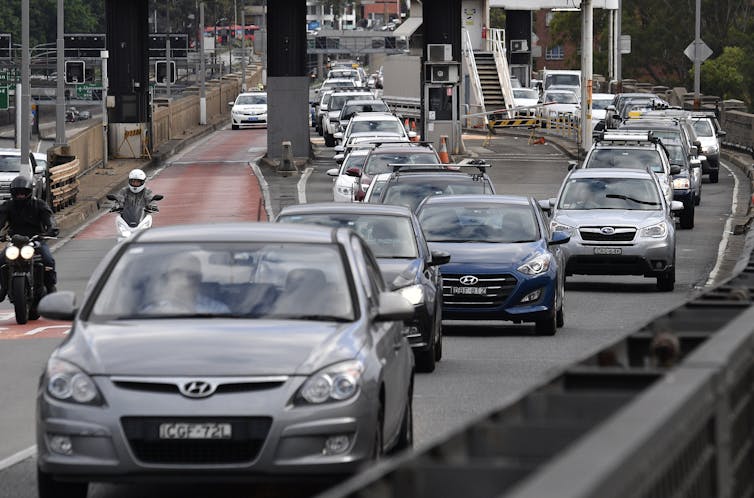
During the Easter school holidays, scores of learner drivers will hit the roads, with parents carefully logging all their driving hours. Many of us have experienced this process, whether as a learner, a supervisor, or both.

The requirement is particularly high in New South Wales and Victoria, where learners must complete a minimum of 120 hours of supervised driving before they can drive without supervision. This one of the highest requirements for learner drivers in the world.

We set out to answer whether this supervised driving practice actually makes for safer drivers.

Our study evaluated the effect of two significant increases in the minimum supervised driving hours mandate in New South Wales: the 2000 reform from zero to 50 hours, and the 2007 reform from 50 to 120 hours.


Read more:
There’s little to gain and much to lose from lowering the minimum driving age


What we found

By comparing people who turned 16 – the minimum age to obtain a learner permit – just before the policy changed to people who turned 16 just after, we were able to isolate the effect of these policy changes on motor vehicle accidents, while abstracting from other factors that might affect accidents.

Our dataset contained all licensing and crash records in New South Wales over the reform periods. The crash data include all serious crashes – those that led to a hospitalisation and/or a vehicle being towed.

Consider people born in July 1991, or later. They were subject to the 120-hour mandate. But those born slightly earlier were subject to the 50-hour mandate if they obtained their learners’ permit relatively quickly.

If the policy was effective, we would expect to see a sharp drop in crash rates for people who turned 16 after the 120-hour rule came in. But we discovered there was no such drop.

We analysed the data in several ways, all of which suggested no effect of the 2007 reform on crash rates. Because of our large sample size, we were confidently able to rule out any meaningful effects. We did observe a small delay in the average age of obtaining a provisional (P1) license of around one month.

In contrast, the first policy change was effective. We found that increasing supervision from zero to 50 hours reduced the probability of a motor vehicle accident in the first year of unsupervised driving from 6.9 to 5.4 percentage points, a reduction of 21%. However, there was no reduction in the probability of an accident beyond this 12-month window, suggesting the extra experience is helpful initially, but does not change long-term driving habits.

Since young males are at higher risk of crashing than females, we thought there might be differences by sex. In fact, the results were very similar for males and females.

It is important to note that we evaluated the policy mandate, but we cannot guarantee compliance with it. In practice, people may do more hours than required, or may over-report their hours, risking penalties if caught. Widespread non-compliance could undermine the effect of the mandate. However, available evidence suggests that drivers in Australia are largely truthful in their reporting.

The study showed that while the change from 0-50 required hours of driving made a difference to safety, the further shift to 120 hours did not.
Mick Tsikas/AAP

Why does this matter?

Motor vehicle accidents are the second leading cause of death for people aged 15-24 years in Australia. Many policies have aimed to lower the risk for young drivers, including the introduction of graduated driver licensing and associated features such as provisional speed limits, passenger restrictions and engine restrictions.

Minimum supervised driving hours is a potentially important tool for improving road safety, but until now has not been subjected to rigorous evaluation. Evaluating this policy is important, as there are costs involved with the mandate.

The obvious cost is the time of learners and supervisors. However, there may be other social costs as well. For example, by placing barriers to obtaining a licence, such policies can limit young people’s access to work and education, and entrench disadvantage, particularly for those from single parent and low income families, or those who have moved out of home and lack access to a licenced driver.


Read more:
What parents need to know about learner drivers: four key lessons


How many hours should the mandate be?

Our findings suggest there are benefits to supervised driving experience. Moving from a regime of zero hours to 50 hours meaningfully reduced the risk of motor vehicle accidents. But moving from a regime of 50 to 120 hours provided no further benefits, suggesting the benefits are diminishing, and the mandate might be too high in New South Wales.

Like us, you might wonder where the 120 hours figure came from. We’re not certain, but a 2011 review by the NSW auditor-general points to a Swedish study. A group of young drivers who reported completing 118 hours of learner practice had a 35% lower accident risk than those reporting between 41-47 hours.

The problem is that it’s hard to attribute this difference in accident risk to the difference in reported hours, because the two groups of drivers were fundamentally different, having self-selected into different policy regimes and having experienced other policy differences as well. In particular, the former group were allowed to start driving a full 1.5 years before the latter group.

Where possible, policy changes should be informed by high-quality empirical evidence, and subjected to rigorous evaluation after they are implemented. For almost 25 years, teenagers in New South Wales have been logging their driving hours, but with little evidence on the benefits, until now.

Our results call for a re-think on how many hours learners should be required to complete, and suggest exploring other avenues for further improvements in the safety of young drivers.

The Conversation

The authors do not work for, consult, own shares in or receive funding from any company or organisation that would benefit from this article, and have disclosed no relevant affiliations beyond their academic appointment.

ref. 120 hours of supervised learner driving: our research suggests it may be too many – https://theconversation.com/120-hours-of-supervised-learner-driving-our-research-suggests-it-may-be-too-many-203225

Does exercise help you lose weight?

Source: The Conversation (Au and NZ) – By Nick Fuller, Charles Perkins Centre Research Program Leader, University of Sydney

pexels alteredsnaps, CC BY-SA

It’s no surprise exercise is one of the first things we turn to when we decide it’s time to lose weight.

We readily sign up for that gym membership and commit to extra walks with the dog, believing if we exercise enough, the number on the scales will drop.

Perhaps also unsurprisingly, many of us are disheartened when we follow this routine for months and don’t see any change on the scales. This is why I’m frequently asked: does exercise help you lose weight, or is it just diet?

Like all things related to weight loss, the short answer is: it’s complicated.


Read more:
What’s the ‘weight set point’, and why does it make it so hard to keep weight off?


What does the research say about exercise and weight?

There have been many studies over the past 70 years examining the role exercise plays in weight management. Recent research on the topic has predominantly found exercise alone has minimal impact on weight loss.

This includes a meta study examining all the relevant studies in the area, which found those who used exercise alone lost minimal weight compared with those who exercised and also reduced their energy intake.

A 2018 study found substantial weight loss was unlikely when participants followed the minimum governing guidelines for physical activity. This prescribes 150 minutes of moderate or 75 minutes of vigorous physical activity each week. The overall volume of exercise had to be significantly above the minimum recommended levels in order to achieve significant weight loss without dieting.

Studies show you need to be doing about 60 minutes of moderate activity per day to achieve significant weight loss.

But before you cancel that gym membership, we also need to consider the substantial body of research confirming it’s vital to focus on exercise as part of any weight loss program.

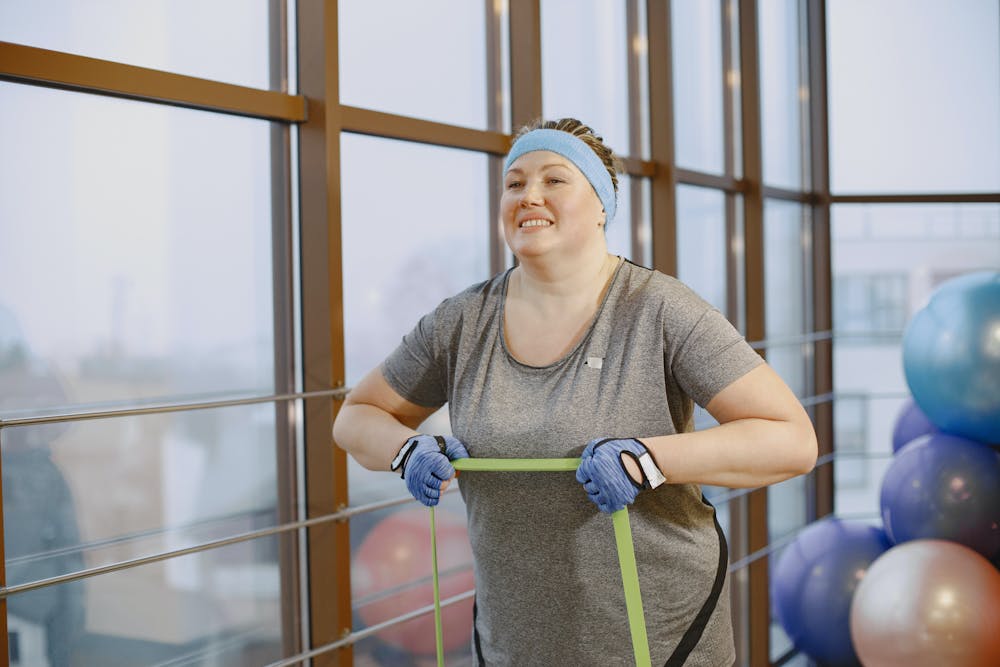
Woman using an exercise band
Exercise is a vital part of weight loss and maintenance, despite the fact it won’t work in isolation.
pexels/gustavo fring, CC BY-SA

Exercise helps keep weight off long term

Exercise will improve your body composition and prevent muscle decline. Our metabolic rate – how much energy we burn at rest – is determined by how much muscle and fat we have, and muscle is more metabolically active than fat, meaning it burns more kilojoules.

Relying on diet alone to lose weight will reduce muscle along with body fat, slowing your metabolism. So it’s essential to make sure you’ve incorporated sufficient and appropriate exercise into your weight-loss plan to hold onto your muscle mass stores.

Incorporating strength-building resistance training is also important. This doesn’t mean you need to be in the gym every day. Just two days per week and in the comfort of your own home is perfectly fine.

Research confirms moderate-volume resistance training (three sets of ten repetitions for eight exercises) is just as effective as high-volume resistance training (five sets of ten repetitions for eight exercises) for maintaining lean mass and muscle when you’re following a diet incorporating moderate calorie restriction.

Studies also show physical activity and exercise have a substantial effect in preventing weight regain after weight loss. A longer-term study found those sustaining high exercise levels (expending more than 10,500 kilojoules or 2,500 calories each week, for example by walking 75 minutes per day) maintained a significantly larger weight loss than participants exercising less.


Read more:
Taking a break from your diet helps long-term weight loss


Exercise has overall health benefits

Before you start to see the results of exercise on the scales, you’re almost guaranteed to experience the many physical and mental health benefits that come with exercise.

Even low levels of exercise reduce your chance of developing diseases such as heart disease and type 2 diabetes. Research shows exercise is just as important as weight loss for improving health, because most diabetes and heart disease risk markers associated with obesity can be improved with exercise, even if you don’t lose weight.

A physically active person with obesity can be considered metabolically healthy if they maintain good blood pressure, cholesterol and insulin levels. There is good evidence to show the risk of early death associated with obesity is largely reduced or eliminated by moderate-to-high levels of fitness.

Alongside improving your health, regular exercise has other physical benefits, such as improving strength and mobility. It also reduces stress levels, and even low levels of exercise will prompt a decrease in depressive symptoms, improve mood and promote better sleep.

This, in turn, will help you manage your diet better, with the boost to your mood helping you choose healthier foods and prevent impulsive food choices.

Runner stopped to breathe on bridge
Exercise has a multitude of benefits aside from weight maintenance.
Shutterstock

The bottom line?

Exercise will help you lose weight and prevent you putting on weight again – it’s just that it won’t help you achieve your weight loss goals in isolation.

Exercise is one of the key pillars of long-term weight management. It plays an essential role in weight loss and maintenance, as do our diet and sleep choices.

To encourage more exercise, take up something you enjoy. Be sure to include variety, as always doing the same daily routine is a surefire way to get bored and give up.


Read more:
The last 5 kilos really are the hardest to lose. Here’s why, and what you can do about it


The Conversation

Dr Nick Fuller works for the University of Sydney and has received external funding for projects relating to the treatment of overweight and obesity. He is the author and founder of the Interval Weight Loss program.

ref. Does exercise help you lose weight? – https://theconversation.com/does-exercise-help-you-lose-weight-198292

The untapped power of ocean winds – why New Zealand is looking offshore for future renewable energy

Source: The Conversation (Au and NZ) – By Craig Stevens, Professor in Ocean Physics, National Institute of Water and Atmospheric Research

Nathan Stirk/Getty Images

The latest synthesis report released by the Intergovernmental Panel on Climate Change (IPCC) makes it clear we need to prepare for intensifying impacts, while also cutting emissions dramatically.

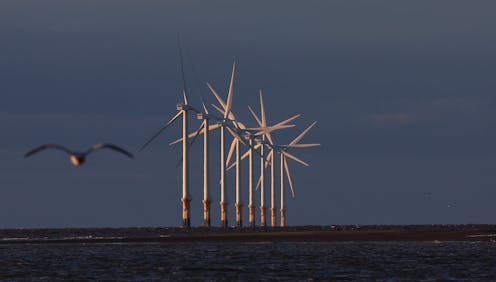
One beacon of hope is the global growth in renewable energy, with offshore wind in particular with new installations increasing almost six-fold in 2021 compared to 2020.

Aotearoa New Zealand is one of a few regions – with Norway, Iceland, Brazil and Canada – with an already high proportion of electricity coming from renewable sources. However, electricity does not equal total energy and New Zealand must consider a fundamental shift for other parts of its energy spectrum, including industrial heat.

There is no shortage of energy in New Zealand’s marine environment. A current discussion document (calling for public submissions by April 14) signals that offshore wind is poised to build a beachhead in a renewables market historically dominated by hydro power and underpinned by coal.

The technical and environmental challenges of offshore wind power are complex and expensive. Countries such as China, Denmark, Ireland and the UK currently lead the way, but New Zealand’s position in the southwest Pacific Ocean means there’s plenty of wind energy, both on land and at sea.


À lire aussi :
Ireland has the wind and seas to become an offshore superpower


A shift in energy supply

Ara Ake, an energy innovation centre with a mission to assist New Zealand’s decarbonisation, recently held a forum on offshore renewable energy in New Plymouth, the country’s centre for the natural gas sector.

The discussions centred around upcoming changes to the Resource Management Act, which will affect how development in the environment proceeds, and the recognition that any new initiatives need to engage with Te Tiriti and Māori perspectives on how resources are used and who benefits.

The discussion document highlights two regions: the Taranaki Bight and Foveaux Strait. Both locations are relatively shallow and well suited to installations of current technology.

A NZ$4 billion project to build the country’s first 65-turbine offshore wind farm off the Taranaki coast could be completed within a decade, but the document also identifies some potential future regions that are deeper and more exposed to the Southern Ocean.

Potential impacts of offshore wind farms

New Zealand is watching developments at a large Australian offshore wind farm off the coast of Gippsland, which aims to supply 20% of the electricity for the state of Victoria.

But offshore wind generation presents environmental challenges, including possible impacts of large arrays of wind turbines on seabirds and marine mammals. The seas around Aotearoa are home to a greater proportion of seabirds than almost any other populated centre, including many seabird species that breed nowhere else.


À lire aussi :
Australia is poised to be a world leader in offshore wind, but any potential risks to marine life remain poorly regulated


Other potential impacts extend to fisheries. But these depend on the location as ecosystems, fisheries and regulatory structures are unique to specific regions.

But one set of impacts has so far received little consideration. As tides push water past turbine pylons, the resultant wakes affect ocean stirring. This effect can be seen from space.

A recent study for UK offshore wind farms identified how large arrays are affecting the biological functioning of coastal seas.

Sediment stirred up in the wakes of an offshore wind farm off the UK coast.
NASA Earth Observatory, CC BY-ND

With growing impacts from a changing climate, we need to ask more nuanced questions. For example, when considering environmental impacts, what baseline should we consider? Will the impacts of any particular development exceed the projected impacts of climate-driven extremes for that region?

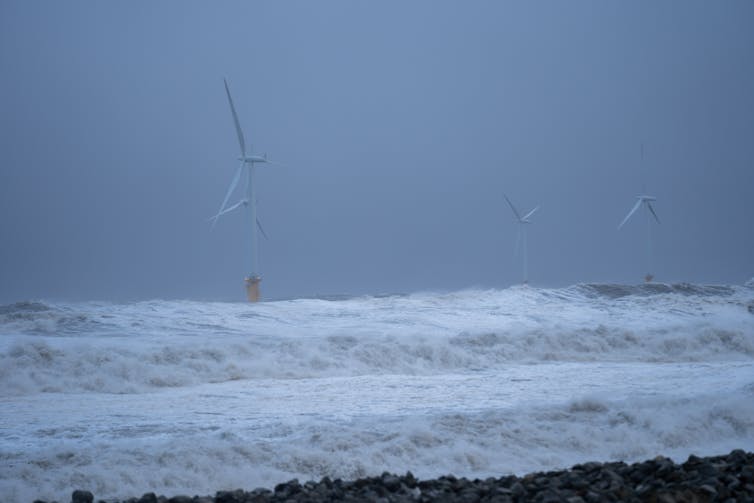
Another compound question is how offshore renewables infrastructure will cope with a changing ocean. Climate projections are unequivocal about increasing future storminess and stronger or more frequent tropical cyclones. These will be challenging for all infrastructure, not just marine.

Offshore wind turbines in a storm
Storms are likely to become increasingly intense as the climate warms.
Jason Brown/SOPA Images/LightRocket via Getty Images, CC BY-ND

Future thinking

A notable aspect of the current discussions in New Zealand is the use of the term “offshore renewables” rather than “offshore wind”. This allows the focus to include a wider set of renewable energy resources, including next-generation ocean renewables such as wave and tidal energy.

While these approaches are niche compared to established offshore wind power, they bring a diversity of supply that will be vital when building a portfolio of renewable resources to move away from fossil fuels.


À lire aussi :
Offshore wind turbines could number 30,000 by 2030 – new ideas in ocean engineering are needed to install them


This evolution will require people, but New Zealand’s education sector is not producing enough graduates with a speciality in marine engineering. Beyond engineering, there are opportunities for data science, industrial services and infrastructure – and the possibility to develop a research initiative to foster long-term capability and ideas.

The climate emergency is upon us now and the rapidly closing window of opportunity requires a shift in energy perspective if we are to give future generations the best chance of a liveable and sustainable planet.

The Conversation

Craig Stevens receives funding from the Marsden Fund and MBIE (Ministry for Business, Innovation and Employment). He is affiliated with AWATEA (Aotearoa Wave and Tidal Energy Association) and the NZ Association of Scientists. He is on the Interim Science Advisory Panel for the CE of the Ministry for the Environment.

ref. The untapped power of ocean winds – why New Zealand is looking offshore for future renewable energy – https://theconversation.com/the-untapped-power-of-ocean-winds-why-new-zealand-is-looking-offshore-for-future-renewable-energy-202335

I’ve created a monstera! How to care for the ‘Swiss cheese plant’ in your life

Source: The Conversation (Au and NZ) – By Gregory Moore, Senior Research Associate, School of Ecosystem and Forest Sciences, The University of Melbourne

Shutterstock

When I was growing up monsteras (sometimes known as monsteria) were not all that common, but neither were indoor plants. In fact, monsteras were out of fashion back then – but now monsteras are back and, appropriately, in a big way.

The plants that we know as monsteras, fruit salad plant or Swiss cheese plants (due to their holey leaves) are a rainforest plant called Monstera deliciosa.

They’re originally from Central America, around Mexico, but their iconic large leaves can now be found everywhere in popular culture – from fabric prints and earrings to tattoos and mugs.

So, what’s special about this large and lovely plant? And what’s the secret to keeping one happy and healthy?


Read more:
Multi-coloured plants are suddenly a home decor ‘must-have’. Here’s how to keep them alive


Rainforest climbers

In their natural habitat, monstera are climbers that can scramble through rainforest trees to heights of 25 metres or more.

Their large perforated leaves can be over a metre long, with regular nodes along the stem and roots often growing from these nodes. The roots help them hook onto other plants as they climb to access light.

There are about 50 species in the Monstera genus and some – such as Monstera adansonii (Adanson’s monstera or five holes plant) and Monstera siltepecana (silver monstera) – are popular indoor plants.

Monstera adansonii is a popular indoor plant.
Shutterstock

The name Monstera dates back to the 1700s, but these days most people associate this part of the name with its massive leaves. They are, after all, real monsters.

These huge leaves develop wherever there is a patch of light and allow the plant to grow quickly and shade out nearby competition.

The species name, deliciosa, refers to its fruit, which tastes a little like a cross between banana and pineapple.

Monsteras are related to the arum lilies and produce white flowers on a fleshy stem (known as a “spadix”) that is surrounded by a cream or white leaf-like structure or bract (known as a “spathe”).

The fruit can be eaten.
Shutterstock

Our first and only monstera began its life with us as a rather small indoor plant given as a gift in 1980. It remained indoors for a year or two, growing well, but then proved too great a temptation for a curious young son.

It was moved in its container (which was, by then, larger than its original pot) into a protected corner of an outside patio.

It had done well indoors, growing in a good quality potting medium, getting plenty of sunlight and regular water. Its leaves had gone from small philodendron-like features into the large and perforated foliage of the Swiss cheese plant.

The move outdoors did it no harm. Good light, regular water, fresh air and protection from winds and frosts saw it flourish into a plant with many large leaves and measuring nearly two metres in height. It filled a corner beautifully.

A forgiving plant

Monsteras are quite forgiving indoor plants. They are quite hardy (like many climbers) but as a tropical plant they like warm, humid conditions and moist, well-drained soils.

They also tolerate shade and so it’s not surprising they do well indoors.

If you have a humus-rich potting medium and provide a climbing frame for them, they can thrive and survive for many years inside. However, you may need to give them a liquid fertiliser every year or two and re-pot them into a larger container.

While they are hardy and relatively easy to cultivate, Monsteras can decline if they become waterlogged.

This can easily happen if you over-water plants and have the container on a dish that gathers water.

Direct sunlight near a window can burn their leaves or lead to scorched patches. Leaves can also be damaged by warm dry air if plants are placed too close to heaters or heating ducts.

Their large leaves may also need dusting as the surfaces can become quite dirty, especially in bathrooms. The occasional prune will prevent the plant becoming too big indoors and removes yellow, burnt and older leaves.

Like many indoor plants, monsteras can benefit from a bit of R-and-R outdoors in a warm, sheltered spot for a few days.

Yellow leaves are a sign you’re likely doing something wrong.
Shutterstock

Easily propagated

As a fashionable plant, large monsteras can be quite pricey and variegated forms which grow more slowly are even more expensive.

However, Monstera deliciosa can be readily propagated from cuttings.

The easiest and quickest way of getting a new plant is to take a section of stem with a leaf or two attached and, if possible, with a few developing roots. Place it in a good quality potting mix in a large container.

You can also aerial layer monsteras, which is where you wrap potting mix or sphagnum moss around a node, preferably with some roots, in plastic or cling wrap. Make a couple of slash-like cuts in the stem and when roots develop, take your cutting from the stem.

They grow and establish quickly. So quickly, in fact, they’re considered a weed along some New South Wales rivers.

After being on the patio for several years, the patio was to be demolished for an extension and our monstera either had to go or be planted in the garden.

We chose the latter and planted it in what we thought was an appropriate spot.

The monster responded as only a successful rainforest climber could. It spread, it climbed, it fruited and wherever there was a patch of light, it oriented a giant Swiss cheese leaf to gain maximum benefit for photosynthesis.

It is now over 40 years old, many metres long as it meanders its way through the garden and has been the source of several successful cuttings for family and friends.


Read more:
Trees can be weeds too – here’s why that’s a problem


The Conversation

Gregory Moore does not work for, consult, own shares in or receive funding from any company or organization that would benefit from this article, and has disclosed no relevant affiliations beyond their academic appointment.

ref. I’ve created a monstera! How to care for the ‘Swiss cheese plant’ in your life – https://theconversation.com/ive-created-a-monstera-how-to-care-for-the-swiss-cheese-plant-in-your-life-202851

Holiday help! An art expert suggests screen-free things to do in every room of the house

Source: The Conversation (Au and NZ) – By Naomi Zouwer, Visual Artist and Lecturer in Teacher Education, University of Canberra

Keren Fedida/Unsplash

School holidays can feel like a marathon if all the kids want to do is watch TV, play Minecraft or repeatedly ask you for the iPad.

There are lots of things you can do inside the house that do not involve a screen. And will help ward off any whines along the lines of: “I’m booooooored”.

In a previous piece I talked about how to set up an art studio at home. This time, here are five creative ideas to try in every room of the house.


Read more:
How to set up a kids’ art studio at home (and learn to love the mess)


In the kitchen: make your own paint

Kids enjoy making potions in the garden by adding dirt and flowers and you can have similar fun in the kitchen making paint from ingredients in the cupboard.

Paint is made with pigment and a binder. The first paint on cave walls was made with charcoal, ochre, minerals mixed with water, saliva, blood, animal fat and even wee. The history of paint is fascinating and kids are intrigued by the stories, like how a certain purple (tyrian) comes from the glands of sea snails and how a type of yellow was cruelly made from cow wee, after forcing them to eat mango leaves.

You can make your own paint with spices like turmeric, curry powder and cinnamon or hunt through the house for chalk and eye shadow for a variety of colours.

Ground turmeric
Ground tumeric can be turned into paint.
Shutterstock

Grind the pigments up with a mortar and pestle (some will need this more than others but it’s a fun part of the process). Then in a glass or jar, mix your ground pigments with a bit of egg yolk, a teaspoon of vinegar and a small amount of water as a binder and you have made egg tempera – a type of paint the Egyptians discovered and some artists still use today.

Experiment with other spices, berries, grass or charcoal. If it’s colourful, you can grind it and its not too lumpy, give it a go. See how many colours you can make, then make a painting.


Read more:
‘Screen time’ for kids is an outdated concept, so let’s ditch it and focus on quality instead


In the living room: create a box masterpiece

Kids who may not like to draw or paint often love construction. So, collect different types of boxes and see what your child can create.

Apart from the boxes, you will also need masking tape. Kids can tear it themselves, or use a dispenser. Staplers and hole punchers are good connectors too. Also give them some thick markers, fabric scraps and glue to add details to their creations.

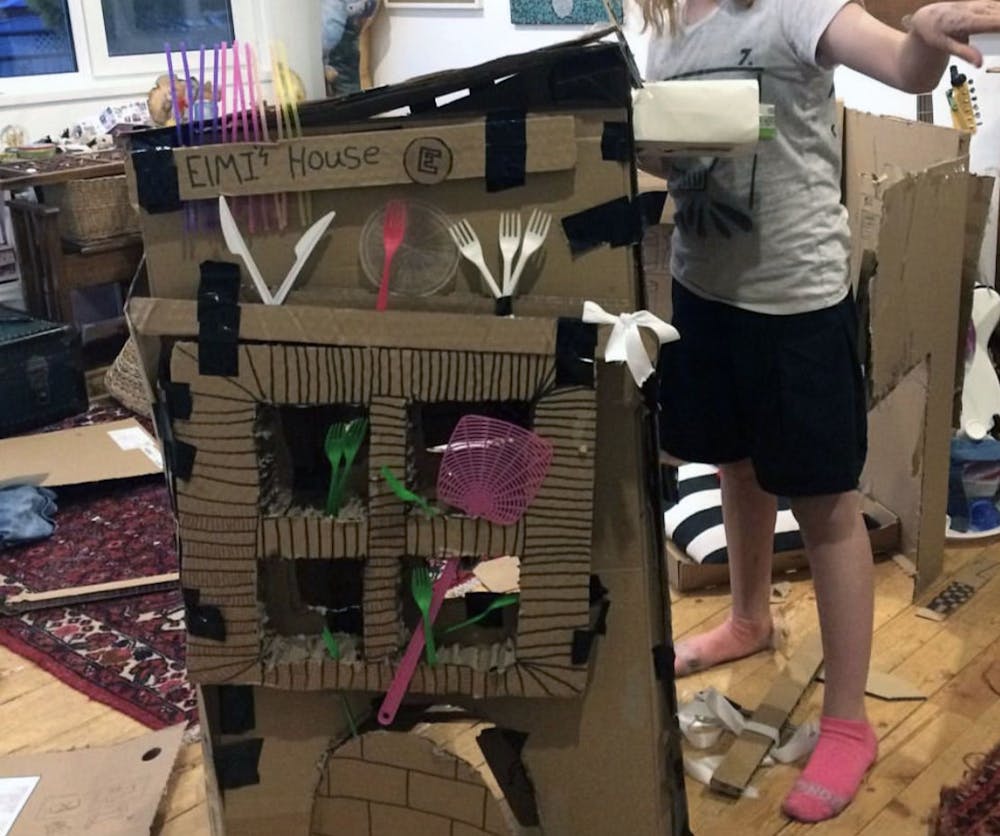
One holiday, we lived around my daughter’s construction zone as she worked with cardboard, other items from the recycling bin and things from around the house to make her own house.

Cardboard boxes and everyday household items can be turned into a holiday home.
Naomi Zouwer

In your child’s bedroom: paint a mural

This won’t be possible for everyone, but think about letting your child paint a mural in their bedroom. My mum let us create fantastic scenes in our bedrooms growing up.

Start by mapping out a basic design on paper. This slows the process down, allowing the child to think about what they would like on their walls. But be prepared for the plan to go out the window. Sometimes as artists we respond to the materials when we get them in our hands.

The trick to creating a successful mural with kids is selecting a good colour palette and you really can’t go wrong.

A child paints a flower on a wall.
Start with a mural plan but be prepared to ditch it.
Shutterstock

Get some sample-sized pots of water-based interior paint and bristle brushes from the hardware shop. Then tape a drop sheet to the floor and cover anything else you don’t want covered in paint and go for it!

If this is too freestyle for you, have a look at the wonderful “field of flowers” activity in Hervé Tullet’s book, Art Workshops for Children. This is a more structured approach to a collaborative painting and yields beautiful results (it starts with dots, then dots within dots and you end up with a field of flowers).

If this is not possible where you live, consider liquid chalk pens to create murals on the windows. This is so much fun and you can play with tracing things outside the window.

Pick an array of colours and overlap line drawings to build up patterns on the glass. This is so easy to clean too – just wipe it off with a wet cloth.

In the dining room: make a comic

The dining table is the perfect spot for projects and drawing. I find kids love creating comics. The book Making Comics by Lynda Barry has excellent exercises to get you started on comic strips, storyboards and zines.

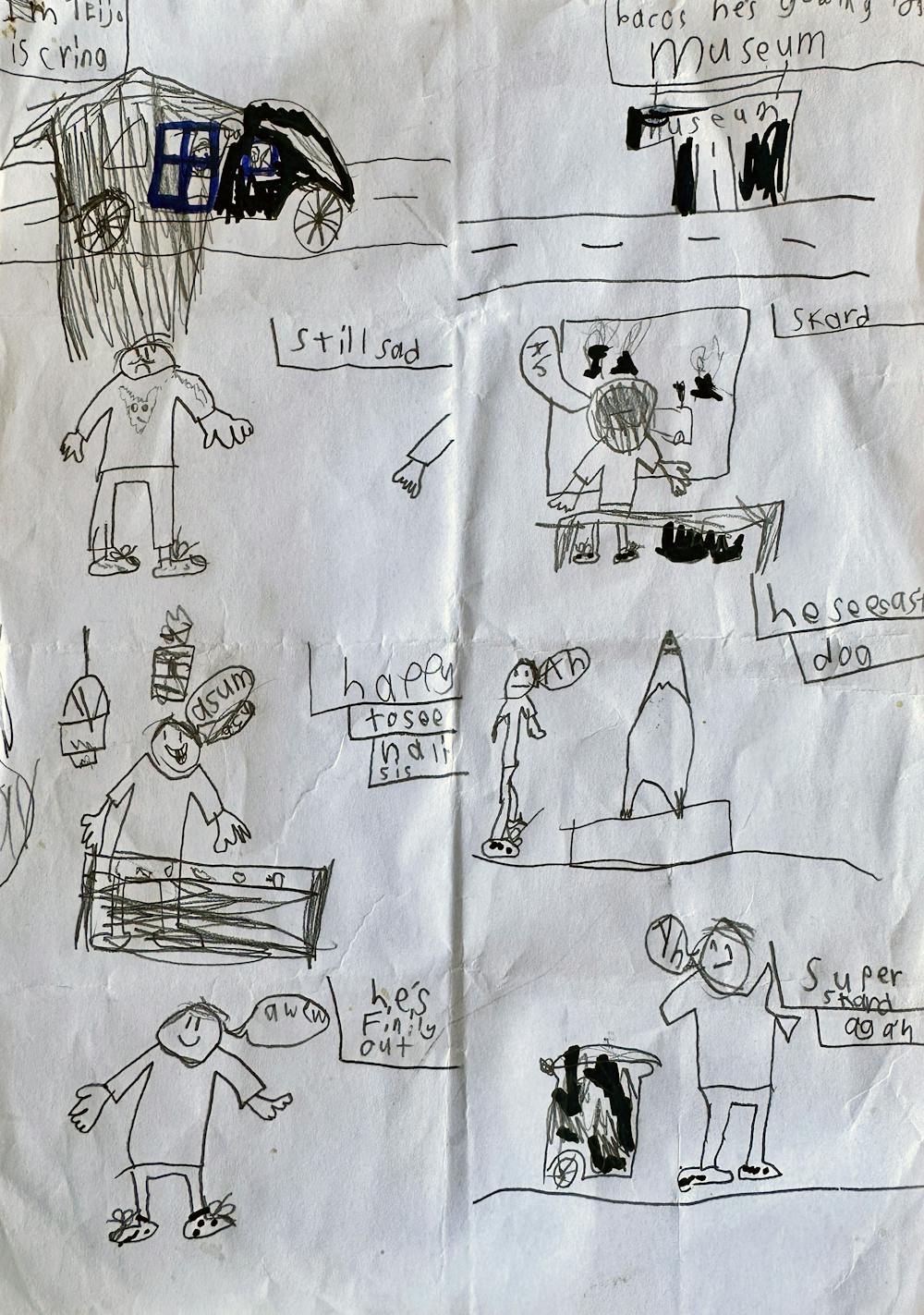
‘A day at the museum’ by T Slater, aged 5.
Naomi Zouwer

Zines are mini DIY booklets. You can fill them with ideas using drawing, collage and words. Check out my how to make a zine video done for the National Museum of Australia’s Ancient Greeks exhibition last year.

You could do something similar: take your young person to see an exhibition, collect some flyers or postcards, and then at home cut them up and stick them into a zine. This can extend your child’s museum experience, and provides a chance to discuss and make sense of what you saw together.

Children use drawing to make sense of the world around them. When my son was five, he made a comic about a gallery experience: how he didn’t want to go, how he felt about some of the artworks, and how he was relieved to get out because he was scared by some of the work.

This gave me the opportunity to see how strongly he was affected by the exhibition and we were able to talk about those feelings.

In the bathroom: crack open the shaving cream

Shaving cream is a great medium with endless possibilities for sensory play, which helps brain development, motor skills and more.

You can make slime by adding a cup of glue to two cups of shaving cream and sprinkling a teaspoon of baking powder in the mix, plus two teaspoons of saline solution. Add food dye for a marble effect, make prints and paint with it onto a mirror or bathtub.

You can also use it to make sculptures. Start with a shampoo bottle as your armature (inner structure) and build your form around it. Take photos of the sculptures as a way of recording the ephemeral creations.

Green and blue dye mixed into shaving cream.
Add food dye to shaving cream for a creative bathroom activity.
Shutterstock

Try adding cornstarch to the shaving cream and play with the proportions until you have developed a malleable substance. The transformation of the substance is quite remarkable and kids love the tactile quality of this mixture.

In the end, kids have the best ideas, so just take some time to ask them what kinds of creative activities they might like to explore over the holidays and let them take the lead. The important thing here is to let go, enjoy the process and play – worry about cleaning up later!


Read more:
How to get the most out of sand play: 4 tips from a sculptor


The Conversation

Naomi Zouwer does not work for, consult, own shares in or receive funding from any company or organisation that would benefit from this article, and has disclosed no relevant affiliations beyond their academic appointment.

ref. Holiday help! An art expert suggests screen-free things to do in every room of the house – https://theconversation.com/holiday-help-an-art-expert-suggests-screen-free-things-to-do-in-every-room-of-the-house-202947

What The Jetsons got right, and very wrong, about the future of work

Source: The Conversation (Au and NZ) – By Agustin Chevez, Workplace Futures Research Lead, Centre for the New Workforce., Swinburne University of Technology

George Jetson at work. Hanna-Barbera

Sixty years ago the animated series The Jetsons finished its first and only season before being cancelled. Just 24 episodes were broadcast between September 1962 and March 1963. Despite this the cartoon has achieved huge influence in popular culture, with countless reruns, a reboot in the mid-1980s (51 episodes over two seasons) and a feature-length movie in 1990.

The Jetsons was created by the Hanna-Barbara animation studio in Los Angeles as a futuristic version of the studio’s hit series The Flintstones, the first cartoon series to gain a prime-time slot.

But whereas The Flintstones was set in a distant, mythical stone age thousands of years in the past, The Jetsons was set in a very near future – in 2062.

Like The Flintstones, the show was aimed mostly at children, and played with ideas about the future for laughs. It’s not a serious work of futurology. Even so, it’s still an interesting cultural artefact, helping us appreciate our present and our expectations of the future.

The first episode was broadcast just a few weeks after US president John F. Kennedy gave his famous “Moon speech”, promising “to go to the Moon in this decade and do the other things, not because they are easy, but because they are hard”.

The Jetsons’ title sequence.

While that promise was motivated by fears of the Soviet Union winning the Space Race, the future depicted is mostly optimistic. Technology holds the promise of a better world.

Among the whimsical technology imagined are flying cars, robot maids, video calls, smartwatches, food printing and space tourism. Some of this seems far-sighted. But there are big blind spots. Those flying cars, for example, still need a driver.

There are three things its creators got glaringly wrong: the place of women in the workforce, how much we will work, and where we work.

Gender stereotypes

Like the Flintstones, The Jetsons revolves around a nuclear family in mid-20th century industrialised society. There’s George (aged about 40), his wife Jane (about 33), their teenage daughter Judy (15), younger son Elroy, a dog named Astro, and a robot maid.

We can calculate that Jane was still in her teens when she became a mother. She’s the head of a recycling company but it doesn’t seem to involve much work. For most part she’s typical TV homemaker.

This is now the norm in only a small number of societies. It seems unlikely the trend in women’s workforce participation will reverse in the next 40 years.


Had the show been made a decade later it’s possible the influence of the women’s liberation movement and books such as Germain Greer’s The Female Eunuch (published in 1970) would have altered this vision of 2062.

In the 1990 movie, for example, Jane is an environmental activist. In a 2017 relaunched comic she is a scientist working on the International Space Station.

Working hours

One explanation as to why Jane doesn’t work is that George, the breadwinner, barely has to work either.

He goes to work just two days a week, for one hour a day, as a “digital index operator”. This involves him pushing buttons to maintain an atomic supercomputer named RUDI (short for “Referential Universal Digital Indexer”).

George’s working hours reflect the optimism of the 1960s that gains made by workers in the first half of the 20th century – with a 40-hour, five-day workweek becoming the norm by the 1950s – would continue in the second half of the century. Optimists hoped productivity gains from automation would mean a “leisure society” by the year 2000.

George Jetson at work.
Hanna-Barbera

This has not proved the case, with only marginal reductions in working hours for most since then.

As US economist and sociologist Juliet Schor noted in her 1991 book The Overworked American: The Unexpected Decline of Leisure, the idea technology alone can lead to working less fails to account for the economic system in which work is done. That is, capitalism is geared towards increasing consumption (and thereby profits). The emphasis has therefore been on making more money as the key to happiness, and therefore working even harder, not less.

We can see this even in the current four-day week movement, which promises the prospect of cutting the 38-hour, five-day workweek to 32 hours and four days, but only so long as the same productivity is maintained.

Trials of this 100:80:100 model (100% of the pay, 80% of the hours, 100% of the productivity) have been heralded a great success, but as work researcher Anthony Veal has noted, big questions remain as to whether these results are applicable across the economy.


Read more:
4-day work week trials have been labelled a ‘resounding success’. But 4 big questions need answers


At this stage, the likelihood of significant reduction in working hours for most people over the next 40 years looks dubious.

Remote work

Even though George only has to work two hours a week, he still has to go to an office (at Spacely Space Sprockets) to push his buttons.

This may reflect the fact the internet and the personal computing revolution were yet to occur. Futurologists didn’t start enthusing about the prospects of remote working until the 1970s.

More importantly, that’s just how things were conceived – work was something done under the watchful eye of management. It also created opportunities to play with familiar motifs involving George’s boss, the short-tempered Mr Spacely, a character similar to Fred Flintstone’s boss, Mr Slate, and Mr Burns in The Simpsons.


Read more:
A short history of the office


Management resistance to remote work was strong up until the COVID-19 pandemic forced a cultural shift.
The future of where and how much we work will no doubt be shaped by technology. But our perceptions and expectations about what can be achieved are just as important.

The Conversation

Agustin Chevez does not work for, consult, own shares in or receive funding from any company or organization that would benefit from this article, and has disclosed no relevant affiliations beyond their academic appointment.

ref. What The Jetsons got right, and very wrong, about the future of work – https://theconversation.com/what-the-jetsons-got-right-and-very-wrong-about-the-future-of-work-202608

Since the late 19th century, adventurous female ‘eclipse chasers’ have contributed to science in Australia

Source: The Conversation (Au and NZ) – By Toner Stevenson, Honorary history affiliate in the School of Humanities, Faculty of Arts and Social Sciences, University of Sydney

Elizabeth Campbell operating the Floyd Telescope, 1922 total solar eclipse. State Library Western Australia 4131B/3/8, enhanced detail, Author provided

A total solar eclipse is a remarkable alignment of our Sun, Earth and the Moon, as the latter casts a perfect shadow across the former.

If you’re in the narrow path of the shadow of the Moon, at the moment of totality you are plunged into darkness. Stars and planets emerge in the sky, and the entire atmosphere changes. This immersion in a total solar eclipse is unforgettable.

As 21-year-old Australian Miriam Chisholm reported in 1922,

I looked up from the telescope just an instant before totality and thought I saw the Corona, a pale fringe around the Sun […] and then the light went out and we saw it in all its glory.

A photograph of the black totally eclipsed sun in the centre with a white haze of corona around it. The image was encapsulated in a glass plate slide to project for teaching at Sydney Observatory.
Photograph of the solar corona taken using the Floyd Camera by Elizabeth Campbell, 21 September 1922. The image was later used for teaching at Sydney Observatory. Collection Museum of Applied Arts and Sciences.

Historically, total solar eclipses were a unique opportunity to conduct scientific research about our Sun, the closest star. Using special instruments called spectroscopes, it was possible to decipher the chemical composition of the gases emitted by the Sun – but only during a total eclipse.

As I write in my recently co-authored book Eclipse Chasers, perhaps the best-known eclipse experiment was the proof of Albert Einstein’s general theory of relativity. In the early 20th century this theory could only be tested during the minutes of totality, requiring a clear sky around the covered Sun so you could photograph the stars.

Women in the field

Accounts of well-known historic discoveries in astronomy might leave the impression this work was only undertaken by men. But in the late 19th and early 20th century, women in Australia already participated in astronomy as female “computers” and amateur astronomers. They were deeply involved in scientific expeditions to view total solar eclipses, but it was not easy.

The living conditions were rough, in tents with poor amenities open to the weather, and little or no privacy. The months needed to travel on solar eclipse expeditions meant leaving family responsibilities, one of the reasons it was unusual to find women in the field. When women did participate, they were usually the wives and daughters of male astronomers.

A young woman in a mortar board hat and gown.
Annie Louisa Virginia Dodwell (1870-1924) graduated with a Bachelor of Science from the University of Adelaide. Collection University of Adelaide. This image was taken with a group of other graduands around 1905. Enhanced.

The first Australian woman whose total solar eclipse observations were officially reported was Annie Louisa Virginia Dodwell. She had a Bachelor of Science from the University of Adelaide and gained astronomy knowledge working with her husband George Dodwell, the South Australian Government Astronomer.

Together, they organised the Adelaide Observatory expedition to Bruny Island in Tasmania for the 1910 total solar eclipse. The party arrived by ship and for a month they camped in tents in almost constant rain to prepare. The eclipse day was clouded, nonetheless Annie successfully recorded the change in temperature, the only science of value that was achieved.

In the following years she presented talks about astronomy, published poems and participated in the inaugural International Astronomical Union assembly at the Vatican Observatory in 1922. She arranged the logistics for her husband’s total solar eclipse expedition later that year, during which she transcribed his observations to the newspapers.


Read more:
A century ago, Australia was ground zero for eclipse-watchers – and helped prove Einstein right


Seasoned eclipse chasers in the 1920s

In 1922 an international team of astronomers, led by William Campbell, Director of Lick Observatory, and assisted by the Australian Navy, travelled to a remote location in Western Australia to confirm Einstein’s general theory of relativity during the September 21 total solar eclipse.

There were five women participating in this expedition: Elizabeth Campbell, Jean Chant with her daughter Elizabeth, Eleanor Adams and Mary Acworth Evershed.

Four women in 1922 aboard a ship.
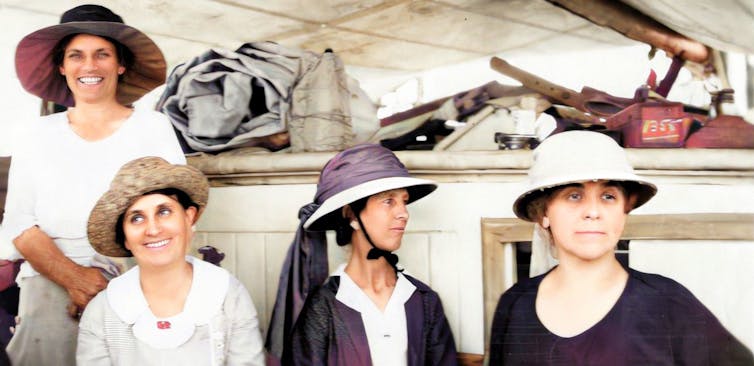
Four of the women who participated in the total solar eclipse expedition led by Lick Observatory to Wallal Downs on their way from Broome to Ninety Mile Beach, Western Australia, 1922. Left to right: Elizabeth Chant (1899-1982), Jean Chant (1870-1940), Mary Acworth Evershed (1867-1949), Elizabeth Ballard Campbell (1869-1961). Collection State Library Western Australia, 4131B/1/24. Colourised.
State Library Western Australia

While they were the wives and daughter of respective male astronomers, each woman was a seasoned eclipse observer in her own right. They knew how to operate and use technical equipment and contributed substantially to reporting the scientific work.

Elizabeth Campbell organised the supplies and operated spectroscopic and photographic telescope equipment during the eclipse. Eleanor Adams worked with her husband on the large 12-metre eclipse camera. Jean Chant observed the shadow bands and changing brightness of the sky, and Elizabeth Chant operated a prism that polarised light.

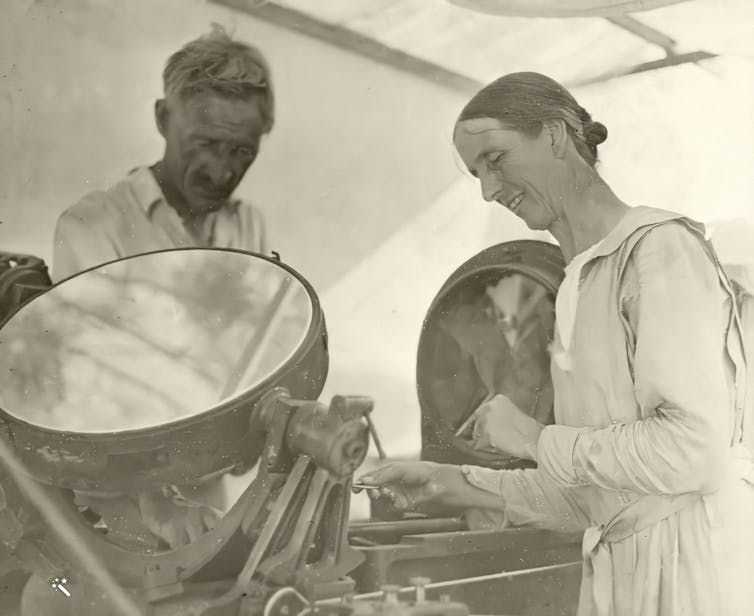
Mary Acworth Evershed was an established expert in solar physics and worked alongside her husband, director of the Kodaikanal solar observatory in India. She photographed the spectra of the Sun’s corona. In 1896, on return to England, she published a pocket-sized Easy Guide to the Southern Stars with star maps of the constellations visible from the southern hemisphere.

A man and a woman in tent adjusting a piece of equipment that has a circular mirror and pivots on one axis.
Mary Acworth and John Evershed adjusting a problematic instrument called a coelestat used to track the Sun. Lick Observatory Photographs. Special Collections and Archives, University Library, UC Santa Cruz. Photograph: Ernest Brandon-Cremer.

A long drive across the country

On the other side of the continent, a very different eclipse expedition was organised by 21-year-old Miriam Chisholm with her school friend Frida Tindal. Chisholm’s father, Frank, drove them over 950 kilometres from Goulburn to southern Queensland.

They lost four days when their car was bogged in mud and almost didn’t make it to the line of totality. Thankfully, due to excellent time-keeping and navigation they had a successful eclipse. They drew the Sun’s corona, measured the temperature, observed how animals and birds became quiet and timed the shadow bands. Their report is descriptive, inspiring and filled with detailed observations. It is still a useful guide on how to make the most of a total solar eclipse experience.

Father and daughter stand in front of a car in 1922. He is drinking from a cup. A telescope is strapped to the side of the car.
Miriam and Frank Chisholm with their eclipse-chasing car. You can see her telescope strapped to the side of the car. Courtesy History Goulburn. Photograph: Miriam Chisholm, self-timer. Colourised image.
History Goulburn

On April 20 2023 a total solar eclipse will be visible from Exmouth in Western Australia. This is the first total solar eclipse in Australia since 2012, when thousands of people flocked to northern Queensland. I was there, and for two minutes and five seconds of totality, I experienced a beautiful “diamond ring” effect as the Moon totally covered the Sun, revealing its misty corona.

There are four more total solar eclipses in the next 17 years. Following in the footsteps of early 20th century eclipse chasers, large numbers of Australians will soon be able to share a total solar eclipse experience they will treasure, record and retell throughout their lives.

The Conversation

Toner Stevenson is affiliated with the University of Sydney, Faculty of Arts and Social Sciences, School of Humanities.
She is currently Vice President of Sydney City Skywatchers, an amateur astronomy society, not-for-profit, and in voluntary capacity. The society was previously called the British Astronomical Association, NSW Branch. This society will be mentioned in the article. She is on the Board of the Australian National Committee of the International Council of Museums, voluntary role.
She is a co-author of the recently published ‘Eclipse Chasers’ book, the research for which informed this article.

ref. Since the late 19th century, adventurous female ‘eclipse chasers’ have contributed to science in Australia – https://theconversation.com/since-the-late-19th-century-adventurous-female-eclipse-chasers-have-contributed-to-science-in-australia-200552

Here’s why having chocolate can make you feel great or a bit sick – plus 4 tips for better eating

Source: The Conversation (Au and NZ) – By Saman Khalesi, Postdoctoral Fellow of the National Heart Foundation & Senior Lecturer and Discipline Lead in Nutrition, School of Health, Medical and Applied Sciences, CQUniversity Australia

Shutterstock

Australians are predicted to spend around A$1.7 billion on chocolates, hot cross buns and other special foods this Easter season.

Chocolate has a long history of production and consumption. It is made from cacao beans that go through processes including fermentation, drying, roasting and grounding. What is left is a rich and fatty liquor that is pressed to remove the fat (cocoa butter) and the cacao (or “cocoa”) powder which will then be mixed with different ingredients to produce dark, milk, white and other types of chocolates.

There are several health benefits and potential problems that come in these sweet chocolatey packages.


Read more:
At chocolate time, we’ve discovered what the brands that score best on child labour and the environment have in common


The good news

Cacao beans contain minerals like iron, potassium, magnesium, zinc and phosphorus and some vitamins. They are also rich in beneficial chemicals called polyphenols.

These are great antioxidants, with the potential to improve heart health, increase nitric oxide (which dilates blood vessels) and reduce blood pressure, provide food for gut microbiota and promote gut health, boost the immune system and reduce inflammation.

However, the concentration of polyphenols in the chocolate we eat depends largely on the cocoa solid amounts used in the final product.

In general terms, the darker the chocolate, the more cocoa solids, minerals and polyphenols it has. For example, dark chocolates may have around seven times more polyphenols compared to white chocolates and three times more polyphenols compared to milk chocolates.

selection of dark chocolate squares
Dark chocolate is less likely to give you problems.
Shutterstock


Read more:
Health Check: the good and bad of Easter eggs, chocolate and hot cross buns


But also some bad news

Unfortunately, the health benefits of cocoa solids are easily offset by the high sugar and fat content of modern-day chocolates. For example, milk and white chocolate eggs are on average 50% sugar, 40% fat (mostly saturated fats) – which means a lot of added kilojoules (calories).

Also, there may be some side effects that come with ingesting chocolate.

Cocoa beans include a compound called theobromine. While it has the anti-inflammatory properties responsible for some of the health benefits of chocolate, it is also a mild brain stimulant that acts in a similar way to caffeine. The mood boost it offers may also be partly responsible for how much we like chocolate. Dark chocolate has higher theobromine compared to milk and white chocolate.

But accordingly, overindulging in chocolate (and therefore theobromine) may lead to feeling restless, headaches and nausea.


Read more:
What’s the white stuff on my Easter chocolate, and can I still eat it?


What else is in your chocolate?

Milk and dairy-based chocolates may also cause stomach upset, abdominal pain and bloating in people with lactose intolerance. This happens when we don’t produce enough lactase enzymes to digest milk sugar (lactose).

People with lactose intolerance can usually tolerate up to 6 grams of lactose without showing symptoms. Milk chocolate can have around 3 grams of lactose per 40 grams (the size of a standard chocolate bar). So two chocolate bars (or the equivalent in milk chocolate eggs or bunnies) may be enough to cause symptoms.

little girl with bunny ears on and chocolate on face
Lactose sensitivities tend to increase with age.
Shutterstock

It’s worth noting that lactase enzyme activity dramatically declines as we age, with the highest activity in newborns and children. So lactose sensitivity or intolerance may not be such an issue for your kids and your symptoms may increase over time. Genetics also plays a major role in how sensitive people are to lactose.

Allergic reactions to chocolate are usually due to the added ingredients or cross-contamination with potential allergens such as nuts, milk, soy, and some sweeteners used in the production of chocolate.

Symptoms can be mild (acne, rashes and stomach pain) or more severe (swelling of the throat and tongue and shortness of breath).

If you or your family members have known allergic reactions, make sure you read the label before indulging – especially in a whole block or basket of the stuff. And if you or your family members do experience symptoms of an allergic reaction after eating chocolate, seek medical attention immediately.

4 take home tips

So, if you are like me and have a weakness for chocolate there are a few things you can do to make the experience a good one.

  1. keep an eye out for the darker chocolate varieties with higher cocoa solids. You may notice a percentage on labelling, which refers to refers to how much of its weight is from cocoa beans. In general, the higher this percentage, the lower the sugar. White chocolate has almost no cocoa solid, and mostly cocoa butter, sugar and other ingredients. Dark chocolate has 50–100% cocoa beans, and less sugar. Aim for at least 70% cocoa
  2. read the fine print for additives and possible cross-contamination, especially if allergies might be an issue
  3. the ingredients list and nutrition information panel should tell you all about the chocolate you choosing. Go for varieties with lower sugar and less saturated fat. Nuts, seeds and dried fruits are better ingredients to have in your chocolate than sugar, creme, syrup, and caramel
  4. finally, treat yourself – but keep the amount you have within sensible limits!


Read more:
The history of chocolate: when money really did grow on trees


The Conversation

Dr Khalesi is supported by a Postdoctoral Fellowship (Award No. 102584) from the National Heart Foundation of Australia.

ref. Here’s why having chocolate can make you feel great or a bit sick – plus 4 tips for better eating – https://theconversation.com/heres-why-having-chocolate-can-make-you-feel-great-or-a-bit-sick-plus-4-tips-for-better-eating-202848

Dingo attacks are rare – but here’s what you need to know about dingo safety

Source: The Conversation (Au and NZ) – By Bill Bateman, Associate professor, Curtin University

Luis Cristofori/Shutterstock

Australia has an ambivalent relationship with dingoes – to some they are almost magical representations of our arid landscapes, responsible for holding back a tide of foxes and feral cats, as found in some studies.

To others they are pests, dangerous marauders of our cattle and sheep. We even argue about what to call them. They also loom large in our national conscience as potential killers of children, as shown by a recent dingo attack on a child on K’gari (Fraser Island).

Why do dingoes attack?

Dingo attacks on humans are very rare, and in most cases where humans have been attacked, the dingoes have become habituated to humans and have perhaps lost some fear of them.

This is usually because they have come to associate people with food, though not necessarily as food. This kind of habituation is seen in many animals across the world, including large carnivores such as bears and coyotes in North America, and even spotted hyaenas in Ethiopia.

The recent attack on K’gari has another facet, though. The child was attacked while sitting in shallow water at the beach, and the event highlights that dingoes can be predators. There is no indication the dingo was trying to take food from the child; it’s possible it was tentatively seeing if the child was suitable as prey.

A sign that outlines the danger from dingoes and shows steps people can take to exercise caution
In areas like K’gari dingo safety information is distributed to keep everyone safe.
Annalucia/Shutterstock

Children as prey

A 2017 study of dingo attacks on K’gari showed most of the dingoes involved were young ones, and children who were some distance from an adult were often the recipients of attacks.

In 2001, a nine-year-old boy was tragically killed by two dingoes on K’gari when he was standing some distance away from the rest of his family and tripped and fell over. A five-year-old boy who was badly bitten by dingoes on K’gari in 2022 was attacked when his elder brother walked away from him.

In all these cases, although there were other people nearby, the dingoes selected the smallest and most separated person. This suggests that a hunting response was triggered – a child is not much bigger than normal dingo prey (such as wallabies). The dingoes involved were perhaps young and exploratory.

In fact, you can often see such reactions in zoo animals – lions, tigers and other big cats often ignore adult humans looking at them, but become excited when they see a child; the smaller size seems to trigger a predatory response.

How can you stay safe from dingoes?

The bottom line is dingoes are wild animals and can sometimes act as predators towards us, especially the smallest humans.

Dingoes are found across Australia, though they are less common in pastoral areas where lethal control occurs. They tend to avoid people wherever possible. K’gari dingoes are protected for their high conservation value, because they show little evidence of inbreeding with domestic dogs. As a result, these island dingoes are much bolder. Visitors need to treat them with respect.

So how do we stay safe? We should always be on high alert around such animals, especially in places where dingoes are more common and bolder. As with any wildlife, we should leave dingoes alone as much as possible, and keep a respectful distance. We also should avoid leaving food around, which could attract attention in the first place.

But if you do encounter a dingo (or several), here’s what to do:

  • stay alert and keep a safe distance
  • avoid being alone or, if in a group, don’t spread too far out
  • stay close to any children in your group
  • don’t run or turn your back on the dingo, as this may trigger an attack.

People often feel they should not act aggressively if approached by a carnivore, but studies on wolves and pumas suggest that shouting and throwing things is actually more likely to prevent an attack – don’t be afraid to resort to this if you feel threatened.

Anything that makes you, or the people with you, seem less like prey – less enticing – is good. Stay safe, but most importantly, respect these animals for the wild creatures they are.

The Conversation

Bill Bateman does not work for, consult, own shares in or receive funding from any company or organization that would benefit from this article, and has disclosed no relevant affiliations beyond their academic appointment.

ref. Dingo attacks are rare – but here’s what you need to know about dingo safety – https://theconversation.com/dingo-attacks-are-rare-but-heres-what-you-need-to-know-about-dingo-safety-203233

The crucifixion gap: why it took hundreds of years for art to depict Jesus dying on the cross

Source: The Conversation (Au and NZ) – By Robyn J. Whitaker, Associate Professor, New Testament, Pilgrim Theological College, University of Divinity

Pavias Andreas, The Crucifixion, second half of the 15th century National Gallery – Alexandros Soutsos Museum

The cross, or crucifix, is arguably the central image of Christianity.

What’s the difference between the two? A cross is just that – an empty cross. It stands as a statement that Jesus is no longer on the cross and thus symbolises his resurrection.

A crucifix, on the other hand, includes the body of Jesus, to more vividly remind viewers of his death.

Many contemporary Christians, from bishops to ordinary folk, wear some kind of cross or crucifix around their neck and it would be rare to find a church that did not have at least one prominently displayed in the building.

While a symbol of faith, it is not just the pious who wear crosses. Madonna famously wore crucifix earrings and necklaces constantly throughout the 1980s and ‘90s. She is quoted as doing so because she provocatively “thought Jesus was sexy”.

The recent ubiquity of the cross as a fashion item means it is sold at everything from cheap tween fashion stores to that jeweller renowned for its little turquoise boxes, where a diamond cross necklace can run in excess of $10,000.

The 2018 Met Gala’s theme, Heavenly Bodies: Fashion and Catholic Imagination, further bestowed religious imagery with fashion icon status by making it central to one of the fashion industry’s key events.

Yet the cross was not always the dominant symbol of Christianity that it is now, and would certainly not have been worn as a fashion accessory by early Christians.

In fact, it took centuries for Christians to begin to depict the cross in their art.


Read more:
Jesus wasn’t white: he was a brown-skinned, Middle Eastern Jew. Here’s why that matters


An undignified death

While some want to credit Emperor Constantine for the use of the cross as becoming more widespread after the 4th century, it is not that simple. Part of the answer lies in the nature of crucifixion itself.

While crucifixion included some variety in antiquity, it was typically a form of execution reserved for non-elite, non-citizens in the 1st-century Roman Empire.

Slaves, the poor, criminals and political protesters were crucified in their thousands for “crimes” we might today consider minor offences. The types of cross structures might differ, but as a form of execution, crucifixion was brutal and violent, designed to publicly shame the victim by displaying him or her naked on a scaffold, thereby asserting Rome’s power over the bodies of the masses.

That Jesus suffered such an undignified death was an embarrassment to some early Christians. The apostle Paul describes Jesus’ crucifixion as a “stumbling block” or “scandal” to other Jews. Others would imbue it with sacrificial meaning to make sense of how the one claimed as God’s Son would suffer in this way. But the shame associated with this kind of death remained.

Crude scratchings: a young man worshipping a crucified, donkey-headed figure.
The Alexamenos graffito in Rome.
Wikimedia Commons

A now infamous piece of graffito, dating to the early 3rd century in Rome, arguably mocks Jesus’ manner of death. Sketched on a wall in Rome, the Alexamenos graffito portrays a donkey-headed male figure on a cross under which is written “Alexamenos, worship god”. The suggestion is that the parody was directed at Christians precisely because they worshipped a man who had died by crucifixion.

Christian images

Felicity Harley-McGowan, an expert on crucifixion and early Christian art, argues Christians began to experiment with making their own specifically Christian images around 200 CE, roughly 100-150 years after they began writing about Jesus.

Carved wooden panel: Jesus appears to be nailed in a door frame.
Early works depicting Jesus’ death didn’t always show an overt cross, as in this 440 AD image from the Church of Santa Sabina.
Wikimedia Commons, CC BY-SA

The slowness to depict Jesus on a cross was not about a general sensibility to the visual arts, although they do seem to have been very selective in what they did portray. Artwork typically depicted biblical stories and used bucolic imagery to show others being rescued from death or to tell the stories of biblical heroes like Daniel or Abraham.

In the 4th century, Christians began to depict other death scenes from the Bible, such as the raising of Jairus’ daughter, but still not Jesus’ death. Harley-McGowan writes:

it is clear that the earliest representations of deaths in early Christian art were pointed in their focus on actions after the event.

Such depictions emphasised healing, new life and resurrection from death. This emphasis is one explanation for why Christians were slow to depict Jesus’ actual death.

One of the earliest extant depictions of Jesus can be found in the Maskell Passion Ivories dating to the early 5th century CE, more than 400 years after his death. These ivories formed a casket panel that includes one death scene amid a range of scenes telling the Jesus story.

Judas hangs from tree; below him the purse from which fall pieces of silver; to the right Christ is nailed by the hands only to the cross
Maskell Passion Ivories, one of the earliest extant depictions of Jesus.
© The Trustees of the British Museum, CC BY-NC-SA

Like much previous Christian art, the emphasis remained on Jesus’ victory over death rather than any desire to depict the reality or violence of his crucifixion. One way to show this was to portray Jesus on a cross but with his eyes open, alive and undefeated by the cross; in the Maskell Ivory, Jesus’ alertness is contrasted with the clearly dead Judas.

While there is a 3rd-century magical amulet that includes crucifixion imagery (and there may have been other gems and amulets lost to history that associated his resurrection from death in magical terms), depictions of the cross only began to emerge in the 5th century and would remain rare until the 6th.

Green-brown jasper; oval with a crucified figure on a tall cross with a short base.
This magical amulet, carved on jasper, dates to the 3rd century.
© The Trustees of the British Museum, CC BY-NC-SA

As churches began to be built, crucifixes appeared on engraved church doors and would remain the more standard image until the Reformation emphasis on the empty cross.

The cross continues to have a complex history, being used as both a symbol of Christian ecclesial power and of white supremacy by groups like the Ku Klux Klan.

There can be beauty, intrigue, magic and terror in these cross traditions.

gold with loop and expanding arms which terminate in oval medallions; in the centre Christ crucified
This Early Byzantine pendant dates to the 6th or 7th century.
© The Trustees of the British Museum, CC BY-NC-SA

On one hand, it stands as a symbol of Christian belief in Jesus’ death and resurrection. On the other, it is a reminder of the violence of the state and capital punishment.

Perhaps, 2,000 years later, it is always both – even when diamond-encrusted.


Read more:
Baby Jesus in art and the long tradition of depicting Christ as a man-child


The Conversation

Robyn J. Whitaker does not work for, consult, own shares in or receive funding from any company or organisation that would benefit from this article, and has disclosed no relevant affiliations beyond their academic appointment.

ref. The crucifixion gap: why it took hundreds of years for art to depict Jesus dying on the cross – https://theconversation.com/the-crucifixion-gap-why-it-took-hundreds-of-years-for-art-to-depict-jesus-dying-on-the-cross-202348

How does the Liberal Party’s Voice policy stack up against the proposed referendum?

Source: The Conversation (Au and NZ) – By Anne Twomey, Professor emerita, University of Sydney

Despite the political acrimony over the Voice referendum, what’s most striking is the similarities between the positions of the Coalition and the Labor government.

Both agree Aboriginal and Torres Strait Islander peoples should be recognised in the Constitution. Both agree practical outcomes are needed to improve the lives of Indigenous Australians. Both agree parliament and the executive government need to be better informed about the laws and policies they make, and that they need to hear the voices of those on the ground who are affected by those laws and policies.

Given this agreement about what needs to be done, why is there disagreement about the referendum?

Recognition and practical outcomes

The key sticking point seems to be the relationship between constitutional recognition and achieving practical outcomes. The Albanese government proposes to achieve practical outcomes by establishing a constitutional means by which Aboriginal and Torres Strait Islander peoples can influence the laws and policies that affect them.

This is the form of constitutional recognition supported by Aboriginal and Torres Strait Islander peoples in consultations held across Australia by the Referendum Council, culminating in the Uluru Statement from the Heart. It wasn’t invented and imposed top-down by the Albanese government.

In contrast, the Coalition proposes that constitutional recognition be split from practical outcomes. It would instead legislate to establish local and regional Voices, but not a national Voice.

It’s unclear what kind of constitutional recognition the Coalition proposes. But it would appear to be symbolic recognition, such as a reference in a preamble. This could be in either the existing preamble in the British Act that contains the Australian Constitution, or in a new preamble inserted in the Constitution itself.

Such an approach, however, was rejected by the Aboriginal and Torres Strait Islander representatives at the consultations held by the Referendum Council, and at Uluru.


Read more:
The Voice: what is it, where did it come from, and what can it achieve?


Constitutional recognition needs the support of those recognised

History and common sense tell us there’s no point in seeking to recognise a group in the Constitution in a manner they reject. Voters will justifiably ask why they should vote for a form of recognition opposed by the people who are to be recognised.

The 1999 preamble referendum shows us the futility of engaging in a top-down process. Then-Prime Minister John Howard decided to run a second question at the republic referendum that would insert a new preamble in the Constitution. He ignored the elements of a preamble that had been agreed upon by the 1998 Constitutional Convention. Instead, he prepared his own draft, in consultation with the poet Les Murray.

The exposure draft of that preamble included the words:

Since time immemorial our land has been inhabited by Aborigines [sic] and Torres Strait Islanders, who are honoured for their ancient and continuing cultures.

Aboriginal and Torres Strait Islander groups criticised this wording. In particular, the word “inhabited” wasn’t seen as properly respecting the relationship between Aboriginal and Torres Strait Islander peoples and their lands and waters.

A new draft was then developed by Howard in conjunction with the Australian Democrats Senator, Aden Ridgeway, who was the only Aboriginal member of the parliament at the time.

It included the phrase:

honouring Aborigines [sic] and Torres Strait Islanders, the nation’s first people, for their deep kinship with their lands and for their ancient and continuing cultures which enrich the life of our country.

But the failure to consult more widely with Indigenous leaders, and the inappropriate application of the word “kinship”, resulted in some Indigenous groups campaigning against it.

The preamble referendum failed. It achieved support from only 39% of the people and fared poorly in seats with a high Indigenous population.

The chairman of the Aboriginal and Torres Strait Islander Commission, Gatjil Djerrkura, welcomed the defeat of the referendum. He said that while the preamble was meant to unite the nation, it had been drafted without any meaningful discussion with the Australian people – both Indigenous and non-Indigenous. He said this lack of consultation was a clear lesson for future referendums.

A Coalition commitment to Indigenous constitutional recognition will be a hollow one if it doesn’t involve engagement with Aboriginal and Torres Strait Islander peoples and provide a form of recognition that’s acceptable to them.

A headless Voice?

The other plank of the Coalition’s policy is legislating to establish local and regional Voices.

Opposition Leader Peter Dutton observed, quite rightly, that most laws affecting Aboriginal and Torres Strait Islander peoples are state or local laws. But the Commonwealth creating local and regional Voices won’t have any effect on those state and local laws.

Commonwealth law can only deal with how the representations made by these Voices affect Commonwealth policies and laws. It’s a matter for the states whether they create their own Voices, as South Australia has done, or seek representations from Commonwealth bodies.

Second, creating local and regional Voices is a recipe for chaos if there’s no way of channelling their representations through to the parliament and executive government in an orderly way.

Is it really sensible for a national decision-maker to receive 72 different representations direct from local Voices, which say different things? How effective would that be, and what would be the administrative burden of such an unwieldy system? Wouldn’t it be more rational to have a national body which receives input from all the local and regional Voices, and can provide comprehensive and well-considered advice?

The current proposal of the Albanese government is to have a national Voice which receives input from local communities so it can make practical and well-informed representations to the Commonwealth.

Whether separate local and regional Voices are established, or existing Aboriginal and Torres Strait Islander bodies are used to provide that local input, will be a matter for parliament.

Such an approach has been anticipated. The Referendum Working Group asked the Constitutional Expert Group for advice on this, with that advice confirming parliament would have the power “to establish sub-national Voices”.


Read more:
The Liberal Party’s ‘no’ position on Voice signals it’s primarily interested in speaking to a nation that no longer exists


The campaign

The campaign is likely to be rancorous, but the similarities between the major parties’ policies should negate some of the arguments.

For example, it would be difficult for the Coalition to run arguments that Aboriginal and Torres Strait Islander peoples should not be treated differently in the Constitution, or given any special capacity to influence parliament and the executive. This is because the federal Liberal Party has said it supports constitutional recognition, and supports local and regional Voices to influence Commonwealth laws and policies.

While the referendum vote itself will be between the status quo and the proposed amendment, the people now have a clearer view of the political alternatives and can judge for themselves which would lead to better outcomes.

The Conversation

Anne Twomey has received funding from the Australian Research Council and sometimes does consultancy work for governments and Parliaments. She was a member of the Constitution Expert Group which advised the Referendum Working Group on the proposed referendum.

ref. How does the Liberal Party’s Voice policy stack up against the proposed referendum? – https://theconversation.com/how-does-the-liberal-partys-voice-policy-stack-up-against-the-proposed-referendum-203352

Historic day for Fiji journalism as ‘draconian’ media law scrapped

By Lydia Lewis and Kelvin Anthony, RNZ Pacific journalists

The Fiji Parliament has voted to “kill” a draconian media law in Suva today, sending newsrooms across the country into celebrations.

Twenty nine parliamentarians voted to repeal the Media Industry Development Act, while 21 voted against it and 3 did not vote.

The law — which started as a post-coup decree in 2010 — has been labelled as a “noose around the neck of the media industry and journalists” since it was enacted into law.

While opposition FijiFirst parliamentarians voted against the bill, Fiji’s Deputy Prime Minister and Minister for Finance Professor Biman Prasad said binning the act would be good for the people and for democracy.

Removing the controversial law was a major election promise by Prime Minister Sitiveni Rabuka’s coalition government.

Emotional day for newsrooms
The news was “one for the ages for us”, Fiji Times editor-in-chief Fred Wesley, who was dragged into court on multiple occasions by the former government under the act, told RNZ Pacific in Vanuatu.

He said today was about all the Fijian media workers who stayed true to their profession.

“People who slugged it out, people who remained passionate about their work and continued disseminating information and getting people to make well-informed decision on a daily basis.”

“It wasn’t an easy journey, but truly thankful for today,” an emotional Wesley said.

“We are in an era where we don’t have draconian legislation hanging over our heads.”

He said the entire industry was happy and newsrooms are now looking forward to the next chapter.

“The next phases is the challenge of putting together a Fiji media council to do the work of listening to complaints and all of that, and I’m overwhelmed and very grateful.”

Holding government to account
He said people in Fiji should continue to expect the media to do what it was supposed to do: “Holding government to account, holding our leaders to account and making sure that they’re responsible in the decisions they make.”

Fiji Media Act repealed on Thursday. 6 April 2023
Fiji Times editor-in-chief Fred Wesley and Islands Business editor Samantha Magick embrace each other after finding out the the Fijian Parliament has repealed the MIDA Act. Image: Lydia Lewis/RNZ Pacific

Journalists ‘can be brave’
Islands Business magazine editor Samantha Magick said getting rid of the law meant it would now create an environment for Fiji journalists to do more critical journalism.

“I think [we will] see less, ‘he said, she said’, reporting in very controlled environments,” Magick said.

“Fiji’s media will see more investigations, more depth, more voices, different perspectives, [and] hopefully they can engage a bit more as well without fear.

“It’ll just be so much healthier for us as a people and democracy to have that level of debate and investigation and questioning, regardless of who you are,” she added.

RNZ Pacific senior sports journalist and PINA board member Iliesa Tora said the Parliament’s decision sent a strong message to the rest of the region.

“The message [this sends] to the region and the different regional government’s is that you need to work with the media to ensure that there is media freedom,” said Tora, who chose to leave Fiji because he could not operate as a journalist due of the act.

“The freedom of the media ensures that people are also able to freely express themselves and are not fearful in coming forward to talk about things that they see that governments are not doing that they [should] do to really govern in the countries.”

‘Step into the light’ – corruption reporting project
Organised Crime and Corruption Reporting Project co-founder and publisher Drew Sullivan told RNZ Pacific that anytime a country that was not able to do the kind of accountability journalism that they should be doing, this damaged media throughout the region.

“It creates a model for illiberal actors in the region to imitate what’s going on in that country,” Sullivan said.

“So this has really moved forward in allowing journalists again to do their job and that’s really important.”

Fiji journalists, Sullivan said, had done an amazing job resisting limitations for as long as they could.

“Fiji was really a black hole of journalism [in] that the journalists could not participate in on a global community because they couldn’t find the information; they weren’t allowed to write what they needed to write.

“So this is really a step forward into the light to really bring Fiji and media back into the global journalism community.”

Korean cult investigation
Last year, OCCRP published a major investigation on Fiji, working with local journalists to expose the expansion of the controversial Korean Chirstain-cult Grace Road Church under the Bainimarama regime.

Rabuka’s government is currently investigating Grace Road.

Sullivan said OCCRP will continue to support Fijian journalists.

“But [the repealing of the act] will allow a lot more stories to be done and a lot more people will understand how the world really works, especially in Fiji.”

This article is republished under a community partnership agreement with RNZ.

Fiji Media Act repealed on Thursday. 6 April 2023
Fred Wesley and Rakesh Kumar from The Fiji Times, Samantha Magick from Islands Business, and OCCRPs co-founder and publisher Drew Sullivan in Port Vila. Image: Lydia Lewis/RNZ Pacific
Print Friendly, PDF & Email

Article by AsiaPacificReport.nz

‘Frustrated’ USP law students were catalyst for landmark UN climate vote

By Kalinga Seneviratne in Suva

There was euphoria at the campus of the University of the South Pacific (USP) in Suva in Fiji last Thursday when news came from New York that a historic resolution on climate action had been adopted unanimously at the United Nations General Assembly.

The resolution refers to the International Court of Justice case that would result in an advisory opinion clarifying nations’ obligations to tackle the climate crisis and the consequences they should face for inaction that could be cited in climate court cases in the future.

The campaign for the landmark resolution, supported by more than 130 member countries, started its journey in 2019 when a group of final-year law students conceived the project as an extra-curricular activity known as “learning by doing” on USP’s international environmental law course at their campus in Port Vila in Vanuatu.

USP's law course coordinator Dr Justin Rose
USP’s law course coordinator Dr Justin Rose . . . “elated” over the students’
success on the world stage. Image: The Conversation

An elated Dr Justin Rose, adjunct associate professor of law and coordinator of the 2019 class where the campaign originated, told University World News from New York where he had joined his former students for the UN vote that it was any lecturers dream to see such results achieved by the students he had guided.

“Teaching and learning about climate change and climate change governance can increasingly be somewhat depressing — I teach what are essentially the same problems, and the same proposed but unimplemented solutions, that were taught to me at ANU [Australian National University] in 1992 when I studied the course I now coordinate.

“Those same problems and solutions have been ignored for so long that catastrophic climate impacts are occurring,” notes Rose.

Then in 2019 he set up an extra-curricular exercise that students could volunteer for.

A different skillset
“There were 20 participants from a class of 140,” he said, recalling how the project started.

“It was a way to teach a different skillset to those interested in doing some extra work and to empower them to do something positive about climate change.

“The exercise was, firstly, to discuss among the group the most productive legal action Pacific island countries could initiate within international law, and secondly to prepare letters and a brief that could be sent to PIF [Pacific Island Forum] leaders seeking to persuade them to implement it,” explained Rose.

When, at the annual summit meeting of the PIF leaders in 2019, the leaders only “noted” the proposal, the students did not give up but instead formed an organisation — Pacific Islands Students Fighting Climate Change (PISFCC) — to start what soon became a global youth campaign for an International Court of Justice climate change opinion.

Their key objective was to convince the governments of the world to seek an advisory opinion from the International Court of Justice answering a question that would develop new international law integrating legal obligations around environmental treaties and basic human rights.

They were soon joined by the World’s Youth for Climate Justice.

The world ‘has listened’
“We are just ecstatic that the world has listened to the Pacific youth and has chosen to take action. From what started in a Pacific classroom four years ago,” noted Cynthia Houniuhi, the Solomon Islands-based president of PISFCC, who was one of the original law students at USP that initiated the project.

“We in the Pacific live the climate crisis. My home country Solomon Islands is struggling. Through no fault of our own, we are living with devastating tropical cyclones, flooding, biodiversity loss and sea-level rise.

“The intensity and frequency of it is increasing each time. We have contributed the least to the global emissions that are drowning our land,” said Houniuhi in a statement released from New York.

“The vote in the United Nations is a step in the right direction for climate justice.”

The International Court of Justice will now hold hearings and hear evidence on the obligations of states in respect to climate change, with a view to handing down an advisory opinion in 2024.

A favourable opinion should make it easier to hold polluting countries legally accountable for failing to tackle the climate emergency, possibly with compensatory payments given to victim countries.

“This isn’t the end of our campaign for climate justice. The court process will unfold, taking evidence from around the world,” said Vishal Prasad, a campaigner for PISFCC and a graduate from USP in politics and law.

“The real work begins in applying whatever the court advisory opinion says in domestic law, especially in countries that continue to drive the climate crisis with their toxic emissions.”

Merilyn Temakon, an assistant lecturer in legislation and intellectual property law at USP, said: “I am very proud indeed of these students as one of their leaders is Solomon Yeo whom I had the privilege of teaching.

“I was invited on one or two occasions to sit in the main conference room at Emalus (Vanuatu campus) and to listen to their presentations on the effect of climate change,” she recalls.

“At that time there were only a few active members, but now the whole of the PICs [Pacific Island Countries] and half the globe are behind their submission.”

Countries face escalating losses
USP politics and international affairs Associate Professor Sandra Tarte, who sent out an email to all colleagues on March 30 saying “Colleagues, we did it”, told University World News that the resolution emerged out of “mounting frustration at the mismatch between the global community’s rhetoric and action on climate change amid escalating losses for countries such as Vanuatu, which face an existential threat due to sea-level rise”.

The frustration spawned a social movement led by Vanuatu law students turned youth activists, and work on the resolution was led by Indigenous lawyers in the Pacific, she said.

Vanuatu’s Prime Minister Ishmael Kalsakau, speaking after the vote at the UN General Assembly, said: “Today we have witnessed a win for climate justice of epic proportions. Vanuatu sees today’s historic resolution as the beginning of a new era in multilateral climate cooperation.”

Solomon Yeo, one of the students involved in the initial project at USP, who was part of Vanuatu’s delegation to the UN General Assembly meeting, argues that securing the resolution demonstrates that Pacific youth can play a part in tackling climate change.

“Today we celebrate four years of arduous work in convincing our leaders and raising global awareness of the initiative,” he told Radio New Zealand, speaking from New York.

“The adopted resolution is a testament that Pacific youth can play an instrumental role in advancing global climate action [and] young people’s voices must remain an integral part of the process.”

“We are enormously proud of everything our alumni at PISFCC have achieved,” said USP vice-chancellor and president Professor Pal Ahluwalia in a statement.

“These are exactly the kind of high-achieving publicly minded graduates that we aim to produce.”

Dr Kalinga Seneviratne is consultant lecturer with the University of the South Pacific journalism programme based in Suva. This article was first published by University World News and is republished with permission.

Print Friendly, PDF & Email

Article by AsiaPacificReport.nz

Can a ‘nature repair market’ really save Australia’s environment? It’s not perfect, but it’s worth a shot

Source: The Conversation (Au and NZ) – By Hugh Possingham, Professor, The University of Queensland

Mee Ko Dong/Shutterstock

Australia has embarked on an experiment to create a market for biodiversity. No, we’re not talking about buying and selling wildlife, although, sadly, there is a black market for that. This is about repairing and restoring landscapes, providing habitat for threatened species and getting business and philanthropy to help pay for it.

When Environment and Water Minister Tanya Plibersek introduced the Nature Repair Market Bill to parliament last week, she said:

Just because something is difficult, doesn’t mean we shouldn’t do it. It means we should do it properly.

I agree. We have been publishing research on this topic for decades, discussing the issue with scientists, social scientists and economists. Now as chief scientist at the not for profit environmental accounting organisation Accounting for Nature and chief councillor at the Biodiversity Council, we are working hard to help turn the theory into reality.

There is, rightfully, a lot of concern about the integrity of biodiversity markets. However, with appropriate processes in place from governments, including independent authorities that verify biodiversity outcomes, and vigilance from the community, there is potential to create a well-behaved, net-positive biodiversity market in Australia.


Read more:
The historic COP15 outcome is an imperfect game-changer for saving nature. Here’s why Australia did us proud


What does a biodiversity market look like?

Australia has signed up to the United Nations’ Convention on Biological Diversity, which commits us to protecting and restoring 30% of the land for nature. This means 30% of every kind of habitat – it can’t just be deserts and salt lakes, for example.

That’s a big task, and governments can’t do it alone. It’s going to have to be the entire community, every single individual. This isn’t just about protection, a lot will be habitat restoration which needs serious investment.


Read more:
The new major players in conservation? NGOs thrive while national parks struggle


The general public is increasingly concerned about the decline of nature in their local parks and backyards. One example is a nationwide concern about the disappearance of willie wagtails, a bird many Australians have grown up with. The loss of nature affects everyone, and can harm our mental health. It is not just about threatened species.

Concern for the cassowarry in the wet tropics region of far north Queensland prompted environmental management organisation Terrain NRM (natural resource management) to create a new biodiversity market scheme called Cassowary Credits. Terrain NRM says this is:

a mechanism that enables investors such as governments, philanthropists or corporates to pay landholders and land managers to undertake habitat restoration activities.

Australia has well over half a million different species, and about a third of them have a name. You can’t run a market for that many species – so the challenge will be to develop ways of quantifying biodiversity that are credible and simple.

Trial and error

A credible market needs a credible biodiversity currency (let’s call it a token). Such a token requires many attributes to make it work. The token should be awarded for measurable outcomes, like an increase in the abundance of hooded robins (a recently listed threatened woodland bird and one of my favourites) on your property, or an improvement in the extent and quality of native vegetation.

These outcomes need to be “additional”, outcomes that would not have otherwise happened without the investment. Ideally outcomes are permanent, and above and beyond what would have happened if we did nothing.

And finally, someone has to want to buy them – there is no point in creating a product when there is no demand. Making a trusted and valuable biodiversity currency is going to take time.

Almost 3,000 years ago the Lydians invented a currency based on metal coins with a ruler’s face stamped on it. That’s still roughly how it works, even with most of our money now being digital, rather than physical in coins and notes. However, even after 3,000 years, money is not yet perfect. Its value constantly changes, and it can collapse, too. There’s still fraud and scams – despite a global army of accountants, financial advisors, mathematicians and lawyers paid to assure integrity.

By comparison, creating a biodiversity market is more complex than stamping a face on a coin. Turning a million-dimensional object – the biodiversity of Australia – into a market will require biodiversity accountants, and biodiversity auditors, and strong laws to govern the new biodiversity markets. However, too much is at stake, and too many species will continue to disappear if we don’t try.


Read more:
Losing the natural world comes with major risks for your super fund and bank


Rivers of gold

The government points to a 2022 PricewaterhouseCoopers report that found a biodiversity market could unlock A$137 billion to repair and protect Australia’s environment by 2050.

It sounds fanciful but it could be even bigger than that. The demand is there, internationally, and it’s growing. Can we bring this investment to Australia?

The idea is companies who want to prove they’re “nature positive” will pay for the privilege; some investment could also come from philanthropy. (Notably this is not about “biodiversity offsetting” where people are forced to compensate for the damage they cause.)

Nature Positive by 2030: The global goal for nature works alongside the UN Convention on Biological Diversity’s Kunming-Montreal Global Biodiversity Framework.

The most important issue is integrity – it is transparent proof that actions have delivered additional permanent outcomes – much like biting a coin in 500 BCE to check it is really gold. And that’s the system we’re still struggling to create.

We’re getting there. A lot of smart people in the finance sector and the ecology sector are coming together to resolve some of these issues. I find it both exciting and uncertain.

Time to be bold

The federal government’s nature repair bill is not perfect. Many submissions have pointed out problems. But it’s a bold effort. And we need bold efforts like this to start taking off.

When you get down to it, everybody really does care a lot – about huge trees, cassowaries and coral reefs, the nature that inspires them, every single day. We all love willie wagtails and want to make a contribution. While governments still need to massively increase investments to repair landscapes and restore habitat for Australian native species, biodiversity markets could be a big part of a zero extinction Australia. So there’s every reason to give biodiversity markets a go.

Editor’s Note: This article has been adapted from an interview with the author published today on the Eco Futurists podcast.

The Conversation

Hugh Possingham works for The University of Queensland (40%), is Co-chair of the Biodiversity Council (10%) and consults for Accounting for Nature (10%) and the Intervention Risk Review Group (IRRG) for the Reef Restoration and Adaptation Program (RRAP) managed by the Australian Institute of Marine Sciences. He is paid (sitting fees) to Chair the board of The Environment Institute of The University of Adelaide, and was on the Biodiversity Offsets Committee of the Queensland Government. He is also affiliated with, or an advisor to: Conservation International (science advisory council), BirdLife Australia (Board of Directors), Nature Conservation Society of SA, AgForce, Birds Queensland, Birds SA, Invasive Species Council, Australian Network for Plant Conservation, Society for Growing Australian Plants, Friends of Sherwood Arboretum, Friends of Oxley Creek Common, etc. and the list goes on. Relevant to this article, he was a past Chief Scientist of The Nature Conservancy (globally). He is an active and substantial donor to Nature Glenelg Trust, The University of Adelaide, The Nature Conservation Society of SA and BirdLife Australia. He has received numerous (>25) Australian Research Council grants, directed an ARC Centre of Excellence, directed three separate NESP (National Environmental Science Program) centres and received over 80 grants from diverse other sources – three of those ARC grants that have been fellowships (QEII, Professorial, Federation and Laureate) have directly altered his salary. He has provided pro bono advice to a wide diversity of organisations. He indirectly owns shares via UniSuper.

ref. Can a ‘nature repair market’ really save Australia’s environment? It’s not perfect, but it’s worth a shot – https://theconversation.com/can-a-nature-repair-market-really-save-australias-environment-its-not-perfect-but-its-worth-a-shot-203126

A mammoth meatball hints at a future of exotic lab-grown meats, but the reality will be far more boring, and rife with problems

Source: The Conversation (Au and NZ) – By Hallam Stevens, Professor of Interdisciplinary Studies, James Cook University

Mike Corder / AP

Last week, an Australian “cultured meat” company called Vow made headlines with a meatball made from the flesh of a woolly mammoth – or something very much like it. Combining the technologies of lab-based cell culture and “de-extinction,” Vow scientists grew muscle proteins based on DNA sequences from the long-dead proboscideans.

The meatball was not intended for human consumption, but Vow hoped the gimmick would highlight the lighter environmental footprint of lab-grown meats, using the mammoth as a “a symbol of diversity loss and a symbol of climate change”. The meatball also hinted at a possible new variety and playfulness in meat consumption.

But is lab-grown meat really likely to put mammoths, dodos and other exotica on the menu? Taking into account the safety and economic hurdles the industry will have to clear, the result seems more likely to follow the pattern of genetically modified crops: less diversity, and unforeseen social and environmental effects.

Healthy and safety risks

As Queensland scientist Ernst Wolvetang, who helped to engineer the mammoth-ball, acknowledged:

We haven’t seen this protein for thousands of years, so we have no idea how our immune system would react when we eat it.

Wolvetang thinks any such problems could quickly be solved. But even for lab-grown meat that uses conventional livestock such as beef or chicken, the health and safety risks are far from understood.

Existing concerns include the use of growth hormones in cultured meat, the potential for new or unexpected allergens, the way lines of cultured cells change their shape and function over time, the likelihood of microbial contamination, and uncertainty around the nutrient content.

Even changing the texture or composition of meat may have health effects for our digestive system. These problems are likely to be exacerbated for foods based on resurrected proteins from the distant past.

Consider the ‘meat-systems’

But health and safety aren’t the only issues.

Critics of the de-extinction movement have argued that reintroducing animals like the woolly mammoth into the environment may have unpredictable and disruptive effects.

Would predators adapt? Would grasslands be trampled to oblivion? Should we devote our efforts to preserving still-live animals like rhinoceroses instead? Does the possibility of de-extinction make us less worried than we should be about the effect of humans’ actions on biodiversity?

What would the economic system of lab-grown meat production look like?
Shutterstock

We should also think in similarly broad terms about the impacts of lab-grown meats. In other words, we shouldn’t just think about meat itself, but about the “meat-systems” that produce it.

What will the economic system of lab-grown meat production look like? How will lab-grown meat disrupt farming and farming communities? How might it affect consumption? Will we eat more meat or less if we can gain access to “ethical” meat?

The lesson of GMOs

The development and rollout of genetically modified organisms (GMOs) over the past three decades can give us some important clues as to how such things may play out. Like lab-grown meats, GMOs at first promised the possibilities of diverse crops that would offer health benefits (like Golden Rice) or benefits to the consumer (like the Flavr Savr tomato).

Few of these possibilities were realised. Instead, most of the benefits of GMOs accrued to agricultural companies who developed and sold the seeds.

Rather than increasing the diversity of foods, GMOs have increased monocultures and reduced the variety of foods. This, in turn, has led to negative environmental and social consequences for agricultural communities.


Read more:
The race to protect the food of the future – why seed banks alone are not the answer


Lab-grown meats face a similar risk. Despite the promise of Vow’s mammoth, in the short-term at least, it is likely that lab-grown meats will only become economical for consumers when produced at scale.

This suggests the most likely cultured meats on our menus won’t be alligator or dodo, but standardised versions of beef, chicken or pork. Production is also likely to focus on muscle tissue, rather than offal, feet, bone marrow, or the other diverse parts of animals many of us consume.

The most likely outcome of lab-grown meat is not more diversity in protein, but significantly less.

The Italian response

Just as the mammoth meatball was making its debut, the Italian government moved to ban lab-grown meat, citing health and the nation’s food heritage. Synthetic foods, government ministers argued, would undermine Italian food traditions, threatening mortadella, pancetta and guanciale.

Coldiretti, an Italian farmers’ association that supported the ban, added the move would protect agriculture from “the attacks of multinational companies”.


Read more:
Ultra-processed foods are trashing our health – and the planet


Italy’s proposed ban has been branded “anti-innovation” and a setback for animal rights, but they are right to be cautious about the disruption that lab-grown meat could cause.

The history of GMOs has also shown how turning food into a technology has not only made produce less diverse but also consolidated corporate control over the food supply. Even if lab-grown meats are shown to be physiologically safe, we need to establish that they are economically, politically and culturally safe too.

The Conversation

Hallam Stevens has previously received funding from the National Heritage Board (Singapore), the Ministry of Education (Singapore) and the Research Grants Council (Hong Kong).

ref. A mammoth meatball hints at a future of exotic lab-grown meats, but the reality will be far more boring, and rife with problems – https://theconversation.com/a-mammoth-meatball-hints-at-a-future-of-exotic-lab-grown-meats-but-the-reality-will-be-far-more-boring-and-rife-with-problems-203243

Experiencing trauma can change some people’s outlook on life – sometimes for the better

Source: The Conversation (Au and NZ) – By Alix Woolard, Postdoctoral research fellow, Telethon Kids Institute

Joice Kelly/Unsplash

Traumatic experiences are surprisingly common, with about three-quarters of the population dealing with some form of trauma at least once in their lives. This might mean experiencing things like abuse, violence or natural disasters.

Experiencing a traumatic event alone is not enough to cause traumatic stress (a “trauma”). The person experiencing the trauma needs to view the event as highly distressing or life-threatening.

While trauma can be incredibly difficult to process and can leave lasting scars, there is another side to the story: post-traumatic growth.

Post-traumatic growth is the positive psychological change that can occur in response to a traumatic event. It is often mistaken as resilience, which means bouncing back to baseline following adversity. Post-traumatic growth, on the other hand, refers to an improvement in your life or outlook.


Read more:
More than half of Australians will experience trauma, most before they turn 17. We need to talk about it


What does this growth look like?

People who have experienced post-traumatic growth describe having a greater appreciation for life, increased personal strength, deeper relationships, a greater sense of spirituality or meaning, or a new sense of possibilities for the future.

Someone who has experienced a traumatic event may decide, for example, to make a career change or start a new hobby. Some people report wanting to give back to the community or others in need after experiencing situations where they needed help after trauma. Or they may begin to prioritise their relationships more or focus on personal growth and self-improvement.

While post-traumatic growth can be a powerful force for positive change, it’s not guaranteed. About one in two people who experience trauma will undergo post-traumatic growth. Younger people and those who experienced trauma recently are more likely to have post-traumatic growth.

Our research has found some common elements that make it more likely for a person to experience post-traumatic growth, regardless of the type of trauma experienced.

1. Strong social supports

The most important factor promoting post-traumatic growth is support from friends, family, and those around you after you have experienced a traumatic event. Seeking and accepting social support are crucial, and it can be helpful to reach out to people who have experienced similar trauma through things like support groups.

Woman places her head on a friend's shoulder
Social supports can help people heal from trauma.
Unsplash/Kulli Kittus

Research shows the quality of social support is important too. People report more post-traumatic growth if the support they receive comes from people they trust.

Social support is so crucial that some treatments interventions have focused on the use of social networks to improve the recovery of people who have experienced trauma. For example, some post-traumatic stress disorder (PTSD) recovery programs include support groups to help people heal.


Read more:
Explainer: what is post-traumatic stress disorder?


2. Coping skills

Coping strategies such as humour, acceptance and focusing on the future are effective at reducing our distress after trauma, and they make it more likely we will heal and find positive aspects in our experiences.

People who experience post-traumatic growth often say they have a greater sense of inner strength and feel better equipped to handle stress and hardship in the future. These types of coping strategies are sometimes inherent, but often they can also be enhanced by therapy.

3. Personality traits

People who tend to be optimistic are more likely to experience post-traumatic growth. Instead of seeing the traumatic event as purely negative, optimistic people are able to find some positive aspects of their experience.

This can be difficult, as traumatic experiences often involve loss, pain, and suffering. However, by finding meaning and purpose in the experience – for example, by sharing their story with others going through similar experiences – people can begin to see themselves and the world in a new light.

Again, this is sometimes inherent, but can be enhanced by engaging with a mental health professional.


Read more:
For people with chronic pain, flexibility and persistence can protect wellbeing


Some studies have also found being more extroverted can help people experience post-traumatic growth. This may be because extroverted people are more likely to seek social support because they tend to find themselves in more social situations.

4. Religion or spirituality

Religion often teaches that transformation and power can arise in the face of suffering.

Research shows people who are religious (or spiritual) often experience post-traumatic growth because they have a greater sense of community, pastoral support and a higher meaning behind hardship.

Two men pray at church
Religion or spirituality can bring support and a higher meaning.
Sam Balye/Unsplash

Treatment also prioritises the same factors

The ways people flourish after adversity have helped inform researchers and clinicians on the best ways to treat post-traumatic stress.

Social support, helpful coping and finding meaning are core components of therapies commonly used by people who have experienced adversity, such as trauma-focused cognitive behavioural therapy, family therapy, and trauma-focused acceptance and commitment therapy.

Of course, post-traumatic growth is only part of the story, and it is an ongoing process. Trauma impacts people in many different ways. Sometimes healing from trauma or experiencing post-traumatic growth can be related to factors outside of a person’s control, such as their resources or socioeconomic status.

There are no guarantees a person will experience growth after trauma, but factors like social support, helpful coping, personality traits, and finding meaning make it more likely.


Read more:
‘The reporting process was more traumatising than the assault itself’: LGBTQ+ survivors on accessing support after sexual violence


The Conversation

Alix Woolard receives funding from the Perth Children’s Hospital Foundation and Channel Seven Telethon Trust.

ref. Experiencing trauma can change some people’s outlook on life – sometimes for the better – https://theconversation.com/experiencing-trauma-can-change-some-peoples-outlook-on-life-sometimes-for-the-better-199088

Many local councils still officially pray to God. Here’s why this may be unlawful and should be abandoned

Source: The Conversation (Au and NZ) – By Luke Beck, Professor of Constitutional Law, Monash University

Shutterstock

There’s a good chance your local council starts each official council meeting with a religious prayer – and it’s almost always a Christian prayer.

Around one-third of Australian local governments have a prayer, with the figure rising to more than half of councils in New South Wales and Victoria.

These are just some of the findings reported in my recent article in the Journal for the Academic Study of Religion.

The issue of council prayers is highly contentious. Here’s why it is probably unlawful, and why I think councils should stop.

How many councils have official prayers?

It’s difficult to find up-to-date figures about the number of local councils with official prayers, as things are changing all the time.

But figures from mid-2019 show council prayers are most common in the more populous states.

There are variations in how councils go about praying. The most common method is for the mayor to lead the council in prayer (88 councils do this, out of the 522 councils looked at). The next most common is for a guest preacher to lead the council in prayer (55 councils), followed by a councillor other than the mayor leading the prayer (28 councils), followed by a council official leading the prayer (19 councils).

For 91% of Australian councils, the prayer is always a Christian one. Usually this is because the council has a prescribed prayer that’s used every time.

Even when guest preachers are invited, diversity isn’t the goal. Many councils invite only Christian guests. One council even had a policy of inviting preachers from non-Christian faith groups on condition they recite a Christian prayer.

The best way to find out whether and how your council prays is to check the video recording of a recent council meeting. These can be found in the meetings section of your council’s website.

A contentious practice

Adelaide City Council is currently considering whether to stop its practice of praying as part of its official meetings.

The Australian Christian Lobby is running a campaign trying to persuade Adelaide councillors to keep the prayer. It argues that “prayer reminds people that our democracy was founded on Christian truth” and that it is “standing up for religious freedom”.

In January, a group of 21 councillors from various Victorian councils wrote an open letter to the state government and human rights commission asking that guidance be issued to councils about the appropriateness of council prayers.

They wrote that some councillors “object to being compelled […] to participate in a religious ritual as part of their role”, that others think it is unfair and inconsistent with multiculturalism to favour one religion over others, and that others think governmental bodies should be “neutral in matters of religion”.

Census figures show that most Australians today are not Christian. About 44% of Australians report being Christian, while 39% report being not religious at all.

Is it even legal?

England’s High Court ruled in 2012 that official prayers in English local councils were unlawful. The High Court pointed out that governmental bodies like councils can only do things the law says they can do.

The High Court found there was no law allowing English councils to have prayers, which meant that councils having prayers was unlawful. The British Parliament later passed a law to expressly allow councils to have prayers.

Last year, I published an article in the Alternative Law Journal arguing that the logic of the English High Court decision applies in Australia too. There’s no law in any Australian jurisdiction allowing local councils to include religious prayers as part of the official business of council meetings. Indeed, Australian local government legislation emphasises the importance of equality and councils respecting the diversity of their populations.

Australian councils know there are legal risks in continuing to include religious prayers as part of their official meetings.

In Queensland, Fraser Coast Regional Council’s chief executive told that council in January 2023 he had received legal advice that their Christian prayer practice may be discriminatory under Queensland’s religious discrimination laws.


Read more:
A ‘Christian nation’ no longer: why Australia’s religious right loses policy battles even when it wins elections


The corporate governance manager of Banyule City Council in Victoria reported to that council in July 2022 that its prayer

raise[s] human rights implications as a person, particularly councillors or staff, who identify as being of no religion or holding secular beliefs or other non-Christian beliefs, may feel coerced by having to recite a Christian prayer as part of the council meeting formalities.

And just last month, Boroondara Council in suburban Melbourne halted its practice of praying during council meetings in response to a legal letter from Maurice Blackburn lawyers representing a non-religious councillor.

Maurice Blackburn’s Jennifer Kanis told The Age newspaper that having religious prayers as part of official council meetings was “beyond the powers given to council” as well as being in contravention of Victoria’s Charter of Human Rights and Responsibilities.

A council may well find itself in court over this issue. But instead of dealing with court cases, our elected representatives should simply choose to open their official council meetings with something more inclusive and representative of the whole community.

The Conversation

Luke Beck is a board member of the Rationalist Society of Australia Inc.

ref. Many local councils still officially pray to God. Here’s why this may be unlawful and should be abandoned – https://theconversation.com/many-local-councils-still-officially-pray-to-god-heres-why-this-may-be-unlawful-and-should-be-abandoned-203192

The Liberal Party’s ‘no’ position on Voice signals it’s primarily interested in speaking to a nation that no longer exists

Source: The Conversation (Au and NZ) – By Sana Nakata, Principal Research Fellow, James Cook University

The Liberal Party’s decision to formally oppose the federal government’s model for an Aboriginal and Torres Strait Islander Voice to parliament amounts to a resounding “no” position – but perhaps not in the way party leader Peter Dutton thinks.

It’s a “no” to the proposed Voice model, obviously, but it’s also a “no” to the Australia we live in today. This position bets against Australia and its First Peoples.

The party’s decision comes on the heels of a decisive loss in the Aston by-election, and polling that continues to show majority support for the Voice in five of the six states.

This decision further signals the Liberal Party is primarily interested in speaking to a nation that no longer exists.

We are not the nation we were when we voted “no” to a republic – but this seems to be the nation the Liberal Party insists on speaking to.


Read more:
View from The Hill: Peter Dutton’s risky call to campaign for ‘No’ in Voice referendum


Symbolic recognition isn’t enough

Dutton yesterday attempted to put a positive spin the party room’s decision, announcing:

The Liberal Party resolved today to say yes to constitutional recognition for Indigenous Australians, yes to a local and regional body, so we can get practical outcomes for Indigenous people on the ground, [but] there was a resounding no to the prime minister’s Voice.

This position emphasises “yes” to constitutional recognition but only in its symbolic form.

Australia has already tried symbolic recognition. Recognition of Aboriginal and Torres Strait Islanders in a preamble to the Constitution was proposed at the 1999 republic referendum; the referendum was unsuccessful.

Symbolic recognition has been abandoned as a goal by Aboriginal and Torres Strait Islander people. The Voice proposal arises out of the 13 national dialogues, and its 1,200 delegates, who rejected symbolic recognition in favour of structural change.

The Liberal Party has said “no” to this call for structural change that redresses the torment of our powerlessness.

Local and regional voices have gone unheard in Canberra

Dutton said he wanted to get the “best possible outcomes for Indigenous Australians” but proposes nothing new to achieve this.

He emphasised “yes” to a local and regional body. But this fails to account for the fact that the many existing local and regional bodies have expressed time and time again that their voices are not heard in Canberra.

The design principles that have shaped the proposed Voice model already commit to local decision-making in determining its membership, and to working alongside existing organisations and traditional structures. This model proposes connecting local and regional voices to the national Voice.

Across the Coalition, Nationals leader David Littleproud, whose party had already decided against supporting the Voice proposal, has described the proposed Voice model as just “another layer of bureaucracy here in Canberra”. But that fails to account for the fact it is aiming for the kind of structural change that has not been tried before.

The Coalition has consistently called for more detail on the model and expressed concern the proposed Voice model goes too far, and could potentially undermine parliament’s authority.

This is despite the overwhelming legal advice to the contrary.


Read more:
What happens if the government goes against the advice of the Voice to Parliament?


In all, these arguments amount to a confusing position.

Yes to constitutional recognition, but only if it doesn’t change anything.

No to the proposed referendum, because it’s not going to change anything.

No to the proposed referendum, but because the changes actually go too far.

Despite the consistently supportive polling, the Voice referendum is far from a sure thing.

When the 1967 referendum provided powers to the Commonwealth to make laws about us at the national level, it was yet to be made clear that did not necessarily mean they had to be made to our benefit.

When the former Abbott government consolidated Indigenous programs into the Indigenous Advancement Strategy, cutting more than A$500 million from programs with little to no notice to communities, the Recognise campaign for symbolic recognition (established by former prime minister Julia Gillard) was still active.

Time and time again, we have seen the failure of symbolic recognition.

Australia has changed

In the 24 years since Australia last voted in a referendum, the nation has changed.

So-called “Howard’s Australia” has been transformed, with a majority of Australians either now a migrant or the child of migrants.

Younger generations are more cynical than idealistic about political life and their own futures.

The Liberal and National parties are banking on the nostalgia of a nation of old, in which responsible political leadership stays the course, and repeatedly calls for trust in systems they say are not broken.

Anyone paying attention knows these systems have never worked for Aboriginal people and Torres Strait Islanders. And that every success we have had has been in spite of this broken political system that was never meant to hear our many voices.

The “yes” campaign is banking on a nation that knows this.

The Conversation

Sana Nakata receives funding from the Australian Research Council.

ref. The Liberal Party’s ‘no’ position on Voice signals it’s primarily interested in speaking to a nation that no longer exists – https://theconversation.com/the-liberal-partys-no-position-on-voice-signals-its-primarily-interested-in-speaking-to-a-nation-that-no-longer-exists-203397

Russia’s alleged deportation of Ukrainian children has caused a UN standoff – what international law says and why it matters

Source: The Conversation (Au and NZ) – By Claire Breen, Professor of Law, University of Waikato

A kindergarten in Kharkiv, Ukraine, destroyed by Russian shelling. Getty Images

The New Zealand government’s sanctioning of Russian commissioner for children’s rights Maria Lvova-Belova is a further demonstration of its concern over alleged war crimes in Ukraine. But it is only a small step in what will likely be a very long road to justice.

In March, the reported removal of Ukrainian children from Russian-occupied territory to Russia itself triggered the International Criminal Court to issue arrest warrants for Russian president Vladimir Putin and Lvova-Belova.

The warrants allege the transfer of children to the Russian Federation is unlawful: such actions are war crimes under the Rome Statute of the International Criminal Court. Lvova-Belova and Putin have rejected the accusations, with Putin having claimed the
issue would be raised at the United Nations Security Council in early April.

Russia – controversially – now holds the council presidency for the month, but has faced immediate resistance. Because of Lvova-Belova’s involvement, Britain has blocked a planned UN webcast of an informal council meeting to discuss the deportation issue.

Meanwhile, the war continues to have a profound impact on children. Hundreds have been killed in indiscriminate attacks, schools have been disrupted, some two million have been made refugees or are living in extreme poverty. The deportation of children simply piles misery onto misery.

Maria Lvova-Belova at an April 4 press conference to address accusations that Russia is deporting Ukrainian children.
Getty Images

Families during war

The issue of unlawful deportation or transfer of children goes to the heart of international law around the protection of children, which dates back almost a century. The 1924 Declaration on the Rights of the Child originated in efforts to look after the child victims of World War I.

After World War II, the impact of war on humanity in general was recognised in the UN Charter, which aimed to “save succeeding generations from the scourge of war” and “to reaffirm faith in fundamental human rights”.


À lire aussi :
International Criminal Court has cited Russia’s deportation of Ukrainian children a war crime: on Russia’s long history of weaponising deportation


Those twin ideals were further elaborated on in a number of international legal instruments. Protection of the family, as the natural and fundamental social unit, and of children and childhood, is central to these. Such rights and obligations apply in peacetime as well as during war.

The importance of these values accumulated over decades until the UN Convention on the Rights of the Child was agreed in 1989. The deportation of children violates various fundamental children’s rights, including their right to:

  • know and be cared for by their parents

  • preserve their identity, including their name, nationality and family relations

  • be free from unlawful interference with their family.

There are strict rules around the separation of children from their parents. Adoption is permitted only in certain circumstances, with inter-country adoption a last resort.

Russian Ambassador and Permanent Representative to the UN, Vassily Nebenzia, gives a press briefing as Russia assumes presidency of the Security Council.
Getty Images

Special protection for children

As the arrest warrants attest, the deportation of children is a grave breach of international humanitarian law (the rules countries must obey during war). At the centre sit the four Geneva Conventions of 1949, and their additional protocols from 1977. The specific aim of these treaties is to protect those who do not take part in hostilities, known as “protected persons”.

Under the Fourth Geneva Convention, children are entitled to special protection, with rules aimed at protecting their relationships with their parents and families. States must ensure the welfare of children who have been orphaned or separated from their families, and must attempt to reunite families separated by conflict.


À lire aussi :
Are Russian transfers of Ukrainian children to re-education and adoption facilities a form of genocide?


The evacuation of children is permitted during the course of hostilities, although the rules around this were tightened in 1977.

But it is the rules around occupied territories that are key to the arrest warrants for Putin and Lvova-Belova. Occupying powers are prohibited from deporting protected persons, including children, from occupied territory to the territory of the occupying power (or to any other country).

Occupying powers must also facilitate the identification of children and the registration of their parents, and they must not change children’s personal status. Essentially, they must not fracture the relationship between children and their families.


À lire aussi :
Family separations in Ukraine highlight the importance of children’s rights


No impunity

Deportation to the territory of an occupying power heightens the risk that the identity and nationality of such children will be erased, particularly where the deported children are adopted.

But the implications don’t stop at the children themselves, because the continued existence of any group depends on its children. This means the forcible transfer of children from one group to another may also violate the 1948 Genocide Convention if done with the intent to “destroy a national, ethnical, racial or religious group, completely or partially”.

The Rome Statute also includes the forcible transfer of children within the crime of genocide, which is a crime against humanity. But the arrest warrants for Putin and Lvova-Belova do not include these particular crimes.


À lire aussi :
Prosecuting Putin for abducting Ukrainian children will require a high bar of evidence – and won’t guarantee the children can come back home


It’s sadly ironic, in light of the arrest warrants and Russia’s presidency of the Security Council this month, that the council not long ago stated “the protection of children should be part of a comprehensive strategy to resolve conflict and sustain peace”.

Russia’s actions must also be examined in light of legal obligatons under the Convention on the Rights of the Child, the Fourth Geneva Convention and the Genocide Convention. There is a long legal road ahead, but the principle is clear: impunity for crimes committed against children in times of war is not an option.

The Conversation

Les auteurs ne travaillent pas, ne conseillent pas, ne possèdent pas de parts, ne reçoivent pas de fonds d’une organisation qui pourrait tirer profit de cet article, et n’ont déclaré aucune autre affiliation que leur organisme de recherche.

ref. Russia’s alleged deportation of Ukrainian children has caused a UN standoff – what international law says and why it matters – https://theconversation.com/russias-alleged-deportation-of-ukrainian-children-has-caused-a-un-standoff-what-international-law-says-and-why-it-matters-202430

Sydney Theatre Company’s Julia powerfully imagines the life and emotions of the woman behind the ‘misogyny speech’

Source: The Conversation (Au and NZ) – By Camilla Nelson, Associate Professor in Media, University of Notre Dame Australia

Sydney Theatre Company/ Prudence Upton, Author provided

Just over 10 years ago, then-Prime Minister Julia Gillard stood up in the House of Representatives to deliver one of the most unforgettable political speeches in recent memory.

Office workers shared it at the water cooler and over coffee cups. Mothers shared it with their daughters. The speech went viral on the internet. And was watched by women around the world.

Gillard’s “misogyny speech” forms the inciting incident and climatic ending of Joanna Murray-Smith’s new play Julia, produced by the Sydney Theatre Company, featuring actors Justine Clarke and Jessica Bentley.

Only this time – on opening night at the Sydney Opera House – Gillard’s words arrived in a changed world, receiving a standing ovation that was equally for Clarke’s 90-minute virtuoso performance and Murray-Smith’s impassioned writing.

This play is not just about the extraordinarily toxic sexism that Gillard endured, but how she endured it.

Murray-Smith powerfully imagines the felt life, memories and emotions of the woman behind the words, in a work that is avowedly fictional even if built from the facts of Gillard’s life.

Justine Clarke as Julia Gillard.
Sydney Theatre Company/ Prudence Upton, Author provided

‘I will not be lectured about sexism and misogyny by this man’

The opening lines of the play set the scene: Canberra, October 9, 2012. Gillard, as prime minister, is squaring off with the leader of the opposition, Tony Abbott, in the House of Representatives, across the dispatch box.

The first three words of the speech – “I will not” – welling up, from deep inside, send her hurtling back through time and memory. She finds herself in a childhood conversation with her mother, whose lilting Welsh accent is seamlessly reproduced by Clarke, as is the voice of a primary-school-aged Gillard, who insists “I will not” have children: there are better things to do.

Clarke proves herself an actor of extraordinary range in what is essentially a one-woman play, with Bentley playing a silent part, as a younger woman, looking on.

Clarke segues from Gillard as a child to a young woman caught up in the “big hair” and dance moves of the 1980s, a successful corporate lawyer and then prime minster. Astonishingly Clarke twists her face into a deeply familiar, lopsided smirk, and there is Tony Abbott, to whom she says:

“I will not be lectured about sexism and misogyny by this man. I will not. And the government will not be lectured about sexism and misogyny by this man. Not now, not ever.”


Read more:
Julia Gillard hits back at a long history of sexism in parliament


Entrenched prejudice against women

Gillard’s speech erupted onto a political stage when misogyny – redefined by the Macquarie Dictionary, in the wake of her speech, as “entrenched prejudice against women” – was so omnipresent, so normal, so expected that it was invisible to many.

It was five years before #MeToo, six years before Liberal MP Julia Banks quit her seat in the House of Representatives, alleging sexual harassment, including actual groping. It was nine years before Brittany Higgins reported her alleged sexual assault to federal police, and ten years before the sex discrimination commissioner reported on the systemic and entrenched sexism that paralyses the Australian political system.

It was also ten years before a “teal wave” of female independents swept to power, eviscerating the male-dominated Liberal Party in its metropolitan base.

It was a time when the Australian media was happy to amplify sexist insults about Gillard’s clothes, hair, makeup and the shape of her hips. Even the allegedly progressive Age equated her life achievements to a fruit bowl, minus “the bananas”.

In a much-repeated statement, a Liberal MP described her as “deliberately barren”. And Abbott happily posed for television cameras before a clutch of waving placards saying, “Ditch the Witch” and “Bob Brown’s Bitch”.

Not unexpectedly, when Gillard delivered her speech, most of the Canberra press gallery – with a front row seat – entirely missed the point.

Justine Clarke and Jessica Bentley in Julia.
Sydney Theatre Company/ Prudence Upton, Author provided

Courage without power

Gillard, with only a slender grip on power, mostly as leader of a minority government, passed a phenomenal 543 individual pieces of legislation in 1,098 days, making her the nation’s most productive prime minister, if the passage of legislation is understood as a government’s measure of effectiveness.

And it’s Gillard’s extraordinary capacity as a negotiator, underpinned by her deep pragmatism, that provides Murray-Smith’s most piercing insights.

It also supplies the play’s most memorable lines. “Courage” without “power” is “just a figment”, she tells us, explaining how heart flutters in those moments when political pragmatism lifts up on “wings of idealism”. It’s a portrait of politics and policymaking as the art of the possible, driven by a concern for what or how much can be achieved – not necessarily what one thinks, wants or most desires.

The ideas gain power from the way in which Murray-Smith contrasts Gillard’s controlled workday exterior with the her night-time flights of fancy – dreaming that radio shock jocks and puerile Young Liberals will cast aside their toxic vitriol.

The play is concerned with Gillard’s reservoirs of emotional strength but does not shy away from where she failed, or what she got wrong. This includes a failure to act on refuges, gay marriage and the extension of punitive Howard-era “welfare to work measures” to single-parent families (which ironically passed through the Senate on the day of the “misogyny speech”).

It also shows a clear awareness of what was lost. And what should have been done but wasn’t.

Perhaps, at the end of the play, what lingers is not the anger and passion and rage, but the sense of hope and the fragile optimism. An idea that we can be better, do better.

It was, I suspect, hope that brought the opening night audience to its feet.

The Conversation

Camilla Nelson does not work for, consult, own shares in or receive funding from any company or organisation that would benefit from this article, and has disclosed no relevant affiliations beyond their academic appointment.

ref. Sydney Theatre Company’s Julia powerfully imagines the life and emotions of the woman behind the ‘misogyny speech’ – https://theconversation.com/sydney-theatre-companys-julia-powerfully-imagines-the-life-and-emotions-of-the-woman-behind-the-misogyny-speech-199674

‘Like blood, then turned into darkness’: how medieval manuscripts link lunar eclipses, volcanoes and climate change

Source: The Conversation (Au and NZ) – By Heather Handley, Associate Professor of Volcanology and Geoscience Communication, University of Twente and Adjunct Associate Professor, Monash University

A diagram of a lunar eclipse from De Sphaera Mundi by Johannes de Sacrobosco, c. 1240 AD. New York Public Library

Before humans started heating the planet by burning fossil fuels in the 19th century, Earth had experienced centuries-long widespread cool period known as the Little Ice Age.

Scientists believe this cold spell may have been triggered, in part, by volcanic eruptions which made the atmosphere hazier, blocking some incoming sunlight.

Records of these eruptions are sparse, and much of our knowledge of them comes from the traces left behind in polar ice and tree rings, which are fragmentary and sometimes contradictory.

In a new study published in Nature, an international team of researchers led by Sébastien Guillet at the University of Geneva has found another way to learn about these historical eruptions: by studying descriptions of lunar eclipses in medieval manuscripts.

Dark eclipses

The researchers compiled hundreds of records of lunar eclipses from across Europe, the Middle East, and Asia, documenting 187 eclipses between 1100 and 1300.

In particular, they searched for descriptions that provided information on the brightness and colour of the Moon during the eclipse. Most of these turned out to be from European monks or clerics, writing in Latin.

Based on these descriptions, the researchers ranked the colour and brightness of the Moon reported in each total eclipse. The brighter the eclipse, the clearer the atmosphere at the time: darker eclipses indicated a higher level of aerosol particles in the upper atmosphere – a marker of recent volcanic activity.

During a total lunar eclipse, the Moon turns red due to sunlight refracted by Earth’s atmosphere. A particularly dark eclipse indicates more aerosols in the atmosphere, which is a sign of recent volcanic activity.
Chris Harwood / Shutterstock

The next step was to put the eclipse data together with simulations of how aerosol particles behave in the atmosphere, modern satellite observations, and climatic evidence from historical tree ring records.

This allowed the researchers to estimate the timing of the culprit eruptions more precisely than from previous ice core records – and determine which eruptions reached the stratosphere and would be more likely to generate climatic cooling effects.

What lunar eclipses tell us about the state of the atmosphere

A total lunar eclipse is a beautiful sight. When the Sun, Earth and Moon align perfectly, our planet blocks direct sunlight from reaching the Moon’s surface.

However, Earth’s atmosphere bends sunlight around our planet. As a result, some sunlight reaches the Moon even during a total eclipse.

Earth’s atmosphere also scatters sunlight – acting as a giant colour filter. The bluer the light, the more it is scattered – which is why the sky is blue in the daytime, and why the Sun appears ruddy at dawn and dusk.

During a total lunar eclipse, the sunlight reaching the Moon has been filtered by Earth’s atmosphere, removing much of the blue and yellow light. The light that reaches the Moon is effectively the sum of all the dawns and all the dusks occurring at that time.

And the state of Earth’s atmosphere at that time controls just how much light is filtered.

NASA video released to explain the total Lunar eclipse seen from the Americas in December 2011.

How volcanoes affect lunar eclipses

If you’ve ever seen a sunset during a dust storm, or on a very smoky day, you know the extra particles clogging up the sky can produce deep, vibrant reds and oranges.

Imagine a total lunar eclipse occurring while wildfires rage overseas. The fires would pump smoke and dust into Earth’s atmosphere, making the Moon redder and darker during the eclipse.

Which brings us to the effect of volcanoes. The largest volcanic eruptions pump vast amounts of material into Earth’s stratosphere, where it can remain for many months.

The spectacular volcanic sunsets seen throughout Australia in the months following the Tongan volcanic eruption of January 2022 are a great example. And that material, once in the stratosphere, will spread around Earth.

What effect does this have on lunar eclipses? It turns out the brightness of the Moon during a lunar eclipse depends the amount of material in our stratosphere. In the months after a large eruption, any lunar eclipse would be markedly darker than normal.

How volcanoes affect the climate

Volcanic eruptions can eject huge amounts of ash, sulphur dioxide, and other gases high into the atmosphere. Eruptions can cause either cooling or warming (both temporary). The effect depends on exactly what the volcano spews out, how high the plume reaches, and the volcano’s location.


Read more:
Climate explained: how volcanoes influence climate and how their emissions compare to what we produce


Sulphur dioxide is particularly important. If it reaches the stratosphere, it reacts with water vapour to form a lingering veil of sulphate aerosols. These aerosols, along with the volcanic ash, block and scatter Solar radiation, often leading to cooling at the Earth’s surface.

Large volcanic eruptions, such as the 1991 Mount Pinatubo eruption in the Philippines and the infamous 1815 eruption of Tambora in Indonesia, slightly lowered global temperature in the years after the eruption. After Tambora, Europe and North America experienced a “year without a summer” in 1816.

A photo from the International Space Station showing white puffy clouds over the ocean and a dark grey plume from a volcanic eruption.
The plume of ash and smoke from the 2022 Hunga Tonga-Hunga Ha’apai eruption was visible from the International Space Station.
EPA / NASA / Kayla Barron

On the other hand, water vapour and carbon dioxide from volcanic eruptions have a warming effect. It’s only small, as all present-day volcanic emissions produce less than 1% of the carbon dioxide released by human activities.

The past and future of volcanoes, eclipses, and the climate

Eyewitness accounts through historical reports and oral traditional knowledge are often overlooked in the study of volcanoes. However, the inclusion of broader sources of knowledge is incredibly valuable to help us understand past impacts of volcanic eruptions on people and the environment.


Read more:
When the Bullin shrieked: Aboriginal memories of volcanic eruptions thousands of years ago


In this study, the combination of historical observations with ice records and climate reconstructions from tree rings has enabled more precise timing of those ancient eruptions. In turn, this has allowed us to better understand their potential impact on the climate during the European Middle Ages. Such information can help us to understand the role these eruptions may have played in the transition to the Little Ice Age.

In the future, volcanoes may have to work a little harder to create a “dark” eclipse. As the atmosphere warms, the altitude of the stratosphere will increase. As a result, it may take a bigger eruption to put significant amounts of aerosols into the upper layer where they will hang around to darken the Moon for future generations!

The Conversation

Heather Handley receives funding from the Australian Research Council. She is Co-Founder of Women in Earth and Environmental Sciences Australasia (WOMEESA) and Co-Founder and Director of the Earth Futures Festival.

Jonti Horner does not work for, consult, own shares in or receive funding from any company or organisation that would benefit from this article, and has disclosed no relevant affiliations beyond their academic appointment.

ref. ‘Like blood, then turned into darkness’: how medieval manuscripts link lunar eclipses, volcanoes and climate change – https://theconversation.com/like-blood-then-turned-into-darkness-how-medieval-manuscripts-link-lunar-eclipses-volcanoes-and-climate-change-203185

Don’t fret about students using ChatGPT to cheat – AI is a bigger threat to educational equality

Source: The Conversation (Au and NZ) – By Collin Bjork, Senior Lecturer, Massey University

Philipp von Ditfurth/picture alliance via Getty Images

Schools and universities are panicking about artificial intelligence (AI) and cheating. But AI presents far more significant threats to equity in education.

Fears of cheating typically arise from concerns about fairness. How is it fair that one student spends weeks labouring over an essay, while another asks ChatGPT to write the same thing in just a few minutes? Fretting about giving each student a “fair go” is essential to maintaining the idea of New Zealand as an egalitarian country.

But as with the myth of the “American dream”, the egalitarian narrative of New Zealand masks more pernicious inequities like structural racism and the housing crisis, both of which have an outsized – and decidedly unfair – influence on today’s students.

These persistent inequities dwarf the threat of cheating with AI. Instead of excessive hand wringing about cheating, educators would benefit from preparing for AI’s other inequities, all of which are showcased in OpenAI’s latest large language model (LLM): GPT-4.

GPT-4 is here, for a price

GPT-4, which has refined guardrails and more parameters than ChatGPT, is touted as safer and more accurate than its predecessors. But there’s a catch. GPT-4 costs US$20 per month.

For some, that price will be inconsequential. But for those whose budgets have been squeezed thin by skyrocketing inflation, it may be a deal breaker. The democratising potential of AI technology is here, but only if you can afford it.

This digital divide puts students and educational institutions in two camps. Those with enough resources to enjoy the benefits of AI tools. And those without the same financial flexibility who get left behind.

It may seem small now, but as the cost of AI tools increases, this digital divide could widen into an immense gulf. This should worry educators who have long been concerned about the ways unequal access to learning technologies creates inequity among students.


Read more:
Evolution not revolution: why GPT-4 is notable, but not groundbreaking


AI threatens Indigenous languages and data

AI tools also perpetuate the global dominance of English at the expense of other languages, especially oral and Indigenous languages. I recently spoke with a Microsoft executive who called these other languages “edge cases” – a term used to describe uncommon cases that cause problems for computer code.

But Indigenous languages are only a “problem” for AI tools because large language models learn from online data sets with little Indigenous content and an overwhelming amount of English content.

The dominance of English content online is not an accident. English rules the internet because centuries of British colonisation and American cultural imperialism have made English the lingua franca of global capitalism, education and internet discourse. From this perspective, other languages aren’t inferior to English; they just don’t make as much money as English language content.

But Māori speakers are rightly wary of attempts to commodify their language. Too often, the commercialisation of Indigenous knowledge fails to benefit Indigenous people. That’s why it’s essential for Indigenous communities to maintain control over their own information, an idea known as Indigenous data sovereignty.


Read more:
A growing number of non-Māori New Zealanders are embracing learning te reo – but there’s more to it than language


Without Indigenous data sovereignty, these billion-dollar tech companies could extract value from these so-called edge cases and then later decide to stop investing in them.

For educators, these threats are important because AI tools will soon be incorporated in Microsoft Office, search engines and other learning platforms.

At Massey University, where I teach, students can submit assignments in te reo Māori or in English. But if the AI writing tools compose better in English than in Māori, then they put Māori language learners at a disadvantage. And if Māori language students are forced to use tools that compromise Indigenous data sovereignty, that’s a problem too.

A mobile phone displays a notification explaining that access to ChatGpt has been suspended in Italy
Banning AI in education creates inequities for some users.
Donato Fasano/Getty Images

Banning AI in education also creates inequities

Although it’s tempting to ban AI in education – as some schools and academic journals and even some countries have already done – this too augments existing inequities. People with disabilities can benefit from communicating with AI tools. But like laptop bans from previous eras, AI bans deny students with disabilities access to important learning technologies.

Banning AI will also disadvantage multilingual students who may struggle to write in English. AI tools can help multilingual students learn important English language genres, structures, prose styles and grammar – all skills that contribute to social mobility. But banning AI penalises these multilingual students.


Read more:
ChatGPT is the push higher education needs to rethink assessment


Instead of banning AI, educators would be better off modifying their curricula, pedagogies and assessments for the AI tools that will soon become ubiquitous. But revisions like these take more time and resources, something school teachers and university educators have both been striking for recently. Teaching institutions must be prepared to invest not only in AI tools but also in the educators who are essential in helping students think critically about using them.

The Conversation

Collin Bjork does not work for, consult, own shares in or receive funding from any company or organization that would benefit from this article, and has disclosed no relevant affiliations beyond their academic appointment.

ref. Don’t fret about students using ChatGPT to cheat – AI is a bigger threat to educational equality – https://theconversation.com/dont-fret-about-students-using-chatgpt-to-cheat-ai-is-a-bigger-threat-to-educational-equality-202842

Pragmatism versus idealism? Behind the split between environmental groups and the Greens on the safeguard mechanism

Source: The Conversation (Au and NZ) – By Rebecca Pearse, Lecturer, Australian National University

Old tensions emerged between green groups en route to the hard-fought Labor-Greens deal over the safeguard mechanism industrial emissions policy.

At the height of negotiations, the Australian Conservation Foundation (ACF) started lobbying the Greens to accept a deal. Greens Senator Nick McKim accused the ACF of undermining the Greens’ negotiating strategy and ultimately the legislative outcome, saying:

The environment and climate movement needs to collectively get its shit together. There is a desperate need for a new model of change and the clock is ticking loudly.

These splits are not uncommon, especially when there’s a rare opportunity to actually improve environmental protection.

But why do Australia’s environmental groups disagree over reform?

Who’s part of Australia’s environment movement, anyway?

In the late nineteenth century, the nascent green movement was led by naturalists, bushwalkers, adventurers, and government-appointed botanists. They led the first campaigns for national parks and wise use of resources, particularly forestry.

As urban pollution problems escalated into the next century, other reformers led campaigns for better living conditions. We forget now, but it wasn’t that long ago our major rivers were filled with run-off from tanneries and abattoirs and dangerous chemical waste. Epidemics of diptheria, scarlet fever and typhoid spread through growing cities like Melbourne and Sydney.

As development intensified after the second world war, popular environmental campaigns focused on unsustainable resource extraction or destructive forms of development, such as sand mining on Stradbroke Island/Minjerribah and proposed uranium mining in Kakadu. The Greens emerged as a political force from Tasmanian battles such as the plan to dam the pristine Franklin River.

Historically, environmentalists have been members of the professional class. The “social base” of the movement is made up of people with a lot of formal education and jobs such as lawyers, doctors, scientists, public servants and teachers. And today, environmental campaigning is itself a profession.

Many people in the environmental movement are conservative in both senses, wanting to conserve nature as well as maintain current patterns of wealth and privilege. Other environmentalists are progressive, coupling environmental concern with a commitment to social justice and reconciliation. There have also been attempts at green trade unionism like the Green Bans used in conflicts over Sydney’s development in the 1970s.

Pricing carbon, dividing green groups

The green movement has now split twice over carbon pricing.

In 2009, a group of Australia’s largest environment groups including the ACF and World Wildlife Fund for Nature formed a coalition to try and influence the Rudd government’s carbon pollution reduction scheme.

Ahead of parliamentary debate, these groups came out in support of the scheme. They saw the issue as a trade-off. The movement would agree to lower targets and weaker carbon market rules in return for gaining a framework for carbon regulation. Something was better than nothing, they argued.

But this led to a difficult split. While the largest environmental groups backed the government’s reforms, mid-sized organisations such as Greenpeace disagreed, as did groups like GetUp!, the Australian Youth Climate Coalition, Friends of the Earth and more. They did not want to settle for what they saw as a weak carbon target and flimsy rules for the carbon market.

At the time, the Greens declared the scheme was “worse than doing nothing”.


Read more:
Labor’s scheme to cut industrial emissions is worryingly flexible


Sound familiar? We’ve seen a version of this play out in the debate over the safeguard mechanism in 2023. A Labor government, a proposal to cut emissions, environmental group criticism over the weakness of the plan, a push by the Greens party for much more, and a split in the movement.

Just as in 2009, bigger environmental groups such as ACF took the pragmatic view: take what you can get. This is what the Greens have seen as betrayal – and worse, undercutting their ability to negotiate a better deal. But there’s more to it. The groups who backed the carbon market reforms in 2009 have historically been close to Labor or to both major parties.

For their part, the Greens point to their best-ever democratic mandate as evidence of their right to negotiate for a stronger deal on behalf of the movement.

Disputes are more about strategy than ideology

In their excellent history of Australia’s environment movement, Greens activists Drew Hutton and Libby Connors show the most heated fights are over short- and long-term strategy rather than ideology or political affiliation.

We can see this in the carbon price debate. Since 2011, green groups have been drawn into debate over the design of carbon market instruments. But the economic ideology of solving climate change with market mechanisms is not the main point of debate between groups.

Though ideology and political affiliations certainly shape the situation, most green campaigners identify as pragmatists who simply want the best climate outcome possible.

Today, the broader movement is less torn by the carbon price debates. But the strategic tensions between groups like the ACF and the Greens remain.

Are these tensions constructive or not?

The environment movement’s current model is pluralist, meaning conservative and progressive campaigners can work alongside one another most of the time. They avoid tensions by focusing on different areas. On climate change, the environment movement works across three distinct arenas: negotiating expansion of renewable energy markets, resisting fossil fuel expansion, and climate policy.

But when a rare chance for large-scale reform emerges, these differences can no longer be avoided.

Bigger groups like ACF and their associated experts are clearly pinning their hopes on winning slow, steady improvements to carbon market regulations over time. By contrast, the Greens and their younger, action-focused supporters have been trying to push hard for tough rules laid down in law rather than regulations, which are easier to change.

So what’s the solution?

While these groups at times form or disband coalitions around specific debates, it’s fairly ad hoc. By contrast, the longer-established trade union movement deals with frequent ideological, factional and personal differences through caucusing (forming alliances and committees among like-minded people) in order to influence open debate about movement policy.

If green groups negotiate more formally and openly over strategy, it may open up space to become more ambitious.

After all, green groups have much in common. But too often, each group is fighting on its own when they may well be stronger together.


Read more:
Australia’s safeguard mechanism deal is only a half-win for the Greens, and for the climate


The Conversation

Rebecca Pearse receives funding from the Australian Research Council and the National Recovery and Resilience Agency.

Dr Pearse was a member of Friends of the Earth between 2007 and 2014. During this time she was a volunteer with its national climate justice campaign (2010-2013), and a member of its management committee (2013-2014).

ref. Pragmatism versus idealism? Behind the split between environmental groups and the Greens on the safeguard mechanism – https://theconversation.com/pragmatism-versus-idealism-behind-the-split-between-environmental-groups-and-the-greens-on-the-safeguard-mechanism-203139

No, BlackRock is not leading a Marxist assault on capitalism

Source: The Conversation (Au and NZ) – By Carl Rhodes, Professor of Organization Studies, University of Technology Sydney

shutterstock

Five years ago it would have been unimaginable, but today there is a global movement convinced the world’s largest corporations are engaging in stealth warfare to transform liberal democracies into neo-communist dictatorships.

At the heart of this corporate-led Marxist revolution, apparently, is the trend towards businesses not just focusing on profit maximisation but taking into account environmental, social and governance responsibilities (called ESG for short).

According to ESG opponents this is putting democracy on a downhill road to socialism – or worse.

Purportedly central to this sinister plan is United States company BlackRock and its chief executive, Larry Fink. BlackRock is the world’s biggest funds manager, overseeing more than US$10 trillion in investments on behalf of clients such as superannuation funds. Fink is paid more than US$30 million a year, and his wealth is estimated to be more than US$1 billion.

You might think this would make Fink a very unlikely champion of destroying capitalism. But due to his support for ESG – particularly for business taking action on climate change – he’s been accused of advancing a form of “corporate socialism”, with ESG criticised as “socialism in sheep’s clothing”.

All the way to the president

Concerns about the “woke” politics of ESG don’t just live in the dark recesses of the internet. In the US it has become a mainstream fixation. Anti-ESG opinions abound in the pages of The Wall Street Journal and on the infotainment network Fox News. It is a hot battlefield in the culture wars.

In 2020, the Trump administration proposed a rule requiring pension funds to put “economic interests” ahead of “non-pecuniary” concerns – in other words, to force them to ignore issues of long-term social and environmental sustainability and focus on short-term profits.


Read more:
Sustainability rankings don’t always identify sustainable companies


The Biden administration reversed this plan. But last month the US Congress passed a bill to reverse that reversal, with support from two Democrats in the Senate. Biden then used his presidential power to veto the bill – the first veto of his presidency.

In all likelihood ESG will be a major campaign issue in the 2024 presidential election. The speaker of the Republican-majority House of Representatives, Kevin McCarthy, has accused Biden of wanting “Wall Street to use your hard-earned money to fund a far-left political agenda”. Republican presidential contender and Florida governor Ron DeSantis has also been railing hard against the “woke ESG financial scam”.

A short history of stakeholder capitalism

What’s notable about all these emotive denunciations of ESG is that they demonstrate little understanding of how capitalism works.

This point was made by Fink in his 2022 annual letter to the chief executives of the companies in which BlackRock has invested clients’ money.

In today’s globally interconnected world, a company must create value for and be valued by its full range of stakeholders in order to deliver long-term value for its shareholders. It is through effective stakeholder capitalism that capital is efficiently allocated, companies achieve durable profitability, and value is created and sustained over the long-term. Make no mistake, the fair pursuit of profit is still what animates markets; and long-term profitability is the measure by which markets will ultimately determine your company’s success.

The idea that business owners have responsibilities to wider society is not new. It dates back at least to the 17th century when the modern corporate form began to emerge through innovations such as joint-stock ownership and the legal privilege of limited liability.

The origins of the corporate social responsibility and ethical investment movements can also be traced back hundreds of years – generally to groups and individuals motivated by religious values – and have been mainstream business ideas for decades.

Why? Because paying attention to social and environmental sustainability, ESG advocates argue, produces better long-term investment returns. If it didn’t, businesses wouldn’t be interested.

Arguing over the best way to do capitalism

This is not to say the application of ESG principles isn’t above criticism – for going too far, or not going far enough – being mere window-dressing for the status quo.


Read more:
ESG investing has a blind spot that puts the $35 trillion industry’s sustainability promises in doubt: Supply chains


But such arguments are over the best way to do capitalism. It’s all about as far from interest in a neo-Marxist insurgency as can be imagined. Debating the best way to produce shareholder value has nothing to do with wanting a “revolutionary dictatorship of the proletariat” and to see private property abolished – key features of Marxism.

Capitalism is changing, that is certain. But it is doing so in a way that has accepted, and is willing to commercially exploit, changing public sentiment concerning climate and change social inequalities.

This is what businesses that make money do. They listen to customers, and other stakeholders – their workers, suppliers, the communities in which they operate, and the governments that regulate them. They plan for the future. They mitigate future risks.

Impoverishing democracy

So what explains this fantastical rhetoric about ESG being the road to Marxist tyranny? In my view, it shows just how much the intellectual foundations of conservatism and liberalism have been debased in a media marketplace that favours reactionary emotionalism over tempered thought.

Economic conservatism (rooted in the belief in free markets, globalisation and small government) has become disconnected from social and political conservatism (especially as related to climate activism, social justice and diversity and inclusion).

All of this is a fatal distraction from the broader political and economic problems we face both locally and globally. It pushes serious discussions – such as what to do about economic inequality, political polarisation and declining social capital – into the background.


Read more:
Hijacking anxiety: how Trump weaponised social alienation into ‘racialised economics’


There are biting criticisms to be made about ESG that don’t make the headlines. You don’t often hear business-friendly ESG supporters campaigning for increases to the minimum wage, progressive taxation, worker solidarity or the need to curb the runaway train of executive compensation. Climate and social justice are pressing issues, to be sure. But they shouldn’t push fair economic distribution and shared prosperity off the agenda.

Ironically, the bogus labelling of ESG as a Marxist plot also helps do this. It serves the interests of the very elites populist pundits and politicians claim they oppose. It works against the interests of the working-class people they claim they care about. That is not socialism.

The Conversation

Carl Rhodes does not work for, consult, own shares in or receive funding from any company or organisation that would benefit from this article, and has disclosed no relevant affiliations beyond their academic appointment.

ref. No, BlackRock is not leading a Marxist assault on capitalism – https://theconversation.com/no-blackrock-is-not-leading-a-marxist-assault-on-capitalism-203042

Gabriele Amorth conducted over 60,000 exorcisms and believed Hitler was possessed. Meet the man who inspired The Pope’s Exorcist

Source: The Conversation (Au and NZ) – By Brendan C. Walsh, Sessional Academic, The University of Queensland

Sony Pictures

Father Gabriele Amorth (1925-2016) was undoubtedly the most famous Catholic exorcist of the modern era. By his account, Amorth performed at least 60,000 exorcisms during the course of his ministry, sparking a renewed interest for exorcism within Catholicism.

Amorth was also known for his controversial statements.

He claimed Hitler and Stalin were possessed by the Devil. In 2012 he made headlines for asserting paedophilic cults operated within the Vatican.

Modern popular culture was also an affront to Amorth. He railed against ouija boards, yoga and Harry Potter, believing them to be a gateway to the demonic.

Now, Russell Crowe’s new supernatural horror film The Pope’s Exorcist fictionalises Amorth’s exorcism ministry, adding in a centuries-old Vatican cover up for good measure.

Exorcism and the church

Exorcism has been a prominent rite of the Christian faith since its inception.

During the first few centuries exorcism could be performed by all believers and it played an important role in attracting outsiders to the burgeoning faith.

As Christianity took hold across the Roman Empire, exorcism shifted from a form of charismatic lay-healing into a miracle carried out by figures of exceptional spiritual authority. From the 4th century, the liturgy of exorcism was refined as the early church assumed full authority over the ritual.

Francisco de Goya, St. Francis Borgia Helping a Dying Impenitent, c. 1788.
Valencia Cathedral

The use of exorcism has waxed and waned over the centuries. During the mid-20th century, many clergy thought exorcism had no place in modern Catholic theology.

Vatican II, an international conference of Catholic bishops held between 1962 and 1965, signalled a move away from exorcism as the church attempted to modernise.

The 1960s and early 1970s represented a historical low point in the practice of this ritual.

The period following witnessed a backlash of conservative charismatic Catholicism with exorcism at the forefront. The work of Catholic exorcists such as Amorth played a significant role in legitimising the modern practice of this ritual.

This growing popularity provoked the Vatican to publish a new set of exorcistic guidelines in 1998 and increase the number of priests trained to address demonic possession.

While many clergy remain sceptical, support for exorcism is present at all levels of the Catholic Church. And in the last decade, the practice has experienced a worldwide surge in demand.


Read more:
The Catholic Church’s views on exorcism have changed – a religious studies scholar explains why


What’s in an exorcism?

The Catholic Church divides exorcism into “minor” and “major”.

A minor exorcism consists of sacraments and blessings used to treat demonic influence. The priest will usually deliver a prayer, invocation or litany upon the afflicted. Lay people may also pray on the afflicted’s behalf.

Typically, a minor exorcism is applied to all individuals being baptised into the Catholic Church.

A Major Rite of Exorcism is only carried out when there is a perceived case of demonic occupation.

These rituals encompass readings of the Psalms and Gospel, reciting of specific “exorcistic prayers”, holy water, a crucifix and the performing of the sign of the cross.

The exorcist might also use “the imposition of hands, as well as the breathing on the person’s face (exsufflation)”.

In this instance Hollywood’s sensationalist depiction of exorcism does at least get the basics right.

The church requires a thorough medical and psychiatric examination before a major exorcism can be implemented. Canon Law, the code of laws governing the church, dictates exorcisms can only be performed with “express permission” from the local ordinary, a church officer who can execute these laws.

Amorth, however, believed the need for exorcising demons was so great he advocated all Catholic clergy should be permitted to perform major exorcisms without acquiring permission.

Amorth seems to have had carte blanche in fulfilling his exorcism ministry.


Read more:
Exorcism – how does it work and why is it on the rise?


Amorth’s exorcisms

Amorth led a colourful life. As a teenager, he was part of the Italian resistance against the Nazis and their fascist collaborators. After the war, he studied law and was briefly deputy to the future Italian prime minister Giulio Andreotti.

In 1946 he entered the Society of St Paul and worked as a journalist for Catholic media.

Amorth’s exorcism ministry didn’t formally begin until he was 61 and was unexpectedly appointed exorcist of the Diocese of Rome in 1986. He enthusiastically took to this new vocation, serving as an assistant to notable exorcist Father Candido Amantini.

In the early 1990s, Amorth established the International Association of Exorcists, becoming its longtime president. The association received Vatican approval in 2014 and now holds a biannual exorcism conference.

Amorth’s claim of performing over 60,000 exorcisms requires further investigation. In his biography An Exorcist Tells His Story Amorth clarified an exorcism was an individual prayer or ritual ranging anywhere from “a few minutes” to “many hours” in length. He could thereby perform dozens of exorcisms per day, usually on troubled souls appearing on his doorstep.

By Amorth’s own admission, only 100 of the exorcisms he performed
were for outright demonic occupation.

Amorth demonstrated a rather cavalier attitude towards exorcism. In his biography he wrote “an unnecessary exorcism never harmed anyone”.

He also outlined the ritual itself was diagnostic. “Only through the exorcism itself can we determine with certainty whether there is a satanic influence,” he said.

This rationale explains Amorth’s impressive exorcism record.

An enduring archetype

Amorth is the ideal figure for dramatisation. He neatly embodies the archetype of the Catholic exorcist: the courageous man of faith who rescues afflicted souls from the Devil’s clutches.

This archetype continues to be enduring. It represents a traditional form of spiritual authority seldom seen in our modern society. If an individual has the power to exorcise demons this can be seen as a validation of their faith, the Devil and God.

As long as films like The Pope’s Exorcist continue to perpetuate the Catholic Church’s effectiveness against demonic incursion, exorcism will remain as a viable spiritual practice for the foreseeable future


Read more:
Dealing with devil has long been a part of medicine


The Conversation

Brendan C. Walsh does not work for, consult, own shares in or receive funding from any company or organization that would benefit from this article, and has disclosed no relevant affiliations beyond their academic appointment.

ref. Gabriele Amorth conducted over 60,000 exorcisms and believed Hitler was possessed. Meet the man who inspired The Pope’s Exorcist – https://theconversation.com/gabriele-amorth-conducted-over-60-000-exorcisms-and-believed-hitler-was-possessed-meet-the-man-who-inspired-the-popes-exorcist-201383

Picking mushrooms can go horribly wrong. Here’s what can happen, according to a toxicologist

Source: The Conversation (Au and NZ) – By Darren Roberts, Conjoint Associate Professor in clinical pharmacology and toxicology, St Vincent’s Healthcare Clinical Campus, UNSW Sydney

Shutterstock

It’s mushroom season in many parts of Australia. Between now and about June, the cooler and wetter weather are the perfect conditions for mushrooms to grow in the wild. In Tasmania and parts of Victoria, mushrooms can grow all year round.

At the New South Wales Poisons Information Centre, where I’m the medical director, we receive 300–500 calls a year about mushrooms. Most are from people concerned about what they or others have eaten. Others are from health workers seeking advice on how to treat poisonings.

Here’s what happens if you eat a toxic mushroom, and if you do, what really helps health workers know what to do next.


Read more:
The ancient, intimate relationship between trees and fungi, from fairy toadstools to technicolour mushrooms


A rich history … but can make you sick

Mushroom foraging, or mushroom hunting, is popular in many parts of the world. It’s associated with local cultures, a social activity with family and friends, or to find food. So mushroom foraging can have deep emotional or cultural connections.

The success of a foraging expedition depends on finding mushrooms, and being able to differentiate the edible from the toxic varieties. That’s not always easy and even experienced foragers can make mistakes.

Toxic mushrooms can resemble edible ones, and might look different according to where they grow, including across continents. Mushroom identification apps do not appear to be accurate enough in Australia. It’s also not clear how useful mushroom-identification books are at helping people distinguish the edible from the toxic.


Read more:
The glowing ghost mushroom looks like it comes from a fungal netherworld


Different types of mushroom pickers

People can be at risk of mushroom poisoning for different reasons.

1. Young, and sometimes older people

A common group of those at risk is younger people (mostly toddlers, as they explore the world around them), and sometimes older people (mostly people with cognitive issues, such as dementia). These people tend to find and eat mushrooms outside when partially supervised.

This group tends to eat smaller amounts, which is usually low risk, and contact poisons information centres early. But assessing the toxicity of the mushrooms they have eaten can be hard if the only information we have is chewed mushroom remnants from an uncertain source.

2. Foragers

The other at-risk category are people who eat larger amounts of mushrooms, usually as part of a foraging group, and develop symptoms. These people contact the poisons information centre some time after eating the mushrooms.

Uncooked mushroom samples are often not available. And we don’t always know if their symptoms relate to mushrooms or something else.

Most mushroom poisonings are mild. But sometimes this group develops severe poisoning that requires medical attention, including hospital admission, including those foraging for food or hallucingenic mushrooms.


Read more:
Toxic poppy seeds are sending people to hospital. 3 experts explain what’s behind the latest food scare


What happens in the body?

Agaricus xanthodermus or yellow stainer mushroom
The yellow stainer can cause nausea, vomiting, stomach pain and diarrhoea.
Shutterstock

The most common symptoms are nausea, vomiting, stomach pain and diarrhoea. We don’t always know how mushrooms cause these effects. But this is probably due to chemicals that directly irritate or kill cells in the gut.

We expect these symptoms after eating mushrooms such as the yellow stainer or Agaricus xanthodermus, found in many parts of Australia, and the green-spored parasol or Chlorophyllum molybdites, found mostly in tropical and subtropical regions.

Chlorophyllum molybdites or green-spored parasol
The green-spored parasol can also cause gut symptoms.
Shutterstock

The mushroom that features in the Smurfs, Amanita muscaria, can cause gut symptoms. It can also cause sedation (which may be severe) and fatigue, or agitation, confusion and changes in perception. This is because it contains chemicals such as ibotenic acid and muscimol that can stimulate or inhibit different parts of the brain. This mushroom is found in subtropical and temporal climates in Australia.

Fly agaric or Amanita muscaria
The mushroom Amanita muscaria can sedate you.
Shutterstock

Toxic effects from other mushrooms includes sleepiness, lethargy, seizures, low blood pressure, hallucinations and agitation. Some mushrooms can interact with alcohol for a couple of days after eating the mushroom, causing flushing, nausea, vomiting and low blood pressure.

Fortunately, people usually recover from these types of symptoms as their body naturally eliminates the toxins.

But Australia also has poisonous mushrooms that can kill, or cause permanent liver or kidney failure. That’s because they contain toxins that kill liver, kidney and other cells in essential organs of the body that the body cannot repair.

Amanita phalloides or death cap mushroom
Eating a death cap mushroom can cause liver failure or can kill.
Shutterstock

An example is the death cap mushroom (Amanita phalloides), which is found in Tasmania, Victoria, South Australia and the Australian Capital Territory.

In Tasmania, Cortinarius eartoxicus causes kidney failure requiring dialysis. Similar varieties may also be in Victoria but have yet to be formally identified.


Read more:
What’s in your porcini packet? You may find a new species … or three


What can you tell the person treating you?

Knowing which mushroom people have eaten helps us predict the likely course of events and to choose the best treatment.

But people who call us for advice rarely have fresh samples or photos to allow us to identify the mushroom. People may also eat several different varieties of mushrooms at once, which can complicate how we assess you.

Our knowledge about poisonous mushrooms growing in Australia is also incomplete. In some cases, we rely on information reported from overseas but we are not certain how this applies to Australia, or to the region where the consumed mushroom was picked.


Read more:
The peculiar history of thornapple, the hallucinogenic weed that ended up in supermarket spinach


What should I do if I’m worried?

If you think you’ve eaten a toxic wild mushroom, contact a poisons information centre as soon as possible (details below). Health staff can provide advice related to your exposure, including the location of the exposure, amount eaten and your symptoms.

Some people may be advised to watch and wait at home, but others will need to go to hospital immediately. This allows treatments that may reduce the amount absorbed and the severity of poisoning.

We can prevent this

The safest way of obtaining mushrooms is from a reputable supermarket, grocer or market.

But if you choose to forage for wild mushrooms, then as a minimum, get advice from a relevant book or an experienced person, keep a sample of the mushroom and take lots of photos. Photos should include where they grow, and different angles of the mushroom. This includes the top, stem, underside and base (underground) portions. This may help us identify the mushroom if you or someone else develops symptoms.


If this article raises health concerns for you or for someone you know about consuming mushrooms, call the Poisons Information Centre from anywhere in Australia on 131 126. This evidence-base advice is available 24 hours a day. For life-threatening symptoms, call 000.

The Conversation

Darren Roberts is the Medical Director of the NSW Poisons Information Centre

ref. Picking mushrooms can go horribly wrong. Here’s what can happen, according to a toxicologist – https://theconversation.com/picking-mushrooms-can-go-horribly-wrong-heres-what-can-happen-according-to-a-toxicologist-201381

Rob Campbell: Are diversity policies backfiring in business – or am I just being a grumpy old man?

Corporate diversity and inclusion have become more about profits than about recognising the rights of women and minorities, argues ousted Te Whatu Ora chair Rob Campbell.

COMMENTARY: By Rob Campbell

Just as we are making some progress on diversity and inclusion policies in business governance and management my perverse mind is starting to have doubts.

Initially around gender diversity I was an enthusiastic camp follower. It seemed a relevant part of progressive social change.

As Te Whatu Ora chair, I was an advocate and supporter of a much stronger role for Māori in health governance and management. I was a strong promoter of inclusion in all my roles such as at Summerset, Tourism Holdings and Sky City.

I was recognised for this when awarded Chair of the Year a few years back, and the Beacon Award from the Shareholders’ Association at about the same time.

I think that we have made progress at business board and senior management level — by no means complete but barriers have been reduced and seats filled more appropriately.

I confess that even while I and many others were advocating and implementing this, my doubts crept in as the narrative morphed from one primarily about rights into one more based on demonstrated benefits, for example, to profitability.

Then the prize-giving started, the “champions” preened, and one could not help but wonder what interests were really being served. It really was not all that difficult or radical in its impact as after all — the replacements were from the same class and education and non-cis gender characteristics as the old.

Long overdue
It is a good thing rather than bad of course, long overdue and still far from complete.

But the old hierarchies and principles of business control, practice and ownership have not been that much affected. We have more women in influential roles but the roles and expectations of those in the roles have not changed very much. Higher gender representation is a step on the way to gender equity in the workplace but not a final goal.

My perception is that ethnic diversity is facing an even harder road. There has been some progress but it seems that neither the will nor the availability of “suitable” candidates is as strong as it is on gender.

Of course this tells us something — our perception about what is “suitable” is limited and excludes all but a few from non-Pākehā communities. It is not that such communities do not have highly capable leaders but that the capability does not readily match the ways business expects its governance and management to be.

You could be kind and call this a cultural difference. Similar issues may hold back business governance diversity in terms of non-cis gender differences and neuro differences. Maybe what business wants is not real and far reaching diversity but “acceptable or non-disruptive” diversity.

Welcome to the boardroom and the executive floor on the terms that have always prevailed.

So this makes me think about “inclusion” too. There is an increasing range of inclusion programmes, training and schemes. My inclination is to welcome and support these and, as with gender, I have seen and celebrated individuals step up within such processes and succeed.

Cue more prizes, awards and media releases.

Common theme
But I see a common theme as we progress. Business is making pathways some for people from other cultures to become acceptable or suitable — on the terms of business. Colonialism has always done this politically and we can see this commercially as well.

These are adaptable social systems well capable of changing appearance without changing substance.

Companies co-opting or paying mere lip service to diversity and inclusion? It’s almost universal.

I admire the people who take these opportunities. They often have to change a lot, to take on more than their peers at work, to model and represent. But business inclusion is inclusion into the world of business not business changing to match another culture, other than quite superficially.

I wonder if these processes are not more akin to “assimilation” than genuine diversity and inclusion. That is, always on the terms of the boss. Welcome to our club, on our terms. This assumes superiority of culture.

Just like assimilation sought to obscure and diminish the outside, the minority, the different in order to seem to include. Ultimately assimilation was seen for the destructive force in social policy that it was — a steamroller to flatten diversity not to encourage it.

Like assimilation, I don’t think, now that my thoughts have run to this point, that our “D&I” policies, appointments and programmes, will really be much of a force for change.

That does not make them bad, but lets not pretend they are more than they are. The same people still mainly fill the same roles according to the same rules, doing the same things, as they did before.

I welcome anyone who can convince me otherwise. I don’t like being the grumpy, cynical old man.

Rob Campbell is chancellor of AUT University and chairs NZ Rural Land Co and renewable energy centre Ara Ake. He is a former chair of health agency Te Whatu Ora, the Environmental Protection Authority, SkyCity Casino, Tourism Holdings, WEL Networks and Summerset. He trained as an economist and originally worked as a unionist before eventually becoming a professional director. This article was first published by Newsroom and is republished with the author’s permission.

Print Friendly, PDF & Email

Article by AsiaPacificReport.nz

Jacinda Ardern’s valedictory plea – ‘take politics out of climate change’

RNZ News

Former New Zealand prime minister Jacinda Ardern has used her valedictory speech to Parliament to ask the House to take the politics out of climate change.

In her speech, Ardern said when she became prime minister she knew she wanted climate change to be “front and centre”.

“I called it our nuclear moment — I believed it then and I believe it still now.

“We have seen first hand the reality of our changing environment … when crisis has landed in front of us I have seen the best of this place.”

Ardern said one of the only things she wanted to ask on her departure was for the House to take the politics out of climate change.

Her government had worked to uphold the Treaty of Waitangi by crossing the bridge more often, she said.

That included the creation of the Māori Crown portfolio, growth of te reo Māori, the establishment of the Māori Health Authority and the creation of Matariki — the first national Māori holiday, she said.

‘Not always easy’
“The path we travel as a nation will not always be linear and it won’t always be easy, but I’m glad I was in part of a government that took on the hilly bits.”

One of the hardest things about covid-19 was the unknowns, Ardern said.

“A valedictory is not the time to summarise a pandemic, no one has the time for that type of group therapy.”

Former prime minister Jacinda Ardern’s valedictory speech today. Video: Parliament

Ardern said she remained forever grateful that science was “on our side” and that she was surrounded by wonderful smart compassionate people trying to do the right thing.

She said they did not always get it right but “we went in as a nation with a goal to look after one another and we did”.

Other things, such as a sense of security, were lost along the way and so much of the information swirling around during the pandemic was false, Ardern said.

Ardern described how she tried and failed to convince a protester that they were relying on totally false information.

She said she could not single-handedly pull someone out of a rabbit hole but that perhaps collectively “we could stop them from falling into it in the first place”.

“Debate is critical to a healthy democracy but conspiracy is its nemesis.”

Struggled over mosque attacks
Ardern said she still struggled to talk about the mosque attacks in Christchurch on 15 March 2019, but the Muslim community had humbled her beyond words.

She said she was unsure what the response of one of the survivors of the attack would be when she met him in the immediate aftermath.

“What came next is one of the most profound memories I have of that period, he thanked us. Here was someone who had been through one of the most horrific experiences I could imagine and he thanked New Zealand and expressed gratitude for his home.”

Grant Robertson and Jacinda Ardern
Finance Minister Grant Robertson and former PM Jacinda Ardern at Parliament ahead of her valedictory speech. Image: Samuel Rillstone/RNZ

The most significant task for us as a nation was “to live up to the expectations that those experienced it have of us, to deserve their thanks”.

Ardern became emotional at the end of her valedictory speech describing herself as sensitive, somewhat negative, and “a crier and a hugger”.

But said she “would rather be criticised for being a hugger than being heartless”.

She closed her speech telling the House that she hoped she had demonstrated anyone could be a leader.

‘You can lead, just like me’
“You can be anxious, sensitive, kind and wear your heart on your sleeve, you can be a mother or not, you can be an ex-Mormon or not, you can be a nerd, a crier, a hugger — you can be all of these things and not only can you be here, you can lead, just like me.”

Ardern received a standing ovation at the end of her speech, before hugging Finance Minister Grant Robertson (who had been her deputy) and then Deputy Prime Minister Carmel Sepuloni.

Yesterday, it was announced the former prime minister was taking on two new roles: A voluntary position as Special Envoy for the Christchurch Call and trustee of Prince William’s Earthshot Prize.

Ardern resigned in January saying she no longer had “enough in the tank” to lead the country.

Former prime minister Helen Clark said Ardern would be remembered largely as the prime minister whose pandemic-era policies saved thousands of Kiwis’ lives.

This article is republished under a community partnership agreement with RNZ.

Print Friendly, PDF & Email

Article by AsiaPacificReport.nz

Fiji’s longest active newsroom keen for ‘kicking out’ of tough media law

By Lydia Lewis, RNZ Pacific journalist

The man in charge of Fiji’s oldest newspaper has high hopes for press freedom in the country following the tabling of a bill in Parliament this week to get rid of a controversial media law.

Fiji’s three-party coalition government introduced a bill on Monday to repeal the 2010 Media Industry Development Authority (MIDA) Act.

The MIDA Act — a legacy of the former Bainimarama administration — has long been criticised for being “draconian” and decimating journalism standards in the country.

The law regulates the ownership, registration and content of the media in Fiji.

Under the act, the media content regulation framework includes the creation of MIDA, the media tribunal and other elements.

“It is these provisions that have been considered controversial,” Fiji’s Attorney-General Siromi Turaga said when tabling the bill.

“These elements are widely considered as undemocratic and in breach of the constitutional right of freedom of expression as outlined in section 17 of the constitution.”

Not a ‘free pass’
Turaga said repealing the act does not provide a free pass to media organisations and journalists to “report anything and everything without authentic sources and facts”.

“But it does provides a start to ensuring that what reaches the ordinary people of Fiji is not limited by overbearing regulation of government.”

Fred Wesley
Fiji Times editor-in-chief and legal case veteran Fred Wesley . . . looking forward to the Media Act “being repealed and the draconian legislation kicked out”. Image: Lydia Lewis/RNZ Pacific

The Fiji Times editor-in-chief Fred Wesley said he had a sense of “great optimism” that the Media Act would be repealed.

Wesley and the newspaper — founded in 1869 — were caught in a long legal battle for publishing an article in their vernacular language newspaper Nai Lalakai which the former FijiFirst government claimed was seditious.

But in 2018, the High Court found them not guilty and cleared them of all charges.

“After the change in government, there has been a change in the way the press has been disseminating information,” Wesley said.

“We have had a massive turnover [of] journalists in our country. A lot of young people have come in. At the The Fiji Times, for instance, we have an average age of around 22, which is very, very young,” he said.

Handful of seniors
“We have just a handful of senior journalists who have stayed on who are very passionate about the role the media must pay in our country.

“We are looking forward to Thursday and looking forward to the act being repealed and the draconian legislation kicked out.”

He said two thirds of the journalists in the national newspaper’s newsroom have less than 16 years experience and have never experienced press freedom.

He said The Fiji Times would then need to implement “mass desensitisation” of its reporters as they had been working under a draconian law for more than a decade.

He added retraining journalists would be the main focus of the organisation after the law is repealed.

‘Things will get better’
Long-serving journalist at the newspaper Rakesh Kumar told RNZ Pacific that reporting on national interest issues had been a “big challenge” under the act.

Kumar recalled early when the media law was enacted and army officers would come into newsrooms to “create fear” which he said would “kill the motivation” of reporters.

“We know things will get better now [after the repeal of the act],” Kumar said.

But he said it was “important that we have to report accurately”.

“We have to be balanced,” he added.

Rakesh Kumar
Fiji Times reporter Rakesh Kumar . . . Image: Lydia Lewis/RNZ Pacific

The bill to repeal the MIDA Act will be debated tomorrow.

While the opposition has already opposed the move, it is expected that the government will use its majority in Parliament to pass it.

This article is republished under a community partnership agreement with RNZ.

Print Friendly, PDF & Email

Article by AsiaPacificReport.nz

View from The Hill: Peter Dutton’s risky call to campaign for ‘No’ in Voice referendum

Source: The Conversation (Au and NZ) – By Michelle Grattan, Professorial Fellow, University of Canberra

Opposition leader Peter Dutton has pledged to campaign against the Voice to Parliament, as the Liberal party overwhelmingly endorsed a “no” position for the forthcoming constitutional referendum.

After a special party meeting to decide the Liberals’ position, Dutton accused Prime Minister Anthony Albanese of “dividing the country”.

“We shouldn’t be voting for a divisive Canberra voice. That’s the issue. We should be listening to what people are saying on the ground,” Dutton told a news conference after a two hour party meeting.

The Liberals have been working up to a “no” position for months but the stand is high risk for Dutton. A Newspoll published on Wednesday found a majority of people in a majority of states back putting the Voice into the constitution.

The national total in favour is 54% with 68% support among those 18-34 . Queensland was the only state where there was not a majority in favour of yes – and there the yes side received 49% The poll was a quarterly analysis of 4756 voter interviews between February 1 and April 3.

Dutton faces some dissent in his own ranks with Tasmanian backbencher Bridget Archer saying she was disappointed although not surprised by the decision and declaring she would “absolutely” campaign for the yes case.

Archer has also questioned the extent to which the Liberal Party is living up to the values it professed. “We have to actually live the values we claim to have, and I don’t know that we do that.”

The Liberals’ decision also puts them at odds with their former minister for Indigenous Australians Ken Wyatt who was on the platform when the prime minister announced the referendum wording.

Victorian moderate Russell Broadbent said he supported the Voice “but I won’t be campaigning or telling anybody what to do”.

Wednesday’s decision binds Liberal frontbenchers in the referendum campaign, but not backbenchers. Dutton said he expected only a handful of them to campaign for a yes vote.

“There might be three or four people on the backbench who will want to advocate a ‘yes’ position or campaign, and within our party, that’s within the limits. But the vast majority, I mean, if you’re talking about the mood that was in the shadow cabinet or in the shadow ministry or indeed in the party room, overwhelming majority [are supportive] of the position that we’ve adopted – no question.”

The Liberals will not oppose the bill to enable the referendum, which is now before a committee of parliament, although some backbenchers associated with the “no” campaign might cross the floor on that.

The party meeting backed constitutional recognition of Indigenous Australians and a local and regional voice. Dutton said the Liberal proposals would unite rather than divide the country.

He said many Indigenous elders were not in favour of the Voice and quoted one Auntie as telling him “we don’t want 24 academics – they’re not going to be our voice”.

Dutton sent out a warning to some on his side of politics. “Tone is incredibly important in this debate. I will not tolerate – from any of my members or any of the public debate – any comments that are derogatory towards Indigenous Australians or anybody who is advocating a ‘yes’ position. This needs to be a respectful debate.”

Albanese said the Liberal decision was “all about the internals and playing old politics. It’s not about the needs of Australia, or advancing Australia’s national interest.” The PM said he was “very hopeful” the referendum would pass.

Asked about the Queensland vote in Newspoll Queensland Premier Annastacia Palaszczuk said the federal government needed to be “a lot more proactive” in explaining the proposal.

“I think people are after the detail,” she said, adding “I’ll be talking to the prime minister about how they can put [out] clear information”.

The Conversation

Michelle Grattan does not work for, consult, own shares in or receive funding from any company or organisation that would benefit from this article, and has disclosed no relevant affiliations beyond their academic appointment.

ref. View from The Hill: Peter Dutton’s risky call to campaign for ‘No’ in Voice referendum – https://theconversation.com/view-from-the-hill-peter-duttons-risky-call-to-campaign-for-no-in-voice-referendum-203345

‘On Country’ football league an opportunity to bring communities together – but we need more government funding

Source: The Conversation (Au and NZ) – By Anna Dunn, PhD candidate, Anangu Futures ARC Linkage , The University of Melbourne

This article contains quotes from First Nations community members, which the author has obtained permission to share and publish. Images have also been used with their permission

This article was co-written with Papunya community leader and Luritja-Pintupi man Terence Abbott Tjapanangka.


In Papunya, a remote Luritja and Pintupi community, the red earth football field is the centre of social activity every weeknight from March to September. Against the backdrop of Ulumbaru, the Northern Territory’s second-highest mountain, men and young people train into the night.

Alice Springs Town Council’s decision in March to withdraw its support for Central Australia’s remote football competition leaves the rhythms of life for community football players in the lurch this year, as coaches scramble to put together a league of their own.

The controversial “pause” on remote communities’ access to Alice Springs ovals was implemented as a response to the Alice Springs “crime crisis”. The move has raised the possibility of devising “On Country” leagues to be played in communities.

Recent federal government attention to the “crime crisis” in Alice Springs presents an opportunity to support surrounding communities in tangible, self-determined ways.

A group of First Nations footballers play football on a dusty oval. Two of them are mid-leap to catch the ball.

Paul Wighton, Author provided

Sports in Papunya facilitate community-level leadership, governance and decision-making that align with Luritja cultural practices and understandings. Funding sporting infrastructure in communities could also increase community wellbeing, unity, and economic self-sufficiency.

While studies are limited, football in Aboriginal communities has been shown to support health, wellbeing and social needs, and helps people stay on Country.

Football can bring community and cultural connection

Training is gruelling for the Papunya Eagles, a championship team of men aged 18-30. Attendance is required four nights a week, with matches on Sunday in Alice Springs against other remote communities. Football captain and Luritja man Aben Sandy Tjapaltjarri says, “That training can help people from drinking and all the other stuff. It makes them come back to community.”

Barry Judd and Tim Butcher’s ongoing research on football in Papunya found intergenerational cultural knowledge transfer through On Country football is crucial. It provides a strong, resilient forum that helps develop future leaders, and gives these young men a chance to spend valuable time with Elders.

Young football player and Luritja man Kamahl Bush Tjapaltjarri says, “Footy is the thing we love most: the fellas all enjoying and being happy and busy, making us proud. Sometimes we learn something new from the old fellas.”

The league structures the yearly schedule for some players who move to Papunya for the footy season. But Sandy says, “They won’t come back if footy is not on… It’s good having those men around… When you have people in community it’s safe.”

Football is also increasingly important to women and young people. Luritja Elder Karen McDonald Nangala says, “the women used to be only spectators but now the young women are interested and keen to play footy”. The women’s team brought pride to Papunya last year by winning at the Ampilatwatja Sports Carnival.


Read more:
Here’s some context missing from the Mparntwe Alice Springs ‘crime wave’ reporting


Bush leagues

The withdrawal of the council’s support for the league turns attention back to the long-held aim to hold a bush league played in community.

However, just days out from the beginning of training for the season, Papunya’s oval is littered with bushes, the microphone in the commentator’s box is broken, and there is no water or shade for players and spectators. The lack of funding for basic infrastructure makes the prospect of On Country leagues a challenge.

In 2011, the Wilurarra Tjutaku Football League was established independently of the Central Australian Football League, to be played On Country between remote Aboriginal communities rather than in Alice Springs. This league emerged as a form of community resistance and self-determination in response to government interventions in the lives of Aboriginal people in the NT, particularly the Northern Territory Emergency Response Act 2007.

However, the Wilurarra Tjutaku Football League has been confronted by several issues, including a lack of institutional support from the Central Australian Football League, Australian Football League Northern Territory AFLNT, and the NT government.

In 2021, AFLNT chairman Sean Bowden explored the return of the league to communities, but concluded that inadequate infrastructure in the bush made it infeasible.

Sporting infrastructure lacking in remote communities

Possibilities to revitalise On Country leagues turns the spotlight on a larger issue with basic infrastructure in remote communities.

Papunya Eagles football coach and Luritja-Pintupi man Dalton McDonald Tjapaltjarri says:

that’s what the federal government should be looking at, I reckon… We need the grass, water, proper medical staff, ambulance, good umpires.

Papunya Elders believe home games in Papunya could bring economic benefits to the community, encouraging people to spend money at local stores. Luritja Elder Karen McDonald says On Country football would benefit spectators too: “More people would also be able to come and cheer, watch, be happy and make them proud.”

The Future of Bush Football

While significant infrastructure investment could improve community health and wellbeing, Coach McDonald is concerned about the timeline of infrastructure upgrades. He says, “it doesn’t happen that quick you know. We have to wait a couple of months or years. So we have to find something else.”

For the meantime, remote communities are scrambling for an alternative, he says.

“It’s really sad for the young talented players. They’ll be missing out. I feel sorry not just for my community but everybody. Every team has talented players. I don’t know what’s going to happen.”

The Conversation

Anna Dunn does not work for, consult, own shares in or receive funding from any company or organization that would benefit from this article, and has disclosed no relevant affiliations beyond their academic appointment.

ref. ‘On Country’ football league an opportunity to bring communities together – but we need more government funding – https://theconversation.com/on-country-football-league-an-opportunity-to-bring-communities-together-but-we-need-more-government-funding-202617

3 reasons you feel hungrier and crave comfort foods when the weather turns cold

Source: The Conversation (Au and NZ) – By Lauren Ball, Professor of Community Health and Wellbeing, The University of Queensland

Klaus Neilson/Pexels

As we move through Autumn, parts of Australia are starting to see cooler weather. For some of us, that can mean increasing feelings of hunger and cravings for “comfort food” such as as pasta, stews and ramen.

But what’s happening in our body?

3 things change when it gets cold

1. Our body conserves heat

It sends this energy it conserves to our internal organs so they can maintain their temperature and work properly. The body can also perform heat-generating activities (such as shivering), which uses energy. The body will then look for additional energy through calories from eating food.

2. Our body warms up when eating

When we eat, the body needs to expend energy to digest, absorb, and metabolise the nutrients. This process requires the use of energy, which generates heat in the body, leading to an increase in body temperature termed “diet-induced thermogenesis”.

However, the amount of energy used to keep us warm is quite modest.

3. Some people experience a drop in the neurotransmitter called serotonin

This is partly because the rate our body produces serotonin is related to sunlight, which is lower in winter.

Serotonin helps to regulate mood, appetite, and sleep, among other things. When serotonin levels are low, it can lead to increased hunger and decreased satiety (feeling that you’ve had enough to eat), making us feel hungrier and less satisfied after meals.

dish of freshly cooked pie with potato topping, one portion taken out
Shepherds pie – vegetarian or meat-based – might be just the thing.
Shutterstock

Why we love comfort food in winter

Many of us struggle to eat salad in winter and crave mum’s chicken soup or a slow cooked, brothy ramen.

Research shows our brain detects the cold weather and looks for warm food. Warm food can provide a sense of comfort and cosiness, which is particularly appealing during the colder months when we spend more time indoors.


Read more:
The psychology of comfort food – why we look to carbs for solace


Comfort food can mean something different for everyone. They are foods we reach for in periods of stress, nostalgia, discomfort (like being cold), or emotional turmoil. For most of us, the foods we often over-indulge in are rich and carbohydrate heavy.

A drop in serotonin has also been shown to stimulate an urge to eat more carbohydrate-rich foods such as gnocchi, pasta, ragout, mashed potatoes.

What happens to those extra calories?

If you consume more energy in cooler weather, some of it will be used to keep you warm. Beyond keeping us warm, extra calories we consume are stored.

While most humans today have access to a year-round food supply, some research shows our bodies may still have some leftover instincts related to storing energy for the cooler months when food was harder to come by.

This behaviour may also be driven by biological factors, such as changes in hormone levels that regulate appetite and metabolism.


Read more:
Gaining weight in winter isn’t inevitable, unless you decide you will


A fundamental principle of nutrition and metabolism is that the balance between the energy content of food eaten and energy expended to maintain life and to perform physical work affects body weight. This means any excess energy that we don’t use will be stored – usually as fat.

Using mathematical modelling, researchers have predicted weight gain is more likely when food is harder to find. Storing fat is an insurance against the risk of failing to find food, which for pre-industrial humans was most likely to happen in winter.

hands cradle a bowl of pumpkin soup
Winter is coming … so it’s soup time.
Shutterstock

It doesn’t have to be unhealthy

No matter your cravings during cooler months, it’s important to remember your own personal health and wellbeing goals.

If you’re worried about excess energy intake, a change in season is a great time to rethink healthy food choices. Including lots of whole fresh vegetables is key: think soups, curries, casseroles, and so on.

Including protein (such as meat, fish, eggs, legumes) will keep you feeling fuller for longer.


Read more:
A nice warm bowl of porridge: 3 ways plus a potted history


The Conversation

Lauren Ball works for The University of Queensland and receives funding from the National Health and Medical Research Council. She is a Director of Dietitians Australia, a Director of the Darling Downs and West Moreton Primary Health Network and an Associate Member of the Australian Academy of Health and Medical Sciences.

Emily Burch works for Southern Cross University.

ref. 3 reasons you feel hungrier and crave comfort foods when the weather turns cold – https://theconversation.com/3-reasons-you-feel-hungrier-and-crave-comfort-foods-when-the-weather-turns-cold-202831

Jacinda Ardern’s legacy for NZ: Unique covid-19 strategy ‘saved many lives’

RNZ News

Jacinda Ardern will largely be remembered in Aotearoa New Zealand as the prime minister whose pandemic-era policies saved thousands of Kiwi lives, according to former prime minister Helen Clark.

And she will also be considered an example of how to govern in the age of social media and endless crises, political experts say, while also achieving more than her critics might give her credit for.

Ardern was set to deliver her valedictory speech later today, having stepped down as prime minister earlier this year after just over five years in the job.

“I think that while I’m happy for Jacinda that she’s going to get a life and design what she wants to do and when she wants to do it, you can’t help feeling sad about her going,” Clark, herself a former Labour prime minister, told RNZ Morning Report ahead of Ardern’s speech.

“Leaders like Jacinda don’t come along too often and we’ve lost one.”

Ardern has played down suggestions online vitriol played a part in her decision to stand aside — but acknowledged on Tuesday she hoped her departure would “take a bit of heat out” of the conversation.

Clark said she “fundamentally” believed the hatred got to Ardern, powered by “populism and division” generated by former US President Donald Trump and his supporters.

‘Conspiracies took hold’
“Conspiracies took hold and suddenly you know, as the pandemic wore on here, I think the sort of relentless barrage from America — not, not just through Trump himself and the reporting of him, but through the social media networks — we have the anti-science people, the people who completely distrusted public authority, the QAnon conspiracies and hey, it played out on our Parliament’s front lawn and it still plays out and it’s very, very vitriolic and divisive.

“So I think that that spillover impact was really quite, well, not just unpleasant — it was horrible.”

Former PM Jacinda Ardern on the front page of the New Zealand Herald today
Former PM Jacinda Ardern on the front page of the New Zealand Herald today . . . revealing her next move. Image: Screenshot APR

Researchers have found Ardern was a lightning rod for online hate.

The perpetrator of the 2019 mosque shootings used the internet to connect with and learn from other extremists, which led to Ardern setting up the Christchurch Call movement to eliminate terrorist and violent extremist content online.

Her post-parliamentary career will include continuing that work, as New Zealand’s Special Envoy for the Christchurch Call, reporting to her replacement, Prime Minister Chris Hipkins.

“The mosque murders was just the most horrible thing to have happen on anyone’s watch, and she rose to the occasion, and I think the international reputation was very much associated with initially the empathy that she showed at that time,” said Clark.

But “one of New Zealand’s darkest days”, as Ardern put it at the time, was not the only near-unparalleled crisis she had to deal with in her time as prime minister.

“The White Island tragedy was another that needed, you know, very empathetic and careful handling. But then comes covid, and there’s no doubt that thousands of people are alive today because of the steps taken, particularly in 2020.

‘Would we have survived?’
“You know, I mean, I’m obviously in the older age group now which is more vulnerable. My father is 101 now and has survived the pandemic. But would we have survived it if it had been allowed to rip through our community, like it was allowed to rip through others?

“I think that there’d be so many New Zealanders not alive today had those steps not been taken.”

Data shows New Zealand has actually experienced negative excess mortality over the past few years — the elimination strategy so successful, fewer Kiwis have died than would have if there was no pandemic.

Former Director-General of Health Dr Ashley Bloomfield said that was “unique, virtually unique around the world”.

Despite that, it was New Zealand’s aggressive approach towards covid-19 in 2020 and 2021 that arguably drove much of the polarisation and online vitriol.

“There’s no doubt that those measures did save lives. They also drove people into frenzied levels of opposition and fear and isolation,” said Clark. “They felt polarised, they felt locked out.”

But she said Ardern bore “very little” responsibility for that.

UNDP head Helen Clark poses in Paris on June 1, 2015
Former PM Helen Clark . . . “There’s no doubt that those measures did save lives.” Image: RNZ News/AFP

Political scientist Dr Bronwyn Hayward of the University of Canterbury said Ardern’s Christchurch Call to eliminate extremist content will have a long-lasting impact on not just New Zealand, but the world.

“There’s been a lot made about the fact that she resigned under pressure from the trolls, which is completely missing the point that what she’s saying is that in this era where we’ve got particularly Russian, but also other countries’ bots that are attacking liberal leaders,” Dr Hayward told Morning Report, saying Ardern was the first global leader to “really understand” how what happens online can spill over into the real world.

“She understands that democracies are now under attack, and the front line is your social media, where we’ve got a propaganda war coming internationally.

“So she’s taken a very systemic approach to thinking about how to tackle that, so that in local communities it feels like you’re reeling from Islamophobia, to racism to transphobia, but actually, when we look internationally at what’s happening, naive and quite disaffected groups have been constantly fed this material and she’s taken a systemic approach to it.”

Clark said one of the biggest differences in the world between Ardern’s time as prime minister and her own, was that she did not have to deal with social media.

“I didn’t have a Twitter account, didn’t know what it was really. We had texts, that was about it. We used to have pagers, for heaven’s sake.”

Ardern’s domestic legacy
One of the first things Hipkins did when he took over as prime minister was the “policy bonfire” — but critics have long said the Ardern-led government has had trouble delivering on its promises.

Interviewer Guyon Espiner reminded Clark that her government had brought in long-lasting changes like Working for Families, the NZ Super Fund and Kiwibank — asking her what Ardern could point to.

Clark defended Ardern, saying the coalition arrangement with NZ First in Ardern’s first term slowed any reform agenda she might have had, and then there was covid-19.

“Looking back, there needs to be more recognition that the pandemic blindsided governments, communities, publics around the world. It wasn’t easy.”

Dr Hayward pointed to the ban on new oil and gas exploration and child poverty monitoring, “which before that was ruled as impossible or too difficult”.

Dr Lara Greaves, a political scientist at the University of Auckland, said it was “incredibly hard to really evaluate” Ardern’s legacy outside of covid-19.

“Ultimately … she is the covid-19 prime minister.”

Prime Minister Jacinda Ardern
Former PM Jacinda Ardern at a covid-19 press conference. Image: RNZ News/Pool/NZ Herald/Mark Mitchell

The future
Clark said Ardern would be emotional during her valedictory speech.

“You have very close relationships with colleagues, you have relationships with others of a different kind — with the opposition, with the media, with the public — and you’re walking away, you’re closing the door on it.

“But you know that a new chapter will open, and that life post-politics can be very rewarding. I’ve certainly found it so. I have no doubt that Jacinda will get back into her stride with doing things that she feels are worthwhile for the the general public and worthwhile for her.”

After losing the 2008 election, Clark rose the ranks at the United Nations. She said while that was an option for Ardern, there is plenty of time for the 42-year-old to do other things first.

“I was, you know, 58 when I left being prime minister. And Jacinda’s leaving in her early 40s and she has a young child, so who knows? She may want Neve to grow up with a good old Kiwi upbringing.

“And she may want her, you know, involvement internationally to be more, you know, forays out from New Zealand. That’s for her to decide. I mean, the world’s her oyster, if she chooses to follow that.”

Dr Greaves also pointed to Ardern’s relative youth.

“It seems like she’s going for a period of sort of recovery and reflection and figuring out what to do next. But of course, she’s got another 20 years in her career, at least — the world’s her oyster.”

This article is republished under a community partnership agreement with RNZ.

Print Friendly, PDF & Email

Article by AsiaPacificReport.nz

Natural disasters take a toll on unborn babies – we need to support pregnant mums after Cyclone Gabrielle

Source: The Conversation (Au and NZ) – By Mia Mclean, Senior lecturer, Auckland University of Technology

Getty Images

The Auckland Anniversary floods and Cyclone Gabrielle have put the spotlight on how communities recover in the aftermath of widespread devastation. But future-proofing communities against the impact of these disasters needs to include measures to protect some of our most vulnerable people – pregnant women and their unborn babies.

What happens during pregnancy lays the foundation for child health and development. Exposure to a natural disaster is no exception.

Years after the Christchurch earthquakes, teachers reported behaviour and sleep difficulties in children who had experienced the devastation, including those who wern’t yet born on February 22, 2011. Research supports these anecdotal reports: children exposed at a younger age and in-utero to the earthquakes displayed greater behaviour problems.

I was part of a team examining maternal and child wellbeing following the 2011 Queensland floods. My research found toddlers whose mothers experienced greater hardship while pregnant due to the flooding tended to be more reactive and display emotional distress.

What’s more, these early behaviours were related to increased symptoms of anxiety at preschool age. These children also displayed poorer cognitive development as toddlers and motor difficulties through preschool.

Research on tropical cyclones in Australia and hurricanes in North America shows similar findings.


Read more:
Pregnant mothers’ stress during floods can disadvantage their babies, but it’s not inevitable. Here’s what we can do right now


Babies in-utero at the time of Hurricane Sandy in the US had a five-fold increased risk of anxiety disorders, as well as greater likelihood of depression and attention behavioural disorders, when compared with babies who were not exposed to the disaster.

The unseen cost of Cyclone Gabrielle

These findings should not be ignored. During Cyclone Gabrielle, many New Zealanders including pregnant women, faced hardship – namely property damage and loss, and financial difficulties. Some pregnant women were left in life-threatening situations or without easy access to antenatal care. None expected to be hit by the disaster.

For the most part, the more hardship pregnant women face, the greater the immediate and post-traumatic stress-like symptoms they experience. The fetal brain and stress systems may be particularly susceptible to pregnancy stress. It can also affect maternal mood for years to come.

Yet, even when a woman reports low levels of distress in the face of a disaster, exposure to hardship can affect child development. Changes to nutrition, exercise, stress hormones, placental function and the immune system may “get under the skin” of the unborn child.

Support now and in the future

Now that the silt has settled after Cyclone Gabrielle, pregnant women and their unborn children must not be forgotten.

Pregnant women should be encouraged and supported to engage in emotion-focused coping strategies. These can include the positive reframing of the situation, acceptance, humour and finding emotional support from others. This should then move to strategies focused on problem solving – such as actively planning for the future, taking action to clean up, and seeking help from government and non-governmental agencies.

Trying to find the positives from the situation can help lower a woman’s distress. But writing out deep thoughts and feelings about what has happened may not help and, at the very least, should be supported by clinicians.

We should also mobilise existing infrastructure to help the pregnant women to better “weather the storm” of enduring hardship and distress in the months and years to come.

Support for midwives

In New Zealand nearly all women have a midwife as their lead maternity carer from pregnancy through the postnatal period. Receiving maternity care from the same midwifery team across the perinatal period benefits a mother’s postnatal wellbeing and their infant’s neurodevelopment in the face of a disaster by providing continued social support.

During Cyclone Gabrielle, midwives went above and beyond to continue to provide support for women, no matter how remotely they lived. But we shouldn’t be relying on midwives putting themselves in danger to help those in need.

Midwives need to be supported in identifying, supporting and referring at-risk women. We also simply need more midwives.


Read more:
Pregnant women’s brains show troubling signs of stress – but feeling strong social support can break those patterns


Pregnant women need to be screened and monitored for post-traumatic symptoms, anxiety and depression across the perinatal period. Those experiencing continued distress need equitable access to appropriate mental health services.

Early childhood, a period of incredible brain maturation, also offers opportunities for improving child outcomes. Positive parent mental health and sensitive, structured parenting behaviours have been shown to improve child cognition, language, and behaviour.

A possible next step is the targeted delivery of parent-led interventions that promote such behaviours through existing services including Plunket. Government support for child mental health initiatives, like that provided following the earthquakes, is needed in areas hit by the cyclone.

With New Zealand predicted to experience an increasing number of extreme weather events in the next decade, it is critical we take stock, listen and act on this research – not just for those exposed to Cyclone Gabrielle, but for those who will inevitably be affected when the next disaster strikes.

The Conversation

Mia Mclean received funding from Australian Government, Australian Postgraduate Award.

ref. Natural disasters take a toll on unborn babies – we need to support pregnant mums after Cyclone Gabrielle – https://theconversation.com/natural-disasters-take-a-toll-on-unborn-babies-we-need-to-support-pregnant-mums-after-cyclone-gabrielle-202825

Beneath the Trump circus, American democracy faces up to a vital challenge

Source: The Conversation (Au and NZ) – By Emma Shortis, Lecturer, RMIT University

Seth Wenig/EPA/AAP

Former US President Donald J Trump has been charged with 34 felony counts in New York. In the words of Manhattan district attorney Alvin Bragg, Trump is accused of making “34 false statements”, themselves “made to cover up other crimes”. Those crimes include a “conspiracy to promote a candidacy by unlawful means” and to “scheme with others to influence the 2016 presidential election”.

The charges in New York add to the network of cases focused on Trump’s efforts to subvert and undermine democratic processes in the United States, now stretching all the way back to his 2016 candidacy and across the duration of his presidential administration.

The charges shouldn’t really come as a surprise. As recently as December 2022, Trump called for the “termination” of the Constitution so that he could return to power. The former president has always been brazen in his contempt for the rule of law.

But it is genuinely, historically significant that a former president is facing criminal charges and trial. This is an enormous shift in the norms and standards that have governed American politics for decades.

Trump’s arraignment proceeded as expected: he arrived at court, was processed, and pleaded not guilty to those 34 charges. Amid a media frenzy, he left court and flew home to safer ground in Florida. At Mar-a-Lago, he made a standard stump speech listing his grievances and dramatically mischaracterising the investigations into his conduct.

As Trump’s indictment and arraignment have played out, he and his supporters have employed now distressingly familiar techniques for inciting their followers. Last week, Trump threatened “death and destruction”, posting a picture of himself wielding a baseball bat next to a picture of the Manhattan district attorney’s head. His son, Donald Trump Junior, posted a picture of the daughter of Judge Juan Merchan. This week, in the shadow of yet another school shooting in Nashville, Fox News host Tucker Carlson warned viewers that the indictment meant it was “probably not the best time to give up your AR-15”.


Read more:
Trump has changed America by making everything about politics, and politics all about himself


Posts and statements like these can only be read for what they are: clear attempts to foment further racist violence against anyone cast as an enemy.

Such calls fit into a pattern of incitement that has led to violence in the past and will likely do so again. Trump and his supporters have given no indication that they are concerned about inciting unrest; they are actively and knowingly encouraging it.

It is more than likely that they will continue to do so, using events like the arraignment today to double down on conspiracy theories. And they will have plenty of chances: the trial in New York could drag on, potentially, for over a year, and indictments in other state and federal investigations now seem more likely.

Trump supporters gather outside his home of Mar-a-lago in Palm Beach, Florida.
Cristobal Herrera-Ulashkevich/EPA/AAP

As I have written before, political violence is a feature, not a bug, of American politics. That’s partly why widely held perceptions of impending Civil War are so concerning; not necessarily because Civil War is likely, but because growing certainty that it is coming can give further license to violence now perceived as inevitable anyway.


Read more:
What does Trump’s indictment mean for his political future – and the strength of US democracy?


Much of the coverage and analysis of American politics will describe the nation as “divided” or “polarised”. But polarisation isn’t really an accurate way to characterise the state of US politics today. Polarisation implies a kind of equality – that sides are divided into equal but opposite extremes, willing to take the same measures to win power; that there are “two sides” or that “both sides” are as dangerous as each other. This is also sometimes described as the “horseshoe theory” of politics.

In the modern United States, the evidence does not support this framing. One side is facing over 30 felony charges, in what is likely only the start of an impending wave of indictments across state and federal investigations. Those investigations, collectively, paint a damning picture of a conspiracy to subvert the world’s most important democracy. In the United States, the “other side” – which is far from immune from critique – is at least attempting to get on with the business of democratically elected government.

The focus instead has of course been on the Trump media circus, now very familiar to us all. The black, armoured SUVs crawling across New York City streets; “plane watch”; the t-shirts; the farcical, gold-tinted press conferences. The mainstream press may well be falling, once again, into the traps Trump has laid so carefully.

But it’s also much more than that, this time around. How this all plays out will be yet another litmus test for the strength of American democracy. And it’s an essential one: simply put, the United States can not, must not, fail this test. The consequences of failure aren’t just domestic. Viewed from afar, we might be tempted to dismiss this as just more hijinks in the compelling but distant drama of American politics. But the outcome will affect us all. So we will – we must – keep watching.

The Conversation

Emma Shortis is a member of the Independent and Peaceful Australia Network (IPAN).

ref. Beneath the Trump circus, American democracy faces up to a vital challenge – https://theconversation.com/beneath-the-trump-circus-american-democracy-faces-up-to-a-vital-challenge-203224