Page 606

Rob Campbell: Are diversity policies backfiring in business – or am I just being a grumpy old man?

Corporate diversity and inclusion have become more about profits than about recognising the rights of women and minorities, argues ousted Te Whatu Ora chair Rob Campbell.

COMMENTARY: By Rob Campbell

Just as we are making some progress on diversity and inclusion policies in business governance and management my perverse mind is starting to have doubts.

Initially around gender diversity I was an enthusiastic camp follower. It seemed a relevant part of progressive social change.

As Te Whatu Ora chair, I was an advocate and supporter of a much stronger role for Māori in health governance and management. I was a strong promoter of inclusion in all my roles such as at Summerset, Tourism Holdings and Sky City.

I was recognised for this when awarded Chair of the Year a few years back, and the Beacon Award from the Shareholders’ Association at about the same time.

I think that we have made progress at business board and senior management level — by no means complete but barriers have been reduced and seats filled more appropriately.

I confess that even while I and many others were advocating and implementing this, my doubts crept in as the narrative morphed from one primarily about rights into one more based on demonstrated benefits, for example, to profitability.

Then the prize-giving started, the “champions” preened, and one could not help but wonder what interests were really being served. It really was not all that difficult or radical in its impact as after all — the replacements were from the same class and education and non-cis gender characteristics as the old.

Long overdue
It is a good thing rather than bad of course, long overdue and still far from complete.

But the old hierarchies and principles of business control, practice and ownership have not been that much affected. We have more women in influential roles but the roles and expectations of those in the roles have not changed very much. Higher gender representation is a step on the way to gender equity in the workplace but not a final goal.

My perception is that ethnic diversity is facing an even harder road. There has been some progress but it seems that neither the will nor the availability of “suitable” candidates is as strong as it is on gender.

Of course this tells us something — our perception about what is “suitable” is limited and excludes all but a few from non-Pākehā communities. It is not that such communities do not have highly capable leaders but that the capability does not readily match the ways business expects its governance and management to be.

You could be kind and call this a cultural difference. Similar issues may hold back business governance diversity in terms of non-cis gender differences and neuro differences. Maybe what business wants is not real and far reaching diversity but “acceptable or non-disruptive” diversity.

Welcome to the boardroom and the executive floor on the terms that have always prevailed.

So this makes me think about “inclusion” too. There is an increasing range of inclusion programmes, training and schemes. My inclination is to welcome and support these and, as with gender, I have seen and celebrated individuals step up within such processes and succeed.

Cue more prizes, awards and media releases.

Common theme
But I see a common theme as we progress. Business is making pathways some for people from other cultures to become acceptable or suitable — on the terms of business. Colonialism has always done this politically and we can see this commercially as well.

These are adaptable social systems well capable of changing appearance without changing substance.

Companies co-opting or paying mere lip service to diversity and inclusion? It’s almost universal.

I admire the people who take these opportunities. They often have to change a lot, to take on more than their peers at work, to model and represent. But business inclusion is inclusion into the world of business not business changing to match another culture, other than quite superficially.

I wonder if these processes are not more akin to “assimilation” than genuine diversity and inclusion. That is, always on the terms of the boss. Welcome to our club, on our terms. This assumes superiority of culture.

Just like assimilation sought to obscure and diminish the outside, the minority, the different in order to seem to include. Ultimately assimilation was seen for the destructive force in social policy that it was — a steamroller to flatten diversity not to encourage it.

Like assimilation, I don’t think, now that my thoughts have run to this point, that our “D&I” policies, appointments and programmes, will really be much of a force for change.

That does not make them bad, but lets not pretend they are more than they are. The same people still mainly fill the same roles according to the same rules, doing the same things, as they did before.

I welcome anyone who can convince me otherwise. I don’t like being the grumpy, cynical old man.

Rob Campbell is chancellor of AUT University and chairs NZ Rural Land Co and renewable energy centre Ara Ake. He is a former chair of health agency Te Whatu Ora, the Environmental Protection Authority, SkyCity Casino, Tourism Holdings, WEL Networks and Summerset. He trained as an economist and originally worked as a unionist before eventually becoming a professional director. This article was first published by Newsroom and is republished with the author’s permission.

Print Friendly, PDF & Email

Article by AsiaPacificReport.nz

Jacinda Ardern’s valedictory plea – ‘take politics out of climate change’

RNZ News

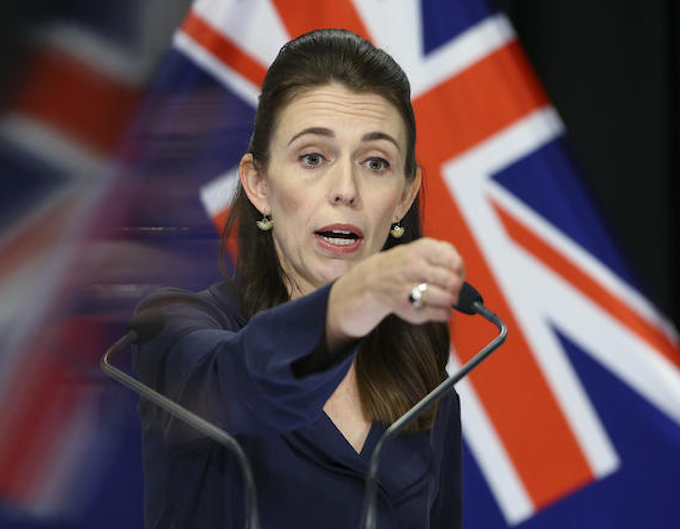
Former New Zealand prime minister Jacinda Ardern has used her valedictory speech to Parliament to ask the House to take the politics out of climate change.

In her speech, Ardern said when she became prime minister she knew she wanted climate change to be “front and centre”.

“I called it our nuclear moment — I believed it then and I believe it still now.

“We have seen first hand the reality of our changing environment … when crisis has landed in front of us I have seen the best of this place.”

Ardern said one of the only things she wanted to ask on her departure was for the House to take the politics out of climate change.

Her government had worked to uphold the Treaty of Waitangi by crossing the bridge more often, she said.

That included the creation of the Māori Crown portfolio, growth of te reo Māori, the establishment of the Māori Health Authority and the creation of Matariki — the first national Māori holiday, she said.

‘Not always easy’
“The path we travel as a nation will not always be linear and it won’t always be easy, but I’m glad I was in part of a government that took on the hilly bits.”

One of the hardest things about covid-19 was the unknowns, Ardern said.

“A valedictory is not the time to summarise a pandemic, no one has the time for that type of group therapy.”

Former prime minister Jacinda Ardern’s valedictory speech today. Video: Parliament

Ardern said she remained forever grateful that science was “on our side” and that she was surrounded by wonderful smart compassionate people trying to do the right thing.

She said they did not always get it right but “we went in as a nation with a goal to look after one another and we did”.

Other things, such as a sense of security, were lost along the way and so much of the information swirling around during the pandemic was false, Ardern said.

Ardern described how she tried and failed to convince a protester that they were relying on totally false information.

She said she could not single-handedly pull someone out of a rabbit hole but that perhaps collectively “we could stop them from falling into it in the first place”.

“Debate is critical to a healthy democracy but conspiracy is its nemesis.”

Struggled over mosque attacks
Ardern said she still struggled to talk about the mosque attacks in Christchurch on 15 March 2019, but the Muslim community had humbled her beyond words.

She said she was unsure what the response of one of the survivors of the attack would be when she met him in the immediate aftermath.

“What came next is one of the most profound memories I have of that period, he thanked us. Here was someone who had been through one of the most horrific experiences I could imagine and he thanked New Zealand and expressed gratitude for his home.”

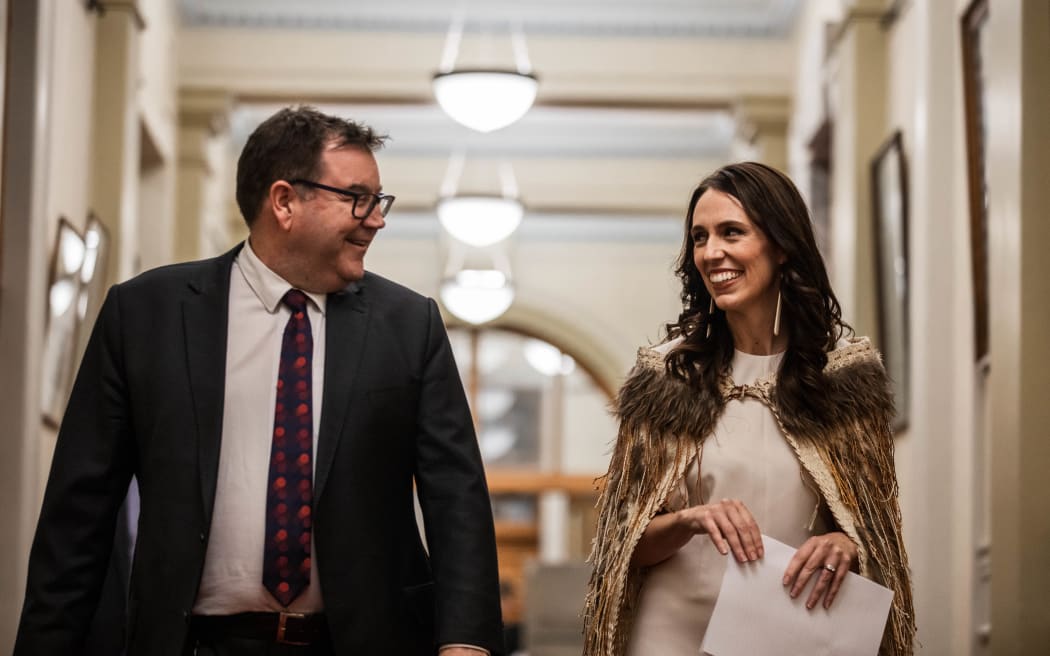
Grant Robertson and Jacinda Ardern
Finance Minister Grant Robertson and former PM Jacinda Ardern at Parliament ahead of her valedictory speech. Image: Samuel Rillstone/RNZ

The most significant task for us as a nation was “to live up to the expectations that those experienced it have of us, to deserve their thanks”.

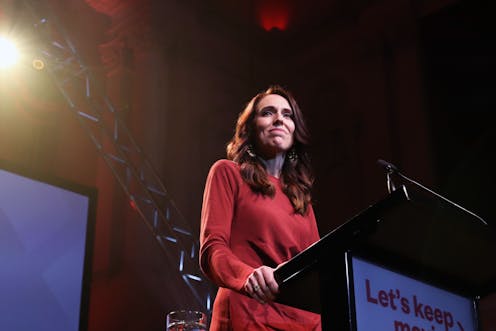
Ardern became emotional at the end of her valedictory speech describing herself as sensitive, somewhat negative, and “a crier and a hugger”.

But said she “would rather be criticised for being a hugger than being heartless”.

She closed her speech telling the House that she hoped she had demonstrated anyone could be a leader.

‘You can lead, just like me’
“You can be anxious, sensitive, kind and wear your heart on your sleeve, you can be a mother or not, you can be an ex-Mormon or not, you can be a nerd, a crier, a hugger — you can be all of these things and not only can you be here, you can lead, just like me.”

Ardern received a standing ovation at the end of her speech, before hugging Finance Minister Grant Robertson (who had been her deputy) and then Deputy Prime Minister Carmel Sepuloni.

Yesterday, it was announced the former prime minister was taking on two new roles: A voluntary position as Special Envoy for the Christchurch Call and trustee of Prince William’s Earthshot Prize.

Ardern resigned in January saying she no longer had “enough in the tank” to lead the country.

Former prime minister Helen Clark said Ardern would be remembered largely as the prime minister whose pandemic-era policies saved thousands of Kiwis’ lives.

This article is republished under a community partnership agreement with RNZ.

Print Friendly, PDF & Email

Article by AsiaPacificReport.nz

Fiji’s longest active newsroom keen for ‘kicking out’ of tough media law

By Lydia Lewis, RNZ Pacific journalist

The man in charge of Fiji’s oldest newspaper has high hopes for press freedom in the country following the tabling of a bill in Parliament this week to get rid of a controversial media law.

Fiji’s three-party coalition government introduced a bill on Monday to repeal the 2010 Media Industry Development Authority (MIDA) Act.

The MIDA Act — a legacy of the former Bainimarama administration — has long been criticised for being “draconian” and decimating journalism standards in the country.

The law regulates the ownership, registration and content of the media in Fiji.

Under the act, the media content regulation framework includes the creation of MIDA, the media tribunal and other elements.

“It is these provisions that have been considered controversial,” Fiji’s Attorney-General Siromi Turaga said when tabling the bill.

“These elements are widely considered as undemocratic and in breach of the constitutional right of freedom of expression as outlined in section 17 of the constitution.”

Not a ‘free pass’
Turaga said repealing the act does not provide a free pass to media organisations and journalists to “report anything and everything without authentic sources and facts”.

“But it does provides a start to ensuring that what reaches the ordinary people of Fiji is not limited by overbearing regulation of government.”

Fred Wesley
Fiji Times editor-in-chief and legal case veteran Fred Wesley . . . looking forward to the Media Act “being repealed and the draconian legislation kicked out”. Image: Lydia Lewis/RNZ Pacific

The Fiji Times editor-in-chief Fred Wesley said he had a sense of “great optimism” that the Media Act would be repealed.

Wesley and the newspaper — founded in 1869 — were caught in a long legal battle for publishing an article in their vernacular language newspaper Nai Lalakai which the former FijiFirst government claimed was seditious.

But in 2018, the High Court found them not guilty and cleared them of all charges.

“After the change in government, there has been a change in the way the press has been disseminating information,” Wesley said.

“We have had a massive turnover [of] journalists in our country. A lot of young people have come in. At the The Fiji Times, for instance, we have an average age of around 22, which is very, very young,” he said.

Handful of seniors
“We have just a handful of senior journalists who have stayed on who are very passionate about the role the media must pay in our country.

“We are looking forward to Thursday and looking forward to the act being repealed and the draconian legislation kicked out.”

He said two thirds of the journalists in the national newspaper’s newsroom have less than 16 years experience and have never experienced press freedom.

He said The Fiji Times would then need to implement “mass desensitisation” of its reporters as they had been working under a draconian law for more than a decade.

He added retraining journalists would be the main focus of the organisation after the law is repealed.

‘Things will get better’
Long-serving journalist at the newspaper Rakesh Kumar told RNZ Pacific that reporting on national interest issues had been a “big challenge” under the act.

Kumar recalled early when the media law was enacted and army officers would come into newsrooms to “create fear” which he said would “kill the motivation” of reporters.

“We know things will get better now [after the repeal of the act],” Kumar said.

But he said it was “important that we have to report accurately”.

“We have to be balanced,” he added.

Rakesh Kumar
Fiji Times reporter Rakesh Kumar . . . Image: Lydia Lewis/RNZ Pacific

The bill to repeal the MIDA Act will be debated tomorrow.

While the opposition has already opposed the move, it is expected that the government will use its majority in Parliament to pass it.

This article is republished under a community partnership agreement with RNZ.

Print Friendly, PDF & Email

Article by AsiaPacificReport.nz

View from The Hill: Peter Dutton’s risky call to campaign for ‘No’ in Voice referendum

Source: The Conversation (Au and NZ) – By Michelle Grattan, Professorial Fellow, University of Canberra

Opposition leader Peter Dutton has pledged to campaign against the Voice to Parliament, as the Liberal party overwhelmingly endorsed a “no” position for the forthcoming constitutional referendum.

After a special party meeting to decide the Liberals’ position, Dutton accused Prime Minister Anthony Albanese of “dividing the country”.

“We shouldn’t be voting for a divisive Canberra voice. That’s the issue. We should be listening to what people are saying on the ground,” Dutton told a news conference after a two hour party meeting.

The Liberals have been working up to a “no” position for months but the stand is high risk for Dutton. A Newspoll published on Wednesday found a majority of people in a majority of states back putting the Voice into the constitution.

The national total in favour is 54% with 68% support among those 18-34 . Queensland was the only state where there was not a majority in favour of yes – and there the yes side received 49% The poll was a quarterly analysis of 4756 voter interviews between February 1 and April 3.

Dutton faces some dissent in his own ranks with Tasmanian backbencher Bridget Archer saying she was disappointed although not surprised by the decision and declaring she would “absolutely” campaign for the yes case.

Archer has also questioned the extent to which the Liberal Party is living up to the values it professed. “We have to actually live the values we claim to have, and I don’t know that we do that.”

The Liberals’ decision also puts them at odds with their former minister for Indigenous Australians Ken Wyatt who was on the platform when the prime minister announced the referendum wording.

Victorian moderate Russell Broadbent said he supported the Voice “but I won’t be campaigning or telling anybody what to do”.

Wednesday’s decision binds Liberal frontbenchers in the referendum campaign, but not backbenchers. Dutton said he expected only a handful of them to campaign for a yes vote.

“There might be three or four people on the backbench who will want to advocate a ‘yes’ position or campaign, and within our party, that’s within the limits. But the vast majority, I mean, if you’re talking about the mood that was in the shadow cabinet or in the shadow ministry or indeed in the party room, overwhelming majority [are supportive] of the position that we’ve adopted – no question.”

The Liberals will not oppose the bill to enable the referendum, which is now before a committee of parliament, although some backbenchers associated with the “no” campaign might cross the floor on that.

The party meeting backed constitutional recognition of Indigenous Australians and a local and regional voice. Dutton said the Liberal proposals would unite rather than divide the country.

He said many Indigenous elders were not in favour of the Voice and quoted one Auntie as telling him “we don’t want 24 academics – they’re not going to be our voice”.

Dutton sent out a warning to some on his side of politics. “Tone is incredibly important in this debate. I will not tolerate – from any of my members or any of the public debate – any comments that are derogatory towards Indigenous Australians or anybody who is advocating a ‘yes’ position. This needs to be a respectful debate.”

Albanese said the Liberal decision was “all about the internals and playing old politics. It’s not about the needs of Australia, or advancing Australia’s national interest.” The PM said he was “very hopeful” the referendum would pass.

Asked about the Queensland vote in Newspoll Queensland Premier Annastacia Palaszczuk said the federal government needed to be “a lot more proactive” in explaining the proposal.

“I think people are after the detail,” she said, adding “I’ll be talking to the prime minister about how they can put [out] clear information”.

The Conversation

Michelle Grattan does not work for, consult, own shares in or receive funding from any company or organisation that would benefit from this article, and has disclosed no relevant affiliations beyond their academic appointment.

ref. View from The Hill: Peter Dutton’s risky call to campaign for ‘No’ in Voice referendum – https://theconversation.com/view-from-the-hill-peter-duttons-risky-call-to-campaign-for-no-in-voice-referendum-203345

‘On Country’ football league an opportunity to bring communities together – but we need more government funding

Source: The Conversation (Au and NZ) – By Anna Dunn, PhD candidate, Anangu Futures ARC Linkage , The University of Melbourne

This article contains quotes from First Nations community members, which the author has obtained permission to share and publish. Images have also been used with their permission

This article was co-written with Papunya community leader and Luritja-Pintupi man Terence Abbott Tjapanangka.


In Papunya, a remote Luritja and Pintupi community, the red earth football field is the centre of social activity every weeknight from March to September. Against the backdrop of Ulumbaru, the Northern Territory’s second-highest mountain, men and young people train into the night.

Alice Springs Town Council’s decision in March to withdraw its support for Central Australia’s remote football competition leaves the rhythms of life for community football players in the lurch this year, as coaches scramble to put together a league of their own.

The controversial “pause” on remote communities’ access to Alice Springs ovals was implemented as a response to the Alice Springs “crime crisis”. The move has raised the possibility of devising “On Country” leagues to be played in communities.

Recent federal government attention to the “crime crisis” in Alice Springs presents an opportunity to support surrounding communities in tangible, self-determined ways.

A group of First Nations footballers play football on a dusty oval. Two of them are mid-leap to catch the ball.

Paul Wighton, Author provided

Sports in Papunya facilitate community-level leadership, governance and decision-making that align with Luritja cultural practices and understandings. Funding sporting infrastructure in communities could also increase community wellbeing, unity, and economic self-sufficiency.

While studies are limited, football in Aboriginal communities has been shown to support health, wellbeing and social needs, and helps people stay on Country.

Football can bring community and cultural connection

Training is gruelling for the Papunya Eagles, a championship team of men aged 18-30. Attendance is required four nights a week, with matches on Sunday in Alice Springs against other remote communities. Football captain and Luritja man Aben Sandy Tjapaltjarri says, “That training can help people from drinking and all the other stuff. It makes them come back to community.”

Barry Judd and Tim Butcher’s ongoing research on football in Papunya found intergenerational cultural knowledge transfer through On Country football is crucial. It provides a strong, resilient forum that helps develop future leaders, and gives these young men a chance to spend valuable time with Elders.

Young football player and Luritja man Kamahl Bush Tjapaltjarri says, “Footy is the thing we love most: the fellas all enjoying and being happy and busy, making us proud. Sometimes we learn something new from the old fellas.”

The league structures the yearly schedule for some players who move to Papunya for the footy season. But Sandy says, “They won’t come back if footy is not on… It’s good having those men around… When you have people in community it’s safe.”

Football is also increasingly important to women and young people. Luritja Elder Karen McDonald Nangala says, “the women used to be only spectators but now the young women are interested and keen to play footy”. The women’s team brought pride to Papunya last year by winning at the Ampilatwatja Sports Carnival.


Read more:
Here’s some context missing from the Mparntwe Alice Springs ‘crime wave’ reporting


Bush leagues

The withdrawal of the council’s support for the league turns attention back to the long-held aim to hold a bush league played in community.

However, just days out from the beginning of training for the season, Papunya’s oval is littered with bushes, the microphone in the commentator’s box is broken, and there is no water or shade for players and spectators. The lack of funding for basic infrastructure makes the prospect of On Country leagues a challenge.

In 2011, the Wilurarra Tjutaku Football League was established independently of the Central Australian Football League, to be played On Country between remote Aboriginal communities rather than in Alice Springs. This league emerged as a form of community resistance and self-determination in response to government interventions in the lives of Aboriginal people in the NT, particularly the Northern Territory Emergency Response Act 2007.

However, the Wilurarra Tjutaku Football League has been confronted by several issues, including a lack of institutional support from the Central Australian Football League, Australian Football League Northern Territory AFLNT, and the NT government.

In 2021, AFLNT chairman Sean Bowden explored the return of the league to communities, but concluded that inadequate infrastructure in the bush made it infeasible.

Sporting infrastructure lacking in remote communities

Possibilities to revitalise On Country leagues turns the spotlight on a larger issue with basic infrastructure in remote communities.

Papunya Eagles football coach and Luritja-Pintupi man Dalton McDonald Tjapaltjarri says:

that’s what the federal government should be looking at, I reckon… We need the grass, water, proper medical staff, ambulance, good umpires.

Papunya Elders believe home games in Papunya could bring economic benefits to the community, encouraging people to spend money at local stores. Luritja Elder Karen McDonald says On Country football would benefit spectators too: “More people would also be able to come and cheer, watch, be happy and make them proud.”

The Future of Bush Football

While significant infrastructure investment could improve community health and wellbeing, Coach McDonald is concerned about the timeline of infrastructure upgrades. He says, “it doesn’t happen that quick you know. We have to wait a couple of months or years. So we have to find something else.”

For the meantime, remote communities are scrambling for an alternative, he says.

“It’s really sad for the young talented players. They’ll be missing out. I feel sorry not just for my community but everybody. Every team has talented players. I don’t know what’s going to happen.”

The Conversation

Anna Dunn does not work for, consult, own shares in or receive funding from any company or organization that would benefit from this article, and has disclosed no relevant affiliations beyond their academic appointment.

ref. ‘On Country’ football league an opportunity to bring communities together – but we need more government funding – https://theconversation.com/on-country-football-league-an-opportunity-to-bring-communities-together-but-we-need-more-government-funding-202617

3 reasons you feel hungrier and crave comfort foods when the weather turns cold

Source: The Conversation (Au and NZ) – By Lauren Ball, Professor of Community Health and Wellbeing, The University of Queensland

Klaus Neilson/Pexels

As we move through Autumn, parts of Australia are starting to see cooler weather. For some of us, that can mean increasing feelings of hunger and cravings for “comfort food” such as as pasta, stews and ramen.

But what’s happening in our body?

3 things change when it gets cold

1. Our body conserves heat

It sends this energy it conserves to our internal organs so they can maintain their temperature and work properly. The body can also perform heat-generating activities (such as shivering), which uses energy. The body will then look for additional energy through calories from eating food.

2. Our body warms up when eating

When we eat, the body needs to expend energy to digest, absorb, and metabolise the nutrients. This process requires the use of energy, which generates heat in the body, leading to an increase in body temperature termed “diet-induced thermogenesis”.

However, the amount of energy used to keep us warm is quite modest.

3. Some people experience a drop in the neurotransmitter called serotonin

This is partly because the rate our body produces serotonin is related to sunlight, which is lower in winter.

Serotonin helps to regulate mood, appetite, and sleep, among other things. When serotonin levels are low, it can lead to increased hunger and decreased satiety (feeling that you’ve had enough to eat), making us feel hungrier and less satisfied after meals.

dish of freshly cooked pie with potato topping, one portion taken out
Shepherds pie – vegetarian or meat-based – might be just the thing.
Shutterstock

Why we love comfort food in winter

Many of us struggle to eat salad in winter and crave mum’s chicken soup or a slow cooked, brothy ramen.

Research shows our brain detects the cold weather and looks for warm food. Warm food can provide a sense of comfort and cosiness, which is particularly appealing during the colder months when we spend more time indoors.


Read more:
The psychology of comfort food – why we look to carbs for solace


Comfort food can mean something different for everyone. They are foods we reach for in periods of stress, nostalgia, discomfort (like being cold), or emotional turmoil. For most of us, the foods we often over-indulge in are rich and carbohydrate heavy.

A drop in serotonin has also been shown to stimulate an urge to eat more carbohydrate-rich foods such as gnocchi, pasta, ragout, mashed potatoes.

What happens to those extra calories?

If you consume more energy in cooler weather, some of it will be used to keep you warm. Beyond keeping us warm, extra calories we consume are stored.

While most humans today have access to a year-round food supply, some research shows our bodies may still have some leftover instincts related to storing energy for the cooler months when food was harder to come by.

This behaviour may also be driven by biological factors, such as changes in hormone levels that regulate appetite and metabolism.


Read more:
Gaining weight in winter isn’t inevitable, unless you decide you will


A fundamental principle of nutrition and metabolism is that the balance between the energy content of food eaten and energy expended to maintain life and to perform physical work affects body weight. This means any excess energy that we don’t use will be stored – usually as fat.

Using mathematical modelling, researchers have predicted weight gain is more likely when food is harder to find. Storing fat is an insurance against the risk of failing to find food, which for pre-industrial humans was most likely to happen in winter.

hands cradle a bowl of pumpkin soup
Winter is coming … so it’s soup time.
Shutterstock

It doesn’t have to be unhealthy

No matter your cravings during cooler months, it’s important to remember your own personal health and wellbeing goals.

If you’re worried about excess energy intake, a change in season is a great time to rethink healthy food choices. Including lots of whole fresh vegetables is key: think soups, curries, casseroles, and so on.

Including protein (such as meat, fish, eggs, legumes) will keep you feeling fuller for longer.


Read more:
A nice warm bowl of porridge: 3 ways plus a potted history


The Conversation

Lauren Ball works for The University of Queensland and receives funding from the National Health and Medical Research Council. She is a Director of Dietitians Australia, a Director of the Darling Downs and West Moreton Primary Health Network and an Associate Member of the Australian Academy of Health and Medical Sciences.

Emily Burch works for Southern Cross University.

ref. 3 reasons you feel hungrier and crave comfort foods when the weather turns cold – https://theconversation.com/3-reasons-you-feel-hungrier-and-crave-comfort-foods-when-the-weather-turns-cold-202831

Jacinda Ardern’s legacy for NZ: Unique covid-19 strategy ‘saved many lives’

RNZ News

Jacinda Ardern will largely be remembered in Aotearoa New Zealand as the prime minister whose pandemic-era policies saved thousands of Kiwi lives, according to former prime minister Helen Clark.

And she will also be considered an example of how to govern in the age of social media and endless crises, political experts say, while also achieving more than her critics might give her credit for.

Ardern was set to deliver her valedictory speech later today, having stepped down as prime minister earlier this year after just over five years in the job.

“I think that while I’m happy for Jacinda that she’s going to get a life and design what she wants to do and when she wants to do it, you can’t help feeling sad about her going,” Clark, herself a former Labour prime minister, told RNZ Morning Report ahead of Ardern’s speech.

“Leaders like Jacinda don’t come along too often and we’ve lost one.”

Ardern has played down suggestions online vitriol played a part in her decision to stand aside — but acknowledged on Tuesday she hoped her departure would “take a bit of heat out” of the conversation.

Clark said she “fundamentally” believed the hatred got to Ardern, powered by “populism and division” generated by former US President Donald Trump and his supporters.

‘Conspiracies took hold’
“Conspiracies took hold and suddenly you know, as the pandemic wore on here, I think the sort of relentless barrage from America — not, not just through Trump himself and the reporting of him, but through the social media networks — we have the anti-science people, the people who completely distrusted public authority, the QAnon conspiracies and hey, it played out on our Parliament’s front lawn and it still plays out and it’s very, very vitriolic and divisive.

“So I think that that spillover impact was really quite, well, not just unpleasant — it was horrible.”

Former PM Jacinda Ardern on the front page of the New Zealand Herald today
Former PM Jacinda Ardern on the front page of the New Zealand Herald today . . . revealing her next move. Image: Screenshot APR

Researchers have found Ardern was a lightning rod for online hate.

The perpetrator of the 2019 mosque shootings used the internet to connect with and learn from other extremists, which led to Ardern setting up the Christchurch Call movement to eliminate terrorist and violent extremist content online.

Her post-parliamentary career will include continuing that work, as New Zealand’s Special Envoy for the Christchurch Call, reporting to her replacement, Prime Minister Chris Hipkins.

“The mosque murders was just the most horrible thing to have happen on anyone’s watch, and she rose to the occasion, and I think the international reputation was very much associated with initially the empathy that she showed at that time,” said Clark.

But “one of New Zealand’s darkest days”, as Ardern put it at the time, was not the only near-unparalleled crisis she had to deal with in her time as prime minister.

“The White Island tragedy was another that needed, you know, very empathetic and careful handling. But then comes covid, and there’s no doubt that thousands of people are alive today because of the steps taken, particularly in 2020.

‘Would we have survived?’
“You know, I mean, I’m obviously in the older age group now which is more vulnerable. My father is 101 now and has survived the pandemic. But would we have survived it if it had been allowed to rip through our community, like it was allowed to rip through others?

“I think that there’d be so many New Zealanders not alive today had those steps not been taken.”

Data shows New Zealand has actually experienced negative excess mortality over the past few years — the elimination strategy so successful, fewer Kiwis have died than would have if there was no pandemic.

Former Director-General of Health Dr Ashley Bloomfield said that was “unique, virtually unique around the world”.

Despite that, it was New Zealand’s aggressive approach towards covid-19 in 2020 and 2021 that arguably drove much of the polarisation and online vitriol.

“There’s no doubt that those measures did save lives. They also drove people into frenzied levels of opposition and fear and isolation,” said Clark. “They felt polarised, they felt locked out.”

But she said Ardern bore “very little” responsibility for that.

UNDP head Helen Clark poses in Paris on June 1, 2015
Former PM Helen Clark . . . “There’s no doubt that those measures did save lives.” Image: RNZ News/AFP

Political scientist Dr Bronwyn Hayward of the University of Canterbury said Ardern’s Christchurch Call to eliminate extremist content will have a long-lasting impact on not just New Zealand, but the world.

“There’s been a lot made about the fact that she resigned under pressure from the trolls, which is completely missing the point that what she’s saying is that in this era where we’ve got particularly Russian, but also other countries’ bots that are attacking liberal leaders,” Dr Hayward told Morning Report, saying Ardern was the first global leader to “really understand” how what happens online can spill over into the real world.

“She understands that democracies are now under attack, and the front line is your social media, where we’ve got a propaganda war coming internationally.

“So she’s taken a very systemic approach to thinking about how to tackle that, so that in local communities it feels like you’re reeling from Islamophobia, to racism to transphobia, but actually, when we look internationally at what’s happening, naive and quite disaffected groups have been constantly fed this material and she’s taken a systemic approach to it.”

Clark said one of the biggest differences in the world between Ardern’s time as prime minister and her own, was that she did not have to deal with social media.

“I didn’t have a Twitter account, didn’t know what it was really. We had texts, that was about it. We used to have pagers, for heaven’s sake.”

Ardern’s domestic legacy
One of the first things Hipkins did when he took over as prime minister was the “policy bonfire” — but critics have long said the Ardern-led government has had trouble delivering on its promises.

Interviewer Guyon Espiner reminded Clark that her government had brought in long-lasting changes like Working for Families, the NZ Super Fund and Kiwibank — asking her what Ardern could point to.

Clark defended Ardern, saying the coalition arrangement with NZ First in Ardern’s first term slowed any reform agenda she might have had, and then there was covid-19.

“Looking back, there needs to be more recognition that the pandemic blindsided governments, communities, publics around the world. It wasn’t easy.”

Dr Hayward pointed to the ban on new oil and gas exploration and child poverty monitoring, “which before that was ruled as impossible or too difficult”.

Dr Lara Greaves, a political scientist at the University of Auckland, said it was “incredibly hard to really evaluate” Ardern’s legacy outside of covid-19.

“Ultimately … she is the covid-19 prime minister.”

Prime Minister Jacinda Ardern
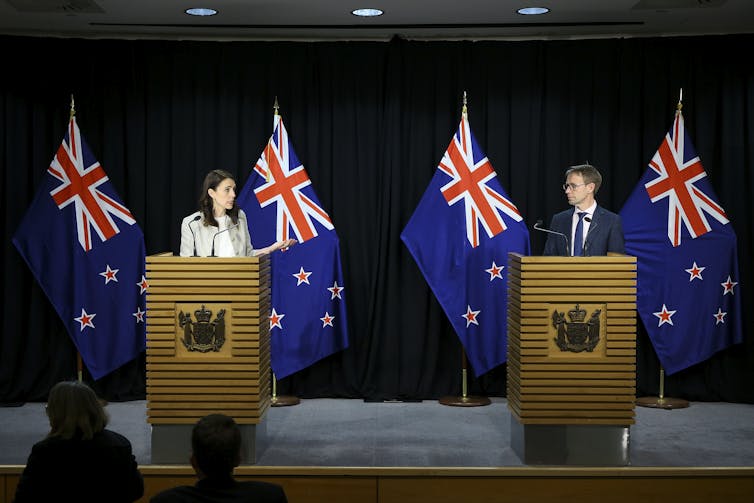
Former PM Jacinda Ardern at a covid-19 press conference. Image: RNZ News/Pool/NZ Herald/Mark Mitchell

The future
Clark said Ardern would be emotional during her valedictory speech.

“You have very close relationships with colleagues, you have relationships with others of a different kind — with the opposition, with the media, with the public — and you’re walking away, you’re closing the door on it.

“But you know that a new chapter will open, and that life post-politics can be very rewarding. I’ve certainly found it so. I have no doubt that Jacinda will get back into her stride with doing things that she feels are worthwhile for the the general public and worthwhile for her.”

After losing the 2008 election, Clark rose the ranks at the United Nations. She said while that was an option for Ardern, there is plenty of time for the 42-year-old to do other things first.

“I was, you know, 58 when I left being prime minister. And Jacinda’s leaving in her early 40s and she has a young child, so who knows? She may want Neve to grow up with a good old Kiwi upbringing.

“And she may want her, you know, involvement internationally to be more, you know, forays out from New Zealand. That’s for her to decide. I mean, the world’s her oyster, if she chooses to follow that.”

Dr Greaves also pointed to Ardern’s relative youth.

“It seems like she’s going for a period of sort of recovery and reflection and figuring out what to do next. But of course, she’s got another 20 years in her career, at least — the world’s her oyster.”

This article is republished under a community partnership agreement with RNZ.

Print Friendly, PDF & Email

Article by AsiaPacificReport.nz

Natural disasters take a toll on unborn babies – we need to support pregnant mums after Cyclone Gabrielle

Source: The Conversation (Au and NZ) – By Mia Mclean, Senior lecturer, Auckland University of Technology

Getty Images

The Auckland Anniversary floods and Cyclone Gabrielle have put the spotlight on how communities recover in the aftermath of widespread devastation. But future-proofing communities against the impact of these disasters needs to include measures to protect some of our most vulnerable people – pregnant women and their unborn babies.

What happens during pregnancy lays the foundation for child health and development. Exposure to a natural disaster is no exception.

Years after the Christchurch earthquakes, teachers reported behaviour and sleep difficulties in children who had experienced the devastation, including those who wern’t yet born on February 22, 2011. Research supports these anecdotal reports: children exposed at a younger age and in-utero to the earthquakes displayed greater behaviour problems.

I was part of a team examining maternal and child wellbeing following the 2011 Queensland floods. My research found toddlers whose mothers experienced greater hardship while pregnant due to the flooding tended to be more reactive and display emotional distress.

What’s more, these early behaviours were related to increased symptoms of anxiety at preschool age. These children also displayed poorer cognitive development as toddlers and motor difficulties through preschool.

Research on tropical cyclones in Australia and hurricanes in North America shows similar findings.


Read more:
Pregnant mothers’ stress during floods can disadvantage their babies, but it’s not inevitable. Here’s what we can do right now


Babies in-utero at the time of Hurricane Sandy in the US had a five-fold increased risk of anxiety disorders, as well as greater likelihood of depression and attention behavioural disorders, when compared with babies who were not exposed to the disaster.

The unseen cost of Cyclone Gabrielle

These findings should not be ignored. During Cyclone Gabrielle, many New Zealanders including pregnant women, faced hardship – namely property damage and loss, and financial difficulties. Some pregnant women were left in life-threatening situations or without easy access to antenatal care. None expected to be hit by the disaster.

For the most part, the more hardship pregnant women face, the greater the immediate and post-traumatic stress-like symptoms they experience. The fetal brain and stress systems may be particularly susceptible to pregnancy stress. It can also affect maternal mood for years to come.

Yet, even when a woman reports low levels of distress in the face of a disaster, exposure to hardship can affect child development. Changes to nutrition, exercise, stress hormones, placental function and the immune system may “get under the skin” of the unborn child.

Support now and in the future

Now that the silt has settled after Cyclone Gabrielle, pregnant women and their unborn children must not be forgotten.

Pregnant women should be encouraged and supported to engage in emotion-focused coping strategies. These can include the positive reframing of the situation, acceptance, humour and finding emotional support from others. This should then move to strategies focused on problem solving – such as actively planning for the future, taking action to clean up, and seeking help from government and non-governmental agencies.

Trying to find the positives from the situation can help lower a woman’s distress. But writing out deep thoughts and feelings about what has happened may not help and, at the very least, should be supported by clinicians.

We should also mobilise existing infrastructure to help the pregnant women to better “weather the storm” of enduring hardship and distress in the months and years to come.

Support for midwives

In New Zealand nearly all women have a midwife as their lead maternity carer from pregnancy through the postnatal period. Receiving maternity care from the same midwifery team across the perinatal period benefits a mother’s postnatal wellbeing and their infant’s neurodevelopment in the face of a disaster by providing continued social support.

During Cyclone Gabrielle, midwives went above and beyond to continue to provide support for women, no matter how remotely they lived. But we shouldn’t be relying on midwives putting themselves in danger to help those in need.

Midwives need to be supported in identifying, supporting and referring at-risk women. We also simply need more midwives.


Read more:
Pregnant women’s brains show troubling signs of stress – but feeling strong social support can break those patterns


Pregnant women need to be screened and monitored for post-traumatic symptoms, anxiety and depression across the perinatal period. Those experiencing continued distress need equitable access to appropriate mental health services.

Early childhood, a period of incredible brain maturation, also offers opportunities for improving child outcomes. Positive parent mental health and sensitive, structured parenting behaviours have been shown to improve child cognition, language, and behaviour.

A possible next step is the targeted delivery of parent-led interventions that promote such behaviours through existing services including Plunket. Government support for child mental health initiatives, like that provided following the earthquakes, is needed in areas hit by the cyclone.

With New Zealand predicted to experience an increasing number of extreme weather events in the next decade, it is critical we take stock, listen and act on this research – not just for those exposed to Cyclone Gabrielle, but for those who will inevitably be affected when the next disaster strikes.

The Conversation

Mia Mclean received funding from Australian Government, Australian Postgraduate Award.

ref. Natural disasters take a toll on unborn babies – we need to support pregnant mums after Cyclone Gabrielle – https://theconversation.com/natural-disasters-take-a-toll-on-unborn-babies-we-need-to-support-pregnant-mums-after-cyclone-gabrielle-202825

Beneath the Trump circus, American democracy faces up to a vital challenge

Source: The Conversation (Au and NZ) – By Emma Shortis, Lecturer, RMIT University

Seth Wenig/EPA/AAP

Former US President Donald J Trump has been charged with 34 felony counts in New York. In the words of Manhattan district attorney Alvin Bragg, Trump is accused of making “34 false statements”, themselves “made to cover up other crimes”. Those crimes include a “conspiracy to promote a candidacy by unlawful means” and to “scheme with others to influence the 2016 presidential election”.

The charges in New York add to the network of cases focused on Trump’s efforts to subvert and undermine democratic processes in the United States, now stretching all the way back to his 2016 candidacy and across the duration of his presidential administration.

The charges shouldn’t really come as a surprise. As recently as December 2022, Trump called for the “termination” of the Constitution so that he could return to power. The former president has always been brazen in his contempt for the rule of law.

But it is genuinely, historically significant that a former president is facing criminal charges and trial. This is an enormous shift in the norms and standards that have governed American politics for decades.

Trump’s arraignment proceeded as expected: he arrived at court, was processed, and pleaded not guilty to those 34 charges. Amid a media frenzy, he left court and flew home to safer ground in Florida. At Mar-a-Lago, he made a standard stump speech listing his grievances and dramatically mischaracterising the investigations into his conduct.

As Trump’s indictment and arraignment have played out, he and his supporters have employed now distressingly familiar techniques for inciting their followers. Last week, Trump threatened “death and destruction”, posting a picture of himself wielding a baseball bat next to a picture of the Manhattan district attorney’s head. His son, Donald Trump Junior, posted a picture of the daughter of Judge Juan Merchan. This week, in the shadow of yet another school shooting in Nashville, Fox News host Tucker Carlson warned viewers that the indictment meant it was “probably not the best time to give up your AR-15”.


Read more:
Trump has changed America by making everything about politics, and politics all about himself


Posts and statements like these can only be read for what they are: clear attempts to foment further racist violence against anyone cast as an enemy.

Such calls fit into a pattern of incitement that has led to violence in the past and will likely do so again. Trump and his supporters have given no indication that they are concerned about inciting unrest; they are actively and knowingly encouraging it.

It is more than likely that they will continue to do so, using events like the arraignment today to double down on conspiracy theories. And they will have plenty of chances: the trial in New York could drag on, potentially, for over a year, and indictments in other state and federal investigations now seem more likely.

Trump supporters gather outside his home of Mar-a-lago in Palm Beach, Florida.
Cristobal Herrera-Ulashkevich/EPA/AAP

As I have written before, political violence is a feature, not a bug, of American politics. That’s partly why widely held perceptions of impending Civil War are so concerning; not necessarily because Civil War is likely, but because growing certainty that it is coming can give further license to violence now perceived as inevitable anyway.


Read more:
What does Trump’s indictment mean for his political future – and the strength of US democracy?


Much of the coverage and analysis of American politics will describe the nation as “divided” or “polarised”. But polarisation isn’t really an accurate way to characterise the state of US politics today. Polarisation implies a kind of equality – that sides are divided into equal but opposite extremes, willing to take the same measures to win power; that there are “two sides” or that “both sides” are as dangerous as each other. This is also sometimes described as the “horseshoe theory” of politics.

In the modern United States, the evidence does not support this framing. One side is facing over 30 felony charges, in what is likely only the start of an impending wave of indictments across state and federal investigations. Those investigations, collectively, paint a damning picture of a conspiracy to subvert the world’s most important democracy. In the United States, the “other side” – which is far from immune from critique – is at least attempting to get on with the business of democratically elected government.

The focus instead has of course been on the Trump media circus, now very familiar to us all. The black, armoured SUVs crawling across New York City streets; “plane watch”; the t-shirts; the farcical, gold-tinted press conferences. The mainstream press may well be falling, once again, into the traps Trump has laid so carefully.

But it’s also much more than that, this time around. How this all plays out will be yet another litmus test for the strength of American democracy. And it’s an essential one: simply put, the United States can not, must not, fail this test. The consequences of failure aren’t just domestic. Viewed from afar, we might be tempted to dismiss this as just more hijinks in the compelling but distant drama of American politics. But the outcome will affect us all. So we will – we must – keep watching.

The Conversation

Emma Shortis is a member of the Independent and Peaceful Australia Network (IPAN).

ref. Beneath the Trump circus, American democracy faces up to a vital challenge – https://theconversation.com/beneath-the-trump-circus-american-democracy-faces-up-to-a-vital-challenge-203224

What’s behind the recent surge in Australia’s net migration – and will it last?

Source: The Conversation (Au and NZ) – By Peter McDonald, Honorary Professor of Demography, Centre for Health Policy, The University of Melbourne

Last week, the Australian published a story saying net-overseas migration would reach 650,000 over the two financial years, 2022-23 and 2023-24.

As the story included comments from Treasurer Jim Chalmers and Treasury Secretary Steven Kennedy, we can assume these numbers will appear in the population statement accompanying the May budget.

The new numbers have attracted attention in the media, especially in relation to the effects of large-scale migration on the labour and housing markets.

The dramatic turnaround in the level of net-overseas migration is indicated in the following table:


What explains this massive turnaround?

Net-overseas migration is determined by the number of migrant arrivals each year versus migrant departures. If more migrants arrive than leave Australia, this gives us a positive net migration.

Due to border closures during the pandemic, Australia had an extremely low level of net migration in the period from September 2020-21.

However, the rebound in migration within one year was clearly much greater than had been expected by officials in Canberra in preparing the 2022-23 federal budget statement, which was published last year.

The following table compares the net migration from September 2021-22 (the most recent year for which data are available) with the calendar year 2019 (the last year not affected by the pandemic).

The table shows the high level of net migration in 2021-22 was due more to people not leaving Australia than to people arriving.


Very little of the increase in net migration across these two years was due to the granting of permanent resident visas to people living offshore or to the movements of Australian and New Zealand citizens.

Rather, the increase is explained by changes in the movements of temporary residents, such as international students, working holidaymakers and other temporary or bridging visa holders.

The changes in the numbers of temporary residents in Australia provided by the Department of Home Affairs indicate how net migration may have changed by the main temporary visa types. These statistics are shown in the following table:


The biggest reason for the higher number of migrant arrivals over migrant departures since 2021 is changes in the movements of international students and working holiday makers.

The preceding table shows that, from September 2019-21, the number of students and working holiday makers in Australia fell by 421,000 due to the pandemic. But this number rebounded by 368,000 from September 2021 to February 2023.

This means that, in the most recent year, large numbers of students and working holiday makers arrived, but very few left. The speed of the increase in these arrivals has been much greater than policy makers had envisaged.


Read more:
COVID halved international student numbers in Australia. The risk now is we lose future skilled workers and citizens


Many temporary residents would also normally have been expected to leave Australia by September 2022, but they did not do so.

This includes many people on bridging visas, which reached a record number of 369,000 in September 2022. A bridging visa is provided to people who are in Australia awaiting the outcome of another visa application.

This number included a huge backlog of applications for permanent skilled visas and many people (50,000 or more) who arrived by air on tourist visas and then applied for asylum in Australia. Almost all these asylum applications are rejected, but few have been deported.

Also, during the pandemic, the Morrison government extended eligibility for a temporary employment visa (visa subclass 408) to people in Australia whose temporary visas were due to expire. This enabled many people to remain in Australia when, otherwise, they would have left.

Finally, there has also been a longer-term increase in the number of people on graduate visas due to a policy change in 2011, as well as other recent changes made by the Albanese government.

A temporary surge, then return to normal

These data tell us that the recent increase in net-overseas migration has been due to policy changes that enabled people to remain in Australia rather than policy changes that enabled people to arrive.

This continued in February of this year with the Albanese government allocating extra resources to help clear the backlog of people on bridging visas. This has caused a significant decrease in the numbers of people on bridging visas, many of whom have been granted permanent residence.

The very unusual movements during the pandemic have produced a temporary surge in net migration, which we can expect to last for two or three years. After this, net migration should return to pre-pandemic levels as the number of migrant departures ticks upwards again.

A similar situation has occurred in Canada. In 2022, net migration exceeded one million people – a higher proportional increase than has occurred in Australia.


Read more:
1.4 million less than projected: how coronavirus could hit Australia’s population in the next 20 years


The impact on the labour force and housing

The impacts of this temporary surge in net migration on the labour force and housing are complex and cannot be interpreted in the simplistic terms now evident in much of the media.

The high level of net migration is largely due to people remaining in Australia instead of leaving. Almost all of these people were already working in Australia and were already housed.

Furthermore, students are often housed in student accommodation or live in extremely crowded circumstances, while working holiday makers often live in backpacker hostels.

But there is no denying the rental housing market in Australia is under considerable pressure due in large measure to the conversion of long-term rentals to short-term. Migration adds to this pressure.

The Conversation

Currently a member of the Ministerial Advisory Council on Skilled Migration.

When I was an employed academic, I received related grants from the Australian Research Council and completed contracts for the Department of Immigration (in its various forms) and the Department of the Treasury.

ref. What’s behind the recent surge in Australia’s net migration – and will it last? – https://theconversation.com/whats-behind-the-recent-surge-in-australias-net-migration-and-will-it-last-203155

Calls to regulate AI are growing louder. But how exactly do you regulate a technology like this?

Source: The Conversation (Au and NZ) – By Stan Karanasios, Associate professor, The University of Queensland

Shutterstock

Last week, artificial intelligence pioneers and experts urged major AI labs to immediately pause the training of AI systems more powerful than GPT-4 for at least six months.

An open letter penned by the Future of Life Institute cautioned that AI systems with “human-competitive intelligence” could become a major threat to humanity. Among the risks, the possibility of AI outsmarting humans, rendering us obsolete, and taking control of civilisation.

The letter emphasises the need to develop a comprehensive set of protocols to govern the development and deployment of AI. It states:

These protocols should ensure that systems adhering to them are safe beyond a reasonable doubt. This does not mean a pause on AI development in general, merely a stepping back from the dangerous race to ever-larger unpredictable black-box models with emergent capabilities.

Typically, the battle for regulation has pitted governments and large technology companies against one another. But the recent open letter – so far signed by more than 5,000 signatories including Twitter and Tesla CEO Elon Musk, Apple co-founder Steve Wozniak and OpenAI scientist Yonas Kassa – seems to suggest more parties are finally converging on one side.

Could we really implement a streamlined, global framework for AI regulation? And if so, what would this look like?


Read more:
I used to work at Google and now I’m an AI researcher. Here’s why slowing down AI development is wise


What regulation already exists?

In Australia, the government has established the National AI Centre to help develop the nation’s AI and digital ecosystem. Under this umbrella is the Responsible AI Network, which aims to drive responsible practise and provide leadership on laws and standards.

However, there is currently no specific regulation on AI and algorithmic decision-making in place. The government has taken a light touch approach that widely embraces the concept of responsible AI, but stops short of setting parameters that will ensure it is achieved.

Similarly, the US has adopted a hands-off strategy. Lawmakers have not shown any urgency in attempts to regulate AI, and have relied on existing laws to regulate its use. The US Chamber of Commerce recently called for AI regulation, to ensure it doesn’t hurt growth or become a national security risk, but no action has been taken yet.

Leading the way in AI regulation is the European Union, which is racing to create an Artificial Intelligence Act. This proposed law will assign three risk categories relating to AI:

  • applications and systems that create “unacceptable risk” will be banned, such as government-run social scoring used in China
  • applications considered “high-risk”, such as CV-scanning tools that rank job applicants, will be subject to specific legal requirements, and
  • all other applications will be largely unregulated.

Although some groups argue the EU’s approach will stifle innovation, it’s one Australia should closely monitor, because it balances offering predictability with keeping pace with the development of AI.

China’s approach to AI has focused on targeting specific algorithm applications and writing regulations that address their deployment in certain contexts, such as algorithms that generate harmful information, for instance. While this approach offers specificity, it risks having rules that will quickly fall behind rapidly evolving technology.


Read more:
AI chatbots with Chinese characteristics: why Baidu’s ChatGPT rival may never measure up


The pros and cons

There are several arguments both for and against allowing caution to drive the control of AI.

On one hand, AI is celebrated for being able to generate all forms of content, handle mundane tasks and detect cancers, among other things. On the other hand, it can deceive, perpetuate bias, plagiarise and – of course – has some experts worried about humanity’s collective future. Even OpenAI’s CTO, Mira Murati, has suggested there should be movement toward regulating AI.

Some scholars have argued excessive regulation may hinder AI’s full potential and interfere with “creative destruction” – a theory which suggests long-standing norms and practices must be pulled apart in order for innovation to thrive.

Likewise, over the years business groups have pushed for regulation that is flexible and limited to targeted applications, so that it doesn’t hamper competition. And industry associations have called for ethical “guidance” rather than regulation – arguing that AI development is too fast-moving and open-ended to adequately regulate.

But citizens seem to advocate for more oversight. According to reports by Bristows and KPMG, about two-thirds of Australian and British people believe the AI industry should be regulated and held accountable.

What’s next?

A six-month pause on the development of advanced AI systems could offer welcome respite from an AI arms race that just doesn’t seem to be letting up. However, to date there has been no effective global effort to meaningfully regulate AI. Efforts the world over have have been fractured, delayed and overall lax.

A global moratorium would be difficult to enforce, but not impossible. The open letter raises questions around the role of governments, which have largely been silent regarding the potential harms of extremely capable AI tools.

If anything is to change, governments and national and supra-national regulatory bodies will need take the lead in ensuring accountability and safety. As the letter argues, decisions concerning AI at a societal level should not be in the hands of “unelected tech leaders”.

Governments should therefore engage with industry to co-develop a global framework that lays out comprehensive rules governing AI development. This is the best way to protect against harmful impacts and avoid a race to the bottom. It also avoids the undesirable situation where governments and tech giants struggle for dominance over the future of AI.


Read more:
The AI arms race highlights the urgent need for responsible innovation


The Conversation

Stan Karanasios is a disinguished member of the Association for Information Systems.

Olga Kokshagina is an appointed member of the French Digital Council (Conseil national du numérique)

Pauline C. Reinecke receives funding from the Horizon 2020 Program of the European Union within the OpenInnoTrain project under grant agreement n° 823971.

ref. Calls to regulate AI are growing louder. But how exactly do you regulate a technology like this? – https://theconversation.com/calls-to-regulate-ai-are-growing-louder-but-how-exactly-do-you-regulate-a-technology-like-this-203050

Tough times ahead but Fiji’s coalition has ‘achieved much’, says PM Rabuka

By Felix Chaudhary in Suva

Fiji’s coalition government has achieved much in its first 100 days but Prime Minister Sitiveni Rabuka says he is not going to present the milestones by painting an “overly optimistic picture”.

He warned of tough times ahead.

“We are doing well in many ways but we need to be grounded in reality,” he said during his address to the nation last night.

“Your government is acutely aware that before the creation of the new Fiji, we must first deal with big challenges and problems — such as managing the national debt, restoring basic services and repairing damaged infrastructure.”

Felix Chaudhary is a Fiji Times reporter. Republished with permission.

Print Friendly, PDF & Email

Article by AsiaPacificReport.nz

Driving on less than 5 hours of sleep is just as dangerous as drunk-driving, study finds

Source: The Conversation (Au and NZ) – By Madeline Sprajcer, Lecturer in Psychology, CQUniversity Australia

Yellowj/Shutterstock

What if you could be fined or lose your license for driving tired? Our new study just published in Nature and Science of Sleep has found if you had less than five hours of sleep last night, you are just as likely to have a vehicle crash as if you were over the legal limit for alcohol.

We know about 20% of all vehicle crashes are caused by fatigue. Over the past 20 years, the number of crashes caused by alcohol has decreased significantly.

However, there has been little progress over this same period in decreasing the number of crashes caused by fatigue. We wanted to know – can this be changed?

A ‘line in the sand’ on impaired driving

Recent decreases in alcohol-related car crashes have happened for a few reasons:

  • a significant investment in public education
  • drivers have easy-to-follow guidance on how to decide if they are too intoxicated to drive (for example, the advice to have “two drinks in the first hour, and one drink every hour after that”)
  • strong enforcement strategies, including roadside testing
  • highly publicised drunk-driving legal cases.

Additionally, drivers are legally deemed to be impaired if their blood alcohol concentration is over 0.05%, regardless of their driving performance. This blood alcohol limit is an effective “line in the sand”, determining whether someone is legally permitted to drive.

We did a study to find out if we could reduce the number of fatigue-related crashes on Australian roads by following a similar strategy. Is there a point at which we could deem a driver to be impaired due to fatigue?

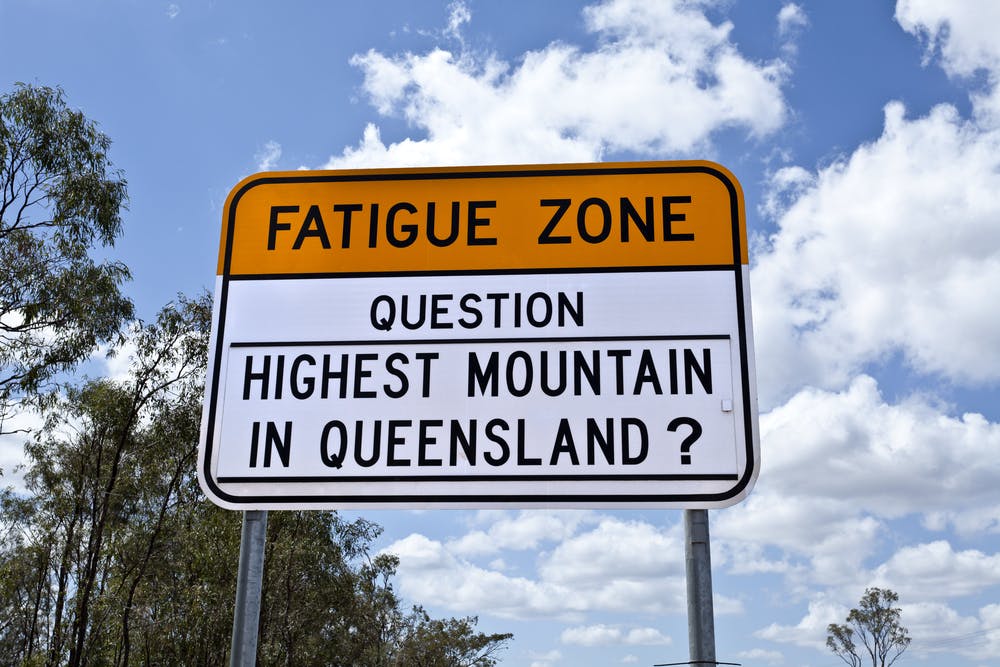
A road sign that reads 'fatigue zone question - highest mountain in Queensland?'
On some highways in Queensland, ‘fatigue zone trivia’ signs were installed to help combat driver fatigue.
ribeiroantonio/Shutterstock

A minimum amount of shuteye?

To do this, we evaluated the scientific evidence from laboratory and field studies that looked at how much prior sleep you need to drive safely.

After synthesising the findings of 61 unique studies, we found having less than four to five hours of sleep in the previous 24 hours is associated with an approximate doubling of the risk of a vehicle crash. This is the same risk of a crash seen when drivers have a blood alcohol concentration of 0.05%.

Not only this, but a driver’s risk of a crash significantly increases with each hour of sleep lost the night before. Some studies even suggested that when a driver had between zero and four hours of sleep the previous night, they may be up to 15 times more likely to have a crash.

Our review suggests that based on the scientific evidence, it may be reasonable to require drivers to have a certain amount of sleep before getting behind the wheel. If we were to align with the degree of risk considered acceptable for intoxication, we may consider requiring a minimum of four to five hours of sleep prior to driving.

However, we must consider more than just the scientific evidence. For the most part, drinking alcohol is something individuals choose to do. Many people cannot decide to get more sleep – for example, new parents, shift workers and people with sleep disorders. Not only that, but for fatigued driving to be regulated, there would need to be significant public support.


Read more:
When is it time to stop driving? Will mandatory assessments of older drivers make our roads safer?


Is the law even an option?

We must also consider how such a law would be implemented. There is no current way to evaluate fatigue at the roadside – no breath test or blood test that can evaluate how much sleep you have had, or how impaired you are. As a result, regulating fatigue would likely need to happen in the event of a crash. Was the driver impaired due to fatigue at the time, and are they therefore legally responsible?

Regulating fatigued driving is not a new idea. In New Jersey, “Maggie’s Law” legislation finds drivers to be legally impaired if they have had zero hours of sleep in the previous 24 hours. This law, implemented in 2003 after a fatigued driver killed a college student, would be considered by many to be quite permissive. That is, a lot of people would expect you would need more than zero hours of sleep in the previous 24 hours to be able to drive safely. However, in Australia in 2023, there is no similar requirement to ensure you are sufficiently rested to get behind the wheel.

We are currently consulting with a range of community members and road safety stakeholders on what the next step might be for regulating fatigued driving in Australia. Preliminary findings indicate that at the very least, more specific public education and guidance for drivers on how to avoid driving while fatigued would be welcomed. For example, easy-to-follow advice on how to decide whether or not you are too fatigued to drive would likely be well received.

While Australia might be a little while off legislating how much sleep to get before getting behind the wheel, we suggest keeping the amount of sleep you’ve had in the previous 24 hours in mind. If you’ve slept less than five hours, you probably shouldn’t drive.


Read more:
Why do people tailgate? A psychology expert explains what’s behind this common (and annoying) driving habit


The Conversation

Madeline Sprajcer receives funding from the Office of Road Safety.

Drew Dawson receives research funding from a range of government and private organisations. These typically involve funding to research the adverse effects of insufficient sleep on workplace health and safety and ways to minimise negative outcomes. He also receives royalty income from licensing arrangements for software products that help organisations measure and mitigate fatigue-related risk (the FAID and FatigueFit product suites). Finally, he is a subject matter expert for a variety of Australian and international safety regulators on matters relating to the identification, measurement and mitigation of fatigue-related risk.

ref. Driving on less than 5 hours of sleep is just as dangerous as drunk-driving, study finds – https://theconversation.com/driving-on-less-than-5-hours-of-sleep-is-just-as-dangerous-as-drunk-driving-study-finds-202514

‘We haven’t got anybody’: new research reveals how major parties are dying in remote Australia

Source: The Conversation (Au and NZ) – By Duncan McDonnell, Professor of Politics, Griffith University

Wikimedia Commons

On the eve of the 2019 federal election, a Labor Party politician made a panicked phone call to someone they knew in Kununurra, a remote town of over 5,000 people in Western Australia. As the person later recalled to us during an interview for our research, the conversation went something like this:

We haven’t got anybody [there]. We just forgot about Kununurra. There’s a bunch of brochures on a greyhound bus. Can you go and pick them? Can you go and set up the booths? Can you go and round up some people to bloody pamphleteer?

Once upon a time, such a call wouldn’t have been necessary. In decades past, Labor had an active grassroots branch in Kununurra that would have taken care of everything. But by 2019, this was long gone and the party’s closest branch was nearly 1,000 kilometres away in Broome.

Without a permanent presence on the ground, the ALP had simply forgotten about the town during the election campaign.

Why party membership at the grassroots level matters

This was one of the more striking tales we heard during our study of political parties in remote Australia.

Given that most of what we know about the decline of party membership over the past 40 years in Australia and other Western democracies is based on what happens in cities and towns, we wanted to find out what the situation was like outside of these areas.

This wasn’t just to settle an academic curiosity. Whatever one thinks of political parties and their members, democracies depend on them and need them to be present at the grassroots level.

There are several reasons for this. The grassroots party members link political elites with citizens on the ground, informing those in office about the issues that are important to them. The grassroots membership also provides the party with a pool of potential candidates to stand in elections, as well as a group of local people who can help the party choose the right one.

And, at election time, grassroots members carry out key volunteer activities like distributing how-to-vote cards and staffing election booths.


Read more:
How big ideas for regional Australia were given short shrift


What we found in the Barkly and the Kimberley

We focused on two remote electorates in our research – Barkly in the Northern Territory Legislative Assembly and Kimberley in the Western Australian Legislative Assembly.

To understand how the parties were faring on the ground, we spoke to grassroots members of the Labor and Liberal parties in the Kimberley, and the Labor and Country Liberal parties in the Barkly.

Our findings uncovered a mixture of party engagement and disengagement, but the general picture was of decline. Compared to the past, the numbers of members were low everywhere and most people were not active between elections. Grassroots members were almost always middle-aged or older.

In some areas, the parties had let branches die off, since they felt they were no longer worth the effort. In others, members continued meeting but were largely ignored by the party hierarchies in far-away capitals.

And, even where we did encounter well-functioning grassroots branches that had regular activity, this depended heavily on a handful of willing individuals.

A few dedicated members keeping things afloat

For example, in the Barkly, the now-retired Labor representative, Gerry McCarthy, and his electorate officer had worked to keep regular branch activities going in the main town of Tennant Creek.

They had also created a sub-branch in the very remote town of Borroloola, although the rigidity of the party’s rules about branch operations, combined with problems of distance and telecommunications, made it hard to keep the sub-branch members involved.

In fact, to get around the party’s outdated rules – designed for towns and cities rather than the outback – grassroots members from Tennant Creek had even travelled the 800km to Borroloola to fulfil Labor’s quorum for branch meetings.

The Country Liberal Party in the Barkly was also highly dependent on the efforts of a few dedicated members and had risked losing its autonomy as a branch in 2016 due to its tiny numbers.

This reflected the party’s problems with falling membership more generally, which saw its formal federal registration as a party investigated by the Australian Electoral Commission in 2022.

As the story about Kununurra in the 2019 election illustrates, Labor’s operations on the ground in the Kimberley have also withered.

Labor has disappeared in Kununurra and appeared to take little notice of its grassroots members in Broome. According to the members we interviewed, the party’s state representative rarely met them and they were not consulted about candidate selection.

The Liberals in the Kimberley seemed a happier and more engaged group, but again, this was mainly due to a couple of very active people.

Finally, with the exception of Labor in the Barkly, the parties only seemed interested in having “supporters” in remote Indigenous communities who would help them at election time, rather than grassroots members who would be continuously involved with the party.

This contributed to the fact that the party grassroots memberships remained overwhelmingly comprised of non-Indigenous people, despite half of the Kimberley’s and 70% of the Barkly’s population being Indigenous.

What happens when parties are disengaged

There are several implications of party disinterest and disengagement with remote areas.

First, not having a significant presence on the ground exacerbates the growing feelings of antipathy towards mainstream parties and dissatisfaction with democracy we see in non-urban areas across Western democracies.

Second, in the specific case of Australia, not adapting party organisations to fit the realities of remote areas presents additional problems. The arcane rules about branch meetings are a good example.

Indeed, at a time when efforts are being made to bring Indigenous people closer to the national political process through the Voice, it seems ironic that, in areas where Indigenous people constitute a significant proportion of the population, parties are moving further away.


Read more:
People and issues outside our big cities are diverse, but these priorities stand out


The Conversation

Duncan McDonnell receives funding from the Australian Research Council

Bartholomew Stanford does not work for, consult, own shares in or receive funding from any company or organisation that would benefit from this article, and has disclosed no relevant affiliations beyond their academic appointment.

ref. ‘We haven’t got anybody’: new research reveals how major parties are dying in remote Australia – https://theconversation.com/we-havent-got-anybody-new-research-reveals-how-major-parties-are-dying-in-remote-australia-203124

Prime drinks aren’t suitable for children and pregnant women. Here’s why

Source: The Conversation (Au and NZ) – By Evangeline Mantzioris, Program Director of Nutrition and Food Sciences, Accredited Practising Dietitian, University of South Australia

Shutterstock

Prime drinks have been heavily promoted in Australia, leading to frenzied sales in supermarkets, as well bans in schools.

Prime offers two products: one is marketed as a “hydration” drink, the other as an “energy” drink. The latter comes with a warning it’s not suitable for people under 18 years of age, or pregnant or lactating women and isn’t legally sold in stores in Australia.

But both drinks may pose problems to under-18s and women who are pregnant or lactating.

What’s in Prime Energy?

Prime Energy contains 200 milligrams of caffeine per can, which is equivalent to about two to three instant coffees. This caffeine content is roughly double what is legally allowed for products sold in Australia.

Despite its name, Prime Energy drink contains only about 40 kilojoules from carbohydrates, which is one of our body’s key sources of energy. The “energy” in Prime Energy refers to the caffeine, which makes you feel more alert and lessens the perceived effort involved in any work you do.

Caffeine does provide performance benefits for athletes aged over 18. However, given the high quantities in the drinks, there may be better ways to get caffeine in more appropriate doses.


Read more:
Can coffee improve your workout? The science of caffeine and exercise


Caffeine is a concern during pregnancy

Health guidelines recommend limiting caffeine intake during pregnancy and while breastfeeding to below 200mg a day.

Theoretically, this drink alone, with 200mg of caffeine per can, should be fine. But practically, diets include many other sources of caffeine including coffee, tea, chocolate and cola drinks. Consumption of these alongside the energy drinks would increase the intake for pregnant women above this safety threshold.


FSANZ, CC BY

Why is caffeine a problem for fetuses and babies?

Caffeine can cross the placenta into the growing fetus’s bloodstream. Fetuses can’t break down the caffeine, so it remains in their circulation.

As the pregnancy proceeds, the mother becomes slower at clearing caffeine from her metabolism. This potentially exposes the fetus to caffeine for longer.

Studies have shown a high intake of caffeine is associated with growth restriction, reduced birth weight, preterm birth and stillbirth. Some experts argue there is no safe limit of caffeine intake during pregnancy.

With breastfeeding, caffeine passes into the breast milk. It remains in the baby’s circulation, as they’re unable to metabolise it. Evidence shows that caffeine may make babies more colicky, irritable and less likely to sleep.

What about in kids?

Children also have a limited ability to break down caffeine. Combined with their lighter body mass, a caffeine-based drink will have a more pronounced effect.

As such, safe caffeine levels are determined on a weight basis: 3mg per kg of body weight per day. For example, children aged 9 to 13 years, who weigh no more than 40kg, should have no more than 120mg of caffeine per day. Those aged between 14 to 17 years who weigh less than 60kg should have no more than 180mg per day.

Studies have shown higher intakes increase the risk of heart problems, such as heart palpitations, chest pain, shortness of breath and fainting. This may reflect underlying heart rhythm problems, which have in some case ended up with children and teenagers presenting to hospital emergency departments.


Read more:
Should teens taking ADHD, anxiety and depression drugs consume energy drinks and coffee?


What about Prime Hydrate, which doesn’t contain caffeine?

This drink contains branch chain amino acids, or BCAA, which the supplements industry promotes as helping gain muscle bulk. There are three BCAA: valine, leucine and isoleucine.

However, there is no evidence they provide any benefit. As such, the Australian Institute of Sport has concluded they are not an effective supplement for athletes.

Supplements in general are not recommended in children or pregnant women as they have not been tested in these groups.

There is also concern about the impact of BCAA and how they may impact the growth of the fetus. A scientific animal study has shown altered patterns of growth with fetal mice.

No human studies have examined BCAA and fetal growth, so that research needs to be done before recommendations can be given to pregnant women. They should avoid these ingredients in the absence of evidence.

Similarly, there has been no testing of these supplements in children under 18 years, so there is no guarantee of their safety.

Performance-enhancing sport supplements are not recommended for children and adolescents, as they are still developing physically as well as refining and improving their sporting skills.

Children running
Children shouldn’t use performance-enhacing supplements.
Shutterstock

What does the science say about BCAA?

Scientists have been investigating how BCAA affect adults. Circulating BCAA can affect carbohydrate metabolism in the muscle and therefore can change insulin sensitivity. BCAA are elevated in adults with diet-induced obesity and are associated with increased future risk of type 2 diabetes, even when scientists account for other baseline risk factors.

Adults with obesity and insulin resistance have been found to have higher levels of BCAA. Emerging evidence suggests children and adolescents with obesity also have higher levels of BCAA, which may predict future insulin resistance, a risk factor for diabetes.

However we don’t yet know if these elevated levels of BCAA in the blood are because people are overweight or obese, or if it plays a role in them becoming overweight or obese.


Read more:
Do athletes really need protein supplements?


The bottom line is we have clear evidence that caffeine is problematic for children and women who are pregnant and lactating. And there is emerging evidence BCAA may be also problematic.

The Conversation

Evangeline Mantzioris is affiliated with Alliance for Research in Nutrition, Exercise and Activity (ARENA) at the University of South Australia. Evangeline Mantzioris has received funding from the National Health and Medical Research Council, and has been appointed to the National Health and Medical Research Council Dietary Guideline Expert Committee.

ref. Prime drinks aren’t suitable for children and pregnant women. Here’s why – https://theconversation.com/prime-drinks-arent-suitable-for-children-and-pregnant-women-heres-why-202829

Monsters or masters of the deep sea? Why the deepest of deep-sea fish aren’t as scary as you might think

Source: The Conversation (Au and NZ) – By Alan Jamieson, Founding Professor of the Minderoo-UWA Deep-Sea Research centre, The University of Western Australia

Caladan Oceanic, Author provided

How deep can fish live in the ocean? That question has captivated me for more than a decade. But my research team’s discovery of the deepest sea fish, announced this week, might not be the final answer. There may be more. How deep – and how strange – remains open for debate.

Last year, my colleagues and I went on an expedition to the deep trenches around Japan. Having already found the Mariana snailfish in 2014 – thought to be the deepest ever – we had a hunch that with more exploration and a better understanding of things like temperature, the Japanese trenches would host a fish at even greater depths.

After another 63 deployments of our deep-sea cameras, bringing our total to about 250 across the globe, we hit the jackpot.

We found what is likely a new species of fish in the Izu-Ogasawara Trench and filmed it many times at depths between 6,500 and 8,000 metres. Then, at a staggering 8,336m, a rather unassuming little juvenile slowly swam past the camera, oblivious to the fact it had just become the deepest fish on record.

Researchers near Japan capture footage of deepest fish ever recorded underwater (The Guardian)


Read more:
Ten things you never knew about the ocean’s deepest places


Much more than monsters

If you ask someone what the deepest fish in the world looks like, they will probably conjure up an image of a scaly, black, stealthy creature with bioluminescent lures, large fangs, spiny fins and demonic eyes lurking in the depths waiting to strike at unsuspecting victims. It would be nothing like the shallow-water fish we eat, keep as pets, or pay to see in aquariums. It would be more the stuff of nightmares.

While these sorts of visually striking creatures do exist, they are often not that deep, or that big. Hatchet fish, fangtooth, lanternfish, dragonfish, viperfish and angler fish inhabit the mid-waters of the twilight zone (less than 1,000m deep). Many of these classically spooky monsters are actually very small and are simply enlarged in our imagination, in the absence of any sense of physical scale.

Side profile of the deep ocean Sloane viperfish (Chauliodus sloani)
Sloane’s Viperfish is one of the most recognizable deep sea fishes with its long fang-like teeth.
Diego Grandi/Shutterstock

The black body, big eyes, bioluminescent lures and unfamiliar fins and textures are all adaptations to stealthy but efficient living in low-light conditions.

At deeper levels, where low-light adaptations are no longer required (because there’s a total absence of light), marine life takes on different, less dramatic forms. Adaptations to depth, or rather high pressure, are not usually things we can see, but rather changes at the level of cells or body tissues, to enable life at depth.

If we take, for example, the deepest fish, the deepest prawn, the deepest jellyfish, the deepest anemone and the deepest octopus, we find them at depths of 8,336m, 7,703m, 10,000m, 10,900m and 7,000m, respectively (between 4.3 and 6.8 miles deep).

The deepest of the deep

The deepest fish in the world isn’t really a deep-sea fish. They are snailfish in the family of ray-finned fishes called Liparidae. There are more than 400 species of snailfish, and most are found in shallow waters, or even estuaries in some cases. This family of fish has adapted to an array of different environmental settings and habitats, including the deepest.

We found the deepest of all in the Izu-Ogasawara Trench at 8,336m, but this fish does not conform to any preconceived visual impression of what the deepest dweller should look like. They are in fact small, translucent pink, quirky little fish that swim like tadpoles and would not look out of place in a sunlit lagoon.

Two deep-sea snailfish specimens, like pink tadpoles, resting on a dark grey background
These two specimens are the deepest fish ever caught, recovered from a depth of 8022m in the Japan trench.
Alan Jamieson, Author provided

Similarly, if we look at the deepest of the big crustaceans, which happen to be penaeid prawns (Benthesicymus), there is nothing all that unfamiliar about them. The can be up to a foot long, strikingly red in colour, and swim and behave in exactly the way one would expect a prawn to swim and behave in our coastal regions. It would not look out of place at the local fish market.


Read more:
Deep sea reefs are spectacular and barely-explored – they must be conserved


The deepest jellyfish looks like a normal jellyfish. The deepest anemones can be found attached to rocks at the very bottom of the Challenger Deep, the deepest place on Earth. These as yet unknown species are attached to rocks that filter food out of the water. They appear more plant-like, resembling delicate and beautiful flowers swaying in the wind.

Two deep-sea images of the white anemone that resembles delicate and beautiful flowers swaying in the wind
Like delicate flowers from an underwater garden at the deepest place on Earth, the deepest anemones.
Caladan Oceanic, Author provided

And then there is the octopus, an animal that has haunted sailors for centuries. In contrast, the newly discovered species of Dumbo octopus (Grimpoteuthis) is a small and cute little cephalopod with fins that resemble big ears (as in Dumbo the elephant). The species was filmed nearly 2,000 metres deeper than any other octopus or squid at a depth of nearly 7,000m.

A guide to the Dumbo octopus, from Deep Marine Scenes.

The true masters

Essentially, dark-sea creatures in the upper ocean detract from the real deep-sea creatures, giving us a false impression of the natural aesthetic of this community.

While the dark-sea animals have adapted to low light in a way that jars our imagination, the true deep-sea animals represent more of a case of where the wild things aren’t.

The snailfish are the true masters of the deep, not monsters of the deep. If we are to ever truly understand the ocean, and appreciate it as the largest habitat on Earth, we should retrain our brains and realise that even thousands of metres underwater, there are populations of little fish just going about their daily business.

A still image from deep sea video footage showing an octopus, snailfish and a prawn PLEASE CHECK approaching the fish food lure
Coming for dinner, an octopus, two cusk eels and a prawn approaching one of the deep-sea cameras.
Caladan Oceanic, Author provided


Read more:
The ocean is not a quiet place


The Conversation

Alan Jamieson receives funding from the Minderoo Foundation.

ref. Monsters or masters of the deep sea? Why the deepest of deep-sea fish aren’t as scary as you might think – https://theconversation.com/monsters-or-masters-of-the-deep-sea-why-the-deepest-of-deep-sea-fish-arent-as-scary-as-you-might-think-203231

Everyone is NOT doing it: how schools and parents should talk about vaping

Source: The Conversation (Au and NZ) – By Murooj Yousef, PhD Candidate, Griffith University

Shutterstock

We work at Griffith University’s Blurred Minds initiative. The program uses games to educate Australian high school students about alcohol, drugs and vaping. As part of our research, schools frequently tell us they do not have the tools and strategies to deal with the vaping crisis. In previous years, schools were most likely to seek our help for alcohol or cannabis. Now, it is for vaping.

According to a 2022 study, 32% of New South Wales teenagers aged between 14 and 17 years have tried vaping at least once. A 2017 national study found 13% of 12 to 17-year-olds had tried it.

Unfortunately, our survey research also shows vaping is common among teenagers. But it also tell us young people understand it is unsafe and unhealthy. This suggests there are genuine opportunities for schools – and parents – to intervene and help young people avoid the serious harms associated with vaping.

What is vaping and why is it so dangerous?

E-cigarettes or “vapes” are battery-powered devices that resemble metal pens, USBs, watches, or other small box-like objects. Cartridges of vape liquids or “juices” are heated and converted into vapour, which the user inhales along with harmful artificial flavourings and chemicals and other potential contaminants from the manufacturing process or the device.

A single vape can contain as much nicotine as ten packets of cigarettes.

Research shows vaping can cause lung injury, cardiovascular disease, respiratory infections, other serious, negative effects including on brain development and the immune system. Not only can vaping lead to long-term addiction, but it is also associated with other health risks such as seizures, acute nicotine toxicity and burns.


Read more:
How bad is vaping and should it be banned?


What schools tell us

There are many reasons a teenager may vape. Most commonly, curiosity or peer pressure lead to their first experience. As researchers, we have heard stories of young students trying vapes because they “taste like bubble gum”, have “colourful designs” and “smell nice”.

In 2022, we talked to almost 400 schools around Australia about their issues with vaping, alcohol and other drugs. Principals on the Gold Coast alone reported hundreds of thousands of missed school days and an increase in expulsions due to vaping.

We have heard of schools locking up toilets to avoid having a place for students to vape. But this only sees addicted students miss school to find somewhere else to vape. We also have heard from students being home schooled so they can continue to vape.

Schools know they have an important role to play in reducing the practice, but say punitive approaches are not helping students quit the habit.

Brightly coloured vapes with 'summer' flavours
Vapes often come in ‘sweet’ flavours and bright packaging which appeal to young people.
E-liquids UK/Unsplash, CC BY-NC

What students say: our research

Last year, we surveyed 2,777 students with an average age of 14 to help understand their attitudes towards vaping, alcohol and drugs. We found:

  • Vaping is common among young people. 27% of students had vaped at least once before, 37% said they do it several times a day

  • But young people know it is not good for them. More than 96% said they believe vaping is unsafe (this includes 85% who said it was “totally unsafe”). More than 96% said they do not think vaping is healthy (this includes 89% who said they “totally disagreed” it was healthy)

  • Students believe a lot more teenagers are vaping than there actually are. Presented with the statement, “most Australian teenagers vape,” more than 60% agreed

  • Peer pressure is a factor. Respondents said they would find it harder not to vape around friends. More than 17% said they are “unsure about their ability to resist a vape” when alone, compared to 24% when with friends.

‘I don’t want your germs’: how to talk about vaping

Going forward there are many strategies teachers and schools can use to empower their students not to vape. Thes include:

  • Challenging the idea “everyone is doing it”. Our research suggests young people think more people vape than actually vape. If they are concerned about fitting in, we need to give them the facts

  • Empowering young people to know they can refuse to vape. This includes ways of saying no without being singled out. Examples of what students could say include, “I don’t want to waste my money”, “I’ve seen those explode,” “I have asthma”, “I don’t want your germs,” or “Have you heard what kind of horrible things is in those?”

  • Understanding the impact on their health. This will enable them to make accurate choices about their wellbeing, rather than for what they think others want from them

  • Don’t preach. Our research shows teachers are seeing much better engagement when they use tools that include games, quizzes, videos and different media elements rather than a lecture. If you are a teacher and looking for ways to engage your students, our researchers have developed free games and a free online vaping module.


Read more:
Sex and lies are used to sell vapes online. Even we were surprised at the marketing tactics we found


The Conversation

Murooj Yousef works for Blurred Minds, an alcohol, vaping and drug education initiative within Griffith University. Blurred Minds is a non-for-profit organisation.

James Durl, as part of the larger Blurred Minds team, a not-for-profit organisation housed within Griffith University in Brisbane, Queensland. His role is to help create, refine, deliver and evaluate content for secondary schools regarding Vaping & other drug education.

Timo Dietrich is the Co-founder and Director of Blurred Minds – a not-for-profit initiative housed within Griffith University.

ref. Everyone is NOT doing it: how schools and parents should talk about vaping – https://theconversation.com/everyone-is-not-doing-it-how-schools-and-parents-should-talk-about-vaping-196139

Jacinda Ardern says goodbye to parliament: how her politics of kindness fell on unkind times

Former New Zealand Prime Minister, Jacinda Ardern.

Source: The Conversation (Au and NZ) – By Grant Duncan, Associate Professor, School of People, Environment and Planning, Massey University


Getty Images

Jacinda Ardern’s resignation as prime minister in January was a courageous and pragmatic decision for herself, her family and her party. Although many said she’d done a great job as leader, she rightly reminded us that a great leader is “one who knows when it’s time to go”.

Since hitting stellar heights in mid-2020, Ardern’s Labour Party had dropped significantly in the polls and was trailing the opposition National Party throughout 2022. The “Jacinda effect” had switched from being a uniting force to a polarising one. With an election coming in October, it was time for a change.

Her decision to stand down was as politically astute and timely as her elevation to leader of the Labour Party in August 2017. After all, Labour is now ahead of National in recent polls.

By the time she gives her valedictory statement to parliament later today, Ardern will have served as an MP for nearly 15 years. While the intervening period has undoubtedly changed her, she remains in many ways the same person she was as a novice backbencher.

In her maiden speech to the House of Representatives in 2008, she expressed the small-town values that got her started:

Some people have asked me whether I am a radical. My answer to that question is very simple: I am from Morrinsville. Where I come from a radical is someone who chooses to drive a Toyota rather than a Holden or a Ford.

She described herself as a social democrat who believed in human rights, social justice, equality and democracy. She spoke especially about work, education, community and the reduction of poverty – child poverty in particular.

A promotional fridge magnet from Ardern’s pre-PM days.

All fine aspirations. But back then, Ardern’s Labour Party was looking at nine long years in opposition after Helen Clark’s three-term government lost power. Unable to break the run National’s John Key enjoyed as prime minister, Labour went through one leader after another while Ardern rose through the ranks.

In mid-2017, despite a mood for change, it still looked like the election wouldn’t go well for Labour, at the time polling down around 25%. Then, at the beginning of August, Andrew Little handed leadership of the party to Ardern. With just seven weeks until the election, it was either an inspired move or the ultimate hospital pass.

As history shows, however, Ardern’s elevation immediately energised Labour’s campaign. It also drew international attention to the New Zealand election, as what became known as “Jacindamania” changed the mood on the streets and in the media.

Deputy Prime Minister Winston Peters with Jacinda Ardern near the end of her first term as prime minister.
Getty Images

Accidents of history

Critics sometimes labelled Ardern the “accidental prime minister” – a rookie “appointed” by Winston Peters, whose New Zealand First party held the balance of power in post-election negotiations. Conventional wisdom has it that Ardern simply offered Peters a better coalition deal, despite her party having won fewer seats than National.

But Peters gave those critics some more ammunition during a recent TV interview. He appeared to reveal that New Zealand First was forced to choose coalition with Labour when then-National leader Bill English alerted him to a potential leadership coup by Judith Collins.


Read more:
NZ election 2020: Jacinda Ardern promised transformation — instead, the times transformed her


According to Peters, English had assured him Collins didn’t have the numbers to pull it off. (Collins would eventually become National leader, of course, losing spectacularly to Ardern at the 2020 election.)

This sliding-doors version of events may be conjecture. But Peters can’t have forgotten how Jenny Shipley had rolled previous National leader and prime minister Jim Bolger in 1997. That ultimately led to the breakup of the National-New Zealand First coalition in which Peters had been deputy prime minister and treasurer.

Perhaps, then, we have Collins to thank for Ardern’s elevation to the top job. We’ll probably never know.

A familiar sight during the pandemic, Ardern and Director-General of Health Ashley Bloomfield update the nation, August 2020.
Getty Images

Rise and fall

The “Jacinda effect” wasn’t a flash in the pan, however. Labour’s election support went from 25% in 2014 to 37% in 2017, and then to an extraordinary 50% in 2020. Coming on the back of Ardern’s exemplary leadership through the COVID pandemic, it was an unprecedented result under the country’s proportional MMP system.

Her belief in “kindness” as a political force appeared to have been vindicated, if not for long. While New Zealand eventually recorded the world’s lowest excess mortality rate during the pandemic, this success was far from cost-free. In particular, there was a human and political price to pay for the lockdowns and border closures.

Businesses struggled, many New Zealanders abroad couldn’t return, and many resisted the pressure to be vaccinated. No nation escaped unscathed, and in New Zealand resistance to vaccine mandates boiled over on the grounds of parliament in early 2022.


Read more:
Anniversary of a landslide: new research reveals what really swung New Zealand’s 2020 ‘COVID election’


Some protesters were angered by Ardern’s trademark empathy and kindness, which they now perceived as a false front. Due to the extremist elements among the protests, she refused to address them directly.

Ardern’s positive leadership reputation was earned on her responses to tragedies: the Christchurch terror attack, the Whakaari-White Island eruption, and the pandemic. But no sane politician would have welcomed such crises.

Nor were they part of Ardern’s social democratic plan. In fact, they hindered it. She did a lot for child poverty and family incomes, in line with her core values. But those achievements were overshadowed by a pandemic response that upended her government’s fiscal policy.

Police block the road to the Beehive after riot police moved to break up the occupation of parliament grounds in March, 2022.
Getty Images

Promise unfulfilled

So, if catastrophes were the making of Jacinda’s career as prime minister, they were also the breaking of it. From her first campaign speech in August 2017, she had created a sense of promise that her government was ultimately unable to fulfil.

She claimed climate change was her generation’s “nuclear-free moment”, and that a decent, affordable home was everyone’s right. It sounded great, but on both counts progress fell short of expectation and need. Later, she would capitulate on a full capital gains tax to help solve the housing crisis. That allowed coalition partner Peters to claim credit for the backdown.


Read more:
Women leaders and coronavirus: look beyond stereotypes to find the secret to their success


But it would also be wrong if the lasting narrative was one of failure to deliver. Her government’s Child Poverty Reduction Act now mandates reporting on progress towards poverty targets, bringing the problem into the engine room of fiscal policy. The Healthy School Lunches program helped reduce food insecurity.

Future governments will encounter strong political resistance if they try to rescind those measures.

Even those tireless advocates for children, the Child Poverty Action Group (CPAG), gave Ardern qualified approval following her resignation – although the truce didn’t last long. CPAG was back on the attack when Stats NZ reported “child poverty rates for the year ended June 2022 were unchanged compared with the previous year”.

Ardern spent her last day as PM with her successor Chris Hipkins at the annual Rātana celebrations in Whanganui, January 2023.
Getty Images

A complex legacy

In the end, Ardern did not use the single-party majority she won in 2020 to fix the things she’d wanted to fix. When her government saw a problem, its default setting was to say “let’s centralise it” – as if that would do. Good social democratic government was sidelined by bureaucratic shakeups in healthcare, education and (before the plan was cancelled) public broadcasting.

An elaborate structural reform of water services became mired in controversy over Māori co-governance and loss of local democratic control. The sixth Labour government’s only potentially historic contribution to the development of New Zealand’s social security system – a proposed unemployment insurance scheme – was quietly shelved after criticism from both left and right.

So, will Ardern be remembered as one the great Labour leaders? To do so would put her in the pantheon of Michael Joseph Savage and Peter Fraser, who achieved so much in social security, healthcare and education, and who led the country through the second world war.


Read more:
‘The shoes needing filling are on the large side of big’ – Jacinda Ardern’s legacy and Labour’s new challenge


It would also place her next to Norman Kirk, whose 1972-75 government universalised accident compensation, introduced the domestic purposes benefit, and stood against French nuclear testing in the Pacific.

Ardern with baby Neve in 2018, the second prime minister to give birth while in office.
Getty Images

It’s a high bar, but not unreasonable to make the case. Ardern broke through barriers for women, most notably giving birth to her daughter while she held office. She united the country after the mosque shootings, soothing what could have become a divisive moment. By listening to the scientific evidence and advice about COVID, she helped save countless lives.

Ardern will undoubtedly be remembered as one of Aotearoa New Zealand’s outstanding prime ministers. This may not be for reasons of her choosing, though. Once the disaster management is accounted for, there are no major lasting achievements for which her government will be cited in the history books.

What will be remembered is Ardern’s exemplary and highly effective leadership through COVID. Yet there is no “kind” pathway through an unkind pandemic. Nevertheless, Jacinda Ardern is owed gratitude for all that she did – and acknowledgement of all she had to endure – to get her nation through it.

The Conversation

Grant Duncan does not work for, consult, own shares in or receive funding from any company or organisation that would benefit from this article, and has disclosed no relevant affiliations beyond their academic appointment.

ref. Jacinda Ardern says goodbye to parliament: how her politics of kindness fell on unkind times – https://theconversation.com/jacinda-ardern-says-goodbye-to-parliament-how-her-politics-of-kindness-fell-on-unkind-times-202434

May budget to boost cultural and historical institutions with $535m four-year injection

Source: The Conversation (Au and NZ) – By Michelle Grattan, Professorial Fellow, University of Canberra

Next month’s budget will provide $535.3 million extra over four years for nine major cultural and historical institutions.

The funding will go to the Australian National Maritime Museum, Bundanon Trust, Museum of Australian Democracy (Old Parliament House), National Archives of Australia, National Film and Sound Archive, National Gallery of Australia, National Library of Australia, National Museum of Australia and the National Portrait Gallery of Australia.

The money includes the $33 million earlier announced for the National Library’s digital archive Trove.

The government also promises that beyond the four years, the institutions will get indexed funding.

“Our institutions will be able to meet their financial obligations and invest for the future knowing they finally have a government that values them just as the Australian people do,” a statement on the funding says.

The government says it will “establish clear line of sight over future capital works and improvements to ensure the institutions never again fall into the state of disrepair they did over the last decade”.

But it has not abolished the “efficiency dividend” requirement that has been a bane of the institutions over many years.

Finance Minister Katy Gallagher this week defended the efficiency dividend, telling The Canberra Times it was appropriate as long as the funding was adequate.

“Putting a productivity efficiency component into any funding I think is a responsible part of government and making sure we keep the budget on a sustainable footing,” she said.

The efficiency dividend dates from the 1980s and has been again criticised by the Community and Public Sector Union, which represents staff at the institutions.

Prime Minister Anthony Albanese said the extra funding was another example of his government having to clean up the mess left by the Coalition.

Arts Minister Tony Burke said the former government had left the institutions in “a shocking state of disrepair” and the funding would get them “back to where they should be – where the government delivers strong core funding and philanthropists take them to the next level”.

The financial squeeze has led to some institutions having to reduce staff and services and neglect some activities and maintenance.

The government recently appointed former ABC journalist Barrie Cassidy as chair of the Old Parliament House board.

This is second time around for Cassidy, a one-time staffer to Bob Hawke. He was appointed chair of the Old Parliament House advisory council at the very end of the last Labor government but resigned after the Coalition won the 2013 election. Cassidy (who was still with the ABC at the time) was pressured to go by then arts minister George Brandis.

The Conversation

Michelle Grattan ne travaille pas, ne conseille pas, ne possède pas de parts, ne reçoit pas de fonds d’une organisation qui pourrait tirer profit de cet article, et n’a déclaré aucune autre affiliation que son organisme de recherche.

ref. May budget to boost cultural and historical institutions with $535m four-year injection – https://theconversation.com/may-budget-to-boost-cultural-and-historical-institutions-with-535m-four-year-injection-203239

Ni-Vanuatu villagers need more help after cyclones Judy and Kevin

By Caleb Fotheringham, RNZ Pacific journalist in Port Vila

Communities in Vanuatu continue to rely on government for basic necessities and still lack access to clean water sources almost a month after severe tropical cyclones Judy and Kevin made landfall.

Sisead village community council chairman Paul Fred in Port Vila lives in one of the many homes in which residents do not have water seeping into the house because of a tarpaulin handed out in aid that lines his corrugated tin roof.

“To accept two cyclones within a week, it’s unexplainable. We’ve never experienced two cyclones like this one,” Fred told RNZ Pacific.

“But it’s a good experience for the generations of today, it comes to remind them that we have to prepare.”

His village is one of five in the country requesting financial assistance from the Prime Minister Ishmael Kalsakau’s government to build houses that are strong enough to withstand the impacts of severe tropical cyclones.

“The government should focus to help ni-Vanuatu people to build cyclone-proof buildings so that when the next cyclone comes we can minimise the need for relief and donations,” he said.

‘It’s up to themselves’
Frederica Atavi is from the same community.

Atavi, who grew up in Australia, said a post-cyclone assessment was still needed to be done in the village.

“It’s nearly a month now and you can see there’s still rubbish on the side of the road,” Atavi said.

“It is slow but that’s probably the island life. It’s slow and steady.”

Like Fred, she wants financial assistance to go towards rebuilding homes for the people in her community.

“The people in Vanuatu don’t have access to financial aid or anything to help them with their structural damage,” she said.

“It’s only the food and the hygiene kits but for structural damage it’s up to them to do it themselves.”

Charlie Willy, also from Sisead, stayed in the village during both the cyclones.

During Kevin, while the older people were moved out of the village for safety, Willy and six others stayed in a concrete bathroom block, so they could nail down roofs in the middle of the storm.

Willy said roofs were still leaking and it was challenging for people to pay for materials to fix homes.

Water source declared unsafe
In the rural village of Pang Pang, about an hour’s drive away from the capital, Serah John, who tends the community’s gardens, said the village had become reliant on food from government aid.

“All the gardens, the fruits and food crops were damaged… bananas and cassava that were uprooted from the strong wind,” John said in bislama.

She said their clean water source had been contaminated by livestock waste after Cyclones Judy and Kelvin and declared not safe for human consumption.

Kalsakau told RNZ Pacific last month that the damage caused by the twin cyclones would cost the country tens of million of dollars.

Serah John from Pang Pang village
Serah John from Pang Pang village says the community’s clean water source has been contaminated by livestock after the cyclone. Image: Caleb Fotheringham/RNZ Pacific

New Zealand providing help
New Zealand Foreign Affairs Minister Nanaia Mahuta was in Vanuatu for three days last week and visited both villages.

She announced a $NZ1 million grant to support post-cyclone recovery efforts that would be made available to local non-governmental organisations.

Mahuta also meet with her counterpart Jotham Napat to sign the first-ever cooperation agreement between the two countries.

The deal will see the New Zealand government provide almost $NZ38m as part of its commitment to assist Vanuatu – with the money going towards climate change resilience projects, general budget support, and the tourism sector.

Mahuta said the resilience of the ni-Vanuatu people stood out.

“You can not truly appreciate resilience until you come into communities where there has been absolute devastation,” she said.

“Yet the people still pull together, they still smile, they still have the endurance factors that help them get through, something which I think is probably emotionally and mentally draining,” she said while visiting the Pang Pang community.

“It reinforces why the world needs to take action on climate change because those most vulnerable in the Pacific require us all to do our bit.”

This article is republished under a community partnership agreement with RNZ.

Minister Nanaia Mahuta gives a gift to the village of Sisead village in Port Vila.
Minister Nanaia Mahuta gives a gift to the village of Sisead Village in Port Vila. Image: Caleb Fotheringham/RNZ Pacific
Print Friendly, PDF & Email

Article by AsiaPacificReport.nz

Ex-PM Ardern named Christchurch Call envoy against online violence

RNZ News

Former Prime Minister Jacinda Ardern has been appointed as Special Envoy for the Christchurch Call.

Ardern established the initiative to eliminate violent extremist content online in the wake of the March 15 mosque attacks.

Her successor as Prime Minister, Chris Hipkins, appointed Ardern to the newly created position.

He had previously hinted she could continue her work on the initiative.

Hipkins said Ardern would be New Zealand’s senior representative on Christchurch Call-related matters and would work closely with France.

“This allows me to remain focused on the cyclone recovery and addressing the cost of living pressures affecting New Zealanders,” Hipkins said.

Ardern will report directly to Hipkins and has declined to be paid for the job.

“Jacinda Ardern’s commitment to stopping violent extremist content like we saw that day is key to why she should carry on this work,” Hipkins said.

“Her relationships with leaders and technology companies and her drive for change will help increase the pace and ambition of the work we are doing through the Christchurch Call.”

Ardern’s role will be reviewed at the end of the year.

She is due to deliver her final speech at Parliament tomorrow and will formally leave politics next week.

This article is republished under a community partnership agreement with RNZ.

Print Friendly, PDF & Email

Article by AsiaPacificReport.nz
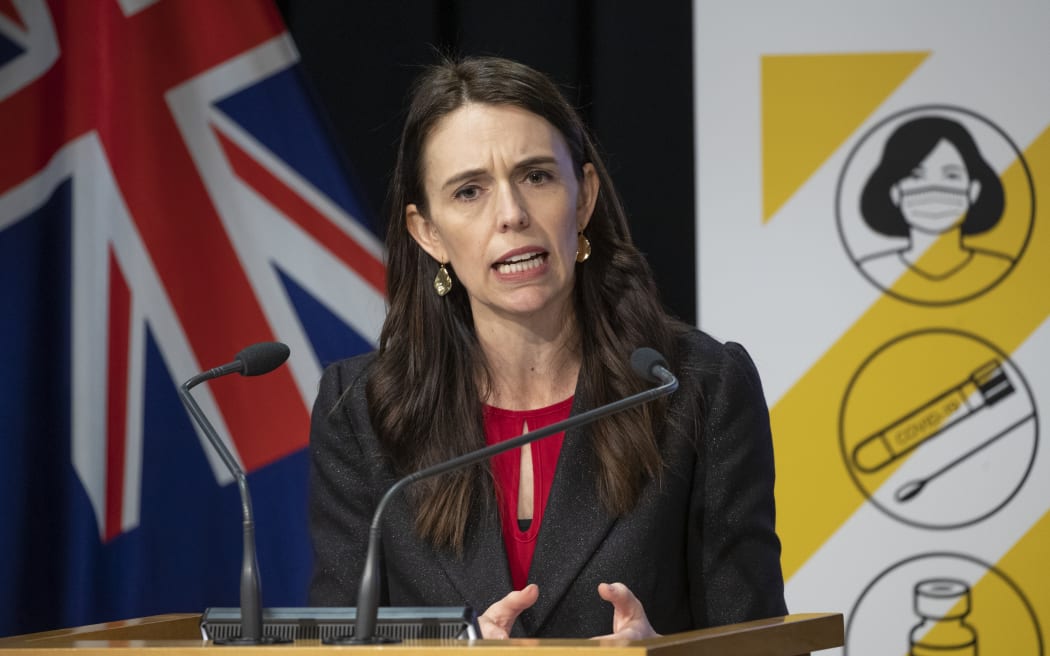
Word from The Hill: Interest rate pause, Aston, Liberals looking for their voice on the Voice, Yunupingu, TikTok

Source: The Conversation (Au and NZ) – By Michelle Grattan, Professorial Fellow, University of Canberra

As well as her interviews with politicians and experts, Politics with Michelle Grattan includes “Word from The Hill”, where she discusses the news with members of The Conversation’s politics team.

In this podcast Michelle and Amanda Dunn, politics + society editor, discuss the Reserve Bank’s pause (but for how long?) on interest rate hikes, the Aston byelection, the Liberals grappling with the Voice, the loss of a great Indigenous leader in Yunupingu, and the ban on TikTok on government devices.

The Conversation

Michelle Grattan does not work for, consult, own shares in or receive funding from any company or organisation that would benefit from this article, and has disclosed no relevant affiliations beyond their academic appointment.

ref. Word from The Hill: Interest rate pause, Aston, Liberals looking for their voice on the Voice, Yunupingu, TikTok – https://theconversation.com/word-from-the-hill-interest-rate-pause-aston-liberals-looking-for-their-voice-on-the-voice-yunupingu-tiktok-203240

Bougainville president slams ‘mocking’ by drunken MP over independence

Asia Pacific Report

Bougainville President Ishmael Toroama today condemned a visiting Papua New Guinean member of Parliament for “mocking” the autonomous region’s independence aspirations during a drunken exchange in Buka last week, saying that he must “atone for his blunder”.

A video of Ijivitari MP David Arore allegedly abusing security guards and airport staff while getting ready to board a plane out of Buka last Friday has stirred wide condemnation by national and Bougainville leaders.

“Let us take this criticism in our stride and use this as motivation to continue to develop and progress,” President Toroama said in a statement, adding that sovereignty was “rightfully ours to claim”.

“We are a people who have withstood tougher challenges than the words of a drunken man,” he said.

Ishmael Toroama
Bougainville President Ishmael Toroama … “Sovereignty is rightfully ours to claim, we have paid for it with the unfair exploitation of our resources, our lives and the blood of the people who sacrificed their lives fighting for their freedom in an unjust war. Image: APR

Arore’s visit to Bougainville was part of a delegation led by the Minister for Bougainville Affairs, Mannaseh Makiba. The visit was to help national MPs better understand the autonomous arrangements on Bougainville and meet local leaders and the people.

Toroama said the trip was a success but strongly criticised the behaviour of MP Arore, saying he did not have the “right to use it to insult our leaders and our people”.

“Sovereignty is rightfully ours to claim, we have paid for it with the unfair exploitation of our resources, our lives and the blood of the people who sacrificed their lives fighting for their freedom in an unjust war,” President Toroama said, referring to the now-closed rich Panguna copper mine and the decade-long civil war over the exploitation and environmental degradation.

Unfair comparison
It was unfair for Arore to even compare infrastructure development on Bougainville to that of the rest of the country because Bougainville was a post-conflict region that was only now “steadily gaining traction on development and peace”.

“Bougainville bankrolled PNG’s independence and set the very foundation for every form of development in this country,” President Toroama said.

“Subsequently, we had a war waged on our people by the very same government we built.

“You [Arore] can mock our shortcomings in development but do not mock the sanctity of our aspirations to be an independent nation.”

President Toroama thanked Bougainvilleans who witnessed Arore’s “tirade of insults” directed at the Air Niugini and National Airports Corporation (NAC) staff for “maintaining civility”.

“In this respect we proved that despite his inebriated state and the discourteous behaviour our people still showed respect for the office that he occupies as a national leader.”

But President Toroama called for an investigation, saying Arore “understands our Melanesian traditions” and he was “stlll subservient to the law”.

Minister apologises
A PNG Post-Courier report by Gorethy Kenneth and Miriam Zarriga said the delegation leader, Bougainville Affairs Minister Manasseh Makibe, had apologised for the behaviour of MP Arore.

“We left in good note. However, such behaviour by an MP is wrong and unacceptable,” Makiba said.

“We will not allow the unfortunate incident to deter the progress we have made and good working relationship we have with Autonomous Bougainville Government (ABG) leadership and people.

“We were not aware of this incident until now. Generally, our visit was well appreciated by ABG.

“I apologise for Mr Arore’s behaviour.”

According to reports, Arore insinuated that Bougainville’s independence was “not negotiable”, among other derogative comments he made at that time.

Arore told the Post-Courier he would not apologise as what he had said was not intended to upset Bougainville, its people and the leadership.

“I will not apologise. I have nothing to apologise for because I did not say something wrong, I did not abuse anyone and there was no commotion,” Arore claimed.

“All I said was, ‘Yumi laik kisim independence (if we want independence), yumi stretim balus na stretim hausik (we must fix our airport and our hospital)’.

“I said these same sentiments in Manus, where I said to the leaders there, ‘Manus has a big and very good airport but the town is in shambles’.

“I think we have made this very minor issue a very big one.”

‘We’ll have him arrested’
Police Commissioner David Manning said the incident of a MP allegedly drunk and disorderly on a flight would be investigated with him waiting on NAC and Air Niugini for a report and complaint.

“We will have him arrested. We are awaiting the NAC and Air Niugini,” he said.

Civil Aviation Minister Walter Schnaubelt said: “He (Arore) was also allowed to board the plane drunk, which is a security breach.

“So (we are) getting a report from our team on the ground so further preventative action can be taken. This sort of behaviour must not be tolerated, and we leaders must lead by example at all times.”

MP Arore is a member of PNG’s parliamentary law and order committee. The Ijivitari Open electorate is in Oro province.

In 2019, a non-binding independence referendum was held in Bougainville with 98.31 percent of voters supporting independence from Papua New Guinea.

Report compiled from Bougainville News and the PNG Post-Courier with permission.

Print Friendly, PDF & Email

Article by AsiaPacificReport.nz

Sure, the RBA froze interest rates this time, but there’s plenty of pain to come

Source: The Conversation (Au and NZ) – By Peter Martin, Visiting Fellow, Crawford School of Public Policy, Australian National University

Wes Mountain/The Conversation, CC BY-ND

Australia’s Reserve Bank has hit pause on interest rates after ten successive hikes, but for many Australians, the pain it has inflicted is about to begin.

The Bank says more than one million households will come off ultra-low fixed-rate mortgages this year and the next, some of those rates fixed for as low as 1.95%. They will be pushed onto loans as high as 5%, meaning that if they borrowed $600,000, instead of paying $2,500 per month they’ll be paying $3,500.

That’s an extra $1,000 those borrowers will need to find each and every month – an extraordinary $250 they will need to find each week. The Bank says 880,000 fixed-rate mortgages will expire this year and another 450,000 next year.

How much harm will that do to the economy? Quite a lot. The Bank said the full effect of its interest rate increases to date was “yet to be felt”.

Fixed-rate borrowers face trouble

The Bank’s research finds fixed-rate borrowers are more likely to have larger loans relative to their incomes than other borrowers, and more likely to have high loan-to-valuation ratios, in part because they tend to be more recent borrowers.

Its rule of thumb is that borrowers who spend more than 30% of their income on scheduled payments run the risk of having problems paying. At the moment only one in ten fixed-rate borrowers is in such a situation. When those fixed loans expire and they switch to the higher variable rates, it will be one in four of them.

Which is a good reason for taking stock. The Bank may well increase interest rates again. It said it expected to on Tuesday. But it knows a lot of the damage from what it has already done is yet to come.

After its last meeting in March, the board produced a checklist of the things it said it would consider in April in deciding whether to hit pause. On this list were inflation, jobs, retail spending, business conditions and developments overseas.

Inflation easing

On inflation, the board says a range of information suggests the rate has peaked.

The official figures only come out four times a year, and the next ones aren’t due for some weeks. But since the last lot we have had two new readings of the quasi-experimental monthly index, and they have both been down.

On that monthly measure (which excludes 30% of the items in the quarterly measure, among them gas and electricity) inflation fell from 8.4% in the year to December to 7.4% in the year to January, to 6.8% in the year to February.


A further indication that price pressures are moderating is what trade unions asked for in the minimum wage case before the Fair Work Commission. They didn’t ask for the official inflation rate of 7.8%, but for 7%, which suggests they accept the monthly figures and believe inflation is coming down.

On employment (the second item on the Bank’s checklist), the official figures showed a jump in February after declines in December and January, but the Bank says this is more likely to reflect changing seasonal hiring patterns than a genuine surge. Job vacancies have been falling for six months.

Economy weakening

Retail spending (the third item on the checklist) grew just 0.2% in February, much less than price growth of 0.6%, at a time when Australia’s population grew quickly, suggesting what was bought per person went backwards. ANZ card data for the first two weeks of March shows a further weakening.

The Bank says the combination of higher interest rates, cost-of-living pressures and a decline in housing prices is leading to a “substantial slowing in spending”. While some households have savings buffers, others are experiencing a “painful squeeze on their finances”.


Read more:
The Lowe road – the RBA treads a ‘narrow path’


Business conditions (the fourth item of the checklist) remained healthy in February according to the National Australia Bank survey, although confidence slipped into negative territory (meaning pessimists outweighed optimists).

So weak was Australia’s overall economy on the last reading that gross domestic product (spending and income) grew just 0.5% in the three months to December, by about as much as population, meaning GDP per person didn’t grow.

The Bank says it expects “below trend” growth for the next couple of years.

Overseas headwinds

Overseas developments (the last item on the checklist) have been grim since the last board meeting.

The Bank says the international outlook is “subdued” with below-average growth likely in the years ahead, weighed down by bank crises in the US and Switzerland.

Lowe’s moment of truth

Governor Philip Lowe will address the National Press Club on Wednesday.

It’s likely to be his last chance to explain what he is doing before Treasurer Jim Chalmers releases the report of the independent review of the Bank he received in March.

That report is likely to suggest big changes to the organisation of the bank (such as more experts and fewer business figures on the board) and a more open culture.

But in something of a vindication for Lowe, it is set to find little reason to change either the Bank’s targets (2–3% inflation and full employment) or the single tool it uses to achieve them, which is adjusting the so-called cash rate.

After Chalmers makes changes as a result of the review, The Bank is likely to continue attempting to do what it is attempting to do now, which is using monthly (or perhaps less frequent) reviews of the cash rate to try to get inflation and employment somewhere near where it wants them. It won’t be easy.

The Conversation

Peter Martin does not work for, consult, own shares in or receive funding from any company or organization that would benefit from this article, and has disclosed no relevant affiliations beyond their academic appointment.

ref. Sure, the RBA froze interest rates this time, but there’s plenty of pain to come – https://theconversation.com/sure-the-rba-froze-interest-rates-this-time-but-theres-plenty-of-pain-to-come-203223

More than 650 refugees arrived in this regional town. Locals’ welcoming attitudes flipped the stereotype

Source: The Conversation (Au and NZ) – By Sue Watt, Associate Professor in Psychology, University of New England

Shutterstock

When we think of regional towns in Australia, some of us might think “close-knit”, “conservative”, or “resistant to change”.

Our new research flips these stereotypes.

Over four years, we examined a regional town’s attitudes before and after hundreds of refugees settled in the area. Our surveys found residents of Armidale, in northeastern New South Wales, started out reasonably positive about the settlement program, and became even more so.

Over time, they had fewer concerns about the impact of refugees on the town, more contact with the refugees, and more positive attitudes towards refugees and the settlement program.


Read more:
The regions can take more migrants and refugees, with a little help


Welcoming communities

After a lengthy process, Armidale was chosen as a regional settlement location for Australia’s refugee program under the Turnbull government in 2017. Since 2018, the town has welcomed some 650 Ezidi refugees, boosting the town’s population by almost 3%.

Ezidis are a religious minority mostly from northern Iraq, Syria and Turkey, and are also known as Yazidis or Yezidis. They’ve faced persecution for centuries, including recently by Islamic State (or ISIS), who perpetrated genocide on the group in the mid-2010s.

There are several elements in the equation for successful refugee settlement. Receptive, welcoming communities is one important part.

We documented shifts in the Armidale community’s attitudes towards refugee settlement through six successive surveys. Each surveyed about 200 residents, drawing a new sample each time.

Initially, the main concerns were whether there would be enough jobs, and whether local services were adequate.

Residents’ views changed significantly about how many refugees were OK to accept. The number of residents who believed the number was “too high” declined, and the number of people who thought it was “too low” increased.

But, of course, sentiment was not uniformly positive (or negative).

Residents’ views on the number of refugees coming to Armidale over time

The percentage of residents who thought the number of refugees coming to Armidale was ‘too high’ decreased over time.
University of New England and Settlement Services International, Author provided

We segmented the community to identify clusters of attitudes among like-minded people toward refugee settlement. Initially, there were four clusters, which we named “enthusiastic”, “positive”, “concerned” and “resistant”. Enthusiastic and positive formed the majority.

Over time, the positive clusters expanded, and the negative clusters reduced. By the final survey, our most negative cluster was, in fact, positive towards the refugees. We renamed it “cautious”.

Residents’ contact with Ezidis increased as time went on, and was overwhelmingly rated positively, with residents saying Ezidis were “friendly”, “grateful” and “polite”.

The final three surveys also re-interviewed participants from earlier surveys to examine changes in attitudes at the individual level. As with the community surveys, participants had more positive attitudes over time.

On average, the greatest change was among people who initially had reservations: those who started out negative became more positive. People who started out positive remained positive.

A model for regional settlement

It’s tempting to think of Armidale as an outlier in regional Australia. Local talk was that Armidale was “special” – highly educated, multicultural, welcoming.

But when we compared Armidale with other similar areas in regional Australia, there were few differences.

Armidale was reasonably representative in socio-demographics and attitudes to immigration and multiculturalism. Contrary to expectations, Armidale actually rated slightly lower on social cohesion, and on having multicultural neighbourhoods. However, we found Armidale improved on all multiculturalism indicators during the settlement period.


Read more:
Resettling refugees in other countries is not reliable, nor is it fair. So, why is Australia doing it?


Our research showed Armidale progressively adapting and embracing the refugee settlement program, challenging stereotypes of regional Australia.

The study occurred during a time of disruption to the Armidale community through the impact of a severe drought followed by the COVID pandemic. Nonetheless, the community became increasingly positive, a result that speaks to the hard work of many people and organisations, and the efforts and strengths of Ezidis to settle as they build a new chapter of their lives in Australia.

Indeed, if Armidale is representative of inner regional Australia, which it appears to be, our results are promising for refugee settlement in other regional towns.

The Conversation

SSI, University of Newcastle and the University of New England provided funding for the research reported in this article.

Stefania Paolini receives funding from the Australian Research Council.

Tadgh McMahon works for SSI which receives funding from the Australian Government to provide settlement services to refugees. He is affiliated with Flinders University.

ref. More than 650 refugees arrived in this regional town. Locals’ welcoming attitudes flipped the stereotype – https://theconversation.com/more-than-650-refugees-arrived-in-this-regional-town-locals-welcoming-attitudes-flipped-the-stereotype-202140

Sure, the RBA froze interest rates on Tuesday, but there’s plenty of pain to come

Source: The Conversation (Au and NZ) – By Peter Martin, Visiting Fellow, Crawford School of Public Policy, Australian National University

Wes Mountain/The Conversation, CC BY-ND

Australia’s Reserve Bank hit pause on interest rates after ten successive hikes on Tuesday, but for many Australians, the pain it has inflicted is about to begin.

The Bank says more than one million households will come off ultra-low fixed-rate mortgages this year and the next, some of those rates fixed for as low as 1.95%. They will be pushed onto loans as high as 5%, meaning that if they borrowed $600,000, instead of paying $2,500 per month they’ll be paying $3,500.

That’s an extra $1,000 those borrowers will need to find each and every month – an extraordinary $250 they will need to find each week. The Bank says 880,000 fixed-rate mortgages will expire this year and another 450,000 next year.

How much harm will that do to the economy? Quite a lot. The Bank said on Tuesday the full effect of its interest rate increases to date was “yet to be felt”.

Fixed-rate borrowers face trouble

The Bank’s research finds fixed-rate borrowers are more likely to have larger loans relative to their incomes than other borrowers, and more likely to have high loan-to-valuation ratios, in part because they tend to be more recent borrowers.

Its rule of thumb is that borrowers who spend more than 30% of their income on scheduled payments run the risk of having problems paying. At the moment only one in ten fixed-rate borrowers is in such a situation. When those fixed loans expire and they switch to the higher variable rates, it will be one in four of them.

Which is a good reason for taking stock. The Bank may well increase interest rates again. It said it expected to on Tuesday. But it knows a lot of the damage from what it has already done is yet to come.

After its last meeting in March, the board produced a checklist of the things it said it would consider in April in deciding whether to hit pause. On this list were inflation, jobs, retail spending, business conditions and developments overseas.

Inflation easing

On inflation, the board says a range of information suggests the rate has peaked.

The official figures only come out four times a year, and the next ones aren’t due for some weeks. But since the last lot we have had two new readings of the quasi-experimental monthly index, and they have both been down.

On that monthly measure (which excludes 30% of the items in the quarterly measure, among them gas and electricity) inflation fell from 8.4% in the year to December to 7.4% in the year to January, to 6.8% in the year to February.


A further indication that price pressures are moderating is what trade unions asked for in the minimum wage case before the Fair Work Commission. They didn’t ask for the official inflation rate of 7.8%, but for 7%, which suggests they accept the monthly figures and believe inflation is coming down.

On employment (the second item on the Bank’s checklist), the official figures showed a jump in February after declines in December and January, but the Bank says this is more likely to reflect changing seasonal hiring patterns than a genuine surge. Job vacancies have been falling for six months.

Economy weakening

Retail spending (the third item on the checklist) grew just 0.2% in February, much less than price growth of 0.6%, at a time when Australia’s population grew quickly, suggesting what was bought per person went backwards. ANZ card data for the first two weeks of March shows a further weakening.

The Bank says the combination of higher interest rates, cost-of-living pressures and a decline in housing prices is leading to a “substantial slowing in spending”. While some households have savings buffers, others are experiencing a “painful squeeze on their finances”.


Read more:
The Lowe road – the RBA treads a ‘narrow path’


Business conditions (the fourth item of the checklist) remained healthy in February according to the National Australia Bank survey, although confidence slipped into negative territory (meaning pessimists outweighed optimists).

So weak was Australia’s overall economy on the last reading that gross domestic product (spending and income) grew just 0.5% in the three months to December, by about as much as population, meaning GDP per person didn’t grow.

The Bank says it expects “below trend” growth for the next couple of years.

Overseas headwinds

Overseas developments (the last item on the checklist) have been grim since the last board meeting.

The Bank says the international outlook is “subdued” with below-average growth likely in the years ahead, weighed down by bank crises in the US and Switzerland.

Lowe’s moment of truth

Governor Philip Lowe will address the National Press Club on Wednesday.

It’s likely to be his last chance to explain what he is doing before Treasurer Jim Chalmers releases the report of the independent review of the Bank he received in March.

That report is likely to suggest big changes to the organisation of the bank (such as more experts and fewer business figures on the board) and a more open culture.

But in something of a vindication for Lowe, it is set to find little reason to change either the Bank’s targets (2–3% inflation and full employment) or the single tool it uses to achieve them, which is adjusting the so-called cash rate.

After Chalmers makes changes as a result of the review, The Bank is likely to continue attempting to do what it is attempting to do now, which is using monthly (or perhaps less frequent) reviews of the cash rate to try to get inflation and employment somewhere near where it wants them. It won’t be easy.

The Conversation

Peter Martin does not work for, consult, own shares in or receive funding from any company or organisation that would benefit from this article, and has disclosed no relevant affiliations beyond their academic appointment.

ref. Sure, the RBA froze interest rates on Tuesday, but there’s plenty of pain to come – https://theconversation.com/sure-the-rba-froze-interest-rates-on-tuesday-but-theres-plenty-of-pain-to-come-203223

Choreographic legacies, human connectivity, and a psychedelic rainbow celebration: FRAME is a joyous festival of dance

Source: The Conversation (Au and NZ) – By Yvette Grant, PhD (Dance) Candidate and dance history tutor, The University of Melbourne

Exposed by Restless Dance Theatre. Roy Vandervegt/Arts House

Staying true to its objectives of representing dance artists from across practices and lineages, the inaugural FRAME Dance Festival offered a diversity of performance styles and forms in locations around Melbourne and beyond.

The program included shows, films and workshops in venues ranging from courtyards to galleries to dance studios.

Some offerings were political and academic, some were celebratory. Some told us personal or cultural stories; some had 100 dancers, some had one.

FRAME felt like a community coming together after three very difficult pandemic years for dance and dancers in Melbourne. Here are my highlights of the festival.


Read more:
5 Australian women choreographers you should know (and where to see them in 2023)


Mohini

In a mesmerising queer retelling of Lord Vishnu’s transformation into the enchantress Mohini, Raina Peterson – a Fiji-Indian and English dancer/choreographer – draws us into their sensual, visceral world where they shift from transgender storyteller to demon to Hindu goddess.

True to the classical Indian idiom, their wide-open unblinking eyes, bouncing brows and long articulate fingers lead the narrative, which begins on a dimly lit stage covered in low billowing clouds.

A woman dances in a sari, one nipple is exposed.
This is a mesmerising queer retelling of Lord Vishnu’s transformation into the enchantress Mohini.
Anne Moffat/Arts House

Peterson is joined by Marco Cher-Gibard, who hits long, loud notes on electric guitar to a background of tinkling chimes.

As the story climaxes with Mohini’s recovery of the elixir of life, there is a visual metamorphosis on stage from quiet monochrome intimacy to explosive psychedelic rainbow celebration with the projection of a spinning vortex around Peterson’s ecstatic silhouetted form.

It is an intense and captivating experience.

Slip

In Slip, dancer Rebecca Jensen, dressed as the enigmatic Girl with a Pearl Earring, exposes the illusions created by technology in our everyday lives.

The bare stage appears like a workspace with only a sound desk and a scattering of quotidian objects. The performance begins with a demonstration of the sound-effect technique Foley from Jensen’s collaborator Aviva Endean.

Upon entering, Jensen sits centre stage and eats, drinks and reads a newspaper while Endean creates sounds to match her actions. When Jensen eats chips, live and synchronised Endean amusingly crunches on a celery stalk.

A woman lies on the ground.
Slip is an energetic and intellectual work.
Sarah Walker/Darebin Arts Speakeasy

This measured synchronicity creates a comforting rhythm – until it gradually begins to slip.

The sound and action become out of sync. The crunching accompanies walking. The walking sounds like water being poured. The artificiality of the sound’s relationship to the action is disturbingly laid bare.

The pace picks up as Jensen and Endean interact with the objects, each other and as animated dancers projected on the back screen.

An energetic and intellectual work, Slip keeps the audience holding on by a thread, never letting up or settling in.


Read more:
Ballet dancers in sensor suits: new research explores how dance is used as a form of communication


Us and All of This

In our era of social dysfunction, environmental disasters, pandemics and war, Us and All of This is choreographer Liesel Zink’s meditation on human connectivity.

The sound of loud humming white noise accompanies the 100 very slow-moving quiet bodies as one by one they fill the Arts Centre Melbourne forecourt.

They stand separate, motionless, facing different directions and gazing to the distance. They represent the breadth of our society: all ages, races, genders and abilities.

A crowd of people stand with their hands outstretched.
These dancers represent the breadth of our society: all ages, races, genders and abilities.
Mark Gambino/Arts Centre Melbourne

A few begin to breathe their arms gently and slowly up and down like wings. They are joined by a few more until everyone is breathing together. Changes to the movement starts with a few and gradually ripples through the whole 100 dancers.

As momentum builds, the synchronicity breaks down.

Different intense movements are now distributed randomly through the crowd: a highly energetic arm winding, a desperate curling in, a spinning with arms fully stretched and a pushing down hard towards the ground. The dancers are engrossed.

Sometimes they move closer to each other, sometimes further apart. And while they do not acknowledge each other until the very end, in this immersive experience we as the audience are drawn in from the start with a sense we are all in this together.

Exposed

Directed by Michelle Ryan, Restless Dance Theatre’s diverse dancers take us on an exploration of the physical, mental and emotional vulnerability exposed in the face of global upheaval.

A huge screen becomes translucent and we make out the seven dancers beyond it scattered across the stage slowly getting dressed.

They begin to look up as if there is something there they cannot see but are afraid of; something invisible but menacing. They start slowly turning. The screen transforms into a lung breathing over their heads. Only now do they start seeing each other.

Six bodies look up at a blue sheet above their heads.
We see the vulnerability exposed in the face of global upheaval.
Roy Vandervegt/Arts House

They are jumpy, afraid of each other and of other things we cannot see. This fear develops into an emotional desperation in some. Others become violent. Still others show signs of physical suffering.

They begin to attempt to help each other.

The screen moves once more to become a backdrop. The dancers now move with each other, connecting, smiling, learning to give and accept care. The motifs of the breath and physical turning and rolling throughout the work, together with a serene and repetitive score, create a sense of continuation and inevitability, of a human condition that insists on struggling on, that has no choice.

This tender work closes as it began, the dancers separate and turn inward once more as they slowly and quietly undress.


Read more:
Guttered: a joyful immersion and subversion of expectations between the bowling lanes


Somewhere at the Beginning

Known as the mother of modern African dance, Senegalese French dancer Germaine Acogny moves us through the continual returns of inescapable pasts in a haunting post-colonial epic.

With direction by Mikael Serre, this multimedia bricolage shifts from the intimate corporeality of the weight of a stone on a foot to the museum-like objective formality of 20th century film footage and documentary voice over.

A beaded curtain which divides the stage into back and front is traversed throughout, representing the movement between different worlds, past and present, African and European.

A Black woman dances surrounded by feathers.
Germaine Acogny is the mother of modern African dance.
Thomas Dorn/Arts House

In a long, grey dress, Acogny moves deliberately and heavily with only a book, a stone, a pillow and a chair to accompany her. We are confronted with a variety of stories: some deeply personal, some culturally shared and some highly academic.

Themes around identity relentlessly recur throughout the work imitating the insistence of the colonial legacy they illustrate. The same story of powder used to whiten faces manifests at different times in projection, voice and in its sprinkling around the stage.

Without lightness or relief, Somewhere at the Beginning demands we bear witness to its account of the tragedy and persistence of cultural and colonial trauma.

NEWRETRO

Lucy Guerin’s three-hour marathon 21st-birthday celebration is a director’s cut of 21 works reenacted by 21 dancers who, along with their audience, move in and out of all four galleries of the Australian Centre for Contemporary Art.

In this shift from blacked-out theatre to white cube, Guerin shows us a version of her works we have not seen before. We encounter the dancers on and off stage: close-up, sweaty and raw. As the audience we not only see, but are also seen.

The larger main gallery exhibits a built-up remix of vocabularies with different groups of dancers simultaneously performing excerpts clearly drawn from different Guerin works. The movement is at times hyper-energetic, pounding with unexpected grunts and screams, and at other times minimal, quiet and pedestrian.

A white room, an audience around the edge, a mass of dancers in black.
Close-up, sweaty and raw where we encounter the dancers on and off stage and as audience.
Gregory Lorenzutti/ACCA

The more intimate and darker corner gallery has a schedule of five duets, while the other two galleries show original footage of all 21 works and a demonstration of the process undertaken by the dancers working with footage to learn the choreography.

With a cast of some of Melbourne’s most beloved dancers including Lilian Steiner, Deanne Butterworth and Melanie Lane, NEWRETRO is a landmark event in its memorialisation of a local woman choreographer who has not only produced 21 works in 21 years but has also supported and mentored many others as both dancers and choreographers.

It felt like a very satisfying way to end my FRAME journey.


Read more:
In Motion Picture, dancers drive a cinematic story onstage


The Conversation

Yvette Grant works as a lecturer in Dance at The Victorian College of the Arts and as a graduate researcher and receives some funding from The University of Melbourne and a Commonwealth government scholarship.

ref. Choreographic legacies, human connectivity, and a psychedelic rainbow celebration: FRAME is a joyous festival of dance – https://theconversation.com/choreographic-legacies-human-connectivity-and-a-psychedelic-rainbow-celebration-frame-is-a-joyous-festival-of-dance-199779

I used to work at Google and now I’m an AI researcher. Here’s why slowing down AI development is wise

Source: The Conversation (Au and NZ) – By Rodolfo Ocampo, PhD student, Human–AI Creative Collaboration, UNSW Sydney

Chuttersnap / Unsplash

Is it time to put the brakes on the development of artificial intelligence (AI)? If you’ve quietly asked yourself that question, you’re not alone.

In the past week, a host of AI luminaries signed an open letter calling for a six-month pause on the development of more powerful models than GPT-4; European researchers called for tighter AI regulations; and long-time AI researcher and critic Eliezer Yudkowsky demanded a complete shutdown of AI development in the pages of TIME magazine.

Meanwhile, the industry shows no sign of slowing down. In March, a senior AI executive at Microsoft reportedly spoke of “very, very high” pressure from chief executive Satya Nadella to get GPT-4 and other new models to the public “at a very high speed”.

I worked at Google until 2020, when I left to study responsible AI development, and now I research human-AI creative collaboration. I am excited about the potential of artificial intelligence, and I believe it is already ushering in a new era of creativity. However, I believe a temporary pause in the development of more powerful AI systems is a good idea. Let me explain why.

What is GPT-4 and what is the letter asking for?

The open letter published by the US non-profit Future of Life Institute makes a straightforward request of AI developers:

We call on all AI labs to immediately pause for at least 6 months the training of AI systems more powerful than GPT-4.

So what is GPT-4? Like its predecessor GPT-3.5 (which powers the popular ChatGPT chatbot), GPT-4 is a kind of generative AI software called a “large language model”, developed by OpenAI.


À lire aussi :
Evolution not revolution: why GPT-4 is notable, but not groundbreaking


GPT-4 is much larger and has been trained on significantly more data. Like other large language models, GPT-4 works by guessing the next word in response to prompts – but it is nonetheless incredibly capable.

In tests, it passed legal and medical exams, and can write software better than professionals in many cases. And its full range of abilities is yet to be discovered.

Good, bad, and plain disruptive

GPT-4 and models like it are likely to have huge effects across many layers of society.

On the upside, they could enhance human creativity and scientific discovery, lower barriers to learning, and be used in personalised educational tools. On the downside, they could facilitate personalised phishing attacks, produce disinformation at scale, and be used to hack through the network security around computer systems that control vital infrastructure.

OpenAI’s own research suggests models like GPT-4 are “general-purpose technologies” which will impact some 80% of the US workforce.

Layers of civilisation and the pace of change

The US writer Stewart Brand has argued that a “healthy civilisation” requires different systems or layers to move at different speeds:

The fast layers innovate; the slow layers stabilise. The whole combines learning with continuity.

According to the ‘pace layers’ model, different layers of a healthy civilisation move at different speeds, from the slow movement of nature to the rapid shifts of fashion.
Stewart Brand / Journal of Design and Science

In Brand’s “pace layers” model, the bottom layers change more slowly than the top layers.

Technology is usually placed near the top, somewhere between fashion and commerce. Things like regulation, economic systems, security guardrails, ethical frameworks, and other aspects exist in the slower governance, infrastructure and culture layers.

Right now, technology is accelerating much faster than our capacity to understand and regulate it – and if we’re not careful it will also drive changes in those lower layers that are too fast for safety.

The US sociobiologist E.O. Wilson described the dangers of a mismatch in the different paces of change like so:

The real problem of humanity is the following: we have Paleolithic emotions, medieval institutions, and god-like technology.

Are there good reasons to maintain the current rapid pace?

Some argue that if top AI labs slow down, other unaligned players or countries like China will outpace them.

However, training complex AI systems is not easy. OpenAI is ahead of its US competitors (including Google and Meta), and developers in China and other countries also lag behind.

It’s unlikely that “rogue groups” or governments will surpass GPT-4’s capabilities in the foreseeable future. Most AI talent, knowledge, and computing infrastructure is concentrated in a handful of top labs.


À lire aussi :
AI chatbots with Chinese characteristics: why Baidu’s ChatGPT rival may never measure up


Other critics of the Future of Life Institute letter say it relies on an overblown perception of current and future AI capabilities.

However, whether or not you believe AI will reach a state of general superintelligence, it is undeniable that this technology will impact many facets of human society. Taking the time to let our systems adjust to the pace of change seems wise.

Slowing down is wise

While there is plenty of room for disagreement over specific details, I believe the Future of Life Institute letter points in a wise direction: to take ownership of the pace of technological change.

Despite what we have seen of the disruption caused by social media, Silicon Valley still tends to follow Facebook’s infamous motto of “move fast and break things”.


À lire aussi :
Has GPT-4 really passed the startling threshold of human-level artificial intelligence? Well, it depends


I believe a wise course of action is to slow down and think about where we want to take these technologies, allowing our systems and ourselves to adjust and engage in diverse, thoughtful conversations. It is not about stopping, but rather moving at a sustainable pace of progress. We can choose to steer this technology, rather than assume it has a life of its own that we can’t control.

After some thought, I have added my name to the list of signatories of the open letter, which the Future of Life Institute says now includes some 50,000 people. Although a six-month moratorium won’t solve everything, it would be useful: it sets the right intention, to prioritise reflection on benefits and risks over uncritical, accelerated, profit-motivated progress.

The Conversation

Rodolfo Ocampo worked at Google from 2018 to 2020.

ref. I used to work at Google and now I’m an AI researcher. Here’s why slowing down AI development is wise – https://theconversation.com/i-used-to-work-at-google-and-now-im-an-ai-researcher-heres-why-slowing-down-ai-development-is-wise-202944

Should I put more money into my super? What are the benefits and can I take it out before retirement if I need it?

Source: The Conversation (Au and NZ) – By Helen Hodgson, Professor, Curtin Law School and Curtin Business School, Curtin University

Sutterstock

Superannuation is never far from the headlines lately, with the government recently calling for views from the public on what the objective of super should be.

The basic idea behind super is you set aside a portion of your pay over your working life, so you can build up a nest egg to see you through your retirement years.

But what if you’re worried you might not have enough super by the time you retire? Yes, you could top up your super now and watch the nest egg grow through the magic of compound returns – but what are the downsides?

If you’re considering putting more money into your super, and want to know more about how the whole system works, here are the basics.


Read more:
Tax-free super for the super rich is a bad deal for the rest of us – and Morrison said it first


What are the rules about putting more money into my super?

First, make sure you know where your superannuation actually is and how much you’ve got so far. This page from the Australian Tax Office explains how to search for any lost super.

The next thing to know is there are limits to how much you can contribute into superannuation.

There are two types of super contributions you can make.

The first category is called “concessional contributions”. These are taxed at 15%, which may be lower than the tax you’d otherwise have to pay on that money. So making these super top-ups can not only grow your nest egg, but save you tax.

The amount of concessional contributions you can make is A$27,500 per annum. That figure includes all the super your employer puts in your super account and any extra contributions you make under a salary sacrifice scheme or where you are claiming an income tax deduction.

The second category, known as “non-concessional contributions”, means money you pay into your super without claiming a tax deduction. This could be, for example, money from savings, an inheritance or a lottery win.

There is a limit of $330,000 over three years (or $110,000 per year), for these contributions.

A man looks at a computer with concern.
Do you know where your super is?
Photo by Wes Hicks on Unsplash, CC BY

What are the benefits of topping up my super?

Two words: compound returns.

Compound returns are where you earn returns not only on the original investment you put in, but also on any returns on that investment. As the government’s Moneysmart website puts it, “you get interest on your interest”.

Over the years, this means you could earn a lot more than you would if you didn’t top up your super.

How much more? Well, it depends on the investment return and fees of your fund.

But as an example: thanks to compound returns, putting an extra $100 per month into your super from age 30 could mean you retire with an extra $65,000 in your account (here, I’ve assumed investment returns of 7.5%, accumulation inflation of 4% and salary inflation of 4%).

And the longer it is there, the more it will grow – so starting top-ups early might pay off.

This is particularly important for women, whose super balances may look a bit feeble if they take parental leave or cut their hours while raising a family.

Then there’s the tax benefits of super top-ups. If you would normally pay a net tax rate higher than 15% on investments such as shares, your money will grow more quickly inside superannuation than shares.

You may also be eligible for government co-contributions that add to your balance if you make a non-concessional contribution during the year and your income is less than $57,016.

Three people look at their screens.
Starting top-ups early might pay off, so don’t ignore super until you are close to retirement.
Photo by Ketut Subiyanto/Pexels, CC BY

So what’s the downside? Can I access my superannuation before retirement?

Basically, no. You must meet a “condition of release” before being able to access your superannuation.

The most common is retirement, defined as reaching the age of 65 or leaving work after reaching “preservation age” (which is 60 for anyone born after July, 1964).

There are some special circumstances where you may be able to access your superannuation early.

These are very narrow, and include serious financial hardship or necessary medical treatment that cannot be funded any other way.

Death or terminal illness also qualify for release.


Read more:
Should I pay off the mortgage ASAP or top up my superannuation? 4 questions to ask yourself


But what if I need a deposit for a house?

This is a dilemma for non home-owners. After compulsory superannuation guarantee deductions and HECS-HELP, it may be hard to save a deposit.

One of the few circumstances where you access your superannuation early is through the First Home Super Savers Scheme.

If you make voluntary contributions, you may be able to withdraw these contributions for a home deposit.

However, this scheme is very tightly regulated. You can read more about the rules for this scheme here.

So… should I put more money into my super?

It depends. If you do, make sure you understand you will not be able to access that money until retirement.

If you own your home (or intend to rent until retirement) you may want to put more into superannuation while you can afford it, knowing it is contributing to a secure retirement.

But if home ownership is your goal, you should think carefully about choosing between superannuation and saving for a home deposit.

Note: the contribution caps and rates used in this article are for the year ending June 30, 2023.

The Conversation

Helen Hodgson has received funding from the ARC, AHURI and CPA Australia. Helen is the Chair of the Social Policy Committee and a Director of the National Foundation for Australian Women (NFAW) and on the Gender and Career Progression Committee of CPA Australia (WA Division). Helen was a Member of the WA Legislative Council in WA from 1997 to 2001, elected as an Australian Democrat. She is not a current member of any political party. She is a Registered Tax Agent and a member of the SMSF Association, CPA Australia and The Tax Institute.

ref. Should I put more money into my super? What are the benefits and can I take it out before retirement if I need it? – https://theconversation.com/should-i-put-more-money-into-my-super-what-are-the-benefits-and-can-i-take-it-out-before-retirement-if-i-need-it-201950

What are microaggressions? And how can they affect our health?

Source: The Conversation (Au and NZ) – By Mahima Kalla, Digital Health Transformation Research Fellow, The University of Melbourne

Hermes Rivera/Unsplash

Microaggressions are seemingly innocuous verbal, behavioural or environmental slights against members of minority communities.

The term microaggressions was coined by American psychiatrist Chester Pierce in his 1970 essay Offensive Mechanisms. He explained:

Most offensive actions are not gross and crippling. They are subtle and stunning. The enormity of the complications they cause can be appreciated only when one considers that these subtle blows are delivered incessantly. Even though any single negotiation of offence can in justice be considered of itself to be relatively innocuous, the cumulative effect to the victim and to the victimiser is of an unimaginable magnitude.

While originally conceived in the context of race relations, microaggressions may also relate to gender, sexual orientation, religion, disability status, weight, or a combination of these.


Read more:
Discrimination against fat people is so endemic, most of us don’t even realise it’s happening


What do microaggressions look like?

Consider these situations. All are real-life stories from people of colour I know (used with their consent):

  • a woman walks into a hairdresser’s shop. The shop is empty and the hairdresser is cleaning hair from the floor. The woman asks if she could get a haircut – if not right now, perhaps another day. The hairdresser says she can’t help as she is not taking on any new customers.

  • a man is waiting to pick up his partner in his car, parked on a side street near his partner’s apartment, which is located in a predominantly white suburb. He is minding his own business sitting in his own car. Each time a person walks by, they stare at the man, and keep staring as they walk past.


Read more:
Microaggressions aren’t just innocent blunders – research links them with racial bias


  • a couple is waiting to order coffee in a busy city cafe. The server is chatty with the white couple ahead of them. When they progress to the front of the line, the server is curt, avoids eye contact, and is eager to move on to the next customer. After placing their order, the couple stands where other patrons had previously waited for their orders. A staff member comes over and asks the couple to wait outside instead.

Examples of microaggressions towards other identity minorities may include moving away from a trans person on public transport, or not considering wheelchair accessibility needs when booking venues for meetings or events.

Each of these incidents in isolation may not seem particularly harmful, and some may even chalk them up to coincidences or “reading too much into a situation”.

However, when experienced repeatedly, daily, or even multiple times a day, they can harm people’s psychological and physical health.

Microaggressions are like death by a thousand mosquito bites/Fusion Comedy.

Microaggressions are subtle

Microaggressions are often so subtle that even the victim may not realise that they have just experienced one until later – likely because microaggressions are often accompanied with dissociation (i.e. disconnection from thoughts, feelings or personal sense of identity).

As psychologist Ron Taffel explains, dissociation is a “psychically handy” tool that helps ease the pain,

making sure that the moment does not fully register or does its damage until a less vulnerable time later – perhaps during a quiet time alone…

Microaggressions affect our physical and mental health

Microaggressions can occur in all environments, from the workplace, to shops, medical clinics, schools, universities, even while walking or parked on the street. So victims often become increasingly self-conscious and hypervigilant.

Queer person sits at dinner table
Having to be constantly vigilant is a significant burden.
Unsplash/Aiden Frazier

The impacts of microaggressions may extend beyond psychological burden and also impact the body’s physiological state.

When humans perceive a sense of imminent danger, the body’s “fight, flight, freeze response” is activated. While this is a useful evolutionary mechanism to protect us from physical danger, when triggered frequently – as may be the case with microaggressions – it can take a toll on the body and contribute to issues such as high blood pressure, anxiety, depression and addiction.

Racial microaggressions have also been associated with suicide risk. One study found experiencing race-related microaggressions leads to more symptoms of depression, which in turn increases thoughts of suicide.


Read more:
Why words matter: The negative impacts of racial microaggressions on Indigenous and other racialized people


Microaggressions may deter people from seeking help

Health issues among victims may be further compounded when microaggressions are experienced in the health-care sector. A study from 2011 found that sexual orientation-related microaggressions (for example, derogatory comments or assumptions about a person’s sexual orientation) reduced the likelihood of LGBTIQ+ people seeking psychotherapy and impacted their attitudes towards therapy and therapists.

Research involving Indigenous people also suggests microaggressions impact help-seeking behaviours in this group (such as not scheduling or attending regular health-care appointments), which subsequently increases the risk of hospitalisation.

Indirect effects of microaggressions

Microaggressions may also impact people’s health status indirectly. Research suggests repeated microaggressions can cause marginalised groups to internalise feelings of inadequacy.

Over time, this internalised oppression may impact their academic and professional success, and consequently socioeconomic status.

Feelings of inadequacy can hold people back.
Pexels/Ketut Subiyanto

Sceptics and victim-blaming

Sceptics often attribute microaggressions to victims’ “negative emotionality” – a tendency to show negative affect and always feel like a victim.

However, proponents argue that this is a form of victim-blaming that further compounds the harm caused by microaggressions.

Clinical psychologist Monnica Williams suggests that the years of unchecked microaggressions themselves could be the very thing to cause negativity in marginalised people.

Victims’ responses to microaggressors

Victims’ responses to microaggressions can vary among people, and among events experienced by the same person. Victims have to regularly decide whether to let it slide or confront the aggressor.

The discourse on microaggressions in social media seems to be on the rise. One study found that there was a drastic increase in the usage of the term “microaggression” on Twitter between 2010 and 2018. Social media discussions and other online spaces may help victims (particularly younger people) to respond more critically to microaggressors.

Other technological innovations, such as the virtual reality-based intervention Equal Reality, are also helping people walk in another’s shoes, recognise unconscious bias, mitigate risk of microaggressions, and promote more inclusive workplaces.

If this article has raised issues for you, or if you’re concerned about someone you know, call Lifeline on 13 11 14.


Read more:
What is a name microaggression and could you be doing it without knowing?


The Conversation

Mahima Kalla does not work for, consult, own shares in or receive funding from any company or organisation that would benefit from this article, and has disclosed no relevant affiliations beyond their academic appointment.

ref. What are microaggressions? And how can they affect our health? – https://theconversation.com/what-are-microaggressions-and-how-can-they-affect-our-health-193309

Famous double-slit experiment recreated in fourth dimension by physicists

Source: The Conversation (Au and NZ) – By Stefan Maier, Head of School of Physics and Astronomy, Monash University

Tobias Carlsson / Unsplash

More than 200 years ago, the English scientist Thomas Young carried out a famous test known as the “double-slit experiment”. He shone a beam of light at a screen with two slits in it, and observed the light that passed through the apertures formed a pattern of dark and bright bands.

At the time, the experiment was understood to demonstrate that light was a wave. The “interference pattern” is caused by light waves passing through both slits and interfering with each other on the other side, producing bright bands where the peaks of the two waves line up and dark bands where a peak meets a trough and the two cancel out.

In the 20th century, physicists realised the experiment could be adapted to demonstrate that light not only behaves like a wave, but also like a particle (called a photon). In quantum mechanical theory, this particle still has wave properties – so the wave associated with even a single photon passes through both slits, and creates interference.

In a new twist on the classic experiment, we replaced the slits in the screen with “slits” in time – and discovered a new kind of interference pattern. Our results are published today in Nature Physics.

Slits in time

Our team, led by Riccardo Sapienza at Imperial College London, fired light through a material that changes its properties in femtoseconds (quadrillionths of a second), only allowing light to pass through at specific times in quick succession.

We still saw interference patterns – but instead of showing up as bands of bright and dark, they showed up as changes in the frequency or colour of the beams of light.


À lire aussi :
Curious Kids: is light a wave or a particle?


To carry out our experiment, we devised a way to switch on and off the reflectivity of a screen incredibly quickly. We had a transparent screen that became a mirror for two brief instants, creating the equivalent of two slits in time.

Colour interference

So what do these slits in time do to light? If we think of light as a particle, a photon sent at this screen might be reflected by the first increase of reflectivity or by the second, and reach a detector.

However, the wave nature of the process means the photon is in a sense reflected by both temporal slits. This creates interference, and a varying pattern of colour in the light that reaches the detector.


À lire aussi :
Explainer: what is wave-particle duality


The amount of change in colour is related to how fast the mirror changes its reflectivity. These changes must be on timescales comparable with the length of a single cycle of a light-wave, which is measured in femtoseconds.

Electronic devices cannot function quickly enough for this. So we had to use light to switch on and off the reflectivity of our screen.

We took a screen of indium tin oxide, a transparent material used in mobile phone screens, and made it reflective with a brief pulse of laser light.

From space to time

Our experiment is a beautiful demonstration of wave physics, and also shows how we can transfer concepts such as interference from the domain of space to the domain of time.

The experiment has also helped us in understanding materials that can minutely control the behaviour of light in space and time. This will have applications in signal processing and perhaps even light-powered computers.

The Conversation

Stefan Maier ne travaille pas, ne conseille pas, ne possède pas de parts, ne reçoit pas de fonds d’une organisation qui pourrait tirer profit de cet article, et n’a déclaré aucune autre affiliation que son organisme de recherche.

ref. Famous double-slit experiment recreated in fourth dimension by physicists – https://theconversation.com/famous-double-slit-experiment-recreated-in-fourth-dimension-by-physicists-203060

Labor and Albanese gain in Newspoll after Aston byelection triumph

Source: The Conversation (Au and NZ) – By Adrian Beaumont, Election Analyst (Psephologist) at The Conversation; and Honorary Associate, School of Mathematics and Statistics, The University of Melbourne

Lukas Coch/AAP

A federal Newspoll, conducted March 29 to April 2 from a sample of 1,500, gave Labor a 55-45 lead, a one-point gain for Labor since the early March Newspoll. Primary votes were 38% Labor (up one), 33% Coalition (down two), 10% Greens (steady), 8% One Nation (up one) and 11% for all Others (steady).

56% were satisfied with Prime Minister Anthony Albanese’s performance (up one), and 35% were dissatisfied (down three), for a net approval of +21, up four points. Liberal leader Peter Dutton’s net approval dropped two points to -13. Albanese’s lead as better PM widened from 54-28 to 58-26. Newspoll figures are from The Poll Bludger.

Analyst Kevin Bonham said this is One Nation’s highest vote in a Newspoll since November 2018, and the worst net approval for Dutton. This poll was nearly all conducted before Saturday’s Aston byelection.

With almost all votes counted in the Aston byelection, Labor won by a 53.6-46.4 margin, a 6.4% swing to Labor since the 2022 election. Primary votes were 40.9% Labor (up 8.3%), 39.1% Liberals (down 3.9%), 10.1% Greens (down 2.0%) and 7.0% for an independent (new). The UAP (6.1% in 2022) and One Nation (3.1%) did not contest. Turnout is currently 83.9% and will increase a little further.


Read more:
Labor wins Aston byelection; NSW election and Trump polling updates


This article in The Age has a map showing that the Liberals held seven Melbourne metro seats in 2019 – Goldstein, Higgins, Chisholm, Deakin, Menzies, Kooyong and Aston. At the 2022 election, Labor gained Higgins and Chisholm and teal independents gained Kooyong and Goldstein, and now Labor has gained Aston, leaving the Liberals with just Menzies and Deakin in metro Melbourne.

I wrote before the 2022 election that growing education polarisation, in which those without a university education, particularly in regional areas, are increasingly likely to vote for right-wing parties, while those with a university education vote left, would eventually favour Labor in Australia due to our big cities. The 2022 election and now Aston validate this argument.


Read more:
Will a continuing education divide eventually favour Labor electorally due to our big cities?


Labor’s victory in Aston will give them 78 of the 151 House of Representatives seats, up from 77. It will increase their majority over all other parties from three to five.

Labor also gains in Essential poll

A federal Essential poll, conducted March 29 to April 2 from a sample of 1,133, gave Labor a 53-42 lead in Essential’s two party measure that includes undecided, up from 52-43 last fortnight. Primary votes were 33% Labor (down one), 30% Coalition (down one), 14% Greens (steady), 6% One Nation (up one), 2% UAP (steady), 10% for all Others (up one) and 5% undecided (steady).

Albanese has a 52-35 approval rating, down from 53-34 in February. By 71-23, voters thought the federal government can make a lot or a fair amount of difference to the cost of living. By 54-46, they said they were financially struggling over comfortable, a reversal of a 51-49 lead for comfortable last fortnight.

On addressing climate change, 39% (down four since October 2022) said Australia is not doing enough, 33% (up one) said we are doing enough and 16% (up three) said we are doing too much. Since Labor won the May 2022 election, not doing enough has dropped eight points and doing too much has increased five points.

By 35-34, voters were opposed to the Greens’ policy of ending all future coal mining and gas extraction projects. By 90-10, they thought the PM should be required to get parliamentary approval before going to war.

Morgan poll: 57-43 to Labor

In last week’s federal Morgan poll, Labor led by 57-43, a one-point gain for the Coalition since the previous week. Primary votes were 35.5% Labor, 32% Coalition, 13% Greens and 19.5% for all Others. This poll was taken March 20-26, in the lead-up to the NSW election.

WA Voice poll: Yes leads by 60-40

The Poll Bludger reported on March 30 that a Painted Dog poll for The West Australian had Yes to the Indigenous Voice to parliament leading by 60-40 in WA. This poll was conducted over the weekend of March 25-26 from a sample of 1,052. It used the question wording proposed by Albanese.

The Conversation

Adrian Beaumont does not work for, consult, own shares in or receive funding from any company or organisation that would benefit from this article, and has disclosed no relevant affiliations beyond their academic appointment.

ref. Labor and Albanese gain in Newspoll after Aston byelection triumph – https://theconversation.com/labor-and-albanese-gain-in-newspoll-after-aston-byelection-triumph-203123

Why was TikTok banned on government devices? An expert on why the security concerns make sense

Source: The Conversation (Au and NZ) – By David Tuffley, Senior Lecturer in Applied Ethics & CyberSecurity, Griffith University

Shutterstock

Australia has joined a raft of other countries in banning the popular video sharing app TikTok from government devices, as several outlets have today reported.

The move comes after a seven month-long review instigated by Home Affairs Minister Clare O’Neil into security risks posed by social media platforms.

Last week, TikTok CEO Shou Zi Chew was grilled by US politicians in a more than five hour-long Congress hearing. Questions mainly focused on TikTok’s handling of user data and whether it could be accessed by the Chinese Communist Party, as well as how harmful content (such as content on self-harm and eating disorders) spreads on the app.

TikTok has maintained user data are stored securely and held privately, with CEO Shou Zi Chew telling Congress:

Let me state this unequivocally: ByteDance is not an agent of China or any other country.

But the evidence seems to suggest a ban was a long time coming.


Read more:
‘Anorexia coach’: sexual predators online are targeting teens wanting to lose weight. Platforms are looking the other way


Some background

Since it was acquired by Chinese company ByteDance in 2017, TikTok (formerly Musical.ly) has faced persistent rumours regarding its handling of user data and privacy.

Despite its assurances, TikTok’s privacy policy allows for user data, including browsing history, location and biometric identifiers to be collected and shared with

business partners, other companies in the same group as TikTok, content moderation services, measurement providers, advertisers, and analytics providers.

More worrying is this provision:

Where and when required by law, we will share your information with law enforcement agencies or regulators, and with third parties pursuant to a legally binding court order.

“Where and when required by law” would include the provisions of China’s National Intelligence Law, which came into effect in 2017. It obliges organisations to cooperate with state intelligence agencies, and would oblige Bytedance to share TikTok data from Australia that may be deemed relevant to national security.

ByteDance has tried to distance itself from the perception that it is a Chinese company. According to TikTok’s vice president of policy in Europe, Theo Bertram, 60% of ByteDance is owned by global investors, 20% by employees and 20% by the founders.


Read more:
TikTok tries to distance itself from Beijing, but will it be enough to avoid the global blacklist?


But it hasn’t been enough to dispel fears. In 2020, India was among the first countries to impose a lasting nationwide ban on TikTok (and dozens of other Chinese apps), citing privacy and security concerns.

In December 2022, Taiwan imposed a public sector ban after the US Federal Bureau of Investigation warned the app posed a national security risk. That same month, the US House of Representatives issued a ban on devices used by members and staffers.

More recently, lawmakers of the European Union were banned from having TikTok on their devices.

A host of other countries have also enacted bans, including Canada, Latvia, Denmark, Belgium, the UK, New Zealand, France, Netherlands and Norway.

What are Australia’s concerns?

Australia and its allies are engaged in a so-called grey zone conflict with China; this is where TikTok becomes a major concern.

Grey zone conflict can be understood as competition between states and non-state actors that resides in a blurred reality between peace and war. It involves the strategic use of disinformation, propaganda, economic coercion, cyberattacks, and other forms of non-kinetic (subtle and non-coercive) action.

The danger TikTok poses to Australia is that the means would exist for foreign intelligence agencies to track the location of government officials, build dossiers of personal information, and conduct espionage.

An in-depth analysis of TikTok’s software code by Australian cybersecurity firm Internet 2.0 makes for interesting, if not alarming, reading.

The firm determined TikTok requests almost complete access to a user’s smart device while the app is active. These data include their calendar, contact lists and photos. If the user denies access, the app keeps asking every few hours until access is granted.

Co-founder Robert Potter told the ABC:

When we did that [pulled apart the code], we saw the permission layer that the phone was requesting was significantly more than what they said they were doing publicly. When the app is in use, it has the ability to scan the entire hard drive, access the contact lists, as well as see all other apps that have been installed on the device.

Potter points out these permissions are “significantly more” than what a social media site actually needs to access.

This isn’t an isolated incident. Last year, Buzzfeed released leaked audio from more than 80 internal US TikTok meetings that raised the alarm. According to the Buzzfeed report, China-based employees of ByteDance had repeatedly accessed non-public data about US TikTok users.

In one September 2021 meeting, a senior US-based TikTok manager referred to a Beijing-based engineer as a “master admin” who “has access to everything”. A US-based staffer in the Trust and Safety Department was also heard saying “everything is seen in China”.

The tapes overwhelmingly contradict TikTok’s repeated insistence about the privacy of user data.


Read more:
Concerns over TikTok feeding user data to Beijing are back – and there’s good evidence to support them


The larger context

Australia’s ban on TikTok on government phones is hardly surprising. A partial ban has existed for some time.

The decision speaks to the larger issue of balancing national security interests against the trade relationship with our largest trading partner. The TikTok ban is just the latest manifestation of this struggle.

In 2018, Australia’s decision to exclude Huawei from installing its 5G network was based on advice from the Australian Signals Directorate that this would give the Chinese government the means, in time of war, to paralyse the nation’s 5G-enabled critical infrastructure. A number of other countries came to a similar conclusion.

China is a nation that takes the long view when it comes to geopolitical strategy. Its planning horizon extends to many decades, and even centuries.

Against a backdrop of escalating grey zone conflict, TikTok is an example of a potentially weaponised tool in China’s cyber arsenal that could harvest massive amounts of data for nefarious means. And it’s likely not the last of such tools we’ll face.

The wisest course of action for Australia would be to also develop a long-term orientation, making plans that reach forward many decades – and not as far as the next election cycle.

The Conversation

David Tuffley does not work for, consult, own shares in or receive funding from any company or organisation that would benefit from this article, and has disclosed no relevant affiliations beyond their academic appointment.

ref. Why was TikTok banned on government devices? An expert on why the security concerns make sense – https://theconversation.com/why-was-tiktok-banned-on-government-devices-an-expert-on-why-the-security-concerns-make-sense-202339

Children have a basic understanding of poverty – a more equal society means talking to them about it

Source: The Conversation (Au and NZ) – By Patrick Leman, Pro-Vice Chancellor, Professor of Psychology, University of Waikato

GettyI mages

Rates of child poverty in Aotearoa New Zealand remain stubbornly high, despite the issue being the focus of considerable political attention while Jacinda Ardern was prime minister.

In 2022, 120,000 children in New Zealand were being raised in households experiencing material hardship. This means their family is unable to afford essential items such as food, clothing, accommodation, heating and transport.

Alongside the obvious and pernicious direct effects of poverty on a person’s health and life prospects, there is a broader issue of what rising economic inequality may mean for all of us in the long run.

As we look at the consequences of poverty, we also need to ask what children themselves – the “kids who have” and the “kids who have not” – understand about the unequal world around them.

Stages of understanding

Statistics about childhood poverty tell part of the story of the widening gap in income and wealth. But children’s perceptions and understanding of economic inequality, and their experiences of it, will shape how future generations deal with the social upheaval it may bring.

So how do our children learn about, or perhaps learn to tolerate, inequality? Just for a moment, let’s set aside political or moral positions. For children growing up in poverty there are undeniable negative consequences on their physical and mental health, and their education.


Read more:
We must go beyond singular responses in the fight against child poverty


Over the course of a person’s life, this disadvantage restricts opportunity. Rising levels of poverty risk creating a cycle of inequality that continues into the future as those raised in poverty become adults.

Research indicates a consistent developmental pattern in how children acquire an understanding of economic inequality.

Before five years of age, children grasp only very basic distinctions between rich and poor. Older children can link wealth to work, albeit in a linear way: that is, they believe working hard leads to wealth.

And at around ten years, children start to consider effort, education, inheritance and occupation as factors affecting wealth.

Children understand fairness

Through most of childhood, wealth and poverty is framed in terms of basic stereotypes attributed to individuals. While these explanations can persist into adulthood, adolescents increasingly consider inequality more in terms of its structural, political and economic causes.

Children may not grasp the social and structural features that relate to economic inequality. But as any parent can tell you, you’ll find out pretty quickly if a child thinks something isn’t fair.

Of course, questions of inequality are intimately bound up with questions of morality. So while there is arguably limited reward in a conversation with your three-year-old about the finer points of macroeconomic theory, instilling a straightforward ethic of fairness and the principle of equality (or equity) from a young age is worthwhile.


Read more:
The cost of living crisis means bolder budget decisions are needed to lift more NZ children out of poverty


The broader social and political context matters too. Public discussions on individualistic versus structural explanations for inequality, and the prevailing political milieu, provide important backdrops for how children will frame and discuss inequality at home, school and among their peer group.

For instance, children and adolescents in Finland – one of the world’s most economically equal nations – use more structural explanations in discussing poverty compared with those from more unequal nations.

In nations with relatively high levels of economic inequality (such as New Zealand and the United States), people frequently believe wealth is based on individual merit.

Subverting meritocracy

Yet at the same time, poverty is associated with stigma. Stereotyping means poor people are more likely to be viewed as lazy or unintelligent. These stereotypes entail social influences that can diminish poorer children’s self esteem, increase their anxiety and lead them to under-perform in academic assessments.

Conversely, children from more affluent families may be more confident of their ability. Compounded with the different opportunities for support afforded to rich and poor children, this may lead those from less affluent families to lack the confidence to seek and reach their potential.


Read more:
Child poverty is at a 20-year high – but in one English community, children themselves are intervening


Human psychology subverts the supposed meritocracy in other ways. Adolescents tune in to social networks, status and hierarchies. Research from Wales found that moving to a high school with more affluent classmates negatively affected less affluent children’s mental wellbeing.

In fact, these self-perceptions of class predict physical and mental health inequalities later in life better than objective measures of wealth.


Read more:
Global inequality must fall to maintain a safe climate and achieve a decent standard of living for all – it’s a huge challenge


Not all bad news

Unequal societies have lower levels of social cohesion. Economic inequality is associated with less subjective wellbeing, even among the more affluent members of a society.

In other words, everyone is less happy. And rising economic inequality intersects with societal “faultlines” such as race and gender which are ripe for political exploitation.

In the future, economic inequality may be as much a consequence as a cause of the challenges future generations will face – climate change, for example. But it doesn’t have to be all bad news.

Historically, levels of income inequality have tended to fluctuate (albeit often as a consequence of financial crises or wars). So future economic inequality is not inevitable. And even if we adults cannot generate the political will or moral consensus to change things, maybe we can do our bit by nurturing and empowering a generation that can.

The Conversation

Patrick Leman does not work for, consult, own shares in or receive funding from any company or organisation that would benefit from this article, and has disclosed no relevant affiliations beyond their academic appointment.

ref. Children have a basic understanding of poverty – a more equal society means talking to them about it – https://theconversation.com/children-have-a-basic-understanding-of-poverty-a-more-equal-society-means-talking-to-them-about-it-202820

Supernatural beliefs have featured in every society throughout history. New research helps explain why

Source: The Conversation (Au and NZ) – By Joshua Conrad Jackson, Postdoctoral fellow, Kellogg School of Management, University of North Carolina at Chapel Hill

Religion is a human universal. For thousands of years, humans have held religious beliefs and participated in religious rituals. Throughout history, every human society has featured some kind of supernatural or religious belief.

Why is religion so prevalent? One reason is that it’s a powerful tool for explanation.

The world is a mysterious place, and was even more mysterious before the rise of modern science. Religion can be a way of making sense of this mystery. This idea dates back to theologians and philosophers such as Henry Drummond and Friedrich Nietzsche, who both supported the “God of the gaps” hypothesis, wherein divine intervention by God is used to explain gaps in scientific knowledge.

For example, ancient Chinese and Korean societies looked to divine intervention to justify changing their rulers, whereas Egyptians, Aztecs, Celtic, and Tiv people used the will of gods to explain celestial cycles.

In the contemporary world, many US Christians viewed the COVID pandemic as a form of divine punishment.

Yet despite these specific examples, we know little about which kinds of phenomena people try to explain using religion. If religion helps us fill gaps in knowledge, what kind of gaps is it most likely to fill?

Our international research team has pursued this question over the past five years, by surveying ethnographies from societies around the world and throughout history.

We found societies are overwhelmingly more likely to have supernatural beliefs that concern “natural” phenomena, rather than “social” phenomena.


Leer más:
Rituals have been crucial for humans throughout history – and we still need them


Supernatural explanations for natural events

In total, our research sample included historical records from 114 diverse societies.

These ranged from nomadic hunter-gatherer groups in Africa (such as the ǃKung people), to fishing and horticultural societies from the Pacific Islands (such as people from the Trobriand Islands), to large “complex” societies with modern technology and written records (such as the Javanese, Malay and Turkish societies).

For each society, we read through ethnographic texts and identified supernatural explanations that were commonly held across its people. We then identified the source of the explanation.

We were particularly interested in whether supernatural explanations focused on “natural” phenomena – events that had no clear human cause such as disease, natural disasters and drought – or whether they focused on human-caused “social” phenomena such as wars, murder and theft.

We found explanations for all these various phenomena in our survey. For example, the Cayapa people of the Ecuadorian rainforest attributed lightning, a natural phenomenon, to the Thunder spirit, who carried a large sword that glinted when he used it in combat.

And the Comanche people of the great American plains explained the timing of war, a social phenomenon, using dreams from medicine men.

However, our results also revealed a striking gap: supernatural explanations for natural phenomena were much more prevalent than for social phenomena.

In fact, nearly all the societies we surveyed had supernatural explanations for natural phenomena such as disease (96%), natural disasters (92%) and drought (90%). Fewer had supernatural explanations for warfare (67%), murder (82%) and theft (26%).

Supernatural beliefs evolve as societies expand

The global prevalence of naturally focused supernatural explanations is one of the most striking findings from our research. It’s partly surprising because current major religions such as Christianity and Islam are very social institutions.

Contemporary Christians rely on their religious beliefs as more of a social and moral compass, rather than a way to understand the weather. Similarly, the Bible seeks to explain a variety of social phenomena. The story of Cain and Abel explains the origin of murder, while the Book of Joshua explains the supernatural causes of the war that destroyed Jericho.

The story of Cain slaying Abel purports to explain the origin of murder.
Wikimedia

So how might we explain the contrast between supernatural explanations in modern-day Christianity, and supernatural explanations among traditional societies, as told through historical records? One of our findings could provide a clue.

We found societies develop more supernatural explanations for social phenomena as they get bigger and more complex. More populous societies with currency and land transport were more likely to explain events such as theft and warfare using supernatural principles than small hunter-gatherer and horticultural groups.

We can’t say with certainty why this is. It may be because people know and trust each other less in bigger societies, and this translates to beliefs in witchcraft and sorcery. Or perhaps people in larger complex societies are more concerned about issues such as warfare and theft, and therefore more likely to develop supernatural explanations for them.

Intellectuals such as Edward Tylor and David Hume thought religious beliefs may have originated as a means of explaining natural phenomena.

Although our study can’t shed light on the origins of religion, it does corroborate this idea. But beyond that, it also shows that societies are more likely to turn to religion to make sense of the social world as they get larger and more complex.


Leer más:
In Japan, supernatural beliefs connect the spiritual realm with the earthly objects around us


The Conversation

Las personas firmantes no son asalariadas, ni consultoras, ni poseen acciones, ni reciben financiación de ninguna compañía u organización que pueda obtener beneficio de este artículo, y han declarado carecer de vínculos relevantes más allá del cargo académico citado anteriormente.

ref. Supernatural beliefs have featured in every society throughout history. New research helps explain why – https://theconversation.com/supernatural-beliefs-have-featured-in-every-society-throughout-history-new-research-helps-explain-why-203041

Russia’s shadow war: Vulkan files leak show how Putin’s regime weaponises cyberspace

Source: The Conversation (Au and NZ) – By Matthew Sussex, Fellow, Strategic and Defence Studies Centre, Australian National University

Recent revelations about the close partnership between the Kremlin and NTC Vulkan, a Russian cybersecurity consultancy with links to the military, provide some rare insights into how the Putin regime weaponises cyberspace.

More than 5,000 documents have been leaked by an anonymous whistleblower, angry at Russia’s conduct in the war in Ukraine. They purport to reveal details about hacking tools to seize control of vulnerable servers; domestic and international disinformation campaigns; and ways to digitally monitor potential threats to the regime.

Although caution is always necessary before accepting claims about cyber capabilities, it’s noteworthy several Western intelligence agencies have confirmed the documents appear genuine.

The leak also corroborates the view of many strategists: that the Russian government regards offensive cyber capabilities as part of a holistic effort to degrade its enemies. This includes the sowing of mistrust via social media, the gathering of kompromat (compromising material), and the ability to target crucial infrastructure.

That list of enemies is a long one, and has grown since Putin’s full-scale invasion of Ukraine in February 2022. Naturally, the Kremlin’s just-released 2023 Foreign Policy Concept identifies the United States as the “main source of threats” to Russian security.

But Ukraine, every NATO and European Union member, and several other states are identified as “unfriendly countries”, including Australia, Japan, Singapore and New Zealand.

War in the shadows

Russia utilises a range of methods to wage war in cyberspace.

On one end of the spectrum, it uses groups attached to official agencies, such as the GRU (military intelligence) and the FSB (ostensibly domestic intelligence, but also carries out missions overseas).

The GRU’s groups include Sandworm and Fancy Bear. Another group, Cozy Bear, is associated with the FSB.

One or more of these groups have been responsible for a series of prominent cyber attacks on a range of targets, including:

At the other end of the spectrum, Russian information operations regularly use armies of bots and trolls, as well as unsuspecting “citizen curators”, to spread false narratives.

Doing so is cheap and increases the distance between the attacker and its agents, allowing for plausible deniability.

Like biological warfare, it also weaponises the targets to do the job of spreading the narrative disease for it.

Russian information campaigns operate globally, among nations it considers its friends as well as its adversaries. Russian-weaponised media can be found in Africa, where the Russian Wagner paramilitary organisation has been especially active, as well as in South Asia and Australia.


Read more:
Russian trolls targeted Australian voters on Twitter via #auspol and #MH17


In many respects, Russian information operations mimic Soviet geopolitical doctrine during the Cold War. This focused on courting areas of the world where the West was weakest.

But in the grey space between official agencies, useful idiots and unwitting proxies is an area of increasing emphasis of Russian cyberwar: outsourcing. Some of these, such as Vulkan, retain an aura of respectability as consultancies that do government work as well as contracting to other firms.

They also include the Internet Research Agency in St Petersburg, which was used to coordinate social media attacks on the US Democratic Party during the 2018 mid-term elections, leading to an indictment by the Department of Justice.

Others are [organised criminal gangs] like the aptly named “EvilCorp” (https://www.state.gov/transnational-organized-crime-rewards-program-2/maksim-viktorovich-yakubets/) that use malware to harvest people’s banking details or personal information.

The November 2022 breach of Australia’s private health insurer Medibank was one example, which exposed patients’ sensitive health details such as treatments for drug addiction or HIV.

The Vulkan revelations

The Vulkan leak adds more detail to what we know about Russian methods, tactics and targets in cyberspace. The GRU group Sandworm is identified as having authorised Vulkan to help build “Skan-V”, a piece of software that can monitor the internet to detect vulnerable servers to hack.

Another Vulkan project, known as “Fraction”, was designed to monitor social media sites for key words to identify regime opponents, both at home and abroad.

An even larger project in which Vulkan seems to have been engaged was “Amezit”. This is a tool that would enable operators to seize control of the internet both inside Russia and in other nations, and hijack information flows.

To function, its users need to be able to control physical infrastructure such as mobile phone towers and wireless internet nodes. Amezit can then be used to mimic legitimate sites and social media profiles, scrub content that might be deemed hostile, and replace it with disinformation.

Given the requirement to possess physical infrastructure, it’s clear Azemit was designed not solely as a piece of software, but to operate in tandem with the coercive instruments of a state.

This has internal uses as well as external ones. Domestically, it could be used to silence dissent in restive Russian regions. In a war zone, such as Ukraine, it could be used alongside Russia’s armed forces to intercept government communications and swap genuine information sources for false ones.


Read more:
As Russia wages cyber war against Ukraine, here’s how Australia (and the rest of the world) could suffer collateral damage


The Vulkan leak also included information on physical objects. Although not a concise target list, its software allowed users to map physical infrastructure. This included airports worldwide, the Swiss Ministry of Foreign Affairs, and the Muhlberg nuclear power plant near Bern.

What’s more, the document drop featured mapped clusters of internet servers in the United States. And the Skan-V project identified a site in the US labelled “Fairfield” as a potentially vulnerable point of entry.

If the documents are accurate, Vulkan’s work for the Russian government shows how extensive the Kremlin’s attempts have been to monitor digital infrastructure, collect information about vulnerabilities, and develop the capacity to hijack it.

Combating Russian cyber attacks

Cyber threats are insidious because they can be used in multiple combinations and aimed at different targets. Hack-and-leak campaigns against influential figures can be mixed with attempts to sabotage vital infrastructure, perform corporate espionage, undermine social cohesion and trust, and push fringe narratives to the political centre.

They can be drip-fed into the digital ecosystem. Or, much like the campaign that accompanied Russia’s takeover of Crimea in 2014, they can be employed all at once in a cyber-blizzard.

This makes cyber attacks very hard to build resilience against, and even harder to deter. They are a weapon of potentially mass disruption that can result in real casualties. Turning off the power grid in a city, for example, can lead to deaths among people on life support in hospitals, traffic accidents, and exposure to extreme cold in certain regions.


Read more:
A year on, Russia’s war on Ukraine threatens to redraw the map of world politics – and 2023 will be crucial


But beyond infrastructure and industry, such attacks also target social pressure points: a states’ institutions, ideas and people. This makes them especially useful in attacking democracies, making the open and free exchange of views a potential vulnerability.

As the Vulkan leaks demonstrate, hostile governments have greater ambitions in cyberspace than being able to switch off the lights. They seek to be able to encourage us to question what we believe to be true, and pit us against one another.

Recognising that will be a crucial step in preventing the poisonous seeds of disinformation from taking root.

The Conversation

Matthew Sussex has previously received funding from the Australian Research Council, the Carnegie Foundation, the Lowy Institute, and various Australian government agencies.

ref. Russia’s shadow war: Vulkan files leak show how Putin’s regime weaponises cyberspace – https://theconversation.com/russias-shadow-war-vulkan-files-leak-show-how-putins-regime-weaponises-cyberspace-203146

How digital marketing of legal but harmful products escalates health threats to the most vulnerable

Source: The Conversation (Au and NZ) – By Tim McCreanor, Professor Race Relations, Health and Wellbeing, Massey University

Getty Images

The marketing of legal but harmful products – like alcohol and tobacco – has always targeted our emotional desires. But it has now moved to digital and social media, and this creates a heightened threat to public health because both the products and the platform target our neurological response.

Promoting psychoactive products for profit by stimulating the neurotransmitters in the brain’s reward centres, or its limbic structures, is called “limbic capitalism”.

But as limbic capitalism has gone digital over the past decade, marketers can now reach us on our smartphones as we use digital and social media platforms.

The algorithms that keep us swiping and tapping on images and videos stimulate the dopamine drive in our brains that induces feelings of pleasure.

When used to promote potentially addictive products, this presents a serious threat to public health and the wellbeing of individuals, communities and populations. We know alcohol and tobacco products are linked to a wide range of harms and injuries, but existing regulatory frameworks have nothing to say about these new forms of marketing.


Read more:
Alcohol marketing has crossed borders and entered the metaverse – how do we regulate the new digital risk?


The addictive power of social media

We surveyed people aged 14 to 20 in Aotearoa New Zealand about their experience of alcohol and tobacco marketing on social media. While they valued the way social media enabled them to keep in touch with family and friends, they also frequently told us they felt these platforms were addictive.

As one 20-year-old Māori/Pākehā male told us:

Content algorithms are addictive and predatory. The only value is in being able to communicate with friends and whānau.

An 18-year-old Pākehā female said:

I dislike the addiction it fuels, dislike the competitive and comparative posting and dislike the mental health issues it feeds to young people.

Participants’ responses highlight the addictive power of social media platforms and, despite their benefits, the price users pay in continuing to use them. These insights lead us to argue limbic capitalism is becoming “limbic platform capitalism”.

New challenges to public health

This highlights the importance of understanding how much capacity we have to choose and control our compulsions on mobile social media. Users of digital platforms have valuable insights about how marketers use social media to target their vulnerabilities as they pursue their own interests and social lives online.

The public health challenges of limbic platform capitalism present a serious escalation. This is because marketing has been naturalised into these digital environments and has become difficult to identify and avoid. It has become more powerful in its capacity to target our limbic system.

Woman lying on a bed and using a smart phone at night.
Digital marketing has become difficult to avoid.
Getty Images

An example comes from Perth in Australia, where the alcohol industry used the global COVID pandemic as a marketing opportunity. The number of alcohol ads increased significantly on commonly used digital platforms. Users saw alcohol ads at least every 35 seconds, offering easy access to alcohol without leaving the home and promoting the use of alcohol to “feel better”.

Our participants reported noticing increases in vape and alcohol ads on social media, including delivery offers, during lockdowns. When asked what changes they had seen in marketing since lockdowns, they also showed awareness of the synergies between platforms and products, for example:

The way they promote their products. The sounds they use. A lot of songs have become famous off [platform name]. So a lot of companies use the really famous music to help promote.

Need for regulation of social media marketing

Mobile social media are now central to young people’s professional and social identity, leisure and civic engagements. While they actively use social media for their own ends, they are simultaneously recruited as limbic platform and product consumers.

Platform algorithms are designed to generate, analyse and apply vast amounts of personalised data to target and tune flows of content to users, influencing their desires, behaviours and consumption, in order to increase profits.


Read more:
NZ children see more than 40 ads for unhealthy products each day. It’s time to change marketing rules


These developments and their public health implications require immediate attention.
Algorithmic models intensify targeting of users at times, places and contexts when they are most susceptible. Home delivery of alcohol in the evening is an example.

This can influence purchase decisions, potentially harming vulnerable consumers and exacerbating health inequities. Such commercialised algorithm-driven systems raise serious questions for health policymakers about public oversight of the algorithms. Should we ban the promotion and marketing of unhealthy but legal products on limbic platforms?

Scholarship exploring mobile social media landscapes is essential to inform public health and health promotion research agendas, initiatives and policies. We urgently need regulatory responses for this new era of marketing, where both commodities and the popular platforms they are marketed on are dynamic, participatory, data-driven and limbic.

The Conversation

Tim McCreanor receives funding from the Royal Society of New Zealand Marsden Fund.

Angela Moewaka Barnes receives funding from the Royal Society of New Zealand Marsden Fund.

Antonia Lyons receives funding from the Royal Society of New Zealand Marsden Fund.

Ian Goodwin receives funding from Royal Society of New Zealand Marsden Fund.

Nicholas Carah does not work for, consult, own shares in or receive funding from any company or organisation that would benefit from this article, and has disclosed no relevant affiliations beyond their academic appointment.

ref. How digital marketing of legal but harmful products escalates health threats to the most vulnerable – https://theconversation.com/how-digital-marketing-of-legal-but-harmful-products-escalates-health-threats-to-the-most-vulnerable-201164