No one likes spending cuts and tax hikes, but on our estimate the government will soon need more of them if they are going to make a dent in looming A$70 billion a year budget deficits.
The sooner we do, the sooner we will be well-placed to respond to future economic shocks and avoid pushing costs onto future generations.
We were right to spend big when COVID hit
The massive government support unleashed during the 2020 and 2021 lockdowns was essential for supporting households and businesses and helped keep unemployment low and Australia’s 2020 recession mild.
It left us with government debt that, at 23% of GDP, set to climb to almost 32% by the end of the decade, is high by historical standards, but low by international standards.
Our real problem is a structural one of spending growing faster than revenues.
And it was building long before COVID.
Demands on government are set to grow
Costs are inexorably growing for three reasons.
The first is that our expectations are growing as we age and become more wealthy, pushing up spending on healthcare, disability care and aged care.
The second is that many of these services happen to be the hardest to mechanise, meaning there is little we can do to stop them costing more over time.
The third reason is geopolitical and climate developments. The huge AUKUS deal is just the latest manifestation of pressure to ramp up defence spending. Increases in the frequency and severity of natural disasters mean we have no choice but to spend more on emergencies than before.
Combined with higher interest rates that are pushing up the cost of servicing debt, these three forces are set to leave a persistent gap between government revenue and spending of about 2% of GDP according to Treasury calculations. That’s $50 billion per year in today’s dollars, each and every year.
Data are for financial year. Cyclical component includes cyclical movements in commodity and asset prices. Temporary fiscal measures include COVID-related direct economic and health support. Source: Treasury, October 2022 Budget, Chart 3.20
But even that grim forecast looks optimistic.
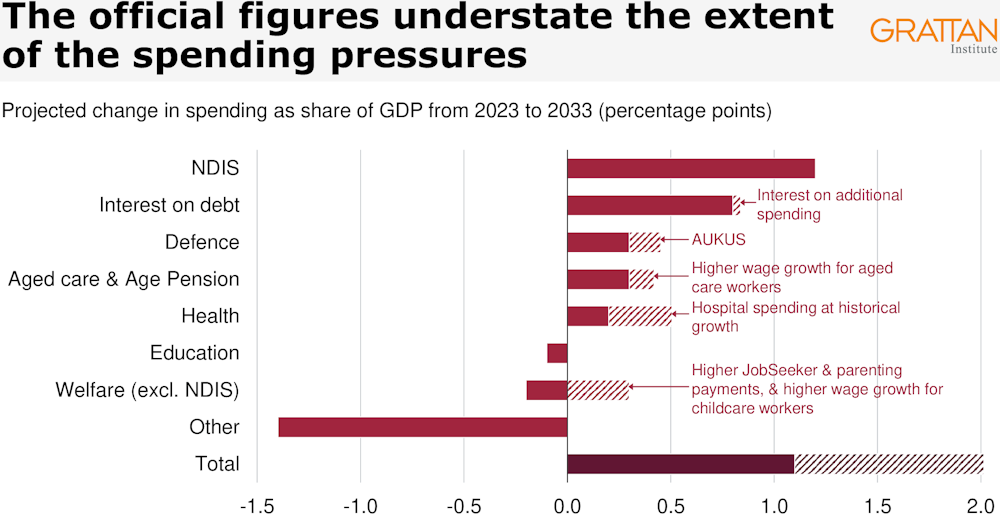
Grattan Institute estimates suggest the true structural gap exceeds $70 billion per year when extra, largely unavoidable, spending is taken into account – including on AUKUS, overdue wage rises for care workers, more realistic growth in hospital spending, and long-overdue increases in unemployment benefits.
And that’s just the next decade. In the longer term, the budget will come under extra pressure from slower productivity growth, Australia’s ageing population, and climate change.
Higher economic growth and productivity growth would reduce the enormity of the challenge, and Grattan Institute has put forward ideas about how to support this before.
But hoping we will be able to grow our way out of chronic budget deficits is not a prudent approach. While we should try to boost growth, by itself it is unlikely to get the nation’s finances onto a sustainable trajectory.
13 multibillion dollar ideas
The size of the problem, and the political difficulty of budget repair, mean both spending and revenue measures need to be on the table.
Spending cuts have been the focus of budget repair efforts for most of the past decade, so a lot of the low-hanging fruit has already been picked. But there are still savings to be had.
The biggest would come from greater discipline in decisions about what to spend on infrastructure and defence. Better decisions upfront based on economic – rather than political – considerations could save several billion each year.
Buying smaller, more regularly and “off the shelf” would reduce the risks and costs of mega-projects that have a history of massive cost overruns.
Our report identifies a further $15 billion a year of savings measures, including undoing Western Australia’s special GST funding deal, counting more of the family home in the age pension asset test, and improving hospital efficiency and purchasing in health.
But even with substantial spending cuts, tackling Australia’s budget challenge without compromising core services will require more revenue.
The biggest opportunity comes from plugging “leakages” in the income tax system. Tax breaks and minimisation opportunities are growing. Reining in superannuation tax concessions, reducing the capital gains tax discount, limiting negative gearing, and setting a minimum tax on trust distributions could collectively raise more than $20 billion a year.
Reworking the legislated Stage 3 tax cuts so they are less generous at the top end would save another $8 billion per year.
Lifting the age at which people could get access to their super from 60 to 65 and freezing compulsory super contributions at their present level (10.5% of salary) would save at least another $8 billion.
Other options include lifting the rate of goods and services tax (with a compensation package, and the Commonwealth and states sharing the net revenue), winding back fuel tax credits and beefing up the petroleum resource rent tax.
Ordering the whole menu at once would be a recipe for indigestion. But if Treasurer Jim Chalmers chooses just a few items on the menu, we will be well on the way to tackling Australia’s budget problem.
Kate Griffiths’s employer, Grattan Institute, has been supported in its work by government, corporates, and philanthropic gifts. A full list of supporting organisations is published at www.grattan.edu.au.
Danielle Wood and Iris Chan do not work for, consult, own shares in or receive funding from any company or organisation that would benefit from this article, and have disclosed no relevant affiliations beyond their academic appointment.
When Tahlea Aualiitia talks about hosting the ABC’s new Pacific-focused news and current affairs TV programme, The Pacific, her voice breaks and she becomes emotional.
Personally, it’s a career milestone, anchoring her first TV show after a decade working mostly in radio, producing ABC local radio programmes and presenting Pacific Mornings on ABC Radio Australia. But it’s also much more than that.
Aualiitia grew up in Tasmania and is of Samoan (and Italian) heritage. She has strong connections to the country and the Pacific Islander community in Australia.
ABC’s Tahlea Aualiitia . . . presenter of the new The Pacific programme. Image: Natasha Johnson/ABC News
What moves her so profoundly about The Pacific is that the 30-minute, weekly programme is being broadcast across the Pacific on ABC Australia, the ABC’s international TV channel, as well as in Australia (on the ABC News Channel and iview), and is produced by a team with a deep understanding of the region and features stories filed by local journalists based in Pacific nations.
“For me, it’s representation and I think that is really important,” she says.
“I’m probably going to cry because for so long I feel that in Australia and on mainstream TV, Pacific Islanders have been, at best, under-represented and, at worst, misrepresented.
“Given the geopolitical interest, there is more focus on the Pacific but my hope for this show is that it will highlight Pacific voices, really centre those voices as the people telling their stories and change the narrative.
‘The ABC cares’ “It shows the ABC cares, we are not just saying we decide what you watch, we’re involving you in what we’re doing, and I think that that makes a difference.”
The Pacific presenter Tahlea Aualiitia is of Samoan heritage and has worked at the ABC for more than a decade . . . “For me, it’s representation and I think that is really important.” Image: Natasha Johnson/ABC News
Aualiitia’s father was born in Samoa and moved to New Zealand at the age of 12, then later to Australia. Her mother’s brother married a Samoan woman, so Samoan culture was celebrated in her immediate and extended family.
She recalls a childhood shaped by Samoan food, dance and song, and the importance of family, faith and rugby. But from her experience, “the narrative” about the Pacific in Australia has tended towards being negative or patronising.
“I think people tend to see the Pacific as a monolith and there are a lot of stereotypes about what a Pacific Islander is, especially in view of the climate change crisis — there’s this idea everyone’s a victim and they should all just move to Australia,” she says.
“There’s a lot of stuff you carry as a brown journalist. When I hear a story on the news about a Pacific Islander and a crime, I brace myself and think about what that might mean for my day, is it going to make my day at harder when I walk out onto the street, will it make my day at work harder?
“I’ve had people say to me when they learn I have an arts degree, ‘oh, your parents must be so proud of you because you’re the first person in your family who has gone to uni’. And that’s not true, my dad has a PhD in chemistry.
“It’s indicative of ideas that people have of what you’re capable of, what you can do, and that’s the power of the media to shape those narratives and change those narratives.
Facebook ‘reality’ check “When I started presenting Pacific Mornings, I would interview people from across the Pacific and people would find me on Facebook, message me, saying, ‘I didn’t know any Pacific Islanders were working at the ABC’.
“I was just doing my job, but they said they were proud of me, of the visibility and that it was a good thing that it was happening. So, I hope this programme re-frames things a little bit by showing the rich diversity of the Pacific, its different cultures, resilience, and the joy of being Pacific.”
The Pacific is a weekly, news and current affairs programme about everything from regional politics to sport. Image: Natasha Johnson/ABC News
The Pacific is being produced by the ABC’s Asia Pacific Newsroom (APN), based in Melbourne, with funding from ABC International Broadcast and Digital Services.
While the scope of the ABC’s international services has fluctuated over the years, depending on federal government funding levels, an injection of $32 million over four years to ABC International Services allocated in the 2022 budget has enabled this first-of-its-kind programme to be made, among a suite of other initiatives under the Indo-Pacific Broadcast strategy.
“The APN has been a trusted content partner for the ABC’s International Services team for many years and already has deep Pacific expertise,” says Claire Gorman, head of international services.
“We have been working with the APN to produce our flagship programmes Pacific Beat and Wantok for ABC Radio Australia and have been wanting to produce a TV news programme for Pacific audiences for some time, but until now have not have the funding for it.
“The Pacific is the first of many exciting developments in the pipeline. We believe it is more important than ever before for Australians and Pacific audiences to have access to independent, trusted information about our region.”
Journalist Johnson Raela at rehearsals. Image: Natasha Johnson/ABC News
Pacific-wide team Joining Aualiitia on air is long-serving Pacific Beat reporter and executive producer Evan Wasuka and journalist Johnson Raela, who previously worked in New Zealand and the Cook Islands.
Correspondent Lice Movono, based in Suva, Fiji, and Chrisnrita Aumanu-Leong in Honiara, Solomon Islands, are contributing to the programme as part of a developing “Local Journalism Network”, also funded under the Indo-Pacific Broadcast strategy, to use the expertise of independent journalists located in the region.
Lice Movono has worked as a journalist in FIji for 16 years and is now filing stories for The Pacific. Image: ABC New
Behind the scenes are APN supervising producer Sean Mantesso, producers Gabriella Marchant, Dinah Lewis Boucher, Nick Sas and APN managing editor Matt O’Sullivan.
“The ABC has covered the Pacific for decades but largely for the Pacific audience,” says O’Sullivan.
“In recent years, that’s mostly been via Pacific Beat and increasingly through digital and video storytelling. We’ve felt for some time that there’s growing interest in the Pacific within Australia and there’s also a massive Pacific diaspora in Australia with strong links to the region.
“So, we’ve felt a need to share our content more broadly. The Pacific programme will cover the breadth of Pacific life beyond palm trees and tourism, from politics to jobs and the economy, climate change, culture and sport.”
Supervising producer Sean Mantesso and Johnson Raela discussing plans for the programme. Image: Natasha Johnson/ABC News
Lice Movono has been working as a journalist in Fiji for 16 years and has previously filed for the ABC. She believes elevating the work of regional journalists across the ABC programs and platforms, through the Local Journalism initiative, will help provide more informed coverage of Pacific affairs.
“I believe it’s critical for journalists from within the Pacific to be at the centre of storytelling about the Pacific,” she says.
“A few years ago, while working in a local media organisation, I had the opportunity to attend a conference in Europe and it shocked and saddened me to find that there are people on the other side of the world who have little or no understanding of what it means to live with the reality of climate change here in the region.
“So, it means everything for me to work with the ABC, which has one of the widest, if not the widest reach in the Pacific region and to have access to a platform that tells stories about the Pacific and Fiji, in particular, to the rest of the world, to tell authentic stories through the lens of a Pacific Islander, and an Indigenous one at that, about the realities of what Pacific people face.”
While the covid pandemic and various lockdowns curbed a lot of international news gathering, it provided an opportunity to showcase the work of locally based reporters on ABC domestic channels.
“We’ve often used stringers in the region, but covid showed us the value journalists in country can offer,” says O’Sullivan.
“Because we couldn’t fly Australian-based crews into the region during the pandemic, we relied more on journalists in the Pacific telling their stories, for example during the 2021 riots in Solomon Islands.
“We are now building on that foundation of local expertise and knowledge by establishing the Local Journalism Network of independent journalists to report for the ABC.
“We’ve had producers doing training with them, teaching them how to shoot good TV pictures and we’ve provided mobile journalism kits that enable them to quickly do a TV cross.
“In filing for the ABC, they can tell stories local media often can’t but the challenge for us is protecting them.”
Support and protection from the ABC has been welcomed by Movono. Renowned for her tough questioning, she has endured personal threats and harassment over the course of her career, but the country is now moving into a new era of openness with the newly-elected Rabuka government repealing the controversial Media Industry Development Act that was introduced under military law in 2010 and has been regarded as a restraint on media freedom.
In an international scoop, Movono landed an interview with the new Prime Minister, Sitiveni Rabuka, for the first episode of The Pacific.
Lice Movono secured an exclusive interview with the new prime minister of Fiji, Sitiveni Rabuka, for the first episode of The Pacific. Image: ABC News
“When I knew that there was going to be a segment of The Pacific where we could Talanoa with leaders of the Pacific, it was important for me to position the ABC as the one international organisation that Rabuka would do an interview with,” she says.
“I knew, with the new government only weeks into power, it was going to be a challenge. The government is dealing with a failing economy, a divided country, high inflation, high levels of poverty, the ongoing recovery from covid and trying to mitigate the impacts of climate change.
“But he has made progress as a Pacific leader, as the leader of a country just coming out of a military dictatorship, and he’s done some significant work in the region. So, it was a very significant interview, probably one of the most important assignments of my career.”
In addition to new content and engagement of local journalists, ABC International Services is also expanding the FM footprint for ABC Radio Australia and enhancing media training across the region.
As she prepared for the first episode of The Pacific to go to air, Tahlea Aualiitia was keen to hear the feedback from the audience and — with some trepidation– from family and friends in Samoa.
“I think that’s the part that I’m most nervous about,” she says.
“I know that they will lovingly make fun of my struggling to pronounce Samoan words properly, given I grew up in Australia, but I know they’re already proud of me because of the work I’m doing here.
“Having said that, my brother is a doctor, so I don’t think I’ll ever reach that level of family pride but I’m getting closer!”
The Pacific premiered on ABC Australia last Thursday. This article is republished with permission.
The decision of Julian Leeser, who has resigned from the opposition frontbench to campaign for a yes vote on the Voice to parliament, is both principled and pragmatic.
Principled because only rarely in politics do we see people make a significant personal sacrifice for their beliefs.
Being shadow minister for Indigenous Australians and shadow attorney-general is well short of being a minister. Still, stepping down to the backbench and going against the overwhelming view of your party on a critical issue takes a good deal of political courage.
Who knows what happens down the track – different circumstances could see Leeser’s political career re-flower. But as of now, he has been willing to deliver a blow to his own chances of future advancement.
His position is pragmatic because, as the saying goes, he hasn’t let the perfect be the enemy of the good.
The man who received a copy of the Australian Constitution for his tenth birthday is obsessively finicky about that document. He believes the wording of the Albanese government’s proposed question for the referendum is flawed. Specifically, he thinks the new provision would be vulnerable to legal challenge.
He will try to get it changed. It is currently under examination by a parliamentary committee. But he knows significant alteration is extremely unlikely. That, however, is not going to prevent him from campaigning for a yes vote – because he judges the bigger cause is more important.
As he said on Tuesday:
I believe that through empowering people and by building institutions that shift responsibility and decision-making closer to people, we are more likely to shift the dial on Indigenous health, education, housing, safety and economic opportunity.
Among the various reasons Leeser will be an asset to the “yes” case is that he is personally close to leading Labor figures on the Voice, notably Minister for Indigenous Australians Linda Burney, and Patrick Dodson. He has worked with Dodson (who is currently on indefinite sick leave) in past years on constitutional recognition and a Voice.
Leeser’s personal position is somewhat similar to that of conservative legal academic Greg Craven, who has also been long involved with these issues. Craven doesn’t like the wording either, but says he will vote yes (although not campaign).
Leeser’s joining the yes case is a fillip for Anthony Albanese and a huge blow for Peter Dutton. For the opposition leader, the situation is diabolical.
Various prominent Liberals around the country are already on the “yes” side, and one would expect more to emerge.
Dutton’s parliamentary party is strongly against the Voice (with a few declared exceptions). But a number of frontbenchers won’t want to be campaigning for the “no” case, because that doesn’t represent their real position or because of political caution.
Whether or not they campaign, shadow ministers are bound to the party decision. So how will the shy ones handle invitations to community forums in the run-up to the vote? They can only plead “another engagement” so often.
The most prominent Liberal moderate, Simon Birmingham, who is opposition leader in the Senate, is in a particularly difficult situation.
Meanwhile, Dutton has to fill the positions of shadow attorney-general and shadow minister for Indigenous Australians, which Leeser had held.
He needs someone with a law degree for the shadow attorney-general job. He could split the portfolios, although that would not be ideal, as the “no” campaign will partly rest on legal points. Paul Fletcher has legal qualifications and, like Leeser, is from New South Wales, so could be a possibility for the shadow attorney-general post. But the Indigenous position would not fit Fletcher, a moderate.
The now-chaotic situation in the Liberal Party comes after the huge rebuff Aston voters delivered in the recent byelection – and there, the Voice wasn’t even on the radar.
In other circumstances, the leader’s position would be in danger. That’s not the case at the moment. The problem is actually more serious.
The messages from Aston, and from Leeser’s stand on the Voice go to something much deeper: how the Liberal party is out of sync, on many fronts, with key parts of the modern Australian electorate, especially people under 40. (This point stands whatever the referendum result.) Getting back in touch requires a massive revamp of the party’s approach and there is little sign it is up to the task.
Leeser on Tuesday succinctly laid out the challenge for the “yes” case on the Voice, saying Australians who remained to be convinced fell into three groups.
The first group are those who are opposed to the Voice – on philosophical and constitutional grounds.
The second group are those who support the Voice in principle – or who want to support it – but who in the vast majority of cases have genuine doubts and questions about the proposal that the government has put forward.
And the third group are yet to engage, but they too have questions and concerns.
Can the “yes” campaign win over enough people from these groups, particularly groups two and three, for the necessary majority of the national vote and majority of states?
Impossible to know at this stage. But some voters will surely be reassured that such a cautious, conservative figure as Leeser, who has demonstrated personal integrity, is giving them permission to vote “yes”, and to not be too fearful of the consequences.
Michelle Grattan does not work for, consult, own shares in or receive funding from any company or organisation that would benefit from this article, and has disclosed no relevant affiliations beyond their academic appointment.
Prime Minister Anthony Albanese and Foreign Minister Penny Wong joined 50,000 people to march in support of queer rights across the Sydney Harbour Bridge for World Pride in early March. A week earlier, Albanese became the first sitting prime minister to march in Sydney’s Mardi Gras, something he’s done over several decades.
And yet at the same time, in another part of the world, Uganda’s parliament passed a string of draconian measures against homosexuality, including possible death sentences for “aggravated homosexuality”. Any “promotion” of homosexuality is also outlawed.
Seven years ago, I co-wrote a book with Jonathan Symons called Queer Wars. Back then, we suggested there was a growing gap between countries in which sexual and gender diversity was becoming more acceptable, and those where repression was increasing.
Sadly, that analysis seems even more relevant today.
A growing gap
Some countries have been unwinding criminal sanctions around homosexuality, which are often the legacy of colonialism. This includes, in recent years, former British colonies Singapore and India.
But others have been imposing new and more vicious penalties for any deviation from stereotypical assumptions of heterosexual masculine superiority (what Australian sociologist Raewyn Connell terms “hegemonic masculinity”).
Anti-gay legislation is currently pending in Ghana, which led US Vice President Kamala Harris to express concerns on a recent visit.
These moves echo the deep homophobia of Russian President Vladimir Putin, who has bizarrely linked intervention in Ukraine to protecting traditional values against LGBTQ+ infiltration.
Meanwhile, reports from Afghanistan suggest that anyone identified as “LGBT” is in danger of being killed.
And while the Biden administration is supportive of queer rights globally, the extraordinary hysteria around trans issues in the Republican Party reminds us the West has no inherent claim to moral superiority.
Speaking at the World Pride Human Rights Conference, both Wong and Attorney General Mark Dreyfus made it clear Australia would press for recognition of sexuality and gender identity as deserving protection, as part of our commitment to human rights.
Australian governments have usually been wary of loud assertions of support for queer rights. This is partly due to a reasonable fear this merely reinforces the perception that such language reflects a sense of Western superiority, unwilling to acknowledge other societies may have very different attitudes towards gender and sexuality.
Australia is part of the Equal Rights Coalition, an intergovernmental body of 42 countries dedicated to the protection of the rights of LGBTQ+ people, and has supported sexual and gender rights in the country reviews undertaken by the United Nations Human Rights Commission.
Australia has a minimal presence in Uganda, and direct representations are unlikely to have much effect. Uganda is a member of the Commonwealth, as are Ghana, Kenya and Zambia, where official homophobia appears to be increasing. But there’s little evidence the Australian government sees this as a significant foreign policy forum, or is prepared to push for sexual rights through its institutions.
As persecution on the basis of sexuality and gender identity increases, more people will seek to flee their countries. Queer refugees face double jeopardy: they’re not safe at home, but they’re often equally unsafe in their diasporic communities, which have inherited the deep prejudices of their homelands.
The UN’s refugee agency reports that most people seeking asylum because of their sexuality are unwilling to disclose this, because of discrimination within their own ethnic communities. This makes it impossible to have accurate numbers. But a clear signal from Australia would be a powerful statement of support – that it understands the situation and welcomes people who need flee because of their sexuality or gender expression.
Canada has a proud history of providing protection to and helping to resettle the world’s most vulnerable groups. That includes those in the Two-Spirit, lesbian, gay, bisexual, transgender, queer, intersex, and additional sexually and gender diverse community.
Theirs is a model worth following.
Dennis Altman is Patron of the Pride Foundation, which supports queer refugees and asylum seekers.
Source: The Conversation (Au and NZ) – By Stephen Duckett, Honorary Enterprise Professor, School of Population and Global Health, and Department of General Practice, The University of Melbourne
Australia’s health system is under significant pressure. The Labor government has inherited a system with declining bulk-billing rates for GP visits. These fell from almost 90% of all GP attendances bulk billed in December 2021 to just over 80% a year later.
Significant workforce shortages remain in rural and remote Australia, despite a raft of incentive programs to improve access to health care. In 2021–22, about 3.5% of adults did not see a GP because of cost, with higher rates of missed care outside metropolitan areas.
This means it would be possible to radically alter the Medicare system. One option is to restrict Medicare access to GPs who agree to bulk bill all patients, while allowing those who don’t bulk bill to rely solely on out-of-pocket payments.
A new Medicare agenda should address the problems of fraud, geographical inequity, and bulk-billing decline. This can be done by conceptualising access to Medicare rebates by practitioners as a privilege, not a right.
Health policy in Australia has been limited for decades by assumed constitutional constraints, which have been talked up by the medical profession to prevent policies they oppose.
After the second world war, the Chifley Labor government began a series of social security reforms. Legislation for one element of the reform – a pharmaceutical benefits scheme – was struck down by the High Court because there was no relevant head of power in the Constitution.
In response, the government proposed amending the Constitution to give it broad social welfare powers. This proposal had bipartisan support and was passed at a referendum in 1946. A new sub-section (xxiiiA) was consequently added to section 51 of the Constitution, giving the Commonwealth power to make laws about:
The provision of maternity allowances, widows’ pensions, child endowment, unemployment, pharmaceutical, sickness and hospital benefits, medical and dental services (but not so as to authorise any form of civil conscription), benefits to students and family allowances.
The parenthetical civil conscription constraint was included following an amendment from the Liberal Party. This was motivated by a desire to prevent the creation of a scheme like the United Kingdom’s National Health Service, which required all GPs to work under contract to government and hospital specialists to be salaried employees.
The presumed constitutional constraint seemed to shape the Labor Party’s thinking about what might be constitutionally possible when designing Medibank, the precursor to Medicare. Despite some members of caucus supporting a salaried hospital system, this was not pursued.
Current workforce incentives aren’t addressing the gaps. Shutterstock
But in 1980 and 2009, the High Court narrowed the meaning of civil conscription. This meant the subsection no longer constrained government power in the way it once had.
Medical practitioners now work in a diverse range of settings, not all of which rely fully on revenue from Medicare. So the nexus between access to Medicare rebates and the ability to work as a doctor has been broken. The government can now expand the constraints it puts on billing rights without it being considered civil conscription.
the current state of Medicare, and some of the challenges […] are the result of previous attempts to apply discrete and band-aid solutions to single issues over time and a lack of system thinking and consideration.
The band-aid approach no longer works. A fundamental rethink of Medicare is required, moving away from practitioners’ relatively unconstrained and uncapped access to fee-for-service rebates.
Presently, all specialists – including GPs – can apply for a Medicare provider number which enables rebate payments for their services, with few constraints.
Rather than an “all comers” approach, a new basis for Medicare could be one where practices sign up to Medicare and agree to meet Medicare’s contractual conditions such as agreement to bulk bill all patients, participation in training future health professionals and in quality improvement programs, and that practices are multidisciplinary. Again, fair remuneration needs to underpin all this.
Participating practices could be paid on a variety of bases, including number and type of patients enrolled, number of patient attendances (enrolled or not), and other payments.
Payment rates would need to be seen as fair by both government and practices.
A participation basis for Medicare, moving away from an unconstrained approach, coupled with adequate workforce planning, could also be used to encourage new graduates to work in locations and specialties in short supply by limiting access to rebates for specialties in locations of oversupply.
This would also facilitate management of fraud and over servicing through contractual controls, rather than cumbersome administrative law processes.
A “participating provider” approach would transform the patient experience. Most importantly, the bulk-billing lottery would end: practices displaying a Medicare sign would bulk bill all patients, not just some.
Although Medicare has served Australia well, it’s beginning to fray at the edges with reductions in bulk billing and provider satisfaction, and geographical shortages.
The old incentive structures have not addressed these problems and now new approaches, which may previously have been thought impossible in part because of the perceived constitutional constraints, must be considered.
What we have is shown is that the policy agenda is more open than might have hitherto been considered. The time is right for these options to be considered.
You probably think was skyrocketing interest rates and a tsunami of migration.
It’s true that interest rates have jumped more over the past year than at any time on record, and it’s true that migration has roared back – in the six months to September 2022 (the latest month for which we’ve official figures) arrivals exceeded departures by 170,000.
But here’s the thing. Advertised rents began climbing sharply in late 2021 – six months before the Reserve Bank began pushing up interest rates, and at a time when it was forecast not to.
And net migration was negative back when rents were taking off – the number of arrivals didn’t even match the number of departures.
It’s supply and demand
Something else made rents move.
As it happens, there’s no particular reason to think interest rates would have quickly affected rents even if they had been climbing. If higher rates force some landlords to sell, and they sell to other landlords, the number of properties for rent won’t change. If those landlords sell to owner occupiers who would otherwise rent, they cut both the number of rental properties and the number of renters.
What matters for rents, as for any price, is the demand for and the supply of the product being priced. More demand (more renters wanting properties) and the price climbs. More supply (more properties available for rent) and the price falls.
On the face of it, neither demand nor supply was changing much during COVID as rents started climbing. Australia’s population was growing more slowly than at any time in modern history. And, as best as we can tell, the number of properties available for rent was climbing, albeit weakly.
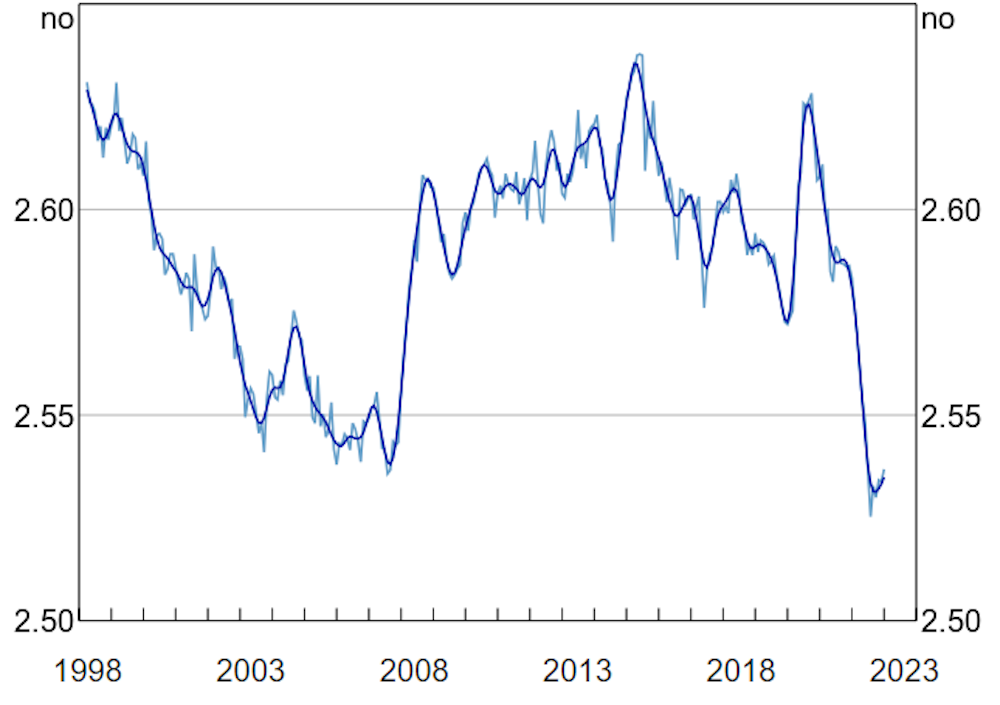
The change doesn’t sound big – the average fell from a bit above 2.6 residents per household to a bit below 2.55 – but applied to millions of households it meant about 140,000 more houses and apartments were needed than would have been.
Average household size (capital cities)
Average number of persons usually resident in an occupied private dwelling, trend and actual. RBA, ABS microdata
The sudden change was awfully for hard for the building industry to respond to, especially when it was laid low by COVID.
Why did we suddenly want to live with fewer people?
The head of the Bank’s economic division, Luci Ellis, thinks it was COVID itself, and lockdowns. We suddenly became more precious about sharing space.
‘Love the one you’re with’
Ellis says proportion of Australians living in group houses declined and stayed low. Faced with the choice of living with a large number of housemates and just one other person, perhaps a romantic partner, a lot of renters left group houses and shacked up with each other.
As she put it last year:
On the question of who you would rather be locked down with, at least some Australians have voted with their removalists’ van, by moving out of their share house and in with their partner.
There’s more to it of course, but where the supply and demand for anything are roughly in balance (rents had been increasing by less than 1% per year in the four years before COVID, and fell in the first year of COVID) any sudden change in either supply or demand can move prices quickly.
Advertised rents aren’t typical …
Having said that, for most renters prices are still moving slowly. Advertised capital city rents are up 13% over the past year, and average regional rates up 9%. But average rents (the average of what all renters pay) are up only 4.8%.
The rents charged to ongoing tenants climb much more slowly than the rents charged to new tenants, in part because landlords often like their tenants, and in part because for the first year renters are usually on fixed contracts.
But over time as renters move home, and landlords become less squeamish, more and more renters tend to pay the rents advertised. It makes the increase in advertised rents an unwelcome sign of what’s to come.
… but they’re a sign of rents ahead
And it might get worse. Reserve Bank Governor Philip Lowe says population growth is set to climb to 2%, – about the peak reached during the resources boom.
We won’t be able to build houses anything like that fast. Lowe says the last time Australia’s population surged it took about five years for housing supply to fully respond to housing demand.
We’ve ways of dealing with it of course. One is to re-embrace group homes, another is to delay moving out of our partents’ homes, or to move back in.
But even if this does happen, Lowe says, with typical understatement, that rent inflation – ultra-low before COVID – is likely to stay “quite high” for some time.
Peter Martin does not work for, consult, own shares in or receive funding from any company or organization that would benefit from this article, and has disclosed no relevant affiliations beyond their academic appointment.
Australia’s transition to renewables is gathering speed, but there’s a looming problem with storage. We will need much more long-duration storage to get us through the night, once coal and fossil gas exit the system.
We also need to find new and better ways to create heat for industrial processes. Renewables can supply much of that heat during the day, but energy storage will be required to meet industry’s night-time heat needs.
Solar thermal technology has the potential to provide both long-duration storage and industrial heat, yet it has been largely overlooked in the Australian context. That is about to change.
The CSIRO Energy Storage Roadmap identifies a mix of technologies will be required, across sectors, to meet Australia’s energy storage needs, particularly at night. Solar thermal will be an important part of the mix.
Batteries alone won’t cut it. They’re good for short-duration storage, ranging from mere minutes to an hour or two. But you’d need an awful lot of them, at enormous cost, to cover 8-12 hours. Solar thermal becomes cost-effective for long-duration storage at scale, and brings other benefits too.
Solar Power at Night using Concentrated Solar Power by Engineering with Rosie.
The Australian Energy Market Operator (AEMO) identified storage of four to 12 hours’ duration as “the most pressing utility-scale need in the next decade”. That’s what’s required “to manage stronger daily variations in solar and wind output, and to meet consumer demand, also during more extreme days, as coal capacity declines”.
Most people know about lithium-ion battery (chemical) storage and pumped hydro (mechanical) storage. However, thermal energy storage is not well understood or recognised. This is partly due to perceived costs and engineering challenges. However, as concentrated solar thermal plants are built all over the world – 30 are being developed in China alone – the knowledge base is growing.
More than 80% of Australia’s total energy use involves a thermal process:
combustion of coal and gas for electricity
combustion of fuels for transport
combustion of fuels for industrial process heat.
A large proportion of these existing fossil-fuel thermal processes can be met with renewable thermal energy storage.
The CSIRO Energy Centre in Newcastle contains the only operational high-temperature solar thermal research facility of its type in Australia. This is the largest high-concentration solar array in the Southern Hemisphere. CSIRO, Author provided
The CSIRO Roadmap found thermal energy storage was a relatively low-cost solution with multiple applications, including utility-scale power generation, renewable fuel production and industrial process heat.
For utility-scale power generation, the lowest cost technology for eight-hour storage in 2050 is thermal energy storage using concentrated solar thermal power. The cost in 2050 was slightly over A$100/MWh, compared with lithium-ion battery at A$140/MWh and pumped hydro at around A$155/MWh.
For 24-hour storage technologies in 2050, thermal energy storage was again the lowest cost at A$99/MWh, compared with pumped hydro at A$145/MWh or grid-charged electrical (using solar photovoltaics and wind) thermal energy storage at A$150/MWh.
Short-duration storage is likely to remain the domain of lithium-ion battery for at least up to two hours duration, and perhaps as high as four hours.
Here’s how it works
Concentrated solar thermal power uses mirrors to convert sunlight into heat energy. This heat energy is typically stored.
The stored thermal energy can then be used, at any time of day or night, on demand, to produce steam for electricity production, or heat/steam for industrial processes.
The system typically provides for six to 24 hours of operations. What this means is concentrated solar thermal can provide continuous, on demand power and/or process heat 24/7. It can also simultaneously generate power and store heat at the same time.
The stored thermal energy is typically used at night. Concentrated solar thermal systems deployed in China, Spain, the United States, South America, Africa and the Middle East generally have over ten hours of storage, which allows for the overnight generation of renewable power and heat.
Concentrated solar thermal is also a synchronous technology because it uses a traditional spinning turbine (identical to those used in coal-fired power plants). This creates much-needed system-strength and frequency services to the grid. In essence, when coal fired power stations close, concentrated solar thermal is a technology that could continue to provide essential system services.
While more than 100 concentrated solar thermal plants, generating 7GWh of power, have been deployed around the world, the technology has not yet been deployed at scale in Australia. This will soon change with the construction by Vast Solar of a 30MW concentrated solar thermal plant in Port Augusta, supported in part by the federal government. The project will have ten hours of thermal energy storage to generate power for supply to the grid, primarily at night. The project will also provide renewable heat and power to produce more than 7,000 tonnes of green (renewable) methanol each year. (Methanol is an essential chemical building block for hundreds of consumer and industrial products such as paints, carpets, fabrics, building materials and liquid fuels).
Heed the warning
We need to start building long-duration energy storage systems now, so we have secure and reliable power when the sun doesn’t shine and the wind doesn’t blow. We also need to replace fossil fuels used to create industrial process heat.
Sectors such as mining, industry, transport, agriculture, and households all require secure, reliable, and affordable renewable energy. For many sectors, this need occurs at night, and that necessitates storage.
Violence has again erupted in the Middle East during one of the holiest times of year for both Jews and Muslims.
In recent days, militants in southern Lebanon have fired a large number of rockets at Israel in response to an Israeli police raid on the Al-Aqsa mosque compound in Jerusalem.
Israel blamed the Hamas militant group for the attacks and retaliated by launching air strikes at Palestinian militias in Lebanon – the most alarming cross-border violence in 17 years – as well as at the Hamas-run Gaza Strip.
A rare rocket attack then came from Syria, prompting another round of Israeli air strikes against targets there. Clashes also broke out in the West Bank after thousands of Israelis, joined by seven Cabinet ministers, marched to an evacuated settlement there, demanding it be legalised.
The motives behind such provocations include anger, fear, the desire for revenge and frustration. These emotions are driven by the horrors of the Israeli occupation of Palestinian territories on the one hand, and anger at Palestinian terrorist attacks or unbridled desire for Jewish hegemony on the other.
Extreme interpretations of nationalism or religiosity – and often a combination of both – tend to aggravate these sentiments.
These spasms of violence should be seen as provocations since there is no military solution to the ongoing conflict between Israel and the Palestinians.
Deterrence is what the two main actors, Israel and Hamas, are seeking. Maintaining, achieving or increasing deterrence is key in both sides’ calculations of how to react when violence does break out.
Wedged between provocation, retaliation and deterrence, each side estimates how far it can stretch the line before copping a costly response from the other.
For Hamas, the key calculation is how to escalate attacks against Israel, while still keeping Gaza out of the violence. The aim is to steer the struggle against the Israeli occupation of Palestinian territories to the West Bank, Jerusalem and into Israel itself.
Recognising this, Israel tries to direct its military responses back to Gaza, as soon as it can establish a link between the provocation and Hamas.
Hezbollah, the militant group in Lebanon that has a growing partnership with Hamas, has a different set of calculations.
These include its long-standing feud with Israel, a desire to settle old scores (including past assassinations of Hezbollah leaders), religious passions (for example, sensitivities in relation to the Al-Aqsa Mosque), and directives from Iran.
Hezbollah is constrained, however, by Israeli military responses and by the need to reconcile its allegiance to Iran with its accountability to the Lebanese people. Many Lebanese already accuse Hezbollah of prioritising Iranian interests over their own. Being held responsible for a costly Israeli retaliation against Lebanese territories would be problematic for the organisation.
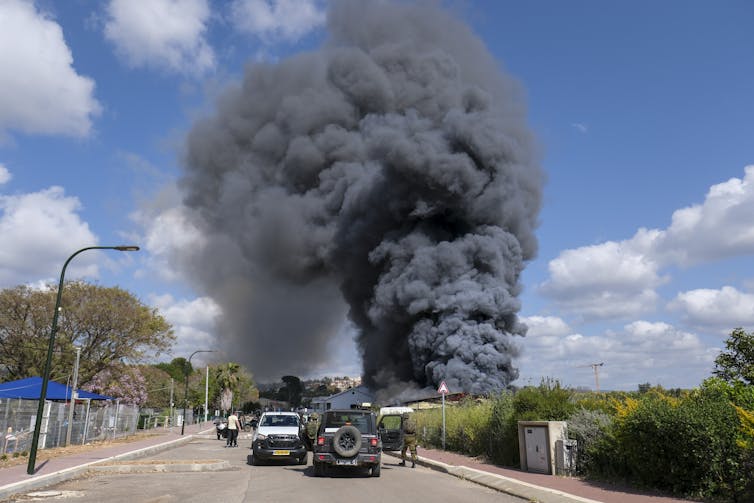
Smoke rises from a fire after rockets fired from Lebanon struck Bezet in northern Israel last week. Fadi Amun/AP
Israel, in turn, also fears another war with Hezbollah, which would be extremely costly. The organisation has a huge arsenal of rockets (estimated at more than 100,000), including high-quality and long-range weapons, which it could fire into Israel at will.
The famed Israeli Iron Dome air defence system would not withstand the power and sheer numbers of these weapons.
Israel’s worst fear, however, is of a concurrent escalation on multiple fronts, with Hamas and Islamic Jihad in Gaza in the south, an Intifada-style uprising in the West Bank and East Jerusalem to the west, and Hezbollah in Lebanon to the north.
A fourth front could open up in Israeli cities between Israel’s Palestinians, Jews and security forces. And there’s always a possibility of a fifth front being fought against Iranian forces stationed in Syria.
Israel’s preferred approach to these multiple threats would be to try to isolate the different actors by limiting its retaliations to a single provocation at a time. This, however, would not be easy.
Why both sides have avoided escalation thus far
As we’ve seen recently, the tensions between the various sides tend to originate or are exacerbated by provocations from minor actors – Jewish settlers in the West Bank, Jewish nationalists inside Israel, and Palestinian militants in the occupied territories, inside Israel or in southern Lebanon.
In the past, retaliations to such provocations by Israel, Hamas and other groups were, more often than not, measured. That is, they were aimed to project power and resolve internally to avoid being seen as weak by one’s own people. But a measured response also signals to the other side a wish to avoid escalation.
The targets struck in recent outbreaks of violence illustrate this. On the Hamas side, limiting rocket firing to Jewish towns in southern Israel, as opposed to more central cities, signalled a desire to avoid a major escalation. On Israel’s side, aiming at low-level Palestinian targets, as opposed to primary command posts or key leaders, could mean the same.
However, it is unclear how the new hard-line Israeli government will respond to the evolving violence.
At the moment, Israel seems to prefer avoiding escalation. The latest polls show the new ruling coalition is nose-diving in popularity and would fail to gain a majority of seats in parliament if elections were held today. This may explain why the more vocal nationalists appear to be deferring, at least temporarily, to more cautious voices in government.
However, a significant provocation in Al-Aqsa Mosque, or a significant terrorist attack against Jews, could both alter this mind-set.
The international community has a critical role to play by forcing or incentivising the various sides into painful but necessary concessions on the (very) long road to peace.
One could appreciate the value of the de-escalation strategies currently in use. However, if the main purpose is to preserve deterrence, then a more honest dialogue within, as well as between, the camps on the risks of violent provocations could offer perhaps better solutions.
In the endless tit-for-tat violent cycle, there are no winners, only losers.
Eyal Mayroz does not work for, consult, own shares in or receive funding from any company or organisation that would benefit from this article, and has disclosed no relevant affiliations beyond their academic appointment.
A major international report says the “disciplinary climate” in Australian schools is among the “least favourable” in the Organisation for Economic Co-operation and Development (OECD).
Its findings follow headlines about student behaviour and a federal parliamentary inquiry into “increasing disruption in Australian school classrooms”.
How severe is the problem and what can we do about it?
What does the OECD report say
The OECD report looks at many aspects of Australia’s education system. And identifies many strengths, such as how Australian students view their teachers positively and teachers have comparatively high levels of job satisfaction.
But it also found the “disciplinary climate” in schools in Australia was among the least favourable in the OECD according to student reports.
This is based on a 2018 Programme for International Student Assessment (PISA) index, which asked students how often noise and disorder occur in the classroom. Australian classrooms scored -0.2 while the OECD average is 0.04.
It also refers to a 2018 TALIS (OECD teaching and learning) survey, which found 37% of Australian lower-secondary school principals reported intimidation or bullying among students occurred at least weekly. Australian teachers also reported feeling less prepared for, or capable of, managing disruptive classroom behaviour than their OECD peers.
Findings from the survey suggest Australian students perceive their classrooms to be more disruptive than they have in the past. It also suggests one of the reasons teachers are choosing to leave the profession is disruptive behaviour.
In separate studies, researchers have found new teachers find it particularly hard to manage disruptive student behaviour.
These are important challenges that must be addressed. Post-COVID, teachers have reported student behaviour appears to be getting worse, with students more distracted and less engaged than before the pandemic began.
However, there is currently little data showing how often disruptive behaviour occurs in Australian classrooms, what these behaviours look like, and how teachers currently work to prevent and respond to these behaviours.
It is possible that behaviour issues are happening more in some areas or in some schools, rather than across the board.
The development of disruptive behaviour can be influenced by a range of biological, social, environmental, and educational factors. Here are three key reasons why students might engage in disruptive behaviour at school:
1. Students find the school work too difficult
Students with delayed academic skills are more likely to exhibit disruptive and challenging behaviour, and students who display disruptive behaviour may be more likely to fall behind academically.
This connection has been shown to be strongest between a student’s reading skills and disruptive behaviour. This makes sense, because as students’ progress through primary school, they need to demonstrate increasingly advanced language and literacy skills to participate and succeed academically in all subjects.
2. Students are trying to impress their peers
Students are more likely to display disruptive behaviour in schools and classrooms where this is accepted. Researchers talk about the “classroom climate”. These are the values, beliefs and norms that set the behaviour within a classroom setting.
At school (particularly in high school), peer approval is one of the most important variables that can influence student behaviour.
Being disruptive may seem “cool” in some peer groups, and researchers have found that this can promote a culture of student disruption.
3. Students are copying their parents
Students model and learn the behaviours they see. Telling students how to behave well won’t work when the adults in the room are overwhelmed, stressed, and not in control of their emotions.
Recent research suggest teachers and school leaders are facing increasing threats and hostility from parents. Students may witness these parent-teacher conflicts and behave in similar ways when managing conflict at school.
While behavioural issues are complex, there are practical things teachers and school leaders can do to reduce disruption.
Teachers can make practical changes to help improve behaviour in their classrooms. Shutterstock
This begins with looking at what can be done to support positive student behaviour, rather than focusing on what you can do to reduce disruption.
The means approaches for supporting improved student behaviour are educative, not punitive. They also promote a sense of predictability and safety in classrooms. This can include:
Limiting distractions
Teachers can change their classrooms to limit distractions and promote positive behaviour. For example:
rearranging seating to make it easier for students to see the teacher and pay attention
putting felt pads under furniture to reduce noise levels
turning off sounds on mobile devices to limit distractions
adding environmental cues (such as written instructions and checklists) to remind students about what they should be doing.
Rearranging chairs and desks so all students can see and hear easily may help classroom behaviour. Shutterstock
Teaching behavioural skills
We can’t assume students know how to behave well at school. School is a complex environment and may have different expectations to home.
So teachers can teach behavioural skills the same way they teach academic skills (and teach them early and often). This means giving students instruction, practice, feedback, and encouragement. Specific behavioural skills to teach might include:
responding to your name when called
requesting help with difficult tasks
entering the classroom quietly and beginning a “getting started” task
showing kindness and respect to peers and staff.
Teachers should also respond to disruptive behaviour or behavioural errors as if they were learning errors and provide an immediate correction. This includes giving the student a chance to practise (or show you) the appropriate behaviour and the providing positive feedback if warranted.
Allowing time for lots of practice
Researchers have found that for a child to learn something new, it needs to be repeated eight times on average.
For a child to unlearn an old behaviour and replace it with a new behaviour, the new behaviour must be practised on average 28 times. Providing plenty of praise
Research shows praising students for positive behaviours has a high-impact. It is important to make the praise genuine and attached to a specific behaviour.
Getting students involved
The classroom climate can be improved when students play an active role in setting classroom expectations and holding one another to high standards.
Encourage students to praise each other in the classroom. Shutterstock
This includes asking students what their classroom norms and expectations should be. It could also include:
encouraging students to acknowledge each other for doing the right thing – a practice known as “tootling”
making it safe for students to both make mistakes and succeed. Create a culture where students can openly discuss and learn from their mistakes, as well as share their successes
modelling calm conflict resolution and support students to work through academic and social challenges.
Erin Leif currently receives funding from the Victorian Department of Families, Fairness, and Housing, and has received funding from the Victorian Department of Education and the Australian Education Research Organisation. Erin Leif is currently the president of the Association for Behaviour Analysis Australia and is an expert advisor to Behaviour Support Practitioners Australia.
The North Atlantic Treaty Organization (NATO) has New Zealand firmly in its sights.
Last week, New Zealand’s foreign minister Nanaia Mahuta attended the annual NATO foreign ministers’ meeting in Brussels – alongside her counterparts from Australia, Japan and South Korea.
Mahuta’s participation came after New Zealand’s then Prime Minister Jacinda Ardern joined last June’s NATO leaders’ summit in Madrid. Mahuta was also a guest at the NATO foreign ministers’ meeting in April 2022, albeit only in virtual form.
At a more granular level, a NATO military delegation visited New Zealand last month for meetings with officials in Wellington. The head of the delegation said NATO was ‘determined’ to ‘deepen and strengthen our cooperation with our Indo-Pacific partners’.
And this week, top NATO official Benedetta Berti is visiting Wellington. As part of her visit, Berti – who heads NATO’s Policy Planning Unit in the Secretary General’s office – will speak to the New Zealand Institute of International Affairs (NZIIA) on the impact of the war in Ukraine on the Indo-Pacific. Berti will also explain why NATO is seeking to expand its ties with countries in the region such as New Zealand, according to advance NZIIA publicity material for the event.
The grouping of four Indo-Pacific countries is sometimes referred to as the AP4, or ‘Asia Pacific Four’, particularly by the more hawkish Australia and Japan.
So far, New Zealand has tended to avoid using the AP4 acronym, perhaps to play down the implication that Wellington has joined yet another new bloc.
The website of New Zealand’s Ministry of Foreign Affairs and Trade (MFAT) contains only a single mention of the AP4 – after Mahuta’s attendance at the NATO foreign ministers’ meeting last year. There is no mention of AP4 at all on the Ministry of Defence or Beehive ministerial websites, according to a Google search.
NATO itself has also generally shied away from using the AP4 acronym, perhaps in deference to New Zealand’s sensibilities. But this might be starting to change. Jens Stoltenberg, the NATO Secretary General, talked openly about the potential of the AP4 at a speech at Tokyo’s Keio University in February.
In that address, Stoltenberg told his audience that NATO had ‘in many ways…already institutionalised’ the AP4 and described the four countries’ participation at the NATO leaders’ summit in Spain in 2022 as a ‘historic moment’.
We can expect to hear much more about the AP4 in the future.
Stoltenberg has publicly invited all four AP4 leaders to attend this year’s leaders’ summit in the Lithuanian capital of Vilnius.
In diplomatic terms, this probably means New Zealand Prime Minister Chris Hipkins and the other three AP4 leaders have already decided to go.
This is significant.
For one thing, it means Jacinda Ardern’s presence at last year’s NATO summit in Madrid was not just a one-off move to show solidarity with NATO countries in the immediate aftermath of Russia’s invasion of Ukraine.
Second, it shows how New Zealand is continuing to forge a more hardline foreign policy stance under Hipkins’ leadership.
After all, the involvement of the AP4 in NATO is being driven chiefly by the alliance’s interest in China.
At the Madrid summit last year, NATO launched its new long-term Strategic Concept that openly called out China for its ‘stated ambitions and coercive policies’ and pinpointed Beijing as a source of ‘systemic challenges’ for the alliance.
And much of the press conference after last week’s NATO foreign ministers’ meeting that New Zealand’s Nanaia Mahuta also attended was focused squarely on China.
Stoltenberg told media that China was ‘coming closer to us’ and cited a range of familiar Western criticisms of Beijing – ranging from its ‘assertive behaviour’ in the South China Sea, to actions over Hong Kong, Taiwan and its ties with Moscow – that made it necessary for NATO to ‘update and develop’ its stance towards China.
Indeed, the NATO Secretary General openly linked the alliance’s recent deepening of partnerships with Indo-Pacific countries such as New Zealand with NATO’s China strategy – which he called a ‘huge effort’.
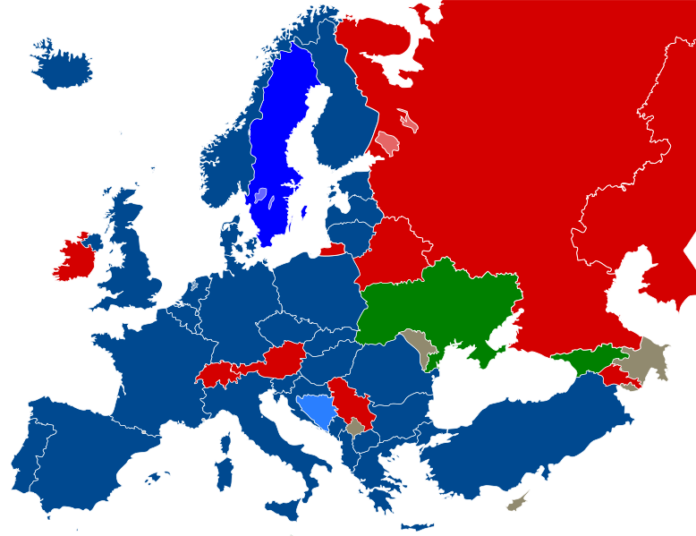
Of course, unlike Finland – which became NATO’s 31st member last week – New Zealand cannot formally join NATO, given the alliance’s geographic focus.
But if New Zealand continues to align itself with NATO as part of the AP4 – which could be seen as ‘NATO plus’ – the implications could be as significant as the extraordinary signals from defence minister Andrew Little that Wellington could soon join non-nuclear components of the AUKUS pact between Australia, the United Kingdom and United States.
For one, it means that New Zealand will almost certainly strive to meet NATO’s military spending target of 2 per cent of GDP – a figure which Stoltenberg described last week as a ‘floor not a ceiling’.
To that end, New Zealand’s defence minister Andrew Little is continuing a softening-up campaign in the media to pave the way for greater military spending, ahead of the imminent reporting-back of a defence policy review committee and the Government’s Budget in May.
Any response from Beijing to the latest developments on New Zealand’s involvement with NATO and AUKUS has yet to be fully felt.
But China – New Zealand’s biggest trading partner – made no secret of its displeasure after Jacinda Ardern attended the NATO summit in Spain last year. At the time, the Chinese Embassy in Wellington issued a statement noting Beijing’s opposition to ‘all kinds of military alliances, bloc politics, or exclusive small groups’, while a Chinese foreign ministry spokesperson said NATO should not seek to ‘replicate the kind of bloc confrontation seen in Europe here in the Asia-Pacific’.
After the NATO meeting in Madrid in June 2022, Jacinda Ardern gradually reined in New Zealand’s more hawkish positioning with more soothing tones towards Beijing – culminating in her meeting with Chinese President Xi Jinping on the sidelines of the APEC summit in Thailand in November and her pledge to travel to China early in 2023.
Upon taking over the Prime Ministerial role from Ardern in January, Hipkins said a trip to China would be high on his priority list – but the signals have been rather mixed since then. Last month, Hipkins appeared to play down expectations of a visit to Beijing, citing ‘moving parts’ and domestic pressures during New Zealand’s election year.
Delaying an invitation to New Zealand’s Prime Minister to visit China would certainly be one way for Beijing to signal frustration.
Chris Hipkins may well be heading to the NATO summit in Vilnius.
But it could mean he has to wait longer to visit Beijing.
Geoffrey Miller is the Democracy Project’s geopolitical analyst and writes on current New Zealand foreign policy and related geopolitical issues. He has lived in Germany and the Middle East and is a learner of Arabic and Russian. He is currently working on a PhD on New Zealand’s relations with the Gulf states.
New Zealand Parliament Buildings, Wellington, New Zealand.
New Zealand Politics Daily is a collation of the most prominent issues being discussed in New Zealand. It is edited by Dr Bryce Edwards of The Democracy Project.
Campaigning for French Polynesia’s territorial elections has entered its final week.
Dressed in their parties’ respective colours, supporters of several parties held small rallies at the weekend market in the capital Pape’ete.
In two rounds of voting — on Sunday, April 16 and Sunday, April 30 — voters will elect a new 57-member assembly for a five-year term.
A total of seven lists are contesting the elections.
Under the proportional system introduced in 2011, a list needs the support of at least 12.5 percent of the votes to make it to the second round.
The list winning most votes in the second round will get a third of all seats as a bonus.
The remaining two thirds will then be distributed according to the lists’ relative strength.
Observers say only the ruling Tāpura Huira’atira and the pro-independence Tāvini Huira’atira stand a chance to win, given their presence across the island groups.
The last time French Polynesian voters went to the poll was in 2018.
President Édouard Fritch of the Tāpura Huira’atira has held the territory’s top job since 2014.
This article is republished under a community partnership agreement with RNZ.
En Polynésie française les élections territoriales se dérouleront les 16 et 30 avril 2023. 7 listes s’affronteront dans les huit section dans une circonscription électorale unique, divisée en huit sections. Qui sont les candidats et… https://t.co/gf6p6gGyj1 Tahiti Polynesie pic.twitter.com/GX4rGIXluQ
Source: The Conversation (Au and NZ) – By Julian Koplin, Lecturer in Bioethics, Monash University & Honorary fellow, Melbourne Law School, Monash University
Sam Altman, the chief executive of OpenAI, recently invested US$180 million into Retro Biosciences – a company seeking to extend human lifespans by ten healthy years.
One way it plans to achieve this is by “rejuvenating” blood. This idea is based on studies that found old mice showed signs of reversed ageing when given the blood of young mice.
Altman isn’t the only Silicon Valley entrepreneur supporting life extension efforts. PayPal cofounder Peter Thiel, Amazon founder Jeff Bezos and Google cofounder Larry Page have poured millions into projects that could profoundly affect how we live our lives.
The first question raised is scientific: could these technologies work? On this front the jury is still out, and there are grounds for both optimism and scepticism.
The second question is just as important: even if lifespan extension is feasible, would it be ethical?
We explain why some common ethical arguments against lifespan extension aren’t as solid as they might seem – and put forth another, somewhat overlooked explanation for why trying to live forever might not be worth it.
Is it worth it if you still die anyway?
One might argue lifespan extension merely pushes back the inevitable: that we will die. However, the problem with this view is that any life saved will only be saved temporarily.
A lifespan extension of ten years is akin to saving a drowning swimmer, only for them to die in a traffic accident ten years later. Although we might be sad about their eventual death, we’d still be glad we saved them.
The same is true of conventional medicine. If a doctor cures my pneumonia, I will eventually die of something else, but that doesn’t mean the doctor or I will regret my being saved.
It’s also worth taking a longer view of where lifespan extension research could lead us. In the most optimistic scenarios put forth by experts, even modest short-term gains could help people add centuries to their life, since the benefits of each intervention could cascade. For example, each extra year of life would increase the likelihood of surviving until the next big breakthrough.
Some philosophers have pointed out that immortality, while it may initially be desirable, would eventually lose its sheen. Shutterstock
Is it worth it if immortality could get boring?
Manyhave argued against lifespan extension on ethical grounds, saying they wouldn’t use these technologies. Why might somebody be opposed?
One worry is that a very long life might be undesirable. Philosopher Bernard Williams said life is made valuable through the satisfaction of what he calls “categorical desires”: desires that give us reason to want to live.
Williams expects these desires relate to major life projects, such as raising a child, or writing a novel. He worries that, given a long enough life, we will run out of such projects. If so, immortality would become tedious.
It’s unclear whether Williams is right. Some philosophers point out human memories are fallible, and certain desires could resurface as we forget earlier experiences.
Others emphasise that our categorical desires evolve as our life experiences reshape our interests – and might continue to do so over the course of a very long life.
In either case, our categorical desires, and hence our reason for living, would not be exhausted over a very long life.
Even if immortality did get tedious, this wouldn’t count against modest lifespan extensions. Many would argue 80-something years isn’t enough time to explore one’s potential. Personally, we’d welcome another 20 or even 50 years to write a novel, or start a career as a DJ.
Is it worth it if poor people miss out?
Another worry regarding lifespan extension technologies is egalitarian.
These technologies will be expensive; it seems unjust for Silicon Valley billionaires to celebrate their 150th birthdays while the rest of us mostly die in our 70s and 80s.
This objection seems convincing. Most people welcome interventions that promote health equality, which is reflected in broader societal demands for universal healthcare.
But there’s important nuance to consider here. Consider that universal healthcare systems promote equality by improving the situation of those who aren’t well off. On the other hand, preventing the development of lifespan extension technologies will worsen the situation of those who are well off.
The ethical desirability of equality based on “levelling down” is unclear. The poorest Australians are twice as likely to die before age 75 than the richest. Yet few people would argue we should stop developing technologies to improve the health of those aged over 75.
Moreover, the price of lifespan extension technologies would eventually likely come down.
The real problem
However, we think there’s one serious ethical objection that applies to extreme cases of life extension. If humans routinely lived very long lives, this could reduce how adaptable our populations are, and lead to social stagnation.
Even modest increases in life expectancy would radically increase population size. To avoid overpopulation, we’d need to reduce birth rates, which would drastically slow generational turnover.
As one of us (Chris) has explored in previous research, this could be incredibly harmful to societal progress, because it may:
increase our vulnerability to extinction threats
jeopardise individual wellbeing, and
impede moral advancement.
Many fields benefit from a regular influx of young minds coming in and building on the work of predecessors.
Even if the brains of older scientists remained sharp, their “confirmation bias” – a tendency to seek and interpret information in ways that confirm one’s prior beliefs – could slow the uptake of new scientific theories.
Moral beliefs are also prone to confirmation bias. In a world of extended lifespans, individuals whose moral views were set in their youth (perhaps more than 100 years ago) will remain in positions of power.
It seems likely our society’s moral code is badly mistaken in at least some respects. After all, we think past societies were catastrophically mistaken in theirs, such as when they endorsed slavery, or rendered homosexuality illegal.
Slowing generational turnover could delay the point at which we recognise and fix our own moral catastrophes, especially those we can’t yet see.
Julian Koplin receives funding from Ferring Pharmaceuticals.
Christopher Gyngell via his affiliation with the Murdoch Children’s Research Institute received funding from the Victorian State Government via the Operational Infrastructure Support Program. He also receives funding from the Medical Research Future Fund.
Source: The Conversation (Au and NZ) – By Julia Hurst, Faculty of Arts Indigenous Postdoctoral Fellow, Indigenous and Settler Relations Collaboration, The University of Melbourne
This is the third article in our series explaining Voice, Treaty and Truth. Read the other articles in the series here and here.
State refusals to respond to truth have led to renewed calls for processes that will detail the impacts of colonisation in the everyday lives of Indigenous people. These calls were an important part of the Uluru Statement from the Heart, which sought “the establishment of a First Nations Voice enshrined in the Constitution”, complimented by “a Makarrata Commission to supervise a process of agreement-making between governments and First Nations and truth-telling about our history”.
As legal scholars Gabrielle Appleby and Megan Davis have commented, the call for truth-telling in the Uluru Statement is just one part of a wider call for structural reform intended to ensure improvement in the lives of Aboriginal and Torres Strait Islander people.
Beginning in the 1980s, formal truth-telling processes (usually called truth commissions) emerged as a method of reckoning with the past in deeply divided societies around the world. Perhaps the most famous example is the South African Truth and Reconciliation Commission, which aimed to address the gross violations of human rights that happened under apartheid.
Truth commissions like this are generally temporary, state-sanctioned inquiries that typically last from one to five years, with a remit to investigate particular events and examine specific violations over a defined period of time. This typically involves collecting testimony from victims and (sometimes) perpetrators.
It is only relatively recently that truth-telling processes have been used as a response to settler colonial violence, most notably via Canada’s Truth and Reconciliation Commission, which arose after a class action lawsuit on behalf of the roughly 150,000 First Nations children taken from their familes and placed in residential schools.
The Uluru Statement isn’t the first time First Nations on this continent have called for truth-telling. Since colonisation, Indigenous peoples have insisted that Australia must not look away from their experiences of dispossession and survival.
When these truths have been told, however, they have all too often been met with denial, defensiveness or even aggression. For example, when the Stolen Generations inquiry pointed to evidence of the forcible removal of Indigenous children that, it charged, constituted a breach of the UN Convention on Genocide, there was an immediate conservative backlash. The Howard government rejected the findings of the inquiry in one of the earliest salvos against what conservatives have termed a “black armband” view of Australian history.
There is a reason settler governments have been reluctant to engage in truth-telling. First Nations often seek truth as a means of changing an untenable status quo, reshaping society’s attitudes so as to improve their own future prospects and reaffirm their distinct sovereignties and their right to self-determination.
As the non-Indigenous Canadian political scientist Courtney Jung has argued, while settler governments may try to use the conclusion of a truth commission to “draw a line through history”, First Nations seek to build “not a wall but a bridge”, using truth-telling to “draw history into the present, and to draw connections between past policy, present policy, and present injustices”.
Whose truths? What truths?
Broadly speaking, First Nations peoples seek truths that address three key themes: narrative and memory; trauma and healing; and responsibility and justice.
We have described this potential as “the promise of truth”, in which truth-telling leads to a kind of agreement between Indigenous and settler peoples, rather than being a process centred on the state and its violence.
The promise of truth is that it will change national narratives and produce a new, shared collective memory that acknowledges crimes of the past; it will contribute to the healing and recovery of Indigenous people who have been harmed by colonisation and dispossession; and it will compel settlers and their institutions to take responsibility for the harms of colonisation.
This approach stands in contrast to what we have called the “colonisation of truth”, through which truth-telling is seen primarily as rehabilitative of the settler colonial state while obscuring ongoing injustices. When truth is colonised, it may reproduce narratives that restore aspects of settler legitimacy and treat injustices as being solely in the past. Alternatively, this version of truth may treat First Nations people merely as victims, telling stories of harm and trauma without delivering reparation. Or it may suggest that the demand for responsibility and justice has been fulfilled simply by engaging in the truth-telling process, rather than treating the telling of truth as a starting point for a fairer future.
Truth, then, is complex, and what it may achieve in the Australian context is not yet clear. As treaty processes progress in several Australian jurisdictions, the commitment to truth-telling seems likely to be a part of future negotiations. This close connection between treaty and truth is unique to the Australian case and confirms the strongly held belief that truth has transformative potential. We do not yet know whether the linking of truth and treaty will produce the transformation in relationships that is so urgently needed.
Victoria, which announced a commitment to treaty in 2016, is the jurisdiction most advanced in testing this proposition. In 2022, Victoria established the Yoorrook Truth and Justice Commission (Yoorrok is a Wemba Wemba word meaning “truth”), marking a new era in Australian truth-telling focused on the history of invasion and colonisation of First Nations’ territories. Until the creation of Yoorrook, no previous commission, royal commission or inquiry into colonisation in Australia has included the word “truth” in its official title.
Yet still, truth is not a straightforward proposition. “Truth burns,” as Indigenous academic Marcia Langton recently put it. Sometimes, truth-telling is painful and connects directly to harm and injustice.
Truth is tricky. It can appear to open spaces for new understandings, while simultaneously shutting these spaces down and reinforcing the colonial status quo.
Ultimately, truth-telling is uncomfortable but necessary, as change in any relationship inevitably is. But this is where the possibility lives. As new truth-telling takes place across this continent we have an opportunity to imagine what it might mean to be in a relationship that does not deny the truth of First Nations’ lives, or the truth of how Australia has come to be.
The authors do not work for, consult, own shares in or receive funding from any company or organisation that would benefit from this article, and have disclosed no relevant affiliations beyond their academic appointment.
Striking public sector workers in London, 1979. Getty Images
Most people today are coping with the rising cost of living individually: cost cutting, looking for a better paid job, taking on “side hustles”, and so on. But not so long ago, many workers globally and in Aotearoa New Zealand approached the same problem in far more collective ways.
From the late 1960s to the early 1980s – sometimes referred to as “the long 1970s” – the union movement used strikes to combat the effects on workers of chronic inflation and a deep economic crisis. These were often successful, both in Aotearoa and around the world.
In many ways, the long 1970s were similar to today, a turbulent era of wide-ranging transformation, social polarisation and economic decline. After the long post-war economic boom, the so-called “golden age” of capitalism came to a halt in the late 1960s. A long-term social and economic decline set in after the oil shocks of the 1970s.
Largely in response to this, strike levels reached historic peaks in many countries. As British journalist Andy McSmith wrote of the UK’s 1978-1979 “winter of discontent”, it was simply “irrational not to strike”, given how inflation was eroding pay packets. In Aotearoa New Zealand, for example, inflation averaged 11.5% in the 1970s and peaked at 17.2% in 1980.
Collective resistance wasn’t only organised in workplaces. There were also consumer campaigns such as the Campaign Against Rising Prices in the 1960s and 1970s, mostly organised by (unpaid) women domestic workers, and often supported by unions.
Many unions mobilised to obtain better pay – often because of workers’ demands over declining real incomes. Millions of workers around the world struck to keep their wages level with inflation, in many instances securing pay increases above inflation rates.
Winter of discontent: striking British workers marching in London against the Labour government’s 5% limit for pay rises, 1979. Getty Images
Defending living standards
In Aotearoa New Zealand, as historian Ross Webb has argued, the Federation of Labour (FOL) adopted a largely successful strategy of “defending living standards” from the late 1960s to about 1984. They argued that employers and governments were trying to place the burden of the recession on workers and their families.
Union tactics were reasonably canny. They did not simply butt heads with employers set on reducing costs, or governments intent on restricting wage increases through incomes policies.
Instead, they contested the assumption of employers and politicians that inflation was mainly caused by wage increases (the wage-price spiral), rather than a result of companies raising prices, profiteering and passing on the cost of the oil shocks.
There were two tactics in particular that don’t seem to exist in Aotearoa today. The first was targeting stoppages against a particular employer. Once a breakthrough was achieved at one workplace, unions would ensure the gain was made into a broader industry, regional or national standard. Targeted strikes were not as costly or as risky as national or industry-wide strikes, with striking workers supported through weekly union levies.
The second tactic involved broad, nationally-coordinated, cross-union mobilisations. These included general strikes (either city-wide or national) and nationwide demonstrations. These solidarity actions generally focused on unsympathetic or intransigent governments intent on clamping wage increases.
When the Arbitration Court announced a nil general wage order in 1968 (meaning wages couldn’t rise), despite inflation running at about 5%, the FOL organised a limited campaign of targeted strikes against certain employers. Its Wellington Trades Council held a one-day, general, city-wide strike and a stormy protest outside parliament.
Union foe: Robert Muldoon campaigning ahead of New Zealand’s 1975 election. Getty Images
General strikes and export bans
Targeted stoppages were often highly effective, especially in strategic industries where profits and production could be quickly halted. For example, meatworkers banned all meat exports to counter the nil wage order. This was the country’s biggest export at the time, accounting for 40% of export revenue.
The export ban, together with many other stoppages, quickly brought results. Workers were granted a 5% increase nationally, just two months after the nil order was announced.
In 1979-1980, a union campaign successfully saw the repeal of the 1979 Remuneration Act, imposed by Robert Muldoon’s authoritarian populist-right government and which enabled the state to unilaterally lower negotiated wage increases between employers and unions.
The campaign involved a one-day national general strike in 1979. Some 340,000 to 400,000 workers (75-80% of the FOL’s membership) participated, according to reasonably reliable estimates. It was the most well-supported strike in local history, followed in 1980 by a successful three-month strike by paper mill workers at Kinleith that gained substantial national support.
New Zealand’s general strike, September 1979. PSA Journal
The final nail in the coffin for the Remuneration Act was the living standards campaign organised by the FOL and the Combined State Unions in 1980. Large protest marches were held around the country, including one that attracted up to 45,000 people during a three-hour, city-wide stop-work action in Auckland.
There were also smaller shop-floor strikes aimed at achieving localised pay agreements to keep up with inflation. These often resulted in piecework or bonus payment schemes, or allowances for clothes, boots and working in dirty or dangerous condition. They all helped enormously with take-home pay.
These actions drew strong reactions from employers, the state, and from some sections of the community. Conservatives – such as those who took part in the “Kiwis Care” march in 1981 – claimed strikers were greedy, disruptive, destroying the “national interest” and holding the country to ransom. Yet the law-and-order measures employed to contain or repress strikes usually just inflamed unrest.
A more effective response came in the form of economic restructuring and de-industrialisation in the 1980s. Neoliberals argued strikes squeezed profits and production, and restricted management’s “right to manage” the factory and office floor. Employers and politicians used various tactics, such as factory closures, to successfully break unions and undermine workers’ power.
While inflation was tamed in Aotearoa by the early 1990s, it came at the expense of dramatically increased class inequality.
Worker resistance to the cost-of-living crisis in the long 1970s is still a polarising and contested subject. Probably the dominant view, voiced by the neoliberal right as well as some on the moderate left, is that workers caused their own demise by striking too much.
Some argued that unions had adopted an “immature” conflict-based strategy that could never win, and that neoliberal restructuring was the inevitable response and outcome. Such a view tends to demonise the strike-prone 1970s as the “bad old days” when supposedly thuggish “unions ran the country”.
But it’s overly simplistic to blame workers for simply trying to keep their pay up with inflation after negotiation strategies failed. Those on the activist wing of unions would counter by arguing workers fought backen masse in the long 1970s to defend living standards. But they were simply defeated in the 1980s by more powerful global and local forces.
France has seen huge protests against proposed pension reform in early 2023. Getty Images
The diminished collective
Globally, strikes are perhaps back in vogue. In early 2023, there have already been a “mega-strike” in Germany, a “protect the right to strike” action in the UK, and mass strikes against the raising of the pension age in France. In Aotearoa, teacher unions have mounted a rare coordinated strike. As economic problems deepen, it’s likely more will occur.
So far, however, these strikes against the cost-of-living crisis have not been as large or as widely supported as those of the long 1970s. In high-income countries, strike levels today are generally nowhere near the peaks of that period.
This is, of course, directly related to the astonishing decline of union membership since the 1970s. As a proportion of the whole workforce, union membership in Aotearoa has fallen from a peak of 57.5% in 1979 to 17% in 2021. Strikes are therefore limited to a minority of the workforce, especially in the underfunded public sector.
Little wonder, then, that most people these days are coping with soaring costs by taking individual rather than collective action. It’s also one of many reasons why so many feel powerless to effect deeper and lasting change.
Toby Boraman receives funding from the Royal Society of New Zealand Marsden Fund. He is a member of the Tertiary Education Union.
You’re driving your teen home from school when they open up to you about their vaping. What started off as an occasional puff of an e-cigarette has turned into something more serious.
“I was curious and just wanted to try it,” they say. “All my friends were doing it and I wanted to do it too.”
But now they are vaping more often and getting anxious when they can’t access their vape. They want to quit but they aren’t sure how.
Here are some practical tips to help your teen stop vaping.
You might want to reprimand your child, or say “If your friends jumped off a cliff, would you do it?”. But you know criticism and lecturingdon’t work. So, what do you do?
First, acknowledge it’s a great sign your teen wants to quit and is asking for help. We know motivation is critical to behaviour change.
But if you’re a parent of a teen who isn’t ready to try quitting, you need to work on boosting their motivation to quit first.
Talk with your teen about their vaping. Ask them what led to them wanting to quit and their reasons for wanting to give up. You can both use those reasons to help motivate quitting.
Use that knowledge to balance the benefits of quitting with the costs of not quitting. You can do this using a practical exercise.
Discuss potential barriers that might get in the way of quitting.
What is your teen worried will happen if they try to quit? Have they been using vaping to relax and are worried they will become more anxious? Are they worried about losing friends? Do they think they won’t be able to quit?
Once you have an idea of the costs and benefits your child perceives, you’ll be in a better position to help them. For example, if they have been using vapes to relax, help them find other ways of reducing stress.
It might also help to tap into their values and use these to highlight that their vaping isn’t aligned with who they want to be.
For example, if they are skipping class to vape but are usually a diligent student, discuss this discrepancy and the longer-term impact of their dependence (for example, not getting into uni).
Once your child is motivated, it’s time to set a goal to quit. Work with your teen to develop a SMART goal that is Specific, Measurable, Achievable, Relevant, with a Timeframe.
That goal might be to quit vaping by a certain date. But your teen may need to set smaller goals first. This might mean “This week, I will only vape on Monday, Wednesday and Friday.”
Once achieved, these goals can be made more challenging until gradually, your teen has succeeded in quitting vaping.
Make sure you reward your teen or they reward themselves for achieving their goals, even the small ones.
Next, if your teen has been using nicotine vapes – and many vapes contain nicotine even if they are not labelled as such – they may be addicted.
Contact the Quitline (details below) or see your GP to discuss support for your teen. They may need extra help weaning off e-cigarettes. A nicotine tapering plan may help.
How to handle the setbacks
Your teen will likely have some trouble quitting. Remember those barriers from earlier? Create coping plans. What will your teen do if they are feeling stressed and want to reach for their vape? What will your teen do if they are at a party and are offered a puff?
These strategies may help your teen:
keeping busy by doing puzzles, drawing, or playing games on the phone
changing locations. Encourage your teen to get out and about. They can go to the gym, outside for a walk, or head to the footy
reminding your teen about the reasons they want to quit and the costs of not quitting
helping them practise saying “no” to a vape
having snacks or gum they can grab when they have the urge to vape.
Show compassion
There are many reasons people vape. Among them is a vaping industry, with deep pockets, that’s expert at manipulating young people to start and continue vaping.
So be compassionate and try not to judge your teen. Lecturing, criticising and being punitive won’t help them quit. Position yourself as someone they can rely on.
Associate Professor Michelle Jongenelis receives funding from the National Health and Medical Research Council. She is affiliated with the Australian Council on Smoking and Health, the Public Health Association of Australia, and the World Federation of Public Health Associations’ Tobacco Control Working Group.
Australia’s rarest butterfly, the Australian fritillary. Garry Sankowsky, Author provided
Last month, Sir David Attenborough called on United Kingdom residents to “go wild once per week”. By this, he meant taking actions which help rather than harm the natural world, such as planting wildflowers for bees and eating more plant-based foods.
Australia should follow suit. We love our natural environment. But we have almost 10 times more species threatened with extinction than the UK.
How we act can accelerate these declines – or help stop them.
If you go for a bushwalk, you might wonder what the problem is. Gums, wattles, cockatoos, honeyeaters, possums – everything is normal, right? Alas, we don’t notice what’s no longer there. Many areas have only a few of the native species once present in large numbers.
We are losing nature, nation-wide. Our threatened birds are declining very rapidly. On average, there are now less than half (48%) as many of each threatened bird species than in 1985. Threatened plants have fared even worse, with average declines of over three quarters (77%).
Biodiversity loss will have far-reaching consequences and is one of the greatest risks to human societies, according to the OECD.
The small choices we all make accumulate to either help or harm nature.
Seeing common birds like rainbow lorikeets can make us think everything is fine in the natural world. John Morton/Flickr, CC BY
Our top ten actions to help biodiversity
1. Choose marine stewardship council certified seafood products
This symbol tells you the seafood is a sustainable choice. Marine Stewardship Council
Why? Overfishing is devastating for fish species. By-catch means even non-food species can die in the process.
2. Keep your dog on a leash in natural areas – including beaches
Why? Off-leash dogs scare and can attack native wildlife. When animals and birds have to spend time and energy fleeing, they miss out on time to eat, rest and feed their young.
Where to start: Look for local off-leash areas and keep your dog leashed everywhere else.
Walk your dog on a leash in natural areas so it can’t chase and scare native wildlife. Jaana Dielenberg
3. Cut back on beef and lamb
Why? Producing beef and lamb often involves destroying or overgrazing natural habitat, as well as culling native predators like dingoes.
Where to start: Eat red meat less often and eat smaller portions when you do. Switch to poultry, sustainable seafood and more plant-based foods like beans and nuts. Suggest a meatless Monday campaign in your friend and family group chat to help wildlife – and your own health.
What a delicious looking veggie burger! Reducing beef and lamb consumption is a relatively easy way to reduce your impact on nature, given the wide range of vegetable, poultry and sustainable fish alternatives. Theo Crazzolara/Flickr
You can help threatened species like this critically endangered mala by donating to private land conservations organisations that do on-ground biodiversity management. Wayne Lawler/Australian Wildlife Conservancy.
5. Make your investments biodiversity-friendly
Why? Many funds include companies whose business model relies on exploiting the natural environment. Your money could be contributing. Looking for biodiversity-positive investments can nudge funds and companies to do better.
Where to start: Look at the approach your superannuation fund takes to sustainability and consider switching if you aren’t impressed. You could also explore the growing range of biodiversity-friendly investment funds.
6. Donate to threatened species and ecosystem advocacy organisations
Why? These groups rely on donations to fund biodiversity advocacy, helping to create better planning and policy outcomes for our species.
7. Plant and maintain a wildlife garden wherever you have space
Why? Our cities aren’t just concrete jungles – they’re important habitat for many threatened species. Gardening with wildlife in mind increases habitat and connections between green space in suburbs.
Where to start: Your council or native nursery is often a great source of resources and advice. Find out if you have a threatened local species such as a butterfly or possum you could help by growing plants, but remember that non-threatened species also need help.
Gardens can provide valuable habitat for native animals in urban areas and help them to move between larger habitat patches. Jaana Dielenberg
8. Vote for political candidates with strong environmental policies
Why? Electing pro-environment candidates changes the game. Once inside the tent, environmental candidates can shape public investment, planning, policy and programs.
Where to start:Look into local candidate and party policies at every election. Consider talking to your current MP about environmental issues.
9. Desex your cat and keep it inside or in a cat run
Why?Research shows every pet cat kept inside saves the lives of 110 native animals every year, on average. Desexing cats avoids unexpected litters and helps to keep the feral cat population down.
Where to start: Keep your cat inside, or set up a secure cat run to protect wildlife from your cute but lethal pet. It’s entirely possible to have happy and healthy indoor cats. Indoor cats also live longer and healthier lives.
Cats are excellent pets – and excellent killers of wildlife if let loose. Shutterstock
Why? Pest species like feral horses, pigs, cats, foxes and rabbits are hugely destructive. Even native species can become destructive, such as when wallaby populations balloon when dingoes are killed off.
Where to start: Look into the damage these species do and tell your friends. Public support for better control is essential, as these issues often fly under the radar.
Making a difference
Conservation efforts may seem far away. In fact, our daily choices and actions have a considerable effect.
Talking openly about issues and actions can help these behaviours and habits spread. If we all do a small part of the work and support others to do the same, we will see an enormous effect.
Matthew Selinske receives funding from the Australia Research Council. The research cited in this article was undertaken by the Threatened Species Recovery Hub with funding from the Australian Government’s National Environmental Science Program (Phase 1) and from the Victorian Government. Matthew is a board member of the Society for Conservation Biology’s Social Science Working Group.
Georgia Garrard receives funding from the Australian Research Council. Research cited in this article was undertaken by the Threatened Species Recovery Hub with funding from the Australian Government’s National Environmental Science Program (Phase 1) and from the Victorian Government. She is chair of Birdlife Australia’s Research and Conservation Committee, a member of Zoos Victoria’s Scientific Advisory Committee and a member of the Sustainable Subdivisions Framework advisory group for the Council Alliance for a Sustainable Built Environment.
Jaana Dielenberg works for the Biodiversity Council and previously worked for the Threatened Species Recovery Hub. Research cited in this article was undertaken by the Threatened Species Recovery Hub with funding from the Australian Government’s National Environmental Science Program (Phase 1) and from the Victorian Government.
Sarah Bekessy receives funding from the Australian Research Council, the National Health and Medical Research Council, the Ian Potter Foundation and the European Commission. She is a Councillor of the Biodiversity Council, a Board Member of Bush Heritage Australia, a member of WWF’s Eminent Scientists Group and a member of the Advisory Group for Wood for Good.
Many Year 10 students are beginning to think seriously about what subjects they might pick for years 11 and 12.
These are important decisions – not just because they may form the basis of further university study and career paths. They will also be the focus of the final years of schooling and could turn into the skills students carry forward into their adult lives.
This reminds me of a school awards night I once attended. The keynote speaker was a former student who now worked as an emergency trauma surgeon. In Year 12, he studied typical pre-medical school subjects like maths, physics and chemistry. But he also did drama – a choice that was questioned by the school at the time.
The doctor told us how drama turned out to be the most useful subject for him. It had given him the ability to work well with a diverse team in a highly-charged space, whether it be a stage or an emergency room.
This shows how important it is to make informed choices and how it is worth encouraging children to think outside the box.
What’s happening to teenage brains as they decide?
These decisions are happening as teenagers’ brains are going through significant changes. This includes “pruning” of the teenage brain where it gets rid of grey matter it isn’t using.
Alongside this, new neural pathways and connections are created. This means information processing is becoming more efficient.
All this pruning, developing and strengthening varies from person to person and means their interests and passions can change considerably over this period.
Teenagers’ brains go through rapid changes, which can see their interests change. Vanessa Loring/Pexels, CC BY-NC
What are the rules?
There are a huge number of options to study, from academic subjects that contribute to your ATAR, to vocational education and training courses.
Students and families should familiarise themselves with the core requirements (all students need to study English, for example). Also note some degrees need you to have studied certain subjects or have assumed knowledge prior to commencing study.
Here are some ideas for parents and carers who want to help their children navigate what’s best for them in the final years of school:
Chat with your child about their interests and passions: it’s understandably challenging for a 15-year-old to map out their life too far ahead. A good place to start is a comprehensive site such as Your Career. This can be a constructive way to together have a look at fields that fall in their line of interest and then discuss
Be informed of the options: attend any parent information sessions held by the school to ensure you are up to speed with the choices it is offering. Be prepared to advocate for your child when appropriate to enable them to study subjects they enjoy or show and interest in. Remember there is a great deal more flexibility with pathways today and just because someone says your child “has” to do a subject it doesn’t mean it has to be done now
See the big picture: what does your child want out of the final years of school? Is it the highest possible university entrance rank? Do they want to start developing workplace or trade skills? Understand there are plenty of options beyond school – whether it be vocational training, an apprenticeship, university via an ATAR or going to university via a non-ATAR pathway
Get input from others: school careers counsellors can provide excellent advice. If your school has one, encourage your child to make an individual appointment. See if your child can talk to people working in fields they may be interested in.
Be flexible and patient: it’s highly likely your child will change their mind with their subject choices. This is absolutely normal and it’s important for you to listen to and support them as they navigate these challenges. If we are meant to undergo five to seven career changes during our lifetime, then we need to make it safe for our children to do so from the start.
One last thing
Our children are unique and will have their own dreams and aspirations. So their subject choices may not reflect what we’ve done or want them to do and it is important to take a breath and step back from imposing our views on them.
Children’s subject choices may be very different from what parents would select for them. Karoline Grabowska/Pexels, CC BY-NC
We can point things out like, “if you really want to do engineering it might make sense to study maths now, so you don’t have to do a bridging course”. Or, “you seem to really love design and technology and visual arts”. But ultimately the choice is theirs.
And in fostering our children’s sense of ownership of these choices, we are contributing to their ability to become lifelong learners.
Sarah Jefferson does not work for, consult, own shares in or receive funding from any company or organisation that would benefit from this article, and has disclosed no relevant affiliations beyond their academic appointment.
The best word to describe the way Australia taxes alcoholic drinks is “incoherent”.
It was the word used by the 2010 Henry Tax Review to describe a system in which some wine effectively faces no alcohol tax, expensive wine is taxed heavily and cask wine lightly, beer (but not wine) is taxed by alcohol content, brandy is taxed less than other spirits, and cider is taxed differently to beer.
Industry calculations suggest cask wine is taxed at as little as six cents per standard drink, mid-price wine at 26 cents, bottled beer at 56 cents, and spirits at $1.24.
The Henry Review recommended taxing all drinks containing more than a small amount of alcohol at the same rate per unit of alcohol, regardless of type. It was a recommendation backed by specialists in Australia’s tax system.
Implicit, and largely unexamined, in these recommendations is the assumption that alcohol does the same damage in whatever form it is taken.
Our new study, linking drinkers’ risky behaviours to the types of alcoholic beverages they mostly consume, finds this isn’t so.
Damage depends on the type of drink
Using data from six waves of an Australian recreational drug survey, we find that regular-strength beer and pre-mixed spirits in a can rank among the highest in their links to both drink-driving and hazardous, disturbing or abusive behaviours.
Mid-range are mid-strength beer, cask wine, and bottled spirits and liqueurs.
At the bottom are low-strength beer and pre-mixed spirits in a bottle, which have the weakest links to risky and abusive behaviours when intoxicated.
Probability of drink driving, by age and beverage type
RSB = Regular-Strength Beer; LSB = Low-Strength Beer; MSB = Mid-Strength Beer; BW = Bottled Wine; FW = Fortified Wine; CW = Cask Wine; PMSC = Pre-Mixed Spirits in a Can; PMSB = Pre-Mixed Spirits in a Bottle; BS = Bottled Spirits and Liqueurs. Source: Economic Record
Some of the relationships vary with the type of damage. While bottled wine is linked to a moderate to high probability of drink-driving, it is also linked to a low probability of hazardous, disturbing or abusive behaviours.
Pre-mixed spirits in a bottle are related to a low probability of both drink driving and hazardous, disturbing and abusive behaviours. But when account is taken of the gender of the drinkers (so-called alcopops are typically drunk by females), we find them no longer as safe.
Probability of hazardous, disturbing or abusive behaviour
RSB = Regular-Strength Beer; LSB = Low-Strength Beer; MSB = Mid-Strength Beer; BW = Bottled Wine; FW = Fortified Wine; CW = Cask Wine; PMSC = Pre-Mixed Spirits in a Can; PMSB = Pre-Mixed Spirits in a Bottle; BS = Bottled Spirits and Liqueurs. Source: Economic Record
Our study suggests that Australia’s haphazard system of taxing alcohol might have got some things right. Beer, which is typically taxed more highly than wine, seems to do more damage.
But it has got some things wrong. Cask wine appears to be significantly undertaxed relative to the damage it does.
More broadly, our findings suggest that if alcohol is to be taxed according to the damage it does, the tax system we adopt will need to be more complicated than a single rate for every unit of alcohol regardless of the form in which it comes.
The authors do not work for, consult, own shares in or receive funding from any company or organization that would benefit from this article, and have disclosed no relevant affiliations beyond their academic appointment.
At the beginning of the first John Wick film, the tools of his deadly trade lie entombed beneath concrete, buried alongside Wick’s worst self – the pitiless assassin only his happy marriage permitted him to retire.
Fans of the series know what happened next. In order to exact his revenge, he destroys his vault with a sledgehammer, revealing an arsenal of guns. The real John Wick is back. Carnage ensues.
The carnage continues in John Wick 4, which is currently in cinemas. The franchise owes much to acclaimed Hong Kong action film director John Woo and the “gun-fu” fighting style his films established, which blends slick pistol skills with kung-fu.
Revenge narratives share well-recognised tropes: a murder, a ghost, madness, a stronger enemy and a vengeful hero. Each Wick film honours these elements separately, while at the same time containing them within Wick himself. Murder is Wick’s business. Motivated by murders, he commits them as revenge. Often.
Visited by the “ghost” of his dead wife (videos of her on his phone), he also functions as a ghost in the minds of his enemies, the mythic Baba Yaga of their nightmares. Driven to extremes, others believe him mad. He is both the vengeful hero and the stronger enemy.
Wick is by turns all these things because in seeking his own revenge, he becomes the object of the revenge of others.
Revenge and consequence
Keanu Reeves’ performance in the first Wick film is never more powerful than when, tied to a chair by his captors, he bellows the righteous justifications of his revenge. Wick does not threaten vengeance, he promises it, shouting “you can either give me your son, or die screaming alongside him!” All that follows in the subsequent films is consequence – the price Wick pays for seeking revenge in the first place.
Revenge tales are deeply satisfying because they permit us to imagine the retribution we might mete out for our own hurts – how we might right perceived wrongs if we only had the courage to act. We cheer on steely heroes and count the cost later. The cost is always high.
The John Wick saga harvests Western tropes, beginning much as Clint Eastwood’s Unforgiven (1992) does, with the mute burial of a wife and reluctant retrieval of weapons. Eastwood’s William Munny is not bent on revenge. Munny is revenge’s servant, a gun for hire, coaxed out of retirement by others. The grim events that follow are awful enough, but it is only when Munny’s friend Ned (Morgan Freeman) is murdered that Munny exacts a terrible revenge all his own.
The Coen brothers’ fine re-make of True Grit (2010) re-visits the theme. Again, the gunman is a servant (Jeff Bridges’ Marshal Cogburn), this time of 14-year-old Mattie Rose’s (Hailee Steinfeld) revenge. Mattie enlists Cogburn to pursue her father’s killer and pays a terrible price. She loses an arm to snakebite, leads a spinster’s life without hope of family, and in the film’s bleak denouement, arrives too late to even thank Cogburn for saving her life.
Wick is likewise too late to save or thank Marcus (Willem Defoe) in film one, loses a finger in film three, and throughout the series is without hope of family.
In Christopher Nolan’s puzzle film Memento (2000), Leonard Shelby (Guy Pearce) is the amnesiac captive of a revenge narrative he barely comprehends. Nolan’s confounding circular design has Leonard pursuing himself, as both perpetrator and avenger, in perhaps the surest cinematic examination of revenge’s futility.
In the John Wick series, the narrative may be linear, but revenge’s cyclic, repetitive nature is amply demonstrated, confirming John Ford’s quote that “revenge proves its own executioner.”
Revenge as a propellant
In Keanu Reeves, Wick had an established star around whom The Matrix Trilogy had already been built. Mad Max (George Miller, 1979), and Taken (Pierre Morel, 2008), had already confirmed revenge as a kind of industrial propellant, possessing the capacity to launch or re-launch stellar careers like those of Mel Gibson and Liam Neeson.
Mad Max grew so successful it outlasted its star, a role in which other actors have since flexed their muscles. The Taken series neatly resolved the problem of the revenge plot’s exhaustion in advance, by kidnapping rather than murdering Bryan Mills’ (Neeson) family members. After all, family members can always be kidnapped again. They are in Taken 2, before Taken 3 brings the series to its climax.
In these ways, revenge is passed between protagonist and antagonist, from film to film, like a baton, as it is in the John Wick series. The series’ accomplishment is that it synthesises its many influences while asserting its originality.
Audiences have responded. In welding his diverse, multi-cultural world to the revenge narrative, director Chad Stahelski (accomplished martial artist and former stunt double/coordinator for Reeves), has built a billion dollar box-office behemoth as dominant as Wick himself.
At the end of John Wick 4, Wick’s fate is uncertain. While it is determined, the Wickiverse continues to expand. A baton will soon be passed in the spin-off film Ballerina. Now in post-production, it is set between John Wick 3 and John Wick 4. Reeves will play a supporting role. Surely only an epic, deeply personal revenge story could rouse Reeves one more time.
If there is to be a John Wick 5, it will only be because success is the best revenge, and just as surely, revenge is the best success.
Lewis Fitz-Gerald does not work for, consult, own shares in or receive funding from any company or organization that would benefit from this article, and has disclosed no relevant affiliations beyond their academic appointment.
The authorities in Indonesia’s Papua region say the search for a New Zealand pilot taken hostage by West Papua Liberation Movement freedom fighters more than two months ago has been extended.
According to Antara News, Senior Commissioner Faizal Rahmadani said they were now also looking for the group in Yahukimo and Puncak districts.
Commissioner Rahmadani said several efforts have been carried out to rescue the pilot, including involving a negotiating team comprising community leaders, the publication reported.
However, the negotiation has not yielded any results.
The search now covers about 36,000 sq km.
Commissioner Rahmadani said the safety of Captain Merthens was the priority for his team.
In the video, which was sent to RNZ Pacific, Mehrtens was instructed to read a statement saying “no foreign pilots are to work and fly” into Highlands Papua until Papua was independent.
He made another demand for West Papua independence from Indonesia later in the statement.
Mehrtens was surrounded by more than a dozen people, some of them armed with weapons.
Previously, a TPNPB spokesperson said they were waiting for a response from the New Zealand government to negotiate the release of Mehrtens.
In February, United Liberation Movement for West Papua (ULMWP) leader Benny Wenda called for the rebels to release Mehrtens.
He said he sympathised with the New Zealand people and Merhtens’ family but insisted the situation was a result of Indonesia’s refusal to allow the UN Human Rights Commissioner to visit Papua.
This article is republished under a community partnership agreement with RNZ.
The West Papua Liberation Army says they would drop the key demand that Jakarta recognise the independence of the Papua region #WestPapua#nzpolhttps://t.co/I2Vd13w66G
Unprecedented levels of disinformation will only get worse this election in Aotearoa New Zealand, but systems set up to deal with it during the pandemic have all been shut down, Disinformation Project researcher Dr Sanjana Hattotuwa has warned.
He says the levels of vitriol and conspiratorial discourse this past week or two are worse than anything he has seen during the past two years of the pandemic — including during the Parliament protest — but he is not aware of any public work to counteract it.
“There is no policy, there’s no framework, there’s no real regulatory mechanism, there’s no best practice, and there’s no legal oversight,” Dr Hattotuwa told RNZ News.
He says urgent action should be taken, and could include legislation, community-based initiatives, or a stronger focus on the recommendations of the 15 March 2019 mosque attacks inquiry.
Highest levels of disinformation, conspiratorialism seen yet Dr Hattotuwa said details of the project’s analysis of violence and content from the past week — centred on the visit by British activist Posie Parker — were so confronting he could not share it.
“I don’t want to alarm listeners, but I think that the Disinformation Project — with evidence and in a sober reflection and analysis of what we are looking at — the honest assessment is not something that I can quite share, because the BSA (Broadcasting Standards Authority) guidelines won’t allow it.
Dr Sanjana Hattotuwa, research fellow from The Disinformation Project . . . “I don’t want to alarm listeners, but . . . the honest assessment is not something that I can quite share.” Image: RNZ News
“The fear is very much … particularly speaking as a Sri Lankan who has come from and studied for doctoral research offline consequences of online harm, that I’m seeing now in Aotearoa New Zealand what I studied and I thought I had left behind back in Sri Lanka.”
The new levels of vitriol were unlike anything seen since the project’s daily study began in 2021, and included a rise in targeting of politicians specifically by far-right and neo-Nazi groups, he said.
But — as the SIS noted in its latest report this week — the lines were becoming increasingly blurred between those more ideologically motivated groups, and the newer ones using disinformation and targeting authorities and government.
“You know, distinction without a difference,” he said. “The Disinformation Project is not in the business of looking at the far right and neo-Nazis — that’s a specialised domain that we don’t consider ourselves to be experts in — what we do is to look at disinformation.
“Now to find that you have neo-Nazis, the far-right, anti-semitic signatures — content, presentations and engagement — that colours that discourse is profoundly worrying because you would want to have a really clear distinction.
No Telegram ‘guardrail’ “There is no guardrail on Telegram against any of this, it’s one click away. And so there’s a whole range of worries and concerns we have … because we can’t easily delineate anymore between what would have earlier been very easy categorisation.”
Green Party co-leader Marama Davidson said she had been subjected to increasing levels of abuse in recent weeks with a particular far-right flavour.
“The online stuff is particularly worrying but no matter who it’s directed towards we’ve got to remember that can also branch out into actual violence if we don’t keep a handle on it,” she said.
“Strong community connection in real life is what holds off the far-right extremism that we’ve seen around the world … we also want the election to be run where every politician takes responsibility for a humane election dialogue that focuses on the issues, that doesn’t drum up extra hate towards any other politician or any other candidate.”
Green Party co-leaders James Shaw and Marama Davidson . . . Image: Samuel Rillstone/RNZ News
Limited protection as election nears Dr Hattotuwa said it was particularly worrying considering the lack of tools in New Zealand to deal with disinformation and conspiratorialism.
“Every institutional mechanism and framework that was established during the pandemic to deal with disinformation has now been dissolved. There is nothing that I know in the public domain of what the government is doing with regards to disinformation,” Dr Hattotuwa said.
“The government is on the backfoot in an election year — I can understand in terms of realpolitik, but there is no investment.”
He believed the problem would only get worse as the election neared.
“The anger, the antagonism is driven by a distrust in government that is going to be instrumentalised to ever greater degrees in the future, around public consultative processing, referenda and electoral moments.
“The worry and the fear is, as has been noted by the Green Party, that the election campaigning is not going to be like anything that the country has ever experienced … that there will be offline consequences because of the online instigation and incitement.
“It’s really going to give pause to, I hope, the way that parties consider their campaign. Because the worry is — in a high trust society in New Zealand — you kind of have the expectation that you can go out and meet the constituency … I know that many others are thinking that this is now not something that you can take for granted.”
Possible countermeasures Dr Hattotuwa said countermeasures could include legislation, security-sector reform, community-based action, or a stronger focus on implementing the recommendations of the Royal Commission of Inquiry (RCOI) into the terrorist attack on Christchurch mosques.
“There are a lot of recommendations in the RCOI that, you know, are being just cosmetically dealt with. And there are a lot of things that are not even on the government’s radar. So there’s a whole spectrum of issues there that I think really call for meaningful conversations and investment where it’s needed.”
National’s campaign chair Chris Bishop said the party did not have any specific campaign preparations under way in relation to disinformation, but would be willing to work with the government on measures to counteract it.
“If the goverment thinks we should be taking them then we’d be happy to sit down and have a conversation about it,” he said.
“Obviously we condemn violent rhetoric and very sadly MPs and candidates in the past few years have been subject to more of that including threats made to their physical wellbeing and we condemn that and we want to try to avoid that as much as possible.”
Labour’s campaign chair Megan Woods did not respond to requests for comment.
Ardern’s rhetoric not translating to policy Former Prime Minister Jacinda Ardern spoke during her valedictory farewell speech in Parliament on Wednesday about the loss of the ability to “engage in good robust debates and land on our respective positions relatively respectfully”.
“While there were a myriad of reasons, one was because so much of the information swirling around was false. I could physically see how entrenched it was for some people.”
Former Prime Minister Jacinda Ardern gives her valedictory speech. Image: Phil Smith/RNZ News
Ardern is set to take up an unpaid role at the Christchurch Call, which was set up after the terror attacks and has a focus on targeting online proliferation of dis- and mis-information and the spread of hateful rhetoric.
Dr Hattotuwa said Ardern had led the world in her own rhetoric around the problem, but real action now needed to be taken.
“Let me be very clear, PM Ardern was a global leader in articulating the harm that disinformation has on democracy — at NATO, at Harvard, and then at the UN last year. There has been no translation into policy around that which she articulated publicly, so I think that needs to occur.
“I mean, when people say that they’re going to go and vent their frustration it might mean with a placard, it might mean with a gun.”
This article is republished under a community partnership agreement with RNZ.
Unprecedented levels of disinformation will only get worse this election, but systems set up to deal with it during the pandemic have all been shut down, Disinformation Project researcher Sanjana Hattotuwa has warned.https://t.co/LUVAbALjGD
Post Fiji Ltd has engaged a law firm to recover $9.6 million from an Australia-based mail logistics company that used Post Fiji’s logo to conduct business dealings with postal agencies around the globe.
This, according to the Auditor-General in his report on the review of public enterprises 2020-2021 that was tabled in Parliament this week.
The Auditor-General said Post Fiji Ltd had no legal contract with the company that racked up the $9.6 million debt.
“To ensure that the company’s (Post Fiji Ltd) interests are always protected, any business engagements with external parties must be formalised with an agreement endorsed by the board,” said the Auditor-General.
“An international mail logistics company based in Australia used the logo of Post Fiji (Pte) Ltd for its business dealings with various postal agencies around the globe.
“Consequently, the international postal agencies recognised Post Fiji Ltd as the sender of all the international mails sent by the international company.
“As a result, Post Fiji (Pte) Ltd was invoiced by the international postal agencies for doing business with the international company.
“In addition, under the Universal Postal Union Agreement, Post Fiji (Pte) Ltd has a legal obligation to pay the international postal agencies through an invoice amount.
“To recover its costs, Post Fiji Ltd invoiced the international company for the amount it paid plus a percentage mark-up.
“Post Fiji (Pte) Ltd was unable to recover the cost as there was no legally binding agreement with the international company.”
The Auditor-General recommended that Post Fiji should explore all avenues to recover the significant debt owed and ensure that all significant business engagements in the future are endorsed by the board and an agreement is in place.
Post Fiji Ltd said lawyers were handling the matter and the legal battle between PFL, and the international company would take some time to resolve.
The balance of $9.6 million remains outstanding since June 2020.
Anish Chandis a Fiji Times reporter. Republished with permission.
The late Archbishop Desmond Tutu, a Nobel laureate and tireless campaigner against South African apartheid, once observed: “If you are neutral in situations of injustice, you have chosen the side of the oppressor.”
For decades, the BBC’s editorial policy in reporting on Israel and Palestine has consistently chosen the side of the oppressor — and all too often, not even by adopting the impartiality the corporation claims as the bedrock of its journalism.
Instead, the British state broadcaster regularly chooses language and terminology whose effect is to deceive its audience. And it compounds such journalistic malpractice by omitting vital pieces of context when that extra information would present Israel in a bad light.
BBC bias — which entails knee-jerk echoing of the British establishment’s support for Israel as a highly militarised ally projecting Western interests into the oil-rich Middle East – was starkly on show once again this week as the broadcaster reported on the violence at Al-Aqsa Mosque.
Social media was full of videos showing heavily armed Israeli police storming the mosque complex during the holy Muslim fasting month of Ramadan.
Police could be seen pushing peaceful Muslim worshippers, including elderly men, off their prayer mats and forcing them to leave the site. In other scenes, police were filmed beating worshippers inside a darkened Al-Aqsa, while women could be heard screaming in protest.
What is wrong with the British state broadcaster’s approach — and much of the rest of the Western media’s — is distilled in one short BBC headline: “Clashes erupt at contested holy site.”
Into a sentence of just six words, the BBC manages to cram three bogusly “neutral” words, whose function is not to illuminate or even to report, but to trick the audience, as Tutu warned, into siding with the oppressor.
Furious backlash Though video of the beatings was later included on the BBC’s website and the headline changed after a furious online backlash, none of the sense of unprovoked, brutal Israeli state violence, or its malevolent rationale, was captured by the BBC’s reporting.
To call al-Aqsa a ‘contested holy site’, as the BBC does, is simply to repeat a propaganda talking point from Israel, the oppressor state, and dress it up as neutral reporting
The “clashes” at al-Aqsa, in the BBC’s telling, presume a violent encounter between two groups: Palestinians, described by Israel and echoed by the BBC as “agitators”, on one side; and Israeli forces of law and order on the other.
That is the context, according to the BBC, for why unarmed Palestinians at worship need to be beaten. And that message is reinforced by the broadcaster’s description of the seizure of hundreds of Palestinians at worship as “arrests” — as though an unwelcome, occupying, belligerent security force present on another people’s land is neutrally and equitably upholding the law.
“Erupt” continues the theme. It suggests the “clashes” are a natural force, like an earthquake or volcano, over which Israeli police presumably have little, if any, control. They must simply deal with the eruption to bring it to an end.
And the reference to the “contested” holy site of Al-Aqsa provides a spurious context legitimising Israeli state violence: police need to be at Al-Aqsa because their job is to restore calm by keeping the two sides “contesting” the site from harming each other or damaging the holy site itself.
The BBC buttresses this idea by uncritically citing an Israeli police statement accusing Palestinians of being at Al-Aqsa to “disrupt public order and desecrate the mosque”.
Palestinians are thus accused of desecrating their own holy site simply by worshipping there — rather than the desecration committed by Israeli police in storming al-Aqsa and violently disrupting worship.
The History of Al-Aqsa Mosque. Video: Middle East Eye
Israeli provocateurs The BBC’s framing should be obviously preposterous to any rookie journalist in Jerusalem. It assumes that Israeli police are arbiters or mediators at Al-Aqsa, dispassionately enforcing law and order at a Muslim place of worship, rather than the truth: that for decades, the job of Israeli police has been to act as provocateurs, dispatched by a self-declared Jewish state, to undermine the long-established status quo of Muslim control over Al-Aqsa.
Events were repeated for a second night this week when police again raided Al-Aqsa, firing rubber bullets and tear gas as thousands of Palestinians were at prayer. US statements calling for “calm” and “de-escalation” adopted the same bogus evenhandedness as the BBC.
The mosque site is not “contested”, except in the imagination of Jewish religious extremists, some of them in the Israeli government, and the most craven kind of journalists.
True, there are believed to be the remains of two long-destroyed Jewish temples somewhere underneath the raised mount where al-Aqsa is built. According to Jewish religious tradition, the Western Wall — credited with being a retaining wall for one of the disappeared temples – is a place of worship for Jews.
But under that same Jewish rabbinical tradition, the plaza where Al-Aqsa is sited is strictly off-limits to Jews. The idea of Al-Aqsa complex as being “contested” is purely an invention of the Israeli state — now backed by a few extremist settler rabbis — that exploits this supposed “dispute” as the pretext to assert Jewish sovereignty over a critically important piece of occupied Palestinian territory.
Israel’s goal — not Judaism’s — is to strip Palestinians of their most cherished national symbol, the foundation of their religious and emotional attachment to the land of their ancestors, and transfer that symbol to a state claiming to exclusively represent the Jewish people.
To call Al-Aqsa a “contested holy site”, as the BBC does, is simply to repeat a propaganda talking point from Israel, the oppressor state, and dress it up as neutral reporting.
‘Equal rights’ at Al-Aqsa The reality is that there would have been no “clashes”, no “eruption” and no “contest” had Israeli police not chosen to storm Al-Aqsa while Palestinians were worshipping there during the holiest time of the year.
This is not a ‘clash’. It is not a ‘conflict’. Those supposedly ‘neutral’ terms conceal what is really happening: apartheid and ethnic cleansing
There would have been no “clashes” were Israeli police not aggressively enforcing a permanent occupation of Palestinian land in Jerusalem, which has encroached ever more firmly on Muslim access to, and control over, the mosque complex.
There would have been no “clashes” were Israeli police not taking orders from the latest – and most extreme – of a series of police ministers, Itamar Ben Gvir, who does not even bother to hide his view that Al-Aqsa must be under absolute Jewish sovereignty.
There would have been no “clashes” had Israeli police not been actively assisting Jewish religious settlers and bigots to create facts on the ground over many years — facts to bolster an evolving Israeli political agenda that seeks “equal rights” at Al-Aqsa for Jewish extremists, modelled on a similar takeover by settlers of the historic Ibrahimi Mosque in Hebron.
And there would have been no “clashes” if Palestinians were not fully aware that, over many years, a tiny, fringe Jewish settler movement plotting to blow up Al-Aqsa Mosque to build a Third Temple in its place has steadily grown, flourishing under the sponsorship of Israeli politicians and ever more sympathetic Israeli media coverage.
Cover story for violence Along with the Israeli army, the paramilitary Israeli police are the main vehicle for the violent subjugation of Palestinians, as the Israeli state and its settler emissaries dispossess Palestinians, driving them into ever smaller enclaves.
This is not a “clash”. It is not a “conflict”. Those supposedly “neutral” terms conceal what is really happening: apartheid andethnic cleansing.
Just as there is a consistent, discernible pattern to Israel’s crimes against Palestinians, there is a parallel, discernible pattern in the Western media’s misleading reporting on Israel and Palestine.
Palestinians in the occupied West Bank are being systematically dispossessed by Israel of their homes and farmlands so they can be herded into overcrowded, resource-starved cities.
Palestinians in Gaza have been dispossessed of their access to the outside world, and even to other Palestinians, by an Israeli siege that encages them in an overcrowded, resourced-starved coastal enclave.
And in the Old City of Jerusalem, Palestinians are being progressively dispossessed by Israel of access to, and control over, their central religious resource: Al-Aqsa Mosque. Their strongest source of religious and emotional attachment to Jerusalem is being actively stolen from them.
To describe as “clashes” any of these violent state processes — carefully calibrated by Israel so they can be rationalised to outsiders as a “security response” — is to commit the very journalistic sin Tutu warned of. In fact, it is not just to side with the oppressor, but to intensify the oppression; to help provide the cover story for it.
That point was made this week by Francesca Albanese, the UN expert on Israel’s occupation. She noted in a tweet about the BBC’s reporting of the Al-Aqsa violence: “Misleading media coverage contributes to enabling Israel’s unchecked occupation & must also be condemned/accounted for.”
Bad journalism There can be reasons for bad journalism. Reporters are human and make mistakes, and they can use language unthinkingly, especially when they are under pressure or events are unexpected.
It is an editorial choice that keeps the BBC skewing its reporting in the same direction: making Israel look like a judicious actor pursuing lawful, rational goals
But that is not the problem faced by those covering Israel and Palestine. Events can be fast-moving, but they are rarely new or unpredictable. The reporter’s task should be to explain and clarify the changing forms of the same, endlessly repeating central story: of Israel’s ongoing dispossession and oppression of Palestinians, and of Palestinian resistance.
The challenge is to make sense of Israel’s variations on a theme, whether it is dispossessing Palestinians through illegal settlement-building and expansion; army-backed settler attacks; building walls and cages for Palestinians; arbitrary arrests and night raids; the murder of Palestinians, including children and prominent figures; house demolitions; resource theft; humiliation; fostering a sense of hopelessness; or desecrating holy sites.
No one, least of all BBC reporters, should have been taken by surprise by this week’s events at Al-Aqsa.
The Muslim holy fasting month of Ramadan, when Al-Aqsa is at the heart of Islamic observance for Palestinians, coincided this year with the Jewish Passover holiday, as it did last year.
Passover is when Jewish religious extremists hope to storm Al-Aqsa Mosque complex to make animal sacrifices, recreating some imagined golden age in Judaism. Those extremists tried again this year, as they do every year — except this year, they had a police minister in Ben Gvir, leader of the fascist Jewish Power party, who is privately sympathetic to their cause.
Violent settler and army attacks on Palestinian farmers in the occupied West Bank, especially during the autumn olive harvest, are a staple of news reporting from the region, as is the intermittent bombing of Gaza or snipers shooting Palestinians protesting their mass incarceration by Israel.
It is an endless series of repetitions that the BBC has had decades to make sense of and find better ways to report.
It is not journalistic error or failure that is the problem. It is an editorial choice that keeps the British state broadcaster skewing its reporting in the same direction: making Israel look like a judicious actor pursuing lawful, rational goals, while Palestinian resistance is presented as tantrum-like behaviour, driven by uncontrollable, unintelligible urges that reflect hostility towards Jews rather than towards an oppressor Israeli state.
Tail of a mouse Archbishop Tutu expanded on his point about siding with the oppressor. He added: “If an elephant has its foot on the tail of a mouse, and you say that you are neutral, the mouse will not appreciate your neutrality.”
This week, a conversation between Ben Gvir, the far-right, virulently anti-Arab police minister, and his police chief, Kobi Shabtai, was leaked to Israel’s Channel 12 News. Shabtai reportedly told Ben Gvir about his theory of the “Arab mind”, noting: “They murder each other. It’s in their nature. That’s the mentality of the Arabs.”
This conclusion — convenient for a police force that has abjectly failed to solve crimes within Palestinian communities — implies that the Arab mind is so deranged, so bloodthirsty, that brutal repression of the kind seen at Al-Aqsa is all police can do to keep a bare minimum of control.
Ben Gvir, meanwhile, believes a new “national guard” — a private militia he was recently promised by Prime Minister Benjamin Netanyahu — can help him to crush Palestinian resistance. Settler street thugs, his political allies, will finally be able to put on uniforms and have official licence for their anti-Arab violence.
This is the real context — the one that cannot be acknowledged by the BBC or other Western outlets — for the police storming of Al-Aqsa complex this week. It is the same context underpinning settlement expansion, night raids, checkpoints, the siege of Gaza, the murder of Palestinian journalists, and much, much more.
Jewish supremacism undergirds every Israeli state action towards Palestinians, tacitly approved by Western states and their media in the service of advancing Western colonialism in the oil-rich Middle East.
The BBC’s coverage this week, as in previous months and years, was not neutral, or even accurate. It was, as Tutu warned, a confidence trick — one meant to lull audiences into accepting Israeli violence as always justified, and Palestinian resistance as always abhorrent.
Jonathan Cook is the author of three books on the Israeli-Palestinian conflict, and a winner of the Martha Gellhorn Special Prize for Journalism. His website and blog can be found at www.jonathan-cook.net. This article was first published at Middle East Eye and is republished with the permission of the author.
It’s gone! Finito! Yesterday was a memorable day for the media. The Media Industry Development Act was repealed in Parliament. The draconian piece of legislation is no more — and good riddance!
After 16 years, we finally can heave a sigh of relief, and look forward with great confidence. It mattered to journalists — and to the public, it should have mattered. In fact anything that has the potential to suppress information must be condemned strongly.
We are grateful and pleased that the MIDA was thrown out. The people of Fiji have a right to be informed. You all have a right to know what is happening around you, and the media has a duty to disseminate information without fear.
No one was ever taken to court for a breach of the Act — yet law remained a constant threat for editors. And that’s why we say it was designed to suppress the media, subsequently affecting the quality of information given to the masses.
There were massive penalties that were in place including fines of up to $100,000 and jail terms of up to two years. It meant editors were always second guessing what could be construed as possible breaches.
Freedom of expression should not be a sensitive topic, especially if you are ever going to talk about suppression. The people have a right to know they have a government that is held up to scrutiny, and is accountable for every action it takes.
That role falls on the Fourth Estate, the media — and this is why there was no room for the MIDA. Fiji needs a media landscape that is conducive to and encourages sensitivity to the rights of every Fijian.
So when 29 parliamentarians voted for the Act to be repealed yesterday, they showed they valued freedom of expression and the media — a pillar of democracy which is critically important in the greater scheme of things.
The media must be encouraged to play its watch-dog role without fear or favour. Speaking in support of the Bill to repeal the Act, Attorney-General Siromi Turaga said the media industry and by extension the dissemination of vital and relevant information to the public must be carried out in an environment where there is no fear of the unknown.
It is that fear of the unknown that kept editors on edge for 13 years.
How could you ignore that with massive fines and a jail term hanging over your head daily? Because there was no clear explanation about what constituted a breach, editors faced the very real possibility of someone somewhere using the Act against them.
It certainly wasn’t fashionable standing against the government then, raising niggling issues that made those in power look bad. The people do not need absolute control by the government. They don’t need suppressed information either.
Every MP who opposed the repeal of the Act needs to get a reality check about the value of information in a democracy. We should all be able to make well-informed decisions daily and be aware of what those in the corridors of power are up to.
Yes, we realise the media has the ability to influence the public, and with this power comes a greater sense of responsibility, and yes we know the importance of credible and accurate information to a nation.
We know about integrity. So today we look forward with a sense of optimism, and gratitude. We acknowledge every journalist, photographer, all those who work behind the scenes in media organisations, their families and loved ones, and all those who value freedom of expression.
You stood up to oppression, and held on, with hope that there would be good days. What a moment in time it turned out to be yesterday! Certainly one for the ages!
This Fiji Times editorial was published on 6 April 2023 under the original headline “One for the ages”. Republished with permission.
New Zealand Parliament Buildings, Wellington, New Zealand.
New Zealand Politics Daily is a collation of the most prominent issues being discussed in New Zealand. It is edited by Dr Bryce Edwards of The Democracy Project.
Ken Wyatt made history when he became the first Indigenous member of the House of Representatives in 2010. In 2019, he became the first Indigenous federal cabinet minister when he was appointed minister for Indigenous Australians in the Morrison government.
On Thursday, he made history again, quitting the Liberal Party over its decision to oppose the referendum for the Voice.
Wyatt, who lost his Western Australian seat at the election, had stood beside Prime Minister Anthony Albanese when last month he announced the wording for the referendum. In government, he had battled, against internal Coalition headwinds, to advance Indigenous recognition and a Voice.
Wyatt is a cautious, patient man. That he has left the Liberal Party is an indictment of his former colleagues. He told the West Australian:
“I still believe in the Liberal Party values, but I don’t believe in what the Liberals have become”.
A day earlier, faced with a choice on the Voice between the mood in the parliamentary Liberal Party and the mood in middle Australia, especially among people under 40, Opposition leader Peter Dutton opted for the party.
That was probably inevitable. After all, only days ago, after the Aston by-election loss, Dutton said his biggest preoccupation as leader had been holding the party together.
We can’t predict what the Liberals’ rejection of the Voice will do for the referendum, or, ultimately, for the opposition and Dutton’s leadership.
Certainly it will be unhelpful for the “yes” case. Dutton might be out of sync with the community vibe on this issue, but his becoming a leading light of the “no” campaigners – a rag-tag lot at present – will encourage a swag of voters to have doubts and vote no. The question is, how many?
The latest Newspoll shows the yes vote with an overall majority and winning in a majority of states – which it has to do in order to pass.
But the national yes vote was only 54%, and that is before the majority has been stress-tested by a campaign. There is a very long way to go in this marathon.
First Nations people’s call for the Voice has been extraordinarily hard for the Liberals to handle, not just for those from the right, like Dutton. Who can forget Malcolm Turnbull, prime minister at the time of the Uluru Statement from The Heart, declaring that a Voice would be seen as a “third chamber” of the parliament? (Turnbull has sent a “big hug” to Wyatt after his resignation.)
Dutton is often a pragmatist. Thus he was a driver of finding a way through the marriage equality issue. He hadn’t been a supporter of gay marriage, but for him, settling the issue was more important than his personal view. Hence he promoted the idea of the postal plebiscite, admittedly a second-best route to just legislating first up, but a way of getting the job done.
If “Peter the pragmatist” had been uppermost, you’d think he would have sought a non-confrontational way through the Voice issue.
Senior Liberals could have been left to make up their own minds, as in the republic referendum. Dutton could have said he had reservations about central features of the government’s proposal, but for the greater good – for the unity of the country and the pursuit of reconciliation – he would be voting yes although not campaigning.
Critics may or may not be right about the risks in the current wording of the constitutional change, which provides for the Voice to make representations to executive government. Equally, they may or may not be correct in claiming the Voice would make little difference to closing the gap.
But when Indigenous people have invested so much in the Voice, the question becomes: is the downside of denying it to them more damaging than the possibility of it being risky or impotent?
Some Liberals may be worried about its dangers. Others, more likely, just don’t like the idea of it, or want to play politics, and would probably have rejected any wording. Too often, the Liberals simply like to say no, and dig in, as they did (and still do) over measures to address climate change.
A Liberal pragmatist who was also sceptical about the Voice might have calculated that if it were going to present as many difficulties as the critics foresee, it would be a (likely) second-term Labor government that would initially have to deal with them.
Mention of a second-term Albanese government reminds us that, if the Voice referendum is successful, the next term would likely see another referendum – for an Australian republic. That would divide the opposition and present a nightmare for whomever led it at that time.
Dutton has promised to campaign against the Voice, but what does this mean? Will the Liberal Party be spending its scarce funds on the no campaign – money that could be better kept for the next election?
A few Liberal MPs, like Tasmanian Bridget Archer, are signed up to the yes campaign. Others will be active for no. A third group will prefer to keep their heads down, but could find themselves under pressure as the media compile lists of who is on which side and doing what.
The shadow minister on Indigenous Australians, Julian Leeser, has been left in an invidious if not an impossible position.
When he delivered a critique of the Voice to the National Press Club on Monday, Leeser suggested that Wednesday’s party meeting mightn’t make a final decision (after all, a parliamentary committee is examining the legislation, and it’s crazy to have a position ahead of that inquiry reporting); he also indicated he favoured frontbenchers being given freedom to support either side in a referendum campaign.
Leeser didn’t appear with Dutton at Wednesday’s news conference. It was explained he had to return to Sydney for Passover.
As the relevant shadow minister Leeser would be in high demand during the referendum campaign. How would he cope when he has serious reservations about the Liberals’ position?
Jeremy Rockliff might not be a household name to many Australians, but the Tasmanian premier leads the sole Liberal government in the country. He is a declared yes campaigner. Western Australian Liberal leader Libby Mettam has also declared for the yes case.
Fred Chaney, a former federal minister for Indigenous Affairs, has denounced Wednesday’s decision as pandering to the most extreme elements in the party, and called on small “l” liberals – who he said had been “supine” in recent years – to follow Archer’s lead in standing up for the yes case.
Dutton’s success in holding the Liberal show together has been strictly limited. And it has come at the cost of deepening the division in the country.
Michelle Grattan does not work for, consult, own shares in or receive funding from any company or organization that would benefit from this article, and has disclosed no relevant affiliations beyond their academic appointment.
The Liberals have formally decided to oppose the Voice. Peter Dutton has declared he will campaign against it, a high risk strategy when polls are showing a majority of Australians currently support a “yes” vote.
Noel Pearson was scathing of the Liberal Party, calling the decision not to support the Voice “a Judas betrayal of our country”. Moderate Liberal MP Bridget Archer will campaign for the “yes” case.
In this podcast, Michelle Grattan and Senator Simon Birmingham, leader of the opposition in the senate, and one of the few remaining moderates in the party, discuss the Voice, the Aston byelection defeat and “where to now?” for the Liberal Party.
Birmingham wishes more had been done by previous governments, “in the Rudd, Gillard, or Abbott years,” to advance Indigenous recognition.
“If we look at the substance of recognition and Voice, there are vexing issues.”
“They’re also vexing in regards to how you apply them against certain philosophical traits as to whether embedding a different platform for one part of the community in terms of engagement is a liberal or an illiberal concept […] I think there are serious questions there around this.”
“And sadly, as I look at it, I think that achieving national consensus on this topic has only gotten harder and harder over the many years since constitutional recognition was first discussed actively in the Howard government. And in many ways I wish it had been acted upon back then in the Rudd, Gillard or Abbott years.”
Birmingham doesn’t see the Liberal Party being on the wrong side of history in the referendum, but wants to see an open debate. “Australians will make their own mind up and that is at least the beauty of a referendum – we’ll get a clear and decisive result one way or the other as to where Australians stand.”
When asked if a pollster were to call him asking which way he would vote, Birmingham avoids a straight answer, but says he is open to “bipartisanship in working through the details in any referendum”.
“I hope that if there is something that can still be salvaged for national unity out of having a clear bipartisan constitutional recognition of Indigenous Australians, that that is achieved.”
“I hope if clear evidence comes forward during the parliamentary committee process to narrow the scope of the constitutional change that the government has put forward, that I listen to that evidence and try to convince a reconsideration around some of those factors.”
Birmingham concedes the Liberal Party has a lot of rebuilding to do, a point reinforced by the Aston trouncing. Areas needing attention include the migrant vote, women, and the younger generations, he says.
“We do face a vastly different electorate today to the one of some decades ago, and even not that long ago. If you look at some of the rate of change, the fastest growing segment of the workforce are professional women. And urbanisation has only continued to occur at a higher rate, particularly driven by waves of migration with significant numbers of Chinese Australians, Indian Australians and other cohorts growing in number.”
“Now those changes don’t mean that Liberal values are any less relevant today than they have been in the past […] but we do have to make sure that they are framed in a way that is relevant and engaging to electorates and to the modern electorate that we need to appeal to.”
“I think that means looking at how we can engage younger families and younger voters with effective policies about their economic security and especially in relation to the pursuit of home ownership.”
“That means ensuring that in all of those cases about job security, home ownership aspirations, the other aspirations they have that need to be underpinned by a strong economy. We also need to make sure that all feel included in those discussions, regardless of the background they come from, the migrant background or the construct or nature of their family”.
There’s a big push within the Coalition at the moment to embrace nuclear energy.
Birmingham sees the acceptance of nuclear-powered submarines as pointing to a wide change in attitudes towards nuclear technology.
He says: “I was surprised to be honest, when the AUKUS announcement was first made by the Morrison Government and of course with the recent announcements […] just how accepting and supportive the electorate has been of the use of nuclear technologies in the propulsion of our submarine fleet.”
“From a South Australian perspective, the reality [is] that that will mean work on the installation of the nuclear reactor component of submarines taking place at Osborne in suburban Adelaide moving forward. So I think there is a degree of maturity and understanding attached to these debates, but obviously there are lots of safeguards that need to be attached to any nuclear consideration”.
“Way back in my first speech, [I] was clear that I thought nuclear technology should be on the table with how we tackle some of the challenges of our time and how much has happened in the intervening sixteen years. The affordability and growth of renewable energies has changed dramatically and changed the energy landscape dramatically in that time.”
“I don’t think it makes sense per se to just have a ban on nuclear technologies.”
Michelle Grattan no recibe salario, ni ejerce labores de consultoría, ni posee acciones, ni recibe financiación de ninguna compañía u organización que pueda obtener beneficio de este artículo, y ha declarado carecer de vínculos relevantes más allá del cargo académico citado.
Long gone are the days when astronomers only studied the skies with simple optical telescopes. Today, unveiling the mysteries of the Universe involves ever-larger and more complex facilities that detect things like gravitational waves and different forms of electromagnetic radiation – the spectrum of energy that includes visible light and X-rays.
One particularly specialised branch of astronomy is gamma-ray astronomy. It does what is says on the tin, searching for gamma rays, which are the most energetic photons (light particles) on the electromagnetic spectrum. In fact, they are millions of times more energetic than the light we can see.
In astronomy, gamma rays are produced by some of the hottest, most energetic events in the universe, such as star explosions and black holes violently “feeding” on surrounding matter. While gamma rays are now linked to dozens of different types of sources, in many cases we still don’t know conclusively what kinds of energetic particles are creating these rays.
Excitingly, gamma-ray astronomy is due to get a massive leg up with a new facility. Once the globally distributed Cherenkov Telescope Array (CTA) is complete, it will view the gamma-ray sky with ten times more sensitivity than what’s currently possible.
With more than 60 telescopes, the CTA is expected to provide deep insight into the nature of dark matter – an invisible, hypothetical type of matter making up about 85% of the mass of the Universe. The array could also help solve one of the longest-running mysteries in astronomy: where cosmic ray particles (energetic nuclei and electrons in our galaxy and beyond) come from. Gamma rays are linked to these particles, providing a means to trace them.
Gamma-ray astronomy was born in the early 1960s as space-based satellites were developed to look for energetic radiation from outer space.
NASA’s Fermi mission, launched in 2008 to a low-Earth orbit, has so far catalogued several thousand gamma-ray sources. The Fermi spacecraft continues to provide 24-hour live coverage of the sky, measuring gamma rays with energies reaching several 1,000 giga-electron volts in energy. That’s about one trillion times the energy of visible light.
To study gamma rays with even higher energies, we need to use ground-based methods. Although Earth’s atmosphere shields us against radiation from outer space, we can still detect the secondary effects of this shielding on the ground.
That’s because when a gamma ray interacts with Earth’s atmosphere, it sparks an electromagnetic cascade or “air shower” of more than a billion secondary particles. These particles are mostly electrons and their anti-matter partners, called positrons. These air showers contribute about 30-50% of the natural radiation we experience in our lives.
CTA won’t be detecting gamma rays directly. It will pick up Cherenkov light, the blue flash of light resulting from gamma rays interacting with Earth’s atmosphere. CTAO/ESO, CC BY
Making the invisible visible
While nothing can go faster than the speed of light in a vacuum, charged particles such as electrons and positrons (anti-electrons) can actually move faster than light when moving through air.
When this happens, a shockwave is created as a flash of blue and ultraviolet light. This flash, called Cherenkov radiation, is named after Soviet physicist Pavel Cherenkov who first detected the phenomenon in 1934 (and received the 1958 Nobel Prize in Physics for it alongside two colleagues). The blue glow of Cherenkov radiation can be seen in water cooling ponds surrounding nuclear power reactors.
The blue glow seen in the water cooling the core of a nuclear reactor is known as Cherenkov radiation. Parilov/Shutterstock
At ground level, telescopes with large mirrors and sensitive cameras can detect the Cherenkov light produced by a gamma ray striking our atmosphere. These cameras need just about ten nanoseconds to capture a Cherenkov flash against the bright background of starlight and moonlight.
The first Cherenkov telescopes were developed in the 1960s. After many variants, it was the Whipple Telescope in the United States that in 1989 discovered gamma-ray photons coming from the Crab Nebula.
This was the first time gamma rays with energies of more than 1,000 giga-electron volts (or 1 tera-electron-volt, TeV) were detected. Thus, tera-electron-volt gamma-ray astronomy was born.
Searching for the extremes
Today, all three of the world’s best TeV gamma-ray facilities – HESS in Namibia, MAGIC in La Palma, Spain and VERITAS in Arizona – have discovered more than 200 TeV gamma-ray sources. These powerful rays are linked to cosmic regions of particle acceleration, such as pulsars, supernova remnants, massive star clusters, and supermassive black holes in the Milky Way and other galaxies.
HESS has shown our Milky Way galaxy is rich in TeV gamma-ray “light”, including in the centre of the galaxy.
TeV gamma-rays are also seen from mysterious gamma-ray bursts and other fleeting, transient events. These are now informing our understanding of the extreme conditions in which gamma rays are created.
The next-generation CTA will use the lessons learnt from HESS, VERITAS and MAGIC, by extending the number of telescopes deployed on the ground to over 60 telescopes. CTA will also use a combination of three different telescope sizes optimised for three gamma-ray energy bands, providing unprecedented performance and “sharpness”.
It will have arrays at two sites on the ground: one in Paranal, Chile (51 telescopes) in the Southern Hemisphere, and one in La Palma (13 telescopes) in the Northern Hemisphere.
CTA has attracted membership from more than 1,000 scientists, including Australian scientists from seven universities. It’s progressing well, with the first northern telescope already detecting gamma rays from the Crab Nebula and several gamma-ray flares from active galaxies powered by supermassive black holes.
Within a few years we expect to see the first southern telescopes also detecting gamma rays, yielding many more discoveries. With CTA, we will have new insights into where extreme particle acceleration is taking place in our Milky Way.
Spanish millennial users on TikTok claim they are not Spanish if they do not know eight mythical songs from their country’s history.
Japanese users show their passion for anime by singing any opening or ending song upon randomly reading the title of the series on a piece of paper.
One day, users are creating continuous videos with the “Corn Kid” audio meme. The next, users turn Shakira and BRZP’s song love and breakups into a meme satirising relationships.
These are all examples of “music challenge” memes on TikTok: resharing and remixing responses to music and sharing personal stories.
In our new research, we wanted to find how these challenges have taken over the internet.
Music has always been a form of expression for humans, even considered as a language itself. It has also been a social activity. Music memes allow this social activity to be global.
We no longer share our musical interests with just our family, friends or colleagues. We now share it with people we barely know from the internet.
And we’re not just sharing the songs, but also the ways we react to them. This gamified angle of sharing music memes on TikTok increases our entertainment value – a competitive element that entices users to participate even more.
Our research looked at the global impact of these memes, collecting music challenges in English, Spanish, Portuguese and French. We wanted to know how users used visual, audio, textual and narrative elements to tell stories through music.
The users are not just sharing their knowledge of music. Instead, through music they share insights into who they are as people.
The challenges that bring us together
These memes can be self-referential, like the meme which asks “how addicted are you to TikTok?”
Using songs which have gone viral on TikTok, the meme asks users to identify how many they recognise. The more you know, the more “addicted” you are to the app. This challenge has become a game to demonstrate our self-professed love for – or addiction to – TikTok.
These songs could also represent a certain fandom, asking users to “put a finger down” for each Disney song they recognise in a playlist, or how many K-pop songs they can name.
Other music challenges focus on testing your level of belonging to a group, like “how millennial you are” by the number of songs you know.
Another type of music challenge focuses on users’ musical aptitudes. Can they follow the rhythm by sketching the time signature of the song? Can they skillfully lip-sync without missing any words? Can they sing a song just given its title?
These music challenges can also be a unique form of storytelling: sharing your past heartaches through how many love songs you recognise.
By closely studying these trends, we learnt music challenge memes are a way for us to move away from egocentric social media based on likes and comments.
Instead of simply aiming for the most likes and the most comments, users participating in TikTok music challenge memes trends focus on identifying with and fostering a sense of community, connected by their collective interests.
TikTok features a “For You Page” (colloquially known as the FYP) as its main tab: an algorithmically-curated feed programmed uniquely for each user. This algorithm directs us towards subcultures that specifically intersect with our interests, thoughts, tastes and experiences.
Being featured on the FYP is often an accelerated way for users to be noticed by others. As music challenge memes rise in popularity, participating in them is one of the ways to maximise our chances of being algorithmically recommended. And jumping onto viral trends are a way for users to break into other subcultures and genres on TikTok.
Music challenge memes on TikTok foster community connections that flow across musical genres, languages, racial identities and generations. This transforms the “For You Page” system into a “For Us Network” that drives and inspires people through music.
Crystal Abidin receives funding from the Australian Research Council (DE190100789). She has previously consulted for ByteDance as an independent researcher on best practices regarding the wellbeing and safety of child influencers, but is not otherwise affiliated with the company.
Arantxa Vizcaíno-Verdú does not work for, consult, own shares in or receive funding from any company or organisation that would benefit from this article, and has disclosed no relevant affiliations beyond their academic appointment.
Source: The Conversation (Au and NZ) – By Nathan Kettlewell, Chancellor’s Postdoctoral Research Fellow, Economics Discipline Group, University of Technology Sydney
Shutterstock
During the Easter school holidays, scores of learner drivers will hit the roads, with parents carefully logging all their driving hours. Many of us have experienced this process, whether as a learner, a supervisor, or both.
The requirement is particularly high in New South Wales and Victoria, where learners must complete a minimum of 120 hours of supervised driving before they can drive without supervision. This one of the highest requirements for learner drivers in the world.
We set out to answer whether this supervised driving practice actually makes for safer drivers.
Our study evaluated the effect of two significant increases in the minimum supervised driving hours mandate in New South Wales: the 2000 reform from zero to 50 hours, and the 2007 reform from 50 to 120 hours.
By comparing people who turned 16 – the minimum age to obtain a learner permit – just before the policy changed to people who turned 16 just after, we were able to isolate the effect of these policy changes on motor vehicle accidents, while abstracting from other factors that might affect accidents.
Our dataset contained all licensing and crash records in New South Wales over the reform periods. The crash data include all serious crashes – those that led to a hospitalisation and/or a vehicle being towed.
Consider people born in July 1991, or later. They were subject to the 120-hour mandate. But those born slightly earlier were subject to the 50-hour mandate if they obtained their learners’ permit relatively quickly.
If the policy was effective, we would expect to see a sharp drop in crash rates for people who turned 16 after the 120-hour rule came in. But we discovered there was no such drop.
We analysed the data in several ways, all of which suggested no effect of the 2007 reform on crash rates. Because of our large sample size, we were confidently able to rule out any meaningful effects. We did observe a small delay in the average age of obtaining a provisional (P1) license of around one month.
In contrast, the first policy change was effective. We found that increasing supervision from zero to 50 hours reduced the probability of a motor vehicle accident in the first year of unsupervised driving from 6.9 to 5.4 percentage points, a reduction of 21%. However, there was no reduction in the probability of an accident beyond this 12-month window, suggesting the extra experience is helpful initially, but does not change long-term driving habits.
Since young males are at higher risk of crashing than females, we thought there might be differences by sex. In fact, the results were very similar for males and females.
It is important to note that we evaluated the policy mandate, but we cannot guarantee compliance with it. In practice, people may do more hours than required, or may over-report their hours, risking penalties if caught. Widespread non-compliance could undermine the effect of the mandate. However, available evidence suggests that drivers in Australia are largely truthful in their reporting.
The study showed that while the change from 0-50 required hours of driving made a difference to safety, the further shift to 120 hours did not. Mick Tsikas/AAP
Why does this matter?
Motor vehicle accidents are the second leading cause of death for people aged 15-24 years in Australia. Many policies have aimed to lower the risk for young drivers, including the introduction of graduated driver licensing and associated features such as provisional speed limits, passenger restrictions and engine restrictions.
Minimum supervised driving hours is a potentially important tool for improving road safety, but until now has not been subjected to rigorous evaluation. Evaluating this policy is important, as there are costs involved with the mandate.
The obvious cost is the time of learners and supervisors. However, there may be other social costs as well. For example, by placing barriers to obtaining a licence, such policies can limit young people’s access to work and education, and entrench disadvantage, particularly for those from single parent and low income families, or those who have moved out of home and lack access to a licenced driver.
Our findings suggest there are benefits to supervised driving experience. Moving from a regime of zero hours to 50 hours meaningfully reduced the risk of motor vehicle accidents. But moving from a regime of 50 to 120 hours provided no further benefits, suggesting the benefits are diminishing, and the mandate might be too high in New South Wales.
Like us, you might wonder where the 120 hours figure came from. We’re not certain, but a 2011 review by the NSW auditor-general points to a Swedish study. A group of young drivers who reported completing 118 hours of learner practice had a 35% lower accident risk than those reporting between 41-47 hours.
The problem is that it’s hard to attribute this difference in accident risk to the difference in reported hours, because the two groups of drivers were fundamentally different, having self-selected into different policy regimes and having experienced other policy differences as well. In particular, the former group were allowed to start driving a full 1.5 years before the latter group.
Where possible, policy changes should be informed by high-quality empirical evidence, and subjected to rigorous evaluation after they are implemented. For almost 25 years, teenagers in New South Wales have been logging their driving hours, but with little evidence on the benefits, until now.
Our results call for a re-think on how many hours learners should be required to complete, and suggest exploring other avenues for further improvements in the safety of young drivers.
The authors do not work for, consult, own shares in or receive funding from any company or organisation that would benefit from this article, and have disclosed no relevant affiliations beyond their academic appointment.
It’s no surprise exercise is one of the first things we turn to when we decide it’s time to lose weight.
We readily sign up for that gym membership and commit to extra walks with the dog, believing if we exercise enough, the number on the scales will drop.
Perhaps also unsurprisingly, many of us are disheartened when we follow this routine for months and don’t see any change on the scales. This is why I’m frequently asked: does exercise help you lose weight, or is it just diet?
Like all things related to weight loss, the short answer is: it’s complicated.
What does the research say about exercise and weight?
There have been many studies over the past 70 years examining the role exercise plays in weight management. Recent research on the topic has predominantly found exercise alone has minimal impact on weight loss.
A 2018 study found substantial weight loss was unlikely when participants followed the minimum governing guidelines for physical activity. This prescribes 150 minutes of moderate or 75 minutes of vigorous physical activity each week. The overall volume of exercise had to be significantly above the minimum recommended levels in order to achieve significant weight loss without dieting.
Studies show you need to be doing about 60 minutes of moderate activity per day to achieve significant weight loss.
But before you cancel that gym membership, we also need to consider the substantial body of research confirming it’s vital to focus on exercise as part of any weight loss program.
Exercise is a vital part of weight loss and maintenance, despite the fact it won’t work in isolation. pexels/gustavo fring, CC BY-SA
Exercise helps keep weight off long term
Exercise will improve your body composition and prevent muscle decline. Our metabolic rate – how much energy we burn at rest – is determined by how much muscle and fat we have, and muscle is more metabolically active than fat, meaning it burns more kilojoules.
Relying on diet alone to lose weight will reduce muscle along with body fat, slowing your metabolism. So it’s essential to make sure you’ve incorporated sufficient and appropriate exercise into your weight-loss plan to hold onto your muscle mass stores.
Incorporating strength-building resistance training is also important. This doesn’t mean you need to be in the gym every day. Just two days per week and in the comfort of your own home is perfectly fine.
Research confirms moderate-volume resistance training (three sets of ten repetitions for eight exercises) is just as effective as high-volume resistance training (five sets of ten repetitions for eight exercises) for maintaining lean mass and muscle when you’re following a diet incorporating moderate calorie restriction.
Studies also show physical activity and exercise have a substantial effect in preventing weight regain after weight loss. A longer-term study found those sustaining high exercise levels (expending more than 10,500 kilojoules or 2,500 calories each week, for example by walking 75 minutes per day) maintained a significantly larger weight loss than participants exercising less.
Before you start to see the results of exercise on the scales, you’re almost guaranteed to experience the many physical and mental health benefits that come with exercise.
Even low levels of exercise reduce your chance of developing diseases such as heart disease and type 2 diabetes. Research shows exercise is just as important as weight loss for improving health, because most diabetes and heart disease risk markers associated with obesity can be improved with exercise, even if you don’t lose weight.
A physically active person with obesity can be considered metabolically healthy if they maintain good blood pressure, cholesterol and insulin levels. There is good evidence to show the risk of early death associated with obesity is largely reduced or eliminated by moderate-to-high levels of fitness.
Alongside improving your health, regular exercise has other physical benefits, such as improving strength and mobility. It also reduces stress levels, and even low levels of exercise will prompt a decrease in depressive symptoms, improve mood and promote better sleep.
This, in turn, will help you manage your diet better, with the boost to your mood helping you choose healthier foods and prevent impulsive food choices.
Exercise has a multitude of benefits aside from weight maintenance. Shutterstock
The bottom line?
Exercise will help you lose weight and prevent you putting on weight again – it’s just that it won’t help you achieve your weight loss goals in isolation.
Exercise is one of the key pillars of long-term weight management. It plays an essential role in weight loss and maintenance, as do our diet and sleep choices.
To encourage more exercise, take up something you enjoy. Be sure to include variety, as always doing the same daily routine is a surefire way to get bored and give up.
Dr Nick Fuller works for the University of Sydney and has received external funding for projects relating to the treatment of overweight and obesity. He is the author and founder of the Interval Weight Loss program.
The latest synthesis report released by the Intergovernmental Panel on Climate Change (IPCC) makes it clear we need to prepare for intensifying impacts, while also cutting emissions dramatically.
One beacon of hope is the global growth in renewable energy, with offshore wind in particular with new installations increasing almost six-fold in 2021 compared to 2020.
Aotearoa New Zealand is one of a few regions – with Norway, Iceland, Brazil and Canada – with an already high proportion of electricity coming from renewable sources. However, electricity does not equal total energy and New Zealand must consider a fundamental shift for other parts of its energy spectrum, including industrial heat.
There is no shortage of energy in New Zealand’s marine environment. A current discussion document (calling for public submissions by April 14) signals that offshore wind is poised to build a beachhead in a renewables market historically dominated by hydro power and underpinned by coal.
The technical and environmental challenges of offshore wind power are complex and expensive. Countries such as China, Denmark, Ireland and the UK currently lead the way, but New Zealand’s position in the southwest Pacific Ocean means there’s plenty of wind energy, both on land and at sea.
Ara Ake, an energy innovation centre with a mission to assist New Zealand’s decarbonisation, recently held a forum on offshore renewable energy in New Plymouth, the country’s centre for the natural gas sector.
The discussions centred around upcoming changes to the Resource Management Act, which will affect how development in the environment proceeds, and the recognition that any new initiatives need to engage with Te Tiriti and Māori perspectives on how resources are used and who benefits.
The discussion document highlights two regions: the Taranaki Bight and Foveaux Strait. Both locations are relatively shallow and well suited to installations of current technology.
A NZ$4 billion project to build the country’s first 65-turbine offshore wind farm off the Taranaki coast could be completed within a decade, but the document also identifies some potential future regions that are deeper and more exposed to the Southern Ocean.
Potential impacts of offshore wind farms
New Zealand is watching developments at a large Australian offshore wind farm off the coast of Gippsland, which aims to supply 20% of the electricity for the state of Victoria.
But offshore wind generation presents environmental challenges, including possible impacts of large arrays of wind turbines on seabirds and marine mammals. The seas around Aotearoa are home to a greater proportion of seabirds than almost any other populated centre, including many seabird species that breed nowhere else.
Other potential impacts extend to fisheries. But these depend on the location as ecosystems, fisheries and regulatory structures are unique to specific regions.
But one set of impacts has so far received little consideration. As tides push water past turbine pylons, the resultant wakes affect ocean stirring. This effect can be seen from space.
A recent study for UK offshore wind farms identified how large arrays are affecting the biological functioning of coastal seas.
With growing impacts from a changing climate, we need to ask more nuanced questions. For example, when considering environmental impacts, what baseline should we consider? Will the impacts of any particular development exceed the projected impacts of climate-driven extremes for that region?
Another compound question is how offshore renewables infrastructure will cope with a changing ocean. Climate projections are unequivocal about increasing future storminess and stronger or more frequent tropical cyclones. These will be challenging for all infrastructure, not just marine.
Storms are likely to become increasingly intense as the climate warms. Jason Brown/SOPA Images/LightRocket via Getty Images, CC BY-ND
Future thinking
A notable aspect of the current discussions in New Zealand is the use of the term “offshore renewables” rather than “offshore wind”. This allows the focus to include a wider set of renewable energy resources, including next-generation ocean renewables such as wave and tidal energy.
While these approaches are niche compared to established offshore wind power, they bring a diversity of supply that will be vital when building a portfolio of renewable resources to move away from fossil fuels.
This evolution will require people, but New Zealand’s education sector is not producing enough graduates with a speciality in marine engineering. Beyond engineering, there are opportunities for data science, industrial services and infrastructure – and the possibility to develop a research initiative to foster long-term capability and ideas.
The climate emergency is upon us now and the rapidly closing window of opportunity requires a shift in energy perspective if we are to give future generations the best chance of a liveable and sustainable planet.
Craig Stevens receives funding from the Marsden Fund and MBIE (Ministry for Business, Innovation and Employment). He is affiliated with AWATEA (Aotearoa Wave and Tidal Energy Association) and the NZ Association of Scientists. He is on the Interim Science Advisory Panel for the CE of the Ministry for the Environment.
Source: The Conversation (Au and NZ) – By Gregory Moore, Senior Research Associate, School of Ecosystem and Forest Sciences, The University of Melbourne
Shutterstock
When I was growing up monsteras (sometimes known as monsteria) were not all that common, but neither were indoor plants. In fact, monsteras were out of fashion back then – but now monsteras are back and, appropriately, in a big way.
The plants that we know as monsteras, fruit salad plant or Swiss cheese plants (due to their holey leaves) are a rainforest plant called Monstera deliciosa.
They’re originally from Central America, around Mexico, but their iconic large leaves can now be found everywhere in popular culture – from fabric prints and earrings to tattoos and mugs.
So, what’s special about this large and lovely plant? And what’s the secret to keeping one happy and healthy?
In their natural habitat, monstera are climbers that can scramble through rainforest trees to heights of 25 metres or more.
Their large perforated leaves can be over a metre long, with regular nodes along the stem and roots often growing from these nodes. The roots help them hook onto other plants as they climb to access light.
There are about 50 species in the Monstera genus and some – such as Monstera adansonii (Adanson’s monstera or five holes plant) and Monstera siltepecana (silver monstera) – are popular indoor plants.
Monstera adansonii is a popular indoor plant. Shutterstock
The name Monstera dates back to the 1700s, but these days most people associate this part of the name with its massive leaves. They are, after all, real monsters.
These huge leaves develop wherever there is a patch of light and allow the plant to grow quickly and shade out nearby competition.
The species name, deliciosa, refers to its fruit, which tastes a little like a cross between banana and pineapple.
Monsteras are related to the arum lilies and produce white flowers on a fleshy stem (known as a “spadix”) that is surrounded by a cream or white leaf-like structure or bract (known as a “spathe”).
The fruit can be eaten. Shutterstock
Our first and only monstera began its life with us as a rather small indoor plant given as a gift in 1980. It remained indoors for a year or two, growing well, but then proved too great a temptation for a curious young son.
It was moved in its container (which was, by then, larger than its original pot) into a protected corner of an outside patio.
It had done well indoors, growing in a good quality potting medium, getting plenty of sunlight and regular water. Its leaves had gone from small philodendron-like features into the large and perforated foliage of the Swiss cheese plant.
The move outdoors did it no harm. Good light, regular water, fresh air and protection from winds and frosts saw it flourish into a plant with many large leaves and measuring nearly two metres in height. It filled a corner beautifully.
A forgiving plant
Monsteras are quite forgiving indoor plants. They are quite hardy (like many climbers) but as a tropical plant they like warm, humid conditions and moist, well-drained soils.
They also tolerate shade and so it’s not surprising they do well indoors.
If you have a humus-rich potting medium and provide a climbing frame for them, they can thrive and survive for many years inside. However, you may need to give them a liquid fertiliser every year or two and re-pot them into a larger container.
While they are hardy and relatively easy to cultivate, Monsteras can decline if they become waterlogged.
This can easily happen if you over-water plants and have the container on a dish that gathers water.
Direct sunlight near a window can burn their leaves or lead to scorched patches. Leaves can also be damaged by warm dry air if plants are placed too close to heaters or heating ducts.
Their large leaves may also need dusting as the surfaces can become quite dirty, especially in bathrooms. The occasional prune will prevent the plant becoming too big indoors and removes yellow, burnt and older leaves.
Like many indoor plants, monsteras can benefit from a bit of R-and-R outdoors in a warm, sheltered spot for a few days.
Yellow leaves are a sign you’re likely doing something wrong. Shutterstock
Easily propagated
As a fashionable plant, large monsteras can be quite pricey and variegated forms which grow more slowly are even more expensive.
However, Monstera deliciosa can be readily propagated from cuttings.
The easiest and quickest way of getting a new plant is to take a section of stem with a leaf or two attached and, if possible, with a few developing roots. Place it in a good quality potting mix in a large container.
You can also aerial layer monsteras, which is where you wrap potting mix or sphagnum moss around a node, preferably with some roots, in plastic or cling wrap. Make a couple of slash-like cuts in the stem and when roots develop, take your cutting from the stem.
They grow and establish quickly. So quickly, in fact, they’re considered a weed along some New South Wales rivers.
After being on the patio for several years, the patio was to be demolished for an extension and our monstera either had to go or be planted in the garden.
We chose the latter and planted it in what we thought was an appropriate spot.
The monster responded as only a successful rainforest climber could. It spread, it climbed, it fruited and wherever there was a patch of light, it oriented a giant Swiss cheese leaf to gain maximum benefit for photosynthesis.
It is now over 40 years old, many metres long as it meanders its way through the garden and has been the source of several successful cuttings for family and friends.
Gregory Moore does not work for, consult, own shares in or receive funding from any company or organization that would benefit from this article, and has disclosed no relevant affiliations beyond their academic appointment.
School holidays can feel like a marathon if all the kids want to do is watch TV, play Minecraft or repeatedly ask you for the iPad.
There are lots of things you can do inside the house that do not involve a screen. And will help ward off any whines along the lines of: “I’m booooooored”.
In a previous piece I talked about how to set up an art studio at home. This time, here are five creative ideas to try in every room of the house.
Kids enjoy making potions in the garden by adding dirt and flowers and you can have similar fun in the kitchen making paint from ingredients in the cupboard.
Paint is made with pigment and a binder. The first paint on cave walls was made with charcoal, ochre, minerals mixed with water, saliva, blood, animal fat and even wee. The history of paint is fascinating and kids are intrigued by the stories, like how a certain purple (tyrian) comes from the glands of sea snails and how a type of yellow was cruelly made from cow wee, after forcing them to eat mango leaves.
You can make your own paint with spices like turmeric, curry powder and cinnamon or hunt through the house for chalk and eye shadow for a variety of colours.
Ground tumeric can be turned into paint. Shutterstock
Grind the pigments up with a mortar and pestle (some will need this more than others but it’s a fun part of the process). Then in a glass or jar, mix your ground pigments with a bit of egg yolk, a teaspoon of vinegar and a small amount of water as a binder and you have made egg tempera – a type of paint the Egyptians discovered and some artists still use today.
Experiment with other spices, berries, grass or charcoal. If it’s colourful, you can grind it and its not too lumpy, give it a go. See how many colours you can make, then make a painting.
Kids who may not like to draw or paint often love construction. So, collect different types of boxes and see what your child can create.
Apart from the boxes, you will also need masking tape. Kids can tear it themselves, or use a dispenser. Staplers and hole punchers are good connectors too. Also give them some thick markers, fabric scraps and glue to add details to their creations.
One holiday, we lived around my daughter’s construction zone as she worked with cardboard, other items from the recycling bin and things from around the house to make her own house.
Cardboard boxes and everyday household items can be turned into a holiday home. Naomi Zouwer
In your child’s bedroom: paint a mural
This won’t be possible for everyone, but think about letting your child paint a mural in their bedroom. My mum let us create fantastic scenes in our bedrooms growing up.
Start by mapping out a basic design on paper. This slows the process down, allowing the child to think about what they would like on their walls. But be prepared for the plan to go out the window. Sometimes as artists we respond to the materials when we get them in our hands.
The trick to creating a successful mural with kids is selecting a good colour palette and you really can’t go wrong.
Start with a mural plan but be prepared to ditch it. Shutterstock
Get some sample-sized pots of water-based interior paint and bristle brushes from the hardware shop. Then tape a drop sheet to the floor and cover anything else you don’t want covered in paint and go for it!
If this is too freestyle for you, have a look at the wonderful “field of flowers” activity in Hervé Tullet’s book, Art Workshops for Children. This is a more structured approach to a collaborative painting and yields beautiful results (it starts with dots, then dots within dots and you end up with a field of flowers).
If this is not possible where you live, consider liquid chalk pens to create murals on the windows. This is so much fun and you can play with tracing things outside the window.
Pick an array of colours and overlap line drawings to build up patterns on the glass. This is so easy to clean too – just wipe it off with a wet cloth.
In the dining room: make a comic
The dining table is the perfect spot for projects and drawing. I find kids love creating comics. The book Making Comics by Lynda Barry has excellent exercises to get you started on comic strips, storyboards and zines.
‘A day at the museum’ by T Slater, aged 5. Naomi Zouwer
Zines are mini DIY booklets. You can fill them with ideas using drawing, collage and words. Check out my how to make a zine video done for the National Museum of Australia’s Ancient Greeks exhibition last year.
You could do something similar: take your young person to see an exhibition, collect some flyers or postcards, and then at home cut them up and stick them into a zine. This can extend your child’s museum experience, and provides a chance to discuss and make sense of what you saw together.
Children use drawing to make sense of the world around them. When my son was five, he made a comic about a gallery experience: how he didn’t want to go, how he felt about some of the artworks, and how he was relieved to get out because he was scared by some of the work.
This gave me the opportunity to see how strongly he was affected by the exhibition and we were able to talk about those feelings.
In the bathroom: crack open the shaving cream
Shaving cream is a great medium with endless possibilities for sensory play, which helps brain development, motor skills and more.
You can make slime by adding a cup of glue to two cups of shaving cream and sprinkling a teaspoon of baking powder in the mix, plus two teaspoons of saline solution. Add food dye for a marble effect, make prints and paint with it onto a mirror or bathtub.
You can also use it to make sculptures. Start with a shampoo bottle as your armature (inner structure) and build your form around it. Take photos of the sculptures as a way of recording the ephemeral creations.
Add food dye to shaving cream for a creative bathroom activity. Shutterstock
Try adding cornstarch to the shaving cream and play with the proportions until you have developed a malleable substance. The transformation of the substance is quite remarkable and kids love the tactile quality of this mixture.
In the end, kids have the best ideas, so just take some time to ask them what kinds of creative activities they might like to explore over the holidays and let them take the lead. The important thing here is to let go, enjoy the process and play – worry about cleaning up later!
Naomi Zouwer does not work for, consult, own shares in or receive funding from any company or organisation that would benefit from this article, and has disclosed no relevant affiliations beyond their academic appointment.
Source: The Conversation (Au and NZ) – By Agustin Chevez, Workplace Futures Research Lead, Centre for the New Workforce., Swinburne University of Technology
George Jetson at work.Hanna-Barbera
Sixty years ago the animated series The Jetsons finished its first and only season before being cancelled. Just 24 episodes were broadcast between September 1962 and March 1963. Despite this the cartoon has achieved huge influence in popular culture, with countless reruns, a reboot in the mid-1980s (51 episodes over two seasons) and a feature-length movie in 1990.
The Jetsons was created by the Hanna-Barbara animation studio in Los Angeles as a futuristic version of the studio’s hit series The Flintstones, the first cartoon series to gain a prime-time slot.
But whereas The Flintstones was set in a distant, mythical stone age thousands of years in the past, The Jetsons was set in a very near future – in 2062.
Like The Flintstones, the show was aimed mostly at children, and played with ideas about the future for laughs. It’s not a serious work of futurology. Even so, it’s still an interesting cultural artefact, helping us appreciate our present and our expectations of the future.
The first episode was broadcast just a few weeks after US president John F. Kennedy gave his famous “Moon speech”, promising “to go to the Moon in this decade and do the other things, not because they are easy, but because they are hard”.
The Jetsons’ title sequence.
While that promise was motivated by fears of the Soviet Union winning the Space Race, the future depicted is mostly optimistic. Technology holds the promise of a better world.
Among the whimsical technology imagined are flying cars, robot maids, video calls, smartwatches, food printing and space tourism. Some of this seems far-sighted. But there are big blind spots. Those flying cars, for example, still need a driver.
There are three things its creators got glaringly wrong: the place of women in the workforce, how much we will work, and where we work.
Gender stereotypes
Like the Flintstones, The Jetsons revolves around a nuclear family in mid-20th century industrialised society. There’s George (aged about 40), his wife Jane (about 33), their teenage daughter Judy (15), younger son Elroy, a dog named Astro, and a robot maid.
We can calculate that Jane was still in her teens when she became a mother. She’s the head of a recycling company but it doesn’t seem to involve much work. For most part she’s typical TV homemaker.
This is now the norm in only a small number of societies. It seems unlikely the trend in women’s workforce participation will reverse in the next 40 years.
Had the show been made a decade later it’s possible the influence of the women’s liberation movement and books such as Germain Greer’s The Female Eunuch (published in 1970) would have altered this vision of 2062.
In the 1990 movie, for example, Jane is an environmental activist. In a 2017 relaunched comic she is a scientist working on the International Space Station.
Working hours
One explanation as to why Jane doesn’t work is that George, the breadwinner, barely has to work either.
He goes to work just two days a week, for one hour a day, as a “digital index operator”. This involves him pushing buttons to maintain an atomic supercomputer named RUDI (short for “Referential Universal Digital Indexer”).
George’s working hours reflect the optimism of the 1960s that gains made by workers in the first half of the 20th century – with a 40-hour, five-day workweek becoming the norm by the 1950s – would continue in the second half of the century. Optimists hoped productivity gains from automation would mean a “leisure society” by the year 2000.
George Jetson at work. Hanna-Barbera
This has not proved the case, with only marginal reductions in working hours for most since then.
As US economist and sociologist Juliet Schor noted in her 1991 book The Overworked American: The Unexpected Decline of Leisure, the idea technology alone can lead to working less fails to account for the economic system in which work is done. That is, capitalism is geared towards increasing consumption (and thereby profits). The emphasis has therefore been on making more money as the key to happiness, and therefore working even harder, not less.
We can see this even in the current four-day week movement, which promises the prospect of cutting the 38-hour, five-day workweek to 32 hours and four days, but only so long as the same productivity is maintained.
Trials of this 100:80:100 model (100% of the pay, 80% of the hours, 100% of the productivity) have been heralded a great success, but as work researcher Anthony Veal has noted, big questions remain as to whether these results are applicable across the economy.
At this stage, the likelihood of significant reduction in working hours for most people over the next 40 years looks dubious.
Remote work
Even though George only has to work two hours a week, he still has to go to an office (at Spacely Space Sprockets) to push his buttons.
This may reflect the fact the internet and the personal computing revolution were yet to occur. Futurologists didn’t start enthusing about the prospects of remote working until the 1970s.
More importantly, that’s just how things were conceived – work was something done under the watchful eye of management. It also created opportunities to play with familiar motifs involving George’s boss, the short-tempered Mr Spacely, a character similar to Fred Flintstone’s boss, Mr Slate, and Mr Burns in The Simpsons.
Management resistance to remote work was strong up until the COVID-19 pandemic forced a cultural shift.
The future of where and how much we work will no doubt be shaped by technology. But our perceptions and expectations about what can be achieved are just as important.
Agustin Chevez does not work for, consult, own shares in or receive funding from any company or organization that would benefit from this article, and has disclosed no relevant affiliations beyond their academic appointment.
Source: The Conversation (Au and NZ) – By Toner Stevenson, Honorary history affiliate in the School of Humanities, Faculty of Arts and Social Sciences, University of Sydney
Elizabeth Campbell operating the Floyd Telescope, 1922 total solar eclipse. State Library Western Australia 4131B/3/8, enhanced detail, Author provided
A total solar eclipse is a remarkable alignment of our Sun, Earth and the Moon, as the latter casts a perfect shadow across the former.
If you’re in the narrow path of the shadow of the Moon, at the moment of totality you are plunged into darkness. Stars and planets emerge in the sky, and the entire atmosphere changes. This immersion in a total solar eclipse is unforgettable.
I looked up from the telescope just an instant before totality and thought I saw the Corona, a pale fringe around the Sun […] and then the light went out and we saw it in all its glory.
Photograph of the solar corona taken using the Floyd Camera by Elizabeth Campbell, 21 September 1922. The image was later used for teaching at Sydney Observatory. Collection Museum of Applied Arts and Sciences.
Historically, total solar eclipses were a unique opportunity to conduct scientific research about our Sun, the closest star. Using special instruments called spectroscopes, it was possible to decipher the chemical composition of the gases emitted by the Sun – but only during a total eclipse.
As I write in my recently co-authored book Eclipse Chasers, perhaps the best-known eclipse experiment was the proof of Albert Einstein’s general theory of relativity. In the early 20th century this theory could only be tested during the minutes of totality, requiring a clear sky around the covered Sun so you could photograph the stars.
Women in the field
Accounts of well-known historic discoveries in astronomy might leave the impression this work was only undertaken by men. But in the late 19th and early 20th century, women in Australia already participated in astronomy as female “computers” and amateur astronomers. They were deeply involved in scientific expeditions to view total solar eclipses, but it was not easy.
The living conditions were rough, in tents with poor amenities open to the weather, and little or no privacy. The months needed to travel on solar eclipse expeditions meant leaving family responsibilities, one of the reasons it was unusual to find women in the field. When women did participate, they were usually the wives and daughters of male astronomers.
Annie Louisa Virginia Dodwell (1870-1924) graduated with a Bachelor of Science from the University of Adelaide. Collection University of Adelaide. This image was taken with a group of other graduands around 1905. Enhanced.
The first Australian woman whose total solar eclipse observations were officially reported was Annie Louisa Virginia Dodwell. She had a Bachelor of Science from the University of Adelaide and gained astronomy knowledge working with her husband George Dodwell, the South Australian Government Astronomer.
Together, they organised the Adelaide Observatory expedition to Bruny Island in Tasmania for the 1910 total solar eclipse. The party arrived by ship and for a month they camped in tents in almost constant rain to prepare. The eclipse day was clouded, nonetheless Annie successfully recorded the change in temperature, the only science of value that was achieved.
In 1922 an international team of astronomers, led by William Campbell, Director of Lick Observatory, and assisted by the Australian Navy, travelled to a remote location in Western Australia to confirm Einstein’s general theory of relativity during the September 21 total solar eclipse.
There were five women participating in this expedition: Elizabeth Campbell, Jean Chant with her daughter Elizabeth, Eleanor Adams and Mary Acworth Evershed.
Four of the women who participated in the total solar eclipse expedition led by Lick Observatory to Wallal Downs on their way from Broome to Ninety Mile Beach, Western Australia, 1922. Left to right: Elizabeth Chant (1899-1982), Jean Chant (1870-1940), Mary Acworth Evershed (1867-1949), Elizabeth Ballard Campbell (1869-1961). Collection State Library Western Australia, 4131B/1/24. Colourised. State Library Western Australia
While they were the wives and daughter of respective male astronomers, each woman was a seasoned eclipse observer in her own right. They knew how to operate and use technical equipment and contributed substantially to reporting the scientific work.
Elizabeth Campbell organised the supplies and operated spectroscopic and photographic telescope equipment during the eclipse. Eleanor Adams worked with her husband on the large 12-metre eclipse camera. Jean Chant observed the shadow bands and changing brightness of the sky, and Elizabeth Chant operated a prism that polarised light.
Mary Acworth Evershed was an established expert in solar physics and worked alongside her husband, director of the Kodaikanal solar observatory in India. She photographed the spectra of the Sun’s corona. In 1896, on return to England, she published a pocket-sized Easy Guide to the Southern Stars with star maps of the constellations visible from the southern hemisphere.
Mary Acworth and John Evershed adjusting a problematic instrument called a coelestat used to track the Sun. Lick Observatory Photographs. Special Collections and Archives, University Library, UC Santa Cruz. Photograph: Ernest Brandon-Cremer.
A long drive across the country
On the other side of the continent, a very different eclipse expedition was organised by 21-year-old Miriam Chisholm with her school friend Frida Tindal. Chisholm’s father, Frank, drove them over 950 kilometres from Goulburn to southern Queensland.
They lost four days when their car was bogged in mud and almost didn’t make it to the line of totality. Thankfully, due to excellent time-keeping and navigation they had a successful eclipse. They drew the Sun’s corona, measured the temperature, observed how animals and birds became quiet and timed the shadow bands. Their report is descriptive, inspiring and filled with detailed observations. It is still a useful guide on how to make the most of a total solar eclipse experience.
Miriam and Frank Chisholm with their eclipse-chasing car. You can see her telescope strapped to the side of the car. Courtesy History Goulburn. Photograph: Miriam Chisholm, self-timer. Colourised image. History Goulburn
On April 20 2023 a total solar eclipse will be visible from Exmouth in Western Australia. This is the first total solar eclipse in Australia since 2012, when thousands of people flocked to northern Queensland. I was there, and for two minutes and five seconds of totality, I experienced a beautiful “diamond ring” effect as the Moon totally covered the Sun, revealing its misty corona.
There are four more total solar eclipses in the next 17 years. Following in the footsteps of early 20th century eclipse chasers, large numbers of Australians will soon be able to share a total solar eclipse experience they will treasure, record and retell throughout their lives.
Toner Stevenson is affiliated with the University of Sydney, Faculty of Arts and Social Sciences, School of Humanities.
She is currently Vice President of Sydney City Skywatchers, an amateur astronomy society, not-for-profit, and in voluntary capacity. The society was previously called the British Astronomical Association, NSW Branch. This society will be mentioned in the article. She is on the Board of the Australian National Committee of the International Council of Museums, voluntary role.
She is a co-author of the recently published ‘Eclipse Chasers’ book, the research for which informed this article.
Source: The Conversation (Au and NZ) – By Saman Khalesi, Postdoctoral Fellow of the National Heart Foundation & Senior Lecturer and Discipline Lead in Nutrition, School of Health, Medical and Applied Sciences, CQUniversity Australia
Australians are predicted to spend around A$1.7 billion on chocolates, hot cross buns and other special foods this Easter season.
Chocolate has a long history of production and consumption. It is made from cacao beans that go through processes including fermentation, drying, roasting and grounding. What is left is a rich and fatty liquor that is pressed to remove the fat (cocoa butter) and the cacao (or “cocoa”) powder which will then be mixed with different ingredients to produce dark, milk, white and other types of chocolates.
There are several health benefits and potential problems that come in these sweet chocolatey packages.
Cacao beans contain minerals like iron, potassium, magnesium, zinc and phosphorus and some vitamins. They are also rich in beneficial chemicals called polyphenols.
However, the concentration of polyphenols in the chocolate we eat depends largely on the cocoa solid amounts used in the final product.
In general terms, the darker the chocolate, the more cocoa solids, minerals and polyphenols it has. For example, dark chocolates may have around seven times more polyphenols compared to white chocolates and three times more polyphenols compared to milk chocolates.
Dark chocolate is less likely to give you problems. Shutterstock
Unfortunately, the health benefits of cocoa solids are easily offset by the high sugar and fat content of modern-day chocolates. For example, milk and white chocolate eggs are on average 50% sugar, 40% fat (mostly saturated fats) – which means a lot of added kilojoules (calories).
Also, there may be some side effects that come with ingesting chocolate.
Cocoa beans include a compound called theobromine. While it has the anti-inflammatory properties responsible for some of the health benefits of chocolate, it is also a mild brain stimulant that acts in a similar way to caffeine. The mood boost it offers may also be partly responsible for how much we like chocolate. Dark chocolate has higher theobromine compared to milk and white chocolate.
But accordingly, overindulging in chocolate (and therefore theobromine) may lead to feeling restless, headaches and nausea.
Milk and dairy-based chocolates may also cause stomach upset, abdominal pain and bloating in people with lactose intolerance. This happens when we don’t produce enough lactase enzymes to digest milk sugar (lactose).
People with lactose intolerance can usually tolerate up to 6 grams of lactose without showing symptoms. Milk chocolate can have around 3 grams of lactose per 40 grams (the size of a standard chocolate bar). So two chocolate bars (or the equivalent in milk chocolate eggs or bunnies) may be enough to cause symptoms.
Lactose sensitivities tend to increase with age. Shutterstock
It’s worth noting that lactase enzyme activity dramatically declines as we age, with the highest activity in newborns and children. So lactose sensitivity or intolerance may not be such an issue for your kids and your symptoms may increase over time. Genetics also plays a major role in how sensitive people are to lactose.
Allergic reactions to chocolate are usually due to the added ingredients or cross-contamination with potential allergens such as nuts, milk, soy, and some sweeteners used in the production of chocolate.
Symptoms can be mild (acne, rashes and stomach pain) or more severe (swelling of the throat and tongue and shortness of breath).
If you or your family members have known allergic reactions, make sure you read the label before indulging – especially in a whole block or basket of the stuff. And if you or your family members do experience symptoms of an allergic reaction after eating chocolate, seek medical attention immediately.
4 take home tips
So, if you are like me and have a weakness for chocolate there are a few things you can do to make the experience a good one.
keep an eye out for the darker chocolate varieties with higher cocoa solids. You may notice a percentage on labelling, which refers to refers to how much of its weight is from cocoa beans. In general, the higher this percentage, the lower the sugar. White chocolate has almost no cocoa solid, and mostly cocoa butter, sugar and other ingredients. Dark chocolate has 50–100% cocoa beans, and less sugar. Aim for at least 70% cocoa
read the fine print for additives and possible cross-contamination, especially if allergies might be an issue
the ingredients list and nutrition information panel should tell you all about the chocolate you choosing. Go for varieties with lower sugar and less saturated fat. Nuts, seeds and dried fruits are better ingredients to have in your chocolate than sugar, creme, syrup, and caramel
finally, treat yourself – but keep the amount you have within sensible limits!
Australia has an ambivalent relationship with dingoes – to some they are almost magical representations of our arid landscapes, responsible for holding back a tide of foxes and feral cats, as found in some studies.
Dingo attacks on humans are very rare, and in most cases where humans have been attacked, the dingoes have become habituated to humans and have perhaps lost some fear of them.
This is usually because they have come to associate people with food, though not necessarily as food. This kind of habituation is seen in many animals across the world, including large carnivores such as bears and coyotes in North America, and even spotted hyaenas in Ethiopia.
The recent attack on K’gari has another facet, though. The child was attacked while sitting in shallow water at the beach, and the event highlights that dingoes can be predators. There is no indication the dingo was trying to take food from the child; it’s possible it was tentatively seeing if the child was suitable as prey.
In areas like K’gari dingo safety information is distributed to keep everyone safe. Annalucia/Shutterstock
Children as prey
A 2017 study of dingo attacks on K’gari showed most of the dingoes involved were young ones, and children who were some distance from an adult were often the recipients of attacks.
In all these cases, although there were other people nearby, the dingoes selected the smallest and most separated person. This suggests that a hunting response was triggered – a child is not much bigger than normal dingo prey (such as wallabies). The dingoes involved were perhaps young and exploratory.
In fact, you can often see such reactions in zoo animals – lions, tigers and other big cats often ignore adult humans looking at them, but become excited when they see a child; the smaller size seems to trigger a predatory response.
How can you stay safe from dingoes?
The bottom line is dingoes are wild animals and can sometimes act as predators towards us, especially the smallest humans.
Dingoes are found across Australia, though they are less common in pastoral areas where lethal control occurs. They tend to avoid people wherever possible. K’gari dingoes are protected for their high conservation value, because they show little evidence of inbreeding with domestic dogs. As a result, these island dingoes are much bolder. Visitors need to treat them with respect.
So how do we stay safe? We should always be on high alert around such animals, especially in places where dingoes are more common and bolder. As with any wildlife, we should leave dingoes alone as much as possible, and keep a respectful distance. We also should avoid leaving food around, which could attract attention in the first place.
But if you do encounter a dingo (or several), here’s what to do:
stay alert and keep a safe distance
avoid being alone or, if in a group, don’t spread too far out
stay close to any children in your group
don’t run or turn your back on the dingo, as this may trigger an attack.
People often feel they should not act aggressively if approached by a carnivore, but studies on wolves and pumas suggest that shouting and throwing things is actually more likely to prevent an attack – don’t be afraid to resort to this if you feel threatened.
Anything that makes you, or the people with you, seem less like prey – less enticing – is good. Stay safe, but most importantly, respect these animals for the wild creatures they are.
Bill Bateman does not work for, consult, own shares in or receive funding from any company or organization that would benefit from this article, and has disclosed no relevant affiliations beyond their academic appointment.
Source: The Conversation (Au and NZ) – By Robyn J. Whitaker, Associate Professor, New Testament, Pilgrim Theological College, University of Divinity
Pavias Andreas, The Crucifixion, second half of the 15th centuryNational Gallery – Alexandros Soutsos Museum
The cross, or crucifix, is arguably the central image of Christianity.
What’s the difference between the two? A cross is just that – an empty cross. It stands as a statement that Jesus is no longer on the cross and thus symbolises his resurrection.
A crucifix, on the other hand, includes the body of Jesus, to more vividly remind viewers of his death.
Many contemporary Christians, from bishops to ordinary folk, wear some kind of cross or crucifix around their neck and it would be rare to find a church that did not have at least one prominently displayed in the building.
While a symbol of faith, it is not just the pious who wear crosses. Madonna famously wore crucifix earrings and necklaces constantly throughout the 1980s and ‘90s. She is quoted as doing so because she provocatively “thought Jesus was sexy”.
The recent ubiquity of the cross as a fashion item means it is sold at everything from cheap tween fashion stores to that jeweller renowned for its little turquoise boxes, where a diamond cross necklace can run in excess of $10,000.
The 2018 Met Gala’s theme, Heavenly Bodies: Fashion and Catholic Imagination, further bestowed religious imagery with fashion icon status by making it central to one of the fashion industry’s key events.
Yet the cross was not always the dominant symbol of Christianity that it is now, and would certainly not have been worn as a fashion accessory by early Christians.
In fact, it took centuries for Christians to begin to depict the cross in their art.
While some want to credit Emperor Constantine for the use of the cross as becoming more widespread after the 4th century, it is not that simple. Part of the answer lies in the nature of crucifixion itself.
While crucifixion included some variety in antiquity, it was typically a form of execution reserved for non-elite, non-citizens in the 1st-century Roman Empire.
Slaves, the poor, criminals and political protesters were crucified in their thousands for “crimes” we might today consider minor offences. The types of cross structures might differ, but as a form of execution, crucifixion was brutal and violent, designed to publicly shame the victim by displaying him or her naked on a scaffold, thereby asserting Rome’s power over the bodies of the masses.
That Jesus suffered such an undignified death was an embarrassment to some early Christians. The apostle Paul describes Jesus’ crucifixion as a “stumbling block” or “scandal” to other Jews. Others would imbue it with sacrificial meaning to make sense of how the one claimed as God’s Son would suffer in this way. But the shame associated with this kind of death remained.
The Alexamenos graffito in Rome. Wikimedia Commons
A now infamous piece of graffito, dating to the early 3rd century in Rome, arguably mocks Jesus’ manner of death. Sketched on a wall in Rome, the Alexamenos graffito portrays a donkey-headed male figure on a cross under which is written “Alexamenos, worship god”. The suggestion is that the parody was directed at Christians precisely because they worshipped a man who had died by crucifixion.
Christian images
Felicity Harley-McGowan, an expert on crucifixion and early Christian art, argues Christians began to experiment with making their own specifically Christian images around 200 CE, roughly 100-150 years after they began writing about Jesus.
Early works depicting Jesus’ death didn’t always show an overt cross, as in this 440 AD image from the Church of Santa Sabina. Wikimedia Commons, CC BY-SA
The slowness to depict Jesus on a cross was not about a general sensibility to the visual arts, although they do seem to have been very selective in what they did portray. Artwork typically depicted biblical stories and used bucolic imagery to show others being rescued from death or to tell the stories of biblical heroes like Daniel or Abraham.
In the 4th century, Christians began to depict other death scenes from the Bible, such as the raising of Jairus’ daughter, but still not Jesus’ death. Harley-McGowan writes:
it is clear that the earliest representations of deaths in early Christian art were pointed in their focus on actions after the event.
Such depictions emphasised healing, new life and resurrection from death. This emphasis is one explanation for why Christians were slow to depict Jesus’ actual death.
One of the earliest extant depictions of Jesus can be found in the Maskell Passion Ivories dating to the early 5th century CE, more than 400 years after his death. These ivories formed a casket panel that includes one death scene amid a range of scenes telling the Jesus story.
Like much previous Christian art, the emphasis remained on Jesus’ victory over death rather than any desire to depict the reality or violence of his crucifixion. One way to show this was to portray Jesus on a cross but with his eyes open, alive and undefeated by the cross; in the Maskell Ivory, Jesus’ alertness is contrasted with the clearly dead Judas.
While there is a 3rd-century magical amulet that includes crucifixion imagery (and there may have been other gems and amulets lost to history that associated his resurrection from death in magical terms), depictions of the cross only began to emerge in the 5th century and would remain rare until the 6th.
As churches began to be built, crucifixes appeared on engraved church doors and would remain the more standard image until the Reformation emphasis on the empty cross.
The cross continues to have a complex history, being used as both a symbol of Christian ecclesial power and of white supremacy by groups like the Ku Klux Klan.
There can be beauty, intrigue, magic and terror in these cross traditions.
On one hand, it stands as a symbol of Christian belief in Jesus’ death and resurrection. On the other, it is a reminder of the violence of the state and capital punishment.
Perhaps, 2,000 years later, it is always both – even when diamond-encrusted.
Robyn J. Whitaker does not work for, consult, own shares in or receive funding from any company or organisation that would benefit from this article, and has disclosed no relevant affiliations beyond their academic appointment.