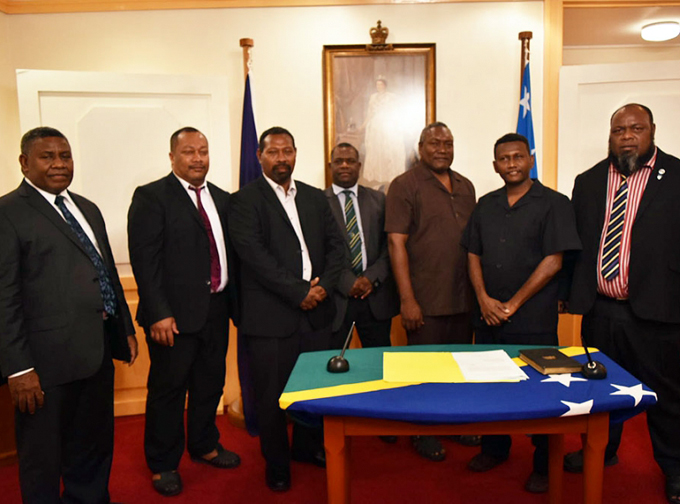
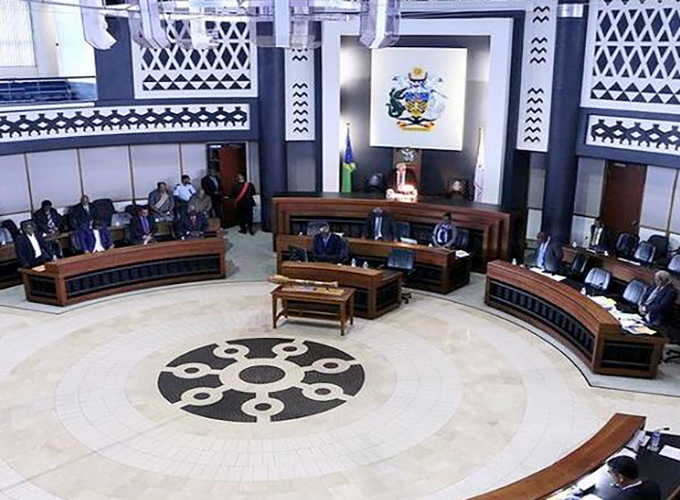
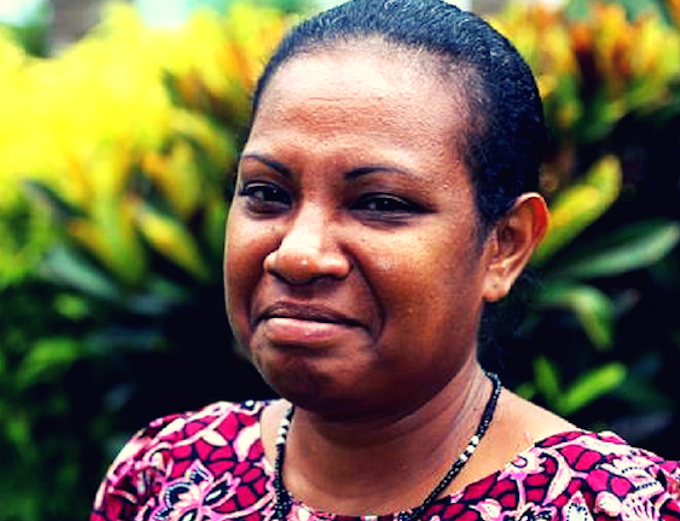
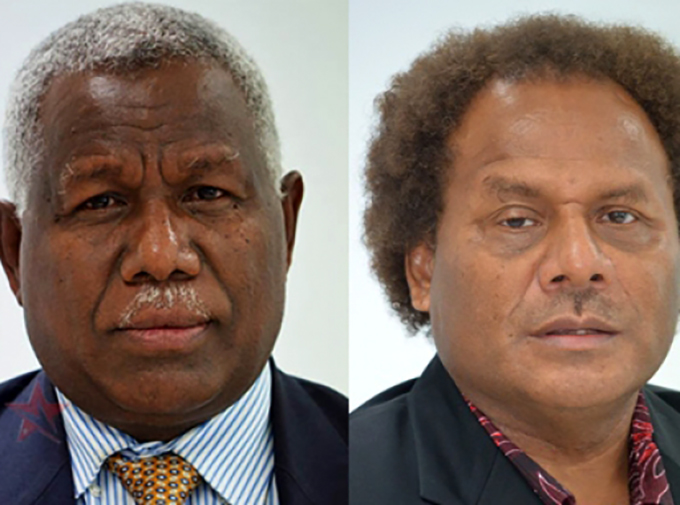
 Candidates for Solomon Islands top job … Central Honiara MP Rick Houenipwela (left) and Small Malaita MP John Moffat Fugui. Image: Solomon Star News
Candidates for Solomon Islands PM announced amid ‘political turbulence’

Amid continued “political turbulence” in the Solomon Islands, candidates for the position of prime minister have been announced, the Solomon Islands Broadcasting Corporation reports.
MP for Central Honiara John Moffat Fugui will go head-to-head with Small Malaita MP Rick Houenipwela for the position on Wednesday morning.
Solomon Star News reports Fugui and Houenipwela were the only two candidates, nominated by the Honiara Hotel camp (opposition) and Heritage Park Hotel camp (caretaker government) respectively.
SIBC reports Houenipwela is considered the better candidate by the public.
In government for seven years, Houenipwela’s top priorities if elected are political and fiscal stability.
He told Solomon Star News these were the fundamental reasons the Democratic Alliance Party switched from the opposition to the caretaker government.
Houenipwela also told SIBC the DAP made the move in an effort to form a new coalition which would provide the nation with desperately needed political stability.
‘Never accepted’ money
“Political and fiscal stability underpin the general stability of any nation and these were the fundamental reasons for switching sides.
“We did not join the caretaker government in search of positions or in search of money. We were never offered any money because everyone in Parliament knows that when we were offered money, we never accepted them,” Houenipwela said.
Houenipwela’s DAP walked away from the opposition due to a lack of consultation over a proposed cabinet line-up, he said.
The DAP’s move comes amidst a three week period which has been marked by changed allegiances and moves to consolidate power.
Solomon Star News reports the Heritage Park Hotel camp is now comprised of the Kadere Party, People’s Alliance Party, People’s First Party and the DAP, bringing their numbers up from 23 to 30.
Houenipwela confirmed the caretaker government coalition partners consist of the two political parties that formerly made up the opposition and three political parties of the former Sogavare-led Democratic Coalition for Change Government (DCCG).
The opposition’s numbers have dwindled to 20 MPs, reports Solomon Fresh Beat Online.
Fugui announces policies
Opposition candidate for prime minister, Fugui, told SIBC the value leaders placed on their duty to the nation was more important than setting political and fiscal stability as priorities, as good governance and a stable economy result from leaders valuing their role.
Fugui’s policies included greater support of rural people and beefing up the country’s foreign reserves, SIBC reports.
The group which nominated Houenipwela included former Prime Minister Manasseh Sogavare, who was ousted last week following a 27 to 23 no-confidence vote, after initially refusing to resign.
During the nine hour debate in parliament, Sogavare defended his strong stance on West Papua, following criticism from Fugui, Solomon Star News reports.
Fugui said Sogavare should withdraw support of the Indonesian-ruled region and not waste the Solomon Islands time, as Papua New Guinea had not been advocating for West Papua.
Sogavare hit-back in his rebuttal and said the government’s position must be consistent with its position on New Caledonia’s independence, French Polynesia’s decolonisation agenda and Taiwan’s bid for United Nations membership.
He added the Solomon Islands must stand beside its Melanesian brothers and sisters, as they did not enjoy the same basic rights.
Sogavare survived a no-confidence motion in October 2006 despite deteriorating relations with Australia, but did not survive a vote of no-confidence in December 2007.
The election of Houenipwela or Fugui to the top post of prime minister takes place on Wednesday, November 15 at 9.30am.

Article by AsiaPacificReport.nz
]]>Australia accused of ‘bullying’ Pacific neighbours out of climate compo

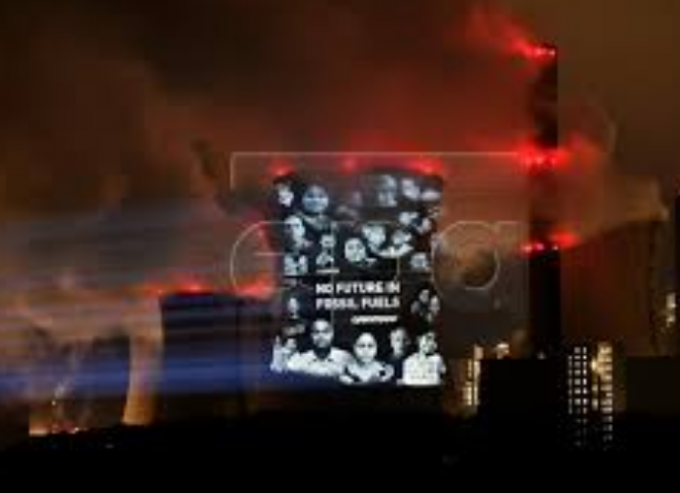 Greenpeace political message to COP23 on fossil fuels. Image: Greenpeace
Pacific Media Report Newsdesk
Australia has picked up a second Fossil of the Day award at COP23 in Bonn for seeking to twist, water down and delete references to finance from the loss and damage decision text, Greenpeace reports.
Loss and damage refers to impacts of climate change including slow onset events such as sea level rise, and extreme weather events, such as tropical cyclones, which may both result in loss of lands, livelihoods and in small island states, coastal areas.
 “Australia has long lacked many things – sympathy, support, and solidarity among them – with its Pacific Island neighbors, but these bullying tactics are over the line, even for them,” the Climate Action Network, which presented the award on day six of COP23, said in a statement.
Australia’s reported hypocritical behaviour also appears to contradict the comments it made in its opening statement on behalf of the Umbrella Group of non-EU developed countries to current COP President, Fiji’s Prime Minister Voreqe Bainimarama.
“We are mindful that this is the first time a Small Island Developing State has held the presidency and we are committed to providing our full support for your successful presidency, including to bring the Pacific consciousness to this COP which we know to be an important aspect of your presidency,” Australia said in its opening statement to the COP plenary.
“Australia’s domestic policies, such as support for the fossil fuel industry through subsidies, is insult enough to the Pacific. Couple that with blocking financial mechanisms for the highly affected, and you do not have a recipe for friendship,” Greenpeace Australia Pacific head of Pacific Net Matisse Walkden-Brown said.
The Pacific Island Climate Action Network (PICAN) condemned Australia’s reported obstruction, saying the region is already experiencing loss and damage from climate change.
“Support is necessary and deserved from countries who have caused this problem. Developed countries’ fossil fuels is the Pacific’s loss and damage. The issue of Loss and Damage finance needs to be advanced not continuously pushed to the next session,” PICAN said.
Australia was awarded the Fossil of the Day along with Canada, the EU and the US.
Australia, through the Umbrella Group, also argued in 2015 that there be no reference to loss and damage in the Paris Agreement, reportedly driven by fear of being forced to pay compensation for climate damage caused by their emissions.
On day two of COP23 Australia received the Fossil of the Day for its support of the Adani Group’s plans to build the world’s largest export coal mine.
Activists from Greenpeace in Germany and Pacific Island representatives have sent a message to leaders meeting at the UN climate talks in Bonn, projecting an image of faces onto a coal power plant and calling for an urgent phase out of fossil fuels, Greenpeace reports.
The message “No future in fossil fuels” and #COP23 was projected onto the polluting Neurath coal power plant alongside faces from the Pacific Islands and around the world to put a spotlight on the impact the emissions from climate summit host nation Germany have on the Pacific.
Article by AsiaPacificReport.nz
]]>Bryce Edwards’ Political Roundup: Labour’s remarkable CPTPP

Bryce Edwards’ Political Roundup: Labour’s remarkable CPTPP
[caption id="attachment_13635" align="alignright" width="150"] Dr Bryce Edwards.[/caption]
Last year, Labour MPs were amongst the 72,000 who marched in the streets against the Trans-Pacific Partnership Agreement. Now in Government, Labour appears to have made major progress in ensuring the TPP should happen. Below are 20 of the most important items from recent days about the progress of the deal.
[caption id="attachment_15386" align="aligncenter" width="1600"]
Dr Bryce Edwards.[/caption]
Last year, Labour MPs were amongst the 72,000 who marched in the streets against the Trans-Pacific Partnership Agreement. Now in Government, Labour appears to have made major progress in ensuring the TPP should happen. Below are 20 of the most important items from recent days about the progress of the deal.
[caption id="attachment_15386" align="aligncenter" width="1600"] New Zealand Prime Minister, Jacinda Ardern, at the APEC leaders’ summit, November 2017 (Image courtesy of APEC.org).[/caption]
1) The TPP is now the CPTPP! Vernon Small explains: “It might be near unpronounceable as the CPTPP (Comprehensive and Progressive Agreement for the Trans-Pacific Partnership), and loom on paper like an abbreviation of something from the former Soviet Union, but apparently the rebranding will help Trudeau sell it to his voters” – see: Jacinda Ardern passes Apec test. See also, Audrey Young’s TPP not dead but needs more work – PM.
2) Many former critics of the TPP are now happier with the agreement that seems to be emerging. Bryan Gould says “If the reports coming out of the negotiations are correct… the problems many had with the TPPA will have been substantially resolved” – see: Is the TPPA now fit for purpose? Gould gives credit to Ardern: “We will be able to judge how successful she has been when we see the full amended text. But the early reports are that substantial progress was made on these points of difficulty, and if that is so, it is entirely because she dug in her heels.”
3) The deal has been improved largely thanks to Canada, says blogger No Right Turn – see: Saved by Canada. He’s more positive about the deal than previously, but says, “Whether the deal is still worth it for New Zealand without US market access remains to be seen, but in the previous analysis the US bullshit was a significant cost, so it might be”.
4) The Labour-led government is winning the praise and support of business and the National Party for their progress on the trade deal – see Craig McCulloch’s Exporters welcome revamped TPP, critics have doubts. However, former Trade Minister Todd McClay is also quoted suggesting that the deal isn’t so different to National’s version: “We can give it a different name, but ultimately it substantially is the same”.
5) On RNZ’s Nine-to-Noon today, Matthew Hooton praised Ardern and Parker, pointing to the difficult ideological terrain for the Labour leadership: “I think that the Government has handled this well. They do have this fringe, including within their own party, which has got themselves into an absolute lather over this issue. And Jacinda Ardern, I think, has done enough to keep that extreme left, at least if not happy with what she has done, but at least not going to man the barricades” – listen here: Political commentators Mike Williams & Matthew Hooton.
6) How has David Parker managed to walk the tightrope of placating so many critics and fans of the TPP? For the best answer to this, see Sam Sachdeva’s interview with the Trade Minister: David Parker plots a new approach to trade. Partly, it seems that the Minister is much more determined to make gains that the political left might appreciate. Parker is also very sensitive to the need to be more transparent and communicative over the negotiations.
7) David Parker’s attempt to make trade deals more progressive is dealt with in Sam Sachdeva’s The fight for multilateral trade. According to this, “Parker said the CPTPP was good for New Zealand not just in terms of market access, but by providing enforcement mechanisms to hold countries to account if they didn’t meet labour and environmental standards.”
8) For details of the effort Jacinda Ardern and David Parker have been going to in order to keep their party onside with them over the negotiations, see Richard Harman’s Labour Party on side with new TPP – so far. Harman says that the issue of how Ardern now deals with getting an agreement supported by her colleagues “is going to be real test of Jacinda Ardern’s political management skills.”
9) The National Party has clearly indicated they will help Labour get any TPP legislation passed in Parliament. But Richard Harman argues that relying on National “would almost certainly damage Labour among its base who generally ardently oppose the TPP” – see: National tries to drive wedge into coalition.
10) A long-time observer and critic of free trade deals, Gordon Campbell seems relatively happy with progress made in the weekend – see: On the TPP outcome, and the Hobbit law. His main concern has been the Investor State Dispute Settlement (ISDS), and he says: “if we couldn’t remove ISDS measures entirely, what we could do was make it harder for foreign firms to access them. The Ardern/Parker aim in Vietnam has been to severely restrict the conditions under which foreign firms could trigger ISDS measures, and Parker took at least three different routes to that goal.”
11) How have the ISDS provisions changed? The improvements are outlined by Sam Sachdeva: “Ardern said they had been successful in narrowing the ISDS provisions in three areas: they no longer apply to investment screening (which will protect the Government’s restriction on foreign buyers from challenge), will not allow a company that takes up a contract with a government to sue through the ISDS, and changes to the way it applies to financial services” – see: New TPP text brings change, outstanding issues. See also, Vernon Small’s Renamed TPP ‘a damned sight better’, could be in place in a few months.
12) Jane Kelsey has been the leading opponent of the TPP, and she gave her strong verdict against the latest deal on TV3’s AM Show this morning. You can watch her interview with Duncan Garner, along with other interviews on the topic here: Greens will go against Labour in TPP vote.
13) For more of Kelsey’s analysis, see her Herald opinion piece, Signing TPPA-11 would break Labour’s word, and Leith Huffadine’s Why is the Trans Pacific Partnership Agreement back on the table?
14) Many leftwing bloggers aren’t convinced that the TPP has been modified enough. At The Standard, Lynn Prentice warns Labour: “The new government, if it is interested in proceeding with something like the TPPA, should at the very least stop hunting for momentum and concentrate on transparency and analysis. Because if you can’t convince me that this agreement is anything other than a scam, then you won’t be able to convince many on the ‘left’.” – see: TPP: A slight improvement but deservedly still a zombie.
15) It’s not clear if Jacinda Ardern has managed to fix the TPP or not, but writing before the weekend, Chris Trotter said that if she hasn’t done so, then for many people, “Jacinda” will have become “just another f***ing politician” – see: TPP: Fix It, Jacinda, Or Forget It. Trotter paints a picture of the new government selling out its core activists.
16) Laura O’Connell Rapira of ActionStation is far from convinced about what the new government is doing on trade. Writing last week, she suggested the public is being manipulated by Jacinda Ardern and Labour – see: Don’t fall for the government’s spin on the TPPA. She also points out that Labour had previously run a petition against the TPP, but when you go to the party’s website now, all you see is: “A big ol’ blank page”.
17) The Labour Party is out of sync with the labour movement over the new trade deal, with the Council of Trade Unions coming out to say the TPP is still “structurally biased towards the commercial sector and downplayed issues such as health, safety and human rights”. CTU secretary Sam Huggard says that unions would like to “be part of a conversation with government about what a better agenda for trade could look like for working people” – see RNZ’s TPP critics unmoved by new negotiation wins.
18) The Green Party has announced, unsurprisingly, that they will vote against the new deal. Trade spokesperson Golriz Ghahraman admits the new agreement is an improvement, but says the Government should have pushed harder for a better agreement – see Claire Trevett’s Greens will not support revised TPP trade deal.
19) How could Labour go from opposing the TPP to negotiating what appears to be its near-conclusion? According to Rob Hosking this can easily be explained by the fact that politicians often say one thing in opposition and then another in government, and he calls this “‘the Maharey Rule”. He explains: “Steve Maharey, newly appointed Social Development Minister under Helen Clark, excused one of that government’s changes of tack when challenged about the mismatch between his opposition rhetoric and his actions by breezily saying it was ‘just the sort of thing you say in opposition’. It was a burst of admirable frankness, and as such has been celebrated ever since” – see: Labour TPP stance harks back to Maharey.
20) Finally, for humour about the trade negotiations over the years, see my blog post, The history of NZ’s TPP negotiations via cartoons.]]>
New Zealand Prime Minister, Jacinda Ardern, at the APEC leaders’ summit, November 2017 (Image courtesy of APEC.org).[/caption]
1) The TPP is now the CPTPP! Vernon Small explains: “It might be near unpronounceable as the CPTPP (Comprehensive and Progressive Agreement for the Trans-Pacific Partnership), and loom on paper like an abbreviation of something from the former Soviet Union, but apparently the rebranding will help Trudeau sell it to his voters” – see: Jacinda Ardern passes Apec test. See also, Audrey Young’s TPP not dead but needs more work – PM.
2) Many former critics of the TPP are now happier with the agreement that seems to be emerging. Bryan Gould says “If the reports coming out of the negotiations are correct… the problems many had with the TPPA will have been substantially resolved” – see: Is the TPPA now fit for purpose? Gould gives credit to Ardern: “We will be able to judge how successful she has been when we see the full amended text. But the early reports are that substantial progress was made on these points of difficulty, and if that is so, it is entirely because she dug in her heels.”
3) The deal has been improved largely thanks to Canada, says blogger No Right Turn – see: Saved by Canada. He’s more positive about the deal than previously, but says, “Whether the deal is still worth it for New Zealand without US market access remains to be seen, but in the previous analysis the US bullshit was a significant cost, so it might be”.
4) The Labour-led government is winning the praise and support of business and the National Party for their progress on the trade deal – see Craig McCulloch’s Exporters welcome revamped TPP, critics have doubts. However, former Trade Minister Todd McClay is also quoted suggesting that the deal isn’t so different to National’s version: “We can give it a different name, but ultimately it substantially is the same”.
5) On RNZ’s Nine-to-Noon today, Matthew Hooton praised Ardern and Parker, pointing to the difficult ideological terrain for the Labour leadership: “I think that the Government has handled this well. They do have this fringe, including within their own party, which has got themselves into an absolute lather over this issue. And Jacinda Ardern, I think, has done enough to keep that extreme left, at least if not happy with what she has done, but at least not going to man the barricades” – listen here: Political commentators Mike Williams & Matthew Hooton.
6) How has David Parker managed to walk the tightrope of placating so many critics and fans of the TPP? For the best answer to this, see Sam Sachdeva’s interview with the Trade Minister: David Parker plots a new approach to trade. Partly, it seems that the Minister is much more determined to make gains that the political left might appreciate. Parker is also very sensitive to the need to be more transparent and communicative over the negotiations.
7) David Parker’s attempt to make trade deals more progressive is dealt with in Sam Sachdeva’s The fight for multilateral trade. According to this, “Parker said the CPTPP was good for New Zealand not just in terms of market access, but by providing enforcement mechanisms to hold countries to account if they didn’t meet labour and environmental standards.”
8) For details of the effort Jacinda Ardern and David Parker have been going to in order to keep their party onside with them over the negotiations, see Richard Harman’s Labour Party on side with new TPP – so far. Harman says that the issue of how Ardern now deals with getting an agreement supported by her colleagues “is going to be real test of Jacinda Ardern’s political management skills.”
9) The National Party has clearly indicated they will help Labour get any TPP legislation passed in Parliament. But Richard Harman argues that relying on National “would almost certainly damage Labour among its base who generally ardently oppose the TPP” – see: National tries to drive wedge into coalition.
10) A long-time observer and critic of free trade deals, Gordon Campbell seems relatively happy with progress made in the weekend – see: On the TPP outcome, and the Hobbit law. His main concern has been the Investor State Dispute Settlement (ISDS), and he says: “if we couldn’t remove ISDS measures entirely, what we could do was make it harder for foreign firms to access them. The Ardern/Parker aim in Vietnam has been to severely restrict the conditions under which foreign firms could trigger ISDS measures, and Parker took at least three different routes to that goal.”
11) How have the ISDS provisions changed? The improvements are outlined by Sam Sachdeva: “Ardern said they had been successful in narrowing the ISDS provisions in three areas: they no longer apply to investment screening (which will protect the Government’s restriction on foreign buyers from challenge), will not allow a company that takes up a contract with a government to sue through the ISDS, and changes to the way it applies to financial services” – see: New TPP text brings change, outstanding issues. See also, Vernon Small’s Renamed TPP ‘a damned sight better’, could be in place in a few months.
12) Jane Kelsey has been the leading opponent of the TPP, and she gave her strong verdict against the latest deal on TV3’s AM Show this morning. You can watch her interview with Duncan Garner, along with other interviews on the topic here: Greens will go against Labour in TPP vote.
13) For more of Kelsey’s analysis, see her Herald opinion piece, Signing TPPA-11 would break Labour’s word, and Leith Huffadine’s Why is the Trans Pacific Partnership Agreement back on the table?
14) Many leftwing bloggers aren’t convinced that the TPP has been modified enough. At The Standard, Lynn Prentice warns Labour: “The new government, if it is interested in proceeding with something like the TPPA, should at the very least stop hunting for momentum and concentrate on transparency and analysis. Because if you can’t convince me that this agreement is anything other than a scam, then you won’t be able to convince many on the ‘left’.” – see: TPP: A slight improvement but deservedly still a zombie.
15) It’s not clear if Jacinda Ardern has managed to fix the TPP or not, but writing before the weekend, Chris Trotter said that if she hasn’t done so, then for many people, “Jacinda” will have become “just another f***ing politician” – see: TPP: Fix It, Jacinda, Or Forget It. Trotter paints a picture of the new government selling out its core activists.
16) Laura O’Connell Rapira of ActionStation is far from convinced about what the new government is doing on trade. Writing last week, she suggested the public is being manipulated by Jacinda Ardern and Labour – see: Don’t fall for the government’s spin on the TPPA. She also points out that Labour had previously run a petition against the TPP, but when you go to the party’s website now, all you see is: “A big ol’ blank page”.
17) The Labour Party is out of sync with the labour movement over the new trade deal, with the Council of Trade Unions coming out to say the TPP is still “structurally biased towards the commercial sector and downplayed issues such as health, safety and human rights”. CTU secretary Sam Huggard says that unions would like to “be part of a conversation with government about what a better agenda for trade could look like for working people” – see RNZ’s TPP critics unmoved by new negotiation wins.
18) The Green Party has announced, unsurprisingly, that they will vote against the new deal. Trade spokesperson Golriz Ghahraman admits the new agreement is an improvement, but says the Government should have pushed harder for a better agreement – see Claire Trevett’s Greens will not support revised TPP trade deal.
19) How could Labour go from opposing the TPP to negotiating what appears to be its near-conclusion? According to Rob Hosking this can easily be explained by the fact that politicians often say one thing in opposition and then another in government, and he calls this “‘the Maharey Rule”. He explains: “Steve Maharey, newly appointed Social Development Minister under Helen Clark, excused one of that government’s changes of tack when challenged about the mismatch between his opposition rhetoric and his actions by breezily saying it was ‘just the sort of thing you say in opposition’. It was a burst of admirable frankness, and as such has been celebrated ever since” – see: Labour TPP stance harks back to Maharey.
20) Finally, for humour about the trade negotiations over the years, see my blog post, The history of NZ’s TPP negotiations via cartoons.]]>
Critical Politics Newsletter: New Zealand Politics Daily – 13 November 2017
Critical Politics Newsletter: New Zealand Politics Daily – 13 November 2017 – Today’s content
Editor’s Note: Here below is a list of the main issues currently under discussion in New Zealand and links to media coverage. [caption id="attachment_297" align="aligncenter" width="1600"] The Beehive and Parliament Buildings.[/caption]
Below are the links to the items online. The full text of these items are contained in the PDF file (click to download).
Trade and international relations
Audrey Young (Herald): PM Jacinda Ardern’s diplomacy skills set to be tested in second summit in Manila
Sam Sachdeva (Newsroom): The fight for multilateral trade
Audrey Young (Herald): Trump’s war of words over Asia Pacific
Newshub: What Donald Trump’s Asia-Pacific ‘dream’ means for NZ
Audrey Young (Herald): Winston Peters talks Chinese fugitives with China’s foreign minister
Sam Sachdeva (Newsroom): Peters backs corruption drive, avoids criticism during China meeting
Vernon Small (Stuff): Jacinda Ardern passes Apec test
Craig McCulloch (RNZ): Exporters welcome revamped TPP, critics have doubts
RNZ: TPP critics unmoved by new negotiation wins
1News: Labour-led Government strongly defends controversial Trans-Pacific Partnership deal
Richard Harman (Politik): Labour Party on side with new TPP – so far
Ric Stevens (Press) Editorial: CPTPP a shadow of its former TPP self
Herald Editorial: So near yet so far on TPP
Jane Kelsey (Daily Blog): Labour largely endorses National’s TPPA, but it’s not all over. What now?
Lynn Prentice (Standard): TPP: A slight improvement but deservedly still a zombie
Newshub: Jacinda Ardern to talk tough at East Asia Summit
Patrick O’Meara (RNZ): Rebranded TPP still on track to be concluded
Vernon Small (Stuff): Renamed TPP ‘a damned sight better’, could be in place in a few months
Audrey Young (Herald): Ardern’s Apec a mix of highly political and deeply personal
Audrey Young (Herald): TPP not dead but needs more work – PM
Vernon Small (Stuff): Trans-Pacific Partnership: 11 trade ministers reach deal to keep deal alive
Patrick Gower (Newshub): Jacinda Ardern helps keep TPP alive
Sam Sachdeva (Newsroom): New TPP text brings change, outstanding issues
Sam Sachdeva (Newsroom): New name, hope for TPP after Canada returns to talks
1News: Jacinda Ardern says TPP
Leith Huffadine (Stuff): Why is the Trans Pacific Partnerhip Agreement back on the table?
RNZ: TPP deal revived once more, 20 provisions suspended
Jonathan Milne (SST): Is it alive? Is it dead? The TPP has become the zombie trade deal
Greg Presland (Standard): The TPP11 negotiations: ISDS provisions are gone – almost
Martyn Bradbury (Daily Blog): Jacinda dodges a TPPA bullet – elites search for next economic trigger to sabotage new Government
Steven Cowan (Against the current): Jane Kelsey: The TPP deal remains toxic
Audrey Young (Herald): Jacinda Ardern snapped with Donald Trump at Apec as leaders don blue shirts
Stuff: TPP nations ‘have made good progress’ on deal, no-show ‘a misunderstanding’
Herald: TPP deal has not sunk yet: Core elements of deal agreed, more work to be done
Herald: ‘Life will go on without TPP’ David Parker says
Audrey Young (Herald): ‘Silly shirts’ and Kiwi wine at Apec dinner
Stuff: Jacinda Ardern, Justin Trudeau and Donald Trump together at Apec
Newshub: Jacinda Ardern shakes Donald Trump’s hand
Patrick Gower (Newshub): Winston Peters meets Vladimir Putin
Branko Marcetic (Spinoff): The TPP v climate change: are they compatible?
Alan Bollard (Asia Media Centre): Anti-globalisation, digital trade among challenges for APEC
Sam Sachdeva (Newsroom): Final-stage stutter an ill omen for TPP
Patrick O’Meara (RNZ): No one ever said trade deals were easy
Fran O’Sullivan (Herald): No TPP glory for Trump
Vernon Small (Stuff): Trans-Pacific Partnership talks collapse after Canada pulls out of trade deal
Audrey Young (Herald): No deal: How the TPP talks collapsed
Audrey Young (Herald): Trans-Pacific Partnership hitch: TPP talks ‘postponed’ after Canada no-show
Audrey Young (Herald): The TPP done deal that turned out not to be
Sam Sachdeva (Newsroom): TPP talks collapse at final hurdle
Herald:TPP agreement ends in ‘misunderstanding’
Herald: Bill English: Govt should keep trying for TPP
RNZ: Beef and Lamb confident TPP will get tick
David Farrar (Kiwiblog): TPP11 looks to be a go
Vernon Small (Stuff): PM Jacinda Ardern appears to be in fine form despite Apec’s frenetic pace
Patrick Gower (Newshub): Ardern changes NZ tone on foreign stage
Anna Bracewell-Worrall (Newshub): Jacinda Ardern: It’s my responsibility to lead on climate change
Stuff: Prime Minister Jacinda Ardern’s surprise gift from Vietnam
Patrick Gower (Newshub): Facebook boss’ feminist gift for Ardern
Lisa Owen (BBC): Jacinda Ardern: New Zealand’s female PM takes on Apec
Herald: Ardern breaks the Apec mould – young, liberal, gay-friendly
Gerard Hutching (Stuff): New Zealand wins WTO appeal for profitable beef access in Indonesia
RNZ: Indonesia to drop NZ import restrictions
Curwen Ares Rolinson (Daily Blog): Why New Zealand Is REALLY Under Pressure Over Russian Trade From Atlanticists With An Agenda
Parliament
Claire Trevett (Herald): Mallard’s worst slip his wardrobe malfunction
Stacey Kirk (Stuff): Lighter moments mask dark beginnings at Parliament’s mad tea party
Southland Times Editorial: Mallard making decisions above his pray grade
Matthew Whitehead (Standard): The House’s Man
Stuff: Parliament prayer changes – no more Queen or Jesus
Herald: Politicians look at dropping God from Parliament’s opening prayer
Jo Moir (Stuff): The new government has failed to get the basics right
Peter McKenzie (Newsroom): One big step for a female-friendly Parliament
Heather du Plessis-Allan (Herald): Red faces all around for Labour
Stuff: Below the Beltway: Who’s up and who’s down in politics this week?
Philip Matthews (Stuff): Week in review: putting women and children first
Martyn Bradbury (Daily Blog): How National destroy the new Government through Select Committees over the next 3 years
David Farrar (Kiwiblog): Greenpeace says only lobbyists they like should be allowed swipe cards
Herald: Top Wellington restaurant Logan Brown coming to Beehive in catering contract
Child welfare
Simon Collins (Herald): Reducing child poverty: How will Jacinda Ardern do it?
Simon Collins (Herald): Labour will lift benefits to highest level in real terms for at least 37 years
Herald Editorial: Poor children need more than money
Herald: Welfare should be viewed through ‘child impact lens’ – Minister
Brian Easton (Pundit): How to Have More Coherent and Directed Child Policy and Support Services
RNZ: Govt should apologise to state care abuse victims – minister
Government
John Roughan (Herald): Why Jacinda Ardern won’t be fooling herself
Derek Cheng (Herald): Gangs, disability and beating cancer shape new MP’s views
Jo Moir (Stuff): Nanaia Mahuta: First Māori woman to be Māori development minister but ‘won’t be the last’
Muriel Newman (NZCPR): A Government of Controversy
Duncan Garner (Stuff): New Government places pragmatism over principles – fair play
Kerre McIvor (Herald): More time for parents, babies is good for everybody
RNZ: Peters case ‘can be described as heavy handed’
Alister Browne (Stuff): Jacinda Ardern’s Mona Lisa makeover
Gwynn Compton (Libertas Digital): The mysteriously silent Jacinda Ardern Twitter account
Washington Post story on govt
Michael Daly (Stuff): Washington Post contributor says in NZ ‘real power lies with the far right’
David Slack (Stuff): That’s not a tiki torch, it’s a tiki
Greg Presland (Standard): Can Ben Mack please make his mind up
Manus Island refugee crisis
RNZ: Robertson: ‘we can help’ in Manus
Vernon Small (Stuff): Jacinda Ardern steps up pressure on Malcolm Turnbull over refugee offer
Sam Sachdeva (Newsroom): Anzac relations strained over Manus crisis
RNZ: PM wants another meeting with Turnbull over Manus
Herald: Prime Minister Jacinda Ardern lashes Australia over treatment of Manus Island refugees
Jo Moir (Stuff): Gerry Brownlee warns PM to have a ‘degree of respect’ for Australia’s predicament
Abbas Nazari (Spinoff): As a Tampa refugee, I have seen first-hand the impact when NZ takes moral leadership
Anna Cody and Maria Nawaz (The Conversation): UN slams Australia’s human rights record
Environment
Herald: Delay in monitoring won’t see more dead dolphins – Minister
RNZ: Delay in plan to fit cameras on fishing boats
RNZ: Nitrates stored in rocks ‘nail in coffin’ for artificial fertilizers
RNZ: Livestock to blame for 19% of global warming – study
Laura Walters (Stuff): Ministers meet with Pope to discuss climate change in the Pacific
Rob Stock (Stuff): Oil on the fire: How the oil and mining debate turned into a slagging match
Employment
Mike Treen (Daily Blog): Answering right-wing dogmas against increasing the minimum wage
Brent Edwards (RNZ): ‘Hobbit law’ change vindication for late union leader
Belinda McCammon (RNZ): Insight: NZ’s tourism workforce – imported or homegrown?
Paddles
Herald: One final tweet as Paddles, First Cat of New Zealand, becomes ‘stardust’
Herald Editorial: The First Cat of NZ will be missed
Greens
Stacey Kirk (Stuff): Greens announce contest to elect new co-leader in new year
David Farrar (Kiwiblog): Who will be Greens female co-leader?
1News: Green MP Chloe Swarbrick nabs hefty education portfolio
Media
Colin Peacock (RNZ): Reconsidering the rights and wrongs of copying
RNZ: Govt to look into TVNZ chief exec’s pay bump
RNZ: Pay rise for TVNZ CEO called ‘unconscionable’
Matthew Theunissen (Herald): TVNZ boss gets big pay bump despite profit fall
Stuff: TVNZ boss gets big bonus as broadcaster reveals its figures
Phil Pennington (RNZ): Putting NZ TV online: When is a target not a target?
Transport and road safety
Tracy Neal (RNZ): Sweden model could reduce NZ road deaths – researcher
RNZ: Three hundred police pursuits a month – review
Felicity Reid (North Shore Times): Increases in both public transport trips and car ownership in Auckland
Phillipa Yalden (Stuff): Government addresses concerns of transport industry
Health
Shane Cowlishaw (Newsroom): Clean air, but we can’t breathe
David Fisher (Herald): Break The Silence: New Health Minister pledges change on youth suicide
David Fisher (Herald): New Health Minister David Clark on youth suicide: We have a problem and we need to talk about it
Natalie Akoorie (Herald): First concerns about Nigel Murray’s expenses raised 19 months before investigation
Natalie Akoorie (Herald): Nigel Murray spent taxpayer money championing an American virtual health model
Natalie Akoorie (Herald): State Services Commission launches high-level probe into former Waikato DHB chief’s expenses
Stuff: State Services Commission to investigate ex-Waikato DHB boss Nigel Murray
RNZ: Kids barely venturing from home – study
John Boynton (RNZ): Data sovereignty: New global guidelines for indigenous health
Cate Broughton (Stuff): Rotten teeth extractions reveal growth in child poverty, dentists say
Mike Hosking (Herald): Macca’s doesn’t deserve the treatment it’s getting
Priyanca Radhakrishnan mugged
RNZ: Newly elected MP mugged in broad daylight
Harrison Christian and Amanda Saxton (Stuff): Labour MP Priyanca Radhakrishnan mugged in broad daylight in Auckland
Education
Simon Collins (Herald): Mid-life adults join teens in rush for free tertiary education
Martine Udahemuka (Spinoff): How the new education minister can treat school leaders fairly
TOP
Don Rowe (Spinoff): ‘Another day where it feels embarrassing to be associated with TOP’: the email which enraged Morgan
Andrew Gunn (Stuff): Moggy mugger Gareth Morgan ponders TOP’s election failure
Herald: Candidate resigns as ‘flippant and brutal’ email from TOP leader sent to more candidates
David Farrar (Kiwiblog): Gareth bites candidate
Nadine Higgins (Stuff): Gareth Morgan has a Twitter cat-astrophe
Jane Bowron (Stuff): Putting the wind up Gareth Morgan after ill-timed Paddles the cat comments
Steve Braunias (Herald): The secret diary of the PM and that guy from TOP
Data collection and privacy
No Right Turn: More good riddance
Jan Logie (Green Blog): Hooray – a victory for privacy!
Newswire: National warns Government not to scrap it’s data collection policy
Other
Jo Moir (Stuff): Marama Fox and Te Ururoa Flavell remain co-leaders of the Māori Party, for now
Shamubeel Eaqub (Stuff): Last chance for redemption
Johnny Moore (Stuff): Watch out, tax-dodging Queen, the revolution is coming
Paul McBeth (Herald): SFO ends four-year Zespri investigation with no charges
Rowan Simpson (Spinoff): The problem with the way government backs business in 2017]]>
The Beehive and Parliament Buildings.[/caption]
Below are the links to the items online. The full text of these items are contained in the PDF file (click to download).
Trade and international relations
Audrey Young (Herald): PM Jacinda Ardern’s diplomacy skills set to be tested in second summit in Manila
Sam Sachdeva (Newsroom): The fight for multilateral trade
Audrey Young (Herald): Trump’s war of words over Asia Pacific
Newshub: What Donald Trump’s Asia-Pacific ‘dream’ means for NZ
Audrey Young (Herald): Winston Peters talks Chinese fugitives with China’s foreign minister
Sam Sachdeva (Newsroom): Peters backs corruption drive, avoids criticism during China meeting
Vernon Small (Stuff): Jacinda Ardern passes Apec test
Craig McCulloch (RNZ): Exporters welcome revamped TPP, critics have doubts
RNZ: TPP critics unmoved by new negotiation wins
1News: Labour-led Government strongly defends controversial Trans-Pacific Partnership deal
Richard Harman (Politik): Labour Party on side with new TPP – so far
Ric Stevens (Press) Editorial: CPTPP a shadow of its former TPP self
Herald Editorial: So near yet so far on TPP
Jane Kelsey (Daily Blog): Labour largely endorses National’s TPPA, but it’s not all over. What now?
Lynn Prentice (Standard): TPP: A slight improvement but deservedly still a zombie
Newshub: Jacinda Ardern to talk tough at East Asia Summit
Patrick O’Meara (RNZ): Rebranded TPP still on track to be concluded
Vernon Small (Stuff): Renamed TPP ‘a damned sight better’, could be in place in a few months
Audrey Young (Herald): Ardern’s Apec a mix of highly political and deeply personal
Audrey Young (Herald): TPP not dead but needs more work – PM
Vernon Small (Stuff): Trans-Pacific Partnership: 11 trade ministers reach deal to keep deal alive
Patrick Gower (Newshub): Jacinda Ardern helps keep TPP alive
Sam Sachdeva (Newsroom): New TPP text brings change, outstanding issues
Sam Sachdeva (Newsroom): New name, hope for TPP after Canada returns to talks
1News: Jacinda Ardern says TPP
Leith Huffadine (Stuff): Why is the Trans Pacific Partnerhip Agreement back on the table?
RNZ: TPP deal revived once more, 20 provisions suspended
Jonathan Milne (SST): Is it alive? Is it dead? The TPP has become the zombie trade deal
Greg Presland (Standard): The TPP11 negotiations: ISDS provisions are gone – almost
Martyn Bradbury (Daily Blog): Jacinda dodges a TPPA bullet – elites search for next economic trigger to sabotage new Government
Steven Cowan (Against the current): Jane Kelsey: The TPP deal remains toxic
Audrey Young (Herald): Jacinda Ardern snapped with Donald Trump at Apec as leaders don blue shirts
Stuff: TPP nations ‘have made good progress’ on deal, no-show ‘a misunderstanding’
Herald: TPP deal has not sunk yet: Core elements of deal agreed, more work to be done
Herald: ‘Life will go on without TPP’ David Parker says
Audrey Young (Herald): ‘Silly shirts’ and Kiwi wine at Apec dinner
Stuff: Jacinda Ardern, Justin Trudeau and Donald Trump together at Apec
Newshub: Jacinda Ardern shakes Donald Trump’s hand
Patrick Gower (Newshub): Winston Peters meets Vladimir Putin
Branko Marcetic (Spinoff): The TPP v climate change: are they compatible?
Alan Bollard (Asia Media Centre): Anti-globalisation, digital trade among challenges for APEC
Sam Sachdeva (Newsroom): Final-stage stutter an ill omen for TPP
Patrick O’Meara (RNZ): No one ever said trade deals were easy
Fran O’Sullivan (Herald): No TPP glory for Trump
Vernon Small (Stuff): Trans-Pacific Partnership talks collapse after Canada pulls out of trade deal
Audrey Young (Herald): No deal: How the TPP talks collapsed
Audrey Young (Herald): Trans-Pacific Partnership hitch: TPP talks ‘postponed’ after Canada no-show
Audrey Young (Herald): The TPP done deal that turned out not to be
Sam Sachdeva (Newsroom): TPP talks collapse at final hurdle
Herald:TPP agreement ends in ‘misunderstanding’
Herald: Bill English: Govt should keep trying for TPP
RNZ: Beef and Lamb confident TPP will get tick
David Farrar (Kiwiblog): TPP11 looks to be a go
Vernon Small (Stuff): PM Jacinda Ardern appears to be in fine form despite Apec’s frenetic pace
Patrick Gower (Newshub): Ardern changes NZ tone on foreign stage
Anna Bracewell-Worrall (Newshub): Jacinda Ardern: It’s my responsibility to lead on climate change
Stuff: Prime Minister Jacinda Ardern’s surprise gift from Vietnam
Patrick Gower (Newshub): Facebook boss’ feminist gift for Ardern
Lisa Owen (BBC): Jacinda Ardern: New Zealand’s female PM takes on Apec
Herald: Ardern breaks the Apec mould – young, liberal, gay-friendly
Gerard Hutching (Stuff): New Zealand wins WTO appeal for profitable beef access in Indonesia
RNZ: Indonesia to drop NZ import restrictions
Curwen Ares Rolinson (Daily Blog): Why New Zealand Is REALLY Under Pressure Over Russian Trade From Atlanticists With An Agenda
Parliament
Claire Trevett (Herald): Mallard’s worst slip his wardrobe malfunction
Stacey Kirk (Stuff): Lighter moments mask dark beginnings at Parliament’s mad tea party
Southland Times Editorial: Mallard making decisions above his pray grade
Matthew Whitehead (Standard): The House’s Man
Stuff: Parliament prayer changes – no more Queen or Jesus
Herald: Politicians look at dropping God from Parliament’s opening prayer
Jo Moir (Stuff): The new government has failed to get the basics right
Peter McKenzie (Newsroom): One big step for a female-friendly Parliament
Heather du Plessis-Allan (Herald): Red faces all around for Labour
Stuff: Below the Beltway: Who’s up and who’s down in politics this week?
Philip Matthews (Stuff): Week in review: putting women and children first
Martyn Bradbury (Daily Blog): How National destroy the new Government through Select Committees over the next 3 years
David Farrar (Kiwiblog): Greenpeace says only lobbyists they like should be allowed swipe cards
Herald: Top Wellington restaurant Logan Brown coming to Beehive in catering contract
Child welfare
Simon Collins (Herald): Reducing child poverty: How will Jacinda Ardern do it?
Simon Collins (Herald): Labour will lift benefits to highest level in real terms for at least 37 years
Herald Editorial: Poor children need more than money
Herald: Welfare should be viewed through ‘child impact lens’ – Minister
Brian Easton (Pundit): How to Have More Coherent and Directed Child Policy and Support Services
RNZ: Govt should apologise to state care abuse victims – minister
Government
John Roughan (Herald): Why Jacinda Ardern won’t be fooling herself
Derek Cheng (Herald): Gangs, disability and beating cancer shape new MP’s views
Jo Moir (Stuff): Nanaia Mahuta: First Māori woman to be Māori development minister but ‘won’t be the last’
Muriel Newman (NZCPR): A Government of Controversy
Duncan Garner (Stuff): New Government places pragmatism over principles – fair play
Kerre McIvor (Herald): More time for parents, babies is good for everybody
RNZ: Peters case ‘can be described as heavy handed’
Alister Browne (Stuff): Jacinda Ardern’s Mona Lisa makeover
Gwynn Compton (Libertas Digital): The mysteriously silent Jacinda Ardern Twitter account
Washington Post story on govt
Michael Daly (Stuff): Washington Post contributor says in NZ ‘real power lies with the far right’
David Slack (Stuff): That’s not a tiki torch, it’s a tiki
Greg Presland (Standard): Can Ben Mack please make his mind up
Manus Island refugee crisis
RNZ: Robertson: ‘we can help’ in Manus
Vernon Small (Stuff): Jacinda Ardern steps up pressure on Malcolm Turnbull over refugee offer
Sam Sachdeva (Newsroom): Anzac relations strained over Manus crisis
RNZ: PM wants another meeting with Turnbull over Manus
Herald: Prime Minister Jacinda Ardern lashes Australia over treatment of Manus Island refugees
Jo Moir (Stuff): Gerry Brownlee warns PM to have a ‘degree of respect’ for Australia’s predicament
Abbas Nazari (Spinoff): As a Tampa refugee, I have seen first-hand the impact when NZ takes moral leadership
Anna Cody and Maria Nawaz (The Conversation): UN slams Australia’s human rights record
Environment
Herald: Delay in monitoring won’t see more dead dolphins – Minister
RNZ: Delay in plan to fit cameras on fishing boats
RNZ: Nitrates stored in rocks ‘nail in coffin’ for artificial fertilizers
RNZ: Livestock to blame for 19% of global warming – study
Laura Walters (Stuff): Ministers meet with Pope to discuss climate change in the Pacific
Rob Stock (Stuff): Oil on the fire: How the oil and mining debate turned into a slagging match
Employment
Mike Treen (Daily Blog): Answering right-wing dogmas against increasing the minimum wage
Brent Edwards (RNZ): ‘Hobbit law’ change vindication for late union leader
Belinda McCammon (RNZ): Insight: NZ’s tourism workforce – imported or homegrown?
Paddles
Herald: One final tweet as Paddles, First Cat of New Zealand, becomes ‘stardust’
Herald Editorial: The First Cat of NZ will be missed
Greens
Stacey Kirk (Stuff): Greens announce contest to elect new co-leader in new year
David Farrar (Kiwiblog): Who will be Greens female co-leader?
1News: Green MP Chloe Swarbrick nabs hefty education portfolio
Media
Colin Peacock (RNZ): Reconsidering the rights and wrongs of copying
RNZ: Govt to look into TVNZ chief exec’s pay bump
RNZ: Pay rise for TVNZ CEO called ‘unconscionable’
Matthew Theunissen (Herald): TVNZ boss gets big pay bump despite profit fall
Stuff: TVNZ boss gets big bonus as broadcaster reveals its figures
Phil Pennington (RNZ): Putting NZ TV online: When is a target not a target?
Transport and road safety
Tracy Neal (RNZ): Sweden model could reduce NZ road deaths – researcher
RNZ: Three hundred police pursuits a month – review
Felicity Reid (North Shore Times): Increases in both public transport trips and car ownership in Auckland
Phillipa Yalden (Stuff): Government addresses concerns of transport industry
Health
Shane Cowlishaw (Newsroom): Clean air, but we can’t breathe
David Fisher (Herald): Break The Silence: New Health Minister pledges change on youth suicide
David Fisher (Herald): New Health Minister David Clark on youth suicide: We have a problem and we need to talk about it
Natalie Akoorie (Herald): First concerns about Nigel Murray’s expenses raised 19 months before investigation
Natalie Akoorie (Herald): Nigel Murray spent taxpayer money championing an American virtual health model
Natalie Akoorie (Herald): State Services Commission launches high-level probe into former Waikato DHB chief’s expenses
Stuff: State Services Commission to investigate ex-Waikato DHB boss Nigel Murray
RNZ: Kids barely venturing from home – study
John Boynton (RNZ): Data sovereignty: New global guidelines for indigenous health
Cate Broughton (Stuff): Rotten teeth extractions reveal growth in child poverty, dentists say
Mike Hosking (Herald): Macca’s doesn’t deserve the treatment it’s getting
Priyanca Radhakrishnan mugged
RNZ: Newly elected MP mugged in broad daylight
Harrison Christian and Amanda Saxton (Stuff): Labour MP Priyanca Radhakrishnan mugged in broad daylight in Auckland
Education
Simon Collins (Herald): Mid-life adults join teens in rush for free tertiary education
Martine Udahemuka (Spinoff): How the new education minister can treat school leaders fairly
TOP
Don Rowe (Spinoff): ‘Another day where it feels embarrassing to be associated with TOP’: the email which enraged Morgan
Andrew Gunn (Stuff): Moggy mugger Gareth Morgan ponders TOP’s election failure
Herald: Candidate resigns as ‘flippant and brutal’ email from TOP leader sent to more candidates
David Farrar (Kiwiblog): Gareth bites candidate
Nadine Higgins (Stuff): Gareth Morgan has a Twitter cat-astrophe
Jane Bowron (Stuff): Putting the wind up Gareth Morgan after ill-timed Paddles the cat comments
Steve Braunias (Herald): The secret diary of the PM and that guy from TOP
Data collection and privacy
No Right Turn: More good riddance
Jan Logie (Green Blog): Hooray – a victory for privacy!
Newswire: National warns Government not to scrap it’s data collection policy
Other
Jo Moir (Stuff): Marama Fox and Te Ururoa Flavell remain co-leaders of the Māori Party, for now
Shamubeel Eaqub (Stuff): Last chance for redemption
Johnny Moore (Stuff): Watch out, tax-dodging Queen, the revolution is coming
Paul McBeth (Herald): SFO ends four-year Zespri investigation with no charges
Rowan Simpson (Spinoff): The problem with the way government backs business in 2017]]>
Bryce Edwards’ Political Roundup: The story of the ‘far-right takeover of New Zealand’
Bryce Edwards’ Political Roundup: The story of the ‘far-right takeover of New Zealand’
[caption id="attachment_13635" align="alignright" width="150"] Dr Bryce Edwards.[/caption]
Political analysts are still trying to work out what the new Labour-led government means for New Zealand. There are a variety of different views on the ideological nature of the new administration, especially because it involves three very interesting political parties, all of which have recently been in a state of flux.
[caption id="attachment_2959" align="aligncenter" width="637"] New Zealand Deputy Prime Minister and New Zealand First leader Winston Peters.[/caption]
On Thursday, a highly controversial analysis of where this government is going was published, claiming that the new coalition government might appear to be progressive but is actually controlled by the far-right – by which the writer meant the New Zealand First party. The piece gained particular notoriety because it was published by the Washington Post – see: How the far right is poisoning New Zealand.
Author Ben Mack writes: “while Ardern may be the public face, it’s the far right pulling the strings and continuing to hold the nation hostage. What’s happened in New Zealand isn’t just horrifying because of the long-term implications of hate-mongers controlling the country, but also because it represents a blueprint that the far right can follow to seize power elsewhere. Appealing to ethnically homogenous, overwhelmingly cisgender male voters with limited education and economic prospects who feel they’re being left behind in a changing world is nothing new for the far right. But what is new is its savvy at exploiting democracy by doubling down on these voters”.
The article concludes by calling for Labour to dissolve the government: “it would be best for Ardern to end her unholy alliance with New Zealand First and the far right, even if it meant she might not return as prime minister. As long as the far right has power, bigotry and hate will continue to fester in Middle-earth.”
For more on Mack’s view of Peters see the recent Herald column As an immigrant, I’m terrified of Winston Peters.
The dismayed reaction in New Zealand
After being painted as a far-right villain, New Zealand First leader Winston Peters hit back on TVNZ1’s Breakfast yesterday: “Can I just say, I’m writing to the Washington Post to suggest that someone’s escaped from a lunatic asylum about 2.30 in the morning and writing an article in the name of that person, because no sound, sane person could have written that malicious, totally false statement” – see: Winston Peters launches scathing attack on article that called NZ First a far-right party poisoning New Zealand.
Prime Minister Jacinda Ardern was apparently more diplomatic, laughing off the report: “I’d suggest that the Washington Post probably hasn’t interviewed anyone from New Zealand First, or potentially even a voter, before making those assumptions”.
On social media, the reaction has been ferocious, scorning the writer’s understanding of New Zealand, and asking what on earth the Washington Post was playing at publishing the piece. For example, @NZleftrightout said “I’ve never written anything longer than a tweet, but i now believe I could get insanely drunk & write for the @washingtonpost on NZ politics. #nzpol #thisisreallybad”. For more, see my blog post, Top tweets about the Washington Post article on NZ politics.
Duncan Greive ridicules the article on The Spinoff: “New Zealand has been living a lie”, and “It would be easy to brush this off as scaremongering, or a shockingly ill-informed column which mischaracterises everything it touches on. This is exactly what the far right wants you to do” – see: The shocking truth: Washington Post reveals the ‘far right agenda’ of the new Labour-led government.
And today David Slack also mocks the Washington Post piece – see: That’s not a tiki torch, it’s a tiki.
Fact checking the “fake news”
There has been widespread astonishment that any newspaper, let alone the fabled Washington Post, would publish such a bizarre and inaccurate article. Media commentator John Drinnan blogged to say “the lack of fact checks raises questions about how much the paper that broke Watergate cares about its reputation” – see: Muddled facts on Middle Earth.
Similarly, former Reserve Bank economist Michael Reddell, exclaimed, “how one of the world’s major media outlets, and serious newspapers, fell for this nonsense is a rather bigger puzzle. It might be the age of ‘fake news’, but generally serious newspapers are supposed to be guardians against it, not the purveyors of nonsense to the world” – see his blog post, The Washington Post falls for Ben Mack.
Reddell is one of many bloggers who have valiantly attempted to “fact check” the Washington Post story. He focused in particular on Mack’s arguments that New Zealand First has pushed the new government to implement immigration cuts, and the ban on foreign house buyers: “New Zealand First didn’t get any of its immigration policies (such as they were) adopted at all. The new government says it is adopting the centre-left Labour Party’s policy. And that ban on foreign purchases, well it was supported – going into the election – by all three parties in the government, including the rather left-wing Greens.”
On New Zealand First’s orientation to race issues, Reddell correctly points out that “like them or not, New Zealand First gets a larger share of its votes from Maori than many other parties. In fact, Peters himself is Maori.”
For other fact checking, see Michael Daly’s Washington Post contributor says in NZ ‘real power lies with the far right’, Pete George’s Out of whack Mack on the ‘far right’, and Emma Gorowski’s No, the Far Right is not holding power in New Zealand.
RNZ’s Tim Watkin got the Washington Post to publish his own rebuttal to Mack’s piece – see his excellent response: No, New Zealand is not in the ‘poisonous grip’ of the far right.
Here’s Watkin’s core point about New Zealand First: “no one with any political sense would call the party ‘far right.’ Indeed, many of its economic policies are quite interventionist and arguably its most surprising win in coalition talks was to get the minimum wage increased to $20 per hour by 2020. More importantly, it’s simply incorrect to say Peters and his party have ‘seized power’. The fact is that New Zealand First won very little in its coalition negotiations with the main parties.”
He concludes: “So rest assured Post readers. New Zealand remains a liberal democracy. If we are stuck with those Middle earth analogies, let’s just say that the orcs remain far from the levers of power.”
How could someone get it so wrong?
So, who is the writer of the Washington Post article? Ben Mack is an American who moved to New Zealand a few years ago, and trained in journalism at the University of Canterbury. Mack’s university profile states, “Since graduating, Ben has gone on to a variety of other writing roles, including with Idealog Magazine, feminist blog Villainesse, and the New Zealand Herald”. Mack’s main role at the moment seems to be running Lizzie Marvelly’s Villainesse blog site, which describes itself as “No filter, no bullshit media for young women” and has written extensively on gender issues, including a personal account of gender identity in this New Zealand Herald column: Misgendering in New Zealand.
Mack is quoted saying “I love journalism because of the importance of fighting for positive change, holding power to account, and empowering communities and marginalised people.” And this is the key to understanding where the journalist is coming from: socially liberal, politically passionate and wanting to change the world for the better. For a sense of Mack’s political worldview it’s also worth reading the recent Herald column, Jacinda Ardern won’t change a thing, in which they outline “the problems of misogyny, sexism, homophobia, transphobia, racism, xenophobia, bigotry, hatred and systematic oppression” in New Zealand.
Martyn Bradbury blogs about Mack’s identity politics lens, joking that “In the radical fringe world of Twitter Identity Politics, binary gender and immigration controls are hate crimes, militant veganism is the only dietary option, polyamorous coupling is the only ethical sex and masculinity is a disease ranked somewhere between cancer and ebola” – see: What Duncan Greive misses and why Ben Mack is National’s best chance of winning 2020.
This view of the world is one in which social conservatives are the biggest enemy of the oppressed and marginalised. Economic oppression is less of a focus than oppression on the basis of ethnicity, gender, and sexual orientation.
Bradbury suggests that the leftwing programme of the new government is easily overlooked if the focus is on social conservativism: “For the Ben Mack’s of NZ, paid parental leave, free education and 100 000 more new houses are pitiful facades that hides the new Government’s true hatred of immigrants.”
Coming from a similar perspective, one blog commenter at The Standard, says that Mack “provides us all a glimpse into the liberal identity politics mindset of the US culture wars. it is a pretty bleak, polarised and hysterical place replicated in kind from the right” – see: Can Ben Mack please make his mind up.
In this sense, liberals who are horrified at Winston Peters having political power are akin to those in Labour who tried to have Willie Jackson ejected from their party because of his “toxic” views – see my column from earlier in the year: The liberal vs left divide over Willie Jackson.
And a similar notion was advanced by the Greens a few months ago, when then co-leader Metiria Turei went on a campaign against what she called Winston Peters’ racism – see my column from the time: Green anxiety about being locked out of government.
This discussion of racism led to a number of commentators pointing out how toxic they think Peters is. For example, see Hayden Donnell’s Revealed: Winston Peters has never had a racist approach to anything. Such a blog post could be even used as a defence of Ben Mack’s article.
Similarly, other New Zealand politicians from across the political spectrum have been charged with having reactionary views. For an examination of this, see Tess McClure’s For the Record: What Have NZ Politicians Done For Race Relations?
Finally, for a much more robust examination of the reality of the far right in this country, it’s well worth reading the recent investigative report by the Herald’s Kirsty Johnston – see: How NZ’s growing alt-right movement plans to influence the election.]]>
New Zealand Deputy Prime Minister and New Zealand First leader Winston Peters.[/caption]
On Thursday, a highly controversial analysis of where this government is going was published, claiming that the new coalition government might appear to be progressive but is actually controlled by the far-right – by which the writer meant the New Zealand First party. The piece gained particular notoriety because it was published by the Washington Post – see: How the far right is poisoning New Zealand.
Author Ben Mack writes: “while Ardern may be the public face, it’s the far right pulling the strings and continuing to hold the nation hostage. What’s happened in New Zealand isn’t just horrifying because of the long-term implications of hate-mongers controlling the country, but also because it represents a blueprint that the far right can follow to seize power elsewhere. Appealing to ethnically homogenous, overwhelmingly cisgender male voters with limited education and economic prospects who feel they’re being left behind in a changing world is nothing new for the far right. But what is new is its savvy at exploiting democracy by doubling down on these voters”.
The article concludes by calling for Labour to dissolve the government: “it would be best for Ardern to end her unholy alliance with New Zealand First and the far right, even if it meant she might not return as prime minister. As long as the far right has power, bigotry and hate will continue to fester in Middle-earth.”
For more on Mack’s view of Peters see the recent Herald column As an immigrant, I’m terrified of Winston Peters.
The dismayed reaction in New Zealand
After being painted as a far-right villain, New Zealand First leader Winston Peters hit back on TVNZ1’s Breakfast yesterday: “Can I just say, I’m writing to the Washington Post to suggest that someone’s escaped from a lunatic asylum about 2.30 in the morning and writing an article in the name of that person, because no sound, sane person could have written that malicious, totally false statement” – see: Winston Peters launches scathing attack on article that called NZ First a far-right party poisoning New Zealand.
Prime Minister Jacinda Ardern was apparently more diplomatic, laughing off the report: “I’d suggest that the Washington Post probably hasn’t interviewed anyone from New Zealand First, or potentially even a voter, before making those assumptions”.
On social media, the reaction has been ferocious, scorning the writer’s understanding of New Zealand, and asking what on earth the Washington Post was playing at publishing the piece. For example, @NZleftrightout said “I’ve never written anything longer than a tweet, but i now believe I could get insanely drunk & write for the @washingtonpost on NZ politics. #nzpol #thisisreallybad”. For more, see my blog post, Top tweets about the Washington Post article on NZ politics.
Duncan Greive ridicules the article on The Spinoff: “New Zealand has been living a lie”, and “It would be easy to brush this off as scaremongering, or a shockingly ill-informed column which mischaracterises everything it touches on. This is exactly what the far right wants you to do” – see: The shocking truth: Washington Post reveals the ‘far right agenda’ of the new Labour-led government.
And today David Slack also mocks the Washington Post piece – see: That’s not a tiki torch, it’s a tiki.
Fact checking the “fake news”
There has been widespread astonishment that any newspaper, let alone the fabled Washington Post, would publish such a bizarre and inaccurate article. Media commentator John Drinnan blogged to say “the lack of fact checks raises questions about how much the paper that broke Watergate cares about its reputation” – see: Muddled facts on Middle Earth.
Similarly, former Reserve Bank economist Michael Reddell, exclaimed, “how one of the world’s major media outlets, and serious newspapers, fell for this nonsense is a rather bigger puzzle. It might be the age of ‘fake news’, but generally serious newspapers are supposed to be guardians against it, not the purveyors of nonsense to the world” – see his blog post, The Washington Post falls for Ben Mack.
Reddell is one of many bloggers who have valiantly attempted to “fact check” the Washington Post story. He focused in particular on Mack’s arguments that New Zealand First has pushed the new government to implement immigration cuts, and the ban on foreign house buyers: “New Zealand First didn’t get any of its immigration policies (such as they were) adopted at all. The new government says it is adopting the centre-left Labour Party’s policy. And that ban on foreign purchases, well it was supported – going into the election – by all three parties in the government, including the rather left-wing Greens.”
On New Zealand First’s orientation to race issues, Reddell correctly points out that “like them or not, New Zealand First gets a larger share of its votes from Maori than many other parties. In fact, Peters himself is Maori.”
For other fact checking, see Michael Daly’s Washington Post contributor says in NZ ‘real power lies with the far right’, Pete George’s Out of whack Mack on the ‘far right’, and Emma Gorowski’s No, the Far Right is not holding power in New Zealand.
RNZ’s Tim Watkin got the Washington Post to publish his own rebuttal to Mack’s piece – see his excellent response: No, New Zealand is not in the ‘poisonous grip’ of the far right.
Here’s Watkin’s core point about New Zealand First: “no one with any political sense would call the party ‘far right.’ Indeed, many of its economic policies are quite interventionist and arguably its most surprising win in coalition talks was to get the minimum wage increased to $20 per hour by 2020. More importantly, it’s simply incorrect to say Peters and his party have ‘seized power’. The fact is that New Zealand First won very little in its coalition negotiations with the main parties.”
He concludes: “So rest assured Post readers. New Zealand remains a liberal democracy. If we are stuck with those Middle earth analogies, let’s just say that the orcs remain far from the levers of power.”
How could someone get it so wrong?
So, who is the writer of the Washington Post article? Ben Mack is an American who moved to New Zealand a few years ago, and trained in journalism at the University of Canterbury. Mack’s university profile states, “Since graduating, Ben has gone on to a variety of other writing roles, including with Idealog Magazine, feminist blog Villainesse, and the New Zealand Herald”. Mack’s main role at the moment seems to be running Lizzie Marvelly’s Villainesse blog site, which describes itself as “No filter, no bullshit media for young women” and has written extensively on gender issues, including a personal account of gender identity in this New Zealand Herald column: Misgendering in New Zealand.
Mack is quoted saying “I love journalism because of the importance of fighting for positive change, holding power to account, and empowering communities and marginalised people.” And this is the key to understanding where the journalist is coming from: socially liberal, politically passionate and wanting to change the world for the better. For a sense of Mack’s political worldview it’s also worth reading the recent Herald column, Jacinda Ardern won’t change a thing, in which they outline “the problems of misogyny, sexism, homophobia, transphobia, racism, xenophobia, bigotry, hatred and systematic oppression” in New Zealand.
Martyn Bradbury blogs about Mack’s identity politics lens, joking that “In the radical fringe world of Twitter Identity Politics, binary gender and immigration controls are hate crimes, militant veganism is the only dietary option, polyamorous coupling is the only ethical sex and masculinity is a disease ranked somewhere between cancer and ebola” – see: What Duncan Greive misses and why Ben Mack is National’s best chance of winning 2020.
This view of the world is one in which social conservatives are the biggest enemy of the oppressed and marginalised. Economic oppression is less of a focus than oppression on the basis of ethnicity, gender, and sexual orientation.
Bradbury suggests that the leftwing programme of the new government is easily overlooked if the focus is on social conservativism: “For the Ben Mack’s of NZ, paid parental leave, free education and 100 000 more new houses are pitiful facades that hides the new Government’s true hatred of immigrants.”
Coming from a similar perspective, one blog commenter at The Standard, says that Mack “provides us all a glimpse into the liberal identity politics mindset of the US culture wars. it is a pretty bleak, polarised and hysterical place replicated in kind from the right” – see: Can Ben Mack please make his mind up.
In this sense, liberals who are horrified at Winston Peters having political power are akin to those in Labour who tried to have Willie Jackson ejected from their party because of his “toxic” views – see my column from earlier in the year: The liberal vs left divide over Willie Jackson.
And a similar notion was advanced by the Greens a few months ago, when then co-leader Metiria Turei went on a campaign against what she called Winston Peters’ racism – see my column from the time: Green anxiety about being locked out of government.
This discussion of racism led to a number of commentators pointing out how toxic they think Peters is. For example, see Hayden Donnell’s Revealed: Winston Peters has never had a racist approach to anything. Such a blog post could be even used as a defence of Ben Mack’s article.
Similarly, other New Zealand politicians from across the political spectrum have been charged with having reactionary views. For an examination of this, see Tess McClure’s For the Record: What Have NZ Politicians Done For Race Relations?
Finally, for a much more robust examination of the reality of the far right in this country, it’s well worth reading the recent investigative report by the Herald’s Kirsty Johnston – see: How NZ’s growing alt-right movement plans to influence the election.]]>
Bentley Effect doco aims to ‘inspire’ NZ fight against oil, gas exploration

The Bentley Effect … “inspiring celebration of the power of community”. Video: The Bentley Effect Movie
By Kendall Hutt in Auckland
In 2010, gas exploration in Australia’s Northern Rivers region of New South Wales sparked protest and rallied a community into becoming a broad-based social movement.
The exploration by Sydney-based company Metgasco faced a five-year long opposition from the community of Bentley, where a 2km deep well was to be drilled on an old dairy property.
Several weeks before the planned drilling operation in 2014, thousands set up camp on a neighbouring property in a protest which made headlines and was dubbed the Bentley Blockade.
The blockade is the subject of multi award-winning feature-length documentary The Bentley Effect.
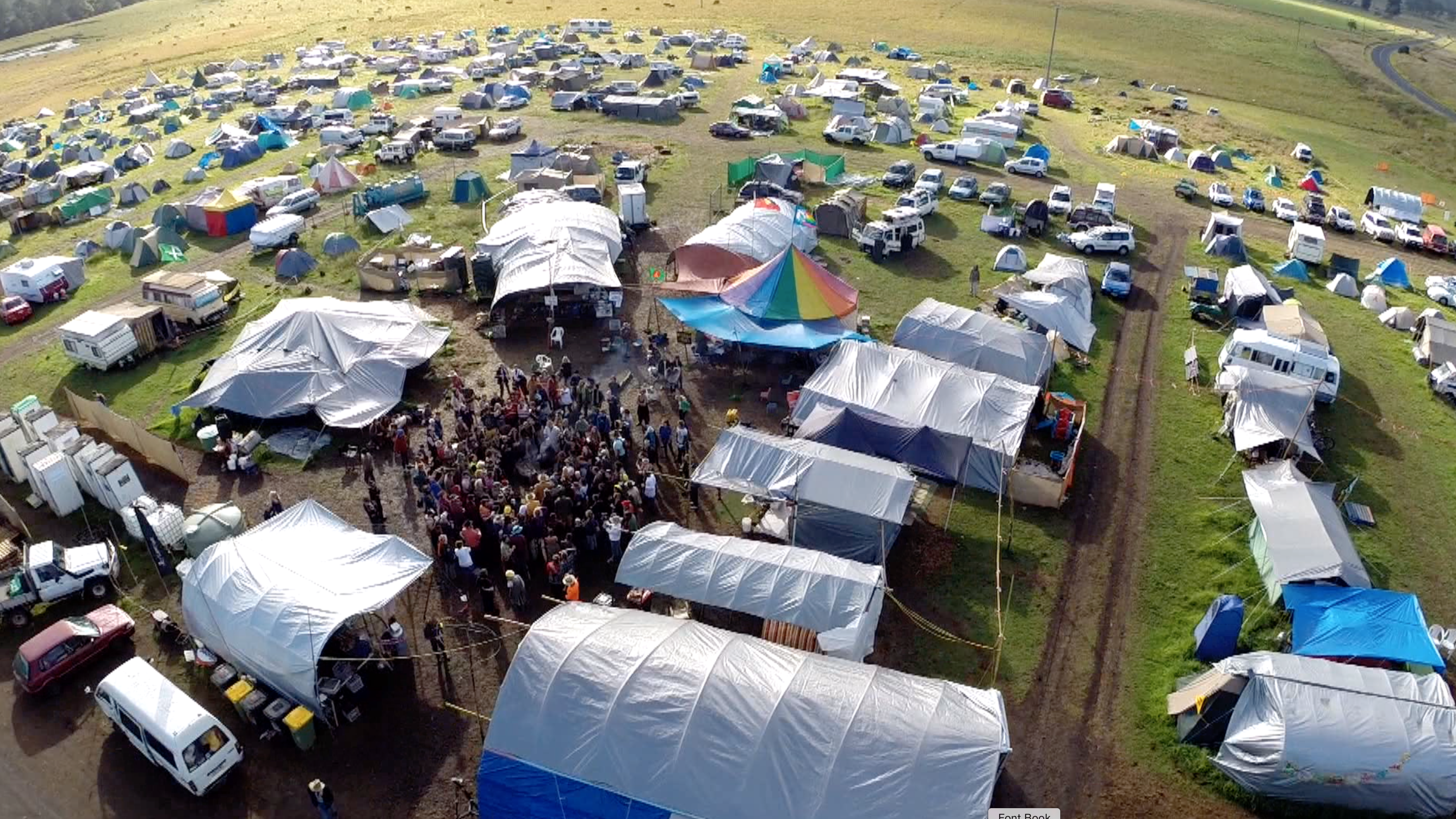 The Bentley Blockade … “We don’t want to live in a gas field”. Image: Brendan Shoebridge
“The documentary chronicles my community’s response to the threat of unconventional gas mining and the industrialisation it brings.
“Although gas mining is the vehicle, it’s more about what community can do when it comes together.
“In this case, the community drew a line in the sand, came together en masse and said ‘No we don’t want to live in a gas field’.
Power of community
“It’s an inspiring celebration of the power of community,” says director Brendan Shoebridge.
Shoebridge has been in New Zealand since late September screening his documentary across the country.
He spoke to Asia Pacific Report ahead of the documentary’s last screening in Auckland at an event organised by Greenpeace, 350 Aotearoa and Fossil Free UoA.
Shoebridge said he hoped the spirit behind The Bentley Effect inspired a similar stand in New Zealand.
“New Zealand’s unique and precious beauty holds a special place in everyone’s hearts and I’m hoping the film will inspire local audiences to keep it safe and pure,” he said.
Asked why this was the case, Shoebridge told Asia Pacific Report it was due to “massive threats” to the country and its “brand”.
These threats included prospecting by New Zealand Oil and Gas in a massive gas field more than 60km off the coast of Oamaru and proposed oil and gas exploration off the coasts of Canterbury and Taranaki in the habitats of endangered Hector’s dolphins and blue whales.
Risk versus profit
“Really the last thing we need is more methane and another fossil fuel industry.
“Locals here have to ask the question ‘Who is going to bear the risk and who is going to take the profit?’ These are the questions we all have to start asking,” he said.
However, Shoebridge said New Zealand’s response to the documentary had been “fantastic” and it seemed to resonate with Kiwi audiences.
“New Zealand has a rich, proud heritage of protest.
“There is so many examples of successful non-violent civil disobedience.
“I think the story really does resonate quite powerfully here” he said.
Shoebridge said The Bentley Effect built on the threat posed by natural gas exploration in Josh Fox’s 2010 documentary Gasland.
Bentley Effect ‘solution’
The Bentley Effect not only showed the problem of exploration, it showed what the world could do about it, he explained.
“What viewers will see is a social movement from start to finish.
“It’s on a smaller, localised scale but what was achieved was a fully-fledged social movement, a broad-based social movement which involved everybody, all walks of life.
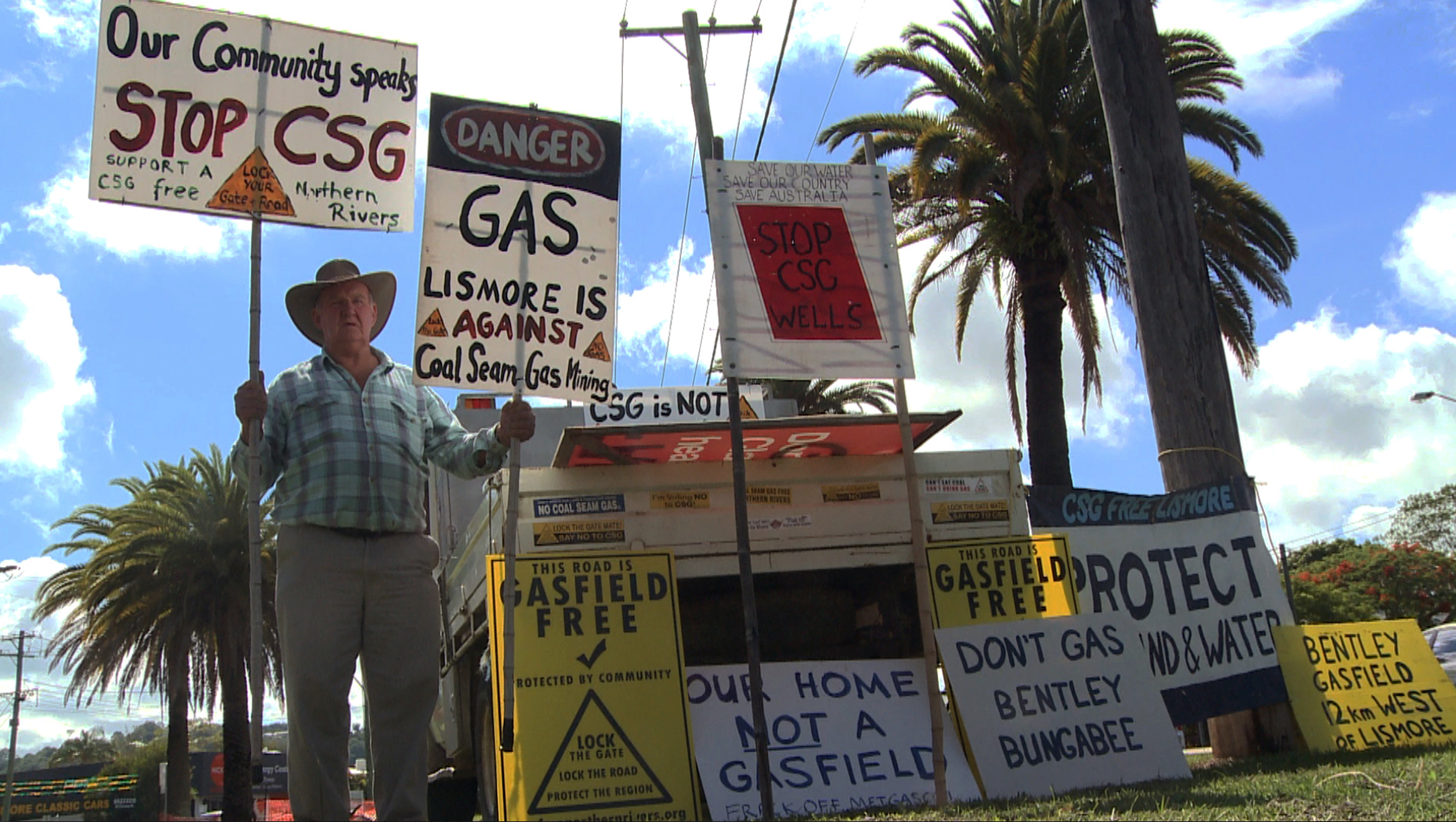 Protester Robert Morton … “Don’t gas Bentley Bungabee”. Image: Brendan Shoebridge
“Audiences can see for themselves how people mobilise. How ordinary, everyday people took a lead and made massive contributions in their own way.
“That was a key aim in showcasing what happened in Bentley – communities aren’t powerless, they can push back on these things.”
Shoebridge said at the time of the blockade, 50 wells had already been drilled.
However, due to the broad-based social movement’s opposition, Shoebridge said, the State Government was not prepared to pay the political price, despite earlier being “hell-bent” on pushing its gas plan through.
Exploration licences suspended
In May 2014 the State Government suspended Metgasco’s gas exploration licence and in October 2015 it bought back petroleum exploration licences covering more than 500,000 hectares across the Northern Rivers region.
“To get that overturned and those wells decommissioned and the licences removed was a real achievement,” Shoebridge said.
Shoebridge said Bentley’s stand against big business and its own government had set an “amazing” precedent in the war against natural gas.
“I think a lot of communities around the world will draw strength from what was achieved” he said.
Bentley’s story was also “universal”, Shoebridge said, as similar battles were happening across the globe.
“These battles are happening everywhere and they’re playing out on all sorts of different fronts, but it’s essentially the same battle.
“When people come and see the film, I think they are drawing a lot of strength and probably seeing that the same strategies can be superimposed onto any of our battles, whether it’s the fight for clean water against big dairy, 1080, fluoridation, or logging.”
Youth involvement key
Shoebridge said a “big chunk” of the solution in battling such environmental and social injustice issues was people taking a lead with their skill set in their landscape.
“I think if everyone did that we’d smash our problems pretty quickly.”
Youth have a particular role in “smashing” problems in a world where political will on “climate chaos” was lacking, Shoebridge added.
“From our experience politicians don’t respond to education they only respond to pressure.
“That’s where the youth can come in. They can talk from the heart and talk about what it feels like to have your future robbed from you.
“Naturally the youth are going to feel varying degrees of despair and powerlessness, but we can’t afford to give up hope and we mustn’t.
“Anything that tops up their tanks and inspires meaningful action is a good thing,” Shoebridge said.
Although his work is largely about hope, Shoebridge warned the world needed to come together in order to face the “tough times” ahead.
“I know we all have to start thinking in terms of a global village rather than national borders because we’re all in this together and we’re all going to pay the same price if we don’t meet those challenges.”
The Bentley Effect screens tomorrow 4pm to 7pm at LibB28 at the University of Auckland and includes a Q+A with Shoebridge and key members of the documentary.
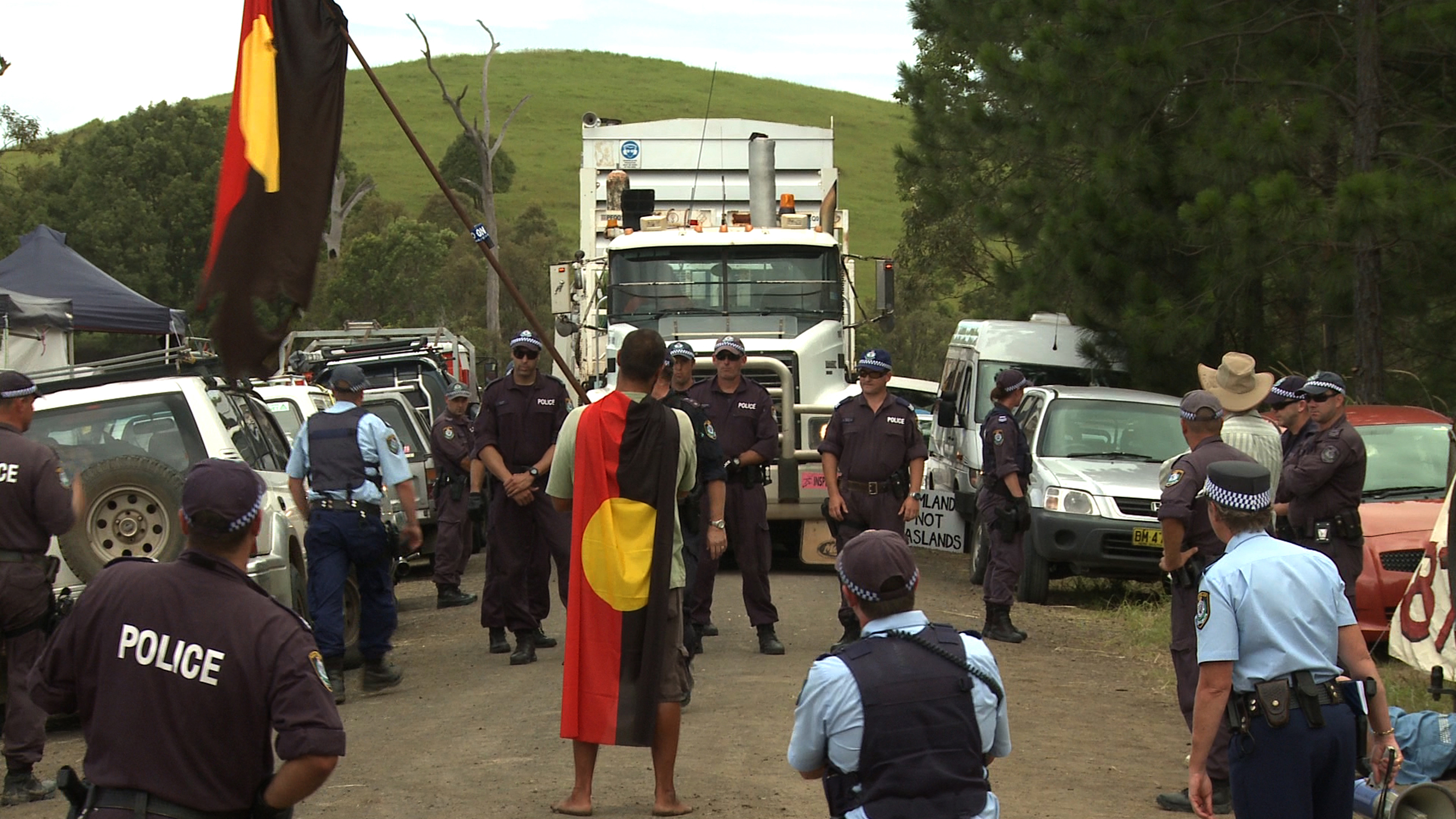 Protester Jarmbi of the Githabul … “community drew a line” before police. Image: Brendan Shoebridge
Article by AsiaPacificReport.nz
]]>‘Healers, not harmers’ – Climate Warriors present COP23 declaration

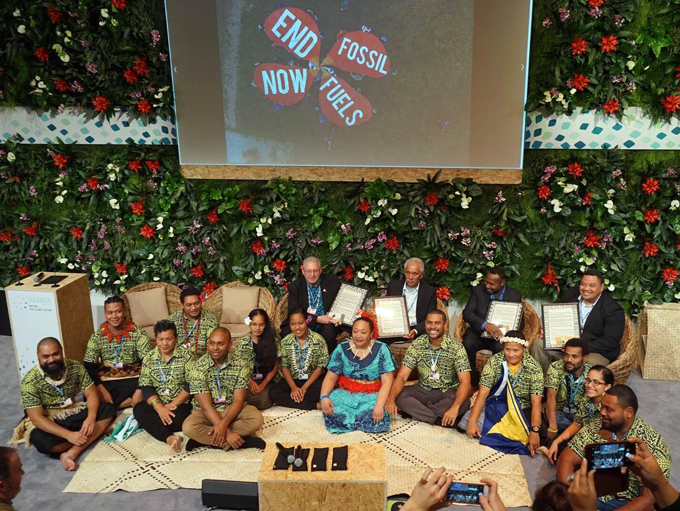 “We all stand together as one family” … Pacific Climate Warriors Declaration on Climate Change presented at COP23. Image: 350 Pacific
Climate activists from across the Pacific region have presented a declaration on climate change to key Pacific environmental leaders at COP23.
The Pacific Climate Warriors Declaration on Climate Change, part of 350’s Have Your Sei campaign, was signed by more than 23,000 people and called on world leaders to take effective action on climate change by placing the voice of the people above that of the fossil fuel industry.
350 Pacific’s Pacific Climate Warriors made the bold call in September to ensure the region’s leadership on climate change was recognised and the Pacific’s voice heard.
Similar calls were made at the talanoa gathering place in the Bonn Zone.
The Samoa Planet reports the group’s Tokelauan representative challenged the rest of the world to follow the nation’s example of the first to be powered by 100 percent renewable energy, a transition which is called for in the declaration.
“We all stand together as one family,” they said, and continued with a call to “Kick the big polluters out of climate talks,” Lani Wendt Young reports.
The call echoed a plea made by the Pacific Climate Warriors on the eve of COP23 to end the era of fossil fuels.
‘Healers, not harmers’
The declaration was printed on tapa cloth, with framed copies presented to key Pacific environment leaders, including Francois Martel, the Secretary-General of the Pacific Islands Development Forum and the former President of Kiribati and global advocate and climate warrior, Anote Tong on Wednesday.
The presentation opened with a lotu and blessing offered by climate warrior, Reverend James, who prayed for an increased spiritual awareness of the earth and ocean.
“May we be healers, not harmers.”
Pacific leadership on climate change and its recognition called for by the Pacific Climate Warriors, has been symbolized in the Bonn Zone’s talanoa space and the renaming of the facilitative dialogue process to “talanoa dialogue”.
The Fiji Times reports the “talanoa spirit” which characterises Fiji’s presidency of COP23 has extended into open dialogue between the COP parties and non-state actors.
“This is the first open dialogue between parties and non-parties in the history of the COP process. It’s not a side event. It has been mandated by the parties and is designed to bring state actors and non-state actors together in the Bula Zone.
“I’m delighted as COP23 president that we have been able to connect in this manner. Because it goes to the heart of the grand coalition concept that Fiji has been promoting all year.
Adopting talanoa spirit
“We will not be negotiating. We will be talking to each other. And we will be listening. This is the perfect setting for adopting the talanoa spirit that is so much a part of what Fiji brings to the presidency.
“Together, we should learn how to engage all levels of government, civil society, the private sector and billions of ordinary citizens in the formation of the national plans for climate action,” Fiji’s Prime Minister Voreqe Bainimarama said.
Bainimarama also called for frank and open discussions around what was and was not working in the fight against climate change, FBC reports.
“We must also be honest about what is not working. Because the Talanoa Spirit isn’t just about being nice to everyone, although respect is essential.
“It is about contributing to a solution that requires a degree of straight talking. And whoever you represent today, I encourage you to embrace that spirit, honest, constructive dialogue for the common good,” he said.
COP23 continues until November 17.
Article by AsiaPacificReport.nz
]]>Critical Politics Newsletter: New Zealand Politics Daily – 10 November 2017
Critical Politics Newsletter: New Zealand Politics Daily – 10 November 2017 – Today’s content
Editor’s Note: Here below is a list of the main issues currently under discussion in New Zealand and links to media coverage. [caption id="attachment_297" align="aligncenter" width="1600"] The Beehive and Parliament Buildings.[/caption]
Below are the links to the items online. The full text of these items are contained in the PDF file (click to download).
Trade
Vernon Small (Stuff): TPP ‘agreed in principle’ as Prime Minister Jacinda Ardern arrives in Vietnam
Audrey Young (Herald): We have a deal? TPP ‘agreed’ as Jacinda Ardern lands for Apec
Sam Sachdeva (Newsroom): Jacinda Ardern: TPP talks ‘down to the wire’
Corin Dann (1News): Winston Peters hits the world stage in group photo with APEC Foreign and Trade ministers in Vietnam
Gordon Campbell (Werewolf):On Ardern’s trade battles at APEC
Audrey Young (Herald): Jacinda Ardern’s top priority at Apec will be survival of TPP
Audrey Young (Herald): Make-or-break time for TPP deal
Vernon Small (Stuff): PM Jacinda Ardern is putting even odds on the Trans-Pacific Partnership getting the tick
Patrick O’Meara (RNZ): 50-50 chance of TPP deal – Ardern
1News: Jacinda Ardern heads to APEC summit for first big test on international stage
Gerald McGhie (Stuff): How our diplomats can come up trumps
Parliament
John Armstrong (1News): Opinion: Ardern needed Peters at her side when National went for the jugular
Chris Trotter (Bowalley Road): Chris Hipkins’ Mistake.
Press Editorial: the prime minister’s positive way forward
Toby Manhire (Herald): The minister whose homework was eaten by a dog
Jo Moir (Stuff): Question Time: Confusion, chaos and comedy as MPs face-off for first time
Claire Trevett (Herald): Speaker Trevor Mallard’s left ear the hero of the Opposition
Jane Clifton (Stuff): More mirth than menace at Parliament’s first Question Time
Jane Patterson (RNZ): Parliament gets off to stumbling start
Jane Patterson (RNZ): Jesus, Queen dropped from Parliament prayer
No Right Turn: Progress
David Farrar (Kiwiblog): Good innovations from Speaker Mallard
1News: ‘They’ll be held hostage by lobbyists and laziness’ – Bill English’s scathing first speech as Leader of the Opposition
Watch: Labour’s Kiri Allan lays down some slick spoken word poetry and praises Jacinda Ardern in maiden speech to Parliament
Denis Welch (Opposable thumb):Real thing
Laura Walters (Stuff): Breastfeeding babies in the debating chamber becoming normalized
Holly Walker (Spinoff): I left parliament because I couldn’t be an MP and a mother. This week has given me hope
Government
Stacey Kirk (Stuff): Row erupting over level of expert scrutiny on early Government decisions
Mike Hosking (Herald): This government is specialising in window-dressing, not reform
Lindy Laird (Northern Advocate): Acting PM Kelvin Davis expects a bit of stick from Tai Tokerau cousins
Washington Post article on govt
1News: Watch: Winston Peters launches scathing attack on article that called NZ First a far-right party poisoning New Zealand
Duncan Greive (Spinoff): The shocking truth: Washington Post reveals the ‘far right agenda’ of the new Labour-led government
Michael Reddell (Croaking Cassandra): The Washington Post falls for Ben Mack
Martyn Bradbury (Daily Blog): What Duncan Greive misses and why Ben Mack is National’s best chance of winning 2020
Pete George (Your NZ): Out of whack Mack on the ‘far right’
Winston Peters legal action
1News: Video: Deputy PM Winston Peters stonewalls journalists when grilled over pension leak legal action
Mai Chen (Stuff): No quick resolution in Winston Peters superannuation leak case
Dan Satherley (Newshub): Winston Peters ‘not genuine’ in coalition talks – Judith Collins
Benedict Collins (RNZ): Peters’ attempts to obtain journalists’ phone records over leak ‘wrong’
Listener: We deserve better than Winston Peters’ legal stunt
TOP
RNZ: TOP party candidate told to resign
Dan Satherley (Newshub): Gareth Morgan fires ‘pain in the arse’ candidate
Stuff: ‘You’re a pain in the arse – ka kite ano, Gareth’
Laura Walters (Stuff): Gareth Morgan calls TOP candidate ‘pain in the a…’, tells her to resign
National
Tom Sainsbury (Spinoff): Kiwis of Snapchat: Simon Bridges, opposition MP
Matthew Hooton (Metro): Auckland’s National voters were largely immune to Jacindamania
Chris Bishop (Spinoff): Prouder, wealthier, more confident: 10 of the National government’s big achievements
Herald: Paula Bennett impersonator returns with grim ‘confession’ about Ardern’s cat Paddles
Mitch Harris (Radio Live): National Grief Cycle
Environment
RNZ: Govt to block new mining on conservation land
Herald: Minister says no more mines on conservation land
Eric Frykberg (RNZ): Mining industry caught off guard by ban
No Right Turn: Orcs not welcome
David Williams (Newsroom): NZ getting close to ‘peak cow’ says Minister
Herald: New Zealand wants to take lead on climate change, minister to tell conference
RNZ: Winter is 30 days shorter, Niwa research finds
Alexia Russell (Newstalk ZB): Peters picking a fight with Japan over whaling
No Right Turn: Are there too many farmers?
Refugees
Herald: Leading Aussies plea with PM Jacinda Ardern to save Manus refugees
RNZ: Manus Island refugees given two days to move
Herald: Amnesty pleads for medical care for about 90 sick Manus Island refugees
Donna Miles Mojab (Herald): Refugees have no need to be grateful
Employment
Gerard Hutching (Stuff): Landcorp to pay 1400 workers $2.4m following seven-year pay slip up
RNZ: Working group formed for ‘Hobbit law’ replacement
Simon Smith (Stuff): Minister Iain Lees-Galloway says replacing Hobbit law will be ‘a joint solution’
1News: Government reaffirms commitment to scrap ‘Hobbit Law’ which saw an end to collective negotiations for film industry workers
Reserve Bank and economy
Brian Fallow (Herald) : Why the long faces about the economy?
Hamish Rutherford (Stuff): New Government spending will boost NZ economy, says Reserve Bank
Richard Harman (Politik): Reserve Bank doubts Labour’s Kiwibuild plans
Bernard Hickey (Newsroom): RBNZ wary of Robertson’s jobless target
Education
John Gerritsen (RNZ): Teachers, principals worried about restraint rules
John Gerritsen (RNZ): Teacher censured for carrying struggling child
Justin Stevenson (Stuff): Here’s why removing tertiary fees will make inequality worse
John Boynton (RNZ): Māori academics gather to present research
Justice and police
Herald Editorial:Pora case strengthens argument for criminal cases review commission
RNZ: Police unveil online alert system for missing children
Housing
RNZ: Hope turns to frustration as homeless men wait for housing
Robin Martin (RNZ): Builders worried best timber sent overseas
John Boynton (RNZ): Tūhoe prepare housing plan for tribe’s future
Health
Katie Kenny and Laura Walters (Stuff): Mental health inquiry in ‘preliminary stages’, minister says
Aaron Leaman and Florence Kerr (Stuff): Waikato DHB won’t release Nigel Murray email
Don Rennie (Werewolf): Is It Time To Take ACC Back To First Principles?
Media
Tom Pullar-Strecker (Stuff): RNZ television no direct competition to commercial stations, minister says
Phil Pennington (RNZ): New Zealand’s television history archive under threat
Tess Nichol (Herald): ASA rules Facebook ad implying Ardern would end child poverty with abortion misleading
Helen Clark
Laura Walters (Stuff): Helen Clark takes job at Global Commission on Drug Policy
Herald: Helen Clark appointed to Global Commission on Drug Policy
RNZ: Clark joins global drug commission
Other
Susan St John (Newsroom): A good start on tackling child poverty
Joel Ineson (Stuff): Renewed calls for Royal Commission into abuse of people in state care
Herald: Minister of Forests Shane Jones targets timber ‘shysters’
Andre Chumko (Stuff): Napier City councillors vote against establishing Māori wards
Derek Cheng (Herald): Defence Minister Ron Mark requests briefing on Hit & Run issues
Laura Dooney (RNZ): Shutter buildings that miss quake deadline – investor
Te Aniwa Hurihanganui (RNZ): ‘We are never going to let the memories of our unique tribe fade’
Deborah Coddington (Spinoff): Book of the Week: The wild life and times of ex-junkie, ex-Green MP, constant hero Sue Bradford
RNZ: Sport: ‘Samoa rugby will die’ warns Leo]]>
Bryce Edwards’ Political Roundup: Winston Peters’ fight against “filthy” politics

Bryce Edwards’ Political Roundup: Winston Peters’ fight against “filthy” politics
[caption id="attachment_13635" align="alignright" width="150"] Dr Bryce Edwards.[/caption]
No one should have been surprised by Winston Peters taking legal action this week over what he calls “filthy politics”. After all, he signaled before the election that he was determined to use the law to get justice. And although most of the media reaction has been very negative, it really is understandable that he is still seeking answers.
[caption id="attachment_15332" align="aligncenter" width="800"] Deputy Prime Minister Winston Peters (left), the Governor General of New Zealand Dame Patsy Reddy (centre), with Prime Minister Jacinda Ardern – image taken at the swearing in of the new Labour-led Government, October 26, 2017.[/caption]
The new deputy prime minister is taking the action against nine individuals, including former National prime minister Bill English, the head of the Ministry of Social Development, and Newshub political reporter Lloyd Burr. It’s all because he believes that the personal information about his superannuation overpayment was deliberately made public at the height of the election campaign. For more details of the legal action, see Nicholas Jones’ Winston Peters’ legal action a ‘personal matter’, Ardern says.
Newsroom co-editor Tim Murphy was also served legal papers by Peters’ lawyers, and he details the court action in Winston goes fishing. Murphy explains that Peters is seeking a judgement related to a “breach of privacy”, and is requesting those served provide all sorts of records of communications relating to the Peters superannuation scandal in order to discover who is responsible for the breach of his privacy.
The best discussion and examination of the law around this case is by Mai Chen, in her article published today, No quick resolution in Winston Peters superannuation leak case. She explains how the court process is supposed to work, and concludes: “The likelihood is that it will take several months for the court to determine the matter – longer if there are appeals. If the court grants Peters’ applications, and he finds what he is looking for, then the substantive claim for breach of privacy will then be determined against the alleged leakers.”
Much of the case revolves around the fact that Peters’ superannuation information was provided to Government ministers by the Ministry of Social Development under the so-called “no surprises” policy, in which officials make politicians aware of anything that might affect their job. And it is the decision by the Ministry’s boss, Brendon Boyle, to inform ministers that Peters is also challenging.
Tracy Watkins reports what Peters’ affidavit has to say on this: “The briefing, while required by the National Party government, has to the best of my knowledge no basis in law. The no surprises policy is considered by myself and counsel to be both a breach of the Privacy Act requirements and the duty of care to protect my client’s private information held by the MSD” – see: Winston Peters looks to sue over pension leak.
No surprises in Peters’ fight
Although the legal action has been portrayed as a surprise, Peters was very clear during the election campaign that he intended to pursue the issue after the election. For example, Claire Trevett reported at the time: “Peters said he would speak to his lawyer about his options and was determined to get to the bottom of the matter so people could have confidence when dealing with Government departments” – see: Winston Peters calls in the lawyers, claiming character assassination attempt.
The same article reported “Labour leader Jacinda Ardern said there was a need to get to the bottom of it to ensure people’s privacy was protected by Government departments” and said the episode fed the “perception that dirty politics was rife”. And Peters was inclined to use even more colourful language to describe what had happened, claiming that he was the victim of “filthy politics”, and that “it’s deceitful, it’s duplicitous, it’s all the worst elements of dirty politics.”
Peters supported by left and right bloggers
If Peters is correct and there was an orchestrated attempt to turn voters against him by using state-provided information to the media, then surely Peters is to be encouraged in his bid to find justice. However, it’s hard to find much published support for his endeavour. The exception is Lynn Prentice, writing at The Standard, who says Suck it up political sleazers.
Prentice argues that the leak of Peters’ private information was “clearly politically motivated”, and the whole operation was “a classic Dirty Politics ploy”. Therefore Peters’ legal fight is to be supported: “Frankly win or lose, it is just another round in the continuing battle to reduce the garbage in local politics that National and Act seem to like adorning themselves in. It should also be a round in making public servants accountable for who they choose to share private information with, and that includes with their current political masters. I wish Winston Peters and his legal team the best of luck with cleaning this kind of trash out of our local politics. I’m sure that there will be a lot of other people cheering him on in his search for personal responsibility and liability over politically motivated privacy breaches.”
From the opposite side of the political tracks, blogger Cameron Slater is also in solidarity with Peters against this “dirty politics”. He has written comprehensively about the case on his Whaleoil blog – see: Winston starts dropping lawsuits on media and Nats.
Slater points the finger at National’s current leadership: “This also shows that the deliberate leaked attack against Winston Peters, those involved, and the subsequent actions show where the election was lost. No doubt the discovery process will find that it was in fact a deliberate strategy of National, and one which ultimately backfired. It was a poorly executed and ultimately short-sighted smear job on Winston Peters by the so-called ‘brains trust’ of National’s campaign team. It also shows that the real dirty politics players inside National, who have never appeared in any of Nicky Hager’s books, are in fact those aligned with Bill English.”
Bad blood with National
The launch of legal action is a sign that Winston Peters is in revenge mode, according to Patrick Gower: “Winston Peters search for ‘utu’ is now clearer than ever before. Not only has he dispatched National into Opposition – now he has targeted them with legal action over leaking his pension details. It will now be obvious to most New Zealanders that there was way too much bad blood between National and Winston Peters for them to form a Government together” – see: Winston Peters deepens ‘utu’ with legal action over pension leak.
Of course Lloyd Burr reported at the time of the superannuation scandal: “Winston Peters is on the warpath over who leaked details of his pension over-payments. The New Zealand First leader says he’s the victim of a privacy breach, claiming it’s dirty politics orchestrated by the National government – and he’ll ‘lodge a serious action’ when his lawyer returns from an overseas holiday today” – see: Winston Peters accuses National of ‘filth and dirt’.
Despite the fact that Peters had clearly signaled his intentions to pursue legal action, some political journalists are now suggesting that this week’s legal move is an indication that New Zealand First never would have chosen to go into coalition government with the National Party.
Here’s what Newstalk’s Barry Soper says: “It was just over a week later that the same three Nats filed into the coalition casino with the gambler Peters, who unknown to them, or anybody else for that matter, had already laid his cards on the table. The dealing had been done. Like all good gamblers, Peters kept a stony face, letting them believe they were still in the game whereas in reality they’d been dealt out when the court papers were filed against them. The notion that he could now be sitting at the same Cabinet table with them is beyond comprehension. But they were playing blind, so for that matter was Labour. If they’d known of the court papers they might not have been so generous. But Peters played on, playing one side off against the other until he struck the jackpot with Jacinda” – see: Pension papers is why Wily Winston Peters went with Labour.
The New Zealand Herald has published an editorial today, along similar lines, saying “the main reason this lawsuit is unwise is it discredits his post-election negotiations and inevitably reflects on the Government he has chosen. It is now obvious there was extremely little possibility he could work with Bill English, Paula Bennett, Steven Joyce and Anne Tolley since he had initiated legal action against them the day before the election. Why he put them and the public through three weeks of uncertainty only Peters knows. It is hard to avoid the conclusion it was to increase his leverage on Labour” – see: Peters’ suing of ex-ministers discredits negotiations.
The latest Listener magazine is also extremely critical of Peters’ legal action, saying “for him to proceed with this action now does far more to lower his reputation than the pension controversy” – see: We deserve better than Winston Peters’ legal stunt.
The main point of the editorial is to say: “legal action confirms he harboured a material distrust of National. How can we not believe he simply used those talks for bargaining leverage, with no intention of doing a deal with National?”. The Listener thinks the action is somewhat bullying: “It’s also appalling that he has included a senior public servant and two former political staffers in his discovery claims, knowing, as he must, how hard it is for such employees to defend themselves in a politically charged situation. And it’s an ogreish and futile act for any politician, as Peters as done, to demand that journalists disclose sources.”
Media freedoms under threat?
The Herald editorial above provides a further argument against Peters taking legal action over the scandal: “It is disturbing that Peters seeks to have journalists reveal their sources through court discovery procedures. He evidently wants the court to order them to hand over phone records, notes and emails relating to his superannuation overpayment. His attitude to news media going about their job leaves a lot to be desired and may come to pose a threat to press freedom if he now uses his position to try to put his antagonism into law.”
This is another aspect of the case that Mai Chen discusses in her article, suggesting that the journalists involved might attempt to “claim privilege under section 68 of the Evidence Act 2006, which allows them to withhold information that might disclose the identity of an informant”.
Additionally, she says they “may try to argue that there should be no discovery because Peters’ substantive claim will fail, either because disclosing the information about his superannuation was not highly offensive to start with, or because the disclosure was in the public interest having regard to Peters’ position as leader of the NZ First Party.”
Finally, Toby Manhire has also expressed his concern about media freedoms – see his article on The Spinoff: The brand new Deputy PM just served papers on the media and that is not good at all. After expressing disappointment in the deputy prime minister starting his new job in this way, he reminds him of the other lawsuit he has promised against a broadcaster: “And if he’s determined to continue waging war on the media, hasn’t he got enough on his plate already, what with that lawsuit he promised he’d filed against Mark Richardson, for comparing him to pus?”]]>
Deputy Prime Minister Winston Peters (left), the Governor General of New Zealand Dame Patsy Reddy (centre), with Prime Minister Jacinda Ardern – image taken at the swearing in of the new Labour-led Government, October 26, 2017.[/caption]
The new deputy prime minister is taking the action against nine individuals, including former National prime minister Bill English, the head of the Ministry of Social Development, and Newshub political reporter Lloyd Burr. It’s all because he believes that the personal information about his superannuation overpayment was deliberately made public at the height of the election campaign. For more details of the legal action, see Nicholas Jones’ Winston Peters’ legal action a ‘personal matter’, Ardern says.
Newsroom co-editor Tim Murphy was also served legal papers by Peters’ lawyers, and he details the court action in Winston goes fishing. Murphy explains that Peters is seeking a judgement related to a “breach of privacy”, and is requesting those served provide all sorts of records of communications relating to the Peters superannuation scandal in order to discover who is responsible for the breach of his privacy.
The best discussion and examination of the law around this case is by Mai Chen, in her article published today, No quick resolution in Winston Peters superannuation leak case. She explains how the court process is supposed to work, and concludes: “The likelihood is that it will take several months for the court to determine the matter – longer if there are appeals. If the court grants Peters’ applications, and he finds what he is looking for, then the substantive claim for breach of privacy will then be determined against the alleged leakers.”
Much of the case revolves around the fact that Peters’ superannuation information was provided to Government ministers by the Ministry of Social Development under the so-called “no surprises” policy, in which officials make politicians aware of anything that might affect their job. And it is the decision by the Ministry’s boss, Brendon Boyle, to inform ministers that Peters is also challenging.
Tracy Watkins reports what Peters’ affidavit has to say on this: “The briefing, while required by the National Party government, has to the best of my knowledge no basis in law. The no surprises policy is considered by myself and counsel to be both a breach of the Privacy Act requirements and the duty of care to protect my client’s private information held by the MSD” – see: Winston Peters looks to sue over pension leak.
No surprises in Peters’ fight
Although the legal action has been portrayed as a surprise, Peters was very clear during the election campaign that he intended to pursue the issue after the election. For example, Claire Trevett reported at the time: “Peters said he would speak to his lawyer about his options and was determined to get to the bottom of the matter so people could have confidence when dealing with Government departments” – see: Winston Peters calls in the lawyers, claiming character assassination attempt.
The same article reported “Labour leader Jacinda Ardern said there was a need to get to the bottom of it to ensure people’s privacy was protected by Government departments” and said the episode fed the “perception that dirty politics was rife”. And Peters was inclined to use even more colourful language to describe what had happened, claiming that he was the victim of “filthy politics”, and that “it’s deceitful, it’s duplicitous, it’s all the worst elements of dirty politics.”
Peters supported by left and right bloggers
If Peters is correct and there was an orchestrated attempt to turn voters against him by using state-provided information to the media, then surely Peters is to be encouraged in his bid to find justice. However, it’s hard to find much published support for his endeavour. The exception is Lynn Prentice, writing at The Standard, who says Suck it up political sleazers.
Prentice argues that the leak of Peters’ private information was “clearly politically motivated”, and the whole operation was “a classic Dirty Politics ploy”. Therefore Peters’ legal fight is to be supported: “Frankly win or lose, it is just another round in the continuing battle to reduce the garbage in local politics that National and Act seem to like adorning themselves in. It should also be a round in making public servants accountable for who they choose to share private information with, and that includes with their current political masters. I wish Winston Peters and his legal team the best of luck with cleaning this kind of trash out of our local politics. I’m sure that there will be a lot of other people cheering him on in his search for personal responsibility and liability over politically motivated privacy breaches.”
From the opposite side of the political tracks, blogger Cameron Slater is also in solidarity with Peters against this “dirty politics”. He has written comprehensively about the case on his Whaleoil blog – see: Winston starts dropping lawsuits on media and Nats.
Slater points the finger at National’s current leadership: “This also shows that the deliberate leaked attack against Winston Peters, those involved, and the subsequent actions show where the election was lost. No doubt the discovery process will find that it was in fact a deliberate strategy of National, and one which ultimately backfired. It was a poorly executed and ultimately short-sighted smear job on Winston Peters by the so-called ‘brains trust’ of National’s campaign team. It also shows that the real dirty politics players inside National, who have never appeared in any of Nicky Hager’s books, are in fact those aligned with Bill English.”
Bad blood with National
The launch of legal action is a sign that Winston Peters is in revenge mode, according to Patrick Gower: “Winston Peters search for ‘utu’ is now clearer than ever before. Not only has he dispatched National into Opposition – now he has targeted them with legal action over leaking his pension details. It will now be obvious to most New Zealanders that there was way too much bad blood between National and Winston Peters for them to form a Government together” – see: Winston Peters deepens ‘utu’ with legal action over pension leak.
Of course Lloyd Burr reported at the time of the superannuation scandal: “Winston Peters is on the warpath over who leaked details of his pension over-payments. The New Zealand First leader says he’s the victim of a privacy breach, claiming it’s dirty politics orchestrated by the National government – and he’ll ‘lodge a serious action’ when his lawyer returns from an overseas holiday today” – see: Winston Peters accuses National of ‘filth and dirt’.
Despite the fact that Peters had clearly signaled his intentions to pursue legal action, some political journalists are now suggesting that this week’s legal move is an indication that New Zealand First never would have chosen to go into coalition government with the National Party.
Here’s what Newstalk’s Barry Soper says: “It was just over a week later that the same three Nats filed into the coalition casino with the gambler Peters, who unknown to them, or anybody else for that matter, had already laid his cards on the table. The dealing had been done. Like all good gamblers, Peters kept a stony face, letting them believe they were still in the game whereas in reality they’d been dealt out when the court papers were filed against them. The notion that he could now be sitting at the same Cabinet table with them is beyond comprehension. But they were playing blind, so for that matter was Labour. If they’d known of the court papers they might not have been so generous. But Peters played on, playing one side off against the other until he struck the jackpot with Jacinda” – see: Pension papers is why Wily Winston Peters went with Labour.
The New Zealand Herald has published an editorial today, along similar lines, saying “the main reason this lawsuit is unwise is it discredits his post-election negotiations and inevitably reflects on the Government he has chosen. It is now obvious there was extremely little possibility he could work with Bill English, Paula Bennett, Steven Joyce and Anne Tolley since he had initiated legal action against them the day before the election. Why he put them and the public through three weeks of uncertainty only Peters knows. It is hard to avoid the conclusion it was to increase his leverage on Labour” – see: Peters’ suing of ex-ministers discredits negotiations.
The latest Listener magazine is also extremely critical of Peters’ legal action, saying “for him to proceed with this action now does far more to lower his reputation than the pension controversy” – see: We deserve better than Winston Peters’ legal stunt.
The main point of the editorial is to say: “legal action confirms he harboured a material distrust of National. How can we not believe he simply used those talks for bargaining leverage, with no intention of doing a deal with National?”. The Listener thinks the action is somewhat bullying: “It’s also appalling that he has included a senior public servant and two former political staffers in his discovery claims, knowing, as he must, how hard it is for such employees to defend themselves in a politically charged situation. And it’s an ogreish and futile act for any politician, as Peters as done, to demand that journalists disclose sources.”
Media freedoms under threat?
The Herald editorial above provides a further argument against Peters taking legal action over the scandal: “It is disturbing that Peters seeks to have journalists reveal their sources through court discovery procedures. He evidently wants the court to order them to hand over phone records, notes and emails relating to his superannuation overpayment. His attitude to news media going about their job leaves a lot to be desired and may come to pose a threat to press freedom if he now uses his position to try to put his antagonism into law.”
This is another aspect of the case that Mai Chen discusses in her article, suggesting that the journalists involved might attempt to “claim privilege under section 68 of the Evidence Act 2006, which allows them to withhold information that might disclose the identity of an informant”.
Additionally, she says they “may try to argue that there should be no discovery because Peters’ substantive claim will fail, either because disclosing the information about his superannuation was not highly offensive to start with, or because the disclosure was in the public interest having regard to Peters’ position as leader of the NZ First Party.”
Finally, Toby Manhire has also expressed his concern about media freedoms – see his article on The Spinoff: The brand new Deputy PM just served papers on the media and that is not good at all. After expressing disappointment in the deputy prime minister starting his new job in this way, he reminds him of the other lawsuit he has promised against a broadcaster: “And if he’s determined to continue waging war on the media, hasn’t he got enough on his plate already, what with that lawsuit he promised he’d filed against Mark Richardson, for comparing him to pus?”]]>
Critical Politics Newsletter: New Zealand Politics Daily – 9 November 2017
Critical Politics Newsletter: New Zealand Politics Daily – 9 November 2017 – Today’s content
Editor’s Note: Here below is a list of the main issues currently under discussion in New Zealand and links to media coverage. [caption id="attachment_297" align="aligncenter" width="1600"] The Beehive and Parliament Buildings.[/caption]
Today’s content
Below are the links to the items online. The full text of these items are contained in the PDF file (click to download).
Parliament
Dominion Post Editorial: National wins a battle but winning the war is different
ODT Editorial: High expectations for new Parliament
Finlay Macdonald (RNZ): Political football: Labour and National tied at 2-all
Chris Trotter (Daily Blog): Settling The Stardust: The Grim Logic Behind National’s Opposition Tactics
Liam Hehir (Medium): How the Chris Hipkins thing shows that politics isn’t fun anymore
Tim Watkin (Pundit): In defence of discord
Fiona Kennedy (Newsroom): Why coalition friction could be a good thing
Laura Walters (Stuff): Why did Labour give National the tools it wanted to frustrate legislative progress?
Talisa Kupenga (Māori TV): National’s tactics a “wake-up call” for PM – Shane Jones
Claire Trevett (Herald): National puts Speaker’s Trev-O-Meter to the test
RNZ: Fractious exchanges over Assistant Speaker election
Herald: Anne Tolley elected deputy Speaker as Nats test Mallard’s patience
David Farrar (Kiwiblog): The Speakers
Chris Bramwell (RNZ): Govt puts Parliament into urgency to start 100-day plan
Newswire/Newshub: Paid parental leave Bill passes first reading
Anna Bracewell-Worrall (Newshub): National to back Government’s Parental Leave Bill – tonight
Jane Patterson and Benedict Collins (RNZ): 52nd Parliament opens with traditional ceremony
Herald: Parliament kicks off: Government agenda set out in opening of Parliament
Stacey Kirk (Stuff): It was the PM’s turn to strike – and she did not hold back
Dene Mackenzie (ODT): Ardern’s ‘government of inclusion’
Alexia Russell (Newstalk ZB): Ardern attacks National’s record as Parliament gets underway
Herald: Labour introduces first bill after rough start
Derek Cheng (Herald): Bill English delivers fiery first speech as Opposition leader
Derek Cheng (Herald): Maiden speeches pay tribute to regional NZ
Stu Oldham (Timaru Herald): Rangitata-based MP Jo Luxton’s maiden speech pitches for regional development and education
Spinoff: WATCH: Everything you missed during the swearing in of parliament
Nicholas Jones (Herald):Labour MP Willow-Jean Prime breastfeeds in Parliament: ‘I see it as role-modelling’
Laura Walters (Stuff): New Zealand’s new baby-friendly Parliament
Newshub: Willow-Jean Prime breastfeeds in Parliament debating chamber
Derek Handley (Herald): Nearly a quarter of MPs are under 40
Eileen Goodwin (ODT): Woodhouse battling ‘extremely red lobby’
Bob McCoskrie (Christian Life): Three Key Issues In The Next Three Years
Christina Persico (Stuff): Dual citizenship saga ‘demands people’s careers for no good reason’
Government
Andrew Dickens (Herald): Has Gareth Morgan no feelings at all?
Ben Mack (Washington Post): How the far right is poisoning New Zealand
Finlay Macdonald (Paperboy): Jacinda Ardern on being prime minister: ‘You can be empathetic and have steel’
Trade
Richard Harman (Politk): National tries to drive wedge into coalition
Herald: Ardern hoping to return from Vietnam with a trade deal
Sam Sachdeva (Newsroom): Ardern’s Asia trip a major international test
Patrick O’Meara (RNZ): PM Jacinda Ardern heads to APEC hoping to win concessions on TPP
Barry Soper (Herald): Jacinda Ardern’s broken the mould
Newshub: Fears NZ’s TPP demands could sink it
Mike Hosking (Herald): Let’s not get too picky about our trade partners
The Standard: TPP, Corporate Coup or “Free trade”?
The Standard: This TPP…
Reserve Bank and economy
Vernon Small (Stuff): Reserve Bank move sees Ardern cast as ‘canary in the mine’ of central bank reform
Hamish Rutherford (Stuff): Reserve Bank says impact of new Government initiatives is “very uncertain”
Michael Reddell (Croaking Cassandra): The Robertson reviews of the RB Act
Dene Mackenzie (ODT): New finance minister says Govt will stick to pledges
Capitalism and inequality
Peter Skilling (Impolitikal): On inequality and market ‘realism’: Why do we want what we’ve got?
Andrew Callander (Taranaki Daily News): Free market capitalism – friend or foe for society?
Winston Peters legal action
Herald Editorial: Peters’ suing of ex-ministers discredits negotiations
Karl du Fresne: Were the coalition talks skewed by Peters’ secret utu plan?
Cameron Slater (Whaleoil): You bet it’s personal, real personal
Paddles
Charles Anderson (Guardian): Paddles, First Cat of New Zealand and social media star, dies after being hit by car
BBC: Paddles, New Zealand PM’s ‘first cat’, dies in car crash
Ella Predergast (Newshub): Tributes flow into SPCA after the death of Jacinda Ardern’s cat Paddles
Employment
Emile Donovan (RNZ): Migrant workers: Visa conditions linked to exploitation
RNZ: Govt to investigate better protection for workers
Herald: Film industry heavy-hitters meet as axe hangs over ‘Hobbit law’
Jonathan Handel (Hollywood Reporter): New Zealand Poised to Repeal Anti-Union ‘Hobbit Law’
Greg Presland (The Standard): The new Pay Equity Legislation
Herald: Opposition MPs say it’s a sad day – but Labour hits back over pay equity legislation
Shane Cowlishaw (Newsroom): You can’t use the past to predict the future of work
Matt Stewart (Stuff): Wellington could become digital security hub as global cyber attacks ramp up
Tax
Nita Blake-Persen (RNZ): Super Fund dealt with Paradise Papers firm
Tom Pullar-Strecker and Reuters (Stuff): NZ Super documents may have been leaked in ‘Paradise Papers’
Andrea Black (Let’s talk about tax):‘It’s a long way to paradise from here’
Andrea Black (Let’s talk about tax): Cold as charity
Justice and police
Edward Gay (RNZ): Teina Pora: ‘Thank the Andrew guy that’s fixing it all’
Sam Hurley (Herald): Teina Pora ‘happy and free’ after compensation adjusted for inflation by Government
Mike Hosking (Herald): National’s abysmal handling of David Bain, Teina Pora cases
Teuila Fuatai (Newsroom): New Zealand’s 340 teenage prisoners
Martyn Bradbury (Waatea News): Combating the racist Prison Industrial Complex: Short term, medium term & long term
Farah Hancock (Newsroom): Police confirm agreement with spyware seller
Education
Lynda Stuart (Herald): Now teachers can assess what children can do
RNZ: NZ children of Asian parents risk losing heritage – report
Jessica Long (Stuff): Call for a national languages policy to preserve children’s bilingual skills
Alwyn Poole (Stuff): Enhancing the whole NZ education system
Max Towle (Wireless): An Aussie university is just hiring women for jobs in its Maths department
Environment
Matt Burrows (Newshub): Zero Carbon Act to give businesses ‘a pathway’ to investment – James Shaw
Newswire: Government rules out new mining projects on public land
Dave Frame (Spinoff): I’m sorry, activists – but NZ’s climate target is actually fine
Liz Mcdonald (Stuff): Industries fear effects of new Government’s environmental stance
Lois Williams (RNZ): Water worries as avocado industry spreads to Far North
Alexa Cook (RNZ): MPI considering Canterbury rabbit virus application
Gareth Morgan
David Farrar (Kiwiblog): Why TOP will never make 5%
Aziz Al-Sa’afin (Newshub): Outrage at Gareth Morgan’s dead cat jibe after death of Jacinda Ardern’s pet
Stuff: Gareth Morgan launches ongoing tirade after PM’s cat Paddles’ death
Herald: Cat hater Gareth Morgan: ‘Was it out and about wandering?’
Refugees and immigration
1News: Watch: ‘For me it’s a slight’ – Jacinda Ardern rejects comparisons between herself and Donald Trump over immigration
Ian Telfer (RNZ): Big hole in Dunedin refugee support – advocate
Lesley Deverall (Newstalk ZB):Ardern: No cuts to immigration coming just yet
Damon Rusden (Daily Blog): The politics of principle
RNZ: PNG PM threatens Manus Island intervention
RNZ: 100 days of protest on Manus Island
RNZ: 24 Manus refugees quit detention centre
Health
Eric Frykberg (RNZ): Increase in children with ‘severe’ dental issues
Pam Jones (ODT): Past time to tackle male suicide: expert
Jim Tucker (Taranaki Daily News): Doing their best with a flawed system
Defence
Nicholas Jones (Herald): Government to talk to NZDF about Hit & Run allegations
Jo Moir (Stuff): Government to look into the allegations about SAS actions in Afghanistan
Emma Hurley (Newshub): Will the Government investigate the Hit & Run allegations?
Transport
Ian Telfer (RNZ): Latest petrol increase ‘not justified’ as price hits new high
Barney Irvine (Herald): We need to know a fuel tax for Auckland will be put to good use
Miri Schroeter (Manawatu Standard): Passenger train through the gorge still on the agenda
Todd Niall (RNZ): National’s election promise derails train plans
Other
Russell Brown (Public Address): How harm happens
Philip Barry (Herald): An electricity price review should look at network operators
RNZ: CID expects refocus of NZ aid effort]]>
‘The world must act now’ on climate change, calls Bainimarama

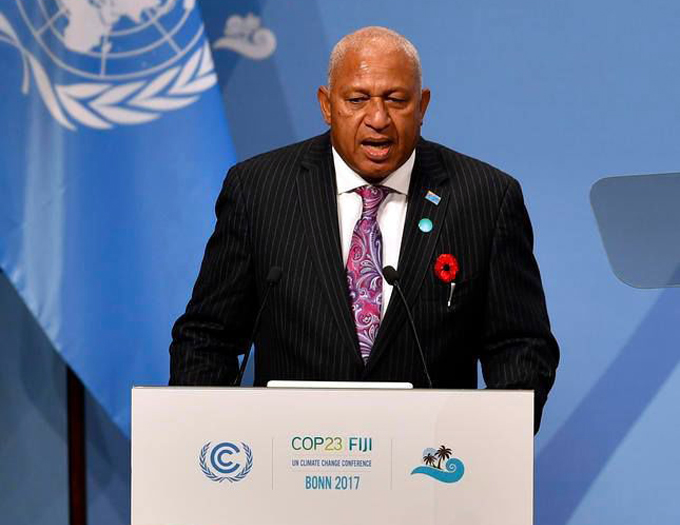 Fiji’s Prime Minister and COP23 President Voreqe Bainimarama … “do everything we can to make the Paris Agreement work”. Image: Vanuatu Daily Post
By Anita Roberts in Bonn, Germany
The Paris Climate Agreement must be implemented swiftly as backing away will expose people to more risks, Fiji’s Prime Minister Voreqe Bainimarama has told world leaders.
Representing Pacific Island countries, Bainimarama, President of the 23rd Conference of Parties (COP23) to the United Nations Framework Convention on Climate Change (UNFCCC), pleaded for collective action from world leaders to tackle climate change after taking up the position of president from Morocco in Germany yesterday.
The future of life on earth depends on everyone’s choices – everyone must act on climate change, he said, when opening the Climate Planet in Bonn City.

“Our world is in distress from extreme weather events caused by climate change as destructive hurricanes, fires, floods, droughts, melting ice, and changes to agriculture which threaten food security.
“Thus, the need for urgency is obvious.
“All over the world, vast numbers of people are suffering – bewildered by the forces ranged against them.
“Our job as leaders is to respond to that suffering with all means available.
‘We must not fail our people’
“This includes our capacity to work together to identify opportunities in the transition we must make.
“We must not fail our people.
“That means using the next two weeks and the year ahead to do everything we can to make the Paris Agreement work and to advance ambition and support for climate action before 2020,” Bainimarama said.
Fiji Broadcasting Corporation (FBC) reports Bainimarama also called for climate negotiations to agree to limiting global temperature rise to below 1.5 degrees Celsius.
“By aiming for 1.5 degrees, we are setting ourselves a serious challenge.
“But it provides us with a mission. It engages our capacity for ingenuity, for organisation and sheer hard work.
“The only way for every nation to put itself is to lock arms with all other nations and move forward together.
Assist the vulnerable
“We must appeal for a lot more resolve to assist the more vulnerable to adapt to climate change,” he said.
Bainimarama also announced the launch of an ocean pathway to ensure the ocean is an integral part of the UNFCCC process by 2020, the Vanuatu Daily Post reports.
COP23 officially opened on November 6 with a traditional Fijian ceremony and ‘Bula Spirit’.
‘Drua’, a Fijian ocean going canoe in the foyer of the world climate conference serves as a powerful symbol of resilience and unity during the meeting.
It also signifies the resilience of the ancient culture of the Pacific in the face of adverse impacts of climate change.
Climate talks in Bonn continue until November 17.
Anita Roberts is a reporter with the Vanuatu Daily Post. She is among ten journalists from the Pacific invited by the German Foreign Affairs Ministry to COP23 as part of a competition reflecting the importance of this year’s COP to small Pacific Island countries.
Article by AsiaPacificReport.nz
]]>Bryce Edwards’ Political Roundup: Government’s spinning out of control
Bryce Edwards’ Political Roundup: Government’s spinning out of control
[caption id="attachment_13635" align="alignright" width="150"] Dr Bryce Edwards.[/caption]
The Labour-led coalition got off to a disastrous start in parliament yesterday, with the first day spiralling out of control for them and resulting in farcical scenes of capitulation to the Opposition over select committee details and the election of the Speaker.
Prime Minister Jacinda Ardern and Leader of House Chris Hipkins then doubled down on the error with the absurd way they tried to spin the episode. It looks like this administration could be as bad as the last one in terms of disingenuous spin-doctoring.
[caption id="attachment_3483" align="aligncenter" width="614"] New Zealand Parliament.[/caption]
Labour’s out-of-control shambles
The best explanation of what went wrong for the new government yesterday is Claire Trevett’s news report, National makes Government look like fools as it blackmails Labour for Speaker vote. She explains that National called into question whether Labour MP Trevor Mallard would have the numbers to be elected as the new Speaker of the House, which led to the Government quickly agreeing to an embarrassing deal with National in order to get their support to elect him.
Trevett followed this up with a further explanation, saying “there was initially confusion because Labour had believed it could cast proxy votes for the five missing MPs, who included NZ First leader Winston Peters and Trade Minister David Parker who were at Apec. However, because those MPs had not yet been sworn in, their votes could not be used” – see: Nats fire warning shot on day one.
As Stuff political editor Tracy Watkins put it, “It’s a fair bet that this is not what Labour’s strategists and senior ministers wanted day one of the rest of the next three years to look like” – see: Red-faced Government needs to bury first-day farce, fast.
Watkins calls Labour’s Speaker episode “shambolic”, and stresses how it projects a picture of the coalition’s lack of control, and these “are just the sort of images Labour doesn’t need. Those images have catapulted what would normally be an in-house, procedural stoush, into a defining moment. They fit the Opposition narrative – the narrative being that this is the same party that only a few months ago was divided, and defeated, that Labour wasn’t ready for power, that the next three years are going to be a shambles.”
So, in the end National obtained a surprising compromise out of Labour – an agreement to allow 109 MPs to be allocated to select committees, instead of 96. Up until this time, Labour had signaled its utter intransigence in accommodating National’s very strong preference.
Shadow Leader of the House, Simon Bridges, went on TVNZ1’s Breakfast today to say the maneuver in the house was about “making it very clear” to Chris Hipkins that National was unhappy over the select committee MP numbers, which would limit their “ability to scrutinise the government” – see: ‘Yesterday was a day of incompetence by the Government’ – Simon Bridges’ dramatic move in Parliament just ‘vigorous testing’.
On whether Bridges’ had bluffed to Labour about them not having the numbers to elect Mallard, he says “It wasn’t a bluff, but I didn’t know [the numbers] exactly”, and “I could tell it was close one way or another”. Bridges says “You can call it a bluff.. I’d call it vigorous testing.”
Of course, National is milking Labour’s farce for all it’s worth. But many of their criticisms – although self-serving – aren’t unfair. Opposition leader Bill English was quoted saying, “I’ve never seen that happen on the day of electing a Speaker where the proceedings of Parliament were stopped because the government didn’t know what numbers it had, didn’t know whether it could elect the Speaker and essentially sought our support” – see Sarah Robson’s Govt denies being hoodwinked over Speaker election vote.
In the same article, English says: “They’ve got three parties, they didn’t know their own numbers – every day they’re going to have challenges being organised enough to run the Parliament properly.”
Labour’s spin control has been out-of-control
When politicians suffer setbacks and make mistakes, it’s usually best that they just admit the problem, thereby allowing everyone to move on from it. Unfortunately for Labour, they have taken the opposite strategy and tried to deny it all – which has merely made the situation worse for them.
Both Jacinda Ardern and Chris Hipkins have gone on the attack, blaming National for the incident, and challenging the accounts of political reporters. Claire Trevett reports: “Prime Minister Jacinda Ardern denied it was embarrassing and described the set-back as a ‘minor irritation’ and ‘sadly, a bit of politics’.” – see: Nats fire warning shot on day one. According to Ardern, Labour simply reached out to National out of a desire for consensus, because “I wanted to show … this was going to be a Parliament that was different. So it was [my hope] we wouldn’t have that vote and we didn’t.”
Chris Hipkins repeated these lines today on TVNZ1’s Breakfast, and denied he had worried that the coalition didn’t have the numbers to elect the Speaker. According to TVNZ, “he said they knew they had the numbers but didn’t want Parliament to get off on the wrong foot.” And in terms of the compromise over the select committee MP numbers, Hipkins indicated that they had always planned to give National the additional numbers.
He also went on the AM Show this morning – see Newshub’s Chris Hipkins blames ‘shambolic’ Parliamentary opening on National. However Bridges also appeared on this, disputing the Labour MP’s account: “There’s a bit of post-event rubbish already by Chris Hipkins. It was quite clear to me from the way they acted they didn’t know the rules, they’re confused about that and they didn’t know their numbers and they’re confused about that”.
And for Hipkins’ most challenging media interview, you can listen his six-minute interview with an exasperated Guyon Espiner, who says to Hipkins: “Do you really expect us to believe that?!” – see RNZ’s ‘First day farce’ for new govt in Parliament – Hipkins.
I also went on the AM Show today to discuss the matter, and expressed my disappointment that the new government was so quickly moving into heavy spinning mode: “That’s one of the worst things about this story for Labour. Not just that it was such a shambles for them and they lost this manoeuvre by National, but they then tried to spin it… And the public hate politicians that are just so obviously spinning it. So Jacinda Ardern had the first day of Parliament going from Saint Jacinda to being seen as a liar” – see Newshub’s Labour’s ‘unprecedented disorganisation’ shows spin and shambles – Bryce Edwards.
The NBR’s Rob Hosking also clearly doesn’t believe the Government’s account of yesterday’s debacle: “The claim now that it only made the concession, to give National another 13 select committee places than planned for the rest of the Parliament, just so there could be a nice vibe around Mr Mallard becoming Speaker, shows either an odd set of political priorities or a belief the rest of us are idiots. Take your pick” – see: Silly parliamentary games and some bigger worries (paywalled).
Hosking makes the point that, ultimately, the story doesn’t matter that much: “Few will pay much direct attention. It is yet another example of politicians playing silly beggars, and few New Zealanders really care who sits where in what committee room in Wellington. But it shows a government which is having trouble doing the political equivalent of walking and chewing gum at the same time. Any more examples of slipshod organisation and the impression of a shambolic, amateur approach to government will start to bed in.”
Finally, we’ve already had the coalition government’s formation explained via the analogy of buying a pie (see my previous roundup: The legitimacy of the Labour-led government, and now Liam Hehir updates the analogy to explain yesterday’s farce in Parliament – see This pie analogy is the most Kiwi way of explaining electing the speaker ever.]]>
New Zealand Parliament.[/caption]
Labour’s out-of-control shambles
The best explanation of what went wrong for the new government yesterday is Claire Trevett’s news report, National makes Government look like fools as it blackmails Labour for Speaker vote. She explains that National called into question whether Labour MP Trevor Mallard would have the numbers to be elected as the new Speaker of the House, which led to the Government quickly agreeing to an embarrassing deal with National in order to get their support to elect him.
Trevett followed this up with a further explanation, saying “there was initially confusion because Labour had believed it could cast proxy votes for the five missing MPs, who included NZ First leader Winston Peters and Trade Minister David Parker who were at Apec. However, because those MPs had not yet been sworn in, their votes could not be used” – see: Nats fire warning shot on day one.
As Stuff political editor Tracy Watkins put it, “It’s a fair bet that this is not what Labour’s strategists and senior ministers wanted day one of the rest of the next three years to look like” – see: Red-faced Government needs to bury first-day farce, fast.
Watkins calls Labour’s Speaker episode “shambolic”, and stresses how it projects a picture of the coalition’s lack of control, and these “are just the sort of images Labour doesn’t need. Those images have catapulted what would normally be an in-house, procedural stoush, into a defining moment. They fit the Opposition narrative – the narrative being that this is the same party that only a few months ago was divided, and defeated, that Labour wasn’t ready for power, that the next three years are going to be a shambles.”
So, in the end National obtained a surprising compromise out of Labour – an agreement to allow 109 MPs to be allocated to select committees, instead of 96. Up until this time, Labour had signaled its utter intransigence in accommodating National’s very strong preference.
Shadow Leader of the House, Simon Bridges, went on TVNZ1’s Breakfast today to say the maneuver in the house was about “making it very clear” to Chris Hipkins that National was unhappy over the select committee MP numbers, which would limit their “ability to scrutinise the government” – see: ‘Yesterday was a day of incompetence by the Government’ – Simon Bridges’ dramatic move in Parliament just ‘vigorous testing’.
On whether Bridges’ had bluffed to Labour about them not having the numbers to elect Mallard, he says “It wasn’t a bluff, but I didn’t know [the numbers] exactly”, and “I could tell it was close one way or another”. Bridges says “You can call it a bluff.. I’d call it vigorous testing.”
Of course, National is milking Labour’s farce for all it’s worth. But many of their criticisms – although self-serving – aren’t unfair. Opposition leader Bill English was quoted saying, “I’ve never seen that happen on the day of electing a Speaker where the proceedings of Parliament were stopped because the government didn’t know what numbers it had, didn’t know whether it could elect the Speaker and essentially sought our support” – see Sarah Robson’s Govt denies being hoodwinked over Speaker election vote.
In the same article, English says: “They’ve got three parties, they didn’t know their own numbers – every day they’re going to have challenges being organised enough to run the Parliament properly.”
Labour’s spin control has been out-of-control
When politicians suffer setbacks and make mistakes, it’s usually best that they just admit the problem, thereby allowing everyone to move on from it. Unfortunately for Labour, they have taken the opposite strategy and tried to deny it all – which has merely made the situation worse for them.
Both Jacinda Ardern and Chris Hipkins have gone on the attack, blaming National for the incident, and challenging the accounts of political reporters. Claire Trevett reports: “Prime Minister Jacinda Ardern denied it was embarrassing and described the set-back as a ‘minor irritation’ and ‘sadly, a bit of politics’.” – see: Nats fire warning shot on day one. According to Ardern, Labour simply reached out to National out of a desire for consensus, because “I wanted to show … this was going to be a Parliament that was different. So it was [my hope] we wouldn’t have that vote and we didn’t.”
Chris Hipkins repeated these lines today on TVNZ1’s Breakfast, and denied he had worried that the coalition didn’t have the numbers to elect the Speaker. According to TVNZ, “he said they knew they had the numbers but didn’t want Parliament to get off on the wrong foot.” And in terms of the compromise over the select committee MP numbers, Hipkins indicated that they had always planned to give National the additional numbers.
He also went on the AM Show this morning – see Newshub’s Chris Hipkins blames ‘shambolic’ Parliamentary opening on National. However Bridges also appeared on this, disputing the Labour MP’s account: “There’s a bit of post-event rubbish already by Chris Hipkins. It was quite clear to me from the way they acted they didn’t know the rules, they’re confused about that and they didn’t know their numbers and they’re confused about that”.
And for Hipkins’ most challenging media interview, you can listen his six-minute interview with an exasperated Guyon Espiner, who says to Hipkins: “Do you really expect us to believe that?!” – see RNZ’s ‘First day farce’ for new govt in Parliament – Hipkins.
I also went on the AM Show today to discuss the matter, and expressed my disappointment that the new government was so quickly moving into heavy spinning mode: “That’s one of the worst things about this story for Labour. Not just that it was such a shambles for them and they lost this manoeuvre by National, but they then tried to spin it… And the public hate politicians that are just so obviously spinning it. So Jacinda Ardern had the first day of Parliament going from Saint Jacinda to being seen as a liar” – see Newshub’s Labour’s ‘unprecedented disorganisation’ shows spin and shambles – Bryce Edwards.
The NBR’s Rob Hosking also clearly doesn’t believe the Government’s account of yesterday’s debacle: “The claim now that it only made the concession, to give National another 13 select committee places than planned for the rest of the Parliament, just so there could be a nice vibe around Mr Mallard becoming Speaker, shows either an odd set of political priorities or a belief the rest of us are idiots. Take your pick” – see: Silly parliamentary games and some bigger worries (paywalled).
Hosking makes the point that, ultimately, the story doesn’t matter that much: “Few will pay much direct attention. It is yet another example of politicians playing silly beggars, and few New Zealanders really care who sits where in what committee room in Wellington. But it shows a government which is having trouble doing the political equivalent of walking and chewing gum at the same time. Any more examples of slipshod organisation and the impression of a shambolic, amateur approach to government will start to bed in.”
Finally, we’ve already had the coalition government’s formation explained via the analogy of buying a pie (see my previous roundup: The legitimacy of the Labour-led government, and now Liam Hehir updates the analogy to explain yesterday’s farce in Parliament – see This pie analogy is the most Kiwi way of explaining electing the speaker ever.]]>
Critical Politics Newsletter: New Zealand Politics Daily – 8 November 2017
Critical Politics Newsletter: New Zealand Politics Daily – 8 November 2017 – Today’s content
Editor’s Note: Here below is a list of the main issues currently under discussion in New Zealand and links to media coverage. The full text of these items are contained in the PDF file (click to download). [caption id="attachment_297" align="aligncenter" width="1600"] The Beehive and Parliament Buildings.[/caption]
Opening of Parliament
RNZ: Parliament’s opening ‘a first day farce’
Claire Trevett (Herald): National makes Government look like fools as it blackmails Labour for Speaker vote
Newshub: Chris Hipkins blames ‘shambolic’ Parliamentary opening on National
Newshub: Labour’s ‘unprecedented disorganisation’ shows spin and shambles – Bryce Edwards
Liam Hehir (Medium): This pie analogy is the most Kiwi way of explaining electing the speaker ever
Liam Hehir (Medium): Labour denies falling for second trick
Claire Trevett (Herald): Nats fire warning shot on day one
1News: ‘Yesterday was a day of incompetence by the Government’ – Simon Bridges’ dramatic move in Parliament just ‘vigorous testing’
Tracy Watkins (Stuff): Red-faced Government needs to bury first-day farce, fast
Herald Editorial: Opposition will keep the Government on its toes
Sarah Robson (RNZ): Govt denies being hoodwinked over Speaker election vote
Sarah Robson (RNZ): House trading: Nats bluff Labour on day one
Anna Bracewell-Worrall (Newshub): National’s first show of power: Grinding Parliament to a halt
Gwynn Compton (Libertas Digital): Hipkins’ creates omnishambles on first day as Leader of the House
David Farrar (Kiwiblog): Labour fails to have numbers for Speaker so caves in on select committees
Martyn Bradbury (Daily Blog): New Government meltdown on first day
Nicholas Jones (Herald): Labour and National face-off in Parliament opening over Speaker vote
Jo Moir (Stuff): Government forced to do a deal with National after failing to have the numbers in the House
1News: Watch: Confusion in Parliament during less than smooth swearing in of new Speaker Trevor Mallard
1News: MPs sworn in as New Zealand’s 52nd Parliament opens for business
RNZ: MPs sworn in to 52nd Parliament
Emma Hurley (Newshub): Record level of women in New Zealand Parliament
Isobel Ewing (Newshub): Trevor Mallard sworn in as Speaker
Gordon Campbell (Scoop): On the battle over select committees
Liam Hehir (Medium): Does National have a majority?
No Right Turn: The triennial reminder
Winston Peters legal action
Barry Soper (Newstalk ZB): Pension papers is why Wily Winston Peters went with Labour
Richard Harman (Politik): Peters fingers English as architect of conspiracy to ruin his reputation
Patrick Gower (Newshub): Winston Peters deepens ‘utu’ with legal action over pension leak
Tim Murphy (Newsroom): Winston goes fishing
Nicholas Jones (Herald): Winston Peters’ legal action a ‘personal matter’, Ardern says
Lynn Prentice (Standard): Suck it up political sleazers.
Cameron Slater (Whaleoil): Winston starts dropping lawsuits on media and Nats
Toby Manhire (Spinoff): The brand new Deputy PM just served papers on the media and that is not good at all
David Farrar (Kiwiblog): Winston goes fishing
Herald: Winston’s legal action a ‘fishing expedition’
Barry Soper (Newstalk ZB): Winston Peters suing over superannuation scandal
RNZ: Peters launches legal action over superannuation leak
Tracy Watkins (Stuff): Winston Peters looks to sue over pension leak
Patrick Gower (Newshub): Winston Peters takes legal action against National Party over leak ‘plot’
Paddles dies
Herald: The last moments of Paddles, the First Cat
Herald: Jacinda Ardern’s cat Paddles has died after being hit by a car
Newshub: Jacinda Ardern’s cat Paddles has died after being hit by car
1News: Prime Minister Jacinda Ardern’s cat Paddles dies after being hit by car
RNZ: Jacinda Ardern’s cat Paddles has died
Stuff: Paddles, Jacinda Ardern’s cat, has been killed, apparently run over
Government
Fran O’Sullivan (Herald): Eyes of world on our Coalition of Change
Brian Easton (Pundit): How Have We Changed?
Tim Watkin (Pundit): A very MMP election… & a manicured mandate
1News: ‘So much emotion in the room’ – Clarke Gayford on the moment Jacinda Ardern learned she would be PM
Trade
Sam Sachdeva (Newsroom): David Parker plots a new approach to trade
1News: Jacinda Ardern plans to negotiate ‘best interest’ for NZ in TPP negotiations
Matthew Brockett (Blooberg): New Zealand’s PM Sees Benefits for Her Country in the TPP Trade Deal
Economy and Reserve Bank
Bernard Hickey (Newsroom): Robertson faces his toughest choice
Nicholas Jones (Herald): Overhaul of Reserve Bank outlined: Employment to be added as objective
Jane Patterson (RNZ): ‘We want New Zealanders to be in work and to be paid well’
Liam Dann (Herald): Market relieved as Govt sets out Reserve Bank plan
Shane Cowlishaw (Newsroom): Robertson announces details of Reserve Bank review
BusinessDesk: NZ govt’s operating deficit in line with expectations
Employment
Joshua Hitchcock (Spinoff): Māori unemployment is a national crisis
Jessie Chiang (RNZ): Exploited staff numbers ‘tip of the iceberg’ – lawyer
Susan Hornsby-Geluk (Stuff): Shocking number of New Zealand workers who pay to work
Gordon Anderson (Newsroom): Four key principles of NZ labour law
Laura Baker (Stuff): How NZ paid parental leave compares to the rest of the world
Susan Edmunds (Stuff): Parental leave boost is welcome, but it could be better
Rachel Clayton (Stuff): New Zealand’s big healthcare gender pay gap
Mathew Brockett and Paul Allen (Bloomberg): The World’s Youngest Female Leader Targets Equal Pay for Women
The Wireless: ‘Inequality will grind you down’
Steve Deane (Newsroom): The problem with equality for NZ footballers
Bev Cassidy-Mackenzie (Stuff): A swelling sea change in attitude towards diversity
Manus Island refugees
RNZ: Court rejects restoration of services to Manus detention centre
Gareth Hutchens (Guardian): Turnbull says Manus detainees aren’t scared, just manipulated by ‘activists in Australia’
Health
Kirsty Johnston (Herald): Child tooth decay soars as kids have to share toothbrushes
Amy Wiggins (Herald): Commissioner critical of care given to man found living in squalor
Education
Dominion Post Editorial: How to fix the problems with charter schools
Camilla Highfield (Stuff): National Standards – let’s not throw the baby out with the bathwater
Housing
Peter Lyons (ODT): Reality bites: housing’s heady days are over
Jennifer Eder (Stuff): Ministry makes ‘no single men’ offer to push through emergency housing plan
Liam Hehir (Medium): Does Labour’s workaround work?
Farming and environment
Russel Norman (Spinoff): Let’s untie Fonterra’s hands, and see what they can do for NZ rivers
Richard Swainson (Stuff): The science of water pollution should be taken seriously
Eric Frykberg (RNZ): Are there too many native birds?
Alexa Cook (RNZ): Calls for a national standard for organics
Tax
Rebecca Stevenson (Spinoff): Offshore trusts are pretty legal – until they’re not
ODT Editorial: If I had a little money…
Leith Huffadine (Stuff): The Paradise Papers explained: What you need to know
Mike Hosking (Herald): Do you support tax-dodging Apple?
Justice
Jarrod Gilbert (Herald): Boot camp idea robbed Bill English of a legacy
Herald: Andrew Little confirms Teina Pora’s compensation to be increased
Jo Moir (Stuff): Government announces extra compensation payout for Teina Pora, adjusted for inflation
Inequality, poverty and welfare
John Minto (Press): Agrees with Winston Peters: capitalism delivers for the wealthy
Michael Fletcher (Herald): Welfare system needs radical shake up
Stacey Kirik (Stuff): New Government puts Social Investment approach for vulnerable Kiwis under review
Daniel Walker (Newstalk ZB): Data for those using social services safe, Government confirms
No Right Turn: Good riddance
Kelvin Teixeira (Dominion Post): Rising living costs seeing more families turning to food banks
Other
Charlie Dreaver (RNZ): 13,000 military-style semi-automatic weapons in NZ
1News: It is not obvious how Government will ‘crack the problem’ of Pike River re-entry, says Bill English
Brian Rudman (Herald): Guy Fawkes pointless exercise in burning money
Māmari Stephens (E-Tangata): Just what are we really commemorating with Rā Maumahara?
Dominion Post Editorial: Mayor saves the day – for now]]>
Bryce Edwards’ Political Roundup: A fractious, dirty new Parliament starts today
Bryce Edwards’ Political Roundup: A fractious, dirty new Parliament starts today
[caption id="attachment_13635" align="alignright" width="150"] Dr Bryce Edwards.[/caption]
The 52nd Parliament officially opened this morning, and it might end up being one of the more fractious and tense representative assemblies New Zealand has seen for some time. There are already signs that any goodwill between the Government and Opposition has been depleted, and instead of constructive and useful political engagement, we can expect to see dirty fighting and an intense struggle between the new coalition government attempting to carry out reforms, and what has been described as “the opposition from hell”.
[caption id="attachment_3483" align="aligncenter" width="614"] New Zealand Parliament.[/caption]
Even in the couple of hours since Parliament opened there have been some incredible stories that show the potential chaos and intense feeling already brewing – see Nicholas Jones’ Labour and National face-off in Parliament opening over Speaker vote, and the Herald’s Winston Peters takes legal action against nine people he believes helped leak pension overpayment info.
It suggests that the public should get ready for a wild ride as the swings, surprises and intensity of this year’s colourful election campaign are matched by the configurations in the new Parliament.
National’s hellish opposition
The National Party has already signalled its intention to be a forceful opposition in Parliament. Of course, this is quite appropriate – New Zealand’s Westminster system is highly dependent on a strong opposition keeping the government of the day in check.
But just how combative will the Opposition be? There is sometimes a fine-line for oppositions to walk between being robust, and being petty, dirty, and overly-obstructive.
On the one hand, National Leader Bill English showed today that his party can be willing to agree with the new Government, by announcing it would support the extension of Paid Parental leave to 26 weeks, despite National’s policy of a shorter period of entitlement, and having vetoed a parliamentary bill on this last year – see Newshub’s National does U-turn on paid parental leave.
On the other, Bill English signalled last week that his party is going to try to make life very difficult for the new government, saying “You should expect more tension and more pressure in the Parliament” – see Nicholas Jones’ Bill English warns Labour: ‘it’s not our job to make this place run’.
According to this report, the National Party “will use its size to frustrate progress for the new Government.” And that reference to National’s size is the key point – because with 56 MPs, this is the largest party to occupy the opposition benches in New Zealand’s political history.
Former Labour Party staffer Emma Espiner warns National is going to be The Opposition from Hell. Writing a month ago, Espiner predicted “we will see a Monster Opposition – 56 seats – think what that will look like and even sound like – the debating chamber is small, your opponents close, and 56 roaring MPs facing new Labour and Green Ministers will be genuinely testing.”
Furthermore, although many parties shifting from government to opposition often descend into infighting, Espiner suggests this isn’t likely to occur with National, who are hell-bent on staying united simply because “they will relish the opportunity to make life hell for the NZ First/Labour/Green coalition.” And she points to all the resources that will allow National to make life difficult for the coalition government.
Tracy Watkins wrote yesterday, “National MPs have been highly visible and energetic in their first days back in Opposition, giving weight to the message that they mean business. They also have the advantage of more insider knowledge than their opponents at the moment. While the new ministers get up to speed, National’s former ministers know the system inside and out.” – see: Parliament will now be in session and Labour should not expect an easy ride.
Gerry Brownlee can be expected to be one of the big hitters in opposition. Jenna Lynch has already pointed to Brownlee as upping his game and aggression levels, and she labels him “National’s Agitator-in-Chief” – see: Gerry Brownlee shows National is set to play rough.
Lynch’s story is about a hard-hitting press release issued by Brownlee: “He stepped up and sent out the first real opposition press release, the first real attack. The haste and blunt wording is a symbolic message of what’s to come. The fact that it came from Brownlee is a sign this is a directive from high – go hard or go home. It’s a lesson for all the newbies – ‘This is how we act in Opposition’. It’s rough, tough and it will get dirty.”
A large part of the reason for National’s combativeness is the process by which they find themselves in opposition. They weren’t expecting defeat, and many still feel wronged and are therefore unchastened. Rob Hosking explains much of this in his RNZ column, National needs to be a ‘practical and sceptical’ opposition.
Here’s his main point: “Usually when a party goes into opposition after a long stint in government it is not so much put there as flung there by angry or disillusioned voters. This usually comes after one final Parliamentary term in which the party is shot full of bullet holes by attacks from the opposition, the media, and, not infrequently, their own side. Ministers are exhausted – usually more so than they realise until the adrenaline of office vanishes. The party tends to be divided and demoralised. This is not one of those situations – not quite, anyway. National is the largest party in Parliament. It will be resourced accordingly. Its members – most of them – did not expect defeat. There is nowhere near the same demoralisation apparent in 1999 or in 1984 – or seen in Labour in 2008 and 1990.”
National’s fight over select committee numbers
An arcane but important fight has been going on over the last day about how many MPs should be allocated to the parliamentary select committees that examine legislation. It’s a convoluted and complex story, but best summed up by Jane Patterson: “Labour and National have their first major disagreement in the new Parliament over the number of MPs serving on select committees. National said changes to MP representation means its ability to hold the new government to account is being compromised. The number of MPs who will sit on select committees has been reduced, but Leader of the House Chris Hipkins said that was because of an agreement all political parties signed up to in the last Parliament. Simon Bridges, the shadow Leader of the House, said having fewer seats would mean 11 National MPs would miss out on sitting on a select committee” – see: Labour and National spat over MP representation.
Simon Bridges, who is the new shadow leader of the house, has expressed National’s opposition to the changes in a dramatic fashion: “It’s a really alarming erosion of the Opposition’s democratic rights in our Parliament like we have never seen before. It is an unprecedented situation” – see Nicholas Jones’ National clashes with Labour: ‘erosion of democratic rights’.
For an elaboration of Bridges’ arguments it’s worth reading David Farrar’s Labour freezing National MPs out of select committees, and Graeme Edgeler’s Despite Simon Bridges’ idiocy, does he have a point on overall (subject) select committee membership?
And for the best critique, see Andrew Geddis’ Simon Bridges thinks that Simon Bridges is eroding parliamentary democracy.
Of course, the whole debacle has now been resolved courtesy of another debacle, in which Labour mismanaged its numbers and strategy today when the new Parliament opened. For Claire Trevett’s take on what happened, see: National makes Government look like fools as it blackmails Labour for Speaker vote.
This extraordinary episode has provided a useful example of what might be coming during this Parliament – a very intense battle in which the gloves are off between Labour and National. Richard Harman reports on how Simon Bridges had said that National was going to fight Labour over the issue, with him saying that Labour was “going to find that they have got a much less reasonable, more obstructive Opposition that will find issues to muck them around on” – see: Bridges planning to logjam Parliament.
Threats to slow down the coalition government are taken very seriously by Gordon Campbell, who suggests that we are witnessing the importing of US-style tactics: “the National Party has been planning to mimic the worst practices of the Republican Party when it comes to its parliamentary tactics in opposition. For the eight years of the Obama administration, the Republicans responded by trying to create legislative gridlock at every opportunity. If it couldn’t run the business of government, it would do its damndest to derail the ability of anyone else to govern” – see: On the battle over select committees.
Campbell applauds Labour for fighting back, and trying to thwart National’s plans on the select committees, saying “A line is being crossed here. It is not the job of her Majesty’s loyal Opposition to oppose, not to render Parliament ungovernable.”
And certainly, the Government’s Leader of House, Chris Hipkins, was fairly upfront in suggesting that Labour’s intransigence over the select committee numbers was, in part, due to a fear that National was going to use the committees to deliberately frustrate the Labour’s reform agenda. Hipkins therefore declared “It would be fair to say we are not of a mind to increase the numbers on select committee in order to make it easier for them to do that” – see Laura Walters’ National calls Government’s plans for select committee ‘undemocratic’.
However, regardless of who came out on top in this battle, blogger No Right Turn suggests that everyone loses, as once again it just shows all politicians in a bad light – see: Hypocrisy all round.
Finally, National might be feeling smug about how things went today, but conservative political commentator Liam Hehir has sounded a note of caution, suggesting National should avoid being too negative too early.]]>
Critical Politics Newsletter: New Zealand Politics Daily – 7 November 2017
Critical Politics Newsletter: New Zealand Politics Daily – 7 November 2017 – Today’s content
Editor’s Note: Here below is a list of the main issues currently under discussion in New Zealand and links to media coverage. The full text of these items are contained in the PDF file (click to download).
[caption id="attachment_297" align="aligncenter" width="1600"] The Beehive and Parliament Buildings.[/caption]
AUS-NZ relations and Manus refugee crisis
Gordon Campbell (Werewolf): On Ardern’s refugee non-deal
Grant Bayldon (Spinoff): Seeking asylum is a legal right. Could somebody tell Mike Hosking?
Jessie Anne Dennis (Spinoff): Words are cheap. Now Ardern must take real action to save the Manus Island refugees
Chris Trotter (Daily Blog): Australia: Seeing What We Have To See.
Brent Edwards (RNZ): Manus Island refugees: Jacinda Ardern likely to come under more pressure to do more
Herald Editorial: New PM does well in first outing
Jane Patterson (RNZ): Trans-Tasman tension gives way to smiles
No Right Turn: Rolling over for Australia
RNZ: Emergency exposes Manus Island healthcare deficit
Newstalk ZB: Manus Island asylum seekers losing hope after Australia rejects NZ offer
Anna Bracewell-Worrall and Isobel Ewing (Newshub): Australians will be entitled to a free year of tertiary education in New Zealand
1News: Watch: Government’s threat of tertiary fee retaliation against Australia ‘irrelevant’, says Bill English
Laura Walters (Stuff): NZ taxpayers shouldn’t be paying for Australians’ education, Bill English says
1News: ‘It’s only fair if we respond’ – Australian tertiary policy to triple Kiwi fees stuck in Senate
Trade and international relations
Vernon Small (Stuff): Jacinda Ardern seeking TPP concessions at first appearance on international stage
Jane Kelsey (Herald): Signing TPPA-11 would break Labour’s word
Jane Kelsey (Daily Blog): Jacinda says ISDS is a dog. So let’s put it down
Catherine Beard (Herald): New Government needs to land TPP
Benedict Collins (RNZ): Trade deal ‘top of mind’ at APEC
Alexia Russell (Newstalk ZB): Jacinda Ardern picks EU over Russia in trade talks
Nicholas Jones (Herald): Russia free trade agreement not the priority: PM
Talisa Kupenga (Māori TV): German President and NZ Prime Minister discuss trade and science opportunities
Stacey Kirk (Stuff): German President touches down in New Zealand for high-level meetings
Craig Hoyle (Stuff): Meet Boots, New Zealand’s ‘Depcatty High Commissioner’ in London
Parliament
Andrew Geddis (Pundit): Simon Bridges thinks that Simon Bridges is eroding parliamentary democracy
Graeme Edgeler (Public Address): Despite Simon Bridges’ idiocy, does he have a point on overall (subject) select committee membership?
Richard Harman (Politik): Bridges planning to logjam Parliament
RNZ: Select committee changes ‘anti-democratic’ – Bill English
Sam Sachdeva (Newsroom): Battle brewing over select committee cuts
David Farrar (Kiwiblog): Labour freezing National MPs out of select committees
No Right Turn: Hypocrisy all round
Jane Patterson (RNZ): Labour and National spat over MP representation
Nicholas Jones (Herald): National clashes with Labour: ‘erosion of democratic rights’
Laura Walters (Stuff): National calls Government’s plans for select committee ‘undemocratic’
Liam Hehir (Stuff): National should avoid being too negative too early
Tracy Watkins (Stuff): Parliament will now be in session and Labour should not expect an easy ride
Phil Smith (RNZ): The Commission Opening: What to expect
Herald: Parliament opens: Guide to the week’s ceremony
1News: MPs to be sworn in, Speaker elected as 52nd Parliament opens
Gwynn Compton (Libertas Digital): The political week ahead – 6 November 2017
Paid Parental Leave
Nicholas Jones (Herald): Prime Minister Jacinda Ardern confirms paid parental leave increased to 26 weeks by 2020
Ellen Read and Stacey Kirk (Stuff): Paid parental leave to increase to 26 weeks
RNZ: Parental leave increase ‘right thing to do’ – PM
Anna Bracewell-Worrall (Newshub): Jacinda Ardern commits to extending paid parental leave by a month
Newshub: Parent advocates applaud 26-week leave Bil
Herald: Paid parental leave: Dad leaves job after snarky comments
Chris Bramwell (RNZ): Fears over extended paid parental leave for small businesses
Newshub: National does U-turn on paid parental leave
Government
Hamish Rutherford (Stuff): Wellington Mayor ‘not losing sleep’ over Government relocation pledge
Jo Moir (Stuff): Jacinda Ardern is taking the government back to Waitangi after a two year hiatus
Colin Williams (Stuff): Hipkins looks to change for the better
Katee Shanks (Rotorua Daily Post): Waiariki MP Tamati Coffey confident ahead of maiden speech
Jared Nicoll (Stuff): New minister Kris Faafoi wants more compassion for the vulnerable
David Farrar (KIwiblog): What sort of poll boost should the new Government get?
Claire Trevett (Herald): Greens meeting to set election date to replace Metiria Turei as woman co-leader
Herald: Ever wondered what the Prime Minister’s office looks like?
Clarke Gayford (Spinoff): Nothing is different, everything is different: Clarke Gayford on his first days as first gent
Herald: DNA detectives delve into Jacinda Ardern’s family tree
Whananui Chronicle: Jacinda Ardern as Mona Lisa wins Mangaweka art competition
Tax
Colin James (ODT): Tax will be the ultimate reform test
Ric Stevens (Press): Paradise Papers show tax dodgers will be found out
RNZ:IRD works with international agencies on tax haven leak
Greg Presland (Standard): Paradise lost
Education
Jody O’Callaghan (Stuff): Low decile schools have double the trouble hiring staff
John Gerritsen (RNZ): Govt funding inadequate, principals say
Herald: High stress levels, not enough funding and staff struggles, NZCER report finds
Jo Moir (Stuff): Education minister to review all charter schools after threatening some with closure
Employment
Teuila Fuatai (Newsroom): More labour inspectors: a return to the past?
Mike Hosking (Herald): Why pay parity doesn’t work in sport
Newstalk ZB: Living wage advocates praising govt decision
Health
Eileen Goodwin (ODT): Health authority in Ronald McDonald damage control
Bronwyn Howell (Newsroom): Reducing GP fees not so simple
Nikki Preston (Herald): Mumps outbreak: Vaccination catch-up campaign floated for 10-29 year-olds
Newswire: Govt warned not to ask for DHB resignations
Hawke’s Bay Today: Hastings Health Centre offers free visits for under-18s
Pike River
Sam Strong (Press): Families of Pike River victims says Government is ‘on the same page’ with them over mine re-entry
Ryan Boswel (1News): ‘This is important to all NZ’ – Govt must make amends for handling of Pike River aftermath, says Andrew Little
Benedict Collins (NRZ): Andrew Little meets Pike River families
Herald: Pike River families meet with Andrew Little over possible re-entry
Anna Bracewell-Worrall (Newshub): Pike River families put faith in Andrew Little
Guy Fawkes
Bruce Munro (ODT): A place for peace
ODT Editorial: Do we really need Guy Fawkes?
Martyn Bradbury (Daily Blog): In defence of Guy Fawkes – let’s take it back for the Activist Left
Megan Gattey (Stuff): Why New Zealand should consider ditching Guy Fawkes for Matariki
Justice
Herald: Gang influence in prisons in Corrections Minister’s sights after string of serious assaults
David Farrar (Kiwiblog): Good and bad ways to reduce the prison population
David Garrett (Stuff): Why Labour wants to repeal ‘three strikes’
Environment
Gerard Hutching (Stuff): Dairy farming critic Alison Dewes appointed Landcorp environment head
Lyn Webster (Stuff): Cows not the only dirty things finding their way into rivers
Ged Cann (Stuff): Endangered hawksbill turtle dies after eating 106 pieces of plastic
Immigration
Catherine Hutton (RNZ): Immigration public counter closures sparks warning
Sophie Christie (Telegraph): New Zealand looks to woo thousands of British bricklayers in lead up to Brexit
Maori Party
Herald: Tuku Morgan’s resignation as Maori Party president turned down
Carrie Stoddart-Smith (Ellipsister): It’s looking like a rewind not a reset
Housing
Amber-Leigh Woolf (Stuff): Amateur property investment is ‘going to disappear’, but could be a good thing, say experts
Interest: Think tank welcomes Housing Minister’s suggestions of simplifying planning rules and abolishing Auckland’s rural urban boundary
David Farrar (Kiwiblog): Labour threatens land confiscation
Defence
Newshub: No auto-renewal for Kiwis in Iraq – PM
Laura Walters (Stuff): Defence chiefs from NZ, Australia and UK discuss countering violent extremism
Kirsty Lawrence (Stuff): Taxpayers have forked out for 99 courts martial to be held in the past 17 years
Other
Sarah Robson (RNZ): Controversial data-for-funding plan scrapped
Adriana Weber (RNZ): Daughter forced to forgo mum’s funeral, says she had ‘no support’
Duncan Greive (Spinoff): Gareth Morgan is shutting down the Morgan Foundation to double down on TOP
Newshub: David Seymour finds euthanasia hope in Australia
Don Rowe (Spinoff): ‘The battle now is with ourselves’: Tūhoe declare war on drug dependence
Laura Dooney (RNZ): Wellington council still owed $50k from failed fashion week]]>
Sogavare voted out as no confidence motion passes after ‘fierce’ debate

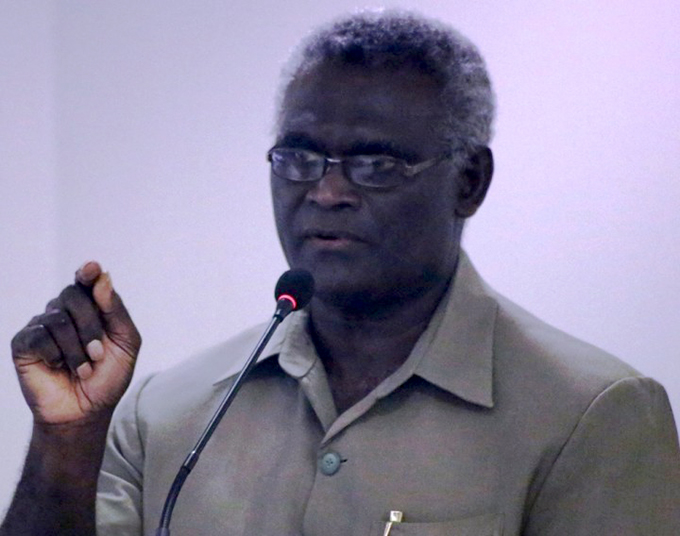 PM Sogavare out … no confidence motion passes 27-23 after “vitriolic” day in Parliament. Image: SIBC
The Solomon Islands is without a formal Prime Minister tonight after the motion of no confidence against Manasseh Sogavare passed Parliament this evening after more than nine hours of debate.
It means a new government – and almost certainly a new Prime Minister – is set to take control of the country following a frantic lobbying period which expected following today’s vote.
A vote on the new Prime Minister will eventually take place after the Governor-General is notified by Sogavare. No specific time frame has been set, however.
Independent group leader and member for Northeast Guadalcanal Dr Derek Sikua was singled out – by Sogavare himself, who accused him of treachery – as the potential next Prime Minister, however as many as five names have been thrown into the mix.
An emotional Sogavare said he would walk out with his head up “because I have done nothing wrong against the people of this country”.
The motion passed 27-23 following a vitriolic session of Parliament today, where fierce debate centred on the integrity of projects, and accusations of corruption were flung across the floor.
Accusations of kickbacks involving projects such as the Tina River Hydro Scheme, the Skyline Housing project, the fibre optic cable were central to the debate.
PM integrity questioned
The integrity of the now deposed Prime Minister was questioned multiple times during the session, and Sogavare, referring to himself in the third person as “the Prime Minister” throughout his speech, addressed almost all of them in a sprawling 90 minute oration.
Sogavare said he had been targeted by a group motivated by “deliberate lies” to “assassinate” his leadership.
He singled out Dr Sikua, and accused him of wanting to become the next Prime Minister.
“It is sad that innocent members of Parliament have become hopeless victims in this plan,” he said.
Sogavare also accused MPs of knowingly misleading the public about their intentions surrounding the anti-corruption bill, and its delay, and using it as a tactic to undermine him.
“My only mistake is that I stood up against corruption and corrupt leaders.
“A vote for yes is a vote for corruption,” he said.
Sogavare hits back
He said concerns over the issue of hiring his nephew as chief of staff screamed of hypocrisy, and questioned why it was an issue that would trigger the move on his leadership.
“We need to clean up our own backyard before we start pointing the finger.
“If you vote “I” you vote with a guilty conscience, because it’s not right,” Sogavare said.
In response Dr Sikua said he was not simply opportunistic and was doing it for the right reasons.
He said all he needed was the numbers.
The marathon session ended at 6.45pm after Parliament opened at 9.30am.
The Solomon Islands Broadcasting Corporation (SIBC) reports Sogavare refused to resign this morning after being asked by Dr Sikua on the floor of Parliament.
Consolidation efforts fail
The motion of no-confidence was received on Sunday, October 29, following the sudden resignations of several MPs and backbenchers who switched allegiance to the Opposition.
The successful motion comes despite efforts last week by Sogavare to consolidate his power and the return of MPs Moses Garu and Dickson Mua to the ranks of the Democratic Coalition for Change Government (DCCG).
Article by AsiaPacificReport.nz]]>