Page 1150

Escher x nendo will surprise, delight and challenge

]]>

Source: The Conversation (Au and NZ) – By Sasha Grishin, Adjunct Professor of Art History, Australian National University

Review: Escher x nendo, National Gallery of Victoria.


M. C. Escher (1898-1972) is an artist whose name is synonymous with mathematically challenging, optically intriguing and intellectually perplexing prints. This Dutch artist created a world of impossible objects, endless staircases and radical visual transformations that challenge our grasp of reality and our understanding of the shape of time. His woodcuts, lithographs and engravings, at least in reproduction, have become iconic, where the image is known better than the artist’s name.

In his lifetime, Escher had to wait until he was in his fifties to receive widespread popularity and only at the age of 70 did he achieve his first retrospective exhibition. Escher, with his intricate tessellations, complex geometric structures and mathematical riddles, steered a course in his art that seemed a long way from the popular trends and styles in 20th century modernism and attracted the support of fellow intellectual travellers rather than mainstream art critics and art historians.

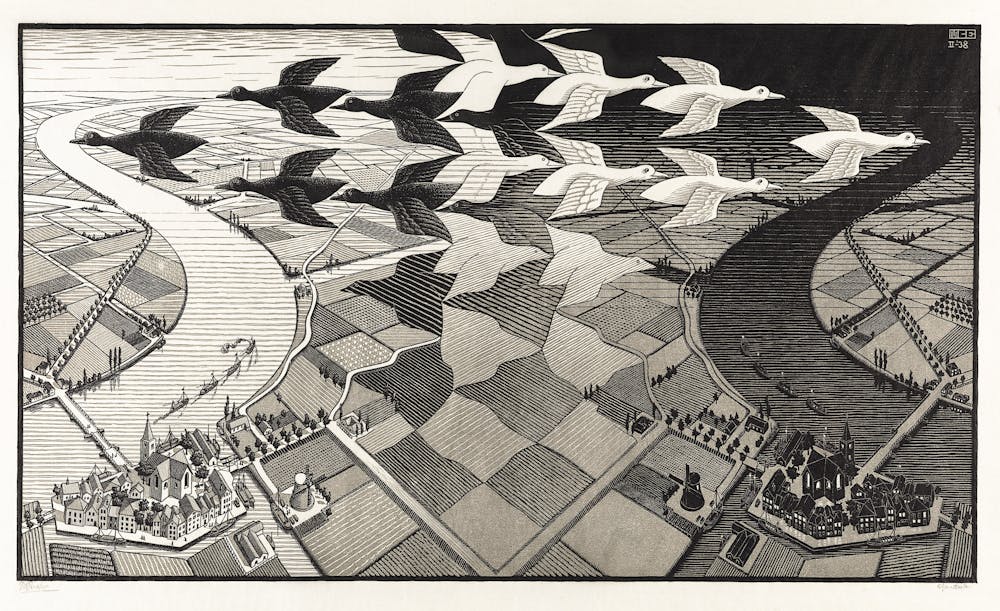
M. C. Escher, Day and night February 1938, woodcut, printed in grey and black inks Escher Collection, Gemeentemuseum Den Haag, The Hague, the Netherlands. © The M. C. Escher Company, the Netherlands. All rights reserved

In recent years, there has been an explosion of interest in the work of Escher with a hugely successful exhibition of his art held in Rio de Janeiro in 2011. A major exhibition at the Scottish National Gallery of Modern Art in Edinburgh in 2015 toured to London and throughout Italy, attracting huge crowds in each venue. The time for Escher has arrived.

The last major Escher show I saw was the substantial centennial tribute exhibition that I caught in San Diego, two decades ago. Curated by Ruth Fine from the National Gallery of Art in Washington DC, it thematically presented the development of the artist’s vision in a fairly didactic manner.

In the previous history of exhibiting Escher, there is nothing to prepare us for the shock to the senses in the National Gallery of Victoria show. Borrowing about 160 Escher prints and drawings from the Gemeentemuseum in The Hague, the NGV engaged the nendo design studio in Tokyo and its Chief Designer and Founder, Oki Sato, not to design an exhibition around Escher, but to enter into a collaborative dialogue with the artist.

M. C. Escher, Ascending and descending March 1960 lithograph, Escher Collection, Gemeentemuseum Den Haag, The Hague, the Netherlands. © The M. C. Escher Company, the Netherlands. All rights reserved

A hallmark of a great exhibition, one that revisits a repertoire of world-famous art, is that it allows us to find a new perspective on what we thought we already knew. In this exhibition, we see Escher afresh – not through the eyes of 20th century empiricism, but through those of 21st century digitally liberated design. One of the main challenges that Escher set himself was to replicate three-dimensional form on a two-dimensional surface. His intention was not to completely embrace illusionism and treat the piece of paper like a frame for a window into the world, but to continuously explore the tension between these dimensions. nendo works in reverse. The studio operates in three-dimensional real and digital worlds but wishes to replicate two-dimensional effects.

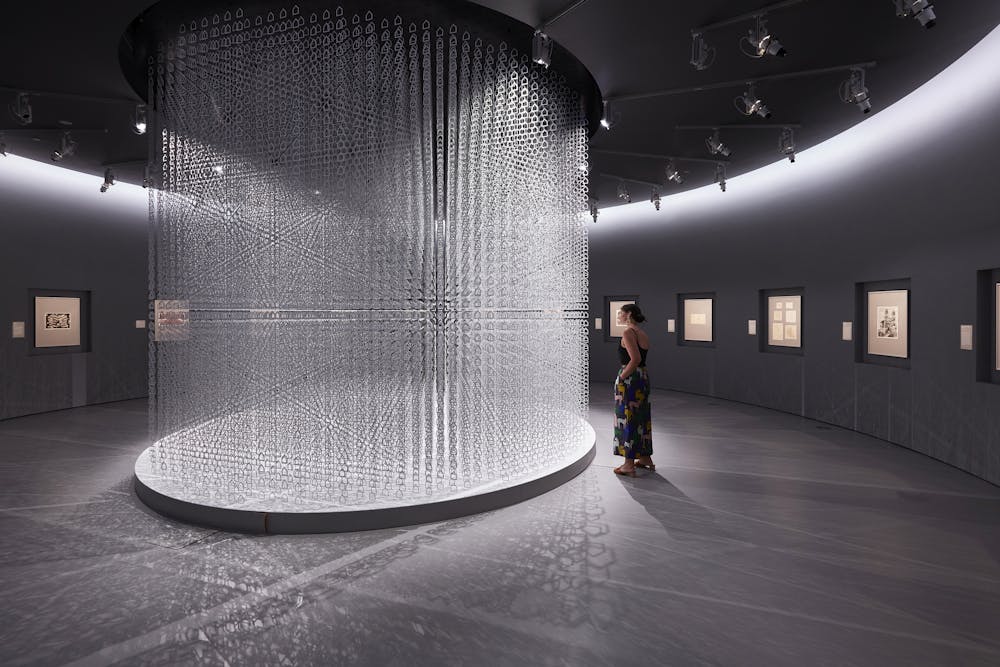
Throughout the exhibition, there are numerous visual ambushes that subvert our grasp on reality as we are invited to enter an exciting labyrinth of visual ambiguities. Oki Sato’s “icon image” for Escher is a little schematic house design through which the fantastic world of Escher is engaged. This design is replicated in many completely unexpected ways, such as a giant “chandelier” made up of tens of thousands of these tiny houses that becomes a kinetic fabric of vision and a metaphor for the distorting mirror created by Escher.

A giant ‘chandelier’ made up of tens of thousands of tiny houses, designed by nendo. Sean Fennessy

In another exhibition space, the viewer encounters a house-shaped tunnel, or an illusionistic space made up of these house designs of ever-diminishing sizes, allowing you to be initially physically, and then visually, drawn into an impossible space. This acts as a metaphor for the optical illusions so close to the heart of Escher.

The most impressive of the nendo interventions and one of the most impressive installation designs attempted in any Australian gallery, is a huge space accessible from an elevated platform where scores of these simplified houses have been constructed leading from positive to negative spaces. It is within this installed, completely immersive environment, consisting of improbable constructions, that we encounter some of the classic pieces of Escher.

M. C. Escher, Eye October 1946, mezzotint, 7th state, Escher Collection, Gemeentemuseum Den Haag, The Hague, the Netherlands. © The M. C. Escher Company, the Netherlands. All rights reserved

These immersive environments seduce and intrigue the viewer, constantly leading them into the fantastic imagination of Escher. This is less an exhibition of the prints of Escher than a physical encounter with the world of Escher and the experience of his improbable inventions.

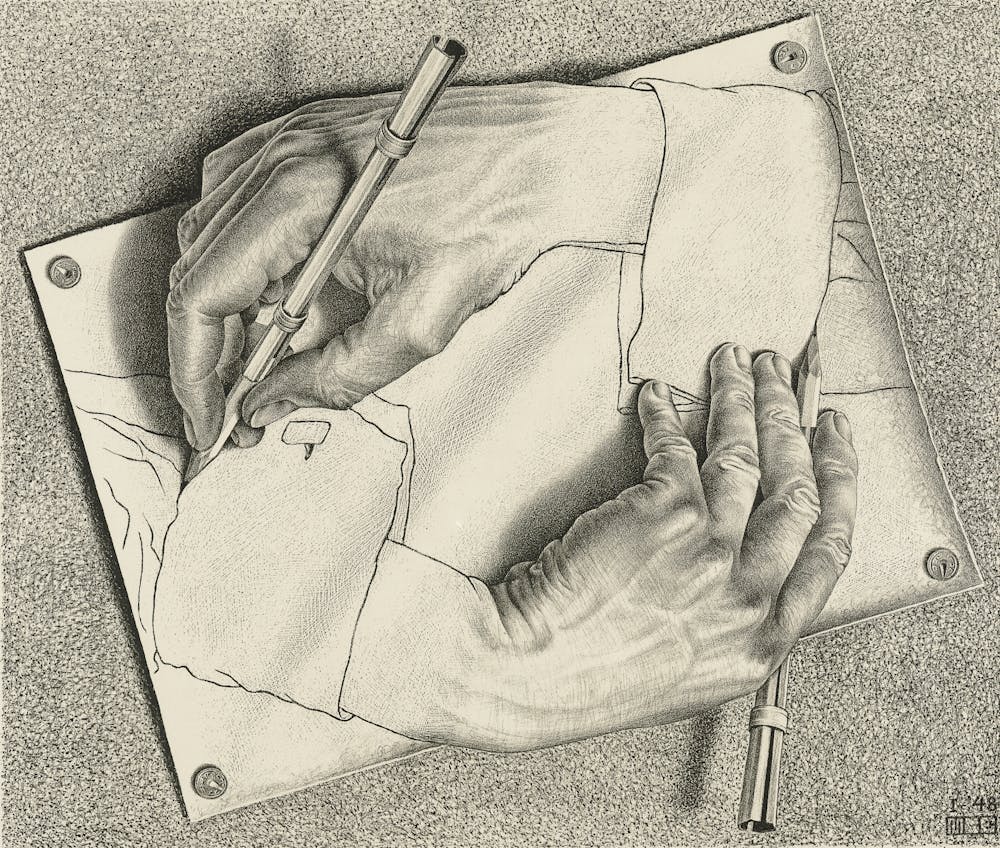
The exhibition does include most of the classic works by Escher, such as the “Drawing hands” lithograph (1948), where each hand appears to be drawing the other; the perfectly observed “Eye” mezzotint (1946) and his most famous images – the “Day and Night” woodcut (1938) and the “Ascending and Descending” lithograph (1960). A rare treat is his bewilderingly complex late woodcut “Snakes” (1969) – an exploration of interlinking shapes of infinity – now shown within the “snake house”, a serpentine, waist-high installed room replicating and reinterpreting Escher’s snake design.

M. C. Escher, Drawing hands January 1948, lithograph, Escher Collection, Gemeentemuseum Den Haag, The Hague, the Netherlands. © The M. C. Escher Company, the Netherlands. All rights reserved

This exhibition is not so much a presentation of the work of Escher, but an interpretation of his art from a very contemporary perspective. It will surprise, delight and challenge the viewer and suggests that, perhaps, this cerebral sombre Dutchman had a dry sense of humour that he hoped would be discovered in posterity.


Escher x nendo: Between two worlds is showing at National Gallery of Victoria International until April 7 2019.

ref. Escher x nendo will surprise, delight and challenge – http://theconversation.com/escher-x-nendo-will-surprise-delight-and-challenge-108036

New detections of gravitational waves brings the number to 11 – so far

]]>

Source: The Conversation (Au and NZ) – By David Blair, Emeritus Professor, ARC Centre of Excellence for Gravitational Wave Discovery, OzGrav, University of Western Australia

Four new detections of gravitational waves have been announced at the Gravitational Waves Physics and Astronomy Workshop, at the University of Maryland in the United States.

This brings the total number of detections to 11, since the first back in 2015.

Ten are from binary black hole mergers and one from the merger of two neutron stars, which are the dense remains of stellar explosions. One black hole merger was extraordinarily distant, and the most powerful explosion ever observed in astronomy.


Read more: The search for the source of a mysterious fast radio burst comes relatively close to home


The latest news comes just a month after doubts were raised about the initial detection. In late October an article in New Scientist, headlined Exclusive: Grave doubts over LIGO’s discovery of gravitational waves, raised the idea that it “might have been an illusion”.

So how confident are we that we are detecting gravitational waves, and not seeing an illusion?

Artist’s conception shows two merging black holes. LIGO/Caltech/MIT/Sonoma State (Aurore Simonnet)

Open to scrutiny

All good scientists understand that scrutiny and scepticism is the power of science. All theories and all knowledge are provisional, as science slowly homes in on our best understanding of the truth. There is no certainty, only probability and statistical significance.

Years ago the team searching for gravitational waves with the Laser Interferometer Gravitational-Wave Observatory (LIGO), determined the levels of statistical significance needed to make a claim of detection.

For each signal we determine the false alarm rate. This tells you how many years you would need to wait before you have an even chance of a random signal mimicking your real signal.

The weakest signal detected so far has a false alarm rate of one every five years, so still there is a chance that it could have been accidental.

Other signals are much stronger. For the three strongest signals detected so far you would have to wait from 1,000 times to 10 billion billion times the age of the universe for the signals to occur by chance.

Knowing what to listen out for

The detection of gravitational waves is a bit like acoustic ornithology.

Imagine you study birds and want to determine the population of birds in a forest. You know the calls of the various bird species.

When a bird call matches your predetermined call, you jump with excitement. Its loudness tells you how far away it is. If it was very faint against the background noise, you may be uncertain.

But you need to consider the lyre birds that mimic other species. How do you know that sound of a kookaburra isn’t actually made by a lyre bird? You have to be very rigorous before you can claim there is a kookaburra in the forest. Even then you will only be able to be confident if you make further detections.

In gravitational waves we use memorised sounds called templates. There is one unique sound for the merger of each possible combination of black hole masses and spins. Each template is worked out using Einstein’s theory of gravitational wave emission.

In the hunt for gravitational waves, we are searching for these rare sounds using two LIGO detectors in the US and a third detector, Virgo, in Italy.

To avoid missing signals or claiming false positives, the utmost rigour is needed to analyse the data. Huge teams look over the data, search for flaws, criticise each other, review computer codes and finally review proposed publications for accuracy. Separate teams use different methods of analysis, and finally compare results.

Next comes reproducibility – the same result recorded again and again. Reproducibility is a critical component of science.

The signals detected

Before LIGO made its first public announcement of gravitational waves, two more signals had been detected, each of them picked up in two detectors. This increased our confidence and told us that there is a population of colliding black holes out there, not just a single event that could be something spurious.

The first detected gravitational wave was astonishingly loud and it matched a pre-determined template. It was so good that LIGO spent many weeks trying to work out if it was possible for it to have been a prank, deliberately injected by a hacker.

While LIGO scientists eventually convinced themselves that the event was real, further discoveries greatly increased our confidence. In August 2017 a signal was detected by the two LIGO detectors and the Virgo detector in Italy.

On August 17 last year a completely different, but long predicted type of signal was observed from a coalescing pair of neutron stars, accompanied by the predicted burst of gamma rays and light.

The black hole mergers

Now the LIGO-Virgo collaboration has completed the analysis of all the data since September 2015.

The ten black hole mergers.

For each signal we determine the mass of the two colliding black holes, the mass of the new black hole that they create, and rather roughly, the distance and the direction.

Each signal has been seen in two or three detectors almost simultaneously (they were separated by milliseconds).

Eight of the 20 initial black holes have masses between 30 and 40 Suns, six are in the 20s, three are in the teens and only two are as low as 7 to 8 Suns. Only one is near 50, the biggest pre-collision black hole yet seen.

These are the numbers that will help us work out where all these black holes were made, how they were made, and how many are out there. To answer these big questions we need many more signals.

Graphic showing the masses of recently announced gravitational-wave detections and black holes and neutron stars. LIGO-Virgo / Frank Elavsky / Northwestern

The weakest of the new signals, GW170729, was detected on July 29, 2017. It was the collision of a black hole 50 times the mass of the Sun, with another 34 times the mass of the Sun.


Read more: Explainer: why you can hear gravitational waves when things collide in the universe


This was by far the most distant event, having taken place, most likely, 5 billion years ago – before the birth of Earth and the Solar system 4.6 billion years ago. Despite the weak signal, it was the most powerful gravitational explosion discovered, so far.

But because the signal was weak, this is the detection with the false alarm rate of one every five years.

LIGO and Virgo are improving their sensitivity year by year, and will be finding many more events.

With planned new detectors we anticipate ten times more sensitivity. Then we expect to be detecting new signals about every five minutes.

ref. New detections of gravitational waves brings the number to 11 – so far – http://theconversation.com/new-detections-of-gravitational-waves-brings-the-number-to-11-so-far-107962

View from The Hill: Craig Kelly triumphs in the ‘outwit, outplay, outlast’ game of Survivor

]]>

Source: The Conversation (Au and NZ) – By Michelle Grattan, Professorial Fellow, University of Canberra

Rebel right wing Liberal Craig Kelly is a paradox – a man who chronically lacks the numbers but possesses the power to force prime ministers to protect him.

On Monday, fresh from a G20 where he was less than feted, Scott Morrison heavied a few moderates on the NSW Liberal executive, and a wobbly cross-factional deal to preserve Kelly held.

In the process former prime minister Malcolm Turnbull’s nose was bloodied. Turnbull had tried to persuade the moderates to veto the endorsement, which would have pushed Kelly to a preselection ballot he’d have lost.

Turnbull’s foray was counter-productive, for the party and himself. Moderate backbencher Trent Zimmerman told the ABC that “Malcolm’s intervention made it hard for the executive to do anything other than what they did”.

Though once Morrison’s authority was on the line, it could do little but what he wanted.

It was very different from 2016 when Turnbull urged support for Kelly, writing that he had “a fine reputation for standing up for his local constituents and was unafraid of taking on controversial issues”.

Back then, pressure from Turnbull led Kelly’s opponent Kent Johns to agree not to stand for the preselection.

Johns kept up his branch numbers and prepared for another tilt. But lightning struck twice.

In a tweet on Monday that seemed remarkable for its restraint Johns, who is a NSW Liberal vice-president, said, “While disappointed, I respect and accept the Party’s decision, and will continue to serve the Party and proudly campaign for the re-election of the Coalition Govt”.

Before the last election supporters of Kelly were quoted as warning “a challenge against him would send the message the party is becoming a version of the Labor Party.” Kelly’s backers never let up on referring to Johns’ Labor background.

This year, the times suited Kelly. The right is strong within the party. And with the Morrison government now dealing with a hung parliament, the risk that a disendorsed Kelly could defect to the crossbench, and run as an independent, loomed large.

Morrison asserted on Thursday that the possibility of Kelly going to the crossbench had “never been the subject of our conversations.”

It didn’t have to be – the threat has hung in the air for months – although Kelly has been all over the place in his comments.

For example in May the ABC reported Kelly was “understood to have told local members that he will resign from the Coalition and sit as an independent, if the ‘higher powers that be’ do not secure his nomination’. But he’s now told Sky News he will remain a Liberal no matter what happens.”

Kelly is a favourite of the right wing commentariat.

In 2016 Alan Jones said: “Let me say to Kent Johns and anyone else who’s thinking of standing for the preselection out there and to put a torpedo under this bloke. You’d better pull your head in, Kent Johns. Because I’ll tell you what: if you put your head up, there’ll be a hell of a story that’ll be told about you, Mr Johns.”

On Sunday night Sky’s Paul Murray went through Turnbull’s tweets on the Kelly preselection, branding them “lies”.

Kelly has had a special place on Sky, with so many appearances his colleagues joke he must have a sleeping bag there.

As chair of the Coalition’s backbench energy and environment committee, a spruiker for coal, and close to Tony Abbott, Kelly ran a constant and unhelpful commentary on the Turnbull government’s attempt to get an energy policy together.

He helped kill the NEG (and thus Turnbull’s prime ministership) – he was one of those threatening to cross the floor if the associated legislation on emissions went ahead.

Turnbull is correct when he says that overriding a local preselection contradicts the recent push by the right of the party for a more democratic structure.

This point isn’t negated by the fact that the preselection panel Kelly would have faced was a transition one – changes that have been made to the system are not fully operating yet. It would have been a more democratic preselection than the executive deciding to have no ballot at all.

It is reasonable for some Liberal women, and others, to compare the treatment of Kelly with that of Jane Prentice, a moderate from the Queensland LNP.

When she lost a preselection in May, there was no special fix, despite the fact she was an assistant minister. Prentice did not threaten to go to the crossbench. She’s now quietly on the backbench serving out her term.

There are multiple messages in the Kelly affair. They are about the power of the right; the willingness to abandon process (the closeness to an election is no excuse – the Kelly preselection should have been held months ago), and the desperation of the Prime Minister.

Postscript: In the Senate on Monday Labor’s Glenn Sterle asked members of the public observing proceedings, “How many people in the gallery respect your politicians? Put your hand up if you do.” No hands went up.

ref. View from The Hill: Craig Kelly triumphs in the ‘outwit, outplay, outlast’ game of Survivor – http://theconversation.com/view-from-the-hill-craig-kelly-triumphs-in-the-outwit-outplay-outlast-game-of-survivor-108097

Adani’s new mini version of its mega mine still faces some big hurdles

]]>

Source: The Conversation (Au and NZ) – By Samantha Hepburn, Director of the Centre for Energy and Natural Resources Law, Deakin Law School, Deakin University

Indian mining multinational Adani has announced that it will self-fund a significantly smaller coal mine in the Galilee Basin, after failing to secure finance from more than 30 domestic and international banks and lenders.

Federal Resources Minister Matt Canavan has described Adani as a “little Aussie battler” and praised the newly scaled-down project’s purported regional economic benefits.

The scaling down of the project has been extensive. Adani Mining chief executive Lucas Dow said the mine will cost A$2 billion and initially produce up to 15 million tonnes of thermal coal per year, with plans to ramp production up to 27.5 million tonnes per year.

That is far more modest than the A$16.5 billion investment in digging up 60 million tonnes of coal a year which the company first announced in 2010. The original plan was to transport the coal along a new 388km rail line to a specially built terminal at Adani’s Abbot Point coal port, for export to India. Under the scaled-down version of the project, Adani will need to secure access to existing rail infrastructure.


Read more: Infographic: here’s exactly what Adani’s Carmichael mine means for Queensland


But there is still no guarantee that the mine will necessarily go ahead. Opening a new coal mine – even one with a relatively modest A$2 billion price tag – is socially and environmentally irresponsible, given the urgency with which the Intergovernmental Panel on Climate Change says we need to reduce global greenhouse emissions, the fact that Australia is not currently on track to meet its own emissions targets, and of course the fact that 2018 is on course to become the fourth-hottest year on record.

The economics barely stack up either. A recent IEEFA report indicated that coal is facing a terminal decline as Asian markets make the transition to cheaper and more efficient renewable alternatives. Existing thermal coal power in India costs US$60-80 per megawatt-hour, roughly double the cost of new renewable generation. The Mundra coal plant, where much of the Adani coal was destined, is already operating under capacity and has been closed for significant periods.

Adani has decided not to proceed with its initially planned 388km rail link, and will instead aim to use the existing Aurizon rail infrastructure. However, there is a 200km gap in this link which will cost a significant amount to bridge – albeit almost certainly much less than the A$2.3 billion cost of the originally planned railway. Aurizon Network is legally obliged to consider Adani’s access application, but has not yet assessed and approved it.

Environmental and Indigenous issues

Then there are the existing and significant concerns regarding Adani’s environmental management of issues such as water contamination in the Caley Valley Wetlands near the Abbot Point terminal. These will not disappear just because the project has been revised.


Read more: Latest twist in the Adani saga reveals shortcomings in environmental approvals


Gaining the consent of Traditional Owners will also be crucial, yet the 12-member native title representation group is split down the middle. Adani’s existing Indigenous Land Use Agreement has been appealed in the High Court by the Wangan and Jagalingou people, on the basis that the group has not genuinely consented to the agreement, and that overriding native title to make way for a coalmine is socially and culturally regressive. If the court does not uphold the agreement, this would create profound difficulties for the project as they may not be able to proceed with the development of the coal mine to the extent that it interferes with Indigenous landholdings.

So, while the decision of Adani to self-fund a scaled-down coalmine in Queensland might indicate determination, it also suggests a resistance to, and misunderstanding of, a rapidly changing energy sector and the broader social and environmental responsibilities that this change necessitates.

ref. Adani’s new mini version of its mega mine still faces some big hurdles – http://theconversation.com/adanis-new-mini-version-of-its-mega-mine-still-faces-some-big-hurdles-108038

Explainer: what is nitrous oxide (or nangs) and how dangerous is it?

]]>

Source: The Conversation (Au and NZ) – By Stephen Bright, Senior Lecturer of Addiction, Edith Cowan University

Media reports last week linked the use of “nangs” to the death of a teenager at schoolies week on the Gold Coast. Hamish Bidgood died when he fell from a balcony. He and his friends had reportedly been using “nangs” that day.

Nangs is a slang term for nitrous oxide, an anaesthetic that has been used for more than 100 years. Most people probably know it as laughing gas.

In a medical setting, it is usually inhaled, mixed with oxygen, through a small mask that fits over your nose. It is generally used to help you relax during procedures that don’t require a general anaesthetic, such as childbirth and minor dental surgery.

It has been used to help people withdraw from alcohol – with mixed results.


Read more: Weekly Dose: from laughing parties to whipped cream, nitrous oxide’s on the rise as a recreational drug


Nitrous oxide is also used as a propellant to make whipped cream, sold at supermarkets for around A$10 for a box of ten canisters, and in the automotive industry to improve engine performance.

It has been used recreationally since the late 1700s, when British aristocrats held “laughing gas parties”. With the expansion of its use in medical settings in the late 1880s, and hence its availability, it became more popular as a recreational drug.

What are the effects?

Nitrous oxide provides a short-lived (20 second) high, in which people who use it feel euphoria and relaxation. They can also feel dizziness, have difficulty thinking straight, and fall into fits of laughter.

In higher does, some people report a sense of floating and dissociation of the mind from the body, which is why in medical circles it is referred to as a dissociative anaesthetic.

How dangerous is it?

If a person has small infrequent doses, there is a low risk of significant problems with this drug.

It is very rare to overdose from recreational use of nitrous oxide, but it can affect coordination and judgement. Overdose deaths have been reported in the United Kingdom and United States but we are not aware of any in Australia.

Nitrous oxide is the seventh most popular drug worldwide, excluding caffeine, alcohol and tobacco. Lenscap Photography

Given the effects on coordination and dizziness, it shouldn’t be used in risky situations and it’s advisable to have a person present who isn’t using.

In very large doses, without the addition of oxygen, it can cause loss of blood pressure, fainting and even death by hypoxia (oxygen deficiency).

Chronic, regular heavy use is very rare, but can lead to a vitamin B12 deficiency. B12 is essential for good brain functioning and if left untreated can lead to irreversible neurological problems.

How widespread is its use?

Given its easy availability as whipped cream bulbs, the drug seems to be growing in popularity among young people.


Read more: Three charts on: Australia’s changing drug and alcohol habits


Recent media stories have reported a “nang epidemic”. One newspaper claimed schoolies have been spending thousands of dollars on nitrous oxide. But the story seems to be based on a single Facebook post in which one alleged school leaver said they had spent “A$49,000 on nangs”, which equates to about 49,000 bulbs. It’s likely he was embellishing for his Facebook audience.

We don’t know for sure how many young people use this drug, or how often. Our best data source for population drug trends in Australia, the National Drug Strategy Household Survey, doesn’t specifically ask about nitrous oxide use.

Respondents to the Global Drug Survey put nangs as the seventh most popular drug worldwide, excluding caffeine, alcohol and tobacco.

Should we ban this drug?

Concern about the behaviour of youth is not new, and moral panic about drugs, in particular, is often part of this perennial worry about young people.

It is well documented that the media can influence perceptions and interest in drug use, and poor media reporting can work as an advertisement for drugs, piquing curiosity and normalising use.

The concern is that media-driven panic about drugs can create a perception that more people are using the drug than they actually are, and when teens think “everyone” is doing it, they are more likely to want to do it too.


Read more: Weekly Dose: from laughing parties to whipped cream, nitrous oxide’s on the rise as a recreational drug


Research has shown that interest in a drug peaks after widespread media coverage and that restricting the availability can lead to increased use.

Prohibiting drugs does not prevent people using them, and more harmful unregulated products can emerge. Alcohol Prohibition in the 1920s, for example, merely led to demand for illicit supply that had high alcohol content and contained impurities that caused blindness, paralysis and death.

So banning nangs could cause more harm than it prevents. And it could lead to some very disgruntled whipped cream fans as well.

ref. Explainer: what is nitrous oxide (or nangs) and how dangerous is it? – http://theconversation.com/explainer-what-is-nitrous-oxide-or-nangs-and-how-dangerous-is-it-108019

Indonesian police arrest more than 500 over West Papua flag demos

]]>
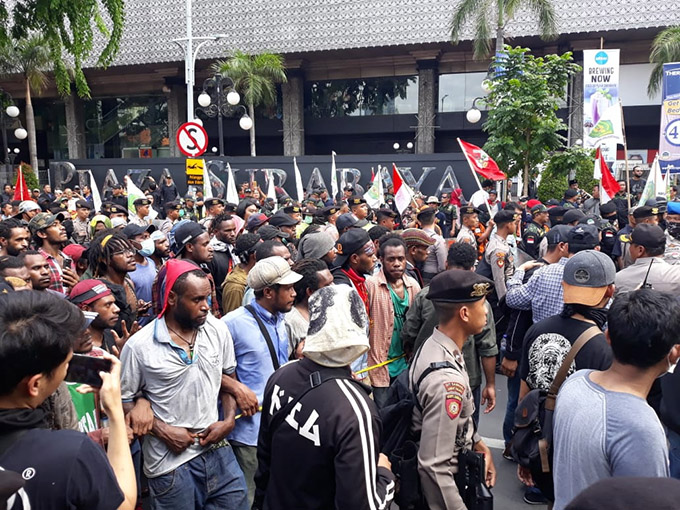
Hundreds of Papuan Students Alliance (AMP) in march in Surabaya to commemorate December 1, a day they consider to be West Papua liberation day, on Saturday. Image: Wahyoe Boediwardhana/jakarta Post

By Arnold Belau in Jayapura and Wahyoe Boediwardhana in Surabaya

More than 500 Papuans in several cities across Indonesia and West Papua were arrested following rallies at the weekend marking December 1 to commemorate what many Papuans claim to be the birth of West Papua nation in 1961.

The lawyer of the arrested Papuans, Veronica Koman, said in a statement on Saturday that 537 people were arrested in Kupang in East Nusa Tenggara, Ternate in North Maluku, Manado in North Sulawesi, Makassar in South Sulawesi, Jayapura, Asmat and Waropen in Papua and Surabaya in East Java.

Among the total, 322 were arrested in Surabaya.

READ MORE: Nationalist militia attack Papuan rally in Surabaya

In Papua, 90 people were arrested in separate places and times.

On Friday, a day before the rallies, joint forces of the Indonesian Military and the National Police searched the headquarters of the National Committee for West Papua (KNPB) in Kampung Vietnam in Jayapura.

-Partners-

The joint force also arrested Larius Heluka on Friday.

The following day, the joint force arrested 89 people in Abepura in Jayapura municipality, in separate places in Jayapura regency and in Yapen regency. As of Sunday, all 90 had been released by the police.

Kupang arrests
In Kupang, the police arrested 18 people early Saturday morning.

East Nusa Tenggara Police chief Inspector General Raja Erizman said the Papuans were not arrested but “secured and questioned”.

“I have ordered [Kupang Police chief] to treat them well,” Raja said Saturday.

In Surabaya, which saw one of the biggest December 1 rallies, a clash occurred between about 300 people grouped under the Papuan Student Alliance (AMP) and other groups that accused the Papuans of “committing treason”.

Seventeen Papuans were injured, with some sustaining head wounds.

The Papuan students in Surabaya made a public speech, calling on Papuans to not remain silent when it came to discrimination and restrictions on their freedom of speech. They also campaigned for self-determination for Papuans’ future.

However, the situation became tense when a group consisting of around 200 people from several mass organisations, including the Communication Forum of Indonesian Veterans Children (FKPPI) and Pancasila Youth (PP), arrived on the scene to stage a protest against AMP.

Clashing camps
The two camps launched verbal attacks at each other, which escalated into a physical altercation.

“At first, this rally ran peacefully, until we were blocked in front of the Grahadi building and then came the Pancasila Youth mass organization, which intimidated us and turned the situation into an [altercation],” AMP human rights lawyer Veronica Koman said after the incident on Saturday.

The East Java Police and Surabaya Police deployed 1055 police personnel, aided by two Army groups and the Surabaya Public Order Agency (Satpol PP), to disperse the two clashing camps.

Koman said the AMP had respected the aspirations of the mass organisations, but the counterprotesters should not have incited the riot by throwing bottles and sharpened bamboo at the students.

AMP spokesperson Dorlince Iyowau said the Papuans only demanded the right to decide their own fate.

“Our main demand is the right to decide our own fate, as a democratic solution for West Papua. We want Papuans to have their own political rights,” Dolince said.

‘Committing treason’
Meanwhile, PP Surabaya Secretary Baso Juherman accused the alliance of committing treason.

“The rally [by the alliance] was clearly a treasonous act. The PP took to the streets to prevent them [from committing treason], because the rally hurt Surabaya residents,” Juherman said.

The coordinator of the Commission for Missing Persons and Victims of Violence (Kontras) in Surabaya, Fatkhul Khoir, called on the release of the 322 people in a statement on Sunday.

Arnold Belau and Wahyoe Boediwardhana were reporting for The Jakarta Post.

Print Friendly, PDF & Email

Article by AsiaPacificReport.nz

G20 summit bring a truce in US-China trade relations – but it’s likely to be temporary

]]>

Source: The Conversation (Au and NZ) – By Tony Walker, Adjunct Professor, School of Communications, La Trobe University

The United States and China have arrived at a temporary truce in a trade conflict that was threatening to further destabilise world equity markets, entrench a global slowdown and cause more damage to a rules-based international order.

Agreement by US President Donald Trump and his Chinese counterpart, Xi Jinping, to allow further negotiations before threatened tariff increases on Chinese imports come into effect is a welcome development.

However, this is a temporary respite, a short-term fix, not a long-term solution to myriad trade and other tensions that have put the US and China at odds with each other.

For their own purposes and in their own interests, Trump and Xi could come away from the Argentine capital with a deal that papers over differences that extend from China’s activities in the South China Sea to its mercantilist trade policies.


Read more: Much at stake as Donald Trump and Xi Jinping meet at G20


As far as we know, China’s ruthless assertion of its sovereignty over disputed waters in the South China Sea was not a material subject for discussion in Buenos Aires except, possibly, in passing.

China’s rise and America’s relative decline ensure these global economic superpowers will continue to bump up against each other.

So, what was achieved and what are the prospects for an accord reached on the sidelines of the G20?

In their efforts to lower trade tensions and prevent a further erosion of global confidence, Trump and Xi agreed to a 90-day extension on the imposition of additional US tariffs on some US$200 billion of Chinese imports.

Trump had threatened to increase tariffs from 10% to 25% on an initial batch of Chinese imports from January 1. He had also flagged his intention to impose levies on another US$267 billion worth of imports if progress was not made in resolving broad-based trade differences.

A joint statement laid out a timeline for continuing negotiations. It reads:

Both parties agree that they will endeavour to have this transaction completed within the next 90 days. If, at the end of this period of time, the parties are unable to reach an agreement, the 10 percent tariffs will be raised to 25 percent.

In return for these temporary concessions, China agreed to:

… purchase a not yet agreed upon, but very substantial, amount of agricultural, energy, industrial, and other product from the United States to reduce the trade imbalance between the two countries. China has agreed to start purchasing agricultural product immediately.

China also agreed to crack down on sales of Fentanyl by making it a controlled substance. The US is battling an opioid crisis in which Fentanyl is a lethal component.

In retaliation for US trade actions, China had imposed duties on US$110 billion of imports. A principal component of this is soybeans, effectively killing one of America’s more lucrative export markets.

Trump has been under huge pressure from his Mid-Western rural heartland over a collapse in the Chinese market for American agricultural products.

The two sides also agreed to address structural problems in the trading relationship. These extend to five areas – forced technology transfer, intellectual property protection, non-tariff barriers, cyber intrusions and cyber theft.

These are highly complex issues and unlikely to be resolved in the short term, if at all.

In the wash-up of the Xi-Trump discussions it appears China has got more out of the deal than the US – at least for now. It has secured a stay of execution for the implementation of tariff increases and forestalled, for the time being, tariffs on an additional bloc of Chinese exports.

In return, it has agreed to buy unspecified quantities of US products and to talk about differences.

Trump’s willingness to compromise after months of bombast reflects pressures from a shellshocked grain-producing constituency and alarm on Wall Street at prospects of a full-blown trade war.

From Beijing’s perspective, China has demonstrated that its growing economic heft has enabled it to avoid the appearance of yielding to US pressure.

If not a “win-win” for China – as Chinese officials are fond of saying – it is certainly not a “lose-lose”.

In a statement at odds with months of fire-breathing rhetoric over China’s allegedly perfidious trade practices, Trump hailed his understanding with Xi. He said:

This was an amazing and productive meeting with unlimited possibilities for both the US and China.

For their part, Chinese officials were more circumspect.

Foreign Minister Wang Yi said the talks were conducted in a “friendly and candid atmosphere”. The presidents:

agreed that the two sides can and must get bilateral relations right… China is willing to increase imports in accordance with the needs of its domestic market and the people’s needs.

Impetus for a face-saving deal in Buenos Aires has been prompted by growing concerns about the global economy. The signs of a slowdown are clear. Trade volumes had begun to moderate in the third quarter, heightening worries of a global retrenchment.

International Monetary Fund managing director Christine Lagarde at the G20 summit. AAP/EPA/G20 handout

On the sidelines of the G20, the International Monetary Fund’s managing director, Christine Lagarde, noted:

Pressures on emerging markets have been rising and trade tensions have begun to have a negative impact, increasing downside risks.

In its October Outlook statement, the IMF warned about threats to global growth due to trade disturbances.

In their final communique, G20 leaders danced around contentious issues on trade to accommodate American objections to having the word “protectionism” inserted in the document.

In the end, participants settled on the need for reform of the World Trade Organisation to describe a world trading system that is falling short of its objectives. Washington has been agitating for a review of the WTO to strengthen its dispute resolution and appeal procedures.

The US has also objected to a continuing description of China as a developing country, with concessions that enable it to take advantage of less developed country status in its access to global markets.


Read more: As tensions ratchet up between China and the US, Australia risks being caught in the crossfire


On climate change, Washington separated itself from the other G20 members. All, except the US, reaffirmed their commitment to the Paris Agreement. The US announced in 2017 it was pulling out of Paris.

Foreign policy specialists will be sceptical about a de-escalation of trade hostilities given the range of issues bedevilling the US-China relationship.

Reflecting a hardening of US attitudes towards China, and in contrast to the optimism that had prevailed for much of the past two decades, Ely Ratner in Foreign Affairs notes:

Even if tariffs are put on hold, the United States will continue to restructure the US-China economic relationship through investment restrictions, export controls, and sustained law enforcement actions against Chinese industrial and cyber-espionage.

At the same time, there are no serious prospects for Washington and Beijing to resolve other important areas of dispute, including the South China Sea, human rights and the larger contest over the norms, rules and institutions that govern relations in Asia.

A stiffening view in the US towards China is shared more or less across the board. In those circumstances, a temporary ceasefire in Buenos Aires is unlikely to be sustained.

ref. G20 summit bring a truce in US-China trade relations – but it’s likely to be temporary – http://theconversation.com/g20-summit-bring-a-truce-in-us-china-trade-relations-but-its-likely-to-be-temporary-108017

Curious Kids: What existed before the Big Bang? Did something have to be there to go boom?

]]>

Source: The Conversation (Au and NZ) – By Jake Clark, PhD Candidate, University of Southern Queensland

This is an article from Curious Kids, a series for children. The Conversation is asking kids to send in questions they’d like an expert to answer. All questions are welcome – serious, weird or wacky! You might also like the podcast Imagine This, a co-production between ABC KIDS listen and The Conversation, based on Curious Kids.


What existed before the big bang? Did something have to be be there in order to go boom? – Ethan, 10, Sydney.


Ethan, what a question. To be truthful, we’re not sure what was before the Big Bang. The whole idea of “before” is not as simple as it sounds – as we’ll soon discover.

But before we get into a total head spin of answering your great question, let’s step all the way back to the beginning of our Universe nearly 14 billion years ago.


Read more: Curious Kids: what started the Big Bang?


The Big Bang was not an explosion of metal shards, like in a firework, but the rapid expansion of space itself. Alex Sims/Wikimedia Commons

A quick recap on the beginning

The Big Bang wasn’t actually a bang. It was not an explosion of metal shards, like in a firework, nor any material; but the rapid expansion of space itself.

At the start, the Universe was infinitely small. Everything around us – the stuff that makes up the galaxies, stars, planets, me and you – was all squished together, creating what is known as a singularity. A singularity has been defined as “a point in space-time where the laws of physics as we know them break down.”

For whatever reason, this singularity rapidly expanded into the Universe we now call home.

After this rapid expansion, our Universe started to cool down – leaving a pattern on the Universe known as the Cosmic Microwave Background.

The leftover radiation from the Big Bang tells us how our Universe began and might lead us to what came before it. NASA/ WMAP Science Team

So if the Big Bang caused the Cosmic Microwave Background, did something else cause the Big Bang?

The time before time?

Your question is nailing an important idea in physics, which we call causality.

In the world we observe around us, all effects must have a cause. Take, for example, a fallen tree. Maybe a vicious storm knocked the tree down. Or maybe it was cut down by a chainsaw-weilding madman.

But if you were to zoom down into the quantum world of atoms (the tiny building blocks of everything), you would notice something very different. In this quantum world, effects can occur without any cause whatsoever.

The timeline of our universe. NASA/WMAP Science Team

Long ago in the distant past, our entire Universe was microscopic – just like an atom. Since some effects in the microscopic world do not require causes, it is possible that there was no cause to start off the Big Bang!

And things can get even weirder. It is also possible that time did not exist before the Big Bang. So it may not make any sense to ask what happened “before”. It would be like asking “What part of Earth is north of the North Pole?”. The North Pole is the most northern point on Earth, and so there is nowhere north of it.

A philosophising polar bear may have already solved the conundrum of ‘what is north of the North Pole?’ U.S. Navy photo by Chief Yeoman Alphonso Braggs

But what if something was there before the Big Bang happened?

Beginning the beginning

Some scientists suggest our Universe is the recycled result of another Universe dying and collapsing in on itself. This is known as “the Big Bounce”. This collapsing Universe would meet back to a singularity before bouncing back out, causing the Big Bang and starting off a brand new universe.

In that case, gravity would not only need to stop the Universe from stretching, but bring everything within it back to one single point. Unfortunately, current observations show us that our Universe won’t follow this trend, as it’s stretching out faster than ever before.

Or maybe our Universe is at the other end of a black hole called a white hole. White holes are the hypothetical “opposites” of a black hole, spewing material into space rather than sucking material in.

Could our whole universe really be at the other end of a black hole?

Or maybe our Universe bubbled out of an even bigger universe! The Cosmic Microwave Background image earlier on shows the leftover radiation isn’t the same all over, but has lumps and bumps concentrated in certain areas. Some cosmologists – people who research how our Universe started – suggest our Universe is one of many universes in the grand multiverse.

The fact is, we don’t really know for sure what started the Big Bang. Maybe you’ll be the very person to answer your question. If you find out, can we please be the first to know?


Read more: Curious Kids: Does space go on forever?


Hello, curious kids! Have you got a question you’d like an expert to answer? Ask an adult to send your question to curiouskids@theconversation.edu.au

CC BY-ND

Please tell us your name, age and which city you live in. We won’t be able to answer every question but we will do our best.

ref. Curious Kids: What existed before the Big Bang? Did something have to be there to go boom? – http://theconversation.com/curious-kids-what-existed-before-the-big-bang-did-something-have-to-be-there-to-go-boom-103742

PNG’s post-APEC technology dream leaves rural sector far behind

]]>

By Pauline Mago-King

It has only been two weeks since the conclusion of the Asia-Pacific Economic Cooperation (APEC) summit, yet much has transpired – to the dismay of host country Papua New Guinea.

Papua New Guinea’s trajectory to this monumental event has been one involving great strides from the moment it secured the bid to host APEC in 2013.

In preparation for the summit, the PNG government stretched its expenditure to clean up the nation’s capital of Port Moresby – a move to improve international perceptions that will eventually translate into investment opportunities.

READ MORE: PNG – like no summit on earth

One can see this “clean-up” in Port Moresby via newly sealed roads, the 145 million kina (NZ$62 million) upgrade of Jackson’s International Airport, and the extravagant APEC Haus and Convention Centre.

Not to mention the controversial boulevard consisting of a six-lane road, outside the National Parliament.

-Partners-

Prior to the 21 member states’ two-day meeting, Prime Minister Peter O’Neill described the event as one that would place PNG on the world map by boosting tourism and lucrative resource project agreements.

These advantages could lead to more employment, especially in an economy where only 15 percent of the population are employed in the formal sector.

Additionally, there is an opportunity to tackle skills shortages within PNG.

Yet for all the economic advantages that await PNG, a myriad of issues continue to beset the country and this has been magnified through APEC.

Questionable governance
The cost of rehabilitating PNG’s waning image has ultimately placed the people’s needs on the backburner, even after Australia’s donation of $100 million and China giving $35 million.

Currently, polio has re-emerged with three new cases having been reported just last week, now bringing the total to 25 and one death so far.

Apart from polio, tuberculosis continues to be a formidable challenge for PNG’s health system.

This is the bitter reality for most Papua New Guineans who lack access to basic health services.

While Port Moresby has new roads, much of the rural areas in PNG remain disconnected with services nowhere to be found.

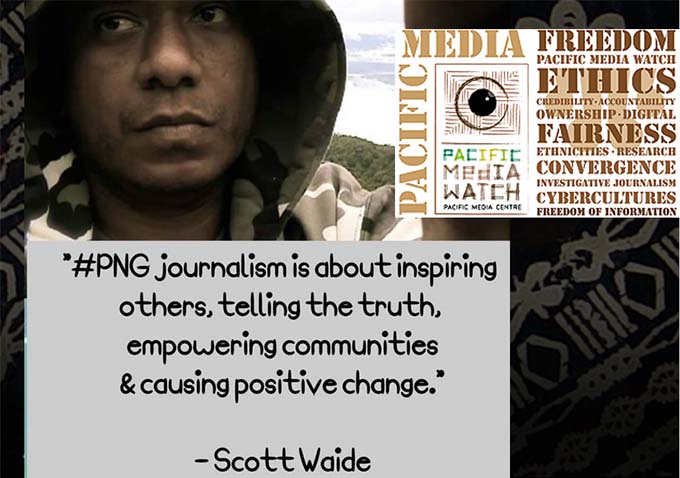
Granted, if there are aid posts and clinics, it is likely that medicine is unavailable, as exemplified by prominent journalist Scott Waide.

Media freedom barriers
Apart from exacerbating health issues, PNG’s media freedom faces barriers which have been amplified throughout the APEC summit coverage.

Case in point: PNG journalists were not allowed to cover Chinese President Xi Jinping’s dinner with colleagues from eight Pacific nations.

The suspension-turned-reinstatement of Scott Waide amid his airing of a report on the government’s spending, particularly about the controversial 40 Maseratis.

His reinstatement, however, is a compelling testament to many Papua New Guineans’ frustration with the state of governance, particularly at the grassroots level.

A Maserati luxury sedan as portrayed in the controversial news item shown in EMTV. Image: EMTV screenshot

While Port Moresby came to a standstill for the 2018 APEC Summit, villages throughout PNG were occupied with their own routines.

Life is not as simple as it used to be and this rings true for villages like Efogi.

Nestled on the slopes of the Owen Stanley Ranges, Efogi receives trekking tourists embarking on the Kokoda Trail.

In all its years of participating in the “Kokoda experience”, Efogi seems untouched from the hustle and bustle in Port Moresby.

Rural realities
Papua New Guinean writer Rashmii Bell, who also has a background in psychology and criminology, recently trekked along the Kokoda where she was able to observe the state of development in rural areas such as Efogi.

“What’s being developed in Moresby is not translating to the rural population – there is a huge difference. We want to wait and see what happens after [APEC], but we have valid reason to pre-empt based on the development that has happened in the past 18 months where Moresby has transformed whereas the rest of PNG has not.”

Although acting as a campsite for trekkers, Efogi had no access to electricity despite being home to the main airstrip for the Kokoda Track.

The only semblance of electricity is a newly donated generator that is rarely used due to the difficulty in purchasing and transporting fuel.

Aside from that, the health centre still relies on the donation of medical supplies.

With the summit’s closure, Rashmii’s interaction with communities like Efogi point out the problematic nature of the PNG government’s sound bites on a stronger economy.

This is where little attention has concentrated on empowering the majority of Papua New Guineans in informal sectors like trek tourism.

The Kokoda Track … trekking tourism is a neglected sector with villagers supporting the industry living an exploited existence. Image: kokodatrack.net

‘Trekking carriers’
For example, most men from villages like Efogi and others along the trail turn to “trekking carriers” as a form of employment but are often exploited in terms of their safety and wellbeing.

“Your life is in your carrier’s hand – that is how the tourism operation is running at the moment. Because we are putting that pressure on the carriers, you can see by their demeanour that they are very stoic.

“For them, it is a huge ask to be putting your life in someone’s hands. And as much as they say ‘that is our job’, at the end of the day we want to have a tourism industry where we are promoting ethical tourism,” said Rashmii.

As for women, they are excluded from gaining the financial rewards that this informal economy has to offer, which reiterates the resounding gender inequity in communities around PNG.

While PNG’s participation in APEC hopes to garner “digital breakthroughs”, it is debatable as to how rural communities can be included when technological infrastructure is absent, literacy is low and policies that protect and empower the people are void.

For communities like Efogi, life remains the same without any inkling of “APEC”.

APEC reservations
Although the carriers who trekked with Rashmii did not utter one word on APEC, the same cannot be said for those in Port Moresby.

When the 21 APEC member countries completed their intergovernmental talks, people like Cathy Smith felt anxious about what would transpire.

She described the lead up to the event as one of confusion.

The 28-year-old said she could not see any positive changes taking place anytime soon.

Life is already hard as it is, even with her cleaning job of five years where she earns only K3.50 (NZ$1.50) an hour – a rate that barely supports a normal standard of living in PNG.

“For my community, we will just listen and follow what they say… I’m seeing all the changes in the city but my own village has no services.”

Although the opportunities for development remain to be seen, Papua New Guineans like Cathy will go through the usual struggle to make a living in an economy that is already waning.

High living conditions, health budget cuts and the re-emergence of diseases such as polio and leprosy are just some of the many challenges being faced.

Hopefully, the PNG government will tackle these and other prevalent issues, particularly with the aim of development for its people.

Perhaps a good reference point to take from the APEC summit is human resource development, as stated by Rashmii Bell.

“For development to take place, you need that interaction. My understanding is that APEC is technology-driven and I did not even have reception along the Kokoda trail until we climbed up to the highest point… Technology will hopefully improve the economy but only for those who have access to it.”

Pauline Mago-King is a masters student based at Auckland University of Technology and is researching gender-based violence in Papua New Guinea. She compiled this report for the Pacific Media Centre.

Print Friendly, PDF & Email

Article by AsiaPacificReport.nz

Turnbull versus Morrison in Liberal crisis over Craig Kelly

]]>

Source: The Conversation (Au and NZ) – By Michelle Grattan, Professorial Fellow, University of Canberra

Scott Morrison faces a major Liberal party crisis after Malcolm Turnbull moved to torpedo the Prime Minister’s plan to protect the preselection of controversial rightwing backbencher Craig Kelly.

Morrison wants the NSW Liberal executive to re-endorse sitting NSW federal members so Kelly does not have to face a ballot in which he would be defeated.

Kelly has threatened to run as an independent if he loses preselection and also at times has left the way open to go to the crossbench.

The Coalition is already in minority government after the loss of Wentworth and last week’s defection of Julia Banks.

Kelly has lost the support of his local branch members, and the moderates have the numbers to remove him. His preselection opponent, Kent Johns, has been under pressure to pull out of the race – as he was persuaded to do before the last election to save Kelly.

Kelly was one of those who scuppered the National Energy Guarantee, in the party meltdown that ended Turnbull’s leadership. He is a constant presence in Sky and used his appearances to undermine the Turnbull position on energy.

After hearing of the save-Kelly plan Turnbull immediately began lobbying moderate executive members not to agree to the cross-factional deal. When his lobbying reached the media, he took to Twitter.

In a series of tweets he said: “Today I learned there was a move to persuade the State Executive to re-endorse Craig Kelly as Liberal candidate for Hughes in order to avoid a preselection – in other words to deny Liberal Party members in Hughes the opportunity to have their say.”

He said he had spoken with “several State Executive members to express my strong view that the Party’s democratic processes should operate in the normal way especially after such a long debate in the NSW Liberal Party about the importance of grass roots membership involvement.”

“It is time for the Liberal Party members in Hughes to have their say about their local member and decide who they want to represent them.”

“It has been put to me that Mr Kelly has threatened to go to the cross bench and “bring down the Government”. If indeed he has made that threat, it is not one that should result in a capitulation. Indeed it would be the worst and weakest response to such a threat.“

He was “strongly of the view that the normal democratic process should proceed.”

The Australian reports that Turnbull told one executive member, NSW Minister Matt Kean, that if Kelly moved to the crossbench it would “force Morrison to an early election and that will save the Berejiklian government”.

Turnbull had said that when he was PM he and Morrison had agreed to a March 2 election – before the state poll later in March but Morrison was reneging.

The Liberals believe that whichever government faces the people first in NSW will get a double whack from angry voters. Morrison indicated last week that the election would be in May after an April 2 budget.

Another NSW rightwinger, senator Jim Molan is arcing up over his dumping to an unwinnable position on the Senate ticket. Molan is also looking to Morrison to do about about his position.

“Let’s see what he does, but I’m not here to be taken for granted,” Molan told Perth radio on Sunday.

“I would make the arrogant statement that the Liberal Party needs me more than I need the Liberal Party.”

ref. Turnbull versus Morrison in Liberal crisis over Craig Kelly – http://theconversation.com/turnbull-versus-morrison-in-liberal-crisis-over-craig-kelly-108034

Yes, you can adopt a pet as a Christmas gift – so long as you do it correctly

]]>

Source: The Conversation (Au and NZ) – By Bronwyn Orr, Veterinarian and PhD candidate, University of Sydney

Have you thought about adopting a new pet for Christmas?

Far from dismissing the idea, animal welfare groups now support the practice of gifting a pet for Christmas – so long as it’s done the right way.

With less than a month to go before Christmas Day, here’s what you need to know if you’re to gift a pet a new home, plus seven tips for success.


Read more: Senate inquiry calls for tougher rules on pet food in Australia


A changing message

Opinions about pet ownership are constantly changing.

The old dog dominance theory – that says pet dogs have a pack mentality and owners should be the alpha dog – has long been debunked. Letting animals sleep on the bed is no longer taboo.

Shelters have learned that drastically reducing adoption fees does not increase the likelihood of pet re-surrender, or the level of people’s attachment to their new pet.

Now, just as shelters used to block black cat adoptions around Halloween for fear of dumping afterwards (or worse), shelters that once warned against adopting pets at Christmas are now embracing the idea.

Some shelters are even advocating this time of year can actually be a good thing for both the animal and the new family, as everyone is home to help the new pet settle in.

A Christmas gift

RSPCA Victoria is one organisation that has changed its message regarding pet adoptions at Christmas. Chief executive Liz Walker says a pet at Christmas, or a voucher for pet adoption at a shelter, can be a good idea – so long as it is not a surprise present.

Data from RSPCA Victoria supports this, with no spike in the number of surrendered pets in the months immediately after Christmas, and indeed very few surrenders seen throughout the year because of a pet being an unwanted gift.

This finding agrees with US survey results published in 2013 that found no significant association between receiving a pet as a gift and relinquishment soon afterwards.

An annual ‘cat-astrophe’

Although the number of cats entering RSPCA Victoria shelters spikes annually between November and January, this is because of kitten season.

This is the time of the year when non-desexed female cats give birth to coincide with increased warmth and availability of food. This phenomenon is replicated across the country, placing huge pressure on staff and resources at shelters due to the flood in kittens.

To help stop the enormous number of unwanted cats and dogs entering Australian shelters, it is really important to desex your animal (especially cats before kitten season).

Kittens and Christmas decorations don’t always mix. RSPCA Qld, Author provided

Why pets enter shelters

There is a misconception that most animals end up at shelters for behavioural problems or medical issues. One of the most common reasons for pet surrender in Australia is a lack of pet-friendly rental accommodation.

This is why the current push to change some tenancy laws around pet ownership is so important.

Additionally, with the rise in popularity of certain breeds such as French Bulldogs, puppy farms set up to supply these dogs are often raided due to the horrific conditions the dogs are kept in. These animals then end up in shelters.

Adopt from a shelter

We encourage all Australians considering adopting a cat or dog to visit their local pound or shelter. Sadly, it is estimated more than 175,000 dogs and cats are euthanased annually in Australia.

This figure comes from the Getting to Zero movement which incorporates euthanasia rates from shelters that publish their statistics, such as the RSPCA, and Animal Welfare League (both organisations that don’t euthanase healthy, re-homeable animals).

It also includes an estimate of the number of animals euthanased at the roughly 500 council pounds across the country. Unfortunately, most council pounds do not publish their statistics on euthanasia rates, which makes it difficult to truly assess the problem. Some do try to rehome unwanted animals.

Pets of all shapes and sizes can be found at shelters. RSPCA Vic, Author provided

Seven tips for getting a new pet

Pet ownership is a wonderfully rewarding experience, with many studies showing pet owners have improved physical and mental health and are more social. One study found that Australian ownership of cats and dogs saved taxpayers almost A$4 billion in health expenditure over one year.

So if you are considering adopting a pet this Christmas, here are some tips to consider:

  1. Positive training techniques are more effective and humane than punishment techniques. Reward animals for doing the right thing with treats rather than punishing them for doing the wrong thing.

  2. If adopting a pet for a child, remember the parent is ultimately responsible for the pet (so be prepared to take care of the animal!).

  3. Christmas decorations and ornaments such as tinsel and Christmas tree hangings make wonderful objects to get stuck in the stomach after swallowing, so keep them out of reach of pets to avoid unnecessary and expensive surgery.

  4. Dogs can get very sick with pancreatitis after consuming a fatty meal, so no feeding leftover Christmas ham or sausages.

  5. Dogs and chocolate don’t mix, so keep boxes of chocolates securely in a cupboard.

  6. You must be ready to commit both the time and money required for the lifespan of an animal, which could be up to 20 years.

  7. Consider adopting an older cat (eight years and over) or a middle-aged dog (five to eight years of age). Research consistently shows that animals in these age groups are the hardest group to re-home and hence spend the longest time in the shelter.

So if you’re ready to make the commitment, go on, visit your local shelter and make this Christmas one to remember for you or the owner of the newly adopted pet.

Consider adopting an older dog or cat from a shelter – Dookie, at 12 years of age, still loved getting into the Christmas spirit! Mark Westman, Author provided

ref. Yes, you can adopt a pet as a Christmas gift – so long as you do it correctly – http://theconversation.com/yes-you-can-adopt-a-pet-as-a-christmas-gift-so-long-as-you-do-it-correctly-105286

Generation Share: why more older Australians are living in share houses

]]>

Source: The Conversation (Au and NZ) – By Sophia Maalsen, I.B. Fell Postdoctoral Researcher, School of Architecture, Design and Planning, University of Sydney

An increasing number of older Australians are living in share housing. A relatively new group to emerge on the share-housing scene, they are choosing to share for financial reasons, but finding unexpected social benefits.

Share housing has traditionally been associated with student housing and media depictions of the share house as dysfunctional, chaotic, “He Died with a Falafel in His Hand” scenarios. But a growing number of older people are sharing housing.

This trend is part of the growth in share housing across an increasingly broad demographic as professionals aged in their 30s, 40s and onwards continue to share house or return to share housing into later life. Generation Rent is fast becoming “Generation Share”.


Read more: Moving on from home ownership for ‘Generation Rent’


The growing trend of share households is attributed to a combination of shifting social norms and a decline in affordable rental properties. This is particularly acute in our capital cities but is also evident in regional centres.

An emerging group of tenants – professionals, couples, young families and students – who cannot afford to buy or rent an entire property of their own are increasingly turning to shared occupancy as a way to afford housing. Home owners are also noted as a group for whom shared occupancy has benefits by generating extra income for mortgage repayments.

Tight budgets affect all ages

My research on share housing across all age groups shows it’s mainly driven by financial constraints. In older age, the experience of this is gendered. Although older men are sharing, women in particular are more vulnerable to significant financial constraints in old age.

Women are the fastest-growing group at risk of homelessness in Australia. Many have limited superannuation to draw upon due to time out of the workforce to raise children or manage the home. This means the ramifications of the gender wage gap are particularly visible in older life – to quote one participant, “a man is not a superannuation”.


Read more: Spirals and circles, snakes and ladders. Why women’s super is complex


A common scenario is people falling out of home ownership after divorce or a relationship breakdown. Without the family home and with limited material assets, share housing is one of a diminishing set of options for living affordably and securely.

Share housing has its challenges

Moving into share housing in later life can be an adjustment. Many older people are in share housing for the first time in their life, having previously owned their own home.

There are obvious social challenges inherent in this situation. These include learning to negotiate domestic spaces in new ways. And certainly many are vulnerable to being exploited by unscrupulous flatmates, head tenants, or landlords.

Similar to share-housing experiences among younger groups, older participants mentioned occasional household conflicts and were aware of the need for personal space.

But there are also social benefits

However, some also reflect positively on the social value of share housing. This has been an unexpected benefit for many of them. At an age when isolation and loneliness increase, this is particularly important.

Older residents value the social aspects and the new friendships that sometimes develop in share houses. Flow-on effects of this include an increase in their sense of safety and security, knowing that they are not alone should anything untoward happen.


Read more: Co-housing works well for older people, once they get past the image problem


Long-term policy challenges loom

Although share housing in older age has social benefits, its rise should prompt us to reflect critically on Australia’s housing market as well as rethinking retirement policy. Share housing is directly correlated to declining housing affordability.

These trends highlight systematic disinvestment in public and social housing for the past 30 years as well as a market that has encouraged housing as a site of investment. The result is a system that has produced housing as a site of profit rather than housing as a site of home.

For older people, the situation is particularly complex. Australia’s retirement policies promote home ownership as the pathway to a financially secure old age. That leaves the growing number of older Australians who don’t own their own home to experience increased financial stress.

The Australian Dream of the owner-occupied home is quickly becoming that – a dream rather than reality for many Australians. The cracks are starting to show. As people fall out of home ownership and the younger generations doubt they’ll ever own a home – they’re not called Generation Rent for nothing – Generation Share will present significant challenges for policy.


Read more: Home ownership foundations are being shaken, and the impacts will be felt far and wide


ref. Generation Share: why more older Australians are living in share houses – http://theconversation.com/generation-share-why-more-older-australians-are-living-in-share-houses-107183

It’s not just Newstart. Single parents are $271 per fortnight worse off. Labor needs an overarching welfare review

]]>

Source: The Conversation (Au and NZ) – By Peter Whiteford, Professor, Crawford School of Public Policy, Australian National University

Thirty years after Prime Minister Bob Hawke famously promised that by 1990 no Australian child would live in poverty, Bill Shorten has promised that, if elected, Labor will use a “root and branch review” to lift the rate of the Newstart unemployment benefit.

Two crossbenchers, Cathy McGowan and Rebekha Sharkie, want to go further.

They have introduced a private member’s bill that would create an independent commission to examine the adequacy of all social security payments other than family payments and payments to veterans.

It would make recommendations, rather than set rates.

The Government opposes it. Labor has opposed such proposals in the past. Prime Minister Scott Morrison has said he would like to increase payments, but they would be ones of his choosing – he would lift the pension before lifting Newstart.

But the pension is already much higher than Newstart, and other benefits have fallen behind by more.

What’s wrong with Newstart?

Newstart is inadequate and getting worse.

The Organisation for Economic Cooperation and Development raised “concerns about its adequacy” as long ago as 2010.

In a report on Australia it suggested that not only it might be insufficient to live on, it also might be insufficient to enable those on it to look for work.

The relatively low net replacement rate in the first year of the unemployment spell raises issues about its effectiveness in providing sufficient support for those experiencing a job loss, or enabling someone to look for a suitable job.

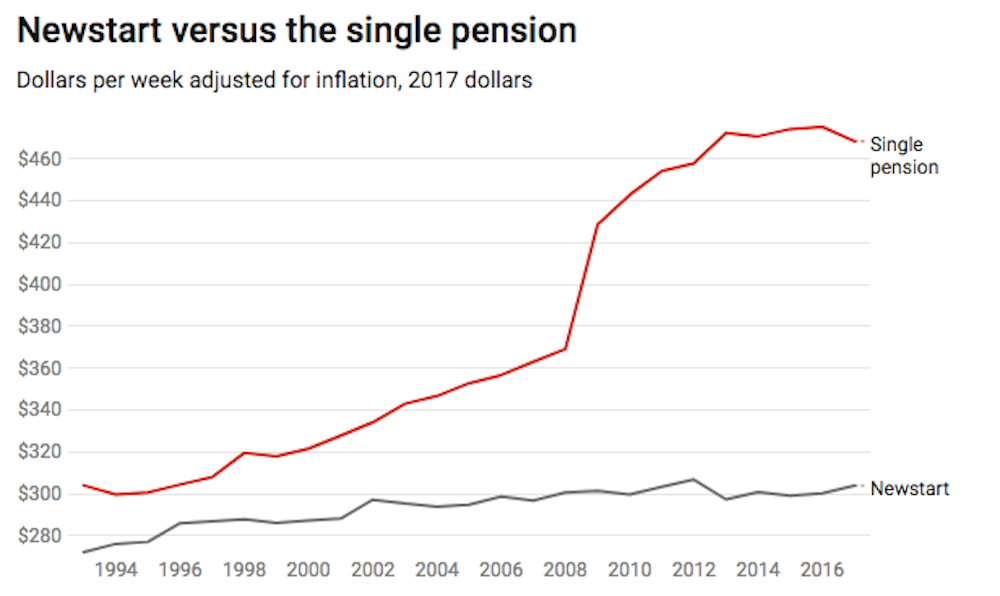
The main reason why it is inadequate is that it hasn’t increased by much more than inflation since 1994. General living standards have soared during those two and a half decades, as has the pension which is linked to them by being set as proportion of male wages, and which was increased substantially in 2009.


ACOSS


Newstart is now only A$275.20 per week. The pension is A$417.20 per week (A$458.15 with the pension supplement and energy supplement).

Unless it is better indexed, Newstart will slide even further relative to other payments and living standards.


Read more: New budget standards show just how inadequate the Newstart Allowance has become


Since 1994-95 the buying power of the median household disposable income has climbed 55%. The buying power of Newstart has barely budged.

It has pushed people on Newstart further down the income ladder.

In 1994-95 a single person on Newstart received A$24 per week less than a low-earning household at the top of the bottom tenth of the income distribution.


Read more: Will a Newstart boost actually deter jobseekers?


By 2015-16 that single person on Newstart got A$175 per week less than the low earning household.

The Australian Council of Social Service, the Business Council of Australia and a wide range of other community and business leaders including the former prime minister John Howard and most of the parliament’s crossbench have called for a lift in Newstart and a better method of setting it.

There’s more to it than Newstart

The relative decline in Newstart was the result of neglect. It was left indexed to the consumer price index when, over the long term, it should have been indexed to a measure that moves with community living standards.

But in other cases, governments under five prime ministers over the past twelve years have made explicit decisions to cut assistance, most severely for low income single parents.

In 2006 the Howard government made substantial changes to the Parenting Payment Single (PPS) and the Parenting Payment – Partnered (PPP) as part of what it called a welfare to work program.


Read more: How can the government justify a policy that penalises working sole parents?


Single parents claiming the PPS after July 1, 2006 would lose it when their youngest child turned eight. They would go onto the much lower Newstart unemployment benefit, and be expected to look for work.

Partnered parents claiming the PPP would lose it when their youngest child turned six, but for them it made little difference because their parenting payment and Newstart were about the same.

For single parents it meant a significant cut in benefits at the time, and a harsher income test.

Those receiving PPS before July 1, 2006 were “grandfathered” meaning they could continue to receive it until their youngest child turned 16.


Read more: Prejudiced policymaking underlies Labor’s cuts to single parent payments


But in 2013, the Gillard government removed grandfathering, requiring all single parents with older children to be moved onto Newstart or other payments if eligible.

At that time the maximum rate of Parenting Payment Single was $331.85 per week. The maximum rate of Newstart was $266.50.

And a change introduced by Prime Minister Kevin Rudd made the parenting payments themselves less generous.

For many decades, the basic rate of payment for most single parents was the same as the pension.

In 2009 the Rudd government delinked them and lowered the wages benchmark so that PPS was set at 25% of male total average weekly earnings instead of 27.7%.

The 2009-10 Budget also changed the link between levels of the maximum rate of Family Tax Benefit Part A and the married rate of pension, a link originally established following the Hawke government’s child poverty pledge.

These changes have shrunk Family Tax Benefit payments per child from 16.6% – 21.6% of the married pension rate to 14.5% – 18.9%, a difference now of $13 per week for each younger child and $17 per week for each older child – with more shrinkage to come.

In 2014 the first Abbott budget attempted to further wind back Family Tax Benefits.

After a tough time in the Senate, several of his measures finally passed, under Prime Minister Malcolm Turnbull in 2016 and 2017.

Family Tax Benefit B has been closed to couple families with children aged 13 years or older and the Family Tax Benefit B income test tightened, the size of the payments to large families has been wound back, the Family Tax benefit A end of year supplement has been withdrawn from families earning over A$80,000 per annum and rates have pay have been temporarily frozen, so that they don’t even increase with inflation.

What’s been the total of cuts since 2006?

The cumulative effects of the policy choices since 2006 on the disposable incomes of single parent families are substantial.

We have compared how much low-income parents currently receive, compared to what they would be receiving if these changes had not been made.

Our calculations are conservative.

We have ignored a number of changes including payments that have come and gone such as the Schoolkid’s Bonus and the Energy Supplement or changes that affect high income families. Nor have we taken into account the loss of payments to families with with four or more children due to the phasing out of the Large Family Supplement from July 2016.

Single parents still on Parenting Payment Single with two younger children have lost nearly $85 per fortnight; about 6% of their disposable incomes. For families with older children, the loss is about $271 per fortnight; a cut in disposable income of nearly 19%.


Read more: One in four children from single-parent families live in poverty


In total there are around 360,000 families with children, Australia’s poorest, who are getting considerably less financial support.

It has happened as a result of actions by both sides of politics under prime ministers Howard, Rudd, Gillard, Abbott and Turnbull.

As with the decision to link Newstart to the consumer price index rather than wages, the effects of their decisions will widen over time. The poorest families, and their children, will increasingly fall behind the rest of the population.

This process is already strongly entrenched.


Read more: Housing affordability stress affects one in nine households, but which ones are really struggling?


Research by Peter Saunders, Bruce Bradbury and Melissa Wong for the joint ACOSS-UNSW report on poverty finds that the transfer of 80,000 sole parents to Newstart in 2013 was associated with an increase in the rate of after-housing poverty among unemployed sole parents from 35% to nearly 60%.

Have the cuts got single parents into jobs?

The stated purpose of the cuts to Parenting Payment Single was to get them into jobs.

First impressions suggest that they have.

In 2005-06 51% of single parent households had social security benefits as their main source of income. A decade later this was 42%.

In 2005 around 49% of lone parent families with a youngest child under 15 were employed. By 2009 the proportion had grown to 59%.

But in both cases the changes started before the changes to benefits, from the middle of the 1990s.


Read more: For single parents, it pays to work


And the proportion of single parents employed went backwards during the global financial crisis, sliding to 53% and only recovering to 55% in 2017, despite the move of families from Parenting Payment Single to Newstart.

It’s time for a proper review

The “root and branch review” promised by Bill Shorten and the ongoing commission proposed by crossbenchers are not mutually exclusive.

An immediate review could be used to increase payments in the shorter term, while an ongoing commission could examine longer-term priorities.


Read more: For richer or poorer: the delicate art of messing with middle class welfare


The scope of these inquiries should not be limited to Newstart.

Parenting Payments and Family Tax Benefits are also a fundamental component of the social safety net.

There is case for going further and examining the entire structure of the social security system.

The most comprehensive examination was the Henderson Poverty Inquiry commissioned by the McMahon government and extended by the Whitlam government more than four decades ago.


Read more: Whitlam’s forgotten legacy: a voice for the poor


A comprehensive review of Australia’s social security system, undertaken in an integrated fashion and including tax as well as payments (including those for childcare and to support people who study and work) is overdue.

We need such a review to consider the design of our safety net in the light of economic, demographic, technological and social changes, and those to come.

It ought to be a key priority of Australia’s next government.

It ought to set up our support systems for the future.

ref. It’s not just Newstart. Single parents are $271 per fortnight worse off. Labor needs an overarching welfare review – http://theconversation.com/its-not-just-newstart-single-parents-are-271-per-fortnight-worse-off-labor-needs-an-overarching-welfare-review-107521

How a candidate’s looks may be swinging your vote (without you even realising it)

]]>

Source: The Conversation (Au and NZ) – By Rodrigo Praino, Senior Lecturer, College of Business, Government and Law, Flinders University

If someone asks you why you chose the election candidate you voted for, you will likely have a good answer. Maybe you agree with the candidate’s policy stances. Maybe you support his/her party. Maybe you are tired of the corruption, bad policies, or inaction of the people in power. These are all perfectly acceptable answers. One reason you probably will not mention is that you voted for this person because he or she is good-looking. Certainly not. This is not an acceptable answer.

Yet you probably did.

In a study just published by myself and Daniel Stockemer with the help of Victoria Police in Melbourne, we used data on elections to the US Congress to create the faces of six fictional candidates who were “ideal-looking” in terms of physical appearance. We then used statistical modelling and real election results to simulate what would have happened if the loser of some key races looked like one of our “ideal candidates”, but was otherwise identical to the real losing candidate.

In two-thirds of cases, the loser becomes a winner if he/she simply becomes better-looking. To put it simply, we find that if an election is competitive, candidate attractiveness can actually determine the result.

Research shows that candidate appearance travels across cultures, ignoring even racial and ethnic differences. It appears that there is a fairly standard idea around the world of what is an attractive candidate, and voters everywhere prefer good-looking politicians. Research has shown that beautiful politicians are advantaged in Australia, Germany, Finland, the United Kingdom and the United States.

But the story doesn’t end there. Scholars are still trying to understand all possible ramifications of the relationship between physical attractiveness and electoral success. But we know that ideology, institutions and voter behaviour all play a role in this fascinating relationship.

When it comes to ideology, recent research shows that conservative politicians benefit more from physical attractiveness. In other words, right-wing politicians are better-looking than left-wing politicians and, therefore, benefit more from the “beauty premium” at the ballot box.

In terms of institutions, a study published by Daniel Stockemer and myself last year shows that the electoral system plays a role in whether or not candidate attractiveness matters in elections.

In brief, candidate attractiveness matters in majoritarian electoral systems – that is, systems where voters cast their vote for a specific candidate. The impact of candidate attractiveness fades in list-based proportional systems, where voters are asked to cast a ballot for a political party.

We find no evidence that attractive candidates are placed higher in party lists, which means that political parties and their structures appear to be immune to the appeal of candidate attractiveness. The conclusion is that institutions play an important role in determining whether or not candidate attractiveness affects voters’ decision-making.

Finally, when it comes to voter behaviour, the “beauty premium” doesn’t manifest itself only as extra votes gained at the ballot box. In a study published last May, we found that attractive politicians get a “break” when they are involved in scandals. In particular, voters forgive attractive politicians involved in sex scandals, while politicians involved in financial scandals such as bribery or misappropriation of funds have a harder time at the ballot box after the scandal becomes public. Either way, this shows that voters not only generally vote for the most attractive candidate, but also are more willing to forgive those who look better.

So how about Donald Trump? This question pops up a lot, especially from people arguing that Trump is not the most physically attractive candidate to run for office. If we think hard enough, we can all think of numerous unattractive politicians who have been very successful at the ballot box all over the world. The key to understanding how this works is to focus on information.


Read more: President Trump will change the United States and the world, but just how remains to be seen


A few years ago, we ran an experiment using thousands of Canadian students at the University of Ottawa as research subjects. We found that if voters have adequate information about the candidates running for office, they tend to cast their ballot based on this information.

If, on the other hand, voters possess little or no information, then the better-looking candidate wins the election. We concluded that, in high-information elections, candidate attractiveness plays a smaller role than in low-information elections. This answers the Donald Trump question, in the sense that American presidential elections are high-information contests and, therefore, voters know more things about the candidates than their physical appearance, and thus vote accordingly.

The problem is that research also shows that voters all over the world have become less and less informed about politics. For instance, Australians seem to be incapable of answering basic questions about Australian politics; American university graduates in the 2000s knew less about politics than high school graduates in the 1950s; and European citizens do worse than chance in answering true-or-false questions about the European Union.


Read more: If it ain’t broke, don’t fix it: Australia should stay away from electronic voting


In other words, we should expect that candidate attractiveness will determine more and more electoral outcomes in the near future. Of course, the major issue with people voting for good-looking candidates is that physical appearance is completely devoid of any policy content. Voters have no guarantee whatsoever that they will end up with policies that they agree with and support if they vote for someone just because that person is attractive.

After years engaged in this line of research, I have never met someone who confessed to having voted for someone else because he/she was good-looking. At the same time, I am also convinced that people do exactly that, even if unconsciously.

The only solution to this problem is to educate voters about politics, institutions and current issues.

ref. How a candidate’s looks may be swinging your vote (without you even realising it) – http://theconversation.com/how-a-candidates-looks-may-be-swinging-your-vote-without-you-even-realising-it-107364

Nervous tummy: why you might get the runs before a first date

]]>

Source: The Conversation (Au and NZ) – By Vincent Ho, Senior Lecturer and clinical academic gastroenterologist, Western Sydney University

So, you’re going on a date and you’re understandably a bit nervous. And then you feel it – a churning and cramping in your gut. Suddenly you’re running to the toilet and wondering why your body reacts this way. How does a case of nerves translate to an upset stomach? What is actually happening in your body?

Feeling an upset tummy when we’re nervous is normal. The broad term dyspepsia refers to any discomfort in the upper abdomen or abdominal pain, and is very common when we’re anxious and stressed. A systematic review pooling data from a number of studies found that around one quarter of people have dyspepsia.

When we get nervous, a number of processes occur in the brain that are passed onto the stomach and affect the digestive process. This is a hangover from our hunter-gatherer days and part of the fight or flight response – a physiological reaction to a perceived harmful event, attack or threat to survival.


Read more: Paralysed with fear: why do we freeze when frightened?


When we’re in a relaxed state, there is more energy for digestion. The speedier movements of our stomach and small bowel (intestines) facilitate better absorption of nutrients. But during stress, digestion and the movements in our stomach and small intestines slow down, while movements in our large bowel (or colon) increase. It’s the increased movement in our large bowel that in some cases has us running to the toilet. Here’s how that happens.

Brief history of experiments

We can thank two patients, who had very rare accidents, for our early understanding of what happens to the stomach when we’re anxious and stressed.

We can thank Alexis St Martin for our early knowledge of how the emotions affect digestion. Wikipedia Commons

In 1822, 19-year-old Alexis St Martin suffered a gun-shot wound to the stomach. He survived, but developed a permanent hole in his stomach that refused to heal. This hole extended to the outside skin of his abdomen.

While undoubtedly awful for Alexis, army doctor William Beaumont saw a unique opportunity. Beaumont used the hole as a window into the process of digestion, conducting experiments to better understand the inner workings of the gut, which included the impact of Alexis’ emotional response on the stomach. When Alexis became angry, for instance, Beaumont noticed his digestion was impaired.

Further observations were carried out by doctor Stewart Wolf on another patient, Tom Little. In 1894, when he was nine years old, Tom drank something that severely damaged his oesophagus. He had a hole created in his stomach for feeding. As with Alexis, Wolf observed Tom’s stomach under periods of emotional stress. He found fear would make Tom’s stomach turn white and a period of depression could virtually stop digestion.


Read more: Stomach and mood disorders: how your gut may be playing with your mind


Fight or flight and the gut

In the early 20th century, scientist Walter Cannon coined the term “fight or flight response” after observing the reaction of animals in response to stressful events. He saw that when cats were acutely stressed, movement in their upper guts, including the stomach and small intestine, was markedly reduced.

This process involved two parts of our nervous system, known as the sympathetic and the parasympathetic. The sympathetic nervous system is activated during times of stress and puts the body on a war-like footing. The parasympathetic nervous system, on the other hand, acts like a brake. It promotes the “rest and digest” response that calms the body down after the stress has passed, and helps conserve energy.

The sympathetic system gets us ready for fight or flight, while the parasympathetic system acts as a brake. from shutterstock.com

When we feel stressed, a region of the brain called the hypothalamus (which helps regulate emotions) produces the corticotropin releasing hormone (CRH) – the key hormone that activates the sympathetic system.

CRH can stimulate the release of another hormone – the adrenocorticotropic hormone (ACTH) – which then releases cortisol from the adrenal gland (found above the kidneys). Cortisol is an important hormone in the fight or flight response. It helps us get ready to fight or escape danger and can lead to slowing down the movement in our stomach.

This is thought to be an evolutionary mechanism as blood is diverted away from the stomach and small intestine to the skeletal muscles and lungs, preparing the body for defence. The movements of the stomach and small intestine as well as digestion accelerate again once the parasympathetic system is activated.

Movement in the small intestine slows down during stress, but in the colon, it speeds up. from shutterstock.com

But it’s different in the colon (large bowel). During periods of stress and anxiety, movement in the large bowel actually increases, though this is not caused by the sympathetic nervous system. It is actually those same parasympathetic system fibres that carry a “rest and digest” response that are thought to deliver the signals to the colon. CRH can be transmitted down those fibres directly to the wall of the colon where it stimulates receptors to produce fluid and increases colonic movements.

This doesn’t ordinarily lead to more poo or diarrhoea during acute stress because defecation requires a more complex and coordinated set of functions. But in some stressful situations, the pelvic nerve can be activated and directly stimulates neurons in the wall of the rectum. This then triggers increased rectal activity and defecation.

Functional dyspepsia?

We now have a way to work out what areas of the brain become active when the stomach is under stress. This is done through imaging the brain. Neuroimaging techniques can measure changes in blood flow in the brain and correlate these changes (or activations) to brain activity.

When a balloon is inflated in the stomach, stretching the stomach wall in healthy people to test its sensitivity, some areas of the brain such as the amygdala and insula that are involved in the processing of emotions become very active. In people with functional dyspepsia – a condition with symptoms such as pain or discomfort localised to the upper part of the abdomen in the absence of a physical cause – these brain areas may fail to deactivate.

Research in functional dyspepsia patients has found that negative emotional memory can affect their brain activity.


Read more: Explainer: what is irritable bowel syndrome and what can I do about it?


If symptoms become abnormally severe and chronic it may be worth seeing a doctor to consider whether further investigations and treatment are required. If investigations such as endoscopy do not show any abnormalities then functional dyspepsia is a possible diagnosis. These patients are the ones most likely to experience upper abdominal symptoms provoked by stress and anxiety.

Strategies tailored to help with negative emotions and thoughts such as cognitive behavioural therapy can be beneficial.

ref. Nervous tummy: why you might get the runs before a first date – http://theconversation.com/nervous-tummy-why-you-might-get-the-runs-before-a-first-date-106925

At last, Australia has a Modern Slavery Act. Here’s what you’ll need to know

]]>

Source: The Conversation (Au and NZ) – By Paul Redmond, Sir Gerard Brennan Professor, Faculty of Law, University of Technology Sydney

It has taken years, but after votes in the Senate and House of Representatives last week, Australia has a Modern Slavery Act.

It’ll take effect on January 1.

But what difference will it make?

First, what is modern slavery?

Britain abolished slavery on its own soil in 1833. It abolished the most egregious forms of child labour a century later.

But slavery and child labour are still being used to make the products Britons buy, just as they are being used to make the products Australians buy.


Read more: How to keep slave-caught seafood off your plate


Increasing integrated global supply chains have made it hard to tell whether even products that are stamped “Made in Australia” have at some stage used slaves or underage children as part of the production process.

Forcibly detained adults and children work in industries including fishing, cocoa, cotton, clothing, cannabis, construction and prostitution.

The term “modern slavery” refers only to the worst forms of exploitation, and not to other serious breaches of human rights such as the denial of freedom of association or the denial of worker safety, such as at Rana Plaza clothing factory in Dhaka, Bangladesh in which more than 1,000 garment workers died when their building collapsed in 2013.


Read more: Unravelling British wool: how the local and global are intertwined in the making of everyday products


The International Labour Organisation believes that 21 million people worldwide are forced labourers, half of them in the Asia-Pacific region.

What will be required

As with the British Act, Australia’s will require businesses and other organisations above a certain size (consolidated revenue of A$100 million) to report annually on the risks of modern slavery in their operations and supply chains, and the action they have taken to assess and address those risks, and the effectiveness of their response.

Smaller businesses will be able to report voluntarily.

To ensure high-level engagement, the statement has to be approved by the board of directors or equivalent and signed by a director.


Read more: We analysed 101 companies’ statements on modern slavery – here’s what we found


The statements will be publicly available on a central register maintained by the Commonwealth. The Commonwealth government itself, and those of its entities that satisfy the reporting revenue threshold, will also have to prepare a statement.

What will not be required

Two controversial omissions are penalties and independent oversight.

The government was unwilling to impose a penalty for failing to lodge a statement or for lodging an incomplete statement.

This needn’t be fatal. The requirement and the public register means that companies that don’t report properly can be “named and shamed” by non-government organisations. Consumer pressure can itself become a sanction.


Read more: The Modern Slavery Bill is a start, but it won’t guarantee us sweeter chocolate


The UK experience does not encourage optimism as about compliance.

In response to these concerns, Senate amendments have empowered the minister to name and shame his or herself, publicly calling out continued instances of non-compliance and reporting to parliament annually on compliance trends.

Australia’s parliamentary inquiry and a good many of the submissions strongly supported the appointment of an independent statutory anti-slavery commissioner with the authority and resources to oversee compliance.

The government will instead establish a departmental unit to help business address slavery risks and prepare statements.


Read more: Should Australia have a Modern Slavery Act?


The Labor party supports both penalties and the appointment of an independent commissioner.

It is possible that both requirements will be in place before the first modern slavery statements are due on June 30, 2020.

NSW has also passed its own Modern Slavery Act, due to take effect after the Commonwealth Act commences. It imposes a lower revenue reporting threshold of $50 million, and provides for penalties for businesses that do not comply, of up to A$1.1 million.

It also creates the post of Independent NSW Anti-Slavery Commissioner.

What now

American baseballer Yogi Berra said that when we come to a fork in the road, we should take it. Wise advice. We have two ways forward and should take both. In truth, they converge.

First, we need to monitor compliance levels, and determine whether penalties and independent oversight are needed. And we need to set up processes that ensure the reports are of good quality.

The United Nations Guiding Principles on Business and Human Rights provide a guide. Happily, the Act adopts these principles.

The other path is to address the broader harm that Australian businesses can do, beyond incorporating slavery into products that are sold in Australia.


Read more: We need to combat forced labour and in-work poverty – Brazil and India offer some lessons


The Guiding Principles help here too, outlining the responsibility of businesses to respect human rights and to provide remedies wherever they operate.

This responsibility extends to our mining companies, 200 in Africa alone, who should respect human rights whether or not slavery is incorporated in products they sell back here.

And it extends to technology companies whose platforms put people at risk such as Facebook’s possible role in the ethnic cleansing of the Rohingya in Myanmar.

Slavery is important, but there is more to human rights than slavery.

The Act is a start, quite a good one. We will need more.

ref. At last, Australia has a Modern Slavery Act. Here’s what you’ll need to know – http://theconversation.com/at-last-australia-has-a-modern-slavery-act-heres-what-youll-need-to-know-107885

Violent clowns and panto dames: the origins of Rocky Horror’s Frank-N-furter

]]>

Source: The Conversation (Au and NZ) – By Anna-Sophie Jürgens, Postdoctoral Fellow in Comparative Literature, Popular Entertainment Studies and Science in Fiction Studies, Australian National University

Dr Frank-N-furter, the snappy alpha-alien who stars in The Rocky Horror (Picture) Show, is one of the most memorable characters to grace the stage and screen in recent decades.

In his castle-spaceship from the planet Transsexual in the galaxy of Transylvania, Frankie creates a carnal athlete named Rocky and makes a phallic incursion into the innocent lives of Brad and Janet, before being finally killed in an insurrection by his servants.

Frankie is an unusual creature, in equal parts funny and terrifying. My research into the character suggests this is because he is a hybrid of two types of comic entertainers – violent clowns and panto dames.

The Rocky Horror Show debuted on stage in 1973 in at the Royal Court Theatre in London. It was followed in 1975 by a film adaptation. Both were directed by Jim Sharman, who grew up in Australia.

In his autobiographical writings, Sharman vividly recalls being taken to the circus as a small child, to vaudeville and other touring shows. These included his family’s boxing troupe and Sorlie’s travelling tent theatre, a popular attraction which between the 1920s and 1961 (with interruptions) took pantomime, musical comedy, and vaudeville around New South Wales and Queensland.

Panto dames

The Frank-N-furter character, Sharman writes, was derived from childhood memories of Bobby le Brun. Bobby le Brun (born Eric Marshall, 1910–1985) was a well-known, versatile entertainer with blithe natural charm, as his own personal collection in the National Library reveals. He was highly acclaimed for his dancing skills and especially renowned for his comic performances in women’s dress.

In fact, Bobby was Sorlie’s famous panto dame. The role of dame seizes on the early theatre custom of female characters played by boys and men. In pantomimes, traditionally she is an old woman or witch-like character, but can also take on the shape of a young seductive lady, androgynously doll-like and bewilderingly elegant.

The panto dame’s male identity is not concealed, and s/he is never effeminate. Australia has produced many such performers including, for example, Bland Holt, Harry Phydora, Jim Gerald and George Wallace, whose performances inspired Bobby le Brun and, later, Sharman.

Over the last few decades, Australia’s most (in)famous dame-luminary has been Barry Humphries’s Dame Edna Everage, called “a clown in the form of an Australian housewife” by her creator. It is hardly surprising that Humphries occupies a first-class seat in Sharman’s pantheon.

Dame Edma is Australia’s most famous panto dame. TRACEY NEARMY

Defined by scrubby leg hair and outlandish female attire, and engaging in physical comedy strongly reminiscent of the eccentric, hard-hitting (but never vulgar) activities of Bobby le Brun’s dames, Frank-N-furter in Rocky Horror is a blend of these comic traditions.

Frankie has been linked to the panto dame by both Tim Curry (acting in the role of Frank-N-furter in the original musical production and the movie) and Reg Livermore (who in 1974 performed Frankie in the original Australian musical production of Rocky Horror).

In the movie, Frankie exaggeratedly kicks his servant Riff-Raff, rides on his shoulders as if he were an animal, and chases him (and later Rocky) around his lab, pushing everyone out of his way and falling down a number of times. These comic interludes retain the dame role’s funny innocence.

Violent clowns

However, sundry wicked traits and his unceasing libidinous intent also align Frank-N-furter with another tradition: the violent clown. This character starred in many macabre clown plays popular throughout the 19th century (and since), featuring eccentrically performed manslaughter and comically staged immorality.

A poster for the Hanlon-Lees troupe. Wikimedia

One example are the pantomimes by the Hanlon-Lees, a group of acrobats celebrated between the 1850s and early 1900s. Their performances featured funny decapitated heads, and bodies that were used as comic weapons. They staged a coffin maker who, following his own radical business logic, kills his potential clients himself, and a dentist curing a patient by means of a grenade fixed to his tooth.

Contemporary spectators admired their make-up – their “cannibalistic” smiles in particular – and called their shows the apotheosis of comedy. As research into popular art forms shows, this type of performance plot and aesthetics reemerge in clown narratives of the 20th century – including Rocky Horror.

In one scene of Sharman’s film, for instance, Frankie, armed with an ice pick, chases a party-crasher, Eddie, into a refrigerator, where he hacks him to pieces. This is problem-solving à la bad clown: schlock horror rather than panto dame pillow punches. Along with this ice-pick murder, his favourite R-rated pastime activities are forced brain surgery, sexual licentiousness, and cannibalism (he later invites his guests to eat Eddie’s remains).

As well as being a hybrid – an amalgam of identifications and confrontations – of two types of comic entertainers, the dame and the clown, Frankie is an example of the way the pantomime and clown tradition travelled between Europe and Australia.

ref. Violent clowns and panto dames: the origins of Rocky Horror’s Frank-N-furter – http://theconversation.com/violent-clowns-and-panto-dames-the-origins-of-rocky-horrors-frank-n-furter-104003

As they meet in Poland for the next steps, nations are struggling to agree on how the ambitions of the Paris Agreement can be realised

]]>

Source: The Conversation (Au and NZ) – By Edward Morgan, Research Fellow in Environmental Policy and Planning, Griffith University

International leaders and policymakers gathering in Katowice, Poland, for the 24th annual round of UN climate talks know that they have plenty of work to do.

They are hoping to make progress on the Paris Agreement Work Programme, otherwise known as the Paris Rulebook – the guidelines needed to guide implementation of the Paris Agreement. That agreement was struck three years ago, but it is still not clear how the treaty’s goals to curb global warming will actually be achieved.

The Paris Agreement was a diplomatic landmark, under which nations pledged to hold global temperature rises to “well below 2℃”, and ideally to no more than 1.5℃.

This requires all countries not only to slash global greenhouse emissions, but also to help the world adapt to the impacts of climate change. The agreement requires countries to develop national climate plans, to report back on their progress, and to ramp up their efforts in the coming years.

The ‘what’ and the ‘how’

Whereas the Paris Agreement talks about what needs to be done, the Paris Rulebook to be agreed at Katowice is about how nations can set about achieving it. Unlike the previous, more prescriptive Kyoto Protocol, the Paris Agreement allows countries to choose their own approach to climate change. But it is important that actions taken by countries are done within an agreed, transparent framework of rules.

Rules need to be agreed about nations’ emissions targets, climate finance (including climate aid for developing countries), transparency, capacity building and carbon trading. Bringing all of this together is a huge challenge for negotiators. They need to establish a common set of rules applicable to all countries, while also maintaining the crucial principle of “common but differentiated responsibilities and respective capabilities” that underpins the UN climate process.

Already lagging behind

As well as being difficult, the task is also urgent. There is already evidence that countries are struggling to live up to their Paris commitments.

Analysis of the current emissions targets (known as Nationally Determined Contributions) shows that countries need to do more to reach the 2℃ goal. Meeting the 1.5℃ goal will be harder still and will need ambitious and swift action, as recently highlighted by a special report from the Intergovernmental Panel on Climate Change.

Although much of the focus has been on the challenge of bringing emissions targets into line with the Paris goals, our research suggests that climate adaptation efforts are also lagging behind.

Climate adaptation involves managing climate-related risks and deciding on how to manage and prepare for unavoidable impacts, such as increases in intensity and frequency of extreme weather events such as heatwaves and extreme storms, along with slow-onset impacts from sea level rise.

Many countries have developed climate adaptation policies as part of their climate change response. Our recent research analysed 54 of these national adaptation plans to understand how they match up to the intent of the Paris Agreement (as outlined in Article 7 of the Agreement).

We found that most adaptation plans only partially align with the Paris Agreement. Plans were largely focused on the social and economic aspects of adaptation, and were broadly aligned to countries’ existing policy priorities, especially around disaster management and economic development. For developing countries, there was a strong focus on linking adaptation and development.

However, countries are struggling to include environmental considerations into their planning. While the Paris Agreement clearly emphasises the important role that ecosystems play for climate adaptation, most plans are silent on this point.

What’s more, developed countries tended to take a less participatory approach to adaptation planning. Planning in developing countries was hampered by limited access to scientific knowledge but they made more use of local and traditional knowledge. The issue of resourcing and support for developing countries remains a challenge for climate change adaptation.

More work needed

Our results suggest that countries need to build on their existing adaptation plans to meet the ambitions in the Paris Agreement. There are good opportunities to better balance social and economic aspects with environmental and ecological considerations to improve planning.

Many countries, including Australia, have ratified the Paris Agreement, but few are delivering the ambitious action it requires. Besides pursuing deeper cuts to greenhouse emissions, countries need to revisit and update their adaptation strategies. Australia is well positioned to do so, given its economic wealth, its technical abilities, and the extensive climate adaptation research it has already undertaken.

Increasingly, we know what needs to be done to combat climate change. The Katowice summit will hopefully advance an agreement on how countries can do it. But actually doing it on a globally coordinated scale will be the biggest challenge, and there is some way to go to catch up.

ref. As they meet in Poland for the next steps, nations are struggling to agree on how the ambitions of the Paris Agreement can be realised – http://theconversation.com/as-they-meet-in-poland-for-the-next-steps-nations-are-struggling-to-agree-on-how-the-ambitions-of-the-paris-agreement-can-be-realised-107712

West Papuan ‘independence day’ – nationalist thugs attack rally in Surabaya

]]>

Report by Dr David Robie – Café Pacific.

A bloodied Papuan student attacked during yesterday’s December 1 Free West Papua rally
in Surabaya, Indonesia. Image: Human rights sources

From the Pacific Media Centre

By Tony Firman of Tirto in Surabaya

A protest action by the Papuan Student Alliance (AMP) in Indonesia’s East Java provincial capital of Surabaya yesterday demanding self-determination for West Papua has been attacked by a group of ormas (social or mass organisations).

Police later raided Papuan student dormitories in the evening and detained 233 students in a day of human rights violations as Indonesian authorities cracked down on demonstrations marking December 1 – “independence day”, according to protesters.

The group, who came from a number of different ormas, including the Community Forum for Sons and Daughters of the Police and Armed Forces (FKPPI), the Association of Sons and Daughters of Army Families (Hipakad) and the Pancasila Youth (PP), were calling for the Papuan student demonstration to be forcibly broken up.

READ MORE: Surabaya counterprotest, 300 arrested in West Papua flag demonstrations

“This city is a city of [national] heroes. Please leave, the [state ideology of] Pancasila is non-negotiable, the NKRI [Unitary State of the Republic of Indonesia] is non-negotiable”, shouted one of the speakers from the PP.

At 8.33am, a number of PP members on the eastern side of Jl. Pemuda began attacking the AMP by throwing rocks and beating them with clubs. Police quickly moved in to block the PP members then dragged them back.

The AMP protesters had began gathering at the Submarine Monument at 6am before moving off to the Grahadi building where the East Java governor’s office is located.

However they were only able to get as far as the Surabaya Radio Republic Indonesia (RRI) building before they were intercepted by police from the Surabaya metropolitan district police (Polrestabes) and the East Java district police (Polda).

‘Independence’ day
The AMP demonstration was held to mark December 1, 1961, as the day West Papua became “independent” from the Dutch. For the Papuan people, December 1 is an important date on the calendar in the Papuan struggle which is commemorated every year.

The historical moment in 1961 was when, for the first time, the West Papuan parliament, under the administration of the Dutch, flew the Morning Star (Bintang Kejora) flag, symbolising the establishment of the state of West Papua.

Since then the Bintang Kejora was flown alongside the Dutch flag throughout West Papua until the Dutch handed administrative authority of West Papua over to the United Nations Temporary Executive Authority (UNTEA) on October 1, 1962, then to the Indonesian government on May 1, 1963.

The UNTEA was an international mechanism involving the UN to prepare a referendum on whether or not the Papuan people wanted to separate or integrate with Indonesia.

The referendum, referred to as the Act of Free Choice (Pepera), resulted in the Papuan people choosing to be integrated into Indonesia.

Since then, the administration of West Papua has been controlled by the Indonesian government and the flying of the Bintang Kejora illegal – as it is deemed an act of subversion (maker) – and have responded to protests with violence and arrests.


A video of the arrests in Ternate, North Maluku. Video:
Arnold Belau/Suara Papua


Police arrest 99 Papuan activists at pro-independence rally in Ternate
Arnold Belau of Suara Papua reports from Jayapura that at least 96 activists from the Indonesian People’s Front for West Papua (FRI-WP) were arrested by police in Ternate, North Maluku, after they forcibly broke up a rally in front of the Barito Market.

A Suara Papua source from Ternate said that the FRI-WP action was closed down by police and intel (intelligence) officers and the demonstrators forced into trucks as they were about to begin protesting in front of the Barito Market.

The source said that several activists were dragged and assaulted as they were forced into the truck.
“Several comrades who were at the action were dragged and forced to get into a truck by police and intel in Ternate,” they said.

The source said that as many as 99 people were arrested, 12 of them from West Papua and the rest activists from FRI-WP. One of the protesters had to be rushed home because because of breathing difficulties.

“One of the people had difficulty breathing and was rushed home. Twelve people were from Papua and the rest from Ternate. Currently they are being taken to Polres [district police station]”, they said.

Ternate district police Tactical Police Unit head (kasat sabhara) Aninab was quoted by semarak.news.com as saying that the protesters would be taken to the Ternate district police station.

‘Given guidance’

“We will take them to Polres, question them. If in the process of delving into the matter it is discovered that they committed a violation then they will be charged, but we will bear in mind that are still young and [they should be] given guidance,” he said.

Earlier, the protesters sent a written notification of the action to the Ternate district police but it was rejected with police saying that the planned action was subversive (maker).

Upon arriving at the Ternate district police station they will be registered and those who originate from Papua will be separated from those from North Maluku.

FRI-WP is demanding that the Indonesian government must resolve human rights violations in Papua and that the Papuan people be given the freedom to hold a referendum to determine their own future.

Background
Although it is widely held that West Papua declared independence from Indonesia on December 1, 1961, this actually marks the date when the Morning Star (Bintang Kejora) flag was first raised alongside the Dutch flag in an officially sanctioned ceremony in Jayapura, then called Hollandia.

The first declaration of independence actually took place on July 1, 1971 at the Victoria Headquarters in Waris Village, Jayapura.

Known as the “Act of Free Choice”, in 1969 a referendum was held to decide whether West Papua, a former Dutch colony annexed by Indonesia in 1963, would be become independent or join Indonesia.

The UN sanction plebiscite, in which 1,025 handpicked tribal leaders allegedly expressed their desire for integration, has been widely dismissed as a sham.

Critics claim that that the selected voters were coerced, threatened and closely scrutinised by the military to unanimously vote for integration.

Both of these articles were translated by James Balowski for the Indoleft News Service. The original title of the Surabaya article was “Peringatan 1 Desember Papua, Demo AMP Surabaya Diadang PP & FKPPI” and the Jayapura one “Peringati Hari Lahirnya Embrio Negara Papua Barat, Polisi Tangkap 99 Orang di Ternate”.

This article was first published on Café Pacific.

Nationalist thugs attack Papuan pro-independence rally in Surabaya

]]>

By Tony Firman of Tirto in Surabaya

A protest action by the Papuan Student Alliance (AMP) in Indonesia’s East Java provincial capital of Surabaya yesterday demanding self-determination for West Papua has been attacked by a group of ormas (social or mass organisations).

Police later raided Papuan student dormitories in the evening and detained 233 students in a day of human rights violations as Indonesian authorities cracked down on demonstrations marking December 1 – “independence day”, according to protesters.

The group, who came from a number of different ormas, including the Community Forum for Sons and Daughters of the Police and Armed Forces (FKPPI), the Association of Sons and Daughters of Army Families (Hipakad) and the Pancasila Youth (PP), were calling for the Papuan student demonstration to be forcibly broken up.

READ MORE: Surabaya counterprotest, 300 arrested in West Papua flag demonstrations

“This city is a city of [national] heroes. Please leave, the [state ideology of] Pancasila is non-negotiable, the NKRI [Unitary State of the Republic of Indonesia] is non-negotiable”, shouted one of the speakers from the PP.

At 8.33am, a number of PP members on the eastern side of Jl. Pemuda began attacking the AMP by throwing rocks and beating them with clubs. Police quickly moved in to block the PP members then dragged them back.

-Partners-

The AMP protesters had began gathering at the Submarine Monument at 6am before moving off to the Grahadi building where the East Java governor’s office is located.

However they were only able to get as far as the Surabaya Radio Republic Indonesia (RRI) building before they were intercepted by police from the Surabaya metropolitan district police (Polrestabes) and the East Java district police (Polda).

‘Independence’ day
The AMP demonstration was held to mark December 1, 1961, as the day West Papua became “independent” from the Dutch. For the Papuan people, December 1 is an important date on the calendar in the Papuan struggle which is commemorated every year.

The historical moment in 1961 was when, for the first time, the West Papuan parliament, under the administration of the Dutch, flew the Morning Star (Bintang Kejora) flag, symbolising the establishment of the state of West Papua.

Since then the Bintang Kejora was flown alongside the Dutch flag throughout West Papua until the Dutch handed administrative authority of West Papua over to the United Nations Temporary Executive Authority (UNTEA) on October 1, 1962, then to the Indonesian government on May 1, 1963.

The UNTEA was an international mechanism involving the UN to prepare a referendum on whether or not the Papuan people wanted to separate or integrate with Indonesia.

The referendum, referred to as the Act of Free Choice (Pepera), resulted in the Papuan people choosing to be integrated into Indonesia.

Since then, the administration of West Papua has been controlled by the Indonesian government and the flying of the Bintang Kejora illegal – as it is deemed an act of subversion (maker) – and have responded to protests with violence and arrests.


A video of the arrests in Ternate, North Maluku. Video: Arnold Belau/Suara Papua

Police arrest 99 Papuan activists at pro-independence rally in Ternate
Arnold Belau of Suara Papua reports from Jayapura that at least 96 activists from the Indonesian People’s Front for West Papua (FRI-WP) were arrested by police in Ternate, North Maluku, after they forcibly broke up a rally in front of the Barito Market.

A Suara Papua source from Ternate said that the FRI-WP action was closed down by police and intel (intelligence) officers and the demonstrators forced into trucks as they were about to begin protesting in front of the Barito Market.

The source said that several activists were dragged and assaulted as they were forced into the truck.

“Several comrades who were at the action were dragged and forced to get into a truck by police and intel in Ternate,” they said.

The source said that as many as 99 people were arrested, 12 of them from West Papua and the rest activists from FRI-WP. One of the protesters had to be rushed home because because of breathing difficulties.

“One of the people had difficulty breathing and was rushed home. Twelve people were from Papua and the rest from Ternate. Currently they are being taken to Polres [district police station]”, they said.

Ternate district police Tactical Police Unit head (kasat sabhara) Aninab was quoted by semarak.news.com as saying that the protesters would be taken to the Ternate district police station.

‘Given guidance’
“We will take them to Polres, question them. If in the process of delving into the matter it is discovered that they committed a violation then they will be charged, but we will bear in mind that are still young and [they should be] given guidance,” he said.

Earlier, the protesters sent a written notification of the action to the Ternate district police but it was rejected with police saying that the planned action was subversive (maker).

Upon arriving at the Ternate district police station they will be registered and those who originate from Papua will be separated from those from North Maluku.

FRI-WP is demanding that the Indonesian government must resolve human rights violations in Papua and that the Papuan people be given the freedom to hold a referendum to determine their own future.

Background
Although it is widely held that West Papua declared independence from Indonesia on December 1, 1961, this actually marks the date when the Morning Star (Bintang Kejora) flag was first raised alongside the Dutch flag in an officially sanctioned ceremony in Jayapura, then called Hollandia.

The first declaration of independence actually took place on July 1, 1971 at the Victoria Headquarters in Waris Village, Jayapura.

Known as the “Act of Free Choice”, in 1969 a referendum was held to decide whether West Papua, a former Dutch colony annexed by Indonesia in 1963, would be become independent or join Indonesia. The UN sanction plebiscite, in which 1,025 handpicked tribal leaders allegedly expressed their desire for integration, has been widely dismissed as a sham.

Critics claim that that the selected voters were coerced, threatened and closely scrutinised by the military to unanimously vote for integration.

Both of these articles were translated by James Balowski for the Indoleft News Service. The original title of the Surabaya article was “Peringatan 1 Desember Papua, Demo AMP Surabaya Diadang PP & FKPPI” and the Jayapura one “Peringati Hari Lahirnya Embrio Negara Papua Barat, Polisi Tangkap 99 Orang di Ternate”.

Print Friendly, PDF & Email

Article by AsiaPacificReport.nz

Surabaya counterprotest, 300 arrested in West Papua flag demonstrations

]]>
An unnamed Papuan student beaten during the December 1 West Papuan flag demonstration in Surabaya, Indonesia. Human rights sources report more than 300 arrests by Indonesian authorities. Image: Humam rights sources

Pacific Media Centre Newsdesk

Hundreds of Papuan students faced off with counterprotesters in Indonesia’s second largest city of Surabaya today in a rally calling for the Melanesian region’s independence while pro-independence sources reported more than 300 people arrested in West Papua.

The Surabaya rally was organised by the Papua Students Alliance. The demonstrators chanted “Freedom Papua” in Surabaya city to mark December 1, which many West Papuans consider as the 57th anniversary of what should have been their independence, report news agencies.

The crowd, many of whom wearing headbands of the Morning Star flag – banned by Indonesian authorities, was blocked from marching to the city center by scores of counterprotesters from several youth organisations waving the Indonesian flag.

READ MORE: Mass arrests over West Papua demos in Indonesian cities

A screenshot from a secret video report of the mobilised Indonesian police about to raid the Papuan dormitories in Surabaya tonight. Image: Human rights sources

They confronted the pro-independence protesters with sharpened bamboos.

Several hundred members of anti-riot police prevented the two rival groups from clashing.

-Partners-

The protest ended after about two hours.

However, human rights sources reported tonight that Indonesian police and military had  surrounded Papuan student dormitories in Surabaya and arrested 223 people. They were being detained at the Surabaya City sector police station.

The Free West Papuan Campaign reports that more than 300 people have been arrested across West Papua.

Peaceful demonstrations
In several regions of West Papua, peaceful demonstrations took place. Protests were reported in Jakarta, Surabaya, Palu, Kupang, Ternate, Makassar, Manado, Ambon, Poso, Sula, Timika, Meruake, Waropen, and Tobelo.

In addition to police intervention during public gatherings, the London-based campaign’s website said it had received reports that Indonesian security forces had also raided several student dormitories, and the West Papua National Committee (KNPB) headquarters was vandalised.

From the monitoring team, below is the interim report of arrests throughout West Papua and other parts of Indonesia:

Philipus Robaha is among students still detained in Polsek KP3, Naval Base, Jayapura. Image: FWPC
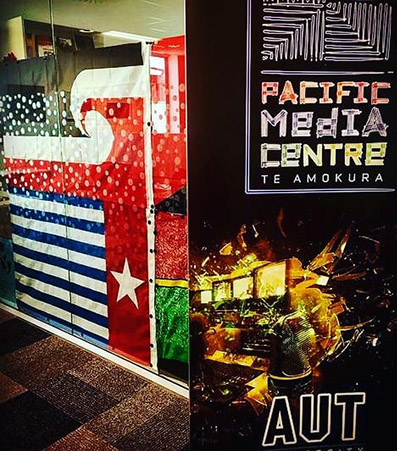
1. Kupang – 18 people arrested.
2. Ambon – 43 arrested.
3. Ternate – 99 arrested. One of the activists was rushed to hospital due to suffocation
4. Jayapura around 85 people from 4 different locations: Dok IX, Abe, Jayapura and Sentani.
5. Jakarta – 140 arrested
6. Surabaya – hundreds involved in a long march towards Kamasan III student dormitary were confronted by tni-polri and some students were bruised from confrontation.
7. Manado – 29 arrested
8 Waropen – 7 arrested. Names: Jhon Wenggi, Yulianus Kowela, Monika Imbiri and Fiktor Daimboa
9. Sorong and Merauke, including KNPB HQ in Waena, Perumnas III: in lock down and an urgent need for advocacy at these places.

RNZ Pacific also reports mass arrests over West Papuan demonstrations in several Indonesian cities.

Today marks the 57th anniversary of the first time West Papua’s flag of independence, the Morning Star, was raised.

The banned West Papuan Morning Star flag on display at Auckland’s Pacific Media Centre today. Image: PMC

In commemoration of the historic event numerous non-violent peaceful demonstrations and prayer vigils were organised around the country.

Worldwide flag raisings of international solidarity increase each year as the support for West Papuan independence gains momentum. In New Zealand, flagraising events were held in Auckland, Wellington and Christchurch.

This protests comes at a time of increased violence in West Papua, including suspected extrajudicial killings in the region.

Urgent issues of concern also include increased military presence, the killing of civilians caught in crossfire in the mountain regions, and armed civilian movements of Papuans protecting their villages.

The International Coalition for Papua (ICP) compiles data on political arrests and violence in West Papua. This information has been made public through quarterly reports. The latest ICP reports are at www.humanrightspapua.org

A scene from the Surabaya rally today with the crowd chanting “Freedom Papua”. The men in the front of the image appear to be undercover police filming and recording events. A short distance away there was a counterprotest with Indonesian flags. Police kept the two groups apart. Image: Still from a West Papuan sourced video


Print Friendly, PDF & Email

Article by AsiaPacificReport.nz

Pioneering NZ Pacific research initiative to make ‘reset’ change

]]>
Keynote speakers Associate Professor Kabini Sanga from Victoria University and Dr Alisi Holani (right), deputy CEO of the Ministry of Commerce, Consumer, Trade, Innovation and Labour (MCCTIL) in Tonga. They spoke about a “rich gap” and other issues affecting Pacific media reportage. Image: Tom Blessen/PMC

By Sri Krishnamurthi

The NZ Institute for Pacific Research will cease to exist in its current form, Emeritus Professor Richard Bedford said in a bombshell announcement to the Oceans and Islands conference today.

Rumours of NZIPR’s demise were doing the rounds after a review of the organisation earlier this year by the Ministry of Foreign Affairs and Trade (MFAT).

“I do want to finish with expressing the gratitude that the institute has for the Ministry of Foreign Affairs and Trade for the investment they have put in to the establishment of a NZ Institute for Pacific Research,” said the acting director in his conference closing address.

READ MORE: NZ think-tank launched to advance Pacific research

“We are in a rather ambiguous situation at the moment and quite a lot of speakers were informed of this in advance. I wrote to alert them to the fact we were in yet another ‘Pacific reset’ around the institute.

“Pacific reset are the words that the ministry has used for the rethinking of aspects of our policy in the Pacific,” said Professor Bedford.

He admitted that he had yet to see the review report which is said to be confidential to the institute’s board. They knew the recommendations that the decision to cease the current arrangement was based on.

-Partners-

“Just for those of you who might be bewildered by this, it’s not about getting rid of the NZ Institute of Pacific Research,” he said.

Review of investment
“Basically, what the ministry has done is have a review of what its investment has achieved.
“I think they’ve been impressed with a number of things that have happened. They have been impressed with some of the research that has been done,” he said.

“But the model and the way it’s worked has not given them the return on investment with regard to research that informs policy.

“I can sympathise a little bit with MFAT here because academic research doesn’t always and should never always fit perfectly some policy objective or goal,” he said in attempting to cushion the blow.

“The drivers of academic research are different from policy orientated research,” he said highlighting the difference in what the ministry had expected from NZIPR.

“This applied especially to discovery-led research, and a great deal of research we’ve heard about in this conference is discovery-led research.

“It’s about understanding and learning ways of doing things, testing models, testing ideas. It’s not about necessarily just producing something to enable a solution. The research may contribute to a solution long-term but that isn’t what drives it initially.”

MFAT-owned brand
He made it clear that the brand name was owned by MFAT and not the three universities (Auckland, Otago and Auckland University of Technology) that have been involved in the initial conglomerate that formed the NZIPR.

It was envisioned initially that long-term the NZIPR would become something like Australia’s think tank Lowy Institute.

When NZIPR was formed, MFAT invested $5 million for a set number of years, but the arrangement was that the NZIPR would look to possible external sources of funding to top up MFAT’s investment but that never eventuated.

“The label NZ Institute for Pacific Research belongs to MFAT, it’s not a label that belongs to the consortium of universities that has worked with MFAT to deliver on the memorandum of understanding (MOU) that led to the formation of the current NZ Institute for Pacific Research,” he clarified.

“The NZ Institute for Pacific will continue to exist, operating under a different but as yet unspecified model.

“Whatever actually happens, in my view they’d be mad if they got rid of the opportunity that we’ve had to have this kind of conference,” he said voicing his opinion.

He said the support from MFAT needed to be acknowledged and he aimed to work with the ministry constructively to try and ensure that all the many good things that have emanated from their investment continue in whatever form they chose to implement the institute in the future.

Transition period
“That’s just to clarify that it won’t be the same next year, the current arrangement finishes on March 14,” Professor Bedford said.

“Between now and March 14 Evelyn [Dr Evelyn Marsters – research programme manager] and I, along with others in the University of Auckland, AUT and the University of Otago which are partners in the consortium, will work with MFAT to ensure that the transition from the first generation, the Fresh Off the Boat version of NZIPR moves along to the next generation version under MFAT control.”

Day two of the conference, apart from this sensational announcement, featured keynote speakers Associate Professor Kabini Sanga from Victoria University (Wellington), who spoke about “Pacific research frontiering” and Dr Alisi Holani, Deputy CEO of the Ministry of Commerce, Consumer, Trade, Innovation and Labour (MCCTIL) in Tonga, who spoke about “Bridging the policy-research gap in the Pacific – Insights from labour mobility negotiations in PACER Plus”.

The third keynote speaker, Dr Tapugao Falefou Permanent Secretary Government of Tuvalu, could not attend the conference due to not having his visa processed in time, something which was lamented by Professor Bedford.

Print Friendly, PDF & Email

Article by AsiaPacificReport.nz

Media freedom in Pacific a growing challenge, says journalism academic

]]>
EMTV journalist Scott Waide … “Papua New Guinea is a democracy and the media is free to hold those in authority to account.” Image: PMC

By Blessen Tom

Pacific media freedom and ignorance of Pacific issues by mainstream media in New Zealand are growing challenges for the region, says a journalism academic

“There are so many issues in the Pacific that are simply ignored by the mainstream media,” Pacific Media Centre director Professor Robie bluntly told the two-day Oceans and Islands conference for Pacific researchers that ended in the Fale Pasifika at Auckland University today.

He cited the ongoing human rights situation in West Papua – which will be marked tomorrow with flag raising ceremonies across New Zealand – and the recent New Caledonian independence referendum as examples of poorly covered issues.

READ MORE: The NZ news item that sparked the Scott Waide saga

The conference was hosted by the NZ Institute for Pacific Research, a NZ government-funded consortium of Auckland University, Otago University and Auckland University of Technology (AUT).

A Maserati luxury sedan as portrayed in the controversial news item shown in EMTV. Image: EMTV screenshot

Addressing the centre’s research and public strategy, Dr Robie also shared his concerns about media freedom in the Pacific region and highlighted this week’s dramatic developments in Papua New Guinea in the wake of the Asia Pacific Economic Cooperation (APEC) conference.

-Partners-

Scott Waide, one of the country’s most high profile and influential journalists, was secretly suspended over broadcasting a New Zealand television news item that criticised government spending on 40 Maserati luxury sedans.

Waide, deputy regional news editor of EMTV and who blogs on social issues in his My Land, My Country website, was reinstated a day after news of his suspension was leaked through social media networks, sparking a flurry of protests in international media.

“This outrageous meddling by the state-owned Telikom company’s board was kept quiet for a week until it finally went viral last Sunday.

‘Blatant censorship’
“This blatant act of censorship – publicly defended by Prime Minister Peter O’Neill – rebounded heavily on the government.”

Dr Robie, who is also the convenor of the PMC’s Pacific Media Watch freedom project in collaboration with international press watchdogs such as the Paris-based Reporters Without Borders, criticised corporate and political inference in PNG’s news and current affairs media.

He said what had happened was salutary for Pacific press freedoms. While he described the reinstatement for Waide as a victory for media freedom in the region, he said the journalists’ own reflective comments were “lessons for the rest of the Pacific”.

AUT’s Professor David Robie … critical of political and corporate “meddling” with Pacific media freedom. Image: Blessen Tom/PMC
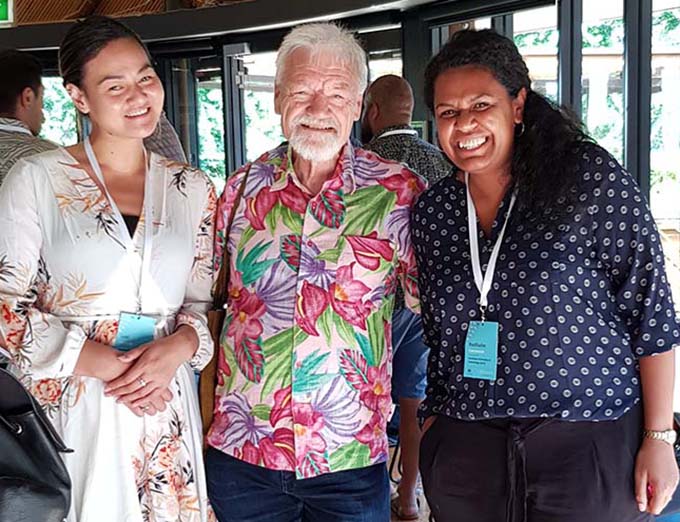
“Papua New Guinea is a democracy and the media is free to hold those in authority to account,” Waide had said on his blog. “This means highlighting flaws in policy and making sure mistakes are pointed out and corrected. It is an essential part of our democracy.”

Dr Robie cited the Waide suspension as an example of some of the research, publication and storytelling provided by the PMC.

“We try to give lot more storytelling with Pacific voices and Pacific context,” he said.

“We try to provide an outlet for Pacific views and also information right across the region.”

Professional development
AUT’s PMC in the School of Communication Studies operated as independent university-based educational media by providing space for postgraduate students to have their stories published and broadcast for professional development.

This had contributed a lot to Pacific storytelling, he said.

“If we do things independently media-wise, there are a lot of stories that we can tell that much of the mainstream just ignores.”

PMC publishes the following media:

• An online general news and current affairs website called Asia-Pacific Report and PMC Online which focuses on media issues and research.

• Its own YouTube (more than 200,000 viewers) and Soundcloud channels.

Pacific Journalism Review, a peer reviewed journal, the only New Zealand-based publication specialising in journalism, media issues, communication and diversity in the South Pacific, Asia Pacific, Australia and New Zealand.

PJR is ranked on the SCOPUS metrics database and is in its 25th year of publication and is hosted on the open access indigenous research platform Tuwhera at Auckland University of Technology.

Pacific Journalism Monographs, a peer-reviewed research companion to Pacific Journalism Review, which publishes longer research projects in an online and booklet format.

Southern Cross, a weekly radio programme on Pacific affairs run by the PMC on Radio 95bfm at the University of Auckland.

Strong links
The PMC also has strong links with the University of the South Pacific journalism programme (Fiji) and Gadjah Mada University’s Centre for Southeast Asian Studies in Indonesia and the Asian Media Information and Communication Centre in the Philippines, and community publishing partnerships with organisations such as RNZ Pacific.

Professor Robie also mentioned PMC’s three-year-old Bearing Witness climate change project and talked about its “outstanding results” by award-winning postgraduate students reporting environmental issues.

He screened the trailer of Banabans of Rabi – A Story of Survival, a short documentary by Hele Ikimotu and Blessen Tom that was premiered at the Nuku’alofa International Film festival last week.

The inaugural Oceans and Islands conference concluded today.

Sri Krishnamurthi and Blessen Tom of the Pacific Media Centre are working as part of a PMC partnership with the NZ Institute for Pacific Research.

AUT’s Professor David Robie with two colleagues at the NZIPR Oceans and Islands conference. Image: NZIPR

Print Friendly, PDF & Email

Article by AsiaPacificReport.nz

Why battery-powered vehicles stack up better than hydrogen

]]>

Source: The Conversation (Au and NZ) – By Jake Whitehead, Research Fellow, The University of Queensland

Low energy efficiency is already a major problem for petrol and diesel vehicles. Typically, only 20% of the overall well-to-wheel energy is actually used to power these vehicles. The other 80% is lost through oil extraction, refinement, transport, evaporation, and engine heat. This low energy efficiency is the primary reason why fossil fuel vehicles are emissions-intensive, and relatively expensive to run.

With this in mind, we set out to understand the energy efficiency of electric and hydrogen vehicles as part of a recent paper published in the Air Quality and Climate Change Journal.

Electric vehicles stack up best

Based on a wide scan of studies globally, we found that battery electric vehicles have significantly lower energy losses compared to other vehicle technologies. Interestingly, however, the well-to-wheel losses of hydrogen fuel cell vehicles were found to be almost as high as fossil fuel vehicles.

Average well-to-wheel energy losses from different vehicle drivetrain technologies, showing typical values and ranges. Note: these figures account for production, transport and propulsion, but do not capture manufacturing energy requirements, which are currently marginally higher for electric and hydrogen fuel cell vehicles compared to fossil fuel vehicles.

At first, this significant efficiency difference may seem surprising, given the recent attention on using hydrogen for transport.


Read more: How hydrogen power can help us cut emissions, boost exports, and even drive further between refills


While most hydrogen today (and for the foreseeable future) is produced from fossil fuels, a zero-emission pathway is possible if renewable energy is used to:

Herein lies one of the significant challenges in harnessing hydrogen for transport: there are many more steps in the energy life cycle process, compared with the simpler, direct use of electricity in battery electric vehicles.

Each step in the process incurs an energy penalty, and therefore an efficiency loss. The sum of these losses ultimately explains why hydrogen fuel cell vehicles, on average, require three to four times more energy than battery electric vehicles, per kilometre travelled.

Electricity grid impacts

The future significance of low energy efficiency is made clearer upon examination of the potential electricity grid impacts. If Australia’s existing 14 million light vehicles were electric, they would need about 37 terawatt-hours (TWh) of electricity per year — a 15% increase in national electricity generation (roughly equivalent to Australia’s existing annual renewable generation).

But if this same fleet was converted to run on hydrogen, it would need more than four times the electricity: roughly 157 TWh a year. This would entail a 63% increase in national electricity generation.

A recent Infrastructure Victoria report reached a similar conclusion. It calculated that a full transition to hydrogen in 2046 – for both light and heavy vehicles – would require 64 TWh of electricity, the equivalent of a 147% increase in Victoria’s annual electricity consumption. Battery electric vehicles, meanwhile, would require roughly one third the amount (22 TWh).


Read more: How electric cars can help save the grid


Some may argue that energy efficiency will no longer be important in the future given some forecasts suggest Australia could reach 100% renewable energy as soon as the 2030s. While the current political climate suggests this will challenging, even as the transition occurs, there will be competing demands for renewable energy between sectors, stressing the continuing importance of energy efficiency.


Read more: At its current rate, Australia is on track for 50% renewable electricity in 2025


It should also be recognised that higher energy requirements translate to higher energy prices. Even if hydrogen reached price parity with petrol or diesel in the future, electric vehicles would remain 70-90% cheaper to run, because of their higher energy efficiency. This would save the average Australian household more than A$2,000 per year.

Pragmatic plan for the future

Despite the clear energy efficiency advantages of electric vehicles over hydrogen vehicles, the truth is there is no silver bullet. Both technologies face differing challenges in terms of infrastructure, consumer acceptance, grid impacts, technology maturity and reliability, and driving range (the volume needed for sufficient hydrogen compared with the battery energy density for electric vehicles).

Battery electric vehicles are not yet a suitable replacement for every vehicle on our roads. But based on the technology available today, it is clear that a significant proportion of the current fleet could transition to be battery electric, including many cars, buses, and short-haul trucks.

Such a transition represents a sensible, robust and cost-efficient approach for delivering the significant transport emission reductions required within the short time frames outlined by the Intergovernmental Panel on Climate Change’s recent report on restraining global warming to 1.5℃, while also reducing transport costs.

Together with other energy-efficient technologies, such as the direct export of renewable electricity overseas, battery electric vehicles will ensure that the renewable energy we generate over the coming decades is used to reduce the greatest amount of emissions, as quickly as possible.


Read more: The north’s future is electrifying: powering Asia with renewables


Meanwhile, research should continue into energy efficient options for long-distance trucks, shipping and aircraft, as well as the broader role for both hydrogen and electrification in reducing emissions across other sectors of the economy.

With the Federal Senate Select Committee on Electric Vehicles set to deliver its final report on December 4, let’s hope the continuing importance of energy efficiency in transport has not been forgotten.

ref. Why battery-powered vehicles stack up better than hydrogen – http://theconversation.com/why-battery-powered-vehicles-stack-up-better-than-hydrogen-106844

Yes, Knickers the steer is really, really big. But he’s far short of true genetic freak status

]]>

Source: The Conversation (Au and NZ) – By Sonja Dominik, Research scientist in animal breeding and genetics, CSIRO

The story of Knickers the giant steer has gone viral on social media over the past week. Admittedly, the pictures show him towering over a herd of young Wagyu steers, with Wagyu being one of the smaller cattle breeds, which even enhances his size.

Nevertheless, Knickers is undeniably an impressive beast, standing 194cm tall and weighing a whopping 1.4 tonnes. He is a Holstein-Friesian, which is a large dairy breed. Even Holstein-Friesian cows can grow up to 160cm tall and weigh up to 900kg, and the boys are typically taller and heavier still.

However, Knickers stands literally head and shoulders above the rest, and as an agricultural geneticist I am thrilled that the limelight has been shone in a fun way on our beautiful livestock.


Read more: Watching over livestock: our guardian animals


How much do cattle vary?

The story of Knickers has probably encouraged a lot of people to think about the size of cattle for the first time, and to appreciate how much they can vary.

There is an astonishing amount of variation in size between cattle breeds, from the diminutive Dexter breed, the smallest European breed standing at around 100cm, all the way up to the gargantuan Chianina, the world’s largest cattle breed which features the current all-time record-holder, an Italian ox called Bellino who measures a stunning 202cm. All shapes and sizes of cattle breeds are represented in between these two extemes.

Is there an ideal cattle size?

The question as to why there are such vast differences in size goes back to the time when cattle were first domesticated around 11,000 years ago. One of cattle’s wild ancestors, called Aurochs, were even taller than Knickers, with many bulls standing more than 200cm tall.

Since domestication, cattle have been bred for different purposes, including pulling a plough, or producing milk or meat. These understandably require different body characteristics. The “ideal” size is also influenced by the amount and quality of forage available. Put simply, larger cattle need more food than smaller ones, so if food is scarce, smaller cattle provide a more productive option.

The ideal size of the animals might also be influenced by the availability and size of handling and housing facilities. These days, beef cattle’s size is very strongly influenced by the ideal market size (which saved Knickers, he was too big to go to slaughter).

Is Knickers a freak?

On first observation, some of the most common beef breeds, such as Angus and Hereford, might be described as “all the same size”. Yet there is a surprising amount of variation even within each of these breeds.

Typically, the size distribution within a herd of breed follows a bell-shaped curve, with a few small cattle, a few large cattle, and the majority somewhere in between.

So where does Knickers sit on this curve? The answer is: a long way towards the big end, but not quite into genuine freak territory. Within the Holstein-Friesian breed he is exceptional, but within the extreme end of the existing known range for males.

How did he reach such mammoth proportions? Basically, all the cards fell his way. Males are bigger on average than females, and castrated males (steers) are bigger than entire males (bulls). Castration influences hormones, which delays the completion of bone growth, particularly in the limbs. And on top of all that, Knickers is seven years old – far beyond the age at which cattle are typically taken for slaughter.


Read more: Food for thought: the rise of Australia’s mighty Brahman


So unlike most cattle, Knickers has been allowed to grow old – with the emphasis on grow.

So yes, as you may have gathered from browsing literally any part of the Internet this week, Knickers is a big unit – maybe the biggest steer in Australia. But his size is nevertheless very much within the biological parameters of his breed.

Yet while he is not quite a genetic one-off, to me he is still a superstar, because he has triggered a curious conversation on cattle. Next time you go past a paddock of calmly grazing cows, pay attention to differences you observe and marvel at these magnificent animals.

ref. Yes, Knickers the steer is really, really big. But he’s far short of true genetic freak status – http://theconversation.com/yes-knickers-the-steer-is-really-really-big-but-hes-far-short-of-true-genetic-freak-status-107959

Warty hammer orchids are sexual deceivers

]]>

Source: The Conversation (Au and NZ) – By Ryan Phillips, Senior Lecturer in Ecology, Environment & Evolution, La Trobe University

Orchids are famed for their beautiful and alluring flowers – and the great lengths to which people will go to experience them in the wild. Among Australian orchids, evocative names such as The Butterfly Orchid, The Queen of Sheeba, and Cleopatra’s Needles conjure up images of rare and beautiful flowers.

Yet there is a rich diversity of our orchids. Some are diminutive, warty, and unpleasant-smelling, bearing little resemblance to a typical flower.


Read more: ‘The worst kind of pain you can imagine’ – what it’s like to be stung by a stinging tree


While many orchid enthusiasts have a soft spot for these quirky members of the Australian flora, what has brought them international recognition is their flair for using some of the most bizarre reproductive strategies on Earth.


The Conversation/Ryan Phillips/Suzi Bond., CC BY


Sexual mimicry

From the very beginnings of pollination research in Australia there were signs that something unusual was going on in the Australian orchid flora.

In the 1920s Edith Coleman from Victoria made the sensational discovery that the Australian tongue and bonnet orchids (Cryptostylis) were pollinated by males of a particular species of ichneumonid wasp attempting to mate with the flower.

But this was just the beginning.

The King-in-his-carriage, Drakaea glyptodon, is the most common species of hammer orchid. Here the flower is pictured next to the female of its pollinating thynnine wasp, Zaspilothynnus trilobatus. Rod Peakall, Author provided

We now know that while the insect species involved may vary, many of our orchid species use this strategy. Australia is the world centre for sexual deception in plants.

Perhaps the most sophisticated flower of all sexually deceptive plants is seen in the hammer orchids, a diminutive genus that only grows in southwestern Australia. Their solitary stem reaches a height of around 40cm, and each stem produces a single flower no more than 4cm in length.

Even among sexually deceptive orchids, hammer orchids stand out from the crowd. They have a single heart-shaped leaf that sits flush with the soil surface, and grow in areas of dry inhospitable sand – an unusual choice for an orchid.

The thynnine wasp Zaspilothynnus nigripes is a sexually deceived. pollinator of the Warty hammer orchid. Here they are pictured in copula, with the flightless female having been carried to a food source by the male. Keith Smith, Author provided

And then there is the flower. Not only does the lip of the flower more closely resemble an insect than a petal, but it is hinged partway along. All of which starts to makes sense once you see the pollinators in action.

Like many other Australian sexually deceptive orchids, they are pollinated by thynnine wasps – a unique group in which the male picks up the flightless female and they mate in flight.

In the case of hammer orchids, the male grasps the insect-like lip and attempts to fly off with “her”. The combination of his momentum and the hinge mechanism swings him upside down and onto the orchid’s reproductive structures.

It’s not me, it’s you (you’re a flower)

So, how do you trick a wasp?

Accurate visual mimicry of the female insect does not appear to be essential, as there are some sexually deceptive orchids that are brightly coloured like a regular flower.

Instead, the key ingredient for attracting pollinators to the flower is mimicking the sex pheromone of the female insect. And boy, is this pheromone potent.

Indeed, one of the strangest fieldwork experiences I’ve had was wasps flying through my open car window while stopped at traffic lights, irresistibly drawn to make love to the hammer orchids sitting on the passenger seat!

Pollination of the Warty hammer orchid by a male of the thynnine wasp Zaspilothynnus nigripes. Suzi Bond, Author provided

While determining the chemicals responsible for attraction of sexually deceived pollinators is a laborious process, we now know that multiple classes of chemicals are involved, several of which were new to science or had no previously known function in plants.

What’s more, we are still discovering new and unexpected cases of sexual deception in orchids that don’t conform to the insect-like appearance of many sexually deceptive orchids.

A classic example is the case of the Warty hammer orchid and the Kings spider orchid – these two species have totally different-looking flowers, yet both are pollinated by the same wasp species through sexual deception.

While the ability to attract sexually excited males without closely resembling a female insect may partly explain the evolution of sexual deception, it does not explain the benefit of evolving this strategy in the first place.

A leading hypothesis for the evolution of sexual deception is that mate-seeking males be more efficient at finding orchid flowers than food-foraging pollinators – but this remains a work in progress.

The life cycle of the Warty hammer orchid and its pollinator species, highlighting the complex ecological requirements needed to support a population of. the orchid. Martin Thompson, Author provided

From a conservation point of view, pollination by sexual deception has some interesting challenges. Female animals produce sex pheromones that only attract males of their own species. This means an orchid that mimics a sex pheromone typically relies on a single pollinator species. As such, conservation of any given orchid species requires the presence of a viable population of a particular pollinator.

Further, an interesting quirk of these sexually deceptive systems is the potential for cryptic forms of the orchid: where populations of orchids that appear identical to human observers actually attract different pollinator species through shifts in pheromone chemistry. Indeed, of the ten known species of hammer orchid, three contain cryptic forms.


Read more: Australia’s unusual species


Not only does this create a major challenge for managing rare species, it raises the possibility that – should these forms prove to be separate species – the true diversity of sexually deceptive orchids could be greatly underestimated.


Sign up to Beating Around the Bush, a series that profiles native plants: part gardening column, part dispatches from country, entirely Australian.

ref. Warty hammer orchids are sexual deceivers – http://theconversation.com/warty-hammer-orchids-are-sexual-deceivers-107805

Trust Me, I’m An Expert: the science of sleep and the economics of sleeplessness

]]>

Source: The Conversation (Au and NZ) – By Sunanda Creagh, Head of Digital Storytelling

How did you sleep last night? If you had anything other than eight interrupted hours of peaceful, restful sleep then guess what? It’s not that bad – it’s actually pretty normal.

We recently asked five sleep researchers if everyone needs eight hours of sleep a night and they all said no, you don’t.


Read more: We asked five experts: does everyone need eight hours of sleep?


In fact, only about one quarter of us report getting eight or more hours of sleep. That’s according to the huge annual Household, Income and Labour Dynamics in Australia (HILDA) survey which now tracks more than 17,500 people in 9500 households.

We’ll hear today from Roger Wilkins, who runs the HILDA survey at University of Melbourne, on what exactly the survey found about how much and how well Australians sleep.

But first, you’ll hear from sleep expert Melinda Jackson, Senior Research Fellow in the School of Health and Biomedical Sciences, RMIT University, about what the evidence shows about how we used to sleep in pre-industrial times, and what promising research is on the horizon. Here’s a taste:

Trust Me, I’m An Expert is a podcast where we ask academics to surprise, delight and inform us with their research. You can download previous episodes here.

And please, do check out other podcasts from The Conversation – including The Conversation US’ Heat and Light, about 1968 in the US, and The Anthill from The Conversation UK, as well as Media Files, a podcast all about the media. You can find all our podcasts over here.

The two segments in today’s podcast were recorded and edited by Dilpreet Kaur Taggar. Additional editing by Sunanda Creagh.


Read more: I can’t sleep. What drugs can I (safely) take?


Additional audio and credits

Kindergarten by Unkle Ho, from Elefant Traks

Morning Two by David Szesztay, Free Music Archive.

ref. Trust Me, I’m An Expert: the science of sleep and the economics of sleeplessness – http://theconversation.com/trust-me-im-an-expert-the-science-of-sleep-and-the-economics-of-sleeplessness-107278

VIDEO: Michelle Grattan on the government’s week from hell

]]>

Source: The Conversation (Au and NZ) – By Michelle Grattan, Professorial Fellow, University of Canberra

Michelle Grattan speaks to Canberra University Vice-Chancellor Deep Saini about the week in Australian politics. They discuss the Coalition’s shift into minority government, the Liberal party troubles in the wake of the defeat at the Victorian election, Victorian MP Julia Banks defection to the cross bench, and Scott Morrison’s announcement of the budget and election timetable.

ref. VIDEO: Michelle Grattan on the government’s week from hell – http://theconversation.com/video-michelle-grattan-on-the-governments-week-from-hell-107958

Why Australia’s anti-vilification laws matter

]]>

Source: The Conversation (Au and NZ) – By Katharine Gelber, Professor of Politics and Public Policy, The University of Queensland

This piece is part of a series on race and racism in Australia. The series examines this complex and incendiary topic, and the role it plays in contemporary Australia. You can read the rest of the series here.


Nearly 30 years ago, Australians made a decision to start implementing anti-vilification laws. They now exist federally, in every state, and in the ACT.

But unlike many countries around the world, the focus here is on civil laws. Although many states have criminal laws prohibiting serious vilification (such as NSW and Queensland), there are no criminal “hate speech” laws at the federal level. In practice, the vast majority of vilification complaints in Australia are dealt with under the civil law.

The basic idea is pretty simple. In a society that aspires to embrace diversity and support the human rights of all, it is not OK to vilify someone (that is, denigrate or defame them) because of who they are, as opposed to something they might have done.


Read more: Explainer: what is Section 18C and why do some politicians want it changed?


We have been researching anti-vilification laws for more than two decades. So, how well do these kinds of laws work? Do they provide redress and remedies to targets of hate speech? Do they stifle free speech? And, perhaps most importantly, do they reduce the incidence of hate speech?

First, let’s look at whether hate speech laws provide redress and remedies to targets of hate speech. If a person feels that an incident of unlawful vilification has occurred, they can lodge a complaint by contacting the relevant state authority (for example, the NSW Anti-Discrimination Board) or the Australian Human Rights Commission.

There are procedural difficulties in lodging a complaint. For example, the person complaining needs to be from the group that was targeted and has to be able to identify the person about whom they are complaining (which is difficult when vilification happens in public places and the perpetrator is a stranger). The process can also take a long time. This can discourage people from lodging complaints or cause them to give up before the matter is resolved.

After a person lodges a complaint, the authority will assess whether the allegation falls within the definition of unlawful vilification. If so, the authority will investigate and attempt to mediate a resolution.

Our research has found that in about a third of complaints, a successful resolution is reached. This usually means that the person who made the comments agrees to stop making them or agrees to apologise, or the workplace where the comments occurred agrees to hold workshops to educate their staff about appropriate behaviour. These are all good outcomes.

The whole mediation process is confidential, so the public rarely gets to hear about these success stories. But they do show that the laws can provide redress and remedies to targets of hate speech.

The same research project showed that communities targeted by hate speech support the existence of the laws. Even if they never make a formal complaint, people appreciate that the government has legislated to tell everyone that racist, homophobic or other vilification is unacceptable. These laws help people to feel valued and supported.

Unfortunately, there are some gaps in current anti-vilification laws. Most laws don’t cover religious vilification and so, for example, little protection is offered to Muslims, even though we know they are one of the most vilified groups in Australia.

Do hate speech laws stifle free speech?

One of the most common arguments made by opponents of hate speech laws is that they stifle free speech. But our research does not support this claim.

Only a small number of complaints are lodged around the country each year (about 200), and less than 2% of those complaints end up in a court or tribunal. Of those that do, only half succeed. The most commonly ordered remedy is an apology or correction, or removal of the material from public view.

There is little evidence that people feel some topics are “off limits”. On the contrary – political debate in Australia is robust and wide open.

In fact, some of those who complain most vociferously about being silenced – like Andrew Bolt, Alan Jones and Tony Abbott – are amongst the loudest and most influential voices in Australia. They are prominent public commentators who enjoy wide media exposure.

Do hate speech laws reduce the incidence of hate speech?

This is perhaps the most difficult question to answer.

Our research has shown that there have been some changes in how controversial topics are discussed in outlets like newspapers. Overt racial and other vilification is less common now. Anti-vilification laws have played a part in effecting this change, but lots of other factors have been important, too, including changing social attitudes.


Read more: There’s no need for the ‘Chicago principles’ in Australian universities to protect freedom of speech


Unfortunately, as our research confirms, there has been little to no change in the incidence of vilification in public places – on the street, on trains and buses, or in shopping centres, for example. The only shift that has occurred is in who is targeted, with more recent waves of migrants newly targeted. There has been a shift, for example, towards people of African heritage and from the Middle East.

On this level, anti-vilification laws do not seem to have reduced the overall incidence of hate speech.

Another way of measuring the success of anti-vilification laws is in public attitudes. Opinion polls show strong public support for the idea that governments should draw a line in the sand – one that says that racist hate speech and other forms of group vilification are unacceptable.

This is perhaps the most important legacy of 30 years of anti-vilification laws in Australia.

ref. Why Australia’s anti-vilification laws matter – http://theconversation.com/why-australias-anti-vilification-laws-matter-106615

Stone tools date early humans in North Africa to 2.4 million years ago

]]>

Source: The Conversation (Au and NZ) – By Mathieu Duval, ARC Future Fellow, Griffith University

When did early humans first arrive in the Mediterranean area? New archaeological evidence published today online by the journal Science (as a First Release) indicates their presence in North Africa at least 2.4 million years ago.

This is about 600,000 years earlier than previously thought.

The results, from the Ain Boucherit site in north eastern Algeria, provide new information on a time window involving the earliest representative of the Homo genus.


Read more: Australian archaeologists dropped the term ‘Stone Age’ decades ago, and so should you


These discoveries are the result of excavations and intensive investigations performed under the umbrella of the Ain Hanech project since 1992.

Location of Ain Boucherit and other prehistoric sites mentioned in the text. Right: Zoom on the vicinity of El Eulma city. Maps from Google map

Located north of El Eulma city, the area was previously well known for providing stone tools and cut-marked bones dated to about 1.8 million years ago (Ain Hanech and El Kherba sites, see map above), which have been until now the oldest occurrences in North Africa.

In 2006 and 2009, new artefacts were found at Ain Boucherit, a few hundred metres from the other sites. They were distributed in two layers below the previous archaeological findings, suggesting an even older human presence in the area.

The new archaeological finds

Excavations of the lower (known as AB-Lw) and upper (AB-Up) archaeological levels yielded more than 250 stone tools and almost 600 fossil remains.

A wide range of animals was identified, including elephants, horses, rhinos, hippos, wild antelopes, pigs, hyenas, and crocodiles. These animals currently occupy a relatively open savanna type habitat with permanent water nearby, suggesting similar conditions in the past.

The stone tool find includes mostly chopping tools and sharp-edged cutting tools used for processing animal carcasses. Those tools are made of limestone and flint that were most likely collected nearby from ancient stream beds.

They are typical of the Oldowan stone tool technology known from East African sites and dated to between 2.6 million and 1.9 million years ago. But the Ain Boucherit find also shows some subtle variations, in particular with the presence of very peculiar tools of spheroidal shape whose function remains unknown.

Two examples of stone tools from Ain Boucherit. An Oldowan core from which sharp-edged cutting flakes were removed (left). Sharp-edged cutting flake that may be used for butchery activities on the bones (right). Mohamed Sahnouni

Some of the fossil bones show very specific marks that could not be of natural origin, but rather the result of an intentional activity.

Two types were identified. The first were cutmarks made from sharp-edged flakes, suggesting skinning, evisceration and defleshing activities (pictured below). The second include percussion marks made from a hammerstone, suggesting marrow extractions.

These show the use by early hominins of meat and marrow from animals. This is consistent with other studies from broadly contemporaneous East African sites.

A small bovid bone with stone tool cutmarks. Isabel Caceres

Dating the site was quite challenging, but the relative positions of AB-Up (within Olduvai event) and AB-Lw (a few metres below Olduvai) allowed us to derive an age of about 1.9 million and 2.4 million years ago, respectively.

The significance of the discovery

This new discovery modifies our understanding of the timing and diffusion of the Oldowan stone tool technology throughout Africa and outside the continent.

By pushing back by about 600,000 years the earliest occurrence of Oldowan tools in North Africa, the age difference with the oldest East African evidence suddenly becomes relatively small.

This indicates at least a somewhat rapid (or, more rapid than previously thought) expansion of this technology from East Africa, although a multiple origin scenario of stone tool manufacture in both East and North Africa might even be possible.

As a consequence, the first settlements of the southern margin of the Mediterranean area now appear to be much older than their northern counterparts.

The oldest evidence from southern Europe does not exceed about 1.4 million years ago (Atapuerca and Orce sites, in Spain), while the hominin fossils found at Dmanisi in Georgia, at the gates of Europe, are dated to 1.8 million years ago.

Who made these tools?

Since no hominin fossils were found at Ain Boucherit, we can only speculate about the possible makers of these Oldowan stone tools.

The hominin fossil record in North Africa is extremely poor, and there is currently no fossil reported in the age range of Ain Boucherit.

The oldest fossils found in Algeria are dated to about 700,000 years ago. They were found at Tighennif (formerly known as Ternifine, map above). If their attribution has changed over time (initially Athlantropus mauritanicus and nowadays Homo erectus or early Homo heidelbergensis depending on the authors), these fossils are too young compared with the Ain Boucherit discoveries to support any kind of connection between the sites.

All the early hominin fossil remains found in the Mediterranean area in association with Oldowan stone tools are significantly younger than Ain Boucherit, by at least 1 million years. The oldest Western European evidence such as the partial mandible found at Atapuerca Sima del Elefante, Spain, and the isolated deciduous tooth from Barranco León, southern Spain, are dated to about 1.2 million and 1.4 million years ago, respectively.


Read more: Giant handaxes suggest that different groups of early humans coexisted in ancient Europe


Consequently, the best candidates are most likely to be found in East Africa, despite their geographical distance from North Africa. Several hominins are broadly contemporaneous with Ain Boucherit (a good overview may be found here), including australopithecines and different members of the genus Homo such as Homo habilis, Homo rudolfensis or the undefined early Homo from Ledi-Geraru, Ethiopia.

That said, we cannot rule out the possibility that the stone tools at Ain Boucherit come from another hominin species, belonging or not to the genus Homo, that has not been found yet.

We hope our future excavation at Ain Boucherit will give us the opportunity to identify these stone toolmakers.

ref. Stone tools date early humans in North Africa to 2.4 million years ago – http://theconversation.com/stone-tools-date-early-humans-in-north-africa-to-2-4-million-years-ago-107617

What makes the G20 a force for global good – when its members agree they want it to be

]]>

Source: The Conversation (Au and NZ) – By Christian Downie, Australian Research Council DECRA Fellow, Australian National University

Compared to other international organisations, the G20 would seem to be one of the weakest.

It has no formal mandate like the United Nations. It has no permanent staff or buildings like the World Bank. It certainly has no funds like the International Monetary Fund. It has no power to make formal rules that members must follow, nor to take action against states that fail to comply, like the World Trade Organisation.

So how does the G20 get anything done?

What has made it influential in tackling problems like the global financial crisis? Why is it tasked with addressing some of the most pressing global problems, such as climate change?

A big part of the answer is the sheer power of its members. But also vital is the G20’s informal structure, which provides members with significant flexibility, and its close working relationship with other international organisations that also have a seat at the G20 table.

Economic muscle

The members of G20 pack enormous punch.

The group comprises 18 of the 21 nations with the biggest economies by gross domestic product, plus South Africa and the European Union.

This means there are effectively 43 countries with a stake in the G20. Together they account for about 85% of global gross domestic product, and about 65% of the world’s people.


So when they agree to coordinate their national policies in a particular policy domain they can transform the global landscape.

In the wake of the global financial crisis in 2008, for example, G20 leaders agreed to co-ordinate their economic policies to ameliorate the worst impacts of the crash. Compared to previous crises of similar magnitude, the global economy recovered much more quickly than many anticipated. This is credited in large part to the G20’s role in expediting a co-ordinated response.

Seats at the table

Although the G20 does not have its own permanent staff and resources, it is adept at enlisting the commitment and resources of other international organisations when it needs to.

Bodies such the International Monetary Fund and the Organisation for Economic Cooperation and Development are well-integrated into the G20’s negotiation processes.


Read more: Explainer: who gets invited to the G20 summit, and why


These organisations often prove willing partners because they depend, to varying degrees, on the material and political support of G20 member states for their existence.

Take, for example, the Financial Stability Board, established by the G20 at its 2009 London summit in London.

The board works to promote the stability of the global financial markets by co-ordinating the work of national and international financial authorities. The G20 has relied on the board to take the lead on making large financial institutions less vulnerable to collapse, such as by forcing them to hold more capital, implementing tougher transparency standards, and monitoring their progress.

Similarly, the G20 has enlisted the OECD to help to make multinational companies pay tax; the United Nations Environment Programme to boost green finance; and the International Energy Agency to help address the problem of fossil-fuel subsidies.

Where there’s a will

That is not to say the G20 always delivers.

G20 leaders announced as far back as 2009 that they would phase out fossil-fuel subsidies. In ten years there has been limited progress.

Nevertheless, because global problems like climate change must be solved by collective action, the G20 remains a vital multilateral forum.

Particularly given G20 members account for 80% of the world’s primary energy demand, and about the same percentage of human-caused carbon emissions.


Read more: We have so many ways to pursue a healthy climate – it’s insane to wait any longer


As a result, accelerated G20 co-operation could dramatically improve the prospects for a clean energy transition

Should they wish to do so, G20’s leaders have the capacity to achieve much more than talking. At their best they have the power to transform the rules that govern the globe.

ref. What makes the G20 a force for global good – when its members agree they want it to be – http://theconversation.com/what-makes-the-g20-a-force-for-global-good-when-its-members-agree-they-want-it-to-be-107507

Bryce Edwards’ Political Roundup: Suffrage reality check – prisoners still can’t vote

]]>

Political Roundup: Suffrage reality check – prisoners still can’t vote

by Dr Bryce Edwards.

Dr Bryce Edwards.

Yesterday marked 125 years to the day since women first voted in a New Zealand General Election. However, celebrations received a reality check when an inconvenient truth resurfaced in a new campaign – the fact that not all New Zealand women have suffrage, because prisoners are still denied the right to participate in elections. 

The campaign to give the vote to prisoners has been launched by the justice reform campaign group, JustSpeak, which has started a new petition: Right to Vote for All. The petition, which includes an open letter to Minister of Justice, Andrew Little, currently has around 200 signatories.

Here’s the key message: “We believe that in a fair and democratic society all members should have the right to vote, and people living in prisons are part of our society. They are valued members of communities and families. To take away their right to vote is an unfair disenfranchisement.”

In conjunction with this new campaign, two very compelling videos have been released that deal with suffrage issues and voting. Yesterday, the first video about women in prison not being able to vote was launched: Can’t: the NZ women still unable to vote, 125 years after suffrage.

And today, the second in the series “examines some of the many and complex reasons why, after 125 years of women’s suffrage, so many women don’t vote” – see: Don’t: the NZ women still not voting, 125 years after suffrage.

To accompany these videos, the Spinoff website is also running a series of articles on prisoners’ suffrage. The most important one for explaining the arguments in favour of prisoners being able to enrol and vote is by JustSpeak’s Tania Sawicki Mead and Ashelsha Sawant – see: To call ourselves a truly representative democracy, this voting law must change.

Looking at the current law that bans prisoners from voting, they say: “It’s the worst kind of anti-democratic law – harsh, disproportionate and fundamentally at odds with the idea that human rights belong to all of us.” And they also point out that New Zealand is an outlier in this regard: “Most democracies around the world either allow prisoners to vote or have recently reinstated their right to do so. New Zealand lags behind in comparison as one of the handful of countries who still have a blanket ban.”

For a poignant argument in favour of prisoner voting, it’s worth reading a very personal account from Awatea Mita, who has spent time in prison – see: A society that denies the incarcerated a vote is a society stamping on human rights. She argues: “Rehabilitation as a safe, responsible, and productive member of an egalitarian society must include the most basic right of the democratic process — the right to participate in choosing who governs, the right to vote. There is research that shows an association between civic engagement, such as being able to vote, and the reduction of offending.”

The role of the Supreme court in suffrage rights

The campaign for reform has been given a massive boost by the landmark New Zealand Supreme Court declaration earlier this month that the ban on prisoners voting – passed in 2010 as the Electoral (Disqualification of Sentenced Prisoners) Amendment Act – is inconsistent with the Bill of Rights Act. This is best covered by Sam Hurley in his news report, Supreme Court upholds decision saying ban on prisoner voting inconsistent with Bill of Rights.

This report quotes Justice Paul Heath, who made the decision in order to “draw to the attention of the New Zealand public that Parliament has enacted legislation inconsistent with a fundamental right”.

The article provides some history of the ban on prisoner voting in New Zealand. It also, interestingly, cites Jacinda Ardern’s strong opposition to the current voting ban, quoting her statements from when she was Labour’s spokesperson on Justice. For example, Ardern said, “This was an arbitrary law and one that is full of contradictions and inconsistencies” and “Parliament has a responsibility to respect fundamental rights for all. The Government now has a responsibility to assure all New Zealanders it understands that”.

For more on the process of the case being brought to the Supreme Court by current prisoner Arthur Taylor, see Alex Baird’s Kiwi prisoners’ right to vote upheld Supreme Court rules. Taylor appeared in the Supreme Court case via audio-video link from prison, and when he won the case, he says there was celebration from his fellow inmates. Taylor says: “Some of them have made me a cake out of biscuits and things they can buy on their purchases, so that was quite nice, the thought’s there anyway”.

Will the Government extend suffrage to prisoners?

The above article also quotes Justice Minister Andrew Little explaining that although the courts had ruled against the ban, he didn’t see it as a priority to correct the error. Instead, he explained that his priority was to fix the judicial-legislative constitution problems caused by the landmark ruling: “The priority is to get in place a process that requires parliament to respond to any declaration made by the courts on inconsistency with the Bill of Rights.”

Elsewhere, Andrew Little has said that, although he personally opposed the ban on prisoner voting rights, he didn’t see it as a “priority” for the current government, and he’s been reported as believing that “Ministers were unlikely to consider the issue for at least a year” – see RNZ’s Youth advocacy group disappointed in govt’s stance on prisoner votes.

This article also reports JustSpeak’s Tania Sawicki Mead’s response that Little’s stance “was hypocritical because in opposition Labour MPs opposed the law change banning voting”. Mead is quoted: “I think it’s a question of how much this basic issue of access to democracy and your fundamental right to participate is a priority to this government or not… I hope that they seriously consider making it a part of their legislative agenda next year.”

Leftwing blogger Martyn Bradbury has reacted with incredulity that the Labour-led Government would essentially oppose returning votes to prisoners, and argues that this decision is based on political pragmatism trumping principles: “Little’s kicked for touch so as to not infuriate NZs easily angered sensible sentencing lynch mob” – see: In just 7 words did Andrew Little demolish real prison reform?

Bradbury explains how the complete ban on prisoner voting came out of the National Party opportunistically playing to a conservative audience, but Labour is now doing the same: “So smart politics to play to the angriest and most easily upset elements off society, but to also shrug off the crucial point that prisoners do have human rights regardless of imprisonment actually cuts to the very heart of the issues Little is attempting to force change on.”

Another blogger, No Right Turn, is also outraged that Labour have decided not to advance a remedy for the problem with urgency: “This is simply not acceptable. When the Supreme Court makes a ruling like this, it should automatically become a priority for Parliament, and should be formally drawn to its attention for a response. The government has already signalled that that is what it wants to do in future, so why won’t it do it in this case? And there’s a pressing need: we’re having an election in 2020, and it would simply be unacceptable given the ruling for prisoners to be unable to vote in it” – see: “Not a priority”.

Furthermore, see his update from yesterday: “in Parliament today the government said that they hadn’t even considered the issue and that it wasn’t a priority for them. Which tells us everything we need to know. This government is not committed to fundamental human rights, and is quite willing to violate them for political profit” – see: Still not their priority.

For the best analysis on the Government’s reluctance to enact universal suffrage, see Gordon Campbell’s On prisoner voting. He points to New Zealand First as the primary barrier to reform.

Here’s Campbell’s main explanation: “Not for the first time, prisoners are being treated as political footballs. Just as the Key government played to the redneck vote back in 2010, Little seems OK about Labour becoming captive to the hardline ‘lock ’em up’ faction that exists within New Zealand First. Earlier this year, Little had been blindsided by NZF leader Winston Peters when Labour tried to scrap the “Three Strikes” legislation. Rather than risk losing a similar fight, Little now seems gun-shy about fighting at all on this issue.”

On the question of whether fixing the problem should be a priority, Campbell says this should be obvious: “Centre-left governments used to think that the rights of prisoners shouldn’t be sacrificed to indulge the desire for societal revenge. I’d also have thought that – when you’re the Justice Minister – defending section 12 of our Bill of Rights should be a priority.”

There is now a chance that the Government might be pressured to give the vote back to prisoners, with the Green Party launching their own campaign yesterday – see Henry Cooke’s Green Party makes call for law change to allow prisoners the right to vote.

According to this, the Green Party’s Justice spokeswoman Golriz Ghahraman “is asking Justice Minister Andrew Little to prioritise the change, but legislation would be needed, so NZ First would need to get onboard. The party has not ruled out attempting the change as a members’ bill.”

Finally, when we think about extending the electoral franchise, perhaps we need to think about lowering the qualifying age as well. Today, Azaria Howell has made the case for it being two years lower – see: Make it 16: a teenager on why we should lower the voting age.

X-rays of rocks show their super-fluid past, and reveal mineral deposits vital for batteries

]]>

Source: The Conversation (Au and NZ) – By Steve Barnes, Geologist, CSIRO

New X-ray technologies reveal some of the incredible processes that took place in Earth’s geological history – and should help us identify new high value ores.

We see that some of the most valuable accumulations of metals ever mined by humans formed from molten rocks, and particularly from molten sulfide minerals (those that feature sulfur as a major compenent).

These metal accumulations, called ore deposits, contain nickel, copper and cobalt – metals that are critical components of lithium-ion batteries.


Read more: How to make batteries that last (almost) forever


Even at present prices, large examples of such once-molten orebodies contain hundreds of billions of dollars worth of nickel, usually with valuable by-products copper, cobalt, platinum and palladium.

We need to keep finding new, high-grade deposits – like the recently discovered Nova-Bollinger orebody east of Kalgoorlie in Western Australia – to keep up with the inevitable increase in demand. On current projections, a new one of these is needed every year to keep up with demand for nickel in lithium-ion batteries.

A better understanding of how these deposits formed, deep in the Earth’s crust millions of year ago, will help us improve our exploration success rate.

Plumbing system in ancient volcanoes

The geological process that formed ores from molten sulfides have a lot in common with smelting (the procedure used by people for millennia to extract pure metals from sulfur-bearing minerals).

Smelting iron ore to produce steel. from www.shutterstock.com

Millions of years ago, molten iron sulfide minerals reacted with magma in the plumbing system of ancient volcanoes – in effect scavenging the essential metals nickel, copper, cobalt and platinum. These minerals accumulated in sufficient concentrations such that they could be mined once erosion had exposed the ore at the surface.

Over the past few years, we have greatly improved our understanding of how these remarkable ore deposits formed. This understanding has been built up using new techniques in imaging the ores in two and three dimensions, using X-ray technologies at CSIRO and the Australian Synchrotron .

We have been using a technique called microbeam X-ray element mapping to make detailed 2D images of the ores and the rocks they sit in.

Some of these images – such as the one at the top of this story – are created on the X-ray fluorescence microscopy beamline at the Australian Synchrotron, applying the Maia detector system. This enables gigapixel images to be collected in a matter of minutes.

Like turning on the light

Complementing this technique, we’ve also applied high-resolution 3D X-ray tomography – the equivalent of a hospital CT scan – to reveal in 3D details on the shape and size of the droplets of sulfide liquid that formed the ores.

The effect has been to turn on a light in a dark room: we have seen features inside solid rocks that have not previously been revealed.

An X-ray tomography image (CT scan) of an ore sample showing frozen droplets of sulfide liquid as red blobs. Steve Barnes, Author provided

Sulfide liquids, it turns out, have remarkable physical properties. They behave like a hot knife through butter: so corrosive that they can melt their way through solid rocks, ending up in some cases tens of metres away from their original host rocks.

We now know that orebodies form in very particular parts of the ancient “plumbing systems” that fed magmas to the volcanoes above. The ores formed where the flowing magma was so hot that it melted the rocks around it.

The “hot knife” sulfide liquid then continued to melt its way into the floor, such that the ores are now found injected into the underlying non-igneous rocks.

In the case of the supergiant nickel ores of the Norilsk region in Siberia, the rocks that melted also supplied the sulfur to form the orebodies.

In fact, so much sulfur was released by this process that much of it, along with vast amounts of nickel, was actually erupted into the atmosphere, contributing to the greatest mass extinction in Earth history.


Read more: Death metal: how nickel played a role in the world’s worst mass extinction


Needle in haystack targets

This type of work helps us improve geological models the exploration industry uses to explore for new deposits.

Nickel sulfide ores are notoriously difficult “needle in haystack” targets, and we need to bring our best combination of geophysical detection techniques and predictive geological models.

So where next?

Research is ongoing: both into the fundamental processes of ore formation and into the implications of this understanding for where and how to look for new deposits.

Some of the minerals that form along with the sulfide ores can be dispersed by erosion, and rivers transport them long distances from the deposits themselves.

We are learning how to recognise these chemically distinctive grains, in the same way diamond explorers use “indicator minerals” to find fertile kimberlites (the source rock for diamonds).

We’re also doing more fundamental research, such as using analogue material (salt water and olive oil work very well, it turns out) and computational fluid dynamic models on supercomputers to look into the physics of how magmatic ores come to look the way they do.

ref. X-rays of rocks show their super-fluid past, and reveal mineral deposits vital for batteries – http://theconversation.com/x-rays-of-rocks-show-their-super-fluid-past-and-reveal-mineral-deposits-vital-for-batteries-107360

How believers in ‘white genocide’ are spreading their hate-filled message in Australia

]]>

Source: The Conversation (Au and NZ) – By Kaz Ross, Lecturer in Asian Studies, University of Tasmania

This piece is part of a series on race and racism in Australia. The series examines this complex and incendiary topic, and the role it plays in contemporary Australia.


In October, the ABC’s Background Briefing outlined how the NSW Young Nationals Party had been the target of an organised infiltration attempt by members with neo-Nazi or “alt-right” views. Once this infiltration was exposed, 22 members were banned for life and individuals in other extremist groups were barred from becoming future members.

The group’s aim was to influence party policy in the area of immigration, as shown in motions they proposed at the Young Nationals’ annual conference. Controversially, they wanted immigration to be curtailed to only “culturally compatible peoples” and for white South African farmers to be granted refugee status on the basis of racial oppression.

These views have been gaining support in Australia. Senator Fraser Anning and MP Andrew Laming have both spoken publicly about the plight of white South Africans, and Home Affairs Minister Peter Dutton floated (then discounted) the idea of special visa attention for the farmers.


Read more: Why Australia should be wary of the Proud Boys and their violent, alt-right views


Senator Pauline Hanson’s most recent maiden speech in 2016 also called for an end to multiculturalism and the granting of visas for “incompatible” people, specifically Muslims.

Anning’s defence of Western civilisation on Facebook. Senator Fraser Anning/Facebook

These views are based – perhaps unknowingly – on a core belief of neo-Nazis: so-called “white genocide”.

The defence of Western civilisation and pride in “white” achievements – on the rise both here and abroad – have become racist dog whistles for this call for action to prevent the “disappearance” of the white race.

This fear of white genocide is also leading to violence. The shooter who killed 11 people in the recent Pittsburgh synagogue attack justified his actions by claiming that Jews were committing “genocide” against his people.

So, what is ‘white genocide’?

The recent manifestation of white genocide has its origins in the American neo-Nazi movement. The Turner Diaries, a very influential 1970s novel by William Luther Pierce, posited a dystopian world in which white Americans were oppressed by non-white minorities at the behest of Jewish politicians. A righteous, armed resistance then takes back control of the world after a bloody nuclear war.

Pierce’s work inspired a spate of violent crimes, including the Oklahoma City bombing by Timothy McVeigh in 1995. It also led to the formation of secret groups, including the infamous and ultra-violent white supremacist group The Order. It was an influential member of the Order, David Lane, who coined the white nationalist mantra:

We must secure the existence of our people and a future for white children.

White genocide adherents want a return to a so-called traditional way of life defined by the nuclear family and prescribed gender roles. They divide humans into separate races and see multiculturalism and migration as a threat because each race should be contained to their perceived homeland.

Imagined racial homelands posted in the Australia’s Future Exposed Facebook group. Facebook

The idea of a homeland is important. Following the second world war, American neo-Nazis drew on notions of place and race that took root in Germany in the 19th century and were later adopted under Adolf Hitler as the slogan “blood and soil”.

“Blood and soil” is the cry of the nativist, asserting the belonging of a people to a place to the exclusion of outsiders. The slogan reappeared as one of the chants at the Unite the Right rally in Charlottesville, Virginia, in 2017.

‘Blood and soil’ was among the many racist chants of protesters in Charlottesville.

For white nationalists, this idea forms the “solution” to the threat of white genocide. Neo-Nazi groups like Identity Evropa advocate for ceasing immigration from “non-compatible” nations and encouraging population growth amongst whites.

The most important goal of white nationalists, however, is the creation of a white “ethno-state”.

This is a state that is presumed to have strong bonds and social cohesion due to shared ethnicity or race, as argued by the evolutionary psychologist Kevin MacDonald. Some adherents go so far as to call for the removal of non-whites from multicultural societies, such as the US and Australia, to so-called ethnic homelands in other parts of the world.


Read more: Twelve charts on race and racism in Australia


‘White genocide’ fears in Australia

After the US, Australia has the most active white nationalist presence on social media, according to J.M. Berger, a leading researcher on extremism. Over the past 10 years, various white supremacist groups have formed online, such as the self-described neo-Nazi group Antipodean Resistance.

As documented by the ABC, the ideas of neo-Nazis like Pierce and Lane are also actively being explored in secret online groups in Australia. An influential collection of writings called Siege by the neo-Nazi James Mason was cited as an inspiration for some of those expelled from the NSW Young Nationals, along with the aim of creating an ethno-state.

Another recent manifestation of this white supremacist ideology is the meme “It’s OK to be white.” Worn on a T-shirt by Canadian racist provocateur Lauren Southern during her recent visit to Australia, then raised as a motion in the Senate by Hanson, the slogan aims to portray whites as victims who are not protected by anti-racism legislation or social practices.

It is this belief that whites are being targeted that underpins the resignation letter of the leader of the NSW Young Nationals infiltration attempt. Clifford Jennings claimed that young white Australians face a grim future in which they are at risk of becoming a “harried, persecuted minority” due to an “oppressive multicultural regime” supported by the “treasonous” leaders of the major parties.

This is a clarion call to the believers in white genocide.

Why this theory is flawed and dangerous

Jennings is harking back to the long-abandoned Immigration Restriction Act (1901) and other racially targeted pieces of legislation known colloquially as the White Australia Policy. These privileged certain Europeans in migration programs with the aim of “keeping Australia white”.

But how do Australia’s white supremacists side-step Australia’s 60,000 years of Indigenous history? For the believers in white genocide, the term “genocide” does not refer to the impact of European colonisation on Indigenous peoples because they claim Australia only came into being as a nation with the arrival of white Europeans.

Visiting alt-right speakers such as Milo Yiannopoulos, Lauren Southern and Stefan Molyneux have openly denigrated Aboriginal culture. This has supported a belief that there is no place for Aboriginal people in the white ethno-state.


Read more: Australian politics explainer: the White Australia policy


Of course, the idea of whiteness itself in Australia has changed dramatically over time. And despite the claims of DNA testing companies, there is no scientific basis for “race” itself and, therefore, for racial superiority claims.

Are white Australians at risk of becoming a persecuted minority? Hardly.

Regardless, the white genocide theory is based on a flawed premise – that only white people can be authentic Australians (or residents of other perceived “ethno-states”). And in multicultural Australia, the facts tell a different story.

ref. How believers in ‘white genocide’ are spreading their hate-filled message in Australia – http://theconversation.com/how-believers-in-white-genocide-are-spreading-their-hate-filled-message-in-australia-106605