Page 1141

Behrouz Boochani’s literary prize cements his status as an Australian writer

]]>

Source: The Conversation (Au and NZ) – By Keyvan Allahyari, PhD candidate in English, University of Melbourne

When the author Richard Flanagan described Behrouz Boochani, a Kurdish-Iranian asylum seeker currently held on Manus Island, as “a great Australian writer”, he turned tired cliché into a pointed question: what makes an “Australian” writer?

No Friend But the Mountains by Behrouz Boochani. Pan Macmillan

Flanagan was writing in the foreword to Boochani’s startling book No Friend But the Mountains (Picador), which last night won the $100,000 Victorian Prize for Literature, the richest of its kind in Australia. Boochani also claimed the award for non-fiction, worth another $25,000.

This triumph cements Boochani’s status as an Australian writer.

Boochani was arguably the most important literary phenomenon in Australian literature in 2018. In part, this is because of the distinctive qualities of No Friend But the Mountains, an epic work that moves between verse and prose, reportage and fantasy, the mundane and the historical. The fact that Boochani’s political memoir of what he calls Manus Prison was ever published in book form defies the odds.

A journalist and experimental documentary maker, Boochani wrote the book as text messages on his mobile phone, sending them, sometimes through several intermediaries, to the academic Omid Tofighian for translation into English.


Read more: Truth to power: my time translating Behrouz Boochani’s masterpiece


Indeed, beyond the recognition of Boochani’s book as a singular achievement in its own right, its success this week highlights recent intersections of human rights activism and the vocal political position-taking of the Australian literary community.

The publication of No Friend But the Mountains was accompanied by numerous public events, such as one at the Greek Centre in Melbourne in October 2018, where the conditions detailed in the book were discussed and protested, and Boochani participated via Skype. The same month, A “National Day of Action” organised by Academics for Refugees featured public “read-ins” of the book on university campuses nationwide.

Other Australian authors have also used their voices to bring attention to the plight of asylum seekers. During her acceptance speech for her second Miles Franklin Award in August 2018, Michelle de Kretser chastised politicians for their treatment of refugees on Nauru and Manus Island. To illustrate her point, she read a list of names of asylum seekers who have died there in the past five years.

It is tempting to dismiss such actions as gesture politics by an urban elite. But each individual action has served to raise awareness of the Australian government’s policy of “offshore processing” for asylum seekers, and to fuse artistic expression with political activism in a particularly forceful manner.

At the same time, and perhaps uniquely in the history of Australian literature, No Friend has seen the translation of human rights awards into convertible cultural capital in the literary field. The author has been awarded the Anna Politkovskaya Award, the Amnesty International Award and Liberty Victoria’s Empty Chair Award. These humanitarian awards have confirmed Boochani’s rapidly acquired high profile in the literary field.

Last night’s news topped all of that to make Boochani the first “non-Australian” author to win the Victorian Premier’s Literary Awards. The Victorian government established these awards in 1985 to honour Australian writing. The specific challenge this poses to the definition of “Australian writing” can be seen as an intervention by the literary community into the field of politics. If a non-citizen who has never set foot on mainland Australia can win, who counts as an Australian author?


Read more: Book Review: Behrouz Boochani’s unsparing look at the brutality of Manus Island


Ironically, perhaps, Boochani’s success simply mirrors some of the prevailing trends in Australian authorship in an age of global literary circulation, which allow writers to transcend national borders. An example of this phenomenon is Nam Le who rose to fame with the publication of his very successful The Boat. This collection of short stories, informed by the author’s diasporic identity and upbringing in Australia, soon earned him over a dozen major literary awards in Australia, the United States and Europe.

Conversely, Boochani’s status on Manus Island has been defined by deterrence, indefinite detention and the spectre of refoulement. The narrative of this experience is one that he seeks to address directly to the Australian people from beyond Australia’s borders.

With no clear solution to the indefinite detention of asylum seekers on Manus and Nauru in sight, the paradox of Boochani’s award success can only contribute further to public debate over the tangled logic of indefinite detention. It shows how cultural practices and political activism can be reconfigured to correspond with the newly created literary currency associated with refugee writing. For now, at least, Boochani is an “Australian writer” because Australia is morally implicated in what he wrote and how he wrote it.

ref. Behrouz Boochani’s literary prize cements his status as an Australian writer – http://theconversation.com/behrouz-boochanis-literary-prize-cements-his-status-as-an-australian-writer-110986


‘Don’t be afraid’ – give Bougainville, West Papua freedom, says Parkop

]]>
Port Moresby’s Governor Powes Parkop with the West Papuan Morning Star flag … strong backing for Bougainville and West Papuan self-determination and independence. Image: Filbert Simeon

By Clifford Faiparik in Port Moresby

National Capital District Governor Powes Parkop is pushing for Bougainville and West Papua to gain independence from Papua New Guinea and Indonesia respectively.

Parkop said this in no uncertain terms during a West Papua forum in Port Moresby yesterday.

Northern Governor Gary Juffa, who was also present, expressed similar sentiments.

READ MORE: Campaign for West Papuan independence

“The government must give political independence to Bougainville,” Parkop said. “Likewise, the Indonesian government should also give political independence to the West Papua provinces.

“Both of these people have struggled bitterly for independence for a long time, resulting in widespread deaths. The governments of both countries should not deny these respective people’s rights.”

-Partners-

Parkop said Bougainvilleans would be given the opportunity to determine whether they wanted to remain as part of PNG, or go separate.

“We are not afraid and I’m not afraid,” he said. “If Bougainville chooses independence, they will not move the island of Bougainville to Europe or another place in the world.

‘Still be there’
“They will still be there. We are all inter-married now. There are family and tribal relationships been bonded already.

“We might have a better future because if you look at the history of PNG, because of Bougainville, we were political and economically shaped.”

Parkop said the same message must be told to Indonesia.

“Indonesia must know that if West Papua becomes independent, they will not move the land to the United States,” he said.

“They will still stay there. The people speak Bahasa. Intermarriages have already been forged and established with people from other parts of Indonesia.

“Economically, they can be integrated. Socially, they can still move around in Indonesia. I don’t think the West Papua freedom movement will remove Indonesian investments.

The Indonesians must overcome their fear.”

Clifford Faiparik is a journalist with The National daily newspaper.

Print Friendly, PDF & Email

Article by AsiaPacificReport.nz

Tasmania’s gambling election shows Australia needs tougher rules on money in politics

]]>

Source: The Conversation (Au and NZ) – By Danielle Wood, Program Director, Budget Policy and Institutional Reform, Grattan Institute

Today’s Commonwealth donations data release is a stark reminder of the deep flaws in our political donations system.

Contributions to political parties are revealed up to 19 months after the event, and sometimes not at all.

With most states now operating far more transparent regimes, the only conceivable explanation for the current Commonwealth system is that our political leaders don’t want us to see where the money is coming from.

And the information contained in today’s data dump gives clues as to why that might be.


Read more: Australia trails way behind other nations in regulating political donations


Tasmanian election: where the money came from

The most concerning revelation in today’s release is the extent of political donations from gambling businesses in the lead-up to the March 2018 Tasmanian election. Tasmania relies on Commonwealth rules and processes to make donations public.

The future of poker machines in pubs and clubs was a key election issue: Tasmanian Labor proposed to get rid of the machines by 2023, whereas the Liberals wanted them to stay for at least 25 years.

The hotels lobby ran an intensive advertising campaign during the election. Many commentators suspected pro-gambling lobby groups were also using political donations to support their cause. But it’s taken until today to reveal their donations.

The Tasmanian Liberal Party (who won the election) declared more than A$400,000 from pro-gambling groups in the lead-up to the state election – equal to nearly 90% of the party’s declared donations, and a ten-fold increase on the amount gambling groups gave in the previous election.

Some A$50,000 came from the well-known Federal Group, a family business that runs casinos and gaming assets across the state. Pro-gambling donors gave nothing to Labor, and Labor’s Tasmanian branch received a total of only A$160,000 in donations for the year.

Heavy reliance on a single donor industry creates the risk of undue influence over policy. Tasmanians would be right to question the effect on this inflow of funds from the gambling lobby on their democracy.


Read more: A full ban on political donations would level the playing field – but is it the best approach?


A lot of money remains hidden

The Tasmanian example also neatly highlights the lack of transparency in the Commonwealth regime. Tasmanian voters have waited 11 months to see where the money came from.

In the age of the internet and instant communications, there’s no good reason for this: donations are revealed in close to “real time” in several Australian states.

Tasmanian donations also reveal problems with the disclosure threshold. Parties have to declare donations of A$13,800 or more. But they’re not required to release the details of donations under the threshold – even if a donor makes a series of smaller donations that together exceed the threshold.

The Tasmanian Hotels’ Association declaration reveals that, just two days before the election, they gave A$57,000 to the Liberal Party in seven separate donations.

Because each donation was under the threshold, these donations are not identified in the Liberal Party declaration. The only way for the public to find out about these funds is to guess who might have donated and go hunting in the donor records.

The national returns for the parties shows how significant this issue is. Around half of the Coalition’s funding and a third of the ALP’s funding we know nothing about. A lot of this is likely to be donations below the disclosure threshold. Some of this will doubtless be from “mum and dad” donors who like to give small amounts to their preferred party.

But a lot is probably “donation splitting” from groups adopting a similar approach to the Tasmanian Hotels’ Association.


Read more: FactCheck Q&A: Is Australia one of the few countries worldwide to accept foreign political donations?


What the data does tell us

Despite its deficiencies, the data does reveal some interesting things about how our political parties are funded. Parties received A$154 million in political donations, public funding and other income in 2017-18, down 25% from 2016-17. It’s normal for funding to drop outside of election years, but the parties will be keenly seeking to boost their coffers in the lead-up to this year’s federal election. Unfortunately voters won’t be told anything about that money until 2020.

The data reaffirms the importance of union money to the ALP, and of hotels and mining money to the Coalition. The ALP’s biggest donors and contributors include the shop assistants’ union (A$1.4 million), the Electrical Trade Union (A$940,000) and the CFMEU (A$530,000).

The Coalition’s biggest contributors include the Waratah Group (A$175,000) and the Australian Mining Group (A$170,000). Hotels associations from around the country were also major contributors, giving a combined total of more than A$600,000 to the Coalition.

Both major parties received A$250,000 in donations from ANZ, interesting given the Royal Commission but consistent with the bank’s recent practice of making significant donations to both sides.

Reform the donations regime, for the sake of our democracy

Today’s donations data release will only fuel people’s cynicism about the role of money in politics. If political parties want to start to rebuild the public’s trust, making donations releases more timely and transparent would be a good place to start.

ref. Tasmania’s gambling election shows Australia needs tougher rules on money in politics – http://theconversation.com/tasmanias-gambling-election-shows-australia-needs-tougher-rules-on-money-in-politics-110977

Post Gillette: other brands are better at matching practice with talk, but don’t get the publicity

]]>

Source: The Conversation (Au and NZ) – By Jessica Vredenburg, Senior Lecturer in Marketing, Auckland University of Technology

First it was burning running shoes, and now it’s boycotting razors. This is how some customers are responding to recent brand activism initiatives.


Read more: Razor burned: Why Gillette’s campaign against toxic masculinity missed the mark


Brand activism is becoming increasingly prevalent as brands try to stand out in a cluttered and fragmented marketplace, driven in part by heightened consumer expectations of a brand’s power and duty to do good. In this emerging space, brands have a choice when and how they decide to take a stand, what causes they choose to engage with, and what sort of message they send about this support.

Procter & Gamble razor brand Gillette’s viral campaign against toxic masculinity is an interesting case study.

The campaign

Gillette’s campaign “The Best Men Can Be” plays on their slogan “The Best a Man Can Get”. It is backed by $3 million in charitable donations over three years to causes such as the Boys and Girls Clubs of America.

Gillette’s financial support remains ambiguous beyond the initial donations. Our current research indicates that backing up a brand activism marketing message with authentic practice makes it appear less like “woke washing”. When combined with positive and visible socio-political practices, a brand’s message can increase perceptions of authenticity.

In the case of Gillette, criticism has centred around the seemingly insignificant amount to be donated, compared with the heft of Gillette’s annual profits. Others have criticised Gillette’s “pink tax” gender-based price discrimination and have called out the brand for seemingly appropriating the #MeToo cause while charging more for women’s products.

Despite making a visible effort to match messaging with practice through donations, the leveraging of a gender-driven “pink tax” demonstrates inconsistency with actual corporate practice.


Read more: Gillette’s corporate calculation shows just how far the #metoo movement has come


Actions over words

Another campaign released around the same time received less publicity. In response to the recent US government shutdown, Kraft sought to make a meaningful difference. The Kraft campaign, “Kraft Now, Pay Later” provided food for federal government workers and doubled down on this message by asking consumers to donate to a charity of their choice, instead of paying the company.

This ad was not accompanied by a high-budget advertisement or celebrity endorser such as Nike’s campaign featuring Colin Kaepernick. For the most part, it forwent the marketing messaging aspect entirely, focusing instead on authentic practice. It is high on action, and therefore authenticity of practice, and low on marketing as a brand activism initiative.

According to our research, Kraft could have benefited from publicising their actions through brand activism marketing, creating positive brand sentiment and loyalty. From a marketing perspective, Kraft may have left some money on the table with their approach but scored authenticity points for not appearing to appropriate a cause. But authenticity may not be enough to catch consumer attention.

Intentionally provocative

If a brand’s goal is to insert itself in a topical conversation, garnering media attention and engaging in a provocative way can have its merits. While this is a risky tactic, the brand’s gamble is wagered on the potential to find intensely positive resonance with a subset of consumers rather than mildly favourable reactions from the masses.

The message framing of the Gillette ad serves as a good example of this phenomenon. Historically, positive appeals have been more successful than negative appeals. Think of the empowering Dove “Real Beauty”campaigns or the stirring “Thank you Mom” advertisements aired in conjunction with the Olympic Games. Both garnered favourable reactions from the general public.

However, in a marketplace increasingly flooded with companies’ good intentions, acting in a way that is unexpected, surprising or even shocking has become necessary to gain attention (and go viral). Links to causes or a socially conscious image that previously provided clear brand differentiation have increasingly become points-of-parity, common across many brands, thus diluting the impact.

Surprising or incongruous advertisements elicit deeper levels of consumer processing because of the unanticipated nature of the message. The more a consumer is prompted to think about an ad, the more likely that consumer is to engage with the brand.

Incongruence can be demonstrated through unexpected alignment between brand and cause. While this can be a successful strategy if properly executed, Pepsi’s unsuccessful attempt to engage in the anti-police brutality conversation using supermodel Kendall Jenner clearly backfired.

Gillette instead used the strategy of negatively framed messaging, leading with examples of “toxic masculinity” such as bullying and sexual harassment. Although they went on to show more desirable examples of positive masculinity, for many, the negative frame was inflammatory enough to spark outrage and anger at the brand. But it has started a conversation about toxic masculinity. Had Gillette focused on the positive and employed a motivational style of ad, general sentiment towards the brand may have been more positive — but it likely wouldn’t have had the same impact.

ref. Post Gillette: other brands are better at matching practice with talk, but don’t get the publicity – http://theconversation.com/post-gillette-other-brands-are-better-at-matching-practice-with-talk-but-dont-get-the-publicity-110595

Head start for home owners makes a big difference for housing stress

]]>

Source: The Conversation (Au and NZ) – By Mustapha Bangura, Part-time lecturer and PhD Candidate in Property Economics, Western Sydney University

Housing affordability changes over the years for home owners, but this has been largely ignored. The focus has mostly been on entry-level affordability for home buyers. But how does affordability change over the years after people have bought their home? Our newly published research in Australian Geographer has found owners who entered the housing market 10-15 years ago are less likely to be in housing stress compared with renters or prospective home buyers.

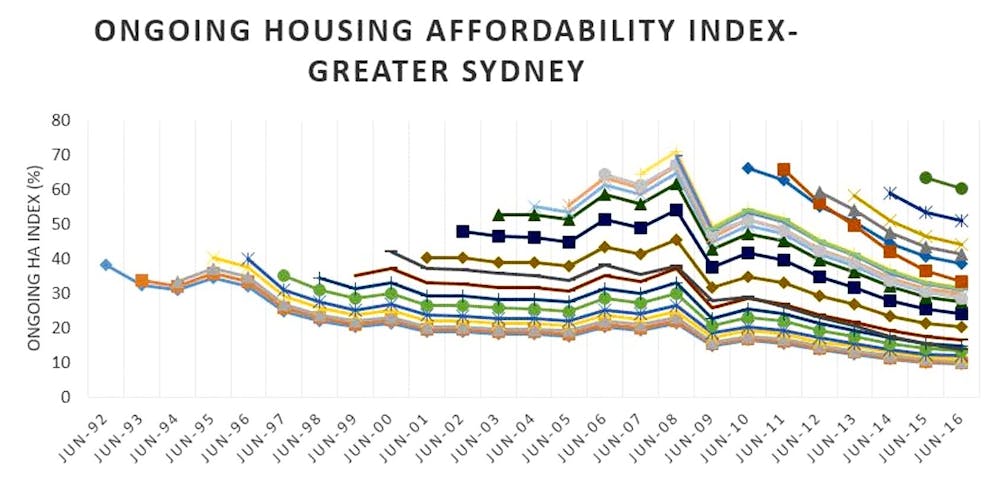
Housing becomes unaffordable when households, especially lower-income households, spend more than 30% of their income on housing costs. Thus the threshold for affordability on our housing affordability index is 30 points. The index shows continuous improvement in ongoing housing affordability for owners over time.

In particular, those who entered the market 10-15 years ago are more likely to find their housing is affordable. Housing stress is not very relevant to them. This is a key benefit of ongoing home ownership.


Read more: Housing affordability stress affects one in nine households, but which ones are really struggling?


Our study focused on Greater Sydney, where we found entry-level housing remains unaffordable in all regions, but the level of unaffordability varies across regions. Specifically, the deterioration in housing affordability is more obvious in lower-income regions such as Western Sydney.

Ongoing housing affordability for those who have entered the market improves considerably within five to ten years. However, there are again significant differences between regions. Residents in lower-income regions such as Western Sydney take longer to improve their ongoing affordability than residents in high-income regions, such as eastern Sydney.


Read more: Mission nearly impossible: the City of Sydney’s efforts to increase the affordable housing supply


Benefits of home ownership are clear

Ongoing housing affordability examines how affordability evolves from the year after entry into the housing market for each cohort of entrants. This is a superior housing affordability measure for most households, particularly current home owners. Importantly, it also demonstrates the benefits and importance of home ownership.

Our ongoing housing affordability indices suggest households in Greater Sydney may experience some level of housing stress in the first five years after buying a house. But this improves from the tenth year after entering and continuously staying in the market.

Figure 1. Ongoing housing affordability index for Greater Sydney showing changes by year of market entry. Bangura & Lee, Australian Geographer (2019), Author provided

For instance, ongoing housing affordability for the cohorts who entered the market in Greater Sydney in 1992 improved significantly from an index value of 38.3 points (a lower index value represents higher housing affordability) in 1992 to around 19 points in 2002. It improved by another 9.5 points by 2016. This reflects a continuous improvement in housing affordability for ongoing owners.

This improvement is explained by a combination of two factors. First, owner incomes typically rose in the years after they first bought a house. Second, those who got in early also avoided the house price inflation of recent times. This means those who entered the market 20 years ago probably do not find their housing is severely unaffordable.

A comparison between the cohort who entered the market in 1992 and the cohort who entered the market in 2015 shows clear differences. The 1992 cohort has a lower housing affordability index value of 9.5 points (meaning more affordable) in 2016 compared to 60.3 points for the 2015 cohort. Housing is clearly much less affordable for new entrants or home owners than for those who entered markets 23 years earlier.

Renters or prospective home buyers are also more likely in housing stress compared with current homeowners, particularly those who entered the market 10-15 years ago. Entering the housing market earlier made a big difference for housing stress. Thus, the long-term benefits of home ownership should be promoted to prospective house buyers.

Affordability gains vary across regions

Ongoing housing affordability for home owners improves considerably within five to ten years of entering the market. However, the ongoing affordability indices show the rate of this improvement varies across different regions of Sydney.

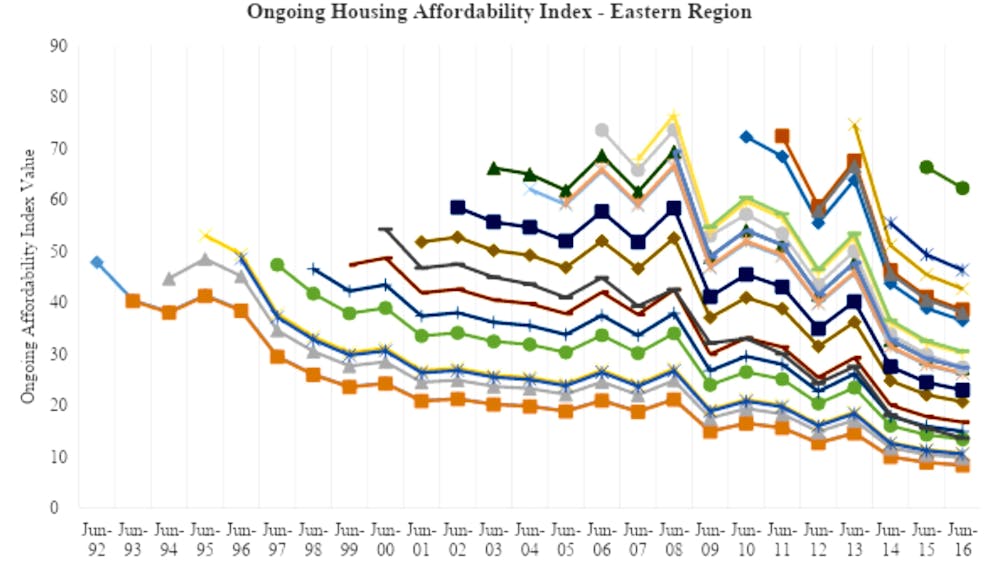
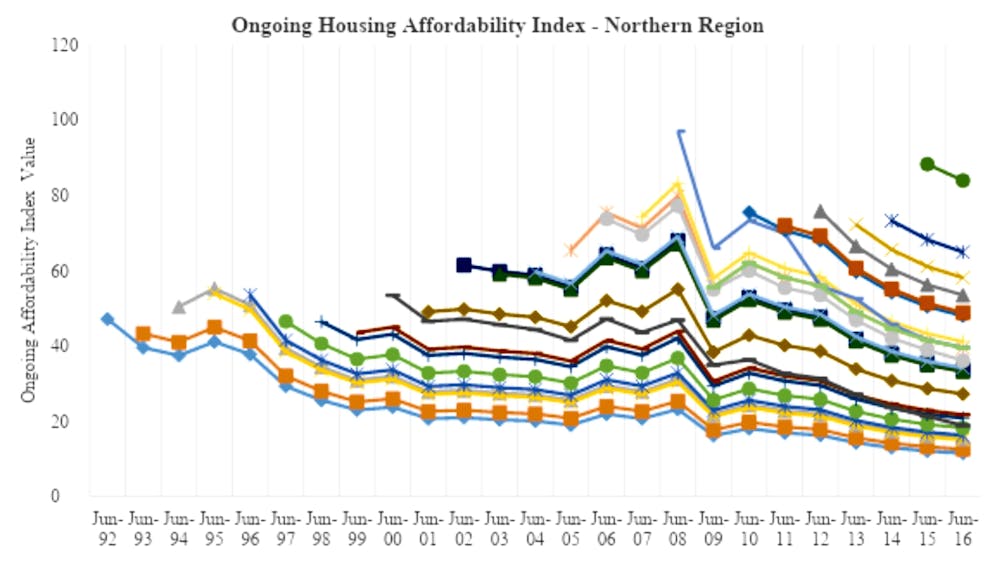
Figure 2. Ongoing housing affordability indices for Greater Sydney regions. Bangura & Lee, Australian Geographer (2019), Adapted from the differential geography of housing affordability in Sydney: a disaggregated approach, Australian Geographer, Author provided

Figure 2 shows that residents in lower-income regions (such as Western Sydney) take longer to reach the affordability threshold of 30 points than residents in higher-income regions (Eastern Sydney). This is likely to affect the consumption and welfare of households, particularly those from lower-income regions.

What next?

The research findings point to two key take-outs:

  1. Long-term owners’ head start makes a big difference for housing stress. Policymakers should promote home ownership as a means to reduce housing stress among prospective home buyers as housing affordability improves over time for home owners.

  2. Governments should redesign existing housing policies to enhance affordability for all households, but particularly entry-level housing for low-income households.


Read more: Six lessons on how to make affordable housing funding work across Australia


ref. Head start for home owners makes a big difference for housing stress – http://theconversation.com/head-start-for-home-owners-makes-a-big-difference-for-housing-stress-109007

Damning royal commission report leaves no doubt that we all lose if the Murray-Darling Basin Plan fails

]]>

Source: The Conversation (Au and NZ) – By Jamie Pittock, Professor, Fenner School of Environment & Society, Australian National University

In the wake of revelations of water theft, fish kills, and towns running out of water, the South Australian Royal Commission into the Murray-Darling Basin has reported that the Basin Plan must be strengthened if there is to be any hope of saving the river system, and the communities along it, from a bleak future.

Evidence uncovered by the Royal Commission showed systemic failures in the implementation of the Murray-Darling Basin Plan. The damning report must trigger action by all governments and bodies involved in managing the basin.

The Basin Plan was adopted in 2012 to address overallocation of water to irrigated farming at the expense of the environment, river towns, Traditional Owners, and the pastoral and tourism industries.

The Commission has made 111 findings and 44 recommendations that accuse federal agencies of maladministration, and challenge key policies that were pursued in implementing the plan.


Read more: Aboriginal voices are missing from the Murray-Darling Basin crisis


What did the report find?

The commission found that the Basin Plan breached federal water laws by applying a “triple bottom line” trade-off of environmental and socioeconomic values, rather than prioritising environmental sustainability and then optimising socio-economic outcomes.

I and my colleagues in the Wentworth Group of Concerned Scientists provided evidence to the commission from our independent assessment of the Basin Plan in 2017, which the commission’s findings reflect.

Contrary to current government practices, the Commission recommendations include:

  • prioritising environmental sustainability
  • basing the plan on transparent science
  • acquiring more water for the environment through direct purchase from farmers
  • meeting the water needs of the Basin’s 40 Indigenous nations
  • ensuring that state governments produce competent subsidiary plans and comply with agreements to remove constraints to inundating floodplain wetlands
  • addressing the impacts of climate change
  • improving monitoring and compliance of Basin Plan implementation.

Resilience in decline

The Murray-Darling Basin is not just a food bowl. It is a living ecosystem that depends on interconnected natural resources. It also underpins the livelihoods of 2.6 million people and agricultural production worth more than A$24 billion.

The continued health of the basin and its economy depends on a healthy river – which in turns means healthy water flows. Like much of Australia, the Murray-Darling Basin is subject to periods of “droughts and flooding rains”. But over the past century the extraction of water, especially for irrigation, has reduced river flows to a point at which the natural system can no longer recover from these extremes.

That lack of resilience is evidenced by the current Darling River fish kills. More broadly, overextraction risks the health of the entire basin, and its capacity to sustain productive regional economies for future generations.

From the perspective of the Wentworth Group, we support the commission’s main recommendations, including increasing pressure on recalcitrant state governments to responsibly deliver their elements of the plan, and to refocus on the health of the river.

We particularly support recommendations related to the use of the best available science in decision-making, including for managing declining water availability under a changing climate.

We welcome the recommendation to reassess the sustainable levels of water extraction so as to comply with the Commonwealth Water Act. These must be constructed with a primary focus on the environment.

In line with this, the 70 billion litre reduction in environmental water from the northern basin adopted by parliament in 2018 should be immediately repealed. So should the ban on direct buyback of water from farmers for the environment.

We also recognise that the Basin Plan’s water recovery target is insufficient to restore health to the environment and prevent further damage, and would welcome an increase in the target above 3,200 billion litres.


Read more: A good plan to help Darling River fish recover exists, so let’s get on with it


South Australian Premier Steven Marshall has taken a welcome first step in calling for a Council of Australian Governments meeting to discuss the commission’s findings. Our governments need to avoid the temptation to legislate away the politically inconvenient failings exposed by the commission, and instead act constructively and implement its recommendations.

This is not only a challenge for the current conservative federal government. The Labor side of politics needs to address its legacy in establishing the Murray-Darling Basin Authority and the Basin Plan, as well as the Victorian government’s role in frustrating the plan’s implementation by failing to remove constraints to environmental water flows.

Now, more than ever, we need strong leadership. If the Murray-Darling Basin Plan fails, we all lose.

ref. Damning royal commission report leaves no doubt that we all lose if the Murray-Darling Basin Plan fails – http://theconversation.com/damning-royal-commission-report-leaves-no-doubt-that-we-all-lose-if-the-murray-darling-basin-plan-fails-110908

VIDEO: Michelle Grattan on the march of the independents

]]>

Source: The Conversation (Au and NZ) – By Michelle Grattan, Professorial Fellow, University of Canberra

University of Canberra Vice-Chancellor Deep Saini speaks with Michelle Grattan about the week in Australian politics. They discuss the week in politics including; independents Zali Steggall of Warringah; Oliver Yates in Kooyong and Julia Banks in Flinders, ministers Michael Keenan and Nigel Scullion, announcement they would be resigning at the next election, and the Coalition’s election campaigns.

ref. VIDEO: Michelle Grattan on the march of the independents – http://theconversation.com/video-michelle-grattan-on-the-march-of-the-independents-110983

Cloning monkeys for research puts humans on a slippery ethical slope

]]>

Source: The Conversation (Au and NZ) – By David Hunter, Associate Professor of Medical Ethics, Flinders University

This article is part of our occasional long read series Zoom Out, where authors explore key ideas in science and technology in the broader context of society and humanity.


Scientists have many tools at their disposal to study, manipulate and copy genes.

Now it appears researchers at the Institute of Neuroscience in Shanghai, China, have combined techniques to produce a world first: gene edited, cloned macaque monkeys (Macaca fascicularis).

Qiang Sun, a senior researcher in the project and Director of ION’s Nonhuman Primate Research Facility explains:

We believe that this approach of cloning gene-edited monkeys could be used to generate a variety of monkey models for gene-based diseases, including many brain diseases, as well as immune and metabolic disorders and cancer.

It sounds like a good idea at face value – curing human disease is something most of us consider a priority. But there are some complex ethical issues at play here.

First, there’s the ongoing question of how we should decide which animals should be used for research.

Second, cloning itself introduces some unique problems around commodification of research animals.


Read more: Fresh urgency in mapping out ethics of brain organoid research


Taking genetics out of the equation

The science in these two reported studies involved cutting out a gene involved in regulating the sleep/wake cycle. Then, an edited embryo was cloned (copied) to produce five live-born monkeys. The five monkeys are essentially genetically identical, and all missing that one gene.

The gene removal created multiple effects in edited monkeys, such as reduced sleep time, increased movement during the night, changed blood hormone levels, increased anxiety and depression, and some schizophrenia-like behaviours.

A statement from the Institute of Neuroscience says this research is an important first step towards the production of “customised gene-edited macaque monkeys with uniform genetic background” for biomedical research.

The underlying motivation of this sort of approach is that the more genetically identical research subjects are, the better any science conducted using them as subjects can be. When comparing two possible outcomes of an experiment – comparing the effect of a new drug versus a non-active placebo for treating anxiety, for example – it allows researchers to remove the complicating effects of natural gene variation from the study outcomes.

Not humans

Animal testing and research involves people doing things to animals that we would not permit them to do to human subjects.

The World Medical Association’s Declaration of Helsinki indicates that in human subject research, the interests of the research subject should be considered paramount. No amount of possible societal benefit should trump the consideration we give for the consent and welfare of human subjects.

This obviously prevents all sorts of research from taking place – because even though results may be beneficial to humanity overall, some experiments would be harmful to the research subject.

The solution to this problem has been to shift this research to animals – given that many believe that animals have a lower moral standing than humans.

Human proxies

So animals are used as a proxy to try to assess what would happen to a human subject exposed to the same environment or condition.

Ideally the animal needs to be close to humans in the relevant health aspects that are being tested. Otherwise the results are likely to not tell us anything useful from the human perspective.

However, the closer to humans the subject is in a biological sense, the more likely the animal to also have a high moral status – perhaps even the same moral status as humans do.

This is because moral status is typically thought to be based on the capabilities something has, rather than its genetics. A number of different characteristics have been suggested as the root of moral status, such as sentience, consciousness, personhood, rationality and higher order reasoning. The closer an animal is to us, the more likely it also shares these traits with us.

So the better a model of human biology an animal is, the more controversial and ethically problematic it will be to use them in research, especially research that is harmful or destructive in nature.


Read more: When does a foetus have moral status?


High moral status

Primates are closer to us than other species in terms of their capacities. Even if we don’t hold that all primates hold the same moral status as humans, it seems clear that if any animal does have moral status, primates would be highly placed on the list. Legislation and practices around research have grown to reflect this.

Some countries – such as the Netherlands, New Zealand, the United Kingdom, Sweden, Germany and Austria – have legislation that recognises high moral status animals (great apes such as orangutans and chimpanzees, for example) from being used as research subjects. This has occurred because of work by organisations like the Great Ape Project and the Nonhuman Rights Project.

Despite this many non-human primates are still used in research, around 75,000 in the US in 2017 for example – most of whom are bred in captivity for this purpose.

The macaques edited and cloned in these new papers are an example of a primate that is still used a research model to explore human health.

Macaques have many characteristics in common with humans.

Cloning is different from breeding

Cloning introduces additional ethical issues for non-human primate research.

There are two ways that cloning is different than captive breeding in terms of ethics.

First, the process of cloning itself introduces harms. For each live birth there are often several unsuccessful attempts to create, implant and bring to term a clone.

A report suggests that to create the five cloned macaques in this world-first case, the team started with 325 cloned gene-edited embryos, which they implanted into 65 surrogate monkeys, a process that cost about US$500,000. I suspect these costs will be reduced as the technique used is refined.

The second issue has to do with commodification, the practice of taking something and making it “property”.

A ‘thing’ rather than a being

Commodification is important psychologically because it helps with the othering that allows us to abuse and misuse. If something is an object rather than a subject, a “thing” rather than a “being”, it becomes easier to discount its welfare.

Commodities have no standing of their own; they are things we use and discard at will.

Of course research animals are already property. The vast majority are captive bred, and many of those animals are commercially created for use in research.

Cloning for research purposes might nonetheless increase the commodification of these animals by commercialising their production even further. When techniques are used to create animals with specific harmful characteristics to improve their usefulness as test subjects, this inherently increases the view of these animals as merely disposable objects.

Given that we recognise primates often have a high moral standing, it is likely that commodification will lead to the inappropriate treatment of these creatures.

Controversial cases – such as this relatively recent piece of research testing the effects of diesel fume exposure on monkeys and humans – provide a troubling window into what can occur when creatures are treated merely as a means to a scientific end rather than as beings in their own right.


Read more: Is it time for Australia to be more open about research involving animals?


On a slippery slope

Commodifying creatures that are close to us in moral standing may well itself lead to a slippery slope. A word commonly used regarding commodification in the human context is “dehumanising”.

Once we are used to treating those creatures as a commodity, something merely to be used, destroyed and discarded if needed for scientific quality, it may be easier to treat fellow humans in that way too.

ref. Cloning monkeys for research puts humans on a slippery ethical slope – http://theconversation.com/cloning-monkeys-for-research-puts-humans-on-a-slippery-ethical-slope-90936

Iran refugee detained in PNG wins Australia’s richest literary prize

]]>
Behrouz Boochani … wrote his award-winning book bit-by-bit via texting from Papua New Guinea. Image: Hoda Afshar/Behrouz Boochani/RNZ Pacific

Pacific Media Watch Newsdesk

An Iranian asylum-seeker detained in Papua New Guinea under Australian asylum laws has won Australia’s most valuable literary prize for a book he reportedly wrote using the online messaging service WhatsApp, reports France 24/AFP.

Behrouz Boochani, a Kurd who has been held on PNG’s Manus Island since 2013, was awarded the Victorian Prize for Literature yesterday, said a statement on a government website for the state of Victoria.

The journalist and filmmaker was awarded the A$100,000 (NZ$106,000) prize for his book No Friend But the Mountains: Writing from Manus Prison.

READ MORE: The book written one text at a time

He will receive an additional A$25,000 after it also won the non-fiction category.

“(Boochani’s) award was accepted by the book’s translator Omid Tofighian, who worked with Boochani over five years to bring the stories to life,” the state website said.

-Partners-

Media reports said Boochani wrote the work on his phone and sent it to Tofighian bit-by-bit in text messages.

This was because he felt unsafe in the guarded camp, which was shut last year after a local court ruling and the asylum-seekers moved elsewhere on the island.

For years Canberra has sent asylum-seekers who try to enter the country by boat to Manus Island or Nauru in the Pacific for processing, with those found to be refugees barred from resettling in Australia.

The harsh policy is meant to deter people embarking on treacherous sea journeys, but the United Nations and other rights groups have criticised the camps’ conditions and long detention periods.

Boochani’s book beat 27 other shortlisted works published last year in Australia to win the overall prize.

Print Friendly, PDF & Email

Article by AsiaPacificReport.nz

Australia’s spike in summer drownings: what the media misses

]]>

Source: The Conversation (Au and NZ) – By Medhavi Gupta, PhD Candidate, George Institute for Global Health

You’d be hard pressed to have missed the news that there’s been a big spike in the number of drowning deaths this summer – up about 50% since last year. The media’s been full of stories of migrants and tourists losing their lives on our beaches.

But our unpublished analysis of the coverage of drowning deaths this summer reveals many news outlets don’t present the true picture of what’s happening in our waterways. And that’s putting people most at risk of drowning in even greater danger.


Read more: Monday’s medical myth: wait 30 minutes after eating before you swim


What the media is not quite getting right

Are foreigners and migrants more at risk than Australian-born swimmers?

We found that almost half of all stories reported on drownings of migrants and people from overseas. For example, the deaths of three migrants at Moonee Beach in NSW was the most covered incident across stories analysed. Many of these articles suggested solutions such as ensuring tourists are informed of water risks and providing new migrants swimming classes.

Again, these suggestions are useful, but the idea that more drowning victims are foreign-born is misleading. Only two articles we read pointed out the truth – that only a third of deaths this summer involved people born overseas. This is about the same proportion of the Australian population born overseas at 28.2%. Although overseas tourists are more at risk of drowning, migrants are not.

All swimmers need to be made aware they are at risk, foreign-born or not. In fact, Australians raised on home soil may actually be overconfident of their water safety knowledge and swimming ability, and the media needs to be more explicit about this.

Australian and foreign-born swimmers are both at risk of drowning. Photo by zayzayem on Foter.com / CC BY-SA

Are beaches really more dangerous than rivers?

Our analysis showed a clear preference for reporting beach-related drowning deaths over deaths occurring inland, such as in rivers and lakes. This bias perpetuates the idea that beaches are more risky than inland water.

However, this summer, almost as many deaths occurred in inland waterways than beaches (43% v 47% at the time this was written), and in 2017/18 more drowning deaths occurred in natural inland waterways.

So most stories emphasise providing beach-related safety tips, emphasising the importance of visiting patrolled beaches and learning how to spot rips. Although this is important advice, it doesn’t apply to inland bodies of water. Where advice is provided, there are statements such as “respect the river”, which provides little practical guidance.

By focusing on beaches, the media may also be missing an opportunity to warn Australians of the dangers of rivers and lakes, which are being greatly underestimated.

Rivers may seem safe, but deep water and fast flowing currents can be dangerous. Mr.TinDC on Foter.com / CC BY-ND

Vague advice

In many stories, safety spokespeople talk about the “think and plan” approach to water safety. This guidance encourages swimmers to choose swimming areas that suit their abilities, assess the risks and consider possible rescue methods. However, little guidance is given on how to assess environments for dangers. And few Australians know what to do when someone is drowning.

How can we reduce drownings?

What should governments do?

Governments need to provide education that reflects real risks. This includes identifying dangerous river and lake conditions, and learning what to do if you get stuck in a current. Communication around water safety after storms and heavy rains can also help, such as during news weather reports.

Although many water bodies have safety warning signs, there is limited evidence they work to prevent unsafe behaviours.

What is well documented is that people follow what other people are doing, especially when they are young, so may ignore signs if others are acting dangerously. As well as signs, more strict enforcement at particularly dangerous spots may be needed, such as random patrolling of rangers and building fences.

A last important action is providing rescue equipment at beaches and popular inland swimming spots, including emergency phones, floatation devices and rope.

What should I do?

Check out these tips on how to stay safe around rivers. Tips include checking the depth of the water before swimming, something many Australians don’t do.

You can do this by looking for reeds breaking the surface or using a stick. You can also test current speed by throwing a leaf in the water and seeing how fast it flows. If you get stuck in a current, lie on your back, feet forward, until you reach a shallower area.

It’s also important to be aware of when you need to wear life jackets. Most Australians would be aware that we should wear them on smaller motor boats, but what if you are rock fishing? Or being towed in a tube? Different states have slightly different guidelines.

Don’t swim if you’ve been drinking. Even a small amount of alcohol can impair your ability to swim and respond to hazards.

Use a floating object to rescue. christophercjensen on Foter.com / CC BY-ND

If someone is drowning, the safest way to save them is to throw a floating object, such as a life ring or life jacket, or the end of a rope or stick. If the person is too far or you have nothing available, don’t try to saving the victim if you have not received proper training or you are not a confident swimmer. Call emergency services and ask others for help.

Lastly, look out for friends and children. Active supervision isn’t about sitting nearby on your phone – it can take as little as 20 seconds for a child to go under. Signs of a person drowning include their head tilted back and mouth at water level, hair over the forehead or eyes, their body in a vertical position, and gasping.

Actively supervise children at all times. dickdotcom on Foter.com / CC BY-SA

With the right action from governments and individuals, we can save tens of lives from drowning in our waterways. This action can’t just wait until next summer – staying safe is an all-year round endeavour. So, campaign for better safety measures at your local waterways, get yourself educated and trained, and help make sure that Australia’s favourite summer pastime only leaves happy memories.

ref. Australia’s spike in summer drownings: what the media misses – http://theconversation.com/australias-spike-in-summer-drownings-what-the-media-misses-109948

Migrant women are particularly vulnerable to technology-facilitated domestic abuse

]]>

Source: The Conversation (Au and NZ) – By Heather Douglas, Professor of Law, The University of Queensland

Migrant women with temporary visa status are particularly vulnerable when it comes to domestic and family violence. That vulnerability is intensified when you add technology to the mix.

Technology-facilitated abuse has been recognised as a new breed of domestic violence. Technology-facilitated abuse refers to controlling, monitoring and harassing behaviours using tools such as mobile phones, SMS, email, tracking apps and social media.

In our recent study, we analysed interviews with migrant women who had experienced domestic abuse about their experiences with technology-facilitated abuse. We found while technology can help women to reduce their isolation in a new country, a partner’s control of technology may increase isolation for migrant women, which can heighten the risk of abuse.


Read more: Technology-facilitated abuse: the new breed of domestic violence


Why migrant women are particularly vulnerable

A number of temporary visas – including partner and prospective marriage visas – require sponsorship by partners with Australian citizenship.

Women who come to Australia on these visas are often separated from family and friends, have limited access to money, and hold fears of deportation and losing custody of their children.

They are often also ineligible to access key resources, such as Centrelink and long term housing, that could help them leave violent relationships.

Technology can make a difference, but without independent income, securing a personal mobile or internet connection is challenging.

The control of devices and digital media by abusers restricts women’s opportunities to connect with support networks, to identify their situation as abusive and to seek help.

These factors contribute to and compound entrapment in abusive relationships.

Listening to migrant womens’ experiences

We reported on women’s experiences of these harms in our study. Analysis of interviews one of us (Heather Douglas) conducted with 65 women who had experienced domestic and family violence showed that most had experienced technology-facilitated abuse as part of their partner’s coercive and controlling behaviour.

Here’s what some of the women on temporary visas told us.

Radha’s story

Radha came to Australia after her marriage to an Australian citizen was arranged. She used Skype to maintain contact with parents, siblings, and friends overseas, but her partner intermittently disabled Skype as “a tactic to pressurise” her.

He would grant access to the internet when she ceded to his demands, such as when she agreed to make him breakfast. He restricted her access to the internet as a way to control her. She said:

it was just to make me […] do something […] Like, if I don’t listen to him he would just switch off the internet.


Read more: The smart home could worsen domestic abuse. But the same technology may also make us safer


Celina’s story

Celina met her partner online, and arrived in Australia to live with him on a partner visa. She was given only enough money to catch public transport. He used a mobile phone to monitor her throughout the day. She said:

I was still new to this country and I didn’t have anything. I was using his personal mobile […] He was carrying the office mobile with him all the time […] he could call me and tell me OK you do this and that during the day […] Every day after work he came home, he took the personal mobile that was with me and went to the toilet and browsed the history and everything.

Dara’s story

Dara described how her abuser severed her connections to resources and her social circle, which were facilitated by technology. She said:

He totally destroyed […] my laptop. My email accounts, password, he changed, that’s why I can’t access my bank. I can’t see my bank account, anything, he changed everything […] He steal my mobile […] It’s my life this is just […] my contact point.

Angelina’s story

Angelina highlights how her abuser monitored her use of technology. She said:

[he] checks [the] phone but I never hide nothing. I had a password on his computer, like guest. He always can go and check history on internet.

A key area for development

As these women’s experiences show, lack of access to technology and a partner’s control of devices can heighten geographic and social isolation.

This causes particular problems for migrant women who rely on technology to maintain supportive connections with family and friends in their home country.

While programs have been developed to assist domestic violence survivors to safely use technology, there are no programs targeting migrant women who are new arrivals.

Specialised services for migrant women are limited, and rely on a small number of staff to serve large geographic areas.


Read more: Technology is both a weapon and a shield for those experiencing domestic violence


So, what can be done?

WESNET’s Safe Connections program works with Telstra to provide smartphones with pre-paid credit to survivors of domestic and family violence, but this program relies on women seeking help.

Given barriers facing those on temporary visas, it would be helpful if their sponsors were required to provide a smartphone, with credit, as part of their sponsorship. Sponsors of prospective marriage visas are currently required to provide an Australian and foreign police check.

It’s important, too, that technology-facilitated abuse is highlighted in programs targeting new arrivals. Women on temporary visas are often required to attend English language courses – information about technology-facilitated abuse should also be offered in this context.

Survivors could also be better protected and empowered by amendments to the Migration Regulations to expand eligibility provisions for permanent residency and to expand eligibility for government support to those on temporary visas. More specialised support services are also needed for survivors on temporary visas.

ref. Migrant women are particularly vulnerable to technology-facilitated domestic abuse – http://theconversation.com/migrant-women-are-particularly-vulnerable-to-technology-facilitated-domestic-abuse-110270

The vomit principle, the dead bat, the freeze: how political spin doctors’ tactics aim to shape the news

]]>

Source: The Conversation (Au and NZ) – By Caroline Fisher, Assistant Professor in Journalism, University of Canberra

It’s election season again and behind the scenes, the political “spin doctors” are working around the clock.

They are the campaign advisers, social media strategists, press secretaries and others who craft political messages to help “sell” their candidate. The term “spin” is contested, of course, and like the phrase “fake news” has become an easy retort for people who reject any version of events that does not reflect their own.

But the fact is any good spin doctor employs a range of overt and covert tactics to get their message across, and I’ve listed some below.

This list is drawn from a range of academic and other sources, and my own personal experience as a “spin doctor”. (I was once a media adviser to Labor’s Anna Bligh, a former Queensland premier. I am also married to one.) It is by no means exhaustive, but it provides an overview of some of the traditional tactics employed by political media advisers and politicians.


Read more: It’s reputation that matters when spin doctors go back to the newsroom


Overt and covert spin tactics

British researcher Ivor Gaber talked about “overt” and “covert” tactics used by press secretaries in the Blair government in the UK.

Overt refers to standard or benign public relations tactics, such as writing press releases, staging events, giving speeches and appearing in the media.

Covert, on the other hand, refers to a range of cynical techniques to manage information – these are the more malign tactics most people associate with “spin”.

The list below contains a wide range of “covert” tactics drawn from a range of research and personal experience. Each of these tactics is employed in a bid to exert control over the way the news media report the message:

  • the leak: these are strategic leaks offered by politicians or their staff to journalists, in exchange for no scrutiny. In other words, you only get the leak if you promise not to seek comment from the opposing side, or other critics. This is increasing and is a real problem

  • the freeze: punishing journalists for negative reporting

  • the spray: a form of bullying and intimidation, this is another way of punishing journalists for negative coverage. Many political reporters who file an unfavourable story can expect to “cop a spray” over the phone after it’s published

  • the drip: the act of keeping favoured reporters on a drip of exclusive information

  • staying on message: the goal of every public appearance or interview by a politician. In itself, it’s not a malign tactic, but the constant repetition of the same messages without answering questions can be a form of obfuscation

  • pivoting: this refers to politicians shifting away from a difficult question or issue to the one he or she wants to talk about

  • the vomit principle: this rule of thumb is widely referred to in political offices. The idea is that if you repeat something so often you feel like vomiting, only then is it likely to be cutting through with the public

  • playing a dead bat: this refers to not responding to a media inquiry or giving a minimal response in an effort to kill the story

  • the truth, but not the whole truth: this refers to being selective with what one reveals, sharing only the most beneficial or least damaging information

  • throwing out the bodies/taking out the garbage: these tactics are used to disclose damaging information under the cover of a major distraction. The classic example often used is that of Jo Moore, a media adviser in the Blair government in the UK. On the day of the 9/11 attacks she sent out an email saying: “It is now a very good day to get out anything we want to bury. Councillors expenses?” Other common days to bury bad news are Christmas Eve, New Year’s Eve, grand final day, Melbourne Cup day, or a distraction like a royal visit

  • get rid of it now: the aim of this tactic is to release all of the damaging information on an issue at one time, so the negative story can be dealt with quickly rather than allowing it to bleed on for weeks in the media. One media adviser I interviewed explained it like this: “It’s a truism in politics – If you’ve got to eat a shit sandwich you’ve got to eat it straight away… The advice was always, ‘Get rid of it now. Go and deal with it now’.”

  • fire-breaking: setting up or staging a diversion to distract attention away from another issue. In the film Wag the Dog, the US president fabricates a war in Albania to distract from a sex scandal. Less extreme examples would be launching a new policy to distract from a negative issue in an attempt to shift the media’s attention

  • kite-flying: this means testing or floating an idea before making a commitment to announce it

  • feeding or starving a story: feeding a story means keeping it alive by commenting on it in the media. Starving a story means starving it of oxygen by not commenting on it. The theory being that after a while the media will get bored and move on

  • keeping out of the media/being a small target: this is a useful tactic if the politician is unpopular and affects the polls, has a controversial portfolio or is an accident-prone poor performer

  • flying under the radar: this refers to just quietly getting on with things without publicising it

  • dishing dirt: this is where old claims suddenly emerge publicly before or during an election in an effort to smear someone’s reputation. The “dirt” can come from outside or inside a party. It’s a tactic used to try to destroy someone’s career

  • dog-whistling: using specific subtle language and messages to target a particular section of the audience

  • wedging: this tactic involves raising an issue that is popular in the electorate and sensitive to the party you are opposing to “wedge” them in to a difficult position and sow division in the party.


To hear Caroline Fisher in conversation with Michelle Grattan in a special election spin-themed episode of our podcast Trust Me, I’m An Expert, click here or search for it in your podcast app.

New to podcasts?

Podcasts are often best enjoyed using a podcast app. All iPhones come with the Apple Podcasts app already installed, or you may want to listen and subscribe on another app such as Pocket Casts (click here to listen to Trust Me, I’m An Expert on Pocket Casts).

You can also hear us on Stitcher, Spotify or any of the apps below. Just pick a service from one of those listed below and click on the icon to find Trust Me, I’m An Expert.


ref. The vomit principle, the dead bat, the freeze: how political spin doctors’ tactics aim to shape the news – http://theconversation.com/the-vomit-principle-the-dead-bat-the-freeze-how-political-spin-doctors-tactics-aim-to-shape-the-news-106453

Trust Me, I’m An Expert: how to spot the work of a political spin doctor this election season

]]>

Source: The Conversation (Au and NZ) – By Sunanda Creagh, Head of Digital Storytelling

It’s February, the holidays seem like a distant memory and here we are barrelling toward a federal election, which the government has indicated will be in May.

Remember in the olden days – as in, a few elections ago – we used to have a fairly set election campaign period of usually about six weeks? Now, of course, politicians seem to always be in campaign mode.

They’re not doing that all by themselves, of course. There’s a small army of spin doctors, social media strategists, political campaign advisers and press secretaries behind the scenes, finessing every utterance so it fits with the overall campaign strategy. And that’s what we are talking about on the podcast today – the art of political spin.


Read more: It’s reputation that matters when spin doctors go back to the newsroom


We’ll hear from Caroline Fisher, political communication and journalism researcher from the University of Canberra. She began her career as a journalist with the ABC, but went on to work as a media adviser for Labor’s Anna Bligh, a former Queensland premier.

Today, she’s talking to Michelle Grattan, political journalist and Professorial Fellow at the University of Canberra about the tips and tricks spin doctors use to shape the political messages you’re hearing every day. And you can read Caroline Fisher’s article on the spin tactics over here.


Read more: The vomit principle, the dead bat, the freeze: how political spin doctors’ tactics aim to shape the news


All year round and especially during election season, you’re going to hear a lot of competing claims about the state of the economy. Has school funding been cut or is it at a record high? Do tax cuts make the economy better or worse? Why are the government and the opposition saying seemingly contradictory things about debt and deficits?

To find out, Lucinda Beaman – who was our FactCheck editor but has just moved to the ABC – spoke to Fabrizio Carmignagni, a professor of economics at the Griffith Business School, Griffith University.

He’s authored many FactCheck articles for The Conversation, where he tests statements by key public figures against the evidence and his special super power is pulling back the curtain to reveal why certain claims you hear about the economy don’t stand up to scrutiny.

Today, Professor Carmignani reveals why you should be suspicious when you hear a politician claim their government has created jobs, how to spot a bit of causation vs correlation spin doctoring, and other political porkies that make economists’ skin crawl.


Read more: FactCheck: have the Trump tax cuts led to lower unemployment and higher wages?


Trust Me, I’m An Expert is a podcast where we ask academics to surprise, delight and inform us with their research. You can download previous episodes here. And please, do check out other podcasts from The Conversation – you can find them all over here.

The segments in today’s podcast were recorded and edited by Sunanda Creagh, with additional recording and editing by Dilpreet Kaur and Eliza Berlage.


Read more: Pencils ready: it’s time for Politics 2019 Bingo!


New to podcasts?

Podcasts are often best enjoyed using a podcast app. All iPhones come with the Apple Podcasts app already installed, or you may want to listen and subscribe on another app such as Pocket Casts (click here to listen to Trust Me, I’m An Expert on Pocket Casts).

You can also hear us on Stitcher, Spotify or any of the apps below. Just pick a service from one of those listed below and click on the icon to find Trust Me, I’m An Expert.


Additional audio

Kindergarten by Unkle Ho, from Elefant Traks

Minister for Finance Mathias Cormann, RN Breakfast

Channel 9 news report.

Bill Shorten’s 2018 Budget reply speech.

Sky News report.

Today Show segment.

ABC news report.

Labor Facebook video.

Nick Xenophon SA Best ad.

The Greens ad.

Podington Bear, Pshaw, from Free Music Archive.

Bloomberg news report.

ref. Trust Me, I’m An Expert: how to spot the work of a political spin doctor this election season – http://theconversation.com/trust-me-im-an-expert-how-to-spot-the-work-of-a-political-spin-doctor-this-election-season-106338

The presence of people is slowing shark recovery on the Great Barrier Reef

]]>

Source: The Conversation (Au and NZ) – By Justin Rizzari, Lecturer in Fisheries Science, Deakin University

Much of the Great Barrier Reef is legally protected in an effort to conserve and rebuild the fragile marine environment. Marine reserves are considered the gold standard for conservation, and often shape our perception of what an “undisturbed ecosystem” should look like.

However our research, published today in Frontiers in Ecology and the Environment, suggests that “no-take” marine reserves may be failing shark populations on the Great Barrier Reef.

After 40 years of protection, the average amount of reef sharks in no-take reserves (areas where fishing is forbidden but people can boat or swim) was only one-third that in strictly enforced human exclusion areas. The difference, we argue, is down to poaching, raising serious questions about the effectiveness of no-take reserves.


Read more: More than 1,200 scientists urge rethink on Australia’s marine park plans


Sharks on coral reefs

Three species of shark are dominant on Indo-Pacific coral reefs: grey reef sharks, blacktip reef sharks, and whitetip reef sharks. All three of these species are considered high-level predators, but the combination of slow reproductive rates and high fishing pressure has depleted reef shark populations across much of their range.

Well-designed and enforced no-take marine reserves help rebuild reef shark populations, but it is not known whether these reserves can facilitate full recovery to baseline (unexploited) levels, or how long the recovery process might take.

People can swim and use boats in no-take reserves. Jon Connell/Flickr, CC BY

No-take marine reserves

No-take marine reserves are firmly advocated as an effective way to combat overfishing. With few exceptions, well-enforced no-take marine reserves result in rapid increases in target fish populations, leading to flow-on benefits such as better fisheries in outlying areas.

In many cases, no-take marine reserves are considered to have intact ecology and therefore drive our perceptions of what undisturbed ecosystems should look like.

The entire Great Barrier Reef was open to fishing until 1980, when no-take reserves were established. More reserves were created over the next two and a half decades, resulting in reserves that vary in age from 14-39 years. A small number of no-entry reserves, which are completely off limits to humans, were also implemented during this period to guard against the potential effects of activities such as boating and diving.

Given that fishing is prohibited in both no-take and no-entry reserves, we expected shark populations to be similar in both areas. Due to the exclusion of humans from no-entry reserves, shark populations within these areas are largely unknown and have only been assessed once, 10 years after protection.


Read more: Killing sharks is killing coral reefs too


This past research revealed that shark populations were much greater inside no-entry reserves compared to no-take reserves, but this does not allow us to determine whether recovery is ongoing or complete. The diverse ages of marine reserves within the GBR provide a unique opportunity to investigate the potential recovery of reef shark populations and evaluate the performance of no-entry and no-take reserves as tools for shark conservation.

What we found

Using underwater survey data from 11 no-take reserves and 13 no-entry reserves, we reconstructed reef shark populations through the past four decades of protection. Surprisingly, we found shark populations were substantially higher – with two-thirds more biomass – in no-entry reserves than in no-take reserves, indicating that the latter do not support near-natural shark populations.

We looked at potential drivers of shark abundance and found that coral cover, habitat complexity, reef size, distance to shore, and the distance to the nearest fished reef could not explain the large differences between no-take and no-entry reserves.

We argue the disparity between no-entry and no-take reserves is likely due to poaching in no-take reserves. Recent research found up to 18% of recreational fishers admit to fishing illegally.

Sharks in no-take reserves are vulnerable to poaching. Mattia Valente/Flickr, CC BY-NC-SA

Enforcement of no-entry reserves is much easier than no-take reserves as evidence of fishing is not required for prosecution. On the other hand, vessels are allowed to be present in no-take reserves, leaving these areas susceptible to poaching. Given the slow reproductive rate of reef sharks, even small amounts of fishing may reduce their populations.

The Great Barrier Reef is one of the most intensely managed marine parks in the world. Despite this, our results reveal that no-take reserves fall well short of restoring shark populations to near-natural levels, and that up to 40 years of strong protection is required to rebuild shark populations.

These results also highlight that no-take marine reserves inadequately reflect ecological baselines and that we may need to reevaluate what we consider to be a natural, intact reef ecosystem.


Read more: The majority of people who see poaching in marine parks say nothing


While the creation of more and larger no-entry reserves may solve the problem, this approach is likely to be unpopular and politically undesirable. An alternative approach, would be to tackle poaching by enlisting fishing communities in the fight against illegal fishing, better education, and increasing enforcement.

ref. The presence of people is slowing shark recovery on the Great Barrier Reef – http://theconversation.com/the-presence-of-people-is-slowing-shark-recovery-on-the-great-barrier-reef-110877

Banks are enabling economic abuse. Here’s how they could be stopping it

]]>

Source: The Conversation (Au and NZ) – By Becky Batagol, Associate Professor of Law, Monash Sustainable Development Institute, Monash University

The Royal Commission into Misconduct in the Banking, Superannuation and Financial Services Industry delivers its final report today.

During its hearings there was an important problem that it has missed.

Banks and financial service providers are failing to adequately recognise the warning signs of economic abuse and family violence experienced by customers.

Family violence is a problem for the banks and their customers. It is a risk to them if it means loans can’t be repaid. It is a risk to their customers if they are made homeless and lose income and mental health in the financial fallout of abuse.

And it’s a problem for our community if banks and other institutions ignore or enable family violence.

Banks can spot warning signs

Customers, especially women, who seek loans from banks or who present to banks with high levels of financial stress might well be victims of economic abuse.

One recent Australian study found that nearly 16% of women had a history of economic abuse and 7% of men.

Economic abuse is a subtle form of violence that we often struggle to recognise.

Most of us know that slapping or pushing is violence. But even victims can fail to see that it is also violence when their partner tries to deny them money.

Here are some of the ways in which it happens:

• A victim of family violence can be forced to seek a loan that only benefits the perpetrator or to guarantee a loan made to the perpetrator

• A loan can be made to the victim and perpetrator jointly, but only the victim might make repayments

• After the violent relationship ends, the perpetrator might not contribute to repayments, and the bank might move to sell mortgaged property

• A victim might have difficulty obtaining information about a loan held in the perpetrator’s name which is secured by a mortgage over a family asset

They are not yet doing enough

In recent years there have been changes to banking industry guidelines to encourage banks to prevent the financial abuse of victims of family violence.

The Australian Bankers’ Association is pushing for widespread staff training. Much has been done, but a lot more needs to be done.

A 2017 survey of 98 banks, building societies, credit unions and credit providers found an alarming lack of awareness of family violence amongst front line staff who rarely identify customers experiencing violence or are even aware of support services.

Most responding institutions said they did not have family violence training for staff or plans to introduce it.

One legal service provider recently assisted ‘Mi-Kim’.

Several months after Mi-Kim’s husband left her, a lender contacted her to advise that the loan to the home she lived in with her pre-school-aged children was in arrears. The loan was in her husband’s name but the lender could not contact him. Mi-Kim , whose English was poor, started paying money into husband’s account to make mortgage repayments. He was still able to access his account and made withdrawals. The lender moved to sell the property.

These victims are doubly disadvantaged by their exposure to violence as well as poor practices on the part of their credit providers.

We know that asking about the presence of family violence helps encourage victims to disclose it. Where loans are being made to couples, financial service providers should specifically ask each member of the couple about family violence and whether any intervention/apprehended violence orders have been made.


Read more: The banking sector can do its bit to combat family violence


Where violence is identified or suspected, a set of automatic protocols should whirr into place.

For joint loans and guarantees in the name of family members who do not benefit, banks and other creditors should have a legal obligation to warn the person taking on the obligation of the importance of obtaining independent advice. The code of practice should mandate information provision about family violence.

We have a rare opportunity to secure a common approach to family violence as part of the response to the banking royal commission. Our financial institutions should embrace it.


We are grateful to Women’s Legal Service Victoria and South East Community Links for providing the case studies referred to in this article.

ref. Banks are enabling economic abuse. Here’s how they could be stopping it – http://theconversation.com/banks-are-enabling-economic-abuse-heres-how-they-could-be-stopping-it-110439

Vital Signs. Yet another year of steady rates. What’s the point of the RBA inflation target?

]]>

Source: The Conversation (Au and NZ) – By Richard Holden, Professor of Economics, UNSW

The Reserve Bank kicks off its first meeting for the year next Tuesday facing the same dilemma it did throughout last year.

It hasn’t got easier.

The bank has a very public, fairly clear objective: to keep inflation between 2% and 3%. But it keeps missing it. Over and over and over again, and on the downside.

As the following chart shows, inflation has been below the bank’s target band for nearly all of the past four years.


During his decade in office, the previous governor Glenn Stephens achieved an average inflation rate of 2.46% – almost bang in the centre of the target band.

During his subsequent two and half years in the job, Philip Lowe has averaged just 1.87%. At no point during Lowe’s term of office has the average fallen within the target band. The rate for December, released on Wednesday, was 1.8%.

Next Wednesday Lowe will make an unusual address to the National Press Club, during which he will outline his thoughts about the year ahead.

It is a year which The Conversation’s forecasting panel predicted will be free of interest rate adjustments, making it a record 40 months without a rate move – Lowe’s entire term in office.


The RBA has more than one target

Although the inflation target is an important part of the Reserve Bank’s mandate, it is also asked to focus on other things. Among them are GDP growth, employment, and (probably less explicitly) the Australian dollar and house prices.

And therein lies the problem. Unless the rate moves needed to meet all those objectives point in the same direction, the bank needs to make trade-offs, or sideline one or more of its objectives.

A classic principle of economics is that a policy-maker needs one instrument (or policy tool) for each objective. It is called the Tinbergen Rule, after the 1969 Nobel Laureate.

The bank has four or five objectives, but really only one tool – the cash rate, stuck at 1.5% since Lowe took the job.

Throw in the ability to partially shape market expectations through speeches by Lowe and Deputy Governor Guy Debelle (so-called “open mouth” operations), and maybe it has two.

Since Lowe took office, the casualty of this imbalance between instruments and objectives has been the inflation target. And it’s unlikely to change for some time.

So why is inflation so low?

Australia is not alone. Advanced economies around the world have had several years of low wages growth, low productivity growth, and low inflation. Populations are ageing, less keen on spending, and have a glut of excess savings.

Add to this the fact that technology and international trade have made a whole range of goods probably permanently cheaper and it’s hard to find inflationary pressure.


Read more: Vital Signs: inflation misses again, so where does the RBA go next?


Potentially making things worse in Australia is the decline in house prices in Sydney and Melbourne eating into consumer confidence and with it, spending. With well over half of the economy coming from private spending, already soft consumer spending could be hit further.

So far, RBA Governor Philip Lowe has been doing an admirable impression of Mr Micawber, in the Charles Dickens novel David Copperfield. When it comes to inflation, he is hoping “something will turn up”. But it hasn’t, even with historically low levels of unemployment.

Worse still, it doesn’t even seem to really be ticking up in the United States, despite the lowest year-end unemployment rate since 1969.

And why does it target inflation?

The bank targets inflation in order to maintain credibility.

The high levels of inflation in the 1970s and ‘80s – despite quite high levels of unemployment – led to the realisation that expectations had a lot to do with it.

Put simply, if people believe prices are going to rise sharply they will demand steep wage rises, which will cause prices to rise sharply. It becomes a “wage-price spiral”.

Macroeconomists and central bankers realised that a credible commitment to keep inflation low would remove the need for the large wage rises, cutting off the spiral before it got going.

The bank describes the rationale for its inflation target this way:

The Governor and the Treasurer have agreed that the appropriate target for monetary policy in Australia is to achieve an inflation rate of 2–3%, on average, over time. This is a rate of inflation sufficiently low that it does not materially distort economic decisions in the community. Seeking to achieve this rate, on average, provides discipline for monetary policy decision-making, and serves as an anchor for private-sector inflation expectations.

That’s been the logic for the past 25 years. We have certainly done away with inflationary spirals. We are in the age of secular stagnation, with an excess of savings chasing too little spending. A world where, since the turn of this century, robust growth has only really been possible when accompanied with financial bubbles–first in dot-coms, then in housing.

So what’s a central banker to do?

There is an active debate among central bankers and leading macroeconomists about whether to abandon the inflation targeting framework.

Luminaries like former US Treasury Secretary Larry Summers argue that inflation targets are, to borrow from Hamlet, “more honour’d in the breach than the observance”.

Right now Lowe faces a real dilemma. If he doesn’t cut rates, the inflation target will become more and more of a joke. It will add to pressure on him to articulate a new monetary policy framework for a new secular-stagnation era.

If he does, he risks re-inflating the housing bubble, boosting already sky-high household debt, and giving himself even less wiggle room if a recession hits.

On Tuesday he’ll leave the cash rate at 1.50%. And on the first Tuesday of the next month, and the the next, and the one after that…

But I think he’ll begin serious internal discussions about a new monetary policy framework, and the mechanics of getting into (and out of) a massive bond-buying program (otherwise known as quantitative easing or printing money) if needed to ward off the next recession should the cash rate remain or get so low he can’t cut it further.

He might have already started. He might drop further hints on Wednesday.


Read more: No surplus, no share market growth, no lift in wage growth. Economic survey points to bleaker times post-election


ref. Vital Signs. Yet another year of steady rates. What’s the point of the RBA inflation target? – http://theconversation.com/vital-signs-yet-another-year-of-steady-rates-whats-the-point-of-the-rba-inflation-target-110574

Five ways to boost Australian writers’ earnings

]]>

Source: The Conversation (Au and NZ) – By Rebecca Giblin, ARC Future Fellow; Associate Professor, Monash University

Who makes the money in publishing? Nobody. This often repeated dark joke highlights a serious issue. The most recent figures show that Australian authors earn just $12,900 a year from writing work (the median, at $2,800, was even worse). Indeed, authors can gross less than $5,000 for Miles Franklin-nominated titles that took two or more years to write.

Fixing this isn’t as simple as reaching more deeply into publisher pockets, because most of those are empty too. While the major international houses are thriving (Simon & Schuster and Penguin Random House recently reported 16% profits), publishing Australian stories can be financially perilous.

In independent publishing, 10% of the book sale goes to the author, perhaps another 10% to the printer, and up to a whopping 70% for distribution. What’s left has to pay the publisher, editor, marketers, admin staff and keep the lights on.

But we can improve our approach to author rights. Here are five lessons we can learn from elsewhere to help Australian writers earn more money.


Read more: Scrounging for money: how the world’s great writers made a living


#1: Give authors stronger out of print rights

Traditionally, contractual “out of print” clauses have let authors reclaim their rights when a print run has sold out and the publisher doesn’t want to invest in another. But in our recent analysis of almost 150 contracts in the Australian Society of Authors archive, we found 85% of contracts with these clauses allowed authors to reclaim their rights only when the book was “not available in any edition”.

These days, books can be kept available (at least digitally or via print-on-demand) forever – but that doesn’t mean their publishers are still actively promoting them.

A better approach is to allow authors to reclaim their rights towards the end of a work’s commercial life, determined with reference to objective criteria like the number of copies sold or royalties earned in the previous year. The Australian Society of Authors recommends authors only sign contracts that have this meaningful kind of out-of-print clause – but many publishers still try to get authors to sign up to unacceptable terms.


Read more: How to read the Australian book industry in a time of change


A growing number of countries (including France, Romania, Slovenia, Spain, Macedonia and Brazil mandate author rights based on objective criteria. The French law is an interesting model. There, authors can get their rights back if a book has been published for at least four years, and they haven’t been credited royalties for at least two. This opens up new possibilities for the author to license it to another publisher, or even sell it directly to libraries or consumers.

Rebecca Giblin on the problems with publishing contracts and the case for new author rights.

#2: ‘Use it or lose it’: return author rights when they’re not being used

Publishers take very broad rights to most books: in our recent archival analysis we found 83% took worldwide rights, and 43% took rights in all languages. It’s easy to take rights – but if publishers do so, they should be obliged to either use them or give them back.

To that end we can learn from the “use it or lose it” laws that bind publishers in some parts of Europe. In Spain and Lithuania, for example, authors can get their rights back for languages that are still unexploited after five years.

#3: Introduce a ‘bestseller’ clause to contracts

Of course, it’s not always the case that there’s no money in publishing: sometimes a title that was expected to sell 5,000 copies sells 5,000,000. That changes the economics enormously: but in many cases, the contract only provides the same old 10% revenue for the author. For works that achieve unexpected success, we can learn from Germany and the Netherlands (and the proposed new EU copyright law). They have “bestseller” clauses that give authors the right to share fairly in unexpected windfalls arising from their work.

#4: Legally enshrine the right to fair payment

Even where there’s not much money to be made, the author should still receive a fair share. Again, Germany and the Netherlands lead the way on this. There, authors are entitled to “fair” or “equitable” payment for their work – and can enforce those rights if their pay is too low.

These laws don’t set a dollar amount, since what is “fair” depends on all the circumstances. However, such laws at least provide a minimum floor. If the contracted amount is unfair or inequitable, authors have a legal right to redress.

#5: Put time limits on transfers

In Australia, copyright lasts for the life of the author, and then another 70 years after that. Publishers almost always take rights for that full term – only 3% of the contracts between publishers and authors we looked at took less. But publishers don’t need that long to recoup their investments. In the US, authors can reclaim their rights from intermediaries 35 years after they licensed or transferred them.

In Canada, copyrights transfer automatically to heirs 25 years after an author dies. We used to have the same law in Australia, but it was abolished for spurious reasons about 50 years ago. If we reintroduced a similar time limit on transfers, it would open up new opportunities for authors and their heirs (for example, to license or sell to a different publisher, libraries or direct to the public).

It’s true that there’s often not much money in publishing. But by changing our approach to author rights, we can help writers earn more and make Australian books more freely available.

ref. Five ways to boost Australian writers’ earnings – http://theconversation.com/five-ways-to-boost-australian-writers-earnings-110694

Grattan on Friday: What Labor has to fear is the Big Scare

]]>

Source: The Conversation (Au and NZ) – By Michelle Grattan, Professorial Fellow, University of Canberra

Asked this week to nominate Labor’s main problem, one insider said “time”. As the very remote possibility of a March election drifted away, the opposition bunkered down for the long wait until May 11 or 18.

Labor has an entrenched lead in the polls and, from its frontbench to its campaign planning, it is match-ready. But there’s no match at the moment. While some government MPs worry things will get even worse for them as time passes, it can equally be argued that the downside risk for Labor is as great.

This revolves around how effective the scares being rolled out against the ALP will be.

Though it is generally believed a minor miracle would be needed to rescue the Morrison government, the Coalition judges the best way to “save furniture” is to wave the fear flags.

“Scare” campaigns are distasteful but potent: Labor’s Mediscare in 2016 was dishonest but brutally effective.

This is well-ploughed territory. In notes written at the time, then Liberal federal director Tony Eggleton documents the success of the Coalition’s 1980 fear-mongering.

The election “was particularly heavy going … the opinion polling was not encouraging” for the Fraser government, Eggleton wrote. Then “Labor inadvertently tossed us a lifeline in the final stages of the campaign.

“One of their spokesmen cost the opposition dearly by raising, albeit tentatively, the prospect of capital gains taxes on the family home. We jumped on this and the unpalatable new tax was made the dominant issue for the last week of the campaign.

“Television and radio messages and full page press advertisements warned of Labor’s threat to the family home. The day before election day our pollster Gary Morgan was able to report that for the first time in the campaign the polls showed us drawing ahead of Labor. He predicted the possibility at the last minute we had enough momentum to get over the line”.

Which Malcolm Fraser duly did.

Eggleton also recorded that “the negativity and the tactics were controversial even among the Liberals but the political hardheads were of the view that the end justified the means”.

The Morrison government has been stepping up its scares since the start of the year. Two major targets are Labor’s proposed crackdown on negative gearing and capital gains and its plan to scrap cash refunds for franking credits (both cast against the background of Labor raising taxes). A more general scare is being run claiming a Shorten government would harm the economy.

The latter illustrates how scare campaigns can be complex and carry the danger of backfiring.

In a Tuesday speech Scott Morrison claimed a Labor government would lead to a “weaker” economy. He didn’t say it would put Australia into recession, but he highlighted that many workers hadn’t experienced a recession – enough for an Age headline “PM warns recession on way under Labor”. Defence Minister Christopher Pyne declared unequivocally: “There will be a recession in Australia if Labor wins”.

Morrison then found himself on the spot, caught between what he’d said, what he was taken as implying, and what Pyne had asserted.

Amid the confusion, it’s unclear whether this scare would have been a plus or a minus for the government. It contained another risk too – any talk of a recession is itself bad for the economy, including for overseas perceptions of Australia.

The scares over the negative gearing and franking policies are less complicated, focusing on and magnifying the losers.

Labor first announced its negative gearing revamp last term, when house prices were rising. Since then, prices in Sydney and Melbourne have been falling.

This has made it easier for the government to whip up concerns about the impact of the policy on house values.

The centrality of their house in the thinking of so many Australians makes this hazardous territory for Labor, however rational its policy.

In the changing circumstances, Labor does have a modest element of flexibility to play with, because it has not yet announced the start date.

But to fireproof itself on negative gearing, Labor needs to work harder on both reassurance (the fact existing negatively-geared properties would be grandfathered) and selling the policy’s advantages (linking it more strongly to the aspirations of first home buyers).

Anything that affects retirees is another highly sensitive area electorally.

It has been reported that Labor is discounting the political impact of its franking credits policy because it calculates that many of those hit are already likely to be Liberal voters.

But it would be unwise to be complacent – in the way the Liberals were for a time about Mediscare in 2016.

And in the hyped climate before an election, any throwaway line can be weaponised, as shadow treasurer Chris Bowen found this week.

Under questioning about a listener’s view on the franking issue, Bowen told the ABC: “I say to your listener: if they feel very strongly about this, if they feel that this is something which should impact on their vote they are of course perfectly entitled to vote against us”.

It was a statement of the obvious, although it also came across as reflecting some frustration.

But the comment took off in the media. “ALP goads seniors: vote against us”, The Australian headlined its Thursday lead story. Morrison said the Bowen comment was “arrogant”; Bill Shorten was grilled.

None of the above is to overlook that the government has had another bad few days, despite Newspoll giving it a small summer lift (from trailing 45-55% before Christmas to 47-53% now).

Two more ministers, Michael Keenan and Nigel Scullion, have announced they will leave at the election.

Three high profile independents have emerged in heartland Liberal seats: Zali Steggall in Warringah; Oliver Yates in Kooyong, and Julia Banks (Liberal defector now on the crossbench) who plans to run in Flinders.

All three are highlighting climate change and the fractures in the Liberal party.

The chances of Yates and Banks are low but Steggall is a real threat to Tony Abbott in Warringah.

The government in general remains in bad shape on multiple fronts, and Scott Morrison often sounds desperate.

The Coalition does have the April 2 budget as an opportunity to improve its fortunes – on the other hand, if that goes badly it will be another own goal.

The budget will offer the sugar, the incentives, the bribes to voters. But it will be the scares that will be the government’s strongest ammunition. The question will be: how far can these bullets penetrate Labor’s armour?

ref. Grattan on Friday: What Labor has to fear is the Big Scare – http://theconversation.com/grattan-on-friday-what-labor-has-to-fear-is-the-big-scare-110910

Why Australians are falling in love with American football, and what it means for local leagues

]]>

Source: The Conversation (Au and NZ) – By Adam Karg, Senior research fellow, Swinburne University of Technology

When the New England Patriots face the Los Angeles Rams in the Super Bowl on Sunday night (US eastern time), they will be cheered on by about 75,000 fans in the stadium, more than 100 million television viewers across the United States, and an estimated 50 million more around the world.

An increasing number of Australians will be tuning into the United States’ biggest annual sporting event, too.

Why many will be taking time off work on Monday morning to watch tells us a lot about what is happening to sport in the 21st century, as a commoditised product in a globalised media entertainment complex.

That American football is even popular with Americans can often be a mystery to foreigners. It’s easy, for instance, for a diehard Australian Football League fan to dismiss it as helmeted hoopla.

Take game time. In the typical Aussie Rules game, lasting about 2.5 hours, there is about 80 minutes of play. The typical NFL game, by comparison, takes three hours but has less than 12 minutes of actual play.

What fills the time? For one thing, advertising. During this year’s Super Bowl you can expect to watch about 50 minutes of pure commercial breaks, with 30-second slots costing advertisers more than US$5 million.

So what makes American football increasingly attractive to people who have grown up playing and watching Aussie Rules, Rugby League, Rugby Union or the world game? Why is the number of Australians tuning into the Super Bowl expected to exceed the 390,000 who watched last year?

Super Bowl LIII is being played at Mercedes-Benz Stadium in Atlanta, Georgia. Tannen Maury/EPA

Marketing power

Some will simply enjoy the Super Bowl as a spectacular event. For others it is part of increasing engagement with both the NFL and other overseas sports.

A huge range of sports are being marketed to Australians through both global and local media channels.

Successfully marketing a “culturally alien” sport to a new audience is not simple. The division in Australia between the Aussie Rules and Rugby League states shows that carving out a niche can be a long and hard process. Nonetheless there are some critical characteristics for success.

First, the sport “product” requires high visibility and awareness.

Second, the sport “content” needs to be accessible, and leverage a range of connection points to engage media audiences, and socialise or connect networks of fans. Much of sports’ value is about sharing experiences with friends, colleagues and family. So high-profile, accessible and entertaining content is a valuable marketing tool.

The NFL scores high on both.

Star and stripe power: singer Pink sings the national anthem prior to Super Bowl LII in 2018. Craig Lassig/EPA

Most Australians know the game due to the familiarity of American culture through films and television. And now the NFL is widely broadcast in Australia. You can watch live games and replay packages on television channels, on the NFL’s own streaming platform or on social media and e-commerce sites.

The content is virtually 24/7, with the NFL at the top of the mega-sport league in supplying round-the-clock content.

This starts with live games themselves. The NFL first grasped the ratings logic of spreading out games for prime-time television audiences in the 1960s. The modern-day outcome is that an Australian fan can watch games from Friday to Tuesday from September through January.

Then there’s the highlights repackaging. Though there’s less than 15 minutes of actual action during an NFL game, that time is made up of 55-70 plays per team, each lasting an average of four seconds. What happens in a four-second play, however, can be dissected and analysed for far longer.

Los Angeles Rams cornerback Dominique Hatfield, right, fends off New Orleans Saints middle linebacker Alex Anzalone. The Rams won the game, qualifying to play in the Super Bowl. Dan Anderson/EPA

It might involve profiling the speed, power or athleticism of a particular player. Or doing a detailed breakdown of both the offensive strategy and the defensive response. There is also a growing market for analytics and statistics, given the growth of sports betting.

On all these fronts the NFL provides “engagement points”.

Acute levels of analysis fuel other content. Included here are panel shows, podcasts, reality shows and documentaries that profile and build awareness of athletes and teams from high school to professional levels. Much of this content is now available in Australia.

In short, the NFL leverages high visibility and a well-developed content strategy to engage fans in a variety of ways on and beyond game days; and it has more money to do it better than anyone else.

Threat to local leagues

So should Australia’s existing sporting businesses be concerned about NFL?

For our most popular codes, like Aussie Rules and Rugby League, that answer is no.

Indeed, any sport that is already popular enough to have coverage on free-to-air television is unlikely to see interest in NFL impact its ratings or bottom line.

But for the sports at a lower level of popularity and revenue, without considerable free-to-air coverage or a strong digital footprint, the NFL juggernaut definitely presents a threat.

Of course, it is quite common for sports fans to follow different sports, including local and global leagues. But even the most dedicated sports fans have finite time, and so must prioritise their preferences.

In the British market the NFL has outlined a explicit strategic goal to be a second, third or fourth preference option among sports fans. To this extent, as consumers prioritise the watching and following of new (global) sports, this pushes other sports down the preference list, impacting their popularity and revenue potential.

In Australia, a much smaller market where the top end of the sports preference list is already crowded, that potentially makes the NFL a real game-changer.

ref. Why Australians are falling in love with American football, and what it means for local leagues – http://theconversation.com/why-australians-are-falling-in-love-with-american-football-and-what-it-means-for-local-leagues-110705

Digitally tracking student behaviour in the classroom encourages compliance, not learning

]]>

Source: The Conversation (Au and NZ) – By Jamie Manolev, Research assistant, University of South Australia

ClassDojo is one of the most popular classroom communication apps in the world. It claims to assist teachers to create happier classrooms and bills itself as “the simple way to build an amazing classroom community”.

Since it was released in 2011, it has rapidly spread to be used in more than 180 countries worldwide and over half of Australian primary schools. But new research looks beneath ClassDojo’s friendly exterior to carefully consider the implications of tracking student data on discipline and behaviour.


Read more: Teachers shouldn’t have to manage behaviour issues by themselves – schools need to support them


It’s important teachers, parents and school leaders look more closely at how it works, especially because its use of surveillance, competition and long-lasting behaviour records influence classroom learning and students.

Why is ClassDojo so popular with teachers?

Teachers use ClassDojo to manage classrooms and student behaviour, and as a platform to communicate with parents. It’s colourful, friendly and easy to use. And it’s free.

How does the behaviour component of ClassDojo work?

The ClassDojo feedback feature works like a traditional classroom points system, but records more information and is done using a computer, iPad or smart-phone. It is an electronic way of tracking student behaviours and providing immediate feedback to students and parents.

Teachers can award positive or negative points to students for displaying a range of behaviours. They can use ClassDojo to provide visual and audio cues to students that reflect the positive and negative feedback.

“Positive” feedback is coloured green and arrives with a pleasant ding sound. “Needs work” feedback is coloured red and arrives with a harsh buzz sound. These cues can be used publicly so the whole class is made aware feedback has been given.


Read more: Are Australian classrooms really the most disruptive in the world? Not if you look at the whole picture


Over time, points accumulate to produce a personal behaviour score. ClassDojo automatically tracks and stores every piece of student feedback data. This allows teachers to create reports on students that show data on:

  • details of the behaviour or skill points are awarded for

  • the time and date when points were awarded

  • number of accumulated “positive” points

  • number of accumulated “needs work” points.

Reports provide a green and red donut chart and percentages of “positive” and “needs work” points awarded. These behaviour reports can be easily shared with parents.

Why should we be concerned?

ClassDojo encourages surveillance. For example, its surveillance techniques include:

  • teachers monitoring students constantly to award points, positive or negative

  • public displays of class points on large classroom screens making each student’s behaviour score visible to anybody in the class

  • building student behaviour profiles that can be viewed by teachers, parents and school leaders throughout their schooling

  • parents can be notified via text message whenever their child receives behaviour feedback in the form of points

  • registered parents are reminded via a weekly email to check their child’s behaviour profile report.

Too much surveillance is not good for students. from www.shutterstock.com

Surveillance

Too much surveillance is not good for kids. This level of surveillance used to monitor and influence student behaviour focuses on controlling them to behave in certain ways. It’s a way of promoting compliance and conformity.

Having control in the classroom is important, but this is different to controlling students. Controlled students get little chance to learn how to make sensible decisions about their own behaviour. They rely on others to tell them.

Experts argue surveillance erodes trust and has a chilling effect on creativity. They also indicate students take fewer risks because their mistakes might count against them.

Encouraging risk-taking is important and improves students’ learning. And, negative student data profiles can influence the way teachers regard their students.

Competition

Points systems and rankings promote competitive environments. These are fine in some circumstances, such as in competitive sports, but not as the main way of supporting students in classrooms.

Competitive environments create conflict and unease, particularly for students who find themselves regularly at the bottom. And when positive and negative ClassDojo points are publicly announced it can humiliate or shame students. This affects students’ attitudes to learning.

Long lasting behaviour records

The creation of digital behaviour profiles on students could have a long-lasting impact. Old fashioned points systems such as star charts were temporary, had a short life, and weren’t terribly effective. ClassDojo collects and retains all recorded data on students.

Star charts were temporary, but not very effective. from www.shutterstock.com

Concerns have been raised over who owns this behaviour data and how it might be used in the future. There is potential for behavioural data profiles to follow students through school. It’s too early to tell how they might be used in the future and what problems this might present.

What should schools do?

Teachers should approach school discipline in an educational manner. They should see behaviour in a similar way to curriculum – something that can be taught.

Teachers should understand the ways their teaching and the curriculum influence student behaviour. They should seriously reconsider using technology to monitor behaviour because of the negative impact it could have on students.

Schools need to create safe and secure environments that are orderly and allow learning to happen. This doesn’t mean students need to be controlled though constant surveillance. Simply controlling student behaviour has little educational value. This approach provides a disservice to our students.


Read more: How teachers are taught to discipline a classroom might not be the best way


School discipline should be about building respectful relationships and educating students about how, why and when certain behaviours are appropriate. This will support students to become successful, independent learners and citizens.

This educational approach is supported by classroom management and school discipline research which says schools should focus on relational aspects of schooling based on respect, dignity and caring. Schools should also make sure their approach to discipline is learning-oriented and seeks to develop self-regulation and trust.

ref. Digitally tracking student behaviour in the classroom encourages compliance, not learning – http://theconversation.com/digitally-tracking-student-behaviour-in-the-classroom-encourages-compliance-not-learning-110181

How we traced the underwater volcanic ancestry of Lord Howe Island

]]>

Source: The Conversation (Au and NZ) – By Maria Seton, ARC Future Fellow, University of Sydney

Lord Howe Island is a beautiful and incredibly isolated world heritage site some 600km off the coast of New South Wales, lauded for its unique volcanic landforms and endemic species.

In a study published this month in Geological Magazine, we traced the volcanic ancestry of Lord Howe Island much further back in time than previously possible.

Geologists have known for some time the island is an extinct volcano that last erupted about seven million years ago.


Read more: When Thailand and Australia were closer neighbours, tectonically speaking


Only more recently has it emerged that the island is part of a family of volcanoes, hidden from our view by the deep blue waters of the Tasman and Coral seas.

All aboard

Our own story begins in 2012 when we set off from Cairns aboard Australia’s national research vessel, the RV Southern Surveyor (on one of its final voyages before it was retired and replaced by the new RV Investigator).

Location map showing eastern Australia and the two parallel hotspot trails offshore. Maria Seton, Author provided

As part of this voyage, we collected the first rock samples of lava from a volcanic seamount, 1,000km northeast of Brisbane and 1,500km north of Lord Howe Island. Because of its shape we nicknamed it Horsehead Seamount.

Breaking up rocks on the back deck of the RV Southern Surveyor. Maria Seton, Author provided

Back on land, our analysis showed that Horsehead lavas had distinctive chemical signatures that match those found at Lord Howe Island. But the ages we got from the Horsehead lavas showed they erupted between 27 million and 28 million years ago, some 20 million years before the eruptions that formed Lord Howe Island.

How could the Horsehead and Lord Howe volcanoes, so far apart and of such different ages, be related to one another?

Examining the volcanic rocks in the wet lab on the RV Southern Surveyor. Maria Seton, Author provided

Plates and hotspots

The answer lies in the combination of two fundamental processes that shape our planet: plate tectonics and convective movement of Earth’s mantle.

Earth’s tectonic plates are moving slowly across the planet’s surface at speeds of 1cm to 10cm per year. Meanwhile, hot (more than 1,400℃), finger-like plumes of molten material remain anchored deep in Earth’s mantle. These hotspots remain roughly fixed at the same latitudes and longitudes.

When these rising plumes reach the surface they produce distinctive lavas that erupt as hotspot volcanoes. As tectonic plates move over rising plumes, chains of volcanoes are formed that track the motion of the plates over the plume.

This process formed the undersea Hawaiian-Emperor chain of volcanoes in the central Pacific that is so visible on maps (see below), and which erupted spectacularly last year.

Australia on the move

This global plate tectonic and mantle activity helps us understand the relationship between Horsehead Seamount and Lord Howe Island.

About 28 million years ago the entire Australian tectonic plate and Horsehead Seamount actually lay about 1,600km further south – right on top of the fixed hotspot plume that produced the volcanic seamount. As the Australian plate moved northwards, the volcano moved off the plume and stopped erupting.

A few million years later, the process of building a volcano started all over again on a fresh part of the Australian plate. Over tens of millions of years the hotspot burned a series of volcanoes onto the Australian plate, forming a north-south trail. Lord Howe Island is one of the youngest volcanoes in this so-called Lord Howe Seamount Chain.

We estimate that the total volume of lava erupted along the 1,500km-long Lord Howe Seamount Chain is 320,000km3, enough to cover all of Victoria with a layer more than 1km thick.

The Lord Howe Seamount Chain is not the only trail of hotspot volcanoes to have left its mark on the Australian Plate this way. Another trail of seamounts runs through the Tasman Sea to the west, and previous work to determine their ages shows they also record the northward motion of Australia, over a different hotspot.

Watch an animation showing how trails of volcanoes form in the Tasman Sea as Australia moves northwards.

Another trail of volcanism runs through Australia itself, from Cape Hillsborough on the central Queensland coast to Cosgrove in Victoria, and is the longest continental hotspot chain in the world, but it is more difficult to spot.

The magma has to try much harder to break through the thick Australian crust, and once it does the volcanoes are quickly eroded away. By contrast, seafloor volcanoes provide a relatively pristine record of events that happened tens or sometimes hundreds of millions of years ago.

Other islands to discover and ‘undiscover’

The hotspots that created the seamount trails in the Tasman Sea are likely still present. By reconstructing plate motions, we can make a rough estimate of where the next volcanoes could form, and also where they won’t.

On the final leg of our voyage back to Brisbane, we passed by another supposed island that appeared on some maps but whose geological origins had remained elusive.


Read more: How we wiped out the invasive African big-headed ant from Lord Howe Island


The mystery took another turn when we found that the island did not exist – we had “undiscovered” it – a story that captured public attention.

Reassuringly for those who have booked their holiday, Lord Howe Island still exists. Now we can be sure not only that it is still there, but also how it came to be in the first place.

The airport at Lord Howe Island, welcoming visitors and their luggage. Dietmar Müller (used with permission), Author provided

ref. How we traced the underwater volcanic ancestry of Lord Howe Island – http://theconversation.com/how-we-traced-the-underwater-volcanic-ancestry-of-lord-howe-island-110503

Australia is counting on cooking the books to meet its climate targets

]]>

Source: The Conversation (Au and NZ) – By Alan Pears, Senior Industry Fellow, RMIT University

A new OECD report has warned that Australia risks falling short of its 2030 emissions target unless it implements “a major effort to move to a low-carbon model”.

This view is consistent both with official government projections released late last year, and independent analysis of Australia’s emissions trajectory. Yet the government still insists we are on track, with Prime Minister Scott Morrison claiming as recently as November that the 2030 target will be reached “in a canter”.

What’s really going on? Does the government have any data or modelling to serve as a basis for Morrison’s confidence? And if so, why doesn’t it tell us?


Read more: Australia is not on track to reach 2030 Paris target (but the potential is there)


The government’s emission projections report actually presents three scenarios: the “baseline” projection, which forecasts that emissions will rise by 3% by 2030, plus two other scenarios in which economic growth (and thus demand for fossil fuel consumption) is higher or lower than the baseline.

Range of scenarios for Australian emissions. Vertical axis represents greenhouse emissions measured in millions of tonnes of carbon dioxide equivalent. Australian Emissions Projection Report, Figure 15

As the graph shows, all three of these scenarios would see Australia miss its 26-28% emissions reduction target by a wide margin. So why claim that our emissions are on track? The answer, as is so often the case with emissions targets, lies in the fine print.

The government is indeed poised to deliver on the “letter of the law” of its Paris commitment if two things play out. First, if it claims credit from overdelivering on Australia’s 2010 and 2020 commitments. And second, if the “low demand” scenario is the one that eventuates.

To reach our Paris target, the government estimates that we will need to reduce emissions by the equivalent of 697 million tonnes of carbon dioxide before 2030. It also calculates that the overdelivery on previous climate targets already represents a saving of 367Mt, and that low economic demand would save a further 571Mt. That adds up to 938Mt of emissions reductions, outperforming the target by 35% – a canter that would barely work up a sweat.

How would this scenario actually eventuate?

Let’s leave aside the technical question of whether it’s legitimate to count past performance towards future emissions targets, and focus for now on how the low-demand economic scenario might become reality.

The government’s report contains no discussion on the basis of the “low demand” scenario. But history suggests the annual baseline estimates of 2030 emissions have overestimated future emissions, with revisions downwards over time. For example, the 2018 projection for 2030 emissions is 28% lower than the 2012 projection for the same date (see figure 2 here).

In the real world, meanwhile, change is evident. Households and businesses are installing solar panels, not least to guard against high power bills. Businesses are signing power purchase agreements with renewable energy suppliers for much the same reason. State and local governments are pursuing increasingly ambitious clean energy and climate policies. Some energy-intensive industries may be driven offshore by our high gas prices.

New technology such as electric vehicles, ongoing improvement in energy efficiency, and emerging business models that break the power of big energy companies are transforming our economy. Investment in low-emission public transport infrastructure means its share of travel will increase. Farmers are cutting methane emissions by installing biogas production equipment.

Other studies also support the idea that Australia may indeed outperform its baseline emission scenario. ANU researchers recently predicted that “emissions in the electricity sector will decline by more than 26% in 2020-21, and will meet Australia’s entire Paris target of 26% reduction across all sectors of the economy (not just “electricity’s fair share”) in 2024-25”.

The government’s baseline electricity scenario uses the Australian Electricity Market Operator’s “neutral” scenario. But AEMO’s “weak” scenario would see 2030 demand in the National Electricity Market 18% lower than the neutral scenario (see figure 13 here).

Of course, many of these changes are happening in spite of the government’s policy settings, rather than because of them. Still, a win’s a win!

Emissions in context

But is hitting the target in purely technical terms really a win? In truth, it would fall far short of what is really necessary and responsible.

This is partly because of the plan to use prior credit for previous emissions targets to help get us across the line for 2030. This may be allowed under the international rules. But we would be leveraging extremely weak earlier commitments.

For example, Australia’s 2010 Kyoto Protocol target of an 8% increase in emissions was laughably weak in comparison with the developed world average target of a 5% cut. Our 2020 5% reduction target is also well below the aspirations of most other countries. What’s more, several major nations have declared that they will exclude past “overachievements” from their 2020 commitments.

The government has obfuscated the issue further by deliberately conflating our electricity emission reductions target, which will be easily met, with our overall economy-wide target, which presents a much tougher challenge.

There’s more. Australia’s Paris pledge to reduce emissions from 2005 levels by 26-28% between 2021 and 2030 is inconsistent with our global responsibilities and with climate science. The target was agreed to by the then prime minister Tony Abbott in 2015 as the minimum needed to look credible. But as the Climate Change Authority pointed out, a 2030 target of 40-60% below 2000 levels is more scientifically responsible.


Read more: Australia’s 2030 climate target puts us in the race, but at the back


What is Australia’s “fair share” of the heavy lifting needed to stay below 2℃ of global warming, as agreed in Paris? If all humans were entitled to release the same greenhouse emissions by 2050, the average would be around 2 tonnes of CO₂ per person in 2050. In 2018, the average Australian was responsible for 21.5 tonnes.

There is plenty of heavy lifting still to do, and no point in pretending otherwise. The government must publish its data and modelling in full if its canter claims are to have any credibility.

ref. Australia is counting on cooking the books to meet its climate targets – http://theconversation.com/australia-is-counting-on-cooking-the-books-to-meet-its-climate-targets-110768

Precarious politics pose threats to world’s three biggest rainforests

]]>

By Sara Stefanini

Political uncertainty hangs over large swathes of the world’s tropical forests this year, raising the risk of more destruction and carbon emissions.

Recent leadership changes in Brazil and the Democratic Republic of Congo, and presidential elections in Indonesia in April, are fuelling concerns that politics could side with industries such as palm oil, timber, mining and agriculture in the world’s three biggest rainforest countries.

Brazil’s new right-wing president Jair Bolsonaro campaigned on promises to open the Amazon up to development. In his first foray on the international stage last week, he called on international businesses to invest in the country’s natural resources.

READ MORE: France aims to ban deforestation imports by 2030

The DRC’s peaceful presidential election of Felix Tshisekedi last month was the first democratic transfer of power since independence in 1960 – although the African Union and European Union questioned the results and The Financial Times reported “massive electoral fraud”.

It now remains to be seen whether Tshisekedi’s government curbs forest clearing and cracks down on the corruption that undermines conservation efforts. He gave little indication during the campaign.

-Partners-

Meanwhile in Indonesia, the two presidential candidates – incumbent Joko “Jokowi” Widodo  and ex-army officer Prabowo Subianto – have given vague promises of environmental protection but few details. That said, Jokowi, who won as an outsider populist in 2014, has done more than some expected to tackle deforestation.

As of 2015, Brazil was home to 12 percent of total forest global cover, the DRC nearly 4 percent and Indonesia 2 percent, according to the UN’s Food and Agriculture Organisation. But tree cover in all three nations continues to shrink.

Worst effects
The actions of the new governments could determine the world’s ability to avoid some of the worst effects of climate change.

“Forests could provide about a third of the solution to climate change, but at the moment they’re more part of the problem because of deforestation,” said Tim Christophersen, head of UN Environment’s freshwater, land and climate branch in Kenya.

“If that was stopped and we could restore forests at a large scale, we could probably close about a third of the current emissions gap.”

For now, efforts to stem deforestation have mostly failed to make a dent. The tropics lost an area the size of Vietnam over 2016 and 2017, when tree cover shrunk by record levels, according to the data and monitoring website Global Forest Watch.

Brazil’s deforestation in 2017 was equivalent to 365 million tonnes of CO2 and jumped by almost 50 percent over the three months of campaigning before Bolsonaro was elected last year. The DRC’s tree cover loss was equivalent to 158Mt last year and Indonesia’s to 125Mt.

Environmentalists are particularly concerned about Brazil. In his speech at the World Economic Forum in Davos last week, Bolsonaro stressed Brazil’s history of environmental protection while touting its economic opportunities.

But the “wave of forest destruction and violence” started when Bolsonaro immediately removed environmental and human rights safeguards, said Christian Poirier, programme director at the NGO Amazon Watch.

Reckless moves
“These reckless moves, tailored to serve Brazil’s agribusiness and extractive industries, undermine fundamental constitutional protections that preserve forests and assure the safety of the indigenous and traditional communities who call them home,” he said.

In the Democratic Republic of Congo, deforestation remains relatively high and driven by clearing for agriculture, the use of wood for energy, timber and mining, said Christophersen.

The UN’s REDD+ programme, which pays developing countries to reduce their deforestation, is starting to work in some places. But it was forced to freeze payments to the government last year amid concerns over the awarding of new logging concessions to Chinese companies. Peatlands across the Congo Basin could release huge stocks of carbon if developed for mining and fossil fuels, Christophersen added.

There is more optimism around Indonesia, although environmentalists are still wary.

Jokowi initially raised concerns that he would not follow through on his predecessor’s commitments on forestry, but then made progressive moves such as creating a new peatland restoration agency and extending a 2011 moratorium on licenses in forest and peatland, said Frances Seymour, distinguished senior fellow at the World Resources Institute.

Still, it will be up to the next president to cement that ban and push Indonesia’s large palm oil industry to become more sustainable, said Panut Hadisiswoyo, founding director of the Orangutan Information Centre in Indonesia. The country has around 69 percent of its natural forest intact, he said.

“I worry that with the current visions of the presidential candidates, they have no specific calls for the protection of this remaining forest,” Hadisiswoyo said. “This natural forest is the last limit for sustaining our biodiversity. I worry that this forest will have no guarantee to strive, to be kept as forest.”

Good signs
There are some good signs. Costa Rica’s tree cover grew from 20 perecent to around 50 percent over 30 years, Christophersen noted. And Indonesia’s loss dropped by 60 percent year-on-year in 2017, which Global Forest Watch attributed in part to a 2016 moratorium on peat drainage, educational campaigns and stronger enforcement.

“Without political leadership, we would not see with those kinds of successes,” Christophersen said.

However the potential for more damage remains strong – especially at a time of more nationalistic populist leaders such as Bolsonaro.

“A cross-cutting issue is how this global wave of populism plays out in the climate change debate, and in these countries how it plays out with respect to land use in particular,” said Seymour.

  • France intends to stop importing soy, palm oil, beef, wood and other products linked to deforestation and unsustainable agriculture by 2030, shooting ahead of the rest of the European Union, reports Climate Change News.

The new national strategy to combat imported deforestation, released by the environment ministry late last year, will use trade to help decouple economic development from tree-cutting and unsustainable agriculture in poorer countries.

Sara Stefanini is a senior journalist with Climate Change News.

Print Friendly, PDF & Email

Article by AsiaPacificReport.nz

Courthouse torched, police assaulted during Rapa Nui unrest

]]>
An angry mob torches the courthouse on Rapa Nui. Image: Latercera Online/RNZ Pacific

By RNZ Pacific

Rapa Nui has been hit by serious disturbances after a family tried to lynch a homicide suspect, reports Chilean news media.

The news site Ahora Noticias reports that police were assaulted and injured, and a court building and a registry office in Hanga Roa were torched by the victim’s relatives.

Police had arrested a 51-year-old man accused of killing a 34-old-man with a knife.

The victim’s family then attacked the police vehicle with the suspect inside and set fire to the buildings.

This article is republished under the Pacific Media Centre’s content partnership with Radio New Zealand.

Print Friendly, PDF & Email

Article by AsiaPacificReport.nz

How Australia’s political ageism may be robbing us of our best leaders

]]>

Source: The Conversation (Au and NZ) – By Mark Kenny, Senior Fellow, Australian Studies Institute, Australian National University

Nancy Pelosi is back. Back throwing her weight around. Back in charge.

As the newly-elected Speaker of the US House of Representatives – arguably the most powerful position after the president – the top-ranking Democrat is suddenly the closest thing America has to an incumbent “opposition leader”.

Not before time. Last week, after Pelosi forced President Donald Trump into a humiliating retreat from his partial government shutdown, a former administration official texted Axios reporter Jonathan Swan with the words: “Trump looks pathetic… he just ceded his presidency to Nancy Pelosi”.

For astonished Australians, the mercurial Trump’s adolescent theatrics merely underscore the value of our Westminster parliamentary tradition.

This is the “oppositional” system in which an alternative prime minister, with a fully-formed shadow ministry, is not only appointed in plain view, but also goes about releasing detailed alternative policy. All while holding the government to account.

However, comparisons to the US are not always so kind. Pelosi’s late-career revival at the age of 78 highlights a cultural point of difference somewhat less flattering to Australia.

It’s a difference that hints at a corrosive ageism in Australian public life that is so normal it goes unremarked — a tendency to over-value the new and reward hyper-ambitious individuals while squandering the wisdom amassed through years in service.

It is a mentality that:

  • short-changes the electorate by failing to extract full value from its investment in seasoned representatives

  • elevates MPs before they are ready and discards them when they are

  • works disproportionately against women, by making the early to mid-career years — during which women typically require time away for childbirth — the crucial ones.

Is it merely coincidence that the two most successful women in recent Australian leadership on each side, Julia Gillard and Julie Bishop, did not weather such career absences? Or that some of the bigger names on the rung immediately below them did not either — think Penny Wong, Michaelia Cash, and going back further, Amanda Vanstone?


Remember the Howard and Costello years?

This unspoken antipathy to experience is not new. Nearly 20 years ago, John Howard purchased an internal truce by flagging his voluntary retirement as early as 63. Sure, it was designed to hold off the rising Peter Costello, but the deal flew because it rang true. Of course the PM would hand over in his mid-60s. Who would credibly seek high office beyond that?

Howard told the ABC in July 2000:

I have said before that if the party wants me to lead it to another election, which will be at the end of next year, I am happy to do so. After that obviously one has to recognise, I’ll then be in my 63rd or 64th year, and you start to ask yourself and that’s fair enough. And nothing is forever.

How odd this seems in light of Pelosi’s game-changing return. Still active in the Liberal Party, Howard is only fractionally older than the American.

How about Paul Keating?

Labor’s Paul Keating, the man Howard succeeded in 1996, is younger than both of them. At 75, this former PM is still a force in business and public policy discussions, despite being officially retired from politics for nearly 23 years.

Yet when Trump lines up for his second term late next year, he’ll be just a year shy of what Keating is now.

His Democratic opponent could conceivably be older.

Among the bigger names frequently mentioned are Hillary Rodham Clinton, who would be 73 at election time – an entry age all but unimaginable in Australian politics.


Read more: Hillary Clinton and Julia Gillard: how the media shape our view of leaders as ‘women’


Another is the former vice president, Joe Biden, who will be 78 in November 2020.

Or the Democrats could turn to the man Clinton bested in the last primaries, Bernie Sanders, knocking on the door of 80 come his inauguration.

Even the new kid on the Democratic left, Massachusetts senator Elizabeth Warren, will be 71 by polling day.

Then there’s the UK’s Jeremy Corbyn

It’s not just in the US that age presents no automatic barrier to high office.

British Labour’s Jeremy Corbyn is mysteriously popular with the party’s younger membership despite his flaccid opposition to Brexit. Odds on to be the next British PM, Corbyn is already 69 and will be seeking to commence his prime ministership (if the beleaguered May government runs to full term), the same month he turns 73.

Again, these numbers simply don’t scan in the Australian context – a country where premiers, prime ministers, and their mandarins are routinely hurried into a post-public twilight between 50 and 60. And where High Court Justices have to retire at 70, regardless of their legal mastery.

Of course, the causes and circumstances of individual retirements are unique. But taken together, we see the outlines of a particularly Australian perspective on age and authority.

How about pollies who ‘retire’ early?

These outlines get even sharper if we consider the early departure of some of the leading lights in Australia in recent times – names that had been pencilled in as future leaders.

It is a long list, but among them is the former attorney-general Nicola Roxon, who upped stumps on a stellar career at just 46.

Craig Emerson is another leading Labor light who still looks young having pulled the pin on a senior ministerial career at 59.

Former Labor minister Kate Ellis (41) will depart at the election, and just days ago it was the turn of Human Services Minister, Michael Keenan (46) to announce the same intention.

And of course, there’s Gillard who rose to the very top but was gone at 52.


Read more: The political tragedy of Julia Gillard


Only last week there were calls for the return of Peter Costello with some dubbing the country’s longest serving treasurer, “the best prime minister we never had”.

Costello left Canberra shortly after the 2007 loss to Kevin Rudd’s Labor, and is still just 61.

Yet in Australia at least, that’s old. Indeed, the Liberal former Victorian Premier Jeff Kennett used the recent resignation of Kelly O’Dwyer (at just 41) to call on MPs of Costello’s vintage to make way for new talent.

Among those he identified were Kevin Andrews and Julie Bishop. The two Liberals have little in common besides being fitter than most younger MPs due to daily cycling and running.

But at 63 and 62 respectively, they would be young leaders in some countries.


Read more: Volatility, thy name is Trump


Pelosi is not infallible but she is vastly experienced, and it has already paid big dividends. As a counterpoint to a vainglorious and dangerously naive president, her election serves an obvious national interest.

At 78, she is just getting started (again). Make that 79 in March.

ref. How Australia’s political ageism may be robbing us of our best leaders – http://theconversation.com/how-australias-political-ageism-may-be-robbing-us-of-our-best-leaders-110491

Curious Kids: will I go blind if I shut my eyes and face the Sun?

]]>

Source: The Conversation (Au and NZ) – By Jason Yosar, Associate Lecturer, School of Medicine, The University of Queensland

Curious Kids is a series for children. If you have a question you’d like an expert to answer, send it to curiouskids@theconversation.edu.au You might also like the podcast Imagine This, a co-production between ABC KIDS listen and The Conversation, based on Curious Kids.


Will I go blind if I shut my eyes and face the Sun? – Samuel, age 9, Canberra.

Hi Samuel, thank you for your excellent question.

The short answer is if you squeeze your eyes shut very tight and then face the Sun, that should be enough to protect your eyes from damage. You won’t go blind.

But be careful because it is very easy to damage your eyes with sunlight. You should never look directly at the Sun, with or without sunglasses, even during a solar eclipse, because that can cause a lot of damage to the eyes. Sometimes this damage can be permanent.

In August 2017 a very silly man named Donald Trump shocked many people when he looked directly at the Sun without protecting his eyes. Everybody was gathered to see a solar eclipse, which is when the Moon gets in the way of the Sun and blocks out a lot of its light. This doesn’t happen very often and lots of people will gather around to watch one, but people usually wear special glasses (not normal sunglasses) to do it.

Don’t do this.

Sunlight and your eyes

Light from the Sun is very powerful and looking straight at it by accident will usually make you blink and close your eyes involuntarily. That means it happens by itself, without you having to think about it to make it happen.

It’s like how you start blinking when a bit of dust or sand enters your eyes. It’s our body’s way of protecting our eyes from damage. If you squeeze your eyes shut and then look at the Sun, your eyes should be OK.

But what would happen if you forced yourself to keep your eyes open and stared straight at the Sun? (Please don’t do this.)

If you do it for long enough, you might end up with a condition called “solar retinopathy”. This condition is rare because most people are thankfully sensible enough to not stare at the Sun. But it can happen to people who watch solar eclipses without eye protection, or people who stare at the Sun (by accident or on purpose) because they are under the influence of drugs, have a mental illness, or looked at the Sun through a telescope.

You need special glasses to view a solar eclipse. Erwyn van der Meer/Flickr, CC BY

In this condition, affected people will notice blurry vision (especially in the centre of their vision), a “blind spot” in one or both eyes, and distortion of their vision (things might look wavy or wobbly).

This happens because the light from the Sun essentially burns a small spot deep inside the eye on the spot on which it was focused. We unfortunately don’t have any way of treating this condition and if it happens, all we can do is wait and see if it gets better by itself. Most of the time it does, but sometimes the person might have that blind spot in their vision for a very long time, or for the rest of their life.

This is what the 2017 solar eclipse looked like. Flickr/Steve Byrne, CC BY

Flash burn

Something that happens more commonly than solar retinopathy is a condition called “photokeratitis” (most people call it “flash burn”).

This is like having sunburn but on the surface of your eye rather than on your skin. It is very, very painful and people who get it will often need very strong medicines to help with their pain.

Skiiers wear special goggles to protect their eyes from flash burn. Chris Hobcroft/Flickr, CC BY

You don’t usually get this condition from staring at the Sun, but from short bursts of huge amounts of powerful light, like the reflection of sunlight from snow (that’s why many skiers wear special goggles rather than normal sunglasses) or the light that comes from welding metal (which is why welders wear big helmets).

You can also get it if you don’t protect your eyes when using a tanning bed (but you shouldn’t use these anyway because they can cause skin cancer). Thankfully, unlike solar retinopathy, this condition usually gets better by itself in a few days and does not cause any permanent damage.

Your eyes will usually automatically close to protect them from bright light or dust. pixelarity/flickr, CC BY

Not staring straight into the Sun is very important, but so too is protecting your eyes. If you’re outside, always wear sunglasses – they will protect your eyes from the damage the sun causes over months and years.


Hello, curious kids! Have you got a question you’d like an expert to answer? Ask an adult to send your question to curiouskids@theconversation.edu.au

CC BY-ND

Please tell us your name, age and which city you live in. We won’t be able to answer every question but we will do our best.

ref. Curious Kids: will I go blind if I shut my eyes and face the Sun? – http://theconversation.com/curious-kids-will-i-go-blind-if-i-shut-my-eyes-and-face-the-sun-109070

Fresh clues to the life and times of the Denisovans, a little-known ancient group of humans

]]>

Source: The Conversation (Au and NZ) – By Zenobia Jacobs, Professor, University of Wollongong

We know that some modern human genomes contain fragments of DNA from an ancient population of humans called Denisovans, the remains of which have been found at only one site, a cave in what is now Siberia.

Two papers published in Nature today give us a firmer understanding of when these little-known archaic humans (hominins) lived.

Denisovans were unknown until 2010, when their genome was first announced. The DNA was obtained from a girl’s fingerbone found buried in Denisova Cave in the Altai Mountains of southern Siberia.

The new studies provide the first robust timeline for the Denisovan fossils and DNA recovered from the cave sediments, as well as the environments that the Denisovans experienced.


Read more: Borneo cave discovery: is the world’s oldest rock art in Southeast Asia?


A few Neanderthal fossils have also been retrieved from the site, along with their genetic traces in the sediments at Denisova Cave, which was first excavated 40 years ago.

Location map of Denisova Cave and photo (inset) of cave entrance. Institute of Archaeology and Ethnography of the Siberian Branch of the Russian Academy of Sciences/Bert Roberts, Author provided

Modern humans (Homo sapiens) arrived later, making the site unique in the world as home to three groups of humans at various times.

All fossils of Denisovans and Neanderthals, and hominin bones not assigned to either group, discovered at Denisova Cave. Next to each fossil is the specimen number (for example, Denisova 2 in the top-left corner). Zenobia Jacobs, Author provided

Who were the Denisovans?

We currently know much more about the DNA of Denisovans than we do about their physical appearance, as hominin fossils are exceedingly rare at the site.

Besides the fingerbone, a total of three teeth have been genetically identified as Denisovan. The DNA from a tiny fragment of long bone from the daughter of Denisovan and Neanderthal parents provides direct evidence that the two groups met and interbred at least once.

We know frustratingly little about the geographic distribution and demography of the Denisovans, except for the head-scratching finding that Aboriginal Australians and New Guineans are the only people alive today with substantial amounts of Denisovan DNA in their genome.

But while hominin fossils are few and far between at Denisova Cave, the deposits contain thousands of artefacts made from stone. The upper layers also contain artefacts crafted from other materials, including ornaments made of marble, bone, animal teeth, mammoth ivory and ostrich eggshell. There are also animal and plant remains that bear witness to past environmental conditions.

Selection of artefacts from Denisova Cave. a, Upper Palaeolithic; b, Initial Upper Palaeolithic; c, middle Middle Palaeolithic; and d, early Middle Palaeolithic. Institute of Archaeology and Ethnography of the Siberian Branch of the Russian Academy of Sciences, Author provided

Dating the Denisovans

Despite the importance of Denisova Cave to studies of human evolution, the history of the site and its inhabitants has persisted as a puzzle, due to the lack of a reliable timescale for the cave deposits and their contents.

With the publication of the two new papers, some of the critical pieces of this puzzle now fall into place.

The new studies build on the detailed work carried out by our Russian colleagues over several decades in all three chambers of Denisova Cave. They have painstakingly documented the complex layering of the deposits, along with the excavated cultural, animal and plant remains.

Sediment profiles (stratigraphy) in Denisova Cave: a, Main Chamber; b, East Chamber. The string lines in each photo are 50 cm apart. Institute of Archaeology and Ethnography of the Siberian Branch of the Russian Academy of Sciences, Author provided

We used optical dating to determine when the sediments were last exposed to sunlight and deposited in the cave. Optical dating has been applied to archaeological sites around the world, with the minerals quartz and potassium feldspar most often used.

We measured more than 280,000 individual grains of these minerals from more than 100 samples using a combination of well-established and new procedures.

This enabled us to carry out a variety of experimental cross-checks, identify parts of the deposit that had been disturbed, date the oldest sediment layers, and construct a robust chronology for the site.

Optical dating of sediments: a, Zenobia Jacobs in the red-lit laboratory at the University of Wollongong; b, Sample holder for 100 individual sand-sized grains; b, Sample holders loaded onto carousel for optical dating of individual grains; d, green laser beam used to stimulate quartz grains in optical dating. University of Wollongong/Erich Fisher, Author provided

To better constrain the ages of the hominin fossils, our colleagues at the University of Oxford, UK, and two of the Max Planck Institutes in Germany developed a new statistical (Bayesian) model.

The new studies show that hominins have occupied the site almost continuously through relatively warm and cold periods over the past 300,000 years, leaving behind stone tools and other artefacts in the cave deposits.

Fossils and DNA traces of Denisovans are found from at least 200,000 to 50,000 years ago, and those of Neanderthals from between 200,000 and 100,000 years ago. The girl with mixed ancestry reveals that the two groups of hominins met and interbred around 100,000 years ago.

Summary timeline for the archaeology, hominin fossils and hominin DNA retrieved from the sediments at Denisova Cave. All age ranges are shown at the 95.4% confidence interval. Bert Roberts, Author provided

Although Denisovans persisted at the site until 50,000 years ago, this does not preclude their later survival elsewhere. They were evidently a hardy bunch, living through multiple episodes of the cold Siberian climate before finally going extinct.

An incomplete history

We now know much more about the life and times of the Denisovans, but there are still many unanswered questions.


Read more: Ancient teenager the first known person with parents of two different species


For example, we don’t know the nature of any encounters between them and modern humans, who were already present in other parts of Asia and in Australia by 50,000 years ago.

So while our understanding of the history of Denisovans has come a long way since 2010, there are still many missing pieces of this intriguing puzzle.

ref. Fresh clues to the life and times of the Denisovans, a little-known ancient group of humans – http://theconversation.com/fresh-clues-to-the-life-and-times-of-the-denisovans-a-little-known-ancient-group-of-humans-110504

Hakeem Al-Araibi’s case is a test of world soccer’s human rights credentials. Here’s why

]]>

Source: The Conversation (Au and NZ) – By Sarah Joseph, Professor, Director, Castan Centre for Human Rights Law, Monash University

Hakeem Al-Araibi is a refugee from Bahrain who plays semi-professional soccer in Melbourne for Pascoe Vale. He is a former member of the Bahraini national football team. He is currently detained in Thailand, the subject of an extradition request by Bahrain. His extradition to that country would breach his human rights against refoulement (the forcible return of refugees) and torture.

Al-Araibi’s case has become a crucial test of world football’s commitment to human rights. Is this commitment real, or is it a public relations statement tossed aside when the going gets tough?

In 2012, Al-Araibi was allegedly one of several athletes who were detained and tortured after pro-democracy protests in Bahrain. Al-Araibi fled Bahrain in 2014, and was accepted as a refugee by Australia in 2017.

In 2014, he was convicted in absentia of vandalising a police station in 2012, for which he was given a sentence of ten years. This was despite an excellent alibi; he was playing in a televised football match at the time of the alleged crime.


Read more: Explainer: what is an Interpol red notice and how does it work?


In 2016, Al-Araibi spoke out against Sheikh Salman Bin Ibrahim Al-Khalifa, who was then running for president of FIFA. Al-Araibi claimed Salman should be investigated for possible involvement in the mass torture of athletes four years earlier. Salman, a member of Bahrain’s ruling royal family, lost his bid for the FIFA presidency. He is and has been the president of the Asian Football Confederation (AFC) since 2013, and a FIFA vice-president.

In late November 2018, Al-Araibi travelled from Australia with his wife for a holiday in Thailand. There he was detained under an Interpol red notice issued pursuant to a request from Bahrain. This notice breached Interpol’s own rules as it was issued against a refugee at the request of the country he had fled.

Al-Araibi has since languished in detention in Thailand for over 60 days. If he is sent back to Bahrain, Thailand will refouler a refugee – that is, return him to the state from which he fled persecution, a grave breach of human rights. There are legitimate fears that he faces torture upon return to Bahrain. His situation has become more dangerous as Bahrain has now formally requested his extradition.

The Australian government is seeking his safe return from Thailand. Former Socceroos captain Craig Foster has been tireless in leading the calls for Al-Araibi’s release and is supported by the World Players Association and the International Olympic Committee. But what of world soccer?

Former Socceroos captain Craig Foster arrives at FIFA headquarters in Switzerland to seek the release of refugee football player Hakeem Al-Araibi. AAP/EPA/Ennio Leanza

FIFA, which runs world soccer, has recently strengthened its human rights policy. This is part of its efforts to rehabilitate itself after the disgraceful reputation it garnered under the (former) presidency of Sepp Blatter. Its human rights policy filters down to office-holders in its regional confederations, including the AFC. Under its own policy and statutes (see Articles 3 and 4), it has a duty to step in and help Al-Araibi.

Hakeem’s predicament arises from football. His high profile from football is likely why he was tortured in the first place. His outspokenness against Sheikh Salman may be why Bahrain is relentlessly pursuing what looks like a bogus charge and conviction.

This matter is most certainly FIFA’s business. And even more clearly it is the business of the AFC.

FIFA took 45 days to call for Al-Araibi’s safe return to Australia. The AFC took 63 days, finally calling for Al-Araibi’s release on January 29.

Within the AFC, the matter is being managed by its senior vice-president, Praful Patel, with Sheikh Salman being deemed to have a conflict of interest in matters concerning AFC’s Western Zone, which includes Bahrain.


Read more: Qatar saga shows why FIFA should return football to the fans


The admission of such a large conflict of interest must raise questions over the viability of Salman’s position, aside from the implication of his involvement in Al-Araibi’s plight. How can the AFC continue with a president who must eschew involvement in one of only five zones?

The slowness of the FIFA-AFC reaction raises doubts over the robustness with which world soccer is prepared to address human rights issues. Forty-five days is a long time for a person to sit in detention contemplating torture. But … better late than never, perhaps.

Is there more that world soccer can do? In the bad old days of Blatter, FIFA claimed it was powerless to address soccer-related abuses, such as those related to labour rights in erecting stadiums in Qatar for the 2022 World Cup.

Yet that dainty approach to state sovereignty didn’t apply to its intervention in Brazil to ensure the sale of beer in its stadiums, which necessitated a change in Brazilian law for the 2014 World Cup, in aid of the interest of its sponsor Budweiser. In 2011, FIFA threatened to suspend Switzerland from world football after one of its local teams sought to challenge FIFA decisions in Swiss courts. FIFA has not flinched in suspending national football associations that have been deemed to breach FIFA codes, and forcing concessions from national governments.

FIFA has considerable power at its disposal and is capable of flexing its muscle much further in the Al-Araibi case.

Al-Araibi is in arbitrary detention in Thailand, pursuant to an Interpol red notice improperly issued and since cancelled. He is facing some of the most serious human rights breaches, refoulement and torture. The situation calls for urgent measures, including the threat of sporting sanctions against Thailand and Bahrain if Al-Araibi is not released immediately.

If strong measures are not taken in such a clear-cut situation of human rights abuse, FIFA and the AFC will be exposed as lacking the courage of their much-trumpeted human rights convictions. The new human rights policy will be revealed as words devoid of any intended practical effect.

FIFA has shown it can act quickly and decisively for the commercial interests of Budweiser. Now it must show it can act for the human rights of one of its own.


I would like to thank Francis Awaritefe for his assistance in providing materials for this article.

ref. Hakeem Al-Araibi’s case is a test of world soccer’s human rights credentials. Here’s why – http://theconversation.com/hakeem-al-araibis-case-is-a-test-of-world-soccers-human-rights-credentials-heres-why-110580

History, not harm, dictates why some drugs are legal and others aren’t

]]>

Source: The Conversation (Au and NZ) – By Nicole Lee, Professor at the National Drug Research Institute, Curtin University

Drug-related offences take up a lot of the resources within Australia’s criminal justice system. In 2016–17 law enforcement made 113,533 illicit drug seizures and 154,650 drug-related arrests.

Harm-reduction advocates are calling for the legalisation of some drugs, and the removal of criminal penalties on others. And there’s public support for both.

But how did some drugs become illegal in the first place? And what drives our current drug laws?


Read more: Three Charts on who uses illicit drugs in Australia


Legal status isn’t based on risk or harm

Most people assume drugs are illegal because they are dangerous. But the reasons aren’t related to their relative risk or harm.

In a 2010 study, experts ranked 20 legal and illegal drugs on 16 measures of harm to the user and to wider society. This includes health damage, economic costs, and crime.

Overall, alcohol was the most harmful drug. MDMA (ecstasy), LSD and mushrooms were among the least harmful.

At various times around the world, coffee has been illegal and cocaine has been widely available.

Many drugs that currently carry criminal penalties began life as useful medicinal therapies, such as opiates, cocaine, MDMA, and amphetamines. They were often available over the counter at pharmacies or through licensed sellers.

These special tax stamps were issued by the IRS in the United States to sellers of various drugs including opium, cocaine and tobacco. To show that the appropriate tax had been paid, stamps were purchased and either affixed to the taxed goods or displayed in the taxed place of business.

History of drug laws in Australia

Australia, like the rest of the world, has had a patchy approach to criminalising substances, driven mostly by a desire to maintain international relations – particularly with the United States – rather than by concern for the public’s health or welfare.

Before federation in 1901, very few laws regulated the use of drugs in Australia. The first Australian drug laws in the early 20th century imposed restrictions on opium, primarily as a means to discourage the entry of Chinese people to Australia.

The temperance movement, mostly known today for the prohibition of alcohol in the 19th and early 20th centuries, played a key role in shaping global drug policy. Influenced by temperance activists, US President Theodore Roosevelt convened an international opium conference in 1909, which eventually resulted in the International Opium Convention.

Australia signed up in 1913, and by 1925 the convention had expanded to include the prohibition of opium, morphine, heroin, cocaine, and cannabis.

These drugs were prohibited in Australia well before their use became widespread or problematic. It wasn’t until the 1960s that recreational drug use became a social concern. That’s when cannabis, heroin, and new psychedelic substances such as LSD became more commonly used for pleasure or in pursuit of spiritual enlightenment.


Read more: Weekly Dose: LSD – dangerous, mystical or therapeutic?


In 1961, the Single Convention on Narcotic Drugs updated all existing international conventions and moved toward a strictly prohibitionist approach to recreational drug use (except alcohol and tobacco).

LSD only became a social concern in the 1960s. Alexander_P/Shutterstock

One of the key contributing factors of drug consumption in Australia was the Vietnam War, during which soldiers provided viable markets for heroin, cannabis, and other illicit drugs.

By 1970 all Australian states had enacted laws that made drug supply a separate offence to drug use or possession, rather than merely a regulatory offence for misusing a medicine.

Drug use and related harms increased exponentially in Australia by the mid-1980s. The emergence of HIV/AIDS, as well as a dramatic increase in heroin-related deaths, led to calls for a more comprehensive approach to illicit drugs.

At that time, Australia led the world in a new way of thinking about drug policy. The National Drug Strategy came into effect in 1985, expanding from strict prohibition to explicitly include harm reduction, in addition to demand reduction (prevention and treatment) and supply reduction (customs and policing). In theory, that is. A recent study found just 2% of drug funding goes to harm reduction, while 66% goes to law enforcement.


Read more: Spending down on harm reduction for illicit drugs: report


Cannabis possession and use is currently illegal in Australia.

But starting around 30 years ago, several states and territories (South Australia, ACT and Northern Territory) removed the criminal penalties for personal use of cannabis. That means it’s illegal, but not a criminal offence.

In all other jurisdictions charges of possession can be subject to “diversion” by police or court, allowing offenders to avoid a criminal penalty.

Some Australian states have removed the criminal penalties for possession of cannabis. Thought Catalog

How are drugs currently classified as illegal?

To be criminalised, a drug needs to be specifically scheduled under the relevant Poison Standards as well as having separate criminal drug legislation.

Until recently, drugs needed to be specifically listed to be considered illegal, meaning legislation was constantly playing catch-up as new drugs were developed to circumvent the laws. Nearly 700 new psychoactive substances have been identified globally in the past decade. These synthetic drugs are designed to mimic the effects of common illicit drugs such as cannabis or cocaine.

Most Australian states and territories now ban the possession or sale any substance that has a “psychoactive effect” other than alcohol, tobacco and food. However, evidence from the United Kingdom indicates such broad bans are unlikely to be effective.


Read more: We predicted banning legal highs wouldn’t work – and a new review shows it’s as bad as we feared


Selective bans have resulted in some drugs that are relatively safe in their pure form becoming much more dangerous. Bans on MDMA, for example, have led to the manufacture of illegal preparations with unknown potency and ingredients.

Cannabis criminalisation has encouraged the production of more potent cannabis and, more recently, synthetic cannabinoids.

The effect has also been implicated in the rise of fentanyl use in the United States as authorities crack down on heroin and pharmaceutical opioids.

Why regulate illicit drugs?

The focus on reducing drug use doesn’t translate to reducing harms. In fact, harms continue to increase despite a decrease in alcohol and other drug use in Australia.

There is no evidence a prohibitionist approach to drug law has reduced the supply of illicit drugs. Instead, it has increased organised crime and acted as a barrier for people seeking help.

Given the failures of prohibition, jurisdictions around the world are starting to look at the issue differently. Several have brought cannabis under regulatory control, much like alcohol and tobacco, and others have removed criminal penalties associated with other drug use.

Canada recently legalised and started to regulate cannabis. Doug McLean/Shutterstock

Most of the arguments to maintain current prohibitionist drug laws continue the moral objection to drug use that began in Australia with our early race-driven opium laws.

Since the beginning of recorded history, people have been taking mind-altering substances. Around 43% of Australians have tried an illicit drug at least once in their lifetime.


Read more: Australia’s recreational drug policies aren’t working, so what are the options for reform?


Whether you morally agree with drug use or not, the current drug laws are neither reducing harm nor stopping use. It’s time for a different approach.

ref. History, not harm, dictates why some drugs are legal and others aren’t – http://theconversation.com/history-not-harm-dictates-why-some-drugs-are-legal-and-others-arent-110564

Aboriginal voices are missing from the Murray-Darling Basin crisis

]]>

Source: The Conversation (Au and NZ) – By Bradley J. Moggridge, Indigenous Water Research, University of Canberra

The Murray-Darling crisis has led to drinking water shortages, drying rivers, and fish kills in the Darling, Macintyre and Murrumbidgee Rivers. This has been the catalyst for recommendations for a Royal Commission and creation of two independent scientific expert panels.

The federal Labor party has sought advice from an independent panel through the Australian Academy of Science, while the Coalition government has asked former Bureau of Meteorology chief Rob Vertessy to convene a second panel. Crucially, the first panel contains no Indigenous representatives, and there is little indication that the second panel will either.


Read more: The Darling River is simply not supposed to dry out, even in drought


Indigenous meaning

Water for Aboriginal people is an important part of survival in the driest inhabited landscape on Earth. Protecting water is both a cultural obligation and a necessary practice in the sustainability of everyday life.

The Aboriginal peoples’ worldview sees water as inseparably connected to the land and sky, bound by traditional lore and customs in a system of sustainable management that ensures healthy water for future generations.

Without ongoing connection between these aspects, there is no culture or survival. For a people in a dry landscape, traditional knowledge of finding, re-finding and protecting water sites was integral to survival. Today this knowledge may well serve a broader vision of sustainability for all Australia.

While different Aboriginal Nations describe this in local ways and language, the underlying message is fundamentally the same: look after the water and the water will look after you.

Native title

In the current crisis in the Darling River and Menindee Lakes, the focus should be on the Barkandji people of western New South Wales. In 2015, the native title rights for 128,000 square kilometres of Barkandji land were recognised after an 18-year legal case. This legal recognition represented a significant outcome for the Barkandji People because water – and specifically the Darling River or Barka – is central to their existence.

Under the NSW Water Management Act, Native Title rights are defined as Basic Landholder Rights. However, the Barwon-Darling Water Sharing Plan provides a zero allocation for Native Title. The Barkandji confront ongoing struggles to have their common law rights recognised and accommodated by Australian water governance regimes.

The failure to involve them directly in talks convened by the Murray Darling Basin Authority and Basin States, and their exclusion from the independent panels, are further examples of these struggles.

Over the past two decades, Aboriginal people have been lobbying for an environmental, social, economic and cultural share in the water market, but with little success.


Read more: It’s time to restore public trust in the governing of the Murray Darling Basin


The modern history of Aboriginal peoples’ water is a litany of “unfinished business”, in the words of a 2017 Productivity Commission report.

In 2010 the First Peoples Water Engagement Council was established to advise the National Water Commission, but was abolished prior to the National Water Commission’s legislative sunset in 2014.

The NSW Aboriginal Water Initiative, tasked with re-engaging NSW Aboriginal people in water management and planning, ran from 2012 until the Department of Industry water disbanded the unit in early 2017. In a 2018 progress report the Murray-Darling Basin Authority described NSW as “well behind” on water sharing plans.

Even after a damning ABC 4Corners report shed light on alleged water theft and mismanagement, the voices of the Aboriginal people of the Murray-Darling Basin were absent.

In May 2018 the federal Labor party agreed to a federal government policy package of amendments to the Basin Plan, including a cut of 70 billion litres to the water recovery target in the northern basin, and further bipartisan agreement for better water outcomes for Indigenous people of the basin.


Read more: Explainer: what causes algal blooms, and how we can stop them


While the measures also included A$40 million for Aboriginal communities to invest in water entitlements, a A$20 million economic development fund to benefit Aboriginal groups most affected by the basin plan, and A$1.5 million to support Aboriginal waterway assessments, how worthwhile are they in a river with no water?

The recent crisis emphasises the perpetual sidelining of Aboriginal voices in water management in NSW and beyond. Indigenous voices need to be heard at all levels, with mechanisms that empower that involvement. Indigenous communities continue to fight for rights to water and for the protection of its spirit.

ref. Aboriginal voices are missing from the Murray-Darling Basin crisis – http://theconversation.com/aboriginal-voices-are-missing-from-the-murray-darling-basin-crisis-110769

Five tips to help year 12 students set better goals in the final year of school

]]>

Source: The Conversation (Au and NZ) – By Joanne Dickson, Associate Professor of Psychology, Edith Cowan University

The final year of high school is one of the most significant transition periods in a young person’s life. One of the least enjoyable by-products is the stress associated with year 12 – the daunting sense that it’s all come down to this.

Anxiety is already one of the most common disorders among young people, but it can be particularly bad in year 12. Even moderate levels of anxiety can negatively impact a young person’s social functioning, relationships, performance at school and social adjustment.


Read more: Know the curriculum and research your career: preparing for Year 12


Emerging research increasingly shows personal goal setting and motivation is tied to well-being and anxiety. But while there is substantial evidence to show pursuing goals is associated with well-being, setting goals itself is not a cure-all. How you set goals, think about them and pursue them can either promote well-being or worsen anxiety.

Focus on a positive target

Research shows our goals are set as either “approach-oriented” or “avoidance-oriented”. Approach-oriented goals focus on a positive target and involve trying to move toward this desirable outcome. For example, “I want to strive to get over 80% in biology.” Avoidance goals focus on avoiding negative outcomes. For example, “I want to avoid getting below 80% for biology.”

The final year of school can be daunting, but setting achievable goals will help keep you on track. from www.shutterstock.com

These two goals are essentially the same in content, but evidence shows people who set approach-oriented goals report better well-being. The tendency to predominantly set avoidance-oriented goals is associated with anxiety. Focusing on avoidance goals is more taxing and stressful. You typically have to monitor and prevent all the possible ways the negative outcome might happen.

Goals need to be meaningful and freely chosen

It’s important to think about why you set and pursue certain goals. Goals that are genuinely meaningful, rewarding, aim to fulfil your personal hopes/desires and are freely chosen represent internalised self-motivated goals and promote well-being.


Read more: HSC exam guide: how to use music to prepare for exams


On the other hand, goals that are a product of external or situation-specific pressures (such as perceived expectations of parents or society) have been linked with stress and anxiety. Research also indicates people who pursue goals for controlled or external reasons tend not to experience increases in well-being, even when they make progress.

Make sure your goals aren’t too general

Compared to overly generalised goals (such as “to try hard”), specific goals (for example, “to set aside four hours each week to try and achieve a 70% grade in maths by the end of term three”) are more likely to be achieved. Specific goals provide more mental cues to keep you on track and help monitor personal progress towards a goal.

If one of your goals isn’t achievable, you should consider dropping it and setting a new goal. from www.shutterstock.com

Similarly, the more specific a person’s goal plans are, the better. Goal plans should include smaller goals to help reach a particular goal. So, for example, successful study plans might include “to set aside two hours each night”, “to study in the library” and “to reward weekly tasks with some Netflix time”.

Flexibility is key

Inflexible goal-setting or having no “give” within a set of goals can set up a path to failure and is thought to maintain psychological difficulties. Sensible goal-making ensures you set realistic goals, which may mean adjusting your goals at times so they’re achievable.

A goal may serve to enhance the pursuit of other goals, such as “to keep fit” and “to eat healthily”. But at other times a goal may conflict with the pursuit of other goals – a goal to “spend more quality time with my friends” may conflict with a goal to “spend more time studying”. People typically have a limited set of personal resources such as time and energy, so it may be necessary to prioritise particular goals so they are achievable.


Read more: Study habits for success: tips for students


Alternatively, if a goal is unattainable, research indicates giving up is beneficial if it leads to the pursuit of a new, meaningful goal. This can reduce psychological distress and increase your sense of well-being.

Flexibility in goal-setting means even if you don’t meet a particular goal, you can still work towards those more important, overarching goals such as developing a sense of self-worth and self-esteem. It’s not all or nothing.

Set goals outside of academic achievement too

For the final year of schooling, it’s important to set goals that aren’t only linked to academic aspirations. Emotional well-being doesn’t happen by accident. Having goals in other life domains such as leisure and recreation, health and relationships will help enhance your sense of well-being. These goals will help you navigate year 12 and beyond.

It’s important to also set goals that involve leisure and spending time with family and friends. from www.shutterstock.com

Research shows the pursuit of goals itself is good for you, whether or not you achieve your goal. It helps you develop a sense of identity, make positive adjustments in life and promotes psychological well-being and resilience.

Resources for students

Sometimes life can also get in the way of our goals. If you’re experiencing severe stress and anxiety, there are support contacts and resources available. For example:

  • talking with a student welfare or pastoral care co-ordinator, school counsellor, a trusted adult or friend

  • phone support such as Lifeline (13 11 14)

  • online support services such as Beyond Blue and Headspace.

ref. Five tips to help year 12 students set better goals in the final year of school – http://theconversation.com/five-tips-to-help-year-12-students-set-better-goals-in-the-final-year-of-school-109954

Why outer suburbs lack inner city’s ‘third places’: a partial defence of the hipster

]]>

Source: The Conversation (Au and NZ) – By Peter Walters, Senior Lecturer in Sociology, The University of Queensland

One of the stark differences between neighbourhoods in the inner city and outer suburbs in Australia is the quality and type of retail offerings. Gentrifying inner-city suburbs – places like West End in Brisbane, Fitzroy in Melbourne and Newtown in Sydney – are characterised by independent owner-operated retail businesses. Busy “third places” such as cafes, bars and restaurants – where people spend time between home (“first” place) and work (“second” place) – are common.

These are the favoured haunts of the hipster. Hipsters have an uneasy place in our cultural landscape, not least of which is their role in gentrification. However, their role in the inner city is important in showing the rest of the city how to create contemporary, accessible and successful third places with low, non-gendered barriers to entry.

Third places provide residents and visitors with a variety of what Ray Oldenburg calls “the core settings of informal public life”. Cafes, bars, pubs, clubs or chess rooms (in some places) are places where people can meet informally or be “together alone”. They allow for planned and accidental encounters across different times of the day and are essential for a healthy neighbourhood social life or “sense” of community.

Cafes and bars provide a ‘third place’ where people can meet informally or be ‘together alone’, as seen here in St Kilda, Melbourne. Peter Walters, Author provided


Read more: Many people feel lonely in the city, but perhaps ‘third places’ can help with that


What’s missing from outer suburbs?

As we travel out of the inner city towards the outer suburbs, residents become increasingly deprived of these places. Suburban retail centres become less “local” – shopping centres are isolated from the surrounding neighbourhood, controlled by a single corporate landlord, marooned in a sea of parking and offer a predictable range of franchised outlets and national brands, often anchored by a large supermarket. At the district level are huge impersonal shopping malls.

None of this enables residents to take advantage of local third places or feel any sense of authorship over them, which is so important for creating place and community.

History has an obvious role to play. Inner-city suburbs were planned and built before widespread car ownership. Streets are laid out in grids, which make for easy and direct pedestrian or bicycle travel.

These areas were built before the introduction of strict “single use” zoning regimes, so have a good mix of land uses. Retail, residential and even industrial properties exist side by side. Property ownership has evolved so one landlord rarely controls an entire retail strip.


Read more: Reinventing density: bridging the live-work divide


Businesses open on to wide, protected footpaths which are thoroughfares for more than just the businesses located there. The built form is varied, interesting and vernacular and suited to small independent businesses.

Buildings are varied, interesting and vernacular and suited to small independent businesses in West End, Brisbane. Peter Walters, Author provided

Gentrification and the hipster

Inner-city neighbourhoods in recent decades have been gentrified as more affluent residents and businesses colonise formerly working class, migrant or Indigenous areas of inner cities. Gentrification takes place over a long time and in particular phases.

The first to colonise an area are “renter gentrifiers”. They are responsible for making the place hip or edgy through alternative music and art, underground fashion and an embryonic start-up business culture.

Despite the mockery they inspire, the hipsters’ pursuits create ‘third places’ that foster a sense of community. g-stockstudio/Shutterstock

This in turn attracts better-resourced gentrifiers who share the same cultural tastes as the renter gentrifiers but have money. This creates demand for a range of retail outlets, such as artisanal bakers, micro-breweries, tattoo artists, vintage fashions, vinyl record stores, independent bookstores and, most importantly, abundant bars, cafes and coffee shops.

These businesses are stereotypically run by hipsters, a subculture easily recognisable by their carefully curated full beards (male), artistic or ironic tattoos, skinny jeans and other vintage accessories. Hipsters are often disparaged for their lack of originality, for championing a look that mimics a historical period they never experienced. As Jake Kinsey writes sarcastically in a whole book that derides hipsters:

… creativity, genius, eternal value and mystery are inseparable from the hipster.

The quest for authenticity

Authenticity is a contested word, but if we think in terms of “authorship”, the independently owned and operated third place where both owner and customer feel a sense of ownership and reciprocal obligation provides much more authenticity than just another outlet in a chain of franchises.

While some hipster businesses that work in the gentrified inner city might not work so well in the outer suburbs, people who live in these suburbs are not a different species. The desire to get out of your house, to socialise, to see your neighbours out in the community or to be “together alone” is not limited to the inner city. There is no reason people in the suburbs would not respond to independently owned businesses, rather than the remotely controlled, rationalised franchises – see “McDonaldization” – that populate so many suburban shopping centres.

Quality third places are just as important in the outer suburbs, which are becoming increasingly diverse in terms of life stage, ethnicity, culture and employment type.

Keeping ‘McDonaldization’ at bay in Fitzroy, Melbourne. Peter Walters, Author provided


Read more: Can our cities’ thriving creative precincts be saved from ‘renewal’?


So what’s the solution?

Property developers are often quick to point out that local retail is not economically viable in new suburbs unless it consists of supermarkets and fast-food outlets and is surrounded by tarmac. Local (walkable) retail is invariably compared on price to the large impersonal shopping malls that draw shoppers in from the suburbs. However, the lure of a small local shopping precinct, where “third place” businesses such bars, cafes and restaurants and community hubs can operate at survivable rents, is a different proposition.

This is not a new suggestion. Various models have been proposed to subsidise retail rents, provide independent freehold of individual retail premises, or rent control.

Developers have been reluctant to help with this as it not profitable (for them). Local authorities have also been reluctant to engage developers on this front.

There are, however, some encouraging exceptions to this. Some more enlightened developers see the sustained benefit of creating community hubs. The argument is for a social good rather than a purely economic one.

The outer suburbs are spatially different to the inner city – history and late capitalism have taken care of that. Local authorities need to think about current inflexible zoning regimes and about how small socially beneficial businesses can be encouraged.

Suburbs do not empty out during the day. In a post-work and ageing society, suburbs will become socially barren places to live unless there are lively hubs where people can leave the private realm of the home and see each other in a welcoming environment in which they feel some authorship.

There’s more to the experience than just savouring the coffee in Fitzroy, Melbourne. Peter Walters, Author provided

ref. Why outer suburbs lack inner city’s ‘third places’: a partial defence of the hipster – http://theconversation.com/why-outer-suburbs-lack-inner-citys-third-places-a-partial-defence-of-the-hipster-110177

What banking regulators can learn from Deepwater Horizon and other industrial catastrophes

]]>

Source: The Conversation (Au and NZ) – By Andrew Hopkins, Emeritus Professor of Sociology, Australian National University

In its interim report published four months ago, the Banking Royal Commission chalks up shocking misconduct in the finance industry to greed – “the pursuit of short-term profit at the expense of basic standards of honesty”.

“How else,” it asks, “is charging continuing advice fees to the dead to be explained?”

It is seductively easy to explain misconduct in terms of this base human motive, one of the seven deadly sins. But moral failure does not satisfactorily explain why humans misbehave in organisations. There are also organisational reasons.

The royal commission is, of course, aware this. Its interim report points to greed stimulated by incentive payments or bonuses: “From the executive suite to the front line, staff were measured and rewarded by reference to profit and sales.”

Is the solution, then, to simply get rid of incentive payments?


Read more: We’ll wait an eternity for the banks to fix themselves. Here’s what we can do now


My view, based on many years looking at the causes of catastrophes such as the Deepwater Horizon disaster, is that there is no easy way to do this.

The uncomfortable reality is that incentive payments are an inherent aspect of modern capitalism.

The only effective way to detoxify the incentive individuals have to do the wrong thing in pursuit of bigger profits is to counterbalance them with equally compelling incentives to not act dishonestly.

The principal/agent problem

The interim report does not explicitly say incentive payments should be done away with, but it is the implication of much of the commentary.

It states (on page 317) the premise that staff and intermediaries will not do their jobs properly without incentive payments “must be challenged”.

It suggests there is too much conflict of interest in “customer-facing staff” being paid according to what they sell or advise customers: “And if customer-facing staff should not be paid incentives, why should their managers, or those who manage the managers?”

But it also acknowledges that attempts to change the incentive culture would most certainly be resisted: “Changing culture in the Australian banks may not be easy and may take time. It cannot be assumed that entities will embrace change willingly or immediately.”

Commissioner Ken Hayne at the initial public hearing, in February 2018, of the Royal Commission into Misconduct in the Banking, Superannuation and Financial Services Industry. Eddie Jim/AAP

It’s important to understand why the banks would be so hostile to such a change.

Incentive payments are a way to address a fundamental problem in modern capitalism, particularly in large publicly listed companies with multiple layers of managers.

In business literature it is called the “principal/agent problem” – the principal being the owner (or shareholder) and the agent being the manager (or executive) hired to run the business on behalf of the owner (or, in the case of a large company, many thousands of owners).

Agents have legal duty to put shareholder interests above all others. The “problem” is that, if left to themselves, they may in act in their own interest, putting their own wealth, power and prestige before the interest of the owners.

Tying executive remuneration to company financial performance has developed as a way to mitigate this problem. Remuneration consultants have developed very finely tuned schemes with huge incentives for top executives enrich themselves only by enriching their principals, through maximising total shareholder returns.


Read more: Will Hayne blink? The problems with banks demand tough measures that neither they nor their regulators want


Irresistable incentives

The downside, as the royal commission has exposed, is that such incentives also encourage executives to consider customers as sheep to be fleeced.

Key to this is how long-term incentive schemes are structured.

Short-term incentives are bonuses paid to top executives annually. In addition to these, each year a large bonus equal to or greater than their base salary is provisionally awarded. The payment is deferred for a period, often three years. The executive gets this long-term incentive only if certain conditions are met.

Those conditions largely concern the company’s financial performance in the intervening years. In most schemes the company’s performance must also be better than most of its competitors. Typically this is determined by comparing it with a select group of companies. If it achieves less than the median, the executive loses all or most of the long-term bonus.

It is hard to imagine a system better designed to pressure a chief executive to put profit ahead of all else.

Long-term bonuses operate in this way in many sectors of the economy, not just banking. They lie behind many of the major accidents in the oil and gas industry that I have written about.

Penalty counterbalance

So the problem with the banking and financial services sector is a whole system designed to maximise shareholder returns. It is the greed of shareholders that drives the system.

How can we mitigate the antisocial aspects?

One way is to ensure the huge incentives to do the wrong thing in pursuit of maximum profit are counterbalanced by the penalties. Right now that’s just not the case. The penalty for corporate malfeasance is often a fine, imposed on the company, not individuals.

We should hold top executives and even directors personally and criminally liable when companies fail to take proper account of the interests of consumers, customers and employees. This will ensures it will not always be in their interests to align their morality with the interests of shareholders.


Read more: Confiscate their super. If it works for sports stars, it could work for bankers


Health, safety and environment laws impose such criminal liabilities on senior office holders when they fail to protect their employees and the environment. Acute awareness of this liability has resulted in a much greater concern for the lives of workers and the environment than would be dictated by shareholder interests alone.

In my own research I have found the influence of corporate safety risk managers is enhanced when they can highlight the legal liability of their bosses. One might expect the influence of chief risk officers in financial institutions to be similarly strengthened.

It will be interesting to see how far the royal commission ventures down this path in its final report.

ref. What banking regulators can learn from Deepwater Horizon and other industrial catastrophes – http://theconversation.com/what-banking-regulators-can-learn-from-deepwater-horizon-and-other-industrial-catastrophes-108989

Hidden women of history: Kathleen McArthur, the wildflower woman who took on Joh Bjelke-Petersen

]]>

Source: The Conversation (Au and NZ) – By Susan Davis, Deputy Dean Research, Education and the Arts, CQUniversity Australia

In this series, we look at under-acknowledged women through the ages.

This year marks 50 years since the launch of one of Australia’s first major conservation battles, waged against Queensland’s ultra-conservative, pro-development premier Joh Bjelke-Petersen. It was for a location few had ever heard of – Cooloola, an area that stretches from Noosa to Rainbow Beach, around 70 km north.

Portrait of Kathleen McArthur by Lina Bryans (1960). Courtesy Alexandra Moreno

The unlikely leader of this campaign was a wildflower painter named Kathleen McArthur, who led the Caloundra branch of an environmental group the Australian newspaper called “the most militant of conservation cells”.

Kathleen, together with colleagues such as poet Judith Wright, pioneered and honed activist strategies that are still instructive today. She understood art’s ability to prompt human emotion and marshal the public support required to bring about change.

From her homebase at Caloundra in Queensland, Kathleen created nation-wide awareness of the existence of the Cooloola region, which incorporates internationally significant high dunes, coloured sands, rainforest and wallum heathland habitats. It is now part of Great Sandy National Park, but at the time was under threat from sand mining and development.

A highlight of the Cooloola campaign was the distribution of 100,000 protest cards across Australia, with at least 15,000 of them sent to Queensland’s then Premier. Conservationist Arthur Harrold described Kathleen as the “cunning mind” behind the cards.

The Cooloola campaign postcard, 1969. Wildlife Preservation Society of Queensland

Abandoning convention

Kathleen McArthur was born in 1915 into one of Brisbane’s leading families. Her parents were Daniel Evans of Queensland engineering company Evans Deakin, and Kathleen (Kit) Durack, of the Irish pastoralist family made famous via the books of cousin Mary Durack.

Christmas Bells by Kathleen McArthur. Courtesy Hugh McArthur and the Fryer Library, University of Queensland

Kathleen had an early life of considerable privilege. However, she turned away from the conventional life of the society matron. After a well-publicised marriage to military man Malcolm McArthur, and three children, Kathleen eschewed life on military bases or the city. The family bought a modest home at Caloundra that she later named Midyim.

Discovering her husband’s unfaithful ways, Kathleen initiated divorce proceedings in 1947. By the 1950s, she was a single mother of three. She lost her parents to illness in 1951.

From then on, Kathleen forged a new life for herself, writing about and illustrating Queensland wildflowers. She began painting in part to help identify the wildflowers in her local environment, there being a limited range of books to assist with their identification.

The Bush in Bloom by Kathleen McArthur (1982).

In 1953, Kathleen set herself the task of recording all the native plants in bloom across key locations of the Sunshine Coast region. This project fed into numerous publications including weekly newspaper columns and books. This year was also notable for a wildflowering expedition Kathleen took with her friend Judith Wright to the peak of Mt Tinbeerwah, which provided the spark of the idea for a national park at Cooloola.

Judith and Kathleen were among the founders of the Wildlife Preservation Society of Queensland, established in 1962, along with naturalist David Fleay and Jacaranda Press founder Brian Clouston. Brian offered to help their cause by publishing an educational wildlife magazine, which still exists today.

The ‘Mistress of Midyim’

A crisis point was reached for Cooloola in 1969, with mining applications pending for much of the region. Kathleen’s idea to use wildflower postcards activated the public campaign. She had been inspired by a US campaign utlising such cards and though others were sceptical, set about creating a postcard, a letter and a brochure that could be distributed far and wide. She also created wildflower cards and prints featuring her artwork, sold to help raise funds.

Just a few of the flood of letters Kathleen received during the Cooloola campaign, from the WPSQ collection held at the State Library of Queensland. Courtesy Susan Davis

After the postcard distribution, hundreds of letters of support flowed back to the “Mistress of Midyim”. The campaign was further promoted through feature articles and letters to editors, talks, a documentary and capitalising on a web of allegiances. From early on, the Wildlife society formed relationships with scientists such as Dr Len Webb, from the CSIRO, who played a central role.

Vanilla Lillies by Kathleen McArthur. Courtesy Hugh McArthur

Kathleen and the society communicated regularly with politicians from all sides of the house. Her local MP Mike Ahern was a Country Party member but sympathetic to the conservation agenda.

On 1 December 1969, Bjelke-Peterson issued a press release stating that “substantial areas” of the Cooloola sand mass would be set aside as a National Park. But this was by no means the end of the campaign. Six weeks later, it was revealed that applications had been lodged for sand mining leases within some areas of Cooloola. This delayed formal action on the declaration of a national park and required the campaigners to change tactics.

In the meantime, the newly formed South Queensland Conservation Council, the Cooloola Committee and Dr Arthur Harrold took on the next phase of the battle. While Kathleen gave up leadership of the campaign, she did not leave the fray entirely. As key hurdles were encountered she would return to letter writing and other forms of maintaining the rage.

Eventually, 22 years after Kathleen and Judith first stood on the peak of Mt Tinbeerwah, the Queensland parliament gazetted the Cooloola National Park in December, 1975. However Kathleen’s role is rarely mentioned in most accounts of the Cooloola campaign.

After Cooloola

Kathleen McArthur in the early 1960s. Author supplied

Kathleen refocussed on her art, wrote a suite of books and established a series of monthly presentations called “lunch-hour theatre”. She remained involved with her local branch of the wildlife preservation society, prepared the submission to have Pumicestone Passage added to the register of the National Estate, and campaigned to protect beach dunes. She also identified areas that should be protected as reserves, including one posthumously named Kathleen McArthur Conservation Reserve just north of Lake Currimundi. After a period of illness she died in 2000, the same year as her friend Judith Wright.

Because of the likes of Kathleen McArthur, today there are national parks, beaches protected by dunes rather than rock walls, and birds calling from humble heathlands where gentle wildflowers bloom. She is but one of a number of women from the period who could be “wild”, radical and difficult, but who was passionate about wildflowers and protecting our natural environments.

A ‘Wild/flower Women’ exhibition will be on display at the Fryer Library, University of Queensland throughout 2019, with an online exhibition to be available via their website. A public lecture and performance will be staged in late March as a part of the Fryer Fellowship program.

ref. Hidden women of history: Kathleen McArthur, the wildflower woman who took on Joh Bjelke-Petersen – http://theconversation.com/hidden-women-of-history-kathleen-mcarthur-the-wildflower-woman-who-took-on-joh-bjelke-petersen-110269

Vanuatu’s ‘shared vision 2013’ tourism shakeup – pipe dream or survival plan

]]>

By Dan McGarry

The government of Vanuatu has convened three major tourism and travel stakeholders this week to announce a major shakeup in the sector.

Dubbed Shared Vision 2030, the plan commits Air Vanuatu, the Vanuatu Tourism Office, and Airports Vanuatu Ltd to an ambitious expansion strategy.

The Vanuatu Daily Post reported yesterday that Air Vanuatu intends to build an actual international fleet of up to eight jet aircraft. Airports Vanuatu Ltd has almost completed the essential Bauerfield runway upgrade. It is also lining up support for an ambitious new facility plan that can accommodate and service Air Vanuatu’s fleet.

READ MORE: Vanuatu and New Caledonia hold historic talks on tourism

For its part, the Tourism Office is being asked to transform itself into a more dynamic organisation, in touch with modern travellers and modern tech.

The government is being asked to stump up no less than VT500 million (NZ$6.6 million) in new money every year for the next five years to back this play.

-Partners-

The plan unveiled on Monday raises countless questions.

Where will Air Vanuatu find the pilots? How will it finance the planes? A new Airbus A320 lists for US$101 million, and a Boeing 737-800 costs about a million dollars more.

Leasing isn’t cheap
Leasing even one isn’t cheap. How will Air Vanuatu afford 6 of them?

A new terminal isn’t just a building. It’s the air traffic control centre, hangars, fuel depot, service bays, fire-fighting and emergency response facilities, food preparation, administration… the list is long and exacting.

All things considered, a price tag of more than  VT10 billion (NZ$130 million) won’t be hard to reach.

The argument in support of the plan is simple. We can either grow now, or run the risk of our economy withering away.

Vanuatu’s economy suffered badly in 2018. Few businesses thrived, and many struggled. VAT revenues are one of the most reliable measures of overall commercial activity. They don’t look good.

Although monthly revenues have surged a few times over the same period in 2017, 2018 revenues overall were only about 10.2 percent higher than last year.

That’s a problem, because revenues should have risen at least 15 percent overall, given the 20 percent rise in the tax rate (2.5 is 20 percent of 12.5, so the rate rise is 2.5 percent, but revenues should increase by 20 percent). The trendline is pointing downward, when it should be sharply upward.

Tourism slump
Much of the commercial slowdown comes from slumping tourism revenues among traditional players. Larger resorts and hotels are struggling, to put it politely. The lucky ones are seeing 50 percent occupancy rates. The unlucky ones are far worse off.

Reduced tourism activity has effects throughout the economy, dragging industry, services and agriculture down with it.

Tourism officials are quick to crow about ‘record’ air arrival numbers. The numbers are real, but they hide a number of problems. First, these numbers have only just managed to rebound from 2014 levels, before the twin catastrophes of cyclone Pam and the Bauerfield runway debacle decimated air arrival numbers.

Second, everyone’s strategic plan expected continuous growth through that period. But we’re barely ahead of where we were in 2014. That puts us almost five years behind schedule.

Lastly, travellers are planning differently. They’re not following the beaten path as much. The advent of social media changed the way people decide where to go, how they book their reservations, and what they do when they’re away.

Referrals matter more than ever. More people ask for input about possible destinations on social media than ever before, and a large number of people decide where to go based on what they hear.

AirBnB is affecting traditional booking patterns enough to make it hurt, especially for larger resorts. Unless arrival numbers rise significantly, it will be impossible to convince new investors to come, and some existing investors could well begin planning an exit.

No middle ground
The plan’s proponents argue that Vanuatu can either rise in popularity, or expect to be ignored by the next generation of travellers.

And based on which path we choose our economy will either grow, or shrink. There’s no middle ground, they say.

But we have to walk before we run. Tourism and travel industry experts tell the Daily Post that the first priority is getting maximum value from existing markets. Expect to see service to Melbourne announced soon, and increased flights to all existing destinations.

One insider told the Daily Post that there is a shortage of aircraft worldwide. Forbes reports that in the USA, for example, “More than three-quarters of the fleet for sale is more than a decade old, [with a] decreasing quantity and quality of less-than-decade-old aircraft.”

Vanuatu will have to acquire ‘new iron’ for its own routes, rather than trying to seduce outside airlines to come here.

One major challenge that has yet to be addressed is the 140 new pilots who will be needed to fly the fleet.

The greatest shortage in the aviation industry right now is pilots. This means more competitive salaries and better working conditions will be needed to convince commercial plots to come, and our own pilots to stay.

Air Vanuatu is holding a press conference today to discuss these and other issues. The Daily Post will be following the story as it develops.

Dan McGarry is media director of the Vanuatu Daily Post group.

Print Friendly, PDF & Email

Article by AsiaPacificReport.nz

Janet Tupou: Speaking life into your goals and seeing dreams come true

]]>
Dr Janet Tupou … injecting diversity into university communications space. Image: AUT Pacific

By Dr Janet Tupou

Hand over heart, speaking life into your goals and dreams can see them come true.

After sitting in my first ever lecture at university, I knew that I wanted to be the one on the other side of the lectern. Week after week for three years in my undergraduate studies, I failed to see any Māori or Pasifika educators on the stage.

It was during those years that I set out the goal to be a university lecturer to inject some diversity into that space. Six years on, you can find me in front of the lecture stage and classroom, doing just that.

After completing a Bachelor of Communications Studies and honours degree, I began studying a Masters focusing on emotional labour. In other words, I call it ‘mastering the art of wearing different masks.’

As I was studying, I began teaching on undergraduate papers, the very same ones I had taken a few years back. It was such a surreal moment, to be lecturing alongside the same educators that once taught me. And it still is.

I then began studying a PhD called (De)constructing Tongan Creativity: A talanoa about walking in two worlds, which was recently awarded. The topic came to me after noticing a lack of scholarship around creativity in Tongan culture while I was teaching.

-Partners-

I wanted to show all sides of the story, particularly from a Tongan perspective. I therefore wanted to explore what creativity meant for Tongan people, specifically Tongan youth in New Zealand, and that’s exactly what I did.

Identity crisis
Creativity is seen as a concept that can be seen as a threat to the Tongan culture. For example, for Tongans who are born in New Zealand, there can be an identity crisis in how to express one’s Tonganness in a Western world.

I found there is a lack of awareness of how much creativity and studying creative subjects at a higher level can better Tongan people.

My passion of exploring the notion of creativity at a deeper level is also put into practice in my teaching approaches, by way of allowing students to share their creative outlooks, voices and perspectives on any given topic that is discussed in a safe space. At the same time, to back up my talk, I walked the walk by studying my Graduate Diploma in Tertiary Teaching.

As well as lecturing full time, I am also a part time real estate salesperson. I use my skills to help educate and shed light on the complicated terminology and processes in this industry that often exploits people. How did I get to where I am today?

As a Christian, my faith has helped me power through achieving goals. Supportive family and friends, commitment and taking up incredible opportunities at institutions such as AUT has also played a huge part in my journey.

My ultimate goal as a teacher is to nurture belief in students to dream big and to achieve big. The classroom is my space to encourage students to be the best versions of themselves, because “Hand over heart, speaking life into your goals and dreams can see them come true.”

Dr Janet Tupou is a lecturer in Communication Studies and chair of the AUT School of Communication Studies diversity committee. This article was first published by Spasifik magazine and is republished by Asia Pacific Report with permission.

Print Friendly, PDF & Email

Article by AsiaPacificReport.nz

Why slow TV deserves our (divided) attention

]]>

Source: The Conversation (Au and NZ) – By Aaron Burton, Lecturer in Media Arts, University of Wollongong

SBS’s suite of slow TV programs, “Slow Summer”, arrived at a fortuitous time in our annual media trajectory, when we were briefly relieved of the busyness plaguing our lives.

On the back of last year’s successful trip on The Ghan, SBS commissioned Sydney-based Mint Pictures to produce two more journeys, The Indian Pacific: Australia’s Longest Train, and The Kimberley Cruise: Australia’s Last Great Wilderness. The programs were each three hours long on SBS. Longer versions (17 and 14 hours respectively) screened on SBS’s Viceland channel.

Others airing are BBC Four’s All Aboard! The Canal Trip (a mere two hours), and North to South, a three-hour, Tolkien inspired, multiple vehicle journey through New Zealand’s Middle-earth.

Ratings have fallen somewhat compared to last year’s efforts. (The three-hour versions of the Indian Pacific and Kimberley Cruise programs had reached around 1-1.3 million viewers a week after the broadcast, compared with last year’s 1.7 million for The Ghan.) Still, slow TV is actually the perfect genre for today’s viewing habits.

What is slow TV?

In its purest, Norwegian-inspired form, slow TV is characterised by minute-by-minute footage of a culturally significant journey, event, or activity, edited together chronologically from numerous camera angles, resulting in an unconventionally long viewing experience.

While The Ghan: The Full Journey might sound long (16 and a half hours), this pales in comparison to Norwegian public broadcaster NRK’s 134-hour live broadcast aboard the cruise ship Hurtigruten in 2011.

SBS first screened The Ghan in 2018.

Multiple cameras are often fixed onto the moving subject, notably the classic “phantom ride” perspective from the front of a train, but aerial shots, drones, and subtle tripod movements are also used. The editing pace is slow: most shots last at least 30 seconds, but a single perspective can linger for over an hour.

Apart from a few notable exceptions, such as an isolated cow or the Queen of Norway as she sails by, the journey tends not to single out particular characters. Noticeably absent is the voice of a narrator, nor is there a host, nor even music. Instead, sound emanates from the environments we see (that’s “diegetic sound” in cinema speak).

In short, slow TV is “slow” because it lacks the rollercoaster of emotional cues, narrative guides, and breathless editing pace we have come to expect from television.

Our multitasking age

The long duration is the first obvious challenge slow TV has when attracting viewers. But if you consider our fondness for sport, we’re experts at that. A single day of test cricket usually runs longer than six hours. The 1.5 million of us who tuned in to the men’s Australian Open final on Sunday were disappointed Nadal and Djokovic couldn’t reignite their five hour and 53-minute battle of 2012.

Apart from sport, and whatever happened to Big Brother, most of us are now binge-watching our favorite shows. According to Deloitte’s most recent media consumer surveys, around two thirds of us are bingeing, defined as watching three or more consecutive TV episodes in one go, with almost half of us paying for a subscription video on demand service such as Netflix or Stan. Deloitte’s 2017 survey of over 2000 consumers suggests we are spending around 17 hours per week watching movies or TV across our devices.

The promotional video for SBS’s Slow Summer.

Despite our appetite for prolonged screen exposure, slow TV is so unconventional that SBS has pitched it as a dare for us to watch. Embracing divided responses from last year’s foray with The Ghan, this year’s Slow Summer promo video features a series of rival tweets: “Literally as exciting as watching paint dry”; “This is f-ing ART!”; “Yawn… I’m Ghan to bed” ; “#TheGhan a goddam masterpiece”.

This promo captures one of the secrets to the genre’s success: online participation and interaction through social media makes it a collective viewing experience. Travelling across the Nullarbor on The Indian Pacific by yourself would be as lonely as midnight infomercials, but #SlowSummer fills the carriages with discussion, commentary, and comraderie.

While reality television and talk shows have been capitalising on social media interaction for some time, slow TV opens up an entirely new approach to producing content for audiences to provide their own commentary.

The Indian Pacific: Australia’s Longest Train aired as part of SBS’s Slow Summer programming. SBS

Perhaps the most striking finding from Deloitte’s 2018 survey is that 91% of us are now multi-tasking while watching TV (up from 79% in 2014): in other words, we might be “passively” consuming what we’re watching.

So the real brilliance of slow TV is its ability to meet the needs of both passive and active consumption. It works on two levels: as a beautiful view in the living room, kitchen, and wherever else your flat-screens might be, and on the other hand if you give it the attention it deserves, you might find yourself embarking on an intellectually stimulating and imaginative journey.

It is precisely the lack of narration and character driven narrative that opens up the space for interpretation and opinion.

While the Slow Summer programs are only available online temporarily, as with as regular programs, their unique capacity to inspire audiences means they should remain of interest for decades to come.

Our politicians and media consistently chase short-term achievements. As we all rush back to work, perhaps revising our KPIs and considering the value of “slow ratings” might make our collective journey more enjoyable.

ref. Why slow TV deserves our (divided) attention – http://theconversation.com/why-slow-tv-deserves-our-divided-attention-110695

A Trump-aligned World Bank may be bad for climate action and trade, but good for Chinese ambitions

]]>

Source: The Conversation (Au and NZ) – By Usman W. Chohan, Economist, UNSW

The seat of World Bank president is becoming vacant. Its president, Jim Yong Kim, will step down on January 31, three years earlier than his term formally ends.

His move – described as “sudden” and a “shock,” particularly since the World Bank has been going through significant internal restructuring – gives US president Donald Trump the chance to appoint a replacement more aligned with his outlook.


Read more: World Bank president: list of reforms African states should be demanding


This is because, since the World Bank’s establishment in 1945, the United States has had outsized influence as its largest shareholder. Its president has always been an American citizen nominated by the US government. Kim was chosen by the Obama administration in 2012.

Rumours circulated early on that Trump was considering his daughter Ivanka for the job. Even though that has since been denied, it’s likely he will choose a candidate sympathetic to his worldview.

This may mean a substantial change in the World Bank’s priorities. In particular, in two areas the bank has played an important and positive role: funding sustainable projects to deal with climate change (“climate resilience”); and encouraging robust international connectivity through trade.

Focus on climate resilience

The World Bank has put substantial emphasis on funding projects in developing countries that address climate change. Last financial year 32% of its financing – a total of US$20.5 billion – was climate-related.

Recently approved World Bank projects included climate resilient transport in the Oceania region (such as in Tonga and Samoa), and solar projects across Sub-Saharan Africa. This is all part of a detailed five-year Climate Change Action Plan underway since 2016.

This concern about the consequences of climate change stands in marked contrast to the Trump administration’s record.

Trump’s disregard of climate science is reflected in the defunding or reorganisation of climate-related research projects and institutions. His appointee to head the US Environmental Protection Agency, Scott Pruitt, played a key role in the US withdrawing from the Paris Climate Agreement and energetically worked to gut pollution protection regulations.

So there’s good reason to believe the Trump administration’s pick for the World Bank will reflect its hostility to climate security, and that the bank’s priority towards funding climate resilience will change as a result.

World Bank president Jim Yong Kim with fashion designer, author, reality television personality, businesswoman and trusted presidential advisor Ivanka Trump in July 2017. Michael Kappeler/DPA

Antipathy towards multilateralism

The Trump administration has already sought to curb salary growth among World Bank staff. More severely, Trump’s National Security advisor, John Bolton, has argued the World Bank should be privatised or simply shut down.

This is part of a wider “antipathy towards multilateralism” that includes institutions such as the United Nations and the World Trade Organisation.


Read more: Australia has to prepare for life after the World Trade Organisation


Trump’s belief that free trade has hurt the US is at odds with the World Bank’s long history of facilitating reforms designed to promote international trade.

Part of the original logic for the World Bank was that trade was seen as a means to create interdependence, and thus reduce economic conflict that might lead to war.

The Trump administration has shown it is more than willing to revert to an old-fashioned trade war.

Its tariff contest with China (which joined the WTO in 2001 with the World Bank’s help) is already hurting global manufacturing, with the International Monetary Fund downgrading its global economic growth forecasts as a result.

Though a Trump appointee might not upend the World Bank’s commitment to free trade in principle, the result might be an organisation less active in promoting multilateralism in practice.

Playing to China’s strengths

Ironically a Trump-compliant World Bank might result in promoting its sidelining to the advantage of China.

In its first six decades of existence the World Bank was an immensely powerful international institution. But its relevance to international development and finance is now being overshadowed by alternative funding mechanisms such as private-sector lending and particularly institutions related to Chinese international development initiatives.

China is planning through its Belt and Road Initiative to spend US$1 trillion on international infrastructure projects over the coming decade. Much of these are focused on Eurasian and African regions where the World Bank has struggled most to promote sustainable prosperity.

China has also has built a rival to the World Bank in the form of the Asian Investment Infrastructure Bank (AIIB), which has a sizeable balance sheet and a proactive approach to funding projects, including those in sustainable development.


Read more: US sparks new development race with China – but can it win?


But in climate resilience and global economic integration, the World Bank still retains the mantle of global leader. Thus far it has welcomed cooperation with the AIIB, signing a memorandum of understanding in 2017.

Blunt its work in these two areas and the World Bank becomes more irrelevant. Combined with the organisation’s serious governance problems, which are most unlikely to be addressed by a Trump appointee, the future for the World Bank is not bright.

ref. A Trump-aligned World Bank may be bad for climate action and trade, but good for Chinese ambitions – http://theconversation.com/a-trump-aligned-world-bank-may-be-bad-for-climate-action-and-trade-but-good-for-chinese-ambitions-110265

Poll wrap: Coalition gains in first Newspoll of 2019, but big swings to Labor in Victorian seats; NSW is tied

]]>

Source: The Conversation (Au and NZ) – By Adrian Beaumont, Honorary Associate, School of Mathematics and Statistics, University of Melbourne

This week’s Newspoll, conducted January 24-27 from a sample of 1,630, gave Labor a 53-47 lead, a two-point gain for the Coalition since the last Newspoll in early December. Primary votes were 38% Labor (down three), 37% Coalition (up two), 9% Greens (steady) and 6% One Nation (down one). This is the equal closest Newspoll result since Scott Morrison replaced Malcolm Turnbull as PM.

Despite the Coalition’s improvement on voting intentions, Morrison’s ratings went backwards. 40% were satisfied with him (down two), and 47% were dissatisfied (up two), for a net rating of -7, Morrison’s second worst. Bill Shorten’s net approval was up two points to -13. While still poor, this is Shorten’s equal best Newspoll net approval since May 2016. Morrison led Shorten by 43-36 as better PM (44-36 in December).

Since replacing Turnbull in August 2018, Morrison’s ratings have been better than we would expect given voting intentions, as voters gave him a personal “honeymoon”. In this Newspoll, Morrison’s net approval of -7 is very close to the Coalition’s voting intentions deficit of six points. In the future, Morrison’s ratings are likely to be more correlated with voting intentions.

The last Newspoll was taken after the final parliamentary week of 2018, when there was much media focus on politics. The lack of media attention on politics since mid-December may have assisted the Coalition. Analyst Kevin Bonham says Newspolls taken in December and January tend to be better for governments.

As the graph above shows, the incumbent government’s polling has tanked in February, when the media refocuses on politics. With the election due in May, the Coalition will need to avoid this February slump.

Housing prices have continued to fall. The NAB business survey had business conditions falling from +13 in November to +2 in December. The Westpac consumer survey had sentiment slumping from 104.4 in December to 99.6 in January.

Somewhat countering these gloomy economic reports, the ABS reported on January 24 that almost 22,000 jobs were added in December, and the unemployment rate fell 0.1% to 5.0%. The Australian stock market has gained in January, reversing much of December’s falls.

To make up for the likely loss of voters with a high level of educational attainment (see the seat polls below), the Coalition needs a strong economy to attract working class voters. A weaker economy is likely to help Labor.

Seat polls of Higgins, Flinders and Herbert

The Poll Bludger has details of recent ReachTEL polls of the Victorian federal seats of Higgins and Flinders, and a Newspoll of the Queensland seat of Herbert. All three polls were conducted January 24 from samples of 500-700. The Higgins poll was conducted for supporters of Peter Costello and the Flinders poll for the CFMMEU.

In Flinders, held by Greg Hunt, Labor led by 51-49, an eight-point swing to Labor since the 2016 election. In Higgins, held by the retiring Kelly O’Dwyer, Labor led by 52-48, a 13-point swing to Labor. In Herbert, which Labor barely won in 2016, they led by 51-49, a one-point swing to Labor.

In 2016, the Greens finished second in Higgins, ahead of Labor. In the Higgins poll, after excluding 8.4% undecided, the Liberals have 40.3% of the primary vote, Labor 27.1% and the Greens 19.3%. Full primary votes in Flinders were not reported.

In Herbert, primary votes were 32% Labor (30.5% in 2016), 32% LNP (35.5%), 9% One Nation (13.5%), 8% Katter’s Australian Party (6.9%), 8% for Clive Palmer’s United Australia Party and 7% Greens (6.3%). Palmer’s advertising campaign appears to have had an impact in Herbert. However, respondents expressed a negative, rather than a positive, view of Palmer by 65-24.

Seat polls are notoriously unreliable, but the big swings in Flinders and Higgins could reflect voters with high levels of educational attainment turning against the federal Coalition. I wrote on my personal website in August that these voters likely far preferred Turnbull to Morrison.

NSW Newspoll: 50-50 tie

The New South Wales election will be held on March 23. A Newspoll, conducted January 25-29 from a sample of 1,010, had a 50-50 tie, unchanged from the last NSW Newspoll in March 2018. Primary votes were 39% Coalition (up one), 36% Labor (up two), 10% Greens (down one) and 6% One Nation (down two).

This poll suggests movement back to the Coalition after a YouGov Galaxy poll and a ReachTEL poll in late November gave Labor leads of 52-48 and 51-49 respectively. YouGov Galaxy is the pollster that conducts Newspoll.


Read more: Historical fall of Liberal seats in Victoria; micros likely to win ten seats in upper house; Labor leads in NSW


41% were satisfied with Premier Gladys Berejiklian (down four since March 2018) and 43% were dissatisfied (up eight), for a net approval of -2, down 12 points. Michael Daley’s debut ratings as opposition leader were 41% dissatisfied, 33% satisfied. Berejiklian led Daley by 44-31 as better Premier.

Tuesday’s Brexit votes make a “no deal” Brexit more likely

On Tuesday, the UK House of Commons voted on several amendments that could have either delayed the Brexit date beyond March 29, or led to a second referendum on Brexit. All these amendments were defeated by at least 20 votes. The Commons rejected a “no deal” Brexit by eight votes, but this is only a motion that has no legislative force.

To appease her Conservative party’s right wing, PM Theresa May supported an amendment that requires alternative arrangements for the contentious Northern Ireland “backstop”. The Commons agreed to this amendment by a 16-vote margin, but it is very unlikely to be acceptable to the European Union.

Tuesday’s votes make it more likely that the UK will leave the European Union on March 29, with or without a deal. You can read about why I think a “no deal” Brexit is a plausible outcome on my personal website.

ref. Poll wrap: Coalition gains in first Newspoll of 2019, but big swings to Labor in Victorian seats; NSW is tied – http://theconversation.com/poll-wrap-coalition-gains-in-first-newspoll-of-2019-but-big-swings-to-labor-in-victorian-seats-nsw-is-tied-110684