Page 1130

Curious Kids: how does my tummy turn food into poo?

]]>

Source: The Conversation (Au and NZ) – By Vincent Ho, Senior Lecturer and clinical academic gastroenterologist, Western Sydney University

Curious Kids is a series for children. If you have a question you’d like an expert to answer, send it to curiouskids@theconversation.edu.au You might also like the podcast Imagine This, a co-production between ABC KIDS listen and The Conversation, based on Curious Kids.


How does my tummy turn the food I eat into poo? – Luke, age 4.


Hi Luke. What a terrific question! The story of how your food ends up as poo is an amazing one.

The food that you eat is broken into small pieces by chewing and mashing it in your mouth. You make a little food ball with the help of your tongue.

Your body has a cool trick to get the food ball down to your tummy and not into your lungs. Just behind the tongue is a little gate called the epiglottis. It closes to stop food going down the wrong way and accidentally getting into your breathing pipe. If you have ever accidentally had some food or water go down the wrong way, you’ll know it makes you cough a lot.

When you swallow, the food ball is pushed back down to the start of a food tunnel called the oesophagus that leads to your stomach.

Getting food from your mouth to your stomach and beyond

Starting in the oesophagus (that food tunnel in your neck) an amazing action called peristalsis takes place. Peristalsis happens with the help of walls inside your gut. It gives your body the strength to send the food ball from the food tunnel to the stomach and all the way down to your bum.

Peristalsis is where muscles in body squeeze and squeeze (the red arrows) to push the ball food along a tube. shutterstock

The stomach is a J-shaped moving box full of stomach juices. When you start eating, the lower part of your stomach starts moving and mixing.

Did you know your stomach gets bigger when the food ball arrives? Your stretched stomach makes juices that can help to break the food ball into even tinier pieces no more than 3mm. That’s even smaller than your pinky nail!


Read more: Health Check: do we really need to take 10,000 steps a day?


A little help from your liver and pancreas

This mish-mash of small food pieces and stomach juices will now enter the very long windy tube known as the small intestine, which is labelled on this picture:

The small intestine is like a long sausage. Around it sits the large intestine (which is dark pink-coloured in this diagram). Shutterstock

Now, two friends will start to help digest the food – a flat, pear-shaped thing called the pancreas and the liver. The pancreas makes juices of its own to break the food down and make it even smooshier. And the liver (among other things) makes bile.

Bile is a yellow-green, thick, sticky juice that acts like washing powder. It helps break big chunks of fat from oily foods into little pieces. The small intestine also has juices that help turn food such as bread into energy.

Lots of different body parts have to work together to get what you need from food and turn the waste into poo. Shutterstock

This smooth mush mixed with little fat pieces and energy can move from the small intestine into your blood. This part is called absorption and means that healthy things can get to different parts of the body where they are needed. The small intestine absorbs important parts of the food, such as iron, that help your body stay healthy.

Any food that is not taken in by the small intestine enters the large intestine (which we call the colon).

In the colon, a lot of water is taken away from the food, which makes it dry and hard. Many tiny bugs and germs live in the colon (that is normal and healthy, by the way). These germs also eat some of the food, and when they do, they produce gas. This is the gas that comes out when you fart.

The dry and hard food that cannot be used by your body now becomes waste. It is kept in the last part of the colon (known as the rectum) and is ready to leave the body when you do a poo.

And don’t forget to wash your hands!


Read more: Health Check: when should you throw away leftovers?


Hello, curious kids! Have you got a question you’d like an expert to answer? Ask an adult to send your question to curiouskids@theconversation.edu.au

CC BY-ND

Please tell us your name, age and which city you live in. We won’t be able to answer every question but we will do our best.

ref. Curious Kids: how does my tummy turn food into poo? – http://theconversation.com/curious-kids-how-does-my-tummy-turn-food-into-poo-110353

All publicly funded research could soon be free for you, the taxpayer, to read

]]>

Source: The Conversation (Au and NZ) – By Ritesh Chugh, Senior Lecturer/Discipline Lead – Information Systems and Analysis, CQUniversity Australia

What happens to research that is funded by taxpayers? A lot ends up in subscription-only journals, protected from the eyes of most by a paywall.

But a new initiative known as Plan S could change that. Plan S focuses on making all publicly funded research immediately fully and freely available by open access publication.

It sounds like a good idea – but there are possible downsides. This model could potentially undermine peer review, the process vital for ensuring the rigour and quality of published research. It could also increase costs of publication for researchers and funding bodies. So let’s do Plan S right.


Read more: Peer review has some problems – but the science community is working on it


Strong backing in Europe

Plan S is an initiative of an international consortium of research funders known as cOAlition S. This includes European national funders UK Research and Innovation, the Science Foundation of Ireland, and others. Charitable foundations such as Wellcome and the Bill and Melinda Gates Foundation are also signed up.

Chinese and Indian officials have expressed their support for this open access publishing movement.

Plan S aims to make scientific publications resulting from publicly funded research by national and European research councils and funding bodies directly available in open access journals or platforms after 1 January 2020.

Plan S stipulates that all articles should be published in open access mode only, with no paywalls (including in hybrid journals, where some content is open access and some paid) with the following conditions:

  • unrestricted usage and free distribution
  • authors retain copyright
  • funders or universities pay the open access publication fees.

Flaws in the current publication system

The ethical base for Plan S is sound and would undoubtedly make sense to most Australians – that is, publications that have been funded by taxpayer dollars should be readily accessible to the public immediately.

Currently, members of the public and many parts of the research community do not have easy access to research outputs for comment and scrutiny.

Research is hidden behind paywalls in subscription-only journals. Research institutions spend billions of dollars globally on subscriptions.

Hiding valuable research results – particularly those that were taxpayer-funded – behind paywalls is a drawback of the existing scholarly publication model.


Read more: When to trust (and not to trust) peer reviewed science


The model has built its reputation on a rigorous peer review process and a strong track record. Unfortunately, although it does highlight the need for high quality open access journals, Plans S lacks adequate detail on this.

This may lead to a proliferation of journals that comply with Plan S but may not have a good history and an efficient review process, thus compromising the publishing of credible results.

Implications for taxpayer-funded research

The cOAlition S claims that:

Publication paywalls are withholding a substantial amount of research results from a large fraction of the scientific community and from society as a whole.

The basic philosophy is that, in principle, “no science should be locked behind paywalls!”. The coalition website defines “science” broadly, to include the humanities.

Hence, taxpayers can expect to see research articles resulting from public money freely available online.

If adopted, researchers will need access to more funding, particularly as open access publishing costs can be as high as US$5,000 per paper.

The implementation of Plan S could also encourage publishers to increase their publishing prices, as they mitigate potential revenue losses in the transition from a subscription-based model.


Read more: New study confirms what scientists already know: basic research is under-valued


Some researchers have labelled Plan S a serious violation of academic freedom, as it restricts their choice of suitable high-quality publication platforms.

If Australia does not adopt Plan S, it could potentially restrict collaboration, publishing, and funding opportunities with research bodies who subscribe to this ambitious movement.

Are Australians ready?

The basic notion of open access has won wide acceptance. But it’s also attracted strong criticism, with some claiming deleterious effects on young researchers of dividing the world into “Plan S” and “non-Plan S” publications.

Open access is already a policy of the Australian Research Council (ARC), which requires that:

Any Research Outputs arising from an ARC supported research Project must be made openly accessible within a twelve (12) month period from the date of publication.

However, the same policy stipulates that “contractual obligations” is an acceptable reason for non-compliance within a 12-month period. In effect, this still allows publication contracts to effectively keep research permanently behind paywalls.


Read more: Not just available, but also useful: we must keep pushing to improve open access to research


A Plan S implementation would disallow this. It would require that authors retain full copyright even after publication, and open access would be required immediately with no 12-month delay.

In this way, Plan S could be seen as merely extending existing Australian funding policy principles.

Rethink how we do things

Despite the potential for downsides, we argue universities and research organisations in Australia should consider aligning their policies with Plan S and promote the advantages of open access to the research community.

Research funders can consider making mandatory open access a condition of grant funding.

Plan S will enable the public to freely access publications, enabling them to come to their own conclusions rather than having intermediaries interpret.

Plan S appears to be a wave that is heading this way so Australians, researchers and research organisations in particular, should start thinking and talking about how it might affect things here.

After all, if this level of open access becomes the norm in Europe, China and India – which combined account for more than one-third of global output of scientific papers – the resulting critical mass would probably force a progressive action of some kind here.

ref. All publicly funded research could soon be free for you, the taxpayer, to read – http://theconversation.com/all-publicly-funded-research-could-soon-be-free-for-you-the-taxpayer-to-read-111825

Did you look forward to last night’s bottle of wine a bit too much? Ladies, you’re not alone

]]>

Source: The Conversation (Au and NZ) – By Nicole Lee, Professor at the National Drug Research Institute, Curtin University

This month, close to 40,000 people, mostly women, have given up alcohol for FebFast and many others will be participating in Dry July.

These events began as fundraisers for various social causes. But the main reasons people cite for participating are related to personal benefits, including giving their body a break from alcohol and improving their health.

The proportion of young people drinking has decreased over the past ten years. But more women in their 40s and 50s are drinking at risky levels. And women are catching up to men when it comes to drinking at levels that damage health.


Read more: Women’s alcohol consumption catching up to men: why this matters


Women’s relationship with alcohol has become a hot topic. Many women, including celebrities Nigella Lawson, Kristen Davis and Jada Pinkett Smith, have been vocal about their decisions to reduce drinking to improve their health and well-being.

Women are affected by alcohol more than men

Women start to have alcohol-related problems sooner and at lower drinking levels than men.

If a man and a woman drink the same amount, in general a woman’s blood alcohol concentration will be higher.

Women tend to be smaller and lighter than men; a person who is a lighter weight or who has a smaller body frame will be more affected than someone who weighs more or has a larger body frame. If the same amount of alcohol is going into a smaller body there will be a higher concentration of alcohol.

Even if a man and woman are the same size, women tend to have a higher percentage of body fat and a lower percentage of body water than men.

Here’s what happens when we take the first, second and fifth drink.

Dehydrogenase is the enzyme that breaks down alcohol in the body. Women tend to have less active dehydrogenase and therefore take longer to process alcohol, so they will get drunk faster and have alcohol in their system for longer.

Women who drink experience health problems sooner and that are more severe than men who drink the same amount.

Women are less likely to seek help

Even when women are experiencing problems with alcohol, they are less likely to seek help than men. Women represent only one-third of Australians who receive treatment from a specialist alcohol and drug treatment service.

Barriers to women seeking treatment include social stigma, fear of losing their children, and lack of availability of specific programs for women.

How can too much affect your health?

Alcohol can increase the risk of significant health problems, including cancer, brain damage, liver disease and heart disease.

Women who are pregnant or trying to get pregnant should not drink alcohol at all until the baby is born.


Read more: Health Check: what are the risks of drinking before you know you’re pregnant?


If you drink while pregnant, the alcohol can go through your blood and to the baby. This can cause deformities and cognitive damage in the baby, known as fetal alcohol syndrome.

If you are breastfeeding, small amounts of alcohol can go through the breast milk to the baby. It’s better to drink after breastfeeding times rather than before or during.

How much is too much?

The idea that a little bit of alcohol is good for your health has now been debunked.

The Australian alcohol guidelines recommend healthy adults (men and women) should drink no more than two standard drinks on any day to reduce lifetime risk of harm from alcohol-related disease.

Two standard drinks equals around 200ml of wine. Chris Montgomery

The guidelines also recommend consuming a maximum of four standard drinks on a single occasion to reduce the risk of alcohol-related injury.

The percentage of pure alcohol varies across different types of drinks, so the guidelines convert alcohol to standard drinks. In Australia, a standard drink contains ten grams of alcohol, which equates to 100mls of wine or 285mls of regular strength beer or cider (a stubbie or pot) or 30mls of regular strength spirit. A cosmopolitan or mojito typically has two or three standard drinks.

Signs you need may need to cut back

Are you:

  • drinking every day or nearly every day? Daily drinking is associated with dependence

  • drinking more than the recommended limits? Drinking more than two drinks on any day is associated with long-term health problems

  • needing to drink more to get the same effect? This indicates growing tolerance to alcohol and is an early sign of dependence

  • having difficulty taking a break or cutting back, or drinking more than you intended to? These are signs that you have less control over how much you drink

  • finding that drinking is interfering with day-to-day activities on a regular basis, for example being late for work because you have a hangover?

  • noticing your well-being is affected, for example, you get feelings of anxiety or depression during or after drinking, or you have trouble sleeping? Alcohol can be relaxing while you are drinking, but it can make anxiety, depression and sleep problems worse

  • doing things while you are drinking that you later regret?

If so, it’s time to reassess your drinking. This online assessment tool may help.

If drinking is interfering with your day-to-day activities, it might be time to cut back. Stage 7 Photography

How to cut back

If you’re drinking more than you’d like to, make a plan to cut back. This might include:

  • setting a limit that reduces health risks

  • having alcohol-free days every week

  • having non-alcoholic “spacers” before and in-between alcoholic drinks

  • sipping your drinks rather than gulping them down. Slowing your drinking enables your body to process the alcohol and you also end up drinking less

  • trying drinks with a lower alcohol content

  • eating before and/or while you are drinking. This helps slow the absorption of alcohol

  • avoiding “shouts”. If you do, don’t feel like you need to keep up with everyone else. You can skip a round or two.

Where to get help cutting back or quitting

Most women who drink alcohol, even those who drink a little too much, don’t need specialist treatment, but taking a break from alcohol can improve your physical and mental well-being.


Read more: Four ways alcohol is bad for your health


If you need help to cut back there are some resources online that may help (such as Hello Sunday Morning).

Your GP is a good place to start if you have questions or concerns about your drinking.

You can also talk to someone on the phone or online for information:

CounsellingOnline is a free online chat for concerns about alcohol and other drugs. Anyone can use it – people using drugs and people wanting to help friends or family using drugs.

National Alcohol and other Drug Hotline is a free telephone information and counselling service similar to CounselingOnline, but on the phone. They can be reached at 1800 250 015.

ref. Did you look forward to last night’s bottle of wine a bit too much? Ladies, you’re not alone – http://theconversation.com/did-you-look-forward-to-last-nights-bottle-of-wine-a-bit-too-much-ladies-youre-not-alone-109078

Five top tips to succeed in your first year of university

]]>

Source: The Conversation (Au and NZ) – By Maria Chisari, Lecturer, School of Education and Social Work and Learning Centre, University of Sydney

This week, thousands of new students from around the country will be starting their first year at university. For many students and their parents, transitioning to university is an exciting but daunting experience. Here are five tips to help students succeed in their first year.

1. Find support services

All universities offer student counselling, mental health, sexual health, disability services, careers centres, accommodation and financial support.

One of the first places to look for these services is on your university’s website under the heading, Current Students. Students should also attend presentations during orientation week, ask their tutors and course coordinators or contact their student centre to get more information.

The best way to get information is to talk to other students. New students should take every opportunity to join peer-mentoring groups. These are often fun-filled sessions run by senior students who can offer first year students tips and insights in how to tackle their assignments and exams.

Your university library is a great resource to use. from www.shutterstock.com

First year students should also become familiar with the university library and centres that focus on developing literacy and numeracy skills. These learning centres can help students develop their writing, maths and study skills by conducting a range of free workshops, including academic writing, reading strategies, making oral presentations and time management.


Read more: I have an exam tomorrow but don’t feel prepared – what should I do?


2. Manage your time well

Learning how to juggle social and academic commitments is one of the most difficult challenges for new students. One of the best ways to manage study workloads is to draw up a semester plan. This can take the form of a timeline or calendar.

Students should start by entering in all assignments and exams on their semester plan and then work backwards to allocate time for researching, draft planning, proofreading and checking references.

In this semester plan, you should also account for other commitments including work, socialising, sport and exercise and perhaps even a good’s night sleep.

3. Keep up-to-date with readings

One common theme across different faculties is that a good assignment is one where arguments have been debated and claims supported by evidence. In order to do this well, students need to do the weekly readings assigned in their individual courses.


Read more: Study habits for success: tips for students


You also need to read beyond the required list. Lecturers are not interested in students’ personal opinions. They’re interested in students’ opinions that are informed by evidence. That is, supported by the readings and research the student has done.

But new students may feel overwhelmed by the volume of readings they’re expected to do. The good news is you don’t have to read every word in a text. You need to skim and scan sources for relevant information.

Between socialising and your other committments, keeping up with required reading is important. from www.shutterstock.com

4. How to avoid plagiarism

Learning how to reference reading sources correctly, to avoid plagiarism, is an essential skill. At the start of semester, most students have to complete online modules which explain the complexities of academic integrity.

Students caught plagiarising risk failing a course or being expelled from their degree. What this means for students is everything you read which has informed your thinking must be included in your reference list.

Students shouldn’t only provide a reference for each work they’ve cited. You also have to make sure the formatting of the reference is accurate. Depending on what you’re studying, you may be asked to reference in different styles. Check which one you need to use before you start.


Read more: What’s the best, most effective way to take notes?


Proper referencing demonstrates to lecturers (and potential employers) you can pay attention to detail, and that you’re part of an academic community and respect the rules of this community.

Students can adopt good habits from the beginning of their studies by recording all details of the reading source in their notes, including the author’s last name, title of the text, year of publication and page numbers.

5. Enjoy university life!

If you’re not happy with your course or subjects, you should get advice from your faculty. Students are expected to take responsibility for their own learning progress, but you should still talk to your lecturers about any concerns.

You should be able to enjoy your time at university. from www.shutterstock.com

It’s acceptable to transfer to another course, but students should be aware any course changes must be made by the census date in order to avoid financial penalties. You can check your university’s census date on the university website.

Finally, university is not just about studying hard in order to achieve one’s career goals. It’s also about making life-long friendships and connections.


Read more: Meet me at the bar! How uni students interact on a campus, and why chocolate can help


The best way to do this is for students to pursue their talents and interests and get involved in clubs and societies. The new friendships you form will become part of your support network and ensure that you make the most of your university experience.

ref. Five top tips to succeed in your first year of university – http://theconversation.com/five-top-tips-to-succeed-in-your-first-year-of-university-112135

Rethinking traffic congestion to make our cities more like the places we want them to be

]]>

Source: The Conversation (Au and NZ) – By Brian Feeney, Adjunct Fellow, School of Earth and Environmental Sciences, The University of Queensland

Soon after becoming prime minister last year, Scott Morrison appointed a minister for “congestion busting”, signalling the importance he attaches to this issue. The large number of Google search results on “traffic congestion in Australian cities 2019” (9.5 million) and “traffic congestion in Australian cities costing the economy 2019” (8.3 million) seems to support his opinion.

But what if this concern for traffic congestion is based more on “groupthink” than a careful look at the relevant data? What if congestion is not such a big social or economic problem? What if congestion costs are overemphasised?


Read more: Stuck in traffic: we need a smarter approach to congestion than building more roads


In thinking about these questions, it should be recognised that there is always an underlying demand for driving, which exceeds the road space available, so building more roads induces more traffic. Congestion soon returns but with more vehicles affected than before. In addition, congestion is likely to increase with rising population and living standards.

Is traffic congestion a problem for the economy?

The Bureau of Infrastructure, Transport and Regional Economics (BITRE) estimated the “avoidable social costs” of traffic congestion for Australia’s eight capital cities at A$16.5 billion in 2015. While the estimate is carefully calculated, there is scope to consider other relevant factors such as:

  1. traffic congestion is usually a problem only for commuters in or near metropolitan CBD areas – for other road users, their average time delay is a relatively minor problem

  2. the BITRE estimate is a small proportion (about 1%) of Australia’s 2015 GDP

  3. more than one-third of the A$16.5 billion estimate is for private time costs that aren’t factored into GDP calculations

  4. except perhaps for congestion charging, avoiding the BITRE cost estimate would require capital expenditure, reducing the net benefit that action to reduce congestion costs could capture

  5. the BITRE estimate gives insufficient attention to changes in travel behaviour and location decisions in response to congestion.

There is evidence that road users, both private and business, adapt to congestion by changing travel route and time of travel, as well as changing location. In addition, the effects of the so-called Marchetti travel time budget (time saved on one route tends to be used for more travel elsewhere rather than for non-travel purposes) does not seem to have been considered in the BITRE calculations.


Read more: Modelling for major road projects is at odds with driver behaviour


Using congestion to guide development

While the avoidable social costs of road congestion are arguably not a big deal, it’s pretty clear congestion plays a significant role in structuring urban areas.

Urban planners in Vancouver recognised this some 40 years ago. Rather than trying to reduce traffic congestion, they consciously used that congestion to limit commuter car access to the city centre. They went so far as to say “congestion is our friend”.

A “carrot and stick” approach was adopted in Vancouver. Traffic congestion was used to discourage commuting by car from the suburbs to the CBD. At the same time, complementary urban planning and design policies were enacted to make the inner city a more attractive place to live for all family types including those with young children. High-quality public transport (particularly the SkyTrain metro system) to the CBD was expanded to cover more of the metropolitan area, providing an attractive alternative to commuting by car.

Of course, congestion management can be used to support other land use planning strategies, such as metropolitan decentralisation. Again this would require a “carrot and stick” approach.


Read more: Brisbane’s Cross River Rail will feed the centre at the expense of people in the suburbs


Congestion narrative fuels ‘the infrastructure turn’

Urban researchers have identified what has been called “the infrastructure turn”. This is an excessive focus on building infrastructure, particularly large transport infrastructure, rather than on integrated strategic land use and transport planning.

The infrastructure focus is a simplistic response to growing city populations. Importantly, it fails to manage travel demand towards a more sustainable long-term result, such as metropolitan decentralisation like Sydney’s “three cities” approach.

Emphasising congestion and its estimated costs reinforces a sense that urgent action is needed, and supports the “infrastructure turn”.


Read more: Reimagining Sydney with 3 CBDs: how far off is a Parramatta CBD?


Planning for the city we desire

A best practice approach to metropolitan planning requires that transport planning and land use planning work together to achieve a desired future for the city. And community deliberation determines this desired future. The performance of the transport system should be measured mainly by how well this desired future is being achieved, rather than by the level of traffic congestion.

While traffic congestion is real and annoying to many (and also a worry for politicians like the prime minister), it’s not a big social or economic problem. Instead, the congestion could be managed – rather than just catering to projected demand – so our cities become more like the places we want them to be.

ref. Rethinking traffic congestion to make our cities more like the places we want them to be – http://theconversation.com/rethinking-traffic-congestion-to-make-our-cities-more-like-the-places-we-want-them-to-be-111614

Our culture of overtime is costing us dearly

]]>

Source: The Conversation (Au and NZ) – By Joshua Krook, Doctoral Candidate in Law, University of Adelaide

The story of Yumiko Kadota, whose gruelling schedule as a Sydney hospital registrar included clocking up more than 100 hours of overtime in her first month, has highlighted the punishing work schedules required in the medical profession.

Research indicates working more than 48 hours a week is associated with significant declines in productivity, more mistakes and more mental health problems. Yet the Royal Australasian College of Surgeons reckons working up to 65 hours a week “is appropriate for trainees to gain the knowledge and experience required”.

It’s an attitude that explains why a 2017 audit found more than 70% of surgeons in public hospitals were working unsafe hours. And it’s symptomatic of many areas where pushing the hours envelope is seen as part of the job.


Read more: Working long and hard? It may do more harm than good


Last month, for example, a study by the Australian Transport Safety Bureau found almost one in four long-haul pilots reported working on less than five hours of sleep in the previous 24 hours – putting them in the risk zone where fatigue leads to impaired performance.

Meanwhile, two of Australia’s largest law firms are being investigated for overworking staff. At King & Wood Mallesons in Melbourne, lawyers working on the banking royal commission were reportedly sleeping in their offices overnight, too tired to go home. At Gilbert + Tobin Lawyers in Sydney, it is alleged lawyers were resorting to drugs and other supplements to cope with fatigue.

Other areas in which long hours are common are in mining, farming and construction. All up about 13% of the workforce – 19% of men and 6% of women – are working 50 hours or more, putting themselves, and others, at risk.

What’s the damage

After a century of “scientific management” you might think that more attention would be paid to the scientific studies on working long hours.

The relationship between work hours and productivity follows the economic law of diminishing returns. Productivity peaks at a certain point and then declines. Work too long and you get to the point where you’re achieving nothing; or are even doing damage.

Diminishing returns: author Mark Manson decided to chart his productivity over hours in the day in this fashion. The Observer

This is what the research literature tells us:

  • After working 39 hours a week, mental health tends to decline.
  • After 48 hours, job performance begins to rapidly decrease. There are more signs of depression and anxiety, and worse sleep quality associated with long-term health risks such as cardiovascular disease, type 2 diabetes and cancer.
  • Working more than 10 hours a day increases the risk of workplace injury by 40%, and more than 12 hours a day doubles it.
  • Longer working hours harm relationships, erode job satisfaction and contribute to depression, including increased suicidal thoughts.

A rule made to be broken

All of this research shows there’s good sense in Australia’s federal Fair Work Act (s. 62) capping the standard work week at a maximum of 38 hours.

But that maximum is easy to flout. The act also says an employer can require an employee to work “reasonable” extra hours. Determining whether they are unreasonable depends on 10 factors, including a risk to health and safety, family circumstances, the needs of the business, compensation, the usual patterns of work in the industry and “any other relevant matter”.

The law says an employee can refuse to work more than 38 hours a week, but in practice that rarely happens.

You may be happy to put in more hours because you are compensated. You may even do it “voluntarily”, because you see it as a path to promotion, or the way to keep your job. You may be enmeshed in a “first in, last out” culture, where it’s a competition to show your devotion to your job through the number of hours you work.

As a result, Australians work an average six hours of unpaid overtime a week.

Gaming the system

Management practices can promote an overtime culture without explicitly flouting the law.

One way is to scrutinise an employee’s working hours, such as using a billable hours system. This is common in law firms and other professional services. Clients are charged by the hour (or six-minute increments, as is the case in law firms) for the time an employee spends working on a matter. It puts pressure on a conscientious employee to do any work not related to a client in their own time. An employee may also under-report hours so as not look slow or unproductive to a manager.


Read more: Cheating workers out of wages is easier than ever


Another way is through using casual or contract workers. Such employment can result in workers doing more hours than what they are paid for, either because they have underquoted to get the job, or are working on a fixed contract where the employer has defined how long it should take, or they feel the need to prove their worth to ensure they get more work.

Changing attitudes

State and federal government agencies, including the Fair Work Ombudsman and Safe Work Australia have broad powers to investigate worker health and safety (including overtime).

But for those powers to make a difference, these agencies need more resources to actually do investigations and greater powers to issue fines and corrective measures to companies where overtime is endemic. There’s no reason hours auditing couldn’t be a more routine procedure, much like food health and safety regulators inspect restaurants.

But more than that we need a change in the cultural attitudes that promote long hours as necessary, acceptable or heroic – even when someone doing their job while overtired and fatigued, such as a surgeon or pilot, is downright scary.

ref. Our culture of overtime is costing us dearly – http://theconversation.com/our-culture-of-overtime-is-costing-us-dearly-110566

Hidden women of history: Isabel Letham, daring Australian surfing pioneer

]]>

Source: The Conversation (Au and NZ) – By Anne Rees, David Myers Research Fellow, La Trobe University

In this series, we look at under-acknowledged women through the ages.

When we think of Australians who made history in 1915, the rugged Anzac is the figure who first springs to mind. A century after the Gallipoli campaign, that year has become near synonymous with the mythologised soldiers who fought and died in the Dardanelles.

But months before Australia’s so-called “baptism by fire” began at Anzac Cove, a more joyful baptism drew crowds to Sydney’s northern beaches. There, in January 1915, local 15-year-old Isabel Letham was inducted into the mysteries of surfing, becoming one of the first Australians to ride the waves.

This was the early days of Australia’s beach culture, as public bathing had only been legalised a few years before. Surf boards were almost unknown, and beachgoers instead entertained themselves with body surfing—then known as “surf shooting”.

Into this scene arrived Duke Kahanamoku, an Olympic swimmer and famed surfer from Hawai’i, the home of modern surf culture. Kahanamoku had been visiting Australia to test himself against local swimming talent, but was convinced to add a surfing demonstration to his itinerary. Sydneysiders were keen to see the handsome Polynesian show off the unfamiliar sport, and punters lined the sand of Freshwater beach.

Once in the waves, Kahanamoku decided to enhance the show with a tandem demonstration, and invited Letham to join him on the board. They made a striking couple: Kahanamoku was tall and muscled, while Letham was lithe and vivacious, her skin bronzed from long days at the beach. The duo were a local sensation, and Letham was hailed as the “Freshwater mermaid”. Thanks to the visiting Hawai’ian, both surfing and Letham were now big news.

Isabel Letham surfing circa 1916 or 1917. Dee Why Library

Emboldened by this Australian celebrity, Letham decided to try her luck on the silver screen. The US film industry was taking the world by storm, and Hollywood was the place to be. Leaving school at 16, Letham found employment as a sports mistress at elite girls’ school Kambala, and also worked as a private swimming instructor.

By August 1918, she’d saved enough for a fare to California. The war was still raging but that was not enough to deter her. Still only in her teens, Letham set sail on the SS Niagara, the “Queen of the Pacific”. She travelled alone and with only the vaguest outline of a plan.

‘A young Diana of the waves’

Letham had no luck in Hollywood, but nonetheless revelled in the freedom of life abroad. She tackled the waves at Waikiki, partied with Russian aristocrats in New York, and lived a bachelorette lifestyle in Los Angeles, hairdressing to pay the bills. In California she continued to turn heads with her surfing skills, known as “a young Diana of the waves”.

Although she returned to Sydney in 1921 to nurse her ailing father, Letham was lured back to California soon after his death in 1923. This time, she settled in San Francisco, where she became a celebrated swimming instructor. At first, Letham worked at the University of California, Berkeley, where she developed expertise in modern approaches to swimming pedagogy, which stressed the technical mastery of each stroke.

Letham with her board. Dee Why library

Later she taught children at San Francisco’s public baths, and in 1926 was appointed swimming instructor at the luxurious City Women’s Club, an institution which boasted “the most beautiful indoor pool on the Pacific coast”. Having decided that “opportunities in the States were high for women”, Letham had adopted US citizenship in 1925. She was, by this point, a modern woman par excellence: economically independent, physically daring and unapologetically ambitious.

One of her ambitions was to introduce Australian-style beach safety patrols to California, where swimmers drowned at an alarming rate. In 1925, she had reached out to the Sydney lifesaving community to get them on board.

To her dismay, this idea was scuttled when Sydney’s surf clubs refused to grant Letham membership. “We do not teach ladies the work”, decreed the president of the national Surf Life Saving Association. Without any formal affiliation to the lifesaving movement, Letham found it nigh impossible to carry its message overseas, and her plan to export Australian expertise and reduce Californian fatalities came to naught.

A champion of women

In 1929, disaster struck. Letham fell down a manhole and suffered a serious back injury that required months of rehabilitation. Unable to work, she retreated to her family home in Sydney. Soon after, Wall Street crashed and her mother became seriously ill. Faced with financial strain and family responsibilities, Letham had little choice but to remain in Australia – a twist of fate she would long regret.

Back in Sydney, Letham derided the primitive state of local swimming education, and began teaching at pools throughout the northern suburbs. She was also an early proponent of synchronised swimming, and in the 1950s organised a “water ballet” at the Freshwater Ladies’ Swimming Club – an event inspired by the “rhythm swimming” she had observed at Berkeley several decades earlier. No longer a resident of the United States, her American citizenship was revoked in 1944.

In 1961, Isabel Letham retired as a swim coach. Over the previous three decades, she had become an icon of Sydney’s northern beaches, known and beloved for introducing generations of children to the water. Still living in the family home near South Curl Curl, she swam daily in the sea.

Later in life, Letham emerged as an enthusiastic champion of women’s incursion into the masculinist culture of Australian surfing.

“There’s no reason why girls should not be as good on surfboards as the boys. I’m all for them,” she proclaimed in 1963. In 1978, she became a life member and patron of the Australian Women Board Riders Association, and in 1993 was inducted into the Australian Surfing Hall of Fame. She was an inspiration to a later generation of female surfers.

Although it was a man who first made her famous back in 1915, Isabel remained fiercely independent and never married. She lived until the ripe old age of 95, passing away on 11 March 1995. A true water baby until the end, her ashes were scattered off Manly and Freshwater beaches.

Isabel Letham features in a new episode of ABC radio’s Shooting The Past program called The Glide, exploring the history of surfing in Australia. It will air tomorrow at 11am on Radio National.

ref. Hidden women of history: Isabel Letham, daring Australian surfing pioneer – http://theconversation.com/hidden-women-of-history-isabel-letham-daring-australian-surfing-pioneer-111530

Warrigal greens are tasty, salty, and covered in tiny balloon-like hairs

]]>

Source: The Conversation (Au and NZ) – By Bronwyn Barkla, Associate Professor of Plant Protein Biochemistry, Southern Cross University

Sign up to Beating Around the Bush, a series that profiles native plants: part gardening column, part dispatches from country, entirely Australian.


As a plant biologist I have spent a long time interested in what makes plants salt tolerant. Some plants can grow and thrive in very salty soils, saltier than the sea, while others (like most of our staple crops) will fail to flourish.

I was therefore intrigued by the plant I saw growing along the sand dunes around Byron Bay, when I moved to this area to work at Southern Cross University in Lismore.


Read more: The Queensland Dragon Heath is like a creature in the mist


This plant was Tetragonia tetragonioides, more commonly known as Warrigal greens, New Zealand spinach or Botany Bay greens. It is in the plant family known as the Aizoaceae, which includes many species that can tolerate harsh environments.


The Conversation


Tetragonia is an attractive succulent (think thick leaves). It is a ground trailing plant, with large triangular light green leaves and small yellow flowers. It is found widely throughout the Pacific region from South America to Japan but is thought to be native to New Zealand and Australia, where it grows mainly along the eastern coastline and in estuaries.

It has been described as both an annual and perennial plant, but this may be influenced by the availability of water and the climate. Its genus name derives from “four” (tetra) and “angle” (gonia), which refers to its four-angled seed pod.

The plant has an interesting history, having been collected in Australia and New Zealand by British botanist Joseph Banks and taken back to England in the late 1700s. There is some suggestion that it was eaten on the Endeavour on their homeward bound voyage to ward off scurvy.

Its seeds were then distributed throughout Europe and there are reports it became a popular summer vegetable in Victorian England and France.

Anna Gregory/Flickr, CC BY-NC-SA

The leaves of Warrigal greens have a mild flavour, similar to spinach, and it can substitute for this vegetable in most recipes. It is becoming increasingly popular with chefs as a bush food (although it’s now mostly commercially sourced), and can be found on the menu of many top-end restaurants.


Read more: Why are cacti so juicy? The secret strategy of succulents


Research has shown it is high in fibre, vitamin C and healthy antioxidants, but also in oxalates. In high concentrations oxalates can cause calcium oxalate to accumulate in your body, which can develop into kidney stones.

However, many leafy greens including spinach and kale have similar high ranges of oxalates and are eaten raw with no concern about harmful effects. Most recipes recommend blanching the leaves for a few seconds, which is enough to remove the oxalates in the discarded water.

The leaves of Tetragonia have also been used in herbal medicine remedies to treat gastrointestinal diseases, as an anti-inflammatory, and more recently, it was shown to have an anti-obesity effect when fed to mice on a high fat diet.

One of this plant’s remarkable traits are the modified hairs that cover the leaves and stems, particularly dense on the underside of leaves. These are a type of trichome and in this plant look like small water-filled balloons on the leaf rather than hairs. Due to their odd shape, they are commonly known as “epidermal bladder cells” or “salt bladders”.

Close-up of the underside of young leaf. Bronwyn Barkla, Author provided

Their presence make the leaf look like it is glistening in the sunlight. While most flowering plants have trichomes, only about 50% of all highly salt-tolerant plants have these balloon-like modified trichomes. We are just beginning to learn how they function to increase the plants salt tolerance.

These trichomes can act as salt stores, sequestering the toxic salt away from the main part of the leaf, which allows the plants to continue to carry out photosynthesis and other metabolic processes that would normally be inhibited by the presence of salt. As the plant ages, these cells can grow to store more accumulated salt.

My work with my colleagues on another highly salt tolerant plant (commonly called the ice plant), which also has these modified trichomes, has shown cell enlargement is driven by consecutive doubling of the genetic material. As a result these large cells have extraordinarily large nuclei.

The balloon-like trichomes on Warrigal greens have extraordinarily large nuclei. Bronwyn Barkla, Author provided

Growing this native species as a food crop could provide more options for landowners in places where the salt levels are already moderate to high, allowing for better use of agricultural land. It thrives in hot weather, few insects consume it, and even slugs and snails do not seem to feed on it due to the salt content.


Sign up to Beating Around the Bush, a series that profiles native plants: part gardening column, part dispatches from country, entirely Australian.. Read previous instalments here.

ref. Warrigal greens are tasty, salty, and covered in tiny balloon-like hairs – http://theconversation.com/warrigal-greens-are-tasty-salty-and-covered-in-tiny-balloon-like-hairs-112307

‘Not a big deal’ claim police, rejecting UN call for Papua snake investigation

]]>
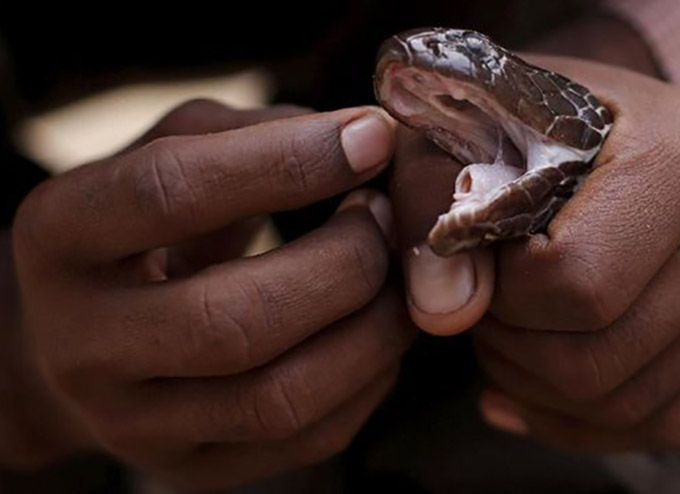
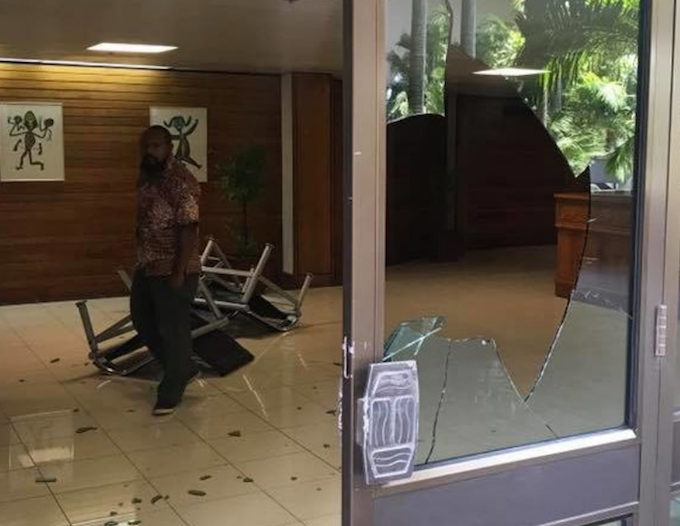
The python used to interrogate a Papuan suspect “was a pet snake that was not poisonous and tame”, claim Indonesian police. Image: CNNIndonesia

Pacific Media Watch Newsdesk

Papua Regional Police public information head Assistant Superintendent Suryadi Diaz is asking all parties not to dramatise or make a big issue out of the use of a snake during an interrogation by police.

The statement was made in response to calls by United Nations human rights experts for an investigation into the use of the snake.

“The problem’s already been resolved, so there’s no need to make a big deal out of it anymore,” Diaz told CNN Indonesia.

READ MORE: Papuan campaigners welcome UN call to Indonesia to end torture

Diaz said the investigation conducted by the Papua Regional Police Professionalism and Security Affairs Division (Propam) into the case had already been completed.

“Propam has already dealt with the case, so it’s resolved,” he said.

-Partners-

Nevertheless, Diaz did not explain the results of the investigation or what sanctions would be given to the officers involved.

Speaking to journalists earlier, however, Diaz said there were several sanctions that could be applied including a written reprehend, a maximum one-year postponement of education, a postponement in regular wage increases, a postponement of one promotional period or a transfer and demotion.

Heaviest sanction
In addition to this, the heaviest sanction that can be given to officers who violate discipline is to be released from their posts or be assigned to a specific location for a maximum of 21 days.

Several UN human rights experts have urged Indonesia to investigate allegations of violence by the police and military in Papua related to the use of the snake during an interrogation.

“We urge the Indonesian government to take firm measures to prevent the excessive use of force by police and military officials involved in law enforcement in Papua,” read a statement by the UN experts.

“We are also deeply concerned about what appears to be a culture of impunity and general lack of investigations into allegations of human rights violations in Papua,” they said in the statement.

The experts, who are made up of UN special rapporteurs, also said that Papuans had been treated in “cruel, inhuman and degrading” ways.

Jayawijaya District Police Chief Deputy Senior Commissioner Tonny Ananda Swadaya claimed that it was the police officers’ own initiative to conduct the interrogation into the theft using a python.

According to Swadaya, however, it was just trick used during the interrogation so that the perpetrator would confess to their crimes. He also asserted that the snake used to frighten the suspect was a pet snake that was not poisonous and tame.

“This ended up going viral on social media, it’s been blown out of proportion in other parts of the country. Here [in Papua] the public is supportive. A tame snake, non-poisonous, it didn’t bite [the suspect] and after being given the snake, the thief admitted to the crime,” said Swadaya .

Translated by James Balowski of Indoleft News. The original title of the article was “Polda Papua Tolak Usul Ahli PBB soal Interogasi Pakai Ular”.

Print Friendly, PDF & Email

Article by AsiaPacificReport.nz

Economics needs to get real if we want more young Australians to study it

]]>

Source: The Conversation (Au and NZ) – By Jim Stanford, Economist and Director, Centre for Future Work, Australia Institute; Honorary Professor of Political Economy, University of Sydney

When it comes to studying economics, Australian high school students are voting with their feet. According to data gathered by the Reserve Bank of Australia, year 12 enrolments in economics courses have plunged 70% nationwide over the last 25 years. Enrolments are so low, many schools are abandoning the subject altogether.

And it’s not just that there are fewer students taking economics. Those that do sign up seem rather … well … alike. There are now about twice as many boys than girls taking economics (compared to a 50-50 ratio in 1992). And most of those boys now come from higher-income families.


Read more: Women are dropping out of economics, which means men are running our economy


Economics enrolments at universities haven’t done much better. The number of university students choosing economics has stagnated for a quarter-century, even as student numbers surged. They’re shunning economics in favour of other subjects: whether that’s popular science, technology, engineering and maths, and business programs or socially relevant disciplines such as political-economy and environmental studies.

If we really want more young Australians to study economics (and not just boys from high-income families), the profession needs to reinvent itself – and become a lot more relevant to the big issues young people care about.

The problem with faith in the free market

The Reserve Bank (RBA) worries about students’ lack of interest in economics, and has started a mini-campaign to encourage more young Australians to heed the call of supply and demand. The RBA is lobbying state governments to update their economics curricula, and it sends ambassadors out to classrooms to advocate for economics – emphasising, among other points, that economics graduates earn relatively high salaries.

Economics is one of the most male-dominated professions, and most come from high-income families. Joel Carrett/AAP

We share the RBA’s concern about the terrible lack of diversity in economics (it’s one of the most male-dominated professions, even worse than STEM courses). But the RBA’s campaign inadvertently symbolises what’s wrong with the whole profession: emphasising high salaries in an attempt to reverse falling enrolments only confirms that economics is still infatuated with markets and incentives. This misses the whole point about the most urgent and interesting problems in the world today.

There is no question today’s students are a passionate, socially aware generation. They rightly worry about the world they’re poised to inherit: scarred by climate change, inequality, angry populism, and possibly worse. Not to mention many of those students may never hold a normal permanent job (relegated instead to a never-ending series of “gigs”), and most can’t imagine being able to buy a house.

Given these critical challenges, we can’t blame today’s students for rushing into other disciplines – anything, it seems, but economics. After all, the social and environmental problems they confront are precisely the outcome of the ideological, market-worshipping canon still taught in most economics textbooks.

Markets are efficient. Supply equals demand. Private competition is best. Workers are paid according to their productivity.


Read more: How governments have widened the gap between generations in home ownership


Young people who want to improve the world quickly reject these tenets of economic theory. We, Jim and Richard, think students actually accomplish more to fix the actual economy by studying environmental studies, gender studies or social work, rather than immersing themselves in the theoretical games of free-market economics.

The RBA itself shares the blame for this state of affairs. Its narrow approach to economic policy is largely focused on suppressing inflation and letting markets take care of everything else.

For example, the RBA still claims Australia is almost at full employment. But they define that as 5% unemployment, according to the discredited theory of “non-accelerating inflation unemployment”. This neglects its responsibility, explicitly enshrined in the Reserve Bank Act to create more jobs as its top priority.

Students have proven themselves active and engaged in political and economic issues many times over. Lukas Coch/AAP

It’s a great intellectual irony that neoliberal economics, based on the theory that the market always knows best, is being abandoned by its own “market” (namely, prospective students). They are rejecting its idealised vision of supply and demand in favour of any number of more relevant, interesting disciplines: from business and marketing, to international relations or public health.

And the response of the discipline’s true believers is that its customers (the students) are somehow uninformed and don’t know what’s best for them.

Economics needs context

We both studied economics for many years, we love our profession, and we fervently hope more critical-thinking, passionate young people will take up this discipline – mostly to help us save the economy (and the planet) from conventional economics. But for economics to play a more helpful, critical role, it must thoroughly reinvent itself – and fast.


Read more: Home ownership falling, debts rising – it’s looking grim for the under 40s


It must abandon its ideological and self-serving faith in the efficacy of private markets. It must embrace the social, historical, and environmental context of work, production, and distribution. And it must commit to truly building a better world, rather than justifying the status quo.

Apologising for inequality, selfishness, and pollution rather than confronting them has been the way of free-market economics since its invention. Most young people, understandably, yearn for something else. Let’s give it to them.

ref. Economics needs to get real if we want more young Australians to study it – http://theconversation.com/economics-needs-to-get-real-if-we-want-more-young-australians-to-study-it-112060

Australia and Indonesia agree to step up military cooperation

]]>
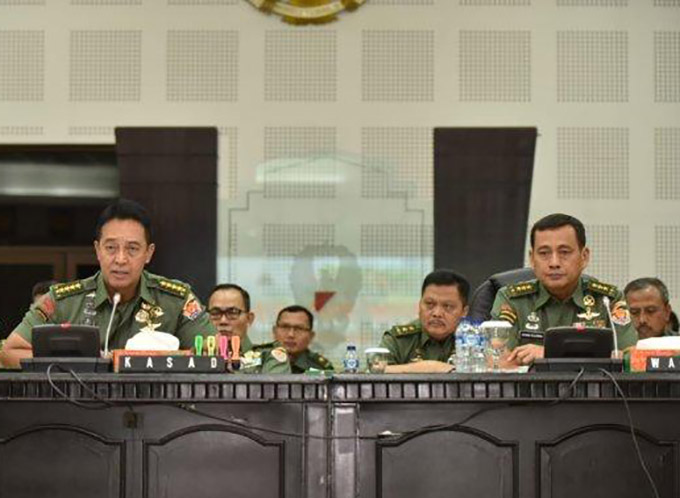
Indonesian military … cooperation with Australia is one of the biggest that the TNI enjoys with armies of other countries. Image: TribuneNews

By Gita Irawan in Jakarta

Indonesia’s Army Chief of Staff (Kasad) General Andika Perkasa and Australian Defence Force chief General Angus John Campbell have agreed to further increase military cooperation between the two countries.

The meeting between Perkasa and Campbell was held in the framework of a “courtesy call” between the military leaders of the two countries.

This was conveyed by army information office chief (Kadispenad) Brigadier-General Candra Wijaya in a written press release received by Tribune News this week.

“During the meeting, the Kasad said that the TNI AD’s (army’s) role in safeguarding and defending the unity of the land territory of the NKRI [Unitary State of the Republic of Indonesia] is not easy, so in several of its activities the TNI AD always endeavors to improve professionalism and the quality of its soldiers,” General Wijaya said.

General Wijaya said that this effort include improving education and training programmes and closer cooperation with the armies of friendly countries.

General Wijaya also took the opportunity to say that Perkasa is very aware that the cooperation and the bilateral relationship between the armies of the two countries have been good.

-Partners-

According to General Wijaya, this cooperation is one of the biggest that the TNI AD enjoys with the armies of other countries.

Several proposals
“Because of this, the essence of the discussions at this meeting is that the two sides agree to increase military cooperation between the two countries, particularly their armies,” General Wijaya said.

General Wijaya also said that during the meeting Perkasa made several proposals to General Campbell related to military cooperation.

“This included joint training activities, the exchange of lecturers and instructors, as well as improving the education organised by the TNI AD as well as the Australian Defense Force”, General Wijaya said.

General Wijaya said that that General Campbell welcomed the suggestions made by Perkasa because the Australian Defence Force also hopes that cooperation between the two armies will continue to improve in the future.

Also present at the meeting was Kasad’s Head of Expert Staff Major-General Felix Hutabarat, Deputy Security Advisor Brigadier-General Djaka Budhi Utama, Deputy Assistant of Operations Brigadier-General Untung Budiharto and Indonesia’s Defence Attache in Canberra, Admiral R Teguh Isgunanto.

Translated by James Balowski of Indoleft News Service. The original title of the article was “Bersenjata Australia Sepakat Tingkatkan Kerjasama Militer”.

Print Friendly, PDF & Email

Article by AsiaPacificReport.nz

Bougainville landowners call on Momis for protection from ‘offensive’ draft law

]]>
Australian mining entrepreneur accused of being “disrespectful” over a demand for wholesale and draconian changes to the mining law. Image: PNG Attitude/PC

Pacific Media Centre Newsdesk

Landowners throughout Bougainville were today calling on President John Momis for protection from a “callous opportunist.”

The landowners said that the customary laws of Bougainville and the basic human rights of landowners cannot be ignored.

A secret presentation, by an Australian, Jeff McGlinn, which was marked “strictly confidential, not for distribution” has just become public.

It evidences the unconscionable demand to strip landowners of all their rights under the Bougainville Mining Act.

McGlinn’s demand for these wholesale and draconian changes, is so that he can secure a complete monopoly over all large scale mines on Bougainville, including Panguna, without following the due processes of law, including the mandated Free Prior and Informed Consent of Landowners.

Panguna landowner Philip Miriori, chair of the Osikaiyang Landowners Association, said: “The McGlinn draft Bills, which would strip landowners of all their rights, were actually drafted by McGlinn’s lawyers. It is completely unacceptable.

-Partners-

“We cannot allow foreigners to draft our laws, tearing up our entire Bougainville Mining Act, and all its safeguards, just so that he and his small group of insiders, including ex PNG Defence personnel can profit personally from our lands and our struggle.”

Lawrence Daveona said: “The landowners of Bougainville call on President Momis to protect them, by immediately withdrawing these deeply offensive McGlinn drafted Bills.

Bougainville conflict
“There has been no prior opportunity for consultation. Anyone who has bothered to even read a little of the history of Bougainville, would understand that the Bougainville conflict was a plea for better mining practices and the recognition of the rights of customary landowners.”

Miriori said it would be difficult to think of something more deeply disrespectful and insensitive to landowners and the community generally than the demands of McGlinn.

“This comes at the very time the community is focused on continuing to build peace and reconciliation in the lead up to the referendum on independence.

“Unreasonable, unconscionable and unconstitutional. If passed they will be challenged and Panguna is delayed indefinitely. Nobody wins – in fact we all lose.

“The general feeling about the amendment, from the 500 people who attended, was that no one agreed with it and those present were asking the ABG members to do away with the amendment immediately.”

Print Friendly, PDF & Email

Article by AsiaPacificReport.nz

Sex and sport: how to create a level playing field

]]>

Source: The Conversation (Au and NZ) – By Brenda Midson, Editor, New Zealand Law Journal; Senior Lecturer in Law, University of Waikato

The Court of Arbitration for Sport is due to rule on an application by the International Association of Athletics Federations (IAAF) that athletes such as South Africa’s Caster Semenya, who have “differences of sexual development”, must medicate to reduce their testosterone levels for six months before competing internationally.

The IAAF claims that the proposed rules will “create a level playing field to ensure all female athletes have an equal chance to excel”. Semenya has filed an appeal against the IAAF.

Those who argue that women with differences of sexual development and transgender should not be allowed to compete in women’s sports usually claim that their testosterone levels and different muscle-to-fat ratios give them an unfair advantage over their competitors. But excluding these women from competition is unfair and potentially a human rights violation.


Read more: Why it might be time to eradicate sex segregation in sports


A breach of human rights

Those with differences of sexual development include women who are born with genetic conditions that give them athletic advantages more commonly attributed to males. Hyperandrogenism, for example, causes the individual to produce more testosterone than is typically present in women.

Semenya and India’s Dutee Chand are both thought to have this condition and have been subjected to intense public scrutiny as a result.

There is also the issue of transgendered women athletes who want to compete against other women. Transgender New Zealand weightlifter, Laurel Hubbard, competed in the 2018 Commonwealth games, amid complaints from the Australian Weightlifting Federation. Another New Zealander, Kate Weatherly, a transgender downhill mountain bike rider, has faced the same kind of scrutiny and challenges to her right to compete against other women.

There is disagreement among experts about whether transgender women do in fact have a physical advantage. Some evidence suggests the opposite is true and the therapy required to transition to a woman results in lower levels of testosterone than are found in women generally.

Laurel Hubbard has been subjected to monthly testosterone tests and her testosterone levels are lower than a “normal” female. Part of the problem here, too, is the assumptions about the characteristics of “normal”.

The level playing field is a myth

These issues aside, what precisely is an unfair advantage? Those who believe transgender women and women with different sexual development should be able to compete in women’s categories point to athletes such as Michael Phelps who has extraordinary physical characteristics that give him a huge competitive advantage in swimming, including his long arms and flexible feet. What makes his advantage fair? Is it because these are qualities Phelps was born with?

If so, then Semenya and Dutee and others who are born intersex or with hyperandrogenism should not cause sporting organisations any problems. But what about transgender athletes? Does the fact they have “chosen” to become women mean they have brought about this state of affairs and so they can justifiably be excluded? And if so, what of all the competitive advantages other women bring with them?

The level playing field is a myth. Aside from these genetic or biological advantages, athletes all differ in terms of the resources they have available to buy the best equipment, trainers and coaches and so on. Should these factors be considered as giving athletes an “unfair” advantage?

Self-identification

In New Zealand, under section 28 of the Births, Deaths, Marriages and Relationships Act 1995, a person may apply to the Family Court to have their birth certificate record they are of the opposite sex to that already recorded on the document. There are certain conditions that must be satisfied, and the application must be supported by “expert medical evidence”.

But a new bill proposes to replace the existing process with one based on self-identification, to “allow people to have greater autonomy over their identity”. The Select Committee also recommended including the options of “inter-sex” and “X (unspecified)” to recognise non-binary sexual and gender identities.

A self-identification policy does have the potential to impinge on women’s rights as well as for abuse by males who do not actually identify as women. Both Semenya and Chand have identified as women from birth. Hubbard and Weatherly are also women, notwithstanding that they were assigned a different biological sex at birth.

They should all be treated as such for all purposes. Regardless of their biological sex – if in fact there is such an incontrovertible thing – they are not men masquerading as women to secure a competitive advantage. A nuanced approach is called for; while a self-identification policy may not be the answer, neither is an approach that requires medical intervention as a pre-requisite for recognition.

ref. Sex and sport: how to create a level playing field – http://theconversation.com/sex-and-sport-how-to-create-a-level-playing-field-112219

Journalism at USP: A thirty-year journey

]]>

Heading on the book chapter on University of the South Pacific’s 50-year history.

Shailendra Singh

Friday, February 22, 2019

Abstract

The Univerasity of the South Pacific’s 50th anniversary marks 30 years of existence for its regional journalism programme. In an eventful journey, the programme weathered military coups, overcame financial hardships and shrugged off academic snobbery to get this far. The programme started in Suva in 1988, with Com- monwealth funding, and a handful of students to its name. It has produced over 200 graduates serving the Pacific and beyond in various media and communication roles. USP journalism graduates have produced award-winning journalism, started their own media companies and localised various positions at regional organisations once reserved for expatriates.

See also Robie, D. (2004). Mekim Nius: South Pacific media, politics and education. Suva: University of the South Pacific Book Centre.

Report by Pacific Media Centre

Don’t bank on Dollarmites to teach financial literacy: here are our alternatives

]]>

Source: The Conversation (Au and NZ) – By Catherine Attard, Associate Professor, Mathematics Education, Western Sydney University

The recent royal commission into banking has revealed rampant wrongdoing by the big banks. As a result, there is renewed public interest in school banking schemes. The Commonwealth Bank’s Dollarmites program has once again come into the spotlight.

Dollarmites was awarded a 2018 Choice Magazine Shonky award. The program has over 300,000 active participants, and although it’s not the only school banking program, it’s the largest by far.


Read more: Should banks play a role in teaching kids about how to manage money effectively?


According to the Commonwealth Bank, the motive behind the Dollarmites program is to teach good savings habits and develop financial literacy. But I could find little independent research evidence it actually does.

On the surface, the Commonwealth Bank’s intentions are good. But research has found 40% of people develop loyalty to their banks and continue banking with them into adulthood.

We need to consider other options. Here are some research-backed alternatives.

Alternatives to school banking

Financial literacy can be taught both at home and at school, in practical and meaningful ways. If we consider the core business of schools to be learning, then our classrooms are not an appropriate place for the distractions of corporate marketing. There is definitely no time to be wasted on the logistics of organising school banking.


Read more: Financial literacy is a public policy problem


In fact, schools have several options when it comes to teaching financial literacy. There are a number of free resources already aligned to the curriculum.

Parents should have conversations about budgeting with their children. ASIC comic To the Max/AAP

In my research, using ASIC’s MoneySmart resources, financial literacy was combined with maths. Students did activities that allowed them to deal with real money while applying maths skills.

For example, some students borrowed money from the school principal to set up small businesses. They then ran their business at a school market day, and used their profits to buy Christmas gifts for underprivileged children.

Simple activities such as setting up classroom economies or allowing children to help plan events (such as class excursions) are also excellent at engaging children in financial literacy in a fun, realistic and interactive way.

Findings from my study showed learning about money and maths improved engagement, understanding of mathematical concepts and knowledge of financial concepts such as budgeting, profit and loss, lending and interest.

There are also resources such as Banqer, a free subscription-based app that allows students to manage fictitious money to budget and cover expenses (such as “renting” a desk). In my professional opinion, apps such as this are high quality. They may have corporate sponsorships, but are offered brand-free, which is preferable.

Parents can teach financial literacy too

Parents are one of the biggest influences on the financial habits of children. Parents have a responsibility to model good financial behaviours.

Involving children in shopping, having discussions about family budgeting and encouraging children to save some of their pocket money using a bank account of their choice all contribute to the development of financial literacy. These are really simple, everyday things parents can do to help their children learn financial literacy.


Read more: Teaching kids about maths using money can set them up for financial security


ref. Don’t bank on Dollarmites to teach financial literacy: here are our alternatives – http://theconversation.com/dont-bank-on-dollarmites-to-teach-financial-literacy-here-are-our-alternatives-112213

#MeToo catches up with spiritual healers: the case of Brazil’s John of God

]]>

Source: The Conversation (Au and NZ) – By Cristina Rocha, Director of Religion and Society Research Cluster, Western Sydney University

We’ve seen countless spiritual leaders and religious institutions embroiled in sexual abuse scandals around the globe. Most people are familiar with the scandals in the Catholic Church and other mainstream religious groups. But there have also been scandals in Ashrams, and Zen and Tibetan Buddhist groups.

The latest scandal involves the Brazilian faith healer João Teixeira de Faria, known as João de Deus (John of God), who in the past two decades has become a global guru for hundreds of thousands of ordinary people. Even celebrities such as Oprah Winfrey and performance artist Marina Abramovic have visited and promoted him (before the scandal).

John of God claims to be an unconscious medium for spirits who heal through him. He rose to fame due to his remarkable healing methods – he performs actual physical surgery without anaesthesia. Pilgrims don’t seem to develop infections and many report a cure of their symptoms after seeing him.

In her book John Of God: The Globalization of Brazilian Faith Healing, the co-author of this article, Cristina Rocha, interviewed Westerners who visited John of God. They told her they were seeking not only physical but also emotional and spiritual healing. Many said the experiences at the healing centre were a turning point, which made them believe in the power of the supernatural and changed their lives.

During the decade-long research, Rocha heard rumours about the sexual abuse of women but nothing was ever substantiated. Previous investigations resulted in no convictions.


Read more: The Catholic Church is headed for another sex abuse scandal as #NunsToo speak up


Everything changed in early December, 2018 when 13 women told stories of being sexually abused by de Faria in an explosive interview on Brazilian prime-time TV. Many more women disclosed their abuse to Brazilian police. So far, around 600 Brazilian and foreign women and young girls have described similar experiences of sexual abuse, including rape allegations.

It’s been reported that police found unregistered weapons and around US$400,000 in several currencies hidden in de Faria’s home, in addition to around US$10 million in bank accounts. Allegations have also surfaced of the imprisonment of poor young women who were paid to bear babies for adoption overseas. de Faria denies the allegations.

John of God surrendered himself to police in December and has been remanded in custody since the investigations began. Court cases are likely to follow.

The power of spiritual leaders

Australia’s royal commission into child sex abuse exposed that children and other vulnerable groups were far more likely to be sexually abused in religious and spiritual settings. We also know victims often don’t report abuse for fear of retaliation and deep shame. Those who did report their abuse were often not believed and punished further.

Some John of God followers are skeptical of the allegations against him. Facebook (screenshot, name concealed)

In some cases, even after religious and spiritual leaders are found guilty, many followers have a hard time believing the man whom they trusted and was holy in their eyes was actually a sexual predator.

Many foreign followers of John of God have been sceptical of the allegations. This may be because the tour guides who take groups to see the him have downplayed the scandal on social media.

Spiritual organisations are largely patriarchal and hierarchical and there is little or no transparency and accountability. This makes sexual abuse perpetrated by spiritual leaders particularly problematic.

Spiritual leaders such as de Faria tend to be charismatic and are seen as having special powers derived from supernatural sources. They are treated with reverence, often feared and understood as extraordinary men. So, they command a double authority; first as men and second as otherworldly due to their connection to the supernatural.

After witnessing one of de Faria’s surgeries, one follower told Rocha:

This is what I said to myself, ‘This is what Jesus did.’ He was divine power, divine healing incarnate. He used himself to deliver this type of energy people needed. When I saw that, I was like, ‘This is my place. He will heal me’.

The charisma of the leader makes victims believe they are chosen and given special status. This creates a powerful emotional attachment to the spiritual leader, which can put them at risk of manipulation and abuse.


Read more: John of God: my encounter with Brazil’s accused faith healer


They may doubt the truth of their own experiences of abuse (they may think they are not holy enough to understand what is happening to them). They may fear being ostracised by the religious community or the wrath of the supernatural world.

The royal commission heard evidence that a spiritual leader “can look into a person’s soul and know exactly what is right for them”, including using sexual force as part of a what the leader may claim to be a necessary path to spiritual enlightenment.

Women who were allegedly abused by John of God reported he told them sexual contact was a way to heal them and they would be cursed if they were to reject his requests.

What should we do about it?

The arrest of John of God, and the discovery of the extent of the abuse among women and children, is a wake-up call to further investigate the ways in which spiritual leaders and their groups operate outside the bounds of organisational accountability and transparency.

One immediate way forward is for governments to introduce laws that regulate the bureaucratic practices of such organisations through instituting professional standards, criminalising non-disclosure. Appropriate staff training and ensuring mandatory reporting protocols for all staff should also be instituted.

This would send a strong signal and draw a clear line about what is and isn’t acceptable behaviour by all leaders in such positions of power, and crucially make an immediate difference to the safety of women and children in spiritual organisations.

ref. #MeToo catches up with spiritual healers: the case of Brazil’s John of God – http://theconversation.com/metoo-catches-up-with-spiritual-healers-the-case-of-brazils-john-of-god-112215

Barrie Kosky’s The Magic Flute is a contemporary spectacle, despite the opera’s outdated attitudes

]]>

Source: The Conversation (Au and NZ) – By Vivienne Glance, Hon Research Fellow in Poetry and Theatre studies, University of Western Australia

Review: The Magic Flute, Perth Festival 2019


As the overture ends, the red curtains at His Majesty’s Theatre rise to reveal a flat, white floor-to-ceiling wall. This suddenly transforms to show a young man being chased through a forest by a red dragon-like serpent. But the performer on stage is not really running; he is standing still, with a pair of comic, animated legs projected onto a white board from his waist down.

This opening sequence sets the tone for the Komische Oper Berlin’s cinematic production of Mozart’s The Magic Flute.

Barrie Kosky and Suzanne Andrade’s interpretation of this popular and oft-performed opera (first performed in 1791) is unlike any previous production staged in Australia. Teaming up with animator Paul Barrit and co-director Andrade, both from UK theatre company 1927, Kosky’s version captures the vaudeville anarchy of the original opera.

The singers inhabit a world filled with monsters, magic, revenge, death, love and lust: a perfect fairy tale scenario. The colour-filled era of 1930s German expressionism and the black and white of the popular silent movies of the 1920s provide consistent design motifs for Barritt’s exquisite, hand-drawn animation.

Paul Barritt’s animation draws upon the aesthetics of German expressionism and silent films of the 1920s. Toni Wilkinson

German expressionism emphasised the artist’s feelings over reality, and the more fantastical elements of this opera are well-suited to this style, full of bright colours and simple shapes. Blending this with live action and live music (Western Australian Symphony Orchestra, conducted by Hendrik Vestmann) makes the production quite unique. The performers add to this with stylistic movements straight out of silent film, including wide-eyes and exaggerated tip-toeing steps.

The opera’s protaganist, the young prince Tamino, was sympathetically portrayed by Aaron Blake on opening night (most roles are rotated between two performers). He has a compelling presence on stage, and there is a wonderful sequence where his soaring tenor voice is accompanied by animated creatures from the constellations, charmed by his magic flute.

Tamino’s unlikely companion, the bird-catcher, Papageno, was performed in a canary-yellow suit by Joan Martín-Royo. He is wonderfully entertaining, and shows a versatile emotional range moving from alcoholic euphoria through suicidal despair, to undying, stuttering love. The duet when Papageno is finally together with his love Papagena, played as a stockinged chorus girl by Talya Lieberman, is delightful and made even funnier by the exaggerated animation.

No Magic Flute review would be complete without comment on the Queen of the Night and her rendition of the famous aria, “Der Hölle Rache” (Hell’s Revenge). Kosky and Andrade depict the queen as a spider with coloratura soprano, Christina Poulitsi, placed high up on a platform.

The Queen of the Night is depicted as a spider in Barrie Kosky’s production.

While the screen is filled with her prodding, spindly legs, the singer is confined in a body sleeve. Nonetheless, she displays her range and virtuosity with a note-perfect performance.

The woman Tamino falls desperately in love with is Pamina, sung beautifully by Soprano Iwona Sobotka on opening night. She played the heroine-in-need-of-rescue to perfection, but despite the sexism spouted by some characters, Pamina showed courage, determination and integrity.

That said, she does fall into despair when she believes she is no longer loved by Tamino, and Sobotka sings Pamina’s aria with great feeling as she contemplates suicide.

Pamina and Papageno in The Magic Flute. Toni Wilkinson

Indeed, The Magic Flute is a problematic work when to comes to the portrayal of women. For example, the Three Ladies who serve the Queen of the Night start complaining about each other in the first scene.

Male characters make generalised statements about women’s failings: when Pamino’s captor, Sarastro states that “women do little but talk a lot” there was an audible groan from the audience; and Papageno dreams of catching a thousand women by bewitching them with his pipes.

However, these attitudes are countered by the suggestion that if a woman has no fear of death or night, then she is worthy to enter Sarastro’s Temple. Pamina earns this respect from the Temple knights by accompanying Tamino on his trail of Fire and Water, wonderfully realised through animation with images of skeletons in the bowels of the earth and deep-ocean creatures.

The original opera also has racist elements, with the black slave, Monstatos, depicted as a self-loathing, sexual predator. This production side-steps this by making this character look like Nosferatu from the 1922 silent horror movie. He is played so villainously by Ivan Tursic that he provoked pantomime “boos” during his curtain call.

Monstatos is portrayed villainously by Ivan Tursic. Toni Wilkinson

Despite the historical problems with this 200-year-old opera, Kosky and Andrade have created a visual spectacle that, along with the fine performances, provides an enjoyable and accessible night of opera.

However, there are limitations to the staging. The flat wall across the stage onto which the amazing animation is projected includes five access doors placed high up, each with one-person-sized platforms in front. Another door is in the centre at the stage level. This means that characters can only be positioned across the front of the stage or on these platforms.

Efforts are made to break up the staging by having the characters bring on hand-held projector screens, but at times it felt a little repetitive. Yet that is a minor quibble. With a packed house on opening night, it seems audiences will never tire of this fantastical tale.


The Magic Flute is playing at Perth Festival until February 23.

ref. Barrie Kosky’s The Magic Flute is a contemporary spectacle, despite the opera’s outdated attitudes – http://theconversation.com/barrie-koskys-the-magic-flute-is-a-contemporary-spectacle-despite-the-operas-outdated-attitudes-112284

VIDEO: Michelle Grattan on Julie Bishop’s retirement and misbehaving ministers

]]>

Source: The Conversation (Au and NZ) – By Michelle Grattan, Professorial Fellow, University of Canberra

University of Canberra Vice-Chancellor Deep Saini and Michelle Grattan talk about the week in politics. They discuss Julie Bishop finally announcing her retirement and how damaging this might be for the Liberal party; the pressure on Mathias Corman following his dealings with travel company HelloWorld; and the cyber security concerns after revelations that the major parties’ networks were hacked.


Read more: Grattan on Friday: Bishop’s boots were made for walking


ref. VIDEO: Michelle Grattan on Julie Bishop’s retirement and misbehaving ministers – http://theconversation.com/video-michelle-grattan-on-julie-bishops-retirement-and-misbehaving-ministers-112299

2001 polls in review: September 11 influenced election outcome far more than Tampa incident

]]>

Source: The Conversation (Au and NZ) – By Adrian Beaumont, Honorary Associate, School of Mathematics and Statistics, University of Melbourne

Many commentators have compared Labor’s support for the Medevac legislation with the Tampa incident in late August 2001. The implication is that Labor lost the 2001 election due to Tampa, and could lose this year’s election due to Medevac.

Political commentator Katharine Murphy has said she was certain at the time Labor leader Kim Beazley “had just lost the election” after announcing Labor would vote against retrospective legislation giving the Coalition government the power to forcibly remove the Tampa from Australian territorial waters.


Read more: Australian politics explainer: the MV Tampa and the transformation of asylum-seeker policy


But are the claims that Labor lost the 2001 election due to the Tampa true? The Poll Bludger, William Bowe, kindly sent me the polling data for the 1998-2001 term, on which the historical BludgerTrack is based. BludgerTrack is a bias-adjusted poll aggregate.

I have used this data to create the graph below of the Coalition vs Labor two party preferred vote during 2001. The election was on November 10.

BludgerTrack two party preferred vote during 2001.

The graph shows that Labor had a massive lead in March 2001 of about 57-43, but it gradually narrowed to about 52-48 by the time Australian government involvement in the Tampa incident began on August 26. The Tampa was denied permission to dock at Christmas Island and deliver asylum seekers who had been rescued.

The Coalition received about a two-point boost from the Tampa affair to draw level with Labor. However, it had a much bigger lift from the September 11, 2001 terrorist attacks, which lifted the Coalition’s vote five points to about a 55-45 lead. As the shock of the attacks wore off, the Coalition’s vote fell back to a 51.0-49.0 victory on election day (November 10).

If the Tampa had occurred in 2001, but not September 11, other issues, such as the economy, health and education, would probably have appealed to people in the lead-up to the election more than boats. Labor could have recovered to an election-winning position. September 11 made national security a huge asset for the Coalition government at the 2001 election.

If not for September 11, Labor may have won the 2001 election. The Tampa put the Coalition into a tie with Labor, not a lead.

Analyst Peter Brent in Inside Story thinks that, given economic factors, the Coalition would probably have won the election by 51-49 without either the Tampa or September 11. You can achieve this result by drawing a line from the Coalition’s nadir in March to the election, with the assumption that the slow improvement in the polls had continued.


Read more: If Beazley had become prime minister instead of Rudd, might we have had more stable government?


However, the graph shows the Coalition’s recovery had stalled for over a month before the Tampa. Even though the September 11 shock had faded by the election, the boost it gave to the importance of the Coalition strength of national security assisted the Coalition at the election.

Labor did not lose the 2001 election because of the Tampa, and they are unlikely to lose the 2019 election because of their support for the Medevac bill. I believe the shock factor of terrorist incidents has been reduced by their frequency. There were two terrorist atrocities shortly before the 2017 UK general election, yet UK Labour performed much better than expected at that election.

Eight UK Labour and three Conservatives MPs form new Independent Group

On Monday, seven UK Labour MPs resigned from their party to form The Independent Group. In the next two days, another Labour MP and three Conservative MPs also resigned to join The Independent Group.

While other causes, such as alleged antisemitism within Labour, have been cited, the reason these defections have happened now is Brexit. The defecting MPs are strongly opposed to their former party’s handling of Brexit, and all want a second referendum on Brexit – currently opposed by both major parties.

The Independent Group MPs have consistently voted in favour of proposals to avoid a “no deal” Brexit when the UK leaves the European Union on March 29. However, these MPs votes will not change. To avoid a no deal, either other MPs votes must change, or the major parties need to reach a compromise. The next important Brexit votes will be on February 27. The article I wrote on my personal website in January about why a no deal Brexit is a plausible scenario is still relevant.

ref. 2001 polls in review: September 11 influenced election outcome far more than Tampa incident – http://theconversation.com/2001-polls-in-review-september-11-influenced-election-outcome-far-more-than-tampa-incident-112139

West Papuan campaigners welcome UN call to halt Indonesian torture

]]>
Indonesian police torture a pro-independence West Papuan suspect. Image: West Papua Campaign/AFP

Pacific Media Watch Newsdesk

The Free West Papua Campaign has welcomed the call by the United Nation’s human rights experts for “Prompt and impartial investigations … into numerous cases of alleged killings, unlawful arrests, and cruel, inhuman and degrading treatment of indigenous Papuans by the Indonesian police and military”.

Benny Wenda, chair of the United Movement for the Liberation of West Papua (ULMWP), said: “The West Papuan people are crying out for their freedom and self-determination.

“In January, we handed the UN High Commissioner for Human Rights a petition of 1.8 million signatures – 70 percent of the Indigenous West Papuan population – for an internationally supervised vote, a referendum, on independence from Indonesia. Finally, the Indonesian State’s brutal repression and genocidal killing is being recognised by the United Nations.”

READ MORE: UN human rights experts condemn human rights abuse and racism in West Papua

The statement from UN experts was sparked by the torture of a political prisoner with a snake.

The UN recognised that this incident is “symptomatic of the deeply entrenched discrimination and racism that indigenous Papuans face, including by Indonesian military and police”.

-Partners-

The ongoing genocide in West Papua by Indonesia is estimated to have killed 500,000 West Papuans since 1969.

The UN statement continued:

“We urge the Government to take urgent measures to prevent the excessive use of force by police and military officials involved in law enforcement in Papua. This includes ensuring those, who have committed human rights violations against the indigenous population of Papua are held to account.

“We are also deeply concerned about what appears to be a culture of impunity and general lack of investigations into allegations of human rights violations in Papua.”

The Office of the High Commissioner for Human Rights (UN Human Rights) is the leading UN entity on human rights. The General Assembly entrusted both the High Commissioner and her Office with a unique mandate to promote and protect all human rights for all people.

Print Friendly, PDF & Email

Article by AsiaPacificReport.nz

‘I think we should be very concerned’: A cyber crime expert on this week’s hack and what needs to happen next

]]>

Source: The Conversation (Au and NZ) – By Sunanda Creagh, Head of Digital Storytelling

When Prime Minister Scott Morrison announced this week that a “sophisticated state actor” had targeted the big Australian political parties in a major cyber attack, the revelation threw up more questions than answers.

Who did it and how? What data did they get their hands on? How vulnerable is our data – and our democracy?


Read more: We’ve been hacked – so will the data be weaponised to influence election 2019? Here’s what to look for


To make sense of it all, we’re hearing today from Nigel Phair, the director of UNSW Canberra Cyber and an expert on the intersection of crime, technology and society.

He said that while hacks like these should be seen as “the new normal” there was good reason to be concerned.

“Just merely having a breach is quite a big deal. Secondly, you look at the information that they hold. Political parties have information on donors – who they are and how much they give and what they want for it. They have information on the electorate, they have information on their own party politics and tactics for Senate Estimates for Question Time, those sorts of things,” he said.

“So that’s a lot of rich data that you could then use as a nation state to infiltrate other areas to perhaps change voter outcomes.”

The hackers may have used social engineering techniques such as phishing to gain access to the data, he said.

“They are quite unsophisticated attacks. It’s often spoofing an organisation or a person and getting someone, an end user, to reveal login credentials. And because we share passwords across multiple logins, that’s how you gain access to a trophy asset,” he said, adding that the hack served as a reminder to use a password manager and ensure all passwords are long and strong.

“I think we should be very concerned. We’ve got a great case study from the US. We’re very allied to the US and when you look at how nation states have disrupted that election I think it’s a given that there are many out there that’ll disrupt ours.”

You can read an edited transcript of the interview below.


Read more: A state actor has targeted Australian political parties – but that shouldn’t surprise us


New to podcasts?

Podcasts are often best enjoyed using a podcast app. All iPhones come with the Apple Podcasts app already installed, or you may want to listen and subscribe on another app such as Pocket Casts (click here to listen to Trust Me, I’m An Expert on Pocket Casts).

You can also hear us on Stitcher, Spotify or any of the apps below. Just pick a service from one of those listed below and click on the icon to find Trust Me, I’m An Expert.

Additional audio editing by Wes Mountain, production assistance from Bageshri Savyasachi.


Additional audio

Kindergarten by Unkle Ho, from Elefant Traks

ABC news report

Image:

AAP (Various)/Shutterstock/The Conversation

Transcript

SUNANDA CREAGH: And so what’s the main concern? Why was everybody so worried about this, particularly earlier this week?

NIGEL PHAIR: I think when you look at the history with the attack in the US on the DNC (Democratic National Committee), and a lot that’s been reported in the US about nation states trying to infiltrate the election process over there and change people’s voting habits and we’re some weeks/months from an election here – it strikes at the heart of what could be our dear beloved democracy, when you have nation state actors trying to influence voting outcomes.

SUNANDA CREAGH: And what do you think this week’s events tell us about the cyber security weaknesses here in Australia?

NIGEL PHAIR: It tells us that no organisation is immune. It tells us that cyber is another vector for people trying to win the hearts and minds of people.

SUNANDA CREAGH: If I was a sophisticated nation state using this as a strategy to achieve that goal, how might this sort of hack help me achieve that goal? What do you think they were actually trying to do here?

NIGEL PHAIR: There’s a number of things that they’ve achieved. Firstly, is the goal of doing the hack. When we look at parliament house, we look at the political parties, when we think about it, they’re revered from a democratic perspective. Just merely having a breach is quite a big deal.

Secondly, you look at the information that they hold. Political parties have information on donors – who they are and how much they give and what they want for it. They have information on the electorate, they have information on their own party politics and tactics for Senate Estimates for Question Time, those sorts of things. So a lot of rich data that you could then use as a nation state to infiltrate other areas to perhaps change voter outcomes.

SUNANDA CREAGH: China has strongly denied that it was involved but a lot of speculation has focused on that country, as opposed to Russia or another state actor that’s been linked to this kind of behaviour in other contexts. In Australia, why do you think speculation has focused on China as a potential perpetrator?

NIGEL PHAIR: Basically because they’re a near neighbour to ours, they’re in our arc of instability. They’re well known for their theft of intellectual property online. They’re well known for not adhering to the international norms of cyberspace. Add that all up and that’s why people keep pointing the finger at them.

SUNANDA CREAGH: And I believe there’s news reports that China was linked to other previous hacks of universities and parliament and other key pieces of computer infrastructure around Australia. Is that right?

NIGEL PHAIR: That’s right. They’ve been well known to do a range of cyber attacks on a range of different organisations – government, non-government, commercial etc.

SUNANDA CREAGH: So in the context of concerns that Australians have about the government’s capacity to keep our personal information safe – and I’m thinking here about the talk around My Health Record, the census – what does this hack tell us, if anything, about how capable the government and people in power are at guarding our private details?

NIGEL PHAIR: I think we need to go back a couple of steps before we start to think about this. Government, what they haven’t done is take the citizenry of Australia on a journey. They haven’t explained to them what it means to participate in a digital economy. What it means to be a good online citizen and transact with government and social media, commercially, e-commerce. If we had that narrative from the outset then people could understand that the internet is just another public place where they act ethically and lawfully and responsibly to what they do in the real world, then I think we wouldn’t be having this discussion. Because people would be able to have an informed decision about what it means to participate with My Health Record, or participate in an online census or other government instruments. But at the moment we just never had that background and people don’t have the certainty and because of that they make knee-jerk reactions.

SUNANDA CREAGH: Where do you land on this issue, do you think the government is capable of keeping that data safe?

NIGEL PHAIR: I think the government is capable of keeping it safe. The systems around My Health Record for example are really quite secure and there’s a lot of technologies, a lot of process and a lot of policy to ensure. But the reality is if there is going to be a breach of my health record, it’ll probably happen at a doctor’s surgery where there’s an unpatched or unprotected computer, or a user not using a good password, or accidentally emailing the wrong patient records to someone. It will be the end user compromise which we’ll see will be the failure. And that’s what the government isn’t investing in. It’s great to say they have a great secure system themselves but again we need to wind the clock back several years and start telling people this is what it means.

SUNANDA CREAGH: Just on this hack, how might it have been actually perpetrated? Can you just explain that to me in really basic terms?

NIGEL PHAIR: We don’t know yet until the forensic examination is done about how it occurred. Invariably, it was most probably some sort of social engineering attack against someone on the network. Most probably a phishing attack or something similar, where a person is targeted rather than the network itself is targeted. But again, until we know the forensics, we’re just speculating.

SUNANDA CREAGH: And those phishing and social engineering attacks, am I right in thinking they mainly focus on trying to get somebody to reveal their password or their login details to another person who is perhaps impersonating somebody else or impersonating an official password reset type email. Is that the sort of thing you mean there about the social engineering?

NIGEL PHAIR: Invariably, they are quite unsophisticated attacks. It’s spoofing an organisation or a person. Getting someone, an end user, to reveal login credentials and because we share passwords across multiple logins, that’s how you gain access to a trophy asset.

SUNANDA CREAGH: So the lesson there for all of us really is never reuse your password details and get a password manager. Am I right?

NIGEL PHAIR: You are right.

SUNANDA CREAGH: We’ve heard some commentators saying that this is the new normal, that this type of attack really should be expected in this day and age. What do you think about that?

NIGEL PHAIR: It’s been the new normal for quite some time. The reality is, most organisations get hacked just don’t know they’ve been hacked. This is all of a sudden a trophy matter, it’s come at the time where parliament is sitting, so it’s really got some attention in society, which is a great thing. And added to that the government that’s come out and actually said this is what’s happened and that is a completely different policy shift, whereas before it was swept under the carpet.

SUNANDA CREAGH: Do you think that’s a positive policy shift?

NIGEL PHAIR: There’s a great positive. We need to start having a conversation about what it means to be online and what it means to participate. And the fact is there’s countries out there, there’s actors out there trying to do us harm and Australians need to be brought into that confidence.

SUNANDA CREAGH: There was a lot of talk about this at the start of this week, but it really has sort of shifted off the news headlines toward the end of the week and some people are now saying that was a lot of noise over what? And I’ve seen some media commentators saying that this was an announcement that fed into a narrative of fear as election day draws closer. And that is a criticism that’s been directed at the government in the past in their rhetoric around border control and security in more general terms. To what extent do you see this announcement as about safety and awareness and how much of it is politics?

NIGEL PHAIR: I couldn’t put a percentage on either way but I focus purely on the safety and awareness side of it. I just think that’s the value of the message – is the safety and awareness.

SUNANDA CREAGH: It’s an important message to get out to make people aware of those risks. And, as you say, bring them into that conversation around online security and online participation in an active globally networked world, is that right?

NIGEL PHAIR: That’s right.

SUNANDA CREAGH: So what needs to be done? What should governments do to reduce risks and educate people?

NIGEL PHAIR: So the first thing for their internal networks, they need to do a proper risk management exercise. They need to identify the key target assets they hold and work out how sensitive that information is and put appropriate controls around where that data sits. Whether it’s a technology stack, whether it’s internal, cloud-based, those sort of decisions. And secondly, who has access to it, why they have access to it and how they access it. And once you start doing some simple things like that, you’ll find the cyber security posture of parliament house or a political party or anyone else in corporate Australia can really change the way that they’re viewed from a cyber security perspective.

SUNANDA CREAGH: And if, and I know this is speculation, but if the source of the problem was somebody sharing their login credentials or being victim to a phishing scam or victim to some social engineering then it sounds like it’s possible that some education is needed around that issue and what to be aware of and how not to get tricked online.

NIGEL PHAIR: Well, that’s a tough one. There aren’t sufficient technical controls to protect our data and ourselves online. In fact, we should’ve looked for any technical silver bullet. Likewise, we know education doesn’t work either. But education is all we have. So all we can keep doing is reinforce the message, particularly amongst young people as they grow up and participate in the online economy, and hopefully as time goes on we’ll be better protected for it.

SUNANDA CREAGH: In other words, not forgetting to address the capacity for human error in our effort to cover off and protect ourselves from technical error.

NIGEL PHAIR: Human error, but also the use of third parties and outlying people that you might not have specific command and control over.

SUNANDA CREAGH: And going back to this week’s hack, if I am an individual who has given my details as a donor or as a supporter to a political party, what does this hack tell us about what we as individuals might do in future to protect our data?

NIGEL PHAIR: Well, if you think you’ve (experienced) a loss of your data through this process, the first thing to do – contact the party that you’ve made say the donation or whatever it might be to. Secondly would be to start thinking about how that data or information that’s been stolen might be used against you – whether it’s identity theft or takeover, for example. So you need to start monitoring your bank accounts, you need to start thinking about consumer credit that might be done in your name. So you should be probably doing a credit reference check.

SUNANDA CREAGH: What advice do you give to people who want to use best practice in keeping their details safe online?

NIGEL PHAIR: Best thing you can do is use strong and long passwords. More stealthy it is, the harder it will be to guess by anyone else. Second, don’t replay the same password across multiple logins. Thirdly, be really wary when online and navigating around social media and e-commerce and other places. Really think about where you put your personal information in and why you’re placing it into a particular website or a portal.

SUNANDA CREAGH: Now, in the US we’ve heard about state actors really appearing to have an influence on election outcomes. How concerned do you think Australians should be about that happening here?

NIGEL PHAIR: I think we should be very concerned, we’ve got a great case study from the US. We’re very allied to the US and when you look at nation states that have disrupted that election I think it’s a given that there’s many out there that’ll disrupt ours.

SUNANDA CREAGH: So what can we do about that?

NIGEL PHAIR: It’s a tough one. We need to start working with all the players involved. And this is where the social media companies come into it. Your Googles, your Facebooks, your Twitters, your Instagrams etc. Because that’s the place of choice that nation states will use to send out any bespoke messaging.

SUNANDA CREAGH: Should we be changing any progression we’re making in Australia towards electronic voting?

NIGEL PHAIR: We have zero progression towards electronic voting, unfortunately, and I think it’s a great thing. But because we had the census failure, because we had the robo-debt issues, because we had the My Health Record issues, as a population there’s no way in my generation that we will see electronic voting. We just won’t countenance it because of the perceived risks. I’m a pro-online guy. We doom and gloom everything online too much and I’m guilty for doing that. But we want people to participate online. We are great and early adopters of mobile smart devices and we love being online itself, so it makes sense for service delivery to be online, it makes sense to order your food online, to do social media, participate in everything, there’s a lot of good benefit. But because we hear this messaging all the time about the government can’t deal with online issues, there’s already this level of distrust and dissatisfaction out there that voting will just be another one of those things. And the facts just don’t support that.

SUNANDA CREAGH: Would there be anything that you’d change about the way political parties collect or are allowed to collect data on people given that they seem to be a perfect target or a growing target?

NIGEL PHAIR: Oh, there’s lots I’d change. Primary to that is the Privacy Act and adherence to the privacy principles of which political parties don’t need to.

SUNANDA CREAGH: In what way? What change would you make?

NIGEL PHAIR: Well, I’d ensure that political parties have to adhere to the privacy principles when it comes to the collection, the storage, retention and dissemination of personally identifying information.

SUNANDA CREAGH: And what are the privacy principles?

NIGEL PHAIR: Well the privacy principles, there’s 13 of them, inform organisations in Australia where they have a turnover of more than A$3 million about how they should collect data, how they should store that data, how they should disseminate it and how they should destroy it. There’s some simple advice that’s provided by the Australian Office of the Information Commissioner. And they’re quite easy to adhere to, but unfortunately political parties are exempt from that and I see that as being a bad thing.

SUNANDA CREAGH: So we’re at a point where I guess you’d have to assume that basically anybody could be a target for a hack and any organisation could be. So what options are there for organisations like political parties that don’t have My Health Record level of security set ups or government scale security set ups?

NIGEL PHAIR: Well, the first thing they have to do is acknowledge that they’re are a target. Then they have to go through a risked-based process to understand what their information assets are, what their technology stack is, and who has access to it and make sound investment decisions around that. We can no longer, as a society, just say “it’s not us that gets hacked, it’s always someone else”. I mean, there is a cost of participating online.

SUNANDA CREAGH: Nigel Phair, thank you so much for talking to us.

NIGEL PHAIR: Pleasure.

ref. ‘I think we should be very concerned’: A cyber crime expert on this week’s hack and what needs to happen next – http://theconversation.com/i-think-we-should-be-very-concerned-a-cyber-crime-expert-on-this-weeks-hack-and-what-needs-to-happen-next-112070


How the dinosaurs went extinct: asteroid collision triggered potentially deadly volcanic eruptions

]]>

Source: The Conversation (Au and NZ) – By Craig O’Neill, Director of the Macquarie Planetary Research Centre/Associate Professor in Geodynamics, Macquarie University

It’s almost 40 years since scientists discovered what wiped out the dinosaurs: an asteroid hitting Earth near modern-day Mexico. That was it, or so we thought.

A paper published today in Science further supports an alternative hypothesis: that catastrophic events following the impact could have helped cause the end of the dinosaurs and many other forms of life.

This builds on earlier work – including some published last year – suggesting a connection between the asteroid impact, increased volcanic eruptions, and the mass extinction event.

Sudden impact

Back in 1980, the American experimental physicist Luis Alvarez, his geologist son Walter and their colleagues published an influential paper in the journal Science.


Read more: Life quickly finds a way: the surprisingly swift end to evolution’s big bang


In it, they outlined evidence of a global catastrophe, buried in a layer spread all over the planet, about 66 million years ago.

They found high levels of iridium – a rare element in Earth’s crust, but common in meteorites. They found shocked quartz – grains of quartz with telltale fractures from the blast wave of the impact, as well as evidence of molten rock thrown out from the impact blast.

With the later discovery of the Chicxulub impact crater on the Yucatan Peninsula, Mexico, the case seemed sealed.

The reign of the dinosaurs ended with a meteorite impact, marking the end of the Cretaceous, and start of the Paleogene period, called the K-Pg boundary.

Was there something else?

Yet within the Earth science community, discontent continued to simmer.

Two of the largest mass extinctions in the geological record both coincide with the largest exposed continental flood basalt events in the past 542 million years. They are the end of the Permian 251 million years ago, and – as today’s Science paper highlights – the dinosaur extinction at the end of the Cretaceous 66 million years ago.

The coincidence seems too great.

In understanding the link between flood volcanism, meteorite impacts and extinctions, timing is everything.

In the new Science paper, a team from the United States and India present some of the most precise dates yet for the enormous eruptions in India, in a unit known as the Deccan Traps – an enormous flood basalt province in Western India that covers more than 500,000km2 and in places is more than 2km thick.

Map outlining exposed areas of the Deccan Traps in modern day India. Courtney Sprain

They found that the best date for the Chicxulub impact – at 66.052 million years ago – was within 50,000 years of the peak eruption period of the Deccan Traps, meaning that the impact, and the ramp-up in volcanism, were essentially simultaneous.

A seismic connection

A connection between an impact in the Caribbean and volcanism in the Indian Ocean may seem tenuous, but in planetary science these associations are not uncommon.

One dramatic example is the Caloris Basin on the planet Mercury – a 1,500km-wide structure from an earlier meteorite impact.

Antipodal (at the opposite side of the planet) to this is a bizarre, fractured landscape called the disrupted terrain, which formed from shock waves from the impact at Caloris.

This forms a precedent of sorts – an impact can create geological changes at vast distances. But back on Earth 66 million years ago, Chicxulub and the Deccan Traps weren’t quite antipodal.

The Deccan Traps formed when that part of what is now India was roughly over present-day Reunion Island, a small French Island near Madagascar. This island is still volcanically active, and powered by the same mantle upwelling that caused the Deccan volcanism.

The Yucatan Peninsula, like much of the Americas, was significantly closer to Europe (see below).

Reconstruction of Earth’s plates at 66 million years ago. The stars show the position of the Deccan Traps near India, and Chicxulub impact in Mexico. Image created by C O’Neill using GPlates (Gplates.org), Author provided

But that may not matter. It has long been argued, since at least Charles Darwin in 1840, that earthquakes may trigger eruptions.

The mechanisms are not well understood. Suggestions range from bubble formation in magmas, to the development of fractures in the crust allowing magma to escape faster.

It has been recognised, though, that despite their distance from earthquakes, some volcanoes are simply more sensitive to earthquake activity than others, particularly very active volcanoes. Few volcanic events were more active than the Deccan Traps.

Deccan Traps lava flows in Western Ghats, India. Courtney Sprain

Increased volcanic activity

At the same time as the Deccan volcanic ramp-up, the global mid-ocean ridge system in the Pacific and Indian Oceans seems to have experienced increased activity.

Formed when two plates move apart, ocean ridges form the most extensive volcanic system on the planet.

Analysis of global gravity has indicated anomalously thick crust at the K-Pg boundary, formed due to excess volcanic activity. This effect is only seen in the fastestspreading, and thus most volcanically active, systems in the Pacific and Indian Oceans.

Together, these observations suggest a global pulse of volcanic input at the time of the Cretaceous mass extinction, driven by the shock wave of the Chicxulub impact.

Wipeout

Exactly how this perfect storm of natural disasters – an asteroid collision and increased volcanic activity – drove the mass extinction of so much life on Earth is unclear at the moment.

As Science paper’s first author, Courtney Sprain, a former UC Berkeley doctoral student now at the University of Liverpool, UK, puts it:

Either the Deccan eruptions did not play a role – which we think unlikely – or a lot of climate-modifying gases were erupted during the lowest volume pulse of the eruptions.


Read more: Curious Kids: How many dinosaurs in total lived on Earth during all periods?


Volcanism can warm the Earth, due to eruption of greenhouse gases like methane and carbon-dioxide. It can, along with impacts, also cool the atmosphere by adding sulfur aerosols or dust, respectively.

Gases can also reach the atmosphere from magma stewing below the surface, even without eruptions.

It’s not precisely clear how all these combined to decimate terrestrial and marine ecosystems, but an accurate timeline of events is critical to unravelling these interactions.

ref. How the dinosaurs went extinct: asteroid collision triggered potentially deadly volcanic eruptions – http://theconversation.com/how-the-dinosaurs-went-extinct-asteroid-collision-triggered-potentially-deadly-volcanic-eruptions-112134

Press freedom under attack: why Filipino journalist Maria Ressa’s arrest should matter to all of us

]]>

Source: The Conversation (Au and NZ) – By Peter Greste, Professor of Journalism and Communications, The University of Queensland

In a scene right out of a thriller, agents from the Filipino National Bureau of Investigation (NBI) raided journalist and editor Maria Ressa’s Manila office at 5pm on Wednesday February 13, after most courts had closed. They took her from the Rappler newsroom where she is editor, to a police watch house and threw her in a cell.

Ressa’s lawyer bagged up enough cash to post bail and rushed to the only available judge who was presiding over the night court. The judge refused bail, forcing the journalist to spend the night in prison before another judge finally released her the following day.

Ressa’s crime? According to the NBI, she had been arrested on charges of “cyber-libel” – online defamation – for a story alleging a prominent businessman was involved in criminal activity.

Why it matters

Maria Ressa’s case is important not only because a government used a crime statute to intimidate and lock up a journalist for what should have been treated as a civil dispute, but because of what it says about the way governments are increasingly using the “rule of law” to silence the legitimate work of journalists.

“As a journalist, I know firsthand how the law is being weaponised against perceived critics,” Ressa told CNN.

“I’m not a critic,” she continued. “I’m a journalist and I’m doing my job, holding the government to account.”

Ressa is one of the world’s most decorated reporters. A former CNN correspondent, she set up the news website Rappler.com early in 2012 with a group of colleagues. Since then, it has won numerous awards and become one of the most respected news organisations in the Philippines, fearlessly covering the Duterte government and the consequences of its war on drugs that has claimed thousands of lives.

Last year, TIME Magazine named Ressa a “Person of the Year” – among several journalists including the recently murdered Jamal Khashoggi – for her courageous defence of press freedom.

Ressa was one in a number of journalists recognised by Time Magazine as TIME MAGAZINE / HANDOUT/EPA


Read more: Four journalists, one newspaper: Time Magazine’s Person of the Year recognises the global assault on journalism


Rappler published the disputed story in May 2012, four months before the government passed the cyber-libel law. (Under the Philippines’ constitution, no law can be retroactive.) The law also requires complaints to be filed within a year of publication.

The NBI said Rappler had updated the story in 2014 (it corrected a spelling error), and argued that because the story was still online, the website was guilty of “continuous publication”.

The cyber-libel charge is the latest in a long string of legal attacks Rappler is fighting off. Ressa told CNN she is involved in no less than seven separate cases, including charges of violating laws that prohibit foreign ownership of media companies and tax evasion.

She vehemently denies all the allegations, and to date there has been no evidence to support them. Instead, the legal assault has widely been condemned as a blatant attack on press freedom.

After the Securities and Exchange Commission (SEC) – responsible for registering companies in the Philippines – warned it was revoking Rappler’s license to operate because of breaches of the ownership laws, Philippines Senator Risa Hontiveros tweeted this was “a move straight out of the dictator’s playbook. I urge the public and all media practitioners to defend press freedom and the right to speak truth to power.”

The Foreign Correspondents Association of the Philippines expressed “deep concern” over the SEC decision, saying it was “tantamount to killing the online news site”. And, the Economic Journalists Association of the Philippines said the decision

will be remembered in Philippine press history infamy. It is the day that a government built on democratic principles struck a blow on one of the pillars of Asia’s most vibrant democracy.

The SEC has allowed Rappler to continue operating while the case is pending, but the threat of closure remains.

In its defence, the country’s justice department denied it was an attack on press freedom, arguing free speech did not give licence to engage in libel. That is true of course, but the way the authorities in the Philippines have been twisting the law to suit a blatantly political purpose should be troubling to all of us.


Read more: Maria Ressa: journalists need protection in Duterte’s Philippines, but we must also heed the stories they tell


How governments silence journalists

The Duterte administration isn’t the first to do this. It happened to my two colleagues and I in Egypt, where we were charged and convicted for terrorism offences after we spoke to the Muslim Brotherhood – the group who had six months earlier been ousted from power as the first legitimately elected government in Egypt’s history.

Peter Greste and colleagues were arrested in Egypt in 2014. KHALED ELFIQI/EPA

As responsible journalists, we had a duty to speak to all parties involved in the political crisis, and for doing our jobs, we were sentenced to seven years for “promoting terrorist ideology”.

Turkey is the world’s most prolific jailer of journalists, with 68 in prison. Yet all are there on terrorism charges.

And the problem is not limited to authoritarian regimes. As much as former US President Barack Obama spoke out in our defence while we were imprisoned in Cairo, his administration used the Espionage Act (passed in 1917 to deal with foreign spies) more than all his predecessors combined.

The act was applied against government workers leaking information to the press. If the leaks exposed genuinely sensitive information, this would be understandable, but in almost every case it was to go after journalists or their sources revealing politically embarrassing stories.


Read more: United States will stay on the Greste case, Ambassador says


In Australia, a slew of laws have come in that, in their own way, choke off journalists’ ability to hold the government, courts and individuals to account. Whether it is the data retention law that makes it almost impossible to protect sources, or the chronic overuse of suppression orders that restrict journalists’ capacity to report on court cases, or defamation laws weighted heavily in against the media, all make the our societies more opaque without providing protection for legitimate journalistic inquiry.

As Maria Ressa said after she was released on bail:

Press freedom is not just about journalists. This is certainly not just about me or Rappler. Press freedom is the foundation of every Filipino’s right to the truth. We will keep fighting. We will hold the line. This has become more important than ever.

ref. Press freedom under attack: why Filipino journalist Maria Ressa’s arrest should matter to all of us – http://theconversation.com/press-freedom-under-attack-why-filipino-journalist-maria-ressas-arrest-should-matter-to-all-of-us-112056

People with disability are more likely to be victims of crime – here’s why

]]>

Source: The Conversation (Au and NZ) – By Margaret Nixon, Lecturer, Centre for Forensic Behavioural Science, Swinburne University of Technology

The Morrison government has finally agreed to a royal commission into the abuse of people living with disability – if the states get on board.

After hearing horrific tales of abuse and neglect in the media this week, it’s easy to understand why the government waved the motion through parliament: some of our most vulnerable citizens have been beaten, raped, and even killed at the hands of those supposedly caring for them.

The statistics are alarming. Up to 90% of women with disability have been sexually assaulted. And people with disability are three times as likely to die prematurely than the general population from causes that could have been prevented with better quality care.

But to provide victims with justice, we need to better understand why people with disabilities are more vulnerable to abuse and assault.


Read more: Why schools desperately need a royal commission into the abuse of disabled people


There’s no one reason

There are lots of theories as to why people with disabilities are at increased risk of victimisation.

Some scholars suggest it’s because people with disability are more likely to be economically disadvantaged, making them more vulnerable to crimes. They say it’s social disadvantage and not disability per se that leads to higher rates of assault.

But this doesn’t explain high rates of abuse even when people with disability are well-resourced, or who live in privileged areas.

Then there is the dependency-stress theory. This suggests that because people with disability often need carers, their carers get stressed and sometimes act aggressively in response to demands.

This doesn’t stack up well either. It seems to blame the victim – “if only you didn’t need so much”. And attributing abuse of people with disability to carer stress probably wouldn’t be helpful in reducing rates of assault.

They may also be unintended consequences of attributing abuse to dependency and stress. Stressed carers may be unwilling to seek support if they think people will suspect they may abuse the person they care for, and this could in turn drive abusive behaviour underground.

More compelling is the idea that increased risk of victimisation is a combination of factors in the environment (such as chaotic, poorly run residential care homes), the motives of the offender (such as sexual gratification), and characteristics of the victim (the person may depend on the offender for help with daily living, such as bathing).


Read more: We count what matters, and violence against people with disability matters


There are also aspects of victims with a disability that make them more appealing to a potential offender. A disabled person with communication difficulties, for example, may require help with dressing and may have trouble reporting the offence. This provides an opportunity to offend with a low risk of detection.

One strength of these types of multi-factor explanations is the recognition of the complexity of victimisation, which is unlikely to be the product of a single cause.

Some crimes are seen as less serious

Explanations of offending against people with disabilities must include the social context. As Australian Disability Discrimination Commissioner Alastair McEwin argues, as a society we often view crimes against people with disabilities as less serious.

We see evidence of this type of disempowerment in the criminal justice system. If people with disability are seen as less competent as witnesses, or can’t access support to navigate the distressing nature of the court system, this creates barriers to the prosecution of offenders, and perpetuates abuse cultures.

In fact, crimes tend to have to be very serious to be reported to police at all. In our research, we found reports of sexual assault were more than six times more likely for people with intellectual disability, compared with people without a disability.

But when looking at reports of theft, this was far less likely to be recorded by police when the victim has an intellectual disability.

People with intellectual disability aren’t less likely to be victims of theft. Research shows that when you ask people with disability about their experiences, theft is quite common. Rather, it seem these types of offences don’t necessarily meet a “threshold” for reporting to police.


Read more: Abuse and neglect of people with disabilities demands zero-tolerance response


Still, even violent crime and rape still go unreported in official records, often because of fear of a loss of services for the person. This is especially true if the service where the assault happened is the only local option, or the perpetrator is a family member.

A person with disability, able and given the opportunity to self-report, may be discouraged by fear of losing their home, being placed in a more restrictive or unfamiliar setting, fear of reprisal, or even out of affection for the offender.

Time for justice

We need to provide opportunities for people with disabilities to report victimisation, and empower them to access justice. A royal commission is a good place to start.

We also need to provide stable housing, support and personal care that is not reliant on a single service, or a single carer. This would mean viable alternatives are available for people with disabilities who may find themselves in dangerous or abusive circumstances.

Fundamentally, we need to shift community attitudes, starting with service delivery, police, health professionals and the legal profession. When society holds attitudes that people with disability are lesser, this creates obstacles to accurately accounting for, and holding to account, the instances of abuse and assault we know are all too common.

ref. People with disability are more likely to be victims of crime – here’s why – http://theconversation.com/people-with-disability-are-more-likely-to-be-victims-of-crime-heres-why-111999

Catch the buzz: how a tropical holiday led us to find the world’s biggest bee

]]>

Source: The Conversation (Au and NZ) – By Simon KA Robson, Honorary Professor, University of Sydney

Many people on a tropical island getaway might take a jungle hike, or learn about the local wildlife. My colleagues and I went one better: we tracked down the world’s biggest bee species, which hadn’t been spotted for decades, while on holiday in Indonesia’s North Molucca islands.

Wallace’s giant bee, Megachile pluto, is fascinating for many reasons. It’s the largest of all known living bees, with a body length about that of a human thumb and a wingspan of more than 6cm. What’s more, its last confirmed sighting in the field was in 1981. After numerous efforts to rediscover it, it was unclear whether the species still remained in the wild.

Beenormous: M. pluto is roughly four times the size of a European honeybee. Clay Bolt, Author provided

The bee also has a special place in scientific history. It was first collected by the British naturalist and explorer Alfred Russel Wallace in 1859, as part of his work in the Malay Archipelago. He described the female bee as “a large black wasp-like insect, with immense jaws like a stag-beetle”.

Wallace not only independently derived the theory of natural selection as an explanation for evolution alongside Charles Darwin, but his detailed studies of the distribution of animals gave rise to the famous Wallace Line, a boundary that splits Australia and Asia and helps to explain the distribution patterns of many plants and animals.


Read more: Wallacea: a living laboratory of evolution


Holiday plans

How did four biologists from across the globe, two from Australia (myself and Glen Chilton) and two from the United States (Eli Wyman and Clay Bolt), end up on this journey?

My involvement started at the prompting of Glen, who although specialising in ornithology and writing was interested in both Wallace and the rediscovery of potentially extinct species. He became aware of the existence of the world’s largest bee, and after two years of cajoling I agreed that searching for the bee would represent an excellent holiday.

During the planning for our trip, we became aware that Eli and Clay were also, independently, planning to travel to the Moluccas to search for M. pluto. After a brief Skype call we decided it made sense to join forces and collaborate. So despite our two duos never having met in person, we were a team heading out into the field.

And what a great team it was: Eli’s expertise in all things bee-related; Clay’s fantastic photographic skills; Glen’s enthusiasm and knowledge of Wallace; and my own fascination with the evolution of insect behaviour.

On the ground

We converged on the island of Ternate and began our search across the North Molucca islands for termite mounds containing bee-sized holes, helped by two excellent local guides, Ekawati Ka’aba and Iswan Maujad.

M. pluto is a solitary bee species that forms communal nests inside termite mounds, using its mandibles to collect and apply tree resin to the inner walls of its nest. So we knew what to look out for.

After five fruitless days of searching termite mounds, we were about to call it quits and head for a late lunch when we spotted another mound near the edge of a path.

Inspection with a torch and binoculars revealed a hole that looked promising. Clay scaled the tree and reported that the hole looked to be lined with resin – very exciting. Our guides constructed a platform from branches, we inspected the hole in more detail, and there she was. Cue intense excitement and cries of jubilation as we all rushed to peer inside and catch a glimpse.

Now that we had the bee, we had to be able to prove it, so we put away our iPhone cameras in favour of better-quality (but riskier: the bee might escape!) footage with more professional photographic and video equipment. We gently coaxed her out of her nest and into a small flight chamber, and then eventually Clay got the magic shot, where we released the bee back onto her nest and photographed her at the entrance to her home. Mission accomplished.

Capturing the evidence. Simon Robson, Author provided

Confirming that the world’s largest bee species is still alive is an enticing development for ecologists. We can learn a lot about the ecology, behaviour and ecological significance of this giant. Amid a global decline in many insects, it’s wonderful to discover this special species is still surviving.


Read more: Ten years after the crisis, what is happening to the world’s bees?


We also hope our discovery will galvanise conservation movements in Indonesia, and we were inspired by the reception our journey met with many people in the conservation and forestry fields of the North Molucca islands.

We would love more work to be done to assess the bee’s current conservation status. Plans to produce a documentary about Wallace and the rediscovery of this bee are underway, and we hope that its rediscovery provides further impetus to conservation efforts generally.

Not a bad outcome for a holiday!

ref. Catch the buzz: how a tropical holiday led us to find the world’s biggest bee – http://theconversation.com/catch-the-buzz-how-a-tropical-holiday-led-us-to-find-the-worlds-biggest-bee-112138

When granny flats go wrong – perils for parents highlight need for law reform

]]>

Source: The Conversation (Au and NZ) – By Patricia Lane, Senior Lecturer, University of Sydney

A “granny flat agreement” is an informal arrangement between a parent and their adult child or children. The parent (often elderly) contributes funds to create granny flat accommodation either by modifying a home or by buying a suitable property in the name of the children. In return they agree to provide the parent with a lifetime right to live in the granny flat, or at least until the parent needs residential care.

Many of these arrangements work out well. The older person then enjoys the love and support of having their family close by as they age.

When an arrangement of this kind goes wrong, however, it can seriously threaten the wealth, autonomy and dignity of the elderly parent. If the relationship between the parent and child, or child’s spouse, breaks down and the parent is asked to leave the property, he or she may be left with nothing.


Read more: Flatting in retirement: how to provide suitable and affordable housing for ageing people

Read more: Co-housing works well for older people, once they get past the image problem


How does the law treat granny flats?

The parent’s only chance of recovering her contribution is to go to court. These court cases depend on applying a complex set of rules.

The parent must prove the contribution was not a gift but that they supplied funds as part of an arrangement that the parties would live together. Agreements creating interests in land need to be in writing, and usually there is no written agreement.

The court can apply equitable principles. A parent who contributed to improving the property ought to have the contributions back, or a proportionate share of the property returned if the arrangement ends prematurely, because it is unjust for children to retain the benefit of the contribution without providing the granny flat.

A parent who made a contribution to renovations or extensions ought to get that back if living arrangements break down. Paul Maguire/Shutterstock

Where the court finds that the parent relied on a promise by the child that the parent would have an interest in the house, or at least a right to live with the child for life, the child can be required to repay the contribution.

This often means the child must sell their house if they cannot refinance to obtain the money to pay the parent. If the parent is entitled to a share of the property, the house has to be sold to realise the parent’s share.

The problem for parents is that court cases cost money, unless Legal Aid is available, but only parents who are truly destitute qualify for assistance. The parent has to produce evidence of the arrangement or the promise. They often have to recount conversations from many years ago to prove there was an arrangement. The children have to spend money on their own lawyers.

Parents and children very rarely put these agreements in writing and almost never consult a lawyer. Sometimes, to help the child get finance, a parent may have told the lender the contribution was a gift.

All this makes court cases complex, difficult and expensive.


Read more: The Financial Services Royal Commission highlights the vulnerability of many older Australians


In New South Wales, the Property (Relationships) Act 1984 may apply to granny flat disputes, but the parent still has to show how they contributed to the child’s property. Other states and territories – including Victoria, South Australia, Tasmania and ACT – have similar laws for couples, which might apply to family arrangements. However, the NSW legislation is broader, which makes things worse for parents outside NSW.

When a dispute arises, the parties usually want to resolve the matter as quickly and as cheaply as possible. But court cases can take a year or more to get to hearing. Affidavits must be prepared and financial documents reviewed. During this time the parent may be living in emergency housing, often at public expense.

The picture gets worse if the child’s marriage breaks down. The parent’s claim then gets taken into family property proceedings between the child and their spouse in the Family Court or Federal Circuit Court. This can take even longer than going to the Supreme Court.

A better way to resolve disputes

Parties to these disputes need fast access to a system of practical rules for separating the parties’ property interests, and one that offers early mediation. These rules would cover factors such as increases in the value of the property, how long the parties lived together, what benefits they received, and other discretionary considerations. Such rules might provide the basis for a set of statutory guidelines for a tribunal to apply.

Civil and administrative tribunals emphasise informality and conciliation, so giving these tribunals jurisdiction to resolve granny flat disputes according to statutory guidelines would arguably be more efficient than going to the Supreme Court or Family Court.

Parents and children who trust each other may be reluctant to get legal advice on a granny flat arrangement, but they really should. Alexander Raths/Shutterstock

Parties really should seek legal advice on granny flat arrangements before they commit to the deal. But parents often trust their children and are optimistic that they can live together as a family. If a lawyer provides advice to an elderly parent individually and with an awareness of their client’s possible incapacity or vulnerability to undue influence, that gives all parties a chance to decide what they want to happen if the relationship breaks down.

Centrelink recognises granny flat arrangements, so parents’ contributions are not automatically treated as a gift. Gifting attracts an asset test under which the parent might be deemed still to have the funds contributed, which could reduce their pension.

The children can also be worse off if the Tax Office considers that the child accepting the contribution made a capital gain because the parents’ contribution increased the value of the home.

Although the Australian Law Reform Commission has looked at some aspects of this issue, action is need to reduce the complexity of existing equitable and statutory rules. Elderly parents should not have to take their children to court in expensive legal proceedings to retrieve the contribution that was meant to ensure they had a secure home in their later years.


Read more: We need more flexible housing for 21st-century lives


ref. When granny flats go wrong – perils for parents highlight need for law reform – http://theconversation.com/when-granny-flats-go-wrong-perils-for-parents-highlight-need-for-law-reform-103335

Vital Signs: why more expensive milk won’t help farmers much

]]>

Source: The Conversation (Au and NZ) – By Richard Holden, Professor of Economics, UNSW

The supermarket giant Woolworths this week broke ranks and announced it was going to stop selling A$1 per litre milk. It will now charge A$1.10, or A$2.20 for two litres.

Chief executive Brad Banducci made it clear that there was more to the decision than straightforward economics:

We’ve heard the outlook will continue to be extremely tough for dairy farmers… This is affecting milk production and farm viability, which is devastating for farmers and the regional communities in which they live.

The Labor Party has been threatening to impose a minimum farm-gate price.

Will what Woolworths is doing help farmers? Only a bit.

Milk prices are internationally set

The so-called “milk wars” began on Australia Day 2011 when Coles announced it was cutting milk prices to A$1 a litre.

Woolworths and Aldi followed suit.

The milk market does not just consist of dairy farmers, supermarkets and customers. There are also the processors – companies such as the ASX-listed Murray Goulburn, Parmalat, Lion and Fonterra – that stand between farmers and supermarkets. Then there is the international market for dairy products like butter, cheese and milk powder.

The biggest determinant of farm gate prices in Australia is not what the major supermarkets do, but world dairy prices.

The Department of Agriculture says 37% of Australian milk production is exported.

Add to that the roughly 35% that goes into locally consumed butter, cheese and milk powder that is subject to competition from imports. You can quickly see the prices of nearly three-quarters of the milk produced in Australia are set globally.

Dairy Australia has a higher estimate. Because even fresh milk is subject to foreign competition, it believes 90% of the annual movement in farm-gate prices comes from changes in international prices.

Those changes are beyond the effective control of Australian farmers and regulators.

Many of them are the result of changes in the exchange rate.

International prices are generally set in US dollars. That means a rising Australian dollar can cut the return to Australian farmers, while a falling Australian dollar can enhance it.

Farmers have been angry at Coles and Woolworths for squeezing prices. Protest rally in Melbourne, 2016. Mal Fairclough/AAP

Processors get the cream

It is tempting to think an increase in retail prices, like the Woolworths 10 cents, would help farmers. But it normally wouldn’t, much.

Someone between the cow and the customer would get the 10 cents, but not necessarily the farmer.

When the Australian Competition and Consumer Commission examined the dairy industry last year it:

did not obtain any evidence that supermarket pricing, including $1 per litre milk, has a direct impact on farm-gate prices

Further, farmers’ lack of bargaining power means they are unlikely to benefit from an increase in the retail (or wholesale) prices of private label milk or other dairy products

Even if processors were to receive higher wholesale prices from sales to supermarkets, this does not mean the processors will pay farmers any more than they have to.

This time it will be different. Woolworths says “every cent of the increase will end up with Australian dairy farmers”. The processors have guaranteed it.

Normally there would be no guarantee that an increase in the wholesale price would flow through to farmers. The processors could pocket it, and the inefficient ones could use it to stay in business, to the long-term detriment of customers.

Consumers are at one end of the line…

Banducci said Woolworths was “acutely aware of the budgetary pressures facing many of our customers and have not taken this decision lightly”.

He is right to recognise it will hurt customers.

It won’t, mind you, hurt customers who buy branded milk like a2 – whose marketing success under chief executive Jayne Hrdlicka has pushed the value of the company to A$10 billion, making it bigger than Lendlease, Medibank Private, the AMP and Coca-Cola Amatil. Not bad for a company that didn’t exist at the turn of the century.

Instead it will hurt customers who can afford it the least. For a typical family of four with average milk consumption, the extra 10 cents a litre works out at about A$40 a year.

…and farmers at the other

Dairy farming is difficult, and much of Australia is less than ideally suited to it. Farmers have to contend with volatile prices, drought and isolation.

They are the least powerful players in the “value chain” that runs from cows to customers via importers, processors and supermarkets.

Neither government intervention nor higher retail prices can do much to help them.


Read more: Low milk prices unearth the supply chain’s dirty secrets


ref. Vital Signs: why more expensive milk won’t help farmers much – http://theconversation.com/vital-signs-why-more-expensive-milk-wont-help-farmers-much-112145

Friday essay: it’s not funny to us – an Aboriginal perspective on political correctness and humour

]]>

Source: The Conversation (Au and NZ) – By Angelina Hurley, PhD candidate, Griffith University

I am from Queensland. Unfortunately, from personal experience I know racism well. An early recollection of this was at six years old, my first sporting event at a new school.

I beat the local, white school hero in my opening sprint race. My win wasn’t met with congratulation, but instead with shock and tongue-in-cheek commentary about how it wasn’t a surprise I won because I was black, and black people run fast. Also, if I ever got in trouble with the cops (inevitability implied) at least I could easily get away. Hilarious!

First Nations people’s lives are dominated by white opinion and voices. In this power relation, humour is of central importance. For Aboriginal people, ridicule, denigration and insult delivered under the guise of, or trying to be passed off as, humour is nothing new. Negative stereotypes of First Nations peoples constitute the humour of the dominant culture, which often dehumanises the marginalised “other”.

Yet humour is also a way of giving voice to Aboriginal people, of telling the truth. What interests me, makes me laugh the most, and what I believe should be a focus and obligation, is taking the opportunity to educate through humour. Not being scared to tell it like it is.

Still, whatever is usually presented as the “norm” in mainstream society, predominantly in the media, has much influence over what informs perceptions of what is natural and normal. A series of recent events have prompted much commentary about what is and isn’t offensive – and to whom – all under the umbrella of humour. And they were laced with attitudes and racial stereotypes that did not bode well for better relations with First Nations peoples.

My first examples are of cartoons by Mark Knight and the late Bill Leak. I do understand that the definition of a caricature is an exaggerated and skewed depiction of certain characteristics. However, several now notorious examples by Leak were laced with more than just humorous intent. This so-called humour was just a racist set of negative stereotypes concerned with sex, violence and family life. Two stand out: his cartoon that portrayed domestic violence as part of a usual cultural experience for First Nations peoples, and another that painted Aboriginal men as irresponsible alcoholics.

Stereotypes like these also ring true for other people of colour, as we saw with the cartoon by Mark Knight depicting Serena Williams at the US Open. Said Knight: “The cartoon was just about Serena on the day having a tantrum. That’s basically it.”

Yet from the perspective of peoples of colour, it was obvious that the image was not simply about Serena having a tantrum. Not only was there misrepresentation of Serena in the cartoon but also of Naomi Osaka who is of Japanese and Haitian descent but was depicted as a white women with blonde hair. The ugly stereotypes represented here for us were rude and lazy.


Read more: The Herald Sun’s Serena Williams cartoon draws on a long and damaging history of racist caricature


Ignorance not a defence

Given the long careers of both Leak and Knight, it was very hard to believe any rebuttals about their lack of knowledge of the history of their art and denying offensive intent in these depictions. Defences of ignorance and the right to free speech, denials, and claims of being censored by political correctness and reverse racism are disingenuous. To simply respond to the discourse with phrases like “it’s political correctness gone mad” immediately attempts to dismantle and dismiss any relevance and truth behind our voices and perspective.

As a humorist and creative artist myself, I understand and accept the comedic rules around no holds barred and truth telling. However, as South African writer Sisonke Msimang said on the ABC’s Q&A program last September:

I also reject the notion that ignorance can presume innocence and that ongoing ignorance and especially denial is a vehicle for purposeful offence.

It wasn’t just white cartoonists that took us by surprise last year. International comedian and host of the Daily Show Trevor Noah also disappointed us, to say the least. An event highly anticipated by First Nations audiences – his tour of Australia – turned sour very quickly when a YouTube clip of Noah’s emerged. It quickly made the rounds through our community, raising a few red flags and a lot of questions. The call went out. Should we be supporting this guy?

The offence lay in the inference of us as Aboriginal women being inferior, being ugly and repulsive, and only worthy of consideration as objects of sexual satisfaction. I was also personally surprised at Noah’s inability to draw parallels between South Africa’s apartheid and our White Australia policy – after all, his mother is black.

Noah since 2013 has built a reputation for using humour to speak against and critically analyse racism. He has a widespread popularity that is explicitly based on anti-racist views. Dr Chelsea Bond and I subsequently invited him on our radio show to explain himself. He attempted to – but no apology was forthcoming.

What underlies the representation of Aboriginal peoples in mainstream society is a long history of denial of the norms of the brutality, cruelty and genocide. The term “political correctness” is often used to imply that those who resent this sort of racialised comedy just lack a sense of humour.

But we use humour in a different way. In Serious Frolic: Essays on Australian Humour, Professor Lillian Holt provides an overview of what she deems Australian First Nations peoples’ uniquely indefinable sense of humour. It is a universal vehicle used by the disadvantaged and marginalised as a means of expression, a tool of healing, survival and diversion from hard times.

Holt cites a scene in Phillip Noyce’s Backroads (1977), one of the first Australian films to be made with Indigenous collaboration. In it, Bill Hunter’s character, Jack, stops to ask directions from a blackfella sitting by the road.

Hey, Jackie, can I take this road to the pub?

You might as well, you white bastard. You took everything else.

Bill Hunter and Gary Foley in Back Roads (1977). imdb

Social media

A lot of comedy evolves from being a part of an oppressed group and making sense of that. And while you are trying to make sense of it you have to laugh about it.

Social media have become an important avenue for Indigenous humour. It’s a safer, less policed and regulated space in which to speak out than we’ve historically been used to.

A perfect example of this was the response to the recent Studio 10 panel in which Kerri-Anne Kennerley forcefully aired her views about First Nations peoples in remote communities. Her claims that those attending a Change the Date rally had probably never even been to the outback or a regional community weren’t taken lightly by our people.

What Kerri-Anne and Studio 10 received in response were not only expert, factually informed, firsthand responses, but also black clap backs (i.e. a quick, witty, critical comeback). The Aboriginal twittersphere was quickly inundated with the hash tag #ThingsKAKdid.

Tweets under #ThingsKAKdid included mock postings of fictional events such as the time KAK went on the Freedom Rides, the time she opened the Aboriginal tent embassy and the time she toured with the Warumpi Band. One post featured Kerri-Anne’s head superimposed onto Gough Whitlam’s, handing dirt from the land into the hands of legendary Aboriginal rights activist Vincent Lingiari.

As always in times of hardship, attack and dismissal, we survive and prevail through humour.

ref. Friday essay: it’s not funny to us – an Aboriginal perspective on political correctness and humour – http://theconversation.com/friday-essay-its-not-funny-to-us-an-aboriginal-perspective-on-political-correctness-and-humour-111535

World must take moral climate stand for humanity, warns Pacific expert

]]>
Authors of the current IPCC reporting cycle in Fiji – Dr Helene Jacot Des Combe (from left), Dr Morgan Wairiu, Professor Elisabeth Holland and Diana Salili. Image: USP/Wansolwara

By Jope Tarai in Suva

The threat of rising global temperatures on Pacific ecosystems is not only a scientific analysis but a reality for many people in the region, with a Pacific climate change expert warning that the current aggregate emissions reductions by countries are inadequate.

Dr Morgan Wairiu, deputy director at USP’s Pacific Centre for Environment and Sustainable Development, said the Pacific would effectively lose its ecosystems and resources at current emission levels, which indicate the possibility of the global temperature rising beyond 1.5C to 3.7C.

“The world needs to take a moral stand, this is a humanity issue, more than science, the economy or anything else,” he said, highlighting the need for greater action and urgency on climate change.

READ MORE: Strongest climate solutions ‘developed together’

“The Pacific’s natural and human systems would face greater devastation if the global average temperature rises above 1.5C.”

He warned the Pacific that the parties in the Conference of Parties (COP) were not on track to keep global average temperatures below 1.5C

-Partners-

The Fiji-based Dr Wairiu knows all too well the dangers of climate change, spending more than 25 years championing change and assisting countries in keeping the global average temperature below 1.5 degrees Celsius.

This possibility cuts at the heart of Dr Wairui’s early formative years, growing up in his village and his boarding school supported by the lush and rich vegetation in Guadalcanal.

Pacific survival
“These ecosystems, which support the survival of Pacific people, are under threat. I remember spending long hours outdoors exploring and enjoying the village surrounding,” he said.

“In boarding school, we learnt resilience and self-sufficiency by tending to food gardens and fishing for seafood.”

Dr Wairiu, who hails from Guadalcanal in the Solomon Islands, was recently one of the lead authors in the 2018 Intergovernmental Panel on Climate Change (IPCC) 1.5C special report, which assessed what had been done so far and the feasibility of keeping the global average temperature below 1.5C.

This year he has been selected as the co-ordinating lead author for the “Small Islands” chapter in the IPCC Sixth Assessment Report (IPCC AR6). The IPCC releases the assessment reports every five years, with the most recent one (IPCC AR5) released in 2014.

Dr Wairiu will be co-ordinating and guiding a number of authors within the “Small Islands” chapter of the sixth assessment report.

Dr Wairiu graduated from the University of Papua New Guinea in agriculture and returned to the Solomon Islands to serve his people in the research division at the Ministry of Agriculture and Lands.

His work focused on soil and plant growth. This proved crucial for Dr Wairiu because of the Solomon Islands’ logging industry, which coincided with his cultivated plant growth work.

Completed studies
Later, he secured a scholarship to complete his postgraduate studies at the University of London in the UK. He also completed a Masters degree at the University of Aberdeen in Scotland before returning to his home country.

Dr Wairiu then moved to Ohio State University in the US to pursue his PhD and at that stage he was examining soil carbon dynamics. Completing his PhD, he returned to his village during the tensions of the early 2000s.

Shortly afterwards, he was called by the Solomon Islands government to take up the role of permanent secretary of the Ministry of Agriculture and Lands.

Dr Wairiu joined the Waikato University as a visiting research fellow before moving to the University of The South Pacific. His progression and years of experience has culminated in his current work on climate change.

Jope Tarai is an emerging indigenous Fijian scholar, based at the School of Government, Development and International Affairs, University of the South Pacific. His research interests include, Pacific regionalism, Pacific politics and digital ethnography. This article was first published by Wansolwara.

Print Friendly, PDF & Email

Article by AsiaPacificReport.nz

Grattan on Friday: Bishop’s boots were made for walking

]]>

Source: The Conversation (Au and NZ) – By Michelle Grattan, Professorial Fellow, University of Canberra

As a parliament that will be unmourned winds down to the election, this fortnight has been the season for goodbyes from those departing (voluntarily).

The most dramatic was Thursday’s announcement by Julie Bishop that she isn’t running again.

Bishop’s claim she’d reconsidered her plans on the basis she believed the government will be re-elected doesn’t wash. She was always expected to bail out – it was a matter of when she’d say so.

Though anticipated, Bishop’s departure is another blow for the woman-poor Liberal party – and another reminder of the costs of tearing down Malcolm Turnbull.


Read more: Liberals lose yet another high-profile woman, yet still no action on gender


If he had remained prime minister, the government would be going to the polls with Bishop deputy Liberal leader and foreign minister. The Liberals would still have a “woman problem”, but they’d also have a woman in their leadership team – she of those famous red shoes she dubbed her “comfortable work boot”.

Bishop still smarts over her colleagues, including those from her home state of Western Australia as well as the party’s moderates, refusing to support her in the August leadership ballot, when she was humiliated with only 11 votes. The moderates argued they were operating tactically, to stymie Peter Dutton.

Would the government have been better off electorally if the Liberals had chosen Bishop over Scott Morrison? If Morrison does badly in May, history will ask that question.

Bishop is not the street brawler Morrison is. But if she had won the leadership and gone immediately to an election, the result could have been interesting.


Read more: Julie Bishop to quit parliament at the election


Among many others leaving parliament are cabinet minister Kelly O’Dwyer, former Labor ministers Wayne Swan, Jenny Macklin and Kate Ellis, and Nationals senator John “Wacka” Williams. “Wacka” never served on the frontbench but his dogged pursuit of the financial sector’s scandals gives him a legacy more substantial than many ministers leave.

In this parliament’s dying days a bow is due to Speaker Tony Smith. He’s not retiring but if there is a change of government, his speakership will be over.

When he was press secretary to then-treasurer Peter Costello, the joke about Smith was that he would say to media queries, “off the record, no comment”. As Speaker, Smith has asserted his “voice”; he has been fair and strong. On Thursday, he gave fellow Liberal Tim Wilson a rap over the knuckles for the highly political way he has handled a parliamentary inquiry into the opposition’s policy on franking credits.

It’s often said of organisations that the whole is greater than the sum of the individuals. With our parliament, the contributions of some (albeit too few) individuals outshine the impression voters have of the collective.

No one is sure if the political weather changed in this fractious fortnight, which has been chaotic for both sides.

Labor defeated the government in the House early last week over the medical transfer legislation, but since then has been trying to minimise the harm to itself.

So when the government declared sick transferees would be sent straight to Christmas Island – a plan designed to trap the opposition rather than a sensible medical policy – Bill Shorten just agreed. He wasn’t going to let more political capital seep away.

Labor knows it has taken a hit among some voters with its support for the legislation, though this could be partly mitigated by the issue involving the role of doctors, respected in the community.

The Coalition grabbed the controversy as a life raft, but then found itself blown somewhat off course by the Helloworld affair.

That cluster bomb has managed to strike both a current and a former minister. It started with a story about Finance Minister Mathias Cormann booking flights for a Singapore holiday through a mate, Helloworld CEO and Liberal party treasurer Andrew Burnes, and the company failing to process his credit card for payment.


Read more: View from The Hill: Minister who watches the nation’s credit card overlooks his own


It then spread to disclosures about Helloworld subsidiary QBT getting speedy access to the Australian embassy in Washington, allegedly courtesy of the close friendship Burnes has with ambassador and former treasurer Joe Hockey (a big shareholder in Helloworld.)

Hockey was frustrated that his travel arrangements were being handled unprofessionally, which provided a potential opening for QBT.

Whistleblower Russell Carstensen, formerly group general manager of QBT, wrote in a Thursday letter to a Senate estimates committee that in April 2017, when Carstensen was in Europe, Burnes had contacted him to say “he had arranged a meeting with Mr Hockey and I had to fly home via Washington to meet with him”, which he did.

According to Carstensen, when he asked Burnes how the appointment with the ambassador could be arranged so quickly, Burnes replied “Hockey owes me”.

Burnes late Thursday said he hadn’t organised any meeting, adding “I emphatically deny ever having told Mr Carstensen that Mr Hockey ‘owes me’ or any words to that effect”.

Wherever the story goes from here, the public’s take will be simply one of mates doing favours for mates, adding to people’s cynicism about politicians generally and the government in particular.

The mates affair is unlikely to have the same direct impact as the medical transfer controversy. The strength of that issue, however, will be determined by whether any boats appear. If there are none, Labor could dodge a bullet because the government’s rhetoric will start to sound hollow.

While this fortnight has had that “end of term” feel, of course there is the big test to go before the parliament finishes.

Just as in 2016, a budget will be used as an election launching pad. It’s a gamble for the Coalition. Last time – when the Turnbull government built the budget around company tax cuts – it didn’t end so well.

The Morrison government has to shape an April 2 budget that shores up its economic credentials as well as offering some voter bait – a budget that’s reasonably received on the night and can underpin a campaign.

Bill Shorten must produce a parliamentary reply two days later that mixes demolition with some positive initiatives.

No pressure anyone.

ref. Grattan on Friday: Bishop’s boots were made for walking – http://theconversation.com/grattan-on-friday-bishops-boots-were-made-for-walking-112251

We’ve been hacked – so will the data be weaponised to influence election 2019? Here’s what to look for

]]>

Source: The Conversation (Au and NZ) – By Michael Jensen, Senior Research Fellow, Institute for Governance and Policy Analysis, University of Canberra

Prime Minister Scott Morrison recently said both the Australian Parliament and its major political parties were hacked by a “sophisticated state actor.”

This raises concerns that a foreign adversary may be intending to weaponise, or strategically release documents, with an eye towards altering the 2019 election outcome.


Read more: A state actor has targeted Australian political parties – but that shouldn’t surprise us


While the hacking of party and parliamentary systems is normally a covert activity, influence operations are necessarily noisy and public in order to reach citizens – even if efforts are made to obscure their origins.

If a state actor has designs to weaponise materials recently hacked, we will likely see them seek to inflame religious and ethnic differences, as well as embarrass the major parties in an effort to drive votes to minor parties.

If this comes to pass, there are four things Australians should look for.

1. Strategic interest for a foreign government to intervene

If the major parties have roughly the same policy position in relation to a foreign country, a foreign state would have little incentive to intervene, for example, in favour of Labor against the Coalition.

They may, however, attempt to amplify social divisions between the parties as a way of reducing the ability of Australians to work together after the election.

They may also try to drive down the already low levels of support for democracy and politicians in Australia to further undermine Australian democracy.

Finally, they may also try to drive the vote away from the major parties to minor parties which might be more favourable to their agenda.

This could be achieved by strategically releasing hacked materials which embarrass the major parties or their candidates, moving voters away from those parties and towards minor parties. These stories will likely be distributed first on social media platforms and later amplified by foreign and domestic broadcast media.

It is no secret that Russia and China seek a weakening of the Five Eyes security relationship between Australia, New Zealand, Canada, the United States, and the United Kingdom. If weakened, that would undermine the alliance structure which has helped prevent major wars for the last 70 years.

2. Disproportionate attention by foreign media to a local campaign

In the US, although Tulsi Gabbard’s polling numbers rank her near the bottom of declared and anticipated candidates for the Democratic nomination, she has received significant attention from Russia’s overt or “white” propaganda outlets, Sputnik and RT (formerly Russia Today).

The suspected reason for this attention is that some of her foreign policy positions on the Middle East are consistent with Russian interests in the region.

In Australia, we might find greater attention than normal directed at One Nation or Fraser Anning – as well as the strategic promotion of Green candidates in certain places to push political discussion further right and further left at the same time.

3. Promoted posts on Facebook and other social media platforms

Research into the 2016 US election found widespread violations of election law. The vast majority of promoted ads on Facebook during the election campaign were from groups which failed to file with the Federal Election Commission and some of this unregistered content came from Russia.

Ads placed by Russia’s Internet Research Agency, which is under indictment by the Mueller investigation, ended up disproportionately in the newsfeeds of Facebook users in Wisconsin and Pennsylvania – two of the three states that looked like a lock for Clinton until the very end of the campaign.

What makes Facebook and many other social media platforms particularly of concern is the ability to use data to target ads using geographic and interest categories. One can imagine that if a foreign government were armed with voting data hacked from the parties, this process would be all the more effective.


Read more: New guidelines for responding to cyber attacks don’t go far enough


Seats in Australia which might be targeted include seats like Swan (considered a marginal seat with competition against the Liberals on both the left and the right) and the seats of conservative politicians on GetUp’s “hitlist” – such as Tony Abbott’s and Peter Dutton’s seats of Warringah and Dickson.

4. Focus on identity manipulation, rather than fake news

The term “fake news” suffers from conceptual ambiguities – it means different things to different people. “Fake news” has been used not just as a form of classification to describe material which “mimics news media content in form but not in organisational process or intent” but also used to describe satire and even as an epithet used to dismiss disagreeable claims of a factual nature.

Studies of propaganda show that information need not be factually false to effectively manipulate target audiences.

The best propaganda uses claims which are factually true, placing them into a different context which can be used to manipulate audiences or by amplifying negative aspects of a group, policy or politician, without placing that information in a wider context.

For example, to amplify concerns about immigrants, one might highlight the immigrant background of someone convicted of a crime, irrespective of the overall propensity for immigrants to commit crimes compared to native born Australians.

This creates what communication scholars call a “representative anecdote” through which people come to understand and think about a topic with which they are otherwise unfamiliar. While immigrants may or may not be more likely to commit crimes than other Australians, the reporting creates that association.

Among the ways foreign influence operations function is through the politicisation of identities. Previous research has found evidence of efforts to heighten ethnic and racial differences through Chinese language WeChat official accounts operating in Australia as well as through Russian trolling efforts which have targeted Australia. This is the same pattern followed by Russia during the 2016 US election.

Liberal democracies are designed to handle conflicts over interests through negotiation and compromise. Identities, however, are less amenable to compromise. These efforts may not be “fake news” but they are effective in undermining the capacity of a democratic nation to mobilise its people in pursuit of common goals.


Read more: How digital media blur the border between Australia and China


The Russian playbook

No country is immune from the risk of foreign influence operations. While historically these operations might have involved the creation of false documents and on the ground operations in target countries, today materials can be sourced, faked, and disseminated from the relative security of the perpetrating country. They may include both authentic and faked documents – making it hard for a campaign to charge that certain documents are faked without affirming the validity of others.

Most importantly, in a digitally connected world, these operations can scale up quickly and reach substantially larger populations than previously possible.

While the Russian interference in the 2016 US election has received considerable attention, Russia is not the only perpetrator and the US is not the only target.

But the Russians created a playbook which other countries can readily draw upon and adapt. The question remains as to who that might be in an Australian context.

ref. We’ve been hacked – so will the data be weaponised to influence election 2019? Here’s what to look for – http://theconversation.com/weve-been-hacked-so-will-the-data-be-weaponised-to-influence-election-2019-heres-what-to-look-for-112130
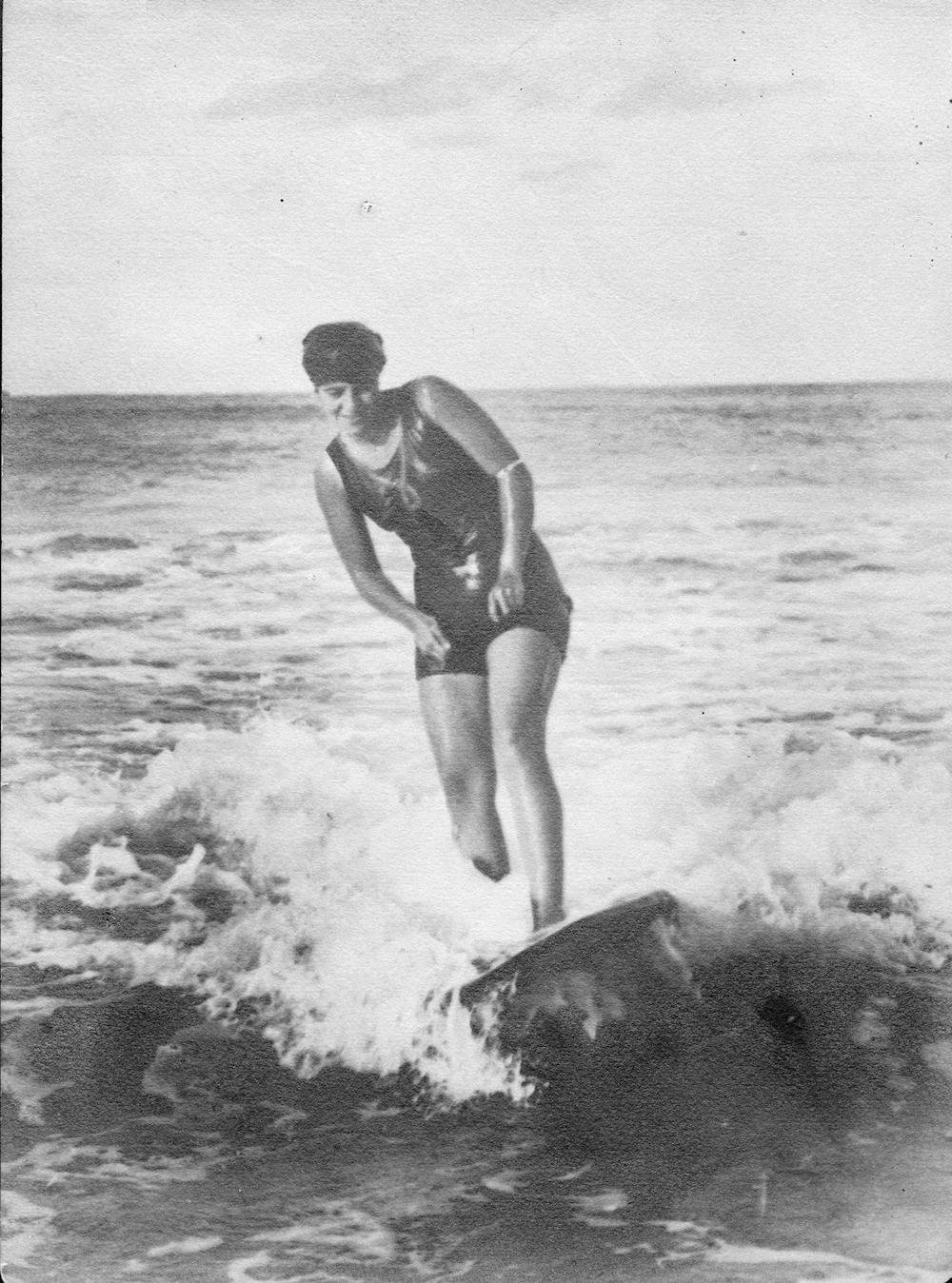
As pharmaceutical use continues to rise, side effects are becoming a costly health issue

]]>

Source: The Conversation (Au and NZ) – By Kevin Dew, Professor of Sociology, Victoria University of Wellington

The use of pharmaceuticals is on the rise and, globally, the expenses for drugs are projected to reach US$1.5 trillion by 2021.

The ageing of populations is one of the drivers of this upward trend, but another important influence is our growing tendency to treat conditions and circumstances we didn’t use to medicalise.


Read more: Medicines to treat side effects of other medicines? Sometimes less is more beneficial


Proto diseases

One reason for this medicalisation is the creation of new conditions. The goal of preventing future disability and early death has fashioned new disorders – including high cholesterol and blood pressure. Such proto diseases are based on a person’s risk profile at a time when disease is not present and symptoms are not felt.

Proto diseases can be identified in an ever growing proportion of the population. The belief that treating these conditions will lead to future cost savings drives up drug consumption, aimed at bringing cholesterol, blood pressure and glucose levels into line.

A simple shift towards lowering the threshold that determines when someone should be taking such drugs can lead to a substantial expansion in the number of people who are offered them by health professionals. While these medicines can indeed prevent future disease for individuals, if one takes a population health approach, it is not a given that cost savings will outweigh costs incurred.

Evidence-based medicine

Another driver is the dominance of evidence-based medicine (EBM). The idea of basing medicine on evidence would seem to be common sense. However, sitting at the top of the hierarchy of evidence-based medicine is the evaluation procedure of the double-blind, placebo-controlled trial.


Read more: Randomised control trials: what makes them the gold standard in medical research?


This particular type of trial was designed to assess the efficacy of medications. The first such trial assessed the use of streptomycin in the treatment of pulmonary tuberculosis.

Following the fallout from the thalidomide tragedy in the 1950s and 1960s, there was an increased impetus to put in place rigorous procedures for the assessment of potentially toxic pharmaceuticals by clinical trials. This effort to prevent lethal and dangerous drugs getting on to the market was transformed from a test for new drugs to a standard that all therapeutic interventions were expected to meet.

This remains the case even though many therapeutic interventions – surgery, counselling, public health advice – do not work like drugs and are not as easy to assess. As a consequence, medications are about the only form of therapeutic intervention that can successfully become evidence-based.

Since the development of the evidence-based medicine movement, there has been a trend where health professionals are required to follow evidence-based protocols and guidelines. These guidelines are an effective way of promoting the expansion of medication use. If health professionals do not follow standards and guidelines – for example don’t ask you to take a cholesterol test when you reach a certain age and recommend the cholesterol-lowering drug – they are in danger of being viewed as incompetent practitioners.

For many people their sense of identity is shaped by their relationship to medications. At times they may be reliant on drugs for some quality of life, but they often have to trade off what is gained against at times debilitating side effects.


Read more: We’re all at risk from scary medicine side effects, but we have to weigh the risks with the benefits


Remedies and poisons

Some pharmaceuticals work very well. They can help prolong life and ameliorate symptoms. Many people will recall situations where they were glad a drug was readily available.

But the Greek term pharmakon refers to both remedy and poison. Pharmaceuticals are well known for their toxic effects, which is one reason why access to many drugs is carefully controlled, requiring a medical doctor’s prescription. But research shows that even with doctors overseeing these drugs, side effects occur on a large scale and we have woefully inadequate means of reporting side effects and adverse reactions.

The costs of responding to adverse drug reactions and the disease and premature death they can cause makes side effects an important public health problem. Yet only around 10% of serious adverse drug reactions are reported to agencies that monitor drug safety.

To deal with this issue, we need to consider trends in drug consumption, regulation and policy. We need to understand how decisions about drug use are made in clinical consultations and in homes, and how drug monitoring agencies, drug subsidising agencies and drug trial methodologies work.

There is little resistance to the ever expanding use of pharmaceuticals. Individuals, health professionals and health care institutions, nation states and international health agencies are increasingly governed by the dominance of pharmaceutical approaches to health care.

But there are interventions that we could be putting in place to ameliorate this expansion. We need to develop more rigorous vigilance procedures so that when drugs come on the market, they are carefully monitored for adverse reactions, and both patients and health practitioners are actively encouraged to report any concerns to drug monitoring agencies.

We also need to regulate the advertising of prescription medicines more tightly, particularly in New Zealand where drug companies can advertise their products and only have to make fleeting reference to possible side effects.

ref. As pharmaceutical use continues to rise, side effects are becoming a costly health issue – http://theconversation.com/as-pharmaceutical-use-continues-to-rise-side-effects-are-becoming-a-costly-health-issue-105494

Five insights that could move tourism closer towards sustainability

]]>

Source: The Conversation (Au and NZ) – By Jason Paul Mika, Senior Lecturer, School of Management, Massey University

Tourism is New Zealand’s biggest export earner, contributing 21% of foreign exchange earnings. The latest data show tourists added NZ$39.1 billion to the economy and the industry has seen a 44% increase over the past five years.

But tourism also brings unwanted pressures on infrastructure and natural resources. Recently, a conference focused on sustainability in tourism and how the industry could contribute to the United Nations’ 17 sustainable development goals (SDGs), ratified in 2015 as the playbook for global development to 2030.


Read more: We’re in the era of overtourism but there is a more sustainable way forward


The meeting challenged the growth agenda that continues to dominate thinking in the tourism industry. The rhetoric around the SDGs came under fire for being based on ideas of utilitarianism (maximising growth and profits) and managerialism (all problems are solvable with good management).

An uneasy tension was evident in how sustainability is viewed. On the one hand, the narrative was one of hopelessness because sustainability in tourism is constantly counter-punched by commercialism and inequalities between locals and outsiders. On the other hand, there was hope. Sustainability in tourism should be possible because corporates allude to re-imagined approaches to social responsibility and indigenous tourism operators see SDGs as compatible with their values and needs.


Read more: ‘Sustainable tourism’ is not working – here’s how we can change that


Here are five major insights on the role of tourism in sustainable development.

1) The SDGs are not infallible

They are full of contradictions and tensions, and born of an institution of ultimate compromise – the United Nations. The UN advances progress based on a “middle ground” approach. For now, the SDGs represent accepted wisdom about what a good life might look like in 2030.

2) Sustainability means change

Sustainability requires a change in mindset, beliefs, assumptions, habits and behaviours – not just of some, but everyone. Everybody stands to lose if we do not achieve a more sustainable world.

According to ancient indigenous wisdom, we are all interconnected, and the UN is beginning to appreciate that. The real challenge is how we institute a shift toward sustainability, after generations of market-driven economics that will not easily release us from its grasp. Like during all major disruptions, we must address root causes to procure lasting effects.

In economic parlance, achieving a shift from growth to sustainability requires us to rethink the incentives and rules (carrots and sticks) we use to guide entrepreneurs and enterprises. We might see sustainability rise in the entrepreneur’s estimation because of natural catastrophes, abhorrence at widespread poverty, and when consumers demand it.

3) We are a long way off

Companies and policymakers are a long way off working out how to do the SDGs justice, but some are making a pretty good start. One global tourism operator, for example, immediately after a major earthquake in one of its prime destinations raised $400,000 from an appeal. They also believed that getting tourists to return would offer longer term benefits to locals, so donated 100% of the profits from travel to the region in the year after the quake to the rebuild. Their philosophy: profit first, then purpose follows. More growth enables the company to do more good. This makes sense because you cannot help anyone if you don’t have the money. But if you wait until you have money to have purpose, then sustainability is merely about economic attainment, only one strand of the many ideals within the SDGs. We should, instead, be aiming for ‘inclusive tourism’ which moves us some way toward tourism being the transformative, partnership-centred, equitable benefit-sharing between companies and local communities that might sustain people and environments over generations.

4) Indigenous perspective

Indigenous knowledge presents alternative sets of values and behaviours that are inherently sustainable and offer potential models.

Indigenous communities are often deprived of opportunity and resources to develop sustainable enterprises of their own. Some indigenous entrepreneurs who start their own enterprises are affected by public doubt about whether they can or should do it. There is also the issue of how indigenous lands should be used – either for large-scale foreign-owned resorts that usually preclude local ownership or for small-scale locally owned ones that are accessible to locals.

5) Customer power

As tourists, tourism operators and tourism agencies, we ought to be prepared to look beyond the idyllic post card images to understand the undesirable consequences of tourism: waste, working conditions, water quality and impacts on the environment. It is important we become discerning customers who ask about sustainability of products and services.

ref. Five insights that could move tourism closer towards sustainability – http://theconversation.com/five-insights-that-could-move-tourism-closer-towards-sustainability-110594

Don’t have time to exercise? Here’s a regime everyone can squeeze in

]]>

Source: The Conversation (Au and NZ) – By Emmanuel Stamatakis, Professor of Physical Activity, Lifestyle, and Population Health, University of Sydney

Have you recently carried heavy shopping bags up a few flights of stairs? Or run the last 100 metres to the station to catch your train? If you have, you may have unknowingly been doing a style of exercise called high-intensity incidental physical activity.

Our paper, published today in the British Journal of Sports Medicine, shows this type of regular, incidental activity that gets you huffing and puffing is likely to produce health benefits, even if you do it in 30-second bursts, spread over the day.

In fact, incorporating more high intensity activity into our daily routines – whether that’s by vacuuming the carpet with vigour or walking uphill to buy your lunch – could be the key to helping all of us get some high quality exercise each day. And that includes people who are overweight and unfit.


Read more: Health Check: high-intensity micro workouts vs traditional regimes


What is high intensity exercise?

Until recently, most health authorities prescribed activity lasting for at least ten continuous minutes, although there was no credible scientific evidence behind this.

This recommendation was recently refuted by the 2018 US Physical Activity Guidelines Advisory Report. The new guidelines state any movement matters for health, no matter how long it lasts.

This appreciation for short episodes of physical activity aligns with the core principles of high intensity interval training (HIIT). HIIT in a hugely popular regime involving repeated short sessions, from six seconds to four minutes, with rests from 30 seconds to four minutes in-between.

Among a range of different regimes, we consistently see that any type of high intensity interval training, irrespective of the number of repetitions, boosts fitness rapidly and improves cardiovascular health and fitness.

That’s because when we regularly repeat even short bursts of strenuous exercise, we instruct our bodies to adapt (in other words, to get fitter) so we’re able to respond better to the physical demands of life (or the next time we exercise strenuously).


Read more: Yes, your kids can run all day – they’ve got muscles like endurance athletes


The same principle is at play with incidental physical activities. Even brief sessions of 20 seconds of stair-climbing (60 steps) repeated three times a day on three days per week over six weeks can lead to measurable improvements in cardiorespiratory fitness. This type of fitness indicates how well the lungs, heart, and circulatory systems are working, and the higher it is the lower the risk for future heart disease is.

In fact, research suggests physical activity intensity may be more important for the long-term health of middle-aged and older people than total duration.

Achievable for everyone

The main reasons people don’t do enough exercise tend to include the cost, lack of time, skills, and motivation.

Exercise regimes like high intensity interval training are safe and effective ways to boost fitness, but they’re often impractical. People with chronic conditions and most middle aged and older people, for example, will likely require supervision by a fitness professional.

Walking to and from the supermarket is a good option if it’s not too far. From shutterstock.com

Aside from the practicalities, some people may find back-to-back bouts of very high exertion overwhelming and unpleasant.

But there are plenty of free and accessible ways to incorporate incidental physical activity into our routines, including:

  • replacing short car trips with fast walking, or cycling if it’s safe

  • walking up the stairs at a fast pace instead of using the lift

  • leaving the car at the edge of the shopping centre car park and carrying the shopping for 100m

  • doing three or four “walking sprints” during longer stretches of walking by stepping up your pace for 100-200 metres (until you feel your heart rate is increasing and you find yourself out of breath to the point that you find it hard to speak)

  • vigorous walking at a pace of about 130-140 steps per minute

  • looking for opportunities to walk uphill

  • taking your dog to an off-leash area and jogging for 30-90 seconds alongside the pup.


Read more: Four common myths about exercise and weight loss


This type of incidental activity can make it easier to achieve the recommended 30 minutes of physical activity a day. It can also help boost fitness and make strenuous activity feel easier – even for those of us who are the least fit.

ref. Don’t have time to exercise? Here’s a regime everyone can squeeze in – http://theconversation.com/dont-have-time-to-exercise-heres-a-regime-everyone-can-squeeze-in-111600

What are we teaching in business schools? The royal commission’s challenge to amoral theory

]]>

Source: The Conversation (Au and NZ) – By Walter Jarvis, Director, UTS Master of Management; Lecturer in Managing, Leading & Stewardship, University of Technology Sydney

The banking royal commission has seen spectacular resignations, calls for changes in the law, and calls for cultural change within banks.

But what about changes in education, which is where much of what’s wrong begins?

Business schools teach the people who will one day be the managers and leaders who run banks and other financial institutions.

They have had a hand in driving much of what came before the commission – the prioritisation of profit (ends) over how people are treated (means).

They’ve taught the theories that have led to obscene executive compensation and unprecedented earnings inequality.

They are arguably a “force for evil”, purveyors of “immoral profit strategies”.

One professor has suggested the only way to fix them is to bulldoze them.

Amorality as a ticket to respect

They’ve become like this – probably amoral rather than immoral – in order to seem values-free, like the physical sciences such as chemistry and physics that are accorded so much respect.

But what they have taught hasn’t been values-free. Business schools have taught that there’s an imperative to maximise profits, almost no matter what. It may have even become self-fulfilling, freeing students from a sense of moral responsibility.

The idea comes from the “homo economicus” strand of economic theory, much challenged in economics itself. Managers, shareholders, customers and everyone else are said to be selfish maximisers of personal wealth and power with little regard for honesty and decency.

Because managers’ incentives are linked to the value of their company’s shares (shareholder value primacy), they are said to put shareholder value above everything else.

There’s an alternative

There’s another way, and it’s gaining ground. More and more universities are teaching stakeholder theory, in which corporations exist to create value for multiple stakeholders such as customers, employees, suppliers, communities and ecologies, rather than only shareholders.

At the University of Technology Sydney we are also teaching a course entitled Managing, Leading and Stewardship in which students learn what it’s like to be in “morally unequal” situations. We invite them to explore organisational and management practices more aligned to moral equality; including cooperatives, commons, and employee ownership.

They are introduced to the well recognised German-based “enterprise” or mitbestimmung model, in which workers are elected as directors, taking between one-third and one-half of all supervisory board positions.

It is a governance model in which labour (workers) and capital (management) are not just deemed equally important but are held jointly responsible for the long-term well-being of the enterprise. It has operated in Germany and other parts of Europe for more than 70 years.

Sometimes it is known as the “two boards” model (a supervisory board and a management board). The recently-declared US 2020 Democrat presidential candidate Elizabeth Warren has incorporated it into in her Accountable Capitalism policy.

It’s a dignity threshold

UTS and business schools in the United States are also developing courses that ask students to role play decisions with ethical dilemmas.

At the base of these courses is the idea of a “dignity threshold”, the minimum level of respect that should be accorded to people affected by and engaged in a business – not only those directly involved (customers and employees), but also those indirectly affected, such as local schools, hospitals, and government agencies.

“Dignity” means being treated as the moral equal of anyone else, a definition outlined in the book Humanity without Dignity by Andrea Sangiovanni.

At the royal commission, it became clear that many of those affected by the misbehaviour of banks and related institutions could sense that they weren’t being treated as morally equal. They were dehumanised and treated as means to do what many witnesses from within the sector said was their sole purpose: making money.


Read more: Banking Royal Commission: no commissions, no exemptions, no fees without permission. Hayne gets the government to do a U-turn


If we want our future managers and leaders to stop engaging in such conduct, we will need to start teaching them about how to be morally as well as financially accountable.

It is what publicly funded universities are for – to project and enhance society’s values.

The legitimacy of business (and business schools) hinges on ensuring they do it.


The Conversation


ref. What are we teaching in business schools? The royal commission’s challenge to amoral theory – http://theconversation.com/what-are-we-teaching-in-business-schools-the-royal-commissions-challenge-to-amoral-theory-110901

Australian governments should follow the ACT’s lead in building communities, not prisons

]]>

Source: The Conversation (Au and NZ) – By Lorana Bartels, Professor, School of Law and Justice, University of Canberra

Justice reinvestment seeks to reduce the number of people in prison by investing money that would have been spent on prisons in early intervention, prevention and diversion. It involves working with communities to design local solutions to address the drivers of crime and imprisonment.

In 2013, a Senate committee recommended that the Commonwealth take a leadership role in supporting the implementation of justice reinvestment and provide funding for a trial of justice reinvestment in Australia.


Read more: As Indigenous incarceration rates keep rising, justice reinvestment offers a solution


In 2017, the Australian Law Reform Commission released its Pathways to Justice report on the over-incarceration of Aboriginal and Torres Strait Islander peoples. It recommended that Commonwealth, state and territory governments establish an independent justice reinvestment body and justice reinvestment trials. Both of these should have significant Indigenous involvement.

There has not been any coordinated response to either of these reports, but there are small justice reinvestment projects in most states and territories. In New South Wales, the Bourke Maranguka Justice Reinvestment project has recorded:

  • a 23% decrease in police-recorded incidents of domestic violence
  • a 14% decrease in bail breaches for adults
  • a 42% reduction in days spent in custody for adults
  • a 31% increase in year 12 student retention rates
  • a 38% reduction in charges across the top five juvenile offence categories.

An impact assessment by KPMG found the project achieved savings of $3.1 million in 2017.

The ACT example

The ACT has one prison, the Alexander Maconochie Centre (AMC), which houses all prisoners. The prison opened in 2010 as Australia’s first human rights prison, but has failed to live up to its goals.

This is partly due to it being overcrowded. According to the Report on Government Services, the AMC operated at 108% of its design capacity in 2017-18. Operating at or above 95% “compromises the ability of prison management to safely and humanely manage prisoners”.

The ACT imprisonment rate has increased by 24% since 2015, compared with a 13% increase nationally.

The ACT government was advised it would cost $200 million to expand the AMC. Last week, it announced it had ruled out expansion. Instead, it will redirect $14.5 million into a range of community programs, legislative reforms and policy initiatives. These include:

  • improving rehabilitation options, including a purpose-built “reintegration centre” for up to 80 prisoners. This will allow for a wide range of programs, including trauma and relationship counselling, alcohol, tobacco and other drug rehabilitation, and job training skills – all of which have been associated with reduced reoffending

  • establishing a bail accommodation support service and exploring accommodation issues for detainees after their release – one in three detainees at the AMC were homeless or living in a hostel immediately before they were imprisoned

  • expanding the Strong Connected Neighbourhoods program, which supports people in high-density housing and has been shown to reduce crime

  • continuing a family-centric program delivered by Indigenous-run organisations, which has shown promising results.

The female imprisonment rate in the ACT has increased by 98% since 2015, compared with a 19% increase for men. In addition, 32 of the 36 women (89%) who entered the AMC in the September 2018 quarter were unsentenced, compared with 85% of men and 75% of prisoners nationally. The increase in women’s imprisonment nationally has been the subject of recent media attention, especially in the context of their experience of family violence and imprisonment for unpaid fines in Western Australia.


Read more: FactCheck Q&A: are Indigenous Australians the most incarcerated people on Earth?


Unfortunately, the government’s announcement did not expressly consider the specific needs of women, including the intersection between their victimisation histories, substance abuse, mental illness and offending behaviour. The need for gender-sensitive responses has been the subject of previous research in the ACT context.

Nevertheless, the ACT is to be commended for its initiative. This represents the most far-reaching commitment by an Australian government to justice reinvestment. It is significant that the policy is called “Building Communities Not Prisons”. As the ACT justice minister has stated:

Justice reinvestment is honest about the reality of incarceration in Australia. While crime rates are going down, incarceration rates are going up. The most just justice system is a system that acts early to help prevent the kinds of circumstances that can lead to crime in the first place.

How Australia can address its addiction to prisons

Australia’s imprisonment rate has risen year on year since 2011. We have a higher imprisonment rate than Canada and every country in Western Europe.


Read more: State of imprisonment: can ACT achieve a ‘human rights’ prison?


In 2016, the NSW government announced that it would spend $3.8 billion building new prisons. The corrections minister, David Elliott, said:

This is, it must be said, not money the state government is happy to spend … My personal preference would always be that this money, this NSW taxpayers’ money, is spent on schools and hospitals. But governments do have a choice in how they allocate the public’s money. And the evidence supporting justice reinvestment is strong and growing.

In September 2018, the Queensland government asked the Queensland Productivity Commission to undertake an inquiry into imprisonment and reoffending. In its draft report, the commission described imprisonment as a “growing policy problem” and stated that “increasing imprisonment can make the community less safe”. It also recognised that imprisonment “is costly, and this cost is borne by the community”.

It remains to be seen what the commission recommends, but all Australian governments should have the courage to follow the ACT’s lead and invest in communities, not razor wire.

ref. Australian governments should follow the ACT’s lead in building communities, not prisons – http://theconversation.com/australian-governments-should-follow-the-acts-lead-in-building-communities-not-prisons-111990

PNG probe into parliament rampage still ongoing, says police chief

]]>
A scene from the break-in at parliament in Waigani, Port Moresby, last November. Image: Bryan Kramer/Kramer Report

By RNZ Pacific

Papua New Guinea’s Police Commissioner says investigations are ongoing into officers who took part in a rampage through Parliament last year.

Last November, dozens of police and corrections officers went on the rampage over their frustrations about unpaid security work at the Asia Pacific Economic Cooperation (APEC)  summit.

The Speaker of Parliament, Job Pomat, who subsequently offered officers bonuses for their work, has called for the investigation to be dropped in the spirit of forgiveness.

READ MORE: The Kramer Report allegations

But commissioner Gary Baki said the probe would continue and those responsible would be held to account.

“Why it’s taking a little bit too long, because most of the people that are involved are those that came from outer provinces,” he said.

-Partners-

Investigating team
“So our investigating team will have to get together and ensure that those that came in from outer provinces are clearly identified, so that their provincial police commanders in those regions can be informed accordingly that these are the people that will be required to be investigated by the investigating team.

“It’s not only in NCD (National Capital District).”

Meanwhile, the PNG opposition has questioned the integrity of the purported bill for the damage to parliament, which has been quoted at more than 8 million kina

Pacific Media Watch reports that Opposition member for Madang Bryan Kramer, who publishes the investigative Kramer Report, has made a series of allegations challenging the credibility of the damages claim and questioning whether Parliament has become a “Haus of corruption”.

This article is republished under the Pacific Media Centre’s content partnership with Radio New Zealand.

Print Friendly, PDF & Email

Article by AsiaPacificReport.nz

Super-recognisers accurately pick out a face in a crowd – but can this skill be taught?

]]>

Source: The Conversation (Au and NZ) – By Alice Towler, Post-doctoral Research Fellow, UNSW

Yenny is 26 years old, lives in Melbourne, and has a very specific talent.

One day, she was driving her car when she recognised a man who had been several years below her at high school and whom she hadn’t seen for more than ten years. What makes this particularly impressive is that she recognised him from the briefest glimpse in her rear-view mirror while he was driving the car behind hers.

Yenny recounts many such amazing feats of recognition and is one of a very small proportion of the population known as “super-recognisers”. She was the top performer on a national test of face recognition abilities in Australia, coming first out of 20,000 participants.


Read more: Combining the facial recognition decisions of humans and computers can prevent costly mistakes


Could you learn to spot a face as well as Yenny? Well … maybe. Our new research shows that many training courses offered in this field of expertise are ineffective in improving people’s accuracy in face identification.

But other ways of learning how to identify faces may work; we’re just not yet sure exactly how.

In-demand expertise

Super-recognisers are used by police and security agencies to spot targets in crowded train stations, monitor surveillance footage, and track people of interest.

During the 2011 London riots, for example, super-recognisers from the Metropolitan Police identified more than 600 people from very poor-quality surveillance footage – a task that not even the best facial recognition software can perform reliably.

So can anyone become a super-recogniser? Can you make up for a lack of superpowers through training? In our paper we assessed the effectiveness of training courses given to practitioners who make facial identification decisions for a living.

We reviewed 11 training courses that comply with international training standards from Australia, UK, US and Finland.

Sample test of face recognition: are the side-by-side images of the same, or different people? Answers can be found in the paper acknowledgements (click on journal link). Towler and colleagues, PLOS ONE, CC BY

We found that training courses typically teach facial anatomy – focusing on the muscles, bones and shape of the face – and instruct trainees to inspect faces feature by feature. Novices and genuine trainees completed one of four training courses and we tracked their identification accuracy from before to after training.

Surprisingly, we found the training courses had almost no effect on people’s accuracy. This was especially surprising to the people who took the training – an astonishing 93% of trainees thought the training had improved their ability to identify faces.

Our research shows that even the world’s best available training – used to train police, border control agents, forensic scientists and other security personnel – does not compensate for talent in face recognition.

This is consistent with recent research suggesting that our face identification abilities are largely predetermined by genetics.

Forensic facial examiners

This may come as disappointing news to people who hope to become a super-recogniser. But all is not lost.

Scientists have recently discovered that some specialist groups of practitioners show very high levels of accuracy. Forensic facial examiners routinely compare images of faces to turn CCTV images into informative face identification evidence in criminal trials. Recent work shows that they too outperform novices in very challenging tests.

CCTV footage doesn’t always produce clear images, so identifying people can be difficult. Shutterstock.com

Forensic facial examiners present a paradox for scientists. They perform face identification tasks with a high degree of accuracy, and this ability appears to be acquired through professional experience and training.

Our study suggests there is no benefit of face identification training courses when tested immediately before and after.

In addition, previous work has suggested that merely performing face-matching tasks in daily work is not sufficient to improve accuracy. Some passport officers have been working for 20 years and perform no better than others who have been working for just a few months.


Read more: Passport staff miss one in seven fake ID checks


This paradox suggests there is something particular about the type of training and professional experience that forensic facial examiners receive that enables them to develop visual expertise in identifying faces, and which isn’t provided by standard training courses.

How do they do it?

In our current research we are working closely with government agencies to uncover the basis of forensic facial examiners’ expertise. For example, we now know that part of their expertise comes from using a very particular comparison strategy, where they break the face down into individual facial features and then slowly and systematically assess the similarity of each feature in turn.

Interestingly, the nature of this expertise appears to be qualitatively different to that of super-recognisers – Yenny recognised her old classmate using a quick, intuitive process as she glanced in the rear-view mirror.

Super-recognisers can pick out a face they may have seen only once before. Shutterstock.com

However, these snap judgements made by super-recognisers may not be suitable for the type of identification evidence that forensic facial examiners give in court, where a careful analysis of facial images is necessary to support identification decisions. Importantly, forensic facial examiners provide detailed reports of the observations used to support their decisions, which can then be cross-examined in court.

Trainable vs hardwired

Super-recognisers and forensic facial examiners use distinct routes to high performance in face identification.

Effective training appears to target the slower, deliberate and analytical visual processing that characterises forensic facial examiners.

The faster and more intuitive skill that enabled Yenny to recognise faces of relative strangers in her rear-view mirror is likely to be untrainable, and hard-wired.

This raises the question of how to balance these different sources of expertise. It may be that super-recognisers are best suited to surveillance-type roles, such as monitoring CCTV or searching for targets in large crowds.

Forensic facial examiners may be better suited to providing identification evidence to the court, which requires thorough explanations of how and why the expert came to their decision.

Alternatively, it may be possible to train super-recognisers in the expert skills characterising forensic facial examination, or to form teams that include both types of expert.

The aim of our work is to integrate these sources of human expertise with the latest face recognition software to improve the accuracy of face identification evidence. Such a system can make society safer, but also fairer, by reducing the likelihood of wrongful convictions.

Can you beat Yenny’s high score of 88% on the super-recogniser test? Find out here.

ref. Super-recognisers accurately pick out a face in a crowd – but can this skill be taught? – http://theconversation.com/super-recognisers-accurately-pick-out-a-face-in-a-crowd-but-can-this-skill-be-taught-112003