Page 1081

Parliamentary press freedom inquiry: letting the fox guard the henhouse

Source: The Conversation (Au and NZ) – By Denis Muller, Senior Research Fellow in the Centre for Advancing Journalism, University of Melbourne

Fox guarding the henhouse; poacher in charge of the game-keeping. Choose your idiom, but appointing the parliamentary joint committee on intelligence and security to inquire into press freedom is guaranteed to get the opposite result to what is ostensibly intended.

The committee – called PJCIS for short – is part of the problem that the inquiry is meant to solve.

Proposing that it lead the quest for a solution shows the inquiry for what it is – a public relations exercise designed to buy time until the hue and cry over last month’s raids by the Australian Federal Police on two media organisations dies down.


Read more: Explainer: what are the media companies’ challenges to the AFP raids about?


The inquiry is due to report on October 17. That will be four months after the raids on the home of a News Corp reporter and the headquarters of the ABC, which provoked a powerful reaction last week from the heads of the ABC, News Corp and Nine in a panel at the National Press Club. They were united in calling for far-reaching changes to Australia’s secrecy, national security and whistleblower laws.

The government’s strategy is transparently obvious. For the next four months, it can bat away pressure for reform by saying everyone should wait and see what the PJCIS comes up with.

However, any proposal to do something substantive about reforming the oppressive regime of secrecy and national security laws will generate severe blowback from the intelligence services, the federal police, and the bureaucracy in general.

They love secrecy and hate disclosure. They devised the current regime in the first place, and the PJCIS waved it through in successive tranches of legislation, often in a rush with no time for a thorough review by parliament.


Read more: Media chiefs unite on press freedom, but will it result in any action?


The result is that Australia now has more than 70 pieces of national security legislation, the vast bulk of them passed in the 18 years since the September 11, 2001 terror attacks. They are laced with criminal sanctions against journalism. Where a public-interest defence is available, the onus is on journalists to prove their defence rather than on the prosecution to prove guilt.

On top of that are the general government secrecy laws contained in Part 5.6 of the Commonwealth Criminal Code, which are written so broadly as to encompass any government information at all. They, too, provide for criminal sanctions against journalists, as well as whistleblowers.

The Public Interest Disclosure Act, which is designed to give the impression that whistleblowers are protected, is a complete piece of window-dressing. We are seeing now how this plays out with the prosecutions of two whistleblowers, Richard Boyle, formerly of the Tax Office, and David McBride, formerly of the Defence Department, for making disclosures that were clearly in the public interest.

Then there are the warrant systems designed to give the impression that journalists can offer some protection to confidential sources and that media organisations cannot be arbitrarily raided by the police. The impression that the warrants are subject to judicial review is simply illusory. The warrant for the raid on the ABC last month, for instance, was issued by a local court registrar in Queanbeyan.

What media chiefs want vs. what the inquiry will review

The three media bosses were unanimous in telling National Press Club on June 26 what needs to be done:

  • decriminalise journalism

  • narrow the scope of national security laws so sanctions against journalists apply only when a serious issue of national security is at stake

  • fix the whistleblower laws so they really do protect public-interest disclosures

  • make warrants contestable in the courts and subject to proper judicial review

  • take action to counter the culture of secrecy that, as Hugh Marks, CEO of Nine, put it, has become “a twisted default position” for government agencies.

The media bosses say no inquiry is needed to establish this. Naturally, however, they are going along with the PJCIS inquiry, and had talks with the Attorney-General Christian Porter this week over the reforms they want.


Read more: Four laws that need urgent reform to protect both national security and press freedom


The terms of reference for the inquiry, as reported in The Australian, include:

  • finding out from journalists what it is like being the subject of police or intelligence operations and what impact it has on their work

  • determining whether any changes can be made to legal procedures and thresholds to rebalance press freedom and national security considerations

  • assessing whether there should be contested hearings over warrants

  • evaluating the appropriateness of allowing police and intelligence services to access electronic data held by media organisations.

There’s nothing in there about decriminalising journalism, narrowing the scope of national security, or making the whistleblower laws work. And of course, there’s nothing about the culture of secrecy in this country.

Labor is proposing a cross-party Senate inquiry which, given the numbers in the Senate, stands a chance of getting up.

Meanwhile, it would be a triumph of hope over experience to expect the PJCIS to come up with anything like a regime to enable the press to exert the kind of scrutiny on government that democracy requires.

ref. Parliamentary press freedom inquiry: letting the fox guard the henhouse – http://theconversation.com/parliamentary-press-freedom-inquiry-letting-the-fox-guard-the-henhouse-119820

Smoking at record low in Australia, but the grim harvest of preventable heart disease continues

Source: The Conversation (Au and NZ) – By Simon Chapman, Emeritus Professor in Public Health, University of Sydney

Smoking rates in Australia are at an all-time low. And yet, nearly 11,500 people are hospitalised from smoking-related cardiovascular (heart and blood vessel) disease each year, while almost 6,500 die as a result.

And it’s not just older people dying from their addiction. More than one-third of deaths from cardiovascular disease, such as heart attack or stroke, in people under the age of 65 in Australia can be attributed to smoking.

A recent publication of the largest and most comprehensive study of smoking and cardiovascular disease in Australia is a reminder we can’t be complacent.

The study, published this week in BMC Medicine, found current smokers have a five-fold increase in the risk of peripheral vascular disease, such as gangrene. Smoking also doubles the risk of heart attack, stroke and heart failure and triples the risk of dying from these diseases. This is compared to people who have never smoked.

The study’s authors said the findings suggest that if a smoker has a heart attack or a stroke, it’s highly probable smoking caused it.


Read more: How Australians Die: cause #1 – heart diseases and stroke


Our smoking rates

The table below shows how Australia’s smoking rates compare with four other nations with which we are often benchmarked: USA, Canada, New Zealand and the UK.

So at 15.1%, we are level with the UK. But we are almost certainly ahead of them because their 15.1% only includes people who smoke cigarettes (including rollies). It excludes people who only smoke other tobacco products, such as cigars or pipes.

The very latest data from Victoria are even more promising with only 10.7% smoking daily, down from 13.5% in 2015.

But the new research shows the impacts of past decades of smoking.

What the researchers did and found

Researchers followed 188,167 people aged 45 and over for an average of 7.2 years.

At the start of the study, none had been diagnosed with cardiovascular disease, 8% smoked and 34% had given up smoking.

The researchers used questionnaires, as well as hospitalisation and death data, to the end of 2015 and examined 36 sub-types of cardiovascular disease.


Read more: Women have heart attacks too, but their symptoms are often dismissed as something else


Current smokers were significantly more likely to have a diagnosis or an event (a heart attack or stroke) in 29 out of the 36 cardiovascular disease types.

The new paper estimates that every year, smoking-related cardiovascular disease results in 11,400 people being sent to hospital and 6,400 people dying. This translates to 17 preventable deaths and 31 preventable hospitalisations a day.

The authors report one-third of premature cardiovascular deaths are attributable to smoking. The same researchers earlier calculated long-term smokers have a two in three chance of dying from a smoking-caused disease.

How about those who cut back smoking?

Australians who smoke daily smoke an average 12.3 cigarettes a day. Many smokers believe cutting back instead of quitting will reduce much of the health risk.

But in this study, people who smoked four to six cigarettes a day had double the risk of dying from cardiovascular disease compared to people who had never smoked.

These results are similar to those found in smokers followed for years who had cut back rather than quit.


Read more: Ten myths about smoking that will not die


For example, a Norwegian cohort of 51,210 people followed from the 1970s until 2003 found “no evidence that smokers who cut down their daily cigarette consumption by >50% reduce their risk of premature death significantly”.

Another study from Korea, involving nearly half a million men followed for 11 years, found no link between smoking less and the risk of all types of cancer. While there was a significant decrease in the risk of lung cancer, this was “disproportionately smaller than that expected”.

And now, the good news

Finally, some good news for smokers who think the damage may have already been done. Quitting smoking dramatically reduces the risk of cardiovascular disease compared with continuing to smoke: the earlier the better.

People who quit smoking by age 45 avoid more than 95% of the cardiovascular disease risks related to smoking. Quitting at any age reduced their risk.

Looking to the future

Health minister Greg Hunt’s recently announced national prevention strategy must give high priority to tobacco control.

The Australian National Preventive Health Agency, set up by Labor’s health minister Nicola Roxon in the Rudd government and then axed by the Abbott government, produced a report on how best to drive tobacco control in Australia, which I co-authored. This followed a lengthy national and international evidence-based assessment and consultation on how to best accelerate the historical decline in smoking.

This report can be used to drive research and action to get smoking in Australia well below 10%.

ref. Smoking at record low in Australia, but the grim harvest of preventable heart disease continues – http://theconversation.com/smoking-at-record-low-in-australia-but-the-grim-harvest-of-preventable-heart-disease-continues-119169

No-take marine areas help fishers (and fish) far more than we thought

Source: The Conversation (Au and NZ) – By Dustin Marshall, Professor, Marine Evolutionary Ecology, Monash University

One hectare of ocean in which fishing is not allowed (a marine protected area) produces at least five times the amount of fish as an equivalent unprotected hectare, according to new research published today.

This outsized effect means marine protected areas, or MPAs, are more valuable than we previously thought for conservation and increasing fishing catches in nearby areas.

Previous research has found the number of offspring from a fish increases exponentially as they grow larger, a disparity that had not been taken into account in earlier modelling of fish populations. By revising this basic assumption, the true value of MPAs is clearer.


Read more: Protecting not-so-wild places helps biodiversity


Marine Protected Areas

Marine protected areas are ocean areas where human activity is restricted and at their best are “no take” zones, where removing animals and plants is banned. Fish populations within these areas can grow with limited human interference and potentially “spill-over” to replenish fished populations outside.

Obviously MPAs are designed to protect ecological communities, but scientists have long hoped they can play another role: contributing to the replenishment and maintenance of species that are targeted by fisheries.

Wild fisheries globally are under intense pressure and the size fish catches have levelled off or declined despite an ever-increasing fishing effort.

Yet fishers remain sceptical that any spillover will offset the loss of fishing grounds, and the role of MPAs in fisheries remains contentious. A key issue is the number of offspring that fish inside MPAs produce. If their fecundity is similar to that of fish outside the MPA, then obviously there will be no benefit and only costs to fishers.


Read more: More fish, more fishing: why strategic marine park placement is a win-win


Big fish have far more babies

Traditional models assume that fish reproductive output is proportional to mass, that is, doubling the mass of a fish doubles its reproductive output. Thus, the size of fish within a population is assumed to be less important than the total biomass when calculating population growth.

But a paper recently published in Science demonstrated this assumption is incorrect for 95% of fish species: larger fish actually have disproportionately higher reproductive outputs. That means doubling a fish’s mass more than doubles its reproductive output.

When we feed this newly revised assumption into models of fish reproduction, predictions about the value of MPAs change dramatically.

Author provided

Fish are, on average, 25% longer inside protected areas than outside. This doesn’t sound like much, but it translates into a big difference in reproductive output – an MPA fish produces almost 3 times more offspring on average. This, coupled with higher fish populations because of the no-take rule means MPAs produce between 5 and 200 times (depending on the species) more offspring per unit area than unprotected areas.

Put another way, one hectare of MPA is worth at least 5 hectares of unprotected area in terms of the number of offspring produced.

We have to remember though, just because MPAs produce disproportionately more offspring it doesn’t necessarily mean they enhance fisheries yields.

For protected areas to increase catch sizes, offspring need to move to fished areas. To calculate fisheries yields, we need to model – among other things – larval dispersal between protected and unprotected areas. This information is only available for a few species.

We explored the consequences of disproportionate reproduction for fisheries yields with and without MPAs for one iconic fish, the coral trout on the Great Barrier Reef. This is one of the few species for which we had data for most of the key parameters, including decent estimates of larval dispersal and how connected different populations are.

No-take protected areas increased the amount of common coral trout caught in nearby areas by 12%. Paul Asman and Jill Lenoble/Flickr, CC BY

We found MPAs do in fact enhance yields to fisheries when disproportionate reproduction is included in relatively realistic models of fish populations. For the coral trout, we saw a roughly 12% increase in tonnes of caught fish.

There are two lessons here. First, a fivefold increase in the production of eggs inside MPAs results in only modest increases in yield. This is because limited dispersal and higher death rates in the protected areas dampen the benefits.


Read more: Caught on camera: Ancient Greenland sharks


However the exciting second lesson is these results suggest MPAs are not in conflict with the interests of fishers, as is often argued.

While MPAs restrict access to an entire population of fish, fishers still benefit from from their disproportionate affect on fish numbers. MPAs are a rare win-win strategy.

It’s unclear whether our results will hold for all species. What’s more, these effects rely on strict no-take rules being well-enforced, otherwise the essential differences in the sizes of fish will never be established.

We think that the value of MPAs as a fisheries management tool has been systematically underestimated. Including disproportionate reproduction in our assessments of MPAs should correct this view and partly resolve the debate about their value. Well-designed networks of MPAs could increase much-needed yields from wild-caught fish.

ref. No-take marine areas help fishers (and fish) far more than we thought – http://theconversation.com/no-take-marine-areas-help-fishers-and-fish-far-more-than-we-thought-119659

Daylight robbery: how human-built structures leave coastal ecosystems in the shadows

Source: The Conversation (Au and NZ) – By Martino Malerba, Postdoctoral Fellow, Monash University

About half of the coastline of Europe, the United States and Australasia is modified by artificial structures. In newly published research, we identified a new effect of marine urbanisation that has so far gone unrecognised.

When we build marinas, ports, jetties and coastal defences, we introduce hard structures that weren’t there before and which reduce the amount of sunlight hitting the water. This means energy producers such as seaweed and algae, which use light energy to transform carbon dioxide into sugars, are replaced by energy consumers such as filter-feeding invertebrates. These latter species are often not native to the area, and can profoundly alter marine habitats by displacing local species, reducing biodiversity, and decreasing the overall productivity of ecosystems.

Incorporating simple designs in our marine infrastructure to allow more light penetration, improve water flow, and maintain water quality, will go a long way towards curbing these negative consequences.

Pier life

We are used to thinking about the effects of urbanisation in our cities – but it is time to pay more attention to urban sprawl in the sea. We need to better understand the effects on the food web in a local context.


Read more: Concrete coastlines: it’s time to tackle our marine ‘urban sprawl’


Most animals that establish themselves on these shaded hard structures are “sessile” invertebrates, which can’t move around. They come in a variety of forms, from encrusting species such as barnacles, to tree-shaped or vase-like forms such as bryozoans or sponges. But what they all have in common is that they can filter out algae from the water.

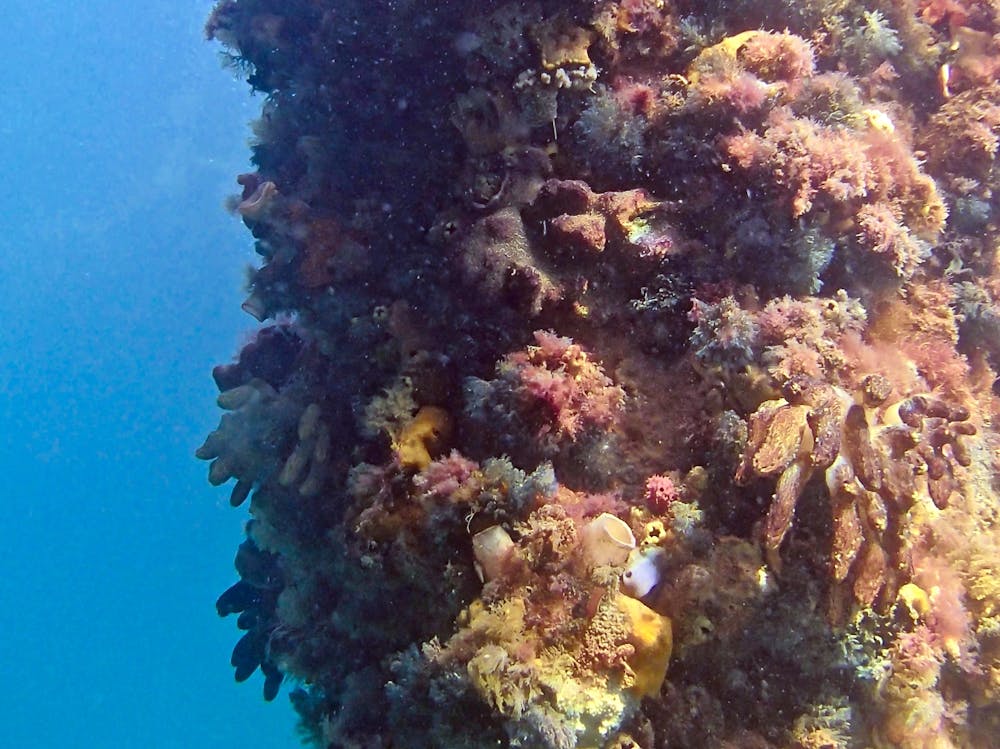
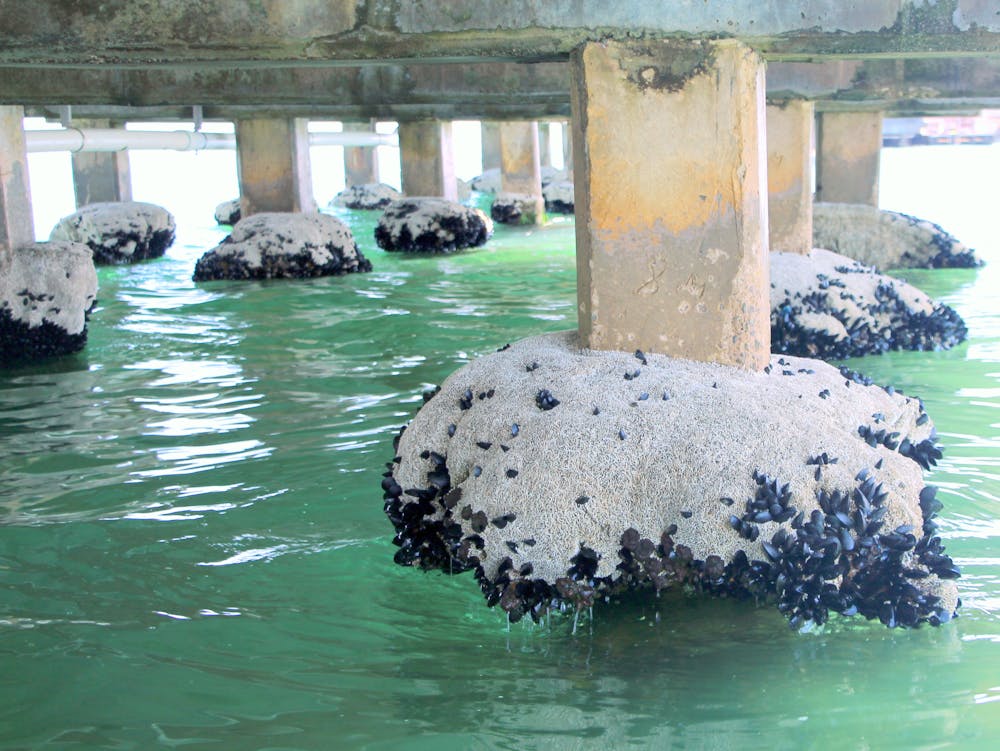
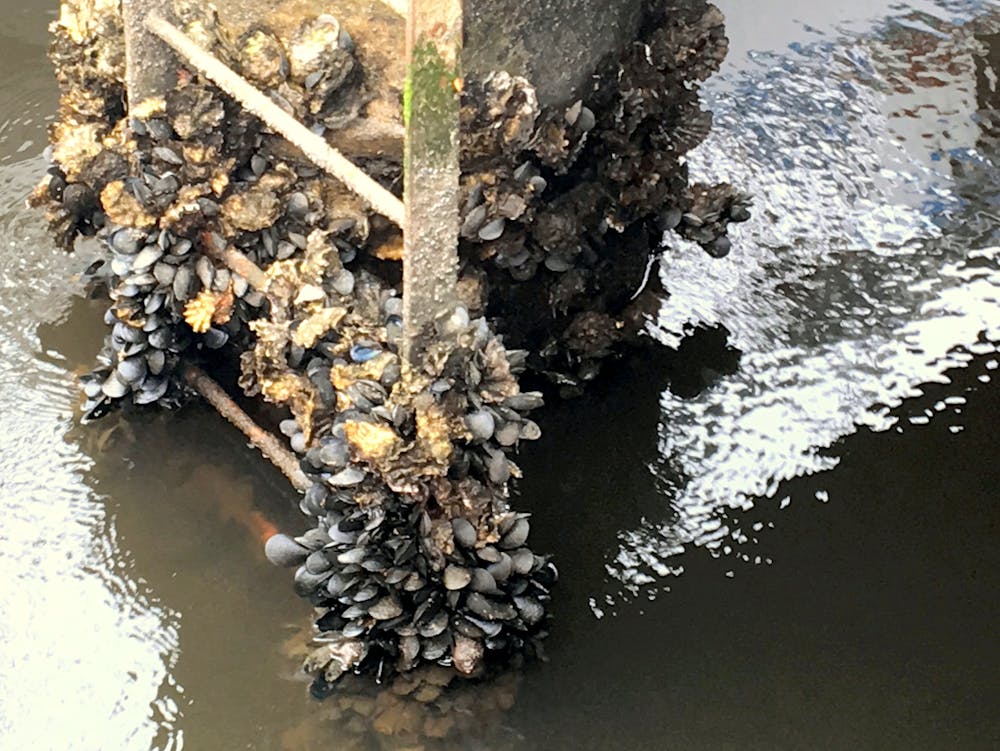
In Australian waters, we commonly see animals from a range of different groups including sea squirts, sponges, bryozoans, mussels and worms. They can grow in dense communities and often reproduce and grow quickly in new environments.

The sheltered and shaded nature of marine urbanisation disproportionately favours the development of dense invertebrate communities, as shown here in Port Phillip Bay.

How much energy do they use?

In our new research, published in the journal Frontiers in Ecology and the Environment, we analysed the total energy usage of invertebrate communities on artificial structures in two Australian bays: Moreton Bay, Queensland, and Port Phillip Bay, Victoria. We did so by combining data from field surveys, laboratory studies, and satellite data.

We also compiled data from other studies and assessed how much algae is required to support the energy demands of the filter-feeding species in commercial ports worldwide.

In Port Phillip Bay, 0.003% of the total area is taken up by artificial structures. While this doesn’t sound like much, it is equivalent to almost 50 soccer fields of human-built structures.

We found that the invertebrate community living on a single square metre of artificial structure consumes the algal biomass produced by 16 square metres of ocean. Hence, the total invertebrate community living on these structures in the bay consumes the algal biomass produced by 800 football pitches of ocean!

Similarly, Moreton Bay has 0.005% of its total area occupied by artificial structures, but each square metre of artificial structure requires around 5 square metres of algal production – a total of 115 football pitches. Our models account for various biological and physical variables such as temperature, light, and species composition, all of which contribute to generate differences among regions.

Overall, the invertebrates growing on artificial structures in these two Australian bays weigh as much as 3,200 three-tonne African elephants. This biomass would not exist were it not for marine urbanisation.

Colonies of mussels and polychaetes near Melbourne.

How does Australia compare to the rest of the world?

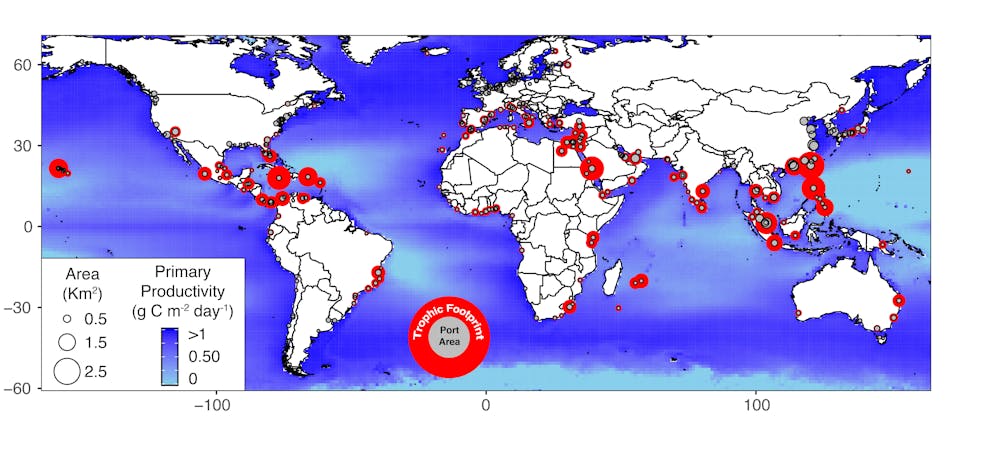
We found stark differences among ports in different parts of the world. For example, one square metre of artificial structure in cold, highly productive regions (such as St Petersburg, Russia) can require as little as 0.9 square metres of sea surface area to provide enough algal food to sustain the invertebrate populations. Cold regions can require less area because they are often richer in nutrients and better mixed than warmer waters.

In contrast, a square metre of structure in the nutrient-poor tropical waters of Hawaii can deplete all the algae produced in the surrounding 120 square metres.

All major commercial ports worldwide with associated area of the underwater artificial structures (size of grey dots) and trophic footprint (size of red borders). Trophic footprints indicate how much ocean surface is required to supply the energy demand of the sessile invertebrate community growing on all artificial structures of the port, averaged over the year. This depends on local conditions of ocean primary productivity and temperature. Ports located in cold, nutrient-rich waters (dark blue) have a lower footprint than ports in warmer waters (light blue).

Does it matter?

Should we be worried about all of this? To some extent, it depends on context.

These dense filter-feeding communities are removing algae that normally enters food webs and supports coastal fisheries. As human populations in coastal areas continue to increase, so will demand on these fisheries, which are already under pressure from climate change. These effects will be greatest in warmer, nutrient-poor waters.

But there is a flip side. Ports and urban coastlines are often polluted with increased nutrient inputs, such as sewage effluents or agricultural fertilisers. The dense populations of filter-feeders on the structures near these areas may help prevent this nutrient runoff from triggering problematic algal blooms, which can cause fish kills and impact human health. But we still need to know what types of algae these filter-feeding communities are predominantly consuming.


Read more: Explainer: what causes algal blooms, and how we can stop them


Our analysis provides an important first step in understanding how these communities might affect coastal production and food webs.

In places like Southeast Asia, marine managers should consider how artificial structures might affect essential coastal fisheries. Meanwhile, in places like Port Phillip Bay, we need to know whether and how these communities might affect the chances of harmful algal blooms.

Mussels in the port of Hobart.

ref. Daylight robbery: how human-built structures leave coastal ecosystems in the shadows – http://theconversation.com/daylight-robbery-how-human-built-structures-leave-coastal-ecosystems-in-the-shadows-118690

We subscribe to movies and music, why not transport?

Source: The Conversation (Au and NZ) – By Benjamin Kaufman, PhD Scholar in Transport, Griffith University

Many mainstays in our lives – phones, personal music libraries and movies – began as pay-as-you-go services. But subscription services are starting to rule, from iTunes shifting to Apple Music, and “all-you-can-watch” subscriptions to the Netflix catalogue.

It should be no surprise subscription services have been growing fast, with an estimated market share of US$420 billion in the US in 2015. And growth rates are increasing, with predicted revenue increases of 22% across the market in 2019.


Read more: Uber in the air: flying taxi trials may lead to passenger service by 2023


It’s time transport became the next home for subscription services. This shift may have already begun with subscriber-based e-scooters in Brisbane and global growth in Mobility as a Service (MaaS), which connects multiple modes of transport under one app.

It won’t be long before many cities find life without a car even easier, and possibly even cheaper.

Is transport ready for subscriptions?

Few people realise they already have a version of transport subscription. Car drivers pay annual fees for registration, insurance and financing. Sure, they pay for fuel, but they might be encouraged to drive less often if they had to weigh the cost of each car trip in terms of fees.

Other than toll roads, Australia has no road or congestion-pricing – a surcharge for drivers who use roads at busy times. So this high “subscription” cost of car ownership encourages more driving to reduce per-kilometre costs.

Public transport, on the other hand, is usually pay-as-you-go in Australia – periodical tickets have been removed in some states, with the introduction of contactless cards.


Read more: Driverless cars: once they’re on the road, human drivers should be banned


The costs of each trip are consciously calculated and there is little reward for a transit user’s loyalty to an operator. In fact, more travel leads to greater costs, and therefore discourages riders from using the service. It’s hard to imagine bingeing an entire season on Netflix if you have to pay for each episode.

Subscription to transport services would encourage use and promote riders to commit to more sustainable options.

Weekly or monthly ticketing is a start, and bundling more modes, for instance ride-sharing or bike-hire, would not be difficult to imagine.

Brisbane’s e-scooter scene sees transport moving to subscription services

Brisbane has been at the forefront of recent transport revolutions, hosting the largest and most successful e-scooter sharing trial in Australia. And soon, the city’s e-scooter scene will become a natural experiment in whether subscription services can outcompete pay-as-you-go services.

Last year, Lime Scooters launched more than 700 dockless electric scooters on the city’s streets on a pay-as-you-go basis.


Read more: Limes not lemons: lessons from Australia’s first e-scooter sharing trial


During the trial, Lime was extremely profitable, with Brisbane being one of fastest cities in the world to reach 1 million rides in less than six months of deployment. But they now face stiff competition.

Brisbane City Council decided to create an e-scooter duopoly to foster competition, leading the company Neuron to join Lime in providing e-scooter services in the city. We expect Neuron to launch in Brisbane in the coming month or two.

Pay-as-you-go e-scooter company, Lime, is facing stiff competition from the subscriber-based e-scooter company, Neuron, in Brisbane. Which model will win? Juan Carlos Cardenas/EPA

These two companies have important differences in operational and pricing models.

Lime offers traditional pay-as-you-go scooter hiring. This worked well when Lime was the only choice in town. But Neuron is breaking new ground by offering weekly and monthly subscriptions in addition to per-trip payment options.

As Lime already has an established customer base, they should start strongly. Time will tell if Neuron’s subscription model will win out and if consumers are loyal enough to pay an up-front fee to gain greater access to scooters.

The subscription model of ‘Mobility-as-a-Service’ is being embraced globally

Neuron’s subscription model signals a greater change in how we might pay for transport services in future.

Australian transport authorities, like those abroad, are almost all working feverishly on opportunities to provide Mobility as a Service (MaaS). This means they’re creating a single-platform journey planner and ticket purchasing marketplace for customers who use many different modes of transport.


Read more: For Mobility as a Service (MaaS) to solve our transport woes, some things need to change


The aim is to provide seamless connections between transport modes for a single journey, giving each user tailored routes and transport options (whether ride-hailing, an e-scooter, a council-bus or a ferry, in whatever combination) for their journey.

Australia should adopt a MaaS model, paying for all kinds of transport services with one subscription. Shutterstock

MaaS will house these options under one roof. Easy payments on one app are a start. Subscriptions will then “lock-in” users to a grab-bag of these services. For instance, offering all your public transport in certain zones, plus a month’s worth of short e-scooter rides, a set number of bike-share trips and ride-hailing kilometres.

The hope is this will make alternatives to private car use irresistible.

A Helsinki start-up, Whim, is already doing this by providing subscription services to public transport, city bikes, taxis and rental cars. Grab, in Southeast Asia, innovated a new payment ecosystem offering both ride-hailing and deliveries (like combining Uber and UberEats). This is just the beginning.

For Australians, MaaS may still be on the distant horizon, but subscription scooter services may be a sign of how we will soon approach mobility.

ref. We subscribe to movies and music, why not transport? – http://theconversation.com/we-subscribe-to-movies-and-music-why-not-transport-119538

Early days, but we’ve found a way to lift the IQ and resilience of Australia’s most vulnerable children

Source: The Conversation (Au and NZ) – By Jeff Borland, Professor of Economics, University of Melbourne

What happens in our first three years profoundly influences the rest of our lives.

Children who encounter extreme adversity in those early years – including prolonged exposure to physical or sexual abuse and living in a highly stressful family environment – are likely to suffer major impairments to their development that can lead to lower educational achievement and workforce participation, involvement in risky behaviours including criminal activity, and lifelong health problems.

These things are expensive, both to society and to governments.

It has long been established overseas through trials of programs implemented in the United States in the 1960s that targeted interventions that direct high-quality care and education to highly disadvantaged children can have big impacts.


Read more: Both major parties are finally talking about the importance of preschool – here’s why it matters


melbourne Institute

Yet often the refrain here has been: “Well, these programs worked in the United States, but that was a long time ago in a different environment – how do we know they would work in Australia?”

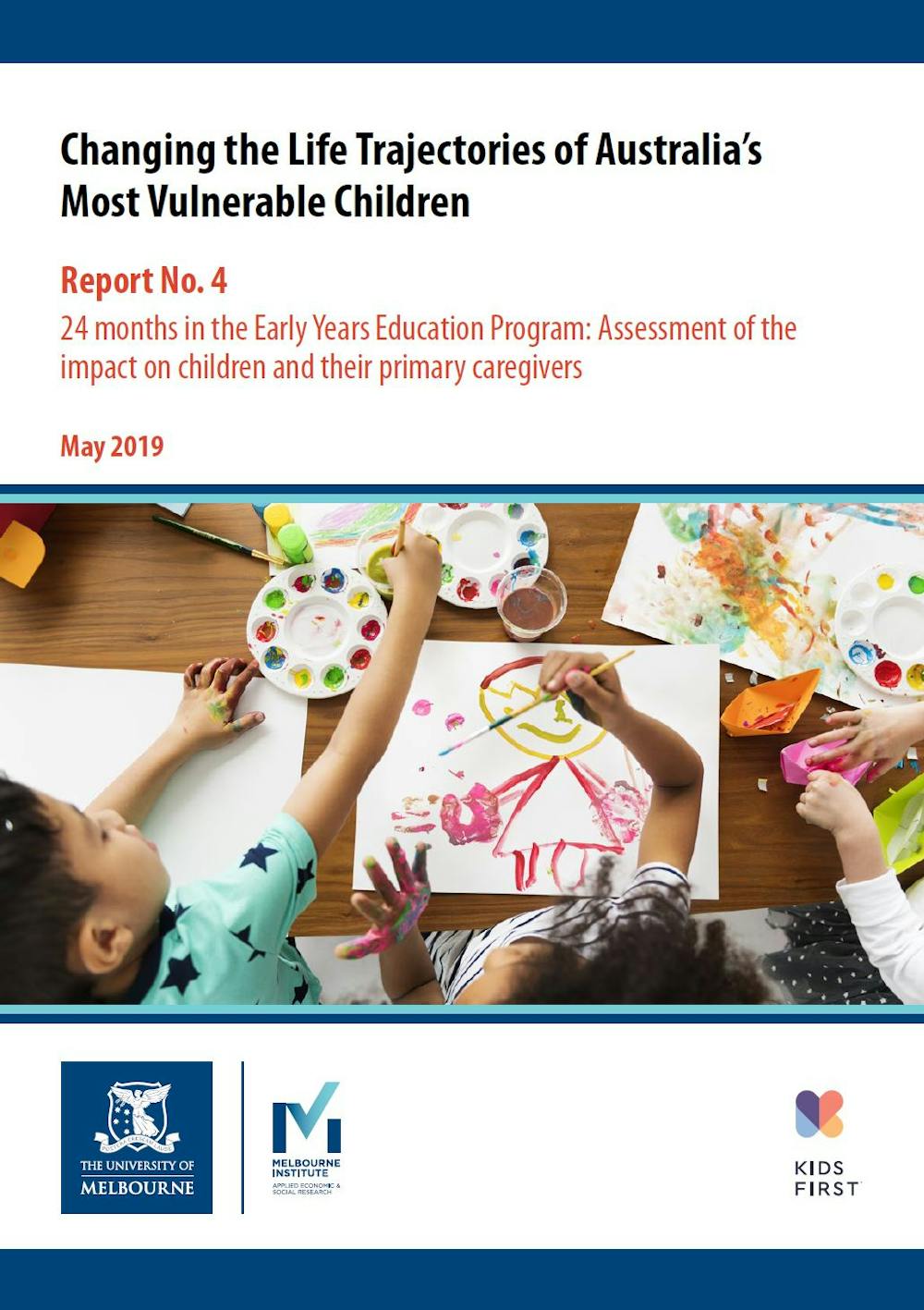
For the past decade, as part of a multidisciplinary team of researchers, we have been taking up this challenge – trialling a new type of intervention in Australia in partnership with the Children’s Protection Society, an independent not-for-profit child welfare organisation in Melbourne.

Developed by Associate Professor Brigid Jordan and Dr Anne Kennedy, it is called the Early Years Education Program (EYEP).

Today in Canberra our research team will release the results of an evaluation of its effects after 24 months.

Highly targeted

To be eligible for the trial, children had to be aged less than 36 months, assessed as having two or more defined risk factors, be currently engaged with family services or child protection services, and have early education as part of their care plan.

Compared with a general population of children, these children had lower birth weight and, at the time of entry to the trial, compromised development of intelligence as measured on IQ tests, weaker language and motor skills and adaptive behaviour. Their primary caregivers had lower levels of labour force engagement and family income and greater levels of psychological distress than other caregivers.

A total of 145 children from 99 families were recruited to the trial; 72 in the intervention group and 73 in the control group.

Those in the intervention group were offered three years of care and education in EYEP (50 weeks per year and five hours per day each week from Monday to Friday).

The novelty of EYEP is its twin objectives to address the consequences of family stress on children’s development and to redress their learning deficiencies.

The key features of the program are high staff/child ratios (1:3 for children under three years, and 1:6 for children over three years), qualified and experienced staff, a rigorously developed curriculum, and an in-house infant mental health consultant who assessed each child and drew up an individualised learning plan.

Higher IQs, language skills and resilience

The estimated impact on IQ was 5 to 7 points.

This is a relatively large impact, representing about one-third to one-half of a standard deviation, which is a measure of deviation from what was expected. By comparison, recent reviews of early years demonstration programs in the US have generally found average impacts on IQ of about one-quarter of a standard deviation.

The estimated impact on within-child protective factors related to resilience was about one-third of a standard deviation. The proportion of children enrolled in the program who required clinical attention for social-emotional development was 30 percentage points lower than the control group, a substantial impact.

Primary caregivers of the children, usually parents, had a reduced level of distress on the 30-point Kessler Psychological Distress K6 Scale of about 1.5 points.

The impact on IQ appears to have been concentrated in the initial twelve months of the program. Other outcomes show a more pronounced impact after the second year. For protective factors related to resilience the estimated impact size after 24 months is two to three times larger than after twelve months.

Proof of concept

The results so far provide a “proof of concept” showing that it is possible to design and implement a program to improve the lives of children who experience extreme adversity.

And they confirm the necessity and value of having a program that is targeted at children experiencing the worst adversity. Considerable time and effort were required to initiate and maintain day-to-day contact with children who otherwise would have been unlikely to attend.

We have made enormous progress in dealing with childhood diseases. While there is still a way to go in the trial, these results hold out the possibility of doing the same for children who experience extreme adversity.

ref. Early days, but we’ve found a way to lift the IQ and resilience of Australia’s most vulnerable children – http://theconversation.com/early-days-but-weve-found-a-way-to-lift-the-iq-and-resilience-of-australias-most-vulnerable-children-119003

Getting out of liquor and pokies will cost Woolworths, but deliver lasting benefits

Source: The Conversation (Au and NZ) – By Jason Pallant, Lecturer of Marketing, Swinburne University of Technology

The Woolworths Group proclaims it celebrates “family-friendly values”.

Within its supermarkets the company has sought to demonstrate this commitment. Woolies gives out free fruit to kids, for example, and no longer gives out plastic bags.

Its goal, the group states, is to “inspire our customers to consume all of our products in a healthy, sustainable way”. It’s a noble goal – but one undercut by its profits from pubs and pokies.

The company announced yesterday it will separate from its liquor and gaming businesses. This should be be welcomed as a bold step showing its stated commitments aren’t just PR gimmickry.

The company’s hotels division encompasses 323 licensed venues, many operating poker machines. Its liquor retailing division is bigger still, and includes the well-known brands Dan Murphys, BWS, and Cellarmasters.

Alcohol and gambling both represent significant social problems in Australia. The number of alcohol-induced deaths in 2017 – 1,366 – was the highest in two decades. Per capita gambling losses are the highest in the world.

Just last month, several Woolworths-owned hotels in New South Wales were accused of serving free drinks to encourage patrons to continue gambling.

As much as Woolworths might have done to ensure these business divisions operate as responsibly as possible, there is a stigma associated with their profits. They do not fit easily with “family-friendly values”.

Reputational risk

Continuing to operate these businesses would represent a clear reputational risk for Woolworths at a time when consumers increasingly expect organisations to walk their talk and demonstrate they make a positive impact on society.

Protestors outside the Woolworths Group’s annual general meeting in Sydney, 2015. David Moir/AAP

This trend in consumer sentiments is demonstrated by the result of Swinburne University’s Australian Leadership Index. The index is based on a nationally representative survey run quarterly. It tracks consumer perceptions about whether organisations show leadership for the greater good.

At the aggregate level, perceptions of big companies like Woolworths are consistently negative. More consumers think they do little to nothing to contribute to the greater good than those who think they make a positive impact. There is clear desire for businesses to contribute more to society.


Read more: One-third of Australians think banks do nothing for the greater public good


Research by global professional services firm Accenture indicates 61% of Australian consumers consider a company’s ethical values and authenticity when making their purchasing decisions, and 40% have boycotted a company over its actions on a social issue. Younger consumers are particularly adamant that companies have clear social values.

The Woolworths Group will first combine its pubs and liquor retail divisions into one, then spin off that division into a separate company, listed on the Australian Stock Exchange.

It will be Australia’s largest drinks and hospitality businesses, with expected annual sales of up to A$10 billion.

Losing the revenue will cost Woolworths. But the potential long-term benefits are considerable.

The separation presents an opportunity for the group to create a clearer perception among consumers of the company’s values – a smart move in an evolving marketplace of empowered consumers demanding organisations be social leaders.

ref. Getting out of liquor and pokies will cost Woolworths, but deliver lasting benefits – http://theconversation.com/getting-out-of-liquor-and-pokies-will-cost-woolworths-but-deliver-lasting-benefits-119817

Australian Gothic: from Hanging Rock to Nick Cave and Kylie, this genre explores our dark side

Source: The Conversation (Au and NZ) – By Emma Doolan, Lecturer in Creative Writing, Southern Cross University

In the popular imagination, the term “Gothic” evokes images of grim, crumbling castles, wild moors, jagged mountain peaks, and coffins creaking open in labyrinthine underground crypts.

Populating this Gothic terrain are bloodsucking (or, more recently, sparkling) vampires, howling werewolves, ghostly apparitions, black-browed villains, and virginal maidens (usually with great hair) fleeing persecution and imprisonment.

Gothic novels, films, and other texts explore the terrors of the unseen, or the half-seen – the repressed matter that threatens to return. Its plots turn on uncertainty and anxiety, sexual danger and desire, inheritance and usurpation, and boundaries and their transgression.


Read more: Friday essay: the female werewolf and her shaggy suffragette sisters


Early Gothic novels, arguably beginning with Horace Walpole’s The Castle of Otranto in 1764, were the bestsellers of their day.

Ann Radcliffe’s literary hits, such as The Mysteries of Udolpho (1794), were so popular, particularly among young female readers, that Jane Austen satirised the period’s Gothic craze in Northanger Abbey (1817).

Goodreads

The Gothic lives on today in a variety of forms, from books like Stephanie Meyer’s Twilight to binge-worthy television shows like The Haunting of Hill House.

An Australian tradition

For some early commentators, the idea of an Australian Gothic aesthetic was laughable. Australia, given its lack of European history or ivy-covered ruins, couldn’t hope to lay “the foundations of a second ‘Castle of Otranto’”, wrote journalist Frederick Sinnett in 1856.

But consider these examples: Albert Tucker’s 1956 painting Apocalyptic Horse; Kenneth Cook’s 1961 novel Wake in Fright; Joan Lindsay’s Picnic at Hanging Rock and its adaptations; and George Miller’s Mad Max films.

Or what about Nick Cave and Kylie Minogue’s Where the Wild Roses Grow?

These works all belong to an Australian Gothic tradition that took root alongside colonisation.

Nick Cave and Kylie Minogue – Where the Wild Roses Grow.

Read more: How Gothic buildings became associated with Halloween and the supernatural


The Gothic genre gave early Australian writers and artists a way to explore the dark side of the Australian experience. This included the perceived hostility of the natural environment, the violence of colonisation, convicts’ experiences of exile and entrapment, settlers’ feelings of alienation, and European fears of the racial Other.

In Marcus Clarke’s For the Term of His Natural Life (1874), Henry Lawson’s The Bush Undertaker (1892), and Barbara Baynton’s Bush Studies (1902), Australia is not a country of promise and plenty, but rather a menacing and claustrophobic hell. The iconic swagman becomes a monstrous figure, the bush is haunted by a “weird melancholy”, and the landscape imprisons and threatens.

Contemporary Australian Gothic

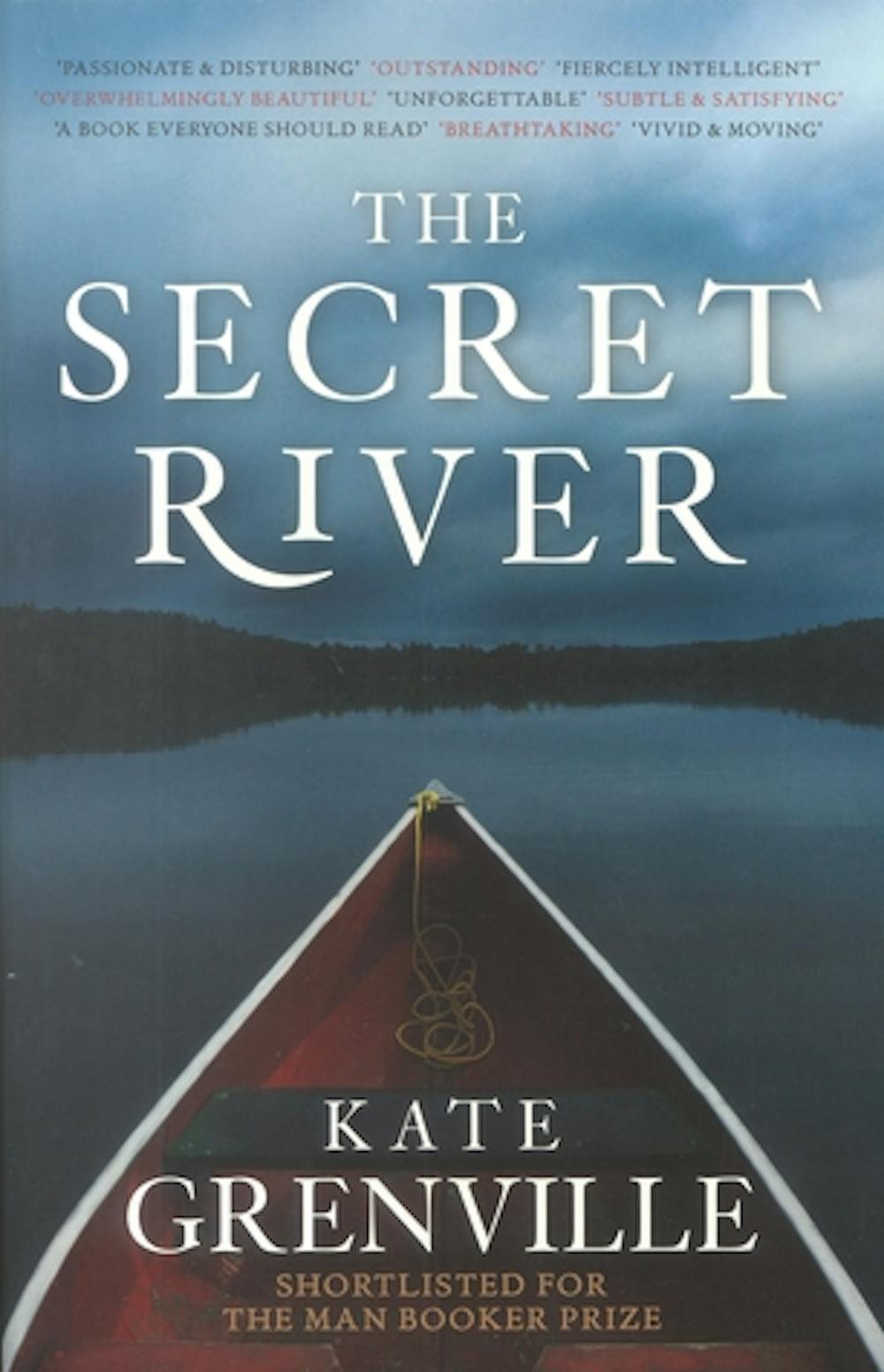
Anxieties about Australia’s colonial past have also been explored more recently in Gothic literature and film. Kate Grenville’s The Secret River (2005) returns to the Gothic bush to confront the guilty legacy of colonisation. The novel traces convict William Thornhill’s determination to possess a land plot along the Hawkesbury River, and the desire, fear, and greed that lead him to participate in the massacre of its Aboriginal owners.

Goodreads

Indigenous writers such as Alexis Wright and Kim Scott have also appropriated the Gothic, overturning tropes that cast Indigenous people as the monstrous Other and instead positioning colonisers as terrifying figures.

The subgenre Tasmanian Gothic (see Richard Flanagan and Rohan Wilson), meanwhile, often reveals anxieties about the colonial genocide of Aboriginal people, and present-day environmental degradation. For example, the extinct Tasmanian Tiger haunts Tasmania’s landscape in the 2011 Daniel Nettheim film The Hunter, based on the 1999 novel by Julia Leigh.

Australian Gothic increasingly finds new sites to play out its terrors. In Jennifer Kent’s 2014 film The Babadook, the Gothic moves into the urban, domestic space of an Adelaide terrace house where a mother and child are terrorised when the horrifying “Babadook” emerges from a child’s pop-up book.

The film has been read as an exploration of grief and the terrors of childhood and parenting, demonstrating Australian Gothic’s ability to tackle diverse topics.

Essie Davis in The Babadook, a film which explores gothic themes in suburbia. Screen Australia/IMDB

Read more: Friday essay: why YA gothic fiction is booming – and girl monsters are on the rise


Tropical and subtropical Australia have also been portrayed as “Gothic” in the novels of Janette Turner Hospital and Thea Astley, and in the recent Netflix series Tidelands, in which supernatural sirens inhabit the waters off the Queensland coast.

As literary scholars David Punter and Glennis Byron have pointed out, the Gothic genre flourishes at times of upheaval. It allows us to share fears, subvert norms, and point towards what might be overlooked in our history and culture.

Gothic will remain a popular mode for Australian writers, filmmakers, and other artists as long as anxieties about the colonial past, race, gender, and difference remain with us.

ref. Australian Gothic: from Hanging Rock to Nick Cave and Kylie, this genre explores our dark side – http://theconversation.com/australian-gothic-from-hanging-rock-to-nick-cave-and-kylie-this-genre-explores-our-dark-side-111742

View from The Hill: Jacqui Lambie plays the Harradine game

Source: The Conversation (Au and NZ) – By Michelle Grattan, Professorial Fellow, University of Canberra

In an intervention that would resonate with the late Brian Harradine, who was legendary for extracting concessions for Tasmania in return for his Senate vote, Jacqui Lambie has demanded the federal government forgive the state’s housing debt.

The Tasmanian senator – who has returned to the parliament after being disqualified in the citizenship crisis – is the last vital vote if the government is to rely on the crossbench, rather than Labor, to pass its tax package intact on Thursday.

Lambie refused to be drawn publicly until this week, although she’s had plenty of attention. For example the two Centre Alliance senators, Stirling Griff and Rex Patrick, journeyed to Davonport to see her. She and they agreed to keep in touch as issues came up.

In the last couple of days, sources have been sure Lambie was in the government’s tax cart.

But on the eve of the vote, she issued a strong statement and video, saying she had “yet to arrive at a final position”. (She supports the first and second stage of the package but is arguing over the final one, delivered years on.)

She condemned homelessness in Tasmania, linking it to the $157 million the state owes the federal government in social housing debt (involving payments of some $15 million a year).


Read more: Councils’ help with affordable housing shows how local government can make a difference


These debts are from funds borrowed by the states and territories from the federal government between 1945 and 1989 to build new housing, maintain existing stock and provide housing assistance.

“Tasmania is paying 50c in every dollar of our state housing budget back to the federal government in interest and debt repayments. That means we are building half as many homes, helping half as many people,” Lambie said.

“This debt is holding Tasmania back and denying shelter to thousands of Tasmanian families. The Commonwealth coffers don’t need $15 million a year from the Tasmanian budget,” she said.

“It’s only by having the balance of power for Tasmania in the Senate that real debt relief is going to happen and that’s what I am here to fight for.

“There is no way in good conscience I can vote for substantial tax cuts without making sure that the people who so desperately need a roof over their heads aren’t left to go without.”

The Tasmanian Liberal government has been pressing the federal government to forgive the debt, although Tasmanian Liberal senator Eric Abetz has opposed that, saying it would lead to demands from other states.

The Morrison government has claimed it won’t do any deals in its push to get the tax package through. In fact, this has not been true – Centre Alliance is confident, following detailed negotiations, there will be measures on gas policy to help smooth the way for its votes.

But Lambie’s demand is a very direct quid pro quo.

Senate leader Mathias Cormann, the government’s negotiator on the tax package, declared on Wednesday: “We are always happy to engage with senators in relation to issues of concern to them and their constituents”.


Read more: Grattan on Friday: Those tax cuts test Albanese and provoke Hanson


There is a general expectation the tax package with its three stages intact will be passed this week. It’s just a matter of who is blinking.

Does the government throw some money at Lambie, not just to secure her support on this measure but to keep her on side for the future?

Would Lambie retreat from her stand if she was not accommodated and still vote with the government on the package – or would she have a long-lasting hissy fit?

According to some sources, a fix was likely already in with Lambie on Wednesday.

Anyway, Labor is there as a fallback. Despite its objections to stage three, it can’t afford to be endlessly blamed for blocking tax relief.

Regardless, it was clear that every which way Pauline Hanson’s One Nation had been left out in the cold.

ref. View from The Hill: Jacqui Lambie plays the Harradine game – http://theconversation.com/view-from-the-hill-jacqui-lambie-plays-the-harradine-game-119824

Politics with Michelle Grattan: Father Frank Brennan on Israel Folau and religious freedom

Source: The Conversation (Au and NZ) – By Michelle Grattan, Professorial Fellow, University of Canberra

Frank Brennan, Jesuit priest and member of the expert panel on Religious Freedom set up by Malcolm Turnbull, says the Israel Folau matter is a “simple freedom of contract case regardless of Mr. Folau’s religious views”.

“I think the question is, did he voluntarily, and for a very large sum of money, agree with his employer to follow a work code which included an undertaking not to make statements on social media about various things which may or may not have a religious component?”

Responding to Senator Concetta Fierravanti-Wells’ renewed call this week for a Religious Freedom Act – as distinct from narrower legislation favoured by the Morrison government – Brennan told The Conversation: “I continue to have my reservations about that, mainly on the basis that I don’t think religious freedom is an enormous problem in Australia”.

He sees the way forward as a Religious Discrimination Act, recommended by the review, in line with other existing anti-discrimination laws on race and gender.

As for issues to do with religious schools, “Penny Wong’s bill was correct,” he said – referring to the Senator’s Amendment to the Sex Discrimination Act late last year which sought to remove the capacity of religious schools to directly discriminate against students on the basis of their sexual orientation, gender identity or intersex status.

The only addition needed to this, he said, would be a clear commitment that “religious schools are free to teach their doctrine”.

Transcript (edited for clarity)

Michelle Grattan: Religious freedom has become a big issue in federal politics with the government planning to have legislation to protect against religious discrimination in the parliament later this year. Scott Morrison told Coalition MPs this week that meetings will be held to brief them and talk through the complexities of the issue. He wants the issue dealt with in a bipartisan and non-confrontational way. But the case of Israel Folau, sacked by Rugby Australia over a homophobic posting based on the Bible, has inflamed an already difficult issue that involves conflicting rights. The right to freedom of speech in religious matters versus the right of employers to set conditions in contracts. Folau has taken Rugby Australia to court. Father Frank Brennan, a Jesuit priest was a member of the committee that Malcolm Turnbull set up out of the debate about same sex marriage to make recommendations to protect religious freedom. He joins us today.

Michelle Grattan: Why has religious freedom become such an issue? Is this just because of the same sex marriage debate, or are there wider causes? People weren’t talking about this 20 or 30 years ago.

Frank Brennan: I think there are a number of factors – one is that of course religious affiliation in the community generally has declined. And I think there is a perception among some religious people that what you might call the intellectual elite is much less interested in religion. In fact, has even got to the stage regarding religion being a bit wacky. I think also there’s been the Royal Commission into Institutional Responses to Child Sexual Abuse and quite rightly there was a strong spotlight on major religious institutions which were found to have fallen short but at the same time I think there’s a sense that during the same-sex marriage debate that the concerns of religious folk were not being taken sufficiently seriously. So a combination of those factors, I think, has resulted in the fact that as the vote was very strongly for yes 62% or whatever that I think some of religious people have felt that there is a need for a rearguard action.

Michelle Grattan: Do you think we actually have a problem that needs to be addressed in terms of legislation? The Constitution, after all, contains some protection on religion, doesn’t it? So is that not enough?

Frank Brennan: It’s not enough in the sense that what’s in the Constitution was actually put there – even non-lawyers will appreciate – that it’s in a chapter of the Constitution entitled The States. So if you actually look at the history of those provisions, they’re pretty restricted, and they were put there so as to ensure that questions of religion were dealt with by the states and not by the Commonwealth. Which then brings us to the next point about Australia’s legal or constitutional machinery. We don’t have a constitutional bill of rights but neither do we have any form of a statutory Human Rights Act. This now makes us pretty unique in the western world and, that being the case, it’s been admitted by a number of inquiries – even by the Australian Law Reform Commission, so outfits which do pretty analytical reports – they have said and pointed out that the protection of religious freedom is definitely one of the lacuna in the statutory framework that we have in Australia. Because given that we do not have a National Human Rights Act, we Australians have done what we do well which is pragmatically we’ve said over the years that we want to be a good international citizen. We’ve signed up to all of the key international human rights instruments and then we’ve attempted to legislate those in domestic legislation. Now the usual way we’ve done that is with discrimination laws. So for example we have a Sex Discrimination Act or an Age Discrimination Act or a Racial Discrimination Act. But at the moment we do not have a Religious Discrimination Act.

Michelle Grattan: You mentioned a Bill of Rights and it does seem to me odd that the people who are pressing hard for action on religious freedom are often the same people who are very much opponents of a bill of rights because they don’t want to put too much power into the hands of activist judges.

Frank Brennan: It’s a profound irony for me, Michelle, because you’ll recall that I chaired the National Human Rights Inquiry for the Rudd government and yes some of the most eloquent opponents of a Human Rights Act in those days were the religious leaders. I think it’s nicely summed up by an anecdote which Bob Carr was fond of reporting at the time that we conducted that inquiry. Bob, he told me privately but then, publicly at an event organised I think by the Australian Christian Lobby. He recalled how when he was premier of New South Wales and they were drawing up discrimination legislation and they had to look at exemptions. He said that the Anglican Archbishop of Sydney and the Catholic Archbishop of Sydney came to meet with him in his office. They were able to reach agreement and shake hands and fix it all up. As he joked, he said he felt he was fixing up the reformation and he joked also that if you had a Human Rights Act you couldn’t do that sort of thing come to a gentlemen’s agreement. Well from my perspective, I say 20 or 30 years, on I think the days of those sorts of gentlemen’s agreements behind closed doors have gone and that’s why it’s now somewhat ironic that some of the religious leaders who were most concerned in 2009 about giving too much power to unelected judges are now saying, “well yes what we need is a comprehensive law that deals with religious freedom” which guess what puts it in the power of the judges.

Michelle Grattan: Now, you will remember the inquiry into this issue chaired by former Liberal minister Philip Ruddock. Can you just summarise for us just very briefly and broadly the main recommendations out of that inquiry? I know it was detailed but also the main ones.

Frank Brennan: Sure. The main ones were born of the insight that we came to with the consultations which were that religious freedom is not really a big burning issue in Australia. But I suppose that was before the Folau crisis, which I presume we’ll come to, but we admitted – as did every previous inquiry of parliamentary inquiry – that if you just lined up the legislation we have in Australia then the major lacuna, or lack, in terms of discrimination legislation was in relation to the attribute of religion. So our major recommendations followed this course. It’ll come as no surprise, given that it was chaired by Philip Ruddock, a lot of emphasis on federalism. Namely, that it’s best that the states decide these things for themselves. Now there’s a whole plethora of state legislation dealing with religious discrimination. We found for example that New South Wales and South Australia are deficient in their legislation in outlawing religious discrimination whereas other states do it pretty well. And so we recommended that New South Wales and South Australia address that. We also found that when it comes to employment the Fair Work Act of the Commonwealth parliament simply builds upon what’s there in state legislation. So it says you can’t deal adversely with someone in their employment if what is being done is unlawful in the state legislation. Now, obviously with New South Wales and South Australia you’d need to top that up. When it came to the overall assessment as to what was needed. We really had two distinct sets of recommendations. The first was because Australia never had a Religious Freedom Act or Religious Discrimination Act then the usual way in which the issues which caused controversy were dealt with were by way of exceptions or exemptions in the Sex Discrimination Act which said, for example, that you can’t discriminate on the basis of gender or whatever sexual orientation but there were exemptions put in there for religious bodies wanting to run their institutions according to their ethos. Now we saw that those exemptions were overbroad but more to the point just making them exemptions in the Sex Discrimination Act was philosophically incoherent. But we basically said if you’re going to maintain that approach there was a need for some tweaking of those provisions so as to ensure that you didn’t have unwarranted discrimination against gay students or gay teachers or whatever. The second major raft of recommendations related to the overarching legislation at the Commonwealth level where we admitted that the key conservative religious groups would have liked a Religious Freedom Act which basically enacted all the provisions of what we call Article 18 of the International Covenant on Civil and Political Rights. We thought that was unwarranted in that given that we don’t have a National Human Rights Act, we thought that in the name of treating rights equally, given that we’ve just got a series of discrimination acts then what’s necessary is some form of Religious Discrimination Act. So they were the two main sets of recommendations that we made. The final one was basically to say that we thought religious freedom had come to be treated by the Human Rights Commission as a bit of a second order issue and that should be part of their day job. But your listeners will be aware the Morrison government before the election announced they wanted to go one step further and appoint a full time human rights commissioner for religious freedom. I continue to have my reservations about that mainly on the basis that I don’t think religious freedom is an enormous problem in Australia and I think they have a full time commissioner doing it risks creating a vacuum that has to be filled by someone having to find problems which might not exist.

Michelle Grattan: When part of the report was leaked last year, the debate turned to protection of gay students so that they couldn’t be expelled and then people were starting to talk about the rights of teachers in religious institutions versus the rights of the institutions. Now I don’t think there’s any real debate about protection of gay students. Not that there seem to be a great deal of a problem. But in terms of the employees of religious schools do you think there are real problems there? Or do you think even though the legislative framework might be messy that really the present situation is okay?

Frank Brennan: Let me first address gay kids because I mean no. Yes I think we’re agreed, there is no problem. But let’s face it, this parliament – both the 44th parliament and presumably this parliament – has not yet found a way in order in a bipartisan fashion to simply clean that up. Now part of the problem was that the amendments to the Sex Discrimination Act with the exceptions and exemptions for that were introduced by Labor in 2013. Mark Dreyfus was the Attorney-General at the time. Now that being the case we as the Ruddock committee didn’t recommend just wholesale abolition of those exemptions but we said if any school was going to try to do that then they should only do it in relation to future students not existing students and it should be in the result of a published policy which is out there for all parents and students to be able to see. But given that there is now agreement that those provisions should not be there at all, I think what’s important if you go back to the debate that occurred at the end of the last parliament just before Christmas, Penny Wong introduced a bill in the Senate, you might recall, that dealt with this. Now where there was a failure to reach agreement, I would hope the 46th parliament could see that Penny Wong’s bill was correct, except I think it needs one addition. It needs to be made very clear that religious schools are free to teach their doctrine and that that is not a detriment to students. As I often say, it’s a bit like asking, well, if you’re teaching rich kids can you teach the bit of the scriptures that says, well, it’s more difficult for a wealthy person to get into heaven than a camel to get through the eye of a needle. Now people might find that upsetting but it is part of the teaching. So I think that sort of thing needs to be dealt with. Penny Wong’s bill plus a guarantee of being able to teach a doctrine. That then brings us to the more thorny issue about the employment of staff. Now I think what is important as an ideal is the idea that a very evangelical or very religious school be able to employ teachers who get with the message, get with the ethos of the institution. I remember during the Ruddock inquiry we had some of the more conservative religious folk saying to us well we know that some say that it should just be the principal or the religious education teacher. But they said but look what we’d like to be able to do is to employ an evangelical gardener because the kid can speak to the gardener and really get the ethos of the institution. Now, I am one who is prepared to concede that. I think it’s a bit like, you know, the Greens run an office. Are they entitled when employing the receptionist to make sure it’s someone who’s opposed to Adani rather than a strong supporter of Adani? Now that sort of provision I think is well enough dealt with under the Fair Work Act. But if there is a need for an added provision then that’s what you’d expect to find in the Religious Discrimination Act. But I think to enhance it further with a Religious Freedom Act would be going one step too far.

Michelle Grattan: A lot of the crusaders on this issue at the moment are worried about attacks on Christianity, but in your inquiry did you find strong concerns from other religious communities – the Jewish community the Muslim community for example. Are they worried?

Frank Brennan: Definitely. Well they’re worried about the endemic discrimination which is often suffered by them as groups. I’d say that particularly the Jewish community were pretty nuanced with us in terms of saying, look, we’re pretty used to navigating this space and the last thing we want to do is to draw attention to ourselves. I would say that some from the Muslim community were expressing concerns to us that often even in the media there can be just too general an assessment made which has the public thinking that well all Muslims must be terrorists. And so that there is a need for greater sensitivity on those issues. So we did get submissions from those two groups but I have to say I was a bit surprised. I thought there would be a greater number of submissions from those groups than we did receive which highlighted to my mind once again – and I can’t speak for all members of the Ruddock committee – but that the thought that legislation was the way in which to deal with this social problem, I don’t think that wins universal support.

Michelle Grattan: It does seem that in recent times with the Folau case this has morphed into a what the political scientists would call a “wicked problem” – one that involves conflicting rights it’s hard to see any way through. We’ve come to have the rights to express one’s religious views versus the right of an employer to control in certain circumstances the behaviour of their employees. Do you see it as having become suddenly a lot more complex? And what is your opinion on the Folau situation?

Frank Brennan: Well, I think the legal issue is still pretty simple and I keep coming back to saying that I think a Religious Discrimination Act which basically mirrors your Racial Discrimination Act and a Penny Wong bill plus the right to teach your doctrine. I think those two legislative provisions would basically solve most of the problems but it has become more of a political and social “wicked problem” which I don’t think is susceptible to that sort of legislative change. If I might put it this way with Mr Folau’s case. Mr Folau’s case presumably arises under the Fair Work Act as it applies in applying the New South Wales discrimination legislation. Now, you’ll recall I pointed out that the Ruddock committee found that the New South Wales and South Australian legislation was deficient. It might be interesting to know whether if Rugby Australia had its headquarters in the capital city which administers the Australian Football League namely Melbourne with their legislation whether or not the matter would be dealt with in the same way. But basically the Folau case I have always seen as a simple freedom of contract case regardless of Mr Folau’s religious views. I think the question is: did he voluntarily and for a very large sum of money agree with his employer to follow a work code which included an undertaking not to make statements on social media about various things which may or may not have a religious component? Now I think that’s just a straight question of freedom of contract. What we do know is that his lawyers and the Rugby Australia lawyers were behind closed doors for three days and couldn’t find an answer. So we do know that the contract is not clear. The Folau issue I think is an employment contract issue but yes it has been a lightning rod for these concerns about religious freedom. Now, why? I think, in part because of the mishandling after the same-sex marriage debate, after the mishandling of the release of the Ruddock report, after the clear divisions within the Liberal Party and about wondering within the Liberal Party whether even a government led by a religious person like Morrison would deliver on what’s needed. So for example here around the parliament last night you had Senator Concetta Fierravante-Wells in the adjournment debate launching a petition for a Religious Freedom Act saying a Religious Discrimination Act is not sufficient. Well, that’s the sort of issue that now has to be resolved once and for all by the Morrison government.

Michelle Grattan: Do you think that that sort of petition could start to get a lot of support? You obviously are saying that you think a Religious Freedom Act would go too far but this could take off couldn’t it.

Frank Brennan: It could take off and I think what is the critical thing here is for the Morrison government to show the leadership in terms of asking right, what do we think might have a chance of getting through the Senate? Now, I think the absolute best outcome would be a Religious Discrimination Act plus the Penny Wong bill with the freedom of teaching your doctrine. If that could be agreed to by Liberal and Labor. I think that would be absolutely the best possible solution. If that is not to occur then the Morrison government will need to deal with the crossbench but we already know from the way they address the Penny Wong bill that the Centre Alliance senators are much closer to Labor than to the government on this. So the government I think has to be careful in not overreaching in terms of what might be achievable.

Michelle Grattan: Of course the problem for Scott Morrison is that he will have albeit a minority but some in his own ranks who will want to follow the Religious Freedom line that the senator has already…

Frank Brennan: He will. But he’ll be able to eyeball them and say there’s no way I can get a Religious Freedom Act through the Senate as it is constituted. This is an issue which has gone on for too long. We’ve done and dusted same sex marriage. Everyone, including John Howard, said we should address the issues of religious rights as promptly as we can. Isn’t it better to have a Religious Discrimination Act which shows in the absence of an overall Human Rights Act that we treat religion as seriously as we do every other attribute and anything that needs to be improved upon with that we’ve got the issue which was referred to the Law Reform Commission where they’re to report back next year. We can look at that in time when we get a reasoned report from the Law Reform Commission.

Michelle Grattan: I want to just return to the issues underlying the Folau case. Whatever the ins and outs of the contract and whether he breached it and the rights of Rugby Australia under present law, this does go to the fundamental issue of whether one’s right to express one’s religious views should be overridden by the rights of an employer to lay down a certain contract.

Frank Brennan: Yes.

Michelle Grattan: And where do you think the rights and wrongs of that are?

Frank Brennan: Well, I’m sufficient a believer in the market to say that that’s up to the parties to decide. Yes, I am a Catholic priest but I am free to enter into a contract with someone who wants to employ me where I undertake not to publicly express a view about a particular issue even though my own religious faith may inform me on that issue. And let’s remember with Mr. Folau the particular views that he wishes to express are, to say the least, very distinctive and one of the reasons I would like to see a resolution of this is that I think too many of us as religious people are being painted with the same brush – as if being religious we must be anti-gay or whatever. Let’s remember Mr. Folau has lots of people in the gun, I gather even forminates against those who are said to be idolaters. Now, those of his religious persuasion probably would include me as a Catholic and a Jesuit priest as an idolater. So the issues about what he wants to express I think can be traded away under contract. And the question is whether or not he’s done so. But yes being a sporting hero we can expect that the public will pay much more attention to any sermon he will ever give than one that I would ever give.

Michelle Grattan: But of course if we take away the high profile people in this debate you could have ordinary people who have no great power against employers but nevertheless have strong views and feel the need to express them especially as we’re seeing more and more fundamentalists emerging, it seems. How do you deal with their situation? And does this also cover what they say in church? Should there be a distinction between what you post on social media (or allowed to post by your employer) and what you say in church which is after all a public place and anyone can go in and listen to you?

Frank Brennan: Well, your first part of the question, I think comes back to the whole issue of freedom of expression and I’m one who strongly advocates freedom of expression and the capacity of employers to interfere with that freedom of expression I think as a society a lot of us say no we don’t think you should be able to do that. But equally with freedom of contract those who want to trade it away, so be it. In terms of what you might be able to preach in church. Yes I think what can be preached in church should be sacred in the sense that the state should keep out of it in that anyone who is attending church who doesn’t like what the preacher is saying is free to leave. But I think within the environs provided there is no preaching of violence or of preaching of criminal offences to be committed against other citizens then I think it’s got to be a space where there can be that freedom of expression.

Michelle Grattan: Potentially this can be an increasing problem though can’t it because a number of companies and public institutions groups and so on these days are becoming much more socially aware. They express views. We saw this in the same-sex marriage debate so they can become more sensitive to what their workers might say and do even in their private life.

Frank Brennan: They can and I’m one who isn’t all that fortified by seeing corporate heads taking these sorts of social positions.

Michelle Grattan: You think they shouldn’t?

Frank Brennan: I’m one who doesn’t like to see them do it but I think in a democracy you let a thousand flowers bloom.

Michelle Grattan: Why don’t you like to see them do it? Because often their views that you probably as a priest would agree on.

Frank Brennan: Well they are. I know during the National Human Rights Consultation one of the first submissions we received was from Telstra saying that they were in favour of a Human Rights Act. But the democratic question that I have to myself is well why should people just because they have a lot of money or just because they’re sitting at a corporate board be in a better position than their fellow citizens to be able to agitate their social views? I think there’s got to be a limit to that.

Michelle Grattan: You sound on the same line here as Peter Dutton who was quite critical of this.

Frank Brennan: There you go. We’re both originally Queenslanders.

Michelle Grattan: Now, just to finish up. Scott Morrison has been emphasising that he doesn’t want this to be a divisive issue. But isn’t it inevitable that it is becoming a very divisive issue and potentially will become more so?

Frank Brennan: It could – my one light of hope at the moment is that I think some of the senior people in the Labor Party including Anthony Albanese have said that we know that one of the take home messages of the federal election result is that we the Labor Party need to be more sympathetic or understanding of the viewpoint of religious people. So I think that’s a positive sign. On the government’s side, I think a positive sign is that yes, Malcolm Turnbull is no longer there. Tony Abbott is no longer there. So two of the chief proponents at either end of the debate in the Liberal Party have gone. Morrison’s there with his legitimacy. He is a religious person.

Michelle Grattan: The most religious of the more – well maybe Tony Abbott would give him a run for its money.

Frank Brennan: Well I, being a priest, I’m not one for making public judgments as to who’s the most religious. But yes he’s a self-confessed oddly religious but also clearly a very pragmatic politician. Now a very pragmatic politician who’s got a fresh mandate who’s got a lot of things on his agenda. The question will be how much political capital does he want to waste in order to attempt legislation which has no chance of getting through the Senate? So given the concession that it’s a “wicked problem” but given that there might be some prospect of putting this aside or putting it to bed by enacting promptly a Religious Discrimination Act with bipartisan support and enacting Penny Wong’s bill with the added provision that schools are able to teach their doctrine – if I were Morrison I’d grab it with both hands.

Michelle Grattan: Frank Brennan, thank you very much for talking with us today on an issue that’s only going to grow I think in coming months. That’s all for today’s podcast. Thank you to my producer Rashna Farrukh and we’ll be back with another interview very soon. But goodbye for now.

New to podcasts?

Podcasts are often best enjoyed using a podcast app. All iPhones come with the Apple Podcasts app already installed, or you may want to listen and subscribe on another app such as Pocket Casts (click here to listen to Politics with Michelle Grattan on Pocket Casts).

You can also hear it on Stitcher, Spotify or any of the apps below. Just pick a service from one of those listed below and click on the icon to find Politics with Michelle Grattan.

Additional audio

A List of Ways to Die, Lee Rosevere, from Free Music Archive.

Image:

AAP/ Alan Porritt

ref. Politics with Michelle Grattan: Father Frank Brennan on Israel Folau and religious freedom – http://theconversation.com/politics-with-michelle-grattan-father-frank-brennan-on-israel-folau-and-religious-freedom-119821


Victoria’s commitment to a non-fatal strangulation offence will make a difference to vulnerable women

Source: The Conversation (Au and NZ) – By Heather Douglas, Professor of Law, The University of Queensland

Bob pushed me onto the floor and dragged me into the closet. While I was in the closet he put his hand over my mouth again and pushed on my neck. I started to feel dizzy and was kicking my legs and hitting his arm to try to let him know I thought I would die. – Doya, domestic violence strangulation survivor

Among women who have been abused, Doya’s experience is sadly not unique. In my research interviewing women who have experienced domestic violence, 24 out of 65 women (37%) reported having been choked, suffocated or strangled by an abusive partner or former partner.

This type of non-fatal strangulation can have serious health effects including memory loss, paralysis, pregnancy miscarriage, and changes to vision, vocal chords, hearing and breathing.

It’s also a red flag for future harm. US data shows victims who have been strangled by their violent partner are seven times more likely to later be killed or seriously harmed than a woman who has been physically assaulted or threatened by a current or former intimate partner but not previously strangled.


Read more: Victorian government should be wary of introducing a stand-alone offence of non-fatal strangulation


Yet non-lethal strangulation remains unrecognised as a specific criminal offence in some states. In the absence of a specific law, strangulation is typically charged as common assault, which carries much lower sentences.

This week Victoria has joined Queensland, New South Wales, South Australia and the ACT and committed to introducing a non-fatal strangulation offence.

The Queensland experience suggests introducing this type of offence will make a big difference to Victorian women experiencing or at risk of domestic violence.

High uptake in Queensland

Queensland introduced an offence for non-fatal strangulation in May 2016. A person commits this offence if they unlawfully choke, suffocate or strangle another person without the other person’s consent. The Queensland offence is specifically limited to domestic violence.

When the offence was introduced, the explanatory notes identified both the inherent danger of non-fatal strangulation and its association with escalation of violence and future homicide.

Analysis undertaken by the Queensland Sentencing Advisory Council shows there has been a strong take-up of the offence across the criminal justice process in Queensland. From June 2016 to June 2018 there were more than 400 cases sentenced for the non-fatal strangulation offence.

In almost half of those cases (49%), the non-fatal strangulation was also a breach of a domestic violence protection order. Nearly all offenders were male (98%) and most received a prison sentence (76%).

While the maximum penalty for assault charges is three years in prison, the maximum penalty for strangulation is seven years.


Read more: See What You Made Me Do: why it’s time to focus on the perpetrator when tackling domestic violence


Recent judgements show courts increasingly have a clear understanding of non-fatal strangulation.

In one case, the sentencing judge acknowledged that the victim “could have been dead within seconds” and that the act is “inherently dangerous” and “could easily have caused permanent serious injury or death”.

This improved knowledge should help judges to make more appropriate decisions about bail, sentencing and parole to help keep victims safe.

Why it needs to be a separate offence

The introduction of the offence in Queensland has underpinned training for first responders, including police, ambulance officers and hospital admissions staff. They now learn about the dangers and risks of non-fatal strangulation, how to ask about it and how to respond.

Information is now included in policy manuals and risk-assessment tools. This helps first responders appropriately use powers such as arrest and detention, make appropriate referrals, and help with safety planning.

While other offences throughout Australian criminal law can be charged when there is a non-fatal strangulation, they may be difficult to prove. Evidence of intention to kill or cause serious harm is needed for attempted murder, and this is often hard to find.

Many women who have been victim to domestic violence have experienced non-fatal strangulation. From shutterstock.com

Other charges, such as assault, fail to reflect the seriousness of non-fatal strangulation. These offences may conceal the particular dangers and risks associated with non-fatal strangulation from judges considering bail, sentence and parole.

Some charges require evidence about particular injuries. But non-fatal strangulation often leaves no visible physical injury. The non-fatal strangulation offence properly labels the offending behaviour and ensures the offender’s criminal record properly records it.

Research found that after the introduction of a non-fatal strangulation offence in New York ten years ago, some perpetrators, who had previously avoided any punishment because of a lack of visible injuries, faced criminal sanctions for non-fatal strangulation.

Barriers to overcome

Despite positive aspects associated with the non-fatal strangulation offence in Queensland, there are some concerns. Imprisonment is often not the best way to rehabilitate an offender. More resources are needed to support programs that work intensively with perpetrators to support behaviour change.

The abuser’s imprisonment can buy women time to escape to safety and re-establish housing, finances and schools for the children, but may not deter future domestic violence offending or keep the victim safe in the longer term.

Further, any use of criminalisation as a strategy to respond to domestic violence is likely to contribute to higher rates of imprisonment for Aboriginal and Torres Strait Islander people.

Although around 3.8% of Queensland’s population identify as Aboriginal and Torres Strait Islander, 21% of offenders sentenced for non-fatal strangulation are Aboriginal and Torres Strait Islander people.


Read more: Infographic: A snapshot of domestic violence in Australia


The high use of imprisonment as a response to non-fatal strangulation may point to a lack of sentencing options, both for Aboriginal an Torres Strait Islander people and non-Indigenous Australians.

There may also be concerns about the scope of the Queensland offence. The offence must involve choking, suffocation and strangulation but these actions are not defined and may not encompass incidents that involve the offender “pushing on the neck”, which has the same risks and effects.

These matters would be worth considering as Victoria begins to draft its new offence.


The National Sexual Assault, Family & Domestic Violence Counselling Line – 1800 RESPECT (1800 737 732) – is available 24 hours a day, seven days a week for any Australian who has experienced, or is at risk of, family and domestic violence and/or sexual assault.

ref. Victoria’s commitment to a non-fatal strangulation offence will make a difference to vulnerable women – http://theconversation.com/victorias-commitment-to-a-non-fatal-strangulation-offence-will-make-a-difference-to-vulnerable-women-119743

Timor-Leste free speech, criminal defamation and protecting Maun Bo’ot (‘Big Brother’)

By Tempo Timor in Dili

Proposals to make defamation a crime in Timor-Leste have sparked public debate about a controversial law that could see people jailed for their opinions on popular platforms like Facebook.

Supporters of criminalising defamation argue that the growing instances of leaders being cursed and abused on Facebook – with more than 400,000 users in a population of 1.3 million – is “not public debate”.

Opponents claim the proposed law will limit media freedom and prevent the expression of public opinion that has so far been protected by law.

READ MORE: Bob Howarth’s Pacific Journalism Review article on Timor-Leste media

On December 6, 2005, the Constitutional Government ratified the Criminal Law Act, including a section which defined defamation as a crime.

This led to civil society protests to then President Xanana Gusmão in January 2006.

-Partners-

The fourth Constitutional Government led by Prime Minister Xanana had planned “to action” defamation into criminal law.

Then on December 12, 2018 the General Prosecutor’s Office of Timor-Leste used Indonesian Criminal Code to criminalise defamation, thus targeting a journalist who had reported on issues raised over a prison guard uniforms contract

Draft criminal law
At the same time, a draft criminal law on defamation was prepared by the Constitutional Government. But after being widely criticised by civil society, the new Timor-Leste Penal Code did not include defamation as a crime.

The court tried former Minister of Justice Lucia Lobato in 2012. She was convicted of corruption and sentenced to 18 months jail.

President Taur Matan Ruak pardoned her in August 2014.

Even though the Criminal Code does not apply to defamation, there is still one section “denuncia Calunioza”, which presents a threat to the work of journalists.

The Timor-Leste Prosecutor’s Office investigated a Timor Post newspaper journalist after the Prosecutor’s Office received a complaint from the leader of the sixth Constitutional Government.

The court tried and sentenced the reporter because of the news he wrote.

After government changes and changes in information technology became increasingly advanced, the campaign to criminalise defamation emerged again in the eighth Constitutional government led by Prime Minister Taur Matan Ruak.

Press Council critical
The president of the Press Council of Timor-Leste (Consuelo de Impreza – CI), Gil Guterres, strongly disagrees with the criminalisation campaign.

Guterres said that by criminalising defamation, Timor-Leste would undermine its international standing, and it would be a betrayal of the constitutional commitment to establish Timor-Leste as a state based on due process.

He said that when the reason used to criminalise defamation was only because people “cursed and insulted” the leaders, it was not justified.

The law was not only to protect the leaders – or “Maun Bo’ot sira” or “Big Brother” – but to protect all citizens.

“If you curse and insult them in the ‘discurso de ódio‘ (hate speech) category, we don’t need new laws anymore. The law of ‘denúnsia Kalunioza’ already exists,” he said.

Guterres said criminalisation of defamation would have a “chilling” affect on journalists. They would be afraid to be critical or conduct investigative journalism because of the threat of a prison sentence.

Print Friendly, PDF & Email

Article by AsiaPacificReport.nz

Trump and Kim are talking (again). But the leaders have yet to find real common ground

Source: The Conversation (Au and NZ) – By Benjamin Habib, Lecturer in International Relations, Department of Politics and Philosophy, La Trobe University

Sunday’s trilateral meeting in the Korean Demilitarized Zone between US President Donald Trump, North Korean leader Kim Jong Un, and South Korean President Moon Jae In made for compelling viewing, the latest chapter in Korean peninsula summit diplomacy.

Indeed, such a meeting would have been unthinkable only 18 months ago. It was an unprecedented event – the leaders of the US, South Korea and North Korea meeting together, especially in the DMZ.

Critics have argued, however, that the meeting was merely a heavily manicured photo-op. While heavy on symbolism, it covered nothing substantive and signalled only that the parties are willing to restart the negotiating process.


Read more: Kim Jong-un’s nuclear ambition: what is North Korea’s endgame?


A couple of major questions remain unanswered. First, what is the ultimate purpose of negotiations? Are the US, North Korea and South Korea talking about the same thing when they talk about “denuclearisation”?

And is the endgame of negotiations ultimately about denuclearisation, or is it about reaching a permanent peace settlement to formally end the Korean War?

Symbolism vs substance

Given the abrupt failure of the US-North Korea summit in Hanoi in February, a symbolic photo-op at the DMZ is an encouraging sign that the parties are still interested in talking.

These kinds of symbolic gestures are the foundation upon which negotiations can move forward, given that all parties are starting from a place of mutual mistrust. Without this kind of patient state-to-state relationship building, the US and North Korea will never reach a stage where more substantive issues can be discussed.

The symbolism is also important in signalling intent to the public in all three countries. For the US and South Korea, building domestic support for engagement is key to the ultimate ratification of any future agreement.

Define ‘denuclearisation’

We also need to place the DMZ meeting in the proper context. There are several parallel games at play in which the US, North Korea and South Korea have diverging interests.

The first of these games revolves around the US demand of “complete, verifiable and irreversible denuclearisation”, or CVID, which has formed the basis of US policy on North Korea for successive administrations since 2002.

North Korea’s nuclear weapons program represents a threat to America’s nuclear weapons supremacy – both in and of itself, and as an example to other countries that might seek to develop their own nuclear weapons capability. A nuclear-armed North Korea also demonstrates the diminished authority of the US as a regional and global power.

We see the CVID game at play in the rhetorical commitment of the US government to denuclearising the DPRK, despite the evidence that CVID has thus far failed, and in the pushback against Trump for his perceived willingness to sacrifice this aim in order to reach a deal with Kim.

The North Korean interpretation of a nuclear-free Korea, meanwhile, involves the full relinquishment of nuclear weapons by all nuclear powers, including the US.

With this in mind, the Kim government is committing to a negotiating process from which it can obtain sweeteners, not an end goal.


Read more: Hermit kingdom, nuclear nation … If the media keep calling North Korea names, it will only prolong conflict


This leads into the second game at play: Kim’s quest to modernise the North Korean economy, which is important to the legitimacy and longevity of his government. Pyongyang’s nuclear weapons program was developed as a security umbrella under which the government can move forward with economic modernisation, while minimising the risk of state collapse.

As such, the North Koreans are likely to seek an easing of economic sanctions and economic assistance to accelerate the development of their economy in negotiations with the US.

One way to achieve these objectives is by stretching the negotiating process out for as long as possible – this allows the North Koreans to secure incentives for small concessions over a longer-term, incremental negotiating process.

The impromptu trilateral meeting on Sunday played well to audiences in the US, North Korea and South Korea. Yonhap/EPA

The race to develop the North

The third game relates to the potential opening of North Korea to foreign investment. Kim’s economic modernisation drive means that extensive opportunities for infrastructure development will emerge for foreign investors when the political climate eventually warms sufficiently.

The contours of a contest to develop North Korea are beginning to coalesce, with South Korean, Chinese and Russian companies jockeying for position to develop this relatively untapped space.

Moon, for one, sees this engagement strategy as part of South Korea’s broader push to integrate northeast Asia through economic and infrastructure linkages, such as gas pipelines, railway connections, seaports, regional electricity grid integration, Arctic shipping routes, shipbuilding, labour exchange, and the development of agriculture and fisheries projects.


Read more: If a US-North Korea summit does happen, we’ll have Moon Jae-in to thank for it


Elements of this emerged in last year’s Panmunjom Declaration, which mentioned the potential opening of railway and road corridors across the DMZ.

A peace settlement, or at least a negotiating process towards that end, is the magic key that could unlock possibilities for infrastructure development in North Korea. This would remove economic sanctions as an obstacle to investment and reduce the political and economic risk for investors.

Trump’s unique diplomatic style

Finally, the fourth game relates to Trump himself. His businesslike approach to diplomacy and penchant for policy-by-Twitter are far removed from longstanding US diplomatic practices, in both style and substance.

Trump’s desire to reach an agreement with Kim has brought him to the brink of relinquishing the US demand for “complete, verifiable and irreversible denuclearisation” by the North.


Read more: North Korea is firing missiles again. Does diplomacy still have a chance?


While one could argue, as I have, that CVID has long been a fantasy anyway, Trump’s apparent willingness to make concessions on this front puts him at odds with many in his administration and within the broader US foreign policy establishment.

This may explain one notable absentee from Trump’s entourage in South Korea – National Security Advisor John Bolton, who was dispatched to Mongolia instead. Bolton’s hardline stance on North Korea is well known, so his absence was significant. In February, the North Korean media criticised Bolton for trying to be a spoiler in the negotiations in Hanoi.

More work to be done

Engagement with the North is hugely preferable to the uneasy status quo on the Korean peninsula that carries with it a heightened risk of conflict escalation. However, for this engagement to continue, the parties need an agreed purpose to keep negotiations moving forward.

The DMZ leaders’ meeting shows just how far apart the interests of the US, South Korea and North Korea are, and how much work needs to be done to build trust and align the parties to a basic common goal.

Handshakes and symbolism only go so far. Eventually, the parties will need to work towards something more concrete for the process to be sustained.

ref. Trump and Kim are talking (again). But the leaders have yet to find real common ground – http://theconversation.com/trump-and-kim-are-talking-again-but-the-leaders-have-yet-to-find-real-common-ground-119737

From Shark Bay seagrass to Stone Age Scotland, we can now assess climate risks to World Heritage

Source: The Conversation (Au and NZ) – By Scott Heron, Senior Lecturer, James Cook University

Climate change is the fastest-growing global threat to World Heritage. However, no systematic approach to assess the climate vulnerability of each particular property has existed – until now.

Our newly developed tool, the Climate Vulnerability Index, was showcased this week at the UNESCO World Heritage Committee meeting in Baku, Azerbaijan. This CVI provides a systematic way to rapidly assess climate risks to all types of World Heritage properties – natural, cultural and mixed.

We have successfully trialled this approach for two very contrasting World Heritage properties: Shark Bay, Western Australia and the Heart of Neolithic Orkney, a late Stone Age settlement and series of monuments off mainland Scotland’s north coast.


Read more: Shark Bay: A World Heritage Site at catastrophic risk


Hundreds of World Heritage properties are already being significantly impacted by climate change. Coral reefs, glaciers, tundra, wetlands, forests, archaeological sites, historic buildings and cities are all being affected.

Inundation of the World Heritage property Venice and its Lagoon, Italy, in 2015. Shutterstock

In most cases, climate change results in a deterioration in a property’s “Outstanding Universal Value” – the set of characteristics that led to it being internationally recognised as World Heritage in the first place.

The severity of the current climate impacts varies widely between different properties, as does the timescale over which the damage is occurring. In many places, we can expect climate-related deterioration to accelerate in the future.

Retreat of the Athabasca Glacier in the Canadian Rocky Mountain Parks World Heritage property. Mountain Legacy Project/Library and Archives Canada

The Climate Vulnerability Index

The CVI applies a risk-assessment approach that builds upon an existing vulnerability framework used by the Intergovernmental Panel on Climate Change. However, ours is the first such tool specifically customised for application to World Heritage properties and their associated communities.

In assessing a particular property, we look first at the Statement of Outstanding Universal Value, which highlights the internationally recognised characteristics. The vulnerability to physical climate drivers (such as sea level rise) is then assessed, identifying three key drivers most likely to impact those values over an agreed timescale (for instance, by 2050).

The next stage is to evaluate the “Community Vulnerability” – the level of economic, social and cultural risk to the associated community, and its capacity to adapt to future changes.

The Climate Vulnerability Index framework. Climate Vulnerability Index project, Author provided

The whole process is best undertaken in a 2-3 day workshop. Ideally, this includes heritage managers, community members, associated businesses, academics, and other stakeholders.

The aim is to provide guidance that is scientifically robust and practical. Because the workshops are relatively short, they can be periodically repeated as part of management processes. This is important given the rapid pace of climate change.

Seagrass before (left) and after (right) the 2015 die-off in Shark Bay, Western Australia resulting from an extreme marine heat event. Matthew Fraser

Key climate drivers determined for Shark Bay were extreme marine heat events, storm intensity and frequency, and air temperature change. Storm intensity and frequency was also identified for Orkney, along with sea-level rise and precipitation change.

Where to next?

The CVI method is currently in a pilot phase, but the two trials so far have successfully demonstrated its value as a rapid yet robust assessment tool. Historic Environment Scotland has recommended that the CVI be applied to other Scottish World Heritage properties and repeated at five-yearly intervals in parallel with management plan reviews.

Damage to the footpath resulting from higher visitor numbers and increased rainfall levels at the Ring of Brodgar, part of the Scottish World Heritage property, Heart of Neolithic Orkney. Historic Environment Scotland

Meanwhile, planning is underway for further trial assessments in the Wadden Sea, a network of tidal mud flats along Europe’s northwest coast, and Norway’s Vega Archipelago. International colleagues have also proposed trials in Africa and South America.


Read more: The UN is slowly warming to the task of protecting World Heritage sites from climate change


Scientifically robust, transparent and repeatable assessments will be increasingly important for managing all types of threatened heritage in the face of climate change, and for prioritising actions within World Heritage processes.

Almost all parties to the World Heritage Convention have signed or ratified the Paris climate agreement. However, the current global trajectory will not achieve the goal to keep global temperature rise well below 2℃ above pre-industrial levels. Immediate and significant action on the causes of climate change is critical. Our new tool can help governments better understand the implications of climate change for the heritage for which they are individually and collectively responsible, and can help them respond in a more strategic way.


This article was coauthored by Adam Markham, Deputy Director of Climate and Energy, Union of Concerned Scientists, USA.

ref. From Shark Bay seagrass to Stone Age Scotland, we can now assess climate risks to World Heritage – http://theconversation.com/from-shark-bay-seagrass-to-stone-age-scotland-we-can-now-assess-climate-risks-to-world-heritage-119643

To be a rising star in the space economy, Australia should also look to the East

Source: The Conversation (Au and NZ) – By Nicholas Borroz, PhD candidate in international business and comparative political economy, University of Auckland

The UK’s space agency is already planning for spaceflights to Australia, taking just 90 minutes. This week it announced the site of its first “spaceport”.

Where exactly a spacecraft might land in Australia is still anyone’s guess.

Australia wants to become a bona fide space power in the emerging space economy – exemplified by the rise of private space companies such as SpaceX, Virgin Galactic, Blue Origin and others.

But the UK Space Agency’s well-developed plans to build Europe’s first spaceport in Cornwall, southwest England, as well as another to launch rockets carrying micro-satellites in Sutherland, north Scotland, shows the Australian venture has a lot more groundwork to do.


Read more: Ten essential reads to catch up on Australian Space Agency news


The Australian government founded the Australian Space Agency just one year ago. It is about to invest tens of millions of dollars in international space projects.

But right now, it could be argued, it has a large problem: How will Australia connect to the rest of the international space economy?

Focused on old friends

Before the Australian Space Agency was founded, Australia’s main international relations regarding outer space were with the United States and some European countries. It has long hosted ground stations for NASA and the European Space Agency.

It has cooperated with other international partners to a lesser extent. The most notable project is the Square Kilometre Array, an astronomy project being built in Australia and South Africa. International partners include Canada, China, India and New Zealand.

An artist’s impression of the Square Kilometre Array (SKA) telescope installation, which will have up to 50 times the sensitivity and 10,000 times the speed of current radio telescopes. EPA/Skatelscope

Though Australia has indicated it wants to “open doors internationally” for space partnerships, so far it has been focused on building up ties with its old friends in the US and Europe.

The Australian Space Agency has been talking to NASA about cooperation, including on NASA’s Lunar Gateway effort to build a permanent presence on the Moon. It has signed statements of strategic intent with Boeing and Lockheed Martin, two large American aerospace firms that are NASA contractors. A private northern Australian rocket launch company reports it is negotiating to launch NASA sounding rockets next year.


Read more: NASA and space tourists might be in our future but first we need to decide who can launch from Australia


The US communications firm Viasat plans to build a ground station near Alice Springs. American universities are the only foreign partners of Australia’s newly opened CubeSat and unmanned aerial vehicle research centre, CUAVA.

With the Europeans, the Australian Space Agency has signed memoranda of understanding with France and Britain. The Italian space company SITAEL has expanded to Adelaide, where the Australian Space Agency is based. The federal government’s new SmartSat cooperative research centre has a consortium of nearly 100 industry and research partners. One is the European aerospace giant Airbus, with which the Australian Space Agency has also signed a statement of strategic intent.

These are still early days, but outside of partnerships with the Americans and Europeans, the only major international developments since the Australian Space Agency’s founding are with Canada and the United Arab Emirates.

Ties with China and India

So should Australia diversify its relations?

On the one hand, tying Australia’s space economy to the Americans and Europeans makes sense. Both have large markets and developed space industries. Close ties to both will likely ensure a steady stream of business.

On the other hand, there are benefits to pursuing a new type of multilateralism that is less US- or Euro-centric.

Through the Square Kilometre Array project, Australia has links with China and India. Compared to the Americans and Europeans, these two countries have different competitive strengths in the global space industry.


Read more: To carve out a niche in space industries, Australia should focus on microgravity research rockets


Positioning between them could put Australia in a unique place in the global production networks of space science and technology. This is particularly so if relations between some of these larger players are distant (the United States and China, for example). Australia could benefit from being a go-between.

Australia could also choose to supplement these larger relationships with ties to smaller countries. Especially with other new entrants into the space economy – New Zealand established a space agency in 2016, for example – there are common points of interest.

All are likely to want to diversify relationships with big space powers and not be pushed into dealing with just one or another. Again, friction between the United States and China comes to mind. Smaller space powers could band together to maintain their ability to make their own independent decisions.

There is no right answer about how Australia should proceed with international engagement in the space economy. More accurately, there are different right answers depending on what sort of space power Australia ultimately wants to become.

Australia’s space agency is just one year old. The country does not need to automatically continue its Western orientation. It can instead recreate itself as a truly international actor in the new space economy.

ref. To be a rising star in the space economy, Australia should also look to the East – http://theconversation.com/to-be-a-rising-star-in-the-space-economy-australia-should-also-look-to-the-east-119742

Pro-democracy broadcaster Citizens’ Radio vandalised in Hong Kong

Mixed reactions in Hong Kong after protesters stormed the Legislative Council on Monday, the anniversary of the former British colony’s 1997 return to Chinese rule. Video: Al Jazeera

Pacific Media Watch Newsdesk

Authorities in Hong Kong should swiftly investigate the vandalism of the Citizens’ Radio office and hold those responsible to account, the Committee to Protect Journalists said today.

Yesterday, at about 2:45 a.m., four men wearing masks forced their way into the offices of Citizens’ Radio and smashed its door, windows, and broadcasting equipment, according to news reports and Tsang Kin Shing, the station’s founder, who spoke to CPJ via phone.

The men broke broadcasting equipment that Tsang planned to use to cover yesterday’s protests, he told CPJ.

READ MORE: Hong Kong demonstrators storm lawmakers building

Police guard outside the Legislative Council building in Hong Kong yesterday. Image: CPJ/Vincent Yu

Citizens’ Radio was still able to cover the protests, as seen in video it posted to Facebook.

-Partners-

Hong Kong has faced protests since May, chiefly against a proposed amendment to its extradition law that would allow Hong Kong to send fugitive suspects to places where it lacked extradition agreements, including mainland China, according to news reports.

In May, CPJ called on Hong Kong authorities to revise or drop the bill.

“Hong Kong authorities must take swift action to apprehend those responsible for vandalising Citizens’ Radio,” said Steven Butler, CPJ’s Asia programme coordinator, in Washington, DC.

“Authorities need to demonstrate that the use of violence to halt news coverage has no place in Hong Kong.”

Tsang told CPJ that he witnessed the men enter the station brandishing hammers and a baseball bat, vandalise the office, and leave, and said that the entire incident lasted about two minutes.

He estimated the damage at between HK$20,000 to $30,000 (US$2560 to US$3845), and told CPJ that he filed a report with the local police.

Citizens’ Radio is a nonprofit broadcaster affiliated with the League of Social Democrats, a pro-democracy political party in Hong Kong, which broadcasts without a permit since its license application has been pending since 2005, according to news reports.

Tsang and other employees of the broadcaster have been prosecuted and fined for broadcasting illegally, and the station has been shut down by authorities multiple times since 2005, according to media reports.

The Hong Kong Police Force did not answer CPJ’s phone call requesting comment.

Hong Kong police crackdown
Hong Kong police crack down on protesters who had stormed the Legislative Assembly on Monday. Image: Al Jazeera screenshot PMC
Print Friendly, PDF & Email

Article by AsiaPacificReport.nz

When it’s easier to get meds than therapy: how poverty makes it hard to escape mental illness

Source: The Conversation (Au and NZ) – By Graham Meadows, Professor of Adult Psychiatry, Monash University

The poorer people are, the higher their chances of contending with domestic violence, crime, social conflict, homelessness and unemployment.

All these factors contribute to increased levels of psychological distress, which is associated with common mental disorders such as depression and anxiety.

In our research, of adults who recorded “very high” levels of psychological distress on what’s called the Kessler Psychological Distress Scale, more than three times as many (30%) came from the most socioeconomically disadvantaged fifth of Australian areas than from the most affluent fifth (9%).


Read more: Three charts on: why rates of mental illness aren’t going down despite higher spending


Along with where you live, personal income is an important influence: among the poorest fifth of Australians, one in four people reported “high” or “very high” psychological distress when compared to about one in 20 people in the richest fifth.

To begin to tackle this problem, we need to see more equitable distribution of mental health care; that is, delivery of care proportionate to need. As it currently stands, socioeconomically disadvantaged groups very often do not get optimal mental health care.


This chart first appeared in an article published on The Conversation in 2018., CC BY-ND

The Royal Commission into Victoria’s Mental Health System has begun its public hearings this week in Melbourne. Hopefully, it will provoke improved collaboration between state and Commonwealth services, enabling better access to mental health services for those who need it most.

Socioeconomic disadvantage affects mental health from birth

Unintended pregnancy, being younger, experiencing intimate partner violence and having insufficient emotional and practical support can lead to mental disorders, including depression, among pregnant women and new mothers.

Babies of depressed mothers are often underweight, a risk factor for later depression.

One study showed the mental health of four-year-old children is affected by factors including family income, maternal education and neighbourhood disadvantage. The researchers followed children in this study until the age of 14 to 15 and found the effects persisted.

Children from low socioeconomic backgrounds are also more likely to do poorly in school, and are more likely to be suspended or expelled.

Financial difficulties have been highlighted as an important determinant of mental health for university students, too.


Read more: People with a mental illness discriminated against when looking for work and when employed


Adults with interpersonal, employment or financial stresses experience higher levels of psychological distress.

Job loss is associated with mental health problems, and this association becomes more pronounced with long-term unemployment.

Those on welfare support have a higher risk of mental disorders.

Poor people can’t access the best treatment

People in countries with greater socioeconomic inequality are more likely to have poor mental health than people in more equal societies. Australia is a high-income country, but there remains a significant gap between the richest in our society and the poorest.

Many health, educational, transport, housing, welfare and fiscal policy shifts could improve mental health in communities by addressing socioeconomic disadvantage and its impacts across the lifespan.

But while this issue persists, we need to look at what people from disadvantaged groups with mental illness are getting by way of treatment.

Most commonly, people with depression and other mental disorders will be prescribed medications, and/or receive “talking therapies” which might include sessions with a psychologist or other mental health professionals.

From young children to older adults, disadvantage can be linked to mental ill health at all stages of life. From shutterstock.com

Importantly, evidence suggests antidepressants alone are less likely to be effective than a combination of antidepressants and cognitive behavioural therapy. So where antidepressant medication is recommended, psychological therapies should be available too.

But as we know, many Australians with common mental disorders such as depression live in areas of socioeconomic disadvantage. Here, despite the greater need, fewer psychological treatment services are delivered. Location of therapists and out-of-pocket costs can both act as barriers to accessing these services.

Ultimately, while poor people generally need mental health services more, rich people tend to access them at a much higher rate. So poorer people often receive only antidepressants, and alone, these may have only a modest effect, placing them on the back foot in terms of their recovery.

Much of this care provision rests with Commonwealth Medicare-funded services. State services, meanwhile, struggle to respond to needs left unmet.


Read more: If you’re coming off antidepressants, withdrawals and setbacks may be part of the process


The Commonwealth and the states must work together

Although spending on mental health has increased in recent years, so too has the system’s complexity and fragmentation. Delivering equitable mental health care for Australians is complicated by the federal structure and divisions of responsibilities.

For private provider services, there is a need for incentive structures that secure the delivery of free or lower-cost services for the people and in the places where there is greatest need.

The Victorian royal commission into mental health is asking about drivers of poor community mental health, and flagging the importance of community and economic participation in improving mental health.

Within state mental health policy, funding models should ensure that while all communities get a decent level of mental health care, there is more service availability in areas and communities we know have higher rates of mental health problems.

We’d also be well-served by adopting newer strategies to facilitate access. For example, some people in difficult circumstances may nevertheless have broadband internet sufficient for video links. Getting psychological therapies into people’s homes through this route may be one way around other access problems.


Read more: Online therapies can improve mental health, and there are no barriers to accessing them


The Victorian royal commission should propose making state funding distribution fairer, but cannot fix these problems alone.

In a recent positive step, the Commonwealth and state governments have signed up to a set of tasks aiming to move towards better integrated mental health care planning.

The challenge for governments now is to cooperate with and support mental health service providers to ensure these services are better connected with each other, and importantly, more fairly and consistently delivered in relation to need.

Submissions for the Royal Commission into Victoria’s Mental Health System are open until July 5.

ref. When it’s easier to get meds than therapy: how poverty makes it hard to escape mental illness – http://theconversation.com/when-its-easier-to-get-meds-than-therapy-how-poverty-makes-it-hard-to-escape-mental-illness-114505

Tory leadership race: it’s Jeremy Hunt (who?) vs Boris Johnson (yes, really), with the future of the UK at stake

Source: The Conversation (Au and NZ) – By Ben Wellings, Senior Lecturer in Politics and International Relations, Monash University

The United Kingdom will have another prime minister by the end of July, when members of the Conservative party choose between Jeremy Hunt (who?) and Boris Johnson (yes, really).

Aside from the morbid fascination of watching this from afar, this leadership contest matters because it will determine who will (presumably) lead the UK out of the European Union, with or without a deal.

One way or another, this will affect Australia’s future trade relationship with the UK.

Selecting a new Tory leader

Selecting a leader of the Conservative party (or Tories) used to be easy. As late as 2003, a series of potential candidates would be “sounded out” behind-the-scenes by grandees, including lords and senior MPs, to see if they wanted the honour of leading the party (and, as a happy by-product, the country).

As with all leadership positions, not everyone wanted the job. When the men in suits offered Sir Alec Douglas-Home the honour of being prime minister in 1963, he famously replied: “Please, please not me!”

They ignored him and he went on to become one of the least successful prime ministers in British history.


Read more: Tory leadership race could undermine confidence in UK economy


But the sounding-out process was democratised in 1998 so that the party base could have a say. The process for electing a new leader of the Conservative party is that any or all members of parliament (MPs) can put their hat in the ring. If they gain enough support from fellow parliamentarians, they compete against each other in a series of votes among MPs, until there are only two contenders left standing.

At this point, the party members in the towns and shires (the so-called grassroots members) get to vote on who next becomes leader.

This innovation came at a moment in time when the Conservative membership was becoming highly unrepresentative of the country as a whole. And since the late 1990s, the number of members in the Conservative party is declining, the average age is increasing, and the membership is overwhelmingly white. This has led some people to describe the conservatives as “pale and stale”.

Johnson vs Hunt

This time round there were 10 runners. The field became “pale, male and stale” when the two female contenders, Esther McVey and Andrea Leadsom, did not gain the required number of votes to progress to the next round.

Eventually we got down to Hunt and Johnson.

Johnson favours a hard Brexit. Hunt initially voted to ‘Remain’, but is now hardening his language. AAP

Johnson, the former London mayor and foreign secretary, needs no introduction. Yet, despite a campaign mired in controversy about his personal qualities and his avoidance of most TV debates, Johnson was still in front among party members as of late June.

He may scandalise opinion outside the Conservative party, but the grassroots members still rate him. This is partly because he stands for leaving the EU without a deal on Oct. 31, 2019 – an article of faith among Brexit-supporting Conservatives.


Read more: Why Boris Johnson would be a mistake to succeed Theresa May


In contrast, Hunt, the current foreign secretary, is more measured and presents himself as the more likely of the two candidates to secure a deal with the EU, as Johnson is not taken seriously in Brussels.

What’s working against Hunt, however, is that he voted to “Remain” in the EU in 2016, leading some to call him “Theresa May in trousers”.

Of course, Johnson and Hunt’s respective positions on Brexit matter only so much because no change of leader affects the numbers in parliament. The real question then becomes, will the new leader call – or be forced into – a general election to break the parliamentary deadlock over Brexit?


Read more: Boris Johnson and Jeremy Hunt will compete to become the UK’s next prime minister – but could either win an election?


What this means for Brexit

Brexit has radicalised the Tory base, which is broadly in favour of leaving with a no deal (unlike the rest of the country). A no-deal, or hard, Brexit means the UK would leave the EU without any agreements in place to soften the economic shock of leaving its largest trading partner, the EU. This is now Johnson’s stated position.

Underlying this drift towards a hard Brexit is the de-alignment of voters from the two main parties, which has scared the Conservatives.

There is growing weight to the idea that Brexit is, essentially, an English nationalism movement. AAP

The success of the Brexit Party and a threat from the resurgent centrist and pro-Remain Liberal Democrats makes these challenging times for party strategists. In fact, the Conservatives are only united in their dislike of Labour leader Jeremy Corbyn.

Significantly, neither leadership contender really understands the multinational United Kingdom or seemingly cares about the strain Brexit is putting on the union.

Neither candidate has an answer to the Northern Ireland “backstop” issue, for instance, which seeks to avoid the reestablishment of a political border between the UK and the Republic of Ireland in Ulster (the source of past conflict). And a hard Brexit will see increased support for independence in Scotland.


Read more: Five constitutional questions the next British prime minister must urgently answer


What’s more, the results of a recent YouGov survey of Conservative party members and their attitudes toward Brexit added more weight to the idea that Brexit is, essentially, an English nationalism movement.

So, in keeping with the permanent state of political misery induced by Brexit, any outcome of the leadership contest and the subsequent UK-EU politics will make almost everyone unhappy.

Both sides feel like they are losing. This is a result of the referendum format; in an election cycle, you at least think your side might have a chance next time.

But deep divisions over Brexit mean that the future of the Conservative party is at stake. Like turkeys voting for Christmas, if Johnson is elected leader, there may not be a next time for either the Conservative party or the United Kingdom.

ref. Tory leadership race: it’s Jeremy Hunt (who?) vs Boris Johnson (yes, really), with the future of the UK at stake – http://theconversation.com/tory-leadership-race-its-jeremy-hunt-who-vs-boris-johnson-yes-really-with-the-future-of-the-uk-at-stake-119234

Time will tell if this is a record summer for Greenland ice melt, but the pattern over the past 20 years is clear

Source: The Conversation (Au and NZ) – By Nerilie Abram, ARC Future Fellow, Research School of Earth Sciences; Chief Investigator for the ARC Centre of Excellence for Climate Extremes, Australian National University

Greenland has been in the news a bit lately. From Huskies seemingly walking on water, to temperatures soaring to 20℃ above average for the time of year, to predictions of the vast ice sheet being lost entirely, what is going on?

At its most simple: ice melts when it gets too warm.

Of course, some ice melts every time summer rolls around, but the amount of Arctic ice that melts each summer is growing, and we’re waiting to see whether this turns out to be a record-breaking year for Greenland ice melt.

No part of the planet is free from the impacts of human-caused climate change. But Greenland, and the Arctic more generally, is experiencing the impacts particularly severely. Temperatures in the planet’s extreme north are rising twice as fast as the global average.

Amplification of climate change in the Arctic.

Read more: Ice melt in Greenland and Antarctica predicted to bring more frequent extreme weather


Greenland is warming so rapidly because of what climate scientists refer to as a “positive feedback”. Despite the name, these are not good. A better term might be “climate change amplifier”.

The Arctic has many “positive feedbacks” or “amplifiers” that worsen the effects of climate change here. For example, as snow and ice begin to melt, the surface darkens, allowing it to absorb more heat and thus melt even more.

This effect is most dramatic when snow and ice are lost completely, as in the case of the dramatic loss of the sea ice covering the Arctic ocean. Arctic sea ice loss is one of the major factors that explains why the Arctic is warming so much faster than the rest of the planet.

Another worrisome characteristic of climate change in the Arctic is the potential for ice melt to accelerate. The temperature threshold at which ice begins to melt means that once the climate has warmed enough to start melting ice, any further warming will rapidly cause an even larger amount of melting to occur. That is the reality beginning to play out in Greenland.

Beginning of the 2019 summer melt season

Last month, ice melt across the surface of Greenland made headlines. Surface melting spiked rapidly and was unusually strong for June. Melting was most intense around the edges of the Greenland ice sheet, and about 40% of the entire ice sheet surface was affected to some extent.

Greenland ice melt is typically very irregular during each summer, spiking as weather systems bring warm air masses over the ice sheet. Given this variability, it is not yet clear whether 2019 is going to be an unusually bad year for melting over Greenland – and whether it will rival the worst year on record, 2012, when the entire surface of the ice sheet experienced melting.

But what is very clear from observations since the 1970s (and completely consistent with simple physics) is that as the Arctic climate warms, the Greenland summer melt season is starting earlier, lasting longer, and becoming more intense.

Samples of older ice from inside Greenland’s ice sheet paint an even clearer picture of the changes that climate warming is causing. The amount of summer melting first began to increase in the mid-1800s, not long after human-driven climate warming began. Summer melt over the past two decades has reached levels roughly 50% higher than before the Industrial Revolution, and the speed of ice loss from the Greenland sheet has increased nearly sixfold since the 1980s.

Greenland melt intensity over the past 350 years.

Read more: The Industrial Revolution kick-started global warming much earlier than we realised


Choices for the future

An ice sheet has existed on Greenland for millions of years. But the geological timescales of ice sheet growth and renewal are vastly outpaced by the human-caused changes we see today.

A study published in June this year, at the same time surface melting of the ice sheet was spiking, predicts that if human greenhouse emissions continue unabated, by the end of this century ice loss from the Greenland ice sheet could see the ocean rise by up to 33cm.

If all of the Greenland ice sheet were to melt, global sea level would rise by more than 7 metres. According to the same study, that could potentially happen within 1,000 years.


Read more: Cold and calculating: what the two different types of ice do to sea levels


The evidence is abundantly clear: the rising temperature of the planet is causing more Arctic ice to melt during the northern summer. We cannot avoid further ice loss in coming decades, and people and ecosystems will have to adapt to this.

But there is still a window of opportunity to avoid the worst impacts of future climate change in the longer term. The evidence tells us that the only way to prevent the destruction of the Greenland ice sheet, and multi-metre rises in global sea level, is to make rapid, deep cuts to greenhouse gas emissions. That is a choice we still have a chance to make.

ref. Time will tell if this is a record summer for Greenland ice melt, but the pattern over the past 20 years is clear – http://theconversation.com/time-will-tell-if-this-is-a-record-summer-for-greenland-ice-melt-but-the-pattern-over-the-past-20-years-is-clear-119307

Youth in, families out: 6 charts on the inner cities of Brisbane, Sydney and Melbourne

Source: The Conversation (Au and NZ) – By Seetu Bajracharya, Graduate student of master of urban and regional planning, The University of Queensland

In just ten years, the inner city populations of Australia’s biggest state capitals have boomed.

We examined Australian Bureau of Statistics (ABS) census data comparing the population in 2006 and 2016 and found, in Brisbane, the inner-city population grew by 22% in that period. In Sydney, the increase was 33%. And in Melbourne, the population grew by a whopping 78%.

But where is this growth coming from? Like the United States and the United Kingdom, Australia’s major inner cities are “youthifying”.


Read more: Why outer suburbs lack inner city’s ‘third places’: a partial defence of the hipster


Families with children are moving away to the suburbs, while young adults, singles and childless couples are moving in.

Despite their smaller housing sizes, the inner cities offer more convenience and accessibility to work, study and recreation. But they’re failing to meet the needs of families in terms of space, amenities and affordability.

In all three cities, especially in Sydney, the 25-34 age group dominates the population, a phenomenon that has become more pronounced since 2006.

Migrants also move to the inner city

Most new inner city residents are international migrants. Inner Sydney and Melbourne, in particular, which were already quite diverse, diversified even more between 2006 and 2016.

Primarily, people born in the Asia-Pacific region move to the inner city, many of them international students and skilled migrants. And for Sydney, Brisbane and Melbourne the numbers have increased since 2006.

Meanwhile, the traditional dominance of European migrants in Australia has weakened considerably.

Inner cities aren’t ‘familifying’

While Australian inner cities are “youthifying” and somewhat “studentifying”, they aren’t “familifying”. And while migrants may initially choose to live in the inner cities, there is some evidence they eventually move to the suburbs as they adjust to local patterns and lifestyles.


Read more: We need to make sure the international student boom is sustainable


In Sydney, the number of families living in the inner city has hardly budged for ten years, and the situation is quite similar in Melbourne. But Brisbane is an outlier, which may show how the ABS defines “inner city”, with the area being much larger and more suburban in character than that of Sydney and Melbourne.

So why don’t more families move to the inner city?

Families that choose the inner cities tend to have higher incomes, but also spend more on housing. This suggests inner city living is increasingly pushing out lower income families.

While households with children represent a minority of the inner city, they are increasingly living in apartments, as opposed to traditional (but costlier) child rearing options, such as single family or row houses.


Read more: Inner-city bias: the suburbs need a fair go


But apartments only make up a tiny fraction of housing options in Brisbane, Sydney and Melbourne.

These results are discouraging for Australia’s urban sustainability outlook since the Australian Dream of home-ownership in sprawling suburbs continues to be alive and well.

Bringing families into the inner city

Australian planners must find ways to facilitate a shift toward more compact living to create more diverse neighbourhoods, bring people closer to their jobs, and give families more flexibility.


Read more: With apartment living on the rise, how do families and their noisy children fit in?


A promising initiative that has been incorporated into a number of plans, including the Shaping SEQ Regional Plan, is the focus on “missing middle” housing which seeks to encourage more housing in the gap between single family houses and high rise apartments in South East Queensland.

Future policies should integrate people’s non-negotiable needs and wants, including a desire for ample space, privacy, quietness and livability. New urban housing design, including row houses and apartments, must provide sufficient space for families.


Read more: Rental housing policies trap children in poverty, so how low will we go?


Developers should be required to offer mid-rise buildings with affordable and sound-proofed three or four-bedroom units. Inner-city units should include multiple bathrooms, storage rooms and large porches where residents can keep plants and pets.

They should also include enclosed communal front yards to ensure the safety of children. And communal spaces for adults, such as community gardens and barbecues, are desirable to sustain the beloved aspects of Australian culture in the inner city.

ref. Youth in, families out: 6 charts on the inner cities of Brisbane, Sydney and Melbourne – http://theconversation.com/youth-in-families-out-6-charts-on-the-inner-cities-of-brisbane-sydney-and-melbourne-118759

Ultra-low unemployment is in our grasp. How Philip Lowe became the governor who lifted our ambition

Source: The Conversation (Au and NZ) – By Peter Martin, Visiting Fellow, Crawford School of Public Policy, Australian National University

Rarely does a Reserve Bank governor get to remake Australia.

HC “Nugget” Coombs, the first Reserve Bank governor, did.

As director general of the Department of Post-War Reconstruction from 1943, he was instrumental in creating the White Paper on Full Employment in Australia that was adopted as a guide by prime ministers from Chifley to Menzies to Whitlam.

He ensured the objective of full employment became part of the charter of the Reserve Bank when he became its first governor in 1959, moving over from the then government-owned Commonwealth Bank, which had performed the Reserve Bank’s functions up to then.

After once again cutting interest rates to a new record low at a special Reserve Bank board meeting in Darwin on Tuesday, his latest successor Philip Lowe will travel to Yirrkala in Arnhem Land to visit the site where some of the Coombs ashes were buried.

HC Coombs gave us full employment

On Tuesday night in Darwin, he paid tribute to Coombs. He said that in his dual roles as governor of the Reserve Bank and chair of the Council for Aboriginal Affairs, he was a strong advocate for land rights and the preservation of cultural values and traditions.

Another governor who remade Australia was Bernie Fraser, head of the treasury when Prime Minister Paul Keating made him governor of the Reserve Bank in 1989 – shortly before Australia plunged into recession.

He cut rates dramatically from early 1990, as might have been expected in order to bring about a recovery. But then, well before the recovery was complete (and the unemployment rate was still about 10%), he stopped cutting and started pushing rates back up – much to Keating’s displeasure.

Bernie Fraser gave us low inflation

His rationale appears to have been to salvage something out of the unusual circumstances in which Australia found itself. With inflation on the ropes because of the recession, he decided to keep it there – to squeeze out high inflation forever. With one temporary exception during the introduction of the goods and services tax in 2000 it never again returned to the rates of 5% or more that had been common.

He did it not because of an unusual opportunity, and changed Australia forever.

And so to Philip Lowe, who on Tuesday night in Darwin indicated that he too was taking advantage of an unusual opportunity and would probably change Australia forever.

Until a few years ago, it was thought that Australia’s rate of “full unemployment” – the rate below which unemployment couldn’t stay without stoking inflation – was touch over 5%. As it has fallen to 5% in the past year without stoking either inflation or much-wanted wage growth, the bank has come to revise its view. It now thinks something has changed and the “full employment” is probably 4.5% or lower, a low that was reached during the peak of the mining boom but hasn’t been sustained since the early 1970s.

Philip Lowe wants unemployment lower

Lowe could have ignored the opportunity to push unemployment down that far, to a low that hasn’t been sustained since the 1970s. Instead, in Darwin on Tuesday night, he embraced the opportunity, saying his board was:

prepared to adjust interest rates again if needed to get us closer to full employment and achieve the inflation target in a way that supports the collective welfare of all Australians

Governor Lowe plans to usher in the lowest unemployment target in half a century. He believes the economy can sustain it, and he said several times on Tuesday that he would prefer the government to help out with infrastructure projects and the like, but if it won’t he is “prepared to adjust interest rates again if needed to get us closer to full employment”.

He is doing it because the opportunity is there, as did Coombs and Fraser before him. There’s no telling (yet) how far rates will have to fall to achieve it. Without planning to, he is remaking Australia.

ref. Ultra-low unemployment is in our grasp. How Philip Lowe became the governor who lifted our ambition – http://theconversation.com/ultra-low-unemployment-is-in-our-grasp-how-philip-lowe-became-the-governor-who-lifted-our-ambition-119754

A new exhibition captures the magic and power of tattoos across cultures

Source: The Conversation (Au and NZ) – By Fareed Kaviani, Doctoral Researcher, Monash University

Our Bodies, Our Voices, Our Marks, a suite of exhibitions at Melbourne’s Immigration Museum, offers visitors a chance to engage with tattoo on a level deeper than skin. Here, stories of culture, tradition and migration speak through embedded ink.

Without personally experiencing a tattoo, it may be hard to understand why somebody would undergo the painful procedure. For instance, Joseph Banks, the 18th century naturalist on board Cook’s first voyages, was quite taken aback at the tattooing process of a Samoan girl:

What can be sufficient inducement to suffer so much pain is difficult to say; not one Indian (tho I have asked hundreds) would ever give me the least reason for it; possibly superstition may have something to do with it, nothing else in my opinion could be a sufficient cause for so apparently absurd a custom.

Banks, like so many of his time, disregarded the ritual as quaint – a primitive custom in need of Enlightenment. Missionaries and colonists sought to discontinue the “savage” practice, all but effacing it from the Islands.

Today, the museum explores the contemporary form of Polynesia’s ancient tatau alongside the potent tattoo tradition of Japanese irezumi in two photography exhibitions. In addition, four installations – curated by Stanislava Pinchuk (aka MISO) – provide a local perspective on tattoo and identity outside of tradition.

These four mixed media installations feature work by Pinchuck, Brook Andrew, Angela Tiatia, Zaiba Khan and that of Melbourne-based tattoo artist, Paul Stillen. Stillen’s work, Connected Bodies, explores the relationship he develops with clients as they collaborate to create tattoos that pay homage to the wearer’s individual cultural heritage. The exchange between tattooist and client can be one of mutual vulnerability, where the artist strives to materialise what can often be hidden deep within a client’s psyche.

Paul Stillen, Chrystal, 2019. Photograph courtesy of Lekhena Porter

The exhibition Tatau: Marks of Polynesia examines the ancient custom of Samoan pe’a (traditional male tattoo) and malu (traditional female tattoo). It provides insight into how tatau forms a complex body of rituals and motifs embedded into transitions to adulthood, culture, and sacredness.

A contemporary Polynesian style draws on these customs, utilising similar fine lines, geometrical and black work. The creations of Samoa’s oldest and most revered custodians of the sacred practice – the Sulu’ape family – are also displayed. They have carried the tradition of tatau for generations.

Tatau: Marks of Polynesia. Photographer: John Agcaoili

The process of attaining a pe’a in a traditional manner – using handmade tools of bone and wood – lasts up to five consecutive days. The physical and psychological punishment cannot be expressed in words, yet an incomplete pe’a is considered a mark of shame.

Notably, Polynesian tatau – heavy black work and the absence of pictorial iconography – was instrumental to the expansion of global tattoo art, with pioneering American publication Tattootime featuring it in their 1983 issue, New Tribalism. This gave birth to the “tribal” style contemporary tattoo, which swiftly became popular.

An exhibition on the museum’s third floor highlights what is arguably tattoo culture’s most distinct and recognisable style. Perseverance: Japanese Tattoo Tradition in a Modern World, curated by Takahiro Kitamura, features the work of seven pioneers of contemporary Japanese decorative tattooing: Junii, Shige, Yokohama Horiken, Miyazo, Horitomo, Horitaka, and Horishiki. Here, the intricacies of regional and tutelage differences can be scrutinised in the pores of their work.

Tattoo by Shige. Photo by Kip Fulbeck

Traditional Japanese decorative tattoo, known as Irezumi, flourished during the Edo period (1603-1868). Its iconography and symbolism were developed from the popular arts of ukiyo-e (woodblock prints). Ukiyo-e began around the 1660s. These single-sheet prints were used in advertising and valued as art. Ukiyo-e artists portrayed outlaw heroes from the classic Chinese novel Shui hu zhuan with full body tattoos.

Irezumi peaked in popularity around 1872. After the Meiji Restoration, Japan’s new government banned the practice as out of step with other modern, industrialised nations. But the law only served to increase its mystique by driving it underground.

Thanks to the combination of prominent American tattooist Sailor Jerry’s early correspondence with Japanese tattoo masters during the 1950s and pioneering American tattooist Ed Hardy’s journeys to Japan in the early 1970s, Japanese style and structure (full-body, custom tattoo) was adopted outside of Japan, revolutionising tattoo in the west.

While Polynesian and Japanese tattoo are steeped in tradition, Pinchuk’s own tattoo work, displayed in a series of photographs, represents its antithesis.

Small, delicate, and rudimentary, its broken lines symbolising migration journeys. Yet it is without objective meaning and administered by someone for whom tattoo is not a primary medium.

C.L. ( Mustard ) Photograph courtesy of Gavin Green.

The contrast between this tattoo art and those shrouded in tradition encapsulates what makes tattoo, in my opinion, so magical, timeless, and powerful. No matter the context, time or place, tattoo is a potent tool for meaning making.

Our Bodies, Our Voices, Our Marks is at Melbourne’s Immigration Museum until October 6.

ref. A new exhibition captures the magic and power of tattoos across cultures – http://theconversation.com/a-new-exhibition-captures-the-magic-and-power-of-tattoos-across-cultures-118267

Freedom of speech: a history from the forbidden fruit to Facebook

Source: The Conversation (Au and NZ) – By Matthew Sharpe, Associate Professor in Philosophy, Deakin University

This essay is part of a series of articles on the future of education.


Free speech is in the news. Not least because several leading universities have adopted a “model code” to protect it on campus. And then there’s the Israel Folau saga, and debate over whether his Instagram post was free speech, or just hate speech.

If the Bible is to be believed, humans have sought knowledge since Eve. They have been disagreeing since Cain and Abel. From long before kings, people have been subject to rulers with a vested interest in controlling what was said and done.

Humans have always had a need to ask big questions and their freedom to ask them has often pushed against ortodoxies. Big questions make many people uneasy. Socrates, killed by the Athenians for corrupting the youth in 399 BCE, is only the most iconic example of what can happen when politics and piety combine against intellectuals who ask too many questions.

Or questions of the wrong kind.

In all this, there’s an implicit idea we understand the basic meaning of “free speech”, and we are all entitled to it. But what does it really mean, and how entitled are we?

Where does it come from?

The Ancient Greek Cynics – who valued a simple life, close to nature – valorised “parrhesia” or frank speech as an ethical, not a legal thing. Ancient polytheism (the belief in many gods) made the idea of religious intolerance unheard of, outside of condemning the odd philosopher.

But it was only in the 17th and 18th centuries that arguments for religious tolerance and the freedoms of conscience and speech took the forms we now take for granted.


Read more: Explainer: what is free speech?


Protestantism, which began in Europe in the early 16th century, challenged the authority of the Catholic Church and its priests to interpret the Bible. Protestants appealed to individuals’ consciences and championed the translation of the Holy Book into the languages of ordinary people.

Protestant thinker John Locke argued, in 1689, that no person can compel another’s God-given conscience. Therefore, all attempts to do this should be forbidden.

At the same time, philosophers began to challenge the limits of human knowledge concerning God, immortality and the mysteries of faith.

People who claim the right to persecute others believe they know the truth. But the continuing disagreements between different religious sects speaks against the idea God has delivered his truth uniquely and unambiguously to any one group.

We are condemned by the limits of our knowledge to learn to tolerate our differences. But not at any cost.

We are condemned by the limits of our knowledge to learn to tolerate our differences. from shutterstock.com

Defending freedom of conscience and speech is not an unlimited prospect. None of the great 18th century advocates of free speech, such as Voltaire, accepted libel, slander, defamation, incitements to violence, treason or collusion with foreign powers, as anything other than crimes.

It was not intolerant to censor groups who expressed a wish to overthrow the constitution. Or those who would harm members of a population who committed no offences. It was not intolerant to sanction individuals who incite violence against members of other religious or racial groups, solely on grounds of their group identities.


Read more: After Charlottesville, how we define tolerance becomes a key question


At stake in these limits of free speech is what 19th century philosopher John Stuart Mill called the “harm principle”. According to this idea, supposedly free speech that causes or incites harm to others is not truly “free” at all.

Such speech attacks the preconditions of civil debate, which requires a minimum of respect and safety for one’s opponents.

Mill also held that a good society should allow a diversity of views to be presented without fear or favour. A group in which unquestioned orthodoxy prevails may miss evidence, reason badly, and be unduly influenced by political pressures (making sure the “right” view is maintained).

A society should be able to check different views against each other, refute and rectify errors, and ideally achieve a more comprehensive and truer set of beliefs.

Freedom of debate

Critics of Mill’s diversity ideal have said it mistakes society for a university seminar room. They contend politicians and academics have a more qualified sense of the value of seeking knowledge than impartial inquirers.

This criticism points to the special place of universities when it comes to concerns surrounding freedom of speech, past and present.


Read more: Dan Tehan wants a ‘model code’ on free speech at universities – what is it and do unis need it?


When the great medieval universities were founded, they were established as autonomous corporations, as against private businesses or arms of public government.

If free inquiry to cultivate educated citizens was to flourish, the thought was, it must be insulated from the pressures of economic and political life. If an intellectual is a paid spokesman of a company or government, they will have strong incentives to suppress inconvenient truths, present only parts of the evidence, and to attack opponents, not their arguments, so as to lead critics from the trail.

A large part of the medieval syllabus, especially in the Arts faculties, consisted of teaching students how to question and debate competing opinions. The medieval summas reflect this culture: a form of text where propositions were raised, counter-propositions considered and rebutted, and comprehensive syntheses sought.

Students were taught to debate by putting forward an argument and addressing counter-arguments. Jonathan Sharp/Unsplash

This is not to deny some counter-positions were beyond the pale. It served a person well to entertain them only as “the devil’s advocate”.

And at different times, certain propositions were condemned. For instance, the so called “Condemnations” of 1210-1277 at the medieval University of Paris, constrained a set of teachings considered heretical. These included teachings of Aristotle such as that human acts are not ruled by the providence of God and that there was never a first human.

At other times, books considered immoral by the Roman Catholic Church were burnt or put on the Index of prohibited works. And those that published such works, such as the 12th Century philosopher and poet Peter Abelard, were imprisoned.

Such practices would survive well into the 18th century in Catholic France, when encyclopedist Denis Diderot suffered a similar fate.

Early modern forms of scientific inquiry challenged the medieval paradigm. It was felt to rely too much on an established canon of authorities and so neglect peoples’ own experiences and capacities to reason on what these experiences revealed about the world.


Read more: What exactly is the scientific method and why do so many people get it wrong?


Philosopher Francis Bacon, sometimes known as the father of empiricism, argued we cannot rely on the books of professors. New ways of asking questions and testing provisionally held hypotheses about the world should become decisive.

Since nature is so vast, and humans so limited, we would also need to inquire as part of a shared scientific culture, rather than placing our faith in individual geniuses.

Each inquirer would have to submit her results and conclusions to the scrutiny and testing of their peers. Such dialogue alone could make sure anyone’s ideas were not the fancies of an isolated dreamer.

Without this form of freedom of inquiry, with active fostering of dissenting voices, there could be no sciences.

Where are we now?

People from different political camps agonise about the fate of free speech. Those on the right point to humanities departments, arguing an artificial, unrepresentative conformism presides there. Those on the left have long pointed to economics and business departments, levelling similar accusations.

All the while, all departments are subject to the changing fate of universities that have lost a good deal of their post-medieval independence from political and economic forces.

So, the situation is not as simple as the controversies make it.

On one hand, charges of ideological closure need to be balanced against the way a certain (already discovered) truth exerts what philosopher and political analyst Hannah Arendt termed a coercive value.

No one is intellectually “free”, in any real sense, to claim the earth is flat. Blind denial of overwhelming evidence, however inconvenient, is not an exercise of liberty.


Read more: No, you’re not entitled to your opinion


On the other hand, in more behavioural disciplines like politics, there is no one truth. When learning about social structures, to not consider conservatives as well as progressives is to foreclose students’ freedom of inquiry.

To teach a single economic perspective as unquestionably “scientific”, without considering its philosophical assumptions and historical failings, is likewise to do free inquiry (and our students) a disservice.

The question of how we should teach openly anti-liberal, anti-democratic thinkers is more complex. But surely to do so without explaining to students the implications of these thinkers’ ideas, and how they have been used by malign historical forces, is once more to sell intellectual freedom (and our democracy) short.

The final curve ball in free speech debates today comes from social media. Single remarks made anywhere in the world can now be ripped from their context, “go viral”, and cost someone their livelihood.

Freedom of speech, to be meaningful, depends on the ability of people of differing opinions to state their opinions (so long as their opinions are not criminal and don’t incite hatred or violence) without fear that, by doing so, they will be jeopardising their own and loved ones’ well-being.

When such conditions apply, as the Colonel used to say on Hogan’s Heroes, “we have ways of making you talk”. And also ways of keeping people silent.

ref. Freedom of speech: a history from the forbidden fruit to Facebook – http://theconversation.com/freedom-of-speech-a-history-from-the-forbidden-fruit-to-facebook-119597

Morrison and Albanese to discuss inquiry into press freedom

Source: The Conversation (Au and NZ) – By Michelle Grattan, Professorial Fellow, University of Canberra

Scott Morrison Anthony Albanese will discuss on Wednesday the government’s plan for an inquiry into the impact of the exercise of law enforcement and intelligence powers on press freedom.

The government will have the powerful Parliamentary Joint Committee on Intelligence and Security undertake the inquiry.

But Labor argues this is not the best forum and says the issue should go to a new parliamentary joint committee.

In the Senate on Tuesday shadow home affairs minister Kristina Keneally gave notice of a motion to establish a new select committee. Her motion is due to be voted on this Thursday.

In practice, the opposition could not get parliamentary support for a joint select committee – the best it could achieve would be getting the numbers for a Senate committee, and that would mean two inquiries. But another option would be for the opposition to press for the terms of reference of the PJCIS inquiry to be widened.

The terms of reference of Keneally’s proposed inquiry into “the appropriate balance between the public’s right to know, the freedom of the press and Australia’s national security” overlap some of the government’s but are considerably wider.

They would, for example, deal with whistle blowers, who are not covered in the government’s inquiry. The Keneally committee would also have crossbench representation; the security committee has only government and opposition members.


Read more: Explainer: what are the media companies’ challenges to the AFP raids about?


Press freedom suddenly became a big issue after Australian Federal Police raids recently on the home of a News Corp journalist and on the ABC. The police were pursuing separate leaks of classified information. The ABC and News Corp have legal actions underway.

Media organisations have banded together in calls for strengthened protections for journalists.

Labor received Morrison’s letter to Albanese about the inquiry after Keneally gave her notice of motion, although the government said cabinet made the decision on Monday.

The PJCIS operates in a bipartisan fashion, albeit with a government majority, and has been where much security legislation has been refined.

Morrison’s letter said: “The Government is committed to ensuring our democracy strikes the right balance between a free press and keeping Australians safe – two fundamental tenets of our democracy”. The government would consider proposals that aim to ensure that balance, he said.


Read more: Why the raids on Australian media present a clear threat to democracy


The government’s proposed terms of reference for the inquiry – reporting by October 17 – include looking at

… The experiences of media and media organisations that have, or could become, subject to the powers of law enforcement or intelligence agencies, and the impact of the exercise of those powers on journalists’ work, including informing the public;

… the reasons journalists and media organisations have, or could become, subject to those powers;

… whether any, and if so what, changes could be made to procedures and thresholds for exercising those powers to better balance the need for press freedom with the need for law enforcement and intelligence agencies to investigate serious offending and obtain intelligence on security threats.

Two issues are nominated for specific inquiry

..whether and in what circumstances there could be contested hearings on warrants authorising investigative action involving media; and

.. the appropriateness of current thresholds for law enforcement and intelligence agencies to access electronic data on devices used by media.

Morrison said in his letter the terms of reference would give the committee an opportunity “to hear from both journalists and media organisations about the experience of being subject to the exercise of law enforcement and intelligence powers, as well as from government officials and agencies as to the reasons why these powers are used”.

He said the security committee was “well placed to conduct this inquiry given its responsibility for, and experience in, handling issues concerning national security information and legislation”.

The Keneally committee’s proposed terms of reference would cover

…Disclosure and public reporting of sensitive and classified information, including the appropriate regime for warrants in relation to the media, and adequacy of existing legislation;

… whistle-blower and public sector protections;

.. referral practices of the government after leaks;

..appropriate culture, practice and leadership for government and senior public employees;

.. mechanisms to ensure the Australian Federal Police have sufficient independence in investigating politically sensitive matters.

Keneally said: “The events of the past month have raised the question – is a free press a right Australians can continue to rely on under the Morrison government?

“There is a culture of secrecy and perverting the public’s right to know that has been making its way through this government for too long, and it’s time to call it out.”

ref. Morrison and Albanese to discuss inquiry into press freedom – http://theconversation.com/morrison-and-albanese-to-discuss-inquiry-into-press-freedom-119767

Global smart tech, ethics and cyber humanism

Report by Dr David Robie – Café Pacific.

Dr Mohamed El-Guindy … time for universities to step up or face an Orwellian future.
Image: David Robie/PMC

 By DAVID ROBIE in Bangkok

A LEADING cyber security expert has called on universities to play a more active role in implementing ethics and legal frameworks for communications smart technology to save society from an Orwellian future.

Dr Mohamed El-Guindy, an Egyptian consultant to the UN Office on Drugs and Crime (UNODC-ROMENA), says communication research programmes should promote “ethically aligned” design.

In an era of “accelerated addictiveness” to smartphone and other digital technologies, he told media researchers, policy advisers and journalists at the recent 27th Asian Media Information and Communication (AMIC) conference in Bangkok, Thailand, that it was vital for democracy that universities stepped up.

He also said families and parents needed to be more critically active by balancing screen time and promoting “real social interaction”.

Addressing the “persuasive technologies” industry, Dr El-Guindy spoke about being “hooked”, the “scrolling dopamine loop” and the “digital skinner box” models and how they had made smartphones fill psychological needs.

“Our social fabric is being torn apart,” he said. “As we expect more from technology, we expect less from each other as people.

“We have suffered a loss of ability to focus without distraction. The result is mental health issues, less empathy and more confusion.”

‘Misinformation, lies’
Dr El-Guindy said societies were engulfed in “misinformation, propaganda and lies”.

He quoted from educator and media theorist Neil Postman’s book Amusing Ourselves to Death: Public Discourse in the Age of Show Business, originally published in 1985 and drawn from a talk reflecting on George Orwell’s 1984.

“Orwell warns that we will be overcome by an externally imposed oppression. But in [Aldous] Huxley’s vision, no Big Brother is required to deprive people of their autonomy, maturity and history. As he saw it, people will come to love their oppression, to ignore the technologies that undo their capacity to think.”

In a separate address, Dr El-Guindy and other presenters spoke about facial recognition technologies, voice generators that can put words in people’s mouths and how artificial intelligence is compromising and undermining privacy.

The three-day AMIC conference at Chulalongkorn University featured the theme “Are you human? Communication, Technology and New Humanism”.

Manila-based AMIC is the major global organisation focused on Asian media policy and research and publishes two leading journals, the Asian Journal of Communication and Media Asia.

AMIC board chair Professor Crispin Maslog challenged the more than 200 participants to take a more “humanist” approach to communication research and policy building.

“We stand on the brink of a technological revolution that will fundamentally alter the way we live, work, and relate to one another,” he said. “In its scale, scope and complexity, the transformation will be unlike anything humankind has experienced before.

“As the millennials would say, OMG!”

Climate change guide
Among four new international books about communication research and technology, prolific Filipino author and communications expert Dr Maslog launched his 36th title,
Science Writing and Climate Change.

Developed as a guide for journalists in the Asia-Pacific region, it has been co-authored with New Zealand’s Pacific Media Centre director Professor David Robie and regional editor Joel Adriano of SciDev.Net, a leading online publication with a focus of science and development.

Among several UNESCO delegates and speakers at the conference, Dorothy Gordon, of the governing board of the UNESCO Institute for Information Technologies in Education, called on participants to lobby through their national commissions and global agencies if they wanted action.

“Asia has the potential to be in control, it can make changes for tech for peace,” she said. “UNESCO is made up of member states. If you want something to happen, you need to lobby your own country first to take up the issue.”

Malaysia’s Dr Azman Azwan Azmawati, an associate professor at the Universiti Sains Malaysia (USM) in Penang and president of the Asian Congress for Media and Communication (ACMC), called for more critical research on patriarchal systems.

“It is crucial for more study of patriarchal systems because of their negative impact on women and stereotyping of women,” she said. “The patriarchal system hinders women from reaching their potential.”

Power imbalance
Much more research was needed to focus on the imbalance of power – ‘deconstructing the power of the powerful over the powerless.

“Cultural norms and mindsets must be re-examined, critiqued, reevaluated and rethought.”

Professor Mark Pearson of Australia’s Griffith University spoke of human rights advocacy journalism in a global justice context.

“Global justice can be a legitimate ethical objective of advocacy journalism, requiring factuality as a platform,” he said.

“It is achievable in some cases through a wise and intentional position of ‘advocacy journalism’ which sits comfortably with the professional values of the livelihood of journalists.”

He cited several examples of advocacy journalism in Australia and New Zealand, including Greenpeace investigative journalist Phil Vine.

Dr Pearson, author of The Journalist’s Guide to Media Law, also spoke about “mindful journalism”, a form of journalism with “wisdom and compassion” drawing from elements of secular Buddhist approaches to meditation and ethics.

He dedicated a separate paper on the topic to the memory of Dr Shelton Gunaratne, who died in March this year after being awarded the 2016 AMIC Asia Communication Award for his “ground-breaking scholarship and intellectual contribution to Asian media and communication research”.

High tech ‘slavery’
Professor Jack Linchuan Qiu, author of Goodbye iSlave and director of the Chinese University of Hong Kong’s C-Centre for Chinese Media and Comparative Communication Research, gave an inspired address on the impact of modern day “slavery” in the high tech industries.

Taiwan’s Professor Georgette Wang of the National Chengchi University engaged with the debate about Asian research methodologies, saying that perhaps the right questions were not being asked.

She said there was an absence of “East-West dialogue” over research methodologies and there needed to be more engagement. Blaming globalisation, she said that while the “periphery” had gained greater presence in the international arena, it had also “brought the profile of theories and questions originating in the West to greater prominence”.

Instead of rejecting Western research models in an Asian context, more effort was needed to “develop a new paradigm” drawing on both East-West traditions.


David Robie’s Radio 95bFM Southern Cross commentary about the conference.

This article was first published on Café Pacific.

Canadian cartoonist ‘dumped’ after viral Trump cartoon

Report by Dr David Robie – Café Pacific.

The “problem” Michael de Adder cartoon … too close to the truth?
By CAFE PACIFIC
CANADA’S “most read” cartoonist has been “let go” from all newspapers in New Brunswick, apparently over a Trump and migrants cartoon that went viral.

“I’m a proud New Brunswicker. I’ll miss drawing cartoons for my home province,” cartoonist Michael de Adder was quoted by The Daily Cartoonist as saying.

The above cartoon was the one that apparently caused the fuss.

“The highs and lows of cartooning. Today I was just let go from all newspapers in New Brunswick.”

Michael de Adder was born, raised, and educated in New Brunswick province and was a regular presence in its newspapers.

Brunswick News Inc., which owns the Saint John Telegraph-Journal, the Moncton Times & Transcript, and the Fredericton Daily Gleaner, has now disassociated itself from de Adder.

De Adder told The Daily Cartoonist: “What’s crazier, a cartoonist getting fired from a newspaper for a cartoon he didn’t draw [@chappatte] or a cartoonist being fired from a newspaper for a cartoon they didn’t run?

“Technically I wasn’t fired. I was under contract not employed,” he added.

But he isn’t too fazed – “it’s a setback not a deathblow”. He has a new book coming out with a collection of his cartoons, You Might Be From New Brunswick If

Trump ‘taboo’
His 2016 book Drawing Conclusions: The political art of Michael de Adder, was also popular.

According to Wikipedia, de Adder “draws approximately 10 cartoons weekly and, at over a million readers per day, he is considered the most read cartoonist in Canada.”

Wes Tyrell, president of the Association of Canadian Cartoonists, said in a statement:

“Cartoonist Michael de Adder was let go from his job drawing editorial cartoons for all the major New Brunswick newspapers 24 hours after his Donald Trump cartoon went viral on social media, a job he held for 17 years.

“Although he has stated there was no reason given for his firing, the timing was no coincidence.

“Michael told me once that not only were the J.D. Irving owned New Brunswick newspapers challenging to work for, but there were a series of taboo subjects he could not touch. One of these taboo subjects was Donald Trump.”

This article was first published on Café Pacific.

Back-to-back Reserve Bank cuts take interest rates to new low of 1%

Source: The Conversation (Au and NZ) – By Michelle Grattan, Professorial Fellow, University of Canberra

The Reserve Bank has cut the official interest rate by another 0.25 percentage points to a new low of 1%, reflecting continuing concern over the slow economy.

Reserve Bank Governor Philip Lowe said the latest cut, which came a month after the RBA made a similar cut of 0.25 percentage points, would help “make further inroads” into the economy’s spare capacity, assist in reducing unemployment, and achieve more progress towards the inflation target. The last back-to-back reduction was in 2012.


Treasurer Josh Frydenberg said the government “expects all banks to pass on the benefits of sustained reductions in funding costs.” ANZ Bank immediately announced it would pass on the full cut.

The Reserve Bank made it clear it could cut further if necessary. The wording of Lowe’s statement makes clear that he will continue to cut rates until the unemployment rate falls, probably to around 4.5%, which the bank has identified as a target consistent with its inflation target.

Sub-5% unemployment the new RBA target

Over the past six months, the unemployment rate has climbed from 5% to 5.2%, instead of falling as the bank believes it should.

Lowe’s statement says the Australian economy “can sustain lower rates of unemployment and underemployment”. It says its inflation target of 2-3% is not at risk. It expects underlying inflation to climb from its present 1.4% to around 2% in 2020 and then a little higher after that.

After the announcement, JP Morgan predicted another two cuts, taking the cash rate from 1% to 0.5% by mid next year. It said the risks to this view were that the bank “gets there earlier, not later”.

The cut in the cash rate will bring some mortgage rates down to less than 4% for the first time in records that date back to 1959.


Read more: Rate cuts might hurt, as well as help. What if this man didn’t need to do as much?


The latest Reserve Bank decision comes as the Coalition government gathers the Senate numbers to pass its income tax package this week. The first tranche will provide an early stimulus to the economy.

Frydenberg said the government’s economic plan, “including significant tax cuts of which the legislation will be introduced into the parliament today, will boost household consumption and overall economic activity”.

While the Reserve Bank described the outlook for both the global and domestic economies as “reasonable”, it pointed to uncertainties in each.

The central scenario for the Australian economy remains reasonable, with growth around trend expected. The main domestic uncertainty continues to be the outlook for consumption, although a pick-up in household disposable income is expected to support spending.

Lowe pointed out that while there had been a pick up in private sector wages growth, “overall wages growth remains low”.

Labor puts the case for bringing tax cuts forward

Shadow Treasurer Jim Chalmers said “two rate cuts in two months are a damning indictment of the Liberals’ economic mismanagement”.

Rates are now a third of their level during the global financial crisis of the late 2000s, he said.

Chalmers said the decision to cut rates boosted the case for Labor’s proposed amendments to the tax package. These amendments would embrace the first stage of the tax plan, bring forward some of stage two and drop the third stage.

But the government is insisting the package must go through without change, and is negotiating with the crossbench to bypass Labor if necessary.


Read more: Stages 1 and 2 of the tax cuts should pass. But Stage 3 would return us to the 1950s


In his speech opening the parliament on Tuesday, Governor-General David Hurley said the government believed “a strong economy is the foundation of the compact between Australians and their government”.

“A strong economy makes us more resilient when economic shocks and global headwinds confront our country,” he said, in an address that is written by the government.

My government understands that you can’t take economic growth for granted and it requires continual work – in improving confidence, competitiveness and productivity.

The speech outlined the government’s program but did not contain anything new.

In the first meeting of the Coalition parties in the new parliament, Prime Minister Scott Morrison said he wanted the government to be known for its humility and urged his troops to be humble.

He declared this as “the year of the surplus” – a reference to the budget’s promise of a return to surplus this financial year.


Read more: Buckle up. 2019-20 survey finds the economy weak and heading down, and that’s ahead of surprises


ref. Back-to-back Reserve Bank cuts take interest rates to new low of 1% – http://theconversation.com/back-to-back-reserve-bank-cuts-take-interest-rates-to-new-low-of-1-119744

Report into USP mismanagement allegations due next month

Pacific Media Centre Newsdesk

A report on the alleged mismanagement and abuse charges at the University of the South Pacific is due by August 16, reports Islands Business.

New Zealand accounting firm BDO Auckland has been selected to conduct the special investigation in response to allegations of speedy appointments and contract renewals as well as issues with staff salary under the former vice-chancellor.

The investigation was called for by the University Council, staff and the New Zealand government.

READ MORE: USP rocked by appointments, contract ‘abuse’ allegations

Islands Business reports that USP’s audit and risk committee (ARC) met last week on Tuesday to evaluate bids to conduct the special investigation from three Auckland firms.

A fourth firm was invited to tender, but did not do so.

-Partners-

“The three bids were put through a rigorous evaluation by the members of the ARC using the structured evaluation template that was included in the bid document and [the] ARC selected BDO Auckland as the successful bidder,” a USP statement said.

The USP ARC also confirmed that its chairman, Mahmood Khan, declared a conflict of interest at the start of the bidding process and excused himself from the meeting room. Khan retired as a partner/director of BDO Northland (NZ) on 31 December 2016.

Staff of USP at the university’s main campus in Suva have called for USP Pro Chancellor Winston Thompson to step aside to allow for the investigation to proceed independently.

Print Friendly, PDF & Email

Article by AsiaPacificReport.nz

USP journo students return from ‘successful’ Solomons climate project

By Michael Andrew

A group of University of the South Pacific journalism students have returned from a week-long trip in the Solomon Islands covering communities at the forefront of climate change.

Rosalie Nongebatu, Romeka Kumari and Ben Bilua, who are also part of Wansolwara team, were selected to be a part of the project “Adapting to and mitigating effects of climate change and island sea level rise,” funded through the Internews/Earth Journalism Network (EJN) Asia-Pacific and Bay of Bengal 2019 media grants.

Wansolwara editor and trip leader Geraldine Panapasa, said it was a very successful and valuable experience for the students.

READ MORE: USP journo students head to Solomons for environmental reporting project

“The students were able to apply their journalism production skills for print, online and broadcast. Part of the field reporting training included mojo (mobile journalism) skills for short news videos,” she said.

“We visited vulnerable communities in the greater Honiara area, spoke to those at the forefront of climate change, those in resilience and adaptation projects, those suffering from the devastating impact of climate change, those in decision-making positions and the future generation.”

-Partners-

The students found that unlike in Fiji, climate change does not get much exposure in the Solomon Islands. Government agencies usually supply environmental reports to the newspapers rather than journalists doing the reporting themselves.

Communities seldom visited
Because communities seldom get visits by local media or government, the students met many people who wanted to share their stories about shortages of water, depleted fish stocks and other climate change effects.

When the students visited the Lord Howe Settlement in Honiara, they found that the residents, most of Polynesian decent had very little food gardens and depended on the sea for their livelihood.

Ben Bilua with a Lord Howe Settlement resident…”They appear to have very little food gardens, and depend on the sea for their livelihood”…Image: Geraldine Panapasa

“Sanitation wise, they also use the sea for bathing and other ‘toilet’ business. Proper water supply, health and sanitation are clearly lacking in this community,” Panapasa said.

However, she said that many people have come to see climate change reporting as a money making opportunity and only supply information for payment.

“This, of course, would taint the credibility of their views. Would they really tell us what they’re going through or tell us what we want to hear?” Panapasa said.

Balanced and thorough coverage
However, the group ensured their coverage was both balanced and thorough and spoke to representatives across the community.

“We felt it was important to cover all aspects of the project by speaking to stakeholders – grassroots communities, UN agencies, NGOs & CSOs, Government, youths etc.

“We also took into consideration the importance of providing gender balanced views on the issues we intended to cover with climate change, resilience and mitigation.”

USP Journalism coordinator Dr Shailendra Singh thanked the grant sponsors, saying that it had enabled the students to report on pressing issues through a professional experience.

“The USP journalism program would like to thank the Earth Journalism Network for making this project possible.

“Next we will take a student team to the Cook Islands on a similar assessment.

“We look forward to our continued partnership with EJN to develop both environmental journalism and student journalists in the Pacific.”

Lord Howe Settlement where water supply, health and sanitation are clearly lacking. Image: Geraldine Panapasa
Print Friendly, PDF & Email

Article by AsiaPacificReport.nz

K-pop fans are creative, dedicated and social – we should take them seriously

Source: The Conversation (Au and NZ) – By Joanna Elfving-Hwang, Associate Professor of Korean Studies, University of Western Australia

The phenomenal success of K-pop (Korean pop music) and its biggest export bands such as BTS, EXO, Blackpink, MONSTA X and Red Velvet can largely be credited to their highly active and dedicated fandom. This is a group not to be dissed, as Channel Nine discovered recently after airing a segment on “global crazes” featuring BTS, a Billboard chart-topping band.

The program’s attempt to poke fun at the band quickly drew the ire of dedicated fans (known as the BTS Army) who felt the presenters had not only disrespected the band, but also its diverse, global support base. They mounted a social media campaign, accusing Nine of racism. The hashtag #Channel9Apologise went viral and the station issued a statement apologising for offending anyone.

K-pop fans often complain how Australian mainstream media is, in their view, racist and insensitive in its reporting on the groups. While it may be tempting to dismiss fan activity as evidence of highly successful marketing techniques, these fan networks actually perform an increasingly important role as a source of social belonging.

Contrary to common perception, most fans are not socially withdrawn nerds – because the social aspect of K-pop fandom is central to being a true fan. Fan clubs typically consist of global networks of loosely organised local chapters, comprising diverse nationalities and ages. There are also many middle-aged and retired fans, some of whom (such as Shinhwa fans) have grown older with their idols.

20th anniversary concert of K-pop band Shinhwa.

While there are no reliable statistics quantifying the number of K-pop fans, The Korea Foundation (which is affiliated with Korea’s ministry of foreign affairs) recently estimated the number of fans of Korean pop culture in general to be 89 million across 113 countries. BTS was the first Asian act to surpass 5 billion streams on Spotify. They have over 9 billion views on YouTube and 20.7 million Twitter followers, compared with EXO’s 5.7 million , Blackpink’s 2.5 million and MONSTA X’s 3 million.


Read more: Explainer: what is K-pop and J-pop?


Embodying an ‘ideal self’

K-Pop bands are not simply perceived as pretty and talented people to be admired from afar. They are seen as the ultimate embodiment of “ideal self” achieved through hard work.

The work of transforming from an ordinary mortal into a K-pop star is often well documented through groups’ official social media feeds or behind-the-scenes videos. Polished (often cosmetically enhanced) appearances are seen as the hallmark of investment in self.

K-pop band members also work hard to reduce social distance between themselves and their fans; either by meeting them in person or using social media. In a recent tweet, BTS member J-Hope posted a photo in anticipation of a fan meet the following day, with the line “Thank you Army! See you tomorrow!”.

The use of purple heart emojis has a special significance, representing the connection the band and BTS fans share.

Frequent livestream interactions with fans via Instagram live or South Korean video service VLive also reduce the social distance between idols and fans, who can quickly build a real sense of attachment to their idol.

As “ideal selves”, K-pop stars rarely say or do anything controversial and are thus stable, predictable role models. (Although when they do trip up, as happened recently with the former Big Bang boy band member Seungri, the fall from grace can be swift).

K-pop fandom involves much more than buying merchandise or attending concerts – fans are cultural producers themselves. They run fan sites, create self-designed band merchandise and produce fan chants: lyrics shouted out during performances at collectively agreed points of the song.

Fan chants are also popular in Japan, but K-pop fans have taken them to a new level. They are disseminated through fan sites and social media.

A K-pop band performance and fan chant.

Fan clubs even have unique pet names bands use, such as Exo-L (“L” for the love the band has for their fans) and V.I.P. for Big Bang (denoting how each fan is important to them).

Committed K-pop fans also demonstrate their dedication through orchestrated mass voting to ensure the bands’ success in music charts and awards. In return, the idols acknowledge the importance of their fans, and actively seek to nurture this relationship.

“Thank you to ARMYs for giving us such a big happiness. We will never forget the magical time we had with you at the Magic Shop”, said BTS in a tweet after wrapping up the fan meetings in Seoul and Busan. The Seoul event was beamed live to global audiences – allowing for those outside Korea to “take part” through live streaming and commenting.

Philanthropy

Philanthropy is an increasingly important part of K-pop fandom. Many fan clubs pool resources to support charities. BTS have also promoted UNICEF, joining forces with it in their Love Myself campaign, which raised more than US$1.4 million (much via direct donations from fans).

Western media should also bear in mind that bands such as BTS are not popular in spite of being Korean, but precisely because they are Korean.

The number of Australians learning Korean has grown exponentially over the past few years, with five major Australian Universities now offering a BA major in Korean Studies. Much of that interest has likely have been sparked by an encounter with Korean popular culture.

Critics may also be wise to note that fan clubs such as the global BTS Army are increasingly succeeding in what years of government policies in Australia have failed to do: a real and meaningful desire to connect with cultures outside our borders.

ref. K-pop fans are creative, dedicated and social – we should take them seriously – http://theconversation.com/k-pop-fans-are-creative-dedicated-and-social-we-should-take-them-seriously-119300

We need human oversight of machine decisions to stop robo-debt drama

Source: The Conversation (Au and NZ) – By Dr Anna Huggins, Senior Lecturer in Law, Queensland University of Technology

Federal MP Amanda Rishworth raised concerns over the weekend that Australia could be headed for another robo-debt ordeal after the government reportedly confirmed the Australian Taxation Office (ATO) will use data matching to audit childcare rebates.

Government agencies increasingly use automated tools to make or facilitate decisions that affect citizens’ lives, but it’s not always appropriate for important decisions to be made by a computer.

In the European Union, the General Data Protection Regulation (GDPR) prohibits certain types of decisions from being solely automated. It also creates rights for individuals who are affected by automated processing.

We need similar safeguards in Australia for high stakes automated decisions made by government agencies.


Read more: Algorithms have already taken over human decision making


The rise of robotic decisions

The trend toward automation of government processes is accelerating in line with the government’s commitment to digital transformation.

Automated tools are now used to make or facilitate decisions in a range of government agencies, including decisions about welfare, tax, health, visas and veterans’ affairs. Centrelink’s employment income confirmation system, known as “robo-debt”, is a high profile example of what can go wrong with automated decision making.

Automation can improve the consistency and efficiency of government processes. But if there is bias or error in the computer program or data set, a flawed decision-making logic will be applied systematically, meaning large numbers of people could be affected.

Guidelines aren’t enforceable

The government has previously published guidelines on automated government decision making, including Best Practice Principles in 2004, and the Better Practice Guide in 2007. Both reports provide important advice about how to design automated systems to align with the values of public law.

But the recommendations in these reports aren’t enforceable. They also fail to create legal protections for those affected by automated decisions.

In May, there was public consultation about an artificial intelligence (AI) ethics framework for Australia. It highlighted the need for updated ethical principles to apply to new AI technologies. It also recommended a range of tools for improving the design of AI systems, including impact and risk assessments.

But, again, these recommendations will not be enforceable, even if they are included in the final framework. The current draft stops short of restricting the use of AI for certain types of decisions.


Read more: We need to know the algorithms the government uses to make important decisions about us


A new legal framework is needed

In contrast to Australia’s non-restrictive approach, legislative controls on data protection and automated decision making included in the GDPR are an example of best practice.

Article 22 of the GDPR is of particular interest for Australia. Unless specified exemptions apply, it prohibits the use of solely automated processing for decisions that produce legal or other significant effects for individuals.

To avoid this prohibition, decisions require meaningful human involvement and oversight. Having a human “rubber stamp” a decision made by automated outputs is insufficient.

Similar protections are needed in Australia, particularly for government decisions that affect individual rights and interests. Such safeguards would limit the types of government processes that can be fully automated.

‘Robo-debt’ would require meaningful human involvement under the GDPR

Let’s take a closer look at “robo-debt” to see how a prohibition on solely automated decision making might work.

The robo-debt system uses an automated data-matching and assessment process to raise welfare debts against people who the system flags as having been overpaid. Someone who receives a debt discrepancy notice can respond by giving income evidence to Centrelink. If no information is provided, an algorithm generates a fortnightly income figure by averaging income data from the ATO.

Of course, many welfare recipients have variable income as they are engaged in casual, part-time or seasonal work. It’s not surprising that the reliance on averaged data has led to a high number of reported errors. Receiving incorrect robo-debt notices has contributed to stress, anxiety and depression for many people.

One former member of Australia’s government review tribunal has described the system as a form of “extortion”.

If Australia had GDPR-type protections, meaningful human involvement would be required before an automated debt notice was sent. Manual review by human decision makers is important to ensure that a welfare debt is in fact owed.

There should also be restrictions on fully automating other high stakes decisions by government agencies. Decisions about visas and tax debts, for example, ought to be overseen by humans.


Read more: The new digital divide is between people who opt out of algorithms and people who don’t


The private sector needs regulating too

Automated decisions made by private bodies that have significant impacts on individuals require legal safeguards too. Such protections are already included under the GDPR.

Similarly, in the United States, a bill for an Algorithmic Accountability Act has been proposed. If this bill is passed, it will require certain companies that use “high-risk automated decision systems” to conduct algorithmic impact assessments.

Australia’s non-binding guidance on automated decision making is a step in the right direction, but it needs to be bolstered by legislation that restricts the types of decisions that can be fully automated. This is particularly important for government decisions with serious consequences for individuals, like robo-debt and auditing of childcare rebates.

ref. We need human oversight of machine decisions to stop robo-debt drama – http://theconversation.com/we-need-human-oversight-of-machine-decisions-to-stop-robo-debt-drama-118691

Had gestational diabetes? Here are 5 things to help lower your future risk of type 2 diabetes

Source: The Conversation (Au and NZ) – By Clare Collins, Professor in Nutrition and Dietetics, University of Newcastle

Gestational diabetes is a specific type of diabetes that occurs in pregnancy.

Once you’ve had gestational diabetes, your risk of having it again in your next pregnancy is higher. So too is your lifetime chance of developing type 2 diabetes and heart disease.

The good news is taking steps such as adopting a healthier diet and being more active will lower those risks, while improving health and well-being for you and your family.


Read more: Gestational diabetes in the mother increases Type 1 and Type 2 diabetes risks for the whole family


What is gestational diabetes?

Gestational diabetes affects about one in seven to eight pregnant women in Australia. Women are screened for gestational diabetes at around 24 to 28 weeks gestation using a glucose tolerance test. Gestational diabetes is diagnosed when blood glucose levels, also called blood sugar levels, are higher than the normal range.

Screening is designed to ensure women with gestational diabetes receive treatment as early as possible to minimise health risks for both the mother and the baby. Risks include having a baby born weighing more than four kilograms, and the need to have a caesarean section. Management of gestational diabetes includes close monitoring of blood glucose levels, a healthy diet, and being physically active.

The risk of developing type 2 diabetes increases markedly in the first five years following gestational diabetes, with risk plateauing after ten years. Women who have had gestational diabetes have more than seven times the risk of developing type 2 diabetes in the future than women who haven’t had the condition.

Type 2 diabetes

If type 2 diabetes goes undiagnosed, the impact on your health can be high – especially if it’s not detected until complications arise.

Early signs and symptoms of type 2 diabetes include extreme thirst, frequent urination, blurred vision, frequent infections and feeling tired and lethargic.

Doing regular exercise can lessen the risk of developing type 2 diabetes. From shutterstock.com

Long-term complications include an increased risk of heart disease and stroke, damage to nerves (especially those in the fingers and toes), damage to the small blood vessels in the kidneys, leading to kidney disease, and damage to blood vessels in the eyes, leading to diabetes-related eye disease (called diabetic retinopathy).

If you’ve ever been diagnosed with gestational diabetes, here are five things you can do to lower your risk of developing type 2 diabetes.

1. Monitor your diabetes risk

Although gestational diabetes is a well-known risk factor for type 2 diabetes, some women have not been informed of the increased risk. This means they may not be aware of the recommendations to help prevent type 2 diabetes.

All women diagnosed with gestational diabetes should have a 75g oral glucose tolerance test at 6–12 weeks after giving birth. This is to check how their body responds to a spike in blood sugar after they’ve had the baby, and to develop a better picture of their likelihood of developing type 2 diabetes.

From that point, women who have had gestational diabetes should continue to have regular testing to see whether type 2 diabetes has developed.

Talk to your GP about how to best monitor diabetes risk factors. Diabetes Australia recommends a blood glucose test every one to three years.

2. Aim to eat healthily

Dietary patterns that include vegetables and fruit, whole grains, fish and foods rich in fibre and monounsaturated fats are associated with a lower risk of developing type 2 diabetes.

In more than 4,400 women with prior gestational diabetes, those who had healthier eating patterns, assessed using diet quality scoring tools, had a 40-57% lower risk of developing type 2 diabetes compared with women with the lowest diet quality scores.


Read more: Are you at risk of being diagnosed with gestational diabetes? It depends on where you live


Glycaemic index (GI) ranks carbohydrate-containing foods according to their effect on blood glucose levels. The lower the GI, the slower the rise in blood sugar levels after eating. Research suggests that a higher GI diet, and consuming lots of high GI foods (glycaemic load), is associated with a higher risk of developing type 2 diabetes, while a lower GI diet may lower the risk of type 2 diabetes.

Take our Healthy Eating Quiz to check how healthy your diet is and receive personal feedback and suggestions on how to boost your score.

3. Be as active as possible

Increasing your physical activity level can help lower your risk of developing type 2 diabetes.

Engaging in 150 minutes of moderate-intensity exercise per week, such as walking for 30 minutes on five days a week; or accumulating 75 minutes of vigorous-intensity physical activity a week by swimming, running, tennis, cycling, or aerobics, is associated with a 45% lower risk of developing type 2 diabetes after having had gestational diabetes. Importantly, both walking and jogging produced a similar lower risk of type 2 diabetes.

In contrast, prolonged time spent watching TV was associated with a higher risk of type 2 diabetes in women with a history of gestational diabetes.

Strength training is also important. A large study of 35,754 healthy women found those who engaged in any type strength training, such as pilates, resistance exercise or weights, had a 30% lower rate of developing type 2 diabetes compared to women who did not do any type of strength training.

Women who did both strength training and aerobic activity had an even lower risk of developing either type 2 diabetes or heart disease.

Breastfeeding has been shown to reduce the risk of type 2 diabetes, even in mums who haven’t had gestational diabetes. From shutterstock.com

4. Breastfeed for as long as you can

Research shows breastfeeding for longer than three months reduces the risk of developing type 2 diabetes by about 46% in women who have had gestational diabetes. It is thought that breastfeeding leads to improved glucose and fat metabolism.

The Nurses Health Study followed more than 150,000 women over 16 years. It found that for every additional year of breastfeeding, the risk of developing type 2 diabetes was reduced by 14-15% – even in mothers who had not been diagnosed with gestational diabetes.

Organisations such as the Australian Breastfeeding Association and lactation consultants offer support to help all women, including those who have had gestational diabetes, to breastfeed their infants for as long as they choose.


Read more: Want to breastfeed? These five things will make it easier


5. Keep an eye on your weight

Weight gain is a known risk factor for developing type 2 diabetes. In a study of 666 Hispanic women with previous gestational diabetes, a weight gain of 4.5kg during 2.2 years follow-up increased their risk of developing type 2 diabetes by 1.54 times.

Another study saw 1,695 women with previous gestational diabetes followed up between eight to 18 years after their diagnosis. This research found that for each 5kg of weight gained, the risk of developing type 2 diabetes increased by 27%.

Aiming to modify your eating habits and being as active as you can will help with weight management and lower the risk of developing type 2 diabetes. Within interventions that support people to adopt a healthy lifestyle, one review found every extra kilogram lost by participants was associated with 43% lower odds of developing type 2 diabetes.


Read more: Health Check: what’s the best diet for weight loss?


ref. Had gestational diabetes? Here are 5 things to help lower your future risk of type 2 diabetes – http://theconversation.com/had-gestational-diabetes-here-are-5-things-to-help-lower-your-future-risk-of-type-2-diabetes-114298

With China’s swift rise as naval power, Australia needs to rethink how it defends itself

Source: The Conversation (Au and NZ) – By Hugh White, Professor of Strategic Studies and Head of the Strategic & Defence Studies Centre, Australian National University

As China solidifies its new status as superpower, we’re publishing a series looking at what this means for the world – how China maintains its power, how it wields its power and how its power might be threatened.


Visiting Wellington in April 1996, I fell into conversation with a very wise and experienced New Zealand government official. We talked about the still-unfolding Taiwan Straits crisis, during which Washington had deployed a formidable array of naval power, including two aircraft carrier battle groups, to the waters around Taiwan. The aim was to compel China to abandon a series of missile firings near Taiwan intended to intimidate voters in forthcoming presidential elections.

In this, the Americans had clearly been successful, but my Kiwi friend was worried.

Success has consequences, and the consequences here are plain: the Chinese will now do whatever it takes to make sure the Americans can never do that to them again.

That remark sparked one of the trains of thought which led to the arguments in my new book, How to Defend Australia.

His remark has been proved right. China has always had a formidable army, but only since 1996 has it begun to develop as a maritime power, as well. In that time, it has made massive and, it seems, very effective investments in the air and naval forces required to fight at sea.


Read more: Australia’s naval upgrade may not be enough to keep pace in a fast-changing region


Today, it is quite plainly the world’s second maritime power, behind only the United States. And it now threatens America’s maritime preponderance in the western Pacific, on which US strategic primacy in the region ultimately and absolutely depends.

This is a remarkable achievement in such a short time, with immense implications for the security of countries throughout the region, so it is important to be clear about how it has happened and what it means, including for our own defence.

This is especially important because China’s achievement has been largely misunderstood by traditional naval powers like America, Britain and Australia, whose approach to maritime strategy is markedly different from China’s.

Was the visit last month by Chinese warship to Sydney Harbour a ‘reciprocal visit’, as Scott Morrison explained, or a show of force? Bianca De Marchi/AAP

China’s ‘sea denial’ strategy

When it comes to maritime strategy, traditional naval powers emphasise “sea control” and power projection. This means their maritime forces are designed primarily to defend major platforms like aircraft carriers and amphibious assault ships, with which they aim to project power against distant adversaries.

China’s primary strategic aim has been the opposite. It has developed its naval forces to prevent adversaries – particularly the United States – from projecting power against China the way the Americans did in 1996. This is what naval strategists call “sea denial”, which boils down simply to the capacity to find and sink the other side’s ships.

In doing this, the Chinese have had three big advantages:

  • First, they have been able to exploit inherent advantages of “sea denial” over “sea control”. Since the late 19th century, a whole range of systems, weapons and technologies – including radio, radar, aircraft, submarines, sea mines, torpedoes, guided missiles and space-based surveillance – have made it progressively easier to find and sink an adversary’s ships, and correspondingly harder to defend them.

  • Second, the Chinese were able to access an array of Soviet military technologies and develop them further as their own technological base expanded and deepened.

  • And third, they have had a lot of money to spend, without breaking the bank, thanks to their fast-growing economy.


Read more: Xi Jinping’s grip on power is absolute, but there are new threats to his ‘Chinese dream’


As a result, Beijing is now well-placed to prevent America doing again what it did in 1996. A US naval carrier approaching Taiwan today would be at serious risk of attack from China’s formidable ships, aircraft and submarines, as well as from its notorious, carrier-killer, land-based ballistic missiles.

So much so, in fact, that Washington would now be very unlikely to risk such an operation.

China’s navy is now only second to the US in terms of strength. Bianca De Marchi/AAP

America’s loss of military might

This comes as a surprise to those who still believe that America’s military is unchallengeable.

Of course, it is still very powerful, with an unmatched capacity to deploy and sustain armed forces far from its own shores. But that doesn’t mean it can automatically defeat any adversary it faces, especially when that adversary enjoys the advantages of fighting on its home ground, as Russia would, for example, in a war over Ukraine or the Baltic states, or China would in east Asia.

And wiser heads in the US military establishment understand this all too well. The Pentagon’s recent Indo-Pacific strategy report concedes that China is “likely to enjoy a local military advantage at the onset of conflict” in east Asia.

In fact, that understates the problem. America has no credible military strategy to overcome China’s “early local advantages” to achieve the kind of swift, low-cost victory in a potential war at sea that everyone has taken for granted for so long.

The only serious attempt to develop such a strategy – the US military’s “Air Sea Battle Concept” – was abandoned soon after it was promulgated six years ago. The reality today is that America relies on the implicit threat of nuclear escalation, embodied in its refusal to rule out using nuclear weapons first, to compel China to concede victory when US conventional forces cannot.

And how credible is that threat when China can retaliate against any nuclear attack with a nuclear counter-strike?


Read more: Despite strong words, the US has few options left to reverse China’s gains in the South China Sea


This swift shift in Asia’s maritime strategic balance has profound implications for the region’s strategic future. It does not just undermine America’s ability to defend Taiwan from Chinese military pressure, it undermines the credibility of US security guarantees to all its allies in the western Pacific, including Australia.

And that, in turn, undermines the foundation of America’s strategic leadership in east Asia, and paves the way for China to take its place – just as China intends.

It is this major change in the regional military balance, along with China’s relative economic weight, which makes the rapid eclipse of the old US-led order in our region now so likely.

China’s new maritime challenge

As this happens, however, China faces a new strategic challenge. Its cost-effective maritime denial strategy has been enough to undermine US regional primacy, but it will not be enough to take America’s place and establish dominance of its own in east Asia.

For that, it will need to be able to project its own military power across the vast expanse of the Asia-Pacific region. And that requires China to build its own carriers and amphibious forces – as it is now doing – and expand its capabilities to defend them from future potential adversaries.

This poses a whole new problem for China because now the boot is on the other foot. China has been able to leverage the inherent advantages of “sea denial” over “sea control” to counter US power projection in the region, but future adversaries can do the same to thwart China’s own power projection.

And that has very important implications for Australia’s future defence strategies.


Read more: With China-US tensions on the rise, does Australia need a new defence strategy?


The bad news is that we can no longer depend on America to ensure that a major power like China does not threaten us militarily in the decades ahead, or to defend us if one does. We must therefore explore – more seriously than we have ever done before – whether we can defend ourselves from a major Asian power.

It is a daunting task, but the good news, as I argue in my book, is that we can exploit the advantages of maritime denial over maritime control against China if it tries to project its power against us, or our close neighbours by sea.

By rigorously optimising our forces for a maritime denial strategy, we might be able to sustain an effective defence against a major power. That would come at a high price – much higher than we are paying for defence now – but it is a price we could afford if we decided the risks we face in Asia in the future were high enough to justify it.

Are they? That’s the big defence debate we need to have now.

ref. With China’s swift rise as naval power, Australia needs to rethink how it defends itself – http://theconversation.com/with-chinas-swift-rise-as-naval-power-australia-needs-to-rethink-how-it-defends-itself-119459

Rate cuts might hurt, as well as help. What if this man didn’t need to do as much?

Source: The Conversation (Au and NZ) – By Gabriele Gratton, Associate Professor of Economics and Scientia Fellow, UNSW

There’s a very good chance that later today the Reserve Bank will cut its cash rate to 1%. Some predict more cuts by the end of the year, perhaps to 0.5%.

It’s understandable. Economic growth is under-performing; prices and wages are scarcely growing; and for three quarters now the economy has been in what might be called a per-capita recession (the economy is not growing as fast as the population).

In the central banker cookbook there’s a note in red next to this description. It reads: “cut interest rates.”

But the Reserve Bank’s cash rate is already close to zero, at 1.25%. What if the needed cut is 2 or 3 percentage points?

Lowe knows his cookbook

Reserve Bank governor Philip Lowe hopes that cutting the rate will help in two ways.

First, it will ease the mortgage burden on households, freeing up money for spending and making it easier for them to borrow. This may help sustaining house prices and reigniting the construction boom.

Second, by cutting the rate offered on Australian bonds and deposits, cutting the rate will devalue the Australian dollar, making Australian exports more attractive overseas.

The problem with the first channel is that more borrowing builds up debt. But Australian households are already among the most indebted in the world, with private debt worth twice what the whole economy can produce in an entire year, so more debt may leave Australians even more exposed if things turn down and they lose their job. The Irish economy collapsed when that happened during the global financial crisis.

The problem with the second channel is that it makes it harder to import. Bear with me.

Which Australia?

When I arrived in this sunny country in 2011, my colleagues and friends were always talking of the transition out of the mining and construction economy.

In few words, the story goes like this: the Australian economy boomed when East Asia started demanding our iron and coal. When that slowed down, the economy stayed afloat, because mining workers transferred to the cities to build new residential neighbourhoods for the growing population. By the time that ends we will have built a strong service economy–strong enough to take the place of construction.

But this transition hasn’t really happened, perhaps in part because of low interest rates.

Unlike mining, services need to import most of their inputs and compete on a global market for workers. A weaker dollar increases their costs.

And unlike construction, they are not particularly capital intensive. So low interest rates don’t much help them.

All isn’t lost

The services industries that are our future would be better off if it the Reserve Bank didn’t need to try so hard – there is a lot the government can do.

The services sector needs investments in the sort of infrastructure that would make out global cities attractive to live in.

It also needs reforms to make our services more competitive at home, perhaps by disturbing the distribution duopoly or by making the big four banks compete harder for costumers. As well, the government has a role in absorbing (directly and indirectly) some of the workforce that inevitably will lose out when the mining and construction sectors contract.

At best, the Reserve Bank is buying time for the government. Alone it probably can’t avoid a recession forever.


Read more: Buckle up. 2019-20 survey finds the economy weak and heading down, and that’s ahead of surprises


ref. Rate cuts might hurt, as well as help. What if this man didn’t need to do as much? – http://theconversation.com/rate-cuts-might-hurt-as-well-as-help-what-if-this-man-didnt-need-to-do-as-much-119378

‘This is going to affect how we determine time since death’: how studying body donors in the bush is changing forensic science

Source: The Conversation (Au and NZ) – By Sunanda Creagh, Head of Digital Storytelling

On the outskirts of Sydney, in a secret bushland location, lies what’s officially known as the Australian Facility for Taphonomic Experimental Research (AFTER). In books and movies, it’d be called a body farm.

Maiken Ueland at the AFTER facility run by UTS. Supplied by UTS, Author provided

Taphonomy is the study of how an organism breaks down after death. Research underway at the University of Technology Sydney’s AFTER facility is yielding some surprising new findings about how bodies decompose in the Australian bush.

And here’s an astonishing detail: until AFTER opened in Sydney in 2016, there was no facility like it in the southern hemisphere. Most of the world’s taphonomic research came from the US, meaning we were missing vital clues relating to how Australian weather, bugs and climate conditions affect the way a human body decomposes in the bush.

Today on our podcast, Trust Me, I’m An Expert, we take you on a journey to AFTER. The facility’s interim director, Maiken Ueland, and PhD student Samara Garrett-Rickman share with us:

  • some of the unexpected findings emerging from AFTER on determining time since death;
  • why AFTER researchers prefer not to use the term “body farm”;
  • how the stages of decomposition work
  • a process of “mummification” that research suggests may be unique to Australian bushland conditions;
  • what the TV shows get wrong about forensic science;
  • why it’s harder to bury a body than most people think;
  • what investigators look for to spot a clandestine grave;

And if you’re interested in finding out more about how to donate your body for such research, you can start here.

Looking for odours at the AFTER facility, run by UTS. Anna Zhu, Author provided (No reuse)

New to podcasts?

Podcasts are often best enjoyed using a podcast app. All iPhones come with the Apple Podcasts app already installed, or you may want to listen and subscribe on another app such as Pocket Casts (click here to listen to Trust Me, I’m An Expert on Pocket Casts).

You can also hear us on Stitcher, Spotify or any of the apps below. Just pick a service from one of those listed below and click on the icon to find Trust Me, I’m An Expert.


Additional audio

Kindergarten by Unkle Ho, from Elefant Traks.

Backyard by David Szesztay from Free Music Archive

Images

UTS/Anna Zhu

ref. ‘This is going to affect how we determine time since death’: how studying body donors in the bush is changing forensic science – http://theconversation.com/this-is-going-to-affect-how-we-determine-time-since-death-how-studying-body-donors-in-the-bush-is-changing-forensic-science-117662

Genetic risk tests are now widely available, but they aren’t always useful – and could even be harmful

Source: The Conversation (Au and NZ) – By Emma Kowal, Professor of Anthropology, Deakin University

Genetic testing used to be something that happened in a specialist clinic for those few families that had serious inherited conditions, like Huntington’s Disease or rare cancers.

Now, new genetic tests called “polygenic risk scores” have increased access to genetic risk information for a wide range of conditions. With a few clicks of a mouse and a few hundred dollars, anyone can access their or their genetic risk scores for diabetes, obesity, breast cancer, autism, and schizophrenia.

These scores aren’t always useful, and, in some cases, they could be harmful.


Read more: Explainer: what is genetic risk?


Results can be misleading

Previous approaches to genetic testing looked at just one gene for which particular mutations are known to cause a disease. The newer technology of polygenic risk scores are calculated from hundreds, if not thousands, of genetic markers measured from your DNA at many points on the genome. These measurements are fed into a formula, based on studying people who do or do not have a condition, to produce a “personalised” genetic risk score.

While researchers are looking at how these tests might be used by doctors to predict type 1 diabetes in newborns, or prescribe the right medications for people with heart disease, companies like 23andme are forging ahead with products that offer polygenic risk scores for diabetes and other conditions to their customer base of over 10 million. As these are classified as “general wellness” products by US regulators, they can be provided without medical support.

Before we jump wholeheartedly into the new world of genetic health and medicine, it’s important to consider the implications for patients and clinicians, and especially for consumers outside the clinic. Even if risk scores incorporate information from many different genes, there are two things they currently miss.

First, polygenic risk scores currently account for only a small proportion of a person’s total genetic risk. Second, environmental risk factors are also important, and likely multiply the risks associated with genetic factors. A genetic risk score alone can give a misleading picture of your actual disease risk.

They can be inaccurate

There are questions about the accuracy of the genetic scores. Scores are calculated using past research into genetic associations with a particular condition. That is, the gene variants that are more commonly seen in people with the disease.

But knowing what gene variants are more common in people with a disease is different to knowing what gene variants will predict that someone without the disease will get it later in life. While more research is needed to develop genetic tests that are useful for predicting complex chronic diseases, some companies are forging ahead with genetic risk products of doubtful accuracy.


Read more: Can a genetic test predict if you will develop Type 2 diabetes?


Companies marketing genetic risk scores might use their own specific formula drawing on different published data to generate the risk predictions they return to their consumers. This means that one person could submit their samples to multiple companies and have different – and sometimes conflicting – results returned to them.

Some consumers of genetic ancestry tests know this well, as results from the same company drastically change when they update their formulas.

In rare cases, the results of genetic testing can be plain wrong, with distressing consequences. One woman had her breasts surgically removed to reduce her risk of breast cancer after receiving a genetic test result that turned out to be incorrect.

In addition, the jury is still out on whether knowing you are at an increased genetic risk for something will lead to a decrease in your risk of developing the condition. There is evidence from research on depression, for example, that suggests knowing you are genetically at risk may hinder rather than help recovery.

Testing could increase health disparities

Even if the predictive power of a particular genetic risk score is beyond doubt, it may only be accurate for a minority of the population who have only European ancestors.

About 80% of the data used to derive the scores have come from studies of people of European descent (who account for only 16% of the world’s population).

So these scores might be less accurate for people from other backgrounds. If these new tools are applied to improve health for people of European ancestry, they could actually increase health disparities.

The ethics of ‘designer babies’

All these issues are compounded if the person buying the test is a prospective parent seeking to select an embryo for implantation.

Within the clinical setting, pre-implantation genetic testing – used in tandem with IVF – can help parents who want to ensure their future child does not develop a serious genetic disease that runs in their family. But some companies are now offering to calculate polygenic risk scores that allow prospective parents to select embryos that have a lower risk score for diabetes, heart disease, cancer, short stature or low intelligence irrespective of the family history.


Read more: Your genes can help predict how well you’ll do in school – here’s how we cracked it


These products raise serious and wide-ranging scientific and ethical concerns. Researchers have questioned whether selecting embryos on the basis of these tests will actually produce the outcomes parents might expect. Others have raised broader concerns about the long term effects of embedding inequities in our genes.

National agencies that regulate the use of these emerging technologies will need to tread carefully when considering how polygenic risk scores could be used in embryo selection.

For now, more research is required to improve the accuracy of polygenic risk scores, to assess their appropriate use outside of the clinical setting, and to work out how to best support consumers who may find themselves in an uncertain position.


The authors will be discussing this issue at the Emerging Issues in Society and Society symposium on July 2.

ref. Genetic risk tests are now widely available, but they aren’t always useful – and could even be harmful – http://theconversation.com/genetic-risk-tests-are-now-widely-available-but-they-arent-always-useful-and-could-even-be-harmful-119231

Meet Sofia: a 67-year-old widow who uses Pokémon Go to reconnect with her city

Source: The Conversation (Au and NZ) – By Larissa Hjorth, Professor of Mobile Media and Games, RMIT University

Over the first weeks of July 2016, a strange phenomenon started to unfold in many parts of the world. A mobile game went viral. Streets in Barcelona, Melbourne, Singapore and New York began to fill with hordes digital wayfaring as part of the augmented reality (AR) game, Pokémon Go.

The game popularised the digital overlay technique of AR, in which real-time wayfaring could be converged with digital play.

In its hey-day, Pokémon Go searches surpassed porn on the internet. Then, it became mundane media – and this is when it became really interesting.


Read more: Pokémon Go is not dead, it has 5m loyal players and it’s changing people’s lives


Meet the 67-year-old nurse Sofia, who lives in Badalona in Spain. After losing her husband to cancer a decade ago, Sofia initially found it hard to fight the grief and depression. Her daughters and grandchildren helped her in this transition.

Sofia is especially close to her seven-year-old grandson, Diego. They do many activities together, constantly sharing intergenerational skills. It was Diego who first introduced Sofia to Pokémon Go.

As they wandered the streets of Badalona together, Diego would show her the digital overlays of Pokémon Go that reinvented Sofia’s everyday experiences of mundane spaces.

Gotta catch ‘em all! Who knows what can be found in mundane spaces? Shutterstock

Diego taught Sofia how to flick the touch screen to capture Pokemon. And he taught Sofia digital wayfaring – that is, how the digital is entangled with the body’s movement.

Pokémon Go allowed Sofia to learn some of the multiple ways her familiar city could be reinvented. Eventually, Sofia opened her own Pokémon Go account.

She would sometimes find herself briskly walking the streets in search of Pokémon. Mundane trips to the market or shops became Pokémon Go adventures in which she would reinvent the routes to capture more Pokémon.

The city became a complex overlay of digital, material, environmental and social cartographies.


Read more: Pokécology: people will never put down their phones, but games can get them focused on nature


The game also made Sofia feel fit and socially engaged in her community. And she became an outstandingly super-cool grandmother in the eyes of her grandson, Diego.

The “old media” of Pokémon Go enriched Sofia’s life: it reinvented the city she has lived in for all her life; it allowed her playful ways to further develop her relationship with her grandson; and it afforded her new ways to connect with other generations.

But Sofia’s story is not an exception.

In fact, her story is one example of an increasingly common way “old” mundane technologies are being playfully deployed for digital health solutions, one that brings older generations closer to their urban communities.

Social workers recommend Pokémon Go in Badalona

Badalona is renowned for its innovative and integrated healthcare system, centralised through the city council.

There, social workers are recommending Pokémon Go to clients to boost two key dimensions of ageing well: exercise and social inclusion. Part of the game play involves cooperation, for example, to win in a raid, players need to organise to meet up and battle together.

Our yet-to-be-published research uses data from a meet-up bot we built on the messenger program Telegram, to help people organise Pokémon Go raid boss battles.

Over 6,000 battles were fought throughout 2018, with almost 29,000 individuals meeting and establishing social connections and relationships in Badalona.


Read more: Playing games? It’s a serious way to win community backing for change


What’s more, there is much to learn from the lived experiences of Sofia that requires us to change how we think about play and digital health. For instance, the haptic sensibility of the game (the perception of objects through the sense of touch) privileges motion awareness, so it’s more attuned to Sofia’s fading eye sight.

Badalona is a great example of how intergenerational play can redefine a city by allowing users to navigate through multiple senses – touch, sound and sight – that digital play stimulates.

Pokemon Go encouraged physical exercise and social inclusion as part of its strategic game play. Shutterstock

Play can expose bias in a city

When we spoke to Sofia for our research, we were able to reflect on how games like Pokémon Go highlight the paradoxes of a city that’s datafied to an app.

While Pokémon Go encouraged physical exercise and social inclusion as part of its strategic game play, it also exposed how inherit social, cultural and economic biases in cities become embedded in every day movement.


Read more: Some places should be off limits for games such as Pokémon GO


For example, Pokémon Go’s game engine drew on algorithms of Badalona which had inherent biases in the form of redlining. In other words, peripheral neighbourhoods had fewer Poke stops.

This includes areas or zones of the city with a high concentration of socially excluded people, and the places that are physically further away from the centre of the city.

The Spanish city of Badalona is dubbed the ‘silver city’ for its innovative healthcare system. Shutterstock

Play prioritises the human experience

There are many things we can learn from Badalona’s strategies for ageing well, which centres on lived experience. Rather than inventing new apps for the cartographies of the city, they playfully reinvent the mundane. We should look towards civic urban play for innovation.

Play is an interdisciplinary concept linking culturally specific ideas of creativity with expression. And it allows for different forms of social innovation across digital, material and social worlds.


Read more: Bringing back an old idea for smart cities – playing on the street


Play can also teach us how to think about the intersection of technology and health in different ways that prioritise human experience.

And in terms of ageing societies, play might hold the key to developing human-centred approaches for the future.

ref. Meet Sofia: a 67-year-old widow who uses Pokémon Go to reconnect with her city – http://theconversation.com/meet-sofia-a-67-year-old-widow-who-uses-pokemon-go-to-reconnect-with-her-city-119389