Page 1080

‘A woman ahead of her time’: remembering the Australian writer Charmian Clift, 50 years on

Source: The Conversation (Au and NZ) – By Tanya Dalziell, Associate Professor, English and Literary Studies, University of Western Australia

Fifty years after her death, Australian writer Charmian Clift is experiencing a renaissance. Born in 1923, Clift co-authored three novels with her husband George Johnston, wrote two under her own name, produced two travel memoirs, and had weekly column widely syndicated to major Australia papers during the the 1960s.

Clift has long been overshadowed by the legacy of Johnston, whose novel My Brother Jack is considered an Australian classic. Her novels and memoirs are sadly out of print, yet she is increasingly recognised for her important place in Australian culture.

Charmian Clift, pictured on the front cover of her memoir, Peel Me a Lotus. Hutchinson, 1959

In 2018 she, along with Johnston, was inducted into the Australian Media Hall of Fame in recognition of her work as a columnist. She is also being reimagined in fiction, as the subject of A Theatre of Dreamers (2020), a forthcoming novel by English author, Polly Samson, and in Tamar Hodes’ The Water and the Wine (2018).

The revival of interest in Clift is more than a collective nostalgia or feminist correction of the historical record, although both are relevant. Many of her readers from the 60s still remember her newspaper column, and the impact that it had on their view of Australia’s place in the world, with great affection.

Younger generations, particularly women, have also been exposed to Clift’s clear and passionate voice after the columns were published in several volumes in the years following her death. That Clift and her writing continue to resonate with contemporary Australia tells us something about both her and the nation.

The Hydra years

Much of the renewed interest in Clift is focused not only on her writing, but also on the near decade that she and Johnston lived on the Greek Island of Hydra. In late 2015, artist Mark Schaller’s Melbourne exhibition, Homage to Hydra, featured paintings depicting Clift and Johnston’s island lives, with several featuring other residents from Hydra’s international population of writers and artists, including Canadian poet and songwriter, Leonard Cohen.

The same year, Melbourne musicians Chris Fatouros and Spiros Falieros debuted Hydra: Songs and Tales of Bohemia, marrying Cohen’s songs to a narrative about Clift and Johnston’s time on Hydra.


Read more: Friday essay: a fresh perspective on Leonard Cohen and the island that inspired him


In 2018, our book, Half the Perfect World: Writers, Dreams and Drifters on Hydra, 1955-1964, told in detail of the fabled decade of Clift’s life as a bohemian expatriate.

To date in 2019, Sue Smith’s play, Hydra, has been staged in Brisbane and Adelaide, casting Clift in ways that resonate sympathetically with the concerns of contemporary audiences. As Smith writes in her script’s introduction:

Charmian was a woman ahead of her time. We see this in the choices she made both in her personal life, whether it be scandalising the Greek locals by wearing trousers and drinking in bars, to insisting upon her personal and sexual freedom and, of course, through her work.


Read more: Sue Smith’s Hydra: how love, pain and sacrifice produced an Australian classic


‘Charm is her greatest creation’

Modern readers might respond to Clift the writer, but the focus on her years on Hydra suggests there is also great interest in her charismatic personality and tempestuous life with Johnson, as their dream of a cheap and sun-soaked creative island life slowly soured.

While researching the couple’s lives on Hydra, we came across a suggestive, eye-witness diary entry by a fellow writer, New Zealander Redmond Wallis, written in 1960.

Charm is her greatest creation, Charmian Clift, the great Australian woman novelist. Charmian is very curious. She is, potentially at least, a better writer than George but she has and is deliberately creating a picture of herself … which one feels she hopes will appear in her biography some day.

The head of a literary coterie, beautiful, brilliant, compassionate but still the mother of 3 children, running a house. Sweating blood against almost impossible difficulties – a husband inclined to unfounded jealousy, the heat, creative problems, the children, the problems foisted on her by other people … and yet producing great art.

Wallis’s observations are accurate, and prophetic, in noting Clift’s capacity for self-mythologising and her belief that both she and her Hydra idyll would be remembered. Nearly four decades after Clift returned from Greece to Australia amid the acclaim for My Brother Jack, she did become the subject of an excellent biography, Nadia Wheatley’s The Life and Myth of Charmian Clift (2001).

Nadia Wheatley’s biography of Clift. Goodreads

But there were also failures amongst the success. The vision she and Johnston shared for a writing life on Hydra floundered amid poverty, alcoholism and illness. Their return to Australia in 1964 was an unlikely triumph for Johnston following the success of My Brother Jack, but Clift did not return with the same profile.

Wheatley also traced another of Clift’s great disappointments – her failure to complete her long-dreamt of autobiographical novel The End of the Morning, a struggle that was the subject of Susan Johnson’s 2004 novel, The Broken Book.

Clift did, however, leave an autobiography of sorts, in her newspaper articles. These often focused on domestic circumstances and everyday thoughts – ranging from conscription, to the rise of the Greek military junta after she left Hydra, to the changing social circumstances in Australia, and her daughter’s engagement.

These articles might not have always reflected the experiences of her readers – not everyone invited Sidney Nolan over for drinks – but Clift’s first-person narratives of a life lived with great passion and a sceptical eye to the consequences, garnered a large readership.

These readers responded to an incisive intellect with a vision of a culturally enriched Australia. She understood well the need for the country to outgrow its entrenched conservatism in order to realise its potential; and she emerged as a generous spirit who realised that the dreams and passions that drove her life were found everywhere in Australian suburbs.
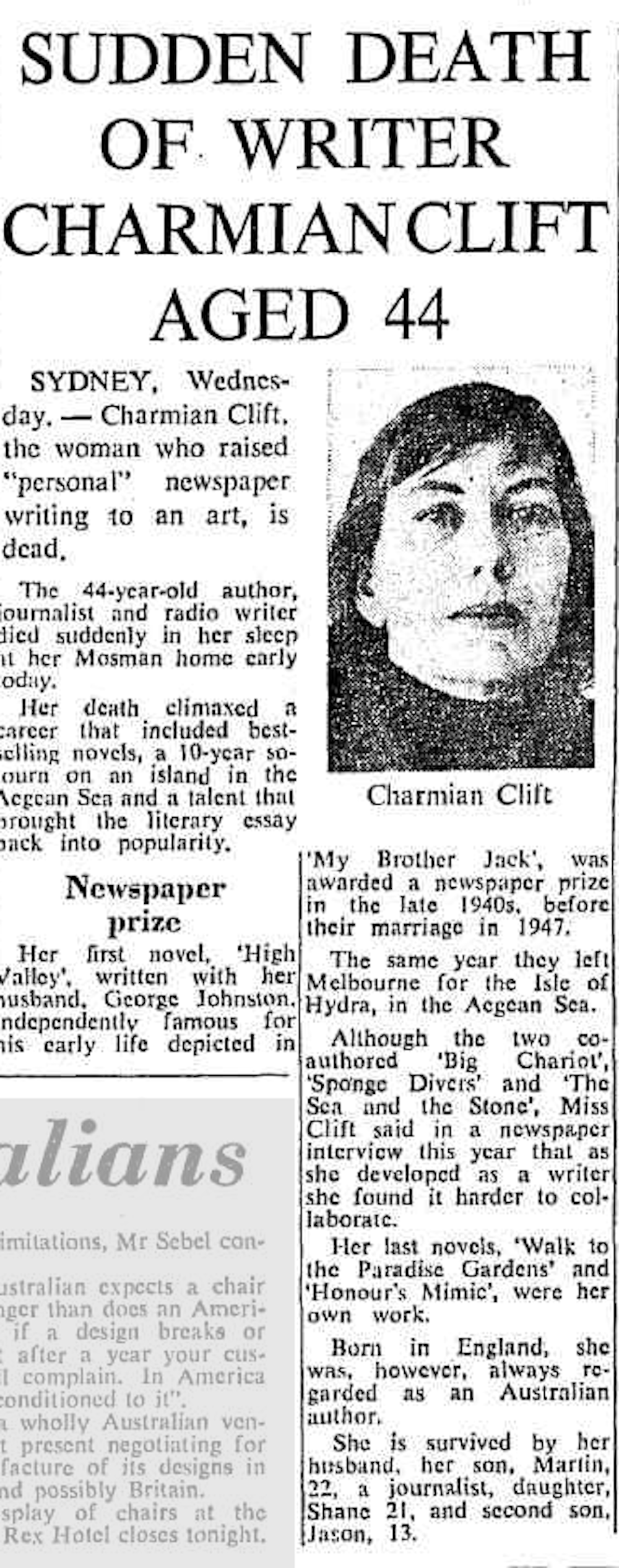
Clift’s death reported by The Canberra Times in July, 1969.

Wallis’s detection of Clift’s hubris and narcissism paints her as a potentially tragic figure. It was a fate she perhaps fulfilled, when Johnston eventually wrote of Clift’s infidelities on Hydra. Clift took her own life on July 8 1969, an event that curtailed her voice while leaving behind a legacy of loyal and grieving readers.

A natural cosmopolitan

Clift’s is one of the voices – and one of the most important female voices – that rose above the crowd during the post-war period, as the western world unknowingly girded itself for the social revolution that was to come.

Through her columns she advocated for a bolder, more outward looking future, and as someone who was naturally cosmopolitan she was avidly interested in seeing Australia become more open to the world and better integrated into the Asia-Pacific.

She didn’t always get it right (an essay decrying the rise of the Beatles and the Rolling Stones stands out!), but she helped navigate the path to a more broad-minded and inclusive vision of Australia.

Over the years Clift has emerged as someone who was not only modern, but also engaged in that most post-modern of activities, self-creation. For while Wallis scorned Clift’s self-mythologising at the time, it might now be recognised as the finest gift of the creative artist – to re-make oneself in the image of a world yet to be made. It was her gift to her readers and Australia.

ref. ‘A woman ahead of her time’: remembering the Australian writer Charmian Clift, 50 years on – http://theconversation.com/a-woman-ahead-of-her-time-remembering-the-australian-writer-charmian-clift-50-years-on-117322

Anger as Tongan beauty queen’s bullying claim speech disrupted

TVNZ’s Pacific correspondent Barbara Dreaver reports on organisers trying to shut down the outgoing Miss Heilala Queen during her final address. Video: TVNZ

By Kalafi Moala in Nuku’alofa

Angry criticism has flooded social media over a reported intervention by Tonga’s Deputy Prime Minister – including calls for his resignation – at the Miss Heilala beauty pageant in Nuku’alofa on Friday.

Semisi Sika is reported to have instructed the DJ to play loud music to drown out the controversial speech of Kalo Funganitao, the outgoing Miss Heilala.

Funganitao condemned pageant officials for tormenting and bullying her during her reign and claimed she had been cheated, lied to, backstabbed and messed around.

READ MORE: Auckland student pulled off stage for speech against bullying at Tonga beauty pageant

The law student from Auckland University is considered to have dealt the pageant the strongest condemnation ever in its 40-year history.

-Partners-

“Enough is enough,” Kalo, as she is commonly known, yelled over the music.

Her mother, brother and other contestants joined her on stage for the speech for which her microphone was eventually cut, allegedly at the instruction of Sika, who was the honoured official at the pageant.

But Kalo continued to give her speech, a protocol given to every reigning Miss Heilala as they are about to depart and hand over the crown to the next winner.

“My mother and I were cheated, lied to, backstabbed and generally messed around,” Kalo claimed.

The support she was promised as a Miss Heilala winner never came, she said. Instead, she claims to have been bullied and rudely treated.

“Up until today I have experienced just how hard it can be to be a young Tongan woman. I have dealt with people in official roles and in other places in the workforce that have been unprofessional and rude,” Kalo said.

Resignation calls
Social media users criticised the way Kalo’s speech appeared to have been shut down with a few calling for Sika’s resignation.

She described her experience during her reign as Miss Heilala as a direct result of the way she was treated by pageant officials and some of the public.

She also spoke about vicious attacks she had endured on social media, as people in the crowd started booing her and shouted obscenities.

The attempt to silence Kalo was recorded on video and posted on social media. She was ushered off the stage and was unable to crown the new Miss Heilala.

Sika is also accused of failing to intervene when someone from the VIP table reportedly screamed racist abuse at Leoshina Kariha, Miss Pacific Islands from Papua New Guinea.

A senior journalist in Tonga, Taina Kami, has expressed embarrassment at the abuse.

“Miss Pacific Islands Leoshina Kariha. I hang my head in shame and apologise for such unpleasant and uncalled for behaviour,” she wrote.

Kami has called for an apology from the pageant organisers.

No apologies have been issued by the tourism committee that organises the pageant or the Tourism Ministry for which Sika is the minister.

  • This article is published under the Pacific Media Centre’s content partnership with Radio New Zealand.
Kalo Funganitao
2018 Miss Heilala Kalo Funganitao … condemned pageant officials for being “tormented and bullied” during her reign. Image: Kalo Funganitao/RNZ Pacific
Print Friendly, PDF & Email

Article by AsiaPacificReport.nz

Treat or trick: we asked people how they feel about sharing fitness data with insurance companies

Source: The Conversation (Au and NZ) – By Dr Sven Tuzovic, Senior Lecturer, QUT Business School, Queensland University of Technology

From the Fitbit to Apple’s smartwatch, wearable tech is becoming increasingly popular across the globe. Compared to other nations like US, which has seen higher adoption of fitness trackers, uptake in Australia is still less than 10% in 2019. But news reports indicate that Australians are taking to fitness monitoring more than ever before.

And wearable devices are not only being embraced by consumers, but also across insurance industries. Health and life insurance companies collect data from fitness trackers with the goal of improving business decisions.

Hollywood actor Christopher Walken was the spokesperson for Qantas’s 2016 Assure campaign.

Currently, these business models work as a “carrot” incentive. That means consumers can benefit from discounts and cheaper premiums if they are willing to share their Fitbit data.

But we could see voluntary participation become mandatory, shifting the incentive from carrot to stick. John Hancock, one of the largest life insurance companies in the United States, has added fitness tracking with wearable devices to all of its policies. Though customers can opt out of the program, some industry experts argue that this “raises ethical questions around privacy and equality in leaving the traditional life insurance model behind”.

Is this the beginning of a major trend? And, more importantly, how do consumers feel about being “persuaded” into fitness tracker-based insurance policies?

In a study conducted with my colleague Professor Stefanie Paluch at RWTH University in Germany, we investigated people’s perceptions of fitness tracker-based insurance policies.

What are the concerns?

Unfair price discrimination

People are concerned that the data monitoring will lead to personal disadvantages. They don’t want to be penalised with higher insurance rates if they stop using the fitness tracker. One Fitbit user said:

The problem lies in the disadvantage if I don’t wear it.

Data protection

Consumers are concerned about how insurance firms will access, use, and store their fitness data. One person said:

I find it very important to have strict regulations, especially in these times, when personal data is collected and stored everywhere, but can also be shared, exchanged, sold and passed on to third parties, to those I don’t want […] to have my data.

Privacy

People have a wide range of privacy concerns. In general, they fear becoming “observable”, “transparent”, “predictable”, “easy to manipulate” and “rated” by the insurance provider. One user said:

The risk is that you will become so transparent and […] institutions will know about you, that is actually not their right at all, only on the basis that they somehow want to make a profit […] it’s none of their business.

How to reduce the risks?

Our study shows that the strongest opposition is based on people’s fear of unfair and exploitative behaviour of commercial data users, in particular switching from voluntary to mandatory enrolment. To avoid backlash, insurance firms should follow the following four recommendations.

1. Understand your customer

Insurance firms need to first segment their customer base to better understand consumer lifestyles and motivations to use a fitness tracker. While some consumers have a personal affinity towards self-tracking, other individuals will not change their habits. One user said:

I am not sure how this helps? If you lie on the sofa for 12 hours a day with a fitness tracker. Do you see a result? No! The insurance cannot force you to move your ass. Normally only people who are active already and do sports regularly, they wear such trackers.

2. Provide value

People wish to receive a benefit for their participation. This ranges from financial value (discounts, lower premium) to functional value, such as the quality of the device (design features, ease of use), as well as its reliability and accuracy in tracking data.

I like sports, and fitness trackers are important to me. As I said, to follow my progress, and if I can get them cheap, then I find that very positive.

The tracker itself must be good. […] I have to have a feeling that I really benefit from it.

3. Be transparent

In order to reduce privacy concerns, insurance firms need to offer transparent and fully informative privacy policies and should more clearly educate and inform users about the terms and conditions. One Fitbit user said:

…if a little more is published [about] what happens with our data, […] one can inform oneself about it […] Perhaps general education in schools or so would be desirable, too.

For me, the personal contact is important, because if someone explains that to me, then I will trust this person, and then I do not think that he/she will try to conceal any things […]. Once this has been explained to me, then I’m ok with it.

4. Give customers control

People are more willing to participate in fitness tracker-based insurance policies when they are in control of their participation. Greater empowerment increases their perceived self-determination and acceptance. Thus, participation should remain voluntary and be flexible regarding the timeframe. Two respondents said:

Well, if they [fitness trackers] are on a voluntary basis […] then I would use them.

That I can choose this bonus program myself, that I can choose the different functions from it and that I can resign at any time without any financial, health or insurance disadvantages.

As the sharing of personal biometric data increases further, we hope that our findings will contribute to an emerging public policy and legal debate about the practice.

ref. Treat or trick: we asked people how they feel about sharing fitness data with insurance companies – http://theconversation.com/treat-or-trick-we-asked-people-how-they-feel-about-sharing-fitness-data-with-insurance-companies-119806

Governments are making fake news a crime – but it could stifle free speech

Source: The Conversation (Au and NZ) – By Alana Schetzer, Sessional Tutor and Journalist, University of Melbourne

The rapid spread of fake news can influence millions of people, impacting elections and financial markets. A study on the impact of fake news on the 2016 US presidential election, for instance, has found that fake news stories about Hillary Clinton was “very strongly linked” to the defection of voters who supported Barack Obama in the previous election.

To stem the rising influence of fake news, some countries have made the creation and distribution of deliberately false information a crime.

Singapore is the latest country to have passed a law against fake news, joining others like Germany, Malaysia, France and Russia.


Read more: Media Files: Australians’ trust in news media is falling as concern over ‘fake news’ grows


But using the law to fight the wave of fake news may not be the best approach. Human rights activists, legal experts and others fear these laws have the potential to be misused to stifle free speech, or unintentionally block legitimate online posts and websites.

Legislating free speech

Singapore’s new law gives government ministers significant powers to determine what is fake news, and the authority to order online platforms to remove content if it’s deemed to be against the public interest.

What is considered to be of public interest is quite broad, but includes threats to security, the integrity of elections, and the public perception of the government. This could be open to abuse. It means any content that could be interpreted as embarrassing or damaging to the government is now open to being labelled fake news.

And free speech and human rights groups are concerned that legally banning fake news could be used as a way to restrict free speech and target whistleblowers.


Read more: Freedom of speech: a history from the forbidden fruit to Facebook


Similar problems have arisen in Malaysia and Russia. Both nations have been accused of using their respective laws against fake news to further censor free speech, especially criticism of the government.

Malaysia’s previous government outlawed fake news last year, making it a crime punishable by a fine up to 500,000 Malaysian (A$171,000) ringgit or six years’ imprisonment, or both. The new government has vowed to repeal the law, but so far has yet to do so.

Russia banned fake news – which it labels as any information that shows “blatant disrespect” for the state – in April. Noncompliance can carry a jail sentence of 15 days.

Discriminating between legitimate and illegitimate content

But the problems that come with legislating against fake news is not restricted to countries with questionable track records of electoral integrity and free speech.

Even countries like Germany are facing difficulties enforcing their laws in a way that doesn’t unintentionally also target legitimate content.

Germany’s law came into effect on January 1, 2018. It targets social media platforms such as Facebook and Twitter, and requires them to remove posts featuring hate speech or fake information within 24 hours. A platform that fails to adhere to this law may face fines up to 50 million euros.

But the government is now reviewing the law because too much information is being blocked that shouldn’t be.

The Association of German Journalists has complained that social media companies are being too cautious and refusing to publish anything that could be wrongly interpreted under the law. This could lead to increasing self-censorship, possibly of information in the public interest.

In Australia, fake news is also a significant problem, with more and more people unable to distinguish fake news from legitimate reports.

During Australia’s federal election in May, fake news claiming the Labor Party planned on introducing a death tax spread across Facebook and was adopted by the Liberal Party in attack ads.


Read more: Lies, obfuscation and fake news make for a dispiriting – and dangerous – election campaign


But there has been no serious talk of passing a law banning fake news here. Instead, Australian politicians from all sides have been pressuring the biggest social media platforms to be more vigilant and remove fake news before it becomes a problem.

Are there any alternatives to government regulation?

Unlike attempts to limit or ban content in pre-internet days, simply passing a law against fake news may not be the best way to deal with the problem.

The European Union, which is experiencing a rise in support for extreme right-wing political parties, introduced a voluntary code of practice against online disinformation in 2018. Facebook and other social media giants have since signed up.

But there are already concerns the code was “softened” to minimise the amount of content that would need to be removed or edited.

Whenever governments get involved in policing the media – even for the best-intended reasons – there is always the possibility of corruption and a reduction in genuine free speech.

Industry self-regulation is also problematic, as social media companies often struggle to objectively police themselves. Compelling these companies to take responsibility for the content on their sites through fines and other punitive measures, however, could be effective.


Read more: After defamation ruling, it’s time Facebook provided better moderation tools


Another alternative is for media industry groups to get involved.

Media freedom watchdog Reporters Without Borders, for instance, has launched the Journalism Trust Initiative, which could lead to a future certification system that would act as a “guarantee” of quality and accuracy for readers. The agreed standards are still being discussed, but will include issues such as company ownership, sources of revenue, independence and ethical compliance.

ref. Governments are making fake news a crime – but it could stifle free speech – http://theconversation.com/governments-are-making-fake-news-a-crime-but-it-could-stifle-free-speech-117654

Testing festival goers’ pills isn’t the only way to reduce overdoses. Here’s what else works

Source: The Conversation (Au and NZ) – By Nicole Lee, Professor at the National Drug Research Institute, Curtin University

The NSW inquest into recent drug deaths at music festivals is due to start this week. So focus is turning to how to make music festivals safer by reducing drug-related incidents.

We know that prohibition doesn’t work to reduce either harms or drug use. But what does?


Read more: Australia’s recreational drug policies aren’t working, so what are the options for reform?


How do drugs cause harm?

Most illicit drugs used at festivals, including ecstasy (methylenedioxymethamphetamine or MDMA), started out as relatively benign pharmaceuticals.

MDMA is most commonly implicated in drug-related harm at festivals. Fatal and non-fatal MDMA overdoses are usually a result of high-purity MDMA, dangerous contaminants, or environmental factors such as overheating or drinking too much or too little water. So to reduce harms we need to address all these problems.


Read more: Weekly Dose: ecstasy, the party drug that could be used to treat PTSD


What doesn’t work

Police presence, random drug searches and drug detection dogs don’t deter drug use and may increase harms. Yet they are common at festivals and come at a substantial financial cost to festival goers, which has to be covered in the price of the ticket.

People who go to festivals say that police presence doesn’t discourage them from taking drugs; and there are many documented cases of people taking multiple pills at once to avoid searches and sniffer dog detection, which increases the risk of overdose.


Read more: Why drug-detection dogs are sniffing up the wrong tree


Publicly, the police focus is on drug dealing, but the reality is that most people who are arrested at festivals are people who use, rather than sell, drugs. NSW police reported that, at Sydney’s 2019 Field Day Festival, of the 28,000 people who attended, there were 155 drug-related arrests: 149 for possession and 6 for supply.

When police dogs are present, people are more likely to buy drugs inside the festival rather than risk detection by carrying drugs in. This means they are more likely to buy from unknown sources, which increases their risk of harm compared with buying from a trusted source.

Decriminalising illicit drugs would significantly reduce harms and allow festival police to focus on public safety issues, such as antisocial behaviour and public drunkenness.

What works

There are already effective harm reduction strategies in place at festivals. These include:

  • presence of peer-led organisations, like Dancewize, which provide harm reduction information and support
  • emergency services and first aid
  • chill out spaces
  • availability of cool clean water
  • good ventilation in indoor spaces, and
  • staff and volunteer training in responding to drug affected people.

Pill testing direct to consumer

On-site pill testing, which identifies the content and purity of drugs brought in by festival goers, also includes contact with a health professional to provide a brief intervention, that can include advice about risks of taking drugs and harm reduction information. Festival goers are always told that it is safest not to take drugs at all.

Brief interventions from a health professional can reduce risky drug use among young people. But without a way to offer an intervention, most young people who go to festivals will not come into contact with a health worker to receive that information.


Read more: Here’s why doctors are backing pill testing at music festivals across Australia


Some Australian police, politicians and policymakers are reluctant to consider pill testing at festivals. That may be because, so far, only on-site, direct-from-consumer testing has been offered as a viable way of reducing harm.

Some people have concerns about the idea of accepting and testing illicit drugs direct from the people using them, given that they are still illegal.

But there are many other ways of pill testing that can also reduce harm.

Testing of police-acquired drugs

We could also test drugs on-site that have been seized by police, acquired from emergency services after an incident or surrendered in amnesty bins.

This approach has been used at a number of festivals in the UK since 2013. When a potentially problematic drug is identified during the festival, an alert is issued on-site through social media usually within hours, to alert others who may have bought drugs from similar batches.

As well as potentially reducing harm for people who use drugs, these alerts mean police are better able to monitor the local drug market; on-site paramedics, first aid and outreach workers are better informed about drugs in circulation, helping to improve responses; and according to the UK testing facility, medical services report having more confidence in dealing with presentations because of the alerts.

Medical services can also benefit from alerts letting people know which problem drugs might still be in circulation. from www.shutterstock.com

This approach is not as effective in reducing harms as direct-from-consumer testing. That’s because it doesn’t include contact with a health professional who can offer a brief intervention, and the information about pill contents doesn’t go direct to the people intending to use them.

But if testing of police acquired drugs is combined with real-time alerts about potential problem drugs to festival goers, it can still reduce harms.

Off-site testing

Testing of pills brought in by festival goers can also occur off site before the festival. It works the same way as onsite testing, and includes brief intervention, but operates away from the festival site.

It’s the primary model used in The Netherlands.

Off-site testing removes the need to change the way the drugs are policed at festivals, so may be more acceptable to some. If both off-site and on-site testing are implemented, testing services will have greater reach and be more effective in reducing harm.

Testing drug purity

The only official pill testing that has been undertaken in Australia has been at Canberra’s Groovin’ the Moo in 2018 and 2019. The on-site facility tested samples provided directly by consumers and identified the drugs present. But they could only estimate the purity of drug powders and did not measure the dose of MDMA in the pills.

High-dose MDMA has been implicated in a number of the recent festivals deaths. Knowing the dose may help reduce overdoses from MDMA pills because people can choose to take a smaller amount of the drug if they know the strength is high.


Read more: When to seek help after taking a pill


The Loop UK has developed a method of more accurately measuring the dose in MDMA pills, which could help reduce the harms associated with high purity. The process does not require any specialised equipment and is performed on-site by trained chemists. At this year’s Parklife Festival the organisation identified high-strength pills and send out warnings.

Example of alerts from The Loop UK at this year’s Parklife Festival.

Understanding drug use at festivals

We also don’t really know how many young people use drugs at Australian festivals and how much they use. Most of what we know is from anecdotal reports. There’s probably differences between festivals.

We know both festival attendance and illicit drug use hit a peak among people in their 20s. So more research on how common drug use is at festivals and the kinds of drugs people use would help inform better and more targeted harm reduction policies.

We will never completely eliminate drug use at festivals but we can make them safer by implementing what we know works and stopping what we know doesn’t. It’s normal for young people to take risks. Whether you agree with drug taking or not, our young people don’t deserve to die just because they have taken drugs.

ref. Testing festival goers’ pills isn’t the only way to reduce overdoses. Here’s what else works – http://theconversation.com/testing-festival-goers-pills-isnt-the-only-way-to-reduce-overdoses-heres-what-else-works-118827

China crisis? Hardly – it doesn’t matter most Aussie kids don’t speak fluent Mandarin

Source: The Conversation (Au and NZ) – By Warren Midgley, Honorary Associate Professor of Applied Linguistics, University of Southern Queensland

Just before the May federal election, then shadow treasurer Chris Bowen gave a speech in which he lamented the low levels of Year 12 students studying Mandarin in Australia. The speech was at a launch for Labor’s plan to deepen Australia’s engagement with Asia.

According to the launch’s media release, Labor’s strategy would include “improving Asian literacy and cultural understanding through school curriculums”.

Bowen mentioned that only about 130 Australians of non-Chinese heritage can speak Chinese to a level good enough to do business with China. In recent weeks, experts confirmed this number may be correct, although an educated guess.

But whatever the exact number, 100 or 130 or 200, an expert told the ABC “it’s still absolutely peanuts”.

For decades, Australian schools have focused on teaching Asian languages to strengthen our opportunities in Asia. One of the four target languages has been Standard Chinese, or Mandarin, the official language of mainland China.

If only 130 people of non-Chinese heritage can speak it after all these years, has something gone catastrophically wrong?

The bigger picture

There are many more than 130 people in Australia who can speak Mandarin fluently. According to the latest census data, almost 600,000 people in Australia speak Mandarin at home, which indicates a very high level of fluency.

Given more than 500,000 Australians were born in China, there is a good chance most Mandarin-speaking Australians would be, to use Bowen’s term, of “Chinese heritage”. But it’s unclear why this is concerning.


Read more: Where are Chinese migrants choosing to settle in Australia? Look to the suburbs


From a purely academic perspective, these data suggest Australia is well placed to recruit Mandarin-speaking leaders in business, international relations, diplomacy and so forth, to strengthen our engagement with Asia.

Clearly, there is no critical shortage of fluent Mandarin speakers in Australia. There may be a shortage of Mandarin-speaking Australians entering into leadership positions, but that is an entirely different discussion.

Mandarin learning in schools

There is no definitive source of data for the number of children learning languages in Australian schools. One source indicates that in 2015, more than 170,000 students were learning Mandarin in Australian schools – almost twice as many as were learning it in 2008.

However, only about 4,000 of those students were in Year 12, and of those only an estimated 400 were of non-Chinese heritage. So while the total number of students has risen, the number of non-Chinese heritage students continuing to study Mandarin through to Year 12 has remained low.


Read more: How Australia’s Mandarin speakers get their news


These figures are similar to those for Japanese, which is the most popular language taught in Australian schools. In 2015 there were estimated to be just over 210,000 students studying Japanese at school in Australia. Following a similar pattern to Mandarin, only 572 of those students were in the upper years of secondary school.

What does success mean?

Not all language students start at the same proficiency level. The Australian Curriculum has five different streams for students of Mandarin to accommodate a range of different starting levels of proficiency.

In theory, this means Chinese heritage students who already speak Mandarin very well can study a much higher level of Mandarin than non-Chinese heritage students. However, many students with very good starting proficiency in Mandarin end up in classes designed for students with lower starting levels of proficiency.

These differences in starting levels of proficiency mean it is difficult to determine whether Mandarin language programs have been successful. An excellent written paper by a non-native speaker of Mandarin may be a very poor result for a student who is a native speaker of Mandarin.


Read more: What languages should children be learning to get ahead?


In one study, Year 12 students who spoke Mandarin at home achieved an average score of 77 on a proficiency test that had a maximum possible score of 120. The average for students who did not speak Mandarin at home was 16.

We need to think carefully about what we mean by success in language learning. If speaking as a native speaker would, which is what might be required for someone to be able to conduct business in China, is the measure of success, all language classes will perform poorly. A school student in China will learn about 6,000 written characters by the time they graduate. By comparison, a Year 12 student in Australia will graduate with a knowledge of only about 500 characters.

By the time a school student in China graduates, they will have learnt about 6,000 written characters. from shutterstock.com

Even languages that don’t have large numbers of characters are almost impossible to master in the small amount of time allocated to language classes in Australian schools.

In the same way, if winning an Olympic gold medal were the measure of success of sports classes, then they also have been a monumental failure. There have only been 267 Australian gold medallists in all Summer and Winter Games since 1896.

The same could be said for any other subject in which achieving such rare levels of excellence is considered to be the only measure of success.

Why else would you study Mandarin?

Evidence suggests there are multiple benefits from learning a second language beyond achieving native-like mastery of the language itself. These include improvements in cognitive flexibility, decision-making, and intercultural competency.

None of these benefits requires the learner to be able to speak, read or write that second language as well as a native speaker.

Some of the questions we should be asking are:

  • are our children making progress in learning the language?
  • are they engaged with the lessons and the materials?
  • are they demonstrating interest in other cultures and ideas?
  • are they exploring new ways of seeing the world and solving problems?
  • are they reaching out to others in the community who have different language and cultural backgrounds?

The first two of these are regularly measured, or at least noted, by classroom teachers. But the others are often overlooked. It is difficult to know how successful our programs have been without measuring these things too.

ref. China crisis? Hardly – it doesn’t matter most Aussie kids don’t speak fluent Mandarin – http://theconversation.com/china-crisis-hardly-it-doesnt-matter-most-aussie-kids-dont-speak-fluent-mandarin-119647

Build to rent could shake up real estate but won’t take off without major tax changes

Source: The Conversation (Au and NZ) – By Hal Pawson, Associate Director – City Futures – Urban Policy and Strategy, City Futures Research Centre, Housing Policy and Practice, UNSW

In the wake of slumping demand for apartment building, it’s little wonder the multi-unit housing industry has been eagerly eyeing a possible new residential product: “build-to-rent”.

In fact, the latest figures show that apartment-building construction starts were down 36% in 2018 from 2016. But how much will this little-known type of housing solve our housing problems?


Read more: Ten lessons from cities that have risen to the affordable housing challenge


Build-to-rent won’t be a silver bullet solution for Australia’s housing affordability stress, but it does have potential to tick the box on several important public policy objectives. These include widened housing diversity, enhanced build standards, and a better-managed, more secure form of private rental housing.

But for this to happen, Australia’s tax settings need adjustment.

Project design of build to rent properties in Mirvac Olympic Park, Sydney. Build to rent has already started in Australia, but can only be fully embraced with government support. Author provided (No reuse)

What is ‘build-to-rent’?

This refers to apartment blocks built specifically to be rented, usually at market rates, and held in single ownership as long-term income-generating assets.

The enduring owner might be, for instance, an insurance company, an Australian super fund, a foreign sovereign wealth fund, a private equity firm, or the building’s developer.

Although new in Australia, build-to-rent is quite common in many other countries. Under its North American name, “multi-family housing”, the format has generated more than 6.3 million new apartments since 1992 in the US alone. And in the UK, a build-to-rent sector has led to 68,000 units built or under construction since 2012.


Read more: What Australia can learn from overseas about the future of rental housing


A scattering of build-to-rent schemes are already underway or completed, mainly in inner Sydney and Melbourne. And they may prove to be the forerunners of a new Australian residential property sector – but that is far from guaranteed.

In Australia, our private rental market is almost entirely owned by small-scale mum-and-dad investors, so this kind of housing would be a largely new departure from typical Australian real estate.

Potential benefits

The build-to-rent development model, involving a long-term owner commissioning an entire building, creates an incentive for higher, more enduring quality than the standard “build-to-sell” apartment development approach.

Importantly, build-to-rent is a long-run investment that caters for rental demand, which tends to grow steadily.

This means the model is largely immune to the fickle changes in housing demand resulting from typically short time horizons and primarily speculative instincts of individual buyers traditionally dominant in our market.


Read more: Australia’s social housing policy needs stronger leadership and an investment overhaul


So at its full potential, this new housing product could introduce a valuable counter-cyclical component into the notoriously volatile residential construction industry, helping to offset damaging booms and busts. In other words, build-to-rent can create stability in the Australian property market.

How build-to-rent can incorporate affordable housing

Optimistically, some have claimed build-to-rent could also provide an “affordable housing” fix for many earners who are doing it tough in our existing private rental market.

But this could be possible only with the aid of major government funding or planning concessions.

A design for build to rent property in Latrobe Street, Melbourne. Author provided (No reuse)

Ideally, housing at rents affordable to low or moderate income earners would be included in predominantly market-rate build-to-rent schemes. Indeed, one major construction industry player recently advocated this as a standard expectation.

So how should affordable housing be provided in this case?

To find out, our analysis compares the cost of developing affordable housing by a for-profit company with development under a not-for-profit community housing provider.

Thanks to that non-profit format, and the tax advantages that go along with it, community housing providers can, in fact, construct affordable rental housing at significantly lower cost than their for-profit counterparts. Less subsidy is therefore needed.

Nonetheless, government help in some form will be essential to enable an affordable housing element. The most painless way for this to happen, from the government perspective, is through allocating sections of federal or state-owned redevelopment sites to community housing providers at discounted rates.


Read more: ‘Build to rent’ could be the missing piece of the affordable housing puzzle


Encouragingly, this strategy was recently advocated by newly designated federal housing minister Michael Sukkar.

Such designation of government-owned sites could, for instance, be factored into large-scale urban renewal projects like Sydney’s Central-to-Eveleigh and Rozelle Bays. When complete, it could fulfil the widely voiced demand that 30% of these developments should be affordable housing.

Levelling the playing field

Our modelling shows that under current conditions, even market-rate build-to-rent projects are barely viable – at least in Sydney.

The inflated price of developable land in Australia’s urban housing markets is an important contributing constraint. But our research also identifies a range of government tax settings that disadvantage build-to-rent, compared with both mum-and-dad-investors and traditional build to sell developers.

Removing less favourable land tax and GST treatment could markedly improve build-to-rent feasibility.


Read more: Australia’s foreign real estate investment boom looks to be over. Here are five things we learned


From a housing policy perspective, there’s also a case for the federal government to reconsider its recent “withholding tax” decision that treats overseas-based institutional investment in rental property less favourably than investment in commercial property.

Since such global funds would likely lead the establishment of a new Australian build-to-rent asset class, revisiting the withholding tax changes could be a significant step in making build-to-rent a reality in Australia.

In any case, build-to-rent is no simple solution for Australia’s affordable housing shortage.

But even as a market-rate product, it could fulfil several important public policy objectives. How far it might do so in practice is something that governments rightly need to weigh up when considering industry-proposed tax and regulatory reforms.

ref. Build to rent could shake up real estate but won’t take off without major tax changes – http://theconversation.com/build-to-rent-could-shake-up-real-estate-but-wont-take-off-without-major-tax-changes-119603

What we missed while we looked away — the growth of long‐term unemployment

Source: The Conversation (Au and NZ) – By Jeff Borland, Professor of Economics, University of Melbourne

Australia took its eyes off long-term unemployment, for what it thought were good reasons.

Long-term unemployment is defined as unemployment for more than 12 months in a row.

In the early 1990s, after the “recession we had to have”, long-term unemployment grew to a postwar high of 4% and became a major concern for the government amid fears that once Australians had became long-term unemployed, they would never easily get back to work.

Over time, that concern lessened.

Strong economic growth delivered a steady decline in the overall rate of unemployment and, as a consequence, long-term unemployment.

With the long-term rate low, we looked away…

By the time the financial crisis hit in 2008, Australia’s long-term unemployment rate was down to just 0.6%. After the crisis, our lack of attention continued.

The crisis had caused only a relatively small increase in unemployment, and it seemed reasonable to assume that it hadn’t caused much of an uptick in long-term unemployment.

In absolute terms, it hadn’t. Today, long-term unemployment is 1.25%, still way below its peak in the early 1990s.

But that figure of 1.25% demands closer attention.

It is about 0.3 percentage points higher than would have been the case for the same unemployment rate a few years earlier.

…and kept looking away…

Those few fractions of a percentage point mightn’t seem like much, but they add up to 41,000 more long-term unemployed Australians than would be expected.

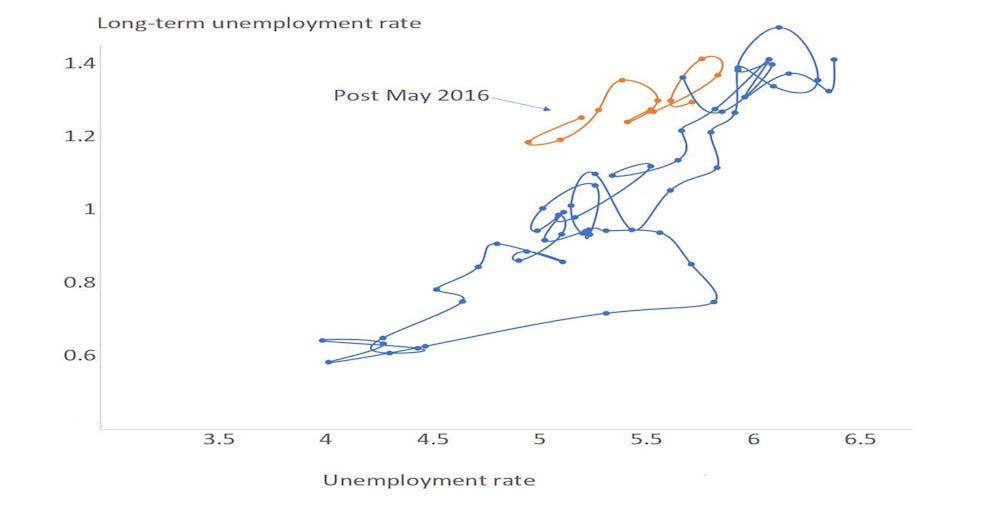
The surprising growth in long-term unemployment relative to unemployment can be seen in the figure below, which shows rates of unemployment and long-term unemployment from 2003 onwards.


Unemployment rates and long-term unemployment rates, 2003-19

ABS 6291.0.55.001 (seasonally adjusted)

It is clear that something changed after mid-2016.

Before then, an unemployment rate of 5% meant a rate of long-term unemployment of about 1%. After then it has meant a long-term unemployment rate of about 1.3%.

While the change has become most apparent since 2016, I argue in my recent briefing on this topic that it began earlier, in the years between 2009 and 2016.

During those seven years, the overall rate of unemployment changed little.

…while something changed

Standard theories predict that if the overall rate of unemployment remains stable, the rate of long-term unemployment should also remain stable.

But the rate of long-term unemployment virtually doubled from 0.7% to 1.35% during those seven years, meaning the proportion of the unemployed who were long-term unemployed climbed from 13% to 23%.

The growth in long-term unemployment has been pervasive – affecting male and female jobseekers equally, and all age categories – although young jobseekers seem to have been the most affected.

At this stage, the reasons for the increase remain unclear.

Low wage growth deepens the mystery

Paradoxically, it makes Australia’s current low rate of wage growth even harder to understand.

Standard theories characterise the long-term unemployed as being less immediately employable than the short-term unemployed, meaning that as long-term unemployment grows as a proportion of total unemployment, employers will try to fill vacancies from a smaller and smaller pool of short-term unemployed, making it easier for existing workers to extract higher wages.

If this is happening, it is being more than offset by something else.


Read more: Buckle up. 2019-20 survey finds the economy weak and heading down, and that’s ahead of surprises


What this development certainly does mean is that we ought to be concentrating more on getting the long-term unemployed back into work. Fortuitously, this is already happening.

In 2018 an expert panel commissioned by the then Commonwealth Department of Jobs and Small Business recommended rebalancing of employment services towards jobseekers facing the highest barriers to employment.

The increasingly chunk of the unemployed who are long-term unemployed makes the need for such a shift more critical.

ref. What we missed while we looked away — the growth of long‐term unemployment – http://theconversation.com/what-we-missed-while-we-looked-away-the-growth-of-long-term-unemployment-119870

West Papuan suffering will go on if NZ doesn’t take stand, says Rosa Moiwend

Michael Andrew’s Pacific Media Watch interview with Rosa Moiwend of West Papua. Video: Pacific Media Centre

By Michael Andrew

West Papuan human rights defender Rosa Moiwend was in New Zealand this week, speaking about the need for more countries to challenge Indonesia on its human rights abuses in her homeland.

Her New Zealand tour featured talks in Dunedin, Christchurch, Wellington and Auckland where she discussed West Papuan resistance to expanding Indonesian military and business interests.

She told Pacific Media Watch contributing editor Michael Andrew about Indonesia’s confiscation of indigenous land for oil palm developments and its attempt to isolate West Papua from the rest of the Pacific.

Rosa Moiwend with Michael Andrew
West Papuan human rights defender Rosa Moiwend talks to Pacific Media Watch contributing editor Michael Andrew at the Pacific Media Centre this week. Image: Del Abcede/PMC

“Land has been taken away from the indigenous people,” she says in this video report.

“And this massive food project is a kind of third wave of taking people’s land without permission.”

-Partners-

Moiwend also says there needs to be stronger media coverage.

“To get the information, maybe they are not well informed, that’s my assumption,” she says.

“Or, the second thing is, maybe they don’t have access to get into West Papua. Again, it is really important that the New Zealand government talks to the Indonesian government and asks them that they should open up to the media.”

West Papuan human rights defender Rosa Moiwend at the Pacific Media Centre this week with publications from the centre. Image: Del Abcede/PMC
Print Friendly, PDF & Email

Article by AsiaPacificReport.nz

Some detained Chinese accused were Vanuatu support citizenship applicants

By Dan McGarry in Port Vila

The Chinese Embassy has for a second time failed to respond to a request for comment concerning its role in the arrest, detention and planned deportation of six Chinese nationals on Vanuatu soil.

The Vanuatu Daily Post originally contacted the embassy by telephone last week, but were instructed to send a written request for comment instead. The newspaper complied.

Another request was sent yesterday shortly before lunch. No reply had been received by the time the article went to press.

READ MORE: Chinese scammers arrested in Vanuatu

Vanuatu fast citizenship
Vanuatu’s investment “fast citizenship” Vanuatu Development Programme (VDP) is gaining momentum. Image: Vanuatu Daily Post

The presence of Chinese law enforcement officials on Vanuatu soil, their official status, and their role in the arrest and detention of the six arrested people has raised numerous questions about due process and the rule of law.

The Office of the Prime Minister, which oversees the Citizenship Office, shared further information yesterday concerning the six Chinese nationals currently in detention, pending their expected deportation.

-Partners-

Four of the six individuals had applied for Vanuatu citizenship under the Development Support Programme (DSP). They had their citizenship granted in mid-May this year. Two others were not citizens.

The four citizenship applications approvals were made on the same day in mid-May, a PMO spokesman said.

Standard security check
At that time, they had been subjected to the standard security and background check, which included a query against the Interpol database. Vanuatu joined Interpol in November last year.

In late June this year, Chinese authorities informed the government of Vanuatu that six individuals were involved in what they characterised as a “pyramid” scheme, aimed at victims in China.

These activities were allegedly based in a commercial property in the Seaside neighbourhood.

The Daily Post was shown a letter, evidently from Chinese police, stamped and dated from June 2019, which alleged that a Chen Bo had forged his criminal record check form. Commonly called a police clearance, it is a required document for any residence or citizenship application.

The letter described Chen as a fugitive from the law.

The Daily Post asked if all of the six were the subject of similar correspondence. The PMO spokesman said yes, they were.

The identities of the other five detainees are not known.

Woman in hiding
A woman named Liana Chen is also reportedly wanted by Chinese authorities. The Daily Post has been told that she was currently in hiding in Vanuatu.

Sources informed the Daily Post that six Chinese law enforcement officials were later joined by five more. These individuals have been occupying the same property as the detainees, but it is not clear what their role in regarding the six people.

It is known that Vanuatu Police are providing a security detail to ensure the six remain on the premises.

Sources with direct knowledge of their circumstances told the Daily Post that the six were or are being held on a property owned by the China Civil Engineering and Construction Company (CCECC), in the Prima neighbourhood.

The Daily Post contacted CCECC to ask about their collaboration on this matter, but did not receive a reply by the time the article went to press.

The PMO also clarified that the DSP was mandated to supply up to 600 citizens via its investment opportunity. The total cash value of this offering would be VT 10.74 billion (US$93 million). That number has yet to be reached.

A Parliamentary Committee was recently informed that over 4000 applications have been approved. Therefore, PRG ImmiMart Ltd, which operates the rival Vanuatu Contribution Programme, is responsible for more than 3600 citizenship approvals so far.

Under scrutiny
PMO officials stressed that PRG had not processed the six applications currently under scrutiny.

The Daily Post was unable to discover any local legal professionals working to represent or defend the detainees.

Internal Affairs Minister Andrew Napuat earlier told the newspaper that these people would not be going to court in Vanuatu, as they were not accused of committing any crime in Vanuatu.

But the question of their right to appeal their extradition remains unanswered.

Also, Vanuatu authorities are empowered to summarily remove a person’s passport under certain circumstances, but a person’s right to appeal the loss of citizenship remains.

  • NOTE: After this article appeared in the Vanuatu Daily Post, A PMO spokesman told the newspaper that in fact only four of the six Chinese nationals arrested had applied for citizenship. The newspaper originally reported that all six had applied, but that only four had been granted citizenship, with two applications still pending. This article has been updated to reflect the clarification.
  • The Pacific Media Centre’s Asia Pacific Report has a content sharing arrangement with the Vanuatu Daily Post.
  • More Vanuatu stories
Print Friendly, PDF & Email

Article by AsiaPacificReport.nz

Eelgrass keeps the oceans alive and preserves shipwrecks, so just cope when it tickles your feet

Source: The Conversation (Au and NZ) – By Valentina Hurtado-McCormick, PhD Candidate, University of Technology Sydney

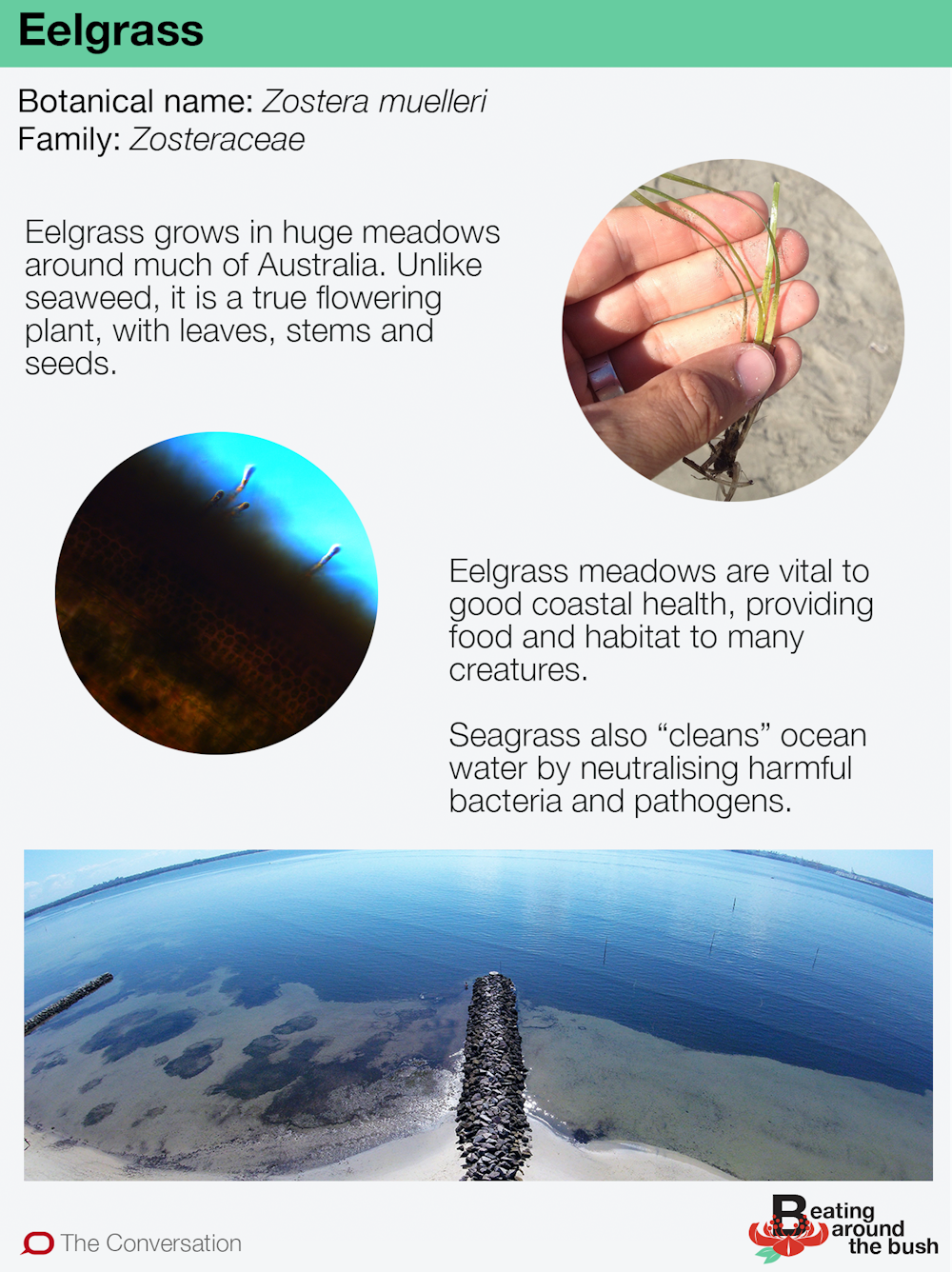
Have you ever walked into the ocean from a stunning Australian beach and realised the sand was covered with hundreds of ticklish leaves? This submerged canopy is a seagrass meadow, and while you might see them as a nuisance to swim past, they’re a hidden treasure.

Seagrasses are the only group of flowering plants that have adapted to the marine environment. This group comprises nearly 60 species, which typically occupy tropical and temperate regions of the world distributed across 1,646,788 km2.

There is a disproportionately large number of temperate seagrass species in southern Australia, with Zostera species dominating extensive and very diverse meadows.

Eelgrass (Zostera muelleri) is one of the dominant meadow-forming species in Australia. It has the widest distribution of its family (Zosteraceae) in temperate Australian waters, and is vital to our oceans’ health.


The Conversation

Don’t call me weedy!

These aquatic plants have evolved myriad adaptations to survive in the seas, and contrary to what many people think, seagrasses are very different from seaweeds.

Seaweeds are comparatively simple organisms: they are macroalgae with no vascular tissue, which is what conducts water and nutrients throughout a plant. In comparison, eelgrass has leaves, root and rhizomes, with flowers, fruits and seeds for reproduction.

J. Maughn/Flickr, CC BY-SA

They do, however, share one thing. Seagrasses and seaweeds are “holobionts” – meaning that they each play host to a range of microorganisms such as bacteria, fungi and microalgae that help to support their health and survival.

Research has shown that these crucial host-microbe relationships can be easily disrupted.

Climate change is not just affecting the seagrass host; the entire holobiont and even the environment it occupies are suffering from rising temperatures.

Purple plants in warm waters

My research involves studying the response of seagrass and their associated microbes to environmental degradation. I realised how much warming oceans were affecting eelgrass when I suddenly came across purple shoots in a meadow I was sampling once a month.

I was shocked. I had never seen anything like it.

While previous research has described the phenomenon of seagrass leaf reddening, I’d never heard of seagrass going purple in this specific black-purple-white pattern.

We already knew that the eelgrass accumulates red pigments as a sunscreen against the increased UV radiation that results from ozone depletion and related consequences of climate change. My PhD (soon to be published) has found that this colour change has a strong effect on the microbial communities that live on seagrass leaves.

Seagrasses establish and maintain fundamental relationships with the microbes that live among them. Valentina Hurtado McCormick, Author provided

Why should we care?

Besides producing weird sensations on human feet, eelgrass and its counterparts are a crucial part of our coastal ecosystems. Probably the best example is their nursery role in supporting juvenile fish and crustaceans.

They also provide food for a wide range of grazers, from dugongs to the green sea turtle (as featured in the movie Finding Nemo), which feed on bounteous seagrass meadows.

Finally, we can also thank them for sequestering huge amounts of organic carbon that would otherwise contribute enormously to the greenhouse effect. Referred to as “blue carbon sinks”, researchers have calculated seagrass meadows could store 19.9 gigatonnes of organic carbon worldwide.

I could keep writing about the virtues of Zostera species (and seagrasses in general) for much, much longer, but I will leave you with a single thought: we breathe and eat from a healthy ocean, and the ocean is not healthy without seagrass.

Not just grass under your feet

Seagrass is so protective, I think of them as one of the most altruistic plants on the planet. They keep waterborne pathogens in check and neutralise harmful bacteria, keeping coral reefs healthy, and acting as an important part of the ocean’s well-being.

On the other hand, these aquatic plants also help preserve human heritage. They create a thick sediment layer on the seafloor, beneath which shipwrecks and other treasures are buried and protected from decomposition.


Read more: Seagrass, protector of shipwrecks and buried treasure


For some 400 million years, eelgrass and other seagrass species have protected the ocean, our planet, and the creatures who live here.

In return, we have managed to create uncountable ways to directly or indirectly threaten seagrass-based ecosystems. As a result, meadows have declined globally at the accelerated rate of 7% per year.

For many of us, seagrass meadows are simply an obstacle to get past on the way to the waves. But for those of us who spend our days with a snorkel and collection tubes, these little watery plants mean far more. When I look at a single seagrass leaf, I see an entire microcosm of interacting entities.

ref. Eelgrass keeps the oceans alive and preserves shipwrecks, so just cope when it tickles your feet – http://theconversation.com/eelgrass-keeps-the-oceans-alive-and-preserves-shipwrecks-so-just-cope-when-it-tickles-your-feet-119882

There’s no clear need for Peter Dutton’s new bill excluding citizens from Australia

Source: The Conversation (Au and NZ) – By Sangeetha Pillai, Senior Research Associate, Andrew & Renata Kaldor Centre for International Refugee Law, UNSW Law School, UNSW

Yesterday, the government introduced a bill into Parliament that, if passed, would allow the home affairs minister Peter Dutton to temporarily exclude some Australian citizens – including children – from returning to Australia.

The bill is aimed at mitigating threats posed by foreign fighters coming back to Australia from conflicts in Syria and Iraq. It was first put before Parliament in February, and has now been reintroduced with some amendments.


Read more: Why is it so difficult to prosecute returning fighters?


The bill draws on similar legislation in the UK and, if passed, would add to an arsenal of around 75 pieces of anti-terrorism legislation currently operating in Australia.

National security laws must continue to adapt to changing circumstances. But the government has not made it clear how the bill would fill an identified gap in Australia’s already extensive national security regime.

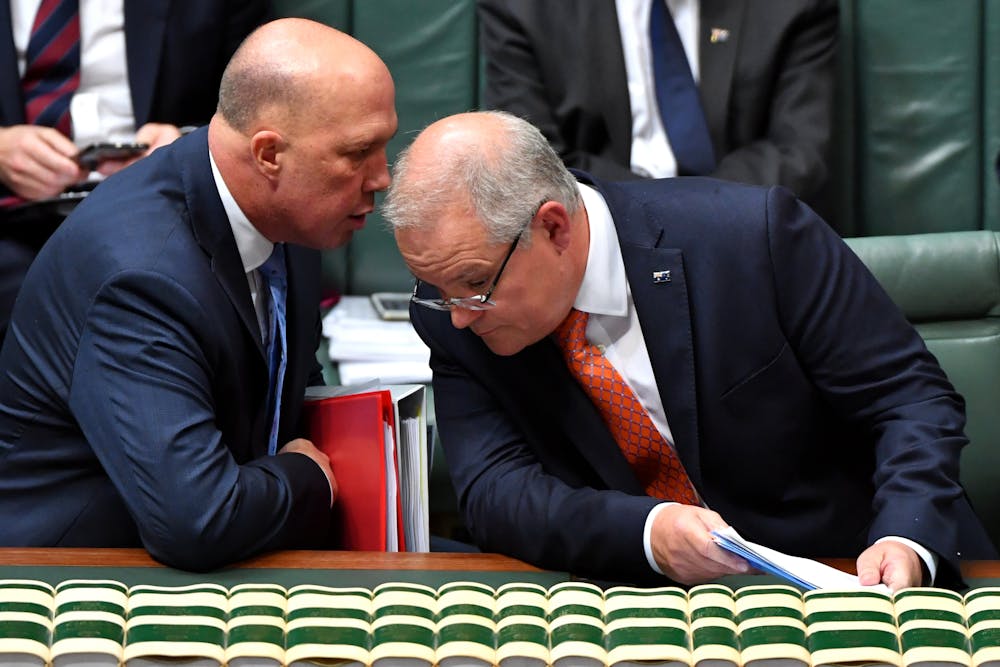
Dutton and the Prime Minister in parliament yesterday. Dutton proposed a bill that if passed could prevent Australian citizens from entering the country for up to two years. Sam Mooy/ AAP

How would the bill work?

If passed, the bill will allow the minister to issue a Temporary Exclusion Order (TEO) preventing an Australian citizen who is overseas from re-entering Australia. These exclusion orders aren’t designed to exclude citizens from Australia forever, but rather to provide a system that manages their return.

A TEO can be imposed on a citizen outside Australia if they are at least 14 years old, and:

  • the minister reasonably suspects that issuing the TEO would substantially help prevent terrorism-related acts, or

  • ASIO has assessed the person to be a direct or indirect risk to security, for reasons related to political violence. ASIO doesn’t need to be satisfied to any standard of proof when making this assessment.

But neither of these criteria actually requires a TEO candidate to have engaged in any wrongdoing.

A person may not enter Australia while a TEO is in force against them. If they do, they can face up to two years behind bars. A TEO may also require the person to surrender their Australian passport.

Each TEO can be issued for a maximum of two years, but a person may have multiple TEOs issued against them. This means the actual period of exclusion from Australia can be much longer.

So how does a return to Australia work?

The return of citizens with TEOs against them is managed through “return permits”. This is designed to allow the government to monitor and control foreign fighters’ entry and presence in Australia. A return permit must be issued if the person applies for one, or if a foreign country moves to deport them to Australia.


Read more: How can we understand the origins of Islamic State?


A return permit may prescribe various conditions. Significantly, it doesn’t guarantee an immediate right to return to Australia – a person may be prohibited from entering Australia for up to 12 months after the permit is issued.

Once in Australia, a range of post-entry conditions may also be imposed. These can include passport surrender, and requirements to report changes to residence or employment, contact with particular individuals and technology use.

Breaching the conditions of a return permit is an offence, punishable by up to two years in prison.

Are the proposed laws constitutional and compatible with international law?

The right to return to one’s country is commonly regarded as a core aspect of citizenship. And some experts have argued that a citizen’s right to return home is constitutionally protected in Australia.

But the High Court has never ruled on the question of whether a constitutional right of this nature exists, so it’s impossible to say for certain whether the bill, if passed, would be unconstitutional. Still, it’s likely to face constitutional challenge.

In any case, international law protects an individual’s right to voluntarily return to their country of citizenship. The government acknowledges that TEOs restrict a person’s capacity to do this, but says the bill is justified because it’s “reasonable, necessary and proportionate”. This, however, isn’t clear.

Does the bill contain adequate safeguards?

In April, when reviewing the original bill, the Parliamentary Joint Committee on Intelligence and Security recommended 18 changes, aimed at improving safeguards.

But the new bill only took on seven changes in full, including requiring the minister to consider specific criteria when imposing a TEO on a child, and providing independent oversight of decisions to issue TEOs.


Read more: If Dutton had defeated Turnbull, could the governor-general have stopped him becoming prime minister?


Importantly, some of the committee’s most significant recommendations have been ignored, such as narrowing the criteria for issuing a TEO. And others have only been partially implemented.

Given the significant impact a TEO has on a person, the bill should adopt the committee’s recommendations in full.

Is the bill even necessary?

In parliament, Dutton said national security agencies advise that many Australians who have travelled to conflict zones in Syria and Iraq to support extremist groups are “likely to seek return to Australia in the very near future”, and the bill is needed to keep Australians safe.

But the government hasn’t explained why Australia’s extensive suite of existing anti-terrorism mechanisms doesn’t already adequately protect against threats posed by Australians returning from conflict zones.

AFP Assistant Commissioner, Ian McCartney, addressed the media earlier this week after police successfully disrupted an alleged Islamic State-inspired plot in Sydney. Dan Himbrechts/ AAP

Australia’s 75 pieces of legislation provide for criminal penalties, civil alternatives to prosecution, expanded police and intelligence powers, and citizenship revocation.

And they protect Australia from the risks posed by returning foreign fighters in a variety of ways.

For example, a person who returns to Australia as a known member of a terrorist organisation can be charged with an offence punishable by up to 10 years’ imprisonment. Where the person has done more – such as fight, resource or train with the organisation – penalties of up to 25 years each apply.

Although gathering sufficient evidence to prosecute returning foreign fighters can prove challenging, there are mechanisms in our legislation that already account for this.

For instance, a control order may be imposed on a person in cases where they are deemed a risk but there is not enough evidence to prosecute. This restricts the person’s actions through measures such as curfews and monitoring requirements.


Read more: Explainer: why some acts are classified as terrorism but others aren’t


Evidence shows the existing measures work effectively. Police and intelligence agencies have successfully disrupted a significant number of terror plots using existing laws, most recently just days ago.

Arguably, this suggests Australia has not only the capacity, but also the responsibility to use the full force of our laws to bring foreign fighters to justice in Australia, rather than leave them stranded in conflict zones where their only connections may be to terrorist groups, thereby weakening global security.

Of course, if it’s to remain fit for purpose, Australia’s national security framework must continue to adapt to changing circumstances. But with extensive, demonstrably effective mechanisms in place, the government must clearly explain what gap this bill would fill. This has not been done.

ref. There’s no clear need for Peter Dutton’s new bill excluding citizens from Australia – http://theconversation.com/theres-no-clear-need-for-peter-duttons-new-bill-excluding-citizens-from-australia-119876

NZ’s plan for deposit insurance falls well short of protecting people’s savings

Source: The Conversation (Au and NZ) – By Helen Mary Dervan, Senior lecturer in law BCL(Oxon), TEP, Auckland University of Technology

The New Zealand government’s plan to introduce deposit insurance is a welcome step. Last week, finance minister Grant Robertson announced a new deposit protection regime to make the banking system safer for customers and to strengthen accountability for banks’ actions.

Worldwide, 143 countries have deposit insurance schemes, and New Zealand has long been an outlier. It is high time one was introduced.


Read more: ‘Do no harm’ isn’t enough. Why the banking royal commission will ultimately achieve little


How deposit insurance works

Currently, if a bank fails in New Zealand, depositors could lose all or some of their savings. Deposit insurance would change that and protect depositors’ savings. It operates like other types of insurance. If disaster strikes and a bank fails, depositors’ savings would be repaid up to a set limit.

According to Reserve Bank data, New Zealand households store about NZ$177.98 billion of their cash resources in banks. The proposed plan is important for all New Zealanders. Most people with a bank account are retail depositors and may be unaware of the vulnerable position they could find themselves in.

Under the Reserve Bank’s controversial open bank resolution policy, if a bank is distressed and under statutory management, part of a retail depositor’s savings may be frozen and used to recapitalise the bank, if shareholder and subordinated creditor funds prove insufficient. Essentially, New Zealand retail depositors would have to bail out their banks, unlike retail depositors in other countries who are protected by deposit insurance up to a set limit.

Apart from protecting depositors, the insurance helps to maintain stability in the financial system. It operates primarily to stop bank runs where depositors, afraid that they will lose their money, all demand repayment at once. Images of people lining up outside banks and at ATM machines all trying to get their money out were a feature of the 2007-2008 Global Financial Crisis (GFC). If people are confident that they will get their money back quickly from deposit insurance, they do not need to “run” on their banks.

Banks own the money you deposit

Depositors are vulnerable because once their money is with a bank, it no longer legally belongs to them. It belongs to the bank which can use it for its own commercial purposes. Typically, banks will lend this money to individuals and businesses (for example, through mortgages), making a profit by charging interest. In return, depositors get the right to repayment of their savings on demand.

Banks have fragile business models because they borrow short (through deposits which are repayable on demand) and lend long (through mortgages and other loans that are repayable at a fixed date in the future). Banks do not hold sufficient funds to repay all, or even most, of their depositors at once. Bank regulation provides some protection because banks are required to maintain certain levels of capital and liquidity, but if depositors panic and enough of them demand repayment, a bank can very quickly become insolvent.

Problems in one bank can pass to other banks and from banks to other types of businesses like a virus (this process is known as contagion). Eventually, this can build up to a financial crisis and lead to a recession, just as the GFC did in New Zealand and in many other countries. In a recession, almost everyone suffers, but the burden often falls most heavily on the poorest in society who have few assets to fall back on.

Protecting people and businesses

Retail depositors provide the bulk of bank funding in New Zealand (more than 60% of bank funding comes from households) and they currently carry a degree of risk of bank failure but are not properly protected by the law.

The Reserve Bank has traditionally opposed deposit insurance because of “moral hazard”. Their argument has been that protecting retail depositors from bank failure would discourage depositors from monitoring and disciplining their banks by withdrawing their savings if banks engage in overly risky activities.

This argument is based on the premise that retail depositors are capable of monitoring their banks, which requires a high level of financial literacy. The weakness in this argument was exposed during the GFC when New Zealand was forced to establish a temporary deposit guarantee scheme to reassure depositors that their savings were safe. Other countries, like the UK, recognise this vulnerability and provide an appropriate level of deposit insurance.


Read more: Vital Signs. If we fall into a recession (and we might) we’ll have ourselves to blame


The New Zealand government has proposed a limit of between NZ$30,000 and NZ$50,000, saying that this would cover up to 90% of depositors. But this is well below the limits set by other comparable countries. For example, the limit is about NZ$374,000 in the US, NZ$114,000 in Canada, NZ$161,000 in the UK and NZ$262,000 in Australia.

If the limit is too low, the risk is that the deposit insurance scheme will not stop bank runs and not protect financial stability and the economy. It could even cause pre-emptive bank runs. If that happened, the government would need to urgently increase the deposit insurance limit and take other extraordinary measures, but this can lead to other difficulties, including increased overall costs, which ultimately fall back on the taxpayer.

Defining the best limit

One rule of thumb says the limit should be two to three times a country’s per-capita GDP. For New Zealand, this would mean between NZ$100,000 and NZ$150,000.

The government should be given credit for raising the issue of deposit insurance – a scheme should have been introduced years ago. But the low limit was proposed without public consultation. That is wrong.

The deposit insurance limit should not be decided solely by the Reserve Bank and Treasury. Other stakeholders have an important and valuable contribution to make. The debate should be transparent and well informed.

The second phase of the current review of the Reserve Bank Act will look at how a deposit insurance scheme should be funded. It should also include public consultation on the optimal level of deposit insurance. Having finally got the issue on the table, we should not squander the opportunity to do something important for New Zealanders.

ref. NZ’s plan for deposit insurance falls well short of protecting people’s savings – http://theconversation.com/nzs-plan-for-deposit-insurance-falls-well-short-of-protecting-peoples-savings-117890

Inside the story: 99 versions of the same tale in The Drover’s Wives

Source: The Conversation (Au and NZ) – By Dave Drayton, Lecturer in Creative Writing, University of Technology Sydney

Why do we tell stories, and how are they crafted? In this series, we unpick the work of the writer on both page and screen.


Ryan O’Neill’s recent book The Drover’s Wives joins a rich corpus of Australian literary works inspired by Henry Lawson’s short story, The Drover’s Wife (first published in The Bulletin in 1892).

But O’Neill’s approach differs from that of other authors, by offering not one reinterpretation – as in Frank Moorhouse’s satirical take and Barbara Jefferis’ feminist retelling, for example – but 99 different versions of the story.

His book envisages the Lawson story in various forms, including: as a tweet, a school English essay, an Amazon book review, a limerick, a computer game, a gossip column, and even a sporting commentary.

O’Neill’s book is dedicated to both Henry Lawson and French novelist Raymond Queneau. The latter was a founding member of the Oulipo (Ouvroir de Littérature Potentielle), a mostly French assortment of experimental writers, mathematicians and scientists, founded in 1960.

O’Neill attempts Queneau’s method of literary variations on a theme in Exercises In Style (first published in French in 1947), but with an Australian context.

Goodreads

Lawson’s The Drover’s Wife provides the central narrative of O’Neill’s test. In the story, the titular wife of the absent drover spends a sleepless night keeping watch for a snake that had earlier alarmed her children. She passes the time reminiscing on hardships she has faced in the bush before. As daylight nears, the snake appears, and she clubs it to death.

As with Exercises In Style, the original narrative in O’Neill’s book is of secondary importance to the telling and the myriad ways these tellings transform the tale.

O’Neill’s experiment highlights the fact all writing is constrained by certain rules. It’s easier to play the game when you know these rules (and bend them, too).

By taking a text so familiar as its starting point, O’Neill’s tweaks show the conventions of 99 different forms of writing, while shining new light on Lawson’s classic in the process.

Narrative techniques

The fourth reinterpretation in The Drover’s Wives – a “Year 8 English Essay” – begins with the prompt: “What narrative techniques does Lawson use to shape the reader’s perception of the drover’s wife?” With some substitution, we might re-render the question: “What narrative techniques does O’Neill use to shape the reader’s perception of The Drover’s Wife?” Let me count the ways …

Among the most interesting rewrites is a version of the poem where the story is reduced to only onomatopoeia (words that look like the sound they make): the snake is represented by “slithers, sizzles and snaps”.

In another version, he experiments with “spoonerisms” – a display of shining wit where the initial syllables of two or more words are transposed. Instead of a “small herd of grass eaters”, O’Neill renders the drover’s flock as a “small herd of ass greeters”.

He even includes a tanka, a Japanese poetic form similar to haiku:

A snake approaches.
The woman and children run
And hide in the house.
Through the long night she watches –
Shedding memories like scales
And the snake burns with the dawn.

O’Neill departs from the methods originally proposed by Queneau’s book by progressing into more contemporary territory (using PowerPoint lecture slides; a 1980s computer game; emojis; tweets; an Amazon book review; a reality TV show; a meme; a spam e-mail; and internet comments).

He also uses forms specific to an Australian cultural context (an RSCPA report; a letter to the Daily Telegraph; Ocker; and Bush Ballad).

Portraits of Australian author Henry Lawson. Ryan O’Neill joins a long line of writers who have put their own spin on Lawson’s classic short story. Mitchell Library, State Library of New South Wales

Techniques of transformation

A useful way to illustrate the impact of each technique employed by O’Neill is to examine its effect on the opening paragraph in Lawson’s original, used to establish the scene:

The two-roomed house is built of round timber, slabs, and stringy-bark, and floored with slit slabs. A big bark kitchen standing at one end is larger than the house itself, veranda included.

In O’Neill’s text:

  • the Monosyllabic chapter re-renders the opening with single syllable words: “They lived in the bush in a shack with two rooms, miles and miles from the main road […] ”

  • the Yoked Sentence chapter, requiring each sentence to begin with the last word of the previous sentence, opens: “The drover’s wife and her four children lived in an isolated house deep in the bush. Bush was all around, and the nearest neighbour was miles away. Away to the north somewhere, the drover […]”

  • in the Lipogram chapter, which requires the conscious omission of one or more letters, the omission of the letter E renders the exposition differently: “A bush cabin in an outlying part of Australia marks a distant location for our story”.

The opening paragraph is likewise transformed by the use of rhyme in various other chapters.

One that takes the form of a 1950s Children’s Book begins: “There was once a bush farm that the sun rose over, and on that little farm lived the wife of a drover.”

In the Elizabethan Drama chapter, the chorus does the expositional work, beginning their prologue: “A household, poor but rich in dignity / In fair Australia where we lay our scene / Bush all around in stretches to infinity / No indoor plumbing, just an old latrine.”

As is common, the opening lines of the limerick chapter introduce not the house, but the central character of the poem: “There once was the wife of a drover, Who met with a snake, and moreover …”.

In the 1980s Computer Game chapter, the new level of interactivity is made apparent with a shift to second person narration: “You are in a large kitchen by a two-room house”.

A similar technique is used to achieve the tone in the Cosmo Quiz chapter, which parodies the conventions of a glossy magazine quiz: ten multiple choice questions to show you whether you’re a time traveller’s wife, a Stepford wife or a drover’s wife.

How do these various narrative techniques shape perception of Lawson’s original story? On their own, each may heighten or enhance a latent quality that lies in waiting. For instance, the Cosmo Quiz reveals the gender dynamics, satirising the protagonist’s apparent absent agency.

Taken as a whole, the book functions equally as a playful and experimental collection of brief narratives, and an illustrative compendium of writing techniques.

ref. Inside the story: 99 versions of the same tale in The Drover’s Wives – http://theconversation.com/inside-the-story-99-versions-of-the-same-tale-in-the-drovers-wives-112407

Thinking of laser hair removal? Here’s what you need to know

Source: The Conversation (Au and NZ) – By Rodney Sinclair, Professor of Dermatology, University of Melbourne

Unwanted facial and body hair can affect the way we feel, our social interactions, what we wear and what we do.

Options to camouflage or remove unwanted hair include plucking, shaving, bleaching, using creams and epilation (using a device that pulls out multiple hairs at once).

Longer-term options include electrolysis, which uses an electrical current to destroy individual hair follicles, and laser therapy.

So what is laser therapy? What can it achieve? And what are the side-effects?


Read more: Friday essay: how 19th century ideas influenced today’s attitudes to women’s beauty


How does laser treatment work?

Lasers emit a wavelength of light with a specific single colour. When targeted to the skin, the energy from the light is transferred to the skin and hair pigment melanin. This heats up and damages the surrounding tissue.

But to remove hair permanently and to minimise damage to the surrounding tissue, the laser needs to be targeted to specific cells. These are the hair follicle stem cells, which sit in part of the hair known as the hair bulge.

The laser needs to be targeted to stem cells that sit in the hair bulge. from www.shutterstock.com

As the skin surface also contains melanin, which we want to avoid damaging, people are carefully shaved before treatment.


Read more: Monday’s medical myth: shaved hair grows back faster and thicker


Will it remove hair permanently?

Laser treatment can either permanently reduce the density of the hair or permanently remove unwanted hair.

Permanent reduction in hair density means some hairs will regrow after a single course of therapy and patients will need ongoing laser treatment.

Permanent hair removal means none of the hairs in the treated area will regrow after a single course of therapy and no ongoing laser therapy is needed.

Whether hair is removed permanently or just reduced in density is influenced by:

  • the colour and thickness of the hairs being treated
  • the colour of the patient’s skin
  • the type and quality of the laser used, and
  • the competence and training of the person operating the laser.

However, if you have grey hairs, which have no melanin pigmentation, currently available lasers don’t work.

How many treatments will I need?

The number of treatments you’ll need depends on your Fitzpatrick skin type. This classifies your skin by colour, its sun sensitivity and its likelihood to tan.

Pale or white skin, burns easily, rarely tans (Fitzpatrick types 1 and 2) People with dark hair can usually achieve permanent hair removal with 4-6 treatments every 4-6 weeks. People with fair hair will generally only achieve permanent hair reduction and after an initial course of treatment may need 6-12 treatments a month apart.

Laser treatment work best in the hands of a professional. Author provided

Light brown skin, sometimes burns, slowly tans to light brown (type 3) People with dark hair can usually achieve permanent hair removal with 6-10 treatments every 4-6 weeks. People with fair hair will generally only achieve permanent hair reduction and after an initial course of treatment may require 3-6 repeat treatments a month apart.

Moderate brown to dark brown skin, rarely burns, tans well or to moderate brown (type 4 and 5) People with dark hair can usually achieve permanent hair reduction with 6-10 treatments every 4-6 weeks. Maintenance will usually be required with 3-6 monthly repeat treatments. People with fair hair are unlikely to respond.

Re-treatments must be long enough apart to allow new hair growth to reach the level of the bulge.

What side effects or complications should I be aware of?

You will be advised to wear goggles during the treatment to prevent eye injury.

You will also experience some pain during treatment, especially the first few. This is mainly due to not removing all hair in the area to be treated before the procedure. Hairs missed while shaving absorb laser energy and heat the skin surface. There is less pain with repeat treatments at regular intervals.

Your skin will feel hot for 15-30 minutes after laser treatment. There may be redness and swelling for up to 24 hours.

More serious side effects include blisters, too much or too little skin pigmentation, or permanent scarring.

These generally occur in people with a recent suntan and the laser settings have not been adjusted. Alternatively, these side-effects can occur when patients are taking medications that affect their skin’s response to sunlight.

Does the type of laser matter?

The type of laser not only influences how well it works, it influences your chance of side-effects.

Lasers suitable for hair removal include: long-pulse ruby lasers, long-pulse alexandrite lasers, long pulse diode lasers and long-pulse Nd:YAG lasers.


Read more: Explainer: how are tattoos removed?


Intense pulsed light (IPL) devices are not laser devices but flash lamps that emits multiple wavebands of light simultaneously. They work in a similar way to lasers, albeit less effectively and they are much less likely to permanently remove hair.

To minimise the risk of damage to melanin producing cells on the skin surface, the choice of laser and how it’s used can be matched to your skin type.

Fair skinned people with dark hair can use an IPL device, an alexandrite laser or a diode laser; people with dark skin and dark hair can use a Nd:YAG or diode laser; and people with blond or red hair can use a diode laser.

To control the spread of heat and unwanted tissue damage, short laser pulses are used. The energy of the laser is also adjusted: it needs to be high enough to damage the bulge cells but not so high to cause discomfort or burns.

Can I buy a home laser device and do it myself?

Home laser devices and IPL home devices are available in Australia and cost between $200 and $1,000. But they don’t tend to work as well and you need to use them repeatedly to maintain hair reduction.

Parameters are only set for people with fair skin (Fitzpatrick types 1 and 2) and dark hair. For safety, energy settings are capped. And in inexperienced hands, complications may still arise. This includes burns, pain, blistering and changes to skin pigmentation.


Read more: ‘Do I need to shave my pubic hair before having sex?’


By contrast, medical grade lasers must be registered with the government regulator, the Therapeutic Goods Administration. There are also national and state-based regulations about the facility where the laser is used, compulsory laser safety training requirements and state-based qualifications and licensing for laser operators.

So, a safe and regulated laser in the hands of a skilled professional is recommended.

When to see your GP

Not all excess hair is cause for concern. But severe hirsuitism (excess growth of dark and coarse hair over areas of the body where it ordinarily wouldn’t grow) or hypertrichosis (excess hair growth for someone’s age, sex or race) can be clues to underlying illness.

Hirsutism, especially when associated with symptoms including irregular periods or acne, can be caused by extra androgen hormones. Hypertrichosis later in life can be a sign of malignancy.

Your GP can investigate these.

ref. Thinking of laser hair removal? Here’s what you need to know – http://theconversation.com/thinking-of-laser-hair-removal-heres-what-you-need-to-know-113561

VIDEO: Michelle Grattan on the 46th parliament’s first week, and Jacqui Lambie

Source: The Conversation (Au and NZ) – By Michelle Grattan, Professorial Fellow, University of Canberra

Michelle Grattan talks with University of Canberra Vice-Chancellor and President Professor Deep Saini about the new parliament’s first week back on the hill, including how Jacqui Lambie and Centre Alliance’s vote made it possible for the government’s tax cuts to be passed, and the Reserve Bank’s decision to further cut interest rates.

ref. VIDEO: Michelle Grattan on the 46th parliament’s first week, and Jacqui Lambie – http://theconversation.com/video-michelle-grattan-on-the-46th-parliaments-first-week-and-jacqui-lambie-119924

I’ve always wondered: who calls cyclones their names?

Source: The Conversation (Au and NZ) – By Richard Wardle, Weather Services Manager, Queensland, Australian Bureau of Meteorology

This is an article from I’ve Always Wondered, a series where readers send in questions they’d like an expert to answer. Send your question to alwayswondered@theconversation.edu.au


Who calls cyclones their names? – Guy Mullin, Mozambique.

In the Australian region, the Bureau of Meteorology gives tropical cyclones their name. You can write to the Bureau of Meteorology to suggest a cyclone name, but it is likely to be more than a 50-year wait.

Tropical cyclones are named so we can easily highlight them to the community, and to reduce confusion if more than one cyclone happens at the same time. The practice of naming tropical cyclones (or storms) began years ago to help in the quick identification of storms in warning messages. Humans find names far easier to remember than numbers and technical terms.

Aerial views of flooded areas following Cyclone Idai in March 2019. EU Civil Protection and Humanitarian Aid Operations/flickr, CC BY-NC-ND

Read more: Explainer: ‘bomb cyclones’ – the intense winter storms that hit the US (and Australia too)


Clement Wragge began naming cyclones in 1887

Tropical Cyclone Oma captured by NASA international space station. NASA Johnson/flickr, CC BY-NC-ND

Now, people ask us all the time how we come up with the names for tropical cyclones. It started in 1887 when Queensland’s chief weather man Clement Wragge began naming tropical cyclones after the Greek alphabet, fabulous beasts, and politicians who annoyed him.

After Wragge retired in 1908, the naming of cyclones and storms occurred much less frequently, with only a handful of countries informally naming cyclones. It was almost 60 years later that the Bureau formalised the practice, with Western Australia’s Tropical Cyclone Bessie being the first Australian cyclone to be officially named on January 6, 1964.

Other countries quickly began using female names to identify the storms and cyclones that affected them.

Naming cyclones helps people quickly identify storms in warning messages. Cameras outside the NASAA international space station capture Hurricane Florence in 2018. NASA Goddard Space Flight Center/flickr, CC BY-SA

Read more: I’ve Always Wondered: How do we know what lies at the heart of Pluto?


How cyclone names are chosen

While the world was giving female names to cyclones and storms, International Women’s Year in 1975 saw Bill Morrison, the then Australian science minister, recognise that both sexes should bear the shame of the devastation caused by cyclones. He ordered cyclones to carry both male and female names, a world first.

These days the Bureau is responsible for naming tropical cyclones in the Australian region, with the names coming from an alphabetical list suggested by the Australian public. These names alternate between male and female. The Bureau of Meteorology receives many requests from the public to name tropical cyclones after themselves, friends, and even pets.

The Bureau cannot grant all these requests, as they far outnumber the tropical cyclones that occur in the Australian region.

Trees on the side of the road at Mission Beach, North Queensland, in the aftermath of Cyclone Yasi, 2011. Cyclone Yasi formed in Fiji and maintained the name from that region’s weather agency. Michael Dawes/flickr, CC BY-NC

Read more: Curious Kids: What causes windy weather?


Cyclone Oma was named in Fiji

Cyclone names are reused, but when a tropical cyclone severely impacts the coast, or is deadly, like Debbie in 2017 and Tracy in 1974, the name is permanently retired for reasons of sensitivity.

If a listed name comes up that matches the name of a well-known person, or someone in the news for a sensitive or controversial reason, the name is skipped to avoid any offence or confusion.

When a cyclone forms in another region, say near Fiji or in the Indian Ocean, and then travels into the Australian region, the original name given by that region’s weather agency is kept, such as 2019’s Cyclone Oma, which came from Fiji.

Tropical cyclone Bessie was the first Australian cyclone to be officially named by the Bureau of Meteorology.

A list of cyclone names around the world can be found here.

ref. I’ve always wondered: who calls cyclones their names? – http://theconversation.com/ive-always-wondered-who-calls-cyclones-their-names-116885

Marchers in Tahiti ‘mourn’ French nuclear weapons test legacy

By RNZ Pacific

An estimated 2000 people have joined a march in French Polynesia this week to mark the 53rd anniversary of France’s first atomic weapons test in the Pacific.

The first test was on July 2, 1966, after nuclear testing was moved from Algeria to the Tuamotus.

Organisers of the Association 193 described it as a “sad date that plunged the Polynesia people into mourning forever”.

READ MORE: The effects of the French nuclear tests in the Pacific are still reverberating

The test on Moruroa atoll was the first of 193 which were carried out over three decades until 1996.

The march was to the Pouvanaa a Oopa place honouring a Tahitian leader.

-Partners-

The march and rally were called by test veterans’ groups and the Maohi Protestant church to also highlight the test victims’ difficulties in getting compensation for ill health.

After changes to the French compensation law, the nuclear-free organisation Moruroa e Tatou wants it to be scrapped as it now compensates no-one.

The Association 193 said it was withdrawing from the project of the French state and the French Polynesian government to build a memorial site in Papeete, saying it will only serve as propaganda.

Apart from reparations for the victims, the organisation want studies to be carried out into the genetic impact of radiation exposure.

  • This article is published under the Pacific Media Centre’s content partnership with Radio New Zealand.
Mock coffins as Tahitians “mourn” the 53rd anniversary of France’s first atomic weapons test in the Pacific. Image: Association 193
Anti-nuclear rally
Tahitians at the rally to “mourn” the 53rd anniversary of France’s first atomic weapons test in the Pacific. Image: Association 193
Print Friendly, PDF & Email

Article by AsiaPacificReport.nz

Walking and cycling to work makes commuters happier and more productive

Source: The Conversation (Au and NZ) – By Liang Ma, Vice-Chancellor’s Postdoctoral Research Fellow, RMIT University

In Australia, more than 9 million people commute to work every weekday. The distance they travel and how they get there – car, public transport, cycling or walking – can influence their well-being and performance at work.

Our study, involving 1,121 full-time workers who commute daily to work, made several important findings:

  • those who commute longer distances tend to have more days off work
  • among middle-aged workers, those who walk or cycle performed better in the workplace
  • Those who commute short distances, walk or cycle to work, are more likely to be happy commuters, which makes them more productive.

Read more: How the everyday commute is changing who we are


In Australia, full-time workers spend 5.75 hours a week on average travelling to and from work. Among them, nearly a quarter of commutes can be classed as lengthy (travel for 45 minutes or more one way).

Long commutes not only cause physical and mental strains on workers, but may also affect their work participation, engagement and productivity.

And Australia’s pervasive urban sprawl means most workers commute by car. But driving has been found to be the most stressful way to commute.

Driving to work is associated with a series of health problems and lower social capital (smaller social networks with less social participation), which all affect work performance and productivity.

What did the study look at?

Our research investigated how and to what extent our daily commuting can influence workplace productivity. We surveyed 1,121 employees from Sydney, Melbourne and Brisbane. These employees are all employed full-time, have a fixed place of employment, make regular commuting trips and work in different industries and occupations.

We found that workers with a long-distance commute have more absent days, as the graph below shows.

Predicted number of days absent from work with increasing commuting distance. Author provided

Two reasons can explain this result. First, workers with long commutes are more likely to become ill and be absent. Second, workers with long commutes receive less net income (after deducting travel costs) and less leisure time. Therefore, they are more likely to be absent to avoid the commuting cost and time.

The average commuting distance for Australian capital cities is about 15km. Workers with a commuting distance of 1km have 36% fewer absent days than those commuting 15km. Workers who commute 50km have 22% more absent days.

This study also finds that middle-aged (35-54) commuters who walk or cycle – known as active travel – have better self‐reported work performance than public transport and car commuters. This result may reflect the health and cognitive benefits of active travel modes.

Finally, this study finds the short-distance and active travel commuters reported they were relaxed, calm, enthusiastic, and satisfied with their commuting trips, and were more productive.


Read more: Commuters help regions tap into city-driven growth


How does commuting affect productivity?

Urban economic theory provides one explanation of the link between commuting and productivity. It argues that workers make trade-offs between leisure time at home and effort in work. Therefore, workers with long commutes put in less effort or shirk work as their leisure time is reduced.

Commuting can also affect work productivity through poorer physical and mental health. Low physical activity can lead to obesity as well as related chronic diseases, significantly reducing workforce participation and increasing absenteeism. The mental stress associated with commuting can further affect work performance.

A growing number of studies have found active commuting by walking and cycling is perceived to be more “relaxing and exciting”. By contrast, commuting by car and public transport is more “stressful and boring”. These positive or negative emotions during the commute influence moods and emotions during the work day, affecting work performance.

Finally, commuting choice could influence work productivity through cognitive ability. Physical activity improves brain function and cognition, which are closely related to performance. So it’s possible that active travel commuters might have better cognitive ability at work, at least in the several hours after the intense physical activity of cycling or walking to work.

The pathways through which walking and cycling to work might influence productivity. authors

Read more: Stop working on your commute – it doesn’t benefit anyone


What are the policy implications?

Employers should consider types of commuting as part of their overall strategies for improving job performance. They should aim to promote active commuting and, if possible, to shorten commuting time. For example, providing safe bike parking and showers at work could significantly increase cycling to work.

As for governments, in most states of Australia, only a tiny portion (less than 2%) of transport funding is devoted to bicycling infrastructure.

By contrast, in the Netherlands most municipalities have specific budget allocations to implement cycling policies. Australia should allocate more transport infrastructure funding to active travel, given the economic benefits of walking and cycling to work.


Read more: Cycling and walking are short-changed when it comes to transport funding in Australia


ref. Walking and cycling to work makes commuters happier and more productive – http://theconversation.com/walking-and-cycling-to-work-makes-commuters-happier-and-more-productive-117819

Emoji aren’t ruining language: they’re a natural substitute for gesture ???

Source: The Conversation (Au and NZ) – By Lauren Gawne, David Myers Research Fellow, La Trobe University

We’re much more likely to be hanging out on social media than at the watercooler these days. But just because we’re no longer face-to-face when we chat, doesn’t mean our communication is completely disembodied.

Over the last three decades, psychologists, linguists, and anthropologists, along with researchers from other traditions, have come together to understand how people gesture, and the relationship between gesture and speech.

The field of gesture studies has demonstrated that there are several different categories of gesture, and each of them has a different relationship to the words that we say them with. In a paper I co-authored with my colleague Gretchen McCulloch, we demonstrate that the same is true of emoji. The way we use emoji in our digital messages is similar to the way we use gestures when we talk.


Read more: What your emojis say about you


What gestures and emoji have in common

We can break speech down into its component parts: sentences are made of words, words are made of morphemes, and morphemes are made of sounds.

Signed languages have the same features of grammar as spoken languages, but with hand shapes instead of sounds. They have some advantages in complex expressions that spoken languages don’t have, but there are gestures as well as grammatical features when people sign.

By contrast, gestures and emoji don’t break down into smaller parts. Nor do they easily combine into larger words or sentences (unless we’re using a clunky version of the grammar of our language).

While there are preferences, there is nothing “grammatical” about using ? instead of ?. Rather, what is most important is context. ? could be a reference to your own dog, a good dog you saw while out for a walk, or a sign of your fondness for puppers over kitties.

There are some gestures that can have a full meaning even in the absence of speech, including the thumbs up ?, the OK sign ? and good luck ?. Gestures like these are known as emblems, some of which are found in the emoji palette. Some object emoji have also developed emblematic meanings, such as the peach ?, which is most typically used non-illustratively to represent a butt.

Many gestures and emoji do not have these specific meanings. So, let’s take a look at different ways emoji are used to communicate with reference to a common framework used to categorise gestures.

Illustrative and metaphoric emoji

Illustrative gestures model an object by indicating a property of its shape, use, or movement, such as the classic “the fish was THIS big” gesture. Similarly, we often use emoji to illustrate the nature of a message. When you wish someone a happy birthday you might use a variety of emoji, such as the cake with candles ?, slice of cake ?, balloon ?, and wrapped gift ?.

It’s not grammatically correct to say “birthday happy”, but there’s no “correct” sequence of emoji, just as there is no one correct way to gesture your description of the fish you caught.

We also have metaphoric uses of gesture and emoji. Unlike a “big fish”, a “big idea” doesn’t have a physical size, but we might gesture that it does. Similarly, our analysis showed that people typically use the “top” emoji ? to mean something is good.


Read more: Emoji are becoming more inclusive, but not necessarily more representative


Beat gestures are used for emphasis

Another common type of gesture used to draw attention is a beat gesture, distinguished by a repetitive “beat” pattern. Some uses of emoji have a direct parallel to beat gestures. For example, using the double clap ? for emphasis, which has its origins in African American English.

The emphatic nature of beat gestures helps explain something about common strings of emoji. When we looked at sequences of emoji the most common patterns are pure repetition, such as two tears of joy emoji ??, or partial repetition such as two heart eyes and blowing a kiss/heart ???. Repetition for emphasis is rare (but possible) with words, but very common for gesture and emoji.

Along with these categories, we also looked at pointing and illocutionary gestures and emoji, which help show your intentions behind what you’re saying – whether that’s amused ? or ambivalent ?.


Read more: Understanding the emoji of solidarity


Emoji have limitations that gestures don’t

There are obviously some differences between online and physical chat. Gestures and speech are closely synchronised in a way emoji and text can’t be. Also, the scope of possibilities with gesture are limited only to what the hands and body can do, while emoji use is limited to the (currently) 2,823 symbols encoded by Unicode.

Despite these differences, people still use the resources available to them online to do what they’ve been doing in face-to-face conversations for millennia. Bringing together research on gesture and internet linguistics, we argue there are far more similarities between emoji and gesture than there are between emoji and grammar.

Instead of worrying that emoji might be replacing competent language use, we can celebrate the fact that emoji are creating a richer form of online communication that returns the features of gesture to language.

ref. Emoji aren’t ruining language: they’re a natural substitute for gesture ??? – http://theconversation.com/emoji-arent-ruining-language-theyre-a-natural-substitute-for-gesture-118689

Australia: Why Christopher Pyne and Julie Bishop fail the ‘pub test’ with their new jobs

Source: The Conversation (Au and NZ) – By Yee-Fui Ng, Senior Lecturer, Faculty of Law, Monash University

Labor has criticised former ministers Christopher Pyne and Julie Bishop for taking up new roles related to their government portfolios, saying these actions breach ministerial standards.

Pyne, the former defence minister, was appointed as defence consultant to consulting firm EY a month after leaving parliament, while Bishop, the former foreign minister, was appointed to the board of the private overseas aid consultancy firm Palladium, less than a year after quitting the ministry.

Following the threat by Senator Rex Patrick to call a Senate inquiry into Pyne’s new job, Prime Minister Scott Morrison has sought advice from the head of his department on whether there has been a breach of ministerial standards.

What do the ministerial standards say?

Ministerial standards set out the standards of conduct expected of ministers. The principle underlying the standards is that ministers should uphold the public’s trust since they wield a great deal of power deriving from their public office.

Morrison’s statement of ministerial standards proclaims

All ministers and assistant ministers are expected to conduct themselves in line with standards established in this statement in order to maintain the trust of the Australian people.

In the cases of Pyne and Bishop, the standards further state that ministers must not “lobby, advocate or have business meetings with members of the government, parliament, public service or defence force” for 18 months after leaving parliament on matters they dealt with in their final 18 months as ministers.

It also prohibits ministers from taking personal advantage of information to which they have had access as a minister, where that information is not generally available to the public.

Pyne and Bishop have both claimed their new jobs are consistent with the ministerial standards.

Pyne argued that providing occasional high-level strategic advice in his new role at EY does not equate to lobbying or involve the use of information he had acquired in his portfolio.


Read more: Cabinet ministers Pyne and Ciobo set to head out door


Bishop, meanwhile, has defended her new role by saying

I am obviously aware of the obligations of the ministerial guidelines and I am entirely confident that I am and will remain compliant with them.

Regardless of their statements of assurances, it can be argued that neither of these new positions pass the “pub test.”

Why should we have cooling-off periods for ministers?

The Grattan Institute has found that one in four former ministers go on to take lucrative roles with special interest groups after leaving politics.

Likewise, as my co-authored discussion paper for the NSW Independent Commission Against Corruption shows, more than one-third of lobbyists are former government representatives (that is, former politicians, senior public servants or ministerial advisers).

There is, thus, a well-established revolving door between government and lobbying due to the extensive and beneficial networks developed by public officials in the course of their duties.


Read more: Will heads roll? Ministerial standards and Stuart Robert


The post-ministerial employment restrictions have been put into place to reduce the risk of corruption and undue influence by former public officials-turned-lobbyists hoping to sway their former colleagues and underlings and influence public policy for the benefit of their clients.

There are three main ethical and democratic issues underlying this phenomenon.

The first is the possession of confidential information by former officials.

Second, there is the issue of a minister-turned-lobbyist’s access to and influence over key decision-makers in government – connections that can be used to benefit cheque-writing interest groups.

And third, there is the risk that powerful industry groups may approach ministers while they are still in office with promises of lucrative positions after politics if their grants or applications are approved.

Despite these issues, the cooling-off periods for ex-ministers who go on to lobbying roles have been historically poorly enforced. As a result, former politicians are often able to take up roles in breach of these post-employment restrictions without any repercussions.

For example, former Australian trade minister Andrew Robb walked into a $880,000-a-year consultancy with Chinese company Landbridge five months after leaving parliament in 2016. The then-special minister of state ruled that this did not breach ministerial rules, claiming that someone with a broad portfolio like Robb should not be prohibited completely from work after they leave parliament.

How can we fix the system?

The post-employment separation requirements serve a legitimate purpose in reducing the risk of corruption and undue influence in our democracy.

The first step for the government to address the problem is to properly enforce the cooling-off periods. Having these requirements in ministerial standards does no good if prime ministers turn a blind eye to these kinds of appointments. We need to pass a law to give an independent commissioner the power to punish those who are in breach.


Read more: The Barnaby Joyce affair highlights Australia’s weak regulation of ministerial staffers


For example, Canada has a law mandating a five-year post-separation period for ministers, MPs, ministerial advisers and senior public servants before taking up positions as third-party or in-house lobbyists. This law is strongly enforced by an independent commissioner of lobbying. Breaches are an offence punishable by a C$50,000 fine.

Second, the rules need to be tightened to avoid technical arguments about compliance. For example, laws are needed to explicitly ban former ministers, their advisers and senior public servants from carrying out lobbying activities for a certain period of time, whether as individuals, or on behalf of organisations or corporations, including consulting firms.

More broadly, there is also a need for greater transparency in the lobbying industry – specifically, what types of individuals and organisations are successfully gaining access to and influencing government.

Due to concerns over this, the NSW ICAC has launched a public inquiry into the regulation of political lobbying called “Operation Eclipse.” The outcome of this inquiry should provide many options for reform at both the federal and state levels.

The regulation of the revolving door between politicians and lobbying groups has been extraordinarily weak in Australia. The phenomenon of ministers taking up plum positions that create actual or perceived conflicts of interest has continued unabated for many years.

To restore public trust in government, it is time to tighten the rules and be serious about enforcement.

ref. Why Christopher Pyne and Julie Bishop fail the ‘pub test’ with their new jobs – http://theconversation.com/why-christopher-pyne-and-julie-bishop-fail-the-pub-test-with-their-new-jobs-119875

Research Check: can drinking coffee help you lose weight?

Source: The Conversation (Au and NZ) – By Andrew Carey, Group Leader: Metabolic and Vascular Physiology, Baker Heart and Diabetes Institute

Researchers from the University of Nottingham in the UK recently published a study in the journal Scientific Reports suggesting caffeine increases brown fat.

This caught people’s attention because brown fat activity burns energy, which may help with weight loss. Headlines claimed drinking coffee can help you lose weight, and that coffee is possibly even the “secret to fighting obesity”.

Unfortunately, it’s a little more complicated than that. The researchers did find caffeine stimulated brown fat, but this was mainly in cells in a lab.

For a human to reap the benefits seen in the cells, we estimate they’d need to drink at least 100 cups of coffee.

Although part of this research did look at people, the methods used don’t support coffee or caffeine as weight-loss options.


Read more: These 5 foods are claimed to improve our health. But the amount we’d need to consume to benefit is… a lot


What is brown fat?

Brown adipose (fat) tissue is found deep within the torso and neck. It contains fat cell types which differ from the “white” fat we find around our waistlines.

Brown fat cells adapt to our environment by increasing or decreasing the amount of energy they can burn when “activated”, to produce heat to warm us up.

When people are cold for days or weeks, their brown fat gets better at burning energy.

We understand caffeine may be able to indirectly accentuate and prolong some of these processes, mimicking the effects of cold exposure in stimulating brown fat.

Brown fat – and anything thought to increase its activity – has generated significant research interest, in the hope it might assist in the treatment of obesity.

What did the researchers do in this latest study?

The research team first conducted experiments where cells taken from mice were grown into fat cells in petri dishes. They added caffeine to some samples, but not others, to see whether the caffeinated cells acquired more brown fat attributes (we call this “browning”).

The dose of caffeine (one millimolar) was determined based on what would be the highest concentration that browned the cells but didn’t kill them.

The fat cell culture experiment showed adding caffeine did “brown” the cells.


Read more: Can ‘brown fat’ really help with weight loss?


The researchers then recruited a group of nine people who drank a cup of instant coffee, or water as a control.

Before and after the participants drank coffee, the researchers measured their brown fat activity by assessing the temperature of the skin near the neck, under which a major region of brown fat is known to lie.

Skin temperature increased over the shoulder area after drinking coffee, whereas it didn’t after drinking only water.

How should we interpret the results?

Some people will criticise the low number of human participants (nine). We shouldn’t make broad recommendations on human behaviour or medicine based on small studies like this, but we can use them to identify new and interesting aspects of how our bodies work – and that’s what these researchers sought to do.

But whether the increased skin temperature after drinking coffee is significant cannot be determined for a few important reasons.

Firstly, although the study showed an increase in skin temperature after drinking coffee, the statistical analysis for the human experiment doesn’t include enough data to accurately compare the coffee and water groups, which prevents meaningful conclusions. That is, it doesn’t use appropriate methods we apply in science to decide if something really changed or only happened by chance.

Enjoy coffee for the taste, or the buzz. But don’t expect it to affect your waistline. From shutterstock.com

Second, measuring skin temperature is not necessarily the most accurate indicator for brown fat in this context. Skin temperature has been validated as a way to measure brown fat after cold exposure, but not after taking drugs which mimic the effects of cold exposure – which caffeine is in the context of this study.

Myself and other researchers have shown the effects of these “mimic” drugs result in diverse effects including increased blood flow to the skin. Where we don’t know if changes in the skin temperature are due to brown fat or unrelated factors, relying on this measure may be problematic.

Although also suffering its own limitations, PET (poistron emission tomography) imaging is currently our best option for directly measuring active brown fat.

It’s the dose that matters most

The instant coffee used in the study contained 65mg of caffeine, which is standard for a regular cup of instant coffee. Brewed coffees vary and might be double this.

Regardless, it’s difficult to imagine this dose could increase brown fat energy burning when studies using large doses of more potent “cold-mimicking” drugs (such as ephedrine) cause no, or at best modest, increases in brown fat activity.


Read more: Health check: can caffeine improve your exercise performance?


But let’s look at the caffeine dose used in the cell experiments. The one millimolar concentration of caffeine is a 20-fold larger dose than 300-600mg of caffeine dose used by elite athletes as a performance-boosting strategy. And this dose is five to ten times higher than the amount of caffeine you’d get from drinking an instant coffee.

Rough calculations therefore suggest we’d need to drink 100 or 200 cups of coffee to engage the “browning” effects of caffeine.

So people should continue to drink and enjoy their coffee. But current evidence suggests we shouldn’t start thinking about it as a weight loss tool, nor that it has anything meaningful to do with brown fat in humans. – Andrew Carey


Blind peer review

This Research Check is a fair and balanced discussion of the study. The limitations identified by this Research Check apply equally to diabetes, which the study encompassed, but didn’t get picked up as much in the headlines.

Coffee contains more than caffeine, and while there is some evidence that modest coffee consumption may reduce diabetes risk, decaffeinated coffee seems to be as effective as caffeinated coffee. This is consistent with the point made by the Research Check that you would need to drink an implausible number of cups of coffee to produce the effect seen with caffeine in the cultured fat cells. – Ian Musgrave


Research Checks interrogate newly published studies and how they’re reported in the media. The analysis is undertaken by one or more academics not involved with the study, and reviewed by another, to make sure it’s accurate.

ref. Research Check: can drinking coffee help you lose weight? – http://theconversation.com/research-check-can-drinking-coffee-help-you-lose-weight-119740

What other countries can teach us about ditching disposable nappies

Source: The Conversation (Au and NZ) – By Kelly Dombroski, Senior Lecturer in Human Geography, University of Canterbury

This year, the small Pacific Island nation of Vanuatu announced a plan to ban disposable nappies, as well as other throwaway items such as plastic bags. While some commentators praised the move, others worried about what the alternatives might be, and how this might affect household workloads, particularly for women.

While Vanuatu is the first nation to take such a bold step, it is not the first nation to recognise the environmental problems disposable nappies pose. Although most landfill waste in Australia and New Zealand consists of building waste, disposable nappies make up a significant percentage of household waste entering landfill – Australia uses an estimated 3.75 million of them every day.


Read more: Does becoming a mother make women ‘greener’?


Many urban parents find that a week’s worth of nappies barely fits into their kerbside bin, especially for families with two children in nappies. I’ve certainly met these parents stalking the streets on the evening before bin day, searching for half-empty bins to dump their surplus dirty nappies.

But this is not the only problem: nappies are a significant source of contamination in the waste stream. Infant faeces are a source of live vaccine, bacteria such as E. coli, and many other hazardous contaminants. The correct procedure is to scrape faeces into the toilet before disposing of the nappy. But let’s be honest – the whole attractiveness of disposable nappies is not having to do this, especially while out and about.

Lessons from a bygone age

So what is the alternative? Obviously, before disposable nappies, parents had to use cloth nappies. In Australia, the standard was the fluffy terry cloth folded into a triangle; in New Zealand, the flat flannelette folded differently for boys and girls.

Traditional cloth nappies were much less absorbent, and therefore had to be changed about 15 times per day, before being washed, dried, and folded for next time. It’s no coincidence that this practice dates to an era when households typically featured a stay-at-home mother.

In recent years, modern cloth nappies have emerged, with more absorbent designs that require less frequent changing. They use modern materials such as microfibre, microfleece, polyurethane laminate, and fabrics derived from bamboo. These nappies may be snug in design, pleasing to the eye, and less prone to leaks. They also require less water for laundry, because they can be put straight into a washing machine rather than being soaked as traditional nappies were.

Yet, as Ni-Vanuatu commentators have already pointed out, these designs are not necessarily suitable for tropical climates or warmer weather due to the use of non-breathable fabrics. These fabrics might also encourage nappy rash and other related problems for babies’ delicate skin.

Lessening the load

The search for alternatives does not need to be limited to Oceania, however. My research with families with young infants in northwestern China examined a practice known as ba niao, or “holding out to urinate”. This method of infant hygiene involves very limited use of nappies, meaning laundry can feasibly be done by hand.

Briefly, it involves learning the signals and timing of a baby’s patterns of poop and pee, then holding them out over a basin, toilet or potty for them to release, nappy-free. Caregivers look for signs such as squirming, pushing, fussing, stillness, and other forms of more direct communication that precede an “elimination”. As babies get older and begin to walk, they can be taught to urinate in Chinese-style squat toilets or other appropriate places, with the help of pants with a hole cut out of the crotch.

Items used for ba niao in northwestern China. Kelly Dombroski, Author provided

In colder parts of China, this is done by using several layers of pants, each with a hole, so babies do not have to be undressed. Caregivers tuck nappy-cloths made from old sheets or other soft rags up into the waistband of the pants, to be quickly and easily removed when a baby seems ready to “go”. If the caregiver misses the signal, the small, light cloth can be easily handwashed and dried on a balcony or radiator. If the caregiver is not near a toilet, the baby may even be held out over the ground or tiles, and urine cleaned up with a mop.

For faeces, babies are encouraged into a regular routine through a large morning feed of milk, and patient “holding out” until the morning elimination is done. If the baby’s bowel movements are less predictable, perhaps due to illness, some families use disposable nappy pads, tucked in the same way as the traditional nappies, but more as a backup for missing a signal rather than relying on it.

‘Holding out’ over a basin as part of traditional hygiene practices. Kelly Dombroski, Author provided

Households without indoor toilets also use this method, including families who live in their shop and rely on public showers and toilets for hygiene.

This method is used by rich and poor families alike. Research by disposable nappy producers Proctor & Gamble estimated that Chinese consumers of disposable nappies use only one per day – or more accurately, per night. Even those who can afford disposable nappies tend to eschew them in favour of ba niao during daylight hours. Besides a lot less laundry, the reported benefits include less nappy rash, earlier toilet independence, and less crying and fussing.


Read more: Toilet training from birth? It is possible


Is this a realistic practice for countries seeking to quit disposable nappies? It may seem far from westernised norms, but my research has also analysed the content of Australian and New Zealand-based web forums and Facebook groups, with collectively around 2,000 members. These caregivers, mostly mums, are trying to work out the best way to introduce a similar practice to everyday life here, too.

They are inspired by the fact that this is possible in other parts of the world, and may indeed be a key to reducing the laundry load. And if they’re not quite ready to quit disposable nappies altogether, they might at least give up the weekly raid on the neighbours’ rubbish bins.

ref. What other countries can teach us about ditching disposable nappies – http://theconversation.com/what-other-countries-can-teach-us-about-ditching-disposable-nappies-114604

Why walking and cycling to work makes commuters happier and more productive

Source: The Conversation (Au and NZ) – By Liang Ma, Vice-Chancellor’s Postdoctoral Research Fellow, RMIT University

In Australia, more than 9 million people commute to work every weekday. The distance they travel and how they get there – car, public transport, cycling or walking – can influence their well-being and performance at work.

Our study, involving 1,121 full-time workers who commute daily to work, made several important findings:

  • those who commute longer distances tend to have more days off work
  • among middle-aged workers, those who walk or cycle performed better in the workplace
  • Those who commute short distances, walk or cycle to work, are more likely to be happy commuters, which makes them more productive.

Read more: How the everyday commute is changing who we are


In Australia, full-time workers spend 5.75 hours a week on average travelling to and from work. Among them, nearly a quarter of commutes can be classed as lengthy (travel for 45 minutes or more one way).

Long commutes not only cause physical and mental strains on workers, but may also affect their work participation, engagement and productivity.

And Australia’s pervasive urban sprawl means most workers commute by car. But driving has been found to be the most stressful way to commute.

Driving to work is associated with a series of health problems and lower social capital (smaller social networks with less social participation), which all affect work performance and productivity.

What did the study look at?

Our research investigated how and to what extent our daily commuting can influence workplace productivity. We surveyed 1,121 employees from Sydney, Melbourne and Brisbane. These employees are all employed full-time, have a fixed place of employment, make regular commuting trips and work in different industries and occupations.

We found that workers with a long-distance commute have more absent days, as the graph below shows.

Predicted number of days absent from work with increasing commuting distance. Author provided

Two reasons can explain this result. First, workers with long commutes are more likely to become ill and be absent. Second, workers with long commutes receive less net income (after deducting travel costs) and less leisure time. Therefore, they are more likely to be absent to avoid the commuting cost and time.

The average commuting distance for Australian capital cities is about 15km. Workers with a commuting distance of 1km have 36% fewer absent days than those commuting 15km. Workers who commute 50km have 22% more absent days.

This study also finds that middle-aged (35-54) commuters who walk or cycle – known as active travel – have better self‐reported work performance than public transport and car commuters. This result may reflect the health and cognitive benefits of active travel modes.

Finally, this study finds the short-distance and active travel commuters reported they were relaxed, calm, enthusiastic, and satisfied with their commuting trips, and were more productive.


Read more: Commuters help regions tap into city-driven growth


How does commuting affect productivity?

Urban economic theory provides one explanation of the link between commuting and productivity. It argues that workers make trade-offs between leisure time at home and effort in work. Therefore, workers with long commutes put in less effort or shirk work as their leisure time is reduced.

Commuting can also affect work productivity through poorer physical and mental health. Low physical activity can lead to obesity as well as related chronic diseases, significantly reducing workforce participation and increasing absenteeism. The mental stress associated with commuting can further affect work performance.

A growing number of studies have found active commuting by walking and cycling is perceived to be more “relaxing and exciting”. By contrast, commuting by car and public transport is more “stressful and boring”. These positive or negative emotions during the commute influence moods and emotions during the work day, affecting work performance.

Finally, commuting choice could influence work productivity through cognitive ability. Physical activity improves brain function and cognition, which are closely related to performance. So it’s possible that active travel commuters might have better cognitive ability at work, at least in the several hours after the intense physical activity of cycling or walking to work.

The pathways through which walking and cycling to work might influence productivity. authors

Read more: Stop working on your commute – it doesn’t benefit anyone


What are the policy implications?

Employers should consider types of commuting as part of their overall strategies for improving job performance. They should aim to promote active commuting and, if possible, to shorten commuting time. For example, providing safe bike parking and showers at work could significantly increase cycling to work.

As for governments, in most states of Australia, only a tiny portion (less than 2%) of transport funding is devoted to bicycling infrastructure.

By contrast, in the Netherlands most municipalities have specific budget allocations to implement cycling policies. Australia should allocate more transport infrastructure funding to active travel, given the economic benefits of walking and cycling to work.


Read more: Cycling and walking are short-changed when it comes to transport funding in Australia


ref. Why walking and cycling to work makes commuters happier and more productive – http://theconversation.com/why-walking-and-cycling-to-work-makes-commuters-happier-and-more-productive-117819

Vital Signs: Trump’s nominations for the US Federal Reserve are an odd lot, and an even bet

Source: The Conversation (Au and NZ) – By Richard Holden, Professor of Economics, UNSW

This week US president Donald Trump announced two more nominees — Judy Shelton and Christopher Waller — for the two vacant positions on the US Federal Reserve’s board of governors.

He will be hoping for better luck than he has had thus far in filling the vacant slots. Four nominees have already gone down in varying degrees of flames.

These are important positions, with the board’s seven members having significant influence over monetary policy and financial supervision.

The board doesn’t sets official interest rates, but all seven governers are also members of the Federal Open Market Committee, which does.

Given this, and the fact the governors serve terms of up to 14 years, they are influential and important figures.


Read more: Why Federal Reserve independence matters


In the pre-Trump era, those nominated to be governors tended to be distinguished individuals with an extensive background in a relevant field.

A significant number of recent governors have been academic economists. Examples include Janet Yellen, Jeremy Stein, Lael Brainard, Richard Clarida, Stanley Fischer, Ben Bernanke, Randall Kronser, Frederic Mishkin and Alice Rivlin.

Some have been long-term employees of the Federal Reserve system (Donald Kohn, for example), while others have had extensive experience in financial markets (Jerome Powell, Sarah Bloom Raskin and Betsy Ashburn Duke).

The Fed Board’s weighting towards PhD economists and those with impeccable credentials in financial markets contrasts somewhat with the Reserve Bank of Australia, which is largely comprised on people from the business community.


Read more: Vital Signs: the RBA’s marching orders are no longer realistic. They’ll have to change


Current RBA board member Ian Harper has a PhD in economics, and so did former member Warwick McKibbin, but there has never been more than one such member (setting aside the RBA governor and deputy governor) at a time.

Failed nominees

Trump tends to favour people who agree with him. Two of his failed nominees were former presidential rival Herman Cain and Club for Growth founder Stephen Moore. Both were criticised as being egregiously unqualified, but both had consistently said very nice things about Trump.

Before Cain and Moore, Trump nominated Marvin Goodfriend, a Carnegie Mellon professor, and Nellie Liang, a long-time Fed official.

Goodfriend failed to gain enough support in the Senate because he had put both Democrats and Republicans offside. He had been critical of the stimulus spending following the Global Financial Crisis. This alienated Democrats. In 2000, he suggested the government put magnetic strips on money so it could tax cash to avoid deflation. This did not endear him to the libertarian Republican senator Rand Paul.

Liang should have been a slam dunk. She was widely respected and her nomination was smiled upon by Fed chairman Jay Powell. But she had led the Fed’s post-GFC efforts to tighten regulation of financial institutions. The banking lobby apparently didn’t like this too much. A confirmation hearing was never scheduled before the Republican-led Senate, and she withdrew.

Current nominees

With Waller and Shelton, one is qualified (if not exceptional), the other is dubious.

Waller has been director of research at the Federal Reserve Bank of St Louis (one of the 12 regional US reserve banks). He has a Phd from Washington State University, and has been a professor at the University of Notre Dame.

He has written academic papers about the independence of central banks, and on the determinants of low inflation. His view on the latter is perhaps why Trump nominated him.

In an interview last week he said he didn’t think low unemployment drove up inflation:

We don’t buy into it. Look at Japan. If you take that off the table, suddenly you’re like: Unemployment can stay low, and it doesn’t cause inflation, then what are you worried about?

The implication is that he wants the Fed to cut rates – a position consistently argued by Trump.

Shelton also favours rate cuts and seems to support almost every position Trump holds – from tax cuts to deregulation to the trade war with China. She is also an advocate of pegging the value of the US dollar to gold or some composite basket of commodities.

She lacks the academic credentials of anyone who has ever served as a governor of the Fed. But her views on economic matters line up with Trump’s.

Will the Senate confirm?

It’s hard to predict what the US Senate will do. The confirmation hearings may prove pivotal. Waller is not a star, but he is well-credentialled enough. He holds views on interest rates and inflation – that the Fed can safely cut – that might appeal to both Democrats and Republicans.

Shelton’s path to confirmation is much less clear. Gold bugs like Rand Paul will presumably be excited, but her position is way out of the mainstream, and reflexively pro-Trump positions are unlikely to endear her to Democrats.

Perhaps the key question is whether enough Republican senators see her as a Cain/Moore-level intellect, completely out of keeping with past Fed governors.

But Cain’s and Moore’s nominations ostensibly failed because of their history with and remarks about women. So who knows.

ref. Vital Signs: Trump’s nominations for the US Federal Reserve are an odd lot, and an even bet – http://theconversation.com/vital-signs-trumps-nominations-for-the-us-federal-reserve-are-an-odd-lot-and-an-even-bet-119868

Friday essay: romancing the moon – space dreaming after Apollo

Source: The Conversation (Au and NZ) – By Mitch Goodwin, Faculty of Arts, University of Melbourne

Last weekend I sat down for a chat with Lisa Sullivan, senior curator at the Geelong Gallery, to get a handle on the gallery’s new exhibition, The Moon. Two and a half years in the making, the exhibit is timed to coincide with this month’s 50th anniversary of the Apollo program’s crowning achievement: a manned spaceflight to the lunar surface.

The exhibition is an ambitious take on this event and, more broadly, our relationship with our nearest celestial neighbour. Or as Sullivan characterises it: “a beautiful poetic presence in the night sky”.

The moon is of the Earth, the product of a celestial collision, whether in part or in whole. We consider it as we would a fellow traveller. After all, the near side of the moon is perhaps the grandest example of pareidolia – the psychological phenomenon that makes us see patterns (often human characteristics) in random objects. And so it is that we see our likeness emblazoned on its crater-filled surface.

We are enamoured by the courting arc of this shapeshifter across our night sky. We anthropomorphise its gaze – the “man in the moon” is said to be “facing us”, while the concealed facade is known as “the dark side”. The moon has revealed itself to be a complicated character.

Georges Méliès, A trip to the Moon (Le voyage dans la lune) (still, detail) 1902, black and white; silent, duration 00:10:19. Australian Centre for the Moving Image, Melbourne

The Geelong Moon exhibition is an opportunity to examine this relationship, to pause and reflect on how our perception and interpretation of the moon has evolved. This is particularly relevant now, not only with the Apollo anniversary, but also in the absence of a return to the moon and our retreat from manned space exploration. We do so now at a distance, via Twitter and YouTube. Our experience of the moon and space has become a virtual one.


Read more: Satellite of love: our on-off relationship with the moon


In the exhibition, one is reminded not of the record of history so much – though it’s there in those iconic photos, the media sampling and the multitude of graphical renderings – but more so how an object so ubiquitous as the moon becomes a conduit for a shared narrative.

H Kawase Hasui, Full Moon in Magome 1930, colour woodcut. Art Gallery of New South Wales, Sydney. Purchased 1960. Photographer: Felicity Jenkins, AGNSW

There are no werewolves in Geelong, but there is a blend of fantasy, the domestic and the ancient. There is Arthur Loureiro’s painting Study for The spirit of the New Moon (1888), inspired by an epic poem in which the goddess Venus wards off the dangerous seas allowing safe passage for the explorer Vasco de Garma.

And there is a James Gleeson painting, The Siamese Moon (1951), demonstrating in exquisite detail the moon’s ethereal embrace, and according to Sullivan, how “important the moon was to the surrealists in terms of dreams and the subconscious and representing the unknown”.

Images of the moon, like Kawase Hasui’s Full Moon in Magome (1930), evoke a familiarity with the moon as a companion, a beacon or as a singular yet powerful light source; a seductive aesthetic if there ever was one.

The moon across time and culture

It is impossible to imagine today, but there was a time when only moonlight lit the streets and the pathways, its luminance stretching out across the moors and the ocean swells. It wasn’t until as recently as around 1807 that 23 of the first gas-fired street lamps were installed in London. By 1825, there were 40,000.

When electricity finally did arrive in the 1870s, the economical route to municipal lighting was by erecting light towers, designed to mimic the moon, the first appearing in San José, California, in December 1881.

Felicity Spear, Somnium 2016, inkjet pigment print. Courtesy of the artist and Stephen McLaughlan Gallery, Melbourne © Felicity Spear

There are ancient stories to tell here too. Oral traditions of Indigenous Australians not only mapped the night sky, but the stars helped to choreograph one of the earliest cultural dreamings of space. First Nations people had a sophisticated understanding of the subtle variations in the night sky.

The moon too is a strong romantic presence in Indigenous culture. Hector Jandanay’s moon dreaming Garnkeny (Moon man) (1993), on display in the Geelong exhibition, tells a story of forbidden love, the merging of Earth and Moon and the endurance of love eternal, reborn in the lunar cycle.

Through Sullivan’s curation of the exhibition, cultures speak across time, the works becoming a collective voice that detail the technique of space exploration but also the mystery of what it goes in search of. “People do ask me, ‘Is it about the science?’ and I say, ‘No, it is about the romance.’”

Photographs behind glass appear like rare artefacts from a distant time. Familiar iconic photo plates – the Earthrise image from Apollo 8, a moon boot in the space dust, the Apollo 11 Landing Module hurtling towards the lunar horizon – sit alongside the rare and the uncommon, such as photographic prints of the Russian Luna 3 flyby of the far side of the moon in 1959 and the landing of Lunar 9 spacecraft in 1966.

NASA Washington DC, Close-up view of astronauts foot and footprint in lunar soil 1969, black and white photograph. Collection of Theodore Wohng

There is a stunning engineering document, The Apollo 11 Earth Orbit Chart (1969), showing in detail the rocket revolutions, ground tracking trajectories and burn initiation points of the launch vehicle as prepared by the US Department of Defence.

And then there is the lunar map Almagestum Novum (published in 1651) by 17th century astronomer Giovanni Battista Riccioli, which has been playfully decoded and re-purposed by Mikala Dwyer in her installation piece, The Moon (2008).

Mikala Dwyer, installation view, The Moon 2008 , hessian, felt, modelling clay, glitter, cardboard, found object. National Gallery of Victoria, Melbourne, 375.0 x 175.0 x 375.0 (variable, installation). Gift of Robert Nubbs and Michaela Webb through the Australian Government’s Cultural Gifts Program, 2016. Supplied

Sullivan points out that “while some may say this is not art, that these images are not taken by artists”, she counters that these images are “a part of our visual culture. They are ingrained in our psyche and I very much wanted this exhibition to create that nexus between art and the sciences”.

The moon and the media

The Apollo moon landing represented the dawn of the global media event. Bringing the images back to Earth – the descent to the surface, those first steps down the gantry, and those immortal words of Neil Armstrong – were just as important as bringing back the crew.

After all, this was a time of war – a Cold War – this was nation building stuff, this must be seen, this must be recorded and most significantly transmitted as it happens. In 1969, live television would emerge as an important cornerstone of American public life.

The Apollo 11 lunar module, the moon, and the Earth. NASA/Wikimedia Commons

The Apollo program was also a prized commission for American artists. In 1969 Robert Rauschenberg was invited by NASA to witness the preparation and eventual launch of Apollo 11, producing a series of 34 lithograph prints he called Stoned Moon (1969-70).

Meanwhile, that year’s Pulitzer Prize winner Norman Mailer was charged with writing the definitive journalistic account of the mission for Life magazine, over three sprawling essays.

The Apollo missions had already provided the perfect heroic setup, a tragic (Apollo 1) and euphoric (Apollo 8) narrative built around a cast of characters, that Mailer would describe as “men with a sense of mission so deep it could not be communicated”. And yet, it sat uneasily with Mailer – he found the power of the Saturn V and the pomp of NASA’s patriotism a difficult sell.

Of the astronauts, he could not reconcile the fact these men were walking contradictions, “technicians and heroes, robots and saints, adventurers and cogs of machine”. Where Rauschenberg was enamoured by the promise of technology and its relationship with nature, Mailer sensed a foreboding. America, he was sure, was being “gassed by the smog of computer logic”.


Read more: Friday essay: shadows on the Moon – a tale of ephemeral beauty, humans and hubris


NASA Washington DC, United States flag on moon surface with lunar surface television camera in background 1969, type C photograph. National Gallery of Victoria, Melbourne. Purchased 1980

NASA was guilty of Cold War posturing to be certain, and the Apollo program was not one without its critics and satirists. In 1968, Stanley Kubrick had provided the cinematic warm-up in his epic ode to space exploration 2001: A Space Odyssey. Here, he anticipated the celestial dance of the slowly rotating Command and Service Module, the descent of the Lunar Module to the surface, and the docking of the two vehicles.

David Bowie, who had seen the film on more than one occasion stoned “off my gourd”, understood the irony of Kubrick’s film. The space fever that pre-occupied those months leading up to the Apollo 11 launch would foreground the writing of his own playful moon cabaret, Space Oddity.

Virtualising the moon

Sullivan tells me there are other efforts to tap into the Apollo anniversary. Locally, the Powerhouse Museum in Sydney and the Queensland Museum are both conducting an object based survey of the period, while the Grand Palais in Paris and the Aga Khan Museum in Toronto are hosting similar artistic reflections on the moon’s cultural significance.

It is certainly the season for such reflections. I have recently attended two moon-related installations at Scienceworks in Melbourne, the Museum of the Moon by Luke Jerram and the Earthlight Lunar Hub VR (virtual reality) experience.

The Earthlight narrative was simple: it is 2038 and we have colonised the moon. As a participant, you don a VR headset and a PC backpack enabling full movement and navigation of the VR world. You are an astronaut exploring the technology and the habitation environment of this new lunar colony.

Eventually you and your fellow crew members – also in VR gear but represented in the experience as other (very realistic) astronauts – step out onto a bridge-like structure, and before you is the lunar landscape, and in the distance – the Earth.

It is akin to the stunning scene at the end of Damien Chazelle’s film, First Man (2018), when Ryan Gosling’s Neil Armstrong steps down onto the lunar surface and the camera pans around to reveal his perspective. Like Alfonso Cuarón’s Gravity, and Ridley Scott’s The Martian, the realism is palpable.

These image constructions try to make the remoteness of space a tangible reality, to evoke a sense of realism. Clearly, the hope – from NASA, from Hollywood, from space agencies in Japan and China and from the entrepreneurial space exploration community – is to bring the spectator in all of us a little closer to the action.

Stunts and gimmicks

Despite the clamouring towards commercialising the cosmos, from space tourism to the quest to mine the moon and even asteroids for resources, manned missions to the moon or even to Mars seem like a very remote and distant proposition. The economics don’t add up and the rise of robotic exploration provides a safe, if remote alternative.

And so human interactions in space have become a gimmick, a floor show for the underlying science that makes them possible. Remember astronaut Chris Hadfield singing David Bowie’s Space Oddity from the International Space Station? (Oh, how I would have loved to have seen Bowie in space!). And then there was model Kate Upton sporting a bikini for a Sports Illustrated photo shoot aboard a zero gravity test facility, and skydiver Felix Baumgartner, adorned in Red Bull garb, live streaming his free fall from the edge of space.


Read more: Five ethical questions for how we choose to use the Moon


And then of course, perhaps the most audacious advert of them all, Elon Musk stowing a Tesla Roadster vehicle into the SpaceX Heavy Falcon rocket, to be jettisoned into Earth’s orbit during the vehicle’s maiden voyage in February 2018.

The cherry-red Tesla, replete with a Starman at the wheel, has since sailed passed Mars on its journey into the cosmos to the soundtrack of Bowie’s Space Oddity. And yet, as we know, in space no one can hear the unexpected harmonic shifts of a stylophone.

As our chat about all things moon-like, dreamt or otherwise foretold draws to a close, Sullivan notes that we are left with what can only be a virtual space dream. I tend to agree, perhaps it has always been so. This is the near and the far of the lunar embrace. All we admire, so clear and stark in the night sky, is perceptibly a thing of beauty but so tantalisingly out of reach. As Sullivan says:

The majority of the Earth’s population will never experience what it is like to walk on the moon. That experience will always be unattainable. Even if we see some lunar dust in a museum, or handle a sample of moon rock, it is not the same as seeing the lunar landscape, of experiencing what it is like to walk on the lunar surface. Perhaps that is part of the romance of the moon. This ever-present but ever shifting shape in our night sky.


The Moon is on at Geelong Gallery until September 1.

ref. Friday essay: romancing the moon – space dreaming after Apollo – http://theconversation.com/friday-essay-romancing-the-moon-space-dreaming-after-apollo-119816

Grattan on Friday: A kinder, gentler Senate – at least for now

Source: The Conversation (Au and NZ) – By Michelle Grattan, Professorial Fellow, University of Canberra

This first week of the new parliament has been bitter sweet for Senate leader Mathias Cormann.

With journalist Niki Savva’s book Plots and Prayers out on Monday, Cormann that morning faced yet another barrage of questioning over his role in last year’s coup against Malcolm Turnbull.

His spectacular desertion of the then prime minister has much tarnished Cormann, and it is certainly not pleasant to be asked in a radio interview about being seen as a “political Judas”.

But while Cormann’s personal reputation has taken a big knock from the events of August, his reputation as a Senate wrangler has been retrieved with the Thursday passage of the government’s $158 billion three stage tax plan. Cormann had failed last year to get the then crossbench to pass the tax cuts for big business, which he persuaded Turnbull to hang onto for far too long, costing the government votes in the Longman byelection of Super-Saturday.

Despite Cormann’s insistence there would be “no deals” to secure the income tax package, agreements there were, although there’s some lack of clarity around the edges. Centre Alliance extracted undertakings on gas policy. Jackie Lambie, the last crucial vote, has been promised help for Tasmania on the housing front. There may be debate about what constitutes a “deal” but the government would fail to live up to its word at its peril.


Read more: Morrison’s $158 billion tax plan set to sail through Senate after deals with crossbenchers


There will also probably be plenty of such deals ahead, even if Cormann declines to acknowledge them as such.

This initial parliamentary week has vindicated the observation that the Senate non-Green crossbench, smaller than the last, is set to be easier for the government to cope with.

Notably, the two Centre Alliance (formerly called the Nick Xenophon Team) senators have a consultative arrangement with Lambie (back in parliament after her time out because of her citizenship problem). This is not an alliance, and they and she are very different politically. (Centre Alliance has shades of the old Australian Democrats, with which the Howard government struck important agreements over legislation, especially on tax and industrial relations.)

But the Centre Alliance-Lambie arrangement to talk on issues should work to the government’s advantage, not least because it will mean the very volatile Lambie won’t be so isolated, and thus angry and alienated, as often in the past. The Centre Alliance senators, Stirling Griff and Rex Patrick, showed her respect by going to Devonport after the election – and Lambie craves respect.

Whenever the government can work with Centre Alliance and Lambie, it won’t require One Nation’s two votes, something that will infuriate Pauline Hanson, who needs relevance.

The government was desperate to get the tax cuts through this week, despite time being tight due to the ceremonial commitments with the opening of parliament and the tributes to the late Bob Hawke. It wanted the first stage to be available for payment as quickly as possible after the due date of July 1. The money will be flowing in a week or so.

Labor was always going to be placed in a difficult position over the tax package. It felt it could not drop its argument of the election campaign that the third stage, paid from 2024-25 and costing $95 billion, was irresponsible given economic circumstances can’t be known so far ahead.

But to be voting against tax relief on which the re-elected government could be considered to have a clear mandate (if campaign promises mean anything) would leave Labor open to continued attacks.

The opposition’s contortions have been understandable but awkward, making the early days of new leader Anthony Albanese messy.

Inevitably, Labor’s final position, announced shortly before the Senate vote, was that if it couldn’t get its way with amendments it would not oppose the package.

But it also said it would “review” the third stage closer to the election, due in 2022. This sounds unrealistic – would a Labor government be able to roll back legislated cuts anyway? And it is politically counter-productive, keeping the argument alive.


Read more: Stages 1 and 2 of the tax cuts should pass. But Stage 3 would return us to the 1950s


There are some hints of changed dynamics in this parliament compared with the last. While Scott Morrison pours out the harsh rhetoric at his opponent (“this is a Labor Party which has more in common with Jeremy Corbyn than Paul Keating” he told parliament), the Prime Minister invited Albanese to his office on Wednesday to canvass areas of potential bipartisanship, especially Indigenous reconciliation and recognition.

Talk of bipartisanship is an easy gesture at the start of a term and mightn’t last. There have been such suggestions in previous parliaments. But equally it might be another pointer to Morrison’s pragmatic style. He may want to carve out some battle-free areas.

The new parliament’s first question time, which was on Thursday. also gave a hint of the Albanese approach. The opposition questions were framed tightly, without waffly preambles, designed to stop answers being just a rant. It’s a tactic that forces ministers, and the Prime Minister, into greater relevance.

It is to be hoped the opposition and the Speaker Tony Smith can hold the government to the point in answers this term. It has got away with far too much.

The cloud over the government’s political success this week was the delivery of yet another worrying message about the economy, with the Reserve Bank cutting interest rates for the second consecutive month and a fresh exhortation from Bank Governor Philip Lowe for further government action, beyond the tax cuts.

The bank wants unemployment and underemployment down and the spare capacity in the economy taken up. Australia is exposed to the risks in the international economy. Historically-low interest rates could be pushed down further. Lowe pointed to the need for more infrastructure spending and structural reforms that “support firms expanding, investing, innovating and employing people”.


Read more: Back-to-back Reserve Bank cuts take interest rates to new low of 1%


The only certainty about the Australian economy in the months and years ahead is uncertainty.

Presumably the government sooner or later will have to respond to Lowe’s high-end hectoring, which will require some challenging decisions that can’t be delivered by deals, however characterised.

ref. Grattan on Friday: A kinder, gentler Senate – at least for now – http://theconversation.com/grattan-on-friday-a-kinder-gentler-senate-at-least-for-now-119902

How rehab helps heavy drug and alcohol users think differently

Source: The Conversation (Au and NZ) – By Julaine Allan, Senior research fellow, Charles Sturt University

Around 16,700 Australians stay in residential rehabilitation centres each year, most commonly for problems with alcohol, amphetamines and opiates.

Rehab is a structured, drug- and alcohol-free environment. Residents participate in the same daily and weekly routines and activities, including educational and therapeutic groups and individual counselling sessions. Household chores, cooking, exercise, education and recreational activities fill the time.

Some rehabs have as few as 12 residents at one time, others have as many as 60. Programs last from six weeks to 18 months, with eight weeks the average in Australia.

Our recent study of 12 rehab residents in Australia found the safe, structured environment and the support of others going through the same experience were key to helping residents change their thinking about drug and alcohol use.


Read more: Drug rehab: what works and what to keep in mind when choosing a private treatment provider


Safety and routine

We asked people what program elements they thought were important. They most often talked about the safe environment, structured routines and staff support. As one woman explained, “I love my room, it’s my space. I am safe there.”

Living in a group environment with strangers while fighting mood swings and cravings is tough. The staff maintained the routines and monitored the group dynamics but they also responded to individual needs for support:

I’ve had down days and they’re (staff) pretty quick to pick it up. I’m not the sort of person that likes to talk about emotions and let it out, but they’re pretty quick. The times I’ve been down, they pick it up pretty quick.

Living in a group environment is part of learning how to manage without using drugs. Critical changes that study participants attributed to the program were about dealing with their own and others’ emotions:

I think, what I’ll take away is to understand that that’s the person I am and I’ll manage it. To understand my feelings, like when I am angry, to get away from the situation and take a breath and understand my feelings, I guess. Just understand what I’m feeling. If I’m angry, I know there’s other options than to go use, or drink.

A new way of living

Most participants described the shared experience of everyday life without drugs or alcohol for an extended period as particularly important. One woman said:

we’d sit around laughing our heads off and actually we’d say we’ve probably never laughed so much in our lives. We were just sitting around with no alcohol, no drugs and just making do with what we’ve got.

For many, that change was unexpected:

There was no drugs or alcohol involved and pretty much the first time since I was a young teenager, I realised you can be happy. I don’t know. It was just a bit of a change in life.

Rehab programs are not usually designed around a specific type of drug or individual. The same therapies are applied to everyone.

The group content used in the rehab we studied included health and well-being education and psychological therapies intended to help people deal with triggers and make decisions around drug use.


Read more: Drug rehab and group therapy: do they work?


However, the most important thing for most people was a daily, group-based reflection on personal values which helped create a different view of themselves as, say, a mother or friend. As one man said:

so it makes me look at myself, like I’m forgiving and humility, and really looking at me and going, okay, well, I’m not such a crap person, because I’m an addict. I’ve got some good values there.

Possibility of relapse

Fear and anxiety about relapse after leaving rehab were common. People felt vulnerable to resuming drug use despite gains made during the program and their desires to remain substance-free:

I’m getting a bit anxious, knowing that I’m going. I’ve been here, wrapped in cotton wool for two months, and being released back into the big, wide world, I’m scared that I’m going to relapse.

Few study participants had support to cope in the future. Friends and social groups were limited because past connections usually involved drug use:

That’s going to be the hardest thing for me, seeing old mates and them asking if I want some. That’s the hardest part. You are who you hang around. It’s sad to say, but I’ve started hanging around some pretty ordinary people. You think they’re your friends but they’re not.

Maintaining change after rehab is a challenge and few supports are available.

Relapse rates are high. Most people use drugs in the year after treatment. Between 40% and 60% return to substance dependence.


Read more: What is ‘success’ in drug rehab? Programs need more than just anecdotes to prove they work


The downsides

Several people described being fearful of what would happen when they got there. Others described conflicts between residents and lack of contact with children as challenges they faced.

Cost can also be an issue. The centre we studied charged A$240 a week for all facilities including therapeutic programs. But private rehabs are also available and can cost as much as A$30,000 a month.

Rehab fills the day and provides intensive support for people that doesn’t exist when they go home. Community support programs like counselling, employment and drug-free social and recreational programs, which bring safe family members and friends back into the picture, could reduce relapse.

ref. How rehab helps heavy drug and alcohol users think differently – http://theconversation.com/how-rehab-helps-heavy-drug-and-alcohol-users-think-differently-118822

Bonuses for clicks: the Herald Sun model can’t be the future of journalism

Source: The Conversation (Au and NZ) – By Leon Gettler, PhD student, RMIT University

As newspapers around the world struggle with revenue, News Corp Australia’s Melbourne tabloid the Herald Sun is trialling a bold idea to lure more readers over its paywall.

The plan is to give its reporters bonuses of $10 to $50 based on page views and if casual readers attempting to read a paywalled story are motivated to buy a subscription. Herald Sun reporters could potentially make hundreds of dollars extra a week.

But the rest of us should be concerned about this strategy – particularly that it might succeed.

At a time when readership, circulation and advertising revenues are collapsing, it is important to examine the innovations print media companies are deploying to stay afloat. Their responses to the contraction of print news have implications for the broad distribution of information that is crucial to a healthy modern democracy.

Declining revenue

The Herald Sun plan comes as owner News Corp Australia continues to struggle with declining revenue.

The company’s latest profit figures show revenue down 7% across its almost-150 Australian news titles. While digital subscriber numbers were up an impressive 20.5%, from 409,000 to 493,200, over 12 months, this did not offset losses from its traditional revenue streams, print subscriptions and advertising.

As with other newspaper organisations, job cuts have become an annual event. Last month News Corp Australia announced another 50 jobs would go, with a particular focus on the Herald Sun and journalists lacking digital skills.

New skills were needed as the company focused on digital publishing, said executive chairman Michael Miller: “We’ll see some skills come into the company and unfortunately some people who have been here a while will be leaving.”

You won’t believe what’s driving this!

So this bonus scheme is clearly intended to accelerate the growth in online subscribers, given its strategies so far have not managed to keep up with losses.

Will it succeed, and what are the possible consequences?

First, there is the strong possibility it will further promote clickbait and encourage reporters to focus on stories about sex, crime and entertainment at the expense of politics or analysis. A problem with any online economic model based on monetising “views” is that it incentivises speed and spectacle over restraint and verification.


Read more: Australians are less interested in news and consume less of it compared to other countries, survey finds


Second, the strategy is unlikely to boost advertising revenue. Search engine analysts say the value of internet advertising is more complicated than that. More important than sheer numbers is focused, high-quality, high-value traffic.

Third, focusing on traffic and click conversions overlooks an alternative approach to finding a sustainable news model.

Newspapers can look to use technology in a variety of way to become more viable propositions. In the Herald Sun’s case, News Corp has commissioned a “proprietary analytics platform” called Verity that will give editors “real-time performance updates”.

But it could have gone another way. In other parts of the world news organisations are using technology to pursue an alternative strategy – better connection with their communities.

Investing in conversations and community

In the US, the New York Times and the Washington Post are collaborating with Mozilla (developer of the open-source Firefox browser) to build tools to increase engagement between news organisations and readers. It is known as the Coral Project, and backed by the philanthropic Knight Foundation, which believes “informed and engaged communities […] are essential for a healthy democracy”.

Knight has given almost US$4 million for the Coral Project to build a new commenting platform, called Talk. Its developers hope Talk can help overcome the behavioural problems prolific on commenting systems. The goal is for comment sections to foster better conversation.

“Talk is a key way for The Washington Post to integrate reader voices with our reporting, and to grow our communities of readers who engage with news,” says the Post’s comments editor, Teddy Amenabar. “Coral’s software was created by newsrooms for newsrooms, so their tools are tailored to our needs.”


Read more: How The Conversation makes an impact by doing things differently


Another trend in journalism is hyperlocal journalism – internet-based media focused on the stories and interests of a local community. So far the model for hyperlocal journalism is very small. A lot of it is done by volunteers. But there are cases of viable businesses. At this stage it is not a big money spinner but it’s early days, and there is a lot of experimentation.

As traditional newsrooms lose the resources to practise “shoe leather” journalism, hyperlocal ventures are “promising alternatives for fostering civic discourse and engagement,” according to media academic Andrea Carson and colleagues. This is despite “a reduced capacity for verified journalism”.

Certainly these examples of using technology to connect with a community are closer to the way newspapers originated 300 years ago. They brought communities together with news travelling by word of mouth or letter, and circulating in taverns and coffee houses in the form of pamphlets, newsletters and broadsides.

The Herald Sun model to drive traffic moves in the opposite direction.

ref. Bonuses for clicks: the Herald Sun model can’t be the future of journalism – http://theconversation.com/bonuses-for-clicks-the-herald-sun-model-cant-be-the-future-of-journalism-119638

The real Tinkerbell: don’t mess with these tiny fairy wasps

Source: The Conversation (Au and NZ) – By Manu Saunders, Research fellow, University of New England

Have you ever seen a fairy? They exist, and may very well be in your garden. But you would need a high-powered microscope to spot the dainty creatures.

Fairy wasps (family Mymaridae) are tiny, feathery-winged parasitoid wasps. They’re often called fairy flies, which is a misnomer. The Mymaridae family includes the smallest known insects in the world. Most species are less than 1mm long – smaller than the average pinhead.


Read more: In defence of wasps: why squashing them comes with a sting in the tale


But two species in particular have the record for being the smallest insects in the world. Measuring 0.15-0.19mm, the smallest recorded winged insects are female Kikiki huna.

Images of a female Kikiki huna body and wings. The scale line represents 0.1mm. Huber J, Noyes J (2013) via Wikimedia Commons, CC BY-SA

Not much is known of K. huna’s ecology, but the species was first discovered in Hawai’i (the scientific name is made from Hawaiian words for “tiny bit”). Since then, specimens have been recorded from Western Australia and South and Central America, suggesting the species could be distributed much more widely.

In 2013, another closely related species was discovered in Costa Rica and named Tinkerbella nana, after Peter Pan’s fairy friend.

The smallest known insect of all, at around 0.13mm, is a wingless male specimen of another fairy wasp, Dicopomorpha echmepterygis, found in the United States. Many insect species are sexually dimorphic, meaning males and females can look so different they may be confused as different species. For this fairy wasp, females are much larger than the record-breaking males, and have wings.

Eggs in eggs, wheels within wheels

All fairy wasp larvae are parasites. Adult females search for the eggs of other insects in sheltered places, such as under leaves or in leaf litter. When she finds a stash, she lays her own eggs inside the other eggs – an indication of just how tiny these wasps are! The wasp larva uses the nutrients from the egg to develop, killing the other insect in the process, before emerging through a tiny hole in the egg surface. The BBC captured this process in mesmerising underwater footage in 2017.

The smallest kinds of fairy wasp lay their eggs inside the eggs of barklice, who are also extremely tiny. Katja Schulz/Flickr, CC BY

Adults only live for a couple of days to reproduce and start the cycle again. In fact, some males never leave the egg they develop in – as soon as they emerge from their own egg within an egg, they mate with a female and die.

Despite their diminutive size, fairy wasps pack a punch when it comes to impact. Their dependence on other insects to complete their life cycle means they play an important role in controlling populations of many other insects.

Scientists don’t think these wasps have strong preferences about their host species, which means they seem to pick whatever eggs are available. But very little is known of the ecology of most species, so it is hard to know for certain.


Read more: Five deadly parasites that have crossed the globe


Most of the known records of fairy wasps have emerged from eggs of Hemiptera species, the group of sucking bugs that includes planthoppers and aphids. But other hosts are known to include thrips (Thysanoptera), beetles (Coleoptera), and psocid (Psocoptera).

The smallest insect in the world, D. echmepterygis, was reared from eggs of a psocid, or barklouse species – another group of small insects that is often overlooked. Barklice and booklice, also called psocids, are in the order Psocoptera; barklice usually feed on lichen and algae on tree trunks, while their cousins the booklice are often found feeding on mould inside book bindings in old libraries.

Other fairy wasp species have become valued for their important role as biological control agents in agricultural systems. Mymarids can control many damaging economic pests, including the glassy-winged sharpshooter, and weevil and sucking bug pests of eucalypt plantations. Many other associations remain to be discovered.

Fairy wasps can help keep down numbers of glassy-winged sharpshooters, which are a pest. Chuck/Flickr, CC BY-NC-SA

Fairy wasps are a fascinating example of how much biodiversity is still undiscovered. With so much focus on larger, or more charismatic species, the tiny world of the smallest animals on Earth goes by unnoticed.

We still have much to learn about the ecology and life history of minuscule fairy wasps. Most of us would walk past one nearly every day without noticing. But we can support them without seeing them. Like many other flying insects, adults need sugar from floral nectar or insect honeydew for their energy.

This means that encouraging flowering plants to grow in and around crop fields can help production. These wild floral resources support populations of many beneficial insects, including fairy wasps, making them more effective as biological control agents. And, just like many other beneficial insects, pesticides can kill fairy wasps, or make them less effective at controlling other pests.


Read more: Ants, bees and wasps: the venomous Australians with a sting in their tails


The same principle goes for gardens. Next time you find a pesky insect herbivore munching on your plants, consider an experiment: let them be and see how long it takes before fairies have moved into the bottom of your garden.

ref. The real Tinkerbell: don’t mess with these tiny fairy wasps – http://theconversation.com/the-real-tinkerbell-dont-mess-with-these-tiny-fairy-wasps-109796

Why the ‘molecular scissors’ metaphor for understanding CRISPR is misleading

Source: The Conversation (Au and NZ) – By Elinor Hortle, Research Fellow, University of Sydney

Last week I read an article about CRISPR, the latest tool scientists are using to edit DNA. It was a great piece – well researched, beautifully written, factually accurate. It covered some of the amazing projects scientist are working on using CRISPR, like bringing animals back from extinction and curing diseases. It also gave me the heebies, but not for the reason you might expect.

My unease was the echo of a feeling I’d had during the early days of my PhD, when some fellow malaria researchers made a discovery that was reported on the news. I was thrilled for them, but I understood the incremental nature of the work they were doing. I knew that in a real-world, drugs-in-the-clinic sense, we were no closer to a breakthrough than we’d been the day before. I thought the reporters had communicated that clearly. Five minutes later my Dad called to ask if I was out of a job, and what I was going to do now that malaria was cured.

I don’t pretend to understand all the myriad reasons for the gaping chasm between what scientists say and what the public hears. Lately though, I’m starting to think it might have something to do with the metaphors we use, and the way they shape our perception of the complexity involved.

Take CRISPR. It’s most often described as a pair of molecular scissors that can be used to modify DNA, the blueprint for life. And when we read that, I think most of us start imagining something like a child with her Lego bricks strewn in front of her, instruction booklet in one hand, scissors in the other. One set of pictograms, one model; one gene, one disease; one snip, one cure. We’re there in a blink. CRISPR seems like it can work miracles.


Read more: What is CRISPR gene editing, and how does it work?


I want to stress that the molecular scissors metaphor is pretty damn accurate as far as it goes. But in focusing on the relatively simple relationship between CRISPR and DNA, we miss the far more complicated relationship between DNA and the rest of the body. This metaphor ignores an entire ecosystem of moving parts that are crucial for understanding the awe-inspiring, absolutely insane thing scientists are trying to do when they attempt gene editing.

I prefer the metaphor of malware

In my research I use CRISPR from time to time. To design experiments and interpret results effectively, I need a solid way to conceptualise what it can (and can’t) do. I do not think of CRISPR as molecular scissors.

Instead I imagine a city. The greater metropolis represents the body, the suburbs are organs, the buildings are cells, the people are proteins, and the internet is DNA.

In this metaphor CRISPR is malware. More precisely, CRISPR is malware that can search for any chosen 20-character line of code and corrupt it. This is not a perfect metaphor by any stretch, but it gets me closer to understanding than almost anything else.

Shutterstock

Read more: Editing human embryos with CRISPR is moving ahead – now’s the time to work out the ethics


Alzheimer’s is like a riot

As an example, let’s look at Alzheimer’s, one of the diseases CRISPR is being touted to cure. The headlines are usually some variation of “CRISPR to correct Alzheimer’s gene!”, and the molecular scissors analogy is never far behind.

It seems reasonable to me that someone could read those words and assume that chopping away the disease-gene with the DNA-shears should be relatively simple. When the cure doesn’t appear within five years, I can understand why that same person would come to ask me why Big Pharma is holding out (this has happened to me more than once).

Now let’s see how it looks using the malware metaphor. The consensus is that Alzheimer’s manifests when a specific protein goes rogue, causing damage to cells and thereby stopping things from working properly inside the brain. It might have a genetic cause, but it’s complicated. In our allegorical city, what would that look like?

I think riots would come close. Rampaging humans (proteins) destroying houses and property (cells), thereby seriously derailing the normal functioning of a specific suburb (the brain).

And you want to fix that with malware?

It’s hard to predict the domino effect

Can you imagine for a second trying to stop soccer hooligans smashing things on the streets of Buenos Aires by corrupting roughly three words in the FIFA by-laws with what’s essentially a jazzed-up command-F function?

I’m not saying it’s not possible – it absolutely is.

But think of all the prior knowledge you need, and all the pieces that have to fall in place for that to work. You’d have to know that the riots are caused by football fans. You’d have to understand which rule was bothering them (heaven help you if it’s more than one), and if that rule causes drama at every game. You’d have to find a 20-character phrase that, when corrupted, would change how the rule was read, rather than just making a trivial typo.

You’d have to know that the relevant footballers have access to the updated rule book, and you’d have to know there were no other regulations making your chosen rule redundant. You’d have to know there aren’t any similar 20-character phrases anywhere on the internet that might get corrupted at the same time (like in the rules for presidential succession say, or in the nuclear warhead codes). Even then you’d still be rolling the dice.

Even if you stop the riots successfully, which of us really know the long-term consequences of changing the World Game forever?


Read more: These CRISPR-modified crops don’t count as GMOs


Reflecting the right level of complexity

At this point, you might say I’m stretching the metaphor a bit far; that this analogy has become a little stuck up its own behind. You’d not be wrong.

But by thinking the problem this way, we’ve just given ourselves a pretty decent feel for the complications of polygenic disease, incomplete penetrance, missense/nonsense mutations, epigenetic silencing, genetic compensation, off target and germline effects – all without a single word of science jargon.

These are real difficulties scientists are trying to work through to make sure CRISPR is effective and safe. That’s why it takes a long time and costs a lot of money. That’s why most of the promising leads end up going nowhere.

Amazingly, astoundingly, sometimes it works.

ref. Why the ‘molecular scissors’ metaphor for understanding CRISPR is misleading – http://theconversation.com/why-the-molecular-scissors-metaphor-for-understanding-crispr-is-misleading-119812

In Australia, criticising a judge can land you in jail. This is a danger for democracy

Source: The Conversation (Au and NZ) – By Bill John Swannie, Lecturer in College of Law and Justice, Victoria University

Under Australian law, a person can be jailed or fined for criticising a court or a judge, an action that is known as “scandalising the court.”

This type of contempt has been described as “dangerous” by former High Court judge Lionel Murphy, who noted the offence is so vague and general, it is an oppressive limitation on free speech.

The offence, which has been abolished in the UK, particularly affects journalists and those commenting on court decisions publicly. In a democracy, courts should be accountable for their decisions. Thus, the power of courts to punish critics of judicial decisions should be removed.

Contempt in the spotlight

Contempt of court laws are currently in the spotlight in Victoria after 36 journalists and media organisations were charged with contempt by the director of public prosecutions for allegedly breaching suppression orders in the trial of Cardinal George Pell. The Victorian Law Reform Commission is currently reviewing these laws.


Read more: PODCAST: Pell trial reporters, a judge and a media lawyer on why the suppression order debate is far from over


In 1987, the Australian Law Reform Commission recommended the principles developed by the courts over the years regarding contempt of court laws be replaced by statutory provisions. More than 30 years later, this recommendation has not been acted on – contempt of court laws, which apply in every Australian state and territory, remain unclear on what type of conduct is punishable.

Broadly speaking, four main types of contempt are punishable by law:

  1. Sub judice contempt involves making public comments on a current or pending trial. This seeks to ensure that criminal defendants receive a fair trial.

  2. Disobedience contempt involves failing to comply with a court order, such as the suppression orders in the Pell trial.

  3. Contempt in the face of the court involves interfering with or interrupting a court hearing.

  4. Lastly, contempt by scandalising the court targets conduct that may undermine public confidence in the courts or which threatens a court’s authority. This could include statements alleging judicial bias or impropriety on the part of judges.

The most famous Australian court decision on scandalising contempt involved a newspaper article that humorously criticised the High Court’s rulings in the 1930s. The High Court held that this scandalised the court. Although the case was decided in 1935, it has never been overruled and has often been referred to by other courts.

Features of contempt by scandalising

Four features of contempt by scandalising the court highlight the danger it presents to free speech, particularly when it comes to journalists and media organisations who are publicly commenting on the courts and court decisions.

First, as mentioned above, the offence of contempt is currently defined by numerous court decisions that do not clearly articulate what type of conduct may be punished.


Read more: Explainer: why three government ministers might face contempt of court charges


Second, contempt of court can be decided by the judge alleged to have been scandalised. There is no requirement for a jury trial, or any other procedural safeguards.

The Victorian Charter of Human Rights and Responsibilities Act 2006 requires all court hearings to be “fair.” Arguably, a hearing would not be fair if a person’s guilt and punishment were determined by the judge alleged to have been scandalised. This undermines public trust and confidence in the courts.

Third, there is no limit in any Australian jurisdiction on the fine or jail term that can be imposed for contempt of court. Being a common law offence, ordinary sentencing principles and limits do not apply. Jail terms of varying lengths have been imposed on Australian journalists for contempt – and an unlimited jail term is even possible under the law.

Fourth, there is no requirement to prove that the person alleged to have scandalised a court intended to do this.

A better way to deal with criticism

These problems could be rectified through legislation by clarifying the scope of the contempt of court offences, specifying maximum penalties and introducing procedural safeguards.

Arguably, however, there is no need in a modern democracy to punish statements that criticise the decisions made by the courts. Judges can and often do respond to criticism by the media by publicly explaining their decisions. This seems to be more effective for maintaining public confidence in and respect for the courts than punishing individuals.

Since the High Court’s free speech cases of the 1990s, there is a greater emphasis on transparency and accountability in government. In this light, the offence of scandalising the court seems archaic and oppressive. Especially considering the extent to which the Australian public relies on media reports and commentary on court proceedings – and the public interest in allowing such commentary – the arguments for abolishing the offence of scandalising the court now seem overwhelming.

ref. In Australia, criticising a judge can land you in jail. This is a danger for democracy – http://theconversation.com/in-australia-criticising-a-judge-can-land-you-in-jail-this-is-a-danger-for-democracy-119296

Media Files: Washington Post weather editor Jason Samenow on how weather coverage is evolving – and building audience growth

Source: The Conversation (Au and NZ) – By Andrea Carson, Associate Professor at La Trobe University. Department of Politics, Media and Philosophy, La Trobe University

When he founded the blog CapitalWeather.com 15 years ago in Washington DC, Jason Samenow was working for the US government as a climate change analyst. A full-time media career was probably the last thing on his mind.

But the blog – which became known as the Capital Weather Gang – gained traction, and was gradually absorbed by The Washington Post.

These days, Samenow is chief meteorologist and weather editor for the Post, where his work is driving audience growth and engagement.

Jason Samenow began his career as a climate change analyst before transitioning into journalism. Jason Samenow, Author provided (No reuse)

Lawrie Zion caught up with him for a chat about how digital media has changed the way that we connect to the weather, and why it’s wrong for weather editors to leave climate change out of the discussion.

New to podcasts?

Podcasts are often best enjoyed using a podcast app. All iPhones come with the Apple Podcasts app already installed, or you may want to listen and subscribe on another app such as Pocket Casts (click here to listen to Media Files on Pocket Casts).

You can also hear us on any of the apps below. Just pick a service from one of those listed below and click on the icon to find Media Files.


Additional credits

Producer: Andy Hazel.

Theme music: Susie Wilkins.

Image

Flickr/Shannon Dizmang

ref. Media Files: Washington Post weather editor Jason Samenow on how weather coverage is evolving – and building audience growth – http://theconversation.com/media-files-washington-post-weather-editor-jason-samenow-on-how-weather-coverage-is-evolving-and-building-audience-growth-119811

USP hosts talks on social media and fake news in Pacific

Pacific Media Watch Newsdesk

Journalists have gathered for a three-day event at the University of the South Pacific in Suva to discuss the rise of social media and fake news in the Pacific, reports FBC News.

The annual Pacific Update brings together policymakers, academics and development partners to present and discuss research relating to economic and social issues throughout the region.

Founder of the Melanesia News Network, Solomon Islands-based Dorothy Wickham said social media is a challenge that they are learning to work with, in particular calling out fake news when it arises.

READ MORE: Media celebrated as ‘backbone of democracy’ in Pacific

“As people in our country and people in our region learn to use social media responsibly and also to understand that when you post up something, it’s not only among your friends that can be seen, it’s shared, it can be screenshot and it can be sent on as a message without you even knowing whatever you sent and put up is past on.

“It just goes global without you realising and this is the challenge we face back home is the lack of understanding of the internet.”

-Partners-

General manager of the Pacific Islands News Agency Makereta Komai said the rise of social media is already cutting into profits of media organisations.

She said one national paper has already begun charging the public to read it’s online content.

“The impact of social media is already more visible now and a lot of our media organisations are already feeling the impact on their profitability and on their bottom line.”

Former ABC journalist and now journalism trainer Jemima Garrett spoke about the possibility of joining forces and getting the social media giants to do more in the region.

“Ask Facebook to have a Pacific office,” she said.

“Facebook offers fact checking, you know they talk a lot of their ability to identify fake news, to change the algorithms to downgrade it, but they need people who speak the language, tok pisin, speak Fijian, speak Tongan, speak Samoan to do this, there’s none of that in the Pacific.”

“So at the moment, Facebook which everyone knows is huge has got everything to gain from the Pacific and is contributing nothing.”

The Pacific Update is being held at USP’s Laucala campus and will conclude Friday, June 5.

Other focus areas will include Pacific climate risk, gender empowerment, labor mobility, health, and foreign aid.

Print Friendly, PDF & Email

Article by AsiaPacificReport.nz

Morrison’s $158 billion tax plan set to sail through Senate after deals with crossbenchers

Source: The Conversation (Au and NZ) – By Michelle Grattan, Professorial Fellow, University of Canberra

The Morrison government will finish the first week of the new parliament with its election centrepiece – the $158 billion, three-stage tax package – passed into law.

The first stage of the tax relief – in the form of an offset for low- and middle-income earners when people submit their returns – will be available as soon as the Tax Office makes the necessary arrangements over the next few days. Getting the legislation through this week means there is only minimal slippage from the July 1 start date that was promised in the budget.

The numbers fell into place with Tasmanian crossbench senator Jacqui Lambie declaring she would vote for the package. She had negotiated with the government on her demand that it forgive the $157 million social housing debt her state owes the Commonwealth. This would save Tasmania $15 million a year, which Lambie wants used to deal with issues of homelessness and social housing.

Lambie said: “The good will is there and they know that we’ve got housing problems down there.”


Read more: View from The Hill: Jacqui Lambie plays the Harradine game


While Finance Minister Mathias Cormann, who had said there would be no horse-trading over the package, was publicly coy about the deal, Lambie is confident it will be delivered.

She said some details still had to be sorted out.

What I don’t want to be doing is rushing out saying here’s the money and that’s it. We want to make sure that that money is targeted […] we’re still dealing on good faith. And I look very forward to that over the next four to six weeks.

Cormann told Sky News: “Senator Lambie has been a very forceful advocate.

She has raised issues with us. We are very happy to work through these issues with her. When we are in a position to make further announcements down the track we will.


Read more: Stages 1 and 2 of the tax cuts should pass. But Stage 3 would return us to the 1950s


The other crossbench votes needed for the package come from independent Cory Bernardi and the two Centre Alliance senators.

Centre Alliance extracted a deal over action on gas prices.

It said in a Thursday statement that it had “worked with the government on both short- and long-term reforms to deal with gas market concerns.”

The government would announce the full package in coming weeks, it said.

It would include

changes to the Australian Domestic Gas Security Mechanism (ADGSM) to deal with current pricing, market transparency measures, measures to deal with the monopoly nature of East Coast gas pipelines and longer term measures to ensure future gas projects deliver surplus supply to the Australian market.

The gas agreement, canvassed publicly in recent days, has caused some blow-back from the industry.

Faced with the inevitability of the tax package passing, Labor said it would continue to pursue its attempt to split the package and then consider its options.

It is likely not to oppose in the final vote.


Read more: Lambie’s vote key if government wants to have medevac repealed


Eyes are now on Lambie’s position on the government’s bid to repeal the medevac act. Home Affairs minister Peter Dutton on Thursday introduced legislation for the repeal. Lambie said she was still making up her mind on how she will vote when the legislation arrives in the Senate. She is set to be the crucial vote.

ref. Morrison’s $158 billion tax plan set to sail through Senate after deals with crossbenchers – http://theconversation.com/morrisons-158-billion-tax-plan-set-to-sail-through-senate-after-deals-with-crossbenchers-119873

‘I’ll resign if found guilty’ pledges PM Marape over UBS loan saga

Deputy Prime Minister Davis Steven has been tasked to set boundaries on the terms of reference and set a timeframe to complete Papua New Guinea’s proposed Commission of Inquiry into the UBS Loan Report. Video: EMTV News

By Miriam Zarriga in Port Moresby

Papua New Guinea Prime Minister James Marape says he will resign from office if found guilty of improper conduct in securing the controversial K4 billion (NZ$1.8 billion) UBS – Union Bank of Switzerland – loan five years ago.

He said during question time in Parliament yesterday that he was open to total scrutiny but insisted all other players, including private lawyers, accountants, Oil Search, Kumul Petroleum Holdings Limited, and all members named in the report, including former prime minister Peter O’Neill, would be open to the commission of inquiry.

Marape said the Australian Security Commission would be asked to provide information on the loan while the UBS commission of inquiry would act as a precursor to what the Independent Commission against Corruption (ICAC), would eventually be and would continue as a buffer for corruption into the future.

READ MORE: PNG leadership rivals O’Neill, Marape both implicated in UBS loan saga

The then government of Peter O’Neill had borrowed A$1.239 billion (K4bn) from the Australian branch of UBS to buy 149,390,244 Oil Search Limited shares in 2014.

-Partners-

“The UBS report that was furnished in this House and emanates from the Ombudsman Commission was more geared towards establishing the culpability of leadership breaches in the context of those of us who held offices in relation to our subscription to the Leadership Code of conduct,” he said.

“When I made the announcement in response to the tabling of this report, it was my humble opinion that a greater cry was out there. While the focus was on those of us that hold leadership the offices pertaining to the subscription of Leadership Code, the UBS saga extends beyond leadership breach and culpability that relates to the leadership, a greater step back and a dive into the entire UBS saga in the first instance.

“The OC report is one that has come out for the benefit of the public and Parliament and for the benefit in the instance for the OC to pick on and expand beyond just a report, and see those of us implicated and breach of the leadership code and for them to initiate individual proceedings in this manner,” Marape said.

Terms of reference
“The COI (commission of inquiry) must be established to fully ascertain whether there are other corruptions involved in the entire saga, an inquiry will be set up on the earliest I have asked the Deputy Prime Minister and Attorney-General to bring into Cabinet at the earliest a paper that will entail the inquiry start, when it will terminate and what the boundaries of the Terms of Reference of the inquiry.

“The investigations will not stop at the leadership level and that involves some of us including the former prime minister, in the process of UBS our country lost money and lost in the billions and we need to know exactly how much we lost.

“Oil Search will be asked to answer several questions including what happened to the 10.01 per cent of shares the country should have a share in, with KPHL asked on their involvement in the UBS loan as well.

“The former PM made a suggestion that the UBS saga predates even as to when UBS took place, it might be correct it may not be correct, the question of corruption the question of the possibility of corruption doesn’t only entail leadership breaches, but goes beyond this one to fully ascertain what has transpired.

“And in the name of giving honest sincere answers to the public who demand accurate information on what has taken place.”

Marape said the commission “must be established to fully ascertain whether there are other corruptions involved in the entire saga because the question is whether there is corruption in the UBS transaction”.

He added the inquiry “must establish who are the middlemen, the nation talks about corruption.

Leadership breach?
”We need to establish not only Leadership Code breach but entire criminality in it if there was any criminal offence conducted by anyone”.

“Money flowed from UBS to purchase of Oil Search shares, what happened beyond the Oil Search share, did PNG government spend any money it? The nation deserves greater scrutiny instead of just leadership scrutiny, how much did we lose in the process and revenue that was meant to support the budget of 2014-2016 if we did lose it, the inquiry must ascertain and establish exactly how much we lost,” Marape said.

“We want this to be concluded at the earliest and questions must be framed to make up the terms of reference when it is established.”

Miriam Zarriga is a reporter with the PNG Post-Courier.

Print Friendly, PDF & Email

Article by AsiaPacificReport.nz

Using virtual reality could make you a better person in real life

Source: The Conversation (Au and NZ) – By Thuong Hoang, Lecturer in Virtual and Augmented Reality, Deakin University

If you’ve ever participated in a virtual reality (VR) experience, you might have found yourself navigating the virtual world as an avatar. If you haven’t, you probably recognise the experience from its portrayal in film and on television.

Popular media has brought us characters like Jake Sully in Avatar, Wade Watts in Ready Player One, and Danny and Karl in the Black Mirror episode Striking Vipers.

In these examples, the character’s virtual alter-ego is physically different from who they are in the real world. The connection between the real person and their virtual avatar is called “embodiment”. If you have a strong sense of embodiment when using VR, you might feel as if your virtual body is your own biological body.

The moment in the film Avatar when Jake Sully experiences his virtual body for the first time.

Virtual embodiment provides an opportunity to explore the world from a different point of view. And studies have shown that experiencing new perspectives in the virtual world can alter your behaviour in real life.


Read more: Virtual reality adds to tourism through touch, smell and real people’s experiences


How virtual embodiment works

Virtual embodiment isn’t entirely new. PC or console role-playing games generate a similar effect, albeit to a lesser extent. VR technology creates a far greater sense of immersion in the virtual world than two-dimensional screen experiences.

That’s because successful 3D virtual environments use more senses, compared with just visual and audio in 2D screen-based technologies. This approach ensures the user is fully engulfed in the synthetic world, which they experience through their virtual avatar.

Immersive visuals in VR trick the user into believing they are elsewhere, such as atop Mount Everest or at the Eiffel Tower. By presenting separate images to each eye, a 3D effect can be achieved when the user incorporates the information from each screen in the VR headset.

Stereoscopic view of the Eiffel Tower. Google Maps Street View in VR

These visuals are captured with 360-degree photography or video cameras. Alternatively, actual photography or video can be used in VR environments.

Appropriate 360-degree sound also plays an important role as it can help convince the user of the authenticity of the virtual world.


Read more: Walk inside a plant cell or glide over a coral reef: three ways virtual reality is revolutionising teaching


Touch, smell and ‘body ownership’

The sense of touch is a common form of sensory feedback. Every time you feel your mobile vibrate in your pocket, you’re interacting with “haptic” technology.

In VR, haptic devices simulate physical sensations that are triggered when avatars interact with virtual objects. There are devices that can alter an avatar’s weight distribution or aerodynamics to mimic what is happening in the virtual environment. Real physical props can also be used to introduce real-life challenges to VR sports. Haptic sensations can even be created in mid-air.

Smell, or olfactory sense, is another important mechanism that improves engagement within a virtual world. A Kickstarter campaign for a VR mask that can simulate the sense of smell using aroma capsules has exceeded its funding target, demonstrating the level of interest in multisensory VR.

In addition to extra senses, VR gives the user a sense of body ownership over the virtual avatar. Body ownership refers to the self-attribution of a (virtual) body. This can be achieved by synchronising multiple sensory feedback.

For example, when the user can see their virtual hand being touched and can feel the haptic sensation at the same time, they are more likely to believe the virtual body is theirs. This is demonstrated by the famous rubber hand experiment.

How virtual bodies affect behaviour

People respond differently to virtual avatars depending on who they are and the characteristics of the avatar. For example, a recent study found that women dislike their virtual avatar having male hands, whereas men are more likely to accept avatar hands of any gender.

Another study found that racial bias decreases when caucasians are represented by avatars that have darker compared with lighter skin.

The body shape of the avatar also affects behaviour. Researchers found that game players showed increased physical activity in the real world if they regularly played games with thin avatars as opposed to obese ones.

This suggests that the identities of virtual avatars can take precedence over our usual identities.


Read more: How Virtual Reality is giving the world’s roller coasters a new twist


Choosing the right path

The ability to embody a virtual avatar blurs the lines between what’s going on in the headset and what’s happening in real life. It feeds the freedom to explore and experiment, whether that’s with a different personality, gender or physicality.

But the option has to be available in the first place if it’s going to have an impact. PC Gamer reported this week that the developers of the medieval multiplayer game Mordhau were considering introducing female and racially diverse skin tones into the game. The suggestion (which they deny) that they were also planning to give players the option to turn off this diversity if they don’t like it led to a wave of backlash within the gaming community.

Our own research with older adults has also revealed frustrations with the lack of flexibility in avatar creation tools, such as the inability to modify personal characteristics like facial features and fitness levels.

Embodiment is powerful. It can influence your self-identity, perception, and behaviours both in and outside of virtual worlds. The onus is on the future designers and developers of this technology to ensure this power is used for good.

ref. Using virtual reality could make you a better person in real life – http://theconversation.com/using-virtual-reality-could-make-you-a-better-person-in-real-life-119301