Page 1066

Altruistic or self-serving? Four things judges consider when sentencing politically-motivated crimes

Source: The Conversation (Au and NZ) – By Jamie Walvisch, Lecturer, Monash University

This morning an Extinction Rebellion protester was arrested after hanging from a rope over the William Jolly Bridge in Brisbane, blocking all lanes to peak hour traffic.

And earlier this month in Brisbane, more than 70 climate change protesters were charged with offences that included contravening direction, obstructing traffic and obstructing police.

But where do politically motivated crimes sit on the spectrum of culpability?

Motive is generally irrelevant to criminal law. While there are some offences (such as terrorist offences) that require a specific reason to underpin the criminal act, these are rare. Most of the time, it’s enough to prove the offender intentionally, recklessly or negligently committed the criminal acts.

Motive is generally irrelevant in criminal law. But it’s a fundamental part of sentencing law. Darren England/AAP Image

On the other hand, motive is central to sentencing law. Contract killers and mercy killers, for instance, may both be convicted of murder, but contract killers will be sentenced more harshly. They will be considered more blameworthy because of their financial motivations, in greater need of deterrence, and a bigger risk to the community.


Read more: Why does the US sentence people to hundreds of years in prison?


Judges, lawyers and the community at large will frequently agree on which motives are worse than others. For example, it seems clear offenders who commit crimes out of greed should be punished more harshly than offenders who commit crimes out of need.

Unfortunately, the courts have provided little guidance on whether politically-motivated crimes – such as Extinction Rebellion blockades or “Egg Boy” Will Connolly’s egging of far-right politician Fraser Anning – are better or worse than crimes committed for motives like jealousy or vengeance.

Two distinct approaches can be found in past recorded cases where judges have sentenced politically motivated offenders.

A sympathetic approach

In some cases, judges have taken a sympathetic approach, displaying a level of respect for the offenders’ principled behaviour.

While it’s acknowledged they have broken the law and deserve punishment, their actions are not considered as wrongful as the actions of people who break the law for less altruistic reasons. So, judges have reasoned they should be punished more lightly.

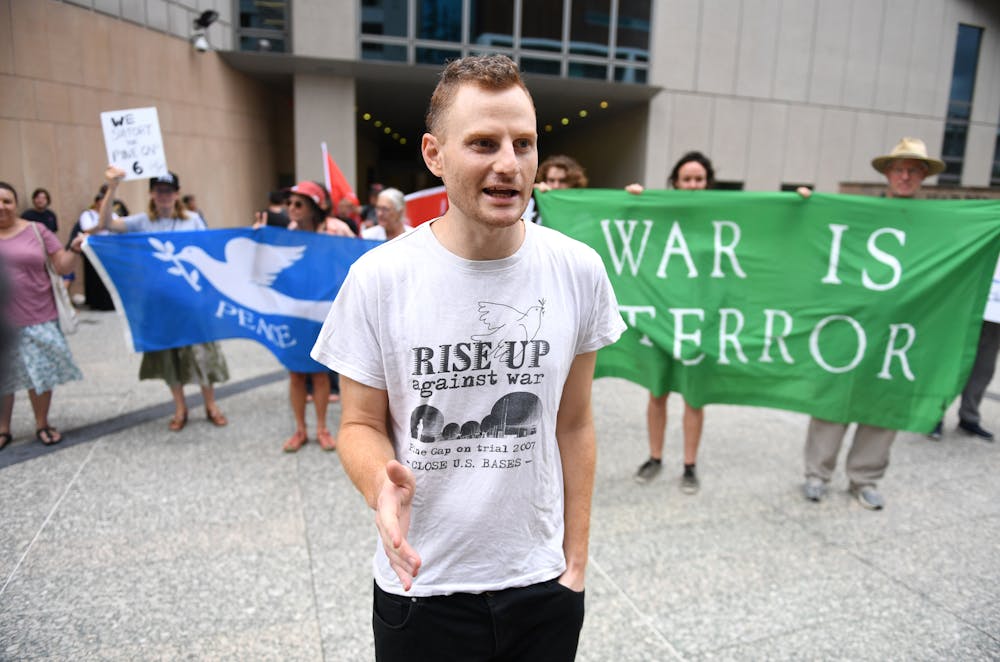
An example of this approach can be found in the Pine Gap peace pilgrims case from 2017, when six religious activists breached the perimeter of the Pine Gap military base.

Six peace activists were found guilty of trespassing onto a defence facility near Alice Springs, but they were punished relatively lightly. Dan Peled/AAP

In sentencing the offenders, Justice Reeves was influenced by the fact they were “conscientious protestors”. He described their offending as being at “the lowest end of the scale”.

And rather than imprisoning them, as requested by the prosecution, he imposed fines ranging from A$1250 to A$5000.

A harsher punishment

In other cases, judges have taken a far less sympathetic approach. They’ve viewed politically motivated offenders as self-serving individuals who deliberately intend to undermine legitimate laws in pursuit of their own idea of justice.

Not only does this make them more culpable, it also makes them more dangerous and harmful to the community than “common criminals”, the reasoning goes. As a result, they should be punished more harshly.


Read more: Serial killers’ fates are in politicians’ hands. Here’s why that’s a worry


This approach can be seen in the sentencing of DJ Astro “Funknukl” Labe, who was convicted of headbutting Tony Abbott.

While Labe only caused minor physical harm, Magistrate Daly considered the offence to be of “considerable seriousness”.

He said the sentence needed to make it clear to those with similar impulses that indulging those impulses would attract a deterrent sentence. He sentenced Labe to six months’ imprisonment.

Four factors in politically-motivated crime sentencing

These cases reveal four key factors that appear to influence a judge’s approach.

The most significant factor is the gravity of the offence. Cases that inspire a sympathetic approach from the judge usually involve relatively minor offences, such as spitting or trespassing.


Read more: Drunk women convicted of assault treated harsher in sentencing than drunk men


A less sympathetic approach has generally been taken when more serious offences have been committed, such as those that pose a threat to life.

The second relevant factor is the use or threat of violence. Judges seem prepared to take a sympathetic approach to serious crimes committed for political reasons, so long as no violence is involved. But this willingness vanishes when offenders use or threaten violence in pursuit of their goals.

Astro ‘Funknukl’ Labe was sentenced to six months imprisonment for head butting Tony Abbott to deter other people acting on similar impulses. Rob Blakers/AAP Image

The third is the target of the offender’s actions. Judges have shown little sympathy for offences that have directly targeted parliament, politicians or the courts. These institutions are considered fundamental to our system of government, and are deserving of “the most serious protection”.

Offenders who target premises that are not directly related to the object of the protest may also be seen to be “looking for trouble”, rather than being engaged in genuine protest.


Read more: Is Victoria’s sentencing regime really more lenient?


And the fourth relevant factor is the perceived sincerity of the offender’s beliefs. A sympathetic approach is more likely when it’s clear the offenders hold their beliefs sincerely, strongly and were motivated by genuine and deep concerns.

While there is some indication that the purpose of the offender’s protest may also be relevant, there is no clear pattern in this regard.

This is probably due to a judicial reluctance to explicitly express support or disapproval for a particular political cause, given the importance of judicial objectivity.

ref. Altruistic or self-serving? Four things judges consider when sentencing politically-motivated crimes – http://theconversation.com/altruistic-or-self-serving-four-things-judges-consider-when-sentencing-politically-motivated-crimes-121691

Why do I dwell on the past?

Source: The Conversation (Au and NZ) – By Laura Jobson, Senior Lecturer in Clinical Psychology, Monash University

Many of us enjoy writing in a diary, reading autobiographies or nostalgically reflecting with others about past times.

Why is remembering our past so important? Are there downsides? And what can we do if dwelling on the past bothers us?


Read more: Explainer: what is memory?


Memories make us human

Over several decades, researchers have shown remembering your past is fundamental to being human, and has four important roles.

1. Memories help form our identity

Our personal memories give us a sense of continuity — the same person (or sense of self) moving through time. They provide important details of who we are and who we would like to be.


Read more: Why we remember our youth as one big hedonistic party


2. Memories help us solve problems

Memories offer us potential solutions to current problems and help guide and direct us when solving them.


Read more: Most people think playing chess makes you ‘smarter’, but the evidence isn’t clear on that


3. Memories make us social

Personal memories are essential for social interactions. Being able to recall personal memories provides important material when making new friends, forming relationships and maintaining ones we already have.


Read more: The power of ‘our song’, the musical glue that binds friends and lovers across the ages


4. Memories help us regulate our emotions

Our memories provide examples of similar situations we’ve been in before. This allows us to reflect on how we managed that emotion before and what we can learn from that experience.

Such memories can also help us manage strong negative emotions. For example, when someone is feeling sad they can take time to dwell on a positive memory to improve their mood.


Read more: Health Check: how food affects mood and mood affects food


Memories help us function in our wider society

Dwelling on our personal memories not only helps us as individuals. It also allows us to operate in our socio-cultural context; society and culture influence the way we remember our past.

For instance, in Western individualistic cultures people tend to recall memories that are long, specific, detailed and focus on the individual.

In contrast, in East Asian cultures people tend to recall more general memories focusing on social interactions and significant others. Researchers have seen these differences in children and adults.


Read more: ‘Remember when we…?’ Why sharing memories is soul food


Indeed, the way parents discuss past events with their children differs culturally.

Parents from Western cultures focus more on the child and the child’s thoughts and emotions than East Asian parents. So, there are even cultural differences in the ways we teach our children to dwell on the past.

People from Western individualistic cultures tend to recollect specific unique memories that reaffirm someone’s uniqueness, a value emphasised in Western cultures. In contrast, in East Asian cultures memories function to assist with relatedness and social connection, a value emphasised in East Asian cultures.

Memories and ill health

As dwelling on the past plays such a crucial role in how we function as humans, it is unsurprising that disruptions in how we remember arise in several psychological disorders.

People with depression, for instance, tend to remember more negative personal memories and fewer positive personal memories than those without depression. For example, someone with depression may remember failing an exam rather than remembering their academic successes.

People with depression are more likely to remember the bad times rather than the good. from www.shutterstock.com

People with depression also have great difficulty remembering something from a specific time and place, for instance “I really enjoyed going to Sam’s party last Thursday”. Instead they provide memories of general experiences, for instance, “I like going to parties”.

We have found people with depression also tend to structure their life story differently and report more negative life stories. They also tend to remember periods of their life, such as going to university, as either distinctly positive or negative (rather than a combination of both).

Disturbances in memory are also the hallmarks of post-traumatic stress disorder. This is when unwanted, distressing personal memories of the trauma spontaneously pop into the mind.


Read more: Explainer: what is post-traumatic stress disorder?


People with anxiety disorders also tend to have biases when remembering their personal past. For instance, all of us, unfortunately, experience social blunders from time to time, such as tripping getting onto a bus or spilling a drink at a party. However, people with social anxiety are more likely to be consumed with feelings of embarrassment and shame when remembering these experiences.


Read more: Explainer: what is social anxiety disorder?


Finally, an excessive, repetitive dwelling on your past, without generating solutions, can be unhelpful. It can result in emotional distress and in extreme instances, emotional disorders, such as depression, anxiety and post-traumatic stress disorder.

I don’t want to dwell on the past. What can I do?

If dwelling on the past bothers you, these practical tips can help.

Set aside a certain time of the day for your memories. You could write in a diary or write down your worries. Writing about important personal experiences in an emotional way for as little as 15 minutes a day can improve your mental and physical health.

Practice remembering specific positive memories from your past. This can allow you to engage differently with your memories and gain a new perspective on your memories.

Learn and practise mindfulness strategies. Instead of dwelling on painful memories, a focus on the present moment (such as attending to your breath, focusing on what you can currently see, smell or hear) can help break a negative cycle

When dwelling on past memories try being proactive and generate ideas to solve problems rather than just being passive.

See your GP or health practitioner if you’re distressed about dwelling on your past.


If this article has raised issues for you, or if you’re concerned about someone you know, call Lifeline on 13 11 14.

ref. Why do I dwell on the past? – http://theconversation.com/why-do-i-dwell-on-the-past-121630

Australian PM’s attitude ‘neo-colonial’, says Tuvalu PM

By RNZ Pacific

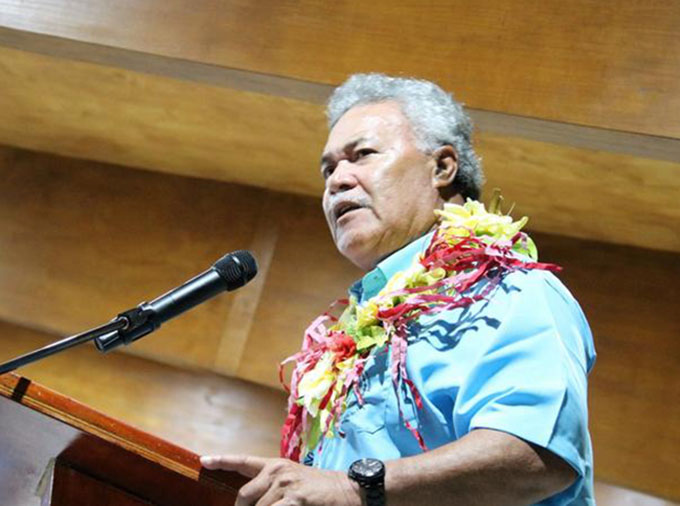
Tuvalu’s Prime Minister has condemned the Australian Prime Minister’s conduct at last week’s Pacific Islands Forum, calling Scott Morrison’s attitude “unfortunate” and “neo-colonial,” and questioning Australia’s future in the 18-member body.

In an interview with RNZ on Sunday, Enele Sopoaga also threatened to pull Tuvaluan labour from Australia’s seasonal worker programme in light of comments by Deputy Prime Minister Michael McCormack, who was recorded saying people from Pacific countries threatened by climate change – like Tuvalu – would survive because “many of their workers come here and pick our fruit”.

Australia’s High Commissioner to Tuvalu would be summoned to explain the comments on Monday, Sopoaga said, and he would cancel the programme if he wasn’t satisfied. He would also encourage the leaders of the other Pacific countries – including Kiribati, Samoa and Tonga – to do the same.

READ MORE: ‘Bullying’ Australia disregards Pacific over climate crisis, says 350 Pacific

“I thought the Australian labour scheme was determined on mutual respect, that Australia was also benefiting,” said Sopoaga. “We are not crawling below that. If that’s the view of the government, then I would have no hesitation in pulling back the Tuvaluan people as from tomorrow.”

“I don’t think the Tuvaluan people are paupers to come crawling under that type of very abusive and offensive language,” he said. “If New Zealand is thinking the same way, we’ll have no other option but to do that [there too].”

– Partner –

McCormack’s comments came after the region’s leaders – including Sopoaga, Morrison and New Zealand Prime Minister Jacinda Ardern – met for a marathon 12 hours on Tuvalu’s main island, Funafuti, on Thursday with Australia, the region’s largest economy and emitter, pitted against the Pacific.

The Pacific countries wanted strict commitments to cutting down greenhouse gas emissions, a phase out of coal power stations, support in replenishing the UN’s Green Climate Fund and a strong and united communique that they could take to international climate talks at the UN next month.

But Australia refused to budge on certain red lines, which included insisting on the removal of mentions of coal, a commitment to limit global warming to under 1.5C and drafting a plan for achieving net-zero emissions by 2050.

It succeeded. Late on Thursday night, a watered-down communique was released, although some are now questioning at what cost.

Australia is meant to be in the midst of a so-called “step-up” in the Pacific, and Morrison came to the meeting stressing the vuvale (family links) between Australia and the region as Canberra gets increasingly jittery about China’s presence.

Pacific trip-up
But if the reaction from the region’s leaders in the past few days has been anything to go by, the step-up has tripped and tumbled some way down the stairs.

Vanuatu’s foreign minister, Ralph Regenvanu, described the meeting as “tense” and “very frank,” revealing that the talks almost broke down twice.

Marshall Islands Foreign Minister David Paul tweeted “Stepping-up means showing up. It means showing you are willing to play your own part in fighting the greatest threat to the Pacific and to the world.” That was later followed by: “The Pacific’s survival – and the Australian fruit industry – requires leadership on the greatest threat to our region and to the world.”

But the most cutting criticism was from Fiji’s Prime Minister, Voreqe Bainimarama, who said on Saturday that Australia had taken a “big step backwards” in its relationship with the Pacific. That came after he told The Guardian on Friday that Morrison’s approach during Thursday’s meeting was “very insulting and condescending.”

Voreqe Bainimarama … “I thought Morrison was a good friend of mine; apparently not.” Image: Pacific Islands Forum Secretariat

‘Insulting’ statements
“I thought Morrison was a good friend of mine; apparently not,” said Bainimarama, who was attending his first forum in more than a decade, after being suspended in 2009.

“The Prime Minister at one stage, because he was apparently [backed] into a corner by the leaders, came up with how much money Australia have been giving to the Pacific. He said ‘I want that stated. I want that on the record’. Very insulting.”

After playing it diplomatically in a news conference on Friday morning, where he was seated side-by-side with Morrison, Sopoaga didn’t hold back on Sunday, backing Bainimarama’s comments.

“We were overwhelmed by the promises of the step-up policy by Australia,” Sopoaga said. “Very un-Pacific, it was. I certainly hoped the leaders would come together and recognise the culture, the Pacific way of life.”

Words ignored
Referring to a speech by two youth leaders who called for action to save their homeland, Sopoaga said: “One leader was … shedding tears, he told me, ‘the words of those girls are cutting through my heart.’ Unfortunately one didn’t hear these words, and pretended not to hear these words. One guy, one guy deliberately decided to ignore these words.”

“If that is the case one has to ask if there is any place for them to be in the forum. If there is any place for them to be in this grouping, in this collectivity.”

Sopoaga told the story of his days as a young diplomat in the early 1970s, in what was then the South Pacific Commission. The commission evolved into the forum as many countries became independent from colonisation. In those days, he said, independence leaders were frustrated that they couldn’t talk about their issues like environment, decolonisation or nuclear testing because “these colonial masters were pushing us down.”

“And I see now after so many years of us coming away to set up the Pacific Island Leaders Forum, we are still seeing reflections and manifestations of this neo-colonialist approach to what the leaders are talking about,” Sopoaga said.

Pacific not understood
“The spirit of the Pacific way is not understood by these guys. I don’t think they understand anything about [it]. And if that is the case, what is the point of these guys remaining in the Pacific Island Leaders Forum? I don’t see any merit in that.”

Scott Morrison left Tuvalu asserting that the Australian government was committed to helping the region in its fight against climate change, and that there were efforts being made in Australia to curb emissions. He also announced an A$500m fund to help fund climate adaptation in Pacific countries.

And Australia did make some concessions in the communique. It backed a separate climate change statement committing countries to working in solidarity to combat it.

It also signed on to address climate financing, a commitment to phase out reliance on fossil fuels, and pledged to try to meet a target of 1.5 degrees. However, the wording is vague, and all references to coal have been scrubbed. And a “climate crisis” is only referred to for the small island states, not the whole region, which would include Australia.

Sopoaga said that despite the setbacks, he was still happy with what came from the forum. “It’s not perfect, but it is good,” he said. “I certainly believe we could have done much better.”

“We really need to step-up our game.”

  • This article is published under the Pacific Media Centre’s content partnership with Radio New Zealand
Print Friendly, PDF & Email

Article by AsiaPacificReport.nz

Surge in pre-poll numbers at 2019 federal election changes the relationship between voters and parties

Source: The Conversation (Au and NZ) – By Stephen Mills, Hon Senior Lecturer, School of Social and Political Sciences, University of Sydney

On the morning of the last Monday in April, 2019, federal election officials opened the doors of more than 500 pre-poll voting centres around Australia, and waited for the voters to turn up. It was the first day of the three-week early voting period leading up to the May 18 election day.

They didn’t have to wait long. By the end of the day, 123,793 voters had walked through the doors and cast their votes – more than the enrolment of an average House of Representatives electorate, and a record number for the first day of pre-polling.


Read more: Three weeks of early voting has a significant effect on democracy. Here’s why


That evening, the rush to the polls attracted comment at the first leaders’ debate. Opposition leader Bill Shorten claimed people were voting early because they wanted “change”; Prime Minister Scott Morrison insisted it showed people “deserve” to know the cost of opposition policies.

In turn, pre-polling attracted more media attention than in previous campaigns.

Pre-polling increased steadily through the campaign, culminating on the last Friday with 710,000 pre-poll voters. The total for the full three weeks was 4.7 million, or 31.6% of total turnout.

Picture. Author supplied

Another 1.6 million voted early by post. In short, nearly four in ten voters decided, before the campaign had finished, that they had heard enough and were ready to cast their votes.

Pre-polling has come of age. While it has been on the rise in recent electoral cycles, it reached record levels federally in 2019. Casting a vote before election day has been transformed, over a very few electoral cycles, from the occasional practice of a limited number of eligible voters to the habitual form of electoral participation of a large minority of the electorate.

Who votes early?

Despite the popularity of pre-polling, there is a puzzling unevenness about it. Some voters love it more than others. Australian Electoral Commission data show the Northern Territory, with its own particular geography and demography, had the highest form of pre-poll voting at 42.9% of turnout. Victoria (37.2%), ACT (36.5%) and Queensland (35.6%) were well above average, while Tasmania (19%), SA (21.7%) and WA (22.9%) lagged. NSW sat just below the national average at 30.1%.

While the rates of all states and territories were lower in 2016, their relative percentages were very similar.

Pre-polling is particularly strong in rural electorates. Ten of the 15 electorates in the country with the highest pre-poll percentage were rural electorates, despite the fact that the AEC has less than one third of seats classed in this category. All 15 of these seats are in Victoria, NSW or Queensland.

By contrast, 13 of the 15 electorates with the lowest percentage of pre-poll voters came from WA, Tasmania and South Australia, and just three of these were from outside the main metropolitan areas.

In terms of political allegiance, the inclination of early voters is well known: those voting early have tended to lean towards the Coalition. As psephologist Peter Brent has shown, this gap has only widened in recent electoral cycles, despite the growing number of early voters.

In 2004, the Coalition did 4% better in early voting than voting on election day; by 2019 this gap rose to just over 5%. There is strong evidence for Coalition mobilisation of postal voters, with 312,391 postal vote applications received from Coalition parties in 2019, and just 149,582 from the Labor party.

The reasons why people vote early are still widely debated, but the key reasons are convenience and access.

There is also evidence that indicates older people like voting earlier. Such arguments are borne out in those figures, given the older demographics of rural areas, and the greater distances that voters may need to travel to access voting booths.

Has deregulating early voting made a difference?

One factor cited as an explanation for the increase in early voting is the easing of restrictions on the practice. A number of jurisdictions including Victoria (2010), Queensland (2015), and Western Australia (2016) have made it easier to vote early at pre-poll booths for state elections by removing the need for voters to provide justifications for doing so. The rationale when doing so has been that this would make such voting forms more accessible.

While we would expect to see these jurisdictions record higher levels of pre-poll voting, the outcomes of these changes in legislation have been mixed (see chart two).

Author supplied, Author provided

Victoria’s 2018 state election recorded the highest levels of pre-poll voting of any state, at 37.29%, and this may be linked to their decision to deregulate the practice earlier than elsewhere. But at their last state elections, WA, while recording a boost in postal voting (which remains regulated) had a pre-poll rate of 15.47%, and Queensland of 19.64% – both still well short of Victoria.

While pre-poll voting in Queensland and WA increased after deregulation, it did not increase any more markedly than other jurisdictions that retained regulation.

Moreover, each of these jurisdictions recorded a prepoll rate for the 2019 Federal election equal to, or higher than, the previous state election, despite the Commonwealth retaining the need for voters to justify their decision to do so.

While in Victoria the rate was almost identical, in WA and Queensland the Federal rate of pre-poll was much higher.

Conclusions: unexpected implications

An examination of early voting data, particularly around the practice of pre-polling, demonstrates clear but unexplained trends. Tasmania, WA and South Australia lag well behind the other states and territories in pre-polling. There is even clearer unevenness within states, where rural and regional voters are voting early in significantly higher numbers than their metropolitan counterparts.

The data also indicate that making forms of early voting more accessible (such as by deregulating pre-polling) has in itself not led to marked increases in the practice.


Read more: Difficult for Labor to win in 2022 using new pendulum, plus Senate and House preference flows


What we also know is that the large rates of early voting have changed the relationship between voters and the people or parties they are choosing to vote for, in that many voters cast their ballots before the parties have released all their policies.

Other unanticipated effects have emerged. In 2019, we saw many early voters casting votes for candidates who were later disendorsed by their own parties.

This arises because the early voting period occupies the maximum available time on the campaign calendar, beginning as soon as possible after close of nominations. This may create a dysfunction between voters and the parties candidates claim to represent on the ballot.

Pre-polling also leads to uneven playing fields between major parties as opposed to minor parties and independents, due to the latter having fewer resources.

There are also additional challenges faced by electoral commissions in the provision of pre-poll centres and staff to manage this surge. This research has been published in The Conversation and in a previous report on voting flexibility late last year.

The increased uptake of early voting in 2019 only exacerbates these implications, many of which may not have been anticipated until recently.

While early voting is important in providing greater accessibility to voters and encouraging turnout, thought should be given to reviewing the full implications through the Joint Standing Committee on Electoral Matters (JSCEM).

One possibility is to retain the current forms of early voting but limit the pre-poll period to two weeks rather than three. This would retain flexibility for voters, but make the process more manageable for all the stakeholders concerned.

ref. Surge in pre-poll numbers at 2019 federal election changes the relationship between voters and parties – http://theconversation.com/surge-in-pre-poll-numbers-at-2019-federal-election-changes-the-relationship-between-voters-and-parties-121929

How many people have eating disorders? We don’t really know, and that’s a worry

Source: The Conversation (Au and NZ) – By Laura Hart, Senior Research Fellow, University of Melbourne

Last week, federal health minister Greg Hunt announced that more than 60,000 Australians will be asked about their mental health and well-being as part of the Intergenerational Health and Mental Health Study.

The mental health survey will be run in 2020, with new data on how common mental illness is due the year after. This is a welcome announcement for the mental health sector, because information gathered in a survey like this can be used to shape policy reform.


Read more: If we’re to have another inquiry into mental health, it should look at why the others have been ignored


But eating disorders, a major category of mental illnesses, have been neglected by all previous important data collection initiatives in Australia so far. Notably, they were missing from the last national mental health surveys in 1997 and 2007.

Eating disorders are not yet an official part of this new survey, but we understand they are being considered.

If people with eating disorders are not counted, they don’t count. In other words, we need to know who has these severe and debilitating conditions, and then work towards improving the treatment and supports available for them.


Read more: FactCheck Q&A: do eating disorders have the highest mortality rate of all mental illnesses?


Surveys are important

National surveys ask the public if they have experienced symptoms of various mental illnesses, either in their lifetime or during the past 12 months.

People who answer “yes” to particular clusters of symptoms are “diagnosed”, or assumed to have had the illness.

Asking the public about their symptoms is the best way to understand how common mental illnesses are. This is because most people with a mental illness don’t seek treatment and may never have had a diagnosis. So collecting data from health services or based on reported diagnoses doesn’t provide a full picture.

Also, for some mental illnesses, such as anorexia nervosa or psychosis, people might not realise they have a diagnosable illness. But they are likely to respond “yes” to direct questions about their experiences with body dissatisfaction or thinking difficulties.

Eating disorders are more than just anorexia

A person with anorexia nervosa engages in dangerous behaviours to maintain a very low body weight, or to lose more weight. Although most people have heard of it, anorexia is not common. We know this from other countries who have previously studied the prevalence of anorexia in community surveys.

That being said, it’s very serious and can be fatal. It has the highest mortality of all non-substance use mental disorders, and one in five of those deaths is by suicide.


Read more: Disease evolution: the origins of anorexia and how it’s shaped by culture and time


Other eating disorders include bulimia nervosa, binge-eating disorder, and “other specified feeding and eating disorders” (OSFED), a catch-all group for those who don’t fit anywhere else.

People with bulimia nervosa or binge-eating disorder experience cycles of binge-eating, often after periods of restricting foods, which cause shame, guilt and discomfort.

Those with bulimia compensate for binge-eating through vomiting, fasting, exercise or other methods, while those with binge-eating disorder do not.

Binge-eating disorder is the most common of all eating disorders and occurs more equally across men and women than other eating disorders.

As well as continued weight gain, people with binge-eating disorder are more likely to experience depression and anxiety, and other significant health problems (such as asthma, diabetes, and arthritis) than people with a high BMI (body-mass index) but no binge-eating disorder.

Binge-eating disorder is the most common eating disorder. From shutterstock.com

One example of OSFED is atypical anorexia nervosa – when someone shows all the symptoms of anorexia and has lost a significant amount of weight but their BMI is in the “normal” or “high” range.

Eating disorders disproportionately affect females, young people, LGBTIQ individuals, and those with a high BMI.

People with eating disorders often have a negative body image, and a strong perception their self-worth is tied to their appearance or body weight.

Burden of disease

Every year in Australia, millions of years of healthy life are lost because of injury, illness or premature deaths in the population. This is known as “burden of disease”.

Like national surveys, burden of disease studies are extremely important for planning and funding health services. They use prevalence statistics, or how many people per 100,000 Australians are assumed to have a particular illness. Given we don’t have good data on how prevalent eating disorders are, we likely underestimate their burden of disease.


Read more: To the Bone: creating eating disorder awareness or doing harm?


The recently released Australian Burden of Disease Study 2015 lists eating disorders among the most burdensome illnesses for Australian females, being the tenth leading cause of total burden of disease for females aged 5-14 and women aged 25-44.

Importantly, the most common eating disorder – binge-eating disorder – is not included in burden of disease studies, meaning all these figures miscalculate the impact of eating disorders by a long way.

Eating disorders are on the rise

Despite our lack of prevalence data, there is evidence showing eating disorders are an increasing problem and should be regarded as a national priority.

Consecutive population surveys in South Australia showed the numbers of people with eating disorders climbed over a ten-year period.

Annual youth surveys demonstrate body image, the most potent risk factor for eating disorders, is year after year among the top concerns for young people.

A recent study on adolescents in the Hunter Valley region of NSW found one in five had experienced an eating disorder.

Treatment and prevention

People with eating disorders use more health services than people with all other forms of mental illness, but often don’t receive appropriate and effective treatment. They typically receive treatment for weight loss, depression or anxiety, but are rarely treated for their disordered eating.

Eating disorders were estimated to cost the health system A$99.9 million in the year 2012 alone.

Better treatment and prevention of eating disorders would reduce the cost and the burden of disease. But we need the data to show where the treatment gaps are and how to fund better services.

There are many promising elements of the proposed Intergenerational Health and Mental Health Study. These include surveying multiple people in a family, gathering physical and mental health data, and a target of more than 60,000 Australians. But it’s time eating disorders were included.


Read more: Therapy for life-threatening eating disorders works, so why can’t people access it?


ref. How many people have eating disorders? We don’t really know, and that’s a worry – http://theconversation.com/how-many-people-have-eating-disorders-we-dont-really-know-and-thats-a-worry-121938

Ode to the poem: why memorising poetry still matters for human connection

Source: The Conversation (Au and NZ) – By Veronica Alfano, Research Fellow, Australian Catholic University

Memorising poetry was once common in classrooms. But it has, for the most part, gone out of style. There are good reasons for this.

Memorisation can clash with creativity and analytical thought. Rote learning can be seen as mindless, drone-like, something done without really thinking about why we’re doing it and what the thing we memorise might mean.

In other words, it can be counterproductive to learn a poem by heart without understanding its content, knowing anything about its author or historical context, or asking what specific aspects of its language make it powerful and appealing.

Literature instructors tend to focus more on showing students how to conduct careful textual analysis than on having them reproduce poetic lines word-for-word. Analytical skills are crucial, and educators should continue to emphasise them.


Read more: Hooked on the classics: literature in the English curriculum


But there is great value in memorisation as well. Internalising a poem need not be a rote process. Done right, in fact, it is an intellectual exercise that illuminates the structure and logic of the text.

Nevermore, evermore, nothing more

A teacher might prompt his or her class to reflect on which patterns of sound (such as rhyme, meter or alliteration) serve as memory aids, asking how these patterns interact with the narrative arc of the poem.

Let’s imagine a student sets out to memorise Edgar Allan Poe’s “The Raven.”

Here are two lines from that poem:

And the silken, sad, uncertain rustling of each purple curtain

Thrilled me–filled me with fantastic terrors never felt before

Someone searching for memorable patterns in the language would probably pay close attention to Poe’s internal rhyme: “uncertain” gives us “curtain,” and “thrilled me” prompts “filled me”.

But that same student might also struggle to keep the exact phrasing of the stanzas’ final lines straight, given that all eighteen of them conclude with “nevermore”, “evermore” or “nothing more”.

Most of us will at some point grapple with unhealthy fixations or paranoid fears. kalpesh patel/Unsplash

This could generate a conversation about the role of repetition in the poem – for instance, perhaps it reflects the obsessive and confused mindset of Poe’s speaker.

Students tasked with memorising poems are often required to speak them aloud as a test of mastery. This, too, has its benefits. Reciting a poem can provide a deep and visceral understanding of its linguistic strategies (think of all those rustling “s” sounds in “silken, sad, uncertain”).


Read more: Victorian women poets of WW1: capturing the reverberations of loss


And when saying the poem aloud, you can hear another consciousness speaking in the cadences of your own voice. Counting out the beats of each line, you may feel the poem’s metrical pulses in your tapping fingers and toes.

In this way, the poem becomes an embodied experience and not merely a printed object.

A rich mental resource

True, reading a poem aloud rather than memorising and reciting it can have similar effects to all those above. But performing that poem without the distracting mediation of the page helps incorporate it more thoroughly into mental life.

In doing so, you can enact the way in which many poems – even as they give voice to a sensibility outside our own – also appeal to us precisely because they seem to articulate our unuttered thoughts and feelings. Reciting a poem without reading it can make it feel like it’s just you talking, not necessarily somebody else.

Memorising poetry provides a rich mental resource of beautiful phrases. Daniel Hansen/Unsplash

Few of us have dealt with an ominous raven perching in our chambers, but most of us will at some point grapple with unhealthy fixations or paranoid fears.

Memorising poetry, then, is also a kind of long-term investment. To take a poem with us so we can truly know it, we must know it by heart.

When we commit poems to memory, we internalise a voice that may comfort or inspire us in the future. We create a rich mental resource that lets us summon compelling, evocative, finely-crafted language at exactly the moment when it is most relevant to our emotional lives.

Such language both illuminates and is illuminated by our experiences. Christina Rossetti’s “A Birthday” begins with these lines:

My heart is like a singing bird

Whose nest is in a watered shoot;

My heart is like an apple-tree

Whose boughs are bent with thick-set fruit.

For a school child who learns Rossetti’s poem, such metaphors may not be particularly meaningful. But if she carries those lines in her mind over the years, they are likely to take on fresh significance.

If later in life she falls in love or has an intense spiritual experience, they may help her articulate her feelings to herself. Perhaps on a snowy day she will think of Charles Wright’s words: “Things in a fall in a world of fall […]”.


Read more: Friday essay: garish feminism and the new poetic confessionalism


Perhaps the arrival of a child will remind the former student of Sylvia Plath’s “Love set you going like a fat gold watch”.

Understanding our own sentiments through someone else’s words can provide a thrilling sense of connection, of shared humanity across time and space.

There are certain intellectual advantages to having a wealth of information at our fingertips at all times. But the vast resources that smart phones provide can’t make the beauties and insights of poetic language part of our everyday perspective on the world and fine-tune our emotional vocabulary in the process.

For that, we must still memorise.

ref. Ode to the poem: why memorising poetry still matters for human connection – http://theconversation.com/ode-to-the-poem-why-memorising-poetry-still-matters-for-human-connection-121622

From Donald Glover to Phoebe Waller-Bridge: what exactly does a showrunner do?

Source: The Conversation (Au and NZ) – By Darren Paul Fisher, Head of Directing, Department of Film, Screen and Creative Media, Bond University

What do J.J. Abrams, Phoebe Waller-Bridge, Shonda Rhimes, David Lynch, Aaron Sorkin, Donald Glover, Jenji Kohan, Jordan Peele, Tina Fey, and Joss Whedon have in common?

They are all television showrunners – not that you would know.

The showrunner is perhaps the most curious credit in the history of the small screen. A little like an imaginary number in mathematics, it doesn’t seem to exist yet plays a supremely important role.

But what exactly is a showrunner, and why don’t they get the credit they deserve?

Television’s feature film director

A film director is essentially the creative head of a movie. They work for (and can be fired by) the producer, but are responsible for the overall vision of the film – even if that vision did not originate with them. The general public are mostly aware of “auteur directors” such as Wes Anderson, Tim Burton and Guillermo Del Toro, who have a distinct and consistent style across their complete body of work.


Read more: Wes Anderson is one of cinema’s great auteurs: discuss


The screenwriter in film holds almost no power. Once they have delivered the screenplay they are essentially superfluous, unless they are hired to make minor changes during production.

These roles are reversed in television. The typical television director is often referred to as a gun-for-hire: they come in to direct an episode or a block of episodes and then move on to the next show. The people they work for are the writers. And the head writer is the showrunner.

In fact, the showrunner is much more than that. They are the auteur of series television: a writer-producer who has ultimate management and creative responsibility over the whole show, reporting only to the production company or studio.

A job of many moving parts

The hallowed role of showrunner requires someone with a counter-intuitive combination of skills. Someone who is in equal parts sensitive artist and hardened executive. They are responsible for hiring and firing cast and crew, developing plot lines, writing scripts, overseeing production budgets and mediating with networks.

Shonda Rhimes is one of today’s leading showrunners.

The one role showrunners do less than expected is direct.

The evolution of the showrunner mirrors the rise of the writer in television. As shows evolved and increased the complexity of their storytelling, so came the reliance on full-time staff writers as opposed to transient freelancers. The Mary Tyler Moore Show in the 70s has been cited as the first show to really hand power to the writers: in the quest to attract top talent, more and more creative control was handed over.

The showrunner model has been used in America for decades but only recently adopted by other countries. In the UK, the modern revival of Doctor Who, starting under showrunner Russell T Davies in 2005, is perhaps the highest profile example.

This irregular usage has traditionally been because of the difference in production scales.

Phoebe Waller-Bridge on the set of Fleabag. BBC

While a US television series may run 22 episodes a year for many years, Australian and UK production has favoured shorter seasons. A season of six episodes can be wholly written by one writer, and singularity of tone is ensured.

It’s only recently that the role of the writer on these smaller productions, such as the original six-episode run of Fleabag, has expanded into the broader responsibilities of showrunner.

Showrunners and their overarching creative vision have also become more common in Australian television, with names like Vicki Madden (The Kettering Incident; The Gloaming), Samantha Strauss (Dance Academy; The End), and Louise Fox (Glitch) becoming increasingly recognised.

What’s in a name?

While the term showrunner has entered popular parlance it isn’t used in official credits. Rather, the showrunner is often credited with the catch-all ‘executive producer’.

If you watch any modern television show you’ll see there are usually at least half-a-dozen executive producers listed, with no indication as to who is the showrunner. This title encompasses everyone from the heads of production companies to financial executives to other members of the writers’ room. Writers, too, can have titles such as producer, co-producer, supervising producer, and more.

The Wonder Years: perhaps the source of the term showrunner. ABC

This confusion was the reason why the ‘showrunner’ term was invented.

While there is no verifiable date of when the term came into use, the first recorded use was in the Wall Street Journal in 1989, discussing Neal Marlens’ and Carol Black’s roles on The Wonder Years.

But why not credit the showrunner in the same way every other production role is credited? There’s no official nor satisfactory explanation. In 1995, introducing readers to the term in an article on ER, the New York Times simply blamed its omission on “complicated reasons having to do with economics, ego and history” and “a reluctance to give credit where credit is due.”

In the spotlight; off the screen

This obscurity is unlikely to change.

Although the Writers Guild of Canada established the Showrunner Award in 2007, there have been no murmurs of discontent from the top global showrunners in a position to put pressure on the studios, guilds and unions.

My bet is that showrunners may be reluctant to push for the credit for fear of falling foul of the on-going “possessory credit” controversy: should feature film directors take the “a film by” credit, instead of “directed by”? Screen productions are, by their nature, highly collaborative, and so many feel that the credit “a film by” reduces the contribution of other creative departments.

Showrunners have never been more in the spotlight, but for now, it will not extend to the screen on which they work.

ref. From Donald Glover to Phoebe Waller-Bridge: what exactly does a showrunner do? – http://theconversation.com/from-donald-glover-to-phoebe-waller-bridge-what-exactly-does-a-showrunner-do-121760

Scott Morrison tells public servants: keep in mind the ‘bacon and eggs’ principle

Source: The Conversation (Au and NZ) – By Michelle Grattan, Professorial Fellow, University of Canberra

Scott Morrison has a sharp lecture for bureaucrats about their KPIs, in a comprehensive speech laying down how he expects the Australian Public Service to operate under his government.

Morrison stresses the service must be responsive to both its ministers and the “quiet Australians”, look beyond the noisy “bubble”, and be more open to outsiders, in a Monday address to the Institute of Public Administration, issued beforehand.

He calls for a “step-change” in improving delivery, greater diversity of views within the service, and the “busting” of regulatory congestion.

The Prime Minister is producing his blueprint ahead of formally receiving the report from the comprehensive review led by businessman David Thodey, which is coming within weeks – although Morrison has had discussions on its content and reportedly told the panel to take a tougher line on performance standards.

His speech themes build on views he has previously articulated, directly to departmental secretaries and in media comments. His focus is heavily on better service delivery, and his message to the bureaucrats is to remember they are on tap not on top. His concept is narrower than the ideas in a report, commissioned by the Australia and New Zealand School of Government (ANZSOG) and released last week, which highlighted the need for more creative thinking and a greater scope for public servants to speak truth to power in their advisory role.


Read more: Politics with Michelle Grattan: on the ‘creeping crisis’ in the public service


In his speech Morrison also has very direct words for his ministers, about running their departments. Responsibility for setting policy lies with those elected, he says – ministers must be clear about what they are asking of their public servants.

They must not allow a policy leadership vacuum to be created, expecting the public service to fill it and do their job. One of the worst criticisms politicians can make of each other is that a minister is a captive of their department.

He says he has “selected and tasked my ministers to set and drive the agenda of our government”.

Morrison points out that accountability to parliament and the public for the government’s policies rests with those who are elected.

“Only those who have put their name on a ballot can truly understand the significance of that accountability. I know you [public servants] might feel sometimes that you are absolutely right in what you are suggesting, but I can tell you when it is you that is facing the public and must look your constituents in the eye, it gives you a unique perspective.”

He says his rugby coach used to describe this as “the bacon and eggs principle – the chicken is involved, but the pig is committed.

“That is why under our system of government it must be ministers who set the policy direction.”


Read more: Grattan on Friday: Morrison can learn a lot from the public servants, but will he listen?


Morrison sets out six “guideposts” for the evolution of the public service and his priorities:

  • the “respect and expect” principle, defining the relationship between government and the bureaucracy

  • the centrality of implementation

  • “look at the scoreboard” – a strong emphasis on “priorities, targets and metrics across all portfolios”. (He says he has established a Priorities and Delivery Unit in the Prime Minister’s Department, and cabinet ministers are developing objectives and targets.)

  • having eyes on “middle Australia” – looking “beyond the bubble” of the “many highly organised and well resourced interests” that go often to Canberra and are in the media

  • following the “Ray Price principle”, a reference to a former leading Rugby League player dubbed “Mr Perpetual Motion” – adapting amid constant change

  • honouring the public service code of governance and integrity across the bureaucracy.

On implementation, Morrison says: “Ensuring services are delivered seamlessly and efficiently, when and where they are needed, is a key priority of my government.

Good government is about receiving excellent policy advice. But that advice is only as good as the consideration in detail that it gives to implementation and execution.

And this is not an exercise in providing a detached and dispassionate summary of risks that are logged in the ‘told you so’ file for reference in future memoirs.

It’s about telling governments how things can be done, not just the risks of doing them, or saying why they shouldn’t. The public service is meant to be an enabler of government policy not an obstacle.


Read more: To restore trust in government, we need to reinvent how the public service works


Morrison says the thinking behind his establishment of Services Australia – in the post-election reshuffle – “isn’t some fancy re-branding exercise.

It’s a message to the whole of the APS – top-to-bottom – about what matters to people.

It’s about ‘doing the little things well’ – everything from reducing call waiting times and turnaround on correspondence right through to improving the experience people have walking into a Centrelink office.

Highlighting the “quiet Australians”, Morrison says “the vast majority” of people “will never come to Canberra to lobby government. They won’t stay at the Hyatt. Or lunch at the Ottoman. Or kick back in the Chairman’s Lounge at Canberra airport after a day of meetings.”

But these members of the public are the public service’s stakeholders – not the “vested and organised interests that pretend to this status,” he says.

I want the APS to have a laser-like focus on serving these quiet Australians. Those you don’t meet with and never hear from. Australians who just get on with it, but who often feel their voice gets drowned out by shoutier ones in our public square.

There is strong evidence that the ‘trust deficit’ that has afflicted many Western democracies over recent years stems in part from a perception that politics is very responsive to those at the top and those at the bottom, but not so much to those in the middle.

This will not be the case under my government.

Middle Australia needs to know that the government (including the public service) is on their side.

Declaring the public service should value diversity, Morrison says “a commitment to diversity should encompass diversity of viewpoints within the APS. There is compelling evidence that this helps teams find answers to complex problems by bringing together people who approach questions from different points of view.

It’s vital that the APS avoid the sort of stale conventional wisdoms and orthodoxies that can infuse all large organisations.

Urging more two-way flow between the public service and outside employment, Morrison says: “We need to find new ways for smart, dedicated Australians to make a contribution to public service, to see a stint in the public service as part of their career journey. And likewise for career public servants to see time outside of the APS in the non-government sector and in business as an important part of their career journey.”

ref. Scott Morrison tells public servants: keep in mind the ‘bacon and eggs’ principle – http://theconversation.com/scott-morrison-tells-public-servants-keep-in-mind-the-bacon-and-eggs-principle-122021

Frydenberg outlines financial sector reform timetable

Source: The Conversation (Au and NZ) – By Michelle Grattan, Professorial Fellow, University of Canberra

Treasurer Josh Frydenberg has issued a timetable for the government’s dealing with the recommendations from the royal commission into banking, superannuation and financial services, which aims to have all measures needing legislation introduced by the end of next year.

The opposition has accused the government of dragging its feet on putting into effect the results of the inquiry, which delivered its final report early this year.

“The need for change is undeniable, and the community expects that the government response to the royal commission will be implemented swiftly,” Frydenberg said in a statement on the timetable.

Fydenberg said that in his final report Commissioner Kenneth Hayne made 76 recommendations – 54 directed to the federal government (more than 40 of them needing legislation), 12 to the regulators, and 10 to the industry. Beyond the 76 recommendations, the government had announced another 18 commitments to address issues in the report.

The government had implemented 15 of the commitments it outlined in responding to the report, Frydenberg said. This included eight out of the 54 recommendations, and seven of the 18 additional commitments the government made. “Significant progress” had been made on another five recommendations, with draft legislation in parliament or out for comment or consultation papers produced.


Read more: Grattan on Friday: How ‘guaranteed’ is a rise in the superannuation guarantee?


Frydenberg said that, excluding the reviews to be conducted in 2022, his timetable was:

  • by the end of 2019, more than 20 commitments (about a third of the government’s commitments) would have been implemented or have legislation in parliament

  • by mid 2020, more than 50 commitments would have been implemented or be before parliament

  • by the end of 2020, the rest of the commission’s recommendations needing legislation would have been introduced.

When the Hayne report was released early this year, the government agreed to act on all the recommendations.

But one recommendation it has notably not signed up to was on mortgage brokers.

Hayne found that mortgage brokers should be paid by borrowers, not lenders, and recommended commissions paid by lenders be phased out over two to three years.


Read more: Wealth inequality shows superannuation changes are overdue


The government at first accepted most of this recommendation, announcing the payment of ongoing so-called “trailing commissions” would be banned on new loans from July 2020. Upfront commissions would be the subject to a separate review. Four weeks later in March Frydenberg announced the government wouldn’t be banning trailing commissions after all. Instead, it would review their operation in three years.

Releasing the timetable, Frydenberg said the reform program was the “biggest shake up of the financial sector in three decades” and the speed of implementation “is unprecedented”.

“It will be done in a way that enhances consumer outcomes with more accountability, transparency and protections without compromising the flow of credit and competition,” he said.

He undertook to ensure the opposition was briefed on each piece of legislation before it came into parliament.

“This will begin with the offer of a briefing by Treasury on the implementation plan. Given both the government and opposition agreed to act on the commission’s recommendations, we expect to achieve passage of relevant legislation without undue delays,” he said.

He said the industry was “on notice. The public’s tolerance has been exhausted. They expect and we will ensure that the reforms are delivered and the behaviour of those in the sector reflects community expectations.”

ref. Frydenberg outlines financial sector reform timetable – http://theconversation.com/frydenberg-outlines-financial-sector-reform-timetable-122024

Indonesian police raid Papuan student dormitory with tear gas, arrest 43

By Ghinan Salman in Surabaya

As many as 43 Papuan students were taken to the district police headquarters after Indonesian police fired teargas and forced their way into a student dormitory in the East Java provincial capital of Surabaya at the weekend.

The Papuan students were forcibly removed from their dormitory on Jl Kalasan yesterday and hauled into trucks by police before being taken away.

Surabaya district police (Polrestabes) deputy police chief Assistant Superintendent Leonardus Simarmata said the Papuan students were taken in for questioning.

READ MORE: Tongan PM blasts Pacific silence over West Papua

Papuan students
Detained students at the raided Papuan dorm in Surabaya. Image: Yohanes Giyai/PMC

He said the police were investigating the vandalism of a national red-and-white Indonesian flag which was then thrown into a ditch, which had been allegedly committed by a “rogue” Papuan student.

“Currently, we’re taking statements at the Surabaya Polrestabes. In all there are 43 Papuan students that were arrested,” said Simarmata at the Papuan student dormitory.

– Partner –

Simarmata said the 43 students comprised 40 men and three women. He also gave assurances that the students would be returned home after being questioned.

“After we’ve finished they’ll be returned home. We’re treating (them) very well, we gave them time to go to the toilet if they wanted, have a drink and so on, we still gave them this. We still given them all their rights,” he said.

Earlier on Saturday afternoon, the situation at the Papuan student dormitory was again tense. Negotiations between the Papuan students and police, the subdistrict head and social figures reached an impasse.

At around 2.45pm local time police fired teargas into the dormitory at least 10 times. Armed with riot shields, police then forced their way into the dormitory by breaking down the front gate.

They then entered the dormitory and brought out a number of Papuan students who were then taken away in three trucks.

  • IndoLeft News reports that according to CNN Indonesia, the day before the arrests a photograph of a flag pole bearing the red-and-white national flag which had been vandalised and thrown into a ditch — allegedly by the Papuan students — was circulated on the NKRI Lovers Alliance WhatsApp group.
  • Several hundred outraged Islamic and nationalist vigilante groups then rushed to the dormitory only to find that the flag standing in place and undamaged. This did not however stop them from then besieging the dormitory, vandalising the front gates and pelting the dormitory with stones.
  • Translated by James Balowski of Indoleft News. The original title of the article was “Polisi Angkut Paksa 43 Orang dari Asrama Mahasiswa Papua di Surabaya”.
  • More West Papua news
Print Friendly, PDF & Email

Article by AsiaPacificReport.nz

For the first time in centuries, were setting up a generation to be worse off than the one before it

Source: The Conversation (Au and NZ) – By Kate Griffiths, Senior Associate, Grattan Institute

Each new generation of Australians since Federation has enjoyed a better standard of living than the one that came before it. Until now. Today’s young Australians are in danger of falling behind.

A new Grattan Institute report, Generation gap: ensuring a fair go for younger Australians, reveals that younger generations are not making the same economic gains as their predecessors.

Economic growth has been slow for a decade, Australia’s population is ageing, and climate change looms. The burden of these changes mainly falls on the young. The pressures have emerged partly because of economic and demographic changes, but also because of the policy choices we’ve made as a nation.

Older generations are richer than before, younger ones are not

For much of the past century, strong economic growth has produced growing wealth and incomes. Older Australians today have substantially greater wealth, income and expenditure compared with Australians of the same age decades earlier.

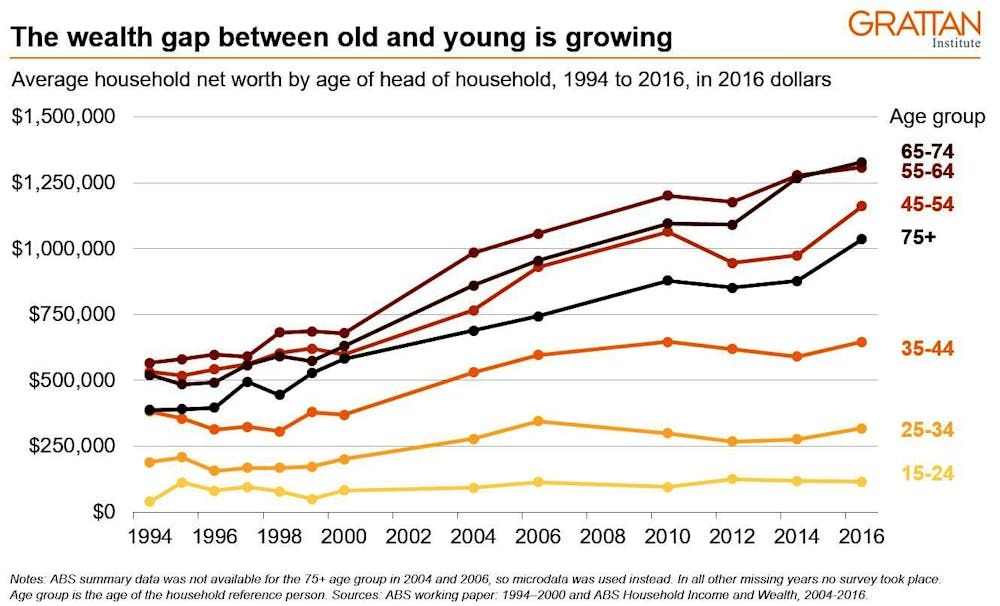
But, as can be seen from the yellow lines on this graph, younger Australians have not made the same progress.


The graph shows that the wealth of households headed by someone under 35 has barely moved since 2004.

It’s not young people’s spending habits that are the problem – this is not a story of too many avocado lattes (and yes, they are a thing).

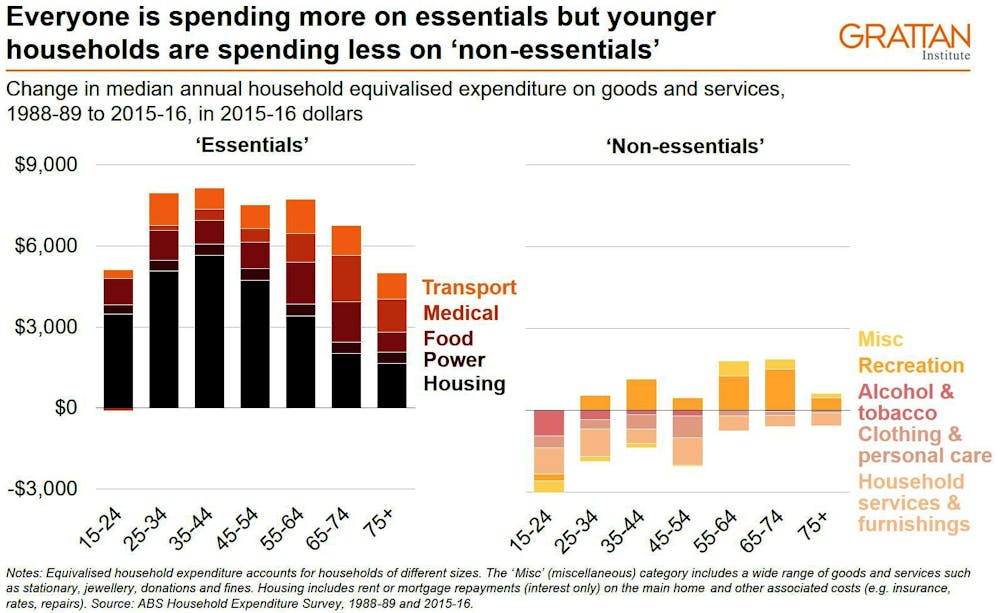
In fact, as the graph below shows, while every age group is spending more on essentials such as housing, young people are cutting back on non-essentials: among them alcohol, clothing, furnishings and recreation.


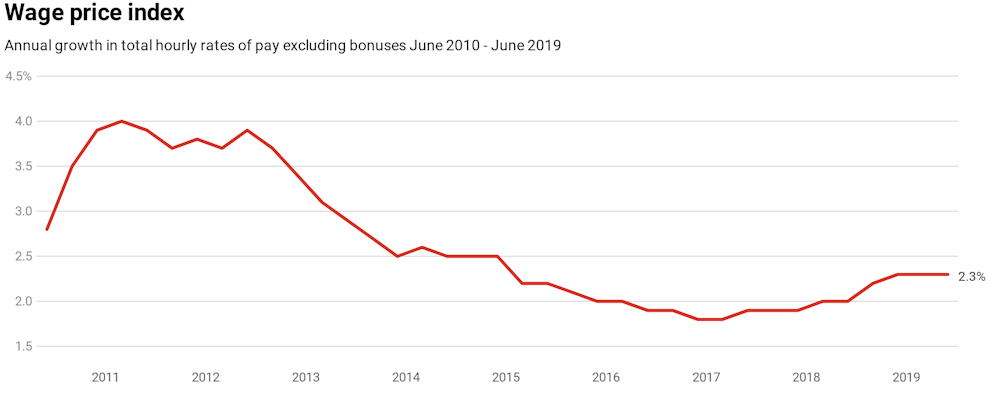
Wage stagnation since the global financial crisis and climbing underemployment have hit young people particularly hard. Older people tend to be better cushioned because they have already established their careers and are more likely to have other sources of income.

If low wage growth and fewer working hours becomes the “new normal”, we are likely to see a generation emerge into adulthood with lower incomes than the one before it.

It has already happened in the United States and United Kingdom.

Our generational bargain is at breaking point

Budget pressures will exacerbate these challenges.

Australia’s tax and welfare system supports an implicit generational bargain. Working-age Australians, as a group, are net contributors to the budget, helping to support older generations in their retirement.

They’ve come to expect that future generations in turn will support them.

But Australia’s population is ageing – which increases the need for government spending on health, aged care and pensions at the same time as there are relatively fewer working age people to pay for it.

Demographic bad luck is one thing (some generations will always be larger than others) but policy changes are making the burden worse.


Read more: Expect a budget that breaks the intergenerational bargain, like the one before it, and before that


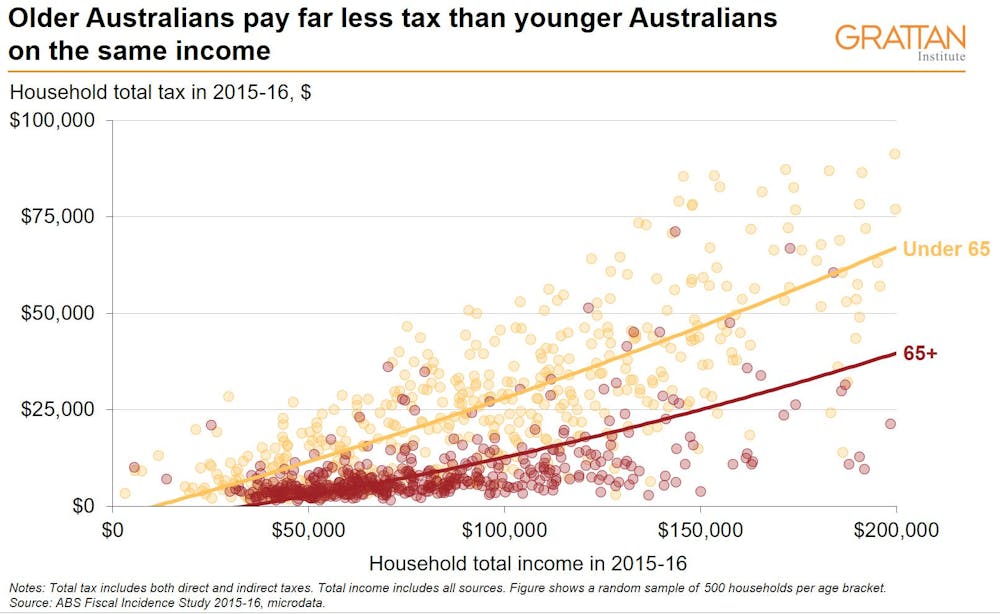
A series of tax policy decisions over the past three decades – in particular, tax-free superannuation income in retirement, refundable franking credits, and special tax offsets for seniors – mean we now ask older Australians to pay a lot less income tax than we once did.

Disturbingly, these and other changes mean older households now pay much less tax than younger households on the same income.


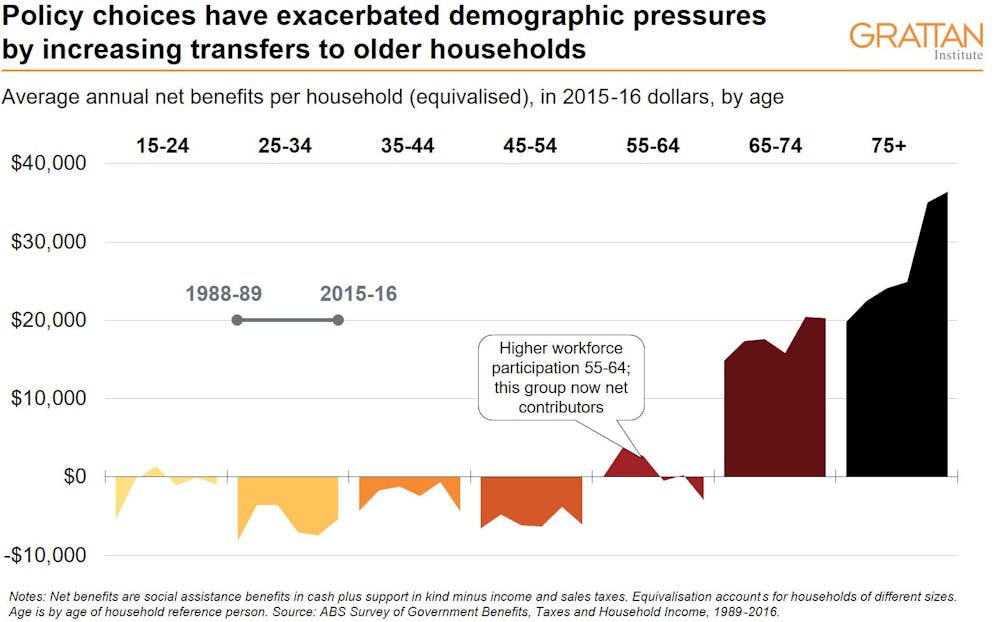
Added to this have been substantial increases in average pension and health payments for households over 65.

It has meant that net transfers – government benefits minus taxes – have dramatically increased for older households but not for younger ones.

The overall effect has been to make current working Australians increasingly underwrite the living standards of retirees.


A typical 40-year-old today contributes much more towards the retirement of others through taxes than did his or her baby boomer predecessors.

As it happens, it is also more than the typical 40-year-old is contributing to his or her own retirement through compulsory super.


This can’t be what Australians want

Most Australians want to leave the world a better place for those that come after them.

It’s time to make sure we do it.

Lots of older Australians are doing their best, individually, supporting their children via the “Bank of Mum and Dad”, caring for grandchildren, and scrimping through retirement to leave their kids a good inheritance.

These private transfers help a lucky few, but they don’t solve the broader problem. In fact, inheritances exacerbate inequality because they largely go to the already wealthy.

We need policy changes.

Reducing or eliminating tax breaks for “comfortably off” older Australians would be a start.


Read more: Migration helps balance our ageing population – we don’t need a moratorium


Boosting economic growth and improving the structural budget position would help all Australians, especially younger Australians. It would also put Australia in a better position to tackle other challenges that are top of mind for young people, such as climate change.

Changes to planning rules to encourage higher-density living in established city suburbs would help by making housing more affordable.

Just as a series of government decisions have contributed to the challenges facing young people today, a series of government decisions will be needed to help redress them.

Every generation faces its own unique challenges, but letting this generation fall behind the others is surely a legacy none of us would be proud of.

It’s time to share the burden, and perhaps an avocado latte while we’re at it.

ref. For the first time in centuries, were setting up a generation to be worse off than the one before it – http://theconversation.com/for-the-first-time-in-centuries-were-setting-up-a-generation-to-be-worse-off-than-the-one-before-it-121983

Australia has coal removed from PIF documentation

Australian Prime Minister, Scott Morrison.

Pacific Media Centre Newsdesk

Wording has played a crucial role in a reportedly “fierce” Pacific Islands Forum in Tuvalu with Australia allegedly managing to alter documental terms to downplay its commitment to climate change mitigation.

According to RNZ Pacific, a communiqué and separate statement on climate change was released after a 12-hour meeting between the leaders yesterday.

The document, released after midnight, included what’s titled the ‘Funafuti Declaration for Urgent Climate Change Action Now”.

READ MORE: Tongan PM blasts Pacific regionalism ‘myth’ and silence over West Papua

The main communiqué endorsed a declaration from the small island states calling for a commitment to limit global warming to 1.5 degrees celsius, an immediate phase out of coal, and contributions to the UN Green Climate Fund.

While Australia was a qualification and did not endorse the main communiqué it did endorse the separate statement which committed countries to work in solidarity to combat climate change, reports RNZ.

– Partner –

However, Australia which is the largest coal exporter in the world managed to have all references to coal removed from the documentation.

While the Guardian had reported that Scott Morrison’s government was pushing for the words climate change “crisis” to be changed to “reality” in the draft communiqué, it remained in the final document.

Nevertheless, Australia’s Shadow Minister for Foreign Affairs, Penny Wong, said Scott Morrison was undermining vital relationships in the Pacific.

“The reality is that Pacific Island nations, Pacific leaders have made it clear they don’t trust the Morrison government when it comes to climate change. They don’t trust them because the Morrison government has failed to act on climate change.”

Fiji’s Prime Minister Voreqe Bainimarama was not happy with the result of the forum, saying the leaders had settled for the status quo.

“Watered-down climate language has real consequences — like water-logged homes, schools, communities, and ancestral burial grounds,” he said.

Opposition leader of the Solomon Islands, Matthew Wale, said the forum was a missed opportunity to really “step up”.

“‘Family’, has been exploited for domestic Australian politics,” he said, referencing the term Scott Morrison had used in his speech at the forum.

Tuvalu Prime Minister Enele Sopoaga was more diplomatic, saying: “I think the outcome is a very good outcome, it’s probably the best outcome given the context and circumstances.”

New Zealand Prime Minister Jacinda Ardern has been praised for her commitment to climate change at the forum.

This week she announced $150 million Pacific climate funding and reiterating New Zealand’s commitment to reducing emissions, citing the goal of reaching net zero carbon emissions by 2035.

While she has said Scott Morrison’s government “has to answer on the Pacific”, she stopped short of calling for Australia to transition out of coal, reports The Guardian.

“Issues around Australia’s domestic policy are issues for Australia,” she said, when asked about Australia’s coal use.

Print Friendly, PDF & Email

Article by AsiaPacificReport.nz

‘Bullying’ Australia disregards Pacific over climate crisis, says 350 Pacific

Australia’s coal policy and its use of carry over credits to fulfill its obligations under the Paris Agreement have come under fire and been major points of contention at this year’s 50th Pacific Islands Forum (PIF) Meeting in Funafuti, Tuvalu.

READ MORE: ‘We should have done more for our people’ – Forum climate change fight leaves bitter taste

Both declarations strongly call for Australia to commit to urgent climate action, as the effects of the climate crisis become more apparent on a daily basis.

In response to Pacific Island states, which have considered Australia as the “big brother”, Prime Minister Scott Morrison has announced that it will provide A$500m over five years in climate resilience and adaptation funding for the region.

– Partner –

“Australia is supposed to be an ally for the Pacific, and their inaction in a time of dire need is appalling,” said Fenton Lutunatabua, 350 Pacific managing director.

“This funding support is being marketed as a solution, but in fact is a diversion of funding that was already allocated for supporting the Pacific Island states.”

Australia’s aid ploy
Australia’s ploy to use aid as a means of negotiating in the Pacific is failing, with Pacific Island leaders literally stating that they do not care about the money anymore.

The Prime Minister of Tuvalu and chair of the Pacific Islands Forum said during the PIF meeting on Tuesday that channeling aid money to the Pacific was in no way a compromise to open new coalmines and continue with unregulated emissions.

“Pacific Island leaders have stepped up their game significantly because for us it is a matter of survival and they have committed to holding industrialised, coal-producing nations to account,” said Patricia Mallam, senior communications specialist for the Pacific.

“The appalling fact in all this is that Australia is granted a seat at the same PIF meeting table as nations literally struggling to protect the lives and cultural integrity of their people.

“Australia bullies its way through negotiations, attempting to mask the gravity of the climate crisis on paper – when the visible proof in our lives shows otherwise.”

Pacific Island leaders had paved the way for polluting countries to take more concrete steps towards recognising that the climate crisis was real, she said.

The fact that Australia continued to disregard the science that proved this, and carried on with allowing the coal industry to prosper was “a slap in the face of its family in the Pacific”.

“We share the same part of the planet, in close proximity to each other, so taking action to save the Pacific pretty much means saving your own people. A person of authority in a position to make a difference, who compromises the wellbeing of their very own people is not worthy of being considered a leader,” added Mallam.

Key examples of leadership across the Pacific include:

  • The Marshall Islands becoming thefirst country in the world to update and strengthen its Nationally Determined Contribution (NDC) to the Paris Agreement.
  • The Republic of Fiji holding the presidency of COP23 through 2017-2018 and having recently announced that it will introduce aClimate Change Act, one of the world’s most ambitious legislative programmes which includes tighter restrictions on the use of plastics, a framework for Fiji to reduce its emissions to net-zero by 2050, the introduction of a carbon credits scheme and the establishment of procedures for the relocation of communities at risk from the adverse effects of the climate crisis.
  • Tokelau announcing the launch of its Fakaofo Wind Turbine Project, situated on the southernmost island of Tokelau. The viability of this innovation is being tested for urgent climate action.
  • More climate stories
  • More Forum stories

Article by AsiaPacificReport.nz

Pacific Island nations will no longer stand for Australia’s inaction on climate change

Source: The Conversation (Au and NZ) – By Michael O’Keefe, Head of Department, Politics and Philosophy, La Trobe University

The Pacific Islands Forum meeting in Tuvalu this week has ended in open division over climate change. Australia ensured its official communique watered down commitments to respond to climate change, gaining a hollow victory.

Traditionally, communiques capture the consensus reached at the meeting. In this case, the division on display between Australia and the Pacific meant the only commitment is to commission yet another report into what action needs to be taken.

The cost of Australia’s victory is likely to be great, as it questions the sincerity of Prime Minister Scott Morrison’s commitment to “step up” engagement in the Pacific.


Read more: Can Scott Morrison deliver on climate change in Tuvalu – or is his Pacific ‘step up’ doomed?


Australia’s stance on climate change has become untenable in the Pacific. The inability to meet Pacific Island expectations will erode Australia’s influence and leadership credentials in the region, and provide opportunities for other countries to grow influence in the region.

An unprecedented show of dissent

When Morrison arrived in Tuvalu, he was met with an uncompromising mood. In fact, the text of an official communique was only finished after 12 hours of pointed negotiations.

While the “need for urgent, immediate actions on the threats and challenges of climate change”, is acknowledged, the Pacific was looking for action, not words.

Morrison was met with an uncompromising mood in by leaders in Tuvalu. AAP Image/Mick Tsikas

What’s more, the document reaffirmed that “strong political leadership to advance climate change action” was needed, but leadership from Australia was sorely missing. It led Tuvaluan Prime Minister Enele Sopoaga to note:

I think we can say we should’ve done more work for our people.

Presumably, he would have hoped Australia could be convinced to take more climate action.

In an unprecedented show of dissent, smaller Pacific Island countries produced the alternative Kainaki II Declaration. It captures the mood of the Pacific in relation to the existential threat posed by climate change, and the need to act decisively now to ensure their survival.

And it details the commitments needed to effectively address the threat of climate change. It’s clear nothing short of transformational change is needed to ensure their survival, and there is rising frustration in Australia’s repeated delays to take effective action.

Australia hasn’t endorsed the alternative declaration and Canberra has signalled once and for all that compromise on climate change is not possible. This is not what Pacific leaders hoped for and will come at a diplomatic cost to Australia.


Read more: Response to rumours of a Chinese military base in Vanuatu speaks volumes about Australian foreign policy


Canberra can’t buy off the Pacific

Conflict had already begun brewing in the lead up to the Pacific Islands Forum. The Pacific Islands Development Forum – the brainchild of the Fijian government, which sought a forum to engage with Pacific Island Nations without the influence of Australia and New Zealand – released the the Nadi Bay Declaration in July this year.

This declaration called on coal producing countries like Australia to cease all production within a decade.

But it’s clear Canberra believes compromise of this sort on climate change would undermine Australia’s economic growth and this is the key stumbling block to Australia answering its Pacific critics with action.

As Sopoaga said to Morrison:

You are concerned about saving your economy in Australia […] I am concerned about saving my people in Tuvalu.

And a day before the meeting, Canberra announced half a billion dollars to tackle climate change in the region. But it received a lukewarm reception from the Pacific.

The message is clear: Canberra cannot buy off the Pacific. In part, this is because Pacific Island countries have new options, especially from China, which has offered Pacific island countries concessional loans.


Read more: As Australia’s soft power in the Pacific fades, China’s voice gets louder


China is becoming an attractive alternate partner

As tension built at the Pacific Island Forum meeting, New Zealand Foreign Minister Winston Peters argued there was a double standard with respect to the treatment of China on climate change.

China is the world’s largest emitter of climate change gasses, but if there is a double standard it’s of Australia’s making.

Australia purports to be part of the Pacific family that can speak and act to protect the interests of Pacific Island countries in the face of China’s “insidious” attempts to gain influence through “debt trap” diplomacy. This is where unsustainable loans are offered with the aim of gaining political advantage.

But countering Chinese influence in the Pacific is Australia’s prime security interest, and is a secondary issue for the Pacific.

But unlike Australia, China has never claimed the moral high ground and provides an attractive alternative partner, so it will likely gain ground in the battle for influence in the Pacific.

Growing confidence among Pacific leaders has changed diplomatic dynamics forever. AAP Image/Mick Tsikas

For the Pacific Island Forum itself, open dissent is a very un-Pacific outcome. Open dissent highlights the strains in the region’s premier intergovernmental organisation.

Australia and (to a lesser extent) New Zealand’s dominance has often been a source of criticism, but growing confidence among Pacific leaders has changed diplomatic dynamics forever.


Read more: Climate change forced these Fijian communities to move – and with 80 more at risk, here’s what they learned


This new pacific diplomacy has led Pacific leaders to more steadfastly identify their security interests. And for them, the need to respond to climate change is non-negotiable.

If winning the geopolitical contest with China in Pacific is Canberra’s priority, then far greater creativity will be needed as meeting the Pacific half way on climate change is a prerequisite for success.

ref. Pacific Island nations will no longer stand for Australia’s inaction on climate change – http://theconversation.com/pacific-island-nations-will-no-longer-stand-for-australias-inaction-on-climate-change-121976

Glamorising violent offenders with ‘true crime’ shows and podcasts needs to stop

Source: The Conversation (Au and NZ) – By Xanthe Mallett, Forensic Criminologist, University of Newcastle

Even in death, the voice of Carl Williams is louder than that of his victims. Intimate prison letters written by the convicted murderer and drug trafficker to his ex-wife, Roberta – herself arrested this month on kidnap and threats to kill charges, allegedly made against a documentary producer – were published this month.

The explosion of true crime in podcasts, streaming series, and books has fuelled our interest in violent and dangerous perpetrators, and has increasingly meant the victims continue to be overlooked.

British backpacker Caroline Clarke was one of Ivan Milat’s seven known victims. AAP

Indeed, Ivan Milat, Ted Bundy, and Jeffrey Dahmer are household names. Yet Deborah Everist, Caryn Campbell, or Tony Hughes – victims of these violent killers, have been largely forgotten.

Deadly charms

My students and I often watch true crime documentaries as stimuli for discussion about criminal causation, or victim selection. Recently, a student in one such tutorial expressed admiration for notorious US serial killer Ted Bundy, even going as far as to say she was attracted to him – or at least Hollywood heartthrob Zac Efron’s portrayal of him.

Bundy killed at least 30 women, assaulted many more, and escaped prison twice. He was perhaps active from the late 1960s until 1978. Bundy was the subject of a recent four-part Netflix series entitled Conversations with a Killer: The Ted Bundy Tapes, billed as “present-day interviews, archival footage and audio recordings made on death row”.

Zac Efron plays up Ted Bundy’s killer charm in the recent Netflix series.

The series premiered in January, to coincide with the 30th anniversary of Bundy’s execution. Netflix followed this factual account of Bundy’s crimes with a film about the case called Extremely Wicked and Shockingly Evil and Vile, starring Efron.

I found my student’s affection for him confronting. She was willing to overlook the appalling violence because Efron – and this was also true of Bundy – was a charismatic and attractive person.

I was left wondering if the glamorisation of offenders through true crime was making people desensitised to the plight of victims. And, if this was the case, the affect this had on surviving victims and their families.

Some victims are speaking out.

A recent article focused on on Bill Thomas, whose sister Cathy’s 1986 murder in Colonial Parkway, Virginia, remains unsolved. Bill is at the first day of CrimCon, an annual true crime festival, to draw attention to his sister’s murder and put pressure on the FBI to investigate it further. To do that, he has to rub shoulders with people wearing clothes emblazoned with serial killers’ faces.

Serial Killers Gallery at the National Museum of Crime & Punishment in Washington, DC. WikiMedia

We are particularly fascinated by cold cases. Even if we don’t know who the offender is, the salacious details of the crimes overshadow the pain and suffering of victims.

I became painfully aware of this recently while writing a book about cold cases, with the goal to maintain a focus on the victims – each case is included with the hopes of learning something new. A new forensic technique that might progress it, another victim that may be part of the sequence and whose case remains unsolved. Victims’ identities are perversely subsumed into that of the person who offended against them, and I wanted to try to undo some of that.

Focus is shifting

Narcissistic killers like Ivan Milat and Daniel Holdom (who violently murdered Karlie Pearce-Stevenson and her 2-year-old daughter Khandalyce Pearce in 2010) maintain their notoriety by writing letters from prison. Milat’s letters to his nephew, Alistair Shipsey, were published in 2016. Holdom’s letters were turned into a podcast by the Daily Telegraph.

But recent events have seen a shift in focus.

Victimology (the study of victims) is growing as a criminological discipline and academics and victims’ advocates have been saying for some time that the centre needs to shift from the offenders to the victims. But we have largely been shouting into a black hole.

The Christchurch mosque shootings on 15 March 2019, gave voice to a redirection in attention when New Zealand Prime Minister Jacinda Ardern refused to name the perpetrator – a 28-year-old Australian man who had live-streamed the atrocity and released a manifesto outlining white genocide conspiracy theories. Instead, she urged the public to speak the names of the victims. This was a powerful message that the perpetrator would not be given the attention he sought.

New Zealand went further, making it a criminal offence to copy, distribute, or exhibit the video of the live shootings, with potential penalties of up to 14 years in prison for an individual, or up to $100,000 in fines for a corporation. One man was sentenced to nearly two years in prison for sharing the video that he embellished to look like a video game, including cross hairs and a body count.

Tributes flowed for Sydney woman Michaela Dunn. AAP/NSW Police

This week, 24-year-old woman Michaela Dunn was identified as the victim of a Sydney knife attack after she was allegedly killed in a CBD apartment by Mert Ney, 20, before he took his knife to the streets and was overpowered by members of the public. Tributes flowed for the victim, described by her mother as a “beautiful, loving woman who had studied at university and travelled widely”.

Fame can breed copycats

Publicising violent crime and its offenders can lead to further harm in the form of copycat attacks.

Nine days after the Christchurch shootings, there was an arson attack against a mosque in California, followed by a shooting. The offender praised the Christchurch shooter.

Still, my hope is that if Ardern’s ethos is applied to future events, our interest in violent offenders will lessen and our sensitivity to the effect of their crimes will be revived.

We can always learn from true crime events, but we must be careful to move away from glamorisation of perpetrators and pay due respect to the victims and their families.

ref. Glamorising violent offenders with ‘true crime’ shows and podcasts needs to stop – http://theconversation.com/glamorising-violent-offenders-with-true-crime-shows-and-podcasts-needs-to-stop-121806

Case in Victoria could set new legal precedent for stealthing, or removing condom during sex

Source: The Conversation (Au and NZ) – By Brianna Chesser, Senior Lecturer in Criminology and Justice, RMIT University

In September 2018, a prominent Melbourne surgeon and academic was charged with rape and sexual assault for alleged offences committed a year earlier against a male doctor.

The surgeon and doctor had gone out for dinner and returned to the doctor’s home and had intercourse. Despite assuring the doctor he would use a condom, the surgeon is alleged to have removed it without consent, a practice known as “stealthing”. The doctor later made a complaint to police and the surgeon was charged with one count of sexual assault and one count of rape.

In late July, a committal proceeding took place in the Magistrates Court of Victoria to determine whether there was enough evidence to require the surgeon to stand trial. The surgeon was committed to stand trial next year.


Read more: Women’s reproductive lives are being interfered with on a large scale – new study


This week, an appeal from the Medical Board of Australia was dismissed and the surgeon was permitted to continue treating patients while the criminal case makes its way through the courts. Justice Richard Niall said that immediate action against the surgeon was not in the public’s interest.

From a legal standpoint, the case brings up an important question about how this offence should be classified under the law. At the moment, no criminal law in Australia explicitly identifies stealthing as a sexual offence.

What is stealthing?

Sexual violence is becoming increasingly prevalent in Australian society, with nearly one in five women (18%) and one in 20 men (4.7%) experiencing sexual assault and/or threats in their lifetime.

Stealthing, an emerging area within criminal law, is believed to happen even more frequently. According to a recent joint study between the Melbourne Sexual Health Centre and Monash University, one in three women and nearly one in five men in Australia have reported being stealthed.

The study found that most women who had been stealthed met the perpetrators through friends (29%) or sex work (23%). Male victims of stealthing, meanwhile, tended to meet their partners (also mostly male) through dating apps or online.


Read more: Victorian rape law needs reform to protect sex workers


Unfortunately, the statistics for reporting stealthing mirror reporting rates for sexual offences more generally, with the study finding that only 1% of respondents indicated they had reported stealthing incidents to police.

Stealthing poses a multitude of risks to both physical and psychological health, including the transmission of sexually transmitted infections and HIV, as well as unplanned pregnancies, depression, anxiety, and in some cases post-traumatic stress disorder.

Current approach to stealthing under criminal law

Despite the decades of extensive reform of laws governing sexual offences in Australia, significant gaps remain in the legislative provisions governing consensual intercourse.

Definitions of rape in Victoria and sexual assault in other states mandate an assessment of whether or not an individual understands the sexual nature of the act and whether or not full consent has been given prior to engaging in intercourse. Under current laws, this consent cannot be granted without “free agreement”.

The real issue with the laws as they stand is that stealthing just doesn’t fit into the current definition of rape. The current definition is simply about whether or not the victim, in this case the doctor, understands that the act that they have consented to is sexual in nature, not whether any other conditions, such as condom usage, have been met.


Read more: Everyday rape: let’s turn the spotlight on known perpetrators


Situations where those conditions have changed – such as when a condom has been removed – should require “fresh consent” from both partners. As Lina Howlett, a NSW sex crimes squad commander, explains,

sex turns into assault when consent is not given or [is] withdrawn, e.g. they are having consensual sex and one party becomes aware that the condom was removed and tells the partner to stop and the partner continues.

The problem is, there is no legal precedent for such a case in Australia.

Other cases around the world

Switzerland is out in front on this issue globally, with courts there upholding a 12-month suspended sentence for a man convicted of stealthing. The Swiss case is believed to be the first to specifically deem the removal of a condom without a partner’s consent to be a criminal act. The could provide some preliminary insight into how the courts in Australia will view this sexual crime.

There is no current call by legislators in Australia to update the laws against sexual assault to include stealthing. However, there is some movement in other jurisdictions around the world. In the US, Wisconsin and California have both attempted to change the laws with bills in recent years.

A judgement in the case against the surgeon accused of stealthing in Victoria should provide some legal clarity on the issue, hopefully providing impetus for a move to change the laws here.

ref. Case in Victoria could set new legal precedent for stealthing, or removing condom during sex – http://theconversation.com/case-in-victoria-could-set-new-legal-precedent-for-stealthing-or-removing-condom-during-sex-118343

The exquisite blotched butterfly orchid is an airy jewel of the Australian landscape

Source: The Conversation (Au and NZ) – By John Dearnaley, Associate Professor, University of Southern Queensland

The blotched butterfly orchid (Sarcochilus weinthalii) looks fairly unremarkable when it’s not flowering, generally resembling the far more common orange blossom orchid. But when it flowers, it is exquisite. Dark purple blotches stand out on cream petals, resembling a flock of butterflies come to rest on rainforest trees.

Like the most of its genus, the blotched butterfly orchid is epiphytic, or an air plant: without roots, they absorb water from the air. The leaves are leathery and curved, and appear in groups of three to seven. They usually grow on the horizontal branches of tree hosts in dry rainforests in southern Queensland and northern NSW.


Read more: Warty hammer orchids are sexual deceivers


Australia has 18 unique butterfly orchids, a number of which are under threat. As they are easily grown by orchid fanciers, they are often removed from natural locations and are becoming harder to see in their natural habitat, high up on rainforest trees in hilly terrain.


The Conversation

The genus Sarcochilus was named by Robert Brown, the naturalist on board the Flinders expedition documenting the east coast of Australia in the early 19th century. The name refers to the fleshy labellum, the showy front petal of the flowers.

The blotched butterfly orchid, Sarcochilus weinthalii was first collected by Ferdinand Weinthal, a notable early Australian orchid collector and grower near Toowoomba in southern Queensland in 1903.

My colleagues and I have been trying to learn more about the biology of these beautiful orchids, to help improve conservation efforts. We are studying populations sizes, life cycles, host trees and similar species in an effort to learn more about how and where they grow – and what might be pollinating them.

The total number of plants at our study locations is less than 200 individuals which is concerning. More troubling is now the complete absence of plants from several regular sites for the orchid. The presence of juvenile plants at the study locations suggests the remaining populations could still be viable, albeit with the spectre of inbreeding depression hovering over the smaller groups.

The orchid was quite adaptable to different tree hosts although there was preference for native hydrangea (Cuttsia viburnea) at one site. Plants grew on the southerly (shaded) side of their hosts, at heights varying from more than 4 metres above the forest floor to less than one metre above soil level. These latter plants were growing on a basalt boulder – something never recorded before.

Fungus friends

As part of our research we sampled the roots of the orchid and isolated a symbiotic fungus, identified by DNA analysis. Analysis of the fungal DNA showed something quite striking. Every orchid, from every location, had exactly the same fungus growing in its roots.

When orchid seed was combined with the fungus in the laboratory, plants grew considerably faster than controls. This suggests that both life stages of the plant require the fungus to provide nutrients.

This fungus will be integral for conservation efforts for the species. Strong growth of seedlings in labs and greenhouse will require the fungus to be present. Restoration efforts will need to check for the presence of the fungus to ensure transplanted populations thrive, and to support new seedling growth in re-established orchid populations.

We observed a number of insects visiting flowers of the blotched butterfly orchid, but most of these were small and unlikely to be capable of pollinating the species. Previous research suggests Sarcochilus orchids are pollinated by native bees.

What is the future for the blotched butterfly orchid?

In another species of Sarcochilus we have studied, S. hartmannii, we saw hover flies regularly visiting (and possibly pollinating) these orchids. So it’s feasible these insects are pollinating the blotched butterfly orchid as well – but we need more research to be sure.

Our work also found the orchids are vulnerable to land clearing, an issue that threatens many native Australian plants. Clearing not only destroys individual plants or populations, but provides conduits for the entry of aggressive exotic plant species like cat’s claw and climbing asparagus into fragile ecosystems.


Read more: Leek orchids are beautiful, endangered and we have no idea how to grow them


And unfortunately, the blotched butterfly orchid grows outside national parks (as well as inside them), which makes them hard to protect from orchid collectors. Perhaps weightier fines are necessary to change the minds of recalcitrants who still believe collecting native plant species from the wild is acceptable!

ref. The exquisite blotched butterfly orchid is an airy jewel of the Australian landscape – http://theconversation.com/the-exquisite-blotched-butterfly-orchid-is-an-airy-jewel-of-the-australian-landscape-121702

Why do different cultures see such similar meanings in the constellations?

Source: The Conversation (Au and NZ) – By Simon Cropper, Senior Lecturer, Melbourne School of Psychological Sciences, University of Melbourne

Almost every person throughout the existence of humankind has looked up at the night sky and seen more than just a random scattering of light. Constellations of stars have helped us shape our own ongoing narratives and cultures – creating meaning in the sky above that guides us in our life on the ground below.

Of course, we don’t all see exactly the same night sky – there are subtle differences depending on where we are on the planet, what season it is, and the time of night, all of which are imbued into the meaning we construct about the stars.

But around the world and throughout history, we find remarkably similar constellations defined by disparate cultures, as well as strikingly similar narratives describing the relationships between them.


Read more: Kindred skies: ancient Greeks and Aboriginal Australians saw constellations in common


For example, the constellation Orion is described by the Ancient Greeks as a man pursuing the seven sisters of the Pleiades star cluster.

This same constellation is Baiame in Wiradjuri traditions: a man pursuing the Mulayndynang (Pleiades star cluster).

In the traditions of the Great Victoria Desert, Orion is Nyeeruna, a man chasing the seven Yugarilya sisters.

Cultures thoughout the world have perceived Orion (top right) as a man pursuing a group of women – even though in the southern hemisphere he appears the other way up. Erkki Makkonen/Shutterstock

These and other common patterns, as well as the remarkably complex narratives describing them, link the cultures of early Aboriginal Australians and the ancient Greeks, despite them being separated by thousands of years and miles.

Similarly, many cultures in the southern hemisphere identify constellations that are actually made of the dark spaces between the stars, highlighting absence rather than presence. These feature predominantly in the dark dust lanes of the Milky Way.

Across cultures, these again show remarkable consistency. The celestial emu, which is found in Aboriginal traditions across Australia, shares nearly identical views and traditions with the Tupi people of Brazil and Bolivia, who see it as a celestial rhea, another large flightless bird.

Significant differences too

There are also significant differences seen between cultures, although the fundamental roots remain.

The Big Dipper is identified across many northern hemisphere traditions, but for the Alaskan Gwich’in this is merely the tail of the whole-sky constellation Yahdii (The Tailed Man), who “walks” from east to west overnight.

Although we share a fascination with the stars, we have little documented knowledge of how particular constellations were identified by certain cultures. Why and how do we see the same patterns?

Our upcoming research explores the genesis of these different names and different groupings, and the idea that many came about mainly as a result of cultural variations in the perception of natural scenes. Thus an individual’s view of a phenomenon can become the generalised view of a group or culture.

These differences may have endured due to the necessity of communicating these groupings across generations through complex oral traditions.

These oral traditions are often mistakenly compared to the children’s game of Telephone, in which a message is whispered down a line of people, resulting in errors as the information is passed on. In reality, they are far more organised and rigorous, enabling information to be passed on for thousands of years without degradation.

British psychologist Sir Frederic Bartlett realised in the early 20th century that these errors typically reflect a person’s beliefs about missing or uncertain information filtering into the original message. The information passed from one person to another accumulates and ultimately informs an individual’s beliefs about the nature of the world.

In oral cultures – like those of Indigenous Australia – the focus of transmission is on ease of communication and recall.

The outstanding difference is that Aboriginal oral traditions constructed narratives and memory spaces in such a way as to keep the critical information intact through hundreds of generations.

Search for meaning

How this came about and how a thread of meaning endures across individuals, space and time are fascinating questions.

In collaboration with Museums Victoria, our team is exploring how cultural differences in our traditions and stories can come about as a result of very small variations in the nature of perception and understanding in different people, and how this is influenced by both personal belief and geographical location.

Investigating how meaning in the stars is developed and passed on emphasises the fundamental aspects of humanity that we share across cultural bounds, despite differing beliefs, geographical isolation, and location.


Read more: The stories behind Aboriginal star names now recognised by the world’s astronomical body


As part of National Science Week, more than 200 people submitted their own constellation and story in response to a star field projected onto the ceiling of Victoria’s Parliament House; the preliminary data-collection phase in this study.

What do you see? Head to https://starstories.space and share your interpretation. Star Stories, Author provided

Humanity’s ongoing fascination with the stars has only recently been fuelled by our ability to dream about leaving the planet and visiting them. More fundamentally, they are a reflection and a framework for our life on this planet.

The meaning we find in the night sky seems, ironically, to ground us in the changing world in which we find ourselves. This is as important now as it was 65,000 years ago when people migrated to Australia using the stars.


This article was co-published with Pursuit.

ref. Why do different cultures see such similar meanings in the constellations? – http://theconversation.com/why-do-different-cultures-see-such-similar-meanings-in-the-constellations-121981

No, eating chocolate won’t cure depression

Source: The Conversation (Au and NZ) – By Ben Desbrow, Associate Professor, Nutrition and Dietetics, Griffith University

A recent study published in the journal Depression and Anxiety has attracted widespread media attention. Media reports said eating chocolate, in particular, dark chocolate, was linked to reduced symptoms of depression.

Unfortunately, we cannot use this type of evidence to promote eating chocolate as a safeguard against depression, a serious, common and sometimes debilitating mental health condition.

This is because this study looked at an association between diet and depression in the general population. It did not gauge causation. In other words, it was not designed to say whether eating dark chocolate caused a reduction in depressive symptoms.


Read more: What causes depression? What we know, don’t know and suspect


What did the researchers do?

The authors explored data from the United States National Health and Nutrition Examination Survey. This shows how common health, nutrition and other factors are among a representative sample of the population.

People in the study reported what they had eaten in the previous 24 hours in two ways. First, they recalled in person, to a trained dietary interviewer using a standard questionnaire. The second time they recalled what they had eaten over the phone, several days after the first recall.

The researchers then calculated how much chocolate participants had eaten using the average of these two recalls.

Dark chocolate needed to contain at least 45% cocoa solids for it to count as “dark”.


Read more: Explainer: what is memory?


The researchers excluded from their analysis people who ate an implausibly large amount of chocolate, people who were underweight and/or had diabetes.

The remaining data (from 13,626 people) was then divided in two ways. One was by categories of chocolate consumption (no chocolate, chocolate but no dark chocolate, and any dark chocolate). The other way was by the amount of chocolate (no chocolate, and then in groups, from the lowest to highest chocolate consumption).


Read more: Monday’s medical myth: chocolate is an aphrodisiac


The researchers assessed people’s depressive symptoms by having participants complete a short questionnaire asking about the frequency of these symptoms over the past two weeks.

The researchers controlled for other factors that might influence any relationship between chocolate and depression, such as weight, gender, socioeconomic factors, smoking, sugar intake and exercise.

What did the researchers find?

Of the entire sample, 1,332 (11%) of people said they had eaten chocolate in their two 24 hour dietary recalls, with only 148 (1.1%) reporting eating dark chocolate.

A total of 1,009 (7.4%) people reported depressive symptoms. But after adjusting for other factors, the researchers found no association between any chocolate consumption and depressive symptoms.

Few people said they’d eaten any chocolate in the past 24 hours. Were they telling the truth? from www.shutterstock.com

However, people who ate dark chocolate had a 70% lower chance of reporting clinically relevant depressive symptoms than those who did not report eating chocolate.

When investigating the amount of chocolate consumed, people who ate the most chocolate were more likely to have fewer depressive symptoms.

What are the study’s limitations?

While the size of the dataset is impressive, there are major limitations to the investigation and its conclusions.

First, assessing chocolate intake is challenging. People may eat different amounts (and types) depending on the day. And asking what people ate over the past 24 hours (twice) is not the most accurate way of telling what people usually eat.

Then there’s whether people report what they actually eat. For instance, if you ate a whole block of chocolate yesterday, would you tell an interviewer? What about if you were also depressed?

This could be why so few people reported eating chocolate in this study, compared with what retail figures tell us people eat.


Read more: These 5 foods are claimed to improve our health. But the amount we’d need to consume to benefit is… a lot


Finally, the authors’ results are mathematically accurate, but misleading.

Only 1.1% of people in the analysis ate dark chocolate. And when they did, the amount was very small (about 12g a day). And only two people reported clinical symptoms of depression and ate any dark chocolate.

The authors conclude the small numbers and low consumption “attests to the strength of this finding”. I would suggest the opposite.

Finally, people who ate the most chocolate (104-454g a day) had an almost 60% lower chance of having depressive symptoms. But those who ate 100g a day had about a 30% chance. Who’d have thought four or so more grams of chocolate could be so important?

This study and the media coverage that followed are perfect examples of the pitfalls of translating population-based nutrition research to public recommendations for health.

My general advice is, if you enjoy chocolate, go for darker varieties, with fruit or nuts added, and eat it mindfully. — Ben Desbrow


Blind peer review

Chocolate manufacturers have been a good source of funding for much of the research into chocolate products.

While the authors of this new study declare no conflict of interest, any whisper of good news about chocolate attracts publicity. I agree with the author’s scepticism of the study.

For dark chocolate, just 1.1% of people in the study consumed dark chocolate (at least 45% cocoa solids) at an average 11.7g a day. There was a wide variation in reported clinically relevant depressive symptoms in this group. So, it is not valid to draw any real conclusion from the data collected.

For total chocolate consumption, the authors accurately report no statistically significant association with clinically relevant depressive symptoms.

However, they then claim eating more chocolate is of benefit, based on fewer symptoms among those who ate the most.

In fact, depressive symptoms were most common in the third-highest quartile (who ate 100g chocolate a day), followed by the first (4-35g a day), then the second (37-95g a day) and finally the lowest level (104-454g a day). Risks in sub-sets of data such as quartiles are only valid if they lie on the same slope.

The basic problems come from measurements and the many confounding factors. This study can’t validly be used as justification for eating more chocolate of any kind. — Rosemary Stanton


Research Checks interrogate newly published studies and how they’re reported in the media. The analysis is undertaken by one or more academics not involved with the study, and reviewed by another, to make sure it’s accurate.

ref. No, eating chocolate won’t cure depression – http://theconversation.com/no-eating-chocolate-wont-cure-depression-121504

What is an inverted yield curve? Why is it panicking markets, and why is there talk of recession?

Source: The Conversation (Au and NZ) – By Mark Crosby, Professor, Monash University

Since President Trump tweeted about imposing new tariffs on China, global equity markets have gone into a tailspin.

Trump’s more recent announcement that the new tariffs would be delayed has not calmed the markets, with recent days seeing very large falls in most major stock markets.

Another factor particularly spooking the markets in recent days has been the “inversion of the yield curve” in the United States.

The yield curve is a graph showing the relationship between interest rates earned on lending money for different durations.

Normally, someone who lent to the government or a corporation for one year (by buying a one-year government or corporate bond) would expect to get a lower interest rate than someone who lent for five or ten years, making the yield curve upward-sloping.

An inverted curve slopes down

A simple way to get an idea of the slope of the yield curve is to compare a short-duration government interest rate for a two- or three-year government bond with the rate on a ten-year government bond.

In Australia the ten-year government bond rate has just fallen to a record low 0.891%, only slightly above the three-year rate at around 0.7%.

CNBC.

In the US in recent days the ten-year bond rate has fallen to the point at which the ten-year rate is below the two-year rate – so the yield curve is inverted.

What has made the markets so nervous is that there has been a yield curve inversion before each of the past seven recessions.

The graph below plots the difference between the US ten-year government bond rate and the US two-year government bond right back to the 1970s.

When the difference is negative (when the ten-year bond rate slips below the two-year bond rate), the line moves below zero.

It has done it just before each of the US recessions, which are also marked.


Sometimes the recession follows soon after the line slips below zero, and sometimes there is a delay. Interestingly, in the case of the most recent recession the yield curve inversion was quite small, and began some time before the global financial crisis.

So does correlation imply causation? Reserve Bank deputy governor Guy Debelle said on Thursday that this time is different.

We should certainly hope so.

There are good reasons to think that this time it will be different.

No recession this time?

One reason is that although central bank controlled rates are near record lows, most central banks have also announced words to the effect of “doing what it takes” to support the economy. With the markets expecting further rate cuts, long-term rates might simply reflect this rather than expectations of a recession.

Of course, it could be that markets see central banks’ cuts as a sign that they see a recession coming. It’s hard to tell.

Another reason to think it might be different this time is that President Trump pressured the Federal Reserve to cut rates. Many economists think the latest rate cut took place for that reason rather than because of economic fundamentals.

The simple point here is that a lot of things are different this time.

Many economists, like myself, view recent moves by central banks to cut rates as unproductive.


Read more: Vital Signs: Amid talk of recessions, our progress on wages and unemployment is almost non-existent


The gist of these arguments is that the Australian economy has reasonably strong fundamentals, and any weakness can be better dealt with by measures other than rate cuts. Among them would be measures to boost productivity.

In the US, by contrast, there are indeed reasons to be concerned about a recession.

The trade war with China has already been very destructive, and the political uncertainty of Trump, high debt levels and other structural weaknesses are creating problems.

A US-only recession?

The last time the US entered recession was September 2008. During that quarter global trade fell off a cliff, but in the year that followed Australia’s economy grew by a solid 4%.

Supporting Australia’s economy was a very large Chinese stimulus package that led to very strong demand for Australian resources.

A recession in the US in the next year or two would again lead China to consider all options. Traditionally those options have included much more funding for resource intensive infrastructure.

While that is the most likely path that China would take, it probably has less financial room to supercharge infrastructure than in 2008. That’s enough of a reason for Australians to very concerned if the US goes into recession.

In the end though it is well to remember that Australia’s economy is still in a reasonably strong position compared to others. Unemployment is low, wages growth is higher than it was at 3.1%, public debt is low and other fundamentals are reasonably sound.


Read more: Their biggest challenge? Avoiding a recession


But predicting recessions is notoriously difficult.

There are some who have successfully predicted nine of the last two recessions in Australia, and those pundits are very pessimistic now!

I tend to be more of the view that the probability of a recession in Australia in the next year or so is higher than it has been since 2008, but a recession is far from the sure thing that yield curve readers might suggest.


Read more: Buckle up. 2019-20 survey finds the economy weak and heading down, and that’s ahead of surprises


ref. What is an inverted yield curve? Why is it panicking markets, and why is there talk of recession? – http://theconversation.com/what-is-an-inverted-yield-curve-why-is-it-panicking-markets-and-why-is-there-talk-of-recession-121975

The regions can take more migrants and refugees, with a little help

Source: The Conversation (Au and NZ) – By Jock Collins, Professor of Social Economics, UTS Business School, University of Technology Sydney

The federal government wants to boost the number of migrants moving to regional areas in Australia to fill job vacancies and reduce the pressure on our cities.

That’s why the Minister for Immigration, Citizenship, Migrant Services and Multicultural Affairs, David Coleman, this week asked the Joint Standing Committee on Migration to look into and report on migration in regional Australia.

He’s called on anyone to make a submission by September 20 and the Committee intends to hit the road for a series of public hearings.


Read more: Dog whistles, regional visas and wage theft – immigration policy is again an election issue


The government says only about one in five people who came to Australia between 2006 and 2011 settled in regional areas. So what are the challenges to encourage more migrants to settle in regional Australia?

Bush vs city

Australia is one of the most urbanised nations in the world with 67% of the population living in capital cities, with migrants more urban than non-migrants.

The two key issues for encouraging more migrants to regional areas are attraction and retention.

For skilled migrants this means new visa pathways to regional settlement. Two were announced earlier this year, the Skilled Work Regional (Provisional) visa and the Skilled Employer Sponsored Regional (Provisional) visa, both with a pathway to permanent residency at the end of three years. This is a big incentive, since permanent residency is the main goal of most temporary migrants.

Staying in the regions

The key factors that impact on retention of migrants who settle in regional and rural Australia are employment, children’s education, lifestyle, availability of services and the warmth of the welcome from locals.

Findings from a national survey of 915 skilled migrants who settled in regional and rural Australia in 2008 found about two thirds liked their jobs.

Job satisfaction of migrants. New immigrants in regional and rural Australia: attraction and retention, by Jock Collins and Branka Krivokapic-skoko (2008)/Rural and Regional Industries Research Council, Author provided

About two in three said the community had made them feel very welcome. The reputation of the Australian bush being populated with red necks who don’t like migrant newcomers is myth rather than reality.

How welcome migrants feel. New immigrants in regional and rural Australia: attraction and retention, by Jock Collins and Branka Krivokapic-skoko (2008)/Rural and Regional Industries Research Council., Author provided

Most skilled migrants were satisfied with medical services, schools and entertainment available in their regional and rural community. Telecommunication services were rated less highly while transport services were a source of great dissatisfaction.

Regional refugee success

For refugees, their primary settlement location is decided by the Australian government. Regional cities such as Toowoomba and Logan in Queensland, Wagga Wagga, Wollongong and Coffs Harbour in New South Wales and Shepperton in Victoria have settled many refugees.

What does the research tell us about refugee migration to regional Australia? The classic success story is that of the Karen people from Myanmar who settled in Nhill in western Victoria, many of whom find employment at the Luv a Duck factory.

Research was done in 2018 with 111 newly-arrived adult refugees from Syria, Iraq and Afghanistan who settled in Queensland regional cities of Toowoomba and Logan. It found most like living there, feel safe, feel the locals were very friendly towards them and that their children had a good future in Australia.

The friendliness of locals according to migrants. Jock Collins and colleagues, Author provided

Most refugees who flee their homeland to begin the risky and dangerous journey to Australia do so in order to provide a safe place for them and their family. They hope to settle in a good place to bring up their children.


Read more: Refugees are integrating just fine in regional Australia


The research found the migrants feel their neighbourhoods in Brisbane, Toowoomba and Logan were good places to bring up children.

Nearly all adult refugees – and their children – feel very safe in regional and metropolitan Queensland. Incredibly all of those refugee adults living in Toowoomba feel it is a safe place to live.

How safe migrants felt their neighbourhood was. Jock Collins and colleagues, Author provided

Getting a job

Employment is the real challenge for any attempt to redirect more refugees and skilled migrants to regional Australia. The critical issue for keeping refugees in regional cities such as Toowoomba and Logan is getting a job.

At first glance the research doesn’t seem too positive in this regard.

Only 13.8% of refugees in Logan and 13.2% in Toowoomba had been able to find a job in 2018. But most of these refugees had settled in the previous 12 months so most were still learning English and had not yet began looking work.

But these refugee families were also surveyed in 2019 and the improved employment results seem encouraging for refugee retention.

Job prospects of migrants in Queensland. Jock Collins, Author provided

Overall the research supports the push for increasing skilled and humanitarian migration to regional Australia, with the proviso that more needs to be done on the employment front to encourage retention.

One policy that should be explored in this regard relates to migrant and refugee entrepreneurship. Many refugees have experience in running their own business prior to settling in Australia.


Read more: How refugees overcome the odds to become entrepreneurs


Supporting them to establish a business in regional Australia by introducing proven programs such as Settlement Services International’s Ignite Small Business Start-ups refugee program would assist them to create their own jobs and employment for others as well as revitalising the economy of the regional cities.

The biggest threat to increasing temporary migration to regional Australia is wage-theft and exploitative employment experiences. A recent intervention by Fair Work Australia found that of 1,300 regional businesses visited by inspectors, one-in-five (22%) were found to be stealing wages from their workers.

ref. The regions can take more migrants and refugees, with a little help – http://theconversation.com/the-regions-can-take-more-migrants-and-refugees-with-a-little-help-121942

The latest action plan to tackle violence against women isn’t perfect, but it takes a much-needed holistic approach

Source: The Conversation (Au and NZ) – By Anastasia Powell, Associate Professor, Criminology and Justice Studies, RMIT University

There can be no doubt violence against women is a national crisis. On average in Australia, one woman every week is killed. A 2016 survey found one in four women experienced violence by an intimate partner since the age of 15, and one in five women experienced sexual violence by the same age.

Recently, the Council of Australian Governments endorsed the Fourth Action Plan under the National Plan to Reduce Violence against Women and their Children 2010-2022.

The Fourth Action Plan is among a series of four-year plans that build on each other to make up the National Plan.


Read more: The long history of gender violence in Australia, and why it matters today


But several criticisms of the Fourth Action Plan have begun to emerge. In particular, women’s support services, perpetrator programs, and specialist prevention programs remain under-resourced. And controversially, A$10 million has been allocated to couples and faith-based counselling.

It may not be perfect, but the Fourth Action Plan represents a substantial, increased investment in responding to violence against women, as well as a bilateral government commitment to prevention.

Expanding response services

The majority of women’s experiences of violence are perpetrated by men known to them, and largely occur in private spaces such as the home.

Though Australian men too experience violence, it is overwhelmingly at the hands of other men – most often by a stranger and in a public place.

What this means in day-to-day life is that men are much less likely than women to be repeatedly victimised by a partner or ex-partner, from whom they need protection, escape and/or other supports.


Read more: 1 in 5 Australians is a victim of ‘revenge porn’, despite new laws to prevent it


This is why investing in services to respond to violence against women – safe housing options, crisis services, perpetrator programs and justice responses – are so important.

In March this year, the federal government announced a funding package of A$328 million towards women’s safety. This includes additional funding for the 1800 RESPECT helpline, emergency accommodation, training for health workers responding to domestic violence victims, and consistent national standards for sexual assault response services.

It’s a welcome increase in investment from the previous A$100 million in funding attached to the Third Action Plan in 2016, and A$100 million for the federal Women’s Safety Package in 2015.

It’s also worth remembering that this federal funding adds to state and territory investment into crisis responses and the criminal justice system.

For example, in 2016, the Victorian Government launched its own 10 Year Plan to prevent and respond to family violence. This includes an initial A$572 million investment in initiatives such as Support and Safety Hubs (The Orange Door), workforce development for family violence response services, and a further A$218 million into social housing support.

What is primary prevention?

Australian and international governments increasingly recognise that it’s not enough to respond to violence after it has happened. If we want to boost the safety of women, we need to change the factors that place women at greater risk of violence.

This is “primary prevention” – the population-wide effort to change the underlying attitudes, behaviours and structures that drive violence against women.

Let’s Change the Story, Our Watch, March 30, 2017.

And the Fourth Action Plan makes prevention a strong priority, with prevention work receiving around 20% of the total federal funding.

This includes A$20.9 million in funding for Our Watch to set up a “national prevention hub”, as well as other key initiatives such as social marketing campaigns and workforce development.

International and local research shows the main causes of violence against women are gender inequality, sexist and discriminatory attitudes, and associating masculinity with dominance and aggression (or so-called “toxic masculinity”).


Read more: Australian study reveals the dangers of ‘toxic masculinity’ to men and those around them


When women, on average, have fewer financial resources than men, they’re less independent and so can’t easily leave an abusive relationship. When women are viewed as less capable and less worthy of respect than men, people are more likely to make excuses for perpetrator behaviour and blame victims rather than offer help or intervene.

And when men hold attitudes that justify violence, and view women as unequal to men, the research repeatedly shows these men are more likely to perpetrate violence against women.

If we don’t invest in community-wide prevention work – changing these attitudes and behaviours in schools, universities, workplaces, sports settings, and in the media – then the violence will continue, generation after generation.

We’ve seen other policy efforts succeed in reducing the harms of smoking or drink driving. Changing population-wide attitudes and behaviours is complex and takes time, but only by achieving change at this scale can we stop the violence.

The Fourth Action Plan might not provide all of the answers, but it’s surely a sign of positive progress.


Read more: Domestic abuse or genuine relationship? Our welfare system can’t tell


The National Sexual Assault, Family and Domestic Violence Counselling Line – 1800 RESPECT (1800 737 732) – is available 24 hours a day, seven days a week for any Australian who has experienced, or is at risk of, family and domestic violence and/or sexual assault.

ref. The latest action plan to tackle violence against women isn’t perfect, but it takes a much-needed holistic approach – http://theconversation.com/the-latest-action-plan-to-tackle-violence-against-women-isnt-perfect-but-it-takes-a-much-needed-holistic-approach-121870

Sydney stabbing shows reporters should not censor what they report on Twitter – as long as it’s verified

Source: The Conversation (Au and NZ) – By Colleen Murrell, Associate Professor, Journalism, Swinburne University of Technology

When news of the stabbings in Sydney on Tuesday afternoon came through, one of the first tweets about the incident came from Sky News reporter Laura Jayes.

Immediately it got retweeted and sent around the world, and I might have retweeted it myself, but for the voice whispering in my ear from my former BBC training, “two agencies and a correspondent.” This was the news editor’s mantra for having multiple sources for reporting breaking news back in the day.

But who would wait for that verification process to go through its paces today? If an eyewitness has seen or heard something, and it is reported by a reputable news organisation, isn’t that already two sources? As expected, it was the Wild West on Twitter that day, and news was updating constantly. On a breaking news story with video clips rolling in, people rush to retweet and they rush to judgement.

A storm then erupted on Twitter, with angry voices accusing Jayes of being variously “Islamophobic” or “unhelpful” and Sky News of being guilty of “stupid journalism”.

But was Jayes not correct to report what she had heard? One of her sources was her sister, who was at the scene at the time. Might a sister not trump a news agency or a correspondent in terms of verification? When news breaks, journalists search for the five Ws: “who, what, why, when, and where” plus how. It’s a journalist’s job to make sense of what is happening and to provide some answers. Video clips that flooded in from the street appeared to show Mert Ney indeed calling out “Allahu Akhbar”.

Of course, simply saying this doesn’t mean he is a terrorist, in the formal meaning of that term, linking his actions to a defined organisation. As Bernard Lane noted in The Australian a day later,

parroting a single Arabic phrase can’t be enough to make a sworn jihadi, and yesterday police knew of nothing to link Ney to terrorist organisations.

Exclusive footage later broadcast on Twitter by Channel 7, shot through the window of a police vehicle, again showed Ney repeating calls to Allah, saying he would protect him.

So, what do we have here? A man with known mental health issues, on the run after an alleged “domestic violence” incident in which he is reported to have attacked one of his sisters. Is this therefore about mental health, misogyny, religious conviction, terrorism or shades of all four? We cannot know this for certain now – in fact we may never know this. What we do know is that people with mental health issues have sometimes loudly proclaimed religious affiliations while carrying out violence.


Read more: Why news outlets should think twice about republishing the New Zealand mosque shooter’s livestream


Back in March, on the day of the Christchurch mosque killings, I wrote a piece for The Conversation, calling on people not to share the live video of the murders or the extreme right-wing manifesto of the killer.

I outlined why I thought this was a bad idea – namely, that it perpetrated and reproduced the hatred, might incite copycat killers and could cause problems for the prosecution (in finding jury members who had not seen the video). The platforms and media that had posted the video later took it down.

On day three of this particular Sydney drama, the NSW police commissioner Mick Fuller has not changed what he said on Tuesday night: that the attack was not being treated as a terrorist attack and that the perpetrator acted alone.

After coming under attack, Laura Jayes defended herself, saying:

While one can argue that journalists bring along their own baggage and slant to their stories, what she asserts is essentially correct. A good journalist should aspire to report the facts, as verified and known. As I have written before, conspiracies can fester when people feel the media is self-censoring and they are not being told the truth.


Read more: Media watchdog’s report into Christchurch shootings goes soft on showing violent footage


The argument here is not about republishing hate manifestos or showing people being killed. Rather, this is a clear case of a journalist publishing what she believes to be the case as recounted to her by someone whom she trusted. And I think she should. Once you have a trusted source, and a video to back it up, why wouldn’t you report what was said? People with sinister motives may go on to twist this information to their ends in further tweets, but the reporter simply reported what was said.

As we all become more sophisticated in reading the nuances in these sorts of stories, we can understand that just because somebody with a mental health condition shouts out an invocation to god, it doesn’t mean they have terrorist connections. They could in fact be scaremongering to try and provoke what is commonly called “suicide by cop”.

Reporters cannot hide obvious facts, as evidenced by video. Instead, adding information, background and context to stories, as they become available, is the best approach. And Laura Jayes did this,

Personally, I have no problem with Jayes’ reporting of this incident, but others might have different thresholds of what they think is appropriate disclosure. In this age of social media filming of breaking news, a video of somebody shouting and brandishing a weapon won’t get taken down, unless it shows the actual crime. Some media, on the other hand, may choose not to go there, which is their choice. Let’s keep the channels of discussion open.

ref. Sydney stabbing shows reporters should not censor what they report on Twitter – as long as it’s verified – http://theconversation.com/sydney-stabbing-shows-reporters-should-not-censor-what-they-report-on-twitter-as-long-as-its-verified-121950

Tongan PM blasts Pacific regionalism ‘myth’ and silence over West Papua

Pacific Media Watch Newsdesk

By Makereta Komai in Funafuti, Tuvalu

Tonga’s Prime Minister, ‘Akilisi Pohiva, has delivered a stinging attack against regionalism and the Pacific Islands Forum’s stance of leaving no one behind, for failing to amicably resolve the issue of West Papua.

Pohiva admitted the issue has divided the 18 members of the Forum for many years since it has been on the agenda of the leaders’ meeting.

“Is regionalism a myth, is it real or based on reality, he questioned leaders during the dialogue with the regional civil society organisations (CSO) this week in Funafuti.

Pohiva called out Indonesia – claiming it has a powerful influence over some members of the group – naming Fiji, New Zealand and Papua New Guinea.

“How can they reconcile the concept of leaving no one behind when they are friends with Indonesia?

– Partner –

“We should not let others control us. We should stand together in solidarity in support of the people of West Papua,” said Pohiva.

There was pin-drop silence when the Tongan Prime Minister delivered his intervention responding to the regional CSO’s call for a UN High Commissioner for Human Rights to visit West Papua.

Human rights importance
“None of us can speak of an inclusive and peaceful Pacific and remain silent on the serious human rights issues for West Papuans. We call on Pacific Leaders to observe the importance of human rights in all parts of our region.

“We urge that Forum Leaders call on Indonesia to immediately allow access of the UN High Commissioner for Human Rights and UN special mandate holders to West Papua, said the CSO statement.

Civil society organisations also requested Indonesia to immediately restore the access of independent journalists in the region, so that the international community can have better access to the ongoing human rights situation in West Papua.

Responding to the concerns of civil society organisations, Fijian Prime Minister Voreqe Bainimarama said that while Fiji heard the CSO’s position “loud and clear” on West Papua, it would be guided by the leaders’ previous decision.

“Fiji fully respects the sovereignty and territorial integrity of all states, including Indonesia, and we will always uphold the principles of the UN charter,” said Bainimarama.

He said Fiji was concerned with alleged reports of human rights violation and would continue to advocate for the protection of the human rights of all West Papuans.`

“This is a matter of life or death to many West Papuans and we must tread boldly – but thoughtfully – as we move forward as a region.

‘War and chaos’
“Territorial disputes have fuelled war and chaos since the beginning of time and we must approach this situation with both caution and hope in finding a solution,” said Bainimarama.

The Tongan leader warned that Indonesia was powerful and could challenge anyone in the Forum membership.

“We will never get a solution because Indonesia is so powerful. Our only weapon is to stand together in unity and in solidarity and support the people of West Papua,” said Pohiva.

Samoa’s Prime Minister, Tuilaepa Sailele Malielegaoi, said that despite Forum leaders taking a position over the years, the violations and challenges for the people of West Papua had not reduced.

“It keeps on increasing. We can’t continue to ignore the violations of human rights against the people of West Papua. Its time that we review our position.”

Papua New Guinea’s Prime Minister reserved his government’s position on the issue.

United Liberation Movement for West Papua (ULMWP) spokesperson Jacob Rumbiak greeted with emotion the strong support from some Pacific leaders – particularly Tonga and Vanuatu.

Papuan tribute to Tonga
“We are happy that it has taken the 50th session of the Pacific Forum Leaders meeting to see some positive movement in the leaders of the Pacific. I am deeply appreciative of the great efforts of the CSOs for pushing this issue through their position to the leaders,” Rumbiak said.

He paid tribute to Tongan Prime Minister Pohiva for his powerful intervention.

“The response from Prime Minister Pohiva was the strongest so far and very powerful, especially when he urged them to unite and stand up to Indonesia.

“This issue has been on the regional agenda for 10-15 years and it’s not a domestic issue any more. It’s now a regional issue and leaders should now act on it’,” said Rumbiak.

Print Friendly, PDF & Email

Article by AsiaPacificReport.nz

Logged out: farmers in Far North Queensland are being left behind by the digital economy

Source: The Conversation (Au and NZ) – By Amber Marshall, Research fellow, Queensland University of Technology

Farming families and communities in Queensland’s remote north are being left behind by the digital economy, putting them at significant social and economic disadvantage.

Our report, launched in Cairns today, details the impacts of low levels of “digital inclusion” among farmers in Far North Queensland (FNQ), for whom reliable internet connection is not a given.


Read more: Australia’s digital divide is not going away


People in rural and remote areas – including Indigenous communities – score much lower than urban Australians on the Australian Digital Inclusion Index. This index – which measures access to technology, affordability of connections, and digital ability – shows that North West Queensland (which includes FNQ grazing lands) is one of the least digitally included regions in Australia.

The index also shows that farmers have lower digital inclusion scores than others in similar socioeconomic circumstances. Farmers’ experiences of digital exclusion are therefore worthy of investigation.

While some Australian farmers are getting online and adopting various forms of agricultural technology such as drones, sensors and automated vehicles, many are being left behind. Given that a 2018 federal government report on Australia’s tech future predicted that agriculture will be transformed by digital technologies, it is important to understand how best to help farmers in remote areas get on board.

Australian Digital Inclusion Index – Queensland (2018)

Our research revealed a range of findings about the impacts of low levels of digital inclusion for FNQ farmers. Here are four of the main insights from the report.

Farmers pay more for less

Challenges with unreliable services, network congestion, slow internet speeds, and data caps in rural and regional Australia are well documented. In rural FNQ, mobile, internet and landline connections are often intermittent or drop out altogether. Therefore, many farmers “layer up” on service plans and devices.

For example, a FNQ farming family may have several mobile phones and plans with different providers, a satellite phone and plan, a home landline, and a wireless or satellite connection to the National Broadband Network (NBN). An urban family, meanwhile, may have just one provider that guarantees access and unlimited data to all devices in the household. Farmers pay more for less.

Data is scarce in remote households

Data scarcity is also an issue for farming families, particularly in remote households with only satellite internet connection. Unlike the unlimited fixed-line NBN plans available in urban areas, plans using NBN’s Sky Muster satellite are capped, and often more than half of the data is only available in off-peak times, such as between midnight and 7am.


Read more: Internet in space: nbn’s plan to bring broadband to rural Australia


This affects how remote families live, and limits people’s access to digital opportunities. Farming women in particular have to monitor the data consumption of adults, kids, workers, and visitors – often there is not enough to go around.

Deciding what digital activities (banking, homework, job-seeking, video-calling) to prioritise – and who misses out – can be stressful and contentious.

Data scarcity is also an issue for farming families on the Savannah Way, Far North Queensland. Amber Marshall

Farmers need to be online to comply with the law

To meet their accreditation requirements, FNQ cattle producers must complete online modules on various topics including biosecurity, transport methods, and animal welfare. Complying with vegetation clearing laws also involves accessing maps that are only readily available online. Many farmers struggle to gain access to the internet, log in on a suitable device, navigate the online platforms, and complete the mandatory training. Many therefore risk noncompliance.

For similar reasons, some graziers are resisting digitisation of the National Livestock Identification System, which is used to track the movement of cattle nationally. This system is essential for biosecurity, meat safety, product integrity, and market access. Breaches to the system could have catastrophic consequences for the beef industry, for instance in the event of a freeze on the wider movement of cattle.

Farmers complete an online LPA animal welfare module at a Northern Gulf Resource Management Group toolbox talk, Almaden Pub. Amber Marshall

The network is essential

FNQ farmers rely on mobile and internet coverage across properties and between townships for all sorts of activities, from coordinating the everyday school run to responding to an emergency such as a bushfire. Although two-way radios still play an important role in emergency response, people can only respond if they are in range.

In many instances, FNQ farmers can only access reliable phone or internet from their house or the nearest township. While the national Mobile Black Spot Program is helping to bridge gaps in mobile phone service along major road routes, affordable solutions are needed to beam wifi signals substantial distances from the house.


Read more: Getting remote Indigenous communities online


What can we do to help?

There are several things government and industry could do to help improve digital inclusion in FNQ agricultural communities:

  • Improve mainstream telecommunications and internet infrastructure, and embrace alternative hardware solutions in communities and on properties. For example, Wi-Sky, which began as a rural cooperative, has built its own towers to offer alternative internet plans to locals in several remote sites in Queensland and New South Wales.

  • Redefine affordability to take account of the “layering up” phenomenon when developing telecommunications policy at all levels. Current methods to determine affordability do not accurately reflect the true cost and value for money of digital connectivity in rural areas. Telecommunications companies could revise their plans to give their rural customers better value for money, for instance by offering tailored mobile plans for intermittently heavy data users who are out of range for long periods.

  • Boost farmers’ digital ability to help them do business in the digital economy. Targeted digital ability programs could foster specific skills that farmers want and need, such as using the livestock identification system. These programs could be delivered in partnership with industry organisations such as AgForce that already have people on the ground in rural and remote areas.

  • Finally, give farmers a voice. Our policy-focused report was accompanied by two other reports focusing on participants and particular case studies. Farmers are telling us what they need to take part in the digital economy. It’s up to government and industry to listen, and to work with communities to devise solutions for improved access, affordability and digital ability.

ref. Logged out: farmers in Far North Queensland are being left behind by the digital economy – http://theconversation.com/logged-out-farmers-in-far-north-queensland-are-being-left-behind-by-the-digital-economy-121743

Supermarkets put junk food on special twice as often as healthy food, and that’s a problem

Source: The Conversation (Au and NZ) – By Adrian Cameron, Associate professor, and Associate Director of the Global Obesity Centre, Deakin University

Half-price chips, “two for one” chocolates, “buy one get one free” soft drinks: Australian supermarkets make it very easy for us to fill our trolleys with junk food.

Add in the bonus of an Ooshie or a Little Shop collectable and you’re likely going home with a pile of products that will fill out both your pantry and your waistline.

We looked at supermarket specials over a year to see how healthy they were. The results of our research, published today, show junk foods are discounted, on average, twice as often as healthy foods.


Read more: How we get sucked in by junk food specials in supermarkets


Australians buy about two-thirds of their food and drink at the supermarket, and 40% of their foods on special. We know environments dominated by heavily promoted junk foods are a key driver of unhealthy diets.

Where unhealthy diets are one of the leading contributors to poor health in Australia, the way supermarkets apply discounts needs to change. We all love a bargain, but we may be paying the real price with our health.

Junks foods attract more specials, and bigger discounts

In our research, junk foods included chocolate, chips, confectionery, ice cream and high-sugar breakfast cereals. We found these sorts of products were on special twice as often as healthy foods – 29% versus 15% of the time.

We also looked at how discounts varied according to the healthiness of the products. We assessed the “healthiness” of foods using the Health Star Rating system – an Australian government-endorsed scheme that gives each product a score out of five.

We found the more stars a food product had, the less often it was on special, and the smaller the discount when it was. Discounts applied to junk foods were, on average, almost twice as large as discounts on healthier options (26% off versus 15% off).

A similar recent study of drink specials in supermarkets over a year found almost half of all drink specials were for sugar-sweetened beverages (soft drinks, sports and energy drinks, and cordials). Within drink categories, twice as many sugar-sweetened beverages were on special compared to specials for milk and water (34% versus 15% of the time).


Read more: Big supermarkets, big on junk food: how to make healthier food environments


How do supermarkets decide what to discount?

The way supermarkets choose what products are on special each week is complex.

Food manufacturers pay large premiums to have their products featured in supermarket catalogues, at end-of-aisle displays or near the checkout. The arrangements between food manufacturers and supermarkets are often governed by contracts that specify the way products are to be promoted.

Consumers will often make purchasing decisions based on what’s on special. From shutterstock.com

Food manufacturers and supermarkets know unhealthy food is often bought on impulse, making price discounts a great way to entice customers to make those impulse choices.

Despite their claims to be healthy places to shop, supermarkets are major culprits in pushing junk food upon us.

Does it have to be this way?

If Australia is serious about addressing its obesity crisis, the way junk food is promoted in our supermarkets needs serious review. There’s a real opportunity for both supermarkets and food manufacturers to take the lead in helping to encourage healthier eating.

Big supermarket chains stock more than 30,000 products. Most large food manufacturers have a wide variety of products, ranging from more healthy to less healthy. Supermarkets and food manufacturers could work together to put healthier options on special more often.


Read more: Fat nation: the rise and fall of obesity on the political agenda


Government regulation may play a role, too. Governments around the world are starting to recognise the role of price discounts in driving unhealthy diets. There are current proposals in the UK and Scotland to use government regulations to restrict price discounts for unhealthy products.

There are several ways governments in Australia could step in to limit the impact of unhealthy discounting, including:

  • restricting the proportion of unhealthy food allowed to be discounted
  • restricting multi-buy specials (such as “buy one get one free”) on unhealthy products
  • reducing the size of discounts on unhealthy food
  • restricting the advertising of price discounts (for example, through signage).

Supermarkets of the future

Imagine what it would be like to shop at a supermarket where healthier food was on special more often, and with bigger discounts. Where customers were enticed by discounted fruit and vegetables instead of half price chips, chocolate and soft drinks.

Australian supermarkets have already taken some positive steps to make their stores healthier, including an increased focus on fresh food. Extending this to improving the healthiness of their discounts could have a real benefit on the health of generations to come.


Read more: More than one in four Aussie kids are overweight or obese: we’re failing them, and we need a plan


ref. Supermarkets put junk food on special twice as often as healthy food, and that’s a problem – http://theconversation.com/supermarkets-put-junk-food-on-special-twice-as-often-as-healthy-food-and-thats-a-problem-121808

It’ll be hard, but we can feed the world with plant protein

Source: The Conversation (Au and NZ) – By Richard Trethowan, Director, IA Watson Research Centre, Narrabri Plant Breeding Institute, University of Sydney

A UN report released last week found a quarter of the world’s carbon emissions come from the food chain, particularly meat farming. This has prompted calls to sharply reduce emissions from agriculture and to feed the world on plant protein.


Read more: UN climate change report: land clearing and farming contribute a third of the world’s greenhouse gases


Can we feed a growing global population without increasing the amount of farmland? It’s tough, but certainly possible.

There might still be a place for meat animals in the many parts of the world unsuitable for growing crops. But governments around the world must turn away from heavily subsided but protein-poor cereals, and aggressively pursue legume production.

How much land do we have to work with?

In 1960, there was one-third of a hectare of farmland per person on the planet. By 2050 that will have fallen to 0.14 hectares, according to research at Michigan State University. This trend is a consequence of increasing population and urban encroachment. Most cities were established on arable land close to water supplies, and urban expansion continues to consume significant productive land.

About one-third of cereals produced globally now are fed to animals (mainly in Europe and North America, although this is changing across the developing world as incomes rise and demand for meat increases).


Read more: Vegan food’s sustainability claims need to give the full picture


Converting these areas to food production would significantly improve the amount of plant protein available to people. Research has estimated some 16% of edible crops are diverted to biofuel production, and redistribution of these proteins and calories to people would also help immensely. However, biofuels are renewable and less polluting than fossil fuels, and therefore have potential to offset carbon emissions.

Legumes such as chickpeas are high in protein. lchunt/Flickr, CC BY-NC-SA

Nevertheless, we cannot completely discount animal protein. Around half the world’s land surface is rangelands, covering arid, semi-arid, and dry sub-humid climates. These areas are unsuitable for cropping, and many cattle and sheep are raised there.

They have traditionally been used for extensive pastoralism, and the meat produced there is more expensive than meat from feedlots, because of slower growth rates and higher transport costs. However, people are increasingly concerned with the provenance of their food, and may well be willing to pay more for single-origin food produced sustainably.

Beans, glorious beans

Next we must consider what crops we grow on this land. Continuing to grow maize and other low-protein cereal crops on land formerly used to provide feed or biofuel is unlikely to provide enough plant-based protein for an expanding population.

There must be an increase in the production of leguminous crops, such as peas and beans, that fix their own nitrogen and that provide nutritious grains high in protein. The grain of legumes is 20-30% protein, compared with 10% in maize, which is the most extensively grown cereal crop used for animal feed.

However, lifting the yield of legumes is a significant challenge as expenditure on the genetic improvement of these crops (except possibly soybeans) has been dwarfed by that spent on the major cereals. It is essential this component of the future global farming system becomes more productive and sustainable.

In rotation with cereals, legumes enhance the productivity of the entire farming system. According to research from Pulse Breeding Australia, legumes should make up 25% of global crops. We are far from achieving this target, with just 10% of cropping dedicated to legumes.

Legumes currently only make up 10% of the world’s crops. whologwhy/Flickr, CC BY

Unlike cereals, legumes are harder to grow and require more skilled management. Legumes are generally more susceptible to diseases, including viruses and insect pests, and are significantly impacted by temperature extremes and drought. As global warming increases, the difficulties associated with producing legumes are likely also to rise. More resources, therefore, will have to be invested in researching legume cultivation.

We can’t see the future

There are plenty of knock-on consequences of any major changes to our food chain. Phasing out feedlots for animal farming, for example, will reduce the effluent that often contaminates waterways and causes nutrient toxicity in nearby fields. This will increase the price of grass-fed meat.

The lower yields of legume crops, combined with government support for cereals in many countries, currently strangle their production. To increase crops, farmers will need incentives until increased demand can support higher prices. We must be prepared to pay more for vegetable protein, and vegan options may no longer be among the less expensive options on restaurant menus.

The current move to meat-like vegetable protein products is also unlikely to gain much traction in the longer term as the cost of processing these materials will reduce their appeal.

The transition to a world fed on vegetable protein will be made against a dwindling amount of land per person and an increasingly hostile farming environment in many areas.

Increasing temperatures will change disease patterns and traditional crops may no longer be viable in some regions. Governments will also need to reassess policies that favour the production of higher-yielding but protein-poor crops.


Read more: Australia urgently needs real sustainable agriculture policy


Feeding the world on plant-based protein is an incredibly complex proposition, with many variables we cannot accurately predict. But this should not stop us trying; it is certain that whatever the difficulties, they will be greatly magnified in a signficantly warmer world.

There is much complexity around the notion that we can feed the world on plant-based proteins and many variables we cannot yet accurately predict. However, this should not stop use from trying to achieve this outcome in whole or in part.

ref. It’ll be hard, but we can feed the world with plant protein – http://theconversation.com/itll-be-hard-but-we-can-feed-the-world-with-plant-protein-121816

Should school uniforms be compulsory? We asked five experts

Source: The Conversation (Au and NZ) – By Sasha Petrova, Section Editor: Education

Whether schools should mandate a uniform is a controversial issue. Some believe wearing the same clothes smooths out inequality. Others see uniforms as authoritarian; believing them a symbol of repression, stifling freedom of thought and individuality.

We asked five experts from various fields whether school uniforms should be compulsory. Rather surprisingly, among the experts at least, there was little division.

Four out of five experts said no

Here are their detailed responses:


If you have a “yes or no” education question you’d like posed to Five Experts, email your suggestion to: sasha.petrova@theconversation.edu.au


Disclosures: Renae Barker is the Diocesan Advocate of the Anglian Diocese of Bunbury and advises the Bishop, Bishop in Council, Trustees and Synod on matters of Church law.

ref. Should school uniforms be compulsory? We asked five experts – http://theconversation.com/should-school-uniforms-be-compulsory-we-asked-five-experts-121935

Friday essay: my brush with Susan Sontag and other tales from the gay ‘golden age’

Source: The Conversation (Au and NZ) – By Dennis Altman, Professorial Fellow in Human Security, La Trobe University

The years between the gay liberation movement at the beginning of the 1970s and the onset of AIDS a decade later are viewed in a certain strand of gay nostalgia as “the golden age”.

It’s hardly surprising that those who lived through the period might see it this way; in retrospect all youth is golden. What is surprising is the extent to which men not then adult — perhaps not yet born — have accepted the idea and are slightly disappointed when I try to disillusion them.

For me the entry to New York’s so-called golden age came one day in November 1977 when I had brunch with Michael Denneny, Edmund White, Doug Ireland and Chuck Ortleb.

Between them the four men represented an extraordinary agglomeration of gay cultural power: Denneny, the slightly acerbic editor who turned St Martin’s Press into a crucible for queer writing; Ireland, the cherubic faced, smart leftist journalist who knew everyone and would die of diabetes and stroke in 2013; White, then a fresh faced and largely unknown novelist; Ortleb, editor of Christopher Street Magazine, the most prominent queer literary magazine to date.

The author in Manhattan circa 1983/4. Author provided

Three years later Ortleb and Denneny would found The New York Native, the cutting edge of gay journalism until it collapsed in a frenzy of denialism that HIV was the cause of AIDS.

Looking back what strikes me is the immediate intimacy of gay literary and political New York. The radicals of the early 1970s were gradually winning respect in a broader world, but there were still few enough people who were open about their sexuality for it to establish a common bond. It seemed possible, then, to know everyone; my diary mentions meeting the German film director, Rosa von Praunheim and the Argentinian writer Manuel Puig.

I have no memory of Praunheim, whose film It Is Not the Homosexual Who Is Perverse, But the Society in Which He Lives was an important influence on the German gay movement. I desperately wanted to meet Puig, because he had footnoted me several times in his novel Kiss of the Spider Woman, an unusual device for a novel.

I met a small, depressed man in a downtown apartment, described by Suzanne Levine in her excellent book about Puig as “replicating the monkish austerity of his room in Buenos Aires”.

Manuel Puig in 1979. Wikimedia Commons

The overwhelming attraction of the New York gay literati world was sufficient for me to resign my lectureship at Sydney University and move to New York in 1981. The ten years at Sydney had been exciting, marked by bitter disputes within Philosophy and Economics, which led to a student strike and both departments splitting between traditionalists and radicals.

But the prospect of 30 more years in the same institution was stultifying: I wanted to live out the fantasy of becoming a real writer.

My New York in the first term of Reagan’s Presidency was defined by two extraordinary groups, the gay literati clustered around Christopher Street and the New York Native, and the hothouse intellectual world of New York University’s Institute for the Humanities, presided over by the sociologist Richard Sennett.

The Violet Quill

The link between the two was Edmund White, a man of southern charm and northern ambition, ruthless in his pursuit of celebrity and celebrities, and capable of both great generosity and sudden barbs of wickedness. Edmund was one of group of gay writers who made up what became known as the Violet Quill.

White’s memoir of his time in 60s and 70s New York. goodreads

Urged on by Doug Ireland who was then an editor at the Soho News, a spunkier version of the Village Voice, I wrote a piece called “a movable brunch — the fag lit mafia”, of which Christopher Bram later wrote: “This bitchery was the first bit of fame for the group.”

But gay writing was beginning to encroach on high culture. There was excitement when the New Yorker published what was thought to be its first overtly gay short story (David Leavitt’s Territory) in 1981 — and some chagrin amongst other New York writers. Now the New Yorker publishes gay cartoons and stories without comment.

Edmund was a central figure at the Institute for the Humanities, which I once described as the New York Review of Books at lunch, perhaps because of memories of seminars dominated by the presence of Susan Sontag, her legs sprawled across the table as she munched sandwiches and repartee with equal ferocity.

I barely knew Sontag when in a moment of rashness I agreed to speak about “dandyism” in a small seminar. Naively I had forgotten that Sontag wrote of dandyism in her iconic Notes on Camp, and I suspect she was angered by my too easy equation of dandies with homosexuality. Susan turned her well-rehearsed wrath on me for what was self-evident fatuousness; I retired hurt; and Edmund took me to dinner, having seen others who had experienced Susan’s barbs.

Susan Sontag in 1979. Lynn Gilbert/Wikimedia Commons

Looking back, I realise this was a rite of passage; some months later Susan and I went to dinner together, my main memory of which is a Lower East Side Chinese restaurant which specialised in offal, and a discussion which touched for a time on opera.

Ferocious determination

What I glimpsed that evening was something of the ferocious determination with which she was constructing herself as a cultural icon, a ferocity that seemed shared by so many of the people I came across in New York, where every transaction, even at the bank or post office, demanded concentrated ambition.

Occasionally I went to evenings at Sennett’s house, where men gathered around the piano, in an arch approximation of a Proustian salon, and Sennett spoke of his developing friendship with Michel Foucault.

There are echoes of those moments in both Sennett’s novel The Frog Who Dared to Croak (1982) and White’s Caracole (1985), the latter of which caused a celebrated split between him and Sontag, who recognised herself and her son, David Rieff, in the novel.

Many famous people passed through the Institute. I met Nadine Gordimer while I was trying to decide whether to return to Australia, and leave New York, self-evidently the centre of the gay literary world. “But there are no centres anymore,” said Gordimer, a great comfort to me when a year later I decided to return to Australia.

My first year in New York was taken up with the final edits and publication of the book that would become The Homosexualization of America; “Better” Vito Russo, whose book The Celluloid Closet remains a staple of queer film criticism, had said to me one day “To call it The Americanization of the Homosexual”, and in retrospect he was right. I worked on the book with Michael Denneny, the toughest and most demanding editor I’ve encountered. Of all the books I’ve written this one involved the most intense collaboration with an editor, Michael being even more determined than I that homosexuals were changing the shape of American culture.

The path to breaking down the massive silences around homosexuality, which viewed it as a crime or a pathology, was already far advanced before the hiatus of the AIDS epidemic.

That this was happening as mainstream politics moved to the right, symbolised by Reagan’s election in 1980, and the rise of the Moral Majority, reminds us that politics rarely move in a straight line. The references in Homosexualization to marriage seem to assume it is a dying institution, indeed claimed we were better off without it:

The absence of gay marriage means that it is easier for homosexuals to develop other ways of living than in conventional coupledom; there has been considerable discussion, in the new gay writings, of the advantages and disadvantages of a whole range of possible living and social arrangements.

That discussion has now largely disappeared as same sex marriage has become a barometer of acceptance of sexual diversity. Even those of us who are sceptical of winning the blessings of the state and the church for our relationships felt the need to campaign for marriage equality when it became the subject of an unnecessary and expensive postal ballot two years ago.

It is easy to lament the apparent shift to conservatism of the queer movement, but this is an inevitable result of it now embracing far more people than it did 40 years ago. Nostalgia for a radical past too easily overlooks the range of ideas and identities that now exist, in a very different world to that of the early 1980s.

The marriage vote was significant, marking as it did a further step in acceptance of sexual diversity. On November 15 2017 thousands of us gathered outside the State Library to hear the results of the postal vote. The live feed from Canberra almost collapsed, but the figures came across clearly: over 60% of the 12 million people who responded had voted yes. There were cheers, speeches, rainbow flags, jubilation; a group of us went for coffee and prosecco to the Library café, where the staff were flirting their relief. Did I think, someone asked, that this was a moment when the zeitgeist shifted?

There have been many moments in my life when social attitudes towards homosexuality have shifted, and times when people have mobilised to create change: this was true of moves for decriminalisation in NSW and Tasmania, painfully real during the early years of the AIDS epidemic. The marriage vote felt like a major milestone, but I don’t think that the zeitgeist shifted, rather that several decades of slow shifts towards greater acceptance came together, and most Australians recognised this. Let’s hope the current government remembers this.

This is an edited extract from Unrequited Love: Diary of an Accidental Activist (Monash University Press)

ref. Friday essay: my brush with Susan Sontag and other tales from the gay ‘golden age’ – http://theconversation.com/friday-essay-my-brush-with-susan-sontag-and-other-tales-from-the-gay-golden-age-121506

Grattan on Friday: How ‘guaranteed’ is a rise in the superannuation guarantee?

Source: The Conversation (Au and NZ) – By Michelle Grattan, Professorial Fellow, University of Canberra

Soon after the election Treasurer Frydenberg flagged there would be an inquiry into retirement incomes. Since then, no details have emerged.

But there is gossip around Canberra there might be some action in the next couple of weeks on a review that would report before the end of 2020.

This issue, with compulsory superannuation its pointy end, and that of industrial relations, on which minister Christian Porter is doing a stocktake, have common threads in political terms.

They will test the clout of powerful interests outside the parliament, and of backbench activists within the Coalition. Meaning, they will test the Prime Minister.

In another life, Peter Collins was a NSW Liberal treasurer and opposition leader. These days, he’s deputy chair of Industry Super Australia, which he previously chaired for six years.

Collins told a Rice Warner summit on superannuation in Canberra on Monday that Scott Morrison had the opportunity to “reset the relationship” with industry and public sector superannuation funds, after the negativity of the Turnbull government – which was preoccupied with trying to curb union power in the industry funds. (It was less than pleased when the industry funds emerged from a Productivity Commission inquiry a good deal shinier than the retail funds.)

Collins also recounted how a few weeks ago, US Commerce Secretary Wilbur Ross had invited IFM Investors, the infrastructure investment vehicle for many industry funds (and overseas pension funds of a similar nature), to join the US Investment Advisory Council. This is described as “established by the Secretary of Commerce to solicit private sector advice on the promotion and retention of foreign direct investment” to the US.


Read more: There is a problem with retirement incomes, but it isn’t the super guarantee


It seemed the US administration had a rather more positive attitude to industry and public sector funds than the Coalition government.

Collins also points to the scope, under a “reset relationship” for these funds to do more on the infrastructure front in Australia. “There is no other pot of gold” for infrastructure, he says.

Not surprisingly, these funds are hanging out for the terms of reference for the retirement inquiry, in particular how they impact on the legislated rise due to start from mid-2021, to take the superannuation guarantee gradually from the current 9.5% to 12% by 2025.

The Productivity Commission saw the need for “an independent public inquiry into the role of compulsory superannuation in the broader retirement incomes system”. Others question the case for an inquiry when the various policy settings appear to be in place.

The PC has reported on necessary administrative reforms. Changes have already been made to the tax treatment of superannuation. Overhaul of the aged pension system doesn’t seem on the radar.

And, crucially, the rise in the super guarantee is baked into law – and, Morrison says, into Coalition policy.

But some are suspicious (and others hopeful) the retirement inquiry could pave the way for the government to seek to defer the July 2021 rise, and then put to the 2022 election the proposition that workers should be able to get the money through wage increases rather than having it locked away.

This would also set up a convenient issue for wedging Labor, which would be committed to the guarantee increasing. It’s easy to see the line – it could be portrayed as another case of the ALP wanting to “increase taxes” rather than giving employees their money.


Read more: Voluntary super: a good way to increase women’s dependence on men


If it all sounds too Machiavellian, it is worth remembering the Coalition has form on the issue.

The Howard government proposed workers should be able to “opt out” of the compulsory scheme and receive wage increases instead, although this didn’t go ahead. The Abbott government deferred rises until 2021.

New Liberal senator Andrew Bragg, who addressed Monday’s conference (although he avoided the guarantee issue for political reasons) is one of a number of Coalition backbenchers who oppose the rise to 12%. They are looking to the inquiry to leverage change.

They have an ally in the Grattan Institute, which argues the increase to 12% should be abandoned, maintaining “it would effectively compel most people to save for a higher living standard in retirement than they enjoy during their working lives”.

The temptation for scrapping the rise, or having some “opt out” system, becomes stronger when wages are flat – a problem reinforced by the latest figures this week.

But there is a strong counter case that such a course would be bad in practical and policy terms.

There’s no certainty workers would actually get the extra money, or all of it, in wage increases. Attempting to compel that would be complex and fraught.

More importantly, failure to strengthen further the compulsory system would disadvantage many individual retirees in the future and be an added burden on a later generation of taxpayers, as more people would be pushed onto full aged pensions.


Read more: Vital Signs. Amid talk of recessions, our progress on wages and unemployment is almost non-existent


While many Liberals don’t like the compulsory aspect of the super guarantee, it’s the history of the scheme (one of Paul Keating’s legacies) and most particularly the unions’ role – and the flow-on power that gives unions – that really rile them.

One would think, however, that much about compulsory superannuation fits with Liberal philosophy, which emphasises self reliance.

Admittedly the argument for workers having immediate access to their money, at a time of life when they face their most severe cost-of-living pressures, is seductive. But it short term thinking, from the points of view of both individuals and governments.

Much of the debate is being conducted around modelling, stretching out decades, calculating the competing financial implications for low income workers. But modelling, with its assumptions, carries a degree of false precision. It also represents one-dimensional thinking.

People on low incomes are naturally going to spend any extra money rather than save it. Yet for these people savings are what they need for the long term. This applies especially for women, for whom more, not fewer, ways should be found to augment their superannuation.

Forced saving might be unpleasant in the moment, but valued at the time of a more comfortable and secure retirement. Promises of the money being used for wage increases carry political appeal for a government now, but future governments would benefit if the aged pension burden is contained by a healthily growing compulsory super scheme.

ref. Grattan on Friday: How ‘guaranteed’ is a rise in the superannuation guarantee? – http://theconversation.com/grattan-on-friday-how-guaranteed-is-a-rise-in-the-superannuation-guarantee-121956

Beijing is moving to stamp out the Hong Kong protests – but it may have already lost the city for good

Source: The Conversation (Au and NZ) – By Adam Ni, China researcher, Department of Security Studies and Criminology, Macquarie University

Since the start of mass demonstrations in Hong Kong in early June, there has been a significant escalation of Beijing’s rhetoric and tactics. Instead of addressing the root causes of the public anger, Beijing has demonised the protesters and threatened to suppress them with its military.

Beijing’s shrill rhetoric, misinformation campaigns, and blatant threats have galvanised resistance in what has fast become a volatile situation. The crisis doesn’t appear to be dissipating. And things are going to come to a head very soon.

The mass protests started in response to a controversial extradition bill that was widely seen as another step in the erosion of Hong Kong’s autonomy. The demonstrations quickly escalated due to public anger over police violence and an unresponsive Hong Kong government.

But deeper down at the heart of this crisis is a conflict over the longer-term vision for the city – over its soul.


Read more: The Hong Kong protesters have turned militant and more strategic – and this unnerves Beijing


Beijing’s goal is to gradually tighten its grip on Hong Kong. It aims to assimilate the city into China’s authoritarian political system, and rule over its people in the same way it does in rest of the country. Many Hong Kongers, meanwhile, are desperate to resist any further encroachment by Beijing on their freedoms and way of life. These goals are fundamentally incompatible.

In many ways, this is a problem of Beijing’s own making. It created the conditions for the current crisis by systematically undermining the “one country, two systems” framework.

A show of force: military trucks parked near the Hong Kong border. Alex Plavevski/EPA

Beijing has effectively torn up its promises, made before the British handover, to keep Hong Kong’s political system intact until 2047. In recent years, it has undermined the “one country, two systems” framework through political interference, the changing of electoral and other laws, and the penetration of Hong Kong’s social institutions.

In doing so, it has provoked local resentment, a stronger Hong Kong identity, and a culture of resistance. According to a recent poll, the percentage of Hong Kongers identifying as Chinese is now at its lowest point since the handover in 1997.

For the ruling Chinese Communist Party, this is worrisome. And the longer the protests continue, the more it sees its authority challenged. Such resistance, in Beijing’s view, cannot be tolerated.

Beijing’s multi-pronged strategy

In the early days of the protests, Beijing adopted a low-profile approach that focused on censoring news of the demonstrations from filtering into mainland China. This approach, however, changed quickly when the Chinese government realised the protests would likely continue and it needed to mobilise public opinion.

What is Beijing’s aim now? In the short-term, it wants to end the unrest by shutting down the protests completely. It has repeatedly signalled its willingness to use force if necessary.


Read more: Hong Kong fears losing its rule of law; the rest of the world should worry too


Beyond that, given what has transpired over the last ten weeks of demonstrations, Beijing will seek to tighten its political control over Hong Kong even further to check continued resistance.

In order to achieve its immediate and long-term goals in Hong Kong, Beijing has put in place a multi-pronged strategy. A full picture of this strategy has emerged in recent weeks:

1) First, Beijing is firmly backing the embattled Hong Kong authorities. Chinese officials have repeatedly urged the Hong Kong police to adopt tougher tactics against protesters who they see as criminals.

And in the last week, we have seen an alarming escalation in police violence, with tear gas and rubber bullets being used with increasing frequency.

2) Beijing is also ramping up its influence operations in Hong Kong to solidify support among pro-establishment elites, businesses, and other “patriotic forces”.

Last week, the State Council’s Hong Kong and Macau Affairs Office and Beijing’s liaison office in Hong Kong held a consultation forum with about 500 pro-establishment figures in Shenzhen, just across the border.

The key message was that the Chinese government was fully behind them and that their fate was tied to Beijing. This has had an immediate impact on the ground in Hong Kong, with the city’s billionaires “breaking their silence” this week and calling for the protesters to stand down.

Not with a small degree of irony, Beijing and its proxies in Hong Kong have a close relationship with the city’s organised crime groups. On several occasions in the last two months, these groups have assaulted protesters on Beijing’s behalf in an attempt to instill fear in the local population.

3) Beijing has stepped up its propaganda and misinformation efforts against the protesters in an attempt to cast them as villains in the unfolding drama. Criminal elements are also working with nefarious foreign agents to foment turmoil and undermine China, the official line goes.

Within mainland China, such blatant twists of truth are widely believed. And because Beijing has successfully mobilised public opinion there, that makes it harder for the government to back down and make compromises (not that we are seeing signs of that).

In any case, Beijing’s relentless war for hearts and minds continues.

4) Beijing is using punitive measures to cut off support for the protesters. For instance, the Chinese government ordered the Hong Kong-based airline Cathay Pacific to block staffers who took part in the protests from working on flights to the mainland.

It did this to deliver an unequivocal message: support the protesters and we will hit your bottom line. Beijing will likely continue to target Hong Kong and international companies that it sees as being on the wrong side of the political crisis.

5) Beijing is trying to deter escalating protests by signalling its strong determination to intervene with force if necessary.

The Chinese government has repeatedly threatened the use of armed forces as a backstop measure if the unrest spins out of control. Indeed, it may at some point make the judgement the situation warrants military intervention, regardless of the high cost involved.

Beijing’s posturing is intended to send a deterrent message and is part of a wider psychological campaign against the protesters. But we are not at the point of imminent military intervention yet.

6) Despite the unrest, Beijing will likely accelerate its efforts to integrate Hong Kong into the mainland economically and through infrastructure projects. High-speed trains, new bridges, and economic cooperation are all part of this long-term effort. We are also likely to see a further tightening of control over the city’s political institutions, judicial system, and media.

A festering long-term problem

For Chinese leaders, the protest movement has reinforced an important lesson: insufficient government power, civil liberties, and perceived weakness leads to the loss of control, resistance, and social instability.

This will only serve to strengthen Beijing’s resolve to assert its control over Hong Kong more forcefully, which will, in turn, provoke further resentment and resistance from locals.


Read more: Hong Kong: how a more assertive British government can uphold the ‘one country, two systems’ formula


To be sure, Beijing has a long-term Hong Kong challenge on its hands. If it wants to resolve the current impasse, hardline tactics are not sufficient. As unpalatable as it is to both sides, Beijing and the protesters must compromise. But there is little prospect of that in the current environment of escalating violence, inflamed passions, frayed nerves, and hardening attitudes on both sides.

But Beijing must recognise that its actions are sowing the seeds of future conflict, just as its past broken promises led directly to what we are witnessing today. As Hong Kong gallops towards tragedy, it is both mesmerising and heartbreaking to watch.

ref. Beijing is moving to stamp out the Hong Kong protests – but it may have already lost the city for good – http://theconversation.com/beijing-is-moving-to-stamp-out-the-hong-kong-protests-but-it-may-have-already-lost-the-city-for-good-121815

Australia ‘waters down’ Tuvalu Forum communique’s climate references

By RNZ Pacific

Australia looks to have succeeded in watering down language on climate change in the communiqué of today’s Pacific Islands Forum leaders’ summit in Tuvalu.

Small Pacific states sought firm commitments from developed countries to stop global temperatures rising by more than 1.5 degrees this century.

Pacific Islands leaders also wanted a commitment towards an end to the use of coal.

READ MORE: Relocation for ‘sinking islands’ cheaper but ‘we’re staying’, vows Tuvalu PM

But it is understood references to a climate crisis have been removed, and Forum members are instead being asked to “reflect on” the UN Secretary-General’s call to phase out coal.

While fishing at dawn this morning, Tuvalu Prime Minister Enele Sopoaga said the situation would most likely be referred to as a “climate reality”.

– Partner –

Leaders of the Forum’s 18 states and territories are currently in a retreat debating what the final communiqué will be.

It will be tonight before a final version is released.

  • This article is published under the Pacific Media Centre’s content partnership with Radio New Zealand
Print Friendly, PDF & Email

Article by AsiaPacificReport.nz

Vital Signs. Amid talk of recessions, our progress on wages and unemployment is almost non-existent

Source: The Conversation (Au and NZ) – By Richard Holden, Professor of Economics, UNSW

Legend has it that, when asked by US President Richard Nixon in 1972 what he thought about the impact of the French Revolution, Chinese Premier Zhou En Lai replied: “it’s too early to say”.

Waiting for progress on wages and unemployment in Australia may not be a multi-century enterprise (the French Revolution was in 1789) but Reserve Bank Governor Philip Lowe’s testimony to the House of Representatives Standing Committee on Economics on Friday was reminiscent of Zhou’s caution:

In the central scenario that I have sketched today, inflation will be below the target band for some time to come and the unemployment rate will remain above the level we estimate to be consistent with full employment.

While this remains the case, the possibility of lower interest rates will remain on the table. The board is prepared to ease monetary policy further if there is additional accumulation of evidence that this is needed to achieve our goals of full employment and inflation consistent with the target. Time will tell.

That was a week ago, but since then “old man time” has given us two less than completely encouraging pieces of information.

Wage growth isn’t really climbing

On Wednesday the Bureau of Statistics released the June quarter Wage Price Index which showed wages rising 0.6% for the quarter and 2.3% on the year.

It provides two things to worry about.

First, wage growth isn’t rising. Annual growth has remained unchanged for three quarters.


ABS 6345.0

Second, the growth that is there is driven more by the public sector (0.8% over the quarter) than the private sector (0.5%).

As the Bureau’s chief economist Bruce Hockman puts it

Wage growth continues at a steady rate in the Australian economy on the back of strong public sector growth over the quarter. The most significant contribution to wage growth this quarter came from the public sector component of the health care and social assistance industry, where a number of large increases were recorded in Victoria under a plan to ensure wage parity with other states.

Things might improve when and if the Reserve Bank interest rate cuts of June 5 and July 2 start changing the way consumers and employers think.

But the Reserve Bank cash rate has been at a record low of 1.5% since September 2016. All through those three years Governor Lowe has told us to be patient, that soon wage growth will climb and unemployment will fall.

We’ve had little progress on wages, and since January none on unemployment.

Unemployment isn’t really falling

On Thursday the bureau followed up with the latest unemployment figures.

Although job creation was strong in July – 24,600 jobs were added to the economy, 15,100 of which were full-time – the trend unemployment rate ticked up to 5.3%, from 5.2%.

The “trend” is a smoothed out extension of the way the way the Bureau of Statistics algorithm thinks the rate is going.


ABS 6202.0

In part it is going up because more people not previously regarded as unemployed are looking for work (and not finding it).

It isn’t necessarily a bad thing, but it is also exactly what would be expected when wage growth was sluggish. Households are doing what they can to assemble more income.

The world economy is in trouble

Global economic conditions are concerning. This week Eurpoe’s second-biggest economy Germany announced that its economy shrank by 0.1% in the second quarter of 2019, putting it on track to meet what some people call the technical definition of a recession.

Figures out of China regarding industrial production were also worrying, with factory output climbing more slowly than at any time in the last 17 years.

The US stock market climbed 1.5% on Tuesday after the Trump administration announced it would delay some of its new tariffs on China, but slid twice that amount the next day on the news from Germany and China.


Read more: Are Trump’s tariffs legal under the WTO? It seems not, and they are overturning 70 years of global leadership


The fall in stocks led to a flight to the relative safety of government bonds. This caused the yield on 10 year US government bonds to fall below that of the 2 year bonds, a so-called “inverted yield curve” of the kind usually seen before a recession. The last time the US yield curve inverted was before the US Great Recession of 2008.

None of this is good for Australia. With roughly 20% of our economy powered by exports, we need the countries we export to to be doing well.

As Reserve Bank deputy governor Guy Debelle put it in a speech on Thursday

Australia also has significant exports to China in both tourism and education. To date, these have been broadly unaffected by the slowdown in the Chinese economy. But a further significant slowing in the Chinese economy and household incomes would clearly pose a risk.

There’s no telling how low rates will go

There have been plenty of competing views about the state of the Australian economy over the past few years.

Not long ago most economists who thought interest rates would move thought they would rise. The Reserve Bank governor suggested the same.

But its increasingly clear that secular stagnation is gripping advanced economies around the world. In response, the US Federal Reserve has recommenced cutting rates and markets predict it will cut another full percentage point by this time next year.

Markets also expect the European Central Bank, Bank of Japan, and the Reserve Bank to cut rates significantly.


Read more: Vital Signs. If we fall into a recession (and we might) we’ll have ourselves to blame


The Bank’s “house position” on unemployment is that we can go down to 4.5% before worrying about triggering inflation (not that there’s much sign of that happening).

Another way to say that is that unemployment has to reverse course and get down to a barely-precedented 4.5% before there’s much hope of the Reserve Bank meeting the inflation target it is meant to be aiming for.

Perhaps the most important question facing the Australian economy is how aggressively the bank will act to attempt to get it there and to keep the economy afloat. Time will tell.


Read more: RBA update: Governor Lowe points to even lower rates


ref. Vital Signs. Amid talk of recessions, our progress on wages and unemployment is almost non-existent – http://theconversation.com/vital-signs-amid-talk-of-recessions-our-progress-on-wages-and-unemployment-is-almost-non-existent-121813

How do we identify human remains?

Source: The Conversation (Au and NZ) – By Jodie Ward, Director, Australian Facility for Taphonomic Experimental Research; Forensic DNA Identification Specialist, NSW Health Pathology; Associate Professor, Centre for Forensic Science, University of Technology Sydney

The recent case of a surgical implant found inside a Queensland crocodile has highlighted the challenges forensic scientists face when trying to identify human remains without much evidence to go on.

Did the crocodile eat a human with a surgical implant? If so, could the implant — a metal plate and some screws — be used to identify the victim? Or did the implant come from a dog?

Recovered from the stomach of a crocodile: did this metal plate come from a human or dog? Koorana Crocodile Park

Death by crocodile is reasonably rare. In the past decade, there have been about 67 crocodile attacks in Australia, a quarter of which were fatal.

Victim identification can be impossible in these cases, unless a body part with a unique characteristic is recovered, such as a medical device with a serial number. It’s just one of a range of potential techniques to put names and faces to hundreds of unidentified human remains in Australia.


Read more: Australia has 2,000 missing persons and 500 unidentified human remains – a dedicated lab could find matches


Forensic examination of human remains is crucial to establish the person’s identity, and cause and manner of death. This way they can have a proper burial, families can get answers, death certificates can be issued and justice can be served.

It is essential for identifying missing persons, disaster victims and casualties of war.

The big three: fingerprints, teeth, DNA

When human remains are recovered, three primary scientific methods are traditionally used to identify who they belong to:

  • fingerprint analysis, which looks at the skin patterns on the tips of fingers
  • dental analysis, which looks at the teeth and any dental work, such as crowns and fillings
  • DNA analysis, which looks at DNA profiles recovered from soft or hard body tissues.

This information can then be compared to a database of fingerprint, dental or DNA records.

Implants and x-rays can also be useful

The discovery of medical implants during an autopsy can also be informative.

These include prosthetic joints, breast implants, pacemakers or dental implants. Investigators may be able to link these to patient records via their unique markings, including a trade mark, date of manufacture and serial number.

In Australia, the Australian Orthopaedic Association National Joint Replacement Registry and Australian Breast Device Registry collect and store information that can allow people who have had joint or breast surgery to be identified.

But there are no national registers of heart or dental implants. Such mandatory records would allow implants to be easily traced back to recipients or surgeons.

Forensic scientists can also compare medical images, such as x-rays or CT scans, taken before and after death.

For head images, unique features such as the sinuses or the arrangement and condition of the teeth can be compared.

Body scans can also be used to look for rarer skeletal features, such as fractures, amputations or cancer lesions.

Imaging such as x-rays can reveal fractures and surgical implants. from www.shutterstock.com

These scientific techniques, either individually or in combination, have been successfully used to identify large numbers of missing persons or disaster victims.

Computerisation, digitisation and miniaturisation of forensic technologies have further improved the identification process. Now, fingerprints, teeth, DNA and medical images can be quickly and easily collected and searched in real time using portable instruments at the scenes of mass disasters.


Read more: How dental records will help identify bodies from MH17


But there are limits

These methods are only as good as the information we have from when the person was alive. So if someone doesn’t have their fingerprints on file and hasn’t visited a dentist recently, or if close living relatives aren’t available to provide a DNA reference sample or they’ve never had a CT scan, these methods are likely to be useless.

And if a surgical implant doesn’t have unique markings (as in the case of the Queensland crocodile), it makes the task extremely difficult.

So forensic scientists need to explore other methods.

Clues from tattoos and bones

Distinctive physical features like scars, birthmarks and body modifications such as tattoos and piercings, could help identify someone.

Custom tattoos helped identify the victim of the famous 1935 “shark arm case” and decomposing bodies following the 2004 Boxing Day tsunami.

A forensic anthropologist can also study a set of skeletal remains to reveal a lot about that person when they were living — including their sex, ancestry, stature, age, disease and any fatal injuries.

Radiocarbon dating of teeth and bone could tell us when that person was born and died. And the sample’s chemical signature could indicate the region where they were born, lived for long periods or recently travelled. It can even identify what they ate.

Scientists can also reconstruct a 3D image of someone’s face if a skull is found.

New DNA intelligence tools

Beyond routine DNA testing to determine someone’s sex or relatives, more novel DNA methods are showing promise for piecing together an image of a missing person.

New DNA tools can now predict someone’s physical appearance from a single bone. from www.shutterstock.com

DNA can now be used to predict someone’s ancestry and hair, eye and skin colour. But using DNA to accurately estimate age and facial features is still some way off.

Forensic genetic genealogy is also growing in popularity for identifying Jane Does (unidentified females). This is where investigators search a public DNA database of ancestry.com results, looking for genetic links to the DNA from the remains.

Other countries may consider adopting this technique for their cases, as long as the database owners allow law enforcement agencies to keep using the data to identify people.


Read more: Is your genome really your own? The public and forensic value of DNA


The value of ‘body farms’

Human taphonomic facilities, such as the Australian Facility for Taphonomic Experimental Research, study the science of how bodies decompose. These facilities, often called “body farms”, are important for developing new forensic identification techniques. The techniques can be tested on donated human bodies before being used in forensic cases.


Read more: ‘This is going to affect how we determine time since death’: how studying body donors in the bush is changing forensic science


The best and most efficient way to identify the remains of unknown and missing Australians involves combining expertise from a number of different branches of forensic science and coordinating these efforts nationally.

So for cases where fragments of human remains are found in the stomachs of crocodiles, sharks or some other human predator, investigators now have a toolkit of forensic techniques to choose from to identify the victim.

However, in this most recent case, the recovery of only an orthopaedic device has left forensic scientists with more questions than answers.

ref. How do we identify human remains? – http://theconversation.com/how-do-we-identify-human-remains-121315

How to know if we’re winning the war on Australia’s fire ant invasion, and what to do if we aren’t

Source: The Conversation (Au and NZ) – By Daniel Spring, Research Fellow, School of Biosciences, University of Melbourne

More than A$400 million of government funding is being invested in the latest round of the fire ant program in the hope of eradicating the invasive pests by 2027.

But recent reports on the ABC suggest the invasion is spreading beyond containment lines in south-east Queensland, and there are delays in responding to public reports of new ant infestations.

The claims are denied by Graeme Dudgeon, the new general manager of Queensland Government’s National Red Imported Fire Ant Eradication Program.


Read more: Koala-detecting dogs sniff out flaws in Australia’s threatened species protection


Fire ants are native to South America but nests were first discovered in Brisbane in 2001. It’s thought they arrived via shipping at the Port of Brisbane.

They’re regarded as one of the world’s worst invasive species and have a painful bite which is why the Queensland Government has been trying to wipe them out here.

Is eradication possible?

An independent review in 2016 found the fire ants were confined to a region of south east Queensland and said there was an opportunity to eradicate the pests.

But the latest debate raises the question of whether eradication is the best plan, or would further containing the spread of the fire ants be a more practicable solution?

To achieve its aim of eradicating the fire ant problem, the program needs to progressively shrink the invasion.

If the invasion is shrinking too slowly (or is expanding), eradication won’t be achieved by 2027. Without ongoing monitoring of the invasion’s size, the program might be failing without the general public knowing.

But knowing the fire ant invasion’s size isn’t easy because there isn’t enough funding to survey all locations that might have them.

Estimates of the invasion

Using records of past fire ant detections, we have demonstrated how to estimate the invasion’s size when only part of the managed area is surveyed.

Our inference of the boundary of the fire ant invasion in April 2015. The different coloured polygons correspond to different levels of credibility that the boundary contains the invasion, with the outermost boundary corresponding to the highest credibility. Small crosses represent sites where nests have been detected, with the most recent detections in red and the oldest in brown. Nature/Authors provided, CC BY

If this approach to estimating the invasion boundary is applied each year during the current program, we could estimate whether the invasion is shrinking fast enough to be gone by 2027.

The importance of this issue demands a rigorous scientific analysis using transparent data and methods. Without this, anecdotal evidence that the current invasion is spreading is all we have to indicate whether eradication efforts are failing.

The size of the fire ant invasion should not only be measured in terms of the total area within its estimated boundary but also the density of nests within this area.

Eradication won’t be achieved if both the invasion boundary and the density within it are increasing. This straightforward test to determine whether the program is failing has not yet been applied.

But such a test could be done if updated records of the fire ant invasion are regularly made available to allow for periodic estimation of updated maps of the invasion.

Never give up

Even if eradication by 2027 is unlikely, this does not mean we should give up, provided future control efforts can contain the invasion at an affordable cost.

If the current program fails to eradicate the fire ants, it may still set the stage for effective long-term containment of the invasion.

A poor outcome will result if current management efforts are spread thinly over the infested area, reducing the density of nests but not eradicating them from any suburbs.

A better outcome would involve shrinking the infested area, that is, eradicating the ants from many or most suburbs, so that subsequent containment efforts can focus resources on a smaller area.

Is it still early enough in Australia to shrink the fire ant invasion to a manageably small area and thereby protect most homes and most of the environment for a long time? The required information to answer this question is not yet available.


Read more: Want to beat climate change? Protect our natural forests


But if Queensland’s eradication program has substantially slowed the spread so far, this provides confidence that continuing the program could effectively suppress the invasion. If so, we need to estimate what it will cost to keep out fire ants from most homes and most of the environment for a long time.

It’s often claimed that removing the last 1% of invaders costs as much as removing the previous 99%. If the current program removes all ants from most areas by 2027, this may provide large benefits without the extra cost of finding the last few ants in all infested areas.

Even if we do eradicate fire ants this time, it’s almost certain they will be back because they can readily hitchhike rides on ships.

So if governments can keep fire ant numbers down through ongoing containment, a lot of people and a lot of native species will benefit.

ref. How to know if we’re winning the war on Australia’s fire ant invasion, and what to do if we aren’t – http://theconversation.com/how-to-know-if-were-winning-the-war-on-australias-fire-ant-invasion-and-what-to-do-if-we-arent-121367

Explainer: from bloodthirsty beast to saccharine symbol – the history and origins of the unicorn

Source: The Conversation (Au and NZ) – By Jenny Davis Barnett, Academic in French, The University of Queensland

The unicorn is an enduring image in contemporary society: a symbol of cuteness, magic, and children’s birthday parties.

But while you might dismiss this one-horned creature as just a product for Instagram celebrities and five-year-old girls, we can trace the lineage of the unicorn from the 4th century BCE. It evolved from a bloodthirsty monster, to a tranquil animal bringing peace and serenity (which can only be captured by virgins), to a symbol of God and Christ.

These days the term unicorn can refer to a privately held start-up company valued at over US$1 billion, a single female interested in meeting other couples, or the characters in My Little Pony.

Over the centuries, the meaning and imagery of the unicorn has shifted and persisted. But how did we get here?

Ferocious beasts and where to create them

The earliest written account of the unicorn comes from the text Indica (398 BCE), by Greek physician Ctesias, where he described beasts in India as large as horses with one horn on the forehead.

Ctesias was most likely describing the Indian Rhinoceros. The unicorn horn, he wrote, was a panacea for those who drink from it regularly.

A contemporary interpretation of the once ferocious beast. Hachette

In the first-century CE, claiming to quote Ctesias, the Roman naturalist Pliny (Natural History, 77 CE), wrote that the unicorn was the fiercest animal in India, with the body of a horse, the head of a stag, the feet of an elephant, the tail of a boar, and a single horn projecting from the forehead.

Pliny also embellished the animal’s description by adding a trait that became extremely significant to society in the Middle Ages: it was impossible to capture the animal alive.

Just over a century later, the second-century CE Roman scholar Aelian compiled a book about animals based on Pliny. In his On the Nature of Animals, Aelian wrote that the unicorn grows gentle towards the chosen female during mating season.

The unicorn’s tender disposition when near the female became a highly symbolic trait for authors and artists of the Middle Ages, who believed it could only be captured by a virgin.

Despite the authoritative texts of the Greeks and Romans, the unicorn remained mostly unknown in the centuries leading up to the Middle Ages. For the public to become familiar with it, the creature had to come out of the library and develop a role in everyday events and popular culture: ie a role in Christianity.

Lost in translation

It was in the third-century BCE that the unicorn entered religious texts – although only by accident.

Between 300 and 200 BCE, a group of 70 scholars gathered together to create the first translation of the Hebrew Old Testament in Koine Greek. Although the Hebrew term for unicorn is Had-Keren (one horn), in the text commonly known as Septuagint (seventy) the scholars made an error when translating the Hebrew term Re’_em (ox), from Psalms as monokeros. In effect, they changed the word “ox” to “unicorn.”

The unicorn’s inclusion in a text of such magnitude laid the foundation for an obsession with the creature that thrived in both literary and visual arts from the earliest dates of the Middle Ages and continues to the modern day.

By the 12th century, the one-horned animal came to be associated with the allegory provided in the Physiologus, a collection of moralised beast tales on which many medieval bestiaries are based. One of the most widely read books in the Middle Ages, the Physiologus often identifies Christ with the unicorn.

The Rochester Bestiary (c late 1200s) draws on Physiologus to represent the unicorn as the spirit of Jesus. Wikipedia Commons

The illustrations that accompany textual references to the unicorn in the Bible and medieval bestiaries often showed the allegorical representation rather than the literal.

The modern unicorn. mlp.wikia.com

So instead of images depicting Christ as a man, the artists drew horses and goats with one large horn protruding from its head. In this medieval legend, the fanciful myth of the one-horned animal became the foundation of the unicorn image that circulated throughout Europe.

Contemporary images of the unicorn have changed very little since the medieval era. The creature in The Lady and the Unicorn tapestries in the Cluny museum in Paris, symbolising various overlapping meanings including chastity and heraldic animals, looks a lot like the My Little Pony characters Rarity and Princess Celestia.


Read more: Explainer: the symbolism of The Lady and the Unicorn tapestry cycle


Imagery of the unicorn persisted sporadically in literature, film and television through the 20th century, but the 2010s saw interest boom.

The modern Instagram star

Social media helped lure the magical creature into quotidian life – the one-horned horse looks great as a Facebook emoji and surrounded by rainbows on Instagram. National Unicorn Day (April 9) was first observed in 2015.

Searches for “unicorns” reached an all-time high in April 2017, the same month Starbucks introduced the colour and taste-changing Unicorn Frappuccino, sparking a trend in adding glitter and rainbow colours to any food or beverage.

Now, the unicorn is marketed to children and adults alike on coffee mugs, keychains, stuffed animals, t-shirts. In secular contemporary culture it has become an LGBTI+ icon: a symbol of hope, something “uncatchable.”

The contemporary unicorn is a far cry from Ctesias’ beasts. Social media platforms like Instagram encourage us to project an idealised version of our life: the unicorn is a perfect symbol for this ideal.

If the last decade is anything to go by, its intrigue will only continue to grow.

ref. Explainer: from bloodthirsty beast to saccharine symbol – the history and origins of the unicorn – http://theconversation.com/explainer-from-bloodthirsty-beast-to-saccharine-symbol-the-history-and-origins-of-the-unicorn-120760