Page 1065

Time out shouldn’t be your go-to parenting tool but can be useful if it’s well planned

Source: The Conversation (Au and NZ) – By Melanie J Woodfield, Clinical Psychologist and Health Research Council Foxley Fellow, University of Auckland

Parenting young children is one of the most stressful times in a parent’s life. Toddlers and preschoolers are learning how to independently regulate their emotions. And parents are developing their ability to be both warm and firm – the ideal parenting combination.

It’s no wonder so many parents are uncertain about how to best respond to their child’s challenging behaviour.

Time out is a parenting strategy that is often misunderstood and misused, with a plethora of conflicting information online, often highlighting the potential harms.


Read more: Evidence-based parenting: how to deal with aggression, tantrums and defiance


Yet the evidence shows it can be effective for children aged two to eight years – when used occasionally, calmly, briefly and when the process is pre-planned and understood by both parent and child.

Even UCLA professor of psychiatry Dan Siegel, the author of No Drama Discipline who is widely believed to be anti-time out, supports the technique.

What’s the theory behind time out?

A parent’s attention is everything to a child. Whether this attention involves loving gazes or that glare they get at Grandma’s house, it’s all attention.

Any human behaviour that is reinforced or rewarded will usually increase in frequency. If you wear a particular pair of shoes, and these are admired or commented on by people you respect, you’ll probably wear them again.

Often when a child acts up, parents accidentally reward this by providing more attention: “I told you not to do that! Stop! Come on, you know not to do that to your sister …”

Parents are more likely to intervene when something goes wrong than praise good behaviour. KK Tan/Shutterstock

Yet children may receive less attention for “positive” behaviours that warrant praise (“Great sharing with your sister”, “Thanks for asking nicely”).

Time out can turn this pattern of interaction on its head.

How do you do time out?

Time out involves the deliberate, brief and pre-arranged withdrawal of parent attention when the child hasn’t complied with a clear and reasonable instruction.

This withdrawal of attention should have been pre-planned, with the child and parent both knowing what’s happening ahead of time.

Parents need to first make sure their instruction is clear and developmentally appropriate. (“Please put the Lego in the box”). Give the child a chance to comply, perhaps count to five (internally).

Then repeat the instruction, calmly telling the child what the consequence will be. This isn’t a threat, it’s stating what will happen and giving the child another chance to comply – they may not have heard the first time. (“If you don’t put the Lego in the box you will need to go to the time out chair”.)

You can expect a bit of push back, so be prepared. Wendy Riseborough/Shutterstock

Give the child another few seconds to comply after this warning. Then, calmly move them to the pre-arranged spot, which can be a chair or a cushion or similar.

Say something clear like, “stay on the chair until I say you can get off”. The time period should be three to five minutes for young children.

When they are reasonably calm, go over and say “you’re sitting quietly, are you ready to put the Lego in the box?”

If yes, they do it and the time out is over – time for re-connection!

If no, “stay on the chair until I say you can get off” and the time out starts again. The parent, not the child, decides when time out finishes.

Parents need a plan for what they’re going to do if the child gets off the chair, such as using the child’s bedroom as a “back up” time out spot. And both parent and child need to have talked about this ahead of time.

Similarly, if the child refuses to go to time out, decide ahead of time on the response. With children under about seven, parents can gently move them to the chair.

Children over about seven need another, hands-off approach such as loss of privileges like screen time until they have completed the time out.

Older children who refuse to go to time out might lose their screen privileges. Bloomicon/Shutterstock

What not to do

If you’re thinking about using time out there are some important traps to avoid and situations where it’s not appropriate:

  • don’t use time out for children under two (or those who have a developmental level under this age) – the strongest evidence base is for children two to eight

  • don’t threaten time out and fail to follow through – this makes it less effective

  • keep things calm, fair and predictable, and limit time outs to three to five minutes. Prolonged time out is not necessary for learning

  • try to avoid statements that conflate judgements of the child and their behaviour. What they did (or didn’t do) is not OK, but the child isn’t “bad”. They’re loved and lovable. Statements like “you’re angry, I can’t be with you right now, get out of my sight” aren’t helpful

  • don’t overuse time out as a parenting strategy – it should only be used very occasionally. Parents should first opt for strategies that help children understand and work through their feelings, or redirect the child’s attention.


Read more: ‘Making up games is more important than you think’: why Bluey is a font of parenting wisdom


What’s going on with your child?

Children often push back when a limit is set. If they’re calmly told to sit on a time out chair, for example, it’s unlikely they’ll pleasantly thank their parent for the fair and reasonable consequence.

Instead, they’ll protest. Shouting, threatening, pleading (“but I was going to do it!”) and defiance are all possibilities.

It’s important to remain silent, even if what they say while they’re on the chair is rude, hurtful or humorous – again, your attention is likely to reinforce this, and it will escalate.

Don’t enter into any discussion about how fair or unfair the consequence was. The child needs to know ahead of time that the parent is going to stay silent until the time out is finished.


Read more: Reward or punishment: finding the best match for your child’s personality


But once it’s over, have all the discussion in the world. You might say something like, “That felt really unfair to you – you wanted to finish the Lego and I asked you to clean up”.

This can serve several functions: the child feels understood by their parent, it validates their feelings (though not their actions), and models how to calmly articulate and express when something feels unfair.

It also invites the child to draw close for a cuddle or a time of closeness, and this is important after a time out. Learning happens when children are calm.

Some parents need extra help

Most children show age-appropriate (and developmentally normal) defiance. But some children may have long-running challenging behaviour that’s impacting on their own safety, or the family’s well-being.

Some families have additional challenges and need external support. Monkey Business Images/Shutterstock

This may be due to the child’s developmental needs, temperament, experiences, or complex factors within their relationships with loved ones. Or perhaps their parent or caregiver is themselves experiencing depression, anxiety, or another factor that makes parenting more challenging.

In these situations, parents may need need the support of a professional or a structured parenting program such as Incredible Years, Triple P or Parent-Child Interaction Therapy. Reassuringly, my recent study suggests even where parents have a significant mental health issues, parent training programs can remain effective.

Parents and caregivers aren’t robots, rationally computing the best strategy to use in the moment and calmly dispensing a technique. How they think and feel – both generally and in the moment – impacts on their parenting decisions and effectiveness.

Thankfully, we don’t need to aim for perfection. We just need to be good enough.


Read more: Stop worrying about screen ‘time’. It’s your child’s screen experience that matters


ref. Time out shouldn’t be your go-to parenting tool but can be useful if it’s well planned – http://theconversation.com/time-out-shouldnt-be-your-go-to-parenting-tool-but-can-be-useful-if-its-well-planned-110700

Australia to send naval and air assistance to protect Middle East sea lanes: Morrison

Source: The Conversation (Au and NZ) – By Michelle Grattan, Professorial Fellow, University of Canberra

Australia will commit a frigate, an aircraft and some headquarters staff to an American-led freedom of navigation operation in the Middle East.

Scott Morrison, announcing the long-expected commitment at a Canberra news conference on Wednesday, stressed this was an international mission, but so far the United Kingdom is the only other country to have signed up.

Under questioning, the Chief of the Australian Defence Force, General Angus Campbell, said the operation would be United States-led. But Campbell avoided spelling out in detail the rules of engagement in the event of being involved in an incident, other than referring to legal obligations.

Iran has seized ships in recent months, amid escalating tensions.

This week, an Iranian oil tanker was released after being detained by the British overseas territory of Gibraltar on suspicion of taking oil to Syria. The US tried unsuccessfully to have Gibraltar extend the vessel’s detention.

Morrison said Australia had made very clear both to the US and the UK “that we are here as part of a multinational effort”.

“This is a modest, meaningful and time-limited contribution …to this international effort to ensure we maintain free-flow of commerce and of navigation,” he said.

“Australia will defend our interests, wherever they may be under threat, we will always work closely with our international allies and partners.”


Read more: Morrison looking at details for commitment to protect shipping


Morrison emphasised that the safety of shipping lanes was vital to Australia’s economic interests.

The government had been concerned over incidents in the Strait of Hormuz, he said. “30% of refined oil destined for Australia travels through the Strait. It is a threat to our economy.”

The Australian contribution will be

  • a P-8A Poseidon maritime surveillance aircraft for one month before the end of 2019;

  • an Australian frigate in January 2020 for six months; and

  • ADF personnel to the International Maritime Security Construct headquarters in Bahrain.

One complication for Australia in finalising the commitment was the fact there was no Australian frigate in the area, with the next deployment not due until January.

Australian ships participate in counter-piracy and counter-terrorism operations in the Middle East.

The Americans were very pressing in their request to Australia to join the force, including in public statements during the recent AUSMIN talks.

Morrison has emphasised Australia wants to see the de-escalation of tensions in the area and separates its commitment to the freedom of navigation operation from America’s other activities in relation to Iran.

ref. Australia to send naval and air assistance to protect Middle East sea lanes: Morrison – http://theconversation.com/australia-to-send-naval-and-air-assistance-to-protect-middle-east-sea-lanes-morrison-122187

Can environmental populism save the planet?

Source: The Conversation (Au and NZ) – By Mark Beeson, Professor of International Politics, University of Western Australia

Populism and environmentalism are words seldom seen in the same sentence. One is associated predominantly with nationalists and charismatic leaders of “real people”, the other with broadly-based collective action to address the world’s single most pressing problem.

Differences don’t get much starker, it would seem. But we are increasingly seeing the two strands combine in countries around the world.

Exhibit A in support of this thesis is the remarkable growth and impact of Extinction Rebellion, often known as XR.

When I finished writing a book on the possibility of environmental populism little more than six months ago, I’d never even heard of XR. Now it is a global phenomenon, beginning to be taken seriously by policymakers in some of the world’s more consequential democracies. Britain’s decision earlier this year to declare a climate emergency is attributed in part to 11 days of Extinction Rebellion protest that paralysed parts of London.


Read more: UK becomes first country to declare a ‘climate emergency’


Greta Thunberg, the remarkable Swedish schoolgirl who has rapidly become one of the world’s leading climate activists, is another – rather inspiring – example of a rising tide of popular opinion demanding political leaders take action before it is too late. It is also a telling indictment of the quality and imagination of the current crop of international leaders that schoolchildren are taking the lead on an issue that will, for better or worse, define their future.

It is striking that so many prominent figures in international politics are not just buffoonish, self-obsessed and ludicrously underqualified for the positions they hold, but are also rather old.

I speak as an ageing baby boomer myself, and a childless one at that. My rather ageist point is that I simply don’t have the same stake in the future that young people do, who have perhaps 70 or 80 years yet to live.

The world will be a very different place by then. Without action on climate change, it could be positively apocalyptic. A “progressive” variety of bottom-up, populist political mobilisation of precisely the sort that XR is developing could encourage even the most obdurate elders to take note.

Even if there’s merit in the point that younger leaders might take climate change more seriously than leading members of the gerontocracy such as Donald Trump, does this make the redoubtable Ms Thunberg a populist? Not if we subscribe to the views of some of populism’s more prominent critics.


Read more: The pathologies of populism


Political scholar John Keane described populism (in The Conversation, as it happens) as “a recurrent autoimmune disease of democracy”, and a “pseudo-democratic style of politics”.

He’s got a point. The idea one person is uniquely capable of representing the otherwise inarticulate and neglected will of the people is highly implausible, not to say potentially dangerous.

History is replete with examples of things going badly wrong under the leadership of messianic megalomaniacs. There is a growing number of populists and demagogues in our own time, and many – especially among the young – are losing faith in democracy.


Read more: Australians’ trust in politicians and democracy hits an all-time low: new research


When democracies can be captured by powerful vested interests and even the most compelling scientific evidence can be deliberately undermined and discredited, such scepticism is understandable.

But there is also a “progressive” version of populism championed by some on the Left (if such labels actually mean anything anymore) as a potential way forward. The anti-globalisation movement and the re-emergence of radical politics in Europe are seen as positive examples of this possibility. However, given the demise of Syriza (the Coalition of the Radical Left) in Greece, the collapse in support for Jeremy Corbyn in the UK, and the disappearance of the Occupy movement, such claims look increasingly unpersuasive.


Read more: In defence of left-wing populism


And yet there are two features of climate change activism that make it different from normal politics, if such a thing exists any longer.

First, climate change transcends class, race, nationality, gender and religion – even if you don’t believe it’s actually happening, it will affect all of us (although it will disproportionately weigh on poorer nations, and the poorest within those nations). The good news is even some of the more conservative groups in our society are beginning to accept the evidence, if only of their own eyes.


Read more: Farmers’ climate denial begins to wane as reality bites


Second, the unambiguous impact of climate change is only a foretaste of what’s to come. Things are going to get a lot worse, as Australia’s strategic thinkers are beginning to recognise.

It is not clear whether the climate change movement is popular enough, however, as our recent federal election showed. Although it’s unlikely any of our major political parties will go the polls offering ambitious policies in the foreseeable future, eventually the climate will change politics everywhere. The only question is in what way.

Political pressure is one thing; meaningful change is quite another. The scale of the transformation needed in the way we collectively live and organise economic activity is formidable and frankly unlikely – especially in the very short time available to take collective action on an historically unprecedented scale. Policy change on this scale will inevitably create winners and losers.

What is to be done? Enlightened populism is – or could be part of – the answer. If our leaders are too dim, compromised or gutless to act, we have to keep nagging them until they do – or vote for someone who might.

Indeed, democracies are still fortunately positioned in this regard, and we should take advantage of that.


Read more: China succeeds in greening its economy not because, but in spite of, its authoritarian government


A “lucky country” like Australia could actually play a leadership role by championing a Green New Deal and retrofitting the entire economy along sustainable lines. (If we were serious, it would also mean closing down the coal industry.)

While climate activists might conceivably pressure governments to act, it might be harder to win over the average voter. These are big issues. Unlikely as it might sound, the necessary counterpart of environmental populism is a micro-level engagement with the large numbers of people who either don’t know or don’t care.

Beyond lip service, we need to mobilise truly popular support for change. Now is a good time to start.

ref. Can environmental populism save the planet? – http://theconversation.com/can-environmental-populism-save-the-planet-120768

George Pell has lost his appeal. What did the court decide and what happens now?

Source: The Conversation (Au and NZ) – By Ben Mathews, Professor, School of Law, Queensland University of Technology

Victoria’s Court of Appeal today delivered one of the most significant judgments in Australian legal history, dismissing Cardinal George Pell’s appeal against convictions for five child sex offences.

Given Pell’s seniority in the Catholic Church as a former Vatican treasurer, the case is also of worldwide significance. The appeal involved complex legal principles. Here is what you need to know to understand the judgment.

What happened before this appeal?

In December 2018, a jury unanimously found Pell guilty of five sexual offences against two 13-year-old boys, committed while Archbishop of Melbourne. As detailed in the sentencing remarks of County Court Chief Judge Kidd in March 2019, Pell was found guilty of one count of sexual penetration of a child aged under 16 through forced oral sex, and four counts of an indecent act with or in the presence of a child aged under 16.

The first offences were committed in the sacristy of St Patrick’s Cathedral after mass in December 1996. The final offence was committed against one of the boys around one month later. Both victims were choirboys and recipients of choral scholarships at an elite school.


Read more: We knew George Pell was guilty of child sex abuse. Why couldn’t we say it until now?


Pell was sentenced to six years’ prison with a non-parole period of three years and eight months.

In reaching a verdict, the jury relied on detailed evidence of one of the victims about what Pell said and did, and when and where it happened. The other victim began using heroin at age 14 and died of a heroin overdose in 2014, aged 31. This man’s death prompted the surviving victim, aged in his early 30s, to approach police in 2015.

Is it normal for survivors of child sexual abuse to delay disclosure?

Yes. Survivors often disclose only after a significant delay and are reluctant to tell legal authorities. Australia’s Royal Commission Into Institutional Responses to Child Sexual Abuse found that, for those in private interviews, 57% first disclosed as adults and it took an average of 31.9 years to disclose.

A 2013 study of 487 men whose mean age of onset of abuse was 10, found the mean age when first telling was 32.

Is it a problem that the prosecution relied on the complainant’s evidence?

No. Child sexual abuse typically is inflicted in secret, without other evidence, so prosecutions often depend heavily on complainant testimony. The law recognises this: evidence does not have to be corroborated, and the judge must not warn the jury it is dangerous to act on uncorroborated evidence.

Juries make judgments based on the complainant account’s credibility, consistency, detail and truthfulness, and responses and demeanour in cross-examination.

What did Pell argue in the appeal?

There were three grounds of appeal. Two were procedural or technical: the plea of not guilty was not made in the presence of the jury panel; and the defence was not permitted to play a “visual representation” of part of its argument in its closing address.

Essentially, both arguments claimed a “substantial miscarriage of justice”. The court unanimously rejected these arguments.

But the main argument was that the jury’s verdict was “unreasonable or cannot be supported having regard to the evidence”. Pell’s appeal argued it was not open to the jury to be satisfied of guilt, beyond reasonable doubt, based solely on the word of the complainant.

It also argued that it was not possible for Pell to have been in the sacristy either at all, or by himself; it was not possible for the boys to have been in the sacristy unnoticed; and the robes he wore made it impossible to offend in the way claimed.

What was the Court of Appeal required to do when considering this argument?

The law is complex, and whether a verdict is “unreasonable” depends on legal technicalities, not intuitive instincts. Four legal principles need to be understood here.

First, and most important, there is a very high threshold for a court to overturn a jury’s guilty verdict for being unreasonable (see, for example, M or Baden-Clay). This is because, in Australian law, the jury is the constitutional tribunal of fact responsible for deciding guilt or innocence. A verdict will only be overturned in exceptional circumstances showing a clear miscarriage of justice.

Second, the test is whether, on the evidence, it was open to the jury to be satisfied beyond reasonable doubt the accused was guilty.

To win the appeal, the appellant must show the guilty verdict was not open to the jury. It is not sufficient for the court to find a jury might have had reasonable doubt. The evidence must mean no reasonable jury could have returned a guilty verdict; it must have “obliged” them to reach a not guilty verdict.

Third, the appeal court does not retry the case – again, because the jury is the tribunal of fact. The court must independently assess the evidence, but to determine whether the guilty verdict was open to the jury; not simply whether the court itself has a doubt.

Fourth, if a complainant is credible and reliable and the account is detailed, consistent and plausible, it is difficult for an appeal to succeed. On plausibility, courts have accepted that sexual offending can be brazen, influenced by the abuser’s arrogance, power and belief the child will not make a complaint.

What did the Court of Appeal say about this?

The judges rejected it by a majority of two to one. They found the guilty verdicts were reasonable, because they were open to the jury on the whole of the evidence.

The court said there was nothing about the evidence that meant the jury must have had reasonable doubt. It was not enough that one or more jurors might have had a doubt. Moreover, the court did not itself have such a doubt.

The complainant was found to be compelling, clearly not a liar or fantasist, and a witness of truth. He did not embellish the evidence or tailor it to the prosecution. He adequately explained things he could not remember and his explanations had a ring of truth.

What can happen now?

Pell can seek special leave to appeal to the High Court. If the High Court denies permission, the matter is finalised; if given, it will later deliver a final judgment.


Read more: The Catholic Church is investigating George Pell’s case. What does that mean?


Save for a successful appeal in the High Court, Pope Francis will likely expel Pell from the priesthood. The family of the second survivor is suing him and or the church for civil damages, as may others. Pell will remain in jail.

It is exceptionally difficult for survivors of child sexual abuse to bring successful criminal complaints, especially against powerful offenders. This judgment may encourage other courageous survivors to make complaints.

Yet many systemic reforms are still required to better facilitate prosecutions of child sexual offences.

ref. George Pell has lost his appeal. What did the court decide and what happens now? – http://theconversation.com/george-pell-has-lost-his-appeal-what-did-the-court-decide-and-what-happens-now-118054

NZ workplace study shows more than quarter of employees feel depressed much of the time

Source: The Conversation (Au and NZ) – By Professor Tim Bentley, Director of Research, professor of Work and Organisation, Massey University

According to the World Health Organisation (WHO), the workplace can be a positive force for improving mental health.

But many workers are exposed to work environments that are damaging to their psychological health and leave them burnt out. As the nature of work changes – including technological advancements, reduced job security, and blurred work/non-work boundaries – psychosocial harm is likely to increase.

Despite their popularity, many wellness initiatives directed towards “stressed” workers simply help people to cope a little longer with a toxic and damaging environment. The underlying risks remain.

The New Zealand Workplace Barometer (NZWB) seeks to understand the causes of psychosocial risks – factors that encompass mental, emotional, social and spiritual dimensions of what it means to be healthy.

We have found that more than a quarter of employees experience depression, but that a strong psychological safety climate is the most effective way to manage mental health at work.


Read more: Are you burnt out at work? Ask yourself these 4 questions


Why we need a workplace barometer

Psychosocial risk factors include aspects of work design, the organisation and management of work, and work relationships. Evidence from New Zealand and elsewhere shows that these factors considerably increase the risk of negative psychological, physical or social outcomes, including work-related stress, burnout or depression.

Despite these findings, there has been no comprehensive approach to understanding or preventing these risk factors in New Zealand before the introduction of the NZWB in 2018.

Its primary aim is to produce information on the prevalence, nature and impacts of psychosocial risk factors in the New Zealand workplace so organisations can improve worker health by attacking any problems at their source. But the NZWB also has an important engagement function, working closely with industry.

Participating organisations receive individual reports to monitor their performance over time and benchmark against other organisations. They also receive advice on how to improve their risk profile. This engagement has motivated preventive action and the inclusion of psychosocial risks in workplace health and safety policies and initiatives.

Key findings from year one

The NZWB is underpinned by the theory of psychosocial safety climate (PSC). This reflects the balance of concern management shows for workers’ psychological health versus their productivity. It is a strong predictor of stress-related illness.

Findings from the NZWB’s initial year of data draw on a sample of 25 organisations and 1,409 individual workers. We found that workplace mental health had a debilitating influence on the lives of study participants. More than a quarter felt depressed much of the time and a half said depression affected their work or non-work lives to some extent. Worryingly, these problems made life “very or extremely difficult” for nearly 8% of our sample.

The costs to organisations were also considerable. People who reported the highest psychological distress had up to 3.5 times more days off work than those with the least level of stress.

As expected, the psychosocial safety climate was significantly related to health outcomes, with lower reporting of depression, psychological distress and physical health issues associated with higher PSC. These findings are critically important in understanding how mental health and stress-related illnesses might be addressed by improving workplace conditions.

Also worth noting is that the psychosocial safety climate had a powerful impact on organisational outcomes such as work engagement and leave intentions of workers. This provides further incentives for organisations to build a strong psychosocial safety climate.


Read more: Go home on time! Working long hours increases your chance of having a stroke


Workplace bullying

Workplace bullying prevalence has remained persistently high in New Zealand compared to other countries. Our study found 12.2% of respondents were targeted with at least two negative behaviours weekly over the a period of six months.

Although this figure is somewhat lower than the rate of between 15-18% found in previous New Zealand studies by the Healthy Work Group, bullying remains a concern. Our study found a strong relationship between bullying, mental health and organisational outcomes.

Interestingly, given the changing nature of how employees communicate and interact at work, we found that the prevalence of cyber bullying was relatively low. Just under 3% of our sample experienced this emerging risk.

The prevalence of sexual harassment was approximately 3%, although women experienced higher rates (4%). This mode of workplace ill-treatment should get further attention.

Inclusion has not previously featured as a variable of interest in major studies of workplace health. We found that workers’ perception of inclusion is a powerful predictor of a number of psychosocial risks, including job stress, work engagement, workplace bullying and depression.

This finding suggests the need for greater attention to diversity and inclusion within organisations as this will enhance workers’ experience of work. It appears to be a protective factor.

The workplace can be a positive influence on worker mental health, but achieving this means paying attention to the work environment itself and not just helping staff to build resilience to cope with highly stressful and poorly led workplaces. The NZWB seeks to understand the deep causes of workplace mental health and offers positive solutions to enhance individual and organisational outcomes.

It is our hope more New Zealand organisations will join the free programme in 2019, as a first step towards building a strong psychosocial safety culture and address key hazards in the workplace.

ref. NZ workplace study shows more than quarter of employees feel depressed much of the time – http://theconversation.com/nz-workplace-study-shows-more-than-quarter-of-employees-feel-depressed-much-of-the-time-118989

It will be money, not morality, that finally turns the tide on Alan Jones

Source: The Conversation (Au and NZ) – By Denis Muller, Senior Research Fellow in the Centre for Advancing Journalism, University of Melbourne

Alan Jones’s political power is to a large extent based on a self-fulfilling prophecy: politicians believe he can shift votes, so they pay homage to him, which adds to the impression that he can shift votes.

This perception of power, in turn, gives him actual power.

Yet the author and social researcher Rebecca Huntley is reported as saying:

Fifteen years of research and I haven’t found Alan Jones to be that much more influential with voters than ABC Radio or The SMH. He is only powerful because politicians think he is.

So if evidence that he actually shifts votes is hard to find, how did this phenomenon develop?

Developments in media-political relations over the 34 years that Jones has been broadcasting give some pointers.

He was a pioneer in what has become known as the outrage industry. He rants and raves in extraordinarily fluent broadsides, captivating in their aural power and – to a listener of a certain type – intoxicatingly persuasive.

This listener is typically in the autumn of life and living in the western suburbs of Sydney, where a tough life has bred cynicism about politicians, bureaucrats and big companies.


Read more: Outrage, polls and bias: 2019 federal election showed Australian media need better regulation


Early on, Jones tapped into this sentiment, becoming the champion of what he called “Struggle Street”, although he himself lived in an apartment overlooking Circular Quay and the Opera House.

His ratings rose and so did his perceived capacity to win over the hearts and minds of Struggle Street.

By the late 1990s, companies that were on the nose with the public, like Telstra and some of the banks, began to see that he might be able to change public attitudes towards them, if his commentary about them could be made to look like his honestly held opinion.

In fact these commentaries were paid for, but this was not disclosed to the audience, and so in 1999 Jones, along with several other high-profile talkback hosts, were caught up in what became known as the cash-for-comment scandal.

Despite adverse findings against him by the regulator at the time, the Australian Broadcasting Authority, belief in his power to sway audiences remained undiminished.

A few weeks after these findings were announced, he hosted an event for then Liberal Prime Minister John Howard, and dined with the NSW Labor Premier, Bob Carr, to discuss matters of government policy.

The following week, Carr sent his Police Minister-designate, Michael Costa, to discuss policing policy with Jones.

At Radio 2UE, where Jones was then working, the revenue generated not just by conventional advertising but by the cash-for-comment arrangements, had made Jones’s position there impregnable.

And when he switched to 2GB in 2002, he became an instant rainmaker for his new station, and equally impregnable there, free of management constraints and therefore in a position to play favourites and create enmities with whomever he chose.

His core audience – those on “Struggle Street – were then given special attention by the prime minister, and came to be known as “Howard’s battlers”.

For the entirety of his prime ministership, from 1996 to 2007, Howard made a point of cultivating Jones, and became a favourite. A former colleague of Jones, Mike Carlton, has been quoted as saying that there was allegedly an operative in Howard’s office dedicated to working on what were called “Jones issues”.

Whether this was true or not, Howard became a regular guest on the Jones program, saying it gave him a chance to speak directly to the Australian people rather than having his message filtered by sceptical journalists.

A prime ministerial imprimatur of this kind is calculated to increase perceptions of political power.

Then, just as Howard was departing office in 2007, the phenomenon of social media was gaining momentum in Australia.

It turbo-charged the outrage industry, and Jones was skilled up to take advantage of this new libertarian free-for-all.

He had already been found in 2005 to have breached the radio industry code of practice by inciting violence against people of Middle Eastern ethnicity in a series of incendiary broadcasts leading up to the race riots at Cronulla that year.

But as usual, the broadcasting regulator, now called the Australian Media and Communications Authority, contented itself with entering into a “dialogue” with 2GB.

Then, in 2012, he gave encouragement to the idea that Julia Gillard should be put in a chaff bag and dumped at sea. Once more there were no consequences.

And now, in 2019, he is encouraging Scott Morrison – already known as the 2GB Prime Minister – to shove a sock down the throat of the New Zealand Prime Minister Jacinda Ardern.

Three strikes, but still not out.

Finally, however, there is a sign the 2GB management might have begun to ask themselves whether Jones has outlived his profitability.

They have warned him that one more rant like that and they will terminate his contract.

It cannot just be that a swag of big advertisers have abandoned the Jones program. This has happened in the past when he has committed some atrocity, but they drift back after the hue and cry has died down.


Read more: Sexist abuse has a long history in Australian politics – and takes us all to a dark place


However, last year Jones cost the station A$3.75 million in defamation damages, plus millions more in legal costs after he wrongly and persistently accused the owners of a quarry in the Queensland town of Grantham of causing the deaths of local people who died in the 2011 floods.

At the time of writing, Macquarie Media, which owns 2GB, is being purchased by Nine Entertainment, which already owns the Nine TV network and the big mastheads of the old Fairfax company, The Age, The Sydney Morning Herald and the Australian Financial Review.

It may be that this takeover will add a reputational dimension to the assessment of Jones’s value to shareholders.

If Jones does finally come to grief, it will be because of considerations like these, not because of any damage he does to the social fabric.

ref. It will be money, not morality, that finally turns the tide on Alan Jones – http://theconversation.com/it-will-be-money-not-morality-that-finally-turns-the-tide-on-alan-jones-122051

Bungled NZ census highlights need for multiple voting options to raise Māori participation

Source: The Conversation (Au and NZ) – By Maria Bargh, Associate Professor, Victoria University of Wellington

New Zealand’s government statistician resigned last week, following the release of an independent review of the 2018 census.

The census was the first to be carried out online, but its 83% response rate fell short of the 94% target and was 9% lower than the previous census. Māori responses dropped 20% on the previous census.

While the census data won’t be released until next month, Te Mana Raraunga, the Māori data sovereignty network has raised concerns about how the “digital first” strategy might have contributed to an “unprecedented … low response rate” from Māori.

While taking part in a census takes more time than voting in an election, we argue that participation would increase if people had more than a digital option. Our analysis of voter participation in local iwi (tribal) elections shows that maintaining other voting options encourages participation.

Census collection rate for Māori ‘appalling’

Stats NZ announced last month that the individual collection response rate for Māori was 68%. Te Mana Raraunga described this as “appalling” and highlighted it was far lower than the 85.5% for the 2013 census. It is also lower than the total New Zealand population, at 83.3%.

The low response rate of Māori not only raises concerns about online-only voting approaches, but also has considerable constitutional implications, as census data is used to determine the number of Māori electorates.


Read more: New Zealand elections: Māori seats once again focus of debate


Internationally, declining voter turnout is of considerable concern in many liberal democracies. Various causes are hypothesised, including electoral systems, age, ethnicity and costs. In New Zealand, Māori voter turnout is significantly lower than non-Māori in general and local government elections.

Over the past three years, we have investigated whether these trends can be discerned in the voter turnout for iwi governance entities. Hundreds of iwi entities have been established through settlements that have resulted from Crown breaches of the Treaty of Waitangi/Te Tiriti o Waitangi.


Read more: Explainer: the significance of the Treaty of Waitangi


Voting options to increase participation

Iwi governance entities represent their people politically. There is no central database of iwi election data and they are not under any obligation to share their data other than to their members. That responsibility varies according to iwi constitutions or trust deeds. The collection of data about iwi voter turnout is therefore a manual and challenging task.

Most iwi hold regular elections, usually every three years, and most follow a first past the post system where electors have one vote and the candidate with the most votes wins. There are a few variations where voters have as many votes as there are vacancies, but still the candidate with the most votes wins.

There are two main features influencing iwi elections from the data we have analysed. The first relates to location. Regionally based iwi tend to have a high proportion of members living away from home, and it is a challenge to keep members engaged in iwi voting. It is a common restriction on candidates to live within the areas they are standing in.

The next feature influencing iwi elections is the voting method. The conduct of iwi elections tends to be outsourced to private companies that specialise in election services. Most iwi use postal voting or a combination of postal and internet voting.

While local authorities and the New Zealand Department of Internal Affairs continue to debate the benefits and risks of internet voting, including to increase voter turnout, many Māori governance entities have been using a combination of postal and online voting for more than a decade.

The use of internet voting has been increasing as iwi see it as an option to reduce costs, particularly for large iwi and for those with a high portion of members living overseas. Many iwi don’t have the resources to manage their tribal registers, and out-of-date physical address details pose an issue when postal voting only is offered. But the results of trials internationally are mixed on whether internet voting increases turnout.


Read more: Here’s how we can get more people to vote in elections


Benefits and concerns about online voting

Political scientists Nicole Goodman and Leah Stokes argue that in local elections in Ontario, Canada, results show that under particular conditions “internet voting can increase turnout by 3.5 percentage points”. Other research suggests internet voting does not guarantee increased voter turnout, and may simply make voting more convenient for those who already tend to vote: older, wealthier, already engaged constituents.

The other issue around online voting is whether it is more or less effective on its own or in combination with other options. A Canadian study recommends caution around online-only voting methods. Where the option for paper ballot voting has been removed, the research shows that a “digital divide” replicates societal inequalities. They argue that:

Absent a paper option, there is evidence that some electors with poor access and digital literacy might be less likely to vote, though the effect is delayed until after the first election after paper is eliminated. … Our results suggest that the elimination of paper ballots may indeed be disenfranchising some electors on the basis of the digital divide.

Research with First Nations communities in Canada has shown an appetite for internet voting. More than 80 First Nations now use online voting and see benefits to enhance local participation, self-determination and governance.

But while internet voting promises potential benefits, its implementation does not always yield the intended results in Canadian Indigenous communities. Concerns also exist around internet access, security and the impact on culture.

Māori governance entities that have been using online voting for many years may feel the temptation, for cheaper costs, to move to online-only voting. They should resist the temptation and keep as many options as possible open for their people to support their participation. The challenge remains how to resource these multiple options.

ref. Bungled NZ census highlights need for multiple voting options to raise Māori participation – http://theconversation.com/bungled-nz-census-highlights-need-for-multiple-voting-options-to-raise-maori-participation-121831

Will eating chicken reduce your risk of breast cancer?

Source: The Conversation (Au and NZ) – By Rosemary Stanton, Visiting Fellow, School of Medical Sciences, UNSW

Research Checks interrogate newly published studies and how they’re reported in the media. The analysis is undertaken by one or more academics not involved with the study, and reviewed by another, to make sure it’s accurate.


You might have seen headlines recently claiming eating chicken reduces a person’s risk of breast cancer.

These reports were based on a new study published in the International Journal of Cancer this month which examined the links between breast cancer and consumption of red meat and poultry.

It found women who ate chicken had a lower risk of developing breast cancer than those who ate red meat.

As with all observational studies, this research cannot show cause and effect. The correlation between eating chicken and a lower risk of breast cancer may have more to do with consuming large quantities of red meat than it does with chicken having any protective qualities.

The study

Over almost eight years, researchers followed 42,000 women aged 35-74 involved in the Sister Study in Puerto Rico and the United States. The Sister Study, funded by the US National Institutes of Health, is currently tracking a large cohort of women with view to better understanding the causes of breast cancer.

Some 1,536 cases of invasive breast cancer were diagnosed among the cohort over the eight-year period. The researchers considered this alongside information on participants’ meat consumption habits, gathered through a series of standardised questionnaires.

An analysis of the women’s diets showed those who consumed the most red meat (beef, veal, pork, lamb, game meats) had a 23% higher risk of being diagnosed with invasive breast cancer than those who consumed small amounts.

By contrast, the women who consumed the most poultry (lean chicken, turkey, duck, goose, quail and pheasant) had a 15% lower risk than those who consumed the least poultry.

The effects were particularly striking in post-menopausal women.


Read more: Research Check: is white meat as bad for your cholesterol levels as red meat?


Notably, neither the red meat group nor the poultry group necessarily ate only one or the other. So it’s likely women eating a lot of poultry were eating less red meat, while women who ate less poultry included more red meat in their diets.

The researchers predicted breast cancer risk would be reduced even further if the women who ate a large amount of red meat switched to poultry.

They accounted for many confounding factors including obesity, age, income, education level, total energy intake, percentage of energy from fat, consumption of vegetables, fruit and dairy products, how long the women breast-fed their infants and their use of hormone therapy.

Even considering all these factors, there was still a significant relationship between invasive breast cancer and a high consumption of red meat.

Limitations

The Sister Study involves women with no previous diagnosis of breast cancer themselves, but all have sisters who have had breast cancer. Since some cases of breast cancer have a genetic component, we should remember this group may have greater susceptibility to breast cancer than the general population.

Unfortunately, the study did not identify any women who avoided all meat, so it doesn’t tell us if a vegetarian diet would have further reduced the risk of breast cancer.


Read more: Three charts on: Australia’s declining taste for beef and growing appetite for chicken


Red meat and cancer

Previous studies looking at red meat and breast cancer have reported conflicting results.

One large British report found a small increase in breast cancer with processed meat, but not fresh red meat.

Another major review confirmed the processed meat results and found only a very small increase in breast cancer related to fresh red meat.

Other studies have looked at poultry consumption and breast cancer. None have found significant correlations with breast or other cancers. Several have found inverse relationships similar to those seen in this study.

A high consumption of red meat, particularly processed red meat, has been associated with increased cancer risk. From shutterstock.com

Red meat has more definite links with the risk of certain cancers. The World Cancer Research Foundation recommends limiting red meat (beef, lamb, pork, goat) to reduce the risk of colorectal cancer. At this stage, it has not extended this advice to breast cancer.

Health concerns about red meat intake also lie in its links to heart disease, which are supported by research evidence.

It’s about quantity

It is useful to look at the quantity of meat consumed by those with the lowest incidence of breast cancer in this study. It was small – no more than 340g of red meat a week, or equivalent to about two average-sized red meat portions a week.

By contrast, the highest incidence of breast cancer occurred in those with a weekly consumption of 775g or more.

The greatest benefit, according to the researchers’ modelling, appeared in women who substituted lean poultry for red meat.


Read more: Confused about your cancer risk from eating meat? Here’s what the figures mean


Adding a small amount of red meat to a plant-based diet is unlikely to cause health problems. In modest quantities, red meat can actually make a valuable nutritional contribution, adding iron, protein and vitamin B12.

But problems with red meat relate to the quantity consumed – more is not better.

Sustainability concerns around the methods of red meat production also relate to the quantities consumed. Earlier this year, the Eat-Lancet Commission’s healthy reference diet for sustainable food systems recommended a 50% reduction in global consumption of red meat.

So while this new research doesn’t provide enough evidence to suggest eating chicken is protective against breast cancer, women who currently consume a lot of red meat may find it useful to know poultry is an acceptable alternative.

Blind peer review

The analysis presents a fair, balanced and accurate assessment of the study. In this study, the researchers looked at the impact of consumption of different types of red meat and white meat, and the way the meats were cooked, on the rates of breast cancer.

The researchers showed red meat consumption (which in this study included beef, lamb, veal, pork and game meat) increased the risk of invasive breast cancer, while consuming poultry (including chicken, turkey, ducks, goose, quail, pheasant/game birds) reduced the risk of invasive breast cancer. There was no association shown between the way the meat was cooked and breast cancer risk. – Evangeline Mantzioris


Read more: How to get the nutrients you need without eating as much red meat


ref. Will eating chicken reduce your risk of breast cancer? – http://theconversation.com/will-eating-chicken-reduce-your-risk-of-breast-cancer-121628

Climate explained: why we need to cut emissions as well as prepare for impacts

Source: The Conversation (Au and NZ) – By Associate Professor Ralph Brougham Chapman, Director, Environmental Studies, Victoria University of Wellington

CC BY-ND

Climate Explained is a collaboration between The Conversation, Stuff and the New Zealand Science Media Centre to answer your questions about climate change.

If you have a question you’d like an expert to answer, please send it to climate.change@stuff.co.nz

First, let’s accept climate change is happening and will have major negative impacts on New Zealand. Second, let’s also accept that even if New Zealand did absolutely everything possible to reduce emissions to zero, it would still happen, i.e. our impact on climate change is negligible. Third, reducing our emissions will come with a high financial cost. Fourth, the cost of dealing with the negative impacts of climate change (rising seas etc), will also come at a high financial cost. Based on the above, would it not be smarter to focus our money and energy on preparing New Zealand for a world where climate change is a reality, rather than quixotically trying to avert the unavoidable? – a question from Milton

To argue that we should not act to reduce emissions because it is not in our interests to make a contribution to global mitigation is ultimately self-defeating. It would be to put short-term self-interest first, rather than considering both our long-term interests and those of the wider global community.

Our options on climate are looking increasingly dire, since we as a global community have postponed combating climate change so long. But in New Zealand – and indeed in any country – we should still do as much as we can to reduce the extent of climate change, and not, at this stage, divert significant resources away from mitigation into “preparing for” it.

Starting with the physics, it is clear that climate change is not a given and fixed phenomenon. It is unhelpful to say simply that “it is happening”. How much heating will occur will be determined by human actions: it is within humanity’s grasp to limit it.

Any significant action taken over the next decade in particular will have high payoffs in terms of reducing future warming. The Intergovernmental Panel on Climate Change (IPCC) in effect says emission cuts of 45% or more over the next decade might just avert catastrophic change. Inaction, on the other hand, could condemn humankind to experiencing perhaps 3℃ or more of heating. Each further degree represents a huge increase in human misery – death, suffering and associated conflict – and increases the threat of passing dangerous tipping points.

Climate outcomes are so sensitive to what we do over the next decade because eventual heating depends on the accumulated stock of greenhouse gases in the atmosphere. We are still adding to that stock every year, and we are still raising the costs of cutting emissions to an “acceptable” level (such as that consistent with 1.5℃ or 2℃ of heating).


Read more: Climate explained: will we be less healthy because of climate change?


Limiting future warming

Under President Obama, a report was published which pointed out that every decade of delay in making cuts in emissions raises the cost of stabilising within a given target temperature (e.g. 2℃) by about 40%.

Each year’s emissions add to the stock of greenhouse gases in the atmosphere, even though some of the gases are absorbed into oceans, trees and soils. Until we can get global emissions down close to zero, atmospheric concentrations will rise. When the Paris agreement was adopted in 2015, it was expected that government pledges at the time might limit heating to under 2℃, conceivably 1.5℃ degrees, if pledges were soon strengthened. It is now even more vital to cut emissions, as it reduces the risk of even higher, and nastier, temperatures.

What of New Zealand’s role in this? New Zealand is indeed a small country. Like most groups of five million or so emitters, we generate a small fraction of global emissions (less than 0.2%). But because we are a well respected, independent nation, with a positive international profile, what we do has disproportionate influence. If we manage to find creative and effective ways to cut emissions, we can be sure the world will be interested and some countries may be motivated to follow suit.

Just as we notice Norway’s effective promotion of electric vehicles, and Denmark’s success with wind power, so too can New Zealand have an outsized impact if we can achieve breakthroughs in mitigation. Reaching 100% renewable electricity generation would be a significant and persuasive milestone, as would any breakthroughs in agricultural emissions.


Read more: Climate explained: why plants don’t simply grow faster with more carbon dioxide in air


Reducing emissions makes economic sense

In economic terms, mitigation is an excellent investment. The Stern Review crystallised the argument in 2007: unmitigated climate change will cause damage that would reduce worldwide incomes by substantially more than the costs of active mitigation. Since then, further research has underlined that the cost of damage through climate change will be much greater than the costs of mitigation. Put in investment terms, the benefits from mitigation vastly exceed the costs.

Mitigation is one of the best investments humanity will ever make. Recent findings are that increasing mitigation efforts to ensure that warming is limited to 1.5℃, rather than 2℃ or more, will yield high returns on investment, as damage is averted. We also now know many energy and transport sector mitigation investments, such as in electric vehicles, generate good returns.

So why haven’t we invested enough in mitigation already? The answer is the free rider problem – the “I will if you will” conundrum. The Paris agreement in 2015 is the best solution so far to this: essentially all countries globally have agreed to cut emissions, so relatively concerted action is likely. Given this, it is worthwhile for New Zealand to act, as our efforts are likely to be matched by the actions of others. In addition, of course, we have an ethical duty to future generations to cut emissions.

The fact that New Zealand is a small country with limited emissions is irrelevant to these arguments. We must play our part in the global push to cut emissions. The reality is that it is worthwhile to mitigate, and we are committed to doing so. In this situation, it makes no sense to move mitigation resources away to preparation for climate change. We do of course need to plan and prepare for the impacts of climate change, in myriad ways, but not at the expense of mitigation.

ref. Climate explained: why we need to cut emissions as well as prepare for impacts – http://theconversation.com/climate-explained-why-we-need-to-cut-emissions-as-well-as-prepare-for-impacts-122030

Australian universities can’t rely on India if funds from Chinese students start to fall

Source: The Conversation (Au and NZ) – By Salvatore Babones, Associate Professor, University of Sydney

Australia’s leading universities are now looking to India in search of new sources of international students. This comes amid worries they may have reached a “China max” – no more room for growth in Chinese students and numbers at risk of falling.

The question of whether India is a potential solution is something I looked at for my latest report published today for the Centre for Independent Studies.

My research found Chinese students currently make up about one in ten students at Australian universities. They’re about 40% of the total international student intake. But that’s after a rapid period of growth that slowed dramatically in 2018 and has now come to a virtual standstill.

From a business perspective, investing so much in one portfolio is risky, and universities need to diversify where they’re getting their income to ensure a stable economic future.


Read more: What we know about why Chinese students come to Australia to study


Eyes on Indian students

UNSW last year opened a new centre in Delhi as part of its India Ten Year Growth Strategy. The University of Sydney’s 2018 annual report talked of this year appointing an “in-country team” in India to “recruit high-calibre students”. The ANU’s 2017 annual report talked of “scoping” an India office.

The University of Queensland has an India-focused approach to increasing international student revenue. That comes as no surprise as last year, UQ Chancellor Peter Varghese delivered an India Economic Strategy report to the Australian government.

In one of his recommendations (6.1.1) he says Australia should:

Make India a priority market as part of the global refresh of Australia’s education brand.

The latest annual reports of these four universities (UQ, UNSW, ANU and Sydney) show they draw more than 30% of their student bodies from overseas.

With international students paying several times the tuition of domestic ones and the China market now appearing to be tapped out, India is widely seen as the next major source of “cash cows”, as ABC put it in a recent Four Corners investigation on universities and the billions of dollars they make from foreign students.

More Indian students heading overseas

India is in fact the world’s second-largest source country for international students, and although it trails China by a wide margin, the country is growing fast.

Australia’s universities seem to believe they can replicate their wildly profitable China expansion in India. But they’re wrong.

My research shows India is still far too poor to become the next “cash cow” for Australian universities.

There are around 24 million adults in China with incomes over A$50,000 a year, according to calculations based on data from the World Inequality Database. That compares to just three million for India.

That makes the potential Indian market for Australian degrees roughly one-eighth the size of the Chinese market.

In fact, every province of China is richer than every state or territory of India with the exception of the tiny tourist enclave of Goa (population 1.5 million), according to data from each country’s statistical service.

The lure to Australia

Recent scholarships, targeted at Indian students might be attempts by Australian universities to diversify their international student profiles away from a total reliance on China.

But while subsidising Indian students may reduce the concentration of Chinese students in their courses, it will do nothing to reduce their financial dependence on China. In fact, it will increase the proportion of their net income derived from China. Which brings us back to the problem of “China max”.

Some Australian universities I looked at draw between 13% and 23% of their revenues from Chinese student enrolments.


Read more: Australia has too few home-grown experts on the Chinese Communist Party. That’s a problem


I’ve identified a number of risk factors that could adversely affect the number of Chinese students in Australia. By far the most serious are the macroeconomic factors – such as any slowing of China’s economy and fluctuations in the value of the Australian dollar – that could lead to a sudden and severe fall in Chinese enrolments at Australian universities.

Many investors will tell you that to reduce risk, you should seek to limit your exposure to any one investment (in this case, one source country of foreign students) to no more than 5% of your portfolio. Something akin to the phrase “don’t put all your eggs in one basket”.

Australian universities need to take steps to reduce their over-reliance on international students for sources of funding, and within that revenue stream, to reduce the reliance on one or two source countries.

ref. Australian universities can’t rely on India if funds from Chinese students start to fall – http://theconversation.com/australian-universities-cant-rely-on-india-if-funds-from-chinese-students-start-to-fall-122052

‘We all slept in the car, five of us’. Young refugees talk about being homeless in Australia

Source: The Conversation (Au and NZ) – By Jen Couch, Senior Lecturer – Youth Work and International Development, Australian Catholic University

One of the biggest challenges young people of refugee background face in their new country is finding safe, affordable and appropriate housing. Yet this is central to social inclusion and to a young person’s ability to settle successfully in Australia.

In the first longitudinal study of the lives of young homeless refugees I looked at 25 such people in Melbourne. They shared with me their experiences of being homeless and their pathway out of it over a five-year period. For a majority of them, their homelessness ended through a connection made by a member of their own cultural community.

Young refugees are at high risk of homelessness – “at least six to 10 times higher” than for Australian-born young people, a 2002 study estimated. (This is the most recent available study on this.)


Read more: Youth homelessness efforts get a lowly 2 stars from national report card


Insecure housing is, in turn, one of the most significant predictors of mental health problems among refugees.

The beginnings of homelessness

Family breakdown is a well-documented pathway into homelessness for all young people.


Read more: Family break-up raises homelessness risk, and critical period is longer for boys


But for young refugees there are specific circumstances that complicate family relationships and cause tension.

Participants talked about living in severely overcrowded housing, moving constantly and often being expected to help other family members negotiate a new language, culture and systems. This required them to step up into “adult” roles.

Congolese male, age 17, homeless 18 months, said:

It was very very hard. You think before you come that the moving is over. But then in the first two years we moved six times.

At one point we all slept in the car, five of us. I just kept moving schools and I had no friends. I had no lunch at school because we had no kitchen.

South Sudanese male, 18, homeless two years, said:

Eventually we got a house, but after a while my dad started going crazy. And then he got fired from his job. There was no food in the house and once again, we were hungry.

I quit school. I got a job and started trying to take care of my brothers. And it didn’t work. We lost the house and started moving.

Little knowledge of available help

Once young people left home, their options were limited. Most did not know about homelessness services. Many did not even identify as being homeless – they saw homeless people as old, male and rough sleepers.


Read more: What’s in the name ‘homeless’? How people see themselves and the labels we apply matter


Very few tried to access youth refuges and shelters. Those who did said they were afraid and did not feel comfortable.

Private rental was unattainable for nearly all, due to cost, discrimination and a lack of rental history. Consequently, all young people found couch surfing was their only housing option.

Afghani male, 17, homeless two years, said:

After I left, I slept in all kinds of places. My school expelled me for not attending and didn’t even look to see that I was sleeping all over Melbourne.

And after that, now, I just move around and around. No school. No Work. No family. No home.

Young women reported a fear of sleeping rough. This led to several staying in inappropriate and exploitative environments because no suitable housing options were available to them.

They described unromantic and unwanted relationships, often with men older than them, that they entered into because of a lack of free choice and as a last resort.

South Sudanese female, 18, homeless three years, said:

With him at least I had somewhere to sleep. I was alone here, because I hadn’t been in Australia long and I had no idea where I could go. Where was I to go? I had no home.


Read more: ‘Just a piece of meat’: how homeless women have little choice but to use sex for survival


Ways out of homelessness

By the time the study ended in 2017, 23 of the 25 people had found a way out of homelessness. But one young person had taken their own life. Another was in jail.

For nearly two-thirds of the young people in this study, the transition out of homeless occurred through a connection made by a member of their own cultural community.

Liberian female, 20, homeless 18 months, said:

I met a Liberian lady on the train. She said, ‘Call me if you need anything.’ The first thing I said was, ‘I don’t know you and I hope one day I can give you something back, but right now I need some money for food.’

She came that day with three bags of food. She helped me so much and without her I would still have nowhere to live.

All young people who were helped in this way said one of the things they valued most was that they did not need to demonstrate and point out their resilience; it was just taken for granted.

Ethnic community members were far more likely to adopt a family-focused approach and try to reconnect the young people with their families.

This highlights the importance of these communities in supporting newly arrived people. With good knowledge of, and linkages to, other networks, they can help other community members get access to available supports and services and so play an effective role in supporting positive settlement.

Far from just providing housing, community support can increase young people’s agency, belonging, social connection and participation.

ref. ‘We all slept in the car, five of us’. Young refugees talk about being homeless in Australia – http://theconversation.com/we-all-slept-in-the-car-five-of-us-young-refugees-talk-about-being-homeless-in-australia-121559

What the Bureau of Statistics didn’t highlight: our continuing upward redistribution of wealth

Source: The Conversation (Au and NZ) – By Christopher Sheil, Visiting Senior Fellow in History, UNSW

The results of the latest Australian Bureau of Statistics biennial survey of income and wealth met have met with an uneven response, perhaps in part due to a slipshod press release.

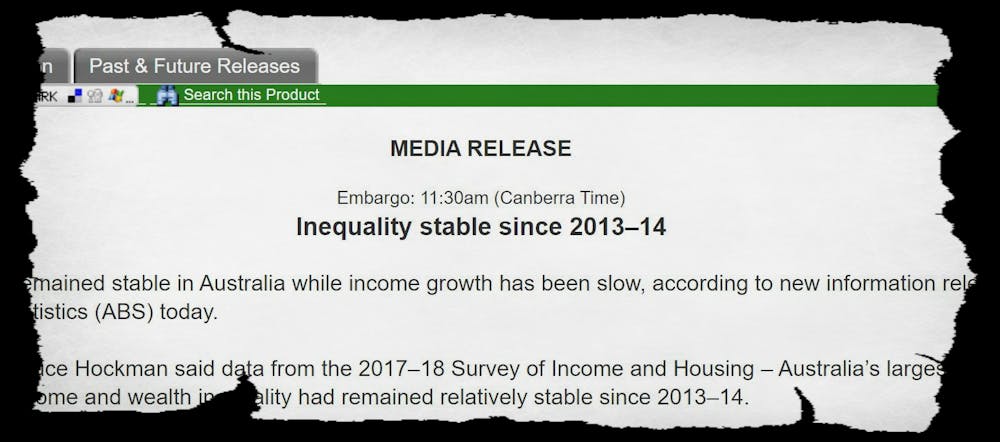
Released with the data on July 12, it was headed: “Inequality stable since 2013-14”.

It began:

Income inequality has remained stable in Australia while income growth has been slow, according to new information released by the Australian Bureau of Statistics today.

Oddly, the press release didn’t include data to back up its conclusion. That was left for reporters and analysts to find, diving into the trove of more detailed information assembled by the bureau, from which a somewhat different picture emerged, particularly for wealth.

Writing for the ABC, Stephen Long and Michael Janda noted that average (mean) household wealth has been climbing quickly whereas typical (median) household wealth has not, implying that the rich are getting richer much more quickly than Australians in the middle.


Read more: Inequality is growing, but it is also changing as Australia’s super rich evolve


They also noted an increase in the so-called Gini coefficient, commonly used by the bureau and others to measure inequality.

And they noted that the “ultrawealthy” were probably under-counted in the survey, as is to be expected in essentially voluntary random surveys.

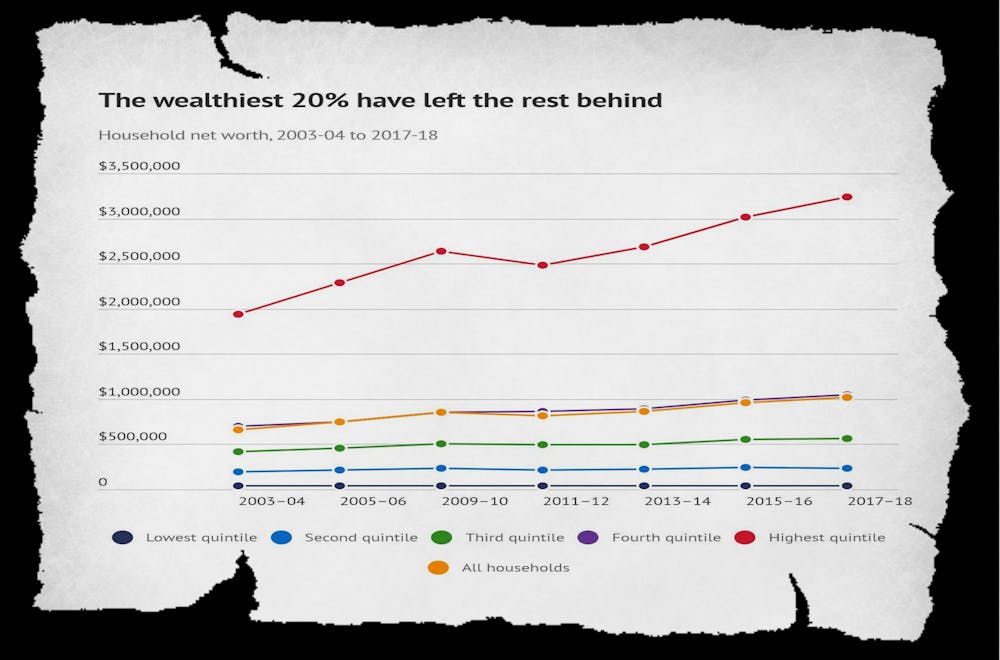
In the Sydney Morning Herald and Age, Shane Wright and Eryk Bagshaw tracked the trends since 2003-04, when the bureau began its income and wealth survey.

Examining “quintiles” (which divide Australia’s households into five equally sized groups, in this case from least wealthy to most wealthy), they found an increasingly divided society.

Their captions read: “The wealthiest 20% have left the rest behind” and “The rich are getting richer”.

Both sets of journalists were right not to accept the bureau’s sunny headline.

According to the bureau’s own data, over the four years since 2013-14, the top 20% of households increased their share of the nation’s private wealth from 62.1% to 63.4%. Their share was 59% in the first survey back in 2003-04.

The wealth share of every other quintile fell.

The share of the second wealthiest quintile fell from 20.5% to 20.4%; the share of the middle quintile from 11.4% to 11.1%; the share of the second poorest quintile from 5.1% to 4.5%; and the share of the bottom quintile from 0.9% to 0.7%.

That is not a picture of stable inequality.

It is more reasonably described as a picture of gradually increasing inequality, of the kind we would expect given the underlying dynamics of modern Australian capitalism.

Unchecked, things will get worse

In the absence of deliberate redistribution, the inequalities associated with accumulated wealth tend to increase over time.

Unless actively restrained, the trends identified (but not publicised) by the bureau suggest that Australia will become increasingly unequal.

Yet there is more to the story than correctly describing the data presented.

There is also what’s missing. The survey does not present a figure for total household wealth. This means we don’t know how much wealth it didn’t find.

An increasing amount of wealth is missing…

We will get a good idea in about a year when the bureau reconciles its income and wealth survey with the Australian National Accounts.

Previous reconciliations suggest that wealth missed is growing.

The gap between wealth identified in the survey and the national accounts climbed from about 5% in 2013-14 to 8% in 2015-16. That 2015-16 figure amounts to A$626 billion, which is a lot of missing wealth – considerably more than the total wealth of the poorest 40% of households.


Read more: Inequality in the OECD is at a record high – and society is suffering as a result


The discrepancies appear to be associated with understatements of the value of property assets, loans, shares, trusts, and other equities of the type mainly held by wealthy Australians.

…and the ultrawealthy are invisible

The bureau’s released data ignores the distribution of wealth at the very top.

The data is reported in quintiles (fifths) and percentiles a decile apart, but inequality is likely to be growing the fastest at the very top where the data isn’t reported.

The so-called P90/P10 ratio provides a clue. This is the ratio of the wealth of the households 10% from the top of the wealth distribution and the wealth of the households 10% from the bottom. In other words, it compares the quite rich with the quite poor.


Read more: Don’t believe what they say about inequality. Some of us are worse off


The latest survey shows that the wealth of a household 10% from the top is 71 times the wealth of a household 10% from the bottom, up from 52 times in 2013-14, and 45 times when the survey began back in 2003-04.

It means the gains of households at the halfway point of the top 20% have been bigger than those of the top 20% as a whole, suggesting increasing inequality within the top 20%, which is likely to more extreme within the top 1%.

We really need to know

Statistics are windows on change. Despite our criticisms, the bureau’s biennial income and wealth survey gives us the best view of inequality we’ve got, but large areas remain foggy.

In research for the Evatt Foundation, we have used data from the Bureau of Statistics, Organisation for Economic Co-operation and Development and national accounts to estimate that, for the first time in more than half a century, the richest 10% of households own more than half of Australia’s private wealth.


Read more: There’s a reason you’re feeling no better off than 10 years ago. Here’s what HILDA says about well-being


The Evatt Foundation’s results seem to stand up well, but governments should really be producing better data themselves.

Inequality and its harmful effects on economic output and stability are growing. We owe it to ourselves to find out by how much.

ref. What the Bureau of Statistics didn’t highlight: our continuing upward redistribution of wealth – http://theconversation.com/what-the-bureau-of-statistics-didnt-highlight-our-continuing-upward-redistribution-of-wealth-121731

Tarantino has a questionable record in the #MeToo context, so should we boycott his new film?

Source: The Conversation (Au and NZ) – By Christina Lee, Senior Lecturer in Literary and Cultural Studies, Curtin University

This story contains spoilers for Once Upon a Time in Hollywood.

While promoting Once Upon a Time in Hollywood at the Cannes Film Festival, filmmaker Quentin Tarantino was asked why Margot Robbie’s character – murdered actress Sharon Tate – was given so few lines. An “angry-looking Tarantino”, as reported the ABC, curtly replied: “Well, I just reject your hypothesis.”

Tate’s implied lack of voice and Tarantino’s refusal to address the extreme violence against women in the film has renewed discussions about his representations and treatment of women on screen.

The #MeToo movement and cancel culture have shifted the way we consume media. So what does this mean for Tarantino and his depictions of violence?

25 bloody years on the big screen

Tarantino found instant acclaim with his debut Reservoir Dogs in 1992. Two years later, Pulp Fiction solidified his cult status. Over his 25-year career, he has directed nine films spanning western to blaxploitation to samurai. Across genres, his films are united by the protagonist’s quest for justice and bloody vengeance.

Tarantino is notorious for his stylised and hyperreal violence: macabre, shocking, and comical. When Pulp Fiction first came out, I was a first-year undergraduate studying and making films. I revelled in Tarantino’s approach to storytelling and the film’s originality.

Tarantino was the new King of Cool, and Pulp Fiction heralded a new era of filmmaking. Discussions about the violence mainly revolved around the subject of style and Tarantino’s brand of humour.

25 years later I’m analysing Tarantino again. But now it’s in the context of one of the largest social activist movements in contemporary history.

Contemporary controversies

Tarantino has come under the #MeToo spotlight mainly because of his close partnership with Miramax and The Weinstein Company, both co-founded by Harvey Weinstein (currently facing multiple counts of rape and sexual assault)link, and the distributors of most of Tarantino’s films.


Read more: What the Harvey Weinstein case tells us about sexual assault disclosure


The controversy, however, goes deeper than guilt by Weinstein-association: Tarantino has admitted being a knowing bystander. In a 2017 interview, Tarantino said: “There was more to it than just the normal rumors, the normal gossip. It wasn’t secondhand. I knew [Weinstein] did a couple of these things.”

Tarantino also faced allegations of misconduct by Uma Thurman, who rose to fame in Pulp Fiction and starred in Kill Bill: Volumes 1 & 2.

In 2018, Thurman spoke about a car crash during the filming of Kill Bill: Volume 1 which caused long-term neck and knee injuries. Despite airing her concerns about safety, Tarantino convinced her to perform the stunt.

Tarantino has since admitted his wrongdoing.

Uma Thurman has spoken out about being pressured to perform dangerous stunts in Kill Bill: Vol 1. Miramax

This is an example of the hypocrisy in Hollywood: Kill Bill was about female empowerment, but its star was being coerced by the director and pressured by the studio.


Read more: Rape is a plot device in western literature, sold back to us by Hollywood


Days after Thurman’s interview, an audio recording resurfaced from 2003 where Tarantino defended director Roman Polanski’s sexual abuse of a 13-year-old victim in 1977. Polanski was 43 at the time.

Tarantino can be heard saying: “she was down with it. [ … ] I don’t believe it’s rape. I mean not at 13. Not – not for these 13-year-old party girls.”

Alongside the era of #MeToo we have seen a rise in “cancel culture”, where questionable views and actions of influential figures are called out, and audiences are encouraged to withdraw support. Calls for “cancelling” Tarantino are growing.

He may be a groundbreaking filmmaker still breaking records at the box office – but is this enough for us to overlook his indiscretions?

What happens in the cinema, stays in the cinema?

Should we stop watching films connected with problematic individuals? What do we gain from cancelling the works of Tarantino, Polanski, Woody Allen and Bryan Singer from our collective consciousness?

Should judgement of a movie be separate to our judgement of the people who create them? Can we judge a movie separate to our judgement of the people who create them?

During a screening of Once Upon a Time in Hollywood my mind drifted to these matters.

I wondered if Tarantino still had the same admiration for Polanski as he did in 2003; whether he still holds those skewed ideas about rape.

I was irritated that Emile Hirsch was cast as Jay Sebring – Tate’s close friend and former lover. Hirsch plead guilty to assaulting a female studio executive in 2015.

At a time when abusers are being publicly denounced on social media, did Tarantino have any reservations about this casting choice? Was it even an issue for him?

Despite these questions, I could not suppress my laughter and gasps of gleeful shock at the spectacle of violence in the film’s climax.

And it is violent. The most striking death is when one of the female members of the Manson Family is maimed in the face by a can of dog food, before being fried with a flamethrower.

Over the course of the film, my thoughts continually wandered between the story on screen to the story off screen. Real world politics kept intruding into my viewing experience.

To boycott, or not to boycott

I left the cinema ruminating on the confusing range of emotions and responses I had, ready to unpack how the baggage of Tarantino’s opinions and treatment of female characters and cast members have influenced the way I read Once Upon a Time in Hollywood.

Boycotting a film can send a strong message – not least of all to the studio’s bottom line. But there is also benefit to viewing these films, and using them as talking points for why we find them problematic.

Watching Tarantino now, I still have immense respect for the artistry of his films and their aura of detached coolness. They captured the zeitgeist of a Generation X that was desperate for something different.

But knowing some of the troubling issues surrounding a production and the filmmaker has added another layer of awareness and critique. It has given the films a different sort of relevance for the times. The questions I ask don’t look the same as those I asked before.

Tarantino isn’t making cinema in the same world as he once was – but then again, I’m not watching it in the same world, either.

ref. Tarantino has a questionable record in the #MeToo context, so should we boycott his new film? – http://theconversation.com/tarantino-has-a-questionable-record-in-the-metoo-context-so-should-we-boycott-his-new-film-121985

EMTV staff protest over sacking of ‘flawless’ news manager Neville Choi

Pacific Media Watch Newsdesk

Papua New Guinea’s EMTV news and current affairs manager Neville Choi has been sacked after six years of service in this role, triggering strong protests from staff in the country’s main television news service.

EMTV staff called for the reinstatement of Choi and for the “sidelining” of acting chief executive Sheena Hughes for bringing the company into “disrepute”.

Choi is the president of the PNG Media Council and an experienced head of the news room having previously worked for several years as editor of Wantok Niuspepa.

READ MORE: Bryan Kramer: Who was behind O’Neill government revenge on Scott Waide?

Neville Choi
Sacked EMTV news manager Neville Choi … strongly supported by his staff. Image: MT/Facebook

According to a statement released by the EMTV management this afternoon, his termination took effect yesterday morning, report the PNG Post-Courier’s Melisha Yafoi and Elias Nanau.

The company said his termination had no association with political motives, and was a “disciplinary action” taken for non compliance by Choi towards EMTV’s company human resources policies.

– Partner –

EMTV said his role will be looked after by Meriba Tulo who is now the acting head of news and current affairs.

ËMTV management said it was confident over Tulo’s appointment as the acting news manager and would continue to support him and the overall news department.

Deeply resentful
The company also thanked Choi for his leadership, guidance and experience in the role, but staff are deeply resentful over the termination.

A staff person who did not want to be identified said Choi had delivered a “flawless news content development and presentation” under his leadership within the news and current affairs team.

Last year Scott Waide, the bureau chief of EMTV’s Lae Office was terminated for reporting about New Zealand Prime Minister Jacinda Arden’s refusal to use the controversial Maserati vehicles when she attended the Asia Pacific Economic Cooperation (APEC) summit in Port Moresby.

Waide was reinstated after widespread protests and news consumers petitioning against his termination on social media.

Staff at the television channel tonight issued their own statement, saying they were “appalled and ashamed” by the harsh treatment by EMTV’s acting chief executive, Sheena Hughes. The statement on social media said:

“TERMINATION OF EMTV HEAD OF NEWS AND CURRENT AFFAIRS

“On Monday, August 19, 2019, a decision was made to terminate EMTV’s Head of News & Current Affairs, Neville Choi.

“It was a decision based on purported ‘insubordination’ over an administrative matter that could have been handled better by the EMTV CEO with tact and a demonstration of leadership.

“As senior members of the National EMTV News Team, we are appalled at the extremely harsh treatment of our head of news, and are ashamed of the action taken by our acting CEO, Sheena Hughes who signed the termination notice.

“The reasons for termination are as follow:

  1. Mr Choi’s defiance of a KTH and KCHL Board Directive to terminate Deputy Head of News Scott Waide during APEC 2018.
  2. Mr Choi’s defiance against a directive to not air a story on the PNGDF pay strike outside the Prime Minister’s office in 2018.
  3. Taking unapproved leave to attend a censorship board meeting as Head of News and President of the Media Council.
  4. For disclosing confidential management discussions about staff.

“Much of the development and progress of the National EMTV News Team has been built upon the guidance of Mr Choi, who has provided an environment where our reporters can perform WITHOUT FEAR OR FAVOUR!

“Under his tenure, EMTV has built up its international links with news services like Reuters, CNN, Asiavision, ABC and RNZ. More staff have received training and mentoring under his leadership through the links he helped establish.

“The action to terminate Mr Choi is one that is WRONG, and in direct challenge to the separation, and independence of the News Media Code of Ethics.

“We also condemn the manner in which junior and senior staff have been intimidated directly and indirectly after protesting against the sacking of Mr Choi. Worker intimidation is what we also report on and we will not stand by and watch younger staff members be threatened with termination.

“We, therefore, demand that Mr Choi be reinstated, and for EMTV’s Acting CEO Ms Sheena Hughes, to be sidelined, for bringing EMTV, but more so National EMTV News, into disrepute.

“We no longer have confidence in her leadership.”

Meriba Tulo
Acting Head of News and Current Affairs
Scott Waide
Deputy Regional Head of News
Sincha Dimara
Senior News Producer

Print Friendly, PDF & Email

Article by AsiaPacificReport.nz

Free speech or sky vandalism? Here’s what the law says about skywriting in Australia

Source: The Conversation (Au and NZ) – By Bradley L Garrett, Research Fellow, University of Sydney

A small plane looped through the tranquil and cloudless Sydney sky today, spewing engine-heated liquid paraffin from its exhaust, creating puffy tracers. As people all over the city watched from rooftop bars, beach towels or their office windows, the plane scrawled the words “save unborn”, “choose life” and a crucifix across the sky.

The message, along with another on Sunday that said “choose life”, was commissioned by pro-life advocates amid legislation being debated to remove abortion from the New South Wales criminal code.

This was not the first time conservative political messages have been scrawled across the sky in the city. Many Sydneysiders will recall a similar incident in 2017, when opponents of the marriage equality bill scrawled “Vote No” in the air using crowd-sourced money from a GoFundMe campaign.

A cross was marked in the cloudless Sydney sky today as abortion legislation heats up in NSW. Author provided (No reuse)

Marriage equality supporters then raised their own funds for a counter-message, but the only skywriting pilot in Sydney refused to draw it. Campaigners instead used the money to hire a helicopter to tow a 10-metre rainbow flag across the horizon at Bondi Beach.

Once the domain of gauche advertising and endearing marriage proposals, it seems our urban skies are increasingly becoming a partisan battleground.

So what are the laws surrounding the use of the sky for political purposes?

Skywriting: legal graffiti

Battles over free speech in the sky predate both social media and drone technology.

The, presumably incomplete, words of ‘Save unborn’ was written in Sydney today, alongside a cross and ‘Choose life’. Author provided (No reuse)

Almost 20 years ago in Southern California, the city of Huntington Beach attempted to pass legislation to ban aircraft towing graphic images on banners of aborted babies over its beaches. The city eventually dropped the efforts for fear of lawsuits.

In Australia, most forms of public messaging, such as TV, radio, and billboard advertising are heavily regulated – messages must be vetted and approved by the Australian Communications and Media Authority.

Yet after the “vote no” skywriting appeared in Sydney, authorities came to the conclusion it was impractical to monitor political skywriting, putting it in the same category as graffiti.

A 2018 Act states:

Due to the nature of skywriting, compliance with the authorisation framework would be impractical […] As such, section 321D of the Electoral Act does not apply in relation to electoral matter if the matter forms part of a communication that is graffiti or skywriting.

The difference, of course, is that graffiti is illegal. No one has ever been prosecuted for skywriting offensive or political speech, though the United States Navy was forced to issue a public apology in 2017 after one of their pilots drew a giant penis in the sky over Washington state during a training exercise.

In short, you are as free to write anything in the sky as you are to post it on the internet – provided you have a plane, or a pilot willing to relay your message.

There’s little regulation in our ‘atmospheric commons’

Skywriting companies are seeing a surge in business for two reasons. First, in the age of Instagram, physically ephemeral statements can endure in the virtual realm.

In 2015, ‘Shut down Manus’ was written in the sky over the CBD in Sydney. Dean Lewins

This was a lesson learned early on by graffiti writers. Even if a piece is “buffed” by authorities, its presence on the internet will remain, making the effort worth the risk for writers hoping to be noticed.

In the context of skywriting, which can cost thousands of dollars, virtual legacy justifies the expense.


Read more: Where has Melbourne’s political graffiti gone?


The second reason for the interest in skywriting is that there is very little regulation over what happens in what University of NSW researcher Adam Fish and I have called our “atmospheric commons”. This refers to the space above our cities occupied by flights, kites, balloons, skydivers, skywriters and buzzing drones.

The word ‘NO’ (or was it ‘on’?) was written over Melbourne during the marriage equality debate. Joe Castro/AAP

Legislation around such atmospheric interventions is unclear and hard to enforce, as we saw last year when tens of thousands of passengers at Gatwick Airport in London were grounded by a couple of rogue drones.

The combination of new technologies and increasingly militant political activities may lead to a more restricted and regulated urban atmosphere above our heads in the future, what geographer Jeremy Crampton has described as an “enclosure” of vertical urban life.

In research from last year, physical geographer Karen Anderson and I suggest the catalyst for increasing regulation will likely be commercial, rather than activist, drone use. The reason for this is simple – companies like Amazon who want to use airspace for commercial drone business have far more power to lobby government.

What’s more, new forms of “skytyping” are emerging that are computer controlled, punched out by multiple aircraft like old dot matrix printers.

The messages are written at more than 3000 metres, triple the height of traditional skywriting. Letters can be created up to 300 metres tall and over eight kilometres long that endure for hours.


Read more: Not all graffiti is vandalism – let’s rethink the public space debate


Once drones are developed that can carry 30 gallons of paraffin oil, perhaps every still blue day will descend into a computer controlled shouting match in the sky.

Whether we view this as a democratisation of freedom of expression or a gateway into uncontrollable celestial vandalism remains a matter of opinion. That is, until legislation catches up with an age where the ephemeral never really vanishes.

ref. Free speech or sky vandalism? Here’s what the law says about skywriting in Australia – http://theconversation.com/free-speech-or-sky-vandalism-heres-what-the-law-says-about-skywriting-in-australia-122054

What should politicians be reading at parliamentary book club? Our experts make their picks

Source: The Conversation (Au and NZ) – By Jane Howard, Deputy Section Editor: Arts + Culture

You might picture a book club around your neighbour’s coffee table, or over beers at the local pub – but what if it took place in Parliament House?

This is the question being asked by Books Create Australia as they open up nominations for their inaugural parliamentary book club. Anyone can nominate an Australian book written in the last five years to their MP or Senator, and one book will be picked for all participating representatives to read.

From fiction to essays to poetry, we asked our experts for their recommendations.

Portable Curiosities

For this crowd, I’d recommend Julie Koh’s Portable Curiosities (UQP, 2016). It’s a sharp and funny collection of stories that expanded my sense of what it is to be Australian. On the assumption that parliamentarians skew demographically to my (Anglo, male, privileged, economically secure) demographic, they too deserve a bit of satirical poking with Koh’s delicate and sharp instruments.

What would it be like to be a young, poor, bright woman born of Asian immigrants in our wealthy but extremely expensive cities? Many thousands are living exactly that, and millions are living parts of it. Koh provides a dark yet joyous window on that world. It wouldn’t do our representatives any harm to look through it for a bit.

Recommended for: our Anglo, male parliamentarians.

-Robert Phiddian, English Professor

A Sand Archive

Gregory Day’s A Sand Archive (Pan Macmillan Australia, 2018) deals with perhaps the most crucial issue we face – environmental management – in lyrical mode. FB Herschell is an engineer concerned about how to maintain the Great South Road against the constant shifting of the sands on which they are built.

He selects marram grass to stabilise the dunes, but further research reveals that marram, an introduced species, harms the dunes, seabirds, and native plants. His appeals to reverse this, and all his evidence, fail to shift the local council, but the writings he leaves put on record the value of the environment, and the capacity of scientific investigation to help it heal.

Recommended for: Minister for the Environment Sussan Ley

–Jen Webb, Director of the Centre for Creative and Cultural Research

#MeToo: Stories from the Australian movement

Given the fact violence towards women is a national crisis, I would recommend #Me Too: Stories from the Australian movement (Pan Macmillan Australia, 2019), an anthology I co-edited. This book gives an overview of the problem of violence towards women and non-binary people in Australia. Through a myriad of different and diverse voices it points to the insidiousness of sexual violence and traces the roots of this problem to the everyday sexism which still permeates Australian culture. The book also offers ideas about how we might find a way through this crisis and into a more equitable and safer Australia.

Recommended for: Prime Minister Scott Morrison

–Natalie Kon-yu, Lecturer in Literature and Gender Studies

The Natural Way of Things

In Charlotte Wood’s The Natural Way of Things (Allan & Unwin, 2015), women who accuse men of sexual harassment or are themselves accused of illicit or improper sexuality are imprisoned and isolated in an outback prison. It’s like an Australian version of Margaret Atwood’s The Handmaid’s Tale.

Because it reads like a dystopian fantasy, it might be easy to dismiss the novel as “unrealistic”. But it is ruthless in its analysis of the way contemporary news media and gossip cycles still demonise and sexualise women. The novel explores the very different ways women resist or accommodate to their treatment; but it is really about the structures of patriarchy, influential far beyond the confines of the nuclear heterosexual family.

Recommended for: any male politician who says he is sympathetic to women because he is married to one or has daughters.

–Stephanie Trigg, English Literature Professor

Writing to the Wire

I must acknowledge a possible conflict of interest here by noting that I have a poem in this anthology, but Writing to the Wire (UWA Publishing, 2019) is an extraordinarily powerful collection of poems by and about maritime asylum seekers. The anthology includes poems by senior and emerging Australian poets, and work by those who “would like to be Australians”, as the book’s blurb puts it. As the editors write in their introduction, Writing to the Wire is a little like “bashing your head against a brick wall [but also] very much a book of hope”.

Three years later, the editors and the contributors to this anthology — not to mention those indefinitely detained by the Australian government — are still hoping.

Recommended for: the whole parliament.

-David McCooey, Writing and Literature Professor

Hearing Maud: A Journey for a Voice

Hearing Maud (UWA Publishing, 2019) by Jessica White is a beautifully told story about two people living nearly one hundred years apart, and their experience of deafness. The first is the author herself, Jessica White, who suffered significant and permanent hearing loss following an illness at the age of four. The other is Maud Praed, the daughter of the Australian writer Rosa Praed (1851-1935). Jessica looks into the life of this forgotten daughter of a largely forgotten writer and finds haunting parallels with her own situation. The story is an insider’s account of hearing impairment but, more than this, reminds everyone — not least legislators and policy makers — that what we call disability has an interior life.

Recommended for: Minister for Families and Social Services Anne Ruston and the Minister for the National Disability Insurance Scheme Stuart Robert

*–Tony Hughes-D’aeth, English and Cultural Studies Professor *

Dark Emu

In Dark Emu (Magabala Books, 2014), Bruce Pascoe amasses a cogent case that Indigenous Australians farmed their land, lived in villages, built houses, harvested cereals and built complex aquaculture systems – and how settler Australians wilfully misunderstood this.

Occupying the western Sydney fringe, Ed Husic’s electorate of Chifley has the rare distinction of a border that follows an important waterway (South Creek) and contains significant colonial-Darug contact sites. Western Sydney is home today to Australia’s largest Aboriginal population; the Aboriginal Land Council is the largest non-government land holder; and some 46 Indigenous organisations are working to sustain their community.

Recommended for: Ed Husic, MP for Chifley

–Heidi Norman, Social and Political Sciences Professor

hope for whole: poets speak up to Adani

It’s hard to go past The Swan Book (Alexis Wright) for its testimony regarding the climate crisis and the NT intervention, and Jess Hill’s new book See What You Made Me Do on the endemic of domestic abuse. But I’m settling on hope for whole: poets speak up to Adani (Plumwood Mountain, 2018) featuring many of Australia’s finest poets. Anne Elvey and Plumwood Journal: An Australian Journal of Ecopoetry and Ecopoetics hosted Poets Speak up to Adani Day of Action in 2017, an event during which poets poemed protests at Adani for 12 hours. The resulting anthology is even more pertinent post-Federal election, and the recent diplomacy fail in Tuvalu.

Recommended for: all parliamentarians who support the mine or seem soft on climate action.

–Meera Atkinson, Creative Writing Lecturer

No Friend But the Mountains: Writing from Manus Prison

Reading expands our capacity for empathy. It forces us to exercise our ethical imagination by putting ourselves into somebody else’s situation; particularly somebody who may be unlike us in the way they think, speak, or feel, or in the situations that they face. No Friend But the Mountains (Pan Macmillan Australia, 2018), Behrouz Boochani’s work of prose poetry, sent out in text messages from Manus Island, bears witness to death, torture and traumatic deprivation. It asks its reader not to treat the fresh hell it narrates as an anomaly but to understand “Manus Prison” as part of a system of oppression and injustice that is far larger, and ongoing. But to learn from Boochani’s text, the reader must give themselves to the work, and read with generosity.

These values may be of assistance to all members of the parliamentary book club.

–Camilla Nelson, Media Professor

ref. What should politicians be reading at parliamentary book club? Our experts make their picks – http://theconversation.com/what-should-politicians-be-reading-at-parliamentary-book-club-our-experts-make-their-picks-122049

Youth discounts fail to keep young people in private health insurance

Source: The Conversation (Au and NZ) – By Stephen Duckett, Director, Health Program, Grattan Institute

It was a key plank of what was dubbed the most significant package of private health insurance reforms in more than a decade. From April 1 this year, private health insurers have been permitted to offer a youth discount – lower premiums for people under 30.

But the early signs are not good. New data released today by the private health insurance regulator show 7,000 fewer young people (25 to 29 year olds) were insured on June 30, 2019 than three months earlier when the new discount regime started.

In the three years to June 30, 2018, an average of about 2,100 young people dropped private health insurance every month. For the first six months of this year, the decline was 1,700 a month.


Read more: Premiums up, rebates down, and a new tiered system – what the private health insurance changes mean


So the new policy may have stemmed the bleeding, but young people are still leaving private health insurance. This does not augur well for the future of private health insurance.

It’s time to consider a bold option to encourage young people to stay in private health insurance, which reduces their premium costs based on their likelihood of getting sick.

Lower health risks but the same costs

As we pointed out in a recent Grattan Institute working paper, the industry fears a death spiral where young and healthy people drop out of insurance, forcing up premiums for everyone left, then more young and healthy people drop out, premiums go up again, and the cycle continues.

Australian private health insurance is based on community rating. This means insurers must charge all consumers the same premium for the same product: they are not permitted to discriminate based on health risk (such as age, gender, health status, or claims history); and they cannot refuse to insure an individual.

Older people are much more likely to use private health insurance yet everyone pays the same premiums. Rawpixel.com/Shutterstock

Community rating is designed to enable higher-risk people to take out private health insurance, by forcing lower-risk people to cross-subsidise them. It means lower-risk people have to contribute more than what their expected use would require.

But faced with a higher-than-fair premium, low-risk people – typically the young and the healthy – make an economically rational decision to drop their private insurance. Hence the death spiral.

Discounts don’t cut it

Australia already has a so-called lifetime community ranking, under which people who take out private health insurance after their 31st birthday pay higher premiums – an additional 2% per year for each year they defer taking out insurance.

The April 1 changes introduced a reverse scheme, under which people can get a discount of 2% for each year they join before they turn 30, up to a maximum discount of 10%.

But even with the full 10% discount, a 25 year old will still be paying significantly more than they would with a risk-rated premium.


Read more: Going to the naturopath or a yoga class? Your private health won’t cover it


So the relentless downward trend continues. In the year to June 2019, the number of 25 to 29 year olds with private health insurance dropped 28,000, about 6%. The previous year it was also 6%. The year before that it was 5%.

In fact, for every quarter for the last four years there has been fewer 25 to 29 year olds insured at the end of each quarter than at the beginning of the quarter.

Although it may be too early to declare the new youth discount policy a complete failure, the government and industry need to consider bolder policies.

A better way to attract young people

Community rating may have had its day, given that under Medicare, everyone who needs health insurance automatically has it through the public system.

It’s time to consider shifting to risk rating, starting with people under 30. A risk rating based on age could halve young people’s private health insurance premiums and encourage more Australians to stay in private health insurance.

People aged 25 to 29 use health care much less than the rest of the insured population. In 2018-19, the average benefit payments for that group were A$708 per member compared to A$1,363 per member for the whole population.

If there were no cross-subsidies from 25 to 29 year olds, their premiums would be 52% of the average, community-rated premium.

This would dramatically reduce premiums for young people and increase the attractiveness of private health insurance.

As 25 to 29 year olds only comprise 4% of the insured population, adjusting premiums for this group is unlikely to have a measurable impact on premiums for other people with insurance in the short run, and may have a long run benefit if it attracts people aged 30 to 39 into insurance.

Moving from a community rating to a risk rating could halve private health insurance premiums for young people. GaudiLab/Shutterstock

Under this reform, funds would have to manage the transition from a risk-rated premium for a 29 year old to a community-rated premium for a 30 year old.

This might involve full risk rating for 25 year olds and a blended approach – partial risk rating – for people over 25, so that the rate for 29 year olds does not involve too big a jump to a community rated premium at age 30.

But if developing a phasing-in plan is beyond insurers’ skill set, then private health insurance is in even more dire straits than the trend data reveals.


Read more: Do you really need private health insurance? Here’s what you need to know before deciding


ref. Youth discounts fail to keep young people in private health insurance – http://theconversation.com/youth-discounts-fail-to-keep-young-people-in-private-health-insurance-121803

Curious Kids: why do we cry?

Source: The Conversation (Au and NZ) – By Carly Osborn, Visiting Research Fellow, University of Adelaide

If you have a question you’d like an expert to answer, send it to curiouskids@theconversation.edu.au.


What makes us cry? – Claudia, age 7.5, Victoria.


Hi Claudia. Thank you for this very sensible question.

As you know, crying is something everyone does sometimes. Sometimes we get teary because our bodies are trying to clean a bit of dirt out of our eyes. But that’s not really crying, is it? Crying has something to do with our emotions.

There’s a connection between the part of our brain that feels emotions, and the ducts in our eyes where tears come out – so when we have a big feeling, we cry.

Doctors of medicine could tell you more about that. But I’m a doctor of another subject – the history of emotions. I learn about why people cry for different reasons, and it’s my job to compare today with a long time ago.


Read more: Curious Kids: Why do tears come out of our eyes when we cry?


In Australia today, most kids cry when they’re feeling sad, whether they’re boys or girls. But once those kids become teenagers, boys seem to cry less often than girls do. This isn’t because boys have different brains or tear ducts than girls. It’s mostly because many Australian boys think crying is a bit embarrassing.

Maybe they’ve been told boys don’t cry, or teased by their friends if they cry at school.

In fact, it is very normal for boys to cry. And crying hasn’t always been seen as embarrassing or uncool.

The history of crying

About 500 years ago in England, crying was seen as really cool! One of the most famous stories at the time was about King Arthur.

King Arthur was a big crier. Wikimedia

He was a great hero, and a lot of boys wanted to be like him. According to books and poems written at the time, King Arthur cried a lot. Crying showed everybody he had very strong, true feelings. Back then, people thought this made him a great man, and the lords and ladies in his court cried in public too.

Crying around the world

Why we cry can also depend on where we live, and what our family is like.

If you live in a country where it’s normal to express a lot of feelings in public, such as America, you are more likely to cry about things.

If you live in a country where people don’t usually make a big show of how they feel, you probably won’t cry as much, even if you’re feeling sad on the inside.

For example, in Japan, for a long time people tried not to cry. But lately in Japan, people are changing their minds about crying. Books and movies that are very sad are becoming popular. There are even crying clubs, where you can watch a sad movie with other people, have a good cry, and go home feeling better because you let out a lot of big feelings!

The same goes for families: if everyone at your house likes to share how they’re feeling, and isn’t embarrassed about crying or laughing or shouting or dancing, then you’ll probably cry whenever you feel like it.

But if the people in your family don’t usually show how they feel, then you will also learn to keep your feelings inside and not let them show by crying.

We cry to show our feelings

As you can see in these examples, crying isn’t just something we do by ourselves. Quite often, crying is a way for us to show other people how we feel.

When you cry, your parents, teachers or friends know that you’re having a big feeling. Then they can help you feel better with a hug, or a talk about your feelings.

So why do we cry?

Well, partly because our bodies are made that way. But also because crying is how people around us show their feelings, and we learn to show our feelings the same way. Crying helps us share and care.

And I think that’s a wonderful thing.


Read more: Curious Kids: why can’t we do whatever we want?


Hello, curious kids! Have you got a question you’d like an expert to answer? Ask an adult to send your question to curiouskids@theconversation.edu.au

ref. Curious Kids: why do we cry? – http://theconversation.com/curious-kids-why-do-we-cry-119814

We built a network of greenhouses and rain shelters to simulate what climate change will do to soils

Source: The Conversation (Au and NZ) – By Anna Hopkins, Lecturer in conservation biology and microbial ecology, Edith Cowan University

As most of the science community knows, the climate emergency is here now. Weather extremes such as droughts and heatwaves are increasing in frequency and intensity and are measurably exacerbated by climate change. The significant impacts of these extremes are well documented on both our native terrestrial and marine ecosystems.

Less documented is what’s happening beneath our feet. Changes below the ground are hard to measure, so most previous research has focused on what can be readily observed above the ground, such as tree deaths.

But soil is a crucial element of the climate system, being the second-largest store of carbon after the ocean. Climate change can result either in an increase in soil carbon storage (through plant growth), or in more carbon being released into the atmosphere (through plant death). Soil is also full of microbes such as fungi, bacteria and algae, and these organisms play a vital role in determining how well an ecosystem functions and how it responds to changes in climate.


Read more: Eyes down: how setting our sights on soil could help save the climate


We have completed one of the first studies to examine the impact of drought and warmer temperatures on living organisms below the ground (known as the soil biota), in biodiverse shrublands in Western Australia, near Eneabba, about 280km north of Perth. These areas are already suffering immense climate-related stress above ground as a result of rising temperatures and longer droughts. This is making these ecosystems extremely vulnerable with many plant species facing likely extinctions in the future.

We documented significant impacts for soil biota too, with implications for the health of ecosystems in regions that are expected to experience increased drought and climate warming in the future.

We found that lower rainfall and higher temperatures are likely to affect the overall composition of soil fungal communities, and that some groups may be lost altogether.

We saw an increase in the number of fungal species that cause plant disease, whereas many common and beneficial fungi declined in response to warming and drying. These beneficial fungi contribute to many important ecosystem processes, such as boosting plant growth, and ensuring that plants get enough water and nutrients such as phosphorus.

Western Australia’s shrublands are already suffering climate stress. Joe Fontaine, Author provided

How we did it

We built specially constructed shelters and mini-greenhouses over plots of shrubland 4x4m in size, to recreate the drier, hotter weather conditions predicted to arise between now and the end of the 21st century. This allowed us to assess how the projected future climate will affect the composition, richness and diversity of soil fungi.

Our rain shelters consisted of a roof made of gutters, widely spaced so as to intercept about 30% of the rain that fell on the plot and funnel it away.


Read more: We need more carbon in our soil to help Australian farmers through the drought


To study the impact of increased temperature, we enclosed separate plots on the same sites in walls made of transparent fibreglass sheeting. These worked in a similar way to a greenhouse, by reducing air flow and increasing daytime temperatures inside the shelter by 5.5℃.

We left the rain shelters and mini-greenhouses in place for four years. Then we collected soil from each plot and examined the fungi in the soil using DNA sequencing techniques.

How to engineer an artificial drought. Joe Fontaine, Author provided

Our study revealed that it is vital to understand patterns of below-ground ecosystems as well as those we can see, if we are to accurately predict how our shrublands and other valuable ecosystems will be altered by climate change.

ref. We built a network of greenhouses and rain shelters to simulate what climate change will do to soils – http://theconversation.com/we-built-a-network-of-greenhouses-and-rain-shelters-to-simulate-what-climate-change-will-do-to-soils-108065

Yes, GetUp fights for progressive causes, but it is not a political party – and is not beholden to one

Source: The Conversation (Au and NZ) – By Krystian Seibert, Industry Fellow, Centre for Social Impact, Swinburne University of Technology

Over the weekend, Prime Minister Scott Morrison launched a new assault on the campaigning group GetUp. At the Liberal Party’s state conference in Adelaide, he said GetUp needed to be “accountable for what they say and do”.

They want to be in the political space, fine, call yourself a political party.

GetUp has been in the government’s firing line for several years now. This isn’t surprising. The campaigning group is typically described as a “left wing” and “progressive” organisation, and the stances it takes on various issues tend to be at odds with those of the Liberal and National parties.


Read more: Politics with Michelle Grattan: Paul Oosting responds to GetUp’s critics


GetUp campaigns on these issues by mobilising its membership in a number of ways. It encourages them to make donations to fund advertisements and other campaign initiatives, to directly contact their political representatives, and to operate on the ground in electorates in the run-up to elections.

It is perhaps this last activity that most bothers the Coalition government, as GetUp targeted a number of sitting Liberal MPs at the last election, including Peter Dutton and Tony Abbott. The group didn’t have a tremendous amount of success, though, with only Abbott losing his seat.

GetUp is already heavily regulated

Australia’s electoral process is not the private fiefdom of political parties. There are a variety of actors permitted to participate in our democracy and become involved in election campaigns. These include lobby groups, charities and not-for-profit campaigning groups, such as GetUp and its new “conservative” counterpart, Advance Australia.

And there is already a regulatory framework in place to ensure there is accountability and transparency around their electoral activities.

Any organisation that spends more than the “disclosure threshold” (currently A$14,000 per year) on “electoral expenditure”, for example, needs to submit an annual return to the Australian Electoral Commission. Information about these so-called “third parties” is publicly available on the AEC’s transparency register.


Read more: GetUp’s brand of in-your-face activism is winning elections – and making enemies


Groups like GetUp are now subject to even more regulation than third parties, thanks to legislative changes introduced by the government last year. Because of the amount they spend trying to influence elections, they fit into a new category called “political campaigner”. Political campaigners are required to register with the AEC and submit a more detailed annual return than “third parties”, similar to the returns required of political parties.

So, when Morrison calls for GetUp to be accountable like a political party, that’s already the case. However, despite being regulated in a similar way to political parties, they don’t receive the same benefits.

Organisations like GetUp don’t field candidates in elections, for instance, so they can never hope to wield political power in the way that political parties do.

Political parties also benefit from taxpayer funding – the AEC reimburses them for some or all of the expenses they incur in an election, provided they reached a certain threshold of votes. GetUp doesn’t get a cent from the AEC.

Donations to political parties of up to A$1,500 per year from individuals are also tax deductible. This also doesn’t apply to GetUp’s donors.

Stripping away GetUp’s independence

Morrison wants to have GetUp classified by the AEC as related to the Labor Party or the Greens, what the electoral law refers to as an “associated entity”. These organisations have some sort of formal link with a political party, or they

operate wholly or to a significant extent for the benefit of one or more registered political parties.

Having GetUp classified as an “associated entity” wouldn’t actually bring any extra regulation. As a “political campaigner”, GetUp is already subject to the same type of regulation as an “associated entity”.

But this is likely not the point. For the Coalition, labelling GetUp an “associated entity” would make it much more difficult for the group to maintain its much-vaunted status as

an independent movement of everyday people

This may influence how GetUp’s future campaigns are perceived by voters – and would certainly be something the government would talk up at every opportunity.

The AEC has looked into this question three times – in 2005, 2010, and earlier this year. It has consistently found that GetUp is not an “associated entity” because it does not operate wholly or to a significant extent for the benefit of one or more registered political parties.


Read more: New style lobbying: how GetUp! channels Australians’ voices into politics


While it’s true that the positions of GetUp often align with those of the Labor Party or the Greens, the AEC concluded the organisation is primarily an issues based campaigning organisation and that:

the expression of views or other conduct by an entity that broadly or closely aligns with the policy of a registered political party do not support a finding that the entity is operating wholly or to a significant extent for the benefit of one or more registered political parties

If the government once again refers this matter to the AEC, it would be surprising if the AEC didn’t come back with exactly the same finding – especially given it’s only been a few months since the AEC last examined the matter.

GetUp campaign video against fracking in Indigenous communities.

Other methods for shutting down the group

There are other ways the Coalition government can try to reduce the influence of organisations like GetUp. For instance, the Liberal National Party State Convention in Queensland recently voted in support of banning GetUp and other campaigning organisations from handing out how to vote cards and other political material at polling booths on election day.


Read more: Time for the federal government to catch up on political donations reform


Such a drastic move to limit participation in our electoral process is at odds with Australia’s reputation as a free and vibrant democracy. As one Queensland Liberal National politician wisely warned, it could also cut both ways and harm conservative groups seeking to campaign on particular issues.

Whether one agrees or disagrees with GetUp’s positions, these types of campaigning groups reflect the diversity and vibrancy of our democracy and the different ways people can get involved in our political process.

If our political leaders are serious about improving the transparency and accountability of all actors in our political system, then instead of singling out GetUp, Morrison should prioritise the introduction of “real time” disclosure of political donations and the lowering of the disclosure threshold for public reporting of donations.

ref. Yes, GetUp fights for progressive causes, but it is not a political party – and is not beholden to one – http://theconversation.com/yes-getup-fights-for-progressive-causes-but-it-is-not-a-political-party-and-is-not-beholden-to-one-122033

Curious Kids: how does our blood fight viruses like chicken pox and colds?

Source: The Conversation (Au and NZ) – By Archana Koirala, Paediatrician and Infectious Diseases Specialist, University of Sydney

If you have a question you’d like an expert to answer, send it to curiouskids@theconversation.edu.au.


How does our blood fight viruses like chicken pox, sickness and colds? – Teddy, 5, Oxfordshire, England.


Our bodies are made up of building blocks called cells. They are different sizes and colours and join together to become organs like the skin, brain and lungs.

Some cells travel around our body and work to move food and waste.

Other cells work for the immune system, which is the body’s protection system. The mucous (or snot) and the tiny hairs in your nose and throat are a part of your immune system. Snot traps germs before they get too far into your body. The tiny hairs in your nose and throat tickle when they feel a germ, making your body cough or sneeze the germ out.

But if a germ makes it past the first layers of protection and into your blood, they will meet an army of special immune system cells that have one job: to fight germs.


Read more: Curious Kids: How does pain medicine work in the body?


Red and white blood cells

It helps to think of our blood like a soup, a mixture of different ingredients. The main ingredients are red blood cells and white blood cells.

The red cells give our blood its colour. They carry a thing called oxygen from our lungs to the rest of the body.

It’s best to think our our blood like soup. The main ingredients are red and white cells. www.shuttershock.com, CC BY

The white blood cells act as an army of fighting soldier cells that attack germs. They are fast, strong and smart.

They can squeeze out of the blood and travel into the nose or throat cells, capture germs and even swallow them.

White blood cells have a cool trick to help them recognise and fight germs: they “wear” the broken parts of germs like a badge. This helps other white cells know what the bad cells look like, so they can stop the bad cells if they come back.

Do you remember going to the doctor and getting a needle in your arm? The doctor was probably injecting a vaccine into your blood. The vaccine has a germ that’s been changed so it won’t hurt you – like a tiger with no teeth. The vaccine helps your immune system learn to recognise that germ if the real, more dangerous version came along.

Some viruses are smart and can change their appearance so white cells can’t remember them. This is why you can get the cold or the flu more than once.

Sometimes the white cells will eat the viruses. Other times they will shoot powerful balls called antibodies at the bad cells. These balls stick to the bad cells and make them very weak, which stops them moving around your body.

You might get a fever when you are sick. White cells work better when your body temperature is a bit higher than normal. www.shuttershock.com, CC BY

How to help your body fight a virus

Fighting bad cells can cause your body to get very hot and you can get a fever. This is because white cells work better when your body temperature is higher than normal.

You might also get rashes, aches and pains and feel really unwell. It is important to drink lots of water (or warm soup) and rest. Resting helps your body recover from all the fighting that the soldiers in your body have done.


Read more: Curious Kids: Why does my snot turn green when I have a cold?


Hello, curious kids! Have you got a question you’d like an expert to answer? Ask an adult to send your question to curiouskids@theconversation.edu.au

ref. Curious Kids: how does our blood fight viruses like chicken pox and colds? – http://theconversation.com/curious-kids-how-does-our-blood-fight-viruses-like-chicken-pox-and-colds-119394

Climate change may change the way ocean waves impact 50% of the world’s coastlines

Source: The Conversation (Au and NZ) – By Mark Hemer, Principal Research Scientist, Oceans and Atmosphere, CSIRO

The rise in sea levels is not the only way climate change will affect the coasts. Our research, published today in Nature Climate Change, found a warming planet will also alter ocean waves along more than 50% of the world’s coastlines.

If the climate warms by more than 2℃ beyond pre-industrial levels, southern Australia is likely to see longer, more southerly waves that could alter the stability of the coastline.

Scientists look at the way waves have shaped our coasts – forming beaches, spits, lagoons and sea caves – to work out how the coast looked in the past. This is our guide to understanding past sea levels.


Read more: Rising seas threaten Australia’s major airports – and it may be happening faster than we think


But often this research assumes that while sea levels might change, wave conditions have stayed the same. This same assumption is used when considering how climate change will influence future coastlines – future sea-level rise is considered, but the effect of future change on waves, which shape the coastline, is overlooked.

Changing waves

Waves are generated by surface winds. Our changing climate will drive changes in wind patterns around the globe (and in turn alter rain patterns, for example by changing El Niño and La Niña patterns). Similarly, these changes in winds will alter global ocean wave conditions.


Read more: Curious Kids: why are there waves?


Further to these “weather-driven” changes in waves, sea level rise can change how waves travel from deep to shallow water, as can other changes in coastal depths, such as affected reef systems.

Recent research analysed 33 years of wind and wave records from satellite measurements, and found average wind speeds have risen by 1.5 metres per second, and wave heights are up by 30cm – an 8% and 5% increase, respectively, over this relatively short historical record.

These changes were most pronounced in the Southern Ocean, which is important as waves generated in the Southern Ocean travel into all ocean basins as long swells, as far north as the latitude of San Francisco.

Sea level rise is only half the story

Given these historical changes in ocean wave conditions, we were interested in how projected future changes in atmospheric circulation, in a warmer climate, would alter wave conditions around the world.

As part of the Coordinated Ocean Wave Climate Project, ten research organisations combined to look at a range of different global wave models in a variety of future climate scenarios, to determine how waves might change in the future.

While we identified some differences between different studies, we found if the 2℃ Paris agreement target is kept, changes in wave patterns are likely to stay inside natural climate variability.

However in a business-as-usual climate, where warming continues in line with current trends, the models agreed we’re likely to see significant changes in wave conditions along 50% of the world’s coasts. These changes varied by region.

Less than 5% of the global coastline is at risk of seeing increasing wave heights. These include the southern coasts of Australia, and segments of the Pacific coast of South and Central America.

On the other hand decreases in wave heights, forecast for about 15% of the world’s coasts, can also alter coastal systems.

But describing waves by height only is the equivalent of describing an orchestra simply by the volume at which it plays.

Some areas will see the height of waves remain the same, but their length or frequency change. This can result in more force exerted on the coast (or coastal infrastructure), perhaps seeing waves run further up a beach and increasing wave-driven flooding.

Similarly, waves travelling from a slightly altered direction (suggested to occur over 20% of global coasts) can change how much sand they shunt along the coast – important considerations for how the coast might respond. Infrastructure built on the coast, or offshore, is sensitive to these many characteristics of waves.

While each of these wave characteristics is important on its own, our research identified that about 40% of the world’s coastlines are likely to see changes in wave height, period and direction happening simultaneously.

While some readers may see intense waves offering some benefit to their next surf holiday, there are much greater implications for our coastal and offshore environments. Flooding from rising sea levels could cost US$14 trillion worldwide annually by 2100 if we miss the target of 2℃ warming.


Read more: Droughts and flooding rains already more likely as climate change plays havoc with Pacific weather


How coastlines respond to future climate change will be a response to a complex interplay of many processes, many of which respond to variable and changing climate. To focus on sea level rise alone, and overlooking the role waves play in shaping our coasts, is a simplification which has great potential to be costly.


The authors would like to acknowledge the contribution of Xiaolan Wang, Senior Research Scientist at Environment and Climate Change, Canada, to this article.

ref. Climate change may change the way ocean waves impact 50% of the world’s coastlines – http://theconversation.com/climate-change-may-change-the-way-ocean-waves-impact-50-of-the-worlds-coastlines-121239

Rethink inheritances. These days they no longer help the young, they go to the already middle-aged

Source: The Conversation (Au and NZ) – By Owain Emslie, Associate, Grattan Institute

Inheritances can have an enormous impact on finances and lives.

Yet in Australia we know surprisingly little about who gets them and how big they are.

New Grattan Institute research provides some answers.

Inheritances are big and growing

A sample of estates from Victoria’s probate office suggests the median estate in Victoria is worth around A$500,000. That’s likely to be close to what it is Australia-wide.

But many are much larger. About 20% are worth more than A$1 million, and 7% are more than A$2 million. Property is the largest component, accounting for about half of the average value.

The main beneficiaries of “final” estates (estates without a surviving spouse) are children, who receive about three-quarters of all inheritance money.

Other family members, such as nieces, nephews and grandchildren, receive about 20%. Friends get about 4%, and charities 2%.


Read more: For the first time in a long time, we’re setting up a generation to be worse off than the one before it


Average inheritances are growing about 2 percentage points faster than inflation each year, which is a good deal faster than wages or gross domestic product.

There are reasons to believe they will soon grow even faster.

Net wealth has grown strongly among older households. Households headed by people aged over 75 now have an average of A$1 million in assets, up from A$400,000 for a household headed by a person of the same age in 1994.

And most retirees don’t draw down on their savings.

Indeed, many are net savers through much of their retirement, meaning there’s only one place their accumulated property and superannuation wealth can go: into bequests.

Inheritances are going to the already old…

These days, inheritances generally don’t arrive when people are saving for a house or trying to raise a young family.

More than 80% of money passed down from parents goes to people aged 50 and over.

The most common age bracket in which people to receive an inheritance from parents is 55-59.


It’s the result of good news – parents are living longer.

But as life expectancy grows still further, it will mean inheritances increasingly supplement the retirement savings of middle-aged Australians rather than help young people get into housing.

…and the already wealthy

The wealthiest 20% of Australians get 38% of inheritance money; the poorest 20% get only 8%.

It means the growing wealth of Baby Boomers is likely to end up concentrated in the hands of a select group relatively well-off Generation Xers and Millennials rather than being widely spread.


It will reinforce the advantages already enjoyed by people with well-off parents, including better schooling, better connections, and a greater ability to take financial risks because of a parental safety net.

If (as is possible) inheritances end up becoming the dominant route to wealth in Australia surpassing lifetime earnings, there will be less incentive for ordinary Australians to attempt to get ahead through individual endeavour.

We will have entered what French economist Thomas Piketty calls a “Jane Austen world”.

We don’t tax inheritances…

Calm debate on policy setting around inheritances is hard to come by in Australia.

Inheritances and gifts have been tax-free since the 1970s.

Australia is one of only seven OECD countries without any inheritance, estate, or gift taxes. Despite the economic arguments for inheritance taxes, there seems to be little appetite to bring them back.

…if anything, we subsidise them

Not taxing inheritances is one thing, but actively subsidising them is another.

Superannuation tax breaks were intended to encourage people to save for their retirement and to take pressure off the age pension system.

But given that many retired Australians do not draw down on their capital, a large part of the super tax concessions simply boosts the size of bequests.

Super death benefits tax is intended to claw back the superannuation tax breaks when the money is passed on, in order to ensure that the government doesn’t subsidise inheritances.

But, at 15%, the rate is too low to capture the value of the accumulated tax breaks. And it can easily be avoided by retirees withdrawing funds tax-free and then contributing them back as a post-tax contribution, which is tax-free when passed on.

The special treatment of the family home in the age pension means test also acts to boost inheritances at taxpayers’ expense. Without it there would less to pass on.

It’s time to claw some of them back

There is little justification for taxpayers subsidising inheritances. Policy changes could help.

We recommend a higher tax on super bequests paid to non-dependents to better capture the value of the super tax breaks that are passed on rather than used for retirement. The cap on post-tax super contributions should also be lowered, to limit the re-contribution strategies.


Read more: House prices and demographics make death duties an idea whose time has come


The age pension assets test should include part of the value of the family home, perhaps the part above A$500,000. Seniors with higher-value properties should be allowed to borrow against their home using the Pension Loans Scheme.

This would give them the ability to stay in their home but would mean that some of the wealth that would otherwise be passed to heirs (most likely in their 50s) would instead be used to fund them, taking pressure off the pension.


Read more: Vital Signs: policies come and policies go, but surely we shouldn’t be subsidising inheritances


ref. Rethink inheritances. These days they no longer help the young, they go to the already middle-aged – http://theconversation.com/rethink-inheritances-these-days-they-no-longer-help-the-young-they-go-to-the-already-middle-aged-122029

How clay helped shape colonial Sydney

Source: The Conversation (Au and NZ) – By Nick Pitt, PhD candidate, UNSW

In April 2020, Australia will mark 250 years since James Cook sailed into Kamay (later known as Botany Bay) on the Endeavour, kicking off a series of events that resulted in the British arriving and staying uninvited first at Warrane (Sydney Cove) in 1788, and later at numerous locations across the continent.

Indigenous sovereignty was never ceded, and as a nation we are still grappling with the consequences of these actions of 221 years ago. Although we often focus on the large-scale impact of British settlers – the diseases my ancestors brought, the violence they committed – we are less good at seeing the small and unwitting ways that settlers participated in British colonialism. One such story emerges when we track the history of an unlikely cultural object – clay from Sydney.

In April 1770, Joseph Banks – the gentleman botanist on James Cook’s first voyage – recorded in his journal how the traditional owners of Botany Bay painted their bodies with broad strokes of white ochre, which he compared to the cross-belt of British soldiers.


Read more: How Captain Cook became a contested national symbol


Eighteen years later, Arthur Phillip, Governor of New South Wales, sent Banks a box full of this white ochre – he’d read the published journal and suspected Banks would be interested. The ochre was a fine white clay and Phillip wondered whether it would be useful for manufacturing pottery.

Once in Britain, this sample of clay took on a life of its own, passed between scientists across Europe. Josiah Wedgwood – Banks’ go-to expert on all things clay-related – tested a sample and described it as “an excellent material for pottery”. He had his team of skilled craftspeople make a limited number of small medallions using this Sydney clay.

These medallions depict an allegory according to the classical fashion of the time. A standing figure represents “Hope” (shown with an anchor) instructing three bowing figures – “Peace” (holding an olive branch), “Art” (with an artist’s palette) and “Labour” (with a sledgehammer).

The Sydney Cove medallion. State Library of NSW

A cornucopia lies at their feet, representing the abundance that these qualities could produce in a society, while in the background a ship, town and fort suggest a flourishing urban settlement supported by trade.

This little ceramic disc made out of Sydney clay represented tangible evidence of how the new colony could flourish with “industry” – the right combination of knowledge, skills and effort. Yet notably absent from this vision of the new colony was any representation of Aboriginal people.

The back of the Sydney Cove medallion. State Library of NSW

For something only a little larger than a 50 cent piece, this medallion had a long legacy in colonial NSW. It was reproduced on the front page of The Voyage of Governor Phillip to Botany Bay – one of the first accounts of the fledgling colony. Later it was adapted for the Great Seal of New South Wales – attached to convict pardons and land grants.

Later still, a version formed the first masthead of the Sydney Gazette – the first newspaper in the colony. The ideas behind the medallion gained even wider circulation in the colony. As historian of science Lindy Orthia has argued, the Sydney Gazette was a place where various schemes for improving manufacturing and farming were regularly discussed.

The first Great Seal of New South Wales as used on a land title deed. State Library of NSW

We can see the impact of these ideas by looking at what colonists themselves did with the clay. Although the first examples of Sydney-made pottery were unglazed and fragile, by the first decades of the 19th century, the quality had improved.

Over the last 30 years, archaeologists have found examples of Sydney-made pottery across Sydney and Parramatta on sites dating from the 1800s to 1820s.

Commonly called “lead-glazed pottery”, this material ranges from larger basins and pans, to more refined, decorated items, including chamber pots, bowls, plates, cups and saucers. Although basic, it clearly was based on British forms. The discovery of the former site of a potter’s workshop in 2008 confirmed this material was made locally.

It has been found on sites ranging from the Governor’s residence on the corner of Bridge and Phillip Street, Sydney, to former convict huts in Parramatta, alongside imported British earthenware and Chinese export porcelain. Visitors to the fledgling colony commented on this pottery as evidence of its growth and development.

Examples of Sydney-made pottery found at an archaeological site at 15 Macquarie Street, Parramatta. Courtesy of Casey & Lowe, photo by Russell Workman

Sydney-made pottery helped colonists maintain different aspects of “civilised” behaviour. When imported tableware was expensive, local pottery allowed convicts living outside of barracks and other poorer settlers to use ceramic plates and cups, rather than cheaper wooden items.

Locally-made pots were also used to cook stews over a fire. Stews not only continued the established food practices of their British and Irish homes, but also conformed to contemporary ideas of a good, nourishing diet.


Read more: Why archaeology is so much more than just digging


These practices around food would have distinguished colonists from the local Aboriginal people. In the coastal area around Sydney, locals tended to roast meat and vegetables, and to eat some fish and smaller birds or animals after only burning off their scales, feathers and fur.

George Thompson, a visiting ship’s gunner who had a low opinion of most things in the colony, thought that eating half-roasted fish was evidence of “a lazy indolent people”.

As historian Penny Russell has discussed, eating “half-cooked” food became a well-worn trope in the 19th century, frequently repeated as evidence of the supposed lack of civilisation by Aboriginal people. By contrast, as the historian and curator Blake Singley has suggested, European cooking methods frequently became a way that native plants and animals could be “civilised” and incorporated into settler diets.

The colonists’ use of Sydney clay helped to distinguish their notion of civilisation from Aboriginal culture, and so implicitly helped to justify the dispossession of Aboriginal people. The story of this clay demonstrates how quickly colonists’ focus could shift away from Aboriginal people: although Aboriginal use of white ochre continued to be recorded by colonists and visitors, Sydney clay primary became seen as the material of a skilled European craft.

Through the use of local pottery, ordinary settlers could participate in this civilising program, replicating the culture of their homeland. These small, everyday actions helped create a vision of Sydney that excluded Aboriginal people – despite the fact that they have continued to live in and around Sydney since 1788.

ref. How clay helped shape colonial Sydney – http://theconversation.com/how-clay-helped-shape-colonial-sydney-120580

‘Racist’ attack on Papuan students in Surabaya sparks rioting in Manokwari

Pacific Media Watch Newsdesk

Rioting broke out in Manokwari, West Papua, today as local people – mostly university students – protested against racial abuse of Papuan students in East Java, reports The Jakarta Post.

The protesters blocked a number of major streets in the city this morning, cutting down trees to be used as barricades.

The West Papua Regional Legislative Council (DPRD) building in the city was set on fire and tyres were burned on the roads, Kompas TV reported.

READ MORE: Indonesian police raid Papuan dormitory with tear gas, arrest 43

“Most of them were provoked by content circulating in social media about the racial abuse of Papuan students in Surabaya,” National Police spokesman Brigadier-General Dedi Prasetyo said.

Three cars and two motorcycles were reportedly burned, while a number of buildings — including the DPRD building — were damaged during the protests, he said.

– Partner –

Brigadier Prasetyo said police and Indonesian Military (TNI) personnel had conducted negotiations and called for the protest to be peaceful.

Authorities have questioned a number of the protesters but have not made any arrests, he said.

Attack on Papuans
The protests came after security personnel and members of mass organisations reportedly launched physical and verbal attacks on Papuan students living in a dormitory in Surabaya, East Java, on Sunday, accusing the Papuans of refusing to celebrate Indonesia’s 74th Independence Day over the weekend.

Kompas reports the police had arrested 43 Papuan students.

The angry mob arrived at the dormitory after they found a discarded Indonesian flag near the building.

During the incident, they reportedly threw stones at the dormitory while shouting racial abuse and chanting “Kick out the Papuans!” and “Slaughter the Papuans!” for hours.

Deputy West Papua governor Mohamad Lakotani said on Monday that he, together with West Papua Police chief Brigadier-General Herry Rudolf Nahak and Kasuari Military Command (Kodam) commander Maj. Gen. Joppye Onesimus Wayangkau, had met with protest representatives.

Initially peaceful, the meeting turned violent as a number of protesters threw stones and lumps of wood at the three officials, he said.

However, Lakotani promised that the officials and authorities would listen to the people’s demands.

“Furthermore, if it’s realistic, we will try our best to meet their requests,” he said.

Print Friendly, PDF & Email

Article by AsiaPacificReport.nz

Multimedia, innovation vital for Pacific journalism, says academic

By Ben Bilua in Suva

Multimedia skills and innovation are key to adapting to the changing media landscape, said US academic Professor Debora Wenger as newsmakers around the world continue to grapple with challenges arising from the transformation of technology and social media.

Speaking to journalists at a regional workshop on new media and multimedia reporting organised by the United States Embassy Suva last week, Wenger said other media platforms would soon lose face because of this overwhelming digital transformation.

She said a significant approach was to strategise and apply multimedia innovation.

READ MORE: USP journo students return from Solomons climate storytelling project

“The chance to keep all media platforms active and alive is to revolutionise the media culture and tradition,” said Prof Wenger, who is a digital tools trainer, multimedia practitioner and educator at the University of Mississippi.

“Multimedia is a dynamic form of journalism that engages the audience to interact with different storytelling platforms. It brings the news alive to individuals through photos, videos, texts, animation and maps.”

– Partner –

Wenger said multimedia accommodated fun and interaction that could translate all media cultures, and that it could penetrate and attract individuals’ interest in a space of time.

“Media plays an important role in shaping societies when it comes to decision-making. Keeping up the pace with the transition of modern technology is paramount,” she told workshop participants, which included regional media practitioners and student journalists from The University of the South Pacific’s Journalism Programme.

Market development communications specialist Talei Tora said the training was beneficial and timely for journalists in the Pacific as the media landscape was changing at a rapid pace towards technology-based tools to deliver effective and more interactive news.

She said tools and applications learned from the workshop were a huge bonus for the participants to tell stories as well as adapt to storytelling standards produced in the western world.

“It’s really important that we attend this workshop to learn these multimedia tools to be able to adapt to our work. I’ve learned techniques such as using mobile phones to capture special moments and make videos. I’d like to take some considerations from this training to make improvements in my team using available tools,” Tora said.

Second-year journalism student at USP Wanshika Kumar said the workshop was an eye-opener for her as an aspiring journalist.

“Multimedia tools I found fascinating included the 360 video tool, juxtapose tool, and social video tools. Another interesting tool was the Street View application. This application could inform people about what is happening at a particular location. This application is useful when covering sports, festivals or community work,” Kumar said.

She said knowledge and skills obtained from the workshop would help with her professional growth as a journalist.

The four-day workshop was held at the US Chief of Mission Residence in Suva.

  • Ben Bilua (Solomon Islands) is a second-year journalism student at USP’s Laucala campus. He was also a participant of the new media and multimedia reporting workshop organised by the US Embassy Suva.
  • The Pacific Media Centre and Asia Pacific Report have a publishing partnership with the University of the South Pacific journalism programme.
Print Friendly, PDF & Email

Article by AsiaPacificReport.nz

Altruistic or self-serving? Four things judges consider when sentencing politically-motivated crimes

Source: The Conversation (Au and NZ) – By Jamie Walvisch, Lecturer, Monash University

This morning an Extinction Rebellion protester was arrested after hanging from a rope over the William Jolly Bridge in Brisbane, blocking all lanes to peak hour traffic.

And earlier this month in Brisbane, more than 70 climate change protesters were charged with offences that included contravening direction, obstructing traffic and obstructing police.

But where do politically motivated crimes sit on the spectrum of culpability?

Motive is generally irrelevant to criminal law. While there are some offences (such as terrorist offences) that require a specific reason to underpin the criminal act, these are rare. Most of the time, it’s enough to prove the offender intentionally, recklessly or negligently committed the criminal acts.

Motive is generally irrelevant in criminal law. But it’s a fundamental part of sentencing law. Darren England/AAP Image

On the other hand, motive is central to sentencing law. Contract killers and mercy killers, for instance, may both be convicted of murder, but contract killers will be sentenced more harshly. They will be considered more blameworthy because of their financial motivations, in greater need of deterrence, and a bigger risk to the community.


Read more: Why does the US sentence people to hundreds of years in prison?


Judges, lawyers and the community at large will frequently agree on which motives are worse than others. For example, it seems clear offenders who commit crimes out of greed should be punished more harshly than offenders who commit crimes out of need.

Unfortunately, the courts have provided little guidance on whether politically-motivated crimes – such as Extinction Rebellion blockades or “Egg Boy” Will Connolly’s egging of far-right politician Fraser Anning – are better or worse than crimes committed for motives like jealousy or vengeance.

Two distinct approaches can be found in past recorded cases where judges have sentenced politically motivated offenders.

A sympathetic approach

In some cases, judges have taken a sympathetic approach, displaying a level of respect for the offenders’ principled behaviour.

While it’s acknowledged they have broken the law and deserve punishment, their actions are not considered as wrongful as the actions of people who break the law for less altruistic reasons. So, judges have reasoned they should be punished more lightly.

An example of this approach can be found in the Pine Gap peace pilgrims case from 2017, when six religious activists breached the perimeter of the Pine Gap military base.

Six peace activists were found guilty of trespassing onto a defence facility near Alice Springs, but they were punished relatively lightly. Dan Peled/AAP

In sentencing the offenders, Justice Reeves was influenced by the fact they were “conscientious protestors”. He described their offending as being at “the lowest end of the scale”.

And rather than imprisoning them, as requested by the prosecution, he imposed fines ranging from A$1250 to A$5000.

A harsher punishment

In other cases, judges have taken a far less sympathetic approach. They’ve viewed politically motivated offenders as self-serving individuals who deliberately intend to undermine legitimate laws in pursuit of their own idea of justice.

Not only does this make them more culpable, it also makes them more dangerous and harmful to the community than “common criminals”, the reasoning goes. As a result, they should be punished more harshly.


Read more: Serial killers’ fates are in politicians’ hands. Here’s why that’s a worry


This approach can be seen in the sentencing of DJ Astro “Funknukl” Labe, who was convicted of headbutting Tony Abbott.

While Labe only caused minor physical harm, Magistrate Daly considered the offence to be of “considerable seriousness”.

He said the sentence needed to make it clear to those with similar impulses that indulging those impulses would attract a deterrent sentence. He sentenced Labe to six months’ imprisonment.

Four factors in politically-motivated crime sentencing

These cases reveal four key factors that appear to influence a judge’s approach.

The most significant factor is the gravity of the offence. Cases that inspire a sympathetic approach from the judge usually involve relatively minor offences, such as spitting or trespassing.


Read more: Drunk women convicted of assault treated harsher in sentencing than drunk men


A less sympathetic approach has generally been taken when more serious offences have been committed, such as those that pose a threat to life.

The second relevant factor is the use or threat of violence. Judges seem prepared to take a sympathetic approach to serious crimes committed for political reasons, so long as no violence is involved. But this willingness vanishes when offenders use or threaten violence in pursuit of their goals.

Astro ‘Funknukl’ Labe was sentenced to six months imprisonment for head butting Tony Abbott to deter other people acting on similar impulses. Rob Blakers/AAP Image

The third is the target of the offender’s actions. Judges have shown little sympathy for offences that have directly targeted parliament, politicians or the courts. These institutions are considered fundamental to our system of government, and are deserving of “the most serious protection”.

Offenders who target premises that are not directly related to the object of the protest may also be seen to be “looking for trouble”, rather than being engaged in genuine protest.


Read more: Is Victoria’s sentencing regime really more lenient?


And the fourth relevant factor is the perceived sincerity of the offender’s beliefs. A sympathetic approach is more likely when it’s clear the offenders hold their beliefs sincerely, strongly and were motivated by genuine and deep concerns.

While there is some indication that the purpose of the offender’s protest may also be relevant, there is no clear pattern in this regard.

This is probably due to a judicial reluctance to explicitly express support or disapproval for a particular political cause, given the importance of judicial objectivity.

ref. Altruistic or self-serving? Four things judges consider when sentencing politically-motivated crimes – http://theconversation.com/altruistic-or-self-serving-four-things-judges-consider-when-sentencing-politically-motivated-crimes-121691

Why do I dwell on the past?

Source: The Conversation (Au and NZ) – By Laura Jobson, Senior Lecturer in Clinical Psychology, Monash University

Many of us enjoy writing in a diary, reading autobiographies or nostalgically reflecting with others about past times.

Why is remembering our past so important? Are there downsides? And what can we do if dwelling on the past bothers us?


Read more: Explainer: what is memory?


Memories make us human

Over several decades, researchers have shown remembering your past is fundamental to being human, and has four important roles.

1. Memories help form our identity

Our personal memories give us a sense of continuity — the same person (or sense of self) moving through time. They provide important details of who we are and who we would like to be.


Read more: Why we remember our youth as one big hedonistic party


2. Memories help us solve problems

Memories offer us potential solutions to current problems and help guide and direct us when solving them.


Read more: Most people think playing chess makes you ‘smarter’, but the evidence isn’t clear on that


3. Memories make us social

Personal memories are essential for social interactions. Being able to recall personal memories provides important material when making new friends, forming relationships and maintaining ones we already have.


Read more: The power of ‘our song’, the musical glue that binds friends and lovers across the ages


4. Memories help us regulate our emotions

Our memories provide examples of similar situations we’ve been in before. This allows us to reflect on how we managed that emotion before and what we can learn from that experience.

Such memories can also help us manage strong negative emotions. For example, when someone is feeling sad they can take time to dwell on a positive memory to improve their mood.


Read more: Health Check: how food affects mood and mood affects food


Memories help us function in our wider society

Dwelling on our personal memories not only helps us as individuals. It also allows us to operate in our socio-cultural context; society and culture influence the way we remember our past.

For instance, in Western individualistic cultures people tend to recall memories that are long, specific, detailed and focus on the individual.

In contrast, in East Asian cultures people tend to recall more general memories focusing on social interactions and significant others. Researchers have seen these differences in children and adults.


Read more: ‘Remember when we…?’ Why sharing memories is soul food


Indeed, the way parents discuss past events with their children differs culturally.

Parents from Western cultures focus more on the child and the child’s thoughts and emotions than East Asian parents. So, there are even cultural differences in the ways we teach our children to dwell on the past.

People from Western individualistic cultures tend to recollect specific unique memories that reaffirm someone’s uniqueness, a value emphasised in Western cultures. In contrast, in East Asian cultures memories function to assist with relatedness and social connection, a value emphasised in East Asian cultures.

Memories and ill health

As dwelling on the past plays such a crucial role in how we function as humans, it is unsurprising that disruptions in how we remember arise in several psychological disorders.

People with depression, for instance, tend to remember more negative personal memories and fewer positive personal memories than those without depression. For example, someone with depression may remember failing an exam rather than remembering their academic successes.

People with depression are more likely to remember the bad times rather than the good. from www.shutterstock.com

People with depression also have great difficulty remembering something from a specific time and place, for instance “I really enjoyed going to Sam’s party last Thursday”. Instead they provide memories of general experiences, for instance, “I like going to parties”.

We have found people with depression also tend to structure their life story differently and report more negative life stories. They also tend to remember periods of their life, such as going to university, as either distinctly positive or negative (rather than a combination of both).

Disturbances in memory are also the hallmarks of post-traumatic stress disorder. This is when unwanted, distressing personal memories of the trauma spontaneously pop into the mind.


Read more: Explainer: what is post-traumatic stress disorder?


People with anxiety disorders also tend to have biases when remembering their personal past. For instance, all of us, unfortunately, experience social blunders from time to time, such as tripping getting onto a bus or spilling a drink at a party. However, people with social anxiety are more likely to be consumed with feelings of embarrassment and shame when remembering these experiences.


Read more: Explainer: what is social anxiety disorder?


Finally, an excessive, repetitive dwelling on your past, without generating solutions, can be unhelpful. It can result in emotional distress and in extreme instances, emotional disorders, such as depression, anxiety and post-traumatic stress disorder.

I don’t want to dwell on the past. What can I do?

If dwelling on the past bothers you, these practical tips can help.

Set aside a certain time of the day for your memories. You could write in a diary or write down your worries. Writing about important personal experiences in an emotional way for as little as 15 minutes a day can improve your mental and physical health.

Practice remembering specific positive memories from your past. This can allow you to engage differently with your memories and gain a new perspective on your memories.

Learn and practise mindfulness strategies. Instead of dwelling on painful memories, a focus on the present moment (such as attending to your breath, focusing on what you can currently see, smell or hear) can help break a negative cycle

When dwelling on past memories try being proactive and generate ideas to solve problems rather than just being passive.

See your GP or health practitioner if you’re distressed about dwelling on your past.


If this article has raised issues for you, or if you’re concerned about someone you know, call Lifeline on 13 11 14.

ref. Why do I dwell on the past? – http://theconversation.com/why-do-i-dwell-on-the-past-121630

Australian PM’s attitude ‘neo-colonial’, says Tuvalu PM

By RNZ Pacific

Tuvalu’s Prime Minister has condemned the Australian Prime Minister’s conduct at last week’s Pacific Islands Forum, calling Scott Morrison’s attitude “unfortunate” and “neo-colonial,” and questioning Australia’s future in the 18-member body.

In an interview with RNZ on Sunday, Enele Sopoaga also threatened to pull Tuvaluan labour from Australia’s seasonal worker programme in light of comments by Deputy Prime Minister Michael McCormack, who was recorded saying people from Pacific countries threatened by climate change – like Tuvalu – would survive because “many of their workers come here and pick our fruit”.

Australia’s High Commissioner to Tuvalu would be summoned to explain the comments on Monday, Sopoaga said, and he would cancel the programme if he wasn’t satisfied. He would also encourage the leaders of the other Pacific countries – including Kiribati, Samoa and Tonga – to do the same.

READ MORE: ‘Bullying’ Australia disregards Pacific over climate crisis, says 350 Pacific

“I thought the Australian labour scheme was determined on mutual respect, that Australia was also benefiting,” said Sopoaga. “We are not crawling below that. If that’s the view of the government, then I would have no hesitation in pulling back the Tuvaluan people as from tomorrow.”

“I don’t think the Tuvaluan people are paupers to come crawling under that type of very abusive and offensive language,” he said. “If New Zealand is thinking the same way, we’ll have no other option but to do that [there too].”

– Partner –

McCormack’s comments came after the region’s leaders – including Sopoaga, Morrison and New Zealand Prime Minister Jacinda Ardern – met for a marathon 12 hours on Tuvalu’s main island, Funafuti, on Thursday with Australia, the region’s largest economy and emitter, pitted against the Pacific.

The Pacific countries wanted strict commitments to cutting down greenhouse gas emissions, a phase out of coal power stations, support in replenishing the UN’s Green Climate Fund and a strong and united communique that they could take to international climate talks at the UN next month.

But Australia refused to budge on certain red lines, which included insisting on the removal of mentions of coal, a commitment to limit global warming to under 1.5C and drafting a plan for achieving net-zero emissions by 2050.

It succeeded. Late on Thursday night, a watered-down communique was released, although some are now questioning at what cost.

Australia is meant to be in the midst of a so-called “step-up” in the Pacific, and Morrison came to the meeting stressing the vuvale (family links) between Australia and the region as Canberra gets increasingly jittery about China’s presence.

Pacific trip-up
But if the reaction from the region’s leaders in the past few days has been anything to go by, the step-up has tripped and tumbled some way down the stairs.

Vanuatu’s foreign minister, Ralph Regenvanu, described the meeting as “tense” and “very frank,” revealing that the talks almost broke down twice.

Marshall Islands Foreign Minister David Paul tweeted “Stepping-up means showing up. It means showing you are willing to play your own part in fighting the greatest threat to the Pacific and to the world.” That was later followed by: “The Pacific’s survival – and the Australian fruit industry – requires leadership on the greatest threat to our region and to the world.”

But the most cutting criticism was from Fiji’s Prime Minister, Voreqe Bainimarama, who said on Saturday that Australia had taken a “big step backwards” in its relationship with the Pacific. That came after he told The Guardian on Friday that Morrison’s approach during Thursday’s meeting was “very insulting and condescending.”

Voreqe Bainimarama … “I thought Morrison was a good friend of mine; apparently not.” Image: Pacific Islands Forum Secretariat

‘Insulting’ statements
“I thought Morrison was a good friend of mine; apparently not,” said Bainimarama, who was attending his first forum in more than a decade, after being suspended in 2009.

“The Prime Minister at one stage, because he was apparently [backed] into a corner by the leaders, came up with how much money Australia have been giving to the Pacific. He said ‘I want that stated. I want that on the record’. Very insulting.”

After playing it diplomatically in a news conference on Friday morning, where he was seated side-by-side with Morrison, Sopoaga didn’t hold back on Sunday, backing Bainimarama’s comments.

“We were overwhelmed by the promises of the step-up policy by Australia,” Sopoaga said. “Very un-Pacific, it was. I certainly hoped the leaders would come together and recognise the culture, the Pacific way of life.”

Words ignored
Referring to a speech by two youth leaders who called for action to save their homeland, Sopoaga said: “One leader was … shedding tears, he told me, ‘the words of those girls are cutting through my heart.’ Unfortunately one didn’t hear these words, and pretended not to hear these words. One guy, one guy deliberately decided to ignore these words.”

“If that is the case one has to ask if there is any place for them to be in the forum. If there is any place for them to be in this grouping, in this collectivity.”

Sopoaga told the story of his days as a young diplomat in the early 1970s, in what was then the South Pacific Commission. The commission evolved into the forum as many countries became independent from colonisation. In those days, he said, independence leaders were frustrated that they couldn’t talk about their issues like environment, decolonisation or nuclear testing because “these colonial masters were pushing us down.”

“And I see now after so many years of us coming away to set up the Pacific Island Leaders Forum, we are still seeing reflections and manifestations of this neo-colonialist approach to what the leaders are talking about,” Sopoaga said.

Pacific not understood
“The spirit of the Pacific way is not understood by these guys. I don’t think they understand anything about [it]. And if that is the case, what is the point of these guys remaining in the Pacific Island Leaders Forum? I don’t see any merit in that.”

Scott Morrison left Tuvalu asserting that the Australian government was committed to helping the region in its fight against climate change, and that there were efforts being made in Australia to curb emissions. He also announced an A$500m fund to help fund climate adaptation in Pacific countries.

And Australia did make some concessions in the communique. It backed a separate climate change statement committing countries to working in solidarity to combat it.

It also signed on to address climate financing, a commitment to phase out reliance on fossil fuels, and pledged to try to meet a target of 1.5 degrees. However, the wording is vague, and all references to coal have been scrubbed. And a “climate crisis” is only referred to for the small island states, not the whole region, which would include Australia.

Sopoaga said that despite the setbacks, he was still happy with what came from the forum. “It’s not perfect, but it is good,” he said. “I certainly believe we could have done much better.”

“We really need to step-up our game.”

  • This article is published under the Pacific Media Centre’s content partnership with Radio New Zealand
Print Friendly, PDF & Email

Article by AsiaPacificReport.nz

Surge in pre-poll numbers at 2019 federal election changes the relationship between voters and parties

Source: The Conversation (Au and NZ) – By Stephen Mills, Hon Senior Lecturer, School of Social and Political Sciences, University of Sydney

On the morning of the last Monday in April, 2019, federal election officials opened the doors of more than 500 pre-poll voting centres around Australia, and waited for the voters to turn up. It was the first day of the three-week early voting period leading up to the May 18 election day.

They didn’t have to wait long. By the end of the day, 123,793 voters had walked through the doors and cast their votes – more than the enrolment of an average House of Representatives electorate, and a record number for the first day of pre-polling.


Read more: Three weeks of early voting has a significant effect on democracy. Here’s why


That evening, the rush to the polls attracted comment at the first leaders’ debate. Opposition leader Bill Shorten claimed people were voting early because they wanted “change”; Prime Minister Scott Morrison insisted it showed people “deserve” to know the cost of opposition policies.

In turn, pre-polling attracted more media attention than in previous campaigns.

Pre-polling increased steadily through the campaign, culminating on the last Friday with 710,000 pre-poll voters. The total for the full three weeks was 4.7 million, or 31.6% of total turnout.

Picture. Author supplied

Another 1.6 million voted early by post. In short, nearly four in ten voters decided, before the campaign had finished, that they had heard enough and were ready to cast their votes.

Pre-polling has come of age. While it has been on the rise in recent electoral cycles, it reached record levels federally in 2019. Casting a vote before election day has been transformed, over a very few electoral cycles, from the occasional practice of a limited number of eligible voters to the habitual form of electoral participation of a large minority of the electorate.

Who votes early?

Despite the popularity of pre-polling, there is a puzzling unevenness about it. Some voters love it more than others. Australian Electoral Commission data show the Northern Territory, with its own particular geography and demography, had the highest form of pre-poll voting at 42.9% of turnout. Victoria (37.2%), ACT (36.5%) and Queensland (35.6%) were well above average, while Tasmania (19%), SA (21.7%) and WA (22.9%) lagged. NSW sat just below the national average at 30.1%.

While the rates of all states and territories were lower in 2016, their relative percentages were very similar.

Pre-polling is particularly strong in rural electorates. Ten of the 15 electorates in the country with the highest pre-poll percentage were rural electorates, despite the fact that the AEC has less than one third of seats classed in this category. All 15 of these seats are in Victoria, NSW or Queensland.

By contrast, 13 of the 15 electorates with the lowest percentage of pre-poll voters came from WA, Tasmania and South Australia, and just three of these were from outside the main metropolitan areas.

In terms of political allegiance, the inclination of early voters is well known: those voting early have tended to lean towards the Coalition. As psephologist Peter Brent has shown, this gap has only widened in recent electoral cycles, despite the growing number of early voters.

In 2004, the Coalition did 4% better in early voting than voting on election day; by 2019 this gap rose to just over 5%. There is strong evidence for Coalition mobilisation of postal voters, with 312,391 postal vote applications received from Coalition parties in 2019, and just 149,582 from the Labor party.

The reasons why people vote early are still widely debated, but the key reasons are convenience and access.

There is also evidence that indicates older people like voting earlier. Such arguments are borne out in those figures, given the older demographics of rural areas, and the greater distances that voters may need to travel to access voting booths.

Has deregulating early voting made a difference?

One factor cited as an explanation for the increase in early voting is the easing of restrictions on the practice. A number of jurisdictions including Victoria (2010), Queensland (2015), and Western Australia (2016) have made it easier to vote early at pre-poll booths for state elections by removing the need for voters to provide justifications for doing so. The rationale when doing so has been that this would make such voting forms more accessible.

While we would expect to see these jurisdictions record higher levels of pre-poll voting, the outcomes of these changes in legislation have been mixed (see chart two).

Author supplied, Author provided

Victoria’s 2018 state election recorded the highest levels of pre-poll voting of any state, at 37.29%, and this may be linked to their decision to deregulate the practice earlier than elsewhere. But at their last state elections, WA, while recording a boost in postal voting (which remains regulated) had a pre-poll rate of 15.47%, and Queensland of 19.64% – both still well short of Victoria.

While pre-poll voting in Queensland and WA increased after deregulation, it did not increase any more markedly than other jurisdictions that retained regulation.

Moreover, each of these jurisdictions recorded a prepoll rate for the 2019 Federal election equal to, or higher than, the previous state election, despite the Commonwealth retaining the need for voters to justify their decision to do so.

While in Victoria the rate was almost identical, in WA and Queensland the Federal rate of pre-poll was much higher.

Conclusions: unexpected implications

An examination of early voting data, particularly around the practice of pre-polling, demonstrates clear but unexplained trends. Tasmania, WA and South Australia lag well behind the other states and territories in pre-polling. There is even clearer unevenness within states, where rural and regional voters are voting early in significantly higher numbers than their metropolitan counterparts.

The data also indicate that making forms of early voting more accessible (such as by deregulating pre-polling) has in itself not led to marked increases in the practice.


Read more: Difficult for Labor to win in 2022 using new pendulum, plus Senate and House preference flows


What we also know is that the large rates of early voting have changed the relationship between voters and the people or parties they are choosing to vote for, in that many voters cast their ballots before the parties have released all their policies.

Other unanticipated effects have emerged. In 2019, we saw many early voters casting votes for candidates who were later disendorsed by their own parties.

This arises because the early voting period occupies the maximum available time on the campaign calendar, beginning as soon as possible after close of nominations. This may create a dysfunction between voters and the parties candidates claim to represent on the ballot.

Pre-polling also leads to uneven playing fields between major parties as opposed to minor parties and independents, due to the latter having fewer resources.

There are also additional challenges faced by electoral commissions in the provision of pre-poll centres and staff to manage this surge. This research has been published in The Conversation and in a previous report on voting flexibility late last year.

The increased uptake of early voting in 2019 only exacerbates these implications, many of which may not have been anticipated until recently.

While early voting is important in providing greater accessibility to voters and encouraging turnout, thought should be given to reviewing the full implications through the Joint Standing Committee on Electoral Matters (JSCEM).

One possibility is to retain the current forms of early voting but limit the pre-poll period to two weeks rather than three. This would retain flexibility for voters, but make the process more manageable for all the stakeholders concerned.

ref. Surge in pre-poll numbers at 2019 federal election changes the relationship between voters and parties – http://theconversation.com/surge-in-pre-poll-numbers-at-2019-federal-election-changes-the-relationship-between-voters-and-parties-121929

How many people have eating disorders? We don’t really know, and that’s a worry

Source: The Conversation (Au and NZ) – By Laura Hart, Senior Research Fellow, University of Melbourne

Last week, federal health minister Greg Hunt announced that more than 60,000 Australians will be asked about their mental health and well-being as part of the Intergenerational Health and Mental Health Study.

The mental health survey will be run in 2020, with new data on how common mental illness is due the year after. This is a welcome announcement for the mental health sector, because information gathered in a survey like this can be used to shape policy reform.


Read more: If we’re to have another inquiry into mental health, it should look at why the others have been ignored


But eating disorders, a major category of mental illnesses, have been neglected by all previous important data collection initiatives in Australia so far. Notably, they were missing from the last national mental health surveys in 1997 and 2007.

Eating disorders are not yet an official part of this new survey, but we understand they are being considered.

If people with eating disorders are not counted, they don’t count. In other words, we need to know who has these severe and debilitating conditions, and then work towards improving the treatment and supports available for them.


Read more: FactCheck Q&A: do eating disorders have the highest mortality rate of all mental illnesses?


Surveys are important

National surveys ask the public if they have experienced symptoms of various mental illnesses, either in their lifetime or during the past 12 months.

People who answer “yes” to particular clusters of symptoms are “diagnosed”, or assumed to have had the illness.

Asking the public about their symptoms is the best way to understand how common mental illnesses are. This is because most people with a mental illness don’t seek treatment and may never have had a diagnosis. So collecting data from health services or based on reported diagnoses doesn’t provide a full picture.

Also, for some mental illnesses, such as anorexia nervosa or psychosis, people might not realise they have a diagnosable illness. But they are likely to respond “yes” to direct questions about their experiences with body dissatisfaction or thinking difficulties.

Eating disorders are more than just anorexia

A person with anorexia nervosa engages in dangerous behaviours to maintain a very low body weight, or to lose more weight. Although most people have heard of it, anorexia is not common. We know this from other countries who have previously studied the prevalence of anorexia in community surveys.

That being said, it’s very serious and can be fatal. It has the highest mortality of all non-substance use mental disorders, and one in five of those deaths is by suicide.


Read more: Disease evolution: the origins of anorexia and how it’s shaped by culture and time


Other eating disorders include bulimia nervosa, binge-eating disorder, and “other specified feeding and eating disorders” (OSFED), a catch-all group for those who don’t fit anywhere else.

People with bulimia nervosa or binge-eating disorder experience cycles of binge-eating, often after periods of restricting foods, which cause shame, guilt and discomfort.

Those with bulimia compensate for binge-eating through vomiting, fasting, exercise or other methods, while those with binge-eating disorder do not.

Binge-eating disorder is the most common of all eating disorders and occurs more equally across men and women than other eating disorders.

As well as continued weight gain, people with binge-eating disorder are more likely to experience depression and anxiety, and other significant health problems (such as asthma, diabetes, and arthritis) than people with a high BMI (body-mass index) but no binge-eating disorder.

Binge-eating disorder is the most common eating disorder. From shutterstock.com

One example of OSFED is atypical anorexia nervosa – when someone shows all the symptoms of anorexia and has lost a significant amount of weight but their BMI is in the “normal” or “high” range.

Eating disorders disproportionately affect females, young people, LGBTIQ individuals, and those with a high BMI.

People with eating disorders often have a negative body image, and a strong perception their self-worth is tied to their appearance or body weight.

Burden of disease

Every year in Australia, millions of years of healthy life are lost because of injury, illness or premature deaths in the population. This is known as “burden of disease”.

Like national surveys, burden of disease studies are extremely important for planning and funding health services. They use prevalence statistics, or how many people per 100,000 Australians are assumed to have a particular illness. Given we don’t have good data on how prevalent eating disorders are, we likely underestimate their burden of disease.


Read more: To the Bone: creating eating disorder awareness or doing harm?


The recently released Australian Burden of Disease Study 2015 lists eating disorders among the most burdensome illnesses for Australian females, being the tenth leading cause of total burden of disease for females aged 5-14 and women aged 25-44.

Importantly, the most common eating disorder – binge-eating disorder – is not included in burden of disease studies, meaning all these figures miscalculate the impact of eating disorders by a long way.

Eating disorders are on the rise

Despite our lack of prevalence data, there is evidence showing eating disorders are an increasing problem and should be regarded as a national priority.

Consecutive population surveys in South Australia showed the numbers of people with eating disorders climbed over a ten-year period.

Annual youth surveys demonstrate body image, the most potent risk factor for eating disorders, is year after year among the top concerns for young people.

A recent study on adolescents in the Hunter Valley region of NSW found one in five had experienced an eating disorder.

Treatment and prevention

People with eating disorders use more health services than people with all other forms of mental illness, but often don’t receive appropriate and effective treatment. They typically receive treatment for weight loss, depression or anxiety, but are rarely treated for their disordered eating.

Eating disorders were estimated to cost the health system A$99.9 million in the year 2012 alone.

Better treatment and prevention of eating disorders would reduce the cost and the burden of disease. But we need the data to show where the treatment gaps are and how to fund better services.

There are many promising elements of the proposed Intergenerational Health and Mental Health Study. These include surveying multiple people in a family, gathering physical and mental health data, and a target of more than 60,000 Australians. But it’s time eating disorders were included.


Read more: Therapy for life-threatening eating disorders works, so why can’t people access it?


ref. How many people have eating disorders? We don’t really know, and that’s a worry – http://theconversation.com/how-many-people-have-eating-disorders-we-dont-really-know-and-thats-a-worry-121938

Ode to the poem: why memorising poetry still matters for human connection

Source: The Conversation (Au and NZ) – By Veronica Alfano, Research Fellow, Australian Catholic University

Memorising poetry was once common in classrooms. But it has, for the most part, gone out of style. There are good reasons for this.

Memorisation can clash with creativity and analytical thought. Rote learning can be seen as mindless, drone-like, something done without really thinking about why we’re doing it and what the thing we memorise might mean.

In other words, it can be counterproductive to learn a poem by heart without understanding its content, knowing anything about its author or historical context, or asking what specific aspects of its language make it powerful and appealing.

Literature instructors tend to focus more on showing students how to conduct careful textual analysis than on having them reproduce poetic lines word-for-word. Analytical skills are crucial, and educators should continue to emphasise them.


Read more: Hooked on the classics: literature in the English curriculum


But there is great value in memorisation as well. Internalising a poem need not be a rote process. Done right, in fact, it is an intellectual exercise that illuminates the structure and logic of the text.

Nevermore, evermore, nothing more

A teacher might prompt his or her class to reflect on which patterns of sound (such as rhyme, meter or alliteration) serve as memory aids, asking how these patterns interact with the narrative arc of the poem.

Let’s imagine a student sets out to memorise Edgar Allan Poe’s “The Raven.”

Here are two lines from that poem:

And the silken, sad, uncertain rustling of each purple curtain

Thrilled me–filled me with fantastic terrors never felt before

Someone searching for memorable patterns in the language would probably pay close attention to Poe’s internal rhyme: “uncertain” gives us “curtain,” and “thrilled me” prompts “filled me”.

But that same student might also struggle to keep the exact phrasing of the stanzas’ final lines straight, given that all eighteen of them conclude with “nevermore”, “evermore” or “nothing more”.

Most of us will at some point grapple with unhealthy fixations or paranoid fears. kalpesh patel/Unsplash

This could generate a conversation about the role of repetition in the poem – for instance, perhaps it reflects the obsessive and confused mindset of Poe’s speaker.

Students tasked with memorising poems are often required to speak them aloud as a test of mastery. This, too, has its benefits. Reciting a poem can provide a deep and visceral understanding of its linguistic strategies (think of all those rustling “s” sounds in “silken, sad, uncertain”).


Read more: Victorian women poets of WW1: capturing the reverberations of loss


And when saying the poem aloud, you can hear another consciousness speaking in the cadences of your own voice. Counting out the beats of each line, you may feel the poem’s metrical pulses in your tapping fingers and toes.

In this way, the poem becomes an embodied experience and not merely a printed object.

A rich mental resource

True, reading a poem aloud rather than memorising and reciting it can have similar effects to all those above. But performing that poem without the distracting mediation of the page helps incorporate it more thoroughly into mental life.

In doing so, you can enact the way in which many poems – even as they give voice to a sensibility outside our own – also appeal to us precisely because they seem to articulate our unuttered thoughts and feelings. Reciting a poem without reading it can make it feel like it’s just you talking, not necessarily somebody else.

Memorising poetry provides a rich mental resource of beautiful phrases. Daniel Hansen/Unsplash

Few of us have dealt with an ominous raven perching in our chambers, but most of us will at some point grapple with unhealthy fixations or paranoid fears.

Memorising poetry, then, is also a kind of long-term investment. To take a poem with us so we can truly know it, we must know it by heart.

When we commit poems to memory, we internalise a voice that may comfort or inspire us in the future. We create a rich mental resource that lets us summon compelling, evocative, finely-crafted language at exactly the moment when it is most relevant to our emotional lives.

Such language both illuminates and is illuminated by our experiences. Christina Rossetti’s “A Birthday” begins with these lines:

My heart is like a singing bird

Whose nest is in a watered shoot;

My heart is like an apple-tree

Whose boughs are bent with thick-set fruit.

For a school child who learns Rossetti’s poem, such metaphors may not be particularly meaningful. But if she carries those lines in her mind over the years, they are likely to take on fresh significance.

If later in life she falls in love or has an intense spiritual experience, they may help her articulate her feelings to herself. Perhaps on a snowy day she will think of Charles Wright’s words: “Things in a fall in a world of fall […]”.


Read more: Friday essay: garish feminism and the new poetic confessionalism


Perhaps the arrival of a child will remind the former student of Sylvia Plath’s “Love set you going like a fat gold watch”.

Understanding our own sentiments through someone else’s words can provide a thrilling sense of connection, of shared humanity across time and space.

There are certain intellectual advantages to having a wealth of information at our fingertips at all times. But the vast resources that smart phones provide can’t make the beauties and insights of poetic language part of our everyday perspective on the world and fine-tune our emotional vocabulary in the process.

For that, we must still memorise.

ref. Ode to the poem: why memorising poetry still matters for human connection – http://theconversation.com/ode-to-the-poem-why-memorising-poetry-still-matters-for-human-connection-121622

From Donald Glover to Phoebe Waller-Bridge: what exactly does a showrunner do?

Source: The Conversation (Au and NZ) – By Darren Paul Fisher, Head of Directing, Department of Film, Screen and Creative Media, Bond University

What do J.J. Abrams, Phoebe Waller-Bridge, Shonda Rhimes, David Lynch, Aaron Sorkin, Donald Glover, Jenji Kohan, Jordan Peele, Tina Fey, and Joss Whedon have in common?

They are all television showrunners – not that you would know.

The showrunner is perhaps the most curious credit in the history of the small screen. A little like an imaginary number in mathematics, it doesn’t seem to exist yet plays a supremely important role.

But what exactly is a showrunner, and why don’t they get the credit they deserve?

Television’s feature film director

A film director is essentially the creative head of a movie. They work for (and can be fired by) the producer, but are responsible for the overall vision of the film – even if that vision did not originate with them. The general public are mostly aware of “auteur directors” such as Wes Anderson, Tim Burton and Guillermo Del Toro, who have a distinct and consistent style across their complete body of work.


Read more: Wes Anderson is one of cinema’s great auteurs: discuss


The screenwriter in film holds almost no power. Once they have delivered the screenplay they are essentially superfluous, unless they are hired to make minor changes during production.

These roles are reversed in television. The typical television director is often referred to as a gun-for-hire: they come in to direct an episode or a block of episodes and then move on to the next show. The people they work for are the writers. And the head writer is the showrunner.

In fact, the showrunner is much more than that. They are the auteur of series television: a writer-producer who has ultimate management and creative responsibility over the whole show, reporting only to the production company or studio.

A job of many moving parts

The hallowed role of showrunner requires someone with a counter-intuitive combination of skills. Someone who is in equal parts sensitive artist and hardened executive. They are responsible for hiring and firing cast and crew, developing plot lines, writing scripts, overseeing production budgets and mediating with networks.

Shonda Rhimes is one of today’s leading showrunners.

The one role showrunners do less than expected is direct.

The evolution of the showrunner mirrors the rise of the writer in television. As shows evolved and increased the complexity of their storytelling, so came the reliance on full-time staff writers as opposed to transient freelancers. The Mary Tyler Moore Show in the 70s has been cited as the first show to really hand power to the writers: in the quest to attract top talent, more and more creative control was handed over.

The showrunner model has been used in America for decades but only recently adopted by other countries. In the UK, the modern revival of Doctor Who, starting under showrunner Russell T Davies in 2005, is perhaps the highest profile example.

This irregular usage has traditionally been because of the difference in production scales.

Phoebe Waller-Bridge on the set of Fleabag. BBC

While a US television series may run 22 episodes a year for many years, Australian and UK production has favoured shorter seasons. A season of six episodes can be wholly written by one writer, and singularity of tone is ensured.

It’s only recently that the role of the writer on these smaller productions, such as the original six-episode run of Fleabag, has expanded into the broader responsibilities of showrunner.

Showrunners and their overarching creative vision have also become more common in Australian television, with names like Vicki Madden (The Kettering Incident; The Gloaming), Samantha Strauss (Dance Academy; The End), and Louise Fox (Glitch) becoming increasingly recognised.

What’s in a name?

While the term showrunner has entered popular parlance it isn’t used in official credits. Rather, the showrunner is often credited with the catch-all ‘executive producer’.

If you watch any modern television show you’ll see there are usually at least half-a-dozen executive producers listed, with no indication as to who is the showrunner. This title encompasses everyone from the heads of production companies to financial executives to other members of the writers’ room. Writers, too, can have titles such as producer, co-producer, supervising producer, and more.

The Wonder Years: perhaps the source of the term showrunner. ABC

This confusion was the reason why the ‘showrunner’ term was invented.

While there is no verifiable date of when the term came into use, the first recorded use was in the Wall Street Journal in 1989, discussing Neal Marlens’ and Carol Black’s roles on The Wonder Years.

But why not credit the showrunner in the same way every other production role is credited? There’s no official nor satisfactory explanation. In 1995, introducing readers to the term in an article on ER, the New York Times simply blamed its omission on “complicated reasons having to do with economics, ego and history” and “a reluctance to give credit where credit is due.”

In the spotlight; off the screen

This obscurity is unlikely to change.

Although the Writers Guild of Canada established the Showrunner Award in 2007, there have been no murmurs of discontent from the top global showrunners in a position to put pressure on the studios, guilds and unions.

My bet is that showrunners may be reluctant to push for the credit for fear of falling foul of the on-going “possessory credit” controversy: should feature film directors take the “a film by” credit, instead of “directed by”? Screen productions are, by their nature, highly collaborative, and so many feel that the credit “a film by” reduces the contribution of other creative departments.

Showrunners have never been more in the spotlight, but for now, it will not extend to the screen on which they work.

ref. From Donald Glover to Phoebe Waller-Bridge: what exactly does a showrunner do? – http://theconversation.com/from-donald-glover-to-phoebe-waller-bridge-what-exactly-does-a-showrunner-do-121760

Scott Morrison tells public servants: keep in mind the ‘bacon and eggs’ principle

Source: The Conversation (Au and NZ) – By Michelle Grattan, Professorial Fellow, University of Canberra

Scott Morrison has a sharp lecture for bureaucrats about their KPIs, in a comprehensive speech laying down how he expects the Australian Public Service to operate under his government.

Morrison stresses the service must be responsive to both its ministers and the “quiet Australians”, look beyond the noisy “bubble”, and be more open to outsiders, in a Monday address to the Institute of Public Administration, issued beforehand.

He calls for a “step-change” in improving delivery, greater diversity of views within the service, and the “busting” of regulatory congestion.

The Prime Minister is producing his blueprint ahead of formally receiving the report from the comprehensive review led by businessman David Thodey, which is coming within weeks – although Morrison has had discussions on its content and reportedly told the panel to take a tougher line on performance standards.

His speech themes build on views he has previously articulated, directly to departmental secretaries and in media comments. His focus is heavily on better service delivery, and his message to the bureaucrats is to remember they are on tap not on top. His concept is narrower than the ideas in a report, commissioned by the Australia and New Zealand School of Government (ANZSOG) and released last week, which highlighted the need for more creative thinking and a greater scope for public servants to speak truth to power in their advisory role.


Read more: Politics with Michelle Grattan: on the ‘creeping crisis’ in the public service


In his speech Morrison also has very direct words for his ministers, about running their departments. Responsibility for setting policy lies with those elected, he says – ministers must be clear about what they are asking of their public servants.

They must not allow a policy leadership vacuum to be created, expecting the public service to fill it and do their job. One of the worst criticisms politicians can make of each other is that a minister is a captive of their department.

He says he has “selected and tasked my ministers to set and drive the agenda of our government”.

Morrison points out that accountability to parliament and the public for the government’s policies rests with those who are elected.

“Only those who have put their name on a ballot can truly understand the significance of that accountability. I know you [public servants] might feel sometimes that you are absolutely right in what you are suggesting, but I can tell you when it is you that is facing the public and must look your constituents in the eye, it gives you a unique perspective.”

He says his rugby coach used to describe this as “the bacon and eggs principle – the chicken is involved, but the pig is committed.

“That is why under our system of government it must be ministers who set the policy direction.”


Read more: Grattan on Friday: Morrison can learn a lot from the public servants, but will he listen?


Morrison sets out six “guideposts” for the evolution of the public service and his priorities:

  • the “respect and expect” principle, defining the relationship between government and the bureaucracy

  • the centrality of implementation

  • “look at the scoreboard” – a strong emphasis on “priorities, targets and metrics across all portfolios”. (He says he has established a Priorities and Delivery Unit in the Prime Minister’s Department, and cabinet ministers are developing objectives and targets.)

  • having eyes on “middle Australia” – looking “beyond the bubble” of the “many highly organised and well resourced interests” that go often to Canberra and are in the media

  • following the “Ray Price principle”, a reference to a former leading Rugby League player dubbed “Mr Perpetual Motion” – adapting amid constant change

  • honouring the public service code of governance and integrity across the bureaucracy.

On implementation, Morrison says: “Ensuring services are delivered seamlessly and efficiently, when and where they are needed, is a key priority of my government.

Good government is about receiving excellent policy advice. But that advice is only as good as the consideration in detail that it gives to implementation and execution.

And this is not an exercise in providing a detached and dispassionate summary of risks that are logged in the ‘told you so’ file for reference in future memoirs.

It’s about telling governments how things can be done, not just the risks of doing them, or saying why they shouldn’t. The public service is meant to be an enabler of government policy not an obstacle.


Read more: To restore trust in government, we need to reinvent how the public service works


Morrison says the thinking behind his establishment of Services Australia – in the post-election reshuffle – “isn’t some fancy re-branding exercise.

It’s a message to the whole of the APS – top-to-bottom – about what matters to people.

It’s about ‘doing the little things well’ – everything from reducing call waiting times and turnaround on correspondence right through to improving the experience people have walking into a Centrelink office.

Highlighting the “quiet Australians”, Morrison says “the vast majority” of people “will never come to Canberra to lobby government. They won’t stay at the Hyatt. Or lunch at the Ottoman. Or kick back in the Chairman’s Lounge at Canberra airport after a day of meetings.”

But these members of the public are the public service’s stakeholders – not the “vested and organised interests that pretend to this status,” he says.

I want the APS to have a laser-like focus on serving these quiet Australians. Those you don’t meet with and never hear from. Australians who just get on with it, but who often feel their voice gets drowned out by shoutier ones in our public square.

There is strong evidence that the ‘trust deficit’ that has afflicted many Western democracies over recent years stems in part from a perception that politics is very responsive to those at the top and those at the bottom, but not so much to those in the middle.

This will not be the case under my government.

Middle Australia needs to know that the government (including the public service) is on their side.

Declaring the public service should value diversity, Morrison says “a commitment to diversity should encompass diversity of viewpoints within the APS. There is compelling evidence that this helps teams find answers to complex problems by bringing together people who approach questions from different points of view.

It’s vital that the APS avoid the sort of stale conventional wisdoms and orthodoxies that can infuse all large organisations.

Urging more two-way flow between the public service and outside employment, Morrison says: “We need to find new ways for smart, dedicated Australians to make a contribution to public service, to see a stint in the public service as part of their career journey. And likewise for career public servants to see time outside of the APS in the non-government sector and in business as an important part of their career journey.”

ref. Scott Morrison tells public servants: keep in mind the ‘bacon and eggs’ principle – http://theconversation.com/scott-morrison-tells-public-servants-keep-in-mind-the-bacon-and-eggs-principle-122021

Frydenberg outlines financial sector reform timetable

Source: The Conversation (Au and NZ) – By Michelle Grattan, Professorial Fellow, University of Canberra

Treasurer Josh Frydenberg has issued a timetable for the government’s dealing with the recommendations from the royal commission into banking, superannuation and financial services, which aims to have all measures needing legislation introduced by the end of next year.

The opposition has accused the government of dragging its feet on putting into effect the results of the inquiry, which delivered its final report early this year.

“The need for change is undeniable, and the community expects that the government response to the royal commission will be implemented swiftly,” Frydenberg said in a statement on the timetable.

Fydenberg said that in his final report Commissioner Kenneth Hayne made 76 recommendations – 54 directed to the federal government (more than 40 of them needing legislation), 12 to the regulators, and 10 to the industry. Beyond the 76 recommendations, the government had announced another 18 commitments to address issues in the report.

The government had implemented 15 of the commitments it outlined in responding to the report, Frydenberg said. This included eight out of the 54 recommendations, and seven of the 18 additional commitments the government made. “Significant progress” had been made on another five recommendations, with draft legislation in parliament or out for comment or consultation papers produced.


Read more: Grattan on Friday: How ‘guaranteed’ is a rise in the superannuation guarantee?


Frydenberg said that, excluding the reviews to be conducted in 2022, his timetable was:

  • by the end of 2019, more than 20 commitments (about a third of the government’s commitments) would have been implemented or have legislation in parliament

  • by mid 2020, more than 50 commitments would have been implemented or be before parliament

  • by the end of 2020, the rest of the commission’s recommendations needing legislation would have been introduced.

When the Hayne report was released early this year, the government agreed to act on all the recommendations.

But one recommendation it has notably not signed up to was on mortgage brokers.

Hayne found that mortgage brokers should be paid by borrowers, not lenders, and recommended commissions paid by lenders be phased out over two to three years.


Read more: Wealth inequality shows superannuation changes are overdue


The government at first accepted most of this recommendation, announcing the payment of ongoing so-called “trailing commissions” would be banned on new loans from July 2020. Upfront commissions would be the subject to a separate review. Four weeks later in March Frydenberg announced the government wouldn’t be banning trailing commissions after all. Instead, it would review their operation in three years.

Releasing the timetable, Frydenberg said the reform program was the “biggest shake up of the financial sector in three decades” and the speed of implementation “is unprecedented”.

“It will be done in a way that enhances consumer outcomes with more accountability, transparency and protections without compromising the flow of credit and competition,” he said.

He undertook to ensure the opposition was briefed on each piece of legislation before it came into parliament.

“This will begin with the offer of a briefing by Treasury on the implementation plan. Given both the government and opposition agreed to act on the commission’s recommendations, we expect to achieve passage of relevant legislation without undue delays,” he said.

He said the industry was “on notice. The public’s tolerance has been exhausted. They expect and we will ensure that the reforms are delivered and the behaviour of those in the sector reflects community expectations.”

ref. Frydenberg outlines financial sector reform timetable – http://theconversation.com/frydenberg-outlines-financial-sector-reform-timetable-122024