Page 1067

It’ll be hard, but we can feed the world with plant protein

Source: The Conversation (Au and NZ) – By Richard Trethowan, Director, IA Watson Research Centre, Narrabri Plant Breeding Institute, University of Sydney

A UN report released last week found a quarter of the world’s carbon emissions come from the food chain, particularly meat farming. This has prompted calls to sharply reduce emissions from agriculture and to feed the world on plant protein.


Read more: UN climate change report: land clearing and farming contribute a third of the world’s greenhouse gases


Can we feed a growing global population without increasing the amount of farmland? It’s tough, but certainly possible.

There might still be a place for meat animals in the many parts of the world unsuitable for growing crops. But governments around the world must turn away from heavily subsided but protein-poor cereals, and aggressively pursue legume production.

How much land do we have to work with?

In 1960, there was one-third of a hectare of farmland per person on the planet. By 2050 that will have fallen to 0.14 hectares, according to research at Michigan State University. This trend is a consequence of increasing population and urban encroachment. Most cities were established on arable land close to water supplies, and urban expansion continues to consume significant productive land.

About one-third of cereals produced globally now are fed to animals (mainly in Europe and North America, although this is changing across the developing world as incomes rise and demand for meat increases).


Read more: Vegan food’s sustainability claims need to give the full picture


Converting these areas to food production would significantly improve the amount of plant protein available to people. Research has estimated some 16% of edible crops are diverted to biofuel production, and redistribution of these proteins and calories to people would also help immensely. However, biofuels are renewable and less polluting than fossil fuels, and therefore have potential to offset carbon emissions.

Legumes such as chickpeas are high in protein. lchunt/Flickr, CC BY-NC-SA

Nevertheless, we cannot completely discount animal protein. Around half the world’s land surface is rangelands, covering arid, semi-arid, and dry sub-humid climates. These areas are unsuitable for cropping, and many cattle and sheep are raised there.

They have traditionally been used for extensive pastoralism, and the meat produced there is more expensive than meat from feedlots, because of slower growth rates and higher transport costs. However, people are increasingly concerned with the provenance of their food, and may well be willing to pay more for single-origin food produced sustainably.

Beans, glorious beans

Next we must consider what crops we grow on this land. Continuing to grow maize and other low-protein cereal crops on land formerly used to provide feed or biofuel is unlikely to provide enough plant-based protein for an expanding population.

There must be an increase in the production of leguminous crops, such as peas and beans, that fix their own nitrogen and that provide nutritious grains high in protein. The grain of legumes is 20-30% protein, compared with 10% in maize, which is the most extensively grown cereal crop used for animal feed.

However, lifting the yield of legumes is a significant challenge as expenditure on the genetic improvement of these crops (except possibly soybeans) has been dwarfed by that spent on the major cereals. It is essential this component of the future global farming system becomes more productive and sustainable.

In rotation with cereals, legumes enhance the productivity of the entire farming system. According to research from Pulse Breeding Australia, legumes should make up 25% of global crops. We are far from achieving this target, with just 10% of cropping dedicated to legumes.

Legumes currently only make up 10% of the world’s crops. whologwhy/Flickr, CC BY

Unlike cereals, legumes are harder to grow and require more skilled management. Legumes are generally more susceptible to diseases, including viruses and insect pests, and are significantly impacted by temperature extremes and drought. As global warming increases, the difficulties associated with producing legumes are likely also to rise. More resources, therefore, will have to be invested in researching legume cultivation.

We can’t see the future

There are plenty of knock-on consequences of any major changes to our food chain. Phasing out feedlots for animal farming, for example, will reduce the effluent that often contaminates waterways and causes nutrient toxicity in nearby fields. This will increase the price of grass-fed meat.

The lower yields of legume crops, combined with government support for cereals in many countries, currently strangle their production. To increase crops, farmers will need incentives until increased demand can support higher prices. We must be prepared to pay more for vegetable protein, and vegan options may no longer be among the less expensive options on restaurant menus.

The current move to meat-like vegetable protein products is also unlikely to gain much traction in the longer term as the cost of processing these materials will reduce their appeal.

The transition to a world fed on vegetable protein will be made against a dwindling amount of land per person and an increasingly hostile farming environment in many areas.

Increasing temperatures will change disease patterns and traditional crops may no longer be viable in some regions. Governments will also need to reassess policies that favour the production of higher-yielding but protein-poor crops.


Read more: Australia urgently needs real sustainable agriculture policy


Feeding the world on plant-based protein is an incredibly complex proposition, with many variables we cannot accurately predict. But this should not stop us trying; it is certain that whatever the difficulties, they will be greatly magnified in a signficantly warmer world.

There is much complexity around the notion that we can feed the world on plant-based proteins and many variables we cannot yet accurately predict. However, this should not stop use from trying to achieve this outcome in whole or in part.

ref. It’ll be hard, but we can feed the world with plant protein – http://theconversation.com/itll-be-hard-but-we-can-feed-the-world-with-plant-protein-121816

Should school uniforms be compulsory? We asked five experts

Source: The Conversation (Au and NZ) – By Sasha Petrova, Section Editor: Education

Whether schools should mandate a uniform is a controversial issue. Some believe wearing the same clothes smooths out inequality. Others see uniforms as authoritarian; believing them a symbol of repression, stifling freedom of thought and individuality.

We asked five experts from various fields whether school uniforms should be compulsory. Rather surprisingly, among the experts at least, there was little division.

Four out of five experts said no

Here are their detailed responses:


If you have a “yes or no” education question you’d like posed to Five Experts, email your suggestion to: sasha.petrova@theconversation.edu.au


Disclosures: Renae Barker is the Diocesan Advocate of the Anglian Diocese of Bunbury and advises the Bishop, Bishop in Council, Trustees and Synod on matters of Church law.

ref. Should school uniforms be compulsory? We asked five experts – http://theconversation.com/should-school-uniforms-be-compulsory-we-asked-five-experts-121935

Friday essay: my brush with Susan Sontag and other tales from the gay ‘golden age’

Source: The Conversation (Au and NZ) – By Dennis Altman, Professorial Fellow in Human Security, La Trobe University

The years between the gay liberation movement at the beginning of the 1970s and the onset of AIDS a decade later are viewed in a certain strand of gay nostalgia as “the golden age”.

It’s hardly surprising that those who lived through the period might see it this way; in retrospect all youth is golden. What is surprising is the extent to which men not then adult — perhaps not yet born — have accepted the idea and are slightly disappointed when I try to disillusion them.

For me the entry to New York’s so-called golden age came one day in November 1977 when I had brunch with Michael Denneny, Edmund White, Doug Ireland and Chuck Ortleb.

Between them the four men represented an extraordinary agglomeration of gay cultural power: Denneny, the slightly acerbic editor who turned St Martin’s Press into a crucible for queer writing; Ireland, the cherubic faced, smart leftist journalist who knew everyone and would die of diabetes and stroke in 2013; White, then a fresh faced and largely unknown novelist; Ortleb, editor of Christopher Street Magazine, the most prominent queer literary magazine to date.

The author in Manhattan circa 1983/4. Author provided

Three years later Ortleb and Denneny would found The New York Native, the cutting edge of gay journalism until it collapsed in a frenzy of denialism that HIV was the cause of AIDS.

Looking back what strikes me is the immediate intimacy of gay literary and political New York. The radicals of the early 1970s were gradually winning respect in a broader world, but there were still few enough people who were open about their sexuality for it to establish a common bond. It seemed possible, then, to know everyone; my diary mentions meeting the German film director, Rosa von Praunheim and the Argentinian writer Manuel Puig.

I have no memory of Praunheim, whose film It Is Not the Homosexual Who Is Perverse, But the Society in Which He Lives was an important influence on the German gay movement. I desperately wanted to meet Puig, because he had footnoted me several times in his novel Kiss of the Spider Woman, an unusual device for a novel.

I met a small, depressed man in a downtown apartment, described by Suzanne Levine in her excellent book about Puig as “replicating the monkish austerity of his room in Buenos Aires”.

Manuel Puig in 1979. Wikimedia Commons

The overwhelming attraction of the New York gay literati world was sufficient for me to resign my lectureship at Sydney University and move to New York in 1981. The ten years at Sydney had been exciting, marked by bitter disputes within Philosophy and Economics, which led to a student strike and both departments splitting between traditionalists and radicals.

But the prospect of 30 more years in the same institution was stultifying: I wanted to live out the fantasy of becoming a real writer.

My New York in the first term of Reagan’s Presidency was defined by two extraordinary groups, the gay literati clustered around Christopher Street and the New York Native, and the hothouse intellectual world of New York University’s Institute for the Humanities, presided over by the sociologist Richard Sennett.

The Violet Quill

The link between the two was Edmund White, a man of southern charm and northern ambition, ruthless in his pursuit of celebrity and celebrities, and capable of both great generosity and sudden barbs of wickedness. Edmund was one of group of gay writers who made up what became known as the Violet Quill.

White’s memoir of his time in 60s and 70s New York. goodreads

Urged on by Doug Ireland who was then an editor at the Soho News, a spunkier version of the Village Voice, I wrote a piece called “a movable brunch — the fag lit mafia”, of which Christopher Bram later wrote: “This bitchery was the first bit of fame for the group.”

But gay writing was beginning to encroach on high culture. There was excitement when the New Yorker published what was thought to be its first overtly gay short story (David Leavitt’s Territory) in 1981 — and some chagrin amongst other New York writers. Now the New Yorker publishes gay cartoons and stories without comment.

Edmund was a central figure at the Institute for the Humanities, which I once described as the New York Review of Books at lunch, perhaps because of memories of seminars dominated by the presence of Susan Sontag, her legs sprawled across the table as she munched sandwiches and repartee with equal ferocity.

I barely knew Sontag when in a moment of rashness I agreed to speak about “dandyism” in a small seminar. Naively I had forgotten that Sontag wrote of dandyism in her iconic Notes on Camp, and I suspect she was angered by my too easy equation of dandies with homosexuality. Susan turned her well-rehearsed wrath on me for what was self-evident fatuousness; I retired hurt; and Edmund took me to dinner, having seen others who had experienced Susan’s barbs.

Susan Sontag in 1979. Lynn Gilbert/Wikimedia Commons

Looking back, I realise this was a rite of passage; some months later Susan and I went to dinner together, my main memory of which is a Lower East Side Chinese restaurant which specialised in offal, and a discussion which touched for a time on opera.

Ferocious determination

What I glimpsed that evening was something of the ferocious determination with which she was constructing herself as a cultural icon, a ferocity that seemed shared by so many of the people I came across in New York, where every transaction, even at the bank or post office, demanded concentrated ambition.

Occasionally I went to evenings at Sennett’s house, where men gathered around the piano, in an arch approximation of a Proustian salon, and Sennett spoke of his developing friendship with Michel Foucault.

There are echoes of those moments in both Sennett’s novel The Frog Who Dared to Croak (1982) and White’s Caracole (1985), the latter of which caused a celebrated split between him and Sontag, who recognised herself and her son, David Rieff, in the novel.

Many famous people passed through the Institute. I met Nadine Gordimer while I was trying to decide whether to return to Australia, and leave New York, self-evidently the centre of the gay literary world. “But there are no centres anymore,” said Gordimer, a great comfort to me when a year later I decided to return to Australia.

My first year in New York was taken up with the final edits and publication of the book that would become The Homosexualization of America; “Better” Vito Russo, whose book The Celluloid Closet remains a staple of queer film criticism, had said to me one day “To call it The Americanization of the Homosexual”, and in retrospect he was right. I worked on the book with Michael Denneny, the toughest and most demanding editor I’ve encountered. Of all the books I’ve written this one involved the most intense collaboration with an editor, Michael being even more determined than I that homosexuals were changing the shape of American culture.

The path to breaking down the massive silences around homosexuality, which viewed it as a crime or a pathology, was already far advanced before the hiatus of the AIDS epidemic.

That this was happening as mainstream politics moved to the right, symbolised by Reagan’s election in 1980, and the rise of the Moral Majority, reminds us that politics rarely move in a straight line. The references in Homosexualization to marriage seem to assume it is a dying institution, indeed claimed we were better off without it:

The absence of gay marriage means that it is easier for homosexuals to develop other ways of living than in conventional coupledom; there has been considerable discussion, in the new gay writings, of the advantages and disadvantages of a whole range of possible living and social arrangements.

That discussion has now largely disappeared as same sex marriage has become a barometer of acceptance of sexual diversity. Even those of us who are sceptical of winning the blessings of the state and the church for our relationships felt the need to campaign for marriage equality when it became the subject of an unnecessary and expensive postal ballot two years ago.

It is easy to lament the apparent shift to conservatism of the queer movement, but this is an inevitable result of it now embracing far more people than it did 40 years ago. Nostalgia for a radical past too easily overlooks the range of ideas and identities that now exist, in a very different world to that of the early 1980s.

The marriage vote was significant, marking as it did a further step in acceptance of sexual diversity. On November 15 2017 thousands of us gathered outside the State Library to hear the results of the postal vote. The live feed from Canberra almost collapsed, but the figures came across clearly: over 60% of the 12 million people who responded had voted yes. There were cheers, speeches, rainbow flags, jubilation; a group of us went for coffee and prosecco to the Library café, where the staff were flirting their relief. Did I think, someone asked, that this was a moment when the zeitgeist shifted?

There have been many moments in my life when social attitudes towards homosexuality have shifted, and times when people have mobilised to create change: this was true of moves for decriminalisation in NSW and Tasmania, painfully real during the early years of the AIDS epidemic. The marriage vote felt like a major milestone, but I don’t think that the zeitgeist shifted, rather that several decades of slow shifts towards greater acceptance came together, and most Australians recognised this. Let’s hope the current government remembers this.

This is an edited extract from Unrequited Love: Diary of an Accidental Activist (Monash University Press)

ref. Friday essay: my brush with Susan Sontag and other tales from the gay ‘golden age’ – http://theconversation.com/friday-essay-my-brush-with-susan-sontag-and-other-tales-from-the-gay-golden-age-121506

Grattan on Friday: How ‘guaranteed’ is a rise in the superannuation guarantee?

Source: The Conversation (Au and NZ) – By Michelle Grattan, Professorial Fellow, University of Canberra

Soon after the election Treasurer Frydenberg flagged there would be an inquiry into retirement incomes. Since then, no details have emerged.

But there is gossip around Canberra there might be some action in the next couple of weeks on a review that would report before the end of 2020.

This issue, with compulsory superannuation its pointy end, and that of industrial relations, on which minister Christian Porter is doing a stocktake, have common threads in political terms.

They will test the clout of powerful interests outside the parliament, and of backbench activists within the Coalition. Meaning, they will test the Prime Minister.

In another life, Peter Collins was a NSW Liberal treasurer and opposition leader. These days, he’s deputy chair of Industry Super Australia, which he previously chaired for six years.

Collins told a Rice Warner summit on superannuation in Canberra on Monday that Scott Morrison had the opportunity to “reset the relationship” with industry and public sector superannuation funds, after the negativity of the Turnbull government – which was preoccupied with trying to curb union power in the industry funds. (It was less than pleased when the industry funds emerged from a Productivity Commission inquiry a good deal shinier than the retail funds.)

Collins also recounted how a few weeks ago, US Commerce Secretary Wilbur Ross had invited IFM Investors, the infrastructure investment vehicle for many industry funds (and overseas pension funds of a similar nature), to join the US Investment Advisory Council. This is described as “established by the Secretary of Commerce to solicit private sector advice on the promotion and retention of foreign direct investment” to the US.


Read more: There is a problem with retirement incomes, but it isn’t the super guarantee


It seemed the US administration had a rather more positive attitude to industry and public sector funds than the Coalition government.

Collins also points to the scope, under a “reset relationship” for these funds to do more on the infrastructure front in Australia. “There is no other pot of gold” for infrastructure, he says.

Not surprisingly, these funds are hanging out for the terms of reference for the retirement inquiry, in particular how they impact on the legislated rise due to start from mid-2021, to take the superannuation guarantee gradually from the current 9.5% to 12% by 2025.

The Productivity Commission saw the need for “an independent public inquiry into the role of compulsory superannuation in the broader retirement incomes system”. Others question the case for an inquiry when the various policy settings appear to be in place.

The PC has reported on necessary administrative reforms. Changes have already been made to the tax treatment of superannuation. Overhaul of the aged pension system doesn’t seem on the radar.

And, crucially, the rise in the super guarantee is baked into law – and, Morrison says, into Coalition policy.

But some are suspicious (and others hopeful) the retirement inquiry could pave the way for the government to seek to defer the July 2021 rise, and then put to the 2022 election the proposition that workers should be able to get the money through wage increases rather than having it locked away.

This would also set up a convenient issue for wedging Labor, which would be committed to the guarantee increasing. It’s easy to see the line – it could be portrayed as another case of the ALP wanting to “increase taxes” rather than giving employees their money.


Read more: Voluntary super: a good way to increase women’s dependence on men


If it all sounds too Machiavellian, it is worth remembering the Coalition has form on the issue.

The Howard government proposed workers should be able to “opt out” of the compulsory scheme and receive wage increases instead, although this didn’t go ahead. The Abbott government deferred rises until 2021.

New Liberal senator Andrew Bragg, who addressed Monday’s conference (although he avoided the guarantee issue for political reasons) is one of a number of Coalition backbenchers who oppose the rise to 12%. They are looking to the inquiry to leverage change.

They have an ally in the Grattan Institute, which argues the increase to 12% should be abandoned, maintaining “it would effectively compel most people to save for a higher living standard in retirement than they enjoy during their working lives”.

The temptation for scrapping the rise, or having some “opt out” system, becomes stronger when wages are flat – a problem reinforced by the latest figures this week.

But there is a strong counter case that such a course would be bad in practical and policy terms.

There’s no certainty workers would actually get the extra money, or all of it, in wage increases. Attempting to compel that would be complex and fraught.

More importantly, failure to strengthen further the compulsory system would disadvantage many individual retirees in the future and be an added burden on a later generation of taxpayers, as more people would be pushed onto full aged pensions.


Read more: Vital Signs. Amid talk of recessions, our progress on wages and unemployment is almost non-existent


While many Liberals don’t like the compulsory aspect of the super guarantee, it’s the history of the scheme (one of Paul Keating’s legacies) and most particularly the unions’ role – and the flow-on power that gives unions – that really rile them.

One would think, however, that much about compulsory superannuation fits with Liberal philosophy, which emphasises self reliance.

Admittedly the argument for workers having immediate access to their money, at a time of life when they face their most severe cost-of-living pressures, is seductive. But it short term thinking, from the points of view of both individuals and governments.

Much of the debate is being conducted around modelling, stretching out decades, calculating the competing financial implications for low income workers. But modelling, with its assumptions, carries a degree of false precision. It also represents one-dimensional thinking.

People on low incomes are naturally going to spend any extra money rather than save it. Yet for these people savings are what they need for the long term. This applies especially for women, for whom more, not fewer, ways should be found to augment their superannuation.

Forced saving might be unpleasant in the moment, but valued at the time of a more comfortable and secure retirement. Promises of the money being used for wage increases carry political appeal for a government now, but future governments would benefit if the aged pension burden is contained by a healthily growing compulsory super scheme.

ref. Grattan on Friday: How ‘guaranteed’ is a rise in the superannuation guarantee? – http://theconversation.com/grattan-on-friday-how-guaranteed-is-a-rise-in-the-superannuation-guarantee-121956

Beijing is moving to stamp out the Hong Kong protests – but it may have already lost the city for good

Source: The Conversation (Au and NZ) – By Adam Ni, China researcher, Department of Security Studies and Criminology, Macquarie University

Since the start of mass demonstrations in Hong Kong in early June, there has been a significant escalation of Beijing’s rhetoric and tactics. Instead of addressing the root causes of the public anger, Beijing has demonised the protesters and threatened to suppress them with its military.

Beijing’s shrill rhetoric, misinformation campaigns, and blatant threats have galvanised resistance in what has fast become a volatile situation. The crisis doesn’t appear to be dissipating. And things are going to come to a head very soon.

The mass protests started in response to a controversial extradition bill that was widely seen as another step in the erosion of Hong Kong’s autonomy. The demonstrations quickly escalated due to public anger over police violence and an unresponsive Hong Kong government.

But deeper down at the heart of this crisis is a conflict over the longer-term vision for the city – over its soul.


Read more: The Hong Kong protesters have turned militant and more strategic – and this unnerves Beijing


Beijing’s goal is to gradually tighten its grip on Hong Kong. It aims to assimilate the city into China’s authoritarian political system, and rule over its people in the same way it does in rest of the country. Many Hong Kongers, meanwhile, are desperate to resist any further encroachment by Beijing on their freedoms and way of life. These goals are fundamentally incompatible.

In many ways, this is a problem of Beijing’s own making. It created the conditions for the current crisis by systematically undermining the “one country, two systems” framework.

A show of force: military trucks parked near the Hong Kong border. Alex Plavevski/EPA

Beijing has effectively torn up its promises, made before the British handover, to keep Hong Kong’s political system intact until 2047. In recent years, it has undermined the “one country, two systems” framework through political interference, the changing of electoral and other laws, and the penetration of Hong Kong’s social institutions.

In doing so, it has provoked local resentment, a stronger Hong Kong identity, and a culture of resistance. According to a recent poll, the percentage of Hong Kongers identifying as Chinese is now at its lowest point since the handover in 1997.

For the ruling Chinese Communist Party, this is worrisome. And the longer the protests continue, the more it sees its authority challenged. Such resistance, in Beijing’s view, cannot be tolerated.

Beijing’s multi-pronged strategy

In the early days of the protests, Beijing adopted a low-profile approach that focused on censoring news of the demonstrations from filtering into mainland China. This approach, however, changed quickly when the Chinese government realised the protests would likely continue and it needed to mobilise public opinion.

What is Beijing’s aim now? In the short-term, it wants to end the unrest by shutting down the protests completely. It has repeatedly signalled its willingness to use force if necessary.


Read more: Hong Kong fears losing its rule of law; the rest of the world should worry too


Beyond that, given what has transpired over the last ten weeks of demonstrations, Beijing will seek to tighten its political control over Hong Kong even further to check continued resistance.

In order to achieve its immediate and long-term goals in Hong Kong, Beijing has put in place a multi-pronged strategy. A full picture of this strategy has emerged in recent weeks:

1) First, Beijing is firmly backing the embattled Hong Kong authorities. Chinese officials have repeatedly urged the Hong Kong police to adopt tougher tactics against protesters who they see as criminals.

And in the last week, we have seen an alarming escalation in police violence, with tear gas and rubber bullets being used with increasing frequency.

2) Beijing is also ramping up its influence operations in Hong Kong to solidify support among pro-establishment elites, businesses, and other “patriotic forces”.

Last week, the State Council’s Hong Kong and Macau Affairs Office and Beijing’s liaison office in Hong Kong held a consultation forum with about 500 pro-establishment figures in Shenzhen, just across the border.

The key message was that the Chinese government was fully behind them and that their fate was tied to Beijing. This has had an immediate impact on the ground in Hong Kong, with the city’s billionaires “breaking their silence” this week and calling for the protesters to stand down.

Not with a small degree of irony, Beijing and its proxies in Hong Kong have a close relationship with the city’s organised crime groups. On several occasions in the last two months, these groups have assaulted protesters on Beijing’s behalf in an attempt to instill fear in the local population.

3) Beijing has stepped up its propaganda and misinformation efforts against the protesters in an attempt to cast them as villains in the unfolding drama. Criminal elements are also working with nefarious foreign agents to foment turmoil and undermine China, the official line goes.

Within mainland China, such blatant twists of truth are widely believed. And because Beijing has successfully mobilised public opinion there, that makes it harder for the government to back down and make compromises (not that we are seeing signs of that).

In any case, Beijing’s relentless war for hearts and minds continues.

4) Beijing is using punitive measures to cut off support for the protesters. For instance, the Chinese government ordered the Hong Kong-based airline Cathay Pacific to block staffers who took part in the protests from working on flights to the mainland.

It did this to deliver an unequivocal message: support the protesters and we will hit your bottom line. Beijing will likely continue to target Hong Kong and international companies that it sees as being on the wrong side of the political crisis.

5) Beijing is trying to deter escalating protests by signalling its strong determination to intervene with force if necessary.

The Chinese government has repeatedly threatened the use of armed forces as a backstop measure if the unrest spins out of control. Indeed, it may at some point make the judgement the situation warrants military intervention, regardless of the high cost involved.

Beijing’s posturing is intended to send a deterrent message and is part of a wider psychological campaign against the protesters. But we are not at the point of imminent military intervention yet.

6) Despite the unrest, Beijing will likely accelerate its efforts to integrate Hong Kong into the mainland economically and through infrastructure projects. High-speed trains, new bridges, and economic cooperation are all part of this long-term effort. We are also likely to see a further tightening of control over the city’s political institutions, judicial system, and media.

A festering long-term problem

For Chinese leaders, the protest movement has reinforced an important lesson: insufficient government power, civil liberties, and perceived weakness leads to the loss of control, resistance, and social instability.

This will only serve to strengthen Beijing’s resolve to assert its control over Hong Kong more forcefully, which will, in turn, provoke further resentment and resistance from locals.


Read more: Hong Kong: how a more assertive British government can uphold the ‘one country, two systems’ formula


To be sure, Beijing has a long-term Hong Kong challenge on its hands. If it wants to resolve the current impasse, hardline tactics are not sufficient. As unpalatable as it is to both sides, Beijing and the protesters must compromise. But there is little prospect of that in the current environment of escalating violence, inflamed passions, frayed nerves, and hardening attitudes on both sides.

But Beijing must recognise that its actions are sowing the seeds of future conflict, just as its past broken promises led directly to what we are witnessing today. As Hong Kong gallops towards tragedy, it is both mesmerising and heartbreaking to watch.

ref. Beijing is moving to stamp out the Hong Kong protests – but it may have already lost the city for good – http://theconversation.com/beijing-is-moving-to-stamp-out-the-hong-kong-protests-but-it-may-have-already-lost-the-city-for-good-121815

Australia ‘waters down’ Tuvalu Forum communique’s climate references

By RNZ Pacific

Australia looks to have succeeded in watering down language on climate change in the communiqué of today’s Pacific Islands Forum leaders’ summit in Tuvalu.

Small Pacific states sought firm commitments from developed countries to stop global temperatures rising by more than 1.5 degrees this century.

Pacific Islands leaders also wanted a commitment towards an end to the use of coal.

READ MORE: Relocation for ‘sinking islands’ cheaper but ‘we’re staying’, vows Tuvalu PM

But it is understood references to a climate crisis have been removed, and Forum members are instead being asked to “reflect on” the UN Secretary-General’s call to phase out coal.

While fishing at dawn this morning, Tuvalu Prime Minister Enele Sopoaga said the situation would most likely be referred to as a “climate reality”.

– Partner –

Leaders of the Forum’s 18 states and territories are currently in a retreat debating what the final communiqué will be.

It will be tonight before a final version is released.

  • This article is published under the Pacific Media Centre’s content partnership with Radio New Zealand
Print Friendly, PDF & Email

Article by AsiaPacificReport.nz

Vital Signs. Amid talk of recessions, our progress on wages and unemployment is almost non-existent

Source: The Conversation (Au and NZ) – By Richard Holden, Professor of Economics, UNSW

Legend has it that, when asked by US President Richard Nixon in 1972 what he thought about the impact of the French Revolution, Chinese Premier Zhou En Lai replied: “it’s too early to say”.

Waiting for progress on wages and unemployment in Australia may not be a multi-century enterprise (the French Revolution was in 1789) but Reserve Bank Governor Philip Lowe’s testimony to the House of Representatives Standing Committee on Economics on Friday was reminiscent of Zhou’s caution:

In the central scenario that I have sketched today, inflation will be below the target band for some time to come and the unemployment rate will remain above the level we estimate to be consistent with full employment.

While this remains the case, the possibility of lower interest rates will remain on the table. The board is prepared to ease monetary policy further if there is additional accumulation of evidence that this is needed to achieve our goals of full employment and inflation consistent with the target. Time will tell.

That was a week ago, but since then “old man time” has given us two less than completely encouraging pieces of information.

Wage growth isn’t really climbing

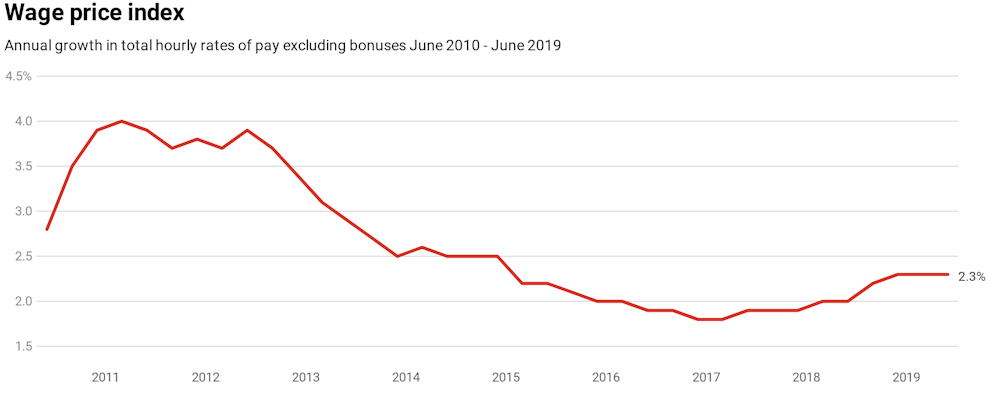
On Wednesday the Bureau of Statistics released the June quarter Wage Price Index which showed wages rising 0.6% for the quarter and 2.3% on the year.

It provides two things to worry about.

First, wage growth isn’t rising. Annual growth has remained unchanged for three quarters.


ABS 6345.0

Second, the growth that is there is driven more by the public sector (0.8% over the quarter) than the private sector (0.5%).

As the Bureau’s chief economist Bruce Hockman puts it

Wage growth continues at a steady rate in the Australian economy on the back of strong public sector growth over the quarter. The most significant contribution to wage growth this quarter came from the public sector component of the health care and social assistance industry, where a number of large increases were recorded in Victoria under a plan to ensure wage parity with other states.

Things might improve when and if the Reserve Bank interest rate cuts of June 5 and July 2 start changing the way consumers and employers think.

But the Reserve Bank cash rate has been at a record low of 1.5% since September 2016. All through those three years Governor Lowe has told us to be patient, that soon wage growth will climb and unemployment will fall.

We’ve had little progress on wages, and since January none on unemployment.

Unemployment isn’t really falling

On Thursday the bureau followed up with the latest unemployment figures.

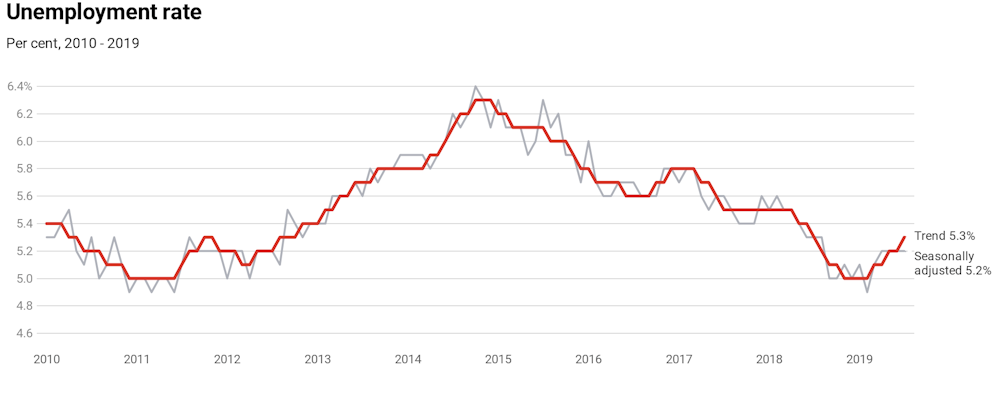
Although job creation was strong in July – 24,600 jobs were added to the economy, 15,100 of which were full-time – the trend unemployment rate ticked up to 5.3%, from 5.2%.

The “trend” is a smoothed out extension of the way the way the Bureau of Statistics algorithm thinks the rate is going.


ABS 6202.0

In part it is going up because more people not previously regarded as unemployed are looking for work (and not finding it).

It isn’t necessarily a bad thing, but it is also exactly what would be expected when wage growth was sluggish. Households are doing what they can to assemble more income.

The world economy is in trouble

Global economic conditions are concerning. This week Eurpoe’s second-biggest economy Germany announced that its economy shrank by 0.1% in the second quarter of 2019, putting it on track to meet what some people call the technical definition of a recession.

Figures out of China regarding industrial production were also worrying, with factory output climbing more slowly than at any time in the last 17 years.

The US stock market climbed 1.5% on Tuesday after the Trump administration announced it would delay some of its new tariffs on China, but slid twice that amount the next day on the news from Germany and China.


Read more: Are Trump’s tariffs legal under the WTO? It seems not, and they are overturning 70 years of global leadership


The fall in stocks led to a flight to the relative safety of government bonds. This caused the yield on 10 year US government bonds to fall below that of the 2 year bonds, a so-called “inverted yield curve” of the kind usually seen before a recession. The last time the US yield curve inverted was before the US Great Recession of 2008.

None of this is good for Australia. With roughly 20% of our economy powered by exports, we need the countries we export to to be doing well.

As Reserve Bank deputy governor Guy Debelle put it in a speech on Thursday

Australia also has significant exports to China in both tourism and education. To date, these have been broadly unaffected by the slowdown in the Chinese economy. But a further significant slowing in the Chinese economy and household incomes would clearly pose a risk.

There’s no telling how low rates will go

There have been plenty of competing views about the state of the Australian economy over the past few years.

Not long ago most economists who thought interest rates would move thought they would rise. The Reserve Bank governor suggested the same.

But its increasingly clear that secular stagnation is gripping advanced economies around the world. In response, the US Federal Reserve has recommenced cutting rates and markets predict it will cut another full percentage point by this time next year.

Markets also expect the European Central Bank, Bank of Japan, and the Reserve Bank to cut rates significantly.


Read more: Vital Signs. If we fall into a recession (and we might) we’ll have ourselves to blame


The Bank’s “house position” on unemployment is that we can go down to 4.5% before worrying about triggering inflation (not that there’s much sign of that happening).

Another way to say that is that unemployment has to reverse course and get down to a barely-precedented 4.5% before there’s much hope of the Reserve Bank meeting the inflation target it is meant to be aiming for.

Perhaps the most important question facing the Australian economy is how aggressively the bank will act to attempt to get it there and to keep the economy afloat. Time will tell.


Read more: RBA update: Governor Lowe points to even lower rates


ref. Vital Signs. Amid talk of recessions, our progress on wages and unemployment is almost non-existent – http://theconversation.com/vital-signs-amid-talk-of-recessions-our-progress-on-wages-and-unemployment-is-almost-non-existent-121813

How do we identify human remains?

Source: The Conversation (Au and NZ) – By Jodie Ward, Director, Australian Facility for Taphonomic Experimental Research; Forensic DNA Identification Specialist, NSW Health Pathology; Associate Professor, Centre for Forensic Science, University of Technology Sydney

The recent case of a surgical implant found inside a Queensland crocodile has highlighted the challenges forensic scientists face when trying to identify human remains without much evidence to go on.

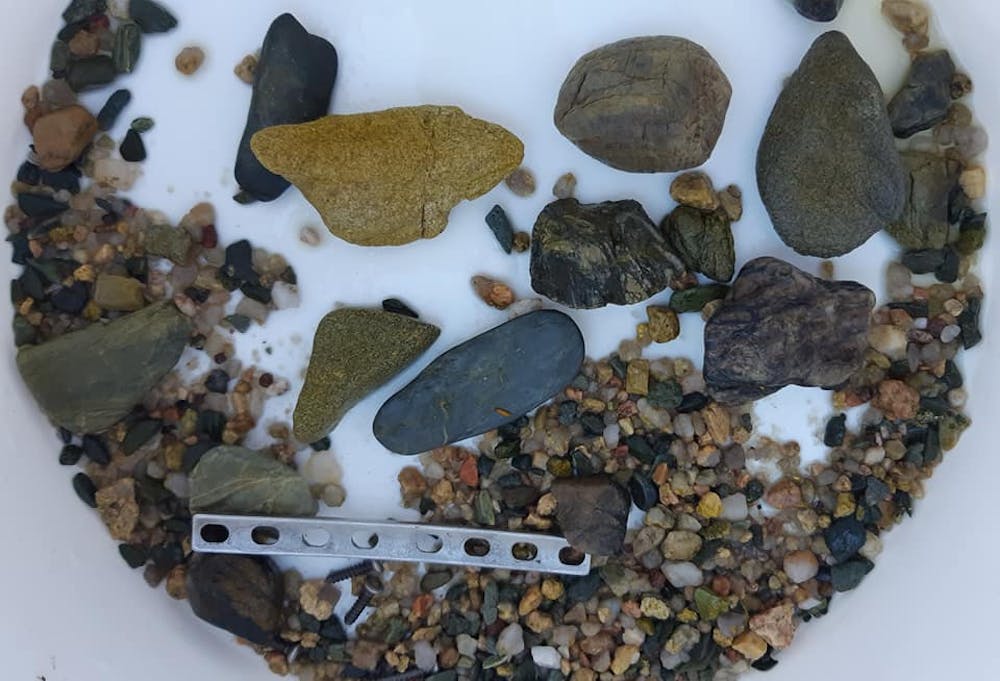
Did the crocodile eat a human with a surgical implant? If so, could the implant — a metal plate and some screws — be used to identify the victim? Or did the implant come from a dog?

Recovered from the stomach of a crocodile: did this metal plate come from a human or dog? Koorana Crocodile Park

Death by crocodile is reasonably rare. In the past decade, there have been about 67 crocodile attacks in Australia, a quarter of which were fatal.

Victim identification can be impossible in these cases, unless a body part with a unique characteristic is recovered, such as a medical device with a serial number. It’s just one of a range of potential techniques to put names and faces to hundreds of unidentified human remains in Australia.


Read more: Australia has 2,000 missing persons and 500 unidentified human remains – a dedicated lab could find matches


Forensic examination of human remains is crucial to establish the person’s identity, and cause and manner of death. This way they can have a proper burial, families can get answers, death certificates can be issued and justice can be served.

It is essential for identifying missing persons, disaster victims and casualties of war.

The big three: fingerprints, teeth, DNA

When human remains are recovered, three primary scientific methods are traditionally used to identify who they belong to:

  • fingerprint analysis, which looks at the skin patterns on the tips of fingers
  • dental analysis, which looks at the teeth and any dental work, such as crowns and fillings
  • DNA analysis, which looks at DNA profiles recovered from soft or hard body tissues.

This information can then be compared to a database of fingerprint, dental or DNA records.

Implants and x-rays can also be useful

The discovery of medical implants during an autopsy can also be informative.

These include prosthetic joints, breast implants, pacemakers or dental implants. Investigators may be able to link these to patient records via their unique markings, including a trade mark, date of manufacture and serial number.

In Australia, the Australian Orthopaedic Association National Joint Replacement Registry and Australian Breast Device Registry collect and store information that can allow people who have had joint or breast surgery to be identified.

But there are no national registers of heart or dental implants. Such mandatory records would allow implants to be easily traced back to recipients or surgeons.

Forensic scientists can also compare medical images, such as x-rays or CT scans, taken before and after death.

For head images, unique features such as the sinuses or the arrangement and condition of the teeth can be compared.

Body scans can also be used to look for rarer skeletal features, such as fractures, amputations or cancer lesions.

Imaging such as x-rays can reveal fractures and surgical implants. from www.shutterstock.com

These scientific techniques, either individually or in combination, have been successfully used to identify large numbers of missing persons or disaster victims.

Computerisation, digitisation and miniaturisation of forensic technologies have further improved the identification process. Now, fingerprints, teeth, DNA and medical images can be quickly and easily collected and searched in real time using portable instruments at the scenes of mass disasters.


Read more: How dental records will help identify bodies from MH17


But there are limits

These methods are only as good as the information we have from when the person was alive. So if someone doesn’t have their fingerprints on file and hasn’t visited a dentist recently, or if close living relatives aren’t available to provide a DNA reference sample or they’ve never had a CT scan, these methods are likely to be useless.

And if a surgical implant doesn’t have unique markings (as in the case of the Queensland crocodile), it makes the task extremely difficult.

So forensic scientists need to explore other methods.

Clues from tattoos and bones

Distinctive physical features like scars, birthmarks and body modifications such as tattoos and piercings, could help identify someone.

Custom tattoos helped identify the victim of the famous 1935 “shark arm case” and decomposing bodies following the 2004 Boxing Day tsunami.

A forensic anthropologist can also study a set of skeletal remains to reveal a lot about that person when they were living — including their sex, ancestry, stature, age, disease and any fatal injuries.

Radiocarbon dating of teeth and bone could tell us when that person was born and died. And the sample’s chemical signature could indicate the region where they were born, lived for long periods or recently travelled. It can even identify what they ate.

Scientists can also reconstruct a 3D image of someone’s face if a skull is found.

New DNA intelligence tools

Beyond routine DNA testing to determine someone’s sex or relatives, more novel DNA methods are showing promise for piecing together an image of a missing person.

New DNA tools can now predict someone’s physical appearance from a single bone. from www.shutterstock.com

DNA can now be used to predict someone’s ancestry and hair, eye and skin colour. But using DNA to accurately estimate age and facial features is still some way off.

Forensic genetic genealogy is also growing in popularity for identifying Jane Does (unidentified females). This is where investigators search a public DNA database of ancestry.com results, looking for genetic links to the DNA from the remains.

Other countries may consider adopting this technique for their cases, as long as the database owners allow law enforcement agencies to keep using the data to identify people.


Read more: Is your genome really your own? The public and forensic value of DNA


The value of ‘body farms’

Human taphonomic facilities, such as the Australian Facility for Taphonomic Experimental Research, study the science of how bodies decompose. These facilities, often called “body farms”, are important for developing new forensic identification techniques. The techniques can be tested on donated human bodies before being used in forensic cases.


Read more: ‘This is going to affect how we determine time since death’: how studying body donors in the bush is changing forensic science


The best and most efficient way to identify the remains of unknown and missing Australians involves combining expertise from a number of different branches of forensic science and coordinating these efforts nationally.

So for cases where fragments of human remains are found in the stomachs of crocodiles, sharks or some other human predator, investigators now have a toolkit of forensic techniques to choose from to identify the victim.

However, in this most recent case, the recovery of only an orthopaedic device has left forensic scientists with more questions than answers.

ref. How do we identify human remains? – http://theconversation.com/how-do-we-identify-human-remains-121315

How to know if we’re winning the war on Australia’s fire ant invasion, and what to do if we aren’t

Source: The Conversation (Au and NZ) – By Daniel Spring, Research Fellow, School of Biosciences, University of Melbourne

More than A$400 million of government funding is being invested in the latest round of the fire ant program in the hope of eradicating the invasive pests by 2027.

But recent reports on the ABC suggest the invasion is spreading beyond containment lines in south-east Queensland, and there are delays in responding to public reports of new ant infestations.

The claims are denied by Graeme Dudgeon, the new general manager of Queensland Government’s National Red Imported Fire Ant Eradication Program.


Read more: Koala-detecting dogs sniff out flaws in Australia’s threatened species protection


Fire ants are native to South America but nests were first discovered in Brisbane in 2001. It’s thought they arrived via shipping at the Port of Brisbane.

They’re regarded as one of the world’s worst invasive species and have a painful bite which is why the Queensland Government has been trying to wipe them out here.

Is eradication possible?

An independent review in 2016 found the fire ants were confined to a region of south east Queensland and said there was an opportunity to eradicate the pests.

But the latest debate raises the question of whether eradication is the best plan, or would further containing the spread of the fire ants be a more practicable solution?

To achieve its aim of eradicating the fire ant problem, the program needs to progressively shrink the invasion.

If the invasion is shrinking too slowly (or is expanding), eradication won’t be achieved by 2027. Without ongoing monitoring of the invasion’s size, the program might be failing without the general public knowing.

But knowing the fire ant invasion’s size isn’t easy because there isn’t enough funding to survey all locations that might have them.

Estimates of the invasion

Using records of past fire ant detections, we have demonstrated how to estimate the invasion’s size when only part of the managed area is surveyed.

Our inference of the boundary of the fire ant invasion in April 2015. The different coloured polygons correspond to different levels of credibility that the boundary contains the invasion, with the outermost boundary corresponding to the highest credibility. Small crosses represent sites where nests have been detected, with the most recent detections in red and the oldest in brown. Nature/Authors provided, CC BY

If this approach to estimating the invasion boundary is applied each year during the current program, we could estimate whether the invasion is shrinking fast enough to be gone by 2027.

The importance of this issue demands a rigorous scientific analysis using transparent data and methods. Without this, anecdotal evidence that the current invasion is spreading is all we have to indicate whether eradication efforts are failing.

The size of the fire ant invasion should not only be measured in terms of the total area within its estimated boundary but also the density of nests within this area.

Eradication won’t be achieved if both the invasion boundary and the density within it are increasing. This straightforward test to determine whether the program is failing has not yet been applied.

But such a test could be done if updated records of the fire ant invasion are regularly made available to allow for periodic estimation of updated maps of the invasion.

Never give up

Even if eradication by 2027 is unlikely, this does not mean we should give up, provided future control efforts can contain the invasion at an affordable cost.

If the current program fails to eradicate the fire ants, it may still set the stage for effective long-term containment of the invasion.

A poor outcome will result if current management efforts are spread thinly over the infested area, reducing the density of nests but not eradicating them from any suburbs.

A better outcome would involve shrinking the infested area, that is, eradicating the ants from many or most suburbs, so that subsequent containment efforts can focus resources on a smaller area.

Is it still early enough in Australia to shrink the fire ant invasion to a manageably small area and thereby protect most homes and most of the environment for a long time? The required information to answer this question is not yet available.


Read more: Want to beat climate change? Protect our natural forests


But if Queensland’s eradication program has substantially slowed the spread so far, this provides confidence that continuing the program could effectively suppress the invasion. If so, we need to estimate what it will cost to keep out fire ants from most homes and most of the environment for a long time.

It’s often claimed that removing the last 1% of invaders costs as much as removing the previous 99%. If the current program removes all ants from most areas by 2027, this may provide large benefits without the extra cost of finding the last few ants in all infested areas.

Even if we do eradicate fire ants this time, it’s almost certain they will be back because they can readily hitchhike rides on ships.

So if governments can keep fire ant numbers down through ongoing containment, a lot of people and a lot of native species will benefit.

ref. How to know if we’re winning the war on Australia’s fire ant invasion, and what to do if we aren’t – http://theconversation.com/how-to-know-if-were-winning-the-war-on-australias-fire-ant-invasion-and-what-to-do-if-we-arent-121367

Explainer: from bloodthirsty beast to saccharine symbol – the history and origins of the unicorn

Source: The Conversation (Au and NZ) – By Jenny Davis Barnett, Academic in French, The University of Queensland

The unicorn is an enduring image in contemporary society: a symbol of cuteness, magic, and children’s birthday parties.

But while you might dismiss this one-horned creature as just a product for Instagram celebrities and five-year-old girls, we can trace the lineage of the unicorn from the 4th century BCE. It evolved from a bloodthirsty monster, to a tranquil animal bringing peace and serenity (which can only be captured by virgins), to a symbol of God and Christ.

These days the term unicorn can refer to a privately held start-up company valued at over US$1 billion, a single female interested in meeting other couples, or the characters in My Little Pony.

Over the centuries, the meaning and imagery of the unicorn has shifted and persisted. But how did we get here?

Ferocious beasts and where to create them

The earliest written account of the unicorn comes from the text Indica (398 BCE), by Greek physician Ctesias, where he described beasts in India as large as horses with one horn on the forehead.

Ctesias was most likely describing the Indian Rhinoceros. The unicorn horn, he wrote, was a panacea for those who drink from it regularly.

A contemporary interpretation of the once ferocious beast. Hachette

In the first-century CE, claiming to quote Ctesias, the Roman naturalist Pliny (Natural History, 77 CE), wrote that the unicorn was the fiercest animal in India, with the body of a horse, the head of a stag, the feet of an elephant, the tail of a boar, and a single horn projecting from the forehead.

Pliny also embellished the animal’s description by adding a trait that became extremely significant to society in the Middle Ages: it was impossible to capture the animal alive.

Just over a century later, the second-century CE Roman scholar Aelian compiled a book about animals based on Pliny. In his On the Nature of Animals, Aelian wrote that the unicorn grows gentle towards the chosen female during mating season.

The unicorn’s tender disposition when near the female became a highly symbolic trait for authors and artists of the Middle Ages, who believed it could only be captured by a virgin.

Despite the authoritative texts of the Greeks and Romans, the unicorn remained mostly unknown in the centuries leading up to the Middle Ages. For the public to become familiar with it, the creature had to come out of the library and develop a role in everyday events and popular culture: ie a role in Christianity.

Lost in translation

It was in the third-century BCE that the unicorn entered religious texts – although only by accident.

Between 300 and 200 BCE, a group of 70 scholars gathered together to create the first translation of the Hebrew Old Testament in Koine Greek. Although the Hebrew term for unicorn is Had-Keren (one horn), in the text commonly known as Septuagint (seventy) the scholars made an error when translating the Hebrew term Re’_em (ox), from Psalms as monokeros. In effect, they changed the word “ox” to “unicorn.”

The unicorn’s inclusion in a text of such magnitude laid the foundation for an obsession with the creature that thrived in both literary and visual arts from the earliest dates of the Middle Ages and continues to the modern day.

By the 12th century, the one-horned animal came to be associated with the allegory provided in the Physiologus, a collection of moralised beast tales on which many medieval bestiaries are based. One of the most widely read books in the Middle Ages, the Physiologus often identifies Christ with the unicorn.

The Rochester Bestiary (c late 1200s) draws on Physiologus to represent the unicorn as the spirit of Jesus. Wikipedia Commons

The illustrations that accompany textual references to the unicorn in the Bible and medieval bestiaries often showed the allegorical representation rather than the literal.

The modern unicorn. mlp.wikia.com

So instead of images depicting Christ as a man, the artists drew horses and goats with one large horn protruding from its head. In this medieval legend, the fanciful myth of the one-horned animal became the foundation of the unicorn image that circulated throughout Europe.

Contemporary images of the unicorn have changed very little since the medieval era. The creature in The Lady and the Unicorn tapestries in the Cluny museum in Paris, symbolising various overlapping meanings including chastity and heraldic animals, looks a lot like the My Little Pony characters Rarity and Princess Celestia.


Read more: Explainer: the symbolism of The Lady and the Unicorn tapestry cycle


Imagery of the unicorn persisted sporadically in literature, film and television through the 20th century, but the 2010s saw interest boom.

The modern Instagram star

Social media helped lure the magical creature into quotidian life – the one-horned horse looks great as a Facebook emoji and surrounded by rainbows on Instagram. National Unicorn Day (April 9) was first observed in 2015.

Searches for “unicorns” reached an all-time high in April 2017, the same month Starbucks introduced the colour and taste-changing Unicorn Frappuccino, sparking a trend in adding glitter and rainbow colours to any food or beverage.

Now, the unicorn is marketed to children and adults alike on coffee mugs, keychains, stuffed animals, t-shirts. In secular contemporary culture it has become an LGBTI+ icon: a symbol of hope, something “uncatchable.”

The contemporary unicorn is a far cry from Ctesias’ beasts. Social media platforms like Instagram encourage us to project an idealised version of our life: the unicorn is a perfect symbol for this ideal.

If the last decade is anything to go by, its intrigue will only continue to grow.

ref. Explainer: from bloodthirsty beast to saccharine symbol – the history and origins of the unicorn – http://theconversation.com/explainer-from-bloodthirsty-beast-to-saccharine-symbol-the-history-and-origins-of-the-unicorn-120760

The Melbourne archbishop said he’d rather go to jail than break confession confidentiality. A new bill could send him there

Source: The Conversation (Au and NZ) – By Hadeel Al-Alosi, Lecturer, School of Law, Western Sydney University

Yesterday, Victorian Parliament finally debated a bill on whether religious ministers should be forced to disclose child abuse admitted in confidence to a priest.

The Victorian Children Legislation Amendment Bill 2019 follows the recommendation of the Royal Commission into Institutional Responses to Child Sexual Abuse in 2017, which revealed the many failures of churches to report allegations of child abuse.


Read more: Should priests be made to report child abuse revealed in confession?


But the proposed law reform has sparked strong opposition from some religious ministers. Melbourne Archbishop Peter Comensoli said he would rather go to jail than report a person who confessed committing child sexual abuse. He said:

I will speak to the person there and then about how they will need to, one, go to the police about this […] and two, I’d be asking at the end of the confession to then repeat what they said outside of the seal so that I can then act.

And Child Protection Minister Luke Donnellan told the ABC this morning that even the Melbourne Archbishop, the state’s most senior Catholic, is not above the law. He said:

If people break the law they would be prosecuted.

Several Australian state governments, including New South Wales and South Australia, have already passed laws legally obliging religious leaders to report confessions of child sexual abuse. Victoria will be following their lead if the law passes through both houses.

The bill proposes several changes to strengthen the protection of children, on top of the proposed amendment of making it mandatory for religious ministries to report child abuse to protection authorities.


Read more: The causes of paedophilia and child sexual abuse are more complex than the public believes


This includes limiting the right of appeal of those whose Working With Children Check application has been rejected if they have been charged with, or convicted of, certain criminal offences. But unlike the amendment for religious ministries, some of these changes are unlikely to attract opposition.

What are Victoria’s mandatory reporting laws?

Mandatory reporting refers to the legal requirement for selected professionals to report suspected child abuse to protection authorities.

Under Victorian law, mandated reporters must report child abuse if, in the course of practising their profession, they hold a reasonable belief a child has been harmed, or is of significant risk of harm. The harm may be physical or sexual abuse.


Read more: Royal commission recommends sweeping reforms for Catholic Church to end child abuse


Mandatory reporters must disclose their suspicion as soon as possible after forming the belief. If they fail to report, then the penalty is currently 10 penalty units, which adds up to a maximum fine of A$1652.20.

Failure to report can also be a criminal offence. Under the Victorian Crimes Act 1958, a person who doesn’t disclose a sexual offence committed against a child under 16 can be imprisoned for up to three years.

Under the Children, Youth and Families Act (Vic), the main group of professionals listed are doctors, midwives, nurses, police officers, principals, early childhood workers, teachers, youth justice workers, and registered psychologists.


Read more: Media Files: Investigative reporter Louise Milligan on Cardinal Pell and redactions in the Royal Commission’s report


A notable profession missing from this list are members religious ministries, but that might soon change if the Children Legislation Amendment Bill 2019 is passed.

The new bill is controversial because it effectively breaks the so-called “confessional seal”.

What is the confessional seal?

The confessional seal is fundamental to Christian religions. It’s where a person can ask a priest, in confidence, to forgive them for their sins.

The sacrament is believed to wash sinners clean from their sins and reconcile with their Lord and the Church.

Breaking the seal is forbidden under canon law – the special rules governing the Catholic Church. And a priest who discloses a confession faces punishment, such as ex-communication.


Read more: Politics with Michelle Grattan: Father Frank Brennan on Israel Folau and religious freedom


Religious liberty vs child protection

Melbourne Archbishop Peter Comensoli is just one of many priests who said they are “willing to go to jail” rather than break the seal.

Others, however, have shown support for the law. Child Protection Minister Luke Donnellan said:

It’s pretty simple: if you think a child is being abused, you have to report it. And we’re committed to driving this cultural change to make Victoria safer for our children.

But the response from some priests has shown that reporting confessions is not that simple. Some refuse to break the seal, seeing the law as an attack on religious freedom.


Read more: Women priests could help the Catholic Church restore its integrity. It’s time to embrace them


Attorney General Jill Hennessy has rejected the “religious liberty” argument, claiming:

I don’t think in contemporary and mainstream times, knowing what we know now, that we can do anything other than say the rights of children trump anyone’s religious views.

Chrissie Foster, an advocate for anti-abuse, actively has publicly welcomed the proposed law. Her two children were sexually abused by a Catholic priest, and she has described the proposed law as a “breakthrough” and says politicians backing the law should be “congratulated”.

Arguably, if priests had not been exempted from mandatory reporting laws, many sexual abuses could have been prevented.


Read more: The Catholic Church is headed for another sex abuse scandal as #NunsToo speak up


For instance, consider the case of Michael McArdle, who confessed to 30 priests he had sexually abused children up to 1,500 times.

Complying with the confessional seal, the priests did not report the abuses and instead allegedly advised McArdle to “pray more”.

Only time will tell

Far too many children have suffered sexual abuse while in the “care” of religious institutions and change is necessary. The Labor government claimed these new laws will “better protect Victoria’s children”.

But how can such a law protect children in the future if religious minsters choose to ignore it?


Read more: After Pell, the Catholic Church must undergo genuine reform


With the Catholic Church accounting for 61.8% of sexual abuse allegations investigated by the Royal Commission, the proposed legislation seems pointless without the Catholic Church’s support.

For now, the future of the proposed law and its effectiveness remains uncertain. The bill is expected to pass both houses of Victorian Parliament because it has bipartisan support. But only time will tell whether the proposed law passes and whether it will achieve its purpose.

Only one thing remains certain: the victims and survivors of child abuse will remain in our prayers and thoughts.

ref. The Melbourne archbishop said he’d rather go to jail than break confession confidentiality. A new bill could send him there – http://theconversation.com/the-melbourne-archbishop-said-hed-rather-go-to-jail-than-break-confession-confidentiality-a-new-bill-could-send-him-there-121869

How ancient seafarers and their dogs helped a humble louse conquer the world

Source: The Conversation (Au and NZ) – By Loukas Koungoulos, PhD Candidate, University of Sydney

This is the story of how a parasitic, skin-chewing insect came to conquer the world.

For more than a century, scientists have been puzzled as to how an obscure louse native to Australia came to be found on dogs across the world. Heterodoxus spiniger evolved to live in the fur of the agile wallaby.

Despite little evidence to back the idea, many researchers believed it was linked to people from Asia bringing the dingo to Australia in ancient times. Perhaps people later took dingoes infested with this parasite back home, where it spread to local dogs, and onwards from there.


Read more: Dingoes do bark: why most dingo facts you think you know are wrong


But when we approached the question again using the most up-to-date information, my colleague Peter Contos and I came up with a completely different explanation – one that better fits what we know of ancient migration and trade in the Asia-Pacific region.

As we report in the journal Environmental Archaeology, this louse probably originated not in Australia but in New Guinea, an island with a long history of intimate connection with seafaring Asian cultures.

Louse on the loose

H. spiniger is a tiny louse that lives on mammals around the world, mostly dogs. Using its clawed legs to hang on, it bites and chews at the skin and hair of its hosts to draw the blood on which it feeds.

As all its closest relatives are specialised parasites of marsupials, mostly other wallabies, logic suggested that H. spiniger must have evolved within Australia. It also seemed logical it would have spread first to the dingo, Australia’s native dog.

Our first task was to figure out just how far away from Australia it had spread; this would inform the likely pathways by which it could have travelled to the wider world.

We looked at museum collections, entomological surveys, and veterinary research reports to generate a map of its worldwide distribution.

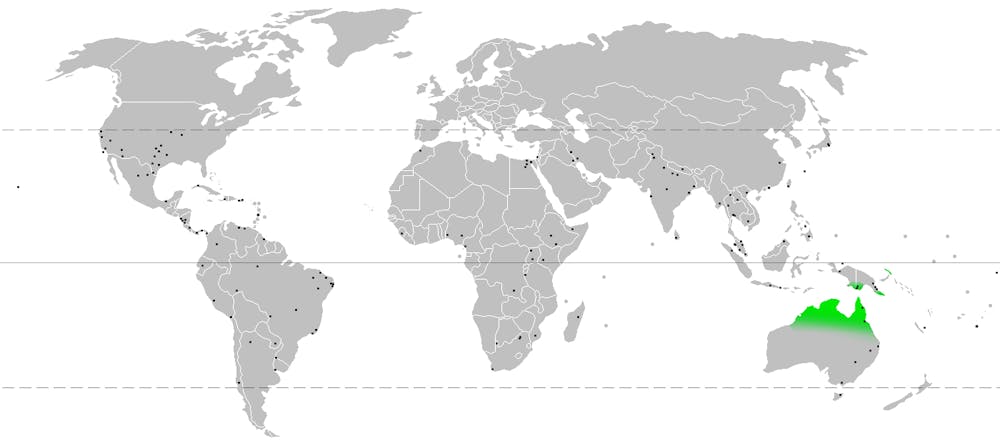
Global distribution of H. spiniger. Lougoulos and Contos, Author provided

The specimens we found, collected from the late 19th century to the present day, showed that this species is found on every continent except Europe and Antarctica.

But in Australia, we couldn’t find a single verifiable instance of the parasite living on dingoes. The only cases were from agile wallabies and domestic dogs.

That meant the prevailing wisdom had been wrong, and we had to look elsewhere for the origins of H. spiniger.

Don’t blame the dingoes. Blanka Berankova/Shutterstock

Where did it really come from?

Although marsupials are best known from Australia, they are also found in other parts of the surrounding region. The agile wallaby is also native to the island of New Guinea, which was once joined with Australia.

Dogs have also been in New Guinea for at least as long as the dingo has been in Australia. Traditionally, dogs were kept in Papuan villages, and were used to hunt game, including wallabies.

It came as little surprise, then, that we found H. spiniger on both agile wallabies and native dogs in New Guinea – and only a few decades after the first ever identification of the species.

So here was a more likely place in which the first transfer from wallaby to dog took place. But who took them out of New Guinea and into the wider world?

Austronesian voyagers

New Guinea was first colonised by humans around the same time as Australia. But since that time, compared with Australia it has had notably stronger connections with the outside world, reaching back millennia before European colonisation of Australia in 1788.

Around 4,000 years ago, agriculturalists known as Austronesians sailed out of Taiwan to settle several archipelagos in Oceania. With them they brought domestic species of plants and animals, including dogs.

By 3,000 years ago, at the latest, they reached New Guinea. We suggest this was the crucial moment when dogs first picked up H. spiniger.

In the ensuing centuries, Austronesians went on to settle much of Indonesia, the Philippines, Melanesia and Polynesia, and coastal sections of mainland Southeast Asia.

They even settled as far as Madagascar, suggesting their voyages probably took them around the rim of the Indian Ocean, along the margins of India and the Middle East.

Dogs accompanying the migrants probably helped spread the louse, which is found almost everywhere they went.

This spans an enormous distance – from Hawaii to Madagascar – a testament to the ancient Austronesians’ supreme seafaring skills.

New directions

Our research suggests how the parasite first got around the world, but not precisely when. Its journey probably progressed at different times in different places.

The Austronesian diaspora established trade routes between the places they settled, some of which spanned impressive distances across several island groups.


Read more: How to get to Australia … more than 50,000 years ago


Later, foreign traders connected these communities with greater Asia and Africa. And in modern times, dogs continue to be transported as desirable goods themselves.

Trade and contact has probably led to further, possibly ongoing, dispersal of H. spiniger.

Unfortunately there are no archaeological examples that could demonstrate the louse’s early presence outside New Guinea, because this species prefers hot, humid environments.

A genetic approach is a better way forward. A start would be testing specimens from different parts of the world, to see when different regional populations – if they exist – branched off from one another.

This is particularly important in tracking its spread to the Americas, which likely occurred in recent centuries alongside European colonisation.

This research will help us further understand how migration, contact and trade unfolded in the prehistoric Asia-Pacific region, and how it affected the animal species – including the humblest of parasites – we see there today.


This paper would not have been possible without the contributions of Peter Contos, the work of volunteers on the Natural History Museum’s Boopidae of Australasia digitisation project, and the contributions of the public to Wikipedia Creative Commons, for which we are grateful.

ref. How ancient seafarers and their dogs helped a humble louse conquer the world – http://theconversation.com/how-ancient-seafarers-and-their-dogs-helped-a-humble-louse-conquer-the-world-117183

Can Scott Morrison deliver on climate change in Tuvalu – or is his Pacific ‘step up’ doomed?

Source: The Conversation (Au and NZ) – By Tess Newton Cain, Adjunct Associate Professor, School of Political Science & International Studies, The University of Queensland

This week’s Pacific Islands Forum comes at an important time in the overall trajectory of Prime Minister Scott Morrison’s very personal commitment to an Australian “stepping up” in the Pacific.

To paraphrase the PM, you have to show up to step up. And after skipping last year’s Pacific Islands Forum, Morrison has certainly been doing a fair amount of showing up around the region, with visits to Vanuatu and Fiji at the beginning of the year and the Solomon Islands immediately after his election victory.

Add to this his recent hosting of the new PNG prime minister, James Marape, and it is clear there has been significant energy devoted to establishing personal relationships with some of the leaders he will sit down with this week.

An ‘existential threat’ to the region

Regional politics and diplomacy in the Pacific are not for the faint of heart. It’s clear from the tone of recent statements by Foreign Minister Marise Payne and the minister for international development and the Pacific, Alex Hawke, that there is some disquiet ahead of the Tuvalu get-together.

And with good reason. For some time, the leaders of the region have been becoming increasingly vocal about the lack of meaningful action from Canberra when it comes to climate change mitigation.


Read more: Yes, Morrison ‘showed up’ in the Pacific, but what did he actually achieve?


Most recently, ten of the Pacifc Islands Development Forum (PIDF) members signed the Nadi Bay Declaration, which advocated a complete move away from coal production and specifically criticised using “Kyoto carryover credits” as a means of achieving Paris targets on reducing emissions.

While this body does not have the regional clout of the Pacific Islands Forum, its membership includes key players, notably Fiji, Tuvalu, and the Republic of the Marshall Islands, whose leaders have all spoken out strongly on the need for stronger action on climate change.

In a speech last month, Fijian Prime Minister Frank Bainimarama urged his fellow Pacific leaders to withstand any attempts to water down commitments on climate challenge in the region and globally.

Bainimarama’s warning: ‘Our region remains on the front line of humanity’s greatest challenges’

Bainimarama is attending this year’s Pacific Islands Forum for the first time since 2007, and has already made his presence felt. Earlier this week, he urged Australia to transition as quickly as possible from coal to renewable energy sources, because the Pacific faces

an existential threat that you don’t face and challenges we expect your governments and people to more fully appreciate.

Losing credibility on its ‘step up’

Given the state of Australia’s domestic politics when it comes to making climate change action more of a priority, it is hard to see how Morrison can deliver what the “Pacific family” is asking for.

The recent announcement of A$500 million to help Pacific nations invest in renewable energy and fund climate resilience programs is sure to be welcomed by Pacific leaders. As is the pledge for A$16m to help tackle marine plastic pollution.

But none of this money is new money – it’s being redirected from the aid budget. And it does not answer the call of Pacific leaders for Australia to do better when it comes to cutting emissions.

An aerial view of Funafuti, the most populous of Tuvalu’s country’s nine atolls. Mick Tsikas/AAP

Why does this matter? Because it’s becoming increasingly obvious that the inability – or refusal – to be part of the team when it comes to climate change is undermining Australia’s entire “Pacific step-up”.

If Morrison, and the Australian leadership more broadly, want to reassure Pacific leaders that Australia’s increased attention on the region is not just all about trying to counter Chinese influence, this is where the rubber hits the road.

This is not about whether China is doing better when it comes to climate change mitigation than Australia. The Pacific has greater expectations of Australia, not least because Australian leaders have been at pains to tell the region, and the world, that this is where they live – that Pacific islanders are their “family”.

And for Pacific islanders, if you are family, then there are obligations. This week, as has been the case previously, Pacific leaders will make clear that addressing climate change is their top priority, not geopolitical anxieties over China’s increasing role in the region.


Read more: Everything but China is on the table during PNG prime minister’s visit


There is little doubt that Australia’s “Pacific step-up” is driven by concerns about the rising influence of China. But Morrison knows better than to voice concerns of that type – at least in public – while in Tuvalu.

Numerous Pacific leaders have made it clear that as far as they are concerned, partnerships with Beijing (for those that have them) provide for greater opportunity and choice.

While they welcome renewed ties with traditional partners like Australia and New Zealand, they maintain a “friends to all and enemies to none” approach to foreign policy. That is unlikely to change any time soon.

Tuvalu’s Prime Minister Enele Sopoaga has warned Australia that its Pacific ‘step up’ could be undermined by a refusal to act on climate change. Mick Tsikas/AAP

Will Tuvalu prove a turning point?

Tuvalu Prime Minister Enele Sopoaga may well be hoping that when Morrison sees for himself how climate change is affecting his country, he will be so moved personally, he will shift Australia’s stance politically.

Indeed, on arrival in the capital of Funafuti this week, leaders are being met by children sitting in pools of seawater singing a specially written song “Save Tuvalu, Save the World”.

So what can Morrison realistically be expected to achieve during the summit? He will be able to demonstrate Australia’s commitment to other issues that are important to regional security, such as transnational and organised crime and illegal fishing.

He can also hope the personal relationships he has cultivated with Pacific leaders deliver returns by way of compromise around the wording of the final communique, if only to avoid a diplomatic stoush.

But if there is no real commitment to cutting greenhouse gas emissions, he will leave plenty of frustration behind when he returns to Australia.

ref. Can Scott Morrison deliver on climate change in Tuvalu – or is his Pacific ‘step up’ doomed? – http://theconversation.com/can-scott-morrison-deliver-on-climate-change-in-tuvalu-or-is-his-pacific-step-up-doomed-121501

Women aren’t better multitaskers than men – they’re just doing more work

Source: The Conversation (Au and NZ) – By Leah Ruppanner, Associate Professor in Sociology and Co-Director of The Policy Lab, University of Melbourne

Multitasking has traditionally been perceived as a woman’s domain. A woman, particularly one with children, will routinely be juggling a job and running a household – in itself a frantic mix of kids’ lunch boxes, housework, and organising appointments and social arrangements.

But a new study, published today in PLOS One, shows women are actually no better at multitasking than men.

The study tested whether women were better at switching between tasks and juggling multiple tasks at the same time. The results showed women’s brains are no more efficient at either of these activities than men’s.

Using robust data to challenge these sorts of myths is important, especially given women continue to be bombarded with work, family and household tasks.


Read more: Health Check: can people actually multitask?


No one is good at multitasking

Multitasking is the act of performing several independent tasks within a short time. It requires rapidly and frequently switching attention from one task to another, increasing the cognitive demand, compared to completing single tasks in sequence.

This study builds on an existing body of research showing human brains cannot manage multiple activities at once. Particularly when two tasks are similar, they compete to use the same part of the brain, which makes multitasking very difficult.

But human brains are good at switching between activities quickly, which makes people feel like they’re multitasking. The brain, however, is working on one project at a time.


Read more: Multitasking between devices is associated with poorer attention and memory — expert explains why


In this new study, German researchers compared the abilities of 48 men and 48 women in how well they identified letters and numbers. In some experiments, participants were required to pay attention to two tasks at once (called concurrent multitasking), while in others they needed to switch attention between tasks (called sequential multitasking).

The researchers measured reaction time and accuracy for the multitasking experiments against a control condition (performing one task only). They found multitasking substantially affected the speed and accuracy of completing the tasks for both men and women. There was no difference between the groups.

Domestic duties

My colleagues and I recently busted another relevant myth – that women are better at seeing mess than men. We found men and women equally rated a space as messy. The reason men do less cleaning than women may lie in the fact that women are held to higher standards of cleanliness than men, rather than men’s “dirt blindness”.

Recent data shows Australian men are spending more time doing domestic work than they used to, but women still do the vast majority of housework.

Working Australian women have seen their total time across work and family activities increase over time, with bread-winning mothers spending four hours more across these activities per week than bread-winning fathers.


HILDA/The Conversation, CC BY-ND

This means working mums are balancing planning birthday parties, childcare drop offs and ballet lessons all on top of their regular jobs, commutes and careers.

Consequences of the myth

If women’s brains are equally strained by multitasking, why do we keep asking women to do this work? And, more importantly, what are the consequences?

Our recent study shows mothers are more time pressed and report poorer mental health than fathers. We found the birth of a child increases parents’ reports of feeling rushed or pressed for time, but the effect is twice the size for mothers than it is for fathers. Second children double mothers’ time pressure again and, as a consequence, lead to a deterioration in their mental health.


Read more: Men do see the mess – they just aren’t judged for it the way women are


Women are also more likely to drop out of paid work when children are born or family demands intensify. They carry a larger mental load tied to organising the needs of the family – who has clean socks, who needs to be picked up from school, whether there is enough Vegemite for lunch. All of this labour is at the expense of time planning for the next day’s work, the next promotion, and so on.

Women are also asked to multitask family demands at night. Children are more likely to interrupt their mother’s than their father’s sleep.

Although gender roles are changing and men are assuming a larger share of the housework and childcare than in the past, gender gaps remain in many important domains of work and family life. These include the allocation of childcare, the division of housework, the wage gap, and the concentration of women in top positions.

So, the multitasking myth means mothers are expected to “do it all”. But this obligation can affect women’s mental health, as well as their capacity to excel at work.

Challenging misconceptions

Public opinion persists that women have a biological edge as super-efficient multitaskers. But, as this study shows, this myth is not supported by evidence.

This means the extra family work women perform is just that – extra work. And we need to see it as such.

Within the family, this work needs to be catalogued, discussed and then equally divided. More men today are invested in gender equality, equal sharing and co-parenting than ever before.


Read more: We can we reduce gender inequality in housework – here’s how


As well as in the home, we need to dismantle these myths in the workplace. The assumption women are better multitaskers can influence the allocation of administrative tasks. Tasks like taking minutes and organising meetings should not be allocated based on gender.

Finally, governments need to dismantle these myths within their policies. Children add work that cannot be easily multitasked. Women need affordable, high-quality, and widely available childcare.

Men also need access to flexible work, parental leave and childcare to share in this labour, and protections to ensure they aren’t penalised for taking time to share in the care.

Debunking these myths that expect women to be superheroes is a good thing, but we need to go further and create policy environments where gender equality can thrive.

ref. Women aren’t better multitaskers than men – they’re just doing more work – http://theconversation.com/women-arent-better-multitaskers-than-men-theyre-just-doing-more-work-121620

First home buyer schemes aren’t enough to meet young adults’ housing aspirations

Source: The Conversation (Au and NZ) – By Sharon Parkinson, Senior Research Fellow, Centre for Urban Transitions, Swinburne University of Technology

Young adults not only struggle to buy a home, many struggle to secure any kind of independent housing. This contributes to a cycle of living in precarious and informal housing and to a growing gap between their current situation and their short and longer-term housing aspirations.

A report released today by the Australian Housing and Urban Research Institute (AHURI) adds nuance to debates about generational change and housing by examining how housing aspirations differ among emerging adults (18-24 years) and in early adulthood (25-34 years). For example, emerging adults are more likely than the older cohort to prefer living in an apartment.

By early adulthood, the housing aspirations gap is greatest for individuals in the private rental sector, particularly those on higher incomes, and narrowest for home owners. Home buyers on low to moderate incomes are most happy with their housing.


Read more: Moving on from home ownership for ‘Generation Rent’


While long-held values around the ideal of home ownership prevail, these are not as persistent as for past generations. The ideal differs according to age, education and the quality and security of current living arrangements. But having somewhere safe and secure to call home was the top priority across all young adults.

Aspirations change with stage of life

An extended phase of dependence to semi-dependence shapes the housing aspirations of young adults. This involves either remaining in the family home or sharing with others.

In 2015-16, the ABS Survey of Income and Housing revealed that only one in six (17%) young adults (18-24 years) lived independently. Two-thirds (66%) lived with parents. Around a third of young adults (25-34 years) are also opting to remain or move back with parents or live in shared housing.


Read more: Over 50% of young Australian adults still live with their parents – and the numbers are climbing faster for women


While these living arrangements reflect concerns about housing affordability, they are also used as a strategy to pursue other aspirations, such as education.

What do young adults want in their housing?

The AHURI research includes a nationally representative survey of more than 2,400 Australians aged 18-34 years. It was supported by focus groups and in-depth interviews, including with Indigenous Australians, in Western Australia, New South Wales and Victoria.

Home ownership was the ideal tenure for 60% of emerging adults (18-24). By early adulthood (25-34) the proportion had climbed to 70%. The ideal of home ownership was lower (61%) for those still living in the family home by early adulthood compared with higher-income couples living independently (80%).

By early adulthood, educational status becomes a key marker of whether home ownership is considered possible. Nearly two-thirds (61%) of households with a tertiary-educated member believed they could buy a house within five years. This compares with just over a third of those with an education to year 12 (36%) and less than a quarter (23%) of those with an education to year 11 or below.

The preference for apartment living falls with age. About a third (34%) of emerging adults reported this as their ideal, compared with 21% of early adults.

Young adults also want more space. The largest share of both emerging (32%) and early adults (43%) indicated that a four-bedroom house is ideal. This compares to just 20% of those over 55 years of age who wanted four or more bedrooms.


Read more: What sort of housing do older Australians want and where do they want to live?


How large is the housing aspirations gap?

For emerging adults (18-24), living in a group household typically met short-term (82%) but not longer-term (25%) aspirations. Similarly, living with parents mostly met short-term (76%) but not longer-term (30%) aspirations.

Australian Housing Aspirations Survey 2018, Author provided

By early adulthood (25-34) the housing aspirations gap is greatest for individuals in the private rental sector, particularly those on higher incomes. For higher-income groups, their current private rental housing met the short-term aspirations of just over three-quarters (76%) but only 20% for longer-term aspirations.

The aspirations gap is narrowest for home owners. Home buyers on low to moderate incomes were most happy with their housing in the short-term (92%) and longer-term (60%).

Housing Aspirations Survey 2018, Author provided

What can be done to close the aspirations gap?

Very few people are actively planning for their housing futures. Affordability and the deposit gap, insufficient income, employment insecurity and “waiting for the market to settle down” all impact on achieving longer-term aspirations. In the short-term, not being in a preferred location, high mobility and insecurity matter most.

Housing policy needs to become more realistic about the housing futures of young Australians. Achieving both short- and longer-term aspirations requires new policy frameworks that can enable young people to move towards attaining “secure independence”.

Public debate about the housing aspirations of young adults gained prominence during the federal election with promises of a targeted scheme to help first home buyers. Proposed first home owner deposit schemes are an important step in meeting aspirations, particularly among private renters with higher and secure incomes.


Read more: Small, but well-formed. The new home deposit scheme will help, and it’s unlikely to push up prices


But before young people even contemplate home ownership they need greater support in making key life transitions, such as from education to work, via more continuous and integrated packages of housing assistance.

We also need continued reforms to ensure a fairer and more secure private rental sector with short and longer-term leasing options close to employment and training, and with stable rents.

There needs to be diversity and real choice in dwelling types, size and locations and scaling up of more sustainable and niche models of co-housing.


Read more: We need more flexible housing for 21st-century lives


As for young people locked out of home ownership in the long-term, they need a way to build an investment nest egg and to access quality social and public rental housing.

ref. First home buyer schemes aren’t enough to meet young adults’ housing aspirations – http://theconversation.com/first-home-buyer-schemes-arent-enough-to-meet-young-adults-housing-aspirations-121431

New research shows that Antarctica’s largest floating ice shelf is highly sensitive to warming of the ocean

Source: The Conversation (Au and NZ) – By Dan Lowry, PhD candidate, Victoria University of Wellington

Scientists have long been concerned about the potential collapse of the West Antarctic Ice Sheet and its contribution to global sea level rise. Much of West Antarctica’s ice lies below sea level, and warming ocean temperatures may lead to runaway ice sheet retreat.

This process, called marine ice sheet instability, has already been observed along parts of the Amundsen Sea region, where warming of the ocean has led to melting underneath the floating ice shelves that fringe the continent. As these ice shelves thin, the ice grounded on land flows more rapidly into the ocean and raises the sea level.

Although the Amundsen Sea region has shown the most rapid changes to date, more ice actually drains from West Antarctica via the Ross Ice Shelf than any other area. How this ice sheet responds to climate change in the Ross Sea region is therefore a key factor in Antarctica’s contribution to global sea level rise in the future.

Periods of past ice sheet retreat can give us insights into how sensitive the Ross Sea region is to changes in ocean and air temperatures. Our research, published today, argues that ocean warming was a key driver of glacial retreat since the last ice age in the Ross Sea. This suggests that the Ross Ice Shelf is highly sensitive to changes in the ocean.


Read more: Ice melt in Greenland and Antarctica predicted to bring more frequent extreme weather


History of the Ross Sea

Since the last ice age, the ice sheet retreated more than 1,000km in the Ross Sea region – more than any other region on the continent. But there is little consensus among the scientific community about how much climate and the ocean have contributed to this retreat.

Much of what we know about the past ice sheet retreat in the Ross Sea comes from rock samples found in the Transantarctic Mountains. Dating techniques allow scientists to determine when these rocks were exposed to the surface as the ice around them retreated. These rock samples, which were collected far from where the initial ice retreat took place, have generally led to interpretations in which the ice sheet retreat happened much later than, and independently of, the rise in air and ocean temperatures following the last ice age.

But radiocarbon ages from sediments in the Ross Sea suggest an earlier retreat, more in line with when climate began to warm from the last ice age.

An iceberg floating in the Ross Sea – an area that is sensitive to warming in the ocean. Rich Jones, CC BY-ND

Using models to understand the past

To investigate how sensitive this region was to past changes, we developed a regional model of the Antarctic ice sheet. The model works by simulating the physics of the ice sheet and its response to changes in ocean and air temperatures. The simulations are then compared to geological records to check accuracy.

Our main findings are that warming of the ocean and atmosphere were the main causes of the major glacial retreat that took place in the Ross Sea region since the last ice age. But the dominance of these two controls in influencing the ice sheet evolved through time. Although air temperatures influenced the timing of the initial ice sheet retreat, ocean warming became the main driver due to melting of the Ross Ice Shelf from below, similar to what is currently observed in the Amundsen Sea.

The model also identifies key areas of uncertainty of past ice sheet behaviour. Obtaining sediment and rock samples and oceanographic data would help to improve modelling capabilities. The Siple Coast region of the Ross Ice Shelf is especially sensitive to changes in melt rates at the base of the ice shelf, and is therefore a critical region to sample.


Read more: Climate scientists explore hidden ocean beneath Antarctica’s largest ice shelf


Implications for the future

Understanding processes that were important in the past allows us to improve and validate our model, which in turn gives us confidence in our future projections. Through its history, the ice sheet in the Ross Sea has been sensitive to changes in ocean and air temperatures. Currently, ocean warming underneath the Ross Ice Shelf is the main concern, given its potential to cause melting from below.

Challenges remain in determining exactly how ocean temperatures will change underneath the Ross Ice Shelf in the coming decades. This will depend on changes to patterns of ocean circulation, with complex interactions and feedback between sea ice, surface winds and melt water from the ice sheet.

Given the sensitivity of ice shelves to ocean warming, we need an integrated modelling approach that can accurately reproduce both the ocean circulation and dynamics of the ice sheet. But the computational cost is high.

Ultimately, these integrated projections of the Southern Ocean and Antarctic ice sheet will help policymakers and communities to develop meaningful adaptation strategies for cities and coastal infrastructure exposed to the risk of rising seas.

ref. New research shows that Antarctica’s largest floating ice shelf is highly sensitive to warming of the ocean – http://theconversation.com/new-research-shows-that-antarcticas-largest-floating-ice-shelf-is-highly-sensitive-to-warming-of-the-ocean-121864

Eye-opening discovery: 54 million year old fossil flies yield new insight into the evolution of sight

Source: The Conversation (Au and NZ) – By Mike Lee, Professor in Evolutionary Biology (jointly appointed with South Australian Museum), Flinders University

Fossilised flies that lived 54 million years ago have revealed a surprising twist to the tale of how insects’ eyes evolved. These craneflies, unveiled in Nature today, show that insect eyes trap light the same way as human eyes, using the pigment melanin – yet another example of evolution finding similar solutions to similar problems.


Read more: Eye to the past: vision may be older than previously thought


Evolutionary biologists have always been fascinated by eyes. Charles Darwin, anticipating the sceptics, devoted a long explanation of how random mutation followed by natural selection could readily fashion such “organs of extreme perfection”. It is not surprising that these useful adaptations have evolved repeatedly across the animal kingdom – octopuses and squids, for instance, have independently acquired eyes uncannily similar to ours.

Vision is so vital that most animals today have photoreceptors of some kind. Notable exceptions include creatures that live in total darkness, such as in caves or the deep ocean.

Yet the fossil record of eyes is very poor. The rock record generally preserves hard parts such as bones and shells. Eyes and other soft tissues, such as nerves, veins and intestines, are preserved only under exceptional circumstances.

One of the fossils that yielded the surprise discovery: a 54-million-year old cranefly from Denmark. Lindgren et al./Nature

Exceptionally preserved insect fossils

Because eyes are icons of evolution yet rarely fossilised, the discovery of perfectly preserved eyes from 54 million-year-old insects is noteworthy. In their new study, researchers led by Johan Lindgren of Lund University in Sweden collected and analysed eyes from 23 craneflies – long-legged relatives of pesky houseflies.

The fossils were exquisitely preserved in sediments containing high levels of fine-grained volcanic ash. They were unearthed in what is now chilly Denmark, but back then was a tropical paradise with abundant insect life.

The fossilised eyes were surprisingly similar to our own eyes in one important way. The back of our eyeball, called the choroid, is dark and opaque; this protects against ultraviolet radiation and also stops stray light bouncing around and interfering with vision. In human eyes, this anti-reflective layer contains high levels of the pigment melanin, the same molecule involved in skin pigmentation (hence terms such as “melanoma”).

Insects, too, have dark anti-reflective layers in their eyes, but this was long thought to consist entirely of a different molecule, ommochrome. Given that insect eyes arose independently from our own and have an entirely different structure, it seems reasonable that their molecular machinery would also be different.

Eyes like our own?

However, detailed chemical analysis of the fossil cranefly eyes revealed that they contained human-like melanin. When the researchers had another look at the eyes of living craneflies, they were surprised to confirm the presence of melanin (as well as lots of ommochrome). It took fossils to alert us that the eyes of humans and insects both use the same shielding pigments (melanin) – yet another example of convergent evolution.

Intriguingly, the outer layers of the fossilised eyes were full of calcite, the mineral that makes up most of limestone. Not only that, but crystals in the calcite were aligned to transmit light efficiently into the eye. Yet this apparent fine engineering (a mineralised outer eye layer optimised to transmit light) was almost certainly caused by the fossilisation process, as the eyes of living craneflies are not mineralised.

While the fossil record can reveal, it can also mislead, if not interpreted carefully. Trilobites, the hard-shelled crab-like creatures that are among the most abundant and diverse animal fossils, are frequently found with mineralised, light-transmitting outer eye layers. These have usually been assumed to faithfully reflect their life condition: predation in ancient oceans was so intense that trilobites even armoured their eyeballs.

The 400-million-year old trilobite Hollardops mesocristata is widely thought to have had mineralised eyes. Daderot / wikimedia commons

Lindgren and colleagues warn against this interpretation: perhaps the trilobite’s “protective goggles” only appeared after fossilisation, just as in the craneflies. However, this interpretation will likely be debated. Trilobite eyes seem to have been unusually rigid and resilient in real life, as they are preserved in three dimensions much more often than eyes of other animals. They also have certain optical properties that make more sense when the rigid outer layer is accepted as real.


Read more: The eyes have it: how vision may have driven fishes onto land


A disagreement between a few palaeontologists might seem a bit arcane, but these debates can have real-world relevance. Most famously, the concept of nuclear winter was directly inspired by discussion of how the dinosaurs went extinct, when a meteorite impact enveloped the world in a cloud of dust, deep-freezing the entire biosphere.

Granted, the debate over how insect and trilobite eyes functioned is unlikely to influence world peace, but it might still have useful applications. For example, the way trilobite lenses (apparently) provide constant acuity while being totally rigid has inspired bioengineers to fashion high-performance optical devices with uses spanning microscopy to laser physics.

ref. Eye-opening discovery: 54 million year old fossil flies yield new insight into the evolution of sight – http://theconversation.com/eye-opening-discovery-54-million-year-old-fossil-flies-yield-new-insight-into-the-evolution-of-sight-121867

Who am I? Why am I here? Why children should be taught philosophy (beyond better test scores)

Source: The Conversation (Au and NZ) – By Ben Kilby, PhD student in Education, researching Philosophy for Children, Monash University

In a recent TED talk titled No Philosophy, No Humanity, author Roger Sutcliffe asked the audience whether a flagpole was a place. Around half the audience said yes, the other said no.

He went on to describe the response a nine-year-old gave him to that question:

to me a flagpole is not a place, but to an ant it is.

This creative perspective shows what children can do when given space to perform philosophical thinking.

Critical thinking skills are highly valued in society, and are beginning to be valued more in education. A Critical and Creative Thinking capability was introduced into the Australian and Victorian Curriculum in 2017.

The Australian Curriculum notes:

Responding to the challenges of the twenty-first century – with its complex environmental, social and economic pressures – requires young people to be creative, innovative, enterprising and adaptable, with the motivation, confidence and skills to use critical and creative thinking purposefully.

This capability isn’t meant to be taught as a standalone subject, but through other learning areas. One content descriptor states students should be able to consider when analogies might be used in expressing a point of view.

Is a flag pole a place? Maybe for an ant. from shutterstock.com

This is exactly what philosophy teaches children. And this can be done through a program specifically tailored to primary school aged children, known as Philosophy for Children, or P4C.

Programs in Philosophy for Children have shown significant benefits for students around the world. These benefits include improvement in academic results, as well as less measurable outcomes such as helping children make sense of their place in the world.

What is Philosophy for Children?

The idea of doing philosophy with children began in the 70s when Matthew Lipman and Ann Sharp developed the first P4C program in primary schools.

In the last 50 years, Philosophy for Children has spread to more than 60 countries. It has gone on to influence university level philosophy, the business world and has also been used in prisons.

In these programs, children discuss issues around ethics or questions of personal identity. These are fundamental to understanding ourselves, especially during the formative years of school where young people are developing their identities.

For instance, students in Years 1 and 2 can analyse the ethics of truth-telling and explore whether it matters if the lie produces a positive outcome, or whether the intention of the liar matters, or whether it matters if it was an insignificant little white lie.


Read more: What’s the point of education? It’s no longer just about getting a job


Students in Years 5 and 6 can discuss their interpretation of how gender identity is formed. This can generate questions such as: is gender tied to sex, does gender happen at birth or do you develop a gender, and can people identify as a particular gender?

In Australia, Philosophy for Children is still largely unfunded and relies on volunteer-based institutions such as the Victorian Association of Philosophy in Schools (VAPS).

Schools such as Brunswick East Primary and Lloyd Street Primary have run successful Philosophy for Children programs for many years. But, with little outside support available, school staff must develop the program and embed it into their own curriculum.

Ireland has embraced Philosophy for Children and given philosophy a core place in the Irish education system. President Michael D. Higgins introduced the program by saying

an exposure to philosophy – as method and revelation, as rational exercise and imaginative journey – is […] vital if we truly want our young people to acquire the capacities they need in preparing for their journey into the world.

The UK has also funded research worth more than A$2 million to evaluate outcomes of Philosophy for Children programs at primary school level (scheduled for completion in 2021).

How do we know it’s effective?

A long-term study that began in Spain in 2002 followed more than 400 students in a P4C group and another 300 who weren’t involved in the programs in philosophy. It showed children in the P4C group gained an extra seven IQ points and were prone to more social behaviour over the 12-year project.

One of the largest UK studies involved more than 3,000 students in Years 4 and 5 in a randomised trial. This study concluded students engaged in the P4C program gained an extra two months progress in maths and reading compared to those who didn’t over the course of a year.


Read more: Want to improve NAPLAN scores? Teach children philosophy


Philosophy is a broad subject. It helps develop skills that can be transferred to other academic areas. This partly explains how philosophy programs improve test scores in reading, writing and mathematics without children having to actually do any reading, writing or mathematics.

Philosophy skills extend into other subject areas. from shutterstock.com

These skills range from clarity and coherence in speaking and listening to providing reasons for arguments, constructing counter-examples, and using analogical reasoning.

In the US, students who major in philosophy have some of the highest test scores when applying for graduate school. In 2014, philosophy majors had the highest average score in the LSAT (law school test) and the GRE – a standardised test used to assess applicants for graduate school in most disciplines. Philosophy majors came fourth out of 31 majors in the GMAT (business school test).


Read more: Bertrand Russell and the case for ‘Philosophy for Everyone’


It’s about more than test scores

The benefits of philosophy stretch far beyond its measurable effects.

Most P4C practitioners find something inherently valuable in facilitating philosophical dialogues with groups of young people – something we consider more valuable than the improved test scores that might impress educational administrators.

Philosophy is about life. It’s about being engaged with life. It’s about being in the world. Asking ethical questions allows us to reflect on how our actions affect the world. The value to these young people goes far beyond their test scores, their use of critical thinking skills or their future employment options.

They are engaged members of a thinking community. They deliberate, negotiate, and contemplate with respectful and thoughtful dialogue. Philosophy for Children can help improve academic results, but the reason it should be used in schools is because it allows children a space to make sense of the world and meaning in their lives.

ref. Who am I? Why am I here? Why children should be taught philosophy (beyond better test scores) – http://theconversation.com/who-am-i-why-am-i-here-why-children-should-be-taught-philosophy-beyond-better-test-scores-120160

Tighter alcohol licensing hasn’t killed live music, but it’s harder for emerging artists

Source: The Conversation (Au and NZ) – By Nicholas Carah, Senior Lecturer in Communication, The University of Queensland

This is the fourth in a series of articles discussing a recently released comprehensive evaluation of the Queensland government’s 2016 policy reforms to tackle alcohol-fuelled violence and the implications for liquor regulation and the night-time economy in Queensland and Australia. A summary report is also available.


The effect on live music of changes to trading conditions in nightlife precincts generates heated debate. That’s because live music matters. It is a unique and important part of the late-night rhythm and culture of the city.

In both Melbourne and Sydney, we’ve seen sustained debate about how urban development and regulation of licensed venues affect opportunities for live performance.

Contrary to some of the claims made in these debates, our evaluation of the Queensland government’s tightening of liquor licensing restrictions in 2016 suggests no change to the number of venues or impact on the overall trend of an increase in live music performances.


Read more: Lessons from Queensland on alcohol, violence and the night-time economy


But staging smaller shows by emerging artists has become more difficult because of the costs of new security requirements. The viability of the venues depends on selling alcohol. As a result, many venues depend on alcohol sales in late-night trade when they convert to being a bar or club with DJs.

What happened in Fortitude Valley?

In July 2016, the Queensland government changed laws affecting designated safe night precincts like Fortitude Valley in Brisbane. This included serving last drinks at 3am and mandatory ID scanning in venues trading after midnight.

We monitored what impact these changes to trading conditions might have on live music in Fortitude Valley.

The Valley is unique in Australia for its concentration of live music venues in one small neighbourhood and the early development of policy to protect and foster live music in the area.


Read more: A live music scene needs a live music policy


The Valley has two overlapping precincts. The special entertainment precinct was created in 2006 to provide regulatory certainty for live music venues. The safe night precinct is the area subject to the 2016 Tackling Alcohol-Fuelled Violence legislation.

Map of the special entertainment precinct (red) and safe night precinct (blue) boundaries in Fortitude Valley. MPC = Monthly Percentage Change. Author provided

Live music venues in the Valley compete with large clubs and pubs for space. They are subject to the regulatory and compliance frameworks introduced to contain harms in the precinct. As a result, they are having to rethink how they maintain their distinctive music scenes in rapidly changing neighbourhoods.

Have live music venue numbers changed?

Despite its cultural and economic importance of original live music venues, their numbers and performances are not systematically and independently monitored in Australia. Music industry bodies could work with performers and venues to publish independent and reliable information about the number and type of venues and gigs over time.

Music rights licensing organisation APRA/AMCOS asks live music performers to submit performance returns that document all their live performances. Our analysis of this data shows live music performances in The Valley have been trending upward since 2001. Our evaluation suggests the Tackling Alcohol-Fuelled Violence policy measures had no impact on this trend.

The number of live music performances per month in Fortitude Valley between the 2001 and 2018 financial years. MPC refers to Monthly Percentage Change. Author provided

This APRA/AMCOS performance data, however, cover everything from cover bands, DJs and ambient music in restaurants and bars to original live music performances in small venues through to stadium rock shows.

We also used a combination of precinct walk-throughs (where we observed original live music venues trading on Saturday nights), street press and social media. We found the number of original live music venues in the Valley has not changed since last drinks and ID scanner regulations were introduced in 2016. While original live music venues come and go, change owners and change names, the overall number in the area has been stable for much of the past 15 years.

Live music is dependent on late-night trade

While the trading pattern of venues on Saturday nights has not changed, in interviews we conducted venue owners and managers reported various ways they subsidised or supplemented the income from live music.

Nearly all original live music venues only generate income from bar sales. Proceeds from tickets and the door go to production costs and the musicians. The viability of the venues depends on selling alcohol before, during and after performances.


Read more: Queenslanders are among our heaviest drinkers on nights out, and changing that culture is a challenge


Some venues used profit generated on large weekend shows to subsidise smaller local weeknight shows. These shows matter because they provide opportunities for emerging artists to hone their craft and are part of the distinctive cultural fabric of the city.

However, venue owners indicated that staging these smaller shows has become more difficult because of the prohibitive cost of employing security to operate the mandatory ID scanners. This illustrates how, according to venue owners, efforts to contain harm in the nightlife economy can have unintended damaging effects on cultural scenes.

The majority of venues that support original live music in the precinct are less than ten years old. Many seem well adapted to the commercialised late-night precinct because they combine live music with late-night trade. They put on a show early in the evening and then by midnight convert to a late-night bar or club with DJs.

Some of these venues claimed they would not be commercially viable if they only put on original live music before midnight and then closed. Others indicated live music enabled them to generate revenue earlier in the evening – before a clubbing crowd comes in.

A policy dilemma

This kind of adaptation is what you’d expect to see in a market as it reacts to changes in both consumer culture and policy. But it raises thorny questions for cultural and public health policy.

From a public health perspective we might be concerned about original live music becoming dependent on late-night trade and mass alcohol consumption in nightlife precincts. From a cultural policy perspective the ingenuity of venues using the earlier hours of an evening to stage original live music is something to encourage.

The Valley has a unique concentration of live music venues, and cultural policy has played a role in fostering and sustaining this vibrant cultural scene. In one sense that’s a success story the city should celebrate and look to capitalise on alongside the effort to reduce harms in nightlife precincts. But, in another sense, a critical issue is that the effort to both maintain cultural vibrancy and reduce harms is potentially thwarted by venues shifting to a homogenous late-night clubbing model.

ref. Tighter alcohol licensing hasn’t killed live music, but it’s harder for emerging artists – http://theconversation.com/tighter-alcohol-licensing-hasnt-killed-live-music-but-its-harder-for-emerging-artists-121117

Danger close? The battle over the meaning of Long Tan

Source: The Conversation (Au and NZ) – By Tom Sear, Industry Fellow, UNSW Canberra Cyber, Australian Defence Force Academy, UNSW

Danger Close is a new Australian film depicting one of the most significant battles of the Vietnam war: The Battle of Long Tan. “Danger Close” is a military phrase used in battle when forward and directing fire onto an enemy.

Danger Close might also be an apt way to describe what is one of the most controversial Australia military battles of the 20th century, but also the perils of producing films about events that are still in living memory.

On August 18, 1966, an isolated infantry group of 108 men from the D Company, 6th Battalion, Royal Australian Regiment and three New Zealanders from an artillery forward observation party, plus RAAF helicopters and a relief force of armoured personnel carriers, fought a battle opposing a vastly superior force, in abysmal weather conditions, for an entire afternoon.

Seventeen Australians were killed in the battle in a rubber plantation at Long Tan, in southern Vietnam. A further 25 were wounded, one of whom later died.

Danger Close official teaser trailer.

Long Tan deservedly has a place in the pantheon of Anzac history. It is a tale of extraordinary bravery, fortitude and coolness under pressure and a phalanx of strong personalities. It also featured a live concert with performers such as Little Pattie and Col Joye, which happened at the First Australian Taskforce Base of Nui Dat and could heard in Long Tan before the battle began.

Vietnam veterans have long been caught in a struggle between a nation divided over an unpopular conflict, and the reluctance of our official culture to recognise their professionalism and bravery. Indeed the Commander of D Company, Major Harry Smith, and Platoon Sergeant Bob Buick have fought for 50 years to have the Australian government officially recognise the bravery of those in the battle.

Emmy Dougall as Little Pattie in Danger Close: The Battle of Long Tan. Deeper Water, Hoosegow Productions, Ingenious Media

Though Australian popular music has recognised the collective pain of Vietnam (think of Cold Chisel’s Khe Sanh), no major Australian film has tackled Vietnam since The Odd Angry Shot (1979).

The Odd Angry Shot (1979) – NFSA Restored trailer.

In Danger Close, producer, and former reservist Martin Walsh, Hollywood blockbuster writer Stuart Beattie and auteur of precise and visceral emotion Kriv Stenders (Boxing Day, Red Dog) have created a film that combines attention to military detail and emotional intensity with a conventional cinematic narrative arc and characterisation.

Vietnam movies as a cinematic genre have evolved over decades in the United States. Danger Close is most closely associated with the memorialising genre of films like Platoon (1986). In such films, the battleground is imbued with religiosity – this helps reconcile the act of private remembering with more public notions of commemoration and sacrifice, in a healing way.

When I saw Danger Close in Canberra, the audience reaction reflected the kind of public ritualism most often seen on Anzac Day. There was a mood of profound, reverential, collective silence broken only by applause as the credits rolled.

The battle from both sides

No one doubts the bravery of the men who fought at Long Tan, and the respect they are due. But the film repeats some statistics that are the subject of considerable debate. The failure to acknowledge this debate obscures the complexity of the battle, and the military skill on both sides.

The official Australian War Memorial history To Long Tan estimates 2500 enemy troops were involved in the battle. Danger Close repeats this figure on screen. However To Long Tan states that only 1000 members of this Viet Cong force had direct contact with soldiers from D Company. It reports that “the confirmed result of the battle of Long Tan was 245 enemy left dead on the battlefield and three enemy captured”.

Ernie Chamberlain, a former intelligence officer and veteran of the Vietnam conflict, has produced a detailed monograph on Viet Cong D445 Battalion, the opposing force against Australians and at Long Tan.

Combining Australian research with multiple Vietnamese sources, Chamberlain has questioned the figures in the film Danger Close. He suggests the final figures are that 1,750 Viet Cong/NVA were in the region of the Battle, with 210 killed in action.

Indeed, in May a post appeared on the “General’s Page” of “Build the Nation – Maintain the Nation”, a website possibly connected to the People’s Army of Vietnam, foregrounding “another war film” about “American’s war of invasion in Vietnam”.

This post, possibly from a senior officer of the Vietnamese military who had seen only the trailer for Danger Close, pointed out that though “we beat them comprehensively” the film underplayed the technical skill of the Viet Cong Commanders – and inflated the figures of the Viet Cong casualties.

Vietnamese Military Related Blog Post: Danger Close: The Battle of Long Tan – Official Teaser Trailer,

Tactical confrontations

There has also been a running debate in the veteran community about whether D Company wandered into an ambush. Chamberlain’s examinations of intelligence and a complex variety of Vietnamese sources suggest that the battle was a result of a Viet Cong (VC) tactic to “lure the tiger from the mountain” to fight the force of a new Australian base where it suited them.

The film depicts wave on wave of Viet Cong running at the Australians, seemingly with abandon. But closing on the enemy fast was a tactical technique used by the Viet Cong to get as close as they could to the Australian troops, to compromise artillery support – to literally bring the “danger close”. These kinds of depictions are in danger of depersonalising and othering the Vietnamese.

Expanding the myth

Commemorative storytelling in Australia tends to valorise tactical confrontations – individuals and small units engaging in direct hostilities to defeat enemies and hold terrain. Danger Close is emblematic of this type of narrative.

Sean Lynch, Sam Parsonson, and Ethan Robinson in Danger Close: The Battle of Long Tan (2019) idmb

But this attachment to decontextualised small unit actions might not always be the best way forward for understanding conflict on a personal or political level.

Other veterans of Vietnam have teamed up with those from the Afghanistan conflict to use geospatial data visualisations of every “contact” to tell a different, non-narrative version of Australia’s Vietnam War. Such approaches have led to genuine collaborative efforts, sharing data and helping a contemporary Vietnam find its own “Wandering Souls” Missing In Action. This kind of work acknowledges a new sense of military common purpose in Asia, which will only grow in the future.

We are headed towards an era of Accelerated Warfare likely to occur in complex mega-cities and the cyber domain, and a new environment of political warfare. The Australians who participate in these new kinds of wars deserve to see the Anzac myth expand to meet their experiences and new kinds of service.

In this urgent context, arguably Danger Close has missed a great opportunity. The film repeats disputed facts and interpretations, while the emotional force of its compelling story risks cementing in Australian culture this version as the only view of Long Tan.

It’s easy to say it’s a fictionalised movie, not a documentary, and cut Danger Close some slack. But how do we want to frame the stories we tell ourselves as we face a complex, uncertain future in our region?

Putting Australia’s Vietnam War on screen is way overdue. Commemorative storytelling is essential to heal wounds of the past. But Australian culture must begin to frame war stories with an eye to the present and future too.

There are other versions of “Anzac courage” that might be set in Timor-Leste, Rwanda, Iraq or Afghanistan, and new narratives that might accurately reflect the complexities within every conflict.

ref. Danger close? The battle over the meaning of Long Tan – http://theconversation.com/danger-close-the-battle-over-the-meaning-of-long-tan-121487

Relocation for ‘sinking islands’ cheaper but ‘we’re staying’, vows Tuvalu PM

By Matthew Vari in Funafuti, Tuvalu

Relocation is a cheap option for sinking island countries – but “we are going to stay”, vows Tuvalu Prime Minister Enele Sopoaga, who is this year’s chair of the Pacific Islands Forum.

Sopoaga highlighted this during a press conference held before the main Forum meetings took place.

He said the issue of relocation had been around at the Forum for several years now. However, in spite of climate change, the small island nation is not giving up hope.

READ MORE: NZ’s Jacinda Ardern to tackle climate change conversation in Tuvalu

“We have been trying in Tuvalu at least to build a trust and the conviction that we can still do something, not to give up but to work to do something to save the islands, to save Tuvalu and possibly to save the small islands,” he said.

“Because we believe by relocation that would be fine, but we believe that is going to be a cheap option for those who caused global warming and climate change.

– Partner –

“It would be so easy for them to say to pass a resolution in the United Nations that we resolve to look for money to relocate these guys to somewhere safe, but there is nowhere safe in the world because of climate change.”

His views highlighted the Tuvalu Coastal Adaptation Project (TCAP) that will provide 7 ha of raised flood-free new land.

‘Self-defeating option’
“I think it is a cheap option and it is self-defeating, therefore we in Tuvalu say no,” he said.

“We are going to stay and that in front of us – TCAP – that reclaimed area is a statement by Tuvalu.

“We can save Tuvalu by raising the islands, by building the islands, by reclaiming lands, to protect the islands.”

Sopoaga expressed gratitude at Fiji’s offer to take Tuvalu refugees if the time came for relocation, but he reaffirmed that that stage had not come yet.

It is a view that Fiji Prime Minister Voreqe Bainimarama echped at the Sautalaga meeting, but acknowledged the will of Tuvalu to maintain a foothold on its home.

“Fiji will offer a home to you the people of Tuvalu,” Bainimarama said.

Natural justice
“We have made the same offer to your neighbours in Kiribati. This is obviously not our preferred option or yours, because natural justice demands that you continue to live in a place you call home, the islands you love and the islands of your ancestors.

“In the Fijian spirit of loving and open hearts, we are determined that you not only become refugees in a worst case scenario we will offer you refuge among us so that at the very least you remain close to where you belong.”

He called on the region and the greater world not to forsake the people of Tuvalu, Kiribati and the Marshall Islands.

Print Friendly, PDF & Email

Article by AsiaPacificReport.nz

Australia’s tax office can use global data leaks to pursue multinationals, High Court rules

Source: The Conversation (Au and NZ) – By Ann Kayis-Kumar, Senior Lecturer, UNSW

Can something that has been seen be unseen?

It’s an axiom of the internet age that it can’t – and though the world’s biggest mining company, Glencore would like it to be otherwise, it’s one with which the High Court of Australia today agreed in a landmark case concerning tax havens and data leaks.

Last year Glencore went to the court to demand the Australian Taxation Office unsee what it might have seen about Glencore’s use of offshore legal lurks to minimise its Australian tax obligations.

What had the Anglo–Swiss multinational bothered was information from the single biggest data leak in history – called the Paradise Papers because the documents exposed the use of “tax paradises” by corporations and wealthy individuals.


Read more: Four things the Paradise Papers tell us about global business and political elites


Glencore’s lawyers argued anything about the company in the leaked documents was “privileged” and the tax office should be prevented from using that information to pursue the company for more money.

Today the High Court agreed the leaked documents were privileged. But it also ruled the tax office could use them. This gives the tax office a green light to use leaked documents to go after any multinational corporation or individual using tax havens to minimise their tax obligations.

The Paradise Papers

Glencore was among about 120,000 companies and people mentioned in the Paradise Papers. The papers entail more than 13 million documents handed over to the International Consortium of Investigative Journalists, which published its first stories in November 2017. Other companies named in the documents include Apple, Facebook, McDonald’s, Nike, Twitter and Uber. Individuals include Queen Elizabeth and pop singer Shakira.

The data leak, like the Panama Papers, Luxembourg Leaks and Football Leaks, illuminated the secretive tax-haven industry for tax agencies.

Prior to the Paradise Papers, the Panama Papers led about two-dozen national agencies to collect more than US$1.2 billion in fines and back taxes. The Australian Taxation Office was one of the biggest collectors, recovering more than US$92 million.


Read more: These five countries are conduits for the world’s biggest tax havens


Glencore was hoping to ensure the tax office couldn’t use the Paradise Papers to do the same. While in Canada it agreed to pay regulators US$22 million in fines for corporate wrongdoings exposed by the leaked documents, it decided to take a different tack in Australia – where its operations include 25 mines extracting coal, copper, zinc, nickel and bauxite.

Even if the documents exposed Glencore’s connection to secretive deals and hidden companies, Glencore’s lawyers argued they were between lawyer and client, and therefore confidential, covered by “legal professional privilege”.

Because of this privilege, Glencore’s lawyers said, the tax office should not be able use the information to demand more money.

The possibilities that follow letting a cat out of a bag have been canvassed before the High Court of Australia. www.shutterstock.com

When a cat is let out of a bag

Barristers on both sides discussed the case in terms of a cat being let out of a bag.

The tax office’s position was that “privilege” only meant someone could refuse to let a cat out of the bag. Once a cat was out of the bag, however, “privilege” couldn’t be used to put the cat back.

Glencore’s position was that it could, because the cat was still a cat.

The High Court’s justices did not agree with Glencore’s barristers. In their unanimous decision, they state:

“The Glencore documents are in the possession of the defendants and may be used in connection with the exercise of their statutory powers unless the plaintiffs are able to identify a juridical basis on which the Court can restrain that use.”

This means “privilege” only prevents the tax office from demanding Glencore let the cat out the bag. Now the cat is out of the bag, Glencore can’t ask the tax office to pretend it has not seen the cat.

Greater loopholes remain

While this means the tax office can now use leaked documents to pursue a company or individual for more tax, it doesn’t necessarily mean the federal government is about to reap a revenue windfall.

To begin with, tax officials will still need to trawl through millions of documents. To do so will take time and money.

Then, to have a strong case, the tax office will need to find that companies or individuals aren’t just deliberately structuring their tax affairs to minimise tax – because that’s allowed – but are going further, into the illegitimate area of “aggressive tax planning”.

This is the greater problem for Australia’s tax office – not the companies doing something clearly shady but those whose legal resources are so far ahead of the tax office that they can achieve all they want in minimising tax through completely legal loopholes.

It takes years for loopholes to be closed, and once they are, corporate tax advisers just find news ones.

It’s a game between a nimble, well-advised mouse and a slower-moving cat.

That’s a problem no High Court decision can solve. Only a federal government committed to genuine tax reform can do it.

ref. Australia’s tax office can use global data leaks to pursue multinationals, High Court rules – http://theconversation.com/australias-tax-office-can-use-global-data-leaks-to-pursue-multinationals-high-court-rules-116972

Gold rush-era rules to stop mining pollution are still in use – but they’re failing

Source: The Conversation (Au and NZ) – By Susan Lawrence, Professor, Department of Archaeology and History, La Trobe University

This is an edited extract from SLUDGE: disaster on Victoria’s goldmines.


Bento Rodrigues, Brazil, 6 November 2015

Wet, orange mud covers everything: streets, houses, cars, animals, trees, fields. The violent force of a torrent of mud has overturned cars and left them hovering on top of buildings. It has torn the roofs off houses and pushed over their walls.

The view of the town from helicopters flying above reveals a desolate landscape: sludge-caked animals struggle to free themselves, and rescue teams search desperately for survivors. Mud dyes the river orange for hundreds of kilometres downstream, and two weeks later it will flow out into the Atlantic in an expanding orange stain.


Read more: Dam collapse at Brazilian mine exposes grave safety problems


This devastation is the result of the catastrophic failure of a tailings dam: a vast settling pond built to store the muddy waste from Samarco’s Germano iron ore mine. Late one afternoon in November 2015 the dam wall gave way. The collapse released a flood of polluted, sediment-laden water that raced down the valley below, destroying and burying everything in its path and leaving 21 people dead. The valley will never be the same.

Just three years later another tailings dam failed in the same part of Brazil, with more tragic human consequences.

Torrents of mud swept Brumadinho in 2019, after a mine tailings dam broke. EPA/Antonio Lacerda

On January 29, 2019, as mine workers were sitting down to lunch in the company cafeteria, one of the dams gave way at the Córrego do Feijão iron mine near Brumadinho. Nearly 12 million cubic metres of polluted mud rushed down the Rio Paraopeba River, submerging the mine’s administration area and parts of nearby communities.

More than 300 people were killed, including the workers eating their lunch and two holidaymakers from Sydney. A third of the bodies still have not been recovered from the sludge.

Ironically, the owners of the mines – including Australia’s BHP – built these tailings dams to protect the environment. Without them, waste would have poured into the river every day the mines operated. The sludge would have flowed everywhere, oozing through streets and under doors, creeping up walls and between trees, covering gardens and crops.


Read more: How BHP and Vale react next to Brazilian dam failure will be critical


It would still have turned the ocean orange – it just would have taken longer and occurred more gradually, over years rather than hours, and no one would have drowned.

Victoria, Australia, 19th century

In the nineteenth century Victoria was the centre of a global resources boom, with the surging economy and environmental consequences to match. Gold from the mines built Marvellous Melbourne, while mud oozed from the goldfields to choke numerous rivers across Victoria. In those days tailings dams were unheard of.


Read more: How gold rushes helped make the modern world


When BHP was formed as Broken Hill Proprietary in 1885 it was common practice to just let the waste flow where it flowed, and no one thought differently. Tailings covered vast areas of land in mining regions all over the world, including Australia.

Black Hill, Ballarat. State Library of Victoria

Today, environmental protection laws in developed countries require mines to store their waste water on site. Modern tailings dams like the one that failed in Brazil are intended to keep mining waste out of rivers. Mining companies build ponds next to their processing plants and fill them with all the water that has been used to process the ores.

These dams contain millions of cubic metres of highly toxic liquid and slurry. Controlling waste at the source is considered modern industrial and environmental best practice, and dams hold thousands of megalitres of polluted water, keeping them out of waterways.


Read more: Gold Rush Victoria was as wasteful as we are today


Dams can work well for years, but sometimes, as at the Germano iron ore mine, they give way and the accumulated toxic waste of many years is released in one catastrophic event.

Leigh River filled with sludge, south of Ballarat, in 1909. Report of the Sludge Abatement Board for 1909

Tailings dams and other environmental protection measures are a recent set of developments. In Australia they have their origins in the long history of the gold rush. Modern laws regulating the resources industry are the result of generations of struggle against the mining waste that once filled river valleys. People had a name for these waves of sand, clay and gravel that choked the rivers and blanketed the fields. They called it “sludge”, and they wanted to be rid of it.


Read more: Emancipated wenches in gaudy jewellery: the liberating bling of the goldfields


Victorian communities were some of the first in the world to successfully challenge industrial pollution.

Understanding how they succeeded and why it took so long provides us with vital insight into contemporary struggles to balance mining interests with environmental values.


SLUDGE: disaster on Victoria’s goldmines is published by La Trobe University Press in conjunction with Black Inc. The book will launch in Melbourne on August 15 at Readings, Carlton. Details here.

ref. Gold rush-era rules to stop mining pollution are still in use – but they’re failing – http://theconversation.com/gold-rush-era-rules-to-stop-mining-pollution-are-still-in-use-but-theyre-failing-120887

Patients have rights. Here’s how to use yours

Source: The Conversation (Au and NZ) – By Lisa Eckstein, Senior Lecturer in Law and Medicine, University of Tasmania

Working your way around the health-care system can be overwhelming. This is especially hard when care takes place in health systems under stress.

However as a patient, you have rights about how you’re treated. This includes not just your actual therapy, but how you’re spoken to, how your records are handled and even whether you wish to be treated at all.

Now, the Australian Commission on Safety and Quality in Health Care has updated its charter of patient rights.

The idea is to promote a more active role in health care for patients (and their carers) by reminding them of their seven rights: access to health care, safety, respect, partnership, information, privacy and giving feedback.

But what do these rights really mean when it comes to day-to-day issues you or your family might face with your GP, in hospital or in a nursing home?


Read more: Why an Australian charter of rights is a matter of national urgency


Example 1: leaving hospital early

Imagine an elderly patient who has been hospitalised with an infection. After a couple of days of treatment, she wants to go home to live alone. The patient’s doctors are worried she won’t be able to take care of herself and try to convince her to move into a rehabilitation facility. She refuses.

Respect means the patient has the right to make her own choices, even if they could result in harm. But this doesn’t mean just abandoning the patient to her rights. A first step is the right to information, to ensure she understands the risks of going home. Partnership requires communication with the patient herself as well as other people she chooses, like family members and friends. This helps support the patient.


Read more: Hospital discharges to ‘no fixed address’ – here’s a much better way


Example 2: dementia restraints

More than half of all people in permanent residential aged care have dementia.

Sometimes patients become physically aggressive, becoming a danger to themselves and others. Physical and chemical restraints for these people has been widespread, and is being considered by the Royal Commission into Aged Care Quality and Safety.

Restraints won’t be the right thing in all cases. Whether it’s right for a particular person requires balancing respect for the patient’s own views and dignity, with other people’s rights to safety. Respect can be facilitated by working in partnership with the patient and their family to identify safe options other than restraint.


Read more: Physical restraint doesn’t protect patients – there are better alternatives


Example 3: health information disclosure

Trips to the emergency department are often scary and sensitive. The visit can be even worse if you feel others can overhear your conversations with doctors or nurses.

More than one in ten people who went to the emergency department of a major Melbourne hospital reported this experience. These people felt the loss of their privacy. It also might fail to show respect, dignity and consideration, as required in the right to respect.

But not every unwanted disclosure of health information will be wrong. Some might even be necessary to meet other health-care rights.

For instance, an emergency department with curtains instead of walled rooms to help people or equipment move more freely might meet the safety right even though it risks a patient’s right to privacy. But the charter at least means hospitals and treating teams have to justify any unwanted disclosure of health information. It also means patients who feel uncomfortable can give feedback, another of their rights.


Read more: Paper tsunami: how the move to digital medical records is leaving us drowning in old paper files


How does Australia stack up?

Other countries have created similar lists of patients’ rights, including New Zealand and Scotland.

The most valuable part of the Australian charter is improving patient and carer understanding of existing health-care rights. This makes it easier to know when to complain to a state or territory complaints commission, or the Australian Health Practitioner Regulation Agency.

Although the Australian Commission on Safety and Quality in Health Care is releasing more resources for patients, its charter may not go far enough in protecting groups who experience systemic bias in their health-care interactions. This includes many Aboriginal and Torres Strait Islander people.


Read more: Ms Dhu coronial findings show importance of teaching doctors and nurses about unconscious bias


Another pitfall of the charter is its non-binding nature. It describes the rights patients should expect but it does little to enforce them. This can leave the charter as something of a toothless tiger, an issue also discussed internationally.

The charter also doesn’t deal with potential patient responsibilities. These are the obligations consumers have for their own health, like treating staff considerately and keeping medical appointments.

It’s hard to see how one can exist without the other.

ref. Patients have rights. Here’s how to use yours – http://theconversation.com/patients-have-rights-heres-how-to-use-yours-121637

‘We can’t control the demons’ – Tonga mulls Facebook ban

By RNZ Pacific

Tonga is mulling a Facebook ban as the Kingdom struggles to contain a torrent of online abuse and threats on the platform directed at the monarchy by pro-government forces.

It’s the latest fallout in an escalating digital war between the pro-democracy camp and those firmly backing Tonga’s constitutional monarchy, which bestows the King with key political assets.

A new set of proposed laws which will remove some of the King’s powers and place them in the government’s hands has drawn ire from the royals’ camp, spilling onto combative Facebook pages.

READ MORE: USP hosts talks on social media and fake news in Pacific

Observers say both sides have mobilised thousands of mostly anonymous Facebook accounts to launch attacks on opponents and push political messaging.

Tensions escalated this month when a number of violent threats were made toward the King and his daughter, prompting Police Minister Mateni Tapueluelu to tell the state broadcaster he was considering blocking Facebook to quell the unrest. Prime Minister ‘Akilisi Pohiva later confirmed a working group had been given two weeks to find a solution.

– Partner –

“It’s not an attack on Facebook or media, but it’s just that they (government) have come to realise that we cannot hold fake identity responsible, there’s no law applied to this kind of platform,” said internet provider Tonga Cable director Paula Piukala in an interview.

The state-owned company is part of the multi-agency working group set up by the government in response to the Facebook abuse.

“We can’t control the world of the demons,” Mr Piukala said.

In Tonga, the Pacific’s last monarchy, criticism of the royal family is shunned publicly but has long been lobbed behind closed doors.

Still, experts said critics and online trolls have recently been emboldened by Facebook-enabled anonymity and an increasingly polarised political environment.

It comes as the government attempts to push through six controversial bills, which would edge Tonga closer toward a fully-fledged democracy, undermining a centuries-old grip by the kingdom’s monarchs. A bid earlier this year to rush the laws into force was stymied and they are still before parliament.

Since then, an online battleground has emerged between democracy supporters and those of the monarchy.

In his interview with the Tonga Broadcasting Commission on August 7, Tapueluelu said it was disappointing Facebook had been used to attack the King and royal family.

But missing from his comments was that his wife, who is the Prime Minister’s daughter, had been accused online as having set up a popular pro-democracy page just days before.

Tapueluelu and his wife have denied the allegations and the page has since been shut down.

“The politicians, government included, they see Facebook as a means to basically advance their thinking, their political campaigns,” said Kalafi Moala, a veteran Tongan journalist.

He said the government was losing its online war against the monarchy and had moved to shut down Facebook in a desperate attempt to save face.

“It’s almost like a drowning man trying to reach out for whatever it is that they need to do to kind of save the day for them.

“If they banned Facebook, something very, very drastic is going to happen in this country,” Moala said, adding that protests would likely follow the move.

In January, Tonga limited access to Facebook – which has around 62,000 users in Tonga – when it lost most of its internet access for 12-days due to a cable break. Businesses found their online operations restricted and residents were unable to reach their families in other countries.

Jope Tarai, an academic who researches social media at the University of the South Pacific in Fiji, said Tonga’s proposed ban was an overreaction.

“It would be very heavy handed if the rest of the majority of active account users in Tonga would have to pay the price for a group that is been accused of being a fake Facebook group,” he said, in reference to the pro-democracy Facebook page which was taken down.

Tonga is the latest in a string of Pacific governments to threaten to ban Facebook over online abuse levied at leaders.

In the past year, Papua New Guinea and Samoa have mooted shutting the platform down, although nothing has been actioned.

Tonga’s working group is also considering asking Facebook to install backdoors on local servers so the government can monitor accounts, said Tonga Cable’s Piukala. The suggestion is unlikely to carry much sway with the social media giant, which has been tightening privacy measures in response to global scrutiny.

“People will be free to write whatever they think and want, but be responsible,” Piukala said.

  • This article is published under the Pacific Media Centre’s content partnership with Radio New Zealand
Print Friendly, PDF & Email

Article by AsiaPacificReport.nz

Hiroshima and Nagasaki remembrance bolsters peace and protest

By Michael Andrew

The devastating loss of life and suffering from the 1945 atomic bombing of Hiroshima and Nagasaki has been remembered in Auckland.

Organised by the Women’s International League for Peace and Freedom (WILPF), the 74th anniversary of the bombings brought activists and members of the public to the Ellen Melville Centre to commemorate the estimated 220,000 people who were killed in the blasts and the resulting fallout.

The evening featured a variety of musicians and speakers whose powerful words stressed the importance of a global pursuit of peace and the rejection of nuclear power and weapons.

READ MORE: Marchers in Tahiti ‘mourn’ French nuclear weapons test legacy

Waitematā Local Board member and anti-nuclear activist Richard Northey spoke of New Zealand’s historic anti-nuclear stance and its legacy in resisting nuclear initiatives, such as French testing in the South Pacific in the 1960s.

However, he said nuclear power was becoming more appealing to some as an alternative energy source to emission-producing fossil fuels.

– Partner –

He said there was a need for the public to continue pressuring politicians to ensure that such options were not entertained.

“None of us can leave these issues just to others who seem more powerful than us. We must claim and assert power over our own future and take what action we can to achieve a peaceful, just, diverse and empathetic society locally and worldwide,” he said.

Letter of survival
WILPF member Anna Lee then recounted her first anti-nuclear protest in the 1960’s in Auckland where Susumu Yoneda, a survivor of the Hiroshima bomb handed her a letter describing his harrowing experience of the blast and trying to find refuge in a razed and burning city while people were suffering in the inferno.

Susumu Yoneda’s letter describes surviving the atomic blast in Hiroshima. Image: Michael Andrew/PMC

“All around me were wounded people. Some had their eyeballs protruded, others had their bowels burst out. Some were almost burnt to death by heat rays, showing their red flesh,” the letter read.

It finished with an emotional appeal for a total ban and elimination of nuclear weapons to prevent such horror from ever occurring again.

The destruction of the bombs was strikingly contrasted with the beauty of contemporary Nagasaki through WILPF member Del Abcede’s photos, taken on a trip to Japan earlier this year.

A recurring theme on the evening was a warning against the narrative that the dropping of the atomic bombs was justified.

Intense controversy
Since 1945, the bombs have been the subject of intense controversy and debate with the American argument usually following the narrative that their use was necessary to bring about the end of the war.

This has been countered by arguments that the bombs were grossly unjustified, that the Japanese would have surrendered regardless and that their use was to justify their enormous cost and intimidate international rivals like the Soviet Union.

Valerie Morse from Auckland Peace Action warned against the justification narrative, saying that such arguments could be used as an excuse to use weapons of mass destruction in the future.

Aiko Sakurai, a member of global Buddhist organisation Soka Gakkai International then spoke about the need for youth to recognise its power and responsibly to bring about global peace.

Aiko Sakurai declared her commitment to prevent such horror recurring through self-reflection, compassion an awareness of the precious value of each human being. Image: Michael Andrew/PMC

She recalled stories from her grandmother who had survived WW2 in Japan, where food was scarce and cities were ruthlessly firebombed by the American air force.

Plight of Japan
While the Hiroshima and Nagasaki attacks are infamous for the immediate loss of life and the horrific radiation illnesses they caused, an estimated 300,000 to 900,000 people were killed in firebombing in other parts of Japan in the months prior.

On March 9 1945, much of Tokyo was destroyed in a huge firestorm which resulted in a death toll as large, in not larger, as the first day at Hiroshima.

Sakurai declared her commitment to prevent such horror recurring through self-reflection, compassion and awareness of the precious value of each human being.

She concluded with a quote from Soka Gakkai President Dr Daisaku Ikeda: “A great human revolution in just a single individual will help achieve a change in the destiny of a nation and, further, will enable a change in the destiny of all humankind.”

The evening concluded with a candle-lit vigil. In the spirit of the Japanese custom to “send off” spirits through the lighting of fire, people were invited to light candles and place them on the ground, eventually forming a large and glowing dove – the international symbol for peace.

Origami cranes to commemorate the loss of life. Image: Michael Andrew/PMC
Print Friendly, PDF & Email

Article by AsiaPacificReport.nz

Biden still leads US Democratic primaries, Trump’s ratings fall slightly after gun massacres, plus Australian preference flows

Source: The Conversation (Au and NZ) – By Adrian Beaumont, Honorary Associate, School of Mathematics and Statistics, University of Melbourne

After the first Democratic presidential debate on June 25-26, Joe Biden fell in Democratic national presidential polls, and Kamala Harris surged. In the lead-up to the July 30-31 debate, Biden recovered lost support while Harris lost some of her gains.


Read more: US Democratic presidential primaries: Biden leading, followed by Sanders, Warren, Harris; and will Trump be beaten?


Since the debate, the biggest movement is clear gains for Elizabeth Warren, while Harris has continued to fall. In the RealClearPolitics national Democratic poll average, Biden currently leads with 30.8%, followed by Warren at 18.0%, Bernie Sanders at 16.8%, Harris at 8.3% and Pete Buttigieg at 6.3%. All other candidates are at 2% or less.

As I wrote previously, four states – Iowa, New Hampshire, Nevada and South Carolina – hold their primaries or caucuses in February 2020, while all other states need to wait until at least March 2020. So early state polls are important.

In the only poll conducted since the second Democratic debate in Iowa, Biden led with 28%, followed by Warren at 19%, Harris at 11%, Sanders at 9% and Buttigieg at 8%. In New Hampshire, there have been two polls since the debate. One has Biden at 21%, Sanders 17%, Warren 14%, Harris 8% and Buttigieg 6%. The other gives Sanders a lead with 21%, followed by Biden at 15%, Warren 12%, Buttigieg 8% and Harris 7%.

In general election polling, Biden has a high single-digit lead over Donald Trump, Sanders a mid single-digit lead, and both Warren and Harris have low single-digit leads. Biden’s perceived electability is crucial in explaining his continued strong polling, as this tweet from analyst Nate Silver says.

For the next Democratic presidential debate, on September 12, the threshold for participation has been increased. As a result there are likely to be far fewer candidates than the 20 in each of the first two debates.

Trump’s ratings slightly down after gun massacres

On August 3-4, 31 people were murdered in two separate gun massacres in El Paso, Texas and Dayton, Ohio.

In the FiveThirtyEight poll aggregate, Trump’s ratings are slightly down since these massacres. With all polls, Trump’s ratings are 41.9% approve, 53.6% disapprove, for a net approval of -11.7%. With polls of registered or likely voters, his ratings are 42.6% approve, 53.3% disapprove, for a net approval of -10.7%.

Perhaps due to his anti-immigrant rhetoric, Trump’s net ratings have fallen about 1.5 points since my previous article a month ago, and this trend has continued after the massacres.

In the latest US jobs report, the unemployment rate remained at just 3.7% as 164,000 jobs were added in July. These jobs reports have been good news for Trump. I wrote an old but still relevant article on my personal website last year about how the low US participation rate holds down the unemployment rate compared to Australia.

The question that should be asked about Trump is why, given the strong US economic performance, his net approval is well below zero. FiveThirtyEight has historical data from 12 presidents going back to Harry Truman, and Trump’s net approval is only ahead of Jimmy Carter at this point in their presidencies. If there is an economic downturn before the November 2020 general election, Trump is likely to be far more vulnerable.

An economic downturn could occur due to Trump’s trade war with China, or due to a “no-deal” Brexit in the UK. I wrote for The Poll Bludger on August 2 that the UK parliament is running out of options to prevent no-deal, which PM Boris Johnson’s hard “Leave” cabinet suggests he will pursue. In my previous Poll Bludger article on July 23, I talked about Johnson’s crushing victory (66.4-33.6) in a Conservative members’ ballot.

Trump can still win the 2020 election, despite his low approval ratings, if he is able to either demonise his eventual Democratic opponent, or win the Electoral College despite losing the popular vote, as occurred in 2016. However, recent state by state polling has Trump’s net approval below zero in ten states he carried in 2016, and in some of those states his ratings are well below zero.


Read more: US 2016 election final results: how Trump won


If all the states where Trump’s net approval is currently negative were to go to the Democrat, the Democrat would win the presidency by an emphatic 419-119 votes in the Electoral College.

Australian election preference flows and the first Newspoll

On August 2, the Electoral Commission released data on how every minor party’s preferences flowed between the major parties at the May federal election. The Greens, who won 10.4% of the primary vote, flowed heavily to Labor (82.2%), but Clive Palmer’s UAP (3.4% of the vote) flowed at 65.1% to Coalition, and One Nation (3.1% of the vote) was almost identical in its flow (65.2%). Excluding the Greens, UAP and One Nation, Others preferences were 50.7% to Labor.

Analyst Kevin Bonham says there was barely any increase in the Greens preference flow to Labor since 2016. The Greens flow increased in four states, fell slightly in Queensland, and was weaker in SA as more moderate voters returned to the Greens after the collapse of Centre Alliance.

In 2016, One Nation preferences were just 50.4% to the Coalition, so the Coalition’s flow from One Nation increased almost 15%. In 2013, Palmer’s party preferences were 53.7% to the Coalition, so the UAP’s flow to the Coalition improved 11.4%.

Preference shifts advantaged the Coalition by 0.8% on the national two party vote compared to if no preference shifts had occurred. The Coalition’s overall share of minor party preferences (40.4%) was its best since 2001, when the Greens only had 5%.


Read more: Difficult for Labor to win in 2022 using new pendulum, plus Senate and House preference flows


In the first Newspoll since the election, the Coalition led by 53-47, from primary votes of 44% Coalition, 33% Labor, 11% Greens and 3% One Nation. Scott Morrison’s ratings were 51% satisfied, 36% dissatisfied, for a net approval of +15, a big improvement from +1 in the final pre-election Newspoll that was biased against the Coalition. Anthony Albanese’s initial ratings were 39% satisfied, 36% dissatisfied. Morrison led by 48-31 as better PM.

This poll was conducted July 25-28 from a sample of 1,600. Bonham says there is no indication in The Australian’s report that anything has changed at Newspoll since the election’s poll failure. As I wrote after the election, there was, and still is, a lack of adequate documentation of Newspoll’s methods.


Read more: Newspoll probably wrong since Morrison became PM; polling has been less accurate at recent elections


Spain’s Socialists fail to form government

The Spanish Socialists won the April 28 election, but as I wrote on my personal website on August 1, a lack of cooperation between the Socialists and far-left Podemos could mean another election. Also covered: a landslide for former comedian Zelensky’s party in the Ukraine, and the conservatives easily retain their hold over Japan’s upper house.

ref. Biden still leads US Democratic primaries, Trump’s ratings fall slightly after gun massacres, plus Australian preference flows – http://theconversation.com/biden-still-leads-us-democratic-primaries-trumps-ratings-fall-slightly-after-gun-massacres-plus-australian-preference-flows-121439

Explainer: what is China’s United Front, and how much influence does it have in Australia?

Source: The Conversation (Au and NZ) – By Gerry Groot, Senior Lecturer in Chinese Studies, University of Adelaide

As China grows more powerful and influential, our New Superpower series looks at what this means for the world – how China maintains its power, how it wields its power and how its power might be threatened. Read the rest of the series here.


The operations of the Chinese Communist Party are generally opaque, especially to outsiders. But in recent years, the party’s reach and influence with the Chinese diaspora has become much more obvious, particularly in Australia.

Most recently, Liberal MP Gladys Liu, the first Chinese-Australian woman to win a seat in the lower house, was revealed to have ties to the World Trade United Foundation, a body whose officeholders are closely tied to pro-Beijing politicians in Hong Kong.

This follows the resignation of former Senator Sam Dastyari over his contacts with Chinese political donor Huang Xiangmo in 2017, and last year’s passage of a new foreign interference law, which was sparked by concerns over Chinese influence.

What connects all these elements is the Communist Party’s little-known United Front Work Department. The successes of this department have been crucial to building the party’s legitimacy at home and, to a significant extent, abroad, especially with overseas Chinese communities.


Read more: Why do we keep turning a blind eye to Chinese political interference?


What is the United Front?

The United Front Work Department, or UFWD for short, is a special department of the Communist Party. It is responsible for organising outreach to key groups of Chinese citizens, including ethnic Chinese abroad, and representing and influencing them.

In its simplest terms, the UFWD is about uniting those who can help the party achieve its goals and neutralise its critics. Its work is often summed up as “making friends”, which sounds benign, and often is. But it can have other meanings, such as helping to stifle dissent at home and abroad.

Within China, the United Front system historically consisted of intellectuals, business people, religious believers, ethnic minorities, returned overseas Chinese and former members of the Nationalist Party (known as the KMT or GMD). More recently, this group has expanded to include social media personalities, independent professionals (notably lawyers), managers in foreign-funded businesses, overseas Chinese, and young Chinese studying abroad.

Overseas Chinese, including those in Australia, have a special place in this system and are actively courted by dedicated UFWD representatives.

How its mission is changing under Xi Jinping

The United Front has become much more prominent since Xi Jinping became Communist Party general secretary in 2012. Xi has been instrumental in raising its status in the Chinese political system and publicly supporting a dramatic expansion of its roles and target groups.

Under his watch, the UFWD’s work has become much more centred on promoting the party’s key ideals. These include the consolidation of Xi’s leadership and spread of his ideology (known as “Xi Jinping Thought”), and the broader goals of ensuring social stability and China’s national rejuvenation.

Importantly, the latter includes reinforcing China’s claims over the South China Sea, Hong Kong, Macau, and particularly Taiwan.

While China already has sovereignty over Hong Kong and Macau, the United Front has been crucial in helping the party exert influence over local politicians, trade unions, and business groups in both regions. However. the current unrest in Hong Kong shows this approach may have lost some of its effectiveness.

United Front is also one of the ways the party stakes its claim to popular legitimacy and to representing all Chinese people throughout the world.

One way the department does this is by carefully vetting members of key social and occupational groups, such as doctors and lawyers, who provide the government with expert opinion on proposed laws and other issues during “consultative conferences.”

Those selected to take part in these conferences are assumed to have considerable influence and prestige. And they include a number of overseas Chinese, including some Australian-Chinese.

All members of these conferences are carefully screened by the UFWD for their political reliability and willingness to accept party leadership and its positions.


Read more: Academic Chongyi Feng: profits, freedom and China’s ‘soft power’ in Australia


Many provocative ideas and issues that can’t be raised in the party itself or in the People’s Congresses are often floated in the consultative conferences.

This system of garnering expert advice and channelling it back to the party is central to its claims to be democratic. The party maintains that this system of consultation is superior to Western democracy because it is more representative and doesn’t suffer from the “chaotic” results of Western-style elections.

This system is even more important since the party has given up on its own longstanding experiments with village-level electoral democracy. These elections failed to deliver on the initial promise of bringing greater efficiency and legitimacy to the party, and instead often became dominated by local special interests pushed by powerful families, clans or even gangs.

How United Front is exerting its influence

Under Xi, there has also been a dramatic shift in what the UFWD is expected to achieve. Much of its work since the 1980s has focused on incorporating new interest groups into the political system (such as entrepreneurs and professionals) to prevent the emergence of any organisations outside the party’s control.

Now, it is much more about assimilation – all members are expected to believe the party’s central ideology and promote Xi as China’s “core leader”.

In a sense, we are seeing a process similar to that of the 1950s, when United Front was first used to organise groups like intellectuals, religious believers, and business people and provide them with nominal political representation in the consultative conferences – in some cases as government ministers.

The next step was forcing them to accept the Communist Party takeover of their businesses, churches, or associations. The United Front also demanded they fully accept socialist ideology through campaigns of intense, and sometimes violent, “thought reform,” which left many dead.

Today, it is minorities such as the Uyghurs, Tibetans, and Christians who are again under intense pressure to allow the party to take full control of their organisations. This often includes the demolition of property and the severing any links with foreign religious groups and NGOs. The UFWD is the organiser in the background.


Read more: The Australia-China Relations Institute doesn’t belong at UTS


The flow-on effects of these changes in Australia is an intensification of the party’s efforts to unite with and influence the Chinese diaspora, and use them to promote the party’s causes and positions. Or at the very least, not to oppose them.

We have seen a dramatic proliferation of United Front-linked organisations in Australia, such as the Australian Council for the Promotion of Peaceful Reunification of China, as well as new religious bodies and industry and cultural associations.

The marginalisation of sensitive issues like Taiwan among Chinese-Australian communities, the lack of support for China’s Muslims and other persecuted religious minorities, and the very muted responses to the protests in Hong Kong, seems to indicate that these efforts are bearing fruit.

ref. Explainer: what is China’s United Front, and how much influence does it have in Australia? – http://theconversation.com/explainer-what-is-chinas-united-front-and-how-much-influence-does-it-have-in-australia-119174

RSF condemns journalist assault as Hong Kong violence escalates

Pacific Media Watch Newsdesk

As four more journalists were assaulted in the North Point in Hong Kong area on Sunday August 11th, Reporters Without Borders (RSF) have called on the authorities to put an end to the violence against the press.

In the past two months, journalists covering the anti-extradition bill protests were increasingly the victim of intimidation and physical abuse by the police as well as pro-Beijing mobs (see the events in chronological order below).

“Violence against journalists has now become systematic and clearly aims to discourage them from covering the protests,” said Cédric Alviani, head of Reporters Without Borders (RSF) East Asia bureau.

READ MORE: Hong Kong protests disrupt airport for second day

He urged the Hong Kong authorities to “terminate the violence against the press and launch an independent investigation into the past acts of brutality.”

The Foreign Correspondents’ Club, Hong Kong (FCCHK) yesterday wrote a letter to Hong Kong Commissioner of Police, Stephen Lo Wai Chung, expressing concern over the recent acts of violence.

– Partner –

Since early June, Hong Kong has seen massive demonstrations against a bill that would allow authorities to extradite residents or visitors, including journalists and their sources, to China.

Two weeks ago, RSF wrote to Hong Kong Chief Executive Carrie Lam, detailing five proposals to restore full press freedom.

In the RSF World Press Freedom Index, China’s Special Administrative Region of Hong Kong has plummeted from 18th in 2002 to 73rd this year. China itself is ranked 177th out of 180.

Attacks against journalists in the past two months:

  • 11 August 2019: Two journalists from Radio Television Hong Kong (RTHK) and daily newspaper Ming Pao were physically attacked by a group of pro-Beijing mobs in the North Point area, while a Stand News reporter was verbally assaulted and threatened.
  • 5 August 2019: In the Sham Shui Po area, a student journalist fainted after being hit by a tear gas canister shot by the police. In the Wong Tai Sin area, a journalist from Sing Tao Daily was tear gassed in his face. A group of mobsters holding clubs attacked a photographer from online media HK01 in the Tsuen Wan area.
  • 21 July 2019: Two journalists working for Stand News and Now TV are among the 45 people seriously injured in a large-scale attack perpetrated at the Yuen Long subway station by a mafia group dressed in white.
  • 7 July 2019: In the Mongkok area, the police verbally and physically assaulted three journalists from Apple Daily, HK01, and Metro Radio.
  • 1 July 2019: An independent broadcaster, Citizens’ Radio, was attacked and their equipment damaged in front of the staff by unidentified people carrying weapons.
  • 30 June 2019: Multiple journalists from South China Morning Post (SCMP), Stand News and Next Magazine were insulted and kicked during a rally in support of the police in the Admiralty area.
  • 12 June 2019: More than 12 incidents of assault against journalists were recorded in the Admiralty area, including 10 cases of police officers firing tear gas at close range.
  • The Pacific Media Centre’s Pacific Media Watch project works in collaboration with RSF
Print Friendly, PDF & Email

Article by AsiaPacificReport.nz

How recycling is actually sorted, and why Australia is quite bad at it

Source: The Conversation (Au and NZ) – By Jeff Seadon, Senior Lecturer, Auckland University of Technology

Recycling in Australia used to be fairly simple. Our older readers may remember bottle drives, paper and cardboard collections, and the trip to the scrap metal merchant to sell metals.

This is called, in recycling parlance, sorting the “streams”. It creates very clean recycling that requires little sorting at a plant.

But recycling got more complicated. As councils organised kerbside collection, it made less economic sense to sort at the kerb. Instead, trucks collected mixed recycling and took it to centralised sorting facilities.

The materials also changed, with glass often replaced by plastics. Plastics like the PET in drink bottles and HDPE in milk bottles were easy to separate and had a ready recycling market.

Then, when developing countries like China opened the floodgates to paper and plastics, there was no need to separate the seven categories of plastics. It was cheaper and easier for Australian companies to bundle it all up and send it to China for “recycling” – in 2017, some 600,000 tonnes.


Read more: Here’s what happens to our plastic recycling when it goes offshore


When China found they were the world’s dumping ground they shut the door and demanded only clean, separated plastics – and then only the ones that had a secondary market in China.

Suddenly Australia was expected to separate more carefully – and this cost money. Now the federal government has pledged A$20 million to boost Australia’s recycling industry.

But what is Australia’s recycling industry?

Right now, there are 193 material recovery facilities in Australia. Most are hand-sorted; nine are semi-automated, and nine are fully automated. These are nowhere near sufficient to sort Australia’s annual recycling.

There are two basic ways to sort recycling: mechanical-biological treatment plants, which sort mixed waste into low-grade recycling, and material recovery facilities, which have a stronger focus on extracting reusable stuff.

Here’s how they work.

Mechanical-biological treatment

MBT plants are in various stages of development in Perth, Melbourne, and Sydney. These plants take the rubbish we generate every day and inject it into a rotary drum (a bioreactor) that spins and is heated to 60–70℃.

The process shreds the waste and the organic wastes are stabilised and homogenised. Most of the water evaporates through a fermentation process in which microorganisms break down the organic material and release heat – much like a composting system.


Read more: Why can’t all plastic waste be recycled?


The material then leaves the reactor and passes over a screen that separates the organic waste. The organic waste then fermented and composted, then separated again using a smaller mesh screen. The smallest particles are sent back to the bioreactor drum to provide the microorganisms.

Meanwhile, the larger material from the first screening is sent to a wind separator where the lightweight material, like plastics, are blown the furthest, medium-weight materials, such as textiles, fall in the middle and the heaviest, like metal, glass and stone, fall immediately. The heaviest fraction is sent along a conveyor and metals are separated by a magnetic separator.

The remaining material is sent to another wind separator, along with any remaining material from the other fractions that cannot be separated, which separates combustibles and debris.

The debris (about 10% of the original waste) goes to landfill, and combustibles are sent to a facility that compresses the material into blocks for industrial fuel.


Read more: We can’t recycle our way to ‘zero waste’


Material recovery facilities

Material recovery facilities accept mixed recycling. The first step is putting recyclables on a conveyor belt where they are carried up to a sorting line.

In the more mechanical processes, people line up along the belt and rip open bags and remove contaminants such as non-recyclable plastic, used nappies and other rubbish, which then goes to landfill.

In the more automated systems, ripping open the bags can be done by machines and the sorting is done in the next stage.


The material then goes onto a scalping screen that sorts out the small foreign objects before passing over a screen in which flat materials such as cardboard pass over and the others drop down. The paper and cardboard go off to storage. Meanwhile, the material that has dropped through hits another screen that breaks any glass, which drops through the screen and is taken by conveyor belt to a recovery bin.

The leftover material goes to fibre quality-control stations where the fibre materials (such as paper) pass by operators who pick off any contaminants before the paper goes into another bin for baling and recycling.

This leaves the cans and plastic containers. Passing this stream over a magnet means any steel cans will be removed from the stream and collected.

Next, any fibre that has made it through the process is removed manually and the plastics are then sorted manually into individual types. The bottles are perforated mechanically so they do not explode when compressed.

With the plastic containers removed, the next step is to divert the aluminium. Powerful magnetic fields created by an eddy current separator throws non-iron metals, like aluminium, forward from the belt into a product bin and non-metals fall off the belt into a separate bin. Finally most of the materials are compressed and baled for efficient transport.

Automated sorting systems

The nine more modern facilities in Australia use optical sorting systems to take out the manual and mechanical sorting. The optical sorters detect anywhere between three and eight varieties of material.

A new facility in New South Wales can detect eight different types of material: aluminium, cardboard, glass, HDPE plastic, mixed paper, newspaper, PET plastic, and steel. The combined stream passes through a light beam which then instructs a set of high pressure air jets to direct the material to one of eight collection bins.


Read more: Australian recycling plants have no incentive to improve


As worldwide demand for high quality, clean recycling material increases, Australia must upgrade its technology. Incentives and financial help for recycling companies may be necessary to see Australia develop a viable domestic recycling industry.

ref. How recycling is actually sorted, and why Australia is quite bad at it – http://theconversation.com/how-recycling-is-actually-sorted-and-why-australia-is-quite-bad-at-it-121120

Unwanted sexual attention plagues young women going out at night

Source: The Conversation (Au and NZ) – By Dominique de Andrade, The University of Queensland

This is the third in a series of articles discussing a recently released comprehensive evaluation of the Queensland government’s 2016 policy reforms to tackle alcohol-fuelled violence and the implications for liquor regulation and the night-time economy in Queensland and Australia. A summary report is also available.


A disturbingly high proportion of young people, particularly women, experience unwanted sexual attention in entertainment districts across Queensland.

This is the bad news from a two-year, independent evaluation of the Queensland government’s 2016 “Tackling Alcohol-Fuelled Violence” (TAFV) policy (the good news included a significant statewide reduction in serious assaults).


Read more: Lessons from Queensland on alcohol, violence and the night-time economy


One in three patrons reported unwanted sexual attention – including harassment, unwanted touching, or sexual gestures – in or around a licensed venue in the preceding three months. Among those who reported unwanted sexual attention, two in three women (68%) also reported physical and/or verbal aggression.

The rate of unwanted sexual attention was highest for young women (ages 18-24). More than 50% had experienced this harm in the previous three months, as the chart below shows.

Proportion of patrons in Cairns, Fortitude Valley and Surfers Paradise entertainment districts who experienced unwanted sexual attention in the 3 months prior, by sex and age category.

In the Fortitude Valley entertainment district, a staggering one in four reported unwanted sexual attention on the night they were interviewed (26% of 262 female patrons interviewed and followed up the next day).

Over the two-year evaluation, 4,055 patrons (43% female) were interviewed on Saturday nights on the streets of three entertainment districts – Cairns, Fortitude Valley (Brisbane) and Surfers Paradise (Gold Coast).

While the rates fluctuated over time in these areas, the rate of unwanted sexual attention didn’t change when comparing the months before and after the TAFV policy took effect. The chart below shows the trend for Fortitude Valley.

Proportion of patrons in Fortitude Valley entertainment district who experienced unwanted sexual attention by month and year (June 2016 – June 2018).

Uncomfortable truths

These findings highlight some uncomfortable truths.

First, the unwanted sexual attention young women experience in the night-time economy is an intransigent public health and safety problem.

Second, the issue is considerably under-researched.

Third, overcoming the problem requires discussion beyond alcohol accessibility and drinking practices.

The findings of the evaluation sit against a backdrop of increasing global intolerance of the sexual abuse and harassment of women. For example, the number of women reporting sexual assault to Queensland Police has increased for the past six years. This increase might be attributable to the raising of public consciousness (e.g. the “Me Too” campaign).


Read more: #MeToo has changed the media landscape, but in Australia there is still much to be done


Such awareness-raising has had impacts on broader social norms around sexual aggression towards women. But the evaluation suggests this messaging has largely failed to permeate the social norms of the night-time economy.

Why haven’t nightlife norms changed?

Understanding and addressing the mechanisms behind unwanted social attention in this context is particularly challenging. In addition to the broader social norms, licensed venues have their own cultural norms – including sexualised environments and heavy drinking – that often contribute to unwanted sexual attention.


Read more: Queenslanders are among our heaviest drinkers on nights out, and changing that culture is a challenge


Recent experimental research suggests unwanted sexual attention in these settings may be related to males misperceiving the social environmental cues. They read alcohol presence, alcohol consumption and revealing dress by females as signs of sexual interest. They might have been influenced by decades of sexualised alcohol marketing.

Such research highlights the need to better understand the risk and protective factors affecting victims and perpetrators of sexual aggression, and how these factors interact with cues in the physical environment.

Responsibility is broadly shared

These findings have many implications for policy and practice.

For a start, many experiences of unwanted sexual attention sit beyond the boundaries of the law. This raises a number of questions. Who is responsible for acting on unwanted sexual attention in and around licensed venues? And is it time to reassess the individualisation of responsibility in entertainment districts?

One strategy that attributes some responsibility to venue staff has been trialled in cities such as London, Chicago, Vancouver and Melbourne. The Good Night Out initiative aims to train and empower licensed venue staff to act as capable guardians (instead of bystanders) who intervene in incidents of unwanted sexual attention. While theoretically such approaches are promising, the evidence for such targeted strategies remains limited.

The pervasive problem of unwanted sexual attention in night-time economies also requires attention from local and state governments. Strategies that specifically address this harm should be embedded in alcohol policy.

Without a more sophisticated approach that targets all types of aggression, young women will likely continue to experience high rates of unwanted sexual attention on their nights out.


Read more: No harm done? ‘Sexual entertainment districts’ make the city a more threatening place for women


ref. Unwanted sexual attention plagues young women going out at night – http://theconversation.com/unwanted-sexual-attention-plagues-young-women-going-out-at-night-121116

Morrison needs to take control of China policy – but leave room for dissent

Source: The Conversation (Au and NZ) – By Tony Walker, Adjunct Professor, School of Communications, La Trobe University

The Morrison government is at risk of losing control of China policy. Push-back from within its own ranks is complicating its ability to manage relations with Beijing. China policy is being subjected to a buffeting from hawkish backbenchers who would like to see Canberra adopt a harder line.

Let’s dispose first of straw man arguments about whether Liberal backbencher Andrew Hastie was within his rights to warn of threats to national sovereignty by a rising China that is ruthlessly advancing its own interests.

Hastie has every right to raise alarms about China’s behaviour in his capacity as a member of parliament and chair of the joint parliamentary committee on intelligence and security. He was given opinion space in Nine newspapers to so.


Read more: View from The Hill: It’s not in the ‘national interest’ for the backbench to shut up about China


However, he was ill-advised to use a reference to Nazi Germany to advance his argument about a China threat. Hastie may not have likened China to the Third Reich explicitly, but by referencing France’s inability to withstand German aggression he was implicitly making the link.

This is what he said:

The West once believed that economic liberalisation would naturally lead to democratisation in China. This was our Maginot Line. It would keep us safe, just as the French believed their series of steel and concrete forts would guard them against the German advance in 1940. But their thinking failed catastrophically. The French failed to appreciate the evolution of mobile warfare. Like the French, Australia has failed to see how mobile our authoritarian neighbour has become.

Invoking Nazi Germany or the Holocaust to advance an argument is treacherous terrain at the best of times, unless the author is clamouring for attention.

One wonders how much notice Hastie’s commentary would have attracted if there had been no reference to the inadequacies of France’s Maginot Line.

It’s reasonable to speculate that his contribution would have gone the way of those written by other China hawks in the so-called national security establishment, many of whom have converted their hawkishness on China into a cottage industry.

One other point might be made about Hastie’s contribution. It is simply not correct to say, as he did, there was a general expectation China would continue to democratise and in time become more like us.

This is a flawed and naive point of view.

China’s ruthless suppression of the Tiananmen Square democracy protests in 1989 was not an aberration. It was consistent with its behaviour since it began opening to the outside world in the late 1970s.


Read more: Thirty years on, China is still trying to whitewash the Tiananmen crackdown from its history


Its 1979 suppression of a Democracy Wall movement, and the arrest of prominent dissidents including human rights activist Wei Jingsheng, now in exile, attest to a regime’s ruthlessness in stifling dissent.

Beijing’s tolerance of Hong Kong’s pro-democracy protests will be viewed through a prism of what these might portend for the mainland. If there is any indication of contagion across borders, China will react forcefully, and may do so anyway if disturbances continue.

Before addressing what might be an appropriate response from the Australian government to an eruption of anti-China sentiment on its own backbench, perhaps it would be useful to define the challenges at play.

In its latest manifestation, China is no longer a status quo power. It is one that is seeking expand its power and influence in what it regards as its own sphere of influence in the Asia-Pacific, broadly defined to include the southwest Pacific.

These attempts to assert itself are not simply restricted to the militarisation of geographical features in the South China Sea. They also involve pursuit of an economic, diplomatic and propaganda offensive that is designed to advance Chinese interests at home and abroad.

In seeking to promote these interests, Beijing is an indefatigable exploiter of opportunities and weaknesses. If there is a rule of thumb in dealing with China in this latest phase, it is that it will seek to get away with what it can on many different fronts.

In that sense, Hastie has a point: Australia cannot simply adopt a passive response to Chinese single-mindedness in pursuit of what it perceives to be its own interests.

The question, then, becomes what to do?

This is where it becomes crucial that the Morrison government settles on a clearly defined strategy to deal with a disruptive China. What this should involve is a combination of a hedging strategy in partnership with Australia’s allies to balance Beijing’s militarised ambitions, and a separate one in which Australia’s own economic and diplomatic interests are asserted.

The government’s task will be to tread a fine line between security arrangements with its allies, principally the United States, and a relationship with China that is defined by Australia’s own interests and not those of anyone else.

In a thoughtful speech to Asialink before the G20 Summit in Osaka in June, Morrison outlined what appeared to have the makings of a “Morrison doctrine” on how to steer a course in treacherous waters between Australia’s security and economic lifelines.

The prime minister argued for a more activist diplomatic role in the region, aimed at securing Australian national interests in what are choppy waters. He said:

We should not just sit back and await our fate in the wake of a major power contest.

Australia could do worse than pursue an Asian equivalent of the Helsinki Accords that helped keep the peace in Europe during the Cold War.

This is a time for creative Australian diplomacy, not running off to Washington to hide behind America’s petticoat.

This returns us to the Hastie intervention and the national interest question.

Just as Hastie is entitled to express a personal point of view, so does the government of the day have a responsibility to assert what is in the national interest.

Clearly it is not in the national interest for political leaders to disregard comments that might have a negative impact on relations with Australia’s pre-eminent trading partner. China absorbs one-third of Australia’s merchandise exports.

This is what the prime minister had to say:

… the government is fully aware of the complexity that is involved in our region and the challenges that we face in the future… And we are careful as a government to ensure that we don’t seek to make them any more complex than they need to be. And that is what Australians can count on. We will be measured. We will be careful and we will put Australia’s national interest first.

Morrison needs to assert this point of view more forcefully if he is to avoid losing control of China policy. These is nothing inherently inconsistent between a national interest argument and one that enables dissident voices to have their say.

After all, this is not China.

ref. Morrison needs to take control of China policy – but leave room for dissent – http://theconversation.com/morrison-needs-to-take-control-of-china-policy-but-leave-room-for-dissent-121739

Australia Institute analysis adds to Pacific pile-on over Morrison’s climate policy

Source: The Conversation (Au and NZ) – By Michelle Grattan, Professorial Fellow, University of Canberra

An analysis from The Australia Institute accuses Scott Morrison of planning to exploit a “pollution loophole” equivalent to about eight years of fossil-fuel emissions from the rest of the Pacific and New Zealand.

The “loophole” is using Kyoto credits to help the government meet its emissions reduction target.

The progressive think tank issued its salvo ahead of the Pacific Island Forum in Tuvalu, which Morrison is attending and starts today.

Anxious to sandbag the Australian government against criticism over its climate policy from island countries, for which the climate change issue is major, Morrison has announced Australia is redirecting $500 million of the aid budget over five years to go to “investing for the Pacific’s renewable energy and its climate change and disaster resilience”.

But Tuvalu’s Prime Minister Enele Sopoaga quickly said the money should not be a substitute for action.

“No matter how much money you put on the table, it doesn’t give you the excuse not to do the right thing,” he said on Tuesday.

“Cutting down your emissions, including not opening your coal mines, that is the thing we want to see,” he said.

Fiji’s Prime Minister Frank Bainimarama said this week: “I appeal to Australia to do everything possible to achieve a rapid transition from coal to energy sources that do not contribute to climate change”.

Morrison said on Tuesday: “Australia’s going to meet its 2030 Paris commitments. Australia’s going to smash its 2020 commitments when it comes to meeting our emissions reduction targets. So Australia meets its commitments, and we will always meet our commitments. And that is a point that I’ll be making again when I meet with Pacific leaders.”

Morrison confirmed before the election that Australia would use credits from overachieving on its Kyoto 2020 targets to meet its 2030 emissions reduction target.

The Australian Institute said: “If Australia uses this loophole, it would be the equivalent of about eight times larger than the annual fossil fuel emissions of its Pacific neighbours.”

Australia intends to use 367 Mt of carbon credits to avoid the majority of emission reductions pledged under its Paris Agreement target. Meanwhile the entire annual emissions from the Pacific Islands Forum members, excluding Australia, is only about 45 Mt.

The institute’s director for climate change and energy, Richie Merzian, said the government’s plan to use Kyoto credits was an insult to Pacific islanders.

“You can’t ‘step up’ in the Pacific while stepping back on climate action,” he said.

ref. Australia Institute analysis adds to Pacific pile-on over Morrison’s climate policy – http://theconversation.com/australia-institute-analysis-adds-to-pacific-pile-on-over-morrisons-climate-policy-121817

Survey reveals a third of NZ gun owners distrust gun lobby

Source: The Conversation (Au and NZ) – By Kate C. Prickett, Director of the Roy McKenzie Centre for the Study of Families and Children, Victoria University of Wellington

The terrorist attacks on the Christchurch Muslim community on 15 March this year resulted in a political response that was decidedly different from what usually follows mass shootings in the United States.

The speed of legislative action, banning military-style semi-automatic weapons (MSSAs) within days of the attack, was remarked on both at home and around the world. Some gun owners began handing over their MSSAs to police voluntarily after the attacks, and hundreds of guns have been handed in during government buyback events throughout the country.


Read more: Why NZ needs to follow weapons ban with broad review of security laws


But there was another group who considered the government response an over-reaction and an infringement of gun owners’ rights.

Given these diverging views, which story truly reflects gun owners? Do gun owners trust the government to do what’s right? And do they trust other gun owners or the pro-gun lobby that purports to represent them?

These are questions we can now answer from our recent survey.

Gun owners are middle-class European Kiwis

Our team runs an annual survey asking a nationally representative sample of New Zealanders about their trust in people and institutions. The 2019 survey was carried out just prior to the attacks, but we decided to run it again in April, primarily to see whether this tragedy had an impact on trust. We also asked respondents whether they were a gun owner or living in a household with someone who owned a gun – and we asked about trust in gun owners and the pro-gun lobby.

Overall, 15% of respondents reported owning a gun (7.7%) or living in a household with someone who owned a gun (7.5%). Among those who said they owned a gun, 88% were men, but among those who said they didn’t personally own a gun but there was one in the home, 81% were women. In short, men own guns.

People in gun-owning households were somewhat more likely to be New Zealand European (84% vs 74% in the general population) and were more likely to be between 45 and 60 years old, compared to those who did not own guns (34% vs 25%).

Household gun owners reported moderately lower levels of education, with 32% having a university degree compared with 37% of non-gun owners. They were more likely to report middle-class household incomes between NZ$50,000 and NZ$150,000 (60% vs 52%) and less likely to live in big cities (21% vs 47%).

These statistics paint the profile of gun-owning households as fairly average, middle-class, New Zealand European Kiwis, with men primarily the owners.

Gun owners trust themselves

Perhaps surprisingly, gun owners are only a little different from others in thinking the government is generally doing the right thing. Controlling for the things that differentiate gun owners from those who don’t own guns, we found a statistically significant, but not very meaningful difference. Survey respondents were asked:

How much trust do you have in the government to do what is right for New Zealand?

On a scale of 1 to 4, where 1 is “very little/none” and 4 is “a great deal”, gun owners reported an average of 2.6 vs 2.7 among those who did not own guns.

If gun owners seem like the group who stood to lose through this legislation, why aren’t there bigger differences between those who do and do not own guns in their trust in government? One explanation could be that gun owners are actually more similar than different from the rest of New Zealand when it comes to their views on guns.

In addition to asking about trust in groups such as police, medical practitioners and corporations, we asked people how much trust they had in gun owners and the pro-gun lobby to do the right thing. This scale ranged from 1 (no trust at all) to 5 (complete trust). Unsurprisingly, gun owners reported a higher average trust level in other gun owners: 3.4 compared with 2.7 among those who did not guns – a moderate to large effect size.

When looking at trust in the pro-gun lobby, gun owners still reported higher levels of trust than non-gun owners – 2.7 vs 2.2. But the overall levels of trust were much lower than in gun owners generally. Gun owners tended to rate the gun lobby similar in trust as corporations and politicians. Those who don’t own guns rated the gun lobby as only more trustworthy than bloggers or online commentators.

Gun owners’ distrust in pro-gun lobby

It suggests that gun owners have trust in themselves to do the right thing, but far less trust in the pro-gun lobby to represent their best interests. But is it just that gun owners are apathetic to the gun lobby – they neither trust nor distrust it – or is it actual distrust in the lobbyists?

The data suggests it may be a bit of both. Over a third of gun owners distrust the gun lobby compared with only 9% of gun owners who don’t trust other gun owners. On the flipside, close to half of gun owners either have lots or complete trust in gun owners but only 23% can say the same about the gun lobby.

When this survey was conducted, the main legislative change announced was a ban and government buy-back of MSSAs. For the average gun owner, this might have been seen as sensible. But as more changes were announced and the gun lobby began to mobilise, it is important to understand whether their views are widely shared by gun owners.


Read more: New Zealand gun owners invoke NRA-style tropes in response to fast-tracked law change


Although gun owners report higher trust in gun owners and the pro-gun lobby, breaking this down by political ideology shows that most of the higher levels of lobbyist trust are concentrated among those gun owners to the political right. For example, among those on the political left, there is no statistical difference in trust in gun owners and the pro-gun lobby by whether you own a gun or not. The difference in gun trust among gun owners and those who don’t own guns is widest on the centre, centre right and right.

As New Zealand goes through the process of reforming gun laws to make our country safer and reinforce gun ownership as a privilege rather than a right, one thing is important: the views of the average gun owner are not co-opted by a fringe view of gun ownership.

ref. Survey reveals a third of NZ gun owners distrust gun lobby – http://theconversation.com/survey-reveals-a-third-of-nz-gun-owners-distrust-gun-lobby-121736

The sex gene SRY and Parkinson’s disease: how genes act differently in male and female brains

Source: The Conversation (Au and NZ) – By Jenny Graves, Distinguished Professor of Genetics, La Trobe University

Parkinson’s disease, a debilitating neurodegenerative disease common in elderly people, is twice as prevalent in men than women.

A new study published this month suggests the sex gene (SRY on the male-specific Y chromosome) plays a role in the loss of dopamine-making neurons that underlies this disease.

As well as providing a spectacular example of how genes act differently in male and female brains, this discovery may lead to a new treatment option for men suffering from Parkinson’s disease.


Read more: Not just about sex: throughout our bodies, thousands of genes act differently in men and women


Sex and disease

Many diseases are more common in one sex than the other. For example, multiple sclerosis and other immune disorders are more common in women than men. Parkinson’s disease, and several mental health conditions such as schizophrenia and autism, are more common in men than women.

Treatments, too, may be differently effective in men and women because of differences in expression of genes important for drug metabolism.

The bases of these sex differences are often unclear. Is it a hormonal difference that makes men and women differently susceptible to diseases, and differently amenable to treatment? For instance, the sex difference in Parkinson’s disease was previously attributed solely to the protective effect of the hormone oestrogen in female brains.

But as well as hormonal differences, we now have reason to believe genes on sex chromosomes may directly affect the brain.

Parkinson’s disease

Parkinson’s disease is a growing problem, particularly with an ageing population. Nearly one in 300 Australians live with Parkinson’s disease. It usually appears in later life as problems in starting and maintaining voluntary movements, and may be accompanied by severe tremor.


Read more: What causes Parkinson’s disease? What we know, don’t know and suspect


Parkinson’s disease is caused by a loss of neurons responsible for making dopamine, a hormone and neurotransmitter that sends messages to other nerve cells. Symptoms appear when 70% of these dopamine-synthesising cells have been depleted. We don’t understand how these neurons are lost, but expect the effect of loss on motor function is due to the curtailed dopamine production.

Parkinson’s disease is progressive and incurable, but the symptoms may be ameliorated and delayed by medications that boost dopamine or substitute for it.

A lack of the neurotransmitter dopamine is known to be associated with Parkinson’s disease. From shutterstock.com

SRY and Parkinson’s disease

In humans and other mammals, females have two X chromosomes (XX), and males a single X and a male-specific Y chromosome (XY). SRY is the master gene on the Y chromosome that determines the male sex of a baby in the embryo.

But research has found SRY seems to be active in other parts of the body, too. In mice and rats, SRY is active in the brain, and in humans it’s expressed in several tissues and organs, including the brain.


Read more: What makes you a man or a woman? Geneticist Jenny Graves explains


SRY has been found to be expressed at abnormally high levels in the brains of mice and rats mutated to have symptoms of Parkinson’s disease, and in animals where the disease was induced by chemical treatment.

Previous work showed overactivity of the SRY gene destroys neurons that synthesise dopamine. We’re not entirely sure how this happens, but given the link between dopamine production and Parkinson’s disease, it might partly explain why Parkinson’s disease affects males more commonly than females.

This new study now shows that interfering with SRY expression in the brains of rodents with Parkinson’s disease ameliorates the severity of symptoms. Vince Harley and Joohyung Lee from the Hudson Institute in Melbourne found that quashing SRY action prevented or mitigated the reduced mobility of male animals with Parkinson’s disease.

For every woman who has Parkinson’s disease, two men have it. From shutterstock.com

So, suppressing the activity of SRY in neurons of Parkinson’s disease patients could ameliorate their symptoms.

This sort of a cure may be many years away, but it would have a huge impact on the quality of life of thousands of men in Australia living with Parkinson’s disease.

Sex and the brain

Male and female brains really are different at every level; molecular, cellular, and behavioural. For 60 years this has been attributed to sex hormones. But we’re beginning to find that genes may also have direct effects.

A recent analysis of the activity of most of the 20,000-odd genes in the bodies of hundreds of men and women showed that more than one-third were expressed much more highly in one sex than the other. This sex bias was not limited to sex organs, but was obvious at many other sites, including the brain.

The effect of SRY in the brain is a strong demonstration that male and female brains are genetically different in health and disease, and a reminder we must take account of sex differences in diagnosing and treating disease in men and women.


Read more: Differences between men and women are more than the sum of their genes


ref. The sex gene SRY and Parkinson’s disease: how genes act differently in male and female brains – http://theconversation.com/the-sex-gene-sry-and-parkinsons-disease-how-genes-act-differently-in-male-and-female-brains-121764

Climate explained: why plants don’t simply grow faster with more carbon dioxide in air

Source: The Conversation (Au and NZ) – By Sebastian Leuzinger, Associate Professor, Auckland University of Technology

CC BY-ND

Climate Explained is a collaboration between The Conversation, Stuff and the New Zealand Science Media Centre to answer your questions about climate change.

If you have a question you’d like an expert to answer, please send it to climate.change@stuff.co.nz

Carbon dioxide is a fertiliser for plants, so if its concentration increases in the atmosphere then plants will grow better. So what is the problem? – a question from Doug in Lower Hutt

Rising atmospheric carbon dioxide (CO₂) is warming our climate, but it also affects plants directly.

A tree planted in the 1850s will have seen its diet (in terms of atmospheric carbon dioxide) double from its early days to the middle of our century. More CO₂ generally leads to higher rates of photosynthesis and less water consumption in plants. So, at first sight, it seems that CO₂ can only be beneficial for our plants.

But things are a lot more complex than that. Higher levels of photosynthesis don’t necessarily lead to more biomass production, let alone to more carbon dioxide sequestration. At night, plants release CO₂ just like animals or humans, and if those respiration rates increase simultaneously, the turnover of carbon increases, but the carbon stock doesn’t. You can think of this like a bank account – if you earn more but also spend more, you’re not becoming any richer.

Even if plants grow more and faster, some studies show there is a risk for them to have shorter lifespans. This again can have negative effects on the carbon locked away in biomass and soils. In fact, fast-growing trees (e.g. plantation forests) store a lot less carbon per surface area than old, undisturbed forests that show very little growth. Another example shows that plants in the deep shade may profit from higher levels of CO₂, leading to more vigorous growth of vines, faster turnover, and, again, less carbon stored per surface area.


Read more: Want to beat climate change? Protect our natural forests


Water savings

The effect of CO₂ on the amount of water plants use may be more important than the primary effect on photosynthesis. Plants tend to close their leaf pores slightly under elevated levels of CO₂, leading to water savings. In certain (dry) areas, this may indeed lead to more plant growth.

But again, things are much more complex and we don’t always see positive responses. Research we published in Nature Plants this year on grasslands around the globe showed that while dry sites can profit from more CO₂, there are complex interactions with rainfall. Depending on when the rain falls, some sites show zero or even negative effects in terms of biomass production.

Currently, a net amount of three gigatons of carbon are thought to be removed from the atmosphere by plants every year. This stands against over 11 gigatons of human-induced release of CO₂. It is also unclear what fraction of the three gigatons plants are taking up due to rising levels of CO₂.

In summary, rising CO₂ is certainly not bad for plants, and if we restored forested land at a global scale, we could help capture additional atmospheric carbon dioxide. But such simulations are optimistic and rely on conversion of much needed agricultural land to forests. Reductions in our emissions are unavoidable, and we have very strong evidence that plants alone will not be able to solve our CO₂ problem.


Read more: Exaggerating how much CO₂ can be absorbed by tree planting risks deterring crucial climate action


ref. Climate explained: why plants don’t simply grow faster with more carbon dioxide in air – http://theconversation.com/climate-explained-why-plants-dont-simply-grow-faster-with-more-carbon-dioxide-in-air-115907