For most of the past week, any consumer of this country’s management of covid-19 would think New Zealand was actually Brazil, or Texas.
The media language has been full of claims of “botches” at the border, and laxness and inexcusable errors that amounted to a “national disgrace.”
Amid all this talk of “fiascos” and ”chaos”, anyone could be forgiven for failing to grasp that as yet, not a single person has become ill, let alone died as a result of these allegedly calamitous lapses in border security and quarantine testing. For weeks, no community transmission of the virus has occurred, anywhere, in New Zealand.
This discrepancy is puzzling. Normally, the New Zealand media is proud to inform us if a Kiwi wins an OK dinghy contest in Scandinavia, or creates something that goes viral on social media.
Why are we not celebrating the fact that New Zealand is the safest place on the planet to be right now, in the midst of the worst global pandemic in a century? After all, it hasn’t been by accident that this country has become a safe haven in a world of carnage.
It has been the direct result of the actions taken by the same people now being denigrated – ie. everyone from the political leadership to the health and border security staff on the front lines.
It has been their hard work that has delivered this high level of security now being enjoyed by all New Zealanders. Unlike the citizens of other countries, New Zealanders do not feel they are taking a deadly risk every time they go out beyond the front gate. Politically though, that’s always the risk with managing public health – when it goes well, it is as if nothing has happened.
Past mistakes identified, rectified I’m not suggesting that border lapses should not be reported. Some of the past mistakes – probably born of complacency about our early success – have been identified and rectified. Yet on the current evidence they have been corrected so far, without any serious consequence for anyone.
Again, why has the media – presumably through naivete rather than complicity – been so willing to piggy back on the Opposition attack lines in lieu of doing its own reporting on and evaluation of our response to the pandemic? Sure, good news tends to be boring, but the readiness to blow some of the lapses that have occurred right out of proportion has been inexcusable, and is of advantage to only one side of the political debate.
As things stand, National cannot win the election in September if the response to covid-19 is seen by voters to have been a success. National has a vested interest in diminishing that success.
The media surely, has to retain a healthy scepticism and a semblance of distance from this entirely sectarian political effort – rather than being such an avid accomplice of it.
The claims of laxness at the border are particularly rich coming from a National Party that has been enabled to cry crocodile tears unchallenged in news bulletins about the alleged carelessness and subsequent risk to public health created by how we’ve been treating returnees, and the entry of skilled migrants.
What? From the outset of this pandemic, National has criticised the government for going in hard and early and putting public health goals ahead of economic goals. It has made bogus claims that Australia has suffered lesser economic harm than we have, through being more sensitive to the needs of commerce.
It has also alleged that Australia has achieved better public health outcomes at the same time by doing so. None of this is true.
National alternative not credible The alternative management approach to covid-19 that National has been promoting has no credibility, yet it has not been held to account on that score.
This is deeply unfortunate in the light of Election 2020. We can safely assume that a National-led government would have followed the example of Australia.
Thank goodness we dodged that bullet. We have 13 active cases, but Australia recorded nearly three times that number of new cases last Wednesday alone, and has 494 active cases in all. On Wednesday the state of Victoria called in the military to help it handle the 141 active cases in Victoria alone.
Comparing New Zealand with the outcomes in Victoria is a useful exercise. Victoria has a population of 6.3 million, half of it concentrated in Melbourne. It has had 1884 cases of covid-19 to date, and in 241 of those cases the infection occurred somewhere else in Australia, but where and how the infection was contracted in those 241 cases is not known. (No-one is calling that failure of tracing a fiasco, or a scandal).
Victoria has community transmission. We do not.
As of Wednesday, the reported transmission rate in Victoria was a frightening 1: 2.5 people.
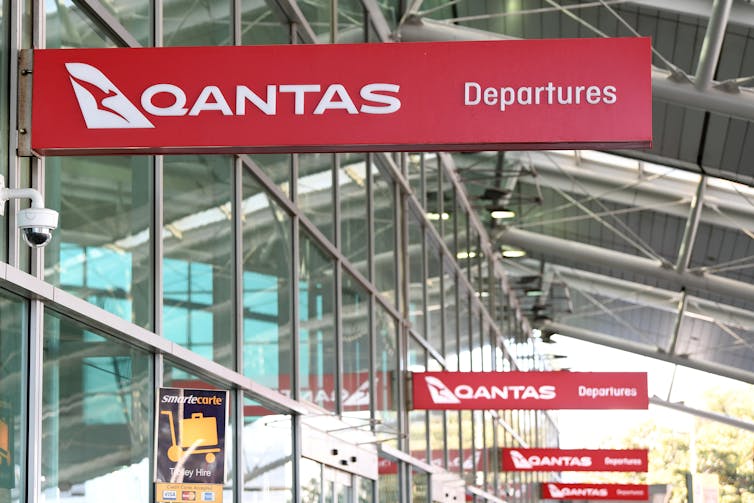
Meanwhile and on the economic front… Qantas has been described last week as the kangaroo in the coalmine when it comes to the economic impact of the virus on Australia overall. On Wednesday, Qantas sacked 6000 of its staff, and indicated that the airline’s recovery plan might require the standing down of a further 15,000 staff.
Australia doing worse In sum, and on the evidence, Australia has done no better than us in economic outcomes, is doing worse than us in public health outcomes and is headed in the wrong direction in controlling the disease.
Yet this failed model is what the National Party has been promoting all along, and is what would have adopted had a National government been in power here.
Perhaps the media could begin to raise this credibility problem, now that we’re on the verge of an election campaign where National’s main pitch to voters is that it is a safer pair of hands in a crisis, and is a better manager of the economy. In its dreams.
For the past three decades there is absolutely no evidence that has been the case, beyond its provision of an occasional sugar hit to the economy in the shape of tax cuts and asset part-sales. Sure, you can always keep warm for a while by burning the furniture, but this isn’t a sustainable way of running the economy.
There’s more. The last time around, even the hallowed Key/English administration ignored glaring social problems and serious infrastructural needs, while also hiding its head in the sand about the looming challenges posed by climate change.
Even so, the media has not held National to account for its years of neglect to anything like the same degree, and with nothing like the same accusatory tone we’re seeing today.
IMO, it was the social deficits that the coalition government has had to grapple with that constitute the genuine “National disgrace”.
Gordon Campbell’s article is republished with the author’s permission.
Source: The Conversation (Au and NZ) – By Mehmet Ulubasoglu, Professor of Economics, Head of the Department of Economics and Director of the Centre for Energy, the Environment and Natural Disasters, Deakin University
Victoria’s outbreak of COVID-19 infections, with 75 more cases identified overnight on top of 173 cases the previous five days, underlines the need to stick with social distancing measures wherever possible.
Working at home, in particular.
About 23 cases have been linked to Melbourne’s Stamford Plaza hotel, where people flying in from overseas have been quarantined. Victorian premier Daniel Andrews said on Sunday the hotel outbreak might be due to staff sharing a cigarette lighter or carpooling to work.
So what proportion of the workforce in Australia can feasibly work from home?
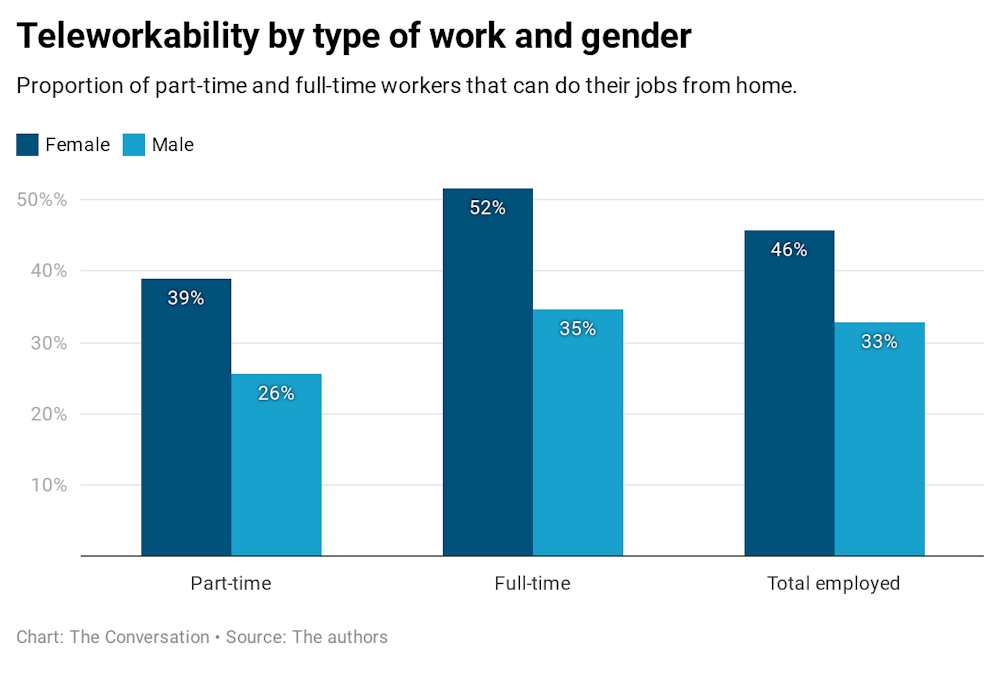
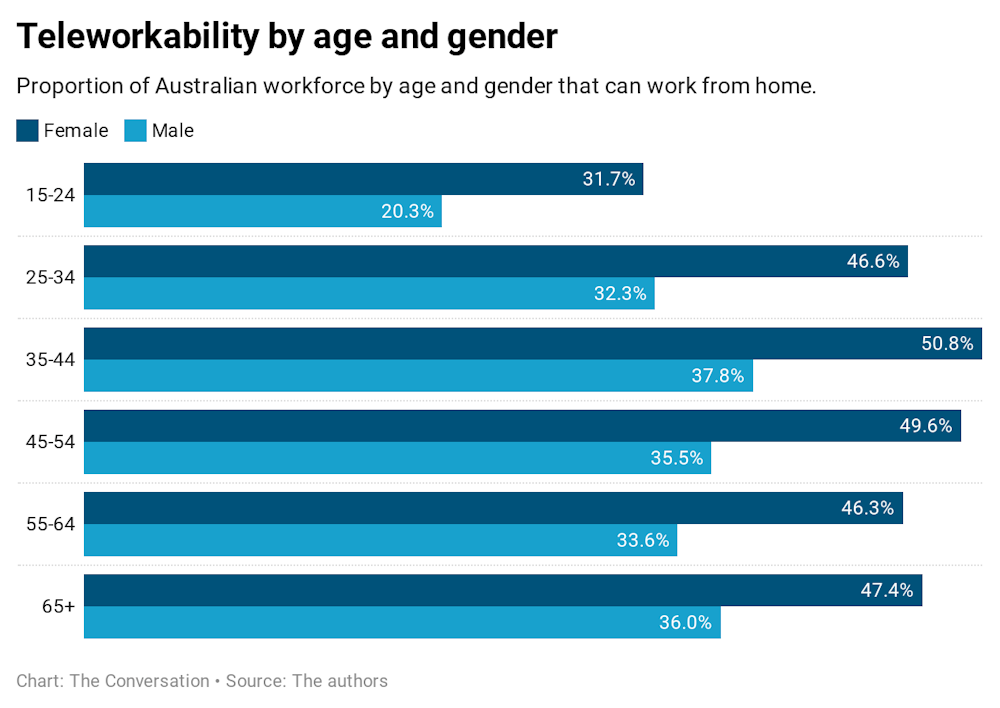
We estimate 39% of all jobs in Australia – 41% full-time and and almost 35% of part-time – can be done from home. Full-time jobs are more teleworkable than part-time jobs. Women are also more likely to have teleworkable jobs – 46% to 33% of men.
To make these estimates, we used the methodology of University of Chicago economists Jonathan Dingel and Brent Neiman. In June they published findings that 37% of jobs in the United States could be done at home.
They took data from the Occupational Information Network, a US government-funded online database describing about 1,000 occupations in the US. Any job involving outdoor work, operating vehicles or equipment, general physical activities, handling objects, dealing directly with the public and so on was deemed not teleworkable.
Dingel and Nieman also made calculations for 85 other countries. In general, they concluded, the higher per capita GDP, the greater the teleworkability. Sweden and Britain, for example, exceeded 40% while Mexico and Turkey were less than 25%.
The ANZSCO classifications do not exactly match the International Standard Classification of Occupations (ISCO) used by the US database. In such cases we evenly distributed the jobs in the Australian classification between the corresponding international classifications.
Our estimate is therefore a proximate indicator of teleworkability. Our results broadly confirm those by Harvard University economist James Stratton (an Australian) using Dingel and Niemans’s methodology.
Stratton’s results highlighted the geographic and socio-economic disparities in teleworkability: for example, 45% of jobs in Australia’s eight major cities can be done at home, compared to 33% elsewhere.
To complement this work, we’ve drilled into the gender differences.
Teleworking favours women
Importantly, we estimate 45.7% women have teleworkable jobs compared to 32.9% of men.
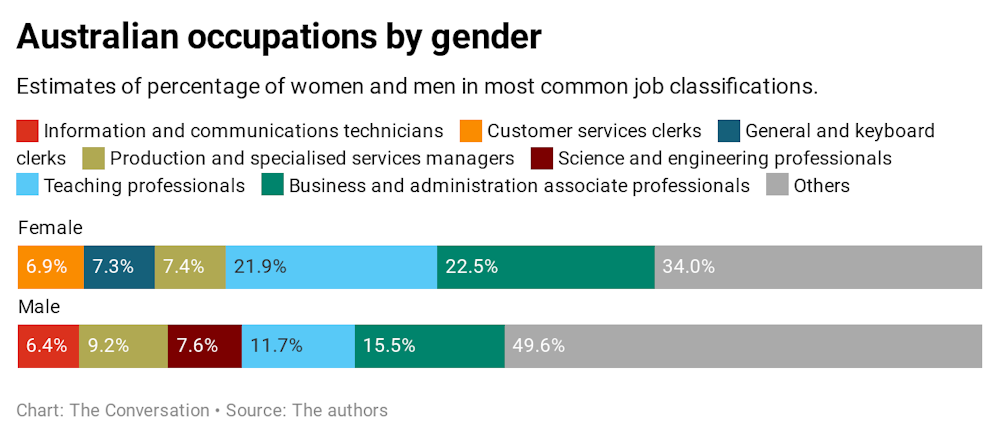
This is due to about 60% of female employment being concentrated in administrative, clerical, teaching and customer-service jobs.
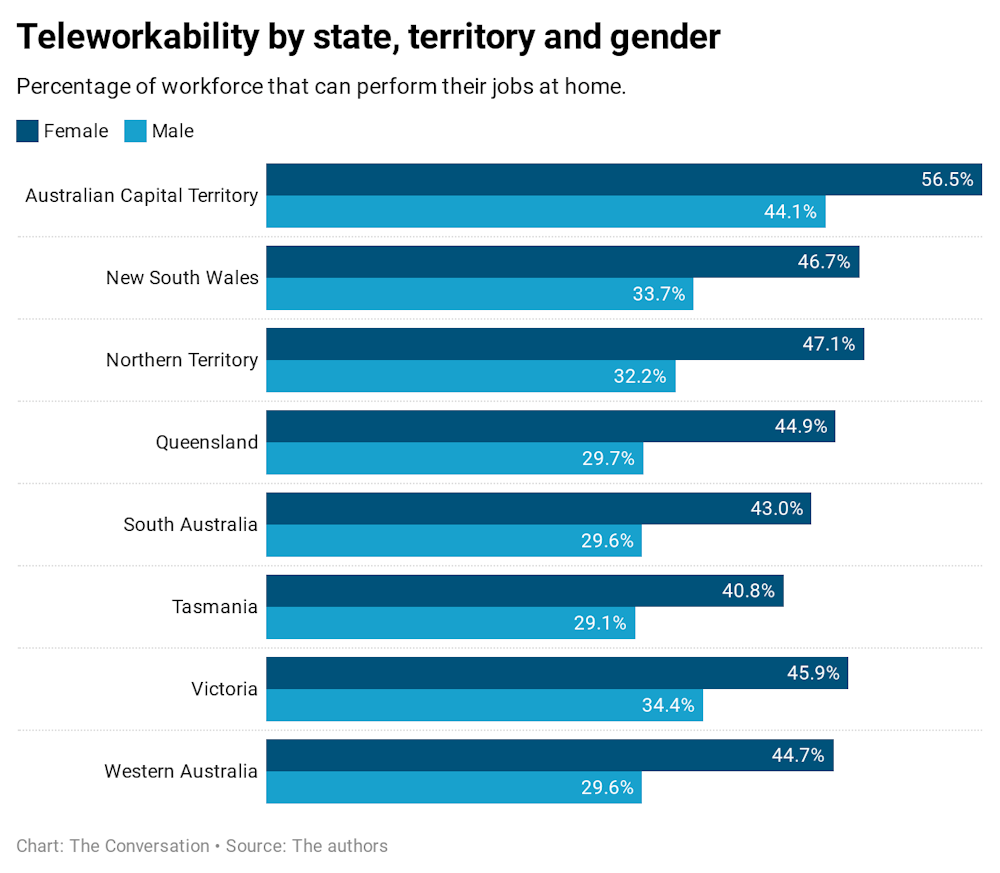
Teleworkability is highest in the Australian Capital Territory (50.3%), followed by Victoria (40%), the Northern Terrioty (39.5%), Queensland (37.2%), WA (36.8$), SA (36.2%) and Tasmania (34.9%).
Full-time jobs are more teleworkable than part-time jobs, 41% to 34.7%. Moreover, 51.7% of women with full-time jobs can work from home, compared with 34.7% of men.
Younger employees are less likely to have teleworkable jobs, particularly in part-time employment. Young men in part-time jobs are the least likely to have a job they can do at home.
The labour-market effects of working from home remain to be better understood. But these calculations – as broad as they are – provide some good news on the economic gender impacts of COVID-19, hitting women marginally more.
While working from home is not for everyone, these estimates show it’s a viable arrangement for many.
And a crucial measure for Australia to beat the coronavirus pandemic.
Source: The Conversation (Au and NZ) – By Rebecca Bentley, Professor of Social Epidemiology, Centre for Health Equity, Melbourne School of Population and Global Health, University of Melbourne
Melbourne is once again grappling with increasing COVID-19 rates. Ten suburbs in Melbourne have been designated COVID-19 outbreak hotspots: Broadmeadows, Keilor Downs, Maidstone, Albanvale, Sunshine West, Hallam, Brunswick West, Fawkner, Reservoir and Pakenham.
The outbreaks have sparked discussions about lockdowns and travel restrictions for people living in these parts of Melbourne and generated intensive suburb-specific testing.
The outbreaks have been attributed to family gatherings in homes and people failing to self-isolate, even after positive test results. This has occurred alongside possible breaches of infection control protocols in hotels accommodating people in quarantine – with security guards from major hotels having contracted the virus.
While chance and circumstances converge to create outbreaks there are also some obvious factors related to where and how people live that impact their capacity to isolate.
As we potentially face a two year-long wait for vaccines (16 are in clinical evaluation internationally (with one being developed in Australia), we need to acknowledge the spatial concentration of these sites of vulnerability is not random. There are socio-spatial clues as to why we have had outbreaks in these locations.
Four measures: overcrowding, homelessness, housing affordability stress and financial hardship often occur in the same areas.Shutterstock
First, the hotspots have some of the highest rates of housing precarity and financial hardship across Melbourne. People in overcrowded or unaffordable or insecure housing may have less control over their immediate environment and less capacity to isolate themselves than other community members.
The recent Melbourne outbreaks have occurred largely in areas with:
high housing affordability stress: where those in the lowest 40% of income spend more than 30% of their household income on housing,
overcrowding: measured in terms of the number of people in a household, their age and gender in relation to the number of bedrooms in a dwelling, and/or
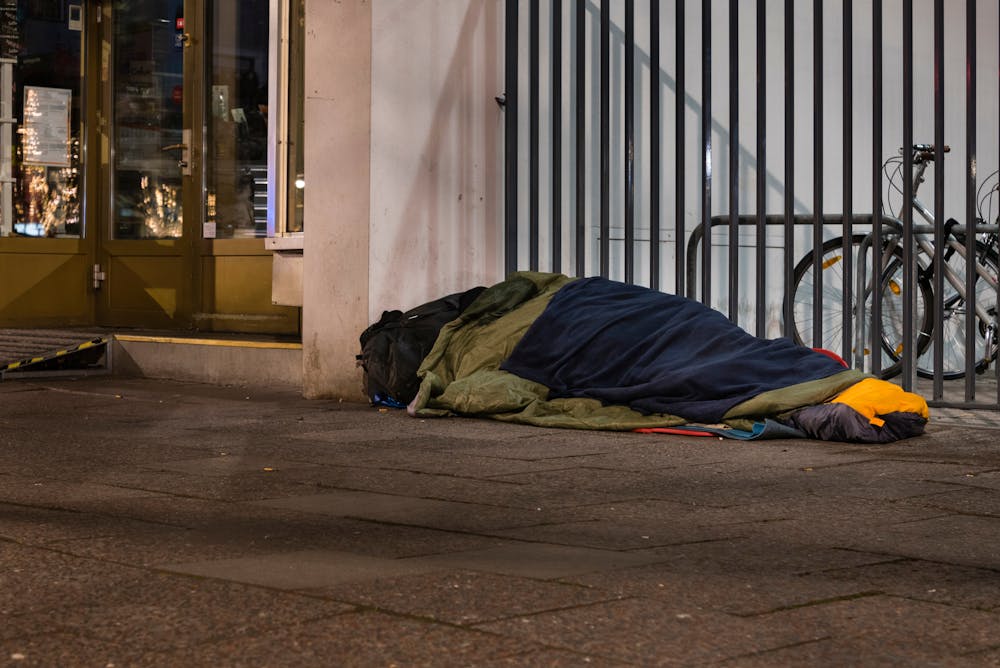
homelessness: where a person does not have suitable accommodation alternatives and their current living arrangement is in a dwelling that is inadequate, has no tenure, or if their initial tenure is short and not extendable or does not allow them to have control of, and access to space for social relations.
While housing security seems like an obvious problem to fix, it remains a long-standing, difficult issue for governments to tackle. Going into the COVID-19 pandemic, Australia exhibited high rates of homelessness and spiralling housing costs.
Many people in Melbourne and Sydney live in overcrowded or inadequate forms of housing as a result of what has become known as our “housing affordability crisis”. Alongside this, the numbers of people who require emergency accommodation far outstrip our cities’ capacity to house them on a medium- to long-term basis.
Second, people without savings may be compelled to go to work despite feeling unwell. They need to meet their weekly housing costs and don’t have savings enough to go two weeks (or longer) without income. This can occur even if people have negotiated reduced rent with their landlords.
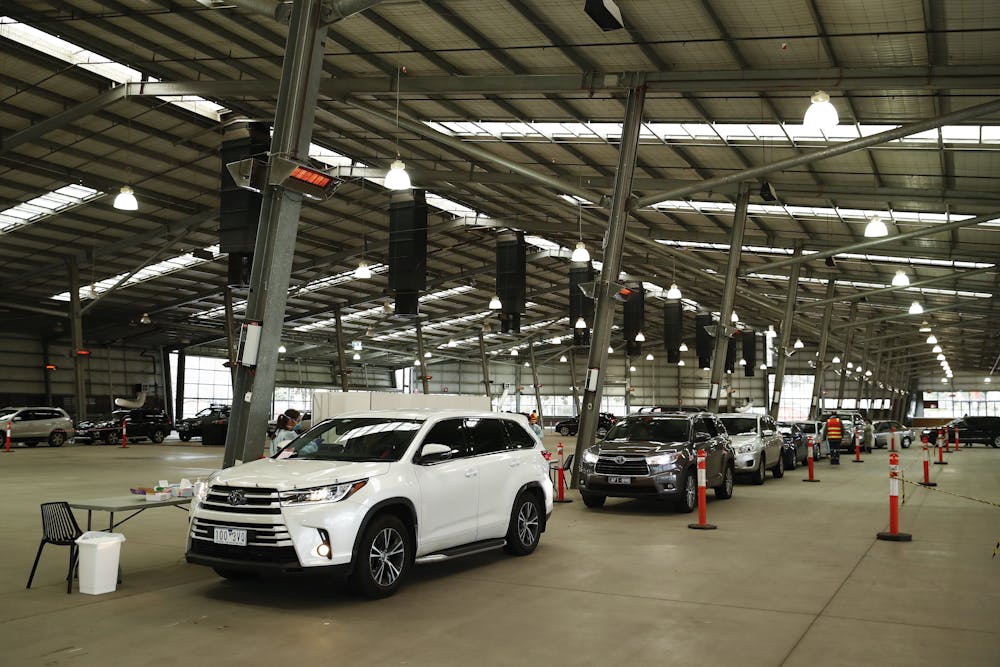
A spike in cases in Victoria has led to widespread testing in hotspots.Daniel Pockett/AAP
Where housing and COVID-19 collide
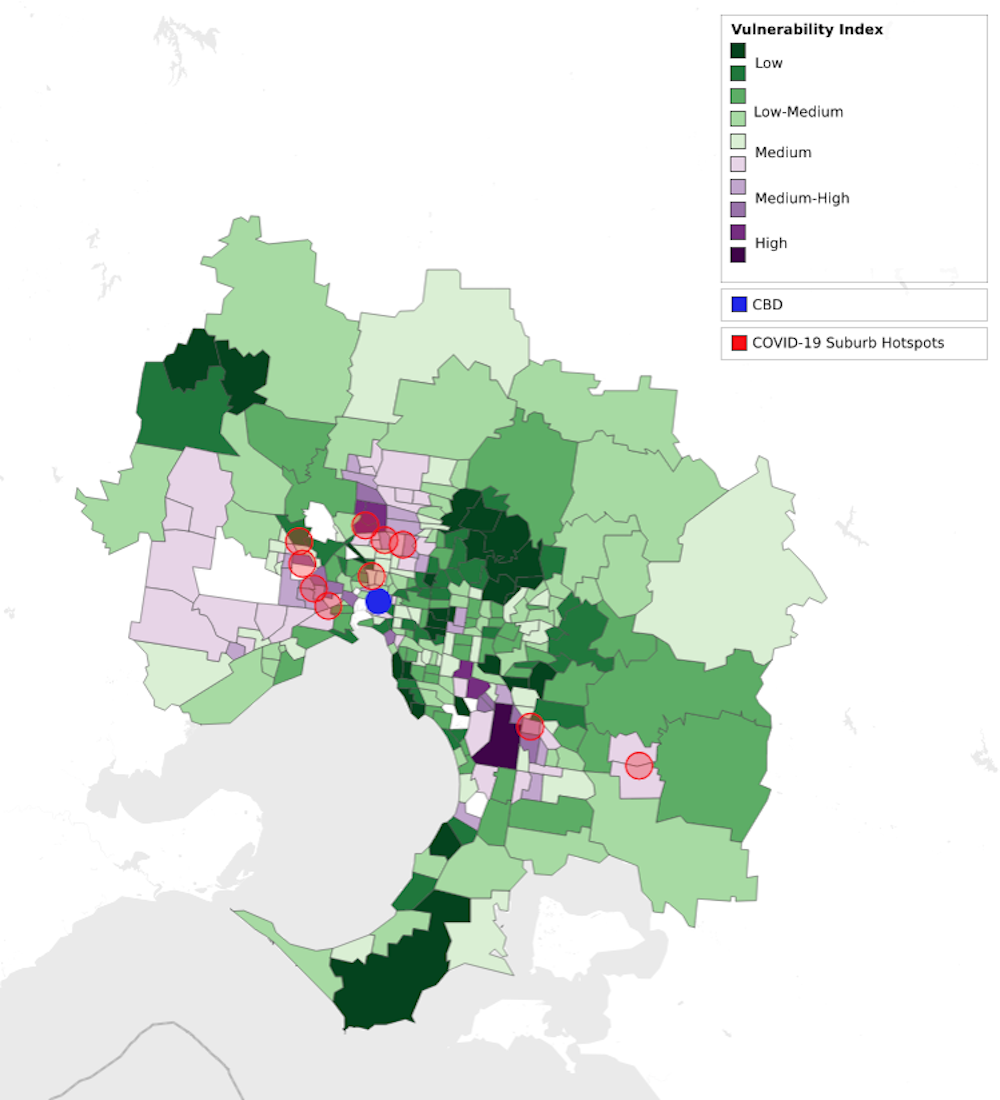
When one considers these housing and financial factors from the perspective of COVID-19 suppression, their geographical clustering should not be disregarded. The areas in Melbourne with high rates of household overcrowding, homelessness, housing affordability stress and (related to this) financial hardship (often measured using people’s self-reported capacity to access funds in an emergency) map closely to areas where there are now high numbers of COVID-19 cases.
Using publicly available data, we created a simple index describing capacity isolate based on the above four characteristics. We created maps of Greater Melbourne to examine the relationship between current COVID-19 cases and these housing and financial vulnerability factors. Our index shows Hallam, Sunshine West, Albanvale, Broadmeadows, Falkner, Reservoir and Maidstone are all in the top two quintiles.
Over the last decade, Melbourne has seen itself become more spatially segregated. And household overcrowding and precarity are geographically clustered.
Acknowledging correlation is not causation, these findings suggest solving some of Melbourne’s housing problems might reduce the spread of COVID-19 now and in future outbreaks as we await a vaccine.
Taking this further, when assessing where in cities we are likely to see a spike in cases in the future, we should take housing-related vulnerabilities into account alongside other factors.
While steps have been taken by the Victorian government to address some of the issues we have flagged, such as the one-off payment of up to A$2,000 for eligible renters who are unable to afford rent, and the A$1,500 payment to people who test positive and have no leave cover, more could be done in the medium to long term to reduce the risk of overcrowding, housing related financial stress and precarious forms of housing (that lead to homelessness) across the city.
The past months of COVID-19 restrictions have highlighted how critical housing and financial security are to our health and well-being at both an individual and population level. The Victorian Council of Social Service has noted disasters can be “profoundly discriminatory” in where they occur, and in their impacts.
Successful COVID-19 suppression requires safe and equitable cities and addressing housing vulnerability is one of the many challenges we must take up.
In less than three months, New Zealanders will vote in the world’s first national referendum on a comprehensive proposal to legalise the recreational use of cannabis.
Unlike cannabis ballots in several US states in which the public only voted on the general proposition of whether cannabis should be legalised or not, New Zealanders have access to the detailed Cannabis Legalisation and Control Bill. It outlines how the government proposes to establish a “controlled and tightly regulated” legal cannabis market.
The approach is not like the Brexit referendum, which had no detailed plan of action for a yes vote. Neither is it like New Zealand’s much maligned 2016 flag referendum, in which people knew exactly what they were voting for. In this case, New Zealanders are voting on a proposed law reform, but even following a yes vote, the cannabis regime will have to go through select committees and public consultation. And a legal cannabis market will require monitoring and enforcement.
Our research on an earlier law reform, aiming to regulate the manufacture of “low risk” psychoactive products, shows New Zealand has a history of ambitious ideas that ultimately suffer from poor execution.
Even the best law does not guarantee compliance
The cannabis legislation bill sets out how the government would control and regulate a legal cannabis market, including the following measures:
licensing of cannabis industry operators
limits on the maximum potency of different cannabis products
a ban on advertising
sales via licensed specialised premises only (no online sales)
a minimum buyer’s age of 20 or older
the government’s ability to control both the price (via excise taxes on the psychoactive ingredient THC and weight) and limit on the total amount in the market (via annual production caps).
The bill envisions a commercial industry that will manufacture and sell cannabis. But there are provisions for not-for-profit and community-oriented operators.
Some key issues remain unresolved (price, tax rate, role of local governments), but these could be addressed through further legislation and public consultation following the referendum.
But executing the plan for a tightly regulated legal cannabis regime is another story.
First, the referendum is not binding. Even if New Zealanders vote yes, the incoming government can decide not to proceed or make significant changes.
Second, how the law looks on paper is rarely how it is in practice. Some laws, by design, are difficult to enforce. For example, the ban on all advertising sounds good, but it is not clear how covert promotion, celebrity endorsements and other sophisticated social media promotion techniques (product reviews, blog posts) would be controlled.
Similarly, it sounds reasonable to limit the maximum daily purchase to 14 grams, but it is hard to imagine effective enforcement without a real-time tracking system of purchases by individual customers. The same questions arise when considering the stated maximum limit of growing two plants at home or the ban on “dangerous” production methods to produce extracts at home.
It is reasonable to assume some New Zealanders will be growing more than the legal cannabis plant limit (as they already do) and will be able to purchase more than 14 grams a day (if they wish to). We can also be certain the cannabis industry will develop creative ways of online promotion (as alcohol and tobacco industries have done) and will actively lobby behind the scenes against public health measures and regulatory restrictions.
The success of a legal cannabis regime under the proposed law will depend on who oversees the implementation and regulation plans. This task will primarily be up to a new cannabis regulatory authority, but it remains unclear whether this will sit within the portfolio of health, justice or business (with their respective cultures and values).
The new authority will have a lot on its plate. Licensing producers and retailers, developing production standards, regulating labelling, approving products, administering cannabis taxes, revising maximum potency limits, and developing local licensed premises policies for all 67 local councils are just some of the tasks. The sheer volume of work required before a legal cannabis market can operate creates risks.
New Zealand has recent history of poorly implementing drug policy reform. Agencies were overwhelmed by the immense regulatory workload when New Zealand attempted to establish a regulated legal market for “low risk” psychoactive products under the Psychoactive Substances Act in 2013.
There were significant gaps in the law, including regulating opening hours, lack of excise tax and poor engagement with key stakeholders. As one key official interviewed in our research on that reform said: the law “got lost in translation”. As a result, political and community support for the reforms evaporated and the regime remains unused.
We need to learn from that experience.
This is not to say a vote against cannabis legalisation will result in better outcomes. But it is important to have realistic expectations, accept the complexity of implemention, know the risks (including lobbying from the commercial industry) and develop plans to best mitigate those.
In the cannabis referendum, New Zealanders will be voting on a new idea and a draft plan on how to get there. There is no guarantee the lofty vision will match reality.
The link between hot weather and aggressive crime is well established. But can the same be said for online aggression, such as angry tweets? And is online anger a predictor of assaults?
Our study just published suggests the answer is a clear “no”. We found angry tweet counts actually increased in cooler weather. And as daily maximum temperatures rose, angry tweet counts decreased.
We also found the incidence of angry tweets is highest on Mondays, and perhaps unsurprisingly, angry Twitter posts are most prevalent after big news events such as a leadership spill.
This is the first study to compare patterns of assault and social media anger with temperature. Given anger spreads through online communities faster than any other emotion, the findings have broad implications – especially under climate change.
A caricature of US President Donald Trump, who’s been known to fire off an angry tweet.Shutterstock
Algorithms are watching you
Of Australia’s 24.6 million people, 18 million, or 73%, are active social media users. Some 4.7 million Australians, or 19%, use Twitter. This widespread social media use provides researchers with valuable opportunities to gather information.
When you publicly post, comment or even upload a selfie, an algorithm can scan it to estimate your mood (positive or negative) or your emotion (such as anger, joy, fear or surprise).
This information can be linked with the date, time of day, location or even your age and sex, to determine the “mood” of a city or country in near real time.
Our study involved 74.2 million English-language Twitter posts – or tweets – from 2015 to 2017 in New South Wales.
We analysed them using the publicly available We Feel tool, developed by the CSIRO and the Black Dog Institute, to see if social media can accurately map our emotions.
Some 2.87 million tweets (or 3.87%) contained words or phrases considered angry, such as “vicious”, “hated”, “irritated”, “disgusted” and the very popular “f*cked”.
Hot-headed when it’s cold outside
On average, the number of angry tweets were highest when the temperature was below 15℃, and lowest in warm temperatures (25-30℃).
The number of angry tweets slightly increased again in very high temperatures (above 35℃), although with fewer days in that range there was less certainty about the trend.
On the ten days with the highest daily maximum temperatures, the average angry tweet count was 2,482 per day. Of the ten coldest days, the average angry tweet count was higher at 3,354 per day.
The pattern of angry tweets was opposite to that of physical assaults, which are more prevalent in hotter weather – with some evidence of a decline in extreme heat.
So why the opposite patterns? We propose two possible explanations.
First, hot and cold weather triggers a physiological response in humans. Temperature affects our heart rate, the amount of oxygen to our brain, hormone regulation (including testosterone) and our ability to sleep. In some people, this in turn affects physical aggression levels.
Hot weather means more socialising, and potentially less time for tweeting.Shutterstock
Second, weather triggers changes to our routine. Research suggests aggressive crimes increase because warmer weather encourages behaviour that fosters assaults. This includes more time outdoors, increased socialising and drinking alcohol.
Those same factors – time outdoors and more socialising – may reduce the opportunity or motivation to tweet. And the effects of alcohol (such as reduced mental clarity and physical precicion) make composing a tweet harder, and therefore less likely.
This theory is supported by our finding that both angry tweet counts, as well as overall tweet counts, were lowest on weekends, holidays and the hottest days,
It’s possible that as people vent their frustrations online, they feel better and are then less inclined to commit an assault. However, this theory isn’t well supported.
The relationship is more likely due to the vastly different demographics of Twitter users and assault offenders.
Assault offenders are most likely to be young men from low socio-economic backgrounds. In contrast, about half of Twitter users are female, and they’re more likely to be middle-aged and in a higher income bracket compared with other social media users.
Our study did not consider why these two groups differ in response to temperature. However, we are currently researching how age, sex and other social and demographic factors influence the relationships between temperature and aggression.
Twitter users are more likely to be middle aged.Shutterstock
The Monday blues
Our study primarily set out to see whether temperatures and angry tweet counts were related. But we also uncovered other interesting trends.
Average angry tweet counts were highest on a Monday (2,759 per day) and lowest on weekends (Saturdays, 2,373; Sundays, 2,499). This supports research that found an online mood slump on weekdays.
We determined that major news events correlated with the ten days where the angry tweet count was highest. These events included:
the federal leadership spill in 2015 when Malcolm Turnbull replaced Tony Abbott as prime minister
a severe storm front in NSW in 2015, then a major cold front a few months later
two mass shootings in the United States: Orlando in 2016 and Las Vegas in 2017
sporting events including the Cricket World Cup in 2015.
Days with high angry tweet counts correlated with major news events.Shutterstock
Twitter in a warming world
Our study was limited in that Twitter users are not necessarily representative of the broader population. For example, Twitter is a preferred medium for politicians, academics and journalists. These users may express different emotions, or less emotion, in their posts than other social media users.
However, the influence of temperature on social media anger has broad implications. Of all the emotions, anger spreads through online communities the fastest. So temperature changes and corresponding social media anger can affect the wider population.
We hope our research helps health and justice services develop more targeted measures based on temperature.
And with climate change likely to affect assault rates and mood, more research in this field is needed.
Victoria’s chief health officer has admitted the government did not properly engage with linguistically diverse communities about COVID-19 in the runup to Melbourne’s recent spike in cases.
We know that there are some migrant communities, recent migrants or culturally and linguistically diverse communities, who are overrepresented now with some of our new cases […] It’s our obligation as government to reach those people. It’s not their fault if we’re not going in with appropriate engagement.
This issue is not confined to Victoria. My research has indicated that linguistically diverse communities in New South Wales are likewise not receiving official coronavirus advice.
However, the Victoria government is clearly worried about a link between linguistic diversity and infection, and is sending public health officials door to door to deliver health messages.
More than one in five (about 22%) of Australian households speak a language other than English. In Casey, a Melbourne hotspot, it’s about 38% and in Brimbank it’s up to 62%.
Poor health messaging to multilingual communities isn’t new
Victoria’s spike is not the first indication that official coronavirus health communications in languages other than English have been ineffective.
A small study in Melbourne early in the pandemic indicated people speaking languages other than English were not receiving sufficient, reliable information.
Concerns have also been raised nationally. The National COVID-19 Health and Research Advisory Committee reported to the Australian government that migrants were less likely to receive public health information because of sporadic government engagement, increasing their risk of contracting COVID-19 and transmitting it unwittingly.
People in Australia who aren’t proficient in English tend to be older, having started speaking it as adults, and older people are particularly vulnerable to COVID-19. So community leaders are concerned about this combination of vulnerabilities.
Here’s what I found in Sydney
My research examined official online COVID-19 information and public health signage in four Sydney suburbs with two to three times the national rate of households speaking a language other than English.
Freely provided, but rarely displayed.NSW Health
Multilingual posters from federal and state health departments, freely available to download, were rarely displayed.
Written information, communications using technical wording and English-medium government websites can be challenging, even if people are bilingual in spoken English.
In a submission to the federal Senate COVID-19 inquiry (number 156), I outline how some websites are easier to navigate than others and the limited use of other languages on government social media. State and federal health departments have commissioned the production of online videos about COVID-19 in languages other than English, but uptake is low.
It’s also difficult to ensure such communications are good quality.
Here’s what we could be doing better
We could make it the law
We could make it a legal obligation for federal and state health departments to collect and analyse data about who reads or watches their communications.
They could use that data to develop a cohesive, nationwide public health communications plan for languages other than English before the next emergency.
Setting legal standards could also mean government communications become consistent across online platforms, to increase accessibility.
While government communications are already partially regulated, there are no overall rules about public health communications in languages other than English.
These rules would be important for public safety. That is, we can better collectively manage public health risks when everyone knows what to do.
These rules would also be important for equal autonomy. Being able to reliably receive not just a simple “stay 1.5m apart” message but official, up-to-date rules and details about the local pandemic situation enables us to determine our own course of conduct and manage our own anxiety. People whose dominant language is not English deserve that same autonomy.
We could clarify what local governments should be doing
Legal standards could also clarify the responsibilities of local governments.
My research found some local governments produced their own COVID-19 communications in locally common languages, such as the Strathfield signage below in Mandarin, Korean and English.
Strathfield local government has developed an English-Mandarin-Korean COVID-19 public health poster campaign.Author provided
But others didn’t. In Strathfield’s neighbouring suburb of Burwood, which is just as multilingual, there are no local government COVID-19 posters.
Instead, local businesses produced and shared bilingual COVID-19 signage, as shown in this article’s lead image.
Other suburbs have neither local government nor local businesses providing multilingual health information.
We need greater transparency
Setting legal standards for government public health communications before our next health emergency may be a controversial, yet effective, way to reach everyone in our community.
We also need greater transparency about current government policies on communicating to people with languages other than English, and whether these policies are being followed during this pandemic.
Prime Minister Scott Morrison’s approval ratings continue to soar thanks to his handling of the coronavirus crisis, reaching the highest level for any prime minister since the early years of the Rudd government in this week’s Newspoll.
Morrison’s approval rating was at 68%, up two points from the last Newspoll, while 27% of respondents were dissatisfied. His net approval rating was +41.
This is Morrison’s highest net approval, topping the +40 he achieved in a late April Newspoll. It is also the best net approval for any PM since Kevin Rudd had +43 in October 2009.
This week’s Newspoll, conducted June 24-27 from a sample of 1,520 people, gave the Coalition a 51-49% lead, unchanged on three weeks ago.
Primary votes were 42% Coalition (steady), 35% Labor (up one), 11% Greens (down one) and 3% One Nation (down one).
Opposition leader Anthony Albanese had a net approval of +2, down one point. Morrison led Albanese as better PM by 58-26%.
Given Morrison’s stratospheric ratings, it is surprising the Coalition is not further ahead on voting intentions. This could be due to the fact the national cabinet has been in charge of coronavirus policy-making, and these decisions are seen as more bipartisan and do not boost the Coalition.
Labor leading in Eden-Monaro byelection polls
The Eden-Monaro byelection will be held on Saturday following the April resignation of Labor MP Mike Kelly. Labor won the seat by just a 50.9-49.1% margin at the 2019 election.
The Poll Bludger reported on two Eden-Monaro polls last week by the robo-pollster uComms, one for The Australia Institute and the other for the Australian Forest Products Association.
The Australian Institute poll gave Labor a 53-47% lead by 2019 election preference flows, and a 54-46% lead by respondent allocated preferences. The AFPA poll gave Labor a 52-48% lead.
These two polls are much better for Labor than an internal party poll, reported on June 13, which showed the Liberals clearly positioned on primary votes to gain the seat.
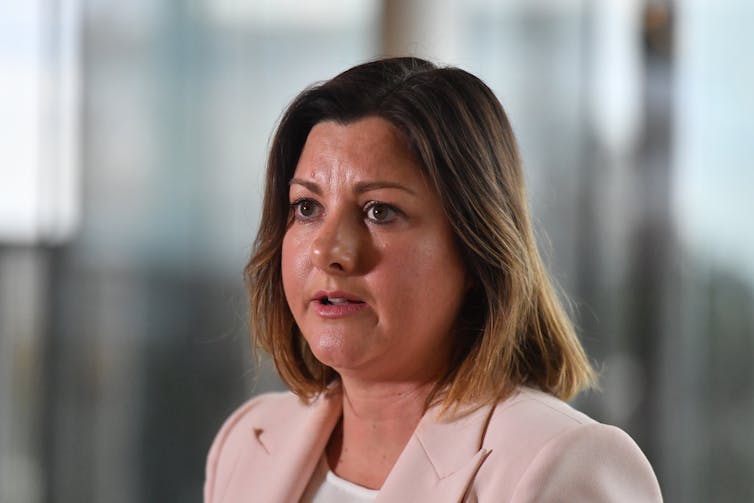
Labor’s Kristy McBain has a slight edge over the Liberals’ Fiona Kotvojs in recent polling.Mick Tsikas/AAP
Biden further extends lead over Trump
US President Donald Trump’s approval ratings are at their worst since the US government shutdown in January 2019.
In the latest FiveThirtyEight poll aggregate, Trump’s ratings with all polls are 40.6% approve, 56.1% disapprove (net -15.5%). With polls of registered or likely voters, his ratings are 40.9% approve, 55.5% disapprove (net -14.6%).
With the presidential election now just over four months away, FiveThirtyEight has started tracking the presidential general election polls.
As there are far more national polls than state polls, the website adjusts state polls for the national trend. So, as former Vice President Joe Biden widens his national lead, FiveThirtyEight will adjust states in Biden’s favour where there hasn’t been recent polling.
The latest national poll aggregate gives Biden a 50.7% to 41.4% lead over Trump. US polls usually include an undecided option, so the remaining voters are mostly undecided, not third party. Three weeks ago, Biden’s lead was 6.6 percentage points.
In 2016, four states – Pennsylvania, Michigan, Wisconsin and Florida – voted for Trump over Hillary Clinton by 1.2% or less. In the latest FiveThirtyEight aggregate, Biden leads in Florida by 7.2%, Pennsylvania by 8.0%, Wisconsin by 8.1% and Michigan by 10.6%.
Biden also leads in several states Trump won comfortably in 2016, such as Arizona (a 4.7% lead over Trump), Georgia (1.4% lead), North Carolina (2.9% lead) and Ohio (2.6% lead). Trump maintains an extremely narrow lead in Iowa (0.1%) and Texas (0.3%).
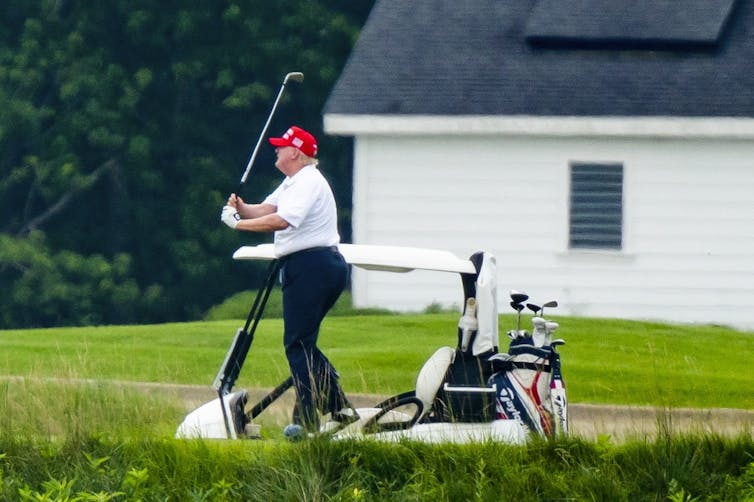
Trump is looking shaky in states he carried comfortably in the 2016 election.Jim Lo Scalzo/EPA
If the election were being held next week, there is little doubt Biden would win both the national popular vote and the Electoral College easily.
Can Trump recover before November 3? If Biden’s national lead is reduced to fewer than five points, the Electoral College could save Trump, as the Democrat’s lead is narrower in the pivotal battleground states.
Trump’s approval ratings have taken a hit due to his responses to the pandemic and the protests after the police killing of George Floyd.
Earlier this month, US coronavirus cases and deaths had fallen from their peaks in April, but there has been a surge in the last week. Over 45,000 new cases were recorded Friday, the highest single-day total since the pandemic began.
Political analyst Nate Silver says this increase is not caused by greater testing (as Trump claims), noting the positive test rate rose to 7.7% on June 24, from 4.9% a week earlier.
A genuine economic recovery is unlikely while coronavirus cases are still surging. Trump’s best chance of re-election is for the pandemic to have faded by November and the US to have made a strong economic recovery.
The US jobs report for May was much better than in April, but April was so terrible that a recovery still has a long way to go.
Can the Democrats retake Congress?
As well as the presidency, all 435 House of Representatives seats and one-third of the 100 senators are up for election in November.
Democrats gained control of the House in November 2018 and are very likely to retain control. They have a 7.9% lead in the FiveThirtyEight generic ballot tracker.
The Republicans currently have a 53-47 seat majority in the Senate, making it difficult for the Democrats to take control. The RealClearPolitics Senate map gives Democrats some chance of winning the Senate, projecting 48 Republican seats, 48 Democrats and four toss-ups.
In deeply conservative Alabama, Democrat Doug Jones unexpectedly won a December 2017 special election, but is unlikely to repeat his success.
House seats are allocated to each state on a population basis, but in the Senate, each state is guaranteed two seats regardless of population. As low-population states in the Midwest and West tend to be conservative, this makes it harder for Democrats to win the Senate.
Host Sherry Zhang interviewed the director of the Pacific Media Centre, Professor David Robie, about the tragic life and death of Jenelyn Kennedy from gender violence in Papua New Guinea today on the Southern Cross segment of Radio 95bFM.
Professor Robie discussed the rather horrific image of her lifeless body on the front page of The National newspaper and the ethical dilemma about publishing this photo to bring into focus gender-based violence.
The image was defended by senior journalist Rebecca Kuku who was criticised in social media for taking the stance.
However, while Professor Robie supported publication of the photo and also published it on the PMC’s Asia Pacific Report, he said the newspaper should have also had a front-page editorial explaining why they ran the picture.
“Jenelyn’s story needed to be told – as a reporter, a woman, a mother, a sister, I failed to be her voice when she was alive and I’d be damned if I would fail her now in her death,” wrote Rebecca Kuku.
“Her voice needs to be heard and that picture was used to ensure her voice was loud and clear and to also awaken the authorities who seem to be sleeping, to open their eyes to the realities of gender-based violence (GBV).”
Jenelyn who eloped with Bosip Kaiwi when she was just 15, bore him two children and was killed at 19.
Then contributing editor of Pacific Media Watch Sri Krishnamurthi discussed the Cook Islands where members of Parliament (MPs) want to go to extraordinary lengths to ban a senior Cook Islands News journalist.
Rashneel Kumar who reported on MPs seeking travel perks was this week awaiting the decision of the Speaker of the House, Niki Rattle, while media groups have protested over the parliamentary move.
The covid-19 coronavirus pandemic and subsequent lockdown has been tough on the mental wellbeing of Asian New Zealanders, according to new research.
The New Zealand Asian Mental Health and Well-being report, commissioned by charity Asian Family Services, found high levels of anxiety and nervousness, as well as racism.
The research surveyed 580 Asian New Zealanders across the country and found almost 44 percent of them experienced some form of mental distress since level 4 lockdown.
Nervousness and anxiety are the most widely experienced (57 percent), followed by little interest or pleasure in doing things (55.2 percent), uncontrollable worrying (47.4 percent) and feeling down and hopeless (44 percent).
Asian Family Services director Kelly Feng said isolation, lack of support, family issues, academic or work pressure, new migrants adjusting to a new environment can all cause mental stress.
She said the findings correlate to what they were seeing on the ground.
“That’s quite true when over the lockdown, our service has also experienced high demand about emotional support and counselling services.”
Help primarily from friends The report also finds that Asians primarily seek help from friends (44.1 percent) and family (42.6 percent), with just over a quarter (28.3 percent) saying they would see their doctor, comparing with the national figure of 69 percent according to the Health Promotion Agency.
A small portion (13.8 percent) did not seek any support at all, and Feng said it was concerning.
“That gives me an indication that we really need to promote or even do a campaign about mental wellbeing and addiction issues and raise awareness among Asian communities so people can seek help in the early stage and get a bit of early intervention rather than at the bottom of the cliff,” she said.
Just over 16 percent of respondents reported experiencing racial discrimination during the pandemic, and those who faced discrimination were also more likely to have mental health concerns.
Race Relations Commissioner Meng Foon said the findings were alarming.
“I feel gutted and sad that people are receiving discrimination and racism. It doesn’t matter what the numbers are. It’s really important that we continue to try and implement progress in systems and education to eliminate racism,” he said.
“It’s good to have an analysis report on mental health and discrimination. I think there’s a lot of work to do ahead of us. It’s good to know where we can actually target our resources to support mental health.”
Kindness message helped The study said the overall messaging of being kind to one another during the pandemic has likely contributed to the relatively low percentage of discrimination.
But Dr Andrew Zhu, director of Trace Research which carried out the study, said it was still serious.
“On a percentage base, it’s relatively small which means we’re on the way to achieving racial harmony, however if you translate this number into a population-based number, that’s around 84,000 adult population of Asian ethnicity which could still be counted as serious,” he said.
Koreans reported to have experienced discrimination the most, with 30 percent of those surveyed saying they’ve been discriminated against, followed by Chinese at just over 22 percent.
However, Chinese accounted for nearly half of the overall discrimination cases as it has the largest population base among all Asian ethnicities.
Data for this study was collected online between May 22 and June 3, and quota sampling was used to ensure representativeness of all Asian ethnic groups according to the 2018 census of Asian adult population distribution.
This article is republished by the Pacific Media Centre under a partnership agreement with RNZ.
Maps have shown us how the events of this disastrous year have played out around the globe, from the Australian bushfires to the spread of the COVID-19 pandemic. But there are good reasons to question the maps we see.
Maps often inform our actions, but how do we know which ones are trustworthy? My research shows that answering this question may be critically important for the world’s most urgent challenge: the COVID-19 pandemic.
Maps guide decisions, including those made by governments, private companies, and individual citizens. During the pandemic, government restrictions on activities to protect public health have been strongly informed by maps.
Governments rely on public cooperation with the restrictions, and they have used maps to explain the situation and build trust. If people don’t trust information from the government, they may be less likely to comply with the restrictions.
This highlights the importance of trustworthy COVID-19 maps. Maps can be untrustworthy when they don’t show the most relevant or timely information or because they show information in a misleading way.
Below are a few question you should ask yourself to work out whether you should trust a map you read.
What information is being mapped?
The number of cases of COVID-19 is an important piece of information. But that number could just reflect how many people are being tested. If you don’t know how much testing is being done, you can misjudge the level of risk.
Low case numbers might mean that there isn’t much testing being done. If the percentage of positive cases (positive test rate) is high, we might be missing cases. So not accounting for the number of tests can be misleading.
The World Health Organization suggests that at least ten negative tests to one positive test, a positive test rate of at most 10%, is the lowest rate of testing that is adequate.
It’s not just the numbers that matter. How the numbers are shown is also important so that map readers get an accurate picture of what we know.
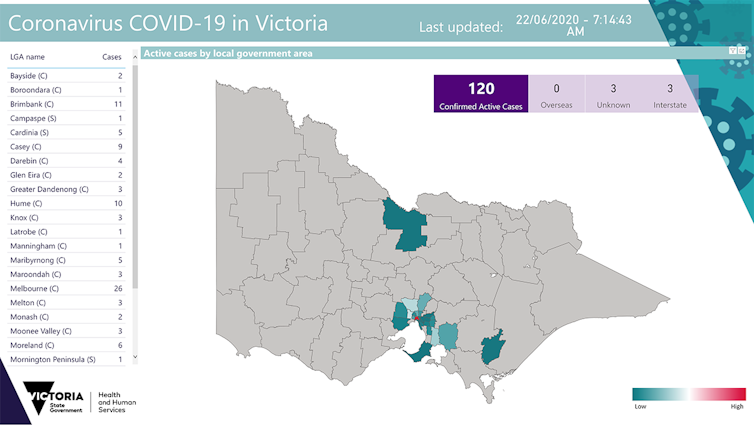
The Victorian Government recently advised Melburnians to avoid travel to and from several local council areas because of high case numbers. But their publicly available map does not show this clearly.
Compare the government-produced map with a map of the same data mapped differently. Most people interpret light as few cases and dark as more cases. The government-produced map uses dark colours for both low and high numbers of cases.
Maps can inform, misinform, and disinform, like any other information source. So it is important to pay attention to the map’s context as well as the author.
Viral maps are maps that spread quickly and widely, often via social media. Viral maps cannot always be trusted, even when they come from a reputable source. Maps that are trustworthy in one context may not be in another.
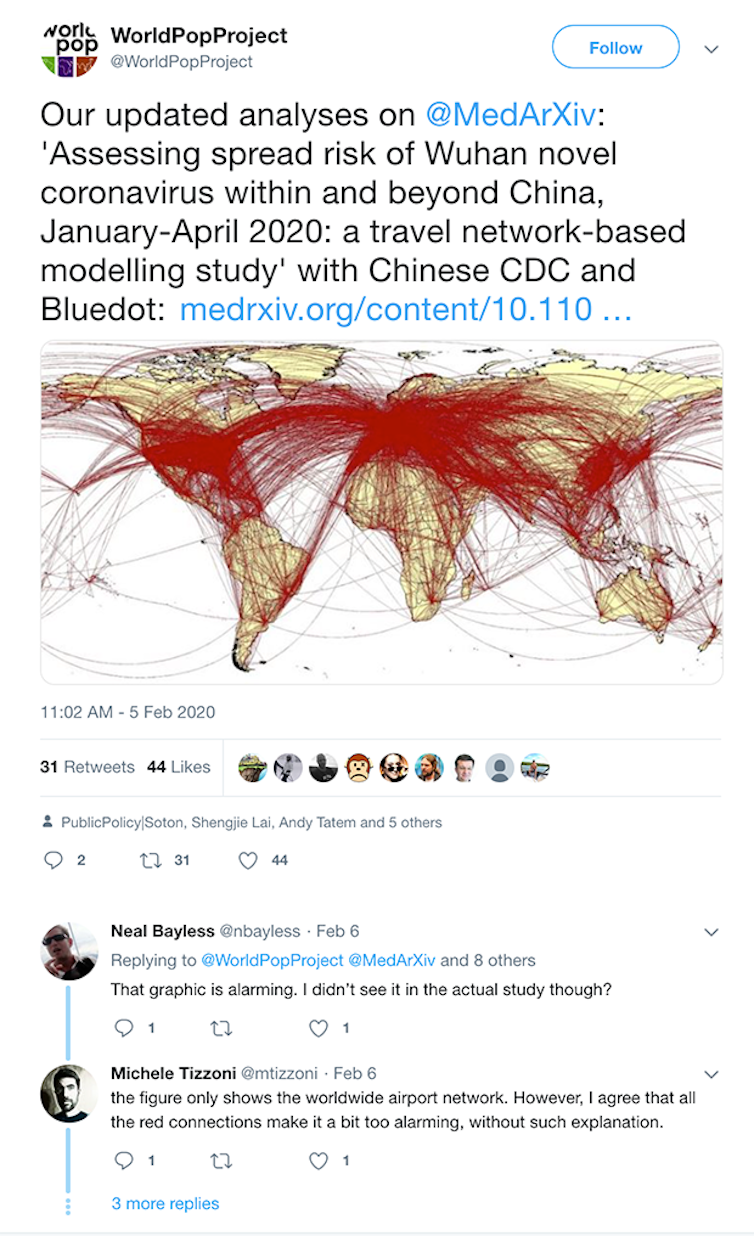
An example from Australian news media in February shows this. Several media outlets showed a map that was tweeted by UK researchers. The tweet announced the publication of their new paper about COVID-19.
The media reported the map showed locations to which COVID-19 had spread from Wuhan, China, the origin of the outbreak. It actually depicted airline flight routes, and was used in the tweet to illustrate how globally linked the world is. The map was from a 2012 study not the 2020 study.
Many readers may have trusted that reporting because their justifiable anxiety about COVID-19 was reinforced by the map’s design choices. The mass of overlapping red symbols creates a powerful and alarming impression.
While the lines in the map indicate potential routes for virus spread, it doesn’t provide evidence that the did virus spread along all of these routes. The researchers didn’t claim that it did. But without understanding why the map was made and what it showed, several media outlets reported it inaccurately.
Maps on social media are especially likely to be missing important context and explanation. The airline route map was re-shared many times as in the tweet below, often without any source information, making it hard to check its trustworthiness.
Limiting the damage done by COVID-19 is a very substantial challenge. Maps can help ordinary citizens to work together with governments to achieve that outcome. But they need to be made and read with care. Ask yourself what is being mapped, how it’s being mapped, who made the map and why they made it.
Source: The Conversation (Au and NZ) – By David Smith, Senior Lecturer in American Politics and Foreign Policy, US Studies Centre, University of Sydney
The US presidential election is being shaped by the two crises that have defined 2020 so far: the coronavirus pandemic and the national reckoning over police brutality and racism.
The term “unprecedented” has been used widely to describetheseevents, but they are just the latest versions of the two oldest and biggest problems in American politics: government dysfunction and racial injustice.
The “winning” years
In 2016, Donald Trump presented appealingly easy solutions to these problems.
Untainted by government, he would “drain the swamp” of bureaucrats and his business acumen would fix problems that conventional politicians could not, from trade deficits to crumbling infrastructure. Harnessing racialresentment and a backlash against Black Lives Matter, Trump promised white Americans an end to the painful reckonings of the Obama years, instead offering them a fantasy of black gratitude for white success.
For three years, Trump crafted a re-election narrative around his “winning” approach, based mainly on an economy that was already booming by the time he became president. The partisan polarisation of the 2016 election continued into his presidency.
Trump’s approval rating has always been relatively low despite the strong economy, but it has also been resilient in the face of scandal. Trump faced few crises in this period not of his own making, although there was one that foreshadowed the disasters to come: Hurricane Maria, which devastated Puerto Rico in 2017.
Trump hands out paper towels in Puerto Rico in the aftermath of Hurricane Maria.AAP/EPA/Thais Llorca
The federal government response to the hurricane was slow, uncoordinated and under-resourced. Trump showed little interest in it and took no responsibility for it. He briefly appeared on the island to congratulate himself and throw paper towels to residents. When the death toll was revealed to be nearly 3,000, revised up from initial reports of 64, Trump claimed Democrats made up most of the deaths “to make me look as bad as possible”.
Pandemic politics
The Puerto Rican tragedy was largely ignored and forgotten, but COVID-19 has replayed many of its themes on an even bigger scale.
Even now, as experts stress the need for widespread testing, Trump complains that testing inflates coronavirus numbers, and says it should slow down.
You can’t fight a pandemic with racial slurs. After a very brief “rally round the flag” boost in polling, voter ratings of Trump’s handling of the pandemic have been poor, and are dropping.
Meanwhile, the kinds of experienced public servants Trump and his allies deride are enjoying much higher approval as Americans rediscover the virtues of scientific expertise.
The pandemic itself may be less electorally consequential for Trump than its economic effects. It is very rare for presidents to win re-election during a recession.
The wave of Black Lives Matter protests following George Floyd’s killing in Minneapolis has damaged not just Trump’s electoral prospects, but the political order he represents.
For decades, conservatives have used the prospect of black unrest to scare white moderates, and Trump’s Nixonian rhetoric suggests he expected the same effect this time.
Instead, public opinion has solidified in support of the large, multiracial protests. The protests have changed minds, including white minds, about the systemic nature of racism in the United States. Racist backlashes may be less potent when there is a polarising white president in power.
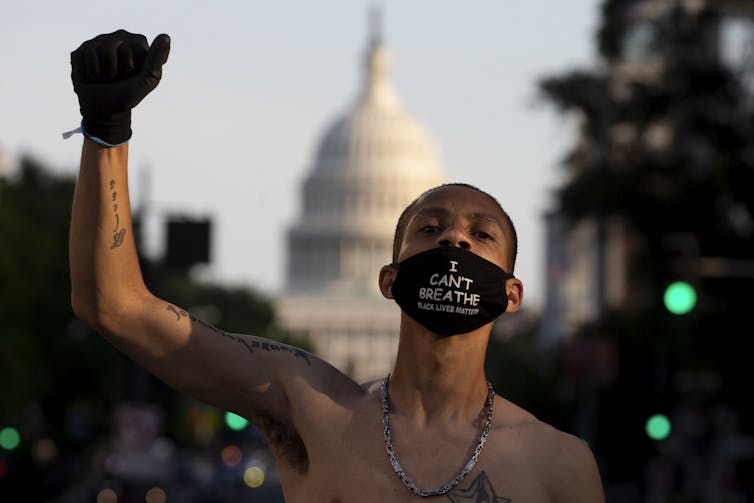
A protestor at a Black Lives Matter rally in Washington DC.AAP/EPA/Michael Reynolds
Trump has floundered in response to the protests. He has paid lip service to the cause of justice for George Floyd, but has shown more genuine sympathy for those who worry about being called racist.
Ultimately, he has retreated to his comfortable daydreams of black gratefulness. When announcing better-than-expected job numbers, Trump said:
Hopefully George is looking down right now and saying this is a great thing that’s happening for our country.
Biden is hard to paint as a radical. He has been quick to distance himself from proposals such as defunding police, and he has never supported “Medicare for all”, despite its popularity with the Democratic base and relevance during the pandemic. As president he would be unlikely to bring the kinds of lasting changes that most Democrats want to see.
This is why Trump and his allies cast Biden as “sleepy” and senile. They warn that he would easily be manipulated by radicals, and Trump is really running against the “far left”. So far, however, this approach has compelled Trump to talk a lot about his own physical and mental fitness.
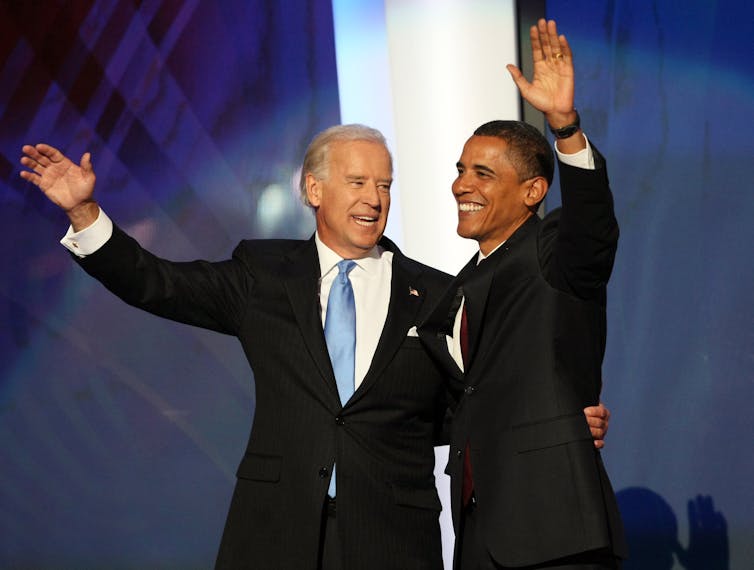
Joe Biden and Barack Obama at a Democratic virtual fundraiser in June.AAP/Sipa USA/CNP
Biden, whose support stems from a perception that he is safe and familiar, having served as vice president in the Obama adminstration, chooses instead to display certain vulnerabilities. This helps explain his rising support among older Americans during the pandemic.
And in a year when race is a defining election issue, Biden has a vast advantage with African American and Hispanic voters, despite parts of his legislative record and his cringeworthy “you ain’t black” interview. He also owes his nomination to African American voters. As Juan Williams put it bluntly, “Joe Biden would be retired if not for the black vote”.
The polls look bad for Trump, but the race remains unpredictable
Averages of national polls currently show Biden leading Trump by between nine and ten points. Even without the pandemic, Trump was never going to have an easy contest against Biden.
Polls still show Trump’s supporters are a lot more enthusiastic about voting for Trump than Biden’s supporters are about voting for Biden, which could be important if voting becomes a health risk.
But enthusiasm for the Democratic candidate may not matter. The 2018 midterm was effectively a referendum on Trump, and the 2020 election will be an even more focused one.
There is reason to believe the race could tighten, if only because no candidate has won a presidential election by more than 9% since 1984, and partisan divisions have become a lot sharper since then. Many conservative-leaning Americans who are undecided about the election may return to Trump. Closer to the election, many pollsters will restrict their samples to people who they believe are likely to vote, rather than just able to vote. These likely voter screens may reveal Trump’s standing is stronger than it currently looks.
Of course, the election isn’t decided by a national popularity contest. Democrats are haunted by the 2016 election, in which Hillary Clinton got 2.8 million more votes than Trump but still lost the state-based electoral college. Currently, The Economist’s election forecast gives that scenario about a 10% chance of happening again.
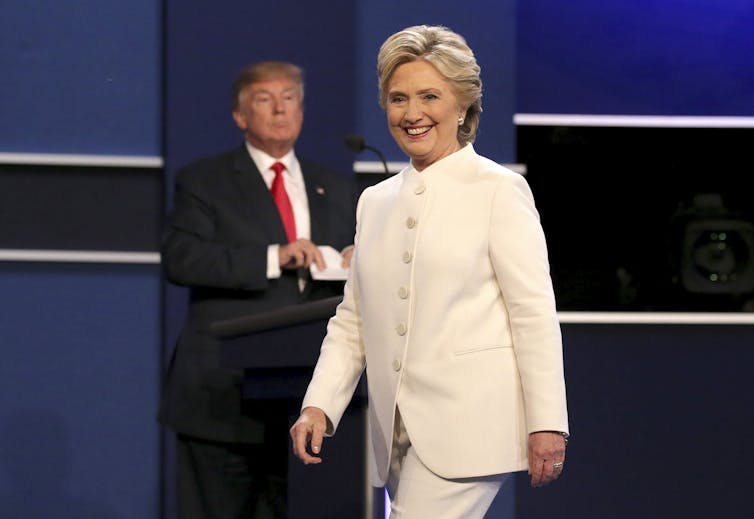
Democrats are haunted by the 2016 election, where Hillary Clinton won the popular vote but not the election.AAP/EPA/Gary He
Polls show Biden leading in most of these contests, but these leads are smaller and more volatile than his national lead. The quality of many state polls has also been questionable, raising the possibility they will repeat the same mistakes as last time.
Biden is discouraging complacency. Referencing a recent NYT/Siena poll that showed him leading Trump nationally by 14%, Biden tweeted:
COVID-19 has sabotaged the usual election-year registration drives that bring millions of new voters into the electorate, which could disadvantage Democrats who traditionally benefit from younger voters.
An uncertain result hinging on a prolonged mail ballot count could lead to the nightmare scenario of a disputed election outcome.
Would Trump accept defeat?
Trump already seems to be preparing to dispute the election. He has repeatedly claimed, with no evidence, that mail voting will facilitate massive voter fraud.
These fraud claims have been repeatedlydebunked, and Twitter was so worried about Trump attacking the electoral process that, for the first time, it flagged two of his tweets as misleading.
Trump may believe, with reason, that Republicans could benefit from in-person voting disarray on election day. Minority voters are far more likely than white voters to have to wait for long periods in lines at polling places.
In 2018, a federal court ruled for the first time since 1982 that Republicans could mount “poll watching” operations without prior judicial approval. This involves organising volunteers to challenge the eligibility of voters at polling places. Courts have previously found these tactics are used to intimidate and exclude minority voters, and they result in even longer delays. Republicans reportedly want to recruit 50,000 poll watchers for the 2020 election, including retired military and police officers.
These claims have also been thoroughly debunked, including by Trump’s own lawyers.
Trump’s resistance to the factual possibility that he could lose has raised fears he might not accept a defeat. Biden, noting that military leaders criticised Trump’s handling of Black Lives Matter protests, has fantasised that the military would escort him from the White House if he tried to “steal the election”.
Extensive lawsuits are a more likely scenario than military intervention, but there is also the danger Trump’s supporters would not accept the legitimacy of a Biden victory.
Given Trump has oftenwarned his supporters that their enemies will take away the Second Amendment (the right to bear arms), there is a possibility of a violent backlash, even if it only consists of isolated incidents.
At the same time, it is increasingly normal that large parts of the population dispute the legitimacy of the president. From Bill Clinton’s impeachment to George W. Bush’s contested victory; from Trump’s “birther” conspiracies about Obama to his own impeachment last year, refusals to accept the lawfulness of the presidency, on grounds real or imaginary, have become a standard part of America’s political repertoire.
A lot can happen in four months, as we’ve already seen this year. The outcome of this race is far from certain, but its ugliness is guaranteed.
One of the most profound ways the COVID-19 pandemic has affected our lives has been in the way we work. For people lucky enough to keep their jobs, and for those of us in professions where it’s possible, working from home has become the new normal.
Australia’s success in “flattening the curve” means restrictions are now being lifted. With this, many employers are bringing their staff back into the office, or at least contemplating doing so.
While there’s a lot we still don’t know about SARS-CoV-2, the coronavirus that causes COVID-19, we do know it spreads most effectively from person to person in droplet form. Infected people emit these droplets when they sneeze, cough, and even speak.
Those droplets can be transmitted directly through the air — say when an infectious person coughs in the direction of someone else close by — or they can settle on surfaces, where they can remain viable for hours.
The virus enters the body of a non-infected person through contact with mucous membranes in the nose, mouth or eyes and attaches to cells in the upper respiratory tract to establish infection.
Many of us are keen to get back to the office.Shutterstock
What does this mean for office workers?
In many workplaces, employees share a small office space, work in an open-plan office, or use “hot desks” that are shared between several different employees on different shifts.
Workers in these situations are often required to work for long periods in environments that make it hard to maintain the recommended 4m² distancing rule.
This combination — several hours spent in close contact — increases the risk of COVID-19 transmission. This is illustrated by an outbreak in an open-plan call centre in Seoul, where more than 43% of workers contracted COVID-19 during February and March.
First, each employee in a shared office should be able to have at least 4m² to themselves. If this isn’t possible, it would be a good idea to stagger staff or allow them to continue working from home for now.
Second, think about airflow. Small offices often have insufficient airflow to dilute the virus, and, if an infectious person is present, could end up with high concentrations of viral particles over the course of an hour or so.
Conversely, higher rates of airflow combined with poor ventilation can also lead to infection, as droplets can be carried further.
So where possible, increase ventilation and air exchange in open-plan workspaces. Increasing the ratio of fresh air intake to recirculated air can reduce the concentration of virus particles in air conditioned spaces. Even simply opening windows can reduce viral spread.
Ramping up cleaning practices is a must.Shutterstock
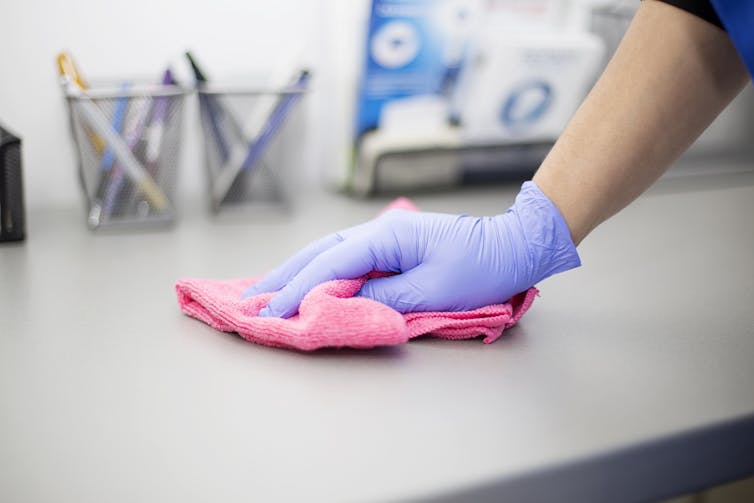
Third, cleaning protocols need to be increased. Where once a twice weekly visit from a contracted cleaner to vacuum the floors, empty the bins and quickly wipe over surfaces was considered sufficient, during COVID-19 you need to ensure a thorough daily clean of all surfaces.
Frequently touched surfaces, such as desks, light switches, door handles, phones, staircase railings, touch screens, keypads, taps and toilets should be given special attention and may require more frequent cleaning.
Fourth, if a worker becomes sick with respiratory symptoms, isolate them from other staff and arrange for them to go home. Advise them to get tested for COVID-19 and not return to work until they have a negative result.
Similarly, reinforce the message, “if you’re sick, get tested and don’t come to work”. Now more than ever, the culture of “soldiering on” while unwell puts others at risk.
Finally, you might also consider asking employees to wear face masks at work. Face masks are unlikely to protect the person wearing them but can limit the disease being spread by coughs and sneezes.
Considerations for employees
First, you should clean equipment like keyboards, phones and mice regularly, and definitely between each user if desks are shared. Simply wipe your desk and equipment with a domestic spray cleaner.
Second, the best protection against the virus is personal hygiene. Washing your hands with soap and water offers excellent protection against SARS-CoV-2. When you can’t wash your hands, use an alcohol-based hand sanitiser instead.
You should wash or sanitise your hands regularly throughout the day, especially any time you touch anything you suspect someone else has recently been in contact with.
Both employers and employees can reduce the risk COVID-19 will spread in an office environment.Shutterstock
Third, maintain a distance of 1.5m from other people to protect yourself from airborne droplets.
Fourth, practise good respiratory hygiene by coughing and sneezing into a tissue or the crook of your elbow. This prevents viral particles spreading over surfaces and toward people around you.
Lastly, if you have any symptoms, don’t go to work. Get tested as soon as possible and stay at home until you receive the results.
A long-awaited draft review of federal environment laws is due this week. There’s a lot riding on it – particularly in light of recent events that suggest the laws are in crisis.
Late last week, the federal Auditor-General Grant Hehir tabled a damning report on federal authorities’ handling of the Environment Protection and Biodiversity Conservation (EPBC) Act. Incredibly, he found Australia’s premier environmental law is administered neither efficiently or effectively.
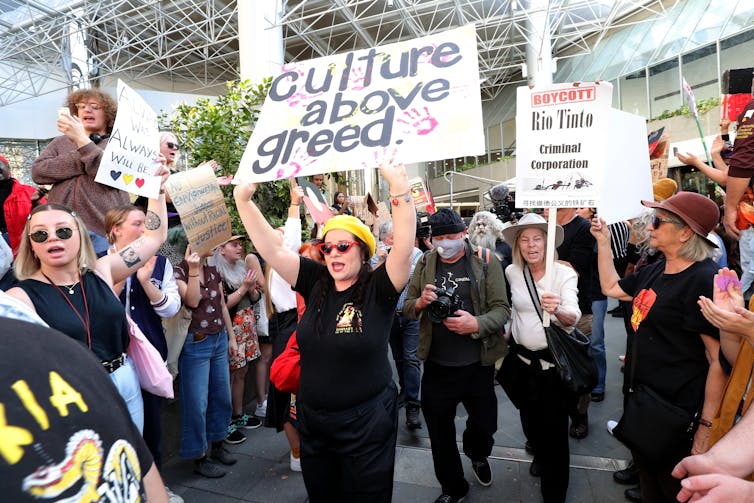
It followed news last month that mining company Rio Tinto detonated the 46,000 year old Juukan rock shelters in the Pilbara. The decision was authorised by a 50 year old Western Australian law –and the federal government failed to invoke emergency powers to stop it.
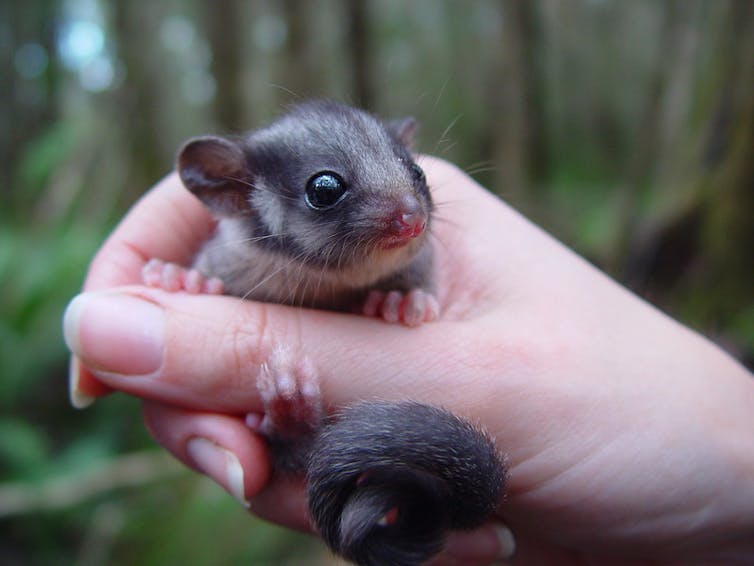
Also last month we learned state-owned Victorian logging company VicForests unlawfully logged 26 forest coupes, home to the critically endangered Leadbeater’s possum. The acts were contrary both to its own code of practice, and the agreement exempting VicForests from federal laws.
As relentless as Hehir’s criticisms of the department are, let there be no doubt that blame lies squarely at the feet of government. As a society, we must decide what values we want to protect, count the financial cost, then make sure governments deliver on that protection.
Destruction of the Juukan caves drew condemnation.Richard Wainwright/AAP
Shocking report card
I’ve been involved with this Act since before it began 20 years ago. As an ACT environment official reading a draft in 1998 I was fascinated by its complexity and sweeping potential. As a federal official responsible for administering, then reforming, the Act from 2007-2012, I encountered some of the issues identified by the audit, in milder form.
But I was still shocked by Hehir’s report. It’s so comprehensively scathing that the department barely took a trick.
Overall, the audit found that despite the EPBC Act being subject to multiple reviews, audits and parliamentary inquiries since it began, the Department of Agriculture, Water and the Environment’s administration of the laws is neither efficient nor effective.
While the government is focused on efficiency, the lack of effectiveness worries me most – especially findings concerning so-called “environmental offsets”. These are measures designed to compensate for unavoidable losses, such as creating a nature reserve near a site to be cleared.
In the early years of the law, offsets were rare. By 2015 they featured in almost 90% of decisions, dropping to about 75% last year. In effect, we now rely on offsets to protect the environment.
The Auditor-General found that the absence of guidance and quality control for offsets has led to “realised risks”.
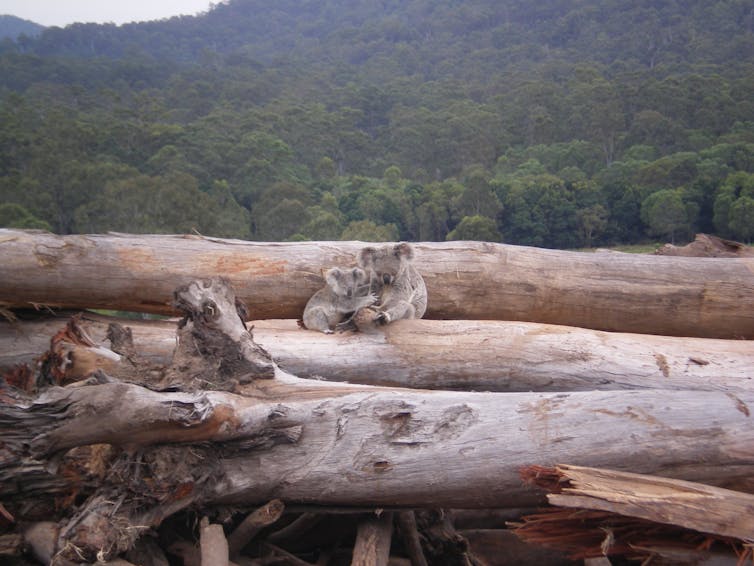
the department accepted offsets for damage to koala habitat in 2015 that did not meet its offset standards.WWF Australia
For example, offsets must be mapped and disclosed publicly, to ensure their integrity. But not only did the department fail to create a public register, in 2019 it stopped loading offset data into its systems altogether. This makes it likely offsets will be forgotten and so either destroyed later, or put up a second time and thus double-counted.
Hehir cites one example where the department accepted offsets for damage to koala habitat in 2015 that did not meet its offset standards. After negotiations with the developer and involvement from the Minister’s office, the department accepted the offsets. Worse, the developer secured a futher non-complying offset for a second development in 2018, arguing for consistency with the previous decision.
Apart from politicisation and failure to protect the environment, this case reveals a significant legal issue. Under administrative law, a decision is invalid if it has regard to an “irrelevant consideration”. An offset in one development in 2015 is surely irrelevant to an offset in another development in 2018.
Offsets aside, the Auditor-General higlighted key risks such as high volumes of unapproved land clearing for agriculture, and non-compliance in residential and mining developments. The department had proposed actions to address the issues, but made no progress on them.
And the report found arrangements to monitor whether approval conditions had been met before work started on a project were inadequate, which “leaves the department poorly positioned to prevent adverse environmental outcomes”.
At the end of the day, the federal department doesn’t have the tools to distinguish whether an environmental effect is the result of its own regulations, or other factors such as state programs or extreme weather. Essentially, it doesn’t know if the Act is delivering any environmental benefits at all.
The corroborree frog, which is critically endangered.Taronga Zoo
How did this happen?
The EPBC Act itself remains a powerful instrument. Certainly changes are needed, but the more significant problems lie in the processes that should support it: plans and policies, information systems and resourcing.
As I wrote last month, between 2013 and 2019 the federal environment department’s budget was cut by an estimated 39.7%.
And while effective administration of the Act requires good information, this can be hard to come by. For example the much-needed National Plan for Environmental Information, established in 2010, was never properly resourced and later abolished.
Officials are constrained here. The audit scope does not extend to the government decisions shaping departmental performance. And the department loyally refrains from complaining that government decisions leave it few options.
So while the audit office and the department might believe extensive government cuts are the underlying problem, neither can say so. I’m not excusing the department’s poor performance, but it must manage with what it’s given. When faced with critical audit findings, it can only pledge to “reprioritise” resources.
There is a small saving grace here. Hehir says the department asked that his report be timed to inform Professor Graeme Samuel’s 10-year review of the EPBC Act. Hehir timed it perfectly – Samuel’s draft report is due by tomorrow. Let’s hope it recommends comprehensive action, and that the final report in October follows through.
Beyond Samuel’s review, we need a national conversation on how to fix laws protecting our environment and heritage. The destruction of the Juukan rock shelters, unlawful logging of Victorian forests and the Auditor-General’s report are incontrovertible evidence the laws are failing.
I don’t believe we can lock nature up. But we must look after the things that enable nature to provide not just life, but quality of life. This includes a stable climate, our Indigenous and non-Indigenous heritage and the resilience that comes from nature’s richness and diversity.
Education minister Dan Tehan will be meeting with university vice-chancellors to devise a new way of funding university research. They will have plenty to talk about.
Australia’s universities have been remarkably successful in building their research output. But there are cracks in the funding foundations of that success, which are being exposed by the revenue shock of COVID-19 and the minister’s reforms announced this month, which would pay for new student places with money currently spent on research.
I estimate the gap in funding that needs to be filled to maintain our current research output at around $4.7 billion.
The funding foundations crumble
The timing of Dan Tehan’s higher education reform package could not have been worse for the university research sector.
The vulnerability created by universities’ reliance on international students has been brutally revealed this year. Travel bans prevent international students arriving in Australia and the COVID-19 recession undermines their capacity to pay tuition fees.
Profits from domestic and international students are the only way universities can finance research on the current scale, with more than A$12 billion spent in 2018.
Tehan’s reform package seeks to align the total teaching funding rates for each Commonwealth supported student – the combined tuition subsidy and student contribution – with the teaching and scholarship costs identified in the Deloitte analysis.
On 2018 enrolment numbers, revenue losses for universities for Commonwealth supported students would total around $750 million with this realignment. With only teaching costs funded, universities will have little or no surplus from their teaching to spend on research.
International student profits are larger than domestic – at around $4 billion. Much of this money is spent on research too, and much of this is at risk. The recession will also reduce how much industry partners and philanthropists can contribute to university research.
Australia’s Chief Scientist estimates 7,700 research jobs are at risk from COVID-19 factors alone. Unless the Commonwealth intervenes with a new research funding policy, its recent announcements will trigger further significant research job losses.
Combined teaching and research academic jobs will decline
Although less research employment will be available, the additional domestic students financed by redirecting research funding will generate teaching work.
But this reallocation between research and teaching will exacerbate a major structural problem in the academic labour market. Although most academics want teaching and research, or research-only roles, over the last 30 years Commonwealth teaching and research funding has separated.
After the latest Tehan reforms, funding for the two activities will be based on entirely different criteria and put on very different growth trajectories.
An academic employment model that assumes the same people teach and research was kept alive by funding surpluses on domestic, and especially international, students. With both these surpluses being hit hard, the funding logic is that a trend towards more specialised academic staff will have to accelerate.
We can expect academic morale to fall and industrial action to rise as university workforces resist this change.
The funding squeeze will also undermine the current system of Commonwealth research funding. This funding is allocated in two main ways. In part, it comes from competitive project grant funding, largely from the National Health and Medical Research Council and the Australian Research Council.
Academic prestige is attached to winning these grants, but the money allocated does not cover the project’s costs. Typically, universities pay the salaries of the lead researchers and general costs, such as laboratories and libraries.
Universities are partly compensated for those expenses through research block grants, which are awarded based on previous academic performance, including in winning competitive grants. But because block grants do not cover all competitive project grant costs, the system has relied on discretionary revenue, much of it from students, to work. It will need a major rethink if teaching becomes much less profitable.
The stakes are high
University spending on research (which was over $12 billion in 2018), has nearly tripled since 2000 in real terms.
Direct government spending on research increased this century, but not by nearly enough to finance this huge expansion in outlays. In 2018, the Commonwealth government’s main research funding programs contributed A$3.7 billion.
An additional $600 million came from other Commonwealth sources such as government department contracts for specific pieces of research.
These research-specific sources still leave billions of dollars in research spending without a clear source of finance. Universities have investment earnings, profits on commercial operations and other revenue sources they can invest in research.
With lower profits on teaching, this gap cannot be filled. Research spending will have to be reduced by billions of dollars.
We are at a turning point in Australian higher education. The research gains of the last fifteen years are at risk of being reversed. The minister’s meeting with vice-chancellors has very high stakes.
This is the first of three articles based on newly released research on the impacts of a lack of local jobs on the rapidly growing Western Sydney region.
Western Sydney has a jobs problem. No other big regional economy in Australia fails in providing jobs for its residents more than this one. At the last census the Western Sydney jobs deficit – local jobs minus local workers – was 222,000.
If the region’s average rate of jobs growth for this century continues, this deficit will grow to 325,000 by 2036, an increase of over 30%. In our newly released reports on Western Sydney, we estimate an outflow from the region of 562,000 commuters as a consequence. Over 300,000 people already leave the region each day for work.
Young professionals will have a growing presence in this long-distance, grinding, daily flow of workers. It’s an urban planning nightmare.
Centre for Western Sydney, Author provided
Fifty years ago, Western Sydney was one of Australia’s major industrial regions. In 1971, a belt of four local government areas – stretching from Bankstown, through Fairfield and Parramatta to Blacktown – was home to 104,000 manufacturing workers, more than one-third of the local workforce. By 2016 the number of these workers had fallen by two-thirds to only 36,000, or 7.8% of local resident workers.
Yet, unlike many manufacturing regions across the developed world – where de-industrialisation has left deep pools of displaced workers – the region hasn’t ended up a rust belt. Western Sydney’s workforce has undergone a remarkable intergenerational reconstruction.
Education fuels rise of professional class
University education, in particular, is driving this. In 1971, only 3,900 degree-holders lived in the old industrial belt described above. By 2016, their number had surged to 198,000.
In the region as a whole, Western Sydney in 2016 was home to 353,000 adults with bachelor or higher degree qualifications. This was 20.7% of all people in the region aged 15 years plus, up from 10.7% in 2001. Clearly a transformative change in the region’s resident workers has been under way.
Click on charts to enlarge.Centre for Western Sydney. Data: National Economics (NIEIR), 2018, Author provided
At the last census, 20% of Western Sydney’s employed residents were professionals, amounting to 203,000 workers. That’s more than any other occupational group in the region.
We can also see the transformation of the Western Sydney workforce through its take-up of jobs in what has become known as “knowledge-based business services”. This term covers three industry groups: professional, scientific and technical services; financial and insurance services; and information, media and telecommunications.
Here the emergence of the Western Sydney workforce as the real deal is undeniable. Our calculation is that, for 2018, Western Sydney was home to more knowledge-based business services workers (162,000) than Brisbane (159,000) – east-coast Australia’s wonder child – and significantly more than either Perth or Adelaide.
Such is the pace of upskilling in Western Sydney, the growth from 2013-2018 of residents holding jobs in knowledge-based business services outpaced the growth of these job holders in Brisbane, Adelaide and Perth combined.
Indeed, our report finds an emerging divide in Australia’s metropolitan economies. Greater Sydney, including Western Sydney, and Greater Melbourne are hurtling ahead as advanced knowledge economies. The other metropolitan regions are lagging.
Centre for Western Sydney. Data:National Economics (NIEIR), 2018, Author provided
But 60% don’t work locally
A key question, then, is whether there are enough jobs in Western Sydney for this growing number of professional and knowledge workers? The answer, clearly, is no.
At the 2016 census only 40.4% of Western Sydney’s knowledge-based business services workers could find jobs in their home region. The remaining 59.6% are forced to commute to destinations beyond the region to ply their 21st-century trades.
Western Sydney’s dependence on a population-growth economy has limited the growth of jobs for knowledge workers. The region’s strong jobs growth in recent years has come overwhelmingly from two sources.
Construction, especially residential construction, has generated a lot of jobs.
The other source of jobs is the industry sectors that have grown in direct proportion to population growth. These include health care and social assistance, education and training, retailing, and accommodation and food services. The region’s population growth has fuelled growth in these population-serving sectors.
Centre for Western Sydney, Author provided
Vulnerable in the downturn
Obviously, this jobs growth has been welcome and is important for the region’s day-to-day economy. The problem is that the Western Sydney economy has failed to produce significant job growth in other sectors. This has left the population-driven sectors, including construction, as the main source of growth.
In addition, the COVID-19 pandemic and recession are likely to rein in Western Sydney’s record population growth rates. This will hit jobs in the population-serving sectors, including further job losses in construction.
So workforce transformation in Western Sydney is running ahead of the economic transformation needed to ensure a supply of suitable jobs in the region.
Western Sydney has grown to become something more than a suburban appendage to the Sydney metropolitan area. Yet its 1 million workers lack the diverse jobs base reasonably expected of a large advanced urban economy.
Little wonder Western Sydney’s reputation as a planning nightmare is growing.
The Centre for Western Sydney has released three reports on Western Sydney’s growing jobs deficit. You can read the reports here.
After managing the first stage of the COVID-19 crisis so effectively, the government now faces a bigger challenge: getting us back to work.
The official employment figures indicate the scale of what’s needed. In the past two months number of Australians with a job has fallen by 835,000. Millions more are in jobs kept on life support by JobKeeper.
Employed Australians, total
Includes Australians regarded as still employed because they are on JobKeeper.ABS 6202.0
The Reserve Bank’s latest public forecast has the unemployment rate peaking at 10% and then falling to 6.5% (baseline scenario) or 5% (optimistic scenario) by mid-2022.
In Grattan Institute’s latest report, The Recovery Book, released this morning, we argue this isn’t ambitious enough.
The case for ambition
The bank and the government ought to aim for something better, closer to 4.5%.
This is the rate it has previously identified as “full employment”, the lowest Australia can sustainably achieve without stoking inflation.
It would mean bringing unemployment down 1.5 percentage points further than it might otherwise fall over the next two years – to somewhere between 4% and 5%.
Projected unemployment with and without extra fiscal stimulus
RBA forecasts linearly interpolated between 6-month intervals. ‘Full employment’ corresponds to the RBA’s pre-COVID estimate, plus and minus one standard error band.Grattan calculations, RBA May 2020 Statement on Monetary Policy; Lucy Ellis, 2019 Freebairn Lecture in Public Policy
The bank has passed the baton
With the bank’s cash rate already cut to 0.25%, conventional monetary policy (cutting the cash rate) has run out of steam.
The Reserve Bank is advancing cheap money to private banks for onlending to businesses, buying government bonds to keep the three year bond rate near 0.25%, and has pledged to keep the cash rate at 0.25% for the next three years.
The bank can and should do more, but the rest will have to be done by government spending and tax measures, so-called fiscal policy, of the kind that has already been proved effective in suppressing unemployment.
We’ll need $70 to $90 billion
We estimate that reducing unemployment by 1.5 percentage points by mid-2022 would require additional stimulus of A$70 billion to A$90 billion over the next two years, equivalent to between 3% and 4% of GDP.
This is on top of the more than $160 billion committed to JobKeeper and other coronavirus supports to date.
Here’s how we make the calculation.
First, to reduce unemployment by that much we estimate that real gross domestic product needs to grow by about 4 percentage points more than forecast over the next two years.
The estimate is based on previous work by economist Jeff Borland. Jeff kindly updated his calculation with us for this article, finding that each one percentage point increase in annual GDP growth reduces the unemployment rate by around 0.38 percentage points.
Second, we assume each dollar of stimulus in a particular year increases GDP in that year by between 80 cents and one dollar (some of the rest is saved and some leaks overseas).
This estimate of “fiscal multiplier” is slightly higher than that used by treasury during the global financial crisis but is in line with recent academic work finding that stimulus measures are more effective when monetary policy is out of ammunition.
If the fiscal multiplier isn’t as high – or if the recovery is more sluggish than expected, more stimulus might be needed.
There’s little risk of overkill…
A few weeks ago Reserve Bank Governor Philip Lowe raised the possibility that the crisis had pushed the minimum sustainable rate of unemployment higher, from 4.5% to nearer 5%, on the face of it making a case for less ambition.
His concern was “scarring” – the risk that some of the people who lose their jobs will become so damaged they become unsuitable for future employment, meaning that employers looking for staff would rather bid up the wages of existing workers than employ them, fuelling inflation.
But, if anything, his concern is a powerful argument for spending more, and more quickly, in order to avoid scarring. There’s good evidence sustained high unemployment hurts the economy in the long term.
And if the extra spending did fuel inflation, it mightn’t be such a bad thing.
Inflation has been below the bank’s target for years. If it gets above it and becomes a problem, the bank can dampen it by raising rates.
…and little time to lose
The extra stimulus will need to be announced soon: on or well before the federal budget scheduled for October. Fiscal measures take time to have their biggest effect.
We are facing a “fiscal cliff” when measures including JobKeeper and the enhanced JobSeeker payment are withdrawn at the end of September. To escape it, they will need to be wound down more gradually, as the international Monetary Fund warned last week.
There are plenty of ways to maintain support including further cash payments to households, along the lines of those in the global financial crisis showed were effective in boosting spending, as well as spending on things such as social housing, roads and school maintenance.
Fear of debt needn’t hold us back
Extra stimulus will mean extra government debt. But the Australian government can now borrow for 10 years at a fixed interest rate below 1%. Adjusted for inflation, that’s a negative real interest rate, making debt more affordable than it has been in living memory.
There will naturally be concerns that further debt will place a burden on younger generations. But they are the generations that will be lumbered with the costs of worse than necessary unemployment, some of it very long term unemployment, unless we act.
In the worst case, they’ll ask why we didn’t do more.
Source: The Conversation (Au and NZ) – By Geoff Plimmer, Senior lecturer in Human Resource Management, Te Herenga Waka — Victoria University of Wellington
Having had to rapidly adjust to working from home due to COVID-19, many people are now having to readjust to life back in the office. Many will have enjoyed aspects of what is sometimes called “distributed work”, but some may be dreading the return.
So is there a middle ground? Could hybrid work arrangements, known for boosting well-being and productivity, be a more common feature of workplaces in the future?
We say yes. Organisations need to recognise the valuable habits and skills employees have developed to work effectively from home during the lockdown. But they will need good strategies for easing the transition back into the physical workplace.
In doing so, they should aim for the best of both worlds — the flexibility of distributed work and the known benefits of the collaborative workplace.
A good start would be a proper re-evaluation the two worst aspects of office life: crowded open-plan designs and so-called “hot-desking”.
Cramped shared offices and free-for-all hot-desking are both known for their negative impacts on quality of workplace life. The results are often interpersonal conflict, reduced productivity and higher rates of sickness.
Some organisations have already done away with hot-desking in an effort to improve physical and mental well-being. Acknowledging the evidence that tightly packed, cost-saving, open-plan office arrangements have not delivered what was promised should be another priority.
Hopefully, the impact of COVID-19 on business as usual will spell the end of these often poorly thought through management fads.
Work-life imbalance: how do companies help their employees and also boost productivity?www.shutterstock.com
Working from home can be isolating
At the same time, there is no need to throw the baby out with the bathwater. The office still has its advantages, and there is research showing that working from home has clear disadvantages for employees and organisations when it is offered as a permanent arrangement.
One study involved a large (anonymous) US Fortune 100 technology firm. It began as a traditional survey of what it was like for individuals to work from home, but evolved into a study of the effect of what happened to the company’s community when working from home was normalised.
The option of unrestricted distributed work meant employees simply stopped coming to work at the office. Many reported the well-known benefits of working from home, such as work-life balance and productivity.
They also reported a kind of “contagion effect”. As colleagues began to stay at home a tipping point arrived where fewer and fewer people opted to work in the office.
But this actually increased a sense of isolation among employees. It also meant the loss of opportunities to collaborate through informal or unplanned meetings. The chance to solve problems or be given challenging assignments were lost as well.
Those who participated in the study said social contact and productively interacting with colleagues was the main reason they wanted to come to work. Without it there was no real point. The research raises the possibility of a net loss in well-being if everyone were to work remotely.
Well-being and job satisfaction depend on a range of factors, including having clear goals, social contact and the structure of the traditional working day. Of course, jobs can also be toxic if there is too much structure. But fully distributed work may not provide the support, identity and community that offices provide for some.
Nor is technology always adequate when it comes to the subtle value of face-to-face catch ups. Five minute water-cooler talks and post-meeting debriefs still matter for both productivity, social contact and cohesion.
A different kind of management: motivating and maintaining morale in a distributed workplace requires new skills.www.shutterstock.com
Management has to adapt too
None of which is to suggest there are not identifiable advantages of distributed work and the flexible workplace. As many of us discovered during the lockdown, just avoiding the daily commute helped with lowering stress and better work-life balance. Choosing when we worked was attractive too.
But this requires better management skills. Distributed workers require different (often better) engagement strategies, including the ability to build mutual trust.
Research into how best to manage the health and safety of distributed workers has found that some leaders simply can’t adapt to the digital environment. Trust, consideration and communicating a clear vision or sense of purpose matter more for distributed workers than for those in the traditional office.
Recognition, reward, development and advancement in a distributed working environment will all need special attention. So too will ways to deal with people not pulling their weight, maybe because of too much time on social media.
Even the simple benefits of spontaneous humour in meetings or informal team interactions are easily lost with “e-leadership”, so new ways of building and maintaining morale are vital.
This is not an either/or question. Rather, the challenge is to strike a new balance — how to retain the benefits of distributed work while maintaining the sense of community that comes from personal interaction in the office.
New Zealand established its credentials as an independent small nation after the fatal bombing of the Greenpeace flagship Rainbow Warrior in 1985, says an author and academic who spent weeks on the vessel shortly before it was attacked.
On 10 July 1985, the Rainbow Warrior was sunk at an Auckland wharf by two bombs planted on the hull of the ship by French secret agents.
The event is often referred to as the first act of terrorism in New Zealand.
Two French agents planted two explosives on the ship while it was berthed at Marsden wharf, the second explosion killing Greenpeace photographer Fernando Pereira.
Dr David Robie, who is an AUT professor of journalism and communication studies, as well as the director of the university’s Pacific Media Centre, had spent more than 10 weeks on the ship as a journalist covering its nuclear rescue mission in the Pacific.
He wrote about his experience in Eyes of Fire, a book about the last voyage of the first Rainbow Warrior – two other Rainbow Warrior shipshave followed.
In 1985, Rongelap atoll villagers in the Marshall Islands asked Greenpeace to help them relocate to a new home at Mejato atoll. Their island had been contaminated by radioactive fallout from US atmospheric nuclear weapons testing in the Pacific.
Environmental journalism “At the time I was very involved in environmental issues around the Pacific and in those days Greenpeace was very small, a fledgling organisation,” he tells Jesse Mulligan.
“They had a little office in downtown Auckland and Elaine Shaw was the coordinator and she was quite worried that this was going to be a threshold voyage.
Author David Robie … “an outrageous act of terrorism”. Image: LIP/AUT
“It was probably the first campaign by Greenpeace that was humanitarian, it wasn’t just environmental – to rescue basically the people who had been suffering from nuclear radiation.”
Shaw, he says, was looking for media publicity on the issue and several journalists from Europe and the US had been invited on board as the Greenpeace crew carried out their mission.
“There were about six journalists who went onboard but I ended up being the only one from the Southern Hemisphere.
“It was a big commitment at the time because I was a freelance journalist and it meant joining the Rainbow Warrior in Hawai’i and being onboard until 10-to-11 weeks, right up until the time of the bombing.”
He says the 49m ex-fishing trawler, originally named the Sir William Hardy, built in Aberdeen, Scotland, had been comfortable enough at sea, having been refitted as an environmental sailing ship as well as engines. “It had a lot of character… I guess all of us onboard grew to love it incredibly.”
Moruroa protest planned The US had carried out 67 nuclear tests at the Marshall Islands. France was also carrying out 193 tests in the Pacific and Greenpeace had planned on confronting that situation at Moruroa Atoll after its Marshall Islands rescue effort.
New Zealand had already voiced disapproval of the testing in the region, with then Prime Minister David Lange in 1984 rebuking the French for “arrogantly” continuing the programme in the country’s backyard.
Dr Robie left the ship when it docked in Auckland after the Marshall Islands stage of the mission. Three days after the ship had docked, a birthday celebration was held for Greenpeace campaign organiser Steve Sawyer onboard. The attack happened after the party.
Just before midnight on the evening of 10 July 1985, two explosions ripped through the hull as the ship.
Portuguese crew member Fernando Pereira was killed after returning on board after the first explosion.
“I think it was an incredible miracle that only one person lost his life,” Dr Robie says. He was not at the party at the time and joined the crew early it the morning when he heard the news.
He objects to the prominent media angle at the time, which he says focused on suggestions it was not the perpetrator’s intention to kill anyone.
‘Outrageous act of terrorism’ “It was an outrageous act of terrorism and the bombers knew very well, as they were getting information all the time, that there was a large crowd onboard the Rainbow Warrior that night and the chances were very high that there could have been a loss of life.”
Two of the cabin crew were situated immediately above the engine room when the first bomb planted there went off. The second bomb was planted near the propeller to ensure the ship was hobbled.
Dr Robie had been able to visit the ship later after it had been towed to Devonport naval base.
“I was quiet staggered – my old [cabin] floor had sort of erupted, Fernando had a cabin right close to that and he probably got trapped there.”
Thirteen foreign agents were involved, operating in three teams. The first team brought in the explosives, the second team would plant these and the third was on stand-by in case anything went wrong with the first two teams.
“A commanding officer kept an overview of the whole operation. I think there was an element of arrogance, the same arrogance as with the testing itself. There was a huge amount of arrogance about taking on an operation like this in a peaceful country – we were allies of France at the time – and it is extraordinary that they assumed they could get away with this outrageous act.”
Two of the spies were caught. Two General Directorate for External Security (DGSE) officers, Dominique Prieur and Alain Mafart, were arrested on July 24. Both were charged with murder, pleaded guilty to manslaughter and were sentenced to 10 years’ imprisonment.
Repression of independence movements “You have to see it within the context of the period of the time,” Dr Robie says.
He says that the French policy of repression against independence movements in New Caledonia and Tahiti, with assassinations of Kanak leaders like Eloi Machoro, needed to be understood to put the Rainbow Warrior attack in perspective. France was bitterly defending its nuclear force de frappe.
“New Zealand was unpopular with the major nuclear powers and there was certainly no sympathy for New Zealand’s position about nuclear testing. So, there wasn’t really any co-operation, even from our closest neighbour, Australia.
“Had we had more cooperation… we probably would have got agents who were on board the Ouvea, the yacht that carried the explosives, in Norfolk Island. But it is extraordinary we got two [agents] anyway.
“But we did not benefit in any way from [state] intelligence… so I think we were very much let down by our intelligence community.”
The case was a source of considerable embarrassment to the French government.
“They did pay compensation after arbitration that went on with the New Zealand government and Greenpeace. But justice was never really served… the 10 years were never served, both Prieur and Mafart were part of the negotiations with French government.
NZ was held ‘over a barrel’ “Basically, France had New Zealand over a barrel over trade and the European Union, so compromises were reached and Prieur and Mafart were handed over to France for three years. Essentially house arrest at Hao atoll, the rear base of the French nuclear operations in Polynesia.”
Dr Robie said the rear base was widely regarded as a military “Club Med”.
He says they didn’t even spend three years there, but left for France within the time period.
While the attack was on an international organisation rather than New Zealand itself, most New Zealanders saw it as an attack on the sovereignty of the nation
Dr Robie says it left a long-lasting impression on New Zealanders.
“It was a baptism of fire. It was a loss of innocence when that happened. And in that context, we had stood up as a small nation on being nuclear-free. Something we should have been absolutely proud of, which we were, with all those who campaigned for that at the time. I think that really established our independence, if you like, as a small nation.
“I think we have a lot to contribute to the world in terms of peace-making and we shouldn’t lose track of that. The courage that was shown by this country, standing up to a major nuclear power. We should follow through on that kind of independence of thought.”
Protesters in Papua New Guinea and on social media have launched calls for tougher laws to protect women and girls from gender-based violence and brutality after the torture and death of a 19-year-old mother of two this week.
The death of Jenelyn Kennedy on Tuesday after six days of torture, allegedly by her partner Bosip Kaiwi – who is now in police custody charged over her killing – has shocked the nation.
Papuan New Guinean women “are as good as dead” when they become “victims of DV (domestic violence)”, said one social media writer who penned an open letter in protest to Prime Minister James Marape.
“Knowing that the system has failed Jenelyn Kennedy, the latest victim of domestic violence, is enough to know that all PNG women are good as dead if and when they become victims of DV.
“There is an overwhelming feeling of hopelessness right now!!
“How do you expect Papua New Guinean women to live your vision to take back PNG and make it a rich nation when you have a system that is not working effectively to protect lives that are equally important as men, lives that also contribute to nation building.
“It is too late to protect Jenelyn now, but I hope Jenelyn’s case will bother you enough to intervene and give her the justice she deserves and protect lives of every other women who are being abused.
“Mr Prime Minister, the first national goal or directive principle as outlined in our Constitution states that “every person to be dynamically involved in the process of freeing himself or herself from every form of domination or oppression so that each m
an or woman will have the opportunity to develop as a whole person in relationship with others”.
“Create that environment for us. Let every Papua New Guinean woman have a voice in this country!!”
A police statement today denied social media postings and rumours claiming that the suspect in Kennedy’s killing had been released on bail.
“Our CID Homicide and Forensic Science team [has] worked tirelessly, and still are to build up a good case against the suspect,” Chief Superintendent N’Dranou Perou said in a statement on social media.
“[The suspect] was formally arrested and charged and will appear in court on Monday, 29th June 2020, to ensure his warrant is issued for transfer to CS Bomana.
Today’s Sunday Chronicle front page report on the brutal death of a young mother. Image: Screenshot PMC
“We would like to put to rest certain posts being shared on Facebook that the suspect has been granted bail. Police have no jurisdiction to grant bail for such serious cases. Only the courts do.
“Senior officers have physically checked and confirmed that Mr Bosip Kaiwi is in police custody, locked up in a holding cell at Boroko Police Station.”
In an ununusual step, the police also released images of Kaiwi being held in the cells at Port Moresby’s Boroko Police Station.
The death of Jenelyn Kennedy follows a spate of gender-based violence cases in Papua New Guinea, including elite PNG athlete Debbie Kaore, who was brutally assaulted by her partner in front of her children.
The picture of economic recovery painted by Prime Minister Scott Morrison is looking like a mirage. The 22 leading economists polled by The Conversation from 16 universities in seven states on average expect historically weak economic growth in all but one of the next five years, with growth dwindling over time.
Growth one percentage point above trend would average almost 4% per year.
Instead, The Conversation’s economic panel is forecasting annual growth averaging 2.4% over the next four years, much less than the long-term trend, tailing off over time.
The results imply living standards 5% lower than the prime minister expects by 2025.
The panel expects unemployment to peak at around 10% and to still be above 7% by the end of 2021.
It expects wages to barely climb at all, by just 0.9% in 2020, the lowest increase on record and even less than the rate of inflation, which it expects to be only 1.2%. It expects the share market to sink further in the rest of this year before climbing a touch in 2021.
Non-mining business investment, on which much of Australia’s recovery depends, should bounce back only 3.3% in 2021 after slipping 9.5% in 2020.
The Conversation’s panel comprises macroeconomists, economic modellers, former Treasury, IMF, OECD, Reserve Bank and financial market economists, and a former member of the Reserve Bank board.
Several admitted to much greater uncertainty than usual. One pulled out, saying “it’s really a mug’s game right now”.
One, who did take part, despaired that forecasting had been reduced to “guessing, in the context of an unprecedented event”.
Several cautioned that climate change, along with the prospect of new waves of coronavirus, makes five-year forecasts especially difficult.
Economic growth
All of the panel expect incomes and production to shrink in the June quarter (the one finishing now) after shrinking in the March quarter, meaning we will be in a recession (if there was any doubt).
Some are expecting a small growth bounce in the September quarter, although they warn that if JobKeeper and the coronavirus JobSeeker Supplement end as planned when September finishes, economic activity will turn down again in the December quarter, creating what panellist (and former Labor politician) Craig Emerson describes as a “W-shaped economic trajectory”.
Panellist Julie Toth cautions there is “no magic V ahead”. Without government action on adaptation to climate change, productivity, industrial relations, inequality and other matters, the best that can be hoped for is a partial recovery of some of the growth that has been lost.
In in 2021 the panel expects the economy to recover only half of what it lost in 2020. After peaking at 2.9% in 2023, economic growth will slip back to less than it was before the crisis.
The panel expects China’s economy to shrink 2.3% this year before bouncing back 4% in 2021. It expects the US economy to shrink 5.6% before recovering only 2.2%.
Steve Keen suggests that the underlying US performance will be even worse. It will have attained its measured performance by being prepared to live with adverse health consequences.
Tony Makin notes that China’s near-term economic growth is likely to be hampered by a move towards deglobalisation in countries wanting to make their supply of goods and health equipment less reliant on China.
Unemployment
The forecasts for the peak in the unemployment rate range from the present 7.1% to 12%, with most of the panel expecting the peak before the end of the year.
Julie Toth points out that even with no further job losses, “which seems unlikely”, measured unemployment will continue to rise for some time as people who have stopped looking for work start looking again and return to being counted as unemployed.
Saul Eslake says this participation rate makes forecasting the unemployment rate a “crapshoot”. The rate will depend largely on how many people choose to define themselves as looking for or non longer looking for work.
Living standards
The panel expects household incomes and spending to fall by about 4% over the course of the year.
The best measure of living standards, real net national disposable income per capita, should fall 4.5%.
Real wages, a key component of living standards, are expected to fall.
Never in the 23-year history of the Australian Bureau of Statistics’ wage price index has annual wage growth been much below 2%. Until now the lowest annual growth rate has been 1.9%.
The panel is forecasting growth of just 0.9% throughout 2020, a mere half of the record low to date. The forecast calls into question the timing of the current legislated increases in compulsory superannuation contributions of 0.5% of salary per year for each of the next five years, scheduled to start next year and set to eat into wage growth.
Headline price inflation should be only 1.2%, and underlying (smoothed) inflation only 1%, but both would be more than wage growth, shrinking the buying power of wages.
Share market
The spectacular recovery in the Australian share market (up 29% since late March after sliding 36% since late February) is not expected to continue this year.
The panel expects the ASX 200 to end the year down 8% before climbing 2.3% in 2021.
But the forecasts for 2021 fan out over a wide range, from a fall of 10% to a rise of 10%.
Housing
Sydney and Melbourne house prices are expected to reverse their gains of 5% and 3% in the first half of the year to close about where they started (Sydney) and down 1.3% (Melbourne).
New home building is expected to plunge a further 10% in 2020 after sliding 10% in 2019.
On balance it is not expected to improve at all in 2021, although again the range of forecasts is wide, from a recovery of 10% (Renée Fry-McKibbin) to a further decline of 10% (Stephen Hail).
Business
Mining investment is expected to continue to recover in 2020 and 2021 after huge falls between 2014 and 2019 brought about by the collapse of the infrastructure boom and the completion of several large liquefied natural gas projects.
Non-mining business investment is expected to fall 9.5% throughout 2020 before inching back 3.3% in 2021.
The Australian dollar is forecast to end the year near its present 69 US cents.
After initially diving to a low of 59 US cents as the coronavirus crisis unfolded, it and other currencies climbed against the US dollar from late March as the US response to the crisis faltered.
The price of iron ore has climbed from late March to a high of US$103 per tonne, well above the US$55 assumed in last year’s budget papers.
The panel is expecting most of those gains to be kept, forecasting US$97 by the end of the year, enough to provide one of the few welcome pieces of news for framers of the October budget.
Again, the range of forecasts is wide, from US$64 a tonne (Stephen Anthony) to US$110 (Margaret McKenzie).
Government finances
After ending 2018-19 almost in balance, the budget deficit is expected to blow out to between A$130 billion and A$150 billion in 2019-20, weighed down by about the same amount of stimulus payments.
The forecasts for 2020-21 and 2021-22 are centred around $150 billion and $100 billion respectively.
It’s a hard outcome to pick, in part because it depends on both the needs of the economy and government decisions about how to respond to them. In a report issued on Monday the Grattan Institute called for the government to spend an extra $70 billion over two years.
Forecasts for the 2021-22 budget outcome range from a deficit of $400 billion (Rod Tyers) to a deficit of just $10 billion (Renée Fry-McKibbin).
It’ll be easy to finance. The panel is forecasting a ten-year borrowing cost (bond rate) of just 1.4% per year, and it doesn’t expect it to climb that high until late 2021.
At the moment it’s 0.9%.
The Reserve Bank has committed itself to buy as many bonds as are needed to keep it low. The three major rating agencies have reaffirmed Australia’s AAA credit rating.
A survey of firsts
The 2020-21 survey is the first in 30 years not to ask for forecasts of the Reserve Bank cash rate, and the first since it has been published by The Conversation not to ask for the probability of a recession.
The Reserve Bank’s decision to push the cash rate as low as it conceivably could and leave it there for three years removed the need for the first. Australia’s descent into recession removed the need for the second.
The forecaster who proved to be the most farsighted on the recession was Steve Keen, who assigned a 75% probability to a recession in January at a time when Australia was dealing with bushfires and preparing to deal with coronavirus.
Other forecasters to assign a high probability to a recession (50%) were Julie Toth, Steven Hail, Warren Hogan and Richard Holden.
Jenelyn Kennedy … died this week at 19 in a tragic domestic violence case in Papua New Guinea. Image: EMTV News
The battered body of young mother Jenelyn Kennedy lay in a morgue yesterday as relatives told of the repeated beatings she had been receiving in the past five years which had been reported to police.
Grandfather Kennedy Karava said Jenelyn had last week been subjected to another six days of beating.
She finally collapsed at the home she shared with her partner at Korobosea in Port Moresby early Tuesday morning.
Her partner was charged with wilful murder yesterday.
Karava said Jenelyn was only 15 and doing Grade Seven at the Eki Vaki Primary School when her father gave her a house in downtown to live in. She eloped with her partner in late 2015.
“We started looking for her. My son heard that they were living at 6-Mile. He lodged a complaint with the 6-Mile police station as she was under age,” he said.
“But at the police station, the officer told [my son] to come back the next day. He released Jenelyn and the partner. The next day, my son and I went to the police station and waited untill afternoon. The police station commander referred us to the Sexual Offence Unit at the Boroko police station.”
Jenelyn Kennedy’s half brother Kiloh (from left) and relative Thomas Opa. Image: The National
He said they were told to leave their contacts with police and that “they would get back to us”. Jenelyn and her partner disappeared in 2016.
“We went back a couple of times to the police station but they said the same thing: leave a number and will call you back,” he said.
Last year, Jenelyn managed to run away from her partner and returned to her maternal family at the Murray Barracks – “with her two babies, a broken arm and a black eye”.
Uncle Dickson Karava said the partner came and took her back, and “beat her up”.
“Every time we tried to intervene, she would stop us, saying he had the money and connections and would just make her life worse.”
Her children’s babysitter, Racheal Ipang, said when she returned to her partner in October last year, “he was good to her for a week, then beat her up again”.
Ipang said Jenelyn wasn’t allowed to leave her room.
“Jenelyn sought help, went to the safe house at Ela Beach, at Kaugere, at Erima, but it was no use.”
Ipang told of how last Thursday [June 18] he had assaulted her too before turning to Jenelyn again.
“We were inside the kids’ room when I started hearing Jenelyn’s muffled cries, the noise of chains and banging on the door.
“I was scared too. There were five men in the house too but they didn’t intervene.
“He beat her from last week Thursday to Monday morning when he called for a doctor [named] to treat her at home.”
She said after the doctor left, he beat her again.
“Her screams stopped at around 3am [Tuesday]. I believe that’s when she passed away.”
Journalist Rebecca Kuku has a special Facebook page called Becky’s World where she discusses GBV issues.
Jenelyn Kennedy eloped with her partner at a tender age of 15, bore him his first child at age of 16, and died at age 19 – allegedly at the hands of the very person she thought she loved and would take good care of her.
It’s a tragedy no parent would want to share.
Horrifying details have been revealed about this week’s cruel death of a Papua New Guinean teenager that has shocked a nation.
Jenelyn Kennedy’s close friend and babysitter, Rachael Ipang, has talked to EMTV News about the tragedy.
She has told how Jenelyn silently suffered torture allegedly at the hands of the father of her two children and died a painful death – and not even the five young men alleged to have lived in the house at the time could stop this.
Jenelyn Kennedy eloped with her partner in 2016 and her grandfather and uncle searched for her everywhere. When they found her and reported this to police, no action was taken.
She was taken away as his wife.
Broken arm, bruised face She never returned home until October last year with a broken arm and bruised face.
Her uncle Dickson Karava, who had searched for her when she first eloped, said when Jenelyn returned home in October, she had with her two babies and there was not much he could say.
He said he just hugged her and took her in.
But she returned to the partner and had escaped three times since then and she had been taken to safe houses in different parts of Port Moresby.
When told to report the matter to the police, Jenelyn usually discouraged her uncles from trying.
Uncle Sepoe Karava said she told them that the partner’s family had got “long hands”. They had their own police and soldiers and said even if the matter was reported, no action would be taken.
The only person who witnessed her life with the partner was the babysitter, her childhood friend Rachael Ipang.
Tears over final moments Ipang recounts the final moments with late Jenelyn and sheds a few tears.
She alleged the partner had five chains in the room, had tied Jenelyn up and used pliers, screwdrivers, bottles, and knives to torture her.
Her death allegedly resulted from the torture that started last Thursday with non-stop beatings, all done in closed doors.
PNG Prime Minister James Marape … “I offer my sympathies to the family of the innocent beautiful child.” Image: PNG Post-Courier
While a private doctor was called to the house on Monday, no alarms were even raised by this doctor. She attended to the victim and left, said the babysitter.
Jenelyn succumbed to her injuries in the early hours of Tuesday morning. That is when the beatings stopped and no noise came from the room, according to Ipang.
Prime Minister James Marape has called for “effective prosecution” for the killing of an “innocent beautiful girl”, reports PNG Post-Courier.
‘Don’t hide behind culture’ “I call for all witnesses of crime, including domestic violence, don’t hide behind culture, compensation and tribal embrace, let us all assist prosecuting lawlessness and violence.”
Marape said no amount of compensation would cover the death but justice must be served.
“I offer my sympathies to the family of the innocent beautiful child,” he said.
The postmortem of Jenelyn Kennedy took place today at the Erima Funeral Home.
Bhosip Kaiwi, who was in police custody, has been charged with one count of wilful murder.
The charge does not allow for bail, and Kaiwi will have to apply for bail in the National Court. Other charges are expected, police said.
The Pacific Media Centre has a partnership with EMTV News.
Qantas’ announcement this week of severe job cuts comes as little surprise. The COVID-19 pandemic and closed borders have brought the global aviation industry to its knees.
According to global travel data provider OAG (formerly the Official Airline Guide), this week airlines worldwide scheduled about 63% fewer flights to the week a year ago. In Australia, there were about 78% fewer flights.
Qantas’ decision to shed about 6,000 of its 29,000 workers (a further 15,000 have been stood down without pay) is part of its plan to reduce costs by A$15 billion over three years of anticipated “lower activity”.
We have to position ourselves for several years where revenue will be much lower, and that means becoming a smaller airline in the short term.
Bianca De Marchi/AAP
About 100 of the airline’s 130 jets will be grounded for at least a year – some probably longer.
Qantas is far from alone. Airlines all around the world are furloughing or laying off workers, along with retiring aircraft ahead of schedule, grounding large planes such as A-380s and postponing new aircraft orders.
The latest US Department of Transportation data, for example, shows the number of US airline jobs fell 5% in April (representing more than 36,000 lost jobs) compared to March. May figures (yet to be published) will definitely be worse. There’s talk of a “tsunami” of airline job losses in Europe.
The aviation industry has not faced a crisis like this since the world’s first scheduled passenger airline service took off in 1914.
Since 2000, however, it has suffered lesser blows.
The first was the grounding of fleets following the September 11, 2001 terrorist attacks on New York’s World Trade Center and the Pentagon, coupled with recession in the US and Europe. Then came the SARS outbreak in China from 2002 to 2004. Then the recession caused by the Global Financial Crisis of 2008.
Airlines shed jobs in all these crises. In the US, the number of airline jobs only returned to pre-2008 levels in 2016; and to pre-2001 levels in 2019.
But the slowness of that jobs recovery is mostly attributable to airlines deploying new technology, such as automated check-in and baggage handling.
This may be less of an issue in the next decade, with there being evidence most airlines have exhausted most of their capacity to replace people with machines. For example, employment in the US airline industry the five years to 2020 increased at a faster rate than the demand for air travel.
Recovery within five years
Nonetheless the general consensus among industry experts is that recovery this time around will not be quick. Qantas, for example, only expects to operating 75% of its pre-pandemic international flights by 2023.
My own view is a bit more optimistic. I expect recovery to 2019 levels by the end of 2022, assuming the virus “behaves itself”.
However, most experts believe the industry will return to its pre-pandemic growth path within about five years.
In 2019 global passenger numbers grew by 4.1% (to more than 4.5 billion). At that rate, passenger numbers would double in 18 years. The impact of COVID-19 means it may now take to 25 years to get to 9 billion passengers. But the aviation sector’s long-term prospects remain robust.
So if your dream is to work in the aviation sector, don’t give up.
I expect the jobs recovery in the aviation business to more closely match the recovery in demand for air travel than the experience of the previous crises mentioned, when jobs growth lagged well behind passenger demand.
The fundamentals of existence are difficult to explain, which is why we need to fall back on abstract ‘creators’; ie beings sufficiently abstract that they themselves do not need to be explained.
Here is my big three list of origin magics that underpin our existence.
One. The origin of the universe, otherwise known as the ‘big bang’. Cosmologists have enough evidence to suggest that, for whatever reason, at some singular point in our past, ‘nothing’ became ‘somethings’; some things that add to ‘zero’.
Here is a symbolic representation of the creation of the universe:
X+(-X)=0.
X is matter, -X is anti-matter. While the result is ‘zero’, it is by no means ‘nothing’. That’s fundamental magic; to convert ‘nothing’ to a ‘zero’ that is not nothing. Our conception of such magic is a triumph of the human imagination. (This simple magic of the mind is essentially ‘a priori‘ knowledge, inferred rather than observed. The maths, while uncomplicated, is profound.)
We don’t know what happened to the anti-matter; maybe there is a parallel anti-matter universe. Probably we can never know for sure. In an imaginative accounting sense, the anti-matter represents a kind of debt. A debt that we never want to repay!
We essentially invoke the same fundamental imagination to explain money:
M+(-M)=0.
M is a quantity of money, a set of credits. It exists in opposition to a set of debts (-M). (Anti-money?) These debts (liabilities) are societies’ obligations (promises) to exchange money for goods and/or services.
We may create additional money:
ΔM+(-ΔM)=0.
The ‘Δ’ is called ‘Delta’; while in mathematical symbolism Delta means ‘change’, we can think of it as meaning ‘new’. Thus, ΔM means new money and -ΔM means an additional societal liability to provide goods and services on request. This process of creating new money (and new liabilities) is an example of double-entry bookkeeping, the conceptual magic which underpins capitalism in all its forms.
In this case, we do not need an abstract creator; just super-accountants, or, more prosaically, ‘bankers’. The world’s money supply changes on a daily basis, through mundane bankers creating new ‘zeros’ on balance sheets; zeros that are not ‘nothing’.
Two. The origin of life. This origin magic supposedly links from the ‘primordial soup’ of at least one ‘goldilocks’ planet (Earth), and a propensity for systemic self-organisation enabled by an energy source such as the sun. (In an anti-universe, presumably life could arise from the energy of an anti-sun.)
Three. The origin of species. While Charles Darwin evoked the principle of natural selection – a mechanism of self-organisation – he did not actually explain the origin of new species. While science tells us much, we do not actually know how new multicellular species form. What we do know is that biology has a way of filling environmental spaces; and that, after catastrophic events, new spaces are created and new species form. Surprisingly quickly.
We know enough to know that the underlying principles evolution are important, and that there is much more to evolutionary change than the creation of distinctly new species. Indeed, the principles of evolution apply to institutions, cultures, knowledge, and technologies.
Microbes (cellular and sub-cellular species) evolve – into new varieties – at a comparatively rapid pace. Nobody ever seriously argued that microbes susceptible to antibiotics could never evolve to become antibiotic resistant. The problem is that too few people last century posed the necessary questions about bacterial evolution. This blindness was especially true of the all-important third-quarter of the 20th century; the quarter-century of scientific hubris.
Six Day-to-Day Magics (science we take for granted)
We experience magic in our everyday lives. We understand enough science – and have developed enough technology – to harness these various prevailing magics.
One, domain of biology. Microbes and their contributions to higher (multicellular) life, personal health and population health. Probiotics.
All higher organisms depend critically on squillions of biota which keep us alive and healthy; ie, which silently and thanklessly regulate and enable higher life. In particular, the immune system depends on their mutability. These benevolent microbes include viruses (eg phages) and bacteria; we should include microbial ‘carnivores’ such as certain protozoa and amoebae. Our daily survival depends on their magic. We seek to maintain or repair our immune systems through various probiotic infusions.
Magic, as we know, may be malign. Thus microbes (such as the SARS-COV2 virus which gives us Covid19) become the antagonists in epic epidemic stories. Infectious diseases would appear invisibly, as if by magic. For millennia they were attributed to ‘miasmas’ brought on by anything from celestial comets to terrestrial muck. We now know that certain viruses – and bacteria, protozoa, amoebae – can be malevolent towards multicellular organisms in a wide range of environmental contexts. Whether invisible bugs or miasmas, they affect us and infect us ‘as if’ they were magic.
To deal with these harmful microbes, we have developed ‘magic bullets’ such as vaccines, antibiotics and chemical disinfectants. These bullets – underpinned by science – have worked. But they have to evolve as the wider microbial world evolves; their magic powers cannot be taken for granted.
In 2020, with Covid19, humankind has been shocked at the insufficiency of antimicrobial magic. The wide-ranging lives we took for granted have been severely curtailed.
Two, domain of hydraulics. Clean and abundant water. Waste disposal.
We expect clean water to flow, anywhere, and in copious quantities. To us, and from us. Sanitary problems can be dealt with just by turning a tap, or pressing a button on a toilet cistern.
We can easily take our waterworks for granted. We allow the sale of ‘flushable’ wipes that are not really flushable. Nevertheless, we use hydraulic magic to flush them anyway, giving the illusion of disappearance. Fats, wipes and sewage do not go away of their own accord – of course – even if it seems that they do.
Three, combustion. Fire and its contribution to human mobility.
Fire was one of the four ‘elements’ of antiquity. It was the most magical form of day-to-day magic for early humans. Initially, fires were caused by natural electricity, lightning. Fire was the first form of magic to be harnessed, for warmth, for food preparation, for defence (and offence), and for agriculture.
Today it remains the form of magic most associated with industrialisation. The industrial revolution was principally the process through which humans learned to exploit the eons of accumulated natural capital which we call ‘fossil fuels’. In our day-to-day lives, the burning of fossil fuels (in particular, fuels derived from crude oil) gives us the daily magic of automobility, and the magic of aviation.
Today, fire, the burning of (in particular) coal remains our principal means to create electricity, another modern day-to-day form of magic.
Fire, like microbes, has its downside. The more obvious downsides are the dangers of wildfires, and the depletion of forests and firewood. Less obvious, but still obvious, by combining with non-renewable fossil fuels, fire has become an integral part of the economy of non-sustainable carbon emissions.
Four, domain of physics. Electricity and magnetism. Internet.
Electricity was the form of magic most directly connected to the gods of yore. There was nothing like a good thunderstorm to communicate the displeasure of (some of) the gods, whether that displeasure be aimed at us or at other gods.
Today we generate and harness electricity, always with the help of magnetism and most commonly through the harnessing of firepower or waterpower. Electricity has become our most important immediate source of power.
The most ubiquitous daily symbol of magic in our lives is the light-switch. Hey presto, at the flick of a switch, a dark room is illuminated. We know, of course, that the magic is backed by science and fallible technology. We have all, at times, flicked a switch to find that nothing happened. While we behave ‘as if’ the light switch is a magic button, we know that the real magic is the infrastructure of the generation, transmission and retailing of electricity.
While electrical force is a fundamental magic, physical science describes how it works through the discovery of ‘the laws of physics’. Thankfully for us, these laws work, infallibly. But the infrastructural technology is fallible. Just ask anyone who was in Auckland in 1998.
The electromagnetic spectrum is magic. It gives us light, and waves, and wireless; and much more (including malign influences, such as sunburn). Waves and Boolean mathematics gave us the digital revolution, starting with wires, the telegraph, and Morse code. The magic of wireless gave us radio and television; the entertainment, gossip and information revolutions. Combining the digital and entertainment revolutions, we have the Internet; Entertainment, Gossip and Information 2.0.
Five, domain of chemistry. Molecular and nuclear chemistry. Alchemy.
The magic of chemistry is that of the states of matter (solids, liquids, gases), the bonding of atomic elements (into molecules and lattices), and the reactions of these materials to make other materials. And of the splitting and fusing of atomic nuclei, radioactive processes that transform some elements into others (eg uranium to lead; hydrogen to helium).
A magic show in the school classroom is most likely to be conducted in the chemistry lab.
Chemical magic has its downside. It leads to the manufacture of explosive materials that underpin the modern weapons’ industry. Nuclear chemistry accentuated that, with the arrival of nuclear warfare in 1945.
The origins of modern chemistry – molecular and nuclear – lie in the pre-science of alchemy. Alchemy – like pre-scientific medicine, predicated on miasmas as the source of disease – had foundations in magic and imagination. Without these predecessors, scientific chemistry (and medicine) would not have been possible.
Alchemy, in the narrower sense of the word, was a specific project of proto-nuclear-chemistry. The aim was to transform elements; especially to synthesise gold. (The world’s most eminent alchemist was Sir Isaac Newton. Although Newton ‘squandered’ most of his academic career in failed attempts to make gold, the scientific co-products of these attempts represented essential steps towards our modern world of scientific magic.)
The alchemy project was inspired by the most difficult of all magics for people to visualise and comprehend. Money. Newton – among many other otherwise intelligent people – confused money for wealth. His most famous predecessor in this regard was King Midas. Midas, in reputation at least, was a too successful alchemist. He deployed magic to create magic. Everything he touched turned to gold. He should have been careful what he wished for.
Six, domain of economics. Market supply, and money.
As already mentioned at the beginning of this essay, the origins of money lie in the imagination, if not in magic.
Just as the magic of the light switch and the toilet flush button depend on artificial infrastructure, so does the magic of money. Money is not wealth, just as the light switch is not light. Yet money is the key to wealth, but only when activated through a process (called spending); just as the magic of the light switch only occurs when we activate the switch. There is never a 100% guarantee that activation will actually result in the magic we expect. If we undermine – or neglect – the supply systems that deliver actual scientific magic, then the chance of disappointment incrementally increases.
So, in economics, the real magic is the market, not the money. Money is a social technology – a technology of the imagination – that enables us to access the market at its most powerful. The market is an evolving human mechanism – a mechanism that can both progress and regress – that can be regarded as ‘social scientific’ magic. Thus, it is neither more nor less magical than electricity. Unlike electricity, however, it is subject to soft laws (human behavioural laws); not the hard laws of physics.
The most important principle of market maintenance through money is ‘use it or lose it’. Just as toilets that are rarely flushed – and switches that are never turned on – may lead to deterioration of the systems behind them, so accumulations of unspent money lead to regression of market supply chains. The apparent magic of money lies in its circulation, not in its accumulation.
(We note that, after the Covid19 lockdown, there were reports that many people could not start their cars; indeed, some needed to buy new batteries. A good down-to-earth example of ‘use it or lose it’!)
Many alchemists – and I would include Isaac Newton in this category – wanted to revere gold rather than to spend it. They wanted to possess gold (as a metaphor for money) more than they wanted to enjoy the things that the spending of money provided. (In the latter part of his life, Newton successfully made money as Master of the Royal Mint. Newton lost a personal fortune – gained from his later job, not his alchemy nor his science – in the South Sea Bubble of 1720. Yet still had enough left over to leave what was – in today’s terms – a multi-million dollar will.)
People who prefer ‘money’ over ‘what money buys’ are called misers, the root word for ‘miserable’. Misers prioritise having an underlit room with many light switches, over having good light to read by.
In these days of Covid, we are exhorted to both spend more – especially to stop local businesses from folding – and, by the financial literacy industry, to save more to provide for our combined individual futures. Contradictions abound. To be fair, todays politicians are mainly asking us to spend; albeit in a way that discriminates against foreign vendors. It is the missionaries of financial literacy who constantly exhort people to spend less (save more), without any understanding that widespread attempts to follow that advice could lead to the decimation of the market mechanism that enables our money to have value.
Magical Thinking: Tokens of Scientific Magic.
Day-to-day magic is science. Indeed, much science in our daily lives seems like magical magic. The danger is when we confuse the tokens of scientific magic – such as switches, buttons, money – with the real magic, with the magic that is underpinned by natural science and social science.
At the push of a button, some of us flush unflushable ‘flushable’ wipes and create fatbergs and the like in our sewers. We press electrical switches, taking for granted the infrastructure that enables the subsequent enlightenment to happen. And we too easily believed that the magic of vaccines and antibiotics had put an end to the threat of infectious diseases.
We see money as a form of magic that can be stored, can even reproduce itself at a few percent each year, and, at any time in the future, can be exchanged for the same amount of goods and services as in the present.
All of these perceptions we expect to hold in the future because in our experience they worked in the past. Confusing the visible tokens with the underlying systems is known by anthropologists as ‘cargo cult’ thinking.
Science is magic. But not all magic is science.
Magic can be constructive; empirical magic known as science, and conceptual magic which is imagination. Or magic can be fallacy. Isaac Newton was a master of all three forms of magic: science, imagination and fallacy. Mathematics is an important example of magic of the imagination. It is pre-scientific magic.
To ascribe magical qualities to money – or light switches – is to engage in the cargo cult fallacy. The symbols of real systems – such as money – become the systems themselves. Hoarding money comes to be seen as an assured means to economic security, when the real means to economic security is the maintenance of a healthy market economy.
It can be difficult to convey the message that the flushability of flushable wipes is a fallacy; we keep flushing them, despite being advised not to.
It is even more difficult to communicate the message that money is not wealth, and that the market system is maintained through the spending rather than the hoarding of money. Spending means ‘circulation’, and the market economy is a circular process. Hoarding of money – or gold, or anything else – is an unsustainable linear process. One important danger today comes from the missionaries of the financial literacy movement, who preach the magical fallacy that saved money, of itself, is future wealth.
Source: The Conversation (Au and NZ) – By Patrick Mullins, Adjunct assistant professor, Centre for Creative and Cultural Research, University of Canberra
One grey morning in October 1970, in a crowded, tizzy-pink courtroom on the corner of Melbourne’s Russell and La Trobe Streets, crown prosecutor Leonard Flanagan began denouncing a novel in terms that were strident and ringing.
“When taken as a whole, it is lewd,” he declared. “As to a large part of it, it is absolutely disgusting both in the sexual and other sense; and the content of the book as a whole offends against the ordinary standards of the average person in the community today – the ordinary, average person’s standard of decency.”
Scribe
The object of Flanagan’s ire that day was the Penguin Books Australia edition of Portnoy’s Complaint. Frank, funny, and profane, Philip Roth’s novel — about a young man torn between the duties of his Jewish heritage and the autonomy of his sexual desires — had been a sensation the world over when it was published in February 1969.
Greeted with sweeping critical acclaim, it was advertised as “the funniest novel ever written about sex” and called “the autobiography of America” in the Village Voice. In the United States, it sold more than 400,000 copies in hardcover in a single year — more, even, than Mario Puzo’s The Godfather — and in the United Kingdom it was published to equal fervour and acclaim.
But in Australia, Portnoy’s Complaint had been banned.
Politicians, bureaucrats, police, and judges had for years worked to keep Australia free of the moral contamination of impure literature. Under a system of censorship that pre-dated federation, works that might damage the morals of the Australian public were banned, seized, and burned. Bookstores were raided. Publishers were policed and fined. Writers had been charged, fined and even jailed.
Seminal novels and political tracts from overseas had been kept out of the country. Where objectionable works emerged from Australian writers, they were rooted out like weeds. Under the censorship system, Boccacio’s Decameron had been banned. Nabokov’s Lolita had been banned. Joyce’s Ulysses had been banned. Even James Bond had been banned.
There had been opposition to this censorship for years, though it had become especially notable in the past decade. Criticism of the bans on J.D. Salinger’s The Catcher in the Rye and Norman Lindsay’s Redheap had prompted an almost complete revision of the banned list in 1958.
Outcry over the bans on Mary McCarthy’s The Group and D.H. Lawrence’s Lady Chatterley’s Lover had been loud and pronounced, and three intrepid Sydney activists had exposed the federal government to ridicule when they published a domestic edition of The Trial of Lady Chatterley, an edited transcript of the failed court proceedings against Penguin Books UK for the publication of Lady Chatterley’s Lover in Britain in 1960.
Penguin Books Australia had been prompted to join the fight against censorship by the three idealistic and ambitious men at its helm: managing director John Michie, finance director Peter Froelich, and editor John Hooker.
In five years, the three men had overhauled the publisher, improving its distribution machinery and logistics and reinvigorating its publishing list. They believed Penguin could shape Australian life and culture by publishing interesting and vibrant books by Australian authors.
They wanted Penguin’s books to engage with the political and cultural shifts that the country was undergoing, to expose old canards, question the orthodox, and pose alternatives.
Censorship was no small topic in all this. Those at Penguin saw censorship as an inhibition on these ambitions. “We’d had issues with it before, in minor ways,” Peter Froelich recalled, “and we’d have drinks we’d say, ‘It’s wrong! How can we fix it? What can we do? How do we bring it to people’s attention, so that it can be changed?’”
The answer emerged when they heard of the ban placed on Portnoy’s Complaint. Justifiably famous, a bestseller the world over, of well-discussed literary merit, it stood out immediately as a work with which to challenge the censorship system, just as its British parent company had a decade earlier.
Why not obtain the rights to an Australian edition, print it in secret, and publish it in one fell swoop? As Hooker — who had the idea — put it to Michie, “Jack, we ought to really publish Portnoy’s Complaint and give them one in the eye”.
The risks were considerable. There was sure to be a backlash from police and politicians. Criminal charges against Penguin and its three leaders were almost certain. Financial losses thanks to seized stock and fines would be considerable. The legal fees incurred in fighting charges would be enormous. Booksellers who stocked the book would also be put on trial. But Penguin was determined.
John Michie was resolute. “John offered to smash the whole thing down,” Hooker said, later. When he was told what was about to happen, federal minister for customs Don Chipp swore that Michie would pay: “I’ll see you in jail for this.” But Michie was not to be dissuaded.
‘People who took exception to it at the time are mostly dead,’ Roth said, some 40 years and 30 books after Portnoy’s Complaint was published.
A stampede
In July 1970, Penguin arranged to have three copies of Portnoy smuggled into Australia. In considerable secrecy, they used them to print 75,000 copies in Sydney and shipped them to wholesalers and bookstores around the country. It was an operation carried out with a precision that Hooker later likened to the German invasion of Poland.
The book was unveiled on August 31 1970. Michie held a press conference in his Mont Albert home, saying Portnoy’s Complaint was a masterpiece and should be available to read in Australia. Neither he nor Penguin were afraid of the prosecutions: “We are prepared to take the matter to the High Court.”
The next morning, as the trucks bearing copies began to arrive, bookstores everywhere were rushed. At one Melbourne bookstore, the assistant manager was knocked down and trampled by a crowd eager to buy the book and support Penguin. “It was a stampede,” he said later. A bookstore manager in Sydney was amazed when the 500 copies his store took sold out in two-and-a-half hours.
All too soon, it was sold out. And with politicians making loud promises of retribution, the police descended.
Bookstores were raided. Unsold copies were seized. Court summons were delivered to Penguin, to Michie, and to booksellers the whole country over. A long list of court trials over the publication of Portnoy’s Complaint and its sale were in the offing.
A stellar line-up
So the trial that opened on the grey morning of October 19 1970, in the Melbourne Magistrates Court, was only the first in what promised to be a long battle.
Neither Michie nor his colleagues were daunted. They had prepared a defence based around literary merit and the good that might come from reading the book. They had retained expert lawyers and marshalled the cream of Australia’s literary and academic elite to come to their aid.
Patrick White would appear as a witness for the defence. So too would academic John McLaren, The Age newspaper editor Graham Perkin, the critic A.A. Phillips, the historian Manning Clark, the poet Vincent Buckley, and many more. They were unconcerned by Flanagan’s furious denunciations, by his shudders of disgust, and by his caustic indictments of Penguin and its leaders.
They were confident in their cause. As one telegram to Michie said:
ALL BEST WISHES FOR A RESOUNDING VICTORY FOR LITERATURE AND LIBERTY.
This is an edited extract from Trials of Portnoy by Patrick Mullins, published by Scribe.
Underscoring the response to these allegations has been the acknowledgement the legal system – created by and for men – has excluded women through its formal and informal structures.
One important and long overdue change is boosting the diversity of the judges, who sit at the top of the profession.
‘Pale, stale and male’
To borrow a phrase used by former chief justice of Western Australia, Wayne Martin, Australia’s judiciary is overwhelmingly “pale, stale and male”.
Although it stands to reason the judiciary will not necessarily be representative in terms of age (given the importance of experience), no such justification can made in regard to other key characteristics.
Women have since entered the law in significant numbers, and it was assumed they would then begin to occupy positions of power and authority within the profession.
The legal profession is still male-dominated when it comes to barristers and judges.Glenn Hunt/AAP
Indeed, only 36% of Commonwealth judges are women. The proportion of women judges and magistrates is between 31 and 37% across at the state level, with the ACT (54%), Victoria (42%) and Tasmania (24%) as outliers.
There is no formal application process for becoming a High Court judge.Lukas Coch/AAP
In practice, the appointment is made by the government of the day, with the attorney-general presenting a nominee to Cabinet, which then recommends the appointment to the governor-general.
The government is therefore largely unrestrained in making their appointments beyond a requirement they consult with state attorneys-general and the appointee meets the minimum qualifications of admission as a legal practitioner.
Certainly, there is nothing that legally compels those making judicial appointments to consider diversity.
Reluctance to implement formal reforms
Pressure to reform judicial appointment practices is not new.
There have been previous calls to improve not just diversity but also transparency and accountability.
Importantly, these criticisms have very rarely been personal (about the suitability of individual appointees). But about the potential for political or other concerns to influence the process.
In fact, some of these debates came to the fore in 2003, with the Howard government’s appointment of Dyson Heydon to the High Court.
The appointment raised concerns about what his appointment meant for the diversity of the bench, because he was replacing the first and, at that time, only woman member of the High Court, Mary Gaudron.
The lack of publicly available selection criteria speaks to the breadth of this discretion.
The ‘merit’ myth
Another issue here is the insistence these appointments are made solely on the basis of “merit” – as though this imprecise concept, which has the potential to reproduce informal networks of power and privilege, is an adequate substitute for clearly articulated selection criteria.
As Australian National University professor Kim Rubenstein noted in response to Heydon’s appointment:
when male politicians gaze at the available gene pool of potential High Court appointees, they only see reflections of themselves, and what they understand as depictions of merit.
Of course, what counts as meritorious is the eye of the beholder. It is notable that former prime minister, John Howard stands by his appointed of Heydon, observing this week he was an “excellent judge of the High Court of Australia”.
Previous reforms have not been enough, or stuck
In 2007, then attorney-general Robert McClelland instituted a number of reforms to the Federal Court judicial appointment process, during the early days of the Rudd government.
These included the introduction of publicly available selection criteria for appointments and the requirement that vacancies be advertised, as well as the use of advisory panels to make recommendations.
But these reforms (which did not extend to the High Court in any case) were abandoned in 2013, when the Coalition came to power.
Why the life experience of judges matters
Inevitably, questions have been raised about how Chief Justice Susan Kiefel’s gender shaped her response and leadership regarding the High Court inquiry into sexual harassment.
Of course, we may never know the answer to this, but her apology to the young women in question and her words “their accounts … have been believed” are powerful and important and will form an important part of her legacy.
Former Family Court chief justice Diana Bryant has spoken about her experience with sexual harassment as a young lawyer.Julian Smith/AAP
This week, former Family Court chief justice Diana Bryant told the ABC “this kind of behaviour isn’t new” and said she had been sexually harassed by a former High Court judge as a young lawyer.
During that interview, she also described the changes she made once she had the power to do so on the Family Court – making clear that associates are not the personal employees of the judges they work with.
What next?
Addressing the lack of accountability and transparency in making these appointments is an obvious area of reform. We need to make selection criteria public and clear to create the political accountability that is currently lacking.
But more must also be done to explicitly value diversity in judicial appointments.
Some relatively straightforward changes could include, involving women’s lawyer groups in judicial appointments, as well as quotas.
In the context of High Court appointments, Rubenstein has argued that any given point in time, the High Court should be comprised of at least 40% of either gender.
Of course, diversity is not a synonym for “women”, although their exclusion is especially visible. Moving away from “state, male and pale” has the important potential to address the law’s homogeneity on other fronts, including race.
Any changes must be formalised
Importantly, any reforms which reflect this commitment to judicial diversity across must be formalised.
Formalising them would safeguard any gains so that they are not at the whim of the politics of the day.
Who our are judges are matters. It always has.
This moment of reckoning should be a catalyst for change in finally demanding long overdue reforms to the process by which these important appointments are made.
Source: The Conversation (Au and NZ) – By Criena Fitzgerald, Honorary Research Fellow, Faculty of Arts, Business, Law and Education, University of Western Australia
We’ve been reminded about avoiding hugging or kissing, especially among large family groups, in light of the recent Melbourne coronavirus clusters.
But alerting the public to the potential for kissing to spread infectious diseases isn’t new. It’s been a feature of past pandemics, including the scourge of tuberculosis (or TB) in Australia a century ago.
In the first half of the 20th century, people with TB were advised to stop kissing to protect their friends and family from contracting the dreaded disease.
In 1905, delegates at an International Congress on Tuberculosis in Paris described kissing as “dangerous, detrimental and responsible for countless diseases”.
TB is everyone’s business, according to literature circulated at the time, and was clearly pegged as a public health issue.Author provided
A minority of overly enthusiastic public health physicians suggested banning kissing altogether.
In Western Australia in 1948 an article in the Tuberculosis Association pamphlet warned “Kissing can be Dangerous: Doctors and Married Men are agreed on this”.
Showing bodily restraint was one of the few weapons against TB before the antibiotic streptomycin and other drugs became widely available after the end of the second world war and into the 1950s.
Other measures, with which we are familiar today, included sanitation and social distancing.
Laws and by-laws prohibiting spitting in public were introduced. Publicans had to provide spittoons for customers to prevent the spread of the disease. And people with TB had to spit into a jar, which they carried with them, or a tissue (known as Japanese paper), which they burnt after each use.
By-laws were introduced to ban spitting in public.Author provided
“Consumptives” (people with TB) were advised to cover their mouth when coughing or sneezing and not to speak near other people’s faces.
They were cautioned against drinking alcohol because even mild inebriation could make them careless in their behaviour and a danger to friends and family.
The message was clear. TB was a disease of the individual and any reckless or insanitary behaviour could infect others.
Extra cleanliness at home was encouraged. Regular dusting with a damp cloth kept surfaces clean and safe. Housewives were instructed to dampen the floor with wet tea leaves to prevent infected dust from contaminating the air and endangering family members.
An infected person used separate plates, cups and utensils that were boiled to sterilise them.
They separated themselves from their family, sleeping outside in an airy shelter or on the verandah or sleep-out.
If a person died from the disease, public health officials burnt their clothing and bedding. Their books were possible sources of contamination and had to be aired in sunlight to kill any remaining germs.
This 1950 health department video advises people to act on TB symptoms, go and get tested and to practise personal hygiene (Libraries Tasmania).
Contact tracing and mass testing
Public health officials conducted contact tracing to identify people carrying or having been exposed to TB.
People gave a sputum (spit) sample, which was then sent for analysis. They were warned to isolate themselves until the results were known.
Having a chest x-ray became compulsory for all Western Australians aged 14 years and over from 1950. The population was x-rayed at special clinics set up in every city or by mobile x-ray vans that went to every country town. Other states had different policies. By the early 1960s, x-rays were compulsory around Australia.
Only those who had had their x-ray and complied with public health requirements were deemed “safe”. If they didn’t comply they were called a public health menace and a danger to society.
Anyone refusing to be x-rayed could be sent to jail, where they were x-rayed.
X-rays in the outback, part of mass screening for TB.Alan King, Author provided
Isolation housed the sick, often for years
If people weren’t at home convalescing, they were sent to specially built isolation hospitals, known as sanatoria, to be treated with rest and fresh air. Sanatoria were regarded as a last resort because until 1947, and the advent of antibiotics, there was no cure for the disease.
In Western Australia from 1904 people went to the Coolgardie Sanatorium and from 1914 to Wooroloo Sanatorium, where they slept in the open air to disperse infection.
Incarceration in the sanatorium might last years or even a lifetime. Patients were unable to have close contact with visitors or see their children, except from a distance. Their incarceration was intended to protect the public from infection.
Special isolation hospitals or sanatoria were built to house people with TB and protect the wider community from infection.Author provided
In the 1950s, special chest hospitals were built in cities offering a more modern approach to the disease, although sanatoria remained open. Patients could still spend more than a year in hospital even after a cure became available.
By 1958, as the TB pandemic waned and was eradicated, chest hospitals began to treat patients with other diseases.
What can we learn?
COVID-19 and tuberculosis are both branded as public enemies, wreaking havoc on the fabric of society and destroying lives. But unlike COVID-19, TB is caused by a bacterium, can be treated with antibiotics, and we have a vaccine against it.
Still, the World Health Organisation reported 1.5 million people worldwide died from TB in 2018.
Until we have a vaccine or treatment for COVID-19, social distancing, good hand hygiene, contact tracing, testing and self-isolation are among our chief weapons during this latest pandemic. And yes, kissing can still be dangerous.
The Australian Bureau of Statistics this week released a provisional tally of the changes in Australia’s overall death rate amid the coronavirus epidemic.
The figures record 33,066 doctor-certified deaths in Australia from January 1 to March 31, 2020 – compared with an average of 32,249 during the corresponding months during the years 2015-19.
What’s more, the final week of March 2020 featured the highest weekly death rate of the entire three-month period, with 2,649 recorded deaths. That week also featured the highest numbers of deaths from respiratory diseases, diabetes and dementia.
Australia has had 103 known COVID-19-related deaths, with 21 reported before the end of March. The ABS death counts for respiratory diseases do not include these known cases, but might include COVID-19 deaths that were not recognised or confirmed as such at the time.
Overall, there were more than 800 “excess deaths” in the first quarter of 2020, compared with the average of the previous five years. The 103 confirmed COVID-19 deaths represent just a small fraction of these deaths. But my analysis shows that even in the early days of the pandemic, there are some signs that the impact of COVID-19 on Australia’s death rate may be bigger than the official tally suggests.
Death data allow us to monitor death rates by age, gender, location and cause, and to assess how death rates are changing over time. “Excess deaths” – those that exceed the long-term average – are particularly important to understand, not least during a pandemic but also because they could be due to preventable causes.
The coronavirus death toll has become a feature of media coverage during the COVID-19 outbreak. Unlike in many other countries, the epidemic has stayed within the capacity of Australia’s health system, so we might reasonably expect all COVID-19-related deaths to have been counted accurately.
However, analysis of sewage and swab samples in Europe suggest SARS-CoV-2 (the coronavirus that causes COVID-19) may have been responsible for infections as early as December, before the world became aware of the emerging crisis in Wuhan.
Given the uncertainty about when the coronavirus actually entered Australia, it is possible Australia had COVID-19 cases before official counts began. If so, they may have been recorded as a death from another cause in the death register, most likely as pneumonia.
A death can only be officially attributed to COVID-19 if that patient had been tested for the coronavirus. Australia had a limited supply of test kits initially, and the rules for testing were strict in the early days, mainly focused on returned travellers and their immediate contacts. Testing rules did include hospitalised patients with community-acquired pneumonia, but this recommendation may not always have been followed.
What do the new data show?
The newly released ABS data are raw counts that only include deaths which occurred in January-March and were registered by the end of April. On average, 98% of deaths are reported to the ABS by the end of the following month.
The data compare the weekly death rates against the five-year average death counts for those same weeks from 2015 to 2019. There has been some population growth over this time, which in itself might lead to a rise in expected deaths, but is not yet factored in here. These counts only relate to the deaths that a doctor has certified (in home or hospital), but this is likely to include most deaths directly associated with COVID-19 patients, diagnosed or not.
The 33,066 recorded deaths in the first three months of 2020 is well above the five-year average of 32,249. But overall, the 2020 deaths follow a similar pattern to previous years, with the count rising as we enter the cooler months.
ABS
We do expect death counts to increase with population growth and population ageing. These changes will not be particularly pronounced from year to year in Australia, but certainly could account for the small rise in overall deaths seen in these three months. There are no obvious differences between states, but the smaller population in the Australian Capital Territory and Northern Territory actually show slight declines.
Australia reported its first COVID-19 death on March 1, and has 103 confirmed COVID-19 deaths so far – a small proportion of the total number of deaths. Can we learn more by breaking down the new data?
Delve deeper into the data
One possible way to spot significant changes is to focus on groups known to be at most risk of dying from COVID-19.
First, let’s consider age at death. Older people are most vulnerable to COVID-19, but also have the highest death rates in normal circumstances too.
Bars on the left show the 2020 counts by age, and the five-year average to the right of that.Author provided
Differences from week to week are subtle, but we do see a slight trend by the end of January for the 2020 count to exceed the average. This could simply represent other factors contributing to the slight increase in all deaths, but will be worth watching over subsequent weeks.
Focusing just on those 65 and older in the ABS data, we see once again that 2020 counts are generally higher than average for all weeks for both males and females. Male deaths spiked in the final week of march, which is interesting as males represent 65% of confirmed COVID-19 deaths in Australia.
Author provided
These are preliminary numbers, but there is no clear evidence of COVID-19 deaths in Australia before March 1, or before the first known incursion of SARS-CoV-2 into Australia. However, this might be obscured by the “noise” of looking at deaths from all causes at the same time.
It is therefore worth taking a closer look at deaths attributed to respiratory causes (the ABS states that these counts do not include the confirmed 103 COVID-19 deaths). The ABS data split the total respiratory deaths into two categories: chronic conditions such as asthma, and acute infections like influenza and pneumonia. It’s in this latter category (shown in the lowermost set of lines on the graph below) where any excess, uncounted deaths due to COVID-19 should be evident.
So far this year there have been 43 excess deaths due to influenza and pneumonia, relative to the average, and the ABS notes that most of these are pneumonia deaths. The excess deaths were mainly in the final two weeks of March, with the preceding weekly fluctuations largely cancelling each other out. This compares with 21 COVID-19 deaths reported by March 21, and 48 total by the end of the first week of April (ABS data are recorded by date of death; COVID-19 counts by the day publicly reported).
Some of these extra deaths may indeed be due to factors such as population growth, but it does open up the possibility of unaccounted COVID-19 deaths in the early days of the epidemic in Australia that might match, or exceed, those confirmed cases we know about.
The issue of undetected COVID-19 deaths is not the only important question. Has the deferral of elective surgeries affected the death rate? Has there been a death toll associated with people being discouraged from visiting clinics or hospitals for other illnesses? Have the stresses of lockdown and financial uncertainty led to a rise in domestic violence or suicide?
We don’t know the answers yet. But hopefully the forthcoming ABS data will reveal the answers as 2020 continues to unfold.
The federal government’s new HomeBuilder scheme offers eligible Australians money to renovate or build a home. While it’s attracted controversy, HomeBuilder does offer a much-needed opportunity to make old homes more energy-efficient.
Research released in March showed the energy performance of housing must improve by an average 44-48% in the next decade for Australia to reach net zero emissions by 2050. This means building new homes above today’s energy standards and upgrading existing homes.
Australian houses built before 2004 weren’t required to meet national energy efficiency standards. In fact, many older homes average just 1.8 stars in energy efficiency, which means they need more than three times as much energy to heat and cool compared to today’s six-star standard.
Bringing forward their upgrade to incorporate better energy performance would help Australia’s COVID-19 economic stimulus, and save occupants money on energy bills.
A tradesman working on a renovation in Brisbane. Homebuilder encourages Australians to build or renovate homes.Dan Peled/AAP
Potential win-win
The HomeBuilder initiative will provide a grant of A$25,000 to eligible property owners, with an income of no more than A$125,000 per year (or A$200,000 for a couple). And they’re required to spend at least A$150,000 on renovations. It’s touted as a way to protect construction jobs and help stimulate the post-coronavirus economy, but should be expanded to reach a greater proportion of home-owners and renters.
Energy-efficient home improvements include:
draught-proofing doors and windows
switching to LED lighting
upgrading to solar hot water heaters
insulating ceilings, floors and walls
replacing windows with double glazing
creating temperature zones so you don’t have to heat or cool the whole house
adding shading to windows and orienting living areas to the north, to take advantage of winter sun.
A new report from the Global Building Performance Network shows how large-scale building renovation programs can boost energy efficiency, and create jobs and long-term cost savings.
It found that globally, each US$1 million invested in energy-efficient buildings globally creates an average 14 years of net employment. And improving thermal comfort in homes can benefit heart and lung health, and productivity.
Drawing from international examples, here are six policies Australian governments should adopt to deliver both economic impact and emissions savings over the long term.
Low-carbon homes help meet climate targets and boost the economy.
1. Set renovation targets
Australian governments should commit to annual renovation targets to meet energy efficiency goals at a local, state and national level.
The directive includes increasing the rate of public building renovations to 3% a year to improve energy efficiency. It’s coupled with a long-term strategy to mobilise investment to renovate existing residential and commercial buildings. This has helped the EU stay on track to reach its 20% energy efficiency target this year.
Analysts estimate EU initiatives to renovate buildings provided the opportunity to lift the EU’s gross domestic product by up to 2.3% between 2012-2020.
2. Upgrade local precincts
Australia can deliver “net zero makeovers” to multiple buildings in particular precincts, cutting emissions at scale. It could follow the lead of the Netherlands’s Energiesprong (or “Energy Leap” in English) program.
Energiesprong homes are designed to pay for themselves over 30 years. Innovative construction techniques, such as prefabricated facades, mean the work takes as little as a week and residents don’t have to move out during the process.
The program is now being implemented in the UK, Italy, France, Germany, California and New York State.
3. Make home energy ratings and labelling clear
In Australia, home energy ratings are not mandatory. Without them, many Australians probably know more about the energy efficiency ratings of their refrigerators than their homes.
The recently released King Review recommended Australia develop an energy performance rating scheme for new and existing residential buildings.
This is what’s happening in places such as the EU, China and some US states. Buildings certified under the US “Energy Star” label use 50% less energy than typical buildings.
4. Enforce energy efficiency standards for renovation
One easy win available to governments is to ensure compliance with existing energy efficiency requirements.
By applying the energy efficiency provisions of the national building code to renovations, the Beijing municipal government substantially reduced emissions from existing buildings.
Australia’s National Construction Code, which sets out building regulations for new buildings, also requires major renovations to comply with its energy efficiency rules. But it’s poorly enforced.
Governments must urgently clarifying and enforce the code’s energy efficiency requirements for renovations.
5. Introduce standards for rental properties
In the rental market, landlords and tenants have “split incentives”: tenants pay the energy bills, but landlords make investment decisions. This means investments to improve energy efficiency in rental housing aren’t often made.
It also means many private renters are paying high energy bills and face health risks from heat and cold.
In some countries, such as France, rental properties must meet reasonable energy efficiency standards, which overcomes this problem. State governments in Australia should implement provisions like this.
Renters can benefit from energy efficient homes.Shutterstock
6. Offer financial incentives
Local, state or national governments can provide direct financial incentives or tax incentives to create low-energy homes.
In Australia, states already offer financial incentives for energy efficiency, but tax incentives would require federal support.
In Germany, a grant scheme for energy efficient renovations and new housing created 253,000 jobs according to one measure. It also created a net benefit to public finances of about €10 billion in 2011.
Looking ahead
The COVID-19 impact on Australia’s construction industry is likely to last years.
But by adopting these six policies, Australian governments can deliver healthier, lower-energy housing, and bring us closer to meeting our climate targets.
Australia Post delivered more than 3.3 billion items last financial year. That’s almost 14 million deliveries a day (not counting weekends and public holidays).
Its 2019 annual report itemises the massive logistical network required: 15,037 street post boxes, 4,343 post offices, 461 sorting and distribution facilities, 4,845 delivery vans, 2,600 trucks, six airline freighters, rail assets, and 8,992 motorbikes and electric delivery vehicles.
Letters and parcels move in “waves” to 12.1 million addresses daily. Federally legislated service standards oblige Australia Post to deliver a letter within the country in no more than four days at a fixed rate (currently A$1.10). And to do so every week day to 98% of all delivery points.
Or at least Australia Post did so until late April. That’s when the federal government granted a temporary suspension of the services standards, allowing it to deliver letters every second business day in metropolitan areas.
The rationale was to enable Australia Post to divert resources from letter delivery – the part of its business in decline for at least a decade – to the booming demand for parcel delivery driven by COVID-19.
In May, with support from the Senate crossbench, the government passed amendments extending the suspension to June 2021.
That move is not universally supported. Unions fear postal workers will lose jobs. Federal opposition leader Anthony Albanese has signalled Labor Party support for a Senate motion to overturn the changes.
These cuts are to jobs, these cuts are to services that are absolutely essential […] In particular, older Australians really rely upon their postal services.
It’s true Australia Post provides an indispensable service. But its revenues tell a story of people relying on postal services less and less.
Lost letters
The decline of the letter business over the past decade has been relentless.
In 2009 Australia Post made a profit before interest and income tax of A$384.5 million. Of this its letter business generated A$52 million. Parcels and logistics made A$187 million. Other business (such as agency services and merchandise) made about A$146 million.
Paris Rieveling, 9, posts a letter at an in Sydney, December 14 2009.Tracey Nearmy/AAP
In 2019 its net profit was down to a razor-thin A$41 million. Profit before interest and tax for its non-letters businesses was almost A$259 million. Its letters business lost almost A$192 million.
Australia Post can still make profits delivering letters in major cities and regional centres, where population density is high and distances short. But not in in rural areas, where per-delivery costs skyrocket. Its commercial competitors, meanwhile, can cherry-pick the most lucrative market segments and avoid the loss-making ones.
Parsing parcels
Australia Post has long yearned to be freed from its obligation to deliver letters daily. In 2015 then chief executive Ahmed Fahour declared letter posting “in terminal and structural decline” and that Australia Post “is a parcels company more than a letters company”.
Our most significant challenge is managing the tipping point of that transformation from letters for our delivery network, which is about 70% of our costs, which is actually now in need really of a significant transformation.
The cost of delivering a $1.10 letter is not much less than a $10 parcel. It makes no commercial sense to utilise resources on loss-making activities at the expense of profitable ones.
But Australia Post is not just another corporation. Profits are not its only measure of success. It is owned by the nation. Its services are essential, particularly to rural communities.
Fingal Post Office, in north-east Tasmania.Shuttterstock
At this time, a strong case can be made it is a better social service to ensure timely parcel delivery.
In the longer term, the issue for policy makers is whether the social good is best served by keeping Australia Post to its historical obligations, or allowing it to meet burgeoning parcel demand and return a bigger dividend to the federal government to help fund other public services.
While opinions will vary, the numbers make a compelling case. They show a mail delivery system designed before the advent of the internet doesn’t need to be daily any more – just as the telephone last century helped end the importance of mail being delivered twice a day.
Urban infrastructure – bridges, roads, railways, pipelines, power transmission towers and so on – must be inspected regularly to operate safely. Imagine if we used advanced technologies available to us, such as wireless sensors, mobile apps and machine learning, to remotely inspect and maintain this infrastructure. This could eliminate the need for regular daily inspections, save time and money for engineers and asset owners, and reduce the risks of working on job sites.
Everyone has experience of working with smart devices such as mobile phones and iPads. Using these technologies to perform technical and engineering work is a game changer. We have been developing “digital twins” – 3D-visualisation of in-service infrastructure – to monitor infrastructure performance under various service conditions and make intelligent maintenance decisions.
The digital model is the twin of the real infrastructure. Wireless sensors on the structure transfer performance data to our computer. We can see the performance of the infrastructure in real time online.
What are digital twins and what can they be used for?
This is extremely useful for engineers who need to regularly monitor the performance of infrastructure. They make critical maintenance decisions about which structural elements need to be repaired or replaced, and when this must be done, to ensure the infrastructure is safe.
How are digital twins created?
Digital twins are essentially a digital replica or a virtual model of a process, product or service. The concept of creating digital twins is still relatively new for civil and infrastructure engineers.
This crane collapse killed one person and seriously injured two others in central Manhattan in 2016.Brendan McDermid/Reuters/AAP
To develop digital twins for intelligent infrastructure maintenance we must integrate a variety of disciplines. These include 3D visualisation, wireless technology, structural engineering and Internet of Things. The output is a digital model of the physical infrastructure, which can be seen on a PC, tablet or mobile phone.
Looking at their smart device at home or in the office, an engineer can observe all deformations, deflections, cracks or even stresses due to various loads (such as traffic or wind). The intelligent digital twin model can also suggest appropriate maintenance decisions.
Cost benefits add up to billions
We have more than 7,000 bridges in Victoria alone that need regular inspection. Add all the pipelines, highways, railways and so on, and that’s a huge maintenance program.
Trillions of dollars are spent each year on inspecting, monitoring and maintaining infrastructure around the world. The non-profit Volcker Alliance recently warned repair costs of deferred maintenance of the United States’ ageing infrastructure could exceed US$1 trillion, or 5% of the country’s gross domestic product. For local roads across Australia, maintenance and renewal costs between 2010 and 2024 total an estimated A$45 billion.
Digitalising the way we look after our infrastructure can make the process more accurate and less costly in the long term than traditional labour-intensive practices. Using a digital twin is expected to produce cost savings of 20-30%. Given the huge costs of monitoring infrastructure – in the US, bridge inspections alone cost US$1.35 billion a year – the potential savings are huge.
The annual cost of maintaining and repairing local roads across Australia runs into billions.Dan Himbrechts/AAP
There are also several indirect benefits for the nation.
The COVID-19 crisis has highlighted the importance of reducing crowds in public places. Considering the huge workload on transport infrastructure like highways, buses and rail, any concept that can reduce daily travel is important. Digitalising infrastructure management and maintenance can help by reducing the need for inspectors and technicians to travel to projects.
Reduced travel, by reducing emissions, benefits public health and the environment.
In Australia, researchers from the School of Engineering at RMIT are developing digital twins for use in intelligent maintenance of almost all infrastructure across the nation.
Our current focus is on bridge and port infrastructure. However, soon we’ll be able to use the developed models for railways, water and wastewater pipelines, LNG, oil and gas pipelines, offshore platforms, wind turbines and power transmission towers.
RMIT researchers have also developed a cloud-hosted asset management platform, Central Asset Management System (CAMS). It uses discrete condition ratings given to components of infrastructure through inspections. We can use these ratings to develop predictive models to aid proactive planning and decision-making on civil infrastructure.
The system is being used commercially for property assets. Many public-private partnership clients are using the system for life-cycle modelling of buildings.
Proofs of concept have been completed for bridges, drainage and local council infrastructure. Funded research is in progress for road pavements and rail.
We are working on integrating live monitoring of infrastructure to progress the platform towards creation of digital twins. The system is available for trial by any interested infrastructure owners who wish to contact us.
This work represents a significant step in developing smart cities. It will help create a safer and healthier community.
The Papua New Guinea government is adamant no immigration laws, airport and covid-19 protocols – including national security – were breached when a Chinese businessman and his entourage were allowed in the country, reports the PNG Post-Courier.
Deputy Pandemic Controller Dr Paison Dakulala said yesterday that, as stated by Prime Minister James Marape and Pandemic Controller David Manning, there was nothing sinister or wrong with the flight and the business trip.
The US$368,992 chartered flight to PNG was to bring a K1 million worth of PPE presented by a business tycoon Chen Mailin, he said.
Meanwhile, RNZ News reports that PNG has reported its 11th positive covid-19 case – linked to the Murray military barracks in the capital of Port Moresby.
Restrictions could be introduced after tests revealed the case, a close contact of case number 10, a member of the PNG Defence Force who works at the the Murray Barracks.
Chen Mailin was now in Vancouver, Canada, after the tycoon’s team had been in PNG at the invitation of the PNG government and top business contacts, reports Gorethy Kenneth of the Post-Courier.
The team – comprising Cao Yu, Chen Mailin, Hui Ngok Lun and Wong Da Hao Andy and its flight crew Amell, Susan Amaryllis, Brownie, Oliver Francis, Spencer, George Matthew – arrived in Port Moresby allegedly without proper instruments, visas, customs clearance, landing permit and quarantine protocols.
Short-term business trip But Dr Dakulala said yesterday the short-term business trip was all cleared and given exemptions by the government and the Pandemic’s National Control Centre as they were in Port Moresby to present health equipment – PPE.
They were also in town to look at business opportunities and have meetings with counterparts in the country, he said.
Controller Manning also said yesterday that the Chinese business tycoon and his associates’ arrival instruments into PNG were done under very controlled protocols and that nothing was wrong with their travel.
He also said that all measures were observed and that there was nothing wrong with the arrival of this team.
The team left Port Moresby for Vancouver yesterday via Honolulu.
Wombats are among the most peculiar of animals. They look like a massively overgrown guinea pig with a boofy head, a waddling gait, squared-off butt, backwards-facing pouch and ever-growing molars.
Indeed, wombats are oddballs and don’t look much like their nearest living relatives, the koala. But koalas and wombats (collectively known as “vombatiformes”) are the last survivors of a once far more diverse group of marsupials whose fossil history stretches back for at least 25 million years.
Working out how this diverse group fizzled out to just wombats and koalas has taken centuries of extraordinary discoveries in the fossil record. We are announcing one of these today in our research published in Scientific Reports.
Mukupirna nambensis is one of the oldest discovered Australian marsupials. Its unveiling has deepened our understanding of the relationships and evolutionary history of one of the strangest groups that once ruled this continent.
In 1973 at Lake Pinpa – a small dry salt lake in South Australia – a multi-institutional expedition led by palaeontologist Dick Tedford from the American Museum of Natural History discovered a host of extinct animals.
A combination of drought and strong winds had blown the sand off the surface of the lake bed, revealing the remains of animals that died after getting stuck in mud 25 million years ago.
One of the discoveries was a skull and partial skeleton of a large, distinctive wombat-like animal that was clearly new to science – Mukupirna.
Its fossils were found by pushing a metal rod into the clay at intervals across the lake surface, a bit like acupuncturing the skin of Mother Earth. If the rod struck something hard, the team excavated down to find what was commonly the fossilised skeleton of an otherwise unseen animal.
Once uncovered, they were encased in plaster shells for transport back to the Museum of Natural History, where they were subjected to years of careful preparation. Although Mukupirna was discovered this way in 1973, it’s only now we can formally announce this discovery to the world.
This photo shows the skull of the giant wombat relative Mukupirna nambensis. The front of the skull is towards the top of the photograph. The skull is 19.7cm long.Julien Louys, Griffith University and Robin Beck, University of Salford, Author provided
A mammoth find
One of the most remarkable things about this marsupial is its large size, which we estimate was between 143-171kg, more than four times larger than any living wombat.
Its size inspired the scientific name Mukupirna, from the words muku, meaning “bones” and pirna, meaning “big”, in the Malyangapa and Dieri languages of Aboriginal people from central Australia.
We worked out the earliest vombatiform marsupials probably weighed about 5kg or less (about the size of a modern koala). That said, body weights of about 100kg, such as that of Mukupirna, then evolved independently at least six times in different branches of the family tree.
The biggest of these would be Diprotodon at about three tonnes, the world’s largest marsupial.
Behaviour up to scratch
Mukupirna‘s forearms were powerfully muscled and its hands may have worked like shovels, an attribute shared with modern wombats. Also like wombats, it was probably a good scratch-digger. But unlike today’s wombats, it probably couldn’t burrow.
Although Mukupirna was clearly herbivorous, unlike wombats its cheek teeth were low-crowned with well-developed roots. This indicates it couldn’t have survived on abrasive plant materials such as grasses, which today’s wombats consume without problems.
Australia has three endemic species of wombat: the common wombat Vombatus ursinus (pictured), the northern hairy-nosed wombat (Lasiorhinus krefftii) and the southern hairy-nosed wombat (Lasiorhinus latifrons).Shutterstock
Pollens in the fossil deposit indicate that, unlike today, there were no grasslands in this area of central Australia back then. Instead, it was dominated by scrubby rainforest that was also home to possums, koalas and galloping kangaroos.
But alongside them were much stranger, more primitive animals that have left no living descendants. These included Ilaria, which was a bit like a gigantic koala, Ektopodon, an arboreal marsupial with teeth like a cheese-grater and Wakaleo, a leopard-sized marsupial lion with some of the most ferocious butchering teeth ever evolved by a mammal.
These forests were also punctuated by huge inland lakes that were home to lungfish, turtles, crocodiles, flamingos, ducks, stone curlews and even freshwater dolphins.
By comparing different features of Mukupirna’s teeth and skeleton, we discovered it to be the closest known relative of modern wombats. Yet, it was as different from wombats as wombats are from koalas, which is why it has been placed in a new family of its own: the Mukupirnidae.
Formal recognition of Mukupirna fills yet another fascinating gap in our knowledge of the weird and wonderful evolutionary history of mammals on this continent.
Sadly, it’s likely all mukupirnids vanished when a shift in global climate triggered an environmental change from scrubby rainforests 25 million years ago, to far lusher and more biodiverse rainforests 23 million years ago.
This would have resulted in more intense greenhouse conditions and an environment presumably not suited to mukupirnids.
Hopefully this rings a warning bell about the state of Earth’s climate now. If we can’t slow the global heating we’ve triggered, how many more of Australia’s uniquely endemic living creatures will soon join Mukupirna in the increasingly crowded abyss of extinction?
Source: The Conversation (Au and NZ) – By Simon Chapple, Director, Institute for Governance and Policy Studies, Te Herenga Waka — Victoria University of Wellington
We all remember the lockdown, but not all our memories are the same. Some say they miss the tranquillity. Others don’t miss being stuck at home at all – especially those with young children. Some found new ways of working. Others just lost work.
New Zealand’s lockdown was ranked as one of the strictest in the world, and we wanted to find out how people felt about it. So we ran a “life under lockdown” survey in the third week of alert level 4 to examine general well-being, family resilience and employment.
We also asked people an optional question: Is there anything else you would like to tell us about your experiences of lockdown, positive or negative?
Of the 2002 people surveyed, 894 (45%) gave a usable response. In survey terms, this was a surprisingly good result, and provided a rich historical record of the thoughts of many ordinary New Zealanders during lockdown.
Overall, there were more positive responses (43%) than negative (35%), with 23% neutral or mixed. We mapped the most commonly used significant words, as shown in the word cloud above and the graphs below – and “time” was the most frequently used word, often in relation to family.
It’s been a good way to focus on what’s important in my life. Personally for me it’s been a good time […] to connect with my two year old and enjoy having time with my husband and parents. On the flip side it’s highlighted what I’ve missed due to working.
For some lockdown was a chance for growth; for others, like these three people, it was a novelty:
Have enjoyed the time off to renew myself.
I’ve enjoyed a holiday from work as I have never had longer than a week off. Could never afford it.
Home life has not posed any stress in our bubble during lockdown, we have found many things to keep busy and are enjoying our time together.
Others, such as these four, expressed mixed or negative emotions:
I quite enjoy working from home (warm, comfortable, quiet) but I am lucky that I can work from home. It does get lonely though but I manage it.
As expected, employment and money worries came up often. Many people, like these individuals, reported losing jobs or general concern about income:
I’m just worried/depressed that I won’t have a job and be able to help out my family with finances. That’s what’s making me feel worthless because I got laid off. It’s not fair that I’m the youngest and I can’t help out.
The most distressing and stressful thing has been dealing with my job and disputes re hours and pay. It has basically been the whole cause of my angst during lockdown.
Zero income in house. Frustration applying for support on internet. We give up. WINZ [Work and Income NZ] suck. Really suck. It feels like their working life based on trying to find a reason to decline supporting people has left them as the worst place for the public to need to go to for support.
I cry all the time. I’m worried about money and the long term effects of this situation on our household and our finances. I am hanging on by a thread.
Separation and grief
And for some it was the hardest time of all:
I felt really bad not being able to take flowers to the cemetery on the anniversary of my husband’s death.
Very sad because I can’t visit my kids’ grandkids or elderly mother plus a close friend who’s dying of cancer. All are about five hours’ drive away. I get upset at times and cry a lot.
My husband passed away […] I need my kids and family here, but they live out of town, it’s going to be a while and that’s so, so sad.
Not surprisingly, “family” and “home” (and related terms) were mentioned a lot. While the majority of family references were positive, for some – like these two – lockdown was a challenge, if not the last straw:
After lockdown my partner and I will separate!!! Being in lockdown emphasised the difficulties with our relationship. Nonetheless I think that the lockdown was important and necessary and that it saved many NZ lives.
Men that are home on full pay while wife works thinking, yeah it’s holiday time, sleep when they want, do bugger all round home to catch up, drink when should be doing chores that needed doing, not considering […] oh I should cook, give partner that’s working a break – plain annoying.
Many reported struggling with children and home schooling while working from home:
Definitely finding it hard to help three kids, all at different levels, complete their school work, especially with a toddler running around.
It’s so difficult trying to manage schooling for the kids while also making time to work from home. Very stressful.
Bubbles and zombies
And finally, some people just wanted to get things off their chests:
Stop using that bloody word “bubble”. God I hate that word to describe home. Hang whoever decided to use it.
This is the closest I’m ever going to get to a zombie apocalypse, and it’s all just so boring. This is not at all what I was expecting.
Zombies or not, people were more positive than we’d expected. Their answers tell us about human resilience, humour, hardship and tragedy. While everyone’s lockdown was unique, we also shared many experiences. We want to thank everyone who shared theirs with us.
In the early hours of the morning, we learned Australia and New Zealand won their historic joint bid to host the FIFA 2023 Women’s World Cup.
It’s the first time two nations from different football confederations (Asia and Oceania) will co-host a World Cup. And it’s an especially sweet victory for Australia after its expensive failed bid for the 2022 men’s World Cup, which resulted in just one vote. No doubt the smile on Matildas star Sam Kerr’s face extends from ear to ear.
In an increasingly fractious world, the symbolism of Australia and New Zealand’s “As One” bid collaboration ought not be dismissed. Both countries have experience with this kind of partnership, having successfully co-hosted the 2015 Cricket World Cup and 2017 Rugby League World Cup.
But as the COVID-19 pandemic continues to rage globally and Australia wrestles with recession, it’s worth asking: do we really want this win from a financial perspective?
Whether it’s a good investment in an economic downturn requires weighing the benefits against the costs. And while some benefits are evident – the World Cup will no doubt be a huge boost for women’s football in both countries, as well as women’s sport overall – there are significant questions about the expected revenues and long-term economic benefit.
Weighing the costs vs benefits
Football Federation Australia (FFA) remains confident the World Cup will be a money-maker.
In fact, the FFA forecasts a A$460 million social and economic benefit from hosting the tournament. It’s expected serious money will flow through the economy – everything from tourist revenue and ticket sales to infrastructure investment. Major cities won’t be the only beneficiaries; regional centres like Launceston and Dunedin are also expected to host games, to considerable economic benefit.
The FIFA bid evaluation report estimated the cost of running the tournament would be about A$150 million, with just over A$100 million of that coming from governments.
So, if the FFA’s forecast of economic and social benefits is roughly accurate – and projected costs don’t blow out – net benefits could well exceed A$200 million.
Such an outcome is not without precedent. Canada enjoyed a stunning net economic gain of C$493.6 million (A$525 million) from hosting the 2015 Women’s World Cup, much of it coming from spending by tourists.
FIFA agreed with the commercial potential of an Australia-New Zealand bid, saying in its bid evaluation report:
The high organising costs projected for the Australia/New Zealand bid are significantly offset by substantial government contributions. … Strong revenue projections, driven by significant local attendance figures and sponsorship income at national support level, have also helped to place the bid in a strong financial position.
Overestimating the financial benefits?
Replicating Canada’s success, however, is far from assured, perhaps more so now than ever. The pandemic has made planning for major events much more difficult – just ask the Tokyo Olympic organisers.
For starters, if federal and state governments don’t engage in new infrastructure investment for the tournament, or do so by diverting money that would have been spent elsewhere in the economy, the immediate economic stimulus is likely to be negligible.
And governments might not be in the mood to spend on these projects when the COVID-19 recovery is plunging their budgets into deficits.
The planned A$810 million redevelopment of Sydney’s ANZ Stadium (otherwise known as Stadium Australia), which is expected to host the World Cup final, now appears unlikely due to the crisis. Perhaps this is justifiable, given the overstated economic benefits of stadium investments.
On top of this, revenue from international tourism is an extremely uncertain proposition. FFA and Football New Zealand have projected they can sell about 1.5m tickets for the World Cup.
But this projection was presumably made before coronavirus. While pandemic fears may have evaporated by 2023, it remains a big question whether international tourists will want to travel overseas again so soon, or be able to afford to.
It might take some time for tourism numbers to rebound post-pandemic.IAN LANGSDON/EPA
Even if these issues can be resolved, the tourism benefits for host countries of World Cups have been shown to be temporary at best.
Unfortunately, Australia and New Zealand will not share in potential revenue from TV broadcast rights and sponsorships. These benefits go almost exclusively to FIFA – this is the “non-profit” organisation’s main source of income.
How women’s sport could benefit
Despite all this, hosting the Women’s World Cup would certainly result in a massive celebration of women’s sport in both countries.
While difficult to quantify, the social benefits from large-scale sporting events should not be overlooked, particularly for women’s sport. An estimated 1 billion television viewers watched the 2019 World Cup in France, for instance, a jump from 750 million four years earlier. This trend is expected to continue.
Hosting a large sporting event can also lead to a “trickle-down effect” in grassroots sports participation in host countries. The FFA president believes the World Cup will “supercharge” women’s football in Australia and New Zealand, though such post-event participation boosts are not always easily realised.
Women’s professional sport has also been experiencing increased commercial and public interest in both countries. In Australia, a record-setting crowd of more than 86,000 fans watched the Australian women’s cricket team win the T20 Women’s World Cup earlier this year.
The T20 World Cup final set an attendance record for a women’s sporting event in Australia.MICHAEL DODGE/AAP
Of course, there is still room for improvement on gender inequality in the game. Research shows it is a barrier to female participation. It was only last year, for example, that the Matildas achieved pay equity with the men’s team.
There are important gains to be made in gender equality off the pitch, too. Our research shows how entrenched sexism in Australian sports organisations continues to limit women’s sports management careers.
The sporting world clearly needs more women in public-facing and influential governance roles. The president of New Zealand Football, Johanna Woods, was the only woman leader among the World Cup bidding countries.
Gender equality was a major part of the Australia-NZ bid. Both countries pledged to use the World Cup to support their goals of achieving 40% female representation in football governance bodies.
In the end, this is where we are likely to see the biggest benefits from a World Cup – improving gender equality in sports, not a boost in household incomes or employment.
With the 2023 Women’s World Cup event happily secured, let’s start working toward this goal.
There’s no question COVID-19 has changed many aspects of our lives. As drug researchers, we are interested in how the pandemic has affected illicit drug use in Australia.
Our two newsurveys of Australians who regularly use illicit drugs show people most commonly reported no change or a reduction in their use of various illicit drugs since COVID-19 restrictions came into effect.
While this may be perceived as a good thing, for people who regularly use drugs, a period of decreased use can heighten the risk of adverse effects, such as overdose, later on.
Many experts, ourselves included, predicted significant shifts in drug trends as governments around the world introduced restrictions to control the spread of COVID-19.
Evidence from major environmental, economic, and other past crises suggests the COVID-19 pandemic may have substantial effects on:
drug use (for example, switching to different substances or being unable to obtain drugs)
drug procurement (for example, shifts to online purchasing and buying drugs in larger quantities)
drug markets (for example, changes in price, purity and availability of illicit drugs).
These changes may increase the risk of drug-related harms, such as withdrawal, drug dependence and overdose. This could be especially problematic given challenges in delivery of drug treatment and harm-reduction services during COVID-19.
Two in five people we surveyed said they were using cannabis more during COVID-19.Shutterstock
We wanted to see if Australians who use illicit drugs had experienced these changes.
We conducted telephone interviews with 350 Australians who live in capital cities and regularly use ecstasy and other illicit stimulants.
We also conducted an online survey of 702 Australians who regularly used illicit drugs in 2019.
We recruited participants for both studies between April and June via social media.
Drug use
Overall, we found the use of most illicit substances had largely remained stable or decreased since March. People most commonly reported they were using drugs like MDMA, ketamine and LSD at a similar level or less than they were before the pandemic.
Conversely, at least two in five people across both studies reported they were using more cannabis than before COVID-19.
These findings are unsurprising given cannabis is mostly used in private homes, whereas drugs like MDMA are more commonly used in public settings such as nightclubs or festivals.
Drug procurement
Most participants across both studies continued to obtain drugs face-to-face. But about 10% reported they had reduced face-to-face collection of drugs, obtained drugs less frequently, and bought drugs in larger quantities since COVID-19 restrictions.
People also reported trying to reduce the risk of contracting COVID-19 by washing their hands before handling drugs, and avoiding sharing equipment such as pipes, bongs, needles and syringes.
And about 10% of participants reported seeking information on how to reduce their risk of COVID-19 when using drugs.
These findings refute stigmatised views that people who use illicit drugs are reckless with their health.
Our participants largely perceived the illicit substances they sought were no less available since the start of restrictions.
The exception was MDMA pills; half of participants we interviewed by phone said they were “more difficult” to obtain.
These findings are surprising given illicit drugs like heroin, cocaine and methamphetamine are typically detected at the Australian border, and air travel has been restricted with COVID-19.
However, the effects of COVID-19 on price, purity and availability of drugs may take time to become apparent and will vary by substance.
Reduced drug use is not always a positive
Participants commonly said their reduced substance use was a result of limited opportunities to “go out” and socialise. So as restrictions start to ease, it seems likely people will again increase their use of substances like MDMA and cocaine.
Resuming substance use after a period of abstinence or reduced use can increase the risk of harms such as overdose due to reduced tolerance to the effects of the drug.
Fewer social gatherings like festivals means less use of some illicit substances.Shutterstock
Harm-reduction strategies — like taking smaller doses, spreading out doses during a session and having a sober person present — can help reduce the risk of these outcomes if people start to use drugs again or use larger amounts.
Peer-based organisations and online resources offer information and advice on how to reduce risk when using drugs.
Our samples mainly comprised young, educated capital city dwellers recruited via social media. Very few of our participants reported drug dependence or were engaged in drug treatment.
We need research exploring how COVID-19 has affected those who report more problematic patterns of use, like people who regularly inject drugs.
This group may be disproportionately affected by COVID-19 given underlying health issues, poorer health literacy, stigma, and higher economic and social vulnerabilities.
In responding to the impacts of COVID-19 on drug use, we need to remember that evidence shows punitive responses to drug control increase social and economic costs. We believe our findings reinforce the importance of pursuing drug policies and research focused on health, human rights and harm reduction.
We wish to acknowledge our research participants and the Australian Injecting & Illicit Drug Users League (AIVL) for their contribution to these projects.
If this article has raised issues for you, or if you’re concerned about someone you know, call the National Alcohol and Other Drug Hotline on 1800 250 015.
Source: The Conversation (Au and NZ) – By Kyle J.D. Mulrooney, Lecturer in Criminology, Co-director of the Centre for Rural Criminology, University of New England
This month, the Victorian government announced on-the-spot fines for trespassers on farms following an upper house inquiry into how animal activism affects agriculture.
It’s the latest in a string of new state and federal laws designed to crack down on activists who trespass on farms – often to gather video evidence of alleged animal cruelty, which is later distributed to the public.
But amid the flurry of attention on activists, another group of trespassers on farms has largely escaped attention: illegal hunters.
Unauthorised access to farm properties can create many problems – not least, it runs the risk spreading disease such as African swine fever that can devastate farming industries.
It’s important that laws to tackle farm trespass are evidence-based. So let’s look at the evidence.
Farm trespass is a major rural crime issue.Shutterstock
Media and political focus
Media coverage of activists trespassing on farms has appeared regularly in recent years.
Over several months in 2018-19, activists targeted the Gippy Goat farm and cafe in Victoria – in one incident stealing three goats and a lamb. News reports covered the protests, claims by farmers that the fines issued to the activists was inadequate, and the eventual closure of the farm to the public.
In another example last year, the front page of rural newspaper the Weekly Times featured a family exiting the farming industry after alleged trespass and threats from animal activists.
Activists did not escape the attention of politicians. Ahead of Victoria’s new legislation this month, federal parliament last year passed a bill criminalising the “incitement” of both trespass, and damage or theft of property, on agricultural land.
Speaking in support of the bill, Attorney-General Christian Porter said trespass onto agricultural land could contaminate food and breach biosecurity protocols. He specifically cited “activists” when describing how the laws would work.
The New South Wales government last year also introduced significant fines for trespass on farms in the Right to Farm Act. And in South Australia, the government wants those who trespass or disrupt farming activities to face tougher penalties.
But as lawmakers crack down on animal activists, the problem of trespass by illegal hunters gets little political attention.
Animal rights protesters have been the subject of intense media attention, but illegal hunters fly under the radar.David Beniuk/AAP
The illegal hunting problem
Illegal hunting includes hunting without a required licence and accessing private property without permission.
In 2015 and 2016, this article’s co-author Alistair Harkness surveyed 56 Victoria farmers about their experiences and perceptions of farm crime. Farmers reported that in recent years, illegal hunters had caused them economic loss and emotional anguish by:
damaging fences
shooting at buildings, beehives and livestock
stealing from sheds
failing to extinguish campfires
destroying fields with their vehicles.
A follow-up mail survey of 906 Victorian farmers in 2017 and 2018 asked them to rate the seriousness of a range of issues. Farmers reported the following issues as either serious or very serious: illegal shooting on farms (34.4%), animal activism (30.9%), and trespass (44.2%).
Lead author Kyle Mulrooney is conducting the NSW Farm Crime Survey 2020. The work is ongoing, but so far farmers have reported feeling victimised by trespassers generally, and fear about illegal hunters. Farmers were not specifically asked for their views on trespassing activists.
A submission to a NSW parliamentary inquiry last year underscored the distress felt by farmers when hunters trespass on their properties. Farmer John Payne recalled:
Recently we had a period over several nights, where unknown persons trespassed on our property and callously killed a substantial number of our goat kids, in one case trussing one up before killing them. All just for fun and sport! […] This is one of several events where people have trespassed and shot our animals for fun, or hunted for pigs or wildlife, with little fear of detection, arrest and prosecution.
Police follow the evidence
Figures supplied to us by NSW Police show in 2018, 513 incidents of criminal trespass on farms was recorded – up from 421 in 2014.
Giving evidence to the NSW parliamentary inquiry, Detective Inspector Cameron Whiteside, the State Rural Crime Coordinator, said illegal hunting was “the most cited factor associated with the trespass” on farms.
Police action appears to be following the evidence. In communication with the lead author, Whiteside has said enforcement and operations focused on illegal hunting and trespass are a primary and current focus of the Rural Crime Prevention Team.
Target all trespassers
As African swine fever sweeps Asia, Australian pork producers have been urged to ramp up biosecurity efforts on their own properties. This reportedly includes restricting visitor numbers and separating visitor and farm vehicles.
There are fears that if the disease hits Australia, it could could shut down Australia’s A$5.3 billion pork industry, leading to mass job losses.
Given these risks, it’s important that policies to crack down on farm trespassers are guided by evidence, and don’t unduly target a single group.
And importantly, more research into the issue is needed – including into the social and economic impacts of farm trespass, in all its forms.
The recent University of the South Pacific (USP) Council meeting to address governance issues resulting in the reinstatement of its suspended vice-chancellor may have opened a pathway for political will among leaders and politicians of forum member countries to push for better governance in regional institutions.
It may have also put the spotlight on our two developed forum members, Australia and New Zealand.
This is not the first time that USP or other regional institutions have had problems with governance, but in most instances, such problems became “water under the bridge” after the quiet exit of those involved—mostly due to political reasons and political connections.
At times, international aid donors and partner countries, without the knowledge or consent of their taxpayers, look the other way when it comes to governance issues.
This attitude could be attributed to political expediency, at least in part. But overlooking bad governance only encourages such behaviour in the future, and what the USP saga shows is that we need a change of attitude.
Unless we demand high standards, and adopt zero tolerance for graft and abuse, we only embolden the perpetrators.
In some instances, not only are the perpetrators allowed to carry on in their positions but are rewarded with other high-ranking jobs as well. Instead of penalising perpetrators, the system rewards them.
Forensic investigation In this recent USP case, a forensic investigation by an international accounting firm, the BDO New Zealand report, uncovered strong evidence of favouritism and nepotism.
USP Council members ought to be congratulated for taking the matter head on.
The statement by Fiji’s Minister for Education, Heritage and Arts, Rosy Akbar, affirming the USP Council’s independence is timely given the perception of Fiji’s interference in USP’s operations under the former vice-chancellor.
Earlier, Akbar had stated that Fiji is the largest contributor to USP. But it is well known that Fiji also gains far more from USP then it contributes, both in economic terms and in making it a hub for the region.
Fiji risks losing its status as a good host of regional organisations if it meddles into the affairs of USP.
For all its recent troubles, USP is a shining example of regionalism, with far-reaching benefits for its member countries. For it to be dominated by any one country would be damaging.
Many of our leaders and politicians obtained at least their first qualification at USP. There are many (myself included) for whom their first USP degree opened the doors for further studies abroad.
Ethos of academic freedom Numerous USP graduates did their master’s degrees and PhDs in Australia, New Zealand, the United Kingdom and elsewhere. USP’s ethos of academic freedom and its management structure are modelled on Commonwealth universities.
Due to its democratic ideals, USP is the critical conscience of the region, but this could be lost through government interference.
The USP alumni who greatly value the principles of democracy, good governance, human rights, academic freedom and media freedom agonise about the lackadaisical attitude from some regional countries, including our developed partners, about promoting democracy and the principles of good governance within USP, and more broadly in the region.
Whether this attitude will change with the USP Council’s recent decision, or whether the usual “water under the bridge” attitude will prevail, remains to be seen.
The bottom line is that USP has a crucial role in regional development. This includes producing leaders who can speak out fearlessly, and who can come up with innovative solutions to our problems.
This can be achieved through open discussions and active debate, including criticism, not through silence and passivity due to fear and intimidation. Universities must be allowed to set standards that can be emulated by its students. This includes critical thinking.
Ultimately, the ability of the region to forge ahead in its development endeavours in a united and cooperative manner will depend on how it deals with governance. For many decades, our developed partners have poured in resources in the area of governance, but debate continues about how effective such aid has been.
Meaningful regional integration For much deeper and meaningful regional integration, regional institutions like USP have to become proactive in upholding the principles of good governance. The ideas of a Pacific community and a Pacific Parliament may be old, but they remain relevant.
Right now, there are no binding legal mechanisms which can provide a collective, coercive force to implement standards of governance across the region. A Pacific Parliament could provide that mechanism, and USP could be at the forefront of discussions about such matters.
The USP Council meeting last week and its outcome has reignited some hope among stakeholders, including students, that our leaders can provide strong and decisive leadership when necessary.
It has also reinforced the crucial role of USP as an independent regional organisation that should be free of political interference.
Dr Biman Prasad is a former professor of economics and dean of the Faculty of Business and Economics at the University of the South Pacific. He is an adjunct professor at the James Cook University and Punjabi University, and is currently member of Parliament and leader of the National Federation Party in Fiji. This article was first published on DevPolicy Blog and is republished with the permission of the author.