There are the Boxing Day sales, and there was this week’s rush of extremely cashed-up investors desperate to get a slice of this week’s rare 31-year government bond auction.
What’s a bond? What’s a bond auction? We’ll get to those shortly.
First, just know that the government received A$36.8 billion of bids, $20 billion of them within hours of opening the two-day auction on Monday.
It had been wanting to move $15 billion, and could have moved that much again.
$15 billion makes it the third biggest bond sale in Australian history. The two bigger were recent – a $19 billion ten-year bond sale in May and a $17 billion five-year bond sale in July.
Each sale nets the government money it won’t have to pay back for five, ten or 31 years at rates of interest that until recently would have been unthinkably low.
The 31-year bond went for 1.94%. That means the foreign and Australian investors who bought them (including Australian super funds) were prepared to accept less than the usual rate of inflation right through until 2051 in return for regular government-guaranteed interest cheques.
Investors who bought ten year bonds were prepared to accept only 0.92% per year, investors who bought five year bonds, only 0.40%.
What’s a bond?
Even bond traders find it hard to get a handle on what bonds are. In his novel Bombardiers, author Po Bronson writes a scene where a bond trader refuses to work any more and demands to see an actual bond, “any kind of bond”.
He tells his boss he can’t sell bonds “if he’s never seen one”.
Like many things that used to exist physically, they’re now mainly numbers on screens, but it helps to get a picture.
The biggest part of the paper is a promise to repay the US$1000 it cost, in 27 years time.
The smaller rectangles are called coupons, and each year the owner can tear one off and take it in to get 2.5%.
If the owner wants to sell the bond to someone else (and bonds are traded all the time) it’ll be sold with one coupon missing after one year, two coupons missing after two years, and so on.
When rates fall, prices rise
The price of a bond will vary with what’s happening to interest rates. If they are falling, an existing bond, offering returns at old rates, will become more expensive and can be sold at a profit. If they go up, an existing bond will become worth less and have to be sold at a loss.
It leads to confusion. When bond rates fall, bond prices rise, and visa versa.
For half a decade now bond rates have been falling. They’ve fallen further during the COVID crisis, making bonds a doubly good investment. They offer superannuation funds and others certainty at a time when everything seems uncertain, and if rates continue to fall they increase in value.
It is an indictment of our times that so many investors want them. The government’s office of financial management is going to need to sell an extra $167 billion over the coming year. The rush to buy suggests it could sell more.
That COVID is hurting young workers more than older ones is widely recognised.
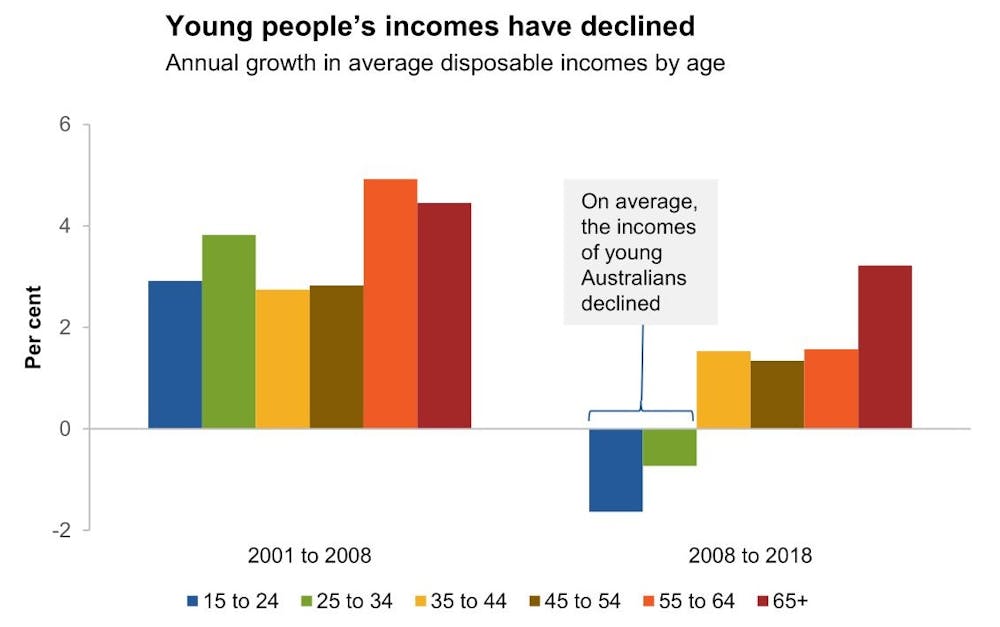
What’s less well known is that even before COVID-19, in the decade leading up to it, incomes for young people (aged 15 to 34) were falling in real terms while incomes for others continued to climb.
Disposable incomes are incomes after tax. The graph shows that in the years immediately after the Melbourne Institute’s HILDA Household Income and Labour Dynamics in Australia survey began asking the question, the real incomes of young Australians climbed in line with those of older Australians.
In the decade since 2008 they’ve gone backwards. Jennifer Rayner’s book Generation Less noted that the living standards of young and old were beginning to pull apart in ways that would strain common bonds.
Last year’s Grattan Institute report said today’s young were in danger of being the first generation in memory to have lower living standards than their parents.
Where the Productivity Commission study substantially advances our understanding is by presenting a detailed analysis of why incomes of the young have declined.
It finds that young people’s real incomes have fallen since the global financial crisis mainly because they have fared worse in the job market.
Income can come from three sources – labour income, transfer income (government payments), and other income (which includes payments from non-resident parents and investment and business income).
The report finds that about three-quarters of the fall in real incomes of the young has been due to a decrease in their labour incomes (with the rest being due to a fall in other incomes).
Lower wage jobs, lower hours
The decline in labour income for the young is a result of both slower growth in hourly wages and of them working fewer hours. Hours of work have decreased as the young have shifted away from full-time towards part-time work.
With this shift has been a move to working for smaller firms, where wages are typically lower.
The next big question is what has caused the decline in labour incomes for the young.
Since the early 1990s the proportion of the population wanting to work (the so-called participation rate) has been climbing.
Before 2008 and the global financial crisis that increase was outpaced by growth in the number of available jobs. Following the crisis the pattern reversed.
That has been bad news for the young. With the number of people wanting to work increasing faster than the number of available jobs, something had to give. It happened to be young people starting out in the labour market.
They found themselves crowded out from work and from the type of jobs they wanted (including full-time jobs) and having to accept lower-paid ones, with what turned out to be a a lower likelihood of later moving to a better job.
And less success at business
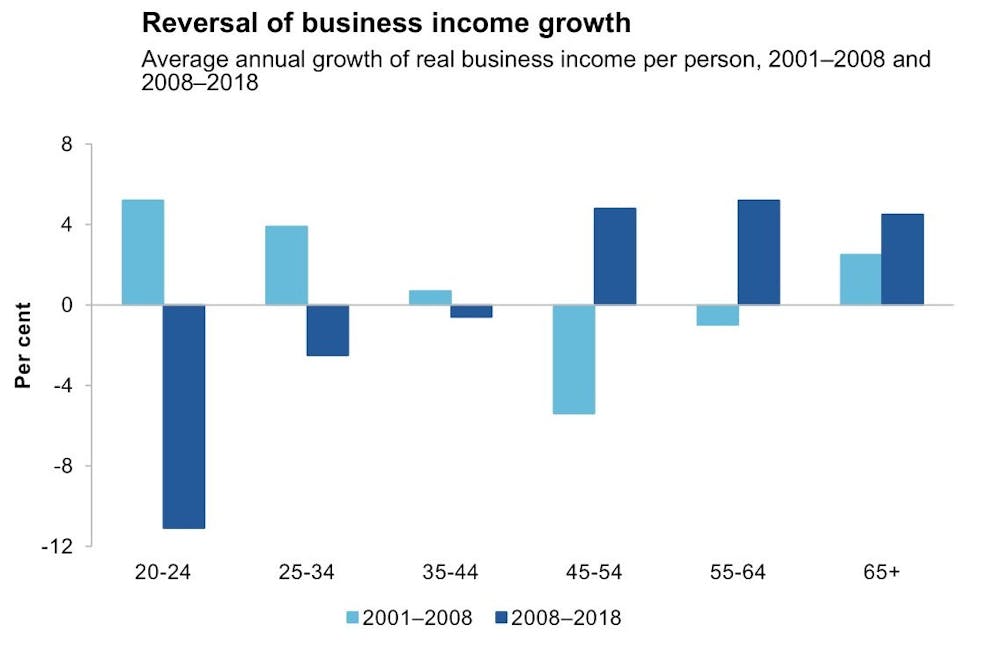
If all you knew was that young people’s income from paid work had declined, you might not be too worried. With all the high-tech start-ups involving young people, they must surely be able to make up those losses by striking out on their own and earning profits and business income.
The quashing of that idea is to my way of thinking one of the important findings of the Productivity Commission report.
It shows shows a large decrease rather than an increase in business income for the young, at a time when the business income of older Australians continued to climb.
The decrease happened both because after the global financial crisis young people were less likely to earn business income and because when they did it was more likely to come from low-paying industries.
Its a concerning finding for a nation pinning hopes on entrepreneurship, and an instance of where the report repays careful reading.
Lessons for COVID
It might seem as if analysing events in the decade after the global financial crisis is akin to studying ancient history, with the new COVID-19 labour market telling us more about what’s happening.
Nothing could be further from the truth.
Because it is about what happens to young people in a weakened labour market, the Commission’s report is replete with lessons for today.
It provides new perspectives on how the young are adversely affected, it tells us about how income support can help, and offers insights into how to make entrepreneurship better.
And it establishes unambiguously the case for worrying about the young in the time of COVID-19, all the more so because of what has happened in the leadup to it.
Last month, Eoin Higgins, senior editor for progressive news website CommonDreams, tweeted a screenshot of a Facebook post by “verbal, conscious channel” Carol Collins. The post, originally made on June 7, claims Collins had the previous day psychically channelled the spirit of George Floyd, who was killed by Minneapolis police officer Derek Chauvin on May 25.
The message she brought through was one of “love and forgiveness”. Floyd was apparently upset that his name had become “associated with hate”, and offered some political advice: “[…] civil liberties are not what we need to be fighting for, be the one who says I love you to all.”
Higgins’s tweet caused a considerable backlash on Twitter. (“Please tell me this is not real,” was one response.) Collins’s social media and website appear to have been removed as a result.
Collins is not the only spirit medium who has claimed contact with Floyd’s spirit, and used his voice to shamelessly endorse reactionary politics. YouTube user Channeling Erik uploaded a similar video on June 23, in which medium Denise Ramon channels George Floyd on camera during an interview.
The interview takes a number of bizarre twists, with “Floyd” revealing that his death was the result of karmic debt accrued in previous lives, and therefore inevitable. Ramon says: “[…] I just feel like, he would have got hit by a truck or got some kind of illness or something, he wasn’t gonna live a long life anyway, so […]”
When asked about the public reaction to his death, including calls to defund the police, Ramon claims Floyd said: “Not all police are bad.”
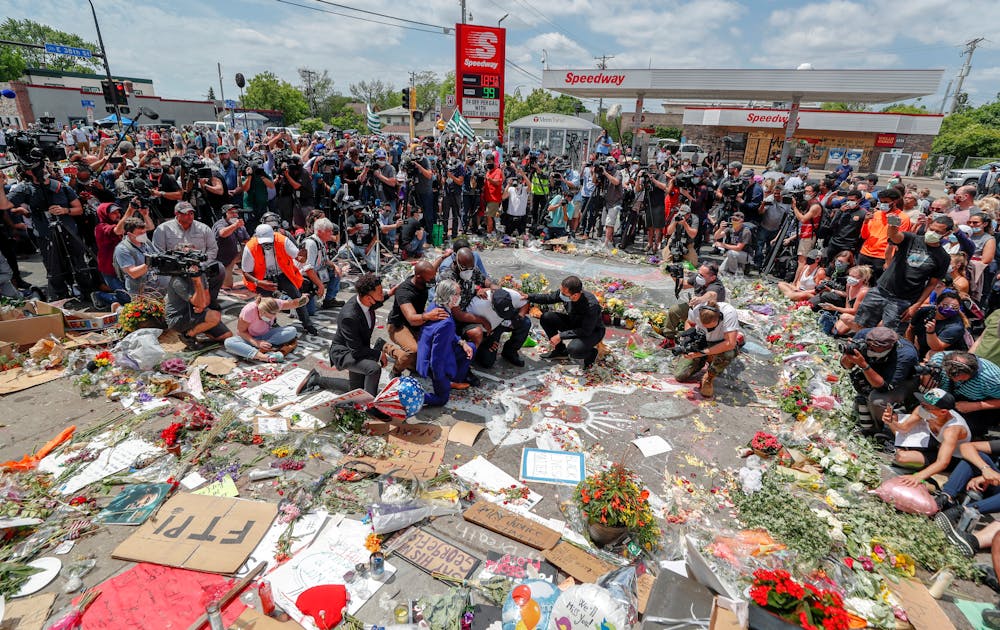
Terrence Floyd visits the site near where his brother George was taken into Minneapolis police custody and later died.Eric Miller/Reuters
Political ventriloquising
The political ventriloquising of deceased members of minority racial groups by white spirit mediums is a practice that stretches back to the second half of the 19th century in the United States.
This period was the heyday of modern spiritualism, which began in 1848 in Hydesville, New York, when two young girls, Kate and Margaret Fox, claimed they could communicate with the spirits of the dead by means of audible raps and knocks.
The Fox sisters. From left to right: Margaret, Kate and Leah.Wikimedia Commons
Spiritualism attracted at least hundreds of thousands of followers, including many prominent scientists, writers and politicians. Its period of greatest popularity coincided with the height of US colonial expansion across the north American continent, as well as with the American Civil War.
Shortly before the war broke out, one medium, Francis H. Smith, channelled the following message from “Rike”, a slave who had died from poisoning in Accomack County, Virginia:
I am right smart happier here dan dar. De blessed Lord looks on de cullared folks as well as de dear masters.
Rike’s spirit refers to the “dear masters” (that is, the white slave-owners), revealing his acceptance of the racial hierarchy from beyond the grave.
A similar message published in spiritualist periodical Banner of Light in 1857 quotes “Sam”, a recently deceased slave. Sam describes wanting freedom, but also fondly remembers his plantation life, and still politely addresses his “massa” (master). He confesses: “Yes, I’d like to go on the old plantation, massa”. Sam is very much an expression of the “happy slave” trope.
According to medical doctor and spiritualist Eugene Crowell, deceased Native Americans were often bitter at the injustice they had suffered at the hands of white colonists. But as a spirit “progressed” in the afterlife, he or she would invariably turn towards forgiveness and love.
In 1874, Crowell described contacting the spirit of a chief named Big Bear, who became enraged when he remembered the atrocities committed against his people. Crowell calmed Big Bear by reminding him “many white persons had received even worse from other white persons, and from Indians” (indeed, that “ALL lives matter”), and that holding onto feelings of hatred and rage was “wicked” and would only stunt his spiritual progress.
‘Whitewashing’
This kind of posthumous “communication” meant that Native Americans, many of whom were killed in battle or executed for resisting colonisation, became “whitewashed” and recast as benevolent figures of forgiveness in service to the colonial project, even as frontier massacres were still being carried out.
How George Floyd would have reacted to the violent scenes following his death we do not know, because he is no longer here to tell us. While spiritualism has provided comfort and solace to many who are grieving the loss of their loved ones, it has also been used, and continues to be used, to ventriloquise victims of racial violence, advance reactionary political messages, and undermine calls for institutional change.
So long as living black voices continue to be ignored and marginalised, we ought to strongly condemn the behaviour of spirit mediums who assure us that “civil liberties are not what we need to be fighting for”.
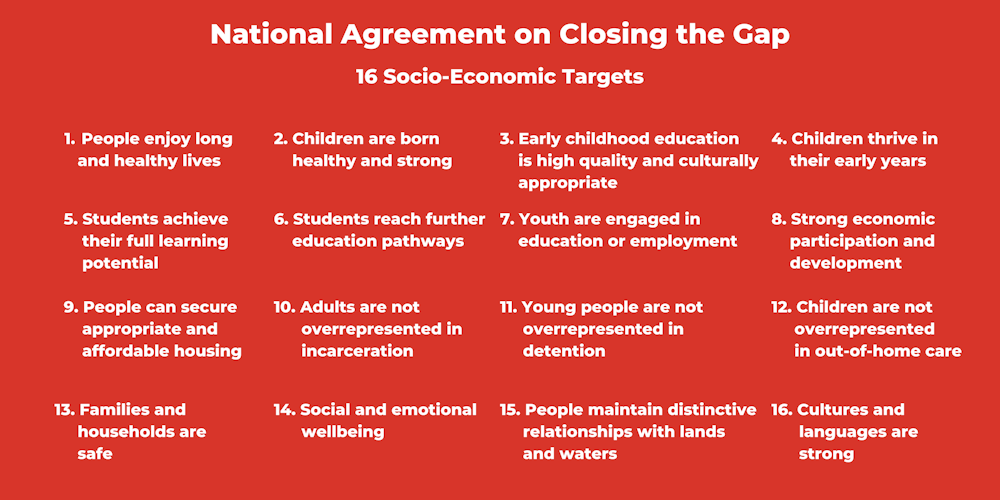
The government will unveil 16 targets for Indigenous advancement, including ensuring the maintenance of strong relationships with land and culture, when Scott Morrison announces on Thursday a new national agreement on “Closing the Gap”.
Negotiated with Indigenous representatives as a partnership, the agreement sets out four priority reforms aimed at changing how governments work with Aboriginal and Torres Strait Islander people.
The reforms would:
build and strengthen structures to empower Indigenous people to share decision-making with governments
build Indigenous community-controlled sectors to deliver services to support closing the gap
transform mainstream government organisations to improve accountability and better respond to Aboriginal and Torres Strait Islander people’s needs
improve and share access to data and information to enable Indigenous communities to make informed decisions.
The agreement has been signed by all states and territories and the Indigenous Coalition of Peaks. The Morrison government believes it will lead to more success in closing the gap because of the shared drafting and the commitment by Indigenous representatives.
The 16 targets cover improving health, education, housing, employment and economic participation, lowering incarceration rates, ensuring the safety of families and households, and promoting social and emotional wellbeing.
They also include ensuring Indigenous people “maintain distinctive relationships with lands and waters” and that cultures and languages are strong.
The specifics of the targets will be spelt out on Thursday.
Four other targets – on family violence, access to information, community infrastructure and inland waters – are to be developed over the next year.
The old “Closing the Gap” plan, initiated by the Rudd government, had only mixed results, with progress on many of its targets falling short.
Morrison said the agreement was “a new chapter” in efforts to close the gap – “one built on mutual trust, shared responsibility, dignity and respect.
“The gaps we are now seeking to close are the gaps that have now been defined by the representatives of Aboriginal and Torres Strait Islander peoples. This is as it should be. This creates a shared commitment and a shared responsibility,” Morrison said.
“This is the first time a national agreement designed to improve the lives of Aboriginal and Torres Strait Islander people has been negotiated directly with Aboriginal and Torres Strait Islander representatives.
“By focusing our efforts on these more specific, practical and shared objectives we can expect to make much greater progress,” he said.
The Minister for Indigenous Australians, Ken Wyatt, said the best outcomes were achieved when Aboriginal and Torres Strait Islander Australians were equal partners with governments.
Pat Turner, lead negotiator for the Coalition of Peaks said: “For the first time, First Nations people will share decision-making with governments on Closing the Gap.
“Our country has unforgivable gaps in the life outcomes of Aboriginal and Torres Strait Islander people and other Australians in all aspects of life including mortality, chronic disease, disability rates, housing security, education, employment and wealth.
“The National Agreement represents a turning point in our country’s efforts to close these gaps.
“The Coalition of Peaks have always said that targets alone do not drive change. We have seen this from the past 10 years. It is the full implementation of the Priority Reforms by governments and a commitment to additional resources our communities need that will make the difference,” Turner said.
The agreement promises an increase in the level of reporting to improve transparency and accountability. The Productivity Commission will do an assessment of progress every three years and there will be an Indigenous-led review of change on the ground. There will also be annual reports tabled in federal, state and territory parliaments.
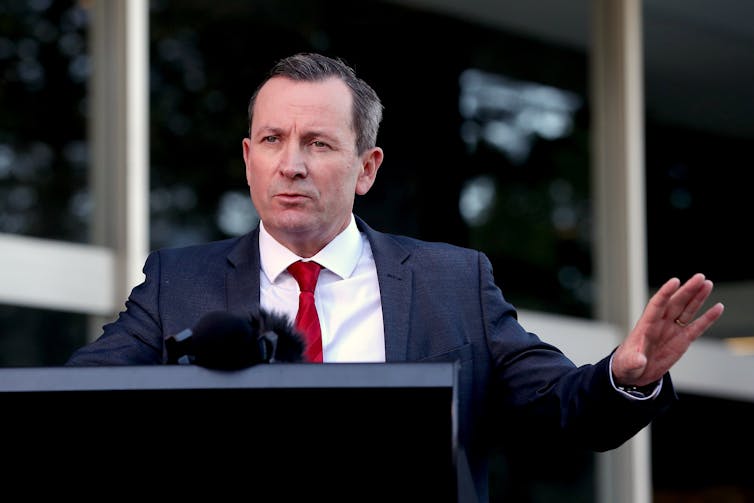
As the Morrison government on Wednesday stepped up its attack on Western Australia over its refusal to open its borders, it faced a couple of awkward political questions.
The Prime Minister was quizzed at a news conference in Canberra on why his government was supporting Clive Palmer in his High Court challenge to the closure.
And on Perth radio, Attorney-General Christian Porter was asked whether the federal government would be thanked or blamed if Palmer won the case.
The Palmer challenge is in the federal court, which is dealing with matters of fact before the High Court hears it.
Well before the High Court decision, the federal government is calling the result, predicting the McGowan government is headed for a legal bruising.
“It is highly likely that the constitutional position that is being reviewed in this case will not fall in the Western Australian government’s favour,” Morrison said. Porter put the same view.
Whatever the ultimate court outcome, there is little doubt McGowan’s tough line has gone down a treat with his constituency. It has not just helped keep the state COVID-safe but fits nicely with those latent WA secessionist instincts.
The federal government is dealing with the bad look of being aligned with the discredited Palmer by simply denying the reality.
“Let me be clear, we are not supporting Clive Palmer,” Morrison declared, a proposition that was anything but clear.
“An action has been brought in relation to the WA border. It goes to quite serious constitutional issues which the Commonwealth could not be silent about,” Morrison said.
Porter’s take is that the Commonwealth isn’t arguing for either side in the case but is “a middle man…there to provide expert evidence”.
That evidence, however, backs up Palmer.
As a general rule Morrison, with economic considerations in mind, has never favoured closed state borders, though he had to give pragmatic support to the present NSW-Victorian closure. The states went their own ways regardless of Canberra’s view.
With no persuasive argument easily mounted at the moment to open any border to Victorians, the federal government wants WA to compromise by opening to low risk states.
Finance Minister Mathias Cormann, in an opinion piece this week, urged a “balance” between protecting the health of West Australians and “protecting current jobs and not standing in the way of the strongest possible jobs recovery”.
Porter warned WA’s all-or-nothing approach risked “an adverse finding in the High Court which requires you to do everything at once.” Both Porter and Cormann are West Australians.
As relations between the Morrison and McGowan governments became even more fractious over the border issue, Queensland premier Annastacia Palaszczuk announced on Wednesday she will close her border to Sydneysiders from 1am Saturday.
This followed two 19-year-old women who flew from Melbourne to Brisbane via Sydney and did not isolate (there is an investigation as to whether they gave false information). A third woman, a close contact, has also tested positive.
NSW premier Gladys Berejiklian wasn’t warned and, it can be assumed, wasn’t pleased. Earlier, she had been vociferous about the need for Queensland to open its border.
Asked about the Queensland’s action, Morrison said “I think it’s important to sort of put borders aside when it comes to those things”, preferring to focus on limiting movement of people from outbreak zones.
The PM wants targeted responses to outbreaks, not nuclear options.
His approach rests on an optimistic assumption – that limited outbreaks are capable of containment without a massive reaction, such as border closures or major lockdowns. For this to be correct, everything needs to go right.
The Morrison prescription also depends on other political leaders being willing to take some risks – and Palaszczuk and Mark McGowan are not.
Palaszczuk’s decision will bring economic costs for Queensland. Businesses expecting Sydney visitors will have cancellations, and future uncertainty will be created.
There will be some blowback for the premier, as she approaches the state election in October. But she calculates, probably correctly, the negatives will be a lot less politically dangerous than if she were seen to fail to do everything possible to protect Queenslanders’ health.
And the sudden high alert in Queensland is likely to just reinforce McGowan’s resistance to the federal government’s pressure to compromise.
American rapper Kanye West has been making headlines recently as he mounts a campaign to be elected president of the United States.
We’ve seen a series of chaotic and emotional public outbursts, including during his first presidential campaign appearance, as well as a string of incoherent tweets which he subsequently retracted.
The cover of Kanye West’s 2018 album Ye reads ‘I hate being Bi-Polar its awesome’.Wikipedia
Although the journey from celebrity to high public office is no longer implausible, it is tempting simply to dismiss West’s outbursts as yet another display of 21st-century narcissism.
But he suffers from bipolar disorder, so it’s important we understand his behaviour in the context of his mental illness.
Bipolar disorder, previously known as manic-depressive illness, involves alternating periods of intense mania (high energy and activity) and severe depression (low energy and mood).
Manic periods, which can last days to weeks, are associated with:
an intense internal drive to be active and inability to sit still
grandiose ideas and motivation to achieve big things
fast speech that’s difficult to interrupt
poor sleep
a strong sense of oneness with the world
irritable or elated moods.
When these periods are less severe or shorter, it’s typically referred to as hypomania.
West’s recent public behaviour indicates he may have been experiencing a hypomanic period.
Depressed periods, which often last weeks to months, are associated with:
overwhelming fatigue
low moods
suicidal thoughts and behaviours.
We also see mixed states, where the person is very active or agitated but simultaneously very distressed.
And as the illness is characteristically episodic rather than persistent, many people with bipolar disorder have long periods of being well and productively engaged with their families, work and wider society.
Bipolar disorder affects men and women equally.Shutterstock
Who does bipolar disorder affect, and what causes it?
Less severe forms of the illness, often termed bipolar II or bipolar spectrum disorders, have less intense manic periods (hypomania) as well as unstable or depressed mood, and may affect a further 2-3% of adults.
While classified descriptively as “mood disorders”, it’s more likely these disorders represent a failure of the internal body (circadian) clock to stay in close synchronisation with our normal 24-hour light/dark and activity/sleep cycles.
Some researchers have proposed this failure of the internal circadian system to maintain strong rhythms is the true cause of bipolar disorder.
Indeed, switches from normal daily rhythms to manic periods commonly occur with seasonal changes in autumn and spring, when the day length (and period of light exposure) varies most rapidly.
This sits well with recent evidence showing regular exposure to daylight has profound effects on the motor behaviour and moods of diurnal (active during daylight) mammals.
Similarly, other factors that disrupt the normal sleep-wake cycle can precipitate episodes, such as international travel, rotating shift-work, stimulant drugs and childbirth.
But we still have a lot more to learn about what causes bipolar disorder and what sparks the manic episodes that come with it.
Can bipolar disorder be treated?
Untreated bipolar disorder can have adverse effects on a person’s life, including on their relationships and capacity to participate in society. But the condition can be treated.
In the late 1940s, Australian psychiatrist John Cade made one of the most remarkable therapeutic discoveries in modern medicine: lithium carbonate. Lithium continues to be used today as a “mood stabiliser” for people with bipolar disorder.
Lithium has been shown to induce a unique state of calming without sedation in hypomania or mania, prevent recurrence of further manic episodes and reduce suicidal behaviour.
But not everyone responds to lithium, and it does have side effects. In high doses, it’s toxic to the brain, while in therapeutic doses it may cause tremor, thirst, urination, diarrhoea, nausea, acne and reduced thyroid function.
One of lithium’s primary effects is stabilisation of the circadian (body) clock, probably via its direct biochemical impact on the molecular machinery in the brain. This has created interest in what other medical, psychological and behavioural therapies may achieve the same result — ideally with less risk.
Today, a range of other agents that stabilise brain function (most notably anti-epileptic compounds such as carbamazepine, sodium valproate and lamotrigine) or target the brain’s circadian clock (by mimicking the normal night-time release of the sleep hormone melatonin) are also used.
Symptoms of bipolar disorder generally begin during adolescence.Shutterstock
Often, providing effective treatment for the depressive phase is the most challenging. Many common antidepressant drugs are less effective for bipolar disorder, or may lead to further mood instability.
Importantly, all medicines should be combined with key behavioural features like regular work and social rhythms, daily exercise, morning light exposure and regular sleep patterns to have the greatest effects. Psychological therapies may also play a role.
Creative, perceptive, driven
People with bipolar disorder, often between episodes of illness or when receiving effective treatments, have been frequently observed to be highly creative, socially sensitive, exquisitely perceptive, remarkably lucid, and having strong drive to pursue collective social goals.
When we encounter public displays like West’s, before rushing to judgement, we need to take a little more time to consider the experience of the person at the centre of the media storm, and the effects on their family. His wife Kim Kardashian West has implored compassion.
We still have a long way to go before we can really appreciate the challenges of living with bipolar or any other major mental disorder.
Seventy-four health workers in Papua New Guinea’s Morobe province have been isolated after coming in contact with a 35-year-old National Department of Health officer who has tested positive with covid-19.
The officer arrived in Lae on Sunday from the capital Port Moresby to attend a workshop and became ill on Monday.
Angau Hospital chief executive Dr Kipas Binga said today the 74 workers had not shown any symptoms but would be tested.
“The officer is a National Department of Health (NDOH) worker. He arrived on PX106 flight from Port Moresby,” Dr Binga said.
“We have also asked Air Niugini to give us a list of passengers so that we can track down passengers.
“Hotel workers face a very low risk because they were not in direct contact with the patient.
“This is an imported case. We do not have community transmission. People should not panic.”
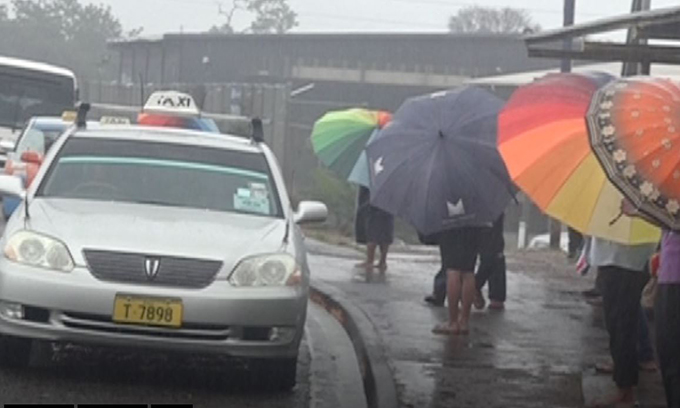
Port Moresby workers waiting for transport in the rain during the capital’s covid lockdown. Image: EMTV News
Lockdown comes into force Earlier today, EMTV’s Annette Kora reported that as “unpredictable cases” of covid-19 continued to increase in Port Moresby, measure 11 for a two-week lockdown had gone into effect this morning.
Applicable only to Port Moresby residents, the coronavirus measure 11 was announced by Pandemic Controller David Manning for a halt to public motor vehicle (PMV) services for the two weeks.
This was to mitigate the spread of covid-19 in the city.
EMTV’s scope of the city early today showed, that apart from cab motorists, public motor vehicles had adhered to the measure and there were no buses seen to be picking up any commuters.
Workers were the only ones huddling at bus stop shelters – no PMV’s in sight.
Only taxi cabs looking to make a few extra money during the lockdown were lined up in front.
Companies, departments, and agencies have been encouraged to arrange transport for pick up and drop off of its staff during the two-week lockdown.
Schools have been suspended for two weeks and a curfew has been imposed in NCD starting tonight from 10pm to 5am.
The NDOH and the NCDC Provincial Health Authority will ensure these measures are adhered to.
The Pacific Media Centre has a partnership with EMTV News.
This week’s annual Australia-US ministerial (AUSMIN) talks took place within the fraught context of a world growing in enmity and anxiety — but no longer economically.
The US ambassador to Australia, Arthur Culvahouse Jr, described it as
one of the most consequential AUSMIN meetings in decades.
Certainly, the Australian team went to unusual lengths to participate. Foreign Minister Marise Payne, Defence Minister Linda Reynolds, Defence Force Chief General Angus Campbell and their teams will all have to quarantine for 14 days on their return to Australia.
US Secretary of State Mike Pompeo noted the commitment to travel to the US during the coronavirus pandemic, saying
not many partners will do that for us.
That effort appears to have been acknowledged in the comparative weight of Australian concerns and priorities in the statement released today following the talks.
Euan Graham, a senior fellow for Asia-Pacific security at International Institute for Strategic Studies, told me this bears the stamp of “pretty proactive drafting from the Australian side”.
The statement reflects broader interests than in previous AUSMIN talks — including a strong section on COVID-19 — and omits any mention of the Middle East. Instead, it focuses heavily on the Indo-Pacific region — Australia’s region.
To satisfy the US side in return, China is named-and-shamed considerably more than what is usual for the Morrison government. Concerns about the fate of Hong Kong under its new National Security Law and of the Uyghurs in China’s western Xinjiang region are spelled out strongly in the statement.
Payne stressed after the talks that while Canberra and Washington share many values,
We don’t agree on everything. We are very different countries. We are very different systems, and it’s the points on which we disagree that we should be able to articulate in a mature and sensible way.
She also emphasised the importance of Australia’s relationship with China, saying
we have no intention of injuring it, but nor do we intend to do things that are contrary to our interests, and that is the premise from which we begin.
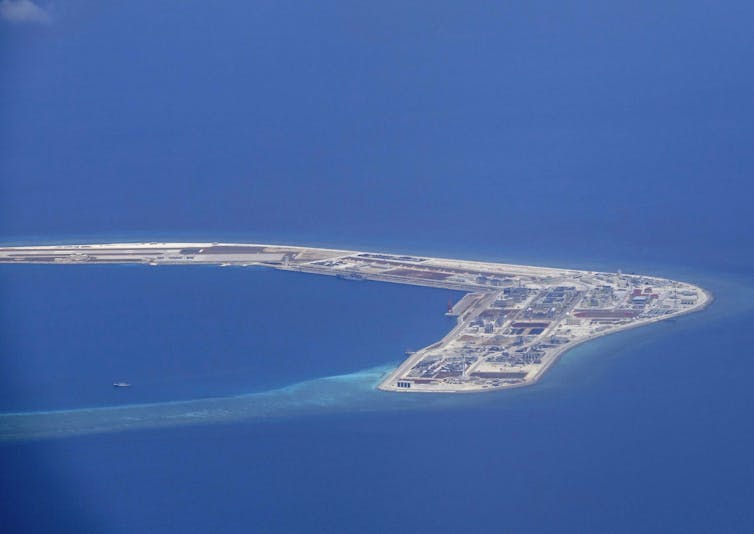
Of course, this comes days after Australia’s strongest statement yet on the legality of China’s effective annexation of the South China Sea — a declaration that drew a rebuke from China’s Foreign Ministry.
But the Washington talks did not see Australia take the further step the US has sought, to support its freedom of navigation operations (FONOPs) by sailing within the 12 nautical miles of the artificial islands China claims in the sea.
This may have reflected a reluctance to embark on a striking new military direction with a US administration that may be replaced in January.
Australia will continue to sail naval vessels through the South China Sea, including in collaboration with the US Navy.
This move is supported by the Labor opposition, with defence spokesman Richard Marles saying it reflects “core national interests”. Some 60% of Australian seaborne trade passes through the area.
Graham, however, says he would be “super-surprised” if the Australians pursued a FONOP on their own, though less surprised, if they did with a flotilla of other countries’ navies.
The US team indicated its approval of the recently announced A$270 billion upgrade of Australia’s defence force – a shift in line with the Trump administration’s urging of US allies to become more self-reliant.
Morrison framed this upgrade within three aims: to more effectively shape the strategic environment, deter actions against Australian interests and respond with credible force when needed.
This also reflects, Graham says, a broader move to refocus Australian defence towards Southeast Asia, the Pacific and India.
The outstanding exception to this new focus, as reflected in the AUSMIN talks, is Taiwan.
The self-governing island is perceived to be coming under more imminent threat from Beijing, which claims it as its territory. The US and Australia affirmed Taiwan’s “important role in the Indo-Pacific region” and indicated their support for its membership in international organisations.
Rather than reflecting a hard defence and security focus, though, the AUSMIN statement prioritised the global response to COVID-19.
Graham believes this is “an Australian win” since the US has lagged in global leadership on the pandemic. The new funding pledged for post-COVID recovery in the Pacific is not massive — but the elevation of health concerns indicated this will now become more central to global security.
Overall, the talks indicate that as American concerns about the China challenge rise — among Democrats as well as Republicans — the Indo-Pacific is becoming ever more important, with Australia providing a crucial southern anchor for potential US force deployment.
They also make clear that while the US-Australia alliance remains rock-solid, Canberra will continue to plot its own course. It will approach issues like China trade, relations with the World Health Organisation and other multilateral agencies, and climate change in a strikingly different manner from the US.
Beijing, for its part, will continue to portray Canberra as an American “lapdog”, while at the same time seeking to do what it can to prise the alliance apart.
But this rhetoric is failing to win any policy traction, despite the instability of the Trump White House. Nor is China’s “deep freeze” of Australia. As Morrison has said, he’s “not waiting by the phone” for an invitation to the Great Hall of the People in Beijing.
This week, Chile reportedly chose Japan — not China — to build the first fibre-optic cable connecting South America with the Indo-Pacific, following the completion of a submarine cable between Japan and Australia this month.
All are members of the Trans-Pacific Partnership, which Trump quit soon after his inauguration.
Such moves underline — as does the AUSMIN statement — the growing complexity and challenges of the post-coronavirus world, not only for Washington but also for Beijing.
The COVID-19 pandemic has brought once-in-a-generation destruction to the lives and livelihoods of people around the world.
The costs of preventing the spread of COVID-19 must always be compared to the health, social and economic costs of viable alternatives. Countries across the globe have dealt with this balancing act differently.
One country in particular that has attracted attention for its lighter approach to lockdown is Sweden. Some people have regarded Sweden as an example for Australia to follow.
But Sweden shouldn’t be seen as a model for Australia when it comes to COVID-19. The virus has spread rapidly, they’ve had more deaths, and the economy is suffering just as badly as their neighbours with heavier lockdowns.
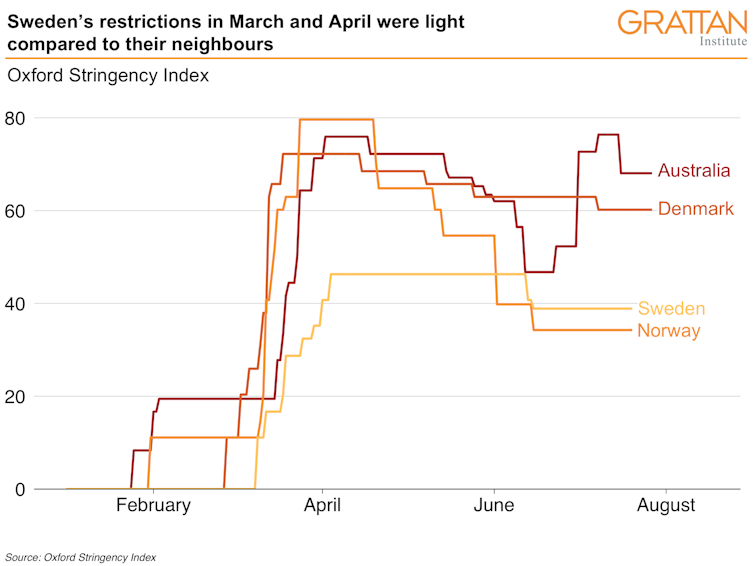
Sweden’s approach was softer, but it wasn’t unrestricted
While some people called Sweden’s approach a “let it rip” policy, this was never the case. Swedes were not free to go about their lives as normal.
Sweden’s policymakers did introduce restrictions to limit the spread of COVID-19 infection, but they tried to do so in a way that minimised the effects on people and companies.
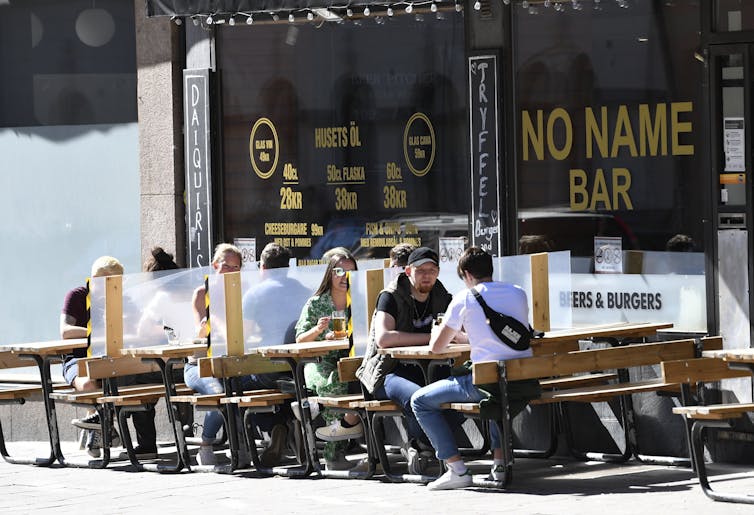
Bars and restaurants could remain open, but with capacity constraints and a requirement of table service. Schools were kept open to preschool and primary students, but were closed to senior students. Non-essential international arrivals were banned, but only from countries outside Europe.
Sweden’s restrictions in March and April were light compared to its neighbours.Oxford
There were social distancing requirements and protections for vulnerable populations. Visits to aged care facilities were prohibited. People over the age of 70, pregnant women, and those with pre-existing health conditions were encouraged to “avoid social contacts” and to ask others to do shopping and errands for them.
These restrictions and recommendations remain in place.
High case numbers and deaths
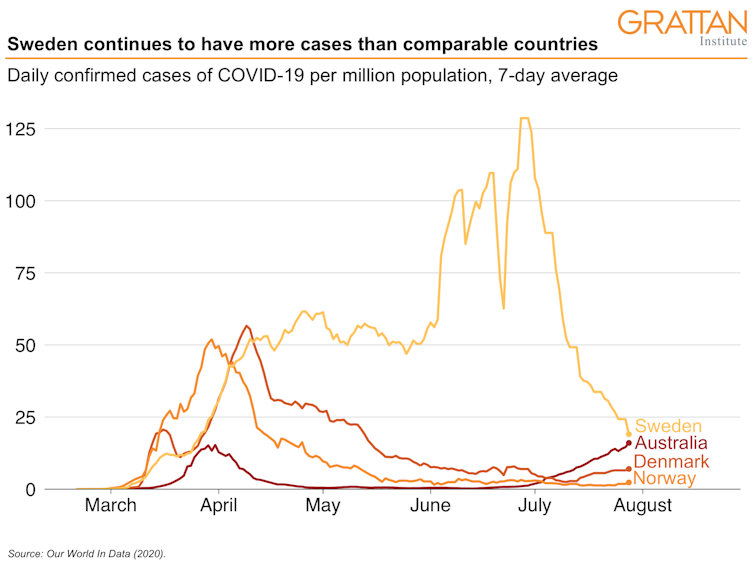
As in Denmark and Norway, the number of new COVID-19 cases rose rapidly in Sweden from the start of March. But Denmark and Norway both implemented tighter restrictions, and their case numbers fell away from April.
Sweden maintained its rate of roughly 600 new cases per day throughout April and May, and then the numbers started to rise again, reaching 1,300 per day at the start of July.
Sweden continues to have more cases than comparable countries.Our World In Data
By the end of July, Sweden had the 7th highest per-capita death rate in the world, and about ten times larger than its Nordic neighbours. Outbreaks spread to aged care facilities and the vulnerable.
Sweden has to date had about 80,000 confirmed cases of COVID-19 — though this is likely to be an underestimate — and about 5,700 people have died. This would equate to about 15,000 lives lost in Australia.
Even with its lighter lockdowns, Sweden has suffered economic losses almost as severe as its Nordic counterparts.
The Swedish labour market has been hit hard. Unemployment is expected to peak at between 9-11%, cushioned by a fall in labour-force participation as Swedes leave the labour market entirely.
The country’s central bank estimates GDP will fall by 4-6%, depending on a second wave of infections.
In comparison, Australia’s treasury expects the unemployment rate here to peak at 9.25%, and for GDP to fall by 2.5%.
Like in Australia, the Swedish government has provided financial support to businesses to reduce the number of job losses, and given additional support to the “many people” who will lose their jobs.
Sweden did implement some restrictions – but they weren’t as strict as other countries.Henrik Montgomery/AAP
Economists from the University of Copenhagen have compared Sweden and Denmark. Both countries had similar exposure to COVID-19 at the beginning of the pandemic, and similar economic conditions before the crisis.
Denmark imposed stricter restrictions from early March, closing the border to all foreign nationals, limiting social gatherings to ten, shutting schools, universities, and non-essential work, and encouraging the entire population to stay home and minimise social contact.
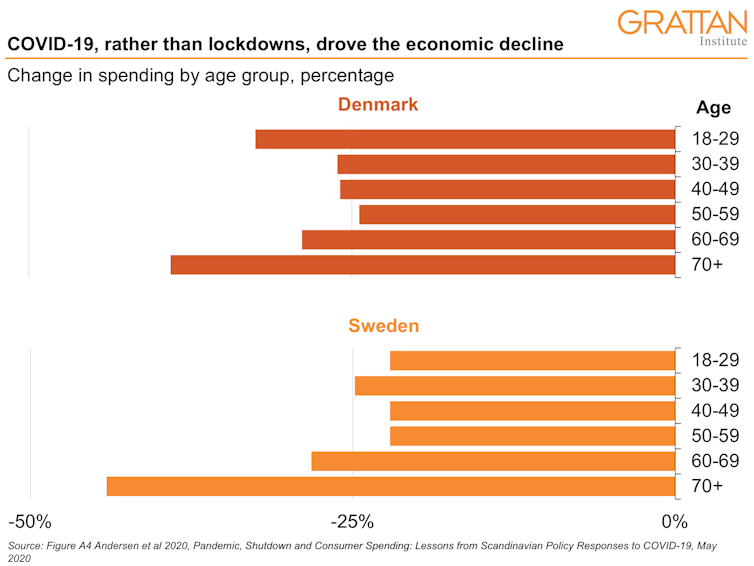
The economists examined the spending of 860,000 people in the two countries. They found consumer spending dropped by 29% in Denmark, but it also fell by 25% in Sweden. People in both countries had changed their behaviour to reduce their risk of infection, regardless of government-mandated restrictions.
COVID-19, rather than lockdowns, drove the economic decline.Figure A4, Andersen et al 2020, Pandemic, Shutdown and Consumer Spending: Lessons from Scandinavian Policy Responses to COVID-19, May 2020
Where Sweden stands now
Swedes’ confidence in the ability of their government and health authority to handle the crisis decreased between April and June.
Their neighbours seem to have limited confidence too. Norway, Denmark and Finland have created a “travel bubble”, but Sweden is excluded from it.
Comparing Sweden to its Nordic counterparts shows its approach hasn’t been as fruitful as it hoped.Johan Nilsson/AAP
While new COVID-19 cases in Sweden have been decreasing from the peak at the beginning of July, they still sit at about 250 per day. Denmark and Norway have been below that level since mid-April.
Swedes have paid a heavy price to get to where they are — and they’re still quite some way from controlling the spread of COVID-19, as their neighbours have done.
We don’t have to lose the lives that Sweden has to learn from its experience. Loose restrictions make COVID-19 harder to control. When the virus is out of control it spreads rapidly, putting millions of vulnerable people at greater risk and reducing the economic activity of the population.
Source: The Conversation (Au and NZ) – By Mary-Louise McLaws, Professor of Epidemiology Healthcare Infection and Infectious Diseases Control, UNSW
New South Wales is on a knife edge after recording more than 150 COVID-19 cases over the last 14 days, a worrying sign the situation could spiral out of control.
The wide geographic spread is of particular concern, as it would rule out ring-fencing as a possible approach to containing the spread of the virus.
It comes as the Queensland government has closed its borders to arrivals from Greater Sydney after declaring the area a hotspot. People returning to Queensland from this area must quarantine in hotels for two weeks from 1am Saturday August 1.
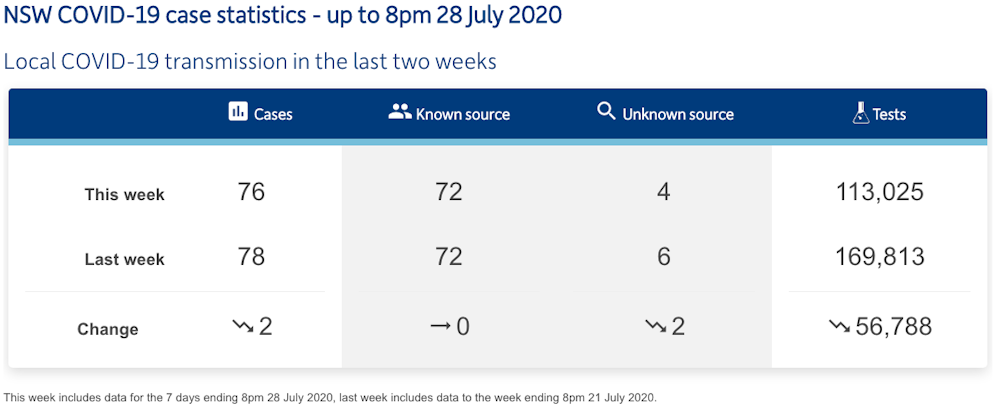
The state recorded 19 new cases in the 24 hours to 8pm on Tuesday, but watching the fluctuations in daily numbers doesn’t necessarily paint an accurate picture of the spread of this virus.
It’s better to look at rolling 14-day cumulative cases, meaning the last 14 days of new cases added together, which represents roughly two incubation periods.
My analysis of the data suggests when cases reach 100 over 14 days – the “red zone” – then an outbreak becomes very difficult to control. This happened in Victoria on June 18, before cases skyrocketed and a second lockdown was called for on July 8.
Over the last fortnight, NSW has recorded at least 154 new cases (minus international arrives in quarantine), which is very concerning.
NSW had previously been tracking very well in managing the virus, before cases imported from Victoria started several chains of transmission, including the Crossroads Hotel cluster.
Another concern is that many of the new cases are very spread out geographically. We’ve seen new cases in central Sydney, Casula and Bankstown in the city’s west, Harris Park in the north-west, and also several hundred kilometres south in Bateman’s Bay.
This spread rules out ring-fencing as a viable control method. Ring-fencing is a strategy to enforce stricter measures in a very defined location to prevent spread within the broader community. It has been used successfully in parts of Beijing, and in Melbourne’s north-west prior to the lockdown across metropolitan Melbourne.
NSW Health’s Dr Jeremy McAnulty and NSW Premier Gladys Berejiklian have warned the state is at a critical juncture.DEAN LEWINS/AAP
What else can be done?
NSW authorities should consider strongly urging Sydneysiders to wear face coverings on public transport. Masks have been shown to offer protection against both getting and spreading the virus.
The state also needs additional infection control measures in aged care. We can see the devastating impact of COVID-19 spread currently occurring in some aged care homes in Victoria. All staff should be wearing face masks or shields, and should be tested regularly for COVID-19, both of which are cost effective control methods.
Effective messaging is also key, particularly when aimed at young people, given over 40% of cases in Victoria are in people aged 20-39 years.
The government needs to disseminate public health messages on platforms that younger people typically use, perhaps by reinforcing the notion we all share responsibility for ending this virus.
Another risk that must be managed is public health messaging fatigue. Authorities need to help the public become resilient to changes in rhetoric as scientific knowledge about the virus advances.
Over the coming days and weeks, NSW health authorities must keep an eye on the ages of people testing positive.
Younger people tend to have many more social connections, sometimes up to 20 close contacts in the infectious period. This means contact tracers need to work extra hard to locate and isolate all close contacts.
One person can result in more than 50 infections, where each person infects two others. The more social contacts you have, the greater the potential spread.Shutterstock
I would be very worried if cumulative cases over a two-week period continue trending upwards and if many of the new cases were young people.
If even a handful of close contacts are not identified, they could go on to infect others and start even larger chains of infection.
One cause for hope is that rates of community transmission where the source of infection is unknown appear to be relatively low, though some cases are still under investigation.
Kylie Moore-Gilbert, a Middle East expert from the University of Melbourne, has now been held by the Iranian government for almost two years.
She was arrested in September 2018 and then convicted of spying and sentenced to ten years’ jail. She has denied all allegations against her, and the Australian government rejects the charges as baseless and politically motivated.
Until recently, Kylie has been in solitary confinement in Iran’s Evin prison, run by the Iranian Revolutionary Guard Corps. But this week, she was transferred to Qarchak, which is notorious for its brutal treatment of prisoners.
Kylie Moore-Gilbert has been detained in Iran for more than 680 days.Department of Foreign Affairs
Kylie is a colleague and a friend. For the past two years, I have been keeping silent in the hopes a quiet diplomatic approach would secure her freedom.
But it is hard to overstate how horrific this week’s development is. Australia needs to do more.
‘Entirely alone’
I am a Middle East analyst, who specialises in the Persian Gulf. In fact, Kylie and I first met because we both work on state-society relations in Bahrain. I can see, examining the treatment of other foreign political prisoners in Iran, that Kylie has been treated exceptionally poorly.
In letters smuggled out of Evin prison last year, Kylie wrote how she felt “entirely alone”. She has also written how her “physical and mental health continues to deteriorate”.
Media reports indicate Kylie was able to speak to her family about a month ago and Australian diplomatic staff have also been in contact.
However the Department of Foreign Affairs and Trade’s statement this week – that they are “urgently seeking further consular access to her at this new location” and “hold Iran responsible for Dr Moore-Gilbert’s safety and well-being” – suggests Australia was not consulted before her transfer to Qarchak.
On Wednesday, The Guardian reported a recording of Kylie out of Qarchak. Speaking Persian, she says:
I can’t eat anything. I feel so very hopeless […] I am so depressed.
Is this all two years of diplomacy has bought us?
Australia must do more
I am not speaking out now to challenge this quiet diplomatic approach regarding Iran. I am speaking because I believe more public pressure must be placed on the Australian government to ensure it is living up to its own rhetoric.
DFAT claims Kylie’s case is “one of the Australian government’s highest priorities, including for our Embassy officials in Tehran”.
But the amount of secrecy involved in the process means we cannot know if this is true.
Even though the situation is sensitive, there are avenues Australia can pursue on behalf of Kylie.
Based on my analysis of publicly reported cases, around one in three foreign political prisoners in Iran over the past five years have been released via a prisoner swap. This reportedly includes Australian tourists Jolie King and Mark Firkin who were arrested in Iran last year.
Based on publicly available knowledge, Australia does not currently hold any Iranian prisoners. However our key ally, the United States, does.
The politics are not straightforward
It must be acknowledged that the politics around this case are very complicated. Relations between Iran and the US and far from friendly – especially after the assassination of Iranian Revolutionary Guard Corps commander Qassem Soleimani in January 2020.
There is another problem, too.
Despite Australia maintaining constructive relationships with Iranian President Hassan Rouhani and Foreign Minister Mohammad Javad Zarif, they are not the key to securing Kylie’s freedom.
The Iranian political system is fragmented and parts of the army, judiciary and intelligence agencies report to Iran’s Supreme Leader, Ayatollah Ali Khamenei.
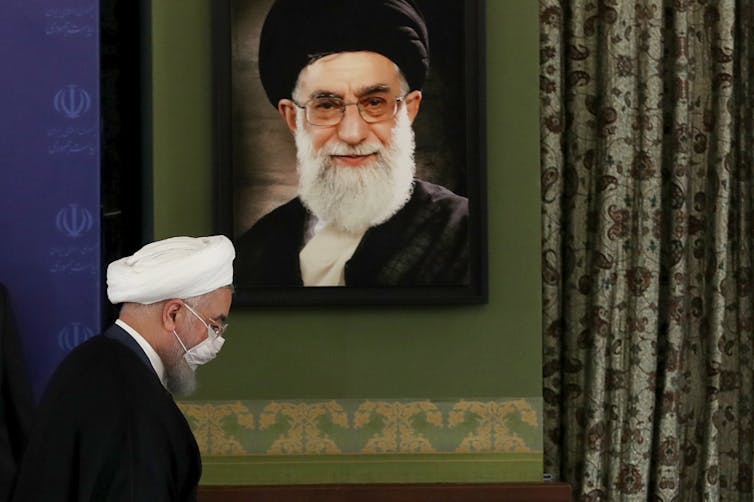
Rouhani and Khamenei’s relationship is also poor and Khamenei’s influence has grown since Kylie was first incarcerated. Iran will hold presidential elections in 2021 and as Khamenei seeks to secure Iran’s future, he may attempt to empower a more hardline president.
Relations between Iran’s President Hassan Rouhani and Supreme Leader Ayatollah Ali Khamenei are poor.Iran President handout
This means Australia must think outside the box to secure Kylie’s release. The solution to this crisis is undoubtedly a diplomatic one – and we clearly need to spend more diplomatic capital than we’re already using to fix it.
But it will become more difficult if we do not put sufficient resources into her release before the next presidential election.
This case is relevant for all of us
COVID-19 also makes Kylie’s situation more urgent. My assessment is the Australian government must urgently push for Kylie’s immediate transfer out of Qarchak prison, to a safe location where her consular access and health can be protected.
There is precedent for foreign detainees to be transferred to house arrest in embassies while cases are resolved.
Beyond the harrowing personal situation, Kylie’s case is also relevant to all of us. It fits a wider pattern, where the space for academic research is being narrowed in authoritarian states. This is occurring not just in Iran but in countries such as China, the United Arab Emirates and Saudi Arabia.
If this research cannot be conducted, or if the Australian government fails to protect its researchers who need to do fieldwork in these countries, this allows authoritarian states to silence criticism.
And then set the narrative about their internal politics as they see fit.
Source: The Conversation (Au and NZ) – By Ivano Bongiovanni, Lecturer in Information Security, Governance and Leadership / Design Thinking, The University of Queensland
Imagine how you’d feel if you discovered footage from your private home security camera had been broadcast over the internet. This is exactly what happened to several unsuspecting Australians last month, when the website Insecam streamed their personal lives online.
According to an ABC report, Insecam broadcasts live streams of dozens of Australian businesses and homes at any given time. Some cameras can be accessed because owners don’t secure them. Some may be hacked into despite being “secured”.
When asked if they care about their personal information being shared online, most people say they do. A 2017 survey found 69% of Australians were more concerned about their online privacy than in 2012.
However, a much smaller percentage of people actually take the necessary actions to preserve their privacy. This is referred to as the “privacy paradox”, a concept first studied about two decades ago.
To investigate this phenomenon further, we conducted a research project and found that, despite being concerned about privacy, participants were willing to sacrifice some of it in exchange for the convenience afforded by an internet-connected device.
Unpacking the privacy paradox
Any “smart” device connected to the internet is called an Internet of Things (IoT) device. These can be remotely monitored and controlled by the owners.
The projected growth of IoT devices is staggering. By 2025, they’re expected to reach 75.44 billion – an increase of 146% from 2020.
The global IoT network is a collection of all the interconnected devices that can communicate online. This includes smart devices, appliances and wearable tech.Shutterstock
But as the privacy paradox highlights, users expressing privacy concerns often fail to act in accordance with them. They freely divulge personal information in exchange for services and convenience.
Explanations for the privacy paradox abound. Some suggest:
people find it difficult to associate a specific value to their privacy and therefore, the value of protecting it
people completely lack awareness of their right to privacy or privacy issues and believe their desired goals (such as a personalised experience) outweigh the potential risks (such as big tech companies using their data for profiling).
The likely explanation for the privacy paradox is a mix of all these factors.
To understand whether and how the privacy paradox applies to IoT devices, we conducted an experiment involving 46 Saudi Arabian participants. This is because in Saudi Arabia the use of IoT is exploding and the country does not have strong privacy regulations.
We gave participants a smart plug that let them switch a table lamp on or off using an app on their smartphone. We then showed them the device’s privacy policy and measured participants’ privacy concerns and trust in the device.
None of the participants read the privacy policy. They simply agreed to commence with the study.
After two hours, we presented evidence of how much of their data the IoT-connected plug was harvesting, then remeasured their privacy concerns and trust.
After the participants saw evidence of privacy violation, their privacy concerns increased and trust in the device decreased. However their behaviour did not align with their concern, as shown by the fact that:
15 participants continued to use the device regardless
13 continued to use it with their personal information removed
only three opted to block all outbound traffic to unusual IP addresses.
The rest preferred “light-touch” responses, such as complaining on social media, complaining to the device’s manufacturer or falsifying their shared information.
After one month, we measured participants’ attitudes a third time and discovered their privacy concerns and trust in the device had reverted to pre-experiment levels.
How to prevent complacency
Two decades since the first privacy paradox studies were conducted and despite a great deal of research, there is still a mismatch between people’s stated privacy concerns and their protective behaviours. How can we improve this?
Every time you connect a new device to the internet, or opt-in to a new service, ask yourself: ‘do I really need this?’Shutterstock
The first step is to simply be aware our judgement of IoT device risks and benefits may not be accurate. With that in mind, we should always take time to read the privacy policies of our devices.
Besides informing us of the risks, reading privacy policies can help us stop and think before connecting a new device to the internet. Ask yourself: “is this really going to benefit me?”
As citizen surveillance increases, it’s not wise to mindlessly scroll through privacy policies, tick a box and move on.
Second, we should not assume our personal information is trivial and would not interest anyone. Time after time we have witnessed how our digital traces can be valuable to malicious individuals or large corporations.
And finally, always change the default password on any new IoT device to a stronger one. Write down this password and secure it, perhaps with other physical valuables, so you don’t have to worry about forgetting it.
From August 1, if the federal government has its way, Medicare will stop paying for GPs to interpret common heart tests called electrocardiograms, or ECGs.
Health Minister Greg Hunt says the decision is based on safety advice from a top-level medical expert panel convened by the government to review Medicare rebates. But a closer look at the advice reveals the panel suggested precisely the opposite.
And by treating ECG interpretation as a specialised task rather than an everyday part of a GP’s toolkit, the change risks making it harder and more expensive for patients to access these simple but potentially life-saving tests.
What are ECGs?
ECGs are tracings of the heart’s electrical activity. If you’ve watched a medical drama on TV and seen a flat line on a screen bounce back to a healthy wobbly line as a patient is rescued from cardiac arrest, you’ve seen an example of an ECG – it’s that wobbly line.
In fact, ECGs in real life typically consist of 12 different wobbly lines (a so-called “12-lead ECG”), as the heart’s electrical activity is measured from different directions. If you’ve had one yourself, you may remember sticky patches being placed on your skin, and a tangle of wires connecting these patches to a special machine that prints out the ECG trace.
These tests are a common tool for many doctors, including GPs. All medical students are expected to learn to interpret an ECG – it is not a test reserved for cardiologists.
There are all sorts of situations in which a GP may need to use and interpret an ECG. One obvious example is when a patient is suffering chest pain that could be due to a heart attack or angina. Others include assessing unusual heart rhythms, such as atrial fibrillation, which is a common and important risk factor for stroke that GPs are encouraged to detect and treat.
Under the new plan, public funding for ECGs in general practice will be restricted to producing (rather than interpreting) the trace. This is a technical task rather than a medical one, and many GPs, who rightly feel qualified to interpret ECGs, find this insulting.
More importantly, this loss of funding may harm patients. As shadow health minister Chris Bowen has explained, an increase in out-of-pocket costs to patients, or a reduction in funding to general practice, may limit availability of this important test to people who need it. There is good evidence out-of-pocket costs limit access to health care.
While traces can be forwarded to a cardiologist for interpretation, this too may involve costs, and may be difficult in rural and remote areas.
The health minister’s explanation doesn’t stack up
Pressed to justify these proposals, health minister Greg Hunt this week told the ABC:
This came from a medical expert panel. It came from what’s known as the Medicare taskforce, led by Prof Bruce Robinson. It’s the highest clinical advice and it was based on safety.
A Department of Health spokesperson offered a similar line to the ABC in a news article this week.
The taskforce (formally called the Medicare Benefits Schedule Review Taskforce) has been working to reform the Medicare schedule – that is, the list of medical services funded by Medicare. This is a fine initiative, which brings evidence and expertise to the task of modernising Medicare. Appropriately, it enjoys the bipartisan support of our major parties. It is laudable when the government follows such independent expert advice.
The problem here is that, contrary to Hunt’s claim, the MBS Review Taskforce did not recommend that Medicare stop paying for GPs to interpret ECGs. On the contrary, the taskforce explicitly recommended the opposite.
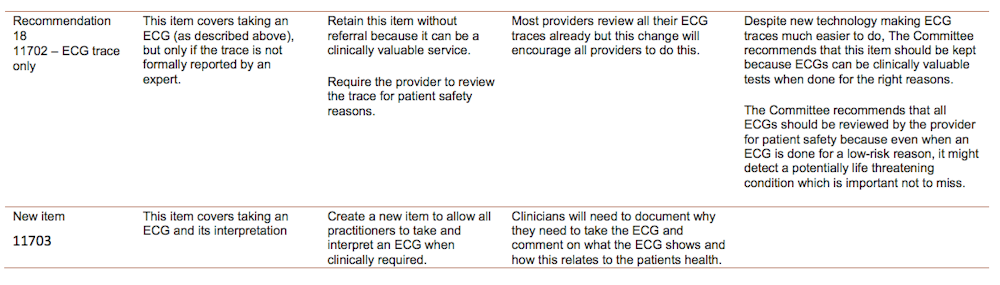
The 344-page final report of the taskforce’s Cardiac Services Clinical Committee is pretty dry reading, but if you make it as far as page 200 you’ll find it acknowledges the importance of ECGs in general practice. In fact, the report explicitly proposes a new Medicare rebate to “allow all practitioners to take and interpret an ECG when clinically required”.
The taskforce’s heart committee recommended Medicare funding all practitioners to take and interpret ECGs.Dept of Health
Instead, the federal government has proposed an array of new ECG rebates, none of which would fund GPs to interpret ECGs.
Granted, health policy is a complex area, even when there isn’t a pandemic unfolding. Nevertheless, this seems to be a clear case of expert advice not being translated into policy.
I would urge Hunt and his department to heed the advice of their own expert taskforce, and the concerns raised on behalf of GPs and their patients, and reverse their plans to defund ECG interpretation in general practice – or at least offer a full explanation as to why they are proceeding with this policy.
New South Wales premier Gladys Berejiklian has called for more businesses to register as COVID Safe, as the state recorded 19 new cases of coronavirus in the 24 hours to 8pm Tuesday night. Berejiklian said:
If I walk into a venue and I’m not comfortable with how COVID safe that venue is, I’d leave. I expect patrons to do the same.
Good advice — and timely, too. As NSW Health’s Jeremy McNulty said on Wednesday, NSW is “at a knife’s edge, a critical point”.
Here’s what to look for when you walk into a bar, cafe or restaurant to know if it’s COVID safe — and how to know when to walk out the door.
Familiarise yourself with the rules business must follow to register as a COVID Safe business in NSW. The rules are here.
Steps to become a COVID Safe business, according to NSW Health.NSW Health
Check to see the venue’s COVID Safe certificate is clearly displayed and that they are taking every patron’s contact details. If a patron is dining in, the venue must be recording their contact details or checking they are registered with the COVIDSafe app.
If they’re not recording people’s details in some way, leave. If a COVID-19 positive case visits that venue, contact tracers are unable to do their job unless all patrons’ details are recorded.
Check if tables are appropriately spaced and that cutlery, napkins, glasses, plates, bowls or straws aren’t left lying on tables — even if they are disposable. Nothing should be on the table for people to pick up (or in a tub for patrons to collect themselves). Cutlery and other utensils should be brought out by staff when your order is ready. The idea is to reduce the risk of a COVID-19 positive person handling your utensils.
Your table should be 1.5m away from other tables but I’d even be trying to keep 1.5m from friends at my own table. Personally, I’d also want to see my friends wearing masks (it’s different if you’re dining with people with whom you live). Even if you or your friend had a COVID-19 test yesterday and it came back negative, that doesn’t mean you’re negative today. You could have been infected in the past 12 hours.
Watch what happens when a patron leaves. Are staff appropriately sanitising tables and chairs with spray and, ideally, disposable paper towel? They should be.
Look around to see if the venue provides hand sanitiser for patrons — and keep an eye on the staff to make sure they are using it too.
Staff, ideally, should be wearing masks, in my view. I know that’s not yet compulsory in many places, but masks provide a barrier if a staff member is unknowingly positive. It’s hard to make patrons wear masks, because they have to eat, but I’d be looking for the staff to be wearing them (all staff, not just a couple).
Check if the venue is enforcing contactless transactions to reduce the handling of money, cards and pin pads. I know the evidence about the role of surfaces in spreading this coronavirus is still emerging but we should stick to universal precautions — if something can be avoided, it should be.
Staff should be limiting the number of patrons at the venue, and the number of patrons allowed in the venue at any one time should be clearly displayed. If people are lining up outside, make sure they are being spaced out too.
In general, aim for an open-air setting if you can, such as a beer garden or an open-air cafe. The more fresh air flow you have around you, the more transmission risk is reduced. Any sort of indoor socialising, where air flow is limited, is inherently risky at the moment in NSW.
Eating out? Check to see if staff are sanitising surfaces, wearing masks, using contactless payment, and spacing out customers.Shutterstock
When to leave
Breaches of any of the above would be enough to make me want to leave. But here are some more triggers that would make me think, “I’m getting out of here.”
If you see staff or patrons with symptoms — they have a cough, or cold, or seem unwell — leave.
If they are not wiping surfaces or tables, or allowing patrons to come in and seat themselves, leave. Patrons should be shown to tables that have been sanitised.
If the place is starting to fill up and you sense physical distancing is not being observed — leave.
A critical point
NSW is at an especially critical point. I’d be very, very careful right now. If I was in a Sydney hotspot, I wouldn’t be going out to dinner at all.
NSW is doing a good job of putting out spot fires but any one of those spot fires can flare up if people aren’t taking precautions.
If you thinking of going out, and you are wondering if it is risky, then you are better off not doing it. If you feel you have to go, then mitigate your risk by moving the event outside or making sure everyone is distancing and wearing masks.
Restaurants might look quite different for some time.Andre Penner/AP/AAP
COVID-19 is a really serious disease that affects young and old. You can get sick or even die, even if you are young and healthy — and the evidence on long term effects is worrying. And of course, healthy people can pass it on to someone who is in a high risk category. It’s so important that everyone continues to observe the appropriate protocols — today. This week. This weekend.
Until COVID-19 either burns out globally or we get a vaccine — and neither of those are right on the horizon and may not happen at all — then this may become the new normal, sadly. Infection control measures remain our best chance of keeping the pandemic in check.
More than 600 academics from 36 Australian universities and members of the academic community have signed an open letter to federal and state education ministers calling for a return to a more democratic, cost-effective and functional structure for Australia’s universities.
Australian universities are in crisis. Large-scale redundancies are announced almost daily, with estimates of up to 21,000 jobs at risk this year alone. Financial modelling by the University of Melbourne reveals the prospects for even the richest universities are bleak, while poorer universities face a veritable existential threat.
The impact of job losses is likely to be greater for regional universities, given the significant role they play in their local economies. This impact is likely to be compounded by the government’s recently proposed course fee changes.
This crisis has been commonly attributed to the impact of COVID-19 and the sudden drop in international student numbers. But while the effects of COVID-19 are undeniable, the roots of the crisis are far deeper. As history lecturer Hannah Forsyth put it:
Australian universities have long teetered — or, worse, arrogantly swaggered — on a precarious foundation.
We argue the problems Australian universities are facing have largely been produced by a profound transformation over the past several decades, which has morphed them into organisations that mirror the hierarchical corporate structures of the commercial sector.
Public Australian universities are created by legislation which establishes them as statutory bodies with delegated legislative powers, similar to local councils. While each enabling act varies, universities are generally comprised of all permanent academic members of staff, all students, all graduates and a council.
University councils are the governing bodies of each university, with a mandate to act on behalf of the university (constituted as above) to enact its legislative mandate (generally speaking, research and tertiary education). In this sense, universities are not commercial corporations, councils are not boards of directors, vice-chancellors are not CEOs and students are not customers.
University councils are not boards of directors.Shutterstock
This model — whereby universities are public institutions with public functions, transparently managed by a council accountable to both the university and the broader electorate whose taxes finance the university sector — has been the dominant one throughout history, and still is in the vast majority of the world.
Australia’s shift to a commercial corporate model has weakened this tradition. This has resulted in
a significant increase in economic competition between institutions
The commercial corporate model has been revealed to be particularly fragile in the face of the present crisis. Many have advocated, over the years, that the structural fragility of Australian universities could have been mitigated by exercising more judicious, conservative and careful management.
The federal government has so far provided scant support to help universities deal with the COVID-19 crisis. As a result, university managements have adopted a range of drastic measures to reduce spending particularly through large-scale job cuts.
Management has been accused of prioritising a self-serving and broken model at the expense of the careers and livelihoods of staff who have been systematically disempowered. No radical and necessary reforms of the failing corporate university model have been proposed.
We propose a return to the time-honoured and proven horizontal university model described above. We propose university councils are made more transparent and accountable to both the university, on whose behalf they operate, and the communities they serve. We further propose all directorial, senior and middle-executive roles are selected through internal elective processes.
A return to a more democratic governance structure will realign them with the intentions and expectations already set out in their enabling legislation, and will ensure they fulfil their time-honored and legislated mandate, which is
The promotion, within the limits of the University’s resources, of scholarship, research, free inquiry, the interaction of research and teaching, and academic excellence.
The full proposal, which will be submitted on August 1 to federal and state education ministers, can be found in the open letter all Australian academics can sign.
In recent days, both sides involved in Clive Palmer’s legal challenge against the Western Australia border closure have sought to highlight the importance of what is at stake.
is crucial for the survival of the domestic economy and for the whole of Australia.
With Queensland announcing another border closure to Sydney residents today, the WA case could be pivotal.
It will set an important precedent and ultimately determine whether, and to what extent, state governments can close their borders to protect their residents against future outbreaks.
The legal challenge in WA
The WA government closed its border to everybody other than “exempt travellers” from April 5 to limit the spread of COVID-19. Palmer was refused an exemption to enter WA in May and responded by filing a constitutional challenge to the laws authorising the border closure.
The key constitutional question here is whether the current restrictions are proportionate and appropriately tailored to address the identified risk to public health.
In particular, the Federal Court is being asked this week to identify precisely what risks the COVID-19 pandemic poses to public health in Australia, and the extent to which border closures might mitigate these risks.
The Federal Court will not make a final decision about the constitutional validity of the border closures. Instead, it will determine the relevant facts in the case based on evidence presented by public health experts.
These facts will be critical to deciding the ultimate constitutional question.
What happens next?
The Federal Court hearing is only step one. Once these factual questions have been decided, the case returns to the High Court, which will determine the constitutional questions.
While the parties and courts have all acknowledged the importance of expediting this matter, the earliest this case could be heard by the High Court would be September. This means a final decision on whether the border closures are valid could still be weeks away.
Another important practical consideration is how the WA government may react if it loses the constitutional challenge. McGowan has already said
if the High Court rules that the borders have to come down that is the law of the land.
But any High Court decision will be based on the reasonableness of the current restrictions, and the court tends to limit its decisions to the particular facts before it. The judges are unlikely to speculate about whether alternative border closure restrictions may be constitutionally valid.
As such, one option for WA if it loses may be to remove the existing restrictions, but immediately replace them with amended restrictions that are adapted to the court’s ruling.
A win for Palmer in the High Court may not therefore necessarily result in the WA borders immediately re-opening.
McGowan has defended WA’s ‘very straightforward system’ of border closures, even as neighbouring states have seen virus cases decline.Richard Wainwright/AAP
What will the High Court decide?
It is never possible to definitively predict the outcome of a High Court case. This is particularly true in the present case, given the specific constitutional issue at hand has not previously been directly considered by the court.
However, in cases involving questions of reasonableness and the balancing of public policy objectives, courts tend to err on the side of allowing governments a significant degree of discretion.
For this reason, the WA government has a strong constitutional case, provided the Federal Court finds the expert evidence supports border closures being justified from a public health perspective.
This highlights the significance of the current Federal Court hearing. It would be extremely controversial for the High Court to invalidate border closures imposed by a state government if the expert evidence established a public health justification for the measures.
Why governments need discretion in cases like this
Indeed, this highlights a more fundamental question about who is best placed to make these types of decisions in a democratic society.
There is no objectively right or wrong answer to the question of whether state borders should be shut in these circumstances, or for how long. It is instead a judgement call that has to be made on the best information available at the time, and that requires the decision maker to balance a range of different public policy factors.
An elected government is best placed to make judgement calls of this nature. It can adapt its response as circumstances change and take into account community sentiment (which is important to ensure compliance).
A government will also be subject to a range of different accountability measures, including, ultimately, judgement by the people at an election.
Judicial decision-making is very different. It is necessarily based on the particular facts of a single case before the courts and is not adaptive to circumstances. The courts also do not need to consider the practical challenges of implementing a specific policy or regulation, and are not subject to direct democratic accountability.
These can be virtues when the courts are engaged in legal decision-making. They also demonstrate why the courts should not be involved in making decisions of a more political nature.
While there is a legitimate role for judicial scrutiny, the judgement calls required in a public health emergency are more appropriately left to the executive and parliamentary branches of government.
This democratic mandate granted to elected officials should be respected by the courts when considering the current challenge to the WA border closures, particularly given the importance of what is at stake.
“You kind of fail your way to success,” observed Matt Lieber, head of podcast operations at Spotify, at this year’s Audiocraft festival, an annual weekend of panels about podcasting. Normally held in Sydney, this year, thanks to COVID-19, the festival shifted online.
Lieber was talking about StartUp, his podcast about establishing Gimlet Media in 2014. Lieber and his business partner, Alex Blumberg, wanted to develop a podcast studio that would become “the HBO of audio”.
Last year, Gimlet hit the jackpot. It was acquired by Spotify for US$230 million (A$322 million).
While podcasts have been alive on the internet since 2004 (“But what to call it? Audioblogging? Podcasting? GuerillaMedia?” asked the Guardian), 2014’s Serial is largely credited with starting a new boom for the form.
Serial hit 420 million downloads in late 2018; S-Town, from the same production company, had 40 million downloads in its first month.
Last week, the New York Times (whose own The Daily has surpassed one billion downloads) acquired Serial Productions for US$25 million (A$35 million).
What was once on the fringes of the internet is now a multi-billion dollar industry.
For a long time, podcasting was touted as the most democratic and accessible mode of journalism and public engagement.
On podcasts, hobbyists could indulge a passion for Greek legends, friends could riff on their favourite books, celebrities could show their human side, and media organisations could share stories too unwieldy for a newspaper or television format.
The early low-budget, niche podcasts were a far cry from shows like Serial or The Joe Rogan Experience. (Hosted by comedian Joe Rogan, the latter show has a reported 190 million downloads a month and was acquired by Spotify in May for around US$100 million (A$140 million).
While some Spotify shows are still available on other podcasting services, productions like The Joe Rogan Experience and the platform’s latest offering, The Michelle Obama Podcast, are available exclusively on Spotify.
Obama’s podcast, which launches today, features conversations on the “relationships that shape us” – not surprisingly, her first guest is her husband.
Spotify’s known investment in acquiring podcasts over the past 18 months comes to around US$696 million (A$975 million). This figure doesn’t include the unknown price Spotify has paid in deals with the Obamas and Kim Kardashian West to produce original shows, nor the money Spotify is investing in-house.
While Rogan and Obama’s podcasts are (for now) free to listen to, they will tempt people over to the platform and – Spotify hopes – create paying subscribers. Obama’s 2018 memoir, Becoming, has sold over 10 million copies: that is a lot of potential listeners.
Far away from these mega-investment dollars, independent producers are still creating smaller shows for devoted audiences. Many attending Audiocraft were these independent producers, seeking to learn more about the art, craft and business of bringing their podcast ideas to life.
Such aspirations were mocked by a recent ABC skit with celebrities begging people not to turn to podcasting under quarantine.
The skit polarised viewers: older folk laughed, but younger people bristled, seeing it as an entitled elite trying to police what should be a wide open space without gatekeepers.
This divide is a growing tension among podcast producers.
Pushing boundaries
The other big commercial contender in podcasting is the Amazon-owned Audible, which has similarly gone on a “multimillion-dollar shopping spree” for podcasts over the past few years.
With Spotify locking listeners into their platform, and Audible’s podcasts only available to paying subscribers we are a far cry from the open internet ideals the form was built on.
Yet, even in this world of multi-million dollar deals, independent producers are still asserting their right to shape the industry.
Renay Richardson, a black British podcaster whose passionate presentation at Audiocraft wowed the audience, founded Broccoli Content to advance diversity in podcasting. This year, she launched an Audio Pledge demanding equity in pay and representation for minority voices.
It has so far been signed by over 250 organisations, including Spotify and the BBC.
An intimate artform
According to Spotify’s Matt Lieber, podcast listeners want to hear a story, learn something new, and find someone you would want to hang out with. One festival session ticked all three boxes.
Bird’s Eye View was made in Darwin Correctional Centre over two years. Funded by the Northern Territory government and the Australia Council and independently distributed, Birds Eye View gives a remarkable insight into the lives of incarcerated women.
With raw empathy, the podcast shares moving stories of women talking about abuse, addiction and crime on the outside along with darkly humorous stories of life on the inside. It’s a testament to deep relationships formed over a long and immersive production time.
The payoff is the compelling personal storytelling at which podcasting excels.
Some producers fear with the industry so rapidly growing, market forces could choke creativity and innovation.
An old adage holds that if you can fake sincerity, you’ve got it made. If the big podcasting platforms figure that one out we will all be the poorer.
Podcasting’s special ingredients have long been the authenticity of its wide range of voices and the intimate relationship they engender with the audience, speaking directly into our ears. If those defining characteristics get subverted in a push for profit, much of podcasting’s magic will be lost.
Source: The Conversation (Au and NZ) – By Clive Phillips, Professor of Animal Welfare, Centre for Animal Welfare and Ethics, The University of Queensland
This month marks 60 years since Dame Jane Goodall first ventured into the wilds of Gombe, Tanzania, at the tender age of 26 to study the behaviour of chimpanzees. She has devoted her life to species conservation and campaigned tirelessly for a healthier environment.
Jane is an icon of our era. Among her groundbreaking discoveries are that chimpanzees have personalities, use tools, have wars and can eat meat — all of which made us question our own behaviour as closely related great apes.
Flo with infant Flint riding on her back. Jane Goodall’s groundbreaking research made us question what it means to be human.Hugo van Lawick/the Jane Goodall Institute
She established the Jane Goodall Institute, and her Roots and Shoots program now operates in more than 100 countries to encourage young people to be compassionate, helping people, animals and the environment.
When I first read about Jane’s work, I was amazed anyone could get so close to animals — in her case chimpanzees — to understand their minds, society and lives. For several decades, my research attempted to do the same for intensively farmed animals.
Jane and I ended up in the same philosophical place: committed to exposing the horrors of factory farming, and proudly vegetarian because of the damage eating meat does to animals, the environment and to people eating the end products.
With this in mind I relished the prospect of meeting Jane. She gave us all unique insights into the inner lives of one of our closest relatives, chimpanzees, as well as pioneering a compassionate approach to animals, a cause very close to my heart.
At 26 years old, Jane Goodall travelled to what’s now Tanzania to study the behaviour of wild chimpanzees.Hugo van Lawick/the Jane Goodall Institute
Clive Phillips: Jane, you famously dispelled the myth that humans are the only tool-users. Do humans have any unique characteristics to distinguish them from other animals?
Jane Goodall: Well, I believe the most important thing distinguishing us is the explosive development of the human intellect. We have developed communication using words, which means we can learn from our elders, we can plan for the future and we can teach our children about things that are not pleasant.
Above all, we can bring people together from different backgrounds to discuss a problem and try and find the solutions.
Phillips: Do you think this “human uniqueness” implies a responsibility towards animals?
Jane Goodall famously discovered that chimpanzees use tools.
Goodall: I would say it’s a humanistic responsibility. I mean, once you are prepared to admit that we humans are not the only beings on the planet with personalities, minds and, above all, emotions, and once you are prepared to admit that animals are sentient and can not only know emotions like happiness, sadness, fear, but especially they can feel pain — then, as humans with advanced reasoning powers, we have a responsibility to treat them in more humane ways than we so often do.
Phillips: You mentioned the importance of pain in animals and sentience. Does that give us a moral duty towards them? Or, do you think we have a right to manage them?
Goodall: Well, I don’t know about having a right to to manage them. But the problem is that because of the way our societies have developed, the harm we inflict on the environment, and the devastation we’ve caused so many species, we now have an obligation to try and change things so animals can have a better future.
We now know it’s not only the great apes, elephants and whales that are amazingly intelligent. We now know some birds like crows and the octopus can be, in some situations, more intelligent than small human children. Even some insects have been trained to do simple tests. This was unthinkable a while back.
We also know, for example, that trees can communicate to the micro fungi on their roots, under the soil. And this is amazing. It’s very exciting for any young person wanting to go into this field — these really are exciting times.
Jane Goodall wrote up her field notes each evening in her tent at Gombe.Hugo van Lawick/the Jane Goodall Institute
Phillips: Do you believe climate change will alter the relationship we have with other animals, and our ability to manage and use them in the way we do at the moment?
Goodall: We shouldn’t be managing and using them. We should be giving them the opportunity to live their own lives in their own way. And we should stop interfering.
We should protect habitat so that they can continue to flourish in their natural habitat. Those animals that we have subjugated to domestication should be treated as animals: sentient sapiens with feelings, knowing fear and depression and pain.
And we should really start thinking about what we’re doing in our factory farms, in our labs and with hunting. To me, that’s the most important thing.
Phillips: And that will, in itself, address some of the climate change issues, I imagine.
Goodall: Yes. Eating meat involves billions of animals in factory farms that have to be fed. Areas of environment are cleared to grow the grain, fossil fuels are used get the grain to the animals, the animals to the abattoir and the meat to the tables.
Global meat consumption comes with a range of animal welfare and environmental issues.Shutterstock
Water is wasted changing vegetable to animal protein, and methane the animals produce in their digestion is one of the most intense greenhouse gases. All of this means we have to do something about continuing to eat more and more meat.
Goodall: Well, we have to change attitudes. Yes, we’re eating more meat, but at the same time the number of people who are becoming vegetarian and vegan is increasing.
Phillips: It reminds me of one of your early discoveries of chimpanzees eating meat. Do you think that had an implication or any bearing on the human diet?
‘We should be giving them the opportunity to live their own lives in their own way. And we should stop interfering’.AP Photo/Jean-Marc Bouju
Goodall: Humans are not carnivorous, we are omnivorous. And there is a big difference. Our gut is not like a carnivore’s guts, which is short to get rid of the meat before it goes bad and inside your gut. We have a vegetarian gut, an omnivore’s diet. This means our gut is much longer to get all the goodness out of leaves and all the other things we eat.
So when you think of chimps — yes, they hunt, and they seem to love hunting. But it’s been estimated that meat occupies only about 2% of their diets. That’s just for some individuals. Others hardly ever eat meat at all.
Phillips: How can we best get the message across that a vegetarian diet is the most sustainable for the planet, and good for animal welfare?
Goodall: We’re working with young people from kindergarten through university, now in more than 50 countries, growing all the time. It involves young people of all ages choosing projects to make the world better for people, animals and the environment.
They are changing the way their parents think, and the vegetarian ethic is very strong in many of them. So I say you’ve got to change the mindset and children help to change the behaviour of their parents.
Chimpanzee Fifty, son of Fanni in Gombe National Park.Carlos Drews/the Jane Goodall Institute
Phillips: That’s a tremendous piece of advocacy, given the huge concerns there are about animals’ contribution to climate change and other dangers they pose to our water supplies and the quality of our land.
Do you think there should be any legal control of the use of animals for intensive animal production?
Goodall: Yes, I do. I think it should be banned. A) for the tremendous suffering caused to the animals; B) for the harm to the environment; and C) for the harm to human health. There should be legislation that limits or bans these intensive farms.
This is an edited version of the original interview.
One of the champions of the South Pacific’s nuclear-free and independence campaigners, Oscar Manutahi Temaru, is expected to make a guest appearance tomorrow in a retrospective webinar about the impact of the Rainbow Warrior bombing 35 years on.
The webinar, titled “The Rainbow Warrior Incident: 35 Years On” features several protagonists, analysts and authors speaking about the sabotage of the Greenpeace flagship by French secret agents in Auckland harbour on 10 July 1985.
Temaru, five times president of “French” Polynesia and the anti-nuclear mayor of Faa’a, the airport city on the fringe of the capital of Pape’ete, is likely to make some challenging comments.
Four years ago, he told Tagata Pasifika’s John Pulu that a half-century legacy of nuclear tests in Polynesia was to blame for the at times toxic relationship with the coloniser.
“The French government, through its President, General De Gaulle decided to use our country for the French nuclear testing,” Temaru said.
“They came down here with their private enterprises – the French army – and they have dismantled the whole life of this country. They pulled it upside down.”
Temaru knew what to expect, as during the Algerian War of Independence he was in the French navy and he was deployed to the conflict at a time when France was conducting its early nuclear tests in the Sahara Desert.
Early years of devastation Temaru was later a customs officer in Tahiti and saw at first hand the early years of the devastation of the military machine in Moruroa and Fangataufa atolls in the southern Gambier islands as they became the new host for French nuclear tests.
France conducted 193 nuclear tests – 46 in the atmosphere – in the 30 years between 1966 and 1996, but the legacy of the testing was still felt for 50 years with the medical and environmental consequences and lawsuits continuing to this day.
Tahitian pro-independence leader Oscar Temaru in his younger days as mayor of Faa’a in the Rainbow Warrior era. Image: David Robie/Eyes Of Fire
Temaru’s rallying cry has been to seek independence from France.
With a Cook Islands mother and Tahitian father and having worked on school holidays in freezing works in Auckland, he has long had a strong affinity with the “independent” nations of the Pacific and aspires to Tahiti one day becoming a full member of the Pacific Islands Forum.
Thanks to strong support of several Pacific nations and the Non-Aligned Movement, the UN General Assembly voted on 17 May 2013 to put the country back on the UN list of non-self-governing territories.
Faa’a mayor Oscar Temaru today … a legal fight with the French state over a community radio station on his hands. Image: RNZ
Since then he has been a marked man for vindictive elements in the French establishment who see it is payback time.
Last month, he was on a hunger strike over his treatment by the French judiciary. A prosecutor has seized his personal savings of US$100,000, in an act described as illegal by his defence lawyers, in a case which he is being accused of political “undue influence”.
‘Scandalous’ legal action One of the two Tahitian politicians in the National Assembly in Paris, Moetai Brotherson, branded the action as “scandalous”, claiming prosecutor Herve Leroy had exceeded his powers.
For more than a half century, the French nuclear bomb tests and their consequences have cast a shadow over Tahiti. Image: Bruno Barrilo/Heinui Le Caill
The judicial controversy is over the local pro-independence station Radio Tefana which the prosecution claim is benefitting his pro-independence party Tavini Huiraata (People’s Servant Party), founded in 1977.
“As a Mangarevian, I see Oscar Temaru as our only voice for indigenous sovereignty and it starts – as he has said so many times – by making the French accountable for what they done,” says Ena Manuireva, an Auckland-based Tahitian researcher into the health and social consequences of the so-called “clean” nuclear tests.
“Temaru has has always fought the same fight – we, the local population, must be the masters of our own destiny. The French coloniser needs to leave if they don’t want to give us independence.”
Tahitian researcher Ena Manuireva … “Oscar has always fought the same fight.” Image: David Robie/Pacific Media Centre
Manuireva is one of the speakers at the webinar tomorrow, hosted by Canada’s Simon Fraser University of Vancouver with support by Massey University and the University of Auckland is part of a “France and Beyond” joint conference of the Society for French Historical Studies and George Rudé seminar on French history and civilisation.
A doctoral candidate at Auckland University of Technology (AUT), Manuireva was born in Mangareva (Gambier), the smallest archipelago in Ma’ohi Nui (French Polynesia) in 1967. He left the island after the first nuclear test on July 2, 1966.
Nuclear panel speakers Moderator is Dr Roxanne Panchasi, an associate professor at Simon Fraser University who specialises in 20th and 21st century France and its empire. She is the author of Future Tense: The Culture of Anticipation in France between the Wars and her recent research has focused on French nuclear weapons and testing since 1945.
Also featured on the panel are:
Stephanie Mills, who is currently director of campaigns at NZEI Te Riu Roa, New Zealand’s largest education union. She worked in the 1990s as Greenpeace’s Pacific nuclear test ban campaigner until France declared an end to testing in 1995.
Dr Rebecca Priestley is associate professor at the Centre for Science in Society at Victoria University in Wellington. She is the author of several publications on science communication with an emphasis on climate change and is the author of Mad on Radium: New Zealand in the Atomic Age.
Dr David Robie is professor of Pacific journalism and communication studies and director of the Pacific Media Centre-Te Amokura at AUT. As a journalist, he has reported on post-colonial coups, indigenous struggles for independence and environmental issues.
He was on board the campaign ship in the weeks leading up to the bombing and has written several Pacific books, including Eyes of Fire: The Last Voyage of the Rainbow Warrior.
While it’s true anyone is at risk of catching and becoming ill with COVID-19, it’s becoming increasingly clear this virus discriminates.
From early in the pandemic, we’ve seen how COVID-19 disproportionately affects older people and those with other health conditions, who are more likely to develop severe symptoms and die.
But as well as discriminating on the basis of biology, this virus discriminates on the basis of socioeconomic disadvantage. It ruthlessly picks on the most vulnerable in society.
The recent COVID-19 cases in social housing, which saw nine public housing towers in Melbourne’s north put into hard lockdown, brought this into sharp focus. These tower blocks accommodate some of the most vulnerable people in our community.
People living in these buildings experience high levels of unemployment and job insecurity, generally exist on low wages, have limited access to education, are often from migrant backgrounds, and in some instances are victims of trauma.
The fact we saw the virus spread through these towers should be no surprise given what we know about how it spreads in crowded conditions and shared spaces. Physical distancing is almost impossible when you have big families living in two-bedroom units.
Aged care residents are at higher risk from COVID-19.Shutterstock
Importantly, for cultural and language reasons, generic health messaging may miss the mark for these groups.
These factors combine to put social housing residents at increased risk of contracting the virus.
Aged-care facilities
Another group this pandemic disproportionately affects is aged-care residents. In aged-care facilities we have a perfect storm: an environment conducive to virus transmission and residents who are among the most susceptible to serious outcomes from infection.
Add into the equation the well-documented system deficiencies and workforce issues that have plagued Australia’s aged-care sector, and we have another situation in which some of the most vulnerable in our society are disproportionately affected by COVID-19.
We’ve seen this in Australia and around the world. Once you have community transmission of COVID-19 it’s hard to keep it out of aged-care facilities, and once in, outbreaks in this setting can be difficult to stop.
The disproportionate effect of the pandemic on the most disadvantaged, vulnerable and marginalised in society is not just evident in Australia, but throughout the world.
There is perhaps no better example than the plight of African Americans in the United States. Figures released in May reported Black Americans were dying at almost three times the rate of white Americans from COVID-19.
Research has shown Black Americans are at significantly heightened risk from COVID-19.Bebeto Matthews/AP
One of the main reasons Black Americans face a higher health burden from COVID-19 is their increased rate of accompanying health problems such as heart disease, high blood pressure and diabetes.
This burden is amplified by the fact many are excluded from the basic access to health care we take for granted here in Australia.
And it’s not only the health effects of the virus which hit the disadvantaged harder. These people are also much more vulnerable to the indirect economic impacts of the pandemic, by virtue of their lower financial resources to begin with.
Looking across the globe
COVID-19’s discrimination against the vulnerable also extends to entire countries. Poorer and less developed nations, such as in Africa and Latin America, will potentially suffer the most in the immediate and longer term.
With weaker health systems, scarcity of medical resources (less equipment such as ventilators, for example) and large, vulnerable populations, these countries are less able to cope with a crisis of this magnitude.
And beyond the demands placed on their health systems, these countries have less capacity to withstand the economic shocks of the pandemic. Its effects could well catapult them into further crises, such as food insecurity.
We know infectious diseases, like other health conditions, are highly influenced by the social determinants of health. That is, the conditions in which people live, learn and work play a significant role in influencing their health outcomes.
Broadly speaking, the greater a person’s socioeconomic disadvantage, the poorer their health.
In shining a light on these inequities the pandemic also provides an opportunity for us to begin to address them, which will have both short and longer term health benefits.
Only a few decades ago, encountering a bandicoot or quoll around your campsite in the evening was a common and delightful experience across the Top End. Sadly, our campsites are now far less lively.
Northern Australia’s vast uncleared savannas were once considered a crucial safe haven for many species that have suffered severe declines elsewhere. But over the last 30 years, small native mammals (weighing up to five kilograms) have been mysteriously vanishing across the region.
The reason why the Top End’s mammals have declined so severely has long been unknown, leaving scientists and conservation managers at a loss as to how to stop and reverse this tragic trend.
Alyson Stobo-Wilson with a savanna glider. Gliders are among the mammals rapidly declining in northern Australia.Alyson Stobo-Wilson, Author provided
Our major new study helps unravel this longstanding mystery. We found that the collective influence of feral livestock — such as buffaloes, horses, cattle and donkeys — has been largely underestimated. Even at quite low numbers, feral livestock can have a big impact on our high-value conservation areas and the wildlife they support.
The race for solutions
In 2010, Kakadu National Park conducted a pivotal study on Top End mammals. It found that between 1996 and 2009, the number of native mammal species at survey sites had halved, and the number of individual animals dropped by more than two-thirds. Similar trends have since been observed elsewhere across the Top End.
Given the scale and speed of the mammal declines, the need to find effective solutions is increasingly urgent. It has become a key focus of conservation managers and scientists alike.
The list of potential causes includes inappropriate fire regimes, feral cats, cane toads, feral livestock, and invasive weeds.
Many small and medium-sized mammals are in rapid decline in northern Australia.
With limited resources, it’s essential to know which threats to focus on. This is where our study has delivered a major breakthrough.
We looked for patterns of where species have been lost and where they are hanging on. With the help of helicopters to reach many remote areas, we used more than 1,500 “camera traps” (motion-sensor cameras to record mammals) and almost 7,500 animal traps (such as caged traps) to survey 300 sites across the national parks, private conservation reserves and Indigenous lands of the Top End.
A new spotlight on feral livestock
We found most parts of the Top End have very few native mammals left. The isolated areas where mammals are persisting have retained good-quality habitat, with a greater variety of plant species and dense shrubs and grasses.
This habitat provides more shelter and food for native mammals, and has fewer cats and dingoes, which hunt more efficiently in open areas. In contrast, sites with degraded habitat have much less food and shelter available, and native mammals are more exposed to predators.
Feral horses can overgraze and trample over habitat, making it far less suitable for small native mammals.Jaana Dielenberg, Author provided
Across northern Australia, habitat quality is primarily driven by two factors: bushfires and introduced livestock, either farmed or feral.
Our surveys revealed that areas with more feral livestock have fewer native mammals. This highlights that the role of feral livestock in the Top End’s mammal declines has previously been underestimated.
Even at relatively low densities, feral livestock are detrimental to small mammals. Through overgrazing and trampling, they degrade habitat and reduce the availability of food and shelter for native mammals.
Frequent, intense fires also play a big role. Australia’s tropical savannas are among the most fire-prone on Earth, but fires that are too frequent, too hot and too extensive remove critical food and shelter.
Yet, even if land managers can manage fires to protect biodiversity, for example by reducing the occurrence of large, intense fires, the presence of feral livestock will continue to impede native mammal recovery.
Even small numbers of feral livestock can play a big role in native mammal declines.Northern Territory Government, Author provided
A new way to manage cats
Cats have helped drive more than 20 Australian mammals to extinction. So it’s not surprising we found fewer native mammals at our sample sites where there were more cats.
However, our results suggest the best way to manage the impact of cats in this region may not be to simply kill cats, which is notoriously difficult across vast, remote landscapes. Instead, it may be more effective to manage habitat better, tipping the balance in favour of native mammals and away from their predators.
A feral cat at one of the study sites. Cats have helped cause more than 20 native mammal extinctions.Northern Territory Government, Author provided
The combination of prescribed burning to protect food and shelter resources, and culling feral livestock, might be all that’s needed to support native mammals and reduce the impact of feral cats.
One of more than 1,000 motion detection cameras used in this study.Jaana Dielenberg, Author provided
We found no evidence dingoes influenced the distribution of feral cats. In fact, survey sites with more dingoes had fewer native small mammals, suggesting a negative impact by dingoes.
But, unlike cats, culling dingoes is not an option because they provide other important ecological roles, and are culturally significant for Indigenous (and non-Indigenous) Australians.
Controlling herbivores, not predators
Our study suggests an effective way to halt and reverse Top End mammal losses is to protect and restore habitat. For example, by improving fire management and controlling feral livestock through culling.
It is also very important to conserve the environments that still have high-quality habitat and healthy mammal communities, such as the high-rainfall areas along the northern Australian coast. These areas provide refuge for many of our most vulnerable mammal species.
The native black-footed tree-rat has had major declines across northern Australia. It’s vulnerable to cats and is now restricted to areas that still have good quality habitat, fewer herbivores and less frequent fire.Hugh Davies, Author provided
While there’s more research to be done, it’s crucial we start managing habitat better, before we lose more of our precious mammal species.
The authors would like to gratefully acknowledge the support from many Indigenous ranger groups, land managers and Traditional Owners. This includes the Warddeken, Bawinanga, Wardaman and Tiwi rangers, the Traditional Owners and land managers of Kakadu, Garig Gunak Barlu, Judbarra/Gregory, Litchfield and Nitmiluk National Parks, Djelk, Warddeken and Wardaman Indigenous Protected Areas, and Fish River Station and was facilitated by the Northern, Tiwi and Anindilyakwa Land Councils.
Climate Explained is a collaboration between The Conversation, Stuff and the New Zealand Science Media Centre to answer your questions about climate change.
If you have a question you’d like an expert to answer, please send it to climate.change@stuff.co.nz
Is humanity doomed? If in 2030 we have not reduced emissions in a way that means we stay under say 2℃ (I’ve frankly given up on 1.5℃), are we doomed then?
Humanity is not doomed, not now or even in a worst-case scenario in 2030. But avoiding doom — either the end or widespread collapse of civilisation — is setting a pretty low bar. We can aim much higher than that without shying away from reality.
It’s right to focus on global warming of 1.5℃ and 2℃ in the first instance. The many manifestations of climate change — including heat waves, droughts, water stress, more intense storms, wildfires, mass extinction and warming oceans — all get progressively worse as the temperature rises.
Climate scientist Michael Mann uses the metaphor of walking into an increasingly dense minefield.
The global average temperature is currently about 1.2℃ higher than what it was at the time of the Industrial Revolution, some 250 years ago. We are already witnessing localised impacts, including the widespread coral bleaching on Australia’s Great Barrier Reef.
This graph shows different emission pathways and when the world is expected to reach global average temperatures of 1.5℃ or 2℃ above pre-industrial levels.Global Carbon Project, Author provided
First, it’s possible technically and economically. For example, the use of wind and solar power has grown exponentially in the past decade, and their prices have plummeted to the point where they are now among the cheapest sources of electricity. Some areas, including energy storage and industrial processes such as steel and cement manufacture, still need further research and a drop in price (or higher carbon prices).
Second, it’s possible politically. Partly in response to the Paris Agreement, a growing number of countries have adopted stronger targets. Twenty countries and regions (including New Zealand and the European Union) are now targeting net zero emissions by 2050 or earlier.
A recent example of striking progress comes from Ireland – a country with a similar emissions profile to New Zealand. The incoming coalition’s “programme for government” includes emission cuts of 7% per year and a reduction by half by 2030.
There is also a growing understanding that to ensure a safe future we need to consume less overall. If these trends continue, then I believe we can still stay below 1.5℃.
The pessimist perspective
Now suppose we don’t manage that. It’s 2030 and emissions have only fallen a little bit. We’re staring at 2℃ in the second half of the century.
At 2℃ of warming, we could expect to lose more than 90% of our coral reefs. Insects and plants would be at higher risk of extinction, and the number of dangerously hot days would increase rapidly.
The challenges would be exacerbated and we would have new issues to consider. First, under the “shifting baseline” phenomenon — essentially a failure to notice slow change and to value what is already lost — people might discount the damage already done. Continuously worsening conditions might become the new normal.
Second, climate impacts such as mass migration could lead to a rise of nationalism and make international cooperation harder. And third, we could begin to pass unpredictable “tipping points” in the Earth system. For example, warming of more than 2°C could set off widespread melting in Antarctica, which in turn would contribute to sea level rise.
But true doom-mongers tend to assume a worst-case scenario on virtually every area of uncertainty. It is important to remember that such scenarios are not very likely.
While bad, this 2030 scenario doesn’t add up to doom — and it certainly doesn’t change the need to move away from fossil fuels to low-carbon options.
We are entering an era of profound change in how we work, learn, socialise and live with COVID-19. Many people will adjust to this new world order and work remotely at home if they don’t have to attend an office or other workplace. This, in turn, will create an opportunity to adapt unused buildings, which were needed for the previous economy, for the new ways of living and working. Buildings could be transformed or redeployed through adaptive reuse for much-needed housing.
We already have the technology and the capacity to work and live remotely from an office or institution, if we choose to. For some people, working-from-home models have become the norm during the enforced COVID-19 isolation periods of 2020. Many of them are likely to choose alternative work patterns as an ongoing model in preference to daily commuting to the traditional central office in busy cities.
If we approach figures like those of earlier recessions, employment will fall even more dramatically than it has already. Reduced trade will slow the economy for many years. The burgeoning numbers of unemployed and low-income citizens will find it difficult to find affordable homes.
The people who suffer most during this period, the “new poor”, will struggle to pay for even basic housing, let alone homes that provide space for occupants to work and live at home. Public and subsidised housing will have to fill the gap.
Silver linings to the COVID cloud
Some positives are appearing from this new world order.
Some professions will find themselves comfortably working away from the traditional workplace. They will be able to manage work and family more easily.
The building that formerly housed a telephone exchange and post office at 118 Russell Street, Melbourne, has been converted into apartments.Author provided
As well as offices becoming redundant, delivery services like Amazon, Deliveroo and Uber Eats might replace many traditional retail outlets, including shops, cafes, restaurants and bars. Many buildings housing such businesses might not reopen.
Of course we will need to retain many resources, such as distribution warehouses, places of worship, hospitals, childcare centre, kindergartens and primary schools, laboratories, workshops, manufacturing factories, prisons, bakeries, farmers markets, personal health and hygiene salons – for hair, massage, wellness and mental health. Other places such as transport hubs, sporting facilities, theatres, tourist accommodation, cafes, bars and restaurants will be maintained too.
But underused office buildings will not be needed as offices. They can become part of the new model for blended home-and-work operations. Families who have experimented with shared responsibilities during COVID-19 lockdowns may continue this routine as a new “normal” and select newly adapted old buildings for accommodation.
One advantage of reusing a commercial building is the relative openness of its plan. New living areas can be planned and fitted into the office open space, using simple lightweight partition walls.
The Westward Ho building in Phoenix, Arizona, was a hotel for more than 50 years before being converted into a subsidised housing complex with up to 320 residents.Shutterstock
Usually large open office spaces surround a service core. The core contains lifts, plumbing, ducts and risers, fire stairs, bathrooms and equipment.
Wet areas such as kitchens, bathrooms and laundries would be located against the core. Here they can be connected easily to the building services and systems.
Commercial buildings are usually solid constructions. They are built to last, so their recycled concrete, steel and glass suits reclamation.
These buildings are generally spacious, with a floor-to-ceiling height of about three metres (not the miserable norm of cheap apartments, which is less than 2.5 metres).
It is even possible for some old office building floors to have part of their outside walls removed and refitted inside the floor slabs, which creates open-space balconies and gardens.
This former office building in Cologne, Germany, is being converted into apartment housing.Shutterstock
The environment would benefit too
As a byproduct of repurposing old buildings, we’d benefit the environment. Re-use conserves natural resources and minimises the need for new materials. That’s because these adapted buildings are effectively already half built.
Building construction, maintenance and use produce about a quarter of Australia’s emissions. Maybe the world could largely meet its Paris Agreement emission-reduction targets before 2030 by making better use of existing buildings as well as increasing energy efficiency and renewable energy’s market share.
COVID-19 might eventually be eliminated, but the impacts will roll on for many years. A long-term benefit of this disaster could be a focus on no longer needing to duplicate so much space to live and work in. The result would be reducing consumption of building materials as the world tightens its environmental belt.
In January 1788, a small floating society — eleven ships carrying crew, crooks, some military men and a few passengers — sailed into the body of water the colonisers called Port Jackson.
In the long term, there were ambitious plans for this new outpost of the British Empire. In the short term, this colony of thieves was all about crime and crime control; the details of which, from the mid-1800s, were published in what came to be known as the Police Gazette.
Sydney-based data visualisation designer and developer Brett Tweedie, has produced an extraordinary new data visualisation of almost 20 million words published in the Police Gazette from 1860 until 1900.
This new project, We Are What We Steal, was undertaken as a Digital Drop-In (a kind of small-scale Fellowship) at the State Library of New South Wales’ innovation unit, the DX Lab.
As this work shows, our desire for the details of crimes is nothing new. We see in the Police Gazette, and we see more clearly through Tweedie’s visualisations, the types of crime details that were important to capture in colonial New South Wales.
Australia’s first civilian police force, the Night Watch, was formed by Governor Arthur Phillip in 1789. This unit was made up of the 12 best-behaved convicts, who had been selected to assist in the keeping of law and order in Sydney Town.
It was not ideal to have convicts monitoring other convicts, but the marines stationed in the new colony were few. The military would supervise prisoners for certain purposes or tasks, but the work associated with constables and gaolers would have to be undertaken by others.
Botany Bay, New South Wales, ca 1789, by Charles Gore.State Library of New South Wales
In 1796, the constables were reorganised by Governor John Hunter and divided into regions. Another reorganisation, ordered by Governor Lachlan Macquarie in 1810, resulted in a more formal, though still problematic, system of policing. The convict-as-constable model continued to reveal cracks in the system. Another effort to improve law enforcement was the Sydney Police Act 1833 (NSW) which was designed to regulate
the Police in the Town and Port of Sydney and for removing and preventing Nuisances and Obstructions therein.
Sydney Cove, 1842, by O.W. Brierly.State Library of New South Wales
Crime, of course, extended beyond the boundaries of Sydney. Containing lawbreakers in metropolitan and in regional and remote areas, was an ongoing issue for colonial authorities as the early crimes of insolence and petty thefts were placed into scale by more serious offences such as bushranging and murder.
One response to increases in crime was to establish specific types of police. There were various services across the colony, including the Row Boat Guard, the Border Police, the Mounted Police and the Gold Escort.
The Police Regulation Act 1862 (NSW) radically changed policing by amalgamating all the colonial police forces to establish the New South Wales Police Force.
One of the most important tools of policing in colonial-era New South Wales was the Police Gazette. First published in 1854, as Reports of Crime, it was distributed to police stations across the colony.
The New South Wales Police Gazette and Weekly Record of Crime.State Library of New South Wales
These reports contained
details of crimes committed, persons to be apprehended, descriptions of stolen property and rewards offered, lists of regimental and ships deserters, and other police notices concerning recovery of property, apprehension of suspects previously sought, and dismissals of police officers for unsatisfactory conduct.
In this data visualisation, the men who captured details through the Police Gazette reveal themselves not just as constables on the lookout for criminals, but as storytellers.
Mentions of moustaches, the 19th-century gold rush town Gulgong and cabbagetree hats.Brett Tweedie
Favourite crime fiction authors and popular true crime writers often use stereotypes to serve as shorthand for their readers. Police officers also routinely relied on creating and using stereotypes to tell crime stories to each other.
Yet, stereotypes have severe consequences in the real world. In the case of the Police Gazette, a publication designed to make society safer could also make society more unequal through reinforcing common prejudices.
Crime is timeless and universal, but the contexts for crime are fluid. As Tweedie writes, we can see numerous stories in the Police Gazette, including:
Changing fashions, new technologies, new modes of transport, the establishment of new towns, increasing wealth, all this is recorded in the gazette — along with the racism of the day — as a by-product of reporting the crimes (and other police matters) that occurred.
Tweedie prompts us to interrogate crime by focusing on a single element of criminal acts. From age to gender and through to the drunken state of offenders. In a colony known for thieving, we can also look at what was stolen, from jewellery to clothing and, as times changed, bicycles.
People, Places and Things.Brett Tweedie
The history of policing reflects the values of a society and what, and who, is being protected.
Similarly, the stories of the men and women known to police in 19th-century New South Wales tell us, not just about crime, but about every aspect of society: who held power, who was vulnerable and how people lived.
A case study of crime on the streets of Sydney’s central business district.Brett Tweedie
Stocks have held up relatively well during the COVID-19 pandemic. Following a steep decline in March, for example, the value of the Australian Stock has rebounded to be just 16% down on its February peak.
It’s a situation that appears to be exciting retail investors – regular people like you and I who buy shares directly. But this enthusiasm may be misplaced given the considerable uncertainty about the outlook for the economy.
We’ve analysed the trading in S&P/ASX 300 stocks from January to May 2020 to get a better understanding of what retail investors are doing.
Between March 23 (when the stock market started rising) and May 2, retail investors were net buyers of A$3.57 billion. At the same time the “professional” institutional investors – including super funds – were net sellers of $3.27 billion.
Cumulative net buying (A$ billion)
S&P/ASX 300, January to mid-May 2020.Author’s calculations
Notably, our results show retail investors weren’t just buying relatively safe “blue chip” stocks but also high-risk stocks.
Retail investors rush in
We decided to drill into the trading data after reports of booming retail investor activity. For example, an Australian Securities and Investments Commission analysis of trading between February 24 and April 3 found daily trading by retail brokers was double that of the preceding six months (A$3.3 billion compared with A$1.6 billion), and the rate of new trading accounts being opened increased 3.4 times.
Our analysis shows that from the start of the year to March 3 retail investors were net sellers, offloading about A$1.64 billion in stock. Between March 3 and May 8 they became net buyers of stock, accumulating A$6.29 billion in stock.
In contrast, institutional investors were net buyers through to March 3 (buying about A$3.73 billion of stock) but then net sellers, shedding A$7.3 billion worth of equities by May 8.
Daily average trading activity (both buying and selling) by retail investors between March and May was double the average for 2019 (of A$1.12 billion, compared with $A590 million). The daily average trading by institutional investors was 30% higher (A$12.26 billion a day, compared with A$8.67 billion over 2019).
What retail investors are buying
We examined stock buying based on four characteristics:
market capitalisation – the market valuation of a company based on its stock price and number of shares
the volatility of a stock price (how much it moves up or down) compared with the market average
level of debt, known as “leverage”. Companies with higher debt tend to be riskier investments in uncertain economic conditions
recent price changes – whether stock prices were rising or falling before our focus period.
Our analysis shows retail investors were net buyers not only of large-cap companies such as BHP and Commonwealth Bank but highly volatile stocks such as AMP and Webjet, highly leveraged stocks such as Domino’s Pizza and SEEK, and stocks whose prices were falling prior to the lockdown, such as Myer and Flight Centre.
In contrast, institutional investors were net sellers of all these stocks.
These trends were broadly consistent across industry sectors. The one exception was software and services, where institutions were net buyers through the lockdown and retail investors were net sellers.
Risky motivations
Why has the COVID-19 crisis produced such novel behaviour? We don’t know for sure, but can speculate about a few possibilities.
It may be due to people having fewer spending opportunities and channelling their spare cash into the market in the hope of a speedy rebound and quick returns.
It may be due people looking for entertainment in the absence of usual leisure activities. This has been dubbed the Boredom Markets Hypothesis.
It might also just be another form of gambling – “taking a punt” in the absence of sports betting opportunities.
But given the significant economic uncertainty, recent gains may not be sustained. Many listed companies have withdrawn or suspended the earnings guidance they usually provide to the stock exchange – key information for investors.
We caution awareness of the risks in hoping for the best.
Scott Morrison wasn’t going to be caught out twice. In Hawaii during the bushfires, the prime minister had hesitated before returning (slightly) early.
On Tuesday he wasn’t on holiday but starting a tour of several days in Queensland, where there’s a state election in a few months.
He aborted the trip on its first morning, announcing during a visit to a seafood business that he’d return to Canberra because of the COVID crisis in aged care in Victoria.
The funding and regulating of aged care is a federal responsibility, while responsibility for health rests with the states. What’s happening in Victoria involves both governments and tension has erupted.
During the pandemic federal, state and territory governments, joined in the national cabinet, have largely sought to avoid public blame games. They’ve bitten their tongues over their differences and frustrations, although there’s been private briefing to the media and some obvious signs of irritation.
But on Tuesday, blame was being assigned, in what might be described as passive aggressive displays.
Victorian Premier Daniel Andrews stressed the aged care system was the Commonwealth government’s responsibility.“The Commonwealth government have asked for help and that is exactly what my government and our agencies will provide to them,” he said.
Federal health minister Greg Hunt, on the other hand, highlighted the “massive breach of hotel quarantine” – that is, the Andrews government’s big lapse – that had led to widespread community transmission. “The greatest threat to any institution is a major community outbreak,” Hunt said.
He’s right. But the question is, could the federal government have done more to erect a firewall to protect the vulnerable people in these institutions which come under its regulation?
Last Friday acting federal chief medical officer Paul Kelly, appearing with Morrison at a news conference, rejected the suggestion aged care was an area of substantial failure in the pandemic.
“I wouldn’t say that it has been a failure up to now,” Kelly said.
“Certainly a large number of aged care facilities have had either cases in staff or in residents in recent times in Victoria. … We certainly have had very rapid action wherever a case has been found.” But Kelly did admit the situation was “a real concern”.
With growing community alarm, shocking reports in the media about conditions at facilities, and a clamour from frantic families, the federal government at the weekend announced a Victorian aged care response centre to co-ordinate efforts, which was set up by Monday.
A large number of army personnel had already been dispatched to the state to deal with the general COVID outbreak, and they were pulled into the aged care effort.
On Tuesday Hunt said the federal government would bring in an Australian Medical Assistance Team (AUSMAT). Such teams are sent to deal with crisis situations, such as a natural disaster – Hunt called them “the SAS of the medical world”.
Hunt also promised more protective equipment for Victorian facilities.
A call was put out for health staff from interstate, particularly South Australia and NSW, and Morrison had talks on Tuesday evening about this mobilisation.
Meanwhile the Victorian government has paused non-urgent elective surgery, freeing up staff to fill vacancies in nursing homes created by carers having COVID or isolating because they’ve been in contract with cases. Morrison reportedly was annoyed Andrews didn’t do this faster.
According to federal government figures, as of early Tuesday, there were about 70 residential aged care facilities in Victoria associated with active cases, involving 433 residents and 339 staff. There have been 42 deaths of residents in the Victorian second wave.
Andrews noted only five of the cases were in public aged care facilities.
With both governments scrambling to contain the situation, it is hard not to conclude the federal government failed to follow the maxim it embraced so strongly in giving assistance to the economy: go early, go hard.
A low paid workforce with people often taking shifts in multiple institutions always meant a high chance many staff would be infected, and workers would often be reluctant to stay at home if unwell, because they did not want lose money, or could not afford to.
Belatedly, there has been federal, state and Fair Work Commission action to address this lethal problem.
The federal messaging on masks was inexplicably slow, and there have been complaints about inadequate supplies of protective clothing for these institutions.
After the disaster of Sydney’s Newmarch House, with 19 deaths, everyone should have been on the highest alert.
The real issue, however, is that the aged care system is simply not fit for purpose in normal times and so was inevitably destined to fail when under this sort of extreme pressure.
Hunt on Tuesday praised the care his late father received in a home. “I cannot imagine better care that my family and my father could have got.”
But Andrews said “I wouldn’t want my mum in some of these places”, an observation many distraught families will relate to.
The interim report of the royal commission into aged care, released late last year, was scathing, declaring older people and their families were left “isolated and powerless in this hidden-from-view system”.
COVID has provided a tragic real time vindication of the commission’s observation.
President Joko “Jokowi” Widodo’s instruction for the military and the police to hunt down armed pro-independence rebels accused of being responsible for the 2018 Nduga massacre in Papua has led to a security crisis that has affected civilians in the region, claims the Papua Legal Aid Institute (LBH Papua).
The instruction – issued shortly after the incident in December 2018 – was directed at the Indonesian Military (TNI) commander and the National Police chief and, according to LBH Papua, had since been used as justification to launch a security operation called Operation Nemangkawi.
The group has blamed the President’s instruction for “opening” rampant armed conflicts in Nduga between Indonesian security forces and the West Papua National Liberation Army (TPNPB) after the 2018 incident until now.
Due to the conflicts, large numbers of civilians – whom the group deemed “victims” of the President’s instruction – had been seeking refuge in shelters, many of whom had died due to poor living conditions there, LBH Papua director Emanuel Gobay said.
“[We] firmly urge the President to immediately evaluate his instruction […] because in practice, it has resulted in displacement and human rights violations, in particular the right to life,” Gobay said in a statement.
The President’s instruction, issued in response to the killing of dozens of workers of state-owned construction firm PT Istaka Karya by TPNPB fighters, has led to a protracted security operation in Nduga that has forced thousands of civilians to flee their homes and seek refuge.
According to Amnesty International Indonesia data, 263 Nduga residents who were displaced during the ongoing military operations had died of hunger or illness as of late January.
Instruction ‘led to regency killing’ LBH Papua also alleged that the President’s instruction led to the killing of two Papuans by TNI personnel in the regency recently.
Locals claimed the two – identified as Elias Karungu, 40, and Selu Karungu, 20 – were among displaced Papuans from three districts who had long sought refuge in the forest and were forced to head to Nduga’s capital due to hunger and illness.
On July 18, Elias and Selu Karungu were shot by military personnel as the group crossed the Keneyam River in Masonggorak village using wooden boats, the report said.
LBH Papua claimed that the deadly shootings were carried out by members of the Infantry Battalion 330/TD task force, assigned to Nduga under the Nemangkawi operation.
TNI spokesperson of the Joint Regional Defense Command (Kogabwilhan) III, Colonel Gusti Nyoman Suriastawa, confirmed that the task force was behind the shooting, saying that Elias and Selu were both members of the armed pro-independence group.
Gusti refused to comment on whether the task force’s presence in Nduga was a part of the operation as directed by the President; however, he claimed that Jokowi’s instruction was not the main guideline for the TNI’s actions in Papua.
“We must see that the reason behind the TNI’s presence there is that there is still turmoil and oppression against the people. [The President’s instruction] is not why the TNI is operating in Papua. The TNI have long been there,” Gusti told The Jakarta Post.
Stolen cell phones He said the military were able to detect the position of the two “separatists” because they had two bags containing cell phones stolen from the TNI last month. Before crossing the river, the two were spotted receiving a revolver pistol from others, Gusti claimed.
“After crossing the river, the other residents immediately jumped into a pick-up [truck] heading for Kenyam, but the two did not. That posed a danger, so the TNI personnel shot them,” he said.
LBH Papua said the incident violated citizens’ constitutional rights and the right to life, as guaranteed in the 1999 Human Rights Law and provisions in the 1949 Geneva Convention relating to civil society in military operations.
Emanuel argued that Jokowi’s instruction following the 2018 incident was an operation to arrest, not kill, suspected pro-independence rebels.
He further urged the National Commission on Human Rights (Komnas HAM) to immediately form an investigation team to study the “alleged gross human rights violations” against the two Papuans and called for the Indonesian Red Cross (PMI) to immediately provide assistance for displaced persons in Nduga in times of conflict.
During his recent visit to Papua’s Timika, Coordinating Political, Legal and Security Affairs Minister Mahfud MD warned the TNI and police personnel not to be “provoked” into “excessive actions” and to prioritise a legal approach in handling security issues in Papua.
“I know your work is hard, but my message is to act cautiously. Don’t be provoked by other parties into taking actions that can be considered a violation of human rights,” said Mahfud said.
Australian defamation law is made up of several components. A large part of it is common law, inherited from England and developed by Australian judges over many decades. Our common law heritage was modified through statutes in each of the states and territories, including the “uniform defamation laws”.
The Model Defamation Provisions are a template of sorts, which underpin each of the statutes comprising the uniform defamation laws.
These changes to the Model Defamation Provisions are a long time coming. They haven’t been amended since 2005 – back when Facebook was only a year old and Twitter did not even exist. The first iPhone would not be released until 2007. The way we communicate and consume information has fundamentally changed since these laws were drafted.
As a result, defamation litigation has changed too. Courts are hearing far more “backyard” defamation disputes – including fights over silly stuff on social media – than they once did.
So it’s trendy to say defamation law is “outdated”. This ignores the work courts have done to ensure your reputation continues to receive some protection as technologies and society change. These days, a hurtful lie can spread like wildfire and destroy a person.
Remember: a big chunk, or even most of defamation law, is made by judges. That won’t change.
I’m not convinced these new provisions will really “modernise” defamation law. They are certainly no “revolution”.
some new defences, including a new “public interest” defence
amendments to the way damages for certain kinds of nasty reputational damage are capped
a new approach to limitation periods that takes account of the fact content remains online for years.
Traditional media organisations are the real winners
By “traditional media”, I mean the entities behind Australia’s newspapers, magazines and television stations, and associated online platforms.
Traditional media are typical defendants to defamation litigation. Risqué content engages readers and makes money. It also means defamation risk. Competing within a 24-hour news cycle means some companies jump to press too hastily, damaging reputations in the process. They may end up paying substantial sums of money to defamed persons by way of damages – for example, Geoffrey Rush’s almost A$2.9 million victory against the publisher of The Daily Telegraph.
So traditional media have an incentive to lobby for more “media freedom”, which includes stronger weapons to fend off defamation cases. Their recent lobbying paid off with a new public interest defence.
Actor Geoffrey Rush was awarded almost $2.9 million in damages over defamatory articles published by The Daily Telegraph in 2017.AAP/Bianca de Marchi
A previous draft of the proposed changes had a defence based on New Zealand law. The latest iteration of the defence, the proposed “section 29A”, is a bit different. It is based on UK legislation. It reads:
29A Defence of publication of matter concerning issue of public interest
(1) It is a defence to the publication of defamatory matter if the defendant proves that:
(a) the matter concerns an issue of public interest, and
(b) the defendant reasonably believed that the publication of the matter was in the public interest.
(2) In determining whether the defence is established, a court must take into account all of the circumstances of the case.
(3) Without limiting subsection (2), the court may take into account the following factors to the extent the court considers them applicable in the circumstances […]
The difference between “of public interest” and “in the public interest” is significant. Gossip pieces — for example, which celebrity did what with whom — may be “of public interest”, but its reporting is not necessarily “in the public interest”.
Several factors will guide whether a defendant publisher’s conduct satisfies the defence. They include the integrity of sources, and whether the publishers bothered to get the other side of the story. The new law should thus not protect the kind of dodgy journalism that led to Rebel Wilson’s massive defamation win after gossip mags went after her.
The new defence is not too different from the “qualified privilege” defences to defamation that already exist. Traditional media rarely win with a qualified privilege defence because their conduct is often not “reasonable”. The new defence gets to a similar place through different words. One difference is that the new defence may succeed even if the defendant defamed someone with “malice”. So the new defence could embolden more aggressive, “gotcha” journalism designed to hurt people.
What about people who aren’t celebrities?
There is a bit in there for us too.
Most significantly, there is a new requirement that the plaintiff suffer “serious harm” in order to sue. We already had a defence of “triviality” for smaller cases, but this amendment inverses it: rather than it being something for the defendant to argue in response to a plaintiff, the plaintiff needs to overcome the threshold.
Judges are encouraged to stop defamation cases that do not involve “serious harm” as quickly as possible.
This may weed out a few backyard defamation disputes. But it will not go as far as some suggest. “Harm” might arguably extend to offence and distress; it will be interesting to see how courts interpret the new law.
Much more could be done to modernise defamation law for the sake of the public as a whole. Creating a way for smaller defamation disputes to be resolved quickly and cheaply would be great. Just because a case does not turn on big money does not mean the interests at stake are not worth protecting. Say, for example, your ex falsely called you a domestic abuser to your friends and family on Facebook: you shouldn’t need to be cashed up to protect your reputation.
If traditional media and Attorney-General Christian Porter have their way, the reform to come will level the playing field between traditional media and tech companies like Google by making life harder for the tech giants.
Ironically, the key drivers of the so-called “modernisation” of defamation law are those traditional media companies furiously resisting the demise of their business model.
For better or worse, they have the ears of Australian governments.
TECH NOW IS LIVE on Evening Report – EveningReport.nz has launched Tech Now. The new programme features technology commentator and ComputerWorld NZ editor, Sarah Putt, and is hosted by Selwyn Manning.
The programme is the latest effort by EveningReport as it rolls out its public service webcasting programmes, produced by ER’s parent company Multimedia Investments Ltd.
ER’s Tech Now programme explores the latest tech trends both here in New Zealand and globally.
The programme’s format examines the tech world in the present and post-Covid-19 world. It looks at new innovations, what they mean to us as we grapple with the ‘new normal’. Tech Now also looks at the policy settings to see if they are a hindrance to progress or part of the solutions.
Evening Report’s Tech Now also includes audience participation, where the programme’s social media audiences can make comment and issue questions. The best of these can be selected and webcast in the programme LIVE.
You can interact with the LIVE programme by joining these social media channels. Here are the links:
Once the programme has concluded, it will automatically switch to video on demand so that those who have missed the programme, can watch it at a time of their convenience.
So join us on Facebook, Twitter, and Youtube as we will promote Tech Now via our social media channels and via web partners. It will also webcast live and on demand on EveningReport.nz, and other selected outlets.
Do bookmark EveningReport.nz and we look forward to you taking part in some robust live debate.
About Us: EveningReport.nz is based in Auckland city, New Zealand, is an associate member of the New Zealand Media Council, and is part of the MIL-OSI network, owned by its parent company Multimedia Investments Ltd (MIL) (MILNZ.co.nz).
EveningReport specialises in publishing independent analysis and features from a New Zealand juxtaposition, including global issues and geopolitics as it impacts on the countries and economies of Australasia and the Asia Pacific region.
Source: The Conversation (Au and NZ) – By Katharine Kemp, Senior Lecturer, Faculty of Law, UNSW, and Academic Lead, UNSW Grand Challenge on Trust, UNSW
Australia’s consumer watchdog is suing Google for allegedly misleading millions of people after it started tracking them on non-Google apps and websites in 2016.
The Australian Competition and Consumer Commission (ACCC) says Google’s pop-up notification about this move didn’t let users make an informed choice about the increased tracking of their activities.
Google uses some of this data in its targeted advertising business. It can also collect sensitive information about us from third-party websites and apps which it may use in its non-advertising businesses.
While it would take a separate article to list all the ways Google tracks your activities online and offline, the ACCC is concerned about two of the company’s data practices in particular.
First, Google has been collecting data about what you do on websites that may not seem related to Google at all. This is combined with other data collected by Google’s own services including YouTube, Gmail, Google Maps and Chrome.
The reason Google can do this is that third-party websites and apps also use Google’s services, such as ad serving or Google Analytics.
Their agreements with Google allow it to embed its technology into the websites and apps and send your activity information back to Google, without alerting you.
Second, the ACCC is concerned Google has combined its own extensive Google account holder datasets with personal data collected by ad tech company DoubleClick, which Google acquired in 2007. This is despite Google initially claiming it wouldn’t do this without users opting in.
The data Google collects, and how it’s used
Google’s technologies are embedded in millions of third-party websites (and likely many of the ones you use).
So it’s well placed to collect data about your online activities, including research you might do on intimate topics such as depression, miscarriage, abortion, diabetes, weight loss, heart disease, divorce, erectile dysfunction and so on.
Google can then combine this data with the information it already has about you from its own services, such as where you live, what you buy, where you go and who you associate with.
Google says it doesn’t use users’ health data or other “sensitive” data for its targeted advertising business. But it does not promise it won’t collect such sensitive data, keep it, combine it with data about our other activities or use it for non-advertising business purposes.
Further, unless you have changed the “ad personalisation” settings in your Google account, Google can use data from third-party sites which it does not classify as “sensitive” to target you with ads. This data could include whether you’re searching for baby clothes, travel insurance, retirement living, or a house in a specific suburb.
But even if you have opted out of personalised ads, Google’s privacy policy doesn’t say it will stop collecting and retaining the data itself.
Google has access to enough information to build highly detailed profiles of users, covering different aspects of their lives.Shutterstock
What was misleading?
The ACCC claims Google’s 2016 notification about its increased tracking was misleading. The notice led with the benign headline, “Some new features for your Google Account”, followed by:
We’ve introduced some optional features for your account, giving you more control over the data Google collects and how it’s used, while allowing Google to show you more relevant ads.
The statements further down in the notification were arguably unclear about what Google actually planned to change. The ACCC says the notification was misleading because:
Consumers could not have properly understood the changes Google was making nor how their data would be used and so did not – and could not – give informed consent.
It claims Google also misled consumers by stating in its privacy policy that it would not reduce users’ rights under the policy without their explicit consent, but then did exactly that.
In this case, the ACCC’s issue is that Google didn’t give consumers the real story about its plan to vastly increase personal data collection and use this information for commercial purposes. The ACCC’s action against Google should be a warning to all companies that currently fudge their privacy terms.
But what if Google had been transparent and the pop-up box instead said: “we are going to start collecting your personal data whenever you use third-party websites or apps that use Google technologies”?
Given the millions of websites using Google technologies, is it even possible for consumers to avoid this?
In Germany, the Federal Cartel Office last year found Facebook had abused its dominance by insisting on collecting users’ personal data via embedded technologies on non-Facebook websites and apps.
It argued Facebook’s market power gave it the ability to impose these practices on users, even against their wishes.
Australia does not have an “abuse of dominance law” to address single-firm exploitative conduct, such as raising prices or imposing intrusive privacy terms. Facebook currently collects data about Facebook users – and even non-users – from third-party websites and apps in Australia, without alerting us.
Facebook has also come under fire for tracking its users’ activities on non-Facebook websites.Shutterstock
The ACCC may succeed in proving misleading conduct by Google. And it might obtain a substantial fine against Google – potentially up to 10% of Google’s turnover in Australia.
In the past week, both the US and Australia rejected large parts of China’s extensive maritime claims in the South China Sea, as well as territorial claims by any state to undersea reefs.
More worryingly, the US is also pressuring Australia to join its freedom of navigation exercises in the sea — a move likely to further anger China.
As tensions in the South China Sea mount, it’s important to understand how this dispute began and what international law says about freedom of navigation and competing maritime claims in the waters.
In 1982, the UN Convention on the Law of the Sea was adopted and signed, formalising extended maritime resource claims in international law. At this time, no fewer than six governments had laid claim to the disputed Paracel and Spratly islands in the South China Sea.
Since then, there has been a creeping militarisation of the waters by nations seeking to secure extended maritime resource zones.
In 2009, Vietnam began reclaiming land around some of the 48 small islands it had occupied since the 1970s. In response, China began its much larger reclamations on submerged features it first began to occupy in the 1980s.
China’s claim to the sea is based both on the Law of the Sea Convention and its so-called “nine-dash” line. This line extends for 2,000 kilometers from the Chinese mainland, encompassing over half of the sea.
In a historic decision in 2016, an international tribunal in The Hague ruled against part of China’s claims to the sea in a case brought by the Philippines. China rejected the authority of the tribunal and its finding in the case.
In its ruling, the tribunal considered the South China Sea to be a “semi-enclosed sea” as defined by the Law of the Sea Convention — a body of water tightly or largely contained by land features.
This status carries with it the expectation that coastal states should cooperate on everything from conservation issues to commercial exploitation. This concept is important: it means that by definition, the South China Sea is a shared maritime space.
How does international law factor in?
Under the Law of the Sea Convention, all states have a right to 200 nautical mile “exclusive economic zone” to exploit the resources of the sea and seabed, as measured from their land territories. Where these zones overlap, countries are obliged to negotiate with other claimants.
This has yet to happen in the South China Sea, which is the source of many of the current tensions. There are three great challenges to this.
The first is the countries claiming parts of the South China Sea cannot agree who owns the Paracel and Spratly islands.
China asserts its sovereignty based on highly disputable evidence from ancient times, as well as more recent claims from 1902-39. Japan occupied the islands during the second world war and later recognised the claim of the Republic of China (now Taiwan) in a 1952 peace treaty.
Rival claimants to the islands deny the validity of this evidence. Vietnam has equally credible evidence from the period before and during the second world war.
Then there is the broader question of China’s larger claim to the waters within the u-shaped “nine-dash” line. This line, which skirts the Philippines, Malaysia, Indonesia, Brunei and Vietnam, was first drawn by the Nationalist government of China in 1947. The claim had no basis in international law — then, or now.
A second challenge is one of the actors in this conflict is Taiwan, which has been in dispute with China over sovereignty issues since 1949.
This dispute has meant Taiwan is not formally recognised as a state by most countries and is therefore not a signatory to the Law of the Sea Convention, nor legally entitled to claim territory. But Taiwan occupies one of the islands.
Third, there is a debate in international law about the type of land territory that can generate rights to an exclusive economic zone. The Law of the Sea Convention mandates the land must be able to sustain human habitation. And in 2016, the international tribunal in The Hague found no islands in the Spratly group met this criterion.
This was a major blow to China’s claims to resource jurisdiction all the way to the southern limits of the South China Sea.
Competing views on freedom of navigation
While the convention settled most international laws governing the sea, it left unresolved some issues related to military activities, especially “innocent passage” by warships in territorial seas.
Under the Law of the Sea Convention, a foreign warship can pass within the 12 nautical miles of another state as long as it takes a direct route and doesn’t conduct military operations.
But states disagree on what constitutes innocent passage. Maritime powers like the US, UK and Australia routinely conduct freedom of navigation operations (or FONOPs) to challenge what Washington calls
attempts by coastal states to unlawfully restrict access to the seas.
The US has angered China by carrying out FONOPs within 12 nautical miles of the islands it claims in the South China Sea. These operations are not designed to challenge China’s claims to islands or resource zones. Rather, the purpose is to assert US rights to freedom of navigation.
China opposes the transits for several reasons, including its assertion that naval ships should not “operate” in other countries’ exclusive economic zones.
Beijing, however, ignores the contradiction between this position and its own activities in the sea, where its naval ships regularly operate in the claimed EEZs of other states.
For their part, the smaller states of the South China Sea are ambivalent about the dispute. They are certainly opposed to what they see as bullying from China on excessive maritime claims and would like to deny all its island claims.
But they are also not keen on seeing the US go too far in its policy of intensifying military confrontation with China.
The Philippines has been among the more vocal countries against Chinese expansion in the South China Sea.Bullit Marquez/AP
Will Australia draw closer to the US position?
Australia’s statement on the South China Sea last week was its strongest rejection yet of China’s claims to the waters.
It did not represent a new position on the legal issues, but marked a fresh determination to confront China over its unreasonable claims and its bullying behaviour in the maritime disputes.
Australia has not been keen on following the high-profile freedom of navigation operations of the US — concerned it might provoke a response from China — but that position may be about to change.
Unite Union national director Mike Treen has welcomed the changes made by the New Zealand government in a $50 million reform package to combat migrant worker exploitation.
“It will make it easiest for individual workers to access the support they need to make complaints, get support and change employers if necessary,” Treen said today.
New Zealand had created a system that “creates exploitation again and again” over the years.
That system had used the “desire of residency” to:
Bring students and workers to New Zealand and charge them tens of thousands of dollars in fees to subsidise private and public education;
Allow employers to tie the work visas they get to individual employers so it was im[possible to complain about treatment without risking their chance to get residency; and
Change the rules on who qualifies for permanent residence after they have come to New Zealand so that they will never qualify and all they can do is keep renewing their visas for as long as possible.
‘De facto New Zealanders’ “These are de facto New Zealanders who have made New Zealand their home for a decade or more. Many have children born here who know no other life,” Treen said.
“They also obviously have jobs that in any reasonable world would be considered “essential workers.
“They are working in health care, on our farms, in our schools. They continue to fill critical roles in our society.
“Employers want these workers to stay.
“Now many of these workers are classified as ‘ordinarily resident’ New Zealanders by the outgoing Minister of Immigration Iain lees-Galloway.”
They were the next category to be allowed back into New Zealand after New Zealand citizens who wanted to return were allowed back.
“In my view, these ‘ordinarily resident’ New Zealanders would have been allowed to become citizens in any fair immigration system and not exploited by the system in the way they have. They deserve to be treated the same as any other citizen,” Treen said.
“Every migrant worker who is currently an ‘ordinarily resident’ New Zealander should be fast-tracked to residency and taken off any visa that ties them to a particular employer.
“The ‘system’ of migrant exploitation and indentured servitude has to be abolished.
“New Zealand will not be able to bring in temporary workers or students in significant numbers for at least four or five years while this pandemic circles the globe.
“We have a chance to get rid of a system that depends on a permanent presence of hundreds of thousands of ‘temporary’ visa holders with no hope of transitioning to residency once and for all.
“This is a chance in a generation to do the right thing to those who have been so cruelly exploited and abused by the state who created this pool of labour in a desperate and vulnerable situation able to taken advantage of by unscrupulous employers.”
Strong team. More jobs. Better economy. So say the National Party’s campaign hoardings. Only thing is, last Sunday’s Newshub-Reid Research poll – which had support for the Labour Party at 60.9% and for National at 25.1% – suggests the team is not looking that strong at all.
Nor will it be having much to say on jobs or the economy following the general election on September 19 if those numbers are close to the result.
As you might expect, National’s leadership dismissed the poll as rogue, saying the party’s internal polling (which hasn’t been publicly released) puts it in a much stronger position.
But this latest poll is consistent with three others released since May (June 1, June 25 and July 15). Averaged out, these polls put support for Labour and National at 55.5% and 29.1% respectively.
That is quite the gap. Assuming they are broadly accurate, what do they tell us about the state of politics in Aotearoa New Zealand?
The centre is now centre-left
For a start, the political centre appears to be shifting to the left. Across the past four polls, support for Labour and the Greens sits around 62%. When nearly two out of three voters in a naturally conservative nation support the centre-left, something is going on.
Correspondingly, as the notional median voter shifts left, parties on the right are being left high and dry. The Reid Research poll put the combined support for National, ACT and New Zealand First at 30.4%, a touch under half the level of support for the centre-left.
In 2017 National secured nearly 45% of the party vote. Nearly half of that support has bled away – and most of it hasn’t gone to other conservative parties. New Zealand First is on life support; the right-wing ACT party is at 3%; and the other centre-right parties (including the New Conservatives, the Outdoors Party and the conspiratorially inclined Advance NZ/Public Party coalition) are well off the pace.
The leadership gap
Then there is the question of leadership. Judith Collins was installed in an attempt to re-establish National’s bona fides as New Zealand’s natural party of government. But she has not had the impact Jacinda Ardern did when she took Labour’s reins several weeks out from the 2017 election.
In fact, while 25% of those polled by Reid Research support National, the party’s leader sits at only 14% in the preferred prime minister stakes: nearly half of those who would vote National do not rate Collins as the prime minister.
The polling suggests that Collins’s penchant for attack politics is not resonating with voters. She has not been helped by the recent antics of (now departed or demoted) caucus colleagues Hamish Walker, Michael Woodhouse and Andrew Falloon, but the buck stops with her.
National’s default claim of being the better economic manager also took a blow in the most recent poll. Asked who they trusted most with the post-COVID economy, 62.3% of respondents preferred a Labour-led government and only 26.5% a National-led one.
Could we see an outright majority?
Something may be about to happen to the shape of our governments. Under New Zealand’s previous first-past-the-post (FPP) electoral system we saw a string of manufactured governing majorities.
For the better part of the 20th century either National or (less frequently) Labour would win a majority of seats in the House of Representatives with a minority of the popular vote. Indeed, the last time any party won a majority of the popular vote was 1951.
That may be about to change. Since the first mixed member proportional (MMP) election in 1996 we have not had a single-party majority government: multi-party (and often minority) governments have become the norm. That is because MMP does not permit manufactured majorities in the way FPP does. To win an outright majority you need to enjoy the support of a (near) majority of voters.
Labour may be on the verge of doing precisely that. If it does, it will be a very different kind of single-party majority government to those formed after FPP elections.
In 1993, for instance, the National Party formed a single-party majority government on the basis of just 35% of the vote. If Labour is in a position to govern alone (even if Ardern looks to some sort of arrangement with the Greens) it will be because a genuine majority of voters want it to.
Rogue poll or outlier on the same trend, Collins has had her honeymoon (if it can even be called that). In a way, though, neither Ardern nor Collins is the real story here. Much can and will happen between now and September 5 when advance voting begins. But something bigger and more fundamental may be going on.
If the pollsters are anywhere near right, New Zealanders will look back at the 2020 election as one of those epochal events when the electoral tectonic plates moved.
How does the Sun help your body make vitamin D? Wesley, aged 7
Thanks for this great question, Wesley.
Vitamin D is created when the chemicals in our skin react to an invisible type of light from the Sun.
In Australia, most of our vitamin D is made in our skin, but we can can also get a little bit of vitamin D from some of the food we eat like fish, eggs and mushrooms.
It’s important we have vitamin D in our body as it helps to strengthen our bones and make our muscles work properly.
It’s especially important in young people when their bones are growing.
Invisible and visible light
Let’s first talk a little bit about sunlight.
Sunlight isn’t just the golden light that wakes you up in the morning or shines on your skin on a summer’s day. Sunlight actually exists in many colours, some we can see and some we can’t see.
A rainbow is an example of visible light, or sunlight you can see. Droplets of water in the sky split the light into all of its different colours.
But not all light is visible like the many colours of the rainbow.
Rainbows are an example of visible light, but not all light is visible.Nikki Zalewski/ Shutterstock
Some types of sunlight are invisible. Infrared sunlight is one of these. If you could see infrared sunlight it would sit just above the red in the rainbow.
Infrared light makes us warm as it produces heat. You might have felt it heat up your skin on a warm sunny day.
We often use something called the UV index to tell us how much UV light is outside. The UV index is sometimes reported with the weather forecast, and tells us how strong the UV radiation will be that day.
There are two types of UV light that reach us from the Sun, called UV-A and UV-B. But it’s only the UV-B light hitting our skin that causes vitamin D to be made.
The UV index can tell you how careful you need to be about protecting yourself from the sun.Sudowoodo/ shutterstock
UV-B light is full of energy, a bit like a child who can’t sit still. It has more energy than UV-A and that extra energy is needed to make vitamin D.
So how exactly is it made?
When the UV-B light hits your skin, the energy in the light combines with chemicals in the very top layer of your skin.
Sometimes this results in your body making vitamin D. Other times the combination makes bad chemicals that lead to sunburn, and maybe later to skin cancers.
When the UV-B energy is taken into a chemical, it gives the chemical more energy – scientists describe this as the chemical being “excited”.
When the heat from the infrared light is added, it gives the excited chemical even more energy – so much that the links holding the chemical together break apart and it changes into a totally different chemical.
A chain like this is a bit like the structure of the chemicals in your skin before UV-B energy makes them excited and they change shape.ShutterstockWhen the chemicals become excited the chain changes shape and becomes vitamin D.Shutterstock
Imagine joining hands with all your friends and making a big circle, then running madly around. Some people lose their grip and their hands come apart. Suddenly it’s not a circle anymore, but a different shape.
This is what happens in the skin. The chemical that takes in the UV-B changes, because the links between atoms in the circle break, to become vitamin D.
The vitamin D is then picked up by the blood that flows through the skin.
But before it works properly in the body it has to go to the liver and then to the kidneys where it turns into the form that can help our bones and muscles.
So getting some sun on your skin is really important, but you don’t want to get too much or you’ll get sunburned.
In summer in Australia, the sun is so strong that you only need to be outside for a few minutes every day to keep your vitamin D up.
But it’s still good to get plenty of time outside, especially in the morning and afternoon.
If the UV index is 3 or higher it’s very important to consider sun safety. Seek shade if possible and make sure you have a hat and sunscreen on.Shutterstock
Make sure you use sun protection like a hat, clothing, and sunscreen if the UV index is 3 or higher.
In summer it’s best to stay indoors or in the shade in the middle hours of the day because the Sun is very strong. But in winter the Sun’s not as strong, so the middle of the day is a good time to get outside in the sun to get your vitamin D.
Hello, curious kids! Have you got a question you’d like an expert to answer? Ask an adult to send your question to curiouskids@theconversation.edu.au
When the ashes from Australia’s last bushfire season cooled, we were left with a few mind-boggling numbers: 34 human lives lost, more than a billion animals dead, and 18.6 million hectares of land burned.
But those figures don’t necessarily help us understand what was lost. The human mind struggles to grasp very large scales. And in Australia, our colonial past skews the way we view landscapes today.
This disconnect is important. Many scientific concepts, including climate change, happen at scales outside human perception.
Understanding the scale of destruction wrought by bushfires is vital if governments and societies are to adapt in the future. So how can Australians truly come to terms with the damage wrought by last summer’s bushfires?
More than a billion animals died in last summer’s fires.Daniel Mariuz/AAP
This is not only true of bushfires. It also applies to human understanding of climate change, nanoseconds, the size of the Universe and the geological time scale (the millions of years over which continents, oceans and mountains formed).
But science has shown humans have trouble understanding, or imagining, large orders of magnitude. In one US study for example, university students struggled to understand the relative relationships between the age of the Earth, the time required for the origin of the first life forms, and the evolution of dinosaurs and humans.
Even university students studying STEM subjects (science, technology, engineering and mathematics) have been shown to struggle with identifying and comparing magnitudes at large scales.
So what’s actually going on in our brains here? Research suggests humans use both numerical and “categorical” information – concepts drawn from their prior experience – to estimate the size of an object. For example, a person estimating the width of a truck might set it as a proportion of the presumed width of highway lanes.
The use of this prior experience can improve the accuracy of estimations. But it can also introduce bias and lead to inexact estimations.
Even university students studying STEM subjects struggled to comprehend large orders of magnitude.Shutterstock
Understanding vast landscapes
During the fires, satellite images and interactive maps sought to help us understand the scale of the crisis. But they can’t give a full picture of the life destroyed. So how might we otherwise understand the richness lost in a burnt landscape?
Unfortunately, our colonial views of the land are not much help here. British colonisation of Australia, and subsequent land laws, were established on the basis of “terra nullius” – meaning the land belonged to no one. This denied Indigenous people’s prior occupation of the land in order to legitimise its “lawful” settlement by Europeans.
Settlers tended to describe the Australian landscape as empty and unpopulated when, in fact, it was biologically [abundant] and peopled by Indigenous Australians.
These colonial views have had lasting effects. It took more than 200 years before the terra nullius myth was formally dispelled by the 1992 Mabo decision.
Seeking to understand Indigenous perspectives of Country might help non-Indigenous Australians to truly comprehend the loss brought by bushfires. As Indigenous academic Bhiamie Williamson wrote on The Conversation in January:
the experience of Aboriginal peoples in the fire crisis engulfing much of Australia is vastly different to non-Indigenous peoples. How do you support people forever attached to a landscape after an inferno tears through their homelands: decimating native food sources, burning through ancient scarred trees and destroying ancestral and totemic plants and animals?
Considering Indigenous perspectives of Country might help comprehend bushfire loss.AAP/Joel Carrett
A human-centric view
Beyond the colonial influence, our generally human-centred view of the world also tends to render invisible the plants and wildlife within it. As Australian researcher Brendan Wintle and others noted in a recent paper, firefighting strategies routinely overlook the need to protect natural assets. They wrote:
It may be unrealistic to expect critical habitats of our most precarious species to compete for firefighting resources with houses and farms. We are far too self-interested. However, could we imagine the last remaining habitat for a brush-tailed rock-wallaby (Petrogale penicillata) might feature as an asset for protection in a fire that is burning through a wilderness area? Surely that needs doing.
In other words, gaining a better understanding the scale of a fire’s destruction means taking a more holistic view of what dwells in the landscape, and might need saving.
Rock wallaby habitat should be protected from fire.Taronga Zoo
Future fires
Under climate change, bushfires in Australia will become more severe and frequent. So bearing in mind our limited abilities to perceive the potential scale of loss next time, what can we do to prepare?
As Wintle argues, more work is needed to organise conservation efforts before, during, and immediately after a bushfire. That includes establishing “insurance populations” of species and keeping them out of harm’s way, and better monitoring and surveying before a fire, so we know which places need protecting.
Williamson wrote of how most Indigenous Australians “have been consigned to the margins in managing our homelands”, watching on as they were “mismanaged and neglected”, which increased the bushfire risk.
The current bushfire royal commission has pledged to consider ways Indigenous land and fire management practices could improve our resilience to natural disasters. There is much room for ancient traditions to be incorporated into mainstream fire management.
It will take some time to grasp the repercussions of the last bushfire season. But it’s clear that we must transcend colonial, non-Indigenous, human-centred perceptions of the land if we’re to truly understand what was lost.
In our series Art for Trying Times, authors nominate a work they turn to for solace or perspective during this pandemic.
If anyone can express the particularities of distress, it is surely the artists; and they are surely needed at times like the present – times when uncertainty, anxiety and, for too many people, bitter loss are the order of the day.
My first such experience was in my mid-teens, when I had to confront uncertainty, loss and grief without script or rehearsal. Initially at least, I longed like Keats “to cease upon the midnight with no pain”. But cometh the hour, cometh the art, and I found my sister’s copy of Songs of Leonard Cohen.
In the months that followed, I played the Canadian singer-songwriter’s 1967 debut album obsessively, stretched out on the floor, listening to that lion-rumble baritone as it soothed and smoothed my wounded heart and head and self.
People were saying I was ‘depressing a generation’ and ‘they should give away razor blades with Leonard Cohen albums because it’s music to slit your wrists by’.
But for me it worked like homeopathy; a small dose of sadness to counter my sadness. Or maybe it worked like kintsugi, the Japanese art of repair that transforms brokenness into beauty.
What Cohen’s album persuaded me was that there are always reasons to keep going – that there is beauty even in a broken world.
I think of the dignity in the character of the “half-crazy” Suzanne, she of the first song on the album.
I think of the pointless charm of Jesus waiting until “only drowning men could see him” before offering his truth. Of the heroes who can be seen only “among the garbage and the flowers”; or Suzanne’s own “rags and feathers”.
In this and other songs on the album, the world is revealed in its strange enchantment, despite the melancholy that permeates the music.
‘She lets the river answer, that you’ve always been her lover.’
Winter Lady, the third track on the album, consoles too in its focus on what is not finished, not whole. The singer’s first love, that “child of snow” who has left him a gift: the image of her weaving her hair “on a loom / of smoke and gold and breathing”. The “trav’ling lady” for whom he is “just a station on the road”, whose transience reflects the consolation of contingency, of not having to “talk of love or chains and things we can’t untie”.
I found that things became a lot easier when I no longer expected to win. You abandon your masterpiece and you sink into the real masterpiece.
Yes; but still I’d claim that Songs of Leonard Cohen is “the real masterpiece”. A 2014 Rolling Stone readers’ poll to rank his five-decade strong back catalogue placed So Long, Marianne at #6 of all his songs, and Suzanne at #2. A year later, Guardian critic Ben Hewitt’s list had So Long, Marianne at #2, and Suzanne topping the charts.
‘It’s time that we began to laugh. And cry and cry and laugh about it all again.’
Spanning decades
No doubt their enduring appeal is associated with the saturation of these songs across the decades, but for me it’s because of the exquisite crafting of the poems; the spare melodies against which they operate; and the wit that shimmers through the songs.
Like, for instance: “I lit a thin green candle, to make you jealous of me. / But the room just filled up with mosquitos, they heard that my body was free”. Maybe it’s not laugh-out-loud funny, but it is delightfully wry.
An album is more than the songs; covers really matter too. Songs of Leonard Cohen looks like the album that 1960s parents would approve of – the so-not-a-rockstar portrait: the sepia, the solemn face, solemn border.
‘Your eyes are soft with sorrow. Hey, that’s no way to say goodbye.’
I spent a lot of time looking at that cover while drifting along with the music, and suspect that’s because it resembles a poetry book. Cohen’s image represented what back then I would have characterised as “mature”; and his sharp intelligence and attentive gaze spoke of “artist”, of “poet”.
He was, of course, always a poet, and though I did, and still do, love the musicality of his albums, it is always the words, the phrasing, their conjuring of mood and image, that work on me.
Which is why I still turn to this album for solace during trying times. Over the decades I have become more accomplished – more practised – at dealing with disaster, but haven’t forgotten that broken girl I was, who in the wash of this album’s music and magic and mood found a way to survive, and to thrive.
If I really am “locked into [my] suffering”, I know now that my “pleasures are the seal”.
And the seal does not keep me from immersing myself in the world and all it contains – all its wit and tenderness and beauty, all the very good reasons to carry on.
You might have seen articles or comments on social media lately alluding to “sovereign citizens”, or “SovCits” for short, with some reports suggesting COVID-19 government restrictions have driven a surge of interest in this movement.
So, who are these self-styled sovereign citizens, and what do they believe?
Sovereign citizens are concerned with the legal framework of society. They believe all people are born free with rights — but that these natural rights are being constrained by corporations (and they see governments as artificial corporations). They believe citizens are in an oppressive contract with the government.
SovCits reportedly believe that by declaring themselves “living people” or “natural people”, they can break this oppressive contract and avoid restrictions such as certain rates, taxes, and fines — or particular government rules on mandatory mask-wearing.
The SovCit movement arose in America decades ago, with roots in the American patriot movement, some religious communities, and tax protest groups. It has also been known as the “free-man” movement.
SovCits see themselves as sovereign and not bound by the laws of the country in which they physically live. Accepting a law or regulations means they have waived their rights as a sovereign and have accepted a contract with the government, according to SovCit belief.
The SovCit movement doesn’t have a single leader, central doctrine or centralised collection of documents. It is based on their reinterpretation of the law and there are many legal document templates on the internet for SovCit use to, for example, avoid paying fines or rates they see as unfair.
SovCits tend not to follow conventional legal argument. Some have engaged in repeated court action and even been declared vexatious litigants by the courts.
The SovCit movement has many local variations but there are some key commonalities across the Australian SovCit movement.
Key beliefs and phrases
A central belief, according to news reports, is that the Australian government, the police, and other government agencies are corporations. Believers feel they must be on guard to avoid entering into a contract with the corporation. They often do this by stating, “I do not consent” and trying to get the police officer or official to recognise them as a “living” or “natural” being and therefore as a sovereign.
It is a core belief of the movement that ‘sovereigns’ have the right to travel freely.LUKAS COCH/AAP
SovCits are often careful to avoid showing ID such as driver’s licences or giving their name and address. Saying “I understand” also risks being seen to agree to the contract so SovCits will repeat the phrase “I comprehend” to show they are refusing the contract.
Many reject their country’s constitution as false and reportedly refer to the Magna Carta of 1215 as the only true legal document constraining arbitrary power.
SovCits often come to the attention of authorities due to driving offences. It is a core belief of the movement that “sovereigns” have the right to travel freely without the need for a drivers licence, vehicle registration, or insurance.
Until COVID-19, the main threat seems to have been in committing road offences. More recently, actions protesting measures aimed at limiting the spread of COVID-19 have been linked to the sovereign citizen movement.
Source: The Conversation (Au and NZ) – By Crystal Abidin, Senior Research Fellow & ARC DECRA, Internet Studies, Curtin University, Curtin University
Memes might seem like they emerge “naturally”, circulated by like-minded social media users and independently generating momentum. But successful memes often don’t happen by accident.
I’ve spent the past two years studying the history and culture of “meme factories”, especially in Singapore and Malaysia.
Meme factories are a coordinated network of creators or accounts who produce and host memes.
They can take the form of a single creator managing a network of accounts and platforms, or creators who collaborate informally in hobby groups, or groups working as a commercial business.
These factories will use strategic calculations to “go viral”, and at times seek to maximise commercial potential for sponsors.
Through this, they can have a huge influence in shaping social media. And – using the language of internet visual pop culture – meme factories can shift public opinion.
When meme factories were born
The first mention of meme factories seems to have been a slide in a 2010 TED talk by Christopher Poole, the founder of the controversial uncensored internet forum 4chan.
4chan, said Poole, was “completely raw, completely unfiltered”. He introduced his audience to the new internet phenomenon of “memes” coming out of the forum, including LOLcats and Rickrolling – the largest memes to have emerged in the 2000s.
‘LOLcats’ were one of the meme forms of the 2000s.Clancy Ratliff/Wikimedia Commons, CC BY-SA
Today, corporate meme factories systematically churn out posts to hundreds of millions of followers.
On reddit’s gaming communities, activating a meme factory (sincerely or in jest) requires willing members to react with coordinated (and at times, inauthentic) action by flooding social media threads.
Amid K-pop fandoms on Twitter, meanwhile, K-pop idols who are prone to making awkward or funny expressions are also affectionately called meme factories, with their faces used as reaction images.
Three types of factories
In my research, I studied how memes can be weaponised to disseminate political and public service messages.
I have identified three types of factories:
Meme factories can be single curators or collaborative groups.Crystal Abidin, Author provided
Commercial meme factories are digital and news media companies whose core business is to incorporate advertising into original content.
Hobbyish niche meme factories, in contrast, are social media accounts curating content produced by a single person or small group of admins, based on specific vernaculars and aesthetics to interest their target group.
One example is the illustration collective highnunchicken, which creates original comics that are a critical — and at times cynical — commentary about social life in Singapore.
STcomments, meanwhile, collates screengrabs of “ridiculous” comments from the Facebook page of The Straits Times, calling out inane humour, racism, xenophobia and classism, and providing space for Singaporeans to push back against these sentiments.
The third type of meme factory is meme generator and aggregator chat groups – networks of volunteer members who collate, brainstorm and seed meme contents across platforms.
One of these is Memes n Dreams, where members use a Telegram chat group to share interesting memes, post their original memes, and brainstorm over “meme challenges” that call upon the group to create content to promote a specific message.
Factories during coronavirus
Meme factories work quickly to respond to the world around them, so it is no surprise in 2020 they have pivoted to providing relief or promoting public health messages around COVID-19.
Some factories launched new initiatives to harness their large follower base to promote and sustain small local businesses; others took to intentionally politicising their memes to challenge censorship laws in Singapore and Malaysia.
Factories turned memes into public service announcements to educate viewers on topics including hand hygiene and navigating misinformation.
They also focused on providing viewers with entertainment to lighten the mood during self-isolation.
Memes are highly contextual, and often require insider knowledge to decode.
Many memes that have gone viral during COVID-19 started out as satire and were shared by Millenials on Instagram or Facebook. As they spread, they evolved into misinformed folklore and misinformation, shared on WhatsApp by older generations who didn’t understand their satirical roots.
An early Facebook meme about how rubbing chilli fruits over your hands prevent COVID-19 (because the sting from the spice would burn and you would stop touching your face) very quickly evolved into a WhatsApp hoax saying the heat from chilli powder would kill COVID-19 viruses.
A meme that was shared among Instagram Millennials became distorted and shared on WhatsApp among Boomers.Crystal Abidin, Author provided
Memes can be orchestrated by savvy meme factories who operate behind the scenes; or by ordinary people engaging in democratic citizen feedback. Beyond the joy, laughs (and misinformation), memes are a crucial medium of public communication and persuasion.