Wearing a face covering helps prevent the spread of COVID-19 by providing a physical barrier. In saying that, they don’t replace the need to keep up physical distancing, hand hygiene, and staying at home when feeling unwell (as well as any other government restrictions). They should also be worn correctly.
Importantly, they should also be washed properly. If you come into contact with an infected person while wearing a mask, virus particles could land on your mask and contaminate it. If you don’t handle and wash your mask correctly, you may infect yourself or others by touching the contaminated mask.
When to clean
Cloth masks should be cleaned after each use. Importantly, if your mask gets wet, moist or visibly dirty, it’s time to take it off, put on a new one and wash the old one. A supply of masks will help you manage the cleaning process, so you always have one to hand. The number of masks you want to have in supply will depend on how frequently you leave the house and use them.
Remember the mask may be contaminated, so don’t touch the front of it when taking it off. Instead, use the loops or ties to take it off, then store it in a plastic bag or dedicated area, ready to be washed. And wash your hands immediately afterwards.
If you happen to have a surgical or medical mask, these are single-use only, so should not be laundered, cleaned or reused.
How to clean
Washing cloth masks is pretty straightforward. You can add them to your normal laundry wash. Make sure to use a detergent and to use the warmest temperature setting your clothes and cloth can handle.
There is no need to use disinfectant in your wash. For the detergent, you may want to use a non-scented detergent if you are sensitive to the smell.
If you want to wash your cloth mask by hand, use a bucket of hot water with a detergent. Just use hot water from the tap, no need to boil water. Let the cloth mask soak in the water, give it a hand wash and rinse. If your mask remains visibly dirty, try washing it in the washing machine.
As always, ensure you wash your hands after you put the mask in the washing machine or bucket, and after handling your mask in general.
You can wash your mask in a machine or by hand. Either way, the most important thing is to use a detergent.Shutterstock
Drying them is important
A wet cloth mask is not effective to use, so your cloth mask must be dry before using it again. You can dry your cloth mask in any number of ways.
You can use a dryer (using a heat setting) or lay it flat to air-dry. Direct sunlight is also another way to dry your cloth mask. You can hang it, but it’s best to dry it flat so it doesn’t lose its shape.
When you have washed and dried your mask, store it in a clean, dry place where it won’t get contaminated again.
How often do I need to make or buy a new mask?
Cloth masks are all very different. You may have purchased one or made one yourself. As a result, there is no set “life” of a cloth mask.
But here are some indications you may need a new one:
it doesn’t fit snugly on your face anymore, or has lost its shape
there are tears or holes, or the material is wearing thin
it frequently falls down or you need to keep adjusting it.
When putting on a fresh mask, make sure you wear it properly, ensuring it covers your mouth and nose. Do not wear a mask slung under your chin, or have your nose protruding over the top. Avoid fiddling with your mask, moving it around unnecessarily, or excessively touching it.
Finally, masks used alone will not prevent infection. Used together with physical distancing and hand hygiene will offer the most protection.
Source: The Conversation (Au and NZ) – By Paul Gray, Associate professor, Jumbunna Insitute for Indigenous Education and Research, University of Technology Sydney
The Conversation is running a series of explainers on key figures in Australian political history, looking at the way they changed the nature of debate, its impact then, and it relevance to politics today. You can also read the rest of our pieces here.
In his pursuit of justice and self-determination for Aboriginal people, Charles Perkins, an Arrernte and Kalkadoon man and lifelong civil rights activist, held a mirror up to Australia.
Through his outspoken and sometimes controversial advocacy, he challenged Australia to confront its own history. He kept a spotlight on discrimination and inequality, making many people uncomfortable, and in doing so, opened the space for debate and opportunities for change.
As Aboriginal rights campaigner Tom Calma said of Perkins:
If we look back at each of the major developments in Indigenous policy since the 1960s – Charlie was always there.
Perkins and other members of the Freedom Ride at Bowraville, NSW, in 1965.State Library of New South Wales
From football to activism
Perkins was born in 1936 in Alice Springs and spent his early life on an Aboriginal reserve under the tight control of authorities, forced to live with curfews and the threat of interventions by police and welfare officials. Nevertheless, Perkins also remembered the small joys of spending time with his family and people.
At about 9-years-old, Perkins was taken to a hostel in Adelaide. This provided the chance for an education not offered to Aboriginal children in Alice Springs, but the institutional setting was strict and lacked the love and sense of belonging of home.
Perkins described this period as one of the great tragedies of his life, lamenting his lost youth and disconnection from family, kin and culture.
At 16, after confrontations with hostel administrators, Perkins was forced to leave. Adelaide’s football community offered refuge. Naturally athletic and determined to win, he thrived and was soon offered a trial with professional clubs in the UK.
It was during this time that Perkins became an active participant in the Aboriginal rights movement, organising petitions and speaking publicly about the discrimination he and his peers experienced.
In between studies and football, Perkins worked with the Foundation for Aboriginal Affairs, helping Aboriginal people in Sydney secure housing and employment and providing a place to socialise and organise politically.
Like other Aboriginal leaders of this time, Perkins’s vision prioritised basic rights – adequate housing, education and employment opportunities – as the building blocks of self-reliant communities, able to confidently engage with non-Indigenous society on their own terms.
He was mindful of the debilitating psychological impact of protection-era policies and saw strength and resilience in Aboriginal culture and values. He told an audience in 1974:
What I would think the Aboriginal people want […] is dignity, self-respect and a place in Australian society under some of the terms we dictate.
This included land rights, an end to discrimination and an Aboriginal commission to ultimately replace the functions of the Department of Aboriginal Affairs.
The impact of the Freedom Ride
Perkins also drew inspiration from the US civil rights movement, particularly Martin Luther King Jr’s belief in non-violent protest and the 1961 Freeedom Rides across the South.
In what became a significant event of the Indigenous rights movement in Australia, Perkins led the Student Action for Aborigines on its own Freedom Ride — a bus tour of country NSW in 1965.
Stops in Walgett, where Aboriginal people could not enter the RSL, and Moree, which excluded Aboriginal children from swimming in the local pool, attracted violent opposition and national attention, forcing Australia to grapple with these issues.
Hostile crowds gathered in Moree when the Freedom Riders escorted Aboriginal children to swim in the segregated pool.State Library of NSW
This set the scene for the 1967 referendum, in which Australians overwhelmingly voted to amend the constitution to allow parliament to make laws for Aboriginal people, shifting the relationship between Aboriginal and non-Aboriginal Australians.
With the Commonwealth taking a role in Aboriginal affairs, Perkins saw the potential for national change, working within the administrative system to influence policies that affected Aboriginal people.
SBS documentary on the 1965 Freedom Ride.
‘A burning passion for advancing the interests of his people’
In 1969, Perkins joined the Office of Aboriginal Affairs. But change was slow, as the new department grappled with entrenched bureaucracies still focused on the assimilation of Aboriginal people.
Perkins persevered, though, and worked to establish institutional mechanisms to empower Aboriginal people to take charge of their own affairs. He led the National Tribal Council, with a vision of Aboriginal people
controlling their own destiny, electing their own representatives and speaking out in a strong and democratic manner whenever the need may arise.
His outspoken approach created significant tension. Prime Minister Bob Hawke noted Perkins
sometimes found it difficult to observe the constraints usually imposed on permanent heads of departments because he had a burning passion for advancing the interests of his people.
When Perkins was later appointed as the first Aboriginal person to lead the Department of Aboriginal Affairs, he brought a unique, hands-on approach to the role. He consulted widely with Aboriginal communities, spending significant time on the road.
However, following setbacks in Native Title legislation and friction with his minister, Perkins resigned in 1988. He was subjected to intense scrutiny and false allegations, but was exonerated following multiple inquiries. Hawke later acknowledged these travails as “grossly unfair”.
Perkins believed in the transformative power of education, becoming one of the first Aboriginal university graduates. This legacy continues to be felt today, with almost 20,000 Aboriginal and Torres Strait Islander students enrolled at universities around the country.
A scholarship has also been established in his name to send Aboriginal students to study at the world’s best universities.
Perkins recieved an honorary doctor of law at Sydney University in 2000, months before his death.Rob Griffith/AP
Perkins passionately believed Aboriginal people had a unique contribution to make to our society – they represented Australia’s conscience and could give the country its soul.
He and his contemporaries continue to inspire generations of Aboriginal people to take their rightful place in the future of this country, appreciating the solutions lie in Aboriginal communities themselves.
This legacy is present in the continued calls for recognition of Aboriginal peoples’ dignity and self-determination. It’s also felt in the push for a new relationship between Aboriginal and non-Aboriginal people that recognises the special place of Aboriginal people on our Country – the unfinished business of our nation.
Reflecting on his own contributions to Australian society, Perkins once said,
I’m here today, gone tomorrow, and I’ve only just played a small role like other Aboriginal leaders do, but we’re only passing, you know, ships in the night really. And where the answer lies, is with the mass of Aboriginal people, not with the individuals.
There is a theory that despite all the commotion, religious freedom faces no significant threat in Western democracies like Australia. Therefore, the argument goes, we do not need a federal Religious Discrimination Act.
A major international study challenges this idea. Bar-Ilan University’s Jonathan Fox has undertaken a painstaking analysis of the incidence of religious discrimination around the world. His analysis is based on the most detailed and comprehensive data set on the topic ever compiled.
Fox, a professor of religion and politics, recently published the results in a new book, Thou Shalt Have No Other Gods Before Me.
His conclusions are startling. They are also very concerning. And Australia is not exempt from his penetrating analysis.
Liberal democracies and religious discrimination
Fox writes that while many assume the liberal democracies of the West are the strongest bastions of religious freedom in the world, the evidence simply does not support this claim.
For a start, he points out Western democracies such as France, Germany and Switzerland engage in more government-based religious discrimination than many countries in Asia, Africa and Latin America.
Western democracies are not bastions of religious freedom, according to new research.Tracey Nearby/ AAP
He also singles out Australia as a clear example of the recent rise of “socially-based” discrimination against religious minorities in Western democracies, especially against Jews and Muslims.
Jews in particular have been the victims of literally hundreds of instances of vandalism, harassment and threats of violence reported each year.
Last November, the Executive Council of Australian Jewry similarly warned of a steep rise in anti-Semitic incidents in Australia.
Religious discrimination is growing
Fox bases his conclusions on a data set recording the treatment of 771 religious minorities in 183 countries between 1990 and 2014.
The data set distinguishes 35 types of government-based religious discrimination. These include restrictions on the construction of religious buildings, controls on religious literature and prohibitions on chaplaincy services in prisons.
He found that in 162 countries, government-based religious discrimination was perpetrated against 574 of the minorities at some point during the study period.
Muslims in Australia experience harassment, vandalism and violence.Keri Megelus/AAP
Fox also found the prevalence of all these types of government discrimination increased globally by almost 25% over the study period.
The data set also identifies 27 types of socially-based religious discrimination. These include discrimination in employment, vandalism of places of worship, harassment on public transport and outright violence. Jews are the minority most likely to suffer from these sorts of discrimination, but religious minorities of all kinds are subjected to it in particular countries.
From 1990 to 2014, the prevalence of social discrimination increased globally by almost 30%. Outright violence, which is the most shocking form of social discrimination, tragically increased by more than 50%.
What is causing this?
Fox says it is difficult to identify the underlying causes because there are multiple, crosscutting factors. And these play out differently from one country to another.
In Western democracies, he identifies several causes, such as fear of Islamic terrorism and outright anti-semitism.
Increasingly, particular religious groups are also being singled out as supposed cults. These include Scientologists, Jehovah’s Witnesses, Mormons, Hasidic Jews, Seventh-day Adventists and Pentecostals. Belgium, France and Germany all have explicit anti-cult policies.
Secularist policies are also increasingly being adopted by Western governments which place religious believers under mounting restrictions and regulations, such as controls on religious dress or restrictions on religious speech.
Which states discriminate? Who is at risk?
Fox says it is important to identify which types of states are most likely to engage in religious discrimination, and which minorities in those states are most likely to be subjected to it.
While it appears that Muslim-majority states on average engage in the highest levels of government-based religious discrimination, there is also a wide diversity. There is a cluster of Muslim-majority states in West Africa that are among the most tolerant in the world.
Among Christian-majority states, the data suggests it is important to distinguish between Christian Orthodox-majority states and the others.
Religious and secular ideology can both lead to religious discrimination.Gil Cohen Magen/Reuters
Orthodox-majority states are the second most likely type of state to engage in government-based religious discrimination. Catholic and Protestant-majority states are much less likely to do so. Fox speculates one cause of this may be developments in particular strands of Protestant and Catholic thought that are strongly supportive of religious freedom.
Ideology plays a strong role in causing government-based religious discrimination. However, it is not just religious ideology. Secular ideologies are very capable of causing religious discrimination, too.
This largely explains why Western democracies are not the paragons of virtue we readily assume them to be.
As Fox puts it, “thou shalt have no other gods before me” is still practised by many governments across the world. But to be clear, the “god” who will tolerate no competition is “often a secular one, or the state itself”.
Secularism and discrimination
Fox argues it is important to distinguish between types of secularism. Some secular states are relatively neutral and tolerant towards religion. But others are anti-religious and have a tendency to restrict religious expression, sometimes very repressively.
However, these two types of secularism don’t come in neat packages. There is a sliding scale and every Western democracy exhibits characteristics of both.
Many democratic states with officially neutral religious policies may still be influenced by secularist ideologies. And these can motivate the state to be intolerant of religious practices and religious speech.
For these and other reasons, there is more government-based religious discrimination in secular Western democracies than in many of their Asian, African and Latin American counterparts.
The threat in Australia is real
Fox’s analysis helps to explain why threats to religious freedom in Australia are very real. Elements of anti-religious hostility are already present in this country and manifest from time to time, especially in socially-based religious discrimination such as harassment, vandalism and threats of violence.
And, as Fox shows, government-based discrimination can develop, even in secular societies. This is especially when a religious minority is seen as a threat. Or its practices are deemed incompatible with the dominant ideology.
Fox’s research highlights why an Australian Religious Discrimination Act is needed, to help address these issues in a principled manner, premised on the standards articulated in the International Covenant on Civil and Political Rights.
The Morrison government says it is still proposing to introduce a religious discrimination bill, even if progress has stalled due to COVID-19. This cannot be something that conveniently falls off the to-do list because of the pandemic.
Religious discrimination is a reality in Australia. Fox’s work warns us it is a reality that is not going away anytime soon.
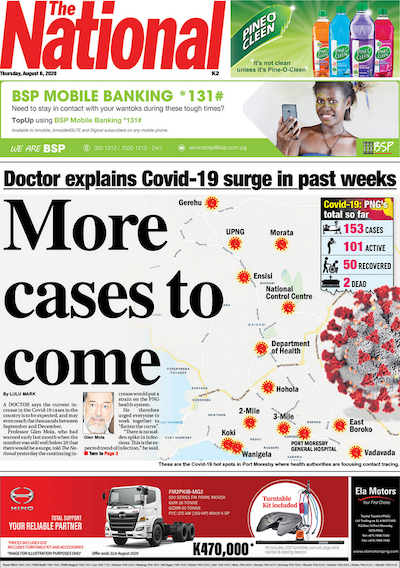
A medical authority has warned that the spike in covid-19 cases in Papua New Guinea is to be expected and could reach thousands between September and December, reports The National today.
Professor Glen Mola had predicted early last month, when the number of cases of infection had been below 20, that there would be a surge.
He told The National yesterday that the ongoing increase would put a strain on PNG’s health system.
Professor Mola, a research doctor and consultant who heads the Reproductive Health and Obstetrics department of the University of Papua New Guinea’s School of Medicine and Health Services, called on all Papua New Guineans to work together to “flatten the curve”.
“There is no sudden spike in infections,” he said. “This is the expected trend in infections.”
Meanwhile, The National has also reported that the first three Australian medical personnel have arrived to help the nation deal with the covid crisis, with more help to come if the situation worsens.
Australian High Commissioner Jon Philp said the three included team leader and clinical management expert Dr Mark Little, a primary and emergency care nurse, and an expert clinical adviser.
Seven-day quarantine The three have to go through a seven-day quarantine before they can start their work.
“The team will provide support in areas like case management, emergency management, and epidemiology, testing processes systems and logistics,” Philp said.
“They will consult with experts from the Health Department, the government and other stakeholders as to the country’s needs.”
The National’s front page today. Image: PMC screenshot
The three, part of the seven-member Australian medical assistance team (AustMat), arrived in Port Moresby from Brisbane.
They will also assist in other areas the PNG government may need help.
“If the virus continues to spread in PNG, there is a possibility to recommend a second larger AustMat team which could arrive in a number of weeks,” Philip said.
Papua New Guinea has reported 153 cases as at yesterday, with 101 active, two deaths and 50 recovered.
16 cases health workers National Pandemic Response Controller David Manning said 16 of the cases were health workers such as laboratory scientists, doctors, ward clerks and medical students.
“The rest include public servants, students and patients at the Port Moresby General Hospital.”
Controller Manning has also issued 11 new orders, including the closure of the Boroko market, and the closure of bottle shops on Friday and Saturday. The 14-day shutdown in Port Moresby is expected to end next week.
“There is community transmission in the National Capital District and we all have to support efforts to contain the spread of the virus in the city,” he said.
He said more testing sites had been set up in Port Moresby “to control the spread of the virus in the city”.
The Alliance for Journalists’ Freedom (AJF) has called on the Malaysian government to desist its current investigation of Al Jazeera English as the current methods of investigation are an attack on free, independent journalism.
If the Malaysian government takes issue with Al Jazeera’s work – or any reporting – there were appropriate complaint mechanisms within a democracy to pursue this, the AJF said in a statement.
The government could complain to the network itself, demand a right of reply, publicly criticise (as had already been done) or go through domestic complaints processes.
To regard this report as an act of sedition or criminal defamation, however, without providing any supporting evidence, and to then send the police in to the AJE offices, was a misguided attack on Malaysia’s democracy, said the statement.
“Investigating the report as an act of sedition is absurd. As far as we can see there was and has been no attempt by these journalists to overthrow the government,” said Professor Peter Greste, AJF spokesperson and director.
“Most viewers saw a report that turned out to be critical of government policy. In a democracy, this can be the outcome of a free press.
“It is in the best interests of the entire region to maintain support of institutions fundamental to democracy. A free and independent media is one of these key institutions.
Journalism in public interest “We see this mistake time and time again. There is a marked difference between acts of sedition and journalistic work in the public interest and that may be critical of government policy. To conflate them is simply dangerous.”
Al Jazeera statement in response to the Kuala Lumpur raid. Image: AJ screenshot PMC
The Auckland-based Pacific Media Centre also condemned the latest raid on Al Jazeera’s Malaysian office, saying it was “unacceptable harassment and a violation of media freedom”.
The raid came after authorities in Malaysia announced they were investigating Al Jazeera for sedition, defamation and violation of the country’s Communications and Multimedia Act.
The Al Jazeera statement over the Kuala Lumpur raid continued. Image: AJ screenshot PMC
The probe relates to a 101 East programme that aired on July 3 and examined the Malaysian government’s treatment of undocumented migrant workers during the coronavirus pandemic.
Giles Trendle, managing director of Al Jazeera English, said the network was “gravely concerned” by the raid and called on the Malaysian government to cease its criminal investigation against the network’s journalists immediately.
Source: The Conversation (Au and NZ) – By Huaiyu Yuan, Senior Research Fellow, Department of Earth and Environmental Sciences, Macquarie University
Far beneath the city of Dongshen in northern China, we have discovered what may be the 2 billion-year-old birthmarks of Earth’s first supercontinent.
An ancient dipping structure in the planet’s crust appears to be a trace of an early collision between two continental masses like the one that created the Himalaya – and may record the origin of the global system of plate tectonics that persists today.
The theory of plate tectonics is one of the key scientific advances of the past century. It explains how Earth’s crust is made of enormous rocky “plates” floating on the planet’s molten interior, which slowly move around. These movements are responsible for earthquakes and mountain ranges.
Earth is the only planet we know of with plate tectonics. The motion of the plates gradually cycles elements between the interior of the planet, the surface and the atmosphere, generating the resources and environment that make human life possible.
At some point in the deep past, plate tectonics began as Earth cooled. When this happened, however, has remained controversial. Dates spanning three-quarters of Earth’s history have been proposed, from the Hadean eon (between 4.5 billion and 4 billion years ago) to the late Proterozoic eon (less than a billion years ago).
Many of these dates come from isolated samples showing the existence of single plates. However, plate tectonics is a global phenomenon in which plates interact with each other. We studied one of these early interactions: a collision in what is now northern China, in which the edge of one plate was thrust upwards while the other was pushed down.
The dipping Moho
Our new study suggests plate tectonics began globally somewhere between 2 billion and 1.8 billion years ago. The research, published in Science Advances, was carried out by an international team from China, Germany and Australia, led by Wan, Bo from the Institute of Geology and Geophysics of the Chinese Academy of Sciences (IGGCAS).
We studied an area geologists call the Ordos block, which is part of the North China craton, a very stable chunk of the Asian continent that takes in parts of northeastern China, Mongolia and North Korea.
In April 2019, we deployed 609 seismic recording stations spaced every 500 metres along a 300-kilometre line. By combining the earthquake data from these stations, we were able to form a detailed picture of Earth’s crust in this area.
Beneath the city of Dongsheng, we found a feature called a dipping Moho in which the bottom of Earth’s crust dips from around 35km deep to more than 50km deep over a horizontal distance of only 40km.
This dipping structure looks nearly identical to what is found beneath the Himalayan mountains, except it is around 2 billion years old.
A global pattern
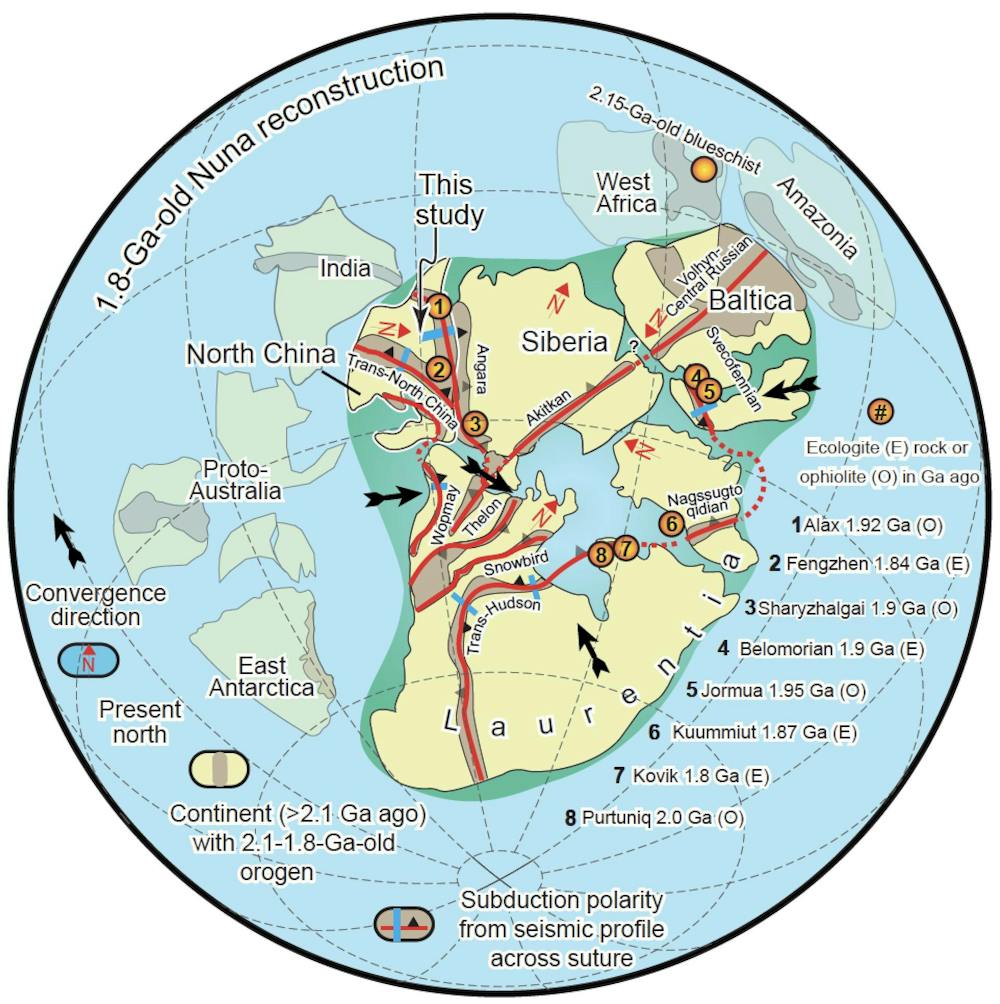
The global network of ancient collisions that show the creation of supercontinent Nuna.Wan et al. / Science Advances, Author provided
Next, we collected seismic evidence from other studies around the world for similar dipping Moho structures that are about the same age. Putting observations from six continents together, we can form a picture of the creation of the ancient supercontinent Nuna.
Nuna (sometimes also called Columbia) is believed to have been made up of parts of most of the continents that exist today. If Nuna was the first supercontinent, we can interpret these tectonic collisions that occurred around 2 billion years ago as the oldest evidence of plate tectonics in the global sense. Even though such collisions may have occurred here and there early on, it is likely that plate tectonics did not become a global network until this time.
With new rules restricting Victorians’ activities and movements to try and stem the second wave of coronavirus cases comes the question of whether people will actually stick to them.
There are at least two ways to answer this question, from a compliance perspective and a behavioural science perspective. Both lead to a similar answer: yes. But there are caveats when it comes to people’s behaviour, and it’s important we know them to keep compliance high.
There are various compliance models that predict whether people will follow the rules.
These models describe compliance as a complex formula of different motives (for example, economic or social factors), capabilities (having the knowledge or resources available to comply with the rules), a respect for the law, and the risk of detection and punishment (including severity) if caught.
Looking at the current situation in Victoria, it appears many of these predictive boxes are ticked, meaning compliance should be high.
For example, the new rules have been shared widely in traditional and social media, so most people should be aware of them. Daily messaging about the number of people dying from COVID-19 and the strain on ICUs provides a strong moral platform to motivate people to behave correctly.
And widespread communication about the enforcment of the rules should cause people to feel they’re likely to be caught if they break them.
Required behaviours are also highly visible — wearing face masks, being in groups of no more than two people, staying indoors after 8pm — which makes the certainty of detection higher for those who flout the rules.
And if people are caught breaking them, the punishments are severe, as evidenced by the on-the-spot fines of nearly $5,000 for people who fail to self-isolate.
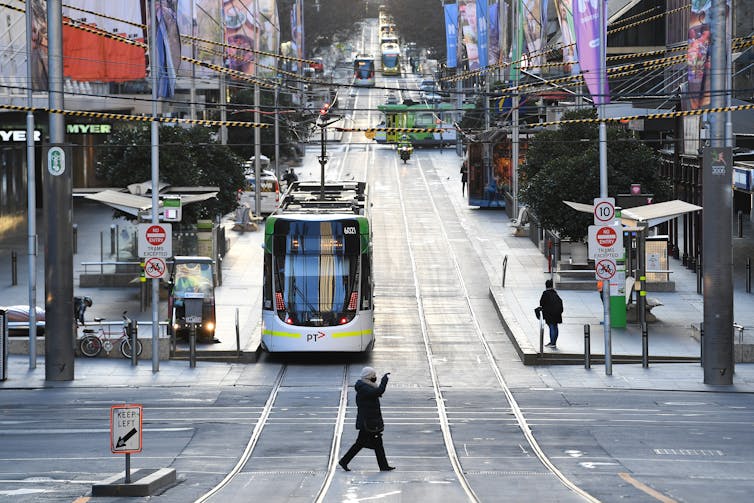
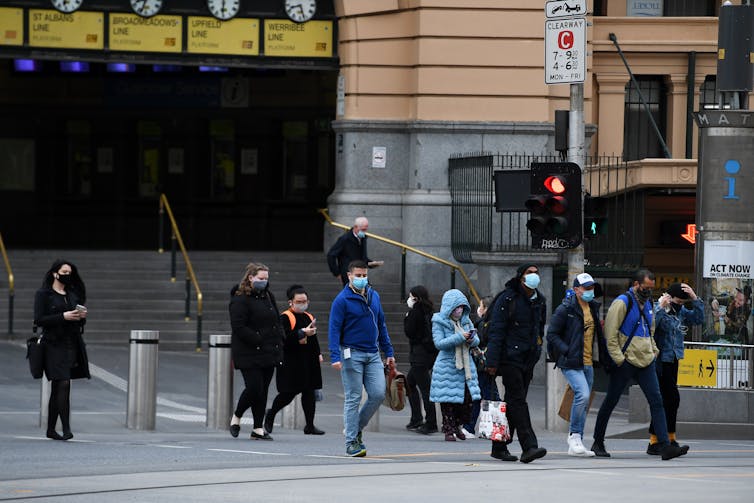
Melbourne’s streets are noticeably quiet since the new restrictions went into place.James Ross/AAP
Other factors that make compliance uncertain
Yet it isn’t that simple. New research from the US adds other factors that are important, such as the many opportunities for people to break the rules, impulsiveness (vs self-control) and the perceptions of what others are doing.
These factors — along with knowledge of the rules, the practical capacity of people to follow them and the threat of COVID-19 itself — were what influenced compliance rates in the US study. The possibility of being caught and the severity of punishment, however, were less relevant.
These latest models suggest compliance may not be so easy. There are plenty of opportunities for people to break rules, for instance, and impulsiveness is hard to control.
There is also much sharing (and shaming) of rule breakers on social media, as well as details on the number of fines being issued, which may lead to a perception that compliance rates are lower than they are.
Perceptions of others can influence our own behaviour
There is a long history of evidence that shows how our behaviour is influenced by what others are doing around us (regardless of whether these norms are real or perceived). Importantly, this can work in both positive and negative ways.
If we believe most people (or a growing number of people) are following the rules, we are all more apt to behave properly. And highlighting this positive behaviour to others can be a powerful tool. A good example of this is Victoria Premier Dan Andrews tweeting the empty streets of Melbourne this week.
However, the influence of others can backfire when there is a perception a lot of people are breaking the rules.
This perception can be fuelled by the media regularly seeking out and sharing examples of rule breakers. If we believe there is widespread non-compliance, it often leads to further non-compliance.
It takes time to form new habits, but then they become easy
Another uncertainty is how long it takes people to grow accustomed to new rules and form new behaviours.
Some research suggests an average of 66 daily repetitions, but this is highly dependent on the specific behaviour and audience.
It stands to reason the more we become accustomed to always wearing a mask when we leave the home, the more likely this behaviour will become habituated. This makes it easier to do over time, as it requires less thinking. The behaviour simply becomes automatic.
And if behaviours become habituated, there should be fewer concerns over so-called “response fatigue”, which occurs when we become tired of having to be constantly vigilant about our behaviour — particularly when we are unsure if it’s making a difference.
Social distancing has become the norm in Australia since early in the pandemic.Erik Anderson/AAP
We need to be specific about behaviour
Lastly, people are much more apt to follow rules when the authorities are clear in their directions of what is and isn’t allowed. It’s necessary to tell people what you want them to do, why, when, where and for how long.
Such clarity can provide us with much-needed direction, motivation and persistence in times of uncertainty, even in the face of challenging tasks and difficulties tempering our lack of impulse control.
The COVID-19 world presents a unique type of compliance and behaviour change challenge. It requires high levels of compliance — all the time and over a prolonged period of time.
We can’t tolerate or ignore a small minority of people doing the wrong thing, as this will have implications for all of us.
While compliance and behavioural science research would suggest most of the right things are in place in Victoria to foster compliance, we still remain vulnerable to our own biases, desires and previous habits.
But through the sharing of collective and clear goals, a close examination of the factors that influence us (including the perception of rule breakers we see in the media) and the formation of new habits, it is possible to get everyone to fall in line and do the right thing.
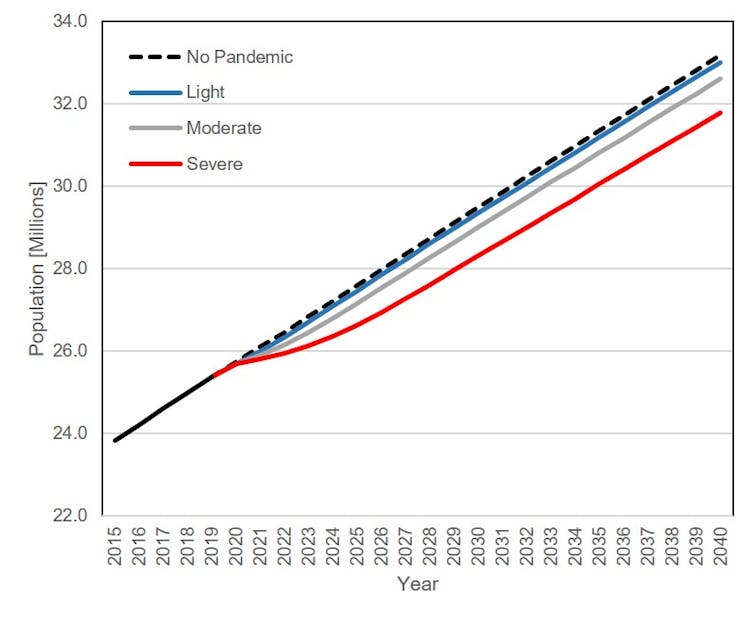
Our new modelling shows that under a worst-case scenario, Australia will be 1.4 million people – or 4% – smaller in 2040, than if COVID-19 had not happened.
This is largely driven by a massive reduction in international migration.
Migration under COVID-19
When the Australian government implemented an international travel ban in March, many demographers’ thoughts turned to the impact on Australia’s future population growth.
Over the last decade, net overseas migration has been the main driver of population growth in Australia, contributing 2.2 million additional residents.
Our analysis of Australian Bureau of Statistics data shows, the closure of Australia’s borders led to a 97% drop in permanent and long-term overseas arrivals in April 2020 from the previous year, most of whom were migrants.
State border closures and the COVID recession have also raised the prospect of a significant decline in interstate migration. The ABS Household Impacts of COVID-19 Survey suggests that for most Australians, the pandemic has not so far impacted their plans to move. However, our research indicates interstate migration has dropped following past Australian recessions.
Natural population increases – the excess of births over deaths – may also be impacted by COVID-19. Fertility often declines during economic downturns, as people become more risk averse.
On the other side of the ledger, Australia has been fortunate to so far avoid significant numbers of deaths from COVID-19. So, the pandemic is not expected to have a population-level impact on mortality in Australia.
Modelling the impact of COVID-19
Nevertheless, the rapid shift in some of the components of population change – particularly migration – means previous population projections no longer reflect our new demographic reality.
New projections are now needed to help plan economic and societal recovery from COVID-19. In a new paper, we developed three scenarios to work out plausible population futures for Australia.
COVID-19 means we need to update our population projections.Dean Lewis/AAP
Given the unprecedented nature of COVID-19, we adopted a multi-strand approach to inform our assumptions.
First, we undertook a review of the academic literature on demographic responses to shocks. Secondly, we reviewed historical data, to understand the impact of past shocks on the various components of demographic change in Australia. Thirdly, we surveyed Australian demographers on the likely impact of COVID-19 on international and internal migration.
Three scenarios for a future Australia
Our model then produced three scenarios.
Light impact: assumes net overseas migration recovers quickly in late 2020. Interstate migration drops slightly in 2019-2020, before rebounding in 2020-21. Fertility is also assumed to dip in 2020-21, before quickly recovering.
Moderate impact: assumes net overseas migration falls substantially in 2020-21, before recovering over the next few years. Interstate migration drops sharply over the next two years, before returning to the long-run average. Fertility falls this financial year and does not fully recover until the late-2020s.
Severe impact: assumes net overseas migration plummets to zero in 2020-21 and takes eight years to return to the long-run average. Interstate migration plummets by up to a third over the next two years, before slowly recovering. Fertility drops to historic lows and takes a decade to recover to the long-run value.
It is tempting to nominate a “most likely” scenario here. But uncertainty about the duration and scale of COVID-19 and the restrictions around it, makes this unfeasible. The best option currently available to demographers is to develop scenarios that model a range of plausible population futures.
Possible 4% drop in expected population
Based on the modelled scenarios, COVID-19 is expected to have a measurable and persistent impact on Australia’s population.
Under the severe scenario, Australia’s population will reach 26.6 million by 2025, 29 million by 2030 and 31.8 million by 2040. This is 1.4 million or 4% fewer than our “no pandemic” scenario.
Under the light scenario, Australia’s population will be 180,000 people fewer by 2040. Under the moderate scenario, we will be down 580,000 people.
Australia’s total population under light, moderate, severe and ‘no’ pandemic scenarios. Source: Elin Charles-Edwards and colleagues.
The impact of COVID-19 will be felt most strongly in the short-term. Annual population growth would have been 1.38% in 2020-21 without the pandemic. This will be just 0.41% under the severe impact scenario. Such a drop in annual population growth was last seen in 1916 due to World War I. Even during the Great Depression, annual growth remained above 0.70%.
States and territories
Our modelling showed different impacts on population growth across Australia. In large part, this is due to the concentration of immigration arrivals in Sydney and Melbourne, as well as an internal migration system that relocates population away from New South Wales and into Queensland and Victoria.
So, the largest impact on population numbers will be in NSW and Victoria, followed by Queensland and Western Australia.
If the severe scenario comes to pass, the population of NSW will be almost half a million people fewer by 2040 than without the pandemic. Victoria will see a drop of 400,000, Queensland will be down by about 200,000 and WA down by more than 160,000 people.
Despite smaller population sizes, the impact of the pandemic on population ageing appears to be relatively modest. The proportion of Australians aged 65 and over will reach 20.8% under the severe scenario, compared to 20% without the pandemic.
COVID-19 is not expected to have a big impact on population ageing.www.shutterstock.com
This is because migration has a limited impact at older ages.
What does this mean for Australia?
A decline in population growth as predicted under each of our scenarios will inevitably impact many sectors of the economy. In the short-term, industries dependent on population growth, such as construction, consumer goods and overseas students, will be the hardest hit.
There are also likely to be ongoing consequences for economic growth, urban and regional planning and labour supply.
But there are also potential benefits, including a reduction in environmental impacts and lower congestion, particularly in Australia’s capital cities.
More research into the demographic responses to COVID-19 will allow us to refine assumptions and increase our confidence in the modelled output.
But the potential for an unprecedented short-term drop in population growth and its various impacts should be on the radar of decision makers. We have to start planning for life after the pandemic now.
With COVID-19 vaccine developers reporting promising results, it is probable we will one day face a major public health question: can the government compel New Zealanders to be vaccinated?
Just as inevitably, some people will refuse a vaccine. As we have seen overseas with debates over the wearing of masks, and more generally with anti-vaccination activists everywhere, compulsion is not a simple matter.
There are competing rights and duties on both sides. Forcing an individual to be vaccinated is a violation of their fundamental right to personal autonomy, which informs the more specific right to bodily integrity.
Basically, those rights mean every person can make decisions for themselves and what can and cannot be done to their bodies.
The state’s duty to protect
While international human rights treaties support this, they do not specifically talk about the right to refuse medical treatment. Rather, they state that everyone has the right not to be subjected to medical experimentation without free consent.
And here we see how quickly the stakes are raised. These rights are part of the broader right to be free from torture, cruel and inhuman degrading treatment or punishment. The specific reference to medical experimentation is a response to what happened under the Nazi regime during the second world war.
But it’s the fundamental right to life that throws the COVID-19 vaccine issue into stark relief, because it also means governments must make some effort to safeguard citzens’ lives by protecting them from life-threatening diseases.
The introduction of mass immunisation programs therefore requires quite a balancing act.
In New Zealand, the courts and their English predecessors have long recognised and protected the right to bodily integrity. The New Zealand Bill of Rights Act 1990 also clearly states that everyone has the right to refuse medical treatment.
Any restriction of that right, any intrusion into the individual’s bodily integrity, would require explicit statutory authorisation. Such legislation would have to be interpreted very strictly and, wherever possible, consistently with the Bill of Rights Act.
There are examples of how this would work in practice. A recent decision from the Supreme Court of New Zealand addressed whether the fluoridation of water as a public health measure was a violation of the right to refuse medical treatment.
The court found it was. But – and it’s an important but – the court decided some public health measures could override the right to refuse medical treatment where these measures are clearly justified.
Clear justification would mean there must be a reasonable objective to compulsory vaccination that justifies the limits placed on the right to refuse medical treatment.
Such limits must be no more than are reasonably necessary to achieve the desired public health outcome, and they must be proportionate to the importance of mandatory vaccination.
A researcher at the Oxford Vaccine Group which is working on an experimental vaccine that has shown promise in early trials.GettyImages
Consequences for refusing vaccination?
In the end, should a COVID-19 vaccine become available, New Zealanders would have the right (but not the absolute right) under international and domestic law to refuse to be vaccinated. And the government could – and might even be obliged to – override that right.
So, no definitive answer. Furthermore, just because the government could make vaccination compulsory doesn’t mean it should.
It might not even have to. A person could still exercise their right to refuse vaccination but the government could then impose limits on other rights and freedoms.
In practical terms, this could mean no travel or access to school or the workplace if it placed the health and lives of others at risk. Similarly, a refusal to be vaccinated could limit jobs or social welfare benefits that depend on work availability.
But, again, the government would have to present clear justifications for any such restrictions.
Public consent is vital
Without a doubt, this would be highly controversial and the government would need to engage in another balancing act.
But a purely voluntary approach can have mixed results, too, as the 2019 measles outbreak showed. The main problem appears to have been a poorly designed immunisation program that missed various ethnic, socioeconomic and regional targets.
The success of a voluntary approach will be dependent on a highly performing vaccination program that is accessible to all New Zealanders and backed up by a strong public education campaign.
Ultimately, as the collective effort of the “team of 5 million” has already shown, the effectiveness of any law really depends on each one of us and the decisions we make.
Source: The Conversation (Au and NZ) – By Erin Smith, Associate Professor in Disaster and Emergency Response, School of Medical and Health Sciences, Edith Cowan University
Melburnians have now been wearing mandatory face coverings in public for two weeks. Yet Premier Daniel Andrews yesterday announced another grim milestone in Victoria’s second wave of COVID-19 infections: 725 new cases, a record daily tally for any Australian state since the pandemic began.
Four weeks after Melbourne reintroduced stage 3 restrictions, logic suggests the coronavirus curve should have flattened and begun heading downwards by now. And on July 27, Victoria’s chief health officer Brett Sutton suggested the plateauing figures could represent the peak of the state’s daily case numbers.
The premier announced on Tuesday a new deterrent aimed at those who continue to disregard the restrictions: a fine of A$4,957, the largest on-the-spot fine applicable in Victoria. People who repeatedly breach the rules can also be taken to court, where the maximum penalty is A$20,000.
It can’t be blamed entirely on the government’s response. A portion of the blame also lies with the public.
Philip Russo, president of the Australasian College of Infection Prevention and Control, last week lamented the “really obvious disoedience” displayed by some people, and speculated masks may also have created a false sense of security among the wider public who may view masks as more effective than they truly are.
Andrews said “far too many people” were going to work while sick, labelling this behaviour “the biggest driver of transmission” in the state. The stage 4 restrictions will clamp down heavily on this.
It’s been exactly two weeks since Melbourne’s mandatory mask rules came into place. This should see cases begin to drop, but it has almost definitely prevented new cases from continuing to spiral upwards.James Ross/AAP Image
Julie Leask, a social scientist at the University of Sydney, said workers’ reluctance to call in sick is linked to how financially stable they feel, explaining that for casual workers:
isolation after a test could mean no work, less chance you will get a shift in future, and considerable financial stress. In that situation, it’s easy to rationalise a scratchy throat as just being a bit of a cold.
Another difficulty is the lag time between when someone is infected and when they start showing symptoms.
What we are seeing now is actually infections from 5-10 days ago. And any public health interventions implemented now will take 5-10 days to show an effect.
Taking this time lag into account, the full effect of mandatory mask wearing will start to be seen this week.
We also know COVID-19 thrives in environments where it can quickly infect large numbers of people – and the recent uptick in cases has largely been driven by workplace transmission which occurred before the stage 4 restrictions came into effect.
Prime Minister Scott Morrison has announced a A$1,500 disaster payment available to workers in Victoria who do not have sick leave and who need to self-isolate for 14 days.
Lax lockdown?
During July’s stage 3 lockdown, Melburnians were under the same restrictions as the original lockdown in March and April. Yet vehicle traffic was almost 20% higher than during the earlier lockdown (albeit well below normal, pre-pandemic levels).
Victorian government epidemiologist James McCaw said people generally haven’t changed their behaviour as much during the second lockdown as they did the first time around.
Nevertheless, there are early signs the stage 4 lockdown is markedly reducing the number of Melburnians who are out and about. On Monday, the first day of the new strictures, pedestrian numbers in the CBD plummeted. Typically, 1,300 people walk across Sandridge bridge during morning peak hour – on Monday it was just six.
The persistently high numbers may also be partly explained by infected people transmitting the virus to their families, partners or housemates – something that’s hard to avoid even in lockdown.
The government will presumably not attempt enforce mask wearing or social distancing within our own homes, yet this has profound implications for disease transmission.
It is helpful to consider your household as a single unit; if one person puts themself at risk, perhaps by not wearing a mask, they put their entire household at risk.
Victorian Premier Daniel Andrews has announced a series of severe fines for people not obeying the latest restrictions.James Ross/AAP Image
Masks have slowed “sharp upward trend”
While it’s frustrating that Victoria’s numbers have not trended downwards, it’s also true the state has successfully avoided the kind of exponential increase in cases seen in many other countries. An analysis published this week in the Medical Journal of Australia estimates that Victoria’s restrictions have averted between 9,000 and 37,000 coronavirus infections.
It’s also possible Victoria is partly a victim of bad luck and unfortunate timing. The case clusters that spurred the second wave arose just as social distancing rules were easing after months of restrictions.
Regardless of how Victorians got here, it is clear what they must do next. It’s vital for people in Melbourne and Mitchell Shire to diligently follow the stage 4 restrictions, and that all Victorians maintain physical distancing, stay at home if unwell, get tested if they have symptoms, and self-isolate if they test positive.
Under the first coronavirus lockdowns, birdwatching increased tenfold in Australia, with much of it done in and near the watchers’ own backyards. And as Melbourne settles into stage 4 restrictions, we’ll likely see this rise again.
The increase in backyard birding is good news for conservation and can help birds recover from bushfires and other environmental catastrophes. But backyard birding isn’t new, nor is its alliance with conservation.
Since the turn of the 20th century, when birdwatching as a hobby began in Australia, birders have cherished the birds in their backyards as much as those in outback wilds. Birdwatchers admired wild birds anywhere, for one of their big motivations was — and is — to experience and conserve the wild near home.
Pioneering birder Harry Wolstenholme recorded 21 native species nesting in his garden.Alec Chisholm/National Library of Australia, Author provided
This wasn’t an abstract ambition, but a heartfelt commitment. Birdwatchers have long known that if we are to conserve nature, we need not only the intellectual expertise of science but also an emotional affinity with the living things around us. Birders in Sydney in the 1920s and ‘30s knew this well.
The Birdman of Wahroonga
Harry Wolstenholme, son of the feminist Maybanke Anderson, was an office-bearer in the Royal Australasian Ornithologists’ Union and a keen amateur birdwatcher. In the 1920s, his usual birding site was his own garden in the northern Sydney suburb of Wahroonga.
There, bird life was prolific. Harry recorded 21 native and five introduced species nesting in or near his garden, plus many more avian visitors.
His garden drew a stream of notable birders from the Sydney branch of the ornithologists’ union, such as wildlife photographer Norman Chaffer, naturalist and journalist Alec Chisholm, and businessman Keith Hindwood. (The union members were predominantly male, though with a liberal sprinkling of women, including Perrine Moncrieff who became its first female president in 1932.)
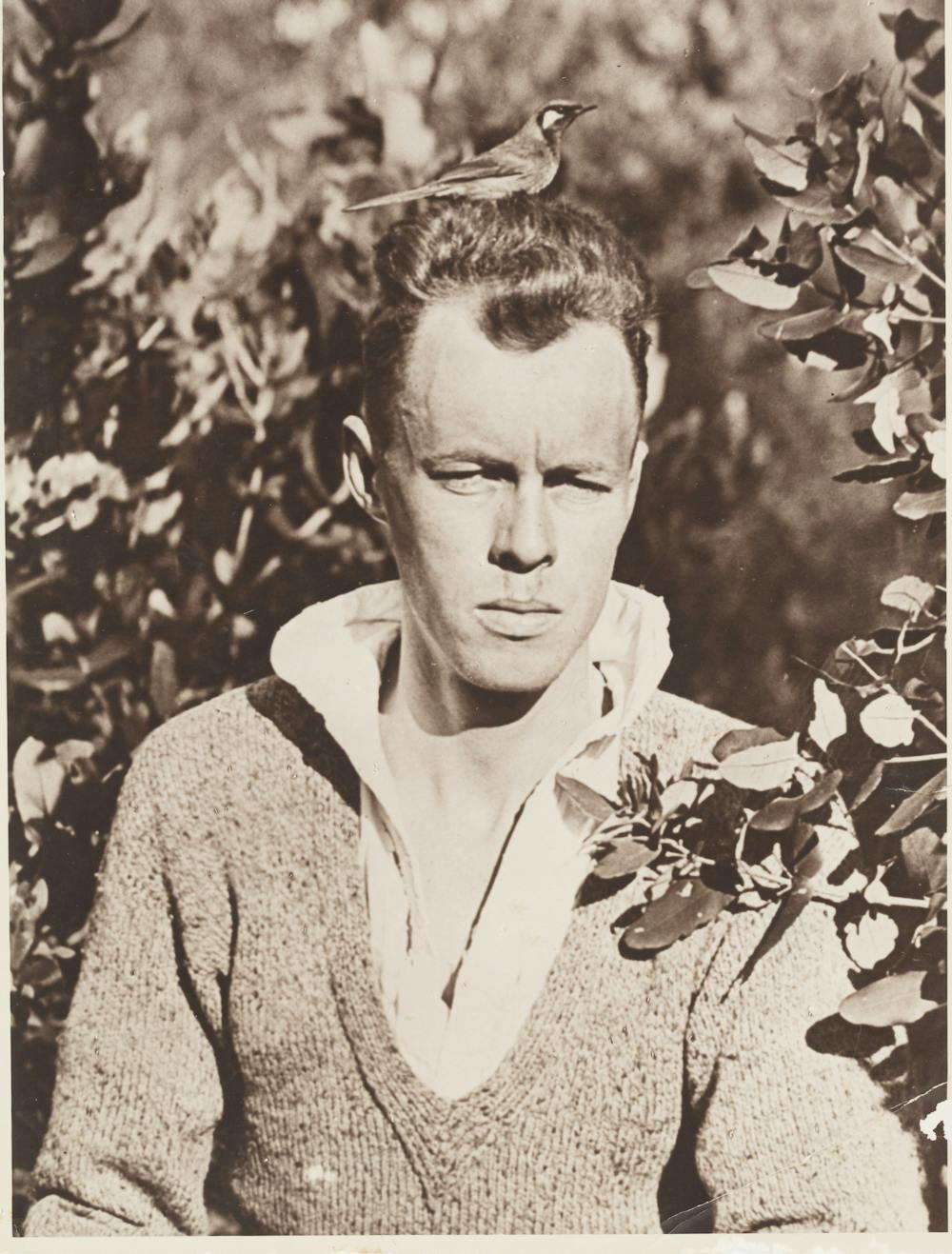
Keith Hindwood, with a White-eared Honeyeater on his head, 1929.Mitchell Library, Author provided
For his closeness to the birds, Harry earned the nickname “The Birdman of Wahroonga”. That suburb still hosts a good range of species, although the bird life is no longer as prolific as in Harry’s day.
Many others birded in city environs and, like Harry, published their suburban ornithological studies in the union journal, The Emu.
In 1932, Alec Chisholm devoted a whole book, Nature Fantasy in Australia, to birding in Sydney and surrounds. Featured on its early pages is a painting by celebrated bird artist Neville Cayley captioned “The Spirit of Sydney: Scarlet Honeyeater at nest in suburban garden”.
Scarlet honeyeaters can still be spotted in urban parts of Australia.Shutterstock
The fact this gorgeous little bird was common in Sydney’s gardens exemplifies Chisholm’s theme of urban Australians’ ready access to the wonders of nature. Scarlet Honeyeaters can still be found in Sydney though they are no longer common there.
Mateship with Birds
Like all Chisholm’s nature writings, Nature Fantasy promoted conservation.
Conservation then differed from conservation now, having a stronger aesthetic orientation and less ecological content. Nonetheless, these pioneer conservationists, among whom birdwatchers were prominent, laid the foundations on which environmentalists later built.
Chisholm urged people not merely to observe birds but also, more importantly, to love and cherish them. In his first book in 1922, Mateship with Birds, he urged readers to open their hearts to their avian compatriots and embrace them as friends and fellow Australians.
Early birders believed names of birds like ‘Jacky Winter’ would help us embrace birds as fellow Australians.Shutterstock
One way of fostering this feeling, Chisholm and his birding contemporaries believed, was to give birds attractive names. For example, “Jacky Winter” struck the right note, and as Chisholm wrote:
it would be a healthy thing if we had more of these familiar names for our birds, bringing as they do, a feeling or sense of intimacy.
While those birders urged people to cultivate an emotional connection with nature, and while most were amateur rather than professional ornithologists, they nonetheless made major contributions to the scientific study of birds.
Science was needed, they realised, but so was feeling. As one reviewer of Nature Fantasy enthused, Chisholm was a naturalist “who in his writings combines with the exact research of a scientist the sensibility of a poet”.
Our city birdscapes have since changed. Some species have dwindled; some have increased. But suburbia still holds a remarkable degree of biodiversity, if only we’re prepared to look.
Lockdown is a great time to try backyard birdwatching.Shutterstock
The world of the birders of the 1920s and ’30s is gone. Our attitudes toward nature are cluttered with fears unknown in their day, such as climate change. Yet those early birders still have something worthwhile to tell us today: the need to connect emotionally and tangibly with nature.
To hear that message, we need not, and should not, jettison today’s environmental fears. But fear needs complementing with more positive emotions, like love.
Despite — or because of — the prominence of environmental alarms in today’s world, the need to admire and love living things remains as pressing as ever. As birdwatchers have long known, the birds fluttering in our own backyards are adept at fostering those feelings.
University life comes with its share of challenges. One of these is writing longer assignments that require higher information, communication and critical thinking skills than what you might have been used to in high school. Here are five tips to help you get ahead.
1. Use all available sources of information
Beyond instructions and deadlines, lecturers make available an increasing number of resources. But students often overlook these.
For example, to understand how your assignment will be graded, you can examine the rubric. This is a chart indicating what you need to do to obtain a high distinction, a credit or a pass, as well as the course objectives – also known as “learning outcomes”.
Other resources include lecture recordings, reading lists, sample assignments and discussion boards. All this information is usually put together in an online platform called a learning management system (LMS). Examples include Blackboard, Moodle, Canvas and iLearn. Research shows students who use their LMS more frequently tend to obtain higher final grades.
If after scrolling through your LMS you still have questions about your assignment, you can check your lecturer’s consultation hours.
2. Take referencing seriously
Plagiarism – using somebody else’s words or ideas without attribution – is a serious offence at university. It is a form of cheating.
It’s so easy to copy and paste sentences, but using someone else’s words without attribution is a serious offence in the academic world.Shutterstock
In many cases, though, students are unaware they have cheated. They are simply not familiar with referencing styles – such as APA, Harvard, Vancouver, Chicago, etc – or lack the skills to put the information from their sources into their own words.
To avoid making this mistake, you may approach your university’s library, which is likely to offer face-to-face workshops or online resources on referencing. Academic support units may also help with paraphrasing.
You can also use referencing management software, such as EndNote or Mendeley. You can then store your sources, retrieve citations and create reference lists with only a few clicks. For undergraduate students, Zotero has been recommended as it seems to be more user-friendly.
Using this kind of software will certainly save you time searching for and formatting references. However, you still need to become familiar with the citation style in your discipline and revise the formatting accordingly.
3. Plan before you write
If you were to build a house, you wouldn’t start by laying bricks at random. You’d start with a blueprint. Likewise, writing an academic paper requires careful planning: you need to decide the number of sections, their organisation, and the information and sources you will include in each.
Research shows students who prepare detailed outlines produce higher-quality texts. Planning will not only help you get better grades, but will also reduce the time you spend staring blankly at the screen thinking about what to write next.
Spend some time planning your assignment before you start writing. Research shows it does pay off.Shutterstock
During the planning stage, using programs like OneNote from Microsoft Office or Outline for Mac can make the task easier as they allow you to organise information in tabs. These bits of information can be easily rearranged for later drafting. Navigating through the tabs is also easier than scrolling through a long Word file.
4. Choose the right words
Which of these sentences is more appropriate for an assignment?
a. “This paper talks about why the planet is getting hotter”, or b. “This paper examines the causes of climate change”.
The written language used at university is more formal and technical than the language you normally use in social media or while chatting with your friends. Academic words tend to be longer and their meaning is also more precise. “Climate change” implies more than just the planet “getting hotter”.
To find the right words, you can use SkELL, which shows you the words that appear more frequently, with your search entry categorised grammatically. For example, if you enter “paper”, it will tell you it is often the subject of verbs such as “present”, “describe”, “examine” and “discuss”.
Another option is the Writefull app, which does a similar job without having to use an online browser.
5. Edit and proofread
If you’re typing the last paragraph of the assignment ten minutes before the deadline, you will be missing a very important step in the writing process: editing and proofreading your text. A 2018 study found a group of university students did significantly better in a test after incorporating the process of planning, drafting and editing in their writing.
Plan to give yourself time to read through and check your assignment. Assessors are not impressed by obvious careless mistakes.Shutterstock
You probably already know to check the spelling of a word if it appears underlined in red. You may even use a grammar checker such as Grammarly. However, no software to date can detect every error and it is not uncommon to be given inaccurate suggestions.
So, in addition to your choice of proofreader, you need to improve and expand your grammar knowledge. Check with the academic support services at your university if they offer any relevant courses.
Written communication is a skill that requires effort and dedication. That’s why universities are investing in support services – face-to-face workshops, individual consultations, and online courses – to help students in this process. You can also take advantage of a wide range of web-based resources such as spell checkers, vocabulary tools and referencing software – many of them free.
Improving your written communication will help you succeed at university and beyond.
We’ve heard a lot about what the present crisis will do to homeprices, less about what it will do to commercial property prices.
Commercial properties include office buildings, shopping centres, hotels and warehouses.
They account for 8% of the assets of Australian super funds.
Melbourne’s Wesley Place commercial precinct is owned by a property trust.
If their values drop (and they are falling) it will affect all of us, especially those about to retire or already retired.
Until COVID-19, commercial properties were widely regarded as safe investments. They offered both reliable income streams and capital gains as population growth increased the value of scarce real estate.
With the return on government bonds falling below 1% they ought to be becoming more attractive, but offices are empty, their future uncertain, high end shopping centres are receiving less traffic, and hotels have entire floors unused.
Brisbane’s 1 William Street is owned by a superannuation fund.
In July the number of mobile phones active in Sydney’s central business district was down 52% on January and February. In Melbourne’s CBD, before the stage 4 lockdown, mobile phone traffic was down 65%.
Data centres are among the few commercial property bright spots – we are moving more data – along with distribution centres and regional shopping centres – we are shopping online and closer to home.
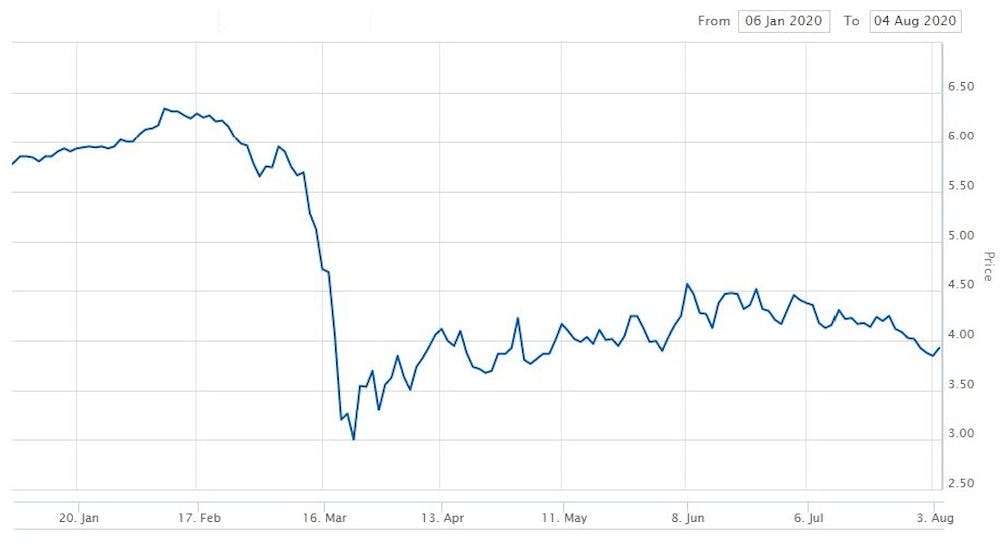
Over the course of the year the values of commercial property trusts listed on the Australian Securities Exchange have slid 29%, 32%, 34%,48%, 52%, and 69%.
Share price of GPT Group. GPT owns and manages retail, office and logistics properties.Source: ASX
For super funds with 8% of their assets in commercial property, a decline of 25% in values knocks 2% off their assets — A$54 billion across the industry as a whole.
In the only other big downturn since the advent of Australia’s superannuation system, the global financial crisis, commercial property offered the funds stability while shares were volatile.
Not so this time. The value of the commercial property is diving along with the stock market with just as uncertain a future.
Source: The Conversation (Au and NZ) – By Dawn LaValle Norman, Research Fellow, Institute for Religion and Critical Inquiry, Australian Catholic University
Phil: What would you do if you were stuck in one place, and every day was exactly the same, and nothing that you did mattered?
Stage 4 lockdown is upon Melbourne for the next six weeks. How do we cope with the new normal of staying in our houses for 23 hours a day?
One popular solution is to immerse ourselves in stories. Topical films, such as Contagion (2011), have found a new life in the pandemic. But a more prescient film, for lockdown, is the cult classic Groundhog Day (1993), directed by Harold Ramis.
Phil Connors (Bill Murray), a thoroughly unsavoury TV weatherman, mysteriously wakes up to the same wintry February morning over and over again. His wonder and excitement at the lack of consequences quickly turn to despair.
How can a flawed human deal with the repetition of the same limited day, as restrictive in its own way as a one-room prison cell?
Eventually, a major change in perspective allows Phil to transform his prison into fulfilment, granting him the love of Rita (Andie MacDowell) – and the escape back to normal temporality.
Over the centuries, countless people have chosen a form of elective lockdown. When I was 25, I spent a year as a guest at the Abbey of Regina Laudis in Connecticut. I was not allowed to leave the grounds without permission, and spent my days milking cows, weaving cloth, tending beehives and singing the liturgical celebrations.
I chose to live in the monastery, as did everyone around me. That didn’t mean that the restrictions didn’t chafe. But I remember what one of the sisters said to me about the narrow borders we had placed around our lives: when you can’t change your environment, you have to change yourself.
To make your way through, consider who you want to be.Sony Pictures
That year taught me how to sit with myself and stick to the work I had chosen – skills I needed in the difficult seven years of education that followed.
Restrictions can promote transformation through friction, like tomatoes needing compression to be sealed into jars for the winter. The condensation, the reduction, are there to produce something new. When we can’t escape we have a tremendous opportunity for change.
Deadlines
I recently learned a new etymology. The word “deadline” once referred to a prison boundary, beyond which you would be shot by guards.
For Phil, in Groundhog Day, a “deadline” is what is missing from his life. He cannot die. With that boundary removed from him, he struggles to find meaning at all. Our own lockdown also lacks a firm deadline, a time when it will certainly be over. The Victorian government is saying stage 4 restrictions will last six weeks. But will that be enough?
We are faced with the odd combination of restricted space and endless time.
When our lives are the same end on end, do our choices matter?Sony Pictures
Phil experiments with goals at the beginning of the film, but these goals are questionable. He learns all he can about Rita, but only so he can seduce her. He choreographs the perfect robbery of a bank’s armoured truck to have abundant cash. He spends three hours a day for six months learning how to throw playing cards into a hat.
Somewhere in the middle of the story, as he lifts his head from a depression with the help of Rita, Phil turns a corner. He starts to realise his actions – even if they leave no trace on the next repeated day – can change himself, for the better.
He develops a pattern of care that takes up his entire day. He saves a man from choking and a boy from falling from a tree. He helps a young woman get over her cold feet before her wedding and fixes the flat tyres of a car full of elderly ladies.
Instead of short-term goals, he chooses to learn skills that enrich his life: he reads, he makes ice sculptures, he becomes an excellent pianist. He chooses to flourish.
Flourishing is compatible with a notion of infinity – no deadline needed.
Emotions
Rita: Sometimes I wish I had a thousand lifetimes. I don’t know, Phil. Maybe it’s not a curse. Just depends on how you look at it.
Being stuck in the repetition of lockdown, while at first causing only frustration, can lead us to evolve from blaming our setting to interrogating ourselves.
Watching Groundhog Day in these times is strangely inspiring. It lets us imagine a repetition in which we can flourish.
So what will we do with our coming six weeks in Melbourne? I, for one, think I will finally start learning to play the piano. Thanks, Phil.
Scott Morrison will unveil on Thursday a cyber security package to give greater protection to critical Australian infrastructure and bolster the powers of the Australian Federal Police to pursue criminal networks on the dark web.
The Australian Signals Directorate would be able to go into networks to block operations against critical infrastructure.
The AFP would be given collection powers on the dark web which would enable it to call on the ASD to provide highly specialised technical assistance, using its most sophisticated capabilities.
The government would hope to have legislation for the changes passed before the end of the year, although that timetable will be tight given the limited sitting time.
Amid increasing concern about cyber disruption particularly from China, Morrison said ahead of the announcement: “We will protect our vital infrastructure and services from cyber attacks. We will support businesses to protect themselves”.
And with mounting worry about crime, especially against minors, on the internet he said, “We will track criminals in the darkest corners of the internet to protect our families and children”.
Home Affairs minister Peter Dutton said: “Pedophiles are targeting kids online in chat groups. Criminals are scamming money off our elderly by stealing their internet banking details. Businesses are being locked out of their systems by ransomware attacks.
“And some foreign governments are using the internet to steal health data and have the potential to turn off banking or energy systems.”
The cost of the cyber security package is nearly $1.7 billion but most of the money has been announced before.
The improved infrastructure security includes obligations on the providers of critical infrastructure and government assistance to quickly respond to attacks.
Some $66 million will be provided to help critical infrastructure providers to assess their networks for vulnerabilities and bolster their strength.
There will be more than $67 million to enable greater cyber security collaboration with state governments and industry.
The government will invest more than $88 million to bolster the AFP’s capabilities to investigate and prosecute cyber criminals, and create a fund to co-invest in counter cybercrime capabilities with the states.
At present the federal police and the Australian Criminal Intelligence Commission can only collect communications in an investigation of a particular person or device, connected with a specific offence, under warrant.
On the dark web it is very difficult to identify suspects.
The new power would permit access to the computers used in serious criminal activity, making easier identification of perpetrators and their activities.
This information would then be used as a basis for applying for more targeted investigatory powers, such as interception and computer access warrants.
Among measures to support better cyber security in the community the government will urge greater uptake of safe and secure online behaviour and increase funding for victim support.
A rumour that Victoria’s high profile chief health officer Brett Sutton was quitting caused a flurry in state government circles on Wednesday afternoon.
Sutton has been one of the medical hardliners during the pandemic, at times an irritant in the Australian Health Protection Principal Committee. According to Sky, the suggestion he was going came from a well-placed Victorian source.
The rumour followed the absence of Sutton – who’s on leave – from those marathon news conferences Premier Daniel Andrews gives.
At first Andrews’ office provided a less than watertight rejection of the story, before issuing a denial.
On Twitter someone said, “Might as well have said nickelback have broken up, same level of middle aged women would be upset”. This drew a tweet from Sutton himself. “What?! Nickelback have broken up??”
In Victoria Sutton has become something of a cult figure – you can get Brett Sutton masks, mugs, throw blankets and much else.
All this would be of only gossipy interest if it were not that there has been a deal of movement among Victorian health officers recently. Deputy chief health officer Annaliese van Diemen shifted to non-COVID duties and a new crew came in: Allen Cheng, from The Alfred hospital, Rhonda Stuart, from Monash Health, and Paul Johnson, from Austin Health became Sutton’s deputies.
Behind the scenes, there are wheels within wheels among the nation’s army of federal and state health officials, and professional differences.
For example the use of masks was, earlier on, a matter of debate among the experts, with at least one senior federal adviser very sceptical of them. Now they are mandatory in Victoria and their use is highly recommended in NSW.
But the mask debate continues on another front. This week an open letter signed by more than 2,800 healthcare workers and sent to Health Minister Greg Hunt and federal officials called for high end masks for health workers and reform of the Infection Control Expert Group.
We don’t hear much of this group but it is influential, especially its chair, professor Lyn Gilbert. It provides advice on infection prevention and control in hospitals and other institutional settings.
The healthworkers’ letter said the ICEG needed broader representation including from the specialist medical colleges and experts with a scientific background in aerosol science, personal protective equipment and worker safety.
One plus in the COVID crisis has been that the politicians have turned to expert advice, but that can be complicated when the advisers, despite usually publicly presenting a “consensus” view, are in fact divided.
At the end of the day, both the experts and the politicians will be judged on results.
As the Victorian lockdown screws continue to tighten, the state’s health results on Wednesday were another bad landmark – a record 725 new cases and 15 deaths.
Second time round, the state’s lockdown is both harsher and more difficult to handle. Businesses are complaining of directions that are confusing and hard to implement. Many parents with small children won’t have access to child care. More people seem at the end of their tether.
The Victorian crisis continues to create wider contagion nationally.
On Wednesday NSW tightened existing border restrictions from Victoria.
Queensland premier Annastacia Palaszczuk announced the state border would be closed from 1am Saturday to people from NSW and the ACT.
The Queensland border was already closed to Victorians and people from greater Sydney.
Facing an October election the premier, who has been angered by breaches from people trying to get around current controls, declared, “I say to Queenslanders, we’ve listened to you … today is the day we say we’re putting Queenslanders first.”
A frustrated Scott Morrison, who has argued the states should talk to his government when they plan to act on their borders, said “She’ll make her decisions and I’ll leave her to explain them and the medical advice upon which it’s based.”
But as he knows from his latest stoush with Western Australia premier Mark McGowan about that state’s closed border, the public is likely to be firmly behind Palaszczuk’s action.
From tomorrow (Thursday, August 6) only children of permitted workers will be able to attend childcare in Melbourne, which is under stage 4 restrictions.
Parents and providers have been waiting to understand what this means for their children and attendance numbers for the next six weeks.
Both Victoria’s Premier Daniel Andrews and the federal Minister for Education Dan Tehan made announcements today that clarify many of these details, although questions remain.
What did Dan Tehan announce?
The federal government funds childcare, along with fees paid by parents.
In April, the government put in place a childcare relief package. Early childhood education and care centres across the country were provided with around 50% of their revenue based on enrolment numbers between February 17 and March 2, on the basis parents weren’t charged any fees.
Services were also able to access JobKeeper for eligible employees.
The package ended in July, with as well as JobKeeper for employees. But there is a transition package back to pre-COVID funding arrangements until September 27. The government is making up 25% of the childcare service fee revenue from February 17 – March 1.
Today, Dan Tehan announced extra provisions to the childcare transition package for Melbourne providers located in areas facing stage 4 restrictions.
This 25% of service revenue will be increased by at least 5%, and possibly more depending on their new rate of attendance and subsidy levels for children still attending.
This will mean services have a guaranteed income from the childcare subsidy plus 25% of their total revenue, as well as fees from parents of permitted workers. This is likely to provide around 80-85% of their total revenue.
Dan Tehan said parents will be given 30 extra absence days, on top of the 42 already available. Families can use their 72 total absences to cover non-attendance in the next six weeks, and won’t pay fees for those days.
The extra absences will be given to all parents across Victoria — not just those in Melbourne.
These changes will be in place from Thursday, August 6.
Parents who aren’t permitted workers should theoretically be able to keep their child’s place in childcare and not have to pay for it.Shutterstock
What did Daniel Andrews announce?
Decisions about permitted workers sit with the state, as well as decisions about whether childcare can be accessed if only one parent is a permitted worker, and the other is working from home.
Daniel Andrews said the rules on who can attend childcare will be the same for childcare, kindergarten and school. If children can be supervised at home, they must be at home — even if one parent is a permitted worker.
A permitted worker at home will be able to access these education services, but only if no-one else can supervise their children.
Parents will need to obtain an access to childcare permit from the government, in addition to their permit to work.
What is still unclear?
There remains considerable confusion in the package for families and services.
For services, it’s unclear whether they will be required to remain open if it’s not practical to do so. Some services might only have a few children eligible to attend, creating cost pressures to open with small numbers, or consider combining operations with other services.
If providers decide they need to cut costs, staff hours will be the first to go, because labour costs are a significant proportion of their budgets. While the employment guarantee that exists requires jobs to be protected, for casuals this means their hours could be minimal.
Although Dan Tehan says it is unlikely that services will have no children of permitted workers enrolled, some services might have no children attending.
The free absence days are aimed at keeping children enrolled while ensuring parents won’t pay while they’re not using services. They are also aimed at ensuring providers can continue to operate and remain viable, and provide early learning and care to children of permitted workers who cannot care for their children while working.
But for parents to access absence days with no charge, childcare providers need to agree to waive the gap fees.
That said, there is no mechanism for the government to mandate services to waive the fees. And we have heard reports of services informing parents they are not financially able to waive gap fees for absences.
This raises the question: if a particular centre won’t waive a family’s gap fees, will that family be able to keep their child enrolled in their centre?
For families, the new permit system for permitted workers offers no clarity about how vulnerable children will be identified. These children have most to gain from attending early childhood services, and are least likely to live in families where permit systems are likely to be taken up.
There are no easy answers to these questions, which have highlighted once again how complex and essential early childhood services are. It has also highlighted the need for greater attention that governments need to give to the needs of their youngest citizens and families.
Virgin Australia’s plan to sack about 3,000 of its 9,000 staff, axe its budget brand Tigerair, streamline its fleet to only Boeing 737s and suspend long-haul international flying indefinitely should come as no surprise.
“Demand for domestic and short-haul international travel is likely to take at least three years to return to pre-COVID-19 levels, with the real chance it could be longer,” Virgin Australia chief executive Paul Scurrah said. “Which means as a business we must make changes to ensure the Virgin Australia Group is successful in this new world.”
The big question, though, is whether Virgin can ever become a sustainable competitor to Qantas.
Even before the impact of the COVID-19 pandemic, Virgin had posted years of losses with debts approaching A$7 billion.
Private equity owners have a poor track record in creating strong, sustainable companies with long-term prospects. At their worst they can act a bit like used-car salesmen who know how to tart up and turn a profit on a vehicle with underlying mechanical problems.
They are undoubtedly masters of financial (not necessarily aeronautical) engineering; generally ill-equipped to provide the long-term investments in physical capital and service quality that an airline like Virgin Australia needs to be competitive.
Virgin Australia’s budget brand Tigerair is being axed, along with about 3,000 of Virgin’s workforce of about 9,000.Julian SmithAAP
How private equity works
Private equity firms raise money from private investors such as wealthy individuals and superannuation funds. That money is pooled into a fund, which the private equity firm manages for a fee. Funds are typically used to buy undervalued and often financially distressed businesses, such as Virgin.
These funds have a short life – about six years on average. They acquire a portfolio of companies, nurture those businesses to apparent commercial health and then sell them off (usually through a public float on a stock exchange) at a large profit. They can then divest themselves of their remaining ownership stake while the share price remains high.
Private ownership can be advantageous for a struggling company, because it removes the regulatory and other distractions that come with being a listed public company. It means management can make decisions without worrying about the short-term stock implications, for example.
But private equity players often fail to create long-term profitable companies, as the fate of some iconic Australian companies shows.
Take the money and run
In 2006 the then Coles-Myer group sold its Myer department store business to a US private equity consortium led by TPG Capital. In 2009 the private equity owners floated Myer on the Australian Stock Exchange and sold all their shares, making almost six times their original investment.
Six months after its float, Myer issued a profit warning. It has never traded above its issue price of A$4.10 a share. Its share price now is about 20 cents.
Its new owner floated the company 15 months later at a valuation of A$520 million, (and a share price of $2.20). By September 2014 Anchorage sold its entire stake. By the end of 2015 the share price was about 30 cents. In January 2016 the company went into administration.
Closing-down sales for Dick Smith Electronics in April 2016.Joel Carrett/AAP
The fact that private equity firms are short-term investors who eschew regulatory oversight means they are ill-suited to own and operate any business – such as an airline – that is heavily regulated and requires large, long-term investments.
For a start, Bain has bought Virgin using mostly borrowed money. This debt will most likely, and in large part, be used to front-load dividend payments to Bain and its co-investors, allowing them to recoup their original investment before Virgin’s performance under its new owners can be adequately judged.
Bain will likely need to maximise cash flow to pay these dividends. How will it do this? We can predict the probable strategy:
only operate on the highest-margin, highest-volume routes
zealously control costs, with potentially significant implications for service quality and employee conditions
charge the highest possible prices the market will bear in a cosy duopoly with Qantas
Such a strategy will do nothing for Virgin’s long-term reputation, customer loyalty or indeed its commercial viability after Bain sells out. Bain will likely exit as soon as it can, when the stock market looks particularly frothy and it can find buyers prepared to buy Virgin Australia shares at a big premium.
None of this will make Virgin Australia a robust and long-term competitor to Qantas. It will in all probability be left with a debt-laden balance sheet, an orphan engaged in a fight to the death with a much stronger Qantas.
In short, Virgin will most likely find itself in exactly the same vulnerable position it was before the COVID-19 pandemic, in no shape to survive the inevitable next aviation crisis without a taxpayer bailout.
It means a duopoly in the short term and an effective monopoly for Qantas in the longer term. And for Australian travellers that will mean higher ticket prices and lower quality service.
In international affairs, words are bullets, according to an old diplomatic saying. If so, Australia in recent years has begun firing new ammunition.
In his address to the Aspen Security Forum today, Prime Minister Scott Morrison stressed the importance of Australia’s alliances with fellow liberal democracies, the Five Eyes partnership, our “ever‑closer” ties with Europe and our
belief in the values and institutions that the United States has championed.
In a similar address to the Lowy Institute a year ago, Morrison also praised India and Japan as countries with “shared values” to Australia.
And in the press conference at last week’s AUSMIN talks between the Australian and US foreign and defence ministers, there were 15 references to “democratic values” (on the American side), “shared values” (the preferred Australian formulation) and related phrases (“fundamental values”, “value sets”).
“Values”, a word seldom used in the past, has now assumed a central place in our foreign policy rhetoric. Speeches, press conferences and policy statements vibrate with the V-word.
The joint statement after the AUSMIN talks stressed the ‘shared security, interests, values, and prosperity’ between the US and Australia.Brendan Smialowski/AP
A counterpoint to China’s value system
The reason for the return of values to our diplomatic rhetoric is no mystery. China’s emergence as the largest and most powerful autocracy in history, with an economic weight to match, has forced Australia to balance its mercantile and security interests.
Over the past decade, Australia allowed itself to become economically dependent on China, which takes a third of all our exports and over 80% of key commodities like iron ore.
As our economic dependency increased, China also changed, becoming more repressive domestically and more aggressive in the international sphere.
China’s own governance model is based on a different set of values, which prioritise allegiance to the state and party and involve restrictions antithetical to open societies. These include limits on freedom of speech, association, religion and anything else that could enable collective action in opposition to the state.
As it has championed this model around the world, Beijing has increasingly targeted democracies like Australia with local influence operations, political interference and, most recently, its crude “wolf-warrior diplomacy”.
Australia’s new embrace of the term “values” has also been accompanied by much more hawkish words on China.
While Australia has declined to join the US in more aggressive freedom of navigation campaigns in the South China Sea, the AUSMIN joint statement criticised China’s behaviour in the disputed waters, as well as in Hong Kong and Xinjiang. Also consistent with democratic values, it backed Taiwan’s membership or observer status in international bodies.
The term ‘values’ used to risk push-back
Until recently, Australian leaders ignored or downplayed the role of values in our foreign policy, preferring to focus on economic issues and engagement with Asia.
Talk of “democratic values” risked push-back from other nations in the region. Former Malaysia Prime Minister Mohamed Mahathir and Singapore’s long-time leader, Lee Kuan Yew, for example, were advocates for the idea of “Asian values”, which was more culturally specific to their countries.
They argued that individual freedom was a Western ideal, not compatible with Asian societies.
Successive Australian governments, keen to engage more with the region but still wary of being too close to Asia, largely accepted this.
The Howard government, in particular, was often at pains to frame Australia as a European society that approached Asia as an outsider, as academic John Fitzgerald put it:
Australia had one set of values, Asians another, and all parties should respect the values associated with the other’s ethno-cultural traditions by remaining silent on values altogether.
John Howard and Singapore’s Lee Kuan Yew agreed to disagree when it came to their respective value systems.Alan Porritt/AAP
How our diplomatic language has evolved
The shift in our diplomatic language began a decade ago with the idea of a “rules-based order”. This term (like values) had hardly been used in official policy before, up to and including the Howard government.
It began to gather a lexical head of steam under the Rudd and Gillard governments, and reached its pinnacle in the 2016 Defence White Paper, in which “rules-based global order” appeared no less than 48 times and was identified as one of Australia’s core strategic interests.
The ascent of “values” has followed a similar trajectory. It was mentioned seven times in the 2016 Defence White Paper, including specific references to “shared democratic values” with the US, India, Japan and New Zealand.
“Values” then went mainstream in the 2017 Foreign Policy White Paper, with no less than 31 references, including a whole section devoted to “Australia’s values”.
Democracy and multiculturalism were identified as our two core values, staking big claims for Australian exceptionalism:
We are one of the oldest democracies and the most successful multicultural society in the world.
Morrison stressed Australia’s ‘shared values of democracy’ with India following a virtual summit with Narendra Modi in June.Lukas Coch/AAP
Talk of values must be met with action
This language provides an obvious connection with the US. And the contrast with China could not be more stark.
With China’s rise under President Xi Jinping, different value systems now underpin different visions of security. By pushing democratic societies to confront this reality, Xi has done us a favour.
However, the language of values also presents challenges to other aspects of our foreign policy.
It is difficult to square the focus on values with our treatment of asylum seekers, selective application of international law and ongoing engagement with autocratic regimes in Asia. (A good example of all three is the now-lapsed refugee resettlement deal with Cambodia’s brutal Hun Sen regime, signed with a champagne toast, which Morrison presided over when he was immigration minister.)
If values are now the coin of our foreign policy realm, we will have to start walking the talk.
Whakapapa [genealogy] binds tākata whenua [people of the land] to the mountains, rivers, coasts and other landscapes, linking the health of the people with that of the environment. Like humans, species have whakapapa that connects them to their natural environment and to other species. If whakapapa is understood thoroughly, we can build the right environment to protect and enhance any living thing.
These are the words of Mananui Ramsden (with tribal affiliations to Kāti Huikai, Kāi Tahu), coauthor of our new work, in which we show that centring Indigenous peoples, knowledge and practices achieves better results for wildlife translocations.
Moving plants and animals to establish new populations or strengthen existing ones can help species recovery and make ecosystems more resilient. But these projects are rarely led or co-led by Indigenous peoples, and many fail to consider how Indigenous knowledge can lead to better conservation outcomes.
Co-author Levi Collier-Robinson (Ngāi Tahu, Ngāti Apa ki ta rā tō, Te Whānau-ā-Apanui, Ngāti Porou) with students from Te Kura o Tuahiwi.Ashley Overbeek
We argue that now more than ever, we need transformative change that brings together diverse ways of understanding and seeing to restore ecosystems as well as cultural practices and language.
Where Western science often focuses on specific parts of complex systems, Indigenous knowledge systems consider all parts as interconnected and inseparable from local context, history and place.
Experience in Aotearoa and around the world shows Indigenous-led or co-led approaches achieve better environmental and social outcomes. For example, by combining distributional data with cultural knowledge about plants used for weaving or traditional medicines, we can work out whether they will grow in places where they are most important to people under future climate conditions.
In our Perspective article, we present a new framework for reimagining conservation translocations through the Mi’kmaq (First Nations people of Canada) principle of Etuapmumk, or “Two-Eyed Seeing”. In the words of Mi’kmaq elder Dr Albert Marshall, Two-Eyed Seeing is:
…learning to see from one eye with the strengths of Indigenous knowledges and ways of knowing, and from the other eye with the strengths of Western knowledges and ways of knowing … and learning to use both these eyes together, for the benefit of all.
At the centre of this framework lies genuine partnership, built on mutual trust and respect, and collective decision making. This approach can be extended to local contexts around the world.
In Aotearoa, Te Tiriti o Waitangi (Treaty of Waitangi, 1840) provides a foundation for building equitable partnerships between tākata whenua (people of the land) and tākata Tiriti (people of the treaty). For us, as a team of Māori and non-Māori researchers and practitioners, Two-Eyed Seeing means centring mātauraka Māori (Indigenous knowledge systems).
Together with two conservation trusts, Te Nohoaka o Tukiauau and Te Kōhaka o Tūhaitara, we have been working to co-develop strategies to restore native wildlife at two wetlands in Te Waipounamu (the South Island).
These studies are weaving together genomic data and mātauraka Māori (Māori knowledge systems) to restore populations of mahika kai (food-gathering) species such as kēkēwai (freshwater crayfish) for customary or commercial harvest, and kākahi (freshwater mussel) as ecosystem engineers. We are also developing translocation strategies for kōwaro (Canterbury mudfish), one of Aotearoa’s most threatened freshwater fish.
Tuna (eel) monitoring at Te Nohoaka o Tukiauau (Sinclair wetland).Paulette Tamati-Elliffe, Author provided
Where ecological data is scarce in Western science, such as for many native freshwater fish and invertebrates, past management of those species (for example, translocations along ancestral trails) can inform whether, and how, we mix different populations together today.
For some species, such as kōwaro, there has been little consideration as to how the mātauraka (knowledge) held by local iwi (tribes) and hapū (sub-tribes) can enhance conservation translocation outcomes.
Better conservation translocation outcomes
The biodiversity crisis calls on all of us to work together at the interface of Indigenous knowledge systems and Western science.
At the coastal park Te Nohoaka o Tukiauau and Tūhaitara, the revival and inter-generational transfer of knowledge and customary practices is restoring ecosystems that will be renowned for sustainable practice and as important Kāi Tahu mahika kai (food-gathering places).
We contend that centring Indigenous people, values and knowledge through Indigenous governance, or genuine co-governance, will enhance conservation translocation outcomes elsewhere, particularly for our most threatened and least prioritised species.
This work was carried out together with co-authors Greg Byrnes, John Hollows, Professor Angus McIntosh, Makarini Rupene (Ngāi Tūāhuriri, Ngāi Tahu), Mananui Ramsden (Kāti Huikai, Kāi Tahu), Paulette Tamati-Elliffe (Kāi Te Pahi, Kāi Te Ruahikihiki (Otākou)), Te Atiawa, Ngāti Mutunga) and Associate Professor Tammy Steeves.
The Lebanese capital Beirut was rocked on Tuesday evening local time by an explosion that has killed at least 78 people and injured thousands more.
The country’s prime minister Hassan Diab said the blast was caused by around 2,700 tonnes of ammonium nitrate stored near the city’s cargo port. Video footage appears to show a fire burning nearby before the blast.
Ammonium nitrate has the chemical formula NH₄NO₃. Produced as small porous pellets, or “prills”, it’s one of the world’s most widely used fertilisers.
It is also the main component in many types of mining explosives, where it’s mixed with fuel oil and detonated by an explosive charge.
For an industrial ammonium nitrate disaster to occur, a lot needs to go wrong. Tragically, this seems to have been the case in Beirut.
A giant mushroom cloud rose above the city following the explosion on Tuesday.Wael Hamzeh/EPA
What could have caused the explosion?
Ammonium nitrate does not burn on its own.
Instead, it acts as a source of oxygen that can accelerate the combustion (burning) of other materials.
For combustion to occur, oxygen must be present. Ammonium nitrate prills provide a much more concentrated supply of oxygen than the air around us. This is why it is effective in mining explosives, where it’s mixed with oil and other fuels.
At high enough temperatures, however, ammonium nitrate can violently decompose on its own. This process creates gases including nitrogen oxides and water vapour. It is this rapid release of gases that causes an explosion.
Ammonium nitrate decomposition can be set off if an explosion occurs where it’s stored, if there is an intense fire nearby. The latter is what happened in the 2015 Tianjin explosion, which killed 173 people after flammable chemicals and ammonium nitrate were stored together at a chemicals factory in eastern China.
While we don’t know for sure what caused the explosion in Beirut, footage of the incident indicates it may have been set off by a fire – visible in a section of the city’s port area before the explosion happened.
It’s relatively difficult for a fire to trigger an ammonium nitrate explosion. The fire would need to be sustained and confined within the same area as the ammonium nitrate prills.
Also, the prills themselves are not fuel for the fire, so they would need to be contaminated with, or packaged in, some other combustible material.
Residents’ health at risk
In Beirut, it has been reported 2,700 tonnes of ammonium nitrate were stored in a warehouse for six years without proper safety controls.
This will almost certainly have contributed to the tragic circumstances that resulted in a commonplace industrial fire causing such a devastating explosion.
An ammonium nitrate explosion produces massive amounts of nitrogen oxides. Nitrogen dioxide (NO₂) is a red, bad-smelling gas. Images from Beirut reveal a distinct reddish colour to the plume of gases from the blast.
According to a report from The Guardian, the Beirut explosion has killed at least 78 people and left about 4,000 wounded. Buildings miles from the port have been destroyed.Ibrahim Dirani/EPA
Nitrogen oxides are commonly present in urban air pollution, and can irritate the respiratory system. Elevated levels of these pollutants are particularly concerning for people with respiratory conditions.
The fumes in Beirut will present a health risk to residents until they naturally dissipate, which could take several days depending on the local weather.
As of this year, the broader metro population of Beirut is estimated at about 2.4 million people.Hassan Ammar/AP
An important reminder
Here in Australia, we produce and import large amounts of ammonium nitrate, mostly for use in mining. It is made by combining ammonia gas with liquid nitric acid, which itself is made from ammonia.
Ammonium nitrate is classified as dangerous goods and all aspects of its use are tightly regulated. For decades, Australia has produced, stored and used ammonium nitrate without a major incident.
The explosion in Beirut shows us just how important these regulations are.
In our series Art for Trying Times, authors nominate a work they turn to for solace or perspective during this pandemic.
One day in 1984, a friend and I went to have lunch with my friend’s aunt. She was keen to play us an LP. She put the record on the turntable, and an unfamiliar sound filled the room. Despite her solemn appreciation of the music, my teenage friend and I laughed until our irritated host turned the record off.
Secretly I liked the unusual music, and I loved the album cover. Next to the name of the artist and album title were (in the same sized font) the letters “ECM”. Clearly, the record company was as important as the music it was selling.
Since then, Munich-based ECM Records has introduced me to countless new sonic worlds. And thanks to COVID-19, I am turning to ECM Records — without mockery or reverence — on a daily basis.
Since 1969, Manfred Eicher’s ECM has been the “boutique” label par excellence, specialising in jazz and — through the ECM New Series sister label —Western classical music from the Middle Ages to today.
But such a summary ignores the label’s commitment to transgressing generic boundaries. Its catalogue of over 1500 titles includes folk, electronic music, “world music”, and beyond. Within this variety, ECM maintains an impressively consistent aesthetic, due to the pristine sound of the recordings, and the label’s recognisable visual identity.
Given its serious-minded, prestige-driven character, ECM long resisted music streaming, finally making its catalogue available for streaming in 2017 (while loftily noting that CDs and LPs remained its “preferred mediums”). But one of the beauties of music streaming is the ability it gives the music consumer to configure and reconfigure a label’s entire catalogue.
The hour-long playlist supplied here is not meant to be a representative snapshot of the label. It mostly ignores, for instance, the label’s many straight-ahead jazz titles. Instead, my playlist (initially made without thought of sharing) emphasises simplicity and quiet — two features iso living invites us to appreciate.
“Piano”, as both musical direction (meaning “soft”) and instrument, dominates here, as seen in the opening selection. The playlist begins with Keith Jarrett (whose groundbreaking 1975 album, The Köln Concert, is a high-water mark for ECM) in classical mode. The exquisite opening Adagio from Händel’s second Suite for Keyboard shows Jarrett at his most lyrical.
One of the shortcomings of ECM is the relative lack of women in its catalogue, but two women with a considerable presence are the Greek composer Eleni Karaindrou and the American composer and pianist, Carla Bley.
Karaindrou’s piece, from one of her film scores, is the essence of simplicity: a drone supplied by strings, and two almost childlike figures repeated on piano.
The first movement of Bley’s “Beautiful Telephones” (the title taken from Donald Trump) is not as simple as Karaindrou’s piece, but the interplay between Bley’s piano and Steve Swallow’s bass is a delicate balance of melancholy and humour.
A similar interplay between mood and instrumentation (this time piano and oud) is also heard on Anouar Brahem’s Déjà La Nuit (Already Night).
On Stream by the Norwegian trumpeter Nils Petter Molvær. also mixes light and dark, with the song-like trumpet part supported by a darker electronic rhythm bed. Khmer (1997), from which this piece is lifted, was a signal moment for the ECM catalogue, powerfully bringing electronica into the label’s purview.
On the other hand, Where Breathing Starts by the Tord Gustavsen Trio (from Norway), with its immaculate sound and tasteful musicianship, could be the archetypal ECM track.
Für Alina:1, by the Estonian composer Arvo Pärt (for whom Eicher launched the ECM New Series in 1984), shows how porous the label’s musical borders are.
Occupying a space between classical, jazz, and ambient, this minimalist piece (performed by Alexander Malter) creates the perfect contemplative space.
Neither morals nor escapism
Similarly, Breathe, from Different Rivers (2000) by the Norwegian saxophonist and composer Trygve Seim, produces an intensely reflective mood through simplicity and repetition.
Spoken-word content in most music other than hip hop is generally looked down upon, though ECM has a small but rich seam of spoken-word material. Here, the text (spoken by Sidsel Endresen) could be a facile New Age evocation: “Breathe, and you know that you are alive.”
But the interplay between human voice and wind instruments (and the airy spaciousness implied by the beautiful, multi-second reverb) is sublime, not to mention timely. In its quiet way, it could be an anthem of the COVID era.
In true ECM fashion, one of the musicians on Different Rivers, Arve Henriksen (another Norwegian!) leads his own ensembles elsewhere in the ECM catalogue. Sorrow and Its Opposite (from 2008’s Cartography) is almost unbearably sad, thanks to Henriksen’s flute-like trumpet playing, and the presence of grainy, melancholy samples.
The final piece in my playlist takes us back to simplicity and piano. The last movement of Hans Otte’s Das Büch Der Klangë (1999) (The Book of Sounds), performed by Herbert Henck, is another intensely contemplative space, dissolving melody and accompaniment, exercise and performance piece. It could be a beginning; it could be an end.
The ECM catalogue doesn’t offer morals for our time; nor is it simply escapism. Rather, the artistry that can be found there allows a degree of abstraction that can be energising.
To concentrate on such music could be mindfulness or a kind of culturally sanctioned dissociation, but for me it is an essential response to living through the real difficulties of this pandemic.
Source: The Conversation (Au and NZ) – By Craig Jeffrey, Director and CEO of the Australia India Institute; Professor of Development Geography, University of Melbourne
In recent days, the Indian government approved a new education policy — the first for 34 years. The policy comes after an expert group produced a draft report last year.
The National Education Policy (NEP) is an impressive document. It would help deliver a school curricula that’s more flexible and multidisciplinary, and less exam-focused.
It is also ambitious: the Indian government plans to have 50% of 18-21 year olds enrolled in university by 2030, an almost doubling of enrolment in ten years.
Among many notable features, the report focuses on universities as sites for holistic student development; calls for multidisciplinary approaches that combine physical, emotional, moral, social, intellectual and aesthetic learning; and seeks to break down the distinction between “curricular” and “extra-curricular” activities, for example via internships and community-related work.
“Service” is a key theme running through the document. Drawing on historical examples of India’s contributions to university development, the report calls for a new focus on universities as sites in which faculty and students serve their local and regional communities to help fulfil the public mission of universities. As the National Education Policy notes on page 33:
The purpose of quality higher education is, therefore, more than the creation of greater opportunities for individual employment. It represents the key to more vibrant, socially engaged, cooperative communities and a happier, cohesive, cultured, productive, innovative, progressive, and prosperous nation.
Building on this vision, the National Education Policy sets out a series of sweeping changes to university education in the country. These include:
establishing a single national regulatory body to oversee all aspects of university functioning
setting up a National Research Foundation
introducing four-year multidisciplinary degrees with multiple exit options (after one, two, three or four years)
encouraging internationalisation, for example through allowing foreign universities to operate in India
developing a set of elite multidisciplinary universities geared towards achieving the standing of Ivy League institutions in the US. The National Education Policy sees India as becoming a “world teacher” (vishwa guru).
Will it work?
There are many issues to think through in relation to implementation. For example, it is not wholly clear how the National Education Policy’s move to introduce a new national test for university sits alongside the emphasis on moving away from exams. Moreover, the process through which universities that currently work in specialist areas transition to become fully multidisciplinary institutions may be difficult.
The National Education Policy will require careful negotiation with state governments, who share responsibility for education, as well as consideration of how to ensure the benefits of educational change occur in all regions of India and benefit communities underrepresented in higher education.
But these comments must be read in context: the National Education Policy navigates numerous complexities quite effectively and contains a wealth of important ideas.
What does it mean for Australia?
The policy allows for universities in the top 100 in the world to set up in India. Ultimately, this might encourage some Australian universities to start facilities in India. But this change will require the passing of a new law, and foreign universities are unlikely to build new facilities in India in the short term.
The new policy could also help both countries reflect on the role of universities in the 2020s and beyond.Shutterstock
What is more likely in the short and medium term is that Australian universities will use the National Education Policy and its emphasis on internationalisation and flexibility as an opportunity to enhance collaboration in specific areas such as:
the co-development of new subjects and programs
the collaborative design of open and distance learning products and facilities, such as virtual classrooms
greater joint PhD supervision between Indian and Australian researchers
the development of post-doctoral research opportunities that bridge both countries building on the example of the New Generation Network developed by the Australia India Institute
greater research collaboration on areas of mutual interest, for example in relation to water, health, education, energy, information technology, and the successful implementation of the Sustainable Development Goals
greater reflection between Australian and Indian higher educational institutions on how universities engage with industry, government and the community
building on the principle of India as a “vishwa guru”, efforts by Australian educator and administrators to examine what can be learnt from India’s history of education.
Such collaboration could improve the quality, diversity and relevance of university education and research in India and Australia. It could widen understanding within both countries of the contributions of the other globally.
It could also help both countries reflect on the role of universities in the 2020s and beyond, a theme woven through the National Education Policy and now deserves much greater global discussion.
Source: The Conversation (Au and NZ) – By Julian Elliott, Executive Director, National COVID-19 Clinical Evidence Taskforce, and Associate Professor, School of Public Health and Preventive Medicine, Monash University
With cases of COVID-19 on the rise, many Australians are asking: what happens if I test positive? With no known cure and no vaccine, what are my treatment options?
Finding trusted answers amid the widespread coverage of questionable claims and dubious data on unproven treatments is not easy. The good news is there are clear guidelines and growing evidence on treatments that can have a dramatic effect on COVID-19.
Here’s a snapshot of how this knowledge and guidance is likely to apply to you, if you have mild, moderate or severe COVID-19.
If you test positive, you must self-isolate at home. Your local public health service will contact you with advice and information about how long you’ll need to do so.
If you are like most people with COVID-19, you won’t need to go to a clinic or hospital, and can safely self-manage the illness at home. Even so, it’s important to connect with an appropriate health-care service (either by contacting a dedicated COVID-19 service or by calling your GP) for an initial assessment and continuing contact throughout your illness.
While hoping for a negative result, a positive COVID-19 test doesn’t necessarily mean a trip to hospital.Dan Peled/AAP Image
Initially, you may experience flu-like symptoms such as cough, sore throat, fever, aches, pains and headache. You might temporarily lose your sense of smell and taste; less common symptoms include nausea, vomiting and diarrhoea. Whatever your symptoms, you’ll need plenty of rest, fluids and paracetamol for aches, pains or fever.
Take particular note of how you’re feeling from day five onwards, as this is the time some people begin to deteriorate significantly. Around 20% of people fall into this category, with older people and those with pre-existing health conditions more likely to require hospitalisation. Watch out for intense fatigue, difficulty breathing or an overall deterioration in how you’re feeling.
If your symptoms worsen, you’ll need to contact your care provider, or if your symptoms are very serious (such as difficulty breathing), call 000 and ask for an ambulance, and don’t forget to tell them you have COVID-19.
What if things get worse still?
If you are taken to hospital, doctors will measure your oxygen levels and perform a chest X-ray and blood tests to determine whether you have pneumonia (infection in the lungs, which is a sign of moderate or severe COVID-19). If pneumonia, low oxygen levels or other signs of severe infection are detected, you’ll need to stay in hospital and will probably be given oxygen.
If this is the case, you’ll also be given a strong anti-inflammatory medicine called dexamethasone. This is a widely used, low-cost drug that was recently found to reduce the risk of dying from COVID-19 (by 15% for people on oxygen and by about a third for people on a ventilator). However, for people who are not on oxygen, dexamethasone may increase the risk of death — probably because inflammation is not such a big factor at that stage of disease — and the side-effects of dexamethasone would outweigh any potential benefit to those patients.
For moderate or severe cases, doctors may also consider a newer antiviral medicine called remdesivir. Originally developed to treat Ebola, this drug has recently been shown to reduce the time to recover from more severe forms of COVID-19 — but not to reduce the risk of dying from the disease.
If you become even more unwell, these treatments will continue but you may need more support for breathing, such as high-flow oxygen or a ventilator, and will likely be cared for in an intensive care unit.
Recovery
Your recovery depends on many factors, including your previous health and fitness, and how sick you became with COVID-19. The recovery phase is not yet fully understood, but we do know some people suffer prolonged symptoms, including fatigue, breathlessness, and joint and chest pains.
As scientists continue to grapple with the complexities of understanding and treating this virus, we will have more questions than answers for some time yet.
Fortunately, Australia moved quickly at the start of the crisis to establish a National COVID-19 Clinical Evidence Taskforce. A collaboration of 29 peak national health organisations, the taskforce works around the clock to rapidly identify, evaluate and summarise global COVID-19 research findings. Each week, guideline panels with more than 200 experts use this evidence to review and update national “living guidelines” to inform consistent, high-quality patient care around the country.
This pace of updating rigorous, trustworthy guidelines weekly is a world first. Whatever the global headlines or social media outrage of the day, Australian health workers will continue to have a single, accessible source of consistent, evidence-based guidance in a time of great uncertainty.
This is an edited transcript of the 2020 Thea Astley Address delivered by Marcia Langton at the Byron Writers Festival. It’s a longer read at 4,500 words. You can listen to the the speech here.
Aboriginal and Torres Strait Islander readers are advised this article contains names and images of deceased people.
Hello, I’m Marcia Langton and welcome to the 2020 Thea Astley Address.
I acknowledge the traditional owners of Bundjalung of Byron Bay Arakwal people, the Minjungbal people and the Widjabul people as Traditional Owners and custodians of their homelands in the Byron Shire. I pay my respects to their Elders, past and present. I also acknowledge the Wurundjeri people of the Kulin nations on whose lands I live and work and salute their Elders throughout the thousands of generations.
I hope Thea Astley in the other world has watched the last few weeks of the Black Lives Movement and pondered on the history of Palm Island.
When she wrote The Multiple Effects of Rainshadow published in 1996, she could not have imagined that the injustices meted out to the Palm Islanders from 1919 when the settlement was established, to 1957 when the Palm Island strike was savagely put down, would result in a telling instance of how Black Lives Matter in history, in the present, and for our future.
Thea Astley passed on in 2004, the same year as Mulrunji or Cameron Doomadgee, who died in a police cell on Palm Island on Friday, November 19, in an encounter with Sergeant Chris Hurley. The office of the state coroner reported on the inquest on May 14, 2010.
Doomadgee was a resident of Palm Island. He was found dead in a cell in the police station on Palm Island. A post-mortem examination showed that he had a cut above his right eye, four broken ribs, his portal vein had been ruptured and his liver had been almost cleaved in two.
The Doomadgee case tells us that there is something rotten in the state of Denmark, and leaders from every Australian government are oblivious to the stench. It is an exemplary case of the persistent habit of police forces and criminal justice systems to fail Aboriginal and Torres Strait Islander people. At this point in time, the numbers of deaths in custody exceed 400 and they’re probably closer to 500 since the royal commission commenced in 1987.
The deputy state coroner, Christine Clements, had conducted an inquest into the death and stood down to avoid a perception of bias. She published her findings on September 27, 2006.
She found
the deceased died from intra-abdominal haemorrhage due to or as a consequence of the rupture of his liver and portal vein.
And concluded that
Senior Sergeant Hurley, the police officer on Palm Island at the time of the death of the deceased, caused these injuries to the deceased.
She also found
Senior Sergeant Hurley and the deceased fell through the doorway of the police station onto the floor and then Mr Hurley, angered by the unruly behaviour of the deceased, hit the deceased whilst he was on the floor a number of times, in a direct response to himself having been hit in the jaw and then falling to the floor.
And lastly, she wrote
the fatal injuries suffered by the deceased were not caused in or as a result of the fall but by Senior Sergeant Hurley punching the deceased after the fall.
But the later inquest report which superseded the one I’ve just read from, was careful to account for what followed.
The then Queensland attorney-general, Kerry Shine, initiated criminal proceedings against Hurley for the manslaughter and the assault of Doomadgee, following the receipt by him of legal advice from former New South Wales chief justice, Laurence Street.
The trial was conducted in the Supreme Court in Townsville in June 2007 and the jury acquitted Hurley of both charges.
The Doomadgee case tells us that over a period of 14 years the Queensland Police and criminal justice system denied justice to the deceased and the family.
Lex Wotton later took a case against the Queensland government after Peter Beattie, the premier, had sent in riot police to put down the protests of the community. The racism and the impunity of the police in their attacks ended up costing the Queensland government $30 million.
But there are hundreds of other cases where justice has been denied. Thirteen years ago, Chris Hurley was the first policeman to stand trial for an Aboriginal death in custody. Hurley pleaded not guilty. And as you know now he was acquitted of all charges.
Court finds police acted with impunity
Returning to Lex Wotton: on the day of Doomadgee’s autopsy results arriving on Palm Island, Wotton read them out to a large crowd of the residents. This occurred about a week after his death. Led by Wotton, angry residents marched from the town square and burned down the police station, courthouse and police houses. Officers tried to barricade themselves as they were attacked with sticks and rocks, and told to leave the island.
Wotton was later convicted of inciting a riot and served 19 months in jail before being released on parole in 2014.
The Federal Court found in litigation taken by Wotton in November 2016 that police were racist in their response and ordered compensation for one family, prompting momentum for the community to take a class action.
Protestors calling for the release of Lex Wotton in 2008.Tony Phillips/AAP
Federal Court Justice Debbie Mortimer found police had acted with impunity. She also found the Queensland police service’s failure to suspend Hurley after Doomadgee’s death was unlawful discrimination.
In that case, Wotton and his family were awarded $220,000 in damages for racial discrimination in December 2016. Doomadgee’s death resonated on the island, in the Queensland government, nationally and internationally for another 14 years.
And despite the sadness and grief felt for his far too early death, a measure of justice was finally delivered after these years of protest and litigation, when the Queensland government settled an out-of-court class action for the egregious attacks on the residents of Palm Island by the Queensland riot police. And as I said, the class action resulted in a $30 million payout.
Systemic racism that pervades the police
That Hurley, like all other police involved in the long history of Aboriginal deaths in custody, was cleared of any wrongdoing, with all that the history of this case tells us about Aboriginal deaths in custody, the cynical contempt for justice demonstrated by the Queensland police and many in the judiciary, cannot be ignored.
And it was not ignored. The death of Doomadgee became the subject of books, documentaries and litigation, including, as I said, the successful class action. One of the outstanding books on the subject is Chloe Hooper’s The Tall Man. It was also made into a documentary.
Meanwhile, Hurley had been transferred to a police station on the Gold Coast where he was charged while serving as a police officer with assault, dangerous driving and other offences.
Criminal lawyers were moved to write blogs about Hurley. On July 15, 2017, Paul Gregoire and Ugur Nedim of Sydney Criminal Lawyers referred to him as “a criminal with a badge” on the website of their law firm, summing up for all of us the true state of affairs denied by the entire criminal justice system in Queensland.
They detailed his criminal activities on the Gold Coast. He was found guilty on two counts of dangerous driving during a high speed police pursuit in the suburb of Pacific Pines on the Gold Coast in May 2015.
He pleaded guilty to assaulting a female police officer in a Gold Coast shopping centre 12 months earlier.
He was found guilty of assaulting Luke Cole during a roadside arrest in November 2013, when he unjustifiably put the driver in a chokehold. At the time of his hearing for that offence, Hurley was already suspended without pay due to a string of charges against him. He took medical retirement. However, the bloggers write,
if one takes a closer look at Hurley’s police career, or rather, the times he’s been on the wrong side of the law, what one finds is an example of the systemic racism that pervades the Queensland police service and on a broader scale, many other Australian institutions.
Findings from Guardian investigation
There is no time here to recount the many failings of the Queensland Justice System in the Doomadgee case and so many others involving Aboriginal and Torres Strait Islander detainees.
But the findings of the Royal Commission into Aboriginal Deaths in Custody, which commenced in 1987, were highly relevant to the coroner who conducted the second inquest into Doomadgee’s death, if it was totally ignored by the subsequent criminal trial of Hurley.
The denial of rights of, and natural justice to, the victims in the Aboriginal and Torres Strait Islander deaths in custody saga, the arrest and incarceration of Aboriginal adults and children, have reached the level of a national crisis.
This is the view of many Indigenous people, human rights advocates, many in the legal fraternity and thousands of citizens. It is not the view, however, of the political leadership in Australian governments.
Even the most reasonable reforms have been rejected. Those who campaigned this year to raise the age of criminal responsibility from 10 to 14 years of age are bitterly disappointed by the decision of the Council of Attorneys-General this week to delay a decision until next year, citing as the reason the risk to community safety, particularly on behalf of the Western Australian government.
Throughout the first half of 2020, as people chanted “Black Lives Matter” across the world in protest of the killing of George Floyd and too many others, the Guardian Australia conducted a study of Aboriginal deaths in custody in Australia.
After reading 589 coronial reports, the team at the Guardian found “a record of systemic failure and neglect” and reported on a number of key issues that are too often ignored by police and the criminal justice system. There are too many myths about trends in deaths and incarceration rates and how Aboriginal people in custody are treated, both by the police who charge them, and when they are in custody, whether in police custody or in a correctional facility.
So, the Guardian team write,
The key finding of the Royal Commission was that Aboriginal people are more likely to die in custody because they are arrested and jailed at disproportionate rates.
That remains as true in 2020 as it was in 1991. In 1991, 14.3% of the male prison population in Australia was Indigenous. In March 2020 it was 28.6%. So, the numbers have increased dramatically but so too has the proportion.
The proportion has doubled since 1991. And,
According to data released by the Australian Bureau of Statistics this month, 4.7% of all Indigenous men are in jail, compared with just 0.3% of all non-Indigenous men.
And the Guardian writers continue,
Then as now, non-Indigenous people died in greater numbers and at greater rates in custody than Indigenous people. But then as now, Indigenous people made up just 3% of the total population.
That means more Aboriginal people are imprisoned and dying as a proportion of their total population. And they continue,
Using the most recent census and Australian Institute of Criminology figures, to calculate a crude rate per 100,000 people, showing Indigenous people are 10 times more likely to die in prison than non-Indigenous people.
Their examination of coronial reports also showed a stark difference in the treatment of Indigenous people who died in custody compared with non-Indigenous people, and they write,
While the most common cause of death for both Indigenous and non-Indigenous people in custody was medical issues, or what coronial reports referred to as natural causes, Indigenous people were much less likely to have been given all of the medical care they needed prior to their death.
Agencies such as police watch houses, prisons and hospitals failed to follow all of their own procedures in 37% of cases where Indigenous people died, compared with 21% for non-Indigenous people. Aboriginal and Torres Strait Islander defendants were more likely to receive a sentence of imprisonment upon conviction than non-Indigenous defendants.
Almost a third of Aboriginal and Torres Strait Islander defendants were jailed, compared to 18% of non-Indigenous defendants, despite the two groups having similar conviction rates: 85% to 81%.
And the Guardian revealed that,
Police in New South Wales pursued more than 80% of Indigenous people found with small amounts of cannabis through the courts while letting others off with warnings, forcing young Aboriginal people into a criminal justice system that legal experts say they will potentially never get out of.
And the Guardian concluded that,
Between 2013 and 2017 the police disproportionately used the justice system to prosecute Indigenous people despite the existence of a specific cautioning scheme introduced to keep minor drug offenses out of the courts.
No justice, no prosecutions
So, I ask rhetorically, where is the stench coming from?
I worked for the Royal Commission into Aboriginal Deaths in Custody from 1989 to 1990. After the primary recommendation of the royal commission that incarceration or arrest and imprisonment of Aboriginal and Torres Strait Islander people should be a last resort, the key recommendation pertained to the principle and implementation of duty of care by all involved in the criminal justice system from police to correctional services officers.
We can see from the evidence unearthed by the Guardian team that the failure of police and correctional service officers to exercise duty of care remains the primary contributing factor to Aboriginal deaths in custody. The Guardian team found that, for instance,
An Aboriginal woman with a chronic injury and a tooth abscess was denied pain medication for six weeks after being transferred to Townsville Women’s Prison in 2010. Her medical records had not arrived with her and apart from issuing Panadol, authorities did not believe she was in need of pain relief. Six weeks after the transfer she took her own life. The coroner said the pain was a contributing factor in her despair during her final weeks.
In another instance,
An Aboriginal man in the grip of cardiac arrest was made to walk to a guard station to use a portable oxygen unit before an ambulance was called. Another Aboriginal man died of heart disease lying on a concrete bench in a Darwin police watch house cell. The coroner said, a sick middle-aged Aboriginal man was treated like a criminal and incarcerated like a criminal. He died in a police cell which was built to house criminals. In my view he was entitled to die as a free man.
And,
The well-known case of Mr Ward, a Ngaanyatjarra elder, who the coroner found was cooked to death in a prison transport van in circumstances described as wholly unnecessary and avoidable.
Families of those who die experience poor treatment. Coroners have criticised unnecessary delays in notifying next-of-kin. In one case a father found out his son had died when another prisoner called him several hours after the death, long before police notified him officially. In many cases police investigating a death on behalf of the coroner failed to interview anyone other than the prison or police officers directly involved. Aboriginal witnesses were left out.
And so, having read so much from that very important Guardian report, I want to acknowledge my gratitude to the Guardian for covering this issue of Aboriginal deaths in custody so assiduously.
Like hundreds of other Australians, I was distressed by the death of Ms Dhu in custody in a police cell in Western Australia, and then later, the death of Tanya Day in a police cell in Victoria.
Tanya Day’s family have been campaigning for justice after the death of the Yorta Yorta mother and grandmother.Julian Smith/AAP
There are too many other cases of Aboriginal women who have died in police custody to recount here. Their lives were cut short by violence compounded by what seemed to be a contempt for Aboriginal women, that can pass for normal and acceptable across all classes and cultures in Australia.
There has been no justice, no prosecutions, just a cold silence from the authorities. Only their families, a few journalists and a very small number of people holding vigils, until the Black Lives Matter protesters this year have brought these matters to our attention. These deaths are the tip of the iceberg.
Most others have passed without any public attention or anything like justice.
Ms Dhu, a Yamatji woman, was 22 years old when she died in Port Hedland, Western Australia in 2014. She had been arrested for unpaid fines on August 2, then detained for three days at the South Hedland police station under a controversial policy of paying fines through jail time. She owed $3,622.
During those three days, she cried in agony for hours and vomited as pneumonia and septicaemia, resulting from untreated broken ribs, took her life. The police took her to the Hedland Health Campus three times while she was in custody. She was twice discharged back into police custody without treatment and clearly without any competent diagnosis.
Ms Dhu, a Yamatji woman, died in police custody in 2014.Richard Wainwright/AAP
Medical personnel stated that she had behavioural issues. She continued to complain that she was unwell. In CCTV footage from her third day in custody she appeared barely conscious, prompting police to take her back to the Hedland Health Campus a third time. Shortly after her arrival she went into cardiac arrest and died. Her death and its circumstances were ignored by authorities.
In October 2014, Ms Dhu’s grandmother, Carol Roe, working with the Deaths in Custody Watch Committee, issued a public appeal for an independent investigation to be held for a series of reforms, such as stopping imprisonment for the non-payment of fines, and infringement to be implemented and for demonstrations to be held.
A coronial inquest commenced in Perth on November 23, 2015. The coronial inquiry was an extraordinarily painful document to read. Some of it was televised and I myself cried at the appalling treatment of Ms Dhu.
The police and the health campus staff denied that they were in any way racist. That they seemed oblivious to their responsibilities of duty of care to Ms Dhu and performed their duties with general contempt and incompetence, as revealed in the evidence to the inquest, says otherwise.
What the royal commission recommended
So I ask this question again: Are the police and correctional services racist? Is there structural or systemic racism in the Australian criminal justice system?
The answer to these questions that emerge from the thousands of pages of evidence is a resounding yes.
Until measures are taken to prevent police and correctional services officers from failing in their duties to the Indigenous people they detain or any Australian they detain, and ensuring that an encounter with them is not fatal, we must say yes, and demand that all Australian governments implement the recommendations of the Royal Commission into Aboriginal Deaths in Custody.
Police services, corrective services and authorities in charge of juvenile centres recognise that they owe a legal duty of care to persons in their custody. That the standing instructions to the officers of these authorities specify that each officer involved in the arrest, incarceration or supervision of a person in custody has a legal duty of care to that person and may be held legally responsible for the death or injury of the person caused or contributed to by a breach of that duty, and that these authorities ensure that such officers are aware of their responsibilities and trained appropriately to meet them both on recruitment and during their service.
That these authorities ensure that such officers are aware of their responsibilities and trained appropriately to meet them. That police and corrective services establish clear policies in relation to breaches of departmental instructions.
Instructions relating to the care of persons in custody should be in mandatory terms and be both enforceable and enforced. Procedures should be put in place to ensure that such instructions are brought to the attention of, and are understood by, all officers and that those officers are made aware that the instructions will be enforced. Such instructions should be available to the public.
In all jurisdictions a screening form be introduced as a routine element in the reception of persons into police custody. That in every case of a person being taken into custody and immediately before for that person is placed in a cell, a screening form should be completed and a risk assessment made by a police officer or such other person who is trained and designated as the person responsible for the completion of such forms and the assessment of prisoners.
The assessment of a detainee and other procedures relating to the completion of the screening form should be completed with care and thoroughness.
Recommendations of the royal commission included not just the compulsory Custody Watch Service be implemented in every jurisdiction, but also that:
Upon initial reception at a prison all Aboriginal prisoners should be subject to a thorough medical assessment with a view to determining whether the prisoner is at risk of injury, illness or self-harm. Such assessment on initial reception should be provided wherever possible by a medical practitioner.
And further:
That where persons are held in police watch houses, that authorities arrange in consultation with police services for medical services, and as far as possible other services, to be provided, not less adequate than those that are provided in correctional institutions.
That the use of breath analysis equipment to test the blood alcohol levels at the time of reception of persons taken into custody be thoroughly evaluated by police services in consultation with Aboriginal legal services, health services, health departments and relevant agencies.
Protocols be established for the transfer between Police and Corrective Services of information about the physical or mental condition of an Aboriginal person which may create or increase the risks of death or injury to that person when in custody.
The hundreds of recommendations of the royal commission are very detailed, and these in particular and many more, addressed the practices of police that we now know have not changed since the royal commission report was made public, with the result that there have been hundreds more cases of Aboriginal deaths in custody.
These recommendations also extended to correctional services officers and likewise, they too have failed in their duty of care far too many times.
Another important recommendation was that,
Police services should be immediately in negotiation with Aboriginal health services and government health and medical agencies, to examine the delivery of medical services to persons in police custody.
Such examinations should include, but not be limited to, the following: The introduction of a regular medical or nursing presence in all principal watch houses in capital cities, and in such other major centres as have substantial numbers detained. In other locations the establishment of arrangements to have medical practitioners or trained nurses readily available to attend police watch houses for the purpose of identifying those prisoners who are at risk.
And, the establishment of protocols in relation to those measures:
The development of the protocols for the care and management of Aboriginal prisoners at risk with attention to be given to the specific action to be taken by officers with respect to the management of intoxicated persons, persons who are known to suffer from illnesses such as epilepsy, diabetes or heart disease or other serious medical conditions.
Persons who make any attempt to harm themselves or who exhibit a tendency to violent, irrational or potentially self-injurious behaviour. Persons with an impaired state of consciousness, angry aggressive or otherwise disturbed persons, persons suffering from mental illness and other serious medical conditions. Persons in possession of or requiring access to medication and other such persons as agreed.
The tragedy of this situation is that hundreds of people have died because those recommendations were not implemented fully. In fact, we can see from just the few cases I’ve mentioned today that in many parts of Australia the recommendations, if they were ever implemented, have certainly not been implemented in recent times and that in each case the responsible officers should have been held responsible for those deaths and they were not.
Not one of them has been convicted for the deaths of detainees in their care. They utterly failed in their duty of care and they were contemptuous of the lives that they contributed to taking.
Protests must continue
So, I want to conclude by pointing to the performance of the Aboriginal health sector, the Aboriginal community controlled health sector, during the COVID-19 pandemic. As a result of their excellent performance, at about midway during the pandemic, there had been only 56 positive cases amongst our population of 800,000 and no deaths.
More recently, in the last week, we’ve heard that there have been quite a few positive cases in Victoria of Aboriginal people. But as yet, fortunately no deaths.
Compared with Australia’s record and the record of many other countries, that is an outstanding outcome. And it is due to the very clear understanding in the Aboriginal community-controlled health sector that the Aboriginal and Torres Strait Islander population was particularly at risk and indeed probably most at risk because of pre-existing medical conditions.
And all of the planning and implementation of plans and measures to ensure that COVID-19 did not enter Aboriginal communities and populations were aimed at protecting the most vulnerable and the sickest people in Australia.
Protests for Black Lives Matter, like this Sydney rally in July, should continue.Joel Carrett/AAP
This should likewise be the intention of all police and correctional services facilities in their dealings with Aboriginal and Torres Strait Islander people. Governments need to recognise that Aboriginal and Torres Strait Islander people are particularly at risk of losing their lives when they go into detention.
It is now too late for all of those people who’ve died in custody at the hands of careless and negligent officers, but it is not too late for the generations to come. It is a primary responsibility of the Australian government and the state and territory governments, to act immediately and responsibly to prevent further deaths in custody of Aboriginal and Torres Strait Islander people.
To achieve this, they must reduce the incarceration rate. They must reduce the arrest and imprisonment rates. Australians like myself expect to see the principle of Black Lives Matter implemented as soon as possible and the deaths prevented. Should we accommodate the tactics of governments who delay the implementation of these recommendations?
I say the human rights organisations, the Change the Record campaign, the Black Lives Matter campaign, must turn their minds to these particular recommendations to stop further deaths in custody.
Source: Council on Hemispheric Affairs – Analysis-Reportage
John Perry From Masaya, Nicaragua
An extraordinary leaked document gives a glimpse of the breadth and complexity of the US government’s plan to interfere in Nicaragua’s internal affairs up to and after its presidential election in 2021.
The plan,[1] a 14-page extract from a much longer document, dates from March-April this year and sets the terms for a contract to be awarded by USAID (a “Request for Task Order Proposal”). It was revealed by reporter William Grigsby from Nicaragua’s independent Radio La Primerisima[2] and describes the task of creating what the document calls “the environment for Nicaragua’s transition to democracy.” The aim is to achieve “an orderly transition” from the current government of Daniel Ortega to “a government committed to the rule of law, civil liberties, and a free civil society.” The contractor will work with the “democracy, human rights, and governance (DRG) sub-sectors” which in reality is an agglomeration of NGOs, think tanks, media organizations and so-called human rights bodies that depend on US funding and which – while claiming to be independent – are in practice an integral part of the opposition to the Ortega government.
To justify such blatant interference, a considerable rewriting of history is needed. For example, the document claims that the ruling Sandinista party manipulated “successive” past elections so as to win “without a majority of the votes.” Then after “manipulating the 2016 presidential elections” to similar effect, it was warned by the Organization of American States (OAS) that there had been various “impediments to free and fair elections” as a result of which the OAS requested “technical electoral reforms.” What the document omits, however, are the overall conclusion of the OAS on the last elections. Although it identified “weaknesses typical of all electoral processes,” the OAS explicitly said that these had “not affected substantially the popular will expressed through the vote.” In other words, the nature of Daniel Ortega’s victory (he gained 72% of the popular vote) made any minor irregularities irrelevant to the result: he won by an enormous margin. The leaked document makes clear that the US is worried that the same might happen again and aims to stop it.
Not surprisingly, the document also rewrites recent history, saying that the “uprising” in 2018 (which had strong US backing) was answered by “the government’s brutal repression” of demonstrations, while it ignores the wave of violence and destruction that the opposition itself unleashed. The economic disruption it caused is still damaging the country, even though (pre-pandemic) there were strong signs of recovery. USAID, however, has to paint a picture of a country in crisis “…broadening into an economic debacle with the potential to become a humanitarian emergency, depending on the impact of the COVID-19 contagion on Nicaragua’s weak healthcare system.” Someone casually reading the document, unaware of the real situation, might get the impression that, in Nicaragua’s “crisis environment,” regime change is not only desirable but urgently required. The reality – that Nicaragua is at peace, has so far coped with the COVID-19 pandemic reasonably well, and hasn’t suffered the severe economic problems experienced by its neighbors El Salvador and Honduras – is of course incompatible with the picture the US administration needs to present, in order to give some semblance of justification for its intervention.
A long history of US intervention
Given the long history of US interference in Nicaragua, going back at least as far as William Walker’s assault on its capital and usurption of the presidency in 1856, the existence of a plan of this kind is hardly surprising. What’s unusual is that someone has made it publicly available and we can now see the plan in detail. Of course, the US has long developed a tool box of regime change methods short of direct military intervention, such as when it sent in the marines in the 1920s and 1930s or illegally funded and provided logistical support for the “Contra” forces in the 1980s. It now has more sophisticated methods, using local proxies, which are deniable in the unlikely event that they will be exposed by the international media (which normally displays little interest, being much more interested in electoral interference by Russia than it is in Washington’s disruption of the democratic processes).
The latest escalation in intervention began under the Obama presidency and continued under Trump, although the motivation probably has more to do with the US administration’s ongoing concerns about the success of the Ortega government’s development model since it returned to power in 2007 and began a decade of renewed social investment. Oxfam summarized the problem in the memorable title it gave to a 1980s report about Nicaragua: The Threat of a Good Example. Between 2005 and 2016, poverty was reduced by almost half, from 48 percent to 25 percent according to World Bank data. Nicaragua had a low crime rate, limited drug-related violence, and community-based policing. Over the 11 years to 2017, Nicaragua’s per-capita GDP increased by 38 percent—more than for any of its neighbors. Its success contrasted sharply with the experience of the three “Northern Triangle” countries closely allied to the US. While Nicaragua became one of the safest countries in Latin America, neighboring Guatemala, El Salvador and particularly Honduras saw soaring crime levels, rampant corruption and rapid growth in the drug trade that prevented social progress and produced the “migrant caravans” that began to head north towards the US in 2017.
The US administration’s efforts in 2016 and 2017, building on long experience of manipulating Nicaraguan politics, appeared to produce results in April 2018. The first catalyst for action by US-funded groups was an out-of-control forest fire in a remote reserve, inaccessible by road.[3] The tactics were clear: take an incident with potential to get young people onto the streets, blame the government for inaction (even though the fire was almost impossible to control), whip up people’s anger via social media, organize protests, generate critical stories in the local press, enlist support from neighboring allies (in this case, Costa Rica) and secure hostile coverage in the international media. All of these tactics worked, but before the next stage could be reached (protesters being repressed by the Ortega “regime”) the forest fire was extinguished by a rainstorm.
A week later, the opposition forces were unexpectedly given a second opportunity. The government announced a package of modest social security reforms, and quickly faced new protests on the streets. The same tactics were deployed, this time with much greater success. Violence by protesters on April 19 (a police officer, a Sandinista supporter and a bystander were shot) brought inevitable attempts by the police to control the protests, leading to rapid escalation. Media messages proliferated about students being killed, many of them false. Only a few days later the government cancelled the social security reforms, but by now the protests had (as planned) moved on to demanding the government’s resignation. The full story of events in April-July 2018, and how the government eventually prevailed, is told in Live from Nicaragua: Uprising or Coup?
A section of the report.
Laying the groundwork for insurrection
How were the conditions for a coup created? The aims of US government funding in Nicaragua and the tactics they paid for in this period were made surprisingly clear in the online magazine Global Americans in 2018, which is partly funded by the National Endowment for Democracy (NED).[4] Arguing (in May 2018, at the height of the violence) that “Nicaragua is on the brink of a civic insurrection,” the author Ben Waddell, who was in Nicaragua at the time, pointed out that “US support has helped play a role in nurturing the current uprisings.”
His article’s title, Laying the groundwork for insurrection,[5] was starkly accurate in describing the ambitions behind the NED’s funding program, which had financed 54 projects in Nicaragua over the period 2014-17 and has continued to do so since then. What did the projects do? Like the recently leaked document, NED promotes ostensibly innocuous or even apparently beneficial activities like strengthening civil society, promoting democratic values, finding “a new generation of democratic youth leaders” and identifying “advocacy opportunities.” To get behind the jargon and clarify the NED’s role, Waddell quotes the New York Times (referring to the uprisings in Egypt, where NED had also been active):[6]
“…the United States’ democracy-building campaigns played a bigger role in fomenting protests than was previously known, with key leaders of the movements having been trained by the Americans in campaigning, organizing through new media tools and monitoring elections.”
In the case of Nicaragua, the NED’s funding of groups opposed to the Sandinista government began in 1984, giving the lie to their aim being to “promote democracy” since that was the year in which Nicaragua’s revolutionary government held the country’s first-ever democratic elections. Waddell makes it clear that the NED’s efforts continued, years later:
“… it is now quite evident that the U.S. government actively helped build the political space and capacity in Nicaraguan society for the social uprising that is currently unfolding.”
The NED is not the only non-covert source of US funding. Another is USAID, which describes its role in the 2018 uprising in similar terms to the NED. Not long before he exposed the new document, William Grigsby was able to publish lists of groups and projects in Nicaragua funded by USAID and by the National Democratic Institute (NDI).[7] He showed that upwards of $30 million was being distributed to a wide range of groups opposed to the government and involved in the violence of 2018, and that in the case of the NDI at least this funding continued into 2020.
Last year, Yorlis Gabriela Luna recounted for COHA her own experiences of how US-funded groups trained young people, in particular, and influenced their political beliefs in the build-up to 2018.[8] She explained how social networks and media outlets were “capable of fooling a significant portion of Nicaragua’s youth and general population.” She explained how the groups used scholarships to learn English, diploma programs, graduate studies, and courses with enticing names like “democracic values, social media activism, human rights and accountability” at private universities, “to attract and lure young people.” She went on to explain how exciting events were organised in expensive hotels or even involving trips abroad, so that young people who had never before been privileged in these ways developed a sense of “pride,” belonging, and “group identity,” and as a result “wound up aligning themselves with the foreign interests” of those who funded the courses and activities.
The new task during and after the pandemic
Two years after the failed coup attempt, what are the organizations that receive US funding now supposed to do? The new document is full of jargon, requiring the contractor (for example) to engage in “targeted short-term technical and analytical activities during Nicaragua’s transition that require rapid response programming support until other funds, mechanisms, and actors can be mobilized.” The work also requires “longer-term programs, which will be determined as the crisis evolves.” Preparation is required for the possibility that “transition [to a new government] does not happen in an orderly and timely manner.” The contractor will have to prepare “a roster of subject matter experts in Nicaragua” to provide short term technical assistance, “regardless of the result of the 2021 election, even in the event of the Sandinistas ‘winning fairly’.” The document is full of requirements like being able to offer “a rapid response” and “seize new opportunities,” emphasizing the urgency of the task. In other words, a fresh attempt is underway to destabilize Daniel Ortega’s government and, in the event that this doesn’t work, and even should the Sandinistas win the next election fairly, as the document admits is a possibility, US attempts at regime change are stepping up a gear.
Who will carry this out? The document places much emphasis on “maintaining” and “strengthening” civil society and improving its leadership, which appears to refer to the numerous NGOs, think tanks and “human rights” bodies which receive US funding. At one point the document asks “what should donor coordination, the opposition, civil society, and media focus on?” – clearly implying that the contractor has a role in influencing not just these civil society groups but also the media and political parties.
Not surprisingly, the document has been interpreted as a new plan to destabilize the country. Writing in La Primerísima, Wiston López argues that the plan’s purpose is “to create the conditions for a coup d’état in Nicaragua.”[9] Brian Willson, the VietNam veteran severely injured in the 1980s when attempting to stop a freight train carrying supplies to the “Contra,” and who lives in Nicaragua, concludes that the US now realizes that Ortega will win the coming election.[10] In response, the “US has launched a brazen, criminal and arrogant plan to overthrow Nicaragua’s government.”
Supposing that there is a clear Sandinista victory in 2021, will the US nevertheless refuse to accept the result? Having implied that the OAS had serious criticisms of the last election when this was not the case, the document implies that it will be pressured to take a different attitude next time, saying that “whether the OAS decides to pick up the pressure on electoral reform again will be an important international pressure point.” No doubt the US will try to insist that the OAS must be election observers, and if this is refused it will allow the legitimacy of the election to be called into question, if the result is unfavorable to US interests. Many question whether the OAS is even qualified to have an observer role any longer, however, after the serious harm it did to Bolivian democracy in 2019 by casting doubts on what experts considered a fair election and, in effect, instigating a coup.[11] This document creates legitimate concern that the US government would like to use the OAS to prevent another government that is not to its liking from winning an election, as it did so recently in Bolivia.
Not only must conditions be created to replace the current government, but once this is achieved the changes must extend to “rebuilding” the institutions of government, including the judicial system, police and armed forces. After the widespread persecution of government officials, state and municipal workers and Sandinista supporters that occurred in 2018, it is not surprising that this is interpreted as requiring a purge of all the institutions and personnel with Sandinista sympathies. As Willson says, “the new government must immediately submit to the policies and guidelines established by the United States, including persecution of Sandinistas, dissolving the National Police and the Army, among other institutions.”
USAID makes it clear that it is internal pressure in Nicaragua that might eventually provoke a coup d’état, so it calls on its agents to deepen the political, economic and also the health crisis, taking into account the context of COVID-19. The US State Department recently awarded an extra $750,000 to Nicaraguan non-government bodies as part of its global response to COVID-19, and this includes “support for targeted communication and community engagement activities.”[12] As López points out in Popular Resistance, “Since March the US-directed opposition has focused 95% of their actions on attempting to discredit Nicaragua’s prevention, contention, and Covid treatment. However, this only had some success in the international media and is now backfiring since Nicaragua is the country with one of the lowest mortality rates in the continent.”[13] The Johns Hopkins University’s world map of coronavirus cases currently shows Nicaragua with 3,672 cases compared with 17,448 in El Salvador, 42,685 in Honduras and 51,306 in Guatemala.[14] Even though higher figures produced by Nicaragua’s so-called Citizens’ Observatory[15] are regularly cited in the international media, they currently show just 9,044 “suspected” cases, still far below the numbers in the “Northern triangle” countries. What will the opposition do next?
COHA has already documented the disinformation campaign taking place against Nicaragua during the pandemic and how this has been repeated in the international media. So far, however, warnings of the health system’s collapse have proved to be unfounded.[16] If, as happened with the Indio Maíz fire and the social security protests in 2018, the opposition fails in its attempt to use the pandemic to destabilize the Ortega government, what will it do next? A recent incident shows that attempts to seize on events to spur a crisis will continue. On July 31, a fire occurred in Managua’s cathedral. The fire department responded quickly and put out the blaze within ten minutes, but a crucifix and the chapel where it stood were badly damaged. Within minutes opposition newspaper La Prensa reported that “an attack” had occurred involving a “Molotov cocktail” and that the government or its supporters were implicated.[17] This was echoed by other local and international media, opposition parties, the Archbishop of Managua, and by one of the NGOs which received USAID funding.[18] Despite the lack of any evidence to back up the media stories, the United Nations High Commission for Human Rights (UNHCR) also condemned the incident, obviously implying that it was an attack on human rights.[19]
Yet a police investigation quickly established that there was no evidence at all of any foul play, or that petrol or explosive materials were involved.[20] Their investigations pointed instead to a tragic accident involving lighted candles and the alcohol spray being used as a disinfectant as part of the cathedral’s anti-COVID-19 precautions. The Catholic Church has already announced that the damaged chapel will be restored to its former state. However, the damage that has been done to the government’s national and international reputation, and to its highly politicized relationship with the Catholic Church, will be more difficult to repair.
The Cook Islands episode in AUT’s Pacific language video series – “Adapting to a changing world, shaping resilient futures” – is out now.
The video is narrated in Cook Islands Māori (with English subtitles) to acknowledge the language being celebrated in Aotearoa this week.
Pacific Islands Families Study (PIFS) data in 2002, and then again in 2011, indicated that Pacific children in the study, were three times more likely to suffer hearing problems from ear diseases compared to other children.
Associate Professor El-Shadan Tautolo, director of the Pacific Islands Families Study, said that alongside the need to understand what was driving these concerning patterns, the findings also drew attention to the importance of screening children early on for any hearing issues.
“We can’t underestimate the importance of screening,” said Associate Professor Tautolo.
“It enables us to uncover and identify a range of developmental issues that, if detected early, can be addressed and enable our Pacific children to reach their full potential.”
Sweden’s death rate is indeed high compared to others at this stage.
At the time of writing worldometer suggests Sweden is one of the worst nations in the world in terms of deaths per million population, being beaten among the populous nations only by Belgium, Britain, Spain, Italy, and Peru.
So far Sweden’s done badly in terms of deaths
At 568 deaths per million it has done worse than the United States (480) and much worse than nations such as Denmark (106), Australia (9) South Korea (6) and New Zealand (4).
And on one reading its economic performance doesn’t seem much better than Denmark’s.
Denmark imposed strict restrictions from early March, closing the border to all foreign nationals, limiting social gatherings to ten, shutting schools, universities and non-essential work, and encouraging the entire population to stay home and minimise social contact.
Neighbouring Sweden allowed bars and restaurants to remain open with capacity constraints and table service. Preschools and primary schools were kept open but senior schools closed, and its borders remained open to people from Europe. At the same time it banned visitors from aged care facilities and encouraged old people and those with pre-existing health conditions to avoid social contact.
The University of Copenhagen study cited by those who argue Sweden got it wrong finds that in Sweden aggregate spending dropped 25% whereas in neighbouring Denmark it dropped 29%.
The authors conclude
even when there are no major restrictions on economic activity, as in Sweden, a pandemic induces a sizeable contraction of spending; the additional drop in spending caused by a shutdown, as in Denmark, is relatively small
But it might not stay that way
The University of Copenhagen study was close to a snapshot, presenting data for the four weeks between March 11 to April 5.
Shortly after the snapshot ended, after April 5, Sweden’s daily death count began falling. Its daily deaths are now close to zero.
Anders Tegnell, Sweden’s chief epidemiologist, says in many ways the voluntary measures put in place in Sweden were just as effective as the complete lockdowns in other countries, and might be more sustainable.
On its performance to date, Sweden has the world’s eighth highest death rate.
But if present trends continue, the ranking will fall. It is possible that by the time a proper accounting is done it won’t even make the top 20.
We will know soon how Sweden did economically in the second quarter of the year. Bank forecasts have its economy down only 7% to 8% in that quarter compared to 12% for the European Union as a whole.
It’s too early for a full accounting
A full accounting of how Sweden’s approach has fared compared to other country’s will take time, and will involve trading off health, economic, educational and other outcomes.
Confidence in its Public Health Agency remains high at 65%, suggesting Swedes are not unhappy with the tradeoffs made. And they are prepared to follow directions, perhaps more than Australians and residents of the United States and the much-touted Germany.
Sweden’s Civil Contingencies Agency says 87% of the population is complying with the social distancing restrictions that are in place, up from 82% a month ago.
The safe reopening of entry points into six Pacific Islands countries amid the covid-19 pandemic is being discussed at a meeting in Fiji this week.
The virtual roundtable is being convened by the United Nations and the Asian Development Bank with representatives from Solomon Islands, Kiribati, Tonga, Tuvalu, Vanuatu and Fiji.
The UN’s Sanaka Samarasinha said the discussion would be addressing border security.
“All these countries have a minimum standard of safety. At the end of the day, countries will agree to let people in if they feel that those who are coming – the source country have also safety standards that the receiving country accepts. If that doesn’t happen, there’s not going to be movement between two countries,” he said.
Samarasinha said similar roundtables were being planned for the Cook Islands, Niue, Samoa and Tokelau.
Samarasinha said the UN and the ADB had emphasised at the meeting clear protocols and the importance of ensuring that the airlines, seafarers associations and tour operators were included in preparing plans for reopening borders.
He said support from the international community can include initiatives such as the training of customs, immigration, police and health officials and the distribution of personal protective equipment for use at airports and seaports.
Dependent on tourism He said small island developing states, which depended largely on tourism for their economies, had been hit hard by the global slowdown due to the pandemic.
“The UN has, from the beginning of this crisis, advocated for the safe, responsible and timely reopening of national entry points, on which many small businesses and jobs depend,” he said.
“While the decision of when, how and with whom to open borders is a sovereign decision, safety, vigilance, responsibility and international co-operation are critical as the world slowly opens up again.”
Masayuki Tachi’iri, director of the ADB’s Pacific sub-regional office in Suva, said collective action was needed now to support health systems and economies in the Pacific.
“The ADB’s latest assessments suggest the effects of lockdowns and travel bans have been particularly severe on the region’s tourism-dependent economies, with some facing double-digit declines in gross domestic product in 2020,” he said.
This article is republished by the Pacific Media Centre under a partnership agreement with RNZ.
What does a pandemic smell like? If dogs could talk, they might be able to tell us.
We’re part of an international research team, led by Dominique Grandjean at France’s National Veterinary School of Alfort, that has been training detector dogs to sniff out traces of the novel coronavirus (SARS-CoV-2) since March.
These detector dogs are trained using sweat samples from people infected with COVID-19. When introduced to a line of sweat samples, most dogs can detect a positive one from a line of negative ones with 100% accuracy.
Across the globe, coronavirus detector dogs are being trained in the United Arab Emirates (UAE), Chile, Argentina, Brazil and Belgium.
In the UAE, detector dogs – stationed at various airports – have already started helping efforts to control COVID-19’s spread. This is something we hope will soon be available in Australia too.
A keen nose
Our international colleagues found detector dogs were able to detect SARS-CoV-2 in infected people when they were still asymptomatic, before later testing positive.
When it comes to SARS-CoV-2 detection, we don’t know for sure what the dogs are smelling.
On average, dogs have about 220 million scent receptors.Shutterstock
The volatile organic compounds (VOCs) given off in the sweat samples are a complex mix. So it’s likely the dogs are detecting a particular profile rather than individual compounds.
Sweat is used for tests as it’s not considered infectious for COVID-19. This means it presents less risk when handling samples.
Here in Australia, we’re currently working with professional trainers of detector dogs in South Australia, Victoria and New South Wales. The most common breed used for this work so far has been the German shepherd, with various other breeds also involved.
We are also negotiating with health authorities to collect sweat samples from people who have tested positive to the virus, and from those who are negative. We hope to start collecting these within the next few months.
We will need to collect thousands of negative samples to make sure the dogs aren’t detecting other viral infection, such as the common cold or influenza. In other countries, they’ve passed this test with flying colours.
Once operational, detector dogs in Australia could be hugely valuable in many scenarios, such as screening people at airports and state borders, or monitoring staff working in aged care facilities and hospitals daily (so they don’t need repeat testing).
To properly train a dog to detect SARS-CoV-2, it takes:
6-8 weeks for a dog that is already trained to detect other scents, or
3-6 months for a dog that has never been trained.
Coronavirus cases recently peaked in Victoria. Having trained sniffer dogs at hand could greatly help manage future waves of COVID-19.Daniel Pockett/AAP
Could the dogs spread the virus further?
Dogs in experimental studies have not been shown to be able to replicate the virus (within their body). Simply, they themselves are not a source of infection.
Currently, there are two case reports in the world of dogs being potentially contaminated with the COVID-19 virus by their owners. Those dogs didn’t become sick.
To further reduce any potential risk of transmission to both people and dogs, the apparatus used to train the dogs doesn’t allow any direct contact between the dog’s nose and the sweat sample.
The dog’s nose goes into a stainless steel cone, with the sweat sample in a receptacle behind. This allows free access to the volatile olfactory compounds but no physical contact.
Furthermore, all the dogs trained to detect COVID-19 are regularly checked by nasal swab tests, rectal swab tests and blood tests to identify antibodies. So far, none of the detector dogs has been found to be infected.
Dogs are not susceptible to the negative effects of the novel coronavirus.Eyepix/Sipa USA
Hurdles to jump
Now and in the future, it will be important for us to identify any instances where detector dogs may present false positives (signalling a sample is positive when it’s negative) or false negatives (signalling the sample is negative when it’s positive).
We’re also hoping our work can reveal exactly which volatile olfactory compound(s) is/are specific to COVID-19 infection.
This knowledge might help us understand the disease process resulting from COVID-19 infection – and in detecting other diseases using detector dogs.
This pandemic has been a huge challenge for everyone. Being able to find asymptomatic people infected with the coronavirus would be a game-changer – and that’s what we need right now.
A COVID-19 detector dog enrolled in the NOSAIS program led by professor Dominique Grandjean and Clothilde Julien from the Alfort Veterinary School (France).
A friend to us (and science)
Perhaps we shouldn’t be surprised about dogs’ ability to detect COVID-19, as we already know their noses are amazing.
Their great potential in dealing with the current pandemic is just one of myriad examples of how dogs enrich our lives.
We acknowledge Professor Riad Sarkis from the Saint Joseph University (Beirut) and Clothilde Lecoq-Julien from the Alfort Veterinary School (France) for first conceiving the idea underpinning this work back in March.
Source: The Conversation (Au and NZ) – By David Smith, Senior Lecturer in American Politics and Foreign Policy, US Studies Centre, University of Sydney
Americans were alarmed last week when their president suggested on Twitter that the November 3 presidential election should be delayed because mail-in ballots would be fraudulent.
The president has no authority to change the date of an election. The US Constitution gives that power to Congress alone, and Republicans in Congress, including Senate leader Mitch McConnell, quickly dismissed any possibility of delay.
But the real danger here isn’t the possibility that Trump would delay the election, which his own allies won’t allow. It is his campaign to delegitimise the election in advance.
Trump has long made baselesscomplaints about voter fraud to cast doubt on election results. Throughout 2016 as he trailed Hillary Clinton in the polls, he repeatedly said the election would be “rigged”. Even after he won in the electoral college, he insisted he also would have won the popular vote but for ““millions of people who voted illegally”.
With his standing in the polls again precarious, mail-in ballots have become the latest targets of Trump’s obsession with “fraudulent” voting, despite the fact he and 15 other members of his White House staff have recently voted by mail.
There are currently endemic delays in the United States Postal Service resulting from cost-cutting measures introduced last month by new Postmaster General Louis DeJoy, a Trump fundraiser. These measures are supposed to deal with a longstanding “financial crisis” in the USPS.
This crisis is itself a political creation. It has its origin in punitive legislation from 2006 forcing the USPS to fully fund its pensions 75 years in advance. No other business in America faces this requirement.
The day after Trump’s “delay the election?” tweet he had another tweet that got less blowback but was nearly as ominous.
If thisyear’sprimaries are any guide there is every chance election results will not be known for days, especially if the vote is close.
But other commentators, noting his long record of unfulfilled threats, say Trump is unlikely to try to “steal” the election by refusing to leave office (as Joe Biden suggested he might). While Trump’s Republican allies have generally stuck with him throughout his numerous assaults on democratic norms, their reactions to his “delay” tweet show there are limits to what they will tolerate when it comes to attacks on the peaceful transition of power.
If Trump loses narrowly, the problem may not be removing him from office. It may be a further deepening of political polarisation in the United States. There have been partisan attacks on the legitimacy of the last four presidents. Trump could become a new “lost cause” figure whose supporters never accept his defeat and whose “betrayal” accelerates right-wing radicalism in the Republican Party.
Biden has a good chance of winning the election, but his chances of restoring “normality” are a lot worse.
According to 2016 Census data, 3.5% of Australians have limited English proficiency.
When they’re receiving health care, it’s essential these Australians have access to interpreters. Research has shown professional interpreters facilitate effective communication between the patient and clinician, boost the quality of care, and improve the patient’s health outcomes.
With COVID-19, we’ve seen a shift towards interpreting services being delivered remotely.
These remote services are important for vulnerable groups during the pandemic. They should also pave the way for improved care for people with limited English in the future.
Certain groups of people are at increased risk of serious illness from COVID-19. These include people aged 70 and over (or 65 and over with a chronic medical condition), Aboriginal and Torres Strait Islander people aged 50 and over with a chronic condition, and people with compromised immune systems.
Vulnerability to COVID-19 can also relate to factors like homelessness or insecure housing and socioeconomic status.
Many people with limited English proficiency will fit into these vulnerable groups.
People with limited English may also be at increased risk of COVID-19 because they don’t have the language and literacy skills to understand and respond to pandemic-related information.
People with limited English proficiency can have trouble understanding general public health messaging.Shutterstock
While data on language and COVID-19 cases is regrettably lacking in Australia, evidence from overseas suggests people from non-English-speaking backgrounds may be faring worse.
In the United States, for example, communities with large numbers of people with limited English account for a high percentage of COVID-19 hospitalisations and deaths, disproportionate to the general population.
So as well as providing suitable health messaging to multilingual communities, providing interpreting services is vitally important at this time.
Independent of the pandemic, evidence suggests interpreters are underused in health-care settings in Australia.
In acute care, for example, one recent study found 54% of hospital patients who required an interpreter received one. But this rate is considerably higher than those reported in otherstudies.
We don’t know how often interpreters are used in aged care, but there’s clearly a need there too.
COVID-19 gives us an opportunity to improve the use of interpreters in these areas.
A shift to remote delivery
Before the pandemic, professional interpreting services in health care were delivered through a combination of face-to-face and remote services (via telephone or video conferencing).
In Australia, these services are made available through a range of private and government-funded services. For example, in New South Wales there are five health-care interpreting services. Nationally, the Department of Home Affairs funds the Translating and Interpreting Service (TIS), which offers free interpreting for eligible health organisations and clinicians.
There are no data from before COVID-19 to tell us what proportion of interpreting services were delivered face-to-face, rather than remotely. But during the pandemic, consistent with the sharp increase in telehealth, we’ve seen a sudden shift to remote delivery of interpreting services across Australia.
At the Royal Melbourne Hospital for example, video interpreting appointments have increased from 10-15 appointments per month before COVID-19 to 100-200 a month currently.
Importantly, it allows for continued access to services in a COVID-safe way (minimising physical contact between interpreters, health-care professionals and consumers).
Other benefits include rapid and increased access to interpreters in a wide range of languages, and improved efficiency. It allows interpreters to spend more time interpreting rather than commuting between sites.
During COVID-19, interpreters are increasingly working remotely.Shutterstock
But there are also some potential disadvantages. There’s the absence of visual communication, especially associated with telephone interpreting. A person might offer cues via their body language, but a telephone consultation will miss these.
Drawbacks could also include technical problems such as poor video or audio quality, and issues related to digital literacy and participation more broadly, particularly for older Australians.
The rapid transition in service delivery necessitated by COVID-19 presents an opportunity for systemic change to professional interpreting services.
To ensure safe, quality care is provided during the pandemic, and to capitalise on the opportunity COVID-19 has afforded for improved care into the future, we need to see several things happen:
all health-care personnel providing services to people with limited English proficiency should take up appropriate remote interpreting services
providers and staff should undergo training to increase familiarity with available technology and ensure its appropriate use
health services’ rates of remote interpreting uptake should be measured and reported as an indicator of access
barriers to the use of remote interpreting services should be explored to ensure they’re addressed and overcome
cost and effectiveness of remote delivery should be further evaluated. This includes comparing modes (for example, telephone versus video) to inform best practice and policy.
Access to mental health support has never been more important, as Melburnians are hit with a stage 4 lockdown and much of the rest of Australia braces for a potential second wave of COVID-19.
This year, many mental health professionals have moved to providing telehealth services via phone and video calls.
But what options are available for those who don’t like talking on the phone, or who find it difficult to find a quiet space to have a private conversation?
Fortunately, there are several ways to get help without having to speak a word.
You can access free web chat or text messaging services that allow you to talk with a therapist via messaging.
Lifeline launched an online chat service in 2011, and in 2018 it set up an SMS text service that is available between 6pm and midnight (AEST). These services provide short-term support if you’re in a crisis, with research showing reduced distress and increased coping and connectedness among users of the service.
The Beyond Blue online chat service is another option, established in 2013 and available daily between 3pm and midnight. This is a general service that offers short-term counselling with a trained counsellor, but does not provide crisis support. A recent study found those who received help from Beyond Blue experienced lower levels of distress (although the study evaluated the services as a whole, rather than separating out those who received help over the phone versus via web chat).
Similar web chat services are available for children, teens and young adults via the Kids Helpline.
For some of us, hearing our phone ring is a daunting experience. Thankfully, there are many ways to talk to a therapist via text.Shutterstock
2. Online clinics or programs
Online clinics provide a range of self-guided mental health treatment programs. This means you work your way through the program at your own pace, without input from a mental health professional. These programs tend to have a variety of modules that provide information about common mental health symptoms, and include some suggested strategies about how best to manage these symptoms.
MindSpot is Australia’s first free national online clinic that offers psychological assessment and treatment for people experiencing common mental health problems such as anxiety, stress and depression. After completing an online assessment, you are directed to the appropriate online program, and can connect with a MindSpot therapist if you wish.
Mindspot programs include up to five lessons that can be completed over about eight weeks. Each lesson takes a few hours, and the general structure is to read through the lesson information and then practise the skills in your daily life. Throughout the program there are also real-life examples of people who have managed to overcome their symptoms, and there is an option for a weekly check-in with a therapist (although that would be over the phone). There have been more than 100 research studies relating to MindSpot, showing these treatment programs are effective in helping to reduce common mental health issues.
This Way Up programs are a suite of short online courses that cover a range of mental health concerns. You can select the course you’d like to do, and then work through a series of lessons and activities. For example, if you are struggling with low mood and worry, there is a mixed depression and anxiety course that provides material to develop skills in managing these symptoms. There are also options for you to select the approach that most appeals to you, including mindfulness-based or cognitive behavioural therapy (CBT) approaches (CBT uses strategies to help change unhelpful thoughts and behaviours). These courses cost A$59 each and access is available for three months. If you already have a psychologist, they can supervise your progress through the program.
These programs have been evaluated in many randomised controlled trials, with findings consistently showing they can be as effective as face-to-face therapy.
3. Peer support forums
Online peer support forums provide a safe online space where you can anonymously share your personal experiences and questions, and get support from others on the forum who may have helpful advice and suggestions based on their own experiences. These forums are usually moderated by professionals or trained volunteers and are places to get support rather than counselling, mental health treatment or crisis management.
Some popular mental health forums include those moderated by SANE, BeyondBlue, and headspace (for people aged 12-25). While evidence suggests peer support forums don’t necessarily reduce anxiety or depression, they are not harmful and may help to normalise emotional experiences and help users feel connected to others.
4. Smartphone apps
There are many mental health smartphone apps available to download.
Many of these apps have not been scientifically tested to verify their health claims, although some apps that are supported by evidence include the Headspace app and Smiling Mind, both of which have a mindfulness focus. Mindfulness uses meditation to develop awareness and acceptance to reduce the impact of negative thoughts and feelings. Evidence suggests mindfulness meditation programs have beneficial effects on mental health.
Many smartphone apps offer guided meditation and mindfulness, which can help you focus on the present and improve your mental health.Shutterstock
5. Chat bots
A chat bot is a program designed to simulate conversation with you, often using artificial intelligence. What this means is that you type in your thoughts, feelings and questions and an AI bot will respond to you.
There are several chat bots designed to provide mental health support. The most widely used ones are Woebot and Wysa (for children and teens). Both use artificial intelligence to deliver information based on cognitive behavioural principles, which can help you change your patterns of thinking or behaviour.
They aren’t designed to replace other forms of mental health support, but rather to complement them. But there is emerging evidence that chat bots can benefit mental health.
Research published in July showed three-quarters of Australians are reporting worse mental health since the pandemic began, with feelings of loneliness, stress and worry being most common.
At a time when face-to-face consultations are impossible for many Australians, and if telehealth is just not your style, there are a host of other options worth considering — and many of them are free.
Yesterday, Australia’s eastern states felt a vicious cold snap, and these wintry blasts make hunkering down in isolation at home a little easier. But as the temperature rises at home, so does our carbon footprint and energy bills.
Heating and cooling often accounts for up to 40% of energy bills. And energy consumption inside an Australian house is typically responsible each year for 8.5 tonnes of greenhouse gas emissions, not including what we produce from transport and the food we eat or the things we buy.
Of course, the extent you warm up or cool down your home depends on individual circumstances, such as whether you live in a house or an apartment, the size of your home and its orientation towards the sun. Here are a few tips to reduce your footprint (and energy bills) that can apply to many circumstances.
At no cost
There are several small things you can do that don’t really cost much but will make a huge difference to your comfort levels.
For example, making sure all windows are covered, and using doors or partitions, reduces heat and cold transfer between your rooms and the outside. Similarly, identifying and addressing any drafts or leaks around doors and windows, chimneys, gaps in floorboards, and so on, will also help improve the thermal comfort of your house.
Layering up inside is good, but combining it with exercise is better.Giulia Bertelli/Unsplash, CC BY
You’ve probably been told to just layer up, rather than switching the heater on. It’s true – adding a scarf and a woolly hat can help, but combining them with five minutes of exercise each hour (try a few star jumps) also makes a huge difference to your warmth. It’s much more effective than layering up while sitting passively.
Switching on an electric blanket for half an hour uses about the same electricity consumption as heating the kettle for a hot water bottle – but I suspect the hot water bottle would keep you warmer for longer.
Over the three months of winter, heating a kettle everyday for a hot water bottle would use about nine kilowatt hours of electricity, according to my calculations. That’s about nine kilograms of greenhouse gas, and the electricity would cost about A$2.50.
Running a three kilowatt reverse cycle air conditioner for heating a single bedroom for half an hour, and over the three months of winter, is far worse for your energy bills and the environment. It would use about 45 kilowatt hours, which is five times the greenhouse gas of a hot water bottle, and five times the cost.
Compared to an electric blanket, a hot water bottle uses far less energy to make and keeps you warmer for longer.Shutterstock
Gas, electricity or reverse cycle air conditioning?
Reverse cycle air conditioning can have a similar or smaller carbon footprint than gas heating, depending on your location. And gas heaters have carbon footprints two or three times smaller than electric heaters.
Medium to large household gas heaters can generally supply significantly more power for heating than an electric heater. So if you’re using a gas appliance instead of reverse cycle air conditioning, you may find it gives you a warmer house but consumes more energy.
Depending on where you live, an air conditioner typically produces about one-third of the carbon emissions compared to an electrical heater.
But if just one small room needs to be heated and it’s too hard to install a small air conditioner, and too inefficient to run the main house air conditioner, then a small gas or electric heater may be the best solution. Do remember to keep the house and room properly ventilated where you are using gas heaters.
It’s rare a heating system needs to be on for 24 hours a day in every room of the house – it would cost a small fortune to run. Take care not to leave doors open unnecessarily, use room partitions where possible, and use the zone controls if your heating system has them to manage the rooms that need to be heated. If you have a timer on your heating system controller, use it instead of just letting the heater run.
Split or ducted air conditioner systems?
Air conditioning systems are often classed as either split or ducted. With split systems, part of the air conditioner is outside the house and the other part is in the room being heated or cooled. In this case, the outside unit sends hot or cold refrigerant through pipes to one or more inside units and these heat or cool air in the rooms.
With ducted systems, the inside unit is not in the room being conditioned, but typically may be in the ceiling or floor, where it warms or chills a stream of air delivered through air ducts to each room.
Split systems of air conditioning are more efficient because they usually heat up or cool down only one area.Shutterstock
So which is more efficient?
Split systems are more efficient than unzoned ducted systems because they heat just the rooms that need to be warmed. Also, ceiling spaces can get very hot or cold, so ducting needs to have its own high-quality insulation, which should be regularly checked and repaired as necessary. Otherwise, you could easily double or triple your energy consumption.
Ducted systems are useful where there are large numbers of rooms that need to be conditioned, or if the house is in a damp location so occasionally passing warm air through the whole house keeps it dry.
When buying an air conditioner, check it has a star rating to indicate energy efficiency and look out for as many stars as possible.
Be wary of standby power
When you switch off an air conditioner with the hand control, it will still use electricity, even if it’s not heating or cooling. Older models may consume as much electricity on standby as when running. So if you’re buying an air conditioner that can’t routinely be switched completely off, my advice is to ask how much standby power it uses.
Gas heaters can give you a warmer house, but use more energy.Shutterstock
Be wary – some suppliers may only tell you the standby power for the inside unit, ask them for the standby power for the whole system including both the inside and outside units. If it’s much more than 20 watts, consider another model.
When it comes to taking action on climate change, we can all play our part to save energy and reduce emissions. Following just some of these tips will not only help you stay warm, but also keep your emissions profile lower.
Source: The Conversation (Au and NZ) – By Alan Brent, Professor and Chair in Sustainable Energy Systems, Te Herenga Waka — Victoria University of Wellington
Climate Explained is a collaboration between The Conversation, Stuff and the New Zealand Science Media Centre to answer your questions about climate change.
If you have a question you’d like an expert to answer, please send it to climate.change@stuff.co.nz
Why can’t I use the battery from my electric car to export solar power to the grid when I don’t need it?
Technically it is possible. You could charge your electric vehicle (EV) with solar photovoltaic panels (or any other means), and if the EV is not used, the stored energy could be pushed back into the grid, especially during hours of peak demand for electricity when market prices are high.
This is known as vehicle-to-grid technology and is seen as the future as we move towards more electrification of transport and a smart grid.
But manufacturers of electric vehicles have been reluctant, at first, to allow the bidirectional flow of power, for two reasons.
First, it could accelerate the degradation of batteries, which means they would need to be replaced more often. Second, the EV has to connect to the grid in the same way a solar photovoltaic system does, complying with standards to protect line operators and maintenance personnel working on the grid.
Such advanced bidirectional charge controllers come at an additional cost. Nevertheless, EV manufacturers such as Tesla and Nissan have now taken steps to enable vehicle-to-grid connection with some of their models.
For EV models that do not have onboard inverters (to convert the DC electricity in the electric car to AC electricity we use in our homes), there are now bidirectional inverters available to connect any electric car. But the issue of battery life remains.
The continual charging and discharging through a 90% efficient converter shortens the life of the battery, and depending on brand and model, it may need replacing every five years. At more than NZ$5,000, this is a significant price tag for “energy prosumers” – people who both produce and consume energy.
There are other considerations that are very context-specific. These relate to the additional charges for enabling the export of electricity from households, which vary between lines companies and retailers (or local authorities), as well as the buy-back rate of the electricity, which again depends on the purchaser of the electricity.
At the moment, these specific circumstances are seldom favourable to justify the additional cost of the infrastructure needed to connect an electric car to the grid.
There are also practical considerations. If the EV is used for the morning and evening commute, it is not at the home during the day to be charged with a solar system. And if it is (hopefully) not charged during peak demand hours, but mostly in off-peak hours at night, then the vehicle-to-grid route makes less sense.
It only starts to make sense if an EV is not used daily, or if EVs are available to a larger network than just one household. There are major opportunities for EVs to be used in communities with microgrids that manage their own generation and consumption, independent of the larger grid, or if large smart grid operators can manage distributed EVs remotely and more efficiently.
Investigations are ongoing to make this a more practical reality in the near future.
In early July, Victorian Premier Daniel Andrews announced government school students in prep to Year 10 — in Metropolitan Melbourne and the Mitchell Shire —would learn from home for term three. Students in Years 11 and 12, as well as those in Year 10 attending VCE or VCAL classes, and students with special needs, would learn face to face.
The exemption for students doing VCE subjects to go class was made to ensure the least amount of disruption to the final years of schooling.
From today, however, after the announcement of harsher, Stage 4 restrictions for metropolitan Melbourne and Stage 3 restrictions for the rest of Victoria, students in Years 11 and 12 will learn remotely with every other student in the state.
With Year 12s studying for their final year exam, the score of which will be converted into a ranking as related to their peers across the country, many Victorians are worried they may be set back.
So, will remote learning at the end of schooling mean Victorian students will fall behind the rest of the country?
Setting up Year 12s for further learning
Year 12 marks the end of school and the shift to work and further education for most students.
The Year 12 journey is sprinkled with milestones and rites of passage: the school formal, leadership opportunities, gaining independence with a new driver’s license and for many, turning 18 and being regarded as an adult.
In classrooms, learning is highly regulated by the teacher. Whereas in vocational education and training, and university, learning is rapidly moving to a more online, independent, mode. Even before the pandemic, post-school education required students to be more self-directed learners than they were at school.
This year’s Year 12 students won’t experience many common milestones and rites of passage. But many will have gained significant experiences of learning online, and independently — beyond what they ordinarily would have — which will set them up for similar learning beyond school.
The chance to develop online learning capabilities while being supported by their school teachers will give Year 12s learning remotely a real advantage.
Year 12s like learning independently
We conducted a survey of students who experienced remote schooling during March and April this year at an independent school in Queensland. Overall 1,032 students completed the survey, across prep to Year 12.
Just over 41% of students, overall, said they found learning at home stressful. But this was generally not the case for students in Year 12. Year 12 students were keen for the flexibility to learn at their own pace, and being free to determine the order of study each week, rather than follow a timetable set by the school.
Younger students find remote learning more stressful than do Year 12s.Shutterstock
Year 12 students said they preferred to concentrate on one subject a day and to work intensely.
Generally Year 12 students said they disliked live video sessions and found them disruptive to their study flow. While 75% of Grade 7 students valued form class or home room live sessions, only 16% of Grade 12 students did. They preferred to spend their time focusing on given subject materials.
Other studies suggest there is no significant difference in learning outcomes between students in distance education (when students live too far from the school to attend in person) and face-to-face learning.
But there are significant variations in outcomes within each approach. This means a student’s ability to learn online, the design of the online learning environment and even the amount of time needed for students to get familiar with learning online can affect their outcomes.
Students have been conditioned for over 12 years to learn in classrooms from a teacher. This can make it difficult for them to become familiar with new ways of learning.
A major issue associated with online learning is a student’s ability to regulate themselves. This means being able to stay on task especially when a problem arises. Being unfamiliar with new ways of accessing and interpreting online environments and subject content, as well as working with peers online in communication spaces, presents new challenges for students.
However, the problem may again have to do with age. In our survey, mentioned above, 75% Year 12 students believed they were able to work through a problem productively online. This was higher than the other high-school year levels.
Tips for Year 12 students
There are many advantages to learning online. Students can work at their own pace, revise and review teacher made videos for examples, and engage with extensive notes and study guides to help with assessment and exams.
Students can also access their teachers in more varied ways and at different times of day. In other words, moving online for Year 12 students can provide a world of resources and access to teachers they have not experienced before.
The new Netflix documentary Athlete A details how Larry Nassar, the US women’s gymnastics team doctor, was brought to justice after sexually abusing hundreds of gymnasts.
Since its release, gymnasts around the world have come forward with stories of physical and emotional abuse.
By raising the age, we can discourage behaviour that has historically enabled abuse in the sport.
A distinctly feminine sport
Women’s gymnastics was created at a time when exercise and competition were thought to endanger women’s health.
Keen to allay these fears, in 1933 the International Gymnastics Federation put together a women’s committee to create a sport to showcase femininity, with passive, graceful, flowing movements.
Women’s gymnastics was accepted into the Olympic Games in 1952 when the International Olympic Committee deemed it “appropriate”. In early decades, competition featured mainly adult athletes. Over time, the sport became more focused on acrobatics, and gymnasts became younger.
Soviet gymnast Larisa Petrick in 1966.Wikimedia Commons
When 15-year-old Larisa Petrik won the Soviet National Championships in 1964, she was the image of a young girl performing complex acrobatics while maintaining her femininity.
At the 1972 Olympics, Olga Korbut combined intricate acrobatics with a youthful appearance. The 17-year-old in pigtails laughed, cried, and popularised a childish brand of gymnastics around the world.
When 14-year-old Nadia Comăneci scored the first perfect 10 at the Games in 1976, she wasn’t just portraying youthfulness — she was a child.
These success stories fostered the idea that gymnasts should be young to succeed: the sport’s femininity became entwined with girlhood.
History of abuse
Abuse in gymnastics goes at least as far back as the child gymnasts.
Korbut and Marcia Frederick, America’s first gymnastics world champion, allege their coaches sexually abused them in the 1970s. Korbut’s coach died last year. Frederick’s coach Richard Carlson has denied any wrong doing.
American Olympian Kathy Johnson Clarke described being emotionally abused by a coach in the late 1970s. Soviet gymnast Yelena Mukhina blamed her paralysis in 1980 on coaches forcing her to train despite injury.
Allegations about the brutal methods of coaches Béla and Márta Károlyi – again implicated in Athlete A – go back to at least the early 90s. A 1992 article in Sports Illustrated described Béla as “a ruthless Svengali, overworking his innocent young gymnasts for his own megalomaniacal needs”.
Bela Karolyi training Dominique Moceanu, then 14, in 1996.AP Photo/Susan Walsh
This is compounded when gymnasts are trained to be docile and compliant.
As Athlete A producer and former elite gymnast Jennifer Sey explains: “obedience was trained into us and we were terrified to speak up”.
Minimum age rules
In response to the growing number of adolescent gymnasts in international competitions, in 1971 the International Gymnastics Federation instituted its first minimum age rule, requiring gymnasts be 14 to compete internationally.
Still, the average age of competitors continued to decline. In 1981, the minimum age was raised to 15.
In 1993, in a public relations push after a number of serious injuries and abuse allegations, the age was raised to 16 – coming into force in 1997.
The minimum age limit hasn’t been revisited since.
Raising the minimum age for elite competition to 18 would offer a number of protections for athletes.
Later specialisation would broaden gymnasts’ exposure to other life experiences, making it harder to accept the normalisation of abuse.
Maggie Nichols has become a strong voice against the abuse of athletes in the sport.Melissa J. Perenson for AP / Netflix
While other elite sports have young athletes, they tend to be the exception: women’s gymnastics has the youngest mean age of all disciplines at the Olympics.
Since Comăneci’s heyday, coaches and officials have assumed gymnasts need to master the sport before the onset of puberty. “Trying to get in 10,000 hours [of practice] before the age of 16 means [I have to place them in] a pressure cooker,” one coach explained.
But there is growing evidence puberty is not the end of gymnastics. If we re-imagine gymnasts peaking at an older age and scale their careers accordingly, they could have a much longer career in an adult body.
Raising the age could limit the need for intense childhood training, especially if accompanied by restrictions on training hours.
A minimum age of 18 would also position athletes to make informed decisions about their training and the sacrifices they are asked to make. Adult gymnasts train fewer hours and work in partnership with their coaches.
Older college gymnasts, for instance, look happy and vibrant as they perform. Not coincidentally, they display a much more modern form of femininity.
Tackling other problems
This change wouldn’t fix all of the sport’s problems.
Aspects of the anti-doping model could also be used to prevent abuse. Accredited specialists could monitor training environments during frequent spot checks.
Professional development programs educating people about how to recognise and report abuse, how to motivate without using fear and how to ensure a positive training environment should also become mandatory for coaches.
Abusers at every level of the sport must be banned.
Scott Morrison says the COVID-19 crisis has created new opportunities for “like-minded economies” to work together – but warned against “solely transactional” trade approaches undermining these relationships.
In a Wednesday keynote speech to the US Aspen Security Forum, delivered virtually, Morrison says expanding the scope and scale of co-operation by like-minded economies must be done “thoughtfully”.
“Security and trade policy approaches must be well integrated, not at odds with each other,” he says in the address, released ahead of delivery.
Although Morrison is unspecific about which countries he has in mind on the trade front, his remarks will be read as a reference to the United States. President Trump’s America First policy, with its aggressive transactional approach and emphasis on “deals” has come with costs for a number of like-minded economies.
Morrison says: “A solely transactional approach to trading relationships can undo some gains made in other parts of relationships with like-minded partners. Australia’s foreign policy is not simply transactional.”
“As we build the network of like-minded economies, we need to build a greater sense of unity across all elements of our engagement.
“That means taking a more pragmatic and rounded approach to our global and regional relationships,” he says.
“The sense of unity necessary among like-minded partners can be undermined if positive political and security relationships are accompanied by abrasive or confrontational trade relationships.
“We should avoid cases where we build closer strategic co-operation, only to see the cohesiveness of those relationships undermined by trade disputes.”
Morrison says he is not suggesting seeking to constrain “the national instinct of our business people and exporters to compete in global markets”. Nor should we “turn a blind eye to unfair trading measures imposed by our friends”.
Morrison’s speech continues his recent assertiveness about Australia’s foreign policy and defence stance.
Saying that in 2020 international society is under strain, he emphasises we have to deal with the world as it is, not as “we’d like it to be”.
“The liberal rules and norms of the American Century are under assault.
”‘The jungle is growing back,’ as [US foreign affair expert] Robert Kagan has observed.
“We need to tend to the gardening.
“A critical priority is to build a durable strategic balance in the Indo-Pacific,” which is “the epicentre of strategic competition”. Australia will play its part in this, investing in regional relationships.
More like-minded nations need to align and act more cohesively and consistently, Morrison says.
“I assure you that Australia is not being passive – we’re acting to shape that tomorrow right now,” he says.
“We are building the capability and potency of our defence force, sharpening our focus on our immediate region, and increasing our capabilities to deter actions against our interests”.
Morrison says China has a role “to enhance global and regional stability, commensurate with its new status” as a major economic partner.
“Such a role is about the broader global and regional interest, rather than a narrow national interest or aspiration.”.
China and the US together have a responsibility to uphold the rules that build an international society.
Papua New Guinea has one new case of the novel coronavirus covid-19 reported yesterday bringing total cases to 111, reports EMTV News.
National Pandemic Response Controller David Manning in a statement late yesterday said the new case was a 27-year-old male of the National Department of Health and was in isolation at the Rita Flynn Isolation Centre.
He was tested during a targeted testing of health staff following the confirmation of seven staff with covid-19 at the department.
“Over the past 48 hours we have conducted more than 1906 tests. This includes testing of staff of the National Control Centre, the National Department of Health as well as inpatients and staff at the Port Moresby General Hospital,” Commissioner Manning said.
“I thank residents in Port Moresby for their patience and for presenting themselves at the hospital and health facilities in the city for testing.
“What you are doing is essential to limit any potential spread of covid-19. Getting tested helps us find any cases in the community as quickly as possible. This ensures we are doing everything we can to manage the pandemic,” Manning said.
He encouraged all residents of NCD to continue to come forward for testing if they had developed any covid-19 symptoms, even if mild.
Testing at urban clinics Symptoms may include fever, cough, sore throat, headache, chills, runny nose, shortness of breath and muscle ache.
“As of today, there are testing facilities right across the city and swabbing has started at the Lawes Road, Gordons, Pari and Tokara clinics. It’s really important if you’re showing any symptoms at all, please go get tested.”
Manning also stressed the importance of wearing masks, social distancing, washing hands with soap and water or the use of hand sanitisers and not to stand in crowded locations.
Recommendations and control measures proposed by the Covid-19 Health Advisory Committee will also be discussed to ensure the measures are reflective of the need of Papua New Guineans.
Meanwhile, contact tracing for the two cases in Lae is continuing with results for the 74 contacts of the second Lae case becoming available tomorrow.
The third case identified on Sunday has been isolated at the 11 Mile Isolation Centre.
Commissioner Manning said these new cases now brought the total to 73 known active cases. These included 33 patients under care, with four admitted to the Port Moresby General Hospital.
“There are currently one moderate and 28 mild patients under care at Rita Flynn Isolation Centre after five were discharged today,” said Manning.
The Pacific Media Centre collaborates with EMTV News.