Guilt has perhaps always been part of selecting and giving gifts for children at Christmas. However, in 2021, after two years of increased screen time for children thanks to COVID, parents may be experiencing even more uncertainty around what to buy.
But what if the power of play could counter some of these fears?
The importance of play is well recognised. Play holds developmental power to facilitate communication, increase personal strengths, foster emotional well-being and enhance social relationships.
This can be true of digital gifts as well as more traditional presents. Here are some ideas for screen-based toys that are good for both a child’s development and easing parental guilt.
Screen time – is there such a thing as too much?
Firstly, let’s address the key concern many parents have: can too much screen time harm a child’s development? The answer lies in knowing and balancing the risks and benefits of screen time.
A recent University of Colorado Boulder study of nine and ten year-olds found even when kids spend five hours a day on screens, “it doesn’t appear to be harmful”. The study also suggests screen time can improve social relationships.
While parents should make sure their children are using screens in appropriate ways, our early research suggests lengthy time on screen is not likely to yield dire consequences.
Research also indicates the type of screen time is important. This suggests active engagement (such as playing a game or doing an activity) may be beneficial, whereas prolonged periods of passive screen time (such as watching TV or YouTube) could be detrimental.
There are international and Australian recommendations on how much screen time is suitable for children, which vary depending on age.
Parental supervision is an important part of healthy screen time for younger children. www.shutterstock.com
Guidelines also advise negotiating clear boundaries for screen time, limiting sedentary screen time, and incorporating physical activity and social relationships.
For children, this may mean sharing a family device, having clear boundaries about usage and a parent supervising.
Ultimately, screens are a part of modern life – children need to learn how to navigate them. Modelling healthy screen time as well as selecting developmentally appropriate digital toys or platforms for play are two ways parents can assist children in developing a healthy relationship with screen time.
Digital toys across age groups
Babies and toddlers
Video-chatting is the only recommended form of screen time for babies and toddlers. Digital devices and apps may assist parents when used together with their baby or toddler, to maintain relationships with friends and family.
Apps on a parent’s device, such as Baby Karaoke can help parents to remember and sing along to nursery rhymes and children’s songs. Joining together with your child in playful rhythm and rhyme time in the first 1,000 days supports many aspects of brain development.
Pre-schoolers (3-5 years)
Screen time, when supervised by a parent and part of a balanced healthy family lifestyle, can support children’s developing imagination, creativity, and storytelling.
Apps and digital games like Osmo, where players use objects in the real world to interact with the digital world on their device, can develop communication, social and problem-solving skills.
School-age (5-9 years)
Apps and digital games that support learning, social skills and creativity are recommended for school-age children.
App ideas include Stop Motion, where children use physical toys such as Lego minifigures or plasticine models to create short animated movies. Khan Academy for Kids allows children to read books, create and draw, solve puzzles and play games that promote social skills.
Pre-teens (9-12 years)
Pre-teens may be starting to conduct a significant part of their social life online. Supporting their developing sense of digital citizenship is a crucial step and should be considered when choosing digital gifts.
Minecraft allows players to choose what they want to do. www.shutterstock.com
So, digital games that promote learning, hold positive messages, and allow for a sense of achievement are recommended for pre-teens. As a parent of two pre-teens, Kate shares that two current favourite apps in her house are the drawing/art app Procreate and the meditation, ambient sounds and bedtime stories app Calm.
Other ideas include learning a new skill like a musical instrument with apps like Simply Piano or Simply Guitar. Heads Up! allows you to play charades online, while popular video game Minecraft promotes creativity. Finally, work together as a family to remember, preserve and write family stories using Story Corps.
Teenagers (13-18 years)
Screen time can be included in the healthy lifestyle of teenagers. Digital activities that foster interests and hobbies, and enhance social connections are an important consideration for development, health, and well-being.
As a parent of a teenager, Judi shares that the current favourite at her house is the virtual reality headset Oculus Quest 2, which enables social connection through VRChat, Altspace and meditation with TRIPP and Nature Treks .
Other ideas include getting out in nature for a family treasure hunt adventure using Geocaching . Or host a trivia party with family or friends using Sporcle. Games like Spore allow players to design their own species by evolving microscopic organisms into their own creations.
What to bear in mind
If you’re doing your own searches, use terms like “creative apps for preschoolers” and use a review site like Common Sense Media to check your choice. And consider physically active screen time choices.
It’s important to incorporate physical activity with screen time. www.shutterstock.com
There is also virtual reality, which enables enjoyment, exploration and experiencing through multi-modes including movement (Beat Saber), art-making (Tilt Brush), and immersive experiences (Wander).
So, pause for a moment this Christmas when considering a digital gifts for children and ask yourself three things:
1) Is there a physical component?
2) Will this gift be used together within a relationship?
The authors do not work for, consult, own shares in or receive funding from any company or organisation that would benefit from this article, and have disclosed no relevant affiliations beyond their academic appointment.
Images of happy families, joyous celebrations and perfectly wrapped presents. Must be Christmas, right? While these cues can be linked to eager anticipation and enthusiasm, they can also remind us of stress, obligations, planning and interpersonal conflicts.
Celebrations with family and friends can be marred by bickering and disagreement. They can also be amplified by the social awkwardness of re-entering the busy public world after nearly two years of COVID restrictions.
As people around the world begin to emerge from their cocoons, many will experience anxiety and some loneliness. Lost loved ones, limited travel opportunities, and family rifts can trigger intense self-reflection and an ever-compounding sense of uncertainty about what happens next.
You may be hoping mindfulness meditation is the silver bullet to get you through the bittersweet festive season. But this may not be the answer to all your troubles.
Hold the hype
Not everyone agrees on a definition of mindfulness. But it’s generally considered the quality of directing attention to one’s experience in a particular way, on purpose, in the present moment, and without judgement. Meditation refers to a broad set of practices that aim to direct attention on a particular object or experience.
Mindfulness meditation brings the qualities of mindfulness to the practice of meditation, usually sitting somewhere quiet, eyes closed, observing the breath.
There has been a lot of hype about mindfulness and meditation. While mindfulness meditation shows considerable promise, it’s not the magic cure-all some make it out to be.
Mindfulness meditation cannot fix systemic societal issues like racism, financial inequality, poor working conditions, human rights abuses or lack of access to medical care.
Encouraging individuals to use mindfulness meditation may provide a means to societal change such as greater awareness of inequality or a greater commitment to looking after our planet and one another. But simply inserting meditation into a dysfunctional context likely won’t do much to fix things and could make things worse.
One example of such a mis-step is Amazon’s ZenBooths, which were meant to offer stressed workers a space to practice mindfulness meditation. But they did nothing to address the issues that led to the stress in the first place.
Likewise, mindfulness meditation over the holidays won’t make disagreements between you and your family over social or political views go away.
Meditating may, however, make it easier for you to recognise the common humanity among people you disagree with. Meditation focused on cultivating positive emotional qualities is associated with less judgement and more compassion.
Just don’t wait until Christmas lunch to give it a try.
While mindfulness meditation techniques can be used in the moment, these techniques typically rely on skills learned or acquired during a formal, regular meditation practice.
Looking for Christmas joy?
Amid the bickering and stress, you may also be searching for some extra holiday cheer. Unfortunately, there is no guarantee mindfulness meditation will result in the sudden experience of overwhelming peace, joy or tranquillity.
Surveys of people who practice meditation regularly indicate these experiences are not uncommon. However, other research shows over 25% of regular meditators experience unpleasant events such as increased anxiety or depression, or difficulty thinking clearly or making decisions.
It is also incredibly common for the minds of beginning mediators to wander off and for them to feel frustrated, sometimes leading them to assume meditation doesn’t work. A wandering mind is not a sign of failed meditation but of being human.
The good news is mindfulness meditation training programs are fairly reliable in creating modest decreases in anxiety, depression, and distress, as well as increases in well-being.
So, with a developed mindfulness meditation practice, you may find you are a bit less likely to be distressed by the last minute rush to buy presents or arguments with distant relatives.
Before you jump in, consider what else you have going on. If you’ve not dealt with past trauma, have serious untreated illness, or are really struggling to get by, make an appointment with a clinician.
If none of those are true for you, consider finding an experienced meditation teacher, reputable centre, or a trusted practice group.
Don’t expect too much of yourself or the practice. Start small and try to keep an open mind. Maybe try a guided practice like the one below.
Try this ten-minute guided meditation.
Start now, before the bickering
Now is the time to get started. Don’t wait until you’re in the middle of a a family feud, feeling the exhaustion of your 15th trip to the shopping centre, or the frenzied tidying and preparation in the remaining hours before everyone arrives at your house.
If you try it now, before your stress levels ratchet up to 11, you’ll know if it might help you. And then, on the big day(s), you can use the tricks you have learned.
You might focus on one thing you really like about the family member you’re arguing with. You might try to remind yourself that all the disgruntled customers ahead of you in the shopping centre parking lot are likely overwhelmed by the same things you are. Or you might just take a few deep breaths and try to recognise that no matter what is happening (good or bad), it won’t last forever.
Meditation won’t make your holidays perfect but, if it works for you, it might make them a bit less stressful and perhaps, a little more meaningful.
Nicholas T. Van Dam has received funding from the Three Springs Foundation Pty Ltd to establish the Contemplative Studies Centre at the University of Melbourne. He is a fellow of the Mind and Life Institute.
After the long COVID-induced lockdowns of 2021, I’m more excited than usual for a joyous gathering at Christmas, where four generations of our family will sit around our much-used dining table for dinner.
The table is large, heavy, with parts made of blackwood and once belonged to my great grandparents in the 1880s. It’s been part of many family celebrations and is accompanied by a grand old sideboard, also made of blackwood and decorated for the festive season.
Blackwood’s main claim to fame is its magnificent dark and durable timber. It has been prized since colonial times and is still widely used for high quality, bespoke furniture that often becomes family heirlooms. It has also been used for making boats, musical instruments, inlaid boxes and high value veneers.
But today, I’ll introduce you to the tree – a stunning native wattle with large Christmas-green, leaf-like phyllodes (modified leaf stalks) and masses of showy pale lemon flowers that bloom from late winter to late summer.
Versatile and mighty
Blackwood (Acacia melanoxylon) can live for over 150 years, and its range extends from South Australia and Tasmania through to northern Queensland. It’s often found in the understorey of giant eucalypts in Australia’s east-coast forests, though the tree is hardy and adapts well to diverse conditions, making it popular in urban gardens.
Depending on soil type and rainfall, it can become an imposing tree 40 metres tall, with a trunk diameter of up to 1.5m. Under tougher conditions, it may grow to only 10m in height, often with a spreading canopy. While it’s not drought resistant, blackwood can be quite tough and tolerates wet soils, even salty coastal winds.
Acacia melanoxylon often grows among the understory of eucalypt forests. John Robert McPherson/Wikimedia, CC BY-SA
Blackwood is also resistant to fungal pathogens, such as Phytophthora and Fusarium species, which decimate many other native plants such as banksias and many eucalypts. The reasons for its resistance are unclear, but it’s possible that like some other acacias, chemicals released from the roots can reduce pathogen growth.
One reason Blackwood timber is so dark is because it contains high levels (up to 20%) of tannins, the dark staining chemicals you see after you’ve drained your daily dose of tea and coffee.
These tannins were also useful to Indigenous people. Tannins are toxic to fish and wood and bark with high tannin content was, and is, used for fishing. Blackwood extract can also be used as a painkiller.
Blackwood’s spreading root system is another reason the tree is so tough. In mountainous habitats, its roots often help consolidate soil on steep slopes, preventing landslides. I’ve seen large blackwood trees carried downhill by a landslide, but the roots held the soil together and the trees continued growing when the soil settled.
But the same, strong root system can cause problems in the urban environment, by cracking paths and blocking old leaky pipes.
Like many native trees, the tree is adapted to bushfires. The tough leathery phyllodes can slow the movement of bushfires, providing a barrier which might help stop fires from spreading in a fire smart garden. The phyllodes remain green and have a low flammability all year round, so while the tree is usually killed by fire, it may still have a place in gardens where fire is a risk.
A curious feature of blackwood is how its young, feathery foliage can grow alongside the mature, harder ones, as shown in this picture. SAplants/Wikimedia, CC BY-SA
The seed of blackwood can persist in the soil and leaf litter of a forest for many years and, after a bushfire strikes, may regenerate even if few trees were present beforehand.
Blackwood has been widely planted across Australia and in many other parts of the world for its timber and has become a weed in parts of Africa, South America and California, as well as Western Australia.
And it spreads easily. When blackwood seeds are harvested by birds and insects, they don’t digest the seed, giving it free transport and dispersal.
Blackwood can also develop suckers – new growth that sprouts from the roots; aptly named because they exploit a plant’s root system. These tend to develop if roots are damaged or disturbed, and can be difficult to control.
Blackwood is popular in gardens and parks all over the world. John Robert McPherson/Wikimedia, CC BY-SA
But for those planting it in gardens or parks, there are many benefits. Like all wattles, blackwood is a nitrogen fixer thanks to its root bacteria, which take in nitrogen from the atmosphere and add it to depleted soils.
Its discarded flowers, phyllodes and fruits can help create a thick mulch, which is often weed free. Alongside the benefit of added nitrogen, it can really improve the quality of soils on a local scale in gardens, windbreaks or plantations over time.
Blackwood is highly recommended as an agroforestry tree. It’s still actively logged in Tasmania, and my agroforestry colleague Rowan Reid warns that with the lack of research and incentives for growing blackwood on farms in Australia, we might soon be in the sad position of importing our blackwood timber from more innovative overseas growers.
At the end of our family dinner, the table will be cleared and the cutlery and crockery returned to the blackwood-veneered and polished sideboard – our own family heirloom.
I wonder about its future, and who might be using it to share Christmases. Just as I wonder about the future of Australian blackwood, and its role in future climates, fires and agroforestry. It will undoubtedly persist, but will it be significant and appreciated?
Gregory Moore does not work for, consult, own shares in or receive funding from any company or organisation that would benefit from this article, and has disclosed no relevant affiliations beyond their academic appointment.
Florence brings together lovely art and music and simple but meaningful puzzles. Annapurna Interactive/Mountains Studio
This year’s Digital Australia report found, as a country, Australians spent more time playing digital games than watching free-to-air TV during the 2020 and 2021 lockdowns.
Whether you’re new to playing or you’re a seasoned gamer, what better way to celebrate Australia’s love for games than by exploring some of the best home-grown games you can play this summer.
Here are five of my most recommended Australian games, from beautiful story-based experiences you can sink into alone, to hilarious multiplayer games perfect for playing with family and friends.
Florence (2018), Mountains Studio
Available on Android, iOS, PC and Nintendo Switch, Mountains’ Florence is a gorgeous game I return to time and time again.
As you play you get to see inside Florence’s life, learning her hopes and dreams and watching her fall in love with a cello player named Krish. The game design brings together puzzles and narrative in a cohesive manner, which adds meaning and engages you in the story.
If you like personal stories, well-developed characters you really care about, lovely art and music, and simple but meaningful puzzles, you’ll love Florence.
Fruit Ninja VR2 (2021), Halfbrick Studios
Back in 2010, Queensland-based Halfbrick Studios released Fruit Ninja and, just like my two year old, had us all cutting up pieces of fruit. The premise of Fruit Ninja was simple: cut up the fruit, don’t cut the bombs.
On December 3, Halfbrick opened early access to Fruit Ninja VR2, a virtual reality version of Fruit Ninja where you can travel around a gorgeous zen-like world, cutting up virtual fruit. As well as your trusty sword you can now use ranged weapons like a bow to shoot fruit far away. The early access mode of this game means it is still in development, so you might experience a few bugs, but the bonus is you get to play it early.
If you like the idea of cutting up fruit in a zen world and not your kitchen (and you have a compatible VR headset), Fruit Ninja VR2 might be a great choice. You’ll need a Steam VR compatible headset to play early access, and Halfbrick will be announcing a release date soon for Oculus users.
Crossy Road (2014), Hipster Whale
In Melbourne-based Hipster Whale’s quirky 8-bit arcade style game Crossy Road (available on Android, iOS and online) your goal is to help cute cube-shaped characters to cross the road, avoiding various obstacles along the way.
The endless arcade style of the game makes it easy to jump in and start playing and lets you play as long as you like. Interesting things to cross, like train tracks and rivers, keep the game engaging and the fast-paced levels ensure you are never bored while crossing the road.
You can unlock many more characters and situations as you play and Crossy Road is perfect if you like arcade-style games like Frogger and cute, stylised aesthetics.
Rooftop Renegade (2022), Melonhead Games
Expected to be released in early 2022 on PC and consoles (just in time to end your summer) Adelaide based studio Melonhead Games’ first game Rooftop Renegade is a fast-paced neon-studded experience. I’ve been lucky enough to get to test Rooftop Renegade early: the game’s aesthetics drew me in immediately and the speed of the gameplay added a level of intensity that made my heart pump.
Playing as Svetlana, the coolest hoverboarder you’ve ever seen (who can also travel through time), you need to speed across various locations to collect time crystals before you’re stopped by the evil Globacorp.
If you’re into speed running across rooftops and avoiding obstacles across gorgeous neon backdrops, Rooftop Renegade is a great pick for you. The game also has the ability to play in a multiplayer split screen mode, making it a solid choice to play with family and friends when it’s released.
Untitled Goose Game (2019), House House
Available on PC, Mac, Nintendo Switch, PS4 and Xbox One, Melbourne-based studio House House’s Untitled Goose Game is a multi-award-winning goose simulator experience.
In Untitled Goose Game you play as a super cute but highly annoying goose, whose sole goal is to walk around a quaint English-style village and annoy as many people as possible. You can honk, run, duck, flap your wings and move objects around with your beak purely to annoy.
Another great choice to play with others, Untitled Goose Game has single player and local multiplayer modes. I am yet to show Untitled Goose Game to someone without them laughing within the first few minutes. I recommend the multiplayer because playing this game with someone else is hilarious.
In Australia, we are lucky to have a variety of AAA and indie game companies who are releasing interesting and unique titles all the time.
Whatever type of game you like to play, there’s bound to be an Australian title that will take your fancy and let you support our homegrown talent this summer.
Susie Emery is an International Women in Games Ambassador.
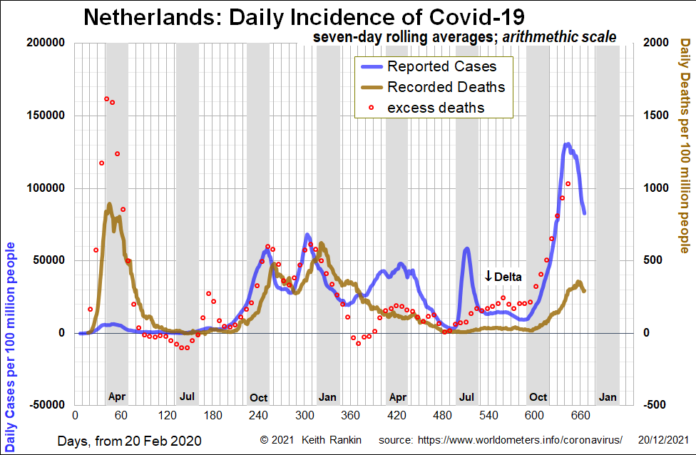
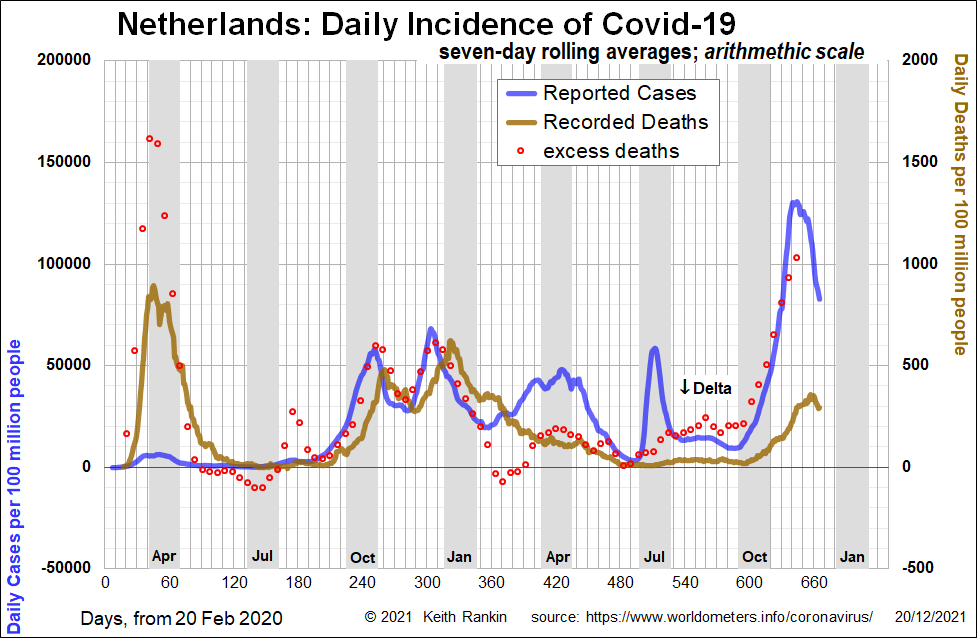
While the Omicron strain of Covid19 was first sequenced in South Africa, it was found independently in the Netherlands in November. So, while Netherlands was one of the European countries which caught the latest sudden European wave (mainly featuring Delta), most likely the Omicron strain was already spreading there; indeed the main constraint on the growth of Omicron in Netherlands was probably Delta. By now, it seems that Omicron may have already largely displaced Delta. Based on excess deaths, the current wave of infections began in the Netherlands in early September, starting as a Delta wave.
Just as the Omicron panic reached its crescendo in Netherlands, the actual data shows a sharp decline in covid cases, following a similarly fast increase. Hospital admissions are also falling in Netherlands.
Coincident with the spike in cases was a spike in excess (Delta) deaths. For the deaths to be coincident with cases, it means that there was a prior undiagnosed beginning to the spike in cases. Netherlands has always been a country reluctant to surveillance test for Covid19, so we can assume that many early Omicron cases were never counted, just as numbers of early-wave Delta cases were not counted.
My interpretation of the very recent sharp fall in cases is that Omicron is displacing Delta, and because Omicron is less severe than Delta, many Omicron cases are either completely asymptomatic, or mild ‘cold’ symptoms that have not triggered a covid test.
Why the political panic when known cases are falling sharply? My guess is that it’s politics. When things go wrong, Prime Ministers prefer to claim that they were blindsided by something quite unexpected than to admit to having been negligent. Hence, in Netherlands especially, the Omicron scare has all the appearance of being overcooked; of being a politically convenient (or manufactured) crisis.
South Africa
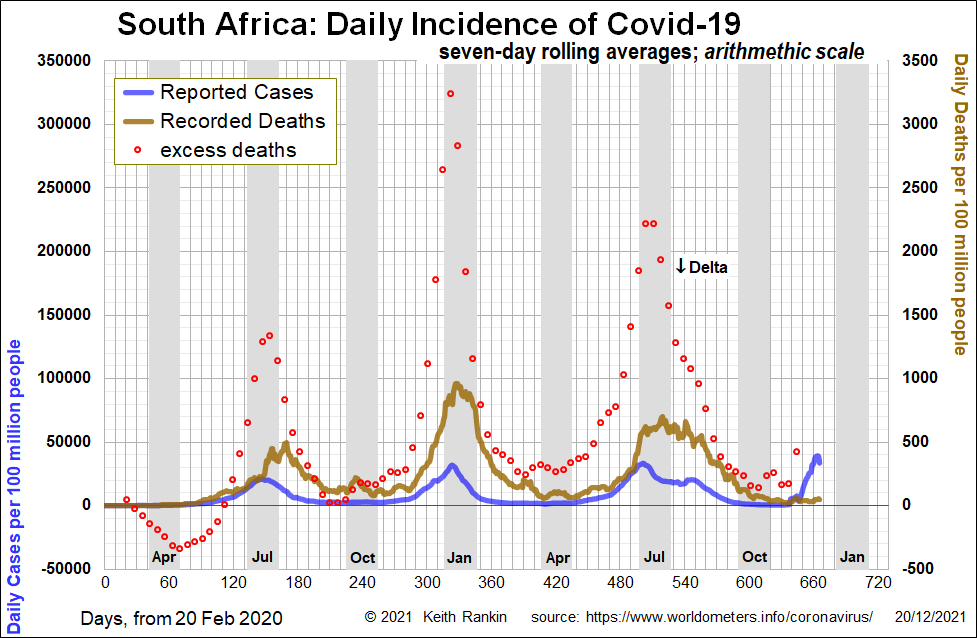
Chart by Keith Rankin.
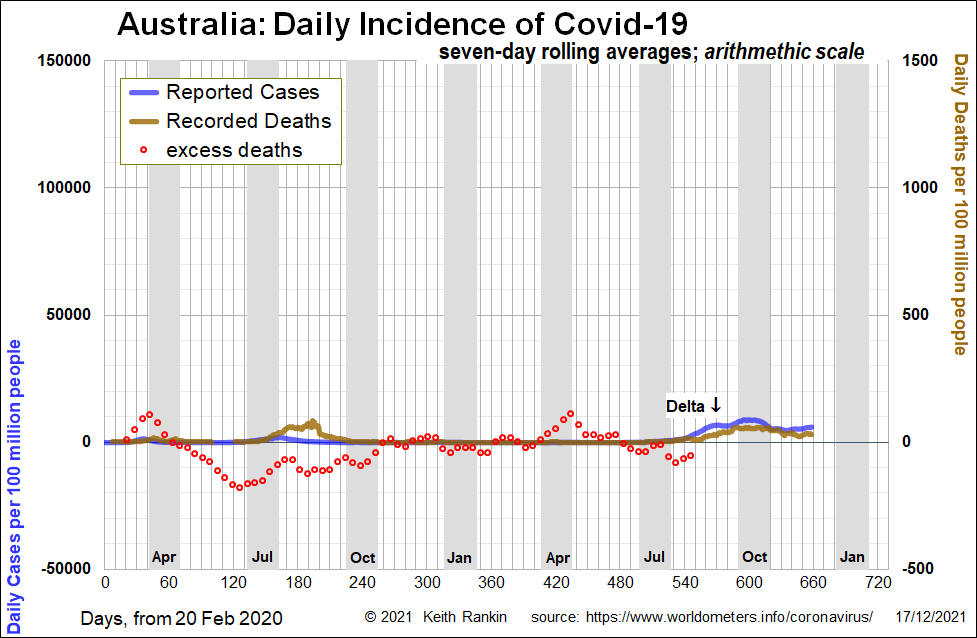
South Africa had a winter wave of covid cases from June to August 2021; a mix of the Beta and Delta variants. October was comparatively quiet, though increased deaths at the end of October suggest at least one region remained covid active. Then the Omicron variant appeared in early November, evidently from Botswana. The sharp rise in cases in South Africa – Omicron – almost certainly began about a week into November, three weeks ahead of what shows on the chart. It’s unlikely that the rise in excess deaths in late November was due to Omicron – it’s just a bit too soon.
Certainly, by December the authorities were sensitised to look for Covid19 amongst deaths, with particular reference to Omicron. But so far covid deaths in South Africa remain very low, despite it now being seven weeks since Omicron has been there. Despite South Africa having a ‘young’ population, it clearly has a covid-vulnerable population, looking at previous waves.
In early December, the rate of discovery of Omicron significantly exceeded Omicron’s rate of transmission. We note now that case numbers in South Africa seem to have peaked.
United Kingdom
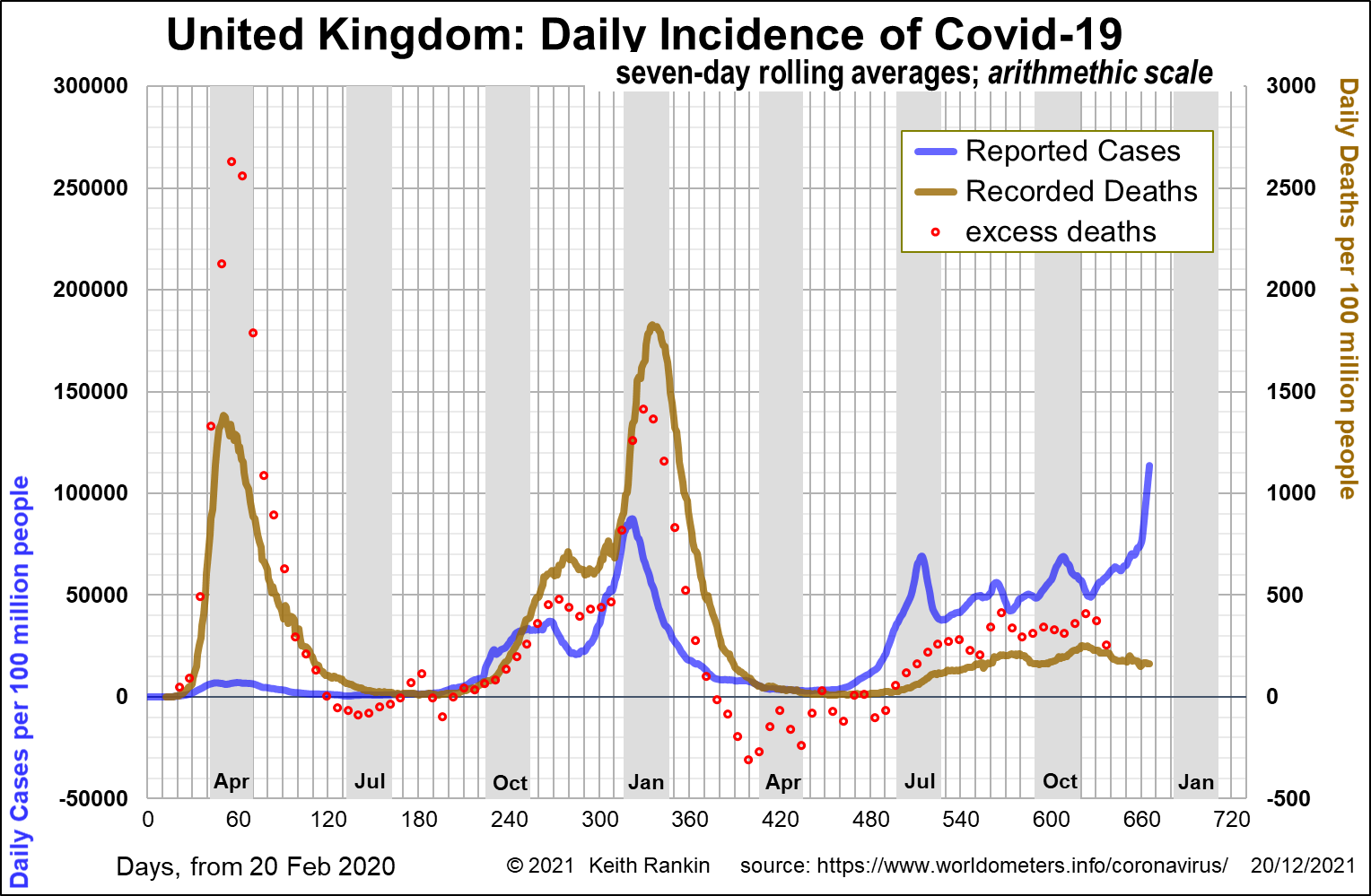
Chart by Keith Rankin.
In the United Kingdom – Covid19, mainly Delta – has been significantly present since June. Deaths have been low (by 2020 standards) and stable, at about three per million people per day. That looks now to be down to two per million per day (equivalent to 10 daily covid deaths in New Zealand).
This December, it looks as though a rapid escalation of cases – Omicron cases – has been taking place. But much of this represents the rate of discovery, not the rate of transmission. Quite possibly many of the November cases were also Omicron, and many cases of Omicron in November will not have been notified because they were too mild to have triggered a test. Severe cases of Omicron should already be showing in the death data, but they are not. This suggests that relatively few cases of this variant are severe.
As in the Netherlands, I cannot help but feel that there is a lot of unnecessary hype about Omicron in the United Kingdom. Prime Minister Boris Johnson is facing a major political scandal over his staff’s 2020 Christmas Party. Omicron is a convenient if untidy distraction.
Reflection
The biggest concern, I would argue, is that the populations of ‘the west’ are now close to a ‘critical threshold’ (or ‘tipping point’) of anxiety over the pandemic (see The straw that broke the camel’s back for the idea of a ‘critical threshold’ or ‘critical state’). (‘Critical state’ theory is very important for the understanding and prediction of major earthquakes.)
It looks likely that Omicron is evolutionarily superior to Delta because, in the vast majority of cases, it is not creating severe illness in its human hosts. If this is correct, Omicron is not merely ‘coldlike’ as has been described; rather it is a ‘cold’ virus, as is former-pandemic coronavirus OC43.This should be being hailed as good news, and not as an invitation for the human species to go mad with fear. Omicron is dealing to Delta, methinks. Sometimes the solution to a virus is a virus; that’s ecology.
——-
Keith Rankin (keith at rankin dot nz), trained as an economic historian, is a retired lecturer in Economics and Statistics. He lives in Auckland, New Zealand.
How to stop ‘the normal principles of taxation’ destroying our economy and begin changes to create a citizen economy (Part A)
EDITOR’S NOTE: Taxation is the mechanism for redistribution of wealth to combat inequality and for redirecting resources to build a society. But our current tax principles though largely hidden or not understood by ordinary people, lie at the root of all our current inequality and struggling economy. Struggling at least for ordinary people. This article shows our current tax principles are central to our economic problems. Understand and fix tax and we are on a path to greater economic security and wealth for all, a ‘citizens economy’.
Those normal principles are helping create three of the main problems we are facing in our society:
tax avoidance,
inequality, generating poverty (including the housing affordability crisis),
environmental damage, and the resulting multiple related crisis’s. (e.g climate).
These three problems show the current ‘normal principles of taxation’ are sending the wrong economic signals to the economy and distorting it away from its primary purpose, the supply of goods and services to meet our society’s wants and needs. But there is a simple reset of the principles that removes the structural drivers currently creating these problems. And a reset is essential to fix these problems as new taxes or laws will just be lipstick on a pig if we don’t fix the underlying structural drivers.
This relatively easy reset does not require any international agreement or loss of autonomy for New Zealand.
NOTE: For your convenience, we have structured this long-form report into five sections. Part A continues below. But you can download the full analysis via this PDF, without cost, which contains Part A, Part B, C, D, and E.
To summarise the five parts:
In Part A we look at six ways the existing normal principles of taxation are damaging the long term economy and subsequently our society. They show the basic principles of economics are being undermined by the normal principles of taxation. I then identify the two main actions of a reset that will fix this damage.
Part B in this series details the full range of required tax reset ideas (e.g. get rid of damaging GST) and goes through the impacts from the full reset and how many of those challenges actually put the economy on a more sustainable and stronger growth base, with more competition.
Part C in this series covers aspects of the Pandora Papers and how it is the ownership structures of companies and trusts that are creating moral and economic problems just like the normal principles of taxation do. I raise some basic questions about how we should/could change the powers of, or scope, in which these entities are formed and operated. It is only in the structural permission about how they work that we can stop the economic problems we currently have.
Part D in this series examines beneficial impacts and reasons why the capital revenue distinction must go. Including how it will operate and impact business.
Part E in this series details impacts on various sectors of the New Zealand economy.
What are ‘the normal principles of taxation’?
At a very high level, income is identified by having three features:
It comes in
It is periodic (not one-offs)
It has the character of income in the hand of the person who receives it.
From these base features principles arose. They have been adapted and interpreted through case law of a capital/revenue distinction. That can be defined as:
Capital is not taxed but revenue is, so some businesses try to label items as capital to reduce their tax bill. A lot of the Pandora Papers covers this type of ‘legal’ activity.
A sale of a farm, as a one off, is generally capital and not subject to tax. You would expect that to be reinvested somewhere rather than used to live off. But the sale of produce from the farm (periodic – used to live off) is taxable.
Expenditure incurred to gain that ‘income’ should be deducted before tax is paid. Money spent to gain income is not really income that can be taxed.
So you get gross income and net income.
Expenditure incurred can’t be questioned.
Costs to run a business can’t be questioned for taxation because it is up to the owners how to run the business regardless of the consequences or how sensible they are.
These are enough principles for my purposes; but inherent and inseparable in these principles are some values:
tax is a cost, and
it is legitimate and necessary for efficiency to minimise that cost. Like you would with any other cost.
But there is the catch in this, tax is not a normal cost.
Why are these ‘normal principles of taxation’ a problem?
Here are six points that explain why the principles send the wrong economic signals to the whole economy and undermine economic growth.
1. They undermine comparative advantage and encourage monopoly
(Small businesses with lower costs should have an advantage in price over big firms. But larger firms use costs to reduce their tax to give them an advantage.)
Business is supposed to be efficient and reduce costs, to be competitive. The theory goes, by driving down costs you drive down price which is better for satisfying consumers wants and needs. This is more efficient and only business can do this as government is wasteful and costly.
But this same efficiency driver on a micro business level sees tax as a cost that a business gets nothing for on a balance sheet.So to avoid tax, a dead cost, the ‘normal principles of taxation’ allow them to grow other costs to not only prevent having to pay tax, but also to do things that drive up the price of their goods and services so they gain more profit.
We all know and experience the marketing techniques that large business use to keep their profits high, or how they run anti-competitive practises to undermine competitors. e.g. run an airline along the routes of a competitor so they don’t grow and move into their high cost routes. And these techniques cost a lot. They rely on big data from loyalty cards, slick advertising, changing superficial designs with new releases, glamorous shops, etc. And they rely on access to debit financing. These are just ‘normal’ large business practises based on behavioural/marketing psychology and finance.
So large businesses don’t mind incurring these costs because they will reduce the ‘dead cost’ taxation they have to pay. And it is a big saving, 28% on every dollar spent. So consumers/taxpayers in having a reduced tax are actually helping large companies pay for techniques to make us pay more money for their goods or services. So we pay twice for their supplied good or service – once on the high/‘discounted’ price and second through the tax subsidy.
Small businesses simply can’t afford to run the same techniques or access debt finance in the way a large firm can. Their whole pricing structure is done differently; they reduce their costs and run a tight ship. These economic rules simply don’t apply to large business because the normal principles of taxation turn costs into an asset for them – a tool to drive out smaller competitors while driving up price.Small firms can’t compete against these large firms no matter how good the quality or price they charge for their good or service.
Another perverse result is large businesses become less concerned about quality and service in part because like any large bureaucracy they have to wear a few problems. But also in part because large businesses not only compete on price and quality, but compete through ‘cost accrual competition’. The ability to accumulate costs that work to their advantage over smaller competitors. And it is profitable and relatively easy and ‘legal’, but it shifts a large business’ focus away from innovation and building quality or low price, and into a focus on gimmicks and primal manipulations to trick us to buy. And it reduces competition as smaller firms can only compete by reducing costs and there is a limit to that.
We can see this most easily in fast food and retail where there has been a slide into franchise. The Chemist Warehouse is one of the most recent. Costs on the floor are tight but the marketing, site location rental, management fees, executive salaries, advertising, debt financing are all high cost. In a generation the smaller owner run businesses taking pride in their business are largely gone from New Zealand.So many small businesses struggle and fail because it’s hard to find niches to escape the larger firms relying on costs and turnover to drive their pricing. Cost efficiency is no longer a key economic driver for a large business; ‘cost accrual competition’ through saving tax is the easiest way to wealth.
In addition larger businesses are more likely to spend on vanity expenses because it still reduces their tax bill so it gives them an advantages over smaller competitors.e.g. take a lease on property in prestigious locations, purchase on finance or lease luxury cars, still get a 50% deduction for business ‘entertainment’ expenses – meals and lunches, tickets and who knows what else.
‘The normal principles of taxation’ remove the natural competitive advantage of a low cost business supplying the same goods and services. These smaller business are normally New Zealand owned and operated.And to catch that advantage all businesses have to follow that high cost model, and treat tax as a cost to be minimised, leading to larger and larger businesses leading to monopoly capitalism. Cost accrual competition is a powerful economic tool and we the taxpayer are subsiding it to only some people’s advantage.
2. They undermine redistribution of wealth (tax) and the resulting economic stimulus
Almost all businesses do not create wealth, they simply accumulate wealth.And to accumulate they rely on the education and health systems to support access to employees and customers. They also rely on infrastructure, courts, police etc in which to do business. Tax minimisation, avoidance and evasion, undercuts the process of redistribution of wealth which pays for the supply of these services and therefore it undercuts the provision of the services the business needs to function with.
Redistribution by taxation also supports demand across the economy which in turn supports business accumulation of wealth. The ‘tax is a cost to be minimised’ attitude comes from the normal principles of taxation, but tax helps promote the multiplier effect which benefits the entire economy. The principles need to change so that no business has an incentive, and mechanism provided by the principles, to minimise tax, as it works against the long term supply of goods and services, within the economy.
Tax is like no other cost as it is not fixed. The principles calculate it as a relative cost based on what income is left over after costs. So on a micro economic level a business see’s an advantage to run up costs to minimise payment of tax. But on a macro economic level that minimisation is damaging the economy in which it functions. Tax minimisation is actually an act of self harm by a business in the long term. The normal principles of taxation are creating the problem.
3. They subsidise risk taking and provide no choice for taxpayers on doing that.
By allowing business to deduct expenses to reduce their income that is liable for tax; it makes the New Zealand taxpayer subsidise the provision of that good or service through sacrificing tax collected. And as said before the saving is not always passed on, prices are held high and profit maximised so consumers are not getting the benefit of the subsidy. The normal principles of taxation allow no choice for society on making this subsidy. e.g. huge amounts of investment resources can be used to subsidise the business of taking rich people on tourism flights to space. Would people vote for that choice, over lifting more children out of poverty? But there is no vote, we have no choice, and it is tax revenue we could have.
The entrepreneur who has the knowledge to make these choices about what costs to incur should take the risk for those choices. Choices and risks should not be subsidised by taxpayers or government as that is not their role.
If the people or the elected representatives decide to subsidise an activity that is okay. And that is very different from a blanket subsidy as happens currently under ‘the normal principles of taxation’.
4. They punish innovation or the efficient use of resources
If two businesses supply the same good or service but one does it at a higher cost than the other, why should the lower cost company pay more tax? This is not good economic policy.
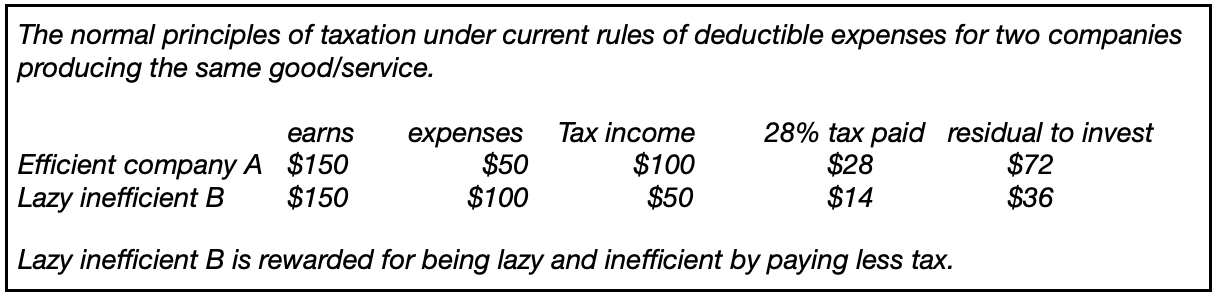
The Lazy Inefficient company B has more expenses ($100)so only pays $14 in tax but the efficient/innovative company A ($50 in expenses) pays $14 more tax at $28.
The normal principles of taxation are sheltering poorly performing companies, and punishing well performing companies. And the taxpayers through having less tax collected are subsidising the inefficient poorly performing company.
And the principles allow more investment income to be made available to this poorly performing company. i.e. wasting scare investment capital. (If B did not get the tax subsidy and had to also pay $28 in tax like efficient company A, then Lazy inefficient B would only get $8 to reinvest).
To those who say the high cost of B could be due to the quality service they provide. Yes, and that will mark them out from their competitors, and that quality should sell them.But there is no way for the blunt instrument of taxation to tell the difference of quality to wasteful spending; so it shouldn’t. If customers don’t want that business’s ‘quality’ then that is a market signal. There is no reason for the taxpayers to subsidise a business’s choices on quality as the entrepreneur might be right or wrong and there is no way to tell, except by the customer.
More can be said on this example but it does not change the fundamental point that the wrong economic signals are being sent. e.g. Company A could have less customers and be price matching to Company B to maximise their profit rather than passing on the savings from innovation to their customers. Company B becomes a tool to make customers pay more as its existence takes up some demand, which slows the introduction of potential new competitors. This is another reason to have B out. This shows tax is only part of fixing the economy but a very very important part.
5. They subsidise environmental damage or resource waste by creating an externality
Of course not all companies have high cost structures because they run anti-competitive practise, or have vanity expenses, or they are just seeking tax minimisation. Some businesses, are just very costly to undertake and there is nothing inefficient about that, e.g. mining.
But should the costs to run those enterprises be subsidised by the taxpayers taking a reduced tax collection? The high costs of those business choices should be borne by the risk taking entrepreneur with the knowledge to take those risks.
For example, if you do the Hump Ridge track you see some great wooden viaducts used to bring out the timber from a milling operation. The devastation of the local forest was complete but the business as reported never made a profit as its costs were so high and the sales income never fully came in. New Zealand got nothing of substance out of this destructive exploitation. Yes workers got wages and scrimped a life of remote hardship. The directors would have got income along the way. Yes there is now some tourism value but it’s probably not much more than if it was left. Overall, the value of the forest asset was wasted without profit. The ecological and cultural value lost can’t be quantified.
The same destruction and waste occurred in the areas around the ‘Bridge to Nowhere’ in the inner Whanganui. All over New Zealand subsistence businesses were supported by ‘the normal principles of taxation’ for people to eke out an existence to the detriment of traditional Maori life and culture, the environment, and their own lives. The ‘normal principles of taxation’ were one of the systems within colonial exploitation that allowed profits to be stripped back overseas without as much redistributive effect from an effective taxation. The principles were a tool to strip value out of the new nation as the costs of exploitation were offset to the income.It is a tool in a class system that strips income away from the redistribution/taxation process.
Colonial legacy justification and creation of an externality
Yes, you can argue that this sort of tax subsidy for business was necessary to enable economic activity in new lands. And that is the colonial argument. From where we stand today we can see the waste and destruction of that legacy and thinking. Our climate and environment is imperilled because of it. But it’s still happening, that structure is still in existence within the normal principles of taxation, and it is helping drive environmental damage and climate change. The rules were made through judge law to favour the wealthy to help drive their, or their class’s, wealth. This reset will at least make the full cost fall on the risk takers and they will at least be more careful in future because the cost will fall on them fully.
Ongoing impact
If income from a businessactivity almost matches the cost of the activity, then very little tax is paid. So when the good is being sold the price does not reflect the cost of society’s human and physical infrastructure that was required to support that activity. Because tax was reduced this cost is not calculated into that sale price. i.e. a seller will work for the highest price but if the cost of production is subsidised, the threshold for the sale price is being subsidised and the true cost is not reflected in the price resulting in false economic signals being sent to producers. The normal principles of taxation are creating an externality of the cost of society.
A business must fully contribute from its income back to society through paying tax or there is no point in society letting the business be in existence. Like the purchase of the viaducts, or the mill boilers, tax is just a cost that should be factored in and you can’t avoid it.
Each business or activity needs to be viable in its own right so it has a cost that reflects if it is a high cost activity. Current loss offsetting hides a costly activity and dissuades companies funding research or looking for alternatives to get around high costs. Subsidising by tax undermines that drive for innovation.
Environmentally damaging activities like mining are one such activity where if the cost of tax was not able to be avoided, a higher price would generate more focus on recycling, or innovation to find alternatives. See more comment under heading ‘Different sectors have different impacts’
It is no longer appropriate for our business community to be molly coddled and subsidised by socialising their costs onto the New Zealand taxpayer, the government, and the environment.
6. The ‘normal principles of taxation’ are helping cause an international destabilisation problem.
President Xi in China is crushing democracy in Hong Kong as he see’s it as a vehicle to undermine China. But he is fighting the wrong enemy. As a former colony of Great Britain Hong Kong follows the basic outline of ‘the normal principles of taxation’. And most of the tax principles were set through english case law by judges who arguably have acted in their own or their class’s economic interest when making decisions that set precedent. As a colony these tax principles facilitated economic value being stripped away from the colony and the lands near it to the benefit of the ‘mother country’. In the post colonial world we still see these tax principles being used to strip value out of countries with little tax paid, and then into tax havens for the use of the billionaire owners of Google, Amazon, Microsoft and others.
China has become the factory of the world as large multinational companies moved manufacturing there for cheap resources and low regulation. President Xi wants the work and business to stay so it will give stability and economic strength to China. He was recently reported on CNNAug 18, 2021 by Laura He as pushing on China’s rich to redistribute wealth. So he can see problems in his nation but he is asking business people bound by a tax system to act outside that system. His quest for security by taking on democracy and the Uyghur people means he is no longer walking with his people as a leader, using the wisdom of the crowd to guide his nation but is leaning into an inherently unstable autocratic leadership model. And he is adding fuel to the cold war that leaders in the US, UK and Australia, seem willing to hype up in a new alliance. He has chosen the wrong enemy; it is the colonial based tax structure that is undermining China’s security, e.g Transfer Pricing and Thin Capitalisation are able to undermine revenue and the ability to grow domestic based businesses in a way that spreads wealth. That has to be dealt with by simple consistent rules as suggested here that do not favour multinationals, as the current normal principles of taxation do. Democracy needs to be decoupled from exploitive capitalism and a tax reset will help do that.
And the ‘west’ is also struggling with conflict and polarisation in society, driven through culture war issues like immigration, climate change, vaccines, and abortion rights. In the ‘west’ the culture wars are facilitated through a dysfunctional 4th estate and poor quality democratic processes. These culture wars have some urgency for ordinary people, ‘taking our jobs, taking our opportunities’, but theses are just the scapegoats for the very real economic struggle many are experiencing. It’s about the economy getting polarised. Ultimately the western nations have the same enemy as China in the poor functioning of the tax system. The tax system is helping build monopolies, facilitating tax avoidance, and undermining local businesses. We are all poorer.
The normal principles of taxation are well overdue for a complete overhaul so they build each nation’s economy and redistribute wealth, and that is the purpose of taxation, not to concentrate wealth and build tax havens.
Note: The need for international trade by New Zealand will not be impacted by these changes but it may, or may not, modify it. And with the supply chain disruption brought by the Covid-19 Pandemic, it makes it an excellent time to bring in changes that will ameliorate the disruption we are already experiencing. It will help our nations build back on to a more sustainable path.
How shall we reset ‘the normal principles of taxation’?
In the media and policy world the strongest reset theme for taxation is greater transparency and sharing of information from other jurisdictions (especially tax havens) so tax can be claimed. This is all essential work that needs to be done but transparency and sharing information does not remove the structural problems created by the principles. And the current principles have created a complex set of rules that are an administrative burden.
And the creation of new taxes like wealth taxes will not deal with the structural drivers of wealth concentration.As the Pandora papers show the normal principles of taxation are a major driver of wealth concentration and tax avoidance.
I propose a structural reset that uses existing economic understandings which therefore won’t destabilise the economy, and it works alongside the existing market forces, sending appropriate signals to the economy.
The two main reset actions are:
Remove deductibility for all expenses except for domestic salary and wage payments.
2. No capital revenue distinction for non-individuals.
This is supported by:
A very broad legislative definition of ‘income’ to ensure everything that comes in is taxed regardless of traditional capital revenue distinctions. Even to include related party loans (with an exception for 3rd party loans – perhaps a strict list of who can be a 3rd party). The Pandora papers show this is essential regardless of even this reset. Because the current normal principles of taxation allow a company to make income but then through a series of entities turn it into a loan to be made back to the company or another related party and a ‘loan’ is not taxable. Part C, in this series, gives an example.
No grouping of companies for tax purposes. Companies are separate legal entities and will be treated that way for tax.
The original intention of grouping was to prevent tax avoidance but it has now been twisted to be a major tax minimisation technique. i.e. Company tax rates in the past had a progressive structure. To avoid paying the higher rates a company created lots of sub companies and spread the income out so each paid an amount just below the high tax rate. This was then stopped by the requirement to group the companies so they did pay the higher rates of tax. But then for anti-competitive purposes parent companies began to run subsidiary companies – not to make a profit but to make a loss (the exact opposite of what companies should be set up for in an economy). Using ‘cost accrual techniques’ and low income. e.g. run a small airline at a loss to compete with a budget airline to preserve their other profitable routes. Grouping then allowed their losses to be offset against the income of their profitable routes so less tax was paid. If a situation arose where the loss company was no longer needed the losses could be retained but limited liability remained as a protection for the parent company. A long time ago the progressive tax rates on companies were removed and company tax was made a flat tax rate but nobody got rid of this ability to group companies. The companies wanted it kept. It is overdue to get rid of grouping.
Without a capital revenue distinction and strict application of entity status, shifting assets between separate legal entities will generate taxable income because their status as a separate legal entity now becomes important for tax purposes. With less advantage in having separate legal entities, companies will become bigger which will improve transparency and reduce the ability to avoid tax or scrutiny.This reset will work with international trends to improve transparency. With more potential exposure to risk, behaviour and focus will change.
A company to trade in New Zealand must be required to have a company registered and based in New Zealand through which all its activities are subject to tax that are ‘sourced’ from New Zealand. And they must have a New Zealand bank account. An asset in New Zealand can’t be owned by a foreign based organisation in a tax haven as the risk of tax avoidance is too high. If there is not a base in New Zealand, e.g internet sales, then work must be done with banks on how sales can be caught for tax or punishments if not.This is already a tax issue and not created by this reset.
In ‘Part D (of this series) – Beneficial impacts for all with no capital/revenue distinction and less tax minimisation’ I go through more discussion of these points. In particular how taxing disposals of cash accumulations is not double tax but sends a beneficial push into quality and price for goods and services.
Economic policy and tax principles alignment
This reset does four main actions:
1. It removes the structural drivers for all the six economic problems listed above. Obviously other actions need to be taken in addition to tax for issues like international relations. This reset does not restrict actions but better supports them.
2. It stops almost all tax avoidance techniques based on currently ‘legal’ processes. Nobody is telling business how to run their business or control what they do. The choices are all still with the business, it is just the consequences and risks that will be fully carried by the chooser.
3. It removes any incentive to waste or damage the environment, or any assets, as all costs will be fully carried by the producer. Because things will cost more, the throw away culture will not be structurally supported by the tax system. Note – things are costing more now but with no quality improvement. Quality has the chance to come back.
4. It redirects investment capital to producing goods and services to meet the needs of society. With interest no longer deductible for tax there will less demand to debt finance. Finance will therefore be freed up for investment in actually producing goods and services. Yes some capital will be taken up to hold assets like land but that is a good investment at the moment. The purpose of debt financing is largely cost accrual competition. Part B of this series has more on the potential positive changes in how investment may occur.
But is this economically viable? We must look at the numbers.
For contrast from the Inland Revenue website 2017 annual report –
Total tax in 2017 was $69.2b and Individuals paid 48% ($33.2b) plus GST 26% ($17.9b) = 74% of total tax was paid by you and me.
Taxation under a reset calculation – A soft transition calculation
The existing tax rate of 28% could be used or a lower rate of 15%. But if we aim to increase taxation because it is sorely needed for social purposes, and to pay down debt, and we don’t want to cause too much business disruption, then the following is an option.
Businesses claimed they had $83.5b income over expenses for the 2017 year.
If we initially taxed all companies at 10% of total income, no deductions for costs (except domestic salary and wages). And indexed to go up in future years. This will give a massive boost to small business.
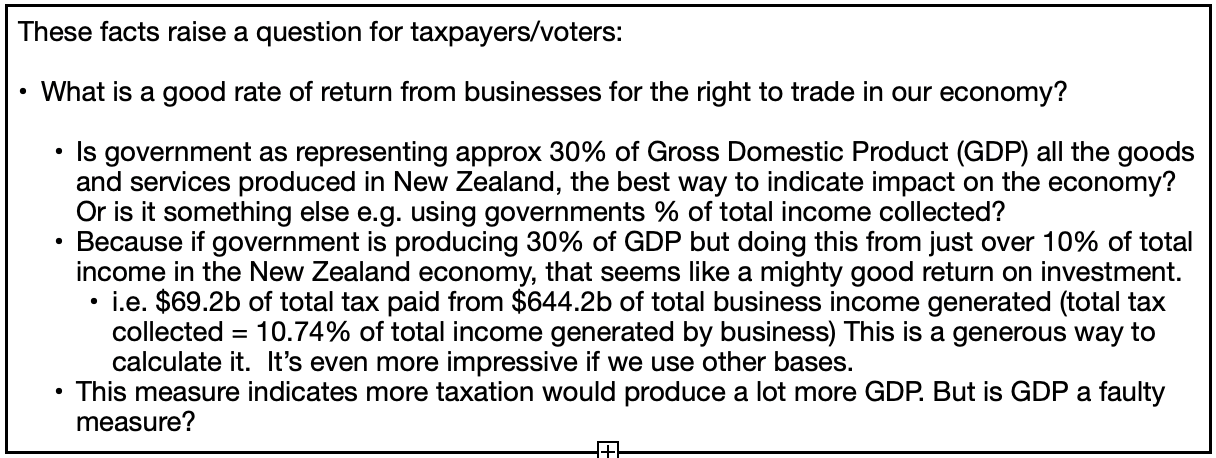
$644.2b x 10% = $64.42b tax.
As business had $83.5b over costs it means there is income available to pay the $64.42b tax. They would have to shift profit expectations and likely no dividends.Impacts will depend on the individual business. If we add in the Individuals tax, and ‘other’ ($37.1b) tax paid that year (I leave out GST as it must be dropped – as it damages the economy) we would have: a total tax for 2017 of $101.2b
The amount of 10% should be indexed to go up 1% every one, or two or so years, until it reaches 15% or 20% or whatever the government of the time decides. The 10% rate is too low for the urgent needs of climate change and human need. (The cost is higher now because actions were not taken earlier, and business in aggregate has not supported taking action sooner, in fact they hindered action).
Other taxes?
This increase in tax collected is without any new wealth tax or capital gains tax, and with a reduction of the headline tax rate. But there may be other reasons to do new taxes. In times of war. Or environmental crisis. Or a housing crisis. Tax is so low at the moment and the social needs so pressing, plus the debt must be paid down, that the amount of tax to be paid must go up.
Easier compliance
Another reset benefit is it could be possible/investigated to require all money deposits to a non-individual to go through one bank account with an instant deduction for 10% tax. A credit can come back once a salary or wage payment is made in the Inland Revenue employer account. This means no provisional tax or due dates to worry about. A great compliance saver for small business. Obviously all bank accounts would have to be linked to an IR number to prevent avoidance but if all non-individuals bank accounts were automatically subject to tax, thenthat removes some temptation to avoid tax liability.
The economy context
This reset is still only income that is being taxed; something that has ‘come in’. So money is there. Any realised capital gains would also be taxed because they would have ‘come in’. But as there are avoidance techniques for companies to delay gains coming in I am not expecting much to be collected under this category, initially. But a rising tax rate might persuade them to come forward earlier. But we could use the ‘risk free rate of return method’ to calculate this ‘income’. But that would be at least 15%. Other options to capture unrealised gains are being discussed in the wider media.
If large businesses say they will go out of business, then that shows just how dependent they are on the tax subsidy.So are they truly viable?The slow introduction of a lower but more effective rate would give them time to adapt to moving away from debt financing, and high cost structures. But there are many more effective ways to achieve this change. I don’t expect them to move away from their marketing techniques but they would pay that cost without being subsidised by taxpayers. Issues with marketing and consumer protection can be dealt with separately but those actions will be undermined by the current tax system. Actions will be more effective with a tax reset.
To stick to the concept of government spending being less than 30% of GDP reduces our ability to create wealth through the multiplier effect.A demand driven economy will bring better economic growth that actually satisfies people’s needs. The only risk to a demand driven economy is how to control pricing and inflation, (I propose an article on this at a later time). We tried supply side economics and we have poverty, housing shortages, housing inflation, a struggling health sector, and an education system beholden to overseas students.
Perfect timing
The recent talk about inflation and stagflation in part due to supply chain disruption make it the perfect time for the reset to happen as it will reduce business sector demand. All large businesses will be strongly focused on reducing their high cost business structure which will reduce demand and take pressure off inflation. Recall that a lot of business sector demand is micro business churn to drive price and demand up for their product or service. It is not growing the economy except in an incidental sense.Innovation, exports or savings are not being driven in the macro sense by that spending. By contrast small businesses with the lower tax rate will be opening up, increasing competition. I talk about inflation in Part B of this series but will require a further analysis.
Summary – we must reset ‘the normal principles of taxation’
This reset is not about political sides or ideas. It is about making the economy work as it is supposed to, meeting people’s wants and needs.
If we believe in markets with businesses competing on price and quality then this tax reset must be done because the current tax system undermines that, or
If we see the economic system is failing and people are falling through the cracks then this tells us one of the main reasons why and how to fix it.
The current tax system is breaking the economy and society. We are a frog in a pot that’s been on the stove for a while.
Further evidence the tax system is broken is seen in the US which has the same basic principles of our system and many of their largest companies aren’t paying much tax, e.g.Amazon, Honeywell, Halliburton, IBM, Fedex, Nike, US steel, Chevron, Delta. These companies are even managing through globalisation to avoid capital gain taxes. So we can’t just rely on new taxes to solve the existing problems. The foundation, ’Income tax’ must be fixed and this reset is how to do it so the big companies pay their fair share.
Minimising tax is big business for every large firm. For the cost of a small team of accountants they can structure finances to avoid billions or hundreds of millions of dollars in tax. The purpose of tax is to redistribute wealth but ‘the normal principles of taxation’ are discouraging redistribution so economies and societies are struggling, with small businesses disadvantaged and people’s wants and needs not being met.
The reset here retains largely the same tax system with all business treated the same. But the reset strips the rules down so there is nowhere to hide or shift the money. Because it is in the rules where the loopholes are found. And the rules/legislation are written with the normal principles of taxation firmly in mind, and with considerable input from those accountants who are deeply embedded in tax orthodoxy. The business sector has had a significant input into developing tax law and the business sector likes lots of red tape rules as it offers lots of loopholes.
In this reset you can’t shift money between income (subject to tax) to capital (not subject to tax). A person can’t reduce their tax by claiming expenses real or imagined. There are no losses or capital losses. I suspect the reason why we don’t have a capital gains tax in New Zealand is the fear of capital losses undermining future government revenue along with complexity of the law – but this reset shuts down those fears.
With this reset the tax system becomes much simpler and more transparent. This is why stripping the rules back, as is proposed in this reset, is actually the only way to get a truly broad based low rate income tax system.
About the author: Stephen Minto lives in Wellington with his two children. He worked for New Zealand Inland Revenue Department for approximately 33 years and is now enjoying no longer being bound by public service etiquette of being non-political.
New Zealand Parliament Buildings, Wellington, New Zealand.
Editor’s Note: Here below is a list of the main issues currently under discussion in New Zealand and links to media coverage. You can sign up to NZ Politics Daily as well as New Zealand Political Roundup columns for free here.
The festive season reinforces something parents and carers already know – many children today have a lot of toys.
In the United States, children receive more than US$6,500 (A$9,073) worth of toys between the ages of two and 12. Here in Australia, the toy industry is worth more than A$3.7 billion annually. Lockdowns have resulted in online toy sales growing by 21.4% during 2021, with the online toy industry now growing faster than the overall online retail sector.
The number of toys in Australian households is likely to increase when Christmas gift giving starts in earnest.
Here are some ideas for dealing with existing toys, as well as the upcoming influx of new ones.
The problem with having too many toys
Spaces with lots of toys are overstimulating and impact the ability for babies, toddlers and younger children to learn and play creatively.
The more toys, the more confusing for kids. www.shutterstock.com
Similar to cluttered pantries or office spaces, which make it hard for adults to focus, having too many toys around the house can make it difficult for children to concentrate, learn, and develop important skills around play.
Research shows fewer toys at a time leads to better quality playtime for toddlers, allowing them to focus on one toy at a time, build concentration skills, and play more creatively.
The other issue with having lots of toys “in play” is that we tend to place less value on them. By reducing the number of toys, adults can help children develop appreciation and gratitude.
What to do if you have too many toys
De-cluttering is easier said than done, but organising toys has many benefits for children and adults alike.
Fewer toys that are well organised leads to a calmer, less stressful environment which also reduces overstimulation in children and contributes to better behavioural regulation.
Reducing the number of toys can also increase opportunities for children to build frustration tolerance and having to focus on one or two toys at a time can improve problem solving skills as well as developing independent play experience and creativity.
Organising toys can also help parents and carers improve general structure and routine in the home, which is great for everyone!
How to organise toys
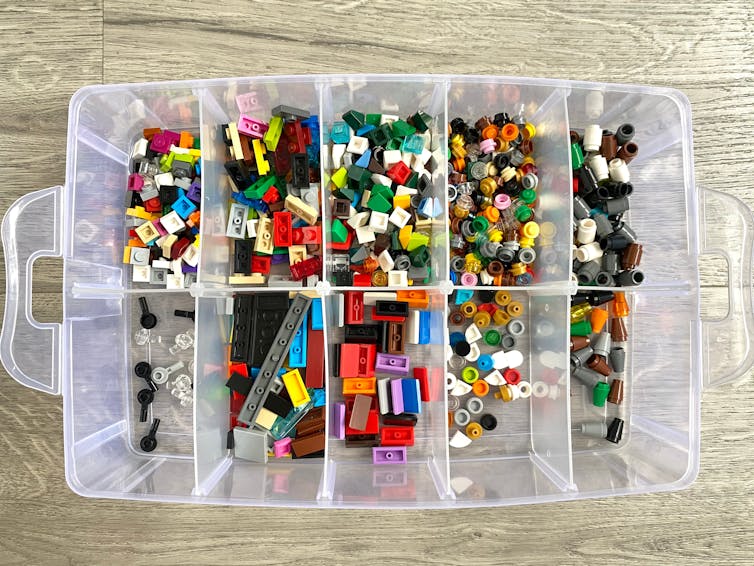
A good first step is to conduct an inventory of all the toys in your house. Divide toys into “keep and play”, “keep and store” (toys that are sentimental, family heirlooms or part of a collection that can be put in storage) and “give-away or sell”.
Toys that are “keep and play” should be organised in ways that allow children to clearly see and easily access them.
Put two-thirds of these toys away in storage. Every month, rotate the number of toys available ensuring you have an interesting selection of “social” and “solo play” toys available and try to include “good” toys.
Rotating toys can help with space issues and importantly it keeps the novelty alive.
Is there such a thing as ‘good’ toys?
With such a huge variety of toys available, the choice can be overwhelming. But when you are thinking about buying toys, there are some features that make certain toys better than others.
“Good” toys are those that are appropriate for the child’s age and developmental level. If you are not sure if a toy is suitable in this regard, seek advice from staff in specialist toy stores or consult child development websites such as raisingchildren.net.au and earlychildhoodaustralia.org.au.
Toys that help a child develop and keep them occupied do not need to be expensive. www.shutterstock.com
Toys should stimulate learning and keep a child’s interest at the same time and they should be safe and durable. In addition, toys should be able to stand the test of time (think Lego) and ideally be used in a variety of different ways over the years.
We recognise that with more than 17% of Australian children living in poverty, there are also many families who do not have the problem of having too many toys.
Good toys don’t have to be expensive. While Australians spend millions each year on toys, it’s worth remembering simple, everyday household items – cardboard boxes, saucepans and cooking implements, buckets and tubs, cardboard tubes, plastic containers and stacking cups – make excellent toys for younger children.
Parents may find it useful to categorise good toys. This ensures when you are organising toys, children have access to a variety of toys suitable for different types of learning and play development.
Here are five ways to categorise toys:
1. manipulative/functional toys – these include construction and building toys, puzzles, stacking and nesting, brain-teasers, dressing toys, beads, blocks, bath toys, and sand and water toys. Manipulative toys are important for helping develop fine and large motor skills, dexterity and coordination, which are vital for drawing, writing, dressing and more.
2. active toys – including various outdoor toys, climbing equipment, sports equipment and ride-on toys. Active toys are great for general physical activity and motor skills development.
3. learning toys – these include board and card games, books, and specific-skill toys such as letter identification and shape and colour sorters.
4. creative toys – such as arts and craft materials, musical toys and instruments including digital music and drawing apps.
5. make-believe – including dress ups and role play (costumes, clothing, hats, masks and accessories), stuffed toys, puppets, dolls, transportation toys.
What to do with toys you don’t need
It can be hard parting with beloved toys, those that have been part of a special collection or even just trying to clear out toys that have accumulated over the years. Many people find it emotionally challenging to give away toys and prefer to keep and pass them on to children and family members.
Keep your toys organised to facilitate better play. www.shutterstock.com
There are many charitable organisations that will be pleased to find new homes for good quality toys – The Salvation Army, Save the Children and Vinnies – all welcome toy donations, especially at this time of year. Also search “toy donation” in your area to find local organisations and make sure what you are giving is in good condition (if it’s a puzzle, make sure it has all the pieces!).
Online platforms selling used items or secondhand dealers are other options which will give your treasures a second life.
Finally, as we head into Christmas with Australians tipped to spend more than $11 billion on gifts, it’s worthwhile having the list of “good” toys handy so you can easily answer friends and relatives when they inevitably ask “what can we get the kids for Christmas?”.
The authors do not work for, consult, own shares in or receive funding from any company or organisation that would benefit from this article, and have disclosed no relevant affiliations beyond their academic appointment.
“Kondo-ing” (de-cluttering) has become all the rage. But languages are hoarders that hang onto every used bit of clothing, threadbare cushion or musty old piece of luggage. You never know, these might be useful one day.
Christmas is a great reminder of how important it is to hang onto some old stuff – decorations stowed in closets, dusty words lingering in our brains. At Christmas, we drag out boxes of tinsel, baubles and fairy lights. We also trot out words, meanings and even grammar that we stopped using in our everyday language long ago.
So, let’s unpack this dusty box of Christmas lexical curiosities. We’ll toll trolls, blaze yules, graze mules, and then finish with a Christmas cracker of a linguistic joke (well, it’s no worse than any other you’ll hear this holiday season!)
This Christmastide, may God keep you t(r)olling
Untangling and dusting off these lexical curiosities – like those Christmas lights we haphazardly stowed the year before – takes some work. We needn’t go further than the lyrics of our favourite carols to see this. For example, the puzzling line (in Deck the Halls) that instructs us to “troll the ancient yuletide carol”.
Trolls sound scary. If they’re not leaving offensive messages on the internet, they’re giants living in Tolkien’s Middle-earth. But the gentle trolling we do at Christmas has a different (French) origin. It entered English in the 14th century meaning “to stroll” – but taking a few twists and turns, as words can do, it eventually arrived at another meaning “to sing merrily in full voice” (think of those rousing trolly-lollies).
The references to “yuletide” and “the blazing yule before us” are equally bewildering. Tide here has nothing to do with flows of water, but preserves the original meaning “season” or “time”. Yule like tide is one the oldest English Christmas words (8th century), but its meaning has shifted dramatically – from the original name for December or January (and presumably the pagan festivities around then), its meaning morphed into “Christmastide” a century later.
For some of the linguistic origins of Christmas words, we need look no further than the yuletide carols. Shutterstock
The opening line of the carol “God rest you merry, gentlemen” also dusts the cobwebs off some linguistic junk. Basically, it’s a good wish and means something like “happiness to you gentlemen”. It doesn’t help that the verb rest here has nothing to do with “relaxing” but means “keep”; what’s more it appears in a grammatical form that no longer exists. The old subjunctive signalled non-real events, such as wishing. This job is now done by other verbs (like may) – so, a more modern version would be “May God keep you merry, gentleman!”.
But even merry isn’t terribly common these days. Putting aside euphemistic references to alcohol-induced states of cheerfulness, we usually only encounter merry in carol lyrics like this one, and of course in the expression Merry Christmas (and perhaps also Robin Hood’s band of merry men).
Away in the manger…the little Malteser lay down his sweet head
Whenever untangling and dusting off our Christmas curiosities gets too hard, we can turn the task over to kids. They often refashion these yuletide curiosities into something that seems a bit more reasonable. “Tolling the yuletide carol” has a much jollier image than “trolling” it, and “get dressed, you married gentlemen” would seem like good advice. Certainly a “grazing mule before us” makes a lot more sense than that “blazing yule”.
But it probably wasn’t children who “decked the halls with Buddy Holly”. In fact, adults are responsible for a lot of remodelled Christmas expressions, and they’ve been doing it for centuries.
Look at mistletoe. It has absolutely nothing to do with toes, though this seems quite reasonable when you look at the plant, especially hanging as decoration. In fact mistletoe grew out of misteltan, the plant name combined with earlier tan (“twig”).
Despite their appearance, reindeer have nothing to with reins (“harness”). Reindeer was the original Viking word for this animal hreinn combined with deer, which simply meant “creature” (so (h)reindeer was one of those redundant compounds like oaktree).
Words we’ve purloined from other languages are especially prone to these linguistic makeovers. Look what we’ve done to Kris Kringle – it’s come a mighty long way from the German dialect word Christkindel (“Christ child”).
Christmas is the reindeer’s time to shine, but their name actually has nothing to do with reins. Shutterstock
Plum puds sans plums, and boxing days without boxes
We sometimes find a cracked bauble or two in our box of lexical curiosities, but we’re loath to toss them out. We just keep using them or find new uses for them. Plum puddings don’t have plums in them anymore – the dried plums were replaced by raisins, but we’ve kept the name.
As foodie John Ayto describes, traditional Christmas fare had all sorts of “plum” dishes, even plum broth and plum porridge. Occasionally modern plum puddings become plump puddings – time will tell whether this catches on.
So what about Boxing Day with no boxes (unless you’ve been to those post Christmas sales). In the 17th century, Christmas boxes were earthenware containers taken around on the first weekday after Christmas. The purpose was to collect money for the workers and, like piggy banks, they were then broken and the money distributed.
Clearly the events around this seasonal payment have changed dramatically and box now refers to a day not a container – the day has shifted too, and fixed on the December 26.
Our box of Christmas curiosities is overflowing, but we refuse to Kondo any of it! We so want to dazzle you with stories about hark, a’wassailing, noel – even the unappetising though intriguing historical links between the words pudding and botulism.
Instead, we ask you to pull on the end of our Christmas cracker, and share in a daggy linguistic joke:
What do we call Santa’s little helpers?
Subordinate clauses
We wish you a conjubilant holiday, meaning one “filled with good cheer but most especially the good cheer that comes from being in the company of others”.
Kate Burridge receives funding from the ARC Special Research Initiative SR200200350 Metaphors and Identities in the Australian Vernacular.
Howard Manns receives funding from the ARC Special Research Initiative SR200200350 Metaphors and Identities in the Australian Vernacular.
Christmas is coming – meaning Australians are about to enter our most dangerous time of year for fatal drownings.
The eight days from Christmas Day to New Year’s Day are the deadliest period for drowning, with 201 lives lost over the past 15 years, according to my new analysis.
Using coronial data from the Royal Life Saving Society – Australia, my analysis shows a further 28 people drowned on Australia Day during the same 15 year period. My findings back up previous research, which found people are twice as likely to drown in Australia on a public holiday than any other day.
But the danger isn’t limited to major holidays. January 10 inexplicably emerged from my analysis as a key date, with 32 people drowning over the past 15 years – more than on any other single day of the year.
The sadly predictable spikes in preventable drownings mean many river rescue divers and surf life savers have come to dread summer.
The personal toll of preventable drownings
The Murray River is Australia’s leading river drowning black spot.
For more than 40 years, Peter Wright OAM, a volunteer rescue diver with the Corowa Rescue Squad, has performed the harrowing task of retrieving bodies – including children – from the river:
I have this feeling of dread as summer approaches. I find myself avoiding going near the river, as seeing people behaving badly or irresponsibly really gets to me […] I know it’s not if, but when we will be called to search the river for the next drowning victim […] The look of abject grief and disbelief on the faces of relatives and the noise of wailing families haunts me to this day.
‘Don’t panic, keep your head up’: Volunteer divers Stuart Dye and Peter Wright’s stories of avoidable drownings in the Murray River. Royal Life Saving Society – Australia.
The number of people who get into trouble at the beach spikes on public holidays. With an average of 20 rescues per day across the year in 2020/21, the period from Christmas Day to New Year’s Day sees this figure increase almost six-fold, with an average of 116 rescues per day.
According to Chris Jacobson, National Surf Life Saving Australia’s chair of lifesaving and a volunteer surf lifesaver of 20 years:
Surf lifesavers are constantly on the go attending to numerous rescues during this period, in particular on Australia Day. We see people not swimming between the flags, ignoring lifesavers, drinking and overestimating their abilities, which therefore requires our members to go to their aid.
Do you know how to spot a rip at the beach? Surf Life Saving Australia.
5 factors driving more summer drownings
So why are Australians more likely to drown in summer, particularly on public holidays? And how can you be safer this summer?
Australia Day aftermath: a beer-filled raft beside the Murray River at Albury. Amy Peden, Author provided
Alcohol
Alcohol is a leading risk factor for drowning. It impairs reaction time, impacts the effectiveness of cardiopulmonary resuscitation (CPR) and can result in risk-taking behaviour.
Our breathalysing research at rivers – which are the leading location for drowning in Australia – found the average blood alcohol concentration (BAC) for adult river users was significantly higher on the Australia Day public holiday, with an average BAC of 0.175%. That’s more than three times the legal limit for driving a car.
Several river users also registered BACs in excess of 0.350%, seven times the legal limit.
Drinking beside inland waterways is a key reason why so many people drown in them. Royal Life Saving Society.
Participation and exposure
More people in and around the water means more people at risk of drowning.
Our research shows higher numbers of people visit aquatic locations on holiday periods during summer, including the Australia Day public holiday. This is also sadly evidenced in the rescue and fatal drowning data.
Warmer temperatures
This deadly period for drowning often coincides with hot temperatures. Warmer weather drives people to seek out water to cool off, but are also linked to higher blood alcohol concentrations.
The Christmas school holidays also coincide with this high-risk period and a number of public holidays.
Visitors who don’t know local conditions
In a normal, non-COVID summer, many Australians travel on their summer break, including to unfamiliar aquatic locations.
Our research shows visitors have increased drowning risk on public holidays compared to other days: 2.5 times the risk for people travelling within their own state, and 2.3 times the risk for those visiting other states or territories.
How to stay safer by the water this summer
Check conditions of the river before you get in, observe how fast the current is going
Ask locals about the safest place to swim in a river
Swim between the red and yellow flags at the beach
Avoid alcohol around water
Always supervise young children in, on, or around the water
Always wear a life jacket when boating or using watercraft
Don’t drive, ride or walk through floodwaters, and don’t let children play in floodwaters
Learn CPR so you have the skills to act in an emergency.
Those simple steps can save lives – and avoid so much needless pain, as volunteer rescue diver Peter Wright says:
A drowning affects so many people. Not just the family but all those involved in the recovery, the police, ambulance and divers. It is often more difficult to cope with the pain-filled reactions of a family when you recover their loved one, than the task of diving in totally black, fast-running, snag-filled water, feeling for that lost individual. I just wish that people took water safety more seriously.
Amy Peden is an honorary Senior Research Fellow with Royal Life Saving Society – Australia and is the co-founder of the UNSW Beach Safety Research Group. She receives funding from the National Health and Medical Research Council.
The holidays are coming and chaos is upon us. You may be navigating crowded parking lots in the heat, shuffling from one holiday party to the next, not to mention trying to avoid recently arrived relatives. Amid this chaos, you might experience time a bit differently.
You might forget what day it is. New Year’s Eve might sneak up on you when Christmas felt like it was just yesterday. And before you know it, the holidays are over, the trays of mangoes are gone, and the relatives have packed up and left.
That’s not the only way your sense of time may be a bit distorted over summer.
While sitting around and reflecting on past holiday seasons, you might find last Christmas feels just like yesterday. In fact, it might feel more recent than something that happened a few months ago.
While it might seem like there’s a temporal vortex every December, these distortions make sense when you understand how the mind perceives time.
How does the mind perceive time?
The mind can’t perceive time directly. We don’t have watches, hourglasses, or calendars in our heads. Fortunately, the mind is quite good at approximating things it can’t measure directly.
Our vision does this regularly. We can’t measure depth with our eyes, but we can approximate how far away objects are using various cues in our environment. Objects further away are smaller in our visual fields, less textured, and move less than objects closer to us. While this isn’t perfect, it serves us well enough for us to navigate our environments.
Our minds do something similar with time. We use cues from both our environment and our memory to indicate how much time has passed.
There are often a number of cues in our environments that signal what day it is. If you work 9 to 5, working or commuting only happens on weekdays; going out for brunch or playing tennis during the daytime only occurs on weekends. Our minds combine each of these cues to give us a sense of what day it is.
A long, lazy brunch might tell you it’s the weekend. Shutterstock
Many of these cues are disrupted when we go on holidays. We’re no longer working, which means the events that normally signal to our minds it’s a weekday are gone.
Several of the things we do on holidays, such as going to parties and having big dinners with our relatives, are things we usually only do on weekends, but can occur any day of the week on holidays.
This disrupts our mind’s reference points for what day it is. This is why the holiday period might feel like one long weekend even though you know that’s not the case.
There are many cases where we lack external cues to give us a sense of how much time has elapsed. Fortunately, we can use our memory to fill in the gaps.
You don’t need a memory scientist to tell you that more recent memories tend to be more vivid and detailed than older memories. So, the vividness of a memory is another cue we use to figure out how long ago an event occurred.
I might see somebody who looks familiar but I can’t recall their name or how I met them. It’s probably safe for me to say I didn’t meet them very recently.
Using memory to gauge time would work consistently if memories always got worse as time progresses.
However, there are circumstances where memory for an event can improve with time. A great deal of experimental research has found memories for certain events improve when we return to the conditions in which the memories were formed.
This is because we form memories by linking various aspects of an event – the location, the people at the event, the music we were hearing – together in our minds. When we attempt to remember something, we use various aspects of the event to retrieve the others, much like using a Google search.
In the holiday season, we often return to the circumstances where previous holiday memories were formed. We’re often surrounded by the same people, eating the same foods, and hearing the same holiday songs.
Pavlova anyone? You probably ate that last year too. Shutterstock
This gives our minds additional cues to retrieve memories from past holiday seasons, such as gifts you may have received or arguments that happened over the dinner table.
So, you might find yourself remembering a lot more memories from past holidays in greater detail and vividness than before. Because the mind uses vividness as a basis for time perception, this might have the effect of last Christmas season feeling like it was just last week, instead of a year ago.
If your sense of time goes a bit haywire over the holidays, don’t worry. When you return to the structure of your daily life, your sense of time and memories will go back to normal.
Adam Osth receives funding from the Australian Research Council.
As international air travel rebounds after COVID-19 restrictions, greenhouse gas emissions from aviation are expected to rise dramatically – and with it, scrutiny of the industry’s environmental credentials.
As the climate change threat rapidly worsens, can aviation make the transition to a low-carbon future – and perhaps even reach net-zero emissions? The significant technological and energy disruption on the horizon for the industry suggests such a future is possible.
But significant challenges remain. Achieving a net-zero aviation sector will require a huge collaborative effort from industry and government – and consumers can also play their part.
Build back better
The aviation sector’s progress in cutting emissions has been disappointing to date. For example, in February last year, research on the world’s largest 58 airlines found even the best-performing ones were not doing anywhere near enough to cut emissions.
The scheme relies on carbon offsetting, which essentially pays another actor to reduce emissions on its behalf at lowest cost, and doesn’t lead to absolute emissions reduction in aviation. The scheme also encourages alternative cleaner fuels, but the level of emissions reduction between fuels varies considerably.
Governments have generally failed to provide strong leadership to help the aviation sector to reduce emissions. This in part is because pollution from international aviation is not counted in the emissions ledger of any country, leaving little incentive for governments to act. Aviation is also a complex policy space to navigate, involving multiple actors around the world. However, COVID-19 has significantly jolted the aviation and travel sector, presenting an opportunity to build back better – and differently.
Griffith University recently held a webinar series on decarbonising aviation, involving industry, academic and government experts. The sessions explored the most promising policy and practical developments for net-zero aviation, as well as the most significant hurdles.
COVID-19 has significantly jolted the aviation sector. Steven Senne/AP
Nations soaring ahead
Some governments are leading the way in driving change in the aviation industry. For example, as a result of government policy to make Sweden climate-neutral by 2045, the Swedish aviation industry developed a roadmap for fossil-free domestic flights by 2030, and for all flights originating from Sweden to be fossil-free by 2045.
Achieving fossil-free flights requires replacing jet fuel with alternatives such as sustainable fuels or electric and hydrogen propulsion.
The United Kingdom is finalising its strategy for net-zero aviation by 2050 and a public body known as UK Research and Innovation is supporting the development of new aviation technologies, including hybrid-electric regional aircraft.
Australia lacks a strategic framework or emissions reduction targets to help transition the aviation industry. The Emerging Aviation Technology Program seeks to reduce carbon emissions, among other goals. However, it appears to have a strong focus on freight-carrying drones and urban air vehicles, rather than fixed wing aircraft.
Some governments are leading the way in driving change in the aviation industry. Zhao Xiaojun/AP
Building tomorrow’s aircraft
Low-emissions aircraft technology has developed substantially in the last five years. Advancements include electric and hybrid aircraft (powered by hydrogen or a battery) – such as that being developed by Airbus, Rolls Royce and Zero Avia – as well as sustainable aviation fuels.
Each of these technologies can reduce carbon emissions, but only battery and hydrogen electric options significantly reduce non-CO₂ climate impacts such as oxides of nitrogen (NOx), soot particles, oxidised sulphur species, and water vapour.
For electric aircraft to be net-zero emissions, they must be powered by renewable energy sources. As well as being better for the planet, electric and hydrogen aircraft are likely to have lower energy and maintenance costs than conventional aircraft.
This decade, we expect a rapid emergence of electric and hybrid aircraft for short-haul, commuter, air taxi, helicopter and general flights. Increased use of sustainable aviation fuel is also likely.
Although electric planes are flying, commercial operations are not expected until at least 2023 as the aircraft must undergo rigorous testing, safety and certification.
Electric planes exist, but the route to commercialisation is long. Pictured: a solar powered aircraft prototype flies near the France-Italy border. Laurent Gillieron/EPA
Overcoming turbulence
Despite real efforts by some industry leaders and governments towards making aviation a net-zero industry, significant strategic and practical challenges remain. Conversion to the commercial mainstream is not happening quickly enough.
To help decarbonise aviation in Australia, industry and government should develop a clear strategy for emissions reduction with interim targets for 2030 and 2040. This would keep the industry competitive and on track for net-zero emissions by 2050.
Strategic attention and action is also needed to:
advance aircraft and fuel innovation and development
update regulatory and certification processes for new types of aircraft
enhance production and deployment of new aviation fuels and technologies
reduce fuel demand through efficiencies in route and air traffic management
create “greener” airport operations and infrastructure
build capability with pilots and aerospace engineers.
The emissions created by flights and itineraries can vary substantially. Consumers can do their part by opting for the lowest-impact option, and offsetting the emissions their flight creates via a credible program. Consumers can also choose to fly only with airlines and operators that have committed to net-zero emissions.
Net-zero aviation need not remain a flight of fantasy, but to make it a reality, emissions reduction must be at the heart of aviation’s pandemic bounce-back.
The authors do not work for, consult, own shares in or receive funding from any company or organisation that would benefit from this article, and have disclosed no relevant affiliations beyond their academic appointment.
Summer in Australia is synonymous with seafood, from fish and chips at the beach to prawns on the barbie. But how do we know if the seafood is sustainable – that is, harvested from healthy stocks with minimal negative environmental impacts?
More than one third of the world’s fisheries are being harvested at unsustainable levels according to the latest figures from the UN’s Food and Agriculture Organisation.
Research shows public awareness of the problem is growing. But 62% of the seafood Australians eat is imported, which can make it hard to determine the food’s provenance.
While comprehensive sustainable seafood guides like the Australian Marine Conservation Society’s Good Fish are readily available, we know some people find them daunting and time-consuming to use. To make it simpler, we’ve put together five tips for better seafood-buying, focusing on holiday favourites.
Oyster farms like this one in Merimbula, NSW, are often classed as sustainable. Shutterstock
5 ways to ensure you’re buying sustainable seafood this summer
Eat farmed Australian prawns. Much intensive prawn farming overseas has been linked to the destruction of coastal habitats, and some Australian wild-caught prawns have bycatch issues, meaning rare species like dugongs and turtles are accidentally caught by trawling. By contrast, Australian prawn farming is done in tanks on land, often making it a more sustainable industry.
Eat wild-caught Australian rock lobster. This year, lobster prices are much lower than usual due to export issues. Australia’s rock lobster fisheries are generally sustainably fished as opposed to imported lobster.
Eat farmed Australian oysters and mussels. It’s hard to go wrong here – fresh local oysters and mussels are widely available in stores and restaurants and are usually sustainable. Imported options are not widely available and usually tinned.
Eat farmed Australian barramundi. Locally farmed barramundi is the most commonly available sustainable fish species. Some wild-caught Australian barramundi fisheries have issues with bycatch while imported farmed barramundi have recurring issues with disease.
When in doubt, pick fresh Australian seafood. Australian fisheries are better managed than most others around the world, making local fish usually the better choice.
Data taken from the Good Fish Guide.
What to watch out for
My team and I recently examined more than 50,000 seafood products from southeast Queensland supermarkets, restaurants and other outlets and found only 5% could be classed as sustainable.
If you’re buying seafood to cook at home, you’re most likely to find sustainable options at speciality seafood outlets, which we found were more likely to stock Australian products. While some sustainable options are available in major supermarkets, they skew much more heavily to imported seafood.
We know there are a lot of salmon lovers out there – it was the most commonly found seafood product in our survey. Nearly all salmon sold in Australia is farmed Atlantic salmon produced in Tasmania. Unfortunately, this salmon is currently classified as “Say No” by the Good Fish guide due to significant environmental impacts.
On a positive note, the Tasmanian salmon industry is working to address these well-documented problems and the potential for improvement is high. It’s worth checking sustainable seafood guidelines frequently, as sustainability changes over time.
The Good Fish guide lists more options such as sustainable abalone (wild and farmed), mullet, mudcrabs and whiting.
Australia’s farmed prawns are typically regarded as more sustainable than imported prawns and many wild-caught options. Shutterstock
What about eating out?
Australia has no regulations requiring origin and species labels on cooked seafood. That means that when you buy flake, it could actually be a critically endangered species like the hammerhead or school shark.
This is not a problem we can solve as individual seafood lovers. A 2014 Senate inquiry found the exemption for cooked seafood should be removed, but it did not become law.
To fix this, the government should introduce laws to improve seafood transparency and sustainability, especially in restaurants and cafes. This would make Australia world leaders in this area, given many major countries do not have mandated country-of-origin labelling for cooked seafood.
While we work towards a national solution, it’s important we vote with our wallets to buy sustainable seafood wherever possible. This will encourage the industry we want to see and avoid unnecessarily trashing our oceans.
Tia Vella contributed to this article
Carissa Klein receives funding from the Australian Research Council.
This article is part of a series explaining how readers can learn the skills to take part in activities that academics love doing as part of their work.
A few more brushstrokes and the student gasped with excitement. There in the dirt was a small, bronze statue of a calf, revealed for the first time in 3,000 years. The discovery could have been yours! In this article, I dip into the many opportunities for you to take part in an archaeological dig both locally and abroad.
Places on these digs are not confined to university students. There are opportunities for you to become involved in the fascinating world of archaeology both locally and abroad. You can make a useful contribution in many ways and have enormous fun doing it.
A volunteer found this statuette of a small bronze calf, which would have shone like gold, at a dig in Israel. It was found in a Canaanite temple at Khirbet el-Rai, identified as biblical Ziklag, in a joint Hebrew and Macquarie University excavation. Photograph: Gil Davis, Author provided
What is archaeology?
Archaeologists in popular imagination are like Indiana Jones and Lara Croft seeking powerful lost artefacts and unimaginable wealth. You don’t need me to tell you this is the stuff of fantasy. Gone too are the days (hopefully!) when real archaeologists just wanted to find palaces and temples and significant objects to stuff in museums.
The reality is more absorbing and less dangerous. The questions that interest us nowadays involve understanding how people lived and interacted with their landscape. What did they eat, drink, wear and believe, and what tools and technologies did they use? This comes under the rubric of “material culture”.
ACU Professor Gil Davis excavates a grave at Tel Akekah, Israel, in a joint project with Tel Aviv University. Photograph: Benjamin Sitzmann, Author provided
Excavation is the essential part, but it is destructive. We excavate the minimum area possible to answer specific research questions. We leave the remainder for future archaeologists with different questions and even better technologies.
Uncovering architectural remains and artefacts is vital, but only if we can interpret the finds. To do so, we need to employ a wide range of specialisations, many of them scientific.
To take a case in point, a team in Israel was excavating the site of Ramat Rachel, which was the administrative centre of the Persians just outside Jerusalem. It was complete with a palace and pleasure gardens traditionally kept by Eastern potentates – think the Garden of Eden full of exotic species. No plants have survived from 2,500 years ago, of course, but the walls in the garden were plastered annually, and in the plaster was microscopic evidence of pollens and phytoliths (the mineralised remains). Bingo!
How does a dig work?
A typical dig in the Middle East, Europe and the United Kingdom will start with a survey to identify what is likely to be found and the most promising areas to excavate. This includes plotting surface finds.
Just as sultanas in a cake mix will come to the surface, ubiquitous broken sherds of pottery litter the ground. Diagnostic elements can be identified, giving a snapshot of what lies beneath. Geophysical surveying reveals the outline of subterranean structures.
Volunteer Michaela Gill unearths a pot at Khirbet el-Rai, Israel, a joint excavation between Hebrew and Macquarie universities. Photograph: Sophie Gidley, Macquarie University, Author provided
The dig director(s) then decides where to dig in 5m-by-5m squares. Each square has a supervisor and a few people to help dig and record the finds.
What you can do (and why you will learn to hate buckets)
Those squares don’t dig themselves. First you get down to the levels of interest by removing all the topsoil. It’s usually filled with tree roots and rocks. Mattocks, spades and an endless supply of buckets are the go.
This is where (your?) labour comes in. Most digs need volunteers to do the hard yakka. The dig supplies the equipment, training and supervision; the volunteers do the work.
Volunteers removing soil in a bucket line at Tel Azekah, Israel, on a joint Tel Aviv and Macquarie University excavation. Photograph: Benjamin Sitzmann, Author provided
Soon the team reaches the levels of interest. The work becomes more careful, turning to trowels and brushes. The volunteers become adept at identifying and recording finds and levels.
Fit people don’t need a gym on a dig. Others less physically able will contribute to light duties, logistics, recording and preparing meals.
A dig draws on a wide range of expertise including geophysics, surveying, photography, computing, pottery, lithics, biology, zoology, archaeometallurgy, chemistry and isotopic analysis. There is always call for volunteers able to offer specialised skills. People with medical and allied health training are especially welcome, as are people who can speak a local language.
Australian sites are handled differently as they mostly deal with understanding Aboriginal and Torres Strait Islander use of land and historical (post-European settlement) sites. Research questions are usually linked to cultural heritage management.
The way the sites present does not lend itself to excavating in squares and is more to do with plotting surface finds such as campsites spread out over a wide area. Nonetheless, volunteers are usually welcome and specialised skills and knowledge are prized.
Be mentally prepared. It’s tough work in the dirt with long hours and very basic, shared accommodation. Hats and sunscreen are essential – but not whips. Usually, you pay for the privilege of participating, though the dig will supply your accommodation, food and transport.
There are endless opportunities to volunteer but finding them takes a bit of sleuthing on the net. Some countries provide a contact point.
Some of the pottery unearthed at Khirbet el-Rai, Israel, and restored by the Israel Antiquities Authority. Photograph: Israel Antiquities Authority, Author provided
For digs in Australia, it is best to inquire at the universities that offer archaeology to find out which digs they are doing and whether they accept volunteers.
Finally, if you’re serious about becoming an archaeologist, especially if you are studying it, many organisations place volunteers. Here’s a guide courtesy of the Australian Archaeological Association.
A dig offers a unique experience. Volunteer archaeologists know they’re doing something worthwhile. You challenge yourself in many ways, work in a team and create amazing friendships with like-minded people.
As you gain experience, you become more valuable. You could then be employed as a supervisor and not have to pay.
Many volunteers become archaeology junkies who can’t wait to spend their next holiday digging up the dirt.
Gil Davis does not work for, consult, own shares in or receive funding from any company or organisation that would benefit from this article, and has disclosed no relevant affiliations beyond their academic appointment.
The figure includes first doses, second doses and boosters, as well as third doses intended for those who are immune compromised.
The doses include both the Pfizer — the main vaccine deployed in New Zealand — and AstraZeneca vaccines.
MidCentral and Hutt Valley have also reached 90 percent first doses for Māori, becoming the fourth and fifth district health board (DHB) areas to reach the mark.
However, nationally, the second dose rate for Māori remains at 77 percent.
Canterbury continues to lead the way overall, with 98 percent of eligible people having had a first dose and 94 percent being fully vaccinated.
New Zealand has a population of five million.
55 new community cases, 13 omicron cases in MIQ The ministry reported 55 new community cases of covid-19 in New Zealand today and five more cases of the omicron variant in recent international arrivals.
The new omicron cases in MIQ take New Zealand’s total to 13.
Four of these cases remain in managed isolation. One person has now recovered and has been released.
The recovered case arrived from London via Singapore on December 7. This case tested positive on day one and was closely managed in MIQ, the ministry said in a statement.
The person was never in the community while infectious.
Of the new community cases, 41 are in Auckland, with the remainder spread between Waikato, Bay of Plenty and Taranaki.
This article is republished under a community partnership agreement with RNZ.
Indonesia has strongly criticised the United Nations in response to cases of human rights violations in Papua being cited in the UN’s 2021 annual report.
“Unfortunately the report neglects to highlight human rights violations happening in advanced countries, such as cases of Islamaphobia, racism and discrimination as well as hate speech,” said Indonesian Foreign Affairs Ministry spokesperson Teuku Faizasyah.
According to Faizasyah, almost 32 of the countries reported on were developing countries.
Nevertheless, he said, Indonesia condemned all forms of intimidation and violence which target human rights activists.
“Indonesia does not give space to the practice of reprisals against human rights activists as alleged and everything is based on a consideration of the legal stipulations,” said Faizasyah.
Speaking separately last Wednesday, Mary Lawlor, the UN Special Rapporteur on the situation of human rights defenders, warned Indonesia that it must stop threats, intimidation and violence against human rights defenders in West Papua.
Lawlor cited Veronica Koman, a human rights and minority rights lawyer who is in self-exile in Australia.
Koman still facing threats She said that Koman was still facing censure and threats from Indonesia and its proxies who accused her of incitement, spreading fake news and racially based hate speech, spreading information aimed at creating ethnic and separatist hatred, and efforts to separate Papua from the Unitary State of the Republic of Indonesia (NKRI).
These accusations are believed to be directed at Koman in reprisal for her work advocating human rights in West Papua.
“I am very concerned with the use of threats, intimidation and acts of reprisal against Veronica Koman and her family, which seek to undermine the right to freedom of opinion and expression and the legitimate work of human rights lawyers,” said Lawlor.
Previously, UN Secretary-General António Manuel de Oliveira Guterres cited Indonesia as one of 45 the countries committing violence and intimidation against human rights activists.
This was included in a report by the UN Office of the High Commissioner for Human Rights (OCHCR) which cited Indonesia over violence and intimidation in Papua.
On 26 June 2020, the OCHCR also highlighted the criminalisation and intimidation of human rights activists in the provinces of Papua and West Papua.
One of the focuses was alleged intimidation against Wensislus Fatubun, an activist and human rights lawyer for the Papua People’s Assembly.
“He has routinely prepared witness documents, and analysis about human rights issues in West Papua for the UN. Wens Fatubun has worked with the special rapporteur on healthcare issues in Papua during visits,” said Guterres.
A committee has been set up in New Caledonia to support the re-election of French President Emmanuel Macron although he is yet to announce whether he will again seek office next April.
The committee is headed by the mayor of Noumea Sonia Lagarde, who said Macron’s support for New Caledonia had been “flawless”.
More than 96 percent voted against independence in last Sunday’s vote, which was boycotted by the pro-independence camp because of the impact of the pandemic.
She said that if New Caledonians voted in three referendums to stay with France, it was due to Macron’s commitment.
However, in both the previous referendums in 2018 and 2020 contested by the pro-independence supporters, the defeat in the plebiscites was narrow, with only 10,000 votes separating the two sides last year.
In 2017, in the decisive second round of the last presidential election, Macron secured 53 percent of New Caledonia’s votes against 47 percent for Marine Le Pen of the National Rally.
In the mainly anti-independence Southern Province, only 46 percent voted for Macron.
In the first round, he came a distant third behind Francois Fillon and Le Pen, with just 13 percent support.
French military vehicle vandalised A French military truck has been destroyed in an arson attack in the north of New Caledonia.
Prosecutors say two individuals carrying a canister of petrol entered a parking area in Poindimie and set the truck alight.
Another vehicle had been doused with petrol but the two were chased away by an officer on guard before they could set it on fire.
He used an extinguisher to prevent the rest of vehicle park catching fire.
Prosecutors say investigators are being sent from Noumea to track down the two suspects.
If caught and convicted, they risk jail terms of up to 10 years.
This article is republished under a community partnership agreement with RNZ.
Armed conflict in West Papua continues to claim lives, displace tens of thousands of people and cause resentment at Indonesian rule.
But despite ongoing calls for help, neighbouring countries in the Pacific Islands region remain largely silent and ineffectual in their response.
This year, Indonesia’s military has increased operations to hunt down and respond to attacks by pro-independence fighters with West Papua National Liberation Army (WPNLA) which considers Indonesia an occupying force in its homeland.
Since late 2018, several regencies in the Indonesian-ruled Papuan provinces have become mired in conflict, notably Nduga, Yahukimo, Intan Jaya, Puncak Jaya, Maybrat as well as Pegunungan Bintang regency on the international border with Papua New Guinea.
The ongoing cycle of violence has created a steady trickle of deaths on both sides, and also among the many villages caught in the middle.
Identifying the death toll is difficult, especially because Indonesian authorities restrict outside access to Papua.
However, research by the West Papua Council of Churches points to at least 400 deaths due to the conflict in the aforementioned regencies since December 2018, including people who have fled their villages to escape military operations and then died due to the unavailability of food and medicine.
‘Some cross into PNG’ “We have received reports that at least 60,000 Papuan people from our congregations have currently evacuated to the surrounding districts, including some who have crossed into Papua New Guinea,” says Reverend Socratez Sofyan Yoman, president of the Fellowship of Baptist Churches of West Papua.
West Papuan villagers flee their homes due to the armed conflict in Maybrat regency, September 2021. Image: RNZ Pacific
The humanitarian crisis which Yoman described has spilled over into Papua New Guinea, bringing its own security and pandemic threats to PNG border communities like Tumolbil village in remote Telefomin district.
Reverend Yoman and others within the West Papua Council of Churches have made repeated calls for the government to pull back its forces.
They seek a circuit-breaker to end to the conflict in Papua which remains based on unresolved grievances over the way Indonesia took control in the 1960s, and the denial of a legitimate self-determination for West Papuans.
But it is not simply the war between Indonesia’s military and the Liberation Army or OPM fighters that has created ongoing upheavals for Papuans.
This year has seen:
more arbitrary arrests and detention of Papuans for peaceful political expression;
treason charges for the same;
harassment of prominent human rights defenders;
more oil palm, mining and environmental degradation that threatens Papuans’ access to their land and forest;
a move by Indonesian lawmakers to extend an unpopular Special Autonomy Law roundly rejected by Papuans; and
a terror plot by alleged Muslim extremists in Merauke Regency in Papua’s south-east corner.
Reverend Socratez Sofyan Yoman … the Indonesian president and vice-president have “turned a blind eye and heart to the Papua confict”. Image: RNZ Pacific
Not only the churches, but also Papuan customary representatives, civil society and the pro-independence movement have been calling for international help for many years, particularly for an intermediary to facilitate dialogue with Indonesia towards some sort of peaceful settlement.
Groups frustrated with Jakarta The groups have expressed frustration about the way that Jakarta’s defensiveness over West Papua’s sovereignty leaves little room for solutions to end conflict in the New Guinea territory.
On the other hand, Indonesian government officials point towards various major infrastructure projects in Papua as a sign that President Joko Widodo’s economic development campaign is creating improvements for local communities.
Despite the risks of exacerbating the spread of covid-19 in Papua, Indonesia recently held the National Games in Jayapura, with President Widodo presiding over the opening and closing of the event, presenting it as a showcase of unity and development in the eastern region.
“The president and vice-president of Indonesia while in Papua did not discuss the resolution of the protracted Papua conflict. They turned a blind eye and heart to the Papua confict,” says Reverend Yoman.
Beyond the gloss of the Games, Papuans were still being taken in by authorities as treason suspects if they bore the colours of the banned Papuan Morning Star flag.
Regional response At their last in-person summit before the pandemic, in 2019, Pacific Islands Forum leaders agreed to press Indonesia to allow the Office of the UN High Commissioner for Human Rights into Papua region in order for it to present them with an independent assessment of the rights situation in West Papua.
Advocating for the UN visit, as a group in the Forum, appears to be as far out on a limb that regional countries — including Australia and New Zealand — are prepared to go on West Papua.
However even before 2019, the UN High Commissioner for Human Rights office had already been trying for years to send a team to Papua, and found it difficult securing Indonesia’s approval.
That the visit has still not happened since the Forum push indicates that West Papua remains off limits to the international community as far as Jakarta is concerned, no matter how much it points to the pandemic as being an obstacle.
Indonesian military forces conduct operations in Intan Jaya, Papua province. Image: RNZ Pacific
The question of how the Pacific can address the problem of West Papua is also re-emerging at the sub-regional level within the Melanesian Spearhead Group whose full members are PNG, Fiji, Solomon Islands, Vanuatu and New Caledonia’s Kanaks.
The United Liberation Movement for West Papua (ULMWP) is looking to unlock the voice of its people at the regional level by applying again for full membership in the MSG, after its previous application had “disappeared”.
The ULMWP’s representative in Vanuatu, Freddy Waromi, this month submitted the application at the MSG headquarters in Port Vila.
No voice at the table The organisation already has observer status in the MSG, but as Waromi said, as observers they do not have a voice at the table.
“When we are with observer status, we always just observe in the MSG meeting, we cannot voice our voice out.
“But with the hope that we become a full member we can have a voice in MSG and even in Pacific Islands Forum and even other important international organisations.”
ULMWP representative in Vanuatu Freddie Waromi … “with the hope that we become a full member we can have a voice in MSG.” Image: RNZ Pacific
Indonesia, which is an associate member of the MSG, opposes the ULMWP’s claim to represent West Papuans.
“They’re still encouraging them (the MSG) not to accept us,” Waromi said of Jakarta.
He said the conflict had not abated since he fled from his homeland into PNG in 1979, but only worsened.
“Fighting is escalating now in the highlands region of West Papua – in Nduga, in Intan Jaya, in Wamena, in Paniai – all those places, fighting between Indonesian military and the National Liberation Army of West Papua has been escalating, it’s very bad now.”
Vanuatu consistently strong Vanuatu is the only country in the Pacific Islands region whose government has consistently voiced strong support for the basic rights of West Papuans over the years. Other Melanesian countries have at times raised their voice, but the key neighbouring country of PNG has been largely silent.
The governor of PNG’s National Capital District, Powes Parkop, this month in Parliament lambasted successive PNG governments for failing to develop a strong policy on West Papua.
Governor Powes Parkop of Papua New Guinea’s National Capital District … “We have adopted a policy that is shameful and unethical.” Image: Johnny Blades/RNZ Pacific
He claimed that PNG’s long silence on the conflict had been based on fear, and a “total capitulation to Indonesian aggression and illegal occupation”.
“We have adopted a policy that is shameful and unethical,” he said of PNG’s “friends to all, enemies to none” stance.
“How do we sleep at night when the people on the other side are subject to so much violence, racism, deaths and destruction?
“When are we going to summon the courage to talk and speak? Why are we afraid of Indonesia?”
Parkop’s questions also apply to the Pacific region, where Indonesia’s diplomatic influence has grown in recent years, effectively quelling some of the support that the West Papua independence movement had enjoyed.
Time is running out for West Papuans who may soon be a minority in their own land if Indonesian transmigration is left unchecked.
Yet that doesn’t mean the conflict will fade. Until core grievances are adequately addressed, conflict can be expected to deepen in West Papua.
This article is republished under a community partnership agreement with RNZ.
The Papuan people have rejected the investigation team formed by the Indonesian state through the Attorney-General’s Office (AGO) to investigate alleged gross human rights violations in Paniai on 8 December 2014.
“To this day Indonesia has never solved any cases of gross human rights violations in the land of Papua, especially not the bloody Paniai case,” said Papuan activist Andi Yeimo about the massacre when Indonesian troops killed five teenagers and wounded 17.
“So, we the people of Paniai and the families of the victims are [instead] hoping for a visit by the United Nations High Commissioner [on Human Rights] to see for themselves the evidence and facts on the ground in Karel Gobai, the location of the shootings.”
Yeimo believes that the Indonesian government is incapable of resolving cases of gross human rights violations and the Papuan people are asking for the United Nations to visit Papua.
“We already know that the government talks nonsense. Indonesia once offered four billion [rupiah] (NZ$419,000) in money as compensation. But we, the families of the victims, rejected this evil attempt outright,” he said.
In relation to a UN visit to Papua, Yeimo said that 85 countries had already urged the UN High Commissioner for Human Rights to visit Papua.
But Indonesia had used the covid-19 pandemic situation as grounds to prevent the visit.
Indonesian ‘distractions’ “Domestically, Indonesia [tries] to distract the Papuan people’s focus with the agenda of Otsus (the extension of special autonomy), the creation of new autonomous regions, the National Sports Week and military operations in West Papua,” said Yeimo.
“All students, youth, religious figures, state civil servants and all OAP (indigenous Papuans) unite now, take part in rejecting the [investigation] team formed by the state. We Papuans all know that Indonesia has never taken responsibility for its actions.”
Earlier, Amiruddin, the head of the investigation team into gross human rights violations, said he hoped that the newly formed team of investigators would be able to work transparently.
“The Attorney-General’s move to form the Paniai incident investigation team is a good move”, said Amiruddin in a press release.
Notes from Indo Left News: On 8 December 2014, barely two months after President Joko Widodo was sworn in as president, five high-school students were killed and 17 others seriously wounded when police and military opened fire on a group of protesters and local residents in the town of Enarotali, Paniai regency. Shortly after the incident, while attending Christmas celebrations in Jayapura on December 28, Widodo personally pledged to resolve the case but seven years into his presidency no one has been held accountable for the shootings.
New Zealand’s longest covid-19 hospitalisation in Auckland and Northland during the first three months of the current outbreak was 61 days, and an overwhelming majority of patients were Māori or Pacific.
Figures from the Northern Region Health Coordination Centre (NRHCC) released to RNZ News under the Official Information Act (OIA) show 704 people with covid-19 were admitted to hospital between August 17 and November 18, 2021.
“There were 309 Māori patients, 295 Pacific patients, 36 Asian and the rest [64] were of other ethnicities,” Counties Manukau District Health Board chief executive Margie Apa said in the OIA response.
Responding to questions about the response in a statement, a Ministry of Health spokesperson said “protecting Māori and Pacific wellbeing has been an integral part of the ongoing covid-19 response”.
They said the ministry recognised the vulnerability of these communities, “especially given larger family sizes and complex health needs”.
They highlighted how the ministry had redirected $36 million to each of the Māori and Pacific health responses in this current outbreak.
“In addition to providing funding, we remain committed to working with a range of experts, providers, and partners to ensure our response continues to protect Māori and Pacific communities and keeps them safe from covid-19,” the spokesperson said.
‘Unfortunate but predictable’ National Māori Pandemic Group co-leader Dr Sue Crengle said the proportion of Māori and Pacific in the figures was unfortunate but “predictable, given what we know … about how Māori and Pacific communities and whānau are likely to be more vulnerable to transmission of the virus, and also more vulnerable to more severe outcomes”.
National Māori Pandemic Group co-leader Dr Sue Crengle … “we haven’t had a pandemic on this scale since 1918.” Image: RNZ
She said officials could have learnt and acted faster given the pandemic had been going for more than a year when this outbreak started. But she did note: “we haven’t had a pandemic on this scale since 1918”.
Crengle said there should have been “forward thinking” earlier on.
Apa said there were a total of 870 “patient events” – the difference between this number and the total patient count was because of things like patient transfers between hospitals.
The vast majority — 513 — were unvaccinated, with 124 people having had one jab, and 67 were fully vaccinated.
More than half of admissions (479) were for up to two days, compared with only 73 hospitalisations of 10 days or more.
However, 50 patients ended up in intensive care, seven of them being placed on a ventilator, and on 16 occasions people spent 10 days or more there – including two people who spent 950 hours there, which equated to almost 40 days.
Church deacon One of those two patients would have been a 50-year-old man, who was a deacon at the Assemblies of God Church of Sāmoa and died in Middlemore Hospital in October.
A caveat of the data in this story was that some people had not been discharged by November 18 – the limit of the OIA request scope.
NHRCC forecasting of “specific hospitalisation predictions” only happened first on October 8, 2021 — more than two-and-a-half months into the outbreak — with the earliest predictions beginning November 9, 2021.
In a graph provided separately by the NHRCC communications team, there were at least three days where intensive care admissions met or were higher-than predicted between November 9 and December 10.
Overall hospitalisations in the same period were always below what NHRCC predicted. NHRCC predicted there would be just under 40 people in hospital in its catchment by 28 December.
Its “specific hospitalisation predictions” did not include modelling on the use of ventilators.
“The use of ventilators is a clinical decision made in response to a patient’s condition and while there are thresholds for use and pathways of care we have not modelled the expected use,” NHRCC said.
More hospitalisations In contrast to NHRCC, Te Pūnaha Matatini researcher and covid-19 modeller Professor Michael Plank said there had been more hospitalisations than originally expected.
He thought that was likely down to the fact people were being hospitalised “for a shorter stay” so “they have a relatively small impact on the number of beds”.
Dr Plank said intensive care admissions were hard to predict and “to be honest, we haven’t spent a lot of time trying to model that”.
RNZ is awaiting national figures which have been requested from Ministry of Health.
An OIA request to the ministry for national figures was transferred to the NRHCC, a collective of the Northland and Auckland District Health Boards working together on the covid-19 response. National figures have been asked for again.
This article is republished under a community partnership agreement with RNZ.
The United Nations says Indonesia must immediately drop charges and look into threats, intimidation and reprisals against human rights defender Veronica Koman and her family.
Veronica Koman, a human and minority rights lawyer, is in self-imposed exile in Australia.
However, she still faces several charges in Indonesia for alleged incitement, spreading fake news, displaying race-based hatred and disseminating information aimed at inflicting ethnic hatred.
The charges were believed to have been brought against her in retaliation to her work advocating for human rights in West Papua.
Veronica Koman was among five other human rights defenders mentioned in the UN Secretary-General’s 2021 annual report on cooperation with the United Nations, its representatives and mechanisms in the field of human rights, according to the UN Special Rapporteur on the situation of human rights defenders, Mary Lawlor, said.
She has faced threats, harassment and intimidation for her reporting on West Papua and Papua provinces, for providing reports to UN human rights mechanisms, and for attending UN meetings, for which she was questioned by security forces.
“This case highlights how human rights defenders are often targeted for their cooperation with the United Nations, which is fundamental to their peaceful and legitimate work in the protection and promotion of human rights,” Lawlor said.
Explosive boxes thrown Acts of intimidation and threats against Koman’s family have also been reported this year, most recently on November 7, when unidentified individuals threw two small explosive boxes inside the garage of her parents’ home in West Jakarta.
The boxes reportedly contained threatening messages, including one stating “we will scorch the earth of wherever you hide and of your protectors.”
Another box addressed to Koman, delivered to the home of a family member, contained a dead chicken and a message saying that anyone hiding her “will end up like this”.
“I am extremely concerned at the use of threats, intimidation and acts of reprisal against Veronica Koman and her family, which seek to undermine the right to freedom of opinion and expression and the legitimate work of human rights lawyers,” Lawlor said.
“I urge the Indonesian government to drop the charges against her and investigate the threats and acts of intimidation in a prompt an impartial manner and bring the perpetrators to justice,” Lawlor said.
“Impunity for violations against human rights defenders has a chilling effect on civil society as a whole.”
The Special Rapporteur will continue to monitor the case and is in contact with the Indonesian authorities on the matter.
This article is republished under a community partnership agreement with RNZ.
How to stop ‘the normal principles of taxation’ destroying our economy and begin changes to create a citizen economy (Part A)
EDITOR’S NOTE: Taxation is the mechanism for redistribution of wealth to combat inequality and for redirecting resources to build a society. But our current tax principles though largely hidden or not understood by ordinary people, lie at the root of all our current inequality and struggling economy. Struggling at least for ordinary people. This article shows our current tax principles are central to our economic problems. Understand and fix tax and we are on a path to greater economic security and wealth for all, a ‘citizens economy’.
Those normal principles are helping create three of the main problems we are facing in our society:
tax avoidance,
inequality, generating poverty (including the housing affordability crisis),
environmental damage, and the resulting multiple related crisis’s. (e.g climate).
These three problems show the current ‘normal principles of taxation’ are sending the wrong economic signals to the economy and distorting it away from its primary purpose, the supply of goods and services to meet our society’s wants and needs. But there is a simple reset of the principles that removes the structural drivers currently creating these problems. And a reset is essential to fix these problems as new taxes or laws will just be lipstick on a pig if we don’t fix the underlying structural drivers.
This relatively easy reset does not require any international agreement or loss of autonomy for New Zealand.
NOTE: For your convenience, we have structured this long-form report into five sections:
In Part A we look at six ways the existing normal principles of taxation are damaging the long term economy and subsequently our society. They show the basic principles of economics are being undermined by the normal principles of taxation.I then identify the two main actions of a reset that will fix this damage.
Part B in this series details the full range of required tax reset ideas (e.g. get rid of damaging GST) and goes through the impacts from the full reset and how many of those challenges actually put the economy on a more sustainable and stronger growth base, with more competition.
Part C in this series covers aspects of the Pandora Papers and how it is the ownership structures of companies and trusts that are creating moral and economic problems just like the normal principles of taxation do. I raise some basic questions about how we should/could change the powers of, or scope, in which these entities are formed and operated. It is only in the structural permission about how they work that we can stop the economic problems we currently have.
Part D in this series examines beneficial impacts and reasons why the capital revenue distinction must go. Including how it will operate and impact business.
Part E in this series details impacts on various sectors of the New Zealand economy.
PDF – Or you can download and print the pdf of this long-form report.
What are ‘the normal principles of taxation’?
At a very high level, income is identified by having three features:
It comes in
It is periodic (not one-offs)
It has the character of income in the hand of the person who receives it.
From these base features principles arose. They have been adapted and interpreted through case law of a capital/revenue distinction. That can be defined as:
Capital is not taxed but revenue is, so some businesses try to label items as capital to reduce their tax bill. A lot of the Pandora Papers covers this type of ‘legal’ activity.
A sale of a farm, as a one off, is generally capital and not subject to tax. You would expect that to be reinvested somewhere rather than used to live off. But the sale of produce from the farm (periodic – used to live off) is taxable.
Expenditure incurred to gain that ‘income’ should be deducted before tax is paid. Money spent to gain income is not really income that can be taxed.
So you get gross income and net income.
Expenditure incurred can’t be questioned.
Costs to run a business can’t be questioned for taxation because it is up to the owners how to run the business regardless of the consequences or how sensible they are.
These are enough principles for my purposes; but inherent and inseparable in these principles are some values:
tax is a cost, and
it is legitimate and necessary for efficiency to minimise that cost. Like you would with any other cost.
But there is the catch in this, tax is not a normal cost.
Why are these ‘normal principles of taxation’ a problem?
Here are six points that explain why the principles send the wrong economic signals to the whole economy and undermine economic growth.
1. They undermine comparative advantage and encourage monopoly
(Small businesses with lower costs should have an advantage in price over big firms. But larger firms use costs to reduce their tax to give them an advantage.)
Business is supposed to be efficient and reduce costs, to be competitive. The theory goes, by driving down costs you drive down price which is better for satisfying consumers wants and needs. This is more efficient and only business can do this as government is wasteful and costly.
But this same efficiency driver on a micro business level sees tax as a cost that a business gets nothing for on a balance sheet.So to avoid tax, a dead cost, the ‘normal principles of taxation’ allow them to grow other costs to not only prevent having to pay tax, but also to do things that drive up the price of their goods and services so they gain more profit.
We all know and experience the marketing techniques that large business use to keep their profits high, or how they run anti-competitive practises to undermine competitors. e.g. run an airline along the routes of a competitor so they don’t grow and move into their high cost routes. And these techniques cost a lot. They rely on big data from loyalty cards, slick advertising, changing superficial designs with new releases, glamorous shops, etc. And they rely on access to debit financing. These are just ‘normal’ large business practises based on behavioural/marketing psychology and finance.
So large businesses don’t mind incurring these costs because they will reduce the ‘dead cost’ taxation they have to pay. And it is a big saving, 28% on every dollar spent. So consumers/taxpayers in having a reduced tax are actually helping large companies pay for techniques to make us pay more money for their goods or services. So we pay twice for their supplied good or service – once on the high/‘discounted’ price and second through the tax subsidy.
Small businesses simply can’t afford to run the same techniques or access debt finance in the way a large firm can. Their whole pricing structure is done differently; they reduce their costs and run a tight ship. These economic rules simply don’t apply to large business because the normal principles of taxation turn costs into an asset for them – a tool to drive out smaller competitors while driving up price.Small firms can’t compete against these large firms no matter how good the quality or price they charge for their good or service.
Another perverse result is large businesses become less concerned about quality and service in part because like any large bureaucracy they have to wear a few problems. But also in part because large businesses not only compete on price and quality, but compete through ‘cost accrual competition’. The ability to accumulate costs that work to their advantage over smaller competitors. And it is profitable and relatively easy and ‘legal’, but it shifts a large business’ focus away from innovation and building quality or low price, and into a focus on gimmicks and primal manipulations to trick us to buy. And it reduces competition as smaller firms can only compete by reducing costs and there is a limit to that.
We can see this most easily in fast food and retail where there has been a slide into franchise. The Chemist Warehouse is one of the most recent. Costs on the floor are tight but the marketing, site location rental, management fees, executive salaries, advertising, debt financing are all high cost. In a generation the smaller owner run businesses taking pride in their business are largely gone from New Zealand.So many small businesses struggle and fail because it’s hard to find niches to escape the larger firms relying on costs and turnover to drive their pricing. Cost efficiency is no longer a key economic driver for a large business; ‘cost accrual competition’ through saving tax is the easiest way to wealth.
In addition larger businesses are more likely to spend on vanity expenses because it still reduces their tax bill so it gives them an advantages over smaller competitors.e.g. take a lease on property in prestigious locations, purchase on finance or lease luxury cars, still get a 50% deduction for business ‘entertainment’ expenses – meals and lunches, tickets and who knows what else.
‘The normal principles of taxation’ remove the natural competitive advantage of a low cost business supplying the same goods and services. These smaller business are normally New Zealand owned and operated.And to catch that advantage all businesses have to follow that high cost model, and treat tax as a cost to be minimised, leading to larger and larger businesses leading to monopoly capitalism. Cost accrual competition is a powerful economic tool and we the taxpayer are subsiding it to only some people’s advantage.
2. They undermine redistribution of wealth (tax) and the resulting economic stimulus
Almost all businesses do not create wealth, they simply accumulate wealth.And to accumulate they rely on the education and health systems to support access to employees and customers. They also rely on infrastructure, courts, police etc in which to do business. Tax minimisation, avoidance and evasion, undercuts the process of redistribution of wealth which pays for the supply of these services and therefore it undercuts the provision of the services the business needs to function with.
Redistribution by taxation also supports demand across the economy which in turn supports business accumulation of wealth. The ‘tax is a cost to be minimised’ attitude comes from the normal principles of taxation, but tax helps promote the multiplier effect which benefits the entire economy. The principles need to change so that no business has an incentive, and mechanism provided by the principles, to minimise tax, as it works against the long term supply of goods and services, within the economy.
Tax is like no other cost as it is not fixed. The principles calculate it as a relative cost based on what income is left over after costs. So on a micro economic level a business see’s an advantage to run up costs to minimise payment of tax. But on a macro economic level that minimisation is damaging the economy in which it functions. Tax minimisation is actually an act of self harm by a business in the long term. The normal principles of taxation are creating the problem.
3. They subsidise risk taking and provide no choice for taxpayers on doing that.
By allowing business to deduct expenses to reduce their income that is liable for tax; it makes the New Zealand taxpayer subsidise the provision of that good or service through sacrificing tax collected. And as said before the saving is not always passed on, prices are held high and profit maximised so consumers are not getting the benefit of the subsidy. The normal principles of taxation allow no choice for society on making this subsidy. e.g. huge amounts of investment resources can be used to subsidise the business of taking rich people on tourism flights to space. Would people vote for that choice, over lifting more children out of poverty? But there is no vote, we have no choice, and it is tax revenue we could have.
The entrepreneur who has the knowledge to make these choices about what costs to incur should take the risk for those choices. Choices and risks should not be subsidised by taxpayers or government as that is not their role.
If the people or the elected representatives decide to subsidise an activity that is okay. And that is very different from a blanket subsidy as happens currently under ‘the normal principles of taxation’.
4. They punish innovation or the efficient use of resources
If two businesses supply the same good or service but one does it at a higher cost than the other, why should the lower cost company pay more tax? This is not good economic policy.
The Lazy Inefficient company B has more expenses ($100)so only pays $14 in tax but the efficient/innovative company A ($50 in expenses) pays $14 more tax at $28.
The normal principles of taxation are sheltering poorly performing companies, and punishing well performing companies. And the taxpayers through having less tax collected are subsidising the inefficient poorly performing company.
And the principles allow more investment income to be made available to this poorly performing company. i.e. wasting scare investment capital. (If B did not get the tax subsidy and had to also pay $28 in tax like efficient company A, then Lazy inefficient B would only get $8 to reinvest).
To those who say the high cost of B could be due to the quality service they provide. Yes, and that will mark them out from their competitors, and that quality should sell them.But there is no way for the blunt instrument of taxation to tell the difference of quality to wasteful spending; so it shouldn’t. If customers don’t want that business’s ‘quality’ then that is a market signal. There is no reason for the taxpayers to subsidise a business’s choices on quality as the entrepreneur might be right or wrong and there is no way to tell, except by the customer.
More can be said on this example but it does not change the fundamental point that the wrong economic signals are being sent. e.g. Company A could have less customers and be price matching to Company B to maximise their profit rather than passing on the savings from innovation to their customers. Company B becomes a tool to make customers pay more as its existence takes up some demand, which slows the introduction of potential new competitors. This is another reason to have B out. This shows tax is only part of fixing the economy but a very very important part.
5. They subsidise environmental damage or resource waste by creating an externality
Of course not all companies have high cost structures because they run anti-competitive practise, or have vanity expenses, or they are just seeking tax minimisation. Some businesses, are just very costly to undertake and there is nothing inefficient about that, e.g. mining.
But should the costs to run those enterprises be subsidised by the taxpayers taking a reduced tax collection? The high costs of those business choices should be borne by the risk taking entrepreneur with the knowledge to take those risks.
For example, if you do the Hump Ridge track you see some great wooden viaducts used to bring out the timber from a milling operation. The devastation of the local forest was complete but the business as reported never made a profit as its costs were so high and the sales income never fully came in. New Zealand got nothing of substance out of this destructive exploitation. Yes workers got wages and scrimped a life of remote hardship. The directors would have got income along the way. Yes there is now some tourism value but it’s probably not much more than if it was left. Overall, the value of the forest asset was wasted without profit. The ecological and cultural value lost can’t be quantified.
The same destruction and waste occurred in the areas around the ‘Bridge to Nowhere’ in the inner Whanganui. All over New Zealand subsistence businesses were supported by ‘the normal principles of taxation’ for people to eke out an existence to the detriment of traditional Maori life and culture, the environment, and their own lives. The ‘normal principles of taxation’ were one of the systems within colonial exploitation that allowed profits to be stripped back overseas without as much redistributive effect from an effective taxation. The principles were a tool to strip value out of the new nation as the costs of exploitation were offset to the income.It is a tool in a class system that strips income away from the redistribution/taxation process.
Colonial legacy justification and creation of an externality
Yes, you can argue that this sort of tax subsidy for business was necessary to enable economic activity in new lands. And that is the colonial argument. From where we stand today we can see the waste and destruction of that legacy and thinking. Our climate and environment is imperilled because of it. But it’s still happening, that structure is still in existence within the normal principles of taxation, and it is helping drive environmental damage and climate change. The rules were made through judge law to favour the wealthy to help drive their, or their class’s, wealth. This reset will at least make the full cost fall on the risk takers and they will at least be more careful in future because the cost will fall on them fully.
Ongoing impact
If income from a businessactivity almost matches the cost of the activity, then very little tax is paid. So when the good is being sold the price does not reflect the cost of society’s human and physical infrastructure that was required to support that activity. Because tax was reduced this cost is not calculated into that sale price. i.e. a seller will work for the highest price but if the cost of production is subsidised, the threshold for the sale price is being subsidised and the true cost is not reflected in the price resulting in false economic signals being sent to producers. The normal principles of taxation are creating an externality of the cost of society.
A business must fully contribute from its income back to society through paying tax or there is no point in society letting the business be in existence. Like the purchase of the viaducts, or the mill boilers, tax is just a cost that should be factored in and you can’t avoid it.
Each business or activity needs to be viable in its own right so it has a cost that reflects if it is a high cost activity. Current loss offsetting hides a costly activity and dissuades companies funding research or looking for alternatives to get around high costs. Subsidising by tax undermines that drive for innovation.
Environmentally damaging activities like mining are one such activity where if the cost of tax was not able to be avoided, a higher price would generate more focus on recycling, or innovation to find alternatives. See more comment under heading ‘Different sectors have different impacts’
It is no longer appropriate for our business community to be molly coddled and subsidised by socialising their costs onto the New Zealand taxpayer, the government, and the environment.
6. The ‘normal principles of taxation’ are helping cause an international destabilisation problem.
President Xi in China is crushing democracy in Hong Kong as he see’s it as a vehicle to undermine China. But he is fighting the wrong enemy. As a former colony of Great Britain Hong Kong follows the basic outline of ‘the normal principles of taxation’. And most of the tax principles were set through english case law by judges who arguably have acted in their own or their class’s economic interest when making decisions that set precedent. As a colony these tax principles facilitated economic value being stripped away from the colony and the lands near it to the benefit of the ‘mother country’. In the post colonial world we still see these tax principles being used to strip value out of countries with little tax paid, and then into tax havens for the use of the billionaire owners of Google, Amazon, Microsoft and others.
China has become the factory of the world as large multinational companies moved manufacturing there for cheap resources and low regulation. President Xi wants the work and business to stay so it will give stability and economic strength to China. He was recently reported on CNNAug 18, 2021 by Laura He as pushing on China’s rich to redistribute wealth. So he can see problems in his nation but he is asking business people bound by a tax system to act outside that system. His quest for security by taking on democracy and the Uyghur people means he is no longer walking with his people as a leader, using the wisdom of the crowd to guide his nation but is leaning into an inherently unstable autocratic leadership model. And he is adding fuel to the cold war that leaders in the US, UK and Australia, seem willing to hype up in a new alliance. He has chosen the wrong enemy; it is the colonial based tax structure that is undermining China’s security, e.g Transfer Pricing and Thin Capitalisation are able to undermine revenue and the ability to grow domestic based businesses in a way that spreads wealth. That has to be dealt with by simple consistent rules as suggested here that do not favour multinationals, as the current normal principles of taxation do. Democracy needs to be decoupled from exploitive capitalism and a tax reset will help do that.
And the ‘west’ is also struggling with conflict and polarisation in society, driven through culture war issues like immigration, climate change, vaccines, and abortion rights. In the ‘west’ the culture wars are facilitated through a dysfunctional 4th estate and poor quality democratic processes. These culture wars have some urgency for ordinary people, ‘taking our jobs, taking our opportunities’, but theses are just the scapegoats for the very real economic struggle many are experiencing. It’s about the economy getting polarised. Ultimately the western nations have the same enemy as China in the poor functioning of the tax system. The tax system is helping build monopolies, facilitating tax avoidance, and undermining local businesses. We are all poorer.
The normal principles of taxation are well overdue for a complete overhaul so they build each nation’s economy and redistribute wealth, and that is the purpose of taxation, not to concentrate wealth and build tax havens.
Note: The need for international trade by New Zealand will not be impacted by these changes but it may, or may not, modify it. And with the supply chain disruption brought by the Covid-19 Pandemic, it makes it an excellent time to bring in changes that will ameliorate the disruption we are already experiencing. It will help our nations build back on to a more sustainable path.
How shall we reset ‘the normal principles of taxation’?
In the media and policy world the strongest reset theme for taxation is greater transparency and sharing of information from other jurisdictions (especially tax havens) so tax can be claimed. This is all essential work that needs to be done but transparency and sharing information does not remove the structural problems created by the principles. And the current principles have created a complex set of rules that are an administrative burden.
And the creation of new taxes like wealth taxes will not deal with the structural drivers of wealth concentration.As the Pandora papers show the normal principles of taxation are a major driver of wealth concentration and tax avoidance.
I propose a structural reset that uses existing economic understandings which therefore won’t destabilise the economy, and it works alongside the existing market forces, sending appropriate signals to the economy.
The two main reset actions are:
Remove deductibility for all expenses except for domestic salary and wage payments.
2. No capital revenue distinction for non-individuals.
This is supported by:
A very broad legislative definition of ‘income’ to ensure everything that comes in is taxed regardless of traditional capital revenue distinctions. Even to include related party loans (with an exception for 3rd party loans – perhaps a strict list of who can be a 3rd party). The Pandora papers show this is essential regardless of even this reset. Because the current normal principles of taxation allow a company to make income but then through a series of entities turn it into a loan to be made back to the company or another related party and a ‘loan’ is not taxable. Part C, in this series, gives an example.
No grouping of companies for tax purposes. Companies are separate legal entities and will be treated that way for tax.
The original intention of grouping was to prevent tax avoidance but it has now been twisted to be a major tax minimisation technique. i.e. Company tax rates in the past had a progressive structure. To avoid paying the higher rates a company created lots of sub companies and spread the income out so each paid an amount just below the high tax rate. This was then stopped by the requirement to group the companies so they did pay the higher rates of tax. But then for anti-competitive purposes parent companies began to run subsidiary companies – not to make a profit but to make a loss (the exact opposite of what companies should be set up for in an economy). Using ‘cost accrual techniques’ and low income. e.g. run a small airline at a loss to compete with a budget airline to preserve their other profitable routes. Grouping then allowed their losses to be offset against the income of their profitable routes so less tax was paid. If a situation arose where the loss company was no longer needed the losses could be retained but limited liability remained as a protection for the parent company. A long time ago the progressive tax rates on companies were removed and company tax was made a flat tax rate but nobody got rid of this ability to group companies. The companies wanted it kept. It is overdue to get rid of grouping.
Without a capital revenue distinction and strict application of entity status, shifting assets between separate legal entities will generate taxable income because their status as a separate legal entity now becomes important for tax purposes. With less advantage in having separate legal entities, companies will become bigger which will improve transparency and reduce the ability to avoid tax or scrutiny.This reset will work with international trends to improve transparency. With more potential exposure to risk, behaviour and focus will change.
A company to trade in New Zealand must be required to have a company registered and based in New Zealand through which all its activities are subject to tax that are ‘sourced’ from New Zealand. And they must have a New Zealand bank account. An asset in New Zealand can’t be owned by a foreign based organisation in a tax haven as the risk of tax avoidance is too high. If there is not a base in New Zealand, e.g internet sales, then work must be done with banks on how sales can be caught for tax or punishments if not.This is already a tax issue and not created by this reset.
In ‘Part D (of this series) – Beneficial impacts for all with no capital/revenue distinction and less tax minimisation’ I go through more discussion of these points. In particular how taxing disposals of cash accumulations is not double tax but sends a beneficial push into quality and price for goods and services.
Economic policy and tax principles alignment
This reset does four main actions:
1. It removes the structural drivers for all the six economic problems listed above. Obviously other actions need to be taken in addition to tax for issues like international relations. This reset does not restrict actions but better supports them.
2. It stops almost all tax avoidance techniques based on currently ‘legal’ processes. Nobody is telling business how to run their business or control what they do. The choices are all still with the business, it is just the consequences and risks that will be fully carried by the chooser.
3. It removes any incentive to waste or damage the environment, or any assets, as all costs will be fully carried by the producer. Because things will cost more, the throw away culture will not be structurally supported by the tax system. Note – things are costing more now but with no quality improvement. Quality has the chance to come back.
4. It redirects investment capital to producing goods and services to meet the needs of society. With interest no longer deductible for tax there will less demand to debt finance. Finance will therefore be freed up for investment in actually producing goods and services. Yes some capital will be taken up to hold assets like land but that is a good investment at the moment. The purpose of debt financing is largely cost accrual competition. Part B of this series has more on the potential positive changes in how investment may occur.
But is this economically viable? We must look at the numbers.
For contrast from the Inland Revenue website 2017 annual report –
Total tax in 2017 was $69.2b and Individuals paid 48% ($33.2b) plus GST 26% ($17.9b) = 74% of total tax was paid by you and me.
Taxation under a reset calculation – A soft transition calculation
The existing tax rate of 28% could be used or a lower rate of 15%. But if we aim to increase taxation because it is sorely needed for social purposes, and to pay down debt, and we don’t want to cause too much business disruption, then the following is an option.
Businesses claimed they had $83.5b income over expenses for the 2017 year.
If we initially taxed all companies at 10% of total income, no deductions for costs (except domestic salary and wages). And indexed to go up in future years. This will give a massive boost to small business.
$644.2b x 10% = $64.42b tax.
As business had $83.5b over costs it means there is income available to pay the $64.42b tax. They would have to shift profit expectations and likely no dividends.Impacts will depend on the individual business. If we add in the Individuals tax, and ‘other’ ($37.1b) tax paid that year (I leave out GST as it must be dropped – as it damages the economy) we would have: a total tax for 2017 of $101.2b
The amount of 10% should be indexed to go up 1% every one, or two or so years, until it reaches 15% or 20% or whatever the government of the time decides. The 10% rate is too low for the urgent needs of climate change and human need. (The cost is higher now because actions were not taken earlier, and business in aggregate has not supported taking action sooner, in fact they hindered action).
Other taxes?
This increase in tax collected is without any new wealth tax or capital gains tax, and with a reduction of the headline tax rate. But there may be other reasons to do new taxes. In times of war. Or environmental crisis. Or a housing crisis. Tax is so low at the moment and the social needs so pressing, plus the debt must be paid down, that the amount of tax to be paid must go up.
Easier compliance
Another reset benefit is it could be possible/investigated to require all money deposits to a non-individual to go through one bank account with an instant deduction for 10% tax. A credit can come back once a salary or wage payment is made in the Inland Revenue employer account. This means no provisional tax or due dates to worry about. A great compliance saver for small business. Obviously all bank accounts would have to be linked to an IR number to prevent avoidance but if all non-individuals bank accounts were automatically subject to tax, thenthat removes some temptation to avoid tax liability.
The economy context
This reset is still only income that is being taxed; something that has ‘come in’. So money is there. Any realised capital gains would also be taxed because they would have ‘come in’. But as there are avoidance techniques for companies to delay gains coming in I am not expecting much to be collected under this category, initially. But a rising tax rate might persuade them to come forward earlier. But we could use the ‘risk free rate of return method’ to calculate this ‘income’. But that would be at least 15%. Other options to capture unrealised gains are being discussed in the wider media.
If large businesses say they will go out of business, then that shows just how dependent they are on the tax subsidy.So are they truly viable?The slow introduction of a lower but more effective rate would give them time to adapt to moving away from debt financing, and high cost structures. But there are many more effective ways to achieve this change. I don’t expect them to move away from their marketing techniques but they would pay that cost without being subsidised by taxpayers. Issues with marketing and consumer protection can be dealt with separately but those actions will be undermined by the current tax system. Actions will be more effective with a tax reset.
To stick to the concept of government spending being less than 30% of GDP reduces our ability to create wealth through the multiplier effect.A demand driven economy will bring better economic growth that actually satisfies people’s needs. The only risk to a demand driven economy is how to control pricing and inflation, (I propose an article on this at a later time). We tried supply side economics and we have poverty, housing shortages, housing inflation, a struggling health sector, and an education system beholden to overseas students.
Perfect timing
The recent talk about inflation and stagflation in part due to supply chain disruption make it the perfect time for the reset to happen as it will reduce business sector demand. All large businesses will be strongly focused on reducing their high cost business structure which will reduce demand and take pressure off inflation. Recall that a lot of business sector demand is micro business churn to drive price and demand up for their product or service. It is not growing the economy except in an incidental sense.Innovation, exports or savings are not being driven in the macro sense by that spending. By contrast small businesses with the lower tax rate will be opening up, increasing competition. I talk about inflation in Part B of this series but will require a further analysis.
Summary – we must reset ‘the normal principles of taxation’
This reset is not about political sides or ideas. It is about making the economy work as it is supposed to, meeting people’s wants and needs.
If we believe in markets with businesses competing on price and quality then this tax reset must be done because the current tax system undermines that, or
If we see the economic system is failing and people are falling through the cracks then this tells us one of the main reasons why and how to fix it.
The current tax system is breaking the economy and society. We are a frog in a pot that’s been on the stove for a while.
Further evidence the tax system is broken is seen in the US which has the same basic principles of our system and many of their largest companies aren’t paying much tax, e.g.Amazon, Honeywell, Halliburton, IBM, Fedex, Nike, US steel, Chevron, Delta. These companies are even managing through globalisation to avoid capital gain taxes. So we can’t just rely on new taxes to solve the existing problems. The foundation, ’Income tax’ must be fixed and this reset is how to do it so the big companies pay their fair share.
Minimising tax is big business for every large firm. For the cost of a small team of accountants they can structure finances to avoid billions or hundreds of millions of dollars in tax. The purpose of tax is to redistribute wealth but ‘the normal principles of taxation’ are discouraging redistribution so economies and societies are struggling, with small businesses disadvantaged and people’s wants and needs not being met.
The reset here retains largely the same tax system with all business treated the same. But the reset strips the rules down so there is nowhere to hide or shift the money. Because it is in the rules where the loopholes are found. And the rules/legislation are written with the normal principles of taxation firmly in mind, and with considerable input from those accountants who are deeply embedded in tax orthodoxy. The business sector has had a significant input into developing tax law and the business sector likes lots of red tape rules as it offers lots of loopholes.
In this reset you can’t shift money between income (subject to tax) to capital (not subject to tax). A person can’t reduce their tax by claiming expenses real or imagined. There are no losses or capital losses. I suspect the reason why we don’t have a capital gains tax in New Zealand is the fear of capital losses undermining future government revenue along with complexity of the law – but this reset shuts down those fears.
With this reset the tax system becomes much simpler and more transparent. This is why stripping the rules back, as is proposed in this reset, is actually the only way to get a truly broad based low rate income tax system.
Note: Even if the government only takes the tiniest initial step along this path by removing the deductibility of interest. This will slow the incentive to debt finance, which will undercut many of the negative tax practises. And with lower demand for loans it will help redirect investment to new projects or innovation. We will start the journey to a more efficient tax system that builds the entire economy and society.
It is overdue to change ‘the normal principles of taxation’. Write to your MP’s and tell them so over and over again. Because some self-interested businesses do the opposite, a lot. They forever talk about black hole expenditure and of this situation or that. Just recently the government allowed deductions for feasibility expenditure – that is normally capital expenditure and not a deduction. So the rules are going one way all the time to allow more and more costs. This reset removes most of that and simply moves the dial back the other way. This reset is not breaking the tax system anymore than it can be said the feasibility changes are.We all know from the Pandora papers the income tax system is stuffed but surprisingly it’s not impossible to fix.
———————
In Part B of the article ‘Creating the citizen economy’ I expand what is involved with a comprehensive reset and outline the key impacts.
In Part A I outlined the problems the current principles are creating and I outlined the two main changes.
PART B – The six reset actions in New Zealand – for the normal principles of taxation
The six actions are:
1. Remove deductibility for all expenses except for domestic salary and wage payments.
2. No capital revenue distinction for non-individuals (variation for a private home in a trust or other entity).
3. Imputation and other related memorandum accounts should be ceased.
4. Introduce some restrictions on charitable status, and donations.
5. Remove GST as a tax (alternative taxes could be considered to replace if needed).
6. Tax evasion (tax avoidance is dealt with by the above proposals) become fully engaged by the New Zealand Police – financial intelligence unit.
1. Remove deductibility for all expenses except for domestic salary and wage payments.
A deduction for domestic employment gives encouragement to employ people, and to reward them well is not a drag on the business (e.g. no claim for wages if you set up a call centre in another country). Easy to audit the claims as domestic salary and wage records are kept within the NZ tax system.
This removes cost accrual competition and reduces the opportunity to avoid tax. It would structurally set the idea that tax is just a cost that business must pay.
This action gives comparative advantage to low cost locally based businesses. This will encourage small start ups. Small businesses allow more opportunity for ideas and innovation to be pursued. It encourages peoples enthusiasm to pursue their ideas. More people are employed in small businesses.
This action simply aligns costs that set up the business (capital and not deductible) with costs to run the business as (revenue and deductible) so neither expense is deductible for tax (Just like employee’s aren’t allowed any deductions). Currently larger companies find it easier to set up intervening companies which will incur the capital costs but then on-charge the capital costs through the intervening company so they look like revenue costs. This sort of tax minimisation ceases.Smaller companies benefit.
It will promote fair competition, and economic efficiency by recognising the above comparative advantage of a business with a lower cost structure, leading to less waste of resources while encouraging New Zealand based business which could lead to a lower carbon footprint.
The tax system would be easier and less costly to comply with and administer. It would also make the introduction of the second reset action much simpler and less complicated.
There are several significant impacts which will change the way business is likely to be organised (see below for a discussion of impacts). Just as the existing ‘normal principles of taxation’ are encouraging negative behaviour, the reset will encourage positive behaviour.
Drawings would have to be paid through the IR employer system to be credited for deduction so taxed when received and included in social policy calculations. Or there is no deduction and it would still be required to be declared as income.
2. No capital revenue distinction for non-individuals(variation for a private home in a trust or other entity). [This means all money coming into the business is subject to tax unless expressly exempt. Currently if something is called capital you don’t need to pay tax on it. But with the reset all disposals of an asset are income, unless expressly exempt.]
The objective is to simplify taxation and remove the opportunity to re-characterise something that is income into something that is capital to avoid tax. Currently capital ‘income’ (a one off) or ‘gain’ is not taxable because it is not considered income. The reality is this is an accounting fiction for a non-individual. All actions by a non-individual advance the financial interest of that entity so its essence is one of generating income. Like a trader who buys and sells things that are capital items but if you sell with an intention of profit that is taxable. A non-individual often acts as part of a network of entities, or in a scheme of actions, so all actions have the character of income for a non-individual.
Variation is just to allow a person living in a home but under a trust ownership, (somebody might need to protect the home so it is not lost in a business failure or loan situation) to continue to do so. One house only. It would probably need to be a public list to ensure compliance is not an issue. But perhaps there are other ways.
A reset would require a legislative definition of ‘income’ for non-individuals. It would be simple like the feature ‘it must come in’. This would mean realised gains are taxed because liquidity of some sort is available to be taxed. The complexity to track gains drops away if we are just tracking the gains without considering expenses(although using the ‘Risk free rate of return’ method could be done and may be easier). Public companies must publish their financial accounts and they use this to promote their companies so I think the hiding of gains would not be easy. Some work would need to be done to ensure ‘off balance sheet’ gains are included. With a wide ‘income’ definition some specific items could be removed by an exemption (e.g. loans from 3rd parties). In Part C I give a situation where income is converted to a loan so it is not taxed. To stop this requires a very wide definition to be applied.
There would be no losses because it is just gains – ‘it comes in’. There are no expenses to create losses. There would be no allowance of historical loses to roll forward. The risk of the loss remains with the entrepreneur, who has the knowledge to take the risk. Rather than the current situation where losses are socialised through the tax system by a reduced tax take.
This is not a capital gains tax but a definition of ‘income’ issue. Much like the government of the time with the introduction of the‘Bright line test’ for property ‘rightly’ saying it was not a capital gains tax. And even if some do make the argument it is a capital gains tax this would still be false for individuals, and the fact that you can turn income into loans under current rules shows it is just an income definition issue.
There are some big challenges and changes to how business would think and act for: exports, speculative business, high turnover business, (see below for a discussion of impacts).
Because all disposals of an entity’s assets (capital) become income this changes how some items are viewed. A cash accumulation is an asset. So to send this back to the parent company will mean it is taxed. This has a positive impact on reinvestment in the company. For example, an aged care facility makes profits from caring for elderly residents. Profits can be reinvested to improve services or bring down prices. This is the purpose of the market mechanism. But it is hard to enter the market for aged care business to create a bit of competition (if we want that), meaning the market mechanism doesn’t work that well. So taxation on disposal of profit to an entity outside the company will have the effect of encouraging funds to stay in the company to improve services and pricing, and grow the business through quality and price. In the current tax framework there is too much focus on profit extraction to the detriment of service and quality. However we can predict that the reaction will be to make companies bigger so money is just transferred between units or sites. But still for assets to leave the company it will be taxed. Companies will have to be more careful about structures to ensure they only pay tax once when it leaves the company.
More positive impacts are given in ‘Part D – Beneficial impacts for all with no capital/revenue distinction, and less tax minimisation.’ which will build better more responsible companies with less tax minimisation.
3. Imputation and other related memorandum accounts should be ceased.
It was said to prevent ‘double taxation’. i.e. A person with a 33% personal liability for tax gets a credit for the 28% tax already paid by the company when the company pays the person a dividend. The person then just pays 5% extra or whatever rather than 33% or 38% on the dividend. Removal of the credit would function like a sort of wealth tax so they do pay the 33%, or 38%.
Currently imputation encourages the payment of dividends to shareholders which strips investment capital out of companies. The prospect of taxation would encourage capital to remain in the company for growth, which is good for our economy.
Easy to administer and collect as with payment of a dividend there is clearly income available, and it can be taxed at source. As income it avoids complaints about disposal of assets to pay a tax, which a wealth tax raises. (I’m not against wealth taxes, it’s just it still leaves in place the distorting income tax foundations, ‘the normal principles of taxation’, that lead to monopoly capitalism which necessitates the wealth tax).
The traditional avoidance mechanism of bonus share issues would need to be prevented or declared taxable for an individual (with simple rules not complex ones).For a non-individual the receipt of a bonus share would now be taxable with no distinction of capital – revenue.
Because of imputation, tax rates on wealthy people in New Zealand are low and they are the main benefactors of dividends.
4. Introduce some restrictions on charitable status, and donations.
Amend advancement of religion exemption
A church/religion doesn’t pay tax on a business if they are approved as advancing religion.In a tolerant society your choice of religion should be your own and that personal choice should not reduce a citizen’s wider commitment to society by paying tax.
It is harder in the modern world to see how the advancement of religion is a positive to society, e.g attitudes to vaccines, women etc.Perhaps this exemption should only apply to that income used solely for the relief of poverty, the sick, or those in prison.
The tax exemption means all taxpayers are in effect subsidising a person who might knock on your, or your neighbour’s, door to talk about their choice of religion.
Amend advancement of education
The advancement of education should only apply where it is for the relief of poverty. A business is subject to tax and education is a business for some.
This exemption might have been okay in an age when government did not provide free education to all. Now the exemption is sometimes to support people who want to make a choice about controlling their child’s education. That choice is their own and should not remove an obligation to contribute tax to the wider community.
Remove the donations rebate
Donations should no longer generate a tax rebate. It is an administrative burden and has been subject to abuse. What you donate is your choice but once you can reduce your tax bill through a tax rebate/refund, it makes everyone a contributor to your personal choice. Let’s just keep it a personal choice.
Previously there were arguments that services were not provided by government and this allows the gaps to be filled. In theory private enterprise can now fill those gaps and be self supporting. Government can assess the need and whether to fund that service or perhaps there are lower administration costs if government does it and that is an option.
The current rules, the ‘Peter Dunne changes’, have allowed wealthy people to not pay any tax to government, but pay it all to their preferred charity. This creates a situation of winners and losers in funding rather than a spread of services to fulfil needs, and this is inefficient for the wider society. This is actually not charity or philanthropy but an undermining of community. If tax stays with the government we have better public accountability.
And the experience with philanthropy is not great. The excess of charity to some, what a particular philanthropist thinks is the deserving charitymeans some charities become vehicles forthe fantasies of the wealthy. A well reported example was Bill Gates’ misguided support for small schools in the US which arose from his misunderstanding of statistics. He thought small schools gave better academic achievements but the statistics did not say this.Huge waste and disruption followed his charity work.
The current rules on charities are undermining tax collection and our collective wealth. A rebate is undermining a citizen’s contribution to the wider society.
5. Remove GST as a tax (alternative taxes could be considered to replace if needed).
GST is a regressive tax and is therefore completely unsuitable for a civilised society.
The lie that the cost of GST equaled the lowering of income tax rates means nothing as time goes on and there is any negative disparity of salary and wage rises/changes and inflation. And this is what has happened, wages have not risen with inflation so it is not equal.
GST undermines New Zealand businesses when competing with online overseas firms, for New Zealand purchasers. This especially impacts small New Zealand businesses. Overseas companies may or may not comply with our GST tax rules, and audit of overseas companies is a huge burden (it is questionable whether we even do it).
GST runs counter to Keynesian economics as it suppresses demand from the poorest groups who spend all their money in the domestic economy and stimulate it. Taxation should be directed to the wealthiest people in society as the purpose of tax is redistribution. Recent history of stimulus payments (Japan to halt deflation, the US 2008 bank bailouts, and the US Trump budgets cuts) all gave stimulus to large businesses which tended to save the money or push it into their own stock prices, which did not stimulate the economy or make the lives of its citizens less harsh.These are repeated demonstrations of the ineffectiveness of pushing money into the supply side of the economy. Wants and needs are not being met but share prices have been sustained. We have witnessed the misapplication of Keynesian policies to deliver corporate welfare. The large business community is simply not that strong and effective at supplying wants and needs. We can all see this in our communities.
GST has a lot of complexity in making time-consuming and finicky adjustments for private use of assets and on disposal of assets when the business is ceasing. It is easy to make mistakes and misunderstand what is required. By comparison an income tax on what has ‘come in’ without adjusting for capital/revenue or expenses is much easier. With this reset and no GST business people/owners particularly small owners would be primarily focused on running their business.
The concept of taxation on consumer consumption may appeal to some people who want a less wasteful world, but GST does nothing to determine what is or isn’t consumed or the efficiency of its production.
GST is misnamed. It is actually a tax on salary and wage income collected through the mechanism of people’s purchases. Unfairness arises as some wealthy people get their business or company to own all their assets.So a person can rent their house, their car, all their costs to run the house etc so that these can become costs for the business and GST is collected back through the business. Particularly if owned through a sequence of companies that link back to overseas companies possibly in a tax haven. And their own rent is in effect paid back to them as the beneficial owner. So all the GST from running the ‘business’ is ultimately recoverable to the beneficial individual.
GST is a fundamentally unfair tax as it is primarily paid by salary and wage earners when it is supposed to be paid by all final consumers.
GST is structured by zero rating to subsidise products for overseas consumers. This is damaging.See item D in ‘What are the main impacts from this reset?’ below.
GST is conceptually flawed and failing for all the above reason.
6. Tax evasion (tax avoidance is in part dealt with by the above proposals) becomes fullysupported by the New Zealand Police – financial intelligence unit.
Tax evasion is one of the most serious threats to the health of our society and therefore to our democracy.
The current growth of populist leaders is linked to the instability created by inequality which is in part driven by tax avoidance and evasion. Tax evasion must be taken very seriously and aggressively pursued, and any tax investigation work should be at least fully engaged with the New Zealand Police – financial intelligence unit. A threat of surveillance and criminality will be very sobering to the tax behaviour of the business community.
Summary of the six points
All these proposals are within the existing economic and tax structure and mostly only require simple changes to the existing rules. They are low cost to administer as there are fewer exceptions so fewer rules.Accounting rules would remain as they are. It is just tax rules that would change to focus on income only.
Transparency on the amount of tax paid
To support these changes private companies should be required to make public the income aspects of their accounts so a competitor who might be aware of what work is being done by that firm, could then assist or tipoff Inland Revenue if there is not compliance.
A non-individual’s contributions via tax to society should be celebrated and perhaps this should be available to the public. The purpose of entities within an economy is to create supply to meet demands for wants and needs and the supply of tax is part of that process so why should it be hidden, which was the previous assumption. Lack of transparency has not been helpful for combating tax evasion.
The seven principles guiding my reset changes above are:
Tax will be seen as just a cost of business, like any other cost that can’t be evaded.
These proposals do not completely erase tax avoidance but they go a very long way to doing that. Avoidance in future would primarily be about saying things aren’t income or the value of the income is not as much. There are other avoidance techniques like hiding ownership to pay a lower rate of tax. This is discussed a little more in Part C of this series.
A level playing field for small and large businesses with a clearer focus on what they should be doing i.e. – providing goods and services (Including innovation and exports) not cost accrual competition.
Better economic outcomes for consumers and local businesses.
Simpler voluntary compliance.
Low administration cost.
Lower environmental costs.
What are the main impacts from this reset?
A. Businesses with a high cost structure would have to reflect these in the prices they charge to consumers and/or amend their expectations on a return from capital.
B. Businesses with a low cost structurewould become very competitive in the provision of goods and services (competition would help temper the above price increases).
C. There would be an initial burst of inflation.
We had to deal with the same situation on the introduction of GST. We currently have to deal with inflation for building materials and housing – it is a problem that exists regardless of the tax situation and it should not make us afraid of a necessary tax reset. But to deal with inflation –
The removal of GST would assist at keeping inflation lower for consumers.
Tax on gross income gives more income to the government to support beneficiaries/people in need, to counter negative impacts from inflation.
Tax on gross income could allow a government to consider lower tax rates for individuals. But tax is already so low it is damaging society. A new consensus needs to emerge, that the collection of tax helps the economy and is an asset for business.
A risk of runaway inflation needs to countered, i.e. some firms might ramp up prices to take short term economic revenge to try and return the status quo.
The government could partnership with a New Zealand company, or preferably go it alone, to have a supermarket facility to stock essentials or a range of goods. The government would fund the basic wholesale price using economy of scale purchases and then that preferred retailer or their own organisation would sell with only a 1% or 2% commission on those goods, and the government gets its money back on the wholesale sales (less some sale costs). Or
a percentage of expenses is able to be deducted. Like with property and interest deductibility. Only 75% allowed to deduct this year; then 50%; then 25%. This is not a good option as there is likely to be a rush to buy which might push up inflation.
But inflation may not be as high as feared as some expenses are not hard cash costs, e.g depreciation, so there would not actually be a dollar for dollar rise in prices.
Also large high cost structure businesses would have to drive down their spending plans and shift their business model to a low cost one. Business demand would drop off. This should keep inflation down. With the supply chain problem at the moment, that drop in business demand could push inflation down or steady it. It is the perfect time for a reset to occur.
Also see point F below. If there are less steps between producer and consumer then there is less chance for inflation.
D. Our exports would cost more.
This would create the correct incentive for New Zealand to add value to its products before export; creating jobs and innovation opportunities (e.g. in science, medicine, engineering) in New Zealand.
For example, milk powder auctions. In the reset, production costs are now fully carried by the producer and not socialised to the taxpayer. To try and increase their revenue they are more likely to innovate to increase the return on their product, or go into vertical integration to access parts of the value add chain.
Products sold by contract, for example, logs to China – our logs would cost more and they may – pay the high price, buy less, or not buy. If they don’t buy then we simply do not have a product that is worth selling. We would have to change that log/product using innovation, science and/or manufacturing, into something people did want to buy. Or move into something else.
And there are Research and Development tax credits available to support innovation and they would continue to be available. (But I suspect a perverse situation will arise of getting R&D credits whatever the research. Perhaps the money for R&D is better spent by directly allocating more money to places like Crown Research institutes or tertiary institutions).
In a sale negotiation a producer is aware of what a ‘profit’ will mean for them. Removing deductibility of expenses simply changes the base line for what that profit is. This happens now for any increase in cost.
With the current tax system allowing costs to be socialised,it makes New Zealand taxpayers subsidise products for the benefit of overseas purchasers. It is creating an externality of some of the cost of production which sends the wrong signal about the use of resources and this is bad for the environment and economy.
This creation of an externality is exacerbated by GST zero rating for exports (This is done so our goods remain more price competitive! The principle is the goods are not consumed in New Zealand so there is no GST but all the costs of production are deductible for GST).So all the services that went into supporting that export; education of people/employees, health services to look after people in the business, the courts that enforce laws that make doing business possible within New Zealand – al those costs of running a society are excluded from the cost price by the exclusion of GST to help fund them. Again the New Zealand taxpayer is being asked to subsidise the cost of goods and services supplied to overseas purchasers by having a reduced tax take. Yes the seller will return income from the sale and pay income tax (maybe) but those taxes are now too low. Using current tax system terminology; it is not income to the nation without taking account of the cost of production. This is just another reason GST is a terrible tax and should be dumped.
Producers when negotiating a sale must have all the costs that contributed to that good or service in that cost price so the negotiation is real. Removing the impact of taxation and the services it supports is subsidising the sale.
These reasons show that every country in the world would be doing the environment and their taxpayers/people a favour by moving to the reset changes here.
E. Speculative investments would become more risky.
A traditional corporate raider might buy a company but as the cost to purchase is not deductible, each gross sale of the assets they strip off would be fully taxable. Tax on the sale of each asset could bemore than the collective net profit.
This is an important shift in the economy away from rewarding lazy asset stripping practises to businesses having to actually work and produce something to make their money.
It would also take the pressure off prudent boards of directors who want to be cautious and careful and hold assets for a rainy day. These values/skills need to be protected as well as the push for innovation and value add, but not just asset stripping.
If a company decided to buy another company but shortly after they changed their mind. That is a risk they had to calculate before they made the purchase as the sale will be taxable with no expense offset of the purchase price.This fact could pull down the number of potentialpurchasers which in turn could pull down the purchase price of businesses. And that may not be a bad thing because so many owners sell up for the capital gain and an easy life. Sales are often to overseas investors – who then turn the purchase price into effectively a loan to the business with the interest being tax deductible (subject to Thin Cap rules) and the loan repayments capital. So the choice to sell up would not be incentivised or rewarded with no tax as what happens now.
F. Middle men get squeezed
The more sale and purchases between production and the final consumer the more the product will cost and the greater the amount of tax paid. This creates an incentive to have as few steps as possible between producer and consumer. Currently these middle steps layer in cost for the consumer as each step must make a profit for the function they fulfil. With the new rules the fewer the steps the greater your competitive advantage and the incentive to provide a cheaper product to the customer.
Under this reset a local producer would correctly have the natural advantage of dealing directly with the local consumer. Somebody coming from elsewhere must have a special advantage (a quality or price) to undercut the local. A natural ‘green economic’ advantage will apply of supporting local production.Farmers markets would become even stronger by being price competitive.
Existing business can adapt and achieve fewer steps by:
Vertical integration – through different divisions of a large company instead of selling through separate companies or by using wholesalers.Perhaps supermarkets are close to this already?
Producers being more online and visible online to skip any wholesale or retail outlet steps.
Producers cooperating more and forming into physical or online markets, geographic online markets for easy delivery. The delivery person may be in partnership with producers?It will be clear business people will be avoiding intermediate sales (to reduce tax impact on the final consumer)by co-operating rather than sale transactions.Charging for service but not buying the product themselves.
It is possible that dairies or private stores could become collection or distribution points for goods purchased?
Being physically closer to their market.
Supermarkets may have to reimagine themselves if producers band together to create virtual supermarkets. I can only speculate how these powerful supermarkets will react but they will be threatened by change as they have a high cost structure based on palaces in which to sell goods; unlike the less glamorous stores they once were.
G. Investment opportunities
Investment opportunities (to start small businesses) would open up across the New Zealand economy especially in retail and hospitality because the big boys with high cost structures would not have the competitive advantages they currently get from ‘the normal principles of taxation’.
Opportunities are likely to be with New Zealand based business who own their own premises or who can work from home, so are more community based. Many are potentially more artisan, e.g. artisan bread would be more price competitive with supermarket bakeries.Or small New Zealand clothing designers will become more competitive as they don’t have the high cost structure of central city retail stores (clothes produced overseas may still have cheaper costs but now the freight and retail costs will be fully reflected in the retail price allowing a New Zealand manufacturer to be more competitive).
Further support of domestic production would be needed such as requiring certifications that goods imported are:
recyclable, and there is a system in place to do it,
made in a factory with people receiving a living wage in their nation,
made in a way that is minimising damage to the environment or at least meeting any New Zealand standards.
Certifications are likely to be open and anybody can challenge one. So info on where and when a good is produced is on the certification. An NGO or competitor could check the certificate and a fine made or withdrawal of goods made with a tax penalty? Options can be looked at. If critical goods are not able to meet these standards, then imports could continue but an active search for alternatives should be started in New Zealand.
If we did not require imported goods to meet certain standards then we are undermining our domestic production, our environment, and the lives of citizens elsewhere. We are also perpetuating the exploitive process and systems (like the normal principles of taxation) overseas that damage people and the environment.
H. Increased visibility of criminal activity?
The proceeds of crime need to be laundered and often this is about pushing transactions through several entities to hide it. But if sale and purchase agreements go through here in New Zealand entities, then they will be subject to tax. Almost all other legitimate businesses will be trying to minimise transactions.
I’m sure they will find ways to be criminals but in theory it could be easier to find criminality or more easily get tax if found.
As the Pandora papers show, more work needs to be done and this reset is the simplest and most effective way to help.
I. High turnover low margin activities would have to change their model
Another challenge is businesses that rely on quick buying and selling for turnover. This applies to most retail chains in New Zealand and they will need to adapt to the new competition that would come as their prices will rise.
The sharemarket may need some form of exemption but it seems like an institution that is not performing its function of raising capital that well. An investigation of how well it works for the economy is overdue. It tends to value speed over thought and financial bubbles tend to rise and pop as if it’s a boiling pool more than a secure investment tool to support investment across the economy.
If an exemption was to be given then there would have to be trade limitations or money would pour in to try and make capital gains without the hard work of building infrastructure and having investment ideas. I think an exemption is not a positive or constructive step for the economy as it would enhance the distortion of investing for wealth rather than producing something for wealth. Money is just following money to puff up the sharemarket.
If there was no exemption then the volumes of trades would significantly reduce. The risk is investment could not move into new enterprises without a fear of taxation. Options need to be explored. e.g a short period of time on a regular basis (yearly, monthly?) when trades could be done with perhaps a transparent register of planned trades for that date. The register could close off two weeks before the period. But large trades have to be registered a month or more before the close off. This gives greater security to the sharemarket and less chance of panics or too many people rushing on to one stock. These are just some basic ideas. Many people love the speed and urgency of the market but investors being able to see clearly and in time who is intending to buy and sell a certain stock will create a more reflective and balanced analysis and commentary on what is happening and steps can be taken to fix problems. The urgency back in the 2008 sharemarket crash shows the current system is too vulnerable to collapse.
It should also be explored and options developed on how else the ‘purpose’ of the sharemarket can be delivered or organised. It seems a very fragile framework to conduct investment in.For example, there could be development funds set up for sectors of the economy – health, housing, education, roading etc. And people could invest into the fund or a project being run through the fund. Businesses could suggest projects or investments to be supported by each fund. The project or options would be assessed as to how well it would deliver the need that the fund is trying to support – investors could then chose where they wished to put their money. Businesses would compete for funding of their project. There is a lot of process to establish, but this would be a better way to marshal the investment strength of the state rather than the current sharemarket approach of ‘give us your money as we are big and doing well and we will find ways to invest your money’. This is just one option idea and needs more work. It just shows there are other ways of doing investment.
With these development funds it is possible or likely that the sharemarket will just fade away into irrelevance, but if it works it will stay.
The sharemarket is very much about the better known get the most investment as they are seen as more secure. Borrowing is often possible because of the share price, and debit financing is heavily driven by the tax advantages. This framework is a very blunt tool to stimulate production/supply of goods and services to meet wants and needs in the economy. The reset disrupts these assumptions because it removes the tax subsidy.A company still has the complete right borrow and nothing is stopping them from doing it, excepts the risks involved. This raises the prospects of evolving new ways finance can be raised. So alternatives are about funds or companies projects that people or funds could invest in are one possible way to go. There could be a small business fund for start ups. Investment markets or ‘exhibitions’ could be a bigger feature where investors meet producers to pitch ideas and have demonstrations of product etc.
Ultimately capital regardless of anything I suggest or speculate here, will find a way to make money in the way they wish. Nothing is done here to stop that. It is just tax will not be available to subsidise it.
J. Large capital infrastructure projects
Like they do now, they will struggle. There aren’t any oil refineries, aluminium smelters, or steel works lining up to move to New Zealand. Currently all large infrastructure work rely on significant government support to make them happen so we lose nothing by making expenses non deductible.
The film industry is a political decision to support or not, like the America’s Cup. That situation just continues according to political choices like it always has. Remember by allowing expenses to be offset to income we reduce the tax collected so we the people in effect help pay for it. So it would be a more transparent process if it is clearly brought into the political sphere.There are far more benefits for stopping the allowance of expenses than leaving it as it is.
K. Accounting Reactions
There would be moves by accountants/businesses to have ‘gains’ moved out of entities and to individuals, and called a capital gain to the individual and not subject to tax. Rules would be needed so assets and gains stay within the businesses or are taxed to the individual, rather than just being ‘loaned’ to the business. There are many great simple ideas but here is not the space to discuss them it is just an area of work to fix a small potential tax loophole that some will try and stretch open.
Valuations of items sold will be an issue. Perhaps items will be under valued to reduce the tax payable. So independent valuation if there was a dispute, or if a sale was between related parties.
L. Different sectors have different impacts
Using the table in ‘Part E – Impact on various sectors in New Zealand from making a Reset’
The table shows approximate impacts. It is impossible to tell how much each business could preserve/increase profit by cutting back expenditure. But the table indicates areas where inflation is more likely to be high as costs are so high. And as said before this is an appropriate price signal.
My purpose here is just to be indicative of impacts. It is not required information or essential to my central points of the economic impacts. I’m using it to reinforce two points:
Firstly – the argument that non-deductible expenditure would have very different impacts in different industries, ergo it may not work equally. My central point is – that there is different impact is true, but that is not bad. Every sector and business in a sector must pay its way under the reset. Under current rules one sector or business can be in loss to subsidise another sector or business which ultimately favours large firms. For example:
Mining. For all the cost involved to undertake the enterprise there appears very little reward. Only a 4.6%return over the costs. Is this a good use of investment capital in New Zealand? Is that a better investment than elsewhere? The reset (no deductibility of expenses) forces the business to ask this essential question within new parameters, and by that process it means the state is asking the same question because the state will have its tax. The calculation is different to the current ‘normal principles of taxation’ which allow high costs to be a tool to bring down profit that makes the basic product seem lower cost. e.g. In a vertically integrated company to use the costs to make the mining output a low cost input to their business where value is added later. In effect it encourages the exploitation of the resource rather than the recycling of it. Mining is expensive, and taxing the gross income will ensure it is seen as such. A logical consequence is that the recycling of resources already mined will become more attractive and built into the life cycle of the product e.g. a better collection process for products at the end of life. Royalties can stay as they are or be adapted and work can be done on this.
Wholesale trade. 4.2% return over costs. I have already explained under the heading ‘The middle men get squeezed’ that this sector will probably have to be specialist to survive or focus on imports. They will have to adapt as the shorter the gap from producer to consumer the lower the cost. This will encourage domestic production to keep that gap short. Exports will be more focused on higher value or value add products. So a high cost forces the wholesaler to more intensively ask ‘is this a good use of investment capital’. If there are shortages the price of a good goes up then the answer is yes. If there are no domestic competitors then the same answer. But if there are domestic competitors, that part of the trade may not be as profitable.
Financial services. 56.9% income over costs. They can pay the tax on gross income. How they fund that is covered under the discussion on inflation. There should be a reduction in debt financing demand (‘interest’ on loans no longer being deductible) so for their services they may not be able to put up their costs hugely.
Secondly – The argument that higher costs is not proof of being inefficient.
Again true and I have dealt with this under the heading ‘They punish innovation or the efficient use of resources’. ‘The normal principles of taxation’ in the tax system currently can’t identify efficiency therefore it allows inefficiency to hide and be subsidised. The reset by contrast exposes the inefficient to the risk taker, the business entrepreneur. This must be a good thing to the economy because the person concerned is now accountable for the inefficiency.
If the good or service is efficient then the higher price needs to be paid. A high price could encourage innovation to find a way to avoid the high price.
M. Miscellaneous points
Another possible avoidance technique is pricing. e.g. Papua New Guinea with its mines could collect a lot more revenue if tax is based on gross income but it would still face the issue of whether the ore being mined is properly priced before it is on-sold for refining. Does New Zealand face this issue in any trades or products? Transfer pricing is a world wide problem and the removal of expense deductibility will go some way to fixing but not so in some industries where there is strong vertical integration.
Drawings must become taxable to the receiver when received. And they would have to go through the IR payroll systems in order to get a deduction recorded. The argument that income goes up and down for new business is based on a truism but is a red herring. If you can take the money for a drawing it was there. Just take it as salary/wage. There are no tax losses now so there is no reason to have drawings in case the business is in loss. If the business is in accounting loss well if you took money you must pay tax on it as it is coming out of the business. The business must pay its way.
Planning for change.
In all cases prices would need to be looked at, costs and expectations of the return on capital reviewed, business viability, just like it is done currently for any good or service that is provided when costs rise.
As stated before there will be a spike in inflation and there are actions that can be taken. If inflation was excessive then that will allow competitors to come in and bring prices down. We have had this before with tax changes like the introduction of GST. The government should be on the look out to take action to protect the economy and have a plan A and B etc. There are many ideas about how to control this, or a transition to change.More work needs to done on the very difficult issues of price setting and inflation and I hope to write on it.
A positive change for good business and fair competition
Businesses need to see these six changes not as an existential crisis but as a strategic shift in the economy back to them being focused on delivering quality goods and services to customers in the most efficient way possible. Rather than in many cases having a profit (turnover) focus foremost. Quality and service should be the path to profit.
Further benefits of a reset of the normal principles of taxation
A greener economic system and society?
Without the ability to deduct costs, all costs become a dead cost in the financial accounts. A business will become even more cost adverse leading to a less wasteful approach to resources. Then a greener society has more chance of organically arising. (No longer will there be an effective 28% reduction in price through tax being claimable).
With a shift in competitiveness the current business slide into overseas franchises (with all the risks of profits and investment capital going to overseas owners) may be slowed or halted . If smaller New Zealand businesses pick up there may be less need to carry product around the world to satisfy demand here.
If goods cost more, there is an incentive to buy quality so they last longer and lead to less waste and needless turnover.
More indigenous production can lead to lower cost production. More chance of a business looking for recyclable materials here or low cost local inputs. The idea of just import to fill a need or gap would reduce because price is the natural inhibitor to that.
More smaller businesses would mean more looking for local opportunities to develop and expand. Our local economy could be more dynamic.
But a greener more environmentally sustainable economy needs more than this hope to make it actually happen. The reset advocated here gives a foundation for sustainability that can be more easily built on than our current tax economic foundation.
I do not intend to glamorise small business. It still needs to be held accountable for health and safety, for employee rights. It can be less skilled and therefore less professional, less able to stay up to date. They would need support, training e.g. co-operatives with courses or conferences to keep skills levels up. Maybe circulating staff between different shops to learn and gain experience to bring back. There are options needed that are more than just changing the tax system.
Urban housing impacts
There would be an initial move away by businesses from high cost areas, (central cities and malls) to a more diffuse locating of services closer to communities where services are needed but costs are lower. The existing businesses (the high cost structure ones) reaction to counter this is likely to be by bringing the people to the centres or the malls so the people are co-located with their goods and services. So we could see very large high rises beside or over the existing sites of malls or central cities. The people come down their lifts and into large shopping areas or malls. Again this would reduce transport needs, pollution and the endless road building focus.It would allow people to live within the central city or hubs, rather than the current endless urban sprawl (with costly infrastructure spends) that destroys quality farm land and necessitates lots of commuting with hours of wasted life in traffic.
If the private sector did not react in this way, then these mall or central city sites would be available for government to lead development of urban housing intensification. Intensification I perceive is a government objective and more desirable for people.
If this hub and centre model is properly urban planned and built with a focus on quality, not primarily profit, this would allow preservation of character features of New Zealand cities (gardens, trees, historic houses, other features like parks and greenbelts).If you just intensify based on a private enterprise ownership model alone you will get the endless concrete urban sprawl seen in every third world city where without regulation private enterprise rules.
Tax Administration
The accounting and tax compliance burdens on small business would be significantly reduced as they would only need to think about what their income was and the tax % that would apply. Good business practice would still require proper accounts to be kept. Arrangements could be made with banks to collect the tax money from deposits into bank accounts of non-individuals?(Bank transfers between fully related entities would be taxable unless expressly exempt. Each separate legal entity will be treated as independent. Transfers between different parts of the same one legal company, that is registered and based in New Zealand would not be taxable. But perhaps work needs to be done to make sure there is no twisting of status to bring advantage. A rule could be that if limited liability exists for a separate ‘unit’ there it is separate and tax applies. This is a precaution idea to stop avoidance).
Future possibilities
And if there is no reduction in overseas franchises and a green society does not arise? These six changes still mean New Zealand will collect more tax from businesses to grow our society. It will be harder for overseas parent firms to shift profit out of New Zealand without paying tax on it. Yes, evasion will shift to what is income but a wide definition will be harder to avoid. And over time if tax rates rise so will the level of tax collected, so the costs of these businesses will rise. Eventually a tipping point may be reached and local production will be competitive.
Summary
The New Zealand economy is being given the wrong economic signals by ‘the normal principles of taxation’.
They undermine the comparative advantage of low cost firms and favour large firms which reduces competition and leads to monopoly capitalism.
They undermine taxation which means support services for the business to function within are not as effectual because they are underfunded. They make redistribution of income less effective which means domestic demand for goods and services from businesses is lower than it should be, which inhibits wealth creation in the economy.
They socialise risk taking onto the ordinary taxpayers and government with no choice in the risk.
They punish efficient low cost businesses making the same good or service as another company, by making the efficient pay more tax.
They create an externality through forcing all taxpayers to subsidise environmentally damaging practises or activities. And sometimes without any reward for that subsidy.
Because of these signals we have watched for years our domestic economy slowly and surely slip away from smaller New Zealand businesses and slide into franchise.Yes, the failed neo liberal experiment has exacerbated the problems but ‘the normal principles of taxation’ have been a problem for a very long time and they have fuelled the growth of tax havens.Defenders of the principles argue their fairness and coherence is in treating all business the same without favour. But that is simply not true, they ignore the field (the principles) that is heavily sloped to one side. One side, the small business side, can’t access the advantages like the other. High cost business structures are able to be sustained by large capital accumulations which means ‘the normal principles of taxation’ roll the economy to monopoly capitalism and squeeze everyone else out.
The reset here will make the New Zealand private sector both more adaptive and responsive to domestic demand, and more serious about innovating and exporting for wealth gain. These changes reinforce the need for government to have a strong influence and role in meeting the demands of society. And a key part in that is for businesses to pay tax for wealth redistribution so money is circulated to sustain demand and economic activity within a society to meet the needs of the people.
Without wealth spread across lots of people and ultimately into smaller businesses that ultimately can grow into larger ones, the ability of New Zealand to grow wealth will be undermined. People will just be the manager of the overseas franchise, or the employee in the low wage job of a large corporation.
———————
In this Part C of the article ‘Creating the citizen economy’ I look at things we need to consider to change the scope and powers we allow to non-individuals when we let them be set up. The current structures are facilitating tax avoidance.
In Part A I outlined six reasons why ‘the normal principles of taxation’ are distorting the economy to monopoly capitalism and how we can take two steps of a reset to fix these distortions and how this would be very beneficial to the economy. In Part B I expanded what is needed in a full reset and I explored the economic impacts of a reset.
PART C – Creating the citizen economy
The Pandora papers repeatedly show a wealthy person hiding their ownership of assets, becauseownership is important for taxation. Why?
There are two types of rules to establish whether an activity should be taxed in New Zealand or not.
The source rules – income is earned in some way in New Zealand so it is taxed here.E.g. a resident of another country like, the United Sates, might visit and work here for two weeks and that two weeks of income is taxed in here. But if they also got rental income or something back in the United States, that is not sourced here so it is not taxed here. And the person has not become a New Zealand resident.
The residency rules – a tax resident of New Zealand is taxed on all their income from around the world.
So if a company/legal entity is registered overseas and holds assets overseas the source rules and the residency rules do not apply. However through a string of companies/legal entities that ownership may be traced back to a beneficial owner who is resident in New Zealand and therefore under both the residency and source rules the income from those assets should be taxed in New Zealand.
For example, a New Zealand resident owns a property overseas and they rent it out – it is taxable in New Zealand under the residency rules. But if a company or trust owns the property and then it links to a series of shell companies and trusts set up in tax havens, the beneficial owner is hidden and technically the New Zealand person can claim they don’t own the property.The rental income is therefore not returned as taxable in New Zealand[Or if the rental property is in New Zealand then it is caught by the source rules and taxed here and this is where cost accrual competition is used to minimise tax].
But wait there’s more, if that tax haven company holding the overseas rental property sets up a loan agreement between it and another one of those related tax haven entities, and they then turn that rental income into a loan that they make back to the New Zealand resident, the ‘beneficial owner’. That resident can then receive the money as capital which is not subject to tax. And of course back in the tax haven there will be some provision that the loan will be written off in some circumstance, like a sale. And ‘interest’ on that ‘fake’ loan is deductible here in New Zealand if that loan is said to be for a business trading in New Zealand, or for the trading of shares in New Zealand. So less tax is collected in New Zealand from income generated here.
We think of borrowing being about providing a company with resources to grow a business to create opportunities and grow the economy. We are all wealthier from this economic growth. But these assumptions no longer apply.
Debit financing is an epidemic in New Zealand that is built on the foundation of the ‘normal principles of taxation’ giving the ability to deduct interest on loans, and reducing tax that could be paid in New Zealand. Debt often reflects a choice by the entrepreneur to structure an arrangement to minimise tax.The positive micro economic effect for the business (less tax paid) is outweighed by the negative macro effect on the economy and our society (less redistribution and stimulus to the economy). Interest deductibility has become a poison to the economy inhibiting growth by reducing tax redistribution.
This reset by removing the ability to deduct costs which includes interest on a loan will at least stop that aspect of tax avoidance. And for the claim that removing interest deductibility is to impede the honest majority because of a few dishonest, is simply not true. The normal principles of taxation allow the dishonest to mimic the honest. And because dishonesty is allowed under the rules, the honest do not see it as dishonest. They have these practices modelled to them successfully and to compete, to maximise profit, you must follow the ‘best practices’. And the result is the six problems I outlined in Part A that show the principles are distorting the economy and damaging it.
No capital revenue distinction for a non-individual (capital is not taxed but revenue is)
But the reset holds out further prospects to limit avoidance through the removal of a capital revenue distinction:
A reset can include a fake loan as an amount that ‘comes into’ the New Zealand company and therefore can be taxed as income. (But if the loan comes back to a ‘natural person’ the capital revenue distinction still applies). The reset means the definition of income can be used to shape the flow of capital in a positive way. e.g. to identify loans that are not income by – listing reputable entities that do not deal with tax havens, or specify that only approved New Zealand entities/banks can make loans. A reset can therefore lift the context in which honest business can safely and profitably operate, without a descent to a lowest common denominator of tax avoidance. Honest business practice would have a competitive advantage through taxation rather than vice versa. These are possibilities.
A reset doesn’t stop all tax avoidance.
For example, a company based in a tax haven overseas may own a property in New Zealand.
A sale of that property by a non-individual should be subject to tax (not for a family home the beneficial owner lives in). Tax could be collected before a transfer of land title.
But if the company in the overseas tax haven that holds the property is sold to another company in the tax haven, the name of the registered owner in New Zealand does not change. There is no trigger for New Zealand to collect tax. (It is possible the two beneficial owners, the seller and the purchaser are both New Zealand residents but this is hidden in the tax haven).
This shows it is difficult to collect this sort of income, or what some would call capital gain. If we just look at taxation there are two main ways to check people are complying and/or to collect tax.
Search for the beneficial owner information. ie. wait for secrecy to be lifted so that one day we might be able to dig through mountains of overseas information to find out who the beneficial owners are and then argue with them for years over how much tax should be paid. Clear simple and defined rules and exclusions would be easier and less costly to administer.
Use rewards and fear to undermine tax avoidance. A person who informs on another person over tax avoidance may get a percentage of any penalties. e.g. A beneficial owner in NZ has a series of companies and trusts in a tax haven that owns some properties in New Zealand. If they sell to anybody and try to avoid tax the purchaser is encouraged to inform New Zealand authorities. This makes tax avoidance a constant insecurity of looking over your shoulder. Any risk to business relationships become a financial risk.
But there are more ways to deal with tax avoidance than just changing tax rules.
The overseas press in response to the Pandora papers reports talk of going after the enablers of tax avoidance. This can be done but it won’t get to the root cause, the structural processes, like the normal principles of taxation. A focus on enablers will not stop the profitability of tax avoidance so new enablers will continually arise like weeds, or like criminals willing to fight a war on drugs.
We need to look at the structure of companies/trusts and the legal powers we grant to them. The scope they can operate in and the functions they can fulfil are very broad. The context of the development of companies is in the age of piracy and colonial exploitation where there was a lack of concern for other peoples. Companies were designed to protect the wealth of people in the mother nation because some of the early crashes, like the South Sea Bubble, ruined a lot of wealthy people.Also the East India Company was trying to work out how to organise itself to make as much money as possible with as little risk as possible.
As a consequence there are not many legal restraints or boundaries within the structures of companies.They allow semi-anonymous behaviour, and like in social media, people can get very harsh and self focused when they feel anonymous. The authority given to a company to allow shareholders to avoid debt responsibilities is too wide. Reckless behaviour is advantaged and protected in a company with limited liability. Companies allow some individuals, the shareholders, to possess more rights than natural individuals, because companies are designed that way, and perhaps that is no longer good, if it ever was.Restructuring the rights, scope and functions of a company is a more relevant and productive area to find fixes for tax avoidance than a focus on those who seek to use the existing structures to make money in.
For example, some ideas to investigate how to put constraints on companies:
how many layers of companies or trusts can exist before a beneficial owner is identified. For a non-public company (private) perhaps it is one? Only the names of the natural person beneficial owners may be listed.
all ownership should be public.
Details of an owners asset wealth is required to be declared and published.
What is a better limit to limited liability. Perhaps more must be at stake for an entrepreneur than the current bankruptcy rules allow? Perhaps the restriction on limited liability is ‘limited to a dollar figure? And all assets declared on beginning of an undertaking? Perhaps access to assets is removed?
The nature of the company must be declared. It’s trade, or a shell.
Tax paid
Assets required to be publicly listed.
These are just some ideas that can be explored as a way to set up boundaries of behaviour through transparency which will build better economic growth across our economy, and build a better society.
The Netflix series ‘Squid Game’ follows an allegory of capitalism about what people will do, not by force and command, but by the context and options you place before them. The context we place our entrepreneurs in – with a series of tools (companies/trusts) without almost any boundaries, tax principles that encourage waste and minimisation of tax, and the provided goals of profit maximisation for personal gain; is not conducive to community (or the provisions of goods and services to satisfy wants and needs). Proof this is a true statement is the current housing affordability crisis; where is affordable supply? But back to community, at our heart, as Aristotle said , ‘man is by nature a social animal’. Our current tax system appears to be working against our best nature.
———————
In this Part D of the article ‘Creating the citizen economy’.I outline some considerations and justifications for having no capital/revenue distinction.
In Part A I outlined six reasons why ‘the normal principles of taxation’ are distorting the economy to monopoly capitalism and how we can take two steps of a reset to fix these distortions and how this would be very beneficial to the economy. In Part B I expanded what is needed in a full reset and I explored the economic impacts of a reset. In Part C I look at things we need to consider to change the scope and powers we allow to non-individuals when we let them be set up.
Part D – Beneficial impacts for all with no capital/revenue distinction and less tax minimisation.
The objective of reset feature number 2, is to simplify taxation and so reduce the opportunity of tax avoidance through recharacterising something that is income into something that is capital and not taxed. Recharacterising for tax avoidance is gone with this Reset.
Some operational questions arise in not having a capital/revenue distinction.
A purchase by a company of inputs to produce something could be said to be ‘coming in’ as an asset or gain even though no money has come in, but only gone out. But in case some argue the assets ‘came in’ and they are therefore income and subject to tax, it needs to be clarified that it is not income. Purchase of physical production inputs are exempt, but of course any monies or value from disposals of them are taxable as income.
If a company purchases a valuable work of art, it has ‘come in’ but is that taxable as income or a gain? I say no. It could be the employer wanted a nice picture on the wall. But it is generally not a production asset. So if it was obtained or traded in exchange for some products/widgets the company normally sells then it clearly has a sense of being income and its value would be taxable. So a definition of income would have to say there must be some sort of reciprocity before what comes back in is taxable. Guidance on this from existing rules would be best and then strongly tightened to prevent avoidance activities. Of course any disposal of that art would be taxable income to the company because the art is owned by the company.
If a Risk Free rate of return method was used to assess gains then distinctions would have to be made for things traditionally seen as capital/revenue. There are examples to follow on how to do this.
Without a capital revenue distinction all disposals are income. It could be argued money is disposed of to purchase production inputs so that disposal is subject to tax. Of course it should not be, it’s just the converse of the situation above of production inputs but in relation to money. An exemption needs to be made for this specific situation.
If the company loans its parent company, its cash accumulation; that is a disposal of an asset and taxable. But what does it get back for the ‘sale’! Nothing! There is no good or service sold and no consideration to pay tax on. Incorrect – It gets the initial investment into the company. It is paying for that investment by making a distribution. Rather than taxing the investment we tax the amount on distribution. We are taxing the purpose of a making a distribution. A specifically permitted registered bank or exempted financial institution making a loan would be exempt as long as it is arms length, or to a 3rd party.
Two issues are raised by this: taxing twice, and it’s a loan to another entity!
Point One – taxing income twice. i.e. once when goods and services are provided by the company and payments for them are taxed as income, but also when the accumulated capital is taken/loaned to another entity and taxed as a disposal.
It is not actually taxing twice because it is being taxed for a different purpose. In this case the purpose of taxing the disposal is to discourage capital extraction from a profitable company. This is about the primary purpose of a company/non-individual, being to supply goods and services within the economy to meet wants and needs. Taxing the disposal occurs because company investment assets are being diverted to a secondary purpose, i.e. to be used as income for a narrow group of people, shareholders.
Another way to express the ‘purpose’ argument is that each legal entity is separate and has its own profit motive.A company’s purpose to supply a good or service, and when itdelivers it, that is how it meets its profit motive.The company purpose is not as is often stated to earn a profit for its shareholders.This idea comes about due to a lack of intellectual separation between the profit motive of the company and the shareholders profit motive. Some shareholder will say we own the company and it will do as we say. But that position fails when we consider other separate legal entities, like employees, they have rights. e.g. an 8 hour day, sick leave. There is an understanding with natural persons and legal entities that they have an existence and purpose beyond ownership. If you want separate legal entities to run things then the reset tax outcome is that it holds the purpose separately to any shareholder purpose. Because of the over emphasis on the secondary purpose, think of example of the aged care home where money is pulled out for shareholders when it could be used to improve services and prices for users. We have to tax that secondary purpose in order to give a value to or push towards the first purpose. Which is the purpose that society primarily needs from that company. If the company doesn’t make a profit then it fails, but the reward for investors must follow the profit and primary purpose.
Also this has to be done because tax avoidance is out of control. Most disposals from a company are to other non-individuals rather than direct to natural person’s. If the disposal is not taxed, then this is still a huge benefit over a distribution that goes to a natural person where higher tax rates apply.
Taxation on disposal will also discourage shuffling money though multiple legal entities to hide ownership. Each step is taxed.Tax avoidance/minimisation is linked to these practises.
Tax on disposal of an asset, a capital accumulation, will act like a progressive tax rate but only activated on disposal. It is simple to avoid if there is no disposal. This disposal tax rate could be set at a higher level than the rate when income is received.
Even if the loan to the parent company or another company is to fund another business activity and therefore to meet another want or need, it is still money being taken from a successful business that could be improving services or dropping prices. Therefore loans as profit extraction must be taxed. The government must take a further share of that investment success to stimulate the wider economy in which that new venture will be undertaken.
As noted before, investment capital is often diverted to activities that protect the company rather than work for the benefit of the wider economy. Tax should discourage cost accrual competition. And the inclusion of loans will assist in stopping inefficient spending on cost accrual competition.
To argue against this reset idea is to encourage inefficiency in the market. Or perhaps it is to make the case the market mechanism should not belong in some services or industries? i.e. you don’t want goods and services improved.
Point Two. ‘It’s a loan to another related entity and loans are not income and not taxable!’
And that is what makes them a tax avoidance risk. To prevent tax avoidance and for equality of treatment with any other disposal of a company asset. The value of the loan to another entity has to be taxable and not just the interest coming in.See Part C where income can be turned into a loan to avoid tax. To not include a loan as a disposal and taxable would undermine the intent of creating a structure in which a business is encouraged to be more focused on delivery of quality goods and services.
Of course in a practical sense there will be little double taxation, if you call it that. This is because behaviour and structure will change.The current business fragmentation into multiple entities will revert back to activities being business units in one company, so money is not moving between separate legal entities so there is no double tax.But this behaviour change will bring the huge benefit of greater transparency of ownership and control in the economy. And that will help bring more accountability through potential liability. See Part C for a little more discussion on hiding ownership to create tax avoidance opportunities, and money laundering.Of course there will be at least one taxing point on disposal when money leaves that bigger company.
With less companies, limited liability becomes more about contract negotiation rather than a hard reliance on legislative law, which currently allows the risk takers to avoid responsibility. e.g. Bankruptcy rules are a mockery of accountability.Better business practises should arise with more accountability because there is more risk of liability.
This reset and structure change creates a risk the parent company based overseas will claim they just have a business unit in New Zealand and therefore any profit extraction is just moving money inside the overseas company. Therefore, an overseas parent company must be required to register a company in New Zealand to do their trading in New Zealand and all income must go through that New Zealand company and none of it direct to the parent. Assets must be held in a New Zealand entity. More work needs to be done on internet sales which is currently a problem anyway.
The payment of a dividend is also the disposal of a capital asset, the capital accumulation.The tax on disposal at 10% could be treated differently. When a dividend is paid to:
a natural person, based in New Zealand, this tax could be recorded as a 10% withholding tax that they can claim as a credit on their personal tax return when establishing their personal tax liability. Overseas people raises issue with DTA’s that need to be looked at.
for a non-individual whether they are registered in New Zealand or overseas there is no withholding tax credit recorded. The tax is a final amount paid by the company paying the dividend.
This framework allows choice for a person on how to structure their finances. A New Zealand resident can choose to have an overseas company registered as the owner of the shares in the New Zealand company that is paying the dividend. So it is fully taxed when paid out and there is no withholding tax credit. But when that overseas company sends income back to New Zealand that is taxed in full when it arrives. Because it is caught by the wider definition of income and it came in, so each step is being taxed. This will help give some equity in how income is taxed when using different structures.
If money stays in the non-individual entity it could be an encouragement for the business to pay its staff more because that expense is deductible. And this would improve transparency of financial reward for CEO’s etc. Shareholders would become more long term investors. Dividends paid would be taxed at a higher rate and as shareholders are primarily the very wealthy that is appropriate. Even if the funds are KiwiSaver and linked to salary and wage earners the potential for demand driven growth in the economy is enhanced by the greater tax increase.
———————
In Part E of the article ‘Creating the citizen economy’ destroying our economy and society as shown in the Pandora papers’. I take some basic data and look at the impact on various sectors of the economy.
In Part A I outlined the problems the current principles are creating and I outlined the two main changes.
In Part A I outlined six reasons why ‘the normal principles of taxation’ are distorting the economy to monopoly capitalism and how we can take two steps of a reset to fix these distortions and how this would be very beneficial to the economy. In Part B I expanded what is needed in a full reset and I explored the economic impacts of a reset. In Part C I look at things we need to consider to change the scope and powers we allow to non-individuals when we let them be set up.
Part E – Impact on various sectors in New Zealand from making a Reset
Professional, Scientific, Technical, Administrative and Support Services
51057
41219
24.2
profitable
Public Order, Safety and Regulatory Services
1350
1265
7.3
short
Rental, Hiring and Real Estate Services
32111
20538
55.9
profitable
Retail Trade and Accommodation
84926
81244
5.2
short
Transport, Postal and Warehousing
24450
21496
13.9
profitable
Wholesale Trade
99094
95705
4.2
short
All industries
approx $644.7Billion
approx$560.7Billion
A transport company if it earned $2.5M total income x 15% tax rate = $375,000.Under the old rules $2.5M less costs $2.1M = $400,000 x 28% = $112,000. So an extra tax bill of $263,000 a year, or $21,916 a month, or $720 a day.Prices would rise to cover the cost.
A mining company $5.5M x 15% = $825,000 . Under the old rules – $5.5M less cost of $5.1M = $400,000 x 28% = $112,000 tax to pay. So an extra tax bill of $713,000 to pay a year, or $59,416 a month, or $1,953.42 a day. And this is appropriate for a high cost activity. Their costs should go up so it signals accurately to the economy the cost of this activity which sends a signal to find alternatives or to innovate to get round the cost. Not use the tax system to get round the high cost.
A warehousing company with a low margin model will struggle. Any industry with this model will struggle. As set out before, these businesses are often interposing between producers and consumers. The less steps between these two the lower the cost of the good or service. That is an appropriate signal for the economy.
The sectors that are short will have to raise prices if they can’t bring down their cost. If industries can bring down their cost they will increase their profit margins. They are then competing on a more level playing field with small businesses.Even the sectors not short will have to consider price rises. GST is neutral for business as they don’t pay it, they just collect it for the government. But GST is not neutral for the final consumer so removal of GST will help consumers fund some small cost increases.
The Morrison government has claimed it has delivered on its commitment to co-design an Indigenous Voice, but the parliamentary term will end without any such Voice being legislated or in place.
This is despite the Minister for Indigenous Australians Ken Wyatt saying more than a year ago it was his “aspiration” to have legislation passed this term.
Instead Wyatt, in a statement on Friday, said the government had “delivered” with the release of the Indigenous Voice Co-Design Process Final Report to the Australian Government, which sets out the proposed model.
This report, which the government has had since July, will be the basis for further consultations to set up local and regional Voices.
The report, produced by an advisory group chaired by Marcia Langton and Tom Calma, following extensive consultations with Indigenous and non-Indigenous people, has recommended a structure of local and regional Voices and a national Voice.
It said the local and regional Voices should be established immediately, with the national Voice either following or being set up as an interim body while the local and regional Voices form.
The national Voice would advise the parliament and the government on matters of significance to Indigenous people, engaging with the different stages of the development of laws and policies, the report said.
At this point there is no movement on the national Voice, with the government concentrating on the lower levels.
“It is important to get this right,” Wyatt said. “For the Indigenous Voice to work, it must have a strong foundation from the ground up. That’s why we are taking the next step and starting with the Local and Regional Voice, as per the process in the report.”
Scott Morrison told reporters: “This is about listening to local Indigenous communities and that’s where the Voice must start. It doesn’t start with grandiose gestures, it doesn’t start with big political speeches, it starts on the ground pulling together local Indigenous communities and listening carefully to them so we can get service delivery right.
“It’s about closing the gap. I’m about closing the gap, not setting up political edifices. I’m interested in hearing what’s happening on the ground.”
Wyatt said the government would
begin discussions with states, territories and local governments to encourage their participation in local and regional Voice arrangements
appoint an “establishment group” to work with government to form the proposed 35 local and regional Voice bodies
engage with stakeholders to progress the local and regional Voice.
Wyatt will begin discussions with other jurisdictions next month.
The push for an Indigenous Voice followed the Uluru Statement from the Heart, at a 2017 convention of Indigenous people.
The Uluru statement called for “the establishment of a First Nations Voice enshrined in the Constitution”.
The government has rejected putting the Voice into the constitution.
The advisory group did not recommend this – it was not part of its terms of reference – but did say the government should “note the support for the enshrinement of the Indigenous Voice in the Constitution that was expressed particularly through the submissions received as part of the consultative process”.
Labor has said it would seek to have the Voice enshrined in the constitution.
The shadow minister for Indigenous Australians, Linda Burney, said the government had “promised A Voice to Parliament in this term.
“Today, they’ve announced they’ve failed on that promise.
“The only thing the government has managed to achieve is more delays and more processes. What the government is proposing gives the Voice no security. They even banned their co-design committee from speaking about constitutional recognition,” she said.
Michelle Grattan does not work for, consult, own shares in or receive funding from any company or organisation that would benefit from this article, and has disclosed no relevant affiliations beyond their academic appointment.
Economic growth is forecast to be 3.25% in this financial year, back briefly in the 3-4% range we used to regard as normal.
Next financial year it is forecast to remain high at 3.25% before falling back to 2.25% and then 2.5%, well within the historically low territory it occupied before COVID.
Annual financial year GDP growth, actual and forecast
Financial year on financial year growth, actual and forecast. ABS and MYEFO
Unemployment, which is forecast to fall to an impressively low 4.25% by mid-2023, is forecast stay there in the following forecast years, improving no further.
The broader takeaway is that not only did the government do the right thing by providing massive financial support during the pandemic – some A$337 billion of it – it is continuing to do the right thing by not prematurely withdrawing it.
The ongoing (if significantly smaller) budget deficits in coming years are a testament to the lesson learnt about the importance of spending to get economic growth up, and unemployment down.
Perhaps the most uncertain forecast is for wages. Growth in the wage price index is forecast to increase from 2.25% this year to 2.75% in 2022-23 and then on to 3.0% and 3.25% in the follow years.
Sluggish wages growth has been a persistent problem in advanced economies since the 2008 financial crisis. In the US, wages didn’t really get moving again until unemployment dropped to near 3%.
Perhaps an analogous thing will happen in Australia, or perhaps it might require a terminating unemployment rate lower than the forecast 4.25%.
We need an economic engine
Of course, economic and employment growth don’t just happen. They are driven, in no small part, by business investment.
As the following chart shows, this is forecast to bounce back strongly after a big drop during the pandemic. In part this simply reflects that kind of catch-up, but it also follows from an increase in business confidence.
Non-mining business investment, expected to grow 1.5% this financial year at budget time, is now expected to climb 8.5%.
What is now absolutely beyond doubt is that confidence is fragile, and depends on support from the government.
The old days of the 1980s, when it was seriously argued that government spending “crowds out” or frightens away rugged capitalists, are long behind us.
Treasurer Josh Frydenberg’s MYEFO statement makes clear there will be no return to austerity, no return (probably ever) to getting back in the black for its own sake.
The massive financial force used during the pandemic worked.
Government has to keep doing the heavy lifting
In due course the budget will need to return to something closer to balance. But there is no case whatsoever for a sharp U-turn – not one that Frydenberg and Treasury Secretary Steven Kennedy would countenance.
Team Frydenberg-Kennedy have prevailed over the Coalition budget hawks.
There are plenty on both the Coalition front and backbenches who still think the Liberal Party is the party of thrift. If that was ever true or sensible, it isn’t now.
One might think that Herbert Hoover’s disastrous austerity in the United States in the early 1930s proved the folly of that approach. Or the UK’s version following the 2008 financial crisis.
But, in any case, the dominant forces in the Coalition seem to have learnt their economic lesson. As they say in the classics: “however you get there…”
Richard Holden is President of the Academy of the Social Sciences in Australia.
Re Covid19, Sweden remains the enigma country that almost nobody wants to talk about, because the Swedish scientists may have been correct all along (although the Swedish bureaucrats certainly had significant shortcomings in the early months of the pandemic).
The first chart shows five waves of covid in Sweden. The first wave shows the high death rates characteristic of much of western Europe, though not of Germany or other Scandinavian countries. Sweden was particularly negligent in its case diagnosis. Then there was a winter rerun second wave, though this time not as bad as the other non-Scandinavian countries; and this time, with a much better testing regime in place.
As the second chart shows, Sweden’s deaths from Covid19 were overwhelmingly among people over 75 years old, many of whom would have died in 2020 had that been a normal influenza year.
Sweden’s statistics are clearly honest, although the bureaucrats can be slow to release them. The third wave – April 2021 – shows that Sweden now operates a very comprehensive testing regime. One problem with Swedish statistics, though, is that the general reporting of mortality by age seems now to be non-standard. Hence the age mortality data stops in August 2021.
The delta-strain arrived in Sweden in June/July 2021, and its impact can be seen in a very muted fourth wave. Looking at Sweden, ‘delta’ seems not to have been the big beast that blindsided New Zealand’s government in August.
Sweden has – as of 13 December – a greater proportion of the ‘omicron’ strain than most European countries (though less than Norway and Netherlands). The November/December covid outbreak in Europe is overwhelmingly a winter resurgence, driven in large part by waning immunity as well as by the seasonal impact of winter.
Poland
Chart by Keith Rankin.
Before looking at Sweden’s Scandinavian neighbours, we may look at Poland, across the Baltic Sea from Sweden and Finland. Firstly, note the scale for Poland, maxing at 3,000 daily deaths per 100 million people (or 30 daily deaths per million). Next, we note that Poland successfully fended off covid’s first wave, as Germany (though to a lesser extent) also did.
We also note that Poland (and Germany and some others) had a surge in deaths in August. This is most likely the beginnings of a new covid wave, driven by the resumption of international travel. We see from Germany that there is typically a small summer epidemic during the peak travel season.
This August surge was contained in Poland, and most other affected countries. It was almost certainly confined to the more-affluent travelling public, and did not then hit the general population.
Then it hit Poland, in October 2020. Wham! Very similar to Spain in March 2020. Poland was completely unprepared. But, as in Spain, the deaths dropped of quickly in response the reactive public health measures. Poland’s general population had become very naïve to respiratory viruses in large part as a result of the first wave of public health measures.
This October 2020 wave was much more powerful in Poland than in Sweden where natural immunity was much higher. But this second wave lasted longer in Sweden; Sweden refusing to introduce any compulsory public health measures. (The one brief measure introduced in Sweden early in 2021 – masks on public transport – was never enforced.)
A new wave struck both Sweden and Poland in March 2021; this was linked to the British ‘alpha’ strain of covid. While Sweden had many cases, voluntary public health measures meant that Sweden had few covid deaths in April 2021. Poland, on the other hand, on tentatively relaxing its measures, got sideswiped a second time.
For both countries the impact in August 2021 of the delta strain of covid is apparent. In Poland, as in Sweden, it’s minimal. Both populations had a high degree of immunity. On vaccinations, Sweden was about average for West Europe. Poland, while less vaccinated, had high vaccination rates compared to much of East Europe.
Interestingly, New Zealand acquired Pfizer vaccines from Poland in August/September 2021; vaccines that Poland felt that it didn’t need. Poland did not have the delta-phobia that was present in New Zealand, and was driven in New Zealand by our innate sense of our heightened vulnerability.
We see that Poland subsequently got the pre-winter October 2021 wave of Covid19, though later than most of East Europe. There are signs that this wave in Poland has already peaked, at least with respect to deaths.
Finland
Chart by Keith Rankin.
We don’t hear much about Finland. In 2020 it clearly had rumblings of covid, but was never affected anywhere near as much as its neighbours, at least until mid-2021. Of particular interest is that Finland put up the covid shutters proactively, ahead of the winter 2020/21 wave. No place in Finnish MIQ for Santa.
However we do see a significant rise in deaths in June 2021; probably postponed deaths arising from the reduction in deaths in prior months. But delta also hit Finland, although it is only the ‘excess deaths’ data that show this. Indeed Finnish official covid data has the look of being much less transparent than Sweden’s. Finland has caught the latest winter wave, and it seems likely that excess deaths for this month will show that Covid19 is presently much worse in Finland than even Finn’s themselves presently realise.
Denmark used widespread public health restrictions to contain the pandemic in its first year (compare to Sweden). The early 2021 restrictions, albeit reactive rather than proactive as in Finland, are shown by the huge negative excess death ‘toll’. Delta however did make a much bigger impact in Denmark, and the present wave in Denmark is much bigger than in Sweden, despite Sweden having more ‘omicron’ than Denmark.
Norway
Chart by Keith Rankin.
Norway is much like Denmark, though with negative excess deaths for the whole of the first 15 months of the pandemic. Like Denmark, ‘delta’ has had a big impact in Norway; and – as an ‘omicron’ leader – Norway has many reported cases this December. Further, the ‘delta winter wave’ – with delta, but due to the winter season and to waning immunity – hit Norway before both its reported covid cases and recorded covid deaths reveal. Covid19 deaths since July in Norway are substantially higher than the official data series reveals.
Australia
Australia is interesting because it is New Zealand’s neighbour, and because it has had, like most of Scandinavia, comparatively benign covid statistics. Like Norway, its general experience has been positively negative, meaning a negative death toll. Unfortunately Australia is particularly tardy with its total death data, so we cannot yet see the extent to which excess deaths may exceed official covid deaths.
Chart by Keith Rankin.
One chart which is interesting for Australia is this chart of deaths by age group. Note that the data is not particularly up-to-date, and also note that this is quarterly average data, so is much more ‘smoothed’ than is the previous chart type.
What is very apparent, however, is that the covid public health restrictions did not reduce the mortality of the oldest Australians. Rather, the numbers in this age cohort who died in the first half of 2021 well exceeded the numbers who were saved by the 2020 lockdowns. (For a sense of what would have happened – the counterfactual – if Australia had not had covid public health mandates, look at the Sweden age data above.)
The other big question for Australia is: Did covid save many lives of Australians aged 15-84? So far, the answer is yes, although some Australians will argue that other costs of the restrictions will have exceeded the benefit of younger lives not lost. However, the jury is still out. Will 2022 (or 2023?) show death increases for Australians aged 15-84? Will a similar chart made in December 2022 show significant postponed deaths for these age groups, in line with what already shows for those aged over 85?
——-
Keith Rankin (keith at rankin dot nz), trained as an economic historian, is a retired lecturer in Economics and Statistics. He lives in Auckland, New Zealand.
In her last podcast for the year, Michelle Grattan speaks with Treasurer Josh Frydenberg about the mid-year budget update, his optimism about the economy, and the election.
Although Scott Morrison has the option of a March poll, Frydenberg says he is working on the assumption he’ll deliver a budget on March 29, which would put the election in May.
Frydenberg says he’ll be “spending my Christmas period doing other than eating turkey and having a quiet beer on the balcony and looking at the beach in Lorne. I will be thinking about the budget, thinking about next year’s election and hoping to frame the contest about economic management.”
He admits that with the pandemic “there’s a lot of uncertainty out there.” But he stresses that the “one message I want to give to all your listeners today is there is no complacency. We’re not out of this thing yet.”
Frydenberg says he is still “very confident about the economy going forward”, with plenty of spending power to help it along.
“We have this wave of money that’s been accumulated by households and businesses because the restrictions meant that they couldn’t spend it and they will in time.”
Michelle Grattan does not work for, consult, own shares in or receive funding from any company or organisation that would benefit from this article, and has disclosed no relevant affiliations beyond their academic appointment.
Universities are among the many institutions that sustain settler colonialism in Australia. The public university system was, and continues, to be part of the state’s investment in its own future.
Universities emerged in Australia during the mid-19th and early 20th centuries against a backdrop of frontier violence and dispossession of First Nations’ lands, labour and relationships. While nature was privatised and commodified, universities grew in scale and influence. Knowledge hierarchies that perpetuate racial, class and gender divides were normalised.
Universities have become fully integrated into the neoliberal economy. They fixate on vocational “job-ready” curriculums and commercial research agendas. They enable industries built on extracting natural resources and thereby support endless economic growth.
Transforming universities therefore demands we seek out ideas, practices and values beyond the university’s walls. Only then will universities be capable of responding to interconnected ecological, health and social challenges.
Drawing from case studies and examples around the world, we show how this transformation is possible – and, indeed, already under way.
In the 21st century, multiple mega-crises have ravaged ecological systems, human lives and livelihoods.
A small but powerful lobby of political interests continues to deny, downplay or divert attention from such problems. Yet turning to face these challenges may shed light on solutions.
At some crisis times like this one politics is defined by a collectively held sense that a glitch has appeared in the reproduction of life […] A glitch is also the revelation of an infrastructural failure.“
But glitches can – and must – provide the impetus to bring alternative worlds into being. For universities, the challenge now is to situate human relations and responsibilities in the web of life on Earth.
The Ecoversities Alliance, for example, is working for a change of ecological consciousness. This involves a shift away from the pursuit of private interest and towards ecological integrity and the common good. The goal is to orient universities towards “service of our diverse ecologies, cultures, economies, spiritualities and life within our planetary home”.
Another challenge is to decolonise universities. The Dechinta Bush University in the Northwest Territories in Canada provides an exemplar. The university has embraced Indigenous land-based practices and values. In this context, Indigenous pedagogies and practices refuse the colonial enclosures of traditional “education-based” institutions.
Universities, of course, cannot be transformed in isolation from the wider world. Change must engage with the values, practices and leadership of progressive movements. Examples include Black Lives Matter, #MeToo and movements for Indigenous sovereignty and treaty.
Our book documents the possibilities for radically transforming the political and economic structures that universities are built on and continue to uphold. The change agenda needs to be bold, not piecemeal. We showcase activities and interventions that move beyond superficial reformism to more radical possibilities for change.
Among many other things, we call for:
more democratic university governance
a return to the idea of the public university (as set out in state and territory legislation)
decoupling from market-oriented extractivist ideas of growth
resistance to “job-ready” graduate tropes
genuine and inclusive communities of learning
centring Indigenous rights and knowledges in curriculums and research agendas
fostering cultures of appreciation, generosity and collaboration as opposed to competition, individualism and hierarchy.
These transformations are urgent if universities are to be relevant to meeting the challenges of the 21st century. A university for the common good could enable human society to connect with more-than-human communities and operate within the limits of nature. By ensuring accountability to all communities, human and more-than-human, such a university could build more sustainable and just worlds.
Vanessa de Oliveira Andreotti and colleagues from the Gesturing Towards Decolonial Futures collective assert that only through the decay of the modern university will regeneration be possible. If so, the challenge for those committed to the future of the university is to ensure that, through its dwindling, a new regenerative approach – within and beyond its walls – flourishes.
Kristen Lyons is an Australian Greens member.
Richard Hil is a member of The Australian Greens; coordinator of Critical Conversations (NFP discussion forum); volunteer with Mullumbimby Neighbourhood Centre; co-leader of research circle, Resilient Byron; member of Academies for the Public University.
Fern Thompsett does not work for, consult, own shares in or receive funding from any company or organisation that would benefit from this article, and has disclosed no relevant affiliations beyond their academic appointment.
Source: The Conversation (Au and NZ) – By Thea van de Mortel, Professor, Nursing and Deputy Head (Learning & Teaching), School of Nursing and Midwifery, Griffith University
With Christmas around the corner and COVID-19 case numbers rising, it’s important to keep getting tested when you have symptoms, have been exposed to the virus, or are going to a high-risk environment.
Now we have access to PCR tests (known as RT-PCR, or reverse transcription-polymerase chain reaction, tests) and rapid antigen tests to detect SARS-CoV-2, the virus that causes COVID.
So which test should you use? And what’s the difference?
In Australia, PCR tests are used to diagnose SARS-CoV-2 infections. This test looks for SARS-CoV-2 genetic material.
RT-PCR converts viral RNA to DNA and amplifies the genetic sequence, making billions of copies, to a point where these copies can be detected.
Because the test can amplify tiny amounts of viral genetic material, it’s considered the gold standard and can detect infection in earlier stages than other tests like rapid antigen tests.
Here’s how PCR testing works.
Rapid antigen tests instead detect viral proteins. The proteins bind in the solution to antibodies that become fluorescent to indicate the presence of the proteins.
Rapid antigen tests are:
quicker than PCR tests (15-20 minutes versus hours to days to get a result)
can be done in the home compared to having to line up and wait for a swab, which then has to be analysed in a laboratory.
But they’re less sensitive than a PCR test because there is no amplification process.
Here’s how to do a rapid antigen test at home.
How effective are they?
While both tests are more likely to correctly detect an infection when the person’s viral load is high, PCR tests are more sensitive than rapid antigen tests.
An Australian study comparing the sensitivity (correctly diagnosing SARS-CoV-2 infection when you have it) of one type of rapid antigen test compared to a PCR test, found 77% of positive antigen test results aligned with PCR test results.
This rose to 100% when people were tested within a week of the onset of symptoms.
The Therapeutic Goods Administration provides a list of approved rapid antigen tests, which have results that align with PCR test 80-95% of the time, provided the test is done within a week of symptom onset. Some of these tests are rated as very high sensitivity, with 95% agreement with PCR tests.
are planning to visit a sensitive site (for example, an aged care facility)
are planning to have contact with someone at high risk from COVID (for example, an elderly person or someone on immunosuppressive treatment), and you want to protect them
have COVID symptoms but can’t get to a PCR testing site
are going to an event where lots of people will be mixing, particularly if it’s being held indoors where the risk of transmission is considerably higher
want to quickly check whether you might have a SARS-CoV-2 infection
are part of a regular COVID surveillance program (some workplaces require it, particularly in situations where the person is not fully vaccinated).
The rapid antigen test is considered to be a screening tool. In other words, it can indicate that you might be infected, but a PCR test is needed to confirm the result.
While a negative rapid antigen test result is not a guarantee that you aren’t infected, it does provide more protection for your contacts than not testing.
How often should I take a rapid antigen test?
It depends on the reason you are taking the test. If you’re part of a surveillance program, take the test when you are asked to.
If you don’t have symptoms, taking the test two to three times over a week can help improve test sensitivity because viral load waxes and wanes. Test sensitivity will be highest when the viral load is at its peak.
Test sensitivity will be highest when your viral load peaks. Shutterstock
How does the Omicron variant affect testing?
The highly mutated Omicron variant appears to still be detected by both PCR and rapid antigen tests.
Ordinarily, a PCR test indicates whether or not you have a SARS-COV-2 infection but not which variant you have. Genome sequencing is needed to find that out.
However, some PCR tests look for a specific genetic sequence that is missing in the Omicron variant (called S gene target failure). Those particular PCR tests can not only detect a positive result but also whether it’s likely to be the Omicron variant.
In recent years, the Victoria and New South Wales governments have both unveiled strategies to move more freight across the country by rail and ease the increasing pressure of goods moving through the two largest container ports.
The reality is, however, the numbers of containers coming and going by rail to the Port of Melbourne and Sydney’s Port Botany have been going backwards.
More massive trucks on Victoria’s highways
The Port of Melbourne moves more containers than any other port in Australia. In 2020-21, 3.3 million containers passed through the port, a 30% increase from ten years ago.
Over this time, the percentage of containers moving by rail has fallen, reaching a low of 6.1% in 2020-21. This has meant the number of trucks going to and from the Port of Melbourne has significantly increased.
This has been assisted by improvements to the state’s roads and bridges. But the Victoria government also in mid-2021 approved large “A Double” trucks being able to access the Port of Melbourne. These trucks can carry two 12-metre containers and be up to 36 metres long – much longer than the standard semitrailer at 19 metres.
Large numbers of trucks accessing the ports not only add to road construction and maintenance bills, they also make our roads less safe and more congested, and add to noise and air pollution.
The recently released report into the health effects of air pollution in Victoria notes the city of Maribyrnong has some of Australia’s highest levels of diesel pollution. This is mostly due to the number of trucks accessing the Port of Melbourne each day.
In 2018, Victoria introduced a new freight plan that included initiatives to move more goods from the port by rail. One of these projects was the Port Rail Shuttle Network, a $28 million investment to connect the freight terminal in South Dandenong to the rail network. This is now underway.
However, rail freight in Victoria is crippled by two different track gauges and tracks with too many temporary and permanent speed restrictions. Without greater investment to improve the rail system, it remains a less feasible option than moving freight on massive trucks on our roads.
A freight train passing through a level crossing in Cootamundra, NSW. Shutterstock
A recent NSW auditor-general report said the volume of freight passing through Greater Sydney is expected to increase by 48% by 2036.
In 2020-21, 2.7 million containers moved through Port Botany. The NSW government had planned to increase the number of containers moving by rail from the port to 28% by 2021. However, the auditor-general report said this effort would fall short. Just 16% is currently carried by rail.
This means more trucks on the roads in NSW, as well. The NSW government has also recently given permission for “A Double” trucks to access Port Botany.
The auditor-general report made recommendations on how NSW Transport could improve the operation of the state’s rail network to allow for more rail freight. It noted, for example, 54 trucks could be replaced by one 600-metre-long port shuttle freight train.
Rail moving less intercity freight
The rail network between Australia’s two largest cities is outdated and under-utilised. In fact, the proportion of freight moving between Melbourne and Sydney on rail has fallen to about 1% today. In 1970, it was about 40%.
This is, in part, due to the total reconstruction of the Hume Highway from a basic two-lane road to a modern dual carriageway, completed in 2013. There are now over 20 million tonnes of freight moved each year on the Hume Highway, with over 3,800 trucks on the road each day (and night at Gundagai).
The result is more road trauma, higher maintenance bills and pressure for further road upgrades. Plus more emissions.
The Sydney-Melbourne rail track, meanwhile, has been left with severe speed weight restrictions and a “steam age” alignment characterised by tight curves. It is also over 60 kms longer than it needs to be.
From a national perspective
Getting more freight on rail is not helped by hidden government subsidies to heavy truck operations, which in my estimations exceed $2 billion per year.
It is also made harder by the current National Freight and Supply Chain strategy, which puts much more emphasis on increasing truck productivity with ever larger trucks.
Instead, much more attention is needed to improving the efficiency and competitiveness of rail freight.
Philip Laird owns shares in some transport companies and has received funding from the two rail-related CRCs as well as the ARC. He is affiliated, inter alia, with Action for Public Transport (NSW), the Chartered Institute of Logistics and Transport, the Railway Technical Society of Australasia and the Rail Futures Institute. The opinions expressed are those of the author.
Some people pruned their networks, focusing on only the most important family and friends. Others lost friends through reduced recreational and community activities, falling out of the habit of socialising, and shifting to more digital interaction.
As we start to re-engage, the obvious question is – how do we get our old friends back?
We might also ask ourselves – which friends do we want back?
Which friends do we want?
There’s no one answer here – different people want different things from friends.
primarily, having a confidant who provides emotional support
followed by fun and good times
and then, favours and advice of various kinds.
These results vary by background and life stage.
Women are much more likely to have a confidant who provides emotional support as their closest friend. Men are more likely to have friends who provide fun, good times, favours and advice – or else no regular support at all.
Younger people are more likely to have a confidant, emotional support, fun and good times. Older people, aged over 56, are slightly more likely to receive favours and advice, and are much more likely to lack a close supportive friend.
These results are indicative of what different people get from close friendships, but may not represent what they want or need.
The close confidants women report as friends may well alleviate emotional loneliness, which is defined as the absence of close attachment to others who provide strong emotional support.
However, it may still leave them with social loneliness, or the feeling of lacking quality, companionable connections with friends.
Conversely, male camaraderie built around fun, activities and mutual favours may alleviate social but not emotional loneliness.
We still need a variety of approaches and goals to suit different friendship needs nonetheless.
Beating social loneliness
The first way to reduce social loneliness is to reach out to those we already know, now that we can.
We can message old friends, organise get-togethers, or start new conversations and activities with everyday contacts including colleagues, fellow students, regulars at the local club or cafe, or neighbours.
That said, reconnecting may now be impossible or undesirable for several reasons. These can include physical distance, changed life circumstances, different interests, intractable arguments, or a masculine aversion to initiating contact.
In these cases, we can join, organise, invite others, and connect with new social and community groups. Better groups tend to run regular activities that genuinely reflect members’ interests and input. Generic groups that meet sporadically are less effective.
Some people may benefit from joining support groups designed for people subject to stigma based on identity or life events, such as LGBTQI or health recovery groups.
Some groups help deal with the stigma of feeling lonely. This includes shared activity groups where people talk “shoulder to shoulder” rather than face to face, such as Men’s Sheds.
Sometimes it just requires the effort of checking in more regularly. Organisations like RUOK provide sensitive, step-by-step suggestions on how to do this.
Online contact and videoconferencing can help maintain intimate partner and family connections, as it did during lockdown. It’s particularly helpful for older people and migrants, but less so for younger people already saturated in online social media connections.
It’s crucial for our health and well-being to spend deep, meaningful time with close friends. Shutterstock
Some people may also need help from a professional psychologist, counsellor, or support group to process increased social anxiety, particularly after COVID lockdown.
Where possible, we should be kind, explain this, and avoid ghosting, as this can be highly traumatic to those who are ghosted and de-sensitise us to others’ feelings if we do it regularly.
Before doing so, we should be careful we don’t just need a break to rebuild energy and habits of interactions.
We should be especially careful with ending long-term friendships. Quality relationships take time, shared history, and involve natural ups and downs – especially in a pandemic. We should look to renegotiate rather than end them wherever possible.
Take time, and seek counselling or another friend’s advice. Since listening is key to friendship, maybe ask yourself – have you heard everything they’re trying to say?
Roger Patulny does not work for, consult, own shares in or receive funding from any company or organization that would benefit from this article, and has disclosed no relevant affiliations beyond their academic appointment.
Our stomach is a wonderful organ that turns what we eat into the nutrients and energy we need to maintain our health. At first glance, it might appear as a simple extendable muscular bag, but it has many sophisticated divisions of labour and functions that continue to puzzle researchers.
The stomach is lined with three layers of muscles. Shutterstock/Nerthuz
When food enters the stomach, a series of biological processes kick in to extract nutrients while continuously moving the content down the gut. The movement comes through gentle, rhythmic contractions, which is not surprising given there are three layers of muscle in the human stomach.
But how these muscles are coordinated and what happens when the controlling mechanisms break down are key questions researchers are seeking to address.
We know the movement is regulated by bioelectrical activity — much weaker but similar to the process that regulates our heart beat. By measuring the bioelectrical activity in the stomach, we can detect whether something is amiss with certain aspects of our gut health.
When food enters the stomach, it goes through a regulated sphincter valve called the gastro-oesophageal junction. The top-most portion of the stomach, called the fundus, can then expand to accommodate the increase in volume of the stomach.
The bottom portion, the antrum, works hard to break down food and mix it with gastric acid and other secretions into a pulpy fluid called chyme, ready for further processing in the gut.
The chyme is emptied at a controlled rate through another sphincter valve, called the pylorus, into the intestines. There, absorption of nutrients takes place. Interestingly, certain substances, such as alcohol, can partly bypass this process and get absorbed through the stomach wall directly.
Our increasingly sedentary modern lifestyle has brought a rise in both the prevalence and severity of digestive disorders in developed economies.
For example, 34.2% of a community in Wellington reported dyspepsia, or indigestion. Some of the more serious diseases, such as gastroparesis and cyclic vomiting syndrome, have a significant impact on the quality of life for sufferers.
Different diseases of the stomach present themselves with largely overlapping symptoms. If the symptoms don’t go away after repeated visits to a doctor, an endoscopic examination (inserting a camera into the stomach) is usually performed. But about half the time it will show no obvious issues, which is frustrating for both the patient and clinicians.
More expensive medical imaging tests are available, including scintigraphy, which requires eating a low-dose radioactive meal, or MRI. Both scanning methods offer relatively short-term snapshots of what the stomach is doing.
Is there a better way of pinpointing what is wrong with the stomach? One potential answer lies in the bioelectrical source that powers the contractions of the stomach.
The pacemaker of the gut’s rhythm
There is an intricate grid of pacemaker cells (called the interstitial cells of Cajal) within the muscles of the stomach. They generate a rhythmic bioelectrical wave that regulates when and how the muscles contract.
Additional inputs come from nerves in the brain to kickstart contractions for digestion. We know the pacemaker cells and nerves can be damaged by disease, which results in abnormal rhythms of bioelectrical activation that make the stomach work less efficiently (or not at all).
Therefore, reliable detection of an abnormal bioelectrical rhythm offers a potential early indicator of problems associated with the stomach. Detecting this signal is tricky, as it is ten times weaker than the signal generated by the heart.
The brown patch is an electrode used to monitor the bioelectrical rhythm of the stomach. Author provided, CC BY-ND
To make this happen, we are developing transparent and soft conductive polymer sensors to record the bioelectrical activity directly from the stomach during surgery. The data recorded generates further “signatures” that we can match to non-invasive recordings from the abdomen of patients in a conscious state.
This transparent conductive polymer electrode is the latest development. Author provided, CC BY-ND
The progressive translation of research to clinical application has now achieved the first portable high-resolution recording system of the stomach.
While detection of stomach diseases offers some reassurance, effective treatment is the ultimate goal. We have shown that actively manipulating the gastric bioelectrical rhythm is possible through neuro-modulation. This controls how the stomach functions by delivering a minor electric charge to alter the signal from the brain to the pacemaker cells and muscles in the stomach.
We are now bringing together what we have learned from recording the stomach with a non-invasive stimulator to develop a strategy for actively maintaining the normal functions of the stomach. We hope these new findings and techniques reduce the number of doctor visits and improve the quality of life for sufferers of gastric diseases.
Peng Du is a co-founder and has shares in Alimetry Ltd. He receives funding from Royal Society Te Apārangi and the US National Institute of Health.
peikai.zhang@auckland.ac.nz is affiliated with The University of Auckland and The MacDiarmid Institute for Advanced Materials and Nanotechnology.
Source: The Conversation (Au and NZ) – By Ksenia Sawczak, Head, Research and Development, Faculty of Arts and Social Sciences, University of Sydney
The acting minister for education and youth, Stuart Robert, wrote a letter last week to Australian Research Council (ARC) CEO Sue Thomas, listing four demands. These included changes to ARC funding models and an overhaul of the ARC itself. These “expectations” were repackaged for the public in a press release on Tuesday entitled “New direction for the Australian Research Council to help secure Australia’s recovery”.
While the media release applies the usual positive political spin, the letter itself – although light on detail – crystallises some concerning matters. These are:
a history of confused and often conflicting messaging about what is meant by priority areas and national interest in determining research funding
the government’s failure – after eight years in office – to achieve its aspirations for research commercialisation
the government’s loss of trust in the ARC.
Thomas has now advised the government she will step down prematurely from her role early next year. Her reasons have not been made public, but one can’t help wondering if the weight of the unrealistic demands have figured in her decision-making.
Looks a lot like government picking winners
The ARC administers the National Competitive Grants Program. This program invests about A$800 million a year in the highest-quality fundamental and applied research across all disciplines other than clinical and medical research, which is funded through the National Health and Medical Research Council (NHMRC).
Importantly, 40% of this allocation is committed through the ARC Linkage Program. This program funds collaborative projects between universities and industry and community organisations. The end game is to stimulate the transfer of skills and knowledge to deliver public benefit.
Interestingly, the government also has in place Science and Research Priorities. All applicants for ARC funding are already asked to address these. Although introduced in 2015, and supposedly meant to be reviewed every two years, these priorities have never informed funding.
In 2019, the ARC was asked to review the Science and Research Priorities with regard to how they apply to the National Competitive Grants Program as well as government science, research and innovation agendas. These priorities are problematic because, aside from never really having been priorities in terms of government investment in research, they exclude humanities and social sciences.
Thus, a review was an opportunity to rethink how disciplines can deliver public good. Nothing seems to have come of it. The ARC lost an opportunity to get on the front foot in guiding future direction for research.
The latest ministerial manoeuvre essentially renders the Science and Research Priorities obsolete. And the losers are not just humanities and social sciences again, but also science disciplines that were once deemed noteworthy. This edict sends an undesirable message to the sector: when it comes to achieving positive impacts for society through collaborative research, there are lesser disciplines.
The narrowing of focus by insisting more funding go to National Manufacturing Priorities is madness. Essentially, it devalues partnerships addressing other important challenges in society that deserve support.
Years of rhetoric for little return
By devaluing non-manufacturing-related research, the manoeuvre has unwittingly created possible disincentives within the broader research sector for undertaking collaborative research.
Throughout its nearly decade-long concern with improving university-industry engagement to ensure researchers’ work translates to benefits for end users, the government has adopted motivational tactics. For example, the Research Block Grant, involving performance-based funding for universities, underwent a change of formula in 2015 to reward universities for securing industry and other such funding. And the ARC’s Engagement and Impact Assessment, announced as part of the 2015 National Innovation and Science Agenda, was meant to magically enhance engagement, even though outcomes do not translate to performance funding.
We have had many years of rhetoric about improving university-industry engagement to boost commercial returns from research. It is time to call the government’s shallow commercialisation thinking (policy would be too generous a term) for what it is – a failure. The changes to the Linkage Program smell of one last desperate attempt to reverse that failure.
Another interesting demand in the minister’s letter is a strengthening of the National Interest Test (NIT). This includes expanding the College of Experts charged with applying the test and making recommendations to the minister.
The National Interest Test itself is a ministerial invention devised to exonerate the foolhardy actions of a former minister. It was hastily cobbled together in 2018 following a controversy over the rejection by the then education minister, Simon Birmingham, of 11 ARC-approved grants.
The new test essentially replaced the Benefit and Impact Statement that had previously been in applications. The key difference is that the National Interest Test was presented in the context of ensuring public confidence as opposed to achieving public good. It seems Minister Robert is just as intent on maintaining public confidence, particularly through the inclusion of more individuals from outside the research sector to evaluate applications.
But, by doing so, the minister risks diluting the expertise needed to evaluate whether the design of a project is such that it will deliver positive outcomes for society. Anyone with good writing skills and a creative inkling can devise a National Interest Test statement that is palatable to the public. Only a gifted researcher can devise a research project that will generate genuine public good.
The ARC has one year to deliver on the minister’s demands – an unrealistic expectation. Given the madness of the demands, one can’t help wondering if it is even worth trying.
Ksenia Sawczak does not work for, consult, own shares in or receive funding from any company or organisation that would benefit from this article, and has disclosed no relevant affiliations beyond their academic appointment.
New Zealand Parliament Buildings, Wellington, New Zealand.
Editor’s Note: Here below is a list of the main issues currently under discussion in New Zealand and links to media coverage. You can sign up to NZ Politics Daily as well as New Zealand Political Roundup columns for free here.
Source: The Conversation (Au and NZ) – By Bruno Alves Buzatto, Principal Biologist at Bennelongia Environmental Consultants, The University of Western Australia
Paul E. Marek, Bruno A. Buzatto, William A. Shear, Jackson C. Means, Dennis G. Black, Mark S. Harvey, Juanita Rodriguez, Scientific Reports., Author provided
Millipedes were the first land animals, and today we know of more than 13,000 species. There are likely thousands more species of the many-legged invertebrates awaiting discovery and formal scientific description.
The name “millipede” comes from the Latin for “thousand feet”, but until now no known species had more than 750 legs. However, my colleagues and I recently found a new champion.
The eyeless, subterranean Eumillipes persephone, discovered 60 metres underground near the south coast of Western Australia, has up to 1,306 legs, making it the first “true millipede” and the leggiest animal on Earth.
Finding life underground
In Australia, most species in some groups of invertebrates are still undescribed. Many could even become extinct before we know about them.
Part of the reason is that life is everywhere, even where we least expect it. You could be excused for thinking remote areas of Western Australia such as the Pilbara and the Goldfields, where the land is arid and harsh, are not home to too many species.
The arid landscapes of Western Australia harbour a surprising diversity of life. Shutterstock
But the reality is very different. An enormously diverse array of poorly known animals live underground, inhabiting cavities and fractures in the rock several metres below the surface.
One way to find out about these creatures is to place “troglofauna traps” far below the surface. E. persephone was found in one of these traps, which had spent two months 60m underground in a mining exploration bore in the Goldfields.
At the time I was working for a company called Bennelongia Environmental Consultants, which had been hired by the mining company to survey the animals in the area. I was lucky enough to be in the laboratory on the day the leggiest animal on Earth was first seen.
Our senior taxonomist, Jane McRae, showed me these incredibly elongated millipedes, less than a millimetre wide and almost 10 centimetres long. She pointed out how their triangular faces placed them in the family Siphonotidae, comprised of sucking millipedes from the order Polyzoniida.
A female Eumillipes persephone with 330 segments and 1,306 legs. Paul E. Marek, Bruno A. Buzatto, William A. Shear, Jackson C. Means, Dennis G. Black, Mark S. Harvey, Juanita Rodriguez, Scientific Reports, Author provided
Their long, thin and pale bodies, with hundreds of legs, reminded me of a paper I had read years earlier, which redescribed the leggiest millipede in the world, the Californian Illacme plenipes, bearing 750 legs. Back in 2007, while teaching zoology at Campinas State University in Brazil, I used that paper to explain to students how no millipede species in the world really had 1,000 legs.
Often, popular names are scientifically inaccurate, but in front of me I had an animal that stood a chance of finally making the name millipede biologically correct.
A true millipede at last
I suggested to Jane that our new specimens might be more consistent with I. plenipes, which belongs to another order of millipedes, the Siphonophorida. We consulted Mark Harvey from the WA Museum, and together were surprised to realise Siphonophorida are very rare in Australia: there are only three known species, all found on the east coast.
Next, I contacted Paul Marek at Virginia Tech in the United States, a millipede expert and lead author of that paper about the 750-legged I. plenipes. He was excited to receive the specimens a few weeks later.
This new species turned out to have up to 1,306 legs, making it the first true millipede. Paul named it Eumillipes persephone, in reference to its “true 1,000 legs” nature, and to Persephone, the goddess of the underworld in Greek mythology who was taken from the surface by Hades.
Why so many legs?
E. persephone was most likely driven to its underground life as the landscape above became hotter and drier over millions of years. We eventually discovered Jane was right about the nature of E. persephone: it is in fact a member of the Siphonotidae family, only distantly related to I. plenipes, and is therefore the only species in the whole order Polyzoniida with no eyes.
We classify any millipede with more than 180 body segments as “super-elongated”. E. persephone has 330.
Just a few of the legs of a male Eumillipes persephone. Paul E. Marek, Bruno A. Buzatto, William A. Shear, Jackson C. Means, Dennis G. Black, Mark S. Harvey, Juanita Rodriguez, Scientific Reports, Author provided
With a genetic analysis, we found that super-elongation has evolved repeatedly in millipedes, and it might be an adaptation to living underground.
The large number of legs likely provides enhanced traction and power to push their bodies through small gaps and fractures in the soil. But this is just a hypothesis at this stage, and we have no direct evidence that having more legs is an adaptation to subterranean life.
Finding the unknown
Finding this incredible species, which represents a unique branch of the millipede tree of life, is a small first step towards the conservation of subterranean biodiversity in arid landscapes.
This starts with documenting new species, assessing their vulnerability, and ultimately devising conservation priorities and management plans.
A large proportion of the species of arid Australia are undescribed. For subterranean fauna, this may be more than 90%. Not knowing these animals exist makes it impossible to assess their conservation status.
Biodiversity surveys, and especially the taxonomy that supports them, are incredibly important. Taxonomists such as Jane, Paul and Mark are the unsung heroes of conservation.
Bruno Alves Buzatto works for Bennelongia Environmental Consultants. He has previously been funded by the University of Western Australia, Macquarie University, the Australian Research Council, Australian Geographic and National Geographic, but none of this funding is related to the research described in this article. Bruno is also an honorary lecturer at Macquarie University and an adjunct research fellow at the University of Western Australia and the Western Australian Museum.
As we reach the end of 2021 and cast our eyes towards 2022, we can begin to imagine what life in the “post-pandemic” world might look like.
But before we do this, it’s vital we look back and learn every lesson we can so next time we are faced with such a crisis – and there will be a next time – we can do better.
If the measure of success in responding to the pandemic is the amount of disease prevented and lives saved, Australia will undoubtedly be held up globally as an exemplar of best practice.
However, the real story of the response to COVID in Australia is messier.
It’s important to appreciate the experiences across the states and territories in the pandemic have been as different as Swan Lager is to Victoria Bitter.
Victoria indisputably went through the toughest ordeal of any state in the country. While we should celebrate what went right, it’s much more important we look fearlessly at what could have been done differently.
In doing this, the objective is not to blame. Context is important and needs to be factored into any critique. Decisions had to be made quickly, often with only limited and uncertain evidence, and most importantly, without the all-knowing benefit of hindsight.
With that in mind, let’s look at what went right, and wrong, in Victoria amid the pandemic so far.
Success 1: Victorians followed the rules and ‘stayed the course’
Living in Victoria the last couple of years has been really tough.
Despite enduring one of the longest aggregate periods of strict lockdown in the world, the Victorian community by and large hung in there. Victorians displayed enough collective adhesion to the strict public health orders that were in place to make those orders effective.
It would have been so easy to lose hope and stop complying with the tough restrictions en masse, especially as Victorians navigated their way through lockdown six, arguably the toughest to endure.
The fact this didn’t happen should make Victorians extremely proud.
Success 2: the uptake of the vaccine was incredible
Whether the period spent in lockdown – and the desire to do anything it took to avoid more of the same – was a motivating factor, or whether there were other reasons for this, does not really matter.
What does is Victorians got vaccinated at a rate that surpassed all expectations. This resulted in the state being able to emerge from the final lockdown five days ahead of schedule and the return of freedoms so desperately desired.
Success 3: determined commitment from our leaders
Regardless of your political stripes, or whether you felt all of the calls Victorian health authorities made were always the right ones, no one can doubt the commitment of the government and health authorities to get Victoria through the pandemic, and to communicate with Victorians.
Fronting up to press conferences day after day and answering all of the tough questions was important for many reasons.
But most importantly it kept the community focused on what was needed to bring the virus under control.
Failure 1: the Victorian public health system was exposed
It was no surprise for those of us familiar with the Victorian health department that at times it struggled to cope during the pandemic.
The health department had been depletedover many years by both sides of politics and it clearly entered the pandemic under-resourced.
While resources were poured into the department to cope with the unprecedented demands during the pandemic and some structural changes were made – most notably the creation of local public health units – more work undoubtedly needs to be done.
The pandemic has highlighted the vital role public health plays in keeping the community safe and healthy, so it needs adequate resources in future.
Failure 2: hotel quarantine was a debacle
The way hotel quarantine was managed in Victoria in the early part of the pandemic can only be described as a mess. The government and health authorities failed to control infections among returned travellers spreading to hotel quarantine workers and beyond.
This is clearly one of the biggest failures of the Victorian public health response to the pandemic, and was the catalyst for the devastating second wave in Victoria.
Although many issues were eventually rectified and Victoria finished up with one of the best hotel quarantine systems in the country, the failing was in the leadership model and how responsibilities were delineated.
Many health experts advocated for the development of purpose-built quarantine facilities and Victoria was a comparatively early adopter, yet we still don’t have a facility in operation.
Failure 3: it took too long to control outbreaks in aged-care centres
Vulnerabilities such as understaffing and inadequate training have been known for decades and were largely swept under the carpet. These were exposed in all their awfulness during the pandemic.
Many issues quickly became clear, such as the understaffing of aged-care centres and infection control practices, along with the lack of the proper accountability by government for these facilities.
Despite the efforts of the Victorian Aged Care Response Centre, a new unit specifically formed to bring these outbreaks under control, hundreds of elderly people died unnecessarily.
If the devastating impact of COVID on aged-care centres is not enough to catalyse meaningful reform in this sector in Australia, then nothing will. And our society will be all the worse for it.
Failure 4: we struggled with community engagement
One of the things that makes Victoria so vibrant is it’s a melting pot of cultures.
When it comes to responding to a pandemic, however, this presents its challenges.
This is more than simply a language issue. Multicultural groups are more reliant on different channels to get their health advice and may have different attitudes towards government and health officials.
They may also have more extensive family and community networks that aren’t in the minds of health officials when laying down a one-size-fits-all set of rules.
In the early part of the pandemic, the amount of effort needed to reach these groups was underestimated.
But to the credit of the authorities, efforts were boosted in the second part of 2020 and beyond, building resources that were language and culturally appropriate and partnering with community leaders to design local public health interventions and disseminate messages.
Many lessons have been learned about engaging the diverse communities of Victoria. But as the initial challenges with the vaccine rollout highlighted, there’s still more work to do.
We must invest in these community partnerships to ensure all communities are more resilient and protected.
We need to prepare for the next pandemic
Crises expose weaknesses, and there’s no doubt the pandemic revealed a number of issues in Victoria.
There will be another pandemic and potentially this will occur sooner than we all would like.
Consequently, there is an urgent need to reflect on the journey and to address issues that have been raised so we can be on the front foot and do even better next time.
Catherine Bennett receives funding from the Medical Research Future Fund. She was appointed as an independent advisor on the AstraZeneca covid vaccine advisory group, Australia
Hassan Vally does not work for, consult, own shares in or receive funding from any company or organisation that would benefit from this article, and has disclosed no relevant affiliations beyond their academic appointment.
When it comes to solar energy, Australia has a huge natural advantage with an abundance of sun and vast, flat expanses of land. This makes it relatively easy to build solar farms across the continent.
Some proposed projects, however, overlap with arable land. As a result, solar companies and farmers are often in competition, with conflicts already arising in Canberra, Queensland and Wagga, the South Riverina and Greater Hume in New South Wales.
But these are familiar battlegrounds. Such tension has played out over many decades with agricultural communities facing serious environmental, social and health impacts from coal and coal seam gas projects.
We can avoid history repeating itself if we urgently set the right policies and laws in place. The pressing task for law and policymakers now is to ensure Australia’s clean energy transition sees solar development occur with co-benefits for local communities, and protects productive agricultural land.
Rising tension
Australia has the highest average solar radiationper square metre of any continent in the world. This has led the federal government to aim for ultra-low cost solar production in its long-term plan to reduce emissions.
Likewise, Labor’s recent announcement of 43% emissions reduction target by 2030 relies heavily on increased renewable energy.
But right now, the state and territory governments are leading Australia’s clean energy revolution, rolling out crucial “Renewable Energy Zones”, often within or near agricultural regions.
Agricultural land is flat, cleared, and sometimes situated near existing power infrastructure and distribution networks. Such conditions are ideal for solar farms, which can require up to 2-3 hectares per 1 megawatt (MW) of solar energy.
Clean energy companies must avoid the development mistakes of the fossil fuel industry or risk losing their social licence.
In fact, rising tension between agricultural communities and solar companies has led the NSW government to recently consider restricting solar and wind farm developments in regional towns.
Some communities who have experienced the impacts of coal seam gas, such as the Darling Downs, are particularly sensitive to the potential impacts of any new energy development. This includes aquifer contamination, damage to the surrounding environment and ecosystems, and the displacement of communities.
Now, these communities are once again being asked to negotiate land access and compensation arrangements for solar farms. Vast solar farms may mean arable land can no longer be used for growing crops.
The main problem is the twin policy objectives of accelerating renewable energy development and preserving sensitive land uses aren’t woven into legal precedent in some states.
For example, in Queensland, local councils usually need to assess the merits of a new solar farm project by default, rather than assess them “against a range of other existing uses or matters such as agriculture”.
What co-benefits could look like
Experiences in Victoria show a better alternative. Two Victorian tribunal cases assessed solar farm proposals on agricultural land from companies PowerVault Mildura and Helios Volta. The tribunal emphasised the need for “co-location” as a foundational policy pillar to balance the overall community benefit.
The Victorian government has also taken steps to create best practice guidelines for renewable energy companies to deal with agricultural land loss. This includes protecting high-quality soils and strategic agricultural land.
But it’s not just about managing loss of land. Best practice regulation could lead to a range of benefits for farmers, from electricity benefits in the local community to sustainable farming practices.
For one farmer in Dubbo, installing 56,000 solar panels provided crucial shade and condensation to help grass stay green for sheep grazing during drought. Likewise, solar energy from Sundrop Farms in South Australia powers a desalination unit, which produces pure water to irrigate crops.
How over 50,000 solar panels provided shade and green grass for a farmer’s sheep during drought.
So what needs to happen now?
Governments should incentivise and prioritise renewable energy and storage facilities on rehabilitated land, such as land previously used to develop coal, gas or other minerals. Agricultural land should be selected only if no alternative sites are available, or if co-location is possible.
An excellent example of this is the recent site selection of a 150MW battery earmarked for construction at the previous Hazelwood power station in Victoria’s Latrobe Valley.
Another is Kidston in regional Queensland, where an abandoned gold mine was transformed into the world’s first solar and pumped hydro system.
An old mine in outback Queensland becomes a renewables goldmine.
As the world surges towards net-zero emissions, coal and gas will be rapidly phased-out. Solar and wind are now the cheapest form of energy generation and are already outcompeting coal and gas in the electricity grid.
The clean energy revolution will create endless economic and job opportunities for regions. Australia could lead the world in renewable energy and other clean industries such as renewable hydrogen.
But we need strategic and holistic planning to ensure the transformation of our energy system strikes the right balance for both our champion industries – renewable energy and agriculture.
Source: The Conversation (Au and NZ) – By Shirley Alexander, Deputy Vice-Chancellor and Vice-President (Education and Students), University of Technology Sydney
Shutterstock
One could be forgiven for thinking moving lectures online is the only change to the higher education experience to come from the COVID-19 pandemic. Barely a day goes by without a headline that another university will conduct “lectures” in online mode only. But there is so much more potential for change in the wake of the pandemic. Our experiences in Australia and the UK have shown one significant change is that university decision-making has become more student-centred in response to students’ demands for flexibility.
Flexibility is often understood as student preferences for modes of learning. Some students see benefits in fully online learning and may decide to continue in that mode. The majority, though, have expressed a strong desire to return to campus. But they want to retain the flexibility of online learning.
Let’s take timetabling as one example. For decades, timetables have been produced to maximise the use of expensive campus infrastructure. Students had to fit their complex lives around that.
During emergency remote teaching many students were able to choose an online class or watch a recording at a time that suited them. Having experienced this flexibility, there is increasing evidence of a demand for 24/7/365 access to learning. Or is there? Have we really understood students’ “demands” for flexibility and are we making decisions in their best interests?
Such 24/7 flexibility involves a significant trade-off for students. For one thing, it means they lose consistent contact with the same peers as they dip in and out of different classes.
Current timetables mean students sometimes travel significant distances for a single one-hour class. It’s not surprising these students would prefer to access a class remotely or at a later time.
But could we use technology to build timetables that cluster classes over fewer days to reduce students’ total travel time? In this way, a student-centred approach would fit in with students’ lives rather than the other way around. At the same time, it would protect the essential elements of the on-campus experience.
Consider what kind of post-COVID, on-campus experiences students want. Students enrolled at campus-based institutions often said they missed the social environment during lockdown. So it is no surprise they now seek social opportunities to make new friends, build new networks through social activities like clubs and societies, engage with different perspectives and be physically located within the academic community.
Universities need to devise more student-centred timetabling that reduces weekly travel times while still offering rewarding on-campus experiences. Shutterstock
Managing change in a time of constraints
A shift to more student-centred decision-making will need to confront external constraints. One is the urgent need to find ways of meeting the costs of education.
Governments worldwide had already reduced spending on higher education before the pandemic. The pandemic has left governments facing a challenging financial situation: the government debt legacy and economic recession resulting from COVID as well as rising student loan debt. They are now seeking to lower public spending on higher education further.
Another challenge is the demand to prepare highly skilled graduates to overcome skills shortages made worse by COVID. Employers are seeking capabilities such as problem solving, resilience, social influence and stress tolerance, in addition to particular knowledge and skills.
To reduce costs, teaching may need to draw on freely available open education resources or online content from commercial providers. But universities still have to make sure they design active learning experiences on campus to allow students to make friends, experience student life and feel part of the academic community.
Crucially, active learning experiences provide the environment for meaningful activity, whether online or in person. This can be supported by scaffolded learning to progressively develop students’ academic, metacognitive and professional skills from orientation through to graduation.
Caring has to be a priority
An added dimension is the pastoral and caring role universities play in the lives of students. Caring has always been an important facet of teaching, but never more so than during the pandemic.
Academics have spent long hours giving academic and pastoral care to students. A UCL study provides evidence of the additional (often unaccounted) time and emotional labour academics invested in supporting students online.
Academics have invested many extra hours in supporting their students through the pandemic. Shutterstock
As we return to campus, caring has to continue. Students still face uncertainties that cause them anxiety. Mental health is at an all-time low.
The added costs of caring for students come at a time of major financial pressure on all institutions. So, student-centred decision-making will be vital in determining how this care can be provided as an integral part of our teaching.
The big questions for higher education go beyond which parts of the student experience should be online and which should be on-campus. The bigger question is how we can accommodate demands for flexibility while preserving the social aspects that provide crucial academic and pastoral support at the same time as ensuring sustainability.
Taking a student-centred approach to decision-making in higher education, informed by a careful analysis of students’ experiences, might be a start.
The authors do not work for, consult, own shares in or receive funding from any company or organisation that would benefit from this article, and have disclosed no relevant affiliations beyond their academic appointment.
You need thalassa therapy, the woman said to me, knowing I was ever so anxious and sad about too many things. These included my mother’s months in hospital and decline from Alzheimer’s, made worse by all the stops and starts to any of us being able to visit her at the aged-care home during COVID.
I would weep in short sobs or just tears streaming, any hour of the day. There was also the fraught health of one of my children. I’d wake in the middle of the night, with a ping of fright flowering in a burst in my sternum. At the university where I worked, we were suffering endless rounds of workplace change, redundancies and the ominous morning emails from our Dean and Vice Chancellor. I was waking each day with a feeling of dread.
To put it simply, there was a lot going on and it all involved uncertainty, worry and rarely, hope.
“In the early morning before the day has told you what it is going to be like, take yourself into the sea. Give yourself your thalassa,” the kind woman told me.
To give yourself thalassa therapy, is simple. You walk into the sea, and immerse yourself, all of your body, from head to toe. The ancient Greek word thalassa simply means the sea. The Greek sea was a she, and Thales was its primeval spirit, and like the sea, her body was strong. She spawned both fish and storm gods. In some Greco-Roman mosaics she has the sharp horns of the crab claw. She is fish-tailed, her hair is black and thick. Dolphins, sea horses, octopus and fish swim with her.
A 5th century CE mosaic representing the sea-goddess Thalassa. Wikimedia Commons
It was to McIver’s pool that I began to go for my morning thalassa. I wanted the calm waters of the pool, not the turbulent exuberance of the surf. I would arrive long after dawn on a weekday, but still early enough that the sun was slanting brightly along the pool’s moving, shimmery surface. A friend came with me, a woman who has swum there countless times. She is sun-browned, creviced and wrinkled, lean and strong. She has walked up and down the steep steps to the sea pool many times. She’d slide into the water ahead of me, then lap easily, for she’s long been an ocean swimmer.
I didn’t lap, not to begin with. I’d dip myself down, my toes feeling-out the serrations of rock and shell, the silk of the weeds. I’d feel the sea water loosen and slide through my hair. I’d feel the change from air to water, from warm to cool, from busyness to simply being, under the sea. Submerged, I’d open my eyes to look up through the water to the sky, my breath bubbling to the surface in pockets of light. The sea-pool made my body my friend again. I felt then that it had always been thus, for a few moments, lithe and buoyant, and almost joyful.
Over on the undersea rockface, live purple and black-spined sea anemones, barnacles, cockles, crabs, and sea urchins. Sometimes there have been octopus. Small fish dart about, Maori wrasse and Old Wives, fish that are plain grey and short-finned, or colourfully striped with fins that undulate. From the northern rock’s overhang, water falls in precise droplets to the tiny rock pools below, each droplet arriving with a startlingly bright miniature splash.
On the undersea rockface, live sea anemones. Shutterstock
I would take a deep breath, dive, and swim across the rocky floor, then swivel with a twirl and lie on my back gazing, not breathing, letting the sea do its therapy.
Sometimes if it was early there was just myself and my friend, or another swimmer or two lapping, or a woman simply floating. There is a pool-net for sweeping up any blue-bottles that have swept in over seawall. One day my friend and I removed six. A woman in a floppy red hat was treading water slowly, gazing at the water, the mosses, at us at our task, at nothing in particular. On a small square of concrete on the ocean side of the pool, a woman moved gracefully in a slow tai chi dance, her face towards the sun.
A dimpled Rubenesque woman stepped down the stairs holding her loose bare breasts in her hands, then let go when she reached the water. A young woman stepped out, water streaming as she shook her long hair. She climbed the stairs and sat above us, crossed-legged, facing the early morning sun to dry, like a cormorant.
Ceres and two nymphs by Peter Paul Rubens, 1624. Wikimedia Commons
Sometimes the women on the rocky points remind me of basking seals, round and gleaming with oil or water, or of sea birds drying their wings before the next dive. I have seen so many bodies here: wrinkle-bummed, wobbly-bummed, long breasted, with shell-white skin, and skin that is mottled from a lifetime of use.
You can tell who the ocean swimmers are if they’re a bit older because they have lean arses and strong shoulders and invariably wear Speedos. When I shower, peeling off my swimmers, rinsing my hair and skin in the cold water, then walking to one of the benches where my clothes lie in a tumble, I feel a little embarrassed that I have almost no pubic hair now, whereas my friend, who is much older than me, still has hers. Is she still, after all these years, naturally brown? I could dress in the privacy of one of the change rooms, but that would be missing the point. I seem to have become like my late godmother. I saw her sparse white hairs once when she’d accidentally left a button undone on her “housedress”. I now remind myself of her, or of an old dog’s grey snout.
On sunny weekends, groups of women in twos and threes track across the rock platforms looking for an untaken space to sun-bake. Out come the towels, the cool drinks and fruit, the sunblock, books and hats. One time I watched a black-haired woman reveal herself as a toned athlete in an apple-green G-string. Then she folded her hijab away into her beach bag and lay back.
At the pool, a woman can be as (non)attractive as she likes, and nothing bad will happen. No military general, media commentator, or politician will warn her that she’s being provocative. She can dry herself off with long leisurely strokes of her towel, or give herself a brisk rubdown. She will not be followed, touched, slurred or victim-blamed. She can stretch her arms out to the sun and laugh out-loud, or curl up with a book on the grass in shorts and singlet. No one will film her unawares.
For those who swim at the women’s pool, how fortunate we are to have this safe place, open almost every day of the year from sunrise to sunset. Though even here, there are the histories of violence toward and dispossession of the Eora coastal women. Let us not forget, nor not know.
At the pool there are no mirrors
The Women’s Baths welcomes us to its shelves of stone and grass for drying off, to doze, to talk, to preen, to gaze into the aqua green, ivory and midnight blue pool, to the rocks and outcrops either side, and the Pacific Ocean beyond.
I wish I could bring my mother here. The minutes of joy and refreshment that I experience now in my morning swims, I wish my mother could have too. Not that she likes cold water, or wind coming off the ocean. She was always confident in her body, walking about unabashed from bathroom to bedroom, stopping on the way to say something to her cringing daughter.
As a girl unwillingly becoming a young woman, I was horrified by the ever-so-slight sag of her stomach and gnarly brown nipples and the unapologetic lack of shame. The pool is the great leveller, welcoming the agile and the infirm, the exceptional and the ordinary. Much of the time I now gladly inhabit my body, that has born children, braved surgeries, and most grievously, lost its beautiful, saucy oestrogen after menopause. I’m well aware that all-in-all, my body has done me remarkably well so far.
At the pool there are no mirrors to see oneself in, other than the dappled water. There is much to feel about oneself though – your own salty skin and dripping hair, the ancient sandstone beneath your feet, the frisky embrace of the tidal sea water and ocean breezes. Swimming in the water I feel myself whole, from head to toe.
Rubbing my hair dry one time, feeling the sun-warmed towel on my cold scalp, I remembered a terrible moment a few months ago, when my mother was still in the hospital. She asked me, “Where is my head?”
Your head? Your head is here, I said, touching her hair gently, expecting that once she felt the contact, she’d know it again. “But, where is it?” she insisted.
She has always been a conceptual person, interested in systems and relations.
It’s at the top of your body, here where it always is, at the end of your neck, I said. I felt her confusion like a small, contained explosion within me. Another part of her mind had disassembled, fallen off like a loose rock might.
Only when I crouched down in front of her, held her hands to anchor us both, and looked at her did she begin to reorient herself. You’re looking at me from your head, Mum, I said.
“That’s right,” she said, nodding. Everything was back in place again.
There are times in your life when you need help and nurture, and to feel safe. And so, I take my morning thalassa therapy, arriving before the day has told me what it is going to be like.
Jane Messer does not work for, consult, own shares in or receive funding from any company or organisation that would benefit from this article, and has disclosed no relevant affiliations beyond their academic appointment.
Source: The Conversation (Au and NZ) – By Jonathan Barrett, Associate Professor in Commercial Law and Taxation, Te Herenga Waka — Victoria University of Wellington
Benin bronze sculptures, part of an exhibition in Germany in 2021.GettyImages
The Southland town of Gore is best known for its giant statue of a brown trout and the Golden Guitars country music festival. But the town’s Eastern Southland Gallery (ESG) also hosts one of the country’s most remarkable and eclectic art collections – and a connection to one of the art world’s enduring controversies.
Amassed by John Money, a New Zealand psychologist who lived and worked in the US, the collection includes works by notable New Zealand artists Rita Angus and Theo Schoon, and the Baltimore artist Lowell Nesbitt. (Rich examples of Ralph Hotere’s works, donated by the artist, supplement the Money collection.)
Schoon’s posthumous reputation is now mired in controversy for his despoiling of Māori petroglyphs and his use of Indigenous carving techniques.
But it’s the gallery’s examples of Benin bronze heads that appear to bring sleepy Gore into the centre of one of the hottest art world debates – the acquisition by force of Indigenous artworks during the colonial period.
New Zealand-born psychologist John Money (pictured in the 1980s) amassed his art collection in the US. GettyImages
Imperial plunder
The Kingdom of Benin, situated in Edo State in modern Nigeria, flourished for six centuries from 1200 CE. Benin City was famous for its massive protective walls and the remarkable artistic practices that flourished behind them. As the National Geographic library explains:
Artists of the Benin Kingdom were well known for working in many materials, particularly brass, wood, and ivory. They were famous for their bas-relief sculptures, particularly plaques, and life-size head sculptures. The plaques typically portrayed historical events, and the heads were often naturalistic and life size. Artisans also carved many different ivory objects, including masks and, for their European trade partners, salt cellars.
Britain was keen to include the kingdom in its sphere of control, and in 1897 took the opportunity of the murder of some European traders to annex the territory and sack Benin City. Countless artefacts were seized as punitive compensation, and eventually included in public collections, notably in London and Berlin, but widely around the world.
The Brooklyn Museum, for example, has the largest collection of African art in the US. It includes a Benin sculpture of a horn blower, thought to have been cast in the 16th century in copper alloy and iron.
The museum does not – and almost certainly cannot – provide the full history of ownership of the sculpture. The bulk of its African collection was bought in 1922 from dealers in Brussels, London and Paris.
Benin bronze sculptures on display in the 2021 ‘Where Is Africa’ exhibition in Stuttgart, Germany. GettyImages
The NZ connection
This vagueness about provenance is common. Nevertheless, the distinctive skill of the Benin artists was such that their work is easily identifiable. We also know that any Benin bronze in a Western collection is tainted by the possibility it came onto the market as a result of the sacking of Benin City.
New Zealand’s Canterbury Museum has the largest collection of Benin artworks in Australasia. Unlike other collections, the museum’s curators have constructed a clear narrative of the provenance of the artworks. According to the museum records:
All but one of the pieces of Benin art were acquired during the directorship of Canterbury Museum by Captain Frederick Wollaston Hutton around the turn of the 20th century.
While Hutton bought the items, they most likely became available to the market as a result of the sacking of Benin City. Ironically, Canterbury Museum’s careful research is likely to facilitate any repatriation claim.
Because of Māori experience of colonial plunder, especially the trade in mokomokai, people of Aotearoa New Zealand should be particularly attuned to the desire of previously colonised peoples to regain agency over their cultural artefacts.
Perhaps, in an ideal world, Western collections would repatriate all their Benin artworks. They would then be studied and admired in the place they were created, particularly by local people, but also by academics and gallery goers from around the world.
A snake head sculpture, part of extensive Benin bronze collections held in Germany. GettyImages
That may not be likely any time soon, but the Canterbury Museum will eventually need to come to terms with growing demand for the return of plundered artworks, even if its items were acquired for value and in good faith from intermediaries under the usual circumstances of the time.
An Edo Museum of West African Art is planned for Benin City, which would house the region’s returned art. Several major Western collections have already agreed to repatriate or lend their bronzes and other works. However, the museum has not yet been completed and may never meet the architect’s vision.
While the local people’s spiritual attachment to their cultural treasures is likely to prevent returned artefacts being simply recycled through the black market, they are unlikely to receive the same level of curatorial care as institutions like Canterbury Museum may provide. As Nigerian essayist Adewale Maja-Pearce has written:
The Kingdom of Benin no longer exists. Its legacy […] is a dismal, sewage-infested ruin in Benin City, over which Obaseki, as state governor, has the last word. The oba [king] has appealed to the federal government of Nigeria to take custody of the artefacts while he makes alternative funding arrangements, despite the fact that no administration during the last 60 years has lifted a finger to protect our cultural heritage.
So, how does Gore’s ESG fit into this narrative? On closer investigation, all is not quite what it seems. The three display items in the Money collection were created in the Benin tradition but actually date from the 1960s. (Money engaged reputable dealers so that living artists could benefit from his purchases.)
In the penumbral light of the gallery, however, only an expert could tell the difference between ancient and modern artefacts. If the Canterbury Museum joins the international movement towards repatriation of Benin artworks, then, Gore will be the only place in the country where we will be able to appreciate in physical form the extraordinary craft of traditional Benin metalworkers.
The author gratefully acknowledges the advice of Eastern Southland Gallery curator Jim Geddes and PhD candidate Chizo Chukwujama.
Jonathan Barrett does not work for, consult, own shares in or receive funding from any company or organisation that would benefit from this article, and has disclosed no relevant affiliations beyond their academic appointment.
Scott Morrison and his government enter the new year with a fresh iteration of the “women problem”. This is the multiple high-profile female independents contesting a number of Liberal seats.
It’s not that the next parliament is likely to see a big influx of new lower house crossbenchers. ABC election analyst Antony Green points out that, to win, independents in these seats would need a 25-30% primary vote and to push the Liberal vote down to about 45%.
One of these aspirants may succeed, two if they were extremely lucky. Perhaps the drive will end up nothing more than colour and movement.
But however it goes, their challenges bring serious campaign trouble for Morrison.
Strong female candidates casting themselves as representatives, or “voices”, of their communities are standing in North Sydney, Mackellar, Wentworth, Hughes and Hume in NSW, and in Goldstein, Kooyong and Flinders in Victoria.
Their priorities include climate change, integrity and women’s issues.
There’s also Jo Dyer, who was a close friend of the deceased woman who made an allegation of historical rape against Christian Porter (which he denies), standing in Boothby in South Australia. The risk for the government is she might tip that marginal seat to Labor.
Notably, most of these candidates will be extraordinarily well financed, thanks to climate campaigner Simon Holmes à Court’s massive Climate 200 war chest, now totalling $6.5 million and with a target of $20 million.
The Liberals strike a note of outrage about this fund. They weren’t so offended by Clive Palmer’s much larger election spending spree last election, but then that hit Labor.
Fighting the independent candidates will be a costly distraction for the Liberals.
They are pulling out all stops to label the independents a de facto party, with preselections and common talking points.
Morrison declared this week of the “voices” candidates: “They’re the voices of Labor. And if you vote for an independent from that ‘Voices Of’ movement, you may as well vote Labor.”
This smacks of arrogance – a sledgehammer approach. It also has a ring of Chris Bowen’s infamous 2019 line, that those who didn’t like Labor’s franking credits policy “are, of course, perfectly entitled to vote against us”.
But rather than being “voices of Labor”, these candidates are “voices of criticism”, forming a well-resourced, like-minded, often mutually supportive, protest vote.
Years ago the term “doctors’ wives” became fashionable among commentators to describe comfortably off middle-class women in the leafy suburbs likely to vote against the Liberals over the Iraq war (although the phrase went back further).
Today, one Liberal quips, “The doctors’ wives are not just voting against us – they’re standing against us.” These “doctors’ wives” are highly qualified professionals – including a couple of medicos. Monique Ryan, running in Kooyong, is director of the department of neurology at Melbourne’s Royal Children’s Hospital.
For all the Liberals’ sledging of the high-profile independents, these candidates will increase the heat on Morrison over such matters as whether, if re-elected, he’ll continue to refuse to introduce legislation for an integrity commission, on the excuse Labor doesn’t support his model.
In polling done for Climate 200 this month in nine urban and regional electorates in NSW, Victoria and South Australia, voters in most seats rated the Morrison government’s behaviour with regard to integrity and ethics as poor, with the intensity of feeling tending to be strongest in urban seats.
One unknown is the likely gender divide in the coming vote. Morrison is working hard to shore up his support among male “tradies” and the like but, after the year we’ve had on women’s issues, will he lose a significant number of female voters? And in the leafy seats, will women be attracted to these female independents?
The women’s vote is just one of the uncertainties the PM faces as he looks to 2022.
Morrison this week again indicated strongly that he wants the community to put COVID aside – to accept living with the virus. “The cases, when it comes to COVID-19, are now not the primary issue,” he said. What mattered was the impact on the health system and serious illness.
Treasurer Josh Frydenberg declared the states need to “keep calm and carry on”.
The government has made the basic judgment that the community is “over” lockdowns. But with Omicron set to surge, the messages from various governments and authorities will be mixed. The media will feature the case numbers, not just the hospitalisations.
Obviously, the time of “living with COVID” had to come, but it is arriving inconveniently close to both Christmas and the election.
With outbreaks and people isolating, the virus will continue to randomly disrupt. Morrison on Thursday had to take a rapid antigen test on the way to making an announcement, after finding he’d been a casual contact of a COVID-positive woman on Wednesday night.
The combination of re-openings and mounting Omicron numbers will likely make for an uncomfortable level of anxiety and confusion for months.
On the other hand, some anxiety might work to Morrison’s advantage, by making voters more likely to stick with the government.
In terms of the electoral map, the government is at a high-water mark in Queensland and Western Australia – its challenge in those states is essentially a defensive one. In NSW, Victoria and Tasmania it will be on the offensive as well as the defensive, in the quest for seats.
Morrison goes into election year in poor shape personally – he has lost a lot of skin over the “lying” tag – and leading a government seeking a fourth term. But he has one well-inflated life raft to climb aboard – the economy.
Thursday’s budget update shows an encouraging rebound after the lockdowns, and forecasts one million jobs being created over four years.
Thursday’s employment figures actually pre-empted the budget update’s forecast of unemployment at 4.5% by mid next year. The latest numbers show the rate was already at 4.6% in November, down from 5.2% in October.
However, slow wages growth remains in prospect, and the opposition will be homing in on this.
There is also the issue of when a re-elected Morrison government would start on budget repair – an awkward question which will be pressed in the election campaign.
The update points to a multi-billion-dollar stash for pre-election sweeteners.
Whether he hangs out for his scheduled March 29 budget, as he appears set to do, or makes a dash for a March poll, Morrison seems likely to produce some tax cuts for low and middle-income earners, among his other offerings to voters, in a well-tried election pitch.
Campaigners know that in elections money talks, whether it is in backing local campaigns or in handing out government largesse. What varies from election to election is how loudly.
Michelle Grattan ne travaille pas, ne conseille pas, ne possède pas de parts, ne reçoit pas de fonds d’une organisation qui pourrait tirer profit de cet article, et n’a déclaré aucune autre affiliation que son organisme de recherche.