Page 1175

Aged care failures show how little we value older people – and those who care for them

]]>

The Conversation (Au and NZ) – By Bridget Laging, PhD Candidate, ACEBAC La Trobe University, La Trobe University

As the royal commission begins investigating the failures of the residential aged care sector, it is important such a review also considers the broader socio-political factors that have contributed to this crisis.

The commission needs to go beyond the institutional problems at individual aged care facilities, as these are a symptom of a much broader rejection of ageing in society and marginalisation of older people.

Negative stereotyping of older people is reinforced in the media, and this both informs and reflects societal attitudes. In Western society especially, we fear dependency, invisibility and dying. Aged care is a silo of these fears. And until it affects us personally, we ignore it.

How older people are marginalised in society

We have an expiry date in our society. This is not the date we die, but a time when our skills and knowledge are no longer considered to be valid or useful. Our value is largely determined by our economic contributions to society. But for many older people, this is difficult to demonstrate because they’re no longer in the workforce.

The economic impact of societal rejection of ageing is significant. Modelling by Price Waterhouse Cooper indicates that Australia’s gross domestic product would increase by almost 5% if people were supported to work longer. And data from the Australian Bureau of Statistics reveal that many Australians would like to retire later if they could.

Yet, there is evidence that older people are routinely denied work. In 2016, Age Discrimination Commissioner Susan Ryan said there was an urgent need to “tackle the discrimination that forces people out of work years before they want to leave”.


Read more: We’ve had 20 aged care reviews in 20 years – will the royal commission be any different?


While older people should be supported to work longer if they wish, over half of Australians between the ages of 65 and 80 report a moderate or severe disability, resulting in greater dependency. A 2017 study of late-life dependency published in The Lancet found that, on average, older people will require 24-hour care for 1.3 to 1.9 years of their lives.

However, it is important that older people are not considered redundant in their societal role when dependency increases.

Aged care workers are also undervalued

Residential aged care facilities fulfil an essential role in our society. Yet, our recent ethnographic study in two residential aged care facilities in Victoria shows how this role has been compromised by an under-skilled, under-valued and overworked aged care workforce.

Older people were exposed to a revolving door of anonymous workers, significantly reducing opportunities for teamwork and fostering relationships between staff and residents. In one of the not-for-profit facilities, a single registered nurse was responsible for the care of 73 residents. This contributed to the delegation of an increasing range of tasks to unregistered personal care assistants with minimal training and delays in recognising signs of health deterioration among residents.


Read more: How our residential aged-care system doesn’t care about older people’s emotional needs


A reliance on general practitioners also increased the likelihood of hospital transfer. And hospital transfers can sometimes prove harmful, with previous studies showing that the noisy, fast-paced environment, bright lights and anonymous faces can have a negative impact on residents, particularly those with dementia.

Within the healthcare sector, aged care has the lowest status of all specialty areas amongst nurses and doctors. Recruiting appropriately qualified and skilled people to work in aged care is thus a constant challenge. Australia is expected to increasingly rely on imported labour to staff its aged care sector in the near future.

Ways to fix the system

Encouraging more healthcare professionals to enter the aged care sector will require a multi-pronged approach, starting with finding ways to engender more professional respect for those working in the field.

Greater emphasis also needs to be placed on improving the gerontological expertise of aged care workers. This can be strengthened by prioritising aged care in medical school education and recognising “nursing home” care as a specialist medical area. It is also imperative that personal care assistants receive greater recognition of the roles and duties they perform.


Read more: Australia’s residential aged care facilities are getting bigger and less home-like


Registration of personal care assistants as third-tier health care professionals is well overdue to ensure better oversight of their training and scope of their practice.

We also need to recognise the importance of human connection in residential aged care facilities. This requires strategies to build better relationships between residents and staff, and developing a formula for more accurate staffing allocations that reflect the real time commitments involved in aged care.

Who bears the ultimate responsibility?

It’s not enough to be shocked by the aged care scandals uncovered by the media and the decision to appoint a royal commission to investigate. We must also make older people, their contributions and end-of-life needs more visible. Increased funding and oversight will only come when we collectively say it’s important.

It is incumbent on us to ensure that residential aged care facilities do not operate as holding bays for the silenced, or wastelands for the discarded, where the occupants are expected to demand nothing and be as little cost to society as possible.

We have an opportunity to reconstruct the delivery of residential aged care. Let’s begin with the end in mind: a society that not only values older people, but values the resources required to provide the care they need and deserve.

– Aged care failures show how little we value older people – and those who care for them
– http://theconversation.com/aged-care-failures-show-how-little-we-value-older-people-and-those-who-care-for-them-103356]]>

Peter Manning: Despite her good intentions, Michelle Guthrie was never the right fit for the ABC

]]>

Sacked as ABC head … Michelle Guthrie, “wrong choice from the start”. Image: PMC

ANALYSIS: By Peter Manning

Michelle Guthrie has been badly treated – not by being sacked, but by being hired in the first place. As a former head of ABC TV News and Current Affairs, I met Guthrie several times at functions in the ABC, and once at a social dinner party.

We discussed the state of ABC News and other editorial matters. She was well aware she was on a steep learning curve.

Dubbed early in the gossip mill as Rupert Murdoch’s and Malcolm Turnbull’s candidate for the job, I found her intentions good and her background at Google a major plus for leading the ABC in a digital era.

READ MORE: Michelle Guthrie’s stint at ABC helm had a key weakness: she failed to back the journalists

If there were worries, they were two: her lack of political smarts in the complicated and potentially volcanic relationship with the federal government; and her lack of experience in journalism, radio or television production, and the myriad other forms of content creation that ABC employees specialise in.

Her first federal Budget saw a $20 million a year “Enhanced Newsgathering Programme” from the previous year cut by a third to $13.5m. I wrote in The Conversation in May 2016:

-Partners-

If she was Malcolm Turnbull’s preferred candidate…it hasn’t helped her in the Budget…Her failure to hold the line on ABC funding will not go down well.

Job cuts followed.

It is one of the top KPI’s for a managing director of the ABC: hold and build the budget.

‘Give her a go’
I think it’s true to say that most ABC staff hoped this was a minor blip and would be corrected in coming years. There was a determination to embrace the old Aussie “give her a go” mindset, and staff were willing to listen to what Guthrie proposed as her signature policies.

But what they heard in a series of staff meetings was nothing new: that the new digital era required changes in demographics, skills and programming; that the organisation needed to be downsized; that new executive reporting lines would be created and simplified; and that the ABC had to ignore its very young and very old rusted-on viewers and concentrate on the 15-30 and 30-50 year-olds, who had left it in droves.

They had heard all this from the previous managing director, Mark Scott, for many years. In fact, the drive to enter the digital world had begun under the leadership of Brian Johns in the early 1990s. He appointed me to head up a multimedia unit in 1994. The task: put the ABC on the internet.

Quickly, the ABC’s new home site – www.abc.net.au – became the top media site in Australia and remains one of the top sites today. But it was Scott who made digitisation his defining contribution.

For all the talk of “content”, it became clear that comparisons between Guthrie and Scott inside the ABC found her wanting. Scott, the former editorial director of Fairfax’s newspaper and magazine division, might have lacked radio and television skills, but he knew a good story when he heard one. He made a good fist of claiming the title of editor-in-chief.

Guthrie, a lawyer by trade, spoke about content and platforms, but was all at sea about how to bring these two concepts together. It was a major hole in her armoury. (Even in News Limited, many admire Rupert Murdoch’s intimate knowledge of the trade of journalism. It runs in the family. It used to be the same with the Packer empire at Channel Nine until Jamie Packer fell in love with casinos and gambling as sources of wealth. The Fairfax barons also enjoyed newspaper production.)

Very soon Guthrie lost the staff she was leading. In a time of constant change, morale fell and the honeymoon ended. The rolling series of federal Budget cuts under the Abbott and then Turnbull governments ensured series after series of expensive payouts to highly-skilled programme-makers who were supposedly there to produce the “content” for the new platforms Guthrie envisaged.

Plea for identities
Many meetings were called to save various sections of the ABC and keep their identities. I attended one, a group of former general managers of ABC Radio National appealing to chairman Justin Milne and Guthrie to not incorporate the station and its staff into various “content streams”, thereby ensuring the end of what was called (the old) “appointment radio”.

The meeting was run by Milne, politely listening to each person and then assuring them it would all be alright. Guthrie was left to comment at the end:

Changes will need to go through me. Trust me, I’m a fan of RN.

The changes proceeded apace.

The casualisation of the new working arrangements has now left many staff not just demoralised but angry. Working crews have left on big packages only to return as freelancers on insecure tenure.

The anger has manifested itself in the “Proud to be Public” campaign by the formerly dominant union at the ABC, the Community and Public Sector Union. This group is more militant than the old Friends of the ABC lobby group, which is full of Liberal voters who care passionately about cuts to the ABC.

And finally, the anger of staff is shown in another new group, Alumni Ltd. – former ABC staff willing to join the struggle to save the ABC from Liberals who want to destroy it.

Wrong timing
In my view, Guthrie came at the wrong moment to be the “change agent” for the ABC. Mark Scott had already been that figure, and had all the necessary qualities to connect with staff and carry them through the digital revolution.

Guthrie’s performances in Canberra (especially before Senate Estimates) were too amateur and insecure. Her own credibility as a content-maker was not up to scratch in a highly critical creative environment like the ABC.

Finally, her seeming inability to bring her senior managers and staff with her proved crucial – especially in an environment where a hostile government half-captured by the ideological right, not to mention News Limited, was snapping at her heels on a constant basis.

The choice of Guthrie was wrong from the start. It did no service to her, nor to the ABC. The then board did her no service in throwing her in the deep end of the ABC at a time of great change.

Dr Peter Manning is adjunct professor of journalism, University of Technology Sydney. This article is republished from The Conversation under a Creative Commons licence.

Print Friendly, PDF & Email

Article by AsiaPacificReport.nz

]]>

Despite her good intentions, Michelle Guthrie was never the right fit for the ABC

]]>

The Conversation (Au and NZ) – By Peter Manning, Adjunct Professor of Journalism, University of Technology Sydney

Michelle Guthrie has been badly treated – not by being sacked, but by being hired in the first place. As a former Head of ABC TV News and Current Affairs, I met Guthrie several times at functions in the ABC, and once at a social dinner party. We discussed the state of ABC News and other editorial matters. She was well aware she was on a steep learning curve.

Dubbed early in the gossip mill as Rupert Murdoch’s and Malcolm Turnbull’s candidate for the job, I found her intentions good and her background at Google a major plus for leading the ABC in a digital era.


Read more: Michelle Guthrie’s stint at ABC helm had a key weakness: she failed to back the journalists


If there were worries, they were two: her lack of political smarts in the complicated and potentially volcanic relationship with the federal government; and her lack of experience in journalism, radio or television production, and the myriad other forms of content creation that ABC employees specialise in.

Her first federal Budget saw a $20 million a year “Enhanced Newsgathering Program” from the previous year cut by a third to $13.5m. I wrote in The Conversation in May 2016:

If she was Malcolm Turnbull’s preferred candidate…it hasn’t helped her in the Budget…Her failure to hold the line on ABC funding will not go down well.

Job cuts followed.

It is one of the top KPI’s for a managing director of the ABC: hold and build the budget.

I think it’s true to say that most ABC staff hoped this was a minor blip and would be corrected in coming years. There was a determination to embrace the old Aussie “give her a go” mindset, and staff were willing to listen to what Guthrie proposed as her signature policies.

But what they heard in a series of staff meetings was nothing new: that the new digital era required changes in demographics, skills and programming; that the organisation need to be downsized; that new executive reporting lines would be created and simplified; and that the ABC had to ignore its very young and very old rusted-on viewers and concentrate on the 15-30 and 30-50 year-olds, who had left it in droves.

They had heard all this from the previous managing director, Mark Scott, for many years. In fact, the drive to enter the digital world had begun under the leadership of Brian Johns in the early 1990s. He appointed me to head up a multimedia unit in 1994. The task: put the ABC on the internet. Quickly, the ABC’s new home site – www.abc.net.au – became the top media site in Australia and remains one of the top sites today. But it was Scott who made digitisation his defining contribution.


Read more: Media Files: ABC boss Michelle Guthrie sacked, but the board won’t say why


For all the talk of “content”, it became clear that comparisons between Guthrie and Scott inside the ABC found her wanting. Scott, the former editorial director of Fairfax’s newspaper and magazine division, might have lacked radio and television skills, but he knew a good story when he heard one. He made a good fist of claiming the title of editor-in-chief.

Guthrie, a lawyer by trade, spoke about content and platforms, but was all at sea about how to bring these two concepts together. It was a major hole in her armoury. (Even in News Limited, many admire Rupert Murdoch’s intimate knowledge of the trade of journalism. It runs in the family. It used to be the same with the Packer empire at Channel Nine until Jamie Packer fell in love with casinos and gambling as sources of wealth. The Fairfax barons also enjoyed newspaper production.)

Very soon Guthrie lost the staff she was leading. In a time of constant change, morale fell and the honeymoon ended. The rolling series of federal Budget cuts under the Abbott and then Turnbull governments ensured series after series of expensive payouts to highly-skilled program-makers who were supposedly there to produce the “content” for the new platforms Guthrie envisaged.

Many meetings were called to save various sections of the ABC and keep their identities. I attended one, a group of former general managers of ABC Radio National appealing to chairman Justin Milne and Guthrie to not incorporate the station and its staff into various “content streams”, thereby ensuring the end of what was called (the old) “appointment radio”.

The meeting was run by Milne, politely listening to each person and then assuring them it would all be alright. Guthrie was left to comment at the end:

Changes will need to go through me. Trust me, I’m a fan of RN.

The changes proceeded apace.

The casualisation of the new working arrangements has now left many staff not just demoralised but angry. Working crews have left on big packages only to return as freelancers on insecure tenure.

The anger has manifested itself in the “Proud to be Public” campaign by the formerly dominant union at the ABC, the Community and Public Sector Union. This group is more militant than the old Friends of the ABC lobby group, which is full of Liberal voters who care passionately about cuts to the ABC. And finally, the anger of staff is shown in another new group, Alumni Ltd. – former ABC staff willing to join the struggle to save the ABC from Liberals who want to destroy it.

In my view, Guthrie came at the wrong moment to be the “change agent” for the ABC. Mark Scott had already been that figure, and had all the necessary qualities to connect with staff and carry them through the digital revolution.

Guthrie’s performances in Canberra (especially before Senate Estimates) were too amateur and insecure. Her own credibility as a content-maker was not up to scratch in a highly critical creative environment like the ABC. Finally, her seeming inability to bring her senior managers and staff with her proved crucial – especially in an environment where a hostile government half-captured by the ideological right, not to mention News Limited, was snapping at her heels on a constant basis.

The choice of Guthrie was wrong from the start. It did no service to her, nor to the ABC. The then Board did her no service in throwing her in the deep end of the ABC at a time of great change.

– Despite her good intentions, Michelle Guthrie was never the right fit for the ABC
– http://theconversation.com/despite-her-good-intentions-michelle-guthrie-was-never-the-right-fit-for-the-abc-103755]]>

Automated vehicles may encourage a new breed of distracted drivers

]]>

The Conversation (Au and NZ) – By Mitchell Cunningham, PhD Candidate + Casual Academic (USyd); Senior Behavioural Scientist (ARRB Group), University of Sydney

Few people pay close attention to the traffic situation unfolding around them when they’re travelling as a passenger in a car, even if they’re in the front seat. And that could make partially automated vehicles, which are operating on our roads right now, problematic.

Also known as Level 2 automated vehicles, partially automated vehicles are capable of controlling steering, acceleration and deceleration. The Tesla AutoPilot system is a good example. (Cadillac, Volvo, Audi and Nissan also offer partial automation).


Read more: What are these ‘levels’ of autonomous vehicles?


These kinds of automated vehicles require a human driver to remain on standby when the vehicle is in autonomous mode. That means paying close attention to the driving environment, and taking back control of the vehicle if required.

This may sound straightforward, but it’s not.

Passive fatigue and distraction

There are two main reasons why people find it difficult to pay close attention to the driving environment, especially for extended periods of time, when a vehicle is driving itself.

Firstly, people are prone to passive fatigue. Driving conditions that don’t require frequent use of vehicle controls, but do require constant vigilance for hazards, may paradoxically reduce driver alertness – even after only 10 minutes on the road. Such conditions may even put drivers to sleep.

Secondly, prolonged periods of automated driving may become outright boring for some drivers left on standby. Bored drivers tend to engage spontaneously in distracting activities that stimulate them, such as using a phone, reading a magazine or watching a movie. This may be especially true if the driver feels a high level of trust in the automation.

These by-products of automation have been demonstrated in both simulated and real-world driving studies.

Safety concerns

Drivers who are inattentive to the driving environment when a partially automated vehicle is operating in autonomous mode may pose a significant safety risk to themselves and others. They may be less likely to anticipate critical events that spark a takeover request, and be ill-prepared to safely take back control if required.

The tragic fatality in 2016 of a driver of one of Tesla’s partially automated vehicles bears on this issue. The US National Transportation Safety Board’s accident report notes that:

the probable cause of the Williston, Florida, crash was the truck driver’s failure to yield the right of way to the car, combined with the car driver’s inattention due to overreliance on vehicle automation, which resulted in the car driver’s lack of reaction to the presence of the truck.

Helping people remain vigilant

Autonomous vehicle manufacturers seem to be aware of this problem. To compensate, they require drivers to keep a hand on the wheel when the vehicle is driving itself, or to periodically touch the steering wheel to signal that they remain vigilant.

But it’s unclear whether this is an effective strategy to keep drivers attentive.

Some drivers have devised some creative ways of circumventing the requirement to touch the steering wheel. For example, by placing a bottle of water on the steering wheel in lieu of their hand.

Even if a driver touches the wheel when requested, their eyes may be focused elsewhere, such as on a mobile phone display. And if their eyes are focused on the roadway at times when they touch the steering wheel, their minds may not be. There is evidence periods of prolonged automation can cause drivers’ minds to wander. Indeed, drivers may fail to attend to things on the roadway, even if they are physically looking at them.


Read more: Preliminary report on Uber’s driverless car fatality shows the need for tougher regulatory controls


This calls into question whether partially automated vehicles can keep drivers attentive to the driving task during periods of autonomous driving. Researchers are actively trying to work out ways of improving this.

A recent paper proposes a set of design principles for the human-machine interface – the technology built into the vehicle that allows it to communicate messages to the driver, and vice versa.

But, in our view, until vehicles become automated to the point there is no longer a requirement for drivers to pay attention to the driving environment, driver inattention is likely to remain a road safety problem.

What about the vehicle itself?

While humans may become inattentive to driving due to mechanisms such as distraction or misprioritised attention, could vehicles operating autonomously become inattentive through similar mechanisms? For example, could they focus their attention, or computational resources, on one aspect of driving to the exclusion of another that is more time critical to safety?


Read more: Why driverless vehicles should not be given unchecked access to our cities


The safe operation of these vehicles will be determined largely by the software algorithms that drive them. Just like a human driver, a vehicle driven by these algorithms will need to prioritise its attention on activities critical for safe driving.

But how do we design algorithms that define what a vehicle should pay attention to from moment-to-moment when we don’t yet fully understand what human drivers should pay attention to at any moment in time? Poorly designed automation could make vehicles as vulnerable to inattention as humans.

Driver inattention is currently a problem in partially automated vehicles. In the future, this may morph into “vehicle inattention” unless we can design vehicles capable of reliably attending to all activities critical for safe driving. Until then, inattention as a road safety problem may not be going anywhere.


The authors would like to thank Dr Bill Horrey, Dr Steve Most and Associate Professor Vinayak Dixit for reviewing an earlier version of this article.

– Automated vehicles may encourage a new breed of distracted drivers
– http://theconversation.com/automated-vehicles-may-encourage-a-new-breed-of-distracted-drivers-101178]]>

The NT is putting a minimum floor price on alcohol, because evidence shows this works to reduce harm

]]>

The Conversation (Au and NZ) – By John Boffa, Adjunct Associate Professor, Curtin University

From October 1, 2018, one standard drink in the Northern Territory will cost a minimum of A$1.30. This is known as floor price, which is used to calculate the minimum cost at which a product can be sold, depending on how many standard drinks the product contains.

People in the Northern Territory consume alcohol at much higher levels and have the highest rate of risky alcohol consumption in Australia. In 2014, around 44% of people in the NT were drinking alcohol at a level that put them at risk of injury or other harms at least once in the past month. This was compared to 26% of people nationally.

The implementation of the minimum floor price is the result of legislation, recently passed to minimise alcohol-related harms in the NT. From October, the NT will become one of the first places in the world to introduce a minimum price for alcohol.


Read more: Three charts on: Australia’s changing drug and alcohol habits


A history of alcohol restrictions

The NT government introducted trial restrictions on the availability of alcohol in Alice Springs in 2002. This came after many years of campaigning for restrictions on alcohol sales by Aboriginal community organisations and the People’s Alcohol Action Coalition (an Alice Springs-based alcohol reform group).

The trial restrictions limited the hours during which take-away alcohol could be sold on weekdays to 2-9pm. They also attempted to address the sale of cheap 4L or 5L casks of wine by prohibiting the sale of take-away alcohol in containers larger than 2L. This super cheap alcohol was most implicated in the town’s social and health problems.

The trial had some positive effects but was substantially undermined by drinkers switching from cask-wine to other cheap forms of alcohol – in particular fortified wine sold in flagons and casks.


Read more: How mandatory treatment for public drunkenness is failing Aboriginal people


This led to renewed advocacy for more effective approaches to alcohol–related harm. In 2006, the NT government implemented the Alice Springs Liquor Supply Plan (LSP). This continued the earlier restrictions on the hours of sale for take-away alcohol. But it also extended the ban on the sale of cheap alcohol to include both wine in containers larger than two litres and fortified wine in containers larger than one litre.

What the liquor supply plan achieved

A 2011 government commissioned study found removing the two cheapest forms of alcohol (cask wine and fortified wine in casks and large bottles) from the market increased the price of alcohol in Central Australia. Before the introduction of the liquor supply plan, the average wholesale price per standard drink was around A$0.80. Under the plan, this increased to about A$1.10 per standard drink.

This increase was primarily achieved by the bans on cheap alcohol, effectively doubling the minimum unit price from about A$0.25 per standard drink to A$0.50 per standard drink. As the figure below shows, the introduction of the liquor supply plan in Alice Springs led to a significant decrease in alcohol consumption (estimated by using wholesale sales data) – from around 24 standard drinks per week for every person aged 15 years and over to around 20 standard drinks per week.


As expected, the ban on cheap cask and fortified wine led some drinkers to turn to other types of alcohol. But while there was a 70% increase in the consumption of more expensive full-strength beer, the decline in the consumption of cheap alcohol more than offset this. This led to the overall 20% decline in consumption.

The reductions in alcohol consumption were accompanied by a significant decrease in social harms and adverse health impacts. Treatments for alcohol-related harms at Alice Springs Hospital, which had been rising steeply, levelled off. Though they continued to rise, they did so at a much reduced rate.

This included reductions in those who were admitted to hospital because of assaults. In particular, the liquor supply plan led to around 120 fewer than projected Aboriginal women being hospitalised per year for assault. A similar pattern was seen for emergency department presentations, with a significant decrease in people presenting as a result of assault.

The LSP also saw significant reductions in the proportion of alcohol-related anti-social behaviour incidents recorded in Alice Springs.


Read more: Minimum price on alcohol in the NT will likely reduce harm


A minimum floor price works

It’s clear restrictions on the sale of cheap alcohol are effective in reducing alcohol-related harm. And while the causes of family and community violence are complex, bans on cheap alcohol are especially effective in reducing the number of Aboriginal women subjected to assault.

Some have argued Aboriginal drinking is not affected by price as these drinkers will simply increase their expenditure on alcohol to maintain their consumption. But the liquor supply plan provides powerful evidence this assumption is incorrect. The reduction in assaults of Aboriginal women strongly suggests the increases in price were accompanied by a reduction in consumption.

The implementation of the minimum floor price shows the importance of local advocacy by Aboriginal organisations and community groups in moving policy and practice in alcohol control forward.

This article was co-authored by Donna Ah Chee, CEO of the Central Australian Aboriginal Congress and Mr Edward Tilton, Health Policy Consultant at the Central Australian Aboriginal Congress.

– The NT is putting a minimum floor price on alcohol, because evidence shows this works to reduce harm
– http://theconversation.com/the-nt-is-putting-a-minimum-floor-price-on-alcohol-because-evidence-shows-this-works-to-reduce-harm-101827]]>

When falling home ownership and ageing baby boomers collide

]]>

The Conversation (Au and NZ) – By Rachel Ong ViforJ, Professor of Economics, School of Economics, Finance and Property, Curtin University

Until now, the majority of older people in Australia have achieved the goal of owning their own home outright. Hence, policymakers have typically shown little concern about the size and budget costs of rental housing assistance programs for seniors. However, two major societal shifts are set to propel such programs into the spotlight as a prominent government subsidy for older Australians.

The first trend is population ageing. We anticipate that baby boomers will place growing pressure on housing assistance programs as they age.

This is simply because of their larger numbers compared to earlier generations. Applying ABS population projections to data from the 2011 Household, Income and Labour Dynamics in Australia (HILDA) Survey, we project the population of Australians aged 55 years and over will increase from 5.1 million to 7.9 million between 2011 and 2031 – a 55% increase.

A second shift – falling rates of home ownership – could further increase the demands on the housing system. The HILDA Survey reveals rates of home ownership have fallen from 72% in 2001 to 66% in 2016.

This decline is in part due to younger Australians finding it more difficult to become owner-occupiers. It is also due to growing numbers of Australians dropping out of home ownership.

Estimates from the ABS Surveys of Income and Housing show that from 1982 to 2013 the home ownership rate fell 7.3 percentage points among the 45-54 age group. It fell by 5.1 percentage points for the 55-64 age group.

These trends are likely to continue.

A growing divide among older Australians

To analyse the implications of these shifts, we forecast the changing profile of Australians aged 55 and over by housing tenure. We apply demographic projections to the 2011 HILDA Survey and describe tenure profiles based on hypothetical declines of 5 and 15 percentage points in home ownership rates by 2031, as well as a stagnant stock of public housing.

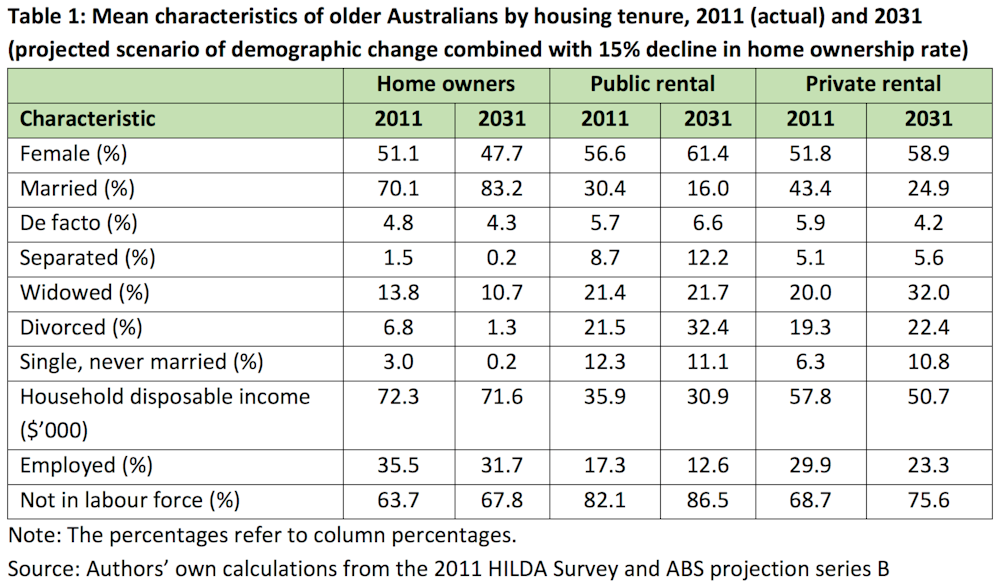
Our findings point to a growing divide among older Australians. For older Australians, home ownership will increasingly become the preserve of higher-income married couples (see table 1). Older people on lower incomes – especially women and those affected by marital breakdown or bereavement – will rent.

The divide is especially stark if the home ownership rate falls by 15 percentage points. In this scenario, 27.4% of people aged 55 and over will be private renters by 2031.

Budget impacts of housing assistance

Older Australians’ demand for housing assistance could spike as a result of population ageing and falling home ownership rates.

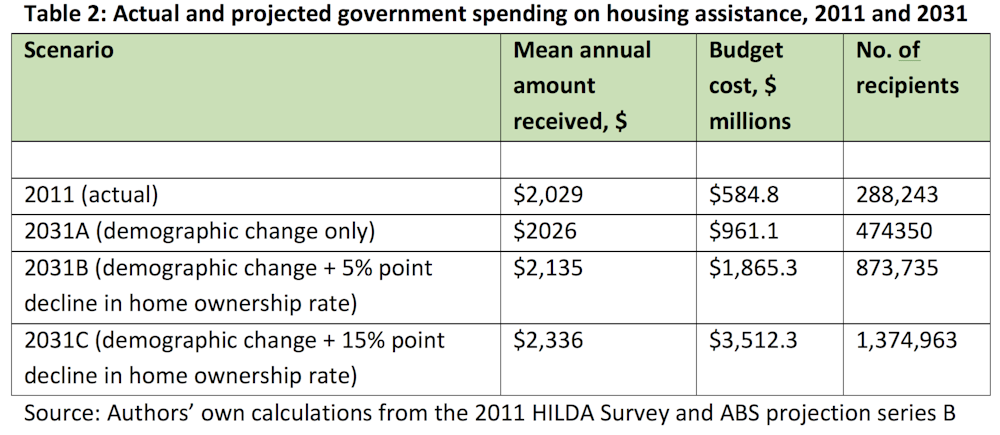
Even demographic change on its own would lift real government spending on housing assistance for Australians aged 55 and over by 64% by 2031 (see table 2).

If home ownership rates also decline by 5 percentage points, then real government spending is projected to blow out to three times its 2011 level.

A steep fall in the home ownership rate of 15 percentage points would send real government spending on housing assistance soaring to around six times the 2011 level. That would increase real spending on housing assistance for older Australians from a tiny 0.043% of real GDP in 2011 to 0.16% of forecast real GDP in 2031.

The implications of demographic change coupled with falling home ownership rates are obvious for the housing sector:

  • the private rental tenure is set to expand
  • demand for housing assistance will grow
  • spending on housing assistance programs will increase the strain on government budgets.

Challenges beyond housing policy

There are also important ramifications for retirement incomes policy. The age pension system assumes most Australians will retire as outright home owners with no mortgage payments to meet. They can therefore get by on low age pensions. But growing numbers of older renters struggling to meet rental payments will call into question the adequacy of our age pension benefits.

There is an alternative scenario. By 2031, the superannuation system will have matured. Growing numbers of older renters – especially those with steady employment records – could accumulate big enough balances in defined contribution schemes to become home buyers in later life.

Dipping into superannuation savings to finance a home purchase is attractive on various fronts:

  1. it offers the prospect of secure and affordable housing in old age
  2. it helps with access to the age pension as owner-occupied housing assets are exempt from the age pension assets test and are not deemed to generate an income return under the income test
  3. under aged care assets test rules, the equity stored in what was an aged care client’s family home is either exempt from the assets test (if a spouse or dependent children is still living in the home), or subject to a cap ($165,271.20 as at March 20 2018), and is not assessed for age care deeming purposes.

On the other hand, superannuation balances are an assessable asset under age pension and aged care assets test provisions, as well as for age pension and aged care deeming purposes.

Should growing numbers of Australians approach retirement as renters these anomalies offer them potentially powerful motives to substitute assets away from superannuation and into owner-occupied housing in later life. But, in doing so, they could undermine a key objective of Australia’s superannuation guarantee – that of promoting financial independence and reducing reliance on public pensions in old age.

– When falling home ownership and ageing baby boomers collide
– http://theconversation.com/when-falling-home-ownership-and-ageing-baby-boomers-collide-102846]]>

Privatising WestConnex is the biggest waste of public funds for corporate gain in Australian history

]]>

The Conversation (Au and NZ) – By Christopher Standen, Transport Analyst, University of Sydney

The NSW government has confirmed it will sell 51% of WestConnex — the nation’s biggest road infrastructure project — to a consortium led by Transurban, the nation’s biggest toll road corporation.

NSW treasurer Dominic Perrottet described the A$9.3 billion sale to one of his party’s more generous donors as a “very strong result”.

I would describe it differently: the biggest misuse of public funds for corporate gain in Australia’s history.

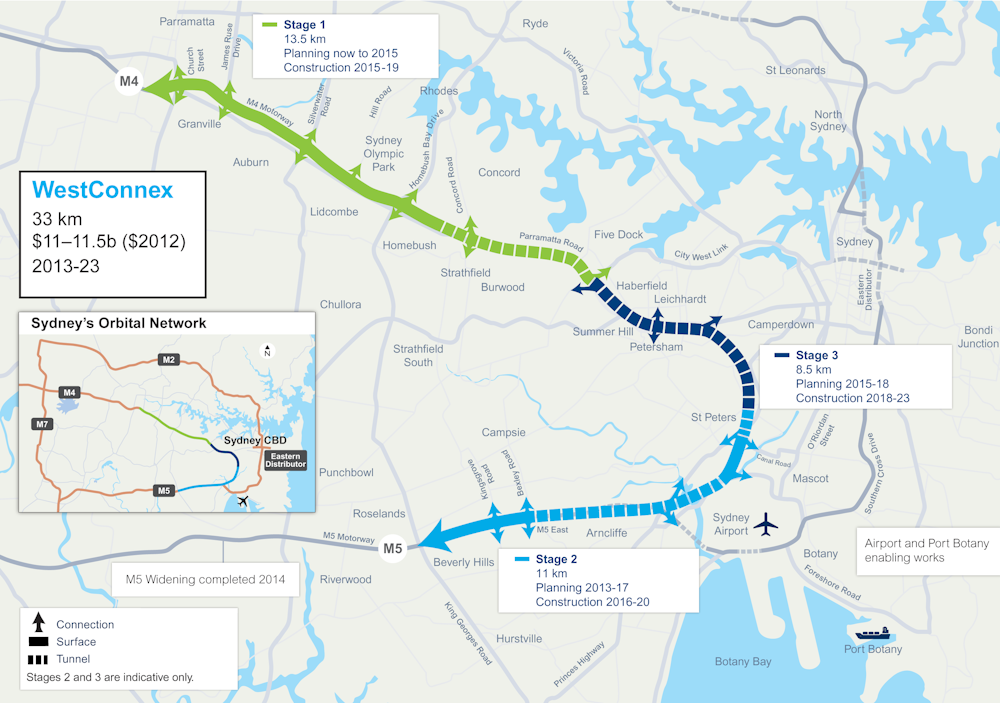
Let’s examine how much public funding has been or will be sunk into WestConnex, a 33km toll road linking western Sydney with southwestern Sydney via the inner west.

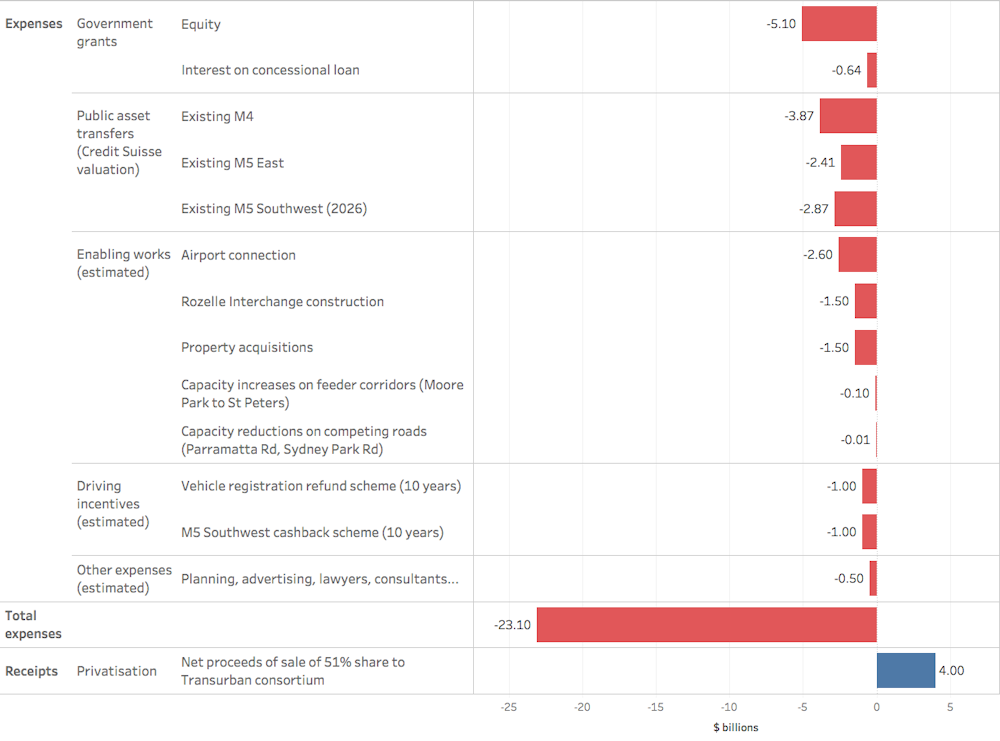
Privatising Westconnex will return the NSW government 30 cents for every dollar of public money spent. WestConnex Business Case Executive Summary

To date, the NSW and federal governments have provided grants of about $6 billion. Much of this was raised through selling revenue-generating public assets, including NSW’s electricity network.

Hiding privatisation by stealth

As well, the NSW government is bundling three publicly owned motorways into the sale: the M4 (between Parramatta and Homebush), the M5 East and the M5 Southwest (from 2026). Together, Credit Suisse values these public assets at A$9.2 billion. The government is privatising them by stealth. Leaked NSW cabinet documents suggest the Sydney Harbour Bridge will be next.

Then there is the A$1.5 billion bill for property acquisitions and the millions spent on planning, advertising, consultants, lawyers and bankers.

The government is funding extra road works to help prop up WestConnex toll revenue. It will increase the capacity of road corridors feeding into the interchanges. But it will reduce the number of traffic lanes on roads competing with WestConnex, such as Parramatta Road.


Read more: Modelling for major road projects is at odds with driver behaviour


It will also pick up the bill for building a A$2.6 billion airport connection and the complex underground interchange at Rozelle. It will even pay compensation if the latter is not completed on schedule.

To further bolster toll revenue, NSW premier Gladys Berejiklian introduced a vehicle registration cashback scheme for toll-road users.

Her government has also committed to continuing the M5 Southwest toll cashback scheme. The cost of these incentives to the public purse is likely to exceed A$2 billion every ten years.

In total, I estimate the NSW government is pumping more than A$23 billion worth of cash, public assets, enabling works and incentives into WestConnex — though efforts to shield the scheme from public scrutiny mean the figure could be much higher.

Finally, as part of the deal with Transurban, the government has agreed to plough A$5.3 billion of the sale proceeds back into WestConnex. It’s recouping just A$4 billion by selling majority ownership.

This translates to a financial return of 34 cents for every dollar spent.

Government expenses and receipts.

Of course, governments don’t always spend our money with the intention of making a profit. Usually there are broader social benefits that justify the expenditure. However, past experience shows inner-city motorways do more harm than good — which is why many cities around the world are demolishing them.

Given its proximity to residential areas, WestConnex will have serious impacts on Sydney’s population. Construction is already destroying communities, harming people’s health and disrupting sleep and travel — with years more to come.

Motorists who cannot afford the new tolls on the M4 ($2,300 a year) and M5 East ($3,100 a year) will have to switch to congested suburban roads. This will mean longer journey times — especially with the removal of traffic lanes on Parramatta Road.

New tolls on existing motorways.

Those who do opt to pay the new tolls may enjoy faster journeys for a few years — until the motorways fill up again.

Costs outweigh the benefits

But this benefit will be largely cancelled out by the tolls they have to pay — with low-income households in western Sydney bearing much of the pain. As such, the ultimate beneficiary will be a corporation that pays no company tax and employs very few people.

Traffic and congestion on roads around the interchanges will increase significantly. Moreover, with tolls for trucks three times those for cars, we can expect to see them switching to suburban and residential streets — especially between peak hours and at night.

The extra traffic created by WestConnex will lead to more road trauma, traffic noise and air pollution across the Sydney metropolitan area. With unfiltered smokestacks being built next to homes and schools, more people may be at risk of heart disease, lung disease and cancer in years to come.


Read more: Big road projects don’t really save time or boost productivity


On any measure, the WestConnex sale is not in the public interest. The billions of dollars ploughed into the scheme would have been better spent on worthwhile infrastructure or services that improve people’s lives.

Is the WestConnex acquisition a good deal for Transurban? A$9.3 billion may sound like a high price, given the past financial collapses of other Australian toll roads.

However, with the Berejiklian government agreeing to fund most of the remaining construction, giving away the M4 and M5, guaranteeing annual toll increases of at least 4%, and bending over backwards to force motorists under the toll gantries, it can only be described as a “very strong result” for the consortium, though not for taxpayers.

– Privatising WestConnex is the biggest waste of public funds for corporate gain in Australian history
– http://theconversation.com/privatising-westconnex-is-the-biggest-waste-of-public-funds-for-corporate-gain-in-australian-history-102790]]>

Art and science come together to examine the power and perversions of perfection

]]>

The Conversation (Au and NZ) – By Julie Shiels, Lecturer – School of Art, RMIT University

Review: Perfection, Science Gallery Melbourne.


It would be easy to assume that art and science occupy separate worlds. Art invites us to encounter “things as they are perceived and not as they are known” and relies on subjective experience to confirm value. Science strives to establish knowledge as fact through testing and peer review. Yet sitting at the core of both disciplines is the desire to employ curiosity, creativity, innovation and discovery to examine the world we live in. These intellectual frameworks create bridges between the two disciplines.

The intersection between art and science is the focus of Perfection, the latest pop-up show for the Science Gallery Melbourne. Part exhibition, part experiment it asks: “What does it mean to be perfect?”

Curated by a panel that includes a particle physicist, a computer scientist, a plastic surgeon and a musicologist, Perfection offers a set of reflections, calculations and speculations that engage with ideas about the perfect body, mathematical precision, quantum physics and a post-human world. We are invited to consider the current state of things and to contemplate what might constitute an ideal future.


Read more: Spilling blood in art, a tale of tampons, Trump and taboos


XORXOR, Perfect O, installation view. Image courtesy of the artists

The slippages between art and science, and experiment and exhibition, are an active component of Perfection. Questions that straddle technology and art history are explored by XORXOR’s question: “Is it possible to draw a perfect circle?”

Marcus Volz, Lorenz Attractor 201, Digital animation. Image courtesy the artist

Marcus Volz’s digital animations, Lorenz Attractor and Natalina Cafra, employ complex 3D sculptural forms to visualise mathematical equations relating to atmospheric weather patterns and fractal diversity in molluscs. Reminiscent of late modernism and the idea of a perfect closed self-referencing system, these drawings ask whether art can be maths and maths can be art.

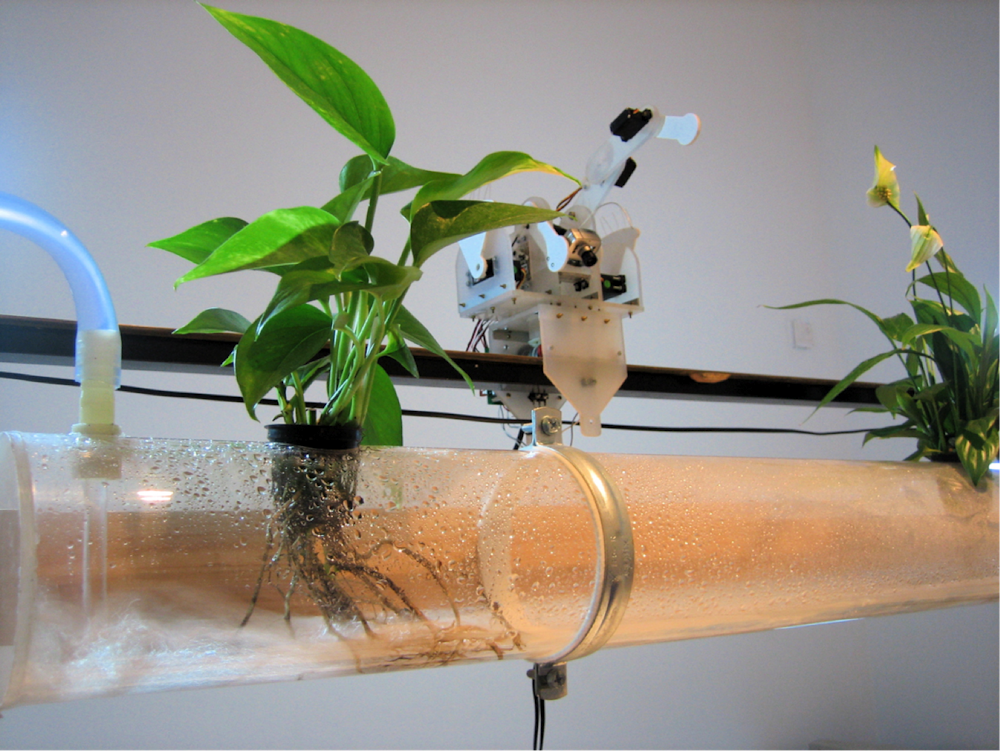
Andy Gracie, Fish, Plant, Rack v.2 2004. Image courtesy of the artist

The lab-like conditions of Andy Gracie’s Fish, Plant, Rack v.2 speculate on a future post-human condition where the world goes on without us. In this experiment three systems interact: a blind fish emitting electrical impulses, a robot powered by the fish, and plants living in a hydroponic system. Other works that deal with non-human concerns explore ideas about a “perfect sound” and question whether light has consciousness.

The most prominent experiments in the exhibition, though, relate to the human body, identity and the self.

Throughout history, the body has been an abiding interest for artists — from the earliest forms of bodily adornment through Da Vinci’s concern with anatomy, to contemporary explorations of race, gender and sexuality. Technology takes things to a new level, enabling us to hack, modify and transform our bodies, and to use social media as a platform to manage our identity and present it to the world. As a potential extension of the body, the digital realm provides fertile ground for creative critique and exploration.

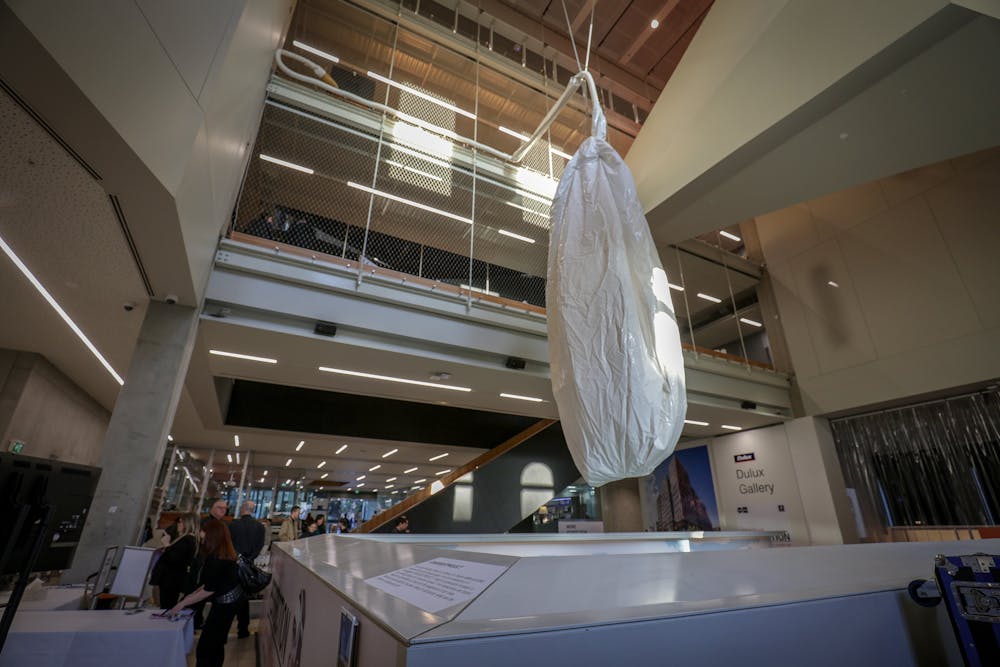
Ant Hamlyn, The Boost Project, 2015. Nicole Cleary

Ant Hamlyn’s The Boost Project and Tyler Payne’s Womanhours both address the pressures of social media.

Hamlyn’s six-metre-tall inflatable is a proxy for the body and the ego. Suspended from the ceiling, this giant orb gives form to the flux and fragility of an online presence. Each time it is liked via its hashtag, The Boost Project gets a 30-second burst of air. On a good day it has a substantial presence at the entrance of the gallery, but when it is ignored the orb slowly deflates, its firmness diminishes, and the suspended form takes on a droopy and dejected demeanour.

Payne’s Womanhours demonstrates the oppression of Instagram. In a series of videos, the artist employs her own body to reveal the level of self-correction needed to achieve the perfect self-portrait. She appears to endure an extreme physical and psychological makeover through female cosmetic rituals such as waxing, tanning, bleaching, plucking and shaving. The perfected self is captured for a fleeting moment in the virtual realm and the ritual is repeated all over again.

Orlan, Omniprésence, 1993. Image courtesy of the artist

Self-correction is also the subject of ORLAN’s performance practice and her body is the canvas for experimentation. No need to repeat these rituals; the interventions are permanent. For decades, ORLAN has undergone plastic surgery in order to shape her face to reflect a version of beauty expressed in the Renaissance paintings. Her new brow resembles the Mona Lisa and her chin belongs to Botticelli’s Venus.

Adam Peacock, Genetics Gym, 2017, video still. Nicole Cleary

In Genetics Gym, Adam Peacock speculates on how genetic technologies could allow us to design our bodies and cognitive dispositions, ramping up the prospects of self-improvement beyond internal and external modification.

Similarly, in Demiurge, Jaden Hastings has accessed her entire gene sequence and used artificial intelligence to analyse potential risks and provide information about what needs to be fixed to achieve a perfect state. In doing so, the artist inserts the machine into the process of human evolution.

Most artists in this exhibition speculate on self-improvement with respect to health, function and beauty, but we might also be driven to modify ourselves through fear. What if the desire to survive a cataclysmic event was the catalyst for reshaping the human form?

Patricia Piccini’s Graham has the perfect body to walk away unscathed from a car crash. Created in collaboration with trauma surgeon Christian Kenfield and the Monash University Accident Research Centre, Graham’s honed and sculpted anatomy will withstand the impact of a 30kph collision. Paradoxically, the unintended consequences of Graham’s modified feet and ankles would appear to make walking very difficult.

Few of us would choose to look like Graham, but he is a metaphor for the lengths we will go to be safe. How far might we go to protect ourselves or our children from threats like terrorism or global warming?

The prospect of hacking, modifying and transforming our bodies presents an unexpected conundrum. Scientific and technological advances inevitably open up an unfettered realm of personal choice when innovations hit the marketplace. But in The Paradox of Choice, economist Barry Schwartz shows that having too many options generates anxiety. It’s hard enough to choose a toothbrush today, let alone make an informed decision about the potential range of future body modifications.

Perfection raises questions about what constitutes a utopian or dystopian future, ethical or unethical practices, a perfect or an imperfect human. The exhibition provides no easy answers but invites us to shift our perception and engage with the world as it is now, and as it might one day become. Be careful what you wish for.


Perfection is showing at Science Gallery Melbourne until November 11 2018.

– Art and science come together to examine the power and perversions of perfection
– http://theconversation.com/art-and-science-come-together-to-examine-the-power-and-perversions-of-perfection-103753]]>

Media Files: ABC boss Michelle Guthrie sacked, but the board won’t say why

]]>

The Conversation (Au and NZ) – By Andrew Dodd, Director of the Centre for Advancing Journalism, University of Melbourne

The major question following the sacking of ABC managing director Michelle Guthrie is why? Why did the ABC board move so decisively and why now?

Was it just about tension between her and the corporation chair, Justin Milne, or was it about strategic direction for the national broadcaster?

In this special edition of Media Files, Monash University’s Margaret Simons and former ABC staff-elected director Matt Peacock talk to Matthew Ricketson and Andrew Dodd about what it might mean for the ABC – particularly in the lead up to a federal election.


Read more: Constant attacks on the ABC will come back to haunt the Coalition government


Media Files is produced by a team of journalists and academics who have spent decades working in and reporting on the media industry. It’s about how journalists operate, how media policy is changing, and how commercial manoeuvres and digital disruption are affecting the kinds of media and journalism we consume.

Media Files will be out every month, with occasional off-schedule episodes released when we’ve got fresh analysis we can’t wait to share with you. To make sure you don’t miss an episode, find us and subscribe on Apple Podcasts, in Pocket Casts or wherever you find your podcasts. And while you’re there, please rate and review us – it really helps others to find us.

You can find more podcast episodes from The Conversation here.


Producer: Andy Hazel.

Additional audio

Theme music by Susie Wilkins.


Read more: Media Files: What does the Nine Fairfax merger mean for diversity and quality journalism?


– Media Files: ABC boss Michelle Guthrie sacked, but the board won’t say why
– http://theconversation.com/media-files-abc-boss-michelle-guthrie-sacked-but-the-board-wont-say-why-103752]]>

Climate change and security big focus for Pacific Islands Forum in Nauru

]]>

Climate change is a major worry to the Pacific Islands and it was the major talking point at the Pacific Islands Forum (PIF) earlier this month. Barbara Dreaver of Television New Zealand, who was detained and questioned in Nauru, talks to Sri Krishnamurthi of Asia-Pacific Report.

Two significant events happened at the 49th Pacific Islands Forum (PIF) earlier this month – climate change and ratification of the Boe agreement (a regional security pact that succeeded the 2000 Biketawa agreement), says Barbara Dreaver, a veteran journalist with 20 years’ experience covering the Pacific.

Dreaver made headlines herself by being detained and questioned for four hours after interviewing an asylum seeker from a detention centre on Nauru.

The centres were declared a forbidden area when Nauru approved journalists’ accreditation for the forum on September 3-6.

APJS NEWSFILE

READ MORE: Climate change, at the frontlines

Initially, Nauru revoked Dreaver’s accreditation but reinstated it, so she could cover the forum proper, and she did not allow it to detract from doing her job.

Climate change is a growing burden for the Pacific and was the key discussion point at the forum.

-Partners-

Central to this is the demand by the Pacific Island countries that the United States return to the Paris climate agreement of 2015.

In short, the Paris Agreement is an ambition to keep the increase in global average temperature to well below 2 °C – and to limit the increase to 1.5 °C – as called for by the smaller island states at the forum.

Plea to the US
“Pacific leaders have also called on the US to return to the Paris agreement,” says Barbara Dreaver.

The call comes on the back of US President Donald Trump announcing his intention in June 2017 to withdraw. Under the agreement, the earliest possible withdrawal date for the US is November 2020, although moves have been afoot for the US administration to withdraw from the agreement.

Climate change has become such an important problem for Pacific Island nations that it had to take centre stage at the forum.

“Yes, this was the main thrust of the forum. The leaders have formally requested the United Nations appoint a special adviser on climate change and security and they have also called on the UN Security Council to appoint a special rapporteur to produce a regular review of global, regional and national security threats caused by climate change,” Dreaver told Asia Pacific Report.

Most of the controversy at the forum centred around Nauru, which was once a phosphate-mining mecca now virtually stripped dry and reduced to playing an off-shore role as a detention centre for asylum seekers to Australia.

Nauru is set to receive nearly A$26 million from Australia in Official Development Assistance  in 2018-19, which is almost a quarter of its gross domestic product.

“The money Nauru receives from Australia is valuable to this cash-strapped nation. It’s not only in cash terms – buildings have been improved etc. For Nauru, while it’s a headache, it’s also a godsend,” says Dreaver.

Sensitive refugee discussions
Sensitive discussions around the detainees did take place under muted conditions and away from the media, she noted.

“The discussion around the detainees on Nauru took place in the bilaterals and only at a general level.

“There was some sensitivity given it’s a domestic issue for the most part and Nauru had made it clear it did not consider it part of the forum – even if others did.

“It should be noted that the bigger non-government organisations like World Vision or Amnesty, which would have brought up the issue at side events [civil society discussions)] were refused visas to Nauru.”

Incarcerated children on the island, kept in conditions widely considered inhumane, hardly rated a mention at the forum.

“The children on Nauru are staying put – I understand there are now approximately 109 of them,” says Dreaver.

An Australian decision
New Zealand did discuss the potential resettlement of some of the asylum seekers but were told it was an Australian decision.

“Jacinda Ardern (Prime Minister) discussed it with Nauru at the bilateral discussions but at the end of the day, if Australia doesn’t agree with the transferral of refugees to NZ it won’t happen. The decision is not the Nauru governments’ to make,” says Dreaver.

That was not to say New Zealand did not have a contribution to make at the PIF, even though one commentator in New Zealand likened Pacific countries to “leeches”.

“Most of New Zealand’s contribution was behind the scenes. For example, like some of the other member countries it had input on the Biketawa Plus or Boe Declaration,” she said.

“New Zealand’s presence must not be underestimated… the only times a New Zealand Prime Minister has not attended a forum has been when it has been close to an election.

“While fellow leaders have always publicly expressed their understanding, they have also made it clear New Zealand is missed and it doesn’t go down well.

“New Zealand is strong on fisheries in the region and its input in this area is strong,” she says on a food source that is dear to the heart of all Pacific Islanders.

Climate change priority
Again, there was no getting away from climate change and the security of the region, as Dreaver points out.

“Yes, the Boe declaration was ratified (named Boe as this is name of the President of Nauru’s [Baron Waqa] village where it was signed).

“The leaders had to go back to the table in the evening as Australia had some concerns over the language about climate change which other leaders describe as the single greatest threat to the region.

“There is a strong agreement for resources for cash-strapped nations, particularly in the area of cybercrime – it’s expected New Zealand and Australia will provide specialist and technical knowledge to help small island nations combat this,’’ Dreaver says.

Progress was made at the 49th sitting of the Pacific Islands Forum despite it being held in the controversial venue of Nauru.

Sri Krishnamurthi is a journalist and Postgraduate Diploma in Communication Studies student at Auckland University of Technology. He is attached to the University of the South Pacific’s Journalism Programme, filing for USP’s Wansolwara News and the AUT Pacific Media Centre’s Asia Pacific Report.

Print Friendly, PDF & Email

Article by AsiaPacificReport.nz

]]>

Why the increased penalties for strawberry sabotage will do little to prevent the crime

]]>

The Conversation (Au and NZ) – By Rick Sarre, Adjunct Professor of Law and Criminal Justice, University of South Australia

The fruit contamination crisis has delivered a devastating blow to the growers of Australia. The crisis is now so big it seems to have reached New Zealand as well.

Producers and consumers have been justifiably outraged that someone, for reasons no one knows or understands, has decided to place sewing needles into packaged strawberries. The question for authorities is how to prevent this.

Prime Minister Scott Morrison was quick off the mark, foreshadowing amendments to legislation to create new offences and to change proof requirements. He also announced plans to increase the penalties for this type of crime: imprisonment for up to 15 years. Morrison said:

That’s how seriously I take this; that’s how seriously our government takes it. That will be an increased penalty for those who engage in this sort of thing.

Two matters arise from these announcements. One requires a legal explanation; the other involves some criminological and political speculation.

The legal issue is the role of the federal government in dealing with criminal laws and setting criminal penalties, matters that are usually the preserve of the states and territories. The power of the federal parliament to legislate is brought about by the fact that goods are bought and sold in trade and commerce, a key plank of the federal parliament’s lawmaking authority.


Read more: Grattan on Friday: Morrison aims to make agility his prime ministerial trademark


To that end, section 380 of the Commonwealth Criminal Code Act makes illegal any activity that involves the contamination of goods, including food, where there is an intention to cause anxiety, harm or loss.

Attorney-General Christian Porter has foreshadowed a change to the mental element for this crime. No longer will it require proof of a specific intention to cause harm. It will be sufficient for prosecutors to prove reckless indifference that harm might be caused.

Also before the federal parliament is the Espionage and Foreign Interference Bill, which contains new “sabotage” offences that make it a crime to cause damage to Australia’s critical infrastructure.

In light of the fruit contamination crisis, the definitions of “sabotage” and “infrastructure” will be amended to include tampering with goods intended for human consumption, where that tampering is deemed prejudicial to national security.

It is now time for some speculation. Leaving to one side the new offences and the alteration to the intention threshold, which may or may not increase the number of future arrests and conviction rates, can we confidently assume we will all be safer as a result of the increased penalties? The answer is no.

We have known for a long time that deterrence theory is highly speculative. There is little hard evidence that punitive approaches have a consistent deterrent effect.

Indeed, how does one ever know what conduct, and how much conduct, has been deterred by a rise in a penalty? And how do we know whether it was that specific legislative change that caused any recorded drop in crime?

Sentencing specifically for deterrent purposes is equally problematic. Magistrates and judges must sentence a myriad of personalities, in circumstances that change from case to case, to achieve a broad range of often inconsistent sentencing goals (not just deterrence), using a limited range of penalties, and guided by case law and legislation that is often contradictory. It is a tough ask to expect that this exercise alone will achieve a specific deterrent outcome.

Indeed, deterrence theory is premised upon a “free will” view of human motivation. That is, the theory assumes all offenders are rational decision-makers who weigh up the pros and cons of their actions. It is a brave assumption.

Moreover, for the deterrent penalty to be effective, a close relationship has to exist between the severity of the sanction and an offender’s perceived risk of being apprehended and convicted. That relationship rarely exists. So it is fanciful to think that a saboteur will think twice about his or her actions on the strength of penalties being increased from 10 to 15 years.


Read more: Strawberry sabotage: what are copycat crimes and who commits them?


It is also unrealistic to suggest that it is in the public interest to sentence to, say, a dozen years behind bars someone who, for reasons unknown, engages in a “copycat” crime and presents to a police station or media outlet with a contaminated package that they themselves have tampered with.

So there must be something more behind the government’s announcement. There is. It is caught up in what we refer to as “desert” theory. This is the idea that any penalty structure should reflect a relationship between the seriousness of a particular crime and the harshness of the punishment. Desert theory, moreover, demands the imposition of sanctions that are of a nature and sufficient degree of severity to express the public’s abhorrence of the crime for which the penalty was imposed.

Viewed in this light, the government’s announcements make complete sense. But we need to remember that the changes the government has foreshadowed have a far greater likelihood of making political mileage by expressing our collective outrage than of altering the behaviour of an unknown person’s twisted mind.

– Why the increased penalties for strawberry sabotage will do little to prevent the crime
– http://theconversation.com/why-the-increased-penalties-for-strawberry-sabotage-will-do-little-to-prevent-the-crime-103670]]>

It’s better light, not worse behaviour, that explains crimes on a full moon

]]>

The Conversation (Au and NZ) – By Wayne Petherick, Associate professor of criminology, Bond University

It’s a full Moon on September 25.

If past months have been anything to go by, this will be accompanied by a round of public chat about how this affects human behaviour – claims of more hospital admissions and arrests, to crazy antics in children.

Beliefs in the Moon’s behavioural effects are not new and date back to ancient times. But what evidence is there that the Moon has an impact on behaviour?

As a criminologist, I look at evidence related to arrests and behaviour linked with criminal activity.

The only explanation I can see that links criminology with Moon phases is just about the practicalities of being a criminal: when it’s a full Moon, there’s more light.


Read more: Five reasons India, China and other nations plan to travel to the Moon


While somewhat dated, one of the most significant studies looking at Moon phases and linking this with behaviour is a 1985 meta-analysis – a study of the findings of 37 published and unpublished studies. The paper concludes it is not sound to infer that people behave any more – or less – strangely between Moon phases. The authors write:

Alleged relations between phases of the moon and behavior can be traced to inappropriate analyses […] and a willingness to accept any departure from chance as evidence of a lunar effect.

Two more recent studies have looked at links between criminal activity and phases of the Moon.

A study published in 2009 looked at more than 23,000 cases of aggravated assaults that took place in Germany between 1999 and 2005. The authors found no correlation between battery and the various lunar phases.

A study reported in 2016 was careful to make a distinction between indoor and outdoor crime committed in 13 US states and the District of Columbia in 2014.

The authors found no link between lunar phases and total crime or indoor crime.

But they did find the intensity of moonlight to have a substantive positive effect on outdoor criminal activity. As moon illumination increased, they saw an escalation in criminal activity.

One explanation for this finding is what is referred to as the “illumination hypothesis” – suggesting that criminals like enough light to ply their trade, but not so much as to increase their chance of apprehension.

It may also be that there is greater movement of people during lighter nights, thus providing a bigger pool of victims.


Read more: Confirmation bias: A psychological phenomenon that helps explain why pundits got it wrong


Why do some people still cling to the belief that the Moon causes criminal or other antisocial behaviour? The answer most likely lies in human cognition and our tendency to focus on that which we expect or predict to be true.

During an expected lunar event – such as a full or super Moon – we expect that there will be a change in behaviour so we pay more attention when we see it. In the area of cognitive psychology this is known as confirmation bias.

But other questions remain, including why any behavioural effects must be inherently negative? Even if there was a direct effect, explanations as to why acts of kindness and altruism do not increase or decrease during Moon phases are conspicuously absent.

It is likely that we just assume the folklore is true, and believe that we become the werewolf and not the sheep.

– It’s better light, not worse behaviour, that explains crimes on a full moon
– http://theconversation.com/its-better-light-not-worse-behaviour-that-explains-crimes-on-a-full-moon-101524]]>

Michelle Guthrie’s stint at ABC helm had a key weakness: she failed to back the journalists

]]>

The Conversation (Au and NZ) – By Denis Muller, Senior Research Fellow in the Centre for Advancing Journalism, University of Melbourne

Michelle Guthrie’s departure as managing director of the ABC, while a shock, is not surprising.

In the face of sustained pressure from the government and Rupert Murdoch’s News Corp, she has seemed incapable of mounting a sustained and effective response.

And in this environment of hostility, ABC journalists have felt under siege.

As editor-in-chief – which comes with the managing director’s job – Guthrie was unable to give the kind of robust editorial leadership that journalists need if they are to report fearlessly and independently.

It was clear by the middle of this year that whatever qualities Guthrie brought to the job, editorial leadership was not one of them. Thus the ABC was at a crossroads. It had as its managing director and editor-in-chief a person with no journalistic background who had shown scant signs of understanding the impact of the federal government’s relentless bullying on the ABC’s editorial independence.


Read more: Constant attacks on the ABC will come back to haunt the Coalition government


Then in June, Guthrie gave a speech at the Melbourne Press Club in which she said Australians regard the ABC as a great national institution and deeply resent its being used as “a punching bag by narrow political, commercial or ideological interests”.

It was strong but it came late in the day. By then, the weakness in editorial leadership had filtered down the ranks, so that journalists making everyday decisions on news desks were looking over their shoulders.

One first-hand example makes the point. In May, when Barnaby Joyce accepted money – reportedly $150,000 – to go on Channel Nine with his partner Vikki Campion and talk about their affair, the ABC invited me to write a commentary on the ethics involved.

I wrote that by agreeing to take the money, Joyce had called into question his fitness for public office.

This was too strong for the ABC, and the article did not run. I was told that it was a sensitive time for the ABC’s relations with the government. Instead the article was published by The Conversation and then by The Age and an online newspaper, The Mandarin.

It showed the effect of the water-torture approach the government has taken to the ABC, cheered on by News Corp’s The Australian: grizzles about the work of Emma Alberici as economics editor, most of which turned out to be baseless; grievances about Triple J’s changing the date of its Hottest 100 from Australia Day; more grizzles about Yassmin Abdel-Magied’s comments about Anzac Day.

Strong editors do not sit back and let this happen. Unless there are clear and substantial errors of fact, strong editors stand by their journalists and hit back hard and publicly at unwarranted criticism.

Strong editors also stand up for their journalists’ right to express opinions, when those opinions are based on facts that are substantially true.

And they do this personally, not through bureaucratic complaints processes that dilute the authority of the editor’s voice.

There were signs early on in Guthrie’s tenure that she did not grasp the editorial side of the job.

Having given a keynote address at the New News Conference in Melbourne in October 2016, she took questions from the audience. A man asked her about some ABC story or another, to which she replied that she was not responsible for every story that appeared on the ABC. Well, the fact is that the editor-in-chief is indeed responsible for every story that appears. The journalists in the audience were stunned.

Later, when Guthrie showed up at Senate estimates committee hearings, she would take along Alan Sunderland, who is in charge of editorial policies, to answer questions on the ABC’s journalism. This was simply not good enough. Guthrie was the editor-in-chief. She should have taken the questions – and the heat.

This state of affairs revealed a serious structural weakness in the ABC’s editorial leadership under her control. Sunderland had seemingly become de facto editor-in-chief, but without the ultimate authority. He is a Walkley Award-winning journalist with a strong news background, but highly qualified though he is, it is an untenable position.

Looking ahead, unless the ABC can find someone to combine the functions of managing director and editor-in-chief, as Guthrie’s predecessor Mark Scott did, it would be better to split the jobs.

This is the way good media outlets work. The editor-in-chief answers to the board through the managing director. The board and managing director answer to the shareholders – in the ABC’s case, the government.

The editor-in-chief is thus shielded in a way that enables him or her to make news decisions independent of corporate interests. It is called editorial independence and is the cornerstone of good journalism.


Read more: Why the ABC, and the public that trusts it, must stand firm against threats to its editorial independence


When the editor-in-chief is independent, the spirit of independence filters down to that small army of journalists making everyday decisions. They don’t look over their shoulder.

All that matters is that the stories are worth telling, that the reporting is accurate and fair, that commentaries are based on facts, and that stories are treated on the basis of their news value, and not on other considerations.

The ABC has announced that the acting managing director is David Anderson, who is currently Director, Entertainment and Specialist. This covers “broadcast television networks and associated services, radio music networks, podcasts and specialist radio content”.

Although he has nearly 30 years’ experience with the ABC, he has no background in journalism either, so it looks as if Sunderland will just have to soldier on.

– Michelle Guthrie’s stint at ABC helm had a key weakness: she failed to back the journalists
– http://theconversation.com/michelle-guthries-stint-at-abc-helm-had-a-key-weakness-she-failed-to-back-the-journalists-103759]]>

How to (gently) get your child to brush their teeth

]]>

The Conversation (Au and NZ) – By Rebecca English, Lecturer in Education, Queensland University of Technology

For most parents, the phrase “I don’t want to brush my teeth” is rather familiar. While it may seem easiest to pry their mouth open and force them to brush, research suggests there are better ways that may positively influence children’s future dental health.

So, what does the literature say you should do to help children brush their teeth?

What is gentle parenting?

Gentle parenting centres around respect for the child. Parents who practise this approach generally avoid artificial or extrinsic rewards or punishments.

These parents try to help their children habituate appropriate, or what we would call “good”, behaviours. The idea is the child should want to do the “right” thing for its own sake, not because it’s accompanied by a reward or because of the threat of a punishment.

Studies suggest this method is effective because children will go on to have superior social skills and fewer behavioural problems. The effect is believed to continue into adulthood.

Contrary to popular belief, this style of parenting does not eschew “consequences”. Rather, consequences are allowed to flow naturally from behaviour. Although, in the case of dental hygiene, we can’t let the natural consequence of not brushing lead to caries. So, what can you do?


Read more: ‘Gentle parenting’ explainer: no rewards, no punishments, no misbehaving kids


When should you start encouraging dental hygiene?

One of the ways to ensure children brush their teeth, without resorting to bribes or punishments, is to start early. Dentists suggest brushing baby’s first teeth when they appear, even wiping gums, may help establish good dental hygiene early.

By starting early with dental care, it will become an established part of life and may cause fewer power struggles.

Let your child brush your teeth, and you theirs. from www.shutterstock.com

Does routine help?

Routine is said to be essential in children’s lives. Studies suggest routine can positively impact on children habituating positive behaviours because of the repeated exposure.

Families who provide a loving and consistent structure are more likely to have children who brush their teeth. Studies suggest taking a gamification approach creates an environment of fun around the routine of toothbrushing, creating better long-term oral hygiene.


Read more: How to discipline your children without rewards or punishment


Common areas that cause problems with brushing

One common issue is toothpaste. Children report not liking the taste or it making them feel funny. If your child won’t use toothpaste, but is otherwise OK with brushing, dentists recommend making the paste optional.

There are also many other flavours on the market besides mint, which some children may prefer to use and which may reduce the issue with refusal to brush their teeth.

But changing the toothpaste may not be enough. Studies suggest children’s refusal to brush teeth can create major family dramas, and parents report tooth brushing as a major site of power struggles. But effective behaviour management leads to children with fewer caries and healthy mouths.


Read more: Children’s toothpaste: the facts


Practical measures

When children refuse to brush their teeth, we can employ respectful methods to encourage them to develop good dental hygiene. Dentists report positive parent-child interactions and the use of positive discipline can result in good teeth brushing behaviour.

One example is having a special song that is sung only when the child allows their parent to brush their teeth.

Another strategy is reading stories about teeth brushing so children understand the importance of good dental hygiene.

Some suggest allowing your child to carefully brush your teeth, and then you can have a turn at theirs. This approach gives the child power and allows them to explore their feelings about having their teeth brushed.

Making it a game is another strategy. Perhaps you and your child can have a competition to see who can make the most spit at the end or whether you can count all your teeth as you go. Another option is to let the child start by brushing their toy’s teeth.

Having our children learn to brush their teeth in a calm and gentle way, without threats or rewards, is essential, with one dentist suggesting dental phobia is a problem when children have negative experiences at the dentist because of early childhood caries. Dental phobia is a fear of the dentist that prevents people with dental issues seeking help from a dentist.

These strategies can help children who are resistant to brushing to engage positively with dental hygiene. This approach takes longer than prying their mouths open and forcing them to have their teeth brushed, because you’re asking your child to engage with something they’re resisting. But the value is they will habituate good dental hygiene practices and you can end power struggles over teeth brushing.

– How to (gently) get your child to brush their teeth
– http://theconversation.com/how-to-gently-get-your-child-to-brush-their-teeth-102713]]>

Next ABC chief must be advocate for public broadcasting, says MEAA

]]>

Dumped ABC managing director Michelle Guthrie … her term will be remembered for “historically low” funding, redundancies. Image: SBS

Pacific Media Watch Newsdesk

The next managing director of the ABC must be prepared to fight for better funding and independence, and to champion public broadcasting in a hostile political environment, says the union representing the ABC’s editorial staff.

The Media, Entertainment & Arts Alliance says the sacking of Michelle Guthrie follows a tumultuous period for the ABC.

MEAA members hope that new leadership, temporarily under David Anderson, could be a circuit breaker for the organisation, says the MEAA.

READ MORE: ‘I am devastated,’ says sacked boss as she considers legal options

The director of MEAA Media, Katelin McInerney, said Guthrie’s two-and-a-half years as managing director would unfortunately be remembered for historically low levels of funding culminating in the loss of $84 million in this year’s budget, hundreds of redundancies, unprecedented political attacks on the ABC’s independence and low staff morale.

“It is no secret the ABC is caught in the pincers – between the need to invest in an ever-changing media landscape, and a decline in real funding to historically low levels,” McInerney said.

-Partners-

“The next managing director of the ABC will face real challenges, including how to restore the trust and confidence of staff by ending the ‘Hunger Games’ processes, casualisation, and outsourcing which in four years have seen more than 1000 experienced workers leave the organisation,” she said.

“They must have a clear vision for the ABC and be able to articulate the direction they want to take the organisation.

“They must be a vocal public advocate for the ABC, who is prepared to tackle head-on the historically low levels of ABC funding with meaningful engagement with the Federal Government.

“They must be 100% committed to public broadcasting and to fend off any attempts to privatise the ABC either directly or by stealth.

“They must be a champion for quality Australian content and specialist content and a staunch defender of the ABC’s independence and of its editorial staff. This includes refocusing daily journalism away from lifestyle content and ‘clickbait’ and back towards news and current affairs.

“Importantly, the ABC board must also be prepared to back the staff of the ABC and the integrity of the ABC as a respected publicly-owned institution in the face of unrelenting political attacks.

“MEAA will shortly be writing to the incoming MD to seek positive engagement and consultation on the above issues, and hope to involve our members with an improved dialogue with management on the challenges the ABC faces.

“We feel it is time for a new vision and new direction for the ABC to emerge, allowing journalists and content makers to get on with the job of serving audiences with the content they trust.”

The ABC MEAA House Committee asked that external critics of the organisation pause to give the new leadership some time and space, to allow this dialogue to happen in good faith, the MEAA statement said.

Print Friendly, PDF & Email

Article by AsiaPacificReport.nz

]]>

Australia has the wealth to ensure a sustainable future, but too many people are being left behind

]]>

The Conversation (Au and NZ) – By Sue Richardson, Adjunct professor, University of Adelaide

The purpose of our social, economic and political systems is to enable all Australians to lead good lives. Australia is doing well on some fronts. It ranks third out of 188 countries on the UN Human Development Index, which takes into account life expectancy, education and national income per capita. We also rank 19th on national income per capita.

This suggests Australia is rather good at converting national income into social well-being. But a key question is whether we are using our income in a way that will continue to enable all Australians to lead materially, socially and environmentally enriching lives. That is, are we acting in a way that is both fair and sustainable?

A report released by the National Sustainable Development Council, in collaboration with the Monash Sustainable Development Institute, provides robust data on many of the specific indicators related to environmental, social and economic well-being. These indicators give us a clear idea how well we are doing in the important goal of “leaving no one behind” and providing the same opportunities for future generations.

Inequality remains high despite economic growth

A remarkable feature of Australia’s economy is that, with some fluctuations, real income per capita rose by over 40% from 2000 to 2012, but has not increased at all since. This has left many people feeling stressed and disgruntled about living costs.

There is a sense that a high income is not enough to lead a good life – a continuously rising income is needed. Coupled with the high inequality in society and a worsening environmental footprint, it all points to threats to the sustainability of our current standard of living.


Read more: Growth without direction: How Australia measures up against UN targets


The large rise in income in recent years was accompanied by a decrease in the rates of poverty and material disadvantage, especially before 2013. The increase in the value of the age pension made a material contribution to this. In contrast, the falling relative value of Newstart has had the opposite effect.

Overall, inequality remains high by Australian and international standards. The government continues to play a very important role in offsetting at least some of this inequality. However, this is sustainable only if people remain willing to pay the necessary taxes and support transfer payments to help those with lower incomes.

Australia is also doing well in the health of the population. Life expectancy is among the highest in the world, reflecting comparatively low rates of illness and injury. Good health is supported by a well-resourced, universal healthcare system, substantial gains in reducing deaths from road accidents, and world-leading tobacco control policies.


Read more: Australia’s UN report card: making progress, could do better on inequality and climate


However, our good health and well-being is challenged by high rates of obesity and alcohol consumption. Further, the proportion of the population experiencing high to very high levels of psychological distress has not fallen. Between 15% and 20% of young and middle-aged women now report having high to very high levels of distress.

And we do leave people behind. Indigenous people have much poorer health and lower life expectancy than the general population – a stain on our society.

Early childhood education is lagging behind, too

Australia is performing well in some areas of education: we have high rates of post-secondary school education, our students consistently perform well in collaborative problem solving, and Australian adults rate well above the OECD average in technological problem solving.

But, again, we’re performing poorly on sustainability. Student performance in literacy, maths and science on the international PISA tests has fallen and the percentage of children aged five who are developing normally in overall learning, health and psycho-social well-being has remained stagnant.

Australia is also a laggard among OECD countries in its public support of early childhood learning and development. The only improvement has been in language skills for children aged five.


Read more: Australia falls further in rankings on progress towards UN Sustainable Development Goals


In other societal issues, the Monash report showed that Australians are increasingly fearful of violent crime, despite low crime rates. Tougher laws have been introduced in response to this fear of crime, and imprisonment rates have risen significantly in recent years. This fear undermines social trust, which is very hard to recover and is a threat to the sustainability of our social cohesion.

Australia is also lagging on gender equality. Women continue to face far greater economic insecurity than men. This is particularly evident at retirement, when women’s superannuation balances are 42% below that of men’s, reflecting their substantially lower lifetime earnings.

Most disturbingly, the proportion of women and girls subjected to physical, sexual and psychological violence remains unacceptably high. Domestic and family violence remains the leading preventable contributor to death and illness for women aged 18–44.

Australia has done remarkably well on some of its UN Sustainability Development Goals. But there is definitely room for improvement, particularly in the way we are degrading our natural world and key areas of health, education and social inequality. We need to address these threats to sustainability if we’re going to ensure our people enjoy good lives now – and in the future.


This article is part of a series looking at Australia’s progress toward meeting the UN Sustainable Development Goals, based on a report published by the Monash University Sustainable Development Institute.

– Australia has the wealth to ensure a sustainable future, but too many people are being left behind
– http://theconversation.com/australia-has-the-wealth-to-ensure-a-sustainable-future-but-too-many-people-are-being-left-behind-102979]]>

1980s Berlin comes to life in Welcome the Bright World’s quest for ‘truth’

]]>

The Conversation (Au and NZ) – By Lisa Harper Campbell, Lecturer in Drama Theory, Film Studies & French, Flinders University

Review: Welcome the Bright World, Adelaide.


Performance group House of Sand, in collaboration with the State Theatre Company of South Australia, has mounted an ambitious production of Stephen Sewell’s work, Welcome the Bright World. The play questions truth, humanity and what constitutes our individual and collective worlds.

Over three acts, the audience is transported to 1980s Berlin, a tumultuous period in German history characterised by division, domestic terrorism and the Cold War.

We view this world through the experiences of Max Lewin (played with clarity and lovely nuance by Terence Crawford), a mathematician and physicist aiming to contribute meaningfully to the world through his work. Haunted yet hopeful, Max balances his personal relationships with his photographer wife Anat (Jo Stone) and anarchist daughter Rebekah (Georgia Stanley) with his working life in the field of particle physics alongside Sebastian (Roman Vaculik). He also begins work in data collection and analysis for a government keen to control (read: monitor) its civilians.

Welcome the Bright World. Kate Pardey

Adelaide’s Queen’s Theatre, an underutilised but intriguing space in and of itself, serves as an appropriate backdrop. It evokes the kind of derelict repurposed studio spaces set up by European artists of the time who embraced punk and anarchy in defiance of the 1980s’ avant-garde movement. This is further reinforced by the theatre’s hallway entrance acting as a gallery space exhibiting some of Anat’s photos.

The stage is effectively divided into five areas. Each side of the main stage boasts a raised platform of incomplete floorboards and stairs descending to the open centre downstage area. It invites us to question what lurks beneath the surface of everyday life. Upstage double doors open to an outside courtyard area and an elevated empty doorframe on the upstage wall acts as a useful framed balcony for peripheral action and imagery.

This constructed world is populated by engaging, movable set-pieces (the illuminated, transparent “blackboards” were a highlight) and beautifully costumed actors, courtesy of Karla Urizar’s work as production and costume designer as well as the State Theatre Company’s workshop and wardrobe.

Owen McCarthy’s lighting design offers clear points of focus and seamless transitions. However, the use of projected images is only intermittently successful.

The Brechtian technique of intertitles announcing changes in acts, time and space is beneficial, as is the inclusion of Anat’s photographic work. On the other hand, the lingering image of Oedipus (communicating a family unit engaged in self-destruction) and the recurring rain clouds (a feeling of gloomy uncertainty) seem excessive, driving home points already made several times in the script. Mario Spate’s oppressive soundscape seemed more of a hindrance than a help in the creation of any tension or atmosphere.

Projections reference Oedipus. Kate Pardey

The production is thematically concerned with truth. Max and Sebastian’s work leads them to the potential discovery of “Truth”, the final quark (an elementary particle and a fundamental constituent of matter) that had eluded scientists for decades. Anat is a photographer fascinated by the corporeal expression of emotional truths. Both Max and Anat are interested in the physical world, each trying to explain, capture and frame it, but in different ways.


Read more: Explainer: quarks


Max’s collaboration with the government to develop a system of data collection for surveillance also holds contemporary relevance for life in a digital age where “truth” and identity consist of data; information that is accessible, marketable and susceptible to manipulation.

The playwright’s notes describe Welcome The Bright World as an investigation into “how human beings themselves are moulded and twisted as we try to survive the inhuman forces tearing us apart”. The lies we tell ourselves as individuals (and as a nation) in order to survive and relate to one another are reinforced by the web of lies between the married characters, and also by references to Germany’s wartime experiences.

Max’s dual German and Jewish identities are brought into direct conflict, especially when he engages with both his Holocaust-survivor father, Mr Lewin senior, and a former Nazi now government associate, Dr Mencken (both played by Patrick Frost).

His daughter Rebekah, representative of a new German and Jewish generation, undergoes a political awakening throughout the play. She rebels against authority and its manipulation of the “truth”, all while questioning, with nihilist undertones, the meaning of it all.

Sewell’s script does well to entangle the personal with the political and the physical with the philosophical – challenging audiences to accept that one cannot exist without the other. Director Charles Sanders along with House of Sand are to be commended for not only bringing this work to life in a vibrant space through the work of a committed cast and creative team but also for inviting Adelaide audiences to engage with a thought-provoking piece questioning fundamental truths about ourselves and our world.


Welcome the Bright World is being staged by the State Theatre Company of South Australia until October 6 2018.

– 1980s Berlin comes to life in Welcome the Bright World’s quest for ‘truth’
– http://theconversation.com/1980s-berlin-comes-to-life-in-welcome-the-bright-worlds-quest-for-truth-103758]]>

Public schools losing out in political power plays

]]>

The Conversation (Au and NZ) – By Emma Rowe, Lecturer in the School of Education, Deakin University

Last week Prime Minister Scott Morrison announced a significant funding boost for private schools. The federal government will provide an extra A$4.6 billion over the next ten years for Catholic and Independent schools exclusively.

The package includes a A$1.2 billion “Choice and Affordability Fund”, with poorly defined priority objectives relating to diversity and access.

This is an historically significant announcement for the state of Australian schools. Since the Howard government, there have been no significant boosts of income, particularly of this size, for private schools exclusively. It comes in the wake of the previous education minister, Simon Birmingham, conceding private schools are “over-funded”.


Read more: To reduce inequality in Australian schools, make them less socially segregated


The mantra of choice

Morrison began the announcement with a repeated phrase: “our government believes in choice in education” and again, “our government believes parents should have choice in education”.

In his announcement, the Prime Minister claimed that increased funding will better support parents to choose private schools.

When considering the data on private school enrolment since the 1980s, it’s not true increased government subsidies for private schools better supports parents of all socio-economic status backgrounds to choose private schools. So the claim that this funding boost will improve diversity is ill-informed.

Prime Minister Scott Morrison and Education Minister Dan Tehan announced the deal on Thursday afternoon. Mick Tsikas/AAP

Not surprisingly, the National Catholic Education Commission and Independent School Council of Australia have come out in support of the special deal. The Labor Party and the Australian Education Union have criticised the announcement.

This means we will likely see a continued policy focus on private schools if Morrison remains in office, and a renewed focus on the public sector should Labor be elected. Either way, this issue is set to be an election-year political football.

Public schools educate the most disadvantaged students

While many advocates of choice policies argue lower-income students also attend private schools, lower income students are the minority in these schools. The public sector educates 36% of students who represent the lowest socio-economic status bracket in Australia. This is contrasted to the Independent sector, which educates 13% of the lowest socio-economic status bracket. The proportion is higher in the Catholic sector, at 21%.

The Independent school sector receives a total of 42% of its net recurrent income from both federal and state government. This equals approximately A$8.2 billion to educate 14% of the population.

In terms of the private sector overall (incorporating both the Independent and Catholic sector) the amount of funding private schools receive annually is approximately A$12.8 billion, according to the 2017 Productivity Commission Report. The extra injection of funding by the Morrison government (A$4.6 billion for both Independent and Catholic), is a sizeable sum on top of this.

The special funding deal for Catholic and independent schools will only exacerbate segregation by socio-economic status. from www.shutterstock.com

Research also tells us this funding boost for private schools will not necessarily result in lower school fees. Even though federal government funding of private schools has consistently increased since the 1990s, parent tuition fees for the majority of private schools have increased.

Australian Bureau of Statistics data indicate education costs are outstripping inflation. From December 2014 to December 2015, the cost of education for consumers increased by 5.5%, compared to general inflation of 1.5%, as measured by the Consumer Price Index.

Policy should focus on the public sector

The federal government has historically been the principle funder of private schools. Historically, state governments are responsible for state (public) schools. But this clear delineation of responsibility has been consistently shifting since the Gillard/Labor government.

The federal government needs to take a more proactive role in protecting and supporting public schools, and the majority of the population who attend them. Though the states are typically responsible for schools funding, the federal government offers greater protection and security of funding for schools, primarily due to vertical fiscal imbalance and the greater resources it can draw upon. State governments are frequently held at ransom by the federal government.


Read more: Three charts on: why Catholic primary school parents can afford to pay more


This special funding deal will only further stimulate the private school sector and exacerbate segregation by socio-economic status across school sectors.

The Review to Achieve Education Excellence in Schools calls for a “sector-blind” approach to education reform, an approach that will “enable all students to achieve educational excellence”, regardless of their school sector. This latest announcement contradicts the prior policy papers from this government.

The public school sector caters for our society’s most disadvantaged. This is the school sector we should be actively celebrating and supporting through bold federal government initiatives.

– Public schools losing out in political power plays
– http://theconversation.com/public-schools-losing-out-in-political-power-plays-103677]]>

Stay alive, and if something moves, shoot it: one year of phenomenal success for Fortnite

]]>

The Conversation (Au and NZ) – By Steven Conway, Senior Lecturer – Games and Interactivity, Swinburne University of Technology

The online videogame Fortnite Battle Royale was launched just a year ago in September 2017. Since then the game had amassed 125 million active players by June and made US$1.2 billion (A$1.6 billion) for the developer, Epic Games.

It has also been linked to 200 divorces and a case of aggravated harassment where a 45-year-old man threatened to kill an 11-year-old boy after losing to him in the game.


Read more: Could playing Fortnite lead to video game addiction? The World Health Organisation says yes, but others disagree


Love it or hate it, the question begs: How has Epic Games created a game with such enormous social, economic and psychological impact?

Just shoot!

Fusing elements from recent hits such as Minecraft, PlayerUnknown’s Battlegrounds and Overwatch, the game is deceptively simple: up to 100 players are placed in a constantly shrinking environment, and the objective is to be the last person (or team) standing.

Think Hunger Games and you’re not too far off.

Fortnite’s success rests on three principles: accessibility, sociality and spectacle.

Accessibility

The game is completely free to play and, as of August 2018, it’s available on all major platforms, from consoles to phones to PCs and Macs.

It’s very simple to play: stay alive, and if something moves, shoot it. It can also be played in very short bursts. The average match goes for 20 minutes or so.

Just shoot! Flickr/Whelsko, CC BY

The free-to-play business model emerged in the late 1990s as the internet drove a social and cultural shift in how we view and use entertainment. People were now less inclined to pay for a one-off, single piece of static content, and more inclined to invest in an evolving library of content accessible at any time.

This shift is often described as a move from offering a “product” to offering a “service”. Game makers were, as ever, early adopters, providing downloadable content to users for a fee.

Downloadable content became commonplace as broadband availability and smartphone adoption grew. Soon developers were releasing “freemium” games with “in-app purchases”: you can play the game for free, but gain a bunch of advantages by paying.

But converting players to purchasers is a tough business: a 2% conversion rate is not uncommon.

Fortnite has managed an astonishing 68.8% conversion rate, with the regular spend being US$85 (A$117). More pointedly, the average spend is 850 “V-bucks”, Fortnite’s in-game currency.

This is a classic trick of psychology known by theme parks and banks: exchange real money for something more abstract (like Disney dollars or payment by card tap), and the pain of parting with your hard-earned cash lessens.

Epic is also very active here, listening to the player base and constantly updating content to tease more V-bucks from players’ wallets.

Sociality

This leads into the second principle: Fortnite is built to be social.

When you pay, you’re mostly buying cosmetic items, such as a new outfits, dances or taunts. These items are not about providing gameplay advantages, but about players wanting to express themselves.

More than 70 million views!

Accessibility once more helps. Since the game is free and on every major platform, users can play with friends whether on their phone, console or computer.

Enough play time and customisation generates a sense of psychological investment, as a person’s sense of identity becomes linked to the game.

At this point Fortnite can activate psychological triggers, often based on negative emotions such as “FOMO” (“Fear Of Missing Out”), by sending notifications on your platform of choice whenever a friend starts or joins a game. This pushes players to engage with the game once again.

Of course, the downside to this is feeling compelled to play even at inopportune moments. Thus a US survey reports that 35% of students have skipped study to play, and 20.5% of workers have missed work for Fortnite shenanigans. And, as I said earlier, an addiction to Fortnite and other online games has been mentioned in 200 divorces in the UK.

Spectacle

It’s well known by game developers that, for a player, losing a match is a horrible moment. So if you’re going to make your player fail, make failure fun.

Building on sociality, Fortnite makes failure a spectator sport. When you’re eliminated, you get to watch your team mates, or the player who eliminated you.

The fun of failing.

This is of course a prime opportunity for your antagonist to unleash their latest and greatest dance moves and taunts, but it also makes for great streaming material.

One YouTube and Twitch streamer, Tyler “Ninja” Blevins, has made up to US$500,000 a month streaming Fortnite sessions from his bedroom (even playing with hip-hop royalty Drake, setting a new Twitch viewer record). He’s so popular that he is due to appear on the front cover of the October issue of the ESPN sports magazine.

The game’s cartoonish style drives a lot of this spectacle, allowing a broad spectrum of fashion choices: from tooled-up cyberpunk ninjas firing lasers, to tomato-headed grenadiers shooting “boogie bombs” which make enemies dance upon contact.

This again reinforces accessibility and sociality, as everyone feels welcome, and everyone finds something expressive of themselves.

How long can a Fortnite last?

The question now, as with any gaming trend, is how long this can last. While games such as Pokémon Go often have blockbuster openings, revenue quickly declines.


Read more: Facebook punts on gaming to lure millennials back to the platform


One year on from launch, Fortnite is still going strong – at the moment –and releasing on Android in August opened up a whole new market.

Whether Epic Games can keep up the pace, offering fresh new content appealing to its player base, is an open question.

How long will people keep shooting things on Fortnite? Flickr/Whelsko, CC BY

– Stay alive, and if something moves, shoot it: one year of phenomenal success for Fortnite
– http://theconversation.com/stay-alive-and-if-something-moves-shoot-it-one-year-of-phenomenal-success-for-fortnite-103528]]>

What the stoush between the federal government and the CFMMEU is really about (spoiler: there’s an election coming)

]]>

The Conversation (Au and NZ) – By David Peetz, Professor of Employment Relations, Centre for Work, Organisation and Wellbeing, Griffith University

Since Malcolm Turnbull was ousted as prime minister, we have seen a renewed focus by the federal government on targeting union officials.

The latest, and also most enduring, target is the Construction, Forestry, Maritime, Mining and Energy Union (CFMMEU). Prime Minister Scott Morrison has even suggested the government could try to deregister the union.

Mergers and the CFMMEU

The CFMMEU is one of Australia’s larger unions, a merger of the old CFMEU (which in turn is the old building, mining and forestry unions) plus the much smaller Maritime Union of Australia (hence the extra M in the acronym) and the even smaller Textiles, Clothing and Footwear Union.

All union mergers go through a series of ballots. These led to ‘yes’ votes and the Fair Work Commission ratified the merger. This occurred despite opposition from employers and the federal government. Their opposition was ostensibly based on the idea of a single union having coverage of multiple points in a supply chain (as companies already do).

There is nothing new about such opposition. The original balloting rules, then requiring half of members to vote in any ballot, were introduced in 1972 by the McMahon Liberal government. Like the current government, McMahon’s was facing electoral defeat. It had failed to prevent the creation of the then Amalgamated Metal Workers’ Union, then legislated to thwart repeat occurrences.


Read more: Unions have a history of merging – that’s why the new ‘super union’ makes sense


More than four decades later, after the FWC allowed the creation of the CFMMEU, the Turnbull government tried to introduce urgent legislation to stop the merger. That failed to pass the Senate after cross-benchers became disconcerted by the interference in workers’ affairs — and by the lack of action in other areas where more important monopolies had been created.

There was also nothing new about enmity between the government and the union, especially its largest division, representing construction workers. The establishment, twice, of the Australian Building and Construction Commission targeting the construction division, was the most obvious display of that.

The threat of deregistration

Having failed again, the Morrison government now seems to want to introduce legislation enabling the deregistration of the CFMMEU.

Registration gives unions some of the privileges of acting within the federal system of industrial regulation. The benefits for unions are much less than they used to be, when the whole award system was founded on registration of organisations of employers and employees. Now the system has a different constitutional basis and old procedures no longer matter. Minimum wage and other rules apply nationally, regardless of whether a union is registered.

So the main benefit now is that certain types of industrial action are immune from claims for damages by affected employers. That is, some types of strikes within the system are legal.

But even that is less valuable than it once was. This is because many restrictions have been placed on the right to strike. Many instances of action that would be considered legitimate overseas are now “unlawful” in Australia. A United Nations body, the International Labour Organisation, has expressed concern about restrictions on the right to strike in Australia.

Even if the legislation were passed and the union deregistered, the law’s objectives would probably not be achieved.

In the past half century, there have been two occasions on which a union in the construction industry was deregistered, due to its militancy. The circumstances, however, were very different from now.

In both cases, the union concerned faced competition from within the union movement. The first case, in the 1970s, concerned the NSW branch of the Builders Labourers Federation (BLF). The second, in the 1980s, concerned its national office. Once the BLF was deregistered, other branches or unions, also militant, moved in and took over their membership. No such situation exists now.

A deregistered CFMMEU?

If the CFMMEU was deregistered, the less militant Australian Workers Union (AWU) might take their members in some sites, encouraged by employers. Many members, though, would stay with the CFMMEU.

The union would, in effect, be forced to operate outside the law. This would be a rather ironic outcome, since the government’s complaint has long been that too often it operates outside the law. (However, many attempts to prosecute the union’s officials have failed – sometimes spectacularly).

The strategy to date of the government, and employers, has been to try to bankrupt the union through the courts. They have discovered the union has good lawyers and deep pockets.

But imagine how much more easily the union could avoid the regulators if it were no longer under the scrutiny or rules of the Registered Organisations Commission and could, for example, transfer funds between various versions of itself.

Overall, registration holds more benefits for unions than operating outside the system. That is why most stay registered. A deregistered CFMMEU would likely be considerably smaller and with fewer resources but, on the other hand, also more militant and dangerous for employers.

Many of the industries it covers — most obviously construction, but also mining, forestry and the waterfront — are very hazardous, and workers’ concern for safety lends itself to unionisation. Militant worker action would not go away simply because the union was outside the legal system.

For that reason, it is hard to see some employers genuinely promoting this push (as opposed to supporting it publicly, as part of a political attack on the union).

Politics and ideology

The government’s push for deregistration, along with a number of other actions in the area of industrial relations, should not really be seen as part of a strategy to bring industrial peace to the economy. It is best seen in political and ideological terms.

The ideological dimension arises from the fact that probably the only thing that unites Coalition MPs is a dislike or hatred of unions. It is probably the issue that most distinguishes Coalition and Labor candidates. So action on this front is one of the few things the new Prime Minister can do to try to unify his fractured party.


Read more: Why union members earn higher wages than their non-union colleagues


The other political dimension is an attempt to get the electorate to focus on industrial relations issues before the next election, in light of the government’s poor position in the polls. But this is a fraught strategy.

In the 2016 election, the Turnbull government ran a very hard anti-union line. Yet it appears that, on balance, industrial relations was an issue that favoured Labor rather than the Coalition. The additional swing against the government in seats where the ACTU campaigned appeared to more than make up for any gains in Voctoria due to the dispute over the Country Fire Authority. The broad anti-union campaign appeared to produce little benefit.

This is probably because unionism is a base issue. It is central to differentiating Labor and conservative members and supporters, but it does much less to sway swinging voters.

The danger is that putting the focus on industrial relations issues will just highlight the ACTU’s “change the rules” campaign. There has been a lot of on-the-ground work undertaken on that campaign. Its central claim is that low wages and insecure conditions are a result of rules rigged against unions.

Running an election campaign on a theme of union power is not likely to persuade many people, but it would take the government into territory that unions may like it to play in. It lost seats in 2016 on such a strategy, and would be on even weaker ground now.

– What the stoush between the federal government and the CFMMEU is really about (spoiler: there’s an election coming)
– http://theconversation.com/what-the-stoush-between-the-federal-government-and-the-cfmmeu-is-really-about-spoiler-theres-an-election-coming-103428]]>

Australia’s residential aged care facilities are getting bigger and less home-like

]]>

The Conversation (Au and NZ) – By Ralph Hampson, Senior Lecturer, Health and Ageing, University of Melbourne

Most older people want to stay at home as long as they can. When this is no longer possible, they move into residential aged care facilities, which become their home. But Australia’s care facilities for the aged are growing in size and becoming less home-like.

In 2010–11, 54% of residential aged care facilities in major Australian cities had more than 60 places, and the size of the average facility is growing.

Today, more than 200,000 Australians live or stay in residential aged care on any given day. There are around 2,672 such facilities in Australia. This equates to an average of around 75 beds per facility.

Large institutions for people with disability and mental illness, as well as orphaned children, were once commonplace. But now – influenced by the 1960s deinstitutionalisation movement – these have been closed down and replaced with smaller community-based services. In the case of aged care, Australia has gone the opposite way.


Read more: How our residential aged-care system doesn’t care about older people’s emotional needs


Why is smaller better?

Evidence shows that aged care residents have better well-being when given opportunities for self-determination and independence. Internationally, there has been a move towards smaller living units where the design encourages this. These facilities feel more like a home than a hospital.

The World Health Organisation has indicated that such models of care, where residents are also involved in running the facility, have advantages for older people, families, volunteers and care workers, and improve the quality of care.

In the US, the Green House Project has built more than 185 homes with around 10-12 residents in each. Studies show Green House residents’ enhanced quality of life doesn’t compromise clinical care or running costs.

Older people have a better quality of life if they can be involved in outdoor activities. from shutterstock.com

Around 50% of residents living in aged care facilities have dementia. And research has shown that a higher quality of life for those with dementia is associated with buildings that help them engage with a variety of activities both inside and outside, are familiar, provide a variety of private and community spaces and the amenities and opportunities to take part in domestic activities.

In June 2018, an Australian study found residents with dementia in aged-care facilities that provided a home-like model of care had far better quality of life and fewer hospitalisations than those in more standard facilities. The home-like facilities had up to 15 residents.

The study also found the cost of caring for older people in the smaller facilities was no higher, and in some cases lower, than in institutionalised facilities.


Read more: Caring for elderly Australians in a home-like setting can reduce hospital visits


There are some moves in Australia towards smaller aged care services. For example, aged care provider Wintringham has developed services with smaller facilities for older people who are homeless. Wintringham received the Building and Social Housing Foundation World Habitat Award 1997 for Wintringham Port Melbourne Hostel. Its innovative design actively worked against the institutional model.

Bigger and less home-like

Historically, nursing homes in Australia were small facilities, with around 30 beds each, often run as family businesses or provided by not-for-profit organisations. Between 2002 and 2013 the proportion of facilities with more than 60 beds doubled to 48.6%. Financial viability rather than quality of care drove the increase in size.

Today, around 45% of facilities are operated by the private for-profit sector, 40% by religious and charitable organisations, 13% by community-based organisations, 3% by state and territory governments, and less than 1% by local governments.


Read more: It’s hard to make money in aged care, and that’s part of the problem


In 2016, the Australian Institute of Health and Welfare (AIHW) reported that residential care services run by government organisations were more likely to be in small facilities. One-fifth (22%) of places in these facilities are in services with 20 or fewer places. Almost half (49%) of privately-run residential places are found in services with more than 100 places.

All of this means that more older Australians are living out their last days in an institutional environment.

Once larger facilities become the norm, it will be difficult to undo. Capital infrastructure is built to have an average 40-year life, which will lock in the institutional model of aged care.

The built environment matters. The royal commission provides an opportunity to fundamentally critique the institutional model.

– Australia’s residential aged care facilities are getting bigger and less home-like
– http://theconversation.com/australias-residential-aged-care-facilities-are-getting-bigger-and-less-home-like-103521]]>

I’ve always wondered: are SUVs and 4WDs safer than other cars?

]]>

The Conversation (Au and NZ) – By David Logan, Senior Research Fellow, Monash University Accident Research Centre, Monash University

This is an article from I’ve Always Wondered, a series where readers send in questions they’d like an expert to answer. Send your question to alwayswondered@theconversation.edu.au


The Sydney suburbs around me are clogged with huge 4WD cars which have never seen a dirt road. I think people buy them because they think they are safer. Are they? – Petrina of Greenwich


The popularity of SUVs, 4WDs and commercial utilities is showing no signs of abating in Australia. In the first six months of 2018, passenger vehicles made up just one-third of new vehicle sales (down from 50% five years ago) and SUVs 43% (up from 29% in 2013). Six of the top ten models sold in this period were SUVs and commercial utilities. Clearly, increasing numbers of people are choosing these vehicles for reasons including image and versatility, but how is this trend affecting road safety?

Our analysis of data from safety tests and crash records suggests the move to SUVs is problematic for road safety in the case of large and small SUVs, as well as commercial utes. This is mainly because these vehicles put other road users at a higher risk of severe injury.

How do we measure safety?

To answer the question, “Are SUVs and 4WDs safer than other cars?” we need to decide first how to measure safety. One option is to consult test results from the New Car Assessment Program (NCAP), a global alliance that subjects new vehicles to standardised laboratory tests.

These tests mostly cover the performance of the car in a crash, including adult and child occupant protection and pedestrian protection. Instrumented crash test dummies are used to measure crash forces and then estimate the likely injuries to human occupants. “Safety assist” tests have been introduced recently to evaluate how well the car can avoid a crash, but we’ll focus on crash protection here.

The problem with NCAP and similar test programs is that these can include only a very small range of tests compared to those occurring in the real world on many different roads and speeds. And real-world crashes happen to real people of all shapes, sizes and ages, impossible to represent fully with a few different crash test dummies.

The MUARC-developed Used Car Safety Rating (UCSR) program aims to overcome this issue by developing ratings based on real-world crashes throughout Australia and New Zealand. The latest dataset contains information on over 7.5 million drivers involved in crashes between 1987 and 2015 for vehicles manufactured in the 33 years up to 2015.

Where individual vehicle models have been involved in sufficient crashes for meaningful results, these are rated on:

  • “crashworthiness” – the vehicle’s ability to protect occupants from being killed or seriously injured (resulting in hospital admissions) in a crash
  • “aggressivity” – the risk of death or serious injury caused to other drivers and unprotected road users such as pedestrians, cyclists and motorcyclists colliding with the rated vehicle.

Comparison vehicles

For this study we chose two vehicles in each of the large, medium and small segments: one SUV and one passenger car.

In the small vehicle class, we chose the Hyundai i30 hatchback and the Mitsubishi ASX, both top-three sellers in their under $40,000 segments.

The ever-popular Toyota Camry was chosen to match up against the Mazda CX-5 SUV in the medium (under $60,000) class.

In the large segment, the Toyota Kluger was the most popular SUV under $70,000 for June 2018 and second overall for the year. We compared it with the Holden Commodore, the best seller in the rapidly shrinking large car segment. The latest Commodore is too new to feature in the UCSR ratings, so we substituted the discontinued VF model.

Given that the Toyota Hilux is the most popular light vehicle overall in Australia, selling nearly 20% more units than its nearest competitor, we also included it in the large segment comparison.

Results – occupant safety

According to the Australian NCAP (ANCAP) program, all seven vehicles offer their occupants excellent protection, being awarded five-star ratings.

For pedestrian protection, both small vehicles, the Hyundai i30 and Mitsubishi ASX, were rated “acceptable” by ANCAP.

In the medium segment the Mazda CX-5 was also “acceptable”, better than the “marginal” rating of the Toyota Camry.

Both the Commodore and Kluger rated “marginal” for pedestrian protection in the large vehicle segment. The Toyota Hilux surprisingly came out “good” in this test involving the projection of components representing a head and a leg onto a variety of locations on the front and bonnet of the car.

The Used Car Safety Ratings tell a somewhat different story.

In the small vehicle segment, the i30 has a rating of 3.4, meaning the driver has a 3.4% chance of being injured if involved in a crash. The ASX scored 4.5, which because of statistical uncertainties in the estimates is not significantly different. However, it suggests this small SUV has around a 30% higher risk to its occupants in a crash.

In the medium segment, both vehicles were safer overall than their smaller counterparts, with ratings of 2.2 for the Camry and 2.6 for the CX-5. Again, these two ratings are not significantly different, but the medium SUV is about 20% less safe than the medium car.

Finally, the Kluger scored 2.3 compared with 2.0 for the Commodore, representing around a 14% increase in risk to its occupants in a crash. The Hilux scored 2.8, 40% worse than the Commodore.

Results – other road users’ safety

The ASX and i30 were comparable with ratings of 2.6 and 2.8 respectively, the small SUV being slightly less likely to injure other road users.

No aggressivity rating is available for the CX-5, with the Camry scoring 3.0 and therefore being slightly more aggressive to collision partners.

In the large segment, the Kluger scored best with a rating of 3.5. The Commodore was around 25% worse with a score of 4.4. The Hilux had an aggressivity rating of 4.9, a significant 40% more injurious to other road users than the similar-sized Kluger.

Conclusions

Looking at a small selection of vehicles, as we did in this study, does not necessarily represent the story of the whole population. The charts below represent the Used Car Safety Ratings by vehicle type for the overall market.

CC BY-ND CC BY-ND

While individual models vary, there are some important trends to be aware of:

  • Medium and large SUVs perform on par with their passenger car equivalents with regard to occupant protection. Commercial utes also protect occupants as well as large cars.

  • Small SUVs perform worse for occupant protection than small cars and are quite aggressive towards other road users, which is a poor compromise and problematic for a growing market group.

  • Overall, mid-size vehicles — whether conventional passenger or SUVs — strike the best balance between protecting occupants and other road users.

  • The big problem is the high aggressivity of large SUVs and commercial utilities – particularly the increasingly popular utes. This is largely a result of the high mass and ladder chassis construction of most of these vehicles, which is good for being tough but not good for running into other road users.

Overall, the move to SUVs is problematic for road safety in the case of large and small SUVs, as well as commercial utes. This is because these vehicles, while not improving crashworthiness overall, put other road users at a higher risk of severe injury. Therefore overall road trauma will be higher with a shift to these vehicle types.


* Email your question to alwayswondered@theconversation.edu.au
* Tell us on Twitter by tagging @ConversationEDU with the hashtag #alwayswondered, or
* Tell us on Facebook

– I’ve always wondered: are SUVs and 4WDs safer than other cars?
– http://theconversation.com/ive-always-wondered-are-suvs-and-4wds-safer-than-other-cars-98559]]>

Cuts and restructures send alarm through South Australia’s arts sector

]]>

The Conversation (Au and NZ) – By Jo Caust, Associate Professor and Principal Fellow (Hon), University of Melbourne

South Australia’s Coalition government, elected in March 2018 after 16 years of Labor rule, has alarmed the state’s arts industry with major changes to the way the arts are structured and funded in South Australia.

The key structural change is that Arts SA, the body that administered, funded and advised about the arts, has been essentially downgraded to the role of a policy adviser. As part of the change, the head of Arts SA (a Labor government appointee) was dismissed.

In the recent state budget, the government announced cuts totalling $31.9 million over the next four years, including $18.5 million from organisations and programs and $13.4 million from Arts SA.

In July, the responsibility for several arts organisations was also given to other government departments. Various youth arts organisations, including theatre companies, are now under the Department of Education. Other organisations such as the South Australian Film Corporation, the Adelaide Film Festival and the Jam Factory are now the responsibility of the Department of Industry and Skills Development.


Read more: Beyond bulldust, benchmarks and numbers: what matters in Australian culture


How did we get here?

The arts have long been championed in SA, but in recent years the sector has started to stagnate. For several decades from the 1970s, Adelaide wore the mantle of the “Athens of the South”. The Adelaide Festival was regarded as the major arts festival in the Southern Hemisphere and the state led the way in establishing arts infrastructure as an essential part of government.

The arts in South Australia continued to enjoy bipartisan support for the next 20 or so years. The arts were usually under the control of the premier and led by a senior public servant, Len Amadio.

Changes began in the early 1990s. Premier John Bannon divested the arts from his own portfolio and from then on the arts were usually part of another minister’s portfolio. Gradually the arts fell down the political status pole and experienced both cuts and/or benign neglect.

Over the decade from 2008 to 2018 there was a perception that the arts had lost their political capital in the context of the state. Aside from the main arts festivals and the major cultural institutions such as the Adelaide Festival Centre Trust, other arts activities and organisations were generally ignored.

Worrying signs

In the lead-up to the state election, the Liberal Party promised that a Liberal government would develop a state arts plan as well as establish the position of a commissioner for cultural development. But the recent funding cuts and restructures suggest that, as the SA Arts Industry Council has said, the government is not listening to the arts community nor taking it seriously.

The Liberal Party also announced a vision for a National Aboriginal Arts and Cultural Gallery housing both contemporary Aboriginal art and traditional artefacts, instead of a new Contemporary Art Gallery at the old hospital site. This has been confirmed by $60 million committed in the budget.

While a National Aboriginal Gallery is a welcome idea, it seems there was limited consultation about the proposal with either the Aboriginal community or the arts community. The announcement also appears to abandon the concept of a new contemporary art gallery as hoped for by the Art Gallery of South Australia.


Read more: With support for arts funding declining, Australia must get better at valuing culture


The small to medium arts sector in South Australia was damaged by the changes in 2014-16 introduced by George Brandis, then federal arts minister. The impact of this period is still being felt by many. While other states have been consolidating and strengthening their arts and creative sector (such as Creative Victoria and Create New South Wales), the South Australian government appears to be in a process of deconstruction.

Many questions are now being raised about the relationship between the state Coalition government and the arts sector, particularly how the complexity of the arts will be understood and represented to government.

Arts SA’s function and effectiveness may have seemed to suffer from organisational paralysis and lack of effective strategic leadership for a long time. In addition, it could be said that the arts sector has suffered under a cloud of benign political neglect for several years.

Perhaps the changes that are occurring are a way to move the sector forward to another model of administration and structural framing that is not wholly dependent on economic outcomes. This could be a positive move, but at present there is no sign that the new government is moving towards another model. For example, while there is talk of an arts plan, no plan is seemingly in development. Meanwhile the cuts to the sector over the next four years are likely to inflict a great deal of damage on an already vulnerable sector.

– Cuts and restructures send alarm through South Australia’s arts sector
– http://theconversation.com/cuts-and-restructures-send-alarm-through-south-australias-arts-sector-103441]]>

Influence in Australian politics needs an urgent overhaul – here’s how to do it

]]>

The Conversation (Au and NZ) – By Kate Griffiths, Senior Associate, Grattan Institute

Public policy should be made for all Australians – not just those with the resources or connections to lobby and influence politicians. And mostly it is. But sometimes bad policy is made or good policy is dropped because powerful groups have more say and sway than they should.

Australia’s political institutions are generally robust, but many of the “risk factors” for policy capture by special interests are present in our system. Political parties are heavily reliant on major donors, money can buy access, relationships and political connections, and there’s a lack of transparency in dealings between policymakers and special interests.

A new Grattan Institute report, Who’s in the room? Access and influence in Australian politics, reveals that access and influence are heavily skewed towards the businesses and unions that have the most to gain (and lose) from public policy.


Grattan Institute, CC BY-ND

Many examples of special-interest influence over policy look contrary to the public interest: special deals for insiders (for example, James Packer’s Sydney casino), interest groups with a seat at the table in deciding how their own industry is regulated (such as pharmaceuticals pricing), and lobby groups blocking reforms that have broad support (such as climate change policy and pokies reforms).


Read more: Time for the federal government to catch up on political donations reform


Better checks and balances are needed. But the question of what to do about undue influence is tricky. Interests should be able to advocate for themselves, and donate money to support causes they believe in. Lobbying helps to introduce new ideas and reduce the likelihood of uninformed or damaging decisions by those in office. We propose a suite of reforms to reduce the risks of policy capture while still protecting the rights of all individuals and groups to contribute to policy discussions.


Start with transparency

Transparency isn’t a silver bullet, but it can play an important role in reducing the sway of special interests. Greater transparency means more opportunity for the public, media and the parliament itself to scrutinise the policy-making process and call out undue influence or give voice to under-represented views.

We recommend three key reforms to improve transparency.

  1. Improve the “visibility” of major donors to political parties

  2. Publish ministerial diaries so people know who ministers meet with

  3. Create a public register of lobbyists who have unescorted access to federal Parliament House. These reforms would substantially reduce the secrecy around money and access.

Transparency is not enough on its own – strong voices are still needed to call out problems, and voters still need to hold elected officials to account. But transparency gives them better information to do so.

Boost public trust in politicians

Trust in government is in decline: in a 2018 survey, 85% of Australians thought at least some federal MPs were corrupt. We recommend setting clear standards for all parliamentarians to avoid conflicts of interest – particularly around hospitality, gifts and secondary employment.

Codes of conduct for parliamentarians and lobbyists should be independently administered, to build public confidence that the high standards of public office are respected and adhered to. A separate ethics adviser could also encourage public officials to seek advice when they’re in doubt.

And a federal integrity or anti-corruption body should be established to deal with tips and complaints of serious misconduct. It should be empowered to investigate corruption risks, publish findings, and refer any corrupt activity to the Commonwealth Director of Public Prosecutions.

The best defence against policy capture is healthy public debate

Greater transparency and accountability would help reduce the risk of policy capture by special interests. But ultimately Australia’s best defence is countervailing voices in policy debates. Who’s in the room matters – but who’s not in the room can matter even more.

Consumers, community groups and those less privileged are consistently under-represented in public debate. Our analysis of ministerial diaries in Queensland and NSW shows well-resourced special interests account for the bulk of senior ministers’ external meetings.

People who lack the resources or organisational capacity to band together can struggle to be heard – even when they represent a large chunk of Australian society – taxpayers, consumers, small business and young people, for example. Special interests are particularly likely to win out in technical, niche or complex policy areas because they are more difficult for other groups, voters and the media to engage with.

We suggest two reforms to reduce the influence of well-resourced special interests and promote broader participation in public debate:

First, a cap on political advertising expenditure during election campaigns would reduce the imbalance between groups with very different means to broadcast political views. It would reduce the reliance of political parties on major donors and might redirect communication to less-superficial channels that are conducive to deeper discussion, such as political debates and interviews.


Read more: Australians think our politicians are corrupt, but where is the evidence?


Second, government can boost countervailing voices through more inclusive policy review processes and advocacy for under-represented groups. This would give politicians better information with which to adjudicate the public interest.

The reforms proposed here are in line with OECD recommended practice. They would strengthen Australian democracy by enabling voters to better hold government to account and could boost the public’s confidence that the system is working for them.

– Influence in Australian politics needs an urgent overhaul – here’s how to do it
– http://theconversation.com/influence-in-australian-politics-needs-an-urgent-overhaul-heres-how-to-do-it-103535]]>

USTKE fights for Kanak rights in defiance of ‘dishonest’ referendum

]]>

As New Caledonia’s November 4 referendum on independence approaches, both pro and anti-independence groups are ramping up their campaigns. But, as Michael Andrew reports, some groups are choosing not to participate, arguing that the referendum is “unfair and dishonest”.

For many Kanaks, the upcoming independence referendum is a chance to reclaim control of New Caledonia, or “Kanaky”, and establish a new independent nation in the Pacific.

For pro-independence labour organisation USTKE (Union of Kanak and Exploited Workers), however, the November 4 referendum is undemocratic and should be treated as a non-event.

On a visit to New Zealand this week, Leonard Wahmetu, general secretary of the mines and metals section of the USTKE, said his organisation and its political arm, the Labour Party, would not be participating in the referendum as it had been tailored to favour an outcome of remaining with France.

READ MORE: Lee Duffield’s Asia Pacific Report series on New Caledonia and the referendum

APJS NEWSFILE

Referring to the period preceding the 1988 Matignon accord – the first step in France’s promise of eventual sovereignty for the Kanaks – Wahmetu said that the demographics of Kanaky were significantly altered when the French government encouraged mass migration from mainland France, eroding the Kanak’s voting majority in subsequent referenda.

Although participation in the November 4 voting excludes anyone who came to live in the territory after 1998, Wahmetu argued that the referendum’s credibility had been comprised by those historical events.

-Partners-

“The vote is not sincere, it is not honest, it is not true,” he said.

Sylvain Goldstein of France’s CGT and Leonard Wahmetu of USTKE … New Caledonia’s referendum’s credibility has been compromised by recent historical events. Image: Del Abcede/PMC

Discrepancies in the roll
The referendum voting roll has also come under scrutiny, with the USTKE and other pro-independence parties claiming many Kanaks have not been included.

According to an RNZ Pacific report, pro-independence groups feel Kanaks should be automatically included on the roll, but the electoral law states that voters must register to cast a ballot.

Wahemtu argued that the vague and complex administrative process makes registration difficult for Kanaks, many of whom can’t access the documents to prove their eligibility.

According to Australian academic and journalist Dr Lee Duffield, a research associate of the Pacific Media Centre, this lack of familiarity with the Western democratic process may also be a reason why many Kanaks believe the referendum is stacked against them.

“French conservative parties and Caldoche interests are the most at home with persuasive negotiation, lobbying, campaigning and advertising. The Kanak system is more community based and not so at home with modern-day politicking,” he said.

However, he did stress that the French government had made access to the roll very open for Kanaks, citing an instance where a Kanak who had been living abroad for a long time was allowed to enrol.

Despite its stance of non-participation, the USTKE is staunchly pro-independence and has fought emphatically for Kanak workers’ rights since the early 1980s, when it was a key component of the Kanak and Socialist National Liberation Front (FLNKS).

1980s protest action
During that period, anti-colonial sentiment was high among Kanaks, mainly due to France’s harsh policies of military action and assassinations to repress the indépendentiste movement. Violent protest in response was not uncommon.

After the tragic 1988 massacre on Ouvéa Island where 19 FLNKS militants were killed after taking a group of gendarmes (district police) hostage, the French government was forced to seriously consider the Kanaks quest for independence and the negotiation of the Matignon Accord ensued. After having signed it with the FLNKS, the USTKE detached from the FLNKS in respect of the separation of trade unionism and politics.

It continued its campaigning for Kanak workers’ rights alongside the Confederation of Labour (CGT), the largest workers’ union in France.

While the CGT supports the indépendentiste movement, it respects the USTKE’s decision not to participate in the referendum.

CGT’s Asia Pacific director of the international department, Sylvain Goldstein, explained that regardless of the referendum, the aim of the USTKE was not to evict the French, but rather achieve a more inclusive and prosperous society.

“There is not a will to end relations with France, not at all. It’s more to rebalance the rights and consider everything that needs to be considered for a better situation and open up to Pacific neighbours,” Goldstein said.

For the USTKE, a better situation would also include fairer representation and employment for Kanaks, especially in the lucrative nickel mining industry.

Promises eroded
Despite the industry being one of the largest in the world, Kanaks are grossly under-represented; something that Leonard Wahmetu said went against promises laid out in the Matignon Accord.

“There was an agreement that a lot more Kanak people will be trained to have more responsibility. Now only 50 are involved in the mining because they give the training to the people from mainland France,” he said.

Yet even skills and expertise are often not enough to guarantee employment in an industry that Wahmetu claims, is rife with discrimination.

“Even if the young people are well trained they cannot find a job because they are Kanak,” he said.

Environmental protection is another key aim of the USTKE, which would see mining companies and other multinationals held to account for their impact on Kanaky’s natural resources.

According to Sylvain Goldstein, unauthorised expansion by mining companies can imperil the natural environment, leading to conflict with Kanak tribes who have a duty to protect the land.

Protester blockade
This has occurred most recently in the town of Kouaoua, where protesters have blockaded the SLN mining company in an effort to protect endemic oak trees. The mine has since been shut down, reports RNZ.

For Leonard Wahmetu, this kind of activism is exactly what’s needed to exact change in a system where the democratic processes are not fair or impartial.

While the USTKE and the Labour Party will still be working in the political arena for policy changes and fairer electoral rolls, he stresses the importance of strong action.

“Political pressure and protest go together. We can’t just talk in the office, we must protest out in the field,” he said.

“Without this we wouldn’t be heard.”

Michael Andrew is a student journalist on the Postgraduate Diploma in Communication Studies (Journalism) reporting on the Asia-Pacific Journalism course at AUT University.

New Caledonian trade union representatives visit Auckland University of Technology this week … pictured are (mid-rear) Leonard Wahmetu, general secretary of the mines and metals section of the USTKE union; Sylvain Goldstein (to his left), CGT Asia Pacific director of the international department of France’s CGT, and (far right) NZ’s First Union representative Robert Reid. Image: Del Abcede/PMC
Print Friendly, PDF & Email

Article by AsiaPacificReport.nz

]]>

Scott Waide: Amid the PNG silence on military aid, calls go out for wide national consultation

]]>

Lombrum naval base on Manus Island … a Google’s-eye view.

COMMENT: By Scott Waide

The global trade war between China and Western powers has reached new heights in the Pacific, and in particular in Papua New Guinea. As the government of Peter O’Neill courts China on the one side of the bargaining table, receiving, aid and other benefits, PNG’s traditional military partner, Australia, is growing anxious.

Australian media has reported that their government is planning to establish a military base on Manus Island to counter the growing Chinese influence in Papua New Guinea and the Pacific.

The PNG government has been largely silent since Australia’s announcement.

Last night, when I contacted the Defence Minister, Solan Mirisim, he said the Papua New Guinea has been in negotiations with Australia for “a military base and a training facility on Manus”.

The plans by Australian has brought about concerns.

A former PNG Defence Force Commander, Major-General Jerry Singirok, says any decision by the Australians to place troops in Papua New Guinea must have wide consultation as well as debate in Parliament.

-Partners-

So far there has been none.

Retired Major-General Jerry Singirok … “threat of being smothered or over run by a behemoth of an economic and military power are real.” Image: My Land, My Country

Sovereign nation
“Australia must be mindful that Papua New Guinea is a sovereign nation. There has to be wide public consultation as well as debate in parliament because this is a strategic decision.

“Australia has neglected this region for so long. This issue has to be approached with diplomacy.”

Australia’s choice of Manus is of strategic military importance. The maritime corridor between Guam to the north and Manus to the south was used by the Japanese in World War Two to reach the Pacific.

A possible Australian presence in Manus means they get to police the northern region. The move places Papua New Guinea in the centre of a global power struggle between the US and its allies and China.

For Papua New Guinea, things are a bit complicated. How does the government call China a threat and receive aid and development loans? And how does it support Australia’s military ambitions and still view China as a friend.

Another Former PNGDF Commander, feels Australia has to find a middle ground to deal with the trade war instead of placing military personnel in Papua New Guinea.

“China is not a threat,” says retired Commodore Peter Ilau, who also served as ambassador to Indonesia.

“We have to learn to work with China. We cannot respond with a show of military force,” he says.

Both former commanders agree that the threat of being smothered or over run by a behemoth of an economic and military power are real.

China’s economic influence in Papua New Guinea extends to nearly all sectors.

In the 13-year period between 2005 and 2018, China has spent close to 12 billion kina in investments and aid in Papua New Guinea. That is 3 billion kina short of Papua New Guinea’s annual budget of 15 billion.

Chinese money has been spent of monumental projects like buildings, transport infrastructure and energy projects in Papua New Guinea and the Pacific.

But what concerns many in Papua New Guinea is debt to China driven by loans and obligations and the possible take over of state assets by a foreign power.

Lombrum naval base on Manus Island following World War Two in 1949. Image: Australian War Memorial
Print Friendly, PDF & Email

Article by AsiaPacificReport.nz

]]>

John Pilger: ‘Hold the front page. The reporters are missing’

]]>

Report by Dr David Robie – Café Pacific. –

John Pilger … how “fearful ‘democracies’ regress behind a media facade of narcissistic spectacle”.
Image: Media Lens

By John Pilger
Foreword to Propaganda Blitz published today.*

The death of Robert Parry earlier this year felt like a farewell to the age of the reporter. Parry was “a trailblazer for independent journalism”, wrote Seymour Hersh, with whom he shared much in common.

Hersh revealed the My Lai massacre in Vietnam and the secret bombing of Cambodia, Parry exposed Iran-Contra, a drugs and gun-running conspiracy that led to the White House. In 2016, they separately produced compelling evidence that the Assad government in Syria had not used chemical weapons. They were not forgiven.

Driven from the “mainstream”, Hersh must publish his work outside the United States. Parry set up his own independent news website Consortium News, where, in a final piece following a stroke, he referred to journalism’s veneration of “approved opinions” while “unapproved evidence is brushed aside or disparaged regardless of its quality.”

Although journalism was always a loose extension of establishment power, something has changed in recent years. Dissent tolerated when I joined a national newspaper in Britain in the 1960s has regressed to a metaphoric underground as liberal capitalism moves towards a form of corporate dictatorship. This is a seismic shift, with journalists policing the new “groupthink”, as Parry called it, dispensing its myths and distractions, pursuing its enemies.

Witness the witch-hunts against refugees and immigrants, the willful abandonment by the “MeToo” zealots of our oldest freedom, presumption of innocence, the anti-Russia racism and anti-Brexit hysteria, the growing anti-China campaign and the suppression of a warning of world war.

With many if not most independent journalists barred or ejected from the “mainstream”, a corner of the Internet has become a vital source of disclosure and evidence-based analysis: true journalism. Sites such as wikileaks.org, consortiumnews.com, wsws.org, truthdig.com, globalresearch.org, counterpunch.org and informationclearinghouse.com are required reading for those trying to make sense of a world in which science and technology advance wondrously while political and economic life in the fearful “democracies” regress behind a media facade of narcissistic spectacle.

Remarkable Media Lens
In Britain, just one website offers consistently independent media criticism. This is the remarkable
Media Lens — remarkable partly because its founders and editors as well as its only writers, David Edwards and David Cromwell, since 2001 have concentrated their gaze not on the usual suspects, the Tory press, but the paragons of reputable liberal journalism: the BBC, The Guardian, Channel 4 News.

Their method is simple. Meticulous in their research, they are respectful and polite when they ask a journalist why he or she produced such a one-sided report, or failed to disclose essential facts or promoted discredited myths.

The replies they receive are often defensive, at times abusive; some are hysterical, as if they have pushed back a screen on a protected species.

I would say Media Lens has shattered a silence about corporate journalism. Like Noam Chomsky and Edward Herman in Manufacturing Consent, they represent a Fifth Estate that deconstructs and demystifies the media’s power.

What is especially interesting about them is that neither is a journalist. David Edwards was a teacher, David Cromwell is a former scientist. Yet, their understanding of the morality of journalism — a term rarely used; let’s call it true objectivity — is a bracing quality of their online Media Lens dispatches.

Propaganda Blitz … published today.
I think their work is heroic and I would place a copy of their just published book, Propaganda Blitz, in every journalism school that services the corporate system, as they all do.

Take the chapter, Dismantling the National Health Service, in which Edwards and Cromwell describe the critical part played by journalists in the crisis facing Britain’s pioneering health service.

‘Austerity’ construct
The NHS crisis is the product of a political and media construct known as “austerity”, with its deceitful, weasel language of “efficiency savings” (the BBC term for slashing public expenditure) and “hard choices” (the willful destruction of the premises of civilised life in modern Britain).

“Austerity” is an invention. Britain is a rich country with a debt owed by its crooked banks, not its people. The resources that would comfortably fund the National Health Service have been stolen in broad daylight by the few allowed to avoid and evade billions in taxes.

Using a vocabulary of corporate euphemisms, the publicly-funded Health Service is being deliberately run down by free market fanatics, to justify its selling-off. The Labour Party of Jeremy Corbyn may appear to oppose this, but does it? The answer is very likely no. Little of any of this is alluded to in the media, let alone explained.

Edwards and Cromwell have dissected the 2012 Health and Social Care Act, whose innocuous title belies its dire consequences. Unknown to most of the population, the Act ends the legal obligation of British governments to provide universal free health care: the bedrock on which the NHS was set up following the Second World War. Private companies can now insinuate themselves into the NHS, piece by piece.

Where, asks Edwards and Cromwell, was the BBC while this momentous Bill was making its way through Parliament? With a statutory commitment to “providing a breadth of view” and to properly inform the public of “matters of public policy”, the BBC never spelt out the threat posed to one of the nation’s most cherished institutions. A BBC headline said: “Bill which gives power to GPs passes.” This was pure state propaganda.

There is a striking similarity with the BBC’s coverage of Prime Minister Tony Blair’s lawless invasion of Iraq in 2003, which left a million dead and many more dispossessed. A study by Cardiff University, Wales, found that the BBC reflected the government line “overwhelmingly” while relegating reports of civilian suffering. A Media Tenor study placed the BBC at the bottom of a league of Western broadcasters in the time they gave to opponents of the invasion. The corporation’s much-vaunted “principle” of impartiality was never a consideration.

One of the most telling chapters in Propaganda Blitz describes the smear campaigns mounted by journalists against dissenters, political mavericks and whistleblowers. The Guardian’s campaign against the WikiLeaks founder Julian Assange is the most disturbing.

Assange abandoned
Assange, whose epic WikiLeaks disclosures brought fame, journalism prizes and largesse to The Guardian, was abandoned when he was no longer useful. He was then subjected to a vituperative – and cowardly — onslaught of a kind I have rarely known.

With not a penny going to WikiLeaks, a hyped Guardian book led to a lucrative Hollywood movie deal. The book’s authors, Luke Harding and David Leigh, gratuitously described Assange as a “damaged personality” and “callous”. They also disclosed the secret password he had given the paper in confidence, which was designed to protect a digital file containing the US embassy cables.

With Assange now trapped in the Ecuadorean embassy, Harding, standing among the police outside, gloated on his blog that “Scotland Yard may get the last laugh”.

The Guardian columnist Suzanne Moore wrote, “I bet Assange is stuffing himself full of flattened guinea pigs. He really is the most massive turd.”

Moore, who describes herself as a feminist, later complained that, after attacking Assange, she had suffered “vile abuse”. Edwards and Cromwell wrote to her: “That’s a real shame, sorry to hear that. But how would you describe calling someone ‘the most massive turd’? Vile abuse?”

Moore replied that no, she would not, adding, “I would advise you to stop being so bloody patronising.”

Her former Guardian colleague James Ball wrote, “It’s difficult to imagine what Ecuador’s London embassy smells like more than five and a half years after Julian Assange moved in.”

Slow-witted viciousness
Such slow-witted viciousness appeared in a newspaper described by its editor, Katharine Viner, as “thoughtful and progressive”.

What is the root of this vindictiveness? Is it jealousy, a perverse recognition that Assange has achieved more journalistic firsts than his snipers can claim in a lifetime? Is it that he refuses to be “one of us” and shames those who have long sold out the independence of journalism?

Journalism students should study this to understand that the source of “fake news” is not only trollism, or the likes of Fox news, or Donald Trump, but a journalism self-anointed with a false respectability: a liberal journalism that claims to challenge corrupt state power but, in reality, courts and protects it, and colludes with it. The amorality of the years of Tony Blair, whom The Guardian has failed to rehabilitate, is its echo.

“[It is] an age in which people yearn for new ideas and fresh alternatives,” wrote Katharine Viner. Her political writer Jonathan Freedland dismissed the yearning of young people who supported the modest policies of Labour leader Jeremy Corbyn as “a form of narcissism”.

“How did this man ….,” brayed The Guardian’s Zoe Williams, “get on the ballot in the first place?” A choir of the paper’s precocious windbags joined in, thereafter queuing to fall on their blunt swords when Corbyn came close to winning the 2017 general election in spite of the media.

Complex stories are reported to a cult-like formula of bias, hearsay and omission: Brexit, Venezuela, Russia, Syria. On Syria, only the investigations of a group of independent journalists have countered this, revealing the network of Anglo-American backing of jihadists in Syria, including those related to ISIS.

Supported by a “psyops” campaign funded by the British Foreign Office and the US Agency of International Aid, the aim is to hoodwink the Western public and speed the overthrow of the government in Damascus, regardless of the medieval alternative and the risk of war with Russia.

White Helmets appendages
The Syria Campaign, set up by a New York PR agency, Purpose, funds a group known as the White Helmets, who claim falsely to be “Syria Civil Defence” and are seen uncritically on TV news and social media, apparently rescuing the victims of bombing, which they film and edit themselves, though viewers are unlikely to be told this. George Clooney is a fan.

The White Helmets are appendages to the jihadists with whom they share addresses. Their media-smart uniforms and equipment are supplied by their Western paymasters. That their exploits are not questioned by major news organisations is an indication of how deep the influence of state-backed PR now runs in the media. As Robert Fisk noted recently, no “mainstream” reporter reports Syria, from Syria.

In what is known as a hatchet job, a Guardian reporter based in San Francisco, Olivia Solon, who has never visited Syria, was allowed to smear the substantiated investigative work of journalists Vanessa Beeley and Eva Bartlett on the White Helmets as “propagated online by a network of anti-imperialist activists, conspiracy theorists and trolls with the support of the Russian government”.

This abuse was published without permitting a single correction, let alone a right-of-reply. The Guardian Comment page was blocked, as Edwards and Cromwell document. I saw the list of questions Solon sent to Beeley, which reads like a McCarthyite charge sheet — “Have you ever been invited to North Korea?”

So much of the mainstream has descended to this level. Subjectivism is all; slogans and outrage are proof enough. What matters is the “perception”.

When he was US commander in Afghanistan, General David Petraeus declared what he called “a war of perception… conducted continuously using the news media”. What really mattered was not the facts but the way the story played in the United States. The undeclared enemy was, as always, an informed and critical public at home.

Nothing has changed. In the 1970s, I met Leni Riefenstahl, Hitler’s film-maker, whose propaganda mesmerised the German public.

She told me the “messages” of her films were dependent not on “orders from above”, but on the “submissive void” of an uninformed public.

“Did that include the liberal, educated bourgeoisie?” I asked.

“Everyone,” she said. “Propaganda always wins, if you allow it.”

* Note from the editors of Media Lens: This is a slightly amended version of the foreword to the new Media Lens book, Propaganda Blitz – How The Corporate Media Distort Reality, published today by Pluto Press. Warm thanks to John Pilger for contributing this superb piece to our book. Republished by Café Pacific under a Creative Commons licence.

This article was first published on Café Pacific.]]>

Fisherman kept in ‘abject’ conditions at sea repatriated from Fiji, says lawyer

]]>

NZ lawyer Karen Harding … social media video plea to captain of Taiwanese fishing boat helped “free” Indonesian fisherman in Fiji. Image: Karen Harding’s FB page

By Rahul Bhattarai

An allegedly “enslaved” Indonesian fisherman on board Yu Shun 88, a Taiwanese flagged tuna longliner, has now been repatriated from Fiji to his homeland, says an Auckland lawyer.

Barrister and solicitor Karen Harding alleged in a social media video message addressed to the skipper that the fishing boat was holding her client against his will in “abject” working conditions.

But with the help of an Indonesian government representative and a charity group known as Pacific Dialogue, the fisherman was repatriated to Indonesia last weekend.

READ MORE: From traffic law to human rights – how an Auckland woman is fighting for justice for 30 fishermen

Harding, a lawyer with a high profile in acting on drink and driving cases who has branched into human rights lawsuits, said the unnamed fisherman’s bed was infested with fleas, food was spoiled, and there was no fresh soap or water for showers.

The fishermen on the boat, which carries up to 17 people, were also forced to work for 18-20 hours a day, she claimed.

-Partners-

Harding said the captain had taken the passport, the seaman’s book and withheld pay as a security bond.

The fisherman wanted to go home due to “horrible working conditions” and many injuries.

A “flea-infested bed” on board the Yu Shun 88. Image: Lawyers

Wages withheld
One fisherman was so injured, he was “not even able to hold a chop stick,” Harding said.

“You are holding him against his will and your company is not paying him his wages and holding the wages back as security,” she alleged in the video message.

Her client got a job to work on a Taiwanese fishing vessel in Suva and “was promised, he was going to get US$450 (NZ$672) in wages and commission of US$400 (NZ$589) per month per docking,” Harding said.

Not paying them and holding wages as security was “creating forced labour”, Harding said.

“I liaised with the Indonesian government on Sunday … and liaised with the charity group known as Pacific Dialogue,” and the latter reported the matter to the embassy, Harding said.

The Indonesian government had been helpful in a timely dealing with this matter.

The Indonesian government had arranged for the representative of the Indonesian government to go to the agent’s office on the Suva wharf,” Harding said.

Seeking wages
Now that the fisherman was home, the problem was getting his wages for the time he had worked on the ship.

Out of NZ$1261 allegedly owed to him, he had only received $141 for four months of work. His contract had said that “if he didn’t complete the contract they weren’t going to pay his wages,” said Harding.

There are other fishermen on board the same ship, but because Harding was only dealing with one fisherman, the status of the others is unknown.

The same fisherman had also allegedly been subject to similar harsh conditions in New Zealand waters on board a Korean vessel.

The fisherman still had not been paid by the Oyang 77, for the period of 2009 January 22 to 2010 December 6.

“He effectively only got paid only one hour a day at the NZ minimum pay rate,” Harding said.

“And he worked 18 hours a day on average.”

No comment was available from the company’s involved.

The Yu Shun 88 is now headed towards Solomon Islands and is expected to spend another 12 months at sea with other fishermen on board.

The infected hand of one of the fishermen on board Yu Shun 88. Image: Lawyers
Print Friendly, PDF & Email

Article by AsiaPacificReport.nz

]]>

Philippine protesters stage anti-martial law demos as Duterte trust plummets

]]>

Protesters mark the 46th anniversary of the declaration of martial law under Philippines dictator Marcos with demonstrations against President Duterte. Video: Rappler

By Paterno Esmaquel II in Manila

Protesters have staged the most widespread barrage of protests yesterday against President Rodrigo Duterte, as Filipinos marked the 46th anniversary of the declaration of martial law under dictator Ferdinand Marcos.

A running list by Rappler shows rallies scheduled across 14 regions in the Philippines, including Metro Manila, and even overseas.

The protests come in the face of growing discontent under Duterte – prices of goods have been rising, thousands have died in a drug war that has failed to eradicate drugs, and critical voices such as Senator Antonio Trillanes IV and Australian nun Sister Patricia Fox face threats of either arrest or deportation.

READ MORE: Filipinos remember martial law: ‘Dictatorship is back’

Duterte’s public trust and satisfaction ratings also continue to fall.

-Partners-

Duterte – who earlier said the dictator’s daughter, Ilocos Norte Governor Imee Marcos, donated to his presidential campaign – wants the dictator’s son and namesake, former senator Ferdinand Marcos Jr, to be vice-president so that Marcos can succeed him.

Marcos has a pending protest against the election victory of Vice-President Leni Robredo, leader of the opposition.

Meanwhile, Marcos on Thursday evening, September 20, launched a new campaign to revise history through a “talk show” with former Senator Juan Ponce Enrile, architect and implementer of Martial Law as the elder Marcos’ defence minister.

‘No abuses’ claim
Marcos is selling the idea that no abuses happened under his father’s regime.

Protesters yesterday refused to take this sitting down.

An artist applies finishing touches on giant art heads of the late dictator Ferdinand Marcos and President Rodrigo Duterte for the 46th anniversary of Martial Law on September 21, 2018. Image: Darren Langit/Rappler


Roads lead to Luneta
In Metro Manila, all roads lead to the iconic Rizal Park, also known as Luneta, for a protest mounted by various groups. Groups marching from San Agustin Church, De La Salle University, University of Santo Tomas, Polytechnic University of the Philippines, and University of the Philippines Diliman, among other assembly points, gathered at Rizal Park to fight the return of a dictatorship.

The Catholic Church, which was instrumental in toppling Marcos in 1986, is one of the groups that helped mount the September 21 rallies.

A Mass for Dignity and Peace was held at San Agustin Church in Intramuros, Manila, yesterday afternoon, followed by a march to Luneta with other religious denominations.

Protesters march from San Agustin Church to Luneta. Video: Rappler

Those who marched to Luneta included people of different political colours, from priests and nuns to leftist groups to Duterte critics such as former chief justice Maria Lourdes Sereno.

Different though they were, protesters had a similar cry: Resist a creeping dictatorship.

Ousted chief justice Sereno speaks at anti-Martial Law rally. Video: Rappler

Sereno was one of the loudest voices in Luneta on Friday.

‘Fighting for justice’
In a raised pitch and with impassioned gestures, Sereno said onstage: “Naghirap kami sa martial law, kaya’t nilalabanan namin, at itinataguyod ang katarungan at katuwiran para hindi na maulit ‘yan. Kaya mga mamamayan, lalong lalo na mga bata: Uulitin po ba natin? Papayagan ba natin ang martial law uli?”

(We suffered during martial law. That’s why we’re fighting for and upholding justice and righteousness to avoid a repeat of that. My fellow citizens, especially children, will we permit martial law to happen again?)

Sereno – who for years kept the “dignified silence” of the Supreme Court until Duterte had her ousted – found herself leading a chant before a crowd on Friday: “Never again to Martial Law!”

Below the stage where speakers like Sereno spoke, a tired Judy Taguiwalo, who marched from Mendiola to Luneta, was seated on a monobloc chair as she granted an interview.

Taguiwalo was an activist whom Duterte named social welfare secretary, only to be rejected by the Commission on Appointments in August 2017.

Taguiwalo, who suffered during the Martial Law years, also said “never again to Martial Law.”

Nakulong ako sa panahon ng batas militar. Maraming namatay, na-torture,” she recalled. (I was imprisoned during the the period of military rule. Many people died and were tortured.)

Paterno Esmaquel II is a journalist with the online news website Rappler and these multimedia reports are drawn from the Rappler coverage.

Print Friendly, PDF & Email

Article by AsiaPacificReport.nz

]]>

Refugees, journalist detention in Nauru ‘overshadow Pacific issues’

]]>

Support was widespread for journalist Barbara Dreaver’s detention at the Pacific Islands Forum in Nauru earlier this month. But, reports Maxine Jacobs for Asia Pacific Journalism, some commentators argue journalists should abide by their host nation’s reporting regulations and the Nauru refugee crisis is not as important to Pacific nations as it is to New Zealand and Australia.

While controversy dogged Nauru’s detention of TVNZ Pacific correspondent Barbara Dreaver during the Pacific Islands Forum earlier this month, some critics question how the reporting “overshadowed” climate change and other critical Pacific issues.

New Zealand journalists have expressed their outrage against the holding of Dreaver during the summit, but Massey University’s Pasifika director Associate Professor Malakai Koloamatangi says reporting of important issues discussed at the forum was sidelined by attention focused on media freedom.

“Because of what happened to Barbara Dreaver, and the lack of access to refugees, it was kind of a distraction and it detracted from maybe covering the main business at the forum,” he says.

READ MORE: Barbara Dreaver: Mana counts in the Pacific

APJS NEWSFILE

Dr Koloamatangi says issues such as climate change, regional security, immigration and trade are significant concerns for the Pacific and the forum.

However, these issues had been “outmatched by the spotlight” on Dreaver and Nauru’s refugee camps.

-Partners-

“The refugee issue is probably not as important in the Pacific as it is in New Zealand and Australia, that’s really the reality of the situation.

People here and Australia have a lot of time to be concerned about the refugees in Nauru and Papua New Guinea, but unfortunately for Pacific Islanders themselves there are other pressing issues like poverty and domestic violence, third world diseases and so on that they are probably more concerned about.”

Detained, released and then reinstated TVNZ Pacific correspondent Barbara Dreaver … Nauru government “displeased” with NZ reporting on the refugee issue. Image: Barbara Dreaver/Twitter


Highly sensitive
Dr Koloamatangi says the refugee issue is a highly sensitive one for Nauru.

He says he does not condone limiting press freedom, but it is a sensitive and complicated issue which needs to be looked at from many points of view.

“All journalists need to be respectful of the laws and regulations of the countries where they work…but on the other hand you have people who have decided that this is the way they’re going to work, regardless of the fact that they will be punished by the law.

“Some of them have been to prison, so it’s a choice.

“Obviously when Barbara decided not to follow the directions given by the Nauruan government she was obviously taking a risk, and with risk come possibilities of penalties and punishment…but it’s what makes her the quality journalist that she is.”

Nauru issued a statement explaining Dreaver’s detention by police, saying her accreditation and access for the Pacific Islands Forum had been revoked due to a breach in visa terms, but was reinstated the next day.

Dreaver said the interview she held with a refugee was outside a restaurant, not inside a camp.

Detained three hours
However during the interview she said she was questioned by police and held at a police station for three hours for breaching her visa.

“I was under the impression, and I know, we were allowed to talk to refugees. I think it probably shows that things are a wee but sensitive here. In fact, a lot sensitive.”

Nauru’s statement said the government expected media to portray the detention of Dreaver as preventing press freedom.

“We have only asked for co-operation from the media in order to preserve public safety, and this is not unreasonable.”

Nauru President Baron Waqa said media attending the forum were not interested issues in the Pacific – only issues for their own nations and they should have had a stronger focus on the forum.

“How many leaders here? But we’re having to deal with these other issues which do not even touch on the concerns of the Pacific and the rest of the leaders. It disappoints us,” he said.

“Don’t tell me about refugees being an issue. How can it be an issue for Tonga, for Kiribati? No, it’s an issue for Australia and for all those refugee advocates out there.”

‘Selling news’
President Waqa said journalists were invited and came to Nauru to report on the forum but chose to report on other issues on the island.

He said the “media are impressing your will on us” and “sell our news”.

However, Radio New Zealand journalist Gia Garrick, who reported on the forum, rejected the President’s statement.

“Sell the stories? For money? Well, being part of [public broadcaster] RNZ I would completely refute that.

“It’s kind of a double standard from the President because on the first day he invited journalists to go and talk to refugees in the community, saying things along the lines of the refugees here live harmoniously, they live in the community, we’re not going to stop access to them, we invite you to talk to them and you’re more than welcome.”

A journalist who attended the forum provided Pacific Media Centre with the guidelines issued to journalists covering the event which states:

“You are only authorised to report on, or take photos or videos of, the PIF (Pacific Islands Forum). Any other subjects must be approved by the RON (Republic of Nauru).”

Mixed messages
Garrick said journalists were sent mixed messages from the get go because guidelines were vague and as the refugee situation was raised at the forum it was not clear what the restrictions were.

“There was no way a set of very vague visa guidelines and a direction from the media person was going to stop us from reporting the story.

“We still covered the forum as we would previous years, but there was also the matter of the refugees, the 900 refugees that they were keeping in detention centres on the island.”

New Zealand’s Ministry of Foreign Affairs (MFAT) supported Dreaver after her detention by Nauru police, stating in a release that her detention was unacceptable.

MFAT spokesperson Todd McClay said: “Freedom of the press is a fundamental part of any democracy and journalists must be free to tell important stories.”

Union E Tū, stood by the TVNZ Pacific correspondent, welcoming the support shown by MFAT, while challenging Australia for its alleged role in her detention.

“This is a story of huge public interest to audiences across the world and Barbara did not shy away from tackling it, even though it has always been clear authorities in both Nauru and Australia are not keen on a light being shone on the issue, E Tū said.

“While Barbara was detained by Nauru police, Australia too must take some responsibility for this attack on press freedom.”

Maxine Jacobs is a postgraduate student journalist on the Asia Pacific Journalism Studies course at AUT University.

Print Friendly, PDF & Email

Article by AsiaPacificReport.nz

]]>

NZ aid workers’ open letter condemns broadcaster for Pacific ‘leeches’ attack

]]>

By RNZ Pacific

OPINION: An open letter to broadcaster Heather du Plessis-Allan on behalf of New Zealanders who have worked, and those are who are still working, in development in Solomon Islands:

Heather du Plessis-Allan’s recent comments on [Newstalk ZB] that the Pacific are leeches on New Zealand is dangerously ignorant, insulting to Pacific Islanders working hard for their countries, and undermines New Zealand itself.

This open letter is supported by a group of New Zealanders who have worked and those are who are still working in development in the Solomon Islands and condemns Ms du Plessis-Allan’s remarks on Newstalk ZB as well as Newstalk ZB’s implicit support.

History has shown that the dehumanisation of a group of people by referring to them as a class of non-human animals liberates aggression and has far-reaching consequences in enabling one group of people to hurt the other group. Well-known examples of this have been shown in the calling of Tutsi people as “cockroaches”, Bosniaks and Croatians as “aliens”, and Jews as “rats and parasites”.

READ MORE: Tongan scholars lodge protests over broadcaster’s ‘leeches’ jibe

Journalism and broadcasting plays a crucial role in all countries as voices and opinions are distributed nationwide, and so the spread of hatred should have no place in this process. National broadcasters should know better.

-Partners-

Here in the Solomon Islands, we work alongside many hardworking people. We work across a range of sectors, including governance, justice, climate change, health, education, youth, tourism, infrastructure, and journalism.

We work with people from the country leader level down to the staff out on the field. While of course no country is without bad people here and there, they are always outnumbered by the many good people who are dedicated to the development of the country.

It would not be surprising to find that Solomon Islanders are vastly dedicated to their own development, equally if not more so, than those in New Zealand. We have no doubt that the Solomon Islands are not unique in the Pacific in this aspect.

‘Hellholes’ insult
To paint entire countries and regions as hellholes and leeches is an insult to the good people working hard to make a change.

Finally, as there are many exemplary New Zealanders who have dedicated many years working across the Pacific Islands to help build capacity and strengthen institutions, it follows that the remarks belittle our efforts. To say that Pacific Islanders are leeching off us is a gross misunderstanding of the situation and undermines the credibility of the work of New Zealanders in the field.

Heather du Plessis-Allan … the open letter writers in Solomon Islands say “the fraction of money that the NZ government spends here is well worth the returns we receive.” Image: RNZ Pacific


Foreign aid exists not simply as a charity, but it is well understood that helping our neighbours helps us in return. In turn, we have more trade partners, better prevention of epidemics, better regional and national security, improved international relations, and of course a better reputation for New Zealand. To say that the Pacific Islands don’t matter shows a lack of understanding. The fraction of money that the New Zealand government spends here is well worth the returns we receive.

We understand that everyone is entitled to their own opinion. We simply hope that the opinions are well-formed, evidence-based, and do not spread hatred due to gross generalisations and misinformation.

However, while her comments have certainly not gone unnoticed here in the Solomon Islands, the general reaction from Solomon Islanders indicates an understanding that the unfortunate actions of a few individuals do not represent an entire nation, let alone an entire region.

Solomon Islanders continue to hold New Zealand and New Zealanders in high regard and we New Zealanders working here are confident that this remains the case.

On behalf of:

Nid Satjipanon
Howard Lawry
Rosalind Lawry
Kate Haughey
Anna O’Keefe
Sophie Lewis-Smith
Elisabeth Degremont
Jack Thompson
Craig Hooper
Pip Stevenson
Catherine Hanson-Friend
Patrick Rose
Nicole Herron
Jackie Cronin

This article is republished under the Pacific Media Centre’s content partnership with Radio New Zealand.

Article by AsiaPacificReport.nz

]]>

Grass trees aren’t a grass (and they’re not trees)

]]>

The Conversation (Au and NZ) – By John Patykowski, Plant ecologist, Deakin University

Sign up to the Beating Around the Bush newsletter here, and suggest a plant we should cover at batb@theconversation.edu.au.


Grass trees (genus Xanthorrhoea) look like they were imagined by Dr Seuss. An unmistakable tuft of wiry, grass-like leaves atop a blackened, fire-charred trunk. Of all the wonderfully unique plants in Australia, surely grass trees rank among the most iconic.

The common name grass tree is a misnomer: Xanthorrhoea are not grasses, nor are they trees. Actually, they are distantly related to lilies. Xanthorrhoea translates to “yellow flow”, the genus named in reference to the ample resin produced at the bases of their leaves.

All 28 species of grass tree are native only to Australia. Xanthorrhoea started diversifying around 24-35 million years ago – shortly after the Eocene/Oligocene mass extinctions – so they have had quite some time to adapt to Australian conditions.

Wander through remnant heathland or dry sclerophyll forest, particularly throughout the eastern and south-western regions of Australia, and you’ll likely find a grass tree.

CC BY

Perfectly adapted to their environment

Xanthorrhoea are perfectly adapted to the Australian environment, and in turn, the environment has adapted to Xanthorrhoea. Let’s start the story from when a grass tree begins as a seed.

After germination, Xanthorrhoea seedlings develop roots that pull the growing tip of the plant up to 12cm below the soil surface, protecting the young plant from damage. These roots quickly bond with fungi that help supply water and minerals.

Once the tip of the young plant emerges above ground, it is protected from damage by moist, tightly packed leaf bases, although shoots may develop if it is damaged. The leaves of Xanthorrhoea are tough, but they lack prickles or spines to deter passing herbivores. Instead, they produce toxic chemicals with anaesthetising effects.

All Xanthorrhoea are perennial; some species are estimated to live for over 600 years. Most grow slowly (0.86 cm in height per year), but increase their rate of growth in response to season and rainfall. The most “tree-like” species grow “trunks” up to 6 metres tall, while trunkless species grow from subterranean stems. Grass trees don’t shed their old leaves. The bases of their leaves are packed tightly around their stem, and are held together by a strong, water-proof resin. As the old leaves accumulate, they form a thick bushy “skirt” around the trunk. This skirt is excellent habitat for native mammals. It’s also highly flammable. However, in a bushfire, the tightly-packed leaf bases shield the stem from heat, and allow grass trees to survive the passage of fire.

Fire burns the outside leaves but the centre survives. John Patykowski, Author provided

Xanthorrhoea can recover quickly after a fire thanks to reserves of starch stored in their stem. By examining the size of a grass tree’s skirt, we can estimate when a fire last occurred.

It can take over 20 years before a grass tree produces its first flowers. When they do flower it can be spectacular, producing a spike and scape up to four metres long advertising hundreds of nectar-rich, creamy-white flowers to all manner of fauna. Flowering is not dependent on fire, but it stimulates the process. The ability of grass trees to resprout after fire and quickly produce flowers makes them a vital life-line for fauna living in recently-burnt landscapes.

Grass trees provide food for birds, insects, and mammals, which feast on the nectar, pollen, and seeds. Beetle larvae living within the flower spikes are a delicacy for cockatoos. Invertebrates such as green carpenter bees build nests inside the hollowed out scapes of flowers. Small native mammals become more abundant where grass trees are found, for the dense, unburnt skirt of leaves around the trunk provides shelter and sites for nesting.

Indigenous use of grass trees

For Indigenous people living where grass trees grow, they were (and remain) a resource of great importance.

The resin secreted by the leaf-bases was used as an adhesive to attach tool heads to handles and could be used as a sealant for water containers. This valuable and versatile resin was an important item of trade.

The base of the flowering stem was used as the base of composite spear shafts, and when dried was used to generate fire by hand-drill friction. The flowers themselves could be soaked in water to dissolve the nectar, making a sweet drink that could be fermented to create a lightly alcoholic beverage.

When young, the leaves of subspecies Xanthorrhoea australis arise from an underground stem which is seasonally surrounded by sweet, succulent roots that can be eaten. The soft leaf bases also were eaten, and the seeds were collected and ground into flour. Edible insect larvae residing at the base of grass tree stems could be collected. Honey could be collected from flower stems containing the hives of carpenter bees.

European exploitation

European settlers were quick to clue onto the usefulness of the resin , using it in the production of medicines, as a glue and varnish, and burning it as incense in churches. It was even used as a coating on metal surfaces and telephone poles, and used in the production of wine, soap, perfume and gramophone records.

The versatile resin had been used in everything from medicine to gramophones. John Patykowski, Author provided

Resin can easily be collected from around the trunk of plants, but early settlers used more destructive methods, removing whole plants on an industrial scale. The resin was exported worldwide; during 1928-29, exported resin was valued at over £25,000 (equivalent to A$2 million today!).

We still have much to learn about grass trees. Current research indicates an extract from one subspecies can be used as a cheap, environmentally-friendly agent to synthesise silver nanoparticles that are useful for their antibacterial properties.

Threats to grass trees

Many of the oldest grass trees have been lost to land clearing, illegal collection, and changes to fire regimes. It’s vital we care for those remaining. Grass trees are particularly sensitive to Phytophthora cinnamomi, a widespread plant pathogen that is difficult to detect and control, and kills plants by restricting movement of water and nutrients through the vascular tissue.

Growing native plants can be a wonderful way to contribute to the conservation of genetic diversity, and attract native fauna into your garden. Grass trees certainly make an interesting conversation plant!


Read more: It’s hard to spread the idiot fruit


They can easily be grown at home, provided they’re sourced from a reputable supplier. The best way is to grow from seed, but patience is required as growth can be slow. Despite being relatively hardy, grass trees do not like being moved once large or established, so translocation of plants is not advised. In my opinion, the best way to see grass trees in their true splendour is to visit them in their natural habitat.

– Grass trees aren’t a grass (and they’re not trees)
– http://theconversation.com/grass-trees-arent-a-grass-and-theyre-not-trees-100531]]>

Boe climate and security pact big step forward, but lacks a gender drive

]]>

The major item on the agenda at last week’s Pacific Islands Forum was climate change. However, a gender gap appears to be at play within climate change itself. Jessica Marshall reports for Asia Pacific Journalism.

The content of the Boe Declaration, signed at the Pacific Islands Forum in Nauru earlier this month, is not widely known. However, a statement from New Zealand Prime Minister Jacinda Ardern suggests that it declares climate change as a security issue.

“The Boe Declaration acknowledges additional collective actions are required to address new and non-traditional challenges. Modern-day regional security challenges include climate change,” she said in a statement.

Both the Leaders Communique and the declaration itself affirm the fact that climate change is a real issue. However, it is discussion of gender in light of that is lacking.

READ MORE: Nauru 2018 and the new Boe on the block

APJS NEWSFILE

According to a report by Oxfam, men survived women 3 to 1 in the 2004 Boxing Day tsunami.

The United Nations Development Programme (UNDP) suggests that this was because women were trapped in their homes at the time of the disaster “while men were out in the open”.

-Partners-

The agency also suggest that a cultural or religious custom can restrict a woman’s ability to survive a natural disaster.

“. . . the clothes they wear and/or their responsibilities in caring for children could hamper their mobility in times of emergency,” a UNDP report says.

Caregivers and providers
Figures from the United Nations show that 80 percent of those displaced by climate change were women. This, they argue, is caused primarily by their roles as caregivers and providers of food.

London School of Economics research indicates that women and girls are definitively more vulnerable to the effects of climate change than their male counterparts.

In societies where women are considered to be lower on the metaphorical food chain, “natural disasters will kill . . . more women than men,” the report says.

The two researchers could find no biological reason why women would be at more risk than men.

Based on this research, and other research like it, many public figures have called for attention to be paid to the issue.

“More extreme weather events. . . will all result in less food. Less food will mean that women and children get less,” dystopian author Margaret Atwood told a London conference in June.

The author of books like The Handmaid’s Tale and Oryx and Crake said that climate change “. . . will also mean social unrest, which can lead to wars and civil wars . . . Women do badly in wars”.

Primarily burdened
When asked about the issue at an event at Georgetown University in February, former US Secretary of State Hillary Clinton said that “. . . women. . . will be . . . primarily burdened with the problems of climate change”.

Earlier this month, former NZ Prime Minister Helen Clark told a crowd of about 200 people at the National Council of Women (NCW) conference that the world was close to missing the opportunity to tend to the issue of climate change and women were most likely to be affected by it.

“Everything we know tells us that women are the most vulnerable in this,” she said. “If you look at the natural disasters caused by weather. . . more women die”.

According to Marshall Islands President Hilda Heine, President of the Marshall Islands, women are more affected by climate change than their male counterparts but are also “less likely to be empowered to cope”.

“Women aren’t making enough of the decisions, and the decisions aren’t yet doing enough for women,” she wrote in The Guardian.

The UNDP argues it is because of a woman’s place in the household that she is in prime position to affect change when it comes to this issue.

“. . . knowledge and capabilities [regarding reproduction, household and community roles] can and should be deployed for/in climate change mitigation, disaster relief and adaptation strategies,” the report says..

Feminist solution
“A feminist solution” is what former Irish President and UN Rights Commissioner Mary Robinson argued for in June.

She explained that “feminism doesn’t mean excluding men, it’s about being more inclusive of women and – in this case – acknowledging the role they can play in tackling climate change”.

She’s not the only, nor the first, to make such a suggestion.

A whole feminist environmental movement, known as ecofeminism, has sprung up over the decades since the 1970s.

At its most basic level, ecofeminism is exactly what it sounds like: It argues that there is a relationship between environmental damage – such as that done by climate change – and the oppression of women and their rights.

For example, in her 2014 book This Changes Everything, journalist Naomi Klein argues that it is hypocritical that the self-same lawmakers who claim to be “pro-life” are also the ones who push for whole industries surrounding drilling, fracking and mining to not only survive but thrive.

Business confidence
“If the Earth is indeed our mother, then far from the bountiful goddess of mythology, she is a mother facing many great fertility challenges,” she writes.

In New Zealand, leader of the opposition National Party Simon Bridges, who is opposed to the idea of removing abortion from the Crimes Act, is also vehemently opposed to the idea of stopping oil and gas exploration in the Taranaki region.

His concern is that “It will have an effect on business confidence,” he said back in April.

The truth of climate change, as with most global issues, is that there can be no one-size fits all solution.

For some, like Helen Clark, it requires long-term mass movements. For others, it requires being invited to the conversation.

Time will tell as to which one wins out.

Print Friendly, PDF & Email

Article by AsiaPacificReport.nz

]]>

Peter Grimes is a thrilling and moving staging of the great English opera

]]>

The Conversation (Au and NZ) – By Trevor Jones, Lecturer in Musical Theatre, Griffith University

Review: Peter Grimes, Brisbane Festival


Peter Grimes, one of the centrepiece events of this year’s Brisbane Festival, is a remarkable collaboration between the festival, Opera Queensland, Philip Bacon AM, the Queensland Performing Arts Centre and the Queensland Symphony Orchestra. In the words of the festival’s artistic director, David Berthold, “This kind of collegial cooperation is one of the great characteristics of Brisbane’s arts and cultural environment.”

It is the first time in 60 years that this opera has been performed in Brisbane. This much-anticipated presentation was to be headlined by an internationally acclaimed interpreter of the role, Australian tenor Stuart Skelton. Unfortunately, due to illness, Skelton was forced to withdraw from singing the second and third acts. Understudy Jeffrey Lloyd-Roberts, another internationally acclaimed performer of the role, sang from side-stage while Skelton performed the staging.

Although this was not always ideal for the audience’s suspension of disbelief, particularly for the final scene, the genius of Benjamin Britten’s music, performed with outstanding clarity by the orchestra and conductor Rory Macdonald, along with some excellent vocal performances led to a thrilling and memorable evening.


Read more: Friday essay: where is the Great Australian Opera?


Britten’s Peter Grimes premiered in 1945, when the composer was 31. It is considered the great English opera of the 20th century.

The central character is an outsider in a small fishing village community filled with many recognisable personalities. In the prologue, Grimes stands accused of killing his apprentice at sea. Although he is found not guilty, for the remainder of the opera he faces the wrath and rumours of the village, which ultimately leads to tragedy.

The work can be viewed as an examination of the individual versus the community and the sinister potential of the collective: “Now is gossip put on trial” (as the chorus sings at a pivotal moment). Britten and librettist Montagu Slater manage to draw a sympathetic character in Grimes, even though the audience witnesses him displaying brutal behaviour towards his friend and confidante, Ellen Orford (played by English soprano Sally Matthews), and new apprentice (Riley Brooker on opening night).

Some commentaries view Grimes’s “otherness” as an allegory for Britten’s own homosexuality (which was not decriminalised in the UK until 1967). Others have implied some characteristics of autism or, at least, a desire to be accepted without a full understanding of what is required by society.

Regardless of the subject matter, Britten’s music is astounding. His use of the orchestra to depict the sea as an extra character in the drama shows his mastery. Britten’s ability to set the English language to music with conversational lilt is unparalleled.

He also challenges some of the conventions of opera with a penultimate scene for the title character, Ellen Orford and Captain Balstrode (Mark Stone) that is largely unaccompanied until, finally, even the music disappears as the despair of the situation increases and the actors speak the final lines.

The Queensland Symphony Orchestra and conductor Rory Macdonald are heroic in their playing of this masterpiece. To single out a particular section would not suitably reflect the quality of playing that maestro Macdonald drew from the orchestra. Some highlights were the shimmering unison strings in the first sea interlude, a magnificently balanced and clear brass section throughout, and a gorgeous viola solo in the Passacaglia.

This semi-staged production by English director Daniel Slater, with an evocative lighting design by David Walters and set and costumes by Bill Haycock, uses simple but effective stage movement to clearly delineate the narrative and locations of the fishing village and Grimes’s hut. Notable details included Grimes’s return to the sea at the end of the opera, in the same way he entered; the thrilling call to arms of Hobson’s drum (played by Jud Arthur); and flaming torches combined with a crude effigy for the final hunt scene.

The biggest challenge of a concert presentation of an opera such as this, however, is maintaining the balance between the singers and orchestra. The large orchestration was written to be contained in an orchestra pit, so vocal lines were not always clearly heard over the accompaniment, particularly when the chorus was seated in the choir stalls behind the orchestra.

The 58-member chorus, immaculately prepared by chorus master Jillianne Stoll, provided some thrilling moments, though, including the chilling “Grimes” chords in the third act and the gorgeous rich, unison melody of “Oh hang at open doors the net” at the beginning of act one scene one.


Read more: Decoding the music masterpieces: Rossini’s William Tell, and its famous overture


In the first act Skelton delivered some impressive singing that clearly demonstrated why he is the leading interpreter of this role internationally. Grimes’s position as the outsider was clear from his first entrance and Skelton’s commitment to this character immediately evoked sympathy from the audience. Although some of the upper range was not entirely secure due to his illness, the incredible range of dynamics in his voice and extraordinary legato line provided some thrilling vocal moments.

Lloyd-Roberts, taking over the singing of the title role after interval, presented emotive singing and a strong vocal tone. Although diction sometimes required more clarity, his singing of Grimes’s act two scene two aria and final soliloquy were incredibly moving. Lloyd-Roberts also performed the role of Reverend Horace Adams and must be congratulated on this herculean achievement.

Matthews performed the role of Ellen Orford with beautiful tone and legato line throughout the vocal and dynamic range. At times there were slight concerns about projection and diction. However, her Embroidery Aria in the third act was a highlight, maintaining a lovely sense of English restraint both vocally and dramatically.

The male cast were particularly impressive throughout the performance. English baritone Mark Stone was a strong vocal and dramatic presence as Captain Balstrode. Australian singers Bradley Daley, Andrew Collis, Michael Honeyman and Jud Arthur all brought outstanding singing and clear diction to their roles.

Hayley Sugars’ Auntie was a clearly drawn character, but was not always clearly heard over the orchestration, while Nieces Katie Stenzel and Natalie Christie Peluso provided some amusing recognisable characterisations. The female quartet, with Auntie, the Nieces and Ellen, was a particularly poignant moment gloriously sung as these characters shifted from comedic to sympathetic. The women ask, “Do we smile or do we weep or wait quietly ‘til they sleep?”, discussing the fate of women in a male-dominated society often tinged with violence. It is tragic that this commentary is still relevant in the wake of the #metoo movement and disturbing national statistics on domestic violence.

So many of the themes explored in this work are still relevant today, particularly the importance of community and its potential to cause tragedy. The strong musical performances of this semi-staged presentation and the sheer power of Britten’s music remind us that “when horror breaks one heart, all hearts are broken”.


Peter Grimes is being staged as part of the Brisbane Festival until September 22.

– Peter Grimes is a thrilling and moving staging of the great English opera
– http://theconversation.com/peter-grimes-is-a-thrilling-and-moving-staging-of-the-great-english-opera-103681]]>

Is it time for Australia to be more open about research involving animals?

]]>

The Conversation (Au and NZ) – By Tyler Paytas, Research Fellow in Philosophy, Australian Catholic University

The use of animals in scientific research is a complex ethical issue, and these studies typically take place behind closed doors.

But since 2012, more than 120 of Britain’s universities, research institutions and pharmaceutical companies have signed a public pledge committing them to greater openness in their animal research programs.

The commmitment is called the Concordat on Openness on Animal Research – and there’s an argument to be made that a similar movement should be started in Australia.


Read more: The live export trade is unethical. It puts money ahead of animals’ pain


Pros and cons

Crucial advances in fields such as medicine and psychology have occurred through clinical trials and experiments involving animals. Experiments on living subjects are inherently risky, and many would argue that it is better to impose the initial risk on non-human animals and only move on to human subjects after there is more evidence of safety.

Proponents of this approach sometimes appeal to the (controversial) idea that human beings have a higher moral status due to greater rational capacities that are supposedly necessary for having rights.

On the other hand, there have been numerous instances of animals being forced to endure extreme suffering for the sake of trivial findings, such as the infamous 1972 learned helplessness experiments of Martin Seligman, in which dogs were given repeated painful shocks.

Even if it is necessary to conduct at least some trials on living subjects, it’s not unreasonable to suggest that human beings should be the ones to bear the burdens of their own scientific pursuits.

Such a position draws support from the ethical intuition that a given quantity of suffering endured by any one individual is of no more or less importance than the equal suffering of any other (regardless of race, gender, or species).

And, unlike human beings, non-human animals are incapable of consenting.

A history of hostility

As with most contentious ethical issues, the apparent reasonableness of each side’s concerns can lead to hostility. Animosity between researchers and animal welfare advocates can make it all the more difficult to resolve their disagreements.

Further, as activists become more vocal, scientists are motivated to be less open about their use of animals. This lack of transparency leaves the public less informed while fuelling distrust on the part of those who aim to protect animals’ interests.

It seems reasonable to aim for reduced hostility while searching for an arrangement that comes as close as possible to being morally tolerable for all parties to the debate.

A promising strategy along these lines has been implemented in the UK.


Read more: Animal research: is it a necessary evil?


Concordat on openness

The Concordat on Openness in Animal Research in the UK has led to substantial improvements in the way researchers engage with the public about their use of animals.

The pledge requires institutions to:

  • be clear about when, how and why they use animals in research
  • enhance communications with the media and public
  • be proactive in providing opportunities for the public to learn about animal research
  • report annually on their experiences and share their practices.

Some facilities even offer virtual lab tours.

Oxford University provides a virtual tour of some animal research facilities. Screen shot captured September 19, 2018.

Although openness is not enough to eliminate ethical concerns, it has the important benefit of preventing the public from assuming the worst when it comes to animal experiments. It also helps ensure that research institutions follow ethical guidelines.

For countries such as Australia that have strong regulations on animal research, it only makes sense to encourage a pledge of transparency similar to the UK Concordat.

It won’t be easy

Some researchers may not be eager to make such a pledge. One obvious interpretation of such reluctance would be that animals are being used in ways that are morally objectionable.

But hesitancy could also be motivated by concern that the public’s lack of understanding will obscure the potential benefits, and perhaps also make the treatment of animals seem more severe than it is.

However, this possibility is all the more reason for researchers to take the opportunity to explain themselves and educate the public.

Of course, doing so requires substantial time and effort. But these costs are outweighed by the potential improvements in relations among researchers and animal activists, as well as a more informed dialogue about these issues.

Many drugs used in humans were first tested in animal trials. from www.shutterstock.com

Secrecy only leads to more divisiveness and hostility, including possible direct action that can interfere with research. Lack of openness can also lead to a general lack of trust in scientific researchers among the general public, which is something that isn’t good for anyone.


Read more: Should lab-grown meat be labelled as meat when it’s available for sale?


Some animal activists might worry that a formal pledge of openness will be used as a shield in order to legitimise the use of animals in perpetuity. Perhaps the prevailing view will be that as long as researchers are transparent and follow regulations, there are no legitimate grounds for further protest.

However, given that animal experimentation is ongoing, the most promising route to reduce unnecessary suffering is to ensure openness. Rather than putting an end to the debate, transparency can carry it forward with more information and a higher degree of amicability. This would be an improved outcome for all parties involved, including the animals.

– Is it time for Australia to be more open about research involving animals?
– http://theconversation.com/is-it-time-for-australia-to-be-more-open-about-research-involving-animals-103439]]>

VIDEO: Michelle Grattan on strawberries, Sudmalis, schools, and the au pair affair

]]>

The Conversation (Au and NZ) – By Michelle Grattan, Professorial Fellow, University of Canberra

Michelle Grattan speaks with University of Canberra Vice-Chancellor Deep Saini about the week in politics. They discuss rushed legislation on strawberry contamination, the Liberals continued women problem with Ann Sudmalis’ announcement she won’t recontest her seat, the government’s new funding package on schools, and Peter Dutton’s Senate inquiry into the au pair affair.

– VIDEO: Michelle Grattan on strawberries, Sudmalis, schools, and the au pair affair
– http://theconversation.com/video-michelle-grattan-on-strawberries-sudmalis-schools-and-the-au-pair-affair-103685]]>

Super. If Labor really wanted to help women in retirement, it would do something else

]]>

The Conversation (Au and NZ) – By Brendan Coates, Fellow, Grattan Institute

When it comes to the gender gap in retirement incomes, symbolism appears to matter more than actually achieving something.

Labor’s plan to add super contributions to government-funded parental leave was heralded by Opposition Leader Bill Shorten this week as having a “big impact down the track”.

Our analysis shows it would not. The boost to the retirement incomes of middle-income women would be minuscule.

The biggest beneficiaries from the estimated A$250 million per year in extra payments would be wealthier women, and even for them the benefit wouldn’t be big.

Importantly, by taking the place of a program that could actually improve the living standards of low-income women in retirement, the policy might do more harm than good.

The gender gap in retirement incomes is real

Australia has a persistent gender gap in retirement savings and incomes.

Since women tend to earn less than men over their working lives, they accumulate fewer retirement savings and receive lower incomes in retirement.

This means that men’s superannuation balances at retirement are on average twice as large as women’s.


Read more: We won’t fix female super until we fix female pay, but Labor’s ideas are a start


Men also have much larger non-superannuation savings. Retired women, especially retired single women, are more likely than retired men to suffer poverty, housing stress and homelessness.

Labor’s plan is intended to boost the super balances of women who interrupt their careers to have children and are far more likely than men to work part-time to care for those children.

How much difference would Labors plan make?

Paid parental leave is currently worth A$719.35 a week, or around A$12,950 over the full 18 weeks.

Paying super on it would add an extra A$1,554 to retirement savings for each 18-week block.

A woman who has two children would retire with an extra A$20,000 of super.

But if she is a middle earner, a lot of it would get clawed back by the Age Pension means test.

If she is a very low earner, or a very high earner, she would escape the clawback.

Low- and high-earning women who take two stints of paid parental leave would end up with retirement incomes up to 0.5% higher.

But middle earners would get incomes only 0.14% higher.

Expressed in dollars, a woman earning the median Australian income who took two stints of leave in her early 30s would get an extra A$73 a year – less than A$1.50 a week.

A low-earning woman (in the bottom fifth of all earners) would get an extra A$164 a year. A high-earning woman (in the top 10%) would get A$356 a year.

Of course every dollar of extra income in retirement will help low-income women at risk of poverty.

But is Labor’s policy really the best way to deliver it?

By itself it won’t do anything for women already struggling in retirement, or for older working women who’ve already had children.

Super is the wrong tool to help the women most at risk.

Boosting rent assistance would do more

A boost to Commonwealth rent assistance for pensioners – which would most benefit women who don’t own their own homes – would provide a much bigger improvement to their living standards per budgetary dollar.

The retired women at the greatest risk of poverty are those who rent. Very few retired home owners face poverty.

Boosting the maximum rate of Rent Assistance for pensioners by 15% – or roughly $500 a year for a single woman living alone – would do more than extra super contributions, and importantly would help people already aged and in poverty.

And because women live longer than men, it would do more for women than men.

The costs would be manageable. Boosting Rent Assistance by 15% would cost A$250 million a year – roughly the same as paying super on paid parental leave.

Paying super on paid parental leave would do little for most retirement incomes and would do nothing for the existing retirees and older women who need help now.

There are far more effective ways to help them, for about the same cost.

Labor has delivered symbolism instead of substance.

– Super. If Labor really wanted to help women in retirement, it would do something else
– http://theconversation.com/super-if-labor-really-wanted-to-help-women-in-retirement-it-would-do-something-else-103603]]>