We all think we know what pornography is, whether we oppose it, use it, or tolerate it. But are we all conjuring up the same images?
The term has been used to describe, for example: a music video clip of a naked Miley Cyrus straddling a wrecking ball; Bill Henson’s photographs of naked children, hung in art galleries; and forceful sex scenes in Game of Thrones.
Our Google search using the term “porn” yielded 3 billion results with every sexual act imaginable (and plenty we could never imagine).
Many social science researchers did not define pornography. From those who did, we drew out several key components: the content and its delivery (for example, whether it was “sexual in nature”), the intention of the producer (whether it was “intended to arouse the viewer”), and the perception of the consumer (whether it was “deemed sexual”).
Sometimes researchers referred to what the general public might think (most people would think it is pornography, “given the context”).
It was notable that there was no mention of consent in any of the definitions we reviewed. Where do we place sexual material that is produced and distributed without consent from the people involved?
We are convinced that we cannot understand pornography without considering consent, and that pornography must be differentiated from sexual abuse. We therefore propose a new definition of pornography:
Material deemed sexual, given the context, that has the primary intention of sexually arousing the consumer and is produced and distributed with the consent of all persons involved.
From sexting to ‘revenge porn’
In 2019, the question “What is pornography?” doesn’t have an easy answer. The advent of smart phones has revolutionised the production and distribution of sexualised videos and images.
When someone uses their phone to send another person an image of their own naked body or body part, this consensual sharing of sexual images is called “sexting”. Smartphone users can also choose to film sexual activities and share the images on websites for others to view.
Virtual reality technology, high-speed video chat streaming, and online gaming are also used to distribute sexual content. If the people involved have the capacity to freely consent (there are many factors that contribute to this, including being over 18) to the production and distribution of images, films, or digital content, and they want this content to be consumed for sexual arousal – we would refer to this as pornography.
Unlike sexting, “revenge porn” is the distribution or publication on a website of sexual material without the consent of the person depicted. This usually follows the ending of an intimate relationship. The vengeful person publicises the images that were assumed by the subject or sender to be confidential.
Revenge porn websites encourage users to submit nude and sexual photographs of their ex-partners explicitly for revenge and to include the victim’s contact details and links to their social media accounts.
When an adult produces or distributes a sexual image of a child, it’s usually called “child porn” and is a criminal offence because (among other reasons) children cannot legally give consent. Once images have been shared, they have a perpetual life on the net, maintaining the victim’s experience of abuse. As with revenge porn, there is potential for endless damage to the victim.
It is perplexing, therefore, that the terms “revenge porn” and “child porn” tend to be used without differentiating these inherently violent acts from consensual pornography. To describe them this way normalises sexual violence occurring in the digital realm.
Words matter. Disregarding consent by describing acts of non-consensual violence as “pornography” has the effect of minimising the significance of consent.
There is, of course, violent sexual material that is produced and distributed with consent from those involved. The violent acts seen in what is known as Bondage, Domination, Sadism, and Masochism (BDSM) material are preceded by the actor’s recorded consent.
One can also find online, however, a plethora of violent sexual material with no evidence of consent. It is theoretically possible to discover whether consent was obtained for production and distribution. But we can claim with confidence that so-called “revenge porn” and “child porn” are incidents of non-consensual sexual abuse.
Content that is produced and distributed without consent should be referred to as sexual abuse material, not as pornography. Our opinion is consistent with that of the Australian Government’s Children’s eSafety Commissioner, who has recommended that non-consensual material be referred to using terms such as “online sexual abuse”.
A definition can be a powerful instigator of social change. Considering consent and taking account of this definition amounts to a personal contribution to the prevention of sexual violence. We can do it today.
Terrible tragedies test leaders to the full. Anyone watching from afar must be impressed with the way in which Jacinda Ardern has dealt with the aftermath of the Christchurch horror.
Ardern has kept her shocked population regularly updated, walked the talk in her embrace of the country’s Muslim community, flagged policy changes in relation New Zealand’s gun laws. She’s radiated deep compassion while publicly holding her emotions under control.
Friday’s atrocity would inevitably hit Australians hard, given the two countries’ “family” relationship. But we’ve been dragged much closerto it because the white supremacist perpetrator is an Australian.
On top of that, a federal politician has made appalling and shameful comments.
Senator Fraser Anning, ex-One Nation, who became notorious for using the words “final solution” when urging a popular vote on immigration, in his Friday statement declared Islam “the religious equivalent of fascism”, and said that “just because the followers of this savage belief were not the killers in this instance, does not make them blameless”.
A day later, when he was he was “egged” by a 17-year-old while appearing in Melbourne, Anning knocked the youth to the ground.
Unsurprisingly, some would have liked to see Anning expelled from the Senate for his comments.
The Senate doesn’t have the power to throw him out, but it would be a bad course anyway, setting an unfortunate precedent as well as making him a martyr in the eyes of the extreme right.
The voters will dispatch him soon. Before that, the Senate will denounce him, with government and opposition releasing a bipartisan motion on Sunday for when parliament resumes on April 2 for its final week. The motion censures Anning “for his inflammatory and divisive comments seeking to attribute blame to victims of a horrific crime and to vilify people on the basis of religion”.
It also “calls on all Australians to stand against hate and to publicly, and always, condemn actions and comments designed to incite fear and distrust”.
“Standing against hate” requires robust leadership from the politicians.
Scott Morrison and Bill Shorten have done what they should, and what you’d expect, in the immediate wake of the NZ attack.
Morrison’s language was direct and accurate, describing the assailant as “an extremist, right-wing, violent terrorist”.
The Prime Minister and Opposition leader, and other leading politicians attended gatherings of the Muslim community.
Morrison signalled that the big internet companies need to act, after the gunman’s live streaming took time to be removed.
But is this enough? The NZ attack has opened debate about extremism and what is likely to give or deny it succour in this country.
The countering of extremism of all sorts demands action on many fronts. One of them goes to political culture – that politicians should eschew the low road that self-interest too often leads them to take. The same, incidentally, should go for those in the media.
We must put in a reality check here: history tells us it is impossible to guard absolutely against attacks from fanatics of whatever variety.
And we have to recognise also that in this battle the internet, for all its virtues, is a formidable enemy. It fertilises the spread of extremist ideologies of all brands. It both enables and encourages unbridled outpourings of hate.
Those with extreme views and seeking attention have a communication road and reach inconceivable when there was little more than the mainstream media, with its filters.
The internet is the convenient medium but it’s today’s political climate that is providing the environment for intolerant views to be given wider expression and greater legitimacy.
The culture wars and identity politics, favoured by right and left respectively, have sliced and diced the community, fracturing it rather than uniting it.
They rewrite the past, define the present, and poison the future.
The resulting conflicts and divisions are frequently marked by a degree of intensity and absolutism that carries risks for the public good.
In recent years politicians and commentators on the right have become preoccupied with what they see as restrictions on free speech.
But the commitment to “free speech”, admirable in itself, becomes dangerous when it morphs into a cover for hate speech or the targeting of minorities.
The Coalition government has itself been torn on the issue, as shown by its internal tensions over section 18C of the Racial Discrimination Act.
Now we have its chopping and changing on an entry visa for provocateur Milo Yiannopoulos for a speaking tour.
Despite the Home Affairs department telling Yiannopoulos he might not pass the character test, Immigration Minister David Coleman, granted him the visa.
But following Yiannopoulos posting an offensive comment about the NZ attack, Coleman announced at the weekend he would not be allowed to come.
An increasingly polarised media has seen the right wing commentariat become more strident and minor political players from the far right gain inflated platforms.
Immigration has always been a sensitive issue and successive waves of migrants have had their adjustment challenges. But immigration has become infused with ideology, and often a lightning rod for cultural complaint and bigotry, open or thinly disguised.
Discussion of immigration these days focuses minimally on its nation-building side, and frequently homes in on Muslims, stoking fears both of and in that community.
Among the mainstream right of politics, fuelling them-versus-us sentiments has been widely used as a political tactic.
This has been seen in the government’s blatant exaggeration of the consequences that could flow from the legislation passed by parliament to facilitate medical transfers from Manus and Nauru, and in its targeting of Labor’s plans to boost the refugee intake.
Earlier there was Home Affairs Minister Peter Dutton’s extraordinary claim that Victorians were “scared to go out to restaurants” because of “African gang violence”.
The political bile flows more freely when shock jocks get together with their political favourites, a regular feature of the airways today.
Australia has always had a particularly robust brand of adversarial politics but it has reached the stage where it is in desperate need of some tempering and self-discipline from politicians.
The desirable immigration level, the appropriate size of the refugee intake, and the like are legitimate matters for vigorous debate. But politicians (and media) should conduct those debates much more responsibly than at present if they are serious about “standing against hate”.
A multicultural society will always require careful curation. It needs constant vigilance, general restraint and the avoidance of inflammatory language and claims for short-term political gain.
It’s no good being inclusive one day and shrill and politically expedient on another.
On Saturday, March 23, the people of New South Wales will head to the ballot boxes for a state election. It is looking increasingly close, with polls showing government and opposition neck and neck on about 50% of the two-party preferred vote. This is a decline in the Coalition vote of 4% compared to the 2015 election.
The current campaign is reminiscent of a 1950s “I’ll see you and raise you” one. Government and opposition are engaged in an auction to outbid each other in the amounts committed to schools, hospitals, transport and other basic services. The campaign is one of the quietest in a long time, with little excitement about the respective leaders and no major clash of visions for the future.
Mike Baird’s victory in 2015 laid the foundation for this. The then Coalition leader won a mandate to privatise the state’s electricity network, although sacrificing seats his successor would be glad to have in reserve. The mountains of money produced by this and other privatisations have allowed Premier Gladys Berejiklian to go to the election with a massive war chest.
In addition, the NSW economy is in good shape, performing well compared to most other states. The budget is in surplus and predicted to remain there. Net debt is negative. Unemployment is at a record low.
The Coalition government has a large array of infrastructure projects in progress, including the Westconnex and Northconnex motorways, Sydney Metro – the largest public transport project in Australia – and the CBD and South East light rail. The amount committed for infrastructure over the next four years is just under A$90 billion.
Berejiklian’s pitch is: don’t jeopardise all this by electing Labor. She is keen to remind the electorate of the factional bloodletting, policy paralysis and corruption that marked the final years of the last ALP government in NSW. The release during the campaign of Ian Macdonald, another ex-ALP minister, after his conviction was quashed, assisted the government by putting their misdeeds back on the front pages.
The Coalition also has some significant problems. Overdevelopment is devastating many Sydney suburbs. Residents angry at the disruption to their lives are likely to turn against the Liberals. The premier will not be presiding at many opening ceremonies for infrastructure projects before the election. More apparent are cost over-runs, delays and short-term inconvenience.
The general unpopularity of the federal Coalition government is a handicap for its NSW counterpart. In rural NSW, a belief that the Nationals have neglected voters’ interests could cost the government seats.
Opposition Leader Michael Daley struggled at first to gain momentum and attention. His campaign ignited three weeks out from polling day when he took on influential radio commentator Alan Jones over the Sydney stadiums issue. This has been a festering sore for the government since November 2017, when Berejiklian announced that both Allianz Stadium at Moore Park and ANZ Stadium at Homebush would be simultaneously demolished and rebuilt at an estimated cost of A$2.5 billion.
The public outcry at what was seen as wasteful expense was so great that she quickly backed off. The rebuilding of Allianz would proceed, but ANZ would now be renovated, saving A$1 billion.
Jones is a member of the prestigious Sydney Cricket Ground Trust, which controls Allianz and has lobbied strongly for its rebuilding. Daley attacked Jones and promised to sack him and most members of the trust.
Daley instantly became the people’s politician, unafraid to stand up to a powerful broadcaster and an elite board. He put the stadium issue back at the centre of the campaign. It crystallised the perception that the government is more concerned about developers and big business than the community.
But does Daley have anything more positive to offer? There is some policy differentiation.
Labor has promised there will be no more privatisations and will re-regulate the electricity industry. Labor also has stronger policies on the environment and climate change than the Coalition. It will be more generous to the public sector. But the main thrust of Daley’s campaign is: we will give you more of the same but do it better.
The government has 52 of the 93 seats in the Legislative Assembly. The opposition holds 34. A uniform swing of nearly 9%, just under what it achieved at the last election, would be needed for Labor to gain a majority in its own right.
A feature of this poll is the difference between Sydney and the bush. In 2015, Labor picked up most of the low-hanging fruit in Sydney and only a handful of seats are in play this time. In rural and regional NSW, the Nationals face a strong challenge from independents and minor parties.
If the government loses six seats, it will be in a minority. After appointing a speaker, its numbers would drop to 45. The crossbench would be in a crucial position.
Currently, there are seven crossbench MPs in the lower house: three Greens, a Shooter and three independents (Alex Greenwich, Joe McGirr and Greg Piper). The Greens have already indicated they would support the Coalition. Greenwich is on the left and has close links with his predecessor, Sydney Lord Mayor Clover Moore. The other three are more conservatively inclined. The election of additional crossbenchers would add to the unpredictability.
Daley is hoping the electorate has forgotten about Obeid and that accumulated dissatisfaction with the government will translate into a victory for him. The result hinges on whether voters have lost faith in the Coalition to the extent that they are prepared to trust Labor again.
Hundreds of Auckland mourners shared prayers today for those who lost their lives in New Zealand’s double mosque attack on Friday in an ecumenical service in Ponsonby’s Sacred Heart Church.
Then the mourners crossed Vermont Street to the Ponsonby mosque and shared their grief in a colourful, floral and vibrant ceremony.
Catholic bishop of Auckland Patrick Dunn led the way carrying a wreath of flowers in crossing the street.
Many speakers from several religions vowed that the massacre on Friday that has left 50 people dead, including a young child, would not divide the country. On the contrary, it would strengthen a united resolve.
Meanwhile, RNZ reports that Police Commissioner Mike Bush said today a heavy police presence around the country tomorrow will ensure New Zealanders’ safety after the terror attacks.
“We have in excess of 200 police staff [in Christchurch] doing a number of roles.
“We have medical forensic staff, highly trained police staff, all working to enable the chief coroner to have this process commenced and completed as soon as possible out of respect for their loved ones.”
He said he was working with top police on deployment, “to deploy them in a way that allows people to feel safe to go about their business”.
Auckland Catholic Bishop Patrick Dunn carrying a wreath from Sacred Heart Church across the street to Ponsonby mosque today. Image: David Robie/PMC Ponsonby mosque mourners today. Image: David Robie/PMC An armed policeman guarding the outside of Ponsonby mosque today. Scenes like this are rare in New Zealand where police do not normally carry firearms. Image: David Robie/PMC Flowers at the Ponsonby Al-Masjid Al Jamie, New Zealand’s oldest mosque, in Auckland today. Image: David Robie/PMC
“Thank you to my fellow Kiwis for their outpouring of support for the Muslim community, especially for those directly affected.” A poignant “Love Aotearoa, hate racism” placard on the statue of Sir Dove Myer-Robinson, a much loved former mayor of Auckland who died in 1989. People at yesterday’s Aotea Square vigil for the Christchurch atrocity victims placed the placard and bouquets to pay their respects. Image: David Robie/PMC
OPINION:By Sasya Wreksono in Auckland
In the 20 years I’ve lived in New Zealand since I was little, I’ve never felt unsafe or been discriminated against for being an immigrant or for my beliefs as a Muslim. I’ve always felt grateful for being able to live in a country where people are generally kind, warm and understanding.
Going on road trips with my family around the country, if we couldn’t pray at a mosque we would pray where we could – at train stations, in fields, on the side of the road. While working on set or on location I would pray out in the open.
Sasya Wreksono … “we can ensure something like this never happens again.” Image: FB
But just because I’ve never personally experienced discrimination here, doesn’t mean it doesn’t exist. As much as I love New Zealand and as amazing as it is, it’s far from perfect – because nothing is.
This is a country that was built on colonialism, that disregards its native Te Reo Māori language as inferior and that scorns immigrants for rising house prices and decreasing job opportunities.
-Partners-
This little country of ours is known around the world for being a clean, green, warm and welcoming safe haven. While I myself have never experienced otherwise, perhaps underneath the surface there’s always been a fragment of darkness that’s now manifested in the ugliest way imaginable – a piece we clearly now need to acknowledge and change.
Thank you to my fellow Kiwis for their outpouring of support for the Muslim community, especially for those directly affected. We mourn, but we should also reflect and figure out how we can ensure something like this never happens again.
What happened on Friday was appallingly, disgustingly atrocious. While we undoubtedly need to hold alt-right politicians and commentators around the west accountable for pushing the rhetoric of white supremacy and Islamophobia, in turn cultivating bigotry and hatred, we can still do something here at home.
Celebrate our similarities We need to acknowledge our history and celebrate our similarities, not our differences.
Inna lillahi wa inna ilayhi raji-un. May Allah SWT grant Jannat ul-Firdaus for our Muslim brothers and sisters who lost their lives, and inshaAllah their loved ones are granted love, warmth and sabr [“perseverance”].
Sasya Wreksono is a New Zealand filmmaker from an Indonesian family who migrated many years ago to this country to make Auckland their home. She is a screen production graduate from Auckland University of Technology. This commentary was originally published on her Facebook account and has been republished by the Pacific Media Centre with her permission.
Young women at Auckland’s vigil yesterday for the Christchurch mosque massacre victims. Image: Del Abcede/PMC The faces of some of the 50 victims of the Christchurch mosque massacre. Full RNZ report here. Image: PMC screenshot
Source: The Conversation (Au and NZ) – By Greg Barton, Chair in Global Islamic Politics, Alfred Deakin Institute for Citizenship and Globalisation, Deakin University
When lives are tragically cut short, it is generally easier to explain the “how” than the “why”. This dark reality is all the more felt when tragedy comes at the hands of murderous intent. Explaining how 49 people came to be killed, and almost as many badly injured, in Christchurch’s double massacre of Muslims at prayer is heartbreaking but relatively straightforward.
As with so many mass murders in recent years, the use of an assault rifle, the ubiquitous AR15, oxymoronically referred to as “the civilian M-16”, explains how one cowardly killer could be so lethal.
It is a credit to the peaceful nature of New Zealand society that, despite the open availability of weapons like the AR15, the last time there was a mass shooting was in 1997. Prime Minister Jacinda Ardern rightly identified reform of gun laws as one of the immediate outcomes required in response to this tragedy.
But lax gun laws are arguably the only area in which blame can be laid in New Zealand. Ardern, together with Australian Prime Minister Scott Morrison, was also right to refer to this barbaric act of cold-blooded murder of people in prayer as right wing extremist terrorism driven by Islamophobic hatred.
State and federal police in Australia have long warned that, next to the immediate threat posed by Salafi jihadi terrorism, they are most concerned about the steady rise of right-wing extremism. There has been some comfort in the recognition that the most active right wing extremist groups, and there are many, are disorganised, poorly led, and attract but small crowds.
On the face of it, then, right wing extremism in Australia is nowhere near as serious as the neo-Nazi movements of Europe or the various permutations of white supremacy and toxic nationalism that bedevil American politics. In America, it is conservatively estimated that there were 50 deaths due to terrorist attacks in 2018, almost all linked to right-wing extremism.
In 2017, it is calculated that there were 950 attacks on Muslims and mosques in Germany alone. Many of last year’s attacks in America involved a common right wing extremist hatred of Islam, and a targeting of Muslims, joining a long-standing enmity towards Jews.
Almost all recent terrorist attacks have been lone-actor attacks. They are notoriously difficult to predict. Whether inspired by Salafi jihadi Islamist extremism or right wing extremism, lone-actor attacks commonly feature individuals fixated on the deluded dream of going from “zero to hero”.
One of the main reasons authorities struggle with identifying right wing extremist “nobodies” who post online, before they turn to violence, is that it’s difficult to pick up a clear signal in the noise of a national discourse increasingly dominated by exactly the same narrative elements of mistrust, anxiety, and a blaming of the other.
In Australia, as in Europe and America, mainstream politicians and mainstream media commentators have increasingly toyed with extremist ideas in the pursuit of popularity. Many have openly brandished outrageous ideas that in previous years would have been unsayable in mainstream political discourse or commentary.
Donald Trump can be deservedly singled out for making the unspeakable the new normal in mainstream right wing politics, but he is hardly alone in this. And sadly, for all of the relative civility and stability of Australian politics, we too have now come to normalise the toxic politics of fear.
No-one put it better than The Project host Waleed Aly in saying that Friday’s terrorist attacks, although profoundly disturbing, did not come as a shocking surprise. Anyone who has been paying attention and who really cares about the well-being and security of Australian society has observed the steady growth of right wing extremist and right supremacist ideas in general, and Islamophobia particular.
They have seen the numerous attacks on Muslims and Jews at prayer and worried about the day when the murderous violence that has plagued the northern hemisphere will visit the southern hemisphere. But more than that, they have worried about the singling-out of migrants, and in particular asylum seekers, African youth and Muslims as pawns to be played with in the cynical politics of fear.
Scott Morrison is right to say these problems have been with us for many years. But he would do better to point out that our downward trajectory sharply accelerated after John Howard’s “dark victory” of 2001. The unwinnable election was won on the back of the arrival of asylum seekers on the MV Tampa in August followed by the September 11 attacks, and at the price of John Howard and the Liberal party embracing the white supremacist extremist politics of Pauline Hanson.
Both major parties, it must be said, succumbed to the lure of giving focus groups and pollsters the tough language and inhumane policies the public appeared to demand and reward. We are now beginning to see the true price that we have paid with the demonising of those arriving by boat seeking asylum, or looking too dark-skinned, or appearing too religious.
The result has been such a cacophony of hateful rhetoric that it has been hard for those tasked with spotting the emergence of violent extremism to separate it from all the background noise of extremism.
There are, of course lessons to be learned. Authorities need to do better. We can begin with a national database of hate crimes, with standard definitions and robust data collection. Clearly, we need to pay attention to hateful extremism if we are to prevent violent extremism.
But ultimately, we need to address the permissive political environment that allows such hateful extremism to be promulgated so openly. The onus is on commentators and political leaders alike. They cannot change the past, but they will determine the future.
New Zealand police continued today to respond to events following shootings at two mosques in central Christchurch yesterday.
The national security threat level has been lifted to high. Mosques across New Zealand have been closed and police are asking people to refrain from visiting.
So far, 49 people have been killed. According to media reports, 41 people were fatally shot at the Masjid Al Noor mosque on Deans Avenue; others died at a second mosque nearby.
In the hours after the attacks, New Zealand’s Prime Minister, Jacinda Ardern made it clear this was a terrorist attack of “extraordinary and unprecedented violence” that had no place in New Zealand.
She said extremist views were not welcome and contrary to New Zealand values, and did not reflect New Zealand as a nation.
It is one of New Zealand’s darkest days. Many of the people affected by this act of extreme violence will be from our refugee and migrant communities. New Zealand is their home. They are us.
She is right. Public opinion surveys such as the Asia New Zealand Foundation annual surveys of attitudes tend to show that a majority of New Zealanders are in favour of diversity and see immigration, in this case from Asia, as providing various benefits for the country.
New Zealand Prime Minister Jacinda Ardern visited Christchurch today to pay her respects to mourners in the wake of the mosque massacre . Image: RNZ
But extremist politics, including the extreme nationalist and white supremacist politics that appear to be at the core of this attack on Muslims, have been part of the New Zealand community for a long time.
History of white supremacy I completed research in the UK on the National Front and British National Party in the late 1970s. When I returned to New Zealand, I was told explicitly, including by authorities that were charged with monitoring extremism, that we did not have similar groups here.
But it did not take me long to discover quite the opposite.
Through the 1980s, I looked at more than 70 local groups that met the definition of being extreme right wing. The city that hosted many of these groups was Christchurch.
They were a mixture of skinhead, neo-Nazi and extreme nationalist groups. Some were traditional in their ideology, with a strong underpinning of anti-Semitism and a belief in the supremacy of the “British race”.
Others inverted the arguments of Māori nationalism to argue for separatism to keep the “white race pure”.
And yes, there was violence. The 1989 shooting of an innocent bystander, Wayne Motz, in Christchurch by a skinhead who then walked to a local police kiosk and shot himself.
The pictures of the internment showed his friends giving Nazi salutes. In separate incidents, a Korean backpacker and a gay man were killed for ideological reasons.
Things have changed. The 1990s provided the internet and then social media. And events such as the September 11 terror attacks shifted the focus – anti-Semitism was now supplemented by Islamophobia.
Hate speech online The earthquakes and subsequent rebuild have significantly transformed the ethnic demography of Christchurch and made it much more multicultural – and more positive about that diversity.
It is ironic that this terrorism should take place in this city, despite its history of earlier far right extremism.
We tend not to think too much about the presence of racist and white supremacist groups, until there is some public incident like the desecration of Jewish graves or a march of black-shirted men (they are mostly men) asserting their “right to be white”.
Perhaps, we are comfortable in thinking, as the prime minister has said, they are not part of our nation.
Last year, as part of a project to look at hate speech, I looked at what some New Zealanders were saying online. It did not take long to discover the presence of hateful and anti-Muslim comments.
It would be wrong to characterise these views and comments as widespread, but New Zealand was certainly not exempt from Islamophobia.
Every so often, it surfaced, such as in the attack on a Muslim woman in a Huntly carpark.
An end to collective innocence It became even more obvious during 2018. The Canadian YouTuber Stefan Molyneux sparked a public debate (along with Lauren Southern) about his right to free speech. Much of the public comment seemed to either overlook or condone his extreme views on what he regards as the threat posed by Islam.
And then there was the public protest in favour of free speech that occurred at the same time, and the signs warning us about the arrival of Sharia law or “Free Tommy” signs. The latter refers to Tommy Robinson, a long-time activist (cf English Defence League leader) who was sentenced to prison – and then released on appeal – for contempt of court, essentially by targeting Muslims before the courts.
There is plenty of evidence of local Islamophobic views, especially online. There are, and have been for a long time, individuals and groups who hold white supremacist views.
They tend to threaten violence; seldom have they acted on those views. There is also a naivety among New Zealanders, including the media, about the need to be tolerant towards the intolerant.
There is not necessarily a direct causation between the presence of Islamophobia and what has happened in Christchurch. But this attack must end our collective innocence.
No matter the size of these extremist communities, they always represent a threat to our collective well-being. Social cohesion and mutual respect need to be asserted and continually worked on.
ProfessorPaul Spoonley is pro vice-chancellor in the College of Humanities and Social Sciences at Massey University in Auckland. This article is republished from The Conversation under a Creative Commons licence.
Aucklanders at the vigil today for the families of the victims of the Christchurch mosque shootings yesterday. Image: David Robie/PMC
She said seeing people from all walks of life descending on the vigil was “beautiful and heartwarming”.
Waitemata District Police Commander Naila Hassan echoed that.
-Partners-
Commander Hassan said she was incredibly proud to be an officer and a Muslim today.
“As a member of the Muslim community, I feel strong – I feel stronger than ever,” she said.
“Because these events will bring everyone in New Zealand together – it doesn’t matter what community you are from.”
Other vigils throughout the country were planned for later today.
Thousands gathered in Auckland’s Aotea Square for today’s vigil for the survivors and victims of the Christchurch mosque massacre. Image: David Robie/PMC “Stop Islamophobia, No to hate” placards. Image: David Robie/PMC No to racism banner. Image: David Robie/PMC “Standing beside our Muslim brothers and sisters”. Image: David Robie/PMC
In the wake of comments about the Christchurch massacre, members of the public have raised the question of whether a senator can be expelled from the Senate for making offensive statements.
It is now well known that members of parliament can have their seat vacated in the parliament due to their disqualification under section 44 of the Constitution for reasons including dual citizenship, bankruptcy, holding certain government offices or being convicted of offences punishable by imprisonment for one year or longer.
But there is no ground of disqualification for behaviour that brings a House of Parliament into disrepute. This was something left to the house to deal with by way of expulsion.
Section 49 of the Commonwealth Constitution provides that until the Commonwealth parliament declares the powers, privileges and immunities of its houses, they shall be those the British House of Commons had at the time of federation (1901).
The House of Commons then had, and continues to have, the power to expel its members. The power was rarely exercised, but was most commonly used when a member was found to have committed a criminal offence or contempt of parliament. Because of the application of section 49 of the Constitution, such a power was also initially conferred upon both houses of the Australian parliament.
The House of Representatives exercised that power in 1920 when it expelled a member of the Labor opposition, Hugh Mahon. He had given a speech at a public meeting that criticised the actions of the British in Ireland and expressed support for an Australian republic.
Prime Minister Billy Hughes (whom Mahon had previously voted to expel from the Labor Party over conscription in 1916), moved to expel Mahon from the House of Representatives on November 11 – a dangerous date for dismissals. He accused Mahon of having made “seditious and disloyal utterances” that were “inconsistent with his oath of allegiance”. The opposition objected, arguing that no action should be taken unless Mahon was tried and convicted by the courts. Mahon was expelled by a vote taken on party lines.
In 2016, a private member’s motion was moved to recognise that his expulsion was unjust and a misuse of the power then invested in the house.
The power of the houses to expel members, as granted by section 49, was subject to the Commonwealth parliament declaring what the powers, privileges and immunities of the houses shall be. This occurred with the enactment of the Parliamentary Privileges Act 1987.
It was enacted as a result of an inquiry by a parliamentary committee, which pointed out the potential for this power to be abused and that as a matter of democratic principle, it was up to voters to decide the composition of the parliament. This is reinforced by sections seven and 24 of the Constitution, which say that the houses of parliament are to be “directly chosen by the people”.
As a consequence, the power to expel was removed from the houses. Section 8 of the Parliamentary Privileges Act 1987 says:
A House does not have power to expel a member from membership of a House.
This means that currently neither house of the Commonwealth parliament has the power to expel one of its members.
Could the position be changed?
Just as the parliament had the legislative power to limit the powers and privileges of its houses, it could legislate to amend or repeal section eight so that a house could, in future, expel one of its members, either on any ground or for limited reasons.
Whether or not this is wise remains doubtful. The reasons given by the parliamentary committee for the removal of this power remain strong. The power to expel is vulnerable to misuse when one political party holds a majority in the house. Equally, there is a good democratic argument that such matters should be left to the voters at election time.
However, expulsion is still an option in other Australian parliaments, such as the NSW parliament. It’s used in circumstances where the member is judged guilty of conduct unworthy of a member of parliament and where the continuing service of the member is likely to bring the house into disrepute.
It is commonly the case, though, that a finding of illegality, dishonesty or corruption is first made by a court, a royal commission or the Independent Commission Against Corruption before action to expel is taken. The prospect of expulsion is almost always enough to cause the member to resign without expulsion formally occurring. So, actual cases of expulsion remain extremely rare.
Are there any other remedies to deal with objectionable behaviour?
The houses retain powers to suspend members for offences against the house, such as disorderly conduct. But it is doubtful that a house retains powers of suspension in relation to conduct that does not amount to a breach of standing orders or an “offence against the house”. Suspension may therefore not be available in relation to statements made outside the house that do not affect its proceedings.
Instead, the house may choose to censure such comments by way of a formal motion. Such motions are more commonly moved against ministers in relation to government failings. A censure motion is regarded as a serious form of rebuke, but it does not give rise to any further kind of punishment such as a fine or suspension.
The primary remedy for dealing with unacceptable behaviour remains at the ballot box. This is a pertinent reminder to all voters of the importance of being vigilant in the casting of their vote to ensure the people they elect to high office are worthy of fulfilling it.
Source: The Conversation (Au and NZ) – By Stephen Croucher, Professor and Head of School of Communication, Journalism, and Marketing, Massey University
As an immigrant to New Zealand, I am saddened and outraged by the events in Christchurch. The apparent innocence of New Zealand has been stripped away by acts of cowardice and evil.
Police remain on high alert and authorities are still responding to events following the shootings at two mosques in Christchurch that took the lives of 49 people and seriously injured many more. Three people have been arrested, and one, an Australian living in New Zealand sporadically, has appeared in court today on murder charges.
My research focuses on how members of a majority perceive a growing immigrant population, and what we can all do to keep fear and hatred in check.
Migrants target of hate
The alleged gunman (whom the Conversation has chose not to name) is a self-identified white supremacist. Before the attacks he posted an 87-page manifesto online. In his manifesto and social media accounts, he refers to the rise of Islam, and to towns and cities being shamed and ruined by migrants.
He posts photos of ammunition, retweets alt-right references and praises other white supremacists. The manifesto includes references to “white genocide,” which is likely a reference to a conspiracy theory embraced by the alt-right and white supremacists that “non-white” migration dilutes white nations.
In each of these cases, the attackers voiced hatred toward minorities or immigrants and expressed a belief that their way of life, the “white” way, was being destroyed by these groups who were infiltrating their societies.
Over the past decade, my team has conducted research in India, France, Finland, Germany, the United Kingdom and the United States, analysing how members of the dominant group perceive minorities and immigrant groups. The research has shown that many dominant group members, often white Christians in the countries studied, express fear of immigrants in their nations. In particular, respondents have voiced fear of immigrants changing their cultural, political, and economic way of life.
Normally such fears are benign and lead only to misunderstanding or lack of interaction. But as we have seen too often, they can lead to prejudice, hatred and much worse.
In our increasingly connected world, it’s essential we take steps to combat these fears to reduce the chances of such atrocities happening in the future. First, how families talk about minorities and immigrants is critical. In work that we conducted in Finland, we found prejudicial opinions of Finns toward Russian immigrants are largely shaped during adolescence. It’s incumbent upon parents to be role models for their children and adolescents and to promote tolerance and mutual respect early.
Second, in an increasingly computer-mediated world, it is our shared responsibility to challenge racist and hateful cyber messages. If you see a YouTube clip that you deem abusive or offensive, report it.
Third, the more contact we have with each other and learn about one another, the less likely we are to fear one another. This may sound trite, but the more we know about other groups, the more likely we are to pass that information onto one another and improve overall social cohesion. In turn, we are better able to identify and challenge those bent on dividing society. It is our collective responsibility as diverse societies to recognise our diversity and to face the psychology of hate that would attack our home and us.
My research focuses on terrorism in or affecting New Zealand. Until yesterday, my phone didn’t ring that often because few were interested in anything I had to say. Since yesterday, it has not stopped.
There is no understating the horrific nature of the Christchurch tragedy. Forty nine people have been killed, and more than 40 are being treated for injuries at Christchurch hospital.
Three people have been arrested in relation to the mosque shootings. One Australian citizen has appeared in court today charged with murder.
New Zealanders will need to come to terms with this tragedy, vent emotions and frustrations, and they will want to know why this could not be stopped. These are valid questions.
New Zealand is a small country, geographically distant from the rest of the world. It has been happy in the assumption that the violent extremism that has showed itself on multiple occasions on five continents over the last 20 years had never happened here. Many New Zealanders believed that because it hadn’t, it couldn’t.
There was a definite realisation by those in the security sector that this assumption was not safe. The spread of extremism through social media simply obliterates geographical distance and there is really nothing to prevent overseas events being replicated here.
The emphasis was on monitoring and detecting extremism – in whatever form it took. The few arrests for possession and distribution of ISIS related propaganda exhibit that fact. It was not confined – as some commentators have suggested – to just those engaging with violent jihadism.
Another key problem is hindsight. Now that the culmination of a sequence of activities has become so painfully clear, it will be inevitable that several points will be picked out that security sector operators perhaps did see, or could have seen. A retrospective case will be made that therefore they should have seen this coming.
But any sign there was, would have occurred in the context of the day before yesterday. Trying to convince the average New Zealander that anything like this could ever happen here would have been no easy endeavour.
Review of gun and terrorism laws
There will be questions over the resourcing and powers of law enforcement and intelligence agencies, and rightfully so. But we must be mature and evidence-based in the conclusions we take from all this.
New Zealand’s Prime Minister Jacinda Ardern has announced a review of gun laws. New Zealand doesn’t have a gun register, but there are an estimated 1.3 million legally owned firearms, with illegal firearms a significant problem.
It is not just the law that needs a review. Gun control, monitoring and enforcement will need to be tightened, but changes need to be considered calmly and focus on the individuals that are not likely to abide by any new law. The vast majority of licensed gun owners are not a problem, but they will need to accept that military-style automatic weapons will likely be banned and a national register will become a reality.
New Zealand’s Terrorism Suppression Act was found wanting in 2007, following the “Urewera raids”. Police relied on the act to spy on and arrest activists who allegedly trained to use semi-automatic weapons in military-style camps in the Urewera forest. Then Solicitor-General David Collins QC described the act as “incoherent and unworkable”. Nothing meaningful has been done with it since.
Social media to blame
New Zealand is a democratic country in which freedom of expression, conscience, religious freedom and free speech are valued. Any legislative change will need to impinge on these as little as possible, but people need to be safe here.
Regardless of how big and well-resourced security agencies are, overseas experience has shown that individual actors, or small tightly integrated groups can slip through any security filter. It is simply impossible to monitor people’s thoughts, intentions, sayings and social media accounts so closely that every signal that someone might be planning to carry out an attack is seen.
Australian media suggestions of an “intelligence failure” are useful to a point. But the fact that at least one of the Christchurch offenders left Australia a short time ago and was not on any watch-list of concern in Australia, where police and intelligence powers are much more comprehensive, demonstrates this is a very difficult failure to guard against.
This attack was enabled by, and certainly comprised a strong element of, social media. Social media has been wilfully and readily adopted across modern societies. This has happened without much thought being given to its usefulness to organised criminals or extremists to spread their toxic views, or its ready use as a means of sourcing an audience for terror attacks.
As a society perhaps we should take pause to consider the broader implications before rushing to adopt every new piece of communications technology. It’s all very well to ask the security sector what could they have done to stop this attack, when we could ask ourselves the same – what could we have done?
New Zealand Prime Minister Jacinda Ardern says she was advised that the primary perpetrator of the terror attacks in Christchurch yesterday had used five guns
Forty-nine people died at Al Noor Mosque next to Hagley Park and the Linwood Mosque.
Ardern told media this morning there were two semi-automatic weapons and two shotguns. A lever action firearm was also found.
The New Zealand Herald’s “darkest day” front page today after the Christchurch massacres. Image: PMC Screenshot
She said the accused man was in possession of a gun licence that was acquired in November 2017.
-Partners-
The man began purchasing weapons in December 2017, the month after obtaining a Category A gun licence, she said.
“My advice currently is that under that gun licence he was able to acquire the guns that he held. That will give you an indication of why we need to change our gun laws.”
The government will respond swiftly, she said.
“I can tell you right now our gun laws will change.
Safety biggest priority “The mere fact that when people of course hear that this individual acquired a gun licence and acquired weapons of that range, then obviously I think people will be seeking change, and I’m committing to that.”
She said police were trying to establish at what level the other two people, who have been arrested, may have been involved.
Ardern said the safety of New Zealanders was the biggest priority.
Prime Minister Jacinda Ardern … a rhetoric of racism, division and extremism should have no place in New Zealand. Image: Image: Rebekah Parsons-King/RNZ
She said rhetoric of racism, division and extremism should not have a place in New Zealand or in society as a whole.
“Given the rise of extremist views, by those who hold ideology that I can only describe as violent and extreme, our agencies here in New Zealand have stepped up the work that was being done in that area but again, that did not result in this individual being on any kind of watchlist.
“If there is any suggestion that these individuals should have been known, we are looking into that.”
After being briefed by intelligence officials she confirmed there were 49 people dead and more than 40 being treated in hospital, two of them in critical condition.
Child transferred She also confirmed a five-year-old child was transferred to Starship Childrens Hospital – the only transfer that had taken place.
Ardern said work was under way to confirm the identities of those who have died but that all those who were injured had been identified and their families told.
She said Christchurch Hospital is well equipped and coping well and that pathologists had made themselves available, and a number were coming in from Australia.
Ardern said three people have been arrested in relation to the attacks and an Australian man would appear in court today.
“This individual has travelled around the world, with sporadic periods of time spent in New Zealand. They were not a resident of Christchurch, in fact they were currently based in Dunedin at the time of this event,” she said.
Inquiries are ongoing to establish whether the other two arrested were directly involved.
A fourth person was a member of the public who was armed but had the intention of assisting the police. The person had been released.
‘No prior criminal history’ The prime minister said police were working to build a picture of those in custody.
“None of those apprehended had a prior criminal history either here or in Australia,” she said. “They were not on any watchlists here or in Australia.”
Agencies have been asked to work swiftly to assess whether there were any posts on social media that should have triggered a response.
“Today as the country grieves, we are seeking answers,” Ardern said.
Christchurch residents have been asked to remain at home.
Armed police remain at a cordon near the Linwood mosque this morning. The corner of Hereford Street and Linwood Avenue remains closed to the public with closed signs, emergency tape and orange cones blocking access.
Ardern said 45 additional police staff had flown to Christchurch with more than 80 flying in today. Detectives, public safety teams and intelligence support are among the police staff.
Distress call Ardern urged anyone in New Zealand to call or text 1737 if they were feeling distressed.
She reiterated calls from the police not to distribute material, like videos, related to the attack and stated that it was an offence to do so.
Yesterday police immediately secured the area, arrests were made swiftly and Defence quickly made improvised explosive devices safe, Ardern said.
Mosques around the country have received advice from police about staying safe and have been told to stay closed.
Ardern said the threat level remains at high and as such triggers increased aviation and border security.
This article is republished under the Pacific Media Centre’s content partnership with Radio New Zealand.
Tonight, New Zealand police continue to respond to events following shootings at two mosques in central Christchurch. The national security threat level has been lifted to high. Mosques across New Zealand have been closed and police are asking people to refrain from visiting.
So far, 49 people have been killed. According to media reports, 41 people were fatally shot at the Masjid Al Noor mosque on Deans Avenue; others died at a second mosque nearby.
Four people, three men and a woman, have been taken into custody in connection with the shootings. One man in his late 20s has been charged with murder.
In the hours after the attacks, New Zealand’s Prime Minister, Jacinda Ardern made it clear this was a terrorist attack of “extraordinary and unprecedented violence” that had no place in New Zealand.
She said extremist views were not welcome and contrary to New Zealand values, and did not reflect New Zealand as a nation.
It is one of New Zealand’s darkest days. Many of the people affected by this act of extreme violence will be from our refugee and migrant communities. New Zealand is their home. They are us.
She is right. Public opinion surveys such as the Asia New Zealand Foundation annual surveys of attitudes tend to show that a majority of New Zealanders are in favour of diversity and see immigration, in this case from Asia, as providing various benefits for the country.
But extremist politics, including the extreme nationalist and white supremacist politics that appear to be at the core of this attack on Muslims, have been part of our community for a long time.
The scene of the mass shooting, Masjid Al Noor mosque on Deans Avenue, in Christchurch.AAP/Martin Hunter, CC BY-SA
History of white supremacy
I completed research in the UK on the National Front and British National Party in the late 1970s. When I returned to New Zealand, I was told explicitly, including by authorities that were charged with monitoring extremism, that we did not have similar groups here. But it did not take me long to discover quite the opposite.
They were a mixture of skinhead, neo-nazi and extreme nationalist groups. Some were traditional in their ideology, with a strong underpinning of anti-Semitism and a belief in the supremacy of the “British race”. Others inverted the arguments of Māori nationalism to argue for separatism to keep the “white race pure”.
And yes, there was violence. The 1989 shooting of an innocent bystander, Wayne Motz, in Christchurch by a skinhead who then walked to a local police kiosk and shot himself. The pictures of the internment showed his friends giving nazi salutes. In a separate incident, a Korean backpacker and a gay man were killed for ideological reasons.
Things have changed. The 1990s provided the internet and then social media. And events such as the September 11 terror attacks shifted the focus – anti-Semitism was now supplemented by Islamaphobia.
Hate speeech online
The earthquakes and subsequent rebuild have significantly transformed the ethnic demography of Christchurch and made it much more multicultural – and more positive about that diversity. It is ironic that the this terrorism should take place in this city, despite its history of earlier far right extremism.
We tend not to think too much about the presence of racist and white supremacist groups, until there is some public incident like the desecration of Jewish graves or a march of black-shirted men (they are mostly men) asserting their “right to be white”. Perhaps, we are comfortable in thinking, as the prime minister has said, they are not part of our nation.
Last year, as part of a project to look at hate speech, I looked at what some New Zealanders were saying online. It did not take long to discover the presence of hateful and anti-Muslim comments. It would be wrong to characterise these views and comments as widespread, but New Zealand was certainly not exempt from Islamaphobia.
Families outside following a shooting at mosque in Christchurch, New Zealand.AAP/Martin Hunter, CC BY-SA
An end to collective innocence
It became even more obvious during 2018. The Canadian YouTuber, Stefan Molyneux, sparked a public debate (along with Lauren Southern) about his right to free speech. Much of the public comment seemed to either overlook or condone his extreme views on what he regards as the threat posed by Islam.
And then there was the public protest in favour of free speech that occurred at the same time, and the signs warning us about the arrival of Sharia law or “Free Tommy” signs. The latter refers to Tommy Robinson, a long-time activist (cf English Defence League leader) who was sentenced to prison – and then released on appeal – for contempt of court, essentially by targeting Muslims before the courts.
There is plenty of evidence of local Islamophobic views, especially online. There are, and have been for a long time, individuals and groups who hold white supremacist and views. They tend to threaten violence; seldom have they acted on those views. There is also a naivety amongst New Zealanders, including the media, about the need to be tolerant towards the intolerant.
There is not necessarily a direct causation between the presence of Islamophobia and what has happened in Christchurch. But this attack must end our collective innocence.
No matter the size of these extremist communities, they always represent a threat to our collective well-being. Social cohesion and mutual respect need to be asserted and continually worked on.
Like so many times before with acts of mass violence in different parts of the world, news of shootings at two Christchurch mosques on Friday instantly ricocheted around the world via social media.
When these incidents occur, online activity follows a predictable pattern as journalists and others try to learn the name of the perpetrator and any reason behind the killings.
This time they did not have to wait long. In an appalling example of the latest technology, the gunman reportedly livestreamed his killings on Facebook. According to reports, the footage apparently showed a man moving through the interior of a mosque and shooting at his victims indiscriminately.
Amplifying the spread of this kind of material can be harmful.
Mainstream media outlets posted raw footage from gunman
The video was later taken down but not before many had called out the social media company. The ABC’s online technology reporter, Ariel Bogle, blamed the platforms for allowing the video to be shared.
ABC investigative reporter Sophie McNeil asked people on Twitter not to share the video, since the perpetrator clearly wanted it to be widely disseminated. New Zealand police similarly urged people not to share the link and said they were working to have the footage removed.
Following a spate of killings in France in 2016, French mainstream media proprietors decided to adopt a policy of not recycling pictures of atrocities.
Following the attack in Nice, we will no longer publish photographs of the perpetrators of killings, to avoid possible effects of posthumous glorification.
Today, information about the name of the Christchurch gunman, his photograph and his Twitter account, were easy to find. Later, it was possible to see that his Twitter account had been suspended. On Facebook, it was easy to source pictures, and even a selfie, that the alleged perpetrator had shared on social media before entering the mosque.
But it was not just social media that shared the pictures. Six minutes of raw video was posted by news.com.au, which, after a warning at the front of the clip, showed video from the gunman’s helmet camera as he drove through the streets on his way to the mosque.
Sharing this material can be highly problematic. In some past incidences of terrorism and hate crime, pictures of the wrong people have been published around the world on social and in mainstream media.
After the Boston Marathon bombing in 2013, the wrong man was fingered as a culprit by a crowd-sourced detective hunt on various social media sites.
There is also the real fear that publishing such material could lead to copycat crimes. Along with the photographs and 17 minutes of film, the alleged perpetrator has penned a 73-page manifesto, in which he describes himself as “just a regular white man”.
Norwegian extremist Anders Behring Breivik, who killed 69 people on the island of Utøya in 2011, took a similar approach to justifying his acts. Before his killing spree, Breivik wrote a 1,518 page manifesto called “2083: A European Declaration of Independence”.
Those who believe in media freedom and the public’s right to know are likely to complain if information and pictures are not available in full view on the internet. Conspiracies fester when people believe they are not being told the truth.
Instant global access to news can also pose problems to subsequent trials of perpetrators, as was shown in the recent case involving Cardinal George Pell.
While some large media platforms, like Facebook and Twitter, are under increasing pressure to clean up their acts in terms of publishing hate crime material, it is nigh on impossible to stop the material popping up in multiple places elsewhere.
Members of the public, and some media organisations, will not stop speculating, playing detective or “rubber necking” at horror, despite what well-meaning social media citizens may desire. For the media, it’s all about clicks, and unfortunately horror drives clicks.
Report by Dr David Robie – Café Pacific. –
An eye witness on Strickland Street, Christchurch, saw one of the suspects being apprehended by New Zealand police after today’s attack on two mosques. She said police deliberately rammed the car. Video: RNZ
The true face of fascism is revealed once again. This is what happens when you believe the lies that they merely want “free speech” to advocate their genocidal ideology.
They hate people of different ethnicities so much that they are prepared to commit terrorist crimes.
Now more than ever, we must stand up in our millions as the true people of Aotearoa, and fight racism, fascism and Islamophobia in all forms.
This is the inevitable consequence of politicians using rhetoric bashing migrants in order to gain support and votes. Don Brash and other opportunists from ACT and the New Conservatives have helped enable the rise of a small but militant far-right movement with their dog-whistle scapegoating. It’s time to tell these Trump-like demagogues to get lost.
The crisis of inequality, housing, and low wages has been caused by corporate greed and government failure — don’t listen to the lies from NZ First, National, and, even Labour, about migrants being to blame for the suffering of the people of this land.
Disgraceful intelligence failure
What is the point of the intelligence community in Aotearoa, when for decades it can spy on peaceful activists such as John Minto, Keith Locke and me, but it can’t respond to the threat of genuinely violent thugs such as today’s racist murderers, who boasted on their forums just last night that they were going to kill Muslims?
The GCSB is a disgraceful failure.
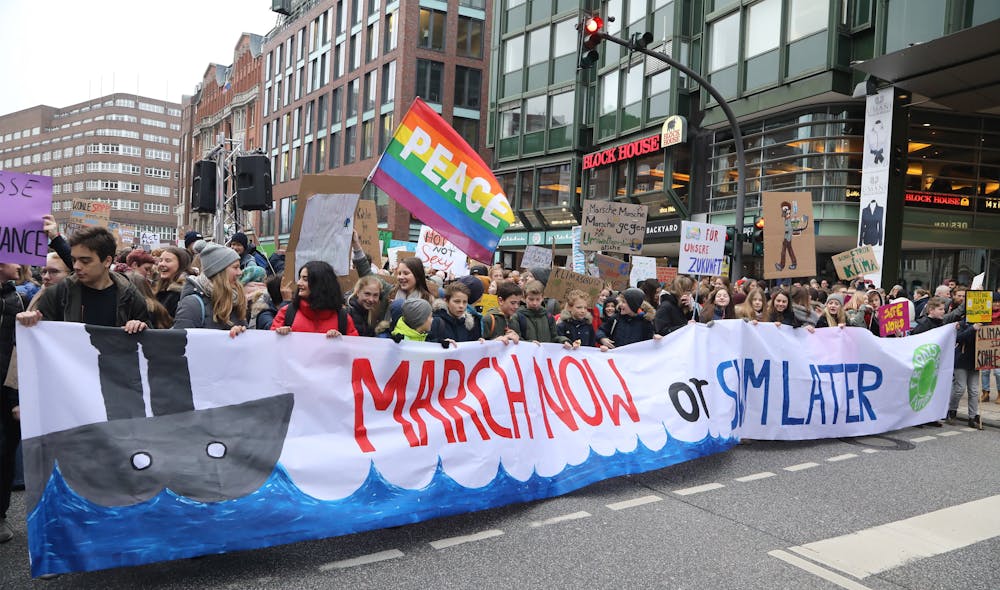
We are right to feel horrified, we are right to feel sick, and we are right to feel angry — but we should not forget the optimism we felt this morning when marching alongside the School Strike for Climate Action.
Those marches in so many cities today showed the very real case for hope — an entire generation is ready to fight for a better future, and they will be just as ready to fight against racism as well. Those few Nazi thugs do not represent Aotearoa in any way, shape or form.
Love Aotearoa Hate Racism is holding an emergency hui at 7pm tonight to organise how we respond to these atrocities, and build a mass movement against fascism in the long term.
The meeting will be held at Unite Union Auckland office, 6a Western Springs Road, Morningside.
Please let us know if you are willing to fight — whether you are in Auckland, or if you want to get the fight against racism started in your city.
You arrive at your local public hospital for treatment. The hospital staff ask for your name, date of birth and address. They ask if you have Medicare and private health insurance. Then they ask if you would like to be admitted as a public or private patient. You’re unsure. You’re left wondering whether this decision will affect the care you receive.
Almost all patients will be asked, either verbally or via a standard admission form, whether they have private health insurance and wish to use it.
In our research projects we’ve spoken to Australians with private health insurance who have received treatment in public hospitals. Many people say they find it difficult to decide whether to be a private or public patient. They are unsure of the benefits and costs, and where to find this information.
Public hospitals have recently been criticised for allegedly pressuring vulnerable patients to use their private health insurance.
It’s important to note that opting to go private in a public hospital is solely your decision, and will not affect the quality of care you receive. Public and private patients have the same access to public hospital services.
Under the National Health Reform Agreement, all Medicare cardholders have the right to be treated in public hospitals for free as public patients. The cost of accommodation, meals, health care and other treatment-related fees is covered by Medicare.
Why do public hospitals ask the question?
Public hospitals are treating a growing number of patients every year, with increasingly complex needs and health conditions. In this environment, hospitals are expected to do more with less.
People who use their private health insurance benefit the public hospital because some of the funding needed for care comes from private health insurers, rather than hospitals relying solely on the allocation provided by the government via Medicare.
Hospitals say funding received from privately insured patients goes towards infrastructure, research, specialised equipment and other service improvements.
Public and private patients have the same access to public hospital services.From shutterstock.com
Australians with private health insurance are using their cover when admitted to public hospitals more than they used to. In 2004, an estimated 6.8 per 1,000 admissions to public hospitals were private patients; by 2014, this increased to 22.7 per 1,000.
Meanwhile, insurance companies argue increased use of private health insurance for public hospital care is contributing to rising premiums.
Australians might choose to be a private patient in a public hospital for many reasons.
The excess or co-payments applied by private health insurance providers for treatment in private hospitals may be discounted or exempted by public hospitals. So there may be no out-of-pocket expenses for private patients, depending on the type and length of admission.
As a private patient you may be able to choose your doctor, if they have a “right of private practice” at the hospital where you are admitted.
Patients also indicate that they choose to be admitted as private patients because this is a way of giving back to the public hospital. In our research, patients recounted being asked “would you like to help the hospital out?”; the suggestion being they would be doing so by using their private health insurance.
The idea of helping the hospital is also promoted on hospital websites when information is provided. Some patients said they did not want to take public resources away from those who rely on the public system for care.
Some patients in our research saw supporting the hospital as advantageous to them personally as a future patient: “a benefit to the hospital […] is beneficial to me in the long run,” one respondent said.
People also choose to be a private patient because they believe they will get privileges for doing so. Many hospitals offer expressions of gratitude to private patients such as access to television, coffee vouchers or free parking.
Some offer single rooms to private patients, but priority is given to patients who are very ill or infectious.
Some patients in our research said they were surprised they did not receive quicker or better quality care as private patients: “Being a private patient in a public setting made no difference. The level of care was the same,” one said.
Final things to consider
Publicly accessible information about being a private patient in a public hospital, including information about payments and any potential out-of-pocket costs, varies greatly between hospitals and states, and can be hard to find.
While many public hospitals guarantee there are no costs associated with being a private patient, this is not the case for every public hospital. We advise the following:
if you are eligible for Medicare benefits, you are not obligated to use your private health insurance in order to receive the same quality of care provided to all patients – it is your choice
check with your private health insurance fund about whether you will be charged for any services received
check the hospital website for information about using private health insurance
if you are unsure about the costs and benefits of using your private health insurance, say so. Many public hospitals have staff called patient liaison officers who are there to answer your questions.
Welcome to Beating Around the Bush, a series that profiles native plants: part gardening column, part dispatches from country, entirely Australian. Read more about the series here or get in touch to pitch a plant at batb@theconversation.edu.au.
I first became interested in guinea flowers when I heard of a plant growing in Queensland’s White Mountains nicknamed “excruciating” by all who handled it, because of the pungent needle-like leaves which attached themselves to fingers and clothes.
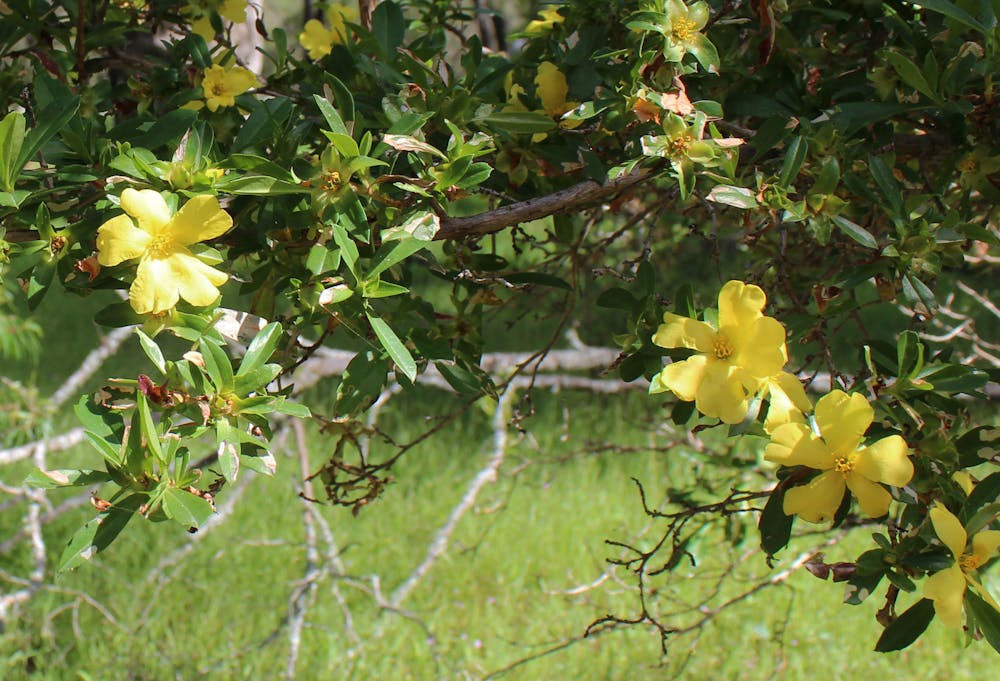
This species is a guinea flower, now scientifically named Hibbertia ferox, meaning “fierce”. Guinea flowers grow across Australia, from the rainforest to semi-arid areas.
Guinea flowers belong to the genus Hibbertia, which dates back to Gondwana. Members of the genus are easy to recognise, but individual species are hard to tell apart. Their brilliant yellow (or sometimes orange) flowers have petals with a notch at the apex, and they were thought to resemble the appearance of the 18th-century coin known as a golden guinea. As usual there are a couple of exceptions – at least two species have petals that lack a notch.
All too often these small shrubs and woody climbers grow in areas likely to be razed for urban sprawl or mining.
The Conversation
What we know about Hibbertia
English merchant and amateur botanist Henry Charles Andrews named the genus Hibbertia after his friend George Hibbert (1757-1837). Andrews was an artist and engraver as well as a botanist, and the first species he named was based on a plant collected around Port Jackson.
Around 200 species are recognised but there are many unnamed varieties, particularly in tropical areas. Probably the most widespread species and one of the few cultivated is the climbing guinea flower (Hibbertia scandens). It can be grown readily from cuttings but germinates slowly from seeds.
Most species have hairs covering the leaves, which can be critical for identifying a species. Under a good hand lens or a simple microscope their variety and beauty is obvious. In some species the hairs are straight. In others they are branched with arms resembling the spokes on a star, the so-called “stellate hairs”.
Some species have scales – flat, plate-like structures – on their leaves and flowers. Sometimes there are large and small scales on the one surface.
The leaves are also diverse in shape and form: some leaves are shaped like spear and thick, as in Hibbertia banksii of the eastern Cape York area, others are needle-like with margins rolled towards the lower midrib, with a sharp, blood-drawing tip, as in Hibbertia ferox.
A 1795 guinea coin from the reign of George III.Wikipedia
The flowers are usually solitary and roughly 2cm in diameter, but in some of the northern species they grow in spikes roughly 4-5cm across.
Five sepals surround the five petals, which are broadest towards the top. The flowers usually close at night and reopen the next day.
A distinctive feature is the arrangement of the stamens (the male parts). These may be all on one side of the carpels (the structures containing the unfertilised seeds at the centre of the flower) or may form a form a ball in the centre. The number varies between species from fewer than 10 to more than 100.
Hibbertia ferox was nicknamed ‘excruciating’ because of its needle-like leaves.Shutterstock
Floral frolics
For a plant to be involved in sex of a floral kind it needs to offer rewards for services rendered. Sometimes guinea flowers grow sterile stems, which add to the floral display and provide a food source, particularly for beetles. They are messy eaters, chewing on various plant tissues as they wander around the flower’s surface, but they do help to transfer pollen to the stigmas, or female parts (and no doubt are involved in sex with their own kind).
Guinea flowers don’t produce nectar to tempt pollinators, but people have reported them producing weak fragrance. There’s some dispute over how pleasant the smell is, with some describing it as sweet and others insisting it smells like cow dung. There have been only a couple of reports of what this smell resembles, so we need you to go and stick your nose in a freshly open flower. (Make sure to check – is the fragrance there all day or only in the morning?)
However, there is plenty of pollen. If you look closely at the anthers, those yellow sacs on the top of a thin stalk, you will see either an opening or pore at the top, or a slit down the side through which pollen can escape. Whether the marauding bug causes the pollen to spray out through the top or it accidentally falls on the bug through the slit, the bug gets dusted in pollen and then this can get brushed off on the female parts or stigma. Bees and flies are the most common bugs seen around guinea flowers.
The fruit is composed of 2-5 loosely adhering capsule-like follicles, surrounded by the five sepals, which remain and do not fall off.
Hibbertia scandens, a climbing guinea flower, is commonly known as snake vine.Shutterstock
The fruit contains one or two seeds that are covered by a reddish coating or aril. This nutritious tissue is a valuable food source for dispersers such as ants and birds; birds have been recording spreading the seeds of Hibbertia scandens. However, in the drier areas where these plants are commonly found, ants appear to be the common dispersers.
So next time you are in the bush don’t just ignore that small shrubby plant with yellow flowers and notched petals. Stop and admire their beauty.
Note if there are any bugs visiting and what they might be doing. Why not record their presence on iNaturalist – an app that lets us record and share your nature encounters – particularly if you are off the beaten track?
There have been two shooting incidents – at the Masjid Al Noor Mosque next to Hagley Park, and at the Linwood Masjid Mosque in the suburb of Linwood.
Police Commissioner Mike Bush said one person was in custody, but police said there may be other offenders.
Prime Minister Jacinda Ardern said on live television: “There is no place in New Zealand for extreme violence.”
An eyewitness inside the Masjid Al Noor Mosque said he heard shots fired and said at least four people were lying on the ground and “there was blood everywhere”.
An eyewitness said a man wearing a helmet and glasses and a military style jacket opened fire inside the mosque with an automatic weapon.
About 300 people were inside the mosque for afternoon prayers.
Police sid the “risk environment remains extremely high”.
The manager of the An-Nur Early Childhood centre in Wigram earlier said police gave some parents an update that said there were two gunmen and at least one was on the loose.
People in central Christchurch have been urged to stay indoors and report any suspicious behaviour immediately to 111.
All Christchurch schools, Christchurch Hospital and Christchurch City Council buildings have been placed into lockdown.
This article is republished under the Pacific Media Centre’s content partnership with Radio New Zealand.
Police at the cordon around a shooting incident in central Christchurch today. Image: Simon Rogers/RNZ
University of Canberra Deputy Vice-Chancellor Leigh Sullivan speaks with Michelle Grattan about the week in politics. They discuss Barnaby Joyce signalling interest in the Nationals leadership, the schism between Queensland Nationals MPs and moderate Liberal MPs on coal-fired power stations, the Reserve Bank deputy governor’s climate change address and Labor’s push to make the minimum wage a “living wage”.
Source: The Conversation (Au and NZ) – By Alastair Blanshard, Paul Eliadis Chair of Classics and Ancient History Deputy Head of School, The University of Queensland
Review: Hydra, Queensland Theatre and State Theatre Company of South Australia
Running through Hydra, the new play by Australian playwright Sue Smith, is the myth of Icarus, the boy who flew so high that his wings melted and he crashed to his death in the sea near the Greek island of Samos.
It is an easy myth to misunderstand. Moralists think it is a story that reinforces the importance of listening to your parents and sticking to the safe middle path – not flying “too close to the sun”. In contrast, artists have always recognised that the appeal of the myth lies in its promise of the freedom to soar with the birds.
The conclusion may be disastrous, but the joy is in that fabulous voyage that precedes it. Any price is worth paying to touch the sky. We don’t need to lament Icarus. The tragic figure is his father Daedalus, too scared to follow his son in his magnificent, glorious, fatal flight.
Hydra tells the story of the Australian husband-and-wife writers George Johnston (Bryan Probets) and Charmian Clift (Anna McGahan), two Icarus-like characters, and the ten years they spent in Greece, primarily on the island of Hydra. Beginning in the mid-1950s, it was a wild time of booze, song, and love-making. Hydra became a hangout for artists, writers, and musicians. A refuge for misfits hiding from the world.
Anna McGahan as Charmian Clift and Bryan Probets as George Johnston in Hydra.Jeff Busby
Sidney Nolan and his wife stayed over a summer. Leonard Cohen sang and played guitar. The actor Peter Finch came to recharge his batteries. Representing this pack of dissolute expatriates in the play is the comical figure Jean-Claude (Ray Chong Nee), a louche painter with a winning smile and professionally French in his equal commitments to infidelity and existentialist philosophy.
Ray Chong Nee plays Jean-Claude, a disreputable yet charming painter.Jeff Busby
Out of this raucous environment would come one of the great works of Australian literature, My Brother Jack, written by Johnston, but importantly nursed into existence by Clift in the final years of their life on the island.
The story of their tumultuous relationship is told in the play from the perspective of their son, the poet and novelist Martin Johnston, played with a vulnerable, naïve charm by Nathan O’Keefe.
It takes a degree of monstrous narcissism to think that you could write the “great Australian novel” and the play doesn’t spare its audience any of this unpleasant side of the creative process. In an excruciatingly awkward scene, we watch Johnston and Clift at work, bashing out words with duelling his-and-hers typewriters positioned at either end of a table.
Petulant, hungry for attention and eager for praise, Johnston is childish in his behaviour. Keen to display his virtuosity and indifferent to Clift’s feelings, he rewrites her work to give it more “energy” and can’t understand why she doesn’t respond to his interventions with gratitude and enthusiasm.
The play strongly suggests that My Brother Jack was written at the expense of Clift’s own literary endeavours. In a heart-rendering moment, Clift puts the cover on her typewriter, never again to be removed, so that she can devote herself to editing Johnston’s manuscript.
We possess Clift’s accounts of her time in Greece in the form of the autobiographies Mermaid Singing and Peel Me a Lotus, but she clearly had a lot more to say had her energy not been so used up in nursing her husband. Anna McGahan’s portrayal brings out both the brittle fragility of Clift and her underlying strength. She sacrifices a lot, but never loses the driving will to write herself into lasting memory, to make herself be seen.
Hydra explores the sacrifices Charmian Clift (Anna McGahan) made while living on the island.Jeff Busby
Acting as a foil to Johnston and Clift are the couple Vic (Hugh Parker) and Ursula (Tiffany Lyndall-Knight), thinly disguised versions of Sidney Nolan and his wife Cynthia Reed. Ursula is a wonderful bit of writing. Deliciously dislikable, she cuts through her scenes like a scythe. At one point, she compares herself to Daedalus and Vic to Icarus.
However, compared to the fiery theatrics of the Johnston-Clifts, both of them look plodding. Vic’s worldly ambitions ultimately hold him back. You can’t reach the heavens and also make it home in time to be guest of honour at posh dinner parties.
There is a great irony that one of the masterpieces of Australian literature should have been written in Hydra. Greece is not a place conducive to new, thoroughly original, distinctive stories. It always threatens to swamp you with its own stories, crushing you with the weight of its mythology. Nolan tried to paint Gallipoli, but could never escape the pull of Troy.
The exact process of how My Brother Jack came into being remains a mystery. The triggers that caused Johnston to turn inwards, away from his island idyll, back to his own life and far-away homeland continue to be elusive.
No one knows where great art comes from. Hydra instead explores the costs associated with the creation of art and the demands placed on anyone who would seek to fly free. It is tragic, comic, heroic, and in that sense thoroughly Greek.
Hydra is playing at Queensland Theatre until April 6.
They have no Wi-Fi. There are no fancy gaming consoles or immersive media (or even popcorn for that matter) and yet they are almost certainly crafting tales and enthralling each other.
Thankfully we’re all vastly more evolved now because we have creature comforts and flashy technology – like PlayStations and virtual reality (VR) at our fingertips. Quaint notions of narrative and story shouldn’t matter anymore, right? Not so fast.
My recent research suggests that even with advanced immersive technology, people still hunger to be told stories.
The author on a VR rollercoaster, ready to perhaps not be told a story.@PhotoByJarrod
Rollercoasters, VR and drop rides
I’m researching what consumers want from VR entertainment experiences. I’ve collected original data from multiple VR participants all around the world by way of interviewing them with series of fixed questions as they stepped off VR roller coasters, VR simulators, VR drop rides, VR water slides and VR walkthrough experiences.
These rides and experiences represent some of the most advanced examples of immersive entertainment on the planet. And yet once we analysed the data for trends and themes, what came through loud and clear from participants may have resonated just as well with our cave people: we want story.
Said one participant who had just stepped off a VR roller-coaster experience (that’s a real roller coaster, with a VR headset that shows graphics and animations of something completely different to the physical ride):
I just think it’s flying around and stuff, I don’t think there’s a story. If there is … I don’t know what it is.
Other responses ranged from simple confusion (“I just don’t know what was going on”) and “It felt a little bit like Super Mario: jump and run”, to one consumer who was clearly crying out for even a crumb of narrative:
I mean, you have dwarves and regular human people and then you have a dragon in a cave, but then you have a bat that’s flying around … like, what’s the backstory to the whole situation?
Another participant appears to give a nod to technology at the beginning of their response, with a familiar pivot at the end:
I think they went a lot in depth with a lot more of the graphics. I think they could have put more into the storyline itself.
While a chirpy minority appeared less concerned about the lack of obvious story, they (perhaps inadvertently) underscored the importance of story anyway by admitting it was so essential to their experience that they were forced to make up their own:
A lot of people say you need to have a backstory and all that, but I kind of enjoyed the idea that you don’t really know what’s going on, kind of having to make up your own little story for it.
High-tech = customers, right?
Virtual reality is still seen as flashy technology, so it’s no surprise vendors and theme parks promote their VR experiences technology-first and seem to ignore the lure of “narrative transportation” – a highly desirable state in entertainment experiences where consumers lose track of the real world by being lost in a story.
This enables immersion, which in VR enables escapism, which means we get that much-desired magical moment of forgetting the world and all its problems, just for a moment.
Research suggests that game developers (note that games are often put in the same basket as VR entertainment experiences) are benefiting specifically from pursuing rich storytelling.
The not-at-all-shabby US$131 million success of the recent PlayStation 4 game God of War in its first month of release was attributed to a focus on narrative.
To be fair …
Technology is obviously critical for a successful VR experience (high resolution, spatial audio, low latency – meaning when you look around the digital world responds exactly as you would expect without lagging – just for starters) but it seems participants handsomely reward technology when it is paired with storytelling.
Also, most VR entertainment experiences are short, which does not necessarily allow for in-depth stories to be developed. Additionally, the often wild forces at work on the more aggressive physical rides utilising VR can mean subtle story detail may be difficult to introduce to a narrative, at least in the active ride portion (when you’re being flung around upside down at high speeds, you might not be searching for nuance).
But it seems the current offerings are over-reliant on technology alone as a way to attract participants to these experiences, when it may be that promoting more traditional narratives – a simple story – may be a more effective technique.
While the world has changed enormously since the ancient times, we haven’t, and there’s something sweet, and very human, about that.
More than 70% of recreational fishers support no-take marine sanctuaries according to our research, published recently in Marine Policy.
This study contradicts the popular perception that fishers are against establishing no-take marine reserves to protect marine life. In fact, the vast majority of fishers we surveyed agreed that no-take sanctuaries improve marine environmental values, and do not impair their fishing.
No-take marine sanctuaries, which ban taking or disturbing any marine life, are widely recognised as vital for conservation. However, recent media coverage and policy decisions in Australia suggest recreational fishers are opposed to no-take sanctuary zones created within marine parks.
This perceived opposition has been reinforced by recreational fishing interest groups who aim to represent fishers’ opinions in policy decisions. However, it was unclear whether the opinions expressed by these groups matches those of fishers on-the-ground in established marine parks.
To answer this, we visited ten state-managed marine parks across Western Australia, South Australia, Queensland and New South Wales. We spoke to 778 fishers at boat ramps that were launching or retrieving their boats to investigate their attitudes towards no-take sanctuary zones.
Our findings debunk the myth that recreational fishers oppose marine sanctuaries. We found 72% of active recreational fishers in established marine parks (more than 10 years old) support their no-take marine sanctuaries. Only 9% were opposed, and the remainder were neutral.
We also found that support rapidly increases (and opposition rapidly decreases) after no-take marine sanctuaries are established, suggesting that once fishers have a chance to experience sanctuaries, they come to support them.
Recreational fishers support for marine sanctuaries increases with marine park age.
Fishers in established marine parks were also overwhelmingly positive towards marine sanctuaries. Most thought no-take marine sanctuaries benefited the marine environment (78%) and have no negative impacts on their fishing (73%).
We argue that recreational fishers, much like other Australians, support no-take marine sanctuaries because of the perceived environmental benefits they provide. This is perhaps not surprising, considering that appreciating nature is one of the primary reasons many people go fishing in the first place.
Exploring marine life within an established marine park.Tim Langlois
Our findings suggest that these policy decisions do not reflect the beliefs of the wider recreational fishing community, but instead represent the loud voices of a minority.
We suggest that recreational fishing groups and policy makers should survey grass roots recreational fishing communities (and other people who use marine parks) to gauge the true level of support for no-take marine sanctuaries, before any decisions are made.
Despite what headlines may say, no-take marine sanctuaries are unlikely to face long lasting opposition from recreational fishers. Instead, our research suggests no-take marine sanctuaries provide a win-win: protecting marine life whilst fostering long term support within the recreational fishing community.
Thousands of school students, teachers and climate advocates gathered at cities across New Zealand today to kickstart the global Strike 4 Climate action day.
More than 3000 students packed into Aotea Square in New Zealand’s largest city, Auckland, in a vibrant display of enthusiasm in their call for urgent and real change by politicians.
Brightly coloured placards proclaimed “Stop global warming”, “Stop destroying – start caring”, “I would be at school if the Earth was cool” and “Our planet is dying and all you can think about is truancy” as the students called for action, not talk, by governments.
In the capital Wellington, at least 2000 spirited students and their supporters descended on Parliament, reports RNZ Pacific.
The lawn in front of the Beehive was packed with young protesters this morning and chants like, “No more coal, no more oil, keep your carbon in the soil” surely reached the politicians inside.
A cool message from Auckland school climate protesters today. Image: David Robie/PMC Global warming placard by the Auckland Town Hall today. Image: David Robie/PMC “Stop destroying” the planet placard in Auckland’s Aotea Square today. Image: David Robie/PMC Climate protesting students gather outside Auckland’s Town Hall today. Image: David Robie/PMC
For too long, these acts of violence and abuse, particularly where they occur in support services, have been referred to merely as “incidents” to be covered up and kept out of the public gaze.
It’s important the royal commission uncovers the extent of this violence, and highlights the individual harm it has caused. It must also work to address the systemic issues that fail to adequately respond to – and sometimes cover up – these violations.
Most importantly, the outcome of the commission needs to ensure people with disabilities have access to the same education, support and justice services available to others in the community that work to prevent violence and abuse and enable appropriate legal and support responses.
This is underpinned by the United Nations Convention on the Rights of Persons with Disabilities, to which Australia is a signatory. This requires that people with disabilities be afforded the same rights as others to be safe from violence and abuse. It stipulates that people with disabilities are seen as equal before the law, and that health, justice and support services are accessible for all.
What are we likely to hear?
Far from being vulnerable victims without a voice, people with disabilities have long been showing their strength and capabilities by sharing their stories and contributing to research policy and practice.
Some stories of violence, abuse, neglect and exploitation of people with disabilities have made their way into the public domain through the media.
One story you may have heard recently on the ABC true crime podcast Trace is that of Adam James. Adam has a disability and in 2013 reported that as a child he was abused by a local priest, who has since been linked to the murder of his mother.
Others will have heard the story of Anj Barker, who suffered a traumatic brain injury at the hands of her violent boyfriend. Anj has been a tireless advocate against domestic violence.
Many more stories have not yet been heard, apart from within research and through advocacy by organisations like Women with Disabilities Australia.
Our peer education program Sexual Lives and Respectful Relationships uses the stories of people with an intellectual disability shared in research to explore sexuality rights. Through this research and the program, we hear about the challenges people with intellectual disabilities experience when seeking to have safe, self-determined and fulfilling intimate and social relationships.
The narrators of the stories – peer educators who run the program and program participants – tell stories of taxi drivers, neighbours and fathers sexually abusing them. They tell of intimate partners, family members, and support staff exploiting them financially and emotionally.
They talk about community services taking their babies away from them in the delivery suite, and about being bullied and abused by people in their community, carers and staff who are employed to support them.
Perhaps the royal commission will beam these stories into our loungerooms and remind us of the pervasiveness of abuse against people with disabilities in this country.
People with intellectual disabilities report being financially, sexually and emotionally abused by those who are supposed to be supporting them.Creativa Images/Shutterstock
Access to counselling and legal redress
To ensure people with disabilities have an opportunity to tell their stories, be heard and believed, they need appropriate counselling, family violence support, sexual assault services, and legal assistance. Some important work has been done so far to deliver these services.
In Victoria, the South Eastern Centre Against Sexual Assault’s Making rights reality program provides easy English information and access to legal advocacy for people with cognitive impairments. Staff are trained and have access to specialist resources for additional support. Clients are then linked into legal services to progress victim of crime applications.
The organisation 1800RESPECT has developed a new app for women with a disability. The “Sunny” safety and support app gives women information about violence and abuse, and opens up referral pathways to them to get immediate help.
Australia’s National Research Organisation on Women’s Safety (ANROWS) has funded research that is informing work by domestic and family violence services to be fully accessible for women with disabilities. This work is also developing opportunities for women with disabilities to inform and shape services.
Access to justice remains a challenge for all victims of violence and abuse. Services such as the Witness and Victims Service of the Victorian Office of Public Prosecutions works to support all victims and witnesses to ensure they know their rights and are supported through the court system. Many of their clients are people with disabilities.
Legal advocacy and representation by community legal services is also bridging the gap for many victims with disabilities, by supporting them to access victims of crime compensation.
But more needs to be done to address the barriers in the court system that make it difficult for people with disabilities to access justice. People with disabilities are sometimes seen as lacking credibility as witnesses, for instance, which is not supported by the evidence.
Finally, people with disabilities need to be listened to and believed by those closest to them so they can be referred to services like these.
The draft terms of reference for the royal commission are open for comment from March 13 to 29. Anyone can comment on them – and if you’ve got something to say, you should. After all, people with disabilities are our neighbours, our fellow public transport travellers, our fellow shoppers, voters and our friends and colleagues.
Tennis champion Martina Navratilova recently called the participation of transgender women in elite female sporting competitions “insane” and “cheating”.
And she’s not alone. Several other prominent women athletes have also used social media, mainly Twitter, to voice their concern about the eligibility of transgender women in sport, including former British swimmer Sharron Davies, double Olympic champion Dame Kelly Holmes, and former long-distance runner Paula Radcliffe.
There is an inherent contempt that lies within these statements, and it impacts more than just trans athletes. It can impact the integrity of public discourse by reducing the debate to be about whether trans women are “real women”, and we need to move past this crude and destructive rhetoric.
Here, I use the term trans as an umbrella term to include all identities within the trans community, such as transgender and transitioned athletes.
What is the debate really about?
So why have we revisited this discussion in recent weeks? We are witnessing a broader movement against the trans community.
Australian gay rights activists Dennis Altman and Jonathan Symons call it the “queer wars” in their book of the same title. They explain how resistance to LGBTI issues across the globe is being used by governments and religious leaders to uphold traditional values, and increased polarisation towards LGBTI rights.
In recent years, we saw bathrooms used as a platform for division in the US. In 2016, North Carolina became the first US state to introduce a law prohibiting transgender people from using the restroom corresponding to their gender.
Then, in Australia, the Australian Christian Lobby suggested a “yes” vote for marriage equality would lead to boys wearing dresses to the detriment of society.
And the UK saw backlash against a youth trans charity, called Mermaids, where half a million pounds of funding was disputed.
It seems sport is now being used as yet another tool to incite fear and hatred towards the trans community.
Some male commentators have raised concerns that the integrity of women’s sport is at risk. But where have these so-called male champions of change been in advancing women’s sport in recent years?
Another commonly-cited issue is that men might identify as women to reap rewards in competition. There have been no reported cases of men transitioning to women to earn money and dominate podiums. It is simply a myth.
Do trans polices in sport work?
The introduction of the International Olympic Committee’s policy on trans athletes in 2003 – amended in 2013 to remove surgical requirements and introduce a minimal level of testosterone – has led to no publicly out trans athletes competing at the Olympic games.
At the Commonwealth Games, trans weightlifter Laurel Hubbard qualified, but had to withdraw due to injury.
Weightlifter Laurel Hubbard during for the Women’s +90kg Weightlifting Final at the Commonwealth Games, 2018.Dean Lewins/AAP
Therefore, the perception that trans women are, and will, dominate women’s elite sport is not supported with any clear evidence.
UK research also found, after reviewing a series of trans policies in elite sport:
“the majority of these policies were unfairly discriminating against transgender people, especially transgender females”.
If we are to start scrutinising the ethics and integrity around cheating and enforcing a level playing field, there are many other places we could start.
Match fixing, illegal gambling markets, substance abuse, and corruption have been found to exist within local grassroots matches in Victoria. Issues around ball tampering, match fixing at various levels of tennis, doping within various sporting codes, and salary cap breaches have also been reported at the elite level.
Particularly in women’s sport, there is a disproportionate allocation of funding and resources compared to men’s sport, a gross lack of media coverage, and women continue to fight for equal pay.
Advancing trans and gender diverse inclusion in sport
New guidelines and policies are being introduced from various sporting codes in the coming year in Australia.
The Victorian Equal Opportunity and Human Rights Commission led the way with updated guidelines last year, but the most prominent policy to be released soon will be the Australian Human Rights Commission and Sport Australia’s guidelines for Trans and Gender Diverse Athletes in Sport. This will likely be adopted by most sporting codes in Australia.
But as the debate continues, it is important we hear from trans athletes. No trans person has the same transition experience and there is great diversity among the trans community. We also need to understand the wider impact of negative commentary against this community.
What we have seen so far from the Olympic movement is promising in promoting trans inclusion in sport. The International Olympic Committee released mini documentaries about trans athletes in sport, and Tokyo 2020 is set to have gender neutral bathrooms.
We must remember that sport is a human right, and should be accessible to everybody, regardless of gender identity.
Auckland school pupils are set to fill Aotea Square today in protest at the lack of action on climate change. Image: Hannah Williams/Te Waha Nui
By Hannah Williams of Te Waha Nui
Students across New Zealand are striking today as part of a worldwide day of action over global warming and the issue of climate change.
The strikes are expected to bring tens of thousands of students to the streets across the globe from Europe, the United States, Australia and New Zealand.
Strikes in more then 20 towns and cities around New Zealand are planned, ranging from Russell in the north to Nelson in the south.
The Auckland strike will begin midday in Aotea Square, with musical performances and guest speakers coming out to discuss any and all environmental issues.
The demands of the School Strike 4 Climate NZ include passing a proposed Zero Carbon Act and ceasing all exploration and extraction of fossil fuels immediately.
-Partners-
Auckland University of Technology communications student Millie Hinchliffe said the strike was a good thing because it showed the younger generation was more aware of these environmental issues being seen through social media.
“People have become more aware of what’s going on … before the internet, people were aware but not as aware as to how bad the impact was but now you’re able to see it,” she said.
“Students around the world are calling politicians to action – we have a responsibility to listen to them and respond,” she said.
Opposition leader Simon Bridges told The AM Show it was an important issue and he would not begrudge students taking a day off school to protest lack of action on climate change. However he was unsure whether the ends justify the means.
An academic who signed the above letter, senior researcher at Victoria University Dr Judy Lawrence, believes it is important for the younger generation to be involved, because it is their future that will be affected the most.
“The government makes decisions which will affect future generations and especially for those who cannot vote. So you are directly affected but have no voice. You will inherit the harm done by policy delay.
“Hope won’t do it. You want action.”
The movement started after 15-year-old Swedish climate activist Greta Thunberg sat outside the Swedish Parliament building in Stockholm until the September election.
Her protest saw thousands rally behind her with strikes happening across Germany, Switzerland and England.
Te Waha Nui is AUT University’s training online publication and newspaper, publishing the work of journalism students on the Bachelor of Communication Studies and Postgraduate Diploma in Communication Studies programmes.
Most of us want our lives to have meaning. But what do we mean by meaning? What is meaning?
These sound like spiritual or philosophical questions, but surprisingly science may be able to provide some answers.
It might not seem like the kind of thing that can be tackled using the detached and impersonal methods of science. But by framing the right questions, researchers in language, cognitive science, primatology and artificial intelligence can make some progress.
One factor is the systems used by other animals are basically linear: the meaning of each symbol is modified only by the one immediately before it or after it.
For example, here’s a phrase in chimpanzee sign language:
give banana eat.
That’s as complicated as phrases get for chimps. The third word is distinct from the first, only joined by the second.
But in a standard sentence from any human language, the words at the end of a sentence can modify the meaning of those back at the start.
Try this:
The banana in the fruit bowl tastes good.
The fruit bowl doesn’t taste good even though those words are adjacent.
We effortlessly sort out the meaning in sentences based on hierarchies, so that phrases can be nested in other phrases and it doesn’t cause any problems (most of the time).
Did you ever have to diagram a sentence while learning grammar in school? A sentence of human language has to be diagrammed in a tree-like structure. This structure reflects the hierarchies embedded in the language.
Simplified tree diagram of an English sentence.Jamie Freestone
Cognitive scientist W. Tecumseh Fitch, an expert in the evolution of human language, says what separates humans from other species is our ability to interpret things in a tree-like structure.
Our brains are built to group things and to arrange them into hierarchies, and not just in grammar. This opens up a whole universe of meanings that we are able to extract from language and other sources of information.
But complex structure isn’t all there is to meaning. If you’ve seen any computer programming you know that computers can also handle this kind of complex grammar. That doesn’t mean computers find it meaningful.
Research into human brains is trying to find out how we find information significant. We attach emotional and semantic weight to the utterances we speak and hear. The neuroscience of working memory may hold some clues.
A memory of that
We need working memory to pay attention to those long sentences that have the complex grammar described above.
Working memory also helps us knit together the experience of waking life, moment to moment. We experience a vivid and comprehensible stream of consciousness, rather than staccato flashes of action.
When something really grabs our attention, it’s elevated from being dealt with by unconscious, localised brain processes to the global workspace. This is a metaphorical “space” in the brain, where important signals are broadcast throughout the cortex.
Roughly speaking, if a signal doesn’t get amplified to the global workspace then it stays local and our brains deal with it unconsciously. If information gets to the global workspace then we’re conscious of it.
Information from different sensory inputs — vision, hearing, touch — then gets put together to form an overall interpretation of what’s happening and how it’s meaningful to us.
Working together
Moving beyond an individual’s brain, a lot of work has been done in terms of social cognition. That is, how humans are particularly good at thinking together and cooperating.
Obviously that goes hand in hand with our more complex language. But there are other abilities that seem to have evolved alongside language that are also unique to humans and crucial for cooperation.
Michael Tomasello, director of the Max Planck Institute for Evolutionary Anthropology in Germany, has been studying chimps side by side with human infants for 25 years.
He emphasises the role of shared intentionality. From about age three, and unlike apes, human infants can easily, even wordlessly, cooperate on simple tasks.
To do so they have to monitor their own actions, the action of others, and both their actions in light of a shared goal or set of expectations.
This might not seem like a staggering result. But Tomasello argues this is essentially the origin of human morality. By adopting the perspective of shared intentionality, humans evolved norms or conventions that shape our shared behaviour.
This perspective allows us to evaluate actions and behaviour in broader terms than simply whether or not it provides some instant reward. Hence we can judge things as meaningful or not according to norms, values, morals.
But what does it all mean?
So complex grammar, working memory and cooperation are just three areas of research out of dozens that are relevant. But researchers from various disciplines are zeroing in on what meaning is at a very fundamental level.
It seems to be about the complexity of information, integrating information over longer periods of time and sharing information with others.
That might sound remote from questions like, “How do I make my life meaningful?” But the science does actually line up with the self-help books on this score.
The gurus say that if you can find some alignment in your past, present and future selves (integrating information over time) you’ll feel your life has meaning.
They also tell you it’s very important to be socially connected rather than isolated. Translation: share information and cooperate with others.
It’s not that science can tell us what the meaning of life is. But it can tell us how our brains find things meaningful and why we evolved to do so.
When former Trade Minister Andrew Robb took to the ABC’s AM program to sound off about a “toxic” relationship between Australia and China, he exposed a rippling debate about how to manage an increasingly comlex foreign and security policy challenge.
Long gone are the days of the John Howard formula that Australia did not have to choose between its history, meaning America, and its geography, meaning China. Choices are no longer binary.
While the Robb word “toxic” may be an exaggeration, stresses in Australia-China relations are such it is clear we have entered a new and more challenging phase.
For a start, China is undergoing what is, arguably, the most testing moment of an economic transformation that began in 1978 at the third plenary of the 11th Central Committee of the Chinese Communist Party. This is when Deng Xiaoping re-emerged to initiate one of the more remarkable economic shifts of the modern era.
Apart from a hiatus caused by the Tienanmen uprising in 1989, and an economic soft-landing in the mid-1990s, China has bounded ahead economically, and has seemed unstoppable – until now.
China’s economy and political system has encountered the sort of difficulties that were inevitable. Put simply, an investment driven – as opposed to consumer-led – model is running its course, piling up massive government and bank debt in the process.
China risks becoming caught in a “middle income trap” in which a developing country, having enacted the easier reforms, gets stuck in second gear in its effort to push ahead with its economic transformation.
You can only build so many road, bridges, fast trains, airports, ports and housing developments. Many of the latter have become “ghost cities”.
At this month’s National People’s Congress, the annual session of China’s “parliament”, Premier Li Keqiang gave what was, by Chinese standards for these sort of cheerleading events, an unusually downbeat assessment of challenges ahead.
China, Li said, faces difficulties “of a kind rarely seen in many years”.
What is undeniable is that China’s economy is faltering, its ability to create millions of new jobs annually to employ a restless population is being stretched, and its management of a continuing economic transformation has come under unusual stress. US-China trade tensions are not helping.
In counterpoint to the need for a more dynamic economic environment, its leadership, under President Xi Jinping, is asserting even tighter political controls when it should be giving freer rein to its entrepreneurial class.
This is the central contradiction of a model that has delivered what is the most extraordinary event in world economic history since the industrial revolution. But that model clearly has its limitations compared with those, say, of neighbouring Japan, South Korea and Taiwan.
From an Australian perspective, a slowing and, perhaps more to the point, anxious China is not good news. While economists might argue that a slowdown and thus the need for Beijing to stimulate its economy by ramping up infrastructure projects will benefit iron ore and coal exporters, economic pressures more generally should be concerning.
A Chinese regime that feels itself under stress from within and without may prove to be more cantankerous, and unpredictable. Australian policymakers should be mindful of the consequences of China getting through this difficult stage without mishap.
Of course, forests have been felled publishing predictions China would be unable to maintain its remarkable transformation since early glimmers of an opening to the outside world appeared in 1978, two years after Mao Zedong’s death.
This brings us back to Andrew Robb’s observation about a “toxic” relationship between Beijing and Canberra. Referring to the shelving of a plan to develop a health precinct in China to match that of the Texas Medical Centre – the world’s largest medical facility – Robb said central government officials had kyboshed the arrangement due to ongoing tensions with Australia.
Australian medical professionals would have helped establish the facility. Robb said Landbridge (the company for which Robb was consulting) was
told in no uncertain terms by the seniors officials that unfortunately the relationship between Australia and China had become so toxic that this would be put in the bin.
Leaving aside Robb’s own chagrin at losing a lucrative consultancy, what is the fair judgement about the state of Australia-China relations?
And, what of Robb’s criticism of sections of the Australian security establishment, notably the Australian Strategic Policy Institute? He accused ASPI, a hothouse of China negativity, of being “a mouthpiece of the US security agencies and its defence industry”.
Given ASPI’s hawkish views on China more generally, Robb has a point.
His assessment is correct that China-Australia relations were off-track when the decision was made to scupper the Landbridge-proposed medical facility. But it is also the true that by the end of last year the relationship had been “reset”.
Foreign Minister Marise Payne went to China in November for what was described as a cordial exchange. This followed a two-year freeze in relations during which no senior Australian official was welcomed in Beijing.
China had made no secret of its displeasure over speeches delivered over time by both then Prime Minister Malcolm Turnbull and then Foreign Minister Julie Bishop in which they had criticised Beijing’s expansionist activities in the South China Sea, and, in Bishop’s case, China’s political model.
Turnbull compounded the situation when he misappropriated an expression attributed to Mao in proclaiming the People’s Republic on October 1, 1949. Australia had “stood up”, Turnbull said, when unveiling laws designed to curb foreign interference in Australian domestic affairs.
Next day, Turnbull made things worse by repeating Mao’s words in Mandarin in his description of legislation that was clearly aimed at Chinese influence.
Since then, whatever toxicity existed between Canberra and Beijing seems to have dissipated somewhat. However, real risks remain in management of what is Australia’s most challenging relationship.
It is no good pretending otherwise. China is not a benign power. It will seek to get away with what it can. It resists abiding by a roadmap for a rules-based international order, as we understand it. It will use cyber technology ruthlessly to advance its interests by dubious means, on occasions. It will “disappear” foreign nationals of those countries which incur its displeasure. It will invest in agents of influence in the Australian system. This includes universities.
All this requires a level of vigilance on the part of the security agencies, and, possibly, a new White Paper aimed specifically at just how Australia might manage a complex relationship that is likely to become, more, not less, complicated.
This is an unsatisfactory situation, but it is the reality.
On the other hand, no purpose is served by yielding to a Canberra security establishment whose machinations risk chilling a relationship that needs to be warmed up, not cooled down.
Former ambassador to China, Stephen Fitzgerald, proffered some good advice this week when he said in a newspaper interview that Australia needed to deepen its engagement with China rather than draw back, since, unlike the US, we are “living in a Chinese world”.
Source: The Conversation (Au and NZ) – By Kelsey Hegarty, Professor of Family Violence Prevention, Royal Women’s Hospital and the Department of General Practice, University of Melbourne
Domestic violence creates an unhealthy and toxic family environment that devastates the lives of all members of the family.
Domestic violence not only causes physical injury, it can also contribute to a range of mental health issues, including anxiety, depression and post-traumatic stress disorder.
For children, the trauma of witnessing or experiencing violence can accumulate over time. This can contribute to severe social, behavioural, emotional and cognitive problems, which persist into adulthood.
Prime Minister Scott Morrison recently announced A$328 million to combat domestic violence. The investment is focused on housing solutions and front-line services for women and children.
While this investment is very welcome, we also need to stop violence occurring. This means also focusing on perpetrators, who are most commonly men.
We need to engage and motivate men to reduce unhealthy behaviours, seek help early, and stop using violence in their intimate relationships.
What do behaviour change programs do?
Men who use domestic violence are likely also to experience alcohol and other drug issues, depression, suicidal thoughts, stress, anxiety and low self-esteem.
In Australia, the preferred referral pathway for men who use domestic violence in their intimate relationships is men’s behaviour change programs. Most men are referred to these programs from courts or lawyers.
Men’s behaviour change programs are usually educational and therapeutic, including weekly group therapy. The topics covered include masculinity, intimate partnerships, conflict resolution, anger management, fatherhood, alcohol and drug use, trauma, stress, sexual health, oppression and spirituality.
One model, the Duluth behaviour change model, focuses on exposing beliefs that reinforce abuse. It encourages accountability and taking responsibility for behaviours.
Another model, based on cognitive behavioural therapy, challenges dysfunctional beliefs and helps men develop effective strategies to regulate their emotions. It also focuses on enhancing communication skills.
But the use of these programs in Australia is plagued by a major issue: men are often mandated into a program only once their behaviour becomes so severe that they’ve been charged with an offence.
Instead, we need to engage men earlier by increasing their awareness and motivation to seek help for their violent behaviour.
A key challenge for men’s behaviour change programs is participants’ lack of readiness to change. This is because most men who use domestic violence are ordered into treatment by courts, or forced to seek treatment by their partners or child services.
Many men who use abuse don’t realise their controlling and intimidating behaviour constitutes domestic violence.
Helping men identify their abusive actions as domestic violence is an important first step towards changing behaviours. Some men are so conditioned to violence that they can struggle to recognise the harm of what they’re doing and its negative impact on their families. This conditioning often occurs as a result of their own upbringings, and either witnessing or experiencing domestic violence.
Friends, family, general practitioners – even barbers – could potentially be trained to identify domestic violence and hand out referral options.
New technologies and social media can play an important role. As part of our research, we have engaged men to develop their digital stories to motivate others about seeking help early. Here is one example:
We have also worked with men who use violence and with the organisation No to Violence, the peak body for services, to develop an early intervention for men to reach out for help to change their use of violence.
The resulting Better Man website helps men identify their behaviour as domestic violence and develop and motivate a greater readiness to change and seek help early.
Better Man has three modules: Better Values, Better Relationship, Better Communication. It engages men in the community and provides them with awareness and motivation to seek help for their violent behaviour – before the justice system intervenes.
The No To Violence website asks men, ‘Is your behaviour causing problems for your relationships or family?’ and uses these questions as prompts.No to Violence
All men are prompted to contact the Men’s Referral Service and other services, if they are using abusive, violent or controlling behaviours in their relationships.
As an initial pilot trial over four weeks, we recruited over 120 culturally diverse male volunteers aged 18-50 who live in Tasmania, New South Wales or Victoria to try out Better Man. It will be available more widely later this year and will be studied closely to assess its effectiveness.
Going forward, we need a greater focus and investment in reaching all members of the family, pivoting to the perpetrators and intervening early for a sustainable pathway to create safer families.
But the strikes represent more than frustration and resistance. They are evidence of an even bigger process of transformation. My research investigates how young people’s sense of self, identity, and existence is being fundamentally altered by climate change.
Young people all over the world have taken to the streets to call on world leaders to lower greenhouse emissions.Omer Messinger/AAP
Canaries in the coalmine
Striking children are experiencing “existential whiplash”, caught between two forces. One is a dominant culture driven by fossil fuel consumption that emphasises individual success, encapsulated by Resources Minister Matt Canavan’s remarks that striking students will never get a “real job”:
The best thing you’ll learn about going to a protest is how to join the dole queue. Because that’s what your future life will look like […] not actually taking charge for your life and getting a real job.
On the other hand is the mounting evidence that climate change will make parts of the planet inhospitable to human (and other) life, and fundamentally change our way of life in the future.
Meanwhile many Australian adults have been living what sociologist Kari Norgaard terms a “double reality”: explicitly acknowledging that climate change is real, while continuing to live as though it is not. But as climatic changes intensify and interrupt our business-as-usual lifestyles, many more Australians are likely to experience the climate trauma that school strikers are grappling with.
Greta Thunberg’s speech to UN Climate Change COP24 conference.
Climate challenged culture
Confronting the realities of climate change can lead to overwhelming anxiety and grief, and of course, for those of us in high carbon societies, guilt. This can be extremely uncomfortable. These feelings arise partly because climate change challenges our dominant cultural narratives, assumptions and values, and thus, our sense of self and identity. Climate change challenges the beliefs that:
humans are, or can be, separate from the non-human world
individual humans have significant control over the world and their lives
if you work hard, you will have a bright future
your elected representatives care about you
adults generally have children’s best interests at heart and can or will act in accordance with that
if you want to be a “good person” you as an individual can simply choose to act ethically.
Faced with these challenges, it can seem easier in the short term to turn away than to try to respond. But the short term is not an option for young people.
Striking students are calling out that simply standing by means being complicit in climate change. The school strikers, and those who support them, are deeply anguished about what a business-as-usual future might hold for them and others.
Striking students’ signs proclaim “no graduation on a dead planet” and “we won’t die of old age, we will die from climate change”. This is not hyperbole but a genuine engagement with what climate change means for their lives, as well as their deaths.
Young people are worried about their lives on a dying planet.GEORGIOS KEFALAS/AAP
Notably, they are openly discussing and promoting engagement with climate distress as a means of inspiring action. As Greta Thunberg — who started the school strikes for climate — said in January:
I don’t want you to be hopeful. I want you to panic. I want you to feel the fear I feel every day. And then I want you to act.
They know certain possibilities have already been stolen from them by the older generations. Rather than trying to hold onto dominant cultural narratives about their future, striking students are letting them go and crafting alternatives. They are enduring the pain of the climate crisis, while labouring to generate desirable and possible, though always uncertain, futures.
By connecting with other concerned young people across the world, this movement is creating a more collective and ecologically attuned identity.
Thousands of students marched in Germany in early March.EPA/FOCKE STRANGMANN
They are both more ambitious and humble than our dominant (non)responses to climate change. This is palpable in signs like “Mother Nature does not need us; We need Mother Nature” and “Seas are rising, so are we”.
What will eventually happen – in terms of both cultural and climatic change – is of course, unknowable. But it is promising that children are already forging new identities and cultures that may have a chance of survival on our finite blue planet.
As adults, we would do well to recognise the necessity of facing up to the most grotesque elements of climate change. Perhaps then we too may step up to the challenge of cultural transformation.
On Tuesday, with all the grace he could muster, Treasurer Josh Frydenberg declared that he wouldn’t be implementing as many of the banking royal commission recommendations as he had said he would.
Following consultation with the mortgage broking industry and smaller lenders, the Coalition Government has decided to not prohibit trail commissions on new loans, but rather review their operation in three years’ time.
Trail commissions are the small annual payments lenders make to mortgage brokers to reward them for loans they have arranged, typically between 0.165% and 0.275% of the amount outstanding per year.
They are paid in addition to the upfront commission, which is typically between 0.65% and 0.7% of the amount lent.
On a loan of A$500,000 they could amount to A$1000 per year, a payment which, in the words of Royal Commissioner Kenneth Hayne is “money for nothing”.
Hayne recommended that the borrower, not the lender, pay the mortgage broker a fee. Trail commissions would be axed straight away, and after a period of two or three years upfront commissions would go too.
In responding to the report on Day 1, Frydenberg more or less endorsed Hayne’s recommendation.
It would ask the Council of Financial Regulators and the Australian Competition and Consumer Commission to review the impact of the changes and implications of moving to complete borrower-pays remuneration in three years time.
The backdown means trail commissions are also safe for three years, which, given the likelihood of another lobbying campaign from brokers in three years time, means they are probably safe forever.
There’s a case against commissions
Anyone who has seen the movie “The Big Short” has seen a dramatic and only somewhat fictional representation of what can go wrong in the mortgage broking industry.
In that rendition, a bunch of highly incentivised, all care and no responsibility brokers help borrowers get loans they have no reasonable ability to repay. The brokers make out like bandits and the world economy is brought to the brink of total collapse.
We can all agree that was a bad outcome. According to Hayne, the problem with commissions is that they make brokers act in their own interests, rather than those of their customers.
But commissions are common…
It’s a legitimate concern, but let’s not forget that a range of actors in the economy act in their own interests all the time. Consumers buying everything from orange juice to health insurance to television sets act in their own interests. And firms selling them do too. Many pay their sales staff commissions.
Deferred commissions are common too. For executives, they ensure that they have something at risk after their term of services. For mortgage brokers, they create an incentive to recommend loans their customers won’t later switch out of.
Hayne thought that wouldn’t be needed. He recommended (and the government agreed) that the law be amended to require mortgage brokers to act in the best interests of borrowers.
It’s a nice idea, but tricky to police. It might be better to properly align the incentives to ensure the interests of the broker and borrower coincide, which is the position the government has belatedly adopted.
If it keeps commissions, as it now seems determined to do, it might need to apply some latitude to the term “best interests”. It is hard to require brokers to act in the literal best interests of their clients when the best loans for many of them will be the cheapest – mortgages from lenders that don’t pay commissions.
…and so is politics
The politics are complicated. Mortgage brokers account for more than half of all new mortgages written.
Notwithstanding the desire to look tough and adopt all of the Hayne recommendations, both sides of politics are aware that brokers are typically small(ish) business people of the kind they usually court aggressively, and that many would not survive having to charge upfront fees.
If the old adage is right, that the most dangerous place is between a politician and a camera, then another fairly hazardous spot is between a voter and property.
Mortgage brokers play an important role. At their best they help borrowers get better terms and inject some competition into an otherwise very concentrated banking market.
But if their incentives are not well-aligned then things can go awry, Big Short style.
We’ll have to wait
The best solution might be to make sure brokers get paid for getting their clients a good mortgage, rather than just a big mortgage.
This could involve “bands” of commissions based on mortgage size, rather than a bigger commission for every extra dollar borrowed.
And it could involve “skin in the game” where the size of the repayment is related to the commission.
Doing nothing would be a bad idea. So too might be doing something radical as Hayne has proposed.
But nothing might be exactly what we’ll get. The Coalition appears to have put off designing a proper commission structure for the next three years in order to buy some peace.
Not long ago Australia’s housing boom was in full swing. Investors were betting on rising property values, which rose by 13% in Sydney and 15% in Melbourne in the year to mid-2017. Now the withdrawal of overseas buyers and prudential restrictions on loose lending to local investors have revealed how hollow the boom was.
Throughout the boom, politicians and property pundits consistently claimed the supply being delivered would improve affordability. As we are now seeing, when the price a property can fetch drops, so too does the desire to build it. It was rampant price growth that underpinned developers’ pleas to add supply, not a desire to make housing more affordable.
We are now seeing rapid declines in approvals and building starts as speculative investor demand, and the money it brought to the market, has fallen away.
In the face of a housing market downturn, those same property pundits are now sternly warning against action that would further dampen speculative investment in housing. However, this is precisely the moment to tackle the problems that have been building over many years and to set the dynamics of the housing system on a more affordable track.
Winding back speculative activity by cutting negative gearing and capital gains tax discounts, cracking down on inappropriate lending practices, and increasing regulation on unacceptable building practices should all be followed through in earnest across all levels of government.
The bigger question that remains then is: what is the future of the housing supply system across Australia?
History has shown us private sector investment alone cannot provide the needed housing, especially for the most vulnerable. Neither can it produce consistent supply through its boom-and-bust cycles. So now is also the moment for a renewed conversation about how to deliver the housing that’s most needed, and who ought to do it, especially for those facing chronic rental stress.
Markets have never delivered housing affordable to those on low incomes without subsidy from governments. In fact, a mountain of subsidies and tax breaks have been thrown at the private market to support such an aim. These range from Commonwealth Rent Assistance to support private rental and grants to first time buyers, to negative gearing and capital gains tax relief for investors and home owners, but have had no discernible effect on affordability.
Faith in the markets has prevailed for the past 30 years. As a result, alternatives have been ruled out of play.
Investing directly in social housing is more cost-effective for government than private sector finance or subsidies.Joel Carrett/AAP
To cover the backlog of unmet need and future need, our new research commissioned by CHIA NSW and Homelessness NSW predicts that, over the next 20 years, two in ten new homes would need to be for social housing and a further one in ten for affordable housing. Just shifting this third of construction to not-for-profit housing providers, either the community sector or government, would reduce delivery costs – by losing the 20% developer markup at a stroke.
More broadly, the funds needed to support a sustainable affordable housing program could easily be offset by the savings from scrapping current inefficient and inflationary tax subsidises to private investors.
The challenge of such a task cannot be underestimated. Yet this presents a considerable opportunity to resolve a range of interrelated problems with how housing is provided in Australia. Here are four of the biggest.
1. Stabilise the construction labour market
Social and affordable housing development would underwrite the construction industry with a steady stream of funding for building homes over the long term. Building industries mobilise considerable workforces. Stable streams of work would smooth out the dramatic drop in employment that comes with housing downturns.
Recent reports have noted the accelerated decline in the construction industry. The Reserve Bank is warning that shocks to wages and employment present a threat to the economy.
2. Support planning for a predictable supply
The planning system would benefit from having a large portion of projected housing needs met and supplied more predictably. The uncertainty of boom-bust housing cycles makes it near impossible to plan sensibly for population growth and implement strategic planning objectives across our cities and regions.
Planning for major infrastructure, such as hospitals, schools and transport, relies on new housing arriving in a timely manner. Blanket inclusionary zoning policies and discounted public land sales to support land supply for affordable homes need to be prerequisites.
If government spending on housing can be invested in the assets themselves (for example, through an equity share in the development), the expenditure will be retained both for an enduring social purpose and as a positive contribution to the accumulated asset base of government.
A properly designed, large-scale, not-for-profit program could mean investing in new housing becomes a positive for state and national balance sheets. This requires a shift in behaviour and mindsets of some Treasury officials who often see social housing as a liability.
4. Drive broad productivity dividends
Other recent research for CHIA NSW shows investment in suitably located social and affordable housing has much wider economic benefits. These include travel time savings for lower-income workers currently pushed into the outer suburbs, as well as human capital uplift resulting from long-term positive impacts on household incomes.
In short, the evidence-based economic case for government investment in social and affordable housing is strong. Given the impending fallout of a property bust following the largest property boom in Australian history, now is the time to act and reshape the nation’s housing system for the long term.
But do we have governments capable of conceiving of the necessary policy shifts or with the courage to enact them? Time, and the next election, will tell.
Source: The Conversation (Au and NZ) – By Duncan Maclennan, Professorial Research Fellow in Urban Economics, UNSW; Professor of Strategic Urban Management and Finance, University of St Andrews; Professor in Public Policy, University of Glasgow
Federal and state elections in coming weeks provide a timely moment for Australians to reflect on the increasingly obvious failure of governments to manage the triple crises of inflated property prices, lack of affordable housing for people on low to moderate incomes, and property market volatility. The likely prominence of housing in the federal poll at least, if not in New South Wales, perhaps signals welcome political recognition that decades of complacency and inaction are to blame for housing system under-performance. And it’s costing the country dearly.
There’s a growing sense that core aspects of the governmental mindset that have underpinned housing policy since the 1980s are long overdue for a rethink. And not just in Australia. Our recent knowledge transfer project, involving academics, policymakers and professionals in Australia, Britain and Canada (the “ABC countries”), tapped into these debates.
Our Shaping Futures report identifies important common housing features across the ABC countries. These include their overarching “liberal market” approach (for example, relatively light regulation of private rental housing) and the challenges of managing population-driven growth in cities.
In all three countries, a similar set of foundational beliefs has dominated housing policy for decades. One is an increasingly misplaced faith that housing markets are well-functioning systems. Another is that issues of poor housing and high housing costs are seen purely in terms of redistributive welfare. The impacts on growth and productivity are largely ignored.
Governments of the ABC countries have increasingly delegated responsibilities for coping with national and global pressures on housing. At the same time, they have provided little more autonomy and limited resources for cities and regions to respond to these pressures.
Inflated demand is increasing stress in private rental markets. It’s coming from growing numbers of frustrated middle-income aspirant homebuyers and from low-income tenants denied access to social housing by a proportionately smaller supply.
In Sydney in 2017, moderate-earning and low-earning tenants paid, on average, more than A$6,000 a year in rent over and above 30% of their incomes. And that still didn’t spare them the growing costs and lost productivity of commutes commonly exceeding 90 minutes.
Research in Sydney, Vancouver and London demonstrates that to quantify the real burdens of city housing shortages we need integrated analysis of housing and transport outcomes.
Housing failures have broader consequences
Housing outcomes, including quality, price and location, have significant impacts on the “big goals” of governments.
Regressive subsidies (such as tax concessions for property owners) have worsened rather than offset the effects of rising rents and house prices on income inequality and wealth distribution. In all three countries inequality indices have increased over the last two decades. And in the UK, at least, social mobility is lower than in other developed countries. Housing systems have been at the heart of these changes.
We should aim to boost economic productivity by enhancing human capital – that is, maximising people’s opportunities and capabilities. Instead, there is an emerging sense that growth dividends have been sunk into raising housing and land prices, through investor speculation. This rentier-driven, rather than entrepreneur-led, economic growth has reduced the housing market’s resilience to cyclical instability.
Piecemeal policies aren’t enough
At least until very recently, longstanding systemic housing problems have generally failed to evoke major policy responses. When interventions have been considered necessary, these have tended to be restricted to homelessness and to helping marginal homebuyers. This has often been done in ways that have proved counterproductive by pumping up demand.
With the possible exception of the UK devolved nations, government housing policymaking capacity has been largely emasculated across all three ABC countries over the past 10-20 years. Housing ministries and agencies have been abolished or “integrated” into human services departments.
One response would be to join some of our academic colleagues in attributing such shortcomings to a misguided faith in managed markets. We might even echo calls to restore pre-1980s housing policy instruments such as big public housing, deep rent controls, tied subsidies and the like.
However, the reality is that markets are likely to remain a preferred basis for our housing systems. The above diagnoses and prescriptions also overlook the possibility that some post-1980s innovations have produced significant policy progress. The emergence – particularly in the UK – of regulated not-for-profit organisational models is an important case in point.
Nevertheless, minor tinkering will resolve none of the major housing system problems that have become all too apparent in the ABC countries since the turn of the century, and especially since the GFC.
Key features of a solution
As well as a commitment to housing as a higher priority for government spending, a new understanding of how housing systems operate and what housing outcomes achieve is urgently needed. In particular:
The housing sector needs to make stronger economic cases for support, while treasury and finance ministries must improve their comprehension of housing markets. Advocates need to voice the productivity case for housing; policymakers need to take it seriously.
As failed economic thinking for housing policies has generated unstable and expensive housing outcomes, the conventional wisdom finds easy scapegoats in the regulatory planning system. Yes, unduly tight regulation will hinder supply, but no more so than failure to invest adequately in infrastructure and, indeed, shortages of construction labour and materials. Again, the challenge for treasuries is to resist the simplistic “economics 101” analysis that fails to recognise the special qualities of housing and land markets.
Far from further downgrading its influence, planning needs to be cast in a more central role to extract infrastructure-and-planning-induced gains. Critical here is the recognition that “inclusionary zoning” essentially taxes “scarcity rents”. And – unlike tax-funded housing expenditure – it creates no drag on growth and productivity.
Governments in Australia and Canada need to fully recognise the potential of non-profits to deliver not just low-income housing but mixes of renting, owning and shared ownership. This creates opportunities for younger households as well as better neighbourhoods.
Governments must reshape young adult routes into home ownership. At the same time, they must avoid over-reliance on crudely designed central bank policies on deposit limits and lending ratios uniformly applied across diverse local housing markets.
Reforms to ensure better housing outcomes in the ABC countries are possible. Significant modernisation of private rental regulation in Scotland, Victoria and British Columbia provides recent cases in point.
Most such steps will depend, however, on governments providing additional or redirected resources. Even more, they require housing systems to be administered at regional and local level with evidence-based understanding and commitment.
Many of the housing problems that distress urban communities across the ABC countries stem from “a veil of ignorance”. There’s an official disregard for evidence and mistaken adherence to simplistic narratives that play down significant market failures.
A convincing pitch to do so could well prove critical in swinging young voters’ allegiance and, as a result, the results of Australia’s imminent elections.
About a year ago, a Daily Telegraph journalist rang one of us (let’s call him Robert for convenience). She was writing a story about how political correctness was killing comedy and wanted an academic to support the argument. Now “Robert” feels that he is paid, in part, out of government coffers to express views in his area of expertise when asked, so he held forth at length about how this was a silly way to look at the issue.
He went unquoted in the printed story (which announced that political correctness is killing comedy), so he probably got his point across. For political correctness very clearly isn’t killing comedy in Australia.
If quantity is your guide, there’s more of it than ever there was in any imagined glory days of the past – satirical newspapers, comedy TV channels, radio hosts (arguably including Alan Jones), comedy festivals, over a quarter of the acts in this year’s Adelaide Fringe, pub gigs; then there’s the vast sea of allegedly hilarious YouTube videos and the rest of online humour. If it’s quality you are after, what could be more PC and more brilliant than Hannah Gadsby’s Nanette?
So nothing to see here. Move along.
And yet, much of the current comic flood often feels rather bland. It’s not that there’s a germ of truth in the anti-PC rant, but maybe it is like a piece of grit around which a pearl of better understanding might form. A lot of current comedy seems preachy when it seeks to make a satirical point – sincere, addressed to the converted in their just anger, but hardly disconcerting.
Stand-up and the modes derived from it seem particularly righteous, seldom risky. Charlie Pickering may be a witty and intelligent young man, but he’s too reassuring a presence compared to surveyors of the edge of chaos like Norman Gunston, the Doug Anthony Allstars, or the Chaser gang in their pre-avuncular phase.
Garry McDonald in The Norman Gunston Show (1975).Seven Network/ABC
If this is so, what might be causing it?
The viral curse
The one real recent change in the covenant between comedians and their audience is the advent of social media, especially the ambition of going viral. We think that may be one reason why so much current comedy and satire tends to be safe, and obviously preaching to the converted.
The current king of viral satire is the American John Oliver; his Last Week Tonight is ostensibly an HBO TV show, but it has a vibrant second life chopped up in shareable YouTube chunks. Oliver rants about topical issues using a plethora of news clips and pop culture jokes, in a style popularised by The Daily Show.
It is impossible to deny both the humour and investigative depth of Oliver’s segments, which have even achieved real social and legislative results. Indeed, his political force has led some to question whether he is a journalist first and a satirist second. Like an op-ed piece in a traditional hard news publication, Oliver’s opinion on a topic is always clear and obvious from the get-go. Sadly, due to our increasingly polarized politics and the echo chamber effect of social media, this also means Oliver’s satire is easy to ignore for those who don’t agree with his arguments.
Australian television satire largely follows in the footsteps of Oliver and Last Week Tonight. Shows like Charlie Pickering’s The Weekly, Shaun Micallef’s Mad as Hell, and Tom Ballard’s, now defunct, Tonightly all feature a (white, male) host “going-off” on the news of the day, usually via clips documenting the latest crime against logic committed by Andrew Bolt or the nitwits on Sunrise.
Tonightly versus Sunrise on ‘a second stolen generation’.
Although they lack the writerly polish of Last Week Tonight, these Australian shows have similarly agreeable progressive politics and a vague goal of informing whilst entertaining. They also each have Facebook and YouTube pages full of digestible videos waiting to be shared, though it’s unlikely anything here will move anyone’s partisan needle.
Maybe this is an unreasonable expectation, as satire seldom changes minds no matter how conclusive those who already agree with it find the critique. But the tendency to confirmation bias seems particularly strong in this moment and mode. As Ben Neutze has written in his critique of The Weekly:
The editorials presented by their hosts are meant to set an agenda and become viral content — the kind that people who share the same opinion can point to on social media and say: ‘That’s what I mean! That’s my argument!’
Is this the best Australian satire can hope for in the online age, to be the funnier rendition of an opinion someone already holds? Not necessarily. There is still some inventive and even unsettling satire being produced and shared online in this country.
Edgier fare
One example of edgier online material is The Honest Government Ads. Produced by Juice Media, a small Melbourne-based film company, these short, satirical videos co-opt the upbeat tone, corporate muzak, and smiling spokespersons of actual Australian government campaign videos, all whilst taking aim at the body politic’s complacency on a wide range of social issues.
Parody and irony are classic tools of satire and their powers are amplified here by the way Honest Government Ads are disseminated through social media sites like Facebook. A lack of context means your unsuspecting, conservative uncle is free to stumble upon a posted video and start nodding in agreement to the idea of making it “mandatory to only have fun on January 26”.
there was no significant difference between the groups in thinking Colbert was funny, but conservatives were more likely to report that Colbert only pretends to be joking and genuinely meant what he said while liberals were more likely to report that Colbert used satire and was not serious when offering political statements.
Perhaps that is why Colbert took to fronting a “straight” tonight show?
Anyway, the federal government was certainly worried enough about the possibility of people misunderstanding the Honest Government ads to send Juice Media a “cease and desist” letter regarding its use of the Commonwealth Coat of Arms. Apparently the average Aussie can’t be trusted to know that the real coat of arms doesn’t feature an alien skull, or that “Australien” is not the usual spelling.
Honest Government Ads video, complete with mispelt, faux coat of arms.
The Honest Government Ads new coat of arms now has a proud motto “not the real logo” front and centre in a meta-video that digs into the “shit-c..nts” at Juice Media who have “tricked millions of hard working Australians into believing their government is honest”.
This video is featured on Juice Media’s Facebook page, where it has a garnered just over 400,000 views. This is nowhere near Last Week Tonight’s regular seven-figure viewer numbers, but still a significant achievement for a small-scale operation with no platform other than the “click and share” of social media.
It’s the sort of work that makes one cheerfully speculative about satire’s possibilities in an age when Facebook is the main news source for millennials and the main “fake news” source for everyone else. Even if there are legitimate worries about the hazy border between satire and fake news, the prospect of independent artists like Juice Media continuing to lob clever, irony-grenades into our daily scroll is still enticing.
Nonetheless, this type of satirical comedy is still predominantly preaching to the converted (and the odd humourless bureaucrat or ministerial aid); it’s just clever enough to do so in a way that tricks its enemies into participating in the sermon. If anything, the ironic humour of the Honest Government Ads probably serves to strengthen the online echo chamber, creating a divide between those who “get it” and those who don’t. And since no-one really feels sorry for the government as a bureaucratic rule enforcer, there’s a clever point being made here, but nothing really dangerous.
The truly challenging
Truly challenging satire discomforts even those who “get” it. For example, Get Krack!n’s deadpan takedown of Sunrise et al. frequently straddles the border of bad taste in a way that makes its viewers complicit just for laughing.
Or consider any one of a number of sketches from ABC’s Black Comedy, whose three seasons have been giving humorous voice to a genuinely under-represented and often oppressed group.
Our “favourite” – really the one that made us feel most vertiginously and unanswerably undermined as white Australians – is a skit where a sick Indigenous girl is granted a wish by the “Ultimate Dream Foundation” and simply asks for her people’s land back.
Using sick kids to make a point is seriously un-PC, and it’s especially risky in the wake of the Chaser’s Make-A-Wish controversy, where they were driven to apologise. But the payoff for Black Comedy is equal parts hilarious and disconcerting.
The dark irony of the charity workers’ bewildered response – “well we either give the Aboriginal people their land back … or we cure cancer” – is far more powerful than Tom Ballard calling a politician a dirty word, and trumps even the “gotcha” trickery of the Honest Governments Ads.
There is no exit for even the most progressive and well-meaning non-Indigenous viewer here; no pat on the back for “getting it”. Whilst an Indigenous person already knows the scale of deprivation, the colonial viewer can either confront their guilt or bury it even deeper.
Sadly for such brilliant, searing satire, the video’s roughly 5,000 views on YouTube suggest it hasn’t gone anywhere near viral — more evidence that the internet can be stupid. Perhaps the skit’s failure to neatly encapsulate a partisan talking point or offer any sort of redemptive action hampers its shareability. You can cut your progressive identity to shreds on the ironies in this skit, and maybe it’s not cool to extend that risk to your social media friends.
We build the house of comedy we live in, and at the moment it is designed for tickling our confirmation bias and not much else. So the next time something uncomfortable manages to sneak past security, something that traps the laughter in your throat, for the love of comedy: share it.
Sydney shock jock Ray Hadley was apoplectic. Home Affairs Minister Peter Dutton, one of Hadley’s favourites, who has a regular spot on his program, had just committed blasphemy.
Dutton said he didn’t believe in the government building a new coal-fired power station. Hadley couldn’t credit what he was hearing. “You’re toeing the [Morrison] company line”, he said accusingly.
It’s another story with Dutton’s cabinet colleague and fellow Queenslander, Resources Minister Matt Canavan, who is part of the Queensland Nationals’ push for support for a new power station in that state.
“Studies have come back always saying that a HELE [high-efficiency, low-emissions] or a new coal-fired power station would make a lot of sense in North Queensland,” Canavan said this week.
The two ministers’ divergent views are not surprising on the basis of where they come from. In Brisbane people tend to share similar opinions on climate change and coal to those in the southern capitals – it’s the regions where support for coal is stronger.
What’s surprising is how the rifts at the government’s highest levels are being exposed. In these desperate days, it is every minister, every government backbencher, and each part, or sub-part, of the Coalition for themselves.
Never mind cabinet solidarity, or Coalition unity.
The most spectacular outbreak came this week from Barnaby Joyce, declaring himself the “elected deputy prime minister” and pressing the government for a strongly pro-coal stand.
It was a slap at besieged Nationals leader Michael McCormack, after rumourmongering that McCormack might be replaced even before the election. Predictably, the NSW Nationals, fighting a difficult state election, were furious.
The Joyce outbreak was further evidence that the federal Nationals are a mess, over leadership and electorally. They have a party room of 22 – there are fears they could lose up to four House of Representatives seats as well as going down two in the Senate.
(However it’s not all gloom in the Nationals – at the election they will gain three high-profile women, two in the Senate – Susan McDonald from Queensland and Sam McMahon from the Northern Territory – and Anne Webster in the Victorian seat of Mallee. Whatever happens to the party’s numbers overall, the women will go from two to four or five, depending on the fate of Michelle Landry, who holds the marginal seat of Capricornia. The Nationals’ NSW Senate candidate is also a woman but is unlikely to be elected.)
By mid week Joyce was back in his box, stressing that McCormack would take the party to the election. But he was still in the coal advocacy vanguard.
The coal debate and the assertiveness of the Queensland Nationals smoked out a clutch of Liberal moderates, who question spending government money on coal projects (although there is some confusion between building power stations and underwriting ventures).
The government’s policy is for underwriting “firm power” projects, on a technology-neutral basis, if they stack up commercially.
The marauding Nationals were derisive of moderate Liberals trying to protect their seats. “Trendy inner-city Liberals who want to oppose coal and the jobs it creates should consider joining the Greens,” Queensland National George Christensen said tartly on Facebook.
It was a rare appearance by the moderates, who have made a poor showing over the last few years, True, some were crucial in achieving the same-sex marriage reform. But in general they’ve failed to push back against the right’s tightening ideological grip on the Liberal party, and the government has suffered as a result.
The week highlighted, yet again, that instead of a credible energy policy, the government has only confusion and black holes.
With his recent announcements, Morrison has been trying to show he’s heard the electorate on climate change. But actually, these were mostly extensions of what had been done or proposed.
The Abbott government’s emissions reduction fund (renamed) is getting an injection, given it would soon be close to exhausted. And the Snowy pumped hydro scheme, announced by Malcolm Turnbull, has received the go-ahead. Didn’t we expect that? There was also modest support for a new inter-connector to transmit Tasmanian hydro power to Victoria.
The government can’t get its “big stick” legislation – aimed at recalcitrant power companies – through parliament. It will take it to the election. But who knows what its future would be in the unlikely event of a re-elected Coalition government? It would face Senate hurdles and anyway “free market” Liberals don’t like it.
And then we come to the underwriting initiative. The government has 66 submissions seeking support, 10 of which have “identified coal as a source of generation”.
Sources say it is hoped to announce backing for some projects before the election. But this will be fraught, internally and externally, for the government.
One source hinted one project might involve coal. Even if this is true, it won’t satisfy the Coalition’s coal spruikers, deeply unhappy that Morrison has flagged there won’t be support for a Queensland coal-fired power station. (The Queenslanders liken Morrison’s cooling on coal to Kevin Rudd’s 2010 back off from his emissions trading scheme.)
On the other hand, underwriting of any coal project would alarm Liberals in the so-called “leafy-suburbs” electorates.
Given the proximity to the election, the government could do little more than give promises to particular projects. There is also the risk of blow back from those whose bids are unsuccessful.
There would be no obligation on a Labor government to honour any commitments, because formal agreements would not have been finalised.
Meanwhile the government is trying to promote a scare against Labor’s climate policy, still to be fully outlined, which includes reducing emissions by an ambitious 45% by 2030 (compared with the government’s pledge of 26-28%).
But unlike, for example, the scare over the ALP’s franking credits policy (dubbed by the government a “retirement tax”), this scare is much harder to run, except in specific regional areas.
The zeitgeist is in Labor’s favour on the climate issue, not least after sweltering summer days and bushfires.
The public have a great deal of faith in renewables – in focus groups people don’t just like them, they romanticise them.
It seems the government can’t take a trick on climate and energy policy – even the school children are reminding it of that.
With investigations under way into two crashes of Boeing’s 737 MAX 8 aircraft, the US manufacturer has caved to pressure and grounded the entire global fleet totalling 371 planes. That includes both model 8 and 9 versions of the aircraft.
But the impact on passengers and air travel could last for months as airlines try to reschedule flights and seek other aircraft to meet demands. While things are still evolving, what should you anticipate as a traveller?
While it is legitimate for a government to issue regulatory orders to intervene in an airline’s operation due to safety or security concerns, it is unprecedented that such a large number of countries are taking action.
At least 45 International Civil Aviation Organisation member states had already either ordered their airlines to ground 737 MAX aircraft, or suspended entry of such planes into enter their airspaces.
Countries affected include China, Indonesia, Germany, UK, France, the Netherlands, Singapore, Australia, New Zealand, Canada and now the US.
While investigations into the two crashes could last for months or even years before any conclusion is drawn, the length of suspension is also unknown at this stage.
Yet holiday seasons such as Easter and school vacations are approaching, and many of us will no doubt be looking to fly away for a break.
Expect disruption
Airlines face disruption almost every day: airline operation is a complex system. Disruption can be caused by unforeseeable weather conditions, unexpected technical or mechanical issues of an aircraft, or associated safety hazards or security concerns.
Airlines therefore have strategies in place to manage or at least mitigate the effect of the disruption and reduce any potential delays. This could include but is not limited to:
changing or swapping an aircraft type
combining two or three flights into one operation
arranging alternative flights for travellers
moving travellers to other airlines if their tickets have been issued.
With only 371 Boeing 737 MAX family jets in operation, this is a small percentage of the total of more than 6,000 of the previous model and gives airlines the ability to use other jets in their fleet as a replacement.
A snapshot of Boeing 737 models in flight at 7:52am UTC Thursday (6:52pm AEDT) shows 1,500 aircraft. Not a 737 MAX in sight.Courtesy of Flightradar24.com
But the current suspension will present significant challenges for some airlines.
Subject to their fleet size, the scope of their network, and other resources and capacity available, big airlines with multiple types of aircraft in their fleet are more capable of managing such disruption.
For example, Air China, China Eastern, China Southern, American Airlines and Southwest will have more resources to arrange for travellers to fly to their destinations.
In contrast, low-cost or regional carriers will be limited in their capacity to manage the disruption.
For instance, SilkAir and Fiji Airways have six and two Boeing 737 MAX aircraft in their respective fleets. Grounding the model means that both carriers will lose 16% of their total capacity.
Fares could go up
While airlines are making every effort to minimise the disruption, all these arrangements come at a cost.
Airlines might have difficulties in sourcing capacity to replace the aircraft, resulting in inevitable delays or cancellations. And delays and cancellations also result in additional cost to airlines operation.
Travellers could soon see an increase in airfares. The rising fuel cost and shortage of pilots have already put global airlines under pressure to manage operational costs.
Impact on Boeing
Boeing and Airbus are a duopoly, said to dominate 99% of the global large aircraft orders, which make up more than 90% of the total aircraft market.
Over the past few decades, Boeing has weathered problems before and maintained an exceptional reputation for its reliable and efficient aircraft design, manufacturing and service.
But the two recent crashes have raised concerns about reliability of the 737 MAX 8 autopilot system, the Manoeuvring Characteristics Augmentation System.
The aircraft represents a significant change from its predecessor models, including new engines, new avionics and different aerodynamic characteristics.
Potential risks
The risk for Boeing now is the potential consequences flowing from any investigation into the aircraft crashes. These could include:
complete or partial cancellation of orders placed by global airlines yet to be delivered
litigation by the affected airlines and the victims of the ill-fated aircraft, seeking damages caused by any product defect (if proof of any defect could be established)
new opportunities for its rivals to promote their aircraft; this could allow, for example, China’s state-owned aircraft manufacturer, COMAC, to make new waves in the industry.
Regardless, Boeing could face enormous financial losses and devastating economic consequences.
While Boeing surely carries enough insurance coverage for losses, it is inevitable the damage to its brand is more far-reaching in the medium to long term. This will affect the confidence of aircraft operators and the general public.
Even if any technical defects discovered are quick to fix, a damaged brand tends to require more time and much more significant efforts to recover.
Is it safe?
Of course there is a question everyone wants answered: is it safe to fly?
The answer is definitely. Statistically speaking, flying on a commercial passenger airliner is the safest mode of transportation.
A recent study of US census data puts the odds of dying as a plane passenger at 1 in 188,364. That compares with odds of 1 in 4,047 for a cyclist, 1 in 1,117 for drowning and 1 in 103 for a car crash.
The most advanced technology used in aircraft design and manufacturing, and in air traffic control management, and the comprehensive, efficient pilot training and management are aimed at a safe flight.
So the decision of Boeing to suspend flights of its 737 MAX aircraft is welcomed, for now. But, pending the findings of the investigations, the questions as to how long the suspension will be in effect and how Boeing will address the issue remain unanswered.
Source: The Conversation (Au and NZ) – By Supriya Singh, Professor, Sociology of Communications, Graduate School of Business & Law, RMIT University
Rina’s marriage problems began two days before her wedding, when her fiance’s parents demanded gold and a car. Her parents agreed to part of the demands to ensure the planned marriage went ahead.
But the 27-year-old Indian woman’s marriage to a man in Melbourne would last just eight months, as abusive behaviour by her husband and new in-laws escalated.
Dowries – where the bride’s parents are forced to give valuable gifts to the husband’s parents – have been officially banned for decades in India. But dowry traditions continue to live on throughout South Asia and in the Middle East.
As Rina’s story shows, it has also been imported into expatriate communities in Australia.
To what extent remains unknown. The Senate inquiry into Dowry and Dowry Abuse was asked to report on the prevalence of dowry in Australia. But its final report, published last month, says there is insufficient data to do so, with the available evidence on dowry abuse “largely anecdotal”.
The inquiry decided not to recommend a specific law against dowry. It has instead recommended that “economic abuse” be included as a form of family violence in the Family Law Act, and that dowry abuse be included in a “non-exhaustive list” of examples of economic abuse.
This seems to me the right approach, based on the stories Rina and others told me as part of my research into financial and domestic abuse. Of 17 stories from Indian migrants, only Rina’s involved dowry abuse.
Rather than focusing on specific cultural practices, with the danger of demonising specific minority communities, we need to concentrate on economic abuse in whatever form it takes.
Rina’s story
I heard Rina’s story as part of the comparative research I did with Marg Liddell and Jasvinder Sidhu on money, gender and family violence. We listened to 17 Indian migrants, 13 Anglo-Celtic women and 17 community leaders, service providers and leaders of faith communities. We found our interviewees through professional, personal and community networks.
Their stories demonstrated that economic abuse was not limited by culture. Dowry abuse was just one example of many different forms of economic abuse.
What is economic abuse? It is any type of economic control or exploitation. It might involve preventing a partner from getting work, so as to control how much money they have. It might include determining what they can spend money on. It might involve insisting on access to bank accounts or controlling other assets.
In Rina’s case, most of her jewellery was kept in a bank locker under her father-in-law’s name in India (her in-laws nonetheless remained dissatisfied with the dowry they had received). With no job or money or bank account of her own, she was completely dependent on handouts from her husband. In her first six months in Australia, she said, he gave her just $100 in spending money.
He was jealous and controlling in other ways, too. Though her only social activity was attending the Sikh temple each week, this didn’t stop him accusing her of having a relationship with every man she spoke with, she told me.
He demanded to know if she had given the man her mobile phone number, and would “snatch my phone, saying that he pays the bill so I have no right to talk to anybody”.
Three months into the marriage his jealousy escalated into physical abuse. Rina’s father sent her a ticket, and she returned to India. After two months she came back to Melbourne to give him another chance. But almost immediately, her husband’s behaviour left her fearing for her life. “I felt if I stayed there another night,” she said, “I would be found dead the next day.”
Broader economic abuse
Rina, clearly, was subjected to abuse that went way beyond dowry abuse.
We heard other stories of economic abuse involving no dowry.
In Asha’s case, her husband wanted to control the money she earned, dictating how she spent it and preventing her from sending any to help her family in India.
She had originally come to Australia to study. Her husband was a fellow Indian student. Before and after they got married, she was the principal income earner.
Once they were married, she said, he wanted to control all the money. “You should be giving all your money to me,” she says he told her. “You are now a member of my family.” While he failed to pay an equal share of their bills, she recalls him criticising her for overspending on a $2 bag of papadums.
About six months into their marriage, he kicked her in the stomach. “I could take the emotional abuse,” she said. “I could take the verbal abuse, but I could not comprehend a man beating me.”
Such controlling behaviour is by no means a feature of one culture.
One of our Anglo-Celtic stories involved Carol. A teacher in her late 60s, she put her savings of $60,000 and her salary into a joint account with her second husband. Though she was the main and only reliable earner, he questioned every item of expenditure, every gift she wanted to give.
“He took it all,” Carol said. As their relationship deteriorated she increasingly feared physical violence. She recalled one occasion where she hid in a walk-in wardrobe for three hours: “I’d nearly gone crazy.”
Such stories show it would make little sense for social policy or law makers to focus on one narrow, culturally specific manifestation of economic abuse.
Coercive control
Coercive control underlies economic abuse as with other dimensions of family violence.
It works through “malevolent” conduct over time to instil fear and isolate the women. Its tactics lead to women feeling they are poor mothers, wives, home makers and sexual partners. It has a devastating effect on women from all backgrounds and walks of life across Australia.
Changing the Family Law Act to recognise economic abuse as a form of domestic violence (and dowry abuse as a form of economic abuse) is a good start.
But we would do well to go further, and have a conversation about criminalising the coercive and controlling behaviour behind economic abuse.
This has been done in England and Wales (2015), Scotland (2018) and Ireland (2018). These new laws have drawn attention to the need to think of family violence as more than separate incidents of physical assault.
The emphasis on coercive control requires a different type of policing. It looks at a pattern of behaviour that is corrosive, involving emotional, economic, sexual and physical abuse. It’s this pattern of controlling and coercive behaviour that is criminalised.
Nothing ever happened to the abusers of Rina, Asha and Carol. Criminalising coercive control would have ensured they were properly held to account.
On March 15 2019 thousands of students across Australia will skip school and join the global strike for climate action. This is the second time students have taken to the streets to demand more government action on climate change. Last time they did so, in November 2018, the federal resources minister, Matt Canavan, told them:
The best thing you’ll learn about going to a protest is how to join the dole queue. Because that’s what your future life will look like, up in a line asking for a handout, not actually taking charge for your life and getting a real job.
Politicians are up in arms about tomorrow’s protest too. New South Wales is just over a week away from a state election where climate change is a key issue. NSW Premier Gladys Berejiklian has slammed as “appalling” comments made by Opposition Leader Michael Daley in support of the strike.
Such attitudes do worse than just dismissing the students’ voices and their message of urgency. They fly in the face of international research and the aims of Australia’s own curriculum.
By seeking to understand a global issue such as climate change, taking action and clearly articulating their perspective, the students are demonstrating the skills, values and attitudes the curriculum states should constitute the aim of education. These are also the attributes employers look for.
Confident individuals, informed citizens
The Australian curriculum is based on the Melbourne Declaration on Goals for Young Australians, signed in 2008 by all state and territory ministers. Its second goal is to graduate students who are “successful learners, confident and creative individuals, and active and informed citizens”.
To help achieve this, the Australian curriculum includes a civics and citizenship strand in its humanities and social science subject. This encourages an inquiry-based approach, presenting students with multiple perspectives and empowering them to reach their own conclusions.
The curriculum also has three cross-curriculum priorities, which address contemporary issues such as sustainability, and seven general capabilities. The Australian curriculum shape paper describes the general capabilities as “21st-century skills”, designed to foster critical and creative thinking, ethical understanding and personal and social capability.
A 2014 review of the Australian curriculum concluded with overwhelming support to not only keep but further develop general capabilities that reflect 21st-century skills.
Canavan’s dole-queue comments also contradict research that identifies these general capabilities, sometimes described as “soft skills”, as the desired graduate attributes sought by employers in Australia and across the world. These skills are also acknowledged as equipping students for contemporary, transitory career patterns that require high levels of communication, mobility and critical and ethical thinking.
Addressing global sustainability goals
When the students marched in 2018, Prime Minister Scott Morrison said they should be doing “more learning in schools and less activism”. But international research clearly shows that, by preparing for and participating in this strike, students are learning the skills of active citizenship, which they will carry into their adult life.
They are learning how to be the type of citizen we need to achieve the global sustainability goals. They are learning how to work together to effect change.
Australian students joining the movement, started by 16-year-old Swedish student Greta Thunberg, also reflects research showing young people have no faith in politicians and the political system. This is why they are taking direct, grassroots approaches to political, social and environmental issues.
The students’ website, rallying the support of their peers, explains their reasoning for walking out of their classrooms:
In Australia, education is viewed as immensely important, and a key way to make a difference in the world. But simply going to school isn’t doing anything about climate change. And it doesn’t seem that our politicians are doing anything.
By making this choice, students are demonstrating their worldview and understanding of contemporary global issues, their ability to think critically and examine problems, to manage complexity, to communicate and work effectively with others, as well as values and attitudes that focus on the common good beyond their own self-interest. And they are taking action.
In other words, they are displaying all the elements of global competence, as identified by UNESCO and the OECD. In doing so they are fulfilling the Melbourne Declaration’s goal and acting as “active and informed citizens” of both their local and global communities.




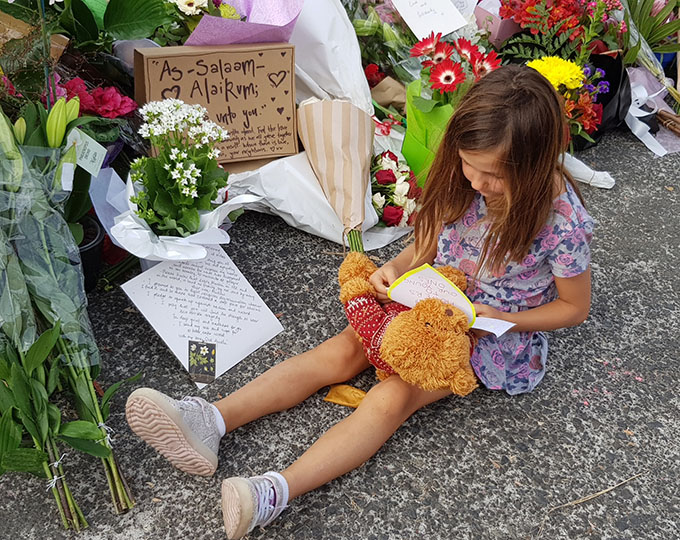
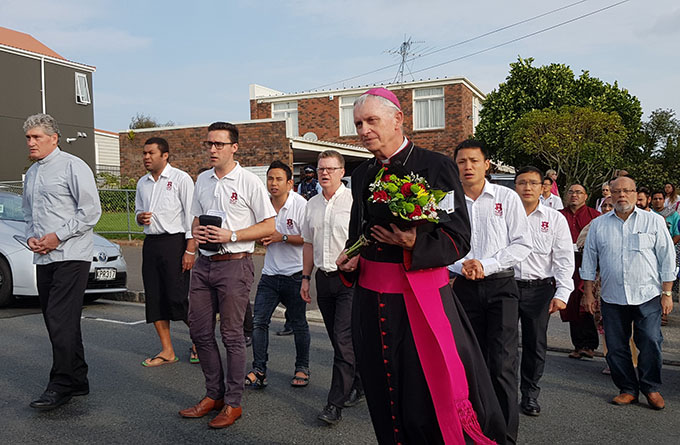 Auckland Catholic Bishop Patrick Dunn carrying a wreath from Sacred Heart Church across the street to Ponsonby mosque today. Image: David Robie/PMC
 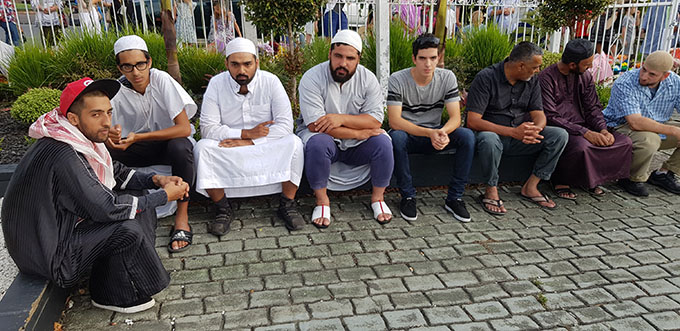 Ponsonby mosque mourners today. Image: David Robie/PMC
 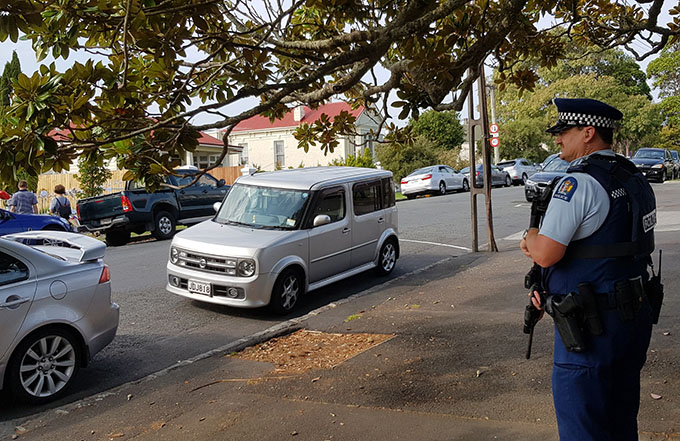 An armed policeman guarding the outside of Ponsonby mosque today. Scenes like this are rare in New Zealand where police do not normally carry firearms. Image: David Robie/PMC
 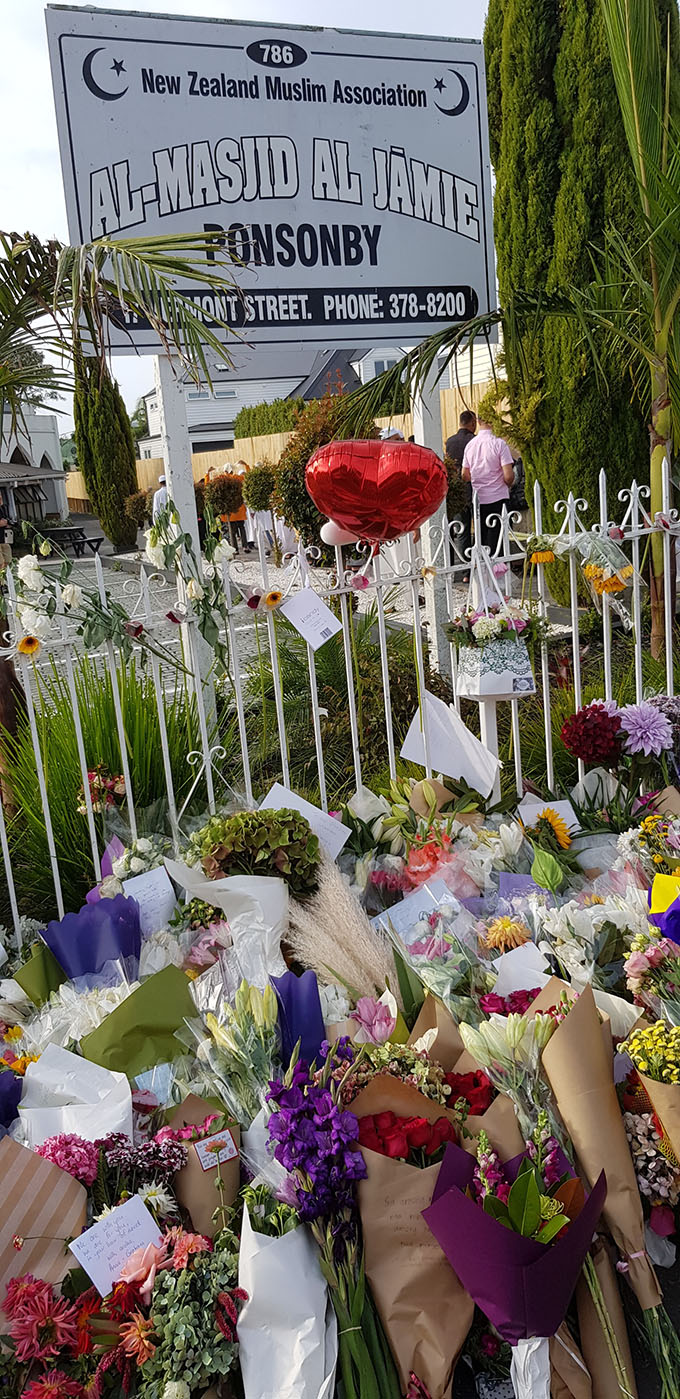 Flowers at the Ponsonby Al-Masjid Al Jamie, New Zealand’s oldest mosque, in Auckland today. Image: David Robie/PMC

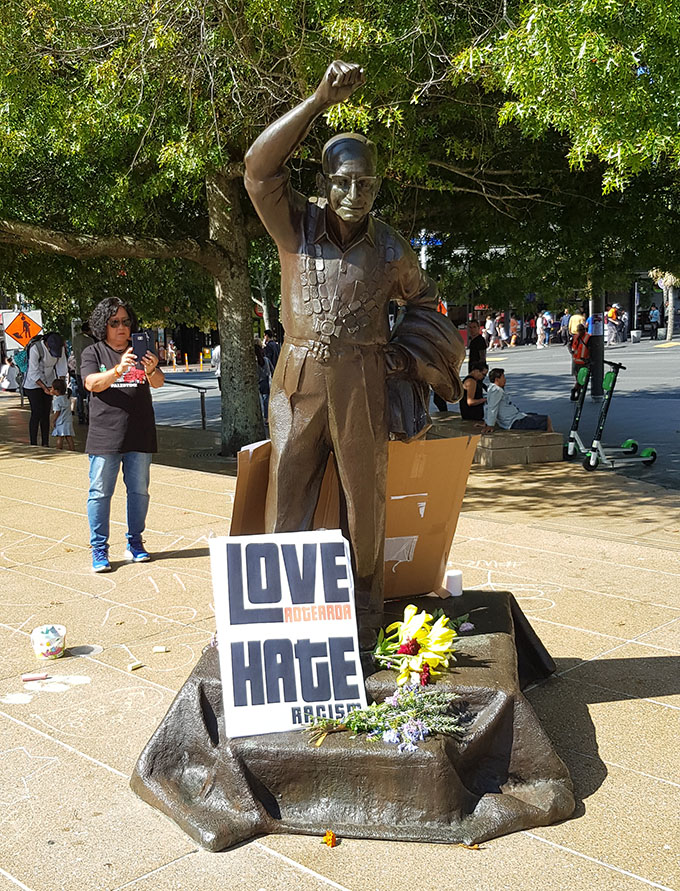
 Sasya Wreksono … “we can ensure something like this never happens again.” Image: FB
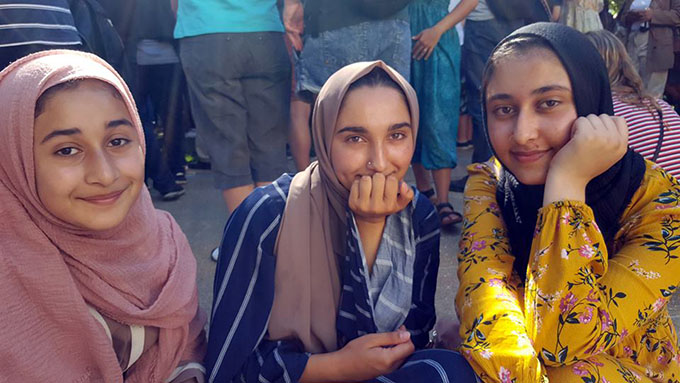 Young women at Auckland’s vigil yesterday for the Christchurch mosque massacre victims. Image: Del Abcede/PMC
 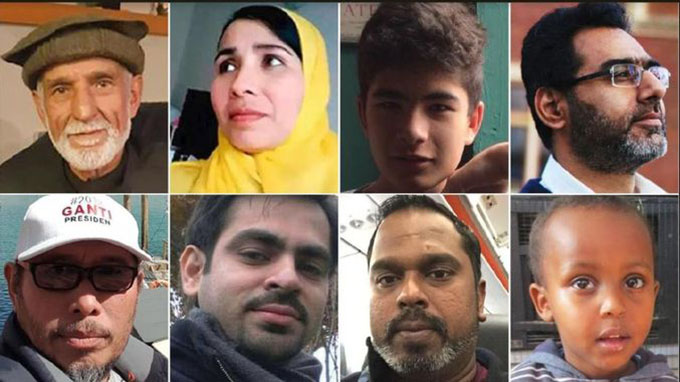 The faces of some of the 50 victims of the Christchurch mosque massacre.
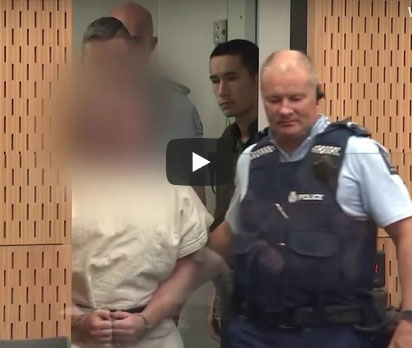 Accused Brenton Tarrant appears in court today. Image: RNZ/PMC screenshot
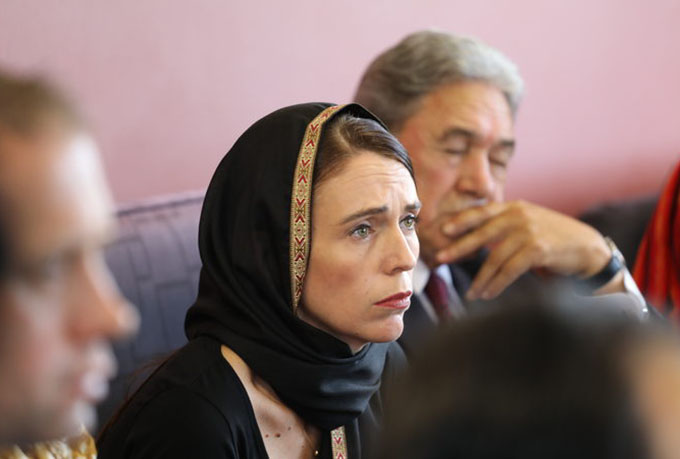 New Zealand Prime Minister Jacinda Ardern visited Christchurch today to pay her respects to mourners in the wake of the mosque massacre . Image: RNZ
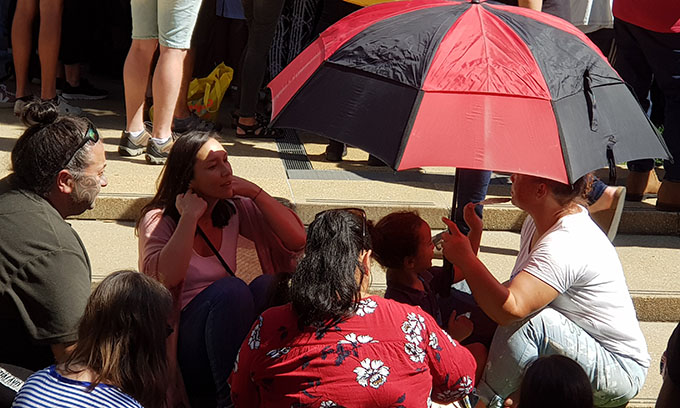 Aucklanders at the vigil today for the families of the victims of the Christchurch mosque shootings yesterday. Image: David Robie/PMC
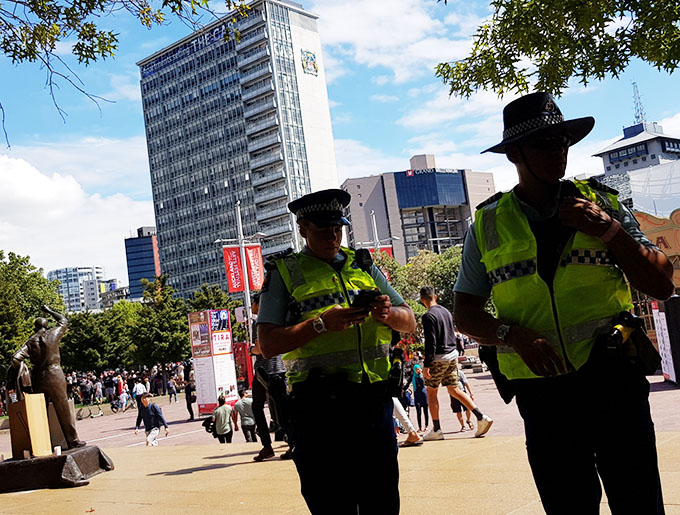
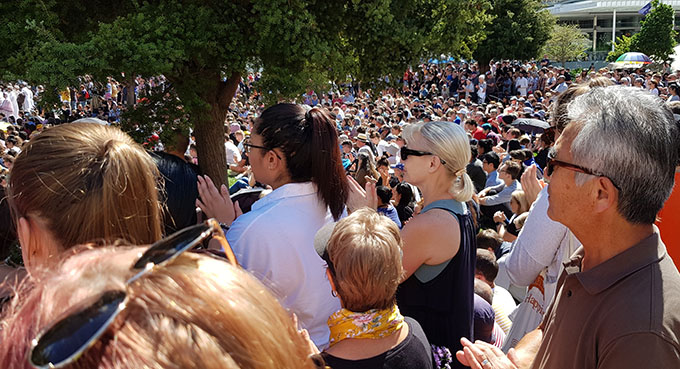 Thousands gathered in Auckland’s Aotea Square for today’s vigil for the survivors and victims of the Christchurch mosque massacre. Image: David Robie/PMC
 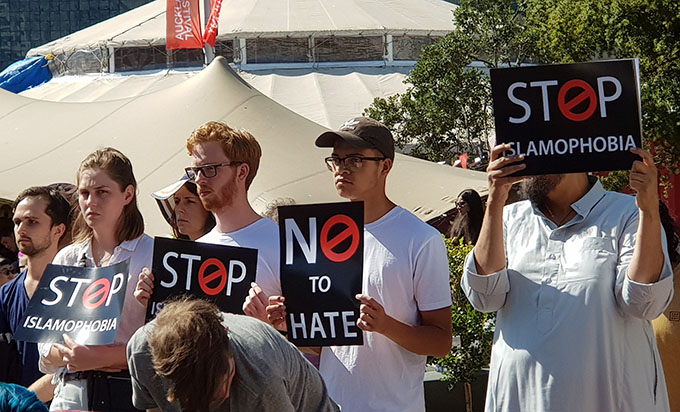 “Stop Islamophobia, No to hate” placards. Image: David Robie/PMC
 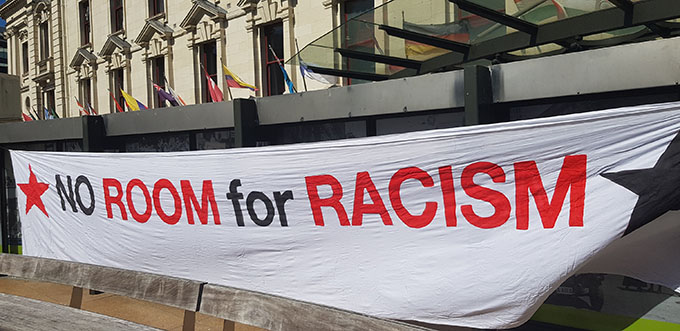 No to racism banner. Image: David Robie/PMC
 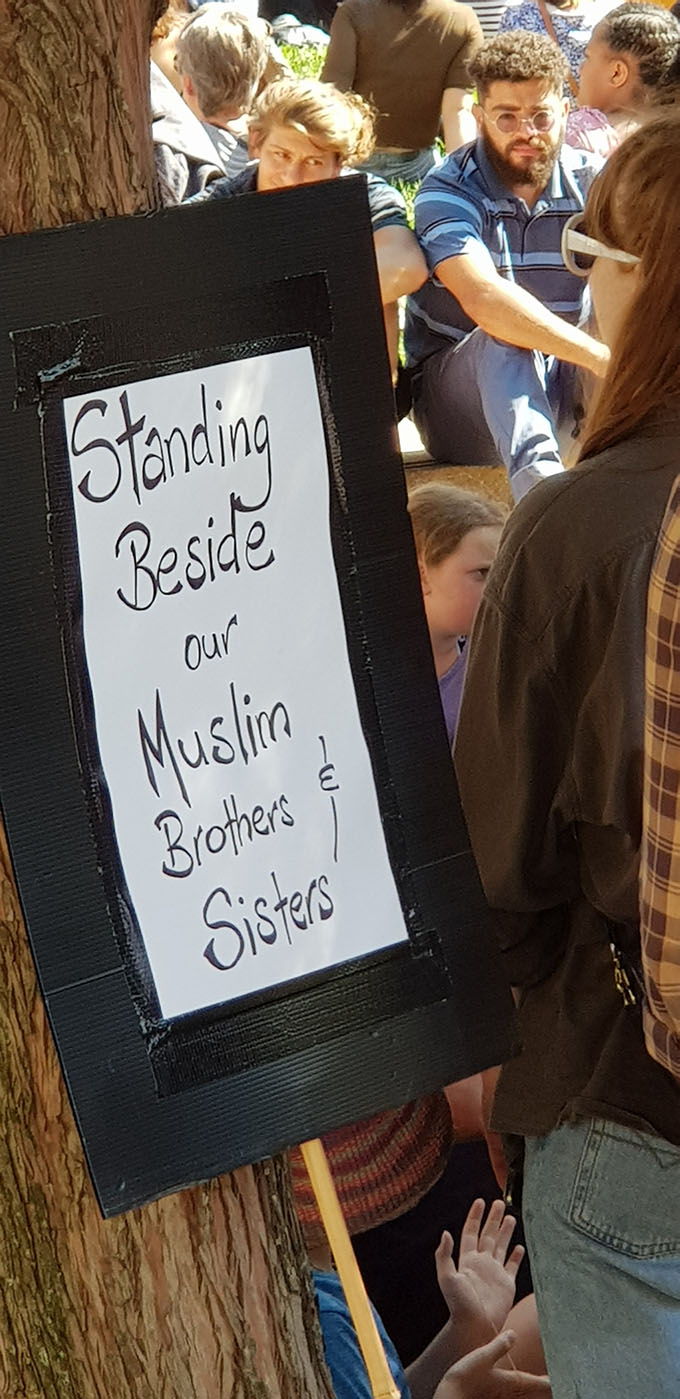 “Standing beside our Muslim brothers and sisters”. Image: David Robie/PMC

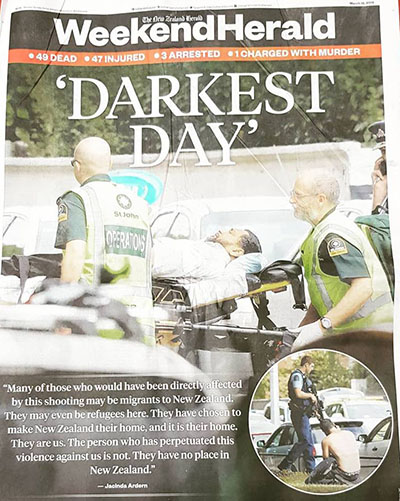 The New Zealand Herald’s “darkest day” front page today after the Christchurch massacres. Image: PMC Screenshot
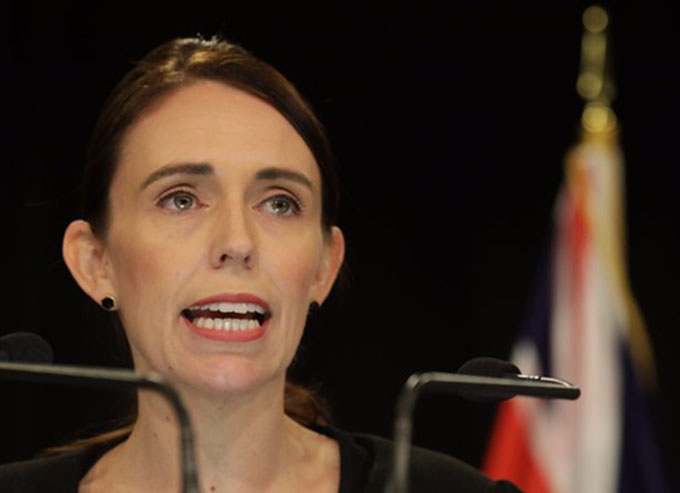 Prime Minister Jacinda Ardern … a rhetoric of racism, division and extremism should have no place in New Zealand. Image: Image: Rebekah Parsons-King/RNZ

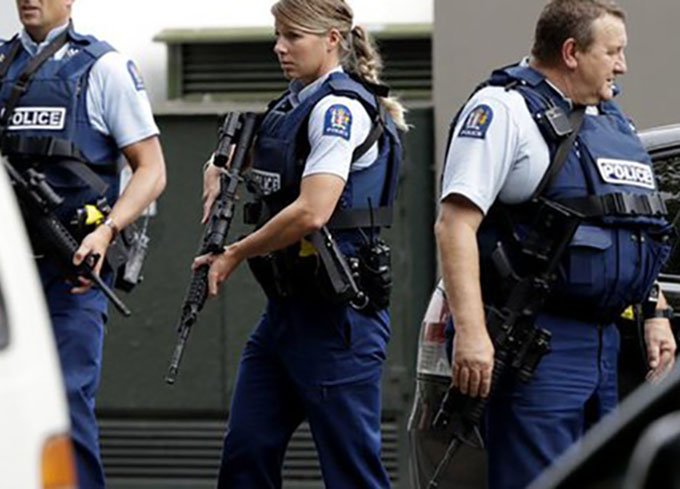
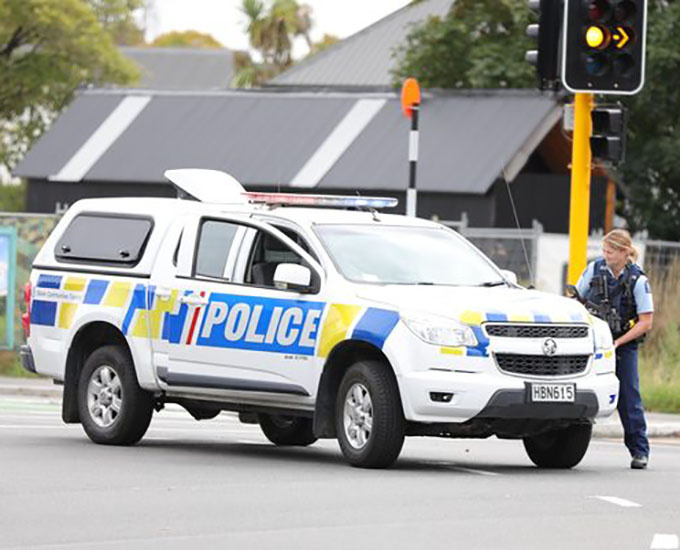 Police at the cordon around a shooting incident in central Christchurch today. Image: Simon Rogers/RNZ


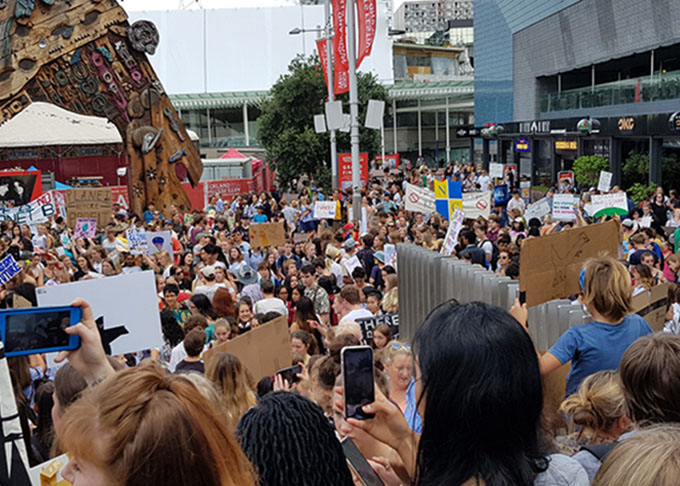
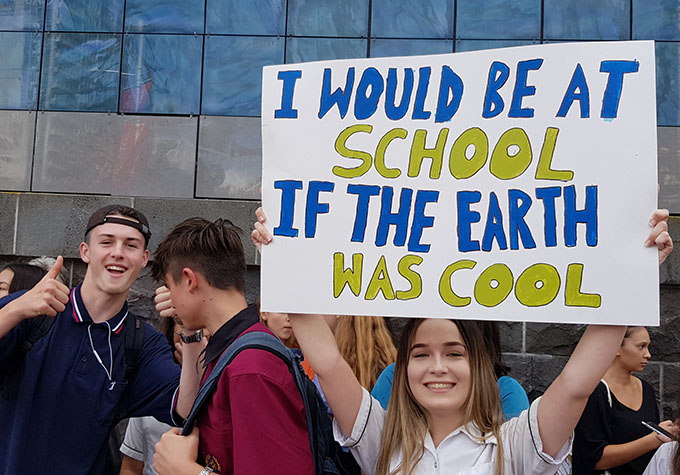 A cool message from Auckland school climate protesters today. Image: David Robie/PMC
 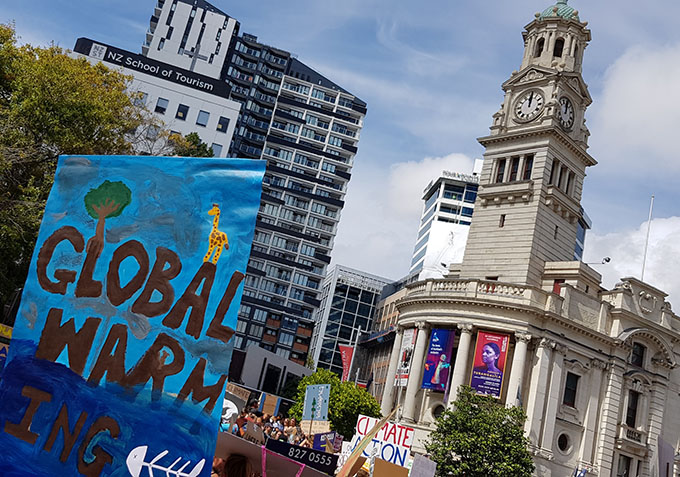 Global warming placard by the Auckland Town Hall today. Image: David Robie/PMC
 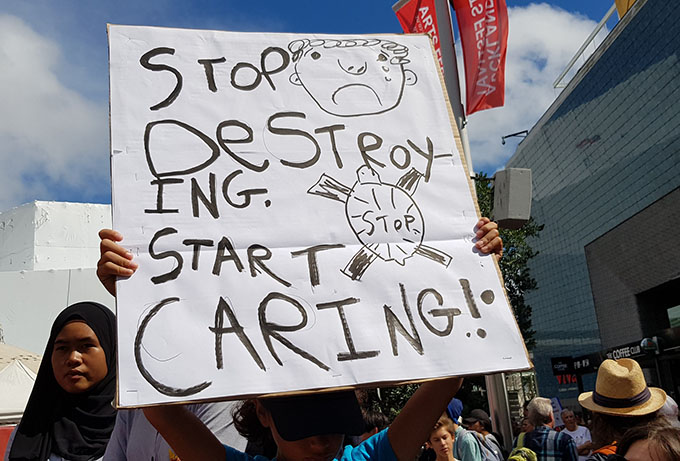 “Stop destroying” the planet placard in Auckland’s Aotea Square today. Image: David Robie/PMC
 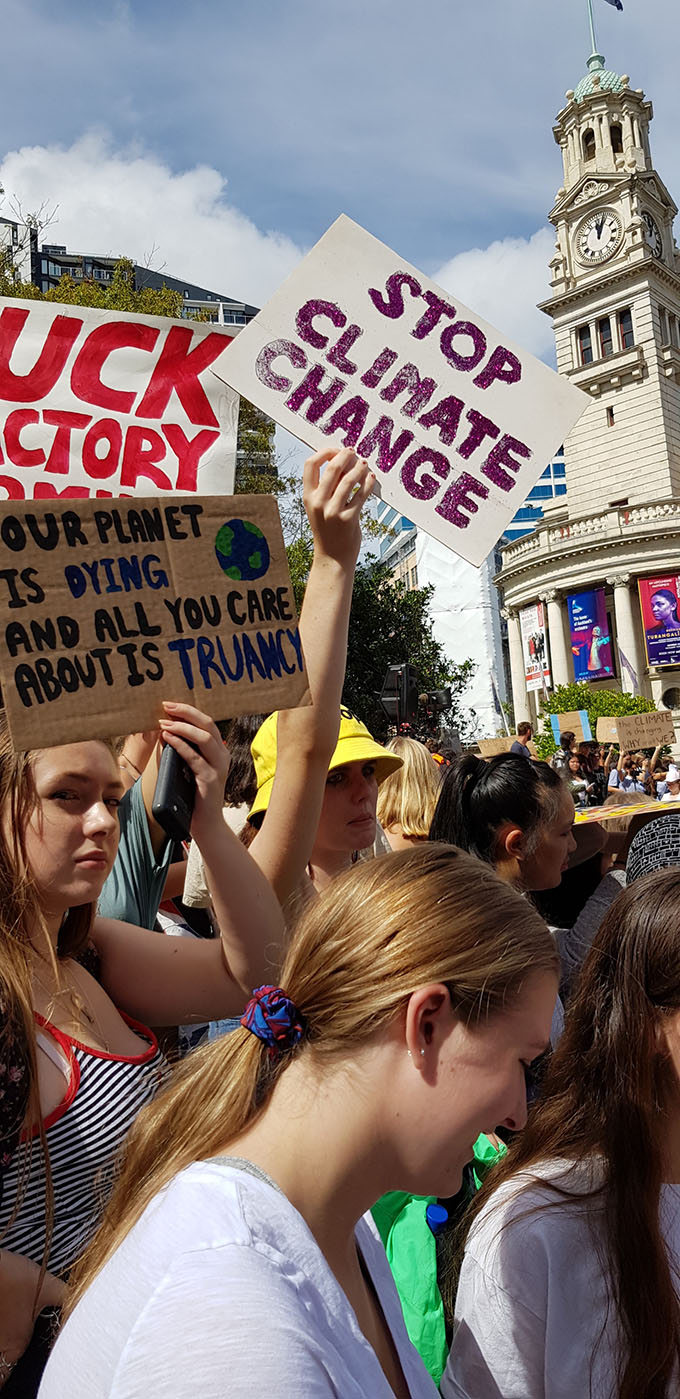 Climate protesting students gather outside Auckland’s Town Hall today. Image: David Robie/PMC