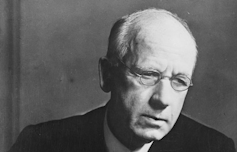
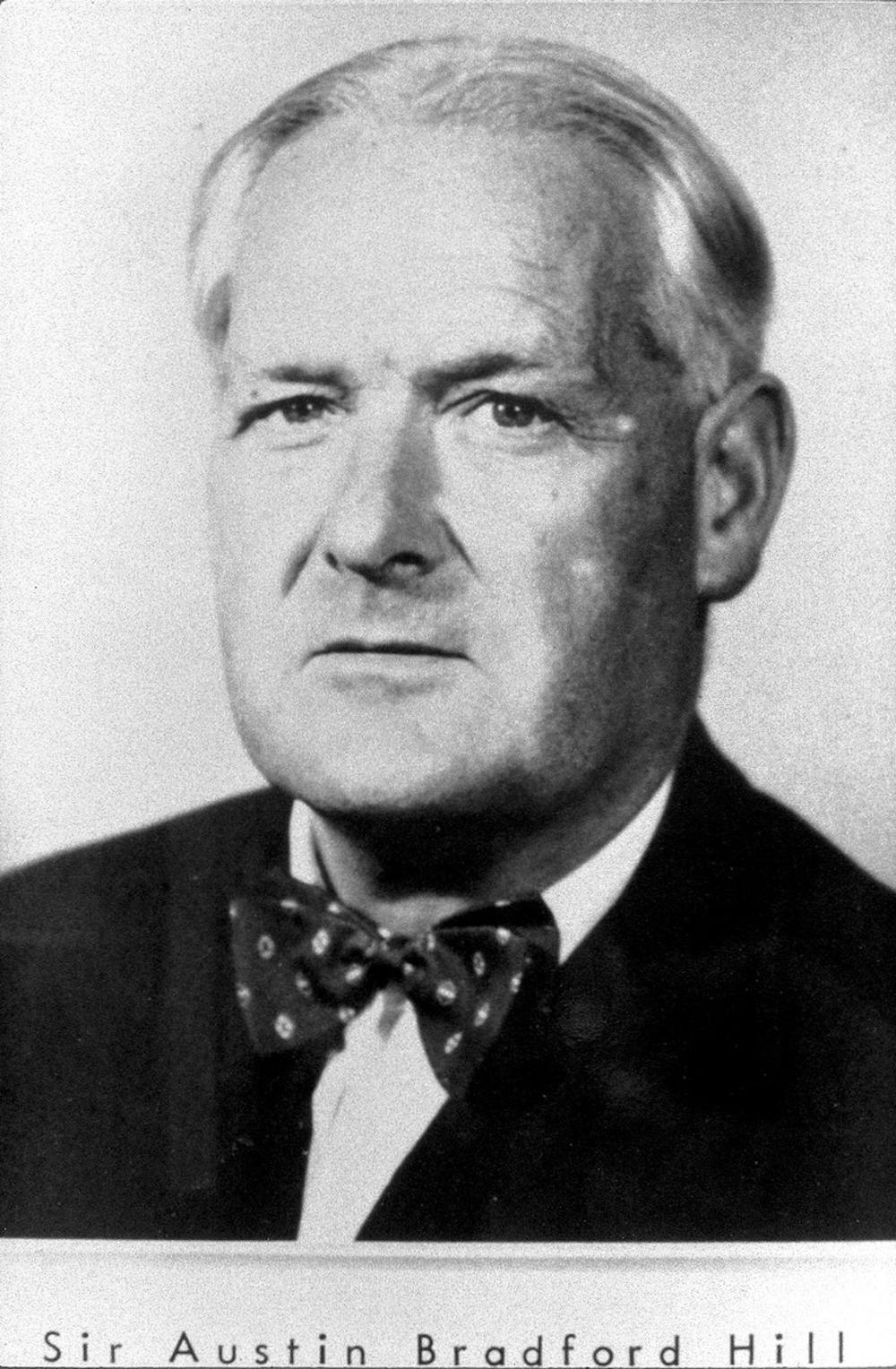
Harvard University’s Alberto Alesina died suddenly of a heart attack on May 23.
He was 63.
His long-time colleague and friend Larry Summers wrote that before him, “there was no academic field of political economy. Today, political economy is an important component of economics and political science.”
I had the great privilege of having him on my PhD thesis committee, and counting him as a friend.
The father of political economy
The modern field of political economy views the political process as a critical determinant of economic outcomes.
It might be that political instability threatens economic growth, or that political programs designed to redistribute income or wealth hinder or help growth, depending on their design.
Whatever they do, political processes and institutions have economic consequences, and they can be examined through an economic lens.
An important institutional question he examined was the best way to control inflation.
In a series of papers with multiple coauthors he identified the advantages of an independent central bank.
The median voter in would like to appoint a central banker that cares a lot about inflation, but might also be tempted to remove that central banker because of the short-run (but not long-run) tradeoff between inflation and unemployment.
Central bank independence is the way out. As he and Summers put it
insulating monetary policy from the political process avoids this problem and helps enforce the low inflation equilibrium
The final two sentences of its abstract seem distressingly apposite in light of the current wrenching events in the United States:
Racial animosity in the US makes redistribution to the poor, who are disproportionately black, unappealing to many voters. American political institutions limited the growth of a socialist party, and more generally limited the political power of the poor
Beyond this, his work showed that political party platforms need not converge on to the interests of the median voter – something that might seem obvious now, but was revolutionary in the late 1980s.
His insight was that politicians care about more than being elected. They also care (to some degree) about the policies that are implemented when they are elected. His elegant mathematical model turned the Median Voter Theorem on its head.
The optimal number of nations
It is hard to understate the importance of this body of work, one which no doubt the Nobel Committee would have recognised one day. But for me there is one strand that captures the breadth and creativity of his scholarship.
What is the optimal size and number of nations?
This is breathtaking question that one might suspect is reserved for a statesman such as Bismark rather than a social scientist.
But in a 1997 Quarterly Journal of Economics paper and later a wonderful book with Enrico Spolaore, he provided a politico-economic model of “country formation as a result of a specific trade-off between the benefits of large political jurisdictions and the costs of heterogeneity in large population”.
Larger political entities – the European Union is the prototypical example – are so diverse that it is difficult to reach agreement on any number of matters.
Democracies give us too many
On the other hand, larger countries are better at self insuring against shocks and have bigger markets, with less need to worry about neighbours. Put more technically, governments internalise externalities.
The implications are as far reaching as the question.
Alesina and Spolaore showed that the process of democratisation leads to secessions: we should observe “fewer countries in a nondemocratic world than in a democratic one”, that “the democratic process leads to an inefficiently large number of countries”, and that the equilibrium number “is increasing with the amount of international economic integration”.
He’s already missed
Alberto was the epitome of great scholar. He posed deep and important questions central to both politics and the economy. And he showed how those questions could be answered with the mathematical and statistical tools of social science.
Very few scholars create a field, let alone one that encompasses profound issues.
Those of us whose lives he touched directly found him to be an inspiration, a supporter, a comfort, and a person of seemingly limitless intellectual and emotional generosity. We miss him already.
What keeps democracies together? As America burns, Brazilians die and Europe braces for another wave of the coronavirus, the question assumes an alarming immediacy. If the answer is complicated in one way, it is simple in another: what we have in common, what we share, and what we value as a result.
This week saw the federal government finally open discussions about real support for Australia’s flailing cultural sector as it slips ever closer to the abyss, and prepares to take a significant chunk of Australia’s GDP with it.
COVID-19 has shown up a mind-bending contradiction. On the one hand, the arts are entwined with our daily lives. Whether we are out and about, or in lockdown, it is the arts that fill our days with meaning, instruction and fun. Yet culture has all but disappeared as a major focus of federal policy. The tailored assistance packages have been manifestly inadequate, while the exclusions around JobKeeper have badly affected cultural workers and organisations.
This industry is worth an estimated $111 billion a year. It employs hundreds of thousands of Australian workers. It helps drive other industries, too, like tourism and hospitality. It’s an important part of our economy. But [the government] has done next to nothing [to support it].
Moving on from Mathias Corman’s erroneous claim that the sector has not demonstrated a significant fall in revenue, the government is now promising a culture-focused coronavirus relief fund. Details are scanty. A proposal would need to clear the expenditure review committee, and discussions with state arts ministers (reportedly tense) appear to have stalled.
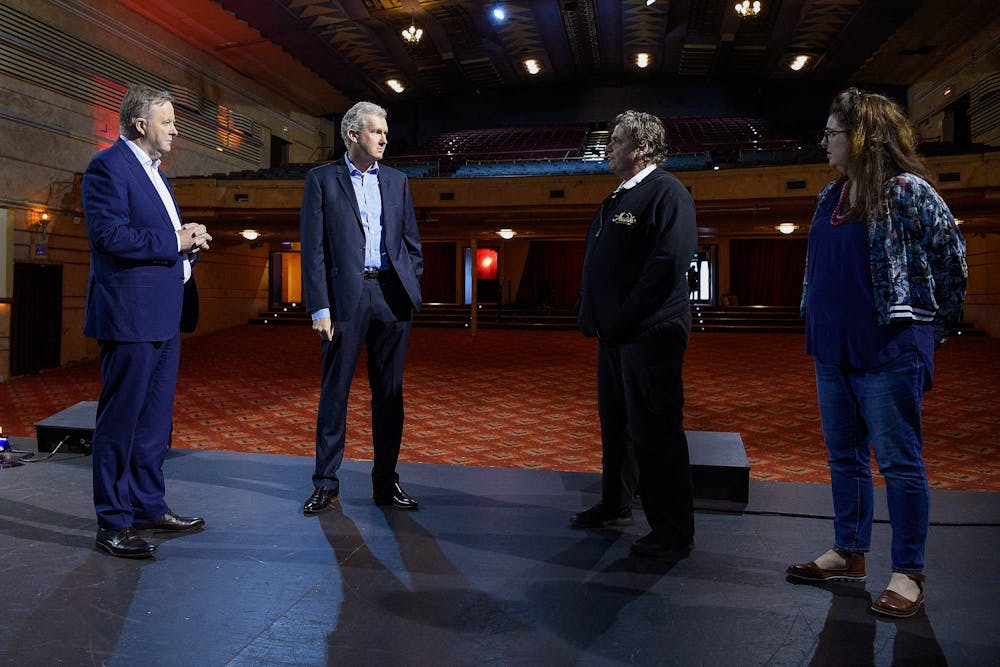
The federal opposition has begun to engage with the challenges facing arts organisations. Tony Burke and Anthony Albanese meet with arts leaders at Sydney’s Enmore Theatre.AAP/Bianca De Marchi
But it isn’t just a matter of money. The real question – the one every cultural worker feels like a kick in the face – is why the sector was left out of policy calculations in the first place.
Something has gone fundamentally wrong with the relationship between government and Australian culture. This is important to acknowledge, because behind the question of how the nation should support the cultural sector is the larger one of what value the sector truly provides. Now is the moment to reconsider the whole cause and case of arts and culture, their place in Australian life. That can only be done if there is an understanding of how we got into this policy black hole in the first place.
Australia’s failed attempts at finding common ground
A central feature of arts and culture that makes them hard to manage from a policy perspective is that they include both the broadest aspects of human existence, and the most particular. Culture defines us, our common values and collective way of life. At the same time, we enjoy specific cultural activities and art forms as a matter of individual preference. This double helix makes them a profoundly challenging area for governments to address.
By conducting the conversation about arts and culture in solely economic terms – and this has been the way we have talked about them for a long while now – we neglect a host of issues key to understanding the real role they play in our lives. We strip the conversation of its political, historical, social and moral dimensions.
It is time to regain those dimensions and integrate them into a new cultural policy vision. This is not an easy task nor simply a matter of goodwill. It requires wrestling with large and sometimes uncomfortable questions of history, identity, and social purpose.
Circa and Opera Queensland’s Orpheus & Eurydice.Jade Ferguson
There are two prime examples of common values thinking whose failure weakened a proper understanding of Australian arts and culture at a policy level. Both aimed to articulate our identity as a nation, and though neither were specifically cultural documents, they both involved artists. One came from the conservative side of politics, one from the progressive side.
The first was Prime Minister John Howard’s attempt to insert a Preamble into the Australian Constitution in 1999, which was written with the help of the poet Les Murray. The other was the 2017 Uluru Statement from the Heart, which is itself an artwork, in the form of a Yirrkala bark petition, telling two Anangu creation stories in pictorial form.
Both documents sought to encompass, in a few hundred words, principles important to all Australians. There are, of course, significant differences between them. But there are also some compelling consonances, and at a time of growing social and political division, these are worth considering.
Here are eight key words the Preamble and the Uluru Statement have in common:
Yet without these kinds of common values statements, and considered debate around them, the soullessness characterising the government’s response to arts and culture during COVID-19 will continue.
When the policy case for the cultural sector is made, it is almost always in terms of its incidental effects – the social, health, diplomatic and especially economic impact. When cultural policy is developed, its relationship with our national identity, with our history, with our land, with the vast tapestry of Australian experiences and stories, is ignored or given only lip-service.
We don’t ignore these on a personal level, of course. The arts wouldn’t make any sense if we did. But when we address them in policy terms, the words aren’t there. We can’t speak to ourselves in meaningful ways about what we culturally care for and see this translated into effective public action.
However important the issue of financial assistance to the cultural sector is – and I’d be the first to say it’s vital – there is a broader conversation that determines it. It is one that Australia often seems reluctant to have. But it offers the chance to discover the things that genuinely unite us, not just the ones over which we angrily disagree.
Only by finding the courage to talk honestly and openly about difficult matters of history, identity and collective purpose can we develop the emotional and intellectual resources to value the arts and culture that are their daily expression.
Only by finding a way to agree on the common values we have as a nation will the place of Australian arts and culture be better understood by everyone. Especially by governments, who should support them as part of our precious, democratic way of life.
When Ken Wyatt, the Minister for Indigenous Australians, last week effectively pronounced dead the prospect of a referendum on indigenous recognition being put to the people this parliamentary term, the demise of his hoped-for timetable received little attention.
Partly, this was because Wyatt’s aspiration had always seemed unrealistic.
But centrally, it was that the pandemic has thrust aside nearly all other issues, including those that once generated big headlines and vociferous debate.
This total re-ordering of agendas and priorities has been understandable and necessary. When 1.6 million Australians are on the dole, millions of others are being publicly subsidised, the economy is in recession and no one can be sure how rocky to path to recovery will be, the government must concentrate all its efforts on the main task.
Certainly that’s what most Australians would want.
Still, while the government has seldom been so (usefully) busy, it is worth giving a thought to what’s been shoved aside.
Asked last week where things were up to on three issues, the indigenous recognition referendum, religious freedom legislation and the proposed anti-corruption commission, Scott Morrison fudged on the first (later clarified by Wyatt) and indicated cabinet hadn’t thought about the others for a long time.
The government already has an unreleased exposure draft for the federal anti-corruption body. There is pressure to act on this front, and it seems more than likely the legislation will be brought forward.
The religious discrimination legislation is another story. Its origins go back to the same sex marriage vote when Malcolm Turnbull, as a sop to the conservatives on the losing side, promised an inquiry into religious freedom, which was chaired by one-time Liberal minister Philip Ruddock.
Morrison got some mileage with the issue among religious communities at last year’s election, but it has subsequently turned into a nightmare.
None of the religious stakeholders like the draft legislation. They have varying objections but at the core is that they believe it doesn’t go far enough.
Liberal backbencher Concetta Fierravanti-Wells, who always wanted to go further, says: “Despite theological differences, religious leaders across the spectrum have expressed serious concerns about the draft bills”.
Attorney-General Christian Porter had carriage of the negotiations, which COVID stalled. While he’d obviously deny it, it’s fair to say his heart wasn’t really in the task.
(Porter, incidentally, is absurdly overloaded. As well as attorney-general, he is minister for industrial relations, and leader of the House of Representatives. He’ll have a great deal to do on IR for the rest of this term, given it is a central part of the government’s reform agenda. Apart from religious freedom, the anti-corruption commission also comes within his remit.)
The demands of the stakeholders on religious freedom will not be met by the government, and the legislation appears to have hit a dead end.
Fierravanti-Wells says: “No bill is better than this flawed bill. I suspect it will now be quietly shelved by the government.” She is advocating, as an alternative, the consolidation of discrimination laws across the country into federal legislation to get consistency.
On the other side of the religious freedom argument, critics think this legislation should not have been pursued in the first place – that it is unnecessary and could have undesirable consequences.
The most sensible course would be simply to inter it as soon as decently possible.
If the religious freedom legislation is yet to be formally killed off, the prospect of recognising indigenous people in the constitution would to have little chance under a Coalition government even in a subsequent term of parliament (assuming Morrison was re-elected).
Laying aside the referendum Wyatt, whose comments came during National Reconciliation Week, said: “COVID-19 has presented many challenges – unfortunately a referendum is unlikely in this term … This is too important to rush and too important to fail”.
But even without COVID, Wyatt in the next few months would surely have had to admit a referendum next year had become too hard.
In the early days of the Coalition government (under Tony Abbott) there appeared to be a window. But divisions within the Coalition’s ranks and base, Labor’s insistence the wording must go further than the government would ever accept, the expectations of First Australians, the argument over a “voice” to parliament, the high hurdle for changing the constitution – all these have made it extremely difficult (if not impossible) for the necessary support to be achieved.
It’s questionable whether a Labor government could do any better.
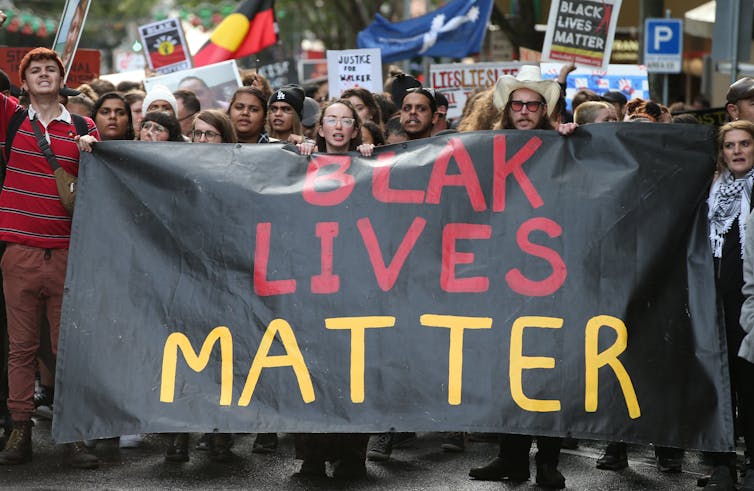
Current events in the United States have inevitably refocused attention on Australian indigenous issues. This is not to suggest equivalence. But we’re seeing demonstrations of solidarity, and local injustices and problems freshly highlighted.
Deaths of indigenous people in custody continue – more than 400 over the last three decades – as does excessive use of force on occasion (which happened this week with a policeman’s reaction to the threatening language used by an Aboriginal youth in Sydney).
The high rate of incarceration of Australian indigenous people remains unaddressed; appalling conditions exist in many communities.
Labor’s shadow minister for Indigenous Australians, Linda Burney, herself indigenous, said this week that “in some parts of Australia, particularly in the north, the incarcerated population – adult and juvenile – are almost all Indigenous”.
“Many First Nations Australians are in custody for short periods of time. But we need to consider factors which are prompting interactions with the justice system and the nature of those interactions, such as bail laws or police training,” she said.
Incarceration, bad living conditions, and the general disadvantage of many First Australians remain blights on our society.
In policy terms they are “wicked problems”, not capable of ready solutions, though both advocates and their opponents would often have you believe otherwise.
Neither constitutional recognition, nor even a “voice” – and remember the government treated dismissively the call in the Uluru Statement from the Heart for a voice to parliament and instead is promoting an ill-defined alternative – would solve them.
But constitutional recognition would be symbolically important to First Australians as well as a proper completion of our constitution.
And an effective “voice” could be an important practical contribution to making what have been such intractable issues a little more tractable.
Yet we seem to find these steps harder to deal with than the immense challenges of a pandemic.
The Morrison government will significantly strengthen its scrutiny of foreign investment to protect sensitive national security technology and information and further ring fence the nation’s critical infrastructure.
It will insert a new “national security test” on bids, in a sweeping overhaul of the foreign investment regime.
The action follows mounting public concern about Chinese investment, although the government – already under harsh criticism from China – will seek to play down suggestions it relates to any one country, and point out it has been a long time in the pipeline.
Planned new legislation will also strengthen compliance provisions to ensure foreign investors follow conditions attached to approvals.
During the pandemic, all foreign investment bids are being scrutinised to ensure unfair advantage is not taken of distressed companies.
But in normal circumstances those under certain thresholds escape examination by the Foreign Investment Review Board (FIRB), the body that makes recommendations to the treasurer.
While all bids from foreign governments are screened, most private investments under $275 million – or $1.2 billion if the country has a free trade agreement with Australia, as China and a number of other major trading partners do – are not scrutinised.
The government is concerned investments in some very sensitive sectors are escaping screening even when there are national security concerns. Of particular worry is the vulnerability of small and medium sized companies that have specialised expertise, but fall below the threshold in value.
Under the new test, foreign investors will have to notify FIRB if they propose to start or acquire an interest – generally 10% or a position of control – in a “sensitive national security business”.
This will mean all foreign investments in sensitive national security businesses will be examined.
Businesses which raise sensitive national security concerns are those involved in critical infrastructure, including telecommunications, energy, ports and water, as well as those which service defence and national security organisations.
The national security test will also involve new powers.
The treasurer will be able to “call in” an investment before, during or after an acquisition if it raises risks which were not picked up earlier.
The treasurer will also have a new “last resort” power enabling them to apply or vary conditions or order disposal of an investment where national security concerns emerge after approval. This last resort power would only apply to future approvals – it will not be retrospective.
The government will release draft legislation next month for consultations. It wants it passed this year, to apply from January 1 next year.
It is estimated the new security arrangements will affect only a very small proportion of total foreign investment.
The tougher compliance measures follow complaints that some foreign investors ignore the conditions that are attached to approved bids. Recently fingers were pointed at Alinta for not implementing conditions about information storage. The company was told to comply.
Increasingly, conditions have been applied to allow bids to pass. In 2018-19, 4149 applications were approved with conditions attached. This was 47.6% of total approvals. By value, more than 80% of investment was approved subject to conditions.
The government says the monitoring and enforcement powers of Treasury and the Australian Taxation Office need expansion because of the extensive use of conditions and “emerging risks caused by global developments and rapid advances in technology”.
It notes that apart from residential property investments, the treasurer’s enforcement powers are limited to taking civil action or seeking a criminal prosecution. This inhibits the government’s ability to respond proportionately, for example to a minor breach.
Under the changes, the government will have a wider range of tools for enforcement, including for example, powers to give directions to investors to prevent or address suspected breaches.
While most of the announced changes are about toughening the scrutiny regime, the government will at the same time streamline the approval process for investments that do not raise national interest concerns.
Aware of the need to attract passive investment as part of the post COVID recovery, it will narrow the definition of a foreign government investor to exclude certain passive investments in funds where the investors have no influence over the investment or operational decisions of the entity.,
The government is committing $54 million over four years to step up compliance and monitoring capability. Funding will go to Treasury, the ATO and “relevant agencies such as the Department of Home Affairs”.
Treasurer Josh Frydenberg said the changes were the most significant made to the foreign investment regime since it was introduced in 1975.
“The reforms will ensure that our foreign investment regime is able to respond to emerging risks and global developments,” he said.
“Through the introduction of a new national security test, stronger enforcement powers and enhanced compliance obligations, we will ensure that Australia can continue to benefit from foreign investment while safeguarding our national interest.”
The reforms were developed with the support of FIRB whose chairman David Irvine has a national security background, including as head of ASIO.
Irvine said the package “appropriately addresses increasing risks to the national interest whilst ensuring Australia remains welcoming and open to foreign investment”.
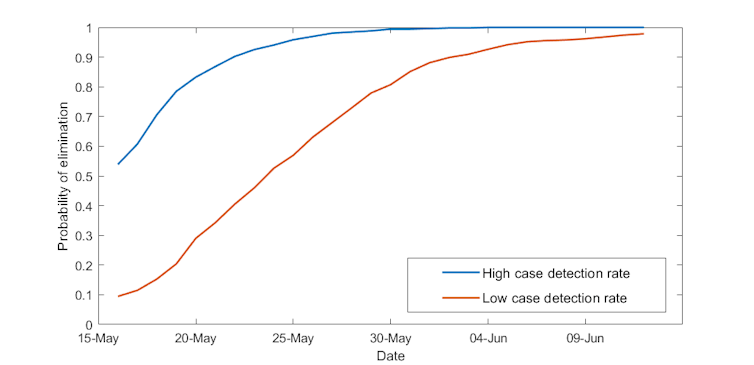
There is now a 95% chance COVID-19 has been eliminated in New Zealand, according to our modelling, based on official Ministry of Health data.
As of June 4, New Zealand has had 20 consecutive days of zero new cases, with only one active case remaining. The last new reported case of COVID-19 was on May 15 (going by the date the case was first suspected rather than later confirmed).
Probability of elimination assuming no new cases reported after 15 May.
This still leaves a small chance of undetected cases, and we know that COVID-19 is passed on at superspreading events.
New Zealand is now preparing to relax its COVID-19 restrictions to alert level 1 from as early as next Wednesday, which would end physical distancing and size restrictions on gatherings. But our modelling suggests removing limits on large gatherings will increase the risk of a very large new outbreak from 3% to 8%.
To reduce this risk, New Zealanders will need to continue avoiding the three Cs of possible infection: closed spaces, crowded places and close contact.
New Zealand is now very close to its elimination target. But there is still a 5% chance of undetected cases.
On June 3, Prime Minister Jacinda Ardern announced details of the impending alert level 1 rules. Border closures will largely remain (except for returning New Zealanders) but all other significant restrictions on people’s movement within New Zealand will end.
From the perspective of the virus, the most significant change will be the end of restrictions on the size of gatherings. Airlines can fill up economy class again, nightclubs can pack their dancefloors and universities can open their lecture theatres.
Someone who caught the virus three or four weeks ago may not have developed severe symptoms (which happens in around 30% of people) and not got a test. They could have passed the virus on to someone else, who also missed out on a test.
A chain of infections like this could continue for a while before it is detected. Some segments of the population, such as younger people, are less likely to develop symptoms and are therefore more likely to sustain hidden infection chains.
There is also a chance COVID-19 could enter New Zealand with an international traveller. Last week, around 200 people, almost all returning Kiwis, touched down in New Zealand every day.
Many came from places like Australia, Hong Kong or Tonga – all countries relatively free of COVID-19. Some also arrived from the USA, where the virus is widespread. Between February and April, we know that between 0.1% and 0.2% of all arrivals tested positive. With these numbers, we should expect one or two new cases to arrive each week.
New arrivals must remain in quarantine for at least 14 days. The incubation period for COVID-19 is usually five to six days and it is rare for symptoms to begin more than 14 days after being exposed.
The bigger risk is a symptom-free person arriving and passing the virus onto someone at the same quarantine hotel, who then leaves before their symptoms appear.
Ministry of Health data show eight of New Zealand’s 500 imported cases developed their first symptoms more than two weeks after arriving. Maybe they caught it before they arrived or maybe they caught it during quarantine. Either way, they would have been infectious after they left quarantine.
People who work at the border – airline cabin crew, biosecurity or immigration personnel and staff at quarantine hotels – are at similar risk.
The inevitable new case
Our models show the risk of new cases coming from within New Zealand is now comparable to that from international travellers. The risk from international arrivals stays about the same whether we’re at level 1 or 2, while the risk of domestic transmission is decreasing.
The most important question is how we will cope when the inevitable new case arrives.
Each active case is like a small spark waiting to start a fire. Superspreading theory tells us most of those sparks go out, but a small number will ignite. These sparks are the problem: it could be an infected person at a choir rehearsal, at a nightclub, or cheering for their sports team.
New Zealand is fortunate to have highly trained, experienced contact tracers standing by. But they need our help. If you were to test positive, could you remember everywhere you have been for the last week and who else was there? A contact tracer’s nightmare is a large gathering with no record of who attended.
To move to level 1, we first need to ensure our contact tracing systems, including the NZ COVID Tracer app, QR codes and sign-in sheets at shops, are up to scratch. We need to be confident we can manage the risks when hundreds of people gather or attend protest marches. We have to be able to do these things safely while COVID-19 is still out there.
Has National Party leader, Todd Muller's leadership team placed a political hit-job ahead of the public interest?
Analysis by Dr Bryce Edwards.
Political scientist, Dr Bryce Edwards.
Does National have any chance of winning the election in September? It’s looking very unlikely, especially after National’s change of leadership hasn’t exactly produced Mullermania in the first two weeks. Quite the opposite, in fact, as I summarised in Tuesday’s Political Roundup column: Todd Muller’s torrid start as National leader.
Even the National Party’s pollster, David Farrar, has blogged today on his Patreon page to say that, compared to Australia, Canada, US and the UK, the New Zealand Government’s re-election chances are the highest – see Which Governments are on track for re-election (paywalled).
Here’s Farrar’s main summary: “They have a huge lead in the polls and are forecast to win 59% of the seats in Parliament, despite using proportional representation. Ardern has stratospheric approval ratings and support for the country going in the right direction has never been higher in the back of the eradication of Covid-19. They are at 88% to win in the betting markets. The only indicator slightly less supportive is the unemployment rate.”
The bad reviews of Muller’s performance keep coming. Writing for the NBR, Richard Prebble says today, “I think National is heading for a catastrophic defeat” and “It is hard to imagine how Muller can recover from such a disastrous week” – see: Grasping defeat from the jaws of victory (paywalled).
Prebble’s critique of Muller’s performance covers his “audition to be PM… He blew it”, “the ridiculous ‘cash for jobs’ policy”, and allowing NZ First to be revived by uncertainly about ruling them out.
John Armstrong also wrote yesterday about how Muller had allowed trivial distractions to colour voters’ first impressions of him – especially the “Maga saga” and badly handled reshuffle, making him seem like “a fish very much out of water” – see: Todd Muller needs to learn that the impression he gives matters.
Armstrong sums up the problem: “It all also brings to mind the old, but still pertinent, adage that asks how can you expect voters to have confidence in your competence to run the country when there are questions about your competence in running your own political party. Above all, however, National simply cannot afford to fall victim to self-inflicted distractions which block and blot out the messages it is trying to convey to voters.”
Even the embarrassing culture war issues such as the Maga hat and white frontbench are ultimately unlikely to be a problem for National, if Muller is able to reposition the party in the centre of the political spectrum with a credible economic programme during a major recession: “As the economic impact of Covid-19 bites hard, these early setbacks are likely to be forgotten by a public more concerned with the recession than interview techniques, frontbench personnel, and hats.”
The fact that Muller is rather dull might also not be a problem, given New Zealanders generally don’t like their leaders to be too colourful, ideological or intellectual. Neither Helen Clark, John Key, or even Ardern have been particularly exciting or bold in their political work. As conservative political commentator Liam Hehir argued last week, the success of rather bland political leaders in New Zealand “might be taken as a real indication that New Zealanders prefer reassuring and benign leaders to exciting and colourful ones.” He argues that “our preference for vagueness” is a consequence of the fact that our “political system is stable and there is a high degree of trust in it” – see: Rise of the blank slate political leader.
It’s the economy, stupid
The idea that Muller’s National Party can be written off is challenged strongly by Stuff journalist Andrea Vance, who questions whether the “Wellington commentariat” truly understand the importance of the looming economic recession in determining the way the election will play out. Vance asserts that “the subjective judgements of a handful of Beehive pundits on perceived performance flaws, are now more insignificant than ever” – see: Could middle-of-the road Muller come out a winner?
She suggests that, in the context of mass economic dislocation, the debate about hats and the frontbench identities will become less important: “An economic shock has ricocheted around the world. Voters are consumed with worry about their jobs, mortgages and how to pay their bills. In a political environment where most people would struggle to name the Cabinet, it’s hard to see people getting too exercised about the make-up of the Opposition’s front bench, or which keepsakes a leader displays on his shelf.”
Vance elaborates: “In the face of soaring unemployment and plummeting house prices, middle voters may pause for thought. People who care passionately about inequality, over-tourism and climate change in the good times, tend to be less progressive when their personal economic circumstances are shaken. If National can play on that doubt: and convince centre voters they must make a choice between which priority they value the most, then middle-of-the road Muller may just come out a winner.”
Similarly, journalist Martin van Beynen thinks that although Muller and his leadership team have made some terrible gaffes, the ill-effects for National’s popularity are being inflated by out-of-touch commentators. In fact, he says the condemnation might actually help National: “the clamour over the two issues within the echo chamber of the Wellington political scene and generously reflected by the media was distracting but not the disaster some claim. The silent majority, National’s main hunting ground, won’t see the so-called blunders in the same light as its natural foes. The controversy over the cap in Muller’s office will be seen by the silent majority as a silly media-generated fuss over nothing. They will feel Muller has been unjustly pilloried and accept his souvenir story as genuine” – see: Todd Muller’s first week not a complete disaster.
According to van Beynen, National’s current orientation and apparent gaffes are simply not the big mistakes they are assumed to be: “Muller’s front bench selection is not going to win any points among the urban liberal class but grassroots New Zealand won’t necessarily see it the same way. And that is where the votes are. Māori are firmly in Labour’s camp and urban liberals will go with Ardern as well.”
He does warn, however, that Muller could take this fledgling populist approach too far: “Muller is trying to reach the real people, not the Reserve Bank board or Treasury officials, political commentators or the readers of the lefty Spinoff website. If Muller takes his appeal to the silent majority too far, he will start to sound like the sort of populist most New Zealanders distrust. He could also commit the most heinous of political sins, a lack of empathy.”
TVNZ’s Jack Tame also believes the negative focus on the Maga hat, or Muller’s stumbling TV interviews will not ultimately matter that much: “Personally I’m much more concerned with the fact we’re staring down mass unemployment and a generation-defining economic crisis than the fact Todd Muller has a Trump hat. And honestly, I think most New Zealanders are with me” – see: Todd Muller’s MAGA hat exposes our selective outrage.
Like others, Tame believes that severe economic downturn will overshadow the last week of problems for Muller: “Todd Muller had a poor few days. I was surprised at just how disorganised he and his team appeared to be. I’m sure they learnt some valuable lessons. But in two months, will any of this matter? Will we be discussing a few difficult moments on live TV or who does and doesn’t own a MAGA hat? Just wait. If there are a few hundred thousand newly unemployed Kiwis, the issues that really matter will come sharply into focus.”
Libertarian commentator Damien Grant is no fan of the new National leader and says he’d like to be able “to write Muller off” – but he agrees that the new economic context, together with the departure of Simon Bridges, gives National a chance of winning the upcoming election: “each day that passes more bad economic news will land and the unemployment rolls will creep up. This government is far more vulnerable than its supporters suppose. Labour had two positives; the unpopularity of Bridges and the perception of a successful response to Covid-19. Neither of these will matter in September. The electorate will be looking to the opposition for evidence that they have the ability to manage what is going to be a dire economic situation” – see: Todd Muller confirms himself as a middle manager promoted several rungs above his level of competence.
Things can change quickly, Grant points out: “Muller has four months to get his act together and remember it took Don Brash a single afternoon in Orewa to turn his fortunes around and come within a percentage point of power.”
Muller’s new strategy of targeting the performance of the “17 empty seats in Cabinet” is also a powerful one, and nicely avoids a losing a battle trying to criticise Prime Minister Jacinda Ardern or even Grant Robertson.
This “17 empty seats” line is nicely explained by Fran O’Sullivan, who says the arrival of Muller “puts the September 19 election back into play” – see: Todd Muller makes it all about the teams (paywalled).
Here’s the key point about Muller’s new strategy: “his decision to make the election contest between the “National team’s” capacity to drive the economic recovery, versus, that of Ardern with her ‘two or three strong performers’… and… ’17 empty seats in Cabinet’ is the correct one. Muller’s was a cleverly constructed dog whistle — even if a tad unfair — as there are at least half a dozen obviously highly competent Labour ministers… Dig beneath Ardern’s towering persona and that of the highly competent and affable Finance Minister Grant Robertson — and others like David Parker, Andrew Little and Megan Woods — and it is obvious the talent pool starts to get shallower.”
The criticism also fits with disappointments with the Labour-led Government that was building up prior to the Coronavirus crisis: “the Muller line does underscore the genuine concerns many — not just from business — have about the Ardern administration’s capacity to execute. Not just the major policy planks from Labour’s 2017 election campaign such as the hopeless KiwiBuild initiative, light rail for Auckland and eradicating homelessness and child poverty”. Therefore, “when it comes to the Herculean task of rebuilding New Zealand’s economic recovery”, National’s criticisms might start to resonate.
Although National’s most recent polling – 29% in the 1News Colmar Brunton poll – makes the idea of the September election look like a looming disaster for the party, there is still a chance it will recover and even get into Government. After all, although Simon Bridges was too unpopular to continue as leader, and Muller might not do much better in the popularity stakes, National has shown that it can pull in the popular vote. As recently as February, the Colmar Brunton poll put its support as the highest of all parties, at 46%, and suggested it could form a government. National will be hoping that such numbers can return once Labour’s handling of the Coronavirus crisis is overshadowed by the economic crisis.
What’s more, under Muller’s leadership there are some signs of a thawing relationship with potential coalition partner New Zealand First. Antagonisms between these two had previously made a 2020 coalition government between them highly unlikely, whereas now it could be back on the cards.
When a newspaper with the authority of The New York Times chooses to publish a party-political essay calculated to further inflame the violence wracking cities across America, serious questions arise.
On June 3 the Times published in its opinion section an essay by a Republican senator from Arkansas, Tom Cotton, headlined “Send in the troops”.
It argued the case, plentifully coloured by party-political asides, in support of US President Donald Trump’s threat to mobilise the US military against the protests triggered by the police killing of George Floyd.
The newspaper’s decision provoked a stream of protests on social media, including from several journalists on its own staff. Some simply stated that they disagreed with Cotton. But for others, their objections ran far deeper.
Many expressed concern that it endangered the safety of Times journalists, in particular those who are black. In circumstances where the police are already turning their violence on journalists covering the protests, this is a well-founded objection.
Nikole Hannah-Jones, a correspondent for The New York Times Magazine who won the Pulitzer Prize for commentary last month, tweeted:
The NewsGuild of New York, the union that represents many Times journalists, said in a statement:
This is a particularly vulnerable moment in American history. Cotton’s Op-Ed pours gasoline on the fire. Media organizations have a responsibility to hold power to account, not amplify voices of power without context and caution.
In the face of these cogent criticisms, it might have been expected the Times would publish a coherent and substantial account of its reasons for running the Cotton essay. It has not. It has left it to the editorial page editor, James Bennet, to respond, and he has contented himself with a Twitter thread.
His reasoning, if it can be dignified with the term, can be summarised in these statements from that thread:
Times Opinion owes it to our readers to show them counter-arguments, particularly those made by people in a position to set policy.
We understand that many readers find Senator Cotton’s argument painful, even dangerous. We believe that is one reason it requires public scrutiny and debate.
These reasons can be swiftly disposed of before moving on to questions he did not bother to mention.
Counter-arguments: by all means, but why from a party-political source at this time in American history, when party-political polarisation is as deep as at any time in the post-civil war era? Why not invite a non-party source, perhaps an expert in national security, to make the case for military intervention?
From a person in a position to set policy: just about the strongest reason not to run such a piece. It aligns the paper closely with those in power, an abrogation of the paper’s independence from government.
Scrutiny and debate: government is better scrutinised at arm’s length, and the public debate that has ensued is not about the merits of military intervention, but about the inflammatory content of the essay and the Times’s decision to run it.
Now for the questions Bennet did not mention.
Did the Times solicit the essay from Cotton or did he offer it?
To what extent, if at all, did the Times consider the likely foreseeable consequences of running such a clearly partisan essay on so volatile an issue?
What consequences did it anticipate?
How did it balance the obvious risks of aggravating an already violent situation against the public-interest grounds Bennet has advanced?
Did it ask itself why a senator, with the powerful platform of the US Senate at his disposal, would seek to harness the authority of The New York Times to his cause?
Did it perceive that in lending its authority to this essay, it would be handing a valuable propaganda tool to the White House?
The newspaper’s blithe public disregard for these questions is unsettling.
In the three-and-a-half tumultuous years of the Trump presidency, America’s serious national newspapers -– the Times, The Washington Post, the Los Angeles Times -– have been a remarkable bulwark in defence of American democracy.
Along with the judiciary, they have discharged their institutional responsibilities fearlessly. They have kept an unflinching gaze on the Trump presidency and faced down his intimidatory tactics.
With Congress paralysed by partisan divisions, it is these two institutions that have made America’s democratic arrangements work.
Yet the strains are beginning to show.
The Washington Post reported this week, in the context of police attacks on the media covering the riots, that “the norms have broken down”.
In these circumstances, the decision by the Times to publish the Cotton essay is worse than just a bad editorial call.
At a critical juncture in this crisis, it suggests a failure of nerve.
Scott Morrison’s new housing stimulus package is straight-out retail politics.
HomeBuilder offers homeowners (including first home buyers) a grant of A$25,000 to build a new home worth less than $750,000 or to spend between $150,000 and $750,000 renovating an existing home.
The scheme is limited to owner-occupiers with reported incomes below $125,000 for singles and $200,000 for couples.
Giveaways to home buyers are wildly popular. And who wouldn’t want their house renovated on the public dime? The trouble is it’s bad economics.
Take the new grants for home owners wanting to renovate.
To be eligible, they have to sign a contract with a builder by the end of the year.
But renovations costing $150,000 or more take time to plan.
The plans need to be drawn up, finance approved, and any building and development approvals secured.
Which means that anyone who signs a contract with a builder today was already planning to renovate.
And chances are that many who sign contracts over the coming months have already planned to renovate.
The new grants will also encourage the in-demand tradies to raise their prices.
They’ll add up to a lot of spending for few jobs saved.
Not many more homes
The grants for buying new homes are more likely to support construction jobs. They will encouraging buyers to bring forward purchases.
It’s why in 2008, in response to the global financial crisis, the Rudd government tripled the first home buyer grant to $21,000 for new homes.
There’s no doubt the coronavirus crisis has hit construction hard: in the past three months almost 7% of the industry’s workforce have lost their jobs.
But most industry forecasters expect at least 110,000 homes to be built (and sold) in Australia anyway next fiscal year.
And most of those first home buyers will be eligible for the grants
About 83% who had recently bought their first home in 2018 paid less than $750,000 for it. Of those, about 90% would have satisfied the income tests for the new grants.
That’s a lot of homes that will have to be funded first before HomeBuilder funds the construction of any extra homes.
And stiff competition among prospective buyers of homes selling below the $750,000 price cap will force up the prices of those homes.
That’s a big win for developers selling house-and-land packages on the urban fringe.
Perhaps the best that can be said for the scheme is that it probably won’t cost much.
The grants are uncapped, but the government expects it to cost about $688 million for roughly 27,000 grants. And since many of those homes would have been built anyway the scheme won’t support many construction jobs either.
What’d be better
It’d be better to fund the states to build new social housing or refurbish existing homes, as the Rudd government did during the global financial crisis.
Many have forgotten about that scheme because it attracted so little controversy, unlike other of Rudd stimulus programs.
Public residential construction approvals spiked within months of the announcement, and more than half of the homes built went to tenants at risk or already homeless.
Building 30,000 new social housing units today would cost between $10 billion an $15 billion. it would support the building industry, and as important, would help many of the 116,000 Australians who are homeless on any given night.
It might not make for good retail politics, but it would help people who need it. And it would be good economics.
Pangolins are also one of the world’s most threatened species but new efforts are underway to reintroduce pangolins to parts of Africa where the animal has been extinct for decades.
The reintroduction of pangolins has not been easy. But it’s vital to prevent this shy, mysterious creature from being lost forever.
A cute but threatened species
Pangolins are the only mammals wholly-covered in scales, which they use to protect themselves from predators. They can also curl up into a tight ball.
They eat mainly ants, termites and larvae which they pick up with their sticky tongue. They can grow up to 1m in length from nose to tail and are sometimes referred to as scaly anteaters.
But all eight pangolin species are classified as “threatened” under International Union for Conservation of Nature criteria.
There is an unprecedented demand for their scales, primarily from countries in Asia and Africa where they are used in food, cultural remedies and medicine.
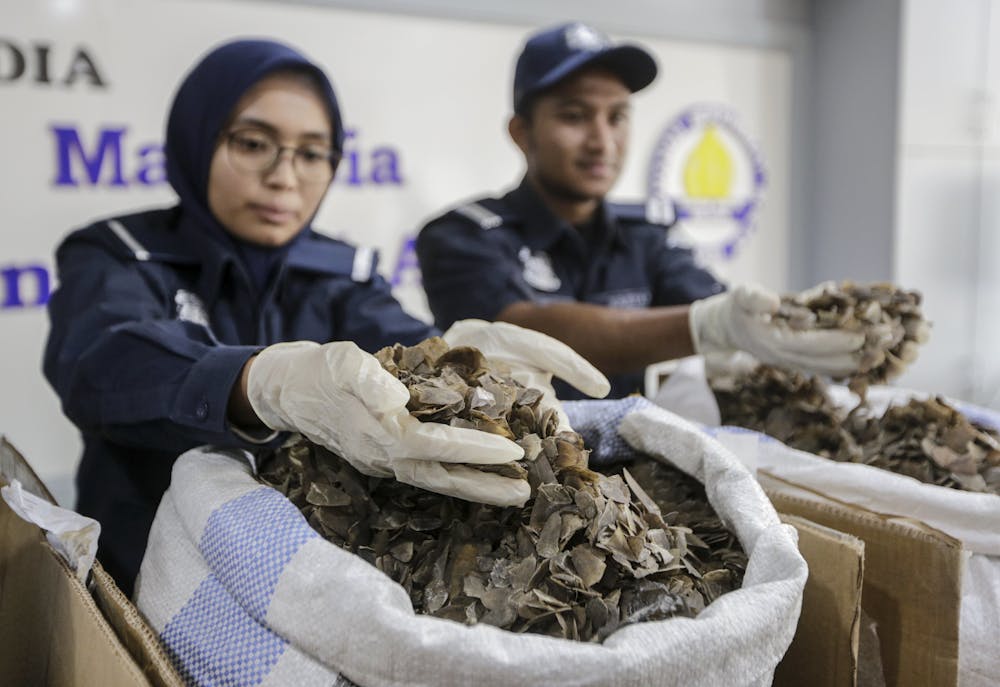
Between 2017 and 2019, seizures of pangolin scales tripled in volume. In 2019 alone, 97 tons of pangolin scales, equivalent to about 150,000 animals, were reportedly intercepted leaving Africa.
Pangolin scales seized by Royal Malaysian Customs at Kuala Lumpur International Airport in 2017.EPA/Ahmad Yusn
There is further evidence of the illegal trade in pangolin species openly on social media platforms such as Facebook.
The intense global trafficking of the species means the entire order (Pholidota) is threatened with extinction. For example, the Temminck’s pangolins (Smutsia temminckii) went extinct in South Africa’s KwaZulu Natal Province three decades ago.
Reintroduction of an extinct species
Each year in South Africa the African Pangolin Working Group (APWG) retrieves between 20 and 40 pangolins through intelligence operations with security forces.
These pangolins are often-traumatised and injured and are admitted to the Johannesburg Wildlife Veterinary Hospital for extensive medical treatment and rehabilitation before they can be considered for release.
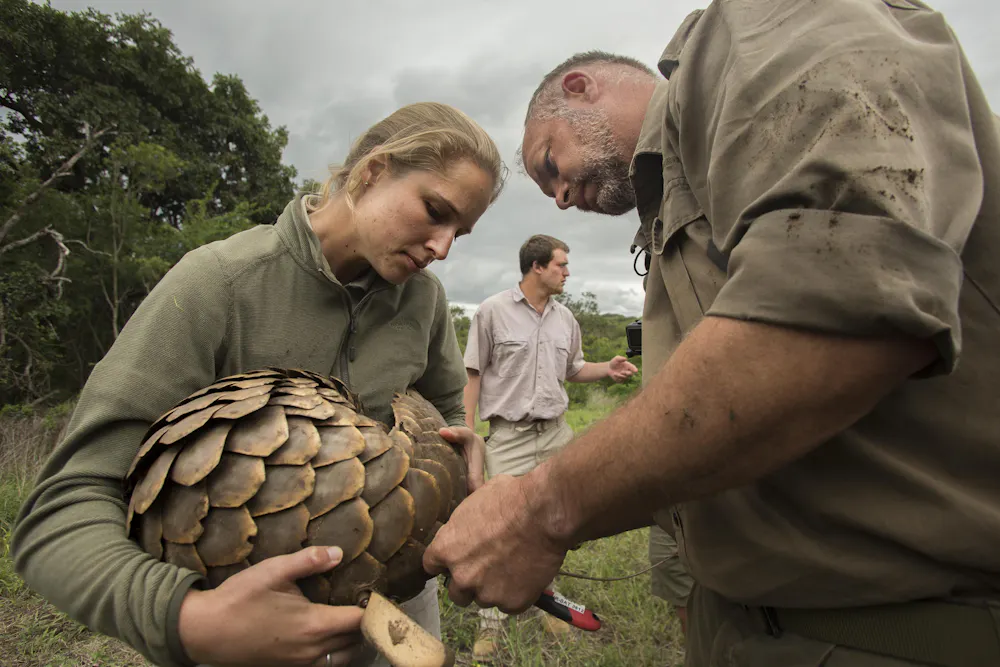
In 2019, seven rescued Temminck’s pangolins were reintroduced into South Africa’s Phinda Private Game Reservein the KwaZulu Natal Province.
Nine months on, five have survived. This reintroduction is a world first for a region that last saw a viable population of this species in the 1980s.
During the release, every individual pangolin followed a strict regime. They needed to become familiar with their new surroundings and be able to forage efficiently.
Pangolins curl up into a tight ball of scales.Alex Braczkowski
Pangolins released immediately following medical treatment had a low level of survival for various reasons, including inability to adapt to their release sites.
A ‘soft release’ in to the wild
The process on Phinda game reserve involved a more gentle ease into re-wilding a population in a region that had not seen pangolins for many decades.
The soft release had two phases:
a pre-release observational period
an intensive monitoring period post release employing GPS satellite as well as VHF tracking tags.
A satellite tag is fitted to each pangolin before release and transmits its location on an hourly basis.Alex Braczkowski
The pre-release period lasted between two to three weeks and were characterised by daily walks (three to five hours) of individuals on the reserves. These walks were critical for acclimatising individuals to the local habitat, its sounds, smells and possible threats. It also helped them source suitable and sufficient ant and termite species for food.
Following that, the post release period of two to three months involved locating released pangolins daily at first, and then twice per week where they were weighed, a rapid health assessment was made and habitat features such as burrows and refuges monitored.
Phinda reserve manager Simon Naylor said:
A key component of the post release period was whether individuals gained or maintained their weight.
The way the animals move after release also reveals important clues to whether they will stay in an area; if they feed, roll in dung, enter burrows. Much of this behaviour indicates site fidelity and habitat acceptance.
Following nine months of monitoring and tracking, five of the seven survived in the region. One died of illness while the other was killed by a Nile crocodile.
Released pangolins are located at burrows like this one.Alex Braczkowski
Why pangolin reintroduction is important
We know so little about this group of mammals that are vastly understudied and hold many secrets yet to be discovered by science but are on the verge of collapse.
The South African and Phinda story is one of hope for the Temminck’s pangolin where they once again roam the savanna hills and plains of Zululand.
The process of relocating these trade animals back into the wild has taken many turns, failures and tribulations but, the recipe of the “soft release” is working.
A panel of judges at the Jakarta State Administrative Court (PTUN) has granted a lawsuit filed by civil society groups against the Indonesian government’s decision to impose an internet blackout during weeks of protests in Papua and West Papua provinces last year, declaring that such a move violated the law.
The petitioners – the Alliance of Independent Journalists (AJI), the Southeast Asia Freedom of Expression Network (SAFEnet) and the Indonesian Legal Aid Foundation (YLBHI), among other groups – filed a lawsuit against President Joko “Jokowi” Widodo and the Communications and Information Ministry in January.
They said the blackout, which officials argued was put in place to prevent fake news from spreading, was flawed in authority, substance and procedure.
“The court declares [the internet blackout] was a violation of the law by government bodies or officials,” the presiding judge said reading the verdict during the hearing yesterday, as reported by YLBHI activist M Isnur through his Twitter account, @madisnur.
The judges argued the government had imposed the internet blackout without the prior declaration of a state of emergency; therefore, violating the 1959 State of Emergency Law.
– Partner –
The bench said the government failed to prove during the trial that Indonesia was in a state of emergency that required authorities to shut down the internet.
Judges also said any decision that limited people’s right to information should be made in accordance with the law and not merely based on the government’s discretion.
Use Criminal Code for fake news, says bench The government initially claimed that its move to shut down internet access across Papua was in line with the Electronic Information and Transactions (ITE) Law. However, judges said the law could only be enforced to block access to electronic information and documents violating the law, not the entire internet.
The @madisnur posting on Twitter, 3 June 2020. Image: PMC screenshot
The bench also argued that fake news should be handled by using provisions in the Criminal Code or blocking the accounts spreading such false information, rather than shutting down internet access.
The petitioners lauded the court for the verdict. “The verdict also opens the possibility for affected parties to sue the government and ask for compensation,” Isnur tweeted.
The government throttled back internet access in parts of the country’s easternmost provinces on August 19, 2019 between 1 pm and 8:30 pm shortly after widespread protests escalated in the regions in response to incidents of racial abuse suffered by Papuan students in Surabaya, East Java.
According to the lawsuit, the government imposed a blackout between August 21 and September 4, affecting 29 cities and regencies in Papua and 13 cities and regencies in West Papua.
First it’s important to understand gyms are a bit different to other places where people might gather.
Gyms are generally indoors, which means they don’t have the luxury of open air. We know SARS-CoV-2, the coronavirus that causes COVID-19, is more likely to spread indoors than outdoors.
So there may be a need for individual gyms to consider specific limitations on the number of people in a given space, especially if the ventilation is poor.
The huffing and puffing associated with vigorous exercise may cause you to cough or splutter, which can see infectious particles propelled, contaminating the environment. So keeping your distance from others is especially important in gyms.
Gym classes will be smaller for the time being.Shutterstock
SARS-CoV-2 appears to survive for longer periods on smooth, hard surfaces, such as stainless steel, compared to paper or cardboard, for example. Gyms tend to have a lot of equipment with these smooth surfaces. This makes cleaning equipment very important.
People in the gym are likely to be sweating more than the average person. While SARS-CoV-2 is primarily spread through respiratory droplets, when you sweat, you often touch your face.
You may be carrying the infectious droplets you’ve picked up from surfaces on your hands, and could risk infecting yourself in this way – or infecting others if you are infected.
Finally, shared amenities in gyms such as drinking fountains, change rooms, showers and even hair-dryers can also increase the risk of virus transmission.
Drinking fountains generally have a smooth surface and you need to use your hands to operate them, providing a potential route for transmission. Likewise, objects in change rooms and showers may be frequently touched. And hair-dryers have the potential to propel droplets, much like fans or air-conditioners.
Responsibilities for gyms
Several indoor sports facilities were implicated in a COVID-19 outbreak in South Korea which saw 112 people infected. An investigation suggested large class sizes, small spaces, and intensity of the workouts may have contributed to the outbreak.
We obviously don’t want that to happen here. So as gyms reopen, staff should ensure the number of patrons doesn’t exceed what’s allowed. Different states have slightly different rules around this.
For example, in South Australia, gyms reopened this week to a maximum of 80 patrons, but only ten in a group fitness class.
When gyms reopen in New South Wales on June 13, a maximum of 100 people will be allowed in a large gym, and similarly a maximum of ten in one class.
Gyms have been encouraged to take bookings to ensure people don’t need to be turned away at the door.
Gyms will also need to increase their cleaning practices and collect contact details from patrons to ensure they can follow up in the event of a positive case of COVID-19.
There are a number of things you can do to protect yourself and others when you’re back in the gym. The obvious top three are not going to the gym if you’re unwell (any cold or flu like symptoms), hand hygiene and maintaining sufficient distance from others.
clean equipment before and after you use it. Wash or sanitise your hands after you’ve cleaned the equipment (gyms can help by making sure cleaning materials and hand sanitiser are readily available)
increase the space between yourself and others to avoid accidentally getting closer while you exercise, especially during classes where your contact time with others may be longer
It’s a good idea to clean the gym equipment before and after you use it.Shutterstock
bring your own water bottle to avoid drinking from fountains or refilling water (water stations may be closed anyway)
change and shower at home if possible (shower facilities may be closed anyway)
go to the gym during off-peak or quieter times where possible.
At present, community transmission in Australia is low. But everyone has a role to play in keeping numbers low, particularly as we start returning to “normal”.
Taking these measures will help reduce the risk as much as possible, and hopefully ensure gyms, and the rest of society, can remain open.
Perhaps at no point in Australia’s history has the demand for real-time figures been stronger than during the coronavirus crisis.
The Australian Bureau of Statistics has stepped up its efforts to get data fast, to help inform the government’s COVID-19 decision-making.
David Gruen, the Australian Statistician and ABS head, in this podcast tells how the bureau has used small, quick surveys to mine timely data from businesses and households.
Some of the more interesting findings concern household stresses felt during the crisis.
Some 28% of women reported feeling lonely, compared to 16% of men. “Overall, only about a fifth of people said they were lonely, but that was the most common of the stressors,” Gruen says.
ABS survey results also showed 75% of parents kept their children home from school. “Women were almost three times as likely to have stayed at home to take care of their children on their own, than men.”
“About 15% of parents said that a lack of access to a stable internet connection was impeding their children’s ability to undertake schooling from home,” Gruen says.
In the wake of the roll out of the single touch payroll system last year, the ABS has also had instant access to almost all business and tax data. “[Single Touch Payroll] is a huge addition to the statistical arsenal,” Gruen says.
In the next census of the Australian population, to be held in August 2021, there will be two new fields of questions – on chronic health conditions and veterans.
But the census will no longer ask Australians whether they use the internet.
“There’s huge public value in having an accurate census, because you collect an enormous amount of information which is of value both to government decision makers, and to decision makers in the community,” Gruen says.
“The things that you learn from the census form the basis for an awful lot of decision-making in subsequent years.”
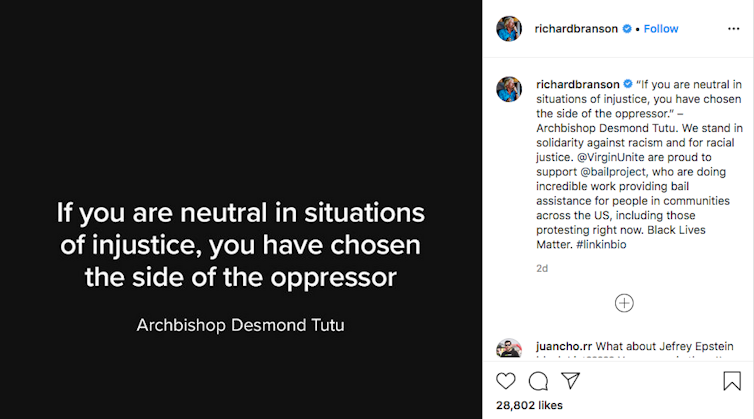
If you are neutral in situations of injustice, you have chosen the side of the oppressor. If an elephant has its foot on the tail of a mouse and you say that you are neutral, the mouse will not appreciate your neutrality.
This quote, or part of it, has been circulating on social media this week.
It is attributed to South African Anglican bishop Desmond Tutu in the 1984 book Unexpected News: Reading the Bible with Third World Eyes. So it dates from Tutu’s time as a leading opponent of the apartheid system in South Africa, in which only white people were afforded the full rights of citizens.
But in recent days Tutu’s quote has encapsulated many people’s feelings about what’s going on in the United States today.
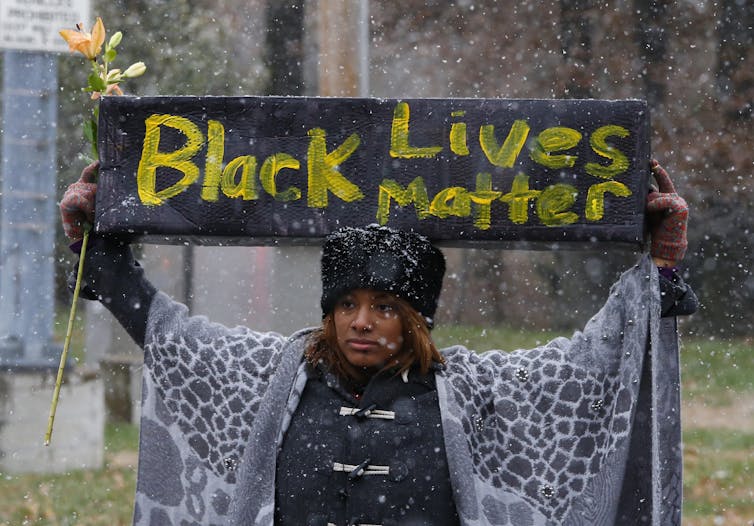
The killing by Minnesota police of George Floyd, arrested on suspicion of passing a counterfeit $20 bill, has become the latest ignition point for grievances about the systemic overpolicing and extrajudicial killing of African Americans.
But the protests involving millions of people across the US and outside of it are fuelled by more than that. These protests are also about the systemic inequities that have recently seen America’s poorest communities take the brunt of both health and economic impacts of the COVID-19 pandemic.
So given the Black Lives Matter protests are in part about the failings of American capitalism, how the corporate world is responding is worth talking about.
A bevy of the world’s best-known brands have used their marketing channels to offer support.
“To be silent is to be complicit. Black lives matter,” said Netflix on Twitter. “We have a platform, and we have a duty to our Black members, employees, creators and talent to speak up.”
Similar tweets have come from Disney-owned Fox and Hulu. Apple Music joined the “Black Out Tuesday” campaign to raise awareness about issues of systemic ethnic inequity.
Nike has repurposed its famous slogan with its “For once, Don’t Do It” advert:
Nike’s ‘For once, Don’t Do It’ advert.
Corporations taking a stand on social issues is a relatively new phenomenon.
Normally when there’s something this divisive and controversial, you know, if you are running a big company, you stay out of it. You don’t want to be involved.
What I’m interested in here is, is this just an evolution in marketing and the way that companies do this, or does it signal – is it a kind of leadership?
Even if these companies are just protecting their commercial base (as his co-host Steve Price suggested), Aly said: “That’s still significant.”
As a researcher in the field of corporate social responsibility, I agree.
It’s easy to dismiss these statements as low-cost tokenism or politically correct wokism. It may be there’s a hard-headed business decision behind each message, weighing the costs and benefits to the bottom line.
But my research (and that of others) suggests there’s a growing need for what business academics call “political corporate social responsibility” (or PCSR).
The challenge for those embracing it is both talk the talk and walk the walk.
Political corporate social responsibility
The concept of PCSR arises out of a wider paradigm shift in thinking about the responsibilities private businesses owe society.
A traditional view – famously advocated by Nobel prize winning US economist Milton Friedman – is that a business, so long as it obeys the law, is only obliged to maximise profits for it shareholders. Nothing else.
Since the 1950s, however, a growing movement (both within business and without) has championed the cause of corporate social responsibility (CSR), arguing that it’s good business to do more than what is legally required to improve social and environmental impacts.
Political CSR (PCSR) goes one step further than the narrower focus of CSR on how companies engage with suppliers, customers and local communities.
Just last year 181 US corporations – including Apple, Deloitte, Fox, and Walmart – signed the US Business Roundtable’s revised purpose of a corporation, which aims to promote “an economy that serves all Americans”.
Research published last month shows almost a third of consumers say they buy brands whose political and social values align with their own, and about a quarter of consumers boycott brands that don’t.
Nike’s path to politics
Nike has been a forerunner in using its marketing to push social campaigns. The shoe maker has come a long way since the late 1980s, when it was the iconic corporate exploiter of both third-world labour, including children, and poor communities in rich countries. All the while spending millions on athlete endorsements to market its expensive sneakers.
Since then, however, Nike has sought to reinvent itself as an socially responsible organisation that champions “equal playing fields for all”.
It dived into PCSR into 2018 when it chose controversial American footballer Colin Kaepernick for the face of its 30th anniversary “Just Do It” campaign.
A Nike billboard featuring Colin Kaepernick near Union Square in San Francisco.D. Ross Cameron/EPA
Kaepernick began the practice of NFL players kneeling during the national anthem before games in solidarity with Black Lives Matter. US president Donald Trump called the kneelers “disgraceful”.
So Nike’s decision was not risk-free. On Kaepernick’s advice it also withdrew a sneaker featuring an early American flag.
Internally Nike has worked to improve equality, with pay equity maintained for women and members of minority groups. It funds grassroots initiatives such as PeacePlayers, whose mission is to unite communities through sport.
Walking the walk
The uptake of PCSR by so many other companies in support of Black Lives Matter is significant. But it is only the start of an evolution that corporate America must make to shake accusations of tokenism.
As Waleed Aly noted on the same episode of The Project, the focus on outbreaks of looting and violence at the expense of the much greater prevalence of peaceful protest, has helped obscure the main issue:
there’s things state governments could be doing right now that they’re not.
This is the point of PCSR – to address the “regulatory gaps” in social and environmental standards and norms.
Among the gaps in the US system contributing to overpolicing of black communities is the failure to provide equal access to public goods like education, health care and even clean air.
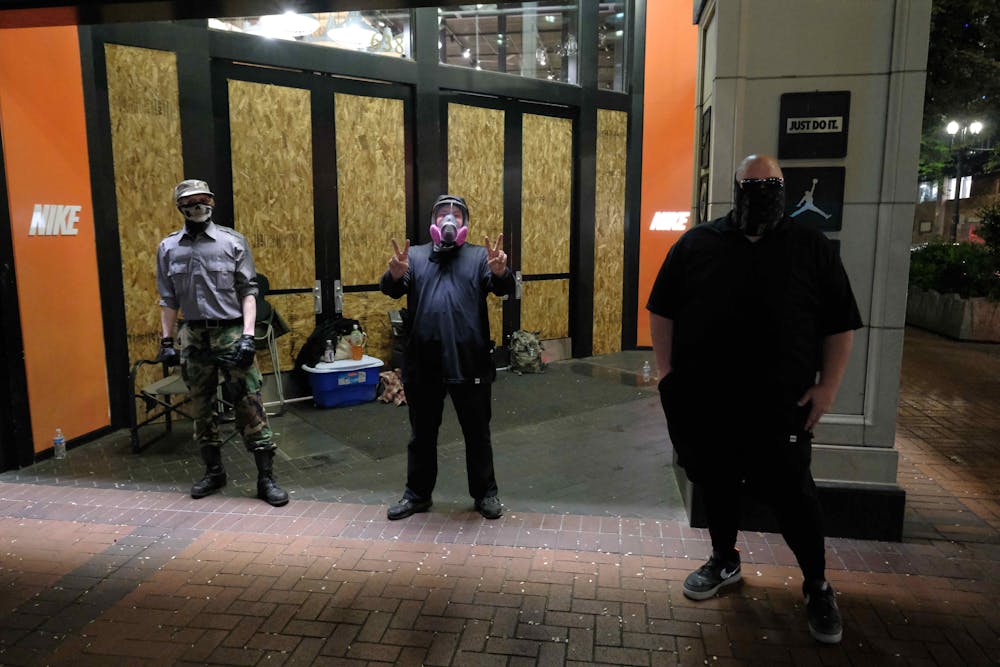
Guards outside a Nike store in Portland, Oregon, on June 2 2020.Alex Milan Tracy/Sipa USA
Those talking the talk of PCSR will need to walk the walk and get serious about addressing why America’s particular take on free enterprise has failed to deliver on its promise of life, liberty and the pursuit of happiness by all.
Desmond Tutu’s quote rings out across the decades as a universal truth. But a well-known aphorism also bears repeating.
Earlier this week, you might have seen your social media taken over by a stream of posts showing simple images of a black square. These posts, often tagged with #BlackoutTuesday, were gestures of solidarity with protests against the police killing of George Floyd in Minneapolis.
There have been more than 28 million of these posts on Instagram, and online services such as Spotify and Apple Music also joined the movement. Social media activism is nothing new, but the scale of #BlackoutTuesday showed not only the cause but also the method of the protest were distinctly 2020.
Last weekend, two black women working in the music industry began a campaign asking the music industry, which they note “has profited predominantly from Black art”, to put its activities on hold for a day on Tuesday June 2.
Using the hashtag #theshowmustbepaused, they began making their case by posting an image to Instagram of a black background and white text asking the music industry to pause and reflect on the ways it disenfranchises black employees.
The movement soon took off: as the week began, posts showing simple black squares quickly proliferated across social media. The hashtags varied, from the original #theshowmustbepaused to #blacklivesmatter and #blackouttuesday.
Strange effects of the black squares
The black square posts have come in many forms. Some show the square alone with no text, some with #BlackoutTuesday and others with #BlackLivesMatter, associating the trend with the established political movement.
Many captions and comments posted with the image express the poster’s desire to educate themselves and others about racial inequality, to stand in solidarity with the wider Black Lives Matter movement, or simply “to do better”.
While the trend gathered momentum with posts from US celebrities as well as ordinary people around the world, it also attracted criticism.
Criticisms include the use of the #BlackLivesMatter hashtag, which activists use to stay informed about demonstrations, for financial donations and to document racial violence by police. Filling the hashtag’s feed with black squares, some argued, obscured more direct activities associated with the movement, redirected attention and “silenced” activists.
The current situation
Despite the backlash, the sheer numbers of people around the world who have posted black squares indicates that #BlackoutTuesday is a form of political expression that has resonated with the particular moment of June 2020.
Several countries are just coming out of pandemic lockdowns that have lasted for weeks or months. These lockdowns have meant work, education, entertainment and political engagement have largely been experienced online.
The pandemic and the economic devastation in its wake have left millions of people feeling uncertain and helpless. And in this dismal environment, in the same week the US surpassed 100,000 COVID-19 deaths, George Floyd was killed by police like many other African-American men before him.
Why not everyone is an activist
From the Arab Spring uprisings of the early 2010s to the Hong Kong demonstrations of 2019-20, social media has become an essential tool for political action. Activists use it to organise demonstrations, generate debate and facilitate social change.
However, for many people outside Western, liberal democracies, and in the “Global South”, visible political engagement can have severe consequences. This is particularly true for those who are kept from freedoms and opportunities by systemic exclusion based on race, class, gender or sexuality.
These consequences range from professional or social exclusion to harassment and intimidation to outright persecution and detention. As a result, many people in such societies may subscribe to “non-activism”.
Non-activism means explicitly rejecting visible involvement with political causes to focus on everyday concerns. People may reject activism even while they know doing so makes social change less likely.
Activism for non-activists
Blackout Tuesday was in some ways an ideal form of activism for non-activists, which may explain some of its enormous international popularity.
My own analysis of posts indicates users are based in countries including Ukraine, Brazil, and the Caribbean islands. Those who posted used visual social media to connect the experiences of one individual to structural violence and race-based exclusion that is pervasive in countries beyond the US.
The black square allowed millions of people to engage with a politically charged issue without having to seem too political themselves.
For many, especially those who would not consider themselves “political”, symbolism is a legitimate form of political engagement.
Worlds colliding
Algorithms, applications and automated systems play a significant role in what we see in online media. They affect how content reaches some audiences and not others, and automated systems may also perpetuate racial bias.
When activists turn to social media to further their cause, they too are ruled by the algorithms. We saw this in the criticisms of #BlackoutTuesday posts on Instagram, and particularly those using the #BlackLivesMatter hashtag, for preventing the hashtags (and the algorithms) from doing what protest organisers wanted them to do.
We may think of “social media users” as collective audiences, but they are made up of individuals embedded in a variety of contexts who do not necessarily have much in common.
For seasoned activists, #BlackoutTuesday was a moment in which popular support paradoxically made it harder to keep people informed. But for many others, it may have been a step towards political engagement through difficult terrain.
Australia’s local governments breathed new life into embattled regional communities after the second world war. Today, this history reminds us of the role local councils and communities should play in plans to power the national recovery from the COVID-19 shutdown.
Australia’s experience of this pandemic has opened a door to the past. The Spanish flu pandemic led to emergency powers, border closures and authority contests between state and federal governments.
Now, as Australia reopens the economy, it is time to consider lessons from post-war reconstruction. It was one of the nation’s greatest achievements. Post-war reconstruction reshaped the economy and set a national agenda for the following decades.
But, in the broad memory of the period, local initiatives are often overlooked. Responses in North Queensland, for instance, proved reconstruction was not the exclusive preserve of state and federal governments.
The social and economic impacts of the war had devastated North Queensland’s isolated communities. They faced an uncertain future. Without robust connections to national authorities, the people of North Queensland were at risk of being left behind by centrally planned reconstruction programs.
In response, the region’s local governments mobilised their collective resources. They led a huge recovery program, which transformed North Queensland. The efforts of councils and their communities helped stimulate a period of record northern development.
Planning began early
Post-war planning began long before hostilities ended. Under pressure from the federal Labor opposition, Prime Minister Robert Menzies had established a small Reconstruction Division in 1940. A political crisis consumed the leadership of both Menzies and his deputy, Arthur Fadden, and Labor’s John Curtin became prime minister in 1941.
Preoccupied with the war effort, Curtin at first overlooked reconstruction. Internal party pressure soon stimulated a national agenda and the creation of the Department of Post-War Reconstruction. It began work in 1942 with Ben Chifley as minister.
opportunity to move consciously and intelligently towards a new economic and social system.
COVID-19 provides similar opportunities for a centrally planned reboot of the national economy. Perhaps, as with the post-war reconstruction of North Queensland, local innovation could then drive this recovery.
Regional alliance set agenda
From 1942, preparations for the war in the Pacific [added “in the Pacific” for the benefit of readers who might not get the context from the date] transformed North Queensland. Huge numbers of Allied troops descended on the region. This led to shortages of food, jobs and housing.
Being close to the conflict zones in New Guinea and the Coral Sea intensified fears of invasion. Local residents were frustrated by a lack of attention from distant state and federal governments.
Councils should be given a greater share in the responsibility of good government of the people in their areas. The tendency [in Australia] is to govern from capital cities, and no matter how sympathetic the Governments may be it often results in control by persons not fully acquainted with local needs.
North Queensland’s local councils devised and oversaw Northern Reconstruction. With quarterly meetings held across the region, councillors became familiar with the landscape and challenges of the entire region.State Library of Queensland
Local governments seized the initiative. Across a territory similar in size to the area from Sydney to the Gold Coast and west to Tamworth, North Queensland councils formed an ambitious alliance. They created the North Queensland Local Government Association in 1944.
The association aimed to overcome political and parochial rivalries. It formed bipartisan committees that examined regional priorities and developed a “Northern Reconstruction” agenda.
Records of the Northern Reconstruction agenda reveal an extensive and influential campaign, which lasted until at least the 1960s.Special Collections, Eddie Koiki Mabo Library, James Cook University, Author provided
The projects the association sponsored resonate with the present challenges flowing from COVID-19. Increased civic engagement helped to deliver transport projects and industrial development. Local governments formed partnerships with power companies, port authorities and chambers of commerce.
Local governments fostered better connections across the region and with the rest of Australia. The association became a conduit for the flow of local knowledge to state and federal authorities. This helped focus crucial national resources on regional problems.
The Burdekin Bridge is an essential link between North Queensland and the rest of the nation. The high-level steel bridge is one of Australia’s engineering icons and took ten years to construct from 1947.State Library of Queensland
The association even had a commitment to intellectual endeavour. It sponsored a young historian, Geoffrey Bolton, to write the region’s first scholarly history.
Regions hard hit again
The global pandemic is not over. We still face the danger of further clusters of infections, a second wave is possible, and more deaths are likely. The shock waves from job losses, social disruption and isolation continue to spread more widely than the virus itself.
The nation’s regions have experienced this pandemic differently from metropolitan areas. In northern Australia, the impacts from disruption to tourism and other local economic sectors threaten to be devastating. In Western Australia, local networks have already proven invaluable.
Across regional Australia, the historical example of “Northern Reconstruction” shows the capacity of local governments to lead disaster recovery.
Pangolins are also one of the world’s most threatened species but new efforts are underway to reintroduce pangolins to parts of Africa where the animal has been extinct for decades.
The reintroduction of pangolins has not been easy. But it’s vital to prevent this shy, mysterious creature from being lost forever.
A cute but threatened species
Pangolins are the only mammals wholly-covered in scales, which they use to protect themselves from predators. They can also curl up into a tight ball.
They eat mainly ants, termites and larvae which they pick up with their sticky tongue. They can grow up to 1m in length from nose to tail and are sometimes referred to as scaly anteaters.
But all eight pangolin species are classified as “threatened” under International Union for Conservation of Nature criteria.
There is an unprecedented demand for their scales, primarily from countries in Asia and Africa where they are used in food, cultural remedies and medicine.
Between 2017 and 2019, seizures of pangolin scales tripled in volume. In 2019 alone, 97 tons of pangolin scales, equivalent to about 150,000 animals, were reportedly intercepted leaving Africa.
Pangolin scales seized by Royal Malaysian Customs at Kuala Lumpur International Airport in 2017.EPA/Ahmad Yusn
There is further evidence of the illegal trade in pangolin species openly on social media platforms such as Facebook.
The intense global trafficking of the species means the entire order (Pholidota) is threatened with extinction. For example, the Temminck’s pangolins (Smutsia temminckii) went extinct in South Africa’s KwaZulu Natal Province three decades ago.
Reintroduction of an extinct species
Each year in South Africa the African Pangolin Working Group (APWG) retrieves between 20 and 40 pangolins through intelligence operations with security forces.
These pangolins are often-traumatised and injured and are admitted to the Johannesburg Wildlife Veterinary Hospital for extensive medical treatment and rehabilitation before they can be considered for release.
In 2019, seven rescued Temminck’s pangolins were reintroduced into South Africa’s Phinda Private Game Reservein the KwaZulu Natal Province.
Nine months on, five have survived. This reintroduction is a world first for a region that last saw a viable population of this species in the 1980s.
During the release, every individual pangolin followed a strict regime. They needed to become familiar with their new surroundings and be able to forage efficiently.
Pangolins curl up into a tight ball of scales.Alex Braczkowski
Pangolins released immediately following medical treatment had a low level of survival for various reasons, including inability to adapt to their release sites.
A ‘soft release’ in to the wild
The process on Phinda game reserve involved a more gentle ease into re-wilding a population in a region that had not seen pangolins for many decades.
The soft release had two phases:
a pre-release observational period
an intensive monitoring period post release employing GPS satellite as well as VHF tracking tags.
A satellite tag is fitted to each pangolin before release and transmits its location on an hourly basis.Alex Braczkowski
The pre-release period lasted between two to three weeks and were characterised by daily walks (three to five hours) of individuals on the reserves. These walks were critical for acclimatising individuals to the local habitat, its sounds, smells and possible threats. It also helped them source suitable and sufficient ant and termite species for food.
Following that, the post release period of two to three months involved locating released pangolins daily at first, and then twice per week where they were weighed, a rapid health assessment was made and habitat features such as burrows and refuges monitored.
Phinda reserve manager Simon Naylor said:
A key component of the post release period was whether individuals gained or maintained their weight.
The way the animals move after release also reveals important clues to whether they will stay in an area; if they feed, roll in dung, enter burrows. Much of this behaviour indicates site fidelity and habitat acceptance.
Following nine months of monitoring and tracking, five of the seven survived in the region. One died of illness while the other was killed by a Nile crocodile.
Released pangolins are located at burrows like this one.Alex Braczkowski
Why pangolin reintroduction is important
We know so little about this group of mammals that are vastly understudied and hold many secrets yet to be discovered by science but are on the verge of collapse.
The South African and Phinda story is one of hope for the Temminck’s pangolin where they once again roam the savanna hills and plains of Zululand.
The process of relocating these trade animals back into the wild has taken many turns, failures and tribulations but, the recipe of the “soft release” is working.
Over successive Sunday nights, the ABC has premiered two important television programs recounting the history of nuclear testing in Australia – the documentary Maralinga Tjuratja and a six-drama series Operation Buffalo. Both explore the ramifications of the Anglo-Australian nuclear venture conducted at Maralinga during the cold war – but in very different ways.
Interest in exploring Australia’s atomic history has lingered long after the 1980s Royal Commission into the British nuclear tests in regional South Australia between 1953 and 1963. The new programs seek to add to our understanding of the traumatic and bizarre nature of this time.
The Nuclear Futures community arts project facilitated a number of Australian and international collaborative art undertakings during 2014-16.
A major travelling exhibition, Black Mist Burnt Country (2016-19), toured galleries and museums across Australia showcasing Indigenous and non-Indigenous artworks featuring our nuclear history.
The safety of land for traditional practices at Maralinga remains uncertain.AAP/Lukas Coch
By contrast, Australian film and television drama has made rare ventures into the domain, most notably with Michael Pattinson’s Ground Zero (1987). Clearly, there is still more to say about the events at Maralinga and the other test sites.
Written and directed by Larissa Behrendt, Maralinga Tjarutja stresses that the Indigenous people of this area should not be solely defined by their displacement and exposure to the nuclear tests, but by millennia of being in-country, where culture, knowledge and country are indivisible. The Indigenous elders interviewed for the documentary reveal a perspective of deep time and an understanding of place that generates respect for the sacredness of both.
Sadness and loss is expressed in Maralinga Tjarutja by the land’s traditional owners.IMDB
Importantly, the documentary foregrounds a genuine hunger for knowledge and “truth” alongside the desire to reconcile two at times conflicting narratives, black and white.
It reveals the uncertainty that some Maralinga lands remain problematic for habitation, especially for traditional cooking. Elders, children and grandchildren describe the sadness and loss still affecting them, tinged with a hope for the future through the regeneration of the bush overseen by local Oak Valley rangers.
The profound and often tragic legacy of British nuclear testing in Australia will continue to have a long cultural and environmental half-life impacting flora, fauna and families for many generations to come. With people gagged by the UK Official Secrets Act and missing, inconclusive or disputed findings about the impacts from exposure to radiation, intergenerational trauma will linger due to uncertainty and anxiety.
Last Sunday’s introductory credits to the new six-part ABC series, Operation Buffalo, declares it “a work of historical fiction”, a point immediately qualified with the proviso “but a lot of the really bad history actually happened”.
Viewers expecting a serious docudrama forensically recounting the major controversies surrounding the British atomic tests in Australia will be disappointed.
An incongruous melange of satire, nostalgia and drama, Operation Buffalo functions akin to the traditions of Dad’s Army or M*A*S*H* rather than the deliberately grotesque and absurdist black comedy of Stanley Kubrick’s Dr Strangelove or Catch-22.
Longstanding larrikin and ocker tropes are paraded for parody alongside colonial tensions.
In the first episode men are mostly depicted as boozy, randy philanderers, unidentified rapists, lisping British boffins, or pompous and imperial patricians. The few women encountered are wily sex workers or world-weary nurses. Against this bumbling and corrupt assembly of miscreants, the initial representation of Indigenous characters is curiously played straight. Future episodes hint at a broadening of these stereotypes to include female scientists, spies and thuggish ASIO agents.
Attraction and nuclear physics meet in Operation Buffalo.IMDB
Operation Buffalo occasionally lapses from satire to farce, sprayed with scattergun effect, missing as much as hitting its comedic or political targets. Overall, the idea that such buffoons would be in charge of the nuclear testing enterprise is, of course, ludicrous. But the historical record remembers ethically odious British and Australian personnel, who ignored their own safety protocols to proceed with nuclear detonations.
The narrative economy dictated by a historical drama format often results in the conflation of characters and events, as evident is the 2019 HBO series Chernobyl. So, what obligation if any do the series creators have to accurately present these events?
In the weeks to come, Operation Buffalo will likely touch on matters still raw in the national psyche. They include Britain’s unilateral abandonment of major military and scientific joint-ventures in Australia, secret human radiation experiments, the mistreatment of Indigenous populations and service personnel, and the compounded denials and deceit over the contamination of the Maralinga lands. The scattergun approach may yet find its target.
Operation Buffalo is screening over six weeks on ABC and is available to stream on iView. Maralinga Tjarutja can still be watched via iView.
When the COVID-19 restrictions came into force more than two months ago, it meant lights out for the country’s 200,000 poker machines.
Now, the pokies are slowly turning on again across the country. This week, NSW became the first state to allow venues to reopen, with certain rules mandating patrons keep 1.5 metres apart.
While the health risks certainly need to be considered, there appears to be little to no thought being given to managing the risks of gambling harm that might come from restarting the machines after such an extensive break.
The economic recession and massive job losses make the situation even more worrisome. We know when people experience financial hardship, they are more likely to gamble. And at-risk gamblers, particularly, are more likely to experience significant financial hardship over the long-term.
When clubs, casinos and hotels were shuttered in late March, there were fears that “pokie” players could transition to online forms of gambling.
We have limited evidence, so far, as to the actual uptake of other forms of gambling during the lockdown. However, a survey of gamblers conducted in the ACT last year found that only 0.8% of gamblers engaged in offshore casino or pokie gambling.
Research in NSW has also found that only 2.3% of 18- to 24-year-olds played internet casino games and just 0.8% played online poker. These percentage decreased among older age brackets.
One of the main reasons is that online casino and poker machine gambling is illegal in Australia.
So, for your average Australian pokie player, the current closure of pokie venues is a compulsory break – a time when the constant “do I” or “don’t I” debate in people’s minds is temporarily suspended.
There will be many pokie players who will take this opportunity to turn their backs on the machines once and for all.
What if alcohol sales had been banned – and then reintroduced?
Although figures differ marginally across jurisdictions, approximately 10% of the adult population in Australia could be considered to be an at-risk or problem gambler.
Further to this, one in three people who play EGMs expand at first ref are considered at-risk or problem gamblers gamblers. This is assessed consistently across states using the Problem Gambling Severity Index, which asks questions such as, “have you felt you might have a problem with gambling?” and “has gambling caused financial problems for you or your household?”
Pre-COVID-19 analysis conducted by the ANU Centre for Gambling Research found that problem gamblers experience significantly worse social and economic outcomes than people without gambling problems – and these poorer outcomes are long-term.
This is why the reopening of venue doors is of such concern – it could result in the unleashing of months of pent-up angst for at-risk gamblers. Governments need to be thinking about harm reduction strategies now.
If alcohol purchases had been restricted during the lock-down period, for example, it would be reasonable to assume that harm-minimisation strategies would need to be put in place to manage the reintroduction of alcohol.
This is no different to the reintroduction of pokies.
Recommendations for minimising harm
As a result of COVID-19 social distancing restrictions, there will likely be requirements on venues to enforce social distancing (as in NSW) or limit the time patrons can spend on one machine or in the venue.
Restricting session time on machines to a maximum of one hour, for example, would help reduce gambling harm. We know from the 2019 ACT gambling survey that people who typically spend one hour or more in a single session are more likely to be at-risk gamblers.
Other suggestions to minimise gambling harm when restarting machines include:
public information campaigns detailing the risks associated with EGM play. This would assist people to make informed choices about whether to play again and what that means for their lives
more counselling and financial services support to help people who have effectively “self-excluded” from gambling during the shutdown to continue to do so. Research in ACT has found the vast majority of people (90%) who have gambled in the past 12 months wanted support to cut back or stop
regulators need to be extra vigilant around inducements and advertising that will be used by venues to bring gamblers back. We need to ensure this isn’t predatory.
This is a golden opportunity for state and territory governments to provide support to clubs to diversify their business models and reduce the numbers of machines on their premises.
It will also be crucial to monitor the harm when the machines come back on. Most jurisdictions have recently conducted gambling prevalence surveys, and there should be a staged data collection process to monitor any trends in behaviour.
The gambling industry sector in all the other states and territories will likely lobby governments hard to reopen soon. And governments will likely be eager to see the revenue stream of EGM taxation begin flowing again.
However, without the implementation of substantial harm-minimisation strategies to manage the re-introduction of pokies in our communities, we will likely see a significant increase in gambling harm in Australia.
The Conversation is running a series of explainers on key figures in Australian political history, looking at the way they changed the nature of debate, its impact then, and it relevance to politics today. You can read our piece on Julia Gillard here.
Henry Parkes, known today as the “Father of Federation”, set in motion the process that led to the joining of Australia’s six colonies in 1901 – a significant moment that heralded the birth of a new nation.
While he did not live to see the outcome – he died five years before the establishment of the Commonwealth of Australia – Parkes had been the driving force behind the idea of federation and a key architect of the process that ultimately created it.
Parkes’s vision was to unite the British colonies into a self-governing and democratic nation that spanned the continent. The new country would have a constitution written by Australians, but would remain “under the British crown” in an enduring relationship with the land of his birth.
Perhaps the most defining moment of his political career came in 1889, when he gave his Tenterfield Oration. Much like US President Abraham Lincoln’s Gettysburg Address in 1863, Parkes’ speech was little reported at the time, but later took on legendary status.
The great question which we have to consider is, whether the time has not now arisen for the creation on this Australian continent of an Australian government and an Australian parliament … Surely what the Americans have done by war, Australians can bring about in peace.
From radical ideas to a career in politics
Parkes was born in Warwickshire, England, in 1815 into a family of poor tenant farmers. After his family was forced off the farm by debt in 1823, he later worked in Birmingham and London.
In 1838, Parkes moved to New South Wales as a bounty migrant with his young wife and developed considerable talent as a journalist. This was all the more remarkable given he was largely self-educated.
He eventually gravitated to politics and associated himself with the radical patriots in the colony. With these radicals, Parkes pushed for universal suffrage, the transformation of the Australian colonies into a federal republic and, above all, for free trade. He also campaigned against the transportation of convicts from the UK.
Parkes later moved away from radicalism and republicanism, deciding he could achieve more in government. When New South Wales achieved control over its local affairs in the 1850s, Parkes joined the legislative assembly as one of a small group of liberals.
Parkes devoted his career to politics, moving through the ranks of the pro-free trade liberals to serve five terms as premier of New South Wales from 1872-91.
After the separation of Queensland from New South Wales in 1859, there were five self-governing colonies in eastern Australia. The colonies were competitive and largely concerned with their own affairs. Federation was not a pressing issue.
Parkes was still relatively new to politics in the 1860s, but he nonetheless became a tireless crusader for his idea of a colonial union. As NSW colonial secretary, he proposed establishing a federal council of representatives from all five colonies in 1867, and again as premier in 1880. Both times, it went nowhere.
However, a few years later, the colonies finally began to see the benefits of a stronger federation, due to unease over the expanding influence of the French and Germans in the Pacific. All except NSW ultimately supported the establishment of the federal council in 1885.
The new council had limited legislative powers and no permanent executive powers or revenues of its own. The absence of NSW also weakened it.
Nonetheless, it was the first major form of inter-colonial cooperation. The council also allowed federalists to meet and exchange ideas, setting in motion the more ambitious campaign for federation led by Parkes.
A statue of Henry Parkes today in the town named after him in NSW.Wikimedia Commons
The Tenterfield address and dawn of federation
By the end of the 1880s, opinion was divided over the future of the Australian colonies. While some advocated to “cut the painter” and separate from Britain, others preferred to protect the current system.
The concept of an “imperial federation” with a single federal state consisting of the UK at the centre and the self-governing colonies was also gaining popularity.
One of the primary obstacles to federation was the struggle between New South Wales, which supported free trade, and other colonies like Victoria, which advocated protectionism. Parkes was able to neutralise this problem by proposing that once a federation was created, a Commonwealth parliament could legislate on tariff policy.
In 1889, Parkes grasped the nettle. He proposed to the Victorian government that the colonies should appoint delegates to a convention, which would draw up the constitution for a nation and discuss its relationship with Britain.
Later that year, Parkes travelled to Queensland armed with a report on colonial defence to garner Queensland’s support for his cause. On his return journey, he delivered his famous address at Tenterfield calling for “a great national government for all Australia”.
In 1890, Parkes finally succeeded in putting together an informal colonial conference in Melbourne that led to the first National Australasian Convention in Sydney the following year. It was a revolutionary moment for the future country and produced the fundamentals of the federal system we have today.
Led by Parkes, the delegates in Melbourne and Sydney sketched out a House of Representatives, representing the people, and a Senate representing the colonies (later states). They also specified powers for the Commonwealth and the states, and envisioned a High Court to interpret the constitution.
Both conventions were a triumph for Parkes. Alfred Deakin, a young Victorian legislator at the time, noted he was
from first to last, the chief and leader.
More conventions were held over the coming years to iron out the details of a bill that was finalised in 1899 and transmitted to the UK for ratification by the British parliament.
Parkes’s legacy today
Parkes’s championing of the federal movement transformed Australia’s political agenda at a time when the colonies were still content to chart separate courses.
After his death, referendums were held in all the colonies in 1899 and 1900 and the people voted “yes”. Australia finally became a federation on January 1 1901.
Federation celebrations in Queen Street, Brisbane, 1901.State Library of Queensland
In the federation procession in Melbourne in 1901, Parkes was the only leader who received public homage, with his image and slogans festooned on signs and other paraphernalia. Other politicians, including the country’s first prime minister, Edmund Barton, yielded him the preeminent position in the pantheon of federation fathers.
After 120 years, Australians take federation as a given. But had it not been for Parkes, Australia would probably not have become a nation in 1901, and the system of government we have today might well be very different.
A Papua New Guinea provincial governor has defending his actions for speaking up in Parliament yesterday on the government’s mooted proposal to extend the state of emergency (SoE) for two more months.
Writing on social media, Governor Allan Bird of East Sepik cited instances of police abuse under the SoE implementation and the lack of comprehensive and relevant government data on covid-19 in PNG as reasons for his argument, reports the PNG Post-Courier.
“If women who market food are beaten up by police and money collected from them and they have to report to me, then I have serious issues with [the] SoE and the way it is being implemented,” he posted on his Facebook account.
Using East Sepik provincial government (ESPG) funds, Governor Bird asked provincial administrator Dr Clement Malau to commission a study to determine if Sepik people had contracted covid-19 and recovered before testing started.
A team comprising four IMR staff and three PHA medical doctors sampled 1153 people over 10 days in six locations. Fifty people were detected IgG and IgM positive. A total 4.3 percent showed covid-19 antibodies.
– Partner –
Bird said all testing for covid-19 during the SoE returned negative.
“This is a clear indication that covid-19 passed through our population long before we started testing for it. This means our people had covid-19 and recovered. Nobody got sick and nobody died from it. This is important data which at the very least deserves to be factored into our decision-making process,” he said.
‘It is their duty’ “I expected senior ministers to commission similar studies and inform Parliament. That is their duty.
“Members of Parliament have to make very important decisions for you, on important matters like this. We can’t simply rely on government numbers. And we can’t be using US, China or Australian infections as a justification for our response.
“We are not Americans, Chinese or Australian, we are PNG. We must expect and demand PNG data.”
Bird further stressed that such decisions were important as they would take away the people’s constitutional freedoms and stop people from working to earn money to feed their families.
He said it was emotional hearing of a mother getting beaten by police for selling market goods to feed her children.
“I have reports of police collecting fines at road blocks. My people report these things to me through their councilors and LLG presidents. And when the Police Minister defends that, it’s simply unacceptable,” he said.
“The police are fast becoming the enemy of the people. When police take away our people’s right to liberty, who do you report to? The police station? Their minister? Who?”
Many police work tireless At the same time, he also acknowledged that many policemen and women worked tirelessly for the safety and security of the people while a few did not and continued to hide in the uniform.
“PNG can’t afford a prolonged SoE where civil liberties are curtailed and abused. We have rioting in America against police brutality. How long will our people remain silent here?
“These are relevant and pertinent questions. I had no desire to speak in Parliament today, I had not planned to. I only did so because I heard a proposal to extend the SoE for another two months.
“That is unacceptable based on what is happening on the ground,” he said.
In response to critics, Bird reiterated that the East and West Sepik provincial governments had used provincial taxes to pay for soldiers’ allowances to patrol the borders, helicopters and hire cars used by soldiers and medical personnel to protect the nation’s borders.
He said this was done without complaint and in full support of the national government, adding they would do that again even though they only received national government funding last Friday.
“I am grateful that [Prime Minister James Marape] proposed a 14-day extension rather than the two months being mooted. PMJM justified that this period is necessary to comply with legal requirements of passing an emergency bill.
“This new bill will be heavily scrutinised because that is the job you elected us to do. We are not sheep, we have a brain, we hear and we feel and we must do our best for you,” he said.
Australia has avoided the worst of the pandemic, at least for now. Comparable (albeit larger and more densely populated) countries, such as the United Kingdom and United States, are mourning many thousands of lives lost and are still struggling to bring the pandemic under control.
The reasons for Australia’s success story are complex, and success may yet be temporary, but four factors have been important.
Success 1: listening to experts
The formation of a National Cabinet, comprising the prime minister and the leaders of each state and territory government, was a key part of Australia’s successful policy response to COVID-19.
States and territories have primary responsibility for public hospitals, public health and emergency management, including the imposition of lockdowns and spatial distancing restrictions. The Commonwealth has primary responsibility for income and business support programs. Coordination of these responsibilities was crucial.
The National Cabinet was created quite late – in mid-March 2020 when cases were beginning to increase exponentially – but has proved an effective mechanism to resolve most differences as Australia’s dramatic and far-reaching measures were put in place.
Within a week of the National Cabinet being formed, Australia began to place restrictions on social gatherings. On March 22, ahead of a National Cabinet meeting that evening, Victoria, New South Wales and the Australian Capital Territory announced they were proceeding in the next 48 hours to shut down non-essential services. This helped push all other governments into widespread business shutdowns announced by Prime Minister Scott Morrison that night, to take effect the following day.
National cooperation was further enhanced by the Australian Health Protection Principal Committee (AHPPC), comprising Australia’s Chief Medical Officer Brendan Murphy and his state and territory counterparts. From the start of the crisis, this forum helped underpin Australia’s policy decisions with public health expertise, particularly with regard to spatial distancing measures. Murphy has frequently flanked Morrison at national press briefings.
Brendan Murphy has become a regular feature of Prime Ministerial media briefings.Lukas Coch/AAP Image
Success 2: international border closures and quarantine
Australia’s decision to close its borders to all foreigners on March 20, to “align international travel restrictions to the risks” was a turning point. The overwhelming number of new cases during the peak of the crisis were directly linked to overseas travel, and overseas sources account for nearly two-thirds of Australia’s total infections.
A week after closing the borders, Australia instituted mandatory two-week quarantine for all international arrivals. Together, these measures gave Australia much more control over the spread of the virus.
Australians’ compliance is demonstrated by the low number of community transmissions, despite having less strict lockdown laws than some other countries such as France and New Zealand.
Australians’ willingness to forego social contact has been a huge help.Richard Wainwright/AAP Image
Success 4: telehealth
One of the federal government’s early moves was to radically expand Australians’ access to telehealth. This allows patients to consult health professionals via videoconference or telephone, rather than in person.
Australians have enthusiastically embraced telehealth, with more than 4.3 million medical and health services delivered to three million patients in the first five weeks. A survey of more than 1,000 GPs found 99% of GP practices now offer telehealth services, alongside 97% offering face-to-face consultations.
Unfortunately, Australia has also had failings, and it might have been in an even better position today if it had acted more decisively. Although it eventually “went hard”, the federal government spent the early weeks of the crisis mired in uncertainty.
Failure 1: the Ruby Princess
About 2,700 passengers from the Ruby Princess cruise ship were allowed to disembark freely in Sydney on March 19, despite some showing COVID-19 symptoms. The ship has become Australia’s largest single source of infection. About 700 cases (10% of Australia’s total) and 22 deaths (about 20% of Australia’s deaths) are linked to the ship.
Australia’s biggest COVID-19 source.PCG/EPA
Failure 2: too slow to close borders
While Australia was comparatively quick to ban foreign nationals coming from China, it was slow to introduce further travel restrictions as the virus began to spread throughout the rest of the world.
It took more than six weeks after Australia’s first confirmed case for the federal government to introduce universal travel restrictions. Before this, restrictions were targeted at specific countries, such as Iran, South Korea and, belatedly, Italy – despite other countries such as the US posing similar or even greater risks.
Australia was too slow to ready its health system for the prospect of the virus spreading rapidly. When cases began to rise exponentially, Australia was ill-prepared for a pandemic-scale response.
This was particularly evident in the testing regime. At first, some people with symptoms went to community GP clinics and hospitals, without calling ahead, putting others at risk. On March 11 the federal government announced 100 testing clinics would be established, but this was only completed two months later, once the peak of the crisis had passed.
The result was that as cases began to increase in mid-March 2020, Australia suffered supply shortages for testing.
Eventually, on March 26, elective surgeries were curtailed so PPE could be diverted to the pandemic frontline.
Personal protective equipment, like masks and gowns, has been slow to reach the frontline.Scott Barbour/AAP Image
Failure 4: shifting strategies and mixed messages
The lack of a clear, overarching crisis strategy has resulted in a reactive policy approach, featuring confusing messages.
At first there was confusion about exactly which businesses or events (such as the on-again then off-again Melbourne Grand Prix) should be shut down. There were also inconsistencies between the Commonwealth’s position and the states’. For example, most states closed or partially closed their public schools around Easter and began reopening them when cases went down more than a month later. Despite concerns raised by some state governments, Prime Minister Morrison repeatedly insisted there was no risk in sending children to school. Childcare centres remained officially open throughout.
The mixed messages have been particularly pronounced on Australia’s approach to the virus itself. The federal government initially talked about “slowing the spread”, but some states argued for a “stop the spread” strategy. This tension increased confusion about how far Australia’s lockdown restrictions should go. Debate raged between people who argued that “herd immunity” was Australia’s only realistic option, and those who pushed for “elimination” of COVID-19 in Australia.
Confusion reigned for too long. Even an April 16 statement from Morrison, designed to clarify the long-term strategy, conflated two different strategies by declaring Australia was continuing to “progress a successful suppression/elimination strategy for the virus”.
In the end, the case count provided its own answer. Several states began to record multiple days and weeks with no new cases, showing that elimination may indeed be possible.
As restrictions unwind, a new norm will set in. The risk of COVID-19 emerging again means Australians’ way of life will have to fundamentally change. Significant risks remain, particularly for states that ease restrictions too fast. Continual monitoring will be required to prevent further outbreaks or a second wave.
During the coronavirus pandemic, have your kids been using headphones more than usual? Maybe for remote schooling, video chats with relatives, or for their favourite music and Netflix shows?
We have to be careful about both the volume and duration of headphone use. Listening too loudly or for too long can do permanent damage to hearing. The good news is there are ways to prevent long-term harm relatively easily.
Our hearing needs to be protected throughout life, because damage to hearing cannot be reversed. This is why we have workplace noise exposure standards and guidelines, which tell workers when to use protection such as earplugs or ear defenders.
Unfortunately though, hearing loss in children may be increasing. A study from last year, in which both of us were involved, reviewed the hearing of more than 3.3 million children from 39 countries across a 20-year period.
We found around 13% of children had measurable hearing loss by 18 years of age that may impact their ability to decipher sounds important for understanding speech. The study suggested hearing loss in kids is rising – but we don’t yet know why.
Not many studies have examined whether headphone use is directly linked to hearing loss in children. But in one study of 9-11-year-old Dutch children, where 14% had measurable hearing loss, around 40% reported using portable music devices with headphones. Could headphones be contributing? Possibly, but unfortunately we don’t know for sure, and more studies are needed.
More studies are needed to determine if headphone use is causing a decline in kids’ hearing. But there are ways to mitigate the risks regardless.Shutterstock
How do we know whether our children’s hearing is being affected?
Adults typically first notice a hearing problem by struggling to hear higher-pitched sounds clearly. Sounds may seem muffled, or the ears may feel “blocked”, or they may notice a ringing or buzzing sound, called tinnitus.
Unlike adults, children won’t necessarily know how to describe these symptoms. Instead they may use terms they do know, like a bee buzzing, a whistle, or the wind blowing. Parents should treat any reported ear symptom as serious and get their child’s hearing tested. It’s best to visit a hearing clinic first, and then a GP if necessary, although this will depend on your location.
Excessive noise damages hearing
Our inner ear (cochlea) contains tiny hair cells, which change sounds we hear into electrical signals for our brain. These hair cells are finely tuned and are responsible for different pitches of sound, like keys on a piano.
Exposure to loud noise can damage these hair cells and perhaps the nerve that connects the cochlea to the brain. Repeated excessive noise exposure can lead to permanent hearing loss. Unfortunately, by the time someone experiences hearing problems, some irreversible damage has already happened.
What should we do to protect kids’ hearing?
The risk of hearing damage depends on both loudness and duration of sound exposure. Limiting both helps to reduce the risk of hearing damage.
Limiting loudness
We measure the loudness of sound in decibels (dB). But it’s important to note that the dB scale is logarithmic rather than linear. That means a 110dB sound (similar to a chainsaw) is actually much more than 10% louder than a 100dB sound. Parents can download free sound meter apps that help with understanding the volume of different environments and activities.
A more difficult task for parents is monitoring the loudness within their children’s headphones. Some headphones leak sounds out, while others insulate the sound into the ear. So a child using “leaky” headphones at a safe volume may appear to be listening to sounds that are too loud, but a child with tightly sealed headphones could be playing sounds at potentially damaging levels without parents noticing.
To understand their child’s specific usage, parents can:
listen to their child’s headphones to understand how loud sounds can become
check to see if children can hear you talk at a normal volume from an arm’s length away, over the sounds playing on the headphones. If they can, their headphone use is more likely to be at a safe volume.
There are headphones designed for children that limit the maximum loudness – usually to 85dB. While a limit is great, listening to 85dB sounds all day every day is not risk-free.
Noise-cancelling headphones are another option, albeit expensive. By reducing the intrusion of outside noise, it should mean children can keep headphone volume lower.
Parents can limit the loudness of headphones, as well as the duration of time spent listening with headphones.Shutterstock
Managing duration
We should also monitor how long we’re exposed to sound. Everyday conversation is around 60dB, which will not be a problem regardless of the duration of exposure. However, guidelines say we can be exposed an 85dB sound (like a rubbish truck) for up to 8 hours at a time. But if the loudness of the sound is increased by just 3 decibels to 88dB, the sound energy is doubled, and safe exposure time would drop to just 4 hours. Operating a chainsaw at 110dB would then be limited to around 1 minute before damage is likely to occur.
Exposure to noise is cumulative. Noise can also come from other sources in the child’s environment. Consider a child’s activities throughout a day. Parents should try to avoid consecutive noisy exercises, like headphone use, music practice, then noisy toys or games. Considering the total “doses” of sound in the day means parents should schedule some breaks to allow the ears time to recover.
Of course, parents should practise what they preach! Modelling responsible use of headphones and awareness of the enjoyment of being able to hear well into adulthood is key.
When it comes to coronavirus cases, deaths and tests, Australia is performing better than many other countries with comparable populations and geographies, a new COVID-19 data visualisation reveals.
Use the tool below, which uses data drawn from Our World in Data, to explore how each country compares on:
the total number of COVID-19 cases
the total number of cases per million people
the number of daily new confirmed cases
the number of daily new confirmed cases per million people.
On COVID-19 fatalities for each country, you can see:
the total number of deaths
the total number of deaths per million people
the number of daily new deaths
the number of daily new deaths per million people
And for tests performed by each country (except China, which Our World in Data says has limited publicly available data on testing rates nationwide), you can see:
the total number of tests performed
the total tests per thousand people
the number of daily new tests
the number of daily new tests per thousand people.
Data visualisation: Kaho Cheung https://observablehq.com/d/62f3fdf26d30f218. Data source: Our World in Data https://ourworldindata.org. New deaths, cases and tests refers to new daily confirmed deaths, cases and tests. Countries with a population under 1 million not shown.
Hit the “play” button to show how the situation for each metric developed over time (noting the long period at the beginning for which COVID-19 cases appeared to be confined to China, and the lack of publicly available data for nationwide testing rates in China). You can read more here about the limitations of the data.
The Conversation asked Adam Kamradt-Scott, an expert on health security and pandemic preparedness, to reflect on what the data reveal at date of this article’s publication. Here’s what he told us:
Australia is doing well
Overall, the data show Australia is doing pretty well. It has conducted a high number of tests (currently about 57 tests per thousand people), which is more than the US, Canada or South Korea have done per thousand. The comparison with South Korea, which has been widely praised for its handling of the pandemic, is especially notable and reflects well on Australia.
In Australia, the number of total cases, new cases and cases per million is low.
I hold some reservations about the speed with which social distancing measures are being relaxed around Australia, as there’s a risk we could see a surge of new infections if there are undetected cases.
But as long as we are able to maintain a high level of testing and people follow the guidance after testing, we might be OK.
It’s interesting to see Australia compares favourably with Canada, which is broadly comparable to Australia in population size and geographical spread, given Canada also went through the 2003 SARS outbreak and so has more experience in handling a pandemic.
Total tests and tests per thousands
You’d have to say one of the standouts is Bahrain. Based on this data, it has done an average of about 190 tests per thousand. That is pretty high, which can provide a measure of reassurance you are capturing the majority of cases.
So when we look at the overall number of tests, the US, Russia and Italy appear to be best but when you look at tests per thousand, Bahrain leaps ahead. (It’s worth noting, however, it’s a small and densely populated country, which puts it at an advantage when it comes to tests per head of population).
US president Donald Trump has said America has “more testing than anybody else”. This data currently show that while the US has the highest number of tests overall, it is bested by Australia, New Zealand, Russia, Bahrain, Italy and many other countries if you measure tests per thousand people (a better indication of how widespread testing is).
Deaths and deaths per million
Belgium is unfortunately a bit of a surprise, appearing in this data set to be suffering the highest rate of fatalities per million people. Quite a lot has been made of the UK and the number of fatalities there compared to other parts of Europe. But compared to others, Belgium is hardest hit when it comes to deaths per million, but this may have to do with the way they report data.
It’s worth remembering that in some countries, though, we’ll never really know how many people have really died of COVID-19. That’s because, in some cases, countries didn’t test people who died.
That’s a limitation of the data, which relies on what countries report. If some countries are simply burying people who have died without investigating the cause of death, then the picture can be skewed.
We will never know the full number of deaths in all countries from COVID-19, principally because it is very difficult to verify the cause of death in many parts of the world. You need the lab capacity and affordable access to testing, which many countries lack. In those circumstances, they can only make an educated guess.
Sweden, which has reportedly pursued a “herd immunity” strategy and eschewed many of the lockdown measures other countries have in place, is an interesting one. It is not as bad as Belgium, but it’s certainly up there with about 440 deaths per million. And if we look at new deaths per million, it also looks grim for Sweden (as well as the UK, Brazil and Peru).
The argument the Swedish government is reportedly making is that, in the long run, Sweden is going to be better off. But the Swedish strategy is an inherently risky one.
For example, if there’s a slight mutation or a new strain emerges the question would then be: to what extent does exposure to the previous strain confer immunity? If the answer is “not much” then Sweden could get hit with a second round of infections. That hasn’t happened and may not happen, but it highlights one of the risks.
At the same time, if we see a vaccine successfully developed, then one of the questions the Swedish government will have to answer is whether more lives could have been saved if they’d implemented lockdowns like many other countries did.
As we slowly emerge from lockdown, local adventures are high on people’s wish lists. You may be planning a trip to the ski fields, or even the nearby hills to revel in the white stuff that occasionally falls around our southern cities after an icy winter blast.
Our new research explores these low-elevation snowfall events. We pieced together weather records back to 1838 to create Australia’s longest analysis of daily temperature extremes and their impacts on society.
These historical records can tell us a lot about Australia’s pre-industrial climate, before the large-scale burning of fossil fuels tainted global temperature records.
They also help provide a longer context to evaluate more recent temperature extremes.
We found snow was once a regular feature of the southern Australian climate. But as Australia continues to warm under climate change, cold extremes are becoming less frequent and heatwaves more common.
Heatwaves in Adelaide are becoming more common.David Mariuz/AAP
Extending Australia’s climate record
Data used by the Bureau of Meteorology to study long-term weather and climate dates back to the early 1900s. This is when good coverage of weather stations across the country began, and observations were taken in a standard way.
But many older weather records exist in national and state archives and libraries, as well as local historical societies around the country.
We analysed daily weather records from the coastal city of Adelaide and surrounding areas, including the Adelaide Hills, back to 1838. Adelaide is the Australian city worst affected by heatwaves, and the capital of our nation’s driest state, South Australia.
To crosscheck the heatwaves and cold extremes identified in our historical temperature observations, we also looked at newspaper accounts, model simulations of past weather patterns, and palaeoclimate records.
The agreement was remarkable. It demonstrates the value of historical records for improving our estimation of future climate change risk.
Weather journal of Adelaide’s historical climate held by the National Archives of Australia.National Archives of Australia
‘Limpness to all mankind’
While most other historical climate studies have looked at annual or monthly values, the new record enabled us to look at daily extremes.
This is important, because global temperature increases are most clearly detected in changes to extreme events such as heatwaves. Although these events may only last a few days, they have very real impacts on human health, agriculture and infrastructure.
Our analysis focused on the previously undescribed period before 1910, to extend the Bureau of Meteorology’s official record as far as possible.
Using temperature observations, we identified 34 historical heatwaves and 81 cold events in Adelaide from 1838–1910. We found more than twice as many of these “snow days” by conducting an independent analysis of snowfall accounts in historical documents.
Almost all the events in the temperature observations were supported by newspaper reports. This demonstrated our method can accurately identify historical temperature extremes.
For example, an outbreak of cold air on June 22, 1908, delivered widespread snow across the hills surrounding Adelaide. The Express and Telegraph newspaper reported:
Many people made a special journey from Adelaide by train, carriage, or motor to revel in the unwonted delight of gazing on such a wide expanse of real snow, and all who did so felt that their trouble was amply rewarded by the panorama of loveliness spread out before their enraptured eyes.
Snowballing at Mount Lofty 29 August 1905.Source: State Library of South Australia
From December 26-30, 1897, Adelaide was gripped by a heatwave that produced five days above 40℃. Newspapers reported heat-related deaths, agricultural damage, animals dying in the zoo, bushfires and even “burning hot pavements scorching the soles of people’s shoes”. As The Advertiser reported:
When the mercury reaches its “century” (100℉ or 37.6℃) there must be a really uncomfortable experience for everyone. One such day can be struggled with; but six of them in a fortnight, three in succession — that is a thing to bring limpness to all mankind.
On December 31, 1897, the South Australian Register wrote prophetically of future Australian summers:
May Heaven preserve us from being here when the “scorchers” try and add a few degrees to the total.
Newspaper account of a deadly heatwave published in the South Australian Register on Friday 31 December 1897.National Library of Australia
A longer view
While Australia has a long history of hot and cold extremes, our extended analysis shows that their frequency and intensity is changing.
The quality of the very early part of the record is still uncertain, so the information from the 1830s and 1840s must be treated with caution. That said, there is excellent agreement with newspaper and other historical records.
Our research suggests low-elevation snow events around Adelaide have become less common over the past 180 years. This can be seen in both temperature observations and independent newspaper accounts. For example, snowfall was exceptionally high in the 1900s and 1910s — more than four times more frequent than other decades.
We also found heatwaves are becoming more frequent in Adelaide. The decade 2010–19 has the highest count of heatwaves of any decade in the record. Although recent heatwaves are not significantly longer than those of the past, our analysis showed heatwaves of up to ten days are possible.
Previous Australian studies have identified an increase in extreme heat and a corresponding decrease in cold events. However, this is the longest analysis in Australia, and the first to systematically combine instrumental and documentary information.
Number of heatwaves identified in Adelaide from January 1838 to August 2019. No digitised temperature observations are available from 1 January 1848 – 1 November 1856, so these decades are shown in lighter shades.Author suppliedNumber of extreme cold days identified in Adelaide from January 1838 to August 2019. No digitised temperature observations are currently available from 1 January 1848 – 1 November 1856, so these decades are shaded grey.Author supplied
Learning from the past
This study shows we can use historical weather records to get a better picture of Australia’s long-term weather and climate history. By using different sources of information, we can piece together the significant events in our climate history with greater certainty.
Historical records tell us about more than just exciting day trips of the past. They also hold the key to understanding impacts of extreme events, such as heat-related deaths or agricultural damage, in the future.
A better understanding of these pre-industrial extremes will help emergency management services better adapt to increased climate risk, as Australia continues to warm.
Source: The Conversation (Au and NZ) – By Lauren Rickards, Associate Professor, Sustainability and Urban Planning, School of Global Urban and Social Studies; Co-leader, Climate Change and Resilience Research Program, Centre for Urban Studies, RMIT University
This essay is based on an episode of the UTS podcast series “The New Social Contract” that examines how the relationship between universities, the state and the public might be reshaped as we live through this global pandemic.
Universities are confronting the possibility of profound sector-wide transformation due to the continuing effects of COVID-19. It is prompting much needed debate about what such transformation should look like and what kind of system is in the public interest.
This is now an urgent conversation. If universities want a say in what the future of higher education will look like, they will need to generate ideas quickly and in a way that attracts wide public support.
This will involve articulating their unique role as embedded, future-regarding, ethical generators of crucial knowledge and skills, well-equipped to handle coming contingencies and helping others do the same.
And this means higher education changes are entangled with another major force for transformation – climate change.
How can universities credibly claim to be preparing young people for their futures, or to be working with employers, if they do not take into account the kind of world they are helping to bring about?
It is rapidly exacerbating environmental and social stress across the globe, as well as directly and indirectly impacting all institutions and areas of life. And worse still, global greenhouse gas concentrations are moving in exactly the opposite direction to what we need, with carbon emissions growing by 2.0% in 2019, the fastest growth for seven years.
Much-needed transitions towards low carbon and well-adapted systems are emerging. But they are too piecemeal and slow relative to what is needed to avoid large scale cascading and compounding impacts to our planet.
Universities, along with all other parts of our society, will feel the effects of climate change. The cost of the devastation at the Australian National University due to the summer’s fires and hailstorm, for instance, is estimated to be A$75 million dollars.
Whether due to climate impacts (such as the effects of sea level rise on coastal laboratories) or policy and market shifts away from carbon-intensive activities (such as coal powered energy), research investments face the risk of becoming stranded assets. Not only could expensive infrastructure and equipment be rendered redundant, but certain skills, capabilities and projects could too.
Universities are key to enabling Australian society to transition to a safer and lower emissions pathway. They are needed to provide the knowledge, skills and technologies for this positive transition. And they are also needed to foster the social dialogue and build the broad public mandate to get there.
This means old ideas of universities as isolated and values-free zones, and newer notions of them as cheap consultants to the private sector, fundamentally fail to fulfil the role universities now need to play.
They must become public good, mission-driven organisations devoted to rapidly progressing human understanding and action on the largest threat there has ever been, to what they are taken to represent and advance – human civilisation.
Inaction will erode the trust on which universities rely, especially among the key constituencies universities are meant to serve – young people and the private, community and public sectors.
Who universities invest in, fund, partner with and teach, and how, will increasingly be judged through a climate change lens. All actors in the fossil fuel value chain – including insurance brokers and researchers – are coming under pressure to stop facilitating a form of production that enriches a few while endangering all.
mobilising more resources for action-oriented climate change research and skills creation
committing to going carbon neutral by 2030 or 2050 at the very latest
increasing the delivery of environmental and sustainability education across curriculum, campus and community outreach programs.
Some universities are already starting to build aspects of climate change into their operations. Most prominent have been efforts to divest university finances from direct support of fossil fuels. While some institutions are still dragging their feet, the University of California has announced it will fully divest its US$126 billion endowment from fossil fuels.
Pressure is similarly growing for Unisuper to stop investing Australian university staff superannuation into corporations that endanger the very future staff are saving for.
It is essential universities do not quarantine climate change as some kind of specialist topic. A recent analysis of management studies found a profound lack of engagement across the discipline with the implications of climate change.
This means recognising the strong overlap between work that has instrumental value for climate change action and work that celebrates the intrinsic value of human understanding. The intellectual and social challenges presented by climate change are perhaps the greatest justification yet for why we need open-minded, open-ended exploration and dialogue of the sort universities can provide.
Universities produce the knowledge galvanising others to act. It is time for them to act too. It is time for all of us who work in or with universities to reappraise our institutions in light of the changes needed, the changes coming, and the changes already here.
This is the public mission of universities in the 21st century. And it is the most pressing mission there is.
The next article linked to the podcast will look at universities and the nation’s workforce.
Universities and climate was made by Impact Studios at the University of Technology, Sydney – an audio production house combining academic research and audio storytelling.
Melbourne’s global reputation for liveability does not resonate with many Melburnians. Its economy has slipped into per capita recession a couple of times over the past decade. Population growth has outpaced the provision of parkland and social housing. Many households must look to fringe areas to find housing they can afford.
Ordinary citizens may well give the government credit for this ambitious agenda. Equally, they might wonder how all these projects add up to a long-term vision for Melbourne.
The official metropolitan strategy, Plan Melbourne, has little profile in the community. The government gazumped its own plan with its breathtaking 2018 election announcement of a suburban rail loop to reshape the city.
In contrast, the Greater Sydney Commission has devised a compelling metropolitan strategy. Its “three-city vision” has captured the popular imagination and galvanised a degree of infrastructure co-ordination across government agencies and local councils in Sydney.
The Victorian government took over the planning of metropolitan Melbourne in 1985. The Melbourne and Metropolitan Board of Works (MMBW) had for three decades managed the city’s development “under licence” from the state. State and local governments jointly “owned” the board as its governing body included state appointees and council-elected delegates.
The MMBW prepared the metropolitan strategy for sign-off by the state, acted as development approval authority for projects of metropolitan significance and delivered key infrastructure. This included water-cycle management, metropolitan parks and, for a time, city-shaping roads. Having its own rates base gave the MMBW a high degree of fiscal autonomy.
The Melbourne Metropolitan Board of Works undertook citywide planning with public input.State Library of Victoria
Bringing metropolitan planning under direct ministerial control seemed like a good idea at the time. The Cain Labor government had come to power with a detailed urban agenda. It included revitalising the CBD, reframing the city around the Yarra, boosting the economy and amenity of the western suburbs and reining in sprawl.
The government did not want a powerful, semi-autonomous, planning agency contesting this urban agenda. Premier John Cain also felt the MMBW was prone to corruption in planning matters.
What seemed to be a logical realignment for more democratically accountable planning has since been shown to be a regrettable move. Direct state control of metropolitan planning and infrastructure is beset by issues of legitimacy, competency and funding.
The state government speaks for the state, not the metropolitan community. Its lack of a metropolitan mandate constrains the government’s legitimacy in resolving conflicting planning objectives – for example, promoting urban consolidation while protecting local amenity. Communities are likely to see the government as unsympathetic to local concerns.
The primary competency of state governments rests in providing jurisdiction-wide services like health, education, policing and justice, which lend themselves to economies of scale and vertical integration. Such operations often unfairly attract the disparaging label “silo”.
State governments are best at serving citizens “at large” rather than citizens “in place”. By contrast, local governments have a natural competency in linking up and leveraging neighbourhood services.
The “silo tendencies” of state governments have to be tempered by investment in new institutions to make sure projects together produce the metropolitan outcome that policies like Plan Melbourne seek. At least five state government agencies have a direct hand in planning Melbourne. Around ten others have co-ordination or oversight roles in urban development.
Understanding how this complex web of institutions works is a challenge for those in the system let alone for ordinary citizens.
In the ten years to 2018, state government employment grew by around 20% in Victoria. In part, this increase reflected investment in project delivery, planning and co-ordination. In local government, which faces similar growth management challenges, employment has been more or less steady since 2010-11.
A metropolitan sphere of governance – working in a similar way to the former MMBW – might offer productivity advantages compared to elaborate administrative reforms within state governments to curb their silo proclivities.
Because they lack a mandate from the metropolitan community, state governments are not well placed to advance particular reforms to improve urban infrastructure.
One example is development licence fees. Increases in land value associated with rezoning and development approvals are the result of good urban governance and citizen-funded infrastructure rather than the efforts of passive land holders. “Value capture” strategies like development fees could raise billions in revenue without distortive effects. However, state leaders rarely canvass such reform.
Under Lucy Turnbull’s leadership, the Greater Sydney Commission has a new vision for Sydney.Danny Casey/AAP
While the state government has a big vision for Melbourne, it lacks the wherewithal to manage metropolitan development towards this end. Stronger institutions for integrated metropolitan governance are needed.
An opening gambit could be to establish a Melbourne Metropolitan Commission, taking on board the experience of the Greater Sydney Commission. It has done a great job of creating a new vision for Sydney, but is ultimately a wholly owned institution of the state government.
An effective Melbourne Metropolitan Commission would require at least a partial democratic mandate from the metropolitan community. A minority of seats on its board could be reserved for local council representatives appointed by electoral colleges across the metropolitan region.
As the custodian of Plan Melbourne, the commission would be the planning authority for all parts of the city that are of metropolitan significance. This would include major activity centres, the principal public transport network, the urban growth boundary and the national employment and innovation clusters identified in the plan.
The commission should be the “gatekeeper” that tests potential city-shaping projects against the metropolitan strategy.
The commission would control the public transport and arterial road networks, as well as metropolitan parks and water-cycle management. This place-based governance would be able to unlock synergies and innovations in these systems that have eluded state governments.
The commission might also be able to pursue the case for a fairer sharing of the value that metropolitan development creates.
Source: The Conversation (Au and NZ) – By Steven Hamilton, Visiting Fellow, Tax and Transfer Policy Institute, Crawford School of Public Policy, Australian National University
With the virus on the back foot, it’s tempting to declare victory. Provided we stay vigilant on the public health front, we do have a good chance of keeping the pandemic at bay. But there’s another enemy still to defeat.
The public health measures have worked so much better and faster than expected that calls to reign in the economic measures have already begun. The prime minister has said he wants to get the patient out of the intensive care unit as quickly as possible.
But these calls take for granted an economic snap-back that is far from assured.
Last month’s stunning revelation that the JobKeeper wage subsidy will cost A$60 billion less than expected has been taken by many as good news.
But this might not be because there is no need for further aid but rather because there are too many barriers to accessing it, or business owners have decided it is futile.
Even with this underspend, JobKeeper is propping up the wages of a quarter of the workforce. An extra half a million Australians have lost their jobs. While JobKeeper has saved many businesses, still thousands have failed.
It’ll be a three-step recovery
Reserve Bank Governor Philip Lowe said last week it would be a mistake to withdraw the fiscal stimulus too quickly.
If the economy picks up more quickly, that can be withdrawn safely, but, if the recovery is very drawn out, then it’s going to be very important that we keep the fiscal support going.
We see the battle plan for a full recovery progressing through three phases: (i) shutting down the economy until the pandemic is under control, (ii) bringing the economy out of the ensuing deep recession, and (iii) putting the economy back on a strong growth path.
If we’re lucky, we’re nearing the end of phase one.
We’re ready for step two
This crisis is unusual. We deliberately engineered an enormous decline in activity in order to achieve the social distancing required to bring the pandemic under control.
During this first phase, conventional stimulus would have been of limited help and could have been counterproductive. We needed tools such as JobKeeper to freeze much of the economy with the hope it would thaw once the pandemic was under control.
The second phase is the more conventional vicious cycle of workers who lose income spending less causing other workers to lose income.
It is best dealt with by fiscal stimulus.
Broad-based cash transfers to households, like those implemented in the United States, would be a powerful complement to existing measures. They could paper over cracks in JobSeeker and JobKeeper over the coming months, and help prevent any relapse as those schemes expire.
Economists widely acknowledge the role of the cash stimulus component of the Rudd government’s response to the 2008 global financial crisis in helping Australia avoid recession. The Morrison government could pick the best part of that response while avoiding the less effective parts.
These concerns are unwarranted. Australia went into the crisis with low debt by international standards, and can borrow at historically low fixed interest rates.
It can borrow for ten years at a rate close to 1%, less than the rate of inflation.
More debt, sooner, can cut debt
The more successful we are at getting the economy out of recession, the less we’ll spend on programs like JobKeeper and JobSeeker.
Provided we keep the pandemic at bay, the quicker the economy recovers the sooner earnings and taxes will pick up and the sooner the budget will be back in black.
A turn to austerity triggered by debt and deficit of the kind seen in Europe after the global financial crisis could deliver us a slower rather than a faster recovery in our debt to GDP ratio.
Phase three in our recovery is the search for programs to increase the productive capacity of the economy. They can help make up for lost time, getting the economy back to where it would have been without the crisis. And they can help deflate away the debt.
How best to set our economy up for the decades ahead is an important debate. We look forward to it.
But let’s not get ahead of ourselves. Now is the time to use the best recession-fighting tools we have to get the economy back on the path to recovery.
The turnaround would be a considerable achievement.
But even if it happens, we will have only recovered to around the worst points of the 1980s and 1990s recessions, where employment decreased by about 4 per cent.
Employment won’t recover fully in this best-case scenario because some parts of the economy will still be shut down (including international travel) and COVID-19 will continue to cause many consumers to spend less than usual.
That best case is unlikely
There are several reasons to worry about whether the best-case can be achieved.
First, job gains from reopening businesses are likely to be offset by losses in employment in other industries suffering from reduced consumer demand and business investment.
While cafes and restaurants may start up again, Bureau of Statistics data shows that employment has begun to decline in large industries such as construction and professional services.
Second, the effects of reopening may not be all we expect. Labour hoarding – where businesses retain more workers than needed during an economic downturn – might mean that reopening doesn’t translate into as many new jobs as expected.
This is likely to be particularly acute given that JobKeeper has effectively paid employers to subsidise labour.
Third, impacts from longer-run structural changes in the economy might begin to cause employment losses, especially as JobKeeper is partially unwound.
So what are we to do?
Even under the best-case scenario employment will be substantially lower than before COVID-19 well into the future. And we can’t presume the best-case will happen. A compelling case exists for substantial ongoing economic stimulus post-September 2020.
The labour market will not have fully recovered by then. To remove stimulus would only set back recovery. The question therefore should not be: is stimulus needed, but rather, what size and type of stimulus is needed.
Continuing JobKeeper beyond September 2020 could have an important role in providing income security to affected workers and macroeconomic stimulus.
It is a known policy, it operates effectively, and it appears to have community support. Replacing it with an alternative type of stimulus could risk harming confidence and the recovery.
We can’t simply end JobKeeper
An extra (and considerable) advantage of continuing JobKeeper is allowing time for a staged transition away from it. Stopping it will inevitably push up unemployment.
A staged transition would spread out that adjustment rather than creating a shock in September.
A transition from JobKeeper could be done via stepped decreases in the size of payment or progressively restricting eligibility as industries or businesses recover. The transition could begin at the end of September, or earlier if it is judged that employment is likely to have already recovered substantially before then.
An objection to retaining JobKeeper is that it is preventing adjustment in the labour market, and disrupting the normal process of businesses starting up and failing.
There are two responses.
First, the question is not about whether JobKeeper should be permanent, but about the timing of its removal.
Whenever it is (or starts to be) removed, labour mobility will return and any firms on life support will disappear. Having this happen via a staged transition is better than having it happen all at once.
Second, the potential economic losses from unemployment in a depressed economy swamp the potential losses from having inefficient firms operating for longer.
Our number one priority has to be maintaining and restoring employment.
There’s a long-running adage about working for free in the performing arts. “The problem with working for exposure,” it goes, “is you can die from exposure”.
Only partly a joke, the saying is also a sober warning to performers. Work in the cultural industries is precarious, and performers rely on a combination of short-term gigs, casual contracts, and “day jobs” to make ends meet. Unpaid work is a common feature of the market, and performers often find themselves working without remuneration in order to make connections or add a line to their resume.
Since March 2020, there has been a worldwide influx of digital arts content. Forced to shutter live seasons, performing arts organisations collectively jumped on the digital bandwagon. From live-streaming events to archival production footage, audiences are inundated with virtual performance events.
In most cases, this content has been offered for free. The Melbourne Symphony Orchestra, Opera Australia, New York’s The Metropolitan Opera, and the UK’s National Theatre, among many others, have streamed live or prerecorded performances on digital platforms for no charge.
Companies without access to archival footage have posted free offerings of different kinds. The Melbourne Theatre Company, for example, has posted behind-the-scenes features, play readings, and artist interviews.
The Australian Chamber Orchestra has announced a new digital season commemorating 30 years of artistic direction under Richard Tognetti.ACO
At the beginning of the shutdown, digital platforms were a critical tool for audience engagement. Arts organisations could communicate the importance of the arts as a source of comfort and inspiration during a time of crisis, while simultaneously reaching a far wider audience than their physical spaces could ever hold.
For starters, safety is a major concern. A number of genres, including opera and musical theatre, pose particular risks to both performers and audience members due to singers’ potential role as super-spreaders. The risks posed by, and to, dancers, instrumentalists, and spoken theatre artists remains uncertain.
From a business perspective, financial viability is also of grave concern. Under social distancing guidelines, performing arts venues will be limited to a fraction of their standard audience capacity. In a sector reliant on box office sales to maintain the bottom line, theatres may find it cheaper to simply stay closed.
In this climate, digital content may be the only means for sustaining the sector in the medium-term. But a problematic precedent has been set.
In the initial panic of moving their artistic offerings online, companies have undervalued their own product. In this regard, we can see clear parallels with the newspaper industry’s shift to online platforms over the last decade. After initially offering online news for free, the industry is still struggling to shift consumer expectations, with major repercussions for both journalists and papers.
To survive, arts organisations must establish a monetised business strategy for online performances and presentations. But this shift must be navigated carefully, particularly by companies that began with an open-access model and now risk alienating audience members.
Claire Foy and Matt Smith will perform a socially distanced version of Lungs at London’s Old Vic.Twitter/The Old Vic
Several arts organisations have already experimented with different ways of monetising digital content. In the UK, the Old Vic theatre is live-streaming a socially distanced version of Lungs for £10-65 (A$18-120) per “ticket”. In Australia, the Melbourne Digital Concert Hall is producing virtual concerts for a paid audience, with all ticket proceeds going to the performers.
Many companies, like New Zealand’s Tempo Dance Festival, are making shows available online but asking for donations. Red Line Productions’ online readings have featured marquee names like Alec Baldwin and Rose Byrne, and also asked for donations. Based out of New York, Bang on a Can’s June marathon promises six hours of streamed live music with a request to “consider” purchasing a ticket or paying extra to commission a new piece. But voluntary contributions can’t sustain the operating costs of these companies long term.
Depending on how various models develop, there will be unavoidable impacts on performers. At present, there are no standardised rates for artist compensation for digital work, whether participating in a prerecorded performance or generating new content for a company to post online.
We’ve already seen how artists’ passion for their craft can be exploited for a cause. The Metropolitan Opera cancelled contracts for its principal singers and union orchestra and chorus in March 2020, only to have them perform for free as part of the company’s digital fundraising gala a month later. The Melbourne Symphony Orchestra similarly stood down its instrumentalists in April 2020 but has since asked them to participate in social media marketing campaigns without pay.
Bottom line
While involvement in promotional activities is standard practice for contracted artists, it’s impossible to ignore the problematic power dynamic now at play. Companies are asking unemployed artists to provide free labour to support organisations that may or may not employ them in the future. And because performers love what they do and want to support the struggling sector, they agree.
While there are reports the government is working on an arts rescue package, the message being sent is one the sector has heard time and again. The arts are important, and artists should be compensated … but only when it’s financially convenient.
Arts organisations cannot survive from digital exposure and goodwill alone. They must develop new business models for online platforms. But companies must also tread carefully to ensure they don’t ultimately undermine the value of the arts – or their artists.
The government will provide eligible owner-occupiers with a grant of $25,000 to build a new home or extensively renovate an existing one.
The scheme – estimated to cost up to $688 million – will not be limited to first home buyers.
Contracts must be entered into between now and the end of the year, with work to begin within three months of the contract date, to maximise the stimulus to an industry set to take a big hit from the pandemic crisis.
The means-tested HomeBuilder scheme will be available to individuals with income up to $125,000 and couples whose combined income is up to $200,000.
It will not be available to companies or trusts, those who are not Australian citizens or people under 18 years of age. Owner builders will not be eligible, nor can the scheme be used for investment properties.
New builds must be for a principal place of residence with a cap on the combined value of house and land of $750,000.
Those renovating their existing home as a principal place of residence will have to be making changes valued between $150,000 and $750,000, with the dwelling worth not more than $1.5 million before the renovation.
The renovation must be “to improve the accessibility, safety and liveability” of the home. It can include a combination of work, such as a kitchen and bathroom renovation.
It can’t be for unconnected additions, such as detached sheds or garages, or for swimming pools, tennis courts or outdoor spas and saunas.
It must be under the supervision of a registered or licensed builder.
Sensitive to comparisons with the Rudd government’s stimulus grants in the global financial crisis, notably the controversial pink batts scheme, the government has listed differences including the limited term of the program, tighter eligibility criteria and expert supervision.
The latest package comes as Wednesday’s national accounts showed the Australian economy went backwards by 0.3% in the March quarter. Annual growth was 1.4%.
Treasurer Josh Frydenberg admitted Australia is already in recession, given the June quarter is expected to be horrendous. A common definition of a recession is two negative quarters.
Frydenberg also announced the government’s promised economic and fiscal update has been delayed, from June until July 23.
He said it would include the response to the review of JobKeeper, which is currently under way. He again flagged the government could cut the $1500 a fortnight payment for those earning less than that before COVID.
Shadow treasurer Jim Chalmers said the delay was a disgrace in these uncertain times.
The government says the housing scheme will help support 140,000 direct jobs and another 1,000,000 related jobs in the residential construction sector.
The sector has lobbied for special assistance, saying it expects new dwelling starts to fall by half by the end of this year.
The government expects competition for work will keep prices contained.
Frydenberg said that “with dwelling investment expected to decline by around 20% through the June quarter, the HomeBuilder program will support residential construction activity and jobs across the industry at a time when the economy and the sector needs it most”.
The scheme will be implemented through the states and territories, which will monitor compliance. The grant will be paid to people when they make their first progress payment.
Prime Minister Scott Morrison said: “Our JobKeeper support has helped the construction sector weather the crisis, now we’re helping fire it up again.
“This is about targeted taxpayer support for a limited time using existing systems to ensure the money gets used how it should by families looking for that bit of extra help to make significant investments themselves.”
Housing Minister Michael Sukkar said “HomeBuilder will not only support the jobs of carpenters, plumbers, bricklayers and electricians on our building sites, it will also support the timber mill workers who produce the frames and trusses and the manufacturing workers who make the glass, brick and tiles for our homes”.
Some days ago, Labor’s housing spokesman Jason Clare said the housing industry was “expected to go off a cliff” and a stimulus package was urgently needed. Labor has also said stimulus should be given to social housing.
Prime Minister Scott Morrison and Indian Prime Minister Narendra Modi will finally hold a virtual summit this week after efforts to meet in person were scuttled by the bushfires and coronavirus.
The meeting is significant, not just because it is happening online, but also due to the cooling of relations each country is currently experiencing with China.
While it is unlikely that the “C” word will figure in the talks between Morrison and Modi, China will no doubt loom large in both leaders’ minds.
Room for growth in trade and investment
Australia-India relations have been on a roller coaster for many decades. Australia has long sought closer ties with India, but Delhi has responded with more hesitancy.
Take, for example, prime ministerial visits. While most Australian prime ministers have visited India in recent years, the reverse has not been the case. Modi’s 2014 visit to Australia was the first for an Indian leader since Rajiv Gandhi came in 1986.
The Australian government has also issued variousreports over the years to try and engage India economically, but the relationship has remained imbalanced.
For example, bilateral trade remains heavily in Australia’s favour, with close to A$17bn in exports to India in 2018 compared to just A$5bn in imports from India.
Since the two countries signed a strategic partnership in 2009, both sides have seen greater potential for expanding trade and investment, and growing closer diplomatically.
The India Economic Strategy Report, compiled by Peter Varghese for the Australian government in 2018, identified key areas where growth is possible in the coming decade, including education, agribusiness, resources and energy, and tourism.
Australia is particularly keen to reduce its over-dependence on China in higher education. According to Varghese’s report, HSBC found the number of Indian parents wanting their children to study abroad had jumped from 47% to 62% from 2016-17. By 2030, India wants to lift its enrolment rate in higher education from the current 27% to 50%.
The overall targets mentioned in Varghese’s report could see Australian exports to India grow to around A$45bn by 2035.
In response, India was about to issue its first-ever Australia engagement strategy report prepared by a former Indian diplomat, Anil Wadhwa, during Morrison’s visit to India earlier this year. But this has still to see the light of day.
While economic possibilities abound, huge challenges remain. India’s withdrawal from the Regional Comprehensive Economic Partnership, a proposed free-trade agreement between Australia, New Zealand, China, Japan, South Korea and the ASEAN members, has sent the wrong signals to the rest of the region.
In addition, an Australia-India economic partnership agreement has yet to be finalised, nine years after negotiations began.
The COVID-19 pandemic will also likely slow India’s economic growth and increase domestic calls for more economic self-reliance. This could in turn have repercussions for Australian exports to India.
Also, given the decline in household incomes in India caused by the pandemic, a big jump in inbound tourists or full-fee paying students coming to Australia is unlikely in the short term.
More room for strategic cooperation
Strategically, there is room for growth, as well. Both countries are members of the so-called “Quad”, a security dialogue framework comprising Japan, India, Australia and the United States.
With India’s growing defence and security links with the US, Canberra is also feeling more comfortable forging defence agreements with New Delhi, such as the proposed Mutual Logistics Supply Pact, an agreement for reciprocal access to military logistics facilities. It is expected to be signed during the virtual summit.
Australia should also expect an invitation to take part in the Malabar naval exercises with India, Japan and the US in the Bay of Bengal this year.
Australia had participated in the exercises in 2007, but withdrew after China expressed concerns. It has been in talks to rejoin the exercises since 2015.
Morrison has enthusiastically promoted his samosa diplomacy through his Twitter account and Modi has eagerly responded. There is much potential to improve relations in the coming years, as well. As Australia’s newly appointed high commissioner to India, Barry O’Farrell, said recently
over the last few months and years, India and Australia have grown closer together. India and Australia are at a historical high.
Source: The Conversation (Au and NZ) – By Anna-Sophie Jürgens, Lecturer (Assistant Professor) in Popular Entertainment Studies and Science in Fiction Studies, Australian National University
Bloodsucker, leech, tick – few things have a reputation worse than parasites. But these biological hangers-on also have a comic cultural history.
In biology, a parasite is an organism that lives on or in a host organism and gets its food (or other benefits) from (or at the expense of) its host. Scientists have just documented the oldest known example of a parasite-host relationship – a nutrient stealing worm over 500 million years old.
Due to their complex and often hidden life cycles, parasites seem to appear suddenly. They thrive in oozing wounds or are transmitted via explosive diarrhoea. No wonder parasites occupy a vivid role in our cultural imagination.
In fiction and popular culture, parasitic characters appear as a metaphor for the threat and spread of disease. They infiltrate human bodies and transform them into monsters, like Dracula. Or they act as extraterrestrial biological weapons like in the Alien saga. The quintessential parasite narrative – per 2019’s Oscar-winning Parasite – showcases it as a physiological, psychological and social threat. But they’ve also played for laughs.
Italian showman Louis Bertolotto’s “extraordinary exhibition of industrious fleas” from the early 1820s is the first documented flea circus. It featured a 12-piece flea orchestra playing audible flea music, a Great Mogul Flea (with harem!), a ballroom with flea ladies and frock-coated gentlemen dancing a waltz, a mail coach drawn by four fleas (with a cracking whip) and a reenactment of the Battle of Waterloo including Wellington, Napoleon and field marshal Blücher – all played by miniature warrior fleas.
Today, traditional flea circuses can still be found. Flohzirkus Birk and his fleas have entertained small crowds at Oktoberfest in Munich for decades. Humans play fleas and other insects in the Cirque du Soleil show Ovo – leaping through a day in the life of bugs.
In Germany, the flea circus still entertains.
The flea fiction literary genre exists for those who prefer to use their own imagination. It includes humorous 19th century texts such Hans Christian Andersen’s The Flea and the Professor and German Gothic writer E. T. A. Hoffmann’s Master Flea, both of which feature tame flea companions and collaborators.
The genre also includes flea porn, which features the little bloodsuckers in all kinds of interesting perspectives. An example is the The Autobiography of a Flea (published anonymously in 1887).
Use of the word “parasite” predates its biological label.
In 1755, Samuel Johnson’s Dictionary defined parasite as “one that frequents rich tables, and earns his welcome by flattery”.
The comic heritage of the parasite shimmers through Honoré de Balzac’s 1847 novel Le Cousin Pons (which had the working title Le Parasite) and Arthur Conan Doyle’s novel The Parasite, first published in 1894. The latter is about a professor who is turned into a clown, “the laughing-stock of the university”, by a mysterious person, parasite-like influencing his mind and behaviour.
In our recent journal article, we expanded on the work of philosopher Michel Serres and literary scholar Enid Welsford to discuss the parasite as a cultural force. Our paper – a fairly rare collaboration between a biological scientist and a humanities scholar – also looked to more contemporary examples such as the hilarious parasitic remote control in Tim Burton’s 1988 film Beetlejuice.
Beetlejuice looks like a morbid clown with green hair, heavy makeup and a stripey suit. He is a supernatural creature whose job is it to help recently deceased adjust to their eternal afterlife. In this in-between space, Beetlejuice performs what Michel Serres defines as a parasitic communication role: making “productive and creative noise”. By forcing his “hosts” to act differently, this parasite transforms the relationship between two parties and invents a new logic and cohabitation.
In 1988’s Beetlejuice, the central character occupies an in-between realm and acts as a parasitic clown.IMDB
Do gooders
By pushing boundaries and exploring notions of self, parasites are a cultural force and source of comic inspiration. What does it feel like to be a leech? How does the host feel? Where is the line between the two bodies?
There are comic scenarios and narratives hidden in anxieties of involuntarily shared identities. In biology, the sustained and intimate relationship between parasite and host challenges the concept of individual boundaries. The distinction between host and parasite becomes blurred and they form a new entity altogether.
Human louse (Pediculus humanus Linnaeus) bears an uncanny resemblance to the monsters in Alien when viewed under the microscope.Shutterstock
It might come as a surprise that the appreciation of parasites in the arts took place long before biologists acknowledged their contribution. Only in recent decades have parasites been recognised as stabilisers of ecosystems and drivers of evolution and biodiversity.
Their footprints can be seen in genetics, epidemiology and medicine; and a better understanding of parasites has significantly increased our appreciation of them. Exploring the cultural imaginarium of the parasite and its comic dimensions pays tribute to the many positive aspects of parasites.
Whether we like it or not, pathogens like parasites are around us and inside us. They determine us biologically and they influence our cultural norms.
Delving deeper into the cultural world of parasites brings to light droll artistry: from funny domesticated creepy crawlies to clown parasites and dark villains.
The organisers of Black Lives Matter protests in several main centres will not be prosecuted.
On Monday, thousands gathered at several events around the country for Black Lives Matter marches in solidarity with protesters in the United States after the police killing of George Floyd.
National Party leader Todd Muller told RNZ he thought the Black Lives Matter protests made a mockery of the Covid-19 alert levels and accused the government of sending mixed messages.
Assistant Commissioner Lauano Sue Schwalger said police would speak to organisers to set clear expectations for any further protests.
– Partner –
She said organisers made an effort to ensure participants complied with level 2 rules, such as providing hand sanitiser and encouraging people to maintain social distancing.
“It was an unfortunate reality, with the numbers of people who attended, that this quickly became impractical.”
Schwalger said police always acted in accordance with the situation at hand.
“In these circumstances, it was probable that attempts to enforce alert level 2 would have caused tension in an otherwise peaceful protest, without being effective to enhance physical distancing, given the numbers in attendance.”
Protesters took a knee with fists up outside the US embassy building in Auckland on Monday chanting “Black lives matter”. Image: Mabel Muller/RNZ
This article is republished by the Pacific Media Centre under a partnership agreement with RNZ.
If you havesymptomsof the coronavirus, call the NZ Covid-19 Healthline on 0800 358 5453 (+64 9 358 5453 for international SIMs) or call your GP – don’t show up at a medical centre.
Source: The Conversation (Au and NZ) – By Michael Fletcher, Senior Research Fellow, Institute for Governance and Policy Studies, Te Herenga Waka — Victoria University of Wellington
One of New Zealand Prime Minister Jacinda Ardern’s favourite exhortations is that we all “be kind” to one another. It’s part of the reason she and her government have won admiration around the world for their handling of the COVID-19 pandemic.
Their latest income support program, however, has led many to question why that kindness is not extended to the country’s 300,000-plus pre-COVID welfare beneficiaries. These New Zealanders have fared worse under New Zealand’s centre-left coalition than their Australian counterparts have under Scott Morrison’s centre-right government.
The COVID-19 Income Relief Payment announced last Friday is an after-tax payment of NZ$490 a week for a maximum of 12 weeks. It applies only to those who lose their full-time jobs due to the pandemic (the part-time rate is $250 a week).
The temporary scheme applies to job losses between March 1 and October 30 and replaces any other welfare payment a person may have been entitled to. Unlike other benefits, entitlement is individually targeted: you can receive the full payment unless your partner’s gross income exceeds $2,000 a week, in which case nothing is paid.
The new benefit can be viewed as a state-funded pandemic redundancy package. The rates have been deliberately set close to the 12-week wage subsidy, which has supported 1.64 million jobs since March 17.
Workers who lose their jobs as the wage subsidy becomes more targeted, or if their employers close or downsize, will in effect have an extra 12 weeks’ support at the same rate.
Jacinda Ardern and Scott Morrison: centre-left versus centre-right, but who is really right?Bianca de Marchi/AAP
Two classes of unemployed
Less positively – and controversially – the payment creates a massive inequity between those who qualify and those who must rely on standard welfare benefits and welfare eligibility rules.
The single adult benefit is $251 a week. A couple with children gets up to $428, compared to $960 a week if they both receive the COVID-19 payment. As some critics have put it, New Zealand now has two classes of unemployed.
The new payment also highlights the similarities and differences between the New Zealand and Australian income support responses to the pandemic.
Both countries focused first on short-term employment protection. New Zealand’s wage subsidy scheme was available to firms that had lost 30% of their revenue due to COVID-19, providing support for 12 weeks at about 50% of the median wage. When it runs out in June a more targeted scheme will be available for eight more weeks.
Australia’s JobKeeper program pays roughly 70% of the median wage for a maximum of six months.
Those already on welfare benefits when the pandemic struck, however, have been treated quite differently. In the first round of responses, the Ardern government increased core benefit rates by $25 a week. This was a flat-rate, permanent increase of between 6% and 11%, depending on benefit category and family circumstances.
The Winter Energy Payment allowance was also doubled between May and October, giving an extra $20.45 a week for a single person and $31.82 for a couple or family with children.
The queue outside a Centrelink office in Melbourne in the wake of business closures due to the COVID-19 pandemic.Scott Barbour/AAP
By comparison, the Morrison government introduced the temporary Coronavirus Supplement, an additional payment of A$225 a week to all existing and new beneficiaries. It applies for six months from late April.
The supplement roughly doubles the JobSeeker rate and is in addition to the two lump-sum A$750 stimulus payments to all income support recipients and concession card holders.
One could argue in favour of New Zealand’s Income Relief Payment as a somewhat oddly designed social insurance program. Such two-tier, time-limited schemes are, after all, the norm in Europe. But that works if – and only if – the bottom tier provides an adequate minimum standard of living.
That is not the case in New Zealand. Numerous studies, including most recently the government’s own Welfare Expert Advisory Group’s 2019 report, have shown New Zealand’s welfare system is well short of adequate.
The government knows benefits are too low
The minister of social development and other ministers have repeatedly acknowledged this. Analysis by the Child Poverty Action Group shows that, taking the COVID response and earlier government measures into account, working-age beneficiary families’ incomes (after housing costs) are still below the poverty line. This is based on one of the government’s own child poverty indicators – “50% of median equivalised income”, or 50% of the median income after taking account of family size.
This analysis showed support for beneficiaries provides between 29% and 46% of median equivalised income, depending on family type and circumstances. The extra income needed to reach that poverty threshold ranges from $45 a week to $195 a week.
Peter Fraser, prime minister of New Zealand, 1940-49.
Presenting his “rebuilding together” budget in May, Finance Minister Grant Robertson referred to New Zealand’s first Labour government, which established what was then a world-leading welfare state after the depression of the 1930s. He also made mention of Peter Fraser, the great Labour prime minister who was a central architect of that welfare state and who led New Zealand through the second world war and its aftermath.
What those early reformers would make of their successors is hard to say. But perhaps it wasn’t an earthquake we felt last week while Jacinda Ardern was being interviewed live on TV. Perhaps it was Peter Fraser rolling in his grave.
A go-slow on spending sent the economy backwards 0.3% in the first three months of this year, only the fourth such decline since Australia was last in recession in the early 1990s.
Treasurer Josh Frydenberg says treasury has told him that the next three months, the June quarter that we are in at present, will see a “far more severe” contraction, one private sector forecasters believe could be as high as 10%.
Asked whether that meant Australia was already in recession, he said it did.
Most unusually for an economic downturn, household incomes rose throughout the quarter, pushed higher by a 6.2% increase in government payments related to COVID-19 and the bushfires, and an 11.1% increase in insurance payouts as a result of bushfires and hailstorms.
But rather than spend most of it, Australian households dramatically increased saving in the quarter, pushing the household saving ratio up from 3.5% to 5.5% and pushing down household spending 0.2%.
Household savings ratio
Commonwealth Treasury
Spending on goods actually increased over the three months as Australians stocked up on essentials including toilet paper in March.
The production of “petroleum, coal, chemical and rubber products” surged 8.1% as consumers stocked up on cleaning and disinfectant products.
But spending on services plummeted, led down by dramatic falls in spending on transport and hotels, cafes and restaurants.
Household consumption, March quarter
Commonwealth Treasury
Spending on transport services (airlines and the like) fell 12.0%. Spending on hotels, cafes and restaurants fell 9.2%, each the biggest fall on record.
“Production” in these industries fell 4.9% and 7.5%. Profits fell 6.8% and 14.2%.
Spending fell on ten of the 17 consumption categories.
Household consumption by category, March quarter
Commonwealth Treasury
Most of the changes took place at the very end of the March quarter.
A new index of the “stringency” of COVID-19 containment measures released with the national accounts shows they ramped up only in the final two weeks.
Most have been in place for the entirety of the June quarter to date, suggesting the impacts on spending and production will be a “lot more substantial”, in the words the treasurer used in the national accounts press conference.
The treasury had been contemplating a fall in gross domestic product of 20% in the June quarter. Australia has avoided that fate by acting on health and the economy early.
Its fall in GDP of 0.3% in the March quarter was one third the OECD average.
International comparisons, real GDP growth, March quarter
Commonwealth Treasury
The treasurer has scheduled an economic update, which will include the result of a review of the JobKeeper program.
Asked whether it could be referred to as a mini-budget, he said it could be.
One of the earliest observational studies occurred nearly 1,000 years ago in China. The 1061 Atlas of Materia Medica (Ben Cao Tu Jing) was compiled and edited by Song Su, a renowned scientist, administrator, diplomat and military strategist.
[…] to evaluate the effect of genuine Shangdang ginseng, two persons were asked to run together. One was given the ginseng while the other ran without. After running for approximately three to five li [about 1,500-2,500 metres], the one without the ginseng developed severe shortness of breath, while the one who took the ginseng breathed evenly and smoothly.
Ginseng has long been used to treat people, as documented in this 17th century text.Wellcome Collection, CC BY
This observational study is also the first recorded example of a control group.
A control group can be patients who are not treated at all, patients who receive a standard treatment compared to a new one, or patients who receive a placebo (a treatment or substance designed to have no therapeutic effect).
Having a control group is one of the cornerstones of modern clinical trials.
An example of a control group in COVID-19 research is this recent study. People with diabetes hospitalised for COVID-19 were divided into those receiving the drug metformin and those not receiving it (the control group).
Back to ginseng. Today, it is a popular herbal remedy. As to whether it improves stamina, a recent review found some evidence ginseng might help men with erectile dysfunction.
Rhubarb in 18th-century England
Rhubarb, seen in this 16th century text, has been used as a laxative for thousands of years.Wellcome Collection, CC BY
Rhubarb roots have been used as a laxative for more than 5,000 years, including in 18th-century England.
Caleb Parry, an English physician working in Bath, wanted to know whether locally grown rhubarb was as good as the more expensive Turkish variety.
In 1786, he ran a study in which he switched the type of rhubarb he gave to each patient at different times. He then compared each patient’s symptoms while eating each type of rhubarb. He concluded there was no advantage in using the Turkish version.
This is the first published example of a crossover trial (a study where the participants receive each treatment at different times).
Beriberi, a disease that can have lasting effects on the nervous system and heart, was common in Southeast Asia in the early part of the 20th century.
In 1905 a beriberi outbreak occured at the Kuala Lumpur Lunatic Asylum. At that time William Fletcher was the district surgeon. He realised the outbreak provided an excellent opportunity to run an experiment (which we now know is just a bit unethical).
Each patient was assigned a number. Those with even numbers were sent to one ward and given brown unpolished rice to eat. Those with odd numbers went to another ward and given white polished rice.
At the end of the experiment, 15% of the patients who ate the white rice died of beriberi; none given brown rice died.
This is a very early example of randomisation in a clinical trial, where one group is chosen at random to receive a treatment.
Randomisation is another very important factor in good clinical trial design.
Today we know beriberi is caused by a deficiency in thiamine (vitamin B1) and a white rice diet is deficient in thiamine.
Tuberculosis and the randomised controlled trial
Sir Austin Bradford Hill, whose tuberculosis trial has features of trials we see today.Wellcome Collection, CC BY
Sir Austin Bradford Hill, an English epidemiologist and statistician, conducted the first randomised controlled trial in 1948. The trial was was to treat the lung disease tuberculosis.
Bradford Hill decided whether a patient should be treated with the antibiotic streptomycin plus bed rest, or bed rest alone, by using a table of random numbers.
The investigators didn’t know which patient got each treatment; details were in sealed envelopes. Patients were not told they were in a trial.
Using sealed envelopes is an example of what we now call allocation concealment. Making sure neither investigators nor patients know which treatment they are receiving is called blinding. These are now standard features of randomised controlled trials.
Randomised controlled trials are the “gold standard” of clinical trial designs, due to the use of both a control group and randomisation.
Decades later, researchers have used a randomised controlled trial to test the drug ruxolitinib in patients with severe COVID-19.
So, although Bradford Hill conducted the first randomised controlled trial, it was based on hundreds of years of people working out why things like a control group and randomisation are so important.
As bushfires blackened forests last summer, one tree species was protected by a specialist team of firefighters: the Wollemi pine.
These trees have a deeply ancient lineage dating back to when dinosaurs walked Gondwana 100 million years ago. Back then, rainforests – including Wollemi pines (or their cousins) – covered what became Australia.
So when a handful of Wollemi pines were discovered alive in 1994 on the brink of extinction, it caused a frenzy of interest that has barely died down among plant enthusiasts.
How firefighters saved the Wollemi pine from the bushfires.
Today, fewer than 100 mature pines are left in the wild. But their exact location is one of the best kept secrets in Australian plant conservation, to protect them from pathogens such as the root-rotting phytophthora that might hitch a ride on human visitors.
But while rare in nature, our ongoing research with citizen scientists is finding Wollemi pines grow in backyards all over the world, in a range of environments, and this information can inform how we can protect them in the wild.
An army of conservation experts helped save wild Wollemi pines from last summer’s bushfires.AAP Image/Supplied by NPWS
From Gondwana to the garden
The Wollemi pine is considered the iconic poster-child for plant conservation. It’s an unusual-looking plant – each wild tree has many trunks covered in bark resembling bubbling chocolate and branches of lime or grey-green fern-like leaves. And in the wild, they grow to more than 40 metres tall.
The species is a member of the southern conifer family Araucariaceae, and its cousins include the monkey puzzle tree and the Norfolk Island pine. While considered a rainforest tree, many remaining in the wild exist between rainforest and dry eucalypt woodland, on the ledges of a sandstone gorge.
Wollemi pines can stretch 40 metres in the wild.Heidi Zimmer.
One of the first strategies was cultivation. Horticultural scientists at the Australian Botanic Garden Mount Annan (Sydney) worked out how to propagate the species so it could be grown and enjoyed in gardens, reducing the risk of illegal visitation in the wild.
After the Australian Botanic Garden established a basic “insurance population” of plants propagated from the wild trees, some of the first cultivated Wollemi pines were distributed to botanic gardens in Australia and overseas, including in the UK’s Royal Botanic Gardens Kew.
In 2005, Wollemi pines were auctioned to the public at a Sothebys Auction. Since then, they’ve been exported to many nurseries around the world, and now grow in many public and private gardens.
I spy a Wollemi pine
When plants are very rare in the wild, or are very restricted in their distributions, conservation away from the site (ex situ) can play an important role in their survival.
This includes seed banking, translocation (establishing new populations of rare plants in new locations) and cultivation for the nursery trade.
Enter our I Spy A Wollemi Pine project. Fifteen years after the Wollemi pine became available for sale, our study asks people to report where Wollemi pines are growing in gardens across the world.
So far, results from the online survey have revealed the species grows across 27 different countries, from Australia to Russia, and the UK to Peru.
The tallest trees so far – stretching to 7 metres tall (though dwarfed by their wild counterparts) – have been reported from the UK. To date, 987 people have contributed data about Wollemi pines.
Reading comments from survey participants – from “Has survived minus 10 degrees” to “I just love it” – has been a source of interest and joy for us researchers.
When the survey is finished, we’ll analyse the responses to understand what influences the growth of this species, such as different climates and soils.
Knowing how Wollemi pines grow in other parts of the world will provide gardening tips for home growers, but more importantly it will inform future conservation efforts in the wild in the face of climate change.
For example, this research will provide information on what environments the Wollemi pine can tolerate. We’re discovering the hottest, coldest, wettest and driest places on earth this species can survive in.
This information can help us find places to establish new populations of Wollemi pines. It may also provide clues on the evolutionary history of this species and how it managed to survive multiple ice ages and other dramatic climate changes in deep history.
Wild Wollemi pines grow in a secret, remote gorge in the Blue Mountains.AAP Image/Supplied by NPWS
Conservation with cultivation
Conserving Wollemi pines in backyards is not quite the same as Wollemi pines in the wild – in the same way its important to have pandas in the wild, and not just in zoos. But using cultivation for conservation does mean these species have much greater distribution today than they have ever had in the past.
In fact, this isn’t the first time a rare tree has ended up in gardens. The dawn redwood, thought to be extinct in the wild, was rediscovered in China in the 1940s and can now be found in gardens across the world.
And the internet is a great place to foster conservation. In online forums, people share every stage of their Wollemi babies’ growth, from seed germination to pine cone production.
This love and connection to Wollemi pines might even help address “plant blindness”: the propensity for people to see, recognise and focus on animals rather than plants, despite plants being central to providing us with food, the air we breathe and our climate.
So, as more species are threatened with extinction every day, everyone’s actions – even in their own backyards or online – can make a difference.
If you have a Wollemi pine in your backyard, or know of a Wollemi pine in a park or garden, and would like to get involved in our citizen science survey, please click here.
You probably know the details of the death of George Floyd. He was a doting father and musician. He was killed when a police officer, Derek Chauvin, knelt on his neck for nearly nine minutes while he cried out “I can’t breathe!”
Do you know about David Dungay Jr? He was a Dunghutti man, an uncle. He had a talent for poetry that made his family endlessly proud. He was held down by six corrections officers in a prone position until he died and twice injected with sedatives because he ate rice crackers in his cell.
At the end of a long inquest that stretched to almost four years, the coroner declined to refer the officers involved in Dungay’s death to prosecutors (who might consider charges) or to disciplinary bodies.
Paul Silva, Dungay’s nephew and among the his most powerful advocates for justice, said as he was leaving court,
What am I meant to do now? Go home, look at the ground. Tell my Uncle? — Sorry, Unc, there’s no justice here!‘
When I heard [George Floyd] say ‘I can’t breathe’ for the first time I had to stop … My solidarity is with them because I do know the pain they are feeling. And as for the Aboriginal deaths in our backyard … it’s not in the public as much as it should be.
Leetona Dungay has pursued a very public campaign for justice in the death of her son.Brendan Esposito/AAP
A perception Indigenous deaths in custody are expected
Many people on this continent know more about police and prison violence in the US, another settler colony, than the same violence that happens here. Both are deserving of our attention and action, so what’s behind the curious silence on First Nations deaths in custody in Australia?
Aboriginal and Torres Strait Islander people have raised this concern long before today in the media and social media.
Why do we have to? The reasons are complex, but boil down to a system of complicity and perceived normality in Indigenous deaths at the hands of police and prisons. The settler Australian public simply does not see Indigenous deaths in custody as an act of violence, but as a co-morbidity.
The choice of language is important: it evokes a certain response in the reader and shapes our understandings of events. In the case of Palm Island, the often-repeated meta-narrative of so-called ‘dysfunctional’ and ‘lawless’ Aboriginal communities served to justify further acts of colonial violence.
A protest against the police shooting of Michael Brown in Missouri in 2014.Larry W. Smith/EPA
In my 2018 pilot study on a sample of 134 Indigenous deaths in custody since the Royal Commission into Aboriginal Deaths in Custody, I found coroners considered referring just 11 deaths to prosecutors and only ended up referring five. Of those, only two made it to court and both resulted in quashed indictments or acquittals.
These are monumental figures. They are also stories of deep systemic complicity, both before and after death. And they are full lives, with loved ones who mourn and fight for them.
Aunty Tanya Day, for instance, campaigned for justice for her uncle who died in custody and later died in custody herself.
The scale of devastation is unthinkable – and violent, and racist.
What makes Australian silence about deaths in custody so especially bizarre is that, unlike the US, we have a mandatory legal review of every death in custody or police presence. Each case, regardless of its circumstances, goes before a judge called a coroner.
Just as public political will is always changing, so is law and legal strategy. Compared to the campaigns for justice for black people killed by police in the US, which have made relative gains, many families here are working in a complex space of honouring their loved ones, proper cultural protocols around death and the dead, and securing CCTV footage to mobilise the public for justice.
Coroners have offered mixed responses, and each state and territory’s coroner approaches the question in a slightly different way.
After the death of Ms Dhu, a Yamatji woman, in police custody in Western Australia in 2014, persistent advocacy from the families and media organisations prompted the coroner to release footage of her treatment before her death. Coroner Ros Fogliani did so
in order to assist with the fair and accurate reporting of my findings on inquest.
However, last year, NSW deputy coroner Derek Lee initially declined to release footage showing the circumstances of Dungay’s death, citing cultural respect, sensitivity for his family and secrecy over prison procedures.
Members of Dungay’s family, who had applied to have it released, responded with exasperation. It was eventually shown on the opening day of the inquest, although the fuller footage requested by the family remains suppressed from public view.
Other ways families are silenced
There are other transparency issues that give a legal structure to silence about Indigenous deaths in custody. Recently, there appears to be a new push in non-publication or suppression orders being sought by state parties in coroners courts.
In Dungay’s inquest, for instance, the media was ordered not to publish the names, addresses or any other identifying features (including photographs) of 21 NSW corrections staff members.
There have been other suppression orders in deaths in custody matters before criminal courts, such as the identity of the officer facing a murder charge in the death of Yamatji woman Joyce Clarke in Western Australia last year.
Officers in South Australia are also going to some strategic effort to avoid testifying before the inquest into the death of Wayne Fella Morrison, a Wiradjuri, Kookatha and Wirangu man, or even speak with investigators on the grounds of penalty privilege.
investigations surrounding the cause of death in prisons can have a great impact for our grieving families to at least get an account of what happened to our loved ones in the absence of our care. It can also raise the spotlight on the behaviours of correctional and police officers – like those that piled atop of my brother’s body.
Outside of coroners courts, there is the threat of subjudice contempt, when media coverage may pose a prejudicial threat to a potential trial.
This carries a risk for families who speak out about their loved one’s deaths in a way that even implies something happened or someone did something. Subjudice contempt poses liability to them personally when they speak out, but also could jeopardise their push for justice.
This puts First Nations peoples at the mercy of what can be raised before a jury, judge or coroner. With lengthy procedural delays, this can also mean a case is hard to talk about publicly for years.
This is problematic given that timely publicity about deaths in custody is what drives attention. Taleah Reynolds, the sister of Nathan Reynolds, who died in custody in NSW in 2018, said,
We’re coming up to a year since he died and we still don’t know anything more.
I feel like they don’t have any remorse; they hide behind the system. No one’s held accountable, that’s the most frustrating part.
All of this leaves our public discourse full of blak bodies but curiously empty of people who put them there.
A Melbourne protest seeking justice in the death of a 19-year-old NT man shot by police.David Crosling/AAP
The power of public campaigning
Prosecution or referral seems to come only from cases where First Nations families have strong public advocacy and community groundswells behind them and strategic litigation resources (not just inquest legal aid).
As the late Wangerriburra and Birri Gubba leader Sam Watson said of the campaign for justice for the death of Mulrunji Doomagee on Palm Island:
Unfortunately, the government had to be dragged to this point screaming and kicking every inch of the way. Every time there’s been a breakdown in the procedure, the family and community on Palm Island are being subjected to more trauma, drama and unnecessary grandstanding by politicians.
Right now, three deaths are either before prosecutors or in their early stages of prosecution. All have been part of growing, public campaigns driven by their families and communities — although many others, like Dungay’s family, have done the same and still been faced with institutional complicity.
Clearly, there is much legal structure that supports this silence, but the basis of the silence itself is colonisation and white supremacy. As Amy McQuire writes:
Their wounds also testify to this violence. But while this footage has been important for mobilising Aboriginal people, non-Indigenous Australia is still complacent and apathetic.
They are not ‘outraged’ because they are not ‘shocked’. There is nothing shocking about racist violence perpetrated by police, because it is normalised.
When we do hear about the Indigenous lives lost in custody, it is undoubtedly because of the persistence, expertise and courage of their families and communities who mourn them. But it is not enough to hear about justice, justice must be done.
Here is a line from the latest safety advisory for reporters issued by the US-based Committee for the Protection of Journalists (CPJ):
Taking into account the increased levels of violence and tactics used by both police and protesters, ballistic glasses, helmets, and stab vests should be worn. If there is a threat of live ammunition being used, then body armour should be considered.
It is the kind of advice I used to be given before going on assignment to places like Baghdad, Kabul or Mogadishu. But the CPJ is aiming its latest note at US-based reporters more used to covering city hall than documenting running battles between police and demonstrators. It is deeply troubling that an organisation usually advocating for reporters in violent autocratic regimes decides it now has to support those in its own backyard.
One organisation, Bellingcat, has been tracking assaults on journalists since the riots broke out over the death of George Floyd in Minneapolis last week. In the first four days of protests, its chief investigator counted more than 100 incidents. (The CPJ counts closer to 200.)
The 101st involved a Australian news crew from Channel Seven. They were beaten while filming outside the White House, as riot police used tear gas and batons to clear the peaceful protesters so President Donald Trump could walk across the street and hold a Bible in front of St John’s Church. (In a speech moments before, Trump had – without irony – declared, “I am your president of law and order”, and “an ally of all peaceful protesters”.)
The startling number of attacks on journalists does not appear to be an accident. Inevitably, anyone reporting in violent places risks being caught in crossfire. But the numbers suggest something more troubling.
although in some incidents it is possible the journalists were hit or affected accidentally, in the majority of the cases we have recorded the journalists are clearly identifiable as press, and it is clear that they are being deliberately targeted.
The police actions against journalists might seem futile in our social media age when everyone with a mobile phone has the power to act as a reporter, but that doesn’t stop individual cops from lashing out at those they see as actively monitoring them.
There does not appear to be a coordinated strategy. In the United States, policing is generally a state and city affair, so collusion seems unlikely. The CPJ’s Courtney Radsh said the organisation’s experience of tracking violence towards journalists in some of the world’s most hostile regimes shows that the police step up their attacks when they believe they can get away with it.
In the US, the president himself has frequently derided journalists as “the enemy of the people”, who peddle “fake news”, and on Sunday he issued a tweet describing them as “truly bad people with a sick agenda”.
There is no doubt some journalists have behaved unethically or been loose with the facts, and the news business more broadly has not always covered itself in glory.
But as imperfect as it may be, it remains a vital part of the way a free and open democracy works. It acts as a watchdog on behalf of voters, monitoring the behaviour of institutions like the police and government who are supposed to be acting in the interests of the public.
In so many cases in the protests, journalists have clearly identified themselves verbally, with accreditation, with vests labelled “press”, carrying professional-standard cameras, and by their actions, observing rather than participating in the protests. That observation is rarely comfortable for those in authority, but it is a necessary part of the system.
As a recovering journalist and press freedom advocate, I am of course concerned about assaults of my colleagues. But to be clear, this is not about them. What we are seeing in the United States is an attempt to make the public blind to heavy-handed police tactics.
The founding fathers of the United States understood that when they wrote the First Amendment into its Constitution, guaranteeing “congress shall pass no law … abridging the freedom of speech, or of the press”. (The First Amendment also guarantees freedom of religion, the right of the people peaceably to assemble, and to petition the government for a redress of grievances.) Attack the press, and you attack the very system that has made places like the US and Australia among the safest and most prosperous in the world.
The reason autocrats in Turkey, the Philippines and Egypt throw journalists in prison with such enthusiasm is because they know a free media empowers the public, and threatens their survival.
If Trump is the patriot he claims to be, he will honour the Constitution and defend the press rather than accuse reporters of “doing everything within their power to foment hatred and anarchy”.