Page 972

USP vice-chancellor told to ‘step aside’, committee member resigns in protest

By Edwin Nand in Suva

The University of the South Pacific’s vice-chancellor, Professor Pal Ahluwalia, a Canadian, has been told to step down to allow for independent investigations relating to allegations of misconduct and breaches of USP policies and procedures.

FBC News has independently verified that the USP executive committee, which met this morning, has decided that allegations against Professor Ahluwalia need to be looked into.

This arises from a report compiled by the chair of the risk and audit committee, Mahmood Khan, listing numerous incidents of alleged breaches by the USP vice-chancellor.

READ MORE: USP students, staff call on council to stop ‘harassment’ of Ahluwalia

However, Pacific Media Watch cites a Samoa Observer report at the weekend saying that the students and staff association had called for a halt to the “harassment” of Professor Ahluwalia and for the “investigation” to be dropped.

The governments of Nauru, Tonga and New Zealand have also called on the 12-nation university council to stop pursuing the investigation.

– Partner –

A Fiji coopted member of Khan’s committee resigned today in protest, saying he was “not going to be a party to this surprise move” by Khan.

“What spurred Mr Khan to make this surprise move is a mystery,” said Semi Tukana, founder and chief executive of two companies, Software Factory and CloudApp Laboratories.

“There is no urgency here to warrant a rushed approach to the handling of his complaint as the university is continuing to operate well even under the current health and economic crisis.”

FBC News approached Professor Ahluwalia earlier today, but he referred the reporter to the university’s communications department.

In an email reponse, FBC News was told that the vice-chancellor would not make any public statements on this matter and all responses will be communicated directly to the USP Council.

It also said Professor Ahluwalia had absolute faith that the USP Council would deal with this matter “diligently”.

Edwin Nand is a multimedia journalist of FBC News.

Print Friendly, PDF & Email

Article by AsiaPacificReport.nz

Free childcare ends July 12, with sector losing JobKeeper but receiving temporary payment

Source: The Conversation (Au and NZ) – By Michelle Grattan, Professorial Fellow, University of Canberra

Free childcare will end on July 12, with the government saying it has “done its job” and demand is now increasing for places as the economy is reopening.

The system will return to the previous mean tested childcare subsidy scheme but with some transition funding for the sector and help for parents whose circumstances have been hit by the pandemic.

JobKeeper will end from July 20 for employees of providers, but there will be a $708 million in funding for services to replace JobKeeper from July 13 until September 27.

This funding will pay childcare services 25% of the fee revenue they received before COVID saw the sector crashing.

Two conditions will be imposed on services as part of the transition funding. Fees will be capped at the level they were in late February, and services will have to guarantee employment levels to protect staff who will move off JobKeeper.

The government will ease the activity test until October 4 to support families whose employment has been affected by the pandemic. During this time, these families will be able to receive up to 100 hours a fortnight of subsidised care.

Education Minister Dan Tehan said on Monday “this will assist families to return to the level of work, study or training they were undertaking before COVID-19”.

The removal of free childcare will be a big first test of the political reaction to the government winding back COVID emergency help.

The government’s announcement will also test the fallout when JobKeeper assistance, which was set to run until late September, is taken away in certain circumstances or replaced by industry-specific assistance.

The JobKeeper program in general is currently being reviewed, with the results made public in late July, when the government gives an economic and fiscal update.

The emergency free childcare package was brought in because the sector was experiencing mass withdrawals of children, which threatened its ability to continue providing care, especially for the children of essential workers.

The government budgeted for its three month package to cost $1.6 billion, including the JobKeeper payment. It had left open the possibility of an extension.

Asked for the difference between continuing JobKeeper and moving to the transition payment, Tehan said this was still being worked out, but the transition measure would “probably be a tiny bit less than what JobKeeper would be”. But he said the sector preferred the transition payment because “it spreads more equitably the support right across the sector”.

Tehan said a review of the child care relief package had “found it had succeeded in its objective of keeping services open and viable, with 99% of around 13,400 services operational” on May 27.

“Because of our success at flattening the curve, Australia is re-opening for business and that means an increase in demand for child care places, with attendance currently at 74% of pre-COVID levels.”

Labor’s shadow minister for early childhood education, Amanda Rishworth, said the decision could “act as a handbrake on the economy. If women and families are not able to access affordable childcare, how are they going to get back to work?”

Australian Greens education spokesperson senator Mehreen Faruqi labelled the decision “an anti-women move”.

“We know that a significant proportion of families currently accessing free childcare will now be forced to reduce their work days or completely remove their little ones from care. Let’s be honest: it will mostly be women who are forced out of work now,” she said.

The Parenthood advocacy group said thousands of parents would have to take their children out of early childhood education and care because they would not be able to afford it.

ref. Free childcare ends July 12, with sector losing JobKeeper but receiving temporary payment – https://theconversation.com/free-childcare-ends-july-12-with-sector-losing-jobkeeper-but-receiving-temporary-payment-140253

Polls latest: Labor trails federally and in Queensland; Biden increases lead over Trump

Source: The Conversation (Au and NZ) – By Adrian Beaumont, Honorary Associate, School of Mathematics and Statistics, University of Melbourne

This week’s Newspoll, conducted June 3-6 from a sample of 1,510, gave the Coalition a 51-49 lead, unchanged from three weeks ago. Primary votes were 42% Coalition (down one), 34% Labor (down one), 12% Greens (up two) and 4% One Nation (up one).

Scott Morrison maintained his high coronavirus crisis ratings. 66% were satisfied with his performance (steady) and 29% dissatisfied (down one), for a net approval of +37. Anthony Albanese’s net approval dropped four points to +3; his ratings peaked at +11 in late April. Morrison led as better PM by 56-26 (56-29 three weeks ago).

This Newspoll maintains the situation where Morrison is very popular, but the Coalition is not benefiting from his popularity to the extent that would normally be expected. Six weeks ago, when Morrison’s net approval was +40, analyst Kevin Bonham said the Coalition’s expected two party vote was between 54% and 60%.

Respondents were asked whether various organisations had a positive, negative or neutral impact on the coronavirus pandemic around the world. The World Health Organisation was at 34% positive, 32% negative and the United Nations was at 23% positive, 21% negative. Coalition voters were most likely to give the WHO and UN poor marks.

Xi Jinping and the Chinese government was at just 6% positive, 72% negative. Donald Trump and the US government was at 9% positive, 79% negative.

Seventy-nine percent thought the Morrison government was doing the right thing by pushing for an independent inquiry into the origins and handling of coronavirus against Chinese objections. By 59-29, voters thought Australia should prioritise the US relationship over China. There was more support for China from Labor and Greens voters.

Queensland YouGov poll: 52-48 to LNP

The Queensland election will be held on October 31. A YouGov poll for The Sunday Mail, conducted last week from a sample of over 1,000, gave the LNP a 52-48 lead, a two-point gain for the LNP since the January YouGov. Primary votes were 38% LNP (up three), 32% Labor (down two), 12% One Nation (down three) and 12% Greens (up two). Figures from The Poll Bludger.

Despite Labor’s weak voting intentions, Premier Annastacia Palaszczuk’s ratings surged. Her approval was up 20 points to 49% and her disapproval down 11 to 33%, for a net approval of +16, up 31 points. On net approval, Palaszczuk’s ratings are the same as in a late April premiers’ Newspoll. However, that Newspoll gave Palaszczuk a net approval far lower than for any of the other five premiers.


Read more: Coalition gains Newspoll lead as Labor ahead in Eden-Monaro; Trump’s ratings recover


Opposition Leader Deb Frecklington’s ratings were 26% approve (up three) and 29% disapprove (down four), for a net approval of -3, up seven points. Palaszczuk led as better premier by 44-23 (34-22 in January).

Biden increases lead over Trump

This section is an updated version of an article I wrote for The Poll Bludger, published on Friday. The Poll Bludger article includes a section on the UK polls following the Dominic Cummings breach of quarantine scandal.

In the FiveThirtyEight poll aggregate, Donald Trump’s ratings with all polls are 41.7% approve, 53.9% disapprove (net -12.2%). With polls of registered or likely voters, Trump’s ratings are 42.3% approve, 54.1% disapprove (net -11.8%).

Since my article three weeks ago, Trump has lost about four points on net approval. His disapproval rating is at its highest since the early stages of the Ukraine scandal last November.

In the RealClearPolitics average of national polls, Joe Biden’s lead over Trump has widened to 7.2%, up from 4.5% three weeks ago. That is Biden’s biggest lead since December 2019. Biden has 49.6% now, close to a majority. If he holds that level of support, it will be very difficult for Trump to win.


Read more: When Trump attacks the press, he attacks the American people and their Constitution


Trump has over 90% of the vote among Republicans, but just 3% among Democrats. CNN analyst Harry Enten says Trump’s strategy of appealing only to his base is poor, as he has already maximised support from that section. Enten implies Trump would do better if he appealed more to moderate voters.

In the key states that will decide the Electoral College and hence the presidency, it is less clear. National and state polls by Change Research gave Biden a seven-point lead nationally, but just a three-point lead in Florida, a two-point lead in Michigan and a one-point lead in North Carolina. In Wisconsin, Trump and Biden were tied, while Trump led by one in Arizona and four in Pennsylvania.

This relatively rosy state polling picture for Trump is contradicted by three Fox News polls. In these polls, Biden leads by nine points in Wisconsin, four points in Arizona and two points in Ohio. Trump won Ohio by eight points in 2016, and it was not thought to be in play.

Ironically, Change Research is a Democrat-associated pollster, while Fox News is very pro-Trump. Fieldwork for all these state polls was collected since May 29, when the George Floyd protests began.

Other state polls have also been worse for Trump than the Change Research polls. A Texas poll from Quinnipiac University had Trump leading by just one point. Trump won Texas by nine points in 2016. In Michigan, an EPIC-MRA poll has Biden leading by 12. In North Carolina, a PPP poll has Biden ahead by four.

Concerning the protests over the murder of George Floyd, in an Ipsos poll for Reuters conducted June 1-2, 64% said they sympathised with the protesters, while 27% did not. In another Ipsos poll, this time for the US ABC News, 66% disapproved of Trump’s reaction to the protests and just 32% approved.

US May jobs report much better than expected

The May US jobs report was released last Friday. 2.5 million jobs were added, and the unemployment rate fell 1.4% to 13.3%. Economists on average expected 8.3 million job losses and an unemployment rate of 19.5%. An unemployment rate of 13.3% is terrible by historical standards, but it is clear evidence the US economy is already recovering from the coronavirus hit.

The employment population ratio – the percentage of eligible Americans currently employed – rose 1.5% to 52.8%, but it is still far below the 58.2% lowest point during the global financial crisis.

US daily coronavirus cases and deaths are down from their peak, and stockmarkets anticipate a strong economic recovery. But it is likely that a greater amount of economic activity will allow the virus to resurge. A strong recovery from coronavirus would assist Trump, but unemployment is a lagging indicator that is likely to recover more slowly than the overall economy.

New Zealand Labour surges into high 50s in polls

I wrote for The Poll Bludger on May 22 that two New Zealand polls had the governing Labour party taking a massive lead over the opposition National, ahead of the September 19 election. New Zealand now has zero active (currently infected) coronavirus cases, and has had no new cases since May 22. It appears they have eliminated the virus.

ref. Polls latest: Labor trails federally and in Queensland; Biden increases lead over Trump – https://theconversation.com/polls-latest-labor-trails-federally-and-in-queensland-biden-increases-lead-over-trump-140247

USP students, staff call on council to drop ‘harassment’ of Ahluwalia

By Soli Wilson in Apia

A power struggle at the University of the South Pacific is continuing despite students and staff warning that it now threatens the future of the university.

Elizabeth Reade Fong, a representative of the university’s Students and Staff Association, said more than 500 members at USP had signed a petition in support of the current vice-chancellor and president, Professor Pal Ahluwalia.

“No other academic institution in the world would tolerate such interference. This must stop as it threatens USP’s stability,” the association said in a press statement.

READ MORE: Nauru president calls for an end to the USP saga

Vice-chancellor Ahluwalia had earlier raised concerns about financial mismanagement at the university before the university’s pro-chancellor then announced he was himself being investigated for “material misconduct”.

“Besides the [vice-chancellor], the biggest victims are the students. The council must intervene on students’ behalf and remove [pro-chancellor Winston Thompson], among others, now,” the release said.

– Partner –

Tensions between the pro and vice-chancellor surfaced during the first three months of vice-chancellor Ahluwalia’s tenure, when he uncovered serious governance and management anomalies.

That discovery led to an external audit by accountants BDO that revealed irregular governance and management issues that predated the current vice-chancellor’s appointment.

Investigative team
Since then, pro-chancellor Thompson, has reportedly established a team to investigate his colleague Professor Ahluwalia.

The investigation was met with opposition from the university’s owners and attendees alike.

The association is calling on the people and the 12 governments which co-own the university to investigate pro-chancellor Thompson and a range of other senior university executives for their treatment of vice-chancellor Ahluwalia.

The association says that Professor Ahluwalia should be awarded natural justice and be allowed to focus on his position’s key performance indicators.

“Every obstacle [is being placed] in the [vice-chancellor’s] path as he defends himself against […] ongoing harassment,” the association said.

“This is a huge waste of energy and time away from student learning and teaching support”

The association says a year-long tussle at the top of the University’s administrators has come at the expense of students, Pacific taxpayers and donors.

‘Angry at interference’
“Staff and students [are] getting very concerned and angry at this interference and obvious victimisation of the [vice-chancellor].

“The future of the university and the students’ academic programs are being threatened each day as long as [… university executives …] remain in office in any capacity. We will do everything we can to protect this institution and boiling point is on the horizon,” the staff association statement said.

The Samoan government’s Minister of Education, Loau Keneti Sio, formally objected to the investigation of the vice-chancellor in writing and asked for the probe to be dropped.

“In the event that the [pro-chancellor] does not comply, that council will begin proceedings to remove him from office,” Loau wrote to the council.

“This submission is not taken lightly but the viability of our regional university is too important to be put at risk by the actions of one individual.

“I am persuaded by the staff and student letters that this is a matter we must take seriously. They are our constituent bodies and the university does not exist without them.”

Calls to stop investigation
Now Nauru, Tonga and New Zealand have called on the USP’s pro-chancellor to stop pursuing the investigation.

The association represents the views of 519 people and the press release was written by Dr Atoese Morgan Tuimaleali’ifano, Emosi Vakarua (Student Association), Dr Elizabeth Reade Fong, Tarisi Vacala, Ilima Finiasi, Gurmeet Singh, Jope Tarai, Rosalia Fatiaki, Dr Shailendra Singh.

A call to pro-chancellor Thompson was not immediately returned on Saturday.

Pro-chancellor Thompson told the Fiji Sun that the investigation was an internal and ongoing matter and so he was not in a position to respond to allegations: “The document will be submitted to the appropriate body within the university for consideration.”

Soli Wilson writes for the Samoa Observer.

Print Friendly, PDF & Email

Article by AsiaPacificReport.nz

New Zealand hits zero active coronavirus cases. Here are 5 measures to keep it that way

Source: The Conversation (Au and NZ) – By Michael Baker, Professor of Public Health, University of Otago

Today, for the first time since February 28, New Zealand has no active cases of COVID-19.

Today is also the 17th day since the last new case was reported. New Zealand has a total of 1,154 confirmed cases (combined total of confirmed and probable cases is 1,504) and 22 people have died.

According to our modelling, it is now very likely (well above a 95% chance) New Zealand has completely eliminated the virus. This is in line with our Te Pūnaha Matatini colleagues’ modelling.

This is an important milestone and a time to celebrate. But as we continue to rebuild the economy, there are several challenges ahead if New Zealand wants to retain its COVID-19-free status while the pandemic continues elsewhere.

It remains important that good science supports the government’s risk assessment and management. Below, we recommend several ways people can protect themselves. But we also argue New Zealand needs an urgent overhaul of the health system, including the establishment of a new national public health agency for disease prevention and control.


Read more: New Zealand hits a 95% chance of eliminating coronavirus – but we predict new cases will emerge


What elimination means

Elimination is defined as the absence of a disease at a national or regional level. Eradication refers to its global extinction (as with smallpox).

Elimination requires a high-performing surveillance system to provide assurance that, should border control fail, any new cases would be quickly found. Agreed definitions are important for public reassurance and as a basis for expanding travel links with other countries that have also achieved elimination.

It is important to remind ourselves that active cases are not the ones we need to worry about. By definition, they have all been identified and placed in isolation and are very unlikely to infect others. The real target of elimination is to stop the unseen cases silently spreading in the community. This is why we need mathematical modelling to tell us that elimination is likely.


Read more: We may well be able to eliminate coronavirus, but we’ll probably never eradicate it. Here’s the difference


Avoiding complacency – and new outbreaks

New Zealand’s decisive elimination strategy appears to have succeeded, but it is easy to become complacent. Many other countries pursuing a containment approach have had new outbreaks, notably Singapore, Korea and Australia.

New Zealand has spent months expanding its capacities to eliminate COVID-19. But maintaining elimination will be challenging. Airports, seaports and quarantine facilities remain potential sites of transmission from overseas, particularly given the pressure to increase numbers of arrivals.

New Zealand’s move to alert level 1 will end all physical distancing restrictions. If the virus is reintroduced, this creates the potential for outbreaks arising from indoor social gatherings. New Zealand is also moving into winter when respiratory viruses can spread more easily, as is seen with the highly seasonal coronaviruses which cause the common cold.

5 key ways to protect New Zealand’s long-term health

Just as New Zealand prepared for the pandemic, the post-elimination period requires “maximum proactivity”. Here are five key risk management approaches to achieve lasting protection for New Zealand against COVID-19 and other serious public health threats.

1. Establish public use of fabric face masks in specific settings

Health protection relies on multiple barriers to infection or contamination. This is the cornerstone of protecting drinking water, food safety and borders from incursions by biological agents.

With the end of physical distancing, we recommend the government seriously considers making mask wearing mandatory on public transport, on aircraft and at border control and quarantine facilities. Other personal hygiene measures (staying home if sick, washing hands, coughing into elbows) are insufficient when transmission is often from people who appear well and can spread the virus simply by breathing and talking.

The evidence base for the effectiveness of even simple fabric face masks is now strong, according to a recent systematic review published in the Lancet. The World Health Organization has also updated its guidelines to recommend that everyone wear fabric face masks in public areas where there is a risk of transmission. Establishing a culture of using face masks in specific settings in New Zealand will make it easier to expand their use if required in future outbreaks.

2. Improve contact tracing effectiveness with suitable digital tools

New Zealand’s national system for contact tracing remains a critical back-stop measure to control outbreaks, should border controls fail. But there is significant potential for new digital tools to enhance current processes, albeit with appropriate privacy safeguards built in. To be effective, such digital solutions must have high uptake and support very rapid contact tracing. Downloadable apps appear insufficient and both New Zealand and Singapore are investigating bluetooth-enabled devices which appear to perform better and could be distributed to all residents.

3. Apply a science-based approach to border management

A cautious return to higher levels of inbound and outbound travel is important for economic and humanitarian reasons, but we need to assess the risk carefully. This opening up includes two very different processes. One is a broadening of the current categories of people permitted to enter New Zealand beyond residents, their families and a small number of others. This will typically require the continuation of routine 14-day quarantine, until improved methods are developed.

The other potential expansion is quarantine-free entry, which will be safest from countries that meet similar elimination targets. This process could begin with Pacific Island nations free of COVID-19, notably Samoa and Tonga. It should be possible to extend this arrangement to various Australian states and other jurisdictions such as Fiji and Taiwan when they confirm their elimination status.

4. Establish a dedicated national public health agency

Even before COVID-19 hit New Zealand, it was clear our national public health infrastructure was failing after decades of neglect, fragmentation and erosion. Prominent examples of system failure include the Havelock North campylobacter outbreak in 2016 and the prolonged measles epidemic in 2019. The comprehensive health and disability system review report was delivered to the Minister of Health in March and was widely expected to recommend significant upgrading of public health capacity. This report and its recommendations should now be released.

We also recommend an interim evaluation of the public health response to COVID-19 now, rather than after the pandemic. These reviews would inform the needed upgrade of New Zealand’s public health capacity to manage the ongoing pandemic response and to prepare the country for other serious health threats. A key improvement would be a dedicated national public health agency to lead disease control and prevention. Such an agency could help avoid the need for lockdowns by early detection and action in response to emerging infectious disease threats, as achieved by Taiwan during the current pandemic.

5. Commit to transformational change to avoid major global threats

COVID-19 is having devastating health and social impacts globally. Even if it is brought under control with a vaccine or antivirals, other major health threats remain, including climate change, loss of biological diversity and existential threats (for example, pandemics arising from developments in synthetic biology). These threats need urgent attention. The recovery from lockdown provides an opportunity for a sustained transformation of our economy that addresses wider health, environmental and social goals.

ref. New Zealand hits zero active coronavirus cases. Here are 5 measures to keep it that way – https://theconversation.com/new-zealand-hits-zero-active-coronavirus-cases-here-are-5-measures-to-keep-it-that-way-139862

NZ hits 95% chance of eliminating covid – but new cases will emerge

By Michael Plank of the University of Canterbury; Alex James of the University of Canterbury; Audrey Lustig of Manaaki Whenua – Landcare Research; Nicholas Steyn; Rachelle Binny of Manaaki Whenua – Landcare Research, and Shaun Hendy

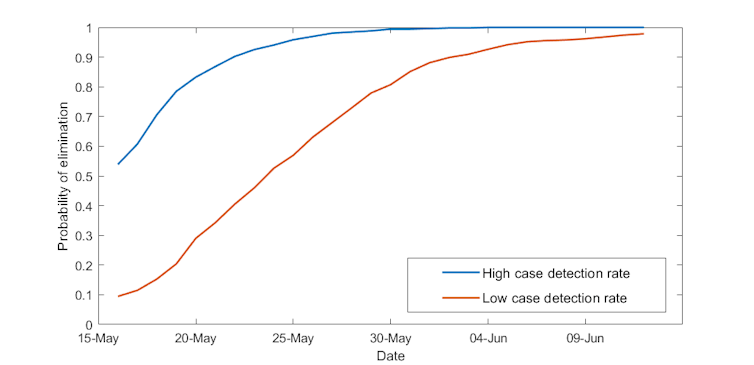
There is now a 95 percent chance covid-19 has been eliminated in New Zealand, according to our modelling, based on official Ministry of Health data.

As of June 4, New Zealand has had 20 consecutive days of zero new cases, with only one active case remaining. The last new reported case of covid-19 was on May 15 (going by the date the case was first suspected rather than later confirmed).

This still leaves a small chance of undetected cases, and we know that covid-19 is passed on at superspreading events.

READ MORE: Don’t stand so close to me – understanding consent can help with those tricky social distancing moments

Probability of elimination assuming no new cases reported after 15 May. Graph: The Conversation

New Zealand is now preparing to relax its covid-19 restrictions to alert level 1 from as early as Wednesday, which would end physical distancing and size restrictions on gatherings. But our modelling suggests removing limits on large gatherings will increase the risk of a very large new outbreak from 3 percent to 8 percent.

To reduce this risk, New Zealanders will need to continue avoiding the three Cs of possible infection: closed spaces, crowded places and close contact.

– Partner –

As crowds return, the risks will rise
New Zealand is now very close to its elimination target. But there is still a 5 percent chance of undetected cases.

On June 3, Prime Minister Jacinda Ardern announced details of the impending alert level 1 rules. Border closures will largely remain (except for returning New Zealanders) but all other significant restrictions on people’s movement within New Zealand will end.

From the perspective of the virus, the most significant change will be the end of restrictions on the size of gatherings. Airlines can fill up economy class again, nightclubs can pack their dancefloors and universities can open their lecture theatres.

Someone who caught the virus three or four weeks ago may not have developed severe symptoms (which happens in around 30 percent of people) and not got a test. They could have passed the virus on to someone else, who also missed out on a test.

A chain of infections like this could continue for a while before it is detected. Some segments of the population, such as younger people, are less likely to develop symptoms and are therefore more likely to sustain hidden infection chains.

Covid-19 is a superspreading virus. The reproduction number (R0) tells us that on average each infected person infects another 2.5 people. But for every ten people who catch covid-19, nine probably won’t pass it on, while the tenth person may turn up at an event and infect 25 others.

Risk from returning travellers
There is also a chance covid-19 could enter New Zealand with an international traveller. Last week, around 200 people, almost all returning Kiwis, touched down in New Zealand every day.

Many came from places like Australia, Hong Kong or Tonga – all countries relatively free of covid-19. Some also arrived from the USA, where the virus is widespread. Between February and April, we know that between 0.1 percent and 0.2 percent of all arrivals tested positive. With these numbers, we should expect one or two new cases to arrive each week.

New arrivals must remain in quarantine for at least 14 days. The incubation period for covid-19 is usually five to six days and it is rare for symptoms to begin more than 14 days after being exposed.

The bigger risk is a symptom-free person arriving and passing the virus onto someone at the same quarantine hotel, who then leaves before their symptoms appear.

Ministry of Health data show eight of New Zealand’s 500 imported cases developed their first symptoms more than two weeks after arriving. Maybe they caught it before they arrived or maybe they caught it during quarantine. Either way, they would have been infectious after they left quarantine.

People who work at the border – airline cabin crew, biosecurity or immigration personnel and staff at quarantine hotels – are at similar risk.

The inevitable new case
Our models show the risk of new cases coming from within New Zealand is now comparable to that from international travellers. The risk from international arrivals stays about the same whether we’re at level 1 or 2, while the risk of domestic transmission is decreasing.

The most important question is how we will cope when the inevitable new case arrives.

Each active case is like a small spark waiting to start a fire. Superspreading theory tells us most of those sparks go out, but a small number will ignite. These sparks are the problem: it could be an infected person at a choir rehearsal, at a nightclub, or cheering for their sports team.

New Zealand is fortunate to have highly trained, experienced contact tracers standing by. But they need our help. If you were to test positive, could you remember everywhere you have been for the last week and who else was there? A contact tracer’s nightmare is a large gathering with no record of who attended.

To move to level 1, we first need to ensure our contact tracing systems, including the NZ COVID Tracer app, QR codes and sign-in sheets at shops, are up to scratch. We need to be confident we can manage the risks when hundreds of people gather or attend protest marches. We have to be able to do these things safely while covid-19 is still out there.
The Conversation

Dr Michael Plank is professor in mathematics, University of Canterbury; Dr Alex James is associate professor, University of Canterbury; Dr Audrey Lustig is a research scientist, Manaaki Whenua – Landcare Research; Nicholas Steyn is a research assistant; Dr Rachelle Binny, is a research scientist, Manaaki Whenua – Landcare Research, and Dr Shaun Hendy, is professor of physics. This article is republished from The Conversation under a Creative Commons licence. Read the original article.

Print Friendly, PDF & Email

Article by AsiaPacificReport.nz

Grindr is deleting its ‘ethnicity filter’. But racism is still rife in online dating

Source: The Conversation (Au and NZ) – By Gene Lim, PhD Candidate, Monash University

Dating and hook-up service Grindr has announced its intention to remove the “ethnicity filter” from its popular app.

The controversial function allowed paying users to filter out prospective partners based on ethnicity labels such as “Asian”, “Black” and “Latino”. Long criticised as racist, the filter also helped to create a culture where users were emboldened to express their racism.

Sexual racism

Alongside other dating apps, Grindr has a reputation for sexual racism – the exclusion of potential partners based on race.

In 2017 Grindr tried to amend this perception with the “Kindr Grindr” initiative. This move banned the use of exclusionary language such as “No Asians” and “No Blacks” in user bios, and attempted to explain to users why these statements are harmful and unacceptable.

However, the “ethnicity filter” remained until last week, when Grindr announced it would be removed as a show of support for the Black Lives Matter movement.

Grindr’s actions were catalysed by recent protests in the United States, but sexual racism is also a serious issue in Australia.


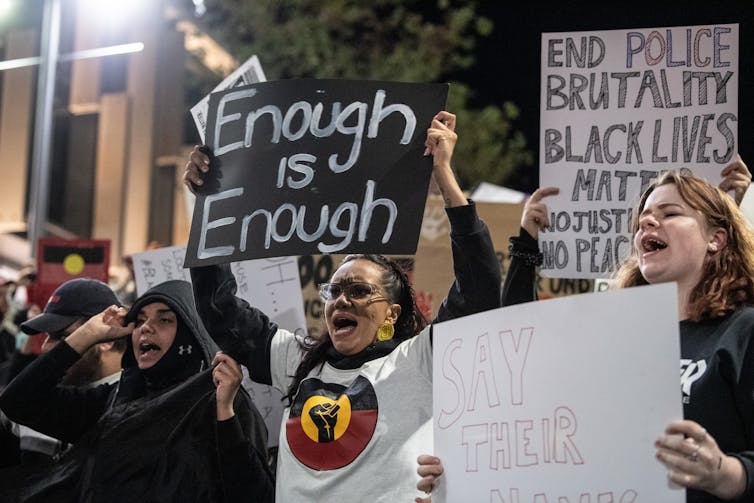
Read more: Despite 432 Indigenous deaths in custody since 1991, no one has ever been convicted. Racist silence and complicity are to blame


“Not into Asians”

One of us (Gene Lim) is researching how sexual racism impacts gay and bisexual Asian men in Australia. Grindr was repeatedly singled out by research participants as a site where they regularly experienced sexual racism – both in user bios, and interactions with others.

He says “send me a picture of your face”. I send him a picture of my face, and he says “oh you’re an Indian. I’m sorry”. He then quickly blocked me.

James, 28, Indian

Apps like Grindr are also where many Asian men first encounter such instances of discrimination.

So many profiles had “not into Asians”, “not into this [or that]” … I was just so confused as to why that was. I was skinny, young, cute, and I thought that would be enough …

Rob, 27, Cambodian

For many people of colour, this sends a message that their skin colour makes them unlovable and unwanted – something that has a negative impact on self-image and self-worth. One participant summarised how he was affected by these messages.

I feel like the bad fruit that nobody wants.

Ted, 32, Vietnamese

The psychological impact of these experiences adds up in ways that these men carry with them outside of sex and dating. Even as some Asian men withdraw from the gay community to avoid sexual racism, the impacts of these experiences endure.

It scars you in a way that it affects you in [situations] beyond the Gay community … it affects your whole life.

Wayne, 25, Malaysian

These exclusionary practices are especially jarring in LGBTQ communities which often style themselves as “found families”. Still, the experiences above represent only one dimension of how sexual racism affects the lives of people of colour.

Indistinguishable from general racism

One of us (Bronwyn Carlson) has studied sexual racism experienced by Indigenous Australians on apps including Tinder and Grindr. She found that for many Indigenous users the vitriol often only comes when they disclose their Indigenous heritage, as their appearance is not always an initial basis for exclusion.

An interaction might progress with chatting, flirting, and often an intention to “hook up”, but once an Indigenous user reveals their ethnicity the abuse flows. For Indigenous people, “sexual racism” is often indistinguishable from general racism.

The threat of these experiences always lurks in the background for Indigenous people navigating social media and dating apps. They reveal a deep-seated hatred of Aboriginal people that has little to do with physical characteristics, and much more to do with racist ideologies.

For gay Indigenous men, the potential for love, intimacy and pleasure on Grindr is always counterbalanced against the potential violence of racism.


Read more: Right-swipes and red flags – how young people negotiate sex and safety on dating apps


Putting anti-racism front and centre

People who use dating apps develop their own ways of managing risk and safety, but platforms should also have a duty of care to users. Digital spaces and apps like Grindr are important sites of connection, community, and friendship for LGBTIQ+ people, but they are also channels for hatred and bigotry.

Removing the ethnicity filter on Grindr is not a silver bullet that will end racism on the app – here in Australia or anywhere else. It’s a symbolic move, but a step in the right direction.

Getting rid of this feature signals to users that filtering partners based on ethnicity is not “just a preference”, but a form of marginalisation and exclusion. As research has shown, sexual racism is clearly linked to more general racist attitudes and beliefs.

Though Grindr’s action is late and tokenistic, it’s still a good move. But if Grindr and other online dating platforms want to become spaces where people of colour can express themselves and seek out intimacy and companionship, they must put anti-racism at the core of their policies and content moderation practices.

ref. Grindr is deleting its ‘ethnicity filter’. But racism is still rife in online dating – https://theconversation.com/grindr-is-deleting-its-ethnicity-filter-but-racism-is-still-rife-in-online-dating-140077

Jenny Hocking: why my battle for access to the ‘Palace letters’ should matter to all Australians

Source: The Conversation (Au and NZ) – By Jenny Hocking, Emeritus Professor, Monash University

Professor Jenny Hocking recently won her longstanding campaign for the National Archives of Australia to release the so-called “Palace letters” about the dismissal of Gough Whitlam in 1975. This is her account of that campaign.


In August 1975, speaking at a private dinner at Sydney’s Wentworth Hotel, Governor-General Sir John Kerr proudly described himself as “the Queen’s only personal representative in Australia with direct access to her”.

Kerr was a staunch monarchist, and what he saw as his “direct” access to the Queen was of great moment to him:

I am in constant communication with her on a wide variety of matters, on most of which I am communicating directly to her.

We now know just how constant that communication was. Kerr wrote frequently, at times several letters in a single day. There are 116 of his letters to the Queen, almost all of them sent through her private secretary, Sir Martin Charteris, containing extensive attachments including press reports, other peoples’ letters to Kerr, telegrams and articles. There are also 95 letters from the Queen to Kerr, all through Charteris.

These 211 letters in the National Archives of Australia, written during the entirety of Kerr’s tenure as governor-general and with increasing frequency after August 1975, constitute “the Palace letters”. They are without doubt the most significant historical records relating to the dismissal of the Whitlam government in November 1975. Yet, until last week’s landmark High Court decision, they had been closed to us by the archives, labelled as “personal” records and placed under the embargo of the Queen.


Read more: High Court ruling on ‘Palace letters’ case paves way to learn more about The Dismissal – and our Constitution


Aware of their immense historical significance, and with the support of a legal team working pro bono, in 2016 I launched a Federal Court action against the National Archives in an effort to secure access to the Palace letters.

It was not only the obvious importance of letters between the Queen and the governor-general, her representative in Australia, relating to Kerr’s unprecedented dismissal of the elected government that drove this case. It was also the importance of asserting the right of public access to, and control over, our most important archival records.

It took four years and a legal process through the Federal Court, the full Federal Court, and finally the full bench of the High Court of Australia – at which the federal attorney-general Christian Porter joined with the archives against my action. But in an emphatic 6:1 decision, the High Court ruled against the archives. It found the letters were not “personal” but rather Commonwealth records, and as such must now be available for public access under the provisions of the Archives Act.

Jenny Hocking last month won her case in the High Court to have access to the Palace letters. AAP/Peter Rae

Why it matters

This is an immensely important decision, overturning decades of archival practice that has routinely locked away royal records from public view as “personal”. It also provides a rare challenge to reflexive claims of “royal secrecy”, here and elsewhere.

Its implications will be felt broadly in other Commonwealth nations and potentially in the United Kingdom, where the Royal Archives are firmly closed from public access except with the permission of the monarch. Of equal importance is that the High Court’s ruling has brought the Palace letters firmly under Australian law, ending the humiliating quasi-imperial imposition of the Queen’s embargo over our archival records, and over our knowledge of our own history.

What made this case so important was the significance of original documents to the evolving history of the dismissal. A series of revelations in recent years, much of it from Kerr’s papers, has transformed that history and deeply challenged our previous understandings of the dismissal.


Read more: Australian politics explainer: Gough Whitlam’s dismissal as prime minister


As a deeply contested and polarised episode, access to original records – as opposed to subsequent interpretations – was unusually significant. There could be no more significant records than the letters between the governor-general and the Queen regarding what the Federal Court described as “one of the most controversial and tumultuous events in the modern history of the nation”.

What the Palace letters might tell us

I first came across the Palace letters more than a decade ago, when I began exploring Kerr’s papers as part of the research for my biography of Gough Whitlam. When I sought access to them I was told they were “personal” papers -– “non-Commonwealth, no appeal”. This meant I could neither access them nor appeal that denial of access to the Administrative Appeals Tribunal. The only way of challenging the label “personal” was a Federal Court action, an onerous and prohibitive prospect.

A series of revelations from Kerr’s papers highlighted their importance and the travesty of their continued closure. These include: a personal journal Kerr wrote in 1980 in which he cites several of the letters and recounts his critical discussion with Prince Charles in September 1975 expressing concern for his own recall as governor-general if he were to dismiss Whitlam; extracts from some of the letters; and his frequent references to the letters in other letters to friends and colleagues. Perhaps the most crucial item of all was a handwritten note, “Points on Dismissal”, in which he refers to “Charteris’ advice to me on dismissal”.

There could scarcely be a stronger indication that the Palace was intensely involved with Kerr’s consideration of the possible dismissal of the elected government. This, along with other materials, suggest that at the very least, Kerr had drawn the Palace into his planning before the dismissal.

Kerr cites a letter to the Queen in August 1975 in which he raised the “possibility of another double dissolution”. Just why he would be raising this two months before supply had been blocked in the Senate, and when the prime minister had held a rare double dissolution just the previous year and was intending to call the half-Senate election which was then due, may be answered when we see the letters.

Kerr writes that his conversations with Whitlam “were reported in detail to the Queen as they happened” for several months before the dismissal itself. This is a simply extraordinary situation: the governor-general is reporting to the Queen his private conversations, plans, matters of governance, and meetings with the Australian prime minister, and this is kept secret from the prime minister himself.

This is the crucial context of secrecy and deception in which the Palace letters must be considered: that Whitlam knew nothing of these discussions because Kerr had decided on a constitutionally preposterous policy of “silence” towards the prime minister, who retained the confidence of the House of Representatives at all times.

It is this extensive communication through hundreds of letters to and from the Queen, when taken in the context of Kerr’s self-described “silence” towards his own prime minister, that shows Kerr’s aberrant perception of his vice-regal role as acting as “the Queen’s personal representative” while failing to consult his own prime minister.

As historian John Warhurst has noted, from what we already know of the Palace letters:

…the British crown was interfering in the 1975 dispute in ways that should offend anyone who wants Australia to be a fully independent nation … the Palace did not stand above the fray … Kerr consulted the Palace and took advice from the Queen’s secretary acting on behalf of the Queen.

Knowing our story, in full

The National Archives’s denial of access to the Palace letters has prevented us knowing the extent of that consultation and advice for too long. The High Court’s resounding rejection of the basis for that secrecy is an historic opportunity for the director-general of the archives, David Fricker, to make good his claim the archives is a “pro-disclosure organisation”, recognise the profound breach with the past the decision represents, and embrace the spirit of public access that underpins it by releasing all 211 of the Palace letters.

It’s time for an open reckoning with our past, a fully informed debate about the events of 1975, and an answer to the lingering questions over the role of the Queen.

No matter how unpalatable this story may be to some, it’s our story and we have a right to know it.

ref. Jenny Hocking: why my battle for access to the ‘Palace letters’ should matter to all Australians – https://theconversation.com/jenny-hocking-why-my-battle-for-access-to-the-palace-letters-should-matter-to-all-australians-139738

Curious Kids: why do we have boogers?

Source: The Conversation (Au and NZ) – By Christian Moro, Associate Professor of Biomedical Sciences and Medicine, Bond University

Why do we have boogers in our nose? – Tia, aged 6

Great question, Tia!

Boogers, snot, bogeys and boogies are the common names for dried nasal mucus. Our nasal mucus is normally a clear, runny substance. However, as it moves closer to the surface of our nose it loses moisture to the air, dries out, and starts to harden.

What is mucus?

Mucus is a stringy and slippery fluid released from inside your nose and other areas of your body such as your lungs and stomach.

This is important as it protects us from breathing in things that might make us sick or may be poisonous.

Sometimes it is runny, or sometimes it looks thick and slimy, or even squishy like chewing gum.


Read more: Curious Kids: Why does my snot turn green when I have a cold?


But why is it sticky?

Mucus has something called mucin in it. Mucin helps mucus stick to unfamiliar things you breathe in like pollen, dust, dirt and some germs.

It stops these things getting into your airways and damaging your extremely delicate lungs.

Your body then clears out the mucus by coughing it up or blowing it out through your nose.

You can also get rid of it by swallowing it. If mucus is swallowed it will end up in your stomach where it will be destroyed by the stomach’s acidic juices.

Your body might get rid of mucus by coughing. TinnaPong/ Shutterstock

It usually takes about six hours for your body to clear germs and other unwanted things from your airways.


Read more: Curious Kids: why do I have boogies and why does my nose keep replicating them?


Where can mucus be found?

Mucus isn’t only in our airways. We also have mucus in our stomach and guts.

How it looks and what it does depends on where in the body it’s made.

In your airways it’s thin and moves quite a bit. But in the stomach it’s much thicker. This is because it has other roles, like protecting the stomach lining from acid.

What changes when we’re sick?

A runny nose might make us reach for a tissue. Christian Moro/Author provided

When you’re sick, your body releases chemicals that make your nose runny.

This helps you to get better faster because mucus doesn’t only get rid of germs, it also has special chemicals in it that stop many germs growing.

It also makes you cough which helps you get rid of germs more often.

When you’re sick your mucus may be full of germs. Be sure to use a tissue, throw it in the bin and wash your hands after you blow your nose.

But mucus is not always easy to clear out.

Sometimes mucus can become very thick, which makes it harder for your body to get rid of. This may be because of germs, or just because you need to drink a bit more water.

Drinking enough water helps to keep mucus moist so it can do its job. It also helps clear the germs and unfamiliar things from your body faster.

Things like herbal teas, a steamy-hot shower or chicken soup also might help when you’re sick, as warmer temperatures soften the mucus and help it move more quickly.

Warm drinks may help soften mucus when you’re sick. spass/ Shutterstock

Read more: Curious Kids: how does our blood fight viruses like chicken pox and colds?


But what about the colour?

If you’ve looked at a tissue after blowing your nose, you might have noticed the mucus you’ve blown out of your nose can be a range of different colours.

These colours give us information about what’s going on inside our bodies:

  • See-through and slightly dried nose mucus: the parts of your body that are involved in breathing (like our nose and lungs) are normal and healthy.

  • White mucus: you might have a bit of a cold.

  • Yellow or green mucus: you may have infection – but green or yellow mucus shows your immune system is working hard to protect you.

  • Black mucus: you might have breathed in a bit of dirt. This can can also be related to an infection, or even some diseases.

  • Red or brown mucus: if your nose is very dry or you have bumped or picked it too hard, a tiny amount of blood may have coloured the mucus.

Hello, curious kids! Have you got a question you’d like an expert to answer? Ask an adult to send your question to curiouskids@theconversation.edu.au

ref. Curious Kids: why do we have boogers? – https://theconversation.com/curious-kids-why-do-we-have-boogers-133351

We modelled the future of Leadbeater’s possum habitat and found bushfires, not logging, pose the greatest threat

Source: The Conversation (Au and NZ) – By Craig Nitschke, Associate Professor – Forest and Landscape Dynamics, University of Melbourne

The Federal Court recently ruled that a timber harvesting company couldn’t log potential habitat of the critically endangered Leadbeater’s possum.

This decision led to the immediate protection of more Leadbeater’s possum habitat and will lead to further habitat set aside over the next ten years as native timber harvesting is phased out in Victoria.

But these short-term, site-based measures will not guarantee the long-term conservation of this iconic Victorian species.


Read more: The Leadbeater’s possum finally had its day in court. It may change the future of logging in Australia


Our new study modelled changes in forests over the next 250 years, focusing on 280,000 hectares of Victoria’s Central Highlands, home to the majority of remaining Leadbeater’s possums.

We looked at different scenarios of how both climate change and timber harvesting might play out. And we identified three important findings.

First, Leadbeater’s possum habitat is dynamic. It’s transient across the landscape over time as disturbances, such as bushfires, continually change the spatial distribution of hollow-bearing trees and young forests.

Second, while timber harvesting poses a local-scale threat, at a larger scale – across hundreds of thousands of hectares – bushfire poses the greatest threat to the species’ habitat.

Last, we found less than half of the area within current parks, reserves, and timber harvest exclusion zones provided stable long-term habitat for Leadbeater’s possum over the next century.

The Black Saturday bushfires razed almost half of the Leadbeater’s possum habitat in 2009. Shutterstock

Future habitat scenarios

Leadbeater’s possums live in ash and snow gum forests. They depend on two key habitat features: hollow-bearing trees for nesting and dense understorey for moving around the forest.

We used a set of four scenarios to explore how climate change and timber harvesting impact long-term habitat availability by focusing on the where and when hollow-bearing trees and dense understorey are found in the landscape.


Read more: Comic explainer: forest giants house thousands of animals (so why do we keep cutting them down?)


The scenarios included projecting current climate conditions, and projecting a 2℃ rise in average annual temperature with a 20% reduction in yearly rainfall.

For each of these climate scenarios, timber harvesting at current harvesting rates was either excluded or allowed in areas zoned for timber production.

Bushfires drive long-term habitat loss

Our simulations showed bushfire, not logging, is the biggest threat to habitat availability for Leadbeater’s possum in the Central Highlands. As the cumulative area burnt by fire increased, the quantity and quality of Leadbeater’s possum habitat decreased.

Tthe 2009 Black Saturday fires burned almost half of its habitat, causing its conservation status to jump from endangered to critically endangered.


Read more: After the bushfires, we helped choose the animals and plants in most need. Here’s how we did it


Bushfires have always been part of Australian landscapes and many species, including Leadbeater’s possum, have evolved alongside them. Eleven years later, Leadbeater’s possum are now recolonising areas burned in the 2009 bushfires.

But as climate change increases the frequency and scale of bushfires, our models suggest the Central Highlands landscape may support less suitable habitat.

Timber harvesting is less of a threat

While timber harvesting compounds the impacts of bushfires on Leadbeater’s possum habitat, across the landscape the effect is small in comparison. Timber harvesting reduced suitable habitat by only 1.4% to 2.3% over 250 years compared to scenarios without harvesting.

Within a coupe (the area of forest harvested in one operation), timber harvesting immediately reduces nesting and foraging habitat. But foraging habitat returns within 10 to 15 years and can be recolonised by Leadbeater’s possum – as long as nesting sites are nearby.


Read more: Logging is due to start in fire-ravaged forests this week. It’s the last thing our wildlife needs


Protecting vegetation around waterways, in particular, was critical for the development and survival of hollow-bearing trees in an increasingly fire-prone landscape.

But while timber harvesting had much smaller impacts than bushfires, the two did interact. Over time, the cumulative impacts of timber harvesting and bushfire homogenised forest structure across the landscape, leading to smaller patches of habitat that were less connected.

This increases the risk of local extinction for populations of Leadbeater’s possum living in these patches.

Logging in ash forest in Victoria’s central highlands poses an local-scale threat to Leadbeater’s possum habitats. AAP Image/The Australian National University

We need dynamic conservation areas

A core question for the conservation of any threatened species is: how well does the network of protected areas protect the species?

Our modelling framework meant we could test whether current areas set aside for Leadbeater’s possum conservation actually provide long-term protection.

Over the next 100 years, less than 50% of existing parks, reserves and timber-harvest exclusion zones will provide continuous habitat for Leadbeater’s possum due to climate change.

Distribution of Leadbeater’s possum habitat in the Central Highlands landscape modelled in our paper. Stable zones provided suitable habitat throughout the scenarios. Loss and gain were areas that lost or became habitat over the scenario. Author provided

However, we also identified approximately 30,000 hectares of forest outside the current network of protected areas that can provide stable habitat for Leadbeater’s possum over the next century.

It’s vital we put protection zones into the areas possums are likely to migrate to as the climate changes. These areas should be a priority for conservation efforts.

A new conservation strategy

Historically, conservation planning has taken a static, site-based approach to protecting species.

This approach is doomed to fail in dynamic landscapes – particularly in fire-prone landscapes in a warming climate. For conservation planning to be successful, we need coordinated forest, fire, and conservation management that accounts for these dynamics across the whole landscape, not just in individual locations.


Read more: Climate explained: what caused major climate change in the past?


We need a vision for how to make our landscapes more resilient to the growing threat of climate change and provide better protection for the unique flora and fauna that inhabit them.

This will require government agencies responsible for land management and conservation to coordinate current management activities across tenures, while simultaneously implementing future-focused conservation planning. Our landscape-modelling approach provides a first step in that direction.

ref. We modelled the future of Leadbeater’s possum habitat and found bushfires, not logging, pose the greatest threat – https://theconversation.com/we-modelled-the-future-of-leadbeaters-possum-habitat-and-found-bushfires-not-logging-pose-the-greatest-threat-140055

We’re at a fork in the road: do we choose neighbourhoods to live, work and play in?

Source: The Conversation (Au and NZ) – By Halvard Dalheim, Practitioner in Residence, The Henry Halloran Trust, University of Sydney

Living, working and playing in the one neighbourhood has often been touted as the ideal outcome for well-planned cities. Yet this goal has been elusive. For most of us, our daily activities are segregated into one-dimensional precincts.

Every morning we emerge from our “cave” and travel to a fixed place of employment. Thus, we are beholden to transport planners to manage our daily commute.


Read more: If more of us work from home after coronavirus we’ll need to rethink city planning


Then came COVID-19. Restrictions changed our behaviour – we adapted.

Those of us who could worked from home. We walked locally, shopped locally, exercised locally, “home-schooled” our children locally and bought take-away locally. For many, our neighbourhoods have become our new “world” where we live, work and play.

We are now at a crossroad. One choice is to circle back to where we came as restrictions are eased. The other is to explore the opportunities our new behaviours have created.

We are in a position to explore the intersections between these new behaviours and how we think about our local neighbourhoods. Can we reach that elusive nirvana of work, rest and play locally?


Read more: Coronavirus reminds us how liveable neighbourhoods matter for our well-being


Re-imaging our neighbourhoods

Re-imagining our neighbourhoods is much more that enhancing the quality of the individual parts. We have an opportunity to strategically build on our behavioural adaptions to shift away from precincts based on simple one-dimensional land use. Just as many planners have been contemplating how autonomous vehicles might change our thinking about transport planning, re-imagining our neighbourhoods requires us to think well beyond our new behaviours.

Many people who have set up home offices would love to continue working from home at least some of the time. Shutterstock

Are there long-term implications of working from home? Will we change our perceptions of what activities we expect to see in our neighbourhood? What may influence our thoughts?

If we wish to move away from one-dimensional land-use precincts, we need to start at the home and consider where the boundaries between live, work and play lie. Some developers already provide homes with a tailored home office with a separate entrance. How could this evolve? Should we encourage it?

Such questions put into play planning regulations, but more importantly our expectations about the lifestyle of the place where we live. Many employment sectors are relatively benign in terms of nuisance impacts. Do we need to reconsider what activities are permissible as home-based businesses? And how many people can work at a home?


Read more: Life in lockdown has shown us our houses need to work harder for us


At the same time we can turn our attention to local centres and how they might evolve and grow. Interestingly, for Greater Sydney, the roughly 1,300 local centres account for close to 18% of all the city’s jobs, similar to that of the whole industrial sector. What placemaking and planning considerations require attention?

For both Sydney and Melbourne, the metropolitan plans identify councils as having those responsibilities. Should support come from state government? The role of governments is to be an enabler. For state governments there are tangible benefits to justify transferring and reprioritising resources to accelerate change.

Can we then look one step further and consider if there are opportunities to decentralise activities to the neighbourhood level? This might include post-secondary education and health services, community and social services. Can we turn community nodes into vibrant mixed-use local centres?

Making the shift from commuting

Walking our local streets has reintroduced many people to the human scale of their neighbourhood. The interactions at this scale are in stark contrast to the utilitarian role of many local streets. Their layout seeks to move cars in and out of our neighbourhoods as quickly as possible.

Our desire to “get out” and walk has also directed many people to their local centre. How can we support this new walking and shopping behaviour? The broad societal benefits range from healthier communities to reduced pressure on the transport network.

Many of us have rediscovered the importance of living in walkable neighbourhoods. Darren England/AAP

Do we now have an opportunity to take a long-term view? Can we use today’s disruptions to start re-imagining the structure of our neighbourhoods? This might be a journey of incremental steps such as:

  • developing a lattice of widened nature strips to restructure and re-orientate neighbourhoods to enhance local connectivity to where we work, rest and play and let us just safely walk our streets

  • creating “community corridors” by connecting existing local facilities and centres and strategically locating new activities

  • using the lattice together with the adaption of working from home as a catalyst to re-imagine the activities that can allow communities to live, work and play locally

  • enhancing local amenity and the human scale of neighbourhoods by expanding urban tree cover and pocket parks. Better street lighting might be an important enabler for a walking community, not just a minimum provision for those who may dare to walk.


Read more: Reclaiming the streets? We all can have a say in the ‘new normal’ after coronavirus


A new focus for planning

For probably the first time in planning’s history, all in the community are acutely aware of the challenges we face. And we all see the opportunity to work together on a pathway to recovery.

Re-imagining our local neighbourhoods might also suggest a new way of thinking about how we plan our cities. Our behaviour response to COVID-19 is shifting the metropolitan planning spotlight from the macro to the micro – the local neighbourhood – and to the importance of applying as much thinking and resources to that area as to the dynamics of whole metropolitan area.

A collaborative approach to a re-imagined neighbourhood will allow local communities to be actively involved in shaping their own and our collective future.

The fork in the road is clear. Which path we take is in our hands.


Read more: Coronavirus has changed our sense of place, so together we must re-imagine our cities


ref. We’re at a fork in the road: do we choose neighbourhoods to live, work and play in? – https://theconversation.com/were-at-a-fork-in-the-road-do-we-choose-neighbourhoods-to-live-work-and-play-in-138949

Sun, sand and uncertainty: the promise and peril of a Pacific tourism bubble

Source: The Conversation (Au and NZ) – By Regina Scheyvens, Professor of Development Studies, Massey University

Pacific nations have largely avoided the worst health effects of COVID-19, but its economic impact has been devastating. With the tourism tap turned off, unemployment has soared while GDP has plummeted.

In recent weeks, Fiji Airways laid off 775 employees and souvenir business Jack’s of Fiji laid off 500. In Vanuatu 70% of tourism workers have lost their jobs. Cook Islands is estimated to have experienced a 60% drop in GDP in the past three months.

In response, many are calling for the Pacific to be included in the proposed trans-Tasman travel corridor. Such calls have come from tourism operators, politicians and at least one health expert.

Quarantine concerns aside, there is economic logic to this. Australians and New Zealanders make up more than 50% of travellers to the region. Some countries are massively dependent: two-thirds of visitors to Fiji and three-quarters of visitors to Cook Islands are Aussies and Kiwis.


Read more: A four-day working week could be the shot in the arm post-coronavirus tourism needs


Cook Islands has budgeted NZ$140 million for economic recovery, but this will increase the tiny nation’s debt. Prime Minister Henry Puna has argued for a limited tourism bubble as soon as New Zealand relaxes its COVID-19 restrictions to alert level 1. Cook Islands News editor Jonathan Milne estimates 75-80% of the population is “desperate to get the tourists back”.

New Zealand Prime Minister Jacinda Ardern with the leaders of Fiji, Samoa and Federated States of Micronesia at the 2019 Pacific Islands Forum in Tuvalu. AAP/Mick Tsikas

A Pacific bubble would undoubtedly help economic recovery. But this merely highlights how vulnerable these island economies have become. Tourism accounts for between 10% and 70% of GDP and up to one in four jobs across the South Pacific.

The pressure to reopen borders is understandable. But we argue that a tourism bubble cannot be looked at in isolation. It should be part of a broader strategy to diversify economies and enhance linkages (e.g. between agriculture and tourism, to put more local food on restaurant menus), especially in those countries that are most perilously dependent on tourism.

Over-dependence on tourism is a trap

Pacific nations such as Vanuatu and Fiji have recovered quickly from past crises such as the GFC, cyclones and coups because of the continuity of tourism. COVID-19 has turned that upside down.

People are coping in the short term by reviving subsistence farming, fishing and bartering for goods and services. Many are still suffering, however, due to limited state welfare systems.

In Fiji’s case, the government has taken the drastic step of allowing laid-off or temporarily unemployed workers to withdraw from their superannuation savings in the National Provident Fund. Retirement funds have also been used to lend FJ$53.6 million to the struggling national carrier, Fiji Airways.


Read more: Holidaying in a disaster zone isn’t as crazy as it might seem


Fiji has taken on more debt to cope. Its debt-to-GDP ratio, which ideally should sit below 40% for developing economies, has risen from 48.9% before the pandemic to 60.9%. It’s likely to increase further.

High debt, lack of economic diversity and dependence on tourism put the Fijian economy in a very vulnerable position. Recovery will take a long time, probably requiring assistance from the country’s main trading partners. In the meantime, Fiji is pinning hopes on joining a New Zealand-Australia travel bubble.

Rarotonga International Airport: three-quarters of visitors are Aussies and Kiwis. www.shutterstock.com

Out of crisis comes opportunity

Supporting Pacific states to recover is an opportunity for New Zealand and Australia to put their respective Pacific Reset and Step-Up policies into practice. If building more reciprocal, equitable relationships with Pacific states is the goal, now is the time to ensure economic recovery also strengthens their socio-economic, environmental and political infrastructures.

Economic well-being within the Pacific region is already closely linked to New Zealand and Australia through seasonal workers in horticulture and viticulture, remittance payments, trade and travel. But for many years there has been a major trade imbalance in favour of New Zealand and Australia. Shifting that balance beyond the recovery phase will involve facilitating long-term resilience and sustainable development in the region.

A good place to start would be the recent United Nations Economic and Social Commission for Asia and the Pacific report on recovering from COVID-19. Its recommendations include such measures as implementing social protection programs, integrating climate action into plans to revive economies, and encouraging more socially and environmentally responsible businesses.

This is about more than altruism – enlightened self-interest should also drive the New Zealand and Australian agenda. Any longer-term economic downturn in the South Pacific, due in part to over-reliance on tourism, could lead to instability in the region. There is a clear link between serious economic crises and social unrest.


Read more: How might coronavirus change Australia’s ‘Pacific Step-up’?


At a broader level, the pandemic is already entrenching Chinese regional influence: loans from China make up 62% of Tonga’s total foreign borrowing; for Vanuatu the figure is 43%; for Samoa 39%.

China is taking the initiative through what some call “COVID-19 diplomacy”. This involves funding pandemic stimulus packages and offering aid and investment throughout the Pacific, including drafting a free trade agreement with Fiji.

That is not to say Chinese investment in Pacific economies won’t do good. Rather, it is an argument for thinking beyond the immediate benefits of a travel bubble. By realigning their development priorities, Australia and New Zealand can help the Pacific build a better, more sustainable future.

ref. Sun, sand and uncertainty: the promise and peril of a Pacific tourism bubble – https://theconversation.com/sun-sand-and-uncertainty-the-promise-and-peril-of-a-pacific-tourism-bubble-139661

Spare change? Cashless transactions could end the cultural legacy of the coin

Source: The Conversation (Au and NZ) – By Michael P. Theophilos, Senior Lecturer, Australian Catholic University

As shoppers and retailers do away with cash transactions, we may be witnessing the end of a major source of social and historical information – the coin.

In the modern age, coinage is increasingly seen as cumbersome, a vector for disease and costly to manufacture. Yet for more than 2,600 years, coins have faithfully preserved insights into human society through the eyes of the issuing state.

Coins reveal how rulers wanted their subjects to perceive their politics, their national identity and the social values they wanted to celebrate.

Russian novelist Ivan Turgenev wrote in 1861: “the drawing shows me at one glance what might be spread over ten pages in a book”. Nowhere is this more evident than on coinage, where words are limited.

Coins have always conveyed a message and, helpfully for historians, they are anchored to a specific time and place. Historian Harold Mattingly once called Roman coins the “newspapers of the day” – announcing new emperors, naming of heirs, proclaiming battle wins, holiday celebrations and events.


Read more: Museums are losing millions every week but they are already working hard to preserve coronavirus artefacts


The emperor’s new coins

Coins of the beleaguered Roman emperors of 69CE – during the Roman civil wars, when imperial reign was reckoned in months rather than years – depict imagery designed to bolster public confidence in the emperor of the moment.

Vitellius used imagery of the loyalty of the army. One example depicts clasped hands with the accompanying inscription FIDES EXERCITVVM (loyalty of the armies). The idea was far more aspirational than reflective of reality. That same year, Otho who reigned for 12 weeks, optimistically declared his VICTORIA (“victory”) and PAX ORBIS TERRARIUM (“worldwide peace”) on coins circulated during his fleeting reign.

Roman Coin Denarius of Otho. Wikimedia Commons

Coins can offer detail where literary sources are lacking or incomplete. A large bronze sestertius (a denomination of Ancient Roman coin) that Titus had minted in 80-81CE, depicts not only external structures and statues but also intricate details of the Roman Colosseum interior. It also shows spectators, staircases, an imperial viewing box, and even depiction of the engineering mechanism for awning to provide shade.

The Colosseum on Titus’s large bronze coin. Wikimedia Commons, CC BY

Ancient coins show that rivalry between cities is not new. In Ancient Rome, a city was honoured with the title neokoros (temple keeper) when permission was granted to build a temple to the emperor or imperial family.

The city of Ephesus was the first to be honoured with such a title during the reign of Nero (54-68CE). Cities vied to have neokoros on their coinage and in the ensuing centuries more than three dozen cities held the title, some multiple times over.

Militaristic exploits were a common theme celebrated on ancient coins. The brutal Roman response to uprising and unrest in Judea resulted in the destruction of the Jewish temple in 70CE. Many coins of the time depicting Judea Capta (Judea captured) were issued by the emperor Vespasian. His son Titus, whose sacking of Jerusalem as military commander was his sole claim to military glory, used coins to exaggerate the Jerusalem victory and secure his own line of succession.

Language used

Roman coins minted in the provinces away from Rome typically were inscribed with Greek rather than Latin. Rome may have conquered the Mediterranean politically by the first century CE, but Alexander’s spread of Hellenistic cultural and linguistic influences long outlived the collapse of his rule.

The linguistic components on coins help provide insight into the terminology used at the time. The word for city founder, ktisths, on coinage helps explain the term’s single appearance in the New Testament – though this has been traditionally translated as “creator” in modern English editions due to the similarity of ktisths to ktizw (meaning: to create).

The term’s use on coins makes it clear Peter the apostle was not referring to a cosmological creator but to a city founder and hence sustainer. When Peter writes to the marginalised and fledgling Christian community, he seeks to encourage them with an image of God as founder.

Even seemingly innocent imagery can reveal darker meaning. Pontius Pilate’s coinage for Judea showed a ladle (simpulum) and curved rod (lituus). These were commonly assumed to lack human representation out of respect for Jewish sensitivities. In fact, they were symbols of Greco-Roman pagan religion and imperial cult. This showed Pilate’s allegiance to Roman ideology rather than any Jewish sensitivities.

Pontius Pilate used symbolism on Judea coinage. Wikimedia Commons, CC BY

Still in circulation

Imagery on older coins are very much current and still in use in modern coinage. The Athenian owl prominently displayed on the the tetradrachm coin from the 5th century BCE still features on recently issued 1 Euro coins.

The modern state of Israel sought to reverse Vespasian’s ancient war cry with a positive variation of the Judea Capta inscription. The new coin contrasts Judea Capta on one side with Israel Liberata on the other.

The Athenian owl still features on the Greek Euro coin. Shutterstock

Money has taken various shapes and forms over human history. This includes feather money, cowrie shells, spade, boat and knife money. But it is the simple circular disk of stamped metal that has endured.

These small pieces of stamped metal have preserved insights into religion, community identity, monumentality, language and imperial power for thousands of years.

Future historians and archaeologists may find creative ways of mining cultural data out of our digital transactions, but for the time being, modern coinage continues the long human tradition of expression and national identity formation through state issued coinage.


Read more: The 14 Indigenous words for money on our new 50 cent coin


ref. Spare change? Cashless transactions could end the cultural legacy of the coin – https://theconversation.com/spare-change-cashless-transactions-could-end-the-cultural-legacy-of-the-coin-138944

Pacific media react with relief over proposed sale reprieve for AAP

By Jade Bradford in Perth

News that Australian Associated Press has been saved is being welcomed by media outlets in socially and culturally complex Pacific countries such as Papua New Guinea where dramatic and important stories often emerge.

When the closure of AAP was announced earlier this year, concern was expressed by media industry figures in Australia and across the Pacific.

Media outlets in the Pacific, in particular, are under-resourced due to various structural weaknesses and are, therefore, heavily reliant on credible news from Australia provided by AAP.

READ MORE: Loss of AAP a tragedy for entire Pacific

On Friday, AAP announced that a consortium of philanthropists and media executives had expressed interest are making a bid to buy the AAP Newswire service.

The consortium members, including former News Corp CEO Peter Tonagh; Fred Woollard, managing director of Samuel Terry Asset Management; and Kylie Charlton, managing director of Australian Impact Investments; have made an offer to purchase after raising a significant amount of money.

– Partner –

After the proposed closure was announced, Pacnews agency editor Makereta Komai was concerned that this would have a huge impact on the news service she works for and other struggling outlets.

AAP has been “a great and timely source of stories in Australia that are relevant and significant to the Pacific region,” she explained.

Essential tool
In countries like Papua New Guinea, the AAP Newswire service in particular has been an essential tool in achieving a Fourth Estate in terms of framing political issues.

Former AAP bureau chief Liza Kappelle said journalists at AAP focused on trying to make its news “interesting, engaging, informative and dead accurate”.

Among the Pacific countries, Papua New Guinea has by far the largest economy and the biggest population (8.6 million). The region includes approximately 600 small islands, and has more than 800 Indigenous languages with only 13 per cent of the population living in urban areas.

The region has seen a lot of closures and restrictions of news coverage by traditional media organisations at a time when international support is crucial.

Years ago, AAP had a bureau in Suva, Fiji, which was an important part of the region’s coverage. Then it was left with just one bureau, in Port Moresby. When that was closed in 2013, Australia broke 60 years of print media coverage on the ground in Papua New Guinea.

This left only the ABC’s broadcast media coverage, which has also been reduced due to the Australian government’s budget cuts.

In West Papua, the war of independence has intensified and Indonesia has banned media coverage of the conflict.

Media independence eroded
Successive governments in Papua New Guinea have been accused of eroding media independence.

Former Prime Minister Peter O’Neill was recently arrested under suspicion of corruption, having “bought” some leading journalists. Journalists and the media have increasingly come under threat legally and politically with restrictive legislation, intimidation, assaults, police and military brutality as well as illegal detention.

All this has occurred while Australia’s voice in the region has begun to fall silent.

China’s encroaching influence on the Pacific has made the struggle for media freedom in the region even harder. This is further complicated by Australia’s media freedom being also on a decline.

Consequently, Australia is no longer a press freedom role model for the Pacific. This year, Australia dropped five places to be rated at number 26 on the Reporters Without Borders World Press Freedom Index.

Pacific Media Centre director Professor David Robie says lack of media diversity in Australia is directly impacting on Australia’s poor press freedom rankings. He made comparisons to when press freedom began decreasing after the country’s media independence had been quite strong.

But then the first two military coups occurred in 1987.

Never known ‘truly free press’
“There is now a generation of journalists in Fiji who have never known what it’s like to have a truly free press,” said Dr Robie, who is also editor of Asia Pacific Report.

Here in Australia, it has become increasingly difficult for journalists to report on political issues. Laws have been introduced in recent years banning journalists from reporting on Australia’s refugee detention centres in Papua New Guinea’s capital, Port Moresby, and also on Manus Island.

Australian law enforcement can probe into the identities of whistle-blowers and anonymous sources while seizing journalist’s documents and electronic devices.

The erosion of public interest journalism has left the Australian public with little understanding of what is happening in and around the Pacific Islands.

A survey by the International Federation of Journalists found nearly one in four journalists in countries including Australia, said accessing information from government or official sources was becoming more difficult.

The editor of Croakey Health Media, Dr Melissa Sweet, who has previously worked at AAP, knows this all too well, and said: “Nowadays you’ve got snowballs’ [little chance in hell] of getting people to talk to you, unless perhaps they are whistle blowers.

Tip of the iceberg
“Whistle blowers are really the tip of the iceberg in terms of who you need to communicate with to understand what’s going on in governments and organisations.

“I remember… back when I was at the AAP in the eighties, there were various meetings that I could go and report from and on that were open to the public that are now closed. Back in those days I had much better access, whether it was health ministers or health bureaucrats on all sorts of levels,” she recalls.

“People within government or bureaucracies have been unwilling to talk for a very long time. This has been a long-term trend.”

The declining plurality of the media in Australia has led to one of the most concentrated levels of media ownership in the world. Two parties own almost all privately owned media in Australia – Rupert Murdoch’s $16.3 billion dollar company, News Corp, and Nine Entertainment, which is run by a consortium created by company founders, the Packer family.

Prior to the purchase offer announcement, Murdoch’s News Corp, along with Nine Entertainment, were the two main shareholders of AAP, which has been described as the “Australian democracy safety net”.

The shareholders decided in March, that after 85 years in operation the country’s only national newswire service was no longer profitable and they announced plans for its closure on June 26 this year.

The Australian Journalism union, MEAA, blasted the shareholders’ decision, calling it “irresponsible,” “devastating” and “reckless.”

Worst time for Pacific media
The announcement could not have come at a worse time for media in the Pacific, where local media companies lack the clout to stand up to authoritarian governments. It is unknown what impact covid-19 will have on the region.

Recently, politicians and authorities in Fiji and Papua New Guinea have been accused of silencing criticism by sheltering behind emergency lockdown laws.

After the announcement in March, speculation arose about the reasons for the AAP closure. Kappelle, said she could not recall the exact words of chairman Campbell Reid. But when asked if the closure was because NewsCorp and Nine were tired of subsidising a breaking newswire service for their competitors, she answered, “That’s definitely the gist of it.”

The closure would certainly weaken competition from other news outlets. Murdoch, who has a personal fortune of $17.6 billion, has recently been accused of using the covid-19 crisis as an excuse to scrap regional newspaper titles within Australia.

Following the announcement, it was revealed that both NewsCorp and Nine had made plans to open their own breaking newswire services. However, both shareholders publicly blamed digital competitors Google and Facebook for the AAP’s demise.

Dr Sweet was devasted to hear of the proposed closure, saying it would impact on journalism globally. She explained it as a situation where people did not understand the current crisis facing many journalists and news outlets and that it was not only related to AAP, but to public interest journalism more broadly.

Vested interest reasons
“I guess as an industry we just haven’t done a very good job of explaining it and there’s vested interest reasons around that. No media outlet wants to say to you ‘we are going to hell in a hand basket’. They all want to keep trying to pretend that they are doing good journalism,” she explained.

“Whereas, the industry is obviously showing the strain of losing so many journalists, closing so many newsrooms, leaving so many communities under-served and under-covered.”

Prior to purchase offer announcement, Dr Sweet said it would be terrific if the people investing in the AAP newswire service weren’t just doing it because they wanted to make money, but so that journalism had a “public good model” that would fit with the history of AAP.

Professor Robie described continued coverage of regions such as Papua New Guinea, as vitally important, saying the country had “a treasure trove of dramatic and important stories.

“The security issues with the struggle of the Papuan people seeking independence are highly sensitive. Where the Australian media withdraws in the Pacific, Chinese media influences will take over.”

Jade Bradford is a student journalist at Curtin University in Western Australia. This article was first published in the journalism programme’s online newspaper Western Independent.

Print Friendly, PDF & Email

Article by AsiaPacificReport.nz

In publishing Tom Cotton, The New York Times has made a terrible error

ANALYSIS: By Denis Muller of the University of Melbourne

When a newspaper with the authority of The New York Times chooses to publish a party-political essay calculated to further inflame the violence wracking cities across America, serious questions arise.

On June 3 the Times published in its opinion section an essay by a Republican senator from Arkansas, Tom Cotton, headlined “Send in the troops”.

It argued the case, plentifully coloured by party-political asides, in support of US President Donald Trump’s threat to mobilise the US military against the protests triggered by the police killing of George Floyd.

READ MORE: When Trump attacks the press, he attacks the American people and their Constitution

The newspaper’s decision provoked a stream of protests on social media, including from several journalists on its own staff. Some simply stated that they disagreed with Cotton. But for others, their objections ran far deeper.

Many expressed concern that it endangered the safety of Times journalists, in particular those who are black. In circumstances where the police are already turning their violence on journalists covering the protests, this is a well-founded objection.

Nikole Hannah-Jones, a correspondent for The New York Times Magazine who won the Pulitzer Prize for commentary last month, tweeted:

– Partner –

Nikole Hannah-Jones tweet

The NewsGuild of New York, the union that represents many Times journalists, said in a statement:

This is a particularly vulnerable moment in American history. Cotton’s Op-Ed pours gasoline on the fire. Media organiSations have a responsibility to hold power to account, not amplify voices of power without context and caution.

No coherent Times explanation
In the face of these cogent criticisms, it might have been expected The Times would publish a coherent and substantial account of its reasons for running the Cotton essay. It has not. It has left it to the editorial page editor, James Bennet, to respond, and he has contented himself with a Twitter thread.

His reasoning, if it can be dignified with the term, can be summarised in these statements from that thread:

Times Opinion owes it to our readers to show them counter-arguments, particularly those made by people in a position to set policy.

We understand that many readers find Senator Cotton’s argument painful, even dangerous. We believe that is one reason it requires public scrutiny and debate.

These reasons can be swiftly disposed of before moving on to questions he did not bother to mention.

Counter-arguments: by all means, but why from a party-political source at this time in American history, when party-political polarisation is as deep as at any time in the post-civil war era? Why not invite a non-party source, perhaps an expert in national security, to make the case for military intervention?

From a person in a position to set policy: just about the strongest reason not to run such a piece. It aligns the paper closely with those in power, an abrogation of the paper’s independence from government.

Scrutiny and debate: government is better scrutinised at arm’s length, and the public debate that has ensued is not about the merits of military intervention, but about the inflammatory content of the essay and the Times’s decision to run it.

Was the essay offered?
Now for the questions Bennet did not mention.

Did the Times solicit the essay from Cotton or did he offer it?

To what extent, if at all, did the Times consider the likely foreseeable consequences of running such a clearly partisan essay on so volatile an issue?

What consequences did it anticipate?

How did it balance the obvious risks of aggravating an already violent situation against the public-interest grounds Bennet has advanced?

Did it ask itself why a senator, with the powerful platform of the US Senate at his disposal, would seek to harness the authority of The New York Times to his cause?

Did it perceive that in lending its authority to this essay, it would be handing a valuable propaganda tool to the White House?

Unsettling public disregard
The newspaper’s blithe public disregard for these questions is unsettling.

In the three-and-a-half tumultuous years of the Trump presidency, America’s serious national newspapers – The Times, The Washington Post, the Los Angeles Times – have been a remarkable bulwark in defence of American democracy.

Along with the judiciary, they have discharged their institutional responsibilities fearlessly. They have kept an unflinching gaze on the Trump presidency and faced down his intimidatory tactics.

With Congress paralysed by partisan divisions, it is these two institutions that have made America’s democratic arrangements work.

Yet the strains are beginning to show.

The Washington Post reported this week, in the context of police attacks on the media covering the riots, that “the norms have broken down”.

In these circumstances, the decision by The Times to publish the Cotton essay is worse than just a bad editorial call.

At a critical juncture in this crisis, it suggests a failure of nerve.The Conversation

By Dr Denis Muller, senior research fellow of the Centre for Advancing Journalism, University of Melbourne.This article is republished from The Conversation under a Creative Commons licence. Read the original article.

Print Friendly, PDF & Email

Article by AsiaPacificReport.nz
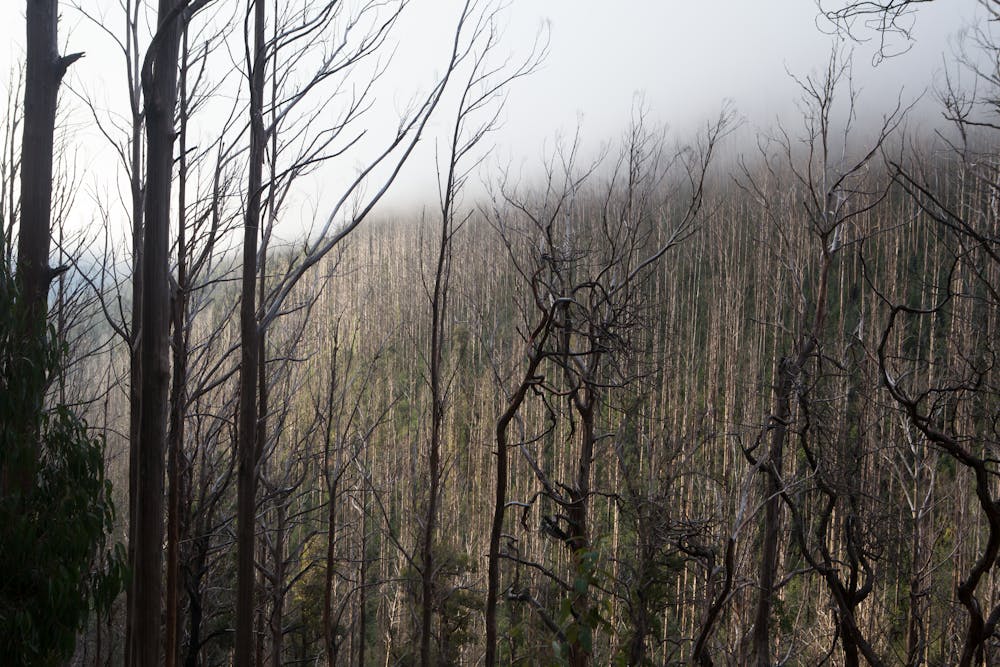
Number of Australia’s vulnerable children is set to double as COVID-19 takes its toll

Source: The Conversation (Au and NZ) – By Kate Noble, Education Policy Fellow, Mitchell Institute, Victoria University

Three quarters of a million Australian children are likely to be experiencing employment stress in the family as a result of COVID-19. This is on top of around 615,000 children whose families were already dealing with employment stress, whose situation may have worsened.

Latest figures from the Australian Bureau of Statistics show 2.7 million people left their job or had their hours reduced between March and April. This means the jobs crisis is affecting 1.4 million Australian children, according to new modelling from the Mitchell Institute.

The stress and anxiety facing parents who have lost their jobs, coupled with social isolation and educational disruption, are likely to put many children at a significantly higher risk of poorer education and health outcomes.

Financial stress affects healthy development

A family’s socio-economic status is the biggest factor influencing children’s educational opportunities in Australia. Research by the Mitchell Institute has found children from struggling families are 10-20% more likely to be missing key educational milestones compared with their peers.


Children in families experiencing job loss are more like to start school developmentally vulnerable, to repeat a grade, to leave school early and may be less likely to attend university.

As stress in the home increases, children and young people’s health and well-being often suffers too. Extreme employment stress, for example in jobless households, can compromise the quality of parenting and home environments. Providing basic necessities can be challenging, and lead to poorer child nutrition.

Health and well-being issues caused by the crisis may undermine young people’s learning and efforts to reengage with school. Young people who don’t receive a good education are more likely to have poor longterm health outcomes.

Preschools and schools can help children recover

With schools and preschools now resuming something close to normal operations, it’s time to shift our collective focus from how we deliver education remotely, to how we support a huge newly vulnerable population of students.


Read more: 1 in 5 kids start school with health or emotional difficulties that challenge their learning


Many students will benefit by simply resuming learning and socialising at their preschool or school. Others will find life returns to normal as their parents return to work or find a new job, and their families regain financial security.

But previous recessions tell us recovery may be slow. For some parents, unemployment and underemployment will be prolonged, leaving many children, including some who were never previously considered vulnerable, at risk.

Teachers have shown agility, resilience and skill in the face of COVID-19. But preschools and schools aren’t equipped to deal with the huge upsurge in student vulnerability, on top of the upheaval of COVID-19.

Here’s what needs to happen

The Australian government has made childcare free for parents as part of a temporary relief package, but that policy is under review.

Governments must ensure children and families aren’t locked out of early education because they can’t afford it. Ensuring access is critical for children’s learning and development, as well as economic recovery through parental workforce participation.

Along with an emphasis on academic learning and re-engaging students with school routines, school children would benefit from an increased focus on health and well-being in schools. Supporting students to reconnect socially and build their own resilience will improve academic learning and should be central to schools’ efforts.


Read more: Childcare is critical for COVID-19 recovery. We can’t just snap back to ‘normal’ funding arrangements


Links between schools and external social and health services also need to be strengthened to support children of all ages. Many of the issues that need to be addressed to reduce student vulnerability occur at home and in the community, requiring targeted and expert care from a range of non-school service providers.

Dedicated well-being staff could be employed in schools to facilitate these connections, and drive schools’ focus on health and well-being.

Senior secondary students face a high risk of disengagement from education as a result of disruption and parental unemployment. Prior to COVID-19, the cost of leaving school early was calculated at around $A900 million per year, per cohort. Helping students remain in education is critical to improving health and employment outcomes later in life.

Current funding arrangements will not enable preschools and schools to adequately respond to this unprecedented situation. Investing in prevention and outreach now is vastly more effective than dealing with the fallout later.

ref. Number of Australia’s vulnerable children is set to double as COVID-19 takes its toll – https://theconversation.com/number-of-australias-vulnerable-children-is-set-to-double-as-covid-19-takes-its-toll-140057

Thousands rally across Australia to protest against Indigenous deaths

By RNZ News

Thousands of people were protesting across Australia today to oppose the deaths of Indigenous people in police custody.

It comes as Black Lives Matter protests are held around the world after the death of George Floyd at the hands of a white police officer in the US state of Minneapolis.

Rallies kicked off in Brisbane and Adelaide, along with some regional centres, earlier today.

READ MORE: Al Jazeera coronavirus live updates – China warns against travel to Australia

Big crowds have also gathered for protests in Melbourne and Sydney – after the New South Wales Court of Appeal ruled in favour of a last-ditch attempt to lawfully authorise a Sydney protest.

The decision means thousands of protesters marching in Sydney will be immune from prosecution for breaching public health orders.

– Partner –

Queensland Police estimate more than 10,000 people gathered in King George Square in Brisbane’s CBD for the protest, which kicked off at 1.00pm.

It was organised by Warriors of the Aboriginal Resistance (WAR) to show solidarity with the uprisings in the United States and Australia’s Aboriginal and Torres Strait Island people.

‘Oppressed and brutalised’
“All the people who have been oppressed, and exploited, and brutalised by the system and let us fight for a better world,” the organisation said in a statement.

“First Nations people in Australia are the most incarcerated people in the world.

“We make up less than 5 percent of the general population but account for 27 percent of the general prison population, 30 percent of women’s prisons and 70 percent of youth prisons nationally.”

In Adelaide, it is estimated that thousands turned out to the rally held at Victoria Square in the CBD, with many people seen wearing face masks to protect against the spread of coronavirus.

Protesters marched along King William Street calling for an end to Aboriginal deaths in custody.

They carried Aboriginal flags and placards saying “black lives matter”.

State police commissioner Grant Stevens yesterday granted an exemption from coronavirus restrictions for the rally.

Surge in coronavirus cases warning
But an infectious diseases expert has warned it could lead to a surge in coronavirus cases.

Australian National University professor Peter Collignon said people should take steps to protect themselves and others and adhere to social distancing.

He said that “it might be a week or at least two weeks” until we see whether there has been an outbreak of cases linked to the protest gatherings.

About 1000 people also gathered in Townsville, North Queensland, this morning, for a peaceful rally to stand against black deaths in custody.

Young and old Aboriginal people, including Wulgurukaba people, spoke to the crowd about the racism and mistreatment of their people in Australia for generations.

Speakers said the death of George Floyd was the straw that broke the camel’s back.

Social distancing appeal
As the protest started to get underway in Melbourne, organisers asked the crowd to spread out along Bourke and Spring Streets to ensure there is social distancing.

Police yesterday warned organisers could be fined if coronavirus restrictions are breached.

A 20-person limit on outdoor gatherings still applies in Victoria, and Deputy Commissioner Shane Patton yesterday said organisers could be fined if the event breaks the Chief Health Officer’s directives.

Premier Daniel Andrews and Chief Health Officer Brett Sutton were among those calling for people to call off the protests due to concerns of a spike in coronavirus cases.

Protest marshals wearing fluoro vests were giving people hand sanitiser as they entered the parliamentary precinct.

Victoria police officers were lined up along the lower steps of the Parliament building with police officers on horseback behind them.

A 16-year-old Koori girl, who is white and Aboriginal, said she had seen both sides of racism.

‘I’m a witness to both sides’
“Growing up, both Aboriginal and white, I’m a witness to the two sides of racism,” she said.

She said it was more important to get her story out than to worry about her health.

“I think having my own voice put out there is so much more important than if I get coronavirus,” she said.

Another protester, Greg, said he was born in 1955 and Aboriginal deaths in custody had been going on since well before that.

He said he was not “overly” concerned about his health.

“If I get sick and die, I get sick and die,” he said.

“A mate of mine was killed by police. We were both 16. That’s why I’m here.

“No one did anything about what happened to him.”

Hand sanitiser handed out
The Victorian Aboriginal Community Controlled Health Organisation (VACCHO) has been handing out hand sanitiser, gloves and masks ahead of the Melbourne protest.

VACCHO chief executive Jill Gallagher, who is also the former Victorian Treaty Advancement Commissioner, said the organisation was trying to minimise risk.

“I understand why people are still going to the protests,” she told ABC News Breakfast.

“When you look at the history of this country, when you look at the 432 deaths in custody since the 1990s – and that’s only the ones that have been counted.”

She encouraged people who are sick, immunocompromised or in carer roles to stay away from the event and said she would not be attending herself as she was looking after family.

“But if you must go, stay safe, and the harm-minimisation approach is the way to go. I mean, in an ideal world we wouldn’t want a George Floyd incident to happen in the middle of a pandemic,” she said.

Not enough understanding of ‘true history’
She said she did not think there was enough understanding of the “true history” of Australia.

“I hope it is a turning point. I really do,” she said.

“Because all you’ve got to do is look at what happened over there [in the US]. That’s not just because of George Floyd. That was the trigger. That was the last straw.

“They have had 500 years of brutality to African-Americans and you can see that and how it has manifested in their protests, the anger, the hurt and the frustrations. So, we have to deal with our past before we can move on.”

WAR representatives released a list of 14 demands for the protest, including the dismantling of the policing and justice system and the implementation of all 339 recommendations from the Royal Commission into Aboriginal Deaths in Custody.

  • This article is republished by the Pacific Media Centre under a partnership agreement with RNZ.
  • If you have symptoms of the coronavirus, call the NZ Covid-19 Healthline on 0800 358 5453 (+64 9 358 5453 for international SIMs) or call your GP – don’t show up at a medical centre.
  • Follow RNZ’s coronavirus newsfeed
Print Friendly, PDF & Email

Article by AsiaPacificReport.nz
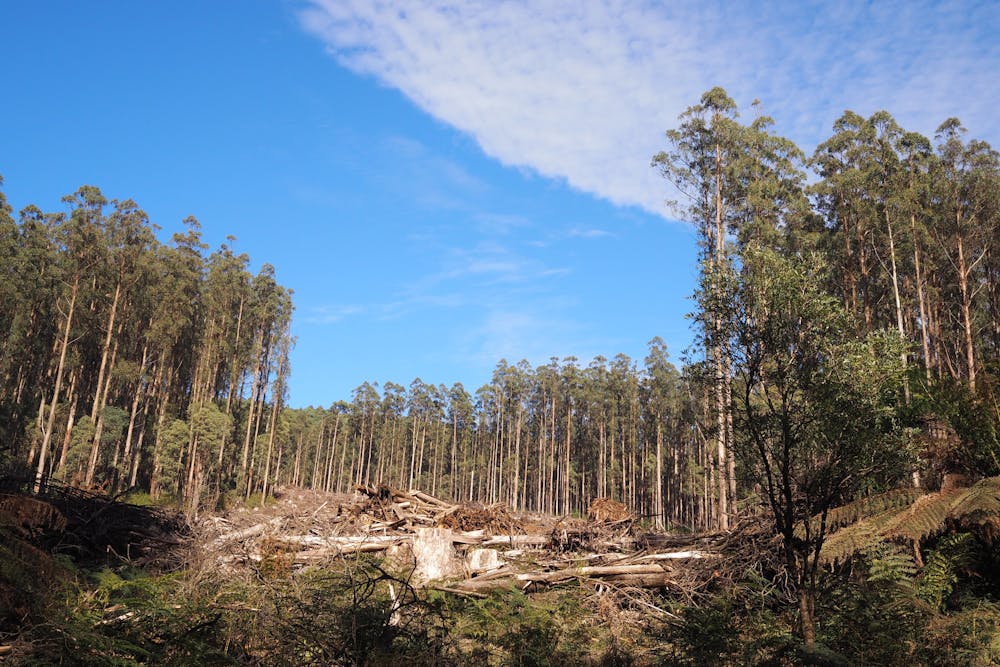
‘#PapuanLivesMatter’: George Floyd’s death exposes double standards

By Budi Sutrisno in Jakarta

As the death of George Floyd, an African-American man who died while being arrested in the United States, sparks a global outcry, Indonesian rights advocates and young people have stepped forward to remind fellow citizens that racism has long been an issue at home as well.

The scene of Floyd being restrained by a cop employing a knee-to-neck hold is familiar for some, who compared the incident to the 2016 case of Obby Kogoya, a Papuan man whose head was reportedly stepped on by the police before he was arrested during the siege of a Papuan student dormitory in Yogyakarta.

The hashtag #BlackLivesMatter, which has accompanied a call for street rallies worldwide, has since been adapted into #PapuanLivesMatter, with many turning to social media to urge Indonesians to also speak up against the racial discrimination and violence that Papuans have long endured.

READ MORE: Global fight against racism: Papuan lives also matter

“Many Indonesians support the hashtag #JusticeForGeorgeFloyd to denounce the actions of the American police over racial discrimination against black people. This is inversely proportional to when Papuans are racially abused,” Papuan activist Rico Tude tweeted on Tuesday.

Rico, who writes for Papuan media platform suarapapua.com, criticised the “double standards” of Indonesians in addressing the issue of racism abroad and at home, saying some might fear the risk of discussing sensitive topics related to Papua or lamented the history of Papuan political attitudes.

– Partner –

“Some people think that the racism experienced by Papuan people is a logical consequence that must be accepted by those who are considered separatists,” said Rico, who is also the spokesman for the Indonesian People’s Front for West Papua (FRI-WP).

While being far from the central government’s reach at home, many native Papuans have to put up with discrimination against their skin color and stereotypes while searching for a better life in other cities.

Rejection by landlords
Some students previously told The Jakarta Post that they faced rejection by landlords when looking for rooming houses to rent only because they were Papuans, while others had to endure racial slurs.

In other circumstances, such as when engaging in peaceful rallies to voice their political aspirations, many Papuans have reportedly faced physical intimidation and brutality by law enforcement personnel.

President Joko “Jokowi” Widodo has tried to reach out more with his development and infrastructure approach but critics and activists argued that Jakarta continues to fail in addressing human rights issues and the repression against their freedom of expression.

On Sunday, Indonesian human rights lawyer Veronica Koman and two native Papuans held an online discussion on how the #BlackLivesMatter campaign had echoed the Papuan movement against the long-standing racism and injustice they felt in Indonesian society.

They agreed that the string of protests against Floyd’s death were similar to what happened in Papua last year – when thousands rallied against racism after a Papuan student was called a “monkey” by security personnel in Surabaya, East Java.

“Dialogue to advocate for Papua-related issues is not enough. Unlike the Floyd case, racism in Papua continues because the public lacks knowledge of it,” said one of the speakers, Mikael Kudiai.

Cisco Mofu, another speaker, called for other Indonesians to open their minds and listen to the aspirations of Papuans and be willing to “criticise the state for its mistakes”.

Time to raise awareness
In a statement to the Post, Koman said it was time to raise awareness among the public, as people outside the activist circle, including celebrities and influencers, had also reached out for discussion.

Actress Hannah Al Rashid, for instance, is among those who have amplified such discussion and called for people to actively listen instead of making assumptions about the issue through her Twitter account.

“Let’s start speaking up for Papua. The government has been able to perpetuate impunity in Papua because the people haven’t spoken out. We do need your voices but please be mindful in amplifying Papuan voices,” Koman said.

Many internet users have also geared up to help disseminate information on issues surrounding Papua and shared links for people to sign petitions and donate to various causes to help Papuan people.

Young initiators, through online media platform Kudeta Mag, were among those who compiled the links and reading material on the website weneedtotalkaboutpapua.carrd.co.

“It should be our responsibility as Indonesians to feel obligated to understand our own country,” Kudeta Mag chief editor Jordinna Joaquin told the Post, “We need to talk, have these conversations, donate whenever and whatever we can and demand justice where it’s needed.”

Call for strong stand
Amnesty International Indonesia also called on the government to take a strong stand against systemic racism by guaranteeing Papuan rights to freedom of expression and stopping all forms of violence against those who peacefully express their opinions.

“The killing of George Floyd in Minneapolis must be a reminder that discrimination and intimidation also happens to native Papuans in Indonesia, and most of the cases have yet to be resolved,” executive director Usman Hamid said on Wednesday.

The rights group also urged the authority to immediately release 51 Papuan prisoners of conscience.

“They do not deserve to be in jail because they did not commit any crimes. Justice must be upheld,” Usman said.

Print Friendly, PDF & Email

Article by AsiaPacificReport.nz

We’ve discovered how these deadly bacteria use a common sugar to spread through the body. It could help us stop them

Source: The Conversation (Au and NZ) – By Vikrant Minhas, PhD candidate, University of Adelaide

Although bacteria are single-celled and microscopically small, they still need energy to survive, just like us. One of the most efficient ways of acquiring energy for bacteria is through sweet, soluble carbohydrates: sugars.

In fact, the keen ability of the deadly bacteria Streptococcus pneumoniae to use the plant-derived sugar raffinose may explain how it spreads through the human body.

S. pneumoniae is a bacteria that can quickly develop antibiotic resistance. Each year it causes millions of infections and about one million deaths. Its “ecological niche”, which refers to the natural position of a species within an ecosystem, is our noses and throats, where it doesn’t cause disease.

But from there, S. pneumoniae can spread into the lungs, blood and brain, or more locally into the ear, to cause diseases such as pneumonia, bacteremia, meningitis and otitis media (middle ear inflammation).

Unfortunately, S. pneumoniae is a genetically diverse pathogen, which means it has many different strains. This complicates research efforts to identify how the bacteria spreads into specific sites of the body.

New research published today in Nature Communications Biology by my colleagues and I circumvented these genetic diversity issues by studying closely related strains of S. pneumoniae. We discovered a difference in a gene between two bacterial strains that regulated their use of raffinose, and this resulted in one being more likely to spread and cause disease.


Read more: Scientists still searching for causes of mysterious pneumonia outbreak in China


Sickly sweet, sugars and bacterial disease

In our previous research, two closely related strains of S. pneumoniae were isolated, one from the blood of a patient and another from the ear. Their sequenced genomes were aligned to pick out differences that may impact how they spread to different parts of the body, and hence how they cause disease.

We found a difference in the regulating gene rafR which is responsible for raffinose uptake. This difference allowed the bacteria in the blood sample to use raffinose more efficiently than in the ear sample.

When infecting mice lungs with S. pneumoniae through their nose, we found the blood sample remained in the lungs, causing invasive disease. However, the ear sample was cleared from the lungs, and was unable to cause disease.

Remarkably, swapping the rafR gene between the strains switched their ability to use raffinose, and the way the disease progressed in each case reversed too. This confirmed the rafR gene was indeed playing a large role in causing disease.

Streptococcus pneumoniae imaged with a scanning electron microscope. This bacteria is a major cause of pneumonia. When present in the nose or throat (its ‘ecological niche’) it benefits from the human body without harming it. Debbie Marshall, CC BY-SA

In our most recent work, we wanted to figure out how this sugar-regulating gene was so profoundly impacting disease progression.

Using a cutting-edge sequencing technique during live mice infections, we discovered the difference in the rafR gene altered how both the mice and the bacteria responded to infection. Notably, strains containing the rafR from the ear sample resulted in more neutrophils, an important immune cell, at the site of infection.

In experiments where neutrophils were depleted in the lungs, the ear sample was not cleared, and the risk of disease was more. This research highlights how this single difference in the gene increased neutrophil levels during infection, preventing S. pneumoniae from causing invasive disease.

Potential research impacts

Raffinose is mainly found in vegetables, grains and legumes. It’s not known whether the human body ever has high enough levels of it to dramatically impact the likelihood of disease. It may be a carbohydrate similar in structure to raffinose is activating the raffinose regulator rafR instead.

Nonetheless, our research provides insight into how S. pneumoniae causes disease. As we understand what enables this deadly bacteria’s spread through the body, more paths will open up to stopping it.

If this raffinose phenomenon proves to be widespread across S. pneumoniae strains, blocking their ability to use raffinose may prevent them from surviving in, and thus invading, the lungs.

This illustration depicts a gram stained specimen under a microscope, with a number of Streptococcus pneumoniae bacteria (the small black dashes). CDC

Treatments that prevent S. pneumoniae from spreading around the body may be better for preventing disease compared to simply inhibiting or killing the bacteria, as is current practice.

S. pneumoniae can stay in our nose and throats, where it does not cause disease. It plays an import role in this ecosystem. When this bacteria is killed, other deadly bacteria may take its place and spread to sites such as the lungs to cause disease.

The risk in failing to find new treatments

S. pneumoniae’s ability to rapidly develop antibiotic resistance has led the World Health Organisation and US Centres for Disease Control and Prevention to list it as a priority pathogen.

Though vaccines are available, they’re far from perfect and fail to cover all the different strains of S. pneumoniae. If new treatments and vaccines aren’t created soon, the already deadly impact of this bacteria may increase.

Despite the known dangers, research into discovering new antibiotics has been slow. Many treatments in the pipeline don’t provide much benefit over existing antibiotics. Also, effective new treatments usually aren’t implemented widely, and are instead used as a back up in case all else fails. This greatly reduces their profitability, which in turn decreases incentives to make them.

In a worst case scenario, antibiotic-resistant bacteria could kill up to ten million people each year by 2050. To avoid such catastrophe, more research is needed on how bacteria cause disease. And with this knowledge we may be able to lessen the likelihood of future pandemics.


Read more: Saving lives in poor countries is about adapting to what’s already working there


ref. We’ve discovered how these deadly bacteria use a common sugar to spread through the body. It could help us stop them – https://theconversation.com/weve-discovered-how-these-deadly-bacteria-use-a-common-sugar-to-spread-through-the-body-it-could-help-us-stop-them-138942

Toxic US politics, a brutal killing and the messengers become the target

PACIFIC PANDEMIC DIARY: By David Robie

Three cartoonists had especially poignant takes on the tragic and toxic political aftermath of martyr George Floyd’s brutal killing under the knee of a white American policeman in Minneapolis last week.

The Boston Globe’s Christopher Weyant featured a split frame contrasting a red-capped “Make America Great Again” and a Covid Is A Hoax tee-short dangling his face mask while declaring: “You’re violating my freedom – I can’t breathe”.

On the other side of the frame is the accused policeman with his knee on Floyd’s neck as he gasps: “You’re violating my freedom … I … can’t breathe!”

READ MORE: President Trump and the news media

An unnamed Greek cartoonist shared by Elena Akrita showed the Statue of Liberty bearing the flame of freedom while extinguishing a life with a jackboot.

At the other end of the globe, in the South Pacific, New Zealand Herald’s Rod Emmerson depicted President Trump holding aloft a petrol can in his right hand instead of the Bible. In the background is the legend: In God We Trust: In Trump We Just Shake Our Heads.

– Partner –

His speech bubble says: “I’m completely out of my depth, and I’m not afraid to prove it.”

The disturbing week led the Herald to play on the infamous callousness of Emperor Nero as Rome burned with a digital update in its editorial: “Trump tweets while his country burns.” (The online version of the heading was much milder).

‘Darkest time for America’
“City and police officials are now more diverse than ever, yet America’s racial problems are deep-seated and there is a palpable impatience with incremental change,” lamented the Herald.

New Zealand Herald editorial … “Trump tweets while his country burns.” Image: NZH screenshot

“It is probably the darkest time for America since 1968 when, amid the Vietnam War, Martin Luther King and Robert Kennedy were assassinated, riots rocked the country, and Richard Nixon was elected.”

Amid the chaos, the savage treatment being meted out to the messengers was also unprecedented, with many media freedom watchdogs and news organisations condemning the attacks on reporters.

Among the most dramatic incidents was the arrest of a CNN news correspondent in Minneapolis – captured live on television – with the black reporter pleading what he had done to “deserve” being detained. It was an outrageous violation of human rights and the US First Amendment.

CNN correspondent Omar Jimenez was freed an hour later with a police apology but the harm had been done right in front of a global audience.

As he told a journalism colleague, his mother and grandmother were watching as the police manhandled him. And because he hadn’t been charged with anything there was no record of where he had been taken.

A 16-year-old New York girl makes a passionate plea to “be heard” with an Al Jazeera reporter. Image: Al Jazeera screenshot

Paris-based global media freedom watchdog Reporters Without Borders (RSF) condemned this and many other attacks in the strongest possible terms and called for immediate measures to protect journalists.

Trump’s ‘demonisation’ of media
It also blamed President Trump for his “demonisation” of the media for the attacks.

“Protests in at least 30 cities across the US following the police killing of George Floyd have resulted in violent attacks from police and protesters alike against journalists,” RSF stated. “Dozens of incidents have been reported so far, ranging from threats to serious physical assaults.”

At the time of a public statement on June 1, RSF said at least 68 incidents had been documented of attacks by police and protesters on media.

“They have been shot by rubber bullets and pepper balls, exposed to tear gas and pepper spray, beaten, threatened and intimidated and had their news vehicles vandalised, simply for doing their jobs,” said RSF.

“President Trump’s demonisation of the media for years has now come to fruition, with both the police and protesters targeting clearly identified journalists with violence and arrests,” said RSF’s secretary-general Christophe Deloire.

“It has long been obvious that this demonisation would lead to physical violence. RSF has warned about the consequences of this blatant hostility towards the media, and we are now witnessing an unprecedented outbreak of violence against journalists in the US.

“RSF calls on all US authorities to ensure the full protection of journalists and honor the country’s founding principles in respecting press freedom.”

National Guardsmen on the streets in some US cities. Image: Al Jazeera screenshot

Among serious attacks
Among the most serious attacks cited by RSF and circulated by Pacific Media Watch:

  • “In Minneapolis, Linda Tirado, was left permanently blind in one eye after being struck by what she believes was a rubber bullet fired by police officers as she photographed protests.
  • “In Pittsburgh, Ian Smith – a photojournalist for KDKA TV – posted to Twitter that he had been “attacked by protestors downtown by the arena. They stomped and kicked me. I’m bruised and bloody but alive. My camera was destroyed. Another group of protesters pulled me out and saved my life.”
  • “In Phoenix, CBS reporter Briana Whitney was tackled live on air as a protester made a grab for her microphone.
  • “In Washington, D.C., Fox News reporter Leland Vittert and his crew were punched, hit by projectiles, and chased by protesters who had gathered outside the White House.
  • “In Minneapolis, Australian 9News US correspondent Tim Arvier was detained by police at gunpoint.”

In some “fresh horrors” reported by the independent Australian media website Crikey:

A man waves a Black Lives Matter flag atop the CNN logo during a protest in response to the police killing of George Floyd outside the CNN Centre on May 29, 2020 in Atlanta, Georgia. Image: RSF

Down Under rallies
Crikey also reported that “on the home front”, the ABC had reported that NSW police were investigating an officer after he was filmed “kicking the legs out of an Indigenous teenager”.

“The news comes as Nine reports that over a thousand people marched in Sydney last night ahead of even more protests this weekend, while CNN lists a number of other solidarity protests across countries, including New Zealand, England, Mexico, Syria and more.

“Just remember to wear your covid-19 masks, comrades!”

However, the week has ended with some media good news after the covid-19 shakedown and huge loss of jobs in both Australia and New Zealand – AAP Newswire has been saved at the 11th hour with a promised buy-out by a group of investors and philanthropists headed by former News Corp chief executive Peter Tonagh. Between 75 and 90 jobs may be saved as a result.

As the Australian media union MEAA says, the proposed purchase is a “crucial recognition” of the role AAP plays in the Australian – and Pacific – media ecosystem.

Print Friendly, PDF & Email

Article by AsiaPacificReport.nz

From robodebt to racism: what can go wrong when governments let algorithms make the decisions

Source: The Conversation (Au and NZ) – By Monika Sarder, Senior Strategic Analyst, Monash University

Algorithmic decision-making has enormous potential to do good. From identifying priority areas for first response after an earthquake hits, to identifying those at risk of COVID-19 within minutes, their application has proven hugely beneficial.

But things can go drastically wrong when decisions are trusted to algorithms without ensuring they adhere to established ethical norms. Two recent examples illustrate how government agencies are failing to automate fairness.

1. The algorithm doesn’t match reality

This problem arises when a one-size-fits-all rule is implemented in a complex environment.

The most recent devastating example was Australia’s Centrelink “robodebt” debacle. In that case, welfare payments made on the basis of self-reported fortnightly income were cross-referenced against an estimated fortnightly income, taken as a simple average of annual earnings reported to the Australian Tax Office, and used to auto-generate debt notices without any further human scrutiny or explanation.

This assumption is at odds with how Australia’s highly casualised workforce is actually paid. For example, a graphic designer who was unable to find work for nine months of the financial year but earned A$12,000 in the three months before June would have had an automated debt raised against her. This is despite no fraud having occurred, and this scenario constituting exactly the kind of hardship Centrelink is designed to address.

The scheme ultimately proved to be a disaster for the Australian government, which must now pay back an estimated A$721 million in wrongly issued debts after the High Court ruled the scheme unlawful. More than 470,000 debts were wrongfully raised by the scheme, primarily against low income earners, causing significant distress.


Read more: We need human oversight of machine decisions to stop robo-debt drama


2. Inputs embed racism

The stunning scenes of police violence in US cities have underscored the extent to which systemic racism influences law and order processes in the United States, from police patrols right through to sentencing. Black individuals are more likely to be stopped and searched, more likely to be arrested for low-level infractions, more likely to have prison time included in plea deals, and incur longer sentences for comparable crimes when they do go to trial.

Nationwide protests have erupted against racist police violence in the US. Lazzaro/Alive Coverage/Sipa USA

This systemic racism has been repeated, more insidiously, in algorithmic processes. One example is COMPAS, a controversial “decision support” system designed to help parole boards in the United States decide which prisoners to release early, by providing a probability score of their likelihood of reoffending.

Rather than rely on a simple decision rule, the algorithm used a range of inputs, including demographic and survey information, to derive a score. The algorithm did not use race as an explicit variable, but it did embed systemic racism by using variables that were shaped by police and judicial biases on the ground.

Applicants were asked a range of questions about their interactions with the justice system, such as the age they first came in contact with police, and whether family or friends had previously been incarcerated. This information was then used to derive their final “risk” score.

As Cathy O’Neill put it in her book Weapons of Math Destruction: “it’s easy to imagine how inmates from a privileged background would answer one way and those from tough inner streets another”.

What is going wrong?

Using algorithms to make decisions isn’t inherently bad. But it can turn bad if the automated systems used by governments fail to incorporate the principles real humans use to make fair decisions.

People who design and implement these solutions need to focus not just on statistics and software design, but also ethics. Here’s how:

  • consult those who are likely to be significantly affected by a new process before it is implemented, not after

  • check for potential unfair bias at the process design phase

  • ensure the underpinning rationale of the decisions is transparent, and the outcomes are relatively predictable

  • make a human accountable for the integrity of decisions and their consequences.


Read more: Algorithms are everywhere but what will it take for us to trust them?


It would be ideal if the developers of social policy algorithms put these principles at the core of their work. But in the absence of accountability in the tech sector, numerous laws have been passed, or are being passed, to deal with the problem.

The European Union data protection law states that algorithmic decisions that have significant consequences for any person must involve a human review component. It also requires organisations to provide a transparent explanation of the logic used in algorithmic processes.

The US Congress, meanwhile, is considering a draft Algorithmic Accountability Act that would require institutions to consider “the risks that the automated decision system may result in or contribute to inaccurate, unfair, biased, or discriminatory decisions impacting consumers”.

Legislation is a solution, but it is not the best one. We need to develop and embed ethics and norms around decision-making into organisational practice. For this we need to boost the public’s data literacy, so they have the language to demand accountability from the tech giants to which we are all increasingly beholden.

A transparent and open approach is vital if we are to make the most of the technologies on offer in our data-rich world, while retaining our rights as citizens.

ref. From robodebt to racism: what can go wrong when governments let algorithms make the decisions – https://theconversation.com/from-robodebt-to-racism-what-can-go-wrong-when-governments-let-algorithms-make-the-decisions-132594

Why do protests turn violent? It’s not just because people are desperate

Source: The Conversation (Au and NZ) – By Emma Thomas, Associate professor, Flinders University

We have seen ten days of protests in the United States over the death of George Floyd.

While thousands of people have gathered to express their outrage peacefully, some demonstrations have been marred by vandalism and violent clashes with police.


Read more: As Minneapolis burns, Trump’s presidency is sinking deeper into crisis. And yet, he may still be re-elected


Research has shown that people generally see confrontational protests as unwarranted and ineffectual.

So why do some protests turn violent? And as we watch this mass movement gather pace around the world, what makes people come out into the streets in the first place?

Why do some protests turn violent?

Research suggests people who are prepared to use violent confrontation can be psychologically different from those who are not. People who are prepared to adopt violence are more likely to report feelings of contempt for political adversaries whom they hold responsible for wrongdoing.

People who turn violent at protests are more likely to have contempt for authorities they hold responsible. TNS/AAP

In the US, some commentators have suggested the violence on their streets stems from a deep sense of despair and helplessness that things never change.

Psychological research offers some support for this analysis. Where people don’t believe their appeals to authorities will be heard, protesters may be more likely to adopt violent methods of protest.

Under these circumstances, people think they have “nothing to lose”.

Heavy-handed policing can lead to violence

However, there is another key element here. Feelings of contempt and helplessness do not arise in a vacuum – they stem from real-world interactions between people and groups.

We know from decades of research into policing and crowds that violent, heavy-handed treatment from the police is a major catalyst of protest violence. Such experiences lead people to redefine their understanding of the demonstrating group’s purpose.


Read more: The fury in US cities is rooted in a long history of racist policing, violence and inequality


Over the past week, people who initially turned out to express their constitutional right to protest peacefully have found they are now enemies of the statedissidents in their own country. Under these circumstances, the purpose of the protest suddenly adopts a much broader meaning.

Protesters can change their tactics

A good way to make people feel contempt is to disregard their safety and purpose.

Heavy-handed treatment from police can also be a catalyst for violence. TNS/AAP

So, even though people tend to think confrontational protests do not work, our research shows that their assessment changes when an authority is seen to be corrupt and immoral.

Put differently, even the average punter may come to see violence as more acceptable if the state responds in a way that seems unjustified and disproportionate.

Why do people protest in the first place?

Given the the recent restrictions on public gatherings, who could have imagined that we would be witnessing a global solidarity movement of this scale in the middle of a deadly pandemic?

It has long been observed that specific events can serve as tipping points that catalyse social movements. Consider the actions of US activist Rosa Parks, who famously refused to give up her seat to a white man on an Alabama bus in 1955, inspiring mass resistance to the racial segregation policies of the time.

People protest because they believe they can make a difference by acting together. Alive Coverage/AAP

When Tunisian fruit seller Mohamed Bouazizi set himself on fire in response to police corruption and harassment in December 2010, his actions were broadcast all over the world, laying the foundation of the mass protests that would become the Arab Spring.

Research shows people who engage in protest do so because they feel angry about injustices perpetrated against groups they are committed to and believe they can make a difference by acting collectively.

Critically, in the 21st century, specific events – and our reactions to them – can now be broadcast online and shared with millions of people, across the world, within a matter of hours.

Online interactions generate outrage and common purpose

These online interactions are more than just chatter. Research shows online interactions about injustice can be the very means through which people’s protest commitments are formed and maintained.

As people interact online, it generates a sense of shared outrage, as well as a belief that if “we” act together, things could be different.

Research has specifically shown that people who interact online about the police killings of Black people are more likely to attend protests, especially if they live in an area with historically high rates of police killings of Black people.

What does this mean for Australia?

The George Floyd protest movement has also reached Australia.

Australians have taken to the streets this week. James Gourley/AAP

There have already been a number of peaceful demonstrations around Australia to protest Indigenous deaths in custody and support Black Lives Matter. More are planned for the weekend.

How Australians respond to racism in our own country is a matter for Australians in our own individual and collective ways.

But authorities should take note: heavy-handed responses from police can provoke more violent responses from otherwise peaceful protesters.


Read more: Can you socially distance at a Black Lives Matter rally in Australia and New Zealand? How to protest in a coronavirus pandemic


ref. Why do protests turn violent? It’s not just because people are desperate – https://theconversation.com/why-do-protests-turn-violent-its-not-just-because-people-are-desperate-139968

Let’s fix Australia’s environment with any pandemic recovery aid – the Kiwis are doing it

Source: The Conversation (Au and NZ) – By Lachlan G. Howell, PhD Candidate | School of Environmental and Life Sciences, University of Newcastle

The COVID-19 pandemic is causing significant economic challenges for Australia. With April figures showing more than 800,000 people unemployed and last month 1.6 million on JobSeeker payments, a key focus will be job creation.


Read more: The big stimulus spending has just begun. Here’s how to get it right, quickly


Lessons should be learned from what’s happening in New Zealand, where the government is funding projects that revive the environment. Unfortunately, Australia seems to be going the other way.

New Zealand gets it

As part of New Zealand’s innovative Wellbeing Budget the government will invest NZ$50 billion in a direct COVID-19 recovery response.

Of that, NZ$1.1 billion will be spent on creating 11,000 “nature jobs” to combat unemployment and supplement pandemic-affected sectors.

This unique investment will be delivered in a number of targeted environmental programs.

These include NZ$433 million for regional environmental projects that will provide 4,000 jobs in conserving and managing waterways. This will help restore fragile ecosystems such as wetlands, rivers and catchments.

There’s NZ$315 million for weed and feral animal control, including possums, pigs, deer and wallabies. This will provide employment through partnerships between the community, Māori land managers and government departments.

New Zealanders hate possums as they’re an invasive pest. Flickr/Geof Wilson, CC BY-NC-ND

A further NZ$200 million will deliver jobs on public conservation land through the Department of Conservation for various management actions. These include predator control, restoration, regenerative planting and maintenance of tracks, huts and other assets.

Some of these investments will not only provide jobs but also conserve New Zealand’s environment. They will maintain agricultural productivity and advance existing environmental initiatives such as Predator Free New Zealand.

They will also provide households with income that will in turn help stimulate local economies.

This is a win for New Zealand’s environment and wildlife, particularly native fish species and unique birds. It’s also a win for people and the economy.

Australia’s destructive COVID-19 recovery

In contrast, the Australian federal and some state governments have resorted to environmentally destructive projects and policies to stimulate economic activity and support employment.


Read more: Cutting ‘green tape’ may be good politicking, but it’s bad policy. Here are 5 examples of regulation failure


For example, the New South Wales government in March granted approval to extend coalmining under Sydney’s Woronora reservoir and in May approved the controversial Snowy Hydro 2.0 project.

Snowy 2.0 threatens to pollute pristine Snowy Mountains rivers. Schopier/Wikimedia

In Victoria, the government delayed key improvements to environmental protection laws and amended legislation to allow onshore gas extraction.

Federally, wider plans exist for an apparent fossil-fuel-led national recovery through gas expansion, fast-tracked by relaxing environmental regulations. This includes a proposed exemption from additional approvals under the Environment Protection and Biodiversity Conservation Act.

The relaxing of environmental legislation and protections (commonly referred to as cutting “green tape”) has been pushed by business and industry lobby groups and some quarters of the media.

Even politicians such as federal Environment Minister Sussan Ley see it as a way to promote economic recovery.

A better way to recovery

Nature groups, environmental scientists, economists and political parties such as the Greens are proposing an alternative approach.

Some state and territory departments, including in the ACT and the Northern Territory, recognise environmental management and protection as a source of high employment opportunity.

They all see investment in conservation and land management as a key feature of any economic recovery.

An opportunity for Australia

Economic stimulus through conservation and land management is not yet recognised as a way for Australia to respond to both the COVID-19 crisis and long-standing conservation needs.

Australian governments, if they invested similarly to New Zealand, could create jobs in the short term in any desired target region, based on economic and environmental need.

This flexibility would allow jobs to be created in regions with already fragile local economies, particularly those made worse by COVID-19. This includes regional areas that usually have high tourism, bushfire-affected communities, drought-affected regions, as well as Indigenous communities.


Read more: When introduced species are cute and loveable, culling them is a tricky proposition


Conservation and land management jobs could include dealing with feral pests, such as cats, foxes, rabbits, pigs, deer and horses.

Feral cats are said to kill millions of native Australian animals every day. Mark Marathon/AAP

It could feature restoration activities such as tree planting, weed removal, hazard-reduction burning, and wildlife restoration and monitoring.

This type of employment is hands-on, labour-intensive and has low overhead costs. Investment is likely to be cost-effective, with most of it going straight to the worker.

Let’s stimulate the economy and the environment

Projects can be up and running quickly, so the economic stimulus is immediate.

The benefits of direct household stimulus are well understood. This form of spending provides localised economic benefits as money is likely to stay in the local community.


Read more: The next global health pandemic could easily erupt in your backyard


There is an opportunity to support the hard-hit university sector. It could get funds for research to design, monitor and assess the effectiveness of any interventions.

Such investment would have lasting and much-needed environmental benefits through the conservation of landscapes recently ravaged by bushfire that contain unique and declining wildlife species.

Could the much-hyped “new normal” be one where Australia’s environment and economy are not seen as incompatible?

ref. Let’s fix Australia’s environment with any pandemic recovery aid – the Kiwis are doing it – https://theconversation.com/lets-fix-australias-environment-with-any-pandemic-recovery-aid-the-kiwis-are-doing-it-139305

Fast moves in India-Australia relations risk pushing millions more into modern slavery

Source: The Conversation (Au and NZ) – By Dr. Bodean Hedwards, Lecturer, Monash University

This week the leaders of India and Australia reaffirmed their mutual interest in closer diplomatic and economic ties.

Indian Prime Minister Narendra Modi told Australian Prime Minister Scott Morrison during their long-delayed Thursday “virtual summit”:

India is committed to expanding its relations with Australia on a wider and faster pace. This is important not only for our two countries, but also for the Indo-Pacific region and the world.

But I will not say that I am satisfied with this pace. When a leader like you is leading our friend country, then the criteria for the pace of development in our relations should also be ambitious.

Australia should be ambitious for its friendship with India. We have a long-term interest in India developing as another prosperous, harmonious democracy.

Standing in the way of that is India’s chaotic web of labour laws. There are hundreds at both national and state levels. They’ve long been a disincentive to trade and investment because of the compliance challenges for law-abiding foreign businesses.

Yet those same laws are so loosely enforced domestically that dodgy and unlawful working conditions are rife.

Indeed of India’s workforce of 500 million, it is estimated about 450 million are in the “informal sector”, with no minimum pay rates, let alone other benefits.

So there are good reasons for Australia to support India reducing its sheer number of labour laws. But there are also good reasons to encourage it to enforce the commitments required of both nations under international labour conventions.

In the shadows of the agenda to accelerate trade and investment is the risk of pushing more Indian workers into slave conditions.

450 million informal workers

In truth, no one knows the exact size of India’s informal sector. Statistics are unreliable for work defined as “disorganised”.

As in other countries, India’s COVID-19 response has hit these workers in lowly paid, insecure manual labour hardest. This was amplified by the severity and swiftness of measures.

Modi’s March 24 orders for “a complete lockdown” were issued at 8:58pm, and took effect at midnight.

Shops, markets, factories and construction sites were shut down. All public transport services were stopped. India’s population of more than 1.3 billion people was told to stay home.

Preparing beds at the Nesco Center Hall, in Mumbai, June 1 2020. The hall can accommodate more 1,200 people under quarantine. EPA/DIVYAKANT SOLANKI. Divyakant Solanki

139 million migrant wokers

But hundred of thousands had to get home first.

India has an estimated 139 million internal “migrant workers”. They come from poor regions all across India to find work in the wealthiest cities such as Mumbai, Delhi and Surat. Typical jobs are in building and manufacturing, where the average daily pay rate is about US$4.60.

With no work, no money, in fear of having no food and of catching the coronavirus, migrant workers have for weeks queued at train and bus stations for restricted services to get home.

‘Migrants’ wait to board buses at Prayagraj Junction in Allahabad, a city of about 1.1 milion in the northern Indian state of Uttar Pradesh, on May 29 2020. They are going home to their native villages. They have come from Surat, about 1,000 km to the southwest, on a train journey taking about 23 hours. Prabhat Kumar Verma/Pacific Press/Sipa USA

Tens of thousands opted to walk home.

A survey of about 3,200 of these walkers in early April found nearly a third were in debt, usually to money lenders from their communities.

Bhagwan Das, who walked for three days to get back to his village after losing his job as a construction worker in Delhi, told his story to the Thomson Reuters Foundation

Unable to maintain repayments on the 60,000 rupee (US$787) loan he took out in 2017 for his daughter’s wedding, Das had no choice but to offer his son’s labour to service the rising debt.

8 million modern slaves

The Global Slavery Index 2018 estimates about 8 million Indians are in some form of modern slavery – in situations were they are forced to work under threat; are owned or controlled by another; are dehumanised or treated as a commodity; and are not free to leave.

Globally there is an estimated 40 million modern slaves. About 25 million are in forced labour. This may be through use or threats of violence, physical or emotional restraints, or bonded labour – also known as debt bondage, forcing people to work to pay off a debt.


Read more: Human trafficking and slavery still happen in Australia. This comic explains how


Debt bondage is the most prevalent form of forced labour. In India, a 2016 investigation in the southern state of Tamil Nadu (India’s largest producer of cotton yarn) found 351 of 743 spinning mills used so-called “Sumangali” schemes to lure young women with the promise of lump sums for use as a dowry.

In practice this lump sum is made up of withheld wages, and used as a means to bind workers to the mill. Girls only receive the lump sum if they fulfil their three to five years contract period, under exploitative and unhealthy conditions. Girls who fail to do so, and many do because of health problems, abuse and exhaustion, most often do not receive the withheld wages.

This despite bonded labour being outlawed since 1976, and dowries since 1961.

Suspending labour laws

So clearly law enforcement in India needs work. As things stand, however, the push is on to do even less. Half a dozen of India’s 28 states have already signalled their desire to suspend labour laws.

The northern state of Uttar Pradesh, for example, summarily suspended most laws including its minimum wage act. It reportedly plans to maintain most suspensions for three years.

An image from the Walk Free Foundation on April 30 2020, of a carpet weaver in Varanasi, Uttar Pradesh. His community wove carpets and kept livestock for their landlord without pay before intervention by Freedom Fund local partners. AAP Image/Supplied by Minderoo, Grace Forrest)

As Radhicka Kapoor, of the Indian Council for Research on International Economic Relations, has put it, these policies are “creating an enabling environment for exploitation”.

Upholding commitments

The International Labour Organisation, which sets international labour standards, has written to Modi asking him to ensure India upholds its international commitments.


Read more: Modern Slavery Bill a step in the right direction – now businesses must comply


Both India and Australia are signatories to the International Labour Organsiation’s Declaration on the Fundamental Principles and Rights at Work, which states “these rights are universal” and apply “to all people in all states – regardless of the level of economic development”.

Ensuring they apply to all of Australia’s supply chains is crucial for the Morrison government to continue to be “a world leader in eradicating modern slavery” – as Home Affairs Minister Jason Woods declared just three days before the Modi-Morrison meeting.

ref. Fast moves in India-Australia relations risk pushing millions more into modern slavery – https://theconversation.com/fast-moves-in-india-australia-relations-risk-pushing-millions-more-into-modern-slavery-139867

Love lockdown: the pandemic has put pressure on many relationships, but here’s how to tell if yours will survive

Source: The Conversation (Au and NZ) – By Gery Karantzas, Associate professor in Social Psychology / Relationship Science, Deakin University

Life in lockdown has been tough on many relationships. But negotiating the transition back to “normal” as restrictions continue to lift could also be a challenge for couples.

So what are some of the key factors that affect how relationships fare during such times?

To answer this, I’m going to draw on an important model in relationship science called the vulnerability stress adaptation model.


Read more: The coronavirus lockdown could test your relationship. Here’s how to keep it intact (and even improve it)


3 important factors

As its name suggests, the model proposes three broad factors that affect relationship outcomes: vulnerabilities, stressors and adaptions.

Vulnerabilities are any kind of factor that makes it harder for a person to maintain enduring and satisfying relationships. Vulnerabilities can include mental health issues, personality traits (such as neuroticism), past bad relationships, addiction, and the like.

Stressors are challenging life events and experiences external to the relationship, but which put a strain on maintaining a lasting and satisfying bond. These can include financial hardship, work stress, and difficult relationships with extended family or friends.

Adaptations reflect the skills and capabilities couples possess to effectively deal with and adapt to challenging circumstances. Adaptations can include a couple’s sense of fun or humour, constructive ways of handling conflict and solving problems, and supporting one another.

A number of factors make some relationships more resilient than others. Shutterstock

Stressors and vulnerabilities increase negative relationship behaviours (such as criticism and insensitivity), and in turn increase negative relationship outcomes (dissatisfaction and relationship breakdown).

On the other hand, adaptations buffer the effects of stress and reduce the risk of relationship dissatisfaction and breakdown.

Framing this model around COVID-19

The social distancing rules enforced during the pandemic have seen couples spending long periods of time together, often in close quarters.

Accounts from across the world show us not all couples have adjusted well. China reported an increase in the number of married couples filing for divorce. Worryingly, incidents of domestic abuse may also have increased.

Lengthy periods of close contact may have acted as a stressor which intensified negative relationship behaviours and dissatisfaction, particularly for people with existing personal vulnerabilities.

The changes associated with social distancing rules, such as working from home and supervising home schooling, are additional stressors. These too are likely to have exacerbated personal vulnerabilities and destructive relationship behaviours for some couples.


Read more: Coronavirus and ‘domestic terrorism’: how to stop family violence under lockdown


Some vulnerable couples may be able to keep their relationship stable, provided that the stress of social isolation and other COVID-19-related stressors remain low, or that supports are in place to minimise stress.

However, these same couples may encounter problems if stressors increase (for example, one partner suddenly loses their job) or supports are removed (such as from friends or family).

Similarly, high-functioning couples may cope well with the challenges of social restriction and other COVID-19 hardships. But, if the stressors become too great, they’re likely to experience declines in relationship satisfaction.

What’s the ideal?

People in loving and supportive relationships are likely to cope more effectively with the enforcement and relaxation of social distancing guidelines (and other challenges, whether related to the pandemic or not).

These are typically couples who constructively deal with conflict by working together towards solving issues, take on each others’ perspectives, and respond sensitively when the other is feeling stressed.

That’s not to say these couples never argue and don’t sometimes get frustrated with one another. But their adaptive ways of communicating and supporting each other mean these couples are likely to fare better.


Read more: Coronavirus is stressful. Here are some ways to cope with the anxiety


There’s help if you need it

Some couples may benefit from relationship education programs that teach communication skills and how to manage conflict constructively.

For couples that require more intensive support, couple therapy can be effective.

These options are available online.

The pandemic has created a lot of stress, which can easily affect relationships. Shutterstock

As well as working on the relationship itself, the alleviation of stressors can help a relationship.

Studies have found that for couples and families experiencing stressors such as economic hardship or housing instability, providing them with financial aid, jobseeker programs and affordable housing can improve relationship satisfaction and reduce family breakdown to a similar extent as relationship education or counselling.

Hopefully, some of the measures the government has put in place, such as JobKeeper, have reduced stress for couples.

The easing of social distancing restrictions may also significantly reduce stress in some couples, shrinking “relationship cracks” that emerged during lockdown.

You may need to address these cracks if they resurface, but reductions in coronavirus-related stressors may well see transient relationship problems disappear.


Read more: The safest sex you’ll never have: how coronavirus is changing online dating


A return to normal won’t be the answer for all relationships

Unfortunately, for some couples, the easing of restrictions may intensify relationship conflicts and dissatisfaction.

For example, if one person has health anxieties and the other is highly impulsive, they may hold very different attitudes on how to navigate situations such as social gatherings.

These differences are likely to create conflict that may increase dissatisfaction and relationship difficulties, particularly if both members of the couple typically respond to conflict in destructive ways.

So the easing of social restrictions may not have the same outcome for all. It depends in part on a couple’s existing vulnerabilities and their way of handling conflict and supporting one another.

ref. Love lockdown: the pandemic has put pressure on many relationships, but here’s how to tell if yours will survive – https://theconversation.com/love-lockdown-the-pandemic-has-put-pressure-on-many-relationships-but-heres-how-to-tell-if-yours-will-survive-135824

HomeBuilder might be the most-complex least-equitable construction jobs program ever devised

Source: The Conversation (Au and NZ) – By Geoff Hanmer, Adjunct Professor of Architecture, University of Adelaide

HomeBuilder is a good idea gone bad. It is possibly the most complex and least equitable program the government could have devised to deliver construction jobs.

It gives $25,000 to people who already own a home or already have enough money to buy one while delivering a minimal stimulus to extra construction. It isn’t a program to create jobs, it is a way of making people who are reasonably well off richer.

It does not address homelessness, precarious rental or any of the other pressing problems that are caused by our current housing mix.

It might build more nice decks for sipping Chardonnay (most already planned), it might deliver ritzy new bathrooms with imported taps or even new kitchens with the latest European appliances, but it won’t help those suffering housing stress.


Read more: Scott Morrison’s HomeBuilder scheme is classic retail politics but lousy economics


Construction is Australia’s third-biggest employer, after retail and health care and social assistance. It employs one in every 11 Australians, and it generates other jobs in the building supplies industry and in design and engineering.

The Master Builders Association says construction is facing a decline of 40%, with potentially horrendous implications for employment.

The industry has three main components:

  • residential – apartments and houses

  • commercial – including offices, airport terminals, retail, tourism, education and factories

  • engineering – including roads, railways and airport runways.

Engineering construction is doing reasonably well.

Across the country, governments are delivering a veritable infrastructure Utopia. Continuing projects include the Tullamarine Airport Rail Link, the second stage of the Sydney Metro, the North East Link motorway in Melbourne, the WestConnex motorway in Sydney, the Airport Metro in Perth and Cross River Rail in Brisbane.

All governments have to do is keep this pipeline going, which, by and large, they are doing.

On the other hand, commercial construction will be in deep trouble by the end of the year as current projects finish without new projects to replace them.

Outlook bleak, then COVID

The outlook for residential construction is desolate, although for some people with secure jobs working from home, COVID-19 appears to have ignited a mini home renovation boom.

Prior to COVID-19, commercial construction was forecast to shrink from A$48.77 billion in 2020-11 to $41.3 billion in 2023-24.

Residential construction was forecast to bottom out in 2021-22 with only 168,000 dwelling starts, down from a peak of 233,872 starts in 2016-17.

Now, both forecasts will be slashed.

The tourism sector is dead, the education sector is near death and the multi-unit residential market, already badly impacted by confidence issues around construction quality, is in terrible shape with many projects on hold.

Not big enough, not broad enough

The HomeBuilder scheme is not big enough or broad enough to do much to reignite residential construction. To be useful for jobs, it would need to deliver an extra 60,000 housing starts.

Given the only people who will benefit from the grant will be those some way down the track to either buying or building, it is hard to guess what the additional outcome will be, but it would be surprising if the scheme generated much additional activity.

Even if the full budget allocation of the scheme is taken up, it would fund only about 25,000 projects. Many would have gone ahead anyway.

Among the peculiarities of HomeBuilder are that it won’t work in much of Sydney where many houses are likely to be valued above the $1.5M limit and it won’t work in regional towns where the required spend will overcapitalise existing houses.

Complexities aplenty

It will encourage people to build in fridges, microwaves, coffee makers and washing machines (many of them tastefully European) to bump the contract price of renovation up above the $150,000 minimum.

It is a potential administrative nightmare for state governments that are already stretched administering existing emergency relief programs.

Who will establish that the value of an existing house is less than the $1.5M upper limit? Will it be the value now in the middle of the COVID downturn or the value last year, or the value used to set local government rates?

Contracts are meant to be arms-length, but who will ensure the builder is not the cousin or the in-law of the owner, something that might be impossible to avoid in a small country town? If a garage is built on the side of a house, rather than as a separate structure, will it comply with the rules? And on and on and on.

Few extra homes

While these are legitimate questions, they ignore the big, central problem with the scheme: the opportunity to deliver a substantial program of social housing that would address real problems, including homelessness, has been missed.

And the government has done it in a way that will minimise the jobs created and maximise the wealth transfer to Australians who are relatively well off.

For a government that has mostly managed to do the right thing ever since COVID-19 hit, this has been a terrible policy clanger.

It will encourage everyone who cannot afford to buy a home, or who is homeless, to believe the government has forgotten them.

ref. HomeBuilder might be the most-complex least-equitable construction jobs program ever devised – https://theconversation.com/homebuilder-might-be-the-most-complex-least-equitable-construction-jobs-program-ever-devised-140162

HomeBuilder misses a chance to make our homes perform better for us and the planet

Source: The Conversation (Au and NZ) – By Trivess Moore, Senior Lecturer, School of Property, Construction and Project Management, RMIT University

The federal government’s new A$688 million HomeBuilder package might protect residential construction jobs but it’s a missed opportunity to deliver sustainability benefits that would save owners money in the long run. The A$25,000 grant for new homes and renovations could have been better leveraged to provide broader and ongoing benefits. In particular, it could have been used to ensure homes are more energy-efficient and cheaper to run.

The grant is available for building an owner-occupied home with property values (house and land) under $750,000. Renovations costing between $150,000 and $750,000 for a property valued under $1.5 million are also eligible. Grants are means-tested against household incomes.


Read more: Scott Morrison’s HomeBuilder scheme is classic retail politics but lousy economics


Building new houses better

The scheme could have required new houses to exceed minimum building code requirements to be eligible. The development industry would then have had to deliver housing to this standard or risk losing potential buyers. Using the right design and materials would mean any extra costs are recouped over time.

Heating and cooling energy use could be reduced by almost 25% across capital city climate zones with minimal requirements. New houses could achieve these reductions with a solar PV system and 7-star performance rating (in line with proposed changes to raise the National Construction Code’s current 6-star minimum in 2022). This would reduce utility bills and carbon footprints for householders.


Read more: Spruiking the stars: some home builders are misleading consumers about energy ratings


The use of majority Australian-made materials could be stipulated. Local renewable energy, insulation and energy-efficiency businesses would benefit from increased demand. Job creation would follow in these and secondary industries.

The $25,000 grant cost to government would more than cover the costs of these requirements. Various Australian studies have found achieving a 7-star rating involves little if any extra cost for new houses in many locations. The cost of solar PV continues to fall.

Combining these sustainability measures through HomeBuilder would provide benefits across the lifetime of new houses.

The Cape is a Victorian development where all houses have a minimum 7.5-star performance rating. The first ones built have running costs of 15% of the state average for homes of the same size. Trivess Moore, Author provided

Read more: Sustainable housing’s expensive, right? Not when you look at the whole equation


Renovation to benefit everyone

Restricting HomeBuilder grants to renovation projects over $150,000 excludes many modest renovations like upgrading a kitchen or bathroom. It has already been called a handout for the rich.

Much of the existing housing stock in Australia has poor energy and thermal performance. Many houses are too hot in summer or too cold in winter, or both.


Read more: When the heat hits: how to make our homes comfortable without cranking up the aircon


Installing a heat pump hot water system is one way to cut household costs and emissions. Trivess Moore, Author provided

A better and more equitable strategy would be to provide renovation grants for energy-efficiency retrofits in owner-occupied and rental housing.

Retrofits could be undertaken for a fraction of the price of the renovation grant and still help a range of trades. There would be demand for heating and cooling systems, insulation and draught proofing to be supplied and installed. Households would save on bills and suffer less from extreme temperatures.

Energy-efficiency retrofits are a cost-effective way to improve environmental performance, thermal comfort, health and well-being. Much of Australia’s existing housing stock could be upgraded to 5 stars for much less than the budgets required by the announced stimulus.

Retrofits should be determined by an in-house sustainability assessment by qualified assessors – another potential growth area. Programs like the Victorian Residential Energy Scorecard already offer guidance on best practice. Identifying the best retrofitting opportunities for individual properties would ensure each household gets best value for money.


Read more: Stimulus that retrofits housing can reduce energy bills and inequity too


Capturing wider benefits

A more strategic approach to HomeBuilder could help the economy and move us towards a lower-carbon future.

The need to upskill tradies and limitations of local manufacturing are often cited as barriers to improving the sustainability of Australian housing. HomeBuilder could offer incentives to overcome these obstacles. Setting higher building performance standards as a condition of the HomeBuilder grant would upskill workers and create jobs.

Tradies would have the opportunity to work on tens of thousands of houses with higher performance ratings. This would provide extensive professional experience of building more sustainable housing across the country. Local manufacturing and secondary industries could innovate and supply sustainable building materials and technologies for Australian conditions.

Improving housing sustainability would also help achieve broader federal and state government policy goals. For a start, it would help Australia achieve targets for reducing greenhouse gas emissions. It would also help with issues such as energy vulnerability and security.

As a final note, economists, housing researchers and social housing organisations argue that a program designed to deliver more social housing would provide greater benefits. Australia certainly needs to increase its social housing stock. HomeBuilder could have helped with this.

If future stimulus schemes target social housing, we suggest environmental and energy performance should be top priorities from the outset.


Read more: Why the focus of stimulus plans has to be construction that puts social housing first


ref. HomeBuilder misses a chance to make our homes perform better for us and the planet – https://theconversation.com/homebuilder-misses-a-chance-to-make-our-homes-perform-better-for-us-and-the-planet-140067

There is no easy path out of coronavirus for live classical music

Source: The Conversation (Au and NZ) – By Peter Keller, Professor of Cognitive Science, Western Sydney University

The coronavirus pandemic has silenced the world’s concert halls and opera theatres.

Organisations specialising in live performance face an existential crisis under current restrictions on social gatherings, with up to 75% of people employed in the creative and performing arts expected to lose work.

Online digital content has emerged as an immediate option for some. This has taken the form of ephemeral, light-hearted and quirky social media offerings, more weighty archival content, or live-streamed concerts.

These technological solutions are stopgaps rather than long-term substitutes for close human contact provided by live performance.

Digital offers some possibilities …

While digital delivery has the possibility to extend reach geographically and demographically, it can prove a difficult task for groups who cater for audiences accustomed to the ritual of the concert hall – available online viewer numbers in Australia, such as on YouTube videos, are far off comparable live-audience numbers.

Small scale streamed concerts can generate revenue better than larger ones. Percussionist Claire Edwardes of Ensemble Offspring has been holding live Zoom concerts. Tickets cost A$50 per person and streams are limited to around 20 per gig to facilitate smooth communication both technically and personally.

“Everyone is seeing isolation as an opportunity that forces us to ask: how do we spread the word outside of our core supporters, and how do we actually expand our reach?,” asks Edwardes.

… but livelihoods depend on a comeback

Work for online audiences comes with significant costs – high quality streaming technology, as well as fees for artists, production teams and administration – but revenue can be minimal.

While Opera Australia is expanding its digital offerings, staff are being stood down. Chief executive officer Rory Jeffes tells me 475 staff members are on partial wages through Jobkeeper, but an additional 338 staff, mostly casuals, were not eligible and have been stood down.


Read more: The government says artists should be able to access JobKeeper payments. It’s not that simple


Local organisations cannot compete for online audience numbers with music streaming giants like Spotify, and institutions with long-established digital offerings: the Metropolitan Opera has nearly 150,000 YouTube subscribers; Opera Australia has 8,000.

Even for companies with established digital footprints, numbers online do not necessarily translate to income. The National Theatre in London (650,000 YouTube subscribers) is considering large-scale staff redundancies despite its popular streaming performances.

And as concert halls are able to reopen, there is a long road ahead in rebuilding audience numbers.

The Berliner Ensemble has removed most of its seats in what may be a glimpse into future nights out. Others are promoting protective suits for concertgoers. Opera Australia is discussing temperature checks – the company stills hopes to stage the Ring Cycle in the 2,000 seat Lyric Theatre in Brisbane, in November.

Some companies are hoping for permission to open up to bigger audience numbers, even while social distancing rules remain. Melbourne Theatre Company executive director Virginia Lovett told The Age she hopes the government will allow performance companies to “open at a capacity that works for us” by knowing the seating details and contact information for every audience member.

But it is not just risks to the audience that will need to be considered. Virus transmission risks posed by singing and playing wind instruments will need to be taken into account in safety guidelines for performers, too.

Compact units like Ensemble Offspring are keen to lead the way back. Unless the government’s plan for lifting restrictions is revised, concert venues will first be allowed to admit just 20, then 100, patrons.

“We hope that because of the smaller size of our audiences and our performances, intimacy will be part of the gradual opening up,” says Edwardes.

And still, optimism remains

The musical performing arts face a lengthy process of dealing with threats to sustainability. Nevertheless, shock has brought on solidarity and support among organisations and venues.

David Rowden, artistic director of Omega Ensemble, expects we will see “more organisations collaborating because there is going to be more need to co-present and to share costs.”

Despite everything, he remains optimistic. “Coming out of this on the other side, maybe people will have an even greater appreciation for the arts,” he says.

ref. There is no easy path out of coronavirus for live classical music – https://theconversation.com/there-is-no-easy-path-out-of-coronavirus-for-live-classical-music-138207

There may not be enough skilled workers in Australia’s pipeline for a post-COVID-19 recovery

Source: The Conversation (Au and NZ) – By Pi-Shen Seet, Professor of Entrepreneurship and Innovation, Edith Cowan University

Scott Morrison wants to overhaul the skills workforce to ensure a better post-COVID-19 recovery. But there may not be enough people with the necessary skills to do so. And travel restrictions, which will reduce migration, will only compound the issue.

A Productivity Commission interim report released today found the proportion of people without qualifications at a Certificate 3 level or above decreased from 47.1% in 2009 to 37.5% in 2019. This will not be enough to meet a Council of Australian Governments (COAG) target of 23.6% set for 2020.


Read more: Morrison’s VET reforms offer the same old promises, with no more money


The report also found while the number of higher-level qualifications (diplomas and advanced diplomas) sharply increased between 2009 and 2012, it has since fallen to its 2009 level.

The 2020 target was set out in the 2012 National Agreement for Skills and Workforce Development (NASWD), which identified long-term federal and state objectives in skills and workforce development.

The report noted the skills agreement is no longer fit for purpose, and the A$6.1 billion governments spend annually on vocational education and training can be better allocated to improve outcomes.

What the report found

The National Agreement for Skills and Workforce Development was intended to significantly lift the skills of the Australian workforce and improve participation in training, especially by students facing disadvantage. Several targets, performance indicators and outcomes were agreed to.

These included to:

  • halve the proportion of Australians aged between 20-64 without qualification at certificate 3 level and below, from 47.1% in 2009 to 23.6% by 2020

  • double the number of advanced diploma and diploma completions nationally from 53,974 to 107,948 in 2020.

The commissioners admit some of the targets agreed to were arbitrary and ambitious.

The report says:

If targets are unattainable, they quickly become irrelevant for policymakers. The NASWD’s performance indicators were reasonable general measures but needed to be linked to specific policies to allow governments to monitor progress.

The NASWD’s targets will not be met.

The commissioners state the failure to meet the targets is not an indication the national agreement has failed overall. This is because the targets only looked at those with formal education.

It noted a large proportion of the workforce aged over 25 are more likely to do informal training to increase skills for their current occupation, as opposed to formal training to get a new job.


Read more: Most young people who do VET after school are in full-time work by the age of 25


About 85% of workers’ non-formal learning is paid for by employers, but government policies are largely silent about this kind of training.

Noting these caveats, the report identified factors that contributed to the failure to meet the targets. These included:

  1. a lack of uniform commitment and execution to meet the reform directions set as part of the original national agreement. This was meant to improve training accessibility, affordability and depth of skills through a more open and competitive VET market, driven by user choice

  2. the reputational damage of the VET FEE-HELP scheme that facilitated rorting of the system

  3. a reduction in governments’ commitment to a competitive training market. This includes a lack of accessible course information for students and inadequate sector regulation

  4. unclear pathways to jobs through the VET system – for example through lack of proper employment advice through school career advisors.

The fall in VET participation also coincided with an increase in university enrolments. This suggests students were choosing university over VET. VET and traineeship funding also tightened from 2014.

What the report recommends

Treasurer Josh Freydenberg asked the Productivity Commission to undertake the review of the National Agreement for Skills and Workforce Development in November 2019, before the bushfires and COVID-19 hit the economy.

The request came a few months after former New Zealand skills minister Steven Joyce released a report and recommendations of his review of Australia’s VET system.

The findings of the Productivity Commission’s interim report appear to dovetail well with those of the Joyce review. This recommended the formation of the National Skills Commission, which can facilitate an overarching national and consistent approach to vocational education and training.


Read more: The government keeps talking about revamping VET – but is it actually doing it?


The interim report’s main recommendation is for governments to consider reforms to make the VET system a more efficient, competitive market. This must be driven by informed choices of students and employers, with the flexibility to deliver a broad suite of training options.

The commissioners also advocate for the use of common methods of measurement among states and territories to achieve nationally consistent VET funding and pricing.

For example, one of the most popular VET courses in Australia is the Certificate 3 in individual support — the course you’d study to work in aged or disability care. Standard subsidies for this course vary by as much as A$3,700 across Australia.

The report calls for more submissions and consultation as part of the next phase of the review.

The initial assumption of the commissioners was that the changing nature of work largely driven by new technology would be the main driver of changes to VET requirements.

But given the disruptions to the economy, and learning delivery having moved online, the commissioners note that while their current options and recommendations are unlikely to change in the general sense, COVID-19 is probably driving longer-term changes to the economy.

They say the pandemic may lead to structural changes in the VET sector which will also be relevant to any future agreements between governments.

ref. There may not be enough skilled workers in Australia’s pipeline for a post-COVID-19 recovery – https://theconversation.com/there-may-not-be-enough-skilled-workers-in-australias-pipeline-for-a-post-covid-19-recovery-140061

Keith Rankin Analysis – Economic Impacts of Pandemics

Keith Rankin.

Analysis by Keith Rankin.

Keith Rankin.

The conversation around the 2020 covid19 pandemic has been widely framed as ‘health versus the economy’. It has been quite political, with people leaning to the left emphasising ‘health’, and people leaning to the right emphasising ‘the economy’.

A couple of weeks ago (27 May), on RNZ I heard outspoken British author Lionel Shriver enunciating her view favouring ‘the economy’.

Mulligan (interviewer): “You’ve said that the virus has shaken you, but not because you might get sick. What disturbs you most about this moment in history?”
Shriver: “I’m nervous about what it’s doing to the world economy. … I am concerned that these lockdowns internationally were not considered beforehand, and there’s been a kind of creepy consensus; I’m especially uncomfortable with the union of government and the media. Both in the UK and the US …”
Mulligan: “You are keen to point out that the lockdown won’t be the hard part?”
Shriver: ” … many of the businesses have plywood over the windows, and I just wonder whether I am looking at a landscape that is … long-term; and I’m also worried about a whole generation graduating from university with very few prospects.”
Mulligan: “You have written dystopian fiction about the breakdown of society and economic collapse …”

There is no doubt that 2020 has become a year of great economic and political uncertainty. We need to understand that a fullscale pandemic necessarily creates much global uncertainty and consequent economic change. Part of the uncertainty and change is due to the pandemic itself; and part of the uncertainty and change is due to actions taken by governments and other authorities. In relation to government health restrictions, these may lessen or aggravate the economic impact that would otherwise have been. Further, the various impacts may be regarded as ‘good’ or ‘bad’, with different people having different views of which impacts are good and which are bad.

The Likely Economic Impact of a Pandemic not subject to Government Restrictions

This is largely hypothetical, because almost all pandemics have been accompanied by mandatory public restrictions and requirements. We need to consider both changes in the economic behaviour of the well, and the consequences of death and sickness.

The most lenient authoritative response in the present pandemic is perhaps that of Sweden, where information is passed on to people – and absorbed by interested and aware people. These people then modify their economic choices in light of new information, and other people modify their choices in light of the choice modifications of others. We note here that, just because one government reacts in a particular way, a pandemic (by definition) is international, and foreign circumstances – healthwise, economywise, policywise – impact on the behavioural choices made by people in any given country. And we note that information from each source will have its own bias and may be subject to frequent revision. National governments and their bureaucracies may convey different messages from those messages coming from other sources. And sometimes the message received is not fully aligned with the message intended; for example, some official messaging may be ‘tone deaf’. Finally, we note that, in such situations, a major source of ‘information’ is rumour.

Economic change arises, firstly, from changes in ‘market forces’, meaning choices by people and households over what they buy, how much they buy, and the extent that they prefer ‘leisure’ (relaxation, family time, ‘hobby’ production) over paid employment. ‘Market forces’ mean ‘demand’. These economic choices are modified, subsequently, by changes in cost structures; these ‘supply’ changes work mainly through the price mechanism. People buy less of things that rise in price, and more of things that fall in price.

The principal demand changes during and after a pandemic will relate to security – especially food security, dwelling security, security from possible agents of infection or crime, and security from mandatory government actions. Re the latter, even a government – such as that of Sweden – may at any time introduce mandatory restrictions or requirements even if, previously, it promised not to. Governments, like people, change their minds; and people know that.

In general, then, demand changes will emphasise ‘needs’ over (mere) ‘wants’. As part of that, many people will demand more free time (‘leisure’), meaning that they will prefer to supply less labour; they will want sufficient incomes rather than maximum incomes. While people may become increasingly protective of their jobs, they may generally favour working fewer hours, and be willing to accept a substantial reduction in income. (There may also be a reassessment of needs and wants. Hanging out for a while in community spaces such as cafes may be re-evaluated; becoming, for many, a need rather than a want.)

Businesses supplying ‘wants’ can expect to struggle; it is difficult to make a case for government to prop-up such businesses. (The new National Party leadership in New Zealand has already promoted a subsidy to prop-up small businesses which hire more workers, seemingly regardless of market forces.) An exception is when there is a good reason to believe that the decline of a particular want will be temporary. The best form of support is subsidised debt; the role of governments here is to incentivise banks to lend to businesses that can put up a good medium-long-run business case, rather than lending to asset speculators.

Many businesses sell goods and services mainly to other businesses. Their post-pandemic viability depends on the viability of their client businesses. Again, primary support for these businesses should come from incentivised banks. Public support comes from a mix of monetary policy and incentives to lend more to businesses and less to speculators.

Historically, the pandemics with the biggest economic impact were those with a high death toll. These changed the whole relations between the ‘land’ and the ‘labour’ classes. For example, in late medieval Europe, labour became scarce and land rents fell substantially. Also, inasmuch as pandemics created ongoing uncertainty around people’s life expectancies, there was an increased incentive for people to live for ‘today’ rather than for ‘tomorrow’.

The most immediate impact of a pandemic is the loss of life itself. Life is priceless. Nevertheless, death soon becomes a ‘sunk cost’, and the ongoing impact relates to the lives of the ‘still living’.

In a pandemic where most of the fatalities are elderly people, one of the main economic impacts will be that many people of the next generation will inherit property. Indeed, for the inheritors, the pandemic will in many cases confer considerable economic benefits. Property, as security, can save a number of businesses; and that security can form the basis for new capital-raising and new businesses.

Of particular importance here is, for different pandemic locations, the balance of mortality to morbidity. Demand for care facilities for the elderly could fall, or could rise. Rather than having many deaths, a pandemic possibility is that recovered victims may suffer ongoing health indispositions, impacting on both what (and how much) they will buy, and, if of working age, on their ongoing productivity in work.

Another point to note is that any pandemic will reduce the demand for international travel; this effect is likely to be accentuated this time, because there are now good substitutes for international travel; namely the proven ability to hold conferences and the like online, and also the availability of ‘slow TV’, whereby people can enjoy simulated journeys. Indeed this latter effect has largely happened to professional sport, with by far the majority of paying spectators preferring to watch from their homes.

Speaking of homes, pandemics give renewed emphasis on people’s needs for safe and healthy homes, and can give political will to address the massive market failures associated with people’s housing.

The economic impacts of government restrictions and requirements.

We should note firstly the case of large restrictions during a pandemic that would have been a comparatively small pandemic even in the absence of restrictions. The adverse impact of such restrictions could easily be disproportionately large, and the beneficial impact disproportionately small. This is not the case of the present pandemic in New Zealand; had New Zealand followed the Swedish policy, the eventual pandemic in New Zealand would probably have been worse than in Sweden, given the onset of winter.

The main beneficial impact of restrictions is that, by shortening the duration of a pandemic, it becomes easier and quicker to either ‘return to normal’ or to settle into a ‘new normal’. Where restrictions are stronger in some countries than others – or for other reasons the pandemic is effectively resolved in some places much sooner than others – then, for the first countries to achieve it, this ‘normal’ can only be partial, and may be biased towards deglobalisation. While government-imposed restrictions may substantially reduce the domestic economic costs of a pandemic, if those restrictions are much more effective in some places than in others, then the staggered timings of the new normals may themselves make a difference to the eventual new global normal.

However restrictions themselves are costly for viable post-pandemic businesses that suffer an enforced loss of revenue during the restriction period. Many viable businesses suffering from losses of revenue during restrictions may not be fully compensated for costs incurred during periods of restriction. Generally the problem of restrictions is worse in jurisdictions where there are inadequate ‘hibernation protocols’, and particularly worse when property owners (especially landlords) paid speculative prices for their properties.

The bigger problems relate to ineffective (ie unnecessary) restrictions or requirements, restrictions or requirements that last for too long, and restrictions or requirements that are imposed without compassion (such as not allowing people to board aircraft, leaving them stranded and maybe stateless). Pandemic-management policies should be smart, not blunt. It is worth easing restrictions whose effectiveness is uncertain, in order to learn about their effectiveness. Information – timely information – is the critical currency in a pandemic.

The result of poorly targeted or poorly implemented restrictions is that people will make choices to avoid these restrictions; choices that may aggravate the pandemic that the restrictions were intended to alleviate. Examples include leaving places of infection for fear of quarantines that may be needlessly prolonged, as distinct from the attempts to flee the pandemic that necessitate quarantines. The fear of quarantines may induce more departures than the fear of disease; this is certainly true of many historical pandemics.

Also of significance here is that a post-pandemic normal may be created in which people fear arbitrary and potentially very costly (and uninsurable) interventions to their future businesses or future travel plans. This includes the world’s many ‘swallows’ – migrant or semi-nomad seasonal workers – who do essential work that is underappreciated, and difficult for young people tied to their parents’ homes to do. Further, after a pandemic, few people will want to travel to countries where too many local people are repressed, or having to resort to criminal activities to survive. Fear of foreign travel represents a long-run cost that can accentuate ‘them and us’ nationalism.

In Summary

All pandemics involve costs to global society; health costs and other economic costs including lost opportunities. As a result, pandemics are generally subject to government policies which remediate some of these costs, while creating some new costs. On balance the interventions mitigate the economic costs of a pandemic. Nevertheless, it is best to follow an economising approach, minimising the costs of interventions while shortening and flattening the pandemic. If the marginal benefit of an intervention exceeds its marginal cost, then that intervention should happen. If we do not know whether the cost exceeds the benefit, then it is generally beneficial to incur some cost to relieve ourselves of our ignorance.

Pandemics can have dystopian consequences. Lionel Shriver has reason to be concerned. Nevertheless, while bad or excessive pandemic restrictions may add to such consequences, smart restrictions may facilitate futures that are not dystopian, and might even be improvements to pre-pandemic life.

Pandemics, even unmitigated pandemics – like other highly stressful world events such as wars and depressions – can have some good consequences. For one, they may get a critical mass of people thinking about realistic change for the better, and fostering a willingness to work towards such change.

COHA joins world-wide outcry against police brutality in the US

Source: Council on Hemispheric Affairs – Analysis-Reportage

By COHA Editorial Team
From Washington DC

The Council on Hemispheric Affairs (COHA) joins the Black Alliance for Peace[1] and other pro-democracy organizations throughout the world in calling for the United Nations to address the systemic violations of human rights by the police and other security forces in the United States. We also express deep disappointment that the Organization of American States and its Secretary General, Luis Almagro, have remained silent in the face of these grave human violations occurring in the very place it has its headquarters and by the Member State that provides the most funding. Instead, the Secretary continues to support the illegal unilateral coercive measures the US dictates against the governments of Venezuela, Cuba, and Nicaragua, while aiding in the removal of the legitimate authorities of Bolivia.

We condemn the murder by a Minnesota police officer of George Floyd and support the clamor of millions for more just  social, economic, and juridical institutions and practices, which have imposed multiple hierarchies of domination on people of color for more than two centuries within and outside the US borders.

The very conditions Washington has used to justify intervention in the internal affairs of other nations in the Western Hemisphere — alleged breaks in the democratic order — are now transparently revealed in the streets, court houses, and prisons of the US. Some of the same mechanisms of social control deployed by US-backed security forces in Latin America for more than two centuries are now turned inward with naked brutality against demonstrators, bystanders and reporters at home. Defense Secretary Mark Esper’s rejection of use of the Insurrection Act of 1807 to deploy the armed forces to repress legitimate peaceful protests is a welcome gesture. But this alone will not stop President Trump’s call for more coercive action by police, the National Guard, Customs and Border Patrol, and units of the Armed Forces. Instead of projecting the US Presidency as a conciliatory voice during these times of acute social and moral crisis, Donald Trump is using rhetoric based on animosity, military repression, political division, and bigotry.

Just as our neighbors to the South were never alone, this time the US people are receiving the solidarity of millions throughout the world.

COHA has exposed the underside of corrupt governance in Latin America for almost half a century; today that corruption is undeniably present in our own front yard. While we have documented attacks on journalists in the region, that freedom of expression and access to information is under attack right here at home in the form of police brutality against the press covering the protests. The governments of Australia[2] and Germany[3], among others, have formally complained to the US government regarding the harsh police repression suffered by journalists and cameramen of those and other countries. Some reports[4] show as many as 250 press freedom violations during the protests organized after the murder of George Floyd in Minneapolis, Minnesota.

It is not too late for the US government to change course and begin to address the root causes of police brutality and racial discrimination in the criminal justice system. By ending qualified immunity and placing public security under community control, a real start can be made towards deep reform. Also, we can only make progress to overcome economic and social inequality, militarism, and racism, if the present movement for social justice has the space to practice a politics of transformation; the attempt to crush this popular expression may have dire consequences.

In the meantime, the UN and other international organizations must condemn not only the US government’s repression of peaceful protesters, but also its longstanding practice of systemic racism. If the US is not called to account, the multilateral system would indeed be guilty of the same racist chauvinism on display within the US borders.

[Credit photo: Open license, https://www.flickr.com/photos/fibonacciblue/49939836178/]


End notes

[1] “Black Alliance for Peace Calls on United Nations to Address U.S. Human Rights Crisis,” https://blackallianceforpeace.com/bapstatements/2020/5/29/black-alliance-for-peace-calls-on-united-nations-to-address-human-rights-crisis-in-the-united-states

[2] “Australia will investigate attack on journalists by police in Washington,” https://www.cnn.com/2020/06/02/media/australia-journalists-protests-washington/index.html

[3] “Germany’s top diplomat: George Floyd protests ‘legitimate,’ urges press freedom,” https://www.dw.com/en/germanys-top-diplomat-george-floyd-protests-legitimate-urges-press-freedom/a-53657019

[4] “At least 125 press freedom violations reported over 3 days of U.S. protests,” https://cpj.org/2020/06/at-least-125-press-freedom-violations-reported-over-3-days-of-us-protests/ This number has been updated to 250 violations. See the spreadsheet: https://docs.google.com/spreadsheets/d/1zk9oFDJ3Ocbz80Z1ISSW4Sd5xv1vQTj_tF8KCbPsZxs/edit#gid=0

Protectors of the Venezuelan Embassy declare victory after federal charges are dropped

Source: Council on Hemispheric Affairs – Analysis-Reportage

By COHA
From Washington DC

Federal charges against the four protectors of the Venezuelan Embassy, who defended the building in Washington DC against violent opposition crowds for several weeks between April 10 and May 16 of 2019, were completely dropped in a case that was brought directly by prosecutors of the Trump administration.

After several months of proceedings that produced a mistrial in February 2020, the four activists expressed in a public statement that “Today’s sentence marks yet another victory in the effort to protect the Venezuelan Embassy. The Embassy Protection Collective broke through the blockade and got supplies to the people inside; the people inside prevented the coup supporters from staying in the embassy; the embassy was not turned over to Guaidó—it remains empty today—and now the federal charges have been dropped.”

The federal charges the US Government prosecutors were seeking, “interfering with certain protective functions,” were dropped entirely. The defenders were found guilty of a minor charge, “incommoding,” which corresponds to “causing a disturbance,” and falls under local DC jurisdiction. These charges resulted in a penalty of six months’ probation and a $500 fine. Under the federal charges, the defenders were risking one year in jail and up to $100,000 in fines.

Last February, Trump administration prosecutors were unable to convince the jury that retired nurse practitioner David Paul, lawyer Kevin Zeese, pediatrician Margaret Flowers and academic Dr. Adrienne Pine, broke any law during their stay at the Venezuelan Embassy while protecting it by request of the legitimate Venezuelan government of Nicolás Maduro.

The four defenders in front of the federal court in Washington DC: David Paul, Margaret Flowers, Adrienne Pine, and Kevin Zeese (Credit: COHA)

As COHA previously reported after the mistrial was declared, federal judge Beryl Howell had imposed numerous restrictions on the defense attorneys. Today, June 3, the judge formalized the plea that reduced the charges.

Lawyer Kevin Zeese said “We are going to increase our efforts at building solidarity in the US and Venezuela to stop US regime change. With this prosecution behind us we will work to end US sanctions, and threats of military force”. He added, “We went into the embassy to prevent its takeover as part of the US coup but our goal has always been to stand with the people of Venezuela and for their independence and sovereignty.”

Margaret Flowers stated: “I want to express my solidarity with the Venezuelan people and all people who believe in protecting human rights and resisting the US illegal exploitation and aggression. I know that together we will build a world based on cooperation, peace and respect for law.”

In their public statement, the protectors said that they “share a vision with Venezuelans and many people around the world of a future based on peace between countries, international cooperation and respect for international law”. They also “hope their government will end its sanctions, blockade and aggression toward Venezuela and all countries being targeted and join in the spirit of international cooperation that prevails in this time of a global pandemic, recession and climate crisis.”

A public webinar will be organized soon to empower the solidarity movement in solidarity with the Venezuelan people against the illegal US sanctions. More information can be found here.

View of the Embassy of Venezuela during the siege organized by Juan Guaidó’s supporters against the diplomatic building on April 2019, Washington DC. (Credit Photo: COHA)

TAPOL condemns prosecutor push for heavy sentences for ‘uprising activists’

Human rights watchdog TAPOL has condemned the demand by Indonesian prosecutors seeking 17 and five years imprisonment for West Papuan activists Buchtar Tabuni and Irwanus Uropmabin.

On June 2, the Jayapura District Prosecutor’s Office issued 33 pages containing charges against the defendant Irwanus Uropmabin.

In the document, the Public Prosecutor concluded that Irwanus Uropmabin was proven to have violated Article 106 in conjunction with Article 55 paragraph (1) of the Criminal Code, and stipulated a five-year prison sentence for the defendant.

READ MORE: Seven more people in Indonesia detained for ‘treason’

Irwanus Uropmabin
Irwanus Uropmabin … a student activist. Image: Tapol

Irwanus is a student activist who was arrested on August 29, 2019, for participating in an anti-racism protest in West Papua in September last year.

In the demonstration, he was appointed as the security coordinator.

Papuans Behind Bars reported that Irwanus, along with six other political prisoners, were moved from Mako Brimob Jayapura to BalikPapan Class IIB East Kalimantan prison on October 4, 2019.

– Partner –

The transfer violated the Criminal Procedure Code.

Accused of ‘being the brains’
On the same day, the Public Prosecutor also read out charges against Buchtar Tabuni, a leader of “National Parliament of West Papua” accused of being the brains behind the Papua Uprising of 2019.

Despite maintaining his innocence of involvement in organising the Uprising, Tabuni has been charged with Articles 106, 110, and 160 of the Criminal Code, including treason charges.

The District Prosecutor’s office has demanded 17 years imprisonment for Buchtar Tabuni.

Tabuni is a prominent leader who has been repeatedly imprisoned for peaceful protests demanding independence for West Papua.

He has been repeatedly tortured by the Indonesian authorities during these imprisonments. This latest detention is his third.

“These sentences are excessive and at best an attempt to make examples out of West Papuan political activists who are simply trying to exercise their civil and political rights,” said TAPOL in a statement.

“These rights are protected by international principles as well as Indonesia’s national Constitution.

“West Papuans have been denouncing the injustice of these heavy sentences, as the racist perpetrators in Java who triggered the mass protests were either freed or only sentenced to 5, 7, and 10 months imprisonment.”

Print Friendly, PDF & Email

Article by AsiaPacificReport.nz

Trump’s photo op with church and Bible was offensive, but not new

Source: The Conversation (Au and NZ) – By Robyn J. Whitaker, Senior Lecturer in New Testament, Pilgrim Theological College, University of Divinity

US President Donald Trump delivered an address this week in which he threatened military action on the nation. Then he walked to the nearby St John’s Episcopal Church to pose with a Bible.

Yes, Trump held the Bible like a baby holding a spoon for the first time – unsure which end is which – but the real problem was the complete disconnection between the text in his hand and the force, both verbally threatened and actually used, to clear the way for his stunt. Tear gas and militarised police cleared crowds, including some of the church’s own clergy from its grounds, in order for Trump to pose in front of the church.


Read more: When Trump attacks the press, he attacks the American people and their Constitution


While Christian outrage at Trump’s hypocrisy is genuine, for reasons that several Christian leaders have elegantly articulated, we need to ask ourselves: did Trump do anything new? Has he done anything that powerful “Christian” leaders haven’t done for centuries?

The answer is no.

Co-opting Christianity in the service of power is almost as old as Christianity itself. In the culture war raging in America, the very president who has stoked the flames of racism and white supremacy effectively claimed God is on his side. It is deeply offensive, but it is not new.

In the early fourth century CE, Flavius Valerius Constantine would defeat his brother-in-law, Maxentius, in a battle for control of the Roman Empire. His victory would solidify him as emperor of a vast western empire.

The legend goes that Constantine had a vision before the battle on Milvian Bridge: he saw a cross of light in the sky and heard a voice that said, “in this sign, conquer”. The next morning, Constantine ordered his soldiers to paint crosses on their shields. They marched into battle as the first cross-bearing “Christian” soldiers. When Constantine won, he would attribute his victory to the God of the Christians.

While historians are quick to point out that this “conversion” of Constantine is as much myth as reality, and may have been motivated by either political expediency or sheer superstition, it marked a turning point for Christianity. The new emperor’s adoption of the cross transformed a persecuted, minority sect into a legitimate religion and, eventually, the official state religion.

The use of propaganda and standardised imagery was not new for the Roman Empire. Indeed, they were already experts in using imagery to communicate dominance, power and a certain worldview. The new element in 312 CE was the type of imagery; Christian instead of pagan, a cross representing the death and resurrection of Jesus instead of a god, goddess or symbol from the Roman Pantheon.

We have been left with a legacy in Western Christianity of powerful rulers claiming God for their cause. The Crusaders rode out to fight Muslims with chests and shields adorned with the sign of the cross, popes would wield more power than kings, and God’s name would be invoked in war after war.

Eventually, Christianity became so synonymous with colonial power and whiteness that the two can be hard to distinguish. It is telling that, in the new Western empire, no American president has been elected without explicitly signalling his Christian faith.

Photoshopped images of Hitler with a Bible started to circulate this week following Trump’s stunt. Evidence already exists for the casual way in which Hitler, too, co-opted Christianity for his cause. A 1930s propaganda book titled Hitler as No One Knows Him contains numerous photographs of Hitler designed to make him likeable. One of them has him leaving a church, implying his Christian faith and basic decency, suggesting he is a good Christian just like so many of those who were deceived by his politics and drafted to his cause.

Closer to home, the Bible arrived on the shores of Australia in the hands of those who would colonise this land through violence and domination. Its diverse history here has been described by Meredith Lake. But the Bible was, at least superficially, synonymous with white culture and power. It would be (mis)used to justify colonisation in Australia just as it was to argue for apartheid in South Africa.


Read more: ‘I can’t breathe!’ Australia must look in the mirror to see our own deaths in custody


The co-option of Christian symbols by Western Christian empires has meant its core symbols have often been inverted in meaning. The great irony is that the cross worn as a symbol of power and victory by imperial soldiers was first the symbol of the unjust death of Jesus, a brown-skinned Jew killed by the Roman State. It was a shameful symbol in that culture, an image for a humiliating public death.


Read more: ‘I can’t breathe!’ Australia must look in the mirror to see our own deaths in custody


The Bible, wielded by Trump and others like him, likewise did not begin its life as the text of the victor. Had Trump read the text he held, he would have found a story of liberation for slaves, a divine preference for the poor, a demand of justice for the marginalised, a cry of lament from those who grieve, and a damning critique of any empire that oppressed its people.

What Trump did was not new. But perhaps we are offended because his delivery was so unsophisticated, an insult to our intelligence for its lack of pretence at genuine faith. He didn’t even attempt to enter the church and pray nor open the Bible and read it.

Both church and Bible were mere backdrops, doing the rhetorical work Trump needed in signalling his virtue and values to his base. Values, to be clear, that are antithetical to both the building and the book in his hand.

ref. Trump’s photo op with church and Bible was offensive, but not new – https://theconversation.com/trumps-photo-op-with-church-and-bible-was-offensive-but-not-new-140053

Curious Kids: why do we burp?

Source: The Conversation (Au and NZ) – By Vincent Ho, Senior Lecturer and clinical academic gastroenterologist, Western Sydney University


Why do we burp? We sometimes also burp before meals, why does this happen? — Ahaana, age 7


That is a really interesting question, Ahaana!

There are two types of burping, but mainly we burp to get rid of swallowed air from our stomach.

Burping occurs when excess air travels up the oesophagus and is released out of the mouth. Shutterstock

What is a burp?

A burp is the sudden escape of gas from the food pipe to the top of your throat. It can be loud or silent.


Read more: Curious Kids: why are burps so loud?


The food pipe is a cylinder which sits on top of the stomach, and is known scientifically as the oesophagus.

At either end of the oesophagus is a valve, called a “sphincter”. These valves are quite strong and stop food coming out again after you eat. This is why you can stand upside down after eating without food falling back into your mouth!

When these valves relax, they let out excess gas which we call a burp.

The two valves, or sphincters, are strong muscles that prevent food from coming back up into your mouth. When we burp, they relax to let the gas out. Shutterstock

Burps get rid of swallowed air

There are two types of burping. The first is known as gastric burping, which comes from your stomach. It is the most common type of burp.

Gastric burping is a normal way our body gets rid of swallowed air. We may not realise it, but every time we swallow food, around a tablespoon worth of air also enters our stomach.

Eventually, this buildup of air stretches the stomach and causes both the valves to relax at both the top and bottom of your food pipe.

For the air that escapes upwards from your stomach, your muscles help to push the air out. These muscles are in a part of your body called your “diaphragm”, and also the muscles at the front of your tummy, which you might call your “abs” or “six-pack”.

These muscles push the air up your oesophagus and then out of your mouth (or sometimes your nose!).

Burping is normal, and can increase after certain food and drinks, like fizzy drinks. Shutterstock

Gastric burping is normal – you can do up to 30 burps a day. We don’t just swallow air while eating, but all through the day. This explains why people can burp before meals as well as after.

This type of burping becomes more frequent when we drink fizzy drinks like lemonade because these drinks have bubbles in them, made of a gas called carbon dioxide. This adds to the air in our stomach and makes more burps.

Burping can also increase when we run around a lot. This is because body movement and increased pressure in the abdomen makes the lower valve relax more frequently.

Gastric burping is usually not a problem for people, except for the rare situations where some people can swallow lots of air. This is called “aerophagia” and can make people feel bloated and do lots and lots of burps.

A good night’s sleep can help reduce burping, and eating different foods that have less sugar and starch in them can also help.


Read more: If sugar is so bad for us, why is the sugar in fruit OK?


Oops, I did it again – and again

Burping is usually fine, but it can turn into a problem if people are burping way too much. This doesn’t usually happen with stomach burps, but it can happen with a second type of burps, which come from above the stomach, in the food pipe. Some people who do these types of burps can burp hundreds of times a day!

Normally, when we try and take a deep breath, the breathing muscle contracts. But in people who do way too many burps, their breathing muscle contracts not on-purpose!

Burping is normal. But if we burp hundreds of times a day, it could be a sign of a problem. Shutterstock

This means that air gets sucked into the food pipe by accident. But air does not go all the way into the stomach. The lower valve remains closed and the “abs” strain, causing the air to be quickly pushed back up the food pipe and out of the mouth.

This type of burping might happen for people who are very stressed or sad for a long time, which we call mental illness.

But thankfully, there are ways to help. One way teaches people who burp too much to use their minds to understand the warning signs. Then they can use special exercises that focus on the proper use of the breathing muscle which can help reduce the burps.


Read more: Curious Kids: why do some people worry more than others?


Hello, curious kids! Have you got a question you’d like an expert to answer? Ask an adult to send your question to curiouskids@theconversation.edu.au


This article is supported by the Judith Neilson Institute for Journalism and Ideas.

ref. Curious Kids: why do we burp? – https://theconversation.com/curious-kids-why-do-we-burp-137493

High Court decision today on the long legal battle over New Acland Coal mine expansion

Source: The Conversation (Au and NZ) – By Justine Bell-James, Associate Professor, TC Beirne School of Law, The University of Queensland

After years of litigation, Australia’s highest court will today make a major decision on the fate of the controversial proposed expansion to the New Acland Coal mine in Queensland.

A so-called “special leave application”, if successful, may eventually see the matter sent back to Queensland’s Land Court for a new hearing.

If the application fails, the mine expansion is one big step closer to proceeding, with only a few approvals left to obtain.


Read more: These young Queenslanders are taking on Clive Palmer’s coal company and making history for human rights


If approved, the project will have serious ramifications for prime agricultural land and groundwater in the region. As one opponent, Oakey Coal Action Alliance (OCAA) secretary Paul King, has said:

We believe it is really crucial that these important matters are tested in court, because once groundwater is lost it’s most likely lost forever.

Today’s ruling will also have ramifications for the law of apprehended bias, which is a perception by a fair observer that a “judge might not bring an impartial mind to the resolution of the question the judge is required to decide”.

The proposed coal mine

The New Acland Coal mine is located on Queensland’s Darling Downs about 170km west of Brisbane and just north-west of Toowoomba.

The New Acland Coal mine is behind fields in Acland, west of Brisbane. Dan Peled/AAP

The mine began operating in 2002 and a decade later was producing more than 5 million tonnes of thermal coal each year.

New Acland Coal is now seeking approval for stage 3 of the mine, which would produce 9 million tonnes of coal per year from new pits to the south of the existing mine.

The mine sits in the middle of prime agricultural land. Farmers and the community are deeply concerned the proposed expansion will have serious impacts including groundwater depletion, noise, air quality, visual amenity, soil damage, social disruption and land values. It will also absorb the town of Acland.

After some scaling down, the Queensland Labor government issued a draft environmental authority for the project in 2015. Commonwealth approval followed in 2017.

The start of litigation – the Land Court

A large group of farmers and residents, including OCAA, took their objections to the draft environmental authority and mining lease to Queensland’s Land Court.

These objections were heard together in 2016 in a mammoth 100-day hearing, the longest in the 120-year history of the court. In an equally mammoth recommendation spanning almost 2,000 paragraphs, then Land Court member Paul Smith recommended the mining lease and environmental authority be rejected.

Not all the objections succeeded. Smith based his refusal on groundwater modelling inadequacies, make-good arrangements for landholders, noise impacts and agricultural impacts.

Acland mine expansion protesters outside Queensland’s Parliament House. Glenn Hunt/AAP

Judicial review – the Supreme Court

New Acland Coal applied for judicial review of Smith’s recommendation on 15 initial grounds. One of these was apprehended bias.

The apprehended bias allegations included that Smith threatened contempt of New Acland Coal staff during the hearing, questioned their motives, rejected evidence without a genuine basis and assisted the objectors with their arguments.

During the hearing, there was a lot of focus on comments made by New Acland Coal in the media regarding delays in the Land Court. It was suggested Smith had taken personal offence to these statements.

The claim succeeded in 2018 on several grounds, mainly related to groundwater. In particular, Justice Helen Bowskill found the Land Court does not have jurisdiction to consider groundwater issues. The apprehended bias allegation did not succeed at this stage.

The rehearing in the Land Court

The matter was sent back to the Land Court for a limited rehearing, on the issues New Acland Coal succeeded on before the Supreme Court. Land Court president Fleur Kingham in November 2018 recommended approval of the mining project.

This was perhaps a reluctant recommendation, given the hearing was necessarily limited in scope. As Kingham said, a full rehearing would have allowed her to consider issues such as New Acland Coal’s past environmental performance in greater detail.

Appeal and cross-appeal

This is where is gets complicated. While waiting for the Land Court rehearing, OCAA appealed against Justice Bowskill’s decision to the Court of Appeal in May 2018. New Acland Coal cross-appealed over the finding of no apprehended bias.

In September 2019, the Court of Appeal dismissed OCAA’s arguments, but upheld New Acland Coal’s argument that apprehended bias had affected the original Land Court recommendation.

A finding of apprehended bias would generally result in the matter being sent back to the original court or tribunal for a fresh hearing before an independent person.

By this stage, a fresh hearing was not in New Acland Coal’s interests, as it already had a favourable result from the Land Court. However, a fresh hearing would be an opportunity for OCAA to test its arguments before a new Land Court member.

Fortunately for the mining company, the Court of Appeal did not order a rehearing. Instead, the court held the recommendations of Kingham and the findings of Justice Bowskill should stand.

Mine expansion stage 3: it’s in the hands of the High Court. Dan Peled/AAP

Application for special leave to appeal

It is perhaps surprising the Court of Appeal found apprehended bias, but did not order a fresh hearing.


Read more: Rio Tinto just blasted away an ancient Aboriginal site. Here’s why that was allowed


On this basis, OCAA applied to the High Court of Australia for special leave to appeal the decision. If it succeeds in seeking special leave – and is then successful in a hearing before the High Court – the matter will go back to the Land Court for an entirely new hearing on all the facts and issues.

If the application is unsuccessful, the Court of Appeal’s decision will stand. The controversial mine expansion will have officially cleared a major hurdle and be closer to proceeding.

Today’s decision is being closely watched. It may have broad ramifications for future decisions involving apprehended bias. And it could have devastating consequences for farmers and landholders, as well as their land and groundwater supplies.

ref. High Court decision today on the long legal battle over New Acland Coal mine expansion – https://theconversation.com/high-court-decision-today-on-the-long-legal-battle-over-new-acland-coal-mine-expansion-139866

Greening our grey cities: here’s how green roofs and walls can flourish in Australia

Source: The Conversation (Au and NZ) – By Nicholas Williams, Associate Professor in Urban Ecology and Urban Horticulture, University of Melbourne

Tomorrow is the first World Green Roof Day. Cities around the world will celebrate the well-documented environmental, economic and social benefits of green roofs. New ground-level green spaces are difficult to create in high-density urban areas. As a result, other forms of city greening – green roofs, green walls and vegetated facades – are increasingly popular.

Being able to grow plants up and on top of buildings combines grey infrastructure with green infrastructure. Unfortunately, most Australian cities are lagging behind many international counterparts in this aspect of urban greening.

Growing Up green roof by Bent Architecture on the top of 131 Queen Street, Melbourne. University of Melbourne, Author provided

Read more: Australian cities are lagging behind in greening up their buildings


Roadmap outlines key steps

Green wall at One Central Park, Sydney. John Rayner, used with permission, Author provided

To explore how to increase the uptake of engineered green infrastructure we ran appreciative inquiry summits in Sydney and Melbourne. More than 60 representatives from the building and horticultural industries, local and state governments and universities attended. They worked together to create a positive vision for greener Australian cities using green roofs, walls and facades.

Participants identified key actions to achieve this goal. These are compiled in the Roadmap for green roofs, walls and facades in Australia’s urban landscapes 2020-2030. The newly released report sets out how to achieve a flourishing green infrastructure industry and more liveable, green, climate-adapted Australian cities.

There is a significant amount of Australian-specific information on the benefits, value and construction requirements of green roofs, walls and facades. Sharing this knowledge is essential for accelerating advances and bringing people up to speed quickly. A key recommendation was establishing a cloud-based knowledge hub and accompanying programs.

Biodiversity Green Roof at Yerrabingin Indigenous Rooftop Farm in South Eveleigh, Sydney. Junglefy, used with permission, Author provided

It’s also about job growth

Green roofs, walls and facades require a diverse mix of professions and trades to build them. As the sector grows, many jobs will be created.

Medibank Private green wall by Fytogreen at 720 Bourke Street, Melbourne. John Rayner, used with permission, Author provided

Changes to government policies and inclusion in economic recovery programs are key to this. For example, in Toronto a 2009 bylaw made green roofs mandatory on new buildings with floor areas greater than 2,000 square metres. That change is estimated to have created more than 1,600 jobs in their construction and 25 jobs a year in maintenance.

Education and training programs will be needed to upskill the new workforce. The National Skills Standards for Green Walls and Rooftop Gardens is a welcome vocational training initiative. In addition, university engineering, design and planning graduates require greater expertise in both policy and implementation, backed up by continuing professional development programs.

Research green roof at the University of Melbourne Burnley campus. Nicholas Williams, Author provided

Read more: If planners understand it’s cool to green cities, what’s stopping them?


Government leadership makes a difference

Strong government leadership is a feature of countries and cities with a rapid uptake of green roofs, walls and facades. They have clear policies and strategies, established funding mechanisms and good co-ordination among all levels of government.

Victorian Parliament Members Annexe green roof. Rachael Bathgate, used with permission, Author provided

A national transition to more sustainable cities that incorporates systematic job-making is desirable. It could be achieved through new federal government City Deals focused on stimulating the green economy.

The European Union has already proposed fiscal recovery packages along these lines. Economists have identified policies with high potential for both economic multiplier effects and climate impact.


Read more: Forget siestas, ‘green micro-breaks’ could boost work productivity


Cities that combine incentives with regulation have higher rates of green infrastructure installation. Education and advocacy to ensure standards of design, installation and maintenance further improve these rates. Importantly, tailored policies can produce green roofs, walls and facades that deal with specific impacts of urbanisation, such as stormwater runoff in flood-prone catchments.

Green wall by Fytogreen at 1 Bligh Street, Sydney CBD. John Rayner, used with permission, Author provided

The City of Melbourne has adopted this approach. Its Green Our City Strategic Action Plan identified the benefits of requiring new buildings to include green infrastructure via a planning scheme amendment. The amendment is yet to be approved. However, the city’s Urban Forest Fund is providing incentives for projects.

In addition, the council has released an Australian-first online Green Factor Tool to measure and improve vegetation cover on new developments. Developers have been asked to voluntarily submit a green factor scorecard with building planning applications. This is expected to increase greening in the private realm.

Crisis also creates opportunities

The upheavals in how we live and work caused by COVID-19 also provide opportunities. It’s a chance for developers and building managers to rethink apartment and office building design, with health and well-being in mind. The benefits of green roofs for the cognitive functioning and well-being of employees are already well documented.


Read more: Biophilic urbanism: how rooftop gardening soothes souls


During the pandemic we have seen high demand for urban green space and nature. Rooftop and podium-level green roofs can help meet this public need. If next to lunch rooms, these spaces may help workers feel safer in communal areas.

Breathing Wall at 485 La Trobe Street, Melbourne. Junglefy, used with permission, Author provided

A business tax incentive for retrofits of this type would also help to stimulate the construction industry.

Australian cities are already experiencing hotter days, more intense storms and flooding. Creating more green roofs, walls and facades is an important way to respond to climate change and biodiversity impacts. At the same time, these actions create engaging and restorative outdoor spaces for workers and residents. The new roadmap provides a bold but achievable path towards a more sustainable and liveable future.

ref. Greening our grey cities: here’s how green roofs and walls can flourish in Australia – https://theconversation.com/greening-our-grey-cities-heres-how-green-roofs-and-walls-can-flourish-in-australia-139478

After Robodebt, it’s time to address ParentsNext

Source: The Conversation (Au and NZ) – By Elise Klein, Senior Lecturer, Crawford School of Public Policy, Australian National University

Robodebt isn’t the only measure the government should consider withdrawing.

Late last Friday, after a long press conference from the prime minister which avoided any mention of the topic, the government conceded all points on its so-called “robodebt” formula for alleging welfare recipients have been overpaid.

It’ll refund all of the A$721 million collected including interest charged and collection fees charged. The 470,000 Australians affected have yet to receive an apology or damages.


Read more: Government to repay 470,000 unlawful robodebts in what might be Australia’s biggest-ever financial backdown


Our research suggests ParentsNext needs also to be addressed .

It subjects more than 75,000 low-income parents of pre-school children, 95% of whom are female, to a compulsory, complicated and discriminatory “pre-employment program”.

Those deemed not to cooperate lose their parenting payments.

Disproportionately Indigenous and female

Participation is based upon perceived risk of “intergenerational welfare dependency”, itself a questionable assumption.

It began as a trial in ten locations in 2016. From July 2018 it was rolled out across Australia.

In December 2018, 75,259 people were in ParentsNext: 95% women, 19% Aboriginal or Torres Strait Islander, 21% culturally and linguistically diverse, and 12% with a disability.

Our interviews with participants paint a picture of a weekly “tick-the-box” exercise conducted under the threat of losing payments below the poverty line at a time when caring for children, often under challenging circumstances, is more than enough to keep them busy.


Read more: More than unpopular. How ParentsNext intrudes on single parents’ human rights


Natasha* left school in Year 10 and has since worked in sales and administration roles. She arranged for a friend to come and keep her two-year-old occupied so she would be free to take a phone call scheduled to determine her eligibility for ParentsNext.

After an hour of waiting, Natasha was stressed and her friend had to leave. Her call came eventually.

Anna’s never did. Anna* has three children and cares for people with spinal cord injuries on a casual basis. Her Centrelink payments were suspended because she was deemed to have missed a compulsory meeting about ParentsNext, deemed to have been set up in a call that never came.

Makework instead of work

ParentsNext attracted negative media attention in late 2018, with women revealing they were forced to sign participation plans agreeing to attend playgroups, story-time sessions at their local library and swimming lessons at their own expense, instead of getting appropriate training and employment assistance.

Failure to sign would have meant loss of income.

Megan* agreed to keep on taking her child to a local playgroup. Once playgroup became a compulsory matter, however, it “drained the joy” from her involvement and she grew increasingly resentful about needing to be there.

Svetlana* explained to her case-worker that most days she catches two buses across town to care for her elderly mother. This responsibility was not deemed a legitimate activity. She has health problems and is a single mother with few social connections.


Read more: Turning local libraries, pools and playgroups into sites of surveillance – ParentsNext goes too far


“I need help,” she said simply. Like others, she had hoped ParentsNext would help get her back into the workforce. She was left demoralised after agreeing to enrol in an online TAFE course that proved too difficult to complete.

Meanwhile, program providers profit from creating and enforcing participation in “activities” of debatable benefit to participants.

These kinds of revelations led to a Senate Inquiry that reported in March 2019.

Back to normal from June. ParentsNext circular

ParentsNext continues largely unreformed despite the Senate committee’s recommendation that it cease in its current form.

It is consistent with a long Australian history of blaming, punishing and stigmatising welfare recipients and single mothers in particular.

Participation requirements have been suspended during the stay-at-home period of COVID-19 restrictions, allowing participants to focus on parenting, but they are about to restart.

We can do better than forcing already stretched parents into more stressful situations. They already do huge amounts of unpaid work caring for their children.

This unpaid work is a fundamental part of economy; by some estimates worth three times as much as our mining, finance, construction or manufacturing industries.

We ought to value the role of unpaid care and view it as an irreplaceable component of the formal economy, essential to our rebuilding post-COVID.


*Pseudonyms have been used for the people taking part in our research

Andi Sebastian and Jenny Davidson (Council for Single Mothers and their Children) also authored this article.

ref. After Robodebt, it’s time to address ParentsNext – https://theconversation.com/after-robodebt-its-time-to-address-parentsnext-133222