All humans alive today can claim a common ancestral link to some hominin. Hominins include modern humans, extinct human species, and all our immediate ancestors.
Recent discoveries of hominin remains, including the skull of a Homo erectus in South Africa, have generated high levels of interest from the public and scientific community alike.
Fossils hold invaluable information about human history. But digging deeper, there is much complexity around the question of what a “fossil” is, and who should be granted ownership of them. This is the topic of our latest research article published in the journal Heliyon.
Fossils fuel debate
The question of what qualifies as a “fossil” remains open. The Oxford dictionary defines fossils as:
the remains or impressions of a plant or animal embedded in rock and preserved in petrified form.
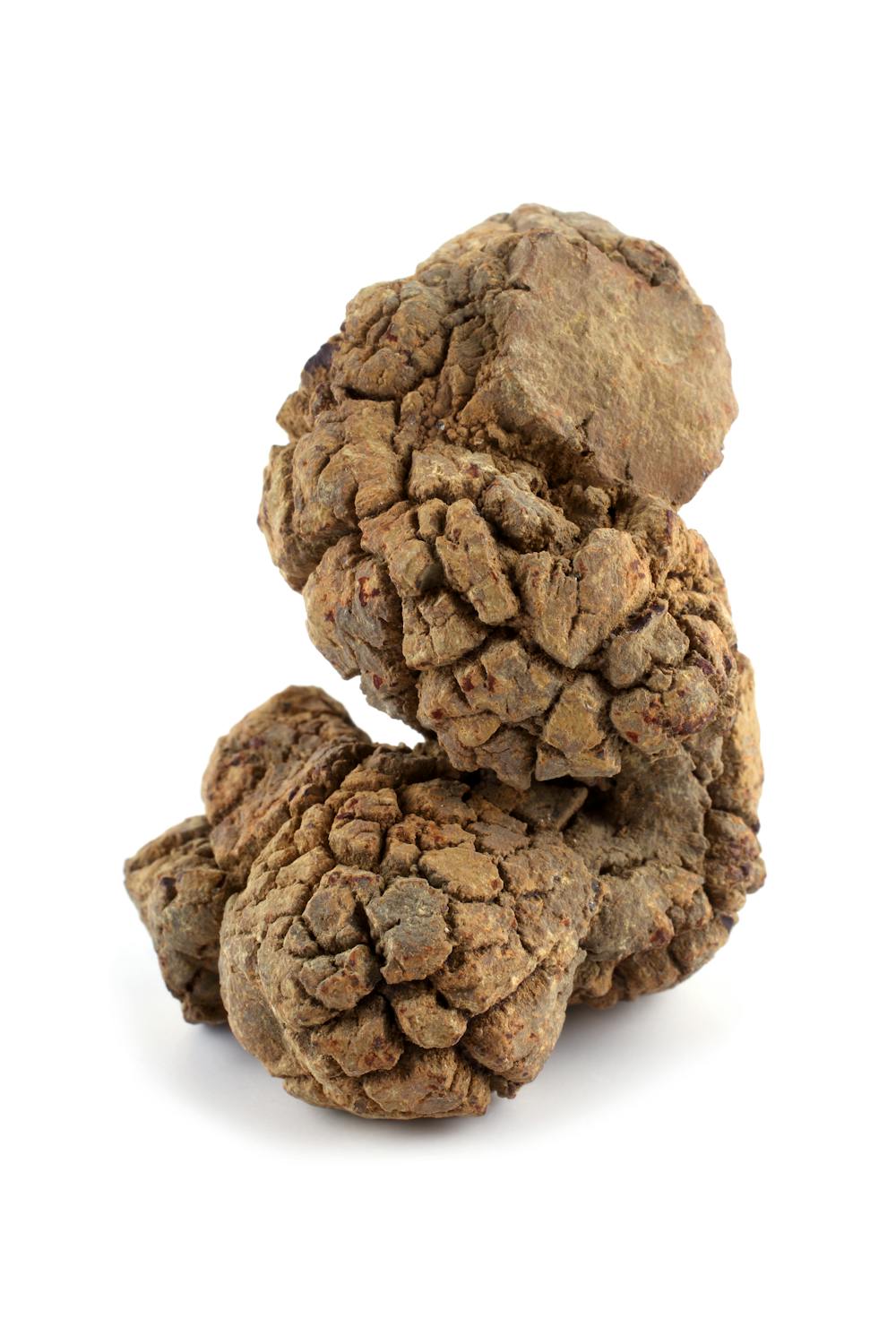
Dinosaur poo can become fossilised. This is called a coprolite.Shutterstock
But this definition doesn’t encompass the broader use of the word. Eggshells or coprolites (fossilised excrement) are neither direct remains nor the impression of an animal or plant, but archaeologists often refer to them as “fossils”.
The process of fossilisation can start immediately after an organism’s death, and the term “fossil” isn’t attached to a specific time period or state of preservation.
The term also relates to the perceived value, uniqueness or rareness of remains (and what they may reveal). Given such a breadth of meanings, it’s unsurprising attempts to regulate the status of fossils are fraught.
Hands off my fossil!
There was lively debate surrounding the 2015 discovery of Homo naledi in the Rising Star cave near Johannesburg, South Africa. The public’s access to the site and its fossils drew heavy criticism from researchers. This raised the question: should fossil discoveries be freely available?
The announcement of the discovery of Homo naledi fossils in 2015 in South Africa was met with mixed responses from the research community.GovernmentZA / Flickr, CC BY-ND
Generally, around the world a person who excavates a fossil is allowed to keep it. Not only that, they can conduct potentially destructive analyses on it, and grant scientific and public access to the information it reveals.
Such practices can generate “gentleman’s club” syndrome, wherein members of scientifically influential groups have a better chance of accessing important fossils. But despite being accepted practice in the field, the “finders keepers” approach is legally problematic.
Humans and human remains have a special status in most nations’ legal systems. While animals can be owned, humans can’t. Compounding this, the definition of “human” is itself contested, and this muddies the legal waters when it comes to discovering archaeological human remains.
For instance, recent DNA discoveries of interbreeding between Homo sapiens, Homo neanderthalensis and Denisovans – as well as the fact that Homo naledi and Homo floresensis existed at the same time as modern humans – indicates scientists struggle to reach a consensus on where the boundaries of “human” lie.
The definition of “human” can also be culturally ascribed. Many indigenous peoples including communities from Australasia and Africa recognise an ancestral connection to species not always classified as Homo sapiens.
So what should be done with the fossilised remains of extinct species that aren’t “human” in the sense of belonging to Homo sapiens, but are nevertheless our evolutionary ancestors?
Are human remains things to be owned?
In Australia, as in most common law systems, there can be no “property” in a human corpse. While both burial and exhumation are regulated, ownership of a corpse is not.
The export of “Class A” cultural heritage, which includes human remains, is prohibited under the Protection of Movable Cultural Heritage Act 1986. Also, Australian state legislation regulating the scientific use of human tissue (such as the NSW Human Tissue Act 1983) doesn’t require any consent for samples excavated before 2003.
On the other hand, Australia also has a national repatriation program for Indigenous cultural patrimony. This program seeks to restore stolen human remains and sacred objects to their original communities.
Cultural subjects
The tension between scientific interests and spiritual beliefs is apparent in the context of repatriating human remains to Indigenous communities.
While fossilised human remains hold significant scientific value, their symbolic and spiritual value can’t be ignored, particularly to communities that feel a connection to them. Human remains would be best described as both scientific objects and also cultural subjects.
Some scientists view repatriation and reburial of human remains as a deliberate destruction of a “source of information” that belongs to global humanity.
On the other hand, historical injustices and the imbalance of power between colonial entities and Indigenous people stand against such arguments. As a result, the repatriation and reburial of human remains becomes inseparable from broader legal arguments advanced by Indigenous peoples today.
Human, hominin and hominid fossils are far more than just objects to be owned. In fact, they reside at a contested and poorly regulated scientific, cultural and legal intersection.
We need common standards for ownership, protection and access controls. One solution would be to establish an international delegation with key stakeholders including scientists, lawyers, community representatives and policy makers.
Ideally, this could exist under the umbrella of the United Nations Educational, Scientific and Cultural Organisation (UNESCO). Such a body could foster constructive dialogue on how we value human fossils, and how we assign them ownership.
Protest has, by default, always been aligned with sound.
It is an action concerned with the amplification of a message – wanting to make sure it is heard.
Over the past 50 years, protesters’ voices have found power in unison. But activists and onlookers have increasingly been exposed to new sounds – many of which accompany “non-lethal” or “less lethal” weapons that aim to shatter rather than gather the crowd.
Call and response chants, common to street activism, are thought to have their origins in work songs. The Occupy Movement makes use of a technique dubbed the human microphone – to keep the crowd on-message. In urban environments, chants become further amplified as they bounce off buildings and hard surfaces.
John and Yoko make use of call and response and chanting in their iconic protest song.
Noise as weapon
Whizzing rubber bullets have been used since the 1970s, when they were deployed by the British in Northern Ireland during The Troubles. The hiss of tear gas, used for almost 100 years, is familiar to protesters and onlookers. But technologies introduced in the mid 1990s and developed since have radically reshaped the soundscape of protest.
The weaponisation of sounds is understandable. Our ears, unlike our eyes, have nothing stopping the entry of stimulus. As a sense, hearing is always available and thus vulnerable.
In the natural world, this is of little consequence, as there are few sounds loud enough to cause lasting damage to our hearing. But with industrialisation has come the capacity to produce sounds that exceed a volume we can hear without causing ourselves damage.
The first non-kinetic weapon widely used against protesters was introduced in North America in 1995. The M-84 stun grenade has also been used with increasing frequency by police agencies in North and South America, Europe, the UK and here in Australia.
Sonic booms, the hiss of tear gas. ‘Combat’ footage at the 2009 G-20 protests in Pittsburgh.
Colloquially know as a flash-bang, these devices are used to stun and temporarily disorient people in their blast radius. This disorientation is effected primarily by an enormous momentary output of sound and intense light. On detonation, the M-84 output a sound pressure level (SPL) of 170 decibels at two metres. That’s equivalent to a sound as loud as a space shuttle taking off.
The Long Range Acoustic Device (LRAD) and Medium Range Acoustic Device (MRAD) are even more intimidating. Described as “sound canons”, they are a hyperdirectional speaker, meaning they can direct a beam of sound between 30-60 degrees making it very focused and capable of targeting individuals or small groups of people with great accuracy.
How hypersonic sounds works and some measures that could save protestors’ hearing.
Powerful beats
New sonic weapons are always emerging, but still the chants of protestors can soar above. The simple sounds – the sonic equivalent of a sound byte – have a power of their own.
Voices, hands and feet can unite in a pulsing wave of sound to create an infectious and repeatable rhythm. Coordinated with physical movement and dance, to create an even more intensely unified sense of communal will.
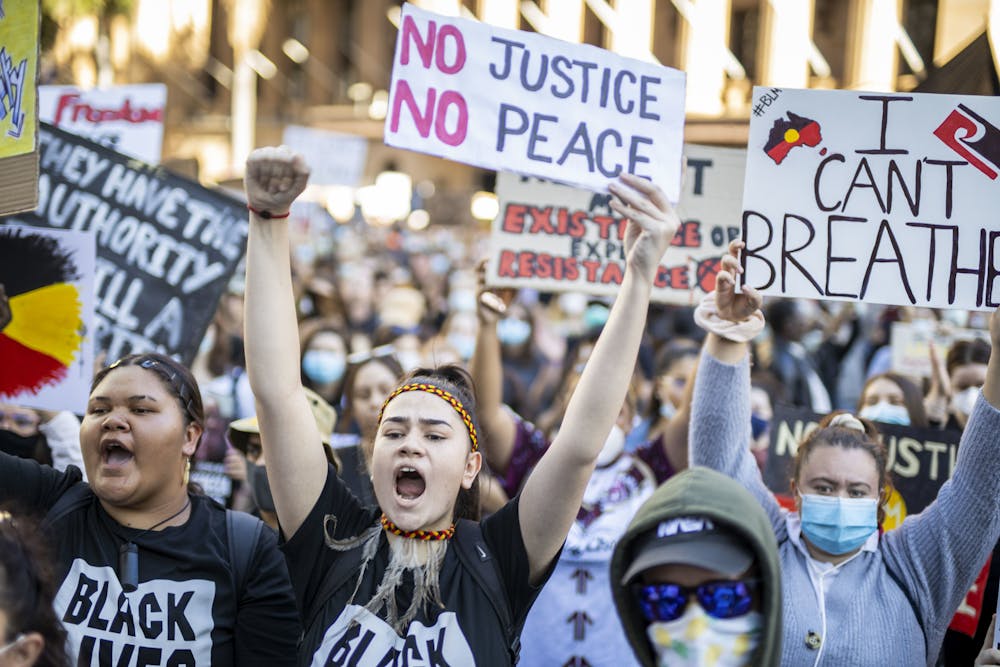
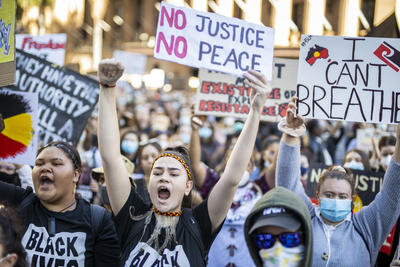
Over the past weekend, Australian protestors reportedly thumped their fists against their chests, creating a powerful collective heartbeat. The rhythm of the beat as it faded was a powerful wordless statement against the injustice of Indigenous deaths in custody. Silence, too, has an enduring protest legacy.
Voices together at Brisbane’s weekend protest.AAP/Glenn Hunt
It’s not just bodies that are used to create sounds of protest. In 1971, Chilean protestors famously turned to their kitchens into sonic tools, transforming casserole pots and other utensils into a sound state known as Cacerolazo. The tradition continues to resonate this decade in countries like Columbia and even Canada, where student protesters raised a nightly cacophony with banging pans.
More conventional objects like musical instruments, especially drums, continue to hold a central place in protest too. In Sydney this past weekend, Thirumeni Balamurugan beat a Parai drum to guide the crowd. The instrument is made from the skin of a dead calf and was once associated only with funerals. Now the once-forbidden Tamil drum is common at political rallies.
Though sound can be used as a weapon in modern protests, the sonic capacity of collected bodies on the street united in purpose and pulse remains powerful.
After Australia’s misguided attempts at handing over $17.1 of Australian-made television content to the Pacific region last month with programmes such as Neighbours andBorder Control, questions have been asked about a $10 million New Zealand grant made in 2018.
He said at the time that the plan would improve both the production of more Pacific content, including news and current affairs.
However, little was known of what became of Pasifika TV and today a MFAT spokesperson cleared the air.
“Pasifika TV was established to make New Zealand television content available to Pacific broadcasters,” she told Pacific Media Watch.
“In 2018, Pasifika TV moved from providing eight hours of content a day to become a standalone 24 hr TV channel, as announced by Minister of Foreign Affairs and Trade Winston Peters.
– Partner –
“This provided Pacific broadcasters the choice to recast it in its entirety alongside their own channels or select content to rebroadcast, reducing the operational demands on small broadcasters,” she explained.
As well as that developmental and skills training for staff in the Pacific was progressing at a steady pace.
“In addition, Pacific Cooperation Broadcasting Limited (PCBL) is providing training and development programmes for Pacific broadcasting staff and content creators to increase operational resilience and skills, including journalism, editing and broadcasting,” the spokesperson said.
“PCBL holds an annual regional conference for chief executives of associated broadcasters and has upgraded broadcasters’ decoders to enable high definition quality broadcasts and future online streaming.”
She also made clear what happened to the NZ Institute of Pacific Research (NZIPR) which was disestablished after an independent review in 2018 found it was not achieving its objectives.
“It has been replaced by ministry-commissioned policy-relevant research, focused on enduring or emerging issues facing the Pacific which align with the Ministry’s priorities.
“The research is published on the Pacific Data Hub, a digital repository of Pacific research knowledge hosted by the South Pacific Community (SPC).
While it’s become known colloquially as the Black Summer, last year’s fire season actually began in winter in parts of Queensland. The first fires were in June.
So will the 2020 fire season kick off this month? And is last summer’s inferno what we should expect as a normal fire season? The answer to both questions is no. Let’s look at why.
Last fire season
First, let’s recap what led to last year’s early start to the fire season, and why the bushfires became so intense and extensive.
The fires were so severe because they incorporated five energy sources. The most obvious is fuel: live and dead plant material.
The other sources bushfires get their energy from include the terrain, weather, atmospheric instability and a lack of moisture in the environment such as in soil, timber in houses and large woody debris.
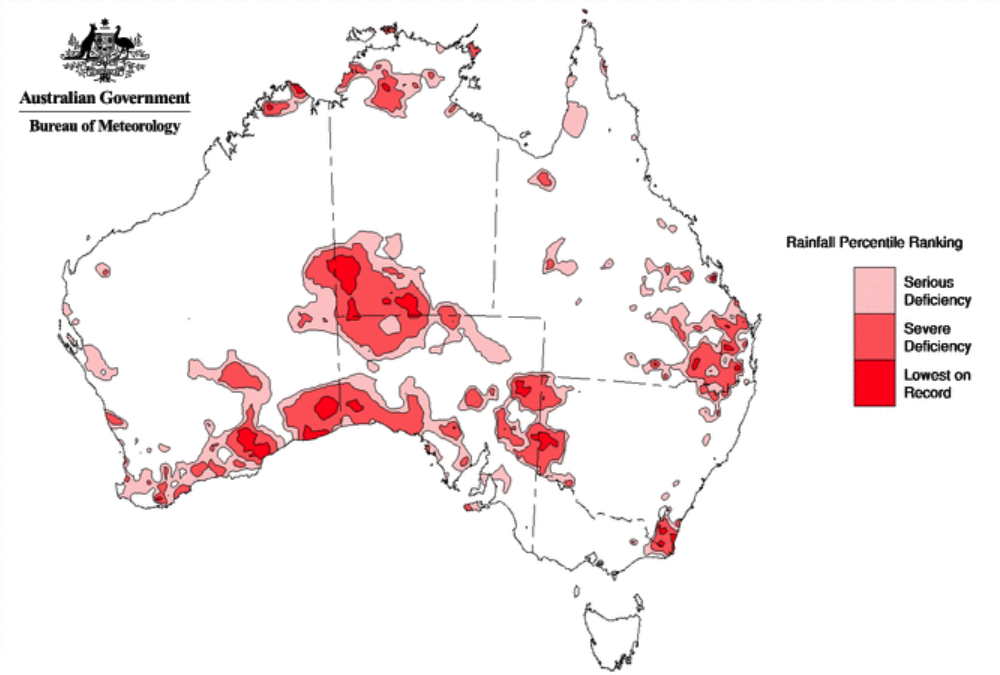
The June fires in Queensland resulted from a drought due to the lack of rain coming from the Indian Ocean. The drought combined with unusually hot dry winds from the north-west. By August the bushfires were burning all along the east coast of Australia and had become large and overwhelming.
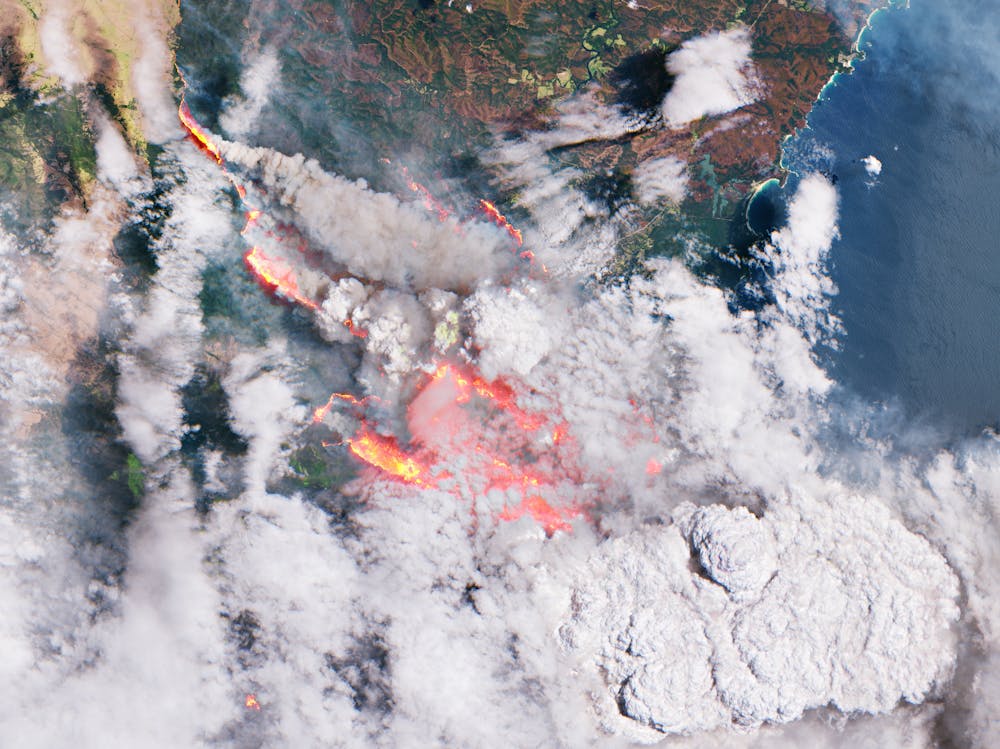
This European Space Agency image shows the fires already raging on Australia’s east coast by the end of December 2019.EPA/ESA
Ahead of the fire season, environmental moisture was the lowest ever recorded in much of eastern Australia. This was due to the Indian Ocean Dipole – the difference in sea surface temperature on either side of the ocean – which affects rainfall in Australia. The dipole was in positive mode, which brought drought. This meant the fire used less of its own energy to spread.
Fire weather conditions in south-eastern Australia were severe from August 2019 until March 2020. Temperatures reached record highs in places, relative humidity was low and winds were strong due to high-pressure systems tracking further north than normal.
High atmospheric instability, often associated with thunderstorms, enabled large fire plumes to develop as fires grew to several thousand hectares in size. This increased winds and dryness at ground level, rapidly escalating the damaging power and size of the fires.
Fuel levels were high because of the drying trend associated with climate change and a lack of low-intensity fires over the past couple of decades, which allowed fuel levels to build up.
What’s different now
Currently, at least two bushfire energy sources – fuels and drought – are at low levels.
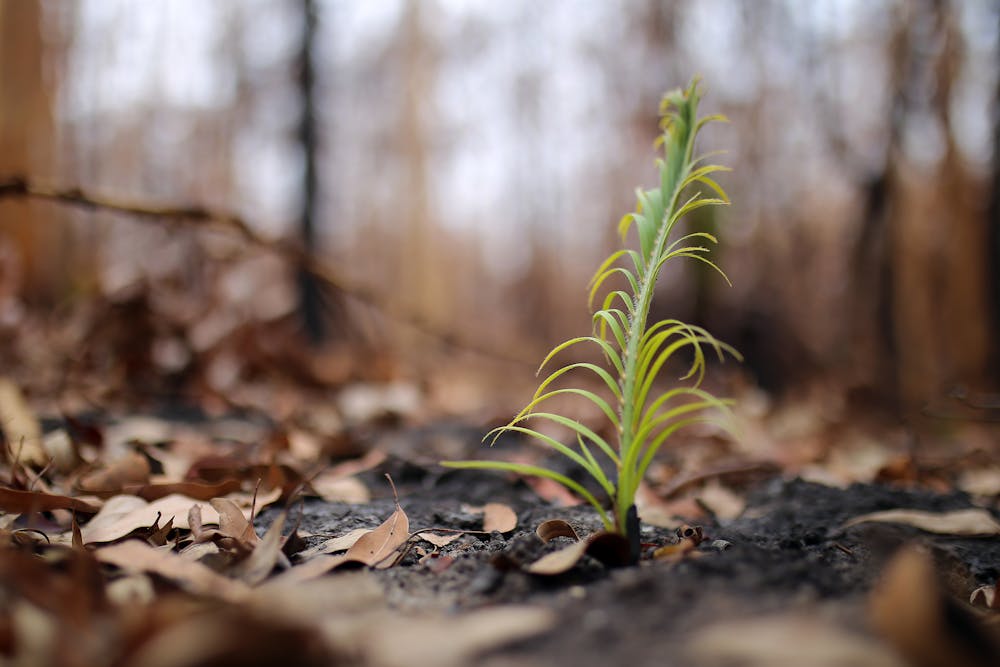
Fuels are low because last season’s fires burnt through large tracts of landscape and it will take five to ten years for them to redevelop. The build-up will start with leaf litter, twigs and bark.
In forested areas, the initial flush of regrowth in understorey and overstorey will be live and moist. Gradually, leaves will turn over and dead litter will start to build up.
But there is little chance of areas severely burnt in 2019-20 carrying an intense fire for at least five years.
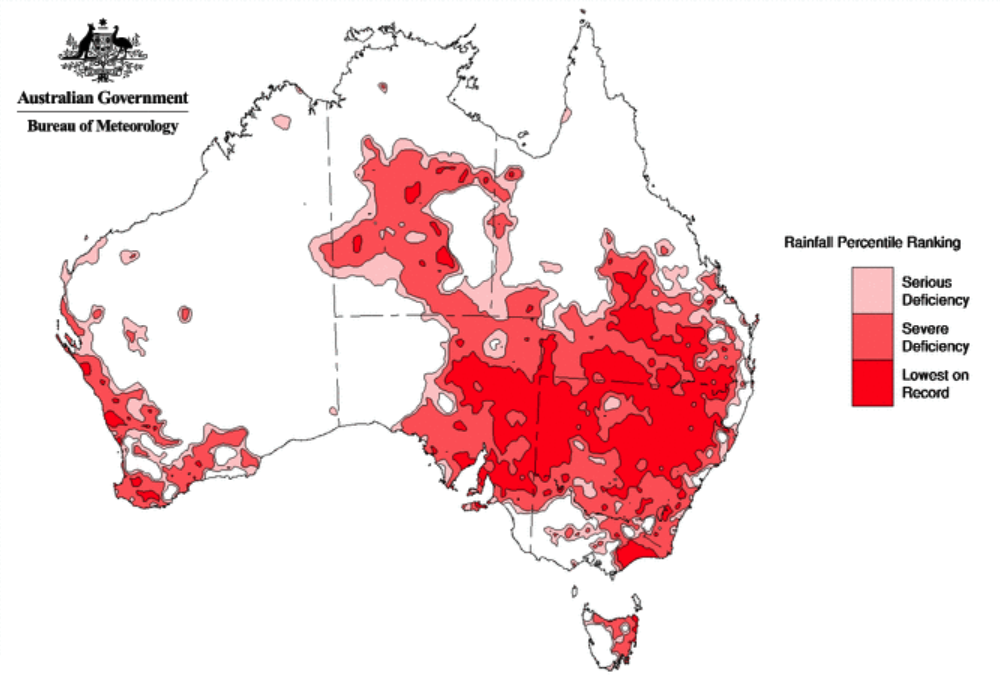
What’s also different this year to last is the moist conditions. Drought leading up to last fire season was severe (see below).
A change in weather patterns brought good rains to eastern Australia from late February to April.
A turning point?
It’s too early to say conclusively how the fire season will pan out in 2020-21. But moister conditions due to a neutral Indian Ocean Dipole and Southern Oscillation Index (which indicates the strength of any El Niño and La Niña events), the lack of fuel, and more normal weather patterns (known as a positive Southern Annular Mode) mean there is little prospect of an early start to the season.
Plants will regrow in bushfire-damaged areas but the fuel load will be low for several years.AAP Image/Steven Saphore
The likelihood of severe bushfires in south-east Australia later in the year and over summer is much reduced. This doesn’t mean there won’t be bushfires. But they’re not likely to be as extensive and severe as last fire season.
The reduced bushfire risk is likely to persist for the next three to five years.
But, in the longer term, climate change means severe fire seasons are becoming more frequent. If we simply try to suppress these fires, we will fail. We need a concerted effort to manage the bushfire risk. This should involve carefully planned and implemented prescribed fires, as well as planning and preparing for bushfires.
These inquiries must lead to change. We have a short window of opportunity to start managing fires in the landscape more sustainably. If we don’t, in a decade’s time we may see the Black Summer repeat itself.
To paraphrase Winston Churchill, it is curious to see The Warehouse Group (TWG) not letting a good crisis go to waste.
Despite recently receiving NZ$68 million in government wage subsidies as a result of the COVID-19 lockdown, TWG has now proposed store closures and more than 1000 staff layoffs across its Warehouse, Noel Leeming and Warehouse Stationery brands.
While it is laudable to see TWG CEO Nick Grayston fronting as spokesperson for the move, it is disappointing to see management-speak alive and well in his explanations – “agile principles” and changes to their “footprint” to “improve productivity” in an “uncertain environment”.
While it lends a kind of credibility to strategic manoeuvring, this type of jargon is often used to detract from the negative impact of business restructuring on people and communities.
Following in the steps of Walmart
The Warehouse has an interesting history in New Zealand. Founded by Sir Stephen Tindall in 1982, it attempted to replicate the business model and operating style of the giant American retailer Walmart.
Much like Walmart’s original move into smaller towns in the USA, the arrival of The Warehouse and other big box stores demolished the economic viability of numerous family-owned enterprises in New Zealand. This was especially felt in the kinds of small towns where store closures are currently being proposed.
Nevertheless, like its founder, TWG has a long history of prioritising people, communities and the environment, reflected in the group’s motto of “helping Kiwis live better every day”.
Indeed, following the introduction of the living wage movement in 2013, then-TWG CEO Mark Powell announced his intention to introduce a “career retailer wage”. This aimed to both pay a living wage and lift the profile of working in retail as a long-term career option.
It wasn’t until late 2019, however, that current Chief Operating Officer Pejman Okhovat confirmed the company was acquiescing to union demands for wide-scale adoption of the living wage.
Okhovat said the move recognised the importance of the company’s employees to the success of the brand, and the well-being of communities in which the stores were located.
Warehouse Stationery, part of TWG’s stable of retail brands, is also affected by the store closures and staff cuts.www.shutterstock.com
‘Helping Kiwis live better every day’
Unfortunately, these fundamental company priorities seem to have been undermined by the latest move by TWG to lay off staff and close some stores at an incredibly challenging time – particularly in centres where there are few other retail options or employment opportunities.
Such a move raises the wider question of the purpose of business and its responsibilities to wider stakeholder groups, not least in times of uncertainty. While CEO Grayston stresses a need for increased productivity and adaptability, in essence the proposed plan undermines the core brand promise of “helping Kiwis live better every day”.
As long ago as 2011, social impact consultant Mark Kramer and Harvard strategy professor Michael Porter described the need for business to adopt shared value creation as a key to success. Their proposal followed the fallout from the global financial crisis, and the reputational damage suffered by so many businesses at the time.
By creating shared value a business doesn’t just prioritise the financial outcomes of its operations, but also social outcomes as measures of performance. To do so, managers are required to recognise the broad array of stakeholders that enable their firm’s ongoing success.
What is the purpose of business anyway?
It is logical that a firm performs best when its workforce is highly skilled and happy, when the local community is not suffering economic distress, and natural resources are sustainably managed to guarantee reliable supply chains.
Walmart has been extremely successful in the past by adopting a shared value creation approach to its business operations. Initiatives have included modifying product ranges to deliberately include healthier foods in under-served communities; introducing in-store health clinics and low-cost pharmaceuticals; and promoting small businesses owned by women on their e-commerce platform.
None of this is news to TWG. In recent years, TWG’s annual reports have adopted integrated reporting that details numerous outcomes beyond the financial, including environmental capital, relationship capital with suppliers and manufacturers, and the human capital present in employees, their knowledge and expertise.
So it’s disconcerting to see TWG pushing ahead with major changes that conflict not only with their own values, but with the broader needs of New Zealand and its local communities at this time.
Shareholder value is obviously important for the ongoing viability of a business. But one has to ask whether retaining a broader focus on overall community well-being might pay better dividends in the long run for this important New Zealand brand.
Professor Prasad said a warrant was provided, but he was not sure what exactly the raid was in relation to.
“We don’t really know what this is about,” he said.
– Partner –
Professor Prasad said the officers said they were looking for documents relating to the party’s social media posts, and possible payments regarding them.
“We don’t pay people to do our media,” he said, adding the party was weighing its next options.
With the Sodelpa party suspended, the NFP and its three MPs are the only opposition still in the Fiji Parliament.
INDEPTH:By Guyon Espiner, RNZ News investigative reporter, with contributor John Daniell
New Zealand has lost some of its independence within the Five Eyes intelligence alliance and been “drawn in a lot closer” to the US-led spy network, former Prime Minister Helen Clark says.
She made the comments in new RNZ podcast The Service, which looks at the SIS during the Cold War.
Sir Geoffrey Palmer, who was deputy prime minister and then prime minister in the fourth Labour government, between 1984 and 1990, also spoke to the podcast about the Five Eyes, saying for New Zealand there was “always a feeling that we have to earn our stripes”.
“I remember doing things that the Americans wanted done on one occasion. I don’t think I can give the details of it. But it was quite important to them. And we facilitated it, and it was done.”
He also revealed that during the mid-1980s one of the Five Eyes partners knew more than most New Zealand Cabinet ministers about intelligence gathering by the Government Communications Security Bureau (GCSB).
– Partner –
When then-Australian Defence Minister Kim Beazley visited, he wanted to thank New Zealand Cabinet ministers for establishing the GCSB listening post at Waihopai, near Blenheim.
“I said, ‘Kim, you can’t do that. They don’t know anything about it.’ Only three ministers knew about that; the minister of defence, the prime minister and me,” Palmer said.
Clark said she believed the Five Eyes alliance was a net benefit for New Zealand, but it was vital that the country maintained its independence within the network.
“I think you’re as independent as you want to be. I consider we were independent in my time. I sense there’s been a bit of slippage since then, frankly.”
Clark said “sources in officialdom” had told her New Zealand had “got a lot closer back in” and that could threaten the country’s independent foreign policy, which went right back to the nuclear-free stance of the mid-1980s.
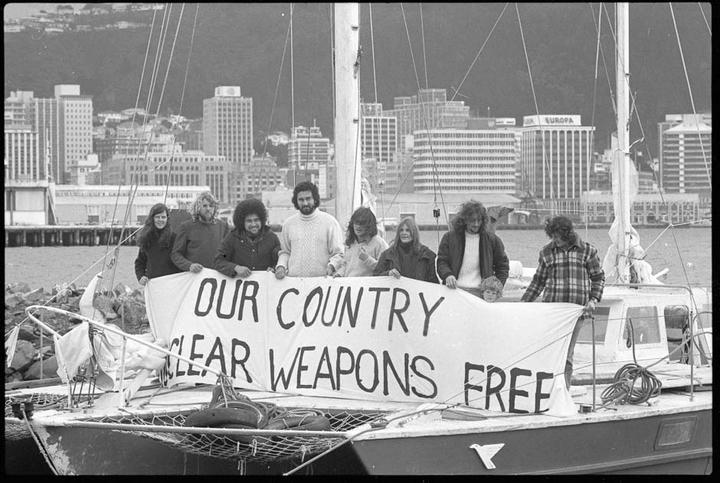
The nuclear-free law, which stopped port visits from US ships and saw New Zealand fall out of the ANZUS security pact, sparked the suspension of military exercises between the two countries.
New Zealanders protested against US nuclear ships in the 1980s before the fourth Labour government banned them. Image: Alexander Turnbull Library/Evening Post
But while the US and New Zealand parted ways on a political level – the relationship was downgraded from allies to friends – the flow of intelligence continued, according to Sir Bruce Ferguson, a former chief of Defence Force who went on to head the GCSB.
“I got everything I wanted. Right from when I became CDF, if I asked the questions, particularly with reference to Afghanistan, we got the answers, we got the intelligence,” he told The Service.
“There were definitely two levels: there was the political level … and the worker bee level. That was us – the intelligence side.”
Sir Bruce said he was plucked from obscurity to study at a US war college at the height of the anti-nuclear row. After he became GCSB director, he developed close relationships with Five Eyes spy chiefs, even playing golf “many times” with the heads of the NSA, CIA and FBI.
“We had very good, very strong relationships with all the personnel at the top. It was a very personal relationship, actually, with dinner at private houses. I would always be invited to their private houses for dinner with their families.”
As GCSB director, Sir Bruce Ferguson played golf with the heads of the NSA, CIA and FBI. Image: Andrew Burns/RNZ
Sir Bruce acknowledged there were often complaints – even from ‘friendly’ countries – about Five Eyes tactics, such as allegations that the NSA had hacked German Chancellor Angela Merkel’s phone.
“All those complaints are public knowledge. And that’s the way of the world. Yes, anyone’s fair game if it’s in your own national interests to look at them. And that could be for economic reasons, or whatever,” he said.
“There’s one very strong club: The Five Eyes. It’s jealously guarded. It’s looked on very enviously by probably every other western nation.”
He said people might ask why this group of five English-speaking countries was special or unique. “Well, they are unique. End of story. And we should safeguard that.”
Security expert Paul Buchanan … “It’s made us a target.” Image: Paul Buchanan/RNZ
Security expert Paul Buchanan, a former intelligence analyst for US security agencies, told The Service there were benefits to New Zealand but the downsides to Five Eyes should also be acknowledged.
“It’s made us a target,” he said. “Even though many people here may not think that, we’re squarely in the crosshairs of the intelligence services of adversaries of the UK, the United States, the whole Western alliance structure – we are.”
Because the bonds were so tight, and the eavesdropping equipment and methods so sensitive, Buchanan doubted New Zealand could extricate itself from the alliance, even if it wanted to.
“Trying to get out of the Five Eyes is – how can I put it? – it’s like trying to get out of the mafia.”
The Service was made with the support of New Zealand on Air.
More from this series
This article is republished by the Pacific Media Centre under a partnership agreement with RNZ.
“They build dams and kill people.” These words, spoken by a witness when the murderers of environmental defender Berta Cáceres were brought to trial in Honduras, describe Desarrollos Energéticos SA (DESA), the company whose dam project Berta opposed. DESA was created in May 2009 solely to build the Agua Zarca hydroelectric scheme, using the waters of the Gualcarque River, regarded as sacred by the Lenca communities who live on its banks. As Nina Lakhani makes clear in her book Who Killed Berta Cáceres?,[1] DESA was one of many companies to benefit from the 2009 coup d’état in Honduras, when the left-leaning President Manuel Zelaya was deposed and replaced by a sequence of corrupt administrations. The president of DESA and its head of security were both US-trained former Honduran military officers, schooled in counterinsurgency. By 2010, despite having no track record of building dams, DESA had already obtained the permits it needed to produce and sell electricity, and by 2011, with no local consultation, it had received its environmental licence.
Much of Honduras’s corruption derives from the drug trade, leading last year to being labelled a narco-state[2] in which (according to the prosecution in a US court case against the current president’s brother) drug traffickers “infiltrated the Honduran government and they controlled it.”[3] But equally devastating for many rural communities has been the government’s embrace of extractivism – an economic model that sees the future of countries like Honduras (and the future wealth of their elites) in the plundering and export of its natural resources.[4] Mega-projects that produce energy, mine gold and other minerals, or convert forests to palm-oil plantations, are being opposed by activists who, like Cáceres, have been killed or are under threat. Lakhani quotes a high-ranking judge she spoke to, sacked for denouncing the 2009 coup, as saying that Zelaya was deposed precisely because he stood in the way of this economic model and the roll-out of extractive industries that it required.
The coup “unleashed a tsunami of environmentally destructive ‘development’ projects as the new regime set about seizing resource-rich territories.”[5] After the post-coup elections, the then president Porfirio Lobo declared Honduras open for business, aiming to “relaunch Honduras as the most attractive investment destination in Latin America.” [6] Over eight years, almost 200 mining projects were approved. Cáceres received a leaked list of rivers, including the Gualcarque, that were to be secretly “sold off” to produce hydroelectricity. The Honduran congress went on to approve dozens of such projects without any consultation with affected communities. Berta’s campaign to defend the rivers began on July 26, 2011 when she led the Lenca-based COPINH (“Council of Popular and Indigenous Organizations of Honduras”) in a march on the presidential palace. As a result, Lobo met Cáceres and promised there would be consultations before projects began – a promise he never kept.
Lakhani’s book gives us an insight into the personal history that brought Berta Cáceres to this point. She came from a family of political activists. As a teenager she read books on Marxism and the Cuban revolution. But Honduras is unlike its three neighbouring countries where there were strong revolutionary movements in the 1970s and 1980s. The US had already been granted free rein in Honduras in exchange for “dollars, training in torture-based interrogation methods, and silence.”[7] It was a country the US could count on, having used it in the 1980s as the base for its “Contra” war against the Sandinista government in Nicaragua. Its elite governing class, dominated by rich families from Eastern Europe and the Middle East, was also unusual. One, the Atala Zablah family, became the financial backers of the dam; others, such as Miguel Facussé Barjum, with his palm oil plantations in the Bajo Aguán, backed other exploitative projects.
At the age of only 18, looking for political inspiration and action, Berta left Honduras and went with her future husband Salvador Zúñiga to neighbouring El Salvador. She joined the FMLN guerrilla movement and spent months fighting against the US-supported right-wing government. Zúñiga describes her as having been “strong and fearless” even when the unit they were in came under attack. But in an important sense, her strong political convictions were tempered by the fighting: she resolved that “whatever we did in Honduras, it would be without guns.”[8]
Inspired also by the Zapatista struggle in Mexico and by Guatemala’s feminist leader Rigoberta Menchú, Berta and Salvador created COPINH in 1993 to demand indigenous rights for the Lenca people, organising their first march on the capital Tegucigalpa in 1994. From this point Berta began to learn of the experiences of Honduras’s other indigenous groups, especially the Garífuna on its northern coast, and saw how they fitted within a pattern repeated across Latin America. As Lakhani says, “she always understood local struggles in political and geopolitical terms.”[9] By 2001 she was speaking at international conferences challenging the neo-liberal economic model, basing her arguments on the exploitation experienced by the Honduran communities she now knew well. She warned of an impending “death sentence” for the Lenca people, tragically foreseeing the fate of herself and other Lenca leaders. Mexican activist Gustavo Castro, later to be targeted alongside her, said “Berta helped make Honduras visible. Until then, its social movement, political struggles and resistance were largely unknown to the rest of the region.”[10]
In Río Blanco, where the Lenca community voted 401 to 7 against the dam, COPINH’s struggle continued. By 2013, the community seemed close to winning, at the cost of activists being killed or injured by soldiers guarding the construction. They had blocked the access road to the site for a whole year and the Chinese engineering firm had given up its contract. The World Bank allegedly pulled its funding, although Lakhani shows that its money later went back into the project via a bank owned by the Atala Faraj family. In April 2015 Berta was awarded the Goldman Prize[11] for her “grassroots campaign that successfully pressured the world’s largest dam builder to pull out of the Agua Zarca Dam.”[12]
Then in July 2015, DESA decided to go ahead by itself. Peaceful protests were met by violent repression and bulldozers demolished settlements. Threats against the leaders, and Berta in particular, increased. Protective measures granted to her by the Inter-American Commission for Human Rights were never properly implemented. On February 20 2016, a peaceful march was stopped and 100 protesters were detained by DESA guards. On February 25, 50 families had to watch the demolition of their houses in the community of La Jarcia.
The horrific events on the night of Wednesday March 2 are retold by Nina Lakhani. Armed men burst through the back door of Berta’s house and shot her. They also injured Gustavo Castro, who was visiting Berta; he waited until the men had left, found her, and she died in his arms. Early the following morning, police and army officers arrived, dealing aggressively with the family and community members who were waiting to speak to them. Attempted robbery, a jilted lover and rivalry within COPINH were all considered as motives for the crime. Eventually, investigators turned their attention to those who had threatened to kill her in the preceding months. By the first anniversary of Berta’s death the stuttering investigation had led to eight arrests, but the people who ordered the murder were still enjoying impunity. Some of the accused were connected to the military, which was not surprising since Lakhani later revealed in a report for The Guardian that she had uncovered a military hit list with Berta’s name on it.[13] In the book she reports that the ex-soldier who told her about it is still in hiding: he had seen not only the list but also one of the secret torture centers maintained by the military.
Nina Lakhani is a brave reporter. She had to be. Since the coup in Honduras, 83 journalists have been killed; 21 were thrown in prison during the period when Lakhani was writing her book.[14] She poses the question “would we ever know who killed Berta Cáceres?” and sets out to answer it. Despite her diligent and often risky investigation, she can only give a partial answer. Those arrested and since convicted almost certainly include the hitmen who carried out the murder, but it is far from the clear that the intellectual authors of the crime have been caught. In 2017 Lakhani interviewed or attempted to interview all eight of those imprisoned and awaiting trial, casting a sometimes-sympathetic light on their likely involvement and why they took part.
It took almost two years before one of the crime’s likely instigators, David Castillo, the president of DESA, was arrested. Lakhani heads back to prison to interview him, too, and finds that Castillo disquietingly thinks she is the reason he’s in prison. “There is no way I am ever sitting down to talk to her,” he says to the guard.[15] Nevertheless they talk, with Castillo both denying his involvement in the murder and accusing Lakhani of implicating him. Afterwards she takes “a big breath” and writes down what he’s said.
In September 2018, the murder case finally went to trial, and Lakhani is at court to hear it, but the hearing is suspended. On the same day she starts to receive threats, reported in London’s Press Gazette[16] and duly receiving international attention. Not surprisingly she sees this as an attempt to intimidate her into not covering the trial. Nevertheless, when it reopens on October 25, she is there.
The trial reveals a weird mix of diligent police work and careful forensic evidence, together with the investigation’s obvious gaps. Not the least of these was the absence of Gustavo Castro, the only witness, whose return to Honduras was obstructed by the attorney general’s office. Castillo, though by then charged with masterminding the murder, was not part of the trial. Most of the evidence was not made public or even revealed to the accused. The Cáceres family’s lawyers were denied a part in the trial.
“The who did what, why and how was missing,” says Lakhani, “until we got the phone evidence which was the game changer.”[17] The phone evidence benefitted from an expert witness who explained in detail how it implicated the accused. She revealed that an earlier plan to carry out the murder in February was postponed. She showed the positions of the accused on the night in the following month when Berta was killed. She also made clear that members of the Atala family were involved.
When the verdict was delivered on November 29 2018, seven of the eight accused were found guilty, but it wasn’t until December 2019 that they were given long sentences. That’s where Nina Lakhani’s story ends. By then Honduras had endured a fraudulent election, its president’s brother had been found guilty of drug running in the US, and tens of thousands of Hondurans were heading north in migrant caravans. David Castillo hasn’t yet been brought to trial, and last year was accused by the School of Americas Watch of involvement in a wider range of crimes.[18] Lakhani revealed in The Guardian that he owns a luxury home in Texas.[19] He’s in preventative detention, but according to COPINH enjoys “VIP” conditions and may well be released because of the COVID-19 pandemic. Two of those already imprisoned may also be released. Daniel Atala Midence, accused by COPINH of being a key intellectual author of the crime as DESA’s chief financial officer, has never been indicted.[20]
The Agua Zarca dam project has not been officially cancelled although DESA’s phone number and email address are no longer in service.[21] Other environmentally disastrous projects continue to face opposition by COPINH and its sister organisations representing different Honduran communities. And a full answer to the question “Who Killed Berta Cáceres?” is still awaited.
End notes
[1] Lakhani, N. (2020) Who Killed Berta Cáceres? Dams, Death Squads, and an Indigenous Defender’s Battle for the Planet. London: Verso.
This is the first question Prime Minister Scott Morrison should have asked himself when US President Donald Trump invited him to join an expanded G7 gathering at Camp David in September.
The invitation came directly to Morrison in a phone call from Trump on June 2.
This was a week after the death of George Floyd in Minneapolis. In that week, American misgivings about the direction in which their country was heading crystallised in Black Lives Matter demonstrations across the United States. They are still going.
Not since the civil rights movement and the death of Martin Luther King in the 1960s has the United States witnessed such widespread civil unrest. This is a country divided against itself, with a president who seems unwilling or unable to find the words or actions to address his country’s divisions.
This forms the background to an invitation to Morrison to attend an event that, on the face of it, is not designed to rally Western democracies dealing with the economic fallout from the coronavirus pandemic.
Rather, a G7+ gathering would be aimed at providing an embattled president with a photo opportunity in the middle of what promises to be one of the most bitter presidential election contests in American history.
In other words, Morrison would be a prop in a wider political game.
Trump has also made no secret of his plans to turn an expanded G7 into a vehicle to criticise China as part of a re-election strategy that involves demonising Beijing.
Scott Morrison attended the 2019 G7 Summit in Biarritz, France.AAP/EPA/Ian Langsdon
There are many reasons to criticise China, but a Camp David pile-on is the last thing Morrison needs to associate himself with given the tenuous state of Sino-Australian relations.
Morrison would be wise to pay attention to criticisms voiced by a clutch of respected American retired generals. These include James Mattis, who resigned as defence secretary after Trump capriciously abandoned Kurdish allies in northern Syria.
The background to a Trump-convened G7+ summit
The gathering would comprise the original G7 members – United States, United Kingdom, Germany, France, Canada, Italy and Japan – plus India, South Korea and Australia.
It should also go without saying that a Russian presence at Camp David would be highly provocative domestically in America on the eve of an election, given sensitivities over alleged Russian interference in the 2016 poll.
All things being equal, there would be legitimate arguments for convening an expanded G7 during a global economic meltdown in the wake of a pandemic.
Such a gathering might also consider shifts in a global power balance occasioned by China’s rise. This is a pressing issue.
However, things are far from equal. Risks outweigh potential rewards.
Given the anti-China bombast emanating from Washington, it would be hard to envisage Camp David arriving at a constructive approach removed from Trump’s crude politicking.
Typical of the sort of rhetoric Trump has indulged in recently is an outburst on May 29 in which he said China had “ripped off” the United States, “raiding our factories” and “gutting” American industry.
Crude attempts by America to promote a G7+ front against China would be particularly awkward for participants like South Korea and Japan.
South Korea is geographically vulnerable to Chinese pressure, given the unstable security environment in which it finds itself on the Korean Peninsula. South Korea’s companies are significant investors in China. Trade between the two countries is strongly in Seoul’s favor.
Japan under Shinzo Abe has been seeking to improve relations with Beijing. Abe would not want those diplomatic efforts to unravel at a Trump-inspired Camp David three-ring circus in which China feels ganged up on.
China’s Xi Jinping had been scheduled to visit Japan this year as part of a warming process. That important mission now looks as if it will be postponed.
Risks for Australia
Like South Korea and Japan, Australia risks giving unnecessary and additional offence to China, to its detriment.
Morrison has already been the recipient of a lesson in Chinese realpolitik in which Australia was made vulnerable by taking the lead in efforts to hold China to account for the coronavirus.
The prime minister’s decision to spearhead efforts to convene an independent inquiry into China’s culpability produced a ferocious push-back from Beijing.
Morrison’s wiser course would have been to join like-minded countries in efforts to get to the bottom of the origins of the virus. This would include the respective roles of the World Health Organisation and China itself.
Instead, he blundered into a thicket of international diplomacy. This has drawn reprisals from Beijing in the form of restrictions on imports of Australian commodities accompanied by inflammatory rhetoric directed at Canberra.
Participation in a Camp David pile-on – if that were to happen – would further inflame this rhetoric and might well lead to additional economic reprisals.
An interesting historical footnote to Trump’s invitation to Australia to attend a G7+ is that Australia diplomacy has, in the past, sought membership of the global grouping of like-minded Western democracies.
This was a pet project of former prime minister Malcolm Fraser. He was frustrated, as it turned out, by American opposition on grounds that opening the doors would encourage lobbying by others to be included.
In 1979, Japan advanced Australia’s case.
To be clear, Australia is not being asked on this occasion to join the G7. Along with Japan, South Korea and India, it is being invited to participate.
This is a similar situation to last year when France’s Emmanuel Macron, in his role as convener, invited Morrison to attend the Paris G7.
It is also uncertain whether the Camp David event will go ahead at all, given uncertainties that prevail in the world on many different fronts. Will Trump be in a position to convene such a gathering if America remains in turmoil?
Finally, there’s the issue of where an expanded G7 leaves bodies like the G20 and the Asia-Pacific Economic Cooperation (APEC) forum.
In these latest circumstances, in which the world is facing economic and other challenges not witnessed in a generation, it would make sense to convene a G20 – as was done in 2008 to combat the Global Financial Crisis – whose membership includes both China and Russia.
In the end, what’s in it for Australia? Diplomatic risks are emphatically to the downside.
Source: The Conversation (Au and NZ) – By Divna Haslam, Senior Research Fellow (Faculty of Law/ Health) & Clinical Psychologist, Queensland University of Technology
Parents have many things to worry about. It’s easy to stick our heads in the sand and assume bad things – like sexual abuse – won’t happen to our kids.
The risks are especially high at the moment, as we spend more time on devices during the pandemic lockdown.
For example, recent media reports have warned about Zoom calls being hijacked by offenders showing child abuse material.
This article, based on our work as parenting and maltreatment experts, looks at how parents can protect their children from online sexual abuse.
In a separate piece, we also look at how to protect kids from in-person sexual abuse.
How common is online sexual abuse?
Online sexual abuse occurs across many platforms including social media, text messaging, websites, various apps, such as WhatsApp and Snapchat and the dark web.
Very broadly, it includes asking a child to send sexual content, a person sending your child sexual content, “sextortion” (coercing or manipulating children for sexual gain), and viewing, creating or sharing child exploitation/ abuse material (sometimes inappropriately referred to as “child pornography”).
A 2018 survey of more than 2,000 children in the United Kingdom found one in seven children had been asked to send sexual information. And one in 25 primary school children (that’s roughly one in every class) had been sent or shown a naked or semi-naked picture or video by an adult.
Who are the abusers?
Online abusers are most likely to be Caucasian males who are attracted to prepubescent children.
They differ from in-person abusers in that they are less likely to have easy physical access to children, have higher internet use, higher levels of education, and are less likely to have a criminal history. However, some people abuse children both online and in person.
Importantly, some online sexual abuse is also committed by other adolescents under the age of 18, creating and sharing sexual images.
Research estimates 16% of Australian children between 10 and 19 receive “sexts” – sexually explicit or sexually suggestive texts or images via phone or internet – and 10% send them.
Some image sharing occurs in genuinely consensual peer relationships, and this is generally not abusive. However, any coercion to share sexual content constitutes abuse.
Which children are most at risk?
Children with poor psychological health, poor relationships with their parents, low self-esteem, and those who have been exposed to other forms of abuse, are more at risk of online sexual abuse.
Age-wise, girls aged 11 to 15 are at the highest risk for child exploitation, although it also happens to very young children.
Tips for protecting your child
Here are some practical steps you can take to minimise the risks facing your child online and to help them safely navigate online challenges.
These are based on known patterns of online abuse and identified factors that place children at greater or lesser risk.
Take care with photos. Consider who you allow to take photos of your children and where you share photos to ensure they don’t get misused.
Talk openly to children and teens about sex so they don’t seek out advice or information online from individuals. Children who are knowledgeable may be less likely to be targeted. In particular, talk about consent, and what is consensual behaviour between kids, and what is not.
Talk with teens about the safe sharing of images. This includes the risks associated with sharing photos of themselves in provocative poses or in revealing clothing. This conversation should start early and get more developed as your child grows up. A lot of child exploitation material is taken by teens or by people known to the children then shared more widely.
Be interested in the online lives of your children and know their online friends. Do this routinely, just as you do with their real-life friends. Be attentive to changes or special friends. Keep these conversations going. Listen to their experiences.
Encourage attendance at school-based prevention programs. And then talk with your kids about what they’ve learned to reinforce the messages or answer any questions.
Talk with your kids about how to respond to sexual innuendo or unwanted advances and when to tell an adult. Start by asking kids for examples of sexual innuendo and the types of things people might say online. Then brainstorm ways the best ways to respond. For example, teens could withdraw from conversations or block acquaintances. Or say something like “I’m not into that kind of chat” or say “No thanks, not interested” to any invitations or requests.
Talk with teens about online safety. This includes restricting who can view or reshare posts. You may need to upskill yourself first.
Know what your child is doing online. Monitor their online behaviour, rather than relying only on software controls, which are less effective.
Keep the computer in a communal area. Ensure their computer use occurs in communal areas of the home and restrict kids’ access to mobiles at night. If possible, do this from an early age and make it routine, so teens don’t get the message you don’t trust them.
Build your child’s esteem and confidence. Children with low self-esteem are more susceptible to online grooming designed to make children feel special.
Meet your own needs. Children are at greater risk of abuse when parents are struggling with their own mental health or substance issues. If you need help get support or talk to your doctor.
If you believe your child is the victim of grooming or exploitation, or you come across exploitation material, you can report it via ThinkuKnow or contact your local police.
If you are a child, teen or young adult who needs help and support, call the Kids Helpline on 1800 55 1800.
If you are an adult who experienced abuse as a child, call the Blue Knot Helpline on 1300 657 380 or visit their website.
Source: The Conversation (Au and NZ) – By Divna Haslam, Senior Research Fellow (Faculty of Law/ Health) & Clinical Psychologist, Queensland University of Technology
We know it can seem easier to bury your head in the sand, when it comes to the hideous issue of child sexual abuse.
We are researchers in the prevention of child abuse, working across psychology, education and law.
In a separate article, we have looked at how parents can protect their children from online sexual abuse.
This article looks at how to protect kids from in-person sexual abuse.
How common is in-person sexual abuse?
In-person, child sexual abuse is defined as any sexual act, done to a child (under 18 years old) where true consent is absent and where the act constitutes misuse or taking advantage of the child.
This includes with touch and without it (flashing, voyeurism, or masturbating in front of children).
It can occur anywhere a perpetrator has access to children and privacy, such as in homes, schools and sporting complexes.
No fully representative Australian study exist yet, so it is difficult to know just how many Australian children are abused. However, a 2010 Victorian study found 7% of boys and 17% of girls are victims of some type of sexual abuse.
Most abusers are not strangers. According to the Australian Bureau of Statistics, 86% of victims knew their abuser.
Perpetrators can include family friends, teachers, coaches, neighbours, parents, step-parents, siblings or other family members. It can also involve other children.
Parents have a special role
Although society more broadly has a responsibility to protect children, parents have a special role in this regard.
Firstly, parents can provide barriers to abuse via monitoring, involvement and attention.
Secondly, they play a key role in developing children’s self-esteem, confidence and sexual knowledge, which makes young people less susceptible to abuse.
Finally, informed parents are better able to respond appropriately should abuse occur.
Research suggests two-thirds of mothers talk to children about sexual abuse, which is reassuring. But many fail to cover critical prevention aspects, such what to do if someone touches your genitals.
Researchers don’t know exactly why this is, but it may be to do with lack of knowledge or confidence about exactly what to say.
Mothers and fathers should be involved, and conversations are needed with both girls and boys. The average age of first sexual abuse is somewhere between six and nine years old, so parents need to start thinking about protection early.
Tips for protecting your child
The following advice is based on research identifying known factors that reduce or increase a child’s risk of abuse and the best prevention research.
Teach children their bodies belongs to them. Don’t force your child to hug and kiss others. Even if they are a close friend of family member. If they don’t want to hug Great Aunty Sue, offer alternatives such as as a high five or handshake. Let your child choose what they prefer and respect their choice.
Teach children which touches are OK and which are not. Give specific examples like, “someone giving you a hug hello might be OK but if anyone tries to see, touch, or take photos of your penis, or wants you to see or touch theirs, it is not OK and you should tell someone.”
Teach children to always tell you if anything ever happens that makes them feel uncomfortable or unsafe (they might say “weird” or “gross”). And then take children seriously. Children do not typically lie about abuse. This is a precious moment to believe and act.
Don’t imply abuse is inflicted only by strangers. Tell them something like, “sometimes even adults we trust might not know what is OK about touching. So if you are ever in doubt just say no and come and tell me”. Also tell your children: “nothing is so bad or awful that you can’t tell me about it”.
Don’t tell children to always do what adults tell them. Teach them about when they should do what adults say – for example, when teachers give instructions in class – and when they should not. For example, when an adult asks them to do or say something sexual or personal.
Teach children how to respond to abuse attempts. This may vary with age. You can start with something simple, like, “say ‘that’s not OK’ or ‘not cool’. And then get away, and tell me what happened”.
Teach children about secrets. Many abusers use threats or bribes to silence children. Teach children secrets are not OK and that nothing is ever so bad that they can’t tell you. Back this up by not asking children to keep everyday secrets (for example, “don’t tell Mum I gave you ice cream for dinner”).
Encourage children’s attendance at school-based prevention programs. Have brief conversations about these frequently to reinforce key messages – such as a chat in the car. Add more detail as kids get older.
Be careful about who you leave your children alone with and where they go for overnight stays. Abusers need privacy. It’s OK to say no if your children are young. With older children, make a plan together and be sure to ask them what happened when they get back.
Teach your children how they should treat other children. All children should understand they have a right to their own body safety, and that other children have this same right. It’s important to talk about concepts like consent, respect and equality.
Watch for warning signs. Is there an adult your child avoids? Does your child get an unusual amount of attention from an adult at school, sport, music or ballet? Has your child received gifts, money, or special privileges from anyone? Has your child become really upset by something that you can’t explain?
If you believe your child is the victim of grooming or exploitation, or you come across exploitation material, you can report it via ThinkuKnow or contact your local police.
If you are a child, teen or young adult who needs help and support, call the Kids Helpline on 1800 55 1800.
If you are an adult who experienced abuse as a child, call Blue Knot Helpline on 1300 657 380 or visit their website.
Source: The Conversation (Au and NZ) – By Vaughan J Carr, Professor of Psychiatry, University of New South Wales; Adjunct Professor, Monash University, UNSW
The COVID-19 pandemic has opened fault lines in social, economic and health-care policy in Australia. One area in which all three converge is homelessness.
It’s almost impossible to practise self-isolation and good hygiene if you’re living on the streets or moving from place to place. This puts homeless people at higher risk of both catching the disease and transmitting it to others.
But we need to act now to ensure these people aren’t forced back onto the streets as the pandemic recedes.
This is particularly important given we’re worried about the mental health fallout of the pandemic. Evidence shows homelessness and mental illness are inextricably linked.
The initiative to house the homeless in hotels has been targeted mostly at “rough sleepers”, of whom there are more than 8,000 in Australia.
But people who sleep on the streets make up only a tiny proportion of the Australians we consider to be homeless. Homeless people also include those living in unstable or substandard accommodation, for example.
In 2018-19 more than 290,000 Australians – roughly 1.2% of the population – accessed specialist homelessness services.
So this is only a temporary solution to a national emergency, and addresses only the tip of the iceberg.
Mental illness and beyond
At least one in three homeless people have a mental illness.
Homelessness is often a consequence of mental illness, especially of the more severe kinds that involve hallucinations, confusion, mood swings, depression and intense anxiety.
But homelessness can also be a cause of mental illness, through its associations with poverty, unemployment, emotional stress, food insecurity, discrimination, exploitation, loneliness and exposure to violence, crime and drugs.
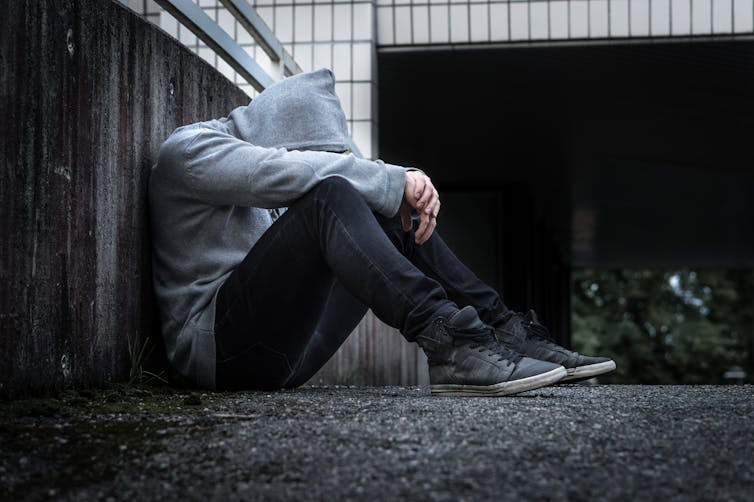
It’s a vicious cycle. Mental illness can lead to homelessness, and homelessness can lead to mental illness.Shutterstock
The pandemic has momentarily lifted the cover on homelessness as a widespread and, so far, intractable social, economic and health problem.
It’s not only a reservoir of private suffering for those driven to the social margins through unstable or inadequate accommodation.
Homelessness also has broad social impacts, including lost productivity, adverse effects on young people’s health, education and well-being, and increased consumption of mental health services and criminal justice resources, among others.
As catastrophic an event as COVID-19 has been, it has created a unique opportunity to improve the long-neglected and critically poor state of social housing in Australia.
The Productivity Commission and AHURI both advocate increased investment in low-cost, secure and good-quality accommodation, linked where necessary with suitable support services.
Many jurisdictions have excellent programs that help people with mental illness to live independently, such as the Housing and Accommodation Support Initiative in NSW. But these need to be scaled up dramatically.
Affordable social housing combined with government transfer payments (such as pensions, Centrelink and disability payments) sufficient to meet basic living costs would be a major boon to mental health in this country.
Both the Productivity Commission and AHURI highlight bridging the gaps in social housing could promote recovery from mental illness, enabling greater social participation and enhancing well-being. It’s likely this approach would also prevent many cases of mental illness before they take hold.
In the long term this would far exceed the benefits flowing from piecemeal handouts for clinical services, which is the present norm in addressing the mental health fallout of the COVID-19 pandemic.
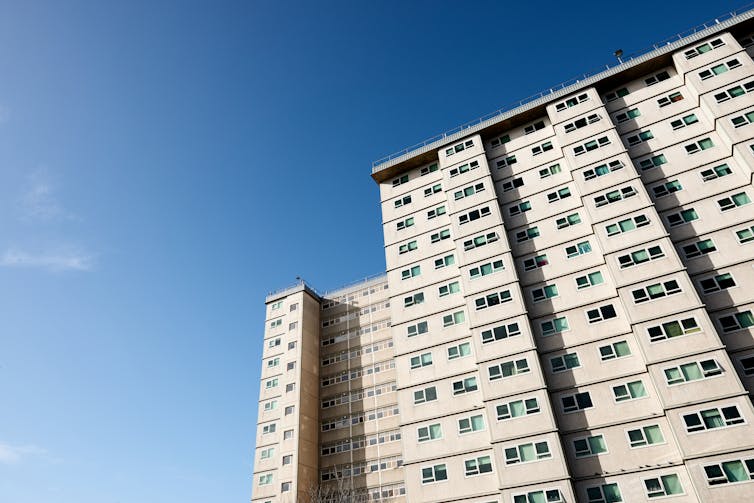
Improving social housing in Australia would have a range of benefits.Shutterstock
Home improvements or reducing homelessness?
Last week the Australian government announced HomeBuilder grants of A$25,000 for owner-occupiers for certain works on their homes. This funding will be going to people who already have homes and can afford substantial renovations.
There is a strong case for making similar investments in housing the homeless, which would substantially benefit the mental health of our most disadvantaged citizens.
Now is the time for a nationally coordinated effort by federal and state governments to institute economic, social and health policies to address the nexus between homelessness and mental health, and the poverty that feeds into both.
Climate Explained is a collaboration between The Conversation, Stuff and the New Zealand Science Media Centre to answer your questions about climate change.
If you have a question you’d like an expert to answer, please send it to climate.change@stuff.co.nz
Does reducing speed reduce emissions from the average car?
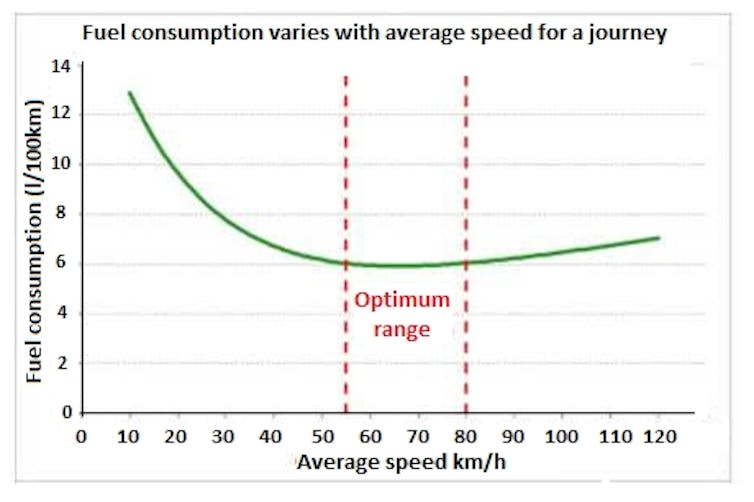
Every car has an optimal speed range that results in minimum fuel consumption, but this range differs between vehicle types, design and age.
Typically it looks like this graph below: fuel consumption rises from about 80km/h, partly because air resistance increases.
Author provided
But speed is only one factor. No matter what car you are driving, you can reduce fuel consumption (and therefore emissions) by driving more smoothly.
This includes anticipating corners and avoiding sudden braking, taking the foot off the accelerator just before reaching the peak of a hill and cruising over it, and removing roof racks or bull bars and heavier items from inside when they are not needed to make the car lighter and more streamlined.
In New Zealand, EnergyWise rallies used to be run over a 1200km course around the North Island. They were designed to demonstrate how much fuel could be saved through good driving habits.
The competing drivers had to reach each destination within a certain time period. Cruising too slowly at 60-70km/h on straight roads in a 100km/h zone just to save fuel was not an option (also because driving too slowly on open roads can contribute to accidents).
The optimum average speed (for both professional and average drivers) was typically around 80km/h. The key to saving fuel was driving smoothly.
In the first rally in 2002, the Massey University entry was a brand new diesel-fuelled Volkswagen Golf (kindly loaned by VW NZ), running on 100% biodiesel made from waste animal fat (as Z Energy has been producing).
A car running on fossil diesel emits about 2.7kg of carbon dioxide per litre and a petrol car produces 2.3kg per litre. Using biofuels to displace diesel or petrol can reduce emissions by up to 90% per kilometre if the biofuel is made from animal fat from a meat works. The amount varies depending on the source of the biofuel (sugarcane, wheat, oilseed rape). And of course it would be unacceptable if biofuel crops were replacing food crops or forests.
Regardless of the car, drivers can reduce fuel consumption by 15-20% by improving driving habits alone – reducing emissions and saving money at the same time.
When you are thinking of replacing your car, taking into account fuel efficiency is another important way to save on fuel costs and reduce emissions.
Many countries, including the US, Japan, China and nations within the European Union, have had fuel efficiency standards for more than a decade. This has driven car manufacturers to design ever more fuel-efficient vehicles.
Most light-duty vehicles sold globally are subject to these standards. But Australia and New Zealand have both dragged the chain in this regard, partly because most vehicles are imported.
New Zealand also remains hesitant about introducing a “feebate” scheme, which proposes a fee on imported high-emission cars to make imported hybrids, electric cars and other efficient vehicles cheaper with a subsidy.
In New Zealand, driving an electric car results in low emissions because electricity generation is 85% renewable. In Australia, which still relies on coal-fired power, electric cars are responsible for higher emissions unless they are recharged through a local renewable electricity supply.
Fuel and electricity prices will inevitably rise. But whether we drive a petrol or electric car, we can all shield ourselves from some of those future price rises by driving more efficiently and less speedily.
The Black Summer bushfires may have ended, but the cultural cost has yet to be counted.
Thousands of Aboriginal sites were likely destroyed in the 2019 bushfires. But at present, there is no clarity about the numbers of precious artefacts lost.
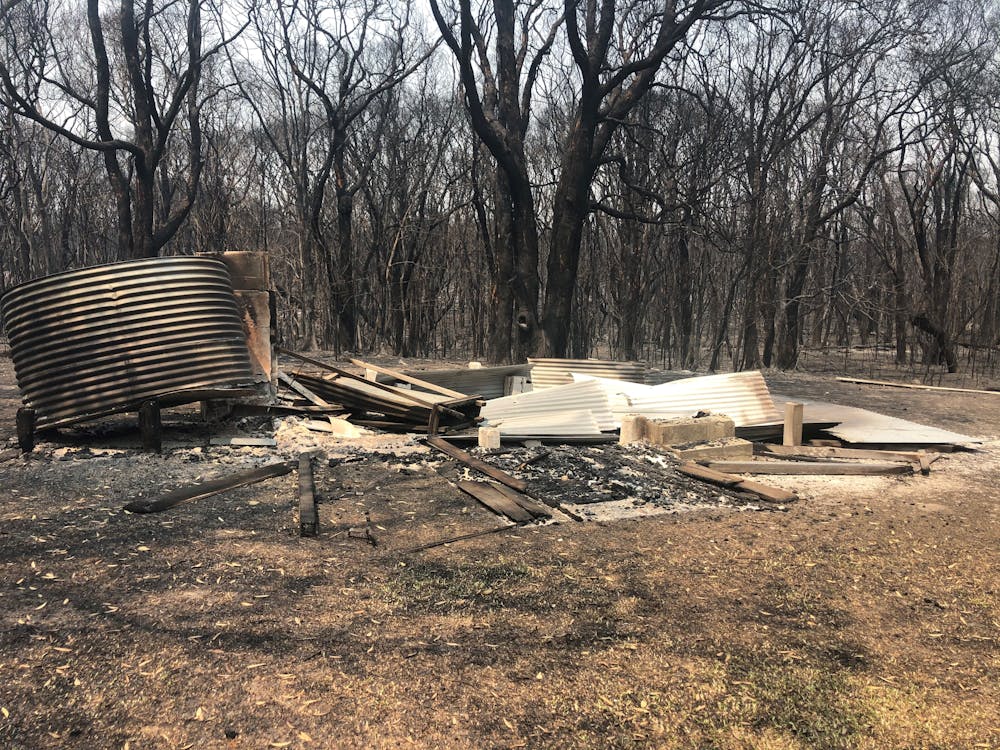
Though recent by comparison, relics from Australian literary heritage have also been reduced to ash. Last year’s bushfires destroyed a hut built specially for author Kylie Tennant (1912–1988) at Diamond Head, and many High Country huts associated with A.B “Banjo” Paterson’s The Man From Snowy River.
Thankfully, NSW Parks and Wildlife Service are making plans to rebuild Kylie Tennant’s hut. But after this devastating loss, it’s impossible to ever fully recreate the authentic atmosphere of Tennant’s writing retreat.
Kylie’s hut after the recent bushfires tore through.NSW National Parks and Wildlife Service
The undeniable romance of Kylie’s hut
Tennant was best known for her social realist studies of working-class life from the 1930s, including her Depression novels The Battlers (1941) and Ride on Stranger (1943).
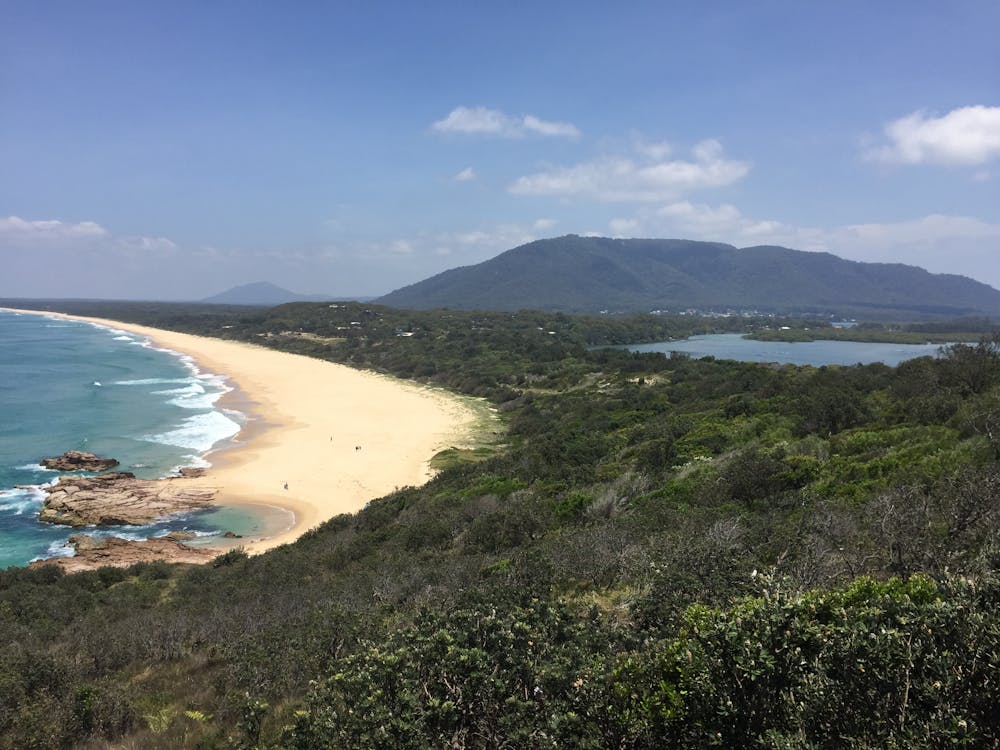
During the second world war, Tennant moved to Laurieton with her husband and their daughter Benison, and lived there until 1953. At nearby Diamond Head, she met Ernie Metcalfe, a returned serviceman from the first world war and well-known local bushman.
Metcalfe felt Tennant had paid him too much for the land she bought from him, which was partly why he offered to build the hut. Bill Boyd, who later restored the hut, remembers
Kylie would insist on paying him […] she only paid him about 25 pounds which was a lot of money in that time.
Metcalfe was memorialised in her non-fiction book The Man on the Headland (1971). From the beginning, fire played a part in the hut’s life.
The first summer, as though Dimandead [Diamond Head] had made a sudden bid against this new invasion, a fire leapt the creek and came so close to the house that one window cracked in the heat.
Ernie fought the fire single-handed and when we arrived he was standing sooty with ash in his beard in a blackened desert with the house safe in the middle.
While appearing to be an ordinary bushman’s dwelling, “the romance” of Kylie’s Hut was “undeniable”, according to Andrew Marshall, a marine wildlife project officer in the NSW Parks and Wildlife Service. It’s fondly remembered by locals, tourists and aspiring writers who have visited since the 1980s.
Its location in a campground was unique because it quietly coexisted with holidaymakers rather than being relegated to a specially demarcated, curated space. However, this lack of protection left it exposed to the elements and the predations of climate change.
In 1976, Tennant donated the hut and the surrounding land to Crowdy Bay National Park, partly to try to protect the environment from ongoing rutile mining.
The creation of the Crowdy Bay National Park was facilitated not only by Tennant’s gift, but also by the earlier dispossession of the Birpai peoples and the re-zoning of their land.
Kylie Tennant donated her hut to Crowdy Bay National Park.Shutterstock
The erroneous belief that previous inhabitants had “disappeared”, meant the story of Tennant and Metcalfe’s friendship, symbolised by the hut, effectively obscured earlier stories of the Traditional Owners.
Restoration worthy of preservation
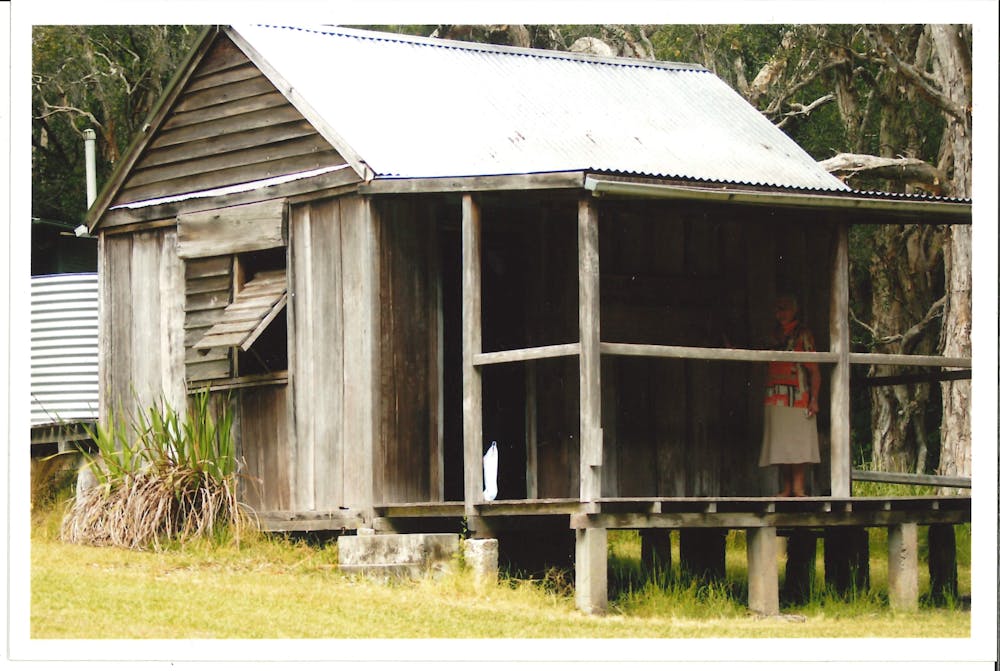
Local bush carpenter Bill Boyd substantially refurbished Kylie’s Hut in the early 1980s. A master of old forestry and timber working tools, Boyd used the restoration of Kylie’s Hut as a way to share his knowledge of the uses of broad-axe and adze (an axe-like tool with an arched blade).
Aside from its association with Tennant, the hut has additional significance because it was built using “unpretentious construction techniques” and displays “a unity of form, design and scale”, according to Libby Jude, a ranger from the NSW Parks and Wildlife Service.
It was composed of “strong, natural textures” associated with the fabric of the place in which it stood. And the specialised restoration methods Boyd used are heritage practices that are themselves worthy of preservation.
Kylie’s Hut post restoration.Benison Rodd, Author provided
Boyd also passed on his knowledge to younger carpenters while restoring many of the High Country huts, some dating back to the 1860s and associated with The Man From Snowy River. Most of these were also razed by the recent bushfires.
Members of the Kosciuszko Huts Association have expressed their desire to restore the huts, but a conversation about when and how they could be reconstructed will be well down the track.
Australian literary heritage is often forgotten
Unlike the United Kingdom, where literary properties are routinely listed on maps, Australia tends not to proudly celebrate sites related to its writers.
Aside from the work done by the National Trust, literary societies and enthusiasts in regional communities mostly drive the protection of Australian literary sites.
Ideally, there should be a more coordinated approach to our literary heritage which could identify vulnerable structures and take steps to ensure that, wherever possible, they’re not wiped out by natural and man-made disasters.
The memorialisation of Kylie’s Hut, which began in the 1980s as a response to her book The Man on the Headland, rendered black history peripheral to the central story of bushmen like Metcalfe living in the area. Nevertheless, it was an accessible literary site stimulating awareness of aspects of our cultural history, which might otherwise remain almost completely unknown.
Source: The Conversation (Au and NZ) – By Redento B. Recio, Postdoctoral Research Fellow – Informal Urbanism (InfUr-) Hub, University of Melbourne
– Ricky sits at one of half-a-dozen entrances to the San Roque settlement in Metro Manila’s North Triangle district. Ricky (not his real name) is part of a large team that guards the settlement 24 hours a day with two specific tasks: to prevent the entry of any construction materials and to stop any building activity or repairs by residents.
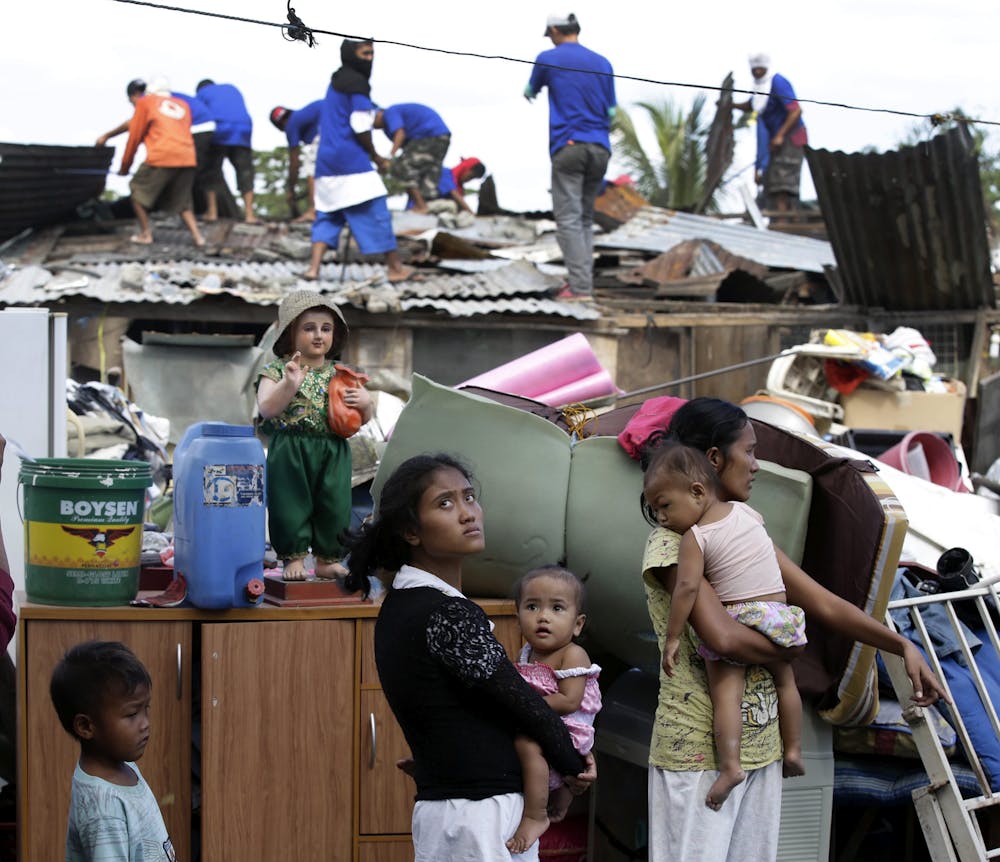
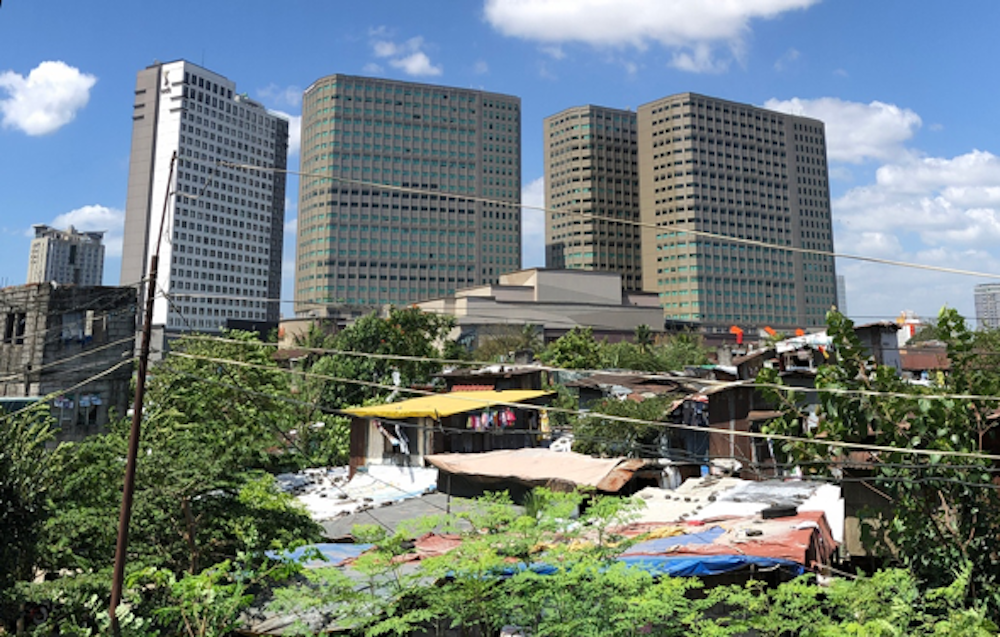
San Roque is an informal settlement of about 30,000 people within walking distance of a major transport and shopping hub in Quezon City, in Manila’s north-east. While the settlement, which dates back to the early 1980s, is to be demolished for redevelopment, a golf course on state land across the road will remain untouched. The settlement gained global attention when 21 residents were jailed for protesting in April about a lack of promised aid amid a COVID-19 lockdown.
The “plan” for the area is to build a new central business district for Quezon City. All forms of informality – settlements, street vendors and pedicabs – will be removed. The process has continued even through the pandemic.
San Roque residents have been under siege for a decade. Here a demolition team tears down family homes in January 2014.Dennis M. Sabangan/EPA/AAP
While the original land title is contested, the area falls under the jurisdiction of the National Housing Authority (NHA). The state has offered residents a path to secure tenure in the past, only to withdraw it. In 2009, the NHA signed a joint-venture agreement with Ayala Land, a developer of shopping malls, residential compounds and private cities.
Eviction house by house
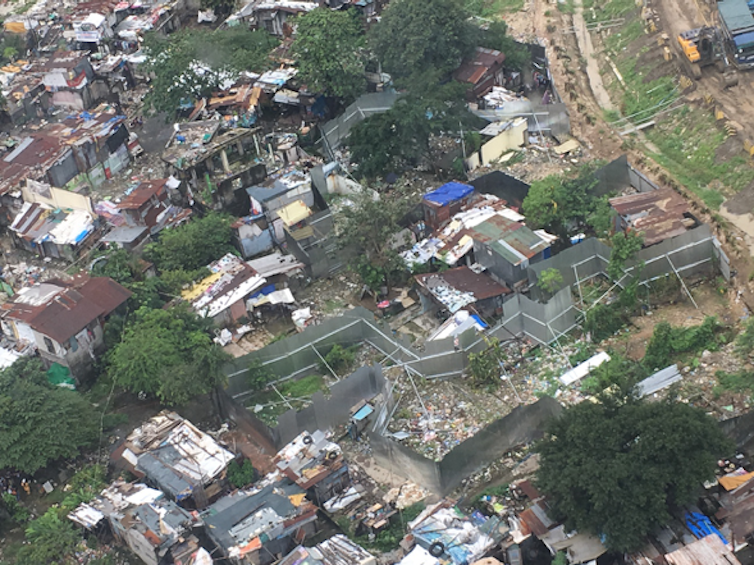
Over the past decade, the Ayala-NHA alliance has engaged in incremental coercive eviction. Home owners are offered a small compensation package plus relocation to public rental housing if they demolish their house and clear and vacate the site. The community is now pock-marked with vacant sites.
Houses are demolished and then fenced to prevent re-encroachment.Redento Recio, Author provided
A census in 2009 counted about 9,000 households in San Roque. About 6,000 remain. Only about 2,000 of them qualify for relocation due to long-term residence and ownership.
The unqualified residents are the most vulnerable. If evicted, they will likely move to other informal settlements nearby.
Ayala Land claims to uphold the UN Sustainable Development Goals through developments that have a “positive impact on the community”. The NHA, in its charter to house the urban poor, is notionally committed to efficiency, social equality and justice.
The Quezon City mayor has agreed not to conduct “forced” evictions. She has called on the NHA to find a “win-win” solution.
Informal settlements emerge where people can make a living. San Roque residents work as labourers, street vendors, informal transport operators, security guards – low-paid jobs that make the city work. When the state cannot build much-needed housing, residents build it themselves.
The relocations involve a long-term rental or mortgage agreement for a 24-square-metre dwelling of relatively poor quality and design. The housing is up to two hours away from San Roque. Along with losing the main asset they have invested in over many years, residents will lose access to jobs and income, and the social networks that help them cope with the daily grind of poverty.
Many will be left with rent and mortgage obligations they can’t afford. Little wonder some residents succumb to the coercion, demolish their houses, take the compensation and later return to rent rooms in other informal settlements.
From an urban planning perspective, moving the poor to cheap land on the urban fringe simply makes an already dysfunctional transport system worse.
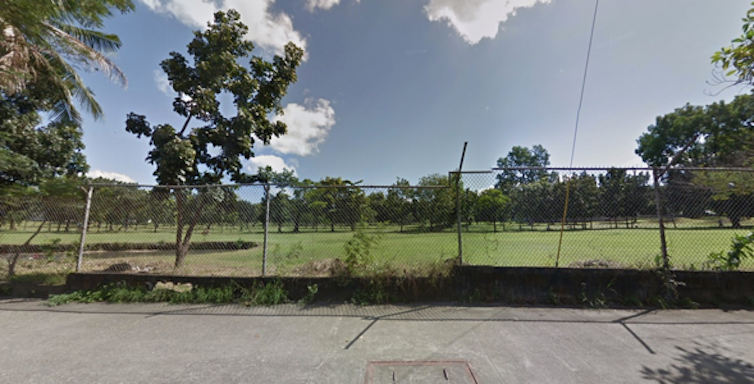
Some will argue no other land is available for the market-led residential towers, shopping malls, casinos and walkable parks for the growing middle class. Yet just across the street from San Roque is an 18-hole golf course on NHA-controlled state land that is ripe for redevelopment.
Why displace the urban poor when an 18-hole golf course occupies state land just across the road?Kim Dovey
This is neither rational urban planning nor the result of villains in smoke-filled rooms. It is more about a lack of imagination and political will.
Most agents of this planning process are trapped within a system where “sustainability” and “social inclusion” are a facade. This is the ugly face of neoliberal planning: market-led development becomes its own justification and the state is left to socialise the cost.
Bring in cheap labour, but remove their homes
The role of Ayala guards in San Roque highlights the paradox of this approach. Flows of capital are at once generating work for the urban poor and stimulating the growth of settlements they are trying to erase. The massive construction projects require huge reserves of cheap labour in the very districts where affordable housing is being demolished to make way for those projects.
Ricky, the Ayala guard, is one of the residents who doesn’t qualify for relocation. He came to Manila over two years ago, escaping the violence in Mindanao. San Roque offered cheap rental housing and work. His job is to paralyse any form of upgrading and so help to erase his own neighbourhood.
This is forced eviction made to appear consensual. Indeed, it looks legitimate from a middle class and elite perspective. Their livelihoods and lifestyles depend fundamentally on the supply of cheap labour. Yet, by displacing the urban poor, shopping malls and enclaves protect the middle class from everyday encounters with urban poverty. They can ignore the contradictions that saturate the city.
A hotel, shopping mall and commercial offices tower over San Roque.Kim Dovey, Author provided
San Roque has become divided between residents who believe they can resist and retain their livelihoods and those who feel they should take the relocation package before they are forcibly removed with nothing.
Every demolition weakens this community. However, the reduced density also makes on-site redevelopment more possible with NHA funding plus good design and planning. The Save San Roque Alliance – a group of architects, educators and artists – organised grassroots workshops that produced a community development plan for affordable housing and community infrastructure. After a ten-day intensive study project, urban design and planning students from the University of Melbourne have also offered design ideas.
Effective on-site upgrading is clearly possible. The missing element is a commitment by planning authorities and Ayala to live up to the rhetoric of an inclusive and sustainable city.
Source: The Conversation (Au and NZ) – By Shelley Marshall, Associate Professor and Director of the RMIT Business and Human Rights Centre, RMIT University
As many of us gingerly return to our workplaces, we are relying on cleaners to keep us safe.
Employers have extra concerns. High quality cleaning is the key to shielding them from liability should their workers contract COVID-19 and they run the risk of having to shut their workplaces down again.
SafeWork Australia and its state counterparts have prepared guidelines for keeping workplaces safe.
They recommend cleaning at least daily, and in some circumstances more frequently.
Two surveys paint very different pictures of how it is being done.
One is alarming.
Much workplace cleaning is rushed and poorly resourced
A survey of 500 cleaners conducted by the United Workers Union in May found that 91% always, often or sometimes have to rush because they didn’t have enough time. 80% said they didn’t have enough equipment to do a quality job.
not uncommon for cleaners to report that they do not consider they are afforded sufficient time to complete all the required specifications to a high level
Despite the rhetoric about cleaners being “essential workers”, they are often not treated well.
Three quarters of the union’s respondents reported that did not have enough personal protective equipment (PPE) to do their job safely, putting them at risk if COVID-19 is present in a workplace.
Many face barriers to taking sick leave when they are unwell, forcing them to continue working or lose pay.
One third of cleaning companies audited by the Fair Work Ombudsman in 2016 were found to be underpaying their workers.
A further inquiry into the exploitation of cleaners in Tasmania in 2018 found underpayment at 90% of Woolworths sites.
Most cleaning workers are migrants on temporary visas who are vulnerable to exploitation and face risks if they speak up.
A second survey of paints a much better picture.
Yet some of it is excellent
A survey of cleaners working in buildings certified by the Cleaning Accountability Framework in April found 94% felt adequate precautions are being taken to protect their health and safety, 92% were given enough personal protective equipment, 97% were being provided with enough chemicals and equipment and 84% were able to take paid sick leave.
The Cleaning Accountability Framework is an independent not-for-profit entity comprised of representatives from across the cleaning supply chain, including property investors, owners and managers, cleaning companies, employee representatives and industry associations. It aims to promote and recognise best practice.
The vast difference points to a way forward.
Though the SafeWork guidelines heap the burden of keeping workplaces safe on employers, most employers do not have an employment relationship with their cleaners.
Know your cleaners
The 2018 Senate Inquiry was “deeply concerned by the trend in contracting out cleaning services through convoluted supply chains with murky lines of responsibility”.
It found contracting out was rife across all sectors, including the public service. Many employers don’t even see those who clean their workplace, let alone supervise them, as cleaning generally takes place out of office hours, making it difficult to check whether the cleaning is being done in accordance with guidelines.
It would help if the guidelines took account of the reality that cleaning is often outsourced and subcontracted.
And cooperative arrangements between building owners, cleaning contractors and building tenants could go a long way towards lifting standards, making sure that the people responsible for the workplace know whether cleaners are getting paid enough and being given enough equipment, training and time to provide it.
“Smiley face” monitoring systems aren’t enough in the time of COVID-19.
Employers whose employees contract COVID-19 because of poor cleaning practices face serious risks. Cleaners who contract COVID-19 or are injured because of poor conditions are likely to be considered their responsibility, even if they don’t employ them directly.
The best response is to take that responsibility seriously, more closely enforcing contracts, and if necessary varying their terms, to allow for extra, safe and adequately paid and resourced cleaning.
We have seen many changes in Australian’s consumption of media during isolation.
There has been an increase in television viewing; cinemas were forced to close (although some have crafted a new approach); Hollywood release dates were postponed or shifted to streaming.
Across the world, there was also another surprising change: a resurgence of the drive-in. Attendance in South Korea boomed. In Germany, you could attend a drive-in rave. In America, there was even drive-in strip-clubs.
With rules against “unnecessary travel”, Australia’s drive-in cinemas were forced to close. With a heightened sense of personal need to social distance, even as more cinemas across Australia start to reopen, is it time for the drive-in to shine again?
The beginning
The drive-in phenomenon began in the United States. Richard M. Hollingshead Junior, whose family owned a chemical plant in New Jersey, initially commenced tests in his driveway in 1928, before opening a drive-in on June 6 1933.
It ran for only three years, but was the start of a trend that spread throughout the country – and then the world.
Australia’s first drive-in would not open for another 20 years.
The first drive-in in Australia, the Skyline, opened February 17 1954, in Burwood, Victoria, with the musical comedy On the Riviera. The first night created traffic jams, as 2,000 cars vied to gain access to the 600 spaces.
The Argus dedicated a two-page feature to the opening, calling it:
probably the most interesting development in entertainment here since the advent of sound pictures, the drive-in theatre provides the ultimate in relaxation and comfort for movie patrons.
Unlike the cinema, said The Argus, there was no need to dress-up: slippers and shorts were fine. Drive-in patrons could smoke, crack peanuts, and knit “to your heart’s content”.
Not everyone was happy with the introduction of the drive-in in their neighbourhood. Later that same year, a resident of Ascot Vale wrote to The Argus against a local screen:
Surely the experience of people in the Burwood district should be sufficient to prevent similar mistakes being made in other districts. The place for these latest improvements in our cultural life is well beyond outer boundaries.
The rise …
Within a year from the opening of the Burwood Skyline, another three drive-ins in Victoria and one South Australia opened. Within 10 years, the number reached 230 across the country. At its peak there were 330 drive-ins in Australia.
The uptake and success of drive-ins in Australia corresponded with the increase in car ownership in Australia. As more people owned cars, the whole family – even kids in pyjamas – could jump in and enjoy a night out. Parents didn’t need to find a babysitter, nor worry about their kids disturbing other patrons.
I have fond memories of growing up during the 1980s and 90s in Shepparton, Victoria, and attending the Twilight Drive-in Theatre. I vividly remember the large white screen at the front with the playground directly underneath, and the kiosk in the middle of the lot. And who can forget the large speaker you had to attach to the window?
But, like many, the Twilight Drive-in closed to make way for a shopping centre.
… and the fall
There is no one villain we can point to in the downfall of drive-in popularity.
In the 1970s, there was a new addition to TV: colour. Australia had one of the the fastest uptakes of colour television, taking a third of the time compared to the United States to reach a 60% saturation rate. The rise of the VCR in the 1980s allowed even greater flexibility in viewing films at home.
Daylight savings was also introduced in the 1970s, restricting the hours drive-ins could operate during the summer.
Drive-ins were affordable to run because they were generally on the suburban fringe. As Australia’s cities grew, land value also increased; using this land for a cinema was a less attractive proposition than development.
There are now just 16 drive-ins running across Australia, and only 30 in the United States – down from their peak of over 4,000.
A viral resurgence?
The Yatala Drive-in on the outskirts of the Gold Coast reopened in early May. More recently, the Lunar Drive-in in Dandenong reopened on June 1. Even in the pouring Melbourne rain – normally a sure sign people will stay away – the audience came.
As our lives begin to return to “normal”, and more states and territories allow people to return to indoor cinemas, will drive-in attendance continue? I hope so. Experiencing media across different screens provides us with new experiences and new memories which can be far greater than just the film on the screen.
Drive-ins offer us a glance into Australian history, a hit of nostalgia, and, of course, the simple act reviving our love of the silver screen.
Nauru President Lionel Aingimea has accused a “small group” of Fiji officials of “hijacking” the 12-country regional University of the South Pacific and suspending the vice-chancellor.
He has called for an urgent meeting of the University Council to reverse the “illegitimate” action against vice-chancellor Professor Pal Ahluwalia, which he described as a “personal vendetta”.
“The future of our regional Pacific university is now seriously in jeopardy,” he wrote yesterday in a statement following two days of extraordinary events at the Laucala campus in Fiji.
Professor Pal Ahluwalia speaking to students and staff at the USP Laucala campus, calling for a continued “fight for justice”. Image: FBC News
Staff and students have met in rallies around campus protesting against the treatment of Professor Ahluwalia, a Canadian, and demanding governance and transparency at the institution.
Nauru President Lionel Aingimea … “appalled” at the USP developments. Image: Wikipedia
The USP Students Association (USPSA) federal council also issued an open letter yesterday calling for the resignations of the USP Council chair, former Fiji diplomat Winston Thompson; deputy chair Aloma Johansson; and the chair of the council’s audit and risk committee, Mahmood Khan.
– Partner –
The statement signed by Joseph Sua, chair and president of the USPSA federal body, threatened a boycott of exams by students if the University Council did not act.
“The students will not step back from participating in peaceful demonstrations and boycotting exams, classes and other activities from USP’s 14 campuses should the USP Council fail to act,” Sua wrote.
Fiji police investigate Fiji police have launched an investigation into the protests of staff and students at USP, saying they would not hesitate to arrest people breaching the covid-19 coronavirus restrictions, reports FBC News.
Nauru President Lionel Aingimea’s letter to the USP Council alleging a “vendetta”. Image: PMC
Saying he was “appalled” at the developments at USP, President Aingimea wrote in his protest letter: “The executive committee [of the USP Council] met despite the conflicts of interest and the serious concerns expressed by the council members.
“Due process was disregarded. This must not be allowed to rest here and further action is warranted.
“In recent days, the hostility and a lack of duty of care to a council-appointed vice-chancellor shows what a small group of members, who are not direct members, have high-jacked [sic] council processes and failed to accord duty of care and natural justice to a council-appointed vice-chancellor,” the president wrote.
“These actions represent a personal vendetta against the vice-chancellor.”
President Aingimea wrote that it was now “high time” for the “entire [USP] Council to coalesce and begin a process to remove the pro-chancellor [Winston Thompson]”.
Ten council members are needed to support an urgent special meeting.
Another council member, Samoan Deputy Prime Minister Fiame Naomi Mata’afa, posted a statement on social media saying: “Be interesting to see how that [a special council meeting] pans out. USP at tipping point of becoming nationalised and the region looks on!”
Students at USP’s Lautoka campus rallying for vice-chancellor Professor Pal Ahluwalia. Image: USPSA
FBC News reports that the university’s deputy vice-chancellor for research, Professor Derrick Armstrong, has been named acting vice-chancellor.
‘Fight for justice’ plea It was reported that Professor Ahluwalia had been told to “step aside” to allow for an independent investigation relating to allegations of “misconduct” and breaches of USP policies and procedures.
However, addressing supporters at a protest at the university’s Laucala campus yesterday, Professor Ahluwalia said he had not received any communication about stepping down.
The governments of Nauru, New Zealand, Samoa and Tonga had reportedly called on the USP Council to drop the investigation into the vice-chancellor.
Professor Ahluwalia has been widely regarded by supporters as a whistleblower over practices at the university that he had exposed in allegations contained in a report last year.
Allegations of serious cases of mismanagement and abuse of process surfaced at the USP involving its former vice chancellor and president in May last year and were widely reported on by the Suva-based news magazine Islands Business in June and other Pacific media.
In an interview with RNZ’s Pacific Beat at the time, editor Samisoni Pareti said the allegations involved 11 staff, including a former vice-chancellor, and the claims were being investigated by Fiji’s Independent Commission Against Corruption (FICAC).
How Islands Business magazine portrayed USP vice-chancellor Professor Pal Ahluwalia on its cover a year ago – the June 2019 edition – in the early days of the university power struggle. Image: IB screenshot
Investigation report It is understood islands Business is publishing a report today exposing the contents of a hushed up university investigation by international consultants last year.
The controversial BDO report into USP affairs … exposure in islands Business. Image: PMC screenshot
The USP Students Association said it had its email links to the university’s students blocked and its open letter was sent to Pacific Media Watch.
The open letter addressed to USP Council chair and pro vice-chancellor Winston Thompson said:
Pro-Chancellor
I write this letter on behalf of the students of our 12 member countries and 14 campuses to convey to you our intense displeasure at the way you are handling matters as the Pro-Chancellor of the university.
The student body has cited the letter written to Council by Mr Semi Tukana, whom you appointed to the sub-committee to investigate the Vice-Chancellor Professor Pal [Ahluwalia]. The letter clearly points out that you and Mr Mahmood Khan are using the high office of your council positions to continue the personal vendetta against the VCP and blindsiding members of the University Council.
Students protest at USP’s Alafua campus in Samoa. Image: USPSA
Despite numerous warnings and alarming concerns raised by the members of the University Council, you disregarded and disrespected these by convening the Executive Committee Meeting on June 8th 2020 to consider the removal of the VCP.
Despite your obvious conflict of interest on matters regarding the VCP, you participated in the meeting and also allowed other members who carry a conflict of interest to be part of the meeting of the Executive Committee yesterday.
You ignored and failed to respond to any of the alarming concerns raised by member countries, staff and students. This is poor governance on your part.
You have defied the intents and resolutions of the USP Council Meeting held in Port Vila last year that sought your commitment to work with the VCP and to let the special commission of the Council to look into matters as such independently.
You have withheld the minutes of the past council meeting and the special council meeting of the University that is supposed to be provided to all members despite numerous requests from members.
You have failed to acknowledge the great conflict of interest that you carry against the VCP since March 2019 when you made it clear to the public that you want to “sack the VCP” .
The Students of the University of the South Pacific have lost confidence in you as the Pro-Chancellor and Chair of the University Council; the Student Body has also lost confidence in the Deputy Pro-Chancellor and Chair of the Audit & Risk Committee.
In summary, we demand the resignation of:
1. Mr Winston Thompson, Chair of Council
2. Ms Aloma Johansson, Deputy Chair of Council
3. Mr Mahmood Khan, Chair of Audit & Risk Committee
The Student Council requests all Member States to urgently look into our concerns and make appropriate arrangements to appoint an interim Pro-Chancellor and Chair of Council and to declare the Executive Committee Meeting held on June 8th 2020 as null and void!
The Students will not step back from participating in peaceful demonstrations and boycotting exams, classes and other activities from USP’s 14 Campuses should the USP Council fail to act.
On behalf of Student Council.
Sincerely,
Joseph Sua Chair and President of USPSA Federal Body The University of the South Pacific Students Association USP Laucala Campus, Suva Fiji
Students on the Laucala campus share their support for Professor Professor Pal Ahluwalia. Image: USPSA
A “fight for justice and good governance” at the University of the South Pacific has continued as staff and students have echoed strong calls for members of the USP Council to allow the Vice-Chancellor, Professor Pal Ahluwalia, to carry out his work without interference.
Hundreds of protesting staff and students rallied outside the New Administration Conference Room at Laucala campus in Suva, Fiji, yesterday with placards showing solidarity and support for Professor Ahluwalia as the special executive committee of the council convened a meeting to discuss allegations of “material misconduct” levelled against the vice-chancellor.
The meeting agenda allegedly included discussion about a letter from the deputy pro-chancellor about the claims of material misconduct, a report from the vice-chancellor in response to the allegations and a letter from the pro-chancellor in response to the VC’s report.
USP staff member Elizabeth Fong … she and her colleagues are calling for good governance. Image: Wansolwara News
Media reports said he had been told to “step aside” after this meeting. Professor Derrick Armstrong was reportedly appointed acting vice-chancellor and president to manage the affairs of the university.
Concerned USP staff member Elizabeth Fong said the show of solidarity for the vice-chancellor was also a call for good governance to prevail at the regional institution owned by 12 countries – not just Fiji.
– Partner –
“We don’t agree with what they are doing to [Professor] Pal. They are not letting him as VC do his work. Actual justice allows him to work by his contract, and if they had issues, there is a process and a way of managing it,” she said.
“The entire council of the university, which is regionally owned, needs to be part of any decision to remove a VC or suspend him so we are here to show that we want good governance to be put in place and to be practised by those who lead and govern us.”
Fong said it may be necessary for the USP Chancellor to step in to resolve the issue.
USP Students Association representatives Aneet Kumar (left), Viliame Naulivou and Shalvin Chand … supporting the vice-chancellor and calling for a “quick resolution”. Image: Wansolwara News
USP Students Association (USPSA) federal council spokesman Aneet Kumar said the students also wanted a quick resolution to the issue and made clear the student body supported the work done by the vice-chancellor done so far.
Kumar was joined by USPSA Laucala vice-president Shalvin Chand and USPSA deputy chair and vice-president Viliame Naulivou.
“There was a lot of outrage last year when the breaches of past management came to light,” Kumar said.
“Even the academics were pointing out that since we have a compulsory governance course, where is this going, what are we trying to teach and preach?
“There needs to be some common ground to reach. This is very disheartening for students. The student body sent a letter to the USP Council to express our disappointment at the way the matter is being handled.”
Students at Laucala campus also turned up with their placards of support, with student body vice-president Naulivou saying the believed the vice-chancellor had practised good governance.
“There are a lot of needs and wants out there but he [Professor Ahluwalia] came down to ground level and listened to us,” Naulivou said.
“That’s the only thing that pushed us to know the VC, his mission and vision. He visited the Lautoka campus and spoke to students, he begged students to say what they want. And what we want is good governance and transparency.”
Meanwhile, Professor Ahluwalia addressed staff and students yesterday saying he would continue to “fight for justice, transparency and accountability” within the legal framework.
The whirlwind of events started in March last year when the allegations of policy breaches of past financial decisions, such as speedy recruitment, appointments, promotions and questionable allowances for extra responsibility as well as breaches of the staff review procedures surfaced in a leaked confidential 11-page document drafted by Professor Ahluwalia and directed to the USP Council’s executive committee.
USP staff members mobilise to show support for Vice-Chancellor Professor Pal Ahluwalia. Image: Wansolwara NewsVice-Chancellor Professor Pal Ahluwalia urged students and staff of USP yesterday to continue the fight for justice that he had started. Image: FBC News
The University of the South Pacific journalism newspaper Wansolwara and website collaborate with the Pacific Media Centre.
Police Commissioner Andrew Coster announced today that Armed Response Teams will not be part of the New Zealand policing model in the future.
A trial of the teams of police carrying firearms (ARTs) were launched in Counties Manukau, Waikato and Canterbury last year and ended in April.
In recent days, mass protests across New Zealand against police brutality – sparked by the killing of African-American George Floyd in the US on May 25 – have renewed opposition to armed police and the response teams specifically.
Commissioner Coster said the decision to scrap the teams was based on preliminary findings from the trial evaluation – which is yet to be completed – feedback from the public, and consultation with community forum groups.
“It is clear to me that these response teams do not align with the style of policing that New Zealanders expect,” Coster said.
– Partner –
“We have listened carefully to that feedback and I have made the decision these teams will not be a part of our policing model in the future,” he said.
“As part of this, I want to reiterate that I am committed to New Zealand Police remaining a generally unarmed police service.”
Valued community relationships Commissioner Coster said police valued their relationships with the various communities they served, and this meant working with them to find solutions that worked for both.
NZ Police Commissioner Andrew Coster … “I am committed to New Zealand Police remaining a generally unarmed police service.” Image: RNZ
“How the public feels is important – we police with the consent of the public, and that is a privilege,” Coster said.
The trial aimed to have specialist police personnel ready to deploy and support frontline staff in critical or high risk incidents.
“We can only keep New Zealanders safe if we can keep our staff safe too,” he said.
“That is why police has invested in the new body armour system, we have strengthened training, and given our officers more tools and tactical options.”
Police were looking into “broad tactical capability” to ensure critical response options remained fit for purpose, he said.
“We will still complete the evaluation into ARTs and that will now inform the wider tactical capability work programme.”
Any further options arising from this would undergo consultation with communities, Coster said.
Opposition to trials There had been widespread opposition to the trials, including a Waitangi Tribunal claim being filed by justice advocates arguing the Crown breached Te Tiriti o Waitangi by failing to work in partnership with, consult, or even inform Māori about the trial.
Māori Associate Professor of Law Dr Khylee Quince said the new Police Commissioner had clearly “read the room” in deciding to scrap ARTs.
She said Māori and Pasifika communities were already at the receiving end of a disproportionate amount of police force and adding guns to the mix would have only led to a death.
“It’s important we have a police force that not only the public trusts but that commits to the kind of policing we want in New Zealand.
“And we’ve had a clear public message that people do not want routine arming or militarisation of New Zealand police.”
She said if the ARTs had been rolled out as a permanent fixture it would have only been a matter of time before someone was killed.
‘Someone was going to get harmed’ “I don’t buy the fact that the police only drew their firearms five times. At some stage someone was going to harmed.
“I think the fact that the trial was only six months is the only reason there wasn’t a fatality in that time.”
“While the decision to deploy the ART trial was independently made by the then commissioner of police, and not a government initiative, we as a caucus acknowledge the general feeling of lack of consultation about the trial that exists – especially within Māori,” Labour Māori caucus co-chair Willie Jackson said.
A survey on on the ARTs found 85 percent of participants did not support the trial.
Justice reform advocate Laura O’Connell Rapira said 91 percent of people surveyed were less likely to call the police in family violence situations if they knew the police had guns.
‘Better off’ without armed police Green Party co-leader Marama Davidson said she welcomed the decision and communities were “better off” without ARTs.
“This is something to celebrate. We commend the New Zealand Police for listening to the public outcry during and after the ART trials. They have listened to the community, and made the right call,” Davidson said.
“This decision today reinforces the need for people to make their voices heard. We know that people of colour, in particular black and brown communities, do not feel protected with armed police on patrol.”
However, Davidson said there were still systemic problems police needed to address.
“There is still work to do in terms of ending systemic discrimination and systemic racism within the police, it has been well established that is still continuing and that’s why the further arming of police was heading in the wrong direction,” she said.
She said more holistic solutions were needed instead to keep communities safe, such as mental health and youth support.
The party’s justice spokesperson, Golriz Ghahraman, said the move was a step “against the American-style militarisation” of the police force.
National Party police spokesperson, Brett Hudson also agreed that the commissioner made the right choice, saying that firearms were already available to police when needed for public safety.
This article is republished by the Pacific Media Centre under a partnership agreement with RNZ.
If you havesymptomsof the coronavirus, call the NZ Covid-19 Healthline on 0800 358 5453 (+64 9 358 5453 for international SIMs) or call your GP – don’t show up at a medical centre.
The word ‘pandemic’ is not entirely defined on narrow public health criteria. (Likewise, an economic depression has no technical definition.) In an important sense it is a word of history, a word to describe significant health events of the past that had substantial diffusion beyond any particular locality.
Since the World Health Organisation (WHO) came into being after World War 2, however, current events could be called official pandemics while they were happening, even in their early stages. This labelling is a necessarily inconsistent process, with 2003 SARS1 not being officially classed as a pandemic, while 2009 H1N1 Swine Flu (for which New Zealand was an early player) was so categorised.
Wikipedia’s list of epidemics is useful here, not because it is authoritative, but because it represents a good indication of which health events we know most about, and how we rated them.
An event seems more likely to be labelled a pandemic if it is due to a new contagion, or a resurfacing after many years of an old and feared contagion. Thus the 2009 Swine Flu had the potential to become the ‘Second H1N1 Influenza Pandemic’, with the first being the 1918 ‘Black Flu’ (inappropriately called by many the ‘Spanish Flu’). With hindsight the 2009 event may have been insufficiently consequential to justify the moniker ‘pandemic’; though it was undoubtedly ‘pan’. Perhaps the 2009 experience led to a delay in calling Covid19 a pandemic in 2020?
There is a case for calling the 2019 Measles outbreak a pandemic, given that Measles had been such a significant contagious disease in the Pacific in the nineteenth century (including an epidemic in New Zealand in the 1850s), and in the Americas before that. For 1919, Wikipedia lists five entries for Measles in 2019, including New Zealand (also Samoa, Philippines, Malaysia, Congo); I was in Canada in April and May 2019, and the same outbreak was happening there and in the United States, though to a lesser extent.
Of the pandemics listed in Wikipedia, one – other than Covid19 – has not been deemed to have ended; that’s HIV/AIDS.
Not listed in Wikipedia is Dengue Fever. Frank Snowden in the penultimate chapter of Epidemics and Society (2019) refers to the “global pandemic of dengue fever that began in 1950 and has continued unabated”, which began little noticed at the beginning of an “age of hubris” in which western scientists convinced themselves that the problem of infectious diseases had been solved. Dengue is particularly interesting in that it has become more dangerous over time, not less. And it alerts us to an ongoing problem in public health science and elsewhere – that the ‘hubris’ referred to was a largely Euro-western phenomenon, that could downplay events outside of Europe and North America. And – as in the case of Covid19 – hubris with racial undertones continues to downplay the Europeanness of the pandemic.
So that’s three current pandemics so far: Dengue, HIV/AIDS, and Covid19. There is, I would argue, a fourth.
Plague
We often talk about not seeing “the elephant in the room”. If we look at the Wikipedia list of epidemics, the elephant is an absence rather than a presence. Between the years 747 and 1346 CE, there is nothing. That’s a period of 600 years, more than half a millennium. Further, there is no obvious reason why the contributors to Wikipedia should have a blind spot about this period, a period that represents the substance of the medieval era, the Middle Ages in Europe; there are plenty of disease outbreaks listed before 750, including Smallpox in Japan. Nor can we argue that the medieval period has been neglected by historians; rather it represents a substantial field of historical literature, and not only for European history.
For many of us the word ‘medieval’ conjures up pictures of disease. There is one main reason for that image; ‘plague’, misleadingly labelled ‘bubonic plague’ which is the best-known variation of Plague. (The other two variations ‘septicaemic plague’ and ‘pneumonic plague’ are more fatal.) Plague is an infection from the Yersinia pestis bacterium.
Before commenting further on Plague, it is important to take stock, and acknowledge that the period from 750 to 1300 was almost certainly one of the most healthy epochs in the history of humankind. It gives context to the ‘Black Death’ that followed.
The problems of the fourteenth century began well before the arrival of Plague. A cooling climate and overpopulation brought famine to Europe in the early decades of that century. And, in the west of Europe, the 100 Years War between England and France began in the 1830s. The Battle of Crecy was fought in 1346, two years before Plague arrived in England.
From my studies of history, I knew about the First Plague Pandemic (about years 550 to 750 CE) and the Second Plague Pandemic, which until the beginning of this year I would have dated 1340 to 1720 CE.
In 1994, I was shocked when the news came out of an outbreak of Plague (bubonic and pneumonic) in Surat, a city in the Indian state of Gujarat. I had previously assumed that Plague had been eliminated if not eradicated. (Further, the story was sufficiently played down in the media that, I expect, most New Zealanders born before 1980 have little memory of that episode in the history of disease.)
Early this century I became aware that Plague had visited California, Sydney, and yes – Auckland – in 1900; this awareness came from reading a newspaper cutting in Mokau’s museum, and also from watching a science documentary which mentioned endemic Plague in California. Plague is indeed endemic in the southwest of the United States, where there are a few human cases of bubonic Plague most years. The American experience shows that Plague is essentially a disease of rodents; fleas carrying Yersinia pestis jump to unaffected hosts mainly when there is a rodent epidemic die-off. Snowden (Epidemics and Society, p.41) reminds us that “underground disasters unknown to humans take place” among wild rodents such as “marmots, prairie dogs, chipmunks and squirrels in their burrows”. “Plague is best understood as a disease of animals by which humans are afflicted by accident”.
Snowden adds (p.52): “Pneumonic plague … spreads rapidly, is readily aerosolized, and is nearly 100 percent lethal. Furthermore, it begins with mild flulike symptoms that delay recourse to diagnosis and treatment, and it frequently runs its course within the human body in less than seventy-two hours. The opportunity to deploy curative strategies is therefore exceptionally brief. This situation is rendered even more critical by the recent appearance of antibiotic-resistant strains of Yersinia pestis.”
(Almost certainly, antibiotic resistance will prove to be the single most important public health crisis this century. Excessive fear of exposure to microbes in the 2020s may prove to be an important aggravating factor to this coming crisis. We may be especially setting up our young children to not acquire basic resistance to common seasonal pathogens.)
This year I learned much more about Plague. In January I was reading a biography of Jane Franklin (after whom an Auckland street and an Auckland district are named). She was an inveterate traveller for most of her life, for most of the nineteenth century. I was surprised to read of references to Plague outbreaks in Istanbul (Turkey), and how that city was often best avoided by travellers.
But it was only after the Covid19 lockdown started that I did some systematic enquiry into Plague, discovering that there was/is a whole Third Plague Pandemic, conventionally dated 1855 to 1960. Also, I discovered that Plague had been significant in and around the (Turkish) Ottoman Empire (which included most of southeast Europe) for around 200 years from the seventeenth to the nineteenth centuries. (This included a final Plague visitation to Malta in 1813; Malta was then part of the British Empire, indeed an important British military base.)
It seems that the correct dating for the Second Plague Pandemic is 1330s to 1856, half a millennium in duration. While substantially a European event, its origin around the 1330s appears to have been Mongolia. It overlapped the Third Plague Pandemic.
For the most part, the Third Plague Pandemic was classic bubonic Plague. It started in China’s southern Yunnan province, and festered in southeast China for many years until breaking out as a major epidemic in British Hong Kong in 1894. It was during the Hong Kong outbreak that the Plague pathogen (Yersinia pestis) was identified; and it was not until the twentyfirst century that the first and second Plague pandemics were confirmed to have in fact been Plague.
The British were very cruel in Hong Kong, literally pursuing a scorched earth policy that was inspired by the 1666 Great Fire of London. (It didn’t work; the affected rats fled to other parts of the city, and the people burned out of their crowded homes had to move to even more crowded accommodations.)
Reading the 1900 NZ Herald article (see list of links, below), it is clear that Plague was then regarded as “a dirt disease, cultivated through living in insanitary surroundings under conditions of poverty and filth”. (Rats were coming to be seen as co-victims of Plague, as shown in the Mokau story. While the diagnosis of Plague as a “dirt disease” has been disabused, rats – seen as the principal villain for most of the twentieth century – now tend to be regarded mainly as co-victims.)
The Third Plague Pandemic was transmitted across the world from Hong Kong, literally through ships carrying rats harbouring infected fleas. Most outbreaks (outside of China) in the Third Pandemic were initiated by infected ship rats; all the ports of the world already had substantial populations of rattus rattus; the ‘ship rat’, the ‘black rat’.
The first and most important new Plague site was Bombay (Mumbai) in British India. The British repeated their Hong Kong policy, treating Plague with fire to cleanse the soil. (Much of the problem is that the experience of the London Plague of 1665 was misleading. The link to rats and fleas was much stronger in the Third Pandemic than in the Black Death Pandemic. Further, because during the Black Death the Plague was transmitted mainly from people to people rather than via rats, that pandemic showed little socio-economic discrimination.) The full understanding of the role of rats and fleas had to wait until the 1908 publication of the Indian Plague Commission (Snowden p.337); while valid for the Indian event, the new explanation arguably overstated rats as the principal vector for local transmission of Plague.
The Third Plague Pandemic reached the European ports of Oporto (1899) and Glasgow (1900). It reached Honolulu, San Francisco and Sydney (via New Caledonia) in 1900. (Recent reports in relation to Glasgow suggest rats were relatively unimportant there. For a reasonably comprehensive list of Third Pandemic sites, see the Wikipedia entry.) San Francisco suffered several outbreaks over the next two decades, with Los Angeles experiencing an outbreak of pneumonic Plague in 1924 (refer “Plague in the City of Angels”, in The Pandemic Century, by Mark Honigsbaum). The final pre-death stages of pneumonic Plague – the Black Death – were similar to the final stages of the 1918 Black Flu; a form of pneumonia that turned live people a kind of dark purple colour. Indeed, given the then recent history of Plague in New Zealand and the United States, many thought the Black Flu was the Plague.
For more about Plague in Auckland, Sydney and Glasgow, at the end of this article is a reference list of links to stories about the Plague in 1900.
Given that the First Plague Pandemic lasted two centuries, and the Second Plague Pandemic lasted five, I would argue we are still in the Third Plague Pandemic. Indeed, following a few quiet decades – 1960s to 1980s – outbreaks of Plague have become more prevalent, with Madagascar and Peru having had significant outbreaks this century. The sites of recent outbreaks are in the same places that had important outbreaks in the early years of the Third Plague Pandemic.
The first two Plague Pandemics had substantial impacts on subsequent global history. (One of the most important events during the First Plague Pandemic was the rise of Islam, and its accompanying first Jihad of expansion into North Africa and Spain.) New Zealand’s own favourite historian, Jamie Belich, at Oxford University studied the Black Death and its impact on subsequent global history (see his chapter ‘The Black Death and the Spread of Europe’, in The Prospect of Global History, 2016). If I am right, and the Third Plague Pandemic has not yet finished, then Plague Three may also prove to be one of the most important turning points in world history.
Dangers in the wake of Covid19
My review of Plague history reminds us that public health is about far more than ‘one epidemic at a time’. Our responses – and over-responses – to one pandemic event may influence, for better or worse, our experiences of future epidemics and pandemics.
While we know that vaccines are important, we also know that certain amounts of acquired immunity gained through the rough and tumble of normal childhood life is important. The highest-impact pandemics have occurred in populations with minimal incidental immunity. The 1918 Black Flu was most lethal to people with less exposure to an earlier less malign Flu wave, and in the United States to people with less exposed to common urban pathogens. Before that, the Black Death was particularly lethal to a population in Europe that had been through centuries with comparatively little contagious disease. And, as most of us know, diseases like Measles (and Smallpox from which New Zealand was largely spared) are specially lethal to populations without prior exposure.
We also need to appreciate that infectious diseases occur in social contexts and environments, and that the outcomes of outbreaks are contingent on the ways we interpret these events. In the case of Covid19 – like the Black Death (Plague 2), a disease of Europe that happened to begin in Asia – we should look to historically acquired attitudes towards Asia to understand why Europe took too long to understand what was happening to it; and to understand why Europe and many Europeans are in denial about this.
One aspect of this denial is the talk in ethnic European countries about the possibility of a future ‘second wave’ of Covid19. Actually, the second wave of this pandemic began in Europe in the third week of February 2020. The second wave of Covid19 is the pandemic. The first Asian wave – like its predecessor SARS1 – could have ended in the same way as SARS1. The difference between SARS1 and SARS2 was the European ‘second wave’ that turned a major regional epidemic into a substantial pandemic. (Europe, North America and Australia did get cases in the first wave. These were largely resolved before the Covid19 second wave began in late February.) While there may prove to be a Covid19 third wave next northern hemisphere winter, it is the second European wave that is now changing the world; especially the world of Europe and the Americas. We do ourselves – and especially Asia – a disservice when we conflate the Asian event with the European event, as a way of absolving Europe.
Mark Honigsbaum noted “the key role played by environmental, social, and cultural factors in changing patterns of disease prevalence and emergence.” “Recalling Dubos’s insights into the ecology of pathogens, [he] argue[s] that most cases of disease emergence can be traced to the disturbance of ecological equilibriums or alterations to the environments in which pathogens habitually reside. … Thanks to global trade and travel, novel viruses and their vectors are continually crossing borders and international time zones, and in each place they encounter different mixes of ecological and immunological conditions.”
In 2020 we are narrowly focussed on Covid19; perhaps rightfully so. Nevertheless, humanity is (arguably) experiencing four public health pandemics; the others are: Dengue, HIV/AIDS, and Plague. There will be other others. The pressures we place on our economic environments, with economic growth treated as our only alleviant to poverty, will continue to create spaces for familiar and unfamiliar pathogens to play.
Reference Links
The Bubonic Plague, New Zealand Herald, Volume XXXVII, Issue 11263, 5 Jan 1900, Page 5
Source: The Conversation (Au and NZ) – By Steven Moore, Professor/Deputy Dean Research, School of Engineering and Technology, CQUniversity Australia
How would they bring the International Space Station back down to earth? Grace, age 7, Watson, ACT.
Hi Grace! The good news is we can bring the International Space Station back to Earth. The bad news is it will be a broken mess of melted metal. To understand why, we need to talk about a few other things first, including forces, orbits and gravity.
How did the ISS get to space in the first place?
The International Space Station (or ISS for short) is about as big as a football field. It’s too big to send into space in one go.
It took 37 trips with NASA’s space shuttle to carry all the pieces 350km above Earth – that’s about the same height as 3,850 football fields standing up on end. It took astronauts more than ten years to put it all together up in space!
Why doesn’t the ISS fall down to Earth?
To understand how the ISS stays up there, we need to know about forces.
You can’t see force, but you can feel it. Forces can make things move, and stop them moving.
There are two different forces keeping the ISS in place. The first is gravity. Things that are very heavy such as planets, make a force that pulls smaller things (such as you) towards them. The reason we don’t float into the sky (and the reason you fall down again when you jump into the air) is because Earth’s gravity is always pulling us onto the ground.
When astronauts go far away from Earth, they float because they have escaped the force of gravity. But why doesn’t gravity pull the ISS back to Earth?
To answer that, we have to know about another force called centrifugal force. When things move in a circle, centrifugal force pushes them to the outside of the circle. You may have felt this while riding on a roundabout at the park, or when you’re in a car going around a corner and you get squashed against the door.
When you’re pushed back on a roundabout (or carousel) swing at the park, you’re feeling centrifugal force.Shutterstock
The ISS moves in a circle around Earth at just the right speed. The centrifugal force pushing it away is exactly the same as the force of gravity pulling it in. This balance is called a stable orbit. And unless something happens to change it, it will continue.
Can we bring the ISS back to Earth?
In terms of when the ISS will actually be returned to Earth, we’re not sure yet. But it’s likely this will happen after five years from now.
When astronauts return to Earth from the ISS, they come back in the same small capsule that took them there. It can fit three people and not much else. It’s nowhere near big enough to fit in the ISS, even if we broke it into pieces. So what will happen when we no longer use the ISS?
Some parts may be kept in space to be used again in a new space station. But most of the ISS will return to Earth. To do this, the mission controllers (the people who run the ISS) will use rockets attached to the station to drive it closer to Earth. When it’s close enough, gravity will start to pull it in.
Eventually it will hit the atmosphere (the layer of air around the Earth) and burst into flames as it burns up. This is due to another force called friction, which happens when two things try to slide past each other really fast. Friction makes things hot.
Once the ISS passes the atmosphere, it will likely crash into an empty part of the Pacific ocean called the “Oceanic Pole of Inaccessability”. This is one of the emptiest places on Earth, between New Zealand and Antarctica. Other space stations, such as the Russian Mir space station are already there, four kilometres below the sea’s surface.
This large screen at the Russian Mission Control Centre for the Mir space station in Moscow shows the final orbits of Mir on March 23rd 2001, before it crashed into the ‘Oceanic Pole of Inaccessibility’ east of New Zealand.Author provided
The protests against systemic racism and police violence sweeping the globe highlight the intersection between two pandemics: COVID-19 and racism. Researchers are pointing out that structural inequalities mean people of colour are hit harder by the coronavirus.
Politicians are also concerned the protests may trigger an increase in the spread of COVID-19, so public health experts are providing tips on how to protest safely.
And while many countries grapple with increasing rates of COVID-19, New Zealand has declared it has eliminated the virus, and is now aiming to keep it that way.
In this week’s roundup of coronavirus stories from scholars across the globe, we explore the disproportionate impact of COVID-19, New Zealand’s success, and the latest on drug trials.
This is our weekly roundup of expert info about the coronavirus. The Conversation, a not-for-profit group, works with a wide range of academics across its global network. Together we produce evidence-based analysis and insights. The articles are free to read – there is no paywall – and to republish. Keep up to date with the latest research by reading our free newsletter.
Pandemics expose inequality
Past pandemics have exposed existing inequalities, and this one is no different. Our experts explain why COVID-19 is having a greater impact on people of colour and other marginalised groups.
Disproportionate impact. Black Americans have been dying from the coronavirus at nearly three times the rate of white Americans, while black people in the United Kingdom are four times more likely to die from COVID-19 than their white compatriots. Medical historian Mark Honigsbaum writes about the relationship between pandemics and inequality.
Social justice is crucial to healthcare. Systemic racism means marginalised groups have limited access to resources that impact health, according to an interdisciplinary team of US health researchers. Doctors need to be trained to understand the social determinants of health to deal with problems like COVID-19, argue researchers from Rwanda’s University of Global Health Equity.
Safely protesting. Public health experts are concerned the protests will increase the spread of COVID-19. An infection prevention researcher at Monash University gives some tips on how to minimise the risk of transmission when taking to the streets.
“Fear of what others might think when they see a Black man in a mask.”. Despite masks providing increased safety during the pandemic, black and other minority groups are often subjected to racist abuse or discrimination when wearing them. Jasmin Zine of Wilfrid Laurier University explores the racial politics of mask wearing.
A lack of clean water. Clean water is crucial for hygiene and hand washing, key elements of infection control. But many people do not have access to good quality water, especially in slums and refugee camps, according to researchers from the National University of Singapore and the University of Glasgow.
Many protestors are seeing the links between centuries of entrenched racism and the racial inequalities exposed by COVID-19.Laurent Gillieron/EPA
New Zealand eliminates the virus
New Zealand has hit the historic milestone of zero active cases, and lifted almost all its coronavirus restrictions. Two of the leading public health experts behind the successful elimination now explain the challenge of maintaining it. Meanwhile, across the Tasman Sea, experts chart Australia’s journey in controlling the virus.
Cautious celebration. New Zealand has successfully eliminated COVID-19, but elimination is not one point in time: it requires ongoing work. Two public health professors from the University of Otago describe five ways the country can protect itself in the long term.
Asymptomatic cases. Removing coronavirus restrictions in New Zealand increases the chance of a new outbreak to 8%, according to modelling from an interdisciplinary research team. This is because there may be hidden asymptomatic cases that haven’t been uncovered by testing.
Australia’s success. On the other side of the Tasman, Australia’s response has also been one of the most successful in the world. Yet small outbreaks continue to crop up. Steven Duckett and Anika Stobart from the Grattan Institute explain four factors behind the success, and four ways Australia’s response could have been even better.
Testing is key. The success of both New Zealand and Australia is supported by a high number of tests per thousand people, according to a researcher from the University of Sydney, who poured over the worldwide data. Bahrain, Qatar, Lithuania and Denmark are also among the countries with the highest rates of testing per thousand people.
Prime Minister Jacinda Ardern lifts nearly all coronavirus restrictions as New Zealand declares the virus ‘eliminated’.Daniel Hicks/AAP
The latest on drug trials, spread, contact tracing
As the world awaits a vaccine that might not arrive, intensive research continues into possible drugs to treat COVID-19. Trials of hydroxychloroquine, the anti-malaria drug spruiked by US President Donald Trump, continue in the face of ongoing controversy.
Study retracted. One study had previously made global headlines after concluding hydroxychloroquine and the related drug chloroquine were associated with an increased risk of death. But the study has been retracted by prestigious medical journal The Lancet because of concerns over the data. Some clinical trials have been paused, while others continue.
The history of clinical trials. The concept of clinical trials might be new to many of us, but they have an ancient history. One of the earliest experiments happened almost 1,000 years ago in China, writes Adrian Esterman from the University of South Australia.
Will it burn out?. The original SARS virus disappeared in 2004. But Connor Bamford, a virologist from Queen’s University Belfast, says COVID-19 is unlikely to do the same because it spreads more easily than SARS. Instead, SARS-CoV-2, the virus that causes COVID-19, might become an endemic virus that settles into the human population.
Contact tracing isn’t new. Contact tracing has been an important tool in controlling COVID-19 in many countries. Two researchers from the University of Glasgow examine the history behind the idea, and how it was used to tackle the bubonic plague 500 years ago.
Development risks. Pregnant women have experienced greater anxiety and depressive symptoms since the start of the pandemic. This could affect the development of foetuses, writes Berthelot Nicolas from the University of Quebec (in French).
The ongoing saga surrounding hydroxychloroquine takes another twist as The Lancet retracts a study claiming the anti-malarial drug increased the risk of death.Shutterstock
Get the latest news and advice on COVID-19, direct from the experts in your inbox. Join hundreds of thousands who trust experts by subscribing to our newsletter.
Kua takoto te manuka – the laying down of the manuka leaves – is part of the traditional Māori wero (challenge) that serves to symbolically question another group’s motives or intentions.
As we witness the Black Lives Matter protests spread from the US to Aotearoa-New Zealand, the wero is about facing institutional racism at home.
Among the thousands who marched in solidarity with those protesting George Floyd’s killing in Minneapolis, many wondered why the well-documented police bias against Māori and other minorities hasn’t mobilised New Zealanders in the same way.
Could it be that too many of us cling to comforting myths? We became used to hearing the catch cry “this is not us” in the aftermath of the horrific Christchurch attacks. It’s a nice sentiment, and no doubt reflects a deep-seated belief of many that equality and tolerance are core cultural values. But it is not the reality experienced by many in our community.
Police Minister Stuart Nash has denied systemic racism exists in the police force. He prefers the more palatable label of “unconscious bias” – displayed by individual officers and not the force as a whole.
We argue the concept of unconscious bias only masks the problem. The inherent racism that shapes our institutions and their policies and practices, as well as the way we interact with each other daily, is the issue.
Official data support the argument that institutional racism serves to maintain a pipeline of Māori into prison. Police are usually the first point of contact with the justice system. The focus of policing the most socio-economically deprived areas has led to increased interaction with Māori, Pasifika and minority populations.
We saw this occurring in Manukau during the recently completed and apparently deeply flawed Armed Response Team trial. But the disproportionate impact of police actions on Maori has been well understood for much longer.
Compared with Pākehā, Māori are six times more likely to be handcuffed, 11 times more likely to be subdued with pepper spray, six times more likely to be batoned, nine times more likely to have dogs set on them, ten times more likely to be tasered and nine times more likely to have firearms drawn against them by police.
Over the past decade, two-thirds of all victims of fatal police shootings have been Māori or Pasifika.
Poverty and mental health must be addressed
At every step of the justice process, police, court and prison systems treat Māori differently to their non-Māori peers. The overall result is that Māori are one of the most incarcerated peoples in the world. One in every 142 Māori is in prison.
The current pandemic is making explicit many other dramatic inequalities that have long been prevalent in Aotearoa and disproportionately affect Māori. Persistent child poverty and the associated risk factors of being in state care correlate with adult incarceration.
Adding to the problem of unequal treatment of Māori by police and the criminal justice system is the growing involvement of police as first responders to people experiencing mental distress. Correspondingly, most people in prison have been diagnosed with a mental illness or substance use disorder.
The Tino Rangatiratanga (Maori sovereignty) flag flies at a Black Lives Matter rally in Auckland.Khylee Quince, Author provided
Police attend an average of 94 mental health events a day across New Zealand. International research tells us people in distress are inappropriately detained in police cells for assessment and exposed to significant use of force. They experience contact with police as degrading and stigmatising. In Aotearoa, tasers have been used in mental health facilities, spaces purportedly dedicated to health and well-being.
Māori are also over-represented in mental health and addiction statistics. They are often transported or transferred from police custody to mental health facilities by police. Racism in policing and how it influences use-of-force decisions by police poses a significant risk for our most vulnerable communities.
Police must listen to those they serve
Rarely are changes to policing in Aotearoa-New Zealand shaped by the voices of people and communities most affected. Despite data showing Māori would be unequally harmed by the trialling of armed response teams, police did not consult Māori communities.
This lack of consultation with Māori was an egregious lack of good faith and a breach of the partnership principles of te Tiriti, according to advocates Julia Whaipooti and Sir Kim Workman, who sought an urgent Waitangi Tribunal hearing on the matter.
Ultimately, unconscious bias versus conscious bias is a false distinction. Discriminatory actions against people based on skin colour or ethnicity are racist. The experiences of Māori, Pacific and migrant populations show racism exists. For positive change to happen, the police must first listen to the communities they serve.
“The doors of justice, as the doors of the Ritz hotel, are open to anyone,” the late Māori legal pioneer and judge Mick Brown once said. He was quoting the flippant remarks of a 19th-century Irish judge and knew very well that many in Aotearoa were unlikely to walk through either door.
But Judge Brown’s point was deadly serious. Matching the theory and practice of non-discriminatory policing will require leadership that recognises the inherently unequal nature of the system as it exists. Only then will we see true structural and operational change.
The wero lies before the police. Will they pick up the manuka leaves?
Former East Timorese President José Ramos-Horta says it is not opportune for the government to be debating the possible criminalisation of defamation, with the risk of jeopardizing citizens’ rights.
Instead, he says, the Timor-Leste government should concentrate on issues like the economy.
“I don’t think it is a priority issue for the government. Instead of the government and the parliament wasting energy and time discussing new laws, which will constrain our democracy, it is better that they focus on the dynamisation of our economy that is completely paralysed.” he told the Portuguese news agency Lusa.
Ramos-Horta reacted yesterday to the news advanced by Lusa on Saturday that the Timorese government wants to criminalise defamation and injuries in response to situations of offence of honour, good name and reputation of individuals and entities, in the media and social networks.
The proposed measures, introduced in a draft decree-law to amend the Penal Code, prepared by the Ministry of Justice and to which Lusa had access, provide for prison sentences for defamation and injuries, for the crime of offending the prestige of a person. collective or similar, and the crime of offending the memory of a deceased person.
– Partner –
“I appeal to the Prime Minister to tell the government that we have other priorities. Let us give our society total freedom to speak and criticise,” said Ramos-Horta. | “It is what the Prime Minister must do, to show that he is above any suspicion of wanting to hamper public opinion and citizens’ rights,” he stressed.
‘Draconian’ laws Ramos-Horta recalled that some laws already passed in the media sector were considered “draconian” at the international level, contributing to lower Timor-Leste’s rating in terms of press freedom.
“I don’t see how this new law will help freedom of expression in Timor-Leste and the name of Timor-Leste as a full democracy”, he stressed.
The Timorese historical leader also criticised the fact that the proposal mixes social networks – “which are almost like a coffee conversation” with the media, even if using new technologies and platforms.
“I do not see that over the years the proliferation of social networks has affected in any way, the security, peace or development of the country and the dignity or prestige of the government,” he said.
“Governors are individuals like everyone else. It is not because they are President, Prime Minister or deputies that they are suddenly untouchable people,” he said.
The Nobel Peace Prize winner says that it is “preferable for the good name of those who are open to government” and to act only in cases where “incitement to racial violence or hatred” is taken.
Parliamentary assaults As an example, he mentions the incidents last month in the Timorese National Parliament, with assaults between deputies, overturned tables, shouting, shoving and the intervention of police officers.
“There has been no greater unrest than what has happened in Parliament. The media has faithfully reported what happened, as it reports bombastic statements that some leaders have made against each other, from different sides,” he said.
“If we do not want the media and social networks to report embarrassing things that do not dignify, let us behave with greater civility,” he said.
Even so, Ramos-Horta asked journalists to be more careful to prove facts before reporting the news, noting that there have been such examples in the country’s media.
The Pacific Media Centre republishes Antonio Sampaio‘s articles with permission.
The Yarram Standard and Great Southern Star, both of which have covered South Gippsland for well over a century, won’t be returning from their coronavirus-enforced suspensions.
The two papers are the latest in a growing number of news outlets to close their doors. The economic fallout associated with the virus has been described as an “extinction event” for the media – and news outlets in suburban, regional and rural areas are being particularly hard hit.
These challenges have renewed interest in the phenomenon of “news deserts”: towns, communities and local government areas where the supply of news appears to have been reduced to nothing.
In June 2019, the ACCC estimated there were 21 news deserts around Australia, 16 of them in rural and regional areas. This number has almost certainly grown in the period since.
The loss of local news is a concern. Local papers fill a special role in building community spirit and social cohesion in a way that metropolitan papers do not. Research shows that civic leaders believe local media does a better job of reflecting the needs of communities than state or national media.
As a researcher at the Public Interest Journalism Initiative, I have been tracking changes in news production and availability for the Australian Newsroom Mapping Project.
Our approach is simple: we are displaying what has changed in news production and availability in Australia since January 2019.
The changes we are capturing include
the entire closure of a masthead or withdrawal from broadcast license areas
the closure of a specific newsroom
changes to publication or broadcast frequency
the end of print editions.
We have logged over 200 contractions since the end of March alone, clear evidence of the “swift and savage force” with which COVID-19 has affected news.
Two types of change stand out: a greatly accelerated shift to digital-only publishing and the closures of newsrooms, particularly in regional New South Wales. Between them, these two types of change represent about two-thirds of all entries in our data.
Australian Community Media, publisher of about 160 newspapers in regional and rural areas, has closed most of its non-daily papers until the end of June. How many of them reopen next month is a big question: many of the changes in our data that were first described as temporary have become permanent.
News Corp’s recent announcement that dozens of community newspaper titles will be digital-only is the highest-profile example, but far from the only one.
It’s not all gloomy news
Though the map overwhelmingly indicates declining news availability, we are also gathering information about growth.
In Murray Bridge, South Australia, for example, a journalist furloughed from the Standard continued local coverage through his own initiative. In Horsham and Ararat, Victoria, rival publishers from nearby areas stepped in to fill the coverage gap with new papers.
And in the year prior to COVID-19, News Corp opened a dozen new digital community sites, including in regional centres like Wollongong and Newcastle.
Some of the contractions logged on our map have also improved as communities rally around their local papers.
The Cape and Torres News in northern Queensland, the Barrier Daily Truth in Broken Hill, New South Wales, and The Bunyip in Gawler, South Australia, are just a few examples of papers that have been able to return due to public support.
The challenge of news data maps
Any research is only as good as its data, and it is an enormous challenge to build a complete database of all news production across Australia. Missing a single publication can be the difference between listing a region as a news desert and not.
To be manageable, similar projects focus on commercial newspapers at the expense of other media, recognising the role print still has as the primary source of original news. This approach can provide a misleading picture in places where radio, TV or digital news are dominant.
There is also the question of where entries go on a map. We place geographic markers according to either the location of the newsroom or somewhere in the community that it primarily serves. That approach makes sense, but can misrepresent the scale of the problem.
For instance, the closure of the WIN TV newsroom in Wagga Wagga, NSW, last June affected the entire Riverina, but is represented on our map as only a small red dot in the city.
It is possible to overcome these problems, but to do so is enormously resource intensive.
A new project at Montclair University in the US, for example, is mapping local news in New Jersey, including variables such as coverage areas, population density and income. The researchers are analysing the content of each media outlet to determine if the towns it says it is covering are actually showing up in its stories.
The scale of the work required to establish a reliable map just for New Jersey seems overwhelming, and it is hard to imagine how much money and time a research team would need to replicate it nationally.
Feeling ‘in the dark’ when local newsrooms close
Building other variables into our data, such as population density or journalism jobs statistics from the ABS, is an appealing idea that could bring more nuance to our project.
The underlying data for our work is open to public scrutiny and we have benefited enormously from submissions, which help us gain better insight into local media across the country.
Readers sometimes reach out to tell me about the importance of their local paper for community life. One reader of the Dungog Chronicle in Dungog, NSW, which closed in April, wrote
its closure diminishes our strength as a community, our identity as a Shire, and our willingness to take part in local decision-making.
The newspaper was first published in 1888 and covered the city for more than 130 years. The reader told me,
There is less spring in our step without the Chronicle. It has been a faithful conduit for all local news for the 30+ years that I have been here, and I feel in the dark without it.
One-fifth of Australian women still don’t receive mental health checks both before and after the birth of their baby, our research published today has found. Although access to recommended perinatal mental health screening has more than tripled since 2000, thanks largely to government investment in perinatal mental health, our surveys show there is still some way to go before every mum gets the mental health screening needed.
Mental health issues are one of the most common complications of pregnancy. Up to 20% of women report anxiety or depression either during pregnancy or in the first year after their baby is born.
Australia has invested substantially in perinatal mental health screening. From 2001 to 2005, BeyondBlue’s National Postnatal Depression Program screened 52,000 women and reached out to 200,000 families.
National clinical practice guidelines on perinatal mental health care were introduced in 2011 and updated in 2017. In 2019 the federal government committed A$36 million to support the emotional health and well-being of Australian women and families.
Has it worked?
The lack of national government data collection on perinatal mental health screening makes it hard to tell whether this public health investment has paid off.
Our study, published in the Australian and New Zealand Journal of Public Health, is the first to track perinatal screening over time in a national sample. It included 7,566 mothers and 9384 children from the Australian Longitudinal Study on Women’s Health, which was started in 1996.
We asked mothers whether a health professional had asked them any questions about their emotional well-being, including completing a questionnaire. We mapped screening rates between 2000 and 2017 and compared them to policy initiatives and clinical practice guidelines.
We found the percentage of women being screened both during and after pregnancy has more than tripled since 2000, from 21.3% in 2000 to 79.3% in 2017. The percentage of women reporting they were not screened at all fell from 40.6% in 2000 to 1.7% in 2017.
Perinatal mental health screening rates and policy initiatives over time. The point marked ‘a’ is where the proportion of women who are not screened at all begins to decline; point ‘b’ is where recommended screening becomes most common.Aust NZ J. Pub. Health, Author provided
Our data shows a clear improvement in access to mental health screening. There was a decline in the percentage of women who were only screened once, and an increase in the percentage who were screened both during and after pregnancy. Notably, this widespread transition from single to double screening (the point marked “b” in the graph above) coincided with the introduction of the Perinatal Mental Health National Action Plan and the National Perinatal Depression Initiative, suggesting these policies have delivered real improvements.
However, the timing of this transition differed by state. For the three states covered by our study, it happened in 2008 in New South Wales, 2009 in Victoria, and 2010 in Queensland. This might be due to state-based differences in the previous policies and clinical practice, and readiness to implement national initiatives.
What is still to be done?
While our results show there’s been real improvement, it nevertheless remains the case that in 2017, one in five women didn’t receive the recommended mental health screening.
What’s more, women who had reported emotional distress were 23% less likely, and older mothers 35% less likely, to be screened both during and after pregnancy.
Screening is not yet universal – and it needs to be.
There are barriers to screening, including lack of time and potential over-diagnosis. Also, some women who screen positive for mental health problems might not engage in treatment. However, women who are asked about their current and past mental health are up to 16 times more likely to receive a referral for further support. We need to ask mothers about their mental health.
Clinical practice guidelines recommend screening for symptoms of anxiety and depression during pregnancy and during the first year after giving birth. This can be done by trained health professionals. Access to well-integrated and culturally safe care is essential.
Systematic national data collection is required if clinical best practice is to be monitored into the future. Perinatal mental health items have been developed as part of the National Maternity Data Development Project, and should be progressed as a priority.
Women have regular contact with the health system both before and after giving birth. This offers a great chance to identify women who need extra mental health support, and it is too important to be missed.
How far away can dogs smell and hear? Georgina, age 8, Warrawee, New South Wales.
Great question Georgina. We know and learn about the world around us through our senses. The senses of smell and hearing in dogs mean they experience a different world to us.
Dogs also have a lot more surface area in their noses and are better at moving air through their noses than us. Watch a dog sniffing and you can see this for yourself. If more air passes through their nose they have more chance to pick up smells.
How far dogs can smell depends on many things, such as the wind and the type of scent. Under perfect conditions, they have been reported to smell objects or people as far as 20km away.
You might be interested to know dogs are not the only great smellers. The scientific family dogs belong to is Carnivora. This includes cats, bears and skunks.
These animals have incredible senses of smell as well. Bears have some of the best senses of smell in the family. Polar bears can smell seals, which they hunt, from more than 30km away.
What’s that I can smell? Polar bears can detect a seal from 30km away.Incredible Arctic/Shutterstock
How would it feel if you knew just by smell when your best friend was in the next room, even if you couldn’t see them? Wouldn’t you love to know where your parents had hidden your favourite chocolate biscuits in the pantry, just by sniffing them out?
Dog the detector
This amazing sense of smell means dogs have some of the most interesting jobs of any animal: the detection dog.
One thing that might still puzzle you is why, when dogs have such a great sense of smell, they like to smell things that are disgusting to us, like other dogs’ bottoms. That’s a story for another day.
Hear and far
Now we know dogs can smell lots of things from far away, what about their hearing? What can dogs hear, and from how far? To find out, first we have to talk about what dogs and all animals (including us) hear: sound frequencies.
WARNING: Do not listen with headphones.
Sounds have waves. The frequency of sound is how close together the sound waves are. The closer together the waves, the higher the frequency or pitch. You can think of this like the beach during a storm, when waves hit the beach more often.
Dogs and people hear about the same at low frequencies of sound (around 20Hz). This changes at high frequencies of sound, where dogs hear up to 70-100kHz, much better than people at only 20kHz. Dogs hear sound frequencies at least three times as high compared to people.
You may have wondered how those special silent dog whistles work? They make high-frequency sounds that dogs can hear but we can’t. Because dogs can hear higher frequencies than us, there are a lot more sounds for dogs to hear.
They can also hear sounds that are softer or farther away, as far as a kilometre. That means dogs can be more sensitive to loud sounds. This is why some dogs are scared of fireworks or thunderstorms. It is also why a dog might bark at a sound you cannot hear.
Prick up your ears
Part of how dogs hear so well has to do with their ear muscles. Dogs have more than a dozen muscles that allow them to tilt, lift and rotate each ear independently of one another.
This helps dogs locate where sounds come from. It is also part of why dogs may tilt their heads to some sounds. Police who use dogs say the first sign their dog has located a suspect is when they see their ears move around to focus on a place.
Hear that? The police dog’s on to something.ChiccoDodiFC/Shutterstock
Having great hearing also helps dogs with another one of their interesting jobs: the assistance dog. Assistance dogs work with people who need help in their daily lives, such as those who are blind or deaf.
Excellent hearing means dogs can identify people arriving at a home or oncoming traffic at a walkway. With such great hearing, dogs can help people in need navigate the world around them too!
Thinking about different senses is a great way to learn about all animals. What are their senses like? How does that help them think about the world differently to us?
This was a fantastic question, Georgina, and we hope you enjoyed these answers as much as we enjoyed answering them.
Hello, curious kids! Have you got a question you’d like an expert to answer? Ask an adult to send your question to curiouskids@theconversation.edu.au
A recent media report noted student teachers are facing delays in sitting a literacy and numeracy test they need to pass to graduate, due to the pandemic.
The report noted a group of student teachers have petitioned education minister Dan Tehan to scrap the Literacy and Numeracy Test for Initial Teacher Education Students (LANTITE) this year, and indefinitely.
The group puts forward a number of reasons for getting rid of the test all teachers must pass before graduating:
the test is discriminatory
it tests only a small subset of the skills teachers need
making LANTITE a requirement for graduation stops the university awarding the degree in which the student is enrolled, even in cases where all university courses have been passed (and more than A$40,000 in HECS-HELP debt accumulated).
So, what is the LANTITE and should it be scrapped?
Why the test was introduced
The LANTITE is a computer based test student teachers must pass before graduating. It consists of two sections – literacy and numeracy – with two hours given for each.
Higher education providers use the national literacy and numeracy test to demonstrate that all preservice teachers are within the top 30% of the population in personal literacy and numeracy.
The need for the test has been widely discussed in education circles. For instance, education experts have put forward the test is unnecessary because Australia’s teachers have among the highest literacy levels in the OECD.
Others have drawn attention to the limitations of what the test measures. Functional literacy and numeracy are, of course, crucial skills for teachers. But there are a wide range of skills that make a good teacher and they can’t all be measured by a multiple-choice test.
In all standardised tests like LANTITE, NAPLAN and PISA (the Programme for International Student Assessment), the questions rely on a context. This brings with it some assumptions around the “right” way to solve problems and vocabulary associated with the context rather than the skill being tested.
For instance, some of the numeracy questions in the LANTITE have been criticised for being too open to interpretation. Multiple answers are possible, depending on the way the question is read and how the reader interprets the vocabulary.
Several research studieshave found standardised testing reduces diverse ways of understanding a problem and has coincided with a decrease in ethnic diversity of the teaching workforce.
Barriers to LANTITE access
Social distancing rules have made it more difficult for student teachers to take the literacy and numeracy test, but there were already significant barriers.
The testing sites are usually in metropolitan areas. There are regional test centres, but these usually don’t have as many places and aren’t available in all four annual test windows.
This means students in regional areas need to plan more carefully and think further ahead to ensure they get a place in the test centre, in the test window, that will allow them to graduate on time.
Many students drive to metropolitan areas and book overnight accommodation so they can arrive at the test centre well rested and ready. This is only possible for those who have the means.
For students who can’t get to a test centre, “remote proctoring” is available, where the space in which the student takes the test is monitored by audio and video through their computer. Access to this relies on having computer hardware that meets minimum standards, a stable internet connection, as well as a quiet environment where the test can be taken at the designated time without interruption.
Unfortunately, Australia’s internet network is not so reliable.
Due to COVID-19 restrictions, remote proctoring is the only option available, but the test provider can’t provide enough places for all students who need to take the test this year. Not being able to do the test will delay students’ graduation and future employment prospects.
Cost is another barrier to access. To complete both literacy and numeracy components of the test costs $196, which is a lot for a student living near the poverty line. Research emerging from Murdoch University has revealed the test takes an emotional and financial toll on many student teachers.
Some students want to put off taking the test for as long as possible, to give themselves the best chance of passing the first time.
This means if they fail, they not only need to find the money again, but they have limited time to do so without delaying their graduation.
There is a “three strikes” rule – meaning if a student teacher fails either the literacy or numeracy component three times, they can’t take it again.
As LANTITE success is required for graduation from a teaching degree, all of these barriers create significant problems for student teachers.
Is the test working?
Because LANTITE is part of a suite of reforms, it’s not possible to determine whether the test has made an impact on the number or quality of teachers entering the profession.
A housing boom that lasted from the mid-1980s with only minor interruptions has added to rising income inequality in Australia. Yet an impending housing market bust, triggered by the coronavirus pandemic and the resulting spike in unemployment, will not restore greater equality. On the contrary, recent history shows housing busts can worsen inequality.
Those who benefit most from a boom are not those who pay the price when it busts. And those harmed by the boom often become even more vulnerable during the bust.
Our analysis highlights the risks for people who bought their first home at the peak of the boom. We estimate 24,000 households are at very high risk because they took out large loans that might soon exceed their home value and also work in sectors with high job losses. Another 135,200 are at high risk and 121,000 are at moderate risk.
Experts have long cited an upsurge in unemployment as the main threat to house price growth. This risk became reality with the coronavirus pandemic. Over the seven weeks from mid-March to early May, jobs fell by 7.3%.
Unless employment rapidly recovers, the housing market is facing a major downturn. In one worst-case scenario released by the Commonwealth Bank, house prices could fall by up to 32% over the next two years.
Recent first-time buyers are most vulnerable
Households that can hold on to their homes and weather the storm until the market recovers are not substantially harmed. Established owners, who bought their homes before or early in the boom years, have enjoyed the largest increase in their home values, and the largest reductions in their debt. This puts them in a position of relative resilience to a housing market bust.
In contrast, evidence from the 2008 housing crisis in the United States shows which households are most at risk. These were households that bought their first home with no deposit, or a very low one, in the period leading up to the 2008 crash. The crash left these households “underwater”, trapped with an asset worth less than their mortgage debt. Many defaulted on their mortgages, fuelling the housing market’s downward spiral.
The Australian housing market and financial institutions differ from those in the United States in 2008 in fundamental ways. Still, Australian households that bought their houses at the peak of the boom and have now lost their jobs in the coronavirus pandemic are facing the highest risk.
These include 24,000 recent (2014-5 to 2017-18) first home buyers who borrowed over 80% of the value of their home and were employed in industries where jobs have now collapsed. Another 135,200 recent first home buyers with high loan-to-valuation ratios are also at risk of going “underwater”, with homes worth less than their debt. Many of them are also in precarious employment, irrespective of the pandemic. (These figures do not include first home buyers in 2018-19, for which data are not yet available.)
Recent first home buyers at risk in a COVID-19 housing bust.Source: Liss Ralston; data from ABS Survey of Income and Housing 2014-5 to 2017-8
Many private renters hope a housing downturn will translate into lower rents and perhaps give them a chance to buy their first home in a more affordable market. However, this is not always the case in a downturn. In the US from 2007 to 2009, despite declining house prices, rental affordability stress has only increased.
However, in the longer run, the slowdown in housing construction will create supply shortages, leaving rental vacancies low and rents high. Many landlords, mostly “mum and dad” investors, have taken large loans to finance their property investment. They will need to keep rents high to hold on to their investment properties.
Lower house prices will enable some households to become home owners for the first time, after being locked out of the market during the boom years. These households could benefit from a coronavirus housing bust if the market then recovers. Even so, their gains will do little to change the overall trend of rising inequality made worse by the housing downturn.
We need to flatten out booms and busts
Improved housing affordability is necessary to reduce social and economic inequality. A housing downturn will reduce house prices. But this downturn, when coupled with rising unemployment, will not deliver greater equality, especially if it’s followed by yet another boom.
Australia has flattened the curve of COVID-19 infections. To be successful in reducing inequality, we need to flatten the curve of both booms and busts in the housing market cycle. And only a thorough overhaul of national housing policy will achieve that.
Chronicling four generations of two families, Felicity Volk’s Desire Lines is set against landmarks of 20th century Australian history, encompassing a geographical span that begins in the Arctic Circle and ends in the Blue Mountains of New South Wales.
Desire Lines is a richly textured celebration of Australia – its landscape, sights, sounds, seasons – while holding in close focus the inner lives of its characters. It is epic in scale, but also an unfolding love story that keeps the reader guessing until the very end.
Paddy O’Connor’s trajectory is set by the flip of his gambler father’s “lucky coin” abandoning him (rather than his infant brother) to the systematic cruelties of a London orphanage, and then the hard labour of a farm school far west of Sydney.
This spinning coin makes a recurrent trope for decision-making. The inability to decide; the urgencies and waylaying of desire.
Desire lines are the paths formed not by designers, but by human feet: the paths of dirt traced into grass as people walk the route they desire, not the route of the path laid out for them.
As Paddy, now a successful architect, reflects:
… when deciding where to put footpaths around an edifice, a pragmatic architect would plant grass and watch for where the trampled tracks appeared. A pragmatic architect would pave those.
Evie’s first meeting with Paddy at her grandparents’ market stall initiates love scenes of unusual tenderness and physical immediacy, overseen by a writer whose nuanced style moves with ease between the lyrically descriptive and the gently ironic.
Building and planting and travelling bring the parallel storylines of Paddy and Evie into convergence, setting up their rhythm of meeting and parting and meeting again.
Through the eyes of babes
Paddy and Evie’s inner lives are finely delineated from earliest childhood, to sexual awakening, to “the sweetness of rapprochement” in old age.
Volk acutely observes seven-year-old Paddy’s suffering in the face of his father’s violent abuse of his mother. In the agony of separation and loss he continues to write to Mammy, who “comes to him in dream, her face sharp and familiar”. He is always imagining their reunion. But before long, her sparse replies cease.
The bond Paddy forged with his friends from the orphanage, Rusty and Fionnoula, is shockingly broken when he discovers their dead bodies in a farm shed, covered by brown hessian:
… guttural noises spilled from his mouth. He was a stranger to his ears.
Seeing without fully understanding their grooming and sadistic punishments, he blames himself for not preventing their suicide pact:
It would walk beside him and be buried with him, preparing the way before him, so that he would fall into its abyss over and over again with every step that he took.
The reader understands Paddy’s failures of courage. Evie will find impossible to forgive him.
As a child, in the Edenic space of a lavender maze, Evie becomes aware of a man watching and grunting in an activity that threatens her:
with a dread she didn’t know but seemed to have known for ever […] a truth so ugly it may as well have been a lie; best not to give words to it.
Rescued by a kindly Aboriginal gardener and presented with one of his yam daisies, she is is confirmed in her life’s work as a conservator of botanical species.
The high-point of Evie’s work as a conservationist comes in her depositing Australian seeds in the Global Seed Vault in Norway. Invested in her seeds is hope for the survival of the planet and its ecology; hopes for people and what they hold dear.
Living hope
Volk’s novel asks: to what extent are our lives laid out for us by the determinations of heredity and environment? What degrees of freedom can we claim? And how can the integrity of the self be reconciled with the needs and rights of others?
“Are you still a liar?” Evie fires off in a text message to her estranged lover as the novel’s first sentence. She has learnt lying is endemic in the adult world, and the nation’s history.
Being true to her love for Paddy, she is forced to lose custody of her children. He maintains the lie of a happy and faithful marriage to Ann; his children enjoy the stability and security he was denied.
Eventually, Evie realises she has reached the end of her patience. “Are you still a liar?” she keeps sending on their anniversaries across years and miles: a question that keeps hope alive by its very constancy. Hope that by coincidence, determination and vulnerability, desire will draw them together at last.
In its latest move to spur business investment, the government will extend its $150,000 instant assets write-off until the end of the year.
The six-months extension, which will be legislated, will cost $300 million in revenue over the forward estimates.
As part of the government’s pandemic emergency measures, in March it announced that until June 30 the write-off threshold would be $150,000 and the size of businesses eligible would be those with turnovers of under $500 million.
The government is battling a major investment slump. Bureau of Statistics capital expenditure figures show non-mining investment fell 23% in the March quarter and 9% over the year to March.
Spending on plant and equipment fell 21%, spending on buildings and equipment plunged 25%.
An extra six months
Apart from giving businesses generally more time to claim the write-off, the government says the extension will help those which have been hit by supply chain delays caused by the pandemic.
The write-off helps businesses’ cash flow by bringing forward tax deductions. The $150,000 applies to individual assets – new or secondhand – therefore a single enterprise can write off a number of assets under the concession.
With rain breaking the drought in many areas, farm businesses are getting back into production, so the government will hope the extension will encourage spending on agricultural equipment.
About 3.5 million businesses are eligible under the scheme.
The instant asset write-off has been extended a number of times over the years, and its (much more modest) thresholds altered.
On the government’s revised timetable, from January 1 the write-off is due to be scaled down dramatically, reducing to a threshold of $1000 and with eligibility being confined to small businesses – those with an annual turnover of below $10 million.
But there will be pressure to continue with more generous arrangements, to head off the danger of a fresh collapse in investment.
In a statement, treasurer Josh Frydenberg and small business minister Michaelia Cash said the government’s actions “are designed to support business sticking with investment they had planned, and encourage them to bring investment forward to support economic growth over the near term”.
“Covid-free” New Zealand has moved early today to its lowest restrictions – alert level 1.
The change happened at midnight after New Zealanders had done something “remarkable” by uniting in the fight against covid-19, says Prime Minister Jacinda Ardern.
After praising New Zealand’s response to the virus yesterday, she revealed the country would be moving to alert level 1 from last night.
“At level 1 we expect the continuation of recovery,” Ardern said.
She said the country was ready, now 40 days since the last recorded case of community transmission, 26 days after entering alert level 2, 17 days since a new case, and less than 24 hours since having zero active cases recorded.
– Partner –
Ardern said New Zealand had achieved one of the lowest rates of covid-19 per capita in the world.
“Now under level 1 you can, if you want, go back to your place of work.”
NZ borders remain closed Ardern revealed last week that under level 1 there would be effectively no restrictions on day to day life and business, but New Zealand’s borders would remain closed.
Today she again highlighted that the measures at the border were critical to allowing the move to the looser restrictions.
“They will continue to be critical and that means applying a really critical analysis if and when we come to a position we believe another country is in a similar position to us and therefore we can safely travel between.”
Starting this week, everyone arriving in New Zealand will be tested twice during their 14-day isolation period.
The economic impact of restrictions over the almost three months had also been less than expected, and economic recovery was believed to be quicker than expected, Ardern said.
“We are not immune to what is happening in the rest of the world, but unlike the rest of the world not only have we protected New Zealanders’ health, we now have a head-start on our economic recovery.”
Still a risk of infection She warned, however, that there was still a risk of further infection of covid-19, and that it would continue to be seen overseas.
She asked all New Zealanders to keep a record of where they had been during level 1, either by using the tracing app or keeping their own record.
“If we get one or two cases in the future – which will remain possible for some time to come due to the global situation and nature of the virus – we need to shut down those cases fast. The last thing … we want to do is move up the alert level system again.”
Ardern said businesses and organisations would continue to be encouraged to display QR codes so New Zealanders using the tracing app could use it to keep a record for themselves of where they had been and when, but manual sign-in would be no longer required.
She said the QR codes would remain voluntary for now, but the government was also looking into how it could supply them to businesses rather than having to wait for them to apply.
She said the government was keen to take advantage of flexible working but maintain strong and vibrant central business districts, so had asked the State Services Commission to release new guidance about how best to do that.
“While the job is not done, there is no denying this is a milestone, so let me finish with just a simple ‘thank you, New Zealand’.”
No active cases Director-General of Health Dr Ashley Bloomfield said the announcement followed the news today that New Zealand had no active cases.
“Yes we have been cautious but we have not been overcautious.”
He said the ministry had not been “saving that up”.
Ardern said she did “a little dance” when she found out there are no active cases in New Zealand, and Dr Bloomfield said he allowed himself a broad smile.
He said the ministry was confident it had eliminated community transmission in New Zealand.
Cabinet’s deliberations on level 1 were brought forward a fortnight, following better-than-expected case numbers and calls from Labour’s coalition partner New Zealand First.
There would be contact tracing measures and testing and workplaces would have to keep up certain health and safety requirements.
Opposition leader ‘delighted’ Opposition National Party leader Todd Muller said today was “a day of celebration”.
He said that while he made it clear last week that the advice seemed to suggest the country could have made the move earlier, he was “delighted” by today’s decision.
“It’s a day of acknowledgement actually of the collective effort that we’ve all made to get to this point and I think all New Zealanders deserve a moment of quiet satisfaction that between us all we’ve managed to achieve this outcome,” he said.
Muller said most people would be feeling an overwhelming sense of relief at the news, and the focus now needed to be on New Zealand’s economic recovery.
“Talking to businesses over the last few weeks, they have never done it so tough. There are thousands upon thousands of businesses that are holding on by their fingernails,” Muller said.
“And now, of course, with some semblance of normality from tonight, that will give them some confidence, but they’re actually going to need, in my view, a National government with a comprehensive economic recovery plan to give them the true confidence to rebuild.”
Speaking after the announcement, Trusts Arena chief executive Mark Gosling said the decision on level 1 would be good for some venues, but others would continue to struggle.
Gosling said the news was great for domestic-focused venues, but others would find it tough to operate with ongoing border restrictions.
“For a lot of the venues that rely on international content … as in international acts, so the All Blacks being able to play against Wales and venues to have concerts by international artists, none of that kind of content can happen right now.”
Gosling said there needed to be more transparency on what would happen with the borders, especially as it took months to organise international content.
This article is republished by the Pacific Media Centre under a partnership agreement with RNZ.
If you havesymptomsof the coronavirus, call the NZ Covid-19 Healthline on 0800 358 5453 (+64 9 358 5453 for international SIMs) or call your GP – don’t show up at a medical centre.
Australian economists narrowly back a wage freeze in the minimum wage case now before the Fair Work Commission, a freeze that could flow through to millions of Australians on awards and affect the wages of millions more through the enterprise bargaining process.
The annual case is in its final stages after having begun before the coronavirus crisis and been extended to take account of its implications.
In its submission, the Australian government called for a “cautious approach”, prioritising the need to keep Australians in jobs and maintain the viability of businesses.
The minimum wage was last frozen in 2009 amid concern about unemployment during the global financial crisis.
The Economic Society of Australia and The Conversation polled 42 of Australia’s leading economists in the fields of microeconomics, macroeconomics, economic modelling and public policy.
Among them were former and current government advisers, a former and current member of the Reserve Bank board, and a former head of the Australian Fair Pay Commission.
Each was asked whether they agreed, disagreed, or strongly agreed or strongly disagreed with this proposition:
A freeze in the minimum wage will support Australia’s economic recovery
Each was asked to rate the confidence they had in their opinion, and to provide reasons, which are published in full in The Conversation.
Half of those surveyed – 21 out of 42 – backed the proposition, seven of them “strongly”.
Nineteen disagreed, seven strongly. Two were undecided.
There was agreement among most of those surveyed that, in normal times, normal increases in the minimum wage have little impact on employment – a view backed by Australian and international research.
But several of those surveyed pointed out that these are not normal times.
Bad times for employers…
Gigi Foster said many businesses were operating closer to the margin of profitability than ever before, and were likely to stay that way for many months.
Rana Roy quoted one the pioneers of modern economics, Joan Robinson, as observing in 1962 that the misery of being exploited by capitalists was “nothing compared to the misery of not being exploited at all”.
John Freebairn argued that a freeze of labour costs, together with very low expected inflation, could provide a key element of certainty in the uncertain world facing households, businesses and governments.
Robert Breunig and Tony Makin suggested that with prices stable or possibly falling, a freeze in the minimum wage might cost workers little or nothing in terms of purchasing power.
Guay Lim and several others said if the government wanted the economic stimulus that would come from an increase in the minimum wage, it had other ways of bringing it about without making conditions more difficult for employers.
…and bad times for workers
Those supporting an increase saw it as a way to bolster consumer confidence and redress unusually weak worker bargaining power.
Wage growth before the coronavirus hit was historically low at close to 2%, an outcome so weak for so long that in 2018 and 2019 the Commission awarded much bigger increases in the minimum wage, arguing employers could afford them.
James Morley was concerned that a freeze in the minimum wage would “mostly just lock in” inflation expectations that were already too low.
Peter Abelson said labour productivity rose with respect for workers and fell with disrespect. A wage freeze would disrespect workers.
Saul Eslake proposed a middle way, deferring a decision rather than granting no increase. He said the increase that was eventually granted should do no more than keep pace with inflation.
Unweighted for confidence, half of those surveyed supported the proposition that a freeze in the minimum wage would assist Australia’s economic recovery.
Weighted for confidence, support grew to 51.6%
The Fair Work Commission is required to complete its review by the end of this month.
Portugal not typical in the 2000s’ decade. Chart by Keith Rankin.New Zealand in comparison. Chart by Keith Rankin.
Good or Bad?
Are there good or bad signature patterns for countries. The most obvious answer is that every country should ideally look like Portugal in 2019. Government sector and foreign sector balances would be close to zero. Private sector balances would also be close to zero, with household surpluses (net household saving) offset by business deficits (borrowing and investment spending). We cannot be sure that the private sector was actually like that in 2019; in the years before the global financial crisis there was actually a common pattern in some countries of business saving offset by substantial extensions to household debt.
In reality, the perfect signature combination for a growing economy is closest to those of Portugal in 1989 or 1992: private surpluses at about four percent of gross domestic product (GDP), with government deficits also about four percent of GDP. Further, while foreign balances are ideally about zero, foreign surpluses of upto five percent of GDP are not necessarily a problem.
In normal years in most of our lifetimes, GDP has grown by about five percent a year – three percentage points on average due to economic growth and two percentage points on average due to inflation. So signature imbalances that are within five percent should not be seen as a problem.
What is interesting from these charts is to see what is the historical norm for a country, and then to see departures from that norm as an important economic story for that country, and maybe for the world economy as a whole. Major world events should show up in all capitalist economies’ charts, as deviations from their normal financial signatures. For example, the Covid19 pandemic will show up as a significant government deficit event for all countries, regardless of what came before.
For Portugal we can see that government deficits and private surpluses are normal, but that a big change occurred from the late 1990s to the early 2010s
Early 1980s
Before 1985, for both countries there is no IMF data available for government deficits that was collected on the same basis as post-1985 data. But we do know that the early 1980s were years of very high oil prices, though ameliorated each year from 1982 by general inflation exceeding oil inflation. (The early 1980s was also a time in which, in most countries, interest rates were lower than inflation; meaning negative effective interest rates.)
Large foreign sector surpluses were normal for all oil-importing countries in the early 1980s. This meant that oil-exporting countries were lending heavily to oil-importing countries; that is, much oil was being purchased ‘on credit’ and not being paid for by commensurate imports.
In New Zealand we know of this time as the ‘late-Muldoon period’. The purple columns represent New Zealand domestic balances – private and government combined into one. We know enough about that time in New Zealand to be sure that, if we had the full information, the purple would have been essentially red.
For Portugal that is also almost certainly true until 1983 (and for the same reasons as in New Zealand), with 1984 being much like 2012 and 1985 looking more like 2013; ie blue above the zero line and plenty of red below it.
The 1990s
New Zealand’s crisis of the 1987 to 1992 period is understated by the chart. It is most evidenced by the few years of private sector surpluses; unusual for New Zealand though normal for most countries.
Portugal shows signs of a financial crisis in 1985 and 1986; after that, until 1996, it looks like a picture of normality. New Zealand moved to its new normal in 1993. Indeed Portugal joined the European Union in 1986, so it was a period of uncertainty that soon eased. In 1996 Portugal had a change of government, and took major steps towards fuller integration into the European Union; and integration that would see Portugal as an enthusiastic adopter of the Euro currency in 1999.
So, what was happening in Portugal from 1996 was a substantial inflow of ‘investment’ mainly from the richer northern European Union countries. We see that this intra-EU investment is partly supporting government spending in Portugal, and partly supporting private spending.
The 2000s and 2010s
This was a period in which Portugal’s private sector emulated New Zealand’s, but without having a floating currency. New Zealand always had the ability to rebalance through a substantial adjustment to its currency, as indeed occurred in the global financial crisis of 2008-09. Further, much of the ‘offshore funding’ to New Zealand’s private sector was conducted in New Zealand dollars, so a fall in the New Zealand dollar would not create an aggravated crisis of foreign debt. New Zealand had found a way to live with private sector deficits as its norm. Few countries have ever been able to do that.
In the 2000s, Portugal experienced about three percent inflation every year, about the norm for any advanced capitalist country. The problem was that it was part of a fixed currency zone in which the dominant country – Germany – had annual inflation rates of under two percent. (So, the easiest way to read the green in Portugal’s chart is to think ‘Germany’.)
Portugal’s economy was becoming mortgaged to, in particular, Germany’s private sector. The forces bringing this about were coming mainly from Germany; Germany’s savers were seeing Portugal as an excellent ‘investment opportunity’. Portugal could not really stop this, even if it had wanted to.
As the 2000s progressed, Portugal’s ‘real exchange rate’ increased relative to Germany’s. This situation meant that economic resources in Portugal shifted towards its non-tradable sectors (most services, and construction) whereas economic resources in Germany shifted towards its tradable sectors (especially manufacturing and tradable services). So, it meant Portugal kept importing more from Germany, and exporting less to Germany, making Portugal’s private and public sectors evermore indebted to German investors.
This situation put Portugal into deflation in 2009 and 2014, and recession from 2009 to 2014.
After that, Portugal returned to its normal signature pattern of balances. Then, from 2018, near zero inflation, slow growth and Eurozone policy seem have modified that norm, creating less willingness from government to run deficit balances.
In the meantime, New Zealand remains a darling of the foreign creditor community, with that community happy to keep enabling substantial private sector deficit spending. That community is safe in the knowledge that New Zealand poses few risks, even when New Zealand makes economic and political reforms.
2020-21
All countries will show government financial deficits in 2020 and most likely 2021. Economic crises always lead to private sector surpluses. So, both Portugal and New Zealand will show blue balances much higher than usual, and red balances much more negative than usual. Because Portugal’s normal private balance is higher than New Zealand’s, so will its Covid19 private balance be higher than New Zealand’s. And because Portugal’s normal government deficit is bigger than New Zealand’s, then Portugal’s Covid19 government deficit will be bigger than New Zealand’s. Further, although Portugal has managed Covid19 better than most of the Eurozone countries, it has still a much greater pandemic problem than New Zealand. Portugal can expect balances like 1987 or 2014 for a few years. New Zealand may have a year with a balance like 1991, then a year with a balance like 1988, and then maybe a few years like 2015.
Both Portugal’s and New Zealand’s economies have similar-sized economies, though Portugal’s GDP is less per person. The countries have very different histories, though both are renowned for their maritime trade. Portugal will continue to have to fall into line with European Union norms. New Zealand will continue to have the freedom to follow its own path, and with the benefit of a more vibrant Asia to trade with.
The University of the South Pacific’s vice-chancellor, Professor Pal Ahluwalia, a Canadian, has been told to step down to allow for independent investigations relating to allegations of misconduct and breaches of USP policies and procedures.
FBC News has independently verified that the USP executive committee, which met this morning, has decided that allegations against Professor Ahluwalia need to be looked into.
This arises from a report compiled by the chair of the risk and audit committee, Mahmood Khan, listing numerous incidents of alleged breaches by the USP vice-chancellor.
However, Pacific Media Watch cites a Samoa Observer report at the weekend saying that the students and staff association had called for a halt to the “harassment” of Professor Ahluwalia and for the “investigation” to be dropped.
The governments of Nauru, Tonga and New Zealand have also called on the 12-nation university council to stop pursuing the investigation.
– Partner –
A Fiji coopted member of Khan’s committee resigned today in protest, saying he was “not going to be a party to this surprise move” by Khan.
“What spurred Mr Khan to make this surprise move is a mystery,” said Semi Tukana, founder and chief executive of two companies, Software Factory and CloudApp Laboratories.
“There is no urgency here to warrant a rushed approach to the handling of his complaint as the university is continuing to operate well even under the current health and economic crisis.”
FBC News approached Professor Ahluwalia earlier today, but he referred the reporter to the university’s communications department.
In an email reponse, FBC News was told that the vice-chancellor would not make any public statements on this matter and all responses will be communicated directly to the USP Council.
It also said Professor Ahluwalia had absolute faith that the USP Council would deal with this matter “diligently”.
Edwin Nand is a multimedia journalist of FBC News.
Free childcare will end on July 12, with the government saying it has “done its job” and demand is now increasing for places as the economy is reopening.
The system will return to the previous mean tested childcare subsidy scheme but with some transition funding for the sector and help for parents whose circumstances have been hit by the pandemic.
JobKeeper will end from July 20 for employees of providers, but there will be a $708 million in funding for services to replace JobKeeper from July 13 until September 27.
This funding will pay childcare services 25% of the fee revenue they received before COVID saw the sector crashing.
Two conditions will be imposed on services as part of the transition funding. Fees will be capped at the level they were in late February, and services will have to guarantee employment levels to protect staff who will move off JobKeeper.
The government will ease the activity test until October 4 to support families whose employment has been affected by the pandemic. During this time, these families will be able to receive up to 100 hours a fortnight of subsidised care.
Education Minister Dan Tehan said on Monday “this will assist families to return to the level of work, study or training they were undertaking before COVID-19”.
The removal of free childcare will be a big first test of the political reaction to the government winding back COVID emergency help.
The government’s announcement will also test the fallout when JobKeeper assistance, which was set to run until late September, is taken away in certain circumstances or replaced by industry-specific assistance.
The JobKeeper program in general is currently being reviewed, with the results made public in late July, when the government gives an economic and fiscal update.
The emergency free childcare package was brought in because the sector was experiencing mass withdrawals of children, which threatened its ability to continue providing care, especially for the children of essential workers.
The government budgeted for its three month package to cost $1.6 billion, including the JobKeeper payment. It had left open the possibility of an extension.
Asked for the difference between continuing JobKeeper and moving to the transition payment, Tehan said this was still being worked out, but the transition measure would “probably be a tiny bit less than what JobKeeper would be”. But he said the sector preferred the transition payment because “it spreads more equitably the support right across the sector”.
Tehan said a review of the child care relief package had “found it had succeeded in its objective of keeping services open and viable, with 99% of around 13,400 services operational” on May 27.
“Because of our success at flattening the curve, Australia is re-opening for business and that means an increase in demand for child care places, with attendance currently at 74% of pre-COVID levels.”
Labor’s shadow minister for early childhood education, Amanda Rishworth, said the decision could “act as a handbrake on the economy. If women and families are not able to access affordable childcare, how are they going to get back to work?”
Australian Greens education spokesperson senator Mehreen Faruqi labelled the decision “an anti-women move”.
“We know that a significant proportion of families currently accessing free childcare will now be forced to reduce their work days or completely remove their little ones from care. Let’s be honest: it will mostly be women who are forced out of work now,” she said.
The Parenthood advocacy group said thousands of parents would have to take their children out of early childhood education and care because they would not be able to afford it.
This week’s Newspoll, conducted June 3-6 from a sample of 1,510, gave the Coalition a 51-49 lead, unchanged from three weeks ago. Primary votes were 42% Coalition (down one), 34% Labor (down one), 12% Greens (up two) and 4% One Nation (up one).
Scott Morrison maintained his high coronavirus crisis ratings. 66% were satisfied with his performance (steady) and 29% dissatisfied (down one), for a net approval of +37. Anthony Albanese’s net approval dropped four points to +3; his ratings peaked at +11 in late April. Morrison led as better PM by 56-26 (56-29 three weeks ago).
This Newspoll maintains the situation where Morrison is very popular, but the Coalition is not benefiting from his popularity to the extent that would normally be expected. Six weeks ago, when Morrison’s net approval was +40, analyst Kevin Bonham said the Coalition’s expected two party vote was between 54% and 60%.
Respondents were asked whether various organisations had a positive, negative or neutral impact on the coronavirus pandemic around the world. The World Health Organisation was at 34% positive, 32% negative and the United Nations was at 23% positive, 21% negative. Coalition voters were most likely to give the WHO and UN poor marks.
Xi Jinping and the Chinese government was at just 6% positive, 72% negative. Donald Trump and the US government was at 9% positive, 79% negative.
Seventy-nine percent thought the Morrison government was doing the right thing by pushing for an independent inquiry into the origins and handling of coronavirus against Chinese objections. By 59-29, voters thought Australia should prioritise the US relationship over China. There was more support for China from Labor and Greens voters.
Queensland YouGov poll: 52-48 to LNP
The Queensland election will be held on October 31. A YouGov poll for The Sunday Mail, conducted last week from a sample of over 1,000, gave the LNP a 52-48 lead, a two-point gain for the LNP since the January YouGov. Primary votes were 38% LNP (up three), 32% Labor (down two), 12% One Nation (down three) and 12% Greens (up two). Figures from The Poll Bludger.
Despite Labor’s weak voting intentions, Premier Annastacia Palaszczuk’s ratings surged. Her approval was up 20 points to 49% and her disapproval down 11 to 33%, for a net approval of +16, up 31 points. On net approval, Palaszczuk’s ratings are the same as in a late April premiers’ Newspoll. However, that Newspoll gave Palaszczuk a net approval far lower than for any of the other five premiers.
Opposition Leader Deb Frecklington’s ratings were 26% approve (up three) and 29% disapprove (down four), for a net approval of -3, up seven points. Palaszczuk led as better premier by 44-23 (34-22 in January).
Biden increases lead over Trump
This section is an updated version of an article I wrote for The Poll Bludger, published on Friday. The Poll Bludger article includes a section on the UK polls following the Dominic Cummings breach of quarantine scandal.
In the FiveThirtyEight poll aggregate, Donald Trump’s ratings with all polls are 41.7% approve, 53.9% disapprove (net -12.2%). With polls of registered or likely voters, Trump’s ratings are 42.3% approve, 54.1% disapprove (net -11.8%).
Since my article three weeks ago, Trump has lost about four points on net approval. His disapproval rating is at its highest since the early stages of the Ukraine scandal last November.
In the RealClearPolitics average of national polls, Joe Biden’s lead over Trump has widened to 7.2%, up from 4.5% three weeks ago. That is Biden’s biggest lead since December 2019. Biden has 49.6% now, close to a majority. If he holds that level of support, it will be very difficult for Trump to win.
Trump has over 90% of the vote among Republicans, but just 3% among Democrats. CNN analyst Harry Enten says Trump’s strategy of appealing only to his base is poor, as he has already maximised support from that section. Enten implies Trump would do better if he appealed more to moderate voters.
In the key states that will decide the Electoral College and hence the presidency, it is less clear. National and state polls by Change Research gave Biden a seven-point lead nationally, but just a three-point lead in Florida, a two-point lead in Michigan and a one-point lead in North Carolina. In Wisconsin, Trump and Biden were tied, while Trump led by one in Arizona and four in Pennsylvania.
This relatively rosy state polling picture for Trump is contradicted by three Fox News polls. In these polls, Biden leads by nine points in Wisconsin, four points in Arizona and two points in Ohio. Trump won Ohio by eight points in 2016, and it was not thought to be in play.
Ironically, Change Research is a Democrat-associated pollster, while Fox News is very pro-Trump. Fieldwork for all these state polls was collected since May 29, when the George Floyd protests began.
Other state polls have also been worse for Trump than the Change Research polls. A Texas poll from Quinnipiac University had Trump leading by just one point. Trump won Texas by nine points in 2016. In Michigan, an EPIC-MRA poll has Biden leading by 12. In North Carolina, a PPP poll has Biden ahead by four.
Concerning the protests over the murder of George Floyd, in an Ipsos poll for Reuters conducted June 1-2, 64% said they sympathised with the protesters, while 27% did not. In another Ipsos poll, this time for the US ABC News, 66% disapproved of Trump’s reaction to the protests and just 32% approved.
US May jobs report much better than expected
The May US jobs report was released last Friday. 2.5 million jobs were added, and the unemployment rate fell 1.4% to 13.3%. Economists on average expected 8.3 million job losses and an unemployment rate of 19.5%. An unemployment rate of 13.3% is terrible by historical standards, but it is clear evidence the US economy is already recovering from the coronavirus hit.
The employment population ratio – the percentage of eligible Americans currently employed – rose 1.5% to 52.8%, but it is still far below the 58.2% lowest point during the global financial crisis.
US daily coronavirus cases and deaths are down from their peak, and stockmarkets anticipate a strong economic recovery. But it is likely that a greater amount of economic activity will allow the virus to resurge. A strong recovery from coronavirus would assist Trump, but unemployment is a lagging indicator that is likely to recover more slowly than the overall economy.
New Zealand Labour surges into high 50s in polls
I wrote for The Poll Bludger on May 22 that two New Zealand polls had the governing Labour party taking a massive lead over the opposition National, ahead of the September 19 election. New Zealand now has zero active (currently infected) coronavirus cases, and has had no new cases since May 22. It appears they have eliminated the virus.