Many countries around the world, including Australia, are looking to the construction industry to help rebuild economies. Industry bodies such as the Master Builders Association are strongly urging governments to bring forward spending on already approved infrastructure projects. They also want these projects to be unbundled into smaller contract packages so small local businesses and the whole sector get a piece of the pie.
We should not ignore the risks involved in the rush to get the economy going again. We will pay for mistakes made now in the form of debt created by cost blowouts and unscrupulous developers. We will have to live with poor-quality, ill-conceived and environmentally damaging developments for decades.
Of course, construction and infrastructure programs provide us with a powerful stimulus tool. It’s why federal and state governments are looking to this sector to drive recovery. The social impact of investing in more construction and infrastructure could certainly be significant.
Investment in construction flows through the broader economy. The Australian Bureau of Statistics estimates every A$1 million spent on construction output generates A$2.9 million in output across the economy as a whole. Every job created in construction leads to another three in the wider economy.
Knowing this, state and local governments are relaxing hard-won controls to fast-track projects. Planning ministers are being given more power to override many of the statutory timeframes that govern normal planning and approval processes.
Fast-track approach creates risks
This approach creates many risks as well as many opportunities. If we do not control these risks in our rush to stimulate the economy, we are likely to regret this in future.
While the construction industry includes some world-class firms, the government-commissioned Productivity Commission inquiry into infrastructure raised many concerns about the lack of transparency and trust in development and infrastructure approval processes. It noted infrastructure project overruns were common. The extra costs amount to billions of dollars.
We are already battling a crisis of confidence in the residential apartments sector. Poor-quality buildings have devastated people’s lives. In New South Wales, the state government has appointed a building commissioner to clean up the mess.
Evacuations of defective apartment buildings have already highlighted the risks of lowering regulatory standards.Bianca De Marchi/AAP
Relaxing controls also opens the door to unscrupulous developers to exploit the crisis for their own personal gain. Transparency International’s recent submission to a Senate inquiry argues that powerful groups have too often prevailed over public interest. It warns:
Businesses in highly regulated industries, such as transport, mining, energy and property construction, all actively seek to influence politicians, although the channels of influence vary by industry.
In some countries we are already seeing developers exploiting the COVID-19 crisis to argue for relaxation and even removal of regulations put in place to ensure projects contribute positively to the communities in which they are built. A former senior adviser to US President Donald Trump has argued that his administration should trigger an emergency override of America’s environmental protection laws and establish “Australian-style permitting”.
If fast-tracked projects are undertaken without appropriate controls purely to boost the economy rather than meet a real community need, then we will be paying for this crisis for far longer than we expect.
The Snowy 2.0 hydro scheme is among the major projects to be fast-tracked.Lukas Coch/AAP
As Elizabeth Mossop warned in her recent Conversation article, our governments are committing taxpayers to further debt to stimulate recovery from the economic impacts of the coronavirus pandemic. Infrastructure spending is great for economic stimulus, but it still has to be the right kind of infrastructure that meets local community needs.
Mossop argues for small-scale stimulus projects focused on local small businesses, rather than multinationals, to deliver broad, long-term community value. Investing stimulus funding in local businesses means the money recycles in the community, reduces inequality and helps meet real community needs.
Of course we need to move quickly to rebuild our economy. But we must also place the community at the heart of any decisions about which projects we push through the system.
We could learn much from the principles of urban acupuncture, which would advocate a community-based approach to stimulus. It would also warn against awarding contracts to major multinationals. These corporations suck money out of needy communities into the pockets of shareholders with no links to the communities we need to help.
Research shows procuring from local businesses provides a 77-100% economic advantage and an 80-100% increase in jobs compared to procuring from multinationals.
If stimulus programs follow traditional approaches to infrastructure procurement in Australia, then we will miss an unprecedented opportunity to tackle growing inequity. Even before this crisis, many younger and poorer members of our society were already being left behind.
New Zealand’s first weekend at post-covid alert level 1 drew massive crowds to Super Rugby Aotearoa matches in Auckland and Dunedin – but hospital emergency departments across the country also felt the impact of the return to normality.
In Auckland yesterday Sunday afternoon, the home team Blues played in front of their largest crowd in 15 years – a full house of 43,000 fans at Eden Park – and they didn’t disappoint, beating the Hurricanes by 10 points – 30-20.
While in Dunedin on Saturday night, 20,000 watched the game between the Highlanders and the Chiefs which was much closer with Bryn Gatland landing a stunning drop goal with minutes left on the clock to give the Highlanders the win by one point – 28-27.
Dunedin and Auckland’s mayors Aaron Hawkins and Phil Goff were among the thousands in the stands this weekend for the world’s first post-covid live rugby union matches.
“The fact that this match was broadcast around Australia and other places was a huge chance to showcase to the world New Zealand’s success in dealing with covid-19,” he said.
Hawkins said it was great to have “the zoo back in action” on Saturday night and to take part in the BLM march from the Octagon to Forsyth-Barr Stadium.
‘Great atmosphere’ “It was a great atmosphere before and after the game, it has huge implications for our local hospitality sector, being able to gather in numbers at events like big rugby games,” he said.
After the Blues match, Goff said the cafes, bars and restaurants in the area appeared to be doing great trade.
“Things were thriving there and people pick up that atmosphere of confidence and I think that that will spread around the city and around the country,” he said.
However, the first weekend of alert level 1 also brought an increase in admissions to hospital emergency departments.
Stabbings, assaults and car crashes were just some of the reasons for patients flocking back in, according to Waikato Hospital’s Dr John Bonning, who is also the president of the Australasian College of Emergency Medicine.
He said that expected arrivals had dropped by 50 to 60 percent in some hospitals, but reports from around the country indicated that this had risen to 85 to 95 percent of what was expected at this time of year.
“Mental health presentations have gone up proportionally across the country, but in general we’re getting unfortunately a return to some of the trauma and alcohol-fuelled violence that we’ve been used to over the years,” he said.
Paediatric presentations lower However, paediatric presentations remained lower than usual, despite the end of lockdown restrictions.
“They usually go significantly higher in winter and they’re down 30 to 40 percent around the country,” he said. “That’s going to be due to increased hygiene measures and a bit of distancing that’s occurring and we’ll continue to watch that to see how that changes.”
Bonning said that while it was great that people were going outside and getting active, safety was important.
“All we’re keen for is for people to try to be responsible, take care of themselves and avoid that really avoidable alcohol-fuelled violence and motor vehicle trauma, the nasty stuff that people are really injured by.”
At Waitako Hospital, “fairly aggressive” screening for covid-19 continued, he said.
“We are very vigilant and the concept of a second wave is very much on our minds.”
This article is republished by the Pacific Media Centre under a partnership agreement with RNZ.
Source: The Conversation (Au and NZ) – By Lee Baumgartner, Professor of Fisheries and River Management, Institute for Land, Water, and Society, Charles Sturt University
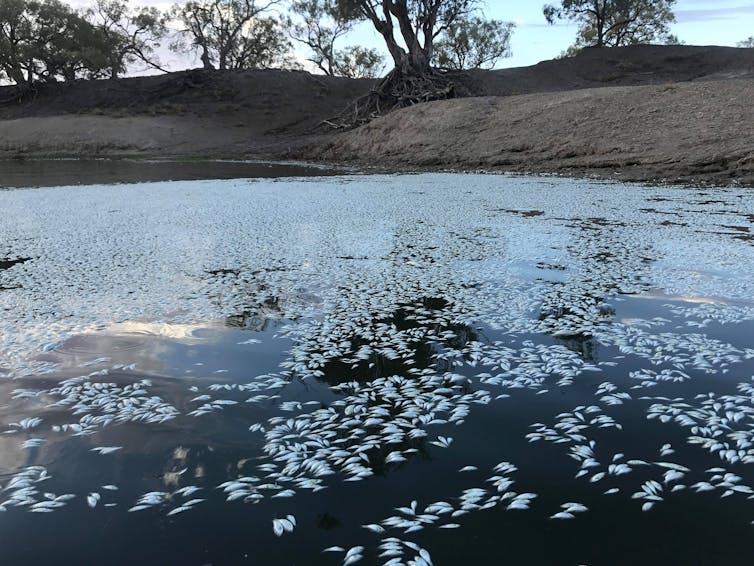
The New South Wales government plans to release two million native fish into rivers of the Murray-Darling Basin, in the largest breeding program of its kind in the state. But as the river system recovers from a string of mass fish deaths, caution is needed.
Having suitable breeding fish does not always guarantee millions of healthy offspring for restocking. And even if millions of young fish are released into the wild, increased fish populations in the long term are not assured.
We research the impact of human activity on fish and aquatic systems and have studied many Australian fish restocking programs. So let’s take a closer look at the NSW government’s plans.
A mass fish kill at Menindee in northern NSW in January 2019 depleted Fisk stocks.AAP
Success stories
According to the Sydney Morning Herald, the NSW restocking program involves releasing juvenile Murray cod, golden perch and silver perch into the Darling River downstream of Brewarrina, in northwestern NSW.
Other areas including the Lachlan, Murrumbidgee, Macquarie and Murray Rivers will reportedly also be restocked. These species and regions were among the hardest hit by recent fish kills.
Fish restocking is used worldwide to boost species after events such as fish kills, help threatened species recover, and increase populations of recreational fishing species.
Since the 1970s in the Murray-Darling river system, millions of fish have been bred in government and private hatcheries in spring each year. Young fish, called fingerlings, are usually released in the following summer and autumn.
There have been success stories. For example, the endangered trout cod was restocked into the Ovens and Murrumbidgee Rivers between 1997 and 2006. Prior to the restocking program, the species was locally extinct. It’s now re-established in the Murrumbidgee River and no longer requires stocking to maintain the population.
In response to fish kills in 2010, the Edward-Wakool river system was restocked to help fish recover when natural spawning was expected to be low. And the threatened Murray hardyhead is now increasing in numbers thanks to a successful stocking program in the Lower Darling.
After recent fish kills in the Murray Darling, breeding fish known as “broodstock” were rescued from the river and taken to government and private hatcheries. Eventually, it was expected the rescued fish and their offspring would restock the rivers.
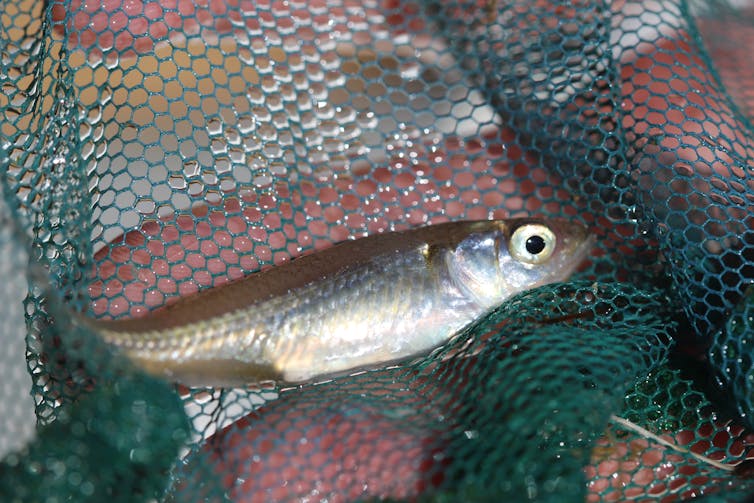
A Murray hardyhead after environment agencies transplanted a population of the endangered native fish.North Central Catchment Management Authority
Words of caution
Fish hatchery managers rarely count their fish before they hatch. It’s quite a challenge to ensure adult fish develop viable eggs that are then fertilised at high rates.
Once hatched, larvae must be transported to ponds containing the right amount of plankton for food. The larvae must then avoid predatory birds, be kept free from disease, and grow at the right temperatures.
When it comes to releasing the fish into the wild, careful decisions must be made about how many fish to release, where and when. Factors such as water temperature, pH and dissolved oxygen levels must be carefully assessed.
Introducing hatchery-reared fish into the wild does not always deliver dramatic improvements in fish numbers. Poor water quality, lack of food and slow adaptation to the wild can reduce survival rates.
In some parts of the Murray-Darling, restocking is likely to have slowed the decline in native fish numbers, although it has not stopped it altogether.
Address the root cause
Fish stocking decisions are sometimes motivated by economic reasons, such as boosting species sought by anglers who pay licence fees and support tourist industries. But stocking programs must also consider the underlying reasons for declining fish populations.
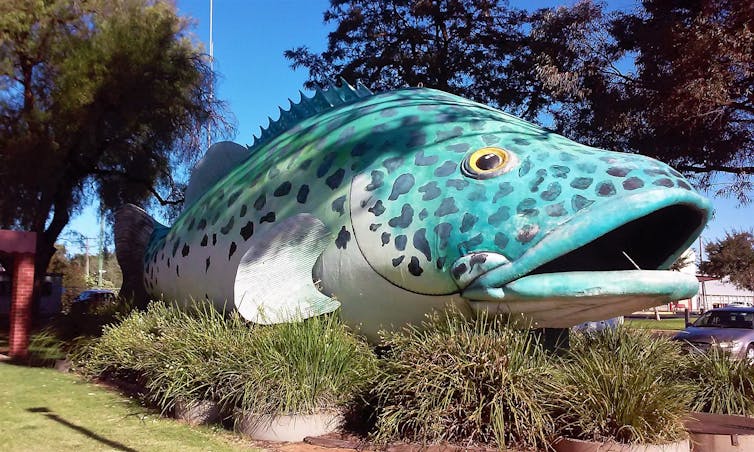
Swan Hill, home to a larger-than-life replica of the Murray cod, is just one river community that relies on anglers for tourism.Flickr
Aside from poor water quality, fish in the Murray Darling are threatened by being sucked into irrigation systems, cold water pollution from dams, dams and weirs blocking migration paths and invasive fish species. These factors must be addressed alongside restocking.
Fish should not be released into areas with unsuitable habitat or water quality. The Darling River fish kills were caused by low oxygen levels, associated with drought and water extraction. These conditions could rapidly return if we have another hot, dry summer.
Stocking rivers with young fish is only one step. They must then grow to adults and successfully breed. So the restocking program must consider the entire fish life cycle, and be coupled with good river management.
The Murray Darling Basin Authority’s Native Fish Recovery Strategy includes management actions such as improving fish passage, delivering environmental flows, improving habitat, controlling invasive species and fish harvest restrictions. Funding the strategy’s implementation is a key next step.
Looking ahead
After recent rains, parts of the Murray Darling river system are now flowing for the first time in years. But some locals say the flows are only a trickle and more rain is urgently needed.
Higher than average rainfall is predicted between July and September. This will be needed for restocked fish to thrive. If the rain does not arrive, and other measures are not taken to improve the system’s health, then the restocking plans may be futile.
I’m reading Thomas Carlyle’s poetic classic, The French Revolution, published in 1837. It occurred to me that the historical narrative of Australian universities and their relationship to government is like that revolution, but in reverse.
Carlyle summarised the goal of the French Revolution with the refrain “victorious analysis”. This was the foundation of Australia’s modern, rational system of government, achieved with universities. It was a triumph that turned out to be deeply flawed, as we will see.
Reversing the revolutionary process, in recent years universities have descended into the kind of aristocratic excess Carlyle described in pre-revolutionary France. This leaves a large scholarly workforce facing (this is Carlyle again) “an indubitable scarcity of bread”.
It is an admittedly dubious historical parallel, but it helps us understand something of the relationship of higher education to Australian politics, and the mess we now face.
In the mid-19th century, when Australians decided they wanted to govern themselves, political leaders knew they needed a university. Politician and university founder W.C. Wentworth went so far as to argue that self-government in New South Wales – the kind of modern, rational government increasingly in vogue since the French Revolution – would be “useless” without higher education.
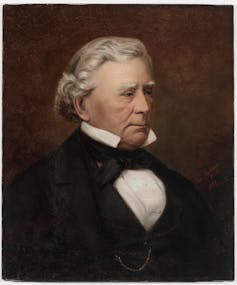
W.C.Wentworth.State Library of NSW
Australia had no aristocracy to overthrow and the founders of our first governments sought a basis for rule that did not rest on inherited position. University graduates, Wentworth believed, were needed to “enlighten the mind, to refine the understanding, to elevate the soul of our fellow men”. They were also needed to train men – and, shortly, women – to fill “the high offices of state”.
Kings can become philosophers; or else philosophers Kings. Let but Society be once rightly constituted, by victorious Analysis.
This merit-based elite – which some of Wentworth’s contemporaries ridiculed as a “bunyip aristocracy” – constituted the emerging professional class. Their work as medical practitioners, lawyers, clergy, teachers, charity workers, engineers and politicians was to guide this “rightly constituted” society.
Such modern, rational governments relied on the kinds of knowledge that a university pursued. “Victorious analysis” guided Australian governments through rabbit plagues and conquered parasites and diseases that threatened food supply and human health.
But it also steered the conquest of Aboriginal lands with knowledge of geology, geography, anthropology and agriculture. And it equipped generations of teachers and clergy with the wealth that was Western history, literature and philosophy – embedded in a racialised, moral superiority.
It was not perfect. Indeed, in many ways this “victorious analysis” was downright harmful.
The kind of knowledge the university produced helped build the nation, but it did so by also developing and reinforcing ideas that expropriated Indigenous land and oppressed people of colour. It built and encouraged ideas that determined a human’s worth on the basis of race, gender and sexuality. Universities and the governments they supported structured a so-called “rational” world that extracted value from some people and concentrated it among themselves.
Exposing the flaw in ‘victorious analysis’
By the second world war, some of these problems were becoming evident worldwide. In that war, the same “victorious analysis” combined with political regimes that sought to use “rational” knowledge to commit atrocities, even genocide, and demolish cities full of civilians.
It was at work when Nazi doctor Josef Mengele compared the effects of cruel experiments on twins at Auschwitz. Through those unspeakable experiments on 1,500 sets of twins, only 200 survived.
The dangers of aligning scholarly knowledge with political regimes was further exposed when, in the Soviet Union, Joseph Stalin dismissed, imprisoned or executed thousands of biologists. The reality that their knowledge may have helped prevent a tragic famine was not more important to Stalin than that their understanding of genetics contradicted government doctrine.
Democratic regimes were not immune. “Victorious analysis” led to the bombing of Hiroshima and Nagasaki. When news of those horrors filtered through, Western democracies saw the problem engendered by the relationship between modern, rational government and scholarly research.
Protecting the independence of scholarship
This did not mean governments sought to dismantle or undermine universities. On the contrary, Australian governments, like most others, invested in them further. However, care was taken, in Australia as elsewhere, to increasingly protect universities from political interference.
At this moment, Nobel-prize-winning author Herman Hesse had his character Joseph Knecht express the significance of scholarly independence in his novel The Glass Bead Game, published in 1943. Describing an age where rulers “determined the sum of two and two” and scholars capitulated (and lost their self-respect), protested (and died) or learned the art of silence (merely going hungry), Hesse’s character concluded that scholarship and politics must not mix:
The scholar who knowingly speaks, writes or teaches falsehood, who knowingly supports lies and deceptions, not only violates organic principles. He also, no matter how things may seem at the given moment, does his people a grave disservice. He corrupts its air and soil, its food and drink; he poisons its thinking and its laws, and he gives comfort and aid to all the hostile, evil forces that threaten the nation with annihilation. The Castalian [scholar], therefore, should not become a politician.
These sentiments were not confined to fiction. As the Commonwealth government sought to support the expansion of higher education – a tricky task, since education was and is the responsibility of Australia’s states – they were conscious of the contradictions required of them.
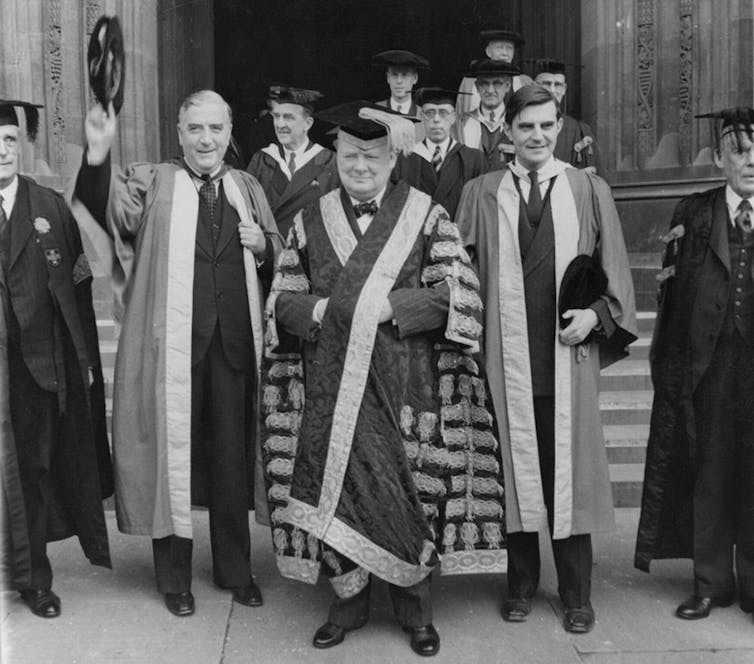
Robert Menzies, here receiving an honorary degree from Winston Churchill in 1941, invested heavily in universities.National Museum of Australia
The 1957 Murray Report, arguably the founding document for the modern university in Australia, pointed to exactly this.
Here is one of the most valuable services which a university, as an independent community of scholars and inquirers, can perform for its country and for the world. The public, and even statesmen, are human enough to be restive or angry from time to time, when perhaps at inconvenient moments the scientist or scholar uses the licence which the academic freedom of universities allows him, and brings us all back to a consideration of the true evidence and what it may be taken to prove …
… No nation in its senses wishes to make itself prone to self-delusion, or to deceit by other nations; and a good university is the best guarantee that mankind can have that somebody, whatever the circumstances, will continue to seek the truth and to make it known. Any free country welcomes this and expects this service of its universities.
On the basis of this report, Prime Minister Robert Menzies instigated what is likely the most generous funding Australian universities have ever seen.
He was building on work that Labor did during the war, establishing the Universities Commission and implementing a funding scheme that helped universities build new infrastructure.
The clashes produced by the dual need for scholarly independence and democratic accountability emerged early. “What I am asking,” argued the vice-chancellor at Sydney University in 1943, “is that you give us the money and be done with it.”
It is a large sum of money and when the Government says ‘We gave this subsidy, did the universities find it all right?’, we must be able to say something more than just ‘Trust the Universities’.
Paul Miller/AAP
Solutions and compromises were negotiated, though the original problems of “victorious analysis” remained.
Contesting the moral foundation of the university
By the 1970s, students and academics began to point out that this rational, supposedly objective system of knowledge veiled ideologies. This was not avoidable, they argued, and so the solution was to seek knowledge systems that were inclusive and decolonising, rather than those that supported established systems of inequality.
Under Prime Minister Gough Whitlam’s policy of free public education, the university sector expanded, seeking innovative and inclusive methods of learning and teaching.
In retrospect, this disruption in the universities marked a shift in the moral focus of the professional class. Where university graduates were originally central to the colonial project and capitalist expansion, they now turned their moral efforts towards moderating both.
This put them at odds with the political and managerial classes with whom the professional class, in the mid-20th century, had managed the entire world, through institutions like the World Health Organisation.
Rise of the managerial elite
But now the professional class split from the managerial class. Using radical student critiques of old moral codes as a springboard, in the 1980s the managerial class sought freedom from traditional moral constraints, which they believed also constrained capitalist growth.
This was more than a culture war: it was conflict over the moral foundation – and thus the control – of the economy. It was a kind of class struggle between a changing professional class and a newly separate, managerial class.
National Library of Australia
New values infused government and university leadership alike, forging what became known as neoliberalism. By the mid-1980s, “victorious analysis” was no longer the basis of government. Yet, ironically, government and economy alike relied on universities more than ever. Innovation was often key to profitability, and the changing global economy required ever more white-collar workers: university graduates.
In 1987, Labor Education and Training Minister John Dawkins led a review of higher education that sought to shift the entire university and college sector from “victorious analysis” to economic asset. Rather than considering the university as a moral institution, it would now be an economic one. An international student “export” market was a key component of 1980s reforms. So too, was massive expansion in the enrolment of Australian students.
But that professional class – which included academics, journalists and teachers, in influential roles – could clearly not be trusted to prioritise capitalist expansion over moral reform.
Transformations in higher education, then, wrested institutions from academic control. Over the following two decades, management of universities became a professional pathway almost entirely distinct from the pursuit of scholarship.
We must not romanticise universities run by academics under the old conditions of “victorious analysis”. As we have seen, this did a great deal of harm. But the fact that the system needed to change need not imply a managerialist solution.
Steered by government policy, an expensive managerialist epidemic infected the universities. Every year, millions of dollars in salaries alone propped up a this new “aristocracy”, a managerial elite.
Leaders assured us this was the best way to manage these growing and complex institutions. But, instead, managers encouraged one another to game the government’s funding system to achieve their KPIs (and earn spectacular bonuses). The cost has been a failure to invest in good universities that are sustainable in the long term.
Failure to build a good university sector
Looking at the state of the university sector now, we surely cannot consider the managerial salary bill to be money well spent. The present crisis was exacerbated by COVID-19 but was not unexpected.
University leaders were repeatedly warned of financial risks, of threats to the university’s legitimacy (and thus community and political support). They have also been reminded continually of their moral responsibility as public institutions. And yet, like Carlyle’s King Louis XV, they have pilfered resources that were “sufficient not to conquer Flanders, but the patience of the world”.
Like that French aristocracy, the university sector in Australia has been teetering on the edge of ruin for decades. In some ways it is astonishing it has taken so long to tip over. Carlyle, on pre-revolutionary France, noted that:
[…] it is singular how long the rotten will hold together, provided you do not handle it roughly.
Australian universities have long teetered – or, worse, arrogantly swaggered – on a precarious foundation. Their precarity goes beyond their over-reliance on international student fees and management’s tiresome reprises of what Geoff Sharrock calls “yesterday’s logic”.
Julian Smith/AAP
All of this – the education of young people, the medical research we’ve all been sitting at home waiting to be done, our entire stock of knowledge of history, mathematics, robotics, climate science – sits atop a 93,000-strong workforce of casual academics on starvation wages. It is these academics who will probably be out of work within the month.
They will likely be followed by thousands of their better-paid, but still overworked, teaching and researching colleagues, then thousands of the indispensable workers who throughout the pandemic have kept the technology running, the exams timetabled, library resources accessible, the payroll delivered, and who have cared for troubled or confused students.
A good university sector would look at 100,000 very clever, highly qualified and extremely hard-working scholars and see a valuable resource.
A good government would work with them.
The job of building a good university out of the system we have inherited from history is a more revolutionary task. It is one we all need to share.
Source: The Conversation (Au and NZ) – By Luke Grzeskowiak, The Hospital Research Foundation Mid-Career Research Fellow – Robinson Research Institute & South Australian Health & Medical Research Institute, University of Adelaide
It’s well known smoking cigarettes during pregnancy can increase the risk of harm to the baby and is best avoided.
But in our research, published today in the Medical Journal of Australia, we show using cannabis during pregnancy is also associated with poorer outcomes for babies.
While we don’t have data on how common cannabis use is during pregnancy, results from the 2016 Australian National Drug Strategy Household Survey showed 10-20% of women of reproductive age had used cannabis during the preceding 12 months.
Recent literature from overseas shows the number of women who become pregnant while using cannabis increased by as much as double from 2002 to 2017.
This is likely driven in large part by the legalisation of cannabis in many parts of the world. In turn, increasing social and medical acceptance of its use has led to an overall perception cannabis is a safe drug.
In places where cannabis is legal, cannabis dispensaries sometimes promote it for the treatment of nausea and vomiting in pregnancy. But there are no studies evaluating whether it’s effective in this context, let alone whether it’s safe.
A recent study found one in three pregnant women didn’t think cannabis could harm their baby.
But our research adds to a growing number of animal and human studies suggesting the opposite.
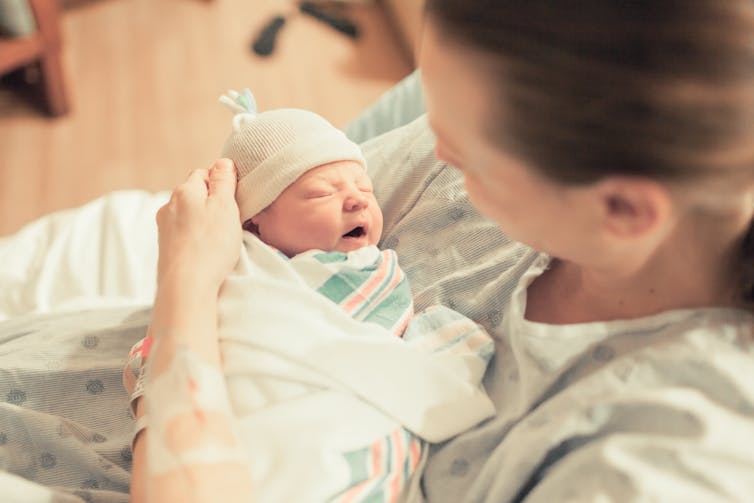
Many women don’t know using cannabis during pregnancy poses risks to the baby.Shutterstock
Our study
We analysed data from 5,610 women who were in their first pregnancy and at low risk for pregnancy complications.
At 14–16 weeks of pregnancy, we grouped women by self-reported cannabis use.
Of the women in our study, 314 (5.6%) reported using cannabis in the three months before pregnancy or during their pregnancy. Of these women, 97 (31%) stopped using it before pregnancy and 157 (50%) stopped during the first 15 weeks of pregnancy, while 60 (19%) were still using cannabis at 15 weeks.
Compared to babies of mothers who didn’t use cannabis before or during pregnancy, infants of those who still used it at 15 weeks had a smaller birth weight, head circumference and length. They were also born at an earlier gestational age.
This is cause for concern as these outcomes are strongly linked to future child health and development.
We saw bigger differences in these neonatal outcomes for women who used cannabis more than once a week than for those who used it less often.
We also found severe complications following birth, such as breathing problems and the need for admission to a specialist neonatal unit, were twice as likely for babies of mothers who continued to use cannabis at 15 weeks compared to babies of mothers who didn’t report using cannabis.
We’ve seen similar trends in recent studies from the United States and Canada.
Notably, we didn’t see differences in any neonatal outcomes among women who reported stopping cannabis in early pregnancy or just before becoming pregnant compared to babies of mothers who reported no cannabis use.
How cannabis might be harmful is not clear
The link between using cannabis during pregnancy and poorer neonatal outcomes could be related to the toxic compounds, such as carbon monoxide, produced when cannabis is smoked. This is similar to what we see with cigarette smoking and leads to a lower amount of oxygen reaching the baby.
Or it could be a direct effect of the compounds found in cannabis which we know can cross the placenta and reach the baby.
These active compounds, THC (tetrahydrocannabinol) and CBD (cannabidiol), influence a range of bodily functions, including in the brain. This is why people typically use recreational cannabis in the first place.
So when these compounds can reach the developing baby this raises a number of concerns about what they might do to growth and brain development.
Previous studies looking at the link between cannabis use and pregnancy outcomes have attracted criticism for not properly accounting for confounding factors. These are factors often associated with cannabis use which could also increase the risk of poor pregnancy outcomes, like cigarette smoking, alcohol consumption, use of other illicit substances, or mental health issues.
While we accounted for each of these factors in our study, our research still has limitations. Cannabis use was based on self-report, and the number of women who continued to use cannabis during pregnancy was relatively small. We were also not able to account for quantity and strength of cannabis used.
We found babies born to mothers who used cannabis during pregnancy weighed less at birth.Shutterstock
Nonetheless, our research adds to a growing body of evidence suggesting cannabis use during pregnancy could be harmful.
Although we didn’t look at these outcomes in our study, other research has shown cannabis use could increase the risk of preterm birth and stillbirth.
If you’re planning a pregnancy
Given the growing body of evidence suggesting potential harms, it’s safest to avoid using cannabis during pregnancy, and even when planning a pregnancy.
Medical and regulatory bodies within Australia and across the world echo this advice.
Our data suggest that cutting back or stopping cannabis use early in a pregnancy could prevent some of the harms. This could provide reassurance for women who use cannabis before they know they’re pregnant.
Women who use cannabis and are planning a pregnancy should discuss the issue with their health-care professional.
COVID-19 is being referred to as a “once in a century event” – but the next pandemic is likely to hit sooner than you think.
In the next few decades, we will likely see other pandemics. We can predict that with reasonable confidence because of the recent increased frequency of major epidemics (such as SARS and Ebola), and because of social and environmental changes driven by humans that may have contributed to COVID-19’s emergence.
A COVID-19-type pandemic had long been predicted, but scientists’ warnings weren’t heeded. Right now, while we have the full attention of politicians and other key decision-makers, we need to start rethinking our approaches to future preparedness internationally and within our own nations. That includes countries like New Zealand, where – despite getting its active COVID-19 cases down to zero in June 2020 – big challenges remain.
Less than five years ago, I was one of about 100 global experts invited to a World Health Organization (WHO) meeting in Geneva, prompted by the then ongoing Ebola outbreak in West Africa.
Then, as now, WHO was criticised for its response to the outbreak. The December 2015 meeting was meant to improve international collaboration and preparation for future epidemics and other infectious disease risks.
The very last presentation was from Dr David Nabarro, then the United Nations Special Envoy on Ebola (and now a Special Envoy on COVID-19).
In the wake of the Ebola outbreak, politicians were more focused on public health than ever before. Nabarro urged us to show greater leadership and capture that interest, before political and public attention moved on. He stressed the importance of trust, respect, transparent communication, and working with nature.
Yet five years later, we’re still talking about inadequate funding for pandemic preparedness; delays in adopting preventive measures; failure to develop surge capacity in health systems, laboratories and supply chain logistics; and reduced infectious disease expertise.
But there are signs that some lessons may have been learned. For example, countries most affected by SARS (such as Taiwan and Singapore) have tended to respond more quickly and decisively to COVID-19 than other countries.
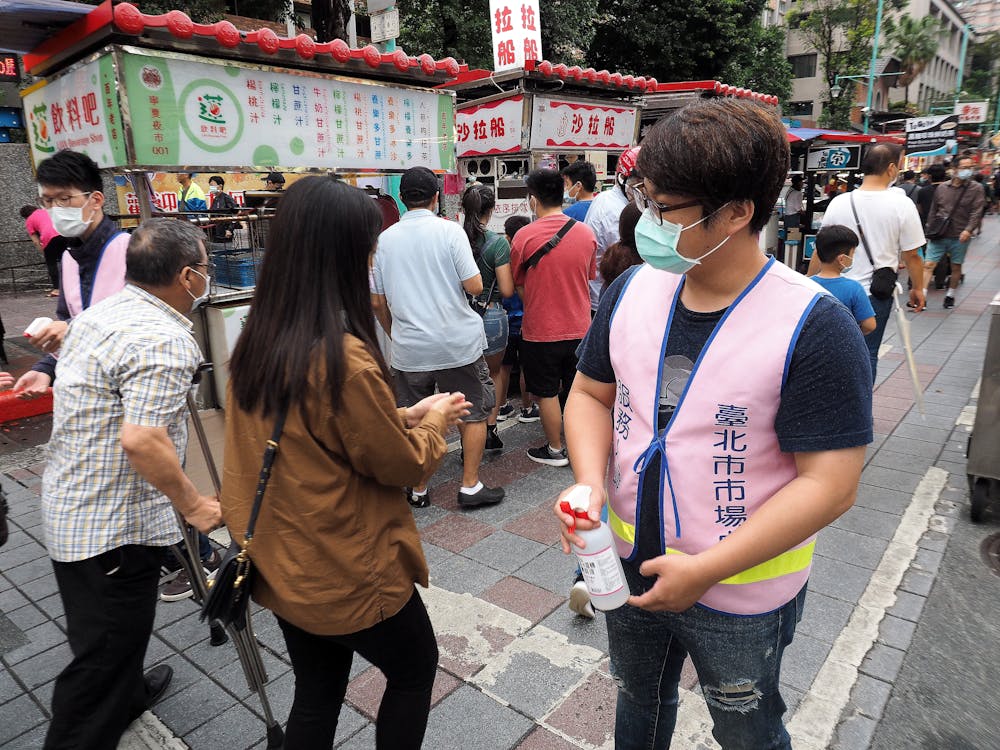
Health workers stand ready to apply sanitising gel on people’s hands at a market in Taipei in May 2020, as Taiwan began loosening its COVID-19 restrictions.EPA/David Chang
Primed and ready, vaccine developers have progressed at enormous pace, with several COVID-19 vaccine candidates already undergoing clinical trials. The volume and pace of sharing scientific information about COVID-19 has been unprecedented.
We’ve also seen a number of rapid reports urging us to learn from this pandemic and past epidemics to protect us from future events – especially by taking an holistic “One Health” approach. This brings together expertise across human health, animal health and the environment.
For instance, last month the Lancet One Health Commission called for more transdisciplinary collaboration to solve complex health challenges. Similarly, the World Wide Fund for Nature’s March 2020 report on The Loss of Nature and Rise of Pandemics highlighted the likely animal origin of COVID-19, and how intimately connected the health of humans is to animal and environmental health.
As well as working more effectively together internationally, each country will need its own strategy. So what should we be doing to protect New Zealand from future infectious diseases threats?
Our health system has, for the most part, responded well to COVID-19. Our research institutions and universities have engaged quickly and effectively to provide scientific support for the public health response.
Yet we can and must still do better. Our expertise and systems are not always well joined up – vital for coordinated and timely responses to challenges like COVID-19.
We allow scientists to work in silos, despite obvious overlapping interests and skill sets. Of particular importance for tackling infectious diseases is the need to break down artificial barriers between human, animal and environmental health.
This approach makes particular sense in New Zealand. We are an island nation vulnerable to introduced infectious diseases, and economically dependent on agriculture and the physical environment. But we’re also home to an existing indigenous Māori worldview and knowledge system that emphasises interconnectivity between humans, animals and the environment.
University-led efforts, such as One Health Aotearoa, have brought together professionals and researchers from different disciplines. But more investment is needed to get even better value from such collaborations.
We need to strengthen capability in such areas as epidemiology, modelling and outbreak management, and build pandemic plans that are flexible enough to respond to all eventualities. New Zealand has a Centre of Research Excellence in plant biosecurity – but not in animal biosecurity or infectious diseases.
We also need to better integrate science and research into the health system, a key feature of the New Zealand Health Research Strategy 2017-2027. This requires a culture change so research is regarded as business as usual for district health boards, providing the science needed to inform policy, preparedness and best practice.
Crucially, we need a new generation of scientists and professionals who are systems thinkers and comfortable working with multiple disciplines and across the human-animal-environment interface.
And we need the kind of leadership Nabarro called for: science-informed and forward-looking, rather than reactive.
We have seen good leadership based on science in the highest levels of New Zealand’s government in response to COVID-19.
We now need to see this at all levels of health, research and politics to get us out of this pandemic in the best shape possible – and be better prepared for our next pandemic.
Source: The Conversation (Au and NZ) – By Lee Baumgartner, Professor of Fisheries and River Management, Institute for Land, Water, and Society, Charles Sturt University
The New South Wales government plans to release two million native fish into rivers of the Murray-Darling Basin, in the largest breeding program of its kind in the state. But as the river system recovers from a string of mass fish deaths, caution is needed.
Having suitable breeding fish does not always guarantee millions of healthy offspring for restocking. And even if millions of young fish are released into the wild, increased fish populations in the long term are not assured.
We research the impact of human activity on fish and aquatic systems and have studied many Australian fish restocking programs. So let’s take a closer look at the NSW government’s plans.
A mass fish kill at Menindee in northern NSW in January 2019 depleted Fisk stocks.AAP
Success stories
According to the Sydney Morning Herald, the NSW restocking program involves releasing juvenile Murray cod, golden perch and silver perch into the Darling River downstream of Brewarrina, in northwestern NSW.
Other areas including the Lachlan, Murrumbidgee, Macquarie and Murray Rivers will reportedly also be restocked. These species and regions were among the hardest hit by recent fish kills.
Fish restocking is used worldwide to boost species after events such as fish kills, help threatened species recover, and increase populations of recreational fishing species.
Since the 1970s in the Murray-Darling river system, millions of fish have been bred in government and private hatcheries in spring each year. Young fish, called fingerlings, are usually released in the following summer and autumn.
There have been success stories. For example, the endangered trout cod was restocked into the Ovens and Murrumbidgee Rivers between 1997 and 2006. Prior to the restocking program, the species was locally extinct. It’s now re-established in the Murrumbidgee River and no longer requires stocking to maintain the population.
In response to fish kills in 2010, the Edward-Wakool river system was restocked to help fish recover when natural spawning was expected to be low. And the threatened Murray hardyhead is now increasing in numbers thanks to a successful stocking program in the Lower Darling.
After recent fish kills in the Murray Darling, breeding fish known as “broodstock” were rescued from the river and taken to government and private hatcheries. Eventually, it was expected the rescued fish and their offspring would restock the rivers.
A Murray hardyhead after environment agencies transplanted a population of the endangered native fish.North Central Catchment Management Authority
Words of caution
Fish hatchery managers rarely count their fish before they hatch. It’s quite a challenge to ensure adult fish develop viable eggs that are then fertilised at high rates.
Once hatched, larvae must be transported to ponds containing the right amount of plankton for food. The larvae must then avoid predatory birds, be kept free from disease, and grow at the right temperatures.
When it comes to releasing the fish into the wild, careful decisions must be made about how many fish to release, where and when. Factors such as water temperature, pH and dissolved oxygen levels must be carefully assessed.
Introducing hatchery-reared fish into the wild does not always deliver dramatic improvements in fish numbers. Poor water quality, lack of food and slow adaptation to the wild can reduce survival rates.
In some parts of the Murray-Darling, restocking is likely to have slowed the decline in native fish numbers, although it has not stopped it altogether.
Address the root cause
Fish stocking decisions are sometimes motivated by economic reasons, such as boosting species sought by anglers who pay licence fees and support tourist industries. But stocking programs must also consider the underlying reasons for declining fish populations.
Swan Hill, home to a larger-than-life replica of the Murray cod, is just one river community that relies on anglers for tourism.Flickr
Aside from poor water quality, fish in the Murray Darling are threatened by being sucked into irrigation systems, cold water pollution from dams, dams and weirs blocking migration paths and invasive fish species. These factors must be addressed alongside restocking.
Fish should not be released into areas with unsuitable habitat or water quality. The Darling River fish kills were caused by low oxygen levels, associated with drought and water extraction. These conditions could rapidly return if we have another hot, dry summer.
Stocking rivers with young fish is only one step. They must then grow to adults and successfully breed. So the restocking program must consider the entire fish life cycle, and be coupled with good river management.
The Murray Darling Basin Authority’s Native Fish Recovery Strategy includes management actions such as improving fish passage, delivering environmental flows, improving habitat, controlling invasive species and fish harvest restrictions. Funding the strategy’s implementation is a key next step.
Looking ahead
After recent rains, parts of the Murray Darling river system are now flowing for the first time in years. But some locals say the flows are only a trickle and more rain is urgently needed.
Higher than average rainfall is predicted between July and September. This will be needed for restocked fish to thrive. If the rain does not arrive, and other measures are not taken to improve the system’s health, then the restocking plans may be futile.
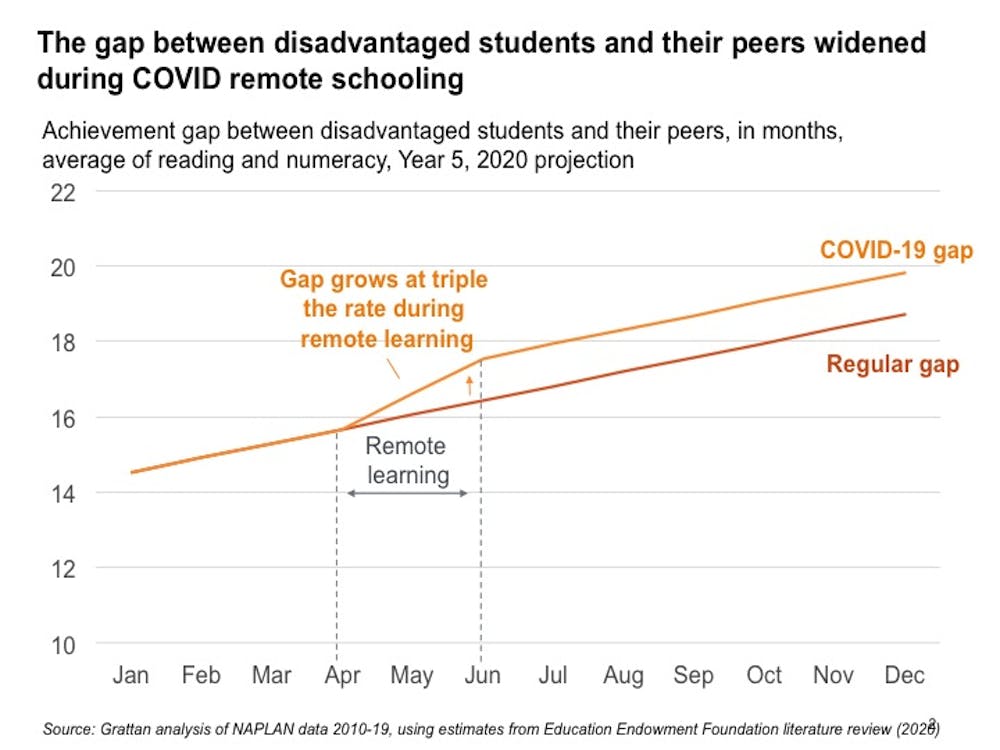
Despite massive efforts by teachers and schools during the remote learning period, many students are likely to have learnt less than they would have in the classroom. Most of these students will recover without too much trouble, but disadvantaged students will need extra help.
Even if remote learning worked well, disadvantaged students are likely to have learnt at about 50% of their usual rate. This means they would have lost about one month of learning over two months of remote schooling.
The Morrison government has already committed an unprecedented A$134 billion to stimulate the economy, with more stimulus spending to come. Some should go to helping disadvantaged students catch up over the next six months.
How we made our estimates
We estimate around one in four students will need help to catch up on their learning. This is especially so for students who were already far behind, for whom the extra challenges of remote schooling are likely to have compounded existing inequalities.
This includes students from low socio-economic families, Indigenous backgrounds and remote communities, as well as students experiencing poor mental health.
Our estimates of how far behind disadvantaged students may have fallen during the remote period are only a rough indication. But they are based on a significant review of various studies on learning disruption, led by the UK Education Endowment Foundation (EEF) in May.
The EEF searched literature across a variety of scenarios that cause school disruptions including hurricanes, bushfires, summer holidays and teacher strikes. While summer holidays are different to remote schooling, they are relevant because they isolate the influence of the home on a student’s performance.
The findings from these studies show during the US summer vacation, a gap of up to three months in learning opens up between disadvantaged students and their peers. Disadvantaged students return to school being much further behind their peers than when holidays began.
Why disadvantaged students lose out
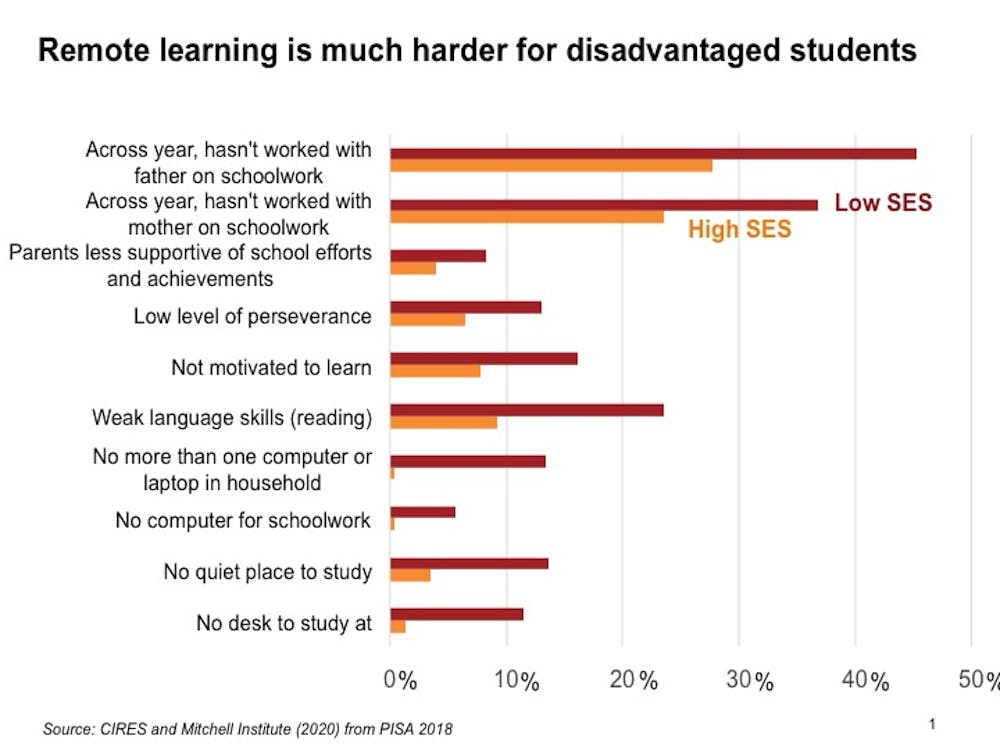
There are many reasons disadvantaged students are hit hardest by remote schooling, as the chart below shows. They tend to get less help with school work from their parents. They are less likely to have a computer, good internet service, and a desk or quiet place to study.
Author provided
Disadvantaged students, on average, are also likely to be behind in their learning, making it harder to work independently.
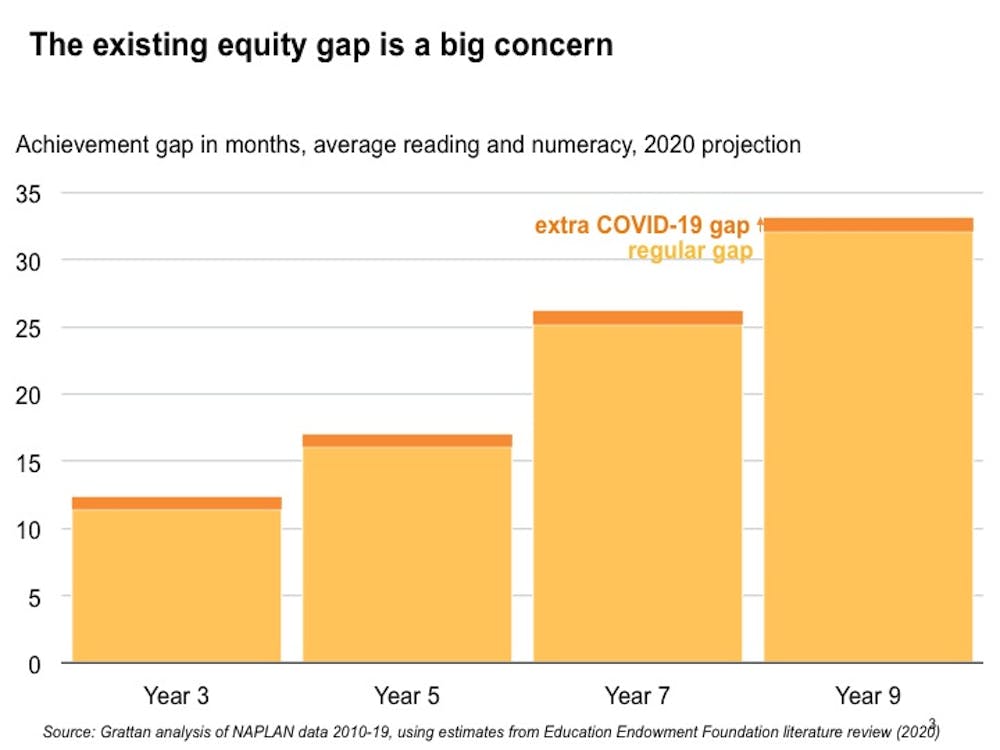
The existing achievement gap is more than ten times greater than the gap that will have developed during the COVID-19 disruptions, as shown the chart below.
Author provided
The recession will only make things harder, because disadvantaged students are more likely to have to deal with the emotional and financial stresses of a parent losing income or a job.
What the government can do: put stimulus funding toward disadvantaged students
Governments are now spending big to stimulate the economy. The World Bank believes COVID-19 has sparked the worst global recession since at least the second world war.
COVID-19 and the economic downturn offers a big opportunity for a national investment in education. We recommend a recovery package of A$1.2 billion targeted at vulnerable students for the next six months. This will help one million students, around one in four, recover the learning lost during COVID.
The money should be spent on two high-priority initiatives.
First, $1 billion should go towards helping large numbers of struggling students access small-group tutoring. Tutoring would be delivered in groups of about three students, either in or outside classes, three or four times a week over a 12-week period.
Evidence shows small group tuition can boost student learning by five months over one or two terms of schooling.
Young university graduates and student teachers should be hired as tutors where possible – given young people will be hit harder by the recession than older Australians and are likely to spend the extra income quickly.
Second, we recommend investing $70 million in successful literacy and numeracy programs which can improve student learning by three or more months. For example teaching reading using synthetic phonics, as well as reading comprehension strategies and oral language interventions.
These are a priority for the early years, so students have the foundations for future learning.
We also suggest extra support for students to improve both well-being and learning. There is less evidence on what works in this area, but we suggest small trials in promising areas, such as extra training for teachers in mental health literacy and supporting students’ social skills, as well as extra resources for targeted behaviour supports.
To ensure the students who most need help are accurately identified in the first place, we recommend the national assessment body – the Australian Curriculum, Assessment and Reporting Authority – create a A$20 million package of suitable in-class assessment tools. The right support depends on pinpointing student needs.
While costing a little over $1 billion, our suggested reform package would deliver about $3.5 billion in extra future earnings for disadvantaged students, given better results at school leads to better employment and income prospects in later life.
This reform package offers an important opportunity to trial and evaluate what works, to inform longer-term efforts to close the bigger existing equity gap.
Source: The Conversation (Au and NZ) – By Caroline Osborne, Postdoctoral Research Fellow, Office of Community Engagement, University of the Sunshine Coast
The COVID-19 pandemic has brought into sharp focus the need for connection to our local community and the health challenges of the retirement village model.
We know that, as we age, most people prefer to stay in their own homes and communities instead of moving to retirement villages. Some have gone so far as to say retirement villages have had their day. However, the reality is not quite that simple.
The challenge is that seniors are not well informed on what they could demand of the market. Planning schemes could also do more to create incentives for the changes we need now.
The challenges are complex and urgent as the global population grows and ages. Yet our housing supply reveals a bad case of the tail wagging the dog. Finely tuned financial models and development processes are driving the housing products available in the market.
What’s needed instead is adaptable housing and neighbourhoods to help people as they move through life’s stages.
Are the days of the retirement village numbered?
Many individuals and families struggle to find the right “fit” between the supported living options of retirement villages, independent living lifestyle villages and staying in the (often unsuitable) family home as their needs change.
Such villages offer viable products in the market as an important part of the housing mix. The models have some advantages in that they:
are thoroughly costed and provide a good return for developers
offer a range of living options to suit most budgets and level of care needs
promise security, activities and a sense of community.
Seniors are best placed to say what they need
However, our research with seniors in south-east Queensland revealed a desire to “age in neighbourhood” and to have neighbourhoods with a mix of ages and building forms.
Planning schemes could drive this now by giving priority to, and providing incentives for, sustainable and accessible housing close to transport and other services.
We worked with more than 42 seniors in south-east Queensland to design a series of housing types. These were based on what they told us were important to them in a home and a neighbourhood.
The table below summarises the key features that they told us make a neighbourhood and a home a good place to live as they age.
The resulting principles and housing types paint a vivid picture of what older people in a subtropical environment find appealing and supportive as they age.
Many participants preferred an accessible home on one level. Ideally, it should have two bedrooms and a study. This means it can easily be adapted to changing needs.
An essential component for our participants was to take advantage of the mild climate by having both private and shared outdoor spaces. Here they could socialise, relax and enjoy pleasant outlooks from the home. Cutting planning requirements for car parks by 50% could add more shared outdoor space and cut housing and living costs for residents.
Homes should be sustainably designed. This means they capture natural light and prevailing breezes for through ventilation, take into account privacy and noise considerations in higher-density areas, and have solar and rainwater harvesting systems to save resources and money.
Also important was a neighbourhood with a variety of green, clean and safe public open spaces. This includes flat, well-maintained and shaded walkways for exercise and easy access to shops, facilities and public transport.
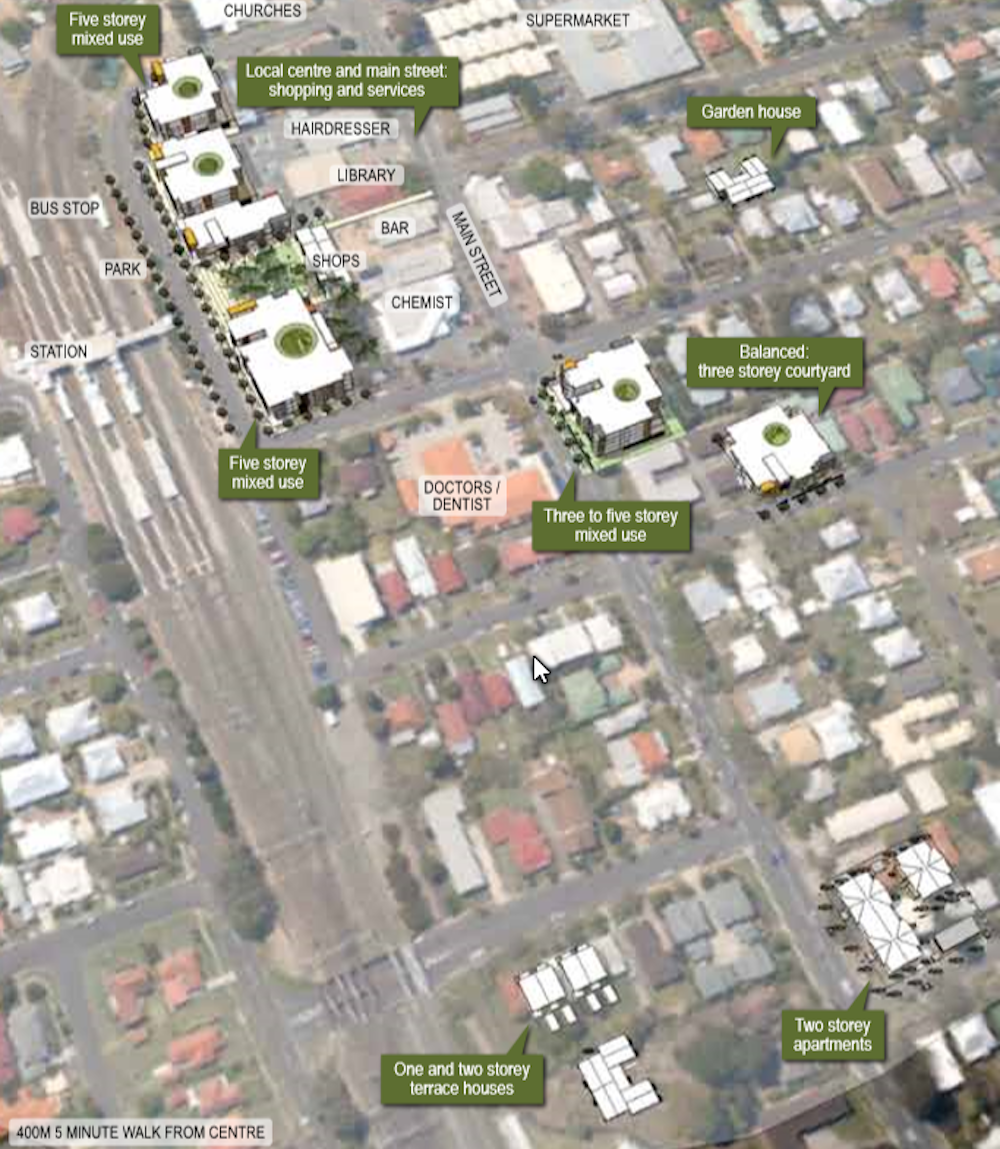
We then showed how all these housing types could be incorporated into one Brisbane suburb, as the image below illustrates. This would mean seniors could remain in their neighbourhood in more suitable housing, reducing the stress of moving to unfamiliar surroundings.
As with all complex challenges, everyone has a role to play in achieving these goals. However, local government planning reforms can act as a catalyst for the market to change and innovate.
Planning schemes could, for example, reduce application fees for developments that include accessible or universal design within 400-800 metres of key services, facilities and transport.
Carpark allocation could also be uncoupled from housing in locations close to transport and services. This would reduce the cost of housing and encourage greater used of active (cycling, walking, etc) and public transport.
This research clearly signals to local and state government, developers and small-scale property investors how houses, duplexes and mid-rise apartments could be put together in an age-friendly suburb. This transition to mixed-density infill development would support what we call “ageing in neighbourhood”.
Further, this research suggests planning “priority zones” could give the market the incentive to invest in the future-focused neighbourhood development it should be providing to keep people connected to their community.
Phil Smith, Associate Director of Deicke Richards, co-authored this article.
Retailers have tried many overt tactics to limit theft, such as signs that display images of CCTV cameras, threats to prosecute offenders, bag checks, checkout weighing plates and electronic security gates.
These tactics are extremely costly and have failed to stamp out retail theft.
Now supermarkets are trying a different tactic, that’s part overt surveillance but also encourages “self-reflection” on any impulse to exploit loopholes in the bagging and payment systems.
In late May Australian supermarket giant Woolworths confirmed it is trialling self-service checkout terminals with built-in cameras. They display your image as you scan your items. Rival Coles started trying the technology in April 2019.
The idea is that watching yourself scan your own groceries will reduce the temptation to steal. It is supported by research that shows the effectiveness of cues that cause us to self-focus and self-regulate.
Retail theft continues to grow
Since 1990, when the Australian Insitute of Criminology published extensive research on retail crime and its prevention, it has been widely accepted crime-related losses account for about 1% of all retail revenue. Estimates of customer theft were woolier.
In August 2019 the Australia and New Zealand Retail Crime Survey came up with a specific number. It reported total crime-related retail losses amounted to 0.92% of revenue. Customer crime was 58% of that – or 0.53% of total revenue.
Though funded by retail technology company Checkpoint Systems, the survey sample is robust – almost a quarter of the retail industry in Australia and New Zealand. Also, the lead researcher, Emmeline Taylor, is a criminologist in the Department of Sociology at City, University of London respected for her expertise in retail crime.
Costs of loss prevention
Writing about her research in 2018, Taylor tells the story of a major Australian supermarket discovering it was selling more carrots than it had in stock.
Unfortunately this wasn’t a sudden switch to healthy eating or a desire to increase vitamin C intake, it was an early sign of a new type of shoplifter. Otherwise honest shoppers were using the self-service checkout to transact more expensive items – typically avocados – and put them through as carrots.
Self-service checkouts have enabled ‘swipers’ – seemingly well-intentioned patrons engaging in routine shoplifting, says criminologist Emmeline Taylor.Shutterstock
She termed these self-service checkout thieves “SWIPERS” – seemingly well- intentioned patrons engaging in routine shoplifting. As the Australia and New Zealand Retail Crime Survey states:
Their behaviour and motivations (that are often interlinked) fall into four main groups: the accidental thieves, the switchers of labels, those compensating themselves, and those that steal because they claim to have become frustrated with the process of self-checkout (e.g. triggering alerts or purchasing age-restricted items that require assistance from an employee).
The traditional approach to loss prevention involves attendants and security guards, specialised display fixtures, reinforced packaging, training, in-store signage, display alarms and more cameras.
More of these can prove counter-productive, as highlighted by the Australian Institute of Criminology’s analysis of local crime prevention strategies in 2014. It found, for example, that introducing surveillance systems or security guards made shop staff less likely to approach suspicious shoppers.
Getting away with it
The research by Taylor and others into the motivators of shoplifting points to the potential of another way to reinforce honest behaviour.
While some forms of stealing might be considered irrational – such as kleptomania – shoplifters often rationalise their thefts.
How much they steal comes down to their own “deviance threshold” – the point at which they can no longer justify their behaviour alongside a self-perception as a good person. This helps explains the greater frequency of shoplifting lower value items. It’s easier to justify a small “discount” on your bill.
If it’s just a small theft, also, the chances of getting caught are smaller. If caught, the chance of getting away – passing it off as an honest mistake, perhaps – is higher. This semi-conscious calculation is known as the “denial of punishment probability”.
You are being watched
An obvious strategy for retailers is to make shoppers more aware they are being watched.
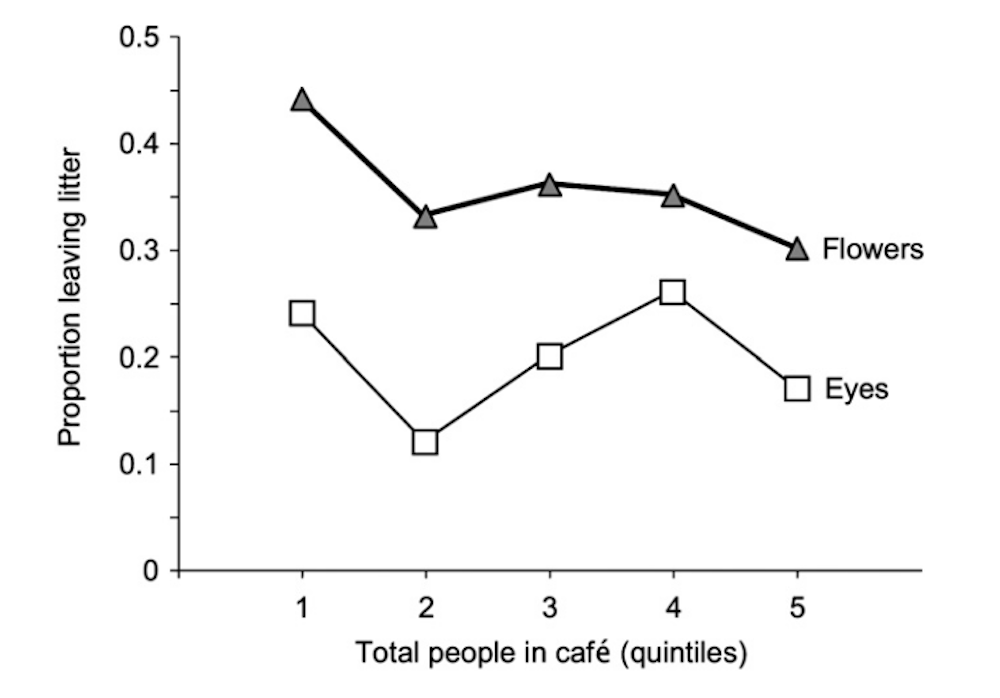
Research has demonstrated “eyes” images do this more effectively than images of security cameras or written reminders such as “you are being observed”. This is due to eyes triggering instincts connected to our evolutionary capacity for gaze detection – sensitivity to being watched.
Newcastle University researchers Max Ernest-Jonesa, Daniel Nettleb and Melissa Bateson did an experiment in a campus cafeteria and found that posters featuring eye images resulted in less litter being left on tables than images of flowers, but less so when the café was busier.
The more people around the more we relax. Those “eyes” can’t be watching everyone.
Think of yourself
An more effective tactic might be appealing to another honed evolutionary instinct: a “think of yourself” focus.
University of East Anglia researcher Rose Melaeady and colleagues demonstrated this with experiments using signs to encourage drivers to turn off their engines at a busy rail crossing with a two-minute average wait.
After an experiment just using an “watching eyes” image (with no discernible effect) they tried two signs.
One with set of human eyes and the words: “When barriers are down, switch off your engine”
The other with just the words: “Think of yourself: When barriers are down, switch off your engine.”
With no sign, 20% of drivers switched off their engines. With the watching eyes sign, 30% switched off. With the “think of yourself” sign, 51% did so.
Self-surveillance
So the supermarkets’ self-surveillance strategy combines two tactics. First, a “traditional” external motivation to do the right thing – amplifying the spotlight effect with an overt reminder we are being watched. Second, it is also intended to evoke self-reflection and self-regulation.
These steps will likely add to concerns about personal privacy, though Woolworths and Coles say no recordings are being made.
Even if they were, though, the embrace of cashless transactions – with just 27% of all payments now made with cash – suggests most customers aren’t overtly concerned about how much others know about their shopping habits.
November 1959. Film director Alfred Hitchcock is at his commercial and critical peak after the successes of Vertigo (1958) and North by Northwest (1959). So what does he do next? A black-and-white made-for-TV movie hastily shot, with no big-name actors and a leading actress who takes a shower, and … well, we’ll come to that.
Psycho (1960) remains Hitchcock’s most celebrated film. But it is really two films, glued together by the most iconic scene in cinema history.
Part one is a run-of-the-mill morality tale. Marion Crane (Janet Leigh) steals $40,000 from her Phoenix employee, and goes on the run. Guilt-stricken, she pulls into a deserted motel and chats with the owner, Norman Bates (Anthony Perkins).
He seems friendly enough – he makes her sandwiches and talks fondly about his mother – and Marion resolves to return the money.
Part two is a whodunnit. Marion’s sister (Vera Miles) and her lover (John Gavin) investigate her disappearance, and trace her steps back to the motel. Soon, they begin to have suspicions about Norman.
‘She just goes … a little mad sometimes.’
Thriller with a twist
A few years earlier, Hitchcock had watched Henri-Georges Clouzot’s 1955 psychological masterpiece Les Diaboliques and sought out a similar project – a horrific thriller with a twist ending. He read Robert Bloch’s novel Psycho – itself inspired by the real-life Wisconsin killer Ed Gein – and optioned the film rights.
Audiences saw things in Psycho that had never been shown before on screen. A toilet flushing. A murderer who goes unpunished. A post-coital Leigh, lying on a bed, dressed only in white underwear, while Gavin stands topless over her.
All of Hitchcock’s trademark obsessions are on show: voyeurism, the dominant matriarchal figure, the blonde heroine, the untrustworthy cop.
Over his career, Hitchcock had always flouted Hollywood’s Production Code, those rigid rules that had been in place since the 1930s that prohibited onscreen nudity, sex and violence. Nowhere is Hitchcock’s brazen censor-defying clearer than in Psycho’s “shower scene”.
Marion steps into the shower, a shadowy figure rips back the curtain, and cinema’s most visceral scene unspools, brutally, before our very eyes.
Hitchcock, the master of suspense, never actually shows knife slicing flesh. Everything is implied, through liberal doses of chocolate sauce, hacked watermelons, Bernard Herrmann’s screeching violins, and Leigh’s blood-curdling screams.
In one 60-second scene, Hitchcock shatters all the rules. It’s the most famous of all bait and switches: you expect one thing, but get another. Up to that point, no film had killed off its lead character so early in the story (nowadays, such an audacious twist shows up everywhere, from The Lion King to Games of Thrones). As Leigh slides down the blinding white tiles, arm outstretched, a new kind of cinema is born: twisted, shocking, primal.
Janet Leigh, the star of the film, leaves it at the 45-minute mark.IMDB
Inventing the cinema event
Hitchcock famously ordered cinemas to not let any latecomers into screenings of Psycho, to keep the element of surprise.
Previously, cinema-goers could wander into a film midway through, watch the last half, and then stick around for the restart to catch up on what they had missed. When your leading lady is butchered 45 minutes in, the film makes little sense if you arrive late – hence Hitchcock’s decree.
While the reviews at the time of its cinema release were lukewarm, cinema as an “event”, as a communal experience shared by hundreds of people in the dark, began. There were queues around the blocks in cities across America as word of mouth grew. Grossing US$32 million (equivalent to A$468 million today) off a budget of US$800,000 (A$12 million today), Psycho made Hitchcock a very wealthy man.
Other elements contributed to Psycho’s enduring influence. Saul Bass’s opening credits, all intersecting lines and sans-serif titles, anticipate the film’s fixation with duality and overlap.
Budget constraints meant that Bernard Herrmann could only rely on his orchestra’s string section. Even people who have never seen the film instantly recognise his score.
And Anthony Perkins, typecast forever after as the nervous mother’s boy with a dark secret, crafts a performance that is both sweetly disarming and deeply unsettling.
Psycho sequels
Its reputation has only grown since 1960. Critics and audiences remain transfixed by Psycho’s storytelling verve and its queasy tonal shifts (murder mystery to black comedy to horror).
Three progressively sillier sequels were made, as well as a colour shot-for-shot remake by Gus van Sant in 1998. Brian De Palma’s entire back catalogue pays homage to Hitchcock, with whole sections of Sisters (1972) to Dressed to Kill (1980) reworking Psycho’s delirious excesses.
Psycho’s box office success undoubtedly contributed to Hollywood’s abiding fascination with true-crime stories, serial killers, and slasher films.
‘Oh mother. What have you done?’ The recent Bates Motel series fills out the backstory to Psycho.IMDB
More recently, the TV prequel series Bates Motel ran for four seasons, deepening Norman’s relationship with his mother and tracking his developing mental illness.
That series provides a set up for the events at the Bates Motel. Sixty years on, the setting for Psycho continues to exert such a pulsating thrill, even as we watch from behind the sofa.
What an irony. The 12-nation regional University of the South Pacific that prides itself on its pan-Pacific culture has unwittingly suffered collateral damage in the wake of the covid-19 coronavirus pandemic in the Pacific.
Although the Pacific has largely fended off serious incursions by the virus with the Cook Islands and Vanuatu among those ticked as totally covid-free, the paranoia about infection has allowed growing doses of authoritarianism to seep into the region.
This theme was picked up by incoming chancellor of the university, Nauru’s President Lionel Rouwen Aingimea, an articulate and passionate alumni champion of USP and who is also a lawyer.
In a letter last Monday to Fiji’s controversial pro-chancellor Winston Thompson, who chairs USP Council, and who has been driving the current leadership crisis, President Aingimea made a widely reported allegation that a small group was seeking to “hijack” the institution and putting its future in jeopardy. He criticised a “disregard for due process”.
Some council members and behind-the-scenes advisers have gone further. They argue that the host country Fiji has taken advantage of covid-19 lockdowns and health security restrictions on meetings to take a grip on the leadership agenda in the last couple of months.
USP’s acting vice-chancellor Professor Derrick Armstrong … staff “uncomfortable” could leave. Image: FBC screenshot/PMC
– Partner –
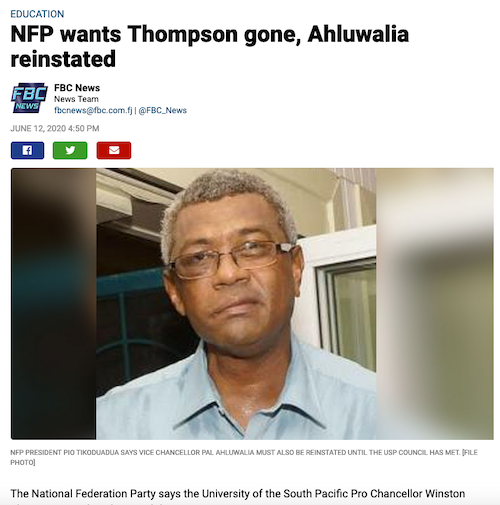
While newly appointed acting vice-chancellor Professor Derrick Armstrong says he has the support of senior management as he fills in for his suspended boss Professor Pal Ahluwalia (who was the original whistleblower on the alleged USP rorts business and is now facing tit-for-tat counter allegations), statements from some key staff tell a different story.
Armstrong said that staff who were “uncomfortable” with his leadership could leave.
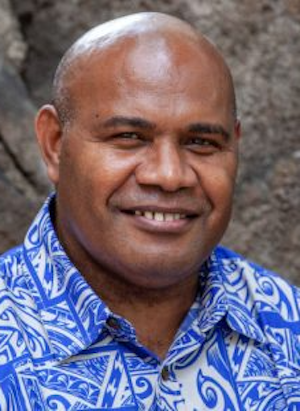
One of the strongest and most passionate condemnations of the handling of the current crisis came at the weekend from Associate Professor Tarcisius Kabutaulaka, director of the Centre for Pacific Islands Studies at the University of Hawai’i Manoa, giving his personal view as a former student and staff member of USP.
He accused a small group of people of “selfishly and disrespectfully desecrated” this “sacred place of learning” for the Pacific which celebrated a half century two years ago.
Dr Tarcisius Kabutaulaka … “USP was the place where we learned to navigate the academic ocean.” Image: Center for Pacific Islands Studies
“USP was the place where we learned to navigate the academic ocean; where we tried out ideas; where we made mistakes and learned to correct them; where we met, got to know and befriend people from other parts of Oceania; where we first fell in love and made love for the first time; where we first experienced heartbreaks; where some met our spouses; where some had our first child and buried their umbilical cord,” Kabutaulaka wrote.
A petition from former staff and alumni declares they are “dismayed” at how the actions of pro-chancellor Thompson and his colleagues in the Fiji-based executive committee have brought the university “into disrepute”.
The petitioners say they are “deeply mindful of the contribution of scores of staff and thousands of graduates of USP towards building its reputation in Oceania and beyond as well as the massive cooperative regional effort by the governments and people of its 12 member states, and Australia and New Zealand in maintaining the regional institution and its numerous campuses”.
They also say they are “disturbed at the failure” of Thompson to comply with a May 2019 directive that he works “cooperatively and in harmony” with Ahluwalia for the good of the university.
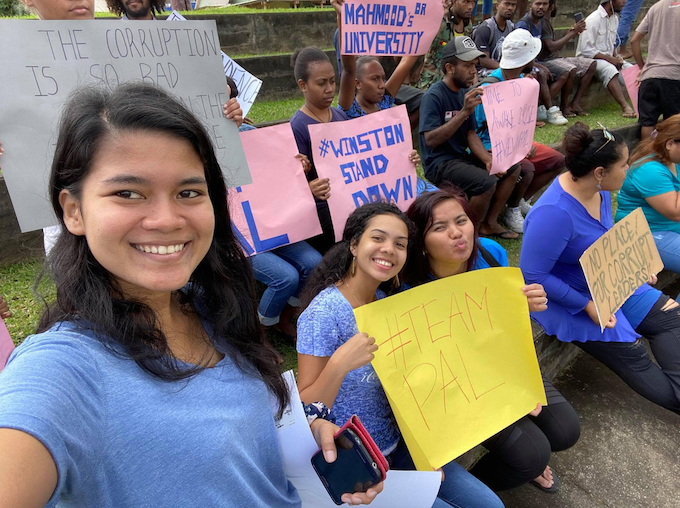
#TeamPal students supporting suspended USP vice-chancellor Professor Pal Ahluwalia call for the resignation of Fiji’s pro-chancellor Winston Thompson at the Pacific regional university’s Laucala campus in Suva. Image: USPSA
The petition includes calls for:
• The reinstatement of Professor Ahluwalia as vice-chancellor • Public release of the BDO Report [completed last August] into the allegations against the previous university administration and a report by a three-person investigating commission; and • Examination of whether the pro-chancellor has followed due process. And if he is found to have not followed due process, not delivered natural justice, and undermined the vice-chancellor then the council should request his resignation and appoint a new chair.
President Aingimea clearly is not keen on this critical USP Council meeting with many participants around the region taking part virtually left solely to the control of the Fiji-based executive committee.
He proposed that an independent organisation such as DFAT (Australia) or MFAT (New Zealand) organise the special meeting rather than having any USP staff support do the job.
“For transparency and security reasons, the Zoom meeting should not be compromised by having USP staff supporting this meeting,” he said in a letter on Friday, and he also prefers the meeting to take place this Wednesday rather than next Friday.
As Professor Kabutaulaka says, he hopes the USP Council will sort out the crisis with “diligence, intelligence and wisdom”.
Covid and Papuan political prisoners Meanwhile, one of the major covid issues still facing the Pacific is the plight of Papuan political prisoners.
Former political prisoner Filep Karma … President said: “This is reconciliation and I will free all political prisoners”. Image: Mundri Winanto/CNN Indonesia
Former prisoner Filep Karma has criticised the failure of President Joko “Jokowi” Widodo to honour his pledge five years ago to free all Papuan political prisoners during his administration.
Karma says Widodo made this pledge to five of his fellow political prisoners in Jayapura, Papua when they were released in 2015.
However, now the number of Papuan political prisoners in jail has instead grown to 46 – with Widodo into his second presidential term – and there are growing fears about their plight as Indonesian covid-19 infections continue to rise sharply. The Indonesian human rights advocacy group Tapol has also beeen pushing the issue strongly.
According to the latest Johns Hopkins University statistics, 38,277 people have been infected and 2134 have died in Indonesia (including Papua).
Scott Morrison will announce a further $1.5 billion for an immediate start on small infrastructure projects in the government’s latest initiative to spur economic activity.
Of this, $1 billion will be provided to priority “shovel-ready” projects, with $500 million targeted specifically to road safety works.
The projects are nominated by the states and territories.
Addressing a Committee for Economic Development of Australia function on Monday Morrison will say this means the government will have brought forward or provided extra funding worth $9.3 billion in infrastructure investment in the past eight months.
“As we come out of the COVID crisis, infrastructure can give us the edge that many countries don’t have,” he will say.
Anthony Albanese, also speaking to CEDA, will stress the need for “productivity renewal”.
“Our post-coronavirus actions must confront the weaknesses in our pre-coronavirus world,” he will say. “And here, productivity stands out”.
A Labor government would have a productivity renewal project to “lift business investment, lift investment in people and lift investment in critical infrastructure.
“Our goal will be to drive growth through productivity and to drive fairness through growth.”
Meanwhile a poll by the Australian National University has found the most popular COVID-specific measure to help fix Australia’s economic problems would be to spend more on trying to find a vaccine and treatment.
The poll, done in May of more than 3200 people, asked about four Covid-related policies: increasing spending on the search for a vaccine and treatment, opening up pubs, clubs and cafes, extending JobKeeper and JobSeeker payments beyond the current six months, and opening Australia’s borders to tourists and international students. (On Friday the national cabinet agreed to work “to return international students on a small, phased scale through a series of controlled pilots”.)
Asked how much they thought the various measures would help fix Australia’s economic problems, greater spending to pursue a vaccine received 75.6% support, followed by easing restrictions on pubs and the like (71.7%).
Some 57.6% said extending JobKeeper and JobSeeker would help, and nearly half believed unlocking the border would assist.
More money to find a vaccine had strongest support among older people, while extending the payments had the greatest backing among young people. Coalition voters were least likely to back extending JobKeeper and JobSeeker.
Asked about several economic policies that would help to fix Australia’s problems, 82.1% agreed more spending on domestic programs like healthcare, education and housing would do so, 76.7% nominated infrastructure, 59.1% said cutting taxes, and 55.9% backed putting more money into the hands of poor people.
The study concluded that “the strongest predictor of support for these policies … was anxiety and worry regarding COVID-19. Those who were anxious and worried were far less likely to support liberalisation measures (on borders and hospitality) but far more likely to support spending measures (on vaccines and the labour market).
This highlighted a tension. “To maintain support for some of the physical distancing measures required to maintain low rates of infection, there needs to be some concern regarding COVID-19 and fear of infection if the virus once again gets out of hand.
“However, in order to implement some policies that will help support economic growth into the future, this concern and perceived risk may need to be reduced”.
Thousands of people took part in the Black Lives Matter protests in Auckland, Wellington and Dunedin today.
Auckland’s Aotea Square protesters, largely peaceful and family oriented, marched to Custom Street and demonstrated outside the American consulate where protesters took a knee and observed a minute of silence for George Floyd.
This was one of two mass gatherings in Auckland today after the 23rd day in a row of New Zealand being covid-19 free.
The other was at Eden Park which displayed a “sold out” sign after a capacity 48,000 tickets had been sold for the Blues-Hurricanes Super Rugby Aotearoa match this afternoon. This match and one between the Highlanders and Chiefs in Dunedin last night kicked of the world’s first post-covid live crowd rugby matches.
Chauvin was videoed by Darnella Fraizer, a 17-year-old high school senior, as Floyd pleaded: “I can’t breathe.”
He has been charged with second degree murder, third degree murder and manslaughter. Three other policemen have been charged for aiding and abetting and all four officers were sacked from the police.
‘Keep it peaceful’ The Auckland protest march opened with a karakia at Aotea Square and a mihi whakatau from Graham Tipene of Ngāti Whātua, who told the crowd to “keep it peaceful”.
“Our kids are here, so let’s do it right and fight for what’s right,” he said.
Members of the black African communities addressed the crowd on the Black Lives Matter movement, along with social justice campaigner Julia Whaipooti, who talked about the use of armed police in predominantly Māori and Pasifika areas.
“For many of us this is not a new moment in time, not a hashtag on Instagram,” she said.
Emilie Rakete from People Against Prisons Aotearoa and the Arms Down movement spoke about armed police, particularly in South Auckland.
She said the “truth is that we live on a graveyard in Aotearoa”, with NZ police laying down the bodies.
“When the cops say hands up, we say arms down.”
‘They love to profit off our pain’ Auckland-based Somali-NZ rapper Mo Muse performed a piece written in the past two weeks, saying “they love to profit off our pain”.
“Tell Winston Peters he can see me in hell cos we won’t be silenced.”
Auckland University of Technology academic Associate Professor Camille Nakhid, who researched police discrimination against the African community in New Zealand, said racism was the knee on the neck of Māori, Pasifika and other communities of colour in New Zealand.
“Everything is talking and thinking about the murder of George Floyd in the US and the knee that was on his neck. But I want to talk about the knees on our neck, the Black indigenous people of colour in Aotearoa”, said Nr Nakhid, who is also chair of AUT’s Pacific Media Centre.
She said things such as putting students into lower streams in schools, lower standards of health and the uplifting of children were the knees upon the neck of people of colour in this country.
“This protest is because we love who we are. Do not let them turn our love into hate against each other.
“We have to remain awake because we need to get those knees off our neck.”
Wellington, Dunedin rallies In Wellington, RNZ News reports that thousands of people gathered in Civic Square, to march to Parliament in solidarity with the Black Lives Matter movement.
The march was organised by a group of community advocates, including Guled Mire.
In Dunedin, hundreds of people gathered at the Otago Museum reserve to show solidarity with the movement. They marched down George Street to the Octagon, where a rally was held.
The Auckland march, which started at Aotea Square, headed down Queen St and ended at the US consulate, where protesters took a knee and observed a minute of silence for George Floyd.
The Black Lives Matter protest in Auckland today. Image: Sri Krishnamurthi/PMW
Former Papuan political prisoner Filep Karma says President Joko “Jokowi” Widodo promised to release Papuan political prisoners during his administration.
Widodo made this pledge, said Karma, to five of his fellow political prisoners in Jayapura, Papua, who were released in 2015, reports CNN Indonesia.
“When the Bapak [Mr] president released my five friends from prison in Jayapura, he told them, this is reconciliation and I will free all political prisoners,” said Karma, as quoted on the UK human rights group Tapol’s YouTube account on Friday.
Now however, he said, the number of Papuan political prisoners had instead grown to 46 who were to this day still incarcerated in jail.
Karma said that he had personally made a request for their release with Justice and Human Rights Minister Yasonna Laoly. At the time, Karma asked Laoly to release four Papuan political prisoners who were incarcerated at the Nusa Kambangan penitentiary.
– Partner –
“He said that he would try to get them transferred from Nusa Kambangan to Ambon [North Maluku] and try to get them released. But to this day the four are still in prison,” he said.
Karma related how in Papua, a person could be arrested over free expression. They would be taken by the police to jail, detained and sentenced for years.
This, he said, began to improve when the international community put pressure on Indonesia and provided support to his group.
Later, however, Karma suspects that Indonesia has returned to handing out long sentences to Papuan political prisoners.
Voicing an opinion without suffering violence is not an easy thing for a Papuan person to do, he said. He claims to have once submitted a request for a permit to police to hold a Kamisan (Thursday) action in Papua, but it was rejected by the police.
Charged with treason In February, seven Papuans were arrested and charged with makar (treason, subversion, rebellion) – Hengki Hilapok, Alexsander Gobai, Steven Itlay, Bucthar Tabuni, Irwanus Uropmabi, Fery Kombo and Agus Kossay.
All of them are being tried at the Balikpapan District Court in East Kalimantan on charges related to their alleged involvement in riots in Papua in late 2019.
In September 2015, President Widodo visited the Abepura Penitentiary in Kamkey, Kota Baru sub-district, Abepura.
There, he personally presented a letter of agreement granting clemency to five Papuan political prisoners. The five political prisoners who were released were Apotnalogolik Lokobal (sentenced to 20 years in prison), Numbungga Telenggen (life imprisonment), Kimanus Wenda (19 years in prison), Linus Hiluka (19 years) and Jefrai Murib (life imprisonment).
“On this day we have released five people, this is a whole-hearted effort by the government in the context of ending the stigma of conflict that exists in Papua,” said Widodo in his greetings as quoted in a release by the Cabinet Secretariat.
The president asserted that the clemency was an initial step in developing Papua without conflict.
“This is an initial [step], later after this it will be followed up by giving clemency or amnesty to other [prisoners] because there are around 90 people who are still in prison. Once again this is an initial start to the release [of prisoners],” said Widodo.
Discrimination towards Papuans A human rights lawyer in Jayapura, Anum Siregar, believes that the government is discriminative and takes a different position towards Papuan people and other Indonesian citizens.
He said Papuans were easily arrested and charged with makar just because they flew the Morning Star independence flat or voiced their views. In one such case, those who were arrested were investigated without a lawyer and beaten.
“Meanwhile in Jakarta, people who talk about overthrowing the government, creating a new Parliament, a new country, are still not tried. There is discrimination between what happens in Papua and Jakarta,” he said.
Siregar said that repressive actions by the government would only worsen the situation in Papua. By continuing to arrest and detain political prisoners, he said, the government would instead create a greater desire for Papuan independence.
The Fiji Labour Party believes suspended University of the South Pacific vice-chancellor Professor Pal Ahluwalia is being harassed for his attempt to clean up governance at USP.
In a statement, party leader Mahendra Chaudhry claimed the suspended vice-chancellor had been denied justice.
“We commend his stand to fight for the principles of good governance and for what is right,” he said.
“USP has faced longstanding issues regarding excessive pay and allowances.
“It needs cleaning up and those responsible should be brought to task.”
– Partner –
Chaudhry said the party condemned the current controversy that had jolted the regional university, disrupting studies and bringing disrepute to it.
The suspension of the vice-chancellor had led to protests at the university campuses in the region.
“We understand Nauru is now calling for an urgent special meeting of the USP Council to discuss the crisis and we hope that justice will prevail.
“It seems that proper procedures were not followed, leading to calls by the USP Students Association for the USP Council chairman, Winston Thompson, to step down.
“The matter has been simmering for a year now, sparked off by allegations contained in a paper by the vice-chancellor.
“The paper highlights 26 allegations of mismanagement by the former vice-chancellor and senior management staff as either beneficiaries or decision-makers.”
Chaudhry said accountancy consultant BDO New Zealand was commissioned by the USP Council to investigate the allegations made in the paper, but that the BDO report had never been made public.
The giant wave of the United States’ #BlackLivesMatter campaign has now swept across Indonesia. A number of groups have begun to discuss racism in the country and have touched upon a rarely discussed topic – racism against Papuans.
For a long time, racism against Indonesians of Chinese descent, also called Tionghoa, has dominated the nation’s discourse on the subject.
When someone says the word racism in the Indonesian context, many recall the May 1998 riots, about which considerable documentation and research exist.
As a fourth-generation Chinese-Indonesian myself, I have benefited from progress in the relationship between Chinese-Indonesians and the rest of the population. There have been ups and downs, and racism has not disappeared completely.
But progress has been made because we have been discussing the problem openly; we are aware that it is a problem. Many people have yet to recognize the rape of Chinese-Indonesian women in May 1998, but generally, we have acknowledged the victims’ deaths, blood and tears.
– Partner –
This does not apply to racism against Papuans.
Even talking about it risks accusations of supporting Papuan “separatism” (as self-determination is characterised in Indonesia).
A bevier of deniers At the very least, we will face a bevy of deniers saying there is no racism in Papua or that the deaths, blood and tears of Papuans are not the result of racism but rather a just punishment for separatists.
To say so is akin to saying that seeking to end racism against Chinese-Indonesians is the same as supporting communism. Fortunately, we left that phase long ago.
Many people are not happy with the #PapuanLivesMatter topic.
On June 5, for example, Amnesty International Indonesia held talks on human rights and freedom of expression in Papua. The discussion, which used the hashtag #PapuanLivesMatter, was bombarded by spammers.
The speakers, who joined the discussion by phone, received incessant calls from unknown sources, mostly from foreign numbers – or numbers made to look foreign – as if from the US.
As of Saturday, we remain in the dark about who was responsible and what their possible motivations were. One thing is clear, however. There are people who do not want us to talk about racism against Papuans because the issue relates to many unresolved human rights violations.
On February 17, the National Commission on Human Rights (Komnas HAM) released a report on its investigation of an incident that occurred five years ago called the Bloody Paniai case, in which high school students were gunned down during a protest in Paniai, Papua.
Carried the blame Komnas HAM concluded that rank-and-file soldiers and their superiors carried the blame for the deaths of the students, aged 17 and 18, as well as for “torturing” another 21 protesting Papuans.
They called the deaths a “gross human rights violation”. The next day, Presidential Chief of Staff Moeldoko denied that this episode was a gross human rights violation.
There are those who say that it is ridiculous to compare the racism experienced by African-Americans to that experienced by Papuans. They claim racism in the US is worse.
But how can we possibly know that when freedom of speech has been muffled in the provinces of Papua and West Papua? How can we understand the gravity of the situation if we prevent Papuans from speaking and refuse to listen when they manage to make their voices heard?
What we know so far is that there are reports of extrajudicial killings, torture and persistent inequality in the social, economic, educational, health and technology spheres. That is easily bad enough, and we must end the injustice.
Others have said on social media that “All Lives Matter”, that racism against Papuans does not merit particular attention given the number of other victims of injustice in Indonesia.
Proponents of “All Lives Matter” seem to think there is no urgency to discuss racism against African-Americans in the US or against Papuans in Indonesia.
An urgent matter They’re wrong. At the moment, racism against Papuans is an urgent matter in Indonesia, and as a victim of racism against Chinese-Indonesians, I’m saying we have to talk more about racism against Papuans.
Unfortunately, solidarity among victims does not come naturally to most people. I have learned from both textbooks and real life that the experience of being a victim does not necessarily mean you will extend your empathy to others.
There are even instances where victims of injustice do further injustice to others, like a man who is a victim of racism but beats his wife or children at home.
To join together in solidarity is a conscious choice. And we should do so because we believe in the cause: that human beings should be able to live safely amid their differences and give equal respect to everyone, regardless of skin color. No one should die or suffer because of their physical traits.
I make the call to fellow Indonesians, regardless of their race, to recognise racism against Papuans and talk about it more extensively and deeply.
Specifically, I call upon fellow Chinese-Indonesians. We are victims who have come a long way in improving the situation. Support from fellow victims of racism lends more credibility and force to the struggle to end discrimination once and for all.
Indonesia still has a lot to do to combat racism against Chinese-Indonesians, especially as the rising power of China somehow gives rise to negative sentiment against the Chinese diaspora around the world.
But this does not mean we lack the space and energy to fight for justice for other victims of racism. Papuan lives matter. Let’s talk about it often and loudly.
Evi Marianiis a writer for The Jakarta Post where this article was first published.
French Polynesia’s pro-independence leader Oscar Temaru has suspended his hunger strike launched five days ago in protest at the French judiciary.
Temaru, mayor of the largest municipality Faa’a and a former territorial president, made the announcement outside the courts in Pape’ete where he and his supporters gathered every day this week.
He said he would resume his hunger strike on Monday when he expects the prosecutor Herve Leroy to appear in court following a complaint lodged by his lawyers.
Last week, Leroy seized US$100,000 from Temaru’s private account and had a judge afterwards approve the action, saying the funds were taken so that they could not be spent.
In response, Temaru’s lawyers have taken legal action against Leroy, arguing that as prosecutor he failed to honour Temaru’s presumption of innocence because there was no final verdict in the case, over which the money was seized.
– Partner –
Temaru said he thus demanded US$100,000 in damages, which is the equivalent sum taken last week.
Last year, Temaru, who is the veteran mayor of Faa’a holding office since 1983, was convicted for exerting undue influence over the funding of a community radio station by the Faa’a council.
According to Leroy, the money seized was what the Faa’a municipal council spent on Temaru’s defence and which Leroy said was an abuse of public funds.
Apart from challenging Leroy in court, Temaru is appealing to the judicial authorities seeking to reverse the judge’s formal order to seize his money.
The judge had said taking the mayor’s savings was not a disproportionate move.
However, Temaru’s backers said the action was unprecedented as the 75-year-old politician was treated as if he was a drug dealer who posed a flight risk.
They also said it amounted to colonial justice because none of the pro-French politicians facing court and with a record of corruption convictions had their savings seized.
The president of French Polynesia is awaiting an appeal court ruling after being convicted a year ago for abusing public funds of the town of Pirae.
This article is republished by the Pacific Media Centre under a partnership agreement with RNZ.
The future of the flagship Māori news show Te Karere is on the line as the New Zealand government proposes to create a single Māori news service run by Māori Television.
The government this week released its much-aniticipated proposals for a major Māori media shake-up, Te Ao Pāpāho Māori, but some of the plans have come as a shock to the industry.
After 38 years on air, Te Karere on TVNZ1 is still the highest-rating Māori news bulletin in Aotearoa New Zealand, so news this week that the government wanted to create a single Māori news service run by Māori Television came as a blow to TVNZ.
The state-owned network’s general manager of local content Nevak Rogers said they met with the Te Karere team after the proposal came out.
“It was definitely a shock,” she said.
– Partner –
“We have our annual application for funding for Marae and for Te Karere currently with Te Mangai Paho so we are on tenterhooks here.
“We don’t know what the outcomes of those decisions will be. It’s pretty tense times.”
The Māori media proposals have been in the works for years.
The project covers Māori broadcasting funding agency Te Māngai Pāho, Māori Television and Te Whakaruruhau o Ngā Reo Irirangi Māori which represents 20 iwi radio stations around the country.
TVNZ’s general manager of local content Nevak Rogers … “It was definitely a shock.” Image: RNZ
In the discussion document out this week – the government said some Māori media outlets struggle to generate and deliver news and that the number of Māori news services funded by Te Māngai Pāho is “not sustainable”.
It wanted to see “an authorative clearing house for news and current affairs content” which would also feature content made by iwi radio stations, who would be in line for extra resourcing.
While Te Karere is aired on TVNZ, it is produced independently with funding by Te Māngai Pāho.
Rogers said she knew money was tight – each news show was made for as little as $9000 – but canning it was not the answer.
“At the moment, the public media review is happening and there has been a lot of talk of plurality of voice and how important that is.
“And yet here we are looking to go in the opposite direction.”
A plurality of Māori voices Prominent Māori journalist and producer Annabelle Lee Mather agreed.
Journalist Annabelle Lee-Mather … “A single news service for Māori does not achieve [plurality and diversity].” Image: RNZ
She said the goverment had poured tens of millions of dollars into the media recently and kept talking about the need for plurality and diversity in the media.
“A single news service for Māori does not achieve that and it also assumes that all our interests, our whakaaro, our lenses are the same and they are not,” she said.
“Māori audiences deserve the same service and diversity as our countrymen.”
The proposal also put Mather in a stressful position.
She leads the weekly Māori current affairs show The Hui on Mediaworks channel Three and said they did not know what it meant for them either.
In any case, she said Te Karere was a legacy and should not be “thrown in the bin on the scrap heap”.
‘Not going to be accepted’ “We have seen too much emphasis and importance being placed on the plurality of voice and so to accept Māori to be minimised and subordinated through one news services while everyone else enjoys a variety of news services, is just not going to, I think, be accepted,” Mather said.
The government was also proposing a Centre for Media Excellence to develop staff and appoint joint members to boards of the Māori Television Service and Te Māngai Pāho.
It recommended a national radio station broadcasting in te reo Māori and making taxpayer-funded content freely available to Māori media.
Iwi media organisations could be funded to contribute as regional news bureaux with “the Māori media ecosystem” having access to all the content, the report said.
Māori Television chief executive Shane Taurima said he supported plurality in Māori media too, but the industry was under-resourced and under pressure.
Māori Television chief executive Shane Taurima … “More attention given to … [creating] more reo Māori speaking journalists.” Image: RNZ
“What I think is great about the proposals that have been shared is that we will see more resource and more attention given to that fact so that we can create more reo Māori speaking journalists to be able to deliver a diverse news offering,” Taurima said.
A former editor of Te Karere, Taurima said he never wanted to see it go.
Up to the challenge He did not want to jump the gun but he said if the proposal went ahead, Māori Television would be up to the challenge.
“Can Māori television deliver to expectations? Absolutely yes.
“If the decision is taken for this news hub to be placed in the hands of Māori Television, that Māori Television is supported and backed from a financial and resource perspective and from a community perspective to be able to do a good job of it.”
Te Karere will not go down without a fight, however.
Rogers said if a single Māori news service was what was wanted, TVNZ hoped it could make a bid to run it too.
“I feel like we have been handed the mantle in terms of kaitiakitanga of these taonga and we need to fight as hard as we can to make sure we can maintain them,” she said.
Minister urges calm and kōrero Māori Development Minister Nanaia Mahuta would not say whether that was possible, but invited TVNZ to talk.
It was too early to say what funding implications the move could have on Te Karere, she said, but she hoped it would not spell the end for the news programme.
“I would hope not … in mainstream media there is the advantage of Te Karere to link into TVNZ and there is one service through Radio New Zealand.”
“TVNZ has been bailed out recently to be able to continue to do what they are doing and I am inviting them to engage in the conversation they want to have.”
The central service would also use news content created in the regions by iwi radio, which would maintain a plurality of Māori voices, she said.
“In the Māori media space, there have been real challenges to ensure that we can continue to contribute to growing and revitalising te reo Māori, providing the diversity of content, but also being responsive to a quickly changing and evolving world in the media sector.”
The discussion document will be open to submissions for the next fortnight.
This article is republished by the Pacific Media Centre under a partnership agreement with RNZ.
Pacific leaders are echoing strong calls for USP Council members to work together to resolve the ongoing challenges currently faced by the region’s premier educational institution.
The call by Tuvalu Prime Minister Kausea Natano yesterday comes in the wake of mounting pressure from staff, students and stakeholders for good governance to prevail after the executive committee (EC) of the USP Council suspended vice-chancellor Professor Pal Ahluwalia on Monday for alleged material misconduct, pending an investigation.
The decision by the EC sparked many demonstrations this week by concerned staff and students at USP campuses in Fiji, Kiribati, Nauru, Niue, Samoa, Solomon Islands and Vanuatu.
Natano, who is also the chairman of the Pacific Islands Forum (PIF) Secretariat, said all members should work together and in the Pacific way to chart a course forward for the premier institution of learning.
“Common sense must prevail if we are to be successful in bringing about lasting solutions to the ongoing challenges at the university,” he said in a statement today.
– Partner –
“USP is a highly valued institution for educating the young minds of future leaders of our Blue Pacific. As Pacific leaders and custodians of this vital institution of higher learning, we take pride in what the university stands for – a shining example of regionalism and the benefits of pooling our collective resources for the betterment of our Pacific people.”
Ensure governance, says Cook Islands The Cook Islands Ministry of Foreign Affairs and Immigration shared on its social media platform the need for the USP Council to ensure governance and management of the regional university was administered and governed by established due processes.
“The welfare of the staff and students of the University must be given priority consideration, particularly amidst the unprecedented challenges that have arisen from covid-19,” the ministry said.
“As a member country of USP and as a member of council, the Cook Islands looks forward to the convening of an extraordinary council meeting this month, and joining all council members in deliberations that go to the heart of the welfare of staff and students, governance and the future of our regional university.”
Meanwhile, USP donors Australia and New Zealand, as well as Tonga also joined calls by incoming chancellor Lionel Aingimea, who is President of Nauru, and Samoa’s Education Minister Loau Sio for a special meeting of the full USP Council to be held to resolve the impasse at the regional university.
During a media conference on Thursday, pro-chancellor Winston Thompson confirmed that a special meeting of the USP Council would be held after receiving a written request from 14 council members.
The meeting is expected to take place early next week.
The Pacific Media Centre republishes Wansolwara articles in a partnership with the University of the South Pacific journalism programme.
‘Stand down,’ NFP tells Thompson
Fiji’s opposition NFP has called on Fiji to stop “meddling” in the affairs of the regional university USP. Image: FBC News screenshot/PMC
FBC reports that Fiji’s opposition National Federation Party (NFP) has called for USP pro-chancellor Winston Thompson to be stood down.
NFP president Pio Tikoduadua said vice-chancellor Pal Ahluwalia must also be reinstated until the USP Council meets next week.
He said Fiji was “meddling” in the affairs of the university, something which Fijian Education Minister Rosy Akbar had denied.
Tikoduadua said Akbar must participate in “good faith” at the planned special USP Council meeting.
Archaeological excavations deep within the rainforests of Sri Lanka have unearthed the earliest evidence for hunting with bows and arrows outside Africa.
At Fa-Hien Lena, a cave in the heart of Sri Lanka’s wet zone forests, we discovered numerous tools made of stone, bone, and tooth – including a number of small arrow points carved from bone which are about 48,000 years old.
When was the bow and arrow invented?
The invention of the bow and arrow allowed people to hunt prey at a much greater distance. People no longer had to get within “a stone’s throw” of prey which could suddenly bolt and escape. This innovation greatly increased the chances of a successful hunt.
Bows and arrows also made it much safer to hunt dangerous prey. If you don’t have to get too close, you’re less likely to be trampled or mauled by a hurt and angry animal.
The origin of the bow and arrow is one of the great mysteries of human technological innovation. How did it come about? When? Where? And why?
Small monkeys such as these macaques were targeted with bows and arrows from 48,000 years ago.P. Roberts
Currently, the oldest evidence for the use of the bow and arrow are small stone points found in Sibudu cave in South Africa, which are some 64,000 years old.
Outside Africa, the oldest finds were previously pieces of bows found in Germany dating back no more than 18,000 years.
Because bows and arrows are mainly made from highly perishable stuff like wood, sinew, and fibres, they don’t leave a lot of evidence behind for archaeologists to find. So the small bone points recovered from Fa-Hien Lena are an important discovery.
The bone points show evidence for having been fixed to a small shaft and shot at high speed into prey – which were apparently mostly small monkeys and giant squirrels, judging by the butchered bones thrown away at the site after meals.
One of the small bone points discovered at Fa-Hien Lena.M. C. Langley
Complex tools, complex minds
The discovery of such ancient bone arrow points is startling in itself. However, we also found other tools which give equally rare insights into the lives of the earliest members of our species currently documented in Sri Lanka.
Particularly interesting are well-preserved knives, scrapers, and awls made from the bones and teeth of monkeys and deer, which were used to work skins or plant materials.
These tools are our only way to learn about the other, more fragile items that may originally have been at the site, because anything made from leather or plant fibre (such as clothing, bags, baskets, mats, or nets) stood no chance of surviving 48,000 years in the humid tropical environment.
Bone technology of Fa-Hien Lena. Tools made from bone and teeth of monkeys and smaller mammals recovered from Fa-Hien Lena, Sri Lanka. This technology included small bone arrow points (bottom right), and skin or plant-working tools.M. C. Langley
One of these artefacts is an unusual implement with carefully spaced notches down each side. It appears to be a shuttle for creating nets of woven fibres. No doubt nets would have been incredibly useful for catching the tree-dwelling prey the people of Fa-Hien Lena hunted, as well as bringing the fish up from the rivers.
Symbolic items of Fa-Hien Lena. Some of the symbolic artefacts recovered from Fa-Hien Lena, Sri Lanka. Here you can see shell beads and different pigments in bright red, yellow, and silver which were used to decorate bodies or items.M. C. Langley
These rainforest pioneers also left behind evidence about their social lives in the form of white shell beads and small blocks of mineral pigments in bright colours: red, yellow, and silver.
Each of the pigment nodules show signs they were used to create paints for the body, and three of the bright red nodules were drilled to be strung as beads – something we have not found anywhere else in the world.
The white shell beads, on the other hand, are similar to those found in Africa and Eurasia, but were collected or traded from the coast some 20–30 kilometres away. Apparently, small, shiny, white shell beads never get old.
With these finds, it is becoming more and more clear that we have only just begun to scratch the surface when it comes to understanding the earliest modern human communities.
Award-winning Filipino-American filmmaker Ramona Diaztakes viewers to the Philippines where the free press has been under siege since President Rodrigo#Dutertetook office three years ago. Video: BA News
PBS investigative documentary series Frontline has acquiredA Thousand Cuts, the powerful documentary of award-winning Filipino-American director Ramona Diaz about a “lawless regime and press freedom”, reports Rappler.
It was screened as the opening night film in New Zealand’s DocEdge virtual documentary film festival tonight and also streamed free in the Philippines tonight as a prelude to the cybercrime libel trial verdict on Monday in the case against Rappler chief executive and co-founder Maria Ressa.
Diaz’s Sundance film festival 2020 entry, which tackles democracy and press freedom in the Philippines under President Rodrigo Duterte, is being planned for a theatrical release in the United States in August and a television broadcast in November 2020.
– Partner –
A Thousand Cuts follows the reporters of Rappler and Maria Ressa as they discuss and experience the struggles of a free press under Duterte and key government officials since 2016 up to the 2019 elections.
Rappler has faced many legal battles since 2016, which includes the cyber libel case over a Rappler article published even before the cyber libel law took effect.
Ressa and former Rappler researcher Rey Santos are charged in the case. Ressa, a mainstream investigative journalist with CNN and other news services before co-founding the digital news website currently faces eight charges due to her hard-hitting journalism.
The stream is being hosted for free on Zoom and Facebook, and is presented by Frontline in cooperation with the International Center for Journalists.
Rappler’s chief executive and editor Maria Ressa (centre) with some of her editorial team at the Sundance film festival premiere in January as seen in Auckland tonight. Image: PMCFilm director Ramona Diaz at the Sundance film festival in January seen virtually in Auckland tonight. Image: PMCFilm director Ramona Diaz talks about the documentary A Thousand Cuts on President Rodrigo and press freedom in the Philippines. Image: PMCA Maria Ressa and A Thousand Cuts film poster.
It mightn’t sound much, but it had big consequences. Fifty years ago this week, the Senate voted to set up a system of committees to scrutinise government legislation, activity and spending.
As it has evolved, this network has given teeth to a parliament that in many other ways has declined, even atrophied over the decades.
Question time in the House of Representatives has become a charade (at least, thanks to COVID-19, MPs are now behaving somewhat better during it).
It rarely extracts information. Occasionally – but less often than in earlier years – an opposition can apply the heat to the feet of a minister in trouble. We saw this with the pressure on energy minister Angus Taylor over his use of an apparently doctored document, though he stonewalled and has avoided telling the full story.
The idea that misleading parliament matters has gone out the window long ago.
Outside parliament itself, holding government to account has become more difficult. Freedom of information legislation is of only limited help, with officials and ministers often obstructing rather than fulfilling its spirit. The government has an army of “spinners”, paid for by the taxpayers to manage messages and act as “gatekeepers”. They have bred prolifically.
Public servants, who once were much more accessible to assist journalists on a “background”, non-attributable basis to understand complicated policy, have been locked away from the media by governments anxious to centralise control.
The media itself says more but arguably informs less, despite the 24-hour news cycle. And with the ever-squeezed business models of news organisations as well as around-the-clock filing, journalistic specialisation in particular policy areas has declined while overall work has increased.
While there are significant committees with representation from both houses – the joint committee on intelligence and security is the most important example – in the main it’s the Senate committees that are the real parliamentary watchdogs.
They are where the bureaucrats are regularly grilled, with officials sometimes finding themselves asked to account for what they told their Senate inquisitors previously.
Treasury has just had a particularly searing experience of this. A day after it informed the committee looking at the government’s COVID response that more than six million people were on JobKeeper, it and the Tax Office publicly confessed to a huge error. The latest estimates indicated JobKeeper would only have some 3.5 million recipients and its cost would be $70 billion not $130 billion.
The existence of the COVID committee meant Treasury could be quickly called back for a please explain.
This committee is ranging widely and seeking to interview the main players across the health and economic responses. Predictably, Treasurer Josh Frydenberg declined its invitation – following the convention for lower house ministers – but Finance Minister Mathias Cormann fronted.
The COVID committee has questioned government officials on topics such as fraud being perpetrated on people’s superannuation accounts through the early access to super scheme, the working of the COVIDSafe App, the Ruby Princess debacle, the future of JobKeeper, and much else.
Its presence was especially useful given that at one stage, the parliament was sitting only for the odd single day.
The Senate committees vary in type: permanent or set up to investigate a specific matter, focused on legislation or dealing with more general references in a broad policy area, “estimates” hearings to look at spending.
Estimates hearings, held three times a year, give an opportunity to probe public servants about budgetary items and numbers. A great deal of information, trivial or important, some of it embarrassing to the government of the day, is extracted.
The effectiveness of the estimates committees is reflected in the “estimates test” some public servants are said to apply to their actions: “if we do this, how will it play out at estimates?”
But it’s a two-way game. The government and officials are, according to Labor, pushing back, with public servants increasingly asking to take questions on notice, to be answered later. This gains, at the least, breathing space.
Many public servants look a little jelly-like as they face their senator questioners, but a few mandarins enjoy the challenge. The appearances of the secretary of Home Affairs, Mike Pezzullo, who seems to relish matching wits with the senators, are always keenly anticipated.
Some hearings can be fiery, clashes among senators at times spectacular and unseemly, and reports from inquiries simply statements of partisan positions. But other times, the work can be constructive and cooperative, especially behind the scenes, and the outcomes influential in highlighting wrongs and leading to policy change.
Senate president Scott Ryan this week said Senate committees had produced some 120 reports in the 69 years before the new system and more than 5500 in the 50 years since. Public hearings increased from 500 before the change to more than 7000 since.
Good interrogators make reputations at Senate committees that are remembered long after they leave the parliament. Former Labor senators John Faulkner and Robert Ray operated as a tag team that put the fear of god into witnesses from the public service.
Occasionally a senator can effect more lasting reform through committee work than many of their ministerial colleagues do. Former Nationals senator John “Wacka” Williams pursued malfeasance by the banks and other financial institutions with unrelenting tenacity, and was a major player in having these institutions brought to account.
Fiji’s NGO Coalition on Human Rights today condemned police for it called heavy-handed intimidation of students and staff at the regional University of the South Pacific, saying it was “deeply troubled” by the leadership saga.
“It is appalling to see the continued interventions and intimidation by the Fiji government and Fiji police at such a crucial time,” it said in a statement.
Police yesterday served a search warrant on The Fiji Times newspaper and confiscated at least three photographs of students protesting in support of their whistleblower vice-chancellor Professor Pal Ahluwalia.
Fiji police search The Fiji Times, seeking photos to indentify student protesters. Image: FT screenshot/PMC
He was suspended by the USP Council executive committee on Monday in controversial circumstances.
“We strongly believe that a sustainable and working democracy must protect and ensure good governance, accountability and transparency at all levels,” said the coalition chair Nalini Singh.
– Partner –
“This has been incredibly lacking in the past few days, as we’ve seen the removal of USP vice-chancellor Professor Pal Aluwhalia and ongoing serious allegations of corruption and financial mismanagement.”
Peaceful protests and solidarity actions have been organised at campuses of the 12-nation university in Fiji and the Pacific in support of Professor Aluwhalia.
Students warned not to protest Police have warned students against holding protests, said the USP Student Association.
Suspended Professor Pal Ahluwalia … whistleblower at USP. Image: FBC News
“It is appalling to see police deny students and USP staff their fundamental right to freedoms of association and assembly,” said Singh.
“There is also concern on how this impacts on our regional relations as USP is a regional entity.
“This must be investigated by the relevant body without any heavy-handed intimidation from our government and the security forces.”
The coalition called on the Fiji government to “stop this harassment of USP students and staff” and ensure better accountability so that their grievances are met.
The police must also work within human rights standards, the coalition added.
In yesterday’s search of The Fiji Times, the warrant authorised officers to obtain “video footage and photograph articles of USP staff and student protest dated 9 June 2020”.
Editor-in-chief Fred Wesley said the newspaper was forced to hand over to police three protest photographs which were published in Wednesday’s newspaper.
He said other information requested by the police relating to the photographs had been referred to the newspaper’s lawyers.
He said in a statement that USP was a “highly valued institution for educating the young minds of future leaders of our Blue Pacific”.
“As Pacific leaders and custodians of this vital institution of higher learning, we take pride in what the university stands for – a shining example of regionalism, and the benefits from pooling our collective resources for the betterment of our Pacific people,” Natano said.
He added that it was important to uphold the principles that bound the Pacific Islands Forum together – “good governance, respect, transparency, accountability and the rule of law”.
If you fondly remember May Gibbs’s Gumnut Baby stories about the adventures of Snugglepot and Cuddlepie, you may also remember the villainous Big Bad Banksia Men (perhaps you’re still having nightmares about them).
But banksias are nothing to be afraid of. They’re a marvellous group of Australian native trees and shrubs, with an ancient heritage and a vital role in Australian plant ecology, colonial history and bushfire regeneration.
The genus Banksia has about 173 native species. It takes its name from botanist Sir Joseph Banks, who collected specimens of four species in 1770 when he arrived in Australia on board Captain Cook’s Endeavour.
One of the four species he collected was B. integrifolia, the coastal banksia. This can be a small to medium tree about 5m to 15m tall. In the right conditions, it can be quite impressive and grow up to 35m.
It’s found naturally in coastal regions, growing on sand dunes or around coastal marshes from Queensland to Victoria. These can be quite tough environments and, while B. integrifolia tends to grow in slightly protected sites, it still copes well with sandy soils, poor soil nutrition, salt and wind.
In the right conditions, coastal banksia can grow to 35m tall.Shutterstock
From ancient origins
Coastal banksia – like all banksias – belong to the protea family (Proteaceae). But given the spectacular flowering proteas are of African origin, how did our Australian genera get here?
The members of the Proteaceae belong to an ancient group of flowering plants that evolved almost 100 million years ago on the southern supercontinent Gondwana. When Gondwana fragmented more than 80 million years ago, the proteas remained on the African plate, while the Australian genera remained here.
The spikes of woody fruits on the Australian banksia, sometimes called cones, are made up of several hundred flowers. The flower spikes are beautiful structures, soft and brush-like. But with B. integrifolia, they are pale green, similar to the foliage, and can be hard to see within the canopy at a distance.
Up close, these fruit spikes can look quite spooky, almost sinister, especially when wasps have caused extensive gall formation. Galls are swellings that develop on plant tissues as a result of fungal and insect damage, a bit like a benign tumour.
Maybe this is what led May Gibbs to cast them as the baddies in her Gumnut Baby stories. While the galls may look unsightly, they rarely do serious harm to banksias.
Given the fruit spikes of coastal banksia look like brushes, it’s not surprising Indigenous people once used them as paint brushes.
The flowers are very rich in nectar, which attracts insects and birds. If you run your hand along the flower spike you, like generations of Aboriginal people before you, can enjoy the sweet taste if you lick the nectar off your hand. You can also soak the flowers in water and collect a sweet syrup.
In the garden, B. integrifolia is wonderfully attractive to native insects, birds and ringtail possums. It’s easy to establish and, until it grows more than a few metres high, can be successfully moved and transplanted.
Coastal banksia doesn’t need fire to release its seed.Shutterstock
Unlike many other banksia species, coastal banksias don’t need fire to release their seed. For many Australian species, the woody fruits remain solid and sealed, and it’s only when fire comes through that they burn, dry, crack open and release their seed.
This can happen with B. integrifolia too, but in a garden setting the fruits will mature, dry and crack open and release the seeds, which germinate readily. This makes propagating coastal banksia easy work.
In touch with its roots
Perhaps one of the more important, but less obvious, attributes of B. integrifolia are its roots. These are a special type of root possessed by members of the protea family.
The roots form a dense, branched cluster, a bit like the head of a toothbrush, that can be 2-5cm across. They greatly increase the absorbing surface area of the roots, as each root possesses thousands of very fine root hairs.
Proteoid roots can be very handy in sandy and other poor soils, where water drains quickly and nutrients are scarce.
These roots, also described as cluster roots, are often visible in a garden bed just at the interface of the soil with the humus or mulch layer above it. They’re very light brown, almost white, in colour.
B. integrifolia, like other banksias, also has the ability to take in nitrogen and enrich the soil, which can be very handy in soils low in nitrogen. It’s like a natural living and decorative fertiliser.
Proteoid roots are unfortunately very well suited to the presence of Phytophthora cinnamomii (the cinnamon fungus). It causes dieback in many native plant species, but can be particularly virulent for banksias.
But B. Integrifolia is one of the more resistant species to the fungus. Promising experiments have been done on grafting susceptible species onto the roots of B. integrifolia to improve their rates of survival.
This could be important, as banksias have a role in bushfire regeneration in many parts of Australia, so the occurrence of the fungus can compromise fire recovery.
Source: The Conversation (Au and NZ) – By Marnie Graham, Post-doctoral Research Fellow, Stockholm Resilience Centre and University of Johannesburg, Stockholm University
The recent Black Lives Matter protests in Australia have highlighted the pressing and continued need for non-Indigenous Australians to take responsibility for reconciliation.
At the moment, Australians reading the news or watching the protests might be asking: how can we contribute to this change?
Through our research and teaching, we have learned that spending time with Indigenous people, learning about culture and history and connecting to Country, is an important first step.
And one accessible way to do this is through an Indigenous tour.
What is an Indigenous tour?
Indigenous tourism covers activities such as art exhibitions, artistic and cultural performances, festivals and tours.
Our research focuses specifically on Indigenous tours, because visitors are able to ask questions and interact with Indigenous people. We have found that many Australians would like to make personal connections with Indigenous peoples, cultures, histories and languages, but don’t know how – who to talk to, how to connect, what actions to take.
Indigenous tour operators are dedicated to making these connections and sharing their knowledge with visitors. Yet many people don’t realise that Indigenous-owned-and-run tour operators are located all over Australia.
Many different types of tours
The types of Indigenous tours available in Australia are diverse, and cover a huge range of experiences. They include, for example, day tours of two or three hours, involving walking together on Country, learning about history, culture, stories and Indigenous relationships to Country.
There are also culinary tours, where visitors learn about Indigenous foods and cooking, cultural cruises aboard Indigenous-owned vessels and activity-oriented tours where visitors can hike, canoe, quad-bike, or paddle board with Indigenous guides.
Tours can involve education about history, food or wildlife.Toni Mason/AAP
Other tours are based around learning about Indigenous uses and values attached to flora and fauna, many of which are held on national parks.
Some operators also run longer camps on Country, dedicated to men, women, families or student groups.
What is common to all these experiences is that Indigenous tour operators share with visitors stories of Country, culture, history and connection.
What might visitors expect from the experience?
The Indigenous tour operators we connect with through our work and research conduct their tours with immense openness and generosity. They share aspects of their lives and certain stories with visitors. Tim Selwyn runs tours on the NSW Central Coast. He explains he does this job, “because I have to”.
It’s my responsibility as a human to speak truth, to help educate, to share. I do what I do to create a safe space where everyone is welcome, so we can talk and we can listen. At the moment the government is not listening, they haven’t done so for 250 years. They’re still imposing their structures. We need to listen and talk together … People need to know truth and history, to make an educated decision about our past. We need to look at the past to go forward, because we’re still stuck.
Tourists must treat these tours with respect and sensitivity, because being invited to share these experiences and knowledge is a huge privilege. It is a tourist’s responsibility to listen and learn.
Participants on Indigenous tours say the experience has changed them.Dean Lewis/ AAP
Our research indicates that when visitors do take that first step by going on an Indigenous tour – then they begin to see that their words, actions and learning can make a difference.
We conduct interviews with tour participants to understand what they learn and experience. This is one example of what a non-Indigenous Australian visitor experienced after a day-tour:
I think it really changed me, as a person, because it was the first time that I actually interacted with an Aboriginal person. I loved it. I think it was just the reality of the fact that there was a community living here before the colonial powers came into Australia … I think the whole thing brought history to life for me, and its implications as well. Not just negatively, I mean there’s that aspect but also, just like I felt welcomed in this country.
But there are many Indigenous tour options all around Australia. You can find them by visiting WelcomeToCountry.com, a not-for-profit website dedicated to putting you directly in touch with Indigenous tourism initiatives. Professor Marcia Langton has also written a hard copy travel guide.
You can follow state-based Indigenous tourism operator councils on social media. And the federal government’s Tourism Australia website Australia.com has options for Indigenous tourism experiences.
What else do I need to know?
In our experience, many independent Indigenous tour operators are also open to providing cultural education sessions in early childhood centres, schools, universities, government organisations, and businesses. As well as for family or friendship groups.
So, start the process, make the connection.
Through listening, and starting to learn and connect, the difficult conversations can occur, and we can begin to make the changes that Australia needs to see.
University of Canberra Professorial Fellow Michelle Grattan and Assistant Professor Caroline Fisher discuss the week in politics including: the protesters advocating police reform, the treatment of indigenous peoples, and to show solidarity with the black lives matter movement, the high rate of incarceration amongst indigenous people, the PM and treasurer Josh Frydenberg calling for all state borders to be opened, the trans tasman bubble, and Prime Minister Scott Morrison apologising for the robodebt scheme.
Cook Islands campus backs University of the South Pacific’s attempts to clean out alleged corruption and mismanagement at its Laucala headquarters campus in Suva, Fiji.
University of the South Pacific Cook Islands campus staff and students are backing the university’s suspended vice-chancellor Professor Pal Ahluwalia.
Campus director Dr Debi Futter-Puati said she was pleased there were no significant disruptions at regional level, so students could focus on their studies.
A row is escalating at USP’s Laucala campus with students holding protests and staff striking, after Professor Pal Ahluwalia was suspended in controversial circumstances this week.
That was in response to him sacking Hasmukh Lal, a well-connected senior manager whom he accused of plagiarism.
– Partner –
Cook Islands News has obtained a letter signed by 11 USP professors supporting Ahluwalia.
“We demand management is allowed to remove corruption, fraud and gross misconduct from within USP following due process and without interference,” they write.
BDO governance report The stoush dates back to last year when, three months into the job, Professor Ahluwalia commissioned an inquiry into allegations of serious governance and management anomalies during the tenure of the former vice-chancellor and president Professor Rajesh Chandra.
BDO New Zealand was commissioned to write a report about the allegations of mismanagement and the report was submitted in August 2019, with mentions of the former vice-chancellor and current pro-chancellor Winston Thompson.
Since then, USP pro-chancellor Winston Thompson – part of a committee who appointed Professor Ahluwahia to the position in November 2018 – has led the charge calling for Ahluwahia’s sacking.
There has been no direct impact on the USP Cook Islands campus staff or students, Dr Futter-Puati said. Professor Ahluwahia needed to be reinstated, she said.
Staff and students at the USP Cook Islands campus supported Professor Pal Ahluwalia and his efforts to address the concerns he had identified in his short time in charge.
“We are pleased that no regional campuses have been identified as having any issues and we are trying to ensure that our students can continue with their studies with as little disruption as possible,” Dr Futter-Puati said.
“Covid-19 has caused enough disruption without adding anything further to the mix.”
Last August, Cook Islands Prime Minister Henry Puna was appointed to a three member-committee of the USP Council comprising of regional representation to look into governance issues raised in the BDO Report and to propose changes to strengthen USP’s governance and move forward.
Katrina Tanirau is a Cook Islands News reporter. This article is republished with permission.
The Conversation is running a series of pieces on key figures in Australian political history, examining how they changed the country and political debate. You can read our articles on Julia Gillard and Henry Parkes here and here.
Bartholomew Augustine (“Bob”) Santamaria is the most significant figure in Australian politics never to have held political office.
Santamaria was a friend of, or associated with, four Australian prime ministers: Robert Menzies, Malcolm Fraser, John Howard and Tony Abbott. But his career was spent outside parliament.
There are two crucial things that need to be understood about Santamaria in order to make sense of his work. One is he was a devout lay Catholic whose career began in church-sponsored organisations. The other is he was both anti-socialist and anti-capitalist.
His ideal society was one composed of small property owners. In the 1940s and 1950s, he dreamed of an Australia dotted with rural villages.
Italian and Irish Catholic influences
Santamaria was born in Melbourne in 1915, the son of Italian migrants. His father ran a greengrocery in Brunswick.
While his background was Italian, his intellectual formation was in the largely Irish Catholic education system. He was bright, studying arts and law at Melbourne University.
After graduating, he did not practise law, but worked instead for the church as a layman for the Australasian National Secretariat of Catholic Action.
Catholic involvement in Australian political culture in the early part of the 20th century had been somewhat marginal; for example, the Federation conventions contained few Catholic participants. But the 1930s saw a flourishing of Catholic intellectual and cultural life in Australia, such as the Campion Society, of which Santamaria was a member.
Moving Catholics towards the centre, fighting communists
What Santamaria achieved was to move Catholics much closer to the centre of Australian politics. He did this both through the force of his intellect and his political actions.
He was an ideas man. From the early 1940s to the mid-1950s, Santamaria drafted most of the social justice statements authorised by the Archbishops and Bishops of the Catholic Church of Australia, many of which had circulations of more than 100,000.
For a long time, he had no public profile. But his major contribution came leading the fight to extinguish communist control of, and influence in, trade unions.
Santamaria moved Catholics closer to the centre of Australian politics.Danny Casey/AAP
Although communism never had much appeal to the Australian voter, it had considerable influence in a number of unions, especially in the 1940s.
Santamaria mimicked communist techniques, setting up a shadowy organisation that used sometimes dubious tactics to gain union control. Called the Catholic Social Studies Movement, it was simply known as “the Movement” and operated largely in secrecy.
If the communists fought dirty, then Santamaria, as the leader of the Movement, understood the need to engage in tactics like rigging union elections. The ends justified the means.
Labor, the DLP and Santamaria’s undoing
The great prize in all of this, of course, was the Australian Labor Party, with its strong trade union links.
Communism was in decline in Australia by the early 1950s, but the anti-communist movement went from strength to strength. By 1953, there was a federal election in the offing, which Labor seemed guaranteed to win because of the state of the economy. Santamaria’s papers indicate that at this point, he contemplated the possible takeover of the ALP.
It all went terribly wrong. Economic conditions improved and the Menzies-led Coalition won the 1954 election. In the fallout, the ALP’s bitter leader, H.V. “Doc” Evatt, instigated moves that led to a split in the Labor Party, the exit of many Catholics from the ALP and the creation of the Democratic Labor Party (DLP).
Santamaria, who had previously been a somewhat shadowy figure, suddenly emerged into the limelight. This occurred because Evatt denounced the Movement and its role in the Labor Party. It was a personal disaster for Santamaria, because it pushed him out of his political roles with regard to both the Church and the unions.
He desperately wanted to influence public policy in Australia, but the DLP was only a rump party that largely appealed to Catholics. He was now outside the ALP tent and he certainly was not going to be admitted to that of their Liberal opponents.
Reinvention in print and on TV
Essentially, Santamaria then reinvented himself as a commentator on public affairs. That was how he was known until his death in 1998.
His organisation, the National Civic Council, published News Weekly, and later the AD2000 magazine, to propagate his ideas.
He also had a TV program, “Point of View” on Channel 9 that began in 1963 and went for nearly 30 years. Later in life, he had a regular column in The Australian. He no longer played the same active political role that he had earlier in life, but his ideas reached a large audience through the media.
In this later period, Santamaria gravitated towards people who were, or had been, Liberals.
He became great friends with Menzies following Menzies’s retirement. In 1992, there was an abortive attempt, involving Santamaria, academics Robert Manne and John Carroll to form a new political party that included Fraser. Howard visited Santamaria on his death bed.
Abbott had connections with Santamaria going back to his student days.
A ‘tragic failure’
Whether Santamaria exercised any influence over these figures is questionable. It does seem that they found him congenial, and he certainly possessed considerable charisma.
In some ways, Santamaria can be seen as a tragic failure. He was an intelligent and passionate man, who desired to create a better world, but whose actions led to conflict and dissension.
He was, perhaps, the victim of his own hubris. That said, it is difficult to find another individual who had such an impact on Australian life for so long. His autobiography, Against the Tide, still repays reading.
Source: Council on Hemispheric Affairs – Analysis-Reportage
By Patricio Zamorano From Washington DC
It is hard to describe the community energy generated this week from the mass protests throughout the country. June 6 in Washington, DC was like a street festival full of symbols of poignancy, rage, hope, contained aggression, and beauty. This amalgam of feelings stirred by the brutal murder of George Floyd at the hands of a white police officer in Minneapolis reverberated through the streets of the US capital, just a few feet from a White House hemmed in by heavy steel fencing. At more than 200,000, the crowd was the largest gathering in the country and remained peaceful, with no arrests. The semiotic irony was that a metal barrier was erected to stop the advance of thousands of people, but also it wound up trapping the temporary occupant of the premises: Donald Trump. The President, isolated in his intolerance and militaristic rhetoric, has constructed his own reality of aggression in the face of a national outpouring of empathy and indignation, which the billionaire apparently cannot comprehend.
Unfortunately, Trump has added another dehumanizing chapter to his long rap sheet of political sins. It all started with his years-long obsession with the fake news story that former President Barack Obama was born in Africa. Or perhaps it started even earlier, in the 1970s, when along with his father, Fred Trump, he was charged by the Justice Department with racial discrimination against African-Americans in their New York buildings. More recently, Trump placed his detachment from reality on full display in response to another murder, that of Heather Heyer in Charlottesville, Virginia. In that case, when the President equated the actions of violent white supremacists with the peaceful protesters against neo-fascism in this quaint Southern town, Trump appeared to take the side of the ultra-right youth who rammed his car into the crowd, extinguishing the life of the young attorney.
Now, after the suffocating nightmare that got us all screaming “I can’t breathe!” when screens around the globe mercilessly showed George Floyd dying before our eyes in eight minutes of agony, Trump once again teeters on the brink of amorality. He expresses ambiguity, which is worse than defending any specific value, no matter how despicable it might be. News leaked out that his closest advisors were trying to persuade him to deliver a presidential address to calm and unite the country by expressing solidarity with George Floyd’s children and widow. But sources report that Trump had nothing to say. There was no soul on him to deliver such emotions. The isolated occupant of the White House was unmoved. Instead, he chose the awkward calculated gesture of walking from the White House across Lafayette Square to St. John’s Church, after ordering troops to use clubs, tear gas, and police brutality (!) to clear the area of demonstrators. All this simply to hold up a Bible for a surreal photo op before the historic church, alongside visibly embarrassed members of his cabinet.
The site has now become the gathering point for thousands of people moved by the video of George Floyd’s suffering. At that very corner, 16th and H, Washington Mayor Muriel Bowser ordered the street sign changed from “16thStreet” to “Black Lives Matter Plaza.” The Mayor also sponsored a huge street graffiti project in which BLACK LIVES MATTER was painted in giant yellow letters on several blocks of asphalt leading up to the White House, which will certainly withstand months of rain and traffic. The cosmic irony is that “White” House also describes the race of most police officers implicated in the deaths, serious injuries, and abuse of thousands of Blacks and other minorities.
Police brutality is no longer the only focus of American demonstrators who risk contracting COVID-19 to express solidarity with George Floyd’s ultimate sacrifice. Donald Trump has managed to make himself another target of criticism and resistance for these hundreds of thousands of Americans who have taken to the streets. He calls them enemies, terrorists, and criminals. But he has no epithets for the white supremacists who have gone out to riot and murder, just like in Charlottesville.
What could be going through Trump’s mind during this time of moral and political isolation for one of the most unpopular presidents of the modern era, while he hides behind huge metal fencing? The heavy curtains of the Oval Office surely cannot block out the thousands of voices resounding off the buildings with cries of “Hands up! Don’t Shoot!” and “Black Lives Matter!”, just a few feet from that solitary building on Pennsylvania Avenue, in the (wounded) heart of Washington, DC…
Photo Essay From Malcolm X Park to the White House: George Floyd Breathes Again
By Patricio Zamorano
At 5:00pm a crowd of protesters begins to gather at Malcolm X Park, just about 20 blocks north of the White House (Photo-credit: Patricio Zamorano | www.COHA.org)“Abolish the Police!” (Photo-credit: Patricio Zamorano |www.COHA.org).
Several pets participated in the protest. Here “Cosmo” the dog. (Photo-credit: Patricio Zamorano | www.COHA.org).
“Defund the Police” was a slogan echoing throughout the country. (Photo-credit: Patricio Zamorano | www.COHA.org).
“Racial Justice Now!” (Photo-credit: Patricio Zamorano | www.COHA.org).At every corner volunteers offered hand sanitizer to the demonstrators. (Photo-credit: Patricio Zamorano | www.COHA.org).Steps of the Scottish Rite Research Society, which became a travelling stage and resting spot. (Photo-credit: Patricio Zamorano | www.COHA.org).Whole families joined the protest. “Defund the Police #Black&Tired” (Photo-credit: Patricio Zamorano | www.COHA.org).
Private building on 16th Street in which apartment windows displayed words of protest against police brutality (Photo-credit: Patricio Zamorano | www.COHA.org).
Another common theme was “I can’t breathe!” –George Floyd’s last words (Photo-credit: Patricio Zamorano | www.COHA.org).(Photo-credit: Patricio Zamorano | www.COHA.org). (Photo-credit: Patricio Zamorano | www.COHA.org).On 16th Street two blocks from the White House, a large crowd of people defy the risk of catching COVID-19. (Photo-credit: Patricio Zamorano | www.COHA.org).Historic St. John’s Church, where Trump took the infamous photo holding a Bible after cracking down on protesters to clear the area. It has now become the site of continuous protests. (Photo-credit: Patricio Zamorano | www.COHA.org).The White House is barely visible through the heavy bars (Photo-credit: Patricio Zamorano | www.COHA.org).(Photo-credit: Patricio Zamorano | www.COHA.org).“Respect Existence or Expect Resistance” (Photo-credit: Patricio Zamorano | www.COHA.org).“My body is not a target.” Temporary fencing around the White House (Photo-credit: Patricio Zamorano | www.COHA.org).An African American displays the names of several victims of police violence. Temporary fencing around the White House (Photo-credit: Patricio Zamorano | www.COHA.org).16th Street and H, across from the White House (Photo-credit: Patricio Zamorano | www.COHA.org).16th Street and H, across from the White House (Photo-credit: Patricio Zamorano |www.COHA.org).Washington, DC Mayor Muriel Bowser has been standing up to Trump, demanding that he remove National Guard troops from the city. She changed the name of a street across from the White House to “Black Lives Matter Plaza.” (Photo-credit: Patricio Zamorano | www.COHA.org).View of the White House surrounded by protesters as night arrives (Photo-credit: Patricio Zamorano | www.COHA.org).Long-range photo showing building guards (Photo-credit: Patricio Zamorano | www.COHA.org).Another common sign was “Vote!”, reflective of the strategy to defeat Trump at the ballot box in November. (Photo-credit: Patricio Zamorano | www.COHA.org).“Skin color is no grounds for suspicion” (Photo-credit: Patricio Zamorano | www.COHA.org).“Is living also a white privilege?” (Photo-credit: Patricio Zamorano | www.COHA.org).(Photo-credit: Patricio Zamorano | www.COHA.org).“Racism is so American, that when you protest against it, people think you’re protesting against the United States” (Photo-credit: Patricio Zamorano | www.COHA.org).“You’ve been fucking with us for too long!” (Photo-credit: Patricio Zamorano | www.COHA.org).
Above two photos: Young Volunteers provide thousands of demonstrators with free water and fruit (Photo-credit: Patricio Zamorano | www.COHA.org).“Racism hasn’t gotten any worse, it’s just being filmed” (Photo-credit: Patricio Zamorano | www.COHA.org).(Photo-credit: Patricio Zamorano | www.COHA.org).“I demand justice. No justice, no peace.” (Photo-credit: Patricio Zamorano | www.COHA.org).Darkness fell after six hours of protest. (Photo-credit: Patricio Zamorano | www.COHA.org).Police officers take a break at Malcolm X Park next to a sign that reads “Defund the Police.” (Photo-credit: Patricio Zamorano | www.COHA.org).“Defund the Police” next to a “One Way” sign, at dusk. A police officer crosses the scene next to a DC patrol car. (Photo-credit: Patricio Zamorano | www.COHA.org).The author, in front of the White House’s security perimeter. “Black Lives Matter…”
The decision to suspend the academic chief of the University of the South Pacific pending the outcome of an investigation into allegations of “material misconduct” was made legally by the university’s executive committee, says pro-chancellor Winston Thompson.
Thompson was responding yesterday to claims from concerned staff, students and some council members that the suspension of vice-chancellor Professor Pal Ahluwalia on Monday was illegitimate.
During a press conference at USP’s Research Office at Laucala campus, he said the university’s statutes and ordinances to govern the discipline of the vice-chancellor gave them the mandate to act on behalf of the full council.
Noting that the investigation of material misconduct against the vice-chancellor was a separate issue and in not linked to the log of allegations of financial mismanagement against past management put forth to the council by Professor Ahluwalia in March last year.
“This investigation of the VC, which was the subject of the meeting on Monday, is a different thing completely. These are allegations of misdemeanors, material misconduct that the current VC has been responsible for since he has been in office,” Thompson said.
– Partner –
“There is a lot of misinformation, disinformation and downright untruths that are being put into the public domain and that is causing everyone, especially staff and students, to be concerned,” he said.
“An independent investigation is going to be carried out to establish whether these allegations against the VC are true or not. This process would also clear him [Professor Ahluwalia] if he has not caused any gross negligence in the discharge of his responsibility.
USP Pro-Chancellor Winston Thompson (left) and Professor Derrick Armstrong during a press conference in Suva yesterday. Image: Epeli Lalagavesi/Wansolwara
‘Allegations need to be investigated’ “A suspension doesn’t mean that he is guilty but the allegations need to be investigated, and there are not one or two allegations. There is a long list. But a thorough investigation will be carried out so that the facts of those allegations will come forward.
“The governance instruments under which we operate are clear. The EC has the power under the statutes and ordinances of the university to take action in the case that it did on issues that it took on Monday.
“For anyone to claim that it is acting illegally is clearly incorrect.”
Suspended Professor Pal Ahluwalia … initiated reforms at USP. Image: FBC News
He said the terms of the EC was to take action when it seemed there was something serious taking place at the university and by mandate, the EC was not required to consult the whole membership of the council.
“So we do these things in our own judgment and in this case, there was clear evidence that some material misconduct had taken place, and we needed to deal with it. I was prepared to handle it internally and keep it under control but it was taken out of our hands when the whole council was circulated with all the material. The EC is empowered to do these things, it doesn’t have to consult the whole of the council members,” Thompson said.
This week, USP’s incoming chancellor and Nauru’s President Lionel Aingimea called for a special council meeting to urgently reverse what he claims was an illegitimate decision to suspend Professor Ahluwalia.
He claimed the decision by the EC had jeopardised the future of the institution and it was high time the council met to begin the process of removing pro-chancellor Winston Thompson and conduct the election of the deputy pro-chancellor.
Thompson’s statement contradicted Samoa’s Deputy Prime Minister Fiame Naomi Mata’afa also told local media FBC News that the USP Council did not suspend Professor Ahluwalia, contradicting Thompson’s statement that the EC was empowered and that it did not have to consult the full council.
“The council itself is large and it meets twice a year and in between the council meetings, the EC meets four times a year. The EC’s function is to decide on things that are delegated from the council to do in between council meetings and also in emergencies to act for the council,” Thompson said.
“So it isn’t just a small group of people meeting and making decisions. It is mandated to do these things when the university is under threat.”
Meanwhile, Thompson confirmed that they had received a quorum to hold a full council meeting and this would be organised once logistics were finalised.
However, he said his appointment was made by the council and removing him would require a two-thirds vote from the full council.
The Pacific Media Centre republishes Wansolwara articles in a partnership with the University of the South Pacific journalism programme.
Indonesian police in West Papua say four prisoners isolated for suspected covid-19 infection have escaped from Bhayangkara Police Hospital and are still at large.
A number of prisoners, including Papuan independence activists, had recently been transferred to the hospital in Papua’s capital Jayapura.
The escaped prisoners broke down the bars in their hospital room windows on Wednesday, according to police spokesperson Senior Commander A.M. Kamal.
However, Kamal has confirmed that Basoka Logo, the head of the political bureau of the United Liberation Movement for West Papua, remains in the hospital.
Kamal said Logo was being held for alleged forgery of official documents.
However, sources said he had been held prisoner since offering himself to police as a guarantee for the release of hundreds of Papuan students detained after widespread anti-racism protests last August.
The Liberation Movement has questioned the police version of events regarding prisoners transferred to prison among the ongoing threat of covid-19, with the number of cases of the virus surging in Indonesia.
– Partner –
Release political prisoners plea The movement claimed Indonesian authorities had not taken up a recommendation by the UN more than two months ago for the release of political prisoners from the country’s overcrowded prisons.
While a number of general prisoners were released, Papuans who have been charged with treason-related charges after last year’s protests were not among them.
Human Rights Watch yesterday urged Indonesian authorities to drop all charges and release seven Papuan activists and students on trial for their involvement in the anti-racism protests in Jayapura last August.
Prosecutors have sought prison sentences of between five and 17 years for the defendants.
Meanwhile, with police still pursuing the inmates who reportedly escaped, the families of the four prisoners have been asked to co-operate with authorities to have them recaptured.
This article is republished by the Pacific Media Centre under a partnership agreement with RNZ.
In recent weeks, the world has looked on as governments use chemical irritants to control protesters and riots. Whether it’s tear gas, pepper spray, mace or pepper balls, all have one thing in common: they’re chemical weapons.
Chemical warfare agents have been used twice in Sydney in the past week alone. Police pepper-sprayed demonstrators at Central Station, following Saturday’s major Black Lives Matter protest.
The next day, tear gas was used to break up a fight at Long Bay jail, as prison guards filled an exercise yard with tear gas canisters – also impacting nearby residents.
These events followed the deployment of chemical riot control agents – specifically “pepper bombs” – in Washington DC last week. They were used to clear protesters from a public park so President Donald Trump could walk from the White House to a nearby church for a photo opportunity.
US Attorney General William Barr said “there was no tear gas used”, claiming “pepper spray is not a chemical irritant. It’s not chemical.”
I’m a chemical engineer and chemist who studies chemicals in the environment. So I thought I’d clear the air about what makes pepper spray such a powerful chemical irritant, and a chemical weapon.
What’s inside pepper spray?
The active compounds in pepper spray are collectively known as capsaicinoids. They are given the military symbol OC, for “oleoresin capsicum”.
The most important chemical in OC is capsaicin. This is derived from chilli peppers in a chemical process that dissolves and concentrates it into a liquid. Capsaicin is the same compound that makes chillies hot, but in an intense, weaponised form.
Not all capsaicinoids are obtained naturally. One called nonivamide (also known as PAVA or pelargonic acid vanillylamide) is mostly made by humans. PAVA is an intense irritant used in artificial pepper spray.
Police sprayed protesters with pepper spray inside Central Station after a Black Lives Matter rally in Sydney on June 6.James Gourley/AAP
Is pepper spray a tear gas?
We’ve established pepper spray is a chemical, but is it also a kind of tear gas?
“Tear gas” is an informal term and a bit of a misnomer, because it isn’t a gas. Rather, tear gas refers to any weaponised irritant used to immobilise people.
More specifically, tear gas is often used to describe weapons that disperse their irritants in the air either as liquid aerosol droplets (such as gas canisters), or as a powder (such as pepper balls). This definition distinguishes tear gas from personal self-defence sprays which use foams, gels and liquids.
Tear gas canisters typically contain the irritants 2-chlorobenzalmalononitrile (CS) and phenacyl chloride (CN). Both CS and CN are man-made chemicals discovered in a lab, unlike capsaicin (the traditional ingredient in pepper spray).
But despite capsaicin coming from chilli peppers, pepper spray is still a weaponised irritant that can be delivered as an aerosol or powder. It should unequivocally be considered a type of tear gas.
Pepper spray as a weapon
The chemical irritants OC, CS and CN have military symbols because they are chemical weapons. They are termed “less-lethal” because they are less likely to kill than conventional weapons. Their use, however, can still cause fatalities.
Technically, pepper spray and other tear gases are classified as lachrymatory agents. Lachrymatory agents attack mucous membranes in the eyes and respiratory system.
Pepper spray works almost instantly, forcing the eyes to close and flood with tears. Coupled with coughing fits and difficulty breathing, this means the targeted person is effectively blinded and incapacitated. Because lachrymatory agents work on nerve receptors that help us sense heat, they also induce an intense burning sensation.
The combined effects of pepper spray can last anywhere from 15 minutes to more than an hour.
In the 1920s, the Geneva Protocol was enacted to ban the use of indiscriminate and often ineffective chemical weapons on the battlefield. Today, the unjustified use of chemical riot control agents threatens to erode the systems that are meant to protect us from the most dangerous weaponised chemicals.
Fossilised footprints and tracks provide a direct record of how ancient animals moved. And some preserved behaviours leave us marvelling in disbelief.
In research published today in Scientific Reports, my international team of colleagues and I detail our discovery of exquisitely preserved crocodile footprints, formed about 120 million years ago in what is now Sacheon, South Korea.
These trace fossils reveal multiple crocodiles undertaking a very curious behaviour: bipedal walking, much like many dinosaurs.
The ancient footprints uncovered resemble those made by humans, as they are long and slender, with a prominent heel impression. But they have additional features, including thick scaly imprints from the sole and toes that are comparatively long with broader impressions.
The shape of these footprints compares very well with crocodile tracks known elsewhere, notably Batrachopus tracks from the Jurassic found in the United States – with “Batrachopus” being the name assigned to the tracks themselves.
A reconstruction of the ancient landscape of South Korea with crocodile trackmakers.Anthony Romilio, Author provided (No reuse)
However, instead of being made by quadrupedal, cat-sized crocodiles, the Sacheon fossil tracks are large. With footprints that measure around 24 centimetres long, they come from animals with legs the same height as human legs and bodies more than three metres long.
A distant ancestor
Today, crocodiles walk on four legs in a wide, squat stance. The Sacheon crocodile trackways we discovered indicate a different pattern of movement. They do not have “handprints”, and the trackways are exceptionally narrow, as if the animals were making the footprints while balancing on a tightrope.
This suggests these ancient crocodiles had their legs tucked beneath their body, much like a dinosaur, rather than assuming the typical sprawling posture seen in today’s crocodiles.
The tracks could not have been made by dinosaurs. One clear difference between dinosaur and crocodile tracks is that crocodiles walk flat-footed, leaving a clear heel impression. Dinosaurs and their bird descendants walk high on their toes, with the heel off the ground.
The devil is in the detail
Fossil tracks can be found in many different states of preservation, ranging from excellent to comparatively indistinct. This can make it hard to accurately identify the animals that made them.
Photographs of well-preserved Batrachopus track impressions, believed to have come from a large, ancient bipedal crocodile.Kyung Soo Kim, Author provided (No reuse)
Often, track sites are either not composed of sediments that help retain the finer features of tracks, or they erode after lengthy exposure to the elements.
We know the Sacheon trackmakers were ancient crocodiles because the tracks have been preserved in extraordinary detail.
This is due in part to fine, muddy sediment around an ancient lake that was able to hold the footprints while covered by sediment-laden water. Also, the site was freshly excavated for a new rural building development and hadn’t been exposed to erosion.
The perfectly preserved Sacheon tracks became our reference to reassess other unusual trackways that had been described in the area, but were more poorly preserved.
Our attention focused on sites at Gain-ri and Adu Island just ten kilometres away from Sacheon, that had eroded trackways within the intertidal zone, between the low and high tide. These narrow trackways with long, slender footprints but no hand prints or tail drag marks echoed the Sacheon crocodile tracks.
A decade earlier, the footprints had been interpreted as made by another ancient animal known as a pterosaur. This ancient winged creature – related to dinosaurs but not officially classified as one – was famed for ruling the skies when dinosaurs ruled the land.
Crocodiles and pterosaurs were quite distinct, being predominantly land and air dwellers, respectively. They had very differently shaped hands, but interestingly, the impressions they left with their feet can look very similar.
When pterosaurs were on the ground, they typically walked on all fours, using their back feet and hands to support themselves as they moved, just like today’s crocodiles.
However, as the “pterosaur” Gain-ri and Adu Island trackways lacked hand prints, they indicate bipedal walking. Thus, the tracks were wrongly ascribed to a pterosaur.
When first discovered, pterosaur tracks were known to be very common in South Korea, while crocodile tracks were rare. In the absence of well-preserved footprints, the preferred interpretation was that these tracks were likely evidence of unusual behaviour of the pterosaur, a common trackmaker in the area.
With the new evidence from the Sacheon site, it became possible to reevaluate the Gain-ri and Adu Island trackways too, which we now suspect were made by the same crocodile trackmakers strolling around Sacheon 120 million years ago.
In the ongoing protests over the killing of George Floyd and the broader issue of racial injustice, we have been bombarded with images of demonstrators being hit with tear gas and pepper spray.
In the US state of Ohio, a 22-year-old protester died two days after being exposed to tear gas and pepper spray. Police also used tear gas to break up a demonstration near the White House to clear the way for President Donald Trump’s photo op outside a church – a move that prompted a federal lawsuit to be filed by the DC chapter of Black Lives Matter.
The use of riot control agents against protesters is nothing new. Tear gas has been used repeatedly against protesters in Hong Kong, the Arab Springs protests and the Occupy protests, just to name a few major examples.
But now the debate over their use in law enforcement has been reignited. And the fact that toxic chemicals are banned in warfare, but permitted for use against protesters, is at the centre of that debate.
A group of Democratic lawmakers in the US is now trying to prohibit police from using tear gas in such situations, introducing a bill to Congress this week.
What are riot control agents?
Tear gas and pepper spray both fall under the wider banner of “riot control agents”. Tear gas usually refers to the chemical compounds known as chloroacetophenone (CN) and chlorobenzylidenemalononitrile (CS). Pepper spray (or oleoresin capsicum) is a weaponised form of the chemical that adds heat to chilli peppers.
Both are toxic chemicals intended to produce a rapid sensory irritation or disabling physical effect, which disappears within a short time.
The Chemical Weapons Convention, which came into force in 1997 and currently has 193 state parties, places a comprehensive ban of the use of toxic chemicals as a weapon, “for the sake of humankind”.
One significant concern with the use of chemical weapons is they cause unnecessary suffering.
Indeed, in a profile of the head of the US Chemical Warfare Service in the 1920s, writer Theo Knappen described the suffering caused by tear gas as a selling point for the weapon:
The tear gases appear to be admirably suited to the purpose of isolating the individual from the mob spirit … he is thrown into a condition in which he can think of nothing but relieving his own distress. Under such conditions an army disintegrates and a mob ceases to be; it becomes a blind stampede to get away from the source of torture.
Another major concern with chemical weapons dispersed as gases and sprays is they are indiscriminate. The nature of the weapon means it is difficult to target and the effects can be widespread and uncontrolled.
In wartime, tear gas and other agents can result in an escalation in the use of chemical weapons. In the fog of war, a military might believe they are under attack from lethal chemical weapons, and retaliate in kind. It can also be very difficult in wartime to collect evidence of what chemicals were used.
If they are banned in war, how can they be used by police?
The Chemical Weapons Convention only restricts the use of riot control agents as a method of warfare. The convention includes an express exception for law enforcement, including domestic riot control purposes.
This exception reflects the history and development of the convention.
It was unclear whether riot control agents were prohibited under an earlier chemical and biological weapons treaty, the Geneva Protocol of 1925. The vast majority of nations were of the opinion the Geneva Protocol applied to all toxic weapons.
However, the US was loud in its opposition to this interpretation, stating the law did not apply to chemical weapons with a temporary effect – in other words, riot control agents.
In the 1960s and 70s, the US used riot control agents (among other chemical weapons) in the Vietnam War, and also used riot control agents against Americans protesting the war at home. A small number of other nations, including Australia and the UK, then changed their opinion on riot control agents, conforming to the US position.
By this time, riot control agents had become a standard part of the law enforcement arsenal across the globe.
As a result, when the Chemical Weapons Convention was being negotiated, a compromise was made: riot control agents would be banned during warfare, but exceptions would be carved out for law enforcement use.
Riot control agents have been promoted as a less-lethal alternative to firearms when police are responding to riots and violent protests.
However, opponents argue they are instead being used as a substitute for non-violent crowd-control methods.
Are there any restrictions on the use by police?
This is not to say there are no restrictions on the use of riot control agents in law enforcement under international law.
The International Criminal Tribunal for Former Yugoslavia famously asserted in the 1990s that it is contrary to the basic principles of humanity and commonsense to prohibit weapons in international conflict but not in civil wars. What is inhumane in one, the tribunal said, must be inhumane in the other.
The question, then, is how we can continue to draw a distinction for the use of riot control agents by police, especially when these weapons are being used not to stop violent criminals, but against people exercising their fundamental human right to protest.
Too many New Zealand children are born into a state of crisis, as two recent and damning reports have shown.
The Māori Inquiry into Oranga Tamariki (Ministry for Children) was one of five inquiries launched after a media investigation into the attempted “uplift” of a newborn baby from its mother at a maternity ward in May 2019. The inquiry report stated:
The event … not only sparked national outrage from Māori, but disclosed a controversial and decades old state policy and practice that has had devastating intergenerational impacts that have left our communities with deep emotional scars.
Another report from the Office of the Children’s Commissioner details the experiences of Māori mothers of newborns involved with Oranga Tamariki. Children’s Commissioner Judge Andrew Becroft wrote:
These personal stories … are a silent testimony to the long-term inequities that Māori have suffered under Aotearoa New Zealand’s care and protection system.
Oranga Tamariki chief executive Grainne Moss hit back by saying the children’s commissioner’s report was ignoring the interests of babies.
The current storm rages, in part, around the protection of children and their rights. With the Royal Commission of Inquiry into Historical Abuse in State Care due to deliver its own interim report this year, we need to ask: what are those rights, and might a better understanding of them provide a way out of this impasse?
Children’s rights are linked to parents’ rights
Part of the answer can be found in the UN Convention on the Rights of the Child 1989. Aotearoa-New Zealand accepted this treaty in 1993 and it informs the work of the children’s commissioner. For tamariki Māori, the convention is important because it was the first global human rights treaty to refer to the rights of indigenous children.
Perhaps controversially, the convention requires states to respect parents’ rights and responsibilities – and, where relevant, the extended family or community. This counters a common criticism that by focusing on children’s rights we diminish the rights of parents and families.
As far as possible, children have the right to know and be cared for by their parents. It is parents who have the primary responsibility for the upbringing and development of their children.
The convention also states that the family is “the fundamental group of society” and the child should grow up in a family environment. Cultural values are important for “the protection and harmonious development of the child”.
Most importantly in the current debate, the convention provides clear guidance on the removal of children from their families:
The forcible removal of children is covered by the UN
Alongside the children’s rights convention lies the United Nations Declaration on the Rights of Indigenous Peoples 2007, which Aotearoa-New Zealand endorsed in 2010. This specifically recognises the rights of indigenous families and communities to retain shared responsibility for the upbringing and well-being of their children. The exercise of that responsibility is to be consistent with the rights of the child.
The declaration also prohibits the forcible removal of children from one group to another. While this has tended to relate to historic state policies to remove indigenous children from their communities, it clearly resonates with recent events.
At the heart of these documents is a simple message: children have rights. The best interests of the child must inform any decision that affects those rights. And the decision must be made in an impartial and transparent manner.
Future reports will inevitably catalogue further violations of children’s rights. Identifying these violations is one thing; strategies to ensure they do not happen again are another. The Convention on the Rights of the Child and the Declaration on the Rights of Indigenous Peoples must play a central role.
As restrictions ease, many Australians will be wondering if it’s worth wearing a mask on the bus, train or tram to reduce their risk of being infected with coronavirus.
When Deputy Chief Medical Officer Nick Coatsworth was asked about this earlier this week, he said:
If you are a vulnerable person and you have no other means of getting to work or around, it would be a very reasonable thing to do. We don’t think that general, healthy members of the community need to be considering wearing masks in that context.
Earlier, Chief Medical Officer Brendan Murphy said wearing masks on public transport “is not an unreasonable thing to do”.
But the National Cabinet has stopped short of making wearing masks on public transport compulsory. No wonder it can all seem a bit confusing.
So what does fresh evidence say about the benefits of healthy people wearing masks in public? And how do you use this to decide what to do?
Until now, the evidence about whether wearing a mask out and about if you’re healthy reduces your risk of coronavirus infection has been uncertain.
But a recent review in The Lancet changes that. As expected, the researchers found wearing masks protected health-care workers against coronavirus infection. But they also found wearing masks protects healthy people in the community, although possibly to a lesser degree.
The researchers said the difference in the protective effect was largely because health workers are more likely to use N95 masks, which were found to offer greater protection than the disposable surgical masks we generally see people wearing out in the community.
So, the take-home message is that masks, while not offering perfect protection, reduce your risk of coronavirus infection while you’re out and about.
In light of this study, the World Health Organisation (WHO) has updated its advice to recommend healthy people wear masks in public where there is widespread transmission and where physical distancing is difficult, such as on public transport.
But how is this different to what I’ve heard before?
What this Lancet study adds is the best evidence we have so far that healthy people who wear a mask out and about can reduce their chance of infection.
It’s important to stress, the evidence is quite clear that if you’re sick, wearing a mask reduces your risk of transmitting the coronavirus to others.
If you’re sick or have been diagnosed with COVID-19 the clear advice is still to stay home and self-isolate. You shouldn’t be on public transport anyway!
If you’re sick, you shouldn’t be on public transport. The only exception is if you need to go out to get tested.www.shutterstock.com
Masks also protect others
But how about the other possible benefit of wearing masks on public transport – minimising the risk of you unwittingly transmitting the virus to others if you don’t have symptoms?
Despite some confusing messages from WHO earlier this week, we know “asymptomatic transmission” does occur, although we are yet to pin down its exact role.
For instance, a recent review suggests as many as 40-45% of coronavirus infections are asymptomatic and they may transmit the virus to others for an extended period.
So, preventing asymptomatic transmission is another reason you may choose to wear a mask. That is, rather than wearing a mask to protect yourself, you could wear a mask to protect others.
Given masks reduce your risk of infection and reduce the risk of you unwittingly passing on the virus to others, you could certainly make a case for routinely wearing a mask on public transport while we have coronavirus in the community.
This case is even stronger if you are at risk of severe illness, for example if you are over 65 years old or have an underlying medical condition such as high blood pressure, heart disease or diabetes.
Alternatively, if you are travelling on a short trip on a train and you have plenty of room to social distance, then you may decide wearing a mask may not be essential given the level of risk on that journey.
However, if you are on a longer commute and the train is crowded and social distancing is difficult, then wearing a mask could well be sensible.
If you do decide to wear a mask, then it’s important to make sure you know how to put it on and take it off correctly. And as no mask offers complete protection, you still need to physically distance where possible and wash your hands.
The COVID-19 recession is coming, and federal and state governments are expected to spend more money to stimulate economic growth. Done well, this can make Australia’s economy more productive, improve quality of life and help the low-carbon transition.
In a paper released today, we’ve developed criteria to help get this investment right. The idea is to stimulate the economy in a way that creates lasting economic value, reduces greenhouse gas emissions and brings broader social benefits.
An Organisation for Economic Cooperation and Development (OECD) outlook report released this week predicts an economic slump this year in Australia and globally.
Governments will be called on to invest. In this article, we investigate how stimulus spending on infrastructure can simultaneously achieve environmental, economic and social goals.
Stimulus spending can help the economy, the environment and the community.Dean Lewins/AAP
Best practice
Europe has already embraced a “green stimulus”. For example, Germany plans to spend almost one-third of its €130 billion stimulus package on renewable power, public transport, building renovations and developing the hydrogen and electric car industries.
In response to the pandemic, New South Wales and Victoria produced criteria for priority stimulus projects which include environmental considerations.
Whether the federal government will follow suit is unclear.
Most federal stimulus spending has been on short-term JobKeeper and JobSeeker payments, plus the HomeBuilder scheme that will largely benefit the construction industry and those who can afford home improvements.
So how should governments decide what to prioritise in a COVID-19 stimulus package?
Our criteria
We developed a set of criteria to guide stimulus spending. We did this by comparing ten proposals and studies, including current proposals by international organisations and think tanks, and research papers on fiscal stimulus spending after the 2008 global financial crisis. Synthesising this work, we identified nine criteria and assessment factors, shown below.
Before the pandemic hit, Infrastructure Australia and other organisations had already identified projects and programs that were strong candidates for further funding.
We applied our criteria to a range of program/project categories to compare how well they perform in terms of achieving economic, social and environmental goals. We did not assess particular programs and projects.
The four most promising categories for public investment are shown in this table, and further analysed below.
1. Renewable energy and transmission
The electricity system of the future will be based on wind and solar power – now the cheapest way of producing energy from new installations. Australia’s renewables investment boom may be tailing off, and governments could step in.
The Australian Energy Market Operator, in its 2018 Integrated System Plan, assessed 34 candidate sites for Renewable Energy Zones – which are places with great wind and solar potential, suitable land and access to the grid.
The NSW government has committed to three such zones. These could be fast-tracked, and other states could do the same.
Investment in power transmission lines is needed to better connect these zones to the grid. It’s clear where they should go. Governments could shortcut the normally lengthy approval, planning and commercial processes to get these projects started while the economy is weak.
Now is a good time for governments to invest in large-scale renewable energy.Mick Tsikas/AAP
2. Energy efficiency in buildings
There’s a strong economic, social and environmental case for investment in retrofitting public buildings to improve their energy efficiency. Schools, hospitals and social housing are good candidates.
Building improvement programs are quick to start up, opportunities exist everywhere and they provide local jobs and business support. And better energy efficiency means lower energy bills, as well as reduced carbon emissions.
One existing program is showing the way. Under the Queensland government’s Advancing Clean Energy Schools program, which involves solar installation and energy-saving measures, 80 state schools have been brought forward to the project’s first phase as part of COVID-19 stimulus.
A focus on public buildings will bring long-lasting benefits to the community, including low-income households. This would bring far greater public benefit than programs such as HomeBuilder.
3. Environmental improvements
Stimulus initiatives also provide an opportunity to boost our response to last summer’s bushfires. While the federal government has announced A$150 million of funding for recovery projects and conservation, more could be done.
The ACT has shown how. As part of COVID-19 stimulus, 26 people who’d recently lost their jobs were employed to help nature reserves recover after the fires. Such programs could be greatly scaled up.
In New Zealand, the government is spending NZ$1.1 billion on creating 11,000 “nature jobs” across a range of regional environmental projects.
In New Zealand, Jacinda Ardern’s government has createdDaniel Hicks/AAP
4. Transport projects
Several transport projects on the Infrastructure Australia priority list are well developed, and some could be fast-tracked.
Smaller, local projects such as building or refurbishing footpaths and cycle paths, and improving existing transport infrastructure, can be easily achieved. The NSW government is already encouraging councils to undertake such projects.
Sound analysis and transparency is needed
Our analysis is illustrative only. A full analysis needs to consider the specifics of each project or program. It must also consider the goals and needs in particular regions or sectors – including speed of implementation, ensuring employment opportunities are spread equally, and social and environmental priorities.
This is the job of governments and agencies. It should be done diligently and transparently. Australian governments should lay out which objectives their stimulus investments are pursuing, the expected benefits, and why one investment option is chosen over another.
This should improve public confidence, and taxpayers’ acceptance of stimulus measures. This is good practice for governments to follow at any time. It’s even more important when they’re spending billions at the drop of a hat.