Since lockdown, everyone has had to rely heavily on digital technologies: be it Zoom work meetings and lengthy email chains, gaming and streaming services for entertainment, or social media platforms to organise everything from groceries to protests. Human existence is now permeated by non-human computer language.
This includes poetry. Digital technologies can disseminate and publish contemporary poetry, and also create it.
Digital artists combine human and computer languages to create digital poetry, which can be grouped into at least five genres.
1. Generative poetry
Generative poems use a program or algorithm to generate poetic text from a database of words and phrases written or gathered by the digital poet.
The poem may run for a fixed period, a fixed number of times, or indefinitely. Dial by Lai-Tze Fan and Nick Montfort, for example, is a generative poem that represents networked, distant communication. It depicts two isolated voices engaged in a dialogue over time. Time can be adjusted by clicking the clocks at the bottom of this emoji-embedded work.
A still from generative poem Dial (2020) by Lai-Tze Fan and Nick Montfort.nickm.com
The recent web-based work Say Their Names! by digital artist John Barber generates a list from more than 5,000 names of Black, Hispanic, and Native Americans who have been killed by police officers in the United States from 2015 to the present day. No judgement regarding the victims’ guilt or innocence is made. Each name is simply spoken – in a sometimes incongruously cheerful tone – by a computerised voice.
Nick Montfort’s generative poem Taroko Gorge was inspired by a visit to Taroko Gorge in Taiwan.
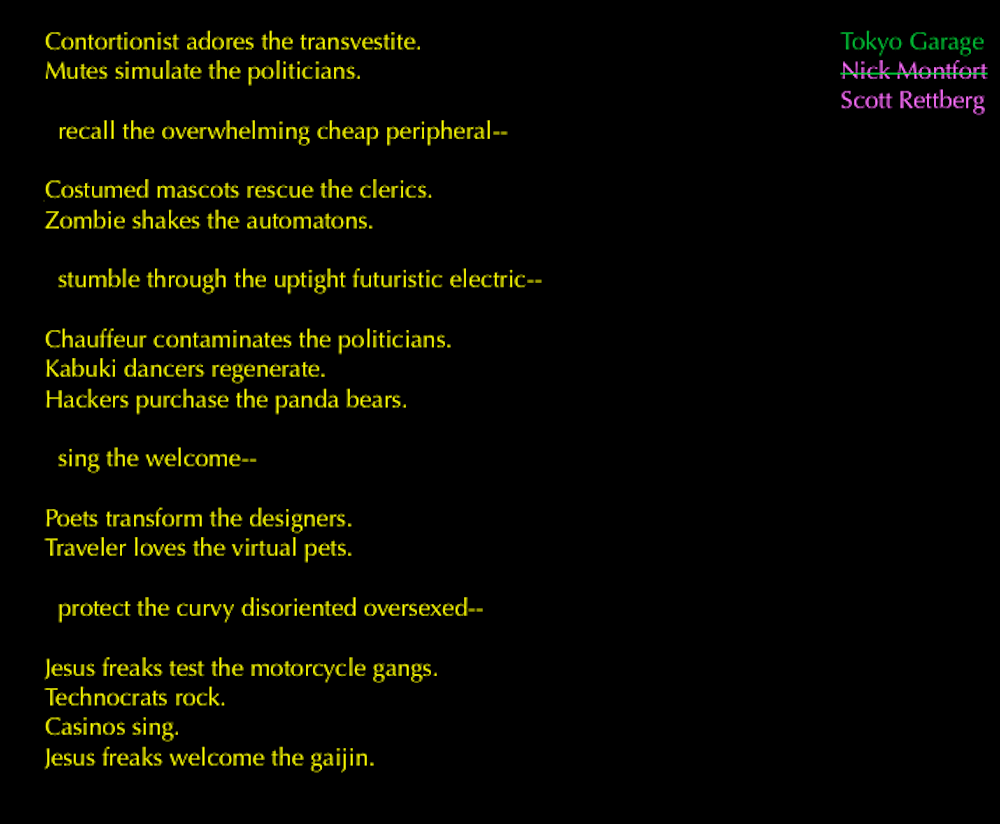
Montfort writes: “If others could go to a place of natural beauty and write a poem about that place, why couldn’t I write a poetry generator, instead?” Scott Rettberg then took the code from Montfort’s poem and replaced the vocabulary to produce Tokyo Garage, turning Montfort’s minimalist nature poem into a maximalist urban poem.
J.R. Carpenter undertook a similar transformation – replacing the nature vocabulary with words associated with eating.
There are now dozens of Taroko Gorge remixes. By inspecting the source of Montfort’s poem, one can carve into the code to remix one’s own version.
Scott Rettberg’s Taroko Gorge remix.
3. Visual verse
For centuries, poets have combined poetry and images. In the late 1700s, William Blake combined poetry with engraved artwork in his conceptual collection Songs of Innocence. Contemporary poets use digital technologies to similarly adorn poetry with imagery.
The title of Qianxun Chen’s work Shan Shui means mountain and water in Chinese, and landscape when combined as shanshui. It also refers to traditional Chinese landscape painting and a style of poetry that conveys the beauty of nature. With each click, a new Shan Shui poem is generated with a corresponding Shan Shui landscape painting.
Shan Shui (2014) by Qianxun Chen makes a new illuminated poem with each click.elmcip.net
Visuals also find their way into poetry performance. The Buoy by Meredith Morran is a poetic work of auto-fiction that uses a series of diagrams to create a new form of language to address political issues involving marginalised identities.
Morran combines abstract images, performance and PowerPoint presentation software to indirectly address a personal history of growing up queer in Texas.
A Brief History of How Life Works (2017) by Meredith Morran.
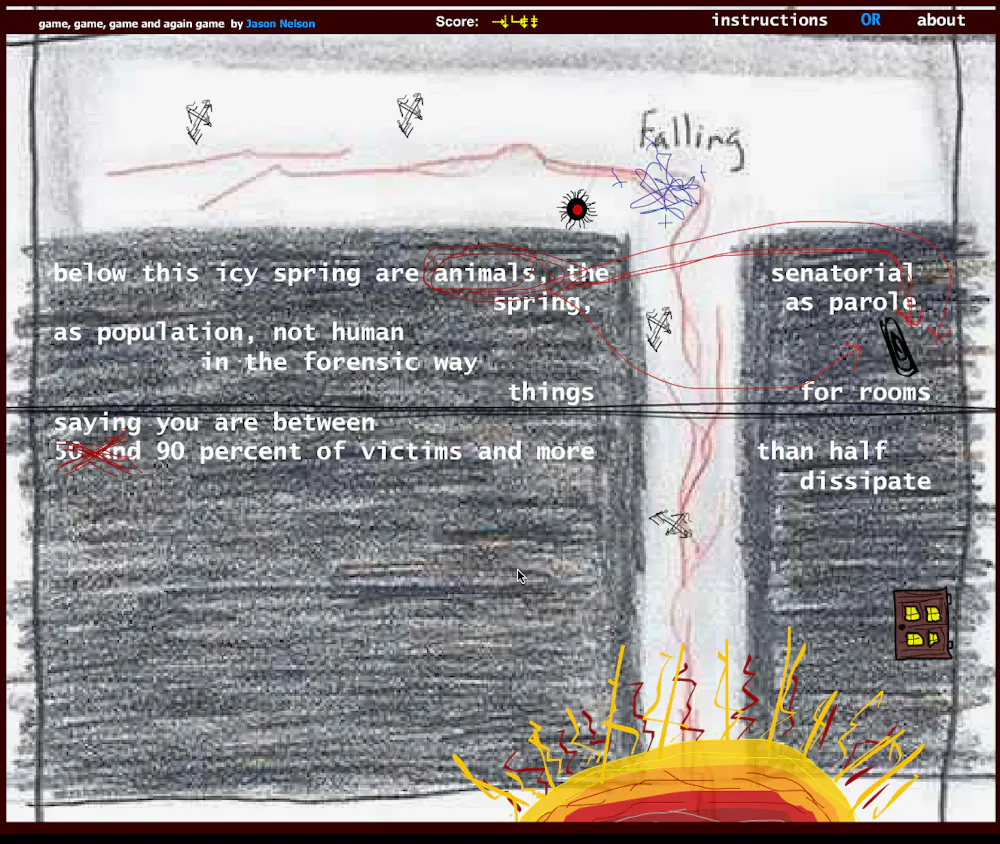
A still from game, game, game, and again game (2007) by Jason Nelson.elmcip.net
The emergence of virtual reality games, such as Half-Life: Alyx, has also met with poetry.
Australian digital artist Mez Breeze’s V[R]ignettes is a virtual reality microstory series. The audience can experience this work by donning a virtual reality headset or viewing it in 3D space in browser. Each V[R]ignette combines poetic text, 3D models, and atmospheric sound design. The reader (or user) can navigate by clicking on the “Select an annotation” bar at the bottom of the screen, or simply look around in 3D space and freely explore the work.
A still from V[R]ignettes (2019) by Mez Breeze.elmcip.net
5. Coded messages
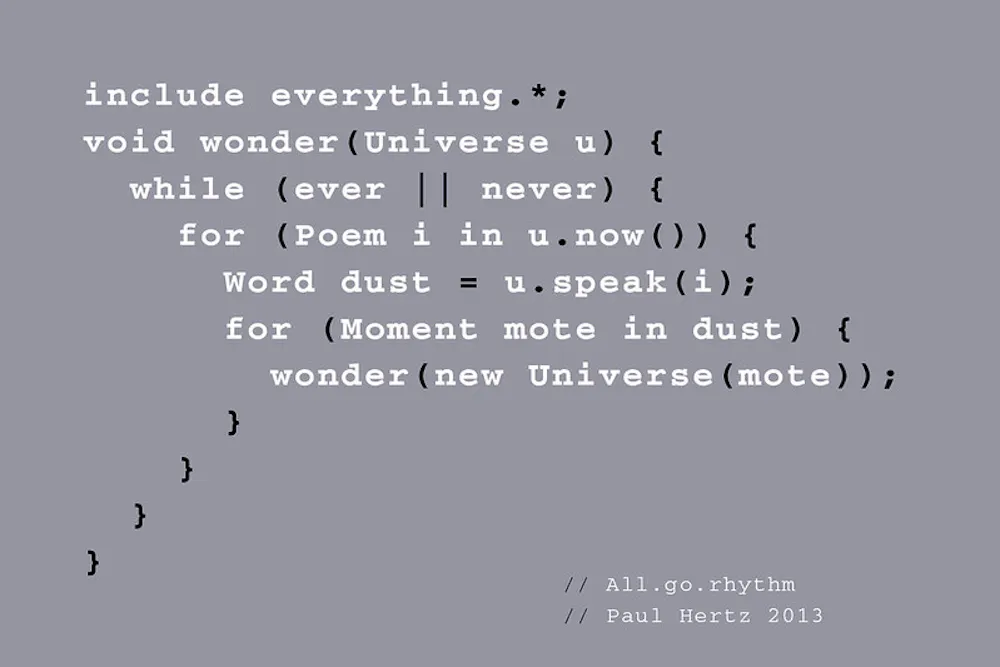
Code poetry is a genre that combines classical poetry with computer language.
Code poems, such as those compiled by Ishac Bertran in the print collection code {poems}, do not require a computer to exist. However, they do use computer languages, so to comprehend the poem one must be able to read computer code.
Like so many untranslatable Russian and Chinese poems, these works require a knowledge of the original language to be appreciated.
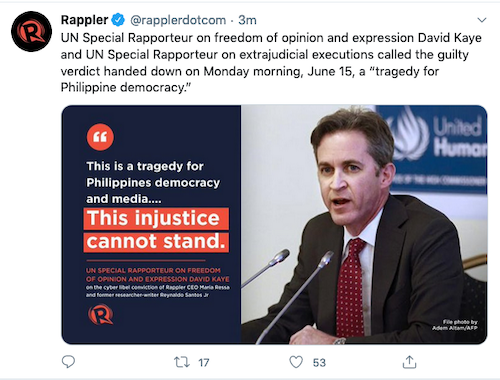
Reporters Without Borders (RSF) has condemned the up to six years in jail sentence that Philippine journalist Maria Ressa faces on a criminal libel charge in a “shocking judicial masquerade” in Manila yesterday.
It called on the country’s justice system to recover a “semblance of credibility” by overturning her conviction on appeal, RSF said in a statement as global media freedom and human rights watchdogs protested over the verdict.
A Manila regional court convicted Maria Ressa, co-founder and director of the independent news website Rappler, over an article published in 2012 that was the subject of a complaint by a businessman.
But the case was brought under a cyber crime law that took effect after the article’s publication. Rappler‘s former researcher-writer Reynaldo Santos Jr received the same sentence.
Both were allowed to post bail, pending an appeal.
– Partner –
As no criminal legislation can be retroactive, the National Bureau of Investigation dismissed the case in February 2018. But President Rodrigo Duterte’s Department of Justice decided otherwise.
‘Continuous publication’ It revived the case in February 2019 on the grounds that a supposed principle of “continuous publication” could be applied to websites.
“By passing this extremely harsh sentence at the end of utterly Kafkaesque proceedings, the Philippine justice system has demonstrated a complete lack of independence from the executive,” said Daniel Bastard, the head of RSF’s Asia-Pacific desk.
“This sentence bears the malevolent mark of President Duterte and his desire, by targeting Rappler and the figure of Maria Ressa, to eliminate all criticism whatever the cost.
“We urge Manila’s judges to restore a semblance of credibility to the Philippine judicial system by overturning this conviction on appeal.”
?? @rapplerdotcom‘s @mariaressa could get six years in jail! By passing this harsh sentence after utterly Kafkaesque proceedings, the #Philippines‘ justice system has demonstrated a complete lack of independence from from pdt #Duterte‘s administration. https://t.co/RSK6RARyfM
Systematic harassment This conviction of Ressa and Rappler is the latest chapter in the systematic judicial harassment to which they have been subjected by various government agencies for more than two years.
Either directly or through Ressa, the website is facing 10 other similar complaints, each as baseless as the other, with the aim of intimidating its journalists.
ABS-CBN, the biggest Philippine broadcast network and one of the few other media outlets to dare criticise the government, had its franchise withdrawn last month.
Its radio stations and TV channels all stopped broadcasting on May 5 at the behest of the Justice Department and National Telecommunications Commission.
After falling seven places since 2017, the Philippines is ranked 136th out of 180 countries and territories in RSF’s 2020 World Press Freedom Index.
‘Damaging precedent’ In Brisbane, Professor Peter Greste, director and spokesperson of the Alliance for Journalists’ Freedom and UNESCO chair of journalism and communication at the University of Queensland, said the verdict set “an extraordinarily damaging precedent” for Asia-Pacific and global press freedom.
“To suggest there was no political pressure in this case would be incredibly naïve. The Philippine government has made it abundantly clear that they don’t think Maria should be free. The judge will have been acutely aware of this pressure.
“As a former political prisoner myself, I am deeply concerned about Maria and her former colleague, researcher-writer Reynaldo Santos Jr. who was also convicted in this case. More broadly though, I am concerned about what this means for the people of the Philippines.
“They might not all read Maria’s website, Rappler.com, but they all benefit from a free press that is able to question and challenge those in power. This judgment strikes a blow for every independent journalist in the country, chilling the kind of enquiry that makes democracy work.
“But this is not just about the Philippines. The human rights group, Freedom House, has charted a decline in democracy across the Asian region, and this conviction accelerates that trend.
“The AJF urges democratic governments – including Australia’s – to respond swiftly and decisively. This is a test case for the world’s resolve in standing up to authoritarianism by supporting press freedom.”
‘Another nail in coffin’ In Auckland, Professor David Robie, director of the Pacific Media Centre, said the conviction of Rappler’s Maria Ressa and Raynaldo Santos Jr “drives another nail into the coffin of a free press and democracy” in the Philippines.
“It is also a chilling cautionary tale for the Asia-Pacific region and especially for those Pacific countries, such as Papua New Guinea and Fiji, that have imposed draconian cyber crime and social media laws that are really designed to stifle free expression and a free media.
“Fiji is currently deploying its social media law in a blatant attempt to muzzle its democratic opposition and intimidate the media. The behaviour of the state and security forces frequently display the typical characteristics of a virtual dictatorship.”
Foreign Minister Marise Payne has attacked China’s “disinformation” about racism in this country and committed Australia to a more activist role in pressing for reform of multilateral institutions, including the World Health Organisation.
In a Tuesday night speech titled “Australia and the world in the time of COVID-19”, Payne rebutted criticism of the Morrison government for getting out in front of other countries in pushing for an inquiry into the origins and handling of COVID.
“We can be small in our thinking, timid in purpose and risk averse. Alternatively …we can be confident, believe in Australia’s role in the world and prioritise Australia’s sovereignty – and Australians’ long term interests – by making the difficult decisions and choices,” she said.
Payne condemned countries using COVID “to undermine liberal democracy and promote their own, more authoritarian models.
“I have also been very clear in rejecting as disinformation the Chinese government’s warnings that tourists and students should reconsider coming here because of the risk of racism.
“I can say emphatically that Australia will welcome students and visitors from all over the world, regardless of race, gender or nationality,” she said, adding that law enforcement agencies would deal with individual crimes.
“The disinformation we have seen contributes to a climate of fear and division when what we need is cooperation and understanding.
“Australia will resist and counter efforts at disinformation. We will do so through facts and transparency, underpinned by liberal democratic values that we will continue to promote at home and abroad.”
Payne said a foreign affairs department audit of Australia’s engagement in multilateral institutions, commissioned by Scott Morrison last year, had recognised the limitations of these bodies. But “Australia’s interests would not be served by stepping away and leaving others to shape the global order for us”.
“We must stand up for our values and bring our influence to bear in these institutions to protect and promote our national interests, and to preserve the open character of international institutions based on universal values and transparency.
“Australia will continue to work to ensure global institutions are fit-for-purpose, relevant and contemporary, accountable to member states, free from undue influence, and have an appropriately strong focus on the Indo-Pacific.
“We will continue to support reform efforts in the United Nations and its agencies to improve transparency, accountability and effectiveness. This is foreign policy designed to use Australian agency and influence to shape a safer world and make us safer at home.”
On the World Health Organisation, she said, “Through our role on the WHO executive board, and proactive participation in a range of regional and global health forums, Australia will present tangible proposals and initiatives to ensure that the global health architecture emerges stronger from Covid-19.”
In general, Australia would direct its efforts to preserving three fundamental parts of the multilateral system:
rules protecting sovereignty and peace and enabling international trade and investment
international standards on health, transport, telecommunications and other matters underpinning the global economy
norms underpinning universal human rights, gender equality and the rule of law.
“We will work to ensure that the development of new rules and norms to address emerging challenges is consistent with enduring values and principles. This is particularly important in the case of critical technologies, including cyber and artificial intelligence, and critical minerals and outer space.”
“Effective multilateralism, conducted through strong and transparent institutions, serves Australia’s interests,” Payne said.
“Our challenge is to ensure the institutions, and our active engagement, delivers for Australia and for Australians. To do this, Australia must better target our role in the global system.
“Australia’s role in seeking an independent review of COVID-19 is a prime example of this active engagement in the national interest,” she said.
The ALP national executive has decided on sweeping federal intervention into the crisis-ridden Victorian ALP, in the wake of revelations of the alleged “industrial scale” branch stacking and threats by now former state minister and power broker Adem Somyurek.
Former state premier Steve Bracks and former federal cabinet minister Janny Macklin will run the state branch and prepare reforms, while the ALP national executive will handle federal and state preselections.
The intervention follows Nine’s 60 Minutes and The Age revealing recorded conversations in which Somyurek boasted of his power over state and federal MPs, and of running massive branch stacking. He also used highly offensive language about a female colleague.
Victorian premier Daniel Andrews sacked Somyurek from his cabinet on Monday, and two other ministers, Robin Scott and Marlene Kairouz, whose staff were allegedly associated with the stacking have resigned, while denying any wrongdoing. Somyurek quit the Labor party on Monday before he was due to be expelled.
The scandal comes at the worst time for federal leader Anthony Albanese who is fighting the byelection in the Labor held seat of Eden-Monaro, which is on a margin of under 1%.
Another complication for the federal party is that some of the secret recording was apparently in the electorate office of Victorian federal Labor MP Anthony Bryne, who is deputy chair of the powerful parliamentary committee on intelligence and security.
ALP national president Wayne Swan said in a statement after a national executive hook up on Tuesday night that Bracks and Macklin “will provide the national executive with recommendations on how the Victorian branch should be restructured and reconstituted so that the branch membership comprises genuine, consenting, self-funding party members”.
He said in developing their recommendations, the administrators would consult party members and affiliated unions.
“The conduct exposed in recent days is reprehensible and at odds with everything the ALP stands for,” Swan said. “The national executive takes these matters incredibly seriously.”
Andrews wrote to ALP national secretary Paul Erickson calling for profound reform of the branch, and asking for its members’ voting rights to be suspended.
“I have no confidence in the integrity of any voting rolls that are produced for any internal elections in the Victorian branch,” he said.
“Accordingly we must suspend those elections and begin a long and critical process of validating each and every member of the Labor party in Victoria as genuine, consenting and self-funded”.
All state officials and staff will have to report to Bracks and Macklin, who are appointed until January 31 next year. All committees are suspended.
All voting rights are suspended until 2023.
Bracks and Macklin will do a scoping report by the end of next month, including recommendations on integrity measures that are needed for the branch. By Novemeber 1 they are to produce a final report on the restructuring and reconstitution of the branch.
New Zealand is one of a handful of countries where community transmission of COVID-19 has been eliminated.
But with two new cases announced today (June 16), we have learned that elimination is not the end – rather, it’s the the start of the next phase.
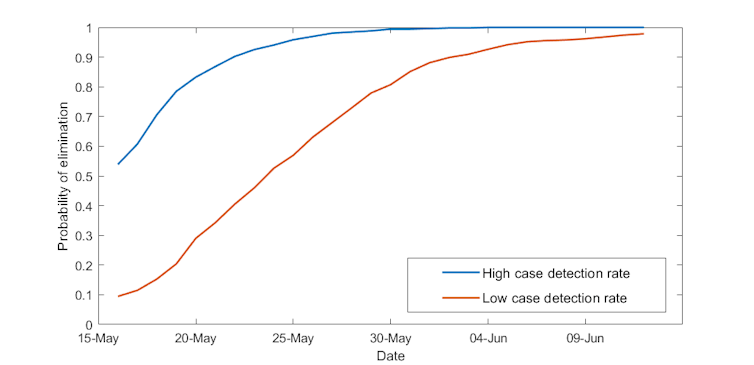
Probability of elimination of COVID-19 community transmission.
After 23 consecutive days with no new cases, today’s announcement that two people returning from overseas have tested positive does not mean New Zealand’s elimination strategy has failed. Just two weeks ago, we estimated we were likely to see one or two cases a week at New Zealand’s border.
The two travellers in question came from the UK, where the disease is still very active.
The two women arrived in New Zealand on June 7, via Doha and Brisbane, and stayed in a managed isolation hotel in Auckland. But they were granted an exemption on compassionate grounds on June 12 to travel to Wellington to visit their dying parent.
This development shows how important our border controls are. Currently, all new arrivals must remain in quarantine for at least 14 days, unless they receive an exemption. It’s unlikely someone is still infectious after 14 days without showing symptoms, so this should minimise the chances of spread from overseas arrivals.
But as these cases show, this doesn’t mean the risk is zero. Whether from an exemption on compassionate grounds as in this case, people working at the border, or from people getting infected shortly before leaving quarantine, it is inevitable that new cases will make it across the border.
As we explained in our previous article, to stop the virus coming back, we need more than just good border controls. New Zealanders will need to keep avoiding the three Cs of possible infection – closed spaces, crowded places and close contact – as best they can. And it’s crucial we keep meticulously tracking where we’ve been and who we’ve been in contact with.
It also shows the importance of getting tested. One of the travellers reported mild symptoms, but didn’t associate these with COVID-19. Anybody with symptoms should get tested and stay home until the results come through, especially if they have had contact with someone who has been overseas or work in a high-contact job.
Now that New Zealand is at alert level 1 and 40,000 people can go to the rugby, it’s more than important than ever that we don’t let our guard down.
Two new cases of covid-19 in New Zealand were women aged in their 30s and 40s who visited a dying parent in Wellington under compassionate grounds, says Dr Ashley Bloomfield says.
Dr Bloomfield said both women were from the same family. They arrived in New Zealand from the UK on June 7.
– Partner –
“A new case is something we hoped we wouldn’t get, but it’s also something we expected and have planned for,” he said.
They traveled from the UK via Doha and then Brisbane. Australian authorities were contacted to trace people in Australia, Dr Bloomfield said. It was uncertain where they became infected.
One had mild symptoms, the other was symptom free.
Today’s NZ public health media briefing. Video: RNZ News
Gone into self-isolation As part of their agreed plan under the compassionate circumstances agreement, they were tested in Wellington. Both have since gone into self-isolation in the Wellington region.
Dr Bloomfield said they had applied for an exemption on Friday, June 12, to visit their dying parent and were allowed to travel to Wellington in a private vehicle to do so the following day, on June 13. Their parent died that night.
“They were in a managed isolation hotel in Auckland and were permitted on compassionate grounds to leave managed isolation to travel to Wellington via private vehicle.”
He said there was only one additional family member who may be at risk, and who was being tested and isolated. Other potential contacts included people on the same flight from Brisbane and people who were in or had been in the same managed isolation facility in Auckland, including staff.
“There was an agreed plan in place as a part of the approval process for the compassionate exemption and that included the travel arrangements.”
He said the funeral for the parent would be delayed until family members had completed their next 14-day minimum isolation period.
“The family has asked for their privacy to be respected.”
Staff stood down, tested Staff at the managed isolation facility – the Novotel Ellerslie hotel in Auckland – who had contact with the pair would be stood down and tested, Dr Bloomfield said.
The pair “must have” had a vehicle that was able to make the journey without stopping for fuel, Dr Bloomfield said, and made the journey without using public facilities.
“I won’t go into details but there is a lot of empty roadside between here [Wellington] and Auckland.”
Dr Bloomfield said the situation exemplified why compassionate exemptions did not extend to funerals or tangihanga where there might be large groups of people.
From now on, people must return a negative result before being allowed an exemption, he said.
“We should not be complacent, we should remain vigilant. There is a pandemic raging outside our shores.”
He said there were several hundred New Zealanders entering the country on most days.
‘We expected more cases’ “We expected more cases, good thing here is we’re maintaining, I believe, what are good rates of testing in the community given we’ve got very low rates of influenza-like illness in our community.”
He said contact tracing was good and this would be a good test for it. Stress testing of the contact tracing system would also begin shortly.
The new cases bring New Zealand’s confirmed cases to 1156, and the combined total of confirmed and probable cases to 1506.
New Zealand has had 22 deaths from the virus.
Health Minister David Clark said the two new cases showed the importance of having strict controls at the border.
He said New Zealand has some of the toughest border controls in the world for a reason.
This article is republished by the Pacific Media Centre under a partnership agreement with RNZ.
If you havesymptomsof the coronavirus, call the NZ Covid-19 Healthline on 0800 358 5453 (+64 9 358 5453 for international SIMs) or call your GP – don’t show up at a medical centre.
Source: The Conversation (Au and NZ) – By Celeste Rodriguez Louro, Senior Lecturer and ARC DECRA Fellow, Discipline of Linguistics, University of Western Australia
Aboriginal English is spoken by an estimated 80% of Aboriginal and Torres Strait Islander people, and is the first and only language spoken by many Aboriginal children.
There are similarities between Standard Australian English and Aboriginal English, but this can pose serious obstacles for its speakers, who are misinterpreted by some as speaking poor English.
In fact, Aboriginal English has its own structure, rules and the same potential as any other linguistic variety.
Aboriginal English ranges from light varieties, spoken by most Aboriginal Australians, to heavy varieties. These heavy varieties tend to be inaccessible to an outsider, and are sometimes closer to Kriol, a creole language spoken in northern Australia.
We collected Aboriginal English stories about family, history and the supernatural. From there, we studied the conventions that arise from the way language is used in society. Here are ten features unique to Aboriginal English, based on our observations in Nyungar country in Perth, Western Australia.
1. Address terms and kinship
Aboriginal English speakers convey respect by referring to people as Auntie or Uncle, including senior people the speaker has never met before.
Aboriginal English also makes use of reciprocal address, where certain words apply to people interchangeably. For example, the term “granny” may be used by a grandmother to address her granddaughter and for the granddaughter to address her grandmother.
2. Eye contact
While Standard Australian English speakers are expected to hold direct eye contact, for some speakers of Aboriginal English this can be perceived as rude or threatening.
3. Questions
In seeking information, Aboriginal English speakers are likely to prefer uninverted questions such as “That’s your Auntie?”, rather than “Is that your Auntie?”
4. Endings
The term unna is frequently used at the end of spoken utterances to establish shared knowledge.
So when someone says “She wicked big, unna” the speaker uses unna to seek confirmation for her statement. Unna is used widely in Western Australia but also appears in varieties of Aboriginal English spoken in the Northern Territory, Queensland and New South Wales.
5. Sounds
A common feature of Aboriginal English is the omission of the “h” sound at the beginning of words, such as “appy” from “happy”.
This “h” sound is also sometimes added to the beginning of words, with “instance” becoming “hinstance”.
Aboriginal English speakers also switch “k” and “s” sounds in the word “ask”, pronouncing it as “aks”. This also happens in African American Vernacular English throughout the USA.
6. Grammar
The irregular verb “be” (which includes the forms “is”, “was”, “are”, “been”) is often left out, as in “she wicked big”.
Sometimes when the verb “be” is used in speech, it doesn’t change with speakers in the same way it does in Standard Australian English. So someone might say “we was yarning” instead of “we were yarning”.
Double negatives are commonly used. Aboriginal English speakers may say “No one got out of no motor”, where “no one” and “no” are used together to express negative meaning.
Aboriginal English also uses the word “them” in place of words such as “those”. For example, “all them tablets” instead of “all those tablets”.
These are not grammatical errors: they are correct given the rules of Aboriginal English.
Some words in Aboriginal English are Standard Australian English words but with different meanings. “Deadly” is used to mean “really good” and “hungry” is used to mean “great”.
The word “cruel” is used as an intensifier (“cruel tired”), and the term “shame” is used to mean “embarassed”, as in “I was shame to say that in front of my people”.
8. Nyungar terms
Speakers sprinkle their speech with words from original Australian languages. In the Nyungar community, these include boya (money), boodjar (country), maya-maya (camp/home) and moorditj (awesome/the best).
These give Aboriginal English in southwest Western Australia its unique flavour.
9. Quotes
The practice of quoting someone using the phrase “be like” has spread rapidly across the English speaking world over the past 50 years, including in Aboriginal English.
In white communities, “be like” can introduce a speaker’s internal thought process. Someone may say “I was like, ‘That hat looks wrong on you’ but I didn’t say it”. In Aboriginal English speakers also use “be like”, but they mostly do it to introduce content that was actually said.
Young speakers of Standard Australian English have almost abandoned “say” in favour of “be like”. But young Aboriginal English speakers use “say” a lot: almost 50% of their quotative verbs are instances of “say”, as in “They was saying, ‘Quick, tell them to get away from the house’”.
10. Yarning
Yarning is a conversational and storytelling style where Indigenous people share stories based on real experience and knowledge, from intimate family gatherings to formal public presentations.
The expression has recently gained momentum in Indigenous Health contexts where it is used to help people quit smoking, for therapy and healing more generally. Instead of a formalised question-and-answer interview, health information is gathered through conversation and story-telling.
In our research, we didn’t need interview questions. The Aboriginal researcher engaged the community in sharing experience and knowledge through yarning. It’s yarning that helps Aboriginal English thrive.
Foreign lives matter, especially (but by no means only) when they are our foreigners.
As intimated on 15 March 2019, our foreigners include all non New Zealand citizens in New Zealand, at a given point in time (the ‘present’). And our foreigners include all non New Zealand citizens normally resident in New Zealand (a wider group than persons with ‘permanent residence’ immigration status) but not presently in New Zealand.
Thus, in ‘the present’, many people have two national identities. This of course includes New Zealand citizens not presently in New Zealand. (A few – with multiple citizenships – have more than two ‘present’ national identities.) ‘Our people’ are made up of citizens, denizens, and visitors.
If a major incident happens in New Zealand, then we as a polity have a duty of care to all people presently in New Zealand. If a major global incident happens, we have a duty of care to all New Zealand citizens, all people in New Zealand, and all people with present residential rights in New Zealand; that is, to all of ‘our people’. Our duty of care may include mobility restrictions, including tight quarantines (eg in airport premises) and internal border restrictions.
Realm Citizens
Many countries, including New Zealand, have a ‘realm’. The United Kingdom has a three-tier realm, with the United Kingdom countries themselves being the first tier, the Isle of Man being an example of a second-tier country, with Bermuda as a third-tier country. France has a quite complex realm. The United States has a conceptually simpler realm than France, which includes American Samoa; it even includes a country which drives on the left (Virgin Islands).
In the strictly-legal sense, New Zealand has a two-tier realm. Though I would argue that New Zealand really has a three-tier realm. The Chatham Islands are part of the first tier. The Cook Islands, Niue and Tokelau are the second tier. The third tier is Samoa, which has a historical constitutional relationship with New Zealand; a relationship which continues to involve some duty of care from New Zealand.
The rights of Cook Islanders to be New Zealanders are essentially the same as the rights of Manx people to be British. When we treat them as if they have less of a right to be in New Zealand than people who are unambiguously foreigners – people such as Australians who might want to come to New Zealand for a skiing holiday – then we move into the peculiar mercantilist way of thinking which only offers a full set of rights to a core group of citizens.
Even today, we deny the right to vote to citizens in prison. In the nineteenth century (before 1890) we only gave full New Zealander rights to property-owning men; everyone else entitled to be in New Zealand was more denizen than citizen. The current experience – when our political leaders feint from discussion about the access rights of New Zealand realm citizens to New Zealand – shows that, in the mindframe of much of New Zealand’s political class, these people attached to New Zealand are denizens rather than citizens.
The word ‘denizen’ conveys the mercantilist concept of ‘monetary utility’ – denizens are people we embrace when they are ‘making money’ for our country, but whom we feel free to discard as jetsam when they are no longer doing so, or able to do so.
Freeing New Zealanders to visit Cook Islands represents a ‘loss of money’ to core (first tier) New Zealand. Whereas allowing Australians to ski in Queenstown represents a ‘gain of money’ to core New Zealand. (This way of thinking is, of course, one-sided mercantilist nonsense! They gains from economic transactions are mutual.) Reading between the lines, we can see that – at least in some corners of government – an opening to realm countries may jeopardise the more lucrative opening to Australia. (And an opening to Cook Islands could then lead to stronger pressure to open to Samoa.) Indeed, we sense that our relationship to Australia is very much like the relationship of Cook Islands and Samoa to New Zealand; we find ourselves pleading to the bigger (asymmetric) ‘partner’ to do us favours.
Mercantilist Mindframe
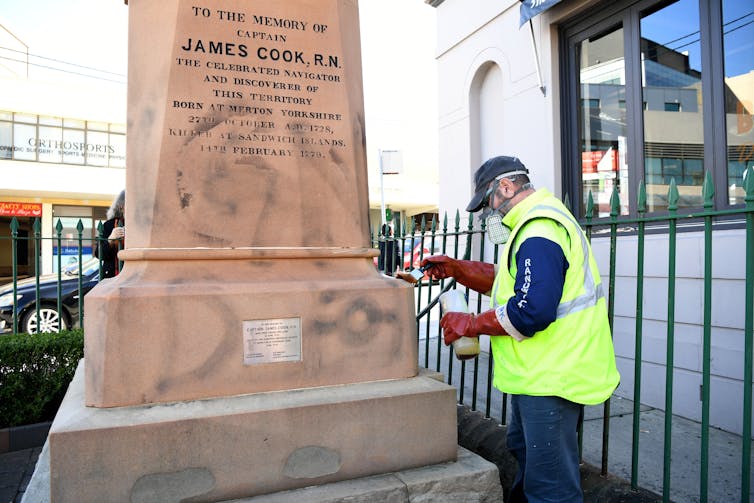
As already noted in earlier writing in this space, we think and behave today using mindframes largely set in the European mercantilist era, which is broadly the quarter-millennium from 1500 to 1750. (Indeed, we are now starting to denounce James Cook – who came to New Zealand with a relatively enlightened mercantilist mindset – while continuing, unquestioningly, to retain most of our mercantilist mental baggage.)
The words that most define the mercantilist era are ‘money’, ‘foreign’, and ’empire’. Mercantilist empires were essentially global commercial empires; global political empires were creatures mainly of the century 1850 to 1950.
In the mercantilist mindframe, money (‘real money’) was understood by almost everyone as gold and silver. Money was won from foreigners by the agents of new entities called nation states; money was won ‘for a nation’ through exporting, invading, mining, exploiting, plundering and swindling. If the gold or silver mines that a kingdom coveted were in some distant land, then your cannon-backed navy or army would invade and try to annex that land. Thus, commercial empires – or realms – were created.
Before 1500, most human societies – including New Zealand’s – had histories (often long histories) of slavery, of coerced labour. The concept of slavery had little to do with the colour of a person’s skin, though tended to be associated with the ethnicities of people who had suffered military defeat. Indeed, the word ‘slave’ derives from the ‘Slav’ ethnic group. Thus, slaves were ‘foreigners’, though by no means all foreigners were slaves.
Foreigners were ‘them’; people without rights, but highly valued for their utility (especially but not only monetary utility) to ‘us’. (Further, foreign nations were rivals, much as sporting teams are rivals. Accumulated gold and silver served as scoring points in the game.) At the extreme ‘slavery’ end we imported them, exerted property rights over them, and mainly deployed them in the realm lands rather than the homelands.
Mercantilist mindframes give license to cold calculated cruelty to people who could be labelled as ‘foreign’; cruelty by neglect as well as by overt intent. If we have a narrow conception of citizenship, then we have a broad conception of ‘foreigner’. Our denizens become foreigners – without political rights and open to exploitation – when we adopt this mindset. Australia’s denizens, including those holding New Zealand passports, are ‘without political rights and open to exploitation’.
While citizens of any country should practice kindness towards citizens of all countries, they should be especially kind to their own denizens, practising members of their communities.
Conclusion – he tangata, he tangata, he tangata
New Zealand needs to behave in a principled rather than a mercantilist way. New Zealand should be prioritising its duties of care to its people; including its ‘denizens’, people subject to New Zealand’s duty of care. Duty of care always takes priority over ‘loss of money’ considerations. All people matter. Most of us in New Zealand understand who our people are, who we should not abandon during the pandemic.
Source: The Conversation (Au and NZ) – By Val Hooper, Associate Professor, and Head of the School of Marketing and International Business, Te Herenga Waka — Victoria University of Wellington
Anyone familiar with George Orwell’s novel 1984 will relate to the menace of Big Brother watching their every keystroke and mouse click. For a growing share of the workforce that dystopian reality arrived while most of us were hunkering down in our “bubbles”.
With employees working from home during the COVID-19 pandemic, more companies felt the need to track them remotely. US-based Hubstaff, which develops and markets employee time-tracking software, boasted a three-fold increase in New Zealand sales during the first month of lockdown alone.
Now, with some organisations thinking of continuing work-from-home flexibility beyond the pandemic restrictions, that scrutiny should cut both ways.
Employers have long used swipe cards and video surveillance for safety and security, and monitoring staff email during work hours is nothing new. But the latest generation of employee surveillance software has transformed the modern workplace into a digital panopticon.
While newer tools aimed at tracking employee productivity, such as computer-usage monitors, have increased the management arsenal, most focus on specific activities. What is now proposed are mechanisms that monitor employees 24/7, including apps that can be loaded onto mobile phones.
One such product advertises its ability to “catch disgruntled employees and protect business intellectual property”. It can “monitor all social media and networking apps by accessing conversations, passwords and media shared through the apps”.
More trust means better productivity
The uncomfortable reality is that many employers feel entitled to monitor employee activity. If I’m paying their salaries, they argue, they should be doing my work. Their time is mine.
The problem with effectively intimidating employees into being productive is that it strongly suggests an organisational culture of mistrust – yet research shows that mistrust undermines productivity.
Spyware that is introduced outside the collective bargaining process concerns trade unions, who argue workers’ privacy may be unfairly invaded in the name of performance measurement.
In the year to June 2019, only 5% of collective agreements in New Zealand included a specific clause (or referred to a document outside the agreement) dealing with internet or telephone monitoring. That amounts to only 1.1% of employees on such agreements.
The prevalence of agreements that mention work being electronically monitored varies considerably across the labour market. But far more employees are on collective agreements that make no mention of it, despite their work being regularly monitored.
Those who make up the 80% of the New Zealand workforce covered by individual agreements have few choices. The obligation to install and use monitoring software derives from the duty of employees to obey the reasonable orders of their employer, and contractual obligations to comply with employer policies.
The law is getting left behind
The standard against which actions are judged is that of the “reasonable employer” – not a neutral party, let alone a reasonable employee. The result is that employees have very limited protection from intrusions into their privacy and personal life.
Compounding the problem, monitoring software is evolving so rapidly the law has no time to respond. Other than in the most egregious circumstances, the courts are unlikely to hold that using already widely adopted tools constitutes the action of an unreasonable employer.
Under the principles of the Privacy Act 1993, people should be made aware of any information being collected about them and why. They are entitled to know how it will be used and stored, who will have access to it and whether anyone can be modify it.
The information should not be kept longer than necessary, and it is essential to know how it will eventually be disposed of and by whom. Above all, such information should not be collected if it intrudes “to an unreasonable extent on the personal affairs of the individual concerned”.
Naturally, people should be entitled to access that information. However, as with employment law, privacy law tends to give greater weight to the right to manage than to intrusions into employee privacy.
Privacy is a health and safety issue too
The law reflects an underlying assumption that time spent on a job equates with higher-quality work. But this is not necessarily correct.
In many industries, including IT, the focus is very much on the task. Employees are often dotted all over the world in different time zones. They contribute at times of day that work for them.
Monitoring attendance, productivity and hours worked – in other words, checking up on employees to ensure they’re not “skiving off” – leaves them feeling mistrusted and that their privacy has been invaded. Stress and sick days increase, morale drops and staff turnover rises.
As yet, the health and safety implications of intense monitoring have received little attention in the courts from workplace health and safety regulator Worksafe.
Allowing staff to work at home requires trust and the openness to have honest, frank and supportive discussions if substandard performance is noticed. Employers seriously considering monitoring employees working at home should be very clear about their reasons before jumping on the post-COVID work-from-home bandwagon.
The devices that allow the monitoring of home workers should be used carefully and not exploited. Otherwise, the trust inherent in good workplace culture will quickly erode, along with the productivity that goes with it.
Source: The Conversation (Au and NZ) – By Euan Ritchie, Associate Professor in Wildlife Ecology and Conservation, Centre for Integrative Ecology, School of Life & Environmental Sciences, Deakin University
Feral and pet cats are responsible for a huge part of Australia’s shameful mammal extinction record. Small and medium-sized ground-dwelling mammals are most susceptible.
But we’ve found one mammal in particular that can outsmart cats and live alongside them: the long-nosed potoroo.
These miniature kangaroo-like marsupials are officially listed as vulnerable. And after the recent devastating fires, extensive swathes of their habitat in southeastern Australia were severely burnt, leaving them more exposed to predators such as foxes and cats. But the true extent of the impact on their numbers remains unclear.
Amid the devastation, our new study is reason to be optimistic.
Long-nosed potoroos are a bit like mini kangaroos, but spend much of their time digging for fungi.Zoos Victoria
Using motion-sensing camera traps on the wildlife haven of French Island – which is free of foxes, but not cats – we found potoroos may have developed strategies to avoid prowling cats, such as hiding in dense vegetation.
If these long-nosed potoroos can co-exist with one of the world’s most deadly predators, then it’s time we rethink our conservation strategies.
Surviving cats with a deadly game of hide and seek
We conservatively estimated that between five and 14 cats lived in our study area (but it takes only one cat to eradicate a population of native animals).
Although cats were common here, we detected them less often in areas of dense vegetation. By contrast, this was where we found potoroos more often.
French Island’s thick vegetation provides potoroos with critical refuge to evade feral cats.Vivianna Miritis
Long-nosed potoroos are nocturnal foragers that mainly, but not exclusively, feed in more open habitat before sheltering in dense vegetation during the day. But we found potoroos rarely ventured out of their thick vegetation shelter.
This may be because they’re trading off potentially higher quality foraging habitat in more open areas against higher predation risk. In other words, it appears they’ve effectively learnt to hide from the cats.
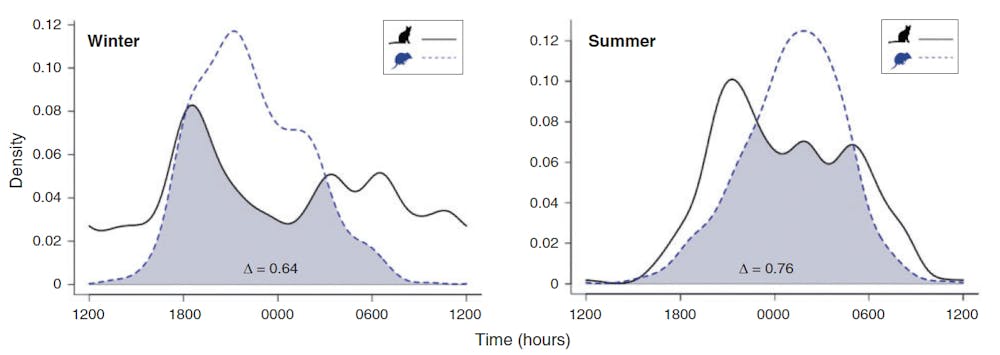
Another intriguing result from our study was that although potoroos and feral cats shared more than half of their activity time, the times of peak activity for each species differed.
Cats were active earlier in the night, while potoroo activity peaked three to four hours later. This might be another potoroo strategy to avoid becoming a cat’s evening meal.
Temporal activity of cats and long-nosed potoroos for winter and summer, on French Island, Victoria. Their overlap is represented by the area shaded in grey. Modified from Miritis et al. (2020).
Still, completely avoiding cats isn’t possible. Our study site was in the national park on French Island, and it’s likely cats saturate this remnant patch of long-nosed potoroo habitat.
It’s also possible cats may be actively searching for potoroos as prey, and indeed some of our camera images showed cats carrying young long-nosed potoroos in their mouths. These potoroos were more likely killed by these cats, rather than scavenged.
Cats are expert hunters
Cats are exceedingly difficult to manage effectively. They’re adaptable, elusive and have a preference for live prey.
The two most common management practices for feral cats are lethal control and exclusion fencing. Lethal control needs to be intensive and conducted over large areas to benefit threatened species.
“Safe havens” – created through the use of exclusion fencing or predator-free islands – can overcome some of these challenges. But while exclusion fencing is highly effective, it can create other bad outcomes, including an over-abundance of herbivores, leading to excessive grazing of vegetation.
Camera traps can tell us a lot about how introduced predators and native wildlife interact.Zoos Victoria and Deakin University
In any case, removing introduced predators might not be really necessary in places native species can co-exist. If long-nosed potoroos have learnt to live with feral cats, we should instead focus on how to maintain their survival strategies.
Why cat eradication isn’t always the best option
It’s clear cats are here to stay, so we shouldn’t simply fall back largely on predator eradication or predator-free havens as the only way to ensure our wildlife have a fighting chance at long-term survival.
Yes, for some species, it’s vital to keep feral predators away. But for others like long-nosed potoroos, conserving and creating suitable habitat and different vegetation densities may be the best way to keep them alive.
But perhaps most important is having predator-savvy insurance populations, such as long-nosed potoroos on French Island. This is incredibly valuable for one day moving them to other areas where predators – native or feral – are present, such as nearby Phillip Island.
In the absence of predators, native wildlife can rapidly lose their ability to recognise predator danger. Programs aimed at eradicating introduced predators where they’re co-existing with native species need to pay careful attention to this.
Conversation-Democracy 2025 Podcast on “Political Trust in Times of COVID-19” produced by ContentGroup
A week ago, the British Foreign Secretary Dominic Raab announced that the number of people killed by the coronavirus in the United Kingdom stood at 32,313, the second highest death toll in the world.
The number of deaths from COVID-19 in Australia currently stand at 103.
Critics have accused a “complacent” British government of “massively underestimating” the gravity of the coronavirus crisis.
The prominent Italian newspaper Corriere della Sera reported that the situation in the UK was “like a nightmare from which you cannot awake, but in which you landed because of your own fault or stupidity”. London correspondent Christoph Meyer writes, Britain has emerged as Europe’s “problem child” of the COVID-19 crisis.
Although international comparisons of COVID-19 death tolls, are methodologically problematic and morally bankrupt, there can be no doubt that the lived citizen experience of COVID-19 has been dramatically different in the United Kingdom when compared with Australia.
Every citizen has a heart-breaking personal story to tell.
In contrast, most Australians, have been blessed voyeurs on the pandemic further perpetuating its image as the Lucky Country.
In this podcast Mark Evans and Michelle Grattan explore differences in the management, experience and impact of the crisis in the company of three leading British academic thinkers and members of the Trustgov project at the University of Southampton.
Will Jennings is Professor of Political Science and Public Policy at the University of Southampton. He is an expert on public policy and political behaviour, Principle Investigator on the Trustgov project, Co-Director of the UK Policy Agendas Project, and elections analyst for Sky News.
Dr. Jennifer Gaskell joined the TrustGov project as a Research Fellow in July 2019. She holds an interdisciplinary PhD in Web Science from the University of Southampton. Her research focuses on the ways new Information and Communication Technologies (ICTs) impact civic and political participation. She is also the co-founder of Build Up, a social enterprise working at the intersection of new technologies, civic engagement and peace-building.
Gerry Stoker is Professor of Governance at the University of Southampton and Centenary Professor at the University of Canberra. He is an expert on democratic politics and governance, and advisor to governments and international organisations on public sector reform.
If you’re lucky enough to be able to afford a winter holiday, some good news: ski fields are reopening across the country as coronavirus restrictions continue to ease.
This makes the slopes perhaps more attractive than they’ve ever been. Indeed, the website of one of New South Wales’ most popular venues, Thredbo, crashed last week as 25,000 customers tried to buy a lift pass at once – the largest volume the resort had ever experienced on its online store.
What’s more, skiing is great exercise and also good for both the tourism industry and the economy. And it’s an outdoor activity (which makes it safer than indoor activities as far as COVID-19 risk is concerned).
But there are still risks. So how do you stay safe on the slopes?
Many of these holiday spots have COVID-19 advice on their websites, which is worth reading closely before you book.
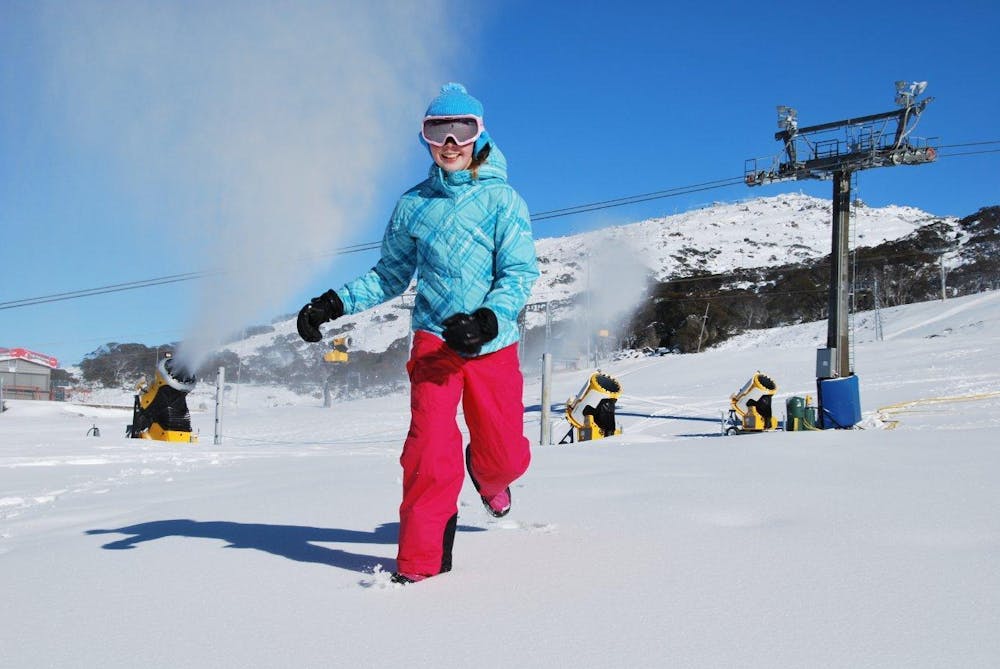
Good news: the coronavirus pandemic won’t prevent you from throwing snowballs at your friends.AAP/Perisher
Caution required
The risk of contracting COVID-19 in the community is much reduced thanks to all our efforts over the previous few months. But we still need to still be cautious and sensible as we navigate the next phase with our newly granted freedoms.
There is no doubt things will be different this year on the slopes, as ski companies do what they can to make sure you’re safe.
Some extra planning and care can reduce the coronavirus risks to you, your loved ones and the community.
The first and most important rule: stay home if you are sick. This should go without saying but if you have any symptoms, such as a sore throat or fever, get tested. Consider cancelling your holiday until you know you’re COVID-19-free.
You could also consider downloading the COVIDSafe app before you set off and make sure you know how to use it.
Remember, all ski slopes in Australia will limit numbers to ensure people can maintain social distancing.
Demand for ski holidays will be great, with overseas getaway options limited. But many ski resorts will operate at about 50% capacity to ensure social distancing, which means some people may miss out on accommodation and lift passes.
Furthermore, all resorts are asking people to book resort entry and lift passes well ahead of time, to help with planning. Same-day lift ticket sales will not be available at many resorts.
Besides the usual warm clothing, pack hand sanitiser and perhaps even a few face masks for times you’re not able to physically distance.
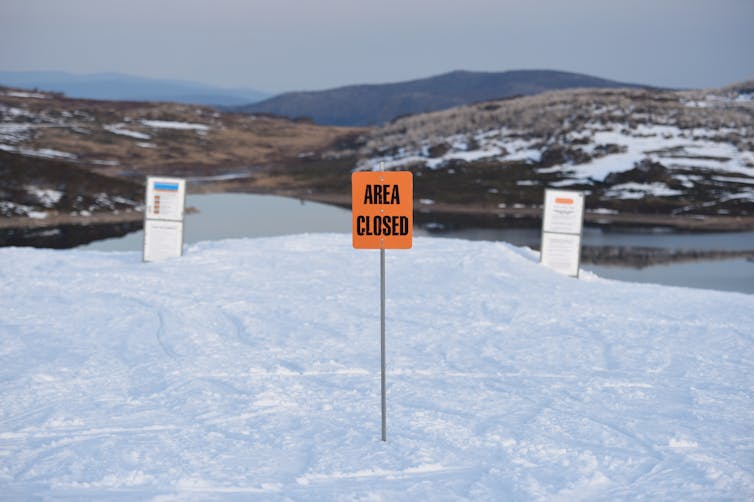
Most Australian ski fields will be operating at half capacity for the 2020 season.Tracey Nearmy/AAP
What will the new normal look like?
Ski resorts face a range of challenges in dealing with the pandemic, and you should expect things to feel very different.
Aside from limiting numbers to ensure patrons can physically distance, resorts will have to institute rigorous cleaning protocols.
And the usual international ski workers will not be available due to travel restrictions.
Resorts are placing limits on classes. Although some are running lessons for adults, others are not running group lessons at all. Thredbo and Mount Buller are offering private lessons only. Make sure to check your destination’s rules before leaving.
There will be strict enforcement of social distancing in queues and limitations in the numbers on ski lifts. Mt Hotham is restricting ski lifts to two people per quad chair and asks that you only ride with those you’re sharing accommodation with on the mountain. Like many resorts, it is also banning cash.
Indoor seating at cafes and restaurants will be strictly limited and some resorts advise you to pack your own snacks and lunch.
Tobogganing and snow play is prohibited throughout Perisher this year, to reduce COVID-19 risk.
There will also be hand sanitiser stations and increased cleaning protocols, particularly of frequently touched surfaces such as lift guardrails.
What about when you’re not skiing or snowboarding?
What will be most obvious is the absence of events that bring large groups of people together at ski resorts. Restaurants and cafes will operate in line with their respective state guidelines, involving limits to the numbers of people allowed indoors.
And just like the rest of Australia currently, there will be no nightclubbing.
As with all our activities, it’s your own responsibility to stay safe by making sure you maintain hand hygiene and physical distancing wherever possible.
However, resorts will be adapting to the current situation to keep you safe. With a bit of planning and flexibility, it can be a great holiday for you and your family that also supports Australia’s tourism industry.
Nine’s 60 Minutes program recently aired surveillance footage appearing to show Victorian minister Adem Somyurek, an upper house MP in the Andrews government and a member of the ALP national executive, preparing a folder of cash along with dozens of party membership forms for the alleged purpose of branch stacking.
The program also aired recordings in which Somyurek disparaged his colleagues, including Premier Daniel Andrews, and other office staff. Apparently, the tapes were recorded over the past 12 months. It is not clear how this was done, or who made and released them.
The recriminations were fast and furious. Andrews immediately sacked Somyurek from his cabinet, and referred the matter to the police and the state’s anti-corruption commission, IBAC. Two more ministers have since resigned pending an investigation.
In a statement, Somyurek claimed he had been a victim of an illegality:
It is clear that I was taped and surveilled in a federal electorate office without my knowledge and that this material was published without my knowledge of its existence or my consent […] The conversations published without my knowledge or consent were with someone who I trusted about internal party matters […] I will be taking steps to seek a police investigation into these matters.
Does he have a valid argument? Are his private conversations protected?
To answer these questions, we need to look at the laws that regulate surveillance devices such as cameras and microphones. Unsurprisingly, the law is a patchwork of some federal but mainly state and territory legislation.
All Australian jurisdictions have laws regulating the use of listening devices, some for the past 50 years. Each of these statutes makes it an offence to listen to or record a private conversation using a listening device.
Broadly speaking, it is illegal to install a listening device without an appropriate police warrant. It is an offence in all jurisdictions to broadcast a recording of a taped conversation or publish the information from it.
Indeed, a person may be committing an offence in some jurisdictions by simply possessing a report that contains a summary of the contents of the recording. Most jurisdictions have now expanded their legislation to embrace cameras and CCTV, too, under the broader term “surveillance devices”.
Most relevant for our purposes is the Victorian Surveillance Devices Act 1999. This law protects a “private conversation” from surveillance. And that protection extends to the broadcasting of any recording.
A private conversation is one that is “carried on in circumstances that may reasonably be taken to indicate that the parties to it desire it to be heard only by themselves”.
So far, so good, for Somyurek.
But as Nine’s lawyers would have advised the 60 Minutes producers, all Australian legislation provides for a public policy exception. For example, this may apply where surveillance is designed to protect the lawful interests of the person making the recording. It may also apply where it appears activities are being carried out for nefarious purposes, such as an alleged abuse of ministerial office.
Section 7(2) allows a defence to the charge of installing and monitoring a surveillance device if the installation, use or maintenance is reasonably necessary for the protection of any person’s lawful interests. That’s a very broad defence.
And section 11(2) allows a communication of any recording for a “publication that is no more than is reasonably necessary in the public interest”.
This same “public interest” defence would apply to the publication of the internal briefing with Rio Tinto staff last week following the destruction of an ancient Aboriginal site at Juukan Gorge.
This tape was leaked to The Australian Financial Review. The lawyers arguing for the release of a private recording of a company meeting would argue (if challenged) that the testy interactions heard therein indicated the views of Rio employees about the company’s unapologetic stance on the destruction of the site.
In this instance, the “public interest” arguably relates not only to the authorisation of the blast, but also the reputation of all members of staff who are seen as representatives of Rio Tinto and its values.
Applying the public interest defence in the Somyurek and Rio Tinto cases, one could argue, has led to appropriate outcomes. But these laws and the protections they are designed to offer need improvement. The variety of offences, and the breadth and length of the numerous defences in each jurisdiction, all illustrate the awkward consequences of state and territory governments failing to pursue uniform legislation.
This multitude of approaches leaves Australian surveillance laws (including laws regulating telephone tapping, internet snooping and metadata surveillance) complicated and confusing. This applies not only in matters like those discussed above, but also to what is and what is not permitted in relation to workplace surveillance.
It is high time that attorneys-general (state and federal) around Australia came together to craft a consistent approach to surveillance device laws.
Source: The Conversation (Au and NZ) – By Carol Johnson, Emerita Professor, Department of Politics and International Relations, University of Adelaide
The Conversation is running a series of explainers on key figures in Australian political history, examining how they changed the country and political debate. You can read the rest of the series here.
Paul Keating was one of Australia’s most charismatic and controversial prime ministers.
Born in Bankstown, New South Wales, into an Irish-Catholic, working-class and Labor-voting family, he left school before he turned 15. Keating joined the Labor Party as a teenager, quickly honing the political skills that would serve him so well in later life. He entered parliament as MP for Blaxland in 1969 at just 25 years old, and briefly served as minister for Northern Australia in the ill-fated Whitlam government.
He subsequently served as a very high-profile treasurer in the Hawke government from 1983-1991, before defeating Bob Hawke in a leadership ballot in December 1991. In doing so Keating became Australia’s 24th prime minister, serving until John Howard defeated him in the 1996 election.
To Keating’s supporters, he is a visionary figure whose “big picture” ideas helped transform the Australian economy, while still pursuing socially inclusive policies. To his conservative critics, Keating left a legacy of government debt and rejected “mainstream” Australians in favour of politically correct “special interests”.
He was a skilled parliamentary performer, renowned for his excoriating put-downs and wit.
Keating played a major role in transforming Australian political debate. He highlighted the role of markets in restructuring the economy, engagement with Asia, Australian national identity and the economic benefits of social inclusion.
Economic rationalism
Keating is remembered most for his eloquent advocacy of so-called “economic rationalism” both as treasurer and later as prime minister.
Under Hawke and Keating, Labor advocated free markets, globalisation, deregulation and privatisation, albeit in a less extreme form than the Liberals advocated. For example, while Labor introduced major public sector cuts, it attempted to use means tests to target the cuts and protect those most in need. Nonetheless, Hawke and Keating embraced the market far more than previous Labor leaders had.
Along with New Zealand Labour, Australian Labor became one of the international pioneers of a rapprochement between social democracy and a watered-down form of free-market neoliberalism. Years later, British Prime Minister Tony Blair, who had visited Australia during the Hawke and Keating years, was to acknowledge the influence of Australian Labor on his own “Third Way” approach to politics.
The Hawke cabinet in 1990, with Keating again as treasurer.AAP/National Archives of Australia
Keating justified his economic rationalism on the grounds that the Australian economy needed to transform to be internationally competitive in a changing world. To avoid becoming one of the world’s “economic museums” or “banana republics”, in Keating’s view, there was no alternative but to embrace his economic rationalist agenda.
Trade unions and the ‘social wage’
At the same time, Keating argued that his economic policies would avoid social injustices. This contrasted with the outcomes of the extreme economic rationalism of the Thatcher and Reagan governments.
Unlike in the UK or US, where anti-union policies were pursued, the Labor government was prepared to work with the trade union movement to introduce its economic policies. Under the Accord agreements, trade unions agreed to wage restraint, and eventually real wage cuts, in return for government services and benefits.
Hawke and Keating referred to this as the “social wage”. They claimed the resulting increased business profits would encourage economic growth and rising standards of living.
Social inclusion and economic growth
Keating saw his economic policies and progressive social policies as compatible. Increased social inclusion would contribute to economic growth.
Drawing on Hawke-era affirmative action legislation, Keating argued improved gender equality would mean women could contribute their skills to the economy.
Keating was also a passionate advocate for reconciliation with Indigenous Australians, including acknowledging the injustices of Australia’s colonial past and facilitating Native Title. He envisaged an Australia where Indigenous people would benefit from sustainable economic development, cultural tourism and could sell their artworks to the world.
National identity, Asia and the republic
In Keating’s ideal vision, Australia would engage more with Asia and benefit from the geo-economic changes occurring in the Asia-Pacific region.
Then Opposition Leader John Howard accused Keating of rejecting Australia’s British heritage. In fact, Keating acknowledged many positive British influences on Australian society. However, he argued that Australia had developed its own democratic innovations such as the secret ballot long before Britain accepted these. He also suggested Australian values had become more inclusive as a result of diverse waves of immigration.
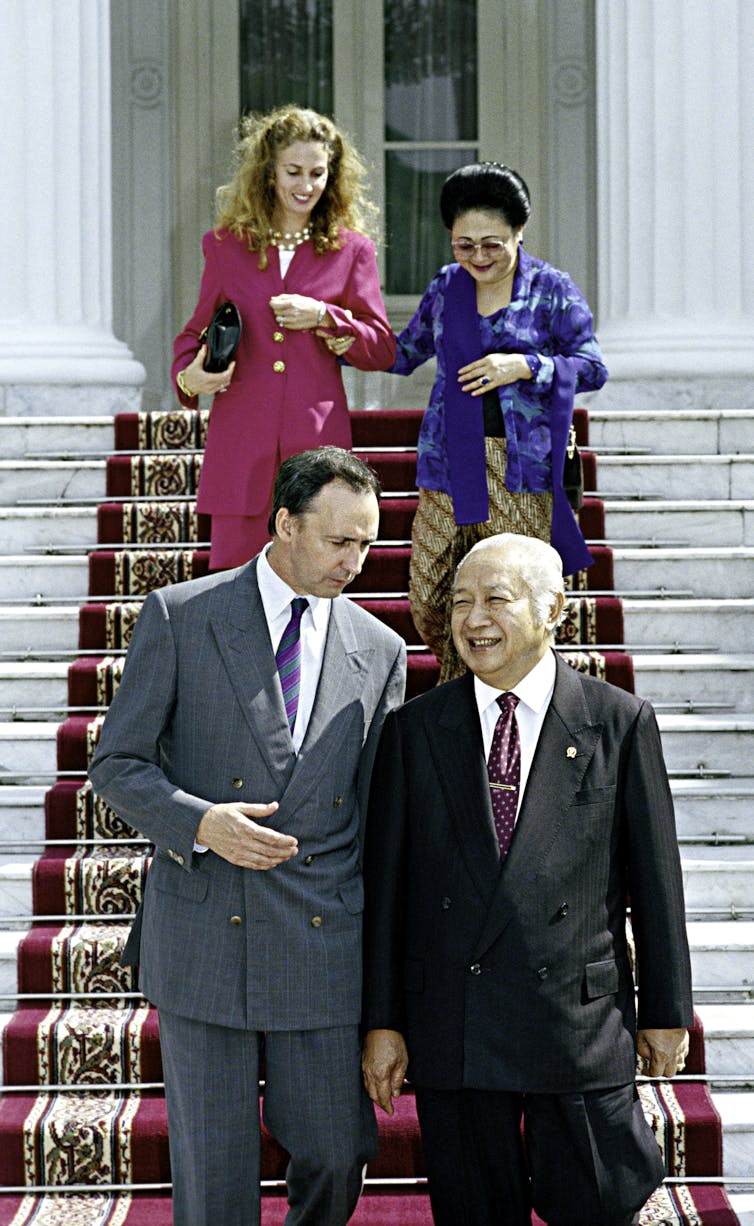
While Keating maintained cultural and economic links with the US and Europe, he also sought to improve relations across the Asia-Pacific.AAP Image/National Archives of Australia
Consequently, it was time for Australia to throw off its colonial heritage, including the British monarchy, and become a republic. Keating believed that doing so would enable Australia to be more easily accepted as an independent nation in the Asian region. He established a Republic Advisory Committee as part of preparations for a referendum on becoming a republic.
Keating’s legacy
Australia’s greater relationship with Asia has had major benefits for the economy, although Keating underestimated the downsides of increased competition. Recently, he complained about what he sees as excessive security fears in relation to China and their impact on Asian engagement. The republic remains unfinished business.
Keating’s vision has also left some unintended consequences for Labor today. Despite his patchy record in achieving them, Keating argued that both tax cuts and budget surpluses were important, even at the expense of public sector cuts.
Consequently, it became harder for Labor leaders to make a case for deficit-funded stimulus packages when needed (as Kevin Rudd tried to do during the Global Financial Crisis). Similarly, it became harder for Labor leaders to argue for increased taxes to fund a bigger role for government, as Bill Shorten attempted during the 2019 election.
In addition, as I argue in a recent book, Keating-era policy contributed in the longer term to poorer wages and conditions for workers. Labor is predictably loath to acknowledge this. Keating also underestimated the detrimental impacts of economic rationalism on other vulnerable groups in the community.
The 2019 election result suggests many Australians no longer believe Labor governments will improve their standards of living.
Rather than the prosperous brave new world he envisaged, parts of the Keating legacy may have made things harder for subsequent Labor leaders. Nonetheless, Keating remains a revered figure in the Labor Party and one of its most memorable leaders.
Fiji police were today questioning the University of the South Pacific chief librarian, Dr Elizabeth Reade Fong, at police CID headquarters in Toorak, reports FBC News.
Dr Reade said was being questioned regarding protests at the university’s Laucala campus in Suva last week.
However, Dr Reade maintains that they were not protesting but rather supporting the now suspended vice-chancellor Professor Pal Ahluwalia.
Dr Elizabeth Reade Fong with Professor Pal Ahluwalia at the opening of the refurbished USP library last year. Image: USP
The Fiji police has started an investigation into the public gathering of staff and students at the university.
Police Commissioner Brigadier-General Sitiveni Qiliho had earlier said the police were looking into possible breaches of covid-19 restrictions by those who had been protesting at the Laucala campus.
– Partner –
For the past week, there have been many “solidarity” gatherings for Professor Ahluwalia across the Pacific at USP campuses and centres.
Fiji Village reports Dr Reade has been a staff representative speaking out against Professor Ahluwalia’s suspension pending investigations.
She was also part of the group of staff and students that had gathered at USP in support of Professor Ahluwalia last Monday.
Dr Reade was also interviewed on Mai TV’s Simpson @ Eight programme about the future of the university.
Ms Elizabeth Fong (USP librarian) has been called to the CID office in Toorak for questioning. Staff intimidation continues. pic.twitter.com/IpYEP4LD2D
Source: The Conversation (Au and NZ) – By Caroline Fisher, Co-author of the Digital News Report: Australia 2020, Deputy Director of the News and Media Research Centre, and Assistant Professor of Journalism, University of Canberra
Australian news consumers are far more likely to believe climate change is “not at all” serious compared to news users in other countries. That’s according to new research that surveyed 2,131 Australians about their news consumption in relation to climate change.
The Digital News Report: Australia 2020 was conducted by the University of Canberra at the end of the severe bushfire season during January 17 and February 8, 2020.
It also found the level of climate change concern varies considerably depending on age, gender, education, place of residence, political orientation and the type of news consumed.
Young people are much more concerned than older generations, women are more concerned than men, and city-dwellers think it’s more serious than news consumers in regional and rural Australia.
15% don’t pay attention to climate change news
More than half (58%) of respondents say they consider climate change to be a very or extremely serious problem, 21% consider it somewhat serious, 10% consider it to be not very and 8% not at all serious.
Out of the 40 countries in the survey, Australia’s 8% of “deniers” is more than double the global average of 3%. We’re beaten only by the US (12%) and Sweden (9%).
While most Australian news consumers think climate change is an extremely or very serious problem (58%), this is still lower than the global average of 69%. Only ten countries in the survey are less concerned than we are.
Strident critics in commercial media
There’s a strong connection between the brands people use and whether they think climate change is serious.
More than one-third (35%) of people who listen to commercial AM radio (such as 2GB, 2UE, 3AW) or watch Sky News consider climate change to be “not at all” or “not very” serious, followed by Fox News consumers (32%).
This is perhaps not surprising when some of the most strident critics of climate change science can be found on commercial AM radio, Sky and Fox News.
Among online brands, those who have the highest concern about climate change are readers of The Conversation (94%) and The Guardian Australia (93%), which reflects their audiences are more likely left-leaning and younger.
More than half of Australians get their information about climate change from traditional news sources (TV 28%, online 17%, radio 5%, newspapers 4%).
However, 15% of Australians say they don’t pay any attention to news about climate change. This lack of interest is double the global average of 7%. Given climate change impacts everyone, this lack of engagement is troubling and reflects the difficulty in Australia to gain political momentum for action.
The polarised nature of the debate
The data show older generations are much less interested in news about climate change than news in general, and younger people are much more interested in news about climate change than other news.
News consumers in regional Australia are also less likely to pay attention to news about climate change. One fifth (21%) of regional news consumers say they aren’t interested in climate change information compared to only 11% of their city counterparts.
Given this survey was conducted during the bushfire season that hit regional and rural Australia hardest, these findings appear surprising at first glance.
But it’s possible the results simply reflect the ageing nature of regional and rural communities and a tendency toward more conservative politics. The report shows 27% of regional and rural news consumers identify as right-wing compared to 23% of city news consumers.
And the data clearly reflect the polarised nature of the debate around climate change and the connection between political orientation, news brands and concern about the issue. It found right-wing news consumers are more likely to ignore news about climate change than left-wing, and they’re less likely to think reporting of the issue is accurate.
Regardless of political orientation, only 36% of news consumers think climate change reporting is accurate. This indicates low levels of trust in climate change reporting and is in stark contrast with trust in COVID-19 reporting, which was much higher at 53%.
The findings also point to a significant section of the community that simply don’t pay attention to the issue, despite the calamitous bushfires.
This presents a real challenge to news organisations. They must find ways of telling the climate change story to engage the 15% of people who aren’t interested, but are still feeling its effects.
the majority of Australian news consumers will miss their local news services if they shut down: 76% would miss their local newspaper, 79% local TV news, 81% local radio news service and 74% would miss local online news offerings
more than half (54%) of news consumers say they prefer impartial news, but 19% want news that confirms their worldview
two-thirds (62%) of news consumers say independent journalism is important for society to function properly
around half (54%) think journalists should report false statements from politicians and about one-quarter don’t
news consumption and news sharing have increased since 2019, but interest in news has declined
only 14% continue to pay for online news, but more are subscribing rather than making one-off donations
TV is still the main source of news for Australians but continues to fall.
The ‘COVID-trust-bump’
In many ways these findings, including those on climate change reporting, reflect wider trends. Our interest in general news has been falling, along with our trust.
This changed suddenly with COVID-19 when we saw a big rise in coverage specifically about the pandemic. Suddenly, the news was relevant to everyone, not just a few.
We suspect that key to the “COVID-trust-bump” was the news media adopting a more constructive approach to reporting on this issue. Much of the sensationalism, conflict and partisanship that drives news – particularly climate change news – was muted and instead important health information from authoritative sources guided the coverage.
This desire for impartial and independent news is reflected in the new report. The challenge is getting people to pay for it.
A former vice-chancellor of Papua New Guinea’s University of Technology says politics has no place in university governance.
Professor Albert Schram’s comments follow last week’s suspension of the vice-chancellor of the University of the South Pacific, Professor Pal Ahluwalia, by the USP Council’s executive committee.
Some see the latest developments as an attempt by Fiji to nationalise the regional institution.
Dr Schram said while most governments hold the appointing authority at universities, they should not select people who pursue personal and limited agendas.
– Partner –
“Politics should be kept out of university and there is broad consensus among all students and staff at universities in the Pacific that you shouldn’t import the problems from national politics into the university.
“Governments should be wise and not appoint people who are pursuing personal and very limited agendas.”
Nationalising plan ‘untrue’ Fiji’s Education Minister Rosy Akbar slammed claims the government was nationalising the USP.
Akbar said the criticisms were “untrue and frankly uncalled for”.
Barely two months into his new role, he alleged abuse of office and serious mismanagement by his predecessor and the council’s leadership group led by pro-Chancellor Winston Thompson.
The Kenya-born academic said he welcomed any investigation but it should be carried out independently and not determined by the people who seemed to have a vendetta against him.
Dr Albert Schram (third from left) with UN and Korean government officials during a visit to a settlement in Madang in Papua New Guinea. Image: Albert Schram/RNZ
Students, faculty and staff at the USP – including Pacific leaders and government officials – have joined calls for the removal of the executive committee.
Prior to his role at the USP, Thompson was Fiji’s ambassador to the United States in 2009 and before that served in various government ministries and companies, including a senate nomination in 1996.
Forum chief supports special meeting The secretary-general of the Pacific Islands Forum Secretariat, Dame Meg Taylor, is one of the latest figures to support Nauru’s call for a special council meeting to look into the long-running leadership and employment issues at the USP.
The chair of the Pacific Islands Forum, Tuvalu Prime Minister Kausea Natano, said he was concerned at last week’s developments.
Natano urged Forum members to “work together, and in the Pacific way, to chart a course forward for our premier institution of learning”.
Samoan Education Minister Loau Sio has also chimed in calling on Mr Thompson to step down.
And the Cook Islands Ministry of Foreign Affairs shared on its social media platform the need for the USP Council to ensure good governance and management was administered by due processes.
Samoa’s Fiame Naomi Mata’afa … “The latest development at the university is quite appalling”. Image: RNZ
Tonga and USP donors Australia and New Zealand are in agreement that a special meeting could help to resolve the impasse.
Samoa’s Deputy Prime Minister Fiame Naomi Mata’afa, who is also chair of a USP Council subcommittee, said Professor Ahluwalia’s suspension was made by a committee which took over council powers under the cover of covid-19 emergency regulations.
Committee ‘behaving in irregular ways’ “The latest development at the university is quite appalling,” she said. “The governance which was raised in the BDO report seems to be continuing the way it is as people are behaving in very irregular ways and not following due process.”
But Thompson, who is also USP council chair, said while the professor’s suspension was not linked to the BDO report, the executive committee acted within its powers.
“The governance instruments under which we operate are clear,” he said. “The executive committee has the power under the statute and ordinances of the university to take action in the case that it did.
“For anyone to claim that it’s acting illegally is clearly incorrect.”
Dr Schram said the suspension of Professor Ahluwalia had eerie similarities to when he was dismissed in PNG in 2018 for “failing” to present his credentials.
He said the PNG Council had been misled by disgruntled staff after he eliminated illegal allowances.
He said the hiring and sacking of a vice-chancellor is the responsibility of the USP Council and not the executive committee.
Universities ‘close to becoming dysfunctional’ “I’m not surprised at all that vice-chancellor Ahluwalia ran into the same problems that I had because universities in the Pacific are very close to becoming completely dysfunctional and collapsing.
“And in that manner they aren’t able to provide a good learning environment for the students and do not contribute to nationbuilding at all.”
Dr Schram said the USP episode left a bad taste of “corruption and xenophobia” and warned the university could succumb to political infighting as had happened in PNG.
He said universities should govern their own affairs.
“From my experience what you have seen in the last 10 years or so is that without changing the acts of the university, the governments in the Pacific have been encroaching upon their [universities] autonomy slowly.
“In Papua New Guinea, we have seen how that how that can really get out of hand. In 2014, they passed the Higher Education Act, which had some consequential amendments for the University Act, but the only consequential amendments regarded the appointment of the vice-chancellor and chancellor.
“So the Higher Education Act was all about the government getting control and as the vice chancellor, you have the responsibility of upholding the provisions of your University Act.”
Student experience needs to be at centre Dr Schram, who also served on the council of the University of Papua New Guinea, said Fiji should avoid the fate of PNG universities.
“We’re used to putting the students’ experience as the centre of all our activity, not the allowances and the appointments of the staff.
“Now if you have a heavily politicised university then the only reason for its existence becomes as a source of income for the staff families and that’s not how it should be.”
USP’s Winston Thompson … “The executive committee has the power.” Image: RNZ
Stakeholders at the regional institution are being urged to act quickly to address the fallout from the suspension.
Dr Schram said New Zealand was one of the main financial contributors to the university and along with Australia needed to take a lead role in resolving the situation at the USP.
The University of the South Pacific is headquartered in Suva, but is owned by 12 governments, with campuses in several countries.
Meanwhile, a special meeting of the USP Council is supposed to be held this week.
Nauru President Lionel Rouwen Aingimea has proposed that either Australia or New Zealand will organise the virtual meeting rather than staff from the university.
In a letter to Thompson, Aingimea said this was for “transparency and security reasons”, saying “the suspension of Professor Ahluwalia must be dealt with at the first possible opportunity”.
This article is republished by the Pacific Media Centre under a partnership agreement with RNZ.
The case of Australian Karm Gilespie, who has been sentenced to death by a Chinese court on drugs charges pending an appeal, cannot be separated from a recent souring in Sino-Australian relations.
Gilespie was reportedly arrested with 7.5 kilograms of ice in his luggage in 2013, while attempting to leave China.
His arrest clearly pre-dates the recent deterioration of relations between Australia and China. But the sudden announcement of his death sentence raises questions about whether China-Australia tensions have influenced his case.
Certainly, the backdrop makes his prospects even more grim. Bad relations lessen the chance of securing a commutation of his sentence, or indeed his early release, in an opaque justice system.
These are very unpromising circumstances for a foreigner who falls foul of the Chinese authorities, whether that individual has done anything wrong or not. The risks are greater these days for nationals of countries – like Australia and Canada – that have displeased Beijing.
One of the ways this has played out has been in a rise in “hostage diplomacy”, a relatively modern description of an age-old diplomatic weapon. It occurs when one country detains a foreign citizen as retaliation for actions that might have displeased it, or as a bargaining chip to secure the release of one of its own nationals, or a combination of both.
In Australia’s case, it is hard to separate the example of Chinese-Australian academic Yang Hengjun from a souring of relations. Yang was arrested in early 2019. He has lived ever since under the shadow of espionage charges that carry the death penalty.
The Australian government has been pushing for Yang’s release, or at least access to him for his family and lawyers. He has been held in solitary confinement for much, if not all, of his detention.
Again, it is hard not suspect an element of “hostage diplomacy” at play. It has not been revealed what he is alleged to have done wrong beyond his public criticism of the communist system.
His continued detention without reasonable explanation is an affront to the sort of relationship Australia has sought to build with China.
In Canada’s case, Beijing’s ire has been directed at Canada’s detention of Meng Wanzhou, daughter of the founder of telecommunications giant Huawei, pending American-initiated extradition hearings.
Meng is accused of breaching Iran sanctions.
In retaliation, China has arrested two Canadians and held them since 2018. The continued detention of former diplomat Michael Kovrig and businessman Michael Spavor are pernicious cases of hostage diplomacy against the release of a Chinese national awaiting further extradition hearings in Canada.
Kovrig and Spavor are being detained on allegations of breaching Chinese security. No details have been forthcoming.
Unlike the Canadians in primitive detention in China, Meng is biding her time in luxury accommodation in Vancouver before court proceedings reach a conclusion.
The treatment of Kovrig and Spavor is, not to put too fine a point on it, outrageous. Beijing’s resort to this form of hostage diplomacy is a stain on its reputation.
It quashes doubt about the gulf that has opened in recent years between global aspirations for China’s compliance with a rules-based international order and its behaviour.
In the sedate world of international diplomacy, Chinese official representative are giving voice to a new and uncompromising diplomatic posture. After biding its time and holding its counsel, Beijing has unleashed on the world the sort of rhetoric that would not have been out of place during the Cultural Revolution.
The Chinese ambassador in Ottawa, Lu Shaye, wrote in a Canadian publication about Meng’s arrest in words that could have been drawn from a Maoist handbook.
The reason why some people are used to arrogantly adopt double standards is due to Western egotism and white supremacy. In such a context the rule of law is nothing but a tool of the political class and a fig leaf for their practising negotiations in the international arena. What they have been doing is not showing respect for the rule of law, but mocking and trampling the rule of law.
These words were contributed, apparently, without irony.
In recent Chinese history, hostage diplomacy is not new.
During the Cultural Revolution (1966-76), British diplomats and civilians were held hostage for several years as retaliation for humiliations colonisers had imposed on the Chinese.
Then there was the case of Reuters journalist Anthony Grey. He was detained in his apartment in Beijing for 777 days in retaliation for the arrest of a New China News Agency journalist in Hong Kong.
Red Guards killed Grey’s cat and dumped its corpse on his bed. He wrote about his experiences in Hostage in Peking.
In the annals of hostage diplomacy, China is far from alone in the modern era in detaining foreign nationals for political purposes.
Eventually, after 444 days and attempts to negotiate the return of the shah to stand trial in Tehran, the last of the Americans was released. This was not before an abortive attempt in the dying days of the Carter administration to free them by military force. Jimmy Carter’s presidency effectively crashed and burned in the wreckage of helicopters in the desert outside Tehran.
Over the years, terrorist groups in the Middle East have regularly taken Western hostages as bargaining chips in internal power struggles or for ransom. This is not hostage diplomacy per se, but it shares characteristics in common with “state-sponsored” hostage takers.
In China’s case, hostage diplomacy in an environment in which it feels under siege globally is a bad development. Unfortunately for those like Karm Gilespie who are arguably caught up in a wider political game, there is little sign of tensions easing. To the contrary, the atmosphere is getting worse.
To its discredit, hostage diplomacy looks set to remain part of Beijing’s diplomatic arsenal for the time being.
Source: The Conversation (Au and NZ) – By Gabi Mocatta, Research Fellow in Climate Change Communication, Climate Futures Programme, University of Tasmania
Many Australians enjoy a glass of homegrown wine, and A$2.78 billion worth is exported each year. But hotter, drier conditions under climate change means there are big changes ahead for our wine producers.
As climate scientists and science communicators, we’ve been working closely with the wine industry to understand the changing conditions for producing quality wine in Australia.
We created a world-first atlas to help secure Australia’s wine future. Released today, Australia’s Wine Future: A Climate Atlas shows that all 71 wine regions in Australia must adapt to hotter conditions.
Cool wine regions such as Tasmania, for example, will become warmer. This means growers in that state now producing pinot noir and chardonnay may have to transition to varieties suited to warmer conditions, such as shiraz.
Australian wine regions will become hotter under climate change.AAP
Hotter, drier conditions
Our research, commissioned by Wine Australia, is the culmination of four years of work. We used CSIRO’s regional climate model to give very localised information on heat and cold extremes, temperature, rainfall and evaporation over the next 80 years.
The research assumed a high carbon emissions scenario to 2100, in line with Earth’s current trajectory.
From 2020, the changes projected by the climate models are more influenced by climate change than natural variability.
Temperatures across all wine regions of Australia will increase by about 3℃ by 2100. Aridity, which takes into account rainfall and evaporation, is also projected to increase in most Australian wine regions. Less frost and more intense heatwaves are expected in many areas.
By 2100, growing conditions on Tasmania’s east coast, for example, will look like those currently found in the Coonawarra region of South Australia – a hotter and drier region where very different wines are produced.
That means it may get harder to grow cool-climate styles of varieties such as chardonnay and pinot noir.
Some regions will experience more change than others. For example, the Alpine Valleys region on the western slopes of the Victorian Alps, and Pemberton in southwest Western Australia, will both become much drier and hotter, influencing the varietals that are most successfully grown.
A map showing current average growing season temperature across Australia’s 71 wine regions.Authors provided
Other regions, such as the Hunter Valley in New South Wales, will not dry out as much. But a combination of humidity and higher temperatures will expose vineyard workers in those regions to heat risk on 40-60 days a year – most of summer – by 2100. That figure is currently about 10 days a year, up from 5 days historically.
Grape vines are very adaptable and can be grown in a variety of conditions, such as arid parts of southern Europe. So while adaptations will be needed, our projections indicate all of Australia’s current wine regions will be suitable for producing wine out to 2100.
Lessons for change
Australia’s natural climate variability means wine growers are already adept at responding to change. And there is much scope to adapt to future climate change.
In some areas, this will mean planting vines at higher altitudes, or on south facing slopes, to avoid excessive heat. In future, many wine regions will also shift to growing different grape varieties. Viticultural practices may change, such as training vines so leaves shade grapes from heat. Growers may increase mulching to retain soil moisture, and areas that currently practice dryland farming may need to start irrigating.
The atlas enables climate information and adaptation decisions to be shared across regions. Growers can look to their peers in regions currently experiencing the conditions they will see in future, both in Australia and overseas, to learn how wines are produced there.
If our wine industry adapts to climate change, Australians can continue to enjoy homegrown wine.James Gourley/AAP
Industries need not die on the vine
Agriculture industries such as wine growing are not the only ones that need fine-scale climate information to manage their climate risk. Forestry, water management, electricity generation, insurance, tourism, emergency management authorities and Defence also need such climate modelling, specific to their operations, to better prepare for the future.
The world has already heated 1℃ above the pre-industrial average. Global temperatures will continue to rise for decades, even if goals under the Paris climate agreement are met.
If Earth’s temperature rise is kept below 1.5℃ or even 2℃ this century, many of the changes projected in the atlas could be minimised, or avoided altogether.
Australia’s wine industry contributes A$45 billion to our economy and supports about 163,000 jobs. Decisions taken now on climate resilience will dictate the future of this critical sector.
Only 566 people have ever travelled to space. Sixty-five of them, or about 11.5%, were women.
NASA recently proclaimed it will put the “first woman and next man” on the Moon by 2024. Despite nearly 60 years of human spaceflight, women are still in the territory of “firsts”.
Her flight became Cold War propaganda to demonstrate the superiority of communism. At the 1963 World Congress of Women, Soviet leader Nikita Khrushchev used Tereshkova’s voyage to declare the USSR had achieved equality for women.
Women across the world took heart and dreamed they too might travel to space. Ekaterina Ergardt, a Soviet state farm worker, wrote to Tereshkova:
I am eighty years old. I started to live in the years of the beginning of women’s struggle for a life of freedom and equality … now the road to space is open for women.
A 1964 news report shows Valentina Tereshkova receiving an award in London.
Earthbound again
Despite this optimism, it was 19 years before another woman was allowed to venture beyond Earth.
In the United States, women were excluded from space by the restriction that astronauts had to be military test pilots – a profession barred to them.
While the first American astronauts – known as the Mercury 7 – were training in the 1960s, aerospace doctor Randy Lovelace recruited 13 women pilots and put them through the same paces as the male astronauts. The “Mercury 13” outperformed the men on many tests, particularly in how they handled isolation.
But NASA wasn’t convinced. A congressional hearing was held to investigate whether women should qualify to be astronauts. In her testimony, Mercury 13 astronaut candidate Jerrie Cob said:
I find it a little ridiculous when I read in a newspaper that there is a place called Chimp College in New Mexico where they are training chimpanzees for space flight, one a female named Glenda. I think it would be at least as important to let the women undergo this training for space flight.
She was prepared to take the place of a chimp, if that was the only way to get into space.
Message in a bottle
Historically, even those like Lovelace who believed women should go to space have seen their role as helping men, acting as a civilising influence, or providing sex.
In one sense the first women on the Moon were Playboy playmates, in the form of pictures jokingly included in the Apollo 12 astronauts’ checklists. Their names were Cynthia Myers, Angela Dorian, Reagan Wilson, and Leslie Bianchini. The women’s bodies were likened to the lunar landscape: both the object of male conquest.
In popular culture in the 1960s, women were often associated with magic and emotion rather than science and technology.
The sitcom I Dream of Jeannie depicted the relationship between a US astronaut and a magical djinn or genie, imaginatively named Jeannie. NASA was an advisor for the series, which mirrored real space events. Jeannie represented seductive oriental femininity in opposition to the strait-laced, masculine, all-American astronauts.
While Major Tony Nelson was carried into space enclosed in his capsule, Jeannie was imprisoned on Earth in hers. Still image from the opening sequence of I Dream of Jeannie.YouTube
(In the similar sitcom Bewitched, the witch Samantha travelled to the Moon for picnics before she renounced her craft to be a regular housewife.)
The message was clear in popular culture: women needed to stay in the kitchen – or the boudoir. These sitcoms are still aired around the world.
By the 1970s, the women’s movement had made great strides and NASA had to adapt. The first women were admitted to astronaut training in 1978. Not to be outdone, the USSR rushed more women into its own program.
In 1982 Svetlana Savitskaya visited the Salyut 7 space station, becoming the second woman in space and the first to perform a spacewalk. But she wasn’t allowed to forget the nature of women’s work: when she arrived, her male colleagues presented her with an apron.
The following year, Sally Ride flew as a mission specialist on the Space Shuttle Challenger, becoming the first US woman in space. The first American woman to spacewalk was Kathryn Sullivan in 1995.
Astronaut Mae Jemison was the first African American woman in space in 1992 as the science mission specialist on the Space Shuttle Endeavour. Here she looks toward Earth from the flight deck.NASA
In the 21st century, there are still barriers to women’s equal participation in space. In March 2019 the first all-woman spacewalk was cancelled because there were not enough medium-sized spacesuits. Astronauts Christina Koch and Jessica Meir subsequently accomplished the feat in October 2019.
Discussing the cancellation, NASA administrator Ken Bowersox made clear the ideal astronaut body is still male. He blamed women’s smaller average stature, saying they were less able to “reach in and do things a little bit more easily”.
Is it women’s bodies that are the problem, or a space world built for men? What would space technology designed by and for women look like?
There is a massive gender data gap in space. There has been much less research on the effects of microgravity on women’s bodies than there has been for men.
However, women in many ways are ideal astronauts. Physical strength and height are not advantages in microgravity.
Women use less food and oxygen, maintain their weight better on restricted diets, and create less waste. In the words of Sally Ride, “weightlessness is a great equaliser”.
Space4Women
Women’s access to space, not just as astronauts but as users and creators of space services like Earth observation and satellite telecommunications, is still far from equal. But there are signs of progress.
One is the Space4Women program run by the United Nations Office of Outer Space Affairs (UNOOSA), which aims to ensure
the benefits of space reach women and girls and that women and girls play an active and equal role in space science, technology, innovation, and exploration.
As UNOOSA director Simonetta di Pippo has noted, 40% of the targets of the UN’s sustainable development goals rely on the use of space science and technology.
Scientists shown are Dorothy Vaughan, Katherine Johnson, Mary Jackson and Christine Darden (upper left) and Marie Curie (lower right).UNOOSA
NASA’s plan to land a woman on the Moon is another positive sign. On her post-orbit world tour in 1964, Valentina Tereshkova expressed her own desire to go to the Moon, but she never made another spaceflight.
Now aged 83, Dr Tereshkova has had a distinguished career in science and politics and remains a sitting member of the Russian parliament. To see a woman set foot on the lunar surface within her lifetime would truly be a ground-breaking moment.
The decision, handed down on June 9 by the World Trade Organisation’s appeals body, that Australia’s plain packaging tobacco control policy doesn’t flout WTO laws marks the end of almost a decade of legal wrangling over this landmark public health policy. And more importantly, it paves the way for other nations around the world to follow Australia’s lead.
In 2012 Australia became the first country in the world to implement tobacco plain packaging laws, having recognised that the tobacco industry uses packaging both to market cigarettes and to undermine health warnings.
The industry has long acknowledged the powerful role of packaging design in attracting consumers and reinforcing brand image. A 2017 trade article on the “premiumisation” of cigarettes explained the rationale behind glossy packaging:
Features such as velvet touch, soft touch, etching, rise and relief can be applied across the surface of the packaging to make the product more impactful and raise customer engagement. The look of the packaging such as intense metallics through the use of foil simulation inks can also give cigarette packaging the luxurious effect and adds on to the premium feel of the product.
A Cancer Research UK video shows how children react to glossy cigarette packs.
The “plain packaging” mandated by Australia’s laws is in fact anything but. It features graphic, full-colour health warnings presented on a drab brown background. Brand logos, designs, emblems, and slogans are banned; product brand names remain, but must appear in a standardised font.
The result means tobacco packages can no longer serve as mini billboards that make cigarettes look aspirational and desirable.
Legal challenges
The tobacco industry launched three separate legal challenges to the law. First, JT International and British American Tobacco filed a lawsuit in the Australian High Court. Next, tobacco firm Philip Morris sought legal protection for its packaging designs under an existing investment treaty between Australia and Hong Kong. Finally, the industry filed a dispute through the WTO on behalf of four tobacco-producing countries: Cuba, Honduras, Indonesia and the Dominican Republic.
That appeal was denied last week, meaning all legal challenges to Australia’s plain packaging laws have now been finally and decisively overruled – more than a decade after the then Prime Minister Kevin Rudd first announced the policy in April 2010.
No more industry blocking
The WTO’s appeal body agreed plain packaging laws are likely to improve public health and that they are not unfairly restrictive to trade.
The appeal was not expected to succeed, so the ruling comes as no surprise. But despite this, legal wrangling has become a standard tobacco industry practice, particularly through international channels such as the WTO. One reason is because the slow and cumbersome legal process can serve as a deterrent to other countries, who may hold off implementing similar laws until the legal outcome is known.
Encouragingly, this stalling tactic seems to be losing its power. Countries such as France, the United Kingdom, Ireland, Norway, and New Zealand have all forged ahead with plain packaging legislation despite the outstanding appeal.
Australia’s plain packaging law was groundbreaking at the time. But now the tobacco industry has responded with a range of tactics to exploit loopholes and offset the impact on their brands, meaning governments need to come up with yet more countermeasures.
Once plain packaging was implemented, the tobacco industry quickly trademarked new brand names, such as Imperial Tobacco’s Peter Stuyvesant + Loosie, which contains 21 cigarettes instead of 20, and advertises the bonus cigarette within the name.
Canada’s plain packaging laws, enacted in February 2020, directly control the size and shape of the cigarettes themselves. For example, the law bans slim cigarettes targeted at young women who associate smoking with slimness and fashion.
The WTO upheld Australia’s plain packaging laws because the government had convincing public health research to show the positive impact of plain packaging on public attitudes to smoking.
Seen in that light, the decision isn’t just a win for public health. It’s also an encouraging sign that evidence-based policies can defeat even the deepest of corporate pockets.
Source: Council on Hemispheric Affairs – Analysis-Reportage
In the context of police brutality in the US, which has many similar dynamics around the world, stories like that of Alejandro Treuquil in Chile call our attention. His assassination is still under investigation, but declarations by his family verify that the Mapuche leader was regularly harassed and his life threatened by the Carabineros police. In 2018, another Mapuche leader, Camilo Catrillanca, was also assassinated by a police officer. The anthropologist, Enrique Antileo, also Mapuche, analyzes this new crime for COHA. He describes an atrocity that took the life of a father and defender of the rights of his ancestral community. Police brutality is a continent-wide problem that gravely impacts the most vulnerable communities. In both the US and Chile, the police, who enforce multiple hierarchies of domination, are meeting with ongoing resistance and growing international denunciation.
Por Enrique Antileo Baeza Desde Chile
Last June 4, the spokesperson for the “We Newen Community”, Alejandro Treuquil, was assassinated, shot by unknown assailants while he was searching for his horse; three other persons were wounded in the incident. This all happened in the town of Collipulli, in the Araucanía region (Southern Chile).
This crime, from the perspective of those familiar with the context, is related to a series of threats made by Carabineros and other paramilitary groups that constantly harass communities organized in the struggle over Mapuche land. In this case, Alejandro, along with 60 families who participated in the recuperation of the San Antonio Institute, drew the attention of hitmen from power groups in the area who are often protected by the Chilean police and judicial system.
Although the facts remain to be clarified, and although the Prosecutor’s Office and the Investigative Police are working on the matter, for the wife of the werken (spokesperson) Alejandro, there was a clear motive involved in what happened. Andrea Neculpán pointed out to Interferencia media outlet that “about two weeks ago we began to be harassed by Carabineros. In fact my husband was shot in the head. They even called him to threaten him.” Andrea’s report to the journalist Paula Huenchumil also indicates that the Carabineros had entered the area on June 3, 2020, and being driven away by the werken Alejandro, the uniformed men threaten to kill him.
Alejandro Treuquil and his family (credit photo: Alejandro’s wife)
This cruel murder has left Andrea without her life companion and his three children, 9, 5 and 4, without their father. It is a devastating crime in human terms that has dealt a serious blow to Mapuche communities and organizations.
The power groups, constituted to defend the large estates and the forestry business, have been perpetrating criminal and murderous actions for many years, driven by rabid racism and its concomitant disregard for the lives of the Mapuche. That contempt is also reflected in the sparse coverage of the Chilean media and in the insensitivity of many about what happened.
Today the lives of many leaders of Mapuche political processes of resistance are in danger. In countries such as Mexico, Honduras and Chile, the selective murder of land defenders, and the indigenous leadership, has become a perverse practice, financed by groups hungry for wealth. That is why maximum solidarity is urgent, maximum unity in the fight against racism, to denounce these acts and ensure they do not go unpunished like many previous attacks.
Today, the Mapuche people and their organizations are in the process of claiming their rights to self-determination and to the recovery of their ancestral lands that have been seized by the State and by private individuals. This fight has the support of hundreds of social organizations in Chile and other countries.
This is a call to fraternity among the peoples who struggle. It is vital to the advancement of our collective denunciations and the development of improved collective security, that we combat the racial attacks and organize ourselves in various spaces. And above all, to indicate in letters wrought large that Mapuche lives, and the lives of all oppressed peoples, matter.
Enrique Antileo Baeza, Mapuche, is an anthropologist, Doctor in Latin American Studies from the University of Chile. Also a member of the studies and research center “Mapuche History Community”
Scott Morrison is casting himself as the “can-do” prime minister, and what’s notable is how he is forging institutions around his style.
The national cabinet was born of the COVID crisis, but has been made permanent with a broader purpose; Morrison is determined it will have less bureaucracy than surrounded the former Council of Australian Governments (COAG).
Now he has flagged the National COVID-19 Coordination Commission will have an “onward life” and “translate into a new mode soon” with “a few more voices” added (likely to include those from small business and agriculture).
The commission was set up to liaise with business on immediate problems created by the pandemic and had been due to finish in September. Ahead of its further blossoming, it has already branched into a much wider advisory and ideas-generating role.
It suits the approach of Morrison, who dislikes the conventional bureaucracy, with (what he would see as) its tiresome preoccupation with “process”. It fits neatly with his idea that “there is a time for having the discussion and then we will make a decision and then we’ll get on with it”.
On Monday Morrison, speaking to CEDA, also announced he was bringing the deregulation taskforce from within treasury into his department of prime minister and cabinet, where it will “zero in on areas to assist COVID-19 economic recovery”.
He described the move “as part of the government’s JobMaker agenda”; it would “further drive a whole-of-government approach to how regulatory policy is prosecuted”.
Morrison’s drive for deregulation is much more ambitious than just accelerating approval processes for infrastructure and other business projects.
Crucially, it is aimed at a general change in attitudes.
“Our focus applies as much to the culture of regulators as it does to the content of regulations,” he said. “I’m sure anyone in business would understand that point. This crisis has shown what can be achieved when regulators are pragmatic and responsive, solving problems without compromising safeguards.”
He lauded “APRA [Australian Prudential Regulation Authority] in particular working with the major banks, to ensure that we could be dealing with deferral of loan payments … just working constructively together to solve quite a serious problem that was going to have a significant impact on whether businesses could keep their doors open. The attitude of the regulator mattered as much as the regulations themselves.”
Morrison said he had asked his assistant minister Ben Morton to report back on “‘lessons learned’ in recent months, highlighting cases where governments and regulators have responded to the COVID crisis and its economic fall-out with urgency and common-sense”.
He noted diverse “encouraging examples”. In health alone, these included ensuring “unnecessary professional requirements” did not block nurses returning to the workforce, fast-tracking approvals for drug trials, making changes to promote the use of telehealth, and cutting red tape to allow companies to use overseas standards for hand sanitiser.
“And we reduced financial reporting and other requirements that would have hit firms struggling to survive the shock … businesses are able to sign documents with electronic signatures and conduct virtual AGMs”.
The mention of APRA triggered a memory.
Could it have been just short of a year ago that a government-commissioned report criticised APRA for its “strong preference to do things behind the scenes with regulated entities”? The review had come out of the royal commission into banking, which produced some horrific stories resulting from financial institutions’ bad behaviour, which had gone unchecked by regulators.
Commenting at the time on the report into APRA Allan Fels, a former head of the Australian Competition and Consumer Commission, said APRA had in the past been too cosy with the institutions it regulated.
APRA has lifted its game, but what happened before is a salutary reminder of the danger of too slack a “culture”.
None of this is to suggest the short cuts during COVID aren’t desirable. Or to argue regulations of all sorts should not be examined and where necessary overhauled or scrapped.
And to be fair, Morrison did talk about “solving problems without compromising safeguards”.
But his main message is about regulatory excess.
It is worth remembering that when it comes to regulations, one person’s frustrating road block is another’s useful amber light.
Writing for The Conversation, Martin Loosemore, Professor of Construction Management at the University of Technology in Sydney, has pointed out how in the residential apartment sector “poor-quality buildings have devastated people’s lives”.
It’s great we could fast track nurses into work and speed drug trials during COVID, but for the longer term let’s be sure that various regulations were not written for sound purposes. Some will have been; some won’t. Crisis times and normal times may require different balances between expediency and risk.
If the government misjudges when it takes the scissors to the red tape, it or a successor government will almost inevitably find itself being called on to string up new tape.
A court in the Philippines has found Rappler chief executive and executive editor Maria Ressa, and a former Rappler reporter, Reynaldo Santos Jr, guilty of cyber libel, in a controversial case seen as a major test of press freedom under the administration of President Rodrigo Duterte.
In a ruling delivered today, the court sentenced Ressa and Santos Jr to six months and one day to as much as six years in jail. It allowed both to post bail, pending an appeal.
They are the first two journalists in the Philippines to be convicted for cyber libel.
Judge Rainelda Estacio-Montesa also ordered the payment equivalent to US$8000 for moral damages and exemplary damages to the businessman who lodged the complaint. The complainant originally sought an estimated US$1 million in damages.
Rappler, as an online news publication, has been cleared of liability.
– Partner –
In a press conference following the verdict, Ressa vowed to fight the case, saying the case of Rappler was “a cautionary tale” for the Philippine media.
“It is a blow to us. But it is also not unexpected,” Ressa said. “I appeal to you the journalists in this room, the Filipinos who are listening, to protect your rights.
‘A cautionary tale’ “We are meant to be a cautionary tale. We are meant to make you afraid. But don’t be afraid. Because if you don’t use your rights, you will lose them.
“Freedom of the press is the foundation of every single right you have as a Filipino citizen. If we can’t hold power to account, we can’t do anything,” she added, as she fought back tears.
Santos said he was “disappointed” with the verdict and felt “very sad” at the outcome.
UN Special Rapporteur David Kaye … “This is a tragedy for Philippine democracy.” Image: Rappler twitter screenshot/PMC
The case is the first of at least eight active cases filed against Ressa and her media organisation since Duterte came to office in 2016.
Following the verdict, Harry Roque, the presidential spokesman said “the court decision should be respected”, adding that Duterte “has never been behind any effort to curtail press freedom in the country.”
In a statement, the National Union of Journalists of the Philippines (NUJP) called the decision “a dark day” not only for independent Philippine media but for all Filipinos.
“The verdict basically kills freedom of speech and of the press,” the organisation said. “But we will not be cowed. We will continue to stand our ground against all attempts to suppress our freedoms.”
‘A menacing blow’ The Foreign Correspondents Association of the Philippines (FOCAP) described the latest development as “a menacing blow to press freedom.”
Amnesty International’s regional director Nicholas Bequelin described the verdict as a “sham” and should be quashed.
“The accusations against them are political, the prosecution was politically-motivated and the sentence is nothing but political,” Bequelin said in a statement.
“This guilty verdict follows the shutdown of ABS-CBN, which remains off the air – also after coming under the President’s attacks. The international community cannot remain silent in the face of this brazen vendetta against the press.”
The cyber libel case against Ressa and her publication stemmed from a 2017 complaint filed by a businessman over a Rappler story that was published in 2012, before the cybercrime law was even passed.
The businessman, Wilfredo Keng, said his reputation was “defamed” when he was linked to the then-Supreme Court Chief Justice, who was later removed from office through an impeachment.
The libel complaint was initially dismissed in 2018, but government investigators under the office of President Duterte, quickly reversed their decision and recommended that Ressa and Santos be prosecuted. Prosecutors said they are only following the law.
‘Absurd’ case Around the same time, Duterte had sought to close Rappler for alleged foreign ownership and tax evasion – allegations Rappler denied.
The news site had aroused Duterte’s ire for its relentless coverage of the war on drugs on which thousands of people have died. It also exposed a pro-Duterte network circulating alleged fake news on social media.
Aside from Rappler, Duterte has also targeted and forced the closure of ABS-CBN, the largest media company in the Philippines, while the owners of the country’s largest newspaper, Philippine Daily Inquirer, were forced to sell the publication to a Duterte ally after publishing news reports and editorials critical of the mounting deaths.
In a statement, the International Centre for Journalists condemned the “state-sponsored legal harassment in the Philippines.
“ICFJ will continue to support her and her team as they report the news – despite official attempts to silence them.”
Rappler – Maria Ressa Ahead of the verdict, Carlos Conde, of Human Rights Watch in the Philippines, said the case against Rappler “should never have been filed to begin with.”
“The absurdity of this particular case against Maria Ressa – prosecutors deemed the story in question ‘republished’ after Rappler corrected one word that was misspelled – suggests the desperation of those behind it to silence her and Rappler,” Conde said in a statement to Al Jazeera.
Human rights lawyer Jose Manuel Diokno … “Speaking truth to power.” Image: Rappler twitter screenshot/PMC
Jose Manuel Diokno
During an online forum today, Jose Manuel Diokno, a leading human rights lawyer, predicted a “long battle ahead” as the defendants moved to file an appeal.
“This is not the end of it,” said Diokno, a critic of the Duterte administration and opposition candidate for senator in 2019.
“There’s a strong need for us to generate a lot of public opinion, a lot of press on the government, on the courts, to look very deeply into this case. The ramifications of this case go deep into whether we can still call the country a real democracy.”
Ted Regencia writes for Al Jazeera. The article is republished with permission.
But there is ongoing debate about whether to prioritise native or non-native plants to fight climate change. As our recent research shows, non-native plants often grow faster compared to native plants, but they also decompose faster and this helps to accelerate the release of 150% more carbon dioxide from the soil.
Our results highlight a challenging gap in our understanding of carbon cycling in newly planted or regenerating forests.
It is relatively easy to measure plant biomass (how quickly a plant grows) and to estimate how much carbon dioxide it has removed from the atmosphere. But measuring carbon release is more difficult because it involves complex interactions between the plant, plant-eating insects and soil microorganisms.
This lack of an integrated carbon cycling model that includes species interactions makes predictions for carbon budgeting exceedingly difficult.
There is uncertainty in our climate forecasting because we don’t fully understand how the factors that influence carbon cycling – the process in which carbon is both accumulated and lost by plants and soils – differ across ecosystems.
Carbon sequestration projects typically use fast-growing plant species that accumulate carbon in their tissues rapidly. Few projects focus on what goes on in the soil.
Non-native plants often accelerate carbon cycling. They usually have less dense tissues and can grow and incorporate carbon into their tissues faster than native plants. But they also decompose more readily, increasing carbon release back to the atmosphere.
Our research, recently published in the journal Science, shows that when non-native plants arrive in a new place, they establish new interactions with soil organisms. So far, research has mostly focused on how this resetting of interactions with soil microorganisms, herbivorous insects and other organisms helps exotic plants to invade a new place quickly, often overwhelming native species.
We established 160 experimental plant communities, with different combinations of native and non-native plants. We collected and reared herbivorous insects and created identical mixtures which we added to half of the plots.
We also cultured soil microorganisms to create two different soils that we split across the plant communities. One soil contained microorganisms familiar to the plants and another was unfamiliar.
Herbivorous insects and soil microorganisms feed on live and decaying plant tissue. Their ability to grow depends on the nutritional quality of that food. We found that non-native plants provided a better food source for herbivores compared with native plants – and that resulted in more plant-eating insects in communities dominated by non-native plants.
Similarly, exotic plants also raised the abundance of soil microorganisms involved in the rapid decomposition of plant material. This synergy of multiple organisms and interactions (fast-growing plants with less dense tissues, high herbivore abundance, and increased decomposition by soil microorganisms) means that more of the plant carbon is released back into the atmosphere.
In a practical sense, these soil treatments (soils with microorganisms familiar vs. unfamiliar to the plants) mimic the difference between reforestation (replanting an area) and afforestation (planting trees to create a new forest).
Reforested areas are typically replanted with native species that occurred there before, whereas afforested areas are planted with new species. Our results suggest planting non-native trees into soils with microorganisms they have never encountered (in other words, afforestation with non-native plants) may lead to more rapid release of carbon and undermine the effort to mitigate climate change.
The global furore about the meaning and relevance of statues, memorials and place names from a racist, imperial past presents a special challenge to Aotearoa-New Zealand. In this former colonial outpost we are dealing with a double burden: the memorialisation of unsavoury historical figures, and the fact that they were imported from elsewhere.
There is the added irony of this current debate having arrived here from overseas, too. Are we ready to craft our own decolonial exit strategy? Or will we weakly copy what’s taking place at the former imperial centre?
Examining all this drills to the very bedrock of colonial history. It shakes the imperial foundations.
The Black Lives Matter protests in the US have provided the latest flashpoint for this issue. The echo in Aotearoa-New Zealand has so far involved a restaurant named after infamous Pacific slave trader Bully Hayes, a pub named after Captain Cook and a statue of New Zealand Wars figure Andrew Hamilton in the city that took his name.
As in Australia, the once unquestioned legacy of James Cook has again been challenged: having laid the groundwork for subsequent colonisation, he began the renaming of places – many still in use – and erasure of local knowledge and ownership.
In the UK, what started with the dumping of a statue of slave trader Edward Colston into Bristol harbour has grown into a “topple the racists” movement, complete with its own interactive map. After slaver Robert Milligan’s statue was removed, London Mayor Sadiq Khan ordered a review of London’s monuments. The Māori Party has made the same call here.
The imperial past is all around us
Defacing and removing statues is nothing new. Erected as markers of power and dominance in the landscape, they represent the ideas and actions of those commemorated.
It’s no surprise, then, that as regimes change, place names are written over and statues are toppled. Fallen monuments to Stalin, Lenin and Saddam Hussein provide dramatic 20th-century evidence of societies breaking from the past.
In Aotearoa-New Zealand, memorials to the most offensive colonial characters are just the tip of the iceberg. This is a place riddled with colonial markers – a nation where British imperial culture was stamped onto the landscape as a fundamental part of settlement.
A worker paints over graffiti on a Captain Cook statue at Randwick in Sydney, June 15 2020.AAP/Joel Carrett
Some Māori place names were allowed to survive, but often they were supplanted by old-world people and places. British heroes were feted for imperial conquest and domination, often for their roles in subjugating Māori, such as Marmaduke Nixon whose statue stands in Ōtāhuhu, Auckland.
The imperial master was copied, with the likes of Thomas Picton and Edward Eyre (currently being shamed) the rule rather than the exception when it came to naming places. Following in their mould, settlers who emulated imperial values were memorialised most.
But the current agitation is not just a flash in the pan from a woke generation, as Deputy Prime Minister Winston Peters implied. The storm has been brewing for the past decade, targeting historical figures whose legacies live on in the present. The Rhodes Must Fall campaign in Africa and Britain and the destruction of Confederate statues in the US were part of widely publicised anti-racist protests.
Removing history or rewriting it?
Arguments for and against removing statues and changing names tap into powerful forces.
On one side are those who assert they are hurtful, irrelevant and fail to represent contemporary diversity.
On the other are those who fear that effectively erasing historical evidence risks history repeating. By separating past from present, they argue, we can accept the behaviour of those cast in stone was and is reprehensible, but it should be seen in the context of its time, not erased because it offends modern sensibilities.
Others view the desecration of memorials as vandalism by those wanting to replace the past with propaganda.
Meanwhile, a heritage lobby preserves statues as art forms but shies away from critical consideration of how they represent the structure of past or present societies.
And, taking the threat personally, a militant and reactionary right wing seeks to protect and defend statues and place names.
Short of nature intervening, as it did when the Canterbury earthquakes toppled a number of colonial-era relics, what is the way forward?
Context is everything
One solution is to acknowledge these statues as an uncomfortable part of history and move them into museums and statue parks. Again, this is nothing new. Defunct Queen Victoria statues have ended up in a Quebec museum, Sydney shopping centre and in Indian storage. In Gisborne, a James Cook statue was relocated.
This allows their legacy to be discussed while simultaneously casting them as history. Statue parks with interpretation and graffiti boards would promote further discussion. This is common, too – Coronation Park in New Delhi, for example.
Revising street and place names is more difficult because transplanted colonial names are everywhere, although the promotion of Māori place names is rapidly gaining momentum already.
But in simply mimicking the removal of some of those explicitly responsible for colonial violence, Aotearoa-New Zealand risks falling in behind what suits elsewhere. The sun may be setting once more on the British Empire, but it’s the old empire leading the charge.
In this part of the world, reconsidering monuments and place names challenges the very foundations of settler societies and the evolution of race relations. The imperial past really is a different country, and we will have to do things differently here.
Is time travel possible for humans? Jasmine Burr, age 8, Canberra, ACT.
Hi Jasmine.
I wish! In books and movies, our favourite characters can use “time-turners” and treehouses to travel through time. Unfortunately, it isn’t that easy for people in real life. Let’s look at why.
First, there are two types of “time travel”: going back in time, and going forward in time.
In the film Harry Potter and the Prisoner of Azkaban, characters Harry and Hermione use a time-turner to go back in time.Warner Bros. Pictures
Travelling to the past
As far as we know, travelling back in time is impossible. Even sending information back in time is difficult to imagine, because it can change things that have already happened, which should be impossible.
Say you broke your arm falling off the monkey bars. What if you could travel back in time and tell yourself to not go on the bars? If you were successful, you’d never fall and break your arm. But then you would have no reason to travel back in time. So what does this mean for your arm? Did it break, or not?
If thinking about this makes your head hurt, you’re not alone.
Time travelling is a confusing idea for most people. That’s because when we think of time, we think about it as going in a straight line, with one thing happening after another.
If we could travel back in time and change something that happened before, we would then change the order of that line. This would mean breaking a rule called “causality”.
Causality is the rule saying that a “cause” (your actions, for instance) happens before an “effect” (the result of your actions). In our monkey bar example, the cause is falling, and the effect is breaking your arm – which happens because you fell.
Causality is one of the unbreakable rules of the universe. Breaking it would have nasty consequences for the universe and all of us. Experts think that because the universe has this rule, travelling to the past must be impossible otherwise the rule would be broken all the time.
Travelling to the future
If going to the past is impossible, can we go forward in time to the future?
Well, technically we’re already travelling forward in time, because time is passing. Every second we travel one second into the future. But this happens to everyone, so it’s not really time travel, right?
Well, believe it or not, two people can feel time at different rates. Time passes differently for someone who is moving fast, compared to someone who is staying still. This is a very complicated idea called “time dilation”.
Someone flying from Sydney to Melbourne will feel like the time passed more quickly than someone waiting for them at the airport without moving for the whole time the flight was in the air. So why don’t we notice this difference?
It’s because you have to be moving much, much faster than an aeroplane before you start to notice time dilation. Even if you flew all the way around the world, the time would only feel about a billionth of a second different to someone who stayed home.
The only way scientists even know about time dilation is because of amazingly accurate experiments that have measured it.
Unfortunately, this still can’t help us “time travel”. If you flew around the world for more than four million years, people on the ground would only have experienced one more second than you!
How fast can we go?
So if it’s all down to speed, the answer must be to go faster, right? If you could go fast enough for long enough, hundreds of “human” years could slip by on your journey, meaning you would feel like you were travelling into the future!
Unfortunately, a fast enough speed to do this would be close to the speed of light, which is the fastest speed anything can go. Light travels at about one billion kilometres every hour – that’s very, very fast.
The fastest human-made thing is NASA’s Parker Solar Probe, a spaceship sent to the Sun in August, 2018. But as fast as it is, it’s only 0.064% as fast as the speed of light. So light is more than 1,000 times faster!
All of this means that if humans want to visit the future, we’ve got a long, long way to go.
NASA’s Parker Solar Probe can go as fast as 692,000km per hour.Shutterstock
Looking back to the past
Ok, so we can’t time travel. But we can see into the past, every night.
Light has a fixed speed, as we just learned. It’s really, really fast, but things in the universe are so far apart that it still takes a long time for light to reach us from faraway stars and planets.
When light arrives from the Sun, the light we see actually left the Sun eight minutes and twenty seconds ago. This means we see the Sun as it was eight minutes and twenty seconds in the past. By the way, remember never to look straight at the Sun as it can damage your eyes.
The nearest galaxy to our Milky Way is the the Canis Major dwarf galaxy, which is 25,000 light years away. This means it takes the light 25,000 years to get here!
When we look at this galaxy through a telescope, we’re actually seeing it as it was more than 25,000 years ago. So although we can’t time-travel ourselves, we can look up to the sky and see the past every night.
Source: The Conversation (Au and NZ) – By Anika Gauja, Associate Professor, Department of Government and International Relations, University of Sydney
Less than 24 hours after The Age’s investigation into branch stacking in the Victorian branch of the Australian Labor Party (ALP) aired on 60 minutes, Adem Somyurek was sacked from Daniel Andrew’s cabinet. The allegations have been referred to police, and Somyurek now faces expulsion from the party.
What is branch stacking?
Somyurek is alleged to have engaged in the practice of “branch stacking”. This is where people who have no interest in joining a party are enrolled as members by having their memberships paid for by those seeking to influence the party. Some may know they’ve been signed up but not care or understand what has happened; others may not realise at all.
Through building up a base of members who otherwise have no commitment to the party, the practice allows the branch-stacker to manipulate important intra-party decisions that are taken at the local (branch) level.
One of the most important decisions branch members make is who to pre-select to run as the party’s candidate for public office. This is where we see the majority of branch-stacking activities occur – to channel those members’ votes towards a particular candidate.
Influence can then permeate further and further into the party as pre-selection is traded for political favours. It is often aligned with factional battles. It commonly involves the recruitment of people from non-English-speaking backgrounds, distributing money to pay for memberships and even the falsification of signatures of branch meeting attendance rolls where attendance at a minimum number of meetings is a requirement to vote.
How widespread is it?
Branch stacking has been a problem in both the major parties for decades, though it is more prominent in the ALP, intertwined with that party’s factional dynamics.
As pre-selection is such a high-stakes activity and a decision that is largely taken at the local level, it is no surprise it’s targeted for manipulation. It has persisted for so long because of the relatively small number of people who actually join political parties in Australia.
This means enrolling even a few members can have a disproportionate outcome on a pre-selection decision, given that so few people are involved in the process.
Pervasive branch-stacking in Queensland led to the establishment in 2000 of an inquiry by the Criminal Justice Commission (the Shepherdson Inquiry) into electoral fraud concerning several candidate selection contests conducted by the ALP during the 1980s and 1990s. The commission’s report resulted in the passing of legislation that party pre-selection contests be conducted according to the principles of free and democratic elections.
Oversight of this regime is entrusted to the Queensland Electoral Commission, which may enquire into and undertake audits of party preselection processes. Parties that breach these provisions are liable to deregistration and consequently lose public funding.
In 2019, the NSW Liberal Party was at the centre of a branch-stacking allegation involving pupils from Campion College, who were allegedly offered parliamentary jobs in return for recruiting members to the party.
In 2007, the outcome of the Liberal pre-selection for the federal seat of Cook was overturned following allegations of branch stacking. One of the unsuccessful candidates, David Coleman, now a minister in the Morrison government, even took the matter to the Supreme Court. This litigation, and others that have preceded it (notably the matter initiated by former South Australian Deputy Labor Leader Ralph Clarke), highlight just how serious and high-stakes a problem is it.
What are parties doing about it?
Branch stacking is not a condoned practice. Both the ALP and Liberal Party rules contain provisions that prohibit bulk memberships and paying the membership dues of others. The alleged activities of Somyurek clearly contravene these provisions, but the problem is one of party culture, detection and enforcement.
If political parties lack the necessary resources or incentive to enforce anti-branch stacking provisions, a system of electoral commission oversight – as was implemented in Queensland – may be one option.
This was recommended in NSW by two separate reports in 2014 by the Independent Commission Against Corruption (ICAC) and the Expert Panel commissioned by the NSW government to inquire into political finance reform. Both recommended that internal good governance and compliance be explicitly linked with public funding. Despite in principle commitment for this reform, there is has been no legislative movement in this area.
Another reform option might be to introduce American-style primary contests for candidate selection, which would arguably make branch stacking more difficult by widening the pool of participants.
However, as the controversy surrounding the election of Jeremy Corbyn as UK Labour leader aided by thousands of “registered supporters” in 2015 showed, even these more inclusive methods can face similar criticisms. In other words, one person’s mobilisation of potential voters can be another’s manipulation of electoral outcomes.
Changing the culture of political party pre-selections by opening them up to greater public view and scrutiny may be a further way of removing some of the conditions conducive to branch stacking. Pre-selections, and intra-party decisions more generally, remain largely secretive in Australian politics, despite the significant public importance of these events.
In the lead-up to the 2019 Australian federal election, for example, less than 10% of pre-selections conducted received media coverage as competitive events.
Understanding the importance of party decisions, publicly scrutinising these activities and bringing intra-party politics out from behind closed doors will improve transparency, participation and make it more difficult for branch stacking to continue in Australia’s political parties.
As the COVID-19 pandemic has taught us all too well, good health policy depends on prior planning, decisive action, and a willingness to spend money.
But there’s another area where Australia’s willingness to plan and spend has fallen far short: monitoring breastfeeding rates.
A newly released international report reveals that 41% of babies worldwide are exclusively breastfed for their first six months – well short of the World Health Assembly’s target of 50% by 2025. Australian data are missing from the latest report because the infant feeding data have not been collected.
Governments have been talking about this for nearly two decades. Yet still there is no funding available for a national data collection network, despite its importance for women and children.
Without rigorous data, we can’t tell whether Australia’s breastfeeding rates are improving or getting worse, which groups of people need help, or whether existing programs to encourage breastfeeding are working.
Good data is crucial for good health care
Some local data in NSW and Victoria suggest that in recent years fewer women get off to a good start with exclusive breastfeeding.
The percentage of babies fully breastfed at the time of discharge from hospital in NSW fell from 82.1% in 2011 to 72.6% in 2018.
We also don’t know how COVID-19 has affected breastfeeding rates. Some women have been hindered by reduced access to breastfeeding support, as hospitals and community services divert resources towards dealing with the pandemic. On the other hand, there are anecdotal reports of mothers enjoying the less hectic pace of life during lockdown to establish breastfeeding.
But the problem is, without routine surveys of breastfeeding rates among large samples of the population, we just don’t know.
We don’t know how the coronavirus pandemic has affected breastfeeding rates.Lindsey Wasson/Reuters
In 1995, 2001 and 2005, National Health Surveys collected data on infant feeding. In 2008 one of us (Lisa), together with colleague Susan Donath, used these data to show that breastfeeding rates did not improve, and the gap between high- and low-income families had widened during the decade spanned by these surveys. It was a shocking indictment.
Despite this, the 2007-08 National Health Surveys did not collect infant feeding data. The 2014-15 and 2016-17 surveys each only collected infant feeding data on about 1,500 children – not enough for a rigorous analysis of the nationwide trend.
Australia’s first and only comprehensive infant feeding survey happened in 2010, in response to a recommendation from the Parliamentary Best Start Inquiry.
This survey sampled 52,000 infants aged up to 24 months. It was intended as a baseline for future surveys, but the follow-up surveys never happened.
The National Breastfeeding Strategy released last year by federal, state and territory governments pledged to routinely collect data on breastfeeding rates via the Child Digital Health Record program, which is still under development. It also promised to deliver a full nationwide survey every five years.
Routine data collection has several advantages. It is more cost-effective than standalone surveys, and it is population-wide, meaning it can include people who are otherwise under-represented in survey data.
It is also a powerful research tool. Routine data on preterm versus full-term births in Belgium, for instance, revealed the dramatic effect of tobacco control policies on preventing premature births.
Australia already routinely collects childhood health data, perhaps most notably on immunisation rates. Policy-makers can use this valuable data to ensure adequate coverage against childhood infections and to ensure existing policies are effective.
The first step to investing in breastfeeding will be to fund proper data collection – both via routine data collection and regular in-depth national surveys. But so far no one has backed breastfeeding with the necessary dollars.
This article is based on a presentation hosted by the Crawford School of Public Policy, Australian National University, and Save the Children.
As Australia begins to plot a recovery strategy from the first recession in the country in decades, the Morrison government needs to examine what has worked well in the past.
Crises require strong leadership, national cohesion and a framework for carrying out recovery efforts on a grand scale.
As such, there is a case to be made for a new Commonwealth agency to lead the recovery effort, built on the model of the Department of Post-War Reconstruction that helped Australia emerge from the turmoil of the second world war.
The Department of Post-War Reconstruction
In December 1942, Prime Minister John Curtin established the Department of Post-War Reconstruction. Even though the war was still raging, its task was to begin planning and coordinating Australia’s transition to a peacetime economy.
The department brought together a talented group of officials, many of them from the new discipline of economics, to advise the government. Its establishment reflected the efforts to which the Commonwealth government went after the war to professionalise the Australian public service.
One of the major successes of the department was its contribution to the full-employment policy, a goal set by post-war governments to achieve a higher standard of living and regular employment for all Australians after the war.
Full employment became a bipartisan policy goal throughout the economic “golden age” from the end of the war to the 1970s. The policy was so popular that even the smallest deviation from it, such as during the “credit squeeze” of 1960-61, almost cost the Menzies government re-election.
H. C. Coombs at a conference in 1948.Wikimedia Commons
The Department of Post-War Reconstruction didn’t succeed in pushing through sweeping new federal powers for reconstruction in a 1944 referendum. Nonetheless, it found ingenious ways to foster Commonwealth-state cooperation, for instance, through section 96 grants (which provided federal funding to the states on terms and conditions set by the Commonwealth), and the federal funding of housing, hospitals and later universities in the states.
New Commonwealth-state bodies were also devised to support the coal and aluminium industries. The Commonwealth and NSW state Joint Coal Board, for example, completely revamped the almost moribund NSW black coal industry. A revived and mechanised NSW coal industry became internationally competitive and a significant export earner for Australia by the 1970s.
On the international front, Chifley and Coombs supported Australia’s participation in the 1944 Bretton Woods Conference, which reinvented the global financial system based on fixed exchange rates with the US dollar as a reserve currency. The International Monetary Fund and the World Bank were also established at the time.
The federal government has already trialled a new policy-making agency during the COVID-19 pandemic with its “wartime” National Cabinet, which featured federal and state governments and their agencies working as one.
There are many ways a new economic recovery agency could build on the cohesion demonstrated by the National Cabinet and advise the Commonwealth government on rebuilding the economy.
A post-COVID-19 agency could also be involved in the revamping of the welfare system (post-JobKeeper/JobSeeker) to cope with the higher levels of unemployment and under-employment.
The agency could advise or coordinate a strategy for new infrastructure to create jobs, such as the building of hospitals, public housing and a transition to cleaner energy. Another possibility would be a return to independent petroleum refining, similar to Billy Hughes’s Commonwealth Oil Refineries that operated from 1919-52.
And a new agency could advise on reviving other major industries, such as tourism, the airlines, the higher education sector and even the banking system. During the Global Financial Crisis, the Rudd government had to underwrite loans to the banks and guarantee bank deposits. A major intervention may again be required.
Creating a Department of Post-War Reconstruction was considered by some to be the “boldest experiment” the country took after the war. And as a result, Australia’s post-war recovery was a remarkable success. This is what we need now – another bold experiment, in the spirit of bipartisanship.
Rappler chief executive and executive editor Maria Ressa and former Rappler researcher-writer Reynaldo Santos have been convicted today over cyber libel charges in a high-profile verdict.
Rappler as a company was declared to have no liability.
Judge Rainelda Estacio-Montesa of the Manila Regional Trial Court (RTC) Branch 46 ruled that only Ressa and Santos were guilty of cyber libel charges.
The court sentenced Ressa and Santos to 6 months and 1 day to up to 6 years in jail over charges filed by businessman Wilfredo Keng in a case that tested the 8-year-old Philippine Cybercrime Law.
– Partner –
Ressa and Santos will not have to go to jail because the conviction can be appealed all the way to the Supreme Court.
Ressa and Santos are entitled to post-conviction bail while they exhaust legal remedies in higher courts.
Verdict handed down in person The verdict was handed down in person during the coronavirus pandemic, when the small courtroom of Branch 46 accommodated only the defendants, the complainant, one lawyer from each of the firms representing them, and three reporters.
Keng earlier demanded P50 million in damages from the embattled news organisation, which is also facing a shutdown order from the government over its Philippine Depositary Receipts (PDRs).
Ressa faces 7 other charges before the Court of Tax Appeals (CTA), and Pasig Regional Trial Court (RTC), stemming from the mother case over the company’s PDRs, which the Court of Appeals (CA) has ruled to be already cured.
The CA has remanded the shutdown order to the Securities and Exchange Commission (SEC) for review.
Ressa’s and Santos’ cyber libel case stemmed from the latter’s May 2012 article on the late former Chief Justice Renato Corona’s links to businessmen, including Keng.
Keng disputed parts of the article that quoted an intelligence report linking him to drugs and human trafficking.
Keng filed the complaint in 2017 or 5 years later, beyond the more typical one-year prescription period for libel under the Revised Penal Code. But because the cybercrime law is silent on the prescription period for cyber libel, the Department of Justice found an obscure law – Republic Act 3326 – to extend libel’s prescription period from one year to 12 years.
There was also a question of whether the cybercrime law could apply because it was enacted into law only in September 2012, or four months after the publication of the article.
But the DOJ ruled that because the article reflected updates at a later date when the cybercrime law was already enacted, the law would apply. The updates corrected previously missed typographical errors.
The Pacific Media Centre republishes Rappler articles with permission.
Pharmacists are vaccinating more and more people, but those shots are not always ending up in your immunisation record, our report out today shows.
This means your records could be incomplete, leading to unnecessary repeat vaccinations, or it could affect your eligibility for government benefits or work.
Incomplete records also mean health authorities cannot accurately monitor vaccination uptake across the population.
And if we have a vaccine for COVID-19 delivered through pharmacies, accurate record keeping will be important for both individuals and health authorities.
Pharmacy vaccination is popular and becoming more so
Our report, by the National Centre for Immunisation Research and Surveillance, shows pharmacy vaccination is becoming more popular.
In 2017, it accounted for 0.1% of all vaccinations reported to the Australian Immunisation Register. However, by 2019, that had risen to 2.7%, the vast majority (95%) of those influenza vaccine.
Pharmacists have also been allowed to give a wider range of vaccines to younger people over recent years. For instance, appropriately trained pharmacists in all states and territories can give:
influenza vaccine to anyone aged 10 years or over
measles-mumps-rubella (MMR) or diphtheria-tetanus-pertussis (dTpa) vaccine to anyone aged 16 years or over.
The rules for other vaccines vary depending on the state or territory you live in.
In NSW and the ACT it’s mandatory for pharmacists to report vaccinations to the Australian Immunisation Register. It’s strongly encouraged in other states and territories.
However, we found substantial under-reporting of pharmacist vaccinations.
Pharmacies are said to have administered over one million influenza vaccinations in 2018. That’s ten times more than the number we found recorded in the Australian Immunisation Register that year.
In 2019, there were reported to be over two million influenza vaccinations in pharmacies, four times more than actually recorded.
Not all pharmacy vaccinations are properly reported.Shutterstock
Why does this matter?
Under-reporting of pharmacy vaccines is less of an issue for influenza vaccination, which is needed every year. But it is more important for vaccines only needed in one or two doses or at long periods apart, such as the two doses of MMR vaccine.
And as pharmacy vaccination expands to travel vaccines – such as cholera and hepatitis A (which can both now be given by pharmacists in Queensland) – having an accurate immunisation record is important when travel restrictions ease. It’s likely a long time between overseas trips and remembering which vaccinations you’ve had can be difficult.
As pharmacist vaccination expands to include younger ages and vaccines on the National Immunisation Program (the series of vaccinations given at specific times throughout your life) there’s greater potential for confusion if records are not complete. Any unrecorded vaccinations could affect certain government support or access to child care under No Jab No Pay or No Jab No Play policies.
An accurate record of vaccinations can also be important to meet requirements for some university courses and jobs, particularly related to health care.
Generally, vaccines given to young children (who are mostly vaccinated in GP clinics) are reliably recorded, but our 2018 report found some reporting errors. So it pays to check.
Reporting of adult vaccinations has been less reliable. Another of our recent reports showed true vaccination uptake for the shingles vaccine, largely given in GP clinics, could be up to twice as high as that recorded in the Australian Immunisation Register.
Many vaccinations given in workplaces – for instance hospitals and commercial providers of workplace influenza vaccination programs – are also not currently captured in the Australian Immunisation Register, although such vaccination providers can now register to report them.
How can you check your immunisation record is accurate?
If you are getting a vaccination from a pharmacist, or any other vaccination provider, you can check they will be reporting it to the Australian Immunisation Register and ask for a paper record of the vaccination.
You can then later request an immunisation history statement, which shows all the vaccinations recorded on the Australian Immunisation Register. You can do this via your Medicare online account (through myGov), the Express Plus Medicare mobile app, the Australian Immunisation Register help line (1800 653 809) or your vaccination provider.
If vaccinations are missing, you can contact the relevant vaccination provider and ask them to update your Australian Immunisation Register record.
What can we do about it?
Ultimately, it shouldn’t be your responsibility to regularly check your immunisation records are accurate and up to date. It should be the responsibility of the vaccination provider to report your vaccinations to the Australian Immunisation Register.
So we recommend further education and training for pharmacists, legislation to make Australian Immunisation Register reporting by pharmacists compulsory in all states and territories; and increasing and improving use of electronic reporting methods.
How about a vaccine for COVID-19?
If a COVID-19 vaccine becomes available, we will likely need a mass immunisation program to vaccinate as many people as possible. Pharmacists may be part of this program. Legislation in Queensland is being amended to allow for this.
Hopefully, by then, we will have addressed some of these issues.
Kaitlyn Vette, Lauren Dalton and Kristine Macartney, from the National Centre for Immunisation Research and Surveillance, contributed to this article.
International students made up more than 30% of the population in some Australian suburbs, before borders closed to prevent the spread of COVID-19.
The Mitchell Institute mapped where international students lived using data from the ABS census and Department of Home Affairs.
The results show striking growth in capital cities, and in some regional areas.
The mapping highlights how international students have become intertwined in Australia’s social fabric. Not only do they contribute A$38 billion to the economy annually and support 130,000 jobs (at any one time), they are also important members of local communities.
The Mitchell Institute research helps illustrate how, beyond universities’ suffering at the loss of international students, local businesses and communities are also being negatively affected.
Where do international students live?
City areas and suburbs close to university campuses have the most international students.
The centre of Melbourne had the largest number of international students in the country – at almost 20,000, or 38% of the resident population. The neighbouring suburb of Carlton has the next largest with 9,600 or 39% of the population.
The Canberra suburb of Acton, where ANU is located, had one of the highest proportions of international students in the country – at about 44%.
International students in Canberra.
Many international students have chosen to live in suburbs further away from university campuses, too.
We estimate more than 10% of the population in the Sydney suburbs of Hurstville and Strathfield were international students.
International students in Sydney.
International students made up more than 5% of the population in areas such as Dandenong and Laverton in Melbourne, Joondalup in Perth, and Regency Park in Adelaide.
Affordable property and good transport links may make these suburbs attractive options.
International students in Adelaide
Regional areas have also benefited from international students, especially those with university campuses. For instance, in Darling Heights and Gatton in regional Queensland, more than 5% of the population were international students.
How local communities and economies benefit
Wherever international students live they will be important parts of communities and economies.
We found over 36% of international student spending goes towards retail and entertainment. This is money that will be spent in Australian cafes, markets and other venues.
Another 36% of spending went to property. As 65% of international students rent, much of this income will support Australian property investors.
The benefits international students bring extend beyond the economy. They also volunteer, contribute to Australia’s cultural diversity and enhance our international standing.
This research helps illustrate the many different roles of international students. They are colleagues, friends, neighbours, tenants, customers, classmates and future world-leaders.
Many will also become future Australian citizens. Of the international students who started their course between 2001 to 2014, 1.6 million were granted permanent residency and a pathway to citizenship.
Student visa holders outside Australia
Department of Home Affairs figures show over 120,000 current student visa holders are outside Australia.
Problems with the international education sector will also affect Australian students. Domestic students share in the perspectives students from around the world bring into classrooms and the extra resources education institutions can afford because of them.
Early reports suggest more school leavers will choose to study at university because of an impending recession.
But while universities have capacity, there are currently funding caps which effectively limit the number of domestic students who can enrol.
Uncapping domestic university places will help ensure our universities can properly meet the needs of school leavers.
Continuing to support international students will also be vital. International students are particularly vulnerable to the economic impact of the pandemic. As non-citizens they are ineligible to access Australian government supports such as JobKeeper.
Many have had to rely on support packages offered by universities and state governments.
It is important that Australia continues to support international students who are struggling. This will signal to current and future international students that Australia values them and the enormous contribution they make to our country.
Many countries around the world, including Australia, are looking to the construction industry to help rebuild economies. Industry bodies such as the Master Builders Association are strongly urging governments to bring forward spending on already approved infrastructure projects. They also want these projects to be unbundled into smaller contract packages so small local businesses and the whole sector get a piece of the pie.
We should not ignore the risks involved in the rush to get the economy going again. We will pay for mistakes made now in the form of debt created by cost blowouts and unscrupulous developers. We will have to live with poor-quality, ill-conceived and environmentally damaging developments for decades.
Of course, construction and infrastructure programs provide us with a powerful stimulus tool. It’s why federal and state governments are looking to this sector to drive recovery. The social impact of investing in more construction and infrastructure could certainly be significant.
Investment in construction flows through the broader economy. The Australian Bureau of Statistics estimates every A$1 million spent on construction output generates A$2.9 million in output across the economy as a whole. Every job created in construction leads to another three in the wider economy.
Knowing this, state and local governments are relaxing hard-won controls to fast-track projects. Planning ministers are being given more power to override many of the statutory timeframes that govern normal planning and approval processes.
Fast-track approach creates risks
This approach creates many risks as well as many opportunities. If we do not control these risks in our rush to stimulate the economy, we are likely to regret this in future.
While the construction industry includes some world-class firms, the government-commissioned Productivity Commission inquiry into infrastructure raised many concerns about the lack of transparency and trust in development and infrastructure approval processes. It noted infrastructure project overruns were common. The extra costs amount to billions of dollars.
We are already battling a crisis of confidence in the residential apartments sector. Poor-quality buildings have devastated people’s lives. In New South Wales, the state government has appointed a building commissioner to clean up the mess.
Evacuations of defective apartment buildings have already highlighted the risks of lowering regulatory standards.Bianca De Marchi/AAP
Relaxing controls also opens the door to unscrupulous developers to exploit the crisis for their own personal gain. Transparency International’s recent submission to a Senate inquiry argues that powerful groups have too often prevailed over public interest. It warns:
Businesses in highly regulated industries, such as transport, mining, energy and property construction, all actively seek to influence politicians, although the channels of influence vary by industry.
In some countries we are already seeing developers exploiting the COVID-19 crisis to argue for relaxation and even removal of regulations put in place to ensure projects contribute positively to the communities in which they are built. A former senior adviser to US President Donald Trump has argued that his administration should trigger an emergency override of America’s environmental protection laws and establish “Australian-style permitting”.
If fast-tracked projects are undertaken without appropriate controls purely to boost the economy rather than meet a real community need, then we will be paying for this crisis for far longer than we expect.
The Snowy 2.0 hydro scheme is among the major projects to be fast-tracked.Lukas Coch/AAP
As Elizabeth Mossop warned in her recent Conversation article, our governments are committing taxpayers to further debt to stimulate recovery from the economic impacts of the coronavirus pandemic. Infrastructure spending is great for economic stimulus, but it still has to be the right kind of infrastructure that meets local community needs.
Mossop argues for small-scale stimulus projects focused on local small businesses, rather than multinationals, to deliver broad, long-term community value. Investing stimulus funding in local businesses means the money recycles in the community, reduces inequality and helps meet real community needs.
Of course we need to move quickly to rebuild our economy. But we must also place the community at the heart of any decisions about which projects we push through the system.
We could learn much from the principles of urban acupuncture, which would advocate a community-based approach to stimulus. It would also warn against awarding contracts to major multinationals. These corporations suck money out of needy communities into the pockets of shareholders with no links to the communities we need to help.
Research shows procuring from local businesses provides a 77-100% economic advantage and an 80-100% increase in jobs compared to procuring from multinationals.
If stimulus programs follow traditional approaches to infrastructure procurement in Australia, then we will miss an unprecedented opportunity to tackle growing inequity. Even before this crisis, many younger and poorer members of our society were already being left behind.
New Zealand’s first weekend at post-covid alert level 1 drew massive crowds to Super Rugby Aotearoa matches in Auckland and Dunedin – but hospital emergency departments across the country also felt the impact of the return to normality.
In Auckland yesterday Sunday afternoon, the home team Blues played in front of their largest crowd in 15 years – a full house of 43,000 fans at Eden Park – and they didn’t disappoint, beating the Hurricanes by 10 points – 30-20.
While in Dunedin on Saturday night, 20,000 watched the game between the Highlanders and the Chiefs which was much closer with Bryn Gatland landing a stunning drop goal with minutes left on the clock to give the Highlanders the win by one point – 28-27.
Dunedin and Auckland’s mayors Aaron Hawkins and Phil Goff were among the thousands in the stands this weekend for the world’s first post-covid live rugby union matches.
“The fact that this match was broadcast around Australia and other places was a huge chance to showcase to the world New Zealand’s success in dealing with covid-19,” he said.
Hawkins said it was great to have “the zoo back in action” on Saturday night and to take part in the BLM march from the Octagon to Forsyth-Barr Stadium.
‘Great atmosphere’ “It was a great atmosphere before and after the game, it has huge implications for our local hospitality sector, being able to gather in numbers at events like big rugby games,” he said.
After the Blues match, Goff said the cafes, bars and restaurants in the area appeared to be doing great trade.
“Things were thriving there and people pick up that atmosphere of confidence and I think that that will spread around the city and around the country,” he said.
However, the first weekend of alert level 1 also brought an increase in admissions to hospital emergency departments.
Stabbings, assaults and car crashes were just some of the reasons for patients flocking back in, according to Waikato Hospital’s Dr John Bonning, who is also the president of the Australasian College of Emergency Medicine.
He said that expected arrivals had dropped by 50 to 60 percent in some hospitals, but reports from around the country indicated that this had risen to 85 to 95 percent of what was expected at this time of year.
“Mental health presentations have gone up proportionally across the country, but in general we’re getting unfortunately a return to some of the trauma and alcohol-fuelled violence that we’ve been used to over the years,” he said.
Paediatric presentations lower However, paediatric presentations remained lower than usual, despite the end of lockdown restrictions.
“They usually go significantly higher in winter and they’re down 30 to 40 percent around the country,” he said. “That’s going to be due to increased hygiene measures and a bit of distancing that’s occurring and we’ll continue to watch that to see how that changes.”
Bonning said that while it was great that people were going outside and getting active, safety was important.
“All we’re keen for is for people to try to be responsible, take care of themselves and avoid that really avoidable alcohol-fuelled violence and motor vehicle trauma, the nasty stuff that people are really injured by.”
At Waitako Hospital, “fairly aggressive” screening for covid-19 continued, he said.
“We are very vigilant and the concept of a second wave is very much on our minds.”
This article is republished by the Pacific Media Centre under a partnership agreement with RNZ.
Source: The Conversation (Au and NZ) – By Lee Baumgartner, Professor of Fisheries and River Management, Institute for Land, Water, and Society, Charles Sturt University
The New South Wales government plans to release two million native fish into rivers of the Murray-Darling Basin, in the largest breeding program of its kind in the state. But as the river system recovers from a string of mass fish deaths, caution is needed.
Having suitable breeding fish does not always guarantee millions of healthy offspring for restocking. And even if millions of young fish are released into the wild, increased fish populations in the long term are not assured.
We research the impact of human activity on fish and aquatic systems and have studied many Australian fish restocking programs. So let’s take a closer look at the NSW government’s plans.
A mass fish kill at Menindee in northern NSW in January 2019 depleted Fisk stocks.AAP
Success stories
According to the Sydney Morning Herald, the NSW restocking program involves releasing juvenile Murray cod, golden perch and silver perch into the Darling River downstream of Brewarrina, in northwestern NSW.
Other areas including the Lachlan, Murrumbidgee, Macquarie and Murray Rivers will reportedly also be restocked. These species and regions were among the hardest hit by recent fish kills.
Fish restocking is used worldwide to boost species after events such as fish kills, help threatened species recover, and increase populations of recreational fishing species.
Since the 1970s in the Murray-Darling river system, millions of fish have been bred in government and private hatcheries in spring each year. Young fish, called fingerlings, are usually released in the following summer and autumn.
There have been success stories. For example, the endangered trout cod was restocked into the Ovens and Murrumbidgee Rivers between 1997 and 2006. Prior to the restocking program, the species was locally extinct. It’s now re-established in the Murrumbidgee River and no longer requires stocking to maintain the population.
In response to fish kills in 2010, the Edward-Wakool river system was restocked to help fish recover when natural spawning was expected to be low. And the threatened Murray hardyhead is now increasing in numbers thanks to a successful stocking program in the Lower Darling.
After recent fish kills in the Murray Darling, breeding fish known as “broodstock” were rescued from the river and taken to government and private hatcheries. Eventually, it was expected the rescued fish and their offspring would restock the rivers.
A Murray hardyhead after environment agencies transplanted a population of the endangered native fish.North Central Catchment Management Authority
Words of caution
Fish hatchery managers rarely count their fish before they hatch. It’s quite a challenge to ensure adult fish develop viable eggs that are then fertilised at high rates.
Once hatched, larvae must be transported to ponds containing the right amount of plankton for food. The larvae must then avoid predatory birds, be kept free from disease, and grow at the right temperatures.
When it comes to releasing the fish into the wild, careful decisions must be made about how many fish to release, where and when. Factors such as water temperature, pH and dissolved oxygen levels must be carefully assessed.
Introducing hatchery-reared fish into the wild does not always deliver dramatic improvements in fish numbers. Poor water quality, lack of food and slow adaptation to the wild can reduce survival rates.
In some parts of the Murray-Darling, restocking is likely to have slowed the decline in native fish numbers, although it has not stopped it altogether.
Address the root cause
Fish stocking decisions are sometimes motivated by economic reasons, such as boosting species sought by anglers who pay licence fees and support tourist industries. But stocking programs must also consider the underlying reasons for declining fish populations.
Swan Hill, home to a larger-than-life replica of the Murray cod, is just one river community that relies on anglers for tourism.Flickr
Aside from poor water quality, fish in the Murray Darling are threatened by being sucked into irrigation systems, cold water pollution from dams, dams and weirs blocking migration paths and invasive fish species. These factors must be addressed alongside restocking.
Fish should not be released into areas with unsuitable habitat or water quality. The Darling River fish kills were caused by low oxygen levels, associated with drought and water extraction. These conditions could rapidly return if we have another hot, dry summer.
Stocking rivers with young fish is only one step. They must then grow to adults and successfully breed. So the restocking program must consider the entire fish life cycle, and be coupled with good river management.
The Murray Darling Basin Authority’s Native Fish Recovery Strategy includes management actions such as improving fish passage, delivering environmental flows, improving habitat, controlling invasive species and fish harvest restrictions. Funding the strategy’s implementation is a key next step.
Looking ahead
After recent rains, parts of the Murray Darling river system are now flowing for the first time in years. But some locals say the flows are only a trickle and more rain is urgently needed.
Higher than average rainfall is predicted between July and September. This will be needed for restocked fish to thrive. If the rain does not arrive, and other measures are not taken to improve the system’s health, then the restocking plans may be futile.
I’m reading Thomas Carlyle’s poetic classic, The French Revolution, published in 1837. It occurred to me that the historical narrative of Australian universities and their relationship to government is like that revolution, but in reverse.
Carlyle summarised the goal of the French Revolution with the refrain “victorious analysis”. This was the foundation of Australia’s modern, rational system of government, achieved with universities. It was a triumph that turned out to be deeply flawed, as we will see.
Reversing the revolutionary process, in recent years universities have descended into the kind of aristocratic excess Carlyle described in pre-revolutionary France. This leaves a large scholarly workforce facing (this is Carlyle again) “an indubitable scarcity of bread”.
It is an admittedly dubious historical parallel, but it helps us understand something of the relationship of higher education to Australian politics, and the mess we now face.
In the mid-19th century, when Australians decided they wanted to govern themselves, political leaders knew they needed a university. Politician and university founder W.C. Wentworth went so far as to argue that self-government in New South Wales – the kind of modern, rational government increasingly in vogue since the French Revolution – would be “useless” without higher education.
W.C.Wentworth.State Library of NSW
Australia had no aristocracy to overthrow and the founders of our first governments sought a basis for rule that did not rest on inherited position. University graduates, Wentworth believed, were needed to “enlighten the mind, to refine the understanding, to elevate the soul of our fellow men”. They were also needed to train men – and, shortly, women – to fill “the high offices of state”.
Kings can become philosophers; or else philosophers Kings. Let but Society be once rightly constituted, by victorious Analysis.
This merit-based elite – which some of Wentworth’s contemporaries ridiculed as a “bunyip aristocracy” – constituted the emerging professional class. Their work as medical practitioners, lawyers, clergy, teachers, charity workers, engineers and politicians was to guide this “rightly constituted” society.
Such modern, rational governments relied on the kinds of knowledge that a university pursued. “Victorious analysis” guided Australian governments through rabbit plagues and conquered parasites and diseases that threatened food supply and human health.
But it also steered the conquest of Aboriginal lands with knowledge of geology, geography, anthropology and agriculture. And it equipped generations of teachers and clergy with the wealth that was Western history, literature and philosophy – embedded in a racialised, moral superiority.
It was not perfect. Indeed, in many ways this “victorious analysis” was downright harmful.
The kind of knowledge the university produced helped build the nation, but it did so by also developing and reinforcing ideas that expropriated Indigenous land and oppressed people of colour. It built and encouraged ideas that determined a human’s worth on the basis of race, gender and sexuality. Universities and the governments they supported structured a so-called “rational” world that extracted value from some people and concentrated it among themselves.
Exposing the flaw in ‘victorious analysis’
By the second world war, some of these problems were becoming evident worldwide. In that war, the same “victorious analysis” combined with political regimes that sought to use “rational” knowledge to commit atrocities, even genocide, and demolish cities full of civilians.
It was at work when Nazi doctor Josef Mengele compared the effects of cruel experiments on twins at Auschwitz. Through those unspeakable experiments on 1,500 sets of twins, only 200 survived.
The dangers of aligning scholarly knowledge with political regimes was further exposed when, in the Soviet Union, Joseph Stalin dismissed, imprisoned or executed thousands of biologists. The reality that their knowledge may have helped prevent a tragic famine was not more important to Stalin than that their understanding of genetics contradicted government doctrine.
Democratic regimes were not immune. “Victorious analysis” led to the bombing of Hiroshima and Nagasaki. When news of those horrors filtered through, Western democracies saw the problem engendered by the relationship between modern, rational government and scholarly research.
Protecting the independence of scholarship
This did not mean governments sought to dismantle or undermine universities. On the contrary, Australian governments, like most others, invested in them further. However, care was taken, in Australia as elsewhere, to increasingly protect universities from political interference.
At this moment, Nobel-prize-winning author Herman Hesse had his character Joseph Knecht express the significance of scholarly independence in his novel The Glass Bead Game, published in 1943. Describing an age where rulers “determined the sum of two and two” and scholars capitulated (and lost their self-respect), protested (and died) or learned the art of silence (merely going hungry), Hesse’s character concluded that scholarship and politics must not mix:
The scholar who knowingly speaks, writes or teaches falsehood, who knowingly supports lies and deceptions, not only violates organic principles. He also, no matter how things may seem at the given moment, does his people a grave disservice. He corrupts its air and soil, its food and drink; he poisons its thinking and its laws, and he gives comfort and aid to all the hostile, evil forces that threaten the nation with annihilation. The Castalian [scholar], therefore, should not become a politician.
These sentiments were not confined to fiction. As the Commonwealth government sought to support the expansion of higher education – a tricky task, since education was and is the responsibility of Australia’s states – they were conscious of the contradictions required of them.
Robert Menzies, here receiving an honorary degree from Winston Churchill in 1941, invested heavily in universities.National Museum of Australia
The 1957 Murray Report, arguably the founding document for the modern university in Australia, pointed to exactly this.
Here is one of the most valuable services which a university, as an independent community of scholars and inquirers, can perform for its country and for the world. The public, and even statesmen, are human enough to be restive or angry from time to time, when perhaps at inconvenient moments the scientist or scholar uses the licence which the academic freedom of universities allows him, and brings us all back to a consideration of the true evidence and what it may be taken to prove …
… No nation in its senses wishes to make itself prone to self-delusion, or to deceit by other nations; and a good university is the best guarantee that mankind can have that somebody, whatever the circumstances, will continue to seek the truth and to make it known. Any free country welcomes this and expects this service of its universities.
On the basis of this report, Prime Minister Robert Menzies instigated what is likely the most generous funding Australian universities have ever seen.
He was building on work that Labor did during the war, establishing the Universities Commission and implementing a funding scheme that helped universities build new infrastructure.
The clashes produced by the dual need for scholarly independence and democratic accountability emerged early. “What I am asking,” argued the vice-chancellor at Sydney University in 1943, “is that you give us the money and be done with it.”
It is a large sum of money and when the Government says ‘We gave this subsidy, did the universities find it all right?’, we must be able to say something more than just ‘Trust the Universities’.
Paul Miller/AAP
Solutions and compromises were negotiated, though the original problems of “victorious analysis” remained.
Contesting the moral foundation of the university
By the 1970s, students and academics began to point out that this rational, supposedly objective system of knowledge veiled ideologies. This was not avoidable, they argued, and so the solution was to seek knowledge systems that were inclusive and decolonising, rather than those that supported established systems of inequality.
Under Prime Minister Gough Whitlam’s policy of free public education, the university sector expanded, seeking innovative and inclusive methods of learning and teaching.
In retrospect, this disruption in the universities marked a shift in the moral focus of the professional class. Where university graduates were originally central to the colonial project and capitalist expansion, they now turned their moral efforts towards moderating both.
This put them at odds with the political and managerial classes with whom the professional class, in the mid-20th century, had managed the entire world, through institutions like the World Health Organisation.
Rise of the managerial elite
But now the professional class split from the managerial class. Using radical student critiques of old moral codes as a springboard, in the 1980s the managerial class sought freedom from traditional moral constraints, which they believed also constrained capitalist growth.
This was more than a culture war: it was conflict over the moral foundation – and thus the control – of the economy. It was a kind of class struggle between a changing professional class and a newly separate, managerial class.
National Library of Australia
New values infused government and university leadership alike, forging what became known as neoliberalism. By the mid-1980s, “victorious analysis” was no longer the basis of government. Yet, ironically, government and economy alike relied on universities more than ever. Innovation was often key to profitability, and the changing global economy required ever more white-collar workers: university graduates.
In 1987, Labor Education and Training Minister John Dawkins led a review of higher education that sought to shift the entire university and college sector from “victorious analysis” to economic asset. Rather than considering the university as a moral institution, it would now be an economic one. An international student “export” market was a key component of 1980s reforms. So too, was massive expansion in the enrolment of Australian students.
But that professional class – which included academics, journalists and teachers, in influential roles – could clearly not be trusted to prioritise capitalist expansion over moral reform.
Transformations in higher education, then, wrested institutions from academic control. Over the following two decades, management of universities became a professional pathway almost entirely distinct from the pursuit of scholarship.
We must not romanticise universities run by academics under the old conditions of “victorious analysis”. As we have seen, this did a great deal of harm. But the fact that the system needed to change need not imply a managerialist solution.
Steered by government policy, an expensive managerialist epidemic infected the universities. Every year, millions of dollars in salaries alone propped up a this new “aristocracy”, a managerial elite.
Leaders assured us this was the best way to manage these growing and complex institutions. But, instead, managers encouraged one another to game the government’s funding system to achieve their KPIs (and earn spectacular bonuses). The cost has been a failure to invest in good universities that are sustainable in the long term.
Failure to build a good university sector
Looking at the state of the university sector now, we surely cannot consider the managerial salary bill to be money well spent. The present crisis was exacerbated by COVID-19 but was not unexpected.
University leaders were repeatedly warned of financial risks, of threats to the university’s legitimacy (and thus community and political support). They have also been reminded continually of their moral responsibility as public institutions. And yet, like Carlyle’s King Louis XV, they have pilfered resources that were “sufficient not to conquer Flanders, but the patience of the world”.
Like that French aristocracy, the university sector in Australia has been teetering on the edge of ruin for decades. In some ways it is astonishing it has taken so long to tip over. Carlyle, on pre-revolutionary France, noted that:
[…] it is singular how long the rotten will hold together, provided you do not handle it roughly.
Australian universities have long teetered – or, worse, arrogantly swaggered – on a precarious foundation. Their precarity goes beyond their over-reliance on international student fees and management’s tiresome reprises of what Geoff Sharrock calls “yesterday’s logic”.
Julian Smith/AAP
All of this – the education of young people, the medical research we’ve all been sitting at home waiting to be done, our entire stock of knowledge of history, mathematics, robotics, climate science – sits atop a 93,000-strong workforce of casual academics on starvation wages. It is these academics who will probably be out of work within the month.
They will likely be followed by thousands of their better-paid, but still overworked, teaching and researching colleagues, then thousands of the indispensable workers who throughout the pandemic have kept the technology running, the exams timetabled, library resources accessible, the payroll delivered, and who have cared for troubled or confused students.
A good university sector would look at 100,000 very clever, highly qualified and extremely hard-working scholars and see a valuable resource.
A good government would work with them.
The job of building a good university out of the system we have inherited from history is a more revolutionary task. It is one we all need to share.
Source: The Conversation (Au and NZ) – By Luke Grzeskowiak, The Hospital Research Foundation Mid-Career Research Fellow – Robinson Research Institute & South Australian Health & Medical Research Institute, University of Adelaide
It’s well known smoking cigarettes during pregnancy can increase the risk of harm to the baby and is best avoided.
But in our research, published today in the Medical Journal of Australia, we show using cannabis during pregnancy is also associated with poorer outcomes for babies.
While we don’t have data on how common cannabis use is during pregnancy, results from the 2016 Australian National Drug Strategy Household Survey showed 10-20% of women of reproductive age had used cannabis during the preceding 12 months.
Recent literature from overseas shows the number of women who become pregnant while using cannabis increased by as much as double from 2002 to 2017.
This is likely driven in large part by the legalisation of cannabis in many parts of the world. In turn, increasing social and medical acceptance of its use has led to an overall perception cannabis is a safe drug.
In places where cannabis is legal, cannabis dispensaries sometimes promote it for the treatment of nausea and vomiting in pregnancy. But there are no studies evaluating whether it’s effective in this context, let alone whether it’s safe.
A recent study found one in three pregnant women didn’t think cannabis could harm their baby.
But our research adds to a growing number of animal and human studies suggesting the opposite.
Many women don’t know using cannabis during pregnancy poses risks to the baby.Shutterstock
Our study
We analysed data from 5,610 women who were in their first pregnancy and at low risk for pregnancy complications.
At 14–16 weeks of pregnancy, we grouped women by self-reported cannabis use.
Of the women in our study, 314 (5.6%) reported using cannabis in the three months before pregnancy or during their pregnancy. Of these women, 97 (31%) stopped using it before pregnancy and 157 (50%) stopped during the first 15 weeks of pregnancy, while 60 (19%) were still using cannabis at 15 weeks.
Compared to babies of mothers who didn’t use cannabis before or during pregnancy, infants of those who still used it at 15 weeks had a smaller birth weight, head circumference and length. They were also born at an earlier gestational age.
This is cause for concern as these outcomes are strongly linked to future child health and development.
We saw bigger differences in these neonatal outcomes for women who used cannabis more than once a week than for those who used it less often.
We also found severe complications following birth, such as breathing problems and the need for admission to a specialist neonatal unit, were twice as likely for babies of mothers who continued to use cannabis at 15 weeks compared to babies of mothers who didn’t report using cannabis.
We’ve seen similar trends in recent studies from the United States and Canada.
Notably, we didn’t see differences in any neonatal outcomes among women who reported stopping cannabis in early pregnancy or just before becoming pregnant compared to babies of mothers who reported no cannabis use.
How cannabis might be harmful is not clear
The link between using cannabis during pregnancy and poorer neonatal outcomes could be related to the toxic compounds, such as carbon monoxide, produced when cannabis is smoked. This is similar to what we see with cigarette smoking and leads to a lower amount of oxygen reaching the baby.
Or it could be a direct effect of the compounds found in cannabis which we know can cross the placenta and reach the baby.
These active compounds, THC (tetrahydrocannabinol) and CBD (cannabidiol), influence a range of bodily functions, including in the brain. This is why people typically use recreational cannabis in the first place.
So when these compounds can reach the developing baby this raises a number of concerns about what they might do to growth and brain development.
Previous studies looking at the link between cannabis use and pregnancy outcomes have attracted criticism for not properly accounting for confounding factors. These are factors often associated with cannabis use which could also increase the risk of poor pregnancy outcomes, like cigarette smoking, alcohol consumption, use of other illicit substances, or mental health issues.
While we accounted for each of these factors in our study, our research still has limitations. Cannabis use was based on self-report, and the number of women who continued to use cannabis during pregnancy was relatively small. We were also not able to account for quantity and strength of cannabis used.
We found babies born to mothers who used cannabis during pregnancy weighed less at birth.Shutterstock
Nonetheless, our research adds to a growing body of evidence suggesting cannabis use during pregnancy could be harmful.
Although we didn’t look at these outcomes in our study, other research has shown cannabis use could increase the risk of preterm birth and stillbirth.
If you’re planning a pregnancy
Given the growing body of evidence suggesting potential harms, it’s safest to avoid using cannabis during pregnancy, and even when planning a pregnancy.
Medical and regulatory bodies within Australia and across the world echo this advice.
Our data suggest that cutting back or stopping cannabis use early in a pregnancy could prevent some of the harms. This could provide reassurance for women who use cannabis before they know they’re pregnant.
Women who use cannabis and are planning a pregnancy should discuss the issue with their health-care professional.