Environmental scientists see flora, fauna and phenomena the rest of us rarely do. In this new series, we’ve invited them to share their unique photos from the field.
Tasmania’s native forests are home to some of the tallest, most beautiful trees in the world. They provide a habitat for many species, from black cockatoos and masked owls to the critically endangered swift parrot.
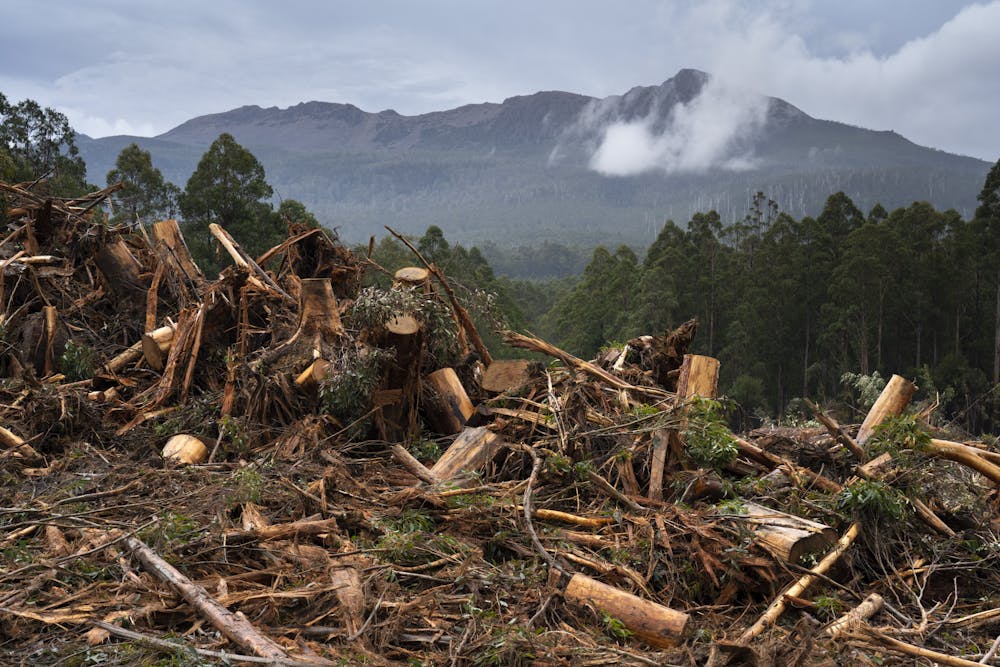
But these old, giant trees are being logged at alarming rates, despite their enormous ecological and heritage value (and untapped tourism potential). Many were also destroyed in Tasmania’s early 2019 fires.
Former Greens leader Bob Brown recently launched a legal challenge to Tasmania’s native forest logging. And this year, Forestry Watch, a small group of citizen scientists, found five giant trees measuring more than five metres in diameter inside logging coupes. “Coupes” are areas of forest chopped down in one logging operation.
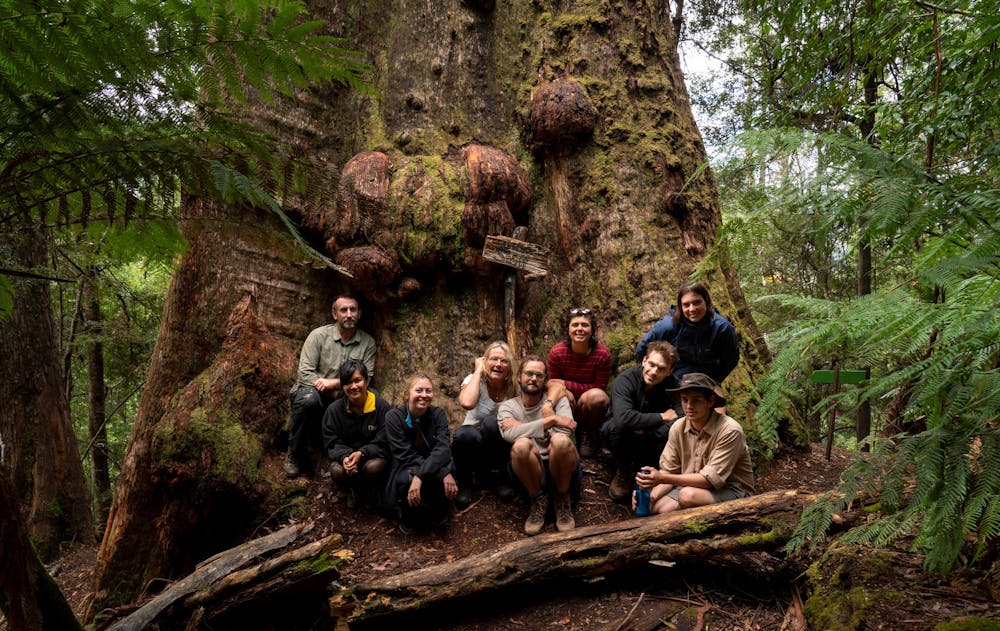
These trees are too important to be destroyed in the name of the forestry industry. This is why my husband Steve Pearce and I climb, explore and photograph these trees: to raise awareness and foster appreciation for the forests and their magnificent giants.
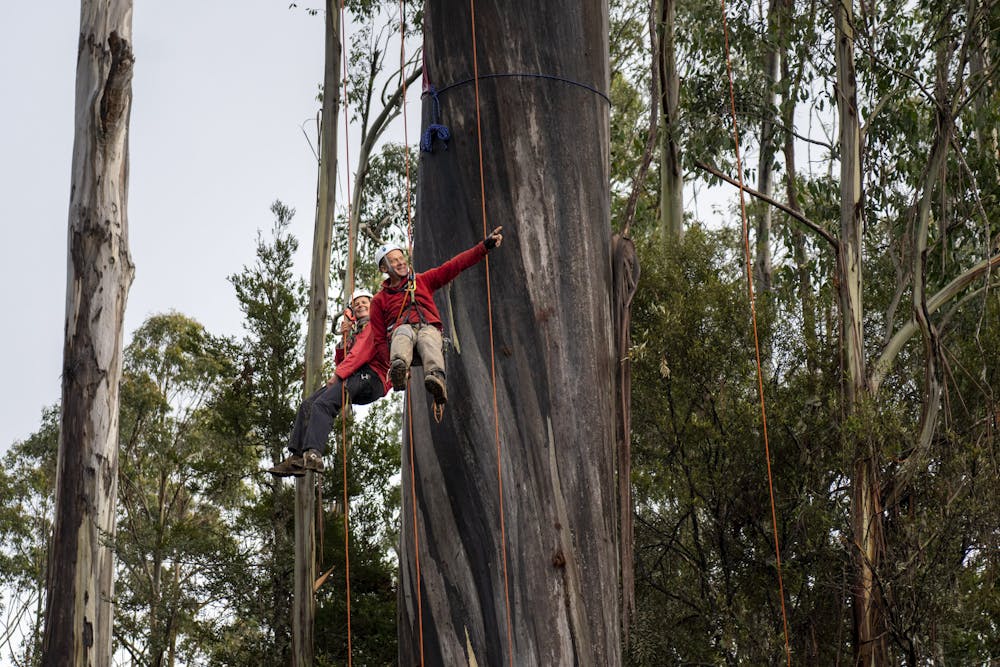
Climbing trees is not just for the young, but for the young at heart. Kevin is in his early 70’s and helps us with measuring giant trees.Steve Pearce/The Tree Projects, Author provided
What makes these trees so special?
Eualypytus regnans, known more commonly as Mountain Ash or Swamp Gum, can grow to 100 metres tall and live for more than 500 years. For a long time this species held the record as the tallest flowering tree. But last year, a 100.8 m tall Yellow Meranti (Shorea faguetiana) in Borneo, claimed the title — surpassing our tallest Eucalypt, named Centrioun, by a mere 30 centimetres.
Centrioun still holds the record as the tallest tree in the southern hemisphere. But five species of Eucalypt also grow above 85 m tall, with many ranking among some of the tallest trees in the world.
It’s not only their height that make these trees special, they’re also the most carbon dense forests in the world, with a single hectare storing more than 1,867 tonnes of carbon.
Our giant trees and old growth forests provide a myriad of ecological services such as water supply, climate abatement and habitat for threatened species. A 2017 study from the Central Highlands forests in Victoria has shown they’re worth A$310 million for water supply, A$260 million for tourism and A$49 million for carbon storage.
This significantly dwarfs the A$12 million comparison for native forest timber production in the region.
Chopping down old growth trees doesn’t make economic sense.Steve Pearce/The Tree Projects, Author provided
Tasmania’s Big Tree Register
Logging organisation Sustainable Timber Tasmania’s giant tree policy recognises the national and international significance of giant trees. To qualify for protection, trees must be at least 85 m tall or at least an estimated 280 cubic metres in stem volume.
While it’s a good place to start, this policy fails to consider the next generation of big, or truly exceptional trees that don’t quite reach these lofty heights.
That’s why we’ve created Tasmania’s Big Tree Register, an open-source public record of the location and measurements of more than 200 trees to help adventurers and tree-admirers locate and experience these giants for themselves. And, we hope, to protect them.
Last month, three giant trees measuring more than 5 m in diameter were added to the register. But these newly discovered trees are located in coupe TN034G, which is scheduled to be logged this year.
Logging is a very poor economic use for our forests. Native forest logging in Tasmania has struggled to make a profit due to declining demand for non-Forest Stewardship Council certified timber, which Sustainable Timber Tasmania recently failed. In fact, Sustainable Timber Tasmania sustained an eye watering cash loss of A$454 million over 20 years from 1997 to 2017.
The following photos can help show why these trees, as one of the great wonders of the world, should be embraced as an important part of our environmental heritage, not turned to wood chips.
Steve Pearce/The Tree Projects, Author provided
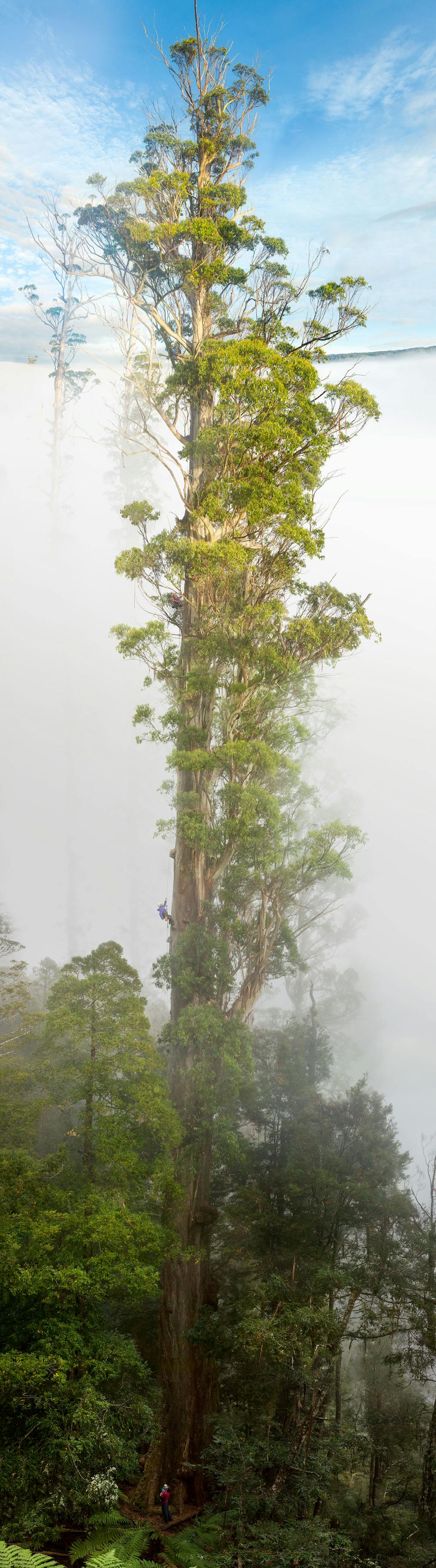
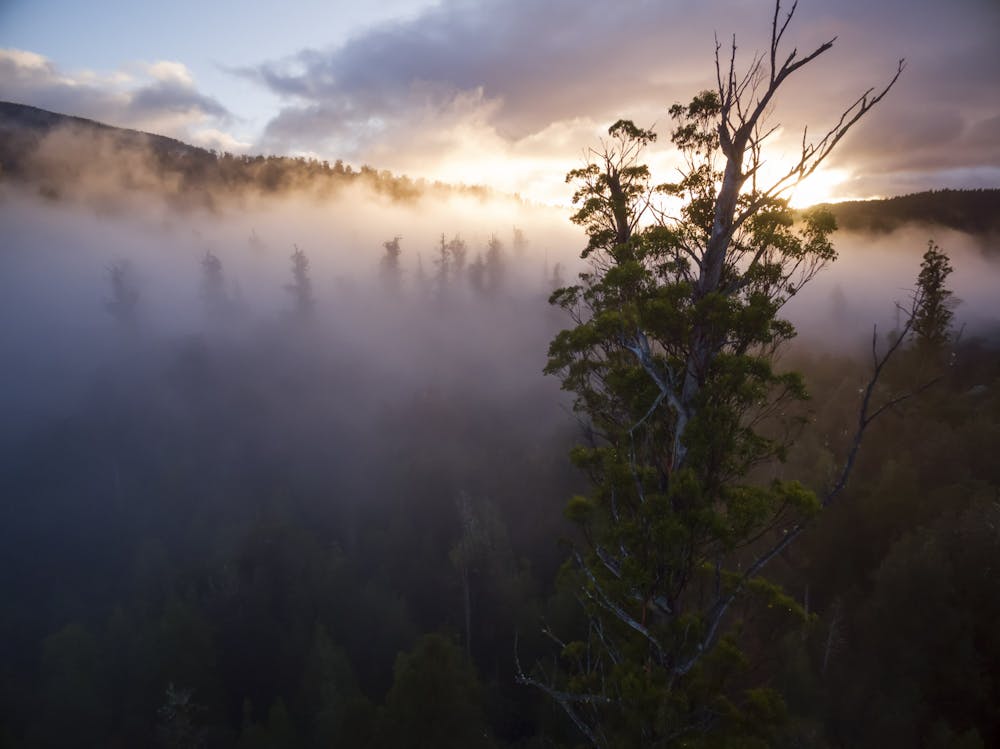
It’s not often you get to see the entirety of a tree in a single photo. This tree above is named Gandalf’s Staff and is a Eucalyptus regnans, measuring 84 m tall.
While Mountain Ash is the tallest species, others in Tasmania’s forests are also breathtakingly huge, such as the Tasmanian blue gum (Eucalyptus globulus) at 92 m, Manna gum (Eucalyptus viminalis) at 91 m, Alpine ash (Eucalyptus delegatensis) at 88 m and the Messmate Stringybark (Eucalyptus obliqua) at 86 m.
Steve Pearce/The Tree Projects, Author provided
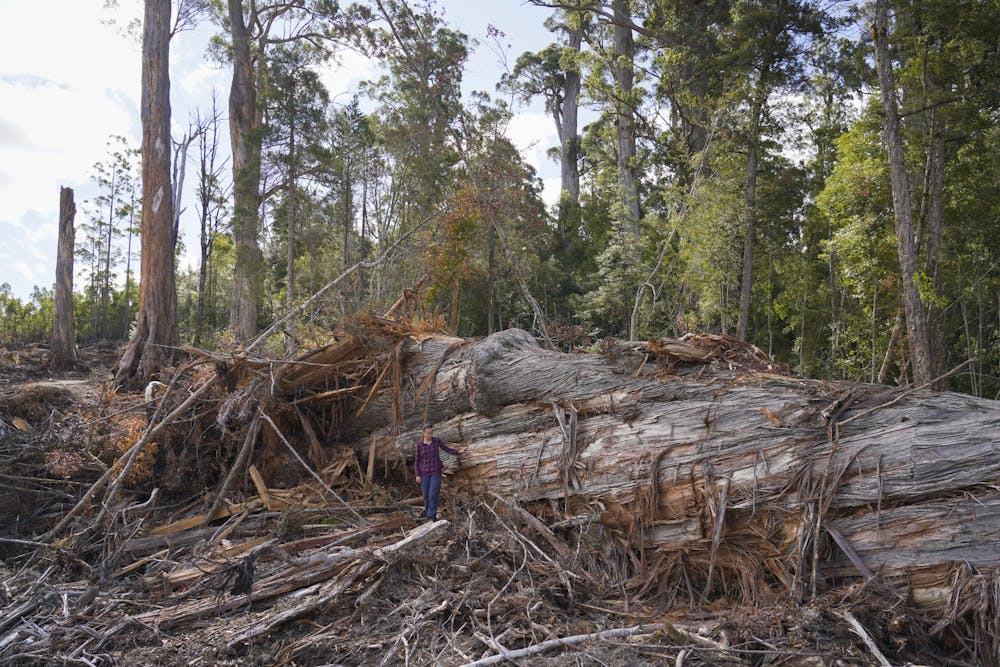
This giant tree, pictured above, was a Messmate Stringybark that was felled in coupe, but was left behind for unknown reasons. Its diameter is 4.4 metres. Other giant trees like this were cut down in this coupe, many of which provided excellent nesting habitat for the critically endangered swift parrot.
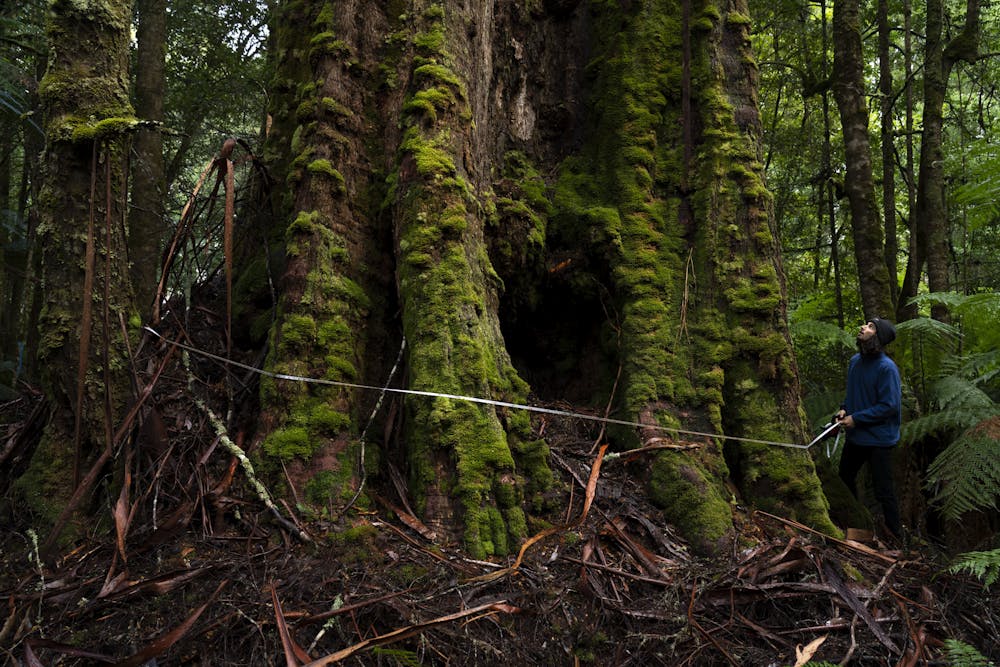
The citizen science group Forestry Watch helps search for and measure giant trees in Tasmania.Steve Pearce/The Tree Projects, Author provided
Old-growth forests dominated by giant trees are excellent at storing large amounts of carbon. Large trees continue to grow over their lifetime and absorb more carbon than younger trees.
Steve Pearce/The Tree Projects, Author provided
The tree in the photo above is called Obolus, from Greek mythology, with a diameter of 5.1 m. Names are generally given to trees by the person who first records them, and usually reflect the characteristics of the tree or tie in with certain themes.
For example, several trees in a valley are all named after Lord of the Rings characters, such as Gandalf’s Staff (pictured above), Fangorn and Morannon.
Steve Pearce/The Tree Projects, Author provided
Giant trees are typically associated with Californian Redwoods or the Giant Sequoias in the US, where tall tree tourism is huge industry. The estimated revenue in 2012 from just four Coastal Redwood reserves is A$58 million dollars per year, providing more than 500 jobs to the local communities.
Few Australians are aware of our own impressive trees. We could easily boost tourism to regional communities in Tasmania if the money was invested into tall tree infrastructure.
Some of my students have been assaulted. Others have been homeless, jobless or broke, some suffer from depression, anxiety or grief. Some fight addiction, cancer or for custody. Many are in pain and they want to write about it.
Opening wounds in the classroom is messy and risky. Boundaries and intentions can feel blurred in a class where memories and feelings also present teachable moments. But if teachers and students work together, opportunities to share difficult personal stories can be constructive.
Writing about trauma
The health benefits of writing about trauma are well documented. Some counselling theories — such as narrative therapy — incorporate writing into their therapeutic techniques.
Research suggests writing about trauma can be beneficial because it helps people re-evaluate their experiences by looking at them from different perspectives.
Studies suggest writing about traumatic events can help ease the emotional pressure of negative experiences. But writing about trauma is not a cure-all and it may be less effective if people are also struggling with ongoing mental health challenges, such as depression or post-traumatic stress disorder.
Internationally acclaimed researcher and clinician Bessel van der Kolk asserts in his book, The Body Keeps the Score, that trauma is more than a stored memory to be expunged. Rather, van der Kolk suggests our whole mind, brain and sense of self can change in response to trauma.
Pain is complicated. And teachers in a classroom are not counsellors in a clinic.
If properly managed, though, sharing stories about personal suffering can be a relevant and valuable educational experience. It’s a strategy my colleagues and I call “lit therapy”.
An empathetic space
Dr Jill Parris is a psychologist who works with refugees and uses lit therapy as an extension of trauma counselling. Parris and I also worked together on the project Home Truths: An Anthology of Refugee and Migrant Writing, which paired refugee authors with a writing mentor to develop personal stories about challenging migrant journeys to Australia.
Parris says writing about trauma is helpful in most cases, as long as teachers and their students monitor stress levels and offer an empathetic space where storytellers are given the time and tools to manage the complex feelings that may surface.
“It is important that people feel absolutely free to avoid focusing on traumatic events and this should be made clear from the start,” says Parris.
Teachers should therefore be wary of implying traumatic personal stories are inherently worthy subjects, that divulgence alone is more likely to receive a higher grade or publication. It isn’t. In fact, sharing a story may be detrimental. It may be unfair to the author’s future self, the other people involved in their experience, or to the piece’s intention for its readers.
Memories can be painful, but writing about them can help re-evaluate the experience.Unsplash
Helping individual students identify their own readiness to share personal experiences is an important first step. Parris recommends asking students how they know they are ready to share their story. What has changed to make them ready? Answering these questions helps people sit outside themselves.
As teachers, we also need to be mindful that sharing painful memories presents a risk for those hearing them.
Vicarious trauma
Vicarious trauma is a real threat. To help mitigate the risk of emotional contagion, teachers should check in with students at the beginning and end of class to monitor feelings, reminding people they are in the present, that the trauma they recounted or heard was survived.
If people feel stressed, Parris recommends looking around and forcing ourselves to name what we see, hear, feel, taste and smell as a way of returning to the present. Discussing what people will do outside class to care for themselves is also useful.
As teachers, it is important to help our students organise their thoughts and feelings in relation to the craft of professional writing, which is writing intended for consumption by an anonymous reader.
Students are likely to write what they’re passionate about — the good, the bad and the ugly. Their best writing comes out of what’s meaningful to them. Teachers can help guide their students’ search for authenticity.
Feelings and experiences matter, but writers and readers also want to know what they mean. Revealing how masters of personal storytelling bridge the personal and the universal is useful in demonstrating the broader purpose of sharing stories.
Story craft is part of how author Joan Didion’s The Year of Magical Thinking is both a personal reflection and a forensic investigation of grief. Part of a writing teacher’s job is exploring how personal stories can contribute to the archive of collective human experience.
While I work with adult students, there is also evidence narrative writing exercises can help children and teenagers process thoughts and emotions related to challenging personal events.
This work is emotionally demanding. Scenes of horrible things people have told me occasionally invade my mind, as if another person’s lived experience orbits my own memories. It’s unsettling. It’s also why stories matter. Because hearing them can help us better understand the people who share them. Stories help us glimpse the humanity in the hardship, showing us while pain is universal, compassion is too.
If you are struggling with mental health, it may be helpful to consult your doctor or contact Lifeline 13 11 14 or Beyond Blue 1300 22 4636.
Source: The Conversation (Au and NZ) – By Emma Felton, Honorary Senior Lecturer, Creative Industries Faculty, Queensland University of Technology
The reopening of cafes has been one of the highlights of relaxed COVID-19 restrictions for many Australians. During lockdowns, long queues for takeaway coffee were testimony to caffeine’s relevance to our lives.
Yet the precarious employment of so many hospitality workers meant hundreds of thousands of casual café workers and café owners lost work. Rents and mortgages were suspended or lost, upturning countless lives. At the other end of the coffee supply chain, many coffee farmers in poorer countries, who were already struggling to make a living, are doing it even tougher.
The pandemic has exposed the widening wealth gap in our global economy, and nowhere is this better illustrated than by our daily coffee fix. The multi-billion-dollar global coffee industry relies on vulnerable workers at both ends of the supply chain: the café worker serving your coffee and the struggling farmer who grew your coffee beans.
Coffee’s production and consumption echo its 18th-century origins as a global industry. It’s mostly consumed by people in affluent countries and produced by agricultural workers in the poorer global south.
The coffee industry’s business model is based on a type of neo-colonialism, dominated by a handful of transnational coffee merchants whose profits are bountiful. Plantation economies in developing countries were established by colonial empires whose use of slavery spearheaded the rapid growth of the industry.
The Spanish introduced the use of slaves from Africa in the Caribbean and Latin America. They were quickly followed by the Portuguese in Brazil, then British and French colonialists in the West Indies. African slaves were considered “robust, disease resistant and productive” – physically superior to the local indigenous populations of the Americas, many of whom died from diseases such as cholera and smallpox.
Producers live with poverty and hunger
While the type of slavery that launched the coffee industry no longer exists, other inequities remain. Coffee producers are among the most vulnerable members of the supply chain. When we buy our coffee, most of us are unaware of the bean’s provenance and the arduous labour of workers in small-scale plantations.
It’s estimated almost half of the world’s smallholder coffee producers live in poverty. Most of them are in East Africa, but others are in Latin America and Asia.
Many coffee farmers suffer chronic seasonal hunger. Unlike famine, this occurs between harvest seasons, when the previous year’s food stocks have dwindled, food prices are high and income is scarce.
In response to the industry’s inequities, many initiatives are seeking fairer and sustainable outcomes for coffee farmers and for the environment. Some have been in place for decades. Of the programs established by NGOs, governments, multinational companies and other organisations, Fair Trade and Direct Trade are among the better-known ones.
More recently, the 2007 International Coffee Agreement is designed to promote a more equitable coffee trade to support smallholder farmers throughout the world. To overcome problems such as very low wages, poor housing and gender inequality, to name a few, these schemes are by necessity site-specific. Despite some success stories, the complexity of the industry and the wide variety of contexts presents barriers to consistent equitable outcomes and results are mixed.
Another approach in the growing speciality coffee sector – independent cafes serving high-quality coffee – is upending traditional business models. An increasing number of entrepreneurs in affluent countries are forming direct partnerships with coffee farmers. The aim here is both ethical and business-focused: to ensure consistent bean quality and provide a fairer income for coffee producers through direct trade.
Spare a thought for the people at each end of the supply chain who produce and serve your coffee.Michael Dodge/AAP
The supply chain of coffee and cafes is a complex network of producers, distributors and services. Like all industries affected by the pandemic, some operators will survive and others will go to the wall.
While the pandemic’s impact is an unfolding story, it has brought into sharper focus inequalities in a thriving industry. Fault lines are evident across both producing and consuming nations, with many of those who work in the plantations and in our cafes on the wrong side of the divide.
It might give us something to think about as we enjoy our next coffee from our local café.
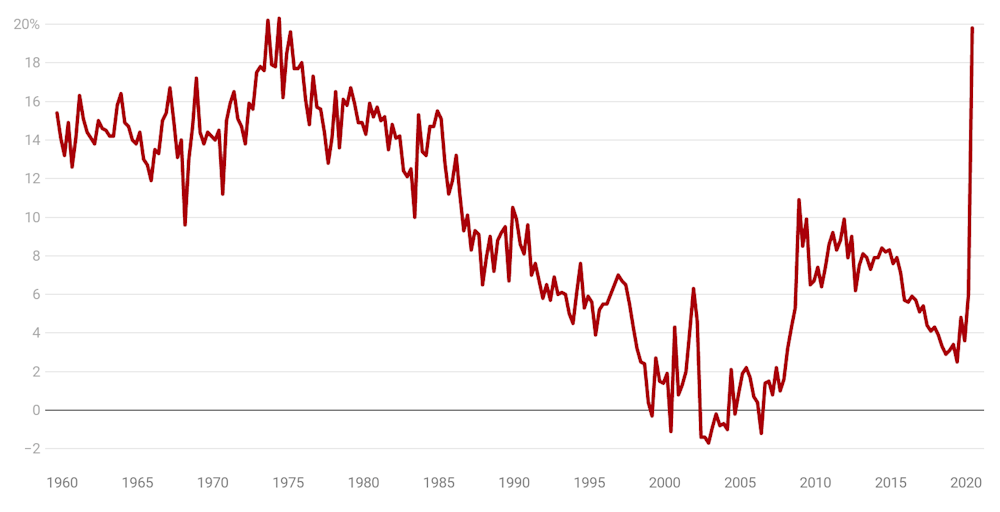
The Reserve Bank governor is more circumspect, but also says the states have an “important” role in the fiscal response to the COVID recession and “can do more over time”.
Have the states been slacking off? At first glance, it appears so. The Commonwealth’s stimulus contribution so far is more than A$170 billion, compared to less than A$30 billion from all of the state and territory governments.
To date, it’s the Feds more than the states
The Commonwealth has spent almost 9% of national output on stimulus, whereas no state except Tasmania has spent more than 2% of its own output.
The two biggest states, NSW and Victoria, have each spent little more than 1%.
But these measures tell only part of the story. The Commonwealth has greater spending power because it has more revenue to draw from, and the states get about half their revenue from the Commonwealth.
Source: Grattan analysis of government announcements
These disparities account for some of the unbalanced effort, but not all of it.
Excluding what it passes on to the states, the Commonwealth’s revenue as a share of gross domestic product is about twice that of most states as a share of gross state product.
Yet its COVID response has been almost six times as big.
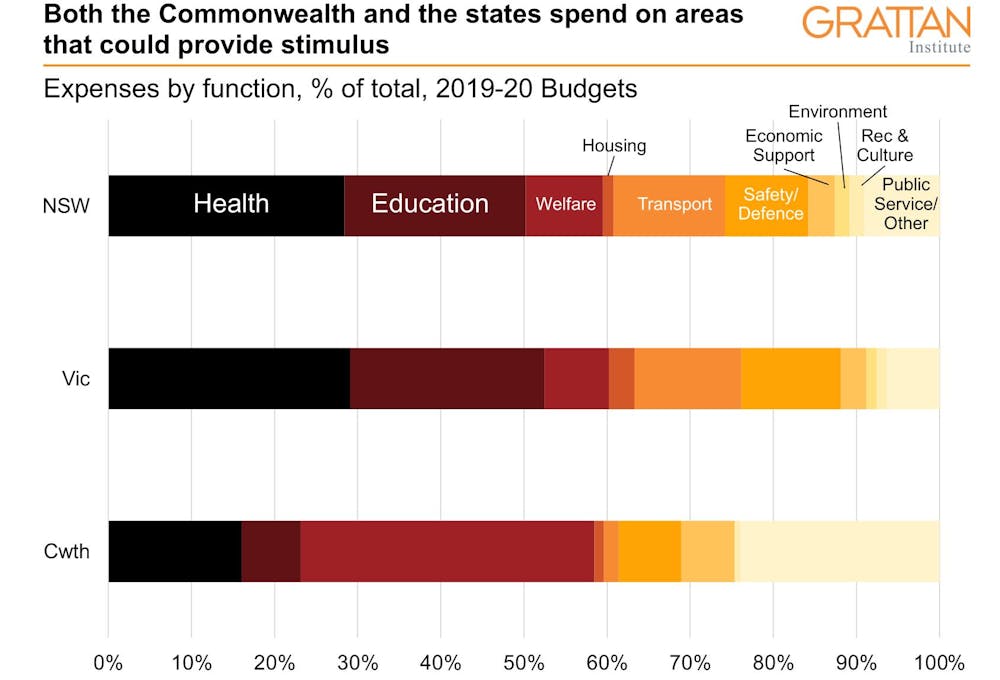
Although the Commonwealth is the main funder for several of the traditional stimulus levers – including the welfare and personal income tax systems – the states also spend money in areas that can be used to stimulate the economy.
The most important include social housing, health, education, and industry support.
Notes: Commonwealth Budget (Budget Paper 1, Table 3, p5-7) does not specify funding for Environment, so this is included in other. ‘Economic Support’ for the Commonwealth includes spending on Fuel and energy; Agriculture, forestry and fishing; Mining, manufacturing and construction; and Other economic affairs. Commonwealth figures include transfers to the states.Source: 2019-20 Budget papers
There’s also plenty of “room to move” on state government balance sheets – all six states entered this crisis with net debt below 15% of gross state product and with interest and depreciation costs less than 2% of gross state product. All were projecting operating surpluses.
Their borrowing costs, though higher than the Commonwealth’s, are still exceptionally low.
NSW and Victoria can borrow for 10 years at an interest rate just over 1%, far below the Reserve Bank’s inflation target band, making the money free in real terms.
More is needed from both
All of this suggests our states can and should do more to support the recovery.
But the Commonwealth will also need to do more. Like the states, it has room to spend more, and it should.
The Reserve Bank expects unemployment to peak at 10% in the December quarter and still be as high as 7% in December 2022.
To avoid this scenario, the Grattan Institute recommended in June that governments of both kinds plan for $70-to-$90 billion in extra stimulus over the next two years to bring unemployment down to 5% and get wages growing again.
The renewed economic fallout from State 4 restrictions in Melbourne means that the response will now need to be even larger.
There are many things governments can do beyond the extensions of JobKeeper and JobSeeker already announced.
A banquet of options
The Commonwealth could introduce a wage subsidy for new employees beyond March. And it should boost the childcare subsidy to help parents who have lost jobs or hours during the downturn to re-enter work.
It could also amplify state investments in infrastructure and services that create jobs and serve social needs: social housing and mental health services are obvious candidates. The tutoring program to help disadvantaged students that Grattan proposed in June also fits this bill.
Well-targeted personal income tax cuts or better, a tax bonus, targeted at low and middle income earners, can also help boost demand, including in worst-hit sectors such as hospitality, tourism, and the arts.
But tax cuts generally don’t provide as much economic kicker as others forms of government stimulus because more of the money “leaks” to savings.
Announcing a permanent boost to JobSeeker beyond December would put money in the hands of those most likely to spend it.
Other ideas such as a temporary GST holiday or electronic vouchers to spend in certain sectors – an idea being adopted in Britain – have the advantage of being temporary and targeted.
There is a banquet of worthwhile options governments should be considering – and they shouldn’t fight over who picks up the tab.
If governments of both kinds don’t do more, the recession will last longer.
Maybe it wouldn’t hurt to make a little whoopee. The downside of doing too little way exceeds the potential downside of doing too much.
The federal government has nailed down two possible vaccine sources with supply and production agreements with pharmaceutical companies worth $1.7 billion.
The agreements mean the University of Oxford/AstraZeneca and the University of Queensland/CSL would provide more than 84.8 million vaccine doses, almost entirely manufactured in Melbourne.
The success of either vaccine still has to be demonstrated, but trials are encouraging.
If all goes well, there would be access to 3.8 million doses of the University of Oxford vaccine in January and February.
The government promises a vaccine would be made available free.
Earlier it announced it had signed a letter of intent for the Oxford vaccine.
Scott Morrison said there were “no guarantees” these vaccines would prove successful. “However the agreement puts Australia at the top of the queue, if our medical experts give the vaccines the green light.”
“By securing the production and supply agreements, Australians will be among the first in the world to receive a safe and effective vaccine, should it pass late stage testing,” he said.
The government is also exploring other promising vaccines which are being developed and it may invest further.
If successful, the Oxford vaccines would be available from the start of next year, and the UQ ones from mid year. There would be 33.8 million doses of the Oxford vaccine and 51 million of the UQ one.
More than 95% of doses would be manufactured in Australia.
Each person would have a dose of one vaccine followed by a second dose of the same one within a few weeks. First to get the vaccine would be people most at risk of COVID and health workers.
The government said the agreements it had secured allowed for more orders to be negotiated and for doses to be donated or on-sold, without mark-ups, to other countries or international organisations. Morrison has stressed Australia wants to help Pacific countries and other regional neighbours get early access.
Late stage phase 3 trials are underway for the Oxford vaccine. Phase 1 clinical trials for the UQ vaccine began in mid-July in Brisbane. If this is successful, CSL will take responsibility for the Phase 2b/3 clinical trial, expected to begin late this year.
The government would run a strong campaign to encourage people to be vaccinated, but this would not be compulsory.
Victoria’s ultra-cautious roadmap out of its lockdown, outlined by Daniel Andrews on Sunday, reinforced the strong message that came from Friday’s national cabinet.
Premiers are in the driving seat of exiting COVID restrictions, and they are imposing the strictest speed limits – much slower than Scott Morrison would like – and ignoring federal government pressure.
Western Australia’s Mark McGowan defied Morrison’s plan on Friday. Queensland’s Annastacia Palaszczuk made it clear she won’t open her state’s border with NSW until she’s good and ready.
Now, unsurprisingly, Andrews has indicated he will not be hurried, despite the cries from business and the sound of Canberra’s grinding teeth.
Andrews stressed his timetable “is not what many people want to hear – but it is the only option”. He warned “you can’t run” out of lockdown – or there would be a third wave.
The Morrison government doesn’t think it is the only option, and didn’t mince words in a statement quickly issued from the PM, Treasurer Josh Frydenberg and Health Minister Greg Hunt (the latter two are Victorians).
“To extend lockdown arrangements will be hard and crushing news for the people of Victoria,” they said.
Just in case anyone doubted where to sheet blame, this was “a further reminder of the impact and costs that result from not being able to contain the outbreaks of COVID 19”.
The statement stressed the roadmap was “a Victorian government plan”, distancing the feds from any ownership.
The tone was very different from Morrison’s words to parliament last Tuesday, when he said “Victoria has turned the corner and we, together with the Victorian government, are planning to reopen Melbourne and reopen Victoria”.
Sunday’s federal statement declared “the proposed roadmap will come at a further economic cost.”
“While this needs to be weighed up against mitigating the risk of further community outbreak, it is also true that the continued restrictions will have further impact on the Victorian and national economy, in further job losses and loss of livelihoods, as well as impacting on mental health.”
The federal government will talk to business in Victoria “to understand their concerns and seek to ensure they are addressed”.
Morrison and his ministers also had fresh praise for the NSW government, which has its economy running despite a continuing low levels of cases. They highlighted the Berejiklian government’s successful contact tracing.
Federal help is being offered to strengthen Victorian contact tracing, in the (probably vain) hope that could put the Victorian foot on the accelerator.
Andrews has used elaborate modelling in reaching his strategy. But his critics argue the benchmarks, particularly at the back end of the timetable, are unrealistic.
For example, the last step in Melbourne’s easing, dated from November 23, is contingent on “no new cases for 14 days (state-wide)”.
It was quickly pointed out if the Andrews’ road map were in place in NSW, that state would have a curfew now.
NSW’s tally announced on Sunday was 10 new cases to 8pm Saturday. The Melbourne curfew is to be lifted from October 26 if there is a statewide daily average over the previous fortnight of less than five new cases and a statewide total of less than five cases with unknown sources over that period.
For the immediate future, in Melbourne there will be an additional fortnight – beyond next weekend – of the hard lockdown, with some minimal tweaking.
The overnight curfew will start an hour later (at 9pm), exercise can be up to two hours, and singles will be able to form a bubble with someone else.
From September 28, if the cases have come down (latest tally on Sunday was 63) to 30-50 daily average over the previous fortnight, there will be gradual relaxations including the re-opening of childcare. The state government says step two would see about 100,000 people return to work across a number of sectors, including construction and manufacturing.
But Melbourne businesses in retail and hospitality will not be able to start to getting back to reasonable activity until the end of October, and hospitality will be strictly limited.
The restrictions in regional Victoria will be eased from their already lighter base.
Business is up in arms. The Australian Industry Group predicted “catastrophic economic, health and social damage caused by the continued lockdown and [the] prospect of more months of sharply diminished activity”.
Frydenberg said a week ago that on Treasury estimates, in the December and March quarters more Victorians were expected to be on JobKeeper than in every other state combined. The roadmap could see the numbers even higher than anticipated.
The Andrews timetable will put pressure on the Victorian government but also on Morrison.
Andrews’ hard line is stretching the tolerance of Victorians. Not only will many local businesses believe they can’t survive the longer restrictions, but some voters will be reaching levels of deep stress.
The pressure points on the federal government come from various directions.
There have been calls for it to just “do something”, to intervene to override what are being seen as recalcitrant states. However it is not obvious it would have viable power to do so.
Even if it could intervene, it would be high risk – on health, economic and political grounds – to do so.
The extended Victorian lockdown will increase demands for the government to provide more stimulus for the economy, and bolster the calls of those who say JobKeeper and the Coronavirus supplement should not be phased down.
The Victorian roadmap won’t just feed into the budget numbers, but affect the public climate in which the October budget is brought down.
In that budget, the government will be talking up hope. But on October 6, Victorians hearing that budget will be still under curfew, confined to takeaways, unable to see extended family.
“I want all of us to stay the course so that we can all have something approaching a normal Christmas,” Andrews said on Sunday. It will require quite a feat to deliver that, on the terms of this strict roadmap.
Source: The Conversation (Au and NZ) – By Laxman Bablani, Research Fellow, Population Interventions Unit, Centre for Epidemiology and Biostatistics, Melbourne School of Population and Global Health, University of Melbourne
The Victorian government today announced the eagerly anticipated roadmap out of COVID-19 lockdown. It features several steps that reflect a much slower relaxing of restrictions than last time around.
While the government has provided a provisional time frame for the various steps, it is data, not dates, that will determine when restrictions are actually eased.
We applaud this strategy. The virus does not obey a timeline. Rather, we have to beat it down to a level at which easing of restrictions is safer.
What was announced?
Metropolitan Melbourne’s current stage 4 restrictions will be extended for two weeks, to September 27. But from 11:59pm on September 13, there will be a few key changes.
The nightly curfew will be shortened by one hour, and will be in place from 9pm to 5am. Also, two people or a single household can meet outdoors for two hours maximum, up from the previous one hour, for exercise or recreation.
For people living alone, and single parents with children under 18, there will be a “single person bubble” policy that allows them to designate one other person who can visit their home.
Regional Victoria is already faring better than Melbourne, and will have a faster timeline.
Premier Daniel Andrews wants to maximise the chance of getting to Christmas in something like stage 1, while minimising the chance of a third wave of infection that sends the state back into lockdown. This means staying in strict restrictions for longer, and easing out more gradually.
How did data influence the decision?
The Victorian government’s decision was based in part on the output of a model developed by researchers at the University of Melbourne and the University of New England. It simulates population movements in a simplified world, based on parameters that describe the spread of COVID-19 and people’s interactions with each other.
In the real world, these patterns are highly random. So the researchers ran the model 1,000 times, with thresholds for relaxing (or tightening) restrictions set at an average of 25, 10, and 5 cases per day on a fortnightly basis. The model could then report the probability, under a given set of policy settings, of having to lock Victoria down again before Christmas.
Opening up too soon is likely to cause a third wave. In simulations in which restrictions were eased once average daily cases dipped below 25 per day, there was a 62% likelihood of new lockdowns. But with restrictions retained until daily cases dropped below 5 daily cases, the lockdown likelihood was just 3%.
Viewed in that light, it is easy to see why the Andrews government opted to set strict criteria for lifting restrictions, knowing that short-term pain is better than the economic ravages of another lockdown in the long term.
What might hold Victoria back?
First, there’s the elephant in the room — the quality of Victorian contact tracing (especially in comparison to New South Wales). Living with the virus requires high-quality contact tracing. There’s no doubt contact tracing in Victoria has improved since June when our second wave started. There is therefore a real possibility that we may get the case numbers down faster, and hold off resurgences of case numbers more effectively or for longer than the modelling suggests.
Second, infection disease control in health care and aged care has not been up to scratch in Victoria (compared with, dare we say it again, New South Wales). These represent particularly dangerous settings. Older adults are much more likely to become severely ill with COVID-19, whereas health-care workers who become infected with the coronavirus risk infecting the most vulnerable and reduce health capacity when it is most needed.
And of course, health and aged care workers live in the community too, and if community restrictions are relaxed the virus will leak back out through family members and surge again. The Victorian government decided to deal with both community and health-care transmission simultaneously. We think that it is the right approach.
Infection control in health and aged care hasn’t been good enough in Victoria, leading to a surge in infections among health-care workers and aged care residents.Daniel Pockett/AAP
Is elimination still possible?
There were strong arguments for an explicit elimination strategy back in early July, requiring “going hard” for a six-week lockdown. Unfortunately, Victoria didn’t go hard early enough. The government waited three weeks, numbers got out of control, and then we went into stage 4. With the benefit of hindsight, it was a huge missed opportunity.
The Grattan Institute is also arguing strongly for an explicit elimination strategy and much longer hard lockdowns. It argues this will result in better economic outcomes in the long run. An impressive modelling paper by Australian National University researchers also supports the theory that elimination is better for both health and the economy in the long run (although this paper has not yet been peer-reviewed).
However, things have changed in the past two months. First, we are now closer to a vaccine, so in theory the long-term payoff for short-term pain will arrive sooner. Second, New Zealand (and Queensland) have taught us that elimination can be lost. Third, NSW has taught us you can live with the virus at low levels (so far). Fourth, the imminent border openings and hotspot strategy are not really consistent with the hard border controls needed to defend elimination in places that achieve it.
Andrews aptly termed the state’s strategy “aggressive suppression”. It may even achieve elimination, as the first wave effort so nearly did. We hope it does – but do not bank on it.
It’s in our hands now, both the government and citizens. With some good luck – and few would begrudge Victorians a little of that – the roadmap will pan out as planned.
Victorian Premier Dan Andrews and Chief Health Officer Brett Sutton on Sunday announced steps to slowly ease COVID-19 restrictions in metropolitan Melbourne and regional Victoria.
There are four steps before Victoria totally opens up – a goal Andrews refers to as “COVID-normal”. Melburnians will have to wait a bit longer than regional Victorians before an easing of curfews and restrictions on leaving the house.
But there is now a clear set of thresholds and restrictions for what a COVID “safe” Victoria should look like over the coming months:
The easing of restrictions for regional Victoria starts at Step 2, and involves some thresholds that are independent of metropolitan Melbourne.
On Monday, September 7, Julian Assange is scheduled to appear in a British court for several weeks of hearings regarding the U.S. attempt to extradite him.
This concerns Wikileaks obtaining and jointly publishing US-classified data with leading outlets in 2010.
Assange remains imprisoned for this, after serving a maximal sentence, ostensibly, for breaching bail in connection with a closed investigation for sexual assault allegations made by Swedish police.
Remand for extradition requires an indictment having been the basis of an arrest. Approval must then come from the Home Office for the Court to process the matter.
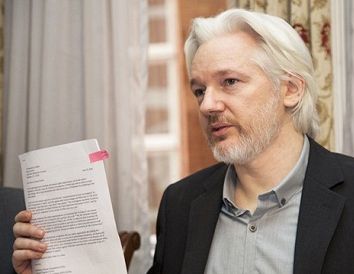
Wikileaks founder Julian Assange … judge has scheduled a new arrest of Assange at the first hearing. Image: Independent Australia
But Judge Vanessa Baraitser has scheduled a new arrest of Assange at the first hearing. Her rationale is that she is powerless to reject a superseding indictment – despite its submission a year past the deadline – or to accept it in any way apart from just:
Presuming future arrest;
Presuming Home Office approval on the day of the arrest;
Leaving Assange incarcerated, though the basis for it had been removed when the US decided he would face a different indictment there.
Third indictment files
This third indictment was filed – to the detriment of a year of preparation made by the defence – late last month by US President Donald Trump’s Department of Justice.
His administration has often been described by the media as hostile toward it, in multiple contexts, including editorials in prestigious broadsheets opposing extradition of Assange.
The First Amendment to the US Constitution prohibits any law that abridges “freedom of speech, or of the press”.
Yet the Espionage Act of 1917 and the Computer Fraud and Abuse Act have increasingly been used in contravention of that provision. Assange is accordingly facing 175 years in prison, effectively the term of his natural life, under conditions widely denounced as purposely inhumane.
The United Nations maintains that Britain must free and compensate Assange. So why has it not done that and why hasn’t Australia insisted on it?
The reason is essentially pretence, based on a shared agenda with the US.
The “pretence” over the Assange case, based on a shared agenda with the US. Image: Independent Australia
Britain does not deny that it is bound to uphold the relevant international laws, because it incorporated them into its domestic law by way of ratification. Nor does it dispute the matter in further detail with the UN. It simply acts as if there is nothing to answer for.
Strictly bound
But unless the UN errs regarding their interpretation or application of these laws, the ratifying country is strictly bound to accord with any given ruling.
It can then be held to account, for instance, by journalists. Their role is to seek comment from that government regarding the UN view of how the law applies, report critically on resulting silence or statements as needed and repeat until the matter is resolved.
Yet the press has never seemed to realise that this is its job. As a consequence, many apparently feel there is nothing binding about international law.
Some even entertain the barbarous notion that without corporeal force to back them up, UN rulings and statements are just incidental fluff.
So when the media and society as a whole are negligent, courts and politicians get away with thumbing their noses at that UN and generally carrying on as if it did not exist.
Likewise for civil servants, as shown by a recent comment from Dennis Richardson, formerly Australia’s Director-General of Security, as well as Secretary of the Department of Foreign Affairs and Trade.
Though he nodded to Australian intervention for a journalist in Egypt, that was different in his view, since Assange is in the UK and “last time I looked the UK was a liberal democracy”.
By the Richardson line of reasoning, “either the UN is mistaken to identify torture and arbitrary detainment in Britain, or there is no actual problem with that being perpetrated on our citizen there.” Image: Independent Australia
Arbitrary detention
By that line of reasoning, either the UN is mistaken to identify torture and arbitrary detainment in Britain, or there is no actual problem with that being perpetrated on our citizen there.”
In short, nothing calamitous would ever get past the “learned judges” in the UK, as Richardson describes those who preside over Assange’s “fate”.
Yet these judges show contempt for the position of the UN. This is not because they have a better sense of how the law applies in this case or are more impartial. On the contrary, just by virtue of being UK judges, they have a conflict of interest when appraising any ruling applicable to their country.
Nor have they generally been so qualified or familiar with details of the matter as the panel that spent 16 months weighing submissions from all parties. Britain also lost an appeal after having agreed to abide by the decision, which of course, it did not.
But according to Richardson – who effectively spoke for the generally mute leadership of Australia on this matter – so long as the UK is a democracy it should not be accountable to us for its treatment of Assange. If a democracy tortures our citizen, we can live with it.
While some let the matter slide this way, Britain is in violation of legal obligations as determined by the appropriate authority. It is unreasonable to hold that its courts should be left alone to continue in such violation.
The matter should be taken from the courts by the politicians that sent it to them. The prosecutor, judges and politicians should in the meantime be made cognisant of how they need to meet Britain’s obligations under the arrangements it committed to.
The UK needs to be pressured into compliance by all civil means. Image: Independent Australia
Pressured into compliance
Specific details of the case should not be excluded from that education, as the UK needs to be pressured into compliance by all civil means.
Yet the mainstream media has never taken this issue by the horns and is only just coming around from having contributed to the problem. It might have prevented or solved it and could still win the day, contingent on nothing but its own resolve.
Furthermore, Australian Prime Minister Scott Morrison has ample power to successfully intervene for Assange and has been advised to that end by prominent legal experts, among others.
Indeed, how could Britain remain defiant if he so much as hints at commenting openly on its failure to comply with medical advice to move Assange to an adequate hospital?
If the press or Morrison are unprepared to act in these ways, it is mainly because of the catch-22 that Britain’s illegal and unconscionable action goes unremarked in public. Such quietude is no less malefic than meek, as it continues to enable outrages by leaving deferential trust in place.
To reiterate, as the authority to rule on such matters, the UN has found that Britain is mistreating a publisher for the US. This is no trifling technicality.
“The key phrase is ‘abuse of process’ and the pivotal authority is the UN. Image: Independent Australia
Australia can even sue Britain in its own courts if it fails to provide medical care that Assange has been determined to require. This would evidently leave the UK with no means to continue the pretence of due process.
Britain would simply capitulate
Yet long before it came to that, Britain would simply capitulate with whatever optics are needed to soften the blow to its pride.
The key phrase is “abuse of process” and the pivotal authority is the UN. With any passable media or parliamentary focus on these concepts, even Morrison will be swept along to rescue Assange. He has no means to improve on Richardson’s attempt to wave British abuses out of view, especially since the media began to reveal aspects of the broader injustice.
Some are apparently too proud of lacking sympathy for Assange to abide any defence of him. Nevermind if such defence is derived from politically motivated retribution for publishing authentic documents, found to be in the public interest by major outlets around the globe.
It seems they would sacrifice any point of difference with totalitarian regimes just to be sure that he doesn’t suffer any less than he might.
The Convention Against Torture (CAT) is ratified in the US, UK and Australia. Its second article states that:
‘No exceptional circumstances whatsoever, whether a state of war or a threat of war, internal political instability or any other public emergency, may be invoked as a justification of torture.’
By article 1 of the CAT, every official who acquiesces with torture anywhere contributes to their state’s culpability for it.
The Australian consulate in London has not assisted or rescued Assange from documented torture. If that was part of its job, then the buck stops with Scott Morrison to ensure it does the job.
Likewise, if that was not its job then the buck stops with Scott Morrison to do the job himself or get Foreign Affairs Minister Marise Payne to do it.
I have a lot for which to be thankful to Dr Joe Williams, or Papa Joe as we call him in the Pasifika Medical Association family.
I was a refugee from the military coup in Fiji at Christmas 1987, and arrived in New Zealand with a young family, not able to register immediately in my chosen medical profession.
Dr Joe Williams was a standout for me – a beacon of calm in those uncertain and stressful days. He was enormously helpful as I prepared myself for registration as a doctor.
Papa Joe was kind and thoughtful and very wise. He was always calm. My enduring memory of him is of a gentleman and a scholar, never rattled and always impeccably dressed.
He was the classic mentor, quick to praise, slow to criticise and never a negative word about anyone. He was a gentle and quiet leader and a great mentor to many.
The Pasifika Medical Association’s conference in Niue in 2019: from left, Dr Francis Agnew (PMA board member); Dr Joe Williams (PMA patron); Gaylene Tasmania (general secretary health and social services, Niue); Cook Islands prime minister Henry Puna, Hon Billy Talagi, Niue minister of health; Akaiti Puna, wife of PM Puna; Dr Collin Tukuitonga. Image: Dr Collin Tukuitonga
Since those early days, I have had a lot of interactions with Papa Joe, as we navigated our way in medicine and Pacific politics in New Zealand and across the Pacific region.
His achievements in New Zealand and the Cook Islands are well known. What is less well known is his enormous contribution to improving health and health services across the small islands of the Pacific region. Papa Joe was an outstanding health minister and diplomat for the region at global negotiations.
Patron of Pasifika Medical Association Papa Joe was the patron of the Pasifika Medical Association (PMA), working in New Zealand and across the Pacific. PMA is a family of Pacific health professionals.
He was one of the health ministers who helped create the Healthy Islands (Yanuca) Declaration in 1995 – a vision of a healthy, safe and prosperous Pacific region where the young and the old thrive and age with dignity. Healthy Islands remains a vision of hope and health, and a Pacific region where the environment is protected forever.
His achievements in health in the Pacific region are many and varied. He was recognised by the World Health Organisation (WHO) for his leadership in eradicating filariasis from the Cook Islands.
Above all, Papa Joe was a keen supporter of young health workers across the region at regional WHO and Pacific Community forums. He recognised the importance of political support in health care, and he was good at it.
We will miss you, Papa Joe, but we will carry on your legacy. We have come too far to stop now and I know that you expect nothing less.
Moe mai rā e te rangatira.
Dr Collin Tukuitonga is associate dean Pacific at the University of Auckland’s Faculty of Medical and Health Sciences. This article was first published by The Spinoff and is republished here with the permission of the author.
His medical practice was near the Americold cold store at the centre of the new community-transmission virus cluster in New Zealand.
Dr Williams served briefly as prime minister in 1999.
Cook Islands News extends deepest condolences to Dr Williams’ family at this sad time.
Dr Williams’ death is the second this week associated to the latest Auckland coronavirus cluster.
24 deaths in New Zealand RNZ Pacific reports that the Ministry of Health said Dr Williams’ death brings the total number of people who have died from the coronavirus in New Zealand to 24.
The Pasifika Medical Association announced his death, saying he was a well-respected and much loved man.
It is with the deepest sadness that the Pasifika Medical Association announces the passing of their respected and much-loved Patron Dr Joseph Williams MBChB, MPH, QSM, QSO. Rest well on your final voyage Papa Joe. Read full media release here: https://t.co/a3mEOnwNIqpic.twitter.com/HlWZU3fjje
— Pasifika Medical Association Group (@MedicalPasifika) September 4, 2020
Dr Williams spent 25 years in the Cook Islands and served as a Cabinet Minister between 1974 and 1978 and again in 1994-1996 before becoming Prime Minister in 1999.
Current Cook Islands Prime Minister Henry Puna said Dr Williams’ passing had caused him great sadness.
“Dr Joe was a pioneer on many fronts and a man way beyond his time. He was one of our early breed of home-grown medical officers of health.
“For thousands of our people in New Zealand, his medical practice was where they headed for their primary health care,” Puna said.
The prime minister said Dr Williams would be greatly missed.
“E tumu rakau ruperupe teia no te Basileia kua inga.
Heart-felt condolences “On behalf of the government and people of the Cook Islands I extend our heart-felt condolences to Dr William’s wife Jill and family.”
A National Memorial Service is to be organised for Dr Williams once his funeral arrangements have been confirmed
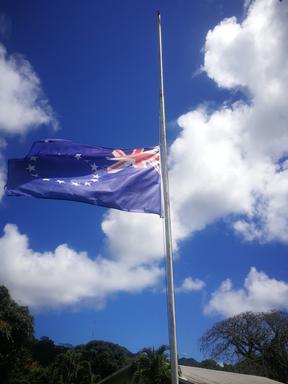
As a sign of respect and remembrance, all Cook Islands flags on government buildings were being lowered to fly at half-mast.
Dr Williams was born in Aitutaki, went to Northland College, and graduated from Otago Medical School in 1960, later completing a Master in Public Health at the University of Hawai’i.
He was involved with the World Health Organisation and in 2016 he received the WHO Award of Appreciation for his role in the elimination of lymphatic filariasis. He was also known for his work in the fields of eczema, prostate cancer and diabetes.
Most recently he had been practising medicine in Auckland.
He received the Queen’s Service medal in 1974 and was invested with the Companion Queens Service Order in 2011 for services to the Cook Islands community.
Pasifika MA life membership He was awarded a life membership by New Zealand’s Pasifika Medical Association in 2004 and was appointed as patron of the PMA in 2015.
PMA president Kiki Maoate said the death of Dr Williams had left the community feeling empty and distraught.
Dr Maoate, who is also a nephew of Dr Williams, said the immediate family was devastated and that feeling of sorrow had spread through the community.
Cook Islands flags flying at half-mast today. Image: Office of the PM
“There will be a sense of emptiness, there will be a sense of deep sorrow as we go through this period but I think at the end of the day we will look and see what he has actually touched is still there and we can carry the good work that he has actually started but he will leave a lot of distraught people for some time.”
He said Dr Williams was driven, in particular, by a love for his Cook Islands community.
Dr Maoate said the former prime minister was determined to serve his community, even well into his advanced years.
“There are other people communities that he plays a significant role [in] but first and foremost it’s about the people for him and that’s where his legacy really stands out.
Love for Cook Islands people “That’s why, I think when you reflect back on what he has developed and processed through the years and achieved, you can actually trace it back to his heritage and his love for the people of the Cook Islands,” Dr Maoate said.
Director-General of Health Dr Ashley Bloomfield today said Dr Williams was seen as a leading figure in the Cook Islands medical community and would be sadly missed.
“Our thoughts are with his family and community at this time of loss and grief.
“Today’s sad news again reinforces the importance of our shared vigilance against covid-19, the very serious consequences the virus can carry with it, and the measures we all need to take to stop the spread, break any chain of transmission and prevent deaths.”
Three new cases in NZ
RNZ News reports that three new cases of covid-19 were reported in New Zealand today – two in the community and one imported – after two deaths were reported in the previous 24 hours.
There was no media conference today. In a statement, the Health Ministry said both community cases had been epidemiologically linked to the Auckland cluster.
“One case has been linked as a close contact to the Americold household sub-cluster and the other is a close contact of a confirmed case linked to the Mount Roskill Evangelical Church sub-cluster,” the statement said.
The imported case is a young child linked to a previously identified case who arrived from India on August 23. The child was already in quarantine with family members.
There are two people in hospital with the coronavirus – one on a ward in North Shore Hospital and one in intensive care in Waikato Hospital.
There are now 77 people linked to the community cluster at the Auckland quarantine facility, including 60 people who have tested positive for Covid-19.
There are now 112 active cases in New Zealand, with one of the previously reported cases now recovered.
The total number of covid-19 cases in New Zealand is now 1416.
Rashneel Kumar is editor of the Cook Islands News.
The national cabinet, created to impose maximum unity on Australia’s response to COVID, has formally fractured. It hasn’t broken altogether, but the rubber band holding it together has been stretched too far and has now dramatically slackened.
Scott Morrison, who created the body to maximise his authority in a situation where the federal government did not have constitutional power, finally came up against the limits of his construct.
Morrison announced after Friday’s meeting that from now on, national cabinet will no longer operate on a consensus model; it will acknowledge differences rather than striving for unanimity.
Of course, previously there wasn’t unanimity on some critical issues – schools, borders. They were pushed off and states simply went their own ways.
On Friday, seven of the eight states and territories agreed to aim to open things up by Christmas, using some “hotspot” approach as a basis.
Western Australia was the one jurisdiction that opted out. With an election next year and sky-high popularity based on the success of a hard border, WA premier Mark McGowan was never going to limit his options.
The other major rebel, Queensland’s Annastacia Palaszczuk, has signed up to the December aim, but she has left herself the wriggle room she needs.
She hasn’t agreed to a particular definition of a hot spot. The Queensland election will be over by the end of October, and you can be confident she’ll run her own race until then.
Morrison likened the situation to getting people onto a bus. “Not everyone has to get on the bus for the bus to leave the station”, he said. “But it is important the bus leaves the station, and we all agree on that. […] Even when, on occasions, some might not want to get on, they know we need to keep moving forward.”
Morrison originally had hoped to have the health advisers settle on a hotspot definition, on the basis of which he could pressure states to bring down borders.
But it became clear that hope would fall at two hurdles. The federal and state health officials, who come together in the Australian Health Protection Principal Committee, did not all embrace a definition. And the outlier states would not cede their autonomy.
Like the national cabinet, the illusion of unity in the AHPPC – which operated on a “consensus” basis – has ended. The federal government has produced its own definition, but what will be more generally accepted as defining a hotspot remains a work-in-progress.
The federal government has been for weeks trying to arm-twist Queensland in particular. But the power over borders resides with the states, and they will use it when it’s in their interests to do so.
McGowan was blunt. At a news conference after the meeting, he described WA as an “island within an island” (shades of that old WA secessionist feeling), and boasted how well it was doing economically.
“We’re very, very proud West Australians but we’re also loyal Australians. States rights mean that premiers and state governments can do what they have to, in my view, to protect our citizens and protect our jobs. But we’re still part of the commonwealth, we’re still part of the nation. We still serve in the defence forces. We’re still Anzacs.”
He hoped the east of Australia would come to an “even greater appreciation” of what WA did for the country. “We carry the nation’s economy.”
McGowan spoke positively about Morrison; earlier Morrison had stressed special circumstances applied to WA. Their mutual public amiability reflected there had been a test of strength, and McGowan had won. It wasn’t for the first time. Some weeks ago, the federal government pulled out of Clive Palmer’s case against WA, under the weight of WA public opinion.
It’s part of Morrison’s pragmatic style to pivot when he is rebuffed. He seeks another route to his objective. An assertive stance is replaced by a conciliatory one. When you don’t have the power to coerce, you have to cajole.
Morrison wants to encourage Victoria to ease its restrictions as fast as the health imperatives allow; he wants Queensland welcoming tourists. But Dan Andrews’ Sunday roadmap will be cautious. As for Queensland, Morrison will have to wait until after the state election, when Palaszczuk might be more amenable – she did get on the Friday “bus” – or will have been replaced by a compliant new government.
On Thursday, Morrison told parliament the leaders should aim to make Australia “whole” again by Christmas. That deadline is looking very arbitrary.
“Wholeness” will eventually come, but certain conditions will have to be met. The Victorian outbreak must be conquered. The situation in NSW must be further stabilised.
Morrison talks of twin health and economic crises, but the polls suggest the health issue has the dominant grip on the public psyche. Until community transmission is stopped or minimal in Victoria and NSW the public mindset will impede the economic recovery.
Above all, that recovery requires public confidence – and that in turn needs the removal, or near removal, of fear of infection. Even where that fear may be excessive, it has become a roadblock to a return to normality.
What does the recalibration of the national cabinet’s dynamic mean for that institution, much praised when it started?
In the context of the pandemic national cabinet remains useful, despite having taken a bruising this week. It is a clearing house for information; it forces leaders to communicate regularly; it encourages them to seek constructive solutions (even though we have seen that has its limits); it helps cut through bureaucracy.
For the longer term, this week’s experience indicates the national cabinet does not promise a new nirvana of co-operative federalism. But that was always hype.
When a constitution divides power between a central government and state governments, there will inevitably be a mix of conflict and co-operation. What has stood out in the border wars is just how “federalist” the Australian federation can on occasion become.
The definition of “COVID-19 hotspot” as provided by Chief Medical Officer Paul Kelly can be found here
The University of the South Pacific Council has terminated the investigation into allegations of material misconduct against USP vice-chancellor and president Professor Pal Ahluwalia.
A media release from the university stated the council had considered the decision by the special executive committee, viewed all the evidence against the vice-chancellor, and came to a clear consensus that there was no indication of material misconduct.
USP vice-chancellor Professor Pal Ahluwalia said he was happy that the USP Council had cleared all allegations against him.
Professor Ahluwalia thanked the council, especially the special executive committee, for their commitment to seek truth and justice.
The USP vice-chancellor said he was deeply humbled by the support that had been bestowed upon him and his wife and they were committed to serving the Pacific and making USP even stronger.
Lena Reece is a senior multimedia journalist with FBC News.
A man in his 50s linked to the Auckland cluster of covid-19 coronavirus infections has died at Middlemore Hospital today – New Zealand’s first death from the virus in more than three months.
The Health Ministry confirmed this today and the death toll from covid-19 in New Zealand is now 23.
The man was a confirmed case of covid-19 and was being cared for in intensive care at Middlemore.
The ministry said his family were regularly updated, and his wife and son were able to visit him, using full PPE.
Director-General of Health Dr Ashley Bloomfield said he acknowledged the anxiety New Zealanders “may be feeling about today’s news, both in the wider community and also for the family and whanau grieving over this death”.
“Our thoughts are with his family and community at this time of loss and grief.
“We have always recognised that further deaths linked to covid-19 were possible. Although the health system has done and will continue to do everything we can to prevent them, this can be a very challenging virus to treat and for some people to recover from,” he said.
Shared vigilance important “Today’s news reinforces the importance of our shared vigilance against covid-19, the very serious consequences the virus can carry with it, and the measures we all need to take to stop the spread, break any chain of transmission and prevent deaths.”
The last death from covid-19 in New Zealand was on Sunday, May 24, and was added to New Zealand’s official death tally the following Friday, May 29.
If you havesymptomsof the coronavirus, call the NZ Covid-19 Healthline on 0800 358 5453 (+64 9 358 5453 for international SIMs) or call your GP – don’t show up at a medical centre.
News emerged this week former AFL footballer Danny Frawley was suffering from a brain disease called CTE when he died last year, according to reports received by the Victorian Coroner.
Chronic traumatic encephalopathy, or CTE, refers to changes in the brain that have been linked to repeated blows to the head, sometimes seen in former players of sports such as rugby and Australian and American football codes. It’s believed these changes relate to an abnormal buildup of a protein called “tau” in the brain, which can damage brain cells.
Frawley’s is the second confirmed case of CTE in a former AFL player, while two former NRL players are also thought to have had the condition.
CTE has prompted concern among the media and public, and researchers still don’t fully understand the condition. It is not yet clear whether CTE is directly caused by repeated hits to the head, as the condition has also been found in people with no known history of repetitive brain trauma.
There’s been a big increase in research on the topic over the past decade, which will hopefully teach us more about the condition and its possible treatments. But this will only happen if more funding is given to scientists to study it.
What are the symptoms?
The prevalence of CTE is unknown. Although it’s believed to be more common in athletes who suffer repeated head injuries, there has been no rigorous epidemiological study to confirm this claim. This may be because there’s no consensus on how to diagnose it while someone is alive – CTE can currently only be diagnosed retrospectively via an autopsy of brain tissue.
What’s more, the symptoms attributed to CTE are common in the general population, and are not specific to the condition. They range from mental health issues such as depression and anxiety, to substance abuse, suicidal behaviour, and even marital problems.
Proponents of CTE argue it’s a distinct neurodegenerative disease, separate from conditions such as Alzheimer’s. But other researchers say the brain changes in CTE are not unique, not necessarily progressive, and not specific to people exposed to repeated brain injury.
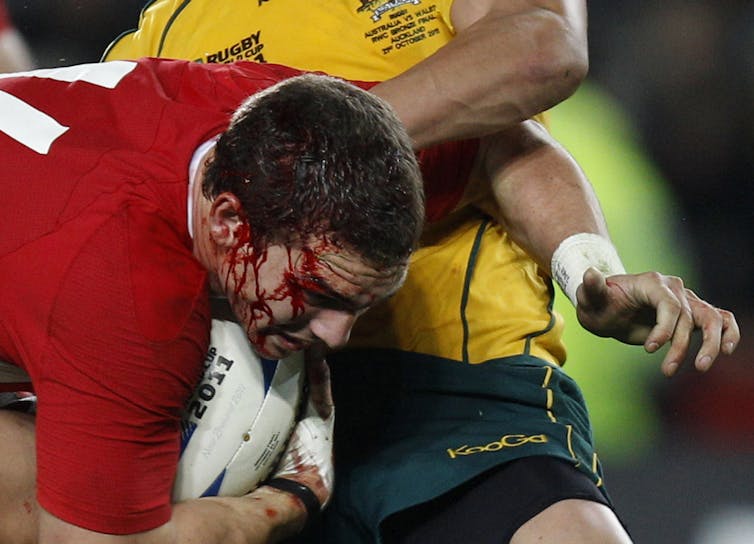
CTE is believed to occur in people who’ve had repeated head knocks over their lifetime.Dita Alangkara/AP/AAP
Where is the research up to?
Significant strides have been made in developing tools that may help diagnose or predict CTE in living people. These include brain imaging methods that might allow for the early detection of the specific tau changes believed to occur in the condition. Other research has focused on identifying genetic factors that may make some individuals more susceptible to CTE.
Scientists have also been investigating potential treatments, both for the symptoms and the underlying biological causes of CTE. For example, our laboratory at Monash University’s Department of Neuroscience has found a drug called sodium selenate can reduce the amount of abnormal forms of tau. This drug is currently in clinical trials for Alzheimer’s and another condition called frontotemporal dementia. It has also been shown to reduce the extent of cognitive deficits in rodents with repeated mild brain trauma.
Concussions can be devastating, even without CTE
While Frawley’s tragic death has renewed the focus on CTE, it’s important to recognise there are other devastating neurological complications that may be more likely to result from repetitive head injury. In particular, the risk of suffering from persistent post-concussion symptoms such headache, dizziness, and fatigue appears to be significantly greater in people with a history of multiple concussions.
Risk of these symptoms persisting after a concussion appears to be particularly high if repeat concussions happen in short succession. Some researchers think the recently concussed brain may have a “window of increased vulnerability” to repeated concussion. However, the length of time, and the underlying biological causes, of this vulnerable period are not yet well understood.
In sport, this creates a lot of uncertainty around when it’s OK for a previously concussed athlete to resume playing. Caution around allowing players to get back on the field is increasingly appreciated in some sporting codes, conveyed in the widely touted “when in doubt, sit them out” message.
How long is long enough? Researchers are working on ways to identify when it’s safe for players to return to sport after a concussion.Shutterstock
But what we don’t know yet is, for how long? In attempt to shed some light on this, our laboratory is investigating how new blood and MRI tests may be able to objectively indicate when the brain has recovered from concussion and is no longer in a vulnerable state, thereby allowing previously concussed athletes to resume playing.
In the meantime, we must use the current knowledge available to manage the risks from blows to the head. Many sports have implemented rule changes in an attempt to decrease the risk of brain injury, which is welcome. Some people have gone further, advocating for participation in collision or contact sports to be banned to prevent CTE.
But when considering this option, it’s important to emphasise evidence of CTE in people with no known history of repetitive brain trauma or collision sport participation. Further, there are many health benefits to participating in sport. In fact, exercise is considered a promising treatment strategy for both concussion and neurodegenerative disorders.
While we wait for further discoveries about CTE, it’s important to carefully weigh the known negatives and positives of sport participation. The interaction between physical activity and brain health is complex; we cannot ignore the problem of repeated brain trauma in sports, but stopping participation in all contact sports will also not lead to optimal brain health.
Making informed, evidence-based decisions about risk and benefit needs to rely on objective data (of which we need much more) rather than media hype.
While the number of new COVID-19 cases in Victoria continues to trend downwards, we’re still seeing a significant number of deaths from the disease.
The ongoing outbreaks in aged care, and the fact community transmission is continuing to occur, mean it’s likely there will be many more deaths to come.
As a result of strict infection control measures restricting hospital visitors, tragically, many people who have died from COVID-19 have died alone. Family members have missed out on the opportunity to provide comfort to the dying person, to sit with them at their bedside, and to say goodbye.
But it doesn’t have to be this way. We have cause to consider whether perhaps we could do more to preserve the patient-family connection at the end of life.
Who can visit?
There’s some variation between Victorian health-care facilities in how visitor restrictions are applied. Some allow visitors to enter hospitals for compassionate reasons, such as when a person is dying. But visitors are not permitted for patients with suspected or confirmed COVID-19.
The latest figures show 20 Victorians are in an intensive care unit (ICU) with 13 on a ventilator. This indicates their situation is critical.
Despite hospitals, and particularly ICUs, being adequately prepared and resourced to provide high-level care for people diagnosed with COVID-19, patients will still die.
Family-centred care at the end of life in intensive care is a core feature of nursing care. So in the face of this unprecedented global pandemic, we realised we needed to navigate the rules and restrictions associated with infection prevention and control and find a way to allow families to say goodbye.
Not having the chance to say goodbye may compound relatives’ grief.Shutterstock
Our recommendations
We’ve published a set of practice recommendations to guide critical care nurses in facilitating next-of-kin visits to patients dying from COVID-19 in ICUs. The Australian College of Critical Care Nurses and the Australasian College for Infection Prevention and Control have jointly endorsed this position statement.
The recommendations are evidence-based, reflecting current infection prevention and control directives, and provide step-by-step instructions for facilitating a family visit.
family visits should be limited to one person — the next-of-kin — and that person should be well
the visitor must be able to drive directly to and from the hospital to limit exposure to others
they should dress in single-layer clothing suitable for hot machine wash after the visit, remove jewellery, and carry as few valuables as possible
on arrival, staff should prepare the visitor for what they will see when they enter, what they may do, and what they may not do (for example, it would be OK to touch your loved one with a gloved hand)
a staff member trained in the use of personal protective equipment (PPE) should assist the visitor to put on PPE (a gown, surgical mask, goggles and gloves) and after the visit, to take it off, dispose of it safely and wash their hands
where possible, the visitor should be given time alone with their loved one, with instructions on how to seek staff assistance if necessary.
We also highlight the importance of intensive care staff ensuring emotional support is provided to the family member during and immediately after the visit.
ICU staff can help facilitate safe visits to patients who are dying from COVID-19.Shutterstock
Tailoring the guidance
It’s too early to know the full impact a loved one’s isolated death during COVID-19 may have on next-of-kin and extended family. But the effect is likely to be profound, extending beyond the immediate grief and complicating the bereavement process.
These recommendations are not meant to be prescriptive, nor can they be applied in every circumstance or intensive care setting.
We encourage intensive care teams to consider what will work for their unit and team. This may include considerations such as:
whether there are adequate facilities in which the visitor can be briefed and don PPE
whether social distancing is possible with current unit occupancy and staffing
whether an appropriately skilled clinician is available to coordinate and manage the family visit
each patient’s unique clinical and social situation.
Rather than just using a risk-minimisation approach to managing COVID-19, there’s scope for some flexibility and creativity in addressing family needs at the end of life.
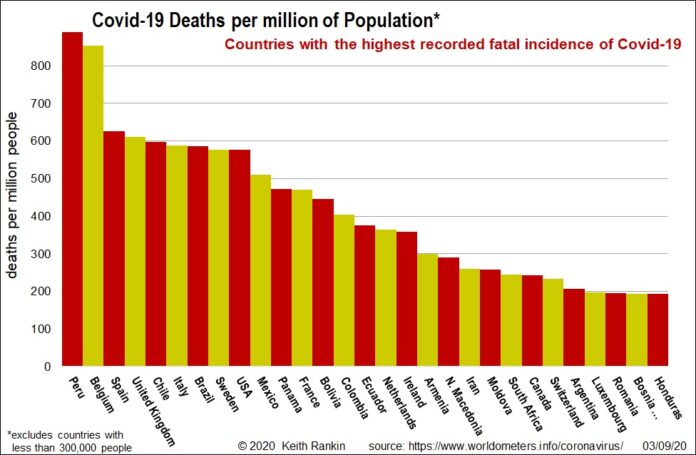
Since its first death (in China) in January, 873 thousand people worldwide have died from Covid19. The chart shows the population-adjusted death tolls for the most-affected countries (excluding countries with less than 300,000 people. (San Marino – with 34,000 people – actually has the highest death rate.)
In recent days, Peru has overtaken Belgium as the worst affected country in the world from Covid19. It’s hard to say why Peru is easily the worst affected country in the Americas – because Peru did go into early lockdowns.
Nevertheless, the city of Lima was severely affected, probably due to a mix of weak border quarantines at Lima’s airport, and the inability of the people to sustain a harsh and lengthy lockdown. (We see similar problems with South Africa.)
The European countries most affected initially continue to be among those with the most tragic outcomes, in part because of rising cases from July. Europe’s people are at their most mobile in the July and August summer months.
Other than Peru and Belgium, the lead countries are showing a consistent 600 per million deaths; equivalent to 3,000 deaths in New Zealand. (Contrast New Zealand’s actual 22 deaths; 4.4 deaths per million people.)
The next block of countries – from Mexico to South Africa in the chart – probably have actual Covid19 death rates also approaching 600 per million; some of these have marked discrepancies between official deaths and ‘excess deaths’ recorded. (The Economist has been keeping tagson ‘excess deaths’; and see Measuring the true toll of the pandemic; April 25.)
Mexico may well be closer to Peru’s statistic than to that of the USA.
Two very prosperous smaller European countries make it onto the chart: Switzerland and Luxembourg. (Re Luxembourg, see my ‘Europia’ and the Spread of Covid19.)
Switzerland now has a sustained ‘second wave’ of Covid19 cases, though these have barely shown up yet in its death statistics.
The third major region of the world to suffer Covid19 deaths is Eastern Europe. No Asian countries (except Iran) appear on the chart, and only one African country (South Africa).
Arabia. Chart by Keith Rankin.
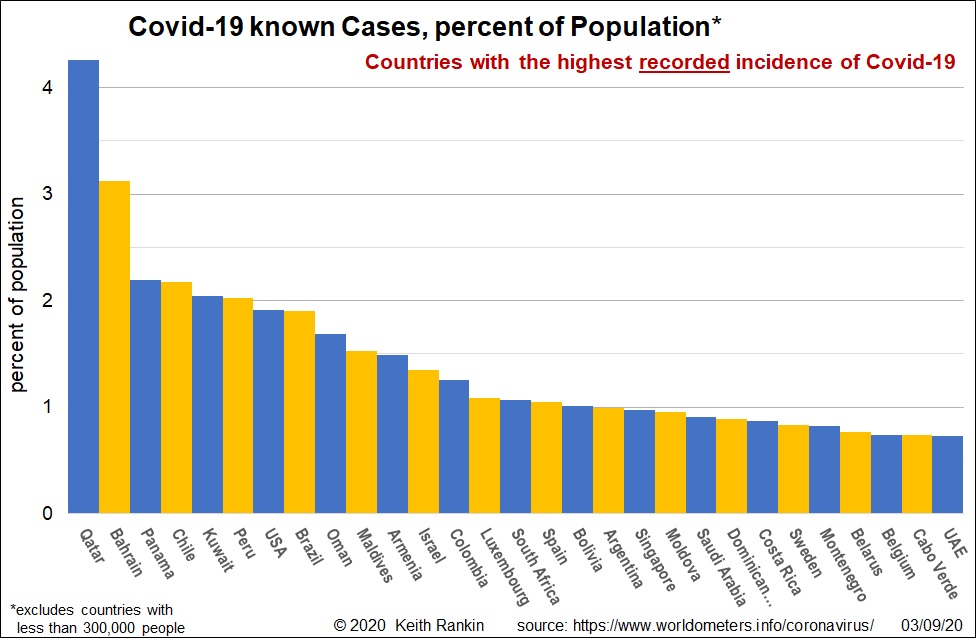
This chart, shows recorded (ie known) Covid19 cases as a percent of each country’s population.
When looking at these cumulative case statistics, we see that the Arabian countries dominate; and Singapore – which has an economy much like those of the Arabian Gulf States – also features. These countries – especially UAE, Qatar and Singapore – have early diagnoses, good quality health care, and high proportions of young immigrant workers. They also identify greater proportions of actual cases than do the countries which dominate the ‘deaths’ chart.
The countries in this chart which also feature in the ‘deaths’ chart most likely have actual infection rates similar to Qatar; probably actual cases around seven percent of the population.
Green Party co-leader, James Shaw. Image, Green Party New Zealand.
Political scientist, Dr Bryce Edwards.
How badly will James Shaw’s private school debacle affect the Greens? Will it push them out of Parliament? This is increasingly the question being asked as the scandal rolls on and on this week.
After all, the two main polling companies have had the party very close to the 5% MMP threshold in their surveys for the last year. So, the Greens only have to lose a small amount of support and they will be tipped out of office.
Greens badly wounded
Most commentators seem to believe that the Green Party has been seriously undermined by the decision to grant nearly $12m to a private eco-school. This is because it suggests the party has lost its way and no longer represents its traditional and more radical vision.
This is best explained today by leftwing commentator Chris Trotter, who argues in the Otago Daily Times that Shaw has successfully transformed the party into a “woke” pro-business party that is just trying to make capitalism more green – see: A Sorry excuse for a Green Party.
According to Trotter, Shaw “offered living proof to the rising generation of ambitious Green Party activists that they could look sharp, rub shoulders with the rich and famous, and still be non-gender-specific siblings in the struggle to save Parent Earth. Just like Bono.” And in the end, Shaw’s approach is partly responsible for driving their vote down, possibly pushing the party out of Parliament.
Trotter elaborates on this in another piece this week about Shaw’s Establishment green politics – see: From safe bet to Shaw loser.
Of course, the Greens have always had both a radical and moderate side, and this tension poses a challenge. In today’s NZ Herald, Matthew Hooton explains “The Green Party is an unstable coalition of the true believers who have sustained the movement for nearly 50 years and the coveters of $150,000 Audi Quattro e-trons who vote for it” – see: James Shaw dives straight into the Metiria Turei trap (paywalled).
Although most Green activists might be to the left of the Green MPs, the party’s voter base is much more middle class and, according to Hooton, Shaw is actually in line with these Green voters: “For him, being Green is not so much about overthrowing capitalism but things like global carbon trading, renewable energy, trendy new start-ups and instilling higher environmental and social consciousness in the next generation. At a stretch, you could even imagine Shaw accepting nuclear and gene technology to cure climate change. Within this outlook, the Green School fits nicely.”
Essentially, therefore, the scandal is actually a logical reflection of a contradiction in the party that has always been there: between the left activists and the “Audi wing” of the party, especially in the wealthy electorates it normally does so well in.
Some of these points are also well made today in RNZ’s Caucus election podcast, and Tim Watkin talks about that key Green division: “Many in the party see it as the voice of the down-trodden. In truth, most of its votes come from the comfortable middle-class” – see: The naughty prefect & The ‘single source Of truth’.
According to Watkin, the left of the party feel Shaw has let them down by failing to progress a leftwing, environmental agenda. Instead, he has apparently chosen a private school to die in a ditch over: “there are those in the party long wary of Shaw’s corporate Green agenda who would love to see him gone. They are exasperated that Shaw has spent three years saying he couldn’t put his foot down over issues such as welfare reform, water-bottling plants or getting agriculture into the ETS – that mean old Winston was bullying him – but found the strength to fight back… on behalf of a private school.”
Labour to benefit from the demise of the Greens
The Labour Party might be seen as an ally of the Greens, but it would be a mistake to think that Labour doesn’t want to kill off the Greens or at least take some of their votes off them. This point is made strongly by Hooton today, who says Labour are suspected of leaking some of the details of the scandal to the media, undermining Shaw. He draws parallels with the 2017 Greens scandal in which Labour leader Jacinda Ardern was seen as throwing Metiria Turei under a bus.
Here’s Hooton’s point about the current Labour-Green dynamic: “Labour is no more interested in sharing power with the Greens than with NZ First. If it can get both out of Parliament and govern alone, so much the better. Ardern is no unhappier about Shaw’s problems than Turei’s three years ago. Green supporters are now confronted with the awful possibility their party will leave Parliament next month and unravel.”
Similarly, the Herald’s Claire Trevett emphasises Labour’s refusal to get implicated by the scandal: “if Shaw had hoped for some cover from the other government parties, they all but threw him to the wolves. Education Minister Chris Hipkins bluntly refused to take any blame, pointing the finger straight at Shaw” – see: Will James Shaw’s endless sorry save the Greens? (paywalled).
Trevett believes Labour will benefit from the Greens demise: “there is an alternative safe harbour for any disgruntled supporters. That is Ardern and, judging from her lack of defence of Shaw, she has every intention of welcoming those voters with open arms again.”
Other reports show key Labour politicians have been very keen that Shaw answer for his decisions. For instance, when it emerged that Shaw had held up signing off other Government funding decisions in an apparent “ultimatum” email, Finance Minister Grant Robertson said: “He used those words and he has to be responsible for them” and Robertson “wouldn’t be drawn on whether the email amounted to a threat from Shaw” – see Derek Cheng’sRevealed: 44 projects worth $600m at stake over James Shaw’s ‘ultimatum’ email.
RNZ’s political editor Jane Patterson also believes Labour are well placed to win votes off the Greens over the saga: “The Greens might be a Labour ally but it’s every party for itself as they all gear up to resume campaigning and if there are any votes lost from the Greens, Labour is the most likely beneficiary. Or disillusioned Green supporters just may not vote. This is an incredibly volatile political environment and Labour will be out for every vote it can get. Shaw’s management of this situation has made it worse” – see: James Shaw battles to restore his credibility.
Similarly, Heather du Plessis-Allan says “They’ve lost voters to Labour as it’s out-greened them with moves like the oil and gas ban. The popularity of Jacinda Ardern makes it hard to win those voters back” – see: James Shaw has a bigger problem than the Green School saga.
Du Plessis-Allen says the party is now in trouble: “Up to now, I’d been confident that it didn’t really matter too much where the Greens were polling. On the night, I thought, their supporters would flock back to save them. But now, you’ve got to ask whether those supporters think they deserve saving.”
The Greens can survive the scandal
Not all commentators think it’s all over for the Greens. In Tim Watkin’s item (above) he reports that the RNZ Caucus podcast journalists don’t believe that the Greens are in trouble: “the Caucus crew don’t think this controversy is a fatal blow to its election prospects. The angriest voices come from within the party and, once the crystal dust has settled and the bio-energy cleaned, few are likely to switch their vote away from the Green’s policy agenda, even if they are losing patience with Shaw as leader. A determinedly centrist Labour Party and a John Tamihere co-led Māori Party are hardly magnetic alternatives.”
Writing in the Guardian today, Massey University’s Claire Robinson thinks the Greens have time to turn the scandal around: “In the Greens’ favour is that elections are not won or lost on single errors this far out from election day. If the election was still 19 September it might have been curtains for the party. But there are still 30 days until advance voting starts on 3 September and 45 days until election day on 17 October. This gives Shaw plenty of time to publicly make it up to his supporters whose faith in his green credentials will have been sorely tested by this incident” – see: James Shaw’s mea culpa on Green School funding exposed his lack of political nous.
The NBR’s Brent Edwards thinks that rather than hurting the Greens, the controversy could actually boost them. He believes the discontent is more of a “internal disagreement” and Shaw’s apology has been “extraordinary” – see: Will James Shaw’s contrition earn Green Party support? (paywalled).
Here’s Brent Edwards’ main point: “In the Green Party’s case, though, honesty and contrition might work in its favour, rather than condemn it to electoral defeat as many suggest. Will Green Party voters, upset by the investment in the Green School, give Shaw credit for taking the blame? And the warning that the Greens might risk falling below 5% might galvanise their more lukewarm supporters to swing in behind.”
Also writing in the NBR, Dita De Boni makes a defence of Shaw’s decision, essentially suggesting that although he was “careless”, it was a fairly harmless allocation of funding, and that it is creating an over-reaction – see: Greens once more enter election a divided force.
She worries if voters desert the Greens, then the result might be a NZ First-Labour government, or even a single party “milquetoast” Labour adminstration. She therefore calls on leftwing Green activists to pull back on their divisive criticisms of Shaw.
Similarly, the Herald’s Simon Wilson says there is too much to lose if the Greens dip out of Parliament, as they have already achieved so much, up against a conservative and weak prime minister and Labour Party. Especially for the causes of climate change and inequality, Wilson calls on progressives to support the Greens, despite Shaw’s mishaps – see: James Shaw and the honour of politicians (paywalled).
Shaw’s changing story
The problem for Shaw and the Greens is that the story and scandal won’t die. Every day more is revealed, helping unravel Shaw’s version of what occurred. The Green co-leader has gone to ground, refusing interviews.
Shaw also justified his decision on the basis that the local New Plymouth District Council had chosen to be a funder of the project, which also turned out to be entirely untrue – see Catherine Groenestein’sCouncil rebuts assertion over Green School funding.
University of Canberra Professorial Fellow Michelle Grattan and University of Canberra Vice-Chancellor and President Professor Paddy Nixon discuss the week in politics.
This week Michelle and Paddy discuss the first recession in Australia since the early 90’s, Scott Morrison’s continued pressure on the state premiers for a more open Australia, Melbourne’s improving coronavirus situation, and a fortnight of “COVID parliament”.
Source: The Conversation (Au and NZ) – By Quentin Grafton, Director of the Centre for Water Economics, Environment and Policy, Crawford School of Public Policy, Australian National University
The Morrison government today declared it will axe buybacks of water entitlements from irrigators, placating farmers who say the system has damaged their livelihood and communities.
Instead, Water Minister Keith Pitt says the government will scale up efforts to save water by upgrading infrastructure for farming irrigators in the Murray Darling Basin.
The move will anger environmentalists, who say water buybacks are vital to restoring flows to Australia’s most important river system. It also contradicts findings from the government’s own experts this week who said farm upgrades increase water prices more than buyback water recovery.
The government has chosen a route not backed by evidence, and which will deliver a bad deal to taxpayers and the environment.
The government will no longer buy water from farmers for the environment.Dean Lewins/AAP
A brief history of water buybacks
Farmers along the Murray Darling are entitled to a certain amount of river water which they can use or sell. In 2008, the federal Labor government began buying some of these entitlements in an open-tender process known as “buybacks”. The purchased water was returned to the parched river system to boost the environment.
In 2012, the Murray Darling Basin Plan was struck. It stipulated that 2,750 billion litres of water would be bought back from irrigators and delivered to the environment every year. The buyback system was not universally supported – critics claim buybacks increase water prices, and hurt farmers by reducing the water available for irrigation.
The Coalition government came to office in 2013 and adopted a “strategic” approach to water buybacks. These purchases were made behind closed doors with chosen irrigators.
In a review of these buybacks released last month, the Australian National Audit Office found many of these taxpayer-funded deals were not good value for money.
The federal government ordered the review after controversy involving the 2017 purchase of water from two Queensland properties owned by Eastern Australia Agriculture. The government paid A$80 million for the entitlements – an amount critics said was well over market value. The deal was also contentious because government frontbencher Angus Taylor was, before the purchase, a non-financial director of the company. The company also had links to the Cayman Islands tax haven.
The government took a strategic approach to water buybacks in the Murray Darling Basin.Shutterstock
Infrastructure subsidies: a flawed approach
The Coalition government is taking a different approach to recover water for the environment: subsidising water infrastructure on farms and elsewhere. This infrastructure includes lining ponds and possibly levees to trap and store water.
The subsidies have cost many billions of dollars yet recover water at a very much higher cost than reverse tenders. This approach also reduces the water that returns to streams and groundwater.
The justification for water infrastructure subsidies is that they are supposedly less damaging to irrigation communities. But the Australian Bureau of Agricultural and Resource Economics and Sciences (ABARES) concluded in a report published on Monday that on-farm water infrastructure subsidies, while beneficial for their participants, “push water prices higher, placing pressure on the wider irrigation sector”. This is the very sector the subsidies purport to help.
So why would the government expand the use of water infrastructure when it costs more and isn’t good value for money? The answer may lie in this finding from the ABARES report:
Irrigators who hold large volumes of entitlement relative to their water use (and are frequently net sellers of water allocations) may benefit from higher water prices, as this increases the value of their entitlements.
Farmers with limited entitlement holdings however may be adversely affected, as higher water prices increase their costs and lowers their profitability.
In other words, the “big end of town” benefits – at taxpayers’ expense – while the small-scale irrigators lose out.
Missing water
Adding insult to injury, the Wentworth Group of Concerned Scientists released a detailed report this week showing the basin plan is failing to deliver the water expected, even after accounting for dry weather. Some two trillion litres of water is not in the rivers and streams of the basin and appears to have been consumed – a volume that could be more than four times the water in Sydney Harbour.
The Wentworth group says stream flows may be less than expected because environmental water recovery has been undermined by ‘water-saving’ infrastructure that reduces water that would otherwise return to rivers and groundwater.
Yet this infrastructure, on which taxpayers have spent over A$4 billion, has not had the desired effect. Research has found those who receive infrastructure subsidies increased water extractions by more than those who did not receive subsidies. That’s because farmers who were using water more efficiently often planted thirstier crops.
Water Minister Keith Pitt, pictured during Question Time, is the minister responsible for the new approach.Mick Tsikas/AAP
We deserve better
It’s clear taxpayer dollars are much better spent buying back water entitlements, through open tenders, rather than subsidising water infrastructure. We can, and must, do much better with water policy.
Today, the federal government has doubled down on wasteful spending at taxpayer expense – in a time of a COVID-induced recession.
So what is on offer from the Morrison government? Continuing to ignore its own experts’ advice and deliver yet more ineffective subsidies for water infrastructure. Our rivers, our communities, and all Australians deserve much better.
Readily available drugs, which dampen the runaway inflammatory response in patients severely ill with COVID-19, save lives, according to evidence released this week.
An analysis by the World Health Organisation (WHO), which drew together results from several studies, confirms the benefit of this group of anti-inflammatory steroid drugs, known as corticosteroids.
While earlier studies showed the apparent benefit of one of these drugs, dexamethasone, this latest evidence goes further.
It shows other cheap and readily available corticosteroid drugs, including hydrocortisone, could benefit patients at the life-threatening stages of coronavirus infection.
Remind me again, what are corticosteroids?
Corticosteroids have been used for decades to treat a variety of inflammatory conditions. These include severe forms of lung inflammation, such as pneumonia, shock due to infection, and severe respiratory syndromes. They are also used to treat more common conditions, including asthma and eczema.
What do we already know about corticosteroids for COVID-19?
In June, early release of results from the RECOVERY trial showed dexamethasone reduced the risk of death by up to a third in people hospitalised with COVID-19 who needed a ventilator to help them breathe.
Results of the dexamethasone trial were released early.
Despite the early release of the trial results, and limited details at the time, the findings were compelling and clinical practice changed.
Several other trials were stopped. All patients switched to receive active treatment with a corticosteroid.
The results of the RECOVERY trial have since been formally peer reviewed and published.
The WHO drew together results from seven randomised clinical trials, including data from 1,703 critically ill patients with COVID-19.
This is a powerful and compelling way to combine information and truly address the question of whether these medicines benefit people in hospital critically unwell with COVID-19.
The study, which included patients from Australia and New Zealand, found almost 33% of people treated with corticosteroids died within 28 days of treatment. This was compared with 41% of patients who received supportive care (or placebo). Corticosteroid treatment helped patients whether or not they needed ventilation or oxygen.
Importantly, the analysis also concluded the benefits were not specific to one corticosteroid drug but were the same for dexamethasone and hydrocortisone.
Corticosteroids can also have an impact on the immune system. So the researchers looked at the risk of infection from other causes, for example bacterial pneumonia, and found it was not a major concern.
What does this mean for patients?
The weight of evidence has led WHO guidelines this week to strongly recommend using corticosteroids to treat people with severe or critical COVID-19.
Corticosteroids are not for everyone and are not a cure
It is important to remember these findings only apply to using corticosteroids in critically ill people hospitalised with COVID-19. There is currently limited information to suggest these medicines are appropriate for people with mild COVID-19.
While corticosteroids help treat the body’s response to the coronavirus infection, they are not antiviral drugs. They do not inhibit the virus itself, so they are not a cure.
Usually, several clinical trials on a common theme are published over a series of years. Then a meta-analysis draws together their results, publishing these combined results much later.
But the amazing thing about this latest evidence is the meta-analysis included data fromclinical trialspublishedat the same time. This shows a degree of co-operation and collaboration between researchers to share data to urgently address important research questions that guide clinical care.
Evidence to guide the best treatments and management for people with COVID-19 continues to emerge. You can follow the evidence and how it’s applied in Australia here.
But six months before that earthquake an interconnected maze of previously unidentified active faults ruptured beneath the alluvial plains some 20km to 80km west of Christchurch.
This multi-fault rupture produced a magnitude 7.1 earthquake that released 13 times more energy than the Christchurch earthquake. It was named the Darfield earthquake, after the nearest town, and violently shook us from our beds at 4.35am on September 4 2010.
No deaths occurred, but the significant damage to land and infrastructure stimulated numerous scientific investigations.
Ten years on and it is useful to summarise some of the lessons learned in its aftermath.
Early discoveries
Within hours of the Darfield earthquake, scientists rushed to the scene. They located evidence for a major ground surface rupture at Highfield Road (pictured above).
This site quickly became a geological tourist destination for the public, news media and politicians alike.
The then minister, Amy Adams (left), and prime minister, John Key (centre), and geologist Mark Quigley (right) discuss the Darfield earthquake on the Greendale Fault rupture trace in September 2010.Amy Adams, Author provided
Evidence for this ancient quake was eroded and buried beneath the gravels of the Canterbury Plains, so the fault system evaded discovery until its rupture in 2010.
But its emergence supported prior assertions that this sparsely studied region was populated with hidden active faults that could generate earthquakes with maximum magnitudes of 7.0 to 7.2.
The existence of planning guidelines at or near active faults before the Darfield earthquake also allowed scientists to rapidly place their preliminary observations into a decision-making context.
Specifically, decisions to allow residents to rebuild in the area after the Darfield earthquake were able to be made before all scientific evidence was acquired.
From this perspective, even though the Darfield earthquake was commonly described as a surprise, it was a scenario that seismic hazard models, building codes and land-use planning guidelines had considered before it occurred.
This reaffirms some important lessons in science: uncertainty and risk are everywhere, but we can create systems and guidelines to allow us to cope with this.
And to best contribute to decision-making, scientists need to be prepared, collaborative, diverse, strategic and very efficient in how we collect and communicate scientific information to decision-makers. This can be quite demanding in the time-compressed environment of a crisis.
We remain intrigued by this aspect, and have hypothesised that unfavourably oriented faults like Charing Cross may act as keystones that regulate the rupture behaviours of complex fault networks like those responsible for the Darfield earthquake.
Our modelling also shows complex multi-fault ruptures like the Darfield earthquake (and the Kaikoura earthquake in 2016) may be more common than single-fault earthquakes in these types of geologically complex regions.
This requires more careful consideration of how we variably distinguish or amalgamate them into seismic hazard models.
Earthquake hazards as harbingers
Earthquake hazards experienced in the Darfield earthquake such as falling rocks and liquefaction were harbingers of future hazards.
For example, the backyard of my house in eastern Christchurch first liquefied in the Darfield earthquake. The ground recurrently liquefied in at least nine more earthquakes over the next 16 months.
At the time of the Darfield earthquake, we had yet to understand the origins and significance of many of these hazards. Thus they did not inform land-use planning decisions.
Major programs in earthquake hazards operating across New Zealand continue to help improve our understanding of them and can support future decision-making.
Similarly complex fault systems are found throughout the Canterbury Plains and provide similar sources of hazard. Complex multi-fault earthquakes may be the norm, rather than the exception.
Major rockfall events analogous to those experienced in the 2011 Christchurch earthquakes have average return periods of 3,000 to 5,000 years. This does not mean future events cannot occur again within a significantly shorter time.
The Darfield earthquake stimulated an intense interest in using multiple geological sources to understand earthquakes. This knowledge is still influencing the trajectory of earthquake science more broadly.
Together with advances in engineering and other disciplines, this work shifts the narrative away from predicting the exact times and locations of earthquakes, which may never be possible, towards reducing the risks and enhancing our resilience to future events.
Then PM John Key in front of a farmhouse destroyed by the Darfield earthquake.Rob Griffith/AP
On Thursday, the Senate set up a parliamentary inquiry to look at options to “enable the flag to be freely used by the Australian community”.
So, what are the options to try and secure wider use of a flag that up until now has been a “uniting symbol for all Aboriginal people”?
What is the problem?
Unlike most other flags around the world, the Aboriginal flag is still protected by copyright.
That copyright is owned by Luritja man Harold Thomas, who created the flag for the National Aboriginal Day march in July 1971.
When the flag was proclaimed as an official flag of Australia in 1995, Thomas’ authorship of the artistic work (that constitutes the flag) was contested. But in 1997, the Federal Court declared him the author and owner of the copyright.
Thomas has since granted commercial licensing rights for use of the flag on clothing to WAM Clothing. There is also a licence to Gifts Mate for the right to reproduce the flag on merchandise and to Flagworld for the right to produce the Aboriginal flag as a flag.
Anyone wishing to do any of these activities must get permission from one of these companies.
AFL player Eddie Betts has shown his support for the ‘free the flag’ campaign.Dave Hunt/AAP
Importantly, copyright covers not just commercial reproductions of the flag but also non-commercial and private ones. This means it is fine to fly the flag, but anyone wishing to make their own copy or even get it as a tattoo needs Thomas’ permission.
#Freetheflag
There has been growing anger over the licensing arrangements after the AFL, NRL and Indigenous community groups have been asked to pay for using the flag and, in some cases, threatened with legal action.
An online petition, started by Indigenous social enterprise Spark Health, to change the licensing agreement around the flag, has so far collected more than 140,000 signatures. AFL clubs have also backed the #freetheflag campaign.
What does Labor want?
Labor says it plans to draft a private members’ bill to free up use of the flag. It also pushed for the Senate inquiry this week, which will report in October.
Labor’s Linda Burney says she wants to introduce a bill to ‘free’ the flag.Bianca De Marchi/AAP
As the party’s Indigenous Affairs spokesperson Linda Burney explained,
this is a national flag and the government has to make sure that it is freely available to all Australians. The government has the power and the resources to fix this.
For its part, the federal government says Labor’s plan is a “stunt” and it is working to “resolve” the issue.
What could a bill do?
It is true the federal government has the power to change the law, but whether it can easily “fix” the situation is more doubtful.
One option would be to pass a law that specifically takes the copyright away from Thomas and gives it to the government. However, such a law could run afoul of the Constitution, which provides that the Commonwealth can acquire property from a person, but must compensate them on “just terms”.
Alternatively, legislation could be passed so that copyright in the flag ceases entirely and the work becomes part of the public domain. This would be radical and unprecedented approach in copyright law.
A less drastic solution could be to introduce a law that restricted Thomas’ ability to grant licences of his copyright.
While these two options are likely to avoid constitutional issues (following the 2012 tobacco plain packaging case), they could be politically and culturally controversial – as they would involve either taking away property from an Indigenous man, or severely restricting his autonomy around it.
Minister for Indigenous Australians Ken Wyatt has also signalled his reluctance to do anything extreme.
I don’t want to go down a pathway where we legislate to take away the copyright of an individual.
Or, there could be a ‘fair use’ provision
Another option might be for legislation to draw inspiration from the Australian Law Reform Commission’s 2014 “fair use” proposal, which the Productivity Commission backed in 2016.
This would need legislation to stipulate Thomas’ copyright would not be infringed by anyone making “fair use” of the flag. This could include applying the flag to clothing for charitable purposes, private uses such as tattoos, as well as the production of images that incorporate the flag for cultural, social or political events.
At the same time, this would not deprive Thomas of the ability to license the flag for purely commercial uses.
What else can the government do?
This week, a spokesperson for Wyatt described the flag issue as “delicate and sensitive” and the government is “working to resolve the matter”.
The government could enter into an agreement with Thomas to buy the copyright, or acquire the licences. This option could respect Thomas’ rights as copyright owner, although would likely come with a hefty price tag .
Minister for Indigenous Australians Ken Wyatt has been working on the flag issue.Mick Tsikas/AAP
It also may not meet the concerns of others in the Indigenous community, as this would depend on any conditions the government might set for use of the flag.
Another approach would be for copyright to be assigned to an Indigenous-controlled body, as is the case with the Torres Strait Islander flag. Copyright in that flag is owned by the Torres Strait Island Regional Council, and requests to reproduce it must go to that body.
Our copyright law needs to do better
The flag debate also demonstrates how inadequate our law is when copyrighted works end up as cultural symbols or icons.
In the absence of a fair use exception, the law does not account for the fact that flags might be “artistic works” according to copyright, but the ways they are used and the emotions they inspire go well beyond the law’s concern with remunerating authors.
As Gunditjmara woman and owner of Spark Health, Laura Thomson, recently observed,
In many ways, it was the people that gave the flag value, not Harold.
As violent clashes have escalated between right- and left-wing protesters in the US city of Portland, President Donald Trump has sharpened his rhetoric against what he calls the “left-wing violent extremism” engulfing American cities.
In an interview this week, Trump alluded to “thugs wearing […] black uniforms with gear” flying around the country, which Vice President Mike Pence later attempted to clarify by saying
there’s something going on here, where the radical left, these anarchists and Antifa are moving people around the country.
This comes after US Attorney General William Barr claimed the left-wing, anti-fascist movement Antifa was engaged in domestic terrorism and “will be treated accordingly”. Trump has also vowed to deem Antifa a terrorist organisation.
Last week, a right-wing protester was fatally shot in Portland and police are now investigating whether a self-described anti-fascist allegedly motivated by Antifa principles was involved.
But research shows the threat posed by far-right extremist groups far exceeds that of other groups, including left-wing networks and attackers inspired by Islamist extremism.
Far-right extremists were behind two-thirds of the attacks and plots in the US in 2019 and more than 90% in the first half of this year.
Left-wing ideology has also inspired terrorism in the past, and indeed, left-wing terrorism remains a real contemporary threat.
But Antifa does not yet represent a terror threat by virtue of its organisation and activities. As it stands, it falls below the conventional thresholds for terrorism.
The Portland protests have drawn a mix of activists — some violent, others not.Beth Nakamura/AP
What is Antifa?
Antifa (short for “anti-fascist”) is a highly decentralised, oppositional social movement. It encompasses many autonomous groups, networks and individuals. What binds them together is a rejection of fascism and fascist ideas, including white supremacy.
Antifa is not a homogeneous entity, and has no identifiable command structure, leadership apparatus or radicalised membership. To designate Antifa as an “organisation” is to misconstrue the present reality of the movement.
Antifa engages in a wide variety of political activism, including doxxing (releasing people’s personal details online) and protests like those seen in Portland.
Not all Antifa activists are opposed to violence, as historian Mark Bray details in his book, Antifa: The Anti-Fascist Handbook. Activists have been known to use noxious gases, projectiles and other forms of violence at protests. However, they have traditionally stopped short of lethal acts.
To understand the roots of Antifa’s activism, we must first compare it to left-wing terrorism more broadly.
The heyday of left-wing extremism was during the “New Left” wave of terror from the 1960-80s. These terrorists opposed the Vietnam War and western imperialism, and stood in solidarity with left-wing revolutionaries like Võ Nguyên Giáp, Mao Zedong, Che Guevara and Carlos Marighella.
“New Left” terrorism was international by nature. In West Germany, the Red Army Faction group assassinated 11 prominent business and government representatives and bombed 30 business and military establishments.
What united these actors was the belief they were retaliating against oppression and injustice. Terrorism became a tactic essential to that mission.
In recent years, left-wing terrorism has been limited. In the US, left-wing attacks peaked in the early 2000s when eco-terrorists like the Animal Liberation Front and Earth Liberation Front targeted research centres and other businesses, but have been in decline since then.
Since 2009, left-wing terrorists were responsible for just 2% of attacks in Europe, paling in comparison to jihadists (69.3%) and right-wing extremists (21.8%).
So far, the Antifa movement has simply not met the conventional threshold for terrorism.
Terrorists use politically motivated violence to achieve two main goals: to gain support and coerce their targets. Terrorists typically use lethal violence and intimidation to exert power, which compensates for their perceived political weakness.
According to experts, the types of actions that typically qualify as terrorism are bombings, shootings, assassinations, kidnappings and hijackings. Terrorism does not necessarily need to be spectacular violence that draws attention; it can also be smaller acts of violence committed for ideological reasons.
By contrast, protest movements achieve power and seek to persuade decision-makers through popular support. Protesters largely act within the constraints of democratic, albeit contentious, politics. While violence is not uncommon at protests, it tends to be sporadic and reactive.
Left-wing protesters mobilised to counter a right-wing group, the Proud Boys, in Portland last year.Noah Berger/AP
While Antifa has previously engaged in low-level violence, such as street skirmishes and obstructing right-wing demonstrators, it lacks organisational coherence and a meaningful command structure. This limits the likelihood of organised and sophisticated violence akin to terrorism.
However, this does not stop lone actors inspired by Antifa principles from engaging in unsophisticated, individual attacks. These attacks generally occur on the fringes of the greater movement.
Most terrorism researchers have also rejected the idea that Antifa constitutes a terrorist threat, instead comparing them to gangs, militants or activists.
The danger of conflating protests with terrorism
Conflating protest movements with terrorism or violent extremism poses numerous risks to a democratic society.
For one, it undermines a central pillar of any functional, democratic system: the right to protest.
It also suppresses or manipulates legitimate dissent to serve an secondary agenda — in the case of Trump, to paint Democrat-controlled cities as out of control.
The Trump administration has come under fire for its securitised response to the protests.Nathan Howard/AP
When the Trump administration threatens to designate Antifa a terrorist organisation or send federal forces to cities to quell violent protests, it also diverts resources away from other high-priority threats.
This includes right-wing extremism, which has claimed dozens of lives in the past year in places like Christchurch, El Paso and elsewhere.
This is not an “either/or” situation — the threats from both right- and left-wing groups must be countered. But governments must allocate resources based on the actual threat they represent, rather than political rhetoric.
The political appeal of labelling oppositional protesters as terrorists must not outweigh the risks it poses to democratic principles.
In the current international security environment, there are many threats to democracy, but in order to truly safeguard it, we need to fiercely defend the rights of citizens to protest and voice dissent.
A group of 31 men on remand have escaped from a Papua New Guinea police station holding facility in Lae after taking the key from a guard who was fast asleep, reportedly drunk, police say.
Metropolitan Superintendent Chris Kunyanban said the officer guarding the facility – called the “watch house” – was suspended because he was allegedly under the influence of alcohol and had fallen off to sleep.
The 31 fled sometime between 1am and 6am on Wednesday morning.
“The cell guard was fast asleep after consuming alcohol with juvenile prisoners in the watch house. The detainees took the cell keys from his pocket, opened the cell gates and escaped,” Superintendent Kunyanban said.
He said the metropolitan police were alerted around 6.35am and managed to arrest four of the men on Seventh Street.
The other 27 were still at large.
Of the 31, 15 were facing charges relating to serious offences, six were charged with being in possession of dangerous drugs, and 10 for minor offences.
One facing murder charge Kunyanban said of the four re-arrested, one was facing a murder charge while the other three had been charged with minor offences.
He called on the people, especially family members of the men, to assist the police in rearresting them.
He blamed the incident on the negligence of cell guards.
The National front page, 3 September 2020. Image: PMC screenshot
“The cell guard on duty has been suspended and investigation has commenced,” he said.
“The investigation will also look at the system in place, security protocols and standard operating procedures.”
There are more than 140 prisoners kept at the facility which should only be holding a maximum of 100 people.
Some have already been convicted and were awaiting their transfer to Buimo prison.
33 still at large Meanwhile, police are yet to re-arrest the 33 who escaped from Buimo on August 14.
He said some of those on the run knew well how police conduct their operations. They avoid places where police frequent.
“It is becoming very hard. But we are relying on public assistance,” Kunyanban said.
Police suspect that some could have travelled to other provinces.
He warned people, especially family members, that harbouring criminals was an offence.
The Pacific Media Centre republishes The National articles with permission.
“Kia ora, everyone. I’m standing against a blank wall in my house – because it’s the only view in my house that is not messy.”
So begins a 2020 campaign message posted by New Zealand Prime Minister Jacinda Ardern. She speaks directly into her phone at day’s end, in a comfortable sweatshirt and with tousled hair, inviting Instagram viewers into her home as she lays out plans for the week ahead.
Voters and fans view her message from their own phones and smart devices: just over 22% of her 1.4 million Instagram followers watched the two-minute video. She is candid, approachable, tired and funny.
Facing a resurgence of COVID-19 just days later, the tone changes to one of concern. But the approach is the same in a 13-minute Facebook livestream, during which 34% of her 1.3 million followers tune in.
In the run-up to the October 17 election, Ardern’s Facebook following alone is four times greater than those of the other seven main party leaders combined. Politician or not, this makes her a serious influencer by anyone’s metrics.
A natural communicator
While the opposition leader’s husband has recently been feeling the heat for his anti-Ardern Facebook posts, Ardern’s own activity is almost relentlessly positive. It’s been that way since she began turning up regularly on live after-dinner Facebook feeds not long after becoming Labour leader seven weeks out from the 2017 election.
Her organic appeal and clear comfort with the format helped her own the space. By the time she was in office, she spoke to Kiwis like an old friend, using the one-way (“parasocial”) relationship with her audience to speak seemingly off the cuff about the day’s events and what she’s thinking.
She is ostensibly unfiltered – tired, often laughing, but above all in command and with creative control over what she posts, shares and shows. This alone helps boost perceptions of her authenticity and expertise.
Ardern joins a continuum of media-age communicators who came to define their political brands via their preferred platforms.
US President Franklin Roosevelt used his radio “fireside chats” in the 1930s and ’40s to explain policy to Americans. By the 1960s John F. Kennedy had emerged as the original TV president after the first ever televised debate (with Richard Nixon). In New Zealand, Robert Muldoon was the first politician to master the art of political TV.
The digital fireside chat
Now, in the digital age, the pace of communication and reach of social media platforms have created the first Twitter president: Donald Trump’s tweets are considered official statements, with more than 11,000 posted from his inauguration in 2017 to the end of 2019.
In 2020 social media are not simply useful political channels (more than 600,000 New Zealanders follow a party account), they are a major electoral battleground.
Ardern knows this. She is a prolific poster, with quick and informal videos (typically one to five minutes long) making up 81% of her 20 unique posts in a single week in August.
Facebook sits at the heart of her outreach and messaging. Voters, citizens, foreign observers and fans mingle in the comments section, with the general tone being positive and supportive of her leadership.
Engagement is everything
The key metric is engagement – the currency of the social media influencer world. Engagement is calculated by dividing the total number of interactions (likes, shares and comments) a post receives by the total number of followers.
Good rates for mega-influencers (those with more than a million followers) on Facebook typically range from .01% to .42%. Rates on Instagram can be as high as 12% for celebrity names such as Taika Waititi.
Analysis of a seven-day period in August, which spanned the Labour Party campaign launch, parliament rising, the resurgence of COVID-19 and subsequent new lockdowns, shows the range and depth of Ardern’s political influence strategy.
Her Facebook livestream videos – broadcast live but available to watch and comment on later – had an average 1.83% engagement rate on campaign and policy topics and 3.5% on COVID topics.
Ardern is disarming, comfortable and relatable – all key traits that our research suggests increase perceptions of authenticity and expertise. Her engagement puts her on par with, or ahead of, other prolific celebrities such as Rachel Hunter (who also nets a 1.8% engagement for her average of 15 posts a week).
On-brand and on-message
One five-minute Facebook livestream, posted just before dinnertime on the Saturday of the Labour Party’s campaign launch, gives a taste:
“Hi everyone, I’m sneaking a quick moment while I can hear Neve distracted in the sandpit,” Ardern begins (referring to her two-year-old daughter). As she outlines policy, those watching post heart and thumbs-up emojis, ask questions and talk to one another. The post has a 2.3% engagement rate.
It may be a long way from Trump’s high-pitched, angry use of Twitter, but it is just as brand-aware and on-message.
The New Zealand prime minister is rare in the sense that she is a highly visible social media celebrity as well as a political leader. But at 40 she is also not getting any younger.
If Donald J. Trump is the first Twitter president and Jacinda Ardern the first Facebook prime minister, it’s probably time to ask who will be the first TikTok politician.
Cybersecurity is like a game of whack-a-mole. As soon as the good guys put a stop to one type of attack, another pops up.
Usernames and passwords were once good enough to keep an account secure. But before long, cybercriminals figured out how to get around this.
Often they’ll use “brute force attacks”, bombarding a user’s account with various password and login combinations in a bid to guess the correct one.
To deal with such attacks, a second layer of security was added in an approach known as two-factor authentication, or 2FA. It’s widespread now, but does 2FA also leave room for loopholes cybercriminals can exploit?
2FA via text message
There are various types of 2FA. The most common method is to be sent a single-use code as an SMS message to your phone, which you then enter following a prompt from the website or service you’re trying to access.
Most of us are familiar with this method as it’s favoured by major social media platforms. However, while it may seem safe enough, it isn’t necessarily.
Hackers have been known to trick mobile phone carriers (such as Telstra or Optus) into transferring a victim’s phone number to their own phone.
Pretending to be the intended victim, the hacker contacts the carrier with a story about losing their phone, requesting a new SIM with the victim’s number to be sent to them. Any authentication code sent to that number then goes directly to the hacker, granting them access to the victim’s accounts. This method is called SIM swapping. It’s probably the easiest of several types of scams that can circumvent 2FA.
And while carriers’ verification processes for SIM requests are improving, a competent trickster can talk their way around them.
Authenticator apps
The authenticator method is more secure than 2FA via text message. It works on a principle known as TOTP, or “time-based one-time password”.
TOTP is more secure than SMS because a code is generated on your device rather than being sent across the network, where it might be intercepted.
The authenticator method uses apps such as Google Authenticator, LastPass, 1Password, Microsoft Authenticator, Authy and Yubico.
However, while it’s safer than 2FA via SMS, there have been reports of hackers stealing authentication codes from Android smartphones. They do this by tricking the user into installing malware (software designed to cause harm) that copies and sends the codes to the hacker.
The Android operating system is easier to hack than the iPhone iOS. Apple’s iOS is proprietary, while Android is open-source, making it easier to install malware on.
2FA using details unique to you
Biometric methods are another form of 2FA. These include fingerprint login, face recognition, retinal or iris scans, and voice recognition. Biometric identification is becoming popular for its ease of use.
Most smartphones today can be unlocked by placing a finger on the scanner or letting the camera scan your face – much quicker than entering a password or passcode.
However, biometric data can be hacked, too, either from the servers where they are stored or from the software that processes the data.
One case in point is last year’s Biostar 2 data breach in which nearly 28 million biometric records were hacked. BioStar 2 is a security system that uses facial recognition and fingerprinting technology to help organisations secure access to buildings.
There can also be false negatives and false positives in biometric recognition. Dirt on the fingerprint reader or on the person’s finger can lead to false negatives. Also, faces can sometimes be similar enough to fool facial recognition systems.
Another type of 2FA comes in the form of personal security questions such as “what city did your parents meet in?” or “what was your first pet’s name?”
Only the most determined and resourceful hacker will be able to find answers to these questions. It’s unlikely, but still possible, especially as more of us adopt public online profiles.
Often when we share our lives on the internet, we fail to consider what kinds of people may be watching.Shutterstock
2FA remains best practice
Despite all of the above, the biggest vulnerability to being hacked is still the human factor. Successful hackers have a bewildering array of psychological tricks in their arsenal.
A cyber attack could come as a polite request, a scary warning, a message ostensibly from a friend or colleague, or an intriguing “clickbait” link in an email.
The best way to protect yourself from hackers is to develop a healthy amount of scepticism. If you carefully check websites and links before clicking through and also use 2FA, the chances of being hacked become vanishingly small.
The bottom line is that 2FA is effective at keeping your accounts safe. However, try to avoid the less secure SMS method when given the option.
Just as burglars in the real world focus on houses with poor security, hackers on the internet look for weaknesses.
And while any security measure can be overcome with enough effort, a hacker won’t make that investment unless they stand to gain something of greater value.
The risk of dying from COVID-19 is at least 50% higher for Māori than New Zealanders from European backgrounds, according to our study published today.
Māori and Pacific populations are historically at greater risk of hospitalisation and death from pandemics. During the 2009 influenza pandemic, the rate of infection for Māori was twice that of Pākehā (European New Zealanders). Māori were three times more likely to be hospitalised and almost three times more likely to die.
Our results show that if COVID-19 were allowed to become more widespread in New Zealand, it would have a devastating impact on Māori and Pacific communities.
Higher risks for Māori and Pacific people
Evidence from overseas shows ethnic minority communities are at greater risk of serious health problems from COVID-19. In some parts of the US, Pacific islanders are being hospitalised at up to ten times the rate of other ethnicities. In the UK, Black and minority ethnic groups are suffering death rates twice those of White people.
Our study was based on international data on risk factors for COVID-19 fatality, including heart disease, diabetes and asthma. We combined these with data on the prevalence of these conditions in different ethnic and age groups in New Zealand.
We found the risk of death from COVID-19 was at least 50% higher for Māori. It could be more than double the rate for European New Zealanders if the level of unmet healthcare need is actually greater than official data can capture. The risk for Pacific people could also be up to double that for European New Zealanders.
Infection fatality rate by age and ethnicity.
One of the immediate reasons for the higher risk Māori and Pacific people face is that they have higher rates of existing health conditions. These are strongly associated with more severe outcomes from COVID-19.
Māori and Pacific populations are younger, on average, than Pākehā. But they have lower life expectancy and tend to experience health issues at a younger age. They also experience greater rates of unmet healthcare need and greater levels of poverty, which have been shown to have a significant effect on fatality rates.
For these reasons, Māori and Pacific people are also at higher risk of becoming severely ill and needing to go to hospital as a result of COVID-19. Unfortunately we are now starting to see this happen. COVID-19 cases among Māori and Pacific people have been around twice as likely as other ethnic groups to require hospitalisation.
Our study looked at the risk of death only once someone has become infected with COVID-19. But there are other factors that increase the risk of getting infected for Māori and Pacific people.
A recent study from the UK showed infection rates were much higher for people living in a large household or in poorer areas, while the epidemic in China indicated that around 80% of community transmission resulted from households.
About 25% of Māori and 45% of Pacific people live in crowded housing. They are also more likely to work in jobs or workplaces with higher health risks, including infection.
COVID-19 would therefore be a double whammy for these communities: a higher rate of infection and a higher risk of severe illness or death following infection.
Implications for COVID-19 response
These findings show the potentially devastating impact COVID-19 could have on Māori and Pacific communities in New Zealand. The pandemic has potential to intensify existing social inequities that result from colonisation and systemic racism.
Our health-care system was under resource pressure prior to COVID-19 and was already being challenged for its inequitable care. The results of our study reinforce the importance of controlling the virus and preventing it from spreading into at-risk communities. It also highlights the need for measures that work well for affected communities to protect at-risk groups.
A “one size fits all” approach will result in higher rates of avoidable illness and death for Māori and Pacific communities. Te Rōpū Whakakaupapa Urutā, the National Māori Pandemic Group, has clearly argued that if New Zealand wants to prevent these outcomes, the pandemic response must focus on equity.
Routine monitoring and reporting of the impact of the pandemic needs to explicitly address equity. That will require an approach that supports communities to design and deliver interventions that are effective for them.
Source: The Conversation (Au and NZ) – By Euan Ritchie, Associate Professor in Wildlife Ecology and Conservation, Centre for Integrative Ecology, School of Life & Environmental Sciences, Deakin University
Humans have long been inspired and transfixed by the Moon, and as we’re discovering, moonlight can also change the behaviour of Australian wildlife.
A collection of recently published research has illuminated how certain behaviours of animals – including potoroos, wallabies and quolls – change with variation in ambient light, phases of the Moon and cloud cover.
One study found small mammals were more active on cloudy nights. Another found variation in moonlight led to differing amounts of species captured in non-lethal traps. And a study on willie wagtails found males just love singing on a full moon.
These findings are interesting from a natural history perspective. But they’ll also help ecologists and conservation scientists better locate and study nocturnal animals, and learn how artificial light pollution is likely changing where animals can live and how they behave.
Moonlit predator-prey games of hide and seek
Most of Australia’s mammals are nocturnal, and some smaller species are thought to use the cover of darkness to avoid the attention of hungry predators. However, there’s much we don’t know about such relationships, especially because it can be difficult to study these interactions in the wild.
Eastern barred bandicoots became more active on darker nights.Simon Gorta
In the relatively diverse mammal community at Mt Rothwell, Victoria, we examined how variation in ambient light affected species’ activity, and how this might influence species interactions. Mt Rothwell is a fenced conservation reserve free of feral cats and foxes, and with minimal light pollution.
Over two years, we surveyed the responses of predator and prey species to different light levels from full, half and new moon phases.
Just as we predicted, we found that while there does appear to be relationships between cloud cover, Moon phase and mammal activity, these interactions depend on the sizes and types of mammals involved.
The spotted-tailed quoll, a meat-eating marsupial, hunts smaller prey at night.Shutterstock
Both predators and prey generally increased their activity in darker conditions. Smaller, prey species increased their activity when cloud cover was higher, and predators increased their activity during the half and new moon phases.
This suggests their deadly game of hide and seek might intensify on darker nights. And prey might have to trade off foraging time to reduce their chances of becoming the evening meal.
What happens in the wild?
It’s important to acknowledge that studies in sanctuaries such as Mt Rothwell might not always reflect well what goes on in the wild, including in areas where introduced predators, such as feral cats and red foxes, are found.
Another recent study, this time of small mammals in the wilds of Victoria’s Mallee region, sheds further light on the situation. The authors tested if variation in weather and Moon phase affected the numbers of five small mammal species – Bolam’s mouse, common dunnart, house mouse, southern ningaui, and western pygmy possum – captured in pitfall traps.
Ningauis are less likely to be caught in ecological surveys with increasing moonlight.Kristian Bell
Pitfall traps are long fences small animals can’t climb over or through, so follow along the side until they fall into a bucket dug in the ground. Ecologists typically use these traps to capture and measure animals and then return them to the wild, unharmed.
At more than 260 sites and over more than 50,000 trap nights, they found wind speed, temperature and moonlight influenced which species were caught and in what numbers.
For example, captures of a small native rodent, Bolam’s mouse, and carnivorous marsupial, southern ningaui, decreased with more moonlight, whereas captures of pygmy possums were higher with more moonlight.
Variation in the moon phase and associated light can change how active mammals are.Aaron Greenville
Moonlight songbird serenades
Research from last month has shown even species normally active by day may change their behaviour and activity by night.
It’s not uncommon to hear bird song by night, including the quintessentially Aussie warbling of magpies. Using bioacoustic recorders and song detection software, these researchers show the willie wagtail – another of Australia’s most recogisable and loved birds – is also a nighttime singer, particularly during the breeding season.
While both male and female wagtails sing by day, it is the males that are most vocal by night. And it seems the males aren’t afraid of a little stage-lighting either, singing more with increasing moonlight, with performances peaking during full moons.
While characteristically playful by day, male willie wagtails can really turn on a vocal performance by night.Jim Bendon/Flickr
This work provides insight into the importance and potential role of nocturnal song for birds, such as mate attraction or territory defence, and helps us to better understand these behaviours more generally.
Moonlight affects wildlife conservation
These studies, and others, can help inform wildlife conservation, as practically speaking, ecological surveys must consider the relative brightness of nights during which work occurred.
Depending on when and where we venture out to collect information about species, and what methods we use (camera traps, spotlighting, and non-lethal trapping) we might have higher or lower chances of detecting certain species. And this might affect our insights into species and ecosystems, and how we manage them.
Artificial lighting can change the behaviour of wildlife.Kenny Louie
Pipistrelle bats, for example, will be roughly half as active around well-lit bridges than unlit bridges. They’ll also keep further away from well-lit bridges, and fly faster when near them.
This means artificial light might reduce the amount and connectivity of habitat available to some bat species in urban areas. This, in turn could affect their populations.
Research is underway around the world, examining the conservation significance of such issues in more detail, but it’s another timely reminder of the profound ways in which we influence the environments we share with other species.
We would like to acknowledge Yvette Pauligk, who contributed to our published work at Mt Rothwell, and that the traditional custodians of this land are the Wathaurong people of the Kulin nation.
Australian universities are in dire straits. The sudden loss of international student fees due to the COVID-19 pandemic and recent court rulings of wage theft by some of our top universities have exposed the depth of these problems.
Ongoing research by the Better University Governance Research Action Group at the University of Wollongong indicates that the kinds of expertise universities draw upon to govern themselves have become increasingly narrow and unaccountable.
University governing bodies in Australia are known as university councils. Over the past 15 years or so, federal and state legislation has reconstituted these councils to favour members with no tertiary experience.
It is commonly assumed vice-chancellors run Australia’s 43 universities. However, decision-making power ultimately rests with university councils. These councils appoint vice-chancellors, decide their salaries and adjudicate on their performance.
Significant changes to university legislation over the past few decades have concentrated power in the hands of vice-chancellors. They have thereby gained much greater control over the operations and composition of university councils.
John Dawkins believed internal members of university councils had too much say.National Archives of Australia
This shift in focus can be traced back to the 1989 “Dawkins reforms”. These changes institutionalised managerialism while privileging a narrow range of expertise for university management and executives.
The then federal education minister, John Dawkins, thought if the majority of all university councils were external appointments, that would best serve the interests of universities. Internal members supposedly had too much to say in the running of their universities. However, it was left to state and territory governments to determine the makeup of the councils.
Under Brendan Nelson, university councils became more like corporate boards.Alan Porritt/AAP
The “Nelson reforms” of 2004 changed all that. As federal education minister, Brendan Nelson sought to refashion university councils in the image of corporate boards. Since then, the kind of experience required of council members has been greatly altered. Council members without tertiary experience now vastly outnumber those with it, and vice-chancellors have been empowered to determine many of the appointments.
While state and territory legislation differs in detail, since the mid-2000s the general trend has been consistent throughout the country.
In Victoria, university councils typically consist of 13 to 15 members. The vast majority have financial or management experience. Most include only two members elected by staff and students.
In New South Wales, university councils typically consist of 15 to 18 members. The number of staff and student representatives ranges from three to six. Here again, financial and management experience is given majority representation.
UOW: a case study
A prime example of the effect of these legislative changes can be seen in the roles and functions of the University of Wollongong (UoW) Council as stated in the UOW Act. It demonstrates that the council is mainly concerned with finance (approving and overseeing investments, borrowings and loans). It’s less focused on core activities such as the conferring of degrees and courses.
Changes in the membership and priorities of the University of Wollongong Council reflect changes in its governing legislation.jejim/Shutterstock
The single biggest group of UOW Council members have no professional tertiary experience. Two-thirds have a background and/or currently work in corporate finance.
Along with the vice-chancellor, whom they appoint like a CEO, this is what the majority of governing authorities at Australian universities now look like. Elected staff and students account for less than one-third of council members (normally one academic staff, one professional staff and two student representatives).
Soon after coming to power in 2011, the NSW Coalition government significantly changed the acts of all universities in the state. These changes have resulted in the problems we are identifying here.
Transparency and accountability lost
The 2012 amendments to the UOW Act, for instance, granted the UOW Council unprecedented autonomy to make financial, staffing and coursework decisions. The legislation provides for little or no external accountability or transparency to staff, students or the wider community.
For example, the Performance and Remuneration Committee (which determines the VC’s salary and performance) consists only of the chancellor, the deputy chancellor and two of the council’s external members. The council is responsible for managing its own performance, including any potential conflicts of interest for external members.
Council minutes are not publicly available. This prevents external scrutiny of council deliberations.
The minutes of university council deliberations are not open to external scrutiny.Shutterstock
Staff must apply for permission to observe meetings. If approved, they are forbidden from later discussing any confidential matters raised (primarily finance-related) with anyone outside council.
As a result, it is not possible for the university community (or taxpayers) to determine the rationale for decisions involving many millions of dollars. University councils can insulate themselves from the concerns of academic and professional staff. Financial interests are then privileged over and above the university’s core responsibilities and functions of teaching, research and the maintenance of an informed and engaged citizenry.
The legislation governing university councils validates the appointment of members who lack knowledge of the tertiary sector and have little to say about academic activities. Councils whose members have little or no experience in the core functions of universities as public service organisations determine university governance.
Is it surprising, then, that building programs, casualisation and executive salaries are given higher priority than the concerns of staff and the tens of thousands of students for whom they are responsible?
We must therefore ask: is the “no tertiary experience required” approach the best we can do for Australia’s universities?
It became official on Wednesday. The Australian economy is in recession for the first time in nearly three decades.
And the drop in economic activity is unprecedented. GDP fell 7% in the June quarter. The previous biggest post-War fall in Australia was 2% in June 1974.
But Treasurer Josh Frydenberg noted that in March he was told the June quarter contraction might be 20%. In Britain it was.
Bookkeeping aside, the question that matters is how to fight this recession.
Answering it requires an understanding that it is a different type of recession to those we’ve seen before.
As I pointed out earlier this year the recessions some of us grew up with in the early 1980s and 1990s were “business cycle” recessions.
They happened because the economy overtook its inbuilt speed limit and pushed up inflation. To curb it, central banks pushed up interest rates, pushed them up too far and choked off investment and spending, sending economic activity backwards.
A recession like no other
In 2020 we face a different sort of shock.
COVID-19 has hammered economic activity, even more so in countries such as the United States where it has run out of control.
Many of the opportunities we used to have to spend money (such as airlines, theatre tickets and cafe meals) simply haven’t been there.
They’ll come back when things return to closer to normal, perhaps though the wide deployment of a vaccine.
Some people, out of work or on shorter hours won’t have the capacity to spend. Others will want to rebuild their savings.
And others who have been saving big might decide to keep doing it.
Household saving ratio
ABS Australian National Accounts
Australia’s household saving ratio surged to 19.7% in the June quarter.
It’s a peak not reached since 1974 at a time when there was much less of an age pension and superannuation, no Medicare and surging unemployment. In other words, its at a height not reached since people really needed to save.
The Bureau of Statistics says that if household income from all sources including early access to super was counted, the ratio is even higher. Its estimate of what it calls the “household experience savings ratio” is 24.8%.
That means households saved an extraordinary one in every four dollars that came through their doors in the June quarter, up from mere percentage points a few quarters earlier.
Much of it would have been what economists call precautionary saving, understandable given how much of the future is uncertain.
There’s such a thing as too much saving
But what if this extraordinarily high saving rate lasts beyond the point it is understandable, as it did in Japan.
As with Japan in the 1990s when saving soared, real interest rates are negative. We are so keen to save we don’t need a financial return.
There were signs of it worldwide, well before the pandemic. President’s Clinton’s Treasury Secretary Larry Summers referred to it as secular stagnation, a term first coined in the 1930s.
Saving more than we are prepared to invest shrinks economic activity. It creates unemployment which itself creates uncertainly, prodding people to save still more than they invest.
It’s one of the reasons worldwide economic growth is low, interest rates are low, and inflation is low.
During the pandemic the government is spending more than A$100 billion on measures such as JobKeeper and JobSeeker.
If we won’t spend, out government will have to
Post pandemic it might have to keep spending big on physical and social infrastructure – things such as major projects and better aged care and health care.
If we won’t spend big again, it’ll have to. It’ll need to get the economy’s long term growth rate back up to 2%, or even the near 3% the Treasury thinks it is capable of.
Australia used to have one of the lowest company tax rates in the developed world, now we have one of the highest. We tax labour income too much and consumption too little. And we have a hopelessly out of date and absurdly complex industrial relations system.
Each of those things are a handbrake on economic growth.
This is an unusual recession and an unusually deep one.
Digging our way out will require us to at first contain and defeat the virus, and then spend like Keynes and cut taxes like Friedman.
The plight of art schools in Australia in recent decades is hardly breaking news. Shrinking budgets, staff cuts, amalgamations and reduced course offerings have plagued most of them.
Some workshop disciplines including printmaking, studio glass, ceramics and precious metalwork are no longer viable in certain art schools. Others are staffed through makeshift arrangements, with casuals and sessional staff carrying the brunt of teaching and administration.
Four years ago, Tamara Winikoff, then the Executive Director of the National Association for the Visual Arts, sounded the alarm, speaking to a number of key players in Australian art schools and observing some alarming trends.
These included job insecurity with the loss of the tenure system, fewer contract staff, the increasingly crowded marketplace for lucrative international students, and the authority of the word over the image – in other words, the pressure on artists working in academia to publish to gain university brownie points.
While Australia has a number of surviving independent art schools, most notably Sydney’s National Art School, 39 art schools now operate within universities. The largest of these is RMIT with 6537 undergraduate and postgraduate students. The smallest is Charles Darwin University with 161 students.
Traditionally, art schools focused on the disciplines of painting, sculpture and the graphic arts. Later, mediums associated with the crafts, such as ceramics, wood, glass, textiles, leather and precious metals, (sometimes called jewellery), were added into the mix.
Albrecht Durer Man Drawing a Lute (1525). Art schools have branched out from the traditional focus on painting, sculpture and the graphic arts.Wikimedia Commons
More recently, photography, film and digital technologies as well as art theory were introduced. Design courses, which in the past had their own niche in the commercial sector, have also been incorporated into art schools.
The worrying trends noted by Winikoff four years ago have now accelerated with university funding cuts, the federal government’s attacks on arts and the humanities with the proposed student fee hikes and a general reassessment of the positioning of art schools within tertiary institutions. In some instances, the very existence of art schools as an independent entity is under threat.
Art schools in Australia have a venerable ancestry and appeared relatively early in colonial life. The National Gallery Art School in Melbourne, for example, was founded in 1867 with the idea that it was a place where one could establish artistic standards and acquire the necessary skills through which to attain them.
The National Gallery Schools attracted some of Australia’s most distinguished artists as students, including Rose MacPherson (Margaret Preston), George Bell, Hugh Ramsey, Max Meldrum and Joy Hester, who were taught by the likes of Frederick McCubbin and Bernard Hall. The Gallery School merged with the Victorian College of the Arts in 1972, and in 2006 it became an affiliated college of the University of Melbourne.
Margaret Preston’s hand coloured block print Wooden Bridge (1925): Preston studied at the National Gallery Art School.Wikimedia Commons
Many art schools in 19th century Australia were founded around individual artists who gave art classes and these schools vanished as quickly as they were established. The Julian Ashton Art School in Sydney is an exception: founded in 1890, it continues to the present day. The Victorian Artists’ Society in Melbourne, founded in 1870, also continues to operate. Today, it still offers art tuition, although arguably it is not primarily an art school.
In the 20th century, private art schools, especially those established by Max Meldrum, George Bell and Desiderius Orban, had a greater longevity and impact than most of the other private ventures. There were a few well-established art schools in the capital cities of most Australian states and territories by the 1960s. However, as a rule, by this time, art education had become principally a state-funded activity.
In the 1970s and 1980s, the art school scene started to change quite markedly in Australia. A number of new institutions were established, many within Colleges of Advanced Education or TAFE colleges. Some offered radical and progressive alternatives to those available in traditional existing art schools.
Sydney College of the Arts, for example, was conceived in 1974 as an independent College of Advanced Education. In contrast to other Sydney art schools, its faculty, which included Tracey Moffatt, Mike Parr and Imants Tillers, adopted a more postmodernist perspective.
Mike Parr during a media preview of his installation The Eternal Opening at Carriageworks last October.Dan Himbrechts/AAP
Then Education Minister John Dawkins’s controversial reforms to tertiary education, which began in 1988, had a huge impact on art schools in Australia in the drive to establish a unified national system. The distinction between Colleges of Advanced Education and universities was abolished. Colleges were either transformed into universities or merged with them. Most art schools lacked the scale to stand alone and were forced into unions with universities, where they lost any semblance of autonomy.
A rare exception was the National Art School in Sydney. Traditionally known as East Sydney Tech, the school traces its origins to the Sydney Mechanics’ School of Arts in 1843. Over many years, it has staved off attempts to be taken over or amalgamated. It remains an independent art school with ongoing funding guaranteed by the New South Wales government as a State Significant Organisation.
A 2016 rally in support of saving the National Art School’s independence.PR handout/AAP
The West Australian artist and teacher, Paul Uhlmann, reflecting on the transition from an independent art school system to one subsumed within universities, has noted many art schools “struggle to be understood, struggle for identity and autonomy” within the framework and hierarchy of a university. “The particular languages of making through painting or graphic means are not readily understood as being valid modes of knowledge production in their own right.”
In 2018, Su Baker, a long-term chair of the Australian Council of University Art and Design Schools, observed that
in the last decade we have seen art schools morph into the institutional shape of their host university and in some cases the radical destruction of many of these once active institutions.
The loss of identity within the broader university context has affected art schools on many levels. Similar strictures now apply to an art school as to the broader university community, with the requirement for many staff to have PhD qualifications, teach similar class sizes and have similar accountability and evaluation procedures for staff and students.
Operating within a university, rather than a College of Advanced Education or a TAFE, has enabled art school staff to be promoted to more senior academic ranks – with the accompanying shift in administrative responsibilities. But universities, facing economic realities, have had to make tough decisions about cutting resources.
Often, it seemed the art school suffered first when these decisions were made. For instance, workshops that traditionally required four or five members of staff were forced to make do with one or two.
One of the most public controversies was Sydney University’s 2016 decision to scrap jewellery, ceramics and glassmaking programs at the Sydney College of the Arts. Arguing they were “resource intensive mediums”, the university cut 25 of the 43 full-time equivalent positions at the school.
A protest outside the Art Gallery of New South Wales in 2016 in support of Sydney College of the Arts. Though the college survived a merger plan, numerous jobs were lost.Joel Carrett/AAP
Ten years ago, printmaking workshops in many art schools had several teachers and technical assistants. Today, many are lucky to have more than one. Printmaking courses in etching, lithography and relief printmaking are no longer regularly available at most Australian art schools, although computer courses in design, digital printmaking and 3D printmaking are taught in some art schools.
At the Australian Print Triennial held in Mildura late in 2018, the sense of crisis in the institutional teaching of printmaking was palpable even though few were prepared to put down their observations in writing for fear of institutional retributions.
Significant cuts to arts funding; the closure of art schools; the continuing marginalisation of women in the arts; underfunding of multicultural arts; and new challenges facing Indigenous arts practice – all these issues need to be faced.
An existential threat
When Education Minister Dan Tehan announced his Job-ready Graduates Package in June 2020, proposing a massive hike in student fees for humanities and arts students, it was a major blow for the universities in general and for art schools in particular.
Most Australian universities were already in a financially weakened state following the impact of COVID-19 on their revenue streams. The Job-ready package, yet to pass parliament, will force many universities to make difficult decisions in the process of balancing the books.
Those proposed changes may have devastating consequences yet to be determined not only for the individual, but for the nation.
The Art Association of Australia and New Zealand, representing art historians, art theorists and art teachers working in Australasian universities and art schools, is now actively lobbying the crossbench senators to oppose the Job-ready legislation.
One suspects that within some university budgets, the viability of their art schools will come into question. Are art schools viewed as an integral part of the fabric of the university or as a desirable luxury that cannot be seen as being on the same level of importance as schools of law or political science or business management? Sometimes, in university priorities, it is a question of the last in being the first one out.
There is also disquiet within some of the art schools themselves. Have art schools become too academic, too theory-based and insufficiently hands-on and technique orientated?
Do graduates from arts schools emerge with an adequate skills toolkit as well as a broader appreciation of the art making process – a creative mindset? Is there an argument for smaller workshop-based units rather than an academy-like structure of an art school? Flexible units may be more responsive to the changing nature of the arts themselves.
Albrecht Durer’s Draughtsman Making a Perspective Drawing of a Reclining Woman ( circa 1600). Have art schools become too academic, too theory-based and insufficiently hands-on?Metropolitan Museum of Art
While the structure, teaching strategies and broader philosophies of art schools are a matter of future discussion, their current plight is an urgent matter for the present.
Art schools in Australia are facing an existential threat. Decades of inadequate funding have left many of them in a perilous state. And the present political and intellectual hostility to the creative arts from some federal and state governments is threatening their very existence. Some art schools have thrived within their tertiary host institutions, but many have not.
Chronic under-funding plus demands from competing masters in some instances has not created a fertile atmosphere to foster new talents. Although many art schools advertise their worth through lengthy lists of illustrious alumni, frequently there is much accumulated dust on these lists.
Are the schools still in a position to offer similar excellence in their education offerings as when their famous alumni were students?
If art schools are becoming a threatened species, then it becomes a collective responsibility for all of us to fight for their preservation and restoration. Art is not a luxury, but a necessity for a country like Australia.
That old adage “never get between a premier and a bucket of money” has become “never get between a premier and a COVID election”.
Queensland premier Annastacia Palaszczuk, two months from polling day, has been acting with the sort of single-minded political determination and ruthlessness that Scott Morrison might identify with in more normal circumstances.
As the national accounts this week confirmed Australia is in the deepest recession since the 1930s Great Depression, the prime minister, desperate to speed the economy’s reopening, struggled to bring maximum pressure on premiers on matters over which he has no formal power.
At the start of the week, the federal government had two immediate aims for the following days: to force Victoria to provide a roadmap out of its lockdown, and to have the states at Friday’s national cabinet agree to a COVID “hotspot” definition to pave the way for borders to re-open. (At present Queensland defines all NSW and the ACT as hotspots.)
In the wake of a work-over from Treasurer Josh Frydenberg, Victorian Premier Daniel Andrews announced he’d outline a map this Sunday. How encouraging it is remains to be seen.
While several premiers have been recalcitrant about their borders, Palaszczuk has been in the Morrison government’s particular sights – as well as those of NSW’s Gladys Berejiklian.
Medical and other hardship cases, exacerbated by confusion and delays, have brought sharp attacks on the Queensland government, including from the PM. Queensland reacted by saying it would set up a unit in its health department to smooth the processes.
But Palaszczuk will campaign on keeping Queenslanders safe and in general her border toughness has served her well politically, according to polling on the issue. Her defence of it this week was defiant.
Paradoxically, Morrison finds Andrews personally easier than Palaszczuk to deal with. That’s despite the fact the Victorian government’s bungling on quarantine and inadequacies in contact tracing have caused much more damage nationally than has Queensland’s border policy. The relationship seems to endure the regular touch-ups the federal government gives Victoria. Berejiklian has also found Palaszczuk difficult.
Maybe this is a personalty thing, but it’s also likely driven by the tensions around Queensland’s imminent election. Palaszczuk is totally focused on survival.
As Morrison prepared to take the hotspot proposal to the national cabinet, the federal government wound back its ambition. The hotspot discussion was just the beginning of a process, was the official word. Morrison called Western Australian Premier Mark McGowan on Thursday morning and indicated the federal government was not seeking to take down the WA border – the feds are now saying WA is different in that it has no border towns.
By Thursday, Queensland and Western Australia had already pre-empted the meeting.
McGowan, with an election in March, declared, “We’re not going agree to bring down the border”, saying the hotspot approach was not as effective. Queensland suggested it would want to see 28 days of no community transmission before it rethought its position with NSW.
It was of no political use but the government did receive support on the issue from an unexpected source. Paul Keating, asked about borders in an interview on the ABC, said: “I basically don’t agree with border closures anywhere. It is a national economy and the economy’s going to be stronger if people can move. Unless you had big emergencies – and we had an emergency on the NSW-Victorian border which is now abated broadly I think – the case for keeping border closures … is a very poor case.”
Palaszczuk has used her border policy in a campaign to secure the AFL grand final for Brisbane, an effort that paid off this week.
The final will be at Brisbane’s Gabba ground before a crowd of 30,000 – a week before polling day.
It is not just those in Melbourne who are upset. Palaszczuk’s critics, including the federal Nationals, piled on to accuse her of according the footballers and their executives privileges in their “hub” while ordinary people suffered.
Regardless, Palaszczuk will do everything to protect this AFL triumph. Her worst nightmare would be having to cancel the crowd because of a serious COVID outbreak.
Meanwhile the federal MPs from Queensland who attended the just-ended fortnight parliamentary sitting are headed into 14 days home quarantine (at least they escape being confined in hotels).
The sitting (the first with a “virtual” component) concluded with a distinctly fractious final couple of days.
After the government gagged debate on its tertiary fees legislation in the House of Representatives, Labor engaged in retributive disruption on a range off issues. The government had wanted to ram the education legislation through this week but the Senate has forced a short inquiry, reporting later in the month.
Morrison will be glad to see the back of the parliament, which doesn’t meet again until the October 6 budget. The government secured the extension of its JobKeeper program for six months until the end of March, but the parliamentary setting gave Labor a platform to prosecute its argument that the rate should not be phased back.
Labor also used the sitting for a sustained attack over aged care, which culminated in the Senate censuring the hapless minister, Richard Colbeck. Morrison dismissed the motion by pointing out this had happened quite often to ministers over the years.
As the government hunkers down to drafting its budget, it’s hard to recall a more difficult one to frame, even in the global financial crisis.
The national accounts told us growth was a negative 7% in the June quarter (6.3% annually) but that’s a snapshot of the past. The present and the future involve real time measurements and judgements that have to be made on inadequate information. The Victorian situation is a wild card.
The scale-down of JobKeeper after September will see some struggling businesses decide their future, but the government won’t have a full picture when it signs off on the budget.
The most elusive challenge is how to generate confidence.
The national accounts showed household income actually rose in the quarter, thanks to the huge amount of government cushioning, but consumption plunged.
This is hardly surprising. Apart from shutdowns and travel restrictions reducing the opportunity to spend, when huge numbers of workers are unemployed or at risk of losing their jobs, many retirees are finding their income squeezed, and the future is unclear, people will be conservative with their money. Savings rose in the quarter.
The budget is expected to bring forward already legislated tax cuts as one incentive to get spending going – although quite a lot of this money could be saved.
Anxious to fan the weak flames of hope, Morrison this week talked repeatedly about the country reaching some sort of COVID-safe normality by Christmas. Ahead of Friday’s meeting, his message to fellow leaders was, “We need to come together, we need to ensure that we are clear with Australians, that we will seek to make Australia whole again by Christmas.”
We’ll see whether that’s optimistic. But Palaszczuk, if she is returned at the election, may become more amenable after October to southerners travelling to Queensland for the festive season. At least, that’s the theory.
Source: The Conversation (Au and NZ) – By Maria O’Sullivan, Senior Lecturer, Faculty of Law, and Deputy Director, Castan Centre for Human Rights Law, Monash University
The Victorian government is taking a hard line against protests as it tries to get COVID-19 under control. As Premier Daniel Andrews said on Thursday,
it’s not the time to protest […] regardless of what you’re protesting about.
In this climate, several people have recently been charged with incitement in relation to “anti-lockdown” protests in the state.
So, what is incitement? And what makes it so complicated during a pandemic?
What is incitement?
The offence of “incitement” criminalises behaviour that encourages others to commit a crime before the crime takes place.
Interestingly, the incitement need not be acted on for an offence to be committed. So it is enough, in the context of say, murder, that the “inciter” encourages another person to commit murder, even if that crime does not actually take place.
Using the Victorian Crimes Act as an example, prosecutors must establish, beyond a reasonable doubt, that
the accused person incited another to do something that would result in the commission of a criminal offence
and at the time of the conduct, the accused had an intention that the offence would occur.
The meaning of “incitement” in legislation is very broad. For instance, the Victorian Crimes Act defines “incite” as to command, request, propose, advise, encourage or authorise.
What has been happening in Victoria?
This week, Victoria Police reported one man had been charged with incitement, following an alleged anti-lockdown gathering in Melbourne last weekend.
Additionally, and more controversially, a number of people have been arrested for incitement in relation to planned protests.
Victoria Police have been charging people with incitement over protests.Erik Anderson/AAP
In a high-profile example, a pregnant woman was arrested in relation to a social media post, which allegedly encouraged people to attend a protest in Ballarat this weekend.
Three men have also been charged with incitement over allegedly coordinating a “Freedom Day” protest in Melbourne on Saturday.
These charges were also made in a different context back in April. Then, protesters staged a car convoy in Melbourne to highlight the plight of refugees. The organiser of the protest was arrested in his home under the charge of incitement, and again, before the protest had begun.
What is significant about these charges?
The application of incitement to protest is controversial for two main reasons.
Firstly, incitement is normally linked to the commission of a serious crime, such as murder or assault. The act of protest is not, of itself, a crime.
Secondly, breaching COVID restrictions is an offence under public health legislation and can lead to the issuing of a fine. But charging someone with incitement makes this an offence under the Crimes Act.
This can lead to much more serious punishment – such as imprisonment and, importantly, the recording of a criminal conviction. This may have serious consequences for a person’s employment, if they have a criminal record.
The complexity of COVID
Because of the very serious nature of the charge of incitement, it has very rarely been used in relation to protest. This is because normally, protesting is not of itself a criminal offence.
In ordinary circumstances, protesting would only be considered a crime if protesters damage property, commit trespass or pose a threat to public order.
Normally, protesting is not an offence.David Crosling/AAP
For example, climate change activists in Queensland were recently charged with a number of offences, including using a dangerous attachment device to interfere with transport infrastructure and trespassing on a railway (their convictions were thrown out on Wednesday).
Using incitement to protest under COVID is particularly complex, because the use of such a criminal charge for a breach of a public health restriction is unclear. The complication is that under a state of emergency, various “normal” activities, such as organising public gatherings and assembling in public places, are subject to a penalty.
The application of incitement to protest during COVID is also messy as there is a significant lack of clarity about what some terms mean in Victoria’s stay at home directions. For instance, can protest be seen as an “essential” activity for the purpose of the directions? I have argued elsewhere that is should.
New territory
The use of incitement for protest under COVID poses new and complex legal questions.
These may well be tested in courts in time to come. Until then, Victorians under COVID need to look at incitement in a very different manner than before.
The International Federation of Journalists (IFJ) and the Media Entertainment Arts Alliance (MEAA) have condemned the global tech giant Facebook’s threat to ban users in Australia from sharing news on its social media platforms if a proposed regulatory code to make them pay for news content becomes law.
The IFJ and MEAA have called on lawmakers to ensure Facebook and other tech giants pay a fair share for the content they are exploiting for free, IFJ said in a statement.
The Australian Competition and Consumer Commission’s (ACCC) code, released on July 31 would require tech giants to pay news media for sharing their content.
Under the proposal, digital companies like Google and Facebook would have three months to negotiate an agreement with the media. After that period, an independent body would impose a deal.
The MEAA has made submissions at different stages of the consultation process calling for a fair share for creators.
Facebook Australia managing director Will Easton rejected the proposed code, arguing they already drive traffic to Australian media to the benefit of the news organisations and threatened to prohibit users sharing news on Facebook and Instagram.
“The response from Facebook and Google is not unexpected and should not deter the Government from continuing to implement the mandatory code,” MEAA’s chief executive and IFJ executive committee member Paul Murphy said.
Critical media moment The proposed code comes at a critical moment for Australian local, regional, and national media. According to the MEAA, since January 2019, more than 200 broadcast and print newsrooms have closed temporarily or for good.
So far, in 2020, the covid-19 pandemic has worsened the media economy, causing the suspension or permanent closure of more than 100 newspapers.
In some cases, media closures have created news deserts, with communities losing access to all local news coverage, threatening the right to be informed.
In this context, Google and Facebook have increased their revenues by exploiting news articles for free.
According to a University of Canberra report, 39 percent of Australians use Facebook for general news, and 49 percent use Facebook for information about covid-19.
The ACCC draft proposal seeks to balance these inequalities and help the whole Australian industry relieve the impact of the current crisis, save jobs, and avoid creating news deserts in Australia.
While welcoming the step forward, the IFJ and the MEAA have expressed concerns over how this new revenue will be distributed among the media, media workers, freelancers and emerging sustainable journalism projects.
IFJ general secretary, Anthony Bellanger, said: “For decades, Google and Facebook have built a fortune upon media workers all over the world. Now they must pay their fair share.
“Their profits should be taxed, and funds raised used to support journalism.
“Australia’s draft code is a first step towards addressing the imbalance between global tech giants and local media and should inspire other countries to develop laws to ensure these companies cannot simply rip of content and profit off the backs of media workers,” he said.
The Australian Competition and Consumer Commission’s draft news media bargaining code has raised an interesting question: how to put a dollar value on news content?
Under the code, Google and Facebook would be forced to pay for Australian news published on their sites to help fund public interest journalism.
The code also proposes the establishment of a “final offer arbitration bargaining process” to negotiate the conditions of exchange between old and new media. This means the parties must bargain on the costs of publishing Australian news on the platforms, and, if an agreement cannot be reached, an arbitrator will choose the best offer.
But in a rather dramatic development, Facebook has objected strongly to this process. It says
we are left with a choice of either removing news entirely or accepting a system that lets publishers charge us for as much content as they want at a price with no clear limits. Unfortunately, no business can operate that way.
Market uncertainty in the new media landscape
To assist with a constructive bargaining process, it helps to address one fundamental part of Facebook’s position. It is worried publishers may charge as much as they want for their content. However, this doesn’t need to be the case.
We have specifically proposed greater clarity on the factors that could help determine payments within the negotiations.
As we say in the submission:
The lack of value guidance is creating significant market uncertainty — for news businesses and digital platforms alike. It also perpetuates the uneven playing field to the detriment of the news media.
The key for these “value factors” can be the appeal to the public interest. And here, this lies principally in public interest journalism: the news, public information and analysis that informs our democracy and community.
Certainly, this would benefit the news businesses and digital platforms alike, since they are both increasingly distrusted by the public. Their reputations and business positions overall would actually benefit from being seen to come together in a compact for the public good.
How to value the news
But how to put a value on this? That’s the tricky question.
PIJI proposes looking at a number of specific factors, including
the cost of journalism
the advertising dollars involved
the community value placed on public interest journalism.
Each can be calculated to some degree, including even the community value.
Indeed, we have researched the value the community puts on public interest journalism. In a survey of Australians conducted in April, we found 86% of people consume media on a daily basis, with commercial TV/radio being the most popular (56% daily consumption), followed by digital social (55%) and public TV/radio (49%).
Nearly nine in ten Australians consume media on a daily basis.Darren England/AAP
Four in five respondents rated public interest journalism as either somewhat or very important. Perhaps most relevantly, over half were willing to pay more in tax if necessary to support it.
When it comes to an actual dollar value, we used these surveys to calculate that a majority of Australians are willing to pay up to $560 million per year in additional tax to support more public interest journalism.
How did we arrive at this figure? This is my own best estimate based on the amount in additional tax our respondents said they were comfortable paying to support bringing the number of journalists back up to the level it was before the 2020 rounds of job cuts and newspaper closures came into effect.
The $560 million is the midpoint of the range of responses — some respondents said they would “definitely” pay more than that, while others said they would only “probably” do so. This is the figure where we found majority support among all of these respondents.
So, using these data, we can suggest boundaries for pricing the news in negotiations with Facebook and Google.
The minimum would be the cost of maintaining the present level of journalism being produced in Australia (specifically, the editorial costs to news outlets).
To define the maximum cost, we can then use the $560 million per year figure that over half of Australians said they were willing to pay to support a higher level of public interest journalism. (The national public broadcasters were specifically excluded for separate decision by government.)
Of course, the large corporations on both sides will most likely dominate the bargaining process. Yet, Australians are also very concerned about local community and regional news providers, including traditional media and digital start-ups, so a public interest journalism fund must also be considered as part of this agreement or as a publicly funded supplement.
The positions of media outlets of all sizes must be taken into account, as well as the concerns of the community.
A baseline for negotiations
Further research and refinement may be needed. But, in the absence of other objective guidelines, this approach could certainly be used to set financial parameters for the first round of negotiations.
Facebook’s current position essentially means if it is required to pay for news through this system, it will block Australians from sharing news through its site or consider leaving Australia altogether.
Instead, what we are offering the media giants is a novel idea: use the public interest as a baseline to settle a business dispute. The public has indicated its willingness to support news as an essential service. This viewpoint should be respected as a top priority; jockeying for power and perks can take second place.
The outcome of the drafting of the code matters for Australians. As Milton Friedman once put it: there is no such thing as a free lunch. But for Australians, it is equally a matter of the future of an informed democracy.
Metropolitan Melbourne’s stage 4 lockdown is due to end on Sunday September 13.
While there’s been much speculation around what will come next, we’ll have a clearer picture this Sunday, when Victorian Premier Daniel Andrews announces the state’s “roadmap” for easing COVID-19 restrictions.
Ahead of this announcement, we asked four experts what they see as the most important aspects of Victoria’s path out of stage 4.
Trade-offs and transparency
Adrian Esterman, Professor of Biostatistics and Epidemiology, University of South Australia
I believe we need a much more nuanced approach than simply, say, going back to stage 3 restrictions.
The stage 4 restrictions are taking a heavy toll on people’s mental health. Every restriction must be carefully examined as a trade-off between improved quality of life and increased probability of transmission.
There are some no-brainers. Anecdotally, many people are already breaking the one-hour limit on daily exercise. Increasing it to two hours per day would be a great relief and should have little effect on transmission, provided people stick to social distancing.
Similarly, it’s not clear what evidence underpins the rule that bans people from travelling more than 5km from home (with some exceptions). Surely it could be increased to, say, 10km with little impact on case numbers.
UNSW epidemiologist Mary-Louise McLaws has suggested a bubble approach, which allows spending time with nominated people outside one’s own household. This would go a long way to reducing loneliness for those living on their own.
The 8pm-5am curfew has been contentious, with some experts arguing more attention should be placed on workplace safety rather than policing people’s movements. Given the high number of cases arising from nursing homes and health-care settings, there’s some merit in this argument.
Some restrictions, such as mandatory face masks, probably need to stay for a while longer.
Whatever actions the Victorian government takes at the end of lockdown, I would like it to publish the reasoning and evidence behind the restrictions that remain. This would go a long way towards building public trust.
A bubble approach could make a big difference for people living alone.Shutterstock
Being prepared for any sign of resurgence
C Raina MacIntyre, Professor of Global Biosecurity, UNSW
The best path out of stage 4 would be, once daily cases are in the low double digits, to use a step-wise, careful easing of restrictions, maintain the mask mandate, and to promote mask use as a tool that enables freedom rather than removes it. The biggest problem is asymptomatic infection, which means we cannot always identify who is infected and infectious.
We also need to keep up social distancing, make testing easy by continuing to provide drive-through sites widely, control the size and structure of gatherings, and continue hotel quarantine programs (heeding lessons from previous mistakes).
Importantly, we should have a low and clearly defined threshold for increasing the use of these measures, including lockdowns, at the first sign of a resurgence. A few weeks’ delay or procrastination can see the epidemic grow as it did in Melbourne within weeks, from low double digits to high triple digits.
We will continue to live with COVID-19 until we have an effective vaccine. Until then it will be a balancing act between applying and releasing the brakes to enable as much activity as possible, while keeping the disease under control.
As we approach the end of the year and the festive season, we want to make sure the disease incidence is as low as possible, or we could face a large resurgence after New Year.
Plans for safe Christmas and New Year activities should be starting now. This includes seriously considering the safety of religious services, given the risky combination of large gatherings with singing. If going ahead, religious services should be smaller in size, socially distanced, outdoors if possible, or with open windows combined with fans.
Opening up the performing arts
Philip Russo, Associate Professor, Monash University
The first steps of the roadmap need to include a reopening of performing arts venues in Victoria. In regional centres, these venues are often the cultural lifeblood of the town, and a return to live entertainment will offer some minor relief to small businesses, and importantly, provide entertainment, joy and hope to the community.
Some simple strategies can minimise any risk of COVID-19 transmission in these settings.
First, make use of any outdoor venues and provide controlled audience sections (where individual groups are separated from one another). Indoors, restrict attendance to 25% of house capacity, and over time that can increase.
Second, for outdoor or indoor venues, minimise the number of performers on stage, ensure performers step no further than mid-stage, and keep the first four or so rows empty. Cast and crew would need to continue to physically distance, and they might also undergo regular testing.
Utilising outdoor spaces would be a good way to get performing arts up and running again.Shutterstock
The audience would need to wear masks, as well as provide their contact details in case of the need to follow up.
Minimise mingling of the audience. No hanging out in the foyer before or after the show, and no interval. Get in, get out. And no loitering near the stage door to meet your idol.
Other strategies could include temperature checking on arrival, and using one door in and one door out. If successful, audience and performer numbers could gradually increase.
If all this was in place, it’s quite likely it would be safer to go the to the theatre than to your local supermarket.
Catherine Bennett, Chair in Epidemiology, Deakin University
The way ahead needs to be focused as much on prevention as it is on response. We need early warning systems and reliable contact tracing for outbreak identification and control, but we also need more emphasis on how we prevent transmission in the first instance.
Prevention is in our hands. Wearing masks, particularly when we can’t physically distance and in indoor public settings, will reduce transmission, minimise the likelihood restrictions will need to be reintroduced, and pave the way for a time when we might not have to wear masks all the time outdoors.
Our essential workplaces are now operating under COVID-safe plans, and other businesses and industries will need COVID-safe plans to reopen.
We now have the advantage of warmer weather ahead. If cafes and pubs can set up more outdoor seating alongside spaced seating indoors, and if everyone practises good hygiene and distancing, we can work and play safely.
Many Victorians are keen to get back to restaurants and cafes.Shutterstock
The idea of a “traffic light” alert system is a hot topic right now. This approach designates areas at different levels of transmission, with corresponding travel or other restrictions to be implemented depending on whether the area is green, amber or red.
But blanket restrictions on movement, social networking and business operation are not a precise way to disrupt local transmission chains. We must aim to be as targeted as possible in our interventions to minimise collateral damage as we contain outbreaks.
Had the 2019 election panned out differently, Chris Bowen would have been the treasurer coping with Australia’s current economic crisis.
Instead, as shadow health minister, he has been critical of aspects of the government’s handling of the health issues, especially its failure to act earlier and more comprehensively to secure access to potential vaccines.
With Labor homing in on aged care, which has seen the deaths of hundred of residents, Bowen in this podcast questions the performance of the sector’s regulator, the Aged Care Quality and Safety Commission.
“I was frankly shocked by a number of things.
“I was shocked by the fact the regulator was informed by St Basil’s, [that] they had a positive case – and on the face of it, did nothing. I’ve seen no evidence that they actually did anything about it. Their defence is it was somebody else’s job – we had no role to play.
“I just don’t think that cuts the mustard for a regulator.
“I was surprised to learn that ‘no notice’ or very short notice inspections [ by the regulator] had ceased during the pandemic.
“I think these are problematic decisions which the regulator is accountable for, and I do have deep concerns about [them].
“And as a parliamentarian, I am expressing the view that there have been shortcomings [by the regulator] and I’ve yet to see an adequate explanation for those.”
If you’re under 50, the recent death Black Panther star Chadwick Boseman of colon cancer at just 43 may have prompted a worrying thought.
Isn’t colon cancer – also known as bowel cancer – an older person’s disease? If I’m around Boseman’s age or under, should I be getting tested?
The short answer is that anyone is free to go to the chemist and buy a home testing kit (officially known as a faecal occult blood test or FOBT), which can detect tiny traces of blood in your stool.
These tests, which involve dipping a sample stick into a bit of poo collected on paper, are sent free to eligible people when they turn 50, but there’s nothing stopping a younger person buying one if they’re concerned.
If you have more serious symptoms, however – such as the recent appearance of blood in the stool – make an appointment to see your GP as soon as possible.
Credit: The Australian government Department of Health.
Age is the biggest risk factor for bowel cancer, and the absolute risk for young people remains low.
That said, research shows the incidence of bowel cancer, which includes colon and rectal cancer, has increased by up to 9% in people under 50 from the 1990s until now.
We can’t say for sure what’s driving this rise, but we do know increased bowel cancer risk is associated with obesity, eating lots of processed foods (including meats), alcohol, and not doing enough exercise.
The other key risk factor is a family history of bowel cancer in a close relative — meaning your mother, father, sister or brother has had it, particularly if they had it while young. Another symptom doctors look for is a low iron level, particularly in men.
Bowel cancer is also more common in men than in women.
Going to the GP
A really important symptom to look out for is new rectal bleeding when you pass a bowel movement. Some people may see bright red blood on the toilet paper from time to time over the years, but if it is a new symptom or you are concerned, you need to get checked out by your GP.
Your GP can work out if you need specialist review and further investigations. They’ll likely ask you to do a blood test, they’ll want to know your iron count and possibly do some stool testing. In some cases, a colonoscopy will be recommended.
A colonoscopy is where a doctor inserts a flexible instrument fitted with a camera into your anus and into your bowel while you’re under anaesthetic. It is not without risk, so it is only done with good reason.
Exercise can reduce your cancer risk.Shutterstock
Home testing kits
The home testing faecal occult blood test (FOBT) kit is a screening test, so it doesn’t pick up all cases – but it’s reasonably accurate in low risk populations. They are designed for screening asymptomatic people.
If you are male, overweight and have a family history of bowel cancer and want to do a home testing kit, then see your GP to discuss this.
Importantly, keep your weight in a healthy range and exercise regularly. This will reduce your risk for many cancers, not just bowel cancer.
And if you are over 50, please make sure you use your free stool testing kit. Don’t just put it in the bathroom drawer – do it the day after it arrives. There’s no better day.