Page 936

It’s not ‘fair’ and it won’t work: an argument against the ACCC’s news media bargaining code

Source: The Conversation (Au and NZ) – By Damien Spry, Lecturer, University of South Australia

Google and Facebook have threatened to limit or remove news services for Australian users, in response to the Australian Competition and Consumer Commission’s draft news media bargaining code.

This week, Facebook announced should the code become law, the company would stop letting publishers and users share local and international news on its Australian Facebook and Instagram sites.

Google has also made implicit threats to limit its Australian news services – potentially by removing Google News in Australia, as it did in Spain in 2014.

Arguments in favour of the code centre on two points. First, that Australian media outlets are in critical danger of going bust because of Google and Facebook’s dominance of the digital advertising market.

Second, that Google and Facebook are Godzilla-like entities dominating the market and resisting any regulation attempt – especially one that could set an international precedent.

It’s true regulation has a role in addressing the anti-competitive aspects of the digital advertising industry, but I have doubts about the ACCC’s code. It would allow commercial news businesses to bargain with Google and Facebook, in order to be paid for Australian news content published on their platforms.

But I don’t think it will work (which I say reluctantly as both Google and Facebook have much to answer for). I also don’t think the code is fair – and there’s a better way to solve the problem.


Read more: In a world first, Australia plans to force Facebook and Google to pay for news (but ABC and SBS miss out)


Misunderstanding how news works on social media

For years, Facebook has tinkered with its algorithm to prioritise posts from users’ personal connections, in what chief Mark Zuckerberg characterised as a preference for the digital lounge over the digital town square.

Basically, your Facebook News Feed (the main feed in which you discover new content) isn’t really a “news” feed. Rather, it features personalised content from those you most often, or have most recently, connected with.

If a news story appears on your feed, it has likely been shared by one of your connections. Or, you may be following that company’s Facebook page, or the company may have paid to advertise (boost) the content.

Which news stories you come across on Facebook depends on a variety of factors and algorithmic decisions. This process is complicated and vastly different to how news is presented on a publication’s website, or in a newspaper.

The ACCC’s attempt to have media businesses “fairly” paid for the value of Australian news on social media is problematic because accurately attributing value to this content is anything but straightforward.

It’s worth noting a major point of resistance against the ACCC code is the requirement for Google and Facebook to give 28 days’ notice of algorithmic changes that will affect either referral traffic to news, or the ranking of news behind paywalls.

A person engages with content on facebook via their mobile.
Social media algorithms dictate you’re more likely to be exposed to content that reflects your past online activity, as well as the activity of your online friends. Shutterstock

The opaque business of digital advertising

Commercial news today is funded largely through advertising based on audience numbers and demographics, rather than content alone (excluding subscription models).

Traditionally, however, audiences have been targeted based on news content. For example, ads for wedding dresses would be placed in bridal magazines. In such scenarios, the content itself is valuable to advertisers because it attracts their specific audience.

In digital advertising, however, the news content is often secondary or even inconsequential for generating ad revenue. The ads target their audience directly based on a user profile of recorded behaviours, characteristics and preferences. The page the ad appears on may be a factor, but one of many.

This is called programmatic advertising. When you visit a site, an automated “bidding war” is instantly conducted where your user profile is matched against potential advertisers. The winner takes the ad spot – and this is decided by several factors including offer price, as well as the likelihood of the ad being clicked.

All of this happens in the time it takes for a website to load (about 200 milliseconds).

The ACCCC code proposes remuneration for publishers based on a negotiated value of news content, but the value of news for online advertisers isn’t derived from the content as much as the targeted audience.

Hence, the tussle between the ACCC, Google and Facebook is both confusing and confused.

Assessing the value of news

The ACCC code also conflates the ways digital news content and social media users are socially and commercially valued. In explaining the need for the code, the ACCC states:

While bargaining power imbalances exist in other areas, the bargaining power imbalance between news media businesses and major digital platforms is being addressed as a strong and independent media landscape is essential to a well-functioning democracy.

This “public sphere” ideal is the premise for treating news content as being important enough to force digital giants to subsidise it. Fair enough, but the ACCC’s “professional standards test” which news businesses must pass to qualify for remuneration sets a low bar.

It doesn’t consider important aspects of public interest journalism, such as concentration of ownership, or newsroom diversity – a vexed issue in Australia’s news landscape.

Also, the code states the ABC and SBS are not able to claim remuneration (but can still benefit from information about algorithms and data). This is based on the idea that commercial news media are more vulnerable than public broadcasters, due to advertising revenue lost to Google and Facebook.

With this, the argument has changed: the value of news is not only democratic, it’s also commercial.

ACCC chair Rod Sims said the competition body wanted a model that would address power imbalances with digital platforms, without having to ‘reduce the availability of Australian news on Google and Facebook’. Rod McGuirk/AP

There is another way

It seems Google and Facebook would rather take extreme measures than be forced to pay for news, or provide news businesses information about algorithm changes and user data. Both companies have claimed they provide greater value to Australian news businesses than they receive.

Perhaps the way forward is to regulate programmatic advertising. Specifically, we should scrutinise the complex network of companies that discretely trade data profiles and advertising space. And this industry is dominated by, guess who, Google and Facebook.

Reform in this space may help address the advertising revenue and market power problems the code seeks to resolve.

The ACCC’s next cab off the rank is a review and report on the ad tech industry that considers these issues.

Hopefully it will suggest approaches to regulating the digital advertising market. This seems a better option than the compensation currently being sought.


Read more: How the shady world of the data industry strips away our freedoms


ref. It’s not ‘fair’ and it won’t work: an argument against the ACCC’s news media bargaining code – https://theconversation.com/its-not-fair-and-it-wont-work-an-argument-against-the-acccs-news-media-bargaining-code-145391

The AFL has moved the grand final from Melbourne for the first time – but it has a far more pressing issue

Source: The Conversation (Au and NZ) – By Gregory Phillips, Adjunct Professor, Griffith University

In a year shaped by climate disasters and a pandemic, Australia’s most powerful sporting organisation – the Australian Football League (AFL) – continues to be confronted by another foundational issue: systemic racism.

At issue is not only the question of how the Australian sports industry engages with the Black Lives Matter movement, but also the continued failure of key Australian organisations to adequately reflect on, and reform, their own colonial values and power structures.

A continued failure to address racism

While the AFL would likely prefer attention was focused on the historic move of the men’s grand final outside Victoria, the continued distress caused by racism within the game is a more pressing issue.

Most recently, the AFL’s 2020 Sir Doug Nicholls Round, set up to celebrate Indigenous Australian contributions to football, was overshadowed by the story of how racism in football has traumatised Yorta Yorta man Robert Muir.

Muir was persecuted at a junior level (being unjustly suspended for two-and-a-half years for the falsified charge of kicking), humiliated by his St Kilda VFL teammates and routinely abused by many opposition players and supporters. He was then largely neglected by St Kilda, which used an image of him in the club’s heralded 2019 Reconciliation Action Plan, but never even spoke with him.

The mistreatment of Muir is not merely testament to how racist Australia used to be. It is also indicative of Australia’s current systemic racism. Just this year, Eddie Betts, Shelley Ware, Elijah Taylor and Harley Bennell (among others) have been repeatedly subjected to vile racist abuse via various social media platforms. These are not isolated incidents, but represent a pattern of abuse.

Héritier Lumumba takes a mark
Héritier Lumumba was largely ignored when he spoke out against racism. Joe Castro/AAP

When Muir tried to speak out about the racist vilification he received, he was not believed. Over 40 years later, Héritier Lumumba was also largely dismissed when he first spoke out about the racism he experienced at the Collingwood Football Club. This included being given the nickname “Chimp” by some teammates. It has taken until now for Collingwood to instigate a formal investigation into Lumumba’s treatment and broader institutional issues.

Former Gold Coast Suns player Joel Wilkinson has also spoken out against the systemic racism he experienced.


Read more: Fair Game? The audacity of Héritier Lumumba


The struggle to be believed

The questioning of racism by key figures in the AFL industry remains a significant issue. Many people responded with outrage and sympathy to Muir’s tale. The AFL, St Kilda, Geelong, Collingwood and the Ballarat Football League (among others) apologised for the acts of racism that Muir endured.

However, AFL Hall of Fame member Mick Malthouse suggested Muir tried to “live up to” his racist “Mad Dog” nickname, and suggested the racist slur “served him well”.

The AFL and St Kilda Football Club have apologised to Robert Muir for the horrific racism he endured. afl.com.au

Malthouse’s comments bring to mind the 2020 podcast by veteran AFL media figures Sam Newman, Mike Sheahan and Don Scott, which trivialised Nicky Winmar’s iconic 1993 gesture against racism. They suggested Winmar was merely saying he had “guts”.

In a telling instance of the erasure of the history of racism in the AFL, Sheahan had presumably forgotten that just one week after Winmar’s defiant gesture he had written (in an article about Essendon coach John Worsfold regretting he had “used racist remarks”):

The debate on racism in football came to a head this week after St Kilda’s Nicky Winmar’s on-field protest around racism last Saturday. He lifted his guernsey, pointed at his chest, and told the crowd: ‘I’m black – and I’m proud to be black.’

The AFL often uses this famous image of Nicky Winmar to market its fight against racism. National Museum of Australia

The AFL frequently uses the image of Nicky Winmar to market itself as an organisation and industry that helps lead the fight against racism in Australia. Yet even its celebration of Sir Doug Nicholls indicates that broader issues, both structural and symbolic, remain unaddressed.

After being racistly excluded from playing VFL by Carlton, Sir Doug starred as a footballer for Northcote in the VFA, then Fitzroy in the VFL. He was good enough to be selected in the Victorian sides of both leagues.

Later Sir Doug coached Northcote in the VFA and the first Aboriginal All Stars football team. He did this while he was the inaugural chairman of the National Aboriginal Sports Foundation, which conducted National Aboriginal Football Carnivals in all capital cities.

Yet somehow he is still not in the AFL Hall of Fame.

Saying ‘sorry’ – but it never leads to change

Newman, Sheahan and Scott ended up apologising to Nicky Winmar, as the AFL industry has done with Muir, and did earlier with Sydney Swans’ dual Brownlow medallist Adam Goodes, who was driven out of the game by racist booing and the conspicuous failure of the AFL to support him. This pattern of denial, then apology, then repeating abuse, then denial again, then another apology, is not unique to corporatised sporting codes. It is emblematic of a broader pattern of Australian corporate, government and non-government organisations defensively making Aboriginal and Torres Strait Islander Peoples and their outcomes “the problem” to be “helped”.

So how should the AFL better redress systemic racism and ensure that Black Lives do Matter? Certainly not by blaming the individual Black workers responsible for institutional white problems.


Read more: The AFL sells an inclusive image of itself. But when it comes to race and gender, it still has a way to go


After the soul-searching with Goodes, the AFL promised it had learned of the need to fully support those people in the AFL industry who are subjected to vile hatred and vilification.

Yet this past week we have seen the leaking of attacks against the league’s only Indigenous executive, who along with other Aboriginal people in the football industry – especially Aboriginal women – shoulder the burden of trying to redress the systemic racism of the football industry. Moreover, there are suggestions the league is also reducing the financial investment and support provided in the diversity area (along with curtailing the freedom of those involved).

And the AFL executive remains largely white and male. It is telling that, as the league lurches from crisis to crisis regarding racism, it is the Indigenous leader of “inclusion and social policy” whose position is under threat. This is also made worse by lateral violence from otherwise dis-empowered voices. That the messenger becomes attacked is indicative of a culturally unsafe organisation.

At the same time, Eddie McGuire continues to not only be president of Collingwood, but to hold great power within the AFL media, despite his history of racist comments and other “gaffes”.

What kinds of culturally safe work environments can Aboriginal nurses, doctors, policymakers, teachers or indeed AFL players expect from their workplaces? And where are the unions, businesses and governments that should be demanding accreditation and accountability systems for anti-racist workplaces? Where are the investments in something other than colourfully designed guernseys and displays of cultural pride – critical though these are?


Read more: How COVID caused chaos for cricket – and may force a rethink of all sport broadcasting deals


An undiagnosed crisis of values is afoot. When we think of those young, vulnerable men and women in the arena and in the locker-rooms, and the fans and sponsors and controllers of the industry – all desperate for belonging, ceremony and triumph, we think perhaps they could learn something from Aboriginal and Torres Strait Islander Peoples as the custodians of 60,000 years of science and deep belonging.

There are organisations and industries undertaking strategic efforts at decolonisation. We implore the AFL and other industries to join that effort, because it is good for business and good for our grandchildren. Why not use the crises as signposts to Aboriginal and Torres Strait Islander brilliance and success, and their value to all?

Put simply, Black Peoples do not represent an issue of diversity, but one of sovereignty.

ref. The AFL has moved the grand final from Melbourne for the first time – but it has a far more pressing issue – https://theconversation.com/the-afl-has-moved-the-grand-final-from-melbourne-for-the-first-time-but-it-has-a-far-more-pressing-issue-145184

Weekly injection could treat type 2 diabetes, new enzyme discovery suggests

Source: The Conversation (Au and NZ) – By Magdalene Montgomery, NHMRC CDF Fellow, Senior Research Fellow, Head Metabolic Crosstalk Laboratory, University of Melbourne

A newly discovered protein produced by the liver, and which helps to control blood sugar levels, could potentially revolutionise treatment for type 2 diabetes.

Our research, published today in Science Translational Medicine, found that injecting this protein, called SMOC1, into diabetic mice helped them control their blood glucose much more easily.

We have also engineered a long-lasting form of SMOC1 which, if it works the same way in humans as in mice, would only need to be injected once a week, rather than given daily as is the case for many current diabetes medications.

Our results in mice suggest SMOC1 is more effective than metformin, the current frontline drug for type 2 diabetes, in improving blood glucose control and insulin sensitivity. It’s also without the risk of dangerously low blood sugar associated with current drugs.

Most of us have friends, family members or colleagues with type 2 diabetes. This is not surprising, given the disease affects more than 400 million people worldwide, and almost one million in Australia alone.

Type 2 diabetes is also closely linked to obesity, and with the reported incidence of obesity growing (more than two billion people worldwide are overweight or obese), it is forecast 578 million adults will have diabetes by 2030, and 700 million by 2045.

People with diabetes have many complications that can impair their quality of life and reduce their life expectancy. A major problem for people with type 2 diabetes is high blood glucose, which if left unchecked and untreated, can cause the development of many serious health problems:

Almost every second person with diabetes experiences a mental illness, such depression or anxiety.

Reducing blood glucose levels before any sign of diabetes damage is evident can help thwart this silent and underestimated killer.


Read more: A disease that breeds disease: why is type 2 diabetes linked to increased risk of cancer and dementia?


Current diabetes medications aren’t good enough

A healthy diet and exercise are the first lines of treatment for diabetes. But this has limited effectiveness in reducing blood glucose, particularly as the disease progresses. So it ultimately becomes necessary to use drugs to control blood glucose.

There are a range of drugs available to maintain blood glucose levels. The most common first-choice drug is metformin, which is prescribed to more than 120 million people worldwide. While metformin is generally safe and effective, it frequently causes gastrointestinal symptoms such as diarrhoea and flatulence.

Metformin package and pills in blister pack
Metformin has long been doctors’ go-to drug for type 2 diabetes. Ash/Wikimedia Commons

All diabetes medications, without exception, have either limited effectiveness or unpleasant side effects. Many can also potentially cause very low blood sugar (hypoglycemia), which can cause shakiness, anxiety, sweating, chills, lightheadedness, confusion and, in severe cases, coma or even death.

Insulin is used to treat type 2 diabetes typically later in disease progression, after other anti-hyperglycemic medications become less effective at managing blood glucose levels.

So, we can see there is an urgent need to develop new approaches to treat patients with this disease.

The next generation of diabetes therapies

Our discovery of SMOC1, which is naturally produced by the liver and is released into the blood when glucose levels are high, could offer a new way to control blood glucose.

We initially discovered SMOC1 as a protein that was released from mouse liver cells (hepatocytes). Its release increased when liver cells accumulated excess fat.

We further found SMOC1 levels in the blood to be reduced in people that are insulin resistant (pre-diabetic). Based on our animal studies and studies using human liver cells, we anticipate SMOC1 could be effective in people with type 2 diabetes, whether advanced or newly diagnosed. SMOC1 could make daily medications a thing of the past, boosting a patient’s quality of life.

Given the prevalence of type 2 diabetes, this would help reduce the public health burden of the disease, with patients potentially needing fewer hospital visits and shorter hospital stays.


Read more: Weekly Dose: metformin, the diabetes drug developed from French lilac


What happens next? We will need to test SMOC1 in humans, and enlist the help of the pharmaceutical industry to help develop this potential new therapy.

With the right support, SMOC1 could move to human trials within six to eight years, helping us get closer to reducing the global public health toll of type 2 diabetes and obesity in general.

ref. Weekly injection could treat type 2 diabetes, new enzyme discovery suggests – https://theconversation.com/weekly-injection-could-treat-type-2-diabetes-new-enzyme-discovery-suggests-145312

Most New Zealanders don’t know how deadly strokes are – claiming 2,300 lives a year and rising

Source: The Conversation (Au and NZ) – By Rita Krishnamurthi, Associate Professor (cerebrovascular epidemiology), Auckland University of Technology

Stroke is the third highest cause of death in New Zealand, after cancer and coronary heart disease. But our new research shows very few people are aware of the risk, particularly in Pasifika communities – despite being much more likely to have an early stroke.

Each year, about 9,000 New Zealanders have a stroke and according to the latest data, 2,322 died of stroke in 2016. Just over half of the people who survive a stroke live with ongoing health impacts.

Our study, based on a random national sample of 400 people, shows only 1.5% identified stroke as a common cause of death. In contrast, 37% identified heart disease and 33% identified cancer as common causes of death.

Our research is unique in that it recruited a group of participants who represent New Zealand’s ethnic groups. It shows people from Pasifika communities have the lowest stroke awareness, despite being at higher risk than the general population.

Recognising stroke symptoms and risk factors

The research also shows around 43% of people surveyed did not believe they could tell if a person was having a stroke.

The most common symptoms of stroke are:

  • the sudden onset of face drooping on one side

  • arm weakness, especially if one-sided

  • speech difficulty

  • complete or partial loss of vision on one side

  • swallowing difficulties

  • acute confusion or memory loss

  • unusually severe, abrupt headaches.

While the majority responded correctly to stroke symptoms, a large proportion (45-70%) also responded “yes” to unrelated symptoms, such as chest pain.

How to recognise that someone is having a stroke.

Read more: Coronavirus may be increasing risk of stroke – doctors on the frontline witness new pattern


Awareness of stroke risk factors was also low. There is clear evidence that stroke is highly preventable. Ten potentially modifiable risk factors are associated with around 90% of strokes.

Risk factors include high blood pressure, diabetes, smoking, low levels of physical activity, and a diet low in fresh fruits and vegetables. Without any prompting, only 30% of people identified two or more risk factors for stroke.

People identifying as Pasifika or Māori recognised fewer stroke symptoms compared to European New Zealanders, and Pasifika people were 58% less likely to correctly identify risk factors. This is an important finding because our earlier research highlights that age-standardised rates of stroke are 30-60% higher for Pasifika and Māori, with an onset 15 years earlier compared to European New Zealanders.

A Pasifika person in New Zealand is twice as likely to die of a stroke as a European New Zealander. That disproportionately high stroke risk, combined with lower awareness about strokes and their warning signs, means New Zealand needs to develop more language and culturally specific education material, as well as better methods of delivery.

Stroke rates in younger people on the rise

In our study, higher incomes and education were both associated with better stroke awareness, and this is similar to findings in other developed countries such as Spain. People in middle-income households were twice as likely to correctly identify stroke risk factors as those on low incomes.

People for whom English is a second language, or who don’t speak it at all, are further disadvantaged. If we want to improve stroke prevention, we need to develop better communication strategies to address language gaps in understanding that stroke is avoidable.

Globally and in New Zealand, the number of people having strokes and dying from them is increasing because people are living longer and are more exposed to risk factors, including more sedentary lifestyles.

For the first time, over the past decade we’ve started to see an increase in the rate of younger people having strokes. This is of concern. It means more people are living longer with disabilities caused by a stroke and experience growing health and financial stress themselves as well as in their families.

Given that stroke is highly preventable, we call for better access to population-wide strategies, available to people at all levels of risk of stroke. Existing strategies are mostly aimed at people at moderate to high risk of cardiovascular diseases, including stroke.

This so-called “high-risk” strategy leaves out most people at risk, while those in the high-risk categories often lack the knowledge and motivation to address their individual lifestyle risks.


Read more: New blood pressure guidelines may make millions anxious that they’re at risk of heart disease


Preventing strokes will cut the risk of other deadly diseases

Population-wide strategies aimed at stroke prevention would also help prevent other major non-communicable diseases with similar risk factors, including coronary heart disease, many types of cancers and even some types of dementia.

The free Stroke Riskometer app can assess an individual’s risk of stroke, inform them about their personal risk factors and provide information about symptoms. Free blood pressure checks provided by the New Zealand Stroke Foundation throughout the country help raise awareness of the most important modifiable risk factors for stroke.

The economic cost of stroke is enormous, with an estimate of NZ$1.1 billion for 2020, increasing to NZ$1.7 billion by 2038.

The high health, social and economic burden of stroke on New Zealand – and its disproportionate impact on Māori and Pasifika communities – needs to be addressed urgently. The lower level of awareness in these groups highlights we need to deliver information that is tailored and delivered by culturally competent community workers.

We also need to complement these steps with improved access to affordable healthy foods, preventative primary healthcare, and support at individual and community levels to improve health and lifestyle.

ref. Most New Zealanders don’t know how deadly strokes are – claiming 2,300 lives a year and rising – https://theconversation.com/most-new-zealanders-dont-know-how-deadly-strokes-are-claiming-2-300-lives-a-year-and-rising-144576

New research reveals these 20 Australian reptiles are set to disappear by 2040

Source: The Conversation (Au and NZ) – By Hayley Geyle, Research Assistant, Charles Darwin University

Action came too late for the Christmas Island forest skink, despite early warnings of significant declines. It was lost from the wild before it was officially listed as “threatened”, and the few individuals brought into captivity died soon after.

Australia is home to about 10% of all known reptile species — the largest number of any country in the world. But many of our reptiles are at risk of the same fate as the Christmas Island forest skink: extinction.

In new research published today, we identified the 20 terrestrial snakes and lizards (collectively known as “squamates”) at greatest risk of extinction in the next two decades, assuming no changes to current conservation management.

Preventing extinctions of Australian lizards and snakes.

While all 20 species meet international criteria to be officially listed as “threatened”, only half are protected under Australian environmental legislation— the Environment Protection and Biodiversity Conservation (EPBC) Act. This needs urgent review.

Many of these reptiles receive little conservation action, but most of their threats can be ameliorated. By identifying the species at greatest risk of extinction, we can better prioritise our recovery efforts — we know now what will be lost if we don’t act.

Six species more likely than not to go extinct

Our research team — including 27 reptile experts from universities, zoos, museums and government organisations across the country — identified six species with greater than 50% likelihood of extinction by 2040.

This includes two dragons, one blind snake and three skinks. Experts rated many others as having a 30-50% likelihood of extinction over the next 20 years.

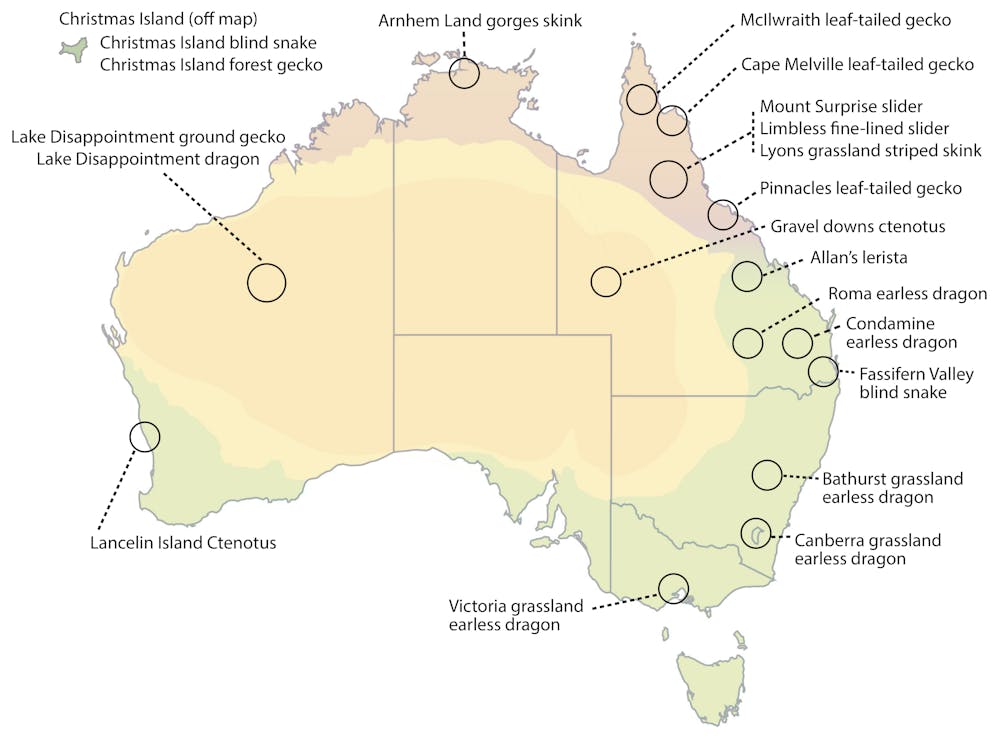
More than half (55%) of the 20 species at greatest risk occur in Queensland. Three live on islands: two on Christmas Island and one on Lancelin Island off the Western Australian coast.

Two more species are found in Western Australia, while the Northern Territory, the Australian Capital Territory, Victoria and New South Wales each have one species.


Read more: Australia’s smallest fish among 22 at risk of extinction within two decades


Each of the 20 species at greatest risk occur in a relatively small area, which partly explains the Queensland cluster — many species in that state naturally have very small distributions.

Most of the top 20 occupy a total range of fewer than 20 square kilometres, so could be lost to a single catastrophic event, such as a large bushfire.

A map of Australia showing where the 20 snakes and lizards are located
The approximate locations of the 20 terrestrial snakes and lizards at greatest risk of extinction. Author provided

So why are they dying out?

Reptile species are declining on a global scale, and this is likely exacerbated by climate change. In Australia, where more than 90% of our species occur nowhere else in the world, the most threatened reptiles are at risk for two main reasons: they have very small distributions, and ongoing, unmitigated threats.

The Cape Melville leaf-tailed gecko meets this brief perfectly. This large and spectacular species was only discovered in 2013, on a remote mountain range on Cape York. It’s threatened by virtue of its very small distribution and population size, and by climate change warming and drying its upland habitat.

Arnhem Land gorges skink
The Arnhem Land gorges skink is considered more likely than not to become extinct by 2040. Threats include changes to food resources and habitat quality, feral cats, and possibly poisoning by cane toads. Chris Jolly

Habitat loss is also a major threat for the top 20 species. Australia’s most imperilled reptile, the Victoria grassland earless dragon, used to be relatively common in grasslands in and around Melbourne. But the grasslands this little dragon once called home have been extensively cleared for agriculture and urban development, and now cover less than 1% of their original extent.


Read more: Click through the tragic stories of 119 species still struggling after Black Summer in this interactive (and how to help)


Little conservation attention

For most reptile species, there has been less conservation work to address the declines, partly because reptiles have historically received less scientific attention than birds or mammals.

We also still don’t fully understand just how many species there are in Australia. New reptile species are being scientifically described at an average rate of 15 per year (a higher rate than for other vertebrate groups) and many new reptiles are already vulnerable to extinction at the time of discovery.

The Mount Surprise slider, a light-brown snake
The Mount Surprise slider is threatened by invasive plant species and cattle compacting sandy soils. Stephen Zozaya, Author provided

To make matters worse, few reptiles in Australia are well-monitored. Without adequate monitoring, we have a poor understanding of population trends and the impacts of threats. This means species could slip into extinction unnoticed.

Reptiles also lack the public and political profile that helps generate recovery support for other, (arguably) more charismatic Australian threatened animals — such as koalas and swift parrots — leading to little resourcing for conservation.

Lessons from the past

Only one Australian reptile, the Christmas Island forest skink, is officially listed as extinct, but we have most probably lost others before knowing they exist. Without increased resourcing and management intervention, many more Australian reptiles could follow the same trajectory.

The Roma earless dragon sitting up on hind legs.
Habitat loss and degradation due to agriculture is a major threat to the Roma earless dragon. It has not been listed under Australian legislation. A. O’Grady Museums Victoria, Author provided

But it’s not all bad news. The pygmy bluetongue skink was once thought to be extinct until a chance discovery kick-started a long conservation and research program.

Animals are now being taken from the wild and relocated to new areas to establish more populations, signifying that positive outcomes are possible when informed by good science.

And the very restricted distributions of most of the species identified here should allow for targeted and effective recovery efforts.

By identifying the species at greatest risk, we hope to give governments, conservation groups and the community time to act to prevent further extinctions before it’s too late. Neglect should no longer be the default response for our fabulous reptile fauna.


Read more: A hidden toll: Australia’s cats kill almost 650 million reptiles a year


ref. New research reveals these 20 Australian reptiles are set to disappear by 2040 – https://theconversation.com/new-research-reveals-these-20-australian-reptiles-are-set-to-disappear-by-2040-145385

2 hours of TV a day in late childhood linked to lower test scores later

Source: The Conversation (Au and NZ) – By Lisa Mundy, Research Fellow, Murdoch Children’s Research Institute

Children aged 8 and 9 who watched more than two hours of TV a day or spent more than one hour a day on a computer had lower scores than their peers on reading and numeracy at ages 10 and 11, our study has found.

Our results, published in PLOS ONE, were collected as part of the Childhood to Adolescence Transition Study (CATS) based at the Murdoch Children’s Research Institute.

We found children who watched TV two hours per day at 8 and 9 years of age performed lower in reading two years later compared with children who had watched little TV. This was equivalent to the loss of a third of a year in learning. There was no impact of watching TV on numeracy.

Children who used a computer for at least one hour per day had a similar loss in numeracy scores two years later compared with their peers. There was no association between computer use and reading.

In contrast, we found no links between playing video games and children’s learning.

Although much has been written about the consequences of digital media use for kids’ physical and mental health, little attention has been paid to its potential impact on education.

How we conducted our study

The Childhood to Adolescence Transition Study (CATS) includes 1,239 children. These children entered the study in 2012 when they were 8 years old.

For our study, we used information collected across the first three years of CATS when the children were 8 to 11 years old. We asked parents to report on their child’s use of TV (including streaming on the computer), computer use (for email, school work, internet access and chat) and video games.

We obtained information about the academic scores by linking with NAPLAN, the National Assessment Program – Literacy and Numeracy.

In our analyses, we took into account the child’s age, gender, earlier emotional and behavioural problems and their socioeconomic status. We also accounted for previous academic performance, which is important because children struggling with school work may choose to use more media.


Read more: Stop worrying about screen ‘time’. It’s your child’s screen experience that matters


The time children spend using electronic media tends to increase in late primary school (from around age 10) and with the move to secondary school. During these years children typically have more control over the types of media they use.

Academic problems often first emerge during these years too, predicting school dropout and longer-term academic performance.

At ages 8 to 9 and 10 to 11, around 40% of children watched more than two hours of TV a day.

Around 17% of 8 to 9 year olds used a computer for more than an hour a day — two years later, this had almost doubled to 30%.

One in four 8 to 9 year olds played video games for more than one hour a day — this rose to one in three in 10 to 11 year olds.

Boy and girl playing with a video game controller.
Playing video games didn’t have the same association with lower scores as more passive screen time. Shutterstock

We also looked at the short-term effect of using media on learning. Children aged 10 to 11 who watched more than two hours of TV or used a computer for more than an hour a day had lower scores in numeracy compared with their peers (but none on reading) — equivalent to the loss of a third of a year of learning.

These findings remained even when accounting for prior media use. There was no evidence of short-term links between video games and academic performance.

These results suggest it is cumulative (or long-term) TV use that is linked with effects on reading rather than short-term.

We don’t have all the answers

This study doesn’t answer all the questions about electronic media and children’s learning. Because we relied on parents to report on their children’s media use, we don’t know as much about how and why children were using media heavily. This is significant because actively engaging with and producing content rather than just passively viewing media, is likely to be positive compared with just passively viewing media.

This will continue to be important as children get older and start to use social media more (most social media accounts specifying users must be at least 13 years old). Using social media to create and post material online, as well as connecting with friends can bring mental health benefits.


Read more: TikTok can be good for your kids if you follow a few tips to stay safe


This may also explain why heavy use of television, which is passive, predicted poor learning but there were no effects when it came to gaming, which is an active use. Our study didn’t capture how computers were used but browsing the internet and watching online videos are also passive activities, possibly explaining the link between computer use and learning.

Other possible reasons for the link between heavy TV and computer use and learning could be because they reduce time spent doing other activities such as physical activity, sleep or homework. They also have the potential to diminish concentration.

What our study means

Before the pandemic, electronic media use was already the most popular leisure-time activity for 7 to 18 year olds but the pandemic has meant children now spend around 50% more time with screens.

Electronic media have been essential for us all in coping with the pandemic. It allows us to work from home, access information and services, and maintain relationships with family and friends. For children, it has meant being able to continue their education through lockdowns and school closures.

Yet, our findings highlight the challenges for parents and teachers in guiding children in their use of electronic media. For parents, a family media plan is a useful tool where they can set limits on use, rules around when and where devices can be used, and help a child select quality content where they are more actively engaged.


Read more: The coronavirus lockdown is forcing us to view ‘screen time’ differently. That’s a good thing


Not all media use is the same in terms of benefits and risks. With active use, electronic media can become tools to create, to connect and to learn, bringing great benefits. However, where electronic media takes on merely a childminding role, poorer health, social and emotional development, and learning seem likely to follow.

ref. 2 hours of TV a day in late childhood linked to lower test scores later – https://theconversation.com/2-hours-of-tv-a-day-in-late-childhood-linked-to-lower-test-scores-later-145095

We need public value from govt funding of the private Green School New Zealand

Source: The Conversation (Au and NZ) – By Ruth Boyask, Senior Lecturer in Education, Auckland University of Technology

The anger and outrage expressed by school leaders and teacher unions towards Green Party co-leader James Shaw’s announcement of a government grant of NZ$11.7 million to the private Green School New Zealand comes at a time of financial high anxiety.

Ordinarily, school funding is seen largely as an educational decision. This recent decision was justified on the basis of its potential contribution to the local economy as part of the government’s NZ$3 billion “shovel-ready” projects fund.

But the debate following Shaw’s announcement – as associate finance minister – shows educational, environmental and economic values coming into conflict.

Public vs private

The criticisms from educators are that this decision conflicts with values we hold dear in New Zealand, especially the value of equity in education. Even the Green Party sees it as a violation of its own education policy, which says “public funding for private schools” should be phased out.

In the face of criticism, Shaw felt it necessary to explain the decision and apologise. But as yet the grant has not been withdrawn from the private school at Oakura, near New Plymouth in Taranaki.

These kinds of conflicts of democracy interest me, particularly when they occur in the education sector between what are usually considered public and private interests.

They show up how difficult it is to spend state revenue on education in the name of the public good.


Read more: What do students need in the age of lockdown learning? Early lessons from New Zealand’s online frontline


According to the co-chair of the New Plymouth Principals’ Association, Richard Anderson, it is for the good of the public to distribute resources equitably.

The decision in favour of Green School New Zealand was an attempt by government to equalise distribution of funding within a local community, and was not made in consideration of schooling.

But it has come unstuck in the polarising debates between public and private education.

The public good

The problem is that education viewed through a lens where public=good and private=bad is too simple.

What is in the public interest is unclear because public education has become so entangled with private interests, and economic concerns take precedence in all aspects of social life.

Instead of painting every decision with a similar brush and calling out any state resourcing of private sector schooling, we might take a more refined view of, ask questions about, and make demands on what is in the public interest.

Can schools that sit outside the public sector contribute to a public good?

Or does having access restricted by school fees cancel out their commitment to the public values of a democracy and their capacity to contribute to the public good through equality of opportunity and equitable distribution of resources, or, as in the case of Green School, through nurturing the environment?

Private education

A student introduced me to Green School New Zealand during a lecture on my study of private schools in England.

In my study, I wanted to know to what extent did private sector schools present themselves as contributors to democracy. This was after encountering schools in both New Zealand and England that were described as democratic but were not mainstream, state-funded schools.

The student saw similarity between Green School and the private schools I was interested in because it was in the private sector, even though its educational philosophy was to do good in the world.

In a report by the World Economic Forum about schools of the future, the Green School model, which started in Bali in 2008, is described as operating through a global citizenship and sustainability lens.

When I first looked up Green School – and at the time the New Zealand school was not yet open – I was struck by the dissonance between the location of Green School Bali and the pupils it attracted. The school attracts students from around the world rather than from the local community.

What’s good for the community

My larger and more recent project looks at examples of education where private and public interests interact.

When economic and educational values interact, there are always compromises. That is the case whether we are talking about for-profit democratic schools or state-funded schools influenced by market values like competition and efficiency.

While their contribution to the public good is likely lessened by their need to pursue profit, it is an oversimplification to say schools such as Green School New Zealand do not contribute to the public good at all because they are situated in the private sector.

Distinctions between public and private sector schooling are especially too blunt for a government dealing with the complexity of supporting the resources of a locality in a global pandemic.


Read more: Young New Zealanders are turning off reading in record numbers – we need a new approach to teaching literacy


In ordinary times if the school acts on its philosophy it might contribute towards global sustainability and make a difference to its community.

The school might even forge good relations with the local iwi and community through immersion in the locality, even though my prior research suggests this is unlikely.

But now that the New Zealand government has decided to allocate funds to Green School New Zealand the school does have an opportunity to contribute to the public good through honouring its funding agreement.

That is, the government must hold the school to account and it must now create 200 jobs in its local community. This is the least members of the watching public can demand.

ref. We need public value from govt funding of the private Green School New Zealand – https://theconversation.com/we-need-public-value-from-govt-funding-of-the-private-green-school-new-zealand-145441

Open COVID ‘cold spots’ first: a way out of lockdown for Melbourne

Source: The Conversation (Au and NZ) – By John Stanley, Adjunct Professor, Institute of Transport and Logistics Studies, University of Sydney Business School, University of Sydney

Up to now the focus has been on managing “hot spots” in the COVID lockdowns of Melbourne and Victoria. We have identified four key factors that might help explain why we see high rates of COVID-19 cases in some parts of the city. Our analysis also suggests a phased easing of lockdown could start with reopening “cold spots” with few or no cases of COVID-19.

And reopening the state as soon as reasonably possible is of concern from many perspectives. The federal government and business groups have led calls to ease lockdowns.

Mental health experts are also very concerned about an impending mental health crisis. Others are warning about the growth in family violence. There are also growing concerns about the gap in education of young children and their mental health risks arising from isolation.

Prime Minister Scott Morrison has expressed frustration at closures of schools and state and territory borders. He has asked the national cabinet to agree on a definition of hot spots used to justify closures. This article raises a related idea with a focus on Melbourne: rather than waiting for hot spots to fade out, cold spots could possibly be reopened earlier.

Some parts are hit much harder than others

Our recent paper highlighted the wide disparities in numbers of active COVID cases per 1,000 population across Melbourne. Local government areas (LGAs) in the north and west have had much higher numbers, relative to population, than those in the south and east.


Read more: Mapping COVID-19 spread in Melbourne shows link to job types and ability to stay home


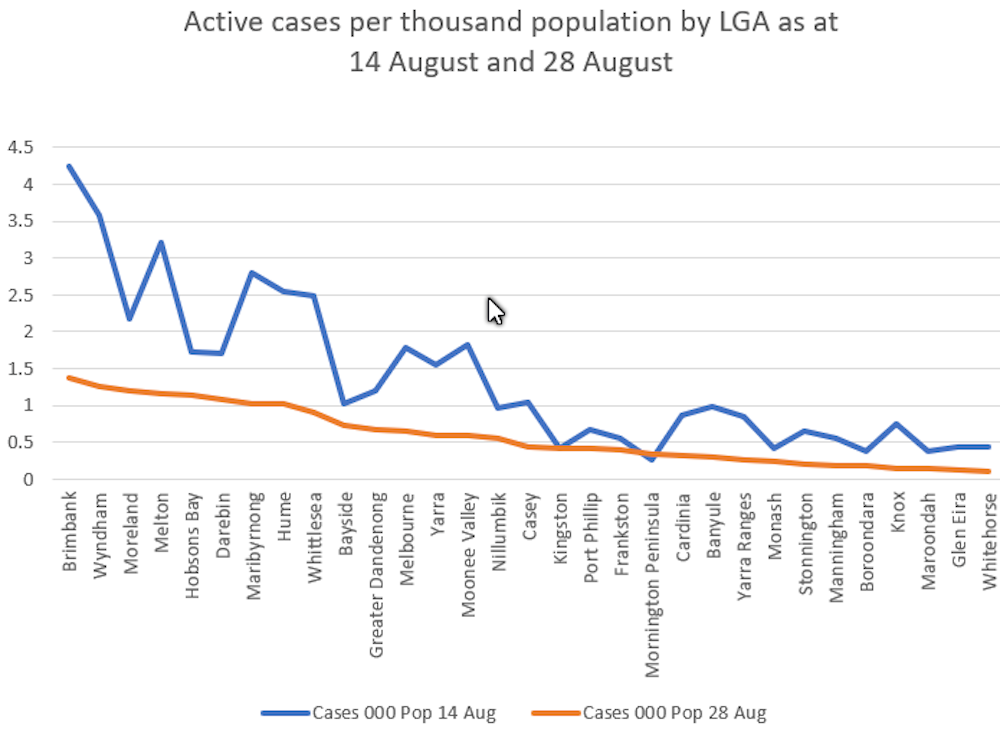
The chart below shows an encouraging picture. As active case numbers fell between August 14 and 28, the north-west/south-east disparity narrowed. Numbers fell a little faster in the north and west.

Chart showing rate of active COVID-19 cases per 1,000 people by local government area across Melbourne from August 14-28
Changes in rate of active COVID-19 cases across Melbourne by local government area. Data: covidlive.com.au, ABS, Author provided

However, the 16 lowest case rates (as of August 28) remained in the south and east. The nine highest were in the north and west.

A continued fall in case numbers across Melbourne will eventually justify reopening across the city. But the current disparity between north-west and south-east suggests reopening at different times in different places is a live option. Cold spots – groups of LGAs with the lowest case rates – could open sooner.

What factors might explain the divide?

Seeking to gain insights that might explain the differences between areas, we identified 30 variables for which census, population health, unemployment or other public data are readily available. A number of these variables were significantly correlated with active case numbers.

We found positive correlations (active case numbers increased along with these factors) for:

  • population

  • population growth rate from 2011 to 2016

  • persons per dwelling

  • unemployment rate

  • adult smokers

  • fair or poor health.

We found negative correlations (active numbers fell) for:

  • English-only is spoken at home

  • population aged 80 or over

  • socioeconomic status, as shown by the Australian Bureau of Statistics’ SEIFA Index.


Read more: Your local train station can predict health and death


Portrait of elderly couple at home
The correlation between areas with many people over the age of 80 and low rates of COVID-19 suggests those living at home took care to protect themselves. Lopolo/Shutterstock

Four variables explained 63.9% of the variance in active case numbers by LGA as at August 14. Factors such as the unemployment rate, SEIFA Index and fair/poor health dropped out, as these were significantly correlated with other retained variables.

The four retained variables were:

  • resident population – a larger LGA population is associated with more active case numbers

  • percentage speaking English-only at home – a lower proportion is associated with more active cases, emphasising the importance of language-appropriate COVID messaging

  • percentage of the population aged 80 and over – a larger proportion is associated with fewer active cases, suggesting good risk awareness in this vulnerable age group (although the impacts in many aged care homes have been shocking)

  • percentage of smokers – a higher rate is associated with larger active case numbers, perhaps suggesting respiratory vulnerability and/or lower risk awareness of this group.

As active case numbers have come down, the predicted impact of each of these four variables has also reduced. In combination, however, they still explain a similar proportion of the variance in active case numbers by LGA as in the peak period.

Interestingly, the effect of English-only spoken at home on the variance in active case numbers declined substantially between August 14 and 28. This trend suggests some success in language-appropriate messaging over that time.


Read more: Multilingual Australia is missing out on vital COVID-19 information. No wonder local councils and businesses are stepping in


Staged reopening poses issues for equity

Of the four included variables, the effect of the proportion of adult smokers has shown the smallest relative improvement as active case numbers have fallen. At LGA level, adult smoking is highly correlated with unemployment rate (+), reported fair/poor health (+), productivity (-) and the SEIFA Index (-).

These linkages suggest the burden of spatial disadvantage is having a lingering impact on active case numbers. As a result, a staged re-opening would pose equity concerns.

Worker in high-viz jacket and hard hat smoking as he leans against a shipping container
The correlation between rates of smoking and active COVID-19 cases is a pointer to the impacts of socioeconomic disadvantage. JooFotia/Shutterstock

The growing economic costs and adverse impacts of lockdown on many already disadvantaged people underline the importance of opening up areas in Melbourne and Victoria as soon as possible. The costs are both personal and societal. A failure to halt the decline in well-being will have continuing serious consequences, adding to inequality in Australia.


Read more: Why coronavirus will deepen the inequality of our suburbs


Early reopening of parts of Melbourne with the lowest active case numbers, which are concentrated in the south and east, is a policy option. However, action must then be taken to avoid reinforcing entrenched disadvantage in the north and west.

Early commitments by all levels of government to implementing the wide-ranging plans in the recently released North and West Melbourne City Deal Plan 2020-2040 would help. Good starting points for reducing disadvantage include upgrading mixed-use activity centres across the city’s north and west and immediately improving medium-capacity transit services in the Suburban Rail Loop corridor.

ref. Open COVID ‘cold spots’ first: a way out of lockdown for Melbourne – https://theconversation.com/open-covid-cold-spots-first-a-way-out-of-lockdown-for-melbourne-145387

‘A doubtful gleam of solace’: reading Tennyson’s In Memoriam AHH in difficult times

Source: The Conversation (Au and NZ) – By Darius Sepehri, Doctoral Candidate, Comparative Literature, Religion and History of Philosophy, University of Sydney

In our series Art for Trying Times, authors nominate a work they turn to for solace or perspective during this pandemic.

In Memoriam AHH, cantos 27 & 28, read by Darius Sepehri.

Alfred Tennyson’s 1833 poem “Ulysses”, was, he tells us, written under a sense of loss — “that all had gone by but that still life must be fought out to the end.”

Dealing with the inertia created by grief, and the will needed to resist and move ahead, the poem perfectly expresses what St Paul called the “hope against hope”. Despite the heroism of the famous last line, (“To strive, to seek, to find, and not to yield”), the poem’s defiance only makes sense in the light of the anguish animating it.

Tennyson’s book-length elegy In Memoriam AHH, published in 1850, once among the most popular poems in English, came out of the same sense that the whole world was over — not a world but the world — and yet life must be lived, somehow.

I experience In Memoriam as a soulful and provocative artwork, not a “relevant” one or one merely to be mined for therapeutic consolations.

Despite its formal control and elegance, and what we may hear as dated language, Tennyson’s long poem is tumultuous, chaotic, and not only personal but social, deeply connected with upheavals in Victorian society.

An 1851 edition of In Memoriam. Wikimedia

Read more: Ode to the poem: why memorising poetry still matters for human connection


Passion

Both Victorian and modern in style and composition, In Memoriam uses extraordinarily passionate language, tightly compressed. Its passion is directed by Tennyson at another man, his friend Arthur Hallam, a brilliant philosopher. Tennyson and Hallam met at university. We know their first encounters were magnetic and catalysing.

When Hallam died suddenly of a brain aneurysm in Italy in 1833, aged 22, it violently changed Tennyson’s life.

Bust of Arthur Hallam by Francis Leggatt Chantrey. Wikimedia

Tennyson took 18 years to write In Memoriam. The prologue and epilogue attest to unshakeable faith in Christianity and in life’s continuity. The prologue’s first line addressed to “Strong Son of God, immortal Love”, and the last lines professing the eschatological completion of the world in “one far-off divine event/To which the whole creation moves”, could hardly seem more assured.

And yet. The 131 cantos in between these bookends trace an agonising journey into suffering, doubt, helplessness and the possibility of unredeemed pain that has no meaning or purpose. The rhetorical strength of some of these cantos is such that it puts the orthodox Christian position the poem professes elsewhere in serious question.

The way the poem tries to think through the many grand subjects it raises, such as if God cares for each individual being, creates a meandering journey, now confused, now suddenly clear. This feels right for grief.

Cantos 34 & 38 recited by Darius Sepehri.

The poem spirals around its ideas, rejecting clean linear progression, organised around three Christmas sections (cantos 28, 78, and 104) of heightened feeling. Coming back and back to things, seemingly obsessed, Tennyson speaks of “a loss for ever new”. There is no “closure” of the wound. Can Christ really fill it? The world and its goods cannot.

I’ve committed many parts of In Memoriam to memory, made easier by the poem’s exceptionally memorable language (immortal, melodious phrases like “I loved the weight I had to bear/because it needed help of love”).

The poem’s form, entirely in quatrains of iambic tetrameter rhyming abba, composed in a long, ledger-like diary now kept at the British Museum, aids in memorisation.


Read more: Explainer: poetic metre


I recite a selection of cantos here, and the famous “Ring Out Wild Bells” sequence, which charts a move from devastation to rebirth.

In Memoriam has an almost relentlessly regular meter, meant to recall biological processes such as the beat of the heart and breathing, organic processes that sustain life even as the poet’s being cries that life has ended.

All creation mourns

After Tennyson received a letter telling him Hallam’s remains were coming back by sea to Hallam’s family in England, he wrote the very first part of In Memoriam, calling the ship home: “Sphere all your lights around, above/Sleep, gentle heavens, before the prow/ Sleep, gentle winds, as he sleeps now.”

A hypnotic enchantment is created with the ship phosphorescent as it sails at night.

The poem connects something cosmic and transcendent with Tennyson’s own very private, enclosed grief. Terrence Malick’s Tree of Life, a film where the death of a young son is juxtaposed with grand existential and metaphysical questions that interrogate God, also aimed for such territory.

Tennyson with his wife Emily and sons, circa 1862. He named one of his sons Hallam. Public Domain

Soulful ambiguity

“Dear friend, far off, my lost desire”, cries Tennyson. Today if a man speaks such excessive language of love to another man, we are likely to apply a defined identity or classification.


Read more: Guide to the classics: Walt Whitman’s Leaves of Grass and the complex life of the ‘poet of America’


Although modern readers may read Tennyson’s excessive professions of love for Hallam as homosexual, the nature of their relationship was unclear to Tennyson himself, and its expressions in keeping with Victorian sentimentality. He would have baulked at our collapsing of an entire world of feelings so complex.

In Memoriam testifies to the ineffability of human experience. Language is inadequate to capture its density and intensity.

Canto 5. Wikimedia

Tennyson was protective of the intensity of his feelings: hence the time he took to publish. He avoided the imperative to immediately display. Today we feel immense pressure to respond at once, in public, with clear stances, to make things transparent. Such transparency destroys soulfulness.

What makes our times so hard to bear are not just external circumstances themselves but the common ejection of mystery and suffering from art, and transcendence from consciousness.

In Memoriam dwells with the mysteries of being and death, mounts an impassioned defence of love and friendship, and — perhaps rarest of all — reminds us of something noble in the capacity to suffer for an ideal.

Tennyson’s lavish, excessive passion, his “tarrying with the negative” as Hegel put it, shows us how soulful art stirs us to life and staves off banality — but the cost must be paid.

Tennyson had a deep interest in Persian poetry through his friend Edward Fitzgerald (translator of the Rubaiyat of Omar Khayyam).

He surely found something in Persian poetry’s insistence that grief and joy are inseparable and that death is not total loss, because nothing we feel passionately and soulfully is truly lost to us.

ref. ‘A doubtful gleam of solace’: reading Tennyson’s In Memoriam AHH in difficult times – https://theconversation.com/a-doubtful-gleam-of-solace-reading-tennysons-in-memoriam-ahh-in-difficult-times-143614

Diarrhoea, stomach ache and nausea: the many ways COVID-19 can affect your gut

Source: The Conversation (Au and NZ) – By Vincent Ho, Senior Lecturer and clinical academic gastroenterologist, Western Sydney University

Media reports earlier this week described a Queensland nurse with stomach pains who went on to test positive for COVID-19.

Could stomach pains be another symptom of COVID-19? And if you have stomach pains, should you get tested?

Although we might think of COVID-19 as a respiratory disease, we know it involves the gut. In fact SARS-CoV-2, the virus that causes COVID-19, enters our cells by latching onto protein receptors called ACE2. And the greatest numbers of ACE2 receptors are in the cells that line the gut.

COVID-19 patients with gut symptoms are also more likely to develop severe disease. That’s partly because even after the virus has been cleared from the respiratory system, it can persist in the gut of some patients for several days. That leads to a high level of virus and longer-lasting disease.

We also suspect the virus can be transmitted via the faecal-oral route. In other words, the virus can be shed in someone’s poo, and then transmitted to someone else if they handle it and touch their mouth.


Read more: We don’t know for sure if coronavirus can spread through poo, but it’s possible


What type of gut symptoms are we talking about?

A review of more than 25,000 COVID-19 patients found about 18% had gastrointestinal symptoms. The most common was diarrhoea followed by nausea and vomiting. Abdominal pain was considered rare. In another study only about 2% of COVID-19 patients had abdominal pain.

Some people believe COVID-19 causes abdominal pain through inflammation of the nerves of the gut. This is a similar way to how gastroenteritis (gastro) causes abdominal pain.

Another explanation for the pain is that COVID-19 can lead to a sudden loss of blood supply to abdominal organs, such as the kidneys, resulting in tissue death (infarction).

Are gut symptoms recognised?

The US Centers for Disease Control has added diarrhoea, nausea and vomiting to its list of recognised COVID-19 symptoms.

However, the World Health Organisation still only lists diarrhoea as a gastrointestinal COVID-19 symptom.

In Australia, nausea, diarrhoea and vomiting are listed as other COVID-19 symptoms, alongside the classic ones (which include fever, cough, sore throat and shortness of breath). But abdominal pain is not listed.

Advice of symptoms that warrant testing may vary across different states and territories.

How likely is it?

Doctors often use the concept of pre-test probability when working out if someone has a particular disease. This is the chance a person has the disease before we know the test result.

What makes it difficult to determine the pre-test probability for COVID-19 is we don’t know how many people in the community truly have the disease.

We do know, however, COVID-19 in Australia is much less common than in many other countries. This affects the way we view symptoms that aren’t typically associated with COVID-19.

It’s far more common for people’s abdominal pain to be caused by something other than COVID-19. For example, about a quarter of people at some point in their lives are known to suffer from dyspepsia (discomfort or pain in the upper abdomen). But the vast majority of people with dyspepsia do not have COVID-19.

Similarly, irritable bowl syndrome affects about 9% of Australians, and causes diarrhoea. Again, the vast majority of people with irritable bowel syndrome do not have COVID-19.

So how about this latest case?

In the Queensland case, we know the nurse was worried he could have had COVID-19 because he was in close contact with COVID-19 patients.

As he seemed otherwise healthy before developing new abdominal symptoms, and considering he worked on a COVID ward, his pre-test probability was high. Doctors call this a “high index of suspicion” when there is a strong possibility someone may have symptoms due to a disease such as COVID-19.

What does this mean for me?

If you have new gastrointestinal symptoms and you’ve potentially been in contact with someone with COVID-19 or if you also have other classic COVID-19 symptoms (fever, cough, shortness of breath and sore throat) you should definitely get tested.

If you have just gastrointestinal symptoms, you may need to get tested if you’re in a “hotspot” area, or work in a high-risk occupation or industry.

If you have gastrointestinal symptoms alone, without any of these additional risk factors, there is no strong evidence to support testing.


Read more: 8 ways the coronavirus can affect your skin, from COVID toes, to rashes and hair loss


However, if COVID-19 becomes even more common in the community, these symptoms now regarded as uncommon for COVID-19 will become more common.

If you have concerns about any gastrointestinal symptoms, seeing your GP would be sensible. Your GP will provide a balanced assessment based on your medical history and risk profile.


Read more: 4 unusual things we’ve learned about the coronavirus since the start of the pandemic


ref. Diarrhoea, stomach ache and nausea: the many ways COVID-19 can affect your gut – https://theconversation.com/diarrhoea-stomach-ache-and-nausea-the-many-ways-covid-19-can-affect-your-gut-145440

Six graphs that explain Australia’s recession

Source: The Conversation (Au and NZ) – By Peter Martin, Visiting Fellow, Crawford School of Public Policy, Australian National University

Australia’s recession is the deepest since the Great Depression of the early 1930s.

Nothing else comes close.

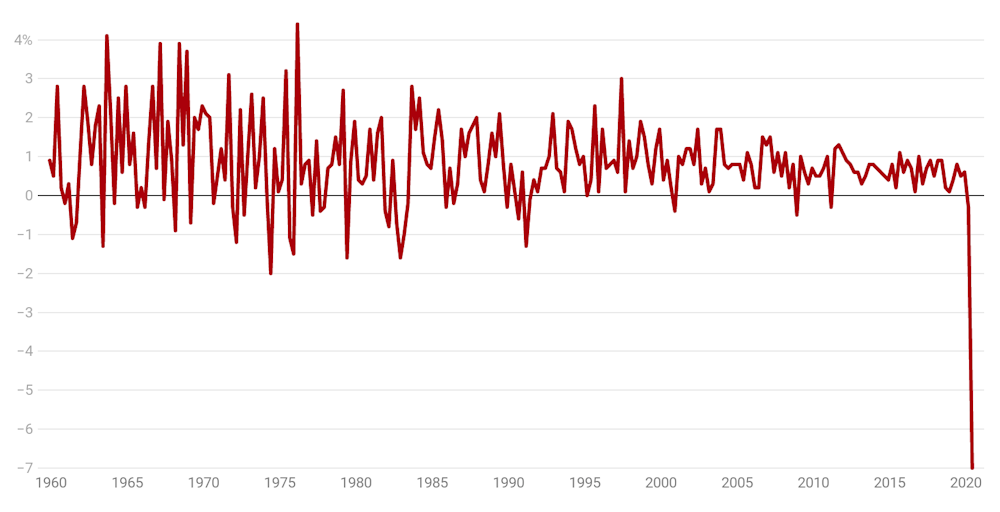
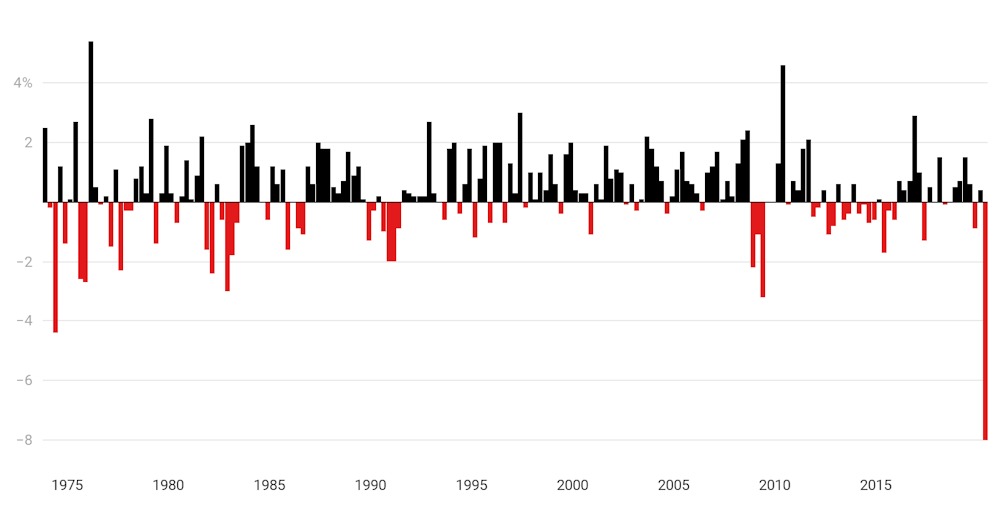
The economy shrank an extraordinary 7% in the three months to June – by far the biggest collapse since the Bureau of Statistics began compiling records in 1959.

The previous worst quarterly outcome was minus 2%, in June 1974.


Quarterly percentage change in gross domestic product

ABS National Accounts

It was going to be worse.

Treasurer Josh Frydenberg told a parliament house press conference that in March his advisers were predicting a collapse three times as big in the June quarter – 20%. In May the forecast was for a June quarter collapse of 10%.

Britain’s economy actually did collapse 20% in the June quarter; the US economy collapsed by nearly 10%.

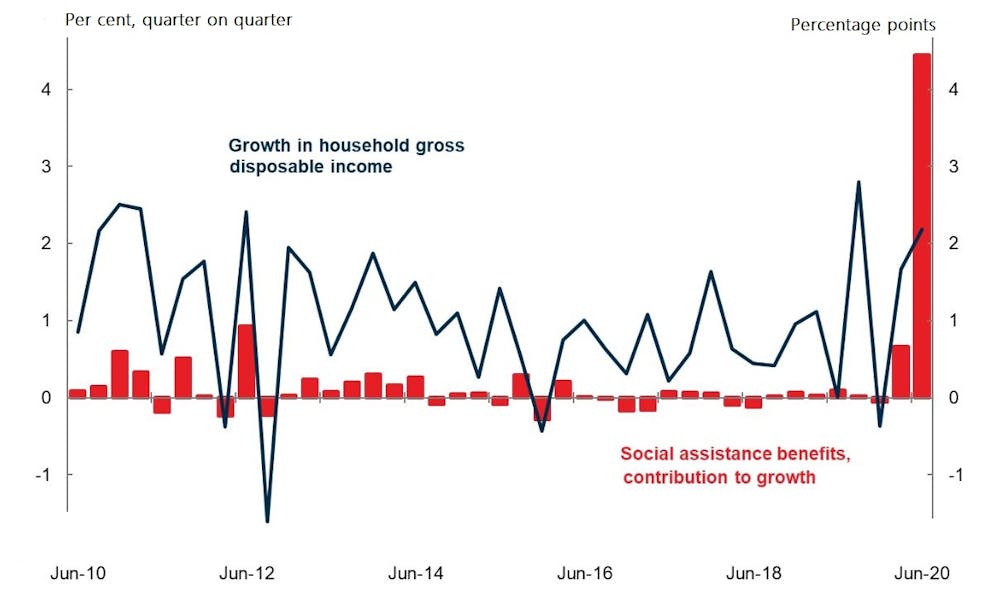
What staved off a collapse of the order feared was unprecedented government support – more than A$100 billion in JobKeeper and expanded JobSeeker payments alone–enough to actually lift household incomes while 643,000 Australians lost their jobs and many more lost hours.


Contribution of government benefits to household income growth

Commonwealth Treasury

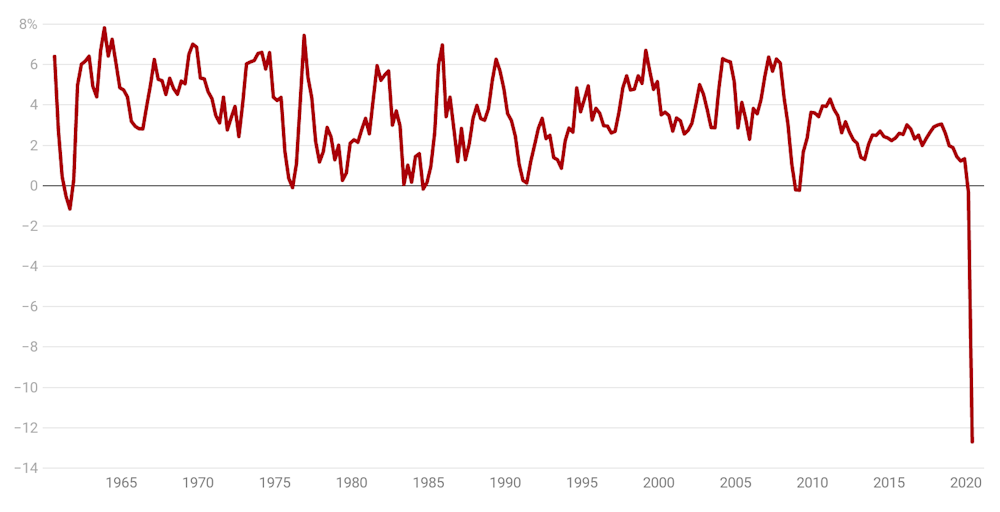
A better measure of living standards, taking account households and businesses, so-called “real net national disposable income per capita”, fell nonetheless, by a record 8%.


Quarterly percentage change in living standards

Quarterly change in real national disposable income per capita. ABS Australian National Accounts

Consumer spending fell by even more, an extraordinary 12.7%, in part because lockdowns and caution in the face of COVID-19 provided fewer opportunities to spend.

Given that consumer spending climbed not at all over the three quarters leading up to the June quarter, it meant that household spending fell over the entire financial year, for the first time since records have been kept.


Quarterly change in household final consumption expenditure

ABS Australian National Accounts

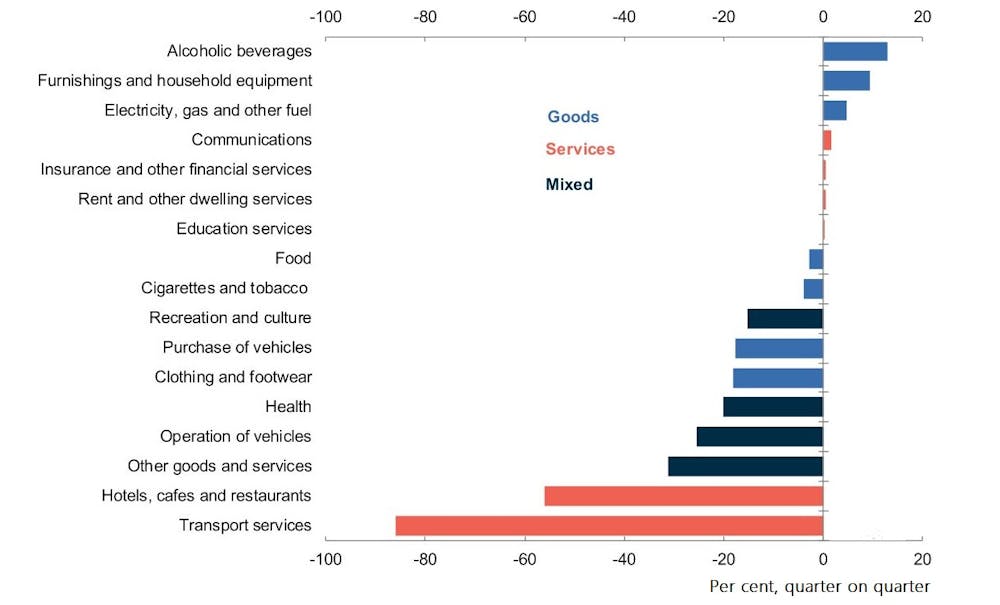
Spending on goods was barely hit, while spending on services collapsed 17.6%.

Spending on transport services, a category that encompasses everything from flights to public transport, fell 88%. Spending on accommodation, a category that encompasses tourism, fell 55.7%.

Spending on recreational and cultural services, a category that encompasses sporting events, gambling and performances and cinema admissions, fell 54.5%.


Household spending by category

Commonwealth Treasury

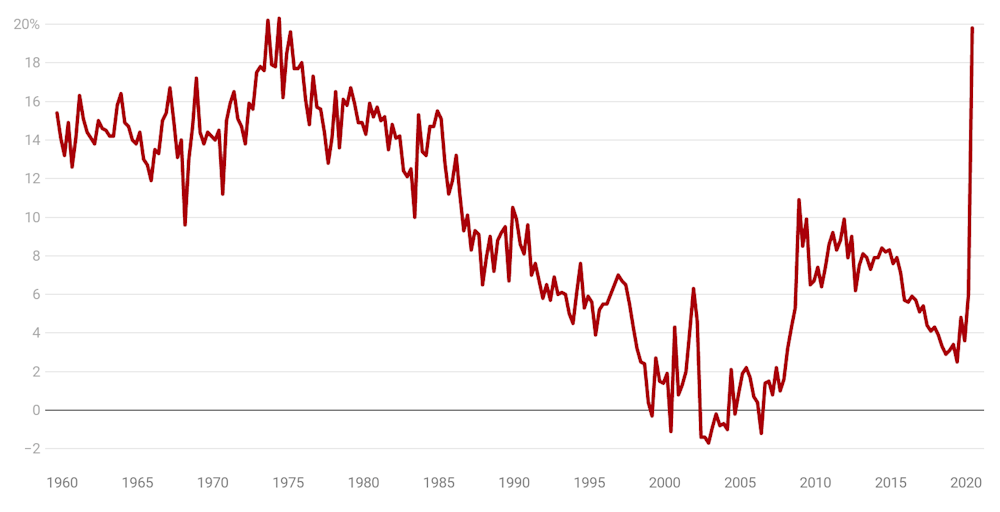
It meant far more income than usual was saved. During the depths of the global financial crisis, Australia’s household saving ratio climbed to a peak of 10.9% as households squirrelled away one in every ten dollars they earned.

In June they squirrelled away a remarkable 19.7% – one in five dollars that came in the door.


Household saving ratio

ABS Australian National Accounts

The Bureau of Statistics says if household income from special initiatives including early access to super was included, the household income ratio would be even higher. What it calls the “household experience savings ratio” would be 24.8%.

It’s possible to see households saving one in every four dollars as a “glass half full”. Frydenberg does.

He says this never-before-experienced accumulation of savings will be useful in the recovery, giving people the capacity to spend big when restrictions ease and they are better able to spend.

What if we remain unwilling to spend…

That’s assuming people aren’t “scarred” by the experience, left with damaged psyches and unwilling spend, a possibility the Treasurer acknowledges.

He says for the next quarter, the current one that encompasses the three months to the end of September, the Treasury is expecting economic activity to shrink only a little further or no further at all.

A lot depends on how soon Victoria’s Stage 4 restrictions and other restrictions are eased, which means a lot depends on things that are unknowable.

…and businesses unwilling to invest?

The Treasurer will deliver the budget in a little over four weeks’ time.

He said a key part of it will be measures to make it easier for businesses to do business, unlocking “entrepreneurship and innovation” at low cost.

Businesses certainly could invest more. Non-mining business investment was down 9.3% in the quarter. On Tuesday the Reserve Bank made available an extra $57 billion at low cost for banks to advance businesses and households.

But they are only likely to want to invest more when they can see returns.


Read more: Australia won’t recover unless Victoria does too. The federal government must step up


Examining the figures on Wednesday, former Reserve Bank economist Callam Pickering said they showed the economy being held together “with duct tape by JobKeeper and JobSeeker”.

At his press conference, Frydenberg resisted suggestions that he revisit the wind-downs of JobKeeper and the JobSeeker Coronavirus Supplement due to take place over the next six months.

But the Victorian situation is far worse than when he announced the schedule on July 21.

He might find there’s a case for more duct tape, for a while longer.

ref. Six graphs that explain Australia’s recession – https://theconversation.com/six-graphs-that-explain-australias-recession-145445

When it comes to economic reform, the old days really were better. We checked

Source: The Conversation (Au and NZ) – By John Daley, Senior Fellow, Grattan Institute

It’s become a truism of Australian politics that important economic reform peaked in the 1980s and 1990s.

Sometimes the early years of the Howard government in the late 1990s are given credit as well.

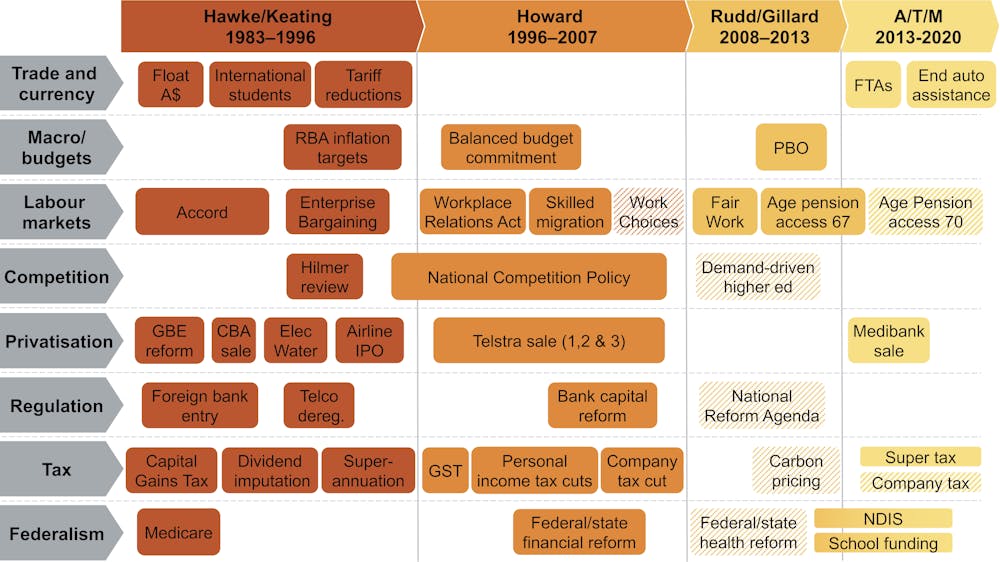
This Grattan Institute map of important reforms illustrates the story.


Important economic policy reforms in Australia

Notes: Reforms that were not passed, or that were subsequently substantially wound back or repealed, are shown shaded out. A/T/M = Abbott/Turnbull/Morrison. FTAs = Free Trade Agreements. PBO = Parliamentary Budget Office. GBE = Government Business Enterprise. CBA = Commonwealth Bank of Australia. Airline IPO = the sale and Initial Public Offering of Qantas in 1993 and 1995. Access Economics (2019); The Economist (2011); Grattan analysis

Indeed, it looks like Australian governments have merely ‘improved’ at unwinding the reforms of their predecessors, and the reforms they propose for themselves.

But it’s possible that this is all just the rosy-hued memories of former politicians, public servants, and journalists.

It might also be that today there are fewer policy reforms worth doing – perhaps most of the big ones have already been done.

To test whether previous governments really were better at reform than more recent governments, we would need a running list of reforms proposed in advance, so we could see what proportion were adopted.

Between 1972 and 2018, the Organisation for Economic Co-operation and Development produced 31 Economic Surveys of Australia – roughly one every 18 months.

Each publication put forward reforms that the OECD believed would increase economic growth and living standards.

The good old days were better

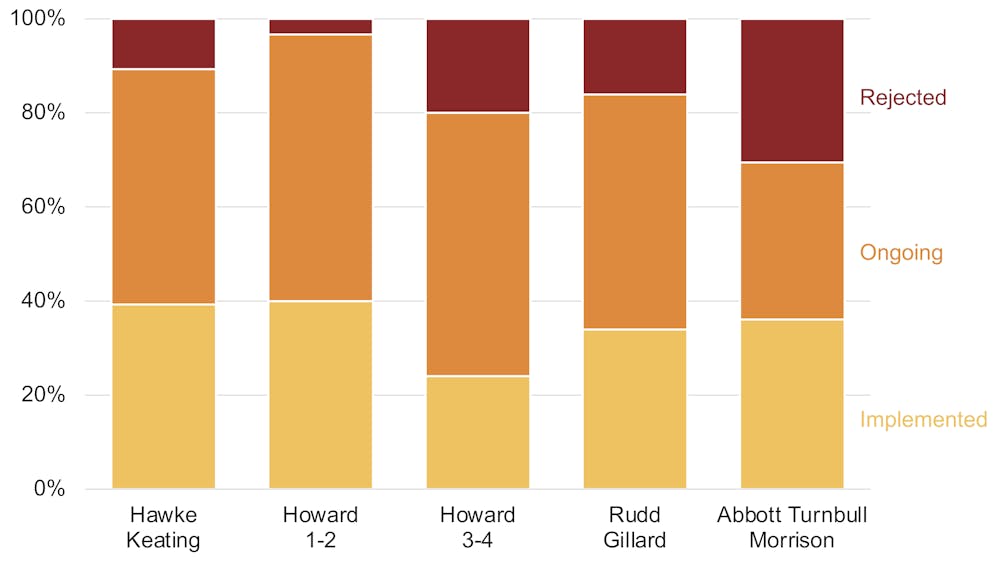
Our analysis of the full series finds that between 1984 and 2001 the overwhelming bulk of these recommendations were taken up by the Hawke and Keating governments, and by the Howard government in its first two terms.

But from roughly 2003 onwards, the record is a lot more patchy: many more of the reforms recommended by the OECD have been either rejected, only partially implemented, or (in the case of carbon pricing) implemented and then unwound.


Fate of OECD Economic Survey recommendations

For more details on methodology, see Grattan’s blog. OECD, Grattan analysis.

Policies that the OECD recommended but which ran into the sand include reducing the gap between the company tax and top personal income tax rates, implementing a mining resource rent tax, reviewing negative gearing, creating competitive neutrality among Australian ports, aligning the eligibility ages for superannuation and the age pension, including more of the value of owner-occupied housing when calculating eligibility for the age pension, and raising Newstart.


Read more: Grattan Orange Book. What the election should be about: priorities for the next government


A number of other proposed reforms continue to sit in the too-hard basket, including increasing the rate and coverage of the goods and services tax, swapping stamp duties for property taxes, congestion charging for roads, and the use of smart meters for time-of-day electricity pricing.

An imperfect measure, that tells us something

As a means to evaluate the history of reform, the OECD Economic Surveys aren’t perfect, but they’re guide.

It’s true that the scope and number of OECD recommendations has expanded over time, but that expansion was already underway during the Hawke/Keating and Howard eras.

And it’s arguable that these days, the OECD recommends smaller reforms – it certainly recommended many more between 1997 and 2010.

It’s likely that the OECD’s recommendations are partly influenced by the views of the government of the day. But many recommendations have been suggested under one government and implemented by the next.


Read more: One year on from the carbon price experiment, the rebound in emissions is clear


And while OECD recommendations aren’t gospel, many policy experts support most of them. For instance, all of the policies that are on the OECD’s continuing wish-list are also advocated by the Grattan Institute.

Our review of what happened after the OECD surveys is broadly consistent with popular wisdom, or at least the recollections of old men (usually men) that the good old days really were better.

And it is consistent with work in progress by Alphabeta reviewing the history of Australian economic reform.


Read more: Grattan Institute Orange Book 2018. State governments matter, vote wisely


Our review also shows that it often takes a long run-up of research, advocacy, and detailing before a government implements a major reform. Many reforms were only implemented after sitting on the slate for well over a decade, including the goods and services tax, lower tariffs, a more flexible award system, lower company tax, and competition in utility industries. Reforms often require patient advocacy.

It’s hard to prove beyond reasonable doubt that Australia has got worse at it. But our review of the OECD’s recommendations for Australia over the past 48 years is consistent with the oft-cited view that governments in the most recent 20 years have rejected many more significant reforms than governments in the 20 years before them.

There’s plenty still on the slate for the 20 years to come.

ref. When it comes to economic reform, the old days really were better. We checked – https://theconversation.com/when-it-comes-to-economic-reform-the-old-days-really-were-better-we-checked-145296

Common enemy overcomes fragile Pacific regional unity – climate change

By Sri Krishnamurthi, reporting for the Pacific Media Centre

Six years on from being appointed head of the Pacific Community, Director-General Collin Tukuitonga, a boy born on the tiny Pacific island of Niue, has a voice louder than a schoolboy rugby captain, a voice that serves him well as a Pasifika community leader.

There is little doubt his credentials are impressive for a boy who attended Niue High School and then the University of the South Pacific for foundation years 1 and 2 before arriving in New Zealand from Fiji after the 1987 coup.

Having done his New Zealand Medical Registration exams, he began to excel in the fields he chose.

READ MORE: InfoPacific – the geojournalism project

CLIMATE AND COVID-19 PACIFIC PROJECT – Article 4

And excel he did, as his curriculum vitae reads: Director of SPC’s Public Health Division; Chief Executive Officer of the NZ Ministry of Pacific Island Affairs; Associate Professor of Public Health and Head of Pacific and International Health at the University of Auckland; Director of Public Health, NZ Ministry of Health; and Head of Surveillance and Prevention of Chronic Non-Communicable Diseases at the World Health Organisation, Switzerland.

He scoffs at the description of a little boy from Niue who has made it big in the Anglo-Saxon, neoliberal, covid-19 world of today.

“I don’t know about making it big, but it has been definitely different and professionally rewarding, and hopefully I’m making a useful contribution to the community,” he laughs heartily in the Pacific way.

But his contribution to all aspects of leadership in medicine and public service cannot be taken lightly.

‘No holds barred’
As Fijian Dr Api Talemaitoga,  a GP in South Auckland and chair of the Pasifika GP Network who is also part of the Health Ministry’s Pasifika response and who worked with Tukuitonga during the H1N1 flu epidemic in 2009, says:

“He is great because he tells you like it is, no holds barred, no sugar coating the truth,” he says of Dr Tukuitonga.

The fact that Dr Tukuitonga spoke out during the current pandemic crisis, calling for a new public health agency is evidence enough of this.

“Sars and H1N1 were epidemics but covid-19 is a much bigger threat. We can be certain there will be viruses like this in the future,” says Dr Tukuitonga.

“Even if this pandemic settles down it doesn’t protect us from something else coming along. So, it’s always going be a risk for communities right around the world.”

However, while he credits establishing Pacific public health services in West Auckland and the poorer Māori communities in Northland (Ngati Hine and the Hokianga) as deeply satisfying, it is his work as director-general of the Pacific Community (SPC) based in Noumea, New Caledonia, that is the cream of his public service to the Pacific.

But it was fraught with difficulties, which he found a surprise.

Fragile unity in the Pacific
“Being appointed Director-General of the Pacific Community (SPC) and running that organisation for six years was a highlight in my life,” he says.

Twitter header
Dr Collin Tukuitonga’s Twitter feed header … running the Pacific Community for six years has been a highlight. Image: CT Twitter

But, “I learnt just how fragile unity is in the Pacific,” he says this with surprise.

“People talk about regionalism in the Pacific all the time and it is something people seek and desire but that actually is very difficult, elusive and fragile.

“Pacific regionalism and Pacific solidarity come with conditions, there is quite a level of distrust that exists and that’s holding back so many developments,” he says.

“But there are some good things going on – their collective approach to climate change has been impressive.

“Leading up to the 2015 Paris Agreement 2015 globally, nobody gave the Pacific a chance, but they banded together, and influenced some big players and got a good outcome in the form of the Paris agreement.

“The voices of the small Pacific Islands were heard at a global level that wasn’t because of chance. It came from the work of the Pacific Island leaders in communicating their concerns about climate change to the rest of the world,” he says.

Paris Climate Summit 2015
An award-winning poster, based on the famous “liberty” painting, at the World Wildlife Fund at the 2015 Paris Agreement summit. Image: WWF

Trying to push the polluters
“They were trying to push the polluters of the world to take responsibility for some of the things they had done.”

He praised the work done by Pacific leaders at a time when disunity could have been damaging.

“I do think they have done a tremendous job on climate change so that is an illustration of the Island nations having one enemy in common. Otherwise working together on regional issues is not so straight forward.

But it was considered better in the nation of his origins, he says.

“Niue is fortunate in the sense that if you talk about sea-level rise it is not an really an issue for Niue, but in term of the parts of climate change like killing coral and ocean acidification leading to coral bleaching they do affect Niue.

“They also feel the impacts of severe weather events like severe cyclones like everyone else around the Pacific.

“It is fortunate in that it is a high island and they don’t suffer from the sea-level rise parts but clearly they are vulnerable as everyone else with regards to climate change effects,” he says pensively.

Tokelau also at risk
However, Tokelau, as well as Kiribati, is also at a risk, says Dr Talemaitoga,

“When I visited there several years ago, the king tides were really something to see, the effects of climate change were starting to affect them then,” he says.

As for the heavy polluters, Dr Tukuitonga has a slightly different take on those countries,

“The Nationally Determined Contributions (NDCs) is in fact one of the important parts of the Paris agreement.

“That is why we spent quite a lot of time setting up the office in Suva to allow and enable the members to rethink and develop and introduce meaningful contributions

“So, I see it as a very important part of the implementation of the Paris agreement. But, like a lot of things, some countries take it seriously and some don’t,” he says.

Dr Collin Tukuitonga 020920
Dr Collin Tukuitonga …. The impacts of covid-19 on climate change? “In a sense, covid-19 is an aggravation because it would introduce health risks, limit movement of people and their ability to do things, such as their ability to try to mitigate and adapt to climate change.” Image: SPC

And the impacts of covid-19 on climate change?

Covid-19 ‘an aggravation’
“In a sense, covid-19 is an aggravation because it would introduce health risks, limit movement of people and their ability to do things, such as their ability to try to mitigate and adapt to climate change.

“I see covid-19 as an additional challenge for the small islands to face on of top climate change,” he says.

The Pacific environment will also be vulnerable to climate change he believes.

Coupled by pollution and various other practices such as overfishing and over-consumption has had an effect, he says.

“The combination of climate change, pollution, population growth, and the exploitation of the environment is a serious threat to the sustainability of the Pacific environment,” he expounds.

“There is a very strong drive to build more hotels in pristine places around the region because the drive for economic development is relentless and that leads to the destruction of our natural environment, so I do think it is a serious concern,” he says about the proliferation of tourist hotels in the region.

“The Pacific Ocean is increasingly polluted by actually pollution from outside the region but also the sea life is being threatened with overfishing and with ocean acidification as a result of that overfishing.

Pollution getting worse
“It will get worse; it has started already. That’s why the UN sustainable development goals are really important because one of those is dedicated to the protection of the health of the ocean.

“It’s already underway and I think we clearly need to do more within the context of climate change to protect and promote the environment around the region.

The same care should be taken when it comes to wildlife in the region.

“Sustaining wildlife goes hand-in-hand with environmental degradation so whatever we do to promote and protect biodiversity should, in fact, look to protecting the few species of wildlife that we have,” he says.

“Most of the small atoll nations in the world have very limited diversity, except the Pacific Ocean is one of the world’s largest ecosystems with quite a lot of biodiversity, some of which we don’t know about yet,” Dr Tukuitonga says.

“I have always been a fan of ecotourism and for travellers who spend a bit more money than the average person. I have never been a fan of bums on seats tourism and especially to little places. Ecotourism is a very important part of development landscape in the region,” he says.

He for one warned against the complacency that has taken hold in the Pacific with regards to covid-19. As a public health specialist, he notices how lax the testing had become in June and warned against that practice publicly.

Complacency factor
“I would have thought testing should have continued in earnest, without a doubt I think complacency is a factor and we should have done more testing,” he says in a few words.

After being 102 days covid-19 free in New Zealand, he used to be keen on the travel bubble to the covid free islands – but no longer.

“I was a keen promoter of that idea, but I would suggest to them right away not to pursue this. I would say to stop it.

“The problem is we don’t know quite what the spread is like in New Zealand and people could go to the Cooks or Niue integrating the virus there, so even if you test for it before going there’s not a guarantee that people with the virus are travelling to the destination so I would discourage it.”

And he has a passion outside his “norm of life”, a heartfelt one at that too.

“I’m very concerned about the Niue language because it is one of the realm languages that is in dire straits because very few Niueans speak it now and there is a very real chance that it will disappear completely.

“I’m part of a community effort to try to revitalise the language to have the young ones to speak the language.

Good health numbers
“It isn’t so bad around Fiji, Samoa, Tonga because there are good healthy numbers still living in those islands but the Cooks, Niue and Tokelau where the majority population are in New Zealand they don’t speak their first language it’s a real concern.

“I believe that absolutely that it is likely to affect their cultural behaviour because language is such a central and critical part of the culture and so while you can participate in your culture without speaking the language it is not the same as being able to speak the language which allow you to participate more fully,” he says.

“So, remember each generation of Cook Islanders and Niueans born in New Zealand would be further and further away from their culture so it is going to be a challenge to maintain,”

And that is likely to bring its own problems as Tonga found out recently.

“People feel disconnected from their social norms and traditional values, family connections are disturbed and of course that is almost an inevitable consequence that young people in particular would turn to drugs and crime. That is why I see languages as a protective element for our people,” he says with conviction.

He admits to being annoyed at not winning the World Health Organisation (WHO) regional director post for the Western Pacific last year when several Pacific nations showed themselves to be at the whim of foreign currencies.

“Only because I felt I had much to offer the Islands, also the Islands have never had a Pacific person in that leadership role, but life has moved on.”

Now the associate dean Pacific and associate professor at the University of Auckland, Dr Tukuitonga has been seconded to the Auckland Regional Public Health Service (ARPHS) one day a week and the service does the covid-19 contact tracing.

“I am happy to come back home and get involved in this. It’s good because it gives me a lot of freedom to explore the things that matter and I’m enjoying it.”

This is the fourth of a series of articles by the Pacific Media Centre’s Pacific Media Watch as part of an environmental project funded by the Internews’ Earth Journalism Network (EJN) Asia-Pacific initiative.

Print Friendly, PDF & Email

Article by AsiaPacificReport.nz

Let working graduates claim a tax deduction for their HECS-HELP debt

Source: The Conversation (Au and NZ) – By Michael William Blissenden, Professor of Law, University of New England

Most graduates leaving university today do so with a massive debt hanging over their heads. They will take many years to repay their accrued HECS-HELP debt through the taxation system. There will be little relief for these graduates as the government has slammed the door shut on the tax deductibility of these repayments against the income earned.

The government also intends, for new students from 2021, to increase the amount many students pay towards their education. Popular courses such as humanities, commerce and law will cost them A$14,500 a year. A combined commerce/law or arts/law course, which are the most popular study choice for aspiring lawyers, will cost them over A$70,000.

The government constantly reminds us government-supported students’ HECS-HELP debts are deferred. Only start when they reach the annual income threshold (A$45,881 for 2019-20) do they start repaying their debt.


Read more: Lowering the HELP repayment threshold is an easy target, but not the one we should aim for


The underlying rationale is that students are receiving an interest-free loan, as the HECS-HELP debt is only indexed to inflation (increases in CPI, the cost of living). HECS-HELP provides eligible students with a loan to pay their student contribution for a Commonwealth-supported place in their chosen course.

Another scheme exists for those students not eligible for a Commonwealth-supported place. This is called FEE-HELP. These students receive a loan to pay tuition fees for units of study in their chosen course. A FEE-HELP debt is also indexed each year.

Graduates repay these HELP debts if and when their earnings rise above the threshold.

However, as explained below, only graduates with a FEE-HELP debt can claim a tax deduction on their repayments.


Read more: Students’ low financial literacy makes understanding fees, loans, debt difficult


Two student loan schemes, two different rules

The usual rule for taxpayers is that expenses incurred in earning assessable income are deductible. Taxpayers can claim self-education expenses, which includes undertaking university courses, where they are able to show the study is connected with their income-earning activity. These deductible expenses include university fees or repayments of loans from the government under the FEE-HELP scheme.

In contrast to FEE-HELP repayments being deductible, student debt under the HECS-HELP scheme has specifically been rejected as a tax deduction under section 26-20 of the Income Tax Assessment Act 1997. These students are unable to claim a tax deduction for their university fees regardless of whether they are earning relevant income during their course or when they get a job as a graduate after completing their course.

Graduates start paying income tax on amounts above the normal tax-free threshold of A$18,200 but may not actually earn above the HECS-HELP threshold amount. On this basis graduates may be paying their fair share of tax on their income, but their HECS-HELP debt continues to grow over time. When graduates reach the threshold, they start paying both income tax and repayments of their HECS-HELP debt. In short, there is no tax relief for graduates.

The inequity between graduates and other taxpayers becomes clearer when you consider the additional self-education expenses these other taxpayers can claim. If already working within their chosen job and studying part-time, but not confined by the HECS-HELP tag, they can claim for textbooks, student union fees, computer expenses, internet costs for online learning and stationery.

Crucially, they can also claim for repayments of FEE-HELP debt. Once they reach an income threshold, this debt is also repaid through the taxation system.


Read more: Five things senators (and everyone else) should know about changes to HELP debts


Young woman with calculator smiling as she looks at laptop screen.
Come tax time, students with FEE-HELP debts are smiling compared to those with HECS-HELP debts. Shutterstock

Treat all self-education expenses equally

It is time to revisit the tax deductibility of HECS-HELP repayments. The current regime is complex, difficult to comprehend and has inbuilt inequities. The basic rule of tax deductibility should apply across the board, regardless of what type of support the government is providing to university students.

If we accept the arguments from the government that full-time students are receiving interest-free loans for their education and that the debt is deferred until they earn above the threshold, then there is an equally strong argument that graduates should then be able to defer, until that time, a tax deduction for the payment.

The general rule that a tax deduction is allowed to a taxpayer for expenses directly incurred in deriving income should apply to all relevant taxpayers. All taxpayers should be treated equally when spending on self-education. There should be no distinction between students receiving different types of HELP from the government.

At the moment undergraduate students tend to receive HECS-HELP while postgraduate students tend to receive FEE-HELP. These postgraduate students can immediately claim their repayments as a deduction in their tax return. This is because postgraduates are normally working in their chosen field and satisfy the necessary link between expense and income earned.

Undergraduate students tend to be studying full-time and working in casual jobs, which are not relevant to their studies. Students in this situation would not be able to claim their fees as a tax deduction regardless of the HECS-HELP tag. It would be equitable to amend the Tax Act to allow graduates to claim deductions for their debt later when they are working in their chosen field.

ref. Let working graduates claim a tax deduction for their HECS-HELP debt – https://theconversation.com/let-working-graduates-claim-a-tax-deduction-for-their-hecs-help-debt-145027

Too little, too late, too confusing? The funding criteria for the arts COVID package is a mess

Source: The Conversation (Au and NZ) – By Jo Caust, Associate Professor and Principal Fellow (Hon), School of Culture and Communication, University of Melbourne

On Tuesday, seven months after the sector closed down in March, applications opened for the government’s COVID-19 arts relief package, named “Restart Investment to Sustain and Expand”, or RISE.

A$75 million will be allocated between 2020 and 2021, but a close read of the criteria for this new funding program raises more questions than it answers.

The recipients will be selected by department officials. Their proposals must be “efficient, effective, economical and ethical”.

And, perhaps most crucially, in the shadow of the “sports rorts”, the NSW “arts rorts”, and the pain felt by the sector during the Brandis era, the final say on where the grants go will be placed in the hands of the federal minister for the arts, Paul Fletcher.

An opaque process

The standard mode for delivering arts funding in Australia is through arms length funding judged by artform peers.

It has been long recognised government arts support should be kept separate from political processes, and arts knowledge – as in fields such as science, medicine or education – is a prerequisite for determining the quality of arts funding applications.

The RISE funding guidelines applications will be assessed by “experienced assessors” from the Department of Infrastructure, Transport, Regional Development and Communications – a department that dropped “arts” from its name this Feburary.

Will these “experienced assessors” have any artform knowledge or experience, or simply be experienced in assessing grants?

The document states the government assessment officials are allowed to consult more widely, including with the Australia Council or State government entities – but this does not imply any peers will be involved in the process.

Further, the officials will only be making “recommendations”, and the minister “decides which grants to approve.”

The arts have an uneasy recent history with arts ministers deciding funding.

In 2015, then minister George Brandis reallocated A$104.7 million from the Australia Council’s funding to fund his own scheme for “excellence”, later named Catalyst.

This did not end well for either the minister or the arts. Brandis lost his job under a new prime minister and Catalyst was retired.


Read more: After the Catalyst arts funding mess, many questions remain


The Australia Council never returned to its pre-Brandis funding allocation.

In New South Wales in 2018, the ABC reported the minister for the arts had interfered in the funding decision process, overruling recommendations and redirecting money to his own favoured projects. And in the lead up to the last NSW state election, more reporting found arts grants were selectively targeted to organisations in Coalition-held seats.

Efficient, effective, economical and ethical

The funding guidelines say projects must represent “value for relevant money”, defined as “an efficient, effective, economical and ethical use of public resources”.

What is “value for money” in the context of the arts? It could be the amount of money requested, the intent of the project, the quality of the people involved, the numbers in a potential audience, or the amount of money that may be earned.

How do you determine “efficiency”? Is a play with a cast of two deemed more “efficient” than a play with a cast of four? Or is a project more “efficient” if it involves no people at all and only involves technical effects?

Ballet dancers seen from behind, in a row with toes pointed and arms outstretched.
What does ‘effective’ mean when we talk about the arts? AAP Image/Nikki Short

Is performance “effective” if it can occur over several platforms – live, in audio and in video – and so it has a broader audience impact? Or perhaps that makes it “economical”.

The meaning of “effective” here could be that a performance moves one to tears or to laughter. It has an emotional “effect” on the audience.

The term “ethical” might suggest no animals are hurt during the production – or maybe it is just another way of describing high moral values.

‘Contributing to government objectives’

The conditions for funding note:

Activities must demonstrate that there is a funding need, contribute to job creation, support Australian artists or performers (or their work), provide experiences to audiences, be of a nature that is likely to be popular with Australian audiences, and financial viability.

These are all factors which are hard to argue in an arts grant proposal. There isn’t a formula for producing popular art.

Perhaps of most concern though is that any proposal should be “contributing to government objectives”.

Woman in silhouette stands in front of a grey-scale video.
George Brandis threatened to withdraw funding from the 19th Sydney Biennale, which opened in March 2014. AAP Image/Quentin Jones

Many arts projects are critical of government objectives and policies. That is the nature of arts practice which takes a critical or different view of the world we live in.

This potential for public criticism by artists has a chequered recent history in Australia. In 2014, Brandis threatened to withdraw government funding from the Sydney Biennale for refusing sponsorship from Serco due to their work in immigration detention.


Read more: We should value the Biennale protest, not threaten arts funding


Welcome, with lingering concerns

Given the impact of the pandemic, the arts in Australia are in a dire situation and the sector needs all the help it can get. But it is important the process for making decisions in arts funding is transparent, ethical, and not subject to any political preferencing or rorting.

While this package is welcome – if not long overdue – the selection criteria suggests an approach that does not serve arts practice well and in fact suggests that, once again, a minister for the arts is exercising his personal largesse and judgement.

The Brandis era resulted in a senate inquiry, a divided arts sector and a significant loss in arts funding.

Let’s hope history isn’t doomed to repeat.

ref. Too little, too late, too confusing? The funding criteria for the arts COVID package is a mess – https://theconversation.com/too-little-too-late-too-confusing-the-funding-criteria-for-the-arts-covid-package-is-a-mess-145397

By allowing the Peter Ellis appeal to continue, the Supreme Court recognises the right to justice outlives the individual

Source: The Conversation (Au and NZ) – By Kris Gledhill, Professor of Law, Auckland University of Technology

Whether or not Peter Ellis’s appeal against his remaining child abuse convictions from the Civic Creche case is successful, the fact it can be heard at all is significant.

The Supreme Court decision announced today not only opens the door for the first substantive criminal appeal after someone has died, it also points to a gap in our Criminal Cases Review Commission, the recently established body designed to deal with miscarriages of justice.

The Supreme Court won’t reveal its reasoning until its decision on the appeal, but one of the arguments in favour of the appeal continuing was based on the notion under tikanga Māori (traditional rules and tenets) that a person’s mana (prestige, authority) continues after death, and extends to their wider whānau/family.

At the same time, recognition of the importance of correcting judicial errors comes in the form of an ancient royal power. The prerogative of mercy allowed the monarch to interfere with criminal convictions and sentences by granting a pardon.

This clearly applied to people who were dead, necessarily so because the error might in the past have led to execution. A famous example of this involved Derek Bentley, who was executed in England in 1953 and pardoned in 1993.

The long road of appeal

In New Zealand the governor-general has the prerogative of mercy. In addition to this monarchical power, section 406 of the Crimes Act 1961 allows them to refer convictions or sentences back to the appeal court.

This is the route Ellis embarked on some time ago. His original conviction on 16 charges dates back to 1993. An appeal in 1994 was successful on three charges but unsuccessful on the other 13. A second appeal was heard after a reference by the governor-general, but this was dismissed in 1999.

Another application was made under section 406. This led to a judicial inquiry but no reference back to the Court of Appeal.


Read more: When life means life: why the court had to deliver an unprecedented sentence for the Christchurch terrorist


So, the most recent court decision is the one from 1999. The date of the convictions and appeals means the case could technically have been appealed to the Privy Council in London (as happened in Teina Pora’s case). However, Ellis’s lawyers went to New Zealand’s Supreme Court instead. The court granted Ellis permission to appeal further in July 2019.

The question at the centre of that appeal was whether a miscarriage of justice occurred in light of all the evidence now to hand.

four people at a table

Author Lynley Hood, then-MP Don Brash, former creche supervisor Gaye Davidson and then-MP Katherine Rich after a petition was presented at Parliament in 2003 calling for a royal commission into the Christchurch Civic Creche child abuse case. GettyImages

The place of tikanga Māori in law

But then Ellis died and the argument began over whether the appeal should be allowed to continue.

This was heard in two parts – first in late 2019 and then at the hearing in June 2020 when the role of tikanga was argued in detail.

We will eventually find out what our most senior judges concluded about this significant matter. But it should not be controversial that the common law – the law made by judges – reflects the society in which it operates and not just the society in which it originated (England).

In fact, the Supreme Court has already recognised a role for tikanga in a very different context: decisions about who has the right to decide where a body should be buried. Recognition of a wider role for tikanga could be an important step in ensuring our law is suited for our circumstances.

Reputation matters even after death

The decision to establish the Criminal Cases Review Commission in 2019 recognised the importance of a more systematic approach to investigating possible miscarriages of justice. It was a welcome change, reversing the position of previous governments, but eligibility is limited to living persons or someone they have authorised.


Read more: Jailing the Christchurch terrorist will cost New Zealand millions. A prisoner swap with Australia would solve more than one problem


A few other countries already have such a commission. Derek Bentley’s murder conviction was eventually overturned in 1998 after the equivalent body in England and Wales referred his case back to their Court of Appeal. Indeed, its first reference was the case of Mahmoud Mattan, the last man to be hanged in Wales, but who should never have been convicted.

These cases illustrate the importance of recognising that wrongs might have been done to people who have died. Allowing appeal courts to correct the record and remove the stigma is important for the reputation of the person. This continues after death.

The governor-general’s powers will remain, but our Criminal Cases Review Commission should have the power to consider applications on behalf of those no longer living. Parliament needs to consider this issue.

The Supreme Court’s finding that the Ellis appeal should continue confirms this is an important value in our legal system.

ref. By allowing the Peter Ellis appeal to continue, the Supreme Court recognises the right to justice outlives the individual – https://theconversation.com/by-allowing-the-peter-ellis-appeal-to-continue-the-supreme-court-recognises-the-right-to-justice-outlives-the-individual-145447

How Clive Palmer could challenge the act designed to stop him getting $30 billion

Source: The Conversation (Au and NZ) – By Murray Wesson, Senior Lecturer in Law, University of Western Australia

The West Australian government recently took the extraordinary step of passing legislation to try to stop mining magnate Clive Palmer from collecting about $30 billion in damages from the state.

As Premier Mark McGowan argues, such a hefty bill risks bankrupting WA.

While the so-called “Mineralogy Act” passed state parliament in just two days, it is far from straightforward.

It raises a host of questions that are likely to be tested in courts in the months – and possibly years – ahead.

What is this dispute about?

Palmer is no stranger to litigation. Recently, he has also been fighting the WA government over COVID border closures.

But this particular dispute dates back to 2012 and concerns an iron ore project in the Pilbara.


Read more: Federal Court finds border closures safest way to protect public health in Clive Palmer case


Palmer has argued his development proposals for the Balmoral South iron ore project were unlawfully refused by the previous state government, under former premier Colin Barnett. He is reportedly seeking about $30 billion in damages.

The Mineralogy Act

In mid-August, the state government passed the Mineralogy Act to terminate the damages claims against it.

WA Premier Mark McGowan
The McGowan government says the legislation is needed to protect the ‘interests’ of WA. Richard Wainwright/AAP

Before this, Palmer and his companies, including Mineralogy, had been pursuing these claims through arbitration – a dispute resolution process that happens outside the courts. This arbitration was about whether the WA government properly dealt with proposals Palmer’s companies made under a 2002 agreement.

Last week, after the act passed, Palmer declared he would sue McGowan and Attorney-General John Quigley for “contempt of the High Court of Australia”.

This is likely to be one of many salvos in a protracted legal battle.

Does Palmer have a claim for contempt of court?

Contempt of court means acts that interfere with or undermine the authority, performance or dignity of the courts.

The Mineralogy Act seeks to terminate the arbitration for the reported $30 billion claims.

It also invalidates existing arbitral awards, which are decisions determining parties’ rights and liabilities. Given that arbitrations are not court proceedings, these aspects of the act do not establish contempt of court.

However, where a party does not comply with an arbitration award, the award can be registered with the courts and then enforced as if it were a court judgment.

Dumper truck in the Pilbara.
This dispute is over an iron ore project in the Pilbara. Kim Christian/AAP

Before the act was passed, Palmer had registered two arbitration awards in the Queensland Supreme Court. The act seeks to remove the basis for these claims. There is precedent that this may constitute contempt of the Queensland court (although contrary to Palmer’s assertions, not the High Court).

However, even if Palmer establishes contempt of the Queensland court, that would not invalidate the Mineralogy Act. Any penalty imposed by the court would also be modest in comparison to the $30 billion damages claim.

Can the WA parliament pass a law that takes away rights without compensation?

Apart from the contempt issue, Palmer may argue the WA parliament cannot pass a law that takes away individual rights without compensation.

In this regard, state laws that take away rights are unusual, but not new.


Read more: The WA government legislated itself a win in its dispute with Clive Palmer — and put itself above the law


The High Court and Queensland and WA supreme courts have previously treated state laws that remove rights of particular persons without just compensation as valid.

While the WA parliament has not previously amended a state agreement with a mining company without consent, this was found to be valid in Queensland. This approach is consistent with the principle that the present parliament can generally amend existing laws.

As a political, rather than legal matter, politicians have found that laws targeting mining rights can be hazardous.

Whether public opinion will ultimately support the Mineralogy Act remains to be seen. But the current popularity of the WA government over its handling of COVID-19 and the potential popularity of “saving” the state’s finances will undoubtedly influence perspectives.

Are parts of the Mineralogy Act unconstitutional?

Palmer may also argue parts of the Mineralogy Act are unconstitutional.

Parliaments can pass laws about matters involved in ongoing legal disputes. They can even target particular cases or parties. But based on Chapter III of the Constitution, they can’t compromise the court’s integrity by telling a court how to decide. This constitutional line is often tricky to draw.

Clive Palmer at a press conference on the Gold Coast.
Clive Palmer says he will sue the WA government over the Mineralogy Act. Dan Paled/AAP

The act does not entirely remove the court’s power to examine the legality of government actions. But it does try to stop courts from giving remedies that are unfavourable to WA.

So, it doesn’t quite tell courts how to decide, but it does restrict what they can do, which is getting into uncertain constitutional territory.

The WA government has described the Mineralogy Act as “unprecedented,” containing a number of measures that are “not usual”.

but Mineralogy and Mr Palmer are not normal and these measures are needed to best protect the interests of the state and the community.

However, even necessary laws must be constitutional.

Does Palmer really stand to gain $30 billion in damages anyway?

Palmer has said the widely reported $30 billion price tag is “bullshit”. But Quigley tabled details in parliament last month showing the total damages sought by Palmer and his companies in relation to the iron ore project was at least $27.75 billion.

Palmer’s damages claims focus on the loss of opportunities to develop and sell the project to Chinese state-owned enterprises.

But core principles for assessing damages for breach of contract – which in this case is a 2002 agreement between Mineralogy and the state government – may stand in the way.


Read more: These young Queenslanders are taking on Clive Palmer’s coal company and making history for human rights


The state’s improper delay in approving the project must have caused the loss – but it is not clear this is the case. There may have been other reasons for the losses, including the post-GFC mining slump.

Also, the value of what Palmer has lost needs to reflect the likelihood the project would have occurred without the delay, and so is likely to be much lower than $30 billion.

Palmer must also have taken reasonable steps to minimise his loss. This might mean following the standard industry practice of amending the development proposals to meet state government conditions, noting the Mineralogy Act still leaves this possibility open.

What happens now?

Palmer has a potential claim that the passage of the Mineralogy Act constitutes contempt of the Queensland Supreme Court. It is also possible parts of the act, such as those that restrict the remedies available to courts, are unconstitutional.


Read more: Mineral wealth, Clive Palmer, and the corruption of Australian politics


However, even if Palmer succeeds in these claims, it is not clear how much he will actually gain financially, or if his claim is really worth $30 billion.

The Mineralogy Act is so unusual, it would be foolish to predict outcomes to these complex legal questions. Over the coming months, we will start seeing answers to these questions as Palmer brings lawsuits and proceedings work their way through the courts.

The answers will provide profound insights into the decision-making powers of states.

ref. How Clive Palmer could challenge the act designed to stop him getting $30 billion – https://theconversation.com/how-clive-palmer-could-challenge-the-act-designed-to-stop-him-getting-30-billion-145098

Pain-sensing electronic silicone skin paves the way for smart prosthetics and skin grafts

Source: The Conversation (Au and NZ) – By Madhu Bhaskaran, Professor, Electronic and Communications Engineering, RMIT University

Skin is our largest organ, made up of complex sensors constantly monitoring for anything that might cause us pain. Our new technology replicates that – electronically.

The electronic artificial skin we’ve developed reacts to pain stimuli just like real skin, and paves the way for better prosthetics, smarter robotics and non-invasive alternatives to skin grafts.

Our prototype device mimics the body’s near-instant feedback response and can react to painful sensations with the same lighting speed at which nerve signals travel to the brain.

Our new technology, details of which are published in Advanced Intelligent Systems, is made of silicone rubber with integrated electronics. It mimics human skin, both in texture and in how it responds to pressure, temperature and pain.

Human skin senses things constantly, but our pain response only kicks in at a certain threshold. Once this threshold is breached, electric signals are sent via the nervous system to the brain to initiate a pain response.

You don’t notice when you pick up something at a comfortable temperature. But touch something too hot, and you’ll almost instantly recoil. That’s our skin’s pain-sensing system in action.

Helping hand

Our new pain-sensing electronic skin is a crucial step towards the development of “smart prosthetics” featuring sophisticated feedback systems. We want to develop medical devices and components that show similar pain sensing responses to the human body.

Sample of silicone skin
Stretchable, smart silicone skin. RMIT University, Author provided

Prosthetics significantly improve an amputee’s quality of life, but they still lack the ability to sense danger. A prosthetic hand does not sense when it’s placed on a hot surface, while someone with a prosthetic arm might lean on something sharp but won’t realise the damage being caused.

Technology that provides a realistic skin-like response can make a prosthetic much more like a natural limb.

With further development, our electronic skin could also potentially be used for skin grafts, in cases where the traditional approach is not viable.

Hand with silicone skin overlaid
The new silicone skin could pave the way for smarter skin grafts. RMIT University, Author provided

Skin in the game

We created our electronic skin by building on our research group’s previous breakthroughs in stretchable electronics, temperature-sensitive materials, and brain-mimicking electronics.

For example, we used our process for integrating temperature-sensitive vanadium oxide, a material that can change its electronic behaviour in reaction to temperatures above a particular threshold (65℃ in this case).

This material then triggers electrical signals similar to those generated by our nerve endings when we touch something hot. The electrical signal from the sensing part of the system (which is temperature- or pressure-sensitive) goes to a brain-mimicking circuit which processes the input and makes a decision based on threshold values.

The electrical output from the brain-mimicking circuit is like the nerve signals that initiate a motor response (such as moving your hand away) in the human pain response.

In our experiment, we measured the current generated. To use the silicone skin for real, this would need to be connected to nerve endings or apparatus that could initiate a motor response.


Read more: It’s not easy to give a robot a sense of touch


Our material responds just as fast as a real human pain response, mimicking the entire process from stimulus to response triggers from the brain – or in our case, the brain-mimicking circuit. The response is stronger depending on both the intensity and time of stimulation – just like a real human pain response.

The electronic skin brings to reality the threshold-based responses to pain, both in the way the skin reacts differently to pain above a certain threshold and how it takes longer for skin to “recover” from something that’s more painful. This is because stronger stimuli generate more voltage across the brain-mimicking circuit.

We can also modify this threshold in our devices to mimic the way injured skin (such as sunburnt skin) can have a lower pain threshold than normal skin. The electronic skin can also be used to increase sensitivity, which could be particularly useful in sports and defence as well as for skin grafts.

Another unique application could be smart gloves that could provide precise feedback from a surgeon’s hands when palpating tissue.


Read more: Prosthetic limbs affect our attitudes to disability – expressive design might change things for the better


Our silicone skin will need further development to integrate the technology into biomedical applications. But the fundamentals – biocompatibility and skin-like stretchability – are already there.

The next steps are working with medical researchers to make this even more “skin-like”, and to figure out how best to integrate it with the human body.

ref. Pain-sensing electronic silicone skin paves the way for smart prosthetics and skin grafts – https://theconversation.com/pain-sensing-electronic-silicone-skin-paves-the-way-for-smart-prosthetics-and-skin-grafts-145386

Indigenous children are leaving out-of-home care to uncertain futures. This is the support they need

Source: The Conversation (Au and NZ) – By Phillip Mendes, Associate Professor, Director Social Inclusion and Social Policy Research Unit, Monash University

The Black Lives Matter protests have highlighted concerns about white-dominated systems and structures and the oppression of Indigenous people. Most notable is the high rate of Aboriginal and Torres Strait Islander deaths in custody.

Another less-publicised but equally significant concern is the large number of Indigenous children in out-of-home care. This is currently estimated at 18,000 children — more than one-third of children in the system.

An estimated 1,140 Indigenous young people leave out-of-home care annually, but state and territory governments provide limited assistance to them to transition to independent adulthood or reconnect with their culture and community.

There are several factors that help explain the large number of Indigenous children in out-of-home care. Many of these are rooted in past policies of forced removal of children from their homes, which caused inter-generational trauma for many Indigenous communities and resulted in enduring socio-economic disadvantage.

For example, research on children living in households with members of the Stolen Generations has found they experience a range of adverse outcomes, such as poor health, high stress and frequent non-attendance at school.

On a positive note, the over-representation of Indigenous children in out-of-home care has recently been included in the new Closing the Gap targets, with an aim to reduce the rate by 45% by 2031.

The new Closing the Gap targets have set an ambitious goal for reducing the number of children in out-of-home care. Mick Tsikas/AAP

Lack of basic data on Indigenous children in care

Little is known about the experiences of Indigenous children in out-of-home care, or the effectiveness of existing services to support their transition to adulthood.

Young people transitioning from out-of-home care (known as “care leavers”) are generally a vulnerable group due to their difficult childhoods, problematic experiences in care and accelerated transitions to adulthood. On top of that, many Indigenous care leavers face dislocation from culture and kinship structures, as well as racism.


Read more: FactCheck Q&A: are Indigenous children ten times more likely to be living in out-of-home care?


There is even a lack of clarity about the number of Indigenous young people leaving out-of-home care each year. It appears Indigenous youth make up about one-third of all children leaving care, but there are discrepancies between the figures provided by the Australian Institute of Health and Welfare and the states and territories.

It is also uncertain whether this data includes young people who return to live with their families, as well as those who transition into so-called “independent adulthood”.

As a first step, we need a nationally consistent system for collecting this data in order to adequately address their needs.

Lack of support, cultural planning and life skills

Our national study of Indigenous care leavers has identified major deficits in our existing support services, programs and policies to help them, too.

Firstly, there is little funding specifically set aside for these young people, despite the widespread recognition of their unique cultural needs and disadvantages.

Only Victoria and Queensland allocate specific funding to Aboriginal community-controlled organisations to deliver leaving care services to Indigenous children so they can develop cultural connections and access housing, health services, education, training and employment.


Read more: Another stolen generation looms unless Indigenous women fleeing violence can find safe housing


International research shows that providing Indigenous young people with connections to culture and community can help make transitions from care much smoother.

Yet, in Australia, we found many Indigenous youth either do not have transition plans when exiting care, or the plans are inadequate. This contributes to poor outcomes for these care leavers, including a risk of homelessness and imprisonment. For young women, there is also the threat of family violence, early pregnancy and removal of their children.

Many Indigenous youth also prefer to live with family members rather than live alone. So, another challenge for Indigenous care leavers is accessing stable and affordable housing that is culturally appropriate.

And many young people exit care and take on responsibilities, such as caring for younger siblings or other family members, without having acquired basic independent living skills, such as cooking and budgeting. Many also struggle to access education and employment.

How can we better help Indigenous care leavers?

So, what does a good transition plan look like? We’ve arrived at several recommendations:

  • commence as early as possible, starting as young as 12 to 15 years old

  • target independent living skills such as cooking, cleaning and budgeting

  • support relationships with wider social and community networks

  • include key transition areas, such as education, employment and housing, plus a strong connection to culture.

It is highly preferable that Aboriginal community-controlled organisations be responsible for transition plans as they understand Indigenous youths’ cultural needs. These organisations need to be funded proportionately to develop effective leaving care programs.

Additionally, there is a strong belief the National Framework for Protecting Australia’s Children should include a new commissioner for Indigenous youth to oversee a national strategy for care leavers. This strategy should also adhere to the Aboriginal and Torres Strait Islander child placement principle.

Lastly, greater emphasis should be placed on early, supportive intervention for Indigenous families to prevent the removal of children in the first place, or to enhance the prospects of children’s reunification with their families at a much younger age.


Read more: Child protection report lacks crucial national detail on abuse in out-of-home care


ref. Indigenous children are leaving out-of-home care to uncertain futures. This is the support they need – https://theconversation.com/indigenous-children-are-leaving-out-of-home-care-to-uncertain-futures-this-is-the-support-they-need-143906

NZ’s cyber security centre warns more attacks likely after stock market outages

ANALYSIS: By Dave Parry, Auckland University of Technology

The Government Communications Security Bureau (GCSB) has issued a warning to all New Zealand businesses to be prepared for cyber attacks, following almost a week of daily attacks on the New Zealand stock exchange (NZX).

The attacks have caused outages, sometimes for hours, of NZX’s public-facing website since Tuesday last week. This week, it continued trading under a new arrangement that allows it to post information to alternative platforms.

The attacks are part of worldwide malicious cyber activity and the government will likely share information via Interpol and government-to-government links, including the intelligence alliance know as Five Eyes.

The type of attack is known as a Distributed Denial of Service (DDoS). The attacker infects large numbers, often thousands or even millions, of computers with a virus that allows the attacker to instruct the infected computer – known as a “bot” – to send thousands of requests for data to the target.

In effect, this means millions of attempts to access a website at the same time. The website being attacked cannot respond to each one quickly enough so either it simply stops responding or responds to some but not all data requests.

Some people get the most up-to-date page and others don’t.

This is particularly damaging for financial information sites such as a stock market. They have a legal duty to give equal access to different users. They would normally shut down and stop trading for a while rather than allow some people to get information before others.

These attacks are not designed to steal data or do insider trading. They are generally set up to demand ransom from the victims, usually asking for thousands of dollars paid in bitcoin or another cryptocurrency which is effectively untraceable. Governments, terrorist organisations, political groups and even pranksters have also been known to use these attacks.

DDoS software is available on the dark web but also not very difficult to write. In many cases the people owning the bots will not be aware anything strange is happening.

The current attacks
Multi-day attacks have been rare but are becoming more common. The size of these attacks, including how many bots are used and their capacity to send requests, has been increasing.

Global map of cyber attacks.
This map shows the number of global attacks on August 15. Image: CC BY-SA

Such multi-day attacks are potentially risky for the attackers as the defence team will be analysing the attacks, often using artificial intelligence tools, and should be able to respond more quickly to block illegitimate requests.

The defence against such attacks is based on being able to cope with the large number of requests, either by moving the website to a cloud-based system that can increase capacity quickly, or identifying bot requests and filtering them out by setting up a “whitelist” of legitimate users and excluding others.

This is normally done by firewalls at the level of each attacked entity, the internet service provider or, as in the case of New Zealand, at a country’s electronic border (for example, the Southern Cross trans-Pacific network of communications cables).

If an attack is coming from inside New Zealand, security software on the bot computer can normally remove the infection with up-to-date anti-virus software. Internet service providers can also detect this activity and may warn users or disconnect the infected machine until it is cleaned. But in this case, the attacks are coming from outside New Zealand.

The covid-19 pandemic means millions of people are working from home around the world, outside their normal corporate security, often using the family computer. Some people may be less careful about downloading software, particularly on illegal streaming sites, and may be using free or unsecured wifi networks. This makes infecting computers to turn them into bots much easier.

How to repond
Assuming this is a criminal gang, financial institutes are an attractive target. They rely on availability of service and potentially have money to pay ransoms.

In New Zealand, disaster management and recovery has tended to focus on responses to natural hazards rather than criminal activity. New Zealand does not have local cloud providers and expanding capacity is more difficult.

Even if NZX won’t pay a ransom, this attack is “advertising” for the criminal gangs that may act as “subcontactors” to larger criminal organisations.

The government’s aim will not be to catch the perpetrators in the short term but to share information on how to block the attacks. Normally the response is effective, but it can take some time to analyse details.

At the same time, other attacks (for example phishing to steal data) may use the confusion caused by the DDoS attacks to target potential victims. Organisations should encourage people to update their security software and remain vigilant.

In the future, as the internet of things (IoT) becomes more widespread, many billions of new devices will be connected to the internet. Security standards and forensic capability (storing data to analyse attacks) are not universal and there is a danger that these attacks will become more common and larger in scale.

Defence is possible
But defence is possible and both technical and policy approaches are getting better. Artificial intelligence tools for rapidly analysing attacks are the focus of research.

Support for governments in vulnerable areas is also increasing to enforce international agreements, clarify local law and share information between network providers. For example, Macau recently introduced a much tougher cyber security law which seems to have been very effective.The Conversation

Dr Dave Parry is head of the Department of Computer Science, Auckland University of Technology. This article is republished from The Conversation under a Creative Commons licence. Read the original article.

Print Friendly, PDF & Email

Article by AsiaPacificReport.nz

New research shows lyrebirds move more litter and soil than any other digging animal

Source: The Conversation (Au and NZ) – By Alex Maisey, PhD Candidate, La Trobe University

When you think of lyrebirds, what comes to mind may be the sound of camera clicks, chainsaws and the songs of other birds. While the mimicry of lyrebirds is remarkable, it is not the only striking feature of this species.

In research just published, we document the extraordinary changes that lyrebirds make to the ground layer in forests in their role as an ecosystem engineer.

Ecosystem engineers change the environment in ways that impact on other species. Without lyrebirds, eastern Australia’s forests would be vastly different places.

Male lyrebird in full tail display. Alex Maisey

What is an ecosystem engineer?

Ecosystem engineers exist in many environments. By disturbing the soil, they create new habitats or alter existing habitats, in ways that affect other organisms, such as plants and fungi.

A well-known example is the beaver, in North America, which uses logs and mud to dam a stream and create a deep pond. In doing so, it changes the aquatic habitat for many species, including frogs, herons, fish and aquatic plants. Other examples include bandicoots and bettongs.

The Superb Lyrebird acts as an ecosystem engineer by its displacement of leaf litter and soil when foraging for food. Lyrebirds use their powerful claws to rake the forest floor, exposing bare earth and mixing and burying litter, while seeking invertebrate prey such as worms, centipedes and spiders.


Read more: Our helicopter rescue may seem a lot of effort for a plain little bird, but it was worth it


To study the role of the lyrebird as an engineer, we carried out a two-year experiment in Victoria’s Central Highlands, with three experimental treatments.

First, a fenced treatment, where lyrebirds were excluded from fenced square plots measuring 3m wide.

Second, an identical fenced plot but in which we simulated lyrebird foraging with a three-pronged hand rake (about the width of a lyrebird’s foot). This mimicked soil disturbance by lyrebirds but without the birds eating the invertebrates that lived there.

The third treatment was an unfenced, open plot (of the same size) in which wild lyrebirds were free to forage as they pleased.

Over a two-year period, we tracked changes in the litter and soil, and measured the amount of soil displaced inside and outside of these plots.

A colour-banded female lyrebird in Sherbrooke Forest, Victoria. Her powerful claws are used for foraging in litter and soil. Meghan Lindsay

Lyrebirds dig up a lot of dirt

On average, foraging by wild lyrebirds resulted in a staggering 155 tonnes per hectare of litter and soil displaced each year throughout these forests.

To the best of our knowledge, this is more than any other digging vertebrate, worldwide.

To put this in context, most digging vertebrates around the world, such as pocket gophers, moles, bandicoots and bettongs, displace between 10-20 tonnes of material per hectare, per year.

To picture what 155 tonnes of soil looks like, imagine the load carried by five medium-sized 30 tonne dump trucks – and this is just for one hectare!

But how much does an individual lyrebird displace? At one study location we estimated the density of the lyrebird population to be approximately one lyrebird for every 2.3 hectares of forest, thanks to the work of citizen scientists led by the Sherbrooke Lyrebird Study Group.

Based on this estimate, and to use our dump truck analogy, a single lyrebird will displace approximately 11 dump trucks of litter and soil in a single year.

Lyrebirds dig up a lot of dirt in forests.

Changes to the ground layer

After two years of lyrebird exclusion, leaf litter in the fenced plots was approximately three times deeper than in the unfenced plots. Soil compaction was also greater in the fenced plots.

Where lyrebirds foraged, the soil easily crumbled and the litter layer never fully recovered to a lyrebird-free state before foraging re-occurred.

This dynamic process of disturbance by lyrebirds has been going on for millennia, profoundly shaping these forests. For organisms such as centipedes, spiders and worms living in the litter and soil, the forest floor under the influence of lyrebirds may provide new opportunities that would not exist in their absence.

Terraced soil where litter has been removed and roots exposed by foraging lyrebirds. Alex Maisey

An ecosystem ravaged by fire

The Australian megafires of 2019/20 resulted in approximately 40% of the Superb Lyrebird’s entire distribution being incinerated, according to a preliminary analysis by BirdLife Australia.

So great was the extent of these fires that the conservation status of the lyrebird has been thrown into question. That the conservation status has fallen – from “common” to potentially being “threatened” – from a single event is deeply concerning.


Read more: After the bushfires, we helped choose the animals and plants in most need. Here’s how we did it


Loss of lyrebird populations on this scale will have potentially far-reaching effects on forest ecology.

In the face of climate change and a heightened risk of severe wildfire, understanding the role that species such as the Superb Lyrebird play in ecosystems is more important than ever.

Without lyrebirds, eastern Australia’s forests would be vastly different places, with impacts extending well beyond the absence of their glorious song to other animals who rely on these “ecosystem engineers”.

ref. New research shows lyrebirds move more litter and soil than any other digging animal – https://theconversation.com/new-research-shows-lyrebirds-move-more-litter-and-soil-than-any-other-digging-animal-141737

How COVID caused chaos for cricket – and may force a rethink of all sport broadcasting deals

Source: The Conversation (Au and NZ) – By Jack Anderson, Professor of Sports Law, Melbourne Law School, University of Melbourne

Cricket Australia faces a summer of discontent.

The disruption caused by the COVID-19 pandemic has exposed financial and governance tensions and mistrust involving its players’ and state associations. However, those issues are a distant second to the current dissatisfaction and distrust that one of the sport’s broadcasting partners has with the quality and scheduling of the upcoming domestic playing season.

Channel Seven’s A$450 million concern with the restricted number of Australian international cricketers who might appear in this year’s BBL tournament now threatens to destabilise the sport’s principal source of revenue – the combined Foxtel and Seven six-year broadcasting deal signed in 2018 and worth A$1.18 billion over its six-year term.

COVID causes chaos

In March, it had all looked so different. On International Women’s Day 2020, the MCG hosted the ICC Women’s T20 World Cup Final. Played in front of 86,000 people, Australia’s victory over India was a suitable end to a highly successful tournament. Within a week sport in Melbourne – including the first Formula 1 race of the year – and indeed globally had to shut down due to the pandemic.

Of all the major sports in Australia, cricket seemed the best equipped to survive the coronavirus lockdown. By then, 90% of the season had been completed. The men’s T20 World Cup tournament, to be hosted by Australia, was not scheduled until October, a month that marked the second anniversary of the appointment of the then CEO of Cricket Australia (CA), Kevin Roberts.

And yet the following month 80% of staff at Cricket Australia were stood down. The CEO was indicating that by August cricket would, to the amazement of many within the sport, have severe cashflow problems.


Read more: World Cup 2023 will be a massive boost for women’s sport – but does it make financial sense?


By June it was clear the men’s T20 World Cup would have to be postponed and Roberts was gone. He was replaced on an interim basis by Nick Hockley, then the CEO of the T20 World Cup local organising committee who had overseen the successful women’s T20 World Cup earlier in the year.

The previous Cricket Australia CEO, James Sutherland, had been in the job for 17 years. In contrast, 2020 was a precarious year to be a CEO in Australian sport – the CEOs of both Rugby Australia (RA) and the National Rugby League (NRL) also departed their jobs in April.

A scrum during an NRL match between the Melbourne Storm and Manly Sea Eagles
2020 has been a precarious year for many sporting codes, including NRL. Dan Peled/AAP

Reflecting on the year’s instability, Sutherland commented empathetically that when you’re a sports administrator, you can deal with anything but uncertainty.

And for all Australian sports, 2020 has brought nothing but uncertainty to their finances, competition scheduling and administration.

Too much riding on broadcast deals

However, one point that has been constant in the operation of elite professional sport in Australia and elsewhere is how dependent their revenues are on TV broadcasting deals. The AFL’s revenue in 2019 was just shy of A$800 million, half of which related to broadcasting and media. Broadcasting accounted for 61% of the NRL’s total revenue last year.

The lengths to which the AFL and the NRL have gone to ensure their seasons go ahead – from biosecurity hubs and lobbying state and federal governments for border exemptions, to pay cuts for players and staff – must be seen in the context of their dependency on TV money.

In April, the equation for the AFL and NRL, as it was for Rugby Australia and the Football Federation of Australia (FFA) whose schedules were also affected, was simple: in the absence of games, there would be no obligation on broadcasters to honour their TV rights deals. This meant up to two-thirds of the sport’s revenue would disappear overnight.

In terms of contract law, broadcasters hinted at provisions in the agreements with sports such as force majeure clauses (unforeseeable circumstances), acts of God and other principles of contract law, such as the doctrine of frustration.

Broadcasters argued these would allow them to walk away from existing deals given that, for reasons outside both parties’ control, the playing season could not go ahead as scheduled, if at all.

Even as sports bodies desperately gave them assurances a season would go ahead, broadcasters remained adamant that the product they had originally paid for was now of such a different variety that the original broadcasting deal would have to be stood down and terms and conditions renegotiated.

Clearly, it was in the interest of the above sports bodies to enter into such negotiations. They did so with alacrity and some success. It must also be noted that an absence of live TV would likely have had an impact on what has fast become the second-most-important source of review for Australian sport – gambling.

For the broadcasters, as the playing seasons in the AFL, NRL and other codes were about to begin, they were acutely aware that without sport a significant advertising hole would be left in their schedules for the next six months. Moreover, given the pandemic had halted production of other advertising-rich programs such as reality TV, and the postponement of key international events such as the Olympics would exacerbate the scarcity of live sport on the schedules, it was also in the interest of broadcasters not to walk away from such deals.

The postponement of the 2020 Tokyo Olympics added further pain for broadcasters. Eugene Hoshiko/AP/AAP

Lessons from a difficult year

The lessons from all of this are that, despite its protestations, it seems inevitable Cricket Australia will also have to renegotiate its broadcasting deal with Seven. The reality for modern sports organisations is that, while they rightly lament the absence of spectators, a dearth of subscribers does much greater commercial damage.

Cricket Australia faces a slightly trickier situation than the AFL, NRL and others faced earlier in the year. A key concern for the domestic broadcasters is that CA has been frustratingly slow in confirming its summer schedule.

Moreover, in renegotiating with other sports, there was never an issue that the best players available domestically in those sports would not play. Given the international demands and scheduling in cricket – notably Test matches against India and Afghanistan – it seems CA cannot guarantee the availability of the quality of player in competitions such as the BBL that the broadcasters feel their money deserves.

While matters now seem tense between CA and its broadcasting partners, the current standoff is probably all just part of the preening process. Already, CA has responded by indicating it will be more aggressive in its recruitment of marquee international players for the BBL. It has also raised the salary cap for those on BBL rosters. A “relaunched” BBL in its tenth year and over the summer holiday period would be an attractive proposition.

A relaunched Big Bash League (BBL) this coming summer could be an attractive proposition. Scott Barbour/AAP

As the interim chief of CA, who is in an unenviable position, contemplates the inevitable phone call with the broadcaster, it might be advisable for him first to call the CEOs of the other sports organisation that have been recently through this process. The sport’s former, long-time boss Sutherland, recently installed as the CEO of Golf Australia, would also be worth talking to. Their experience could be invaluable for cricket in the weeks ahead.



Read more: Why the fall-out from postponing the Olympics may not be as bad as we think


Finally, an interesting subtext to all of this is the emerging view that sports rights are overvalued and the future of such deals lies elsewhere in streaming services and on other digital, even in-house platforms.

But that is a matter for the future. For now, cricket powerbrokers should heed the advice of one of sport’s most colourful dealmakers, the boxing promoter Don King, who once said that, in sports contracts, you never get what you deserve, you get what you negotiate.

ref. How COVID caused chaos for cricket – and may force a rethink of all sport broadcasting deals – https://theconversation.com/how-covid-caused-chaos-for-cricket-and-may-force-a-rethink-of-all-sport-broadcasting-deals-145246

From energy levels to metabolism: understanding your menstrual cycle can be key to achieving exercise goals

Source: The Conversation (Au and NZ) – By Nicholas Fuller, Charles Perkins Centre Research Program Leader, University of Sydney

It’s pretty normal to feel full of energy for exercise some days, and as though you can’t be bothered on other days.

For women, there’s a physiological explanation behind this. While men’s hormone levels do change over a lifetime, day-to-day they remain quite stable. Women, however, experience fluctuating levels of sex hormones daily.

Scientists haven’t yet worked out the complete picture when it comes to how the menstrual cycle affects exercise. But we know different phases of the menstrual cycle, due to the fluctuation of hormones, can affect metabolism and recovery from exercise, particularly for women participating in endurance activities.

Understanding the rise and fall of hormones during the menstrual cycle can allow women to adapt their exercise routines, and optimise their chances of succeeding with any training or weight loss goals they may have.

The follicular phase: low hormones

A woman’s cycle, which is generally 28 days, can be broken up into two main stages: the follicular and luteal phases.

The follicular phase — days 1 to 14 — starts on the first day of a woman’s period. During this phase, levels of oestrogen (the primary female sex hormone) progressively increase and progesterone (the other female sex hormone released from the ovaries, which stimulates the uterus to prepare for pregnancy) stays stable.

At this time, women are physiologically similar to men in their metabolism and recovery. Training will feel easier and you will recover more quickly than during the luteal phase, which we’ll get to shortly.


Read more: Childhood, adolescence, pregnancy, menopause, 75+: how your diet should change with each stage of life


This ease of training and speed of recovery become more pronounced during the later part of the follicular phase.

Around day 12, levels of oestrogen and another type of hormone, the luteinising hormone, surge, triggering ovulation. You’re likely to experience an increase in energy and strength at this time, allowing you to put even more effort into your workouts.

So the follicular phase, particularly at the end, is the time to train hard: to incorporate new exercises and train at higher intensities. This is particularly relevant for women trying to lose weight.

A woman crouched on the grass ties up her running shoe.
The first phase of a woman’s menstrual cycle, or the follicular phase, is the best time for high-intensity exercise. Shutterstock

The luteal phase: high hormones

The luteal phase represents the second half of a woman’s cycle.

During this phase progesterone levels peak, resulting in an increase in resting heart rate, and decreases in aerobic capacity and ability to tolerate heat. Exercise may feel like an uphill struggle and you will tire more quickly.

The body burns more fat during the luteal phase, as the peak in oestrogen and progesterone suppress gluconeogenesis (the making of sugar from protein and fat).

This increase in fat burning may seem like good news from a weight loss perspective, but it makes it harder for the body to access sugar. This means exercise will feel harder.

So during this phase, the focus should be on incorporating lower-intensity cardio and strength sessions, and active recovery sessions such as walking, yoga and stretching.


Read more: Period pain is impacting women at school, uni and work. Let’s be open about it


Progesterone also breaks down muscle, so you won’t enjoy the same gains from your workouts, and recovery is slower.

Finally, the hormonal changes during this phase result in a shift of fluid from your blood plasma to your cells, resulting in bloating or fluid retention. Coupled with pre-menstrual symptoms such as headaches and fatigue, exercise is likely to seem harder than usual, so it’s not a time to be smashing your goals.

A young woman lies on the couch clutching her stomach. Her facial expression indicates discomfort.
During the luteal phase, hormonal changes will often mean women don’t feel up to strenuous exercise. Shutterstock

At this time your metabolism peaks (an increase by 5-10% from the lowest point one week before ovulation), and so can your appetite. The best way to manage all of this is with exercise — just of the low-intensity variety.

Eating carbohydrates and protein within a couple of hours of exercise also helps as it reduces your reliance on making glucose from other sources. This results in increased energy levels and quicker recovery.

You could try chopped fruit with 100% nut butter, some wholegrain bread with 100% fruit spread, or a serve of dairy, such as yoghurt.

And make sure to surround yourself with plenty of foods naturally high in sugar and fat — such as fruit, avocado, nuts and seeds. These foods release the same pleasure response in the brain as the processed and packaged foods you might be craving.

Tracking your cycle

It seems counter-intuitive, but when your period starts, you will start to feel normal again, as hormone levels return to baseline.

A well-planned food and exercise program will allow you to work with your cycle, not against it. This is worth thinking about even if you don’t usually experience menstrual symptoms — these hormonal changes are happening in your body regardless.

Start by tracking your menstrual cycle. Circle the first and last days of your period and count the days between the first days of two consecutive periods to determine cycle length. Or you might choose to use an app.

By recognising these phases of the menstrual cycle, women are better placed to deal with common pre-menstrual symptoms, and achieve their health, training and weight loss goals.


Read more: Four common myths about exercise and weight loss


ref. From energy levels to metabolism: understanding your menstrual cycle can be key to achieving exercise goals – https://theconversation.com/from-energy-levels-to-metabolism-understanding-your-menstrual-cycle-can-be-key-to-achieving-exercise-goals-131561

Climate explained: Sunspots do affect our weather, a bit, but not as much as other things

Source: The Conversation (Au and NZ) – By Robert McLachlan, Professor in Applied Mathematics, Massey University

CC BY-ND

Climate Explained is a collaboration between The Conversation, Stuff and the New Zealand Science Media Centre to answer your questions about climate change.

If you have a question you’d like an expert to answer, please send it to climate.change@stuff.co.nz


Are we headed for a period with lower Solar activity, i.e. sunspots? How long will it last? What happens to our world when global warming and the end of this period converge?

When climate change comes up in conversation, the question of a possible link with the Sun is often raised.

The Sun is a highly active and complicated body. Its behaviour does change over time and this can affect our climate. But these impacts are much smaller than those caused by our burning of fossil fuels and, crucially, they do not build up over time.

The main change in the Sun is an 11-year Solar cycle of high and low activity, which initially revealed itself in a count of sunspots.

One decade of solar activity in one hour.

Sunspots have been observed continuously since 1609, although their cyclical variation was not noticed until much later. At the peak of the cycle, about 0.1% more Solar energy reaches the Earth, which can increase global average temperatures by 0.05-0.1℃.

This is small, but it can be detected in the climate record.

It’s smaller than other known sources of temperature variation, such as volcanoes (for example, the large eruption of Mt Pinatubo, in the Philippines in 1991, cooled Earth by up to 0.4℃ for several years) and the El Niño Southern Oscillation, which causes variations of up to 0.4℃.


Read more: Climate explained: how volcanoes influence climate and how their emissions compare to what we produce


And it’s small compared to human-induced global warming, which has been accumulating at 0.2℃ per decade since 1980.

Although each 11-year Solar cycle is different, and the processes underlying them are not fully understood, overall the cycle has been stable for hundreds of millions of years.

A little ice age

A famous period of low Solar activity, known as the Maunder Minimum, ran from 1645 to 1715. It happened at a similar time as the Little Ice Age in Europe.

But the fall in Solar activity was too small to account for the temperature drop, which has since been attributed to volcanic eruptions.

Solar activity picked up during the 20th century, reaching a peak in the cycle that ran from 1954 to 1964, before falling away to a very weak cycle in 2009-19.

Bear in mind, though, that the climatic difference between a strong and a weak cycle is small.

Forecasting the Solar cycle

Because changes in Solar activity are important to spacecraft and to radio communications, there is a Solar Cycle Prediction Panel who meet to pool the available evidence.

Experts there are currently predicting the next cycle, which will run to 2030, will be similar to the last one. Beyond that, they’re not saying.

If activity picks up again, and its peak happened to coincide with a strong El Niño, we could see a boost in temperatures of 0.3℃ for a year or two. That would be similar to what happened during the El Niño of 2016, which featured record air and sea temperatures, wildfires, rainfall events and bleaching of the Great Barrier Reef.

The extreme weather events of that year provided a glimpse into the future. They gave examples of what even average years will look like after another decade of steadily worsening global warming.

A journey to the Sun

Solar physics is an active area of research. Apart from its importance to us, the Sun is a playground for the high-energy physics of plasmas governed by powerful magnetic, nuclear and fluid-dynamical forces.

The Solar cycle is driven by a dynamo coupling kinetic, magnetic and electrical energy.


Read more: Explainer: how does our sun shine?


That’s pretty hard to study in the lab, so research proceeds by a combination of observation, mathematical analysis and computer simulation.

Two spacecraft are currently directly observing the Sun: NASA’s Parker Solar Probe (which will eventually approach to just 5% of the Earth-Sun distance), and ESA’s Solar Orbiter, which is en route to observe the Sun’s poles.

Hopefully one day we will have a better picture of the processes involved in sunspots and the Solar cycle.

Exploring the 11-year Solar cycle.

ref. Climate explained: Sunspots do affect our weather, a bit, but not as much as other things – https://theconversation.com/climate-explained-sunspots-do-affect-our-weather-a-bit-but-not-as-much-as-other-things-145101

Renewable energy can save the natural world – but if we’re not careful, it will also hurt it

Source: The Conversation (Au and NZ) – By Laura Sonter, Lecturer in Environmental Management, The University of Queensland

A vast transition from fossil fuels to renewable energy is crucial to slowing climate change. But building solar panels, wind turbines and other renewable energy infrastructure requires mining for materials. If not done responsibly, this may damage species and ecosystems.

In our research, published today, we mapped the world’s potential mining areas and assessed how they overlap with biodiversity conservation sites.

We found renewable energy production will exacerbate the threat mining poses to biodiversity – the world’s variety of animals and plants. It’s fair to assume that in some places, the extraction of renewables minerals may cause more damage to nature than the climate change it averts.

Australia is well placed to become a leader in mining of renewable energy materials and drive the push to a low-carbon world. But we must act now to protect our biodiversity from being harmed in the process.

A wind farm
Renewable energy infrastructure such as wind farms are good for the planet – but it requires minerals extraction. Shutterstock

Mining to prevent climate change

Currently, about 17% of current global energy consumption is achieved through renewable energy. To further reduce greenhouse gas emissions, this proportion must rapidly increase.

Building new renewable energy infrastructure will involve mining minerals and metals. Some of these include:

  • lithium, graphite and cobalt (mostly used in battery storage)
  • zinc and titanium (used mostly for wind and geothermal energy)
  • copper, nickle and aluminium (used in a range of renewable energy technologies).

The World Bank estimates the production of such materials could increase by 500% by 2050. It says more than 3 billion tonnes of minerals and metals will be needed to build the wind, solar and geothermal power, and energy storage, needed to keep global warming below 2℃ this century.

However, mining can seriously damage species and places. It destroys natural habitat, and surrounding environments can be harmed by the construction of transport infrastructure such as roads and railways.

An evaporation pond used to measure lithium and in the Uyuni salt desert in Bolivia.
An evaporation pond used to measure lithium and in the Uyuni salt desert in Bolivia. Mining can damage the environment if not done sustainably. Dado Galdieri/AP

What we found

We mapped areas around the world potentially affected by mining. Our analysis involved 62,381 pre-operational, operational, and closed mines targeting 40 different materials.

We found mining may influence about 50 million km² of Earth’s land surface (or 37%, excluding Antarctica). Some 82% of these areas contain materials needed for renewable energy production. Of this, 12% overlaps with protected areas, 7% with “key biodiversity areas”, and 14% with remaining wilderness.

Our results suggest mining of renewable energy materials may increase in currently untouched and “biodiverse” places. These areas are considered critical to helping species overcome the challenges of climate change.

Areas potentially influenced by mining, including for the minerals needed in renewable energy production (shown in blue). See source link for detailed methodology and limitations.

Threats here and abroad

Australia is well positioned to become a leading supplier of materials for renewable energy. We are also one of only 17 nations considered ecologically “megadiverse”.

Yet, many of the minerals needed for renewable energy exist in important conservation areas.

For example, Australia is rich in lithium and already accounts for half of world production. Hard-rock lithium mines operate in the Pilbara region of Western Australia.

This area has also been identified as a national biodiversity hotspot and is home to many native species. These include small marsupials such as the little red antechinus and the pebble-mound mouse, and reptiles including gecko and goanna species.


Read more: World-first mining standard must protect people and hold powerful companies to account


Australia is also ranked sixth in the world for deposits of rare earth elements, many of which are needed to produce magnets for wind turbines. We also have large resources of other renewables materials such as cobalt, manganese, tantalum, tungsten and zirconium.

It’s critical that mining doesn’t damage Australia’s already vulnerable biodiversity, and harm the natural places valued by Indigenous people and other communities.

In many cases, renewables minerals are found in countries where the resource sector is not strongly regulated, posing an even greater environmental threat. For example, the world’s second-largest untouched lithium reserve exists in Bolivia’s Salar de Uyuni salt pan. This naturally diverse area is mostly untouched by mining.

The renewables expansion will also require iron and steel. To date, mining for iron in Brazil has almost wiped out an entire plant community, and recent dam failures devastated the environment and communities.

A little red antechinus
The Pilbara has large lithium deposits and is also home to the little red antechinus. Needpix

We need proactive planning

Strong planning and conservation action is needed to avoid, manage and prevent the harm mining causes to the environment. However global conservation efforts are often naive to the threats posed by significant growth in renewable energies.

Some protected areas around the world prevent mining, but more than 14% contain metal mines in or near their boundaries. Consequences for biodiversity may extend many kilometres from mining sites.

Meanwhile, other areas increasingly important for conservation are focused on the needs of biodiversity, and don’t consider the distribution of mineral resources and pressures to extract them. Conservation plans for these sites must involve strategies to manage the mining threat.

There is some good news. Our analyses suggest many required materials occur outside protected areas and other conservation priorities. The challenge now is to identify which species are most at risk from current and future mining development, and develop strong policies to avoid their loss.


Read more: Why most Aboriginal people have little say over clean energy projects planned for their land


ref. Renewable energy can save the natural world – but if we’re not careful, it will also hurt it – https://theconversation.com/renewable-energy-can-save-the-natural-world-but-if-were-not-careful-it-will-also-hurt-it-145166

House hunters are rarely told the home energy rating – little wonder the average is as low as 1.8 stars

Source: The Conversation (Au and NZ) – By Neville Hurst, Senior Lecturer, School of Property, Construction and Project Management, RMIT University

Most Australian homes have been built to notoriously poor standards. The energy performance of existing homes in Victoria, for instance, averages 1.8 stars – 6 stars is mandatory for newly built homes under the 10-star Nationwide House Energy Rating Scheme (NaTHERS).

Decision-makers typically fail to appreciate the importance of a low star rating, even though it have profound impacts on households’ health and budgets.

These challenges have come to the fore during the COVID-19 pandemic as people spend more time at home. In a home with a low star rating, it can be hard and costly to maintain a comfortable temperature. If it’s too hot or cold occupants’ health can suffer.

Despite these impacts, two new pieces of research reveal it is extremely difficult for house hunters to obtain basic information like energy star ratings in the home rental and ownership markets. The researchers see this issue as systemic.

However, it appears real estate agents are not deliberately withholding information. In a “secret shopper” survey, 91% of the agents didn’t know the energy ratings of homes they sell or lease.

NaTHERS is to be expanded in 2021 to include existing homes. But it won’t be mandatory to measure their energy performance.

When ratings tools are voluntary, experience shows few people use them. In Victoria, for example, homes can be assessed by accredited assessors using the government’s Residential Efficiency Scorecard. Only 3,800 existing homes had been assessed by April 2020, according to state government data provided to me.

The NaTHERS star rating explained.

Read more: The other 99%: retrofitting is the key to putting more Australians into eco-homes


Agents know little about energy efficiency

In my doctoral research project completed in 2019, titled Residential Agent Engagement with Energy Efficiency when Advertising in Melbourne, I found Melbourne-based real estate agents do not actively promote information about the energy efficiency of properties. This is likely true Australia-wide, as agency practice is much the same across the states.

Agents typically respond to market trends and buyer preferences and their advertising reflects this. Understandably, agents highlight features they consider most likely to appeal to buyers. It’s up to agents to decide if energy performance will help them sell or lease the house.

As well as in-depth interviews with agents, I evaluated over 150,000 house advertisements. While some did refer to energy-efficient technologies, in most such cases these were simply listed, often in the body of the advertisement.

The message was likely to be lost among other details, thus not emphasising the benefits of energy efficiency.


Read more: Low-energy homes don’t just save money, they improve lives


This is partly because energy-efficiency performance reporting isn’t mandatory and the practice isn’t common. Agents have little incentive to develop an understanding of home energy performance and how it contributes to poor housing standards.

Young women in jumper and blanket with a cat sitting on her lap in front of the heater.
Many renters can do little to improve a house with a low energy rating that leaves them cold in winter and hot in summer. Shutterstock

Read more: Forget heatwaves, our cold houses are much more likely to kill us


Most agents don’t even know the rating

Complementing my research, a recent research project supports the suspicion that real estate agents lack knowledge about the energy efficiency features of their properties.

Environment Victoria recruited volunteers to conduct “secret shopper”-style surveys with agents at properties open for inspection across the state. This ensured the data collected closely matched the information available to other house hunters. Volunteers asked four simple questions of 300 agents, including a follow-up question to each “yes” answer to help verify it.

The overwhelming majority of agents were unable to answer any of the four questions. The survey found:

  • 91% of agents could not point out the energy star rating of the home

  • 68% could not say whether the home had insulation

  • 46% couldn’t identify any energy-saving features. One agent listed the “back fence” as an energy-saving feature.

The secret shoppers found agents were even less aware of energy efficiency when letting out houses compared to selling them. This is particularly concerning because Australia’s worst-performing homes, especially in winter, are typically rented, and tenants are usually less able to improve the energy performance.


Read more: Stimulus that retrofits housing can reduce energy bills and inequity too


The research does not suggest any moral failings by estate agents. As my research found, they are “market followers”. Rather, the findings suggest the need to amend the market rules in which agents operate, to ensure more equitable outcomes for house hunters.

Why mandatory disclosure is needed

Research shows increasing the energy star rating of existing homes to 5.4 stars could reduce heat-related deaths by 90%. Poor home energy performance also contributes to residential greenhouse gas emissions amounting to 19% of Victoria’s total emissions.

Elderly women fanning herself as she struggles with the heat in her house
Increasing the energy star rating of existing homes to 5.4 stars could reduce heat-related deaths by 90%. Shutterstock

Clearly, problems like these flow from estate agents’ poor knowledge of energy efficiency and its impact on the housing market, coupled with buyers’ and renters’ ignorance of the energy ratings of the properties they’re looking at. The problems can only be overcome if state and federal governments work together to make it mandatory to disclose the energy efficiency of housing at point of sale.

Home owners would then be required to provide information to buyers and renters about the energy star rating. House hunters could easily compare the performance of all homes they are interested in.

Such transparency would also provide more options to owners. Mandatory disclosure does influence the housing choices buyers make. Properties with higher energy ratings are often more appealing and fetch higher prices.

Energy Performance Certificate from the UK
Example of a displayed Energy Performance Certificate from the UK, with an A to G rating.

Read more: Homes with higher energy ratings sell for more. Here’s how Australian owners could cash in


Mandatory disclosure is no panacea for improving the poor energy performance of Australian housing, particularly the rental properties that would benefit from minimum standards. However, mandatory disclosure is an essential element of a suite of policies that governments should implement to drive the transition towards net-zero-carbon, healthy homes.

ref. House hunters are rarely told the home energy rating – little wonder the average is as low as 1.8 stars – https://theconversation.com/house-hunters-are-rarely-told-the-home-energy-rating-little-wonder-the-average-is-as-low-as-1-8-stars-144873

Perth already has a museum of Indigenous art and culture. With proper funding, it could be our national centre

Source: The Conversation (Au and NZ) – By Vanessa Russ, Adjunct Research Fellow , University of Western Australia

In the race to build an iconic national centre celebrating Australian Aboriginal art and culture there are now three contenders.

The Northern Territory and South Australian governments have had plans in place for one for some time. And the Western Australian government recently announced $2 million towards planning a new cultural centre.

The most suitable place for such a centre has been hotly debated for well over a decade. Yet it is still unresolved. While the debate has predominantly been about location, too often, institutions with existing collections are excluded from the dialogue.

Rather than an entirely new cultural centre, we argue that funding to the Berndt Museum of Anthropology, housed at the University of Western Australia, should be expanded.

The museum’s collection is of national and international significance. It holds cultural material from the South-West, Gascoyne, Pilbara, across the Kimberley and beyond state and territory borders nationally, as well as reaching out into Asia.

By fully supporting the Berndt Museum, Perth could become home to Australia’s leading Indigenous museum.

Two faces in silhouette in front of a bright dot painting.
Another painting from the artists of Balgo. AP Photo/Jens Meyer

A national race

Three years ago, a Northern Territory Government report outlined plans for a National Aboriginal Art Gallery to be located in Alice Springs. This facility is yet to be built. Debates within the territory’s Aboriginal community have slowed progress as the location has shifted from Alice Springs to Katherine, and back.

Important questions remain about the central emphasis of “art” or “culture”, and if the gallery’s focus should be national, regional or local.

In Adelaide, meanwhile, the Liberal Party promised a National Indigenous Art and Culture Gallery during the 2018 election. A$150 million in state and federal funding has been allocated towards the gallery, which would draw on the collections of the South Australian Museum.

People stand in a gallery among artworks. A sign reads 'Aboriginal Culture Art Gallery'
The proposed new building in Adelaide would draw on the collections of the South Australian Museum. Shutterstock

However, earlier this year, the SA government dropped “National” from the proposed museum’s title, acknowledging the desire for more than one such gallery in Australia.

In Perth, the Berndt Museum of Anthropology is one of the nation’s most significant collections of Aboriginal cultural heritage: home to over 12,000 artworks and 35,000 photographs, audio-visual recordings and other archival materials.

We have both worked with the collection, and believe this centre could be a national leader in sharing Indigenous art and culture. We believe discussions about a new centre in Perth must carefully consider how to support and utilise this existing museum and its research collections.

Understanding colonisation

The founders of the Berndt museum, anthropologists Ronald Berndt (1916-90) and Catherine Berndt (1918-94), were not simply interested in Australian Aboriginal people as objects of study. They conducted fieldwork across Australia, gathering information and objects from Aboriginal people in remote, regional and urban areas.

Attuned to the impacts of colonisation in general, they also extended research into Asia for comparison.

Their frank observations about the exploitation and mistreatment of people on cattle stations in the 1940s, their experience in reserves established to relocate Aboriginal people out of the reach of the Japanese in world war two, and their determination to ensure the government understood the consequences of nuclear testing on Aboriginal people reveal their empathy.

Nonetheless, accessing parts of the collection has not always been easy. While grieving her husband’s death, Catherine placed the Berndts’ fieldwork notebooks under embargo, restricting access until 2024.


Read more: Friday essay: who owns a family’s story? Why it’s time to lift the Berndt field notes embargo


During their lifetime, the Berndts published extensively on these notebooks. Since their deaths, debate over which parts of their collections are accessible became muddied – an embargo exists on the fieldwork notebooks, but not on the objects, artworks or photographs.

Still, with low levels of resourcing at the museum, the ability of the overstretched staff to respond to access requests in relation to the notebooks will be a challenge even after 2024.

Connecting knowledge

Too often in conversations about cultural centres, the incredible resources already available are neglected.

The Berndt Museum contains masterpieces such as the Carrolup drawings produced in the 1940s by students at the Carrolup Native School and Settlement; the UNESCO listed Yirrkala drawings, works on brown paper depicting the cultural legacy of that region; and some of the earliest examples of contemporary art from Birrundudu in the Northern Territory, and Balgo on the edge of the Great Sandy and Tanami Deserts.

alt
The Berdnt Museum includes work from Yirrkala, a small community in East Arnhem Land. AAP Image/AFP Pool, Saeed Khan

Read more: Review: Yirrkala Drawings bring luminous revelations


The museum is funded by the University of Western Australia, and its staff of four maintain this collection with expertise in the handling of complex cultural archives.

However, the current museum site is simply a storage facility and a small 10 by 10 metre exhibition space in the Lawrence Wilson Art Gallery. Such a small space, and small staff, is inadequate for such a large collection.

One of the benefits of an anthropological collection is the in-depth nature of the information gathered. If the Berndt Museum was adequately housed and funded, its collection could deliver an almost complete experience of Aboriginal living art, culture and history from the Berndts’ time up until today.

With more funding, the museum could truly develop a plan for community access to the field notebooks and research, and share its collection with the nation.

Existing museums and collections need to be at the centre of any conversation about a new arts centre. By drawing on our past, we can fully imagine our future.

ref. Perth already has a museum of Indigenous art and culture. With proper funding, it could be our national centre – https://theconversation.com/perth-already-has-a-museum-of-indigenous-art-and-culture-with-proper-funding-it-could-be-our-national-centre-144280

AJF calls for Chinese authorities to free ‘hostage’ TV anchor Cheng Lei

Pacific Media Watch Newsdesk

The Brisbane-based Alliance for Journalists’ Freedom calls for Chinese authorities to provide due process to Australian television journalist Cheng Lei and release her immediately pending any judicial proceedings – in line with the International Covenant on Civil and Political Rights (which China has signed).

It has also called on the authorities in China to ensure that any judicial
proceedings follow due process, reports the AJF.

On Monday, Foreign Minister Marise Payne confirmed that her department had been
told on August 14 of Cheng’s detention in Beijing.

According to the ABC, she is being held under what is known as “residential surveillance at a designated location”.

In effect, she has been imprisoned without charge and under Chinese law could remain there for up to six months without access to lawyers or her family.

AJF spokesman Professor Peter Greste said: “We are deeply troubled by Cheng Lei’s unjustified detention. Nothing in her life suggests she is a spy, a terrorist or a criminal of any sort.

“In the absence of evidence, the only conclusion we can come to is that she is being used as a hostage in a wider diplomatic spat between Australia and China, or perhaps because of
some critical comments she may have made.

‘Simply unacceptable’
“Either way, it is simply unacceptable.

“Her detention without charge sends a very clear message to the rest of the world and
the media community in particular – that China has little respect for the role of journalists
in public debate and seems willing to use high profile figures for political and diplomatic
leverage.”

Cheng was born in China but grew up in Australia and studied at the University of
Queensland. For the past eight years, she has worked as an on-air anchor and reporter for
the English-language TV news service, CGTN.

Since her detention, her profile has disappeared from the network’s website and her videos have been taken down.

In a video released by the Australian Global Alumni, an international relations initiative by
the Department of Foreign Affairs and Trade, Cheng said: “The beauty of an Australian
education is more about what it doesn’t teach.

“It doesn’t teach you to just follow orders.

‘Freedom to think’
“It allows you that freedom to think for yourself, to question even textbooks, even
professors, to judge for yourself, which is critical in journalism.”

The AJF believes that a free, vibrant media benefits everyone apart from those with
things to hide, and is fundamental to any functioning society regardless of its political
system.

The AJF campaigns for legislative reform and the freedom of journalists across
the Asia-Pacific region.

In Auckland, Pacific Media Watch convenor Professor David Robie said the detention of high profile Australian television anchor Cheng Lei sent a “chilling” message to journalists in Australia, New Zealand and the Pacific over the lengths China was prepared to go to silence dissent.

Lei is reported to have authored or shared Facebook posts in February critical of the cover-up of the Wuhan covid-19 outbreak.

However, working for the state-run global network CGTN her reports have generally been regarded as celebratory of Chinese achievements and commentators have described her as an important “media bridge” between Australia and China.

“While citizen journalists regarded as critics were arrested earlier in the year, this latest move represents an attack on a major media icon highly respected in Australia and China for her work,” said Dr Robie.

“It is a reprehensible act. She should be allowed legal assistance and she must be released.”

Dr Robie said it was also a worrying development for Pacific journalists in the wake of behind-the-scenes efforts at censorship of sensitive information, especially at the time of the Asia-Pacific Economic Cooperation (APEC) conference in Port Moresby in late 2018.

Professor Peter Greste is a director of the AJF and is UNESCO chair in journalism
and communication at the University of Queensland.

Print Friendly, PDF & Email

Article by AsiaPacificReport.nz

Scott Morrison is dreaming of an open Australia for Christmas

Source: The Conversation (Au and NZ) – By Michelle Grattan, Professorial Fellow, University of Canberra

Scott Morrison wants a commitment from national cabinet for Australia to return to as much normality as possible for Christmas, provided the medical advice supports it.

As the Prime Minister continues his push to prise open the borders of what he sees as recalcitrant states, he is mixing strong pressure – as on Friday when he demanded an explanation from Queensland over a NSW health case – with a more light-touch appeal for co-operation.

Morrison told Tuesday’s Coalition party room a definition of a COVID “hotspot” would go before Friday’s meeting of the national cabinet.

But he conceded whether states agreed with it would be “a matter for them”.

At the last meeting of the national cabinet its health advisers in the Australian Health Protection Principal Committee were asked to come up with a definition.

Morrison wants states with few or no cases to have open borders; hotspot outbreaks would be isolated locally. The federal government has had run-ins particularly with Queensland and Western Australia over their tight borders.

After saying in the party room “we are dealers in hope”, Morrison told parliament “by Christmas … we should aim for Australians to be able to go to work, to be able to be with their family at Christmas, and to return to visit their friends, and to look forward to a positive 2021.

“We cannot resign Australia to being a dislocated nation under COVID-19.

“That is what our plan is – to work together with the states and territories, to reactivate the plan that we first set out in May, and made great progress towards.

“There are borders that are in place now. And that is understandable. But what we have to work to do is to let Australians know that, by Christmas … they will be able to come together as families and look to a 2021 … that doesn’t look like the difficulties that they’ve gone through in 2020.

That is what [the government is] committed to doing. And we are committed to doing it with everyone in this country, every government in this country, who will come together behind that ambition.”

He said he had had discussions on Monday night with the premiers of Victoria and NSW, Daniel Andrews and Gladys Berejiklian, who were committed to seeing the NSW-Victorian border reopened as soon as it was safe to do so. “I welcome that cooperation from the New South Wales and Victorian governments.”

Morrison’s tone about Victoria was in sharp contrast to the Sunday-Monday attacks on Andrews by Treasurer Josh Frydenberg. The federal government has wound back its anti-Andrews rhetoric now the premier has promised to produce on Sunday a roadmap for the state’s reopening.

Morrison said Victoria had “turned the corner”.

The Victorian numbers continue to improve with the latest tally 70 new cases.

The federal government believes NSW and Victoria will probably be the most likely to agree to the hotspot scheme at national cabinet.

Andrews told reporters borders were “a central feature” of the Monday night conversation.

“The greatest contribution we can make to get borders open across the country is to continue to drive these [Victorian] numbers down as low as we can,” Andrews said. But it was important not to open up too much too soon, lest by Christmas “instead of a long-term, stable and safe COVID normal”, there would be another lockdown. “We have to avoid that.”

Berejiklian on Tuesday announced a travel bubble to ease inconvenience on the NSW-Victorian border – a single border region will be reinstated extending 50 kilometres on either side.

Meanwhile the extension until the end of March of JobKeeper – which will be scaled down – went through parliament.

Ahead of Wednesday’s national accounts showing the economy falling into a deep trough, Reserve Bank Governor Philip Lowe said on Tuesday the economic picture was not as bad as earlier expected.

“The economy is going through a very difficult period and is experiencing the biggest contraction since the 1930s. As difficult as this is, the downturn is not as severe as earlier expected and a recovery is now under way in most of Australia,” Lowe said.

“This recovery is, however, likely to be both uneven and bumpy, with the coronavirus outbreak in Victoria having a major effect on the Victorian economy.”

Labor continued its parliamentary attack on the government over aged care. But an attempt to bring on a censure motion against the Aged Care Minister Richard Colbeck in the Senate failed.

ref. Scott Morrison is dreaming of an open Australia for Christmas – https://theconversation.com/scott-morrison-is-dreaming-of-an-open-australia-for-christmas-145404

How do you weigh a dinosaur? There are two ways, and it turns out they’re both right

Source: The Conversation (Au and NZ) – By Nicolas Campione, Research Fellow/Lecturer, University of New England

The most emblematic feature of dinosaurs is their body size. Some dinosaurs reached enormous sizes during the Mesozoic Era which ended 66 million years ago, with some species maybe even approaching 100 tonnes. The largest animals ever to walk on Earth were almost certainly dinosaurs.

But how do we know how heavy they really were? Dinosaurs (the non-bird kind) have been extinct for tens of millions of years, and for the most part only their bones remain.

How can we possibly weigh them, and how can we be sure our assumptions aren’t wildly off the mark?

Our research, published in Biological Reviews, offers a way to check. We found that two rival ways to estimate dinosaurs’ body size – long thought to be fundamentally at odds – actually offer consistent and complementary ways to approximate the weight of these prehistoric titans.

An animal’s body mass is a fundamental property of its biology. It dictates what an animal can eat, how far and fast it can move, and how many offspring it can have.

It should therefore come as no surprise that palaeontologists have worked tirelessly for more than a century to deduce the body masses of extinct animals such as dinosaurs. If we can measure body mass in the past, it will improve our understanding of how these long-dead creatures truly lived.

Weighty issue

So how do you “weigh” a dinosaur? There are two approaches. One option is to reconstruct what the animal might have looked like, including how big it may have been, and then estimate the total weight of its bones, muscles and other tissues. This approach incorporates as much anatomical data as can be recovered from the fossil record, but our confidence in this method depends on how complete a fossil we are looking at.

As a result, animals such as the famous Tyrannosaurus rex, whose fossil record has been collected for more than century, require much less guesswork to reconstruct than many of Australia’s dinosaurs, which are often based on a few bones. In either case, reconstructing a long-extinct fossil inevitably requires some assumptions.

The second approach is to measure certain key bone parameters, such as the circumferences of the humerus and femur, and insert these measurements into scaling equations derived from animals alive today. This method offers a simple description of the possible body masses a set of limbs could theoretically carry. But, because it is based on a few measurements, it can be imprecise, especially for the largest dinosaurs.

Limb scaling equations also assume that limb size and body mass scale the same way in dinosaurs as in modern animals. Limb circumferences have been shown to consistently predict body mass in very different types of living land animals, include primates, marsupials, and turtles. This suggests they can provide an external measure of accuracy for the more precise estimates obtained from reconstructions.

Diagram of dinosaur sizes compared with a human
Dinosaurs ranged widely in size during the Mesozoic Era. Vitor Silva, Author provided

Having two different ways to measure the same thing might sound very useful in terms of double-checking the results. But these approaches have sometimes yielded significantly different body mass estimates.

In a recent example, a reconstruction of the gigantic titanosaur Dreadnoughtus, which lived roughly 80 million years ago in what is now Argentina, suggested a body mass between 27 and 38 tonnes. Yet its colossal legs suggest it could have supported even more weight: between 44 and 74 tonnes.


Read more: Meet Dreadnoughtus, the Mesozoic monster that patrolled Argentina 80 million years ago


Such differences have led many palaeontologists to believe these two approaches are fundamentally at odds, leading to the disappointing prospect that we might never know how big some dinosaurs really were.

Setting things straight

But our new research offers a more hopeful view. We analysed more than 400 dinosaur reconstructions generated over the past 115 years, and used them to compare the body masses obtained through reconstructions to that expected from the dinosaurs’ limb bone circumferences.

We found both approaches tend to arrive at similar body mass estimates. This suggests discrepancies such as the Dreadnoughtus example are the exception rather than the rule. It seems the specimen used to reconstruct Dreadnoughtus may have had overly built limbs. One possibility, despite its amazing size, is that it was still growing when it died. This could mean the reconstruction approach is a better representation of this specimen’s size, whereas the limb scaling approach may indicate the size it was yet to reach.

Graph of estimated dinosaur body masses
Estimates of body mass based on dinosaur reconstructions scale well with animals living today. Nicolás Campione, Author provided

But for most dinosaurs, we argue these methods should never be considered in opposition to each other, as they are conceptually very different. Reconstructions offer precision, whereas scaling provides accuracy.

Precisely accurate?

To explain the difference between “precision” and “accuracy”, and why both are important, let’s use an analogy. Imagine getting a true estimate of a dinosaur’s body mass is like hitting a bullseye on a dartboard.

Reconstructing an extinct animal is like designing the dart. You collate as much information as possible on the skeleton. In our analogy, this is like creating a dart that flies precisely where you want it to go when you throw it at the wall.

But to hit the bullseye you also have to know where on the wall the bullseye actually is. In this instance, this means calibrating our estimate by using the scaling method, which is based on direct comparisons with living animals whose body mass we can measure directly, without the assumptions inherent in reconstructing extinct animals.


Read more: Curious Kids: how do we know if a dinosaur skeleton is from a child dinosaur or an adult dinosaur?


Our research suggests palaeontologists do have enough knowledge to hit bullseyes most of the time when trying to estimate dinosaur body masses. And in cases where estimates still vary, such as Dreadnoughtus we can have fun trying to work out why we were wide of the mark.

ref. How do you weigh a dinosaur? There are two ways, and it turns out they’re both right – https://theconversation.com/how-do-you-weigh-a-dinosaur-there-are-two-ways-and-it-turns-out-theyre-both-right-144874

Camille Nakhid: Covid-19, community prejudice and humanity in NZ

COMMENT: By Camille Nakhid

How racially prejudiced is Aotearoa New Zealand? Well, we saw just how racially prejudiced it is a weekend ago when a Stuff reporter showed us pictures of the breaches of alert level 3 at the skate park and basketball court in Victoria Park.

In one photo, there was a group of young Pakeha males, in the other, there was a group of young Asian males playing basketball.

The reporter also mentioned an Auckland councilor who was “gutted” at the numbers of skate boarders in a park on the North Shore and lamented that the skaters and basketballers had removed the yellow caution tapes that ran around the areas.

During my walk in my West Auckland neigbourhood and around our playgrounds during the same time, and again the next day, there was no one on the playground and not anyone I could see in the skate parks.

My friend who lives in South Auckland said the playgrounds in her area were also empty.

When New Zealand was hit by that first wave of covid-19, there were few Māori and Pasifika peoples who had contracted the disease. Yet almost everyone went into lockdown.

Almost everyone. Māori and Pasifika were nowhere near as affected as Pakeha, yet they understood what community and community transmission meant and went into lockdown, for the sake of Aoteaora.

Disproportionate impact
Now this second wave has disproportionately affected some Pasifika communities in South Auckland. Yet to those on the North Shore and in Ponsonby, they could not give a damn.

To them, people (in South Auckland) are not their people. That community is not their community.

They will flout the lockdown rules because this time it is not their people or community impacted on. South and West Auckland have significant numbers of Pasifika, Māori and ethnic communities.

We understand the concept of community. When one falls, we gather to lift them up.

David Farrier wrote about how easy it is for a rumour to travel. He spoke to the young professional who was the cause of the vile rumour against a Pasifika family in South Auckland and who had erroneously and cruelly linked the family to the cause of the second outbreak.

But Farrier was gentle with this person, almost apologising to him for having to interview him about his “misdemeanour”. Would he have been so sympathetic had the transgressor been a person of colour?

It is time that Prime Minister Jacinda Ardern and the government start implementing alert levels to put the country in lockdown due to the ongoing racism and racial prejudice pandemic.

If Ardern can take bold steps to eliminate the virus, even putting the economy into hibernation for the sake of the country’s wellbeing, surely she can do the same for the sake of the country’s humanity.

As for those unempathetic, racially prejudiced dullards in Ponsonby and the North Shore, go to South Auckland and learn what community means.

Print Friendly, PDF & Email

Article by AsiaPacificReport.nz

Youth MP speaks out against ‘unfair’ Pacific criteria in NZ education system

By Sri Krishnamurthi of Pacific Media Centre

A New Zealand youth MP Shaneel Lal is speaking out against education policies that exclude some Pacific Island people from Pasifika programmes and scholarships as unfair.

Lal, who is eighth generation Indo-Fijian, applied for a Pasifika scholarship at the University of Otago only to be told he had to prove he had “indigenous” Pacific Island ancestry because Indo-Fijians did not qualify.

He is not the only one to be rejected on the basis of race – even though he was born in Fiji – but he aims to take the matter up with the Education Minister Chris Hipkins.

Lal told Stuff: “I know I’m Fijian. I’m eighth generation Fijian. I have indigenous [ancestry] along the lines I just cannot draw a family tree and say, ‘this person is an indigenous person’.”

Lal said the policies were unfair as Indo-Fijian people experienced many of the same challenges as other Pacific Island groups.

He said that some universities that did not recognise Indo-Fijians as Pacific people “kind of highlights the subtle racism that’s going on in our Pacific community”.

The Auckland-based student said he struck the same problem when applying for Pasifika leadership opportunities while at secondary school and his cousin had a similar experience when she tried to apply for a place in the Māori and Pacific Admission Scheme (MAPAS) at the University of Auckland.

‘Not enough evidence’
He was told his passport and birth certificate were not enough evidence of him being of Pacific descent and he would need to get a Pacific community leader to vouch for him.

He said that would be difficult having come from Fiji to New Zealand in 2014.

The irony in his circumstance was that he was chosen as youth MP for Minister for Building and Construction, Minister for Customs and Minister for Ethnic Communities Jenny Salesa, who was not responding on the issue.

When asked for a response, a spokesperson from her office said: “Yes, but probably not from the minister. It will be around definitions and criteria.”

Meanwhile, Professor Vijay Naidu from the University of the South Pacific based in Suva – where all Fiji citizens are recognised as Fijian and the indigenous people are recognised as I-Taukei – had a historical perspective on the issue.

“Some years ago, Loraine Pillai who migrated to New Zealand many years ago and retired as a senior high school teacher over there wrote to then Prime Minister Helen Clark about Pasifika identity and Indo-Fijians,” he said.

“Her response was that Indo-Fijians were Pasifika. Apparently, Aotearoa had arrived at this decision when [founding Fiji prime minister] Ratu Sir Kamisese Mara had expressed his disaffection with the absence of Fijians of Indian descent at an official reception hosted for him.

“Back to Loraine’s letter. She wrote her letter because, at a workshop for school administrators in Wellington, she had been told by a woman by the surname of Wendt that Indo-Fijians were not regarded as Pasifika people.”

Education Minister Chris Hipkins has said universities set the criteria for Pasifika scholarships, not the government.

Print Friendly, PDF & Email

Article by AsiaPacificReport.nz

Coronavirus restrictions in your state

Source: The Conversation (Au and NZ) – By Sunanda Creagh, Head of Digital Storytelling

While COVID-19 restrictions were initially announced by the federal government and implemented across Australia in March, since then the states and territories have devised their own strategies to manage the virus. This approach acknowledges different areas will be affected in different ways and at varying times.

But as a result, it can be hard to keep track of the mass of information around changing restrictions, particularly with different rules scattered around lengthy government website pages.

So we’ve compiled some of the key restrictions in each state and territory.


These restrictions are correct at the time of publication and are subject to change.

ref. Coronavirus restrictions in your state – https://theconversation.com/coronavirus-restrictions-in-your-state-145031

Banning mobile phones in immigration detention would make an inhumane system even crueler

Source: The Conversation (Au and NZ) – By Michelle Peterie, Research Fellow, University of Wollongong

Mobile phones are a lifeline for those in immigration detention. But if the government has its way, this thread will soon be cut.

A proposed bill would allow the minister to deem mobile phones and other internet-capable devices “prohibited items”. It would also grant staff new powers to search detainees without a warrant and allow strip searches and detector dogs within the centres.

Detainees’ friends and family members would also be targeted via expanded powers to screen and search visitors.

The bill is expected to be voted on in parliament this week. The crucial vote will likely be in the Senate, where the government is trying to sway key vote Jacqui Lambie to its side.

The purported purpose of the bill is

to ensure that the department can provide a safe and secure environment for staff, detainees and visitors in an immigration detention facility.

The government claims some detainees are using mobile devices to organise criminal activities, and intimidate staff and other detainees.

Yet, the greatest risk to detainees and their loved ones comes not from mobile phones, but from the isolation and trauma of our immigration detention system.

A 2019 report by the Australian Human Rights Commission found only a minority of detainees use mobile phones inappropriately. In contrast, rates of self-harm in Australia’s immigration detention system are 200 times higher than in the Australian community.

This bill would only make things worse.

For asylum seekers in indefinite detention in hotels like this one in Melbourne, mobile phones can be a lifeline. Michael Dodge/AAP

The current situation in detention

In theory, immigration detention in Australia is not meant to be punitive. Yet, my research shows the logic of “deterrence” infuses all aspects of detention centre life.

Detainees are subject to constant surveillance and frequent room checks. Dorm-style sleeping arrangements afford minimal privacy. Recreational activities are limited and regular changes to internal rules breed instability.

The excessive use of force is also a concern. Just this month, the Commonwealth ombudsman cautioned,

there appears to be an increasing tendency across the immigration detention network for force to be used to resolve conflict or non-compliant behaviour as the first rather than last choice.

Detainees are rarely permitted to leave their places of detention. Some detainees — including refugees brought to Australia from Papua New Guinea or Nauru for emergency medical care under the now-repealed Medevac law — have been in detention for over seven years.


Read more: The evidence is clear: the medevac law saves lives. But even this isn’t enough to alleviate refugee suffering


Existing barriers to maintaining relationships

In this context, connections with friends, family members, medical professionals and legal representatives are vital. But maintaining communications is far from easy.

Where spontaneous visits were once permitted, loved ones must now apply to visit detention at least one week in advance. Longer application times apply for group visits. The online application is prohibitively complicated for those with poor digital literacy or limited English-language capabilities.

At times, visiting room capacity limits cause applications to be rejected, meaning detainees can go weeks without seeing loved ones. During COVID-19, visits have been cancelled altogether.


Read more: ‘People are crying and begging’: the human cost of forced relocations in immigration detention


When applications are approved, visitors must submit to screening, x-rays and drug scanning.

There are also strict rules on the admission of food and gifts. Where visitors could once bring items like birthday cakes, fresh fruit, children’s toys and board games to their visits to create a warmer atmosphere, these items are now banned or require special approval. Guards supervise all interactions.

The regular relocation of detainees between detention facilities also compounds their feelings of isolation. Forced transfers — including those currently underway as part of the reopening of the Christmas Island immigration detention centre — further separate detainees from their loved ones, with devastating consequences.

The recently reopened immigration detention centre at Christmas Island. Richard Wainwright/AAP

The importance of mobile phones

Mobile phones are an imperfect solution to these challenges. They help detainees maintain their relationships and mental health when other lines of communication are severed.

Sometimes, they are the only way detainees can speak to their children or families.

Mobile phones serve myriad functions for detainees, including allowing them to

  • communicate with loved ones within and beyond Australia

  • coordinate visit times with local supporters

  • correspond with legal professionals, including via email

  • learn English and translate documents or conversations

  • access personal photographs

  • access medical advice

  • view entertainment, including movies and exercise videos

  • read news from Australia and abroad

  • document abuses or safety concerns within the centres and

  • have a voice and a face in the public sphere.

As the case of the Tamil family from Biloela exemplifies, mobile phones can be the difference between deportation and access to justice.

Last year, when the authorities attempted a late night deportation of the family, they used their phone to contact supporters and journalists, who in turn alerted their lawyer. An emergency injunction was subsequently granted and their plane turned back mid-flight.

Banning mobile phones would rob detainees of many of the strategies they use to survive and access justice. It would also punish detainees’ children, partners, parents and friends.

The senselessness of the bill

Beyond the mobile phone ban itself, granting new screening and search powers would add to the trauma of detention spaces. These are already environments in which excessive force is used. Allowing strip searches and the use of detector dogs would only increase the potential for abuse.

Australia’s immigration detention facilities are highly securitised places. Where there are reasonable grounds to suspect criminal activity, the police already have power to search the facilities. Granting centre staff power to perform invasive searches is neither necessary nor appropriate.

The proposed bill would not make detention centres safer. It would increase the cruelty of an already cruel system.


Read more: Refugees need protection from coronavirus too, and must be released


ref. Banning mobile phones in immigration detention would make an inhumane system even crueler – https://theconversation.com/banning-mobile-phones-in-immigration-detention-would-make-an-inhumane-system-even-crueler-145299

To reduce disasters, we must cut greenhouse emissions. So why isn’t the bushfire Royal Commission talking about this?

Source: The Conversation (Au and NZ) – By Robert Glasser, Visiting Fellow, Australian National University

With next fire season already underway, the bushfire Royal Commission yesterday released an interim report.

Its observations in the wake of our Black Summer suggest the commission’s final report, due on October 28, may recommend a major shake-up of how disaster management is governed at the federal level. This includes setting up a national body focused on recovery from and resilience to future disasters.

Most initial observations are uncontroversial and sensible, but there is a glaring omission. It involves the most urgent measure to reduce the risk of future disasters: reducing greenhouse gas emissions.

In my former role as the United Nations Secretary General’s Special Representative for Disaster Risk Reduction, I saw first-hand the impacts of natural disasters, and nations’ efforts to build their climate change resilience. The royal commission process is a unique opportunity to accelerate progress in these areas, which are so critical for Australia’s future.

What’s in the report?

In February, the royal commission was tasked with finding ways to improve disaster management in three main areas:

  1. how the federal government coordinates with other levels of government
  2. resilience to climate change and mitigating disaster risk
  3. the laws governing the federal government response to national emergencies.

The initial observations touch on each of these areas. This includes the need to collate, harmonise and share disaster data across jurisdictions; enhance research in climate and disaster resilience; reassess aerial firefighting capabilities; and plan more effectively around critical infrastructure.

Mark Binskin in front of a sign that says 'Royal Commission into National Natural Disaster Arrangements'
Royal Commission chair Mark Binskin. AAP Image/Supplied by the Royal Commission into National Natural Disaster Arrangements

It’s also worth noting the royal commission hasn’t yet formed a view on a key change Prime Minister Scott Morrison suggested was necessary in the wake of the bushfires: establishing the legal authority for the federal government to declare a national state of emergency. Currently, only state and territory governments have this power.


Read more: Explainer: what is a ‘state of disaster’ and what powers does it confer?


And controversially, the commission suggests the long-standing role of the Australasian Fire and Emergency Service Authorities Council (AFAC) should be transferred to a federal government agency.

AFAC is a non-government organisation that facilitates the deployment of emergency personnel and equipment interstate and internationally. But the states and territories may not be willing to relinquish the engagement they have under the current arrangements.

A bushfire danger rating sign, pointing to 'extreme'
The royal commission also reported that many people said terms like ‘watch and act’ were confusing. Shutterstock

Most importantly, the royal commission is considering consolidating disaster recovery and resilience functions in a new national body.

These functions reside in at least three agencies. They include Emergency Management Australia, the National Bushfire Recovery Agency, and the National Drought and North Queensland Flood Response and Recovery Agency.

Consolidation makes good sense as the recovery phase from disasters can contribute to strengthening resilience.

It’s also sensible to separate the resilience function from the disaster response function, currently led by Emergency Management Australia. In my experience, resilience work rarely gets the whole-of-government attention it deserves when it’s embedded in agencies focused around responding to emergencies.

Three months of disasters

After the devastation Black Summer wrought, it’s clear resilience to future disasters must start with action on climate change. So it’s disappointing the royal commission has not yet commented on the need to lower greenhouse gas emissions as rapidly as possible.

Although COVID-19 has masked our awareness of the rapidly increasing climate threat, the evidence — even over just the past three months — is overwhelming.

In June, the record was set for the highest temperature ever recorded in the Arctic. The associated unprecedented heatwave in Siberia contributed to massive bushfires razing an astonishing 20 million hectares.

While Siberia burned, severe floods devastated South Asia, China and Japan. One-third of Bangladesh was underwater, affecting almost 15 million people.

Two boys use a rubber tube to float in a flooded street in Bangladesh
Catastrophic floods in Bangladesh were among many disasters that occurred in the last three months. EPA/Monirul Alam

In China the figure was 63 million, with daily rainfall records set across the country. China’s Three Gorges Hydroelectric Dam, the world’s biggest, received the largest inflow of water in its history, prompting fears last week the dam would be breached.


Read more: Summer bushfires: how are the plant and animal survivors 6 months on? We mapped their recovery


In southern Japan, record-setting rains that dumped 1,000 millimetres of water in just three days forced hundreds of thousands of people from their homes.

Then, earlier this month, deadly fires erupted across California, exacerbated by persistent drought and record-setting temperatures. In just five days, the fires burned more land in the state than was destroyed in all of 2019.

We can’t ignore climate change

While it’s difficult to scientifically demonstrate that climate change “causes” any one disaster, the general direction is crystal clear. As the climate continues to warm, the frequency and severity of these events will increase.


Read more: California is on fire. From across the Pacific, Australians watch on and buckle up


We’re already seeing worrying signs of this in Queensland, our most hazard-prone state. Over the past three years, 53 of Queensland’s 77 local government areas have endured three or more major disasters. And 71 out of 77 local government areas have experienced two or more such events.

These communities are increasingly in the unsustainable situation of chronically recovering from disasters.

Burnt and recovering bushland around the ocean
Burnt and recovering bushland around Bendalong. AAP Image/Dean Lewins

The prime minister has argued “Australia, on its own, cannot control the world’s climate, as Australia accounts for just 1.3% of global emissions”.

But because we’re disproportionately vulnerable to the threats of climate change, it’s imperative we convince other nations to reduce their greenhouse gas emissions.

Our international advocacy will only be credible if we strengthen our own ambition to mitigate climate change. And as the government prepares to submit its updated targets under the Paris Climate Agreement, a recommendation to reduce emissions from the royal commission would be appropriate and extremely useful.

ref. To reduce disasters, we must cut greenhouse emissions. So why isn’t the bushfire Royal Commission talking about this? – https://theconversation.com/to-reduce-disasters-we-must-cut-greenhouse-emissions-so-why-isnt-the-bushfire-royal-commission-talking-about-this-145323

Neuralink put a chip in Gertrude the pig’s brain. It might be useful one day

Source: The Conversation (Au and NZ) – By Angela Renton, PhD candidate (Cognitive Neuroscience/ Neuroengineering), The University of Queensland

A recent demonstration video released by Elon Musk’s firm Neuralink might not look like much at first. In the video, a pig named Gertrude eats snacks from a person’s hand, while an accompanying computer screen displays blue lines that peak and trough, accompanied by some musical bleeps and bloops.

But this is no ordinary pig. Gertrude has been surgically implanted with a brain-monitoring device and, as the video’s narrator explains, the bleeps and bloops represent data being collected from the implanted device (in this case, extra contact with the snout means more bleeps and bloops, and bigger peaks in the visual data).

The important thing here is not the data itself collected via the Neuralink device in Gertrude’s brain. It’s no surprise that touching a pig’s sensitive snout causes neurons to fire in its brain.

The most interesting thing is how free Gertrude is to move around while the implanted chip collects the data.

Credit: Neuralink.

Not stuck to a hospital bed

This video shows Neuralink has created an implant device that can deliver brain recordings to a computer in real time while the brain’s owner is moving around and interacting with the world.

That’s a pretty big step forward, and it’s definitely an element that has been been missing from the research on brain-computer interfaces thus far. While some other wireless brain implants exist, they require major surgeries to implant and are typically either bulky or limited in where in the brain they can be placed.

There is a lot of research on how to decode data from the brain and the readings generated from more traditional brain-monitoring devices, but we don’t have good ways to collect that data.

So if Neuralink can get this device into humans, and it works, that would be hugely exciting for researchers.


Read more: Linking brains to computers: how new implants are helping us achieve this goal


Taking a breather

In terms of what data you can get from Neuralink’s device, however, things are a bit less exciting. This device covers data collected from a tiny part of the cortex from a small number of neurons. In humans, we know important brain functions typically use many parts of the brain at once, involving millions of neurons.

To use a device like this to, for example, help restore some mobility to a person who is quadriplegic, you’d need it to collect much more data, from a much bigger area of the brain.

It’s also worth taking a breather to remind ourselves that there is still so much we don’t understand about how to decode data collected from brain-computer interfaces.

Neuralink aims to develop brain-machine interfaces to connect humans and computers. Shutterstock

While we’ve come to understand a lot about how the brain works, there is currently no way to predict what makes any specific neuron fire or not fire.

We don’t fully understand the complex patterns produced in brain monitoring. We can say “this area of the cortex seems to be involved in such-and-such function”, but we don’t always know exactly how it is involved or how to make it work “better”.

So we are not yet at the point where Neuralink’s device puts us on the cusp of being able to improve memory or attention, or to use our brains to send a hands-free message to your partner’s phone.

But the device might help us towards exciting steps such as restoring the ability to talk, or move a wheelchair or robotic arm using signals from the brain. And for people in those situations, any incremental progress is very promising.

It’s like Neuralink has invented the wristwatch before the clock itself has been fully invented.

A new stage

Musk told reporters the company is preparing for first human implantation soon, pending required approvals and further safety testing.

Today, I am in my lab working on experiments that aim to train people to improve their visual attention. I observe them trying to focus their attention on a task, and giving them feedback on how well they are doing based on the signals I can see in their brains in real time.

But these people are not free to move around the lab or go about their daily lives – they are bound, by necessity, to the machines I need to use to do my research.

If, one day, researchers like me could use a device like Neuralink’s to collect data without my subjects being so constrained, that would represent a new stage in this area of research.


Read more: Brain-machine interfaces are getting better and better – and Neuralink’s new brain implant pushes the pace


ref. Neuralink put a chip in Gertrude the pig’s brain. It might be useful one day – https://theconversation.com/neuralink-put-a-chip-in-gertrude-the-pigs-brain-it-might-be-useful-one-day-145383

Is ASIC more concerned about relationships with boards than enforcing the law?

Source: The Conversation (Au and NZ) – By Andrew Linden, Sessional Lecturer, PhD (Management) Candidate, School of Management, RMIT University

A recent decision by Australian Securities and Investments Commission to deny a newspaper access to a confidential bank document raises questions about its attitude to regulating the financial services industry.

In the wake of the banking royal commission, the Australian Financial Review made a freedom of information request, seeking a report prepared for the Commonwealth Bank board by its lawyers, Speed & Stracey.

ASIC obtained a copy of it from the bank as part of its post-royal commission intensification of oversight.

The report is important because it deals with astounding claims that emerged during the royal commission.

Under questioning, the bank’s chair Catherine Livingstone said she had voiced concerns at a board meeting about its responses to breaches of money laundering laws that led to a record A$700 million penalty.

The concerns were not recorded in the board minutes. Her recollections were disputed by others present.

Keeping accurate minutes is a core obligation under the Corporations Act. Breaches attract heavy penalties because minutes can become central evidence in prosecutions.

ASIC has chosen not to pursue Livingstone and the Commonwealth Bank board.

In its response to the Australian Financial Review’s request, ASIC said:

ASIC’s (regulatory) function is best achieved by maintaining a trusting and cooperative relationship with organisations who have shown a willingness to voluntarily provide information to ASIC on a confidential basis.

The statement raises questions about how ASIC balances its relationship with those it regulates with its job of enforcing the law.

In the final report of the banking royal commission Commissioner Kenneth Hayne challenged regulators such as ASIC to ask – why not litigate?

It’s a question still relevant today.

Concern and co-regulation

After losing a case against Westpac in the Federal Court over the way it approved loans, ASIC decided not to appeal to the High Court because it wanted to be a “force for the recovery”.

“We are in a very different economic environment than we were when we started this case,” its chairman James Shipton said on Monday. “The world has changed. We are cognisant of that.”

ASIC has long extolled the virtues of “co-regulation”, which it defines as “circumstances where the administration and enforcement of regulatory obligations occur in collaboration with industry”.


Read more: In defence of ASIC: there’s more to regulation than prosecution


Co-regulation, sometimes called meta-regulation, is a concept with some advantages. By subcontracting regulation to professional organisations, boards and managers closest to the action, the uber regulators can save money and concentrate on the big picture.

But it relies on those managers acting well.

Shipton stressed how important this was to ASIC in a speech delivered while the royal commission was sitting:

…industry, and the people within it, need to do more to support the proper functioning of the financial system. They need to take more of a leadership role in promoting professionalism. For example, the industry itself, working with standard setting and professional bodies, could promote and perhaps even require professionalism within their sectors.

After the royal commission, ASIC embedded psychologists in boardrooms to assess the quality of board decision making.

Hiring psychologists is a gentle approach.

This unnerved directors, but didn’t seem to produce many meaningful insights.

While seeming reasonable, co-regulation is unreasonably one-sided. It extracts promises to do better in the future, while undermining the courts’ ability to hold them to account.

It sends the message that undocumented boardroom recollections, for instance, are acceptable, or at least no more than a regrettable lapse.

Yet finding after finding in the fields of criminology, business ethics, public administration and political science suggests that what matters most for misconduct is not psychology but structure.

One multi-disciplinary study entitled Beyond bad apples and weak leaders examined both prisoner abuse in Baghdad’s notorious Abu Ghraib prison and also the falsification of architectural internship report in the United States.


Read more: The way banks are organised makes it hard to hold directors and executives criminally responsible


It found that in both of these very different environments organisational structures and incentives contributed more to bad behaviour than “bad apples” with bad psychology.

For banks, what needs attention are

  • Board structure. Current structures are susceptible to capture by executives or dominant shareholders, with independent directors have limited desire or ability to monitor what’s going on.

  • Organisational design. Removing hierarchies, outsourcing and creating temporary project teams limits oversight and opportunities to raising concerns about ethically problematic conduct.

  • Pay for Performance. Bonuses distort decision making and create incentives that can reward misconduct.

  • Policies and procedures. Poor ones create confusion and make decisions excessively reliant on discretion.

  • Conflicts between laws and norms. Maximising shareholder value is not an express legal duty of directors, but companies have justified breaking the law in its pursuit.

  • Moral/ethical language in guidelines. Their absence opens the way for a focus on instrumental goals (often linked to bonuses) without consideration of ethics.

  • Consequences. Prosecuting corporations doesn’t deter office bearers, prosecuting individuals does. The last prominent Australian company director to go to jail was Rodney Adler, in 2005.

Immediately actionable ideas include putting employees and unions on boards, reemphasising the pivotal role of boards and directors, increasing real diversity, reducing outsourcing and temporary teams, embedding ethics in decision making processes, and criminal prosecutions of company directors and company executives.

ref. Is ASIC more concerned about relationships with boards than enforcing the law? – https://theconversation.com/is-asic-more-concerned-about-relationships-with-boards-than-enforcing-the-law-144665