Page 773

Australia is creating an underclass of exploited farm workers, unable to speak up

Source: The Conversation (Au and NZ) – By Abul Rizvi, PhD candidate, The University of Melbourne

shutterstock

As a senior official in Australia’s Immigration Department in the late 1990s, I frequently met counterparts in Europe and North America who were exasperated by their inability to make headway against the exploitation and abuse of hundreds of thousands of migrant farm workers.

They also worried about the infiltration of criminal gangs who controlled how the migrant workers were allocated to farmers, profiting from that control.

I walked away from those conversations smug in the view Australia would never introduce a dedicated farm worker visa like the United States Agriculture Visa.

Fast forward two decades, and not only are we about to have an Agriculture Visa, we also have unsuccessful asylum seekers trafficked to work on Australian farms.

Work without protection

There are currently about 95,000 asylum seekers in Australia, about 30,000 of whom have had asylum refused at both the initial and by the Administrative Appeals Tribunal stage and are not legally able to work.

Many work on farms, including those not legally able to.

A retired teacher in Mildura recently contacted me to talk about how appallingly they are being treated and how they live in the shadows to avoid the authorities.

They can never complain about their treatment and have to accept whatever work they can get under whatever conditions as those who have been refused asylum have no legal right to work.


Hear more: The boss you can’t escape from, ABC Background briefing


Last year, at the encouragement of farm lobby groups, Agriculture Minister David Littleproud spoke cautiously in favour of an amnesty for undocumented migrants (mainly unsuccessful asylum seekers) working on farms.

It would have given them rights and help protect them from exploitation.

The idea was near- instantly rejected by Attorney General Michaelia Cash, without an offer of an alternative solution.

Amnesty rejected

As in North America and Europe, Australia seems to want to sweep the problems of undocumented migrant farm workers under the carpet.

Compounding this exploitation, we have for more than ten years steadily expanded Australia’s Pacific Island visa schemes for seasonal farm workers and “streamlined” their provisions for the convenience of employers and labour hire companies.

At least 30 people have died on these visas while in Australia.

The government dismisses this as bad luck, a normal death rate. That’s unlikely. If working holiday makers or students had been dying at such a rate, there would have been more than 1,000 working holiday maker deaths in the last 10 years and more than 1,400 student deaths.

Absconding workers

In the last 12 months, more than 1,000 Pacific Island visa holders have “absconded” from their employers in the face of exploitation and abuse.

Earlier this month a number of Pacific Island farm workers gave evidence to a Senate committee inquiring into the treatment of migrant farm workers.

They showed pay slips with extraordinary deductions for a host of “innovative” reasons that left the workers with not nearly enough money to buy food let alone support their families back home.

And how did the government respond? It issued warnings to these workers not to abscond. It is threatening the workers who gave evidence with deportation.

How the government thinks that will solve anything is a mystery.

The government in 2019 promised legislation to address exploitation in response to recommendations of its own migrant worker task force.
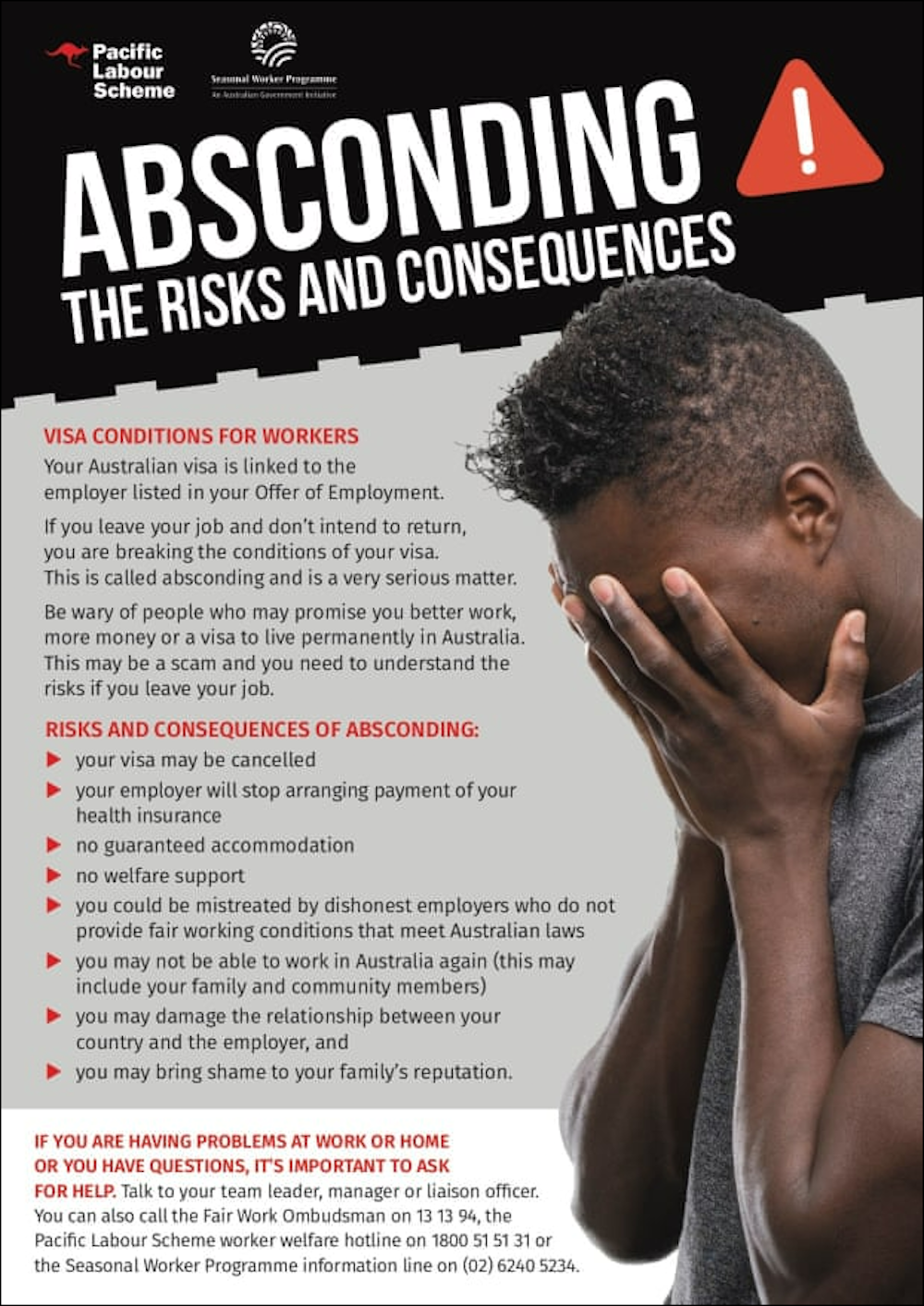
Posters, instead of support.

The very weak draft legislation it developed for consultation, which employer bodies sought to water down, will now not be passed ahead of the election.

Even if the legislation did proceed, the Fair Work Ombudsman (FWO) would not have enough resources to enforce it. The FWO is drowning in its current workload.

Experience overseas shows that even strong and well resourced regulations have failed to make much impact on the exploitation of migrant farm workers.

A new Agricultural Visa

In the second half of 2021, the government announced a new “Agriculture Visa” for people from nearby Asian countries.

The regulations for this visa were introduced in September 2021.

Littleproud described this visa as a landmark reform to Australia’s agriculture industry while Foreign Minister Marise Payne said it would build on the strong performance of the Pacific Island seasonal worker visas.

Both ministers seem to think Australia can somehow avoid the near slavery-like conditions experienced for decades by migrant farm workers elsewhere by eventually giving these workers (but not the Pacific Island workers) a pathway to permanent migration.


Read more:
Australia’s new agricultural visa could supercharge exploitation


They could not be more wrong. The lure of eventual permanent migration will make these workers, most of whom have very little English and few post-secondary skills, even more vulnerable to exploitation.

Employers and labour hire companies will know these workers cannot complain lest this close off the pathway to residence.

A less egalitarian Australia

It is not surprising the Department of Home Affairs is struggling to identify how this pathway will work, while the countries with which Australia is trying to reach an agreement are reluctant reluctant to sign up to putting their citizens in a vulnerable position.

Even more important is that these visas entrench the view there are some jobs Australians won’t do, fundamentally changing the nature of Australian society.

Once accepted, industry will press for an ever-widening range of low skill and low pay jobs to have their own dedicated visa – meat workers, cleaners, shelf stackers, housekeepers in hotels, the list is endless.

Rather than sleep-walking into this change to Australian society, shouldn’t we be debating this ahead of the election?

The Conversation

Abul Rizvi was a senior official in the Department of Immigration from the early 1990s to 2007 when he left as Deputy Secretary. He has recently published a book titled Population Shock.

ref. Australia is creating an underclass of exploited farm workers, unable to speak up – https://theconversation.com/australia-is-creating-an-underclass-of-exploited-farm-workers-unable-to-speak-up-177063


On Sidney Nolan, the painter who re-envisaged the Australian landscape

Source: The Conversation (Au and NZ) – By Julie Shiels, Lecturer – School of Art, RMIT University

Sidney Nolan Kelly and Horse 1946. Enamel paint on composition
board 92.1 x 122.4 cm. Canberra Museum and Gallery, Canberra
© Canberra Museum and Gallery

Review: Sidney Nolan: Search for Paradise, Heide Museum of Modern Art

The Sidney Nolan retrospective is held in a contemporary Eden in the Melbourne suburbs — the place where the artist’s own search for paradise began.

Nolan is best known for his modernist depictions of the history and mythology of Australian bush life, and his role in re-envisaging the landscape. This exhibition, curated by Kendrah Morgan, reframes his artistic work by focusing on his motivations: a relentless pursuit of paradise permeated with an unresolved sexual relationship.

Originally, Heide Museum of Modern Art was the home of cultural benefactors John and Sunday Reed, with whom Nolan was deeply entangled.

The narrative begins with a tiny painting, Woman and Tree Garden of Eden (1941). When he painted it, Nolan had left his wife and baby daughter and was living at Heide in a ménage à trois with the Reeds. The biblical references are overt: the fall of man, symbolised by a tree, a serpent, and a woman.

Window Girl and Flowers (1942) is painted on a repurposed six-pane window. Allusions to Eve have been tempered: each frame is like an animation cel with illustration-style renderings of a woman who is more earth goddess than wily temptress.

Nolan’s ability to produce a poetic affect from an awkward aesthetic is already evident in these early works

Sidney Nolan, Arabian Tree 1943. Enamel on plywood, 91.8 x 61 cm. Heide Museum of Modern Art, Melbourne Bequest of John and Sunday Reed 1982.
© The Trustees of the Sidney Nolan Trust/DACS. Licensed by Copyright Agency

Nolan’s utopia was short-lived. In 1942 he was conscripted into the army and stationed in Victoria’s Wimmera region where he began painting with a modernist sensibility. Arabian Tree (1943) continues his exploration of the fall and his relationship with Sunday Reed. A naked man and woman are enclosed in the canopy of a tree. The female figure appears off balance, as if out of kilter or in a swoon.

By comparison to his brash, empty Wimmera landscapes, the marks and intensity of colour in Rosa Mutabilis (1945) are more subdued. The farmhouse in the distance and smudgy almost human forms in the foreground are hard to apprehend.

Reed is almost disappearing in a shroud of rose petals: even in his imagination, the artist is unable to get close.


Read more:
Friday essay: the Melbourne bookshop that ignited Australian modernism


The Australian landscape

While in the Wimmera, Nolan had more time to paint. Using the vivid primary colours of commercial house paint, this period marked the start of his engagement with the Australian landscape.

Other escapist preoccupations, such as childhood recollections and connections to St Kilda, were vivified in red, blue and yellow.

Sidney Nolan Bathers 1943. Ripolin enamel on canvas 62.9 x 75.5 cm. Heide Museum of Modern Art, Melbourne Bequest of John and Sunday Reed 1982.
© The Trustees of the Sidney Nolan Trust/DACS. Licensed by Copyright Agency

In these paintings the simplicity of life is rendered through rudimentary lines, bold palette and hierarchies of form. The scenes seem to offer an escape in time and place from his reality, confined as a soldier to an inland army camp.

Nolan started his Ned Kelly series in Wimmera, the paintings he is perhaps best known for. But this retrospective pairs two of his lesser-known works, emphasising their comic qualities and inviting us to consider this iconic series with fresh eyes.

Policeman in Wombat Hole (1946) sits alongside Kelly and Horse (1946), adding to the Kelly myth of his response to authority. In this latter painting, even the animals are laughing.

Nolan’s deft ability to create an awkward aesthetic that produces the poetic is again operating in these works: a poetic of irreverence.

Sidney Nolan Policeman in a Wombat Hole 1946. Enamel on fibre board 91.8 x 122.3 cm. Canberra Museum and Gallery, Canberra. Gift of the artist to the people of Australia 1974.

© Canberra Museum and Gallery

On the road

In the late 1940s, travelling across Australia, Nolan painted myths and histories significant to the white Australian narrative. While responsive to First Nations’ perspectives, he never challenged the colonial vision or its grip on this stolen land and the settler imagination.

Sidney Nolan Death of Captain Fraser 1948. Enamel on compressed fibre board 91.2 x 122.4 cm. Canberra Museum and Gallery, Canberra. Gift of the artist to the people of Australia 1974.
© Canberra Museum and Gallery

In the 1950 and 60s, like many Australian creatives, Nolan lived in London. It was a convenient base for an artist who saw travel as means to discover hidden things about the self “using the outside world as a lever”. Nolan was drawn to places where there had been prior civilisations in order both to understand their achievements, and how they had perished.

Between 1968 and 1970, Nolan made his own paradise. His Paradise Garden mural is made from 1,320 vivid individual panels of real and imagined flora.

In one of Heide’s smaller galleries, 18 of these panels envelop the viewer and provide a contra point to a book of poems and drawings by the same name (1971).

This exposé of Nolan’s life at Heide – and his unresolved relationship with the Reeds – spews out in an unbridled, often pornographic expression of rage. Brought together in one space, the contradictory forces of the book and the mural panels exemplify Nolan’s conflicted drives.

A contemporary re-imagining

Nolan painted Self Portrait 1943 while serving in the army. In it, he employs exaggeration, distortion and smears of face paint to suggest a warrior.
Worimi artist Dean Cross adopts this self-portrait as a central image in Sometimes I Miss the Applause, a double screen video work commissioned to respond to the Nolan retrospective.

A reproduction of the self-portrait is adhered to a square bag that Cross uses as a mask, simultaneously suggesting Ned Kelly’s helmet and channelling Nolan. Kitted up in the mask and a tracksuit, Cross performs a rehearsal of the Maiden’s Dance from Stravinsky’s ballet The Rite of Spring.

Installation view. Dean Cross: Sometimes I Miss the Applause. Heide Museum of Modern Art.
Photograph: Christian Capurro

First performed in 1913, the ballet prompted such contention that a fight broke out in the audience. Kenneth MacMillan’s 1962 interpretation for the Royal Ballet, with Nolan’s production design appropriating First Nation imagery and motifs, remains equally contentious.

Cross returns the favour, appropriating Nolan’s signature style of the awkward and the poetic, referring to, imitating and reinterpreting Nolan imagery. The finale where Cross departs through an over exposed and bleached out exit door suggests he, unlike Nolan, has found paradise.

It is an insightful and irreverent response to the retrospective, at once paying tribute to Nolan’s artistic vision and achievements and revealing their limitations.

Sidney Nolan: Search for Paradise is at the Heide Museum until June 13.


Read more:
The Sidney Nolan mystery: did British government knowingly knight a wartime deserter?


The Conversation

Julie Shiels does not work for, consult, own shares in or receive funding from any company or organization that would benefit from this article, and has disclosed no relevant affiliations beyond their academic appointment.

ref. On Sidney Nolan, the painter who re-envisaged the Australian landscape – https://theconversation.com/on-sidney-nolan-the-painter-who-re-envisaged-the-australian-landscape-175909

The Moderna vaccine is now available for 6 to 11 year olds. Here’s what parents need to know

Source: The Conversation (Au and NZ) – By Nicholas Wood, Associate Professor, Discipline of Childhood and Adolescent Health, University of Sydney

Shutterstock

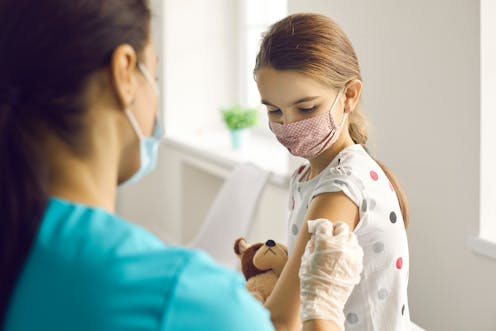
Australian children aged six to 11 years old will be able to get the Moderna COVID vaccine at pharmacies, GP clinics and vaccination hubs from tomorrow.

This follows the Therapeutic Goods Administration’s provisional approval and today’s ATAGI (Australian Technical Advisory Group on Immunisation) recommendation for the Moderna vaccine, called Spikevax, to be made available to this age group.

Australia is one of the first countries to approve the use of Moderna vaccine for children under 12 years old.


Read more:
What is the Moderna COVID vaccine? Does it work, and is it safe?


Until now, the Pfizer vaccine was the only option available for five to 11 year olds.

Moderna eligibility starts at six, so the Pfizer vaccine is still the only COVID vaccine option for kids aged five.

No COVID vaccines are currently available for under-fives and with trials still under way, they’re likely some months away.

What’s the dose and interval?

The Moderna vaccine is given at a lower dosage of 0.25ml (50 micrograms) for children under 12 years old.

(Adults are given 0.5ml for their first and second doses, and 0.25ml for a booster.)

Two doses are recommended for five to 11 year olds, with an eight-week interval.

This can be shortened to four weeks for children at risk of severe COVID and in special circumstances such as travelling overseas.

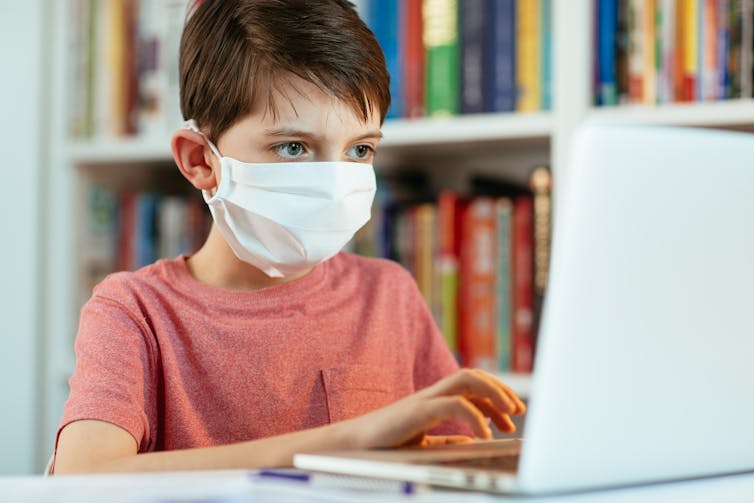
Boy in a masks works at a computer.
Most children who have the Moderna vaccine will have their doses eight weeks apart.
Shutterstock

How effective is it?

The Moderna vaccine was trialled in a clinical trial called KidCOVE. This trial involved 4,753 children aged six to 11 years and was designed to look at safety and immune responses.

The trial results have not been formally published and only appear in a press release. However, a full clinical dossier will have been submitted to the TGA for its consideration in granting a provisional approval.

The KidCOVE trial found children developed an equivalent level of antibodies to that seen in young adults aged 18 to 25 years. Nearly all participants made antibodies (99.3%) after vaccination.

These results (as detailed in the press release) demonstrate a strong immune response in this group of children one month after the second dose.

Is it safe?

The KidCOVE trial also monitored safety. The Spikevax Moderna vaccine was generally well tolerated, with side effects consistent with those in adolescents and adults.

The most common adverse events were fatigue, headache, fever, and injection site pain.

As often occurs in clinical trials, children in the KidCOVE trial will be followed for 12 months after their second injection to assess long-term protection and safety.

Should my child get Pfizer or Moderna?

There is no direct head-to-head comparison available to tell us which vaccine is more effective in the real-world setting in children age six to 11 years.

Both vaccines were shown to be efficacious, but the overall number of cases available for evaluation in both trials was small.

Side effects reported after the Moderna vaccine were mild to moderate and quickly resolved, as did those those reported in the Pfizer trial of five to 11 year olds.


Read more:
Safety, side effects, allergies and doses. The COVID-19 Pfizer vaccine for 5-11 year olds explained


But while there is no direct comparison of side effects in a single trial, the available evidence suggests mild to moderate side effects are more commonly reported after Moderna. This includes pain at the injection site, swelling and tenderness of lymph nodes in the armpit, fever, headache and nausea

This may be due to the difference in the amount of antigen content (the substance that produces the immune response) between vaccines. Pfizer contains 10 micrograms, while Moderna contains 50 micrograms.

What about rare complications?

Moderna didn’t report any cases of myocarditis or pericarditis (inflammation of the heart muscle or the tissue surrounding the heart) in its clinical trial of 4,700 children. However it’s important to note the sample size of the trial was not large enough to rule out any risk.

Australia’s vaccine monitoring body, AusVaxSafety, has closely monitored the safety of the Pfizer vaccine in children aged 5 to 11 years. It found side effects have generally been mild, with pain, swelling, and redness at the vaccination site the most common.

AusVaxsafety and our other surveillance systems will also monitor Moderna vaccine safety in children as it’s rolled out in the coming months, and will closely watch for serious adverse events, including myocarditis and pericarditis.

Just under half of Australian primary school-age children have received their first COVID vaccine dose, after becoming eligible on January 10. Parents of children now have another vaccine to consider as we look to protect our community from COVID. Hopefully adding another vaccine choice helps to boost these rates.


Read more:
Is your child frightened of needles? Here’s how to prepare them for their COVID vaccine


The Conversation

Nicholas Wood received funding from the NHMRC for a Career Development Fellowship from 2018 to 2021. He holds a Churchill Fellowship awarded in 2019.

ref. The Moderna vaccine is now available for 6 to 11 year olds. Here’s what parents need to know – https://theconversation.com/the-moderna-vaccine-is-now-available-for-6-to-11-year-olds-heres-what-parents-need-to-know-177544

Morrison announces sanctions against Russia and warns of possible cyber retaliation

Source: The Conversation (Au and NZ) – By Michelle Grattan, Professorial Fellow, University of Canberra

Prime Minister Scott Morrison has announced sanctions against Russia, imposed in line with those of Australia’s major allies the United States and the United Kingdom.

Morrison told a Wednesday news conference the measures were just the first, saying Russia was “behaving like thugs and bullies and they should be called out as thugs and bullies”.

He condemned the Russian government as autocratic and authoritarian. “Australians always stand up to bullies and we will be standing up to Russia, along with all of our partners”.

Travel bans and financial sanctions will be placed on eight members of the security council of the Russian Federation.

Sanctions will be imposed against the transport, energy, and telecommunications sectors, and oil, gas and mineral reserves in the Ukraine regions of Donetsk and Luhansk, occupied by Russia.

They will also target several Russian banks. Morrison said the Treasurer, Josh Frydenberg, had spoken to the CEOs of the major Australian banks “to put them on alert to be aware of any suspicious transactions” .

“This is only the start of this process,” Morrison said.

The government was working with its partners to identify additional individuals and entities to be subjected to the sanctions.

Morrison said Australia didn’t have a large volume of trade with Russia.

“That said, it’s important that we play our part in the broader international community to ensure that those who are financing, profiting from an autocratic and authoritarian regime that is invading its neighbour should have nowhere to run and nowhere to hide when it comes to trying to move their money around to avoid the consequences of supporting this type of behaviour.”

He said the sanctions imposed by all countries “will just keep stepping up”.

Meanwhile visa applications for several hundred Ukrainians seeking to come to Australia will be fast-tracked.

Morrison said there were about 430 applications from Ukrainian citizens to come here, across a range of visa categories – student, family visas and others.

“There are some 1,027 Ukrainians outside of Australia who have visas to enter Australia, and, of course, they would be welcomed.”

Morrison warned Australia could face cyber attacks from Russia in retaliation.

The sanctions announcement came after cabinet’s national security committee ticked off on the measures, that have been anticipated for weeks.

Morrison predicted: “Russia is at peak readiness to now complete a full scale invasion of Ukraine and that is likely to occur within the next 24 hours”.

He warned against any “appeasement”, when asked about efforts to head off further Russian action.

“There cannot be any suggestion that concessions should be provided to a bully and a thug in return for not following through with threats of violence. That’s not the sort of appeasement I would ever support, and I don’t think Australians would either in this or any other situation.”

Morrison praised Germany for freezing approval of the Nord Stream 2 gas pipeline. The pipeline, owned by Russia’s state-backed energy enterprise Gazprom, has been built to carry gas from Siberia to Germany.

Labor said it strongly supported the sanctions.

The Conversation

Michelle Grattan does not work for, consult, own shares in or receive funding from any company or organisation that would benefit from this article, and has disclosed no relevant affiliations beyond their academic appointment.

ref. Morrison announces sanctions against Russia and warns of possible cyber retaliation – https://theconversation.com/morrison-announces-sanctions-against-russia-and-warns-of-possible-cyber-retaliation-177734

Best evidence suggests most children’s flat feet will be fine

Source: The Conversation (Au and NZ) – By Angela Evans, Adjunct Senior Lecturer, La Trobe University

Shutterstock

A recent article in The Conversation raised unnecessary alarm about children’s flat feet.

The article isn’t supported by the best evidence and may have worried parents.

The most recent evidence confirms it’s normal for young, healthy and active children to have flexible flat feet, and these flat feet will get less flat over time.

Flat feet require assessment if they hurt, look different left and right, or if they occur in older children, with few requiring treatment.

Children’s flat feet reduce as they grow

Approximately 15-20% of healthy children have flexible flat feet.

Studies have consistently shown a higher prevalence of flat feet in younger children, fewer flat feet in older children, and a return towards flatter feet in older adults.

A 2019 study looked at over 3,000 children’s feet. It found the normal foot posture across childhood is flat (also known as “pronated”) and children’s flat feet tend to get less flat as they get older.

Another study published in 2018 followed more than 1,000 healthy children for three years. It shows foot posture does “straighten” with time, so there are fewer flat feet in older children.

This study also found high arch feet (the opposite of flat feet) are unusual. So, children with high arch feet are the ones to watch.

Child flat feet
Children’s flat feet get less flat as they get older.
Shutterstock

When to investigate flat feet

Flat feet that are likely to become problematic can now be better identified in children.

It’s worth having your child assessed if they have:

  • foot pain

  • differences between the left and right feet

  • feet getting flatter with age

  • or if they’re not walking by 18 months.

Normally, children with flat feet have no pain and have two feet that look similar and are flexible. The magnitude of flatness also generally reduces with time.

Children’s gait development should not be impeded by flat feet, nor should flat feet delay meeting expected milestones. Unexplained difficulty with walking, running and sports should be checked.

Keep family history in mind. If a child’s parents, grandparents or siblings have painful flat feet, it’s reasonable to raise suspicion and monitor foot development and gait over time.

How do you treat problem flat feet?

Any treatment requires sound justification, and is usually quite simple.

Footwear is always the first thing to get right. Well-selected shoes alone make a difference and can be the only “treatment” required.

Other treatments may include:

  • exercises, such as muscle stretches and strengthening

  • foot orthotics (shoe inserts)

  • specific physical activity, like hopping, swimming and balancing.

In terms of foot orthotics, the good news is low-cost, off-the-shelf orthotics are usually sufficient. In the absence of pain, there’s no evidence to support the use of more expensive, customised foot orthotics.

It’s very unlikely for healthy children with flexible flat feet to need surgical treatment. All surgery carries risk, and generally will only even be considered when good non-surgical care fails. Rigid flat feet are very unusual in children, and usually associated with other diagnoses, such as cerebral palsy.

In this era of over-medicalisation, it’s important to avoid unnecessary treatment which is not evidence-based.

Doctor with patient trying foot orthotics
Off-the-shelf foot orthotics are usually enough, which are cheaper than custom made versions.
Shutterstock

We need to rely on the best evidence

Confusion about flat feet has occupied the community for decades. There has been a misleading mix of fact and folklore.

One study often quoted was written over 70 years ago. At the time, the study’s author observed many army recruits with foot pain had flat feet, and suggested flat feet caused pain.

However, what was also observed at the time, and since overlooked, was that many soldiers with flat feet had no pain.

So, by omission, flat feet became overly associated with pain. We know some adults with foot pain do also have flat feet, while many others function pain-free.

We need to ensure we’re relying on the best scientific evidence on this issue. The best evidence comes from systematic reviews, and the weakest from untested opinions.


Read more:
Is this study legit? 5 questions to ask when reading news stories of medical research


Children aren’t mini-adults. They’re growing and developing, and expected to have flexible flat feet that do not hurt and that reduce as they grow up.

Remember, probability is on your side. Most healthy children with flexible flat feet will be fine.

The Conversation

Angela Evans is affiliated with Walk for Life Clubfoot in Bangladesh, Director of Australian Podiatry Association.

Angela Evans is an author of Cochrane library reviews (2010, updated 2022) pertaining to intervention for paediatric flat feet.

ref. Best evidence suggests most children’s flat feet will be fine – https://theconversation.com/best-evidence-suggests-most-childrens-flat-feet-will-be-fine-176673

Comedies in serious clothing: an introduction to the films of Paul Thomas Anderson

Source: The Conversation (Au and NZ) – By Ari Mattes, Lecturer in Communications and Media, University of Notre Dame Australia

MGM/AP

After successfully shooting the opening sequence of Boogie Nights – an elaborate steadicam shot in which the camera tracks into and around a night club, introducing the title, setting and all of the main characters of the film – young writer-director Paul Thomas Anderson enthusiastically showed it to the ageing star of the film, Burt Reynolds.

Burt Reynolds was reportedly immediately dismissive, noting five other times he’d seen the same thing.

Both appear as caricatures of Hollywood types. Anderson, directing his first major feature film comes off as a cocky MTV-generation director at loggerheads with one of the megastars of the 1970s, now ancient history.

Paul Thomas Anderson would go on to become one of the most critically acclaimed directors of the 21st century. His films frequently fare well during the awards season, with works like There Will Be Blood, The Master and Phantom Thread further cementing the credentials of names like Phillip Seymour Hoffman, Joaquin Phoenix and Daniel Day-Lewis.

But are his films all they’re cracked up to be – are they, as New York Times critic Manohla Dargis describes There Will Be Blood, “consummate works of art”? Or are they overblown, pompous, and needlessly concerned with style?

The serious and the farcical

There’s something about the combination of tragedy and comedy in the Reynolds anecdote which seems to epitomise the work of Paul Thomas Anderson at large. His films seem to elicit both serious and farcical readings.

Taken seriously, his films can be a little annoying. They are profoundly heavy-handed (though he’s an interesting enough filmmaker that this isn’t always a negative thing), and at times seem self-important in a trite, arty kind of way.

But they also offer rollicking good times, as funny as the novels of Thomas Pynchon (who Anderson adores), and, viewed from afar, this image of grey-toupeed Burt Reynolds trying to cut down Valley Boy is simply funny.

Despite their evident humour, his films are usually received by critics as straight dramatic studies of larger-than-life characters rather than as black comedies. But this does Anderson’s ingenuity as a filmmaker a disservice. It’s the comedic core of his films that makes them so affective.

And, given Anderson’s skill at bringing funny sequences to life in more obviously comedic films like Boogie Nights, Punch-Drunk Love and, now, the sweet-natured Licorice Pizza, it’s perhaps unsurprising his films work as comedies in serious clothing.

Boogie Nights, set in 1977, follows the story of teenage busboy Eddie Adams (Mark Wahlberg) after he gets discovered by porn director Jack Horner (Burt Reynolds), who transforms him into adult-film sensation Dirk Diggler.
IMDB

Absurdity and melodrama

His latest Oscar-nominated film, Licorice Pizza, seems to take a 180⁰ turn in terms of his previous work – it’s a nostalgic teen comedy-romance set in the San Fernando Valley in the 1970s – but, if we look beyond the genre, we see the same kinds of tropes emerging.

There’s the batshit egotistical and immature male lead (in this case totally forgivable because he’s a teenager) brilliantly realised by Cooper Hoffman. There’s the careworn, eccentric female lead, equally brilliantly realised by newcomer to the screen, Alana Haim.

There’s the oddly sprawling narrative, wildly uneven in the picaresque tradition, beginning in media res before pulling back, taking tonally unexpected turns. The very setting of Licorice Pizza and Boogie Nights, the streets of the San Fernando Valley, where Thomas Anderson grew up, seems to determine the logic of the narratives of all his films – winding, flat at times, with one often ending up in the same position from which one began.

Licorice Pizza is a coming-of-age comedy-drama film written and directed by Paul Thomas Anderson.
IMDB

Whether a Paul Thomas Anderson film is taken as serious or farcical is, perhaps, just a matter of one’s perspective. Viewed morally, characters do nasty things to each other and we feel outrage, compassion, sadness.

But suspend our morality and things start to take on a deliriously entertaining and madcap sparkle, with films like The Master and Phantom Thread playing like nihilistic screwball, cracked comedies. Daniel Day-Lewis’ marquee scenes in There Will Be Blood (delivered in actorly brogue) are fundamentally ridiculous, which is what makes them so eminently easy to parody.

Big-scale dramatic actors like Day-Lewis and Joaquin Phoenix – the kind of actors who are frequently nominated for Oscars, and who have been endlessly praised for their chops – suddenly appear delusionally serious.

Vision and voice

Not that his films are inconsistent in style – Thomas Anderson is very much an auteur in the classical mould, and there are multiple consonances between his films in both style and theme.

He writes his own scripts, and there is an idiosyncratic rhythm and focus to these. They are inconsistent, and don’t (appear to) follow any of the screenwriting rules that make so many film school graduates’ three-act structure scripts dull.

There’s the feeling of haphazard potential about his stories that makes them more thrilling than conventional Hollywood narratives, even as failure seems to be a usual outcome for his outlandish, blinkered and egotistical characters.

But this never seems to be failure for failure’s sake, or failure at the service of some kind of moral message – everything in Paul Thomas Anderson’s films is in the service of the film as a work, as a coherent whole, and it is this relentless adherence to his own ego/vision as writer-director that makes his films so compelling – and, at times, so pat.

In a period in Hollywood in which auteur cinema seems to have been superseded by either self-conscious, clever genre cinema, or didactic, moralising works that attempt to explicitly shape the viewer’s mind according to assumed social norms, there’s something refreshing about films that don’t claim to be anything other than the vision of one person.

The Conversation

Ari Mattes does not work for, consult, own shares in or receive funding from any company or organisation that would benefit from this article, and has disclosed no relevant affiliations beyond their academic appointment.

ref. Comedies in serious clothing: an introduction to the films of Paul Thomas Anderson – https://theconversation.com/comedies-in-serious-clothing-an-introduction-to-the-films-of-paul-thomas-anderson-174608

West Papuan leader Victor Yeimo indicted on ‘treason’ charges

RNZ Pacific

West Papuan human rights defender Victor Yeimo has been formally indicted on charges of “treason” by Indonesian authorities at the Jayapura District Court.

The authorities have been trying to get Yeimo, who is the leader of the pro-independence West Papua National Committee (KNPB) in court since May last year.

In the indictment he is accused of treason for pushing for West Papua’s independence.

The court hearing was on Monday and he is due to appear again on Friday.

Yeimo had been arrested by police in Jayapura in May last year after they had been seeking to arrest him for two years.

The arrest was because Yeimo called for a referendum on Papuan independence during anti-racism protests which ended in riots in Papua and West Papua provinces in 2019.

He had initially gone to court in August last year but he was very ill and his lawyers sought a postponement.

Yeimo’s international lawyer, Veronica Koman, said at that time that he was so ill he could die at anytime.

This article is republished under a community partnership agreement with RNZ.

Print Friendly, PDF & Email

Article by AsiaPacificReport.nz

‘Take omicron seriously,’ expert Rod Jackson warns New Zealand

RNZ News

Epidemiologist Professor Rod Jackson is urging New Zealanders to take omicron seriously, and certainly not to think of it as similar to the flu.

The warning comes as new modelling shows omicron could peak by mid next month with about 4000 daily cases.

Professor Jackson, professor of epidemiology at Auckland University, told RNZ Morning Report there was “no doubt” New Zealanders were not taking omicron seriously.

“The standard thing I hear these days is, ‘Oh, this is just a mild condition, it’s like a mild flu’ — and it’s just not true,” he said.

“In the [United] States, for example, more people have died from omicron, than died from delta. It’s also worth noting that I mean if you ever had a bad flu, you feel like you want to die.

“It’s not a particularly good comparison. The flu kills 500 people a year. Normally that’s almost double the road crash death rate. It’s about the same as suicide, just a bit less.

“This is a serious disease that people need to take seriously.”

High omicron death rate
The high omicron death rate in the US was because the variant was so contagious, Dr Jackson said.

“It spreads like wildfire, and I guess that’s the other important issue when we’re thinking about the comparison between the flu and and Omicron is that the R value, the number of people that one infected person with the flu is going to infect, is less than two.

“With omicron, we don’t even know how big it is. It’s certainly much bigger than delta, which was about six (people infected per person), so this is a very different disease from the flu and we need to take it seriously.

“We need to go out and get maximally vaccinated.”

On that point, Dr Jackson said there were a likely a lot of reasons more people had not got a booster shot.

“One is, we’re all a little over it, aren’t we? Everyone is tired. Everyone wants to go back to normal.

“Secondly there is this general view is that I hear — ‘Oh, but isn’t omicron, you know, just like a cold?’

‘People die of this’
“For some people, it’s very mild. For some people it’s asymptomatic, but people die of this.

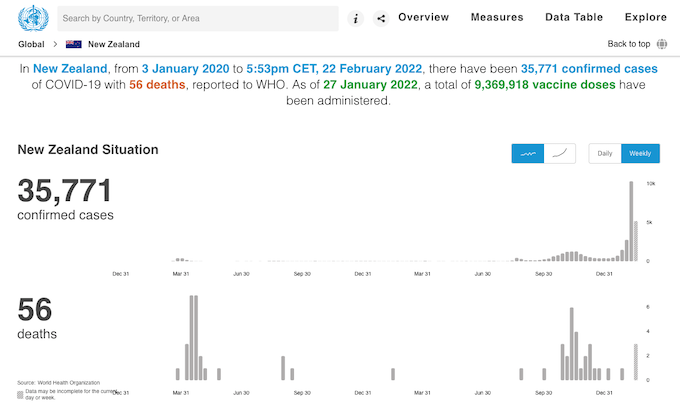
“Look at the hospital rates. Every New Zealander should have a look at the graph of the number of hospitalisations, and if you look at it in the last week or two, it’s going almost vertically.

New Zealand and covid-19 progress at 22 Feb 2022
New Zealand and covid-19 progress as at today. Graph: WHO

“There’s a couple of things we really need to do – get maximally vaccinated and wear a good mask.”

Today the Ministry of Health confirmed 3297 new cases of covid-19 in the community in New Zealand, with 179 people in hospital with the coronavirus, including one in intensive care.

There were also eight new cases in managed isolation today.

Yesterday the Ministry of Health reported 2846 covid-19 cases in the community and 143 people in hospital with the virus.

There have now been 38,951  cases of covid-19 in New Zealand.

Police Commissioner Andrew Coster said that police staff working at the anti-mandate protest outside Parliament had contracted covid-19.

He said while they could not link transmission to the protest, with people coming far and wide for the demonstration, he would be surprised if there was no covid among protesters.

This article is republished under a community partnership agreement with RNZ.

Print Friendly, PDF & Email

Article by AsiaPacificReport.nz

Curious Kids: what is the most important thing a scientist needs?

Source: The Conversation (Au and NZ) – By Emily Parke, Senior Lecturer in Philosophy, University of Auckland

What is the most important thing a scientist needs? – Lennox, age 6, Leichhardt NSW

Hi Lennox! Thanks for this great question. Unfortunately, there’s not really one simple answer. So I’m going to talk about three important things.

Scientists need to be good at asking questions. They need to be good at investigating the world to find answers to their questions. And they need to keep in mind that no matter how much they know, there’s always more to learn.

Asking questions

Most scientists are inspired by wanting to understand how things in the world work. That means they start by asking questions.

The questions might be driven by curiosity about something amazing in nature, like “Why do stars look like they’re twinkling?” or “Why do these birds have such fancy feathers?” Or they might be driven by wanting to help communities (or even the whole world) with a problem, like “How can we keep this river healthy?” or “What can we do about climate change?”

But all good scientific questions have something in common: they will point scientists towards some sort of investigation they can do to try and find out an answer.

Scientists investigate in many different ways. Some examples are observing how animals behave in the wild, measuring how plants grow over time, doing an experiment in a lab, or using a computer to create a virtual version (called a simulation) of a black hole.


Read more:
Curious Kids: can black holes become white holes?


Finding answers

Different scientific questions call for different sorts of answers. Here are some examples (asked by other curious kids!).

Why do onions make you cry? How do ants walk on the ceiling? These questions call for explanations: telling us why or how something works the way it does.

Could octopuses evolve until they take over the world and travel to space? This question calls for some explanation about octopuses and also a prediction about what might (or might not) happen in the future.

How many stars are there in space? This question calls for a number (but it helps if the answer explains a bit, too).

Artist's impression of black hole surrounded by stars
Science doesn’t have to involve experiments. It could also mean making a computer simulation of a black hole.
NASA

How do scientists investigate the world to find answers? It often takes a lot of training and some creativity. There is a thing called the scientific method which you can think of as a sort of recipe for doing science. It goes like this:

  1. Ask a question

  2. come up with a guess (called a hypothesis) about an answer to your question

  3. do an experiment to test your hypothesis

  4. report what you learned, so others can learn from it too.

This is a good way to do science, and many scientists always follow these steps. But many others don’t. Some scientists do experiments. Some do observations instead, or create models and simulations of the things they want to learn about.

Also, not all scientific projects start with a hypothesis and then test it. Some start with big open-ended questions and investigate them by exploring. There is really no such thing as the scientific method. There is a whole family of scientific methods.


Read more:
How many stars are there in space?


There is always more to learn

Becoming a scientist takes a lot of learning. But it is important for scientists to keep in mind they don’t know everything. A fancy name for this is intellectual humility. “Intellectual” has to do with how clever we are, and “humility” has to do with recognising our own limits.

So, “intellectual humility” means being aware that you’ll sometimes get things wrong. It also means listening to other peoples’ ideas rather than just thinking you’re right all the time.

The relationship between science and truth is complicated. Scientists work hard to learn true things about the world. But the things we think are true change over time. A few hundred years ago, people thought that when we get sick it’s because of some sort of poison in the air. Then we learned about bacteria and viruses, and figured out they can make us sick. But we still haven’t figured out everything about how that works.

It’s great to be curious – there’s always more to learn!


Read more:
Curious Kids: could octopuses evolve until they take over the world and travel to space?


The Conversation

Emily Parke receives Marsden funding from The Royal Society of New Zealand Te Apārangi.

ref. Curious Kids: what is the most important thing a scientist needs? – https://theconversation.com/curious-kids-what-is-the-most-important-thing-a-scientist-needs-177226

Air hygiene: how re-thinking air quality will help protect us from this and the next pandemic

Source: The Conversation (Au and NZ) – By Ian David Longley, Principal Air Quality Scientist, National Institute of Water and Atmospheric Research

Shutterstock/Annette Shaff

Our complacency about indoor air contributed to our vulnerability to COVID-19, and we’ll continue to be vulnerable to COVID and other emerging threats until we re-think how we share our air.

Humans are social; we need to be with each other. That’s what made us vulnerable. Our first defences against COVID-19 were social distancing and lockdowns – highly effective against the spread of the virus, but damaging to our economies and punishing for our mental health, social support networks, family relationships and child development.

Now that Omicron is spreading and lockdowns are likely over, can we preserve the in-person experience without the risk? Science warns more variants and pathogens are surely coming, including those we have no vaccine for. Are masks enough? Can we do things better next time?

Can you recall those early, fearful days of the pandemic, not knowing when a vaccine would come, if ever? But all along there was a simple public health measure available for everyone: fresh air.

Right from the beginning I told people not to stay permanently indoors where we share our air, but to venture outside frequently (while maintaining distance) where the air is fresh.

Maintaining indoor air quality is not a new problem

I’ve spent more than 20 years researching the way outdoor air rapidly dilutes and removes contaminants, and how we can bring this power indoors. Thousands of measurements show how the turbulence (random swirling) naturally present in moving air rapidly mixes any contaminants (like a virus in our breath) with fresh air, diluting them while also carrying them away.

Indoors, you can increase the dilution of your breath by ten times simply by opening some windows. Although we only rarely see this effect (vape, for instance), our senses of smell and touch can help confirm it’s true if we pay attention.


Read more:
The COVID-19 virus can spread through the air – here’s what it’ll take to detect the airborne particles


Before COVID-19, poor indoor air quality consisted of a range of serious but seemingly disconnected problems.

Recognising the build-up of moulds and stale air in schools led to the development of indoor air guidelines for new classrooms. The release of by-product gases from indoor gas heaters caused poisoning and serious illness.

Smoke from woodburners on winter nights and exhaust from road traffic penetrate into thousands of homes, contributing to stunted lung development in children, worsening of respiratory disease and early death.

High levels of diesel fumes can accumulate in the cabins of vehicles. Paints, solvents, furniture and building materials fill many of our homes and workplaces with unsavoury chemicals.

Where we can, we should reduce these emissions at source. But by consciously ventilating the indoor spaces where we are most exposed, we can reduce all of these risks simultaneously.

Towards air hygiene

The fact COVID-19 is passed from person to person through shared air was slow to be acknowledged and translated into governmental advice. But it is now widely accepted.

Omicron appears to be even more transmissible than previous variants. Consequently, agencies are increasingly talking about ventilation as a crucial tool to be added to (and maybe outlast) distancing, masks and vaccines.

This is often taken to mean fitting expensive machinery to buildings, which is a major undertaking. The buildings posing the greater infection risk (homes, schools, places of worship, and healthcare settings) tend to be the ones without existing systems.


Read more:
COVID in schools – how ventilation can help to combat spread of virus


Air conditioning already consumes 10% of all global electricity with the associated carbon emissions. High capital and running costs, as well as machine noise, can make some technologies impractical or unacceptable for many settings (think of schools), particularly where deprivation already renders a community more vulnerable to the virus.

But with enough effort, these challenges are solvable. The return on investment, through improved resilience to health risks, could be vast.

A plan of action

High rates of vaccination, compliance with lockdowns, masking and QR-code scanning, and the care we now take over distancing and physical contact, all suggest large-scale behavioural adaptations are possible. This matters because ventilation is not just about machines – it is also about developing new habits.

The more we are conscious of the air, the more purposeful we will be about protecting it. In a typical shared indoor space, 1–5% of the air you breathe has recently been exhaled by someone else. Imagine if every meal you ate included food previously chewed by someone else.

Air hygiene is a frame of mind. I’m reassured by the actions taken to ensure fresh breezes blow through open doors of cafes and shops across Auckland this summer, keeping them safe and open, often at zero extra cost.

A street cafe in Auckland
Fresh air helps to keep cafes safe and open.
Shutterstock/Michele Ursi

Teachers across New Zealand are increasingly using carbon dioxide monitors to identify exactly which classrooms will need additional measures as winter approaches.

Besides windows and machines, there are other immediately available options: more flexible use of indoor and outdoor spaces, reducing the number of people in a space or the duration of use, or regular air purges when rooms are vacated.

These behavioural solutions will need to be tuned to the setting, available infrastructure and culture. Finding the right, low-carbon, equitable solution for each space is an urgent challenge that lies before us.

We’ve taken clean and safe air for granted for too long. If we continue to do so we will get caught out again and again. We should be no more accepting of contaminated air than we are of contaminated water or food.

It will be as easy as knowing when to open a window and as hard as installing billions of dollars of complex machinery. The cost of failure will be having to live through more COVID-19-like experiences knowing we could have prepared ourselves.

The Conversation

Ian David Longley works for NIWA Ltd and consults to the NZ Ministry of Education and Ministry for the Environment. He receives funding from the Ministry of Business, Innovation and Employment. He is affiliated with the Clean Air Society of Australia and New Zealand and the (NZ) Indoor Air Quality Research Centre.

ref. Air hygiene: how re-thinking air quality will help protect us from this and the next pandemic – https://theconversation.com/air-hygiene-how-re-thinking-air-quality-will-help-protect-us-from-this-and-the-next-pandemic-177131

How sport can help young people to become better citizens

Source: The Conversation (Au and NZ) – By Vaughan Cruickshank, Program Director – Health and Physical Education, Maths/Science, Faculty of Education, University of Tasmania

woodleywonderworks/Flickr, CC BY-NC

Most Australians have followed health advice to wear face masks and have COVID-19 vaccinations. Actions like these that benefit others are known in psychology as prosocial behaviours. In a COVID context, prosocial behaviours reduce the spread of the virus and keep health-care institutions functioning.

The likelihood of prosocial behaviour by an individual is affected by their values. In particular, their social and civic values influence their concern for the welfare of others.

We recently undertook research on possible connections between sport and promoting thinking about social issues and the common good. Working with health and physical education student teachers, we explored shared learning opportunities between two areas of the Australian Curriculum, Health and Physical Education, and Civics and Citizenship Education. Fair play, ethical debates and dilemmas, community involvement, identity and inclusivity are areas where sport and civic values intersect.


Read more:
The kids who’d get the most out of extracurricular activities are missing out – here’s how to improve access


Civic values help keep people happy and secure in a functional society. In democracies such as Australia, these values include freedom, equality, responsibility, accountability, respect, tolerance and inclusion.

When young people learn these values it helps create a cohesive society.
This has become increasingly important in light of COVID misinformation and conspiracy theories, and the various threats to democracy around the world in recent years.

What does sport have to do with civic values?

Adolescence is an important time for developing civic values. Personal life experiences, relationships and social contexts all influence this development. These contexts can include home, school and extracurricular activities such as sport.

Sport is a big part of the lives of many young people. It provides opportunities for:

  • participation
  • breaking down cultural barriers
  • building community identity
  • making friends, developing networks and reducing social isolation.

Sport requires us to work with others to achieve team goals. In this way, it can help children to develop attributes such as altruism and empathy.

In one study, for example, young people taking part in organised sport were more accepting of migrants. Those who did not have contact with migrant children through sport had more negative attitudes.

Children in a huddle on the middle of a sport ground
Research has found children who play sport are more likely to accept others and feel empathy for them.
Shutterstock


Read more:
Pushing casual sport to the margins threatens cities’ social cohesion


Research has noted parents describing sport as a “school of life”. It teaches their children tolerance, teamwork, a sense of duty, the value of hard work, and socialisation skills.

Sport’s development of character and understanding of values such as fair play and respect can benefit young people in their wider lives.

More broadly, by fostering prosocial behaviour, sport can make significant contributions to the common good.

For example, a 2021 review of 13 international studies investigated the effects of sports programs on crime prevention and re-offending. It found participants in these programs had greatly reduced aggressiveness and antisocial behaviour. Their self-esteem and mental well-being improved significantly. The result was a decrease in criminal behaviour.

The creator of basketball, James Naismith, believed the sport taught players values and moral attributes. He developed basketball not just as an indoor game football players could play through the winter, but as a context for young people to learn teamwork, co-operation, fair play, sportsmanship and self-sacrifice. He believed team sports taught the skills essential for a functioning community.


Read more:
‘It was the best five years of my life!’ How sports programs are keeping disadvantaged teens at school


It’s not all rosy

Unfortunately, in elite sports, gamesmanship, greed, cheating and a win-at-any-cost mentality can sometimes be elevated above positive virtues such as courage, co-operation and sportsmanship. In our study, many student teachers referred to news reports with negative messages about cheating, doping and racism.


Read more:
Can the cricketers banned for ball tampering ever regain their hero status? It’s happened before


Yet our data also highlighted sporting contexts as positive catalysts for reflection and pro-social behaviours. Participants noted examples such as:

“equal pay for men and women (e.g. surfing)”

“evolving attitudes towards mental health issues in sport”

“sportspeople taking the knee in support of the Black Lives Matters movement”

“sport as a breath of fresh air in the context of the restrictions of COVID-19”

“great sporting moments have arisen with the inclusion of disabled or disadvantaged people”.

Sport has recently been a victim of the COVID-19 pandemic. Events have been cancelled and games played in empty stadiums. But sport has also been a shining light for people struggling in lockdown.


Read more:
Missing out on PE during lockdowns means students will be playing catch-up


This was particularly true of the 2021 Tokyo Olympics. The International Olympic Committee (IOC) described the event as a beacon of hope after so much of normal life was brought to a standstill. Other commentators have similarly said Tokyo “made sport a shining light in the gloom” and described the Games as “such a welcomed distraction, really highlighted how much sport can bring a smile to people’s faces”.

So, how do we maximise the benefits?

Teaching students about civic values and sport as part of the school curriculum isn’t the only way to foster prosocial behaviour. We can reap its broader benefits for a healthier society by encouraging young people to play sport at school and in the community. Ways to do this include:

  • governments, schools and community groups promoting physical activity benefits such as better health, increased energy and improved mood and sleep

  • increasing opportunities to be physically active in school programs, including activities they can enjoy for years after school such as bushwalking and cycling

  • making students more aware of community clubs and facilities by inviting club staff or volunteers to talk to students and run practical sessions

  • allowing girls to wear sports uniforms that make them more comfortable and confident, such as clothing that’s stretchy, dark-coloured and hides sweat

  • helping parents to get involved in their children’s physical activity by offering family activities and providing take-home bags of basic play equipment and activity suggestions

  • removing barriers to participation such as the cost of club fees and equipment and an overemphasis on competition. This can be done by providing vouchers and promoting other reasons people play sport such as personal achievement and satisfaction, and social interaction.


Read more:
Bushwalking and bowls in schools: we need to teach kids activities they’ll go on to enjoy


The Conversation

The authors do not work for, consult, own shares in or receive funding from any company or organisation that would benefit from this article, and have disclosed no relevant affiliations beyond their academic appointment.

ref. How sport can help young people to become better citizens – https://theconversation.com/how-sport-can-help-young-people-to-become-better-citizens-173733

A krill aquarium, climate research, and geopolitics: how Australia’s $800 million Antarctic funding will be spent

Source: The Conversation (Au and NZ) – By Alessandro Antonello, Senior Research Fellow in History, Flinders University

Shutterstock

The federal government’s major package of new funding for Australia’s Antarctic program, announced on Tuesday, promises an additional A$804.4 million over the next decade.

The government has also released an update to its 2016 Australian Antarctic Strategy and 20-Year Action Plan, which effectively confirmed the existing strategy and outlined specific activities for the next five years.

The funds will allow Australia’s Antarctic scientists to continue undertaking significant, world-class research. They also promise to bring new streams of environmental data into the management of the fragile Antarctic environment.

But the announcement has also immediately been framed as a robust response to supposed Chinese and Russian expansion in Antarctica.


Read more:
Exploring Antarctica’s hidden under-ice rivers and their role in future sea-level rise


How the new funds will be spent

Australia has a long connection with Antarctica.

It has continuously operated a scientific program on the continent since 1954, when the Australian Antarctic Division established Mawson Station, which is now the oldest continuously operating station south of the Antarctic Circle.

Australia was also an original signatory of the Antarctic Treaty in 1959, an international agreement which continues to govern Antarctica.

The Antarctic Treaty System promotes scientific research and cooperation, prevents military and nuclear activities, manages environmental impacts and human activities, governs resources such as fisheries, bans mining, and in general aims to maintain regional peace.

Today, Australia operates three year-round scientific stations on the continent and one on sub-Antarctic Macquarie Island.

The new icebreaker Nuyina is crucial to the Antarctic program. It both supplies the stations and conducts essential marine scientific work in the Southern Ocean.

Scientists also conduct their research at the Antarctic Division’s Hobart headquarters. The krill biologists are being promised a new $17.4 million krill aquarium.

Although the government’s announcement is light on specifics, the $804.4 million is divided into diverse areas.

The biggest ticket items are concerned with transport and observational capacity across East Antarctica. These include:

  • $136.6 million for inland traverse capability, charting and mapping, and “mobile stations”

  • $60.6 million for “drone fleets and other autonomous vehicles” and a sensor and camera network called the “Antarctic eye”

  • $35 million for longer-range helicopters; and

  • $14.6 million for air transport within Antarctica.

Other funds will go to the icebreaker Nuyina, removal of old waste from Australia’s stations and more funding for glaciology and ice sheet research.

The funds will therefore continue well-established scientific activities, as well increase the use of newer technologies to advance the Antarctic program.

Antarctic science isn’t cheap

Most of the new funds will support science. Australia is a scientific leader in Antarctica. But science down south costs big money.

Antarctica is enormous and the conditions are harsh.

The inland traverse capability will support the million-year ice core project, crucial for reconstructing Earth’s climate history.

Modern studies of the ice sheet are predominantly done through remote sensing, and the drones and autonomous vehicles might be useful for that.

Massive inland traverses of the ice sheet – which Australia conducted from the 1960s to 1980s — have been less necessary since the advent of sophisticated satellites in the 1990s. But traverses are still necessary for logistics.

Remote monitoring of bird and animal populations might also increase.

Geopolitics and Antarctica

The Antarctic Treaty System allows for any signatory to inspect, unannounced, the Antarctic bases and installations of other signatories.

Until now, this has seen teams of people visit bases, but the innovative use of drones could perhaps make inspections more frequent.

In the context of rising tensions between the West, China and Russia, geopolitics is hard to avoid. But such tensions aren’t new, and the Antarctic Treaty System has operated amid such tensions since its enactment.

Australia has claimed much of East Antarctica as the Australian Antarctic Territory since 1933. Almost no other country ever recognised that claim. And the Antarctic Treaty put all territorial claims in Antarctica into legal limbo.

At the height of the Cold War, Australia was worried about the Soviet Union’s bases. Today, Russia, China, India, Romania, France and Italy all have bases in Australia’s area of interest.


Read more:
The Antarctic Treaty is turning 60 years old. In a changed world, is it still fit for purpose?


Prime Minister Scott Morrison implicitly called out China as not being as committed to protecting the Antarctic environment as Australia and its allies.

Treasurer Josh Frydenburg has said some countries (meaning China and Russia) are “increasingly active” in Antarctica.

Are their capacities dramatically increasing? Russia appears to be renewing several of its bases, including Vostok, but there’s no clear evidence they’re dramatically expanding their presence.

China has four operational bases (only two are year-round), and a fifth one in the final stages of commissioning. They now have two icebreakers which they deploy at both poles.

But China’s Antarctic capacities are not currently greater than Australia’s or the US. It’s also unclear how much larger the Chinese effort and footprint will get. We need quality, up-to-date information to supplement older analyses.

More concerning than any apparent military buildup in Antarctica is the increase in potential exploitation of fish, including krill. China and Russia appear to be investing heavily to exploit krill stocks.

Another frustration is because the Antarctic Treaty System uses consensus decision-making, China and Russia have successfully prevented major environmental protection decisions over the past decade.

Both continue to prevent the creation of large marine protected areas around Antarctica. And recently they’ve been thwarting new fishing regulations and restrictions.

Domestic politics also plays a role

There’s also basic domestic politics at play. Federal Antarctic funds are important to Tasmania and the prime minister has stressed job creation.

Ever since the Australian Antarctic division moved from Melbourne to Hobart in 1981, the Hobart community and economy has benefited from Antarctic research.

The multi-government Hobart City Deal, which began in 2019, had already committed at least $450 million to the creating an Antarctic and science precinct at the city’s waterfront.

Will Antarctica be a central arena of competition, or can it remain peripheral, as it has during previous moments of geopolitical heat?
Shutterstock

We will have to wait to see what parts of this announcement really turn into. Will surveillance drones be regularly moving through Antarctic skies and seas? What exactly are “mobile stations” and what they will do? Much is unclear.

The funding also continues a go-it-alone approach, without mention of science diplomacy or major international research projects. Recent government documents suggest Australia’s international Antarctic collaborations and scientific publications are trending downwards.

Sadly, Australian-Chinese scientific cooperation, including in the Southern Ocean, is being axed because of “national security concerns”.

Strategic tensions with Russia and China are obviously hardening globally and Antarctica won’t be immune from them.

The question is: will Antarctica be a central arena of competition, or can it remain peripheral, as it has during previous moments of geopolitical heat?


Read more:
Invasive species are threatening Antarctica’s fragile ecosystems as human activity grows and the world warms


The Conversation

Alessandro Antonello receives funding from the Australian Research Council.

ref. A krill aquarium, climate research, and geopolitics: how Australia’s $800 million Antarctic funding will be spent – https://theconversation.com/a-krill-aquarium-climate-research-and-geopolitics-how-australias-800-million-antarctic-funding-will-be-spent-177609

The NZ Parliament protest is testing police independence and public tolerance – are there lessons from Canada’s crackdown?

ANALYSIS: By Dominic O’Sullivan, Charles Sturt University

The early morning action on Monday to cordon off the occupation of Parliament grounds and prevent it growing might go some way to restoring public confidence in the police, which has appeared to be eroding since the protests began a fortnight ago.

So far, police have pursued a de-escalation strategy, but there have been calls for firmer action.

The whole event has raised important questions about the relationship between the police and government, and about police independence and accountability.

With local businesses unable to trade, and the neighbouring university closing its campus for eight weeks, the political consequences are potentially serious.

From the government’s perspective, there is a direct relationship between its own public support and public confidence in the police. The political and legal impasse between the rightful independence of the police and public accountability is not a simple issue to resolve.

Constabulary independence
The relationship between the government and the police has come a long way since government minister John Bryce — armed and on horseback — led the police invasion of Parihaka in 1881. Bryce decided who would be arrested and personally ordered the destruction of property.

Supporting the political objectives of the government of the day was a function of the police. But New Zealand was not a developed liberal democracy 140 years ago.

The Wellington protest is testing police independence and public tolerance – are there lessons from Canada’s crackdown?

By 2018, that relationship had evolved enough for the solicitor-general to advise the prime minister that “constabulary independence [had become] a core constitutional principle in New Zealand”.

The solicitor-general explained the constitutional subtleties of the Policing Act thus:

The Police are an instrument of the Crown […] but in the two principal roles of detecting and preventing crime and keeping the Queen’s peace they act independently of the Crown and serve only the law.

This is reinforced in the oath police officers swear to perform their duties “without favour or affection, malice or ill-will”.

Who is accountable?
Constabulary independence means governments can’t control the police for political advantage. At the same time, police accountability to the public is as important as for any department of state.

Independence should not mean the police can do whatever they like.

However, the lines of accountability are complex. Constabulary independence means the ordinary process of accountability to Parliament through the relevant minister, and through Parliament to the people, does not fully apply to the police.

The police commissioner is accountable to the minister for “carrying out the functions and duties of the Police”, but explicitly not for “the enforcement of the law” and “the investigation and prosecution of offences”.

As well as “keeping the peace”, “maintaining public safety”, “law enforcement”, “crime prevention” and “national security”, the Policing Act requires “community support and reassurance”.

This might help explain why, for security and tactical reasons, the police won’t fully explain their tolerance of the occupation, beyond the police commissioner saying the public would not accept the inevitable violence and injury a harder line would entail.

Despite clear public concern, the police are not required to give further explanation of why they haven’t prosecuted people for intimidation and harassment, for threatening MPs, public servants and journalists, or for failing to remove illegally parked vehicles.

Canadian comparisons
The situation in Canada may be instructive. There, the police have seemingly abandoned a de-escalation strategy that had lasted three weeks, with the protest in Ottawa cleared in the last few days.

As in New Zealand, public tolerance was low. Rejecting a claim that the repeated sounding of 105-decibel truck horns was “part of the democratic process”, a Canadian judge said: “Tooting a horn is not an expression of any great thought.”

In both countries, the protests are being viewed less as expressions of political thought than as simple acts of public nuisance. The difference lies in the Canadian federal government invoking special powers under its Emergencies Act.

The first time it has been invoked since it was passed in 1988, the law allows the government to use “special temporary measures that may not be appropriate in normal times” to respond to “threats to the security of Canada”.

Banks can freeze accounts being used to support the protest. Private citizens and businesses may be compelled to provide essential services to assist the state — tow trucks, for example.

Political calculation
Such significant constraints on freedom can be justified only if they are proportionate to the emergency. But on Friday, the Canadian Parliament was prevented from scrutinising the decision to declare an emergency because protesters had prevented access to the debating chambers.

Ironically, the debate began on Saturday when police cleared the obstruction (without needing emergency powers) — suggesting “freedom” is a wider concept than the one protesters claimed they were defending.

The ability of people to go to work, to study, shop, drive on a public road — and (as in Ottawa) the ability of Parliament to function — are democratic freedoms the protesters are curtailing.

Whether Wellington goes the way of Ottawa remains to be seen, but the New Zealand police commissioner says a state of emergency is among the “reasonable options” being considered to stop more protesters entering Parliament grounds.

For now, the political question is what happens if the evolution from protest to public nuisance to crisis of confidence in the police continues.

Given the constraints of constabulary independence, and the democratic need for accountability, what political responses are available to the government to ensure any crisis of confidence in the police does not become a crisis of confidence in the government itself?

For both police and government, there is much at stake in the de-escalation strategy.The Conversation

Dr Dominic O’Sullivan, adjunct professor of the Faculty of Health and Environmental Sciences, Auckland University of Technology and professor of political science at Charles Sturt University. This article is republished from The Conversation under a Creative Commons licence. Read the original article.

Print Friendly, PDF & Email

Article by AsiaPacificReport.nz

Police criticise ‘disgraceful’ NZ protesters after early clash

By Nick Truebridge, RNZ Checkpoint reporter

Police leaders condemned the behaviour by protesters outside New Zealand’s Parliament in the capital Wellington today as “absolutely disgraceful”.

The confrontation between police and protesters began early on Tuesday morning and escalated when a car hurtled towards officers.

Three police officers were hospitalised after being hit with what they described as a “stinging substance”.

But protesters in the camp insist their stand remains peaceful, reiterating they will be going nowhere until covid-19 vaccine mandates are dropped.

Despite the claim the protest is “peaceful”, Wellington Free Ambulance announced it has made the “difficult decision” to no longer enter the protest area at Parliament.

It said the decision was made to prioritise the safety of paramedics, after the white Honda drove at police.

“The behaviour of a certain group within the protests community is absolutely disgraceful,” said Police Assistant Commissioner Richard Chambers.

Faeces thrown at police
In a repeat of Monday’s conflict, officers had faeces thrown at them. The stinging substance that was thrown at police has not been identified.

“We are working very, very hard to reduce the impact of the protest on the community here in Wellington, and to be met with the resistance we saw this morning is very disappointing for everybody,” Chambers said.

However, many still camped at Parliament on the 15th day of the protest are insisting they come in peace.

“This is a lovely community,” one woman told Checkpoint. “I’ve heard children say ‘I want to live here’.”

Flax hats at a gazebo
Leslie was weaving flax hats at a gazebo on the outskirts of the occupation. She said she felt the pull to go to Wellington after watching the protest on TV and after losing her job of seven years as a cook.

“I didn’t only lose my job, I lost my house… the house was part of my job.”

Another protester, Jacob, said the mandates meant he could not keep his job, and he was facing losing his house.

“I’ve been a caregiver working with men living with disabilities. And now since mandates, I haven’t been able to work with these clients, even though it’s one on one and they would actually want to have that continuity.”

Aucklander Bryan told Checkpoint he had been at the protest since day one and had been at the front of the line with his son in clashes with police, which he described as “amazing”.

Year 10 student Libby was also at the protest, off school and with her family.

“My brother can’t play sports. I can’t play sports. All my friends — one of my friends, she’s a really good football player and she’s been denied, she can’t play in her club teams and she’s like, really good, like she could go nationals, worldwide if she wanted to.”

The fact is that the government has not mandated that children must be vaccinated to participate in school or extracurricular activities. They are decisions made independently by schools and clubs.

Underbelly of undesirable, illegal, activity
While the atmosphere appears friendly on the ground at the protest, police say they are seeing something quite different.

Assistant Commissioner Chambers said there was an underbelly of undesirable, illegal, activity.

“There has been a suggestion that within the protest area down there, there may be sexual assaults.

“We are the only agency who can investigate sexual assaults and if anyone would like to come forward to us to talk about what might have occurred to them then please do come forward and we will work with you as best we can.”

Some protesters agree there are small, negative elements that need cleaning up, while others say the protest message must be refined.

“We need to be able to put our egos aside and be able to put our agendas aside and come together,” one protester told Checkpoint.

Mayor in high level talks
Wellington Mayor Andy Foster told Checkpoint he was in high level talks regarding the Parliament protest but would not detail who he was talking to.

Foster said he was also talking with government and police regularly.

“We are looking to achieve the same thing which is trying to get as quick as possible, as safe as possible, resolution of this protest so that we can get our streets back and people can go about doing their normal daily business.”

He said police had made “good progress” today with containing the spread of the protest, but things at the protest were not in an “acceptable position” yet.

On people losing their jobs because of the mandate, Foster said “there had to be a way through this”.

“I think the government has been fairly clear that it won’t remove mandates at this stage, but I think at least if there can be a clear pathway that might be enough for some people.

“And maybe the kind of thing you might want to think about is if … people are on sick leave, that kind of thing, just allow that to be extended so that the job is not actually lost.”

Foster said Wellington City Council was putting together a pandemic response package for local businesses, including rates deferral, reduced parking costs, and reducing council fees and charges for businesses particularly in hospitality.

Mixed messages aside, one thing that appeared consistent among the masses — with a pre-school, a vegetable garden and even a tattoo parlour — they are in it for the long haul.

This article is republished under a community partnership agreement with RNZ.

Print Friendly, PDF & Email

Article by AsiaPacificReport.nz

Fiji covid death rate among unvaxxed 17 times higher than for vaccinated

RNZ Pacific

The Fiji government has warned that unvaccinated people in the vaccine-eligible population are 17 times more likely to die if they contract covid-19 than those that are vaccinated.

Health Secretary Dr James Fong said this strongly indicated that many of the unvaccinated deaths were preventable.

He is urging Fijians to get vaccinated against covid-19, including the booster shot, amid a third wave which began last November.

“I strongly urge anyone who hasn’t been vaccinated to get vaccinated now because covid-19 is here to stay, and omicron will not be the last variant,” Dr Fong said.

“And if you are vaccinated, but know someone who isn’t, please also encourage them to protect themselves by getting vaccinated.”

The vaccine rollout for children aged 12 to 17 is also underway, with 43,241 of them already having had both doses.

Meanwhile, Fijians who are unvaccinated against covid-19 are still being refused entry to a number of public spaces.

Health Minister Dr Ifereimi Waqainabete said this included houses of worship, sporting venues and high-risk businesses.

“Those who are in charge of these venues, businesses and houses of worship must ensure that they check the vaccine status of all those who enter their premises,” Dr Waqainabete said.

As of 18 February 2022, 93.1 percent of Fiji’s adult population of 844,000 were fully vaccinated against covid-19.

More than 800 deaths attributable to covid-19 have been recorded in Fiji.

This article is republished under a community partnership agreement with RNZ.

Print Friendly, PDF & Email

Article by AsiaPacificReport.nz

Protest funder hopes it will revive NZ’s $18 billion tourism industry

RNZ News

One of the people funding New Zealand’s two-week-old Parliament grounds occupation says it makes no sense to maintain a quarantine system at the border now that covid-19 cases are rife in the community.

Red Stag, which has business interests in forestry, timber, property development, and tourism, is helping to fund the protesters’ efforts.

Chief executive Marty Verry said he hoped they could bring about changes in the government’s vaccine mandate and border policies.

Early today one person was arrested at the Parliament grounds protest after attempting to drive a car into a group of police officers. Two others were also arrested for obstruction as police described the protesters antics as “disgraceful”.

Police, some with shields, have been moving the concrete barriers to reduce the protesters’ ground around Parliament.

At least three officers needed medical attention after being sprayed with an unknown substance by protesters as they resisted the police actions.

The Ministry of Health reported today a record 2846 new community cases of covid-19 with 143 people in hospital with the virus

‘Not happy with antics’
Verry told RNZ Morning Report he did not support the protesters sending death threats to politicians and government workers.

“Of course I’m not happy with some of the antics – nobody is.”

However, at the same time the government had “restricted the movement and the ability for thousands of businesses to do business for the last few years”.

Verry would not say how much money he had donated to the protesters or how long he had been giving them money.

“For me the protest is a way to get the government to listen and to make changes earlier than it otherwise would,” he said.

“So for me the major axe to grind I’ve got is with regards to what I’m seeing as to whether there is any justification now to maintain a quarantine system at the border for international tourism.”

He said it had previously been an $18 billion earner for the country.

Supports protest to help economy
He supported protest if it could help resurrect a vital part of the economy, especially when rapid antigen tests could be used so readily to detect the virus among international travellers.

By his calculations one positive case would have got through the border using rapid antigen tests on Friday — the same day the country had 1929 community cases.

“So what’s one extra person coming in across the border to constrain an $18 billion sector…

“There is no justification for keeping the borders closed because we’ve got one extra person with a cold.”

Verry was contributing a sum of money that he said was “not a significant” amount to a website that was collecting donations to pay for the infrastructure at the Parliament grounds.

He expected his donation would pay for “food, toilets, shelter, whatever they want to put it to”.

This article is republished under a community partnership agreement with RNZ.

Print Friendly, PDF & Email

Article by AsiaPacificReport.nz

Lynley Tulloch: The irony of the Parliament protest: Peace and love – and ‘executions’

COMMENTARY: By Lynley Tulloch

There is a dangerous anger on rapid boil at the protest in Wellington. It is a stew of dispossession and unrest alongside various delusional beliefs and violent threats.

Two weeks into the protest and the police have had to endure human waste and acid thrown at them; a car driven into them; threats of violence; chants of “shame on you”; accusations of police brutality; physical attacks and injuries.

Meanwhile, the illegal occupiers (who refused to move their cars to a free car park) claim peace and love as the Ministry of Health reported today a record 2846 new community cases of covid-19 with 143 people in hospital with the virus.

This “protest” was from the beginning organised in part and spread by QAnon (a conspiracy group that want to hang the government literally) alongside religious groups. Also in the mix are white supremacists (Nationalist Front).

It was joined by “everyday people” annoyed with mandates they don’t want to live with.

Well, if these “everyday people” can lower their standards to stand shoulder to shoulder with violent extremists all I can say is, “shame on you”.

Deputy Leader of the House, Labour’s Michael Wood recently spoke of these threats at Parliament: “There is a river of violence and menace. There is a river of anti-Semitism. There is a river of Islamophobia. There is a river of threats to people who work in this place and our staff.”

A recent Stuff article reported that a “Labour MP says protesters have been waiting at the doors of her office at night, and are telling politicians they will be ‘lynched, hung or kidnapped’”.


Deputy Speaker Michael Wood speaking in Parliament on February 17. Video: NZ Parliament

These underlying threads of violence give the protest its bite, if not its bark. The protest in Wellington was inspired by the truckers’ convoy in Canada and the occupation of Ottawa.

We know that this was not an organic uprising of truckles, but was rather inspired by QAnon conspiracy theorists.

Conspiracy far right media platform Counterspin in New Zealand was central in the formation and viral spread of the Aotearoa convoy,

It is also, astoundingly, a protest that is preaching aroha (love) and peace. This is at odds with the Trump-loving, QAnon inspired cesspit of violence. QAnon believes that the government is full of elite Satan-worshipping paedophiles in government, business and media.

They believe that politicians and journalists will be executed in a day of reckoning.

That is why “hang ‘em high” was chalked on the steps to Parliament in the first days of the protest. Many people at this protest want to see politicians and media people executed.

This protest also has the support of white supremacists with swastikas chalked on a statue in the early days.

This disgusting far-right, anti-establishment hatred has no place in Aotearoa. Yet here it is at a protest supported by thousands on the Parliament lawn.

I have protested at many events over the years in Aotearoa in the name of animal rights. Never would I stand alongside people who preach violence. And in all cases police behaviour toward myself and my fellow protestors has been exemplary and respectful.

The protest was ill-thought out in direction, leaderless, and doomed to failure. Their demands cannot possibly be met in a time of global pandemic that has brought the world quite literally to its knees.

And yet as the days tick by, yoga classes spring up alongside gardens. Food stalls and dancing, a concert, love and freedom grow like fairy tales.

It’s all a fairy tale. Make no mistake. This protest may preach peace, but its bones are evil.

— Lynley Tulloch

It’s all a fairy tale. Make no mistake. This protest may preach peace, but its bones are evil.

So where to go from here? There is no end in sight for this drama. The protesters are revelling.

The government can’t move them. Police can’t move them. The army can’t move them.

Ironically, as suggested by ex-Labour party president Mike Williams, it will be the covid virus itself that will bring them down. And that is one little virus that doesn’t care about threats of violence.

The only thing it will take notice of is a vaccine and a mask, and those are in short supply on Parliament grounds right now.

The virus doesn’t care if you are a child, or elderly, or immune-compromised or dangerously deluded. It doesn’t give a care in the world about your rights. It just goes and sticks its spikes right into you joyfully.

And so, Mike Williams is probably right. And therein lies the biggest irony of this whole protest.

Dr Lynley Tulloch is an educational academic and also writes on animal rights, veganism, early childhood, feminist issues, environmentalism, and sustainable development.

Print Friendly, PDF & Email

Article by AsiaPacificReport.nz

How Russia’s recognition of breakaway parts of Ukraine breached international law – and set the stage for invasion

Source: The Conversation (Au and NZ) – By Rowan Nicholson, Lecturer in Law, Flinders University

Vadim Ghirda/AP

Before Russia began its invasion of Ukraine, it “recognised” two parts of eastern Ukraine as sovereign states: the so-called people’s republics of Donetsk and Luhansk. That recognition is now central to what both Russia and the West are saying about the invasion.

Why does this kind of state recognition matter so much, and how does it challenge international law?

The international law on statehood

International law has rules about what qualifies as a state – and thus what entities get the many rights that follow from statehood. The rules are a compromise between two approaches.

One approach is hard-headed realism. This says we should acknowledge whoever has control on the ground, even if they are lawbreakers or dictators rather than democrats.

The general rule about statehood is that states must meet requirements of effectiveness. The Montevideo Convention of 1933 lists these: population, territory, government and a “capacity to enter into relations with the other states”.

The last requirement can also be described as independence.

The Donetsk and Luhansk republics have probably never had enough independence to qualify as states. For one thing, Ukraine did not give up disputing the territory. For another thing, they have always depended on Russia rather than being truly independent.


Read more:
Why Ukrainians are ready to fight for their democracy


But that is not the only problem with them.

The other approach that shapes the law of statehood is the idealism enshrined in the United Nations Charter. One of the rules in the charter, which became binding international law in 1945, is states must not use military force against other states (except defensively or if the UN Security Council authorises it).

This underpins an exception to the general rule. A territory cannot qualify as a state if it was created by illegal military force. And it appears the creation of these two republics in eastern Ukraine in 2014 – and their continued survival – was made possible by illegal Russian military support.

Russian-backed separatists in Donetsk in 2015.
Russian-backed separatists stand next to the bodies of Ukrainian servicemen amid the rubble of the airport in Donetsk in 2015.
Vadim Ghirda/AP

Illegal recognition

Since the Donetsk and Luhansk republics are not states in international law, the territory remains under Ukraine’s sovereignty. By recognising them, Russia denied this sovereignty in a fundamental way. The international lawyer and judge Hersch Lauterpacht called recognition in this situation “an international delinquency”.

In other words, it is illegal. Many states have pointed this out, including the United States and Australia.

This situation used to happen more often. In 1903, the US recognised part of Colombia as the new state of Panama so that Americans could build a canal there. In 1932, Japan recognised part of northeast China as the new state of Manchukuo, which was a Japanese puppet.

What has changed, since 1945, is the rule in the UN Charter against the use of military force by one state against another. That raises the stakes because illegal state recognition can be used to justify an illegal invasion.

The recognition opens up new arguments for Russia

That is exactly what has happened here. As soon as Russia recognised the Donetsk and Luhansk republics, they invited Russian troops onto “their” territory as “peacekeepers”. But it was still Ukraine’s territory, not theirs. And that made the troops invaders, not peacekeepers.

The value of the recognition to Russia is that the invasion looked a little less brazen.

If the two republics genuinely were sovereign states, it would be within their rights to invite the Russian troops, just as other states are free to host US troops. On that premise, Russia can tell its own people and anyone else who will listen that it acted legally.

Some further arguments are now also open to Russia, again based on the incorrect premise that the two republics are states. The Donetsk and Luhansk republics both claim additional Ukrainian territory that they do not control. Russia can now use these claims as a pretext for invading deeper into Ukraine.


Read more:
Ukraine: what’s really behind Putin’s deployment of ‘peacekeeping’ troops? Experts explain


We can get insights into what Russia might do from what it has done in the past.

In 2008, Russia recognised two breakaway parts of Georgia as states – Abkhazia and South Ossetia. It still militarily occupies them.

In 2014, Russia recognised a different part of Ukraine – Crimea – as a new state. In this case, Russia went further than military occupation. The so-called republic of Crimea was uncannily short-lived. Within two days, it held a disputed referendum and signed a “treaty” to become part of Russia.

Russian soldiers at a former Ukrainian military base in Crimea
Russian soldiers at a former Ukrainian military base in Crimea after the territory’s annexation by Russia.
Pavel Golovkin/AP

Russia’s challenge to international law

Russia is not the only state to illegally invade another in recent decades. It is not even the only great power. The US invasion of Iraq in 2003 was widely condemned as illegal, too.

One difference may be that Russia is challenging the law in a more sustained, systematic way that makes democratic states fearful. But it is not quite accurate to say Russia wants to return the world to how it was before 1945. It has not repudiated the UN Charter.

On the contrary, at least for the time being, it is cloaking some of its illegal behaviour in language from international law. That was what recognising the two republics was about.

But it wants a world in which, for Russia, the flimsiest cloak of legal language is enough.

The Conversation

Rowan Nicholson does not work for, consult, own shares in or receive funding from any company or organization that would benefit from this article, and has disclosed no relevant affiliations beyond their academic appointment.

ref. How Russia’s recognition of breakaway parts of Ukraine breached international law – and set the stage for invasion – https://theconversation.com/how-russias-recognition-of-breakaway-parts-of-ukraine-breached-international-law-and-set-the-stage-for-invasion-177623

Why Australia’s tough national security laws cannot stop foreign interference in our elections

Source: The Conversation (Au and NZ) – By Sarah Kendall, PhD Candidate in Law, The University of Queensland

James Ross/AAP

ASIO chief Mike Burgess recently revealed the security agency had detected and disrupted a foreign interference plot in the lead-up to an Australian election. He warned Australia was seeing foreign interference attempts “at all levels of government, in all states and territories”.

These types of threats have long been anticipated. In fact, in 2018, the federal government took the unprecedented step of passing nine new laws to counter foreign interference in politics. These serious national security crimes carry penalties ranging from ten to 20 years in jail. Similar crimes are not found in many other countries.

But are tough national security laws what we need? Will these do enough – or anything at all – to deter the threat of electoral interference in Australia?

What is foreign electoral interference?

First, it helps to define exactly what electoral interference is.

[ASIO] defines this as a covert or threatening action on behalf of a foreign power which aims to affect political processes or is detrimental to Australia’s interests.

So, when foreign individuals or powers covertly seek to influence our politics and this has a detrimental impact on our interests (or benefits the interests of the foreign power), this is foreign interference.


Read more:
Stronger laws on ‘foreign’ election influence were rushed through this week – limiting speech but ignoring our billionaire problem


This kind of conduct could take many forms. For example, it could mean a person who has connections with a foreign government (let’s say China) identifies Australian candidates who might support the interests of China or be vulnerable to inducements.

This person then seeks to advance the candidates’ political prospects without disclosing his or her links to the Chinese government.

This could occur through generous monetary support, placing favourable stories in foreign language media platforms, or providing other forms of assistance (such as hiring political consultants and advertising agencies).

The aim of political interference is to get candidates into positions of power and generate a sense of obligation and indebtedness that could subsequently be exploited by the foreign government.

Going back to our example, this could mean a person with links to the Chinese government encouraging candidates to hire certain people as political staffers, vote in a certain way, or pass on information about a party’s position on defence policy, human rights or foreign investment.

This kind of conduct can seriously damage our sovereignty and undermine our democracy. Burgess warns the threat is emanating from various countries – it should be noted, he didn’t specify China – and both sides of politics are being targeted.

Crimes of foreign interference

Australia’s new laws make it a crime to engage in covert, deceptive or threatening conduct on behalf of a foreign government or entity with the intention of:

  • influencing an Australian political or democratic process

  • supporting a foreign intelligence agency

  • prejudicing Australia’s national security.

These offences capture all kinds of foreign interference in our electoral process (as well as any preparations for this kind of conduct). This gives law enforcement and intelligence agencies the power to intervene before any interference actually occurs, and to prosecute those people responsible.

While these crimes are similar to laws passed in the US and UK following the September 11 terrorist attacks, they are more far-reaching. And because Australia does not have a federal bill of rights, the laws have limited checks and balances.


Read more:
Government needs to slow down on changes to spying and foreign interference laws


Prosecuting (and deterring) perpetrators

But how easy would it be to actually prosecute offenders?

The foreign interference crimes apply to conduct that occurs in Australia. So, if the perpetrator was in Australia at the time they engaged in interference, then prosecuting them would be relatively straightforward, provided there was sufficient evidence.

This occurred with former Liberal candidate Duong Di Sanh, who was the first person charged with a foreign interference offence in Australia. He is still awaiting trial and the nature of his alleged interference has not been disclosed.

But a person does not have to be physically in Australia to hire a political consultant for a potential candidate, for example. If an offender is outside Australia at the time of the interference, they could still be charged with a crime. However, prosecuting them would be challenging.

The person would first have to be extradited back to Australia. Some countries do not have an extradition treaty with Australia (or it is not yet in force), such as China. And even if the country is an ally, extradition may be difficult. The attempted extradition of Julian Assange from the UK to the US for espionage crimes is one example of this.

Another problem is the anonymity of the internet and covert nature of foreign interference, which mean it might not even be possible to identify who was responsible for the interference – and therefore who to prosecute.

So, how can we counter the threat?

These examples show why our criminal laws are inadequate to counter the threat of foreign interference.

Not everyone who engages in interference will be prosecuted and punished. And the failure to punish offenders might undermine the deterrence effect of the laws, as others may continue to attempt interference without fear of being caught.

So, what can we do to protect ourselves and our nation?

Reforming the laws will not be very helpful because the problems of extradition and identification of perpetrators will arise no matter how the offences are worded. These problems will also arise even if our allies (and other countries) enact similar foreign interference crimes.

According to Burgess, awareness is the most effective defence against foreign interference. Interference attempts are much less likely to succeed if we understand the tactics being used to undermine our sovereignty and democracy.

We must all be aware of what foreign interference looks like. But politicians have a special role to play – they must be aware who they are dealing with, and why.

They must understand the risks of foreign interference, ask the right questions of supporters (including querying what their motives are), be transparent about what type of support they have received, and stay alert to favours being asked of them that conflict with Australia’s interests.

Because of how wide-reaching the threat of foreign interference is, security can no longer be the sole responsibility of agencies like ASIO. It is something we are now all responsible for.

The Conversation

Sarah Kendall does not work for, consult, own shares in or receive funding from any company or organisation that would benefit from this article, and has disclosed no relevant affiliations beyond their academic appointment.

ref. Why Australia’s tough national security laws cannot stop foreign interference in our elections – https://theconversation.com/why-australias-tough-national-security-laws-cannot-stop-foreign-interference-in-our-elections-177451

New survey shows your relationship status tallies with how well you sleep

Source: The Conversation (Au and NZ) – By Madeline Sprajcer, Lecturer in Psychology, CQUniversity Australia

Shutterstock

A new survey of Australian adults has found your relationship status can impact how well you sleep.

We know based on previous research that sleeping next to someone can help you sleep better – but this is the first study to look at how the type of relationship you’re in might impact your sleep.

We found that people who live with a regular partner tend to fall asleep faster than people who have occasional or casual partners, or who are single. It’s not all bad news for people who aren’t in an ongoing relationship though – the amount of sleep people got overnight wasn’t related to relationship status.


Read more:
How the brain tunes in to unfamiliar voices while you’re sleeping – and why it matters


Perchance to dream and stay healthy

It’s generally recommended you should get seven to nine hours of sleep a night. However, about 40% of Australians report inadequate sleep.

Not getting enough sleep, or having poor quality sleep, can lead to a range of health problems – such as poor heart health, stomach problems, poor mental health, and a greater risk of accident or injury.

Lots of things can affect how well you sleep – like work worries, family responsibilities and health. Existing research also tells us sleeping next to someone can impact our sleep. Due to a range of psychological and evolutionary factors, such as the need for strong social bonds to feel safe, it seems sleeping next to someone results in better sleep, and how well you sleep is linked with your relationship quality. Getting along well with your partner might lead to a better night of sleep – and vice versa!

However, no previous research investigated how relationship status might affect your sleep. We asked nearly 800 Australian adults about their relationship status and to rate their sleep using a shorter version of the Pittsburgh Sleep Quality Index, which has been verified as a valid sleep measure.

older couple jump on bed with joy
Couples that sleep well together, well, you know …
Shutterstock

Casual partners keep us up at night

Our study, to be published in the March edition of the Sleep Science journal, finds it takes people who have casual or occasional partners just over ten minutes longer to fall asleep than people who live with a regular partner.

Ten minutes might not sound like a long time – but studies show just four to eight minutes can be the difference between people with insomnia (seen as hyperarousal with physiological measures like increased metabolic rate, higher body temperature, altered heart rate and activity in the brain) and healthy sleepers.

When we break this down by gender in our study, we see women are much more likely to be affected by relationship status than men. Men fall asleep just as quickly when they have a casual partner compared with a regular, live-in partner.

These differences are only seen when we look at what is called “sleep latency” – the amount of time it takes from turning off the light to when you fall asleep. The other main measure – the total amount of sleep overnight – does not change depending on relationship status. People in our study in relationships (regardless of living situation) also report higher post-sex emotional satisfaction, and more frequent orgasms.

So, while you might feel like your sleep is worse because it takes a little longer to get to sleep, we don’t expect this to play out as major changes to daytime fatigue or sleepiness for people who are single or in casual relationships.

two women in bed sheets
Relationship status seems to have a greater impact on women’s sleep.
Shutterstock


Read more:
Why do we wake around 3am and dwell on our fears and shortcomings?


Why is it so?

A few things could explain why relationship status impacts sleep.

People who are in casual (or new) relationships might have greater physiological arousal (racing hearts, breathing faster), which can make it harder to fall asleep. People in new relationships that are still at the casual stage might experience more excitement or anxiety when sleeping next to their new partner – or they might be worrying about the status of their relationship.

On the other hand, being in an ongoing relationship may be associated with feelings of physical and emotional security, which can reduce physiological arousal – and improve sleep. It’s possible we find it easier to sleep next to someone we trust because it is an evolutionary adaptation. That is, we feel safer from predators when sleeping in an environment we perceive to be “secure”.


Read more:
Is this love … or an arrhythmia? Your heart really can skip a beat when you’re in love


Now to bed … or beds

If you were to go to the doctor and tell then you’re having trouble sleeping, chances are they would recommend strategies like improving your sleep habits or cognitive behavioural therapy for insomnia. But these strategies don’t consider your relationship status.

Our findings suggest doctors could consider your relationship status as they work out how to help you get a better night’s sleep.

The next step for this research area is to understand how sleep changes when people are in the same bed as their partner or not. People in casual relationships may find falling asleep easier when they sleep alone, whereas people who live with their partners may not – we just don’t know yet. We also need objective data – from wearables or overnight brain activity monitoring – rather than surveys.

The Conversation

Madeline Sprajcer does not work for, consult, own shares in or receive funding from any company or organisation that would benefit from this article, and has disclosed no relevant affiliations beyond their academic appointment.

ref. New survey shows your relationship status tallies with how well you sleep – https://theconversation.com/new-survey-shows-your-relationship-status-tallies-with-how-well-you-sleep-176977

Yes, uni students say some awful things in teaching surveys, so how can we use them to improve?

Source: The Conversation (Au and NZ) – By Joseph Crawford, Lecturer in Learning and Teaching, Academic Division, University of Tasmania

Shutterstock

Imagine some of the key evidence for promotions at work being anonymous responses from coworkers who just received a bad performance evaluation from you. Something similar happens in higher education, with teachers rated by students grateful for good grades or disgruntled by low grades. That’s a bitter pill to swallow for some academics.

Evidence tells us students take their feedback personally. Jurors’ decision-making is similarly affected by their emotional state. People make worse decisions when they are uncertain or stressed, which are two common states for students.

So how unreliable are student evaluations? And what can we do about it? Our work indicates there is still much to be done in this space, but we can set some rules to make it easier.


Read more:
‘Lose some weight’, ‘stupid old hag’: universities should no longer ask students for anonymous feedback on their teachers


All surveys are not equal

Australia’s national Student Experience Survey is considered “the pulse” on student satisfaction rather than a device to enable teacher growth, with the data being easily skewable by circumstances at the time. Unsurprisingly, during 2020, universities that already had an online presence saw the smallest decline in student experience scores.

So the question becomes: did the quality of learning crash in Group of Eight universities, which had the greatest declines in student experience? Unlikely. Instead, students’ ratings reflected their difficulties engaging with new forms of teaching and learning, plus the inertia of COVID-19 lockdowns.

Maybe they should have given students chocolate?

The reality is these surveys do not tell us how students learn, but instead how students perceive their learning. Yet students aren’t experts at what learning is. And when students don’t receive effective training in evaluation, it’s hardly a surprise that teacher gender, race and attractiveness change scores.

“Everyone is a genius. But if you judge a fish by its ability to climb a tree, it will live its whole life believing that it is stupid.” – Albert Einstein.

Instead, let’s ask students to share the most enjoyable content, the most rewarding educational technologies, and where improvement was needed. Include ethics and feedback training for bonus credit.


Read more:
Our uni teachers were already among the world’s most stressed. COVID and student feedback have just made things worse


Making survey tools that work

Psychometrics is the study of measurements. Interestingly, many academics have specialist knowledge in developing surveys that are designed to be valid and reliable. But it’s unclear if universities use them as a resource to develop their surveys, with some academics wondering if they should. The 2021 Employer Satisfaction Survey Methodological Report, for example, does not refer explicitly to the words validity or reliability once across its 140 pages.

Valid surveys exist when the questions align to what we think they are measuring. Using a stopwatch to measure time is easy. When we try to decide how we feel about intangible concepts, it’s harder.

The national Student Experience Survey asks students whether they have developed a sense of belonging to their institution. Yet the evidence on belonging indicates it is typically developed through interpersonal relationships, not institutions, and not through universities.

Reliable surveys exist when the questions generate consistent results over time and over different participants. It’s analogous to when we bake a cake and we assume the scales will always accurately measure 40 grams of butter.

Speaking of sweets, scores in student surveys are easy to game. Inflating student grades does the trick.

In contrast, as an example, the Australian Student Experience Survey asks whether students have developed their critical thinking skills during their course. How accurately can a person with low critical thinking skills answer this question?

5 rules for surveys to help teachers improve

There are ways that surveys can be used for good. To actually help teachers be better educators and improve student learning. But it requires a reset.

Here are five rules institutions could consider when developing their surveys.

1. Find psychometric specialists to create quality tools

We go to dentists to have our teeth fixed. The same rule applies here. Find individuals who can take the theory of scale development (producing reliable and valid measures to assess an attribute of interest) into the practices of learning and teaching.

2. Change when the survey is done

Lots of evaluations are done before, during and after a program. In higher education, they are completed only after the class has ended.

A change to evaluations at multiple points will help identify if the learner makes progress during the class. This would also help control for cohort problems (one year, for example, students are smarter).

For student experience, contrasting how the same student rates different classes each semester may serve as a stable measure to see which classes need review.

3. Use more than just numbers

The numbers explain how we are tracking, and this is not inherently bad. The qualitative comments (mostly) help us explore what those mean. Mixed methods approaches can help.

4. Control for bias

It’s not always possible to eliminate bias and emotion. We can seek to understand them and use the measures as a case-by-case conversation about improving teaching. Developing reliable and valid tools will help, but if the aim is for these to help teachers improve, then we need to focus on that, not cross-institutional comparisons.

Better yet, let’s actively recognise teachers’ professional growth, call decline into question, and report on averages.

We can also train students to be better evaluators.

5. Create a growth community

Teaching quality surveys do not necessarily increase teaching quality, but they can.

The surveys offer an opportunity to raise awareness of differences. If students rate seven items at 90% but one is 84%, this should prompt research into the reasons. It could be a great opportunity to create more meaningful content; it could also just be an outlier.

Use these findings as publishing opportunities to share what was learned.

The Conversation

The authors do not work for, consult, own shares in or receive funding from any company or organisation that would benefit from this article, and have disclosed no relevant affiliations beyond their academic appointment.

ref. Yes, uni students say some awful things in teaching surveys, so how can we use them to improve? – https://theconversation.com/yes-uni-students-say-some-awful-things-in-teaching-surveys-so-how-can-we-use-them-to-improve-177155

Mid-term pressures test Jacinda Ardern’s Labour government, but National must still find the new political centre

Source: The Conversation (Au and NZ) – By Richard Shaw, Professor of Politics, Massey University

Whether or not recent (if limited) polling accurately reflects sympathy for the protest, the current spectacle in parliament’s grounds will be worrying Prime Minister Jacinda Ardern and her government – not least for its suggestion the “team of five million” may be breaking up.

Opposition Leader Christopher Luxon certainly believes so, calling the occupation “emblematic of a deep-seated sense of frustration in New Zealand around where we are going with COVID”.

In truth, it’s difficult to assess just how far the frustration extends. It’s even harder to determine how much the protest has fuelled extremist narratives and damaged social cohesion.

To some extent, claims of social division can be attributed to media (social and traditional) breathlessness. Moreover, government ministers consistently point to high rates of vaccination as evidence the malcontents are just a small minority.

But no government wants its front lawn turned into an illegal campground, or see human excrement hurled at police while the media look on. The “optics” are just too hard to predict. Some will see the occupation as a PR win for Ardern. Others will interpret it as a loss of control.

Centre-left still ahead

For now, though, Ardern and her ministers continue to hang tough. They are roughly halfway through their second term in office, and voters can now confidently say the election is next year. New Zealand’s three-year parliamentary cycle means it feels a lot closer than it did just six weeks ago.

The prime minister’s poll ratings remain solid (if well down on the stratospheric heights of the pandemic’s early days). Her Labour government continues to outpace the National opposition. While the gap has closed, the centre-left bloc would still retain the government benches were an election held today.


Read more:
The Wellington protest is testing police independence and public tolerance – are there lessons from Canada’s crackdown?


What explains these continued levels of support? Some of it, I suspect, reflects admiration for the relentless workload shouldered by ministers, and the prime minister’s composure in the face of the vitriol she is now having to contend with.

The plaudits, too, are for levels of government competence not always obvious in countries New Zealand likes to compare itself with, specifically its public health response and the country’s better-than-expected economic performance.

Inflation and housing

But things are about to become more challenging still. With Omicron infection rates beginning to lift off, there are concerns about the (already stretched) public health system’s capacity.

Inflation, too, is building up steam. A generation of mortgage holders (and renters) who have only ever known cheap credit are about to find out what rising interest rates really mean.


Read more:
The pandemic exposes NZ’s supply chain vulnerability – be ready for more inflation in the year ahead


Ardern’s administrations are not wholly culpable for New Zealand’s housing crisis, which reaches much further back than 2017. But the government will inevitably cop the political blowback if the housing market falters and house prices fall appreciably.

If there is much for opposition parties to play for, however, they face a few challenges of their own. The principal question facing the National Party is whether a new leader is enough.

Winning back the National vote

Christopher Luxon is only three months into the job and has improved the party’s polling, but he lags behind Ardern in the preferred prime minister stakes (to be expected given an incumbent’s bully pulpit).

While New Zealanders don’t directly elect their political chief executive, the numbers suggest Ardern remains a powerful political asset two years into the pandemic – vaccine mandates, passes and disputed traffic light systems notwithstanding.


Read more:
Inflation is raising prices and reducing real wages – what should be done to support NZ’s low-income households?


The phrase “National’s new leader” has run its course. The party now needs to produce more compelling reasons for voters to support it.

Luxon also has to find some friends in the House. His one current ally, the Act Party, has been shedding some of the support it had peeled off towards the end of Judith Collins’ National Party leadership.

So, insofar as National’s improved polling reflects a recycling of support on the political right, to win the Treasury benches in 2023 it will also have to woo back some of the support Ardern attracted from National in 2020. Some of those people have come home, but not enough of them yet.

Will the centre hold?

Behind all of this churn lurks a bigger question: where is the centre of political gravity in Aotearoa New Zealand these days?

The pandemic has been a period of significantly greater government intervention in the economy – much (although certainly not all) of it to good effect. Core neoliberal shibboleths – big government is bad, free markets will solve distributional issues, individuals are responsible for their own circumstances – have been tested and arguably found wanting.

It seems unlikely the political centre is where National left it the last time the party was in office. Even assuming he can locate that centre, Luxon will need to tack towards it. Some of the old navigational tools may no longer work as well as they did.


Read more:
The most challenging phase of the Omicron outbreak is yet to come, but New Zealand may be better prepared than other countries


National will try to reclaim the mantle of having the safest economic hands. But the party’s past internal ructions, as well as Labour’s relative success in guiding the economy through the pandemic, make that a tougher proposition now.

If by the time next year’s election arrives, vaccine passes, mandates and traffic light systems are things of the past, people will be looking to put the COVID years behind them. Labour will be the continuity party and National the party of change.

Chances are the outcome will swing on voters’ responses to an old question: am I better off with the devil I know or the one I don’t?

The Conversation

Richard Shaw does not work for, consult, own shares in or receive funding from any company or organization that would benefit from this article, and has disclosed no relevant affiliations beyond their academic appointment.

ref. Mid-term pressures test Jacinda Ardern’s Labour government, but National must still find the new political centre – https://theconversation.com/mid-term-pressures-test-jacinda-arderns-labour-government-but-national-must-still-find-the-new-political-centre-177057

As New Zealand’s Omicron infections rise rapidly, genome surveillance is shifting gears

Source: The Conversation (Au and NZ) – By David Welch, Senior Lecturer, University of Auckland

Shutterstock/ktsdesign

Genomic sequencing has been a key tool throughout Aotearoa’s COVID-19 pandemic, with data generated here now part of the 8.5 million genomes shared globally.

It has helped us understand how cases arrived here and the extent of community outbreaks. It has also given us detailed insight into how the virus is transmitted from person to person, on a plane or quarantine facility.

As Omicron spreads rapidly across the country, it is important to consider how we best deploy genomics to achieve our public health goals. Which cases should we sequence and why? What is the role of wastewater when we know cases are already in our cities and regions?

Even as our testing and genomics capacity gets overwhelmed by the sheer number of cases, sequencing will continue to play an important role.

Firstly, we need to keep an eye open for new viral variants and keep track of those already circulating in the community. This is a core role of genomic surveillance and part of a global effort, with scientists around the world sequencing variants in their backyard.


Read more:
How COVID-19 transformed genomics and changed the handling of disease outbreaks forever


One thing we are looking for is changes (mutations) in the virus that may affect its ability to transmit, evade our vaccines or immune defences, or cause even more serious disease. Particular scrutiny is given to mutations in the viral spike protein, on the outside of the virus, which allows it to latch onto cells and infect them.

The Pfizer vaccine we have used in Aotearoa essentially presents the body with a copy of the spike protein to train the immune system to create antibodies and other defences against it. Major changes in the spike might allow the virus to evade at least the first line of our immune defences — as we have seen with the Omicron variant, which contains more than 30 different mutations in the spike protein.

The viral arms race

With relatively few cases overall in New Zealand, and only the Delta variant that has persisted in the community for more than a few months, we have so far not seen any concerning new mutations or variants arise here. But small mutations or deletions in the virus’s genetic code remain helpful for linking clusters and detecting new introductions into the community.

The majority of New Zealanders are now vaccinated, which means there is increasing pressure on the virus to escape our immunity. This is an arms race we have been playing with viruses for millennia. The game has changed somewhat as genomics allows us to watch viral evolution in real time.

By sequencing the virus from individual cases, we can tell exactly which variant the person has and, over time, we can detect patterns of variants rising in frequency or resulting in a more severe infection.

Currently, genomic surveillance tells us there is a mix of Omicron (including major variants BA.1, and BA.2) and a stubborn tail of Delta.

The BA.1 lineage was given an early boost at a wedding-related super-spreading event and now makes up 74% of Omicron cases. The remaining 26% of Omicron cases are BA.2 which was spread early on at the SoundSplash festival. In the last week, about 7% of cases sequenced were Delta. Without sequencing, we would be blind to this.

This tree of genomic sequences shows the relationships between Omicron cases in the community.
Author provided, CC BY-ND

To maintain high-quality surveillance in the face of very high case numbers, we need to be selective in which samples we sequence and balance competing priorities.
The top priority is the prevention of severe disease and there will be a focus on the genomes of cases in hospital. Overseas, many of the serious, hospitalised cases are Delta, not Omicron.

New variants of concern

Some patients may have the misfortune of chronic COVID-19 infections. In such cases, multiple samples may be sequenced to see if the virus is changing within a single patient.

A leading hypothesis of how variants of concern such as Omicron and Delta have emerged is via chronically infected patients who act as an incubator for the virus. We need to continue monitoring patients with long-haul COVID.

We will also need to continue to monitor and sequence new cases that arrive at the border, either in MIQ or in recently returned travellers who test positive. Nearly all the genetic variation of SARS-CoV-2 we have seen in Aotearoa has been imported (as opposed to developed here), and this is a common pattern we see with other diseases such as influenza. By sequencing border cases, we get an early view of what we may need to prepare for.


Read more:
Genomic sequencing: Here’s how researchers identify omicron and other COVID-19 variants


Finally, to get a high-level view of cases and mutations, we sequence a random sample of cases across the country. Genomic sequences taken across time and space build a picture of which parts of the country are host to which variants and lineages. It is very much a case of “know thy enemy”.

Currently we are monitoring the areas where Delta is persisting. We can also monitor how the vaccine status of an individual affects the variant that is detected. Such data helps to build a picture of vaccine efficacy and population-level protection against a fast-changing virus.

A map that shows the regional numbers of Delta infections, grouped by District Health Boards.
This map shows the regional numbers of Delta cases, grouped by District Health Board.
Author provided, CC BY-ND

Wastewater testing

The last piece of the genomic sequencing puzzle is wastewater testing for SARS-CoV-2. While sequencing from wastewater samples has been used for specific public health investigations in the past, low case numbers and quantities in most wastewater samples has made it difficult. Instead, wastewater testing has focused on using a sensitive method to allow for the early detection of the virus.

With the Omicron surge, we are now seeing an increase in both the number of positive wastewater samples and the amount of virus in those samples. This means we can use wastewater to indicate increasing or decreasing trends in cases at community level, and also to monitor known and new variants through sequencing and other tools.

In the weeks to come, there will be enough viral matter to make trends in wastewater data evident. In some cities, where regular sampling occurs, we will see viral wastewater loads trending up and down with case numbers. This information, along with regular case reporting, will inform the public about the relative risk of various regions. Such data may help people to understand the risks of travelling to a certain region or city.

Genomics remains a key tool in our pandemic management. There will be changes in how we use it, but it remains a core part of our surveillance toolkit. Prior to the genomics era, changes in the viral genetic blueprint were invisible to us. While many will dread another story about a new variant, we would be in a far worse position without this information.

If we step outside of our COVID-19 bubble for a second, the use of fast and affordable genomic technology in this pandemic also provides a glimpse of what genomic medicine may look like in the future — but that is a discussion for another day.

The Conversation

David Welch a previously received funding from MBIE and Ministry of Health.

James Hadfield has received funding from the Ministry of Health.

Jemma Geoghegan works for the University of Otago and ESR. She receives funding from Royal Society Te Apārangi and the Marsden Fund. She has previously received funding from MBIE.

Joep de Ligt works for ESR. The covid genomics is funded through the Ministry of Health and he previously received research funding from the Ministry of Business and Innovation.

Michael Bunce works for ESR. He was previously employed at the Ministry of Health in the COVID-19 directorate.

ref. As New Zealand’s Omicron infections rise rapidly, genome surveillance is shifting gears – https://theconversation.com/as-new-zealands-omicron-infections-rise-rapidly-genome-surveillance-is-shifting-gears-177441

Why insecure work is finally being recognised as a health hazard for some Australians

Source: The Conversation (Au and NZ) – By Alexis Vassiley, Research Associate, Centre for Work and Wellbeing, Edith Cowan University

original

About 3 million Australian workers lack job security. An estimated 2.4 million – 20% to 25% of the total workforce – are casual workers, with no paid leave entitlements. A further 500,000 are on fixed-term contracts.

Whether you are labourer engaged by a labour hire company, a checkout operator, a ride-share driver or a university lecturer on a casual contract, job insecurity can harm both your physical and mental health.

In an Australian first, Western Australia has formally recognised this in its new Code of Practice on Psychosocial Hazards in the Workplace, which provides practical guidance on how WA workplaces can comply with their duties under the state’s Occupational Safety and Health Act 1984

A psychosocial hazard refers to any social and organisational factor with the potential to cause psychological or physical harm. In terms of work, it’s anything in the design or management of work that can cause stress.

Better recognition of such hazards was recommended in 2018 by the Boland Review into the “model” laws, regulations and codes that underpin uniformity between Australia’s state and territory work health and safety regimes.

Australia’s federal, state and territory ministers agreed to this recommendation in May 2021. Since then, most states and territories have updated their regulations or compliance codes.

Western Australia is the only one so far to include insecure work. It’s a step in the right direction. For real progress, though, all states and territories need to follow suit – and then follow up with laws to safeguard more secure work.

What are psychosocial hazards at work?

The World Health Organization lists ten psychosocial hazards at work. These cover issues including high uncertainty in job content, lack of control, lack of support and job uncertainty.

Exposure to such hazards over a prolonged time increases the risk of acute and severe mental or physical injury.


list of ten psychosocial hazards at work.

CC BY

As noted in our centre’s submission to the WA government – in which we recommended including insecure work in the new code – most of the ten hazards listed above go hand in hand with insecure work.

For example, hazard number three – work schedule, including unpredictable hours – applies to the majority of Australia’s casual workers, with 53% having work hours (and thus income) that fluctuate from one pay cycle to the next.

Job insecurity exacerbates the hazards that also affect those in permanent employment, such as work load (hazard 1), lack of control over work (hazard 4) and lack of career opportunities (hazard 10).

Worse health and safety outcomes

A growing body of research shows insecure work is a health hazard.

Two of Australia’s leading experts in this field, Michael Quinlan at UNSW Sydney and Elsa Underhill at Deakin University, have told the current Senate inquiry into job security there are three major negative outcomes:

  • higher incidence/frequency of injuries, including fatalities

  • poorer physical and mental health (such as from bullying)

  • poorer knowledge of, and access to, employment rights and less willingness to raise concerns.

Fear of losing work is a powerful disincentive against complaining or using rights available to them. For example, a 2021 survey of 1,540 workers by the Australian Council of Trade Unions found:

  • 40% of all insecure workers said they had worked while unwell because they didn’t
    have access to paid leave

  • 67% of those who worked through an ailment, rather than taking time off, said they feared taking leave would affect their job (compared with 55% of permanent workers)

  • 50% of those who were sexually harassed took no action because they feared negative consequences (compared with 32% of permanent workers)


Read more:
The truth about much ‘casual’ work: it’s really about permanent insecurity


Are codes of practice legally enforceable?

Codes of practice are part of the three-tier framework regulating employers’ obligations to maintain a safe workplace.

At the top is legislation, which broadly defines responsibilities, then regulations, then codes of practice. These codes are practical guides for industries and businesses on how to achieve the standards required under the laws and regulations.

Codes do not have the same legal force as a regulation, but can still be used by courts to assess if an organisation has taken the “reasonable steps” required by law to ensure a safe workplace.

Some codes relate to specific types of work or hazards, such as handling dangerous chemicals. The new WA code on psychosocial hazards applies to all workplaces.

From recognition to change

Including insecure work in WA’s code is unlikely to change much in the short term.

In theory it should mean organisations employing casual or contract workers undertake a risk-assessment process, then implement controls to manage those risks.

There is a hierarchy of risk controls in work health and safety protocols.


Hierarchy of  hazard controls

Wikimedia Commons, CC BY

At the top is eliminating the risk. This would see employers convert as many employees to permanent status.

Lower down the hierarchy is reducing the risk. This could be done by giving casual workers as much notice of shifts as possible, ensuring more predictability with their schedule and more stability with their income, or higher pay rates to partly make up for some of these hazards.

Will these things happen? Probably not. In practice, codes of practice alone don’t bring change. Provisions providing a pathway for casual or fixed-term employees to permanent status, for example, already exist in many enterprise agreements, but employers often find ways to avoid honouring them.

Real change will require legislative reform or an increase in union strength.

Some countries in Europe, for example, now have laws limiting the numbers of temporary agency workers and those on fixed term contracts. Such laws also need to be backed up by enforcement mechanisms – notably vastly increased resources for regulators.


Read more:
Uber might not take over the world, but it is still normalising job insecurity


The WA government’s new code of practice represents an important first step within Australia’s industrial relations landscape. Formal recognition of insecure work as a health hazard should act as spur to further reform.

Insecure work is widespread. We know what’s wrong with it. It’s time to do more about it.

The Conversation

Alexis Vassiley does not work for, consult, own shares in or receive funding from any company or organisation that would benefit from this article, and has disclosed no relevant affiliations beyond their academic appointment.

ref. Why insecure work is finally being recognised as a health hazard for some Australians – https://theconversation.com/why-insecure-work-is-finally-being-recognised-as-a-health-hazard-for-some-australians-177153

Word from The Hill: Australian politics in an uncertain world

Source: The Conversation (Au and NZ) – By Michelle Grattan, Professorial Fellow, University of Canberra

As well as her interviews with politicians and experts, Politics with Michelle Grattan now includes “Word from The Hill”, where she discusses the news with members of The Conversation politics team.

This week Michelle speaks with politics + society editor Amanda Dunn about the escalating crisis in Ukraine as Russia sends in troops to rebel regions and Australia and other countries are set to announce sanctions.

They also discuss Australia’s relationship with China and what role that will play in the election, after a Chinese warship last week targeted a RAAF plane with a laser. An Essential poll, out this week, gives Labor a clear edge (37-28%) when people were asked, “which party would you trust to build a relationship with China in Australia’s best interests?”

The Conversation

Michelle Grattan does not work for, consult, own shares in or receive funding from any company or organisation that would benefit from this article, and has disclosed no relevant affiliations beyond their academic appointment.

ref. Word from The Hill: Australian politics in an uncertain world – https://theconversation.com/word-from-the-hill-australian-politics-in-an-uncertain-world-177622

This pointless $1,080 tax break should have ended years ago – but has become hard to stop

Source: The Conversation (Au and NZ) – By Peter Martin, Visiting Fellow, Crawford School of Public Policy, Australian National University

shutterstock

We are about to find out whether we’ll lose a tax break worth up to $1,080 a year.

Treasurer Josh Frydenberg says he hadn’t “made any final decision” on the A$7.8 billion per year low and middle income tax offset ahead of next month’s budget.

He also says it was never intended to be “a permanent feature of the tax system”, which is true enough.

He could have added that it is incredibly poorly designed, introduced for a purpose that no longer exists, extended for a purpose that didn’t make sense, and now can’t be abolished without giving people a “pay cut”.

The low and middle income tax offset LMITO was introduced by Scott Morrison in his final budget as treasurer before becoming prime minister in 2018.

Its peculiar design owes much to the government’s experience with Robodebt, its ill-fated attempt to collect what it believed were overpaid Centrelink benefits.

A flawed tax break, designed in Robodebt’s shadow

Morrison was by then acutely aware of the anguish caused by Robodebt, officially called the online compliance intervention program – which many people forget he introduced in 2016 to ensure “welfare recipients accurately disclose assets and investments”.

Robodebt sent what looked like demands for repayment to Australians who often owed nothing, and ended up costing the government A$1.8 billion in settlements.

LMITO was born of a desire to flatten Australia’s income tax scale and avoid the mistakes of Robodebt.


Read more:
The Low and Middle Income Tax Offset has been extended yet again. It delivers help neither when nor where it’s needed


Australia has five tax rates counting the initial tax rate of zero, which applies to dollars earned up to $18,200. Anything earned above $18,200 up to a threshold gets taxed at 19%, anything beyond the next threshold gets taxed at 32.5%, anything beyond the next at 37%, and anything beyond $180,000 at 45%.

Morrison wanted to remove one of the thresholds, the one that introduced the 37% tax rate, leaving the scale with just three rates above zero: 19%, 32.5% and 45%.

The cost would be enormous, climbing to $24.6 billion per year. By then 44% of the benefit would go to the highest earning Australians on more than $180,000.

Part one of a three-part plan

So Morrison did it in stages. The first would provide “tax relief for middle and low income earners now”. It would be limited to taxpayers earning up to $125,333.

The second, in 2022-23, would push out two of the thresholds: 32.5% would come in at $41,000 instead of $37,000, and 37% would come in at $120,000 instead of $90,000. And the LMITO tax break would go. It wouldn’t be needed, because everyone getting it would get at least as much from stage two.

The third and final stage, in 2024-25, would flatten the tax scale.

But the problem with directing a benefit to what Morrison called “low and middle earners” was ensuring it went only to them.

The offset was designed to avoid debt letters.

What if one of them thought they would earn $100,000, and actually earned $150,000?

They’d have to be sent letters asking them to pay the money back, as with Robodebt.

So Morrison and the treasury decided recipients wouldn’t get the money until they had put in their tax returns, documenting what they made.

The offset would begin in July 2018, but the money wouldn’t hit the recipients’ bank accounts for more than a year, until the second half of 2019 – after their tax had been sorted.

Despite being called the low and middle income tax offset, very low earners would get nothing.

Those on less than $18,200 had no tax to refund. The rest would get up to $530 (later lifted to $1,080) – but only after they had done their tax. And the messy arrangement was only to last for a few years, until the second stage came in.

‘Not permanent’, but hard to stop

In 2020, as part of the government’s COVID response, Treasurer Josh Frydenberg brought forward stage two. At that point, the offset was no longer needed.

But, perhaps in order to claim “the greatest benefits will flow to those on lower incomes”, Frydenberg extended the offset for another year.

In 2021 he extended it for yet another year, this time as a “stimulus measure”, albeit an ineffective one. A stimulus measure that doesn’t hit bank accounts for more than a year is anything but immediate.


Read more:
What just happened to our tax? Here’s an explanation you’ll understand


Frydenberg’s problem is that now he has given us both the offset and the stage two together, and done it for two years, actually ending the offset will quite rightly be seen as a tax increase or a “pay cut”, directed at low and middle earners. The timing is particularly tricky, with a federal election due weeks after this year’s budget.

Costing the best part of $8 billion per year, delivered when it is not needed, and destined to continue until someone can find a way to stop it, the offset is an awfully constructed annual bonus for all but the highest-earning Australians.

Like the instant asset write off for business, which keeps getting extended because otherwise businesses would complain, there’s a chance the LMITO will stay with us forever.

As ill-fitting as it is, there is an unexpected benefit. The Tax Office says we’ve been getting our returns in early.

The Conversation

Peter Martin does not work for, consult, own shares in or receive funding from any company or organisation that would benefit from this article, and has disclosed no relevant affiliations beyond their academic appointment.

ref. This pointless $1,080 tax break should have ended years ago – but has become hard to stop – https://theconversation.com/this-pointless-1-080-tax-break-should-have-ended-years-ago-but-has-become-hard-to-stop-177546

Meet the pointless $1,080 tax break that should have ended years ago – but has become hard to stop

Source: The Conversation (Au and NZ) – By Peter Martin, Visiting Fellow, Crawford School of Public Policy, Australian National University

shutterstock

We are about to find out whether we’ll lose a tax break worth up to $1,080 a year.

Treasurer Josh Frydenberg says he hadn’t “made any final decision” on the A$7.8 billion per year low and middle income tax offset ahead of next month’s budget.

He also says it was never intended to be “a permanent feature of the tax system”, which is true enough.

He could have added that it is incredibly poorly designed, introduced for a purpose that no longer exists, extended for a purpose that didn’t make sense, and now can’t be abolished without giving people a “pay cut”.

The low and middle income tax offset LMITO was introduced by Scott Morrison in his final budget as treasurer before becoming prime minister in 2018.

Its peculiar design owes much to the government’s experience with Robodebt, its ill-fated attempt to collect what it believed were overpaid Centrelink benefits.

A flawed tax break, designed in Robodebt’s shadow

Morrison was by then acutely aware of the anguish caused by Robodebt, officially called the online compliance intervention program – which many people forget he introduced in 2016 to ensure “welfare recipients accurately disclose assets and investments”.

Robodebt sent what looked like demands for repayment to Australians who often owed nothing, and ended up costing the government A$1.8 billion in settlements.

LMITO was born of a desire to flatten Australia’s income tax scale and avoid the mistakes of Robodebt.


Read more:
The Low and Middle Income Tax Offset has been extended yet again. It delivers help neither when nor where it’s needed


Australia has five tax rates counting the initial tax rate of zero, which applies to dollars earned up to $18,200. Anything earned above $18,200 up to a threshold gets taxed at 19%, anything beyond the next threshold gets taxed at 32.5%, anything beyond the next at 37%, and anything beyond $180,000 at 45%.

Morrison wanted to remove one of the thresholds, the one that introduced the 37% tax rate, leaving the scale with just three rates above zero: 19%, 32.5% and 45%.

The cost would be enormous, climbing to $24.6 billion per year. By then 44% of the benefit would go to the highest earning Australians on more than $180,000.

Part one of a three-part plan

So Morrison did it in stages. The first would provide “tax relief for middle and low income earners now”. It would be limited to taxpayers earning up to $125,333.

The second, in 2022-23, would push out two of the thresholds: 32.5% would come in at $41,000 instead of $37,000, and 37% would come in at $120,000 instead of $90,000. And the LMITO tax break would go. It wouldn’t be needed, because everyone getting it would get at least as much from stage two.

The third and final stage, in 2024-25, would flatten the tax scale.

But the problem with directing a benefit to what Morrison called “low and middle earners” was ensuring it went only to them.

The offset was designed to avoid debt letters.

What if one of them thought they would earn $100,000, and actually earned $150,000?

They’d have to be sent letters asking them to pay the money back, as with Robodebt.

So Morrison and the treasury decided recipients wouldn’t get the money until they had put in their tax returns, documenting what they made.

The offset would begin in July 2018, but the money wouldn’t hit the recipients’ bank accounts for more than a year, until the second half of 2019 – after their tax had been sorted.

Despite being called the low and middle income tax offset, very low earners would get nothing.

Those on less than $18,200 had no tax to refund. The rest would get up to $530 (later lifted to $1,080) – but only after they had done their tax. And the messy arrangement was only to last for a few years, until the second stage came in.

‘Not permanent’, but hard to stop

In 2020, as part of the government’s COVID response, Treasurer Josh Frydenberg brought forward stage two. At that point, the offset was no longer needed.

But, perhaps in order to claim “the greatest benefits will flow to those on lower incomes”, Frydenberg extended the offset for another year.

In 2021 he extended it for yet another year, this time as a “stimulus measure”, albeit an ineffective one. A stimulus measure that doesn’t hit bank accounts for more than a year is anything but immediate.


Read more:
What just happened to our tax? Here’s an explanation you’ll understand


Frydenberg’s problem is that now he has given us both the offset and the stage two together, and done it for two years, actually ending the offset will quite rightly be seen as a tax increase or a “pay cut”, directed at low and middle earners. The timing is particularly tricky, with a federal election due weeks after this year’s budget.

Costing the best part of $8 billion per year, delivered when it is not needed, and destined to continue until someone can find a way to stop it, the offset is an awfully constructed annual bonus for all but the highest-earning Australians.

Like the instant asset write off for business, which keeps getting extended because otherwise businesses would complain, there’s a chance the LMITO will stay with us forever.

As ill-fitting as it is, there is an unexpected benefit. The Tax Office says we’ve been getting our returns in early.

The Conversation

Peter Martin does not work for, consult, own shares in or receive funding from any company or organization that would benefit from this article, and has disclosed no relevant affiliations beyond their academic appointment.

ref. Meet the pointless $1,080 tax break that should have ended years ago – but has become hard to stop – https://theconversation.com/meet-the-pointless-1-080-tax-break-that-should-have-ended-years-ago-but-has-become-hard-to-stop-177546

How to care for your sore hands and wrists when your life is online

Source: The Conversation (Au and NZ) – By Dave Parsons, Lecturer, Curtin University

Shutterstock

We are back to pounding keyboards and swiping phones for another year. But with so much of today’s learning, working and socialising happening via devices, hand and wrist injuries are both common and hard to recover from.

Cumulative trauma to the upper limb from prolonged computer use is a significant problem. Technological advances – online meetings anyone? – and the reduced need to leave our desks for inefficient tasks such as photocopying, sending and receiving mail, and chatting with work colleagues (if now working from home) are causing people to remain in static postures for longer periods.

Musculoskeletal disorders of the upper limb are a common phenomenon and are the single largest category of work-related illness, with some studies reporting they make up to 20–60% of cases. Musculoskeletal disorders are responsible for more work-related absenteeism than any other type of disease.

Further, evidence suggests high levels of smartphone use without regular breaks can result in pain and discomfort in the upper limb. High levels of device use can result in neck, shoulder, wrist and hand problems.

But anyone who has suffered from hand or wrist pain will tell you how hard it is to rest and treat injuries when so much of everyday life – from domestic chores to technology use – is done manually. So what to do?

What causes it

The risk of these injuries from technology use is due to the repetitive motions of the thumb in often awkward, static (or still) postures of the wrist and hand. The main other factor in developing symptoms includes remaining in awkward static postures for extended periods of time.

Common upper limb disorders resulting from high levels of keyboard, tablet and smartphone use are nerve compression disorders (carpal tunnel syndrome) and tendon inflammation (tenosynovitis, lateral epicondylalgia or “tennis elbow”). Symptoms from these conditions include numbness and tingling in your hand and forearm, weakness in gripping objects in your hand, or local tenderness at the elbow, wrist and/or hand.

When structures of the hand are repetitively stressed for extended periods, the body doesn’t have a chance to rest and heal. What starts out as a minor irritation can soon exacerbate into a significant problem for everyday living.

person sits at desk with sore wrist
Even short breaks can help prevent strain.
Shutterstock


Read more:
What younger people can learn from older people about using technology


How to prevent it

The single best piece of advice I can provide is to ensure you have adequate breaks away from your smartphone, tablet or computer. Listen to your body, and ensure you change postures or stop the task if you begin to feel some pain or discomfort.

Microbreaks – as short as 30–60 seconds – can be effective, especially in jobs that require an extended period of sitting in front of a computer hammering away at a keyboard. Remember, it is the repetitive movements in static postures that you are trying to avoid. These microbreaks are especially important for prolonged smartphone or tablet use.

These breaks should occur every 20 minutes and involve changing the posture through some dynamic movements. This could include standing (if you were sitting), moving your joints through their full range of motion, or even better, getting away from your workstation and moving around.

Build these breaks into your work routine through calendar invites or other software programs that ping you an alert at the desired break time.

Alternatively, schedule tasks close together that requires different postures. For example, you could schedule important phone calls or face meetings between more extended periods of keyboard work.

Good postures and workstation ergonomics can make a real difference in reducing and managing these aches and pains. Ensure your computer is well set up on a desk set at the appropriate height.

Your wrists should be slightly extended backwards (towards the ceiling) when resting on the keyboard. All other equipment on your desk that you commonly use should be within easy reach.

You should have a relaxed posture through your shoulders, neck and arms when sitting for extended periods. Specialised ergonomic equipment such as keyboards and mice may be beneficial, as may voice-to-text software.


Read more:
How texting turns you into a walking disaster


When the damage is done

If the pain or discomfort continues to worsen or impacts your engagement in your daily activities, it is important to seek professional health advice before the condition significantly progresses.

An accredited hand therapist is an excellent place to start. These health professionals are registered occupational therapists or physiotherapists who have extensive experience and knowledge of the complex anatomy of the hand and wrist.

They will be able to provide individual advice and treatment to help you manage your condition. Treatments could include tailored ergonomic advice, the prescription of specific exercises, hot or ice packs, and custom orthotic devices (splints). In more serious cases, you may be referred to a hand surgeon, who may provide medication, cortisone injections or surgery to address the underlying causes of symptoms.

Given the rapid changes we’ve seen in our how humans interact with their world, research is helping us better understand how to manage the adverse effects of our exploding technology use. While we know a little, there is still much work to be done.

The Conversation

Dave Parsons is an Accredited Hand Therapist and a Board Member of the Australian Hand Therapy Association. He receives some funding from the Australian Hand Therapy Associated for his research.

ref. How to care for your sore hands and wrists when your life is online – https://theconversation.com/how-to-care-for-your-sore-hands-and-wrists-when-your-life-is-online-176450

Politics with Michelle Grattan: Labor defence spokesman Brendan O’Connor on China and Ukraine

Source: The Conversation (Au and NZ) – By Michelle Grattan, Professorial Fellow, University of Canberra

Ahead of the election, Scott Morrison is trying to wedge Labor on national security generally and China in particular.

Opposition defence spokesman Brendan O’Connor tells this podcast: “National security is the the greatest priority of any federal government in order to protect the interests of the country and citizens. But we should not be politicising national security for base political purposes and that’s been on display now for certainly the last couple of weeks.”

“It is a critical issue and will always be a critical issue, but it shouldn’t be debased in the manner in which Scott Morrison has chosen to do so recently.”

On China, O’Connor indicates the difference under a Labor government would be one of tone rather than substance.

“We need to use temperate language in order to maintain peace and stability in the region. That’s not for a moment to suggest we do not call out acts of aggression or coercion.”

(The Essential poll, published on Tuesday, asked which party respondents would trust to build a relationship with China in Australia’s best interests. It found 37% favoured Labor, 28% nominated the Coalition and 34% were unsure.)

O’Connor describes Russian’s President Putin’s move on Ukraine – recognising two breakaway regions and deploying forces for “peacekeeping” – as “a blatant fundamental breach of international law”.

“Our position therefore has to be that we engage with our friends, particularly the NATO states and the United States, as to what best we can do to reduce the likelihood of any invasion by Russia of the Ukraine.”

O’Connor says Labor has concerns about a possible Australian defence capability gap between the current Collins class submarines and the delivery of the first submarine under AUKUS. But how a Labor administration would deal with that gap would depend on being comprehensively briefed in government on options.

The Conversation

Michelle Grattan does not work for, consult, own shares in or receive funding from any company or organisation that would benefit from this article, and has disclosed no relevant affiliations beyond their academic appointment.

ref. Politics with Michelle Grattan: Labor defence spokesman Brendan O’Connor on China and Ukraine – https://theconversation.com/politics-with-michelle-grattan-labor-defence-spokesman-brendan-oconnor-on-china-and-ukraine-177613

Twitter for the right: a look at Truth Social, Trump’s ethically dubious social media platform

Source: The Conversation (Au and NZ) – By David Tuffley, Senior Lecturer in Applied Ethics & CyberSecurity, Griffith University

Shutterstock

Few people in recent times have created as much controversy as Donald Trump. A year after his utterances got him banned from Twitter, Facebook and YouTube, his new enterprise, Truth Social, has made its debut on Apple’s App Store.

The platform, which is available as both an app and website, was made available to download on the US Apple App Store yesterday, and has so far topped the download charts. It will also be “coming soon” to the Google Play Store and other countries.

The timing of Truth Social’s debut on the symbolic US Presidents’ Day is certainly no coincidence. Is it, at the end of the day, another tool in Trump’s political arsenal?

Let’s just say Trump is likely keeping his options open.

Already hacked?

The Truth Social website has reportedly already been the target of hackers. It seems some users who managed to get early access also secured user handles including “donaldtrump” and “mikepence”.

The site is offline at the time of writing this article, presumably while its cyber-security capabilities are upgraded. It may be the site came under sustained attack, or developers realised the need to thoroughly debug it before it goes live.

The Truth Social website was offline for users trying to get access.
screenshot

Data privacy

Truth Social’s developer, the Trump Media and Technology Group (or T Media Tech LLC), said the app will routinely collect data about users’ browsing history, contact information (including phone number) and any pictures or videos posted. Importantly, this information will be linked to the user’s identity.

The platform will also gather “non-identifiable” data on how the user interacts with the application – supposedly to analyse usage patterns and personalise the user’s experience.

However, while these data are described as not being linked to a user’s identity, they nonetheless include the user’s email address and ID. This suggests the data are, in fact, personally identifiable.

Potential implications of data collection

Having such richly textured information puts Truth Social in a position not only to learn about users’ opinions and behaviours, but also to target them with personalised political messaging.

The legalities of this practice would have been carefully vetted to be on the right side of the law (morally questionable as it may be). And the technology for it already exists. It was used in the now infamous Cambridge Analytica scandal which, as evidence suggests, could have aided Trump’s victory in the 2016 US presidential elections.

Big data analytics is advancing fast, made possible by ever-smarter algorithms, larger datasets and more powerful computers. It’s a game-changer in the high-stakes world of politics.

It’s also no accident Truth Social’s user interface closely resembles that of Twitter: the platform used to greatest effect by Trump. In a 2019 interview Twitter cofounder Evan Williams described Trump as a “master of the platform”.

It could be argued his 57,000 Tweets helped in no small way to make him the 45th President of the United States.


Read more:
Despite being permanently banned, Trump’s prolific Twitter record lives on


Will it be a far-right platform?

In the case of Truth Social, most of the opinions and ideas expressed will likely fall within the right of the political spectrum – everything from hardcore alt-right ideologies, to those slightly right of centre.

However, as the platform is reliant on Apple and Google distributing it on their app stores, it’s unlikely the Truth Social platform can afford to become a mouthpiece for the far-right, as Gab has become.

If it is to survive, it must avoid the fate of Parler. This hard-right Twitter clone was delisted by Apple and Google for hosting comments that incited violence during the pro-Trump riots at the US Capitol in January 2021.


Read more:
Parler: what you need to know about the ‘free speech’ Twitter alternative


It remains to be seen whether Devin Nunes, who heads up T Media Tech LLC, can avoid the platform becoming stridently right-wing and being delisted.

Success will depend on Truth Social attracting a spectrum of political views from a substantial number of users. This is something previous Twitter alternatives Parler, Gab and Gettr all failed to do.

Only time will tell whether Truth Social can avoid the mistakes made by other similar platforms. But it does appear to be trying to distance itself from being perceived as hard right. It has adopted a so-called “big tent” approach. To quote from the app store listing:

Think of a giant outdoor event tent at your best friend’s wedding. Who’s there? The combination of multiple families from all over the United States, and the world. Uncle Jim from Atlanta is a proud libertarian. Aunt Kellie from Texas is a staunch conservative. Your cousin John from California is a die-hard liberal … Although we don’t always agree with each other, we welcome these varied opinions and the robust conversation they bring.

How Trump controlled the narrative

Robert Reich, former Secretary of Labour in the Clinton administration, outlines seven ways unscrupulous politicians exercise control over the media.

These include berating and blacklisting dissenting media and raising a lynch-mob mentality. Opponents are demonised, sometimes with the added threat of legal action.

Also in the playbook is the exclusion of critics from interviews and comments. And last but not least is the exclusion of news outlets altogether, by using platforms such as Twitter to communicate directly with the public.

Before he was banned, Trump used Twitter to divert attention away from issues that could harm him. And research suggests diversionary tweets can be used to suppress coverage of certain issues, allowing the tweeter in question to exercise control of the narrative.

For example, heightened media coverage of the Mueller investigation was countered by multiple tweets from Trump about unrelated issues. It was observed this was followed by reduced coverage of the Mueller investigation.

All of this adds up to the distinct possibility that Trump has already begun campaigning for election in 2024. Instead of settling into comfortable retirement following his defeat in 2020, he has stayed in the limelight – behaving more like a candidate-in-waiting.

The Conversation

David Tuffley does not work for, consult, own shares in or receive funding from any company or organisation that would benefit from this article, and has disclosed no relevant affiliations beyond their academic appointment.

ref. Twitter for the right: a look at Truth Social, Trump’s ethically dubious social media platform – https://theconversation.com/twitter-for-the-right-a-look-at-truth-social-trumps-ethically-dubious-social-media-platform-177549

Why universities are starting to re-evaluate their academics’ travel

Source: The Conversation (Au and NZ) – By Sal Lampkin, PhD, Sustainability Transformation Manager, Massey University

Shutterstock/oneinchpunch

As New Zealand starts lifting travel restrictions at the end of this month, academics may feel the need to catch up on missed opportunities to attend conferences.

But flights account for about a third of the tertiary sector’s emissions and universities will need to reassess academic travel, given most across Australia and New Zealand, and indeed the world, are increasingly prioritising sustainability.

The push to reduce greenhouse gas emissions comes from all directions. There are national climate targets and sectoral initiatives like the carbon neutral government programme. Universities have sustainability strategies and there’s “bottom-up” activism like the international Flying Less movement.

Academics are also examining their own frequent-flyer habits and how they reproduce persistent inequities born of colonialism.

COVID-19 has brought a slow-down in travel or, for most Australasian academics, a complete stop. This provides some breathing space to consider the future of academic mobility. For Australia and New Zealand, the question is particularly acute, as the “slow travel” options some suggest would be very, very slow indeed.


Read more:
Universities have alerted us to the scale of the climate crisis – now they must lead in showing society how to solve it


Flying less for the climate

The climate-related dilemma for academics is well documented. Staff may be acutely aware of the impacts of their flying but some remain embedded in practices that require flying. Others are unwilling to fly less because international conferences are seen as a standard route to sharing results and professional advancement.

However, recent studies found limited evidence of a direct correlation between travelling and professional success, and questionable value added to publications from attending conferences.

These studies suggest improvements in diversity, early-career development and emissions can all be achieved by holding meetings and conferences online.

Virtual meeting with a few people on a screen.
Virtual conference can improve career development and cut emissions at the same time.
Shutterstock/artsmedia

A look at one university’s aviation practice

Massey University Te Kunenga ki Pūrehuroa has three campuses across New Zealand, a staff of 3,300 and a student population of 30,495 (in 2020). The university’s greenhouse gas emissions come from farms, vehicles, energy use and an aviation school.

Despite this, its 2019 air travel of 11,833 tonnes of CO₂-equivalent emissions comprises 29% of total emissions, equivalent to 67,180kms for each academic or staff member who flew.

The university’s plan to reach net zero emissions by 2030 includes a commitment to reduce air travel by 30%. Current work identified five purposes of pre-COVID air travel, underpinning its research and teaching:

  • to strengthen networks and collaborations

  • to access resources and undertake fieldwork not available in New Zealand

  • to respond to external drivers such as the performance-based research fund, invitations and funder conditions

  • to build capacity and enhance staff skills

  • and to promote the university and recruit staff and students.

Massey’s 2019 air travel data show 29% of staff flew internationally, and 61% of these trips were to attend conferences. Of all trips, 8% were short-haul to Australia and the south Pacific, totalling 6% of air-related carbon emissions. Long-haul trips made up 19% of all travel, but accounted for 80% of emissions.

Mirroring the highly skewed distribution of air travel globally, 71% of staff took no overseas trips in 2019, 18% took one to two trips, 6% took three to four trips, and 5% took five or more trips.


Read more:
Travel the world without destroying it – Imagine newsletter #5


One of the ongoing discussions is how to measure the value of such travel. It is relatively easy to state on a travel application that the outputs will be a publication or a collaboration. But assessing the reality of those proposed outputs and their relative value for the individual or institution is difficult.

What staff think

The findings of a 2020 Massey University staff survey found most respondents agreed that international travel is crucial to the university’s success. An even bigger majority thought it was crucial to their personal role. But a narrow majority also agreed such travel should be reduced.

The proportion of travel that respondents thought could be eliminated varied widely but averaged 50%. Further work identified information sharing, administration and meetings of established committees and research groups as activities that could be achieved without travel in the future.

The impact of less flying on early-career researchers, still in the process of developing their networks and academic careers, was a common theme. But it may be that air miles are dominated by a small number of hyper-mobile senior academics.

Possible actions for 2022 include further support for online events, developing contemporary travel metrics for the value of travel and reforming the university’s leave policy to encourage longer but less frequent multi-purpose trips and to take emissions into account.

The New Zealand Universities Air Travel Consortium has been formed to share information and develop a coordinated nationwide pathway. Meanwhile, academic air travel has come almost to a stop. Conferences, seminars and committee meetings have gone online. It would not be a surprise if COVID-19 comes to be seen as a turning point in academic travel practices.

The Conversation

The authors do not work for, consult, own shares in or receive funding from any company or organisation that would benefit from this article, and have disclosed no relevant affiliations beyond their academic appointment.

ref. Why universities are starting to re-evaluate their academics’ travel – https://theconversation.com/why-universities-are-starting-to-re-evaluate-their-academics-travel-177129

Morrison’s ratings slump in Resolve and Essential polls; Liberals set to retain Willoughby

Source: The Conversation (Au and NZ) – By Adrian Beaumont, Honorary Associate, School of Mathematics and Statistics, The University of Melbourne

A Resolve poll for Nine newspapers, conducted February 15-20 from a sample of 1,604, gave Labor 35% of the primary vote (steady since January), the Coalition 33% (down one), the Greens 10% (down one), One Nation 3% (steady), independents 10% (down one) and others 9% (up three).

As usual, Resolve did not give a two party estimate, but this would be about 54-46 to Labor, unchanged from January.

56% said Scott Morrison was doing a poor job in recent weeks (up six since January) and 38% a good job (down three), for a net approval of -17, down seven points (rounding explains -17 instead of -18). Morrison’s net approval was positive in Resolve polls until last October.

Anthony Albanese’s net approval increased one point to -6. Morrison continued to lead Albanese as preferred PM by 39-30 (38-31 in January).

The Liberals and Morrison continued to lead Labor and Albanese by 37-25 on economic management (39-26 in January). On COVID, the Liberals led by 33-26 (32-28 previously). While the Liberals’ position on COVID has improved, before January they had double digit leads.

Essential’s two-party lead for Labor increased to four points from what now looks like an outlier one point last fortnight. But it is still the worst of the four regular polls for Labor (the 49-45 Labor lead would be 52-48 excluding undecided).

Essential’s overall vote share for independents and others is also low compared to other polls, at just 4%, compared with 11.5% in Morgan, 14% in last week’s Newspoll and 19% in Resolve, although neither Resolve nor Newspoll have a breakout for Clive Palmer’s UAP.


Read more:
A bad Newspoll for the Greens; Willoughby NSW byelection could be close


Some of the Coalition’s fall in both Essential and Resolve appears to be going to other right-wing parties, which may be boosted by vaccine scepticism. Votes lost by the Coalition to the right are likely to return as preferences.

In this respect, it’s striking that Morrison’s net approval in Resolve was down seven points to -17, yet his preferred PM lead over Albanese increased from seven to nine points. More right-wing disapproval of Morrison is a plausible explanation.

Last week’s Newspoll had a three-point drop for the Greens to 8%, but that’s not validated by this week’s polls, with the Greens down one in Resolve to 10% and steady in Essential and Morgan on 9% and 11.5% respectively.

Labor remains well ahead, but there are still about three months to go before an expected May election. The good jobs figures will encourage the Coalition.

Essential: Labor’s lead increases to four points

This week’s Essential poll, conducted February 16-20 from a sample of 1,089, gave Labor a 49-45 lead over the Coalition on its “2PP+” measure that includes undecided, up from 47-46 last fortnight.

Primary votes were 38% Labor (up three), 35% Coalition (down two), 9% Greens (steady), 5% One Nation (up one), 3% UAP (up one), 4% all Others (down one) and 6% undecided (down two). Gains for One Nation and UAP restricted Labor’s gains after preferences.

Morrison’s net approval was down five points since January to -5, while Albanese was up three points to +3. Morrison led Albanese as better PM by 40-35 (42-34 in January).

Unlike Morgan last week, where Josh Frydenberg was the preferred Liberal leader, Morrison was easily preferred in Essential, with 30% for Morrison, 13% Frydenberg and 9% Peter Dutton. Among Coalition voters, Morrison had 58%, Frydenberg 12% and Dutton 11%.

Recent attacks from the Coalition have focused on Labor being purportedly soft on China. But Essential has Labor leading the Coalition by 37-28 on who people trust most to build a relationship with China in Australia’s best interests. 61% thought Australia’s relationship with China complex, 26% that China is a threat and 13% that China is a positive opportunity.


Read more:
Elections are rarely decided by security and defence issues, but China could make 2022 different


Morgan poll: 57-43 to Labor

A Morgan poll, conducted January 31 to February 13 from a sample of almost 2,800, gave Labor a 57-43 lead, a 0.5-point gain for Labor since late January. Primary votes were 38.5% Labor (up one), 33% Coalition (steady), 11.5% Greens (steady), 4% One Nation (up 0.5), 1.5% UAP (down 0.5), 8% independents (steady) and 3.5% others (down one).

NSW byelection updates: Liberals set to hold Willoughby

After the count of about 10,000 postals in Willoughby on Saturday, the Liberals increased their two candidate share against independent Larissa Penn from 51.7% to 53.0%. In last Thursday’s article, I said that while postals almost always skew right in Australia, the COVID situation in NSW made it possible they could skew left. But postals counted so far have assisted the Liberals.

ABC election analyst Antony Green says there are still about 15,000 postals to be counted in Willoughby. To win Willoughby, Penn would need to win these extra postals by a 55-45 margin (more as some will exhaust or be informal).

But so far, postals have been 55.5-44.5 to the Liberals, and it’s unrealistic to expect the remainder to differ markedly from what’s been counted so far. The Liberal lead is likely to increase.

In the other byelections, Labor’s lead in Bega was down from last Thursday’s 55.6% to 54.8% two party, still an 11.7% swing to Labor. In Strathfield, Labor’s lead was unchanged at 55.7% two party, a 0.7% swing to Labor. In Monaro, the Nationals were up from 54.9% to 55.7% two party, a 5.9% swing to Labor.

About 10,000 postal votes were counted in all byelections on Saturday, but there are still at least 10,000 votes to go in each seat. A second large postal count in each seat will occur Thursday, with the remainder to be counted next Monday, after Friday’s deadline for receipt of postals.

The Conversation

Adrian Beaumont does not work for, consult, own shares in or receive funding from any company or organization that would benefit from this article, and has disclosed no relevant affiliations beyond their academic appointment.

ref. Morrison’s ratings slump in Resolve and Essential polls; Liberals set to retain Willoughby – https://theconversation.com/morrisons-ratings-slump-in-resolve-and-essential-polls-liberals-set-to-retain-willoughby-177606

Do COVID boosters cause more or fewer side effects? How quickly does protection wane? Your questions answered

Source: The Conversation (Au and NZ) – By Christopher Blyth, Paediatrician, Infectious Diseases Physician and Clinical Microbiologist, Telethon Kids Institute, The University of Western Australia

Shutterstock

The Australian Technical Advisory Group on Immunisation (ATAGI) recommends Australians aged 16 years and older have a COVID booster vaccine three months after receiving their second dose.

You now need a third dose to be considered “up to date” with COVID vaccination, previously known as “fully vaccinated”.

Despite this, only about half of the eligible population has received a booster dose.

Many people are wondering how booster side effects compare to the first two doses, when they can get a booster dose after COVID infection, and whether we’ll need more than three doses in the future.

Here we answer some of your COVID booster vaccine questions.

Why have a booster?

There’s still widespread community transmission of the Omicron variant across Australia and the world.

The protection provided by two doses of a COVID vaccine is reduced and more rapidly wanes against Omicron.

Despite this, many eligible Australians aren’t coming forward for their booster, perhaps reassured by reports that Omicron is milder, so therefore not something to be worried about.

Omicron infections continue to cause significant impact in all Australian states and territories, with more than 2,400 Australians currently hospitalised.

There’s now clear evidence getting your booster shot is the best way to restore protection against infection and severe disease.

Having a booster three months following the primary course can provide similar levels of protection against Omicron as the two primary doses did for Delta.

Which booster can I have?

Australians over 16 can now have Pfizer or Moderna as a booster, regardless of which vaccines you had for the first two.

Pfizer’s is a full dose just like the first two, while Moderna’s booster dose is half the dose of the primary vaccine.

AstraZeneca has been approved as a booster dose, but Pfizer and Moderna remain preferred, except in a small number people who have had a significant adverse reaction to mRNA vaccines.

Novavax, the new protein-based COVID vaccine, is currently only approved for use in the first two doses. Despite encouraging evidence from clinical trials, it’s not currently approved as a booster.

Boosters aren’t yet recommended in younger adolescents (less than 16 years old) and children.


Leer más:
Haven’t yet been vaccinated for COVID? Novavax might change your mind


What side effects should I expect?

AusVaxSafety, Australia’s national active vaccine safety surveillance system, found Australians who’ve already had their booster vaccine reported similar side effects as they did after their second dose, for both Pfizer and Moderna boosters.

The most common side effect following booster vaccines was a local reaction (including pain, redness, swelling and itching over the injection site), followed by fatigue, headache and muscle or joint pain.

Less than 1% of people reported needing to see a doctor as a result of their side effects.

Fewer people also reported needing to miss work, study or their routine duties as a result of booster vaccine side effects compared to their second dose, suggesting they were manageable.

Person with bandaid on shoulder having just received COVID vaccine
Fewer people needed to miss work and study after their booster, compared to their first two COVID vaccines.
Shutterstock

It’s not uncommon to experience swollen lymph nodes,
often in the armpit on the same side as the vaccination shot. This normally occurs within a few days of vaccination and resolves within a week or so without treatment.

Swollen lymph nodes are more common following booster vaccines, with up to 5% of people reporting this following a Pfizer booster, compared to less than 1% of people following dose one or dose two. Swollen lymph nodes were experienced in up to 10% of people following Moderna boosters.

We don’t know why some people experience side effects such as swollen lymph nodes, and others don’t.


Leer más:
COVID vaccine may lead to a harmless lump in your armpit, so women advised to delay mammograms for 6 weeks


What about more serious adverse events?

There’s a small increased risk of heart inflammation (pericarditis and/or myocarditis) in people who have received an mRNA COVID vaccine (including Pfizer and Moderna), compared to unvaccinated people.

However, COVID infection is associated with a substantially higher risk of myocarditis, and other cardiac complications, compared to a COVID vaccination.

As of February 13, approximately 10 million third doses have been administered in Australia. Only six reports of likely myocarditis and 25 reports of likely pericarditis have been reported to the TGA for Pfizer, and four reports of likely myocarditis and eight reports of likely pericarditis for Moderna.

Data from Israel and US are also reassuring, finding lower rates of myocarditis and pericarditis following a third dose compared to a second dose of mRNA vaccines.

What if you’ve recently had COVID infection?

As with vaccination, immunity following COVID infection wanes over time.

That’s why, even if you get COVID, we still recommend you get your next dose to ensure you get the best protection.

You can get vaccinated as soon as you’ve recovered from your COVID infection.

Having COVID will provide some immunity against reinfection, so you can defer vaccination for up to four months after the start of your infection.

If you’ve received antibody medication or convalescent plasma as part of your treatment for COVID, you should defer future vaccine doses for at least three months after infection.

Will we need more doses in the future?

A report published by the US Centers for Disease Control and Prevention (CDC) in February found protection was starting to wane from four months after the third dose.

But it’s too early to tell if further booster vaccines are required in the future.

Whether having a single booster is enough to protect ourselves against future infections is still uncertain at this stage, but scientists, health professionals and policy makers are watching these data very closely.

Ahead of these data, it’s more important than ever to get that booster dose as soon as you’re eligible!


Leer más:
Israel is rolling out fourth doses of COVID vaccines. Should Australia do the same?


The Conversation

Chris Blyth receives funding from the National Health and Medical Research Council. He is a member of government advisory committees including the COVID-19 Vaccines and Treatment for Australia – Science and Industry Technical Advisory Group.

Nicholas Wood has received funding from the NHMRC for a Career Development Fellowship. He holds a Churchill Fellowship awarded in 2019

Lucy Deng no recibe salario, ni ejerce labores de consultoría, ni posee acciones, ni recibe financiación de ninguna compañía u organización que pueda obtener beneficio de este artículo, y ha declarado carecer de vínculos relevantes más allá del cargo académico citado.

ref. Do COVID boosters cause more or fewer side effects? How quickly does protection wane? Your questions answered – https://theconversation.com/do-covid-boosters-cause-more-or-fewer-side-effects-how-quickly-does-protection-wane-your-questions-answered-176695

A new exhibition explores invisible data, from facial algorithms to satellite tracking as a return to Country

Source: The Conversation (Au and NZ) – By Kim Munro, Lecturer, University of South Australia

Topbunk

Review: Invisibility, MOD museum, Adelaide

Disinformation, algorithms, big data, care work, climate change, cultural knowledge: they can all be invisible.

In her New York Times bestseller, Weapons of Math Destruction (2016), subtitled “how big data increases inequality and threatens democracy”, mathematician and data scientist Cathy O’Neil unpacks the elusive algorithms of our everyday lives and how accurate, fair or biased they might be.

Algorithms hide behind the assumed objectivity of maths, but they very much contain the biases, subjective decisions and cultural frameworks of those who design them. With scant detail on how these algorithms are created, O’Neil describes them as “inscrutable black boxes”.

Opaqueness is intentional.

In one of the upstairs galleries at the spacious MOD, we are greeted in large text as we enter: “what do algorithms think about you?”

Can an algorithm think?, we ask. And, if so, what informs the decisions it makes about us?

Biometric Mirror was created by science fiction artist Lucy McRae and computer scientists Niels Wouters and Frank Vetere. They created an algorithm to judge our personalities by asking 33,000 people to look at photographs of faces and come up with possible personality traits.

A man looks at his reflection.
Can an algorithm tell you who you really are?
Topbunk

We don’t see who the photos are of or who is doing the evaluating – and therefore we don’t know what biases might be reproduced.

You are invited to gaze into a mirror which scans your face. From this scan, the algorithm creates a profile of your age, gender and personality, which appears as statistical data overlaid on your reflection.

When I look into the mirror, I am told I am neither trustworthy nor emotionally stable. The algorithm underneath guesses my age by a few years, and I score highly for intelligence and uncertainty – an unhelpful combination.

Despite my doubts about the algorithm, I notice myself focusing on the more favourable data.

In this context, the data is benign. But facial recognition technology has been used to survey and monitor activists and has been responsible for thousands of inaccurate identifications by police in the UK.


Read more:
Algorithms can decide your marks, your work prospects and your financial security. How do you know they’re fair?


Using data to illuminate cultural knowledge

In one of the more impressive works in the exhibition, contemporary data visualisation is used to illustrate Aboriginal forms of knowing and the intrinsic relationship between spatial awareness, Country and kinship.

Ngapulara Ngarngarnyi Wirra (Our Family Tree) is a collaboration between Angie Abdilla from design agency Old Ways, New, Adnyamathanha and Narungga footballer Adam Goodes and contemporary artist Baden Pailthorpe.

In every AFL game Goodes played, his on-field movements was recorded via satellites, which connected with a tracking device in the back of his jumper. 20 million data points were then fused with data scans of a Red River Gum, or Wirra, to form an impressive data visualisation projected onto two large screens in a darkened gallery.

A large screen with swirling earthy colours.
In Ngapulara Ngarngarnyi Wirra (Our Family Tree), data from Adam Goodes’ football games is returned to Country.
Topbunk

Here, Goodes’s data is returned to Country to form part of the roots of the tree as well as the swirling North and South Winds of his ancestors. The data is also translated into sound and amplified, inviting us to listen to what would otherwise be inaudible.

In a small room between the screens – or within the tree – drone footage of the Adnyamathanha Country (Flinders Ranges) plays against the retelling of the creation story in Adnyamathanha language.

What results is the synthesis of traditional Aboriginal knowledge with cutting edge technology, revealing different ways of sensing space and time.


Read more:
The land we play on: equality doesn’t mean justice


The power of the invisible

While it’s easy to focus on how technology is used and exposed in the works in Invisibility, down the corridors and hanging from the ceiling in MOD are a few other exhibits that flesh out the concept of invisibility.

Black and white portraits
Women’s Work recognises the leadership of Indigenous women.
Topbunk

Women’s Work celebrates the leadership of South Australian Aboriginal Women with striking black and white photographs. Tucked away down the hall on the second level is Fostering Ties, a series of images drawing attention to children in foster care.

This exhibition foregrounds invisibility as a way to contend with our own blind-spots, knowledge systems, biases and cultural frameworks.

What is invisible to us may not be to those from demographics, cultural or language groups that differ from ours.

Drawing attention to the invisible encourages us to shift our perspective. If we don’t have the answer to solve a problem, maybe another cultural perspective – or life form – does.

Invisiblity is at MOD until November 2022.

The Conversation

Kim Munro does not work for, consult, own shares in or receive funding from any company or organisation that would benefit from this article, and has disclosed no relevant affiliations beyond their academic appointment.

ref. A new exhibition explores invisible data, from facial algorithms to satellite tracking as a return to Country – https://theconversation.com/a-new-exhibition-explores-invisible-data-from-facial-algorithms-to-satellite-tracking-as-a-return-to-country-176567

Indigenous entrepreneurship may well be the driver of social innovation

Source: The Conversation (Au and NZ) – By Alex Maritz, Professor of Entrepreneurship, La Trobe Business School, La Trobe University

GettyImages

Research has found Indigenous start-up businesses could improve the welfare and well-being of First Nations individuals and communities. This has the potential to reduce many economic and social setbacks experienced by Indigenous people.

Australia has outperformed other developed economies in the quality and economic impact of business start-ups. This includes both mainstream entrepreneurs and Indigenous startups.

The number of Indigenous startups in Australia grew by 30% in the last decade. Women Indigenous entrepreneurs and participation in successful Indigenous startups are also becoming more common.

The top 500 Indigenous corporations in Australia alone contribute $1.6 billion to the Australian economy.

Yet Aboriginal and Torres Strait Islander people in Australia still face incredible challenges when it comes to unemployment, self-employment, and entrepreneurship. Compared to the US and Canada, Australia has a significantly smaller amount of Indigenous people engaged in small businesses.

Our research shows Indigenous businesses can be essential for First Nations communities in Australia. These businesses can create jobs for these communities and increase workforce participation. This brings great benefits for health and quality of life in Indigenous populations as well as a positive impact on the Australian economy.


Read more:
The Aboriginal flag is now ‘freely available for public use’. What does this mean from a legal standpoint?


Indigenous entrepreneurship is a driver of social innovation

Entrepreneurship is an enabler of social, economic, and technological progress, and can be an avenue to support cultural foundations of Indigenous communities.

Indigenous entrepreneurs and their businesses are drivers of social innovation because they are often embedded in family, social values and networks. This can assist with employment opportunities and business promotion.

In our research we have found much potential for Indigenous businesses to embed their respective cultures and creativity into their work and further grow the Indigenous start-up sector. Which could be of great benefit to Indigenous communities.

For example, Keira Birrani expanded a grassroots painting start-up and now has nine Aboriginal painters sharing their creativity and culture in the local Aboriginal community in Wodonga. With the help of elders and the local community, Jedda Monaro launched a startup in glass-blowing. Jedda now exports his sculptures internationally, and redistributes his gains to the local community.


Read more:
Australia’s agriculture sector sorely needs more insights from First Nations people. Here’s how we get there


Indigenous entrepreneurs

Some Indigenous entrepreneurs prioritise serving their local communities as opposed to purely financial motives. However there are still significant obstacles and challenges to overcome.

The growth in Indigenous entrepreneurship is still lagging compared to non-Indigenous entrepreneurship. Our research finds this may be due to barriers such as lack of business experience, education or training, racial discrimination and lack of access to resources.

However there are factors that can influence successful Indigenous entrepreneurship. This includes access to business mentorship and partners, tertiary education and training in entrepreneurship. These have proven to be drivers for success.

Examples of successful Indigenous businesses embracing community engagement and making real change in communities include:

  • The Gumatji Corporation who provide sustainable economic development for the community through integrating Yolgnu clan’s social laws

  • MoneyMob Talkabout provide Indigenous communities with better ways to manage money, resulting in financial literature and basic financial skills in local communities

  • MPower helps Indigenous families meet their basic needs, by integrating with Indigenous coaches and mentors

  • Maali Minjarra started a regional tourism venture three years ago and today employs 20 full-time Aboriginal staff who assist as tour guides.

An Aboriginal person sits with a large dot painting on the ground with them, while children look at the painting.
Karrke Aboriginal Cultural Experience tour in the Northern Territory.
shutterstock

How to better support Indigenous businesses:

There have been recent government approaches to support new Indigenous businesses, including dedicated Indigenous startup education and training. This has been intermittently applied in Australia, with marginal success to date. However, further courses of actions are required.

Our research proposes three main types of intervention:

1) better ways to encourage Indigenous communities to be involved in business. This would involve improving entrepreneurial and startup culture to be more inclusive for Indigenous people

2) direct support for Indigenous people such as education, training, and mentoring by organisations dedicated to Indigenous businesses. A good example is the YARPA and iAccelerate initiative in NSW

3) developing entrepreneurial ecosystems to embrace cultural, economic and institutional needs of Indigenous businesses. See, for example, a map of a proposed entrepreneurship ecosystem for Indigenous businesses.

To facilitate Indigenous entrepreneurship, we need interventions on improved education in business and self-employment. However existing government policies and collaboration with Indigenous networks and communities need to better facilitate this.

Community participation is essential for Indigenous businesses to flourish. Indigenous entrepreneurship has the potential to be a way for communities, governments and non-for-profits to address social issues, such as poverty, unemployment and social injustice.

Government business initiatives working with Indigenous communities would better facilitate and promote Indigenous voices in business.

Through this, Indigenous peoples would have a direct say on national business laws, policies and programs effecting them.

This will bring great benefit to all Australian entrepreneurs, by providing inclusive networks and entrepreneurial ecosystems.

The Conversation

The authors do not work for, consult, own shares in or receive funding from any company or organisation that would benefit from this article, and have disclosed no relevant affiliations beyond their academic appointment.

ref. Indigenous entrepreneurship may well be the driver of social innovation – https://theconversation.com/indigenous-entrepreneurship-may-well-be-the-driver-of-social-innovation-176671