Page 665

Flood warning: NZ’s critical infrastructure is too important to fail – greater resilience is urgently needed

Source: The Conversation (Au and NZ) – By Suzanne Wilkinson, Professor of Construction Management, Massey University

Getty Images

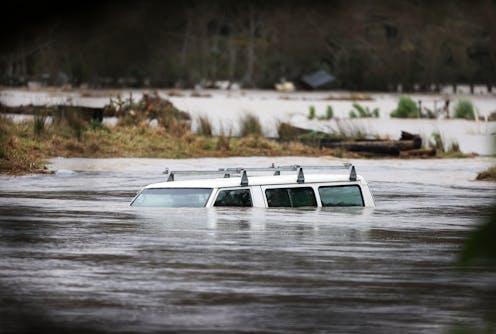
Flooded roads, our largest international airport underwater, overwhelmed storm water systems and significant sewage discharge into the sea and streams. The recent floods and then cyclone in Auckland are a stark reminder that our basic infrastructure lacks the resilience needed to survive major weather events.

When we talk about infrastructure resilience, we’re talking about an infrastructure system that continues to meet community needs – even after earthquakes, floods or cyclones.

After years of neglect, Auckland’s roads and water systems were simply unable to cope with the unprecedented rainfall and flooding seen in January. While the rainfall may have broken records, there have long been calls to future-proof the city’s infrastructure in the face of climate change.

In large part, this has not happened.

The importance of lifeline utilities

Roads, airports and water systems are included on a list of critical infrastructure described as “lifeline utilities”. These fall under the Civil Defence Emergency Management Act 2002, which requires that the utility is able to function to the fullest possible extent during and after an emergency.

The fact that many of Auckland’s lifeline utilities buckled during the floods points to failures to meet the basic requirements of the Act.

The Auckland Lifelines Group – of which Auckland Council, Auckland Airport, Vector and Watercare are members – falls under the National Lifelines Council. Both organisations have been helping Auckland’s essential utilities develop resilience and keep critical infrastructure running during an emergency.

They have also been calling for more investment in infrastructure resilience, including highlighting the problem in transportation.

Remove profit requirements

According to the 2020 edition of the New Zealand Critical Lifelines Infrastructure National Vulnerability Assessment, significant action is required to prevent lifeline utilities from being locked into inflexible or short-term response options.

The report also took a dim view of the funding and regulatory models for both public and private utility organisations that required a commercial return on resilient infrastructure improvement projects.


Read more:
Slippery slopes: why the Auckland storm caused so many landslides – and what can be done about it


Creating resilience in infrastructure should not require a commercial return on investment. Instead, resilience should be embedded in every decision made regarding infrastructure development and improvement.

The Infrastructure Commission endorses this view in their recently released report. The authors argued that making New Zealand’s infrastructure more resilient and investing in resilience planning will enable quicker recovery from natural and human-created disasters, minimising the impact on our society and economy.

Long-term planning needed

We need to rethink what infrastructure gets built and what gets retrofitted. We also need to reexamine how we incorporate and fund resilience thinking across the organisations that manage our lifeline utilities.

Resilience needs to start at the organisational level by engaging staff in problem solving, scenario planning and by providing training to develop innovative thinking.

Resilience also needs to be embedded at all levels of an organisation. Without training and advice, employees are less likely to be proactive and useful during an event.

During the recent flooding, the response from Auckland Airport, Auckland Transport and Auckland Council showed there was a lack of organisational resilience planning.


Read more:
Auckland floods: even stormwater reform won’t be enough – we need a ‘sponge city’ to avoid future disasters


But there is a more serious issue: we have infrastructure that is ageing, built in unsuitable places or built for today’s population, not the population of the future. Resilience requires an inter-generational approach, which means creating infrastructure that will suit growing populations and changes in the way we live.

Our research on flooding in Northland advocated for better community-led response plans that were integrated with infrastructure improvements and collaboration with councils to reduce the risk of future floods.

The current methods of decision making are not optimal, meaning infrastructure is built without an intergenerational view. We inevitably end up with infrastructure that is not fit for the populations they are supposed to serve, such as new roads that are congested soon after opening.

Nor do our design standards adapt swiftly to new pressures that come with climate change.


Read more:
Climate change is already putting the heat on insurance companies – Auckland’s floods could be a turning point


Robustness and redundancy

Infrastructure needs to have some robustness and redundancy. Robustness means being able to withstand hazard events without significant damage. Redundancy means spare capacity, such as alternative routes for transport.

With both, we have infrastructure that can operate during unusual conditions. For Auckland Transport, for example, this means rethinking routes and creating alternatives before events occur. It also means creating a network strong enough to cope with increased demands beyond business-as-usual traffic levels.

Utility providers don’t have to reinvent the wheel to identify what needs to change. Auckland Lifelines Group, the National Lifelines Council and Massey University’s School of Built Environment have done research to identify critical infrastructure, critical interdependencies between infrastructure and how to build resilient infrastructure.

Critical infrastructure – such as airports, significant roads and our water systems – should be treated as too important to fail. The recent floods are a warning that prioritising resilience for our infrastructure is urgently needed.


Read more:
The Auckland floods are a sign of things to come – the city needs stormwater systems fit for climate change


The Conversation

Suzanne Wilkinson receives funding from The Building Research Association of New Zealand (BRANZ) for research on resilience and zero carbon and the Ministry of Business, Innovation and Employment (MBIE) for an Endeavour Research Programme (CanConstructNZ).

ref. Flood warning: NZ’s critical infrastructure is too important to fail – greater resilience is urgently needed – https://theconversation.com/flood-warning-nzs-critical-infrastructure-is-too-important-to-fail-greater-resilience-is-urgently-needed-198872

Why a NZ pilot is a pawn in the West Papua conflict that the world ignores

ANALYSIS: By Camellia Webb-Gannon, University of Wollongong

“Phil Mehrtens is the nicest guy, he genuinely is — no one ever had anything bad to say about him,” says a colleague of the New Zealand pilot taken hostage last week by members of the West Papuan National Liberation Army (TPN-PB) in the mountainous Nduga Regency.

How such a nice guy became a pawn in the decades-long conflict between West Papua and the Indonesian government is a tragic case of being in the wrong place at the wrong time.

But it is also a symbolic and desperate attempt to attract international attention towards the West Papuan crisis.

A joint military and police mission has so far failed to find or rescue Mehrtens, and forcing negotiations with Jakarta is a prime strategy of TPN-PB.

As spokesperson Sebby Sambom told Australian media this week:

“The military and police have killed too many Papuans. From our end, we also killed [people]. So it is better that we sit at the negotiation table […] Our new target are all foreigners: the US, EU, Australians and New Zealanders because they supported Indonesia to kill Papuans for 60 years.

“Colonialism in Papua must be abolished.”

Sambom is referring to the international complicity and silence since Indonesia annexed the former Dutch colony as it prepared for political independence in the 1960s.

Mehrtens has become the latest foreign victim of the resulting protracted and violent struggle by West Papuans for independence.

Violence and betrayal
The history of the conflict can be traced back to 1962, when the US facilitated what became known as the New York Agreement, which handed West Papua over to the United Nations and then to Indonesia.

In 1969, the UN oversaw a farcical independence referendum that effectively allowed the permanent annexation of West Papua by Indonesia. Since that time, West Papuans have been subjected to violent human rights abuses, environmental and cultural dispossession, and mass killings under Indonesian rule and mass immigration policies.

New Zealand and Australia continue to support Indonesian sovereignty over West Papua, and maintain defence and other diplomatic ties with Jakarta. Australia has been involved in training Indonesian army and police, and is a major aid donor to Indonesia.

Phil Mehrtens is far from the first hostage to be taken in this unequal power struggle. Nearly three decades ago, in the neighbouring district of Mapenduma, TPN-PB members kidnapped a group of environmental researchers from Europe for five months.

Like now, the demand was that Indonesia recognise West Papuan independence. Two Indonesians with the group were killed.

The English and Dutch hostages were ultimately rescued, but not before further tragedy occurred.

At one point, negotiations seemed to have stalled between the West Papuan captors and the International Committee of the Red Cross (ICRC), which was delivering food and supplies to the hostages and working for their release.

Taking matters into their own hands, members of the Indonesian military commandeered a white civilian helicopter that had been used (or was similar to one used) by the ICRC. Witnesses recall seeing the ICRC emblem on the aircraft.

When the helicopter lowered towards waiting crowds of civilians, the military opened fire.

The ICRC denied any involvement in the resulting massacre, but the entire incident was emblematic of the times. It took place several years before the fall of former Indonesian president Suharto, when there was little hope of West Papua gaining independence from Indonesia through peaceful negotiations.

Then, as now, the TPN-PB was searching for a way to capture the world’s attention.

Human rights researcher pleads for West Papuan rebels to free NZ pilot

Losing hope
Since the early 2000s, with Suharto gone and fresh hope inspired by East Timor’s independence, Papuans — including members of the West Papuan Liberation Army — have largely been committed to fighting for independence through peaceful means.

After several decades of wilful non-intervention by Australia and New Zealand in what they consider to be Jakarta’s affairs, that hope is flagging. It appears elements of the independence movement are again turning to desperate measures.

In 2019, the TPN-PB killed 24 Indonesians working on a highway to connect the coast with the interior, claiming their victims were spies for the Indonesian army. They have become increasingly outspoken about their intentions to stop further Indonesian expansion in Papua at any cost.

In turn, this triggered a hugely disproportionate counter-insurgency operation in the highlands where Phil Mehrtens was captured. It has been reported at least 60,000 people have been displaced in the Nduga Regency over the past four years as a result, and it is still not safe for them to return home.

International engagement
It is important to remember that the latest hostage taking, and the 1996 events, are the actions of a few. They do not reflect the commitment of the vast majority of Indigenous West Papuans to work peacefully for independence through demonstrations, social media activism, civil disobedience, diplomacy and dialogue.

Looking forward, New Zealand, Australia and other governments close to Indonesia need to commit to serious discussions about human rights in West Papua — not only because there is a hostage involved, but because it is the right thing to do.

This may not be enough to resolve the current crisis, but it would be a long overdue and critical step in the right direction.

Negotiations for the release of Philip Mehrtens must be handled carefully to avoid further disproportionate responses by the Indonesian military.

The kidnapping is not justified, but neither is Indonesia’s violence against West Papuans — or the international community’s refusal to address the violence.The Conversation

Dr Camellia Webb-Gannon, lecturer, University of Wollongong, and author of Morning Star Rising: The Politics of Decolonisation in West Papua. This article is republished from The Conversation under a Creative Commons licence. Read the original article.

Print Friendly, PDF & Email

Article by AsiaPacificReport.nz

The draw of the ‘manosphere’: understanding Andrew Tate’s appeal to lost men

Source: The Conversation (Au and NZ) – By Ben Rich, Senior lecturer in History and International Relations, Curtin University

Wes Mountain/The Conversation, CC BY-ND

Mega-influencer Andrew Tate is once again back in the news as he battles charges of organised crime and human trafficking in Romania.

Tate gained infamy last year after being banned on most major social media platforms for promoting a variety of aggressively misogynistic positions designed to stir controversy and draw attention to his brand.

But while widespread public attention was drawn to Tate only recently, his reputation as a thought leader and “top g” in the online “manosphere” community has been longstanding.

Indeed, Tate’s ability to stoke and exploit the anxieties and grievances driving the manosphere are unprecedented, and have played a key role in him amassing millions of fans and hundreds of millions of dollars.

The lure of the ‘manosphere’

The manosphere is an overlapping collection of online men’s support communities that have emerged as a response to feminism, female empowerment, and the alienating forces of neoliberalism.

While this is widely understood, a lot less energy has been directed to understanding why and how men are attracted to these extreme communities in the first place.

The manosphere’s appeal can be perplexing, particularly for parents, teachers or friends trying to make sense of how the men in their lives suddenly adopt aggressively misogynistic views.


Read more:
The online ‘hierarchy of credibility’ that fuels influencers like Andrew Tate


But while the community’s content presents deeply concerning perspectives on women, it also offers explanations for, and solutions to, a very real set of issues facing young men.

A tranche of data illustrates these growing challenges. Men are rapidly falling behind in education engagement and outcomes. Rates of young male economic inactivity have risen considerably over the past two decades.

The intimate relations of young men also appear to be in decline. One report suggests rates of sexual activity have dropped by nearly 10% since 2002.

Suicide rates have risen significantly in men in particular over the past decade.

We’re also facing a loneliness crisis, which is particularly concentrated in young people and men.

The manosphere appeals to its audience because it speaks to the very real lives of young men under the above factors – romantic rejection, alienation, economic failure, loneliness, and a dim vision of the future.

The major problem lies in its diagnosis of the cause of male disenfranchisement, which fixates on the impacts of feminism. Here it contrasts the growing challenges faced by men with the increasing social, economic and political success experienced by women. This zero-sum claim posits that female empowerment must necessarily equate to male disempowerment, and is evidenced through simplified and pseudoscientific theories of biology and socioeconomics.

For many young men, their introduction to the manosphere begins not with hatred of women, but with a desire to dispel uncertainty about how the world around them works (and crucially, how relationships work).

The foundations of the manosphere may not strictly centre on misogyny, as is popularly imagined, but in young men’s search for connection, truth, control and community at a time when all are increasingly ill-defined.

Profiteering off anxiety

Since its inception, the manosphere has been rife with predatory influencers seeking to profit off the anxieties unleashed by this ambiguity.

Driven by a desire to reassert a romantic masculine aesthetic ideal in a world of social media unrealities, members of the manosphere often become willing consumers of a wide variety of products and services to “solve” their problems. These range from vitamin and gym supplements, personal coaching, self-help courses, and other subscription-based services.

But the influencers aren’t just capitalising on a sense of crisis passively – they actively cultivate it, as our research shows.

Figures like Tate, Canadian psychologist Jordan Peterson and “alpha” strongman Elliott Hulse expend huge amounts of energy and capital fomenting a sense of crisis around these issues, and positioning themselves at the centre. No more clearly was this illustrated than in Tate’s “Hustler’s University”, which created a series of exclusive chat rooms promising men a solution to their fears and centred on Tate’s personage and teachings.

Such communities solidify the claims made by their leaders, creating feedback loops that contribute to a climate of tension and hysteria. Members are actively encouraged to ridicule those who aren’t willing to acknowledge the “feminist conspiracies” that supposedly underpin the social and political world. Non-believers are seen as contemptible, weak and ignorant, dismissed through an ever-growing newspeak lexicon as “simps”, “cucks” and “betas”.

The community can also be mobilised to spread the message and brand of the influencer to the wider public, as demonstrated by Tate.

Having successfully isolated and indoctrinated community members, influencers can then rely on them as a persistent source of support and revenue, allowing them to further reinvest and continue this cycle of growth. This suggests a key way to push back on the wider effects of the manosphere is the targeted disruption of such feedback loops and the prevention of future ones emerging.

Empathy, patience and support

Tate and the manosphere didn’t manifest spontaneously. They’re symptoms of a deeper set of challenges young men are facing.

These problems won’t be addressed by simply deplatforming people like Tate. While this may often be necessary in the short term, savvier influencers will inevitably emerge, responding to the same entrenched issues and employing the tactics to greater effect, while avoiding the mistakes of their predecessors.


Read more:
‘Toxic masculinity’: what does it mean, where did it come from – and is the term useful or harmful?


In confronting the manosphere we need to understand and take seriously its appeal to lost men and the centrality of influencers in this process. We can be as critical of it as we want to be. But we also need to understand what it provides for many: a community and place of belonging, a defined enemy, direction, certainty, solutions to deep and systemic issues and, perhaps most importantly, hope.

We also need to avoid the kneejerk stigmatising and dismissal of people who fall into the manosphere. Simple ostracism tends only to entrench attitudes and reinforce the narratives of persecution spun by Tate and his ilk.

Instead, we need to use empathy, tolerance and patience to support men in ways that lead them away from these unpleasant boroughs of the internet and make them feel connected with wider society.

The Conversation

Ben Rich has received funding from the US State Department as part of a project on combatting extremism and disinformation. This includes components addressing the manosphere.

Eva Bujalka has received funding from the US State Department as part of a project on combatting extremism and disinformation. This includes components addressing the manosphere.

ref. The draw of the ‘manosphere’: understanding Andrew Tate’s appeal to lost men – https://theconversation.com/the-draw-of-the-manosphere-understanding-andrew-tates-appeal-to-lost-men-199179

Fair health outcomes start with prevention. The new Centre for Disease Control can make it happen

Source: The Conversation (Au and NZ) – By Peter Breadon, Program Director, Health and Aged Care, Grattan Institute

marcelo leal/unsplash, CC BY-SA

For the land of the fair go, Australia has work to do on our health. Although the average Australian’s life expectancy is very high, that’s not true for everyone.

Indigenous Australians, and Australians with little formal education, can expect to die about eight years younger than their fellow citizens. People who live in rural areas will die about two to three years earlier, on average, than people who live in cities.

And because chronic diseases create most of these gaps, these disadvantaged people will spend more years living in ill health than other Australians.

These statistics don’t begin to capture the immense suffering behind the numbers, or the deep injustice of gaping health gaps in a wealthy nation like ours.

The government has promised to set up a Centre for Disease Control (CDC), which will tackle both infectious and chronic disease. A new Grattan Institute report shows how it can be set up to drive down rates of chronic disease. This will help reduce health disparities, especially if the CDC builds equity into its DNA.

Chronic disease lies at the heart of health inequities

Much of the life-expectancy gap between the most and least disadvantaged Australians is explained by skewed rates of chronic disease.

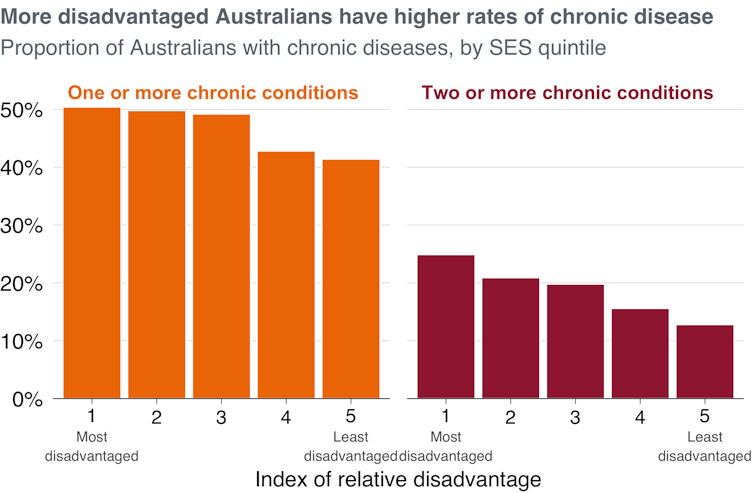
The most disadvantaged fifth of Australians are about 20% more likely to be living with one chronic disease, and about twice as likely to be living with two or more, compared with the most advantaged fifth of Australians.


Rates of chronic disease by disadvantage. Grattan analysis of ABS data (2022).

It’s estimated that about 80% of the gap in life expectancy between Indigenous and non-Indigenous Australians is caused by chronic diseases.

Gaps in health start before sickness

Some chronic diseases are difficult to prevent. There is little we can currently do to stop the onset of type one diabetes or cystic fibrosis, for example.

But other chronic diseases are the result of risk factors such as smoking, alcohol abuse, or being overweight or obese, which we can change.

These so-called modifiable risk factors are the cause of about 40% of the chronic disease burden in Australia. And, like chronic diseases, rates are significantly higher among disadvantaged Australians.

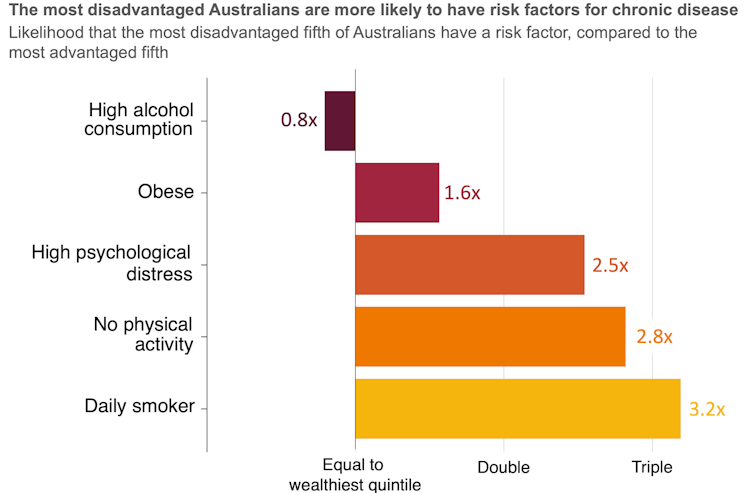
Risk factors for most disadvantaged fifth of the population compared to most advantaged. High alcohol consumption refers to lifetime risk guidelines of no more than two standard drinks per day. Grattan analysis of ABS (2018) and PHIDU (2022).

Compared with the most advantaged fifth of Australians, the most disadvantaged fifth are about 60% more likely to be obese, more than twice as likely to have high psychological distress, almost three times as likely to do no physical activity, and over three times as likely to smoke daily.

This means inequity is already baked in well before people get ill.

Isn’t being healthy a choice?

Modifiable risk factors are sometimes branded as “lifestyle choices”. But this glosses over the fact our choices are heavily influenced by environmental and social factors.

For example, more disadvantaged Australians are more likely to find it hard to get or afford sufficient healthy food, which increases the risk of obesity. The increased and often chronic stress that disadvantage brings is associated with smoking more, and may have links with obesity.

Disadvantage is also intertwined with fewer educational opportunities, and education is strongly linked to health because it provides people with better knowledge of health and healthy behaviours. It shapes employment opportunities and can provide a stronger sense of personal control, which helps people make healthier choices.

Many modifiable risk factors may seem like choices, but the causes are often structural. There’s little Australians living in disadvantage can do about these influences, but they all increase the chance of modifiable risk factors, and sickness.

Man smoking
Environmental and social factors heavily influence modifiable risk factors for health, like smoking.
reza mehrad/unsplash, CC BY

A CDC has a chance to reduce health gaps

The proposed Australian Centre for Disease Control, promised by the Albanese government, is an opportunity to tackle these structural barriers.

The centre has a big job to do. Australia has fallen behind our peers when it comes to prevention. As our report shows, we spend about 2% of the health budget on public health, which is less than one-third of what Canada spends, less than half of what the United Kingdom spends, and far below the OECD average.

While many other countries have introduced sugar taxes or taken action to reduce people’s intake of salt and trans fats, Australia’s prevention progress has largely stalled.

Our report shows that to have an impact, the CDC must be set up for success, with independence and the right role and resources. And the federal and state governments must make a new funding deal to make the investments the centre recommends.


Read more:
How should an Australian ‘centre for disease control’ prepare us for the next pandemic?


A focus on fairness

Reducing risk factors across the population would have a big impact on health inequity. But to make the biggest gains, the communities at highest risk should be the focus. The CDC should understand who those communities are, and what will work for them.

One of its central roles should be providing technical advice to Australian governments. This advice must take equity into account.

When the centre looks at what works in prevention, it should consider who will benefit. Initiatives that disproportionately benefit disadvantaged groups should be valued more highly.

When the centre advises government on progress and targets, it should reflect not just how the average Australian is going, but also the status of groups that have traditionally been left behind.

To help the centre understand health disparities and the perspectives of people who experience them, the staff, leadership and culture of the centre should be diverse and inclusive, representing the broader community. And the centre should also listen to different groups that face the biggest barriers to good health, using a range of consultation and engagement methods.

Narrowing the health gap that divides Australians won’t happen overnight. And not all the structural barriers that create health inequalities can be solved by another government agency.

But for too long, these gaps have received too little attention. A strong, equity-focused CDC can help ensure that, when it comes to their health, all Australians get a fair go.

The Conversation

The authors do not work for, consult, own shares in or receive funding from any company or organization that would benefit from this article, and have disclosed no relevant affiliations beyond their academic appointment.

ref. Fair health outcomes start with prevention. The new Centre for Disease Control can make it happen – https://theconversation.com/fair-health-outcomes-start-with-prevention-the-new-centre-for-disease-control-can-make-it-happen-199387

A mega port in India threatens the survival of the largest turtles on Earth

Source: The Conversation (Au and NZ) – By Divya Narain, PhD Candidate, The University of Queensland

Shutterstock

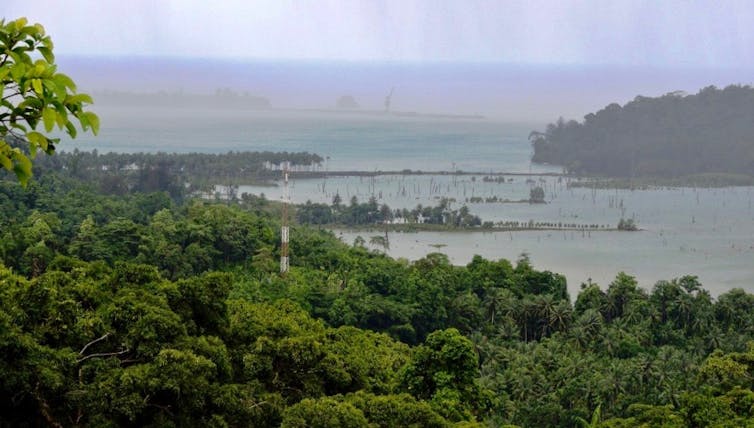
In a remote archipelago at the southernmost tip of India lies the Great Nicobar Island. This pristine ecosystem is a globally important nesting site of the largest turtles on Earth – leatherback turtles. But now, the site is threatened by a massive infrastructure plan.

The Indian government recently granted key approvals for an international container port on the island, which may prevent leatherback turtles from reaching their nesting sites.

Great Nicobar Island spans about 1,000 square kilometres and lies about halfway between India and Thailand. It is home to the indigenous Shompen and Nicobarese people, and a rich diversity of plant and animal species.

To date, the island has remained relatively untouched by large-scale development. The port proposal would change that.

green-fringed bay
Great Nicobar Island lies at the southernmost tip of India.
Wikimedia

A critically endangered turtle population

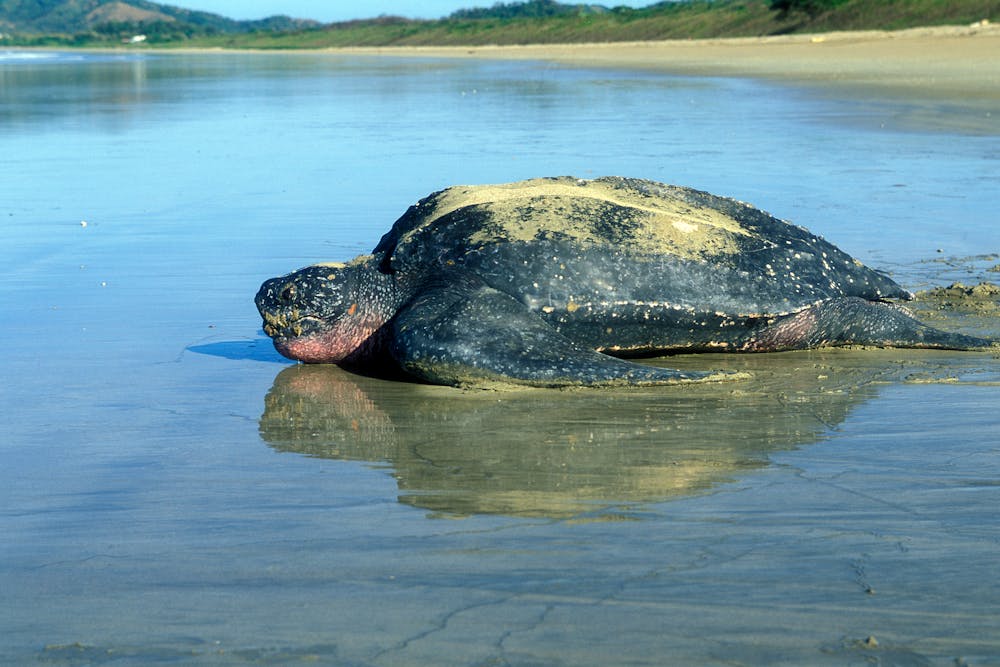
Leatherback turtles can grow up to two meters long and weigh as much as 700 kilograms. The species has existed since the age of the dinosaurs, but its numbers are in decline.

The sub-population of turtles that nests at Galathea Bay, where the port would be built, is listed as critically endangered.
The turtles forage in temperate coastal waters in Australia and Africa, before making the long annual journey to the island.

According to the International Union for the Conservation of Nature, loss of nesting sites is one of the key threats to the turtles’ survival. Other threats include fishing activities, collisions with boats, egg collection for human consumption, and ingestion of plastic waste.

Galathea Bay was also heavily damaged by the 2004 tsunami, which destroyed most of the beaches where leatherback turtles nest.


Read more:
Australian endangered species: Leatherback Turtle


an adult leatherback turtle
The plan includes building a international container port on a globally important nesting site of the world’s largest turtle species – the leatherback sea turtle.
Shutterstock

Massive development, massive impact

The huge infrastructure project planned for Great Nicobar Island includes:

  • a mega trans-shipment port, where large volumes of cargo will be moved from one vessel to another for shipping to another port

  • an international airport which will handle 4,000 passengers an hour at its peak

  • a power plant

  • a new township.

Experts have raised concern about the environmental damage the project will cause. In particular, they say the port’s construction and operation is likely to prevent the leatherback turtle from accessing nesting sites.

The plan includes constructing breakwaters – barriers built in the sea to protect the port from waves. The barriers reduce the opening to Galathea Bay by 90% – from 3 kilometres to 300 metres.

Dredging and construction are likely to significantly alter other coastal habitats on the island, including mangroves, coral reefs, sandy and rocky beaches, coastal forests and estuaries.

One media report warned the plan will involve clearing almost a million trees.

The port is also likely to damage the habitat of scores of other rare and endemic species including macaques, shrews and pigeons.


Read more:
India must stop deforesting its mountains if it wants to fight floods


a macaque
The Nicobar long-tailed macaque is among the species likely to lose habitat if the project proceeds.
Shutterstock

How was such a disastrous project approved?

The approvals granted so far rest on a proposal to “offset” the environmental damage caused by the port by improving bioldiversity elsewhere.

In this case, the offset involves planting trees in the Indian state of Haryana, thousands of kilometres from the project site and in a vastly different ecological zone.

This is allowed under Indian law. But it’s a gross violation of the internationally accepted “like for like” principle guiding biodiversity offsetting. This principle requires that the biodiversity affected by a given project be conserved through an ecologically equivalent offset, so no net loss of biodiversity occurs.

The Great Nicobar Island plan will damage complex and diverse tropical and coastal ecosystems and several rare and endemic species. This would purportedly be “offset” by planting trees in a sub-tropical semi-arid ecosystem thousands of kilometres away.

There is no provision in the plan to compensate for damage to turtle nesting. This alone violates the “like for like” principle.

Even more worryingly, research has shown most compensatory tree-planting in India involves monoculture timber species, which does not encourage a wide variety of native plant and animal species.

a fern forest
A forest on Great Nicobar Island. According to some estimates, one million trees could be felled to make way for the port.
Wikimedia

Looking ahead

The approvals granted to the port project contain a number of conditions. They reportedly include:

  • establishing a long-term research unit, focused on sea turtles, including a base at Great Nicobar Island

  • requiring that the company behind the project has a “well laid down environmental policy duly approved by the board of directors”

  • where possible, safeguarding trees that contain nesting holes for endemic owls.

But according to India’s Conservation Action Trust, approvals were granted before important impact assessment studies were carried out. What’s more, the conditions do not stipulate that work must stop if damage occurs to Indigenous communities or the environment.

Any large development project affecting a critically endangered species should meet rigorous environmental standards. This includes ensuring biodiversity offsets are consistent with internationally accepted principles.

And if the harm cannot be adequately offset, the project should not be allowed to proceed.


Read more:
A China-backed dam in Indonesia threatens a rare great ape – and that’s just the tip of the iceberg


The Conversation

Divya Narain does not work for, consult, own shares in or receive funding from any company or organization that would benefit from this article, and has disclosed no relevant affiliations beyond their academic appointment.

ref. A mega port in India threatens the survival of the largest turtles on Earth – https://theconversation.com/a-mega-port-in-india-threatens-the-survival-of-the-largest-turtles-on-earth-197021

Why restoring long-distance passenger rail makes sense in New Zealand — for people and the climate

Source: The Conversation (Au and NZ) – By Robert McLachlan, Professor in Applied Mathematics, Massey University

A recent parliamentary inquiry into passenger rail drew 1700 submissions, suggesting growing support for the return of long-distance trains in Aotearoa.

The government has committed the country to decarbonisation targets that require significant cuts to transport-related emissions. But decarbonising long-distance travel is not part of the plan – the national rail operator KiwiRail remains focused on freight.

We argue the revival of long-distance passenger rail needs to be part Aotearoa’s strategy to bring emissions down.

The arguments for intercity passenger rail centre on connecting communities, equity in transport options, reduced emissions and lower energy use.

The end of the decline?

After a long decline – detailed in André Brett’s history of the New Zealand network Can’t Get There From Here – there were some gains in 2022.

Following initial plans to turn it into a tourist train, the Northern Explorer is back running between Auckland and Wellington. Passenger numbers on Te Huia, a rail service between Auckland and Hamilton, have doubled – helped by half-price fares – since its launch in April 2021.

The commuter train Capital Connection attracts good passenger numbers on its week-day only run between Wellington and Palmerston North, despite old and unreliable rolling stock. Work is underway on improving passenger rail near Wellington.

Campaigning for rail

Several new campaigns are pushing for further improvements to passenger rail.

Save Our Trains is seeking a “comprehensive national strategy for inter-regional passenger rail services built around concerns for climate action, accessibility, affordability and economic development”.

Making Rail Work has developed a proposal to reinstate the Kaimai Express linking Auckland and Tauranga. A report for local government supported the case for more frequent services linking North Island towns.


À lire aussi :
Convenience, comfort, cost and carbon: what’s the best way to travel, save money and cut emissions?


Arguing for the restoration of the Auckland–Wellington night train, public transport planner Nicolas Reid suggested such a service “would have the potential to replace up to 150,000 long-distance car trips or flights per year”.

Most controversially, the group Restore Passenger Rail staged a series of nonviolent direct actions to draw attention to the issue, closing motorways and attempting (unsuccessfully) to address the cross-party inquiry into passenger rail from the top of a motorway gantry.

Rail cuts transport emissions

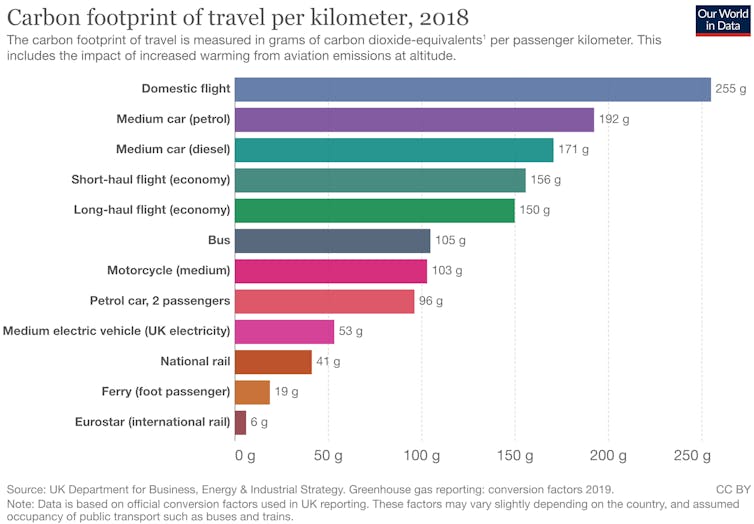
Transport comprises 45% of Aotearoa’s domestic carbon dioxide emissions, but it is hard to decarbonise. It requires a combination of changes to technology, behaviour and infrastructure. But the significant emission and energy benefits of using intercity and regional rail, rather than driving or flying, are well established globally.

New Zealand’s emissions reduction plan aims for a 20% reduction (per capita) in driving by 2035, through improved urban planning and better travel options. But it does not mention intercity rail.

As half of all kilometres driven are on the state highway network, this is a major omission. Auckland Council’s transport emission reduction plan also aims to reduce domestic aviation emissions by half by 2030, before promised electric or hydrogen-powered planes can make any real impact.

A graph showing carbon dioxide emissions for different modes of transport

Our World in Data, CC BY-SA

Auckland, Wellington and Christchurch are important, but they only comprise half the population. Travel within and between the smaller cities must also be decarbonised, or the whole country will fail its targets.

Transport investments misplaced

To reinstate fast and efficient passenger rail across Aotearoa, large capital and carbon investments are required. But that is partly because the rail network has been run down for decades, while considerable investment has gone into roads.

Yet, these new roads create more traffic. Further road building, such as an expressway between Ōtaki and Levin, is being promoted, even though we know this project has an extremely poor economic return and will induce more driving.


À lire aussi :
Climate explained: does building and expanding motorways really reduce congestion and emissions?


When good services are on offer, people tend to use them. In Auckland, the then rundown suburban train service was used by only one million people each year in 1994. But a range of improvements saw passenger numbers top 20 million in 2017, with further growth expected once the City Rail link is completed.

Demographic changes support the return of passenger rail. Aotearoa has an aging population, especially in its smaller centres. Many lack airports and driving can become problematic for older age groups. Small towns have also lost many services and visits to bigger centres for medical appointments and other services have become more important.

Most towns still have railway lines connecting them to larger centres. The remaining private coach network suffers from infrequent service, poor quality and a lack of connectivity and integrated ticketing. If, in the UK, the rich take trains and the poor take buses, we suspect in Aotearoa the rich fly or drive and the poor take the bus or don’t travel at all.

Not everyone drives, particularly children and old people; and of those who do drive, some would prefer not to. Internationally, we’ve seen a long-term decline in the number of young people gaining drivers’ licences.


À lire aussi :
NZ’s most walkable towns and cities ranked: see how your neighbourhood stacks up


For those living in larger urban centres with good public transport and biking infrastructure or in 15-minute neighbourhoods, there is far less need to own a car. To make the necessary cuts to transport emissions in our larger cities, we need to re-imagine car ownership as an option rather than a necessity.

It might be a lot to lay on the humble train, but civilisation is in a tight spot. We need to collectively halve emissions by 2030, while also laying the groundwork for a truly sustainable future. This means wise use of resources – long-lasting, economical infrastructure based on proven technology, combined with renewable electricity. Trains do that.

The Conversation

Paul Callister is affiliated with organisation.

Save Our Trains group

Robert McLachlan ne travaille pas, ne conseille pas, ne possède pas de parts, ne reçoit pas de fonds d’une organisation qui pourrait tirer profit de cet article, et n’a déclaré aucune autre affiliation que son organisme de recherche.

ref. Why restoring long-distance passenger rail makes sense in New Zealand — for people and the climate – https://theconversation.com/why-restoring-long-distance-passenger-rail-makes-sense-in-new-zealand-for-people-and-the-climate-199381

Open-plan classrooms are trendy but there is little evidence to show they help students learn

Source: The Conversation (Au and NZ) – By Anika Stobart, Senior Associate, Grattan Institute

Shutterstock

If you step into a newly built school these days, chances are you will see classrooms that look very different to the classrooms most of us spent our school years in as children.

On a recent visit to a new primary school in Melbourne, Grattan Institute’s education team entered a large room that contained two classes, separated not by a wall but a wide pillar that left room for teachers and students to move between the two “classroom” spaces.

In the first space, students were leaning forward at their desks, concentrating on their teacher. The room was very noisy. The teacher was only metres from her students, but her voice was all but drowned out by the second “classroom” on the other side.

This appears to be the trend in new classroom buildings around Australia.

For example, in 2017 the New South Wales government committed to building open-plan classrooms, each for up to 120 students, at more than 100 new schools. The Victorian government is building “new flexible learning communities”.

What does the research say about open-plan classrooms?

Arguments in favour of open-plan classrooms use phrases such as “21st century teaching” and “innovative design”.

The idea is to have flexible classroom spaces that can cater for large groups of students, while also allowing students to break into smaller groups, directing their own learning while receiving support from a team of teachers working collaboratively.

But there is limited evidence open-plan classrooms help learning. In 2018 the University of Melbourne published a systematic review that only found 21 relevant studies since the 1960s that evaluated the impact of educational spaces on student learning outcomes. Of these, the studies showed open-plan environments had mixed effects on academic performance.

We do know too much noise is bad for learning. A 2015 Australian study compared speech perception in traditional and open-plan kindergarten classrooms and found noise coming from other classes in the open-plan setting made it more likely for students to misunderstand their teacher. The study found traditional classrooms were the only classroom type to be within or close to recommended noise levels.

Many open-plan learning spaces don’t align with internationally recognised evidence-based strategies for high-impact teaching.

For example, explicit teaching – where the teacher explains key concepts and procedures clearly and models how to solve problems to the whole class – is difficult to do well in a noisy environment. Imagine trying to teach division of fractions to your Year 5 class while the Year 4 class on the other side of the pillar practices their Mandarin oral language presentations.

Too much noise is bad for all students

Of course, traditional classrooms can also be noisy, but a 2013 United Kingdom survey of 2,500 high school students across six schools suggested students at schools with traditional classrooms were more positive about their school acoustics than students at schools with open-plan classrooms.

Too much noise is bad news for all students. But it is particularly worrying for students who have issues with hearing, auditory processing, and other additional learning needs, such as ADHD.

This is also inconsistent with state governments’ stated priorities of ensuring schools are inclusive spaces that cater for students with additional learning needs.

New classrooms should be built using evidence

State governments need to review the existing research – and seek more if needed – and ensure all new classrooms can support the learning of all students. This includes those with additional learning needs and those unlucky enough to be seated at the back of an open-plan classroom.

This is consistent with a 2022 NSW parliamentary inquiry into school infrastructure, which recommended school design should follow evidence, not fads.

Where necessary, state governments should also provide schools with funding to fix existing open-plan classrooms so teachers can reduce noisy distractions. Teachers should not have to build their own classroom walls “with whiteboards and shelving”.


Read more:
Classroom design should follow evidence, not architectural fads


Some state governments are spending significant funds building new schools and upgrading others in coming years. For example, the NSW government is spending A$8.6 billion on school infrastructure over the next four years. Queensland is spending A$2 billion on education infrastructure this year alone.

While investments in school infrastructure are of course welcome, the danger is many classrooms may be built in ways that undermine effective teaching. Classrooms designs should not create more work for teachers, just to make sure their students can hear them – and each other – speak.


Brigette Garbin contributed to the analysis of this piece, and previously worked as a researcher at the Grattan Institute.

The Conversation

Anika Stobart is a senior associate at the Grattan Institute. The Grattan Institute began with contributions to its endowment of $15 million from each of the Federal and Victorian Governments, $4 million from BHP Billiton, and $1 million from NAB. In order to safeguard its independence, Grattan Institute’s board controls this endowment. The funds are invested and contribute to funding Grattan Institute’s activities. Grattan Institute also receives funding from corporates, foundations, and individuals to support its general activities as disclosed on its website.

Jordana Hunter is Education Program Director at the Grattan Institute.

ref. Open-plan classrooms are trendy but there is little evidence to show they help students learn – https://theconversation.com/open-plan-classrooms-are-trendy-but-there-is-little-evidence-to-show-they-help-students-learn-199591

From Chaucer to chocolates: how Valentine’s Day gifts have changed over the centuries

Source: The Conversation (Au and NZ) – By Clare Davidson, Research Associate, Gender and Women’s History Research Centre, Australian Catholic University

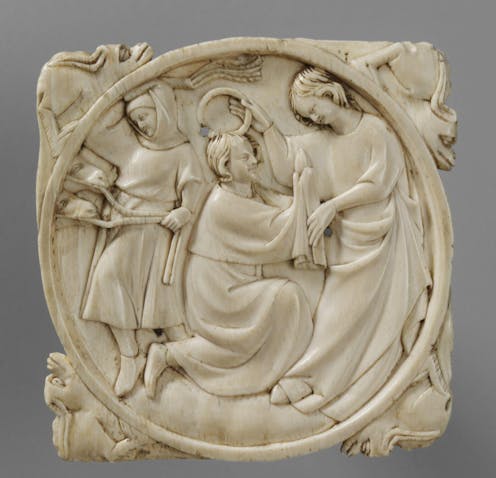
Mirror case, ivory, a Lady Crowning her Lover, Paris, France, ca. 1300 Victoria and Albert Museum

For Valentine’s Day, some couples only roll their eyes at each other in mutual cynicism. The capitalisation of love in the modern world can certainly seem banal.

But Valentine’s Day gifts are hardly a contemporary invention. People have been celebrating the day and gifting love tokens for hundreds of years.

We should first turn to Geoffrey Chaucer, the 14th-century poet, civil servant and keen European traveller. Chaucer’s poem from the 1380s, The Parliament of Fowls, is held to be the first reference to February 14 as a day about love.

This day was already a feast day of several mysterious early Roman martyred Saint Valentines, but Chaucer described it as a day for people to choose their lovers. He knew that was easier said than done.

The narrator of the poem is unsuccessful in love, despairing that life is short compared with how long it takes to learn to love well. He falls asleep and dreams of a garden in which all the different birds of the world have gathered.

Nature explains to the assembled flocks that, like every year on St Valentine’s Day, they have come to pick their partners in accordance with her rules. But this process causes confusion and debate: the birds can’t agree what it means to follow her rules because they all value different things in their partners.

A 15th century version of Chaucer’s The Parliament of Fowls.
© The Trustees of the British Museum


Read more:
St Valentine’s – a minor day in a medieval calendar packed with festivals


Legal and emotional significance

Like today, in Chaucer’s time gift-giving could be highly ritualised and symbolise intention and commitment. In Old and Middle English, a “wed” was any sort of token pledged to guarantee a promise. It was not until the 13th century that a “wedding” came to mean a nuptial ceremony.

The same period saw marriage transform into a Christianised and unbreakable commitment (a sacrament of the Church). New conventions of love developed in songs, stories and other types of art.

These conventions influenced broader cultural ideas of emotion: love letters were written, grand acts of service were celebrated, and tokens of love were given.

Author Pierre Sala gave a collection of love poems, the ‘Petit Livre d’Amour’ to his lover Marguerite Builloud, c. 1500.
© The Trustees of the British Museum

Rings, brooches, girdles (belts), gloves, gauntlets (sleeves), kerchiefs or other personalised textiles, combs, mirrors, purses, boxes, vessels and pictures – and even fish – are just some examples of romantic gifts recorded from the late middle ages.

A gold ring
Posy rings, such as this one from 1500-1530, were often given as love gifts, betrothal and wedding rings.
Victoria and Albert Museum

In stories, gifts could be imbued with magical powers. In the 13th century, in a history of the world, Rudolf von Ems recorded how Moses, when obliged to return home and leave his first wife Tharbis, an Ethiopian princess, had two rings made.

The one he gave her would cause Tharbis to forget him. He always wore its pair which kept her memory forever fresh in his mind.

Illustration from a World Chronicle of Moses giving Tharbis the Forgetting Ring, c1400-1410.
J. Paul Getty Museum

Outside of stories, gifts could have legal significance: wedding rings, important from the 13th century, could prove that a marriage had occurred by evidencing the intention and consent of the giver and recipient.


Read more:
Single on Valentine’s Day and happily so


The art of loving

Like Chaucer, 20th-century German psychologist Erich Fromm thought people could learn the art of loving. Fromm thought love was an act of giving not just material things, but one’s joy, interest, understanding, knowledge, humour and sadness.

While these gifts might take some time and practice, there are more straightforward ideas from history. Manufactured cards have dominated since the industrial revolution, taking their place alongside other now traditional presents such as flowers, jewellery, intimate apparel and consumables (now more often chocolates than fish). All can be personalised for that intimate touch.

A Valentine’s Day card from 1836.
Bequeathed by Guy Tristram Little, Victoria and Albert Museum

There have, of course, been weirder examples of love gifts, such as Angelina Jolie and Billy Bob Thornton exchanging necklaces with silver pendants smeared with each other’s blood.

Artist Dora Maar was so upset when her notoriously bad lover Pablo Picasso complained about having to trade a painting for a ruby ring she immediately threw the ring in the Seine. Picasso soon replaced it with another, this one featuring Maar’s portrait.

A good love token can long outlast the feelings that prompt its giving: a flower pressed in a book, a trinket at the bottom of a box, a fading heartfelt card or a bittersweet song that jolts you back to an earlier time. In this way, the meaning of gifts can change as they become reminders that all things pass.


Read more:
Valentine’s Day: the pressures of shopping for romance


The Conversation

Clare Davidson does not work for, consult, own shares in or receive funding from any company or organisation that would benefit from this article, and has disclosed no relevant affiliations beyond their academic appointment.

ref. From Chaucer to chocolates: how Valentine’s Day gifts have changed over the centuries – https://theconversation.com/from-chaucer-to-chocolates-how-valentines-day-gifts-have-changed-over-the-centuries-198512

Albanese government announces $424 million to narrow a gap that is not closing fast enough

Source: The Conversation (Au and NZ) – By Michelle Grattan, Professorial Fellow, University of Canberra

The Albanese government has unveiled a new implementation plan for Closing the Gap with $424 million over several years in additional money for “practical action”.

“The gap is not closing fast enough and on some measures it is going backwards,” the government said in a statement from several ministers and also including the lead convenor of the Coalition of Aboriginal and Torres Strait Islander Peak Organisations, Pat Turner.

The initiatives come amid a spate of publicity about the problems in Alice Springs and elsewhere in the Northern Territory that, while they have been worsened by alcohol, also reflect shortages of housing, a lack of jobs, and other long-standing issues.

New measures in the implementation plan – the second such plan, with the first coming under the former government are –

  • $150 million over four years for water infrastructure, especially targeting communities that at present do not have access to clean drinking water. The money comes from the National Water Grid Fund

  • $111.7 million federal contribution to a new one-year partnership with the Northern Territory government to build remote housing

  • $11.8 million over two years to make food more affordable and accessible in remote communities

  • continued funding of $68.6 million over two years for family violence and prevention legal service providers to deliver legal and non-legal support to women and children

  • $21.9 million over five years to support families affected by family violence and at risk of separation, through the provision of seven “place-based, trauma-aware and culturally responsive healing programs” to intervene early and keep families together

  • $38.4 million over four years to boost on-country education for remote students, including greater access to junior rangers and more choice for families of culturally appropriate distance learning

  • $21.6 million to support quality boarding for rural and remote students for an additional year.

The measures will be delivered in partnership with Indigenous organisations.

Minister for Indigenous Australians Linda Burney said: “We saw the outcomes in the 2022 Closing the Gap Annual Report and know that we need to be doing more as a government.

“This additional funding is a concrete commitment from the Albanese government to prioritise Closing the Gap and see sustained progress.

“Our measures are going to be more specific and more targeted, making real impacts that complement work underway in states and territories, and back-in Aboriginal and Torres Strait Islander community-controlled organisations to lead work in their communities.”

Environment Minister Tanya Plibersek said it was shocking that some communities did not have reliable drinking water.

“Many of these communities are remote, First Nations communities.

“There are towns that are unable to run dialysis machines as there is not enough clean and safe water. There are communities where the heavy metals and minerals in the water are at such concentrations that the water cannot be consumed safely. We want to start to change that with this investment.

“We are targeting $150 million from the National Water Grid Fund to support critical water infrastructure for remote First Nations communities.

“This is only possible because last year we changed the Investment Framework of the National Water Grid to allow investment in town water supply projects.”

Meanwhile Burney has sent a sharp message to Peter Dutton on the Voice, in calling attention to his boycott of the 2008 apology by Kevin Rudd to the stolen generations (something Dutton more recently said he regretting doing).

In a speech on Sunday marking the 15th anniversary of the apology Burney (without naming Dutton) said: “I know that some people who boycotted that historic day in 2008 have since expressed their regret. They now admit that it was a mistake. And I say to those people – don’t make the same mistake again.”

Dutton and the Liberals have yet to say what attitude the party will adopt to the Voice referendum. He is planning to attend another meeting of the referendum working group and says his questions on the Voice have not been adequately answered by the government.

The Conversation

Michelle Grattan does not work for, consult, own shares in or receive funding from any company or organisation that would benefit from this article, and has disclosed no relevant affiliations beyond their academic appointment.

ref. Albanese government announces $424 million to narrow a gap that is not closing fast enough – https://theconversation.com/albanese-government-announces-424-million-to-narrow-a-gap-that-is-not-closing-fast-enough-199750

Boat arrivals on temporary protection visas have access to permanent residency

Source: The Conversation (Au and NZ) – By Michelle Grattan, Professorial Fellow, University of Canberra

original

Thousands of boat arrivals whose futures have been in limbo for a decade or more will be able to apply from Monday to be permanent Australian residents.

The Minister for Home Affairs, Clare O’Neil and the Immigration Minister, Andrew Giles, have announced about 19,000 people on Temporary Protection Visas and Safe Haven Enterprise Visas will be eligible to apply.

The announcement fulfils a Labor election commitment. The decision only applies to people who entered Australia before Operation Sovereign Borders and who hold or have applied for a TPV or SHEV before Tuesday.

SHEV is a variation of a temporary protection visa. It has to be renewed every five years, compared to every three for a TPV. It was introduced some years ago to encourage people to go to regional areas. While in theory it gave a road to permanency, only one SHEV-holder has achieved that.

The ministers said just over 2500 people have had their TPVs or SHEVs refused or cancelled, and they will be expected to leave Australia.

The TPV/SHEV applications of more than 5000 people are in a review process which will continue.

The Home Affairs department will invite people on visas that are about to expire to apply for permanency, while other people will be able to apply online from late next month. Once a permanent visa is granted, the person will immediately become eligible for all social security payments, the National Disability Insurance Scheme (N, and higher education assistance, as well as continuing to have access to Medicare.

They will be eligible for citizenship when they meet the requirements and to sponsor family members under the migration program’s family stream.

Giles said: “There are thousands of TPV and SHEV holders in the community that have endured ten years of uncertainty due to the policies of the previous Liberal government.

“TPV and SHEV holders work, pay taxes, start businesses, employ Australians and build lives in our communities – often in rural and regional areas. Without permanent visas however, they’ve been unable to get a loan to buy a house, build their businesses or pursue further education. It makes no sense – economically or socially – to keep them in limbo.”

The government is anxious that the granting of permanency to this group is not taken by people smugglers as a signal to test its resolve on border protection.

O’Neil said: “Let me be crystal clear – if you try to enter Australia without a valid visa you will be turned back or returned to your port of origin. There is zero chance of settling in Australia under Operation Sovereign Borders.

“The Australian Defence Force are patrolling our waters to intercept and return any boats that try to enter.”

Last week the government had parliament urgently renew the designation of Nauru as a centre for detaining unauthorised arrivals. The designation had inadvertently been allowed to lapse.

The Conversation

Michelle Grattan does not work for, consult, own shares in or receive funding from any company or organization that would benefit from this article, and has disclosed no relevant affiliations beyond their academic appointment.

ref. Boat arrivals on temporary protection visas have access to permanent residency – https://theconversation.com/boat-arrivals-on-temporary-protection-visas-have-access-to-permanent-residency-199751

Thousands without power, evacuations begin as Cyclone Gabrielle hits NZ

RNZ News

Cyclone Gabrielle was battering parts of the North Island of Aotearoa New Zealand with strong winds and heavy rain last night.

Most of the North Island is covered by some kind of Severe Weather Watch or Warning either for wind, rain or both.

Red heavy rain warnings have been issued for Northland, Auckland, the Coromandel and the northern parts of Gisborne Tairāwhiti.

Red strong wind warnings have been issued for Northland, Auckland and the Coromandel.

Vector said at 7pm 15,000 households in the Auckland area were without power last night.

“Our crews are responding as quickly and safely as they can, given the current weather conditions,” said a spokesperson.

Auckland Harbour Bridge closed
In the Coromandel Peninsula, about 11,000 homes were without power.

The storm has cut supply in Port Charles, Waikawau, Manaia, Tairua, Cooks Beach and parts of Whitianga.

Electricity has also been cut to Paeroa on the Hauraki Plains and Pururi, just south of Thames.

The Auckland Harbour Bridge remained closed overnight due to high winds.

Waka Kotahi made the decision to close the bridge just after 3:30pm yesterday afternoon, which was met with criticism from motorists.

National Emergency Response spokesperson Mark Owen said that while safety was its priority, closing the bridge was very challenging.

The bridge will remain closed until further notice.

Self-evacuations in Gisborne
Many families in Gisborne left their homes voluntarily ahead of the severe wind and rain.

Cyclone Gabrielle was set to reach Gisborne last night, bringing gale-force winds and nine metre storm surges and heavy rain.

Up to 450mm was forecast north of Tolaga Bay before Tuesday.

RNZ will continue live coverage from 5am Monday morning and update any major developments overnight.

This article is republished under a community partnership agreement with RNZ.

Prime Minister Chris Hipkins
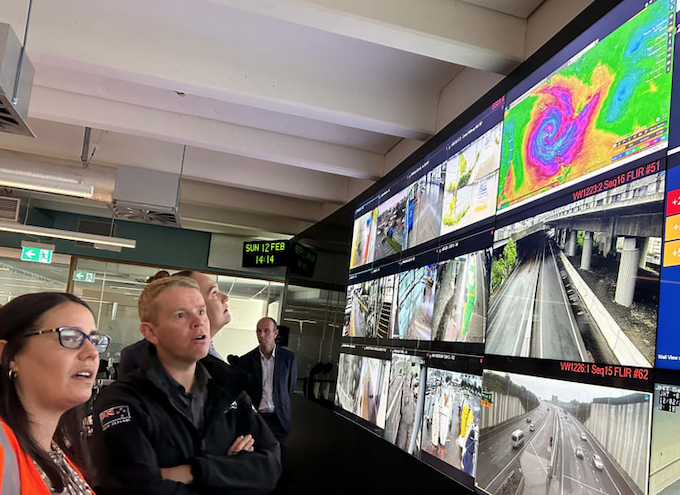
Prime Minister Chris Hipkins visiting Auckland Transport’s operation centre in Takapuna, North Shore, as Cyclone Gabrielle made landfall. Image: Ashleigh McCaull/RNZ News
Print Friendly, PDF & Email

Article by AsiaPacificReport.nz

Northland declares state of emergency as Cyclone Gabrielle hits NZ

RNZ News

Northland has declared a state of emergency and the Auckland Harbour Bridge has been closed as steady rain and strong winds from Cyclone Gabrielle hit Aotearoa New Zealand today, but MetService says this is just the beginning.

The Northland Regional council said a precautionary state of emergency had been declared for an initial period of seven days, as part of the regional response to Cyclone Gabrielle.

It said emergency declarations were relatively rare in Northland, with only six emergency declarations in the past 50 years, some of which affected only parts of the region.

Meanwhile, Waka Kotahi confirmed all lanes on the Auckland Harbour Bridge were closed due to strong winds at 3.40pm.

Its website said the closure is “until further notice” and motorists were urged to delay their journey or use detours such as the Western Ring Route.

A red heavy rain warning has been issued for Coromandel, Gisborne north of Tolaga Bay, and Auckland, including Great Barrier Island and other islands in the Hauraki Gulf, while strong wind warnings are also in place — including a red one for Coromandel Peninsula, Northland and Auckland.

Speaking at today’s official update, MetService meteorologist Georgina Griffiths said that even with significant wind gusts in Northland already being reported, the weather today was just the start.

“This is the entree. This is not the impact day.”

She said they had not seen pressure this low in 40 years.

“This is a serious event for New Zealand.”

This article is republished under a community partnership agreement with RNZ.

Print Friendly, PDF & Email

Article by AsiaPacificReport.nz

Fiji to probe Korean Grace Road cult land deals – 31 purchases

By Arieta Vakasukawaqa in Suva

The Grace Road Church made 31 acquisitions of land during the reign of the FijiFirst government and it has several other land acquisition applications still pending.

Lands Minister Filimoni Vosarogo revealed this yesterday when responding to queries about a meeting on Friday where he briefed Prime Minister Sitiveni Rabuka about issues surrounding the South Korean church and business group.

He said he would investigate the church’s organisations dealings with the FijiFirst government once it was brought to his attention.

“I’m sure there are a number of applications that are probably in the process of ministerial consent (under the Land Sales Act) so when it gets to my table then I will pay attention, the same as I have given to any other purchaser in relation to compliance,” Vosarogo said.

“I have not looked at each individual dealing the FijiFirst government had with Grace Road in the past and which have been approved. I will be looking into it, but I have not gone through each individual one.

“They have had 31 acquisitions so far during the time of the FijiFirst government.”

He said he felt the purchases of property by Grace Road were unnecessary.

Human rights allegations
Attorney-General Siromi Turaga said he was not aware about the issue.

“It has not been brought to my attention but I’m sure it will come out,” he said.

The Australian Broadcasting Corporation (ABC) reported last year allegations by investigative journalists in the Organised Crime and Corruption Reporting Project (OCCRP) and the Korea Centre for Investigative Journalism (KCIJ-Newstapa) that the church received more than $8.5 million in loans from the Fiji Development Bank.

Four UN Special Rapporteurs claimed in 2020 that they had received information about Grace Road Group members being subjected to abusive and exploitative labour conditions, which could amount to forced labour and asked the group for their response.

Other human rights abuses reported referred to child labour, restricted freedom of movement, obstructed access to healthcare and education, as well as physical and psychological abuse.

Attempts to reach the management of the church proved unsuccessful yesterday.

Arieta Vakasukawaqa is a Fiji Times reporter. Republished with permission.

Print Friendly, PDF & Email

Article by AsiaPacificReport.nz

Red weather warnings as Cyclone Gabrielle makes NZ landfall

RNZ News

Cyclone Gabrielle is already bringing steady rain and strong winds to northern parts of Aotearoa New Zealand after sparing Norfolk Island and MetService warns there is plenty more on the way.

A red heavy rain warning has been issued for Coromandel, Gisborne north of Tolaga Bay, and Auckland, including Great Barrier Island and other islands in the Hauraki Gulf from Sunday to Tuesday.

Northland has a red warning in place until Monday midnight.

An orange rain warning is in place for Gisborne from Tolaga Bay southwards, Wairarapa including the Tararua District, Eastern Marlborough south of Blenheim, including Kaikoura Coast, Bay of Plenty west of Whakatane, and Hawke’s Bay (from Monday to Tuesday).

Strong wind warnings are also in place — including a red one for Coromandel Peninsula and Auckland (including Great Barrier Island and other islands in the Hauraki Gulf) until Tuesday.

MetService meteorologist Lewis Ferris said some areas had already seen up to 10mm of rain in an hour.

Tairāwhiti and the Coromandel were set to be worst hit today with the most severe weather arriving at 3pm, Ferris said.

Top Energy, which manages the electricity lines network in the Far North District, said its teams were working to restore power to nearly 1500 customers in Taupo Bay, Russell and Taheke.

In Auckland, there are outages at Karekare and Henderson in West Auckland, pockets of east Auckland and the North Shore.

Norfolk Island spared
On Norfolk Island — halfway between New Zealand and Australia — winds cut power, brought down trees and blocked roads, but it appears to have been spared the worst.

This article is republished under a community partnership agreement with RNZ.

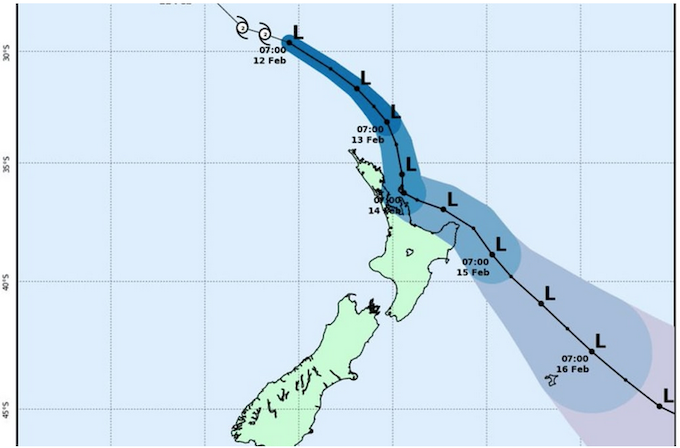
Cyclone Gabrielle's predicted track 120223
Cyclone Gabrielle’s predicted track as shown by MetService today. Image: MetService /RNZ
Print Friendly, PDF & Email

Article by AsiaPacificReport.nz

Goffin’s cockatoo named third species that carries toolsets around in preparation for future tasks

Source: The Conversation (Au and NZ) – By Rob Heinsohn, Professor of Evolutionary and Conservation Biology, Australian National University

Thomas Suchanek, CC BY-SA

From pocket knives to smart phones, humans keep inventing ever-more-sophisticated tools. However, the notion that tool use is an exclusively human trait was shattered in the 1960s when Jane Goodall observed our closest living relatives, chimpanzees, retrieving termites from holes with stripped twigs.

Tool use among non-human animals is hotly debated. It’s often thought a big brain is needed to understand the properties of objects, how to finely manipulate them, and how to teach this to other members of a species.

Until recently, humans and chimps stood out among tool-using species. They were considered the only species that used “toolsets”, wherein a collection of different tools is used to achieve a task. They were also thought to be the only animals that carried toolsets, in anticipation of needing them later.

A third species joined the exclusive club of toolset makers in 2021, when scientists in Indonesia saw wild Goffin’s cockatoos using three distinct types of tools to extract seeds from fruit. And in research published this week, researchers have shown Goffin’s cockatoos can also take the next leap of logic, by carrying a set of tools they’ll need for a future task.

Goffin’s cockatoos are endemic to the Tanimbar Islands in Indonesia.
Shutterstock

Bright, enigmatic creatures

Parrots have proven to be something of an enigma. They’re known to be highly intelligent creatures, yet they’ve rarely been observed using tools in the wild.

Curiously, the only parrot species known to use tools regularly in the wild is Australia’s own palm cockatoo, which uses them in a very unusual way. Males in northern Australia “manufacture” drumsticks and seedpod tools to use during their complex mating displays. They grasp the drumstick or seedpod in the left foot and beat it against a hollow trunk in a rhythmic performance, with all the hallmarks of human instrumental music.

The 2021 study of wild Goffin’s cockatoos was particularly significant as it showed the birds’ tools were similar in complexity to those made by chimps, meaning their cognitive skills could be directly compared.

A small number of Goffin’s cockatoos were seen crafting a set of tools designed for three different purposes – wedging, cutting, and spooning – and using them sequentially to access seeds in fruits. This requires similar brain power to a chimp’s method of using multiple tools when fishing for termites.

Anticipating problems

An initial stumbling block in interpreting chimps’ use of toolsets was that nobody could show whether they visualised a collection of small tasks as one problem, or used single tools to solve separate problems.

Researchers finally solved this when they observed chimpanzees not only carrying their toolsets with them, but doing this flexibly and according to the exact problems they faced. They must have been thinking it through from start to finish!

This is precisely what Goffin’s cockatoos have now been shown to do (albeit in a captive setting). They’ve been confirmed as the third species that can not only use tools, but can carry toolsets in anticipation of needing them later on.

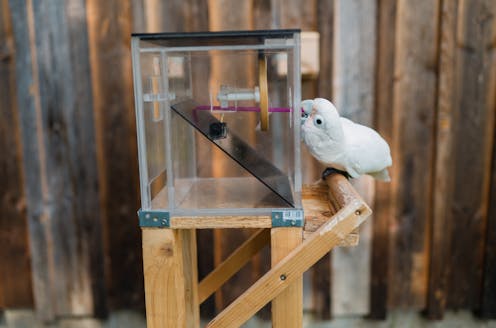
This panel of photos shows Figaro the cockatoo flying with two tools towards a box with a cashew.
Thomas Suchanek, CC BY-NC-SA

Inspired by the toolsets chimpanzees use and transport in the wild for extracting termites from the ground, the authors of the study designed clever experiments to test Goffin’s cockatoos under similar circumstances.

The birds, initially ten in total, had to extract cashews from boxes that required either one or two tool types. They were tested in various ways to examine their flexibility and innovation, but the pièce de resistance came when reaching the box with the tools required additional movement, including climbing a ladder, and horizontal and vertical flight.

Though only five of the ten birds made it through the earlier experiments, four of those that did tended to transport both tools in one go, in anticipation of needing them to open the two-tool box. In other words, these birds could categorise both tools as a “toolset” and use it accordingly. Mission accomplished!

Nothing wrong with a bird brain

But what about needing a big brain for complex tasks?

Like primates, some bird species have enlarged forebrains that provide them enhanced cognitive abilities including insight and innovation, understanding of others’ mental states, symbolic communication, episodic memory and future planning.

Parrots are especially well endowed with these abilities, so we shouldn’t be surprised they can use toolsets as easily as chimpanzees. Rather, what’s surprising is that more parrots haven’t been seen transporting toolsets for future use.

One has to conclude it’s because wild parrots are rarely presented with problems that require this. Parrots have powerful feet and beaks that allow them to reach the most difficult places and break the hardest fruits and seeds. Yet bright individuals in captivity can spontaneously invent new tools to solve new problems – so there’s no doubting how capable they are.

This new study is further proof parrots belong in the animal world’s exclusive version of Mensa. Between the considered planning shown by Goffin’s cockatoos, and the palm cockatoo’s ability to play instruments, it seems we’ve only scratched the surface of what these remarkable birds can achieve.


Read more:
Polly knows probability: this parrot can predict the chances of something happening


The Conversation

Rob Heinsohn does not work for, consult, own shares in or receive funding from any company or organisation that would benefit from this article, and has disclosed no relevant affiliations beyond their academic appointment.

ref. Goffin’s cockatoo named third species that carries toolsets around in preparation for future tasks – https://theconversation.com/goffins-cockatoo-named-third-species-that-carries-toolsets-around-in-preparation-for-future-tasks-199408

Cyclone Gabrielle closes in on Aotearoa: Warnings and forecasts

RNZ news

Coromandel Peninsula and Gisborne north of Tolaga Bay are now under red heavy rain warnings in Aotearoa New Zealand linked to Cyclone Gabrielle.

MetService says it expects up to 400 mm of rain to fall in the regions, mostly on Monday.

Civil Defence Controller for the Coromandel Garry Towler said that as well as heavy rain, winds of up to 130 km/h were expected and after weeks of severe weather, civil defence officials are very worried.

Towler said the Coromandel was in a fragile state after the extreme weather battering late last month — which left four people dead — and Civil Defence was deploying as many resources onto the Coromandel as it could.

He said a mobile alert would be issued this afternoon, and warnings would go out to people in vulnerable areas.

The storm is due to track across Northland on Sunday before moving south to Auckland, Coromandel, Waikato, Bay of Plenty and Gisborne on Monday and Tuesday.

Forecasters are warning of strong wind, heavy rain and big seas.

Widespread severe weather
MetService meteorologist Lewis Ferris said the cyclone would bring widespread severe weather.

The cyclone had taken a more eastern track over the last few days, but there was still disagreement over where the central point will lie when it made landfall, Ferris said.

“It’s still looking like Monday-Tuesday are going to be the biggest days for the weather with the approaching cyclone. The worst impacts, where they are and when they occur, are still going to be riding on where the track of the cyclone actually eventuates.”

It is possible that even Wellington could see some impacts, MetService said.

The cyclone has been upgraded to category 3.

MetService has issued heavy rain and strong wind watches ahead of its arrival.

Earlier today, MetService issued upgraded orange heavy rain and wind warnings associated with Cyclone Gabrielle.

Orange warnings
The orange warnings covered Northland, Auckland north of Whangaparaoa, including Great Barrier Island, Coromandel Peninsula, Gisborne and Hawke’s Bay.

The rest of the North Island was under a strong wind watch, along with Marlborough, Nelson and Buller north of Seddonville in the South Island.

There was also a heavy swell warning for Wairarapa.

Meanwhile, the government is urging people to avoid non-essential travel in areas that could be hit by Cyclone Gabrielle.

Air New Zealand is offering flight deferrals in affected areas, asking people to postpone air travel unless it was urgent.

Emergency Management Minister Kieran McAnulty said safety trumped the disappointment of scrapping weekend plans.

“We would urge people, despite the inconvenience this would naturally cause, to heed that advice, because it is not given lightly,” he said.

“We are taking this very seriously. Depending on how this tracks it could be quite severe and we’re just asking people to take it seriously.”

McAnulty said he had assurances government agencies and local civil defence services would update their social media channels regularly.

People were also being urged to stock three days’ worth of food and water and prepare for possible power outages.

This article is republished under a community partnership agreement with RNZ.

  • Latest advice from Civil Defence here.
  • Latest MetService warnings are here.
Print Friendly, PDF & Email

Article by AsiaPacificReport.nz

4 die, 700 forced to flee as earthquake hits Papuan capital Jayapura

Jubi News

An earthquake with a magnitude of 5.4 hit Papua’s capital city Jayapura on Thursday afternoon, killing four people, injuring at least five and forcing 700 to flee, emergency officials said.

The shallow earthquake with an epicenter of 10 km deep and located at coordinates 2.60 south and 140.66 east struck at 3.28pm.

Officlals said at least five houses were damaged by the earthquake — three of them heavily and two moderately.

In addition, a cafe collapsed and fell into the sea, while the building of Jayapura’s Dok 2 Hospital, two churches, a mosque, and a hotel were also damaged.

The earthquake collapsed the top part of the Cendrawasih University postgraduate building.

The Jayapura Mall building in the city centre also suffered cracks on one side of the building, and the roof of the 4th floor collapsed.

“As an effort to handle the disaster emergency, the Jayapura City Disaster Management Agency together with the Papua Province BPBD and related agencies have set up emergency tents, provided evacuation sites, public kitchens and basic support for the evacuees,” spokesperson Abdul Muhari said.

“The urgent needs are emergency tents and generators for electricity.”

Republished with permission.

Print Friendly, PDF & Email

Article by AsiaPacificReport.nz

‘I’m just a catalyst for the bigger change’, says exiled USP vice-chancellor back in Fiji

By Geraldine Panapasa of Wansolwara in Suva

The University of the South Pacific’s vice-chancellor and president, Professor Pal Ahluwalia, was given a rousing welcome at Nadi International Airport today returning to Fiji from exile.

He returned two years after he and wife Sandra Price were detained and deported by the former FijiFirst government for allegedly breaching provisions of the Immigration Act.

“We have arrived in Nadi. What a fabulous reception. USP staff, students and so many well wishers to meet us fills out hearts with joy. Beautiful singing and prayer. Thank you Fiji,” he wrote on Twitter, as the couple were received by USP deputy vice-chancellors and vice-presidents, Professor Jito Vanualailai and Dr Giulio Paunga.

USP Council Secretariat representative Totivi Bokini-Ratu, Lautoka campus director Pramila Devi, and representatives from the USP Students Association, USP Staff Association and Association of the USP Staff were also at the airport to greet Professor Ahluwalia.

“I’m so humbled to see everyone. It is an absolute joy to be back and an opportunity for us to continue serving USP,” he said in a statement.

“The support from staff, students and regional governments has just been incredible.

“It was so beautiful to see how much our staff fought. The fight wasn’t just for me; it was for a bigger cause and I’m just a catalyst for the bigger change they wanted to see.”

Next step for students
Professor Ahluwalia said the next step was to work with his senior management team to ensure they got the best out of their students and the region.

He is expected to visit the USP Pacific TAFE Centre in Namaka and Lautoka campus today with other events and meetings scheduled for the coming week, including a launch of the Alumni Relationship Management Service, and the welcoming of international students.

Professor Ahluwalia and wife Sandra Price at Nadi
Professor Ahluwalia and wife Sandra Price at the Nadi International Airport today. Image: USP/Wansolwara

Professor Ahluwalia and his wife’s controversial exile from Fiji followed months of increased tensions between USP and the previous government over allegations of financial mismanagement and corruption.

With the new People’s Alliance-led coalition government in power after ousting the FijiFirst administration in the 2022 general election, Prime Minister Sitiveni Rabuka has vowed to right the wrongs of the past administration.

Last December, he declared that Professor Ahluwalia and Dr Padma Lal, widow of another exiled academic, the late Professor Brij Lal, were free to enter the country.

“I am ready to meet Dr Lal and Professor Ahluwalia personally. I will apologise on behalf of the people of Fiji for the way they were treated,” Rabuka had said.

Working from Samoa
He said prohibition orders against Professor Ahluwalia, Dr Lal and the late Professor Lal, were “unreasonable and inhumane”, and “should never have been made”.

Professor Ahluwalia has been working out of USP’s Samoa campus since 2021, and said he looked forward to working with the coalition government to strengthen the relationship between USP and Fiji.

“As a regional institution, USP will continue to serve its island countries — particularly Fiji — and work hard to shape Pacific futures,” Professor Ahluwalia said.

Meanwhile, USP and the Fijian government are expected to conduct a joint traditional welcome ceremony for Professor Ahluwalia, followed by a thanksgiving service at the Japan-Pacific ICT Multipurpose Theatre, Laucala campus next Tuesday.

Geraldine Panapasa is editor-in-chief of the University of the South Pacific’s journalism newspaper and website Wansolwara News. Republished in collaboration with the USP journalism programme.

Print Friendly, PDF & Email

Article by AsiaPacificReport.nz

RBA’s latest forecasts are grim. Here are 5 reasons why

Source: The Conversation (Au and NZ) – By Isaac Gross, Lecturer in Economics, Monash University

Shutterstock

After lifting interest rates for a record nine times in a row, and flagging more raises still to come, the Reserve Bank of Australia’s latest set of forecasts make for grim reading.

The forecasts are part of the central bank’s quarterly Statement on Monetary Policy, its main communication (aside from interest rates) on how it sees the economy faring over coming few years.

The bad news is the bank tips economic growth to slow, inflation to remain high, spending to stagnate, unemployment to increase, and real wages to fall further.

The good news is that it could be wrong.

1. Growth is expected to slow

The central bank expects Australia’s economy to slow this year due to rising interest rates, higher cost of living, and declining house prices. It tips GDP growth for 2022 will be 2.75% (the Australian Bureau of Statistics won’t publish this data until March), and 1.5% over 2023 and 2024. This compares to the RBA’s expectation three months ago of 3% growth in 2022 but the same prediction for this year and the next.


RBA GDP growth forecasts

Confidence intervals reflect RBA forecast errors since 1993, year-ended forecasts.
RBA

2. Inflation will remain high

The bank says inflation, which hit 7.8% in 2022, is likely to have peaked and predicts it will stay high for several months, but will decline to 4.5% by the end of 2023. By mid-2025 it should be back to 3% – the top end of the bank’s inflation target range of 2-3%.


RBA headline inflation forecasts

Confidence intervals reflect RBA forecasting errors since 1993. Year-end forecasts.
RBA

However, the pace of this fall depends on wages and prices. The central bank acknowledges it could be quicker or slower. Its outlook for household spending is also uncertain, due to factors such as rising interest rates, higher inflation and declining housing prices.

Australia’s consumer price inflation has been high due to factors including global supply-chain disruptions caused by the pandemic, Russia’s invasion of Ukraine, strong domestic demand, a tight labour market, and capacity constraints.

The RBA expects rising energy prices will continue to drive inflation but that this will be offset by the federal government’s Energy Price Relief Plan, which involves price caps on gas and coal, and bill subsidies for households and businesses.


Read more:
Will price caps on coal and gas bring power prices down? An expert isn’t so sure


Price increases for goods such as food and furniture are expected to moderate. But the cost of services will continue to rise, due to wage growth.


RBA inflation forecasts

Confidence intervals reflect RBA forecasting errors since 1993. Year-end forecasts.
RBA

This is the main reason the RBA has flagged more interest rate hikes this year. It is determined to get inflation back to its target band, and will keep increasing borrowing rates until it is sure this goal will be achieved.


Read more:
RBA warns of at least 2 more interest rate rises in coming months, as the economic outlook worsens


3. Household consumption will stagnate

The monetary policy statement expects higher consumer prices, higher interest payments and lower household net wealth to curb consumer spending in 2023.

But it expects spending to improve once interest rate rises stop, household wealth recovers and disposable incomes are boosted by tax cuts. The household saving ratio (which doubled during the pandemic) is expected to decline then increase, returning to pre-pandemic levels in 2024.

4. Unemployment will rise

The RBA expects the unemployment rate to remain at about 3.5% until mid-2023, and then to rise to 4.5% as demand for labour moderates.


RBA unemployment rate forecasts

Confidence intervals reflect RBA forecasting errors since 1993.
RBA

Jobs growth is forecast to slow from 4.8% in 2022 to about 1% by mid-2024. Despite this, the participation rate in the labour force is not expected to fall, due to structural trends such as higher female and older worker participation.

5. Real wages will still fall

The RBA’s forecast for wages growth is now higher than three months ago, due to a tight labour market, higher staff turnover, higher inflation outcomes and Fair Work Commission wage decisions. It tips the Wage Price Index (WPI), which hasn’t been above 4% in a decade, to hit 4.25% in late 2023.

Given the inflation rate, however, this won’t be enough to stop real wages from continuing to fall. The WPI is then tipped to decline to 3.75% in mid-2025 as the demand for labour subsides and the unemployment rate rises.

Uncertainty remains high

These forecasts make for grim reading. But they could all be quite wrong.

As the saying goes, it’s tough to make predictions, especially about the future. Huge uncertainties hang over the global economy, including the war in Ukraine, the emergence of new COVID variants, and the unique challenges of recovering from the pandemic.

That means all these forecasts could be – and likely will be – wrong in one dimension or another. Even the RBA governor’s very clear message that there will be more interest rate rises this year could change if the prevailing circumstances do too. Only time will tell.

The Conversation

Isaac Gross does not work for, consult, own shares in or receive funding from any company or organization that would benefit from this article, and has disclosed no relevant affiliations beyond their academic appointment.

ref. RBA’s latest forecasts are grim. Here are 5 reasons why – https://theconversation.com/rbas-latest-forecasts-are-grim-here-are-5-reasons-why-199509

Can clouds of Moon dust combat climate change?

Source: The Conversation (Au and NZ) – By Aaron Tang, PhD Scholar in Climate Governance, Australian National University

NASA Advanced Concepts Laboratory

A group of US scientists this week proposed an unorthodox scheme to combat global warming: creating large clouds of Moon dust in space to reflect sunlight and cool the Earth.

In their plan, we would mine dust on the Moon and shoot it out towards the Sun. The dust would stay between the Sun and Earth for around a week, making sunlight around 2% dimmer at Earth’s surface, after which it would disperse and we would shoot out more dust.

The proposal, which involves launching some 10 million tonnes of Moon dust into space each year, is in some ways ingenious – and if it works as advertised from a technical perspective, it might buy the world some vital time to rein in carbon emissions.

Unfortunately, but also unsurprisingly, the story of Moon dust reflection isn’t as simple as it seems.

Why Moon dust?

Proposed measures to cool Earth by reducing the amount of sunlight reaching the surface are often called “solar geoengineering” or “solar radiation management”.

The most-discussed method involves injecting a thin layer of aerosol particles into Earth’s upper atmosphere.

However, tinkering with the atmosphere in this way is likely to affect rainfall and drought patterns, and may have other unintended consequences such as damage to the ozone layer.


Read more:
Trying to cool the Earth by dimming sunlight could be worse than global warming


Moon dust in space should avoid these pitfalls, as it would leave our atmosphere untouched.

Others have suggested deflecting sunlight with gigantic filters or mirrors in space, or swarms of artificial satellites.

Moon dust looks pretty good compared with these ideas: Moon dust is plentiful, and launching dust clouds from the Moon’s lower gravity would require substantially less energy than similar launches from Earth.

So, what’s the problem?

Too slow, too clumsy

One of solar geoengineering’s core selling points is supposed to be speed. Reflecting sunlight is at best a way to rapidly stave off short-term catastrophic warming impacts, buying time for renewable energy transitions and removal of greenhouse gases from the atmosphere.

Global injection of aerosols into the atmosphere, for instance, may require development of special aircraft. This is certainly no trivial task, but definitely doable in the next decade or so.

Moon dust ambitions would be much slower. There are several major engineering and logistical hurdles to overcome.

A photo of wispy clouds.
Developing technology to inject aerosols into the upper atmosphere would take some time, but building the tools to put millions of tonnes of Moon dust into space would take much longer.
Shutterstock

At minimum, we would need Moon bases, lunar mining infrastructure, large-scale storage, and a way to launch the dust into space.

No human has even set foot on the Moon in more than 50 years. While China is looking to establish a Moon base by 2028, followed by the US in 2034, a well-functioning mining and dust launching system is likely many decades away.

Another advantage of solar geoengineering is meant to be fine tuning.

Injecting aerosols into the atmosphere can in theory be fine-tuned to reduce negative side effects. Changing where aerosol injections take place, for instance, can drastically change potential side effects and its risk profile.

A giant space cloud offers no such precision.

A law and policy vacuum

To make matters worse, the world currently has little in the way of coherent policy or governance for space and the Moon. Many fundamental questions about human activity in space, such as how to manage the growing layer of bullet-speed space junk orbiting the Earth, are unanswered.

Also unanswered is another fundamental question: is Moon mining even legal? Who “owns” space, and the resources in it?

At present, we have a patchwork of contradictory policies.


Read more:
The Artemis I mission marks the start of a new space race to mine the Moon


The 1967 Outer Space Treaty prohibits “appropriation” of space resources (implying a ban on mining), and Article 11.3 of the 1979 Moon Treaty states that the Moon’s resources cannot become property of a country, group or person.

However, the US, Russia and China have not signed the Moon Treaty. In fact, the US has Obama-era legislation, a Trump-era executive order, and a non-binding international agreement – the Artemis Accords – that all emphasise commercial resource extraction.

With such contradictory policy in place, lunar mining is a fundamental legal grey area. Shooting Moon dust off into space is another legal dilemma several steps down the line.

As above, so below

Such a legal patchwork exists because of broader political firewalls.

Similarly to how the 20th-century space race reflected Cold War geopolitics, contemporary space governance is shaped by today’s political rifts. Russia and China have not joined the Artemis Accords, deciding (ironically together) to go it alone. But disagreements over a non-binding agreement are just the tip of the iceberg.

Political disagreements over Moon dust deployment could prove far more dangerous. Different countries could prefer different extents of cooling, or whether Moon dust cooling should be used at all.

A photo of the Apollo 11 rocket about to launch.
Like the space race of the 20th century, development of the Moon will be enmeshed in terrestrial politics.
NASA

Even the proposed “launch system” for dust, essentially a giant electromagnetic railgun (of the kind currently used to launch fighter jets), could spark security and weaponisation concerns.

These disagreements could leak into terrestrial politics, further exacerbating political divisions. At worst, these disagreements may cascade into armed conflict or sabotage of lunar infrastructure.

Space is another frontier for political conflict, and one that Moon dust reflection schemes could worsen. Such conflict also compromises a cooperative and altruistic Moon dust deployment.

Prime space real estate

Even if the implementation and political issues were resolved, there are plenty more.

For example, the Moon dust would linger around the “Lagrange point” between Earth and the Sun, where the gravitational forces of the planet and the star balance out.

Unfortunately, this valuable piece of space real estate is already occupied by satellites including the Solar & Heliospheric Observatory and the Deep Space Climate Observatory.

These could perhaps be moved or decommissioned, but that would be expensive and create new risks.


Read more:
Betting on speculative geoengineering may risk an escalating ‘climate debt crisis’


In sum, the Moon dust proposal does address some of the problems with Earth-based solar geoengineering. But it would likely be too slow to dampen the short-term impacts of climate change, and would in any case face diplomatic obstacles that may well be insurmountable.

To their credit, the authors do acknowledge their work has limitations, saying in a press release:

We aren’t experts in climate change, or the rocket science needed to move mass from one place to the other. We’re just exploring different kinds of dust on a variety of orbits to see how effective this approach might be.

So instead of worrying about displacing satellites, we are better off focusing on replacing fossil fuels. The solutions to climate change are right in front of us, not in the stars.

The Conversation

Aaron Tang has received funding from the Australian Government Research Training Program Scholarship.

ref. Can clouds of Moon dust combat climate change? – https://theconversation.com/can-clouds-of-moon-dust-combat-climate-change-199592

Why a shift to basing vehicle registration fees on emissions matters for Australia

Source: The Conversation (Au and NZ) – By Hussein Dia, Professor of Future Urban Mobility, Swinburne University of Technology

The ACT is changing how it calculates car registration fees. Instead of being based on a car’s weight, the fee the owner pays will be based on the greenhouse gas emissions it produces.

Up to now, owners of cleaner but typically heavier electric vehicles have paid more for registration than those of high-polluting but lighter vehicles powered by petrol or diesel engines. Emissions-based fees will reverse that situation.

The ACT was already offering two years of free registration for electric vehicles up to mid-2024. Under the new policy, from May 25 this year, owners of new and used electric vehicles will pay a discounted fee once their two years of free registration is over. The remaining car fleet will transition to the new system on July 1 2024.

An emissions-based registration fee is a sensible policy worth adopting Australia-wide. It’s already in place in many other nations that have much higher uptakes of electric vehicles.


Read more:
Australia is failing on electric vehicles. California shows it’s possible to pick up the pace


Targeted policies and incentives do speed the uptake of electric vehicles.
Shutterstock

Why is this policy change important?

Transport is Australia’s third-largest – and fastest-growing – source of greenhouse gas emissions. Cars produce about half of these transport emissions.

Most of Australia’s vehicles use polluting fossil fuels. A switch to electric vehicles, coupled with a transition to renewable energy, is vital for Australia to meet its commitments to tackle climate change.

One of the quickest ways to reduce transport emissions is to accelerate the current slow uptake of electric vehicles. In 2022, Australian sales totalled 39,353. There are now about 83,000 light electric vehicles on our roads.


Read more:
Let buyers jump the queue for electric cars by importing them directly


Although sales almost doubled between 2021 and 2022, they represented only 3.8% of all new vehicle sales in 2022. That’s well below the global average of 12-14%. And it’s way behind world leader Norway where 87% of cars being sold now are electric.

In China, about 5.67 million electric cars, or a quarter of all new cars, were bought in 2022. By the end of the year, 35% of the cars being sold were battery-powered or plug-in hybrids. In the UK, more than 265,000 electrical vehicles were registered in 2022, a 40% increase on 2021.

The global outlook for electric vehicles remain strong. Total sales of 8.6 million vehicles are expected in 2023. That’s expected to rise to almost 12 million by 2025.

Australia will pass the milestone of 100,000 electric vehicles on the road this year. But that’s well short of the target of 1 million by 2027 set by an industry alliance headed by the Electric Vehicle Council, and the Albanese government’s target of 3.8 million by 2030. Best practice policies will help to accelerate the transition.

The importance of the new policy is that it will help to reduce costs for buyers. Cost is one of the main barriers to buying an electric vehicle in Australia. In 2022, less than 20% of electric vehicles sold for less than A$65,000. While some Australians are willing to pay the hefty price tag, it remains an obstacle for others.

Government interventions play a big role in reducing purchase costs and annual fees. Higher taxes on polluting vehicles are also likely to impact consumer choice so more drivers make the switch.


Read more:
New electric cars for under $45,000? They’re finally coming to Australia – but the battle isn’t over


What is best practice in emissions-based vehicle policies?

Policies that reduce registration fees and provide tax benefits to electric vehicle owners have been widely implemented overseas during the past few decades.

Norway first introduced registration fee exemptions in 1990. This, along with a range of other measures and incentives, helped to increase electric vehicle sales to 50% of the market in 2020, and 79% by 2022. No other nation comes close.

In the European Union, 21 of 27 member countries levied car taxes partially or totally based on CO₂ emissions in 2022.

The EU-wide policies provide a range of financial benefits to owners of electric vehicles. They apply to both vehicle acquisition (value-added tax, sales tax, registration tax) and vehicle ownership (annual circulation tax, road tax).

How much difference can these policies make?

A number of studies of the effectiveness of CO₂-based car taxation policies have found evidence they contribute to lowering transport emissions.

For example, Ireland first introduced an emissions-based car taxation policy in 2008. An analysis of its impacts found it produced a cumulative CO₂ saving of 1.6 million tonnes from 2008 to 2018.

In 2018, Irish-licensed vehicles travelled a total of 47.5 billion kilometres. The study found average carbon intensity of the car fleet had reduced from 189gCO₂/km in 2007 to 164gCO₂/km in 2018. It would have been 168gCO₂/km without the tax intervention, according to the analysis.

A similar study that evaluated Norway’s CO₂-based taxes found them to be powerful policies applied aggressively at levels ten times the EU Emissions Trading System quota prices. The analysis found these policies also delivered other improvements, with the largest impacts being reductions in air pollution.

What else needs to be done in Australia?

A measure such as introducing an emissions-based registration system is a step in the right direction. But to be effective it needs to be part of a holistic national effort to accelerate adoption of electric vehicles.

In 2023, Australia needs to speed up efforts on two major initiatives that were introduced in 2022.

The federal government began consultations on Australia’s first National Electric Vehicle Strategy last September. More than 500 submissions were received, representing the views of over 2,150 Australian individuals and organisations.

Commitments were also made to develop an ambitious set of mandatory fuel-efficiency standards to help increase the supply of electric vehicle models.


Read more:
The road to new fuel efficiency rules is filled with potholes. Here’s how Australia can avoid them


Both initiatives are key policy pillars of an effective strategy to reduce transport emissions.

Building on this momentum and urgently implementing bold policies will demonstrate Australia’s commitment to embrace the transition to electric vehicles and accelerate emission reductions.

The Conversation

Hussein Dia receives funding from the Australian Research Council, the iMOVE Cooperative Research Centre, Transport for New South Wales, Department of Infrastructure, Transport, Regional Development, Communications and the Arts, and Beam Mobility Holdings.

ref. Why a shift to basing vehicle registration fees on emissions matters for Australia – https://theconversation.com/why-a-shift-to-basing-vehicle-registration-fees-on-emissions-matters-for-australia-199294

Here’s some context missing from the Mparntwe Alice Springs ‘crime wave’ reporting

Source: The Conversation (Au and NZ) – By Chay Brown, Research and Partnerships Manager, The Equality Institute, & Postdoctoral fellow, Australian National University

shutterstock

Content warning: this article contains mentions of racial discrimination against First Nations people, and themes of domestic violence.


Let us tell you about our town, our home. Mparntwe/Alice Springs is a small town on Arrernte Country in the red hot heart of the land now called Australia. Our town, our home, is a place of beauty: spinifex-speckled red sand dunes; black limestone after the rain; emerald waterholes nestled between the ranges; a wonderfully alive desert in one of the most remote places on Earth.

We hear more than 100 Indigenous languages being spoken on our streets every day, including Arrernte, Warlpiri, Luritja and Alawyerre & Pitjantjatjara. We are vibrant and multicultural. We are entrepreneurial. We love our sports, and our arts – and we cannot believe how much talent there is in our home.

But these are not the reasons our home has been plastered across national media for the past month. These are not the reasons you have clicked on this article.

According to news reports, a “crime wave” or surge of “alcohol-fuelled violence” is sweeping through our town. There was even talk of another military intervention.

Sensationalised media headlines and political pressure seem to be what prompted Prime Minister Anthony Albanese to make an impromptu trip to Alice Springs to meet with a handful of people, and introduce yet more alcohol restrictions.

However, the media reports contain little to no context regarding the issues, and reinforce the same negative stereotypes that made the Northern Territory Emergency Response (or what we call “the Intervention”) possible.

What was the Intervention?

In 2007, in response to allegations of child sexual abuse in remote NT communities, the Australian government suspended the racial discrimination act of 1975 to make special laws for Aboriginal people in prescribed areas in the territory, and the military was rolled in.

The Intervention included a raft of measures such as compulsory income management in the form of the BasicsCard, imposing alcohol prohibition on Aboriginal communities (although many of these communities already had self-determined dry policies), and mandatory health checks for Aboriginal children.

Many of these measures remain in place today – including compulsory income management.

The Intervention caused long-term trauma and other harms for some First Nations people, and shame and negative racial stereotypes that still persist today.

Shame and stigma compound violence, because they affect women’s willingness to report or seek help.

Alcohol restrictions are not the answer

Alcohol policy in the NT has been driven by the harmful stereotype that all Aboriginal people are alcoholics. This is despite evidence non-Indigenous people in the territory also consume disproportionately high amounts of alcohol. This is what the NT government means when it says it wishes to move away from “race-based policy”.

And while some Aboriginal Community Controlled Organisations support alcohol restrictions, many don’t.

Alcohol restrictions never stopped drinking in the NT. Instead, they prompted on-selling from within the NT and from other locations, or more harmful forms of drinking such as mouthwash and hand sanitiser.


Read more:
Alcohol bans and law and order responses to crime in Alice Springs haven’t worked in the past, and won’t work now


Alcohol and violence

Police and governments often claim alcohol leads to domestic violence-related assaults. However, administrative data, like that captured by police, is very subjective and potentially unreliable.

The classification of “alcohol-related assaults” and “domestic-violence related assaults” are determined at the individual discretion of the attending police officer. In interviews we conducted for soon-to-be-published research, some police officers stated they determined these classifications on whether they could smell alcohol, others because the person was slurring their words, and others because there were alcohol bottles present.

When questioned about whether the perpetrator or victim had to be drinking in order to make the classification of “alcohol-related assault”, the answer was invariably “either”, meaning we do not know from police data whether the perpetrator was actually using alcohol. This begs the question: if the perpetrator is sober, should an assault against an intoxicated victim be included in alcohol-related statistics?

Alcohol alone does not cause domestic violence, although it can exacerbate it. As stated by Australia’s national violence prevention organisation Our Watch, alcohol is often used as an excuse for domestic violence, rather than blaming the perpetrator.

There are also reports of women being breathalysed when they present with domestic violence assaults to hospital. This means many may choose not to go, to avoid the shame and blame.

Despite domestic, family and sexual violence rates in the NT being the highest per capita in Australia, the territory only receives a miniscule amount of funding compared with other states.

In 2022 the Northern Territory received about $14 million in national partnership funding to address domestic, family and sexual violence. This was roughly 1.8% of federal funding to address domestic or sexual violence.

And when shelters and specialist services such as Women’s Safety Services of Central Australia and Tangentyere’s Men’s Behaviour Change Program are chronically underfunded, understaffed and under-resourced, this leaves very few resources for prevention or early intervention.

Domestic, family and sexual violence intersects and worsens other issues that already disproportionately impact the NT, such as overcrowding, homelessness, poor infrastructure, and lack of access to goods and services.

More police won’t fix ‘youth crime’

Over the past few months there has been an injection of 30-40 extra police officers on Alice streets. This has led to more arrests, but few outcomes.

Children who interact with police often end up in out-of-home care, removed from family and culture, and some end up in youth detention. Children who end up in youth detention are more likely to reoffend and go on to have further interactions with police and the judicial system.

The issue of young people and sometimes very small children roaming the streets late at night is distressing, and Alice Springs has been calling for a response to this for years.

Many young ones travel in from the bush to stay in town to access services and visit family, and some get stuck here. And when unsupervised by adults, some young people do destructive things. Some of these children have grown up in overcrowding and poverty, and some are affected by foetal alcohol spectrum disorder.

In Alice Springs, there’s basically nowhere kids can go and just bounce a ball with their mates that’s accessible to everyone at any hour. Facilities are locked up, fenced off or out of reach financially for many children.

In 2021, the NT government gave $4 million to the local council to develop a water play park in Alice Springs’ town centre. But it took the money back while the council was struggling to decide on a site, and because it might attract more “anti-social behaviour”.

Community support is needed, not punishments

Alice’s problems are from years of successive government and policy failure, chronic underfunding and under-resourcing. Harmful, reductive and racist reporting has been detrimental to Alice and all who live here, particularly First Nations people.

We urge the federal and territory governments to invest in our remote communities. And to fund and support a community-led codesign of a response to the problems in Alice Springs. The response must be designed and led by local people. This must include the voices of young people, who have been unheard in all this noise.

Places such as Bourke have successfully addressed similar problems through justice reinvestment (redirecting money for prisons to the community), and could inform local decision-making processes in Alice Springs, too.

Introducing a policy of needs-based funding would ensure the NT receives the funds it needs to begin to address domestic, family, and sexual violence, overcrowding, support for those struggling with addiction, and programs to engage young people.

The media needs to follow the guidelines in “Media Changing the Story: Media Guidelines for the reporting of domestic, family, and sexual violence in the Northern Territory” which outlines how to engage with experts, communities, and report on violence in ways that is victim-survivor-centred, culturally safe, and does no harm. Alice Springs can only be accurately reported through the voices of experts with experience of life here.

Alice’s story is a story about geographic disadvantage. Alice needs community-led solutions, rather than punitive responses that bring shame, stigma and trauma. It’s time we had the courage to do things differently.

Mandy Taylor from SNAICC – National Voice for our Children also contributed to this article.

The Conversation

Chay Brown receives funding from ANROWS, Northern Territory Government, Department of Social Services, Australian Government, Gender Institute.

You are affiliated with Tangentyere Women’s Family Safety Group and Tangentyere Council,

Kayla Glynn-Braun works for the Equality Institute and owns shares in Her Story Consulting

Shirleen Campbell receives funding from NTG and ANROWS. Shirleen is affiliated with Tangentyere Council.

ref. Here’s some context missing from the Mparntwe Alice Springs ‘crime wave’ reporting – https://theconversation.com/heres-some-context-missing-from-the-mparntwe-alice-springs-crime-wave-reporting-199481

Is my medicine making me feel hotter this summer? 5 reasons why

Source: The Conversation (Au and NZ) – By Nial Wheate, Associate Professor of the Sydney Pharmacy School, University of Sydney

Shutterstock

If you’re really feeling the heat this summer, it might be down to more than the temperature outside.

Some types of medicines can increase your core body temperature or make you feel hotter than you really are. Some can affect your body’s ability to cool down.

Here’s what you need to know about heat intolerance and medicines.


Read more:
How to cope with extreme heat days without racking up the aircon bills


What is heat intolerance?

Some people simply dislike the feeling of feeling hot, while others feel hot at temperatures most people find comfortable. Both are examples of
heat intolerance.

Typical symptoms during warm weather include excessive sweating (or not sweating enough), exhaustion and fatigue, nausea, vomiting or dizziness, and changes in mood.

A number of factors can cause heat intolerance.

This includes the disorder dysautonomia, which affects people’s autonomic nervous system – the part of the body that regulates the automatic functions of the body, including our response to heat.

Conditions such as diabetes, alcohol misuse, Parkinson’s disease, the autoimmune disease Guillain-Barré syndrome and mitochondrial disease can cause dysautonomia. People in old age, those with some neurological conditions, or people less physically fit may also have it.

But importantly, medications can also contribute to heat intolerance.


Read more:
5 reasons to check on your elderly neighbour during a heatwave


1. Your body temperature rises

Some medicines directly increase your body temperature, which then increases the risk of heat intolerance.

These include stimulant medications to treat ADHD (attention deficit hyperactivity disorder), such as methylphenidate, dexamfetamine and lisdexamfetamine.

Antipsychotic medications (such as clozapine, olanzapine and quetiapine) used to treat mental health conditions, such as schizophrenia and bipolar disorder, are other examples.

These ADHD and antipsychotic medicines raise your temperature by acting on the hypothalamus, the region of the brain essential for cooling.

The drug levothyroxine, used to treat an under-active thyroid, also increases your body temperature, this time by increasing your metabolism.

Medical illustration of hypothalamus region of brain
Some medicines raise your body temperature directly by acting on the hypothalamus region of the brain.
SciePro/Shutterstock

2. Your blood flow is affected

Other medicines constrict (tighten) blood vessels, decreasing blood flow to the skin, and so prevent heat from escaping this way. This means your body can’t regulate its temperature as well in the heat.

Examples include beta-blockers (such as metoprolol, atenolol and propranolol). These medications are used to treat conditions such as high blood pressure, angina (a type of chest pain), tachycardia (fast heart rate), heart failure, and to prevent migraines.

Decongestants for blocked noses (for example, pseudoephedrine and phenylephrine), triptans for migraines (such as sumatriptan and zolmitriptan) and the ADHD medications mentioned earlier can also act to decrease blood flow to the skin.


Read more:
Forget nose spray, good sex clears a stuffy nose just as effectively — and is a lot more fun


3. You can get dehydrated

Other medicines can cause dehydration, which then makes you more susceptible to heat intolerance. The best examples are diuretics such as furosemide, hydrochlorothiazide, acetazolamide and aldosterone.

These are used to control high blood pressure and heart failure by forcing your kidneys to remove more fluid from your body.

Laxatives, such as senna extract and bisacodyl, also remove water from your body and so have a similar effect.


Read more:
Health Check: how do I tell if I’m dehydrated?


4. You can sweat less

Other medicines have a drying effect. This can be needed for medicines to do their job (for instance, to dry up a runny nose). For others, it is an unwanted side effect.

This drying reduces the amount you sweat, making it harder to lose heat and regulate your core temperature. A number of medicines have these effects, including:

  • some antihistamines (such as promethazine, doxylamine and diphenhydramine)
  • certain antidepressants (such as amitriptyline, clomipramine and dothiepin)
  • medicines used to treat urinary incontinence (for example, oxybutynin and solifenacin)
  • nausea medicine (prochlorperazine)
  • medicines for stomach cramps and spasms (for instance, hyoscine)
  • the antipsychoptics chlorpromazine, olanzapine, quetiapine and clozapine.


Read more:
Health Check: do men really sweat more than women?


5. You don’t feel thirsty

Finally, some medicines, such as the antipsychotics haloperidol and droperidol, can aggravate heat intolerance by reducing your ability to feel thirsty.

If you don’t feel thirsty, you drink less and are therefore at risk of dehydration and feeling hot.

Woman staring at glass of water on counter
People taking some medications just don’t feel thirsty.
Shutterstock


Read more:
Health Check: how can extreme heat lead to death?


What can you do about it?

If you are feeling hot this summer and think your medicine may be contributing, it’s very important you keep taking your medicine.

Speak to your pharmacist or doctor about your symptoms. They will offer advice and discuss alternatives.

The Conversation

Associate Professor Wheate in the past has received funding from the ACT Cancer Council, Tenovus Scotland, Medical Research Scotland, Scottish Crucible, and the Scottish Universities Life Sciences Alliance. He is a Fellow of the Royal Australian Chemical Institute, a member of the Australasian Pharmaceutical Science Association, and a member of the Australian Institute of Company Directors. Nial is the chief scientific officer of Vairea Skincare LLC and a Standards Australia panel member for sunscreen agents.

Jessica Pace does not work for, consult, own shares in or receive funding from any company or organization that would benefit from this article, and has disclosed no relevant affiliations beyond their academic appointment.

ref. Is my medicine making me feel hotter this summer? 5 reasons why – https://theconversation.com/is-my-medicine-making-me-feel-hotter-this-summer-5-reasons-why-199085

The NZ pilot held hostage in West Papua is the pawn in a conflict only real international engagement can resolve

Source: The Conversation (Au and NZ) – By Camellia Webb-Gannon, Lecturer, University of Wollongong

“Phil Mehrtens is the nicest guy, he genuinely is – no one ever had anything bad to say about him”, says a colleague of the New Zealand pilot taken hostage this week by members of the West Papuan Liberation Army (TPN-PB) in the mountainous Nduga Regency.

How such a nice guy became a pawn in the decades-long conflict between West Papua and the Indonesian government is a tragic case of being in the wrong place at wrong time. But it is also a symbolic and desperate attempt to attract international attention towards the West Papuan crisis.

A joint military and police mission has so far failed to find or rescue Mehrtens, and forcing negotiations with Jakarta is a prime strategy of TPN-PB. As spokesperson Sebby Sambom told Australian media this week:

The military and police have killed too many Papuans. From our end, we also killed [people]. So it is better that we sit at the negotiation table […] Our new target are all foreigners: the US, EU, Australians and New Zealanders because they supported Indonesia to kill Papuans for 60 years. Colonialism in Papua must be abolished.

Sambom is referring to the international complicity and silence since Indonesia annexed the former Dutch colony as it prepared for political independence in the 1960s. Mehrtens has become the latest foreign victim of the resulting protracted and violent struggle by West Papuans for autonomy.

Violence and betrayal

The history of the conflict can be traced back to 1962, when the US facilitated what became known as the New York Agreement, which handed West Papua over to the United Nations and then to Indonesia.

In 1969, the UN oversaw a farcical independence referendum that effectively allowed the permanent annexation of West Papua by Indonesia. Since that time, West Papuans have been subjected to violent human rights abuses, environmental and cultural dispossession, and mass killings under Indonesian rule and mass immigration policies.


Read more:
How the world failed West Papua in its campaign for independence


New Zealand and Australia continue to support Indonesian sovereignty over West Papua, and maintain defence and other diplomatic ties with Jakarta. Australia has been involved in training Indonesian army and police, and is a major aid donor to Indonesia.

Phil Mehrtens is far from the first hostage to be taken in this unequal power struggle. Nearly three decades ago, in the neighbouring district of Mapenduma, TPN-PB members kidnapped a group of environmental researchers from Europe for five months.

Like now, the demand was that Indonesia recognise West Papuan independence. Two Indonesians with the group were killed. The English and Dutch hostages were ultimately rescued, but not before further tragedy occurred.

At one point, negotiations seemed to have stalled between the West Papuan captors and the International Committee of the Red Cross (ICRC), which was delivering food and supplies to the hostages and working for their release.


Read more:
Fight for freedom: new research to map violence in the forgotten conflict in West Papua


Taking matters into their own hands, members of the Indonesian military commandeered a white civilian helicopter that had been used (or was similar to one used) by the ICRC. Witnesses recall seeing the ICRC emblem on the aircraft. When the helicopter lowered towards waiting crowds of civilians, the military opened fire.

The ICRC denied any involvement in the resulting massacre, but the entire incident was emblematic of the times. It took place several years before the fall of former Indonesian president Suharto, when there was little hope of West Papua gaining independence from Indonesia through peaceful negotiations.

Then, as now, the TPN-PB was searching for a way to capture the world’s attention.

Losing hope

Since the early 2000s, with Suharto gone and fresh hope inspired by East Timor’s independence, Papuans – including members of the West Papuan Liberation Army – have largely been committed to fighting for independence through peaceful means.

After several decades of wilful non-intervention by Australia and New Zealand in what they consider to be Jakarta’s affairs, that hope is flagging. It appears elements of the independence movement are again turning to desperate measures.

In 2019, the TPN-PB killed 24 Indonesians working on a highway to connect the coast with the interior, claiming their victims were spies for the Indonesian army. They have become increasingly outspoken about their intentions to stop further Indonesian expansion in Papua at any cost.

In turn, this triggered a hugely disproportionate counter-insurgency operation in the highlands where Phil Mehrtens was captured. It has been reported at least 60,000 people have been displaced in the Nduga Regency over the past four years as a result, and it is still not safe for them to return home.


Read more:
West Papua is on the verge of another bloody crackdown


International engagement

It is important to remember that the latest hostage taking, and the 1996 events, are the actions of a few. They do not reflect the commitment of the vast majority of Indigenous West Papuans to work peacefully for independence through demonstrations, social media activism, civil disobedience, diplomacy and dialogue.

Looking forward, New Zealand, Australia and other governments close to Indonesia need to commit to serious discussions about human rights in West Papua – not only because there is a hostage involved, but because it is the right thing to do.

This may not be enough to resolve the current crisis, but it would be a long overdue and critical step in the right direction.

Negotiations for the release of Philip Mehrtens must be handled carefully to avoid further disproportionate responses by the Indonesian military. The kidnapping is not justified, but neither is Indonesia’s violence against West Papuans – or the international community’s refusal to address the violence.

The Conversation

Camellia Webb-Gannon has received funding from the Australian Research Council.

ref. The NZ pilot held hostage in West Papua is the pawn in a conflict only real international engagement can resolve – https://theconversation.com/the-nz-pilot-held-hostage-in-west-papua-is-the-pawn-in-a-conflict-only-real-international-engagement-can-resolve-199601

‘You can love something deep inside your heart and there is nothing wrong with it’: why we still love The Room, 20 years on

Source: The Conversation (Au and NZ) – By Renée Middlemost, Lecturer, Communication and Media, University of Wollongong

IMDB

A jaunty yet dramatic piano-driven soundtrack motif; a view of the Golden Gate Bridge; a series of location shots around San Francisco. The generic title sequence of the 2003 film The Room barely hints at what follows.

The Room is a straightforward melodrama centred around a love triangle between Johnny (Tommy Wiseau, who also directs), Lisa (Juliette Danielle) and Mark (Greg Sestero). Described as “the worst movie ever made”, it continues to draw sellout crowds worldwide.

One might rightfully wonder: what is the ongoing appeal of a film dubbed “the Citizen Kane of bad films” 20 years on?

Cult audiences

Scholars have debated the key features of cult film for decades, with poor quality (narrative, aesthetic or both), quotable dialogue, word-of-mouth spread and box-office failure all cited.

Most agree an adoring audience is vital to maintaining cult status. The Rocky Horror Picture Show (1972) is the most recognisable example of a cult film, distinguished not by its content but by the devotion of an audience “beyond all reason”.

The Room follows this tradition. Wiseau self-funded the film, a gigantic billboard of his face in Los Angeles, and a two-week run of screenings at the Laemmle Fairfax and Fallbrook Theatres in June 2003.

Word of mouth quickly spread among film fans, attracted by dire reviews such as “watching this film is like getting stabbed in the head”.

The poor reviews inspired new fans, who would come along and shout at the film, lip-sync the worst lines and throw spoons at the screen – a reference to the stock images of spoons that appear as decor in Johnny and Lisa’s apartment. Celebrity fans followed, with actors Kristen Bell and Paul Rudd hosting private screenings.

Fan-driven demand led to the film’s eventual release on DVD in 2005, coinciding with the launch of YouTube.

Clip compilations focusing on the film’s so-bad-it’s-good credentials allowed those unable to attend cinema screenings to consume portions of the film.

Cinemas such as The Prince Charles in London provided “viewing guides” to costume-clad audiences, instructing audience members of what to call out (or throw) when. Most attendees brought their own spoons, demonstrating the ritualisation of the active audience response.

The audience response to The Room also points to a wilful misreading of Wiseau’s intent. The cult of The Room is distinguished by the “cruelty” of laughing at “an immigrant filmmaker’s misbegotten passion project”.

But perhaps it is Wiseau who is having the last laugh.


Read more:
Violent clowns and panto dames: the origins of Rocky Horror’s Frank-N-furter


Tommy Wiseau’s World

As I have argued elsewhere, the growing profile of The Room resulted in a shift to interest in Wiseau as a cult auteur – as the long legal stoush over unauthorised documentary Room Full of Spoons (2016) demonstrates.

While early interviews with Wiseau indicate his belief in the film’s quality, over time he has reframed his authorial intent and now claims the film is a comedy.

While we can never know Wiseau’s true intent, his reframing of the film’s reception is a fascinating part of its history, which anchors the narrative of its most well-known paratext: James Franco’s The Disaster Artist (2017), a comedy that follows Sestero (Dave Franco) and his friendship with Wiseau (James Franco) during the creation of the film.

Notably, Franco as Wiseau proclaims at the film’s fictional premiere:

I’m glad you like my comedic movie – exactly how I intended. I have vision for this movie.

The enduring cult

Sestero’s book The Disaster Artist (2013) and Franco’s adaptation describes the pair’s meeting, their unconventional friendship, and Wiseau’s aspirations for Hollywood acceptance.

Rather than a cruel “takedown” or exposé, the book documents Sestero’s affection for Wiseau, and despite the reviews, his fondness for the film that ultimately made his name.

Although initially a source of friction with Wiseau, he has grown to support Sestero’s book, referring to it as “the red bible” for its red cover seen clutched in the hands of fans during signings and appearances.

The film adaptation of The Disaster Artist arguably resulted in the attainment of Wiseau’s long-held desire for Hollywood credibility, with James Franco declaring the universality of the story: “In so many ways, Tommy c’est moi”.

The Disaster Artist was widely praised, and the film and Franco went on to win Golden Globe Awards in 2018.

There, the highlight for many was Wiseau’s appearance on stage during Franco’s acceptance speech. Perhaps Hollywood dreams can come true.

A better place

As The Room turns 20, I argue it is still beloved by audiences because we love an underdog.

The Room might be a “bad film”, but it’s also about pursuing our dreams.

As Wiseau says in the film:

You can love [something] deep inside your heart and there is nothing wrong with it. If a lot of people love each other, the world would be a better place to live.

An endlessly quotable text, a mysterious creator, and a community of similarly invested viewers – what could be bad about loving that?


Read more:
What makes some art so bad that it’s good?


The Room is back in select cinemas in Australia this week.

The Conversation

Renée Middlemost does not work for, consult, own shares in or receive funding from any company or organisation that would benefit from this article, and has disclosed no relevant affiliations beyond their academic appointment.

ref. ‘You can love something deep inside your heart and there is nothing wrong with it’: why we still love The Room, 20 years on – https://theconversation.com/you-can-love-something-deep-inside-your-heart-and-there-is-nothing-wrong-with-it-why-we-still-love-the-room-20-years-on-198665

Auckland’s Great Flood: ‘If you think it was bad before, it’s worse now’ – whānau cope with losses

By Ashleigh McCaull, RNZ Te Ao Māori news

A fortnight after the floods in Tāmaki Makaurau and as Aotearoa New Zealand braces for Cyclone Gabriel the reality is setting in for many.

Mother of four Kataraina Toka’s Mount Roskill home is yellow-stickered after being damaged by flooding on January 27.

For now, she is living in a two-bedroom hotel room in Onehunga.

“We’re getting there. It’s hard, it sucks you know being cooped up in somewhere so small with four kids. But better than not having a roof over our heads at all I suppose.”

Toka is looking for a new rental home but like many others is struggling.

“If you think it was bad before, it’s worse now. It’s hard, especially when you know you’ve lost all your ID because somebody dropped their phone in the water or we’ve got no car to get around so it’s just making it to where we can.

“But we’re just grateful for the support that we’ve got.”

Displaced whānau
Māori health provider Waipareira Trust has been helping many whānau in West Tāmaki who have been displaced.

Management lead Jole Thomson said one family in particular stood out.

“Their house was one of the first ones to be red stickered — it was destroyed. Kuia, kaumātua, and they’ve got care and custody over their mokopuna who has special needs and house concerns.

“They’re getting kicked out, basically, of their emergency accommodation.”

Other whānau stayed at schools such as Mount Roskill’s Wesley Primary School which was turned into an evacuation centre when the floods hit.

But some tamariki haven’t been able to return to kura.

Wesley School principal Lou Reddy has noticed the absence of some of his students.

High-risk situation
“We’ve got six that we know are in that high-risk situation where they lost their car, lost their home, are in a temporary housing situation and we haven’t been able to get them here.

“The others, there’s 10 that we haven’t been able to get a hold of at all.”

Wesley Primary School principal Lou Reddy, at right, with the team from the Ark Project standing behind a table of food for kai parcels.
Wesley Primary School principal Lou Reddy (right) with a team from the Ark Project which has been distributing kai parcels. Image: Ashleigh McCaull/RNZ News

Thomson said that was a common situation, with some whānau no longer having the resources they need.

“We’re working with a number of whānau, helping them pay for things like school uniforms and a lot of that we’re supporting, they don’t want help. I was watching people trying to dry school shoes so the kids could wear them to school.

“But they’d been destroyed, they had been in raw sewage.”

The Ark Project in Mt Roskill, which works to assist vulnerable families, was a massive part of the evacuation effort and organisers estimate it helped more than 5000 people with kai parcels.

Barely anything left
Co-ordinator Peter Leilua said each day they started off with plenty of supplies but by the end there was barely anything left.

The team did not have enough resources to keep providing for whānau, he said.

“That’s our biggest push to the government, Ark needs a lot of that support, because in our community and Wesley, Puketāpapa, Mount Roskill, we got hit the most.

Food collected by the Ark Project in Mt Roskill for distribution in kai parcels.
Food collected by the Ark Project in Mt Roskill is piled in a room at Wesley Primary School for distribution in kai parcels following Auckland’s floods. Image: Ashleigh McCaull/RNZ News

Many families were being placed temporary accommodation some distance from their community.

“It’s not just around the corner. They’re placing them at Greenlane, Onehunga, some are out South or East and that’s just too far for them to travel,” Leilua said.

Damage from the flooding has extended beyond financial and material loss.

Thomson said whānau have had to throw away taonga or family treasures.

“The photo albums, the whānau heirlooms, the korowai that have been handed down for generations just absolutely destroyed and that’s heartbreaking for whānau.

“Ashes, you know whānau not knowing how to manage those sorts of things, the remains of their loved ones,” Thomson said.

While whānau such Kataraina Toka’s continue to try to rebuild, many know they’ve got a long journey ahead.

This article is republished under a community partnership agreement with RNZ.

Print Friendly, PDF & Email

Article by AsiaPacificReport.nz

We found 2.9-million-year-old stone tools used to butcher ancient hippos – but likely not by our ancestors

Source: The Conversation (Au and NZ) – By Julien Louys, Deputy Director, Australian Research Centre for Human Evolution, Griffith University

Julian Louys, Author provided

On the shores of Lake Victoria in Kenya, a short valley extends south towards the looming Mount Homa. From it have emerged some of the oldest-known stone tools used to butcher large animals, as well as the oldest remains of one of our early cousins, Paranthropus – a genus we think co-existed with our direct ancestors.

Similar tool and fossil discoveries had been made before, in different places and at different times. But to find these all together in one place, as old as they are, is truly extraordinary.

In research published today in Science, we explain how findings at the Nyayanga site are changing the way experts think about carnivory among hominins – a group that includes modern humans, extinct humans, direct ancestors and close cousins.

It also raises doubt about who was really responsible for making the stone tools we’d previously attributed to Homo and closely related species.

Fossils on the Homa Peninsula

Nyayanga is a typical pastoral valley situated on the Homa Peninsula in western Kenya. This peninsula has long been known to produce various fossils. In 1996, a multidisciplinary team led by one of us (Thomas) began work on a two-million-year-old site called Kanjera South. This work produced a wealth of fossil remains from large mammals, as well as stone tools associated with our genus, Homo.

Excavations at Kanjera South provide evidence of two-million-year-old stone tools, and butchered antelopes.
Julien Louys

During a field season at Kanjera South, a local man named Peter Onyango who was working with the team suggested we investigate some fossils and stone tools eroding out of a valley on the shores of Lake Victoria. This new site, named Nyayanga after the nearby beach, was situated on a donkey track leading to the lake.

The first stone tools and fossils we collected were eroding out from the gully walls. Beginning in 2015, a series of excavations eventually returned a trove of 330 artefacts and 1,776 animal bone fragments from a range of species characteristic of open savannah and open woodland environments.

The site of Nyayanga was primarily used as a track for donkeys and cattle, leading to the shores of Lake Victoria.
Julien Louys

The bones included animals we’re familiar with today, such as giraffes, antelopes, elephants and hippos. But they also included extinct megafauna such as Eurygnathohippus, an extinct horse ancestor, Pelorvis, the giant buffalo, and Megantereon, the sabre-toothed cat.

Of particular interest were the remains of two teeth from the extinct hominin Paranthropus – nicknamed the Nutcracker Man as its large flat teeth are thought to have been used to process tough vegetable matter. These teeth, one intact and the other a fragment, were the first direct evidence of an extinct hominin on the Peninsula.

Two Paranthropus teeth.
Two Paranthropus teeth were recovered from Nyayanga.
S. E. Bailey, Homa Peninsula Paleoanthropology Project, Author provided

What made their recovery even more surprising were the tools we found associated with them. Alongside Paranthropus’s teeth were some stone tools belonging to a technology known as the Oldowan, characterised by three main forms: hammerstone, core, and flake.

Oldowan tools had long been associated with our own genus, Homo, and were once considered a marker for the beginnings of human modernity. While we can’t demonstrate Paranthropus actually made these tools, this species is so far the only suspect at the scene of the crime.

Tools belonging to the Oldowan technology.
We found stone tools belonging to the Oldowan technology found at Nyayanga.
T.W. Plummer, J.S. Oliver, and E. M. Finestone, Homa Peninsula Paleoanthropology Project, Author provided

Early signs of butchery

So, what was a nutcracking, plant-chomping hominin using these tools for? Well it turns out in addition to processing plants – the evidence of which we could see on the tools’ edges – these lithics were also used to make hippo tartare.

We found evidence of meat cutting on the edges – but the smoking gun was the cut and percussion marks found on several hippo individuals associated with these stone tools.

Hippo skeleton excavated at Nyayanga.
Hippo skeleton excavated at Nyayanga. This probably represents a single individual, and shows evidence of butchery.
T.W. Plummer, Homa Peninsula Paleoanthropology Project, Author provided

Of course, this wasn’t the first time cut marks had been found on megafauna. In fact, some of the earliest evidence of megafauna butchery was reported on by our team at Kanjera South back in 2013.

However, our comprehensive dating program at Nyayanga revealed the site’s deposits to be about 2.9 million years old. This means they’re probably the oldest stone tools found to have butchered hippos and processed plant material.

Not only that, but this is about two million years before the first evidence that people used fire. This suggests raw hippo was on the menu for the hungry hominins.

Adding to that, the tooth fossils are the oldest Paranthropus remains ever found, and the associated tools are the oldest-known Oldowan tools. The second-oldest were uncovered some 1,200 kilometres away in Ethiopia, and dated to about 2.6 million years.


Read more:
Research reveals humans ventured out of Africa repeatedly as early as 400,000 years ago, to visit the rolling grasslands of Arabia


A brave old world

There’s no evidence Paranthropus was actively hunting megafauna. But it would have been competing with sabre-toothed cats, hyenas and crocodiles for access to carcasses, at the very least.

The Nyayanga deposits provide a glimpse into an ancestral world that’s possibly radically different from any we had pictured. In doing so, they’ve raised even more questions about hominin evolution.

Who were these resourceful toolmakers? How far back does carnivory go? And just how old and widespread is the innovative Oldowan toolkit? Despite more than 100 years of research on the Homa Peninsula, much remains unearthed.


Read more:
We found the oldest ever vertebrate fossil heart. It tells a 380 million-year-old story of how our bodies evolved


The Conversation

Julien Louys receives funding from the Australian Research Council. He was formally at Liverpool John Moores University

Thomas Plummer receives funding from the National Science Foundation, the LSB Leakey Foundation, the Wenner-Gren Foundation, and the PSC-CUNY Research Award Program. He is research associate in the Human Origins Program of the Smithsonian Institution.

ref. We found 2.9-million-year-old stone tools used to butcher ancient hippos – but likely not by our ancestors – https://theconversation.com/we-found-2-9-million-year-old-stone-tools-used-to-butcher-ancient-hippos-but-likely-not-by-our-ancestors-199499

ChatGPT threatens language diversity. More needs to be done to protect our differences in the age of AI

Source: The Conversation (Au and NZ) – By Collin Bjork, Senior Lecturer, Massey University

Collin Bjork, Author provided

The buzz around artificial intelligence (AI) technologies like ChatGPT is palpable. People are both optimistic and frightened by the possibilities of these tools. Clearly, these technologies will change how people write. But in terms of what people write, these technologies seem to be embracing the status quo.

In fact, the way these tools are currently built appears to homogenise writing – making everything sound the same. And writing that sounds the same is not just boring; it also perpetuates inequity.

When writing tools prioritise one way of writing over another, they reinforce existing hierarchies that unfairly position Standard American English (SAE) and the Queen’s English over other languages and ways of writing.

How does ChatGPT work?

Technologies like ChatGPT are called large language models (LLMs). LLMs provide textual responses to human commands, by using machine learning to study patterns of words in a massive archive of texts.

Crucially, however, ChatGPT does not know the meaning of words. ChatGPT generates definitions by sorting through a mountain of definitions and then collating those into a single response that suits the context of a query.

In other words, without meaning as its guide, ChatGPT responds to queries by relying on context clues, stylistic structures, writing forms, linguistic patterns and word frequency.

This functionality means that, by default, ChatGPT perpetuates dominant modes of writing and language use while sidelining less common ones.

Erasing diversity

Dominant modes of writing don’t become dominant by accident. They become dominant because one social group wants to assert power over another social group.

There is not, for example, one kind of English. There are many Englishes.

The decision to prioritise Standard American English in many US classrooms, for example, means that speakers of Black English – a language with its own grammar, lexicon and remarkable history of resistance – are penalised and shamed for writing as they speak.

Similarly, in Aotearoa New Zealand, the Queen’s English became dominant not because it’s intrinsically better than te reo Māori. Rather, European colonisers wanted to stamp out Māori culture, and writing in the Queen’s English became a key tool for furthering that objective. In the 20th century, students were regularly beaten for speaking Māori in schools.


Read more:
‘Can I see your parts list?’ What AI’s attempted chat-up lines tell us about computer-generated language


Going against the default

Supporters of ChatGPT will be quick to note that ChatGPT can read, analyse and generate content in many languages, including in Black English and te reo Māori.

But the concern is not about what ChatGPT can do.

It’s about what its default settings are. It’s about how ChatGPT is configured to treat some forms of writing as normal, typical and expected. And it’s about how ChatGPT requires a special request to generate non-normative forms of writing.

This problematic default behaviour also occurs in ChatGPT’s sister programme, Dall-E 2. This image-generating AI was asked to create an image for this article based on this prompt: “close up photo of hands typing on a laptop.” The programme created four images. All had white masculine hands.

The programme needed a more specific prompt to generate an image that included a person of colour because even the ways that AI visualises writing is dominated by white men.

AI created image to depict a close up of someone writing on a keyboard. Initial efforts to create this image returned images of white male hands.
Provided by author, Author provided

Ultimately, this kind of algorithmic bias continues to make white English-speaking men the standard of writing culture, while ushering everyone else to the margins.

How did it get like this?

It’s no surprise that ChatGPT’s default functionality seems to prioritise forms of English writing developed by white people. White English-speaking men have long dominated many writing-intensive sectors, including journalism, law, politics, medicine, computer science and academia.

These white English-speaking men have collectively written billions of words, many times more than their colleagues of colour. The sheer volume of words these authors have written means that they likely constitute the majority of ChatGPT’s learning models, even though ChatGPT’s parent company, OpenAI, doesn’t publicly reveal its source material.

So when users ask ChatGPT to generate content in any of these disciplines, the default output is written in the voice, style and language of those same white English-speaking men.


Read more:
AI and the future of work: 5 experts on what ChatGPT, DALL-E and other AI tools mean for artists and knowledge workers


Challenging the norm

Some people will say that we need defaults and standards in writing. They argue that we need to teach people to write in the Queen’s English or SAE so that people don’t miss out on jobs and promotions because they write in a different way.

But that line of thinking just means capitulating to workplace prejudice and reinforcing an unjust system through our participation in it. Instead, other scholars say we need to challenge those unfair writing standards and encourage writers to embrace the rich rhetorical possibilities in their linguistic diversity.

Educators who want to embrace linguistic diversity might be tempted to ban text-generating AI from their schools and universities.

But it’s worth remembering that writing itself is a technology that has been, and still is, used to further inequality. Literary scholar Alice Te Punga Somerville calls this “the inextricability of writing from historical and ongoing violence.”.

In response to this threat, however, Professor Somerville does not advocate abandoning writing altogether. Rather, she insists on using the tool of writing critically and creatively to resist oppression.

Taking her lead, educators might instead encourage students to develop new ways of deploying these tools to compose a more equitable future. Doing so means, as Professor Vershawn Young says in Black English

that good writin gone look and sound a bit different than some may now expect. And another real, real good result is we gone help reduce prejudice.


Read more:
ChatGPT is a data privacy nightmare. If you’ve ever posted online, you ought to be concerned


The Conversation

Collin Bjork does not work for, consult, own shares in or receive funding from any company or organization that would benefit from this article, and has disclosed no relevant affiliations beyond their academic appointment.

ref. ChatGPT threatens language diversity. More needs to be done to protect our differences in the age of AI – https://theconversation.com/chatgpt-threatens-language-diversity-more-needs-to-be-done-to-protect-our-differences-in-the-age-of-ai-198878

Need a bulk-billing GP? Why throwing more money at Medicare isn’t the answer

Source: The Conversation (Au and NZ) – By Henry Cutler, Professor and Director, Macquarie University Centre for the Health Economy, Macquarie University

Shutterstock

Last financial year, the Australian government spent more than A$37 billion on primary care – a patient’s usual first contact with the health system when sick or injured. Every year, this spending increases.

Yet, many patients are paying more to see their GP, some cannot afford care and emergency departments are overcrowded with patients who could be treated by a GP.

Last week, the Strengthening Medicare Taskforce released its much-anticipated report on how to improve the primary health-care system. The report provided broad-brush recommendations mostly focused on delivering patient-centred care, supported by better health data and information technology.

Medicare is set for an overhaul

An important subtext of the report is to overhaul Medicare, Australia’s national public health insurance scheme. Medicare pays a proportion of costs for every Australian that receives subsidised primary care services.

There has not been a major reform to Medicare since its introduction in 1984. If successful, reforming Medicare will be the greatest change to primary care in decades.

It will help governments usher in long sought-after integrated care pathways – with patients cared for by a team of health professionals that better meet their needs, especially those with chronic conditions.

But let’s not celebrate just yet. Major funding reform is not a given. Health Minister Mark Butler concedes there’s a long road ahead, telling the ABC this week that we’re not going to fix Medicare in one budget.


Read more:
Medicare reform is off to a promising start. Now comes the hard part


A battle looms ahead

A potential battle between health providers and the Australian government looms on the horizon.

That’s because the most ferocious national health-care debates are often about how GPs should get paid. Medicare needs to pay providers based on patient health outcomes. Some providers, like GPs, may be worse off financially if they perform poorly.

That will be a hard pill to swallow. Pressure from strong lobby groups that represent primary care providers may water down reform. That runs the risk of worsening patient outcomes compared to what could be achieved.

Street signage of bulk-billing medical centre on high street
A bulk-billing GP has become harder to find. So we need widespread reform to improve access to quality, value-for-money care.
Shuang Li/Shutterstock


Read more:
Patient advocate or doctors’ union? How the AMA flexes its political muscle


How did we get here?

Successive governments over the past 30 years have tried to tighten the reins on runaway Medicare spending. Most attempts have failed.

The Hawke government introduced a $2.50 co-payment in 1991, which GPs could charge to non-concessional patients when they received bulk-billed services. In 1992, Keating abolished this when he became prime minister. The Abbott government tried to introduce a $7 co-payment in 2014, but dumped the budget announcement against fierce community opposition in 2015.

The Abbott government did manage to freeze the annual increase in Medicare Benefits Schedule fees (fees doctors are paid to perform certain subsidised services) between 2015 and 2020. This led to fierce opposition from primary care providers.

The Australian Medical Association (AMA) suggested this would force GPs to increase co-payments and reduce bulk billing to maintain their business returns.

While co-payments have increased, annual bulk billing rates have only declined in the past year.

Bulk-billing rates have only declined in the past year.
Productivity Commission


Read more:
Explainer: what is Medicare and how does it work?


How should we fund primary care?

It’s clear Medicare is no longer “fit for purpose”. Some patients avoid care because they cannot afford it. Patients with higher incomes, and patients living in more affluent areas, often pay more if not bulk billed, but can access primary care easier.

Increasing Medicare rebates, as the AMA proposes will not fix those problems.

A financial incentive for providers to deliver care of little value to patients will remain. Providers will still be paid regardless of the health outcomes they achieve, and care misaligned with best practice will continue to be funded.


Read more:
Some GPs just keep their heads above water. Other doctors’ businesses are more profitable than law firms


We need a radical rethink

A complete rethink of Medicare is required to support the vision presented in the Strengthening Medicare Taskforce report. The Australian government must start now, as the health-care system adjusts to a post-pandemic world.

Reforming Medicare cannot happen in isolation. It must sit within a cohesive national vision and a ten-year plan for health-care funding reform.

Medicare reform should be accompanied by public hospital funding, private health insurance and co-payment reform – the three other major funding sources for health care – to ensure Medicare does not remain siloed while governments seek to integrate care.

An independent national health payment authority should be developed and tasked with designing and coordinating the implementation of funding reform. This would work closely with state and federal governments, primary health networks and local health networks.

It would also clarify who is responsible for which elements of funding reform and reduce the potential for duplicating efforts across states.

We need to do things differently

Australia could benefit from payment models being explored internationally. These include funding a pathway of multiple, integrated health providers – let’s say a GP working with a physio and nurse practitioner – to provide cheaper care that improves outcomes.

In such “value-based” payment models, there’s an incentive to improve health outcomes and reduce costs. Providers share the cost savings compared to what it would have cost using the current Medicare Benefits Schedule.

If we’re to reform Medicare towards paying for value, then we’ll need much more data on patient health outcomes, other factors that impact health outcomes but are outside the control of providers (such as socioeconomic factors), and data on the cost of delivering care.

That requires reforming the way data is collected and shared, and investment in better information technology infrastructure.

The government will need to work closely with providers to ensure they are equipped to manage the transition towards value-based payment models. It will also need to help providers connect and work together to coordinate different types of care.


Read more:
With the training to diagnose, test, prescribe and discharge, nurse practitioners could help rescue rural health


The Conversation

Henry Cutler does not work for, consult, own shares in or receive funding from any company or organisation that would benefit from this article, and has disclosed no relevant affiliations beyond their academic appointment.

ref. Need a bulk-billing GP? Why throwing more money at Medicare isn’t the answer – https://theconversation.com/need-a-bulk-billing-gp-why-throwing-more-money-at-medicare-isnt-the-answer-199303

Millions of satellite images reveal how beaches around the Pacific vanish or replenish in El Niño and La Niña years

Source: The Conversation (Au and NZ) – By Kilian Vos, Research Associate, UNSW Sydney

If you’ve been visiting the same beach for a few summers, you’ll have seen it change. While beaches look static, they’re actually one of the most dynamic regions on Earth. Winds, waves and tides stir and push sand around constantly. Storms can claw out huge volumes of sand and move it elsewhere.

On top of these changes is a hidden force – the El Niño Southern-Oscillation (ENSO) climate cycle. Our new research explores how this cycle affects beaches around the Pacific Rim. Using cutting-edge satellite technology, we tracked changes over 40 years.

What did we find? The cycle matters a great deal. While the natural ENSO Pacific climate phenomenon affects weather patterns around the world, we haven’t fully understood how it affects beaches.

The main impact? Coastal storms intensified by the ENSO cycle. Storms can rapidly strip sand from beaches to create sandbars, dump it out at sea, or replenish another beach. These changes threaten to undermine beachfront properties and roads as well as beach habitats.

For Australia, if a La Niña is predicted to arrive in the next six months, coastal communities prone to erosion should prepare for storms stripping away sand. Our recent repeat La Niñas brought large waves and heavy erosion along the New South Wales and southern Queensland coast. During this period, houses almost fell into the sea in the NSW Central Coast, while wild waves made a new passage through Bribie Island.

During El Niño, Australia’s beaches recover, while beaches from California to Chile erode.

But as climate change ramps up, the effects of these ENSO cycles may become more intense.

Extreme beach erosion during a coastal storm in 2020 at Wamberal, Central Coast, NSW.
Christopher Drummond/UNSW Water Research Laboratory.

What did we find?

We analysed millions of satellite images, looking for changes in beach width during El Niño and La Niña periods in southeast Australia, New Zealand, Chile, Peru, Mexico, California and Japan.

Lying in the satellite data was clear evidence of cyclical change. Along southeast Australia’s coastline, beaches tended to erode during prolonged La Niña periods, while regaining sand and recovering during El Niño years.


Read more:
The wild weather of La Niña could wipe out vast stretches of Australia’s beaches and sand dunes


The reverse was true on the other side of the Pacific, around 13,000 kilometres away. From California down through Mexico to Chile and Peru, we saw beaches narrow during El Niño periods and widen out again during La Niña periods.

Why? Storms and sea levels. During El Niño events, large storms develop in the northern Pacific, sending energetic waves crashing onto the coastlines of California and Mexico — creating the perfect conditions for big wave surfing. During this period, the sea level is well above average too. Combined, bigger waves, storms and a higher baseline pillage sandy beaches. This is particularly pronounced in the eastern Pacific.

Knowing this, we can be better prepared. If you’re in Australia and the ENSO outlook suggests a La Niña is coming, it might be time for councils to replenish erosion prone beaches.

ENSO outlook for February 2023.
Australian Bureau of Meteorology

Monitoring the many moods of a beach

Monitoring coastal change has long been carried out with on-ground techniques, such as GPS equipment, quadbikes and drones. These methods require human operators, which makes them expensive and limits the area and duration of observations. That’s why we have very limited on-ground observations of beach change along much of the world’s coastline.

On-ground survey techniques to monitor beaches.
Larry Paice/UNSW Water Research Laboratory.

That’s where satellites can help. Earth observation satellites have been capturing regular images of the world’s coastlines for four decades. Now we have the tools to interrogate the satellite images and track the evolution of sandy beaches.


Read more:
Australia relies on data from Earth observation satellites, but our access is high risk


We developed the open-source tool CoastSat to automatically map the position of the shoreline on freely available satellite images, using cutting-edge image processing and machine learning techniques.

CoastSat toolbox
Changes to the shoreline can be automatically detected, as in this animation of changes at Narrabeen-Collaroy beach, Sydney.
Killian Vos

With tools like these, we can monitor coastal changes across thousands of beaches over the last 40 years. You can see how your local beach has changed on the interactive CoastSat website.


Read more:
The wild weather of La Niña could wipe out vast stretches of Australia’s beaches and sand dunes


The Conversation

Kilian Vos receives funding from the United States Geological Survey (USGS).

Mitchell Harley receives funding from the Australian Research Council. He is the NSW Chair of the Australian Coastal Society

ref. Millions of satellite images reveal how beaches around the Pacific vanish or replenish in El Niño and La Niña years – https://theconversation.com/millions-of-satellite-images-reveal-how-beaches-around-the-pacific-vanish-or-replenish-in-el-nino-and-la-nina-years-198505

Is 13 too young to have a TikTok or Instagram account?

Source: The Conversation (Au and NZ) – By Catherine Page Jeffery, Lecturer in media and communications, University of Sydney

Ksenia Chernaya/Pexels

The surgeon general is the “nation’s doctor” in the United States. They are tasked with giving Americans the “best scientific information” about their health.

Late last month, the current US surgeon general, Vivek Murthy, warned 13 is too young to join social media. He said it poses a risk to young people’s “self-worth and their relationships”, adding:

I, personally, based on the data I’ve seen, believe that 13 is too early […] the skewed and often distorted environment of social media often does a disservice to many of those children.

Is 13 too young? What should parents think about when it comes to their kids about social media accounts?

Why are we talking about 13?

Major social media platforms, including Twitter, Instagram, Facebook and TikTok, require users to be at least 13. This includes those in Australia and New Zealand.
This minimum age requirement stems from 1998 US legislation which banned the collection of children’s personal data without parental consent.

For many parents, schools and cybersafety experts, this minimum age has become something of a benchmark. Many assume it comes with the implicit assurance social media platforms are appropriate and safe for children once they turn 13. Conversely, they also assume they are unsafe for children under 13.

But this is not necessarily the case.

What does the evidence say?

Social media platforms do present some risks for young people. These include online bullying and harassment, exposure to misinformation and inappropriate content, grooming, privacy breaches and excessive use.

Stories documenting the potentially harmful effects of social media are rarely out of the news. Studies claim links between social media and poor mental health and low self-esteem.

These findings are concerning, and there is no doubt social media may negatively affect some young people’s wellbeing. However, it is not straightforward question.

While these studies might find a correlation or link between excessive social media use and poor self-esteem, for example, they rarely point to direct causation. Young people already experiencing low self-esteem and depression may use social media significantly more than others.


Read more:
Social media can be bad for youth mental health, but there are ways it can help


So why don’t we just increase the age?

Murthy acknowledges it is difficult to keep kids off their devices and social media. But he suggests parents band together,

and say you know, as a group, we’re not going to allow our kids to use social media until 16 or 17 or 18.

But any increase in the age – whether formal or informal – will not necessarily keep children safer online. Children can easily falsify their ages (many already do). And young people are good at finding creative and secretive ways of doing what they want regardless.

Why can’t parents just say no?

It is often suggested – by cyber safety experts – that parents just say no. This message has been reinforced by celebrity commentators such as British actress Kate Winslet, who recently told the BBC:

My children don’t have social media and haven’t had social media.

While these approaches may work with younger kids, older children are unlikely to simply comply. Blanket bans and restrictions not only lead to family conflict, but are also more likely to lead to children using social media without parental consent or knowledge.

This is a problem because parents play an important role in helping children navigate online spaces, including the sometimes fraught nature of peer relationships on social media.

If a child has a social media account without parental permission, they are much less likely to seek out their parents for help if they have a problem online, for fear of getting into trouble or having their device taken away.

Children also have a right to be online

Discussion about risks also tends to ignore the potential benefits of being online.

Social media is incredibly important for many young people. It keeps them connected with friends and extended family, provides a platform for creativity and self-expression, and enables civic participation and activism.

A young person holds a phone.
Social media does come with risks, but there are potential benefits, too.
Julie Ricard/Unsplash

Social media also provides access to like-minded individuals and communities who may provide solidarity and support, especially for marginalised teens.

Children, particularly teenagers, also have a right to participate in online spaces, including use of social media.

The United Nations’ Committee on the Rights of the Child notes children have the right to “meaningful access to digital technologies” as a way of realising the full range of their civil, political, cultural, economic and social rights.

So, when should my child get a TikTok account?

There is no one-size-fits-all approach here. Children vary tremendously in terms of their maturity, skills, life experience and judgement.

On top of this, online risk is not equally distributed, as children who are more vulnerable offline are more vulnerable online. For example, children with with mental health problems, learning difficulties, a disability or who have problems at home are more likely to experience high-risk situations online.

In deciding whether your child is ready for a social media account, parents might consider:

  • Is my child especially vulnerable to online harms?

  • Does my child have the required maturity and resilience to manage potentially negative online social interactions?

  • Does my child listen to advice and follow rules?

  • Is my child aware of the risks, and do they have strategies for managing them?

  • Will my child come to me with any problems they encounter online?

Parents might also consider their children’s offline lives, as these often carry over into online spaces. This includes what their friendships are like, their propensity for taking risks, and their ability to consider the consequences of their actions.

Start talking early

The best thing that parents can do is initiate conversations about social media and the internet early and often.

Many issues that play out on social media are extensions of young people’s existing peer relationships. Parents can talk to their children about their friends and peers, show an interest in their child’s online activities, and openly discuss their child’s rights and responsibilities online.

Some parents may wish to set reasonable expectations and rules about appropriate use of social media. Documenting these expectations through a “family technology agreement” that is negotiated democratically as a family, rather than through top-down rules, is more likely to succeed .


Read more:
How young LGBTQIA+ people used social media to thrive during COVID lockdowns


The Conversation

Catherine Page Jeffery received funding from the Australian Government via the Online Safety Grants Program. She is affiliated with Children and Media Australia.

ref. Is 13 too young to have a TikTok or Instagram account? – https://theconversation.com/is-13-too-young-to-have-a-tiktok-or-instagram-account-199097

Australia’s new pay equality law risks failing women – unless we make this simple fix

Source: The Conversation (Au and NZ) – By Mark Humphery-Jenner, Associate Professor of Finance, UNSW Sydney

shutterstock

The Albanese government’s efforts to address the gender pay gap are laudable. Despite all the attention given to the issue over the past decade or so, sectoral pay discrimination is very real and workplace biases persist.

But the federal government’s new tool to address the problem, the Workplace Gender Equality Amendment Bill, may not achieve much.

The amendment to the Workplace Gender Equality Act (enacted by the Gillard Labor government in 2012) requires all companies with more than 100 employees to report their “gender pay gap”.


Read more:
How the jobs summit shifted gender equality from the sidelines to the mainstream


Much like the Modern Slavery Act, the idea is that public reporting will concentrate employers’ attention on the problem, leading to greater gender equality.

But will it?

The problem is the type of data companies must report to the Workplace Gender Equality Agency, which has been publishing pay-gap statistics since being established by the Workplace Gender Equality Act in 2012.

As with the other statistics the agency has published over the past decade, the new amendment requires only publishing simple aggregates:

The Agency must publish aggregate information, for each relevant employer for each reporting period, for the purpose of showing the employer’s performance and progress in achieving gender equality in relation to remuneration for the employer’s workforce”

This may seem like a positive step. But aggregate numbers – which in practice translates into reporting summary statistics – do not help us to either identify or understand the pay gap. Those aggregates also don’t help us come up with the right fixes.

To do that requires better data that enables more precise analysis for the factors affecting pay disparities.

The problem with averages

Averages are ubiquitous in statistics. They can serve a important service, such as identifying trends. I’ll even be using averages to illustrate a few points.

But their limitations should be understood. They are particularly problematic when it comes to areas of endemic inequality, such as income.

Consider a company with 101 employees, one being the founder and chief executive. The other 100 employees, split 50/50 between men and women, are all paid the same salary.

But suppose the chief executive pays himself ten times as much as the other employees. This isn’t ridiculous; the average CEO of a listed company in Australia is paid 132 times the average income. This creates a 17.6% gender pay gap.

Now consider a similar company, run by a “tech bro” who doesn’t draw a salary but does pay every single women 2% less than every man. The aggregate numbers will show no gender pay gap.

In the first case, where there’s no explicit gender discrimination, aggregate numbers can be misread as indicating there is. In the second case, actual gender discrimination is obscured.


The WGEA’s pay gap results

Workplace Gender Equality Agency's pay gap results, 2013-14 to 2021-22

Workplace Gender Equality Agency, CC BY

Poor data leads to poor analysis

The widespread use of averages often skew our sense of things. If you compare your own income to the Australian average (A$90,324 a year in 2021), the probability is you’ll feel left behind. But if you compare yourself to the median income – the income at which half the population earns more, and half less – you’ll feel much better: it’s only $62,868 a year.

Bad data leads to bad analysis, and bad policy responses.

Here’s another scenario. Consider our first company again. The CEO is concerned about the publicity from reporting a 17% gender pay gap to the agency. So he employs his wife as deputy CEO, paying her five times the rest of the staff, and cuts his own salary by half. He no longer has a gender pay gap to report.

This is progress of a kind, but not the progress needed to address the complex causes of gender pay inequality for ordinary people.


Read more:
Women are as likely as men to accept a gender pay gap if they benefit from it


How to fix this problem

So how then to improve the reporting of gender pay statistics generally?

Reporting median statistics would help mitigate the skewing problem with averages. Unless the government demands this, the agency will more than likely keeping taking the same approach as over the past decade – relying on averages.

There’s also a case for companies to report other relevant factors that could influence pay, such as qualifications, skill, tenure, seniority and productivity.

This would enable the Workplace Gender Equality Agency to provide more sophisticated analysis, breaking down the factors contributing to the figures that get the headlines.

The agency defines equal pay as “men and women performing the same work are paid the same amount”. To achieve this, it is essential to ensure apples are being compared with apples. This is only possible if we control for the factors that can influence pay, and don’t lose the necessary nuance.

Blunt data does not properly inform us about the pay gap, why it arises, nor how to solve it. This risks policy responses that focus on the wrong issues and which achieve little.

Decision-makers, both in public and private sectors, risk making bad decisions on poor-quality data. The wrong fixes could even make things worse. We will not eradicate the gender pay gap using bad statistics.

The Conversation

Mark Humphery-Jenner does not work for, consult, own shares in or receive funding from any company or organization that would benefit from this article, and has disclosed no relevant affiliations beyond their academic appointment.

ref. Australia’s new pay equality law risks failing women – unless we make this simple fix – https://theconversation.com/australias-new-pay-equality-law-risks-failing-women-unless-we-make-this-simple-fix-199587

Forget spy balloons, the world of surveillance has tried everything from schoolchildren to trained cats

Source: The Conversation (Au and NZ) – By Ebony Nilsson, Research Fellow, Australian Catholic University

AR/BNPS

The Chinese “spy balloon” shot down over the United States has brought the seemingly strange methods of surveillance and espionage into news headlines. Balloons have long been used for espionage – and not just for surveillance, as appears to be the case with this one.

In the 1950s, Soviet soldiers in East Germany often saw white balloons overhead. Rather than spying, these balloons dropped propaganda leaflets produced by US-backed groups in West Germany.

But the history of surveillance includes many operations that now appear strange or even absurd. Intelligence organisations often try creative solutions to outwit their targets. Many of these schemes remain classified. But from declassified material and the stories of former intelligence officers, we know the real world of Cold War espionage could be even stranger than fiction.


Read more:
Chinese spy balloon over the US: An aerospace expert explains how the balloons work and what they can see


Acoustic kitties and spy animals

Intelligence agencies have long used not just human agents, but animal ones too. Operation Acoustic Kitty was a US Central Intelligence Agency (CIA) program to use cats as listening devices during the 1960s. Robert Wallace (former technical services director at the CIA) and H. Keith Melton, an intelligence historian, described the operation in their book Spycraft.

The CIA came up with the idea while monitoring an unnamed head of state. Officers noticed that during this leader’s confidential meetings, cats often wandered in and out of the room. No one would suspect a cat of being a trained spy. So the CIA trained and surgically implanted cats with transmitters and microphones, to send them to listen in on people’s conversations.

It’s not clear exactly what happened to the acoustic kitties. One former officer claimed the first cat was run over when they deployed it, but others dispute this. The only available official document on the program is heavily redacted. It indicates that the project was eventually abandoned – but the cats were trained and probably deployed.

And so were many other animals: the CIA also trained ravens and pigeons, and the US Navy, Soviet intelligence, and maybe intelligence agencies in Putin’s Russia have used whales and dolphins for surveillance work.

The spy seal

Intelligence organisations were not opposed to working with animals – or with children. The US Embassy in Moscow was covered in listening devices and microphones planted by the KGB, the Soviet security agency – including in the wall plaster. But the KGB’s most lucrative embassy bug was planted in the ambassador’s study. It had been hand-delivered by a group of Soviet schoolchildren in 1945. They were unaware that they carried a listening device when they presented the ambassador with a large, wooden US Great Seal for his study.

The seal spent the next seven years on the ambassador’s wall and sound waves entered through two tiny holes under the eagle’s beak. US intelligence officers smashed the eagle open when they discovered the device in 1952. But at first they couldn’t figure it out – it had no battery or power source.

The sophisticated device transmitted information when Soviet officers in a van parked outside bombarded it with microwaves. During the Cold War, you had to beware anyone bearing gifts – even schoolkids.

Replica of the seal which contained a Soviet bugging device, on display at the NSA’s National Cryptologic Museum.
Wikimedia

ASIO in the ceiling

In Australia, surveillance sometimes involved unlikely agents too. One of the earliest surveillance targets of the Australian Security Intelligence Organisation (ASIO) was a flat in Sydney’s Kings Cross, where Soviet press representatives lived. But these press representatives also often worked for the KGB on the side.

ASIO rented the flat above the Russians and a married couple, Joan and Dudley Doherty – both ASIO officers – moved in. While they lived there, they had two children. The kids grew up padding around in slippers, learning to whisper and stay quiet, so the officers in their living room wearing giant headphones could listen to what was happening below.

But the operation almost never got started. When ASIO installed the listening device, drilling down into the ceiling of the Russians’ flat, they dislodged some plaster. After a persuasive chat with the building’s caretaker and a quick patch-up job, they were ready to go – but it was a close call.

And after two years of gathering intelligence, one of the Russians did spot the device in their ceiling. He confronted Joan Doherty about it and even tried, unsuccessfully, to enter her apartment. The operation had to be suspended for months afterwards. But it was eventually reactivated. The bug was never as useful as they hoped, but hundreds of pages of intelligence came from the Doherty’s family home into ASIO’s files.

Necessity is often the mother of invention in the world of surveillance. Intelligence agencies need to avoid detection. Officers work to outsmart their targets and collect information on what the target does and says, a process that can lead them to deploy everything from balloons to children and even cats.

The Conversation

Ebony Nilsson does not work for, consult, own shares in or receive funding from any company or organisation that would benefit from this article, and has disclosed no relevant affiliations beyond their academic appointment.

ref. Forget spy balloons, the world of surveillance has tried everything from schoolchildren to trained cats – https://theconversation.com/forget-spy-balloons-the-world-of-surveillance-has-tried-everything-from-schoolchildren-to-trained-cats-199300

PNG government’s top legal adviser charged over ‘dangerous’ road death

PNG Post-Courier

The Papua New Guinea government’s top legal adviser, Dr Eric Kwa, has been arrested and charged on allegations of dangerous driving causing death.

Dr Kwa, the Secretary for the Department of Justice and Attorney-General, was allegedly involved in a fatal road accident that caused a death on October 17, 2022, and was the subject of a police investigation for the past three months.

He was eventually charged under the Criminal Code Act (Section 328) for dangerous driving causing death yesterday.

Police were not allowed to release him on bail yesterday because of the severity of the offence.

In a media briefing yesterday, National Capital District (NCD) Metropolitan Superintendent Silva Sika said the severity of the offence committed under the Act did not allow him to be released on police bail.

He said Kwa’s lawyers were advised to apply for a bail application at the National Court for him to be released.

‘No one above law’
“No one is above the law, and therefore, due process must be followed,” Sika said.

He said all processes had been followed and Dr Kwa had been very co-operative with the police.

The PNG Post-Courier 090223
The PNG Post-Courier front page today. Image: Screenshot APR

“He understands the process very well since he is an intellect [sic] and that he will have to bear with the circumstances,” Sika said.

It was alleged that on October 17 Dr Kwa and his officers were travelling along the Hiritano Highway on their way to attend an official engagement with the Constitutional and Law Reform Commission at Bereina when the accident happened.

He was in the second vehicle with three of his officers, when the accident allegedly happened.

A female passenger who was part of his entourage died at the Port Moresby General Hospital from severe injuries sustained in the accident.

Others treated, discharged
The others were treated and discharged.

The matter was immediately reported to police where a complaint was lodged with several investigations undertaken.

On Tuesday, January 24, 2023, Dr Kwa received a request from Police Commissioner David Manning for a record of interview at the Police Headquarters.

On Friday, January 27, he presented himself before the police hierarchy where an initial interview took place.

  • Late last night, Kwa’s lawyers managed to have him bailed out.

Republished with permission.

Print Friendly, PDF & Email

Article by AsiaPacificReport.nz

Grattan on Friday: Aston byelection will test Peter Dutton’s ability to campaign on Victoria’s tough terrain

Source: The Conversation (Au and NZ) – By Michelle Grattan, Professorial Fellow, University of Canberra

The Melbourne outer suburban seat of Aston, set for a byelection after former Liberal minister Alan Tudge’s resignation, has already made its mark on history.

The Howard government was on the ropes in 2001 when Aston’s then Liberal MP, Peter Nugent, died suddenly of a heart attack. The July byelection was hard-fought but the Liberals hung on. There were other, more important, events on the road to John Howard’s November election win, but the Aston victory has gone down in the narrative as a crucial turning point.

Now Peter Dutton faces his own Aston test, which comes with risks and opportunities.

The risks for the opposition leader are obvious. Dutton’s natural stomping ground is Queensland. Victorians don’t much like him. He didn’t venture into the recent state election. A loss would be catastrophic for him.

Dutton will be relieved Josh Frydenberg doesn’t have his eye on Aston. If the former treasurer were the candidate, the media chatter from now until the byelection would be about the implications for the Liberal leadership if Frydenberg were back in the parliament.

Frydenberg’s decision is wise. Given the volatility of politics these days, he couldn’t be certain of winning and if he did, the resulting destabilisation in the Liberals would only benefit Labor. It’s better for Frydenberg to wait and re-contest Kooyong, where teal independent Monique Ryan might be vulnerable next time.

While Dutton has most on the line in Aston, the byelection (likely to be after Easter, in April) will in part give an early “real time” reading on whether cost-of-living issues are harming the Albanese government. This is despite the fact Aston, according to ABC election analyst Antony Green, is no longer the mortgage-belt seat of old.

Aston voters showed their disapproval of Tudge, Morrison and the Liberals last year with a swing of more than 7%, leaving the seat on a 2.8% margin. Green observes that one would expect it to revert to a more comfortable position on the Liberal spectrum.

But in politics perceptions matter. If Dutton secured a decent swing after a strong “cost of living” campaign it would be a morale boost for the Liberals and shine attention on the potential damage that issue – not yet hitting Labor in the polls – could do in vulnerable government seats.

Labor knows the financial squeeze on families is a slow burn. ALP national secretary Paul Erickson, in a briefing this week, told caucus members the most important issue voters want the federal government to focus on is helping households with their cost of living.


Read more:
Alan Tudge quits parliament, prompting byelection test for Peter Dutton


The Tudge resignation was the second shock of 2023’s first federal parliamentary week.

Senator Lidia Thorpe’s jump from Greens to crossbench has made the Senate much trickier for the government to manage.

The biggest loser immediately is ACT independent David Pocock. Until this week, Pocock had been Labor’s automatic port of call for the single vote it needed from the non-Green crossbench to pass legislation supported by the Greens but opposed by the Coalition.

The government and Pocock have had a cosy relationship. He’s a progressive, broadly aligned with Labor in his views.

He’s not difficult to negotiate with, although he’s wanted his political money’s worth, so has extracted some concessions in exchange for his vote. One was important. The prime minister agreed to set up a committee to report publicly before each budget on the adequacy of income support payments. Jim Chalmers will soon be wrestling with the first of those reports.

With Thorpe’s defection the government requires two non-Greens crossbenchers to secure contested legislation (although Thorpe says she will vote with the Greens on climate bills).

Pocock says the change in the Senate’s makeup “increases all of our capacity to push the government for more ambition and better outcomes on contested legislation”.


Read more:
Grattan on Friday: David Pocock has only just arrived in the Senate and now he’s negotiating with the PM


In fact, the net effect is to reduce his capacity and boost that of Tasmanian crossbencher Jacqui Lambie, who commands two votes.

Labor can’t in practical terms look to Hanson and her Senate offsider, Malcolm Roberts, or Victorian UAP senator Ralph Babet. Thorpe will likely be a challenge, and could only provide one vote anyway.

Lambie and her colleague, Tammy Tyrrell, can give the government the numbers it needs on particular pieces of legislation. From the government’s point of view, this would means just a single negotiation (as distinct from the double negotiation needed to get, say, Pocock and Thorpe).

Lambie will be delighted to be back at the centre of things. In recent months she has been overshadowed by Pocock.

But in negotiations she can be difficult, demanding and at times shrill, and is at odds with Labor on some issues, such as aspects of industrial relations. She has been questioning on the Voice. The government may try to work through the easier-going Tyrrell where it can.

Apart from legislation, the enhanced numbers give the Senate more scope for making trouble for the government. The Coalition and the seven non-Green crossbenchers now have the numbers to form an absolute majority.

Though Thorpe has dealt herself into the Senate play, there will be constraints on her. She’d presumably find it hard in ordinary circumstances to vote with the Coalition on legislation, and if she abstains, the government will be back to needing only a single extra vote to pass contested bills (cue Pocock).


Read more:
Lidia Thorpe’s defection from the Greens will make passing legislation harder for Labor


Thorpe’s defection has also increased the ability of the opposition to exert influence in the legislative process. Given the greater Senate uncertainty, the government may on occasion prefer to wrangle the Coalition than the crossbenchers.

We saw that this week when Anthony Albanese agreed to Dutton’s call to change the referendum machinery bill, so the usual pamphlet outlining the yes and no cases would be sent out.

The concession is welcome. The government’s argument that the pamphlet is unnecessary because everything is on the internet was spurious, not least became voters in remote communities, who have a special interest in the Voice, probably have poor access to the internet.

Meanwhile the Senate this week delivered the government a first significant parliamentary defeat.

In a vote that saw even the Greens deserting Labor, the Senate disallowed its removal of the requirement for superannuation funds to provide detailed information on how they spend members’ money.

The Senate vote, on a motion lodged by Lambie, was a victory for transparency – something Labor professes to support. As the late Don Chipp, founder of the long-gone Australian Democrats might have said, it was a case of the Senate, and particularly the crossbench, “keeping the bastards honest”.

The Conversation

Michelle Grattan does not work for, consult, own shares in or receive funding from any company or organisation that would benefit from this article, and has disclosed no relevant affiliations beyond their academic appointment.

ref. Grattan on Friday: Aston byelection will test Peter Dutton’s ability to campaign on Victoria’s tough terrain – https://theconversation.com/grattan-on-friday-aston-byelection-will-test-peter-duttons-ability-to-campaign-on-victorias-tough-terrain-199606

Rescue mission underway for NZ pilot held hostage in Papua, say reports

RNZ News

Indonesian police and military have launched a joint mission to rescue a New Zealand pilot who was seized by rebels as a hostage in Indonesia’s Papua region on Tuesday, media reports say.

The Jakarta Post reports that authorities have set up a joint search and rescue operation to try and locate Susi Air pilot Philip Merthens, who was seized after landing a small plane on a remote airstrip in the Papuan highlands.

The rebels have threatened to execute him if their demands are not met.

Reuters reports that the West Papua National Liberation Army had claimed responsibility for the attack, saying the pilot would not be released until the Indonesian government acknowledged the independence of the Melanesian region of West Papua.

Merthens also had five passengers on board and it was unclear what had happened to them.

The Jakarta Post reports that the operation, codenamed Peaceful Carstensz, was launched by Indonesia police and the Indonesian military (TNI). The name Carstensz alludes to the mountainous region where the incident occurred.

Merthens’ location was still unclear due to conflicting information issued on Wednesday, the report said.

Consular support
The Ministry of Foreign Affairs and Trade also earlier said it was providing consular support to the Merthens’ family and said it would not comment further because of privacy reasons, The New Zealand Herald reports.

Prime Minister Chris Hipkins told RNZ he had been given preliminary details and said the New Zealand embassy in Indonesia was working to help free Merthens, according to The Herald.

A researcher at Human Rights Watch in Jakarta has called for the immediate release of the hostages, including Merthens.

Researcher Andreas Harsono knew the main spokesperson of the rebel group, Sebby Sambom, after decades of research in the field.

He made a call to him personally to let the hostages go.

A former New Zealand pilot, who flew for Susi Air for just over a year ending in 2017, said pilots were warned by the airline to take precautions in the region — things such as keeping a low profile, travelling in groups, finding a driver to take them around, and not leaving compounds at night.

This article is republished under a community partnership agreement with RNZ.

Print Friendly, PDF & Email

Article by AsiaPacificReport.nz

Indonesian security forces ‘have no idea’ where NZ pilot hostage is

Jubi News in Jayapura

Indonesian security forces do not know the whereabouts of the New Zealand pilot taken hostage by the West Papua National Liberation Army (TPNPB) on Tuesday,

Captain Philip Mehrtens, a pilot for Susi Air, was taken hostage following the burning of his aircraft in Paro district, Nduga regency, in a rugged part of Indonesian-ruled Papua province on Tuesday.

One of the obstacles in finding Mehrtens is the lack of telecommunications facilities in Paro and there is no Indonesian military post in the area, says a police spokesperson.

Papua Police spokesperson Senior Commander Benny Prabowo said security forces continued to track the whereabouts of the pilot.

According to Commander Prabowo, the Nduga police were preparing to go to Paro district.

“Until now, the investigation is still being carried out by the police assisted by the Cartenz Peace Task Force,” he said.

Earlier on Tuesday, a Susi Air aircraft was burned after landing in Paro district.

The local leader of the TPNPB Ndugama-Derakma, Egianus Kogeya, said the plane was burned by his men. Kogeya also stated that his group had captured and held Captain Mehrtens hostage.

Preceded by threats
Benny said that before the burning of the plane, rumours had been circulating since Saturday that the TPNPB had threatened 15 construction workers who were building a health center in Paro district.

Commander Prabowo said the Nduga police had received a report from the Nduga regent who said the construction workers were questioned by TPNPB because they did not have complete identities.

“We got information that 15 people had left Paro district and headed to Mapenduma. But their whereabouts are still being investigated by the Cartenz Peace Task Force,” he explained.

Commander Prabowo hoped that the public would entrust the handling of the hostage case to the police.

“Telecommunication access there is still very limited, so there is very little information. I hope all parties will be patient,” he said.

The TPNPB rebels are fighting for independence in West Papua and say they will not release the pilot until their demands are met.

Republished from Jubi with permission.

The hijacked Susi Air aircraft
The hijacked Susi Air aircraft . . . reportedly shortly before the Papuan rebels set fire to it. Image: Papuan media
Print Friendly, PDF & Email

Article by AsiaPacificReport.nz

Human rights researcher pleads for West Papuan rebels to free NZ pilot

By Finau Fonua and Lydia Lewis, RNZ Pacific journalists

A researcher at Human Rights Watch in Jakarta is calling for the immediate release of the six hostages — including a New Zealand pilot — being held by a rebel group in Indonesia’s Papua region.

The rebels in Highlands Papua are threatening to execute Susi Air pilot Phillip Mehrtens if their demands are not met.

Five other people are also believed to have been taken hostage in the attack.

The West Papua National Liberation Army (TPNPB) has posted an ultimatum on social media demanding Jakarta negotiate with them over independence for the region.

“Pilot is still alive and he will be held hostage for negotiations with Jakarta, if Jakarta is obstinate, then the pilot will be executed,” the statement read.

“We will take the New Zealand citizen pilot as hostage and we are waiting for accountability from the Australian government, the New Zealand government, the European Union governments, and the United Nations, because for 60 years these countries have supported Indonesia to kill Indigenous Papuans.”

Researcher Andreas Harsono knows the main spokesperson of the rebel group, Sebby Sambom, after decades of research in the field.

Personal appeal
He made a call to him personally to let the hostages go.

“I call on this group to immediately release all of the hostages including the pilot — it is a crime to kidnap anyone including this pilot,” he told RNZ Pacific.

“I do not know how to measure the seriousness of such a threat but this is a hostage situation, things could be out of control. So the best way is to negotiate and ask them to release the pilot.”

Andreas Harsono
Human rights researcher Andreas Harsono . . . “The best way is to negotiate and ask [the rebels] to release the pilot.” Image: Human Rights Watch/RNZ Pacific

Harsono noted the difficulties for New Zealand attempting to negotiate with the group, particularly given their demands.

“I don’t think it is easy or even internationally accepted to pressure the New Zealand government to negotiate for West Papuan independence from Indonesia,” he said.

“It is way too complicated for any country in the world, including New Zealand, to negotiate the independence of this particular territory. But, of course, the Papuan people have suffered a lot and the Indonesian government should do more to end impunity and human rights abuses in West Papua.

“But this is a hostage situation. The most important thing is to call on this group to immediately and unconditionally release all of the hostages, including the New Zealand pilot.”

Very remote region
Harsono said he did not know whether the passengers had been taken hostage, nor did he know if they were indigenous Papuans.

“The area is very remote, only certain people go there, mainly construction workers, and there were killings against Indonesian workers back in 2018,” he said.

Indonesian authorities say they are facing difficulties locating Merhtens because of the lack of telecommunications facilities in Paro district and the absence of any Indonesian military or police post in the area.

Jubi News quotes Papua Police spokesperson Ignatius Benny Ady Prabowo, saying they were continuing to track the whereabouts of Mehrtens and were preparing to go to Paro district.

He said that before the burning of the plane, rumours had been circulating that a rebel group had threatened 15 construction workers who were building a health centre in the district.

New Zealand’s Prime Minister, Chris Hipkins, told Radio New Zealand: “The New Zealand embassy in Indonesia is working on the case.”

This article is republished under a community partnership agreement with RNZ.

Print Friendly, PDF & Email

Article by AsiaPacificReport.nz