The long-awaited independent review of the Reserve Bank commissioned by Treasurer Jim Chalmers will be released on Thursday, with the treasurer already flagging in-principle agreement with all its recommendations.
These include separating decisions about monetary policy from other decisions by establishing a separate Monetary Policy Board and Governance Board, with the aim of making both decision-making and governance arrangements as effective as possible.
Asked to examine the continued appropriateness of the Reserve Bank’s inflation targeting framework, the review has apparently offered endorsement, with the treasurer expected to say on Thursday he reaffirms the government’s commitment to both the independence of the Reserve Bank and its inflation-targeting framework.
The review has been carried out by Carolyn Wilkins, an international expert on monetary policy, Renée McKibbin, a professor of economics at Australian National University, and Gordon de Brouwer, Secretary for Public Sector Reform.
Among the issues the review has considered are how to improve its approach to monetary policy, the bank’s decision-making, its performance against its objectives, how well it explains its decisions, and the composition of its board.
Chalmers will announce on Thursday two new RBA board members, to replace retiring members Wendy Craik and Mark Barnaba.
Some of the review’s recommendations will be implemented by the bank itself.
Others will need legislation, work with the Council of Financial Regulators, or agreement on a new Statement on the Conduct of Monetary Policy to be signed by Chalmers on behalf of the government and Governor Philip Lowe on behalf of the Reserve Bank board.
Chalmers has stressed the need for bipartisan support for the changes, given the bank’s independence and its importance in Australia’s economic policy-making.
He has discussed the report with Shadow Treasurer Angus Taylor, and provided him with an advance copy. Taylor had briefings from the panel during its inquiry.
Chalmers this week praised Taylor for the way he had engaged with the review.
Arguing for bipartisanship, Chalmers told a news conference on Monday:
We don’t really want to run the gauntlet in the Senate, for example, on legislative change to the RBA Act. The RBA Act should be something that we can agree on and put beyond politics.
The review panel received more than 1500 contributions through interviews, submissions, focus groups and survey responses.
It consulted 137 global and domestic experts, including current and former RBA board and staff members, parliamentarians and academics. It also consulted representatives of business, unions, public institutions and community groups.
The bank and Lowe in particular have come under criticism as rates have risen.
Lowe has been under fire for indicating the cash rate would likely not increase before 2024, which influenced the decisions of some house buyers.
Lowe’s term expires in September.
Michelle Grattan does not work for, consult, own shares in or receive funding from any company or organisation that would benefit from this article, and has disclosed no relevant affiliations beyond their academic appointment.
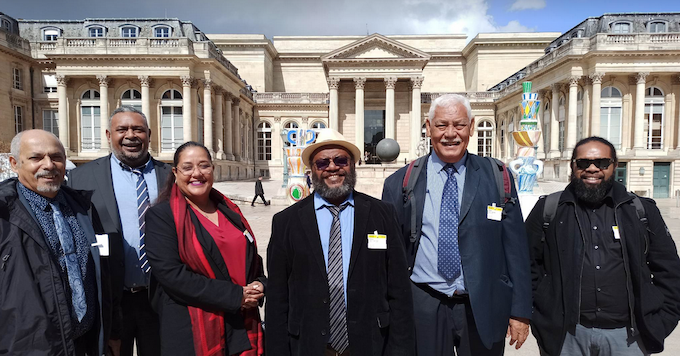
Brief reports have surfaced about the separate bilateral meetings of the Kanaky New Caledonia pro- and anti- independence representatives at their meeting in Paris with French Prime Minister Élisabeth Borne last week. Here the leader of the Front de Liberation Nationale Kanak et Socialiste (FLNKS) delegation, Roch Wamytan, outlines their case as presented to PM Borne at the Hôtel Matignon on 11 April 2023.
By Roch Wamytan, leader of the FLNKS delegation
First of all, allow me, Madam Prime Minister, to greet you on behalf of the Front de Liberation Nationale Kanak et Socialiste (FLNKS) delegation for this first meeting with you.
Despite the difficult situation prevailing in France, you were able to take some time in your busy schedule to discuss with our delegation and we recognise your significant consideration of the situation of New Caledonia (NC). We have also had the opportunity to communicate with you by phone with some of our delegation members and I thank you.
Today is the first time that we meet, and it is important to be able to discuss face-to-face and try to understand each other. It is a huge responsibility has been passed on to you, that of an ancient civilization characterised as “the Kanak people of Melanesian and Austronesian descent” which has been present in the Caledonian archipelago for more than 3000 years.
Close to 250 years ago (1774), this ancient people crossed the path of Europeans through James Cook, and then that of the French on September 24, 1853, the date of the possession of the islands by France. It is from this time onward that the chaotic history of relations between France and us, the Kanak people, began.
Almost 170 years later, we are still debating these relations that bind us: You as the representative of France, and us, the members of the FLNKS delegation, led by two of the signatories of the Nouméa Agreement, Victor Tutugoro and myself, accompanied by Gilbert Tyuienon, Mickaël Forrest, Jean Pierre Djaïwé, Digoue, Aloisio Sako, Jean Creugnet and our technical team.
Roch Wamytan, leader of the FLNKS delegation to Paris, pictured with Yael Braun-Pivet, President of the French National Assembly. Image: FLNKS
As you know, Madam Prime Minister, the FLNKS represents the national liberation movement of the colonised Kanak people, since the re-inscription in 1986 of New Caledonia on the United Nations’ list of countries to decolonise. Therefore, we stand in front of you as the representative of the governing authority of France, according to international law.
On February 26, 2023, the popular congress of the FLNKS and the nationalist and Indigenous movement has validated the unique and unitary trajectory for the country’s achievement of full sovereignty and independence, through negotiation with the governing authority, France, which is the governing power since the possession of New Caledonia on September 24, 1853.
For 170 years (September 24, 1853) we have lived under the governance of France, which has become since 1986 the administering power of the New Caledonia, the latter being considered a non-self-governing territory. This governance has never been accepted by our people and the genealogy of the struggle to free ourselves of it is well known. Allow me to share some key dates:
● From 1774 (arrival of James Cook) to 1853 (formal possession): People had to struggle against the harmful effects of microbial epidemics introduced by the first Europeans, faced with a population which lacked immunity. As a result, close to 90 percent of the population was eradicated. Survivors organised themselves and survived thanks to their ancestral resilience when faced with diseases and European invasion. Then, colonisation followed.
● From 1853 to 1924: The violent possession of land, the settlement of convicts and deportees, the revolts of chiefdoms and the bloody repression of the colonial army with its massacres, ethnocide, population displacement and transportation.
● From 1925 to 1946: The population reaches its lowest point, approximately 25,000 people. It is the point of departure for a rebirth, through reconstruction, the restructuring of chiefdoms with catholic and protestant missions.
● From 1945 to 1946: New Caledonia misses its first opportunity to achieve independence. Indeed, the President of the United States of America, [Franklin D.] Roosevelt, was of the idea that the French defeat would de facto, lead to the end of its empire, then in ruin. He was therefore planning on changing the status of Dakar, Indochina and other French possessions and was advising France to progressively give up its possessions in Asia and Africa.
When it came to New Caledonia, this colony was to be removed from France and placed under the governance of the USA, similarly to Palau, before giving it its independence back. That is what the work of Marie Claude Smouts, researcher at the French National Centre for Scientific Research (CNRS), shows in her book La France à l’ONU.
● From 1946 to 1958: It is the end of the Native Code, the Kanak people are granted citizenship and enter institutions. It also marks New Caledonia’s second missed opportunity to become independent since in the 1958 constitutional referendum where the electoral roll was predominantly Kanak.
Under the influence of the Catholic and Protestant churches supported by the European section of the Union Calédonienne (UC) party, this party opted for YES, and therefore to remain within the French Republic. The framework law or autonomy law was in turn put in place.
● 1963-1968 and 1975-1984: Abolition of the framework law and birth of the Kanak pro-independence movement. 1975 was the year of the “Mélanésia 2000” cultural revolution, and the creation of the Front Indépendantiste in 1979.
● 1984 – 1988: It was the semi-failure of the Nainville-les-Roches discussions, the creation of the FLNKS, and the Kanak nationalist insurrection and revolts which lasted four long years.
● 1988 – 1989: [This] was the year of the signing of the Matignon Agreement and one year [later] the murder of Jean-Marie Tjibaou and Yeiwene Yeiwene since they did not have the FLNKS mandate to sign this agreement. An agreement which aimed to restore peace and initiate the rebalancing, but not to settle the issue of independence.
● 1988-1998-2018: the country enters a process of emancipation and decolonisation with the Matignon and Nouméa agreements by having “rebalancing” and “the impartiality of the state” as guiding principles.
● 2018-2022: this was the series of three referenda which resulted, according to France, in three NOs to full-sovereignty and independence. A progression of the YES to full sovereignty and independence between the first and second consultations is, however, notable. The third one is not recognised as politically legitimate by the FLNKS and its regional and international support due to 60 percent of non-participation, which includes the almost entirety of the Kanak people.
This explains the procedure at the International Court of Justice at The Hague. It is possible to estimate that the participation of the Kanak population to a third referendum organised in normal and transparent conditions, with an impartiality of the State would have allowed the country’s achievement of independence.
However, it marked the third missed opportunity to reach independence in our chaotic history of relations with France.
This brief historical reminder traces a trajectory that began with the arrival of the Europeans in Oceania in 1774 and which will continue until the achievement of full sovereignty in the coming years as part of a renewed relationship with France and Europe for a country that will be fully integrated in its geographical area. This has been its history for 3000 years, and this will be its future.
Indeed, experience has demonstrated that in the history of decolonisation in the Maghreb region, in Asia, in sub-Saharan Africa and other parts of the world: the colonised never give up on the question of their asserted identity. It is the same for our people which have always fought against an oppressive and forced assimilatory system.
While it fought against a system, the Kanak people respect France and its inhabitants. France has a history that we respect: it is a great nation which defends universal values. Moreover, hundreds of our youth have given their life during the two world conflicts. France has brought us [the] Catholic and Protestant religion[s] as well as education. That is what the preamble of the Nouméa Agreement acknowledges.
Due to being unheard in its struggle against a colonial system, we can consider that the nationalist movement which started in the early 1970s was a response to the abolition of the framework law put in place by the 1958 constitution, then removed in 1963. The movement peaked in 1984-1988, with the painful events of Ouvéa, where the special troops of the French armed forces intervened to maintain the public order.
The number of Kanak leaders having lost their life during this period up until 1989 is significant, especially considering their quality and our small population. In light of this dead-end situation, the handshake between Jean-Marie Tjibaou, Jacques Lafleur, and Michel Rocard, as planned, allowed for peace to be restored.
And the rebalancing included in the Matignon Agreement approved by the national referendum of 1988.
This ten-year period between 1988 and 1998 was meant to be an opportunity for a more balanced development of the territory. The no. 1 text of the Matignon Agreement is entitled: “The condition for a lasting peace — The impartial State at the service of all.” The press release of June 26, 1988, also insists on this point: “The impartiality of the State must be guaranteed, the security and protection of all must be ensured”.
And on August 20, the Minister of Overseas Departments and Territories, Louis Le Pensec, declared before the agreement signing ceremony: “France can only be a referee if its spoken word inspires trust”.
In 1998, the Matignon Agreement gave way to a new agreement, the Nouméa Agreement, which won the support of the Kanak people but was rejected by the non-independence majority of the South[ern] Province. This agreement has received an almost unanimous approval from the Kanak people for several reasons:
– It maintained peace and allowed for the continuation of rebalancing policies; – It allowed the construction of a project of society that would take colonialism into account, following the Nainville-les-Roches Agreement in 1983; [and] – Its preamble and guidance document de facto recognised Kanak identity and committed to the establishment of a new governance of New Caledonia, in the form of a sui generis collectivity with autonomy, in a perspective of independence.
New Caledonia, whose vocation for independence was recognised following the 1988 national referendum, was taking the path of the construction of a common destiny resting on a “Caledonian citizenship” and the irreversibility of the process of decolonisation and emancipation.
Thus, for the colonised Kanak people, the responsibility of the State as the third partner of the Nouméa Agreement is to guarantee this irreversible and sincere process, allowing New Caledonia to endorse its vocation to be a sovereign state, like the other sovereign states in the region. That is the meaning of the massive YES which was given by the Kanak people at the referendum to ratify this agreement on November 8, 1998.
It was the same for the national referendum of November 6, 1988. Under no condition can these two referenda be considered a reason for yet another status of integration of New Caledonia within France.
For the Kanak people, the process of self-determination must continue to follow up on the two referenda of 2018 and 2020. The Nouméa Agreement, which remains the basis on which the future of New Caledonia must be permanently built and sealed, is clear and unambiguous both in the preamble and the guidance document: Decolonisation is the way to rebuild a sustainable social bond between the communities that live in New Caledonia.
A new step must be taken to mark the full acknowledgement of Kanak identity, conditional to the reviewing of the social relationship between all the communities that live in New Caledonia and through the sharing of sovereignty with France before the full sovereignty of the country to be.
The culminating point of this Agreement is completely unambiguous because: “The State recognises the vocation of New Caledonia to benefit from a complete emancipation at the end of this period.” This Agreement will then remain at its last development stage without the possibility of going back in the event that the consultations do not lead to the new political organisation suggested. This irreversibility being a constitutional guarantee.
However, based on the decisions concerning the third referendum specifically, and the statements made by French government officials, the Kanak people observe that once again, the French State never follows through with its promises, and that in the last moment, it systematically aligns its interest as a “great power” to the French population it has settled in New Caledonia.
It was the case in 1963, when the French government unilaterally decided to cancel the framework law which had granted a wide autonomy status to New Caledonia, thus reflecting General De Gaulle’s desire to rely on New Caledonia and French Polynesia for France’s ambitions as a great world power. It also reflected the wishes of the [New] Caledonian colonial Right. This rupture unilaterally decided by Paris, created the conditions for the birth of Kanak nationalism from the 1970s, followed by its radicalisation in 1984-1988.
Today, almost forty years after 1984, it would seem that we are witnessing the same scenario, especially since the use of the concept of Indo-Pacific, with a renewed alliance between the President of the Republic and the Caledonian loyalists. Clearly, since 2021 and the Minister [Sébastien] Lecornu, the organisation of the third referendum has been the scene of the tipping of the State’s position towards the “No to independence” camp, undermining the very principles of the Matignon and Nouméa Agreements, the impartial State at the service of all, which resulted in a deadly loss of trust.
Since the possession of the islands by France, everything is done or organised based on French, European or Western norms, usages, traditions, or social structures, with an almost blind application of them in the context of a traditional society that is fundamentally different. Thus, basic organisations, structures, concepts, or processes, which are not that of Oceanian societies, continue to be imposed, without question as to the degree of constraint or acceptation that it implies.
However, this society, like any Oceanian society, carries deep values, drawing on the spiritual world, nourished by the sacred and inhabited by a way of thinking in harmony with nature and the cosmos as it has been valued, anchored mythological corpus on par with the great Mediterranean civilizations. We have not invented all this, it has been made explicit and rehabilitated by academia and anthropological research.
For a long time, the representatives of the Kanak people, whether it be the great chiefs, political leaders, or religious leaders have asked the question “but why does France, the governing power, not hear us?” It remains deaf to our points, to what the Kanak people wants, because it is its right to recover its lost sovereignty. But France does not think so and does not respect the recommendations made by the United Nations. It does exactly the opposite or interprets what is presented to it within the framework of the defence of superior national interests.
Could France, for once, carry a process of decolonisation through? This unfinished process of decolonisation carried on into the third referendum, which the FLNKS considers a “stolen” referendum. Has France forgotten the history of the colonisation of this people and of its millennial civilisation?
The Melanesian civilisation is not an invention of the mind, it was demonstrated, scientifically confirmed by the community of researchers in the field of anthropology. Indeed, within the context of anthropology and approaching “deep nthought”, academic research led on the path of understanding the spirit of man and his relationship with the material and spiritual world around him. The aforementioned work provides for the first time an exploration and in-depth reading of the mythical thought of the Kanak people; thus, this research establishes the sacralising vision of ancient Kanak myths and an integral landscape of life in the Kanak world, the visible and the invisible; rehabilitating the power of myth in the 21st century and by attributing it an academic dignity, it valorises the cultural capital of people.
This work has been welcomed as a true exploration, both novel and original, it underlines the height and strength of Kanak deep thought and highlights fundamental themes such as cosmological knowledge, the power of symbols and archetypes, etc. This observation encourages the total recognition of the qualitative aspect of this people. However, the current evolution is not going in this direction and has never acknowledged these immaterial and intellectual resources. Therefore, its formalisation and institutionalisation is suggested, since the State cannot ignore the fundamental elements of Kanak society which can infer the proclamation of a prior sovereignty.
One cannot deny that the French presence in New Caledonia, the successive leadership and the institutional changes have never integrated in writing or in speech the “pre-eminence, the full and legitimate connection to their land (existential and ontological link, startling for the Cartesian mind, Kanak belong to their land, land does not belong to them) and the sacred and inalienable character of the presence and existence of the Kanak people, as well as the sovereignty they possess: the later comes from the people and is complementary to the immaterial heritage . . .”
On this note, customary senators expressed their deep gratitude to an academic researcher in structural anthropology, whose novel work was welcomed as having valued and sacralised the fundamentals which structure Kanak civilisation. This original contribution fills a gap and demonstrates that “others” can understand, respect, and give the Kanak people their essential and existential values back. Above all, this contribution disrupts the one directional relation, which prevents the establishment of a real exchange, and which leads to forceful imposition, regardless of the qualities and values of the other. We seriously believe that France can take a step that it has never taken before to show that it is a great nation capable, like the Kanak who welcomes others, of recognising “a timeless and original sovereignty”, an essential condition for sharing in acceptance and understanding.
Indeed, it constitutes a new approach because a part of Kanak civilisation was destroyed in its anthropological foundations and its sociocultural organisation by the violence of French possession and the imposition of a “pax romana” without any counterpart. The impacts are known: the annihilation of the history which precedes September 24, 1853, the loss of identity in relation to languages, land, culture, beliefs, etc. Kanak people’s ancestral land was considered “terra nullius”. This “terra nullius” status was assigned to make it “lawful” for better armed countries which pretended to be “more civilised” to seize, colonise and exploit territories and resources. That is in spite of the fact that, in our traditions, not one centimeter of land or maritime territory escaped the ontic link of belonging between the human and their land.
But in the meantime, the impacts on the being and doing of Kanak people have been of a great violence and these harms are still present in 21st century Kanak society. Some of these impacts have been acknowledged notably in the preamble of the Nouméa Agreement, but no solution followed, through a holistic approach which could have defined some “just” measures to implement so that the Kanak people could recover its dignity.
It is time for France to react because in New Caledonia, a sly colonialism or neocolonialism is currently at play, attempting to erase and negate the natural sovereignty of the Kanak people on its territory, condemning it to eternally look for a lost paradise. We do not want to die assimilated like a sugar cube in water and we will resist to survive. Fortunately, some moral voices make themselves heard to denounce this unjust system, as is the case with the Vatican.
In its “colonial” history, the Vatican shared discovered lands with different European Christian countries, among which Portugal, Spain, France, etc. It ended up ubi et orbi declaring the abandonment of the doctrine of discovery, which operated from the 16th century and provided a framework to lay possessive claims, to appropriate and to colonise, due to the destruction, damage, and other ills of colonisers. More recently, Pope Francis declared in a message addressed to the participants of the “colonisation and neocolonialism: a social justice and common good perspective” forum, which took place on March 30th and 31st, 2023 that neocolonialism is sly, that it is a crime, and that there isn’t any possibility of peace in a world that rejects some people in order to oppress them.
We even remember the unforgettable sentence marked by the “presidential” seal, of candidate Emmanuel Macron in Algeria, stating that colonisation is a crime against humanity. This gives more weight to the papal message. Restorative action is thus unavoidable and must lead to a deep reflection: Which people has suffered? To whom do we owe reparation and apology before imposing and controlling?
We do not ask for pity, nor do we beg or repent, a confessional notion. We only ask for justice through a holistic and recognised approach, that of transitional justice with its four pillars, to reinvigorate a damaged people, which drags generation after generation, the negative impacts on its being and its doing, as Solgenystine and other experts remind us on the topic of colonialism.
But we are also aware of the “cultural” difficulty for the great colonising countries to go in the direction of colonised countries. As evidence, in the work of French anthropologist François Pouillon on this issue:
Nations states hardly appreciate Native peoples, even more so when the latter manifest some inclination toward autonomy, or worse, independence. At stake is the power of sovereign states over the territories they govern and from which they most often exploit the Native populations which are marginal in their eyes. If they resist, they break the law and expose themselves to economic, juridical or even military sanctions.
Contemporary centralised states are more so convinced of their efficacy and legitimacy as they promote ideologies and values which they are always proud of: the development of their technical and medical knowledge, the “universality” of their confessional or secular beliefs, their “influence” in the world and, at last, their advanced position in the evolution of humankind, all of this supported, more prosaically, by a solid armament.
Native peoples, in their emphasis on their own territories, memories, institutions and knowledges, would only slow them down on their path to perfection.
This tyrannical self-satisfaction feeds on the conviction, as François Pouillon underlines, that “if others, abroad, sometimes have an enviable quality of life, in their closeness to nature and the spiritual warmth of their group (which, however, does not protect them from bloody dictatorships, ethnic cleanings, natural disasters and great modern pandemics), they are, we believe, in a pitiful political state and remain, after all, ‘backward’.” (Anthropologie des petites choses, Le Bord de l’eau, 2015)
Colonial attitudes feed off this “naïve evolutionism” from which contempt originates. From the lack of consideration to enslaved people in the Code Noir (royal decree passed in 1685 aiming to define the conditions of slavery and its practices in the French colonies) to the dehumanisation of Jewish and Tzigane [Roma] people in extermination camps, through the stigmatisation of “primitive” people and other “indigènes” of the colonies, the same deadly chant is sung: May impure blood water the fields of the civilization we embody.
These references are not historical since, today, Amazonia has been transformed into a gigantic inferno where the last Indians die, while Uighurs, Rohingya, Roma, Aboriginal people, African Americans, Native Americans and many others suffer a thousand deaths under the rule of nation-states convinced of being at the top of social and human progress.
Will Kanaks of New Caledonia also pay the price of the narcissism of the powerful? And thus, of France?
“Rebalancing” policies all over the Pacific, Native populations have already historically undergone a spectacular demographic decline (due to epidemics, massacres, poisonings), land spoliation from non-Indigenous people, both rural and urban, exclusion from the benefits of new economic initiatives (mining, extensive breeding, exportation) and the moral attacks of Western monotheisms.
The Tjibaou Cultural Centre on the outskirts of Noumea . . . an expression of Kanak identity. Image: Creative Commons
The paradox of New Caledonia is that France has recognised parts of its faults by committing, from 1988, to important “rebalancing” policies aimed primarily at Kanaks. Michel Rocard, when he was Prime Minister from 1988 to 1991, then Lionel Jospin, from 1997 to 2002, also supported the industrial ambitions of pro-independence leaders by enabling them to acquire a mine and to successfully extract, process and export nickel. At the same time, strong support for the expression of Kanak identity has marked the last thirty years with the creation of the Tjibaou Cultural Centre in May 1998, the revival of the Customary Senate [Kanak advisory assembly] and taking into account the Indigenous point of view in the courts.
These significant developments, which have never been questioned by the successive governments of the French Republic, have noticeably appeased the minds and improved the daily life of all Caledonians in general, and Kanaks in particular.
They were combined with unprecedented institutional measures: the scheduling of three referenda for self-determination, the creation of a special electoral roll used for polls open solely to Caledonians who had settled before 1994 and the urge to all the communities living in the archipelago to elaborate a “common destiny”. Alternative forms of sovereignity.
This momentum did not lead to New Caledonia’s access to full sovereignty in the first referendum on November 4, 2018, but it signaled a surprise surge in votes in favour of independence (43.3 percent), a cause which Caledonian of European, Asian or Oceanian descent have evidently joined. This trend was confirmed on October 4, 2020, with 47 percent of the population expressing their wish for New Caledonia to become independent. If this progression is significant, these results won’t change the outcome. The issue is not purely electoral or numerical.
Kanak delegation leader Roch Wamytan (second from right) with other members. Image: FLNKS
It refers to much deeper forces. Oceanians, despite being victims of a denial of existence, have created social organisations, practices and knowledge related to their doing and being that are specific to them. Through relations to land, legitimacies to power and counter power, strategies of political and matrimonial alliances, whether near or far, connections to the past, and visual and narrative creations, they have developed an alternative form of sovereignty to the monolithic and absolute one that is glorified by nation-states. The challenge of French and British colonisation has matured this nuance and complex political thought, which is a source of resistance and projects for the future. These gains are ineradicable and will not be phased by the ephemeral results of a referendum.
In this context, how can we forge a genuine dialogue?
It seems to us that it is high time for the governing authority to look at the “other” in order to have a mutual understanding, the basis of trust to create, promote, and walk together with the ability and willingness to share a “modus operandi” through the discussions and negotiations to come on the topic of other forms of governance.
Consensus proves to be a fundamental element in the important choices that we had to make for the evolution of New Caledonia in light of the challenges of 21st century.
You have no other choice than to integrate this practice specific to the Pacific or miss out on a successful statutory development project for New Caledonia.
Madam Prime Minister, your government would gain from being in a “win-win” approach, because everyone can assess what New Caledonia represents in this part of the world. We are ready to discuss it.
Building new relationships of trust between our two countries, committing to stability for the populations which have chosen to participate to New Caledonia’s prosperity, and lastly, mastering the stakes, notably environmental, that we will have to face are all challenges that we are willing to undertake. Therefore, the unique trajectory assumed by the FLNKS for the accession to full sovereignty and independence offers the outline that we wished to present to you.
The past 30 years of social stability have provided a conductive environment for the unprecedented development of our country. The irreversible process of decolonisation put in place by the Nouméa Agreement has placed New Caledonia in front of its growing responsibilities, leading us to be standing at the doors of the “concert of nations”.
Considering our emancipation process, the FLNKS believes that we are ready to assume the attributes of our sovereignty. Through a co-construction approach, we propose that the adoption of a political treaty enabling to seal a political basis for this final phase of statutory evolution be studied.
This political agreement will guarantee:
● Reaching an independence bilaterally negotiated with the governing power; ● The continuation of the irreversible process of decolonisation of New Caledonia; ● Obtaining an ultimate process that implements a programme of accession to full sovereignty and independence; and ● Constitutionalising the political agreement and the accession to independence status, which includes the transition phase, the sovereignty act and the proclamation of the birth of a new state.
Since 1986, New Caledonia has been on the UN list of non-self governing territories. This acknowledgement on the international stage guarantees us rights without which our deepest aspirations would not have been heard. And as long as our ultimate conviction will not be respected, we will continue to make our struggle known.
Madam Prime Minister, this year will mark the 25th year since the Nouméa Agreement. It is our duty to cultivate this consensual state of mind, which has guided all the stakeholders to this juridical innovation that recognised “the shadows of colonisation”.
Madam Prime Minister, we will have to stand by the choices we make for our future generations. As far as we are concerned, it is our duty never to surrender our right to independence and we are convinced that the French State can succeed in the statutory evolution of New Caledonia, within the context of the UN’s Fourth International Decade for the Eradication of Colonialism.
To conclude, Madam Prime Minister, this long introduction allows us to place in front of you a historical and political trajectory for the country to access full sovereignty and independence is a logical destiny. We would like to know the ambitions of the central government.
Thank you for your attention.
Roch Wamytan Head of Delegation
Members of the FLNKS delegation in Paris for the bilateral talks with the French government. Image: FLNKS
This statement has been lightly edited for publication style.
The Indonesian military has officially escalated its operational status in West Papua to “ground combat ready” following a clash with West Papuan National Liberation Army militants over the weekend with multiple casualties reported on both sides.
Military (TNI) commander Admiral Yudo Margono made the announcement in Jakarta yesterday after returning from West Papua.
Admiral Margono said the decision was reached after a “very thorough evaluation” of the joint police and military operation to rescue New Zealand pilot Philip Mehrtens who was taken hostage by the West Papuan pro-independence fighters on February 7.
He said it was also in light of the high number of casualties being reported from the clash with the Papuan rebels, who claimed to have killed and captured more than a dozen Indonesian soldiers.
According to The Jakarta Post, TNI claims it used a “a peaceful approach to the rescue operation…to keep the local population safe”.
However, the fatal clashes “altered the outlook” of its operation.
“To deal with such attacks, we will raise the troops’ status to combat ready,” Admiral Yudo told the news outlet.
Military (TNI) commander Admiral Yudo Margono . . . “To deal with such attacks, we will raise the troops’ status to combat ready.” Image: The Jakarta Post
Call for NZ government to ‘intercede’ Meanwhile, the West Papua National Liberation Army (TPNPB) is calling on the New Zealand government to intercede and de-escalate the tensions in Nduga in Highlands Papua.
RNZ Pacific has also received reports of Indonesian airstrikes on the independence fighters’ positions which their leaders say further endanger the life of Mehrtens.
The rebels are calling for a ceasefire and urging Jakarta and Wellington to stop ignoring their requests for peaceful negotiations.
RNZ Pacific has asked the New Zealand and Indonesian foreign affairs ministries for an update.
An MFAT spokesperson said: “We are aware of the reports but will not be making any comment.
“The welfare of Mehrtens is our top priority. We’re doing everything we can to secure a peaceful resolution and Mehrtens’ safe release, including working closely with the Indonesian authorities and deploying New Zealand consular staff.
“We are also supporting Mehrtens’ family, both here in Aotearoa New Zealand and in Indonesia. They have asked for privacy at this incredibly challenging time,” the MFAT spokesperson added.
This article is republished under a community partnership agreement with RNZ.
Many of us know cranberries as a tasty condiment to have with our Christmas turkey, or the juice that accompanies vodka in a cosmopolitan cocktail. You might have also heard cranberries prevent urinary tract infections (UTIs).
While this often dismissed as a myth, our new review of the evidence shows consuming cranberry juice or supplements reduces the chance of repeat UTIs for women, children, and those who are more susceptible to them due to medical procedures.
But this wasn’t the case for elderly people, pregnant women, or for people with bladder-emptying problems.
The review didn’t look at the use of cranberry for the treatment of UTI – and cranberry juice cannot cure a UTI on its own. So, if you do get a UTI make sure you seek medical care from your GP or other health provider.
Remind me, what is a UTI?
UTIs are unpleasant and very common. About one-third of women will have one at some point in their life. They’re also common among elderly people and those with bladder issues caused by spinal cord injury or other conditions.
Typically, a UTI feels like peeing razor blades and the urine can be smelly, cloudy, and sometimes has blood in it. Other symptoms include the frequent urge to pass urine, a stinging or burning sensation when passing urine, and pain in the lower abdomen or pelvis.
UTIs are caused by bacteria. Normally bacteria do not live in the urinary tract, but when they do, they stick to the bladder wall, multiply and can cause a UTI.
When a UTI persists untreated, the infection can move to the kidneys and cause complications, such as severe pain, or sepsis (a blood infection) in the worst cases.
Most UTIs are effectively and easily treated with antibiotics. Sometimes just one dose of antibiotics can resolve the infection. Unfortunately, for some people, UTIs keep coming back.
What medicinal properties do cranberries have?
The First Peoples of North America have long known the benefits of eating cranberries, including their benefits for bladder problems.
Cranberries are a native fruit of North America. Shutterstock
More recently, in the 1980s and 1990s, laboratory scientists started to explore several plausible explanations for these benefits.
The most widely accepted explanation is their high concentration of the antioxidant proanthocyanidin. Cranberries (Vaccinium macrocarpon) – a native fruit of North America – have a high concentration of proanthocyanidin, which protects the cranberry plant against microbes.
Researchers think the compound also prevents the most common UTI-causing bacteria – Escherichia coli (E.coli) – from sticking to the bladder wall.
It was this apparent ability that researchers concluded was responsible for the cranberry’s medicinal properties.
However, without strong evidence of how or if cranberry worked, health-care providers were left without clear guidance on who might benefit from cranberry. As a result, the ongoing debate in the academic literature has persisted for more than 30 years.
Researchers periodically review the evidence to support tests, treatments and interventions for all sorts of health conditions.
Proving efficacy became a focus with randomised trials starting to being published from 1994. The first Cochrane compilation of four clinical trials on this topic – published in 1998 – concluded the evidence was too poor to determine efficacy.
Researhers have long been investigating the role of cranberries in preventing UTIs. Shutterstock
A Cochrane Review involves identifying of all the available peer-reviewed academic evidence on a health care or health policy topic. The evidence is reviewed independently and in an unbiased way by members of the Cochrane Network, a network of independent researchers, professionals, patients and carers interested in answering health questions.
Updates in 2004 and 2008 suggested cranberry products reduced the risk of repeat UTI in women, but most of the studies were not considered high quality evidence and so the findings were not conclusive.
By 2012, the volume of evidence had increased to 24 clinical trials, but the data was imprecise and the conclusions were that cranberry juice was of no benefit.
As one of Cochrane’s most popular reviews, and the ever increasing volume of evidence, updating the review was important.
Over time, research has improved in the consistency of how cranberry is consumed – as juice or tablets – as well as improved in the measurement of the effective dosage and estimates of how much active ingredient (proanthocyanidin) in the different products.
What’s new?
Our Cochrane Review, update, published this week, now includes 50 clinical trials of cranberry products.
More than 8,800 people have participated in the clinical trials which randomly assigned people to take either cranberry products or a dummy treatment – either a placebo (a substance that has no therapeutic effect) or “usual care” (where people might receive another preventive product, such as probiotics).
The recent increased volume of high-quality evidence has shown cranberry products work for people who experience recurrent UTI or are susceptible to UTI. Recurrent UTIs are defined as two or more UTIs within six months, or three or more UTIs within a year.
Cranberry products reduce the risk of repeat symptomatic, culture-verified (tested in a laboratory ) UTIs in women (by about 26%), children (by about 54%), and people susceptible to UTI following medical interventions (by about 53%).
The findings don’t relate to people who don’t get UTIs very often but want to avoid them.
What is still unclear is the formulation and dosage of cranberry products. The evidence was not able to clarify whether cranberry tablets or liquids are more effective, what dosage of cranberry works best, or how long people need to take cranberry products to get the full benefits. The clinical trials varied in the duration of cranberry consumption, from four weeks to 12 months.
Among the many complicating issues addressed in this update was who funded each trial. Each clinical trial was classified as either being supported by funds from commercial organisations (such as juice manufacturer) or conducted by not-for-profit organisations (such as universities or hospitals) who paid for their own cranberry product.
However, we found no difference in the results for clinical trials supported by juice companies compared to those conducted by academic institutions.
Jacqueline Stephens receives funding from NHMRC, Channel 7 Children’s Research Foundation, Ferring Pharmaceuticals, and Flinders Foundation.
Gabrielle Williams does not work for, consult, own shares in or receive funding from any company or organisation that would benefit from this article, and has disclosed no relevant affiliations beyond their academic appointment.
Source: The Conversation (Au and NZ) – By Ben Phillips, Associate Professor, Centre for Social Research and Methods, Director, Centre for Economic Policy Research (CEPR), Australian National University
Federal Treasurer Jim Chalmers and Minister for Social Services Amanda Rishworth established an Economic Inclusion Advisory Committee in December 2022 to advise the government on ways to lift economic inclusion and reduce disadvantage.
I am a member of that committee, which was tasked with reporting to the government at least two weeks prior to the federal budget in May – enough time to include a response to in the budget.
The committee delivered its report to the government in late February. The goverment made it public yesterday.
There are 37 recommendations – too many to discuss in detail here. The most pressing concern, and the most important for immediate policy action, is to substantially increase the JobSeeker payment for the unemployed.
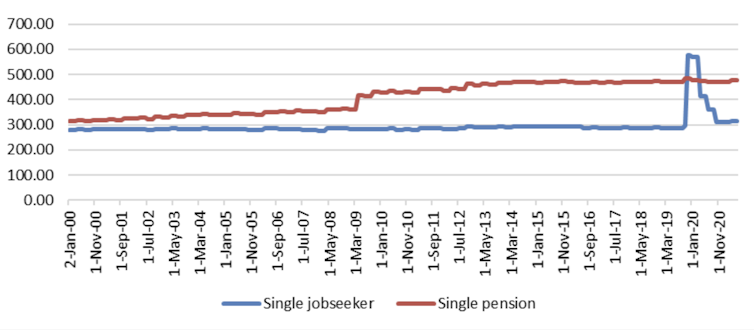
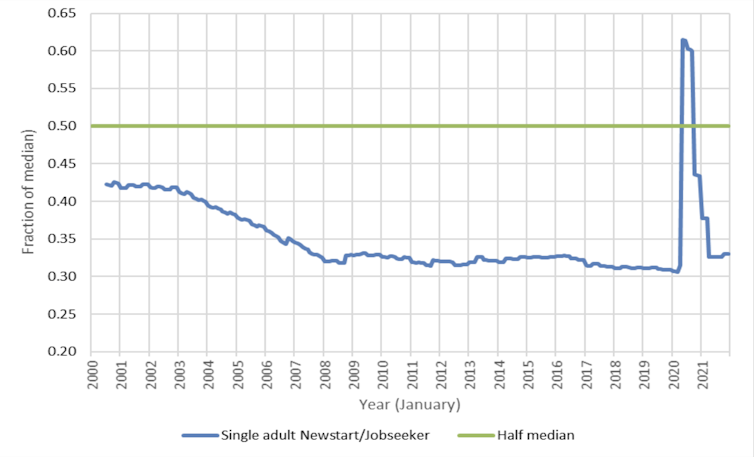
Apart from a temporary boost during the COVID-19 pandemic, the payment (previously known as the NewStart Allowance) has declined relative to median incomes and other welfare payments for several decades.
JobSeeker Payment relative to Age Pension, 2000 to 2021
Interim Economic Inclusion Advisory Committee, 2023–24 Report to the Australian Government
The committee has recommended restoring the relativities of the mid-1990s, when the unemployment benefit was about 90% of the age pension. This would require increasing the current rate for singles (now 65% of the age pension) from A$693 to $958 a fortnight – or from about $49.50 to about $68 a day.
How we made our decision
We compared the JobSeeker payment with a range of metrics such as the age pension, minimum wage, budget standards, average weekly earnings and various poverty lines such as the Henderson Poverty Line maintained by the University of Melbourne.
There is no right level for JobSeeker (or any other welfare payment) and there is no single methodology that provides all the answers.
But all the metrics tell the same story: JobSeeker has drifted behind all these benchmarks, largely due to being indexed to the Consumer Price Index rather than wages or incomes.
JobSeeker Payment relative to half median equivalised disposable
income, 2000 to 2021
Interim Economic Inclusion Advisory Committee, 2023–24 Report to the Australian Government
Given the committee only had a couple of months to draft a report, it was not possible to review all aspects of the welfare system – such as the age pension, disability support payments and family payments – or the many other aspects that affect economic inclusion.
Nonetheless our judgement is the evidence shows the most urgent need of policy attention is the precarious financial situation for almost 1 million Australians that depend on JobKeeper and associated payments such as a Youth Allowance
The 4 million Australians receiving other payments (age pension, disability pension, veterans pension, parenting payments and carer payments) are more likely to be matching up to adequacy benchmarks. There was a substantial boost to most pension payments following the 2009 Harmer Pension Review.
The committee also found Rent Assistance is inadequate and not keeping up with rental costs for most low-income households. It too requires an urgent and substantial increase.
But the highest priority is JobSeeker, as the most effective payment to lower financial stress and poverty. JobSeeker has a larger budget and is better targeted than Rent Assistance to those in most financial need.
What will it cost?
Increasing JobSeeker and associated working age payments would cost the federal budget about $5.7 billion in 2023, according to Australian National University’s PolicyMod model of Australia’s tax and transfer system. Over the three years of forward estimates (2023 to 2026), the cost would be about $24 billion.
The total cost of welfare payments in 2023-24 is expected to reach A$145 billion. So $5.7 billion, while a substantial additional expense, does only represent a 4% increase in the welfare cash payments, and less than 1% of the total federal budget.
The available evidence outlined in the report suggests the recommended increase would be unlikely to greatly impact participation, given the payment would still be substantially lower than the minimum wage. Indeed the committee’s judgement was that leaving it at the current rate may be a net negative for participation, with poverty being a barrier to employment.
The welfare system in Australia is supposed to provide an adequate safety net but for nearly a million Australians the system is not achieving this vital goal.
The government has an opportunity in the next budget to right a significant wrong for a group of some of the most disadvantaged people in a mostly otherwise wealthy nation.
Ben Phillips is a member of the Interim Economic Inclusion Advisory Committee.
Live performance exists only in the moment it is being performed. Its ephemeral nature means it is transient and impermanent, and cannot be experienced again in precisely the same way.
How do artists hold on to the works that they make? What of the invisible labour that is rarely acknowledged or named?
Over the last ten years, performance artist Leisa Shelton has completed a series of participatory artworks which focus on the mutability of the archive: gathering audience testimonies and mapping artistic lineages.
Now her new show, Archiving the Ephemeral, brings five works together in a beautifully curated installation.
Archiving the Ephemeral is a celebration of the artist, the artistic process and the audience experience.
Shelton’s expansive career, built on collaboration, care and conversation, grounds the exhibition. The show reflects her focus on curating and re-framing interdisciplinary work to address the limited opportunities for recognition of contemporary independent Australian performance.
Marked by a spare, distinctive design, Archiving the Ephemeral is located in the Magdalen Laundry at the Abbotsford Convent.
Rich with a bright green wooden industrial interior and aged painted walls, the laundry is a perfect background for the specifically placed items, the carefully lit tables and the long lines of patterned artefacts.
Fragile ideas are framed and held within a crafted, artisan aesthetic. Objects are carefully made and remnants are meticulously gathered.
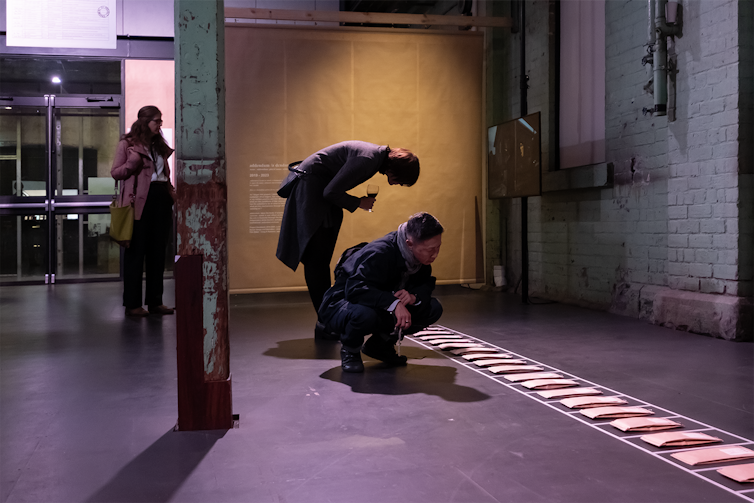
Along one side of the space, 132 brown paper packets are laid out in a continuous line on the floor. Each package contains a set of archival materials, burned to ash, which corresponds to an artistic project from Shelton’s career.
Paper packets hold archival materials, burned to ash. Sofie Dieu/Abbotsford Convent
An accompanying video depicts Shelton’s meticulous process of burning, piece by piece, her entire performance archive to ash.
In a methodical and meditative process, the ash is sifted and packaged into the hand-crafted paper bags. The bags are then hand-punched and sewn with twine, typed, labelled and categorised: a kind of devotional honouring of the materials even as they are brought to dust.
A living archive
The exhibition includes an opportunity for each of us to become part of the living archive through conversations with two ground-breaking elders of Australia’s performance art scene, Jill Orr and Stelarc.
On the night I attend, I sit with Stelarc. We discuss Kantian notions of time as he tells me about his Re-Wired/Re-Mixed Event for Dismembered Body (2015). It’s a delightful moment of personal connection with an artist I’ve admired for years.
Personal archives built from conversations can be carried by each of us. Sofie Dieu/Abbotsford Convent
Across one wall are four large hanging papers listing the name of every artist on every Arts House program from 2006-2016, laboriously typed.
On the night I attend, these lists elicit lively conversations among the artists present as we study the names and dates (in my case, slightly desperately searching to see if my own name is there), and recall shows, people, events, stories and collaborations.
Hundreds of artists have performed at Arts House. Leisa Shelton/Abbotsford Convent
Much of Shelton’s work is gathered from conversations with audience members about art and artists.
In Mapping, a set of burnished stainless-steel canisters, beautifully marked with engraved identifications, sit on a bench underneath a suspended video screen on which artist names appear and disappear in an endless, floating loop.
The canisters contain details of profoundly memorable artists and performances collected from 1,000 interviews, dated and stamped. They are hand-welded, sumptuous objects which hold the interview cards securely locked under fireproof glass designed to withstand cyclones, fires and floods.
The many hand-written files of Scribe contain multiple documents which can be taken out and read. The sheer number of pages is overwhelming, and the breadth of audience commentary – joyful, moved, connected, inspired – is breathtaking.
We can sit and read about the work that was. Sofie Dieu/Abbotsford Convent
It’s a poignant reminder of the traces borne out beyond the artist’s own experience of performing a work: an often surreal and lonely moment once the audience has left the room.
A practice of care
Archiving the Ephemeral fosters a practice of care and acknowledgement which extends to the practical ways in which our trajectory through the room and engagement with the artworks is enabled.
The Convent is an apt site for such a careful collection. Analogue processes and objects are foregrounded. Typewriters, brown paper, string, awls and aprons are part of the painstaking construction process. Attendants and scribes act as custodians in the space, facilitating a gentle holding of the material.
We are given the opportunity to continue the archive as it evolves and devolves around us. As I make my way through the space, I notice my own embodied archival actions – taking notes, speaking to others – as I continue the trajectory of documenting the documents.
We are not just witnessing one artist’s body of work. Archiving the Ephemeral focuses on the need for greater visibility, recognition and honouring of Australia’s experimental and independent artists, and speaks to the many collaborations, associations, and intricate connections that mark a significant – if unacknowledged – cultural legacy.
Archiving the Ephemeral is at the Abbotsford Convent, Melbourne, until April 22.
The most fascinating aspect of screen museum ACMI’s new exhibition Goddess: Power, Glamour, Rebellion, and the major contribution it makes, is the way it generates fresh understandings of women on screen, including in relation to Australia.
Goddess has been in planning for five years, celebrating 120 years of women and the moving image. Curated in Australia by Bethan Johnson for ACMI, the museum will eventually travel it globally.
Geena Davis and her institute on Gender in the Media are the perfect partners for the new show; not only because Davis is a screen goddess herself, but because of her leadership. Gender in the Media is a research and advocacy organisation which looks at the representation of gender and sexuality, race, disability, age and body types on screen.
“You cannot be what you cannot see” frames not just the mission of Davis’ institute, but points to the key message of the show: the power and significance of representation.
The exhibition features cinematic moments, iconic costumes, sketches, posters, photographs, magazines and interactive experiences. You can even make a goddess image of yourself to take home.
Stars we ordinarily think of as goddesses are showcased, such as Marilyn Monroe, Pam Grier and Davis in clips and costumes of their iconic roles.
But the show also asks audiences to rethink what a “goddess” might be understood to be, do and mean.
Curators draw their inspiration and vision from the culture within which they operate. The exhibition, therefore, has something to say about – or from – this country and its talent.
The Australian lens shaping the selection, presentation and commentary about characters, stories and experiences is initially invoked by the soundscapes created by Melbourne-based composer, DJ and musician Chiara Kickdrum.
This continues further inside, in a darkened room where audiences see a montage of clips of stars speaking at awards and events about industry ageism, sexism, racism, advocacy for women and female courage. First Nations filmmaker Leah Purcell, in full regalia at the AACTA awards, says:
It’s truth telling that this country needs to hear [so] we can move to the future with better understanding of who we are as a nation.
Elsewhere, the exhibition features “Fearless Nadia” (Mary Ann Evans), an Australian actor who became Bollywood’s leading stunt woman in the 1930s, swinging from chandeliers, leaping from speeding trains and taming lions. She was one of the earliest female leads of Hindi cinema.
Australian Hollywood costume designer Orry-Kelly won three Academy Awards and the show includes the iconic costume he created for Marilyn Monroe for Billy Wilder’s Some Like It Hot (1959).
In the book that accompanies the exhibition, a quote from Monroe gives an insight into being typecast by her body:
I am tired of the same old sex roles. I want to do better things. People have scope, you know.
The body of the goddess
A key element of this exhibition is the spectacular display of the body of the screen goddess – from classical Hollywood to contemporary popular culture.
ACMI is framing the goddess not just by the tired “starlet” and “bombshell” tropes, but as a woman who pushes boundaries, questions norms and stereotypes.
At the beginning of the exhibition we encounter fashion model Winnie Harlow in Monroe’s iconic pink dress from Diamonds are a Girl’s Best Friend, a performance in the 1953 film Gentlemen Prefer Blondes.
The beautiful Harlow is a spokesperson for the skin condition vitiligo (where her skin has lost colour in parts). Her gaze is confident: she invites our gaze in return, challenging notions of perfection. Her flesh becomes costume, and I think of the idea “it is not what you wear, but how you wear it” — a kind of mantra for individualism (although what she wears also has its own meanings and legacy). We are all unique, but her skin conveys this idea.
Winnie Harlow. Photo: Albert Sanchez
In clips we see the pressure on female actors to achieve an impossible standard of beauty.
Olivia Colman argues for the messy, imperfect body:
I’m an actor, not a model and I think you should be able to look horrendous […] that’s what I love doing.
A young Helen Mirren asks a journalist whether he means “serious actors cannot have big bosoms?”
Speaking across the decades Audrey Hepburn, Kate Winslet, Michelle Yeoh and Ellen DeGeneres all offer commentaries about how their ageing bodies have influenced their selfhood and careers.
A youthful Jane Fonda alludes to her experience of being a body and not a mind:
people seem to think that if you’re a girl, you have to behave in a way that is not militant or political, especially if you’re an actress […] how dare an actress think or be political!
Gender fluidity, women of colour, queer women, culturally diverse goddesses, and high-kicking action heroines all have something to say about the myriad of ways that we can understand a goddess in 2023.
As this exhibition has it, the goddess can be anything she wants to: not just swing from chandeliers, leap from speeding trains or the backs of lions (while being drop dead gorgeous).
In the battle to be represented, she has been seen, she has offered a female gaze — one where they are individuals rather than ideals or icons. Goddess asks us to rethink our own gaze, and the bias it contains, to see the ways in which identities are constructed in media, according to the belief systems of the culture that created them. In this, the exhibition admirably succeeds.
Goddess: Power, Glamour, Rebellion is at ACMI, Melbourne, until October 1.
Lisa French was a guest speaker for ACMI’s Public Program aligned to the Goddess exhibition: ‘Being Seen on Screen: The Importance of Representation’.
RMIT University, ACMI’s Major Research Partner.
Source: The Conversation (Au and NZ) – By Kathleen McPhillips, Senior Lecturer, School of Humanities and Social Science, University of Newcastle
Damien Linnane Bob (Dominoes) 2022. Graphite on paper 42 x 29cmThe Lock-Up
On entry to Newcastle’s The Lock-Up contemporary art space is a textile artwork by institutional child sexual abuse survivor and artist Elizabeth Seysener.
Produced as part of the community arts program running alongside the Loud Sky exhibition, the triptych depicts the three major events in her story of recovery: carrying the burden of shame for over 50 years, the traumatising year of disclosure to the Catholic Church, and finding a place of being free to speak out.
In the entry to the next room, a loop of primary school photos of survivors reminds us it is children who were harmed.
Another room features a large timeline produced by graphic design students at the University of Newcastle. It depicts the central events of two public inquiries and court cases as they unfolded between 1995 and 2022.
Television footage captures the major events. A framed document expresses the heartfelt responses of family members of survivors, whose voices are rarely heard.
This exhibition, titled Loud Sky, addresses institutional child sexual abuse through the eyes of five professional artists commissioned to work with the local survivor community.
“Loud Sky” is a riff on the Loud Fence Movement, which began in 2015 in Ballarat as a community response to the harrowing details emerging from the hearings. Community members tied coloured ribbons on the fences of Catholic churches and schools where children had been harmed.
The Newcastle region is recognised as an epicentre in the ongoing catastrophe of church-based institutional child sexual abuse.
From the 1950s, schools and parishes harboured clerical perpetrators who were constantly moved around to avoid detection. Families of devout Catholics were socialised not to question priests and brothers. Local Catholic managers put protection of perpetrators and the reputation of the church above the safety of children.
In 2022, the Loud Sky project ran community art workshops for anyone impacted by institutional child sexual abuse. Participants enrolled in painting, drawing and photography classes with experienced art therapists. The resulting artworks range from photographs of precious objects to paintings of the safety of home, and are on display at Belmont Library.
A second community arts program, the Field of Flowers, has been “planted” at Christ Church Cathedral and Sacred Heart Cathedral. School students, survivors, supporters and parishioners made over 8,000 ribbon flowers. The field is an act of remembrance and signals the hope for healing.
Loud Sky visitors have the option to sit in the gallery and make a ribbon flower to be “planted” in one of the cathedral fields.
Listening to survivors
These community programs complement the artwork from five commissioned artists. These artists began their commission with training in trauma-informed art practice to prepare for hearing the stories from the royal commission documents and the survivor community.
Each artist worked in collaboration with the survivor community, mostly members of the Clergy Abused Network, the central survivor support group in the Hunter region.
Damien Linnane Roslyn (Boots) 2022. Graphite on paper 42 x 29cm. The Lock-Up
Damien Linnane asked survivors to bring in a treasured object accompanied by a story of the object. His detailed, beautiful drawings focus on the power of memory to evoke the resilience of survival.
Lottie Consalvo Silent Film 2023. Single-channel video 4 min 1 sec. The Lock-Up
Lottie Consalvo worked with a survivor and his partner to produce a beautiful video around the small everyday gestures that had sustained their lives through years of pain. The slow-moving, deeply contemplative silent film evokes the power of stillness and beauty.
Peter Gardiner The Fire 2023. Oil on 300gsm arches 250 x 550cm. The Lock-Up
Peter Gardiner’s epic oil paintings depict the power of fire to both destroy and recreate, following his reading of the stories of survival from the royal commission transcripts.
Fiona Lee Why Bother 2023. Latex, acrylic paint 98 x 167cm. The Lock-Up
Fiona Lee’s three casement windows evoke being both inside and outside, born from Lee asking survivors what motivated them to get up in the morning and find the courage of facing each new day and reaching out to connect with others.
Clare Weeks invited survivors to take a piece of paper and imagine a word that reflected their sense of resilience and hope. Each piece of blank paper was folded and scanned, the surface revealing idiosyncratic features. Large images of these scans span the walls. We are invited to take our own square of paper and imagine our own response before placing it in a large glass bowl.
Clare Weeks notes to self, #14, #19, #11, #09, #07, #23, #08, #24 2023. Digital inkjet print from scanned silver gelatin photograph 79.5 x 59.5cm. The Lock-Up
The power of art
Visual art can be an important means by which affected communities come to understand the impacts of harmful events in creative and regenerative ways.
Art helps process trauma and plays a vital role in restorative justice and truth telling.
It is a powerful corrective to dominant narratives often told by influential institutions with investments in protecting corporate reputations.
How we represent these stories of injustice and pain reflects our humanity and commitment to changing damaging social practices.
Through art, we can remain awake to the impacts of child sexual abuse and listen to the stories of those who survived such harm as children.
Perhaps the final words can be given to the visitor who wrote in the exhibition logbook: “We see you, we hear you, we believe you.”
The Loud Sky is at The Lock-Up, Newcastle, until May 21.
Australia’s first National Electric Vehicle Strategy, released today, details the government’s long-awaited plans to accelerate the adoption of these vehicles.
Consultations on the strategy began last September.
The climate change and energy minister, Chris Bowen, then promised the strategy would make Australia a globally competitive market for electric vehicles. Households and businesses would have access to the best modern transport technology at affordable prices.
But does the strategy live up to these expectations? Is it ambitious enough to meet our emission-reduction targets and international commitments? And how far does it go to align Australia with world-best practice for the transition to electric vehicles?
In short, the strategy represents a step in the right direction but falls short of introducing meaningful new measures to speed up this transition, at a time when urgent interventions are needed.
Why is the strategy important?
Transport is Australia’s third-largest – and fastest-growing – source of greenhouse gas emissions. Cars produce about half of all transport emissions.
One of the quickest ways to cut these emissions is to accelerate the current slow uptake of electric vehicles.
Although EV sales almost doubled between 2021 and 2022, they represented only 3.8% of all new vehicle sales in 2022. That’s well below the global average of 12-14%. And it’s way behind world leader Norway where 87% of cars sold now are electric.
An ambitious national strategy, backed by robust fuel-efficiency standards, is vital for decarbonising Australia’s road transport. It will also improve air quality and reduce our dependence on fossil fuels and imported oil.
During consultations on the strategy, around 500 submissions were received, representing the views of more than 1,500 individuals and over 200 organisations.
A key feature of the strategy is a commitment to introduce Australia’s first fuel-efficiency standard for new cars. Frustratingly, though, the government has delayed finalising the standard until the end of 2023, pending yet further consultations with industry on its development.
Australia is the only country in the OECD without mandatory fuel-efficiency standards for road transport vehicles. They are needed urgently now as an important step to increase the supply of electrical vehicles to Australia.
The federal government has made the case for vehicle emission standards, but then decided to delay their introduction.
Bowen said today the government will not introduce any bans or stop companies selling any type of vehicle in Australia. Instead, they will be required to sell a “good proportion”‘ of electric and fuel-efficient vehicles. But no targets were mentioned.
Aside from the planned fuel-efficiency standard, the strategy introduces one other important initiative related to recycling and reuse of electric vehicles and batteries.
The rest of the strategy falls short of providing any substantial policy directions or targets to accelerate the transition to electric vehicles. Instead, it mainly confirms existing programs and policies, such as the electric car discount, and other already announced plans to upgrade charging infrastructure and the National Reconstruction Fund to boost local manufacturing.
The strategy does not provide new incentives to help Australians with the cost of buying an electric vehicle. There is also no mention of targeted subsidies or measures to ensure equity. Instead, the government said it will work with states and territories on nationally consistent principles to ensure demand stays strong.
The strategy also fails to acknowledge the need for a holistic strategy to decarbonise road transport. Other policy interventions are needed to lower emissions from transport, which cannot be achieved through vehicle electrification alone.
The strategy also falls short on measures to accelerate the adoption of electric trucks and heavy commercial vehicles. Freight transport networks and supply chains present particular challenges for reducing emissions. It is equally important to incentivise adoption by providing cheap loans and increasing supply
of reliable, sustainable and cost-effective alternatives to diesel trucks.
A credible strategy would need to consider a so-called feebate system. Feebates involve placing a levy on purchases of vehicles with high emissions and using the revenues to provide rebates for purchases of vehicles with zero or low emissions to offset their higher prices. Examples include France’s Bonus Malus and New Zealand’s Clean Car Discount. If developed carefully, these systems can be a cost-neutral method of discouraging purchases of high-emission vehicles and encouraging purchases of electric vehicles.
How does the strategy compare with plans overseas?
In the past few weeks, the United States and the European Union have announced some very ambitious plans that make the Australian strategy look very modest.
The US has proposed strict new emissions limits that would require two-thirds of vehicles sold in the US to be electric by 2032. The proposal, if ratified, will represent the most aggressive vehicle emissions reduction plan in the US. It will deliver, on average, a 13% annual pollution cut.
The EU also had plans to ban the sale of internal combustion engine cars from 2035. In February, the European Parliament approved the ban, which was later revised to allow some combustion engines running on e-fuels to be sold beyond 2035. Still, this remains one of the world’s strongest measures to phase out fossil-fuel vehicles.
By placing road transport decarbonisation on the national agenda, the National Electric Vehicle Strategy represents a positive step. But it falls short of matching the ambitious plans of other developed nations.
The much-anticipated fuel-efficiency standard will be key to demonstrate Australia’s commitment to reducing transport emissions. The standard will need to be mandatory, rigorous and robust. Clear targets on electric vehicle sales and timelines for phasing out internal combustion engine vehicles are needed.
If the standard is not carefully designed, we will continue to let down future generations, and the planet.
Hussein Dia receives funding from the Australian Research Council, the iMOVE Cooperative Research Centre, Transport for New South Wales, Department of Infrastructure, Transport, Regional Development, Communications and the Arts, and Beam Mobility Holdings.
Artificial intelligence has changed form in recent years.
What started in the public eye as a burgeoning field with promising (yet largely benign) applications, has snowballed into a more than US$100 billion industry where the heavy hitters – Microsoft, Google and OpenAI, to name a few – seem intent on out-competing one another.
The result has been increasingly sophisticated large language models, often released in haste and without adequate testing and oversight.
There’s no doubt AI systems appear to be “intelligent” to some extent. But could they ever be as intelligent as humans?
There’s a term for this: artificial general intelligence (AGI). Although it’s a broad concept, for simplicity you can think of AGI as the point at which AI acquires human-like generalised cognitive capabilities. In other words, it’s the point where AI can tackle any intellectual task a human can.
AGI isn’t here yet; current AI models are held back by a lack of certain human traits such as true creativity and emotional awareness.
We asked five experts if they think AI will ever reach AGI, and five out of five said yes.
But there are subtle differences in how they approach the question. From their responses, more questions emerge. When might we achieve AGI? Will it go on to surpass humans? And what constitutes “intelligence”, anyway?
Australian Prime Minister Anthony Albanese, US President Joe Biden, British Prime Minister Rishi Sunak. Image: United States embassy.
Analysis by Geoffrey Miller
This weekend’s visit to Australia by New Zealand Prime Minister Chris Hipkins speaks volumes about major changes underway in New Zealand foreign policy.
Hipkins is flying to Brisbane – Australia’s third-biggest city and home to around 100,000 New Zealand citizens – to meet with his counterpart, Anthony Albanese.
The trip’s significance comes in part from its timing. Hipkins is visiting just before Anzac Day on 25 April. On this day each year, Australia and New Zealand both remember the role played and losses suffered by the Australian and New Zealand Army Corps (or Anzac for short) in World War I, and by their forces in other conflicts.
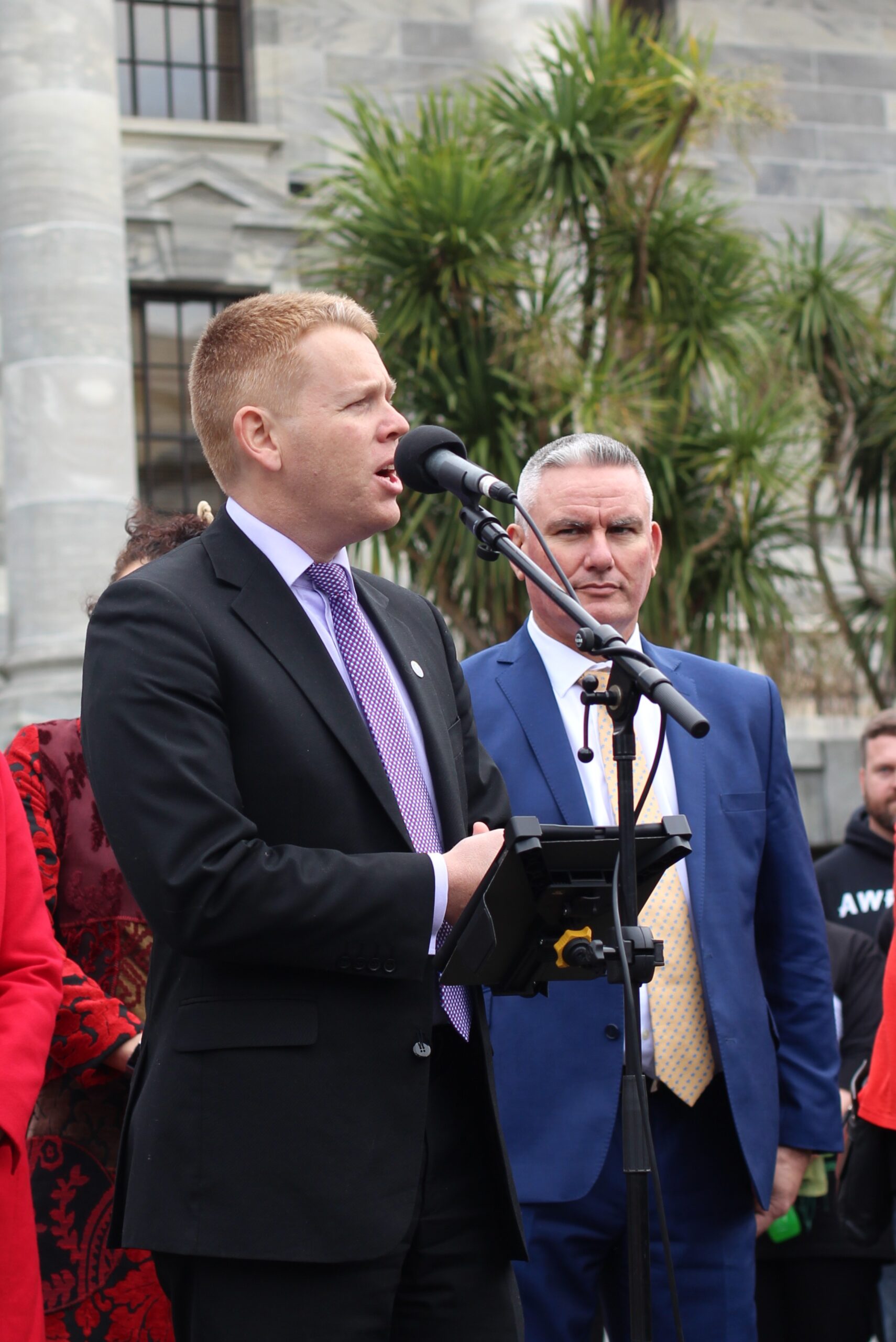
Chris Hipkins, Minister of Education, speaking at NZEI Te Riu Roa strike rally on the steps of the New Zealand Parliament, 15th August 2018. Then, Labour Party deputy leader Kelvin Davis looks on. Image; Wiki Commons.
In advance of the New Zealand PM’s travel, a new partnership called ‘Plan Anzac’ has been unveiled which promises ‘sustained cooperation’ between the Australian and New Zealand militaries. The arrangement covers a wide range of areas that include ‘strategic engagement, capability, training, readiness and common personnel issues’.
Hipkins’ visit is also expected to serve as an occasion for Australia to unveil a more generous pathway to citizenship for the near million-strong population of New Zealanders living in Australia – an attempt at putting to bed disquiet from New Zealanders who feel Australia has not upheld traditional Anzac ‘mateship’.
There is no better time of year for Canberra and Wellington to send signals of unity.
And the bonhomie comes as New Zealand increasingly follows in Australia’s foreign policy footsteps.
The most recent example of the alignment came in the acceptance by both Albanese and Hipkins of an invitation to the NATO leaders’ summit in Lithuania this July.
The joint RSVP was almost certainly coordinated between Canberra and Wellington.
After NATO’s Secretary General Jens Stoltenberg publicly invited the pair to attend the meeting a fortnight ago, Hipkins initially remained non-committal, telling reporters he hadn’t decided on whether he would attend and pointedly noting his busy schedule during New Zealand’s election year.
Media reports surfaced soon afterwards that claimed Albanese would be a no-show in Vilnius.
The reporting was not initially denied.
Albanese already has a packed international calendar this year. The Australian PM perhaps thought that his guest attendance at the G7 in Hiroshima and hosting of a Quad (Australia, India, Japan and the United States) leaders’ summit in Sydney next month would be more than enough to satisfy US and European leaders.
If Albanese himself was planning on skipping NATO, this also explained why Hipkins showed a marked lack of enthusiasm.
But criticism by political rivals and commentators – and perhaps some pressure behind the scenes – appeared to change Albanese’s mind and by Monday this week, the Australian leader was saying he ‘would be very pleased to accept’ the NATO invitation.
Yesterday, Hipkins announced that he would also be heading to Vilnius.
In other words, Australia led – and New Zealand followed.
The countries are also becoming closer in other ways.
Most notably, New Zealand defence minister Andrew Little signalled last month that Wellington was interested in joining a second ‘pillar’ of the AUKUS arrangements that focuses on cybertechnology.
A week later, Little held talks in Wellington with his Australian counterpart, Richard Marles.
Little was typically circumspect about the substance of the talks and played down the AUKUS element.
However, Marles noted ‘alignment’ between Australia and New Zealand, adding ‘it’s really important that we are working as closely together as possible’.
The pair’s meeting came not long after a visit to New Zealand by Kurt Campbell, the White House’s Indo-Pacific coordinator – illustrating how pressures and interests from further afield are also at play, a factor reinforced by the NATO invitation.
Then there is the small matter of TikTok.
Both Australia and New Zealand have issued bans over the past month – and surprisingly, this time New Zealand appeared to be the leader, not the follower.
In March, New Zealand’s Parliamentary Service effectively banned use of the smartphone app, owned by Chinese company ByteDance, by MPs and staffers who accessed Parliament’s network.
The move followed a directive (issued in November 2022, although only publicly revealed months later) by New Zealand’s Defence Force ordering its personnel to delete TikTok from their devices.
For its part, Australia waited until earlier this month to make its decision– but it then issued a far more sweeping ban that prohibited the use of TikTok on devices used by employees at all Australian federal government departments and agencies.
It was also reported that more than half of Australia’s federal government agencies had already banned TikTok.
This suggested Australia was the leader after all.
If alignment is a keyword in the 2023 version of the Australia-New Zealand relationship, another is ‘interoperability’.
Little spoke of the need for a ‘seamless sort of interoperability’ with Australia after taking on the defence portfolio earlier this year – and the word is also used repeatedly to justify the new ‘Plan Anzac’ military partnership.
Expect to hear more about the need for New Zealand to harmonise its capabilities with those of Australia – especially when the results of New Zealand’s Defence Policy Review are soon announced.
The outcome of the Defence Policy Review is also likely to serve as a justification for New Zealand to announce greater military spending.
It remains to be seen how China will react to New Zealand’s increasing willingness to fall in line with Australia – and with NATO.
Trade repercussions seem unlikely, although cannot be ruled out if New Zealand becomes deeply intertwined with Aukus.
China and Australia are currently in a healing phase over trade, after Beijing effectively offered to settle a dispute with Canberra over the tariffs China imposed in 2020 on Australia’s barley exports.
In the short term, any displeasure from China at New Zealand’s decision to take a more Australia-friendly path is more likely to come in the form of ‘playing hard to get’.
A notable omission from Hipkins’ travel announcements this week was any confirmation of a trip to China.
In her final months in office, Jacinda Ardern indicated she was seeking to visit China early in 2023 – a plan that Hipkins initially reaffirmed, but later walked back.
In the announcement of Chris Hipkins’ travel plans this week, the Prime Minister’s office did add that the Government was ‘continuing to pursue a trade focused trip to China later in the year’.
But for Hipkins to visit China, he will need an invitation.
And that invitation may have just become that much harder to obtain.
After all, Chris Hipkins is choosing Brisbane over Beijing.
At least for now.
Geoffrey Miller is the Democracy Project’s geopolitical analyst and writes on current New Zealand foreign policy and related geopolitical issues. He has lived in Germany and the Middle East and is a learner of Arabic and Russian. He is currently working on a PhD on New Zealand’s relations with the Gulf states.
New Zealand Parliament Buildings, Wellington, New Zealand.
New Zealand Politics Daily is a collation of the most prominent issues being discussed in New Zealand. It is edited by Dr Bryce Edwards of The Democracy Project.
NDIS Minister Bill Shorten yesterday announced a “reboot” of Australia’s National Disability Insurance Scheme and six major areas of reform. Getting the NDIS back on track, Shorten said, will require reform across all disability services.
It’s a difficult time to announce an NDIS reboot. The federal budget is weeks away and, in the context of a cost-of-living crisis, some argue NDIS costs need to be reined in.
At the same time, two major pieces of work are underway and due to report later this year: the royal commission into violence, abuse, neglect and exploitation of people with disability; and the independent review of the NDIS exploring how it can be made sustainable over the long term.
Shorten has continuously said any changes to the scheme need to be guided by people with disability, meaning it would make it difficult to make announcements about substantive changes ahead of the review reporting.
So what do we know so far, and what are the key challenges to overcome?
Tackling bed block
Since Labor came to government last year, the government has made a number of changes to the scheme, including decreasing delays to NDIS participants being discharged from hospital.
Delayed discharge means a person is medically fit to be discharged from hospital but they cannot return home safely as appropriate supports are not in place.
In his speech to the National Press Club yesterday, Shorten explained that last year, NDIS participants in Victoria waited, on average, 160 days after they were medically fit to be discharged from hospital.
After significant action from the National Disability Insurance Agency (NDIA), this fell to a 29-day average wait to be discharged. This is a better outcome for the people involved and is estimated to have saved the health system A$550 million.
This shows the NDIS does not exist in a vacuum. How the NDIS operates has implications for the costs of mainstream services such as health and education – and, conversely, how mainstream services operate has implications for the NDIS and its costs.
6 ways to reboot the NDIS
The government will focus on six areas for reform to ensure the NDIS is fit for purpose, which won’t come as a surprise to those familiar with the scheme.
Very little detail has been announced about these reforms and in many cases we will need to wait for the independent review to report and outline precisely how these will be achieved.
1) Increase the size of the NDIA workforce, make sure staff are appropriately trained and the agency has the technology and capacity to do its work.
2) Move participants to longer plans, where appropriate, rather than needing a new plan every year. This will give participants more certainty and allow them to focus on making their current plans work.
3) Make sure all money is spent effectively. This means not spending on “shoddy therapies” and ensuring supports are evidence-based and benefits are maximised for participants.
4) Review supported independent living services. Around $10 billion of NDIS funding goes into these services each year and supports around 30,000 people with significant disabilities to live independently. Yet too often, they don’t support participants and families in the ways that they want. The Royal Commission has also heard significant abuse and neglect occurs in these settings.
5) Target misuse of NDIS funds. This involves targeting fraud within the scheme, but also unethical practices by some providers who overcharge for services or pressure people into spending money on services that they may not want or need.
6) Increase community and mainstream supports so people who aren’t eligible for the NDIS can access other services. This isn’t focused on the NDIS but the services that sit around it.
These six areas target many of the areas that are in need of reform within the scheme and some have already seen some initial reform attempts. The real question is how these will be delivered and whether there is genuine commitment to co-design with people with disability around these areas.
The NDIS was never designed to be accessed by all people with disability. The initial scheme design supported participants via a tiered system:
Tier 2 was for all Australians with disability and their carers by providing information and referrals to relevant services outside the NDIS (for example, mainstream services such as health and education). This tier also aimed to link people with disability into their local communities.
Tier 3 was designed for people with disability who have significant and permanent impairments. It provides access to specialised disability supports funded directly by the scheme and allocated via individual budgets.
While much of the attention on the scheme is around Tier 3 supports, a major driver of costs is a lack of investment in Tier 2 services. If we do not see adequate investment in mainstream and community services, such as in health and education, people with disability are more likely to require Tier 3 services.
The NDIS has been called the “oasis in the desert” where people need to get services and supports through the scheme because there is a lack of other mainstream supports available. Research shows 90% of disabled Australians who didn’t have NDIS funding and took part in the research were unable to access the services and supports they needed.
We have seen particular growth in the number of young people with autism and developmental delay entering the NDIS, far beyond what was originally projected at scheme design. One in ten boys aged between five and seven have an NDIS plan when starting school.
While this could indicate the original scheme estimates were not correct, it’s likely that a significant proportion of demand for scheme entry is being driven by a lack of other available supports through mainstream services.
The government seems committed to disability services reform but it won’t be quick or easy. It will involve more than just changes to the NDIS – we need a rethink of all disability services. And this can’t be done without people with disability who need to play a strong role in designing this new scheme.
The late Sir Rabbie Namaliu’s character and his humble leadership featured well in one of Australia’s top news organisations –– News Corp Australia and its executive chairman Michael Miller has paid a tribute.
Businessman Frank Kramer, reading out a special eulogy from the business point of view reflecting on the life of Sir Rabbie at the National Haus Krai on Sunday night repeatedly echoed the man he was.
In his address, he read out Miller’s condolence message sent to the family and friends of the late Sir Rabbie among others.
Sir Rabbie joined the Post-Courier board as a director on February 2013 and had been there until he died on March 31, 2023.
Miller’s message read: “On behalf of everyone at News Corp Australia, I’d like to express our deepest condolences to Sir Rabbie’s family, friends and colleagues at this sad time.
“Sir Rabbie lived a rich life dedicated to public service and to the people of PNG.
“He will be missed but never forgotten and will, especially, be remembered for the quiet authority he brought to PNG’s often robust political scene and for the strong, eloquent and unflinching advocacy made on behalf of his people as prime minister and in many other roles in government and public life.
“Sir Rabbie was a patriot, a good friend to many and as a director of the board of the Post-Courier, [he] did much to further the cause of free speech and the importance to his country’s fledgling democracy of a free and fearless media.”
Gorethy Kennethis a senior PNG Post-Courier reporter. Republished with permission.
I was born in Gulka (Kimil), one of the remotest villages in Papua New Guinea’s Jiwaka province.
Gulka is situated between Jiwaka and Western Highlands province, so as I grew up I learned the cultures and lifestyles of both provinces.
I was the third-born child of Simon and Polti Mek and I have three younger siblings. My dad and mum are subsistence farmers. They sell ripe bananas, greens, peanuts, red pandanus and pigs to raise money.
Dad dropped out of school in grade four. Mum has never been to school.
We have no access to proper roads and electricity. The rugged terrain, jungle, valleys and big rivers in the Highlands region make access to basic services a difficult task.
Illiteracy and birth rates are very high, and some mothers die trying to give birth. We often have shortages in drugs and medical facilities in our community health centre. Growing up in such an unfavourable environment made it extremely hard to access education.
Despite that, I made up my mind to go to school.
Four sweet potatoes a day In 2007, I was enrolled to do kindergarten (prep) at Gulka Elementary School. I used to wake up at around 4am to prepare for school. My mum would cook four sweet potatoes: one for breakfast, one for lunch and two for afternoon dinner.
The distance from home to school is about five kilometres. Because of the distance and frequent bad weather, no one else was interested in going to school.
I used to walk back and forth by myself. I was often late for class. I sometimes missed classes due to heavy rain, floods and landslides.
For grade three, I went to Kimil Primary School, a Catholic mission school. When I first went there, I could not cope with its tough rules and regulations.
I had no friends to share all my problems with. I did not understand anything I learnt in class. When a teacher asked me a question, everyone laughed because my answers were always wrong.
At the end of the term, my report card ranked last. My parents could not read the comment on the report, they thought everything went well.
I literally lost tears but I did not give up easily. Apart from helping my mum in the farm garden, I committed all my remaining time to studies. I read a lot of textbooks. I consulted my teachers for help after hours.
Marks slowly improved My marks and academic performance slowly improved. I completed grade eight in 2015 with good grades on my certificate. Many people did not believe my academic performance for I was a village kid. They thought I would not get a secondary school offer.
But never at any point in time did my parents let me down. They had greater hope for me. They continued to motivate me when I lacked motivation, and pushed me forward when I fell back.
Waghi Valley Secondary School was far away from my village. I walked to catch the bus and the trip took around three hours. When I had no bus fare, I took the shortest route through the bush.
The bush track was not in good condition. It took me around six hours to reach school when I travelled by foot. During the highest rainfall around June, July and August, I had the most difficulties going to school. But I still managed to overcome them.
I successfully completed grade nine.
I thought I would do the same in the next academic year. Unfortunately, an election-related fight broke out. Some of our classrooms were burnt down. In fear, the teachers left school.
I was unable to go to school because the school was on my enemy’s land. The fight continued for two months, until the police came to solve it. Classes recommenced, but we had lost so much of our precious time to prepare for exams.
Piles of handouts, books Our teachers squeezed up everything. They gave us piles of handouts, old exam papers and reference books.
When I went home, I had no time for my friends and family. I sat in my room and studied. I had no proper light at night and used the old torch that my grandmother gave me.
In January 2018, the selection lists for grade eleven in various secondary schools in Jiwaka were posted at our district office. I checked for my name, but I couldn’t find it. My parents shared my pain.
A few days later, however, I received a phone call from my uncle in Port Moresby who told me I had been selected to do grade eleven at Sogeri National High School. It was one of the most exciting moments in my life. Everyone in my clan and tribe was so proud of me.
At Sogeri National High School I met new friends from across the nation. Some people were dark in colour (especially from the Autonomous Region of Bougainville), some were brown, others were white. Their cultures and lifestyles were so different and unique.
I faced many challenges academically and socially. Studying in a very demanding and competitive institution was the greatest challenge. Many students came from international and private schools with better grades. I was the smallest fish in a big ocean full of whales.
As the time went by, I started to make friends with everyone. I found that people were so kind, loving and caring. We built an unbreakable bond.
Scored high grades As a result, my mind settled. I fully focused on school. Suddenly my marks improved. I scored very high grades which boosted me to study extra hard. Unexpectedly, I secured the top placing across all subjects.
At the end of the year, I topped the school. I was awarded the dux of humanities and social sciences. It was something beyond my expectation.
I was accepted to study business management and accounting at the University of Papua New Guinea (UPNG) — it is what my parents dreamed of and wanted for me. I’m now grateful to be a final year economics student here at the university.
If it wasn’t for the commitment, sacrifices, courage and priceless advice of my beloved parents, I would not have come this far. I owe the greatest debt of gratitude to my parents.
If I’m lucky enough to become successful with riches one day, I will establish a school back in my remote village to make sure my younger siblings and those generations that will come may not face the problems I once faced.
Robert Mek is a final year economics undergraduate at the University of Papua New Guinea. This article was first published on the Australian National University’s DevPolicy Blog and is republished under a Creative Commons licence. The writing was undertaken with the support of the ANU-UPNG Partnership, an initiative of the PNG-Australia Partnership, funded by the Department of Foreign Affairs and Trade.
Australia’s Medicare billing system is overly complicated, bureaucratic and not meeting the needs of a modern health service, potentially leaking billions of dollars. But claims this loss is mostly due to fraudulent billing practices by GPs are inaccurate.
In October, the ABC’s 7.30 program and the Nine newspapers raised concerns about an estimated A$8 billion in Medicare waste, caused by a mixture of doctors’ errors, over-servicing and outright fraud. The examples given, however, were almost exclusively intentional fraud, mainly in general practice. This promoted health minister Mark Butler to commission an independent review, led by Dr Pradeep Philip.
The Philip review, released earlier this month, was highly critical of the current Medicare system and found non-compliance and fraud accounted for $1.5 to $3 billion of Medicare waste.
Our research team analysed GP activity recorded during almost 90,000 patient encounters to assess how GPs were billing for the services they provided.
We found GPs undercharged at 11.8% of encounters and overcharged at 1.6%. This suggests GPs aren’t routinely defrauding Medicare, and in fact have saved the system equivalent to $351 million in the 2021-22 financial year.
However, we agree the current billing system needs to be urgently reformed.
GPs claim a fee for service, called a rebate, which is a fixed amount ascribed on the Medicare Benefits Schedule (MBS), based on the type of service provided.
There are nearly 6,000 MBS item numbers. GPs can charge for one or more MBS items for a patient service.
Around 90% of MBS items claimed by GPs are considered standard consultation items (surgery, residential aged care facility visits, home visits and so on), that are in four levels (A, B, C and D) which increase in length.
The cost associated increases with each level. An example of an error would be a GP accidentally charging for a Level C consultation (requires 20 minutes or longer; $76.95 rebate) when the visit only met the criteria for a Level B (less than 20 minutes; rebate of $39.75). An example of under-billing is when a GP is entitled to claim for a Level C but charges only a Level B.
An example of over-servicing is a pathology test for blood glucose level being repeated for the same patient at consecutive visits, where the patient’s condition did not warrant the second test.
An example of fraud would be claiming for a service that had not been provided.
Rebates are based on the time spent with the patient. Shutterstock
Examining doctors’ billing in the real world
The data we analysed in our peer-reviewed study were collected between 2013-2016 from nationally representative samples of GPs during 89,765 real-time encounters with their patients. The GPs recorded the start and finish time for each visit.
The Philip review did not try to quantify the amount of underbilling.
We decided to examine the billing data following the 7.30 Report/Nine news investigation, but the participants could not have been influenced by these reports as the data we used were collected prior to the ABC/Nine publications.
Why would doctors undercharge?
We theorised GPs were likely undercharging Medicare for two reasons:
1) while time is the predominant measure, GPs are likely to still consider content and complexity when billing standard Medicare items, rather than just billing according to the time spent with the patient
2) fear of triggering a professional services review (PSR) of their billing.
A professional services review can be triggered for a variety of reasons, for example, a GP has a higher proportion of longer consultations than might be expected. A professional services review involves an audit of the GP’s billing. It can potentially lead to a decision that can prevent the GP from being able to bill Medicare.
Last week, HealthED, a health education company, included three post-webinar questions on this topic in an online survey of 1,852 GPs from across Australia. Answering these questions was not compulsory.
The results showed most (83.3%) GPs consider the length and complexity of the consultation when billing Level C and D items, even though increased complexity is no longer required (since 2011).
More than half (60.3%) intentionally under-billed Medicare in the previous week.
The most common reasons for under-billing were:
they did not feel that the content of the consultation justified a higher MBS item (41.9%)
fear of triggering a professional services review alert (33.5%)
confusion around Medicare schedule criteria (30.8%).
These responses correlate with the findings from our nationally representative sample, which suggests GPs predominantly act with integrity, but also based on fear and confusion.
Time to reform Medicare billing
A simplification of the current very complex Medicare billing system would resolve a lot of waste through unintended errors. Reducing low value and unnecessary care is not a simple task as these are difficult to define, and often rely on situational judgement. When systems are no longer fit for purpose, they should be reviewed and revised, as the Philip review has recommended.
There are bad actors in every profession and those who “game” Medicare should be called out. However, the claims of widespread fraud have not been supported by our work or the Philip review.
The authors do not work for, consult, own shares in or receive funding from any company or organisation that would benefit from this article, and have disclosed no relevant affiliations beyond their academic appointment.
Underwater forests known as kelp have been sustaining people and cultures for millennia. However, most of us are only vaguely aware of the vibrant masses of seaweed hugging the ocean shores around Earth. Furthermore, we don’t realise how valuable and necessary they really are.
In a new study published today in Nature Communications, we have produced the first global estimate of the economic value of kelp forests – revealing they provide hundreds of billions of dollars in value to humans across the world.
A human history of kelp
Along the Pacific, kelp harvest has long played an important role in Asian societies. In Japan, seaweed was among the marine products people could use to pay taxes, according to a law code from the year 701.
In Medieval Europe, kelp was used to fertilise soil and increase crop yields, to treat goitre, and was used to fortify building materials for centuries. In the 21st century kelp forests have become the main source for alginate, a common food and medical additive.
A marine marvel, hidden kelp forests spread across almost one third of our world’s coastlines and lie within 50km of 740 million people. If you live in London, Tokyo, New York, Vancouver, Santiago, Cape Town, Los Angeles or Lisbon, you have one of these ecosystems on your doorstep.
Yet they tend to be forgotten or misunderstood. People often aren’t even aware of a kelp forest, and if they are, they might be most familiar with a pile of decomposing seaweed on the beach after a storm.
A kelp forest is a rich habitat, a provider of oxygen and a sequester of carbon. Andrew b Stowe/Shutterstock
This disconnect has real-world implications. Despite sitting next to some of the biggest research centres on the planet and likely covering more seafloor than any other biotic habitat, research and conservation of kelp forests is terribly behind other ecosystems.
This knowledge gap impedes desperately needed action and conservation. Kelp populations in northern California, Tasmania, and the Salish Sea have all but disappeared in living memory. Elsewhere, kelp populations have been continually declining over the last 50 years.
What we value and how we value it is actually quite a complicated process. And despite the fact we make value judgements over and over each day, we have a really poor understanding of something’s value if it doesn’t have a price tag on it.
Our natural world is perhaps the ultimate value provider – everything we do in our societies is ultimately tied to nature, ecosystems, and a healthy planet. But because these processes and benefits happen with or without humans, they are often taken for granted.
The seaweed we step over on our beaches is just a small fraction of the vibrant kelp ecosystems beneath the waves. Andrew Dawes/Unsplash
So, what is the ‘value’ of a kelp forest?
Our research has brought together data from all across our oceans to produce a global estimate of the economic value of kelp forest ecosystems. Looking at six key genera of kelp – Macrocystis, Nereocystis, Laminaria, Saccharina, Ecklonia, and Lessonia – and the potential economic value of the fisheries they support, the carbon they pull from the atmosphere, and the nutrient pollution they remove from the water, we found that kelp forests are valued at US$500 billion per year.
The highest of these values was the removal of excess nitrogen from the water, which can trigger blooms of algae, reduced water quality, and ultimately oxygen-depleted dead zones.
A close second was the fisheries values – kelp forests support some of our most iconic fisheries, including lobster and abalone.
Lastly, despite finding the carbon sequestration of kelp forests was comparable to other terrestrial and marine ecosystems, the economic value was much lower, as society has yet to place a high price on carbon. This finding suggests that carbon credits may not be an economic driver of kelp conservation, but kelp forests still play an important role in the blue carbon cycle.
When nature is treated as a freebie, where we can take what we want and not pay for the damages, this attitude has direct consequences; people and the environment suffer.
First, it can mean that people and government don’t see the value in protecting and restoring ecosystems. Second, development projects are able to destroy nature without compensating for those damages.
Lastly, it leads to poor management. How can we manage something if we cannot quantify it? Imagine if you didn’t know where your bank account was, or how much money was in it.
The battle to save our kelp forests is just getting started, and we need greater action to protect these intrinsically and economically valuable marine ecosystems.
That is why researchers like me have started the not-for-profit Kelp Forest Alliance, and have now launched the Kelp Forest Challenge, a global call to protect and restore 4 million hectares of kelp forest by 2040. This is a call for governments to meet their commitments to the Kunming-Montreal Global Biodiversity Framework and act now to save these ecosystems and #HelpTheKelp.
Aaron Eger is the Founder and Program Director of the Kelp Forest Alliance, a research driven not-for-profit organization. He is also a Postdoctoral Research Fellow at the University of New South Wales Sydney. The Kelp Forest Alliance is supported by the Nature Conservancy, The Banner Foundation, the Van Dyson Foundation, and UNSW Sydney.
Hanging over these is the Productivity Commission’s January 2023 assessment that what we’ve done with Australian education over the past decade has done “little, so far, to improve student outcomes”.
Education authors Tom Greenwell and Chris Bonnor agree. In an ambitious new report for education initiative Australian Learning Lecture, they offer a way forward.
They propose a framework for Australian schools to increase parental choice (including for religious-based schools) and improve the inequity that afflicts the system.
What’s the problem?
Greenwell and Bonnor say too many disadvantaged students are being concentrated into communities of disadvantage. This results in
unacceptable gaps in learning [that] separate disadvantaged students from their more privileged peers.
Since the introduction of government funding to non-government schools in the 1960s, we have seen an increased concentration of advantaged students in some schools, and the same for disadvantaged students. The OECD has been warning Australia about this for some time. But current policy settings offer little incentive for change.
As Greenwell and Bonnor argue, achieving our national educational goals is unlikely when:
we are stacking the odds against the children who have the least luck in terms of the circumstances they are born into.
There is also a conflict here with the United Nations Declaration of Human Rights, which affirms that education at least at primary level should be free and compulsory. Crucially, parents have “a prior right to choose the kind of education that shall be given to their children”.
Australian non-government schools do provide opportunity for parents to exercise this right, but even the lowest level of fees charged by some Catholic system schools can still be beyond the reach of some parents.
As the authors note, this is not a problem for non-government schooling alone. Segregation within government schools exacerbates the situation. Selective schools (government schools that select students on their academic or performing arts ability):
draw in a high proportion of advantaged students, compounding the concentrations of the strugglers in comprehensive public schools.
Greenwell and Bonnor offer a five-point plan, the first three of which are relatively uncontentious.
First, they want to fully fund school entitlements under the so-called “Gonski model”. This would ensure all schools get the funding resources they need to deliver quality learning. Some estimates show government schools currently receive less than 90% of their entitlements.
Second, they call for a frank conversation on a new common framework for Australian education. This would include not only funding arrangements, but “commensurate obligations and responsibilities” on schools.
Third, convene a national summit at which “common interests are identified and areas of agreement are developed”. Greenwell and Bonnor are at pains to point out their suggestion is not to prescribe the total solution. Rather, they invite stakeholders to come together and design a system in which “equity and choice can be expanded in a win-win manner”.
A change to school funding
Greenwell and Bonnor’s fourth point is likely to be a catalyst for much debate: they propose full public funding for all non-government schools, within a commonly agreed regulatory framework.
Yes, this means non-government schools would be fully funded by the taxpayer. But they would not be able to charge their own fees.
The authors argue this would remove the fee barrier for non-government schools and open the possibility for any family to choose a non-government school without the impost of fees. It expands, rather than restricts, parental choice. And the bonus is non-government schools “could continue to apply enrolment and other policies necessary to promote their specific religious or educational ethos”.
If non-government schools don’t want to do this, they don’t have to, but there’s a catch. Schools that “continue to charge fees or reject inclusive enrolment obligations would no longer receive any public funding”.
Their fifth point is the creation of a new authority to oversee implementation and monitoring of the new framework.
The Albanese government has committed to “work with” state and territory governments to get every school “on a path to 100% of its fair funding level”, as per the Gonski model.
This will come under the microscope as the next National School Reform Agreement is developed. This ties school reforms to the funding the federal government provides the states and territories. The next agreement is due to begin in January 2025 and is currently the subject of a review.
Whole holding a national summit should be straightforward, a national common framework has substantially more barriers to overcome. The multiple sectors of education governance in Australia (state/territory, Catholic, independent), and the multiple legal instruments that govern them, make this very difficult, even from a practical perspective.
At the simplest level, education remains a state/territory constitutional responsibility that seems unlikely to be collectively ceded back to the federal government any time soon.
The idea that non-government schools would have to choose between government funding or charging their own fees is also likely to be politically difficult. This is not to say the proposal is far-fetched. UNESCO, in its Global Education Monitoring Report has noted
publicly funded education does not have to be publicly provided.
As the review into the next National School Reform Agreement gathers pace, Greenwell and Bonnor’s invitation is for us all to come together with a vision for something different in Australian education.
Certainly the evidence strongly suggests what we are doing right now is not working.
Paul Kidson does not work for, consult, own shares in or receive funding from any company or organisation that would benefit from this article, and has disclosed no relevant affiliations beyond their academic appointment.
As the strategic rivalry between the United States and China intensifies, the invitation to discuss participation in the AUKUS security agreement presents New Zealand with a potentially momentous decision: how best to secure its own strategic interests and values in the Indo-Pacific region.
AUKUS is the 2021 agreement between Australia, the UK and the US for the “exchange of naval nuclear propulsion information”. It has been presented as the foundation for an enhanced security partnership linked to a “free and open Indo-Pacific” and a rules-based international order.
While it does not explicitly say so, the pact is a response to the perceived threat of China’s increasing assertiveness in the region. The Chinese government has condemned AUKUS as reflecting a “Cold War mentality”, involving a “path of error and danger”; it is a threat to both “regional peace” and the “international nuclear nonproliferation regime”.
As a first major initiative, Australia will buy at least three US Virginia-class nuclear-powered submarines by the early 2030s. By the mid-2050s, it will receive five or more new SSN-AUKUS submarines that combine US technology and a UK design. The cost of Australia’s nuclear submarine programme will be more than A$268 billion over the next 30 years.
AUKUS also envisages the sharing of information in cutting-edge defence technologies, including artificial intelligence, quantum capabilities and cybersecurity. This is where New Zealand has expressed some interest at a so-called “pillar two” non-nuclear level.
Rational political decision-making involves choosing the best option among available alternatives, about which a certain degree of uncertainty exists. So, the question is: what is the most rational decision for New Zealand?
The argument for AUKUS
The claim that a new Cold War between China and the US is under way is shaped by the conviction that a rising great power is almost inevitably trying to displace the US as the dominant global power.
This is happening at a time when significant parts of international law are in free fall, globalisation is at risk of stalling, and the UN Security Council is increasingly unable to resolve critical problems.
A growing arms race and points of extreme geopolitical tension, from North Korea to Taiwan, highlight the need for an arrangement like AUKUS to provide a counterweight of like-minded partners to ensure greater stability.
In this climate, the argument goes, New Zealand’s preferred option of “hedging” between the superpowers has been squeezed. As a relatively small nation, it must now choose which side to support.
Given New Zealand’s history, liberal democratic values and existing security ties with the AUKUS partners, it makes sense for Wellington to align with the agreement’s long-term strategy to deter and contain China’s expanding military power.
Failure to do so risks New Zealand not having access to emerging state-of-the-art defence technologies.
The argument against AUKUS
The counterargument is that the Cold War analogy is inaccurate. The increasingly interconnected post-Cold-War era is fundamentally different from the period between 1947 and 1989, with its rival global economic systems and competing but comparable alliance systems.
The binary assumption that the fate of the Indo-Pacific will be largely shaped by the outcome of US-China rivalry – and by the capacity of the US and its closest allies to counterbalance Chinese ambitions in the vast Indo-Pacific region – is questionable.
Regional states such as Malaysia, Indonesia and Vietnam, and EU states like France and Germany, remain concerned about China’s assertive diplomacy in the Indo-Pacific. But they seem to have little confidence that AUKUS, a security arrangement involving three English-speaking states, is capable of a serious response in a region inhabited by billions of people.
Furthermore, while China’s global ambitions are real, they should not be over-hyped. The country’s impressive rise to superpower status has been built on full participation in the world capitalist economy and an outstanding trade performance. This has created a high level of economic interdependence for China and its trade partners.
Besides, AUKUS will not be able to do much in the short term to counter China’s designs on Taiwan. Despite the defence minister’s assurances, New Zealand’s participation would create real uncertainty about its independent foreign policy and its commitment to non-nuclear security in a region where many states have criticised AUKUS for fuelling nuclear proliferation.
Finally, the assumption that AUKUS is the only pathway to new military technologies overlooks Wellington’s already excellent bilateral ties with Australia and the US, its involvement in the Five Eyes partnership, and deepening links with NATO (including the prime minister’s planned visit to this year’s NATO summit).
On balance, we believe the evidence points to New Zealand’s interests and values being best safeguarded by maintaining a cautious approach to AUKUS.
We accept New Zealand shares a great deal with Australia, the UK and the US, and should not be “neutral” in the face of authoritarian pressures from China. We also agree New Zealand’s military should be fit for purpose.
However, it must be recognised New Zealand holds a distinctive worldview, one committed to defending an international rules-based order and to deepening it (through measures like UN Security Council reform) to enhance the security of all nations.
While it is correct in principle to explore talks about AUKUS, New Zealand should have no illusions about the huge implications such involvement would have for its vision of a fairer, more secure and nuclear-free world.
The authors do not work for, consult, own shares in or receive funding from any company or organisation that would benefit from this article, and have disclosed no relevant affiliations beyond their academic appointment.
A typical view on the Nullarbor Plain: an expansive, treeless landscape that captures the relentless dryness of Australia’s interior.Matej Lipar, Author provided
Australia’s western and eastern ecosystems are biodiversity hotspots, separated by a dry desert interior. Yet millions of years ago, many species roamed more freely between connected habitats across the continent.
Our new research, published in Geophysical Research Letters, provides insights into ancient climate change that shaped our modern landscapes and ecosystems.
We have developed a new way to reconstruct the timing of great drying episodes on the continents of our planet. This work helps to gain knowledge about drylands that are particularly impacted by current climatic stresses.
Billions of people live in drylands
Drylands cover almost half of Earth’s land surface and are home to around 3 billion people. Dramatic, record-breaking droughts are increasingly occurring around the globe.
As the driest inhabited continent, Australia (70% is considered arid or semi-arid) also faces many challenges, including droughts and bushfires. Understanding the history of dry regions and their response to past climate change is important to mitigate the impact of our warming planet’s future.
Hidden beneath the ‘rusty’ Nullarbor Plain, in ancient patterned beach sands, lie clues to past climatic disturbances that shaped our modern world. Iluka Resources, Author provided
Southern Australia’s Nullarbor Plain covers an area about the size of Great Britain (roughly 200,000 square kilometres). However, it is starkly different in almost every other aspect: extremely flat, very little rain, and almost no trees. These conditions and its size make the Nullarbor Plain a natural “biogeographic barrier”, separating rich and diverse ecosystems in west and east Australia.
Today, the dusty Nullarbor Plain bears little resemblance to its vibrant past. Before roughly 14 million years ago it was covered by ocean and host to reefs. More recently, it would have been a lush home to an exotic menagerie, including the world’s biggest cuckoos.
We know Earth is constantly evolving, but often have a poor idea of exactly when environmental changes occurred in the distant past. Fortunately, some minerals that record past climatic events can be dated.
For most people, rust is something they want to avoid, as it damages our cars, fences, and steel appliances. But rust can be useful in understanding climate change. In our work, we used an iron-bearing mineral called goethite – the main part of rust – to unlock the timing of drying on the Nullarbor.
We found goethite in rocks some 25 metres below the Nullarbor Plain. These rocks mark the past level of groundwater. By dating the age of the goethite minerals, we can understand how past groundwater levels shifted in response to climate change.
Scanning electron microscope images of iron-rich rocks used for our new research. The chemical and textural features of these rocks contain much information about the complex climatic history of the Nullarbor Plain. Maximilian Dröllner, Author provided
We fired a laser beam into tiny pieces of goethite, roughly the size of a grain of salt, to release their atomic building blocks. We then measured the helium isotopes – variants of helium – that had accumulated since mineral formation. This provided us with a type of “clock”.
We calculated groundwater drastically declined on the Nullarbor Plain between 2.4 and 2.7 million years ago – at the same time as a period of global cooling.
As the climate shifted, the drying changed the local ecosystems, effectively creating a wall for many species. As large swathes of Australia changed from forest to dry grassland, habitat and food availability shrunk for many species.
Significantly, this barrier cut the once continuous link between the species of southwest and southeast Australia.
Splitting of the species
The evolution of many familiar species was influenced by this separation. There is the yellow-tailed black cockatoo from southeast Australia with yellow cheeks, and Carnaby’s black cockatoo with white cheeks in the southwest. Genetically, these two cockatoos are close relatives, but today live thousands of kilometres apart.
A separated duo with a shared ancestry. Left, the Carnaby’s cockatoo (Calyptorhynchus latirostris) and right, the yellow-tailed cockatoo (Calyptorhynchus funereus). Modified after kookr/flickr and jean_hort/flickr. CC BY-NC
By studying minerals formed during groundwater decline, we improve our understanding of our continent’s past and its biosphere. These minerals form as a direct result of continental drying, often in sediment with fossils of interest.
Previously, we often relied on indirect information like the chemistry of marine sediments to date continental landscape processes.
Throughout its history, the Nullarbor Plain has undergone remarkable transformations: once an ocean, later a lush landscape, and now a dusty expanse where numerous species have dramatically separated. Maximilian Dröllner, Author provided.
More broadly, having information on the timing of past drying events could help test theories about human evolution too. Changing landscapes and extreme drying were likely important for our own species development.
Determining the timing of environmental change lets scientists see how these events have impacted biodiversity and species evolution over time. Studying the past is also vital to understand how Earth responds to climate change. If we understand how ecosystems dry out, we can develop strategies to limit the damage.
Maximilian Dröllner receives funding from Minerals Research Institute Of Western Australia.
Chris Kirkland receives funding from Australian Research Council and the Minerals Research Institute of Western Australia.
Milo Barham receives funding from the Minerals Research Institute of Western Australia, collaborating with Iluka Resources Ltd. to investigate mineral sands, including on the margins of the Nullarbor Plain.
An Indonesian human rights researcher has cricitised his government’s failure to negotiate with West Papuan rebels, saying security officials should learn from the 2005 Aceh peace pact.
The Commission for Missing Persons and Victims of Violence (Kontras) research and mobilisation division head, Rozy Brilian, said the Indonesian government had always refused to hold a dialogue with Papuan pro-independence fighters.
He gave this message during a virtual public discussion titled “Failing to Address the Roots of the Conflict and the Window Dressing of a Development Illusion” last Friday — just two days before several Indonesian soldiers were believed to have been killed in a clash with West Papua National Liberation Army (TPNPB) rebels in the Papuan highlands.
The Indonesia soldiers were searching for New Zealand hostage pilot Philip Mehrtens who has been held captive since early February.
“The government always refuses to hold a dialogue with armed groups that the government refers to as KKB [armed criminal groups] even though the push for dialogue has often been encouraged by different parties,” said Brilian.
Yet, according to Brilian, the model of dialogue with an armed group has successfully been pursued by the Indonesian government in the past.
Aceh peace talks Brilian gave the example of the Aceh peace talks conducted during the era of former president Susilo Bambang Yudhoyono (SBY).
“This dialogue then concluded in negotiations that produced a Memorandum of Understanding (Mou), or agreement, between the Indonesian government and GAM [Free Aceh Movement] in Helsinki,” said Brilian.
That pact brought peace after three decades of warfare.
According to Brilian, the current government should learn from earlier experiences of holding dialogue with armed groups.
In addition to this, said Brilian, Indonesia could also learn from the Philippines which succeeded in “taming” armed independence groups through dialogue.
“Learn from other experiences in the Southeast Asia region, dialogue between the government and pro-independence armed groups were once held by the Philippines government with the pro-independence Moro Islamic Liberation Front group,” he said.
There are two huge issues in Indigenous affairs at the moment: the Voice and the problems in Northern Territory Indigenous communities, especially but not only in Alice Springs.
Prime Minister Anthony Albanese’s attention is laser-like on the Voice, and trying to get up a yes vote. Opposition Leader Peter Dutton, for a mix of motives, is focusing on the NT situation, as he campaigns against the Voice.
The issues are intertwined, not least because the government argues the Voice would help solve problems on the ground. But they are also separate, and in the near term they should be treated as such.
Dutton’s Tuesday appointment of NT Indigenous Senator Jacinta Nampijinpa Price, as tough an opponent of the Voice as you could get, will probably assist the opposition leader’s no campaign. (That is not to say the no side will prevail – it’s far too early for predictions.)
Price, who will attract a lot of media, will put doubts into the minds of some voters, who may think that if this prominent Aboriginal figure sees no merits in the Voice, perhaps they should vote against it. On the other hand, Price is inexperienced and so a risk, if she lets her emotions get the better of her when provoked. And she will be countered by many Indigenous advocates for the yes case.
As matters stand, of the two leaders, Dutton and the prime minister, it is Dutton who is losing more skin in the referendum fight.
The most recent attacks on him, by Labor and other critics, are over his latest claims, after his trip to Alice Springs last week, of widespread child sexual abuse of Indigenous children – allegations critics see as a ploy in the battle over the Voice.
That said, the government’s wish to downplay the NT’s array of horrendous problems is both wrong in principle and perhaps ultimately a mistake tactically.
Albanese and other Labor figures have invoked a common line: if Dutton knows of cases of child sexual abuse, he should report them to the police.
This really doesn’t pass muster. It’s clear Dutton was not dealing forensically with particular cases (how could any visiting politician?), but with general information (accurate or not) he gathered during his latest visit to Alice Springs. He has said his information was “anecdotal” and that he’d spoken with police and social workers.
Dutton says that, earlier, he passed on information directly to Albanese, something the PM denies.
On November 30, Dutton canvassed the issue in a question to Albanese in parliament. He referenced a recent meeting with the PM “to discuss the unprecedented and tragic levels of sexual abuse of children in Alice Springs and elsewhere in the Northern Territory.” He asked Albanese to support a royal commission into the “sexual abuse of Indigenous Australians”.
But when Albanese was asked this week on the ABC’s 7:30 whether any information had been brought to him by Dutton “about children abused, children being returned to their abusers” he said “No. Not that I’m aware of. That is the first I’ve heard of it.”
Albanese went on to say he had no idea what Dutton’s recent assertions were based on. “I don’t know what the basis of it is. But certainly he has not raised any specific issue about any claim, about any individual circumstance with me. If he did, I would say to him that he should report that to the police.”
This does seem a deliberate avoidance of the issue.
Albanese’s own backbencher, Labor Senator Marion Scrymgour, formerly NT deputy chief minister, this week highlighted two issues – child protection and youth crime.
While very critical of Dutton for “irresponsible publicity-seeking claims” which cast suspicion on everyone, she said child neglect threw up “really high-risk issues”.
“If a child is being neglected, then they are more likely to be at risk of sexual abuse. So we need to unpack all of that and have a look at what is happening with those children that are falling into that category of neglect, because those numbers are increasing and not just in Alice Springs, but right throughout the Northern Territory,” she told Sky.
This, surely, is what Albanese and his government should be acknowledging.
The Voice is important. But there are serious problems here and now, and the government is negligent, or worse, if it doesn’t admit and confront that reality. The situation is obviously beyond the NT (Labor) government.
The extent of the problems needs to be assessed (and that would reveal, incidentally, whether Dutton is exaggerating). Then a strategy needs to be determined.
Dutton wants a royal commission; Price has suggested a Commonwealth takeover of child protection responsibility. More modestly, Scrymgour has urged a Family Responsibility Commission, along the lines of the Queensland body, headed by a judicial figure, and with Indigenous leaders on it, to manage dysfunctional family situations, including 100% of their welfare income.
There is resistance to all these ideas, including from some Indigenous figures. The debate has a long way to go.
But it is already clear the Voice issue has taken the scrutiny of Indigenous affairs into areas that make governments uncomfortable. And that’s a good thing.
Michelle Grattan does not work for, consult, own shares in or receive funding from any company or organisation that would benefit from this article, and has disclosed no relevant affiliations beyond their academic appointment.
Source: The Conversation (Au and NZ) – By Adrian Beaumont, Election Analyst (Psephologist) at The Conversation; and Honorary Associate, School of Mathematics and Statistics, The University of Melbourne
In the latest Essential poll, support for the Aboriginal and Torres Strait Islander Voice to parliament increased slightly to 60-40, from 59-41 in March. But hard “no” support was up two to 26%, soft “no” was down three to 14%, while 27% remained soft “yes” supporters.
Asked about Opposition Leader Peter Dutton and the Liberals’ decision to oppose the Voice, 52% said they were playing politics, while 48% thought they had genuine concerns.
On voting intentions, federal Labor had a 52-43 two-party lead, including undecided (down slightly from 53-42 last fortnight). This poll was conducted April 12-16 from a sample of 1,136 people.
Primary votes were 34% Labor (up one), 31% Coalition (up one), 14% Greens (steady), 6% One Nation (steady), 3% United Australia Party (up one), 9% for all others (down one), and 4% undecided (down one).
Prime Minister Anthony Albanese’s ratings dropped slightly to 51-36 approval, from 52-35 last fortnight. For the first time, Essential included an approval question on Dutton, finding him at 44% disapproval, 36% approval.
On social media usage, 57% of poll respondents they used Facebook at least once a day, followed by YouTube at 38% and Instagram at 35%. Only 14% used Twitter once a day. By 53-25, respondents did not think their right to privacy was adequately protected in law.
Voters supported the Voice by 58-42 when asked to choose “yes” or “no” with no option for undecided, as part of a Resolve poll for Nine newspapers conducted April 12-16 from a sample of 1,600 people. Support was up one point from 57-43 in March.
In surveys combined from March and April, a majority in each state were in favour, as well as nationally.
Initial preferences were 46% “yes” (steady since March), 31% “no” (down one) and 22% undecided (steady).
In a question on turnout in a referendum, 81% said they were likely to vote, 10% unlikely and 9% were undecided.
Morgan poll: 56-44 to Labor
A Morgan poll, conducted April 10-16, gave Labor a 56-44 lead. This was unchanged from the previous week but a 1.5-point gain for Labor since last fortnight. Primary votes were 37% Labor, 33% Coalition, 12% Greens and 18% for all others.
Newspoll Voice survey over three months
The Poll Bludger reported on April 5 that aggregate data from three Newspoll surveys on the Voice to parliament, conducted between February and April, gave “yes” to the Voice an overall 54-38 lead.
State breakdowns had “yes” leading by 55-36 in New South Wales, 56-35 in Victoria, 49-43 in Queensland, 51-41 in Western Australia, 60-33 in South Australia and 55-39 in Tasmania. The number of people polled per state ranged from 334 in Tasmania to 1,414 in NSW.
A “yes” vote at a referendum requires majority support in at least four of the six states, as well as majority support nationally.
Newspoll has also released its voting intentions demographic data from February to April. The Poll Bludger reported on Saturday that Labor led overall by 55-45, in Victoria by 58-42, in SA by 56-44, and in NSW and WA by 55-45. In Queensland, there was a 50-50 tie.
Queensland remains the most pro-Coalition state after it was the only state to vote for the Coalition at the last election (by a 54-46 margin).
Animal Justice now a good chance to win final NSW upper house seat
The NSW upper house has 42 members, with 21 up for election every four years, so members serve eight-year terms. All 21 are elected by statewide proportional representation with optional preferences. A quota for election is 1/22 of the vote or 4.5%.
With the NSW upper house check count complete for the March 25 election, Labor won 8.05 quotas, the Coalition 6.55, the Greens 2.00, One Nation 1.30, Legalise Cannabis 0.81, the Liberal Democrats 0.78, the Shooters 0.69, Animal Justice 0.48 and Elizabeth Farrelly 0.29.
Both major parties were short of their expected totals in the initial count, with the Coalition expected to win 6.60 quotas and Labor 8.10. As a result, Animal Justice needs to close only a 0.07 quota gap on preferences, instead of the expected 0.12 – see analyst Kevin Bonham’s commentary.
Although the final seat is clearly a contest between the Coalition’s seventh candidate and Animal Justice, a few parties will take votes that might otherwise reach the Coalition or Animal Justice. This includes Legalise Cannabis, the Shooters, Fishers and Farmers, and Liberal Democrats, as all are well short of a full quota.
So the Coalition will be competing with two other right-wing parties, while Animal Justice will be competing with Legalise Cannabis for left-wing preferences.
Bonham does not think there is a clear favourite between the Coalition and Animal Justice. However, Animal Justice won in similar circumstances from just behind on primary votes in both the 2015 and 2019
elections.
The “button” press to electronically distribute preferences is scheduled to occur at 11am Wednesday. A win for Animal Justice would give the left an overall 22-20 majority in the upper house, while a Coalition win would tie it at 21-21.
In the lower house, the Liberals won the Ryde recount by 54 votes on Saturday, a marginal difference from the original 50-vote Liberal margin. This confirms the lower house result of 45 Labor out of 93 seats, 36 Coalition, three Greens and nine independents, with Labor two seats short of the 47 needed for a majority.
Adrian Beaumont does not work for, consult, own shares in or receive funding from any company or organisation that would benefit from this article, and has disclosed no relevant affiliations beyond their academic appointment.
As the ballots were counted after the first day of voting in Mā’ohi Nui/French Polynesia territorial election first round, the “blue wave” of the pro-independence party Tavini Huira’atira led by Oscar Temaru topped the seven party lists competing.
Tavini was followed by the pro-French incumbent governing party Tapura Huira’atira of Édouard Fritch and the surprise alternative group led by a former finance minister under Fritch, Nuihau Laurey.
As for the other autonomist-leaning political parties who did not reach the 12.5 percent threshold required to enter the second round, they would probably encourage their followers to vote for autonomy.
In this first round, 56 percent of the population voted for the members of the Parliament, who will then elect the territory’s President.
This first result has come as no surprise to Oscar Temaru, giving him and his party a two-week campaign to entice the other 44 percent who did not vote in the first round to choose “blue” on April 30.
Undemocratic voting system When I interviewed Oscar Temaru before the elections, he repeated to me that it should be one vote, one person and that’s the way democracy should work.
However, because France decides on the voting system, it also decides on the allocation of bonus seats (33 percent) for the party that wins most votes in the 57-seat chamber.
This extra bonus seat ploy appeared in 2004 under Gaston Flosse under the pretence of achieving political stability.
This strategy only favours big parties and is likely to keep the same party in power for a long time.
It is part of France’s responsibility to decide the type of vote, to dictate when to vote and how to organise the voting system.
The 33 percent bonus seats was geared to favour the autonomist parties but had the opposite effect in 2004 — despite all predictions — and put the UPLD (union for Democracy, which included Tavini) in power.
Temaru is hoping for a repeat of 2004. By the end of the second round on April 30, we will have the answer on who is going to govern Mā’ohi Nui for the next five years.
How the seven party lists fared in the first round of the Ma’ohi Nui territorial elections. Image: EM
Temaru’s winning strategy Riding on the back of their win at the last French national elections that saw all three seats allocated to Mā’ohi Nui/French Polynesia in the French Parliament won by pro-independence representatives, Temaru says it was a historic surprise for the French administration and for his people in Tahiti.
He knows that if he uses the same strategy for the territorial elections, he has a good chance of winning.
His approach is to concentrate on what he calls the “disillusioned youth”.
By applying the same approach, he is pitting youth against age because he noticed that the young people weren’t interested in the election because they were not given a voice.
When Oscar Temaru talks about young people, he means 18 to 35 years old — those who the governing administration do not see as potential voters and who rely on their “old guard” approach.
Temaru also talks about how the return of the Tahitian language during political meetings and rallies has had a huge influence on the Tahitian population that still represents about 75 percent of the electorate.
By giving the stage to young, committed and fluent speakers of both Tahitian and French, a whole new communication gap appears.
Fluent bilingual speakers The pro-independence party offers a space for fluent bilingual speakers compared to the other sides’ representatives who are only fluent in French and speak hardly any Tahitian.
Temaru sees communication in politics as the winning formula.
If you control communication, you are in luck. That is what he did in the last elections in the capital city of Pape’ete for the first time and it was an important victory.
Temaru has also played on the generation gap that exists between the various candidates who are presenting themselves.
He cited veteran politician Gaston Flosse as the main example, emphasising that the future of the Mā’ohi people belongs to the young generation.
When Flosse presented himself in the last elections, he was 91 years old and the youngest lawmaker in the whole of the French Republic from Tavini was only 21 years old. There is a difference of more than three generations between these two candidates.
‘Disrespectful behaviour’ According to Oscar Temaru, the polls show that a huge number of people are against the Fritch government because of:
People now look to the idea of independence as an alternative. Winning these elections would give the Tavini a historic majority in both the Territorial Parliament and the French National Assembly as the only representatives of Mā’ohi Nui would be pro-independence.
Oscar Temaru sees both victories as a stronger mandate enabling Mā’ohi Nui to go to the United Nations and discuss the issue of independence.
He says that every time he talks about Mā’ohi Nui as an independent country, the representatives for France stand up and leave — they don’t want to discuss it.
President Édouard Fritch would go to the UN and say that the population supported their attachment to the French state.
So, this is why it’s really critical for Oscar Temaru to win these elections and change many things in this country.
Internal discords at the Tavini Is there a tug war between factions of the Tavini Huira’atira after one of the party’s pillars, Eliane Tevaitua, was replaced by a newcomer?
“No. Everybody understands that we have to work together – the older generation and new generation, we need to mix them up,” Temaru says.
“The young generation understands that they need the experience of people who know what is going on. It’s very easy to make them quickly operational because they are smart young people and very interested in politics.”
What Tahiti Infos reported on 28 March 2023 – wrongly: “After 4 years as the general secretary of the Tavini Huira’atira, Vannina Crolas has given her resignation last week after the political upheavals that happened among the Tavini ranks that shook the party. The leader of the Tavini Huira’atira has yet to accept her resignation.” (Translation). Image: Tahiti Infos/APR
When the long serving Tavini Huira’atira member of the Territorial Assembly was replaced, the online Tahiti Infos ran an article claiming that Tavini’s general secretary Vannina Ateo had offered her resignation to Oscar Temaru.
However, Ateo said she had never offered her resignation and this was a campaign of disinformation.
Tavini’s vision Oscar Temaru: “If we win the territorial elections, we will be able to tell France, let’s sit around the table and talk about the future of our country in the presence of the UN as a referee.
“We will put on the table everything that concerns the people of this country. Let’s talk together step by step about agreements of cooperation in the different areas for the future.
“The UN will be the referee between us and France regarding those agreements. “For us this will not be a repeat of the Noumea Accords because I am one of those who knew what happened exactly to the New Caledonia issue.
“In 1986 after the resolution was adopted by the UN to put New Caledonia on the list of countries to decolonise, there was no talk about going to Paris and meeting with the right-wing Jacques Lafleur.
“It was a decision taken by Jean-Marie Tjibaou and we knew after that the freemason people were the ones who worked behind the scenes to organise that meeting in Paris.
“So, it took more than 30 years from 1986 to 2008. And from 2008 until today the Noumea Accord has become a stalemate.
“We don’t want that kind of accord because while the Noumea Accord was being discussed, at the same time we have had a statute of autonomy which started in 1977 and is now 46 years.
“So, after the autonomy — call it as you like, autonomy management, autonomy intern, self-governance — no we don’t want any of those new titles for our country.
““We will not go through the nearly 40 years of negotiations that New Caledonia went through. For us the UN will fix the date for the referendum so maximum, let’s say 10 years.
“We want to put the economy of this country on the right track, to educate our people — that’s the main point, how to change the mindset of our people and that is a hard job.
“It won’t an easy discussion so we will need top people to go to the UN to talk to the French, because they don’t want to lose their stronghold on this country that is as huge and as big as Europe, with all the resources.
“So that’s why the French administration don’t want to lose it.
“Thanks to the UN for having adopted the last two resolutions in 2020 and 2021 which tell the French to respect our sovereign right and our rights on every resource on this country.
“If France loses this part of Ma’ohi Nui, it will lose everything and Noumea will follow suite when their turn comes again.”
In response to the last question, about Oscar Temaru himself — what is going to happen to him, he says “we will wait and see what God decides, aye!”
At the age of nearly 80, he still has the fighting spirit and he hopes that in five years’ time he will still be here.
“Maybe there will be a new leader for this country. I don’t know, but at the moment I am still fighting.”
Ena Manuireva is an Aotearoa New Zealand-based Tahitian doctoral candidate at Auckland University of Technology and a commentator on French politics in Ma’ohi Nui and the Pacific. He contributes to Asia Pacific Report.
Source: The Conversation (Au and NZ) – By Adrian Beaumont, Election Analyst (Psephologist) at The Conversation; and Honorary Associate, School of Mathematics and Statistics, The University of Melbourne
In the latest Essential poll, support for the Aboriginal and Torres Strait Islander Voice to parliament increased slightly to 60-40, from 59-41 in March. But hard “no” support was up two to 26%, soft “no” was down three to 14%, while 27% remained soft “yes” supporters.
Asked about Opposition Leader Peter Dutton and the Liberals’ decision to oppose the Voice, 52% said they were playing politics, while 48% thought they had genuine concerns.
On voting intentions, federal Labor had a 52-43 two-party lead, including undecided (down slightly from 53-42 last fortnight). This poll was conducted April 12-16 from a sample of 1,136 people.
Primary votes were 34% Labor (up one), 31% Coalition (up one), 14% Greens (steady), 6% One Nation (steady), 3% United Australia Party (up one), 9% for all others (down one), and 4% undecided (down one).
Prime Minister Anthony Albanese’s ratings dropped slightly to 51-36 approval, from 52-35 last fortnight. For the first time, Essential included an approval question on Dutton, finding him at 44% disapproval, 36% approval.
On social media usage, 57% of poll respondents they used Facebook at least once a day, followed by YouTube at 38% and Instagram at 35%. Only 14% used Twitter once a day. By 53-25, respondents did not think their right to privacy was adequately protected in law.
Voters supported the Voice by 58-42 when asked to choose “yes” or “no” with no option for undecided, as part of a Resolve poll for Nine newspapers conducted April 12-16 from a sample of 1,600 people. Support was up one point from 57-43 in March.
In surveys combined from March and April, a majority in each state were in favour, as well as nationally.
Initial preferences were 46% “yes” (steady since March), 31% “no” (down one) and 22% undecided (steady).
In a question on turnout in a referendum, 81% said they were likely to vote, 10% unlikely and 9% were undecided.
Morgan poll: 56-44 to Labor
A Morgan poll, conducted April 10-16, gave Labor a 56-44 lead. This was unchanged from the previous week but a 1.5-point gain for Labor since last fortnight. Primary votes were 37% Labor, 33% Coalition, 12% Greens and 18% for all others.
Newspoll Voice survey over three months
The Poll Bludger reported on April 5 that aggregate data from three Newspoll surveys on the Voice to parliament, conducted between February and April, gave “yes” to the Voice an overall 54-38 lead.
State breakdowns had “yes” leading by 55-36 in New South Wales, 56-35 in Victoria, 49-43 in Queensland, 51-41 in Western Australia, 60-33 in South Australia and 55-39 in Tasmania. The number of people polled per state ranged from 334 in Tasmania to 1,414 in NSW.
A “yes” vote at a referendum requires majority support in at least four of the six states, as well as majority support nationally.
Newspoll has also released its voting intentions demographic data from February to April. The Poll Bludger reported on Saturday that Labor led overall by 55-45, in Victoria by 58-42, in SA by 56-44, and in NSW and WA by 55-45. In Queensland, there was a 50-50 tie.
Queensland remains the most pro-Coalition state after it was the only state to vote for the Coalition at the last election (by a 54-46 margin).
Animal Justice now a good chance to win final NSW upper house seat
The NSW upper house has 42 members, with 21 up for election every four years, so members serve eight-year terms. All 21 are elected by statewide proportional representation with optional preferences. A quota for election is 1/22 of the vote or 4.5%.
With the NSW upper house check count complete for the March 25 election, Labor won 8.05 quotas, the Coalition 6.55, the Greens 2.00, One Nation 1.30, Legalise Cannabis 0.81, the Liberal Democrats 0.78, the Shooters 0.69, Animal Justice 0.48 and Elizabeth Farrelly 0.29.
Both major parties were short of their expected totals in the initial count, with the Coalition expected to win 6.60 quotas and Labor 8.10. As a result, Animal Justice needs to close only a 0.07 quota gap on preferences, instead of the expected 0.12 – see analyst Kevin Bonham’s commentary.
Although the final seat is clearly a contest between the Coalition’s seventh candidate and Animal Justice, a few parties will take votes that might otherwise reach the Coalition or Animal Justice. This includes Legalise Cannabis, the Shooters, Fishers and Farmers, and Liberal Democrats, as all are well short of a full quota.
So the Coalition will be competing with two other right-wing parties, while Animal Justice will be competing with Legalise Cannabis for left-wing preferences.
Bonham does not think there is a clear favourite between the Coalition and Animal Justice. However, Animal Justice won in similar circumstances from just behind on primary votes in both the 2015 and 2019
elections.
The “button” press to electronically distribute preferences is scheduled to occur at 11am Wednesday. A win for Animal Justice would give the left an overall 22-20 majority in the upper house, while a Coalition win would tie it at 21-21.
In the lower house, the Liberals won the Ryde recount by 54 votes on Saturday, a marginal difference from the original 50-vote Liberal margin. This confirms the lower house result of 45 Labor out of 93 seats, 36 Coalition, three Greens and nine independents, with Labor two seats short of the 47 needed for a majority.
Adrian Beaumont does not work for, consult, own shares in or receive funding from any company or organisation that would benefit from this article, and has disclosed no relevant affiliations beyond their academic appointment.
There’s yet another twist in the Bruce Lehrmann saga. On Monday, opening statements were delivered in an inquiry into the prosecution of Lehrmann over the alleged rape of Brittany Higgins.
Lehrmann has always maintained his innocence, pleading not guilty to a charge of sexual intercourse without consent.
The inquiry will investigate the handling of the case by Australian Capital Territory authorities. It will start hearing evidence on May 1.
The first trial was abandoned by the judge in October 2022 due to juror misconduct. A second trial did not proceed due to prosecutors’ fears for Higgins’ mental health.
This investigation is separate to the ongoing defamation cases Lehrmann is pursuing against a range of media outlets.
Also on Monday, trial judge and ACT Chief Justice Lucy McCallum announced she would be maintaining a suppression order that keeps secret some elements of the case involving Higgins. McCallum said “I have no doubt that any further exacerbation of the level of media attention directed to her carries a risk to her life”.
It’s been revealed that in November 2022, the ACT director of public prosecutions (DPP), Shane Drumgold, raised concerns about the conduct of police and their interference in his handling of the prosecution.
The Office of the DPP is an independent statutory authority created by parliament. It prosecutes criminal cases in the ACT, operating free from government influence. That is, free from the parliament and the executive, which includes police ministers and police commissioners.
In other words, the DPP is to remain above politics, and stick entirely to principles of law, and agreed prosecutorial guidelines.
The letter emerged following a freedom of information request from The Guardian. In it, Drumgold alleged there had been “inappropriate interference” by police in the case, namely that he had been pressured not to continue the prosecution.
The inquiry will investigate Drumgold’s allegations. It will try to determine whether any matters extraneous to the trial, and the attempted retrial, interfered with the fairness of the process, or disrespected the rights of those involved.
Former Queensland solicitor-general Walter Sofronoff has been appointed to head the inquiry. He said he will report back to the government by the end of June.
The task ahead
Sofronoff has quite the task ahead of him. Into this mix come a number of players, themes and factual disagreements.
For starters, there is the essential pillar of prosecution independence that prevents the government of the day (and their police) deciding who is to be prosecuted and under what circumstances. Section 20 of the Director of Public Prosecutions Act 1990 (ACT) allows the Attorney-General to “give directions or furnish guidelines” to the DPP, but these are to be “of a general nature and shall not refer to a particular case”. The decision as to whether to proceed with a prosecution remains with the DPP.
The prosecution policy of the ACT will also come under scrutiny. That is, the discretionary guidelines given to the DPP by legislation in relation to their choice to prosecute.
The role of Victims of Crime Commissioner Heidi Yates in the entire episode is likely to be examined. The role of this commissioner is to act as a victim advocate, and Yates was a prominent supporter of Higgins, appearing at numerous court hearings alongside her.
More than one politician was drawn into the matter, albeit with marked reluctance. Media celebrities weighed in. Criminologists pointed to the very low rate of guilty verdicts in prosecutions alleging sexual improprieties.
All of these players may fall under the scrutiny of Sofronoff as he tries to determine what influence may have been exerted by these diverse factors in the interactions between the police and the DPP.
Sofronoff is likely to want to know more about the fact that police disclosed a brief of evidence to Lehrmann’s defence lawyers, which included sensitive information such as Higgins’ counselling notes. This occurred before Lehrmann had entered a plea.
He may wish to examine the appropriateness of an apparent close engagement during the trial between the investigating officers and Lehrmann’s legal team. Sofronoff will be assisted by his reference to more than 140,000 pages of documentation.
Rarely has there been such an “after the event” examination of the way a prosecution has been conducted. In many respects, the trial is being heard all over again.
Rick Sarre is affiliated with the SA Labor Party, and is a Patron of the Justice Reform Initiative.
Ben Livings does not work for, consult, own shares in or receive funding from any company or organisation that would benefit from this article, and has disclosed no relevant affiliations beyond their academic appointment.
Australia’s coal-fired power stations are exiting the grid. This transition is already well underway, as cheaper renewables displace coal and older generators close. Australia’s oldest coal plant, Liddell, is about to close. Eleven coal-fired power plants closed between 2013 and 2020, and at least seven others are slated to close between now and 2030.
Closing a power station sounds bloodless. But if it’s not done well, it can be devastating for affected workers and their families, and economically and socially disruptive to the communities in which they are based. Many towns grew up around coal mines and power plants. We cannot simply leave it to the market to smooth the transition.
To better manage the vital human part of our transition to a low-carbon electricity system, the Australian Council of Trade Unions (ACTU) recently proposed a solution. It called on the federal government to establish an independent National Energy Transition Authority.
This is an excellent idea, and well overdue given the rate at which our coal plants are closing. Countries that have embraced this approach, such as Spain, have seen the benefits, economic, social – and even political.
What would this authority do?
An energy transition authority, as envisaged by the ACTU, would have three main functions:
develop schemes to support affected workers, including through redeployment into similar facilities, or retraining and recruitment into sustainable industries
support, coordinate and partly finance plans to develop new industries in coal-dependent regions such as Gippsland in Victoria and the Hunter Valley in New South Wales, including attracting federal and state investment and incentives to drive investment in local sustainable industries
ensure education and training programs and infrastructure are in place to support industrial diversification in these regions.
Towns like Wonthaggi in Victoria sprung up around coal mining. Darge Photographic Co/State Library of Victoria, CC BY
Do we actually need a new authority?
This isn’t the first time we’ve seen proposals for authorities like this. The union movement has proposed several variants in the past, and Labor backed a similar initiative before the 2022 federal election.
After it won government, Labor set up a net zero economy taskforce aimed at advising on how to best support regional communities during the low-carbon transition.
The Greens have also proposed an expanded version of this authority, which would take on extra advisory and law-reform functions. An inquiry into the Greens’ proposed bill by a Labor-majority committee last month described the measure as “premature”, given the government’s taskforce is exploring options to help regions.
Labor, of course, would prefer its own version gets up. That’s entirely possible – the proposed authority has broad support beyond the labour movement.
But some have been critical, with Australian Energy Council experts questioning whether such an authority would be needed, given regional development programs already exist.
Regional industrial transitions are complex, requiring sustained governance over long periods. Australia’s existing programs are not enough, and are often fragmented across a patchwork of federal, state and local government departments.
A new federal authority would help coordinate existing programs across all levels of government, bring the additional capabilities of the federal government, and take a sustained, long-term focus to the challenging task of regional transition.
In a few weeks, we’ll find out whether the Albanese government decides to fund such a body in its May budget.
An authority dedicated to smoothing the path of the energy transition is, in my view, justified on moral grounds. It would elevate the voices of workers and regional communities who are most affected by the low-carbon transition, helping to ensure the benefits and burdens of the transition are fairly shared.
Those whose jobs are at risk have a moral claim to government support to help them adjust to these changes. But so do residents in these regions who never enjoyed the benefits of highly paid unionised jobs in the fossil fuel industry in the first place. They, too, should share in the benefits.
That’s why the ACTU is right to propose a wider, community-level mandate for the authority, to spur regional development that’s not only more environmentally sustainable but also more socially diverse.
If not managed well, a transition away from mining could lead to poverty – or even the abandonment of mining towns, as Australia saw after the gold rush. This photo shows the gold-mining ghost town of Gwalia in Western Australia. Shutterstock
The political case
Residents of coal and gas regions are often sceptical of the low-carbon transition, and may view it as a threat. An authority like this could build local support by demonstrating what comes next.
In Spain, for instance, the incumbent Spanish Socialist Party is reaping the political benefits of the “just transition agreement” it negotiated with unions, employers and community representatives in coal regions in 2018.
This agreement made clear coal-mining would be phased out by the end of 2019. In return, the government agreed to provide €250 million (A$407 million) in support for workers and community-level investment over the next eight years.
At the April 2019 national election, the incumbents won. Interestingly, our research found their vote share in coal-mining regions covered by the agreement increased relative to comparable rural areas not covered.
Spain and Australia obviously have different political contexts. But our research does suggest there are potential political benefits – not just costs – on offer to governments that provide climate leadership grounded in a just-transition strategy.
An Australian transition authority will only be politically successful if it works with local bodies with similar mandates, such as the Latrobe Valley Authority and the Collie Delivery Unit – or helps establish them.
Working with locally supported groups is common sense. It is also backed up by research showing that fossil fuel communities do not like the idea of having their futures dictated to them by Canberra. But if they feel heard and see their concerns tackled in the transition, they are more likely to be supportive.
For years, organisations such as The Next Economy and the Real Deal project have been working on the energy transition in communities like Gladstone, one of the Queensland towns most reliant on gas and coal. This community-building expertise would be vital for the authority to draw on.
From the power stations to the mines?
If Australia creates an energy transition authority, the immediate task is to help catalyse just and politically smooth transitions in coal power-generating regions.
But there’s a bigger task lying ahead. Australia’s domestic emissions are dwarfed by the emissions from its coal and gas exports. If the authority proves itself, it could begin to support workers and communities to wind down Australia’s export-oriented coal mines and fossil-gas production industries.
Fergus Green does not work for, consult, own shares in or receive funding from any company or organisation that would benefit from this article, and has disclosed no relevant affiliations beyond their academic appointment.
In the last few days, a deadly conflict has erupted in Sudan’s capital, Khartoum, between rival factions of the armed forces, leaving at least 180 people dead and at least 1,800 civilians and combatants injured.
The fighting, which broke out between the Sudan Armed Forces led by General Abdel Fattah al-Burhan and the Rapid Support Forces led by General Mohamed Hamdan Dagalo, saw fighter jets take to the skies over the capital and armed fighters take to the streets.
Militia vs military
The latest fighting comes as no surprise to many in Sudan, where a power struggle has been brewing for some time between the two generals, al-Burhan and Dagalo (also known as Hemedti). It has a historical tail of more than 20 years, right back to the early days of the Darfur conflict and the rise of the notorious Janjaweed militia.
From that time, Hemedti, a leader of the Janjaweed militia group from the Abbala Rezeigat tribe in northern Darfur, came to prominence for his willingness to carry out raids on villages leading to mass killings, rapes and looting on a grand scale.
What he learned very early on was that strength came from doing things that no reasonable person would do. In contrast to the army, his fighters were “free range” – able to roam around and kill people at will.
Fighting in the capital city also caused damage to aircraft on the runway at the Khartoum International Airport. Maxar Technologies handout/ EPA
His work had another function, too. Because he was “free range” and out of a direct chain of command, it meant that he could do the government’s bidding, but do it with maximum deniability.
It was this ruthless mindset and operational flexibility that brought him into the favour of the then-president of Sudan, General Omar al-Bashir, who needed an informal paramilitary group to protect him from enemies within his party, the National Islamic Front.
This militia became the Rapid Support Forces, which is currently fighting Sudan’s military. It was given special status in 2017 as an “independent security force”, not part of the regular armed forces.
It wasn’t just al-Bashir who benefited from this relationship, either. In return for his assistance, Hemedti was given free rein to access gold mines in Darfur, which has made him immensely rich.
Contrast this with al-Burhan of the Sudan Armed Forces. A career general, he has been involved in the army since 1991, running multiple campaigns. He was in Darfur since the early days of the conflict coordinating a “counter-insurgency” campaign, but he is neither as entrepreneurial as Hemedti, nor as cashed up.
Yet, as former president al-Bashir was running into trouble at the start of 2019, Hemedti was the one to stab his former patron in the back by supporting the other side. This has never been forgotten by the Islamists of Sudan.
Al-Bashir was subsequently ousted in a coup, but the generals have never been comfortable bedfellows. While they have worked together, there have been clear cases where Hemedti has attempted to undermine al-Burhan.
The region wants more business, less war
All of these developments are taking place in what are increasingly choppy geopolitical waters for Sudan, where old alliances are rapidly changing.
While Hemedti managed to forge strong ties with Saudi Arabia and an alliance of countries in the Persian Gulf by sending soldiers to fight in the war in Yemen, there are now hopeful signs this eight-year-long conflict may be coming to an end. Fuelling this hope is a détente between Saudi Arabia and Iran recently brokered by the Chinese.
The United Arab Emirates, who hosted al-Burhan in February, has called for restraint in Sudan and for the two sides to work towards a peaceful solution to the current crisis.
Egypt, which has traditionally supported al-Burhan and the army, has also expressed its willingness to work for peace, calling for an immediate ceasefire before things spiral out of control.
Russia, which has been consolidating relations with Sudan over recent years, has also called for restraint. Russia has provided arms to Sudan’s military.
For many of the countries in the region, the overall approach to Sudan can be summed up as more business, less war. The country’s Gulf neighbours are seeking to diversify their oil-based economies and are looking to Sudan for business opportunities. Conflict disrupts those opportunities.
Sudan’s neighbours called an emergency meeting in Cairo, Egypt, to call for restraint. Khaled Elfiqi/ EPA
As the generals fight for power, civilians struggle for food
In Sudan itself, it is difficult to assess what the appetite is among the public for more fighting. Hemedti has declared himself to be the wronged party, and says he is against civilian killings and in favour of civilian rule.
Undoubtedly, both are aware that the longer the situation goes on, the more unsustainable their activities will become.
Yet, while the generals fight it out, the economy continues to decline and the cost of living soars. Since the coup, basic household goods such as bread are ten times more expensive than before, with other items increasing by up to 300%.
As one woman in the market in Khartoum pointed out in a recent Reuters report, as they fight to loot the country, we fight for food.
Anne L. Bartlett ne travaille pas, ne conseille pas, ne possède pas de parts, ne reçoit pas de fonds d’une organisation qui pourrait tirer profit de cet article, et n’a déclaré aucune autre affiliation que son organisme de recherche.
These outlandish comparisons are the invention of Jerusalem Post journalist Aaron Reich (who bills himself as “creator of the giraffe metric”), but real astronomers sometimes measure celestial objects with units that are just as strange.
The idea of a planet that’s 85% the mass of Earth seems straightforward. But what about a pulsar-wind nebula with a brightness of a few milliCrab? That’s where things get weird.
The basic problem is that lots of things in space are way too big for our familiar units.
Take my whippet Astro, who is 94cm long. Earth’s radius is about 638 million cm, or 7.5 million Astros.
Jupiter’s radius is 11.2 Earths, or 85 million Astros. That number of Astros is a bit ridiculous, which is why we adjust our unit choice to one that makes more sense.
Astro the whippet contemplating the wonders of the Universe (probably). Laura Driessen
At an even larger scale, consider the star Betelguese: its radius is 83,000 Earths, or 764 times the radius of the Sun. So if we want to talk about how big Betelgeuse is, it’s much more convenient to use the radius of the Sun as our unit, instead of the radius of Earth (or to describe it as 632 billion Astros).
Heavy stuff
If we want to measure how heavy an asteroid is, we could do it with camels – but in space we’re more interested in mass than in weight. Mass is a measure of how much stuff something is made of.
On Earth the weight of an object, like Astro, depends on the mass of Astro and the gravitational force pulling him down to the ground.
We can think of weight in terms of how hard it is to lift an 18kg Astro off the ground. This would be easy to do on Earth, even easier somewhere with lower gravity like the Moon, and much harder somewhere with higher gravity like Jupiter.
On the other hand, Astro’s mass is how much stuff he’s made of – and it’s the same no matter which planet he’s on.
Astronomers use Earth and the Sun as handy units to measure mass. For example, the Andromeda galaxy is approximately three trillion times the mass of the Sun (or 3×1041 – that’s a 3 followed by 41 zeros – Astros).
Astronomical units and parsecs
Astronomers also use comparisons to measure how far apart things are. The Sun and Earth are 149 million kilometres apart, and we give this distance a name: an astronomical unit (AU).
For an even twistier unit of distance, we use the parsec (insert Han Solo Kessel run joke here). Parsec is short for “parallax second”, and if you remember your trigonometry, this is the length of the hypotenuse of a right-angle triangle when the angle is 1 arcsecond (1/3,600 degrees) and the “opposite” side of the triangle is 1 AU.
Parsecs are handy for measuring even bigger distances because 1 parsec = 206,265 AU. For example, the centre of our very own galaxy, the Milky Way, is about 8,000 parsecs away from Earth, or 1.6 million AU.
Magnitudes
If we want to measure how bright something is, astronomical units of measurement get even weirder. In the second century BC, the ancient Greek astronomer Hipparchus looked up at space and gave the brightest stars a value of 1 and the faintest stars a value of 6.
Notice here that a brighter star has a lower number. We call these brightness values “magnitudes”. The Sun has an apparent magnitude of –26!
An image of the Sun taken by NASA’s Solar Dynamics Observatory. NASA/SDO
Even more confusing than a negative brightness, each single step in magnitude is a 2.512 times difference in brightness. The star Vega has an apparent magnitude of 0, which is two and a bit times brighter than the star Antares with an apparent magnitude of 1.
At last, the milliCrab
The light we see with our eyes is, for obvious reasons, called “visible” light. The light we use to take pictures of your bones is called X-ray light.
When astronomers use X-ray light to observe the sky we sometimes measure brightness in “Crabs”.
The Crab is a rapidly spinning neutron star (or pulsar) in the remains of an exploded star that is extremely bright when we look at it using our X-ray telescopes. It’s so bright in X-ray light that astronomers have been using it to calibrate their telescopes since the 1970s.
Image of the Crab Nebula where red is radio from the Very Large Array, yellow is infra-red from the Spitzer Space Telescope, green is visible from the Hubble Space Telescope, and blue and purple are X-ray from the XMM-Newton and Chandra X-ray Observatories respectively. NASA, ESA, G. Dubner (IAFE, CONICET-University of Buenos Aires) et al.; A. Loll et al.; T. Temim et al.; F. Seward et al.; VLA/NRAO/AUI/NSF; Chandra/CXC; Spitzer/JPL-Caltech; XMM-Newton/ESA; and Hubble/STScI
So every X-ray astronomer knows how bright a Crab is. And if we’re talking about a particular object, say a black hole binary system called GX339-4, and it’s only five thousandths as bright as the Crab, we say it’s 5 milliCrab bright.
But buyer beware! The brightness of the Crab is different depending on what energy of X-ray light you’re looking at, and it also changes over time.
Whether we use lions or tigers or Crabs, astronomers make sure to define the units we’re using. There’s no use using an armadillo, or even your local whippet, unless you’ve made sure the definition is clear.
Laura Nicole Driessen is part of MeerTRAP, which is supported by the European Research Council (ERC) under the European Union’s Horizon 2020 research and innovation programme (grant agreement No 694745).
During her speech at the National Press Club this week, Australian Foreign Minister Penny Wong argued that the “unprecedented” circumstances our region faces “require a response of unprecedented coordination and ambition in our statecraft”.
Wong identified many key tools of Australia’s statecraft:
development assistance
infrastructure investment
security cooperation
multilateral diplomacy, and
military capability.
She also singled out Australia’s much-debated plan to spend A$368 billion to acquire and develop nuclear-powered submarines under the AUKUS security partnership as a key way Australia will “play our part in collective deterrence of aggression”.
Importantly, Wong also also observed that “our national power, more than anything else, comes from our people”. Yet, she noted, the number of Australian diplomats working in the Pacific had actually shrunk under the previous government.
It’s worth reflecting on this in light of the government’s massive spending on submarines – will it have enough left to invest in the people it entrusts to practice its statecraft?
What is statecraft?
Statecraft is a word increasingly used by leaders, officials and commentators to describe the actions that states take to try to influence:
the global political or economic environment
the policies or behaviours of other countries, or
the beliefs, attitudes or opinions of other countries.
Many believe that, to earn the most influence, Australia’s tools of statecraft should come with big price tags and flashy announcements. In the Pacific, for instance, the government is fond of announcing big pledges of developmental aid, infrastructure projects and military assistance. There’s a reason Australian officials spruik fervently on social media every time dollars are promised or spent.
But who are these Australian officials on the coalface of implementing Australia’s statecraft?
Diplomats are not all the same
If you look at their social mediaaccounts, Australian officials are treated as interchangeable: an incoming ambassador or high commissioner takes over the account of their predecessor and assumes their persona.
The old pronouncements of their predecessor become their pronouncements. The past openings of Australian-funded facilities become their announcements, even though the person in the social media thumbnail is not same as the one in the commemorative photos.
Officially, foreign policy is as emotionless and cut-and-paste as these official Twitter accounts. Heads of mission should simply take the baton from their predecessor and run with the responsibility of implementing the government of the day’s foreign policy for a while before handing it over to someone else.
There is no mention of the differences between these individuals. It is as if Australian foreign policy officials are grown from pods in the basement of the R.G. Casey Building, the home of the Department of Foreign Affairs and Trade in Canberra.
This is of course nonsense. Australian officials are – just like the rest of us – human beings. Each has their own foibles, habits, strengths and weaknesses. Their individual personalities are adjudicated and assessed intensely in the capital cities where they work, as are those of the Australian police officers, military officials and assorted contractors implementing their programs.
But this reality attracts surprisingly little attention in much of the analysis that is done on the effectiveness of Australia’s statecraft.
This is why we’re studying the role individuals play in implementing Australian statecraft in the Pacific Islands and Timor-Leste.
Through our work on the first season of our Statecraftiness podcast, we’ve found it is individuals, not policies, that are the most important determinants of whether Australia’s statecraft succeeds.
Two examples from our first episode illustrate our point. One senior minister in the Timor-Leste government, Fidelis Leite Magalhães, told us that when a Timor-Leste minister comes back from a meeting with their partners, the first thing they say is not what line the officials peddled or how much money was pledged, but instead what they were like.
It’s the same story in Papua New Guinea. Bridi Rice, the CEO of the Development Intelligence Lab in Canberra, reflected on research that analysed the style and approach of expatriate advisers in PNG. For PNG officials, it wasn’t the technical acumen of the advisers that stuck in their memory. It was the emotional intelligence (or otherwise) these individuals brought to the job.
We’ve heard again and again during our project that the diplomats, aid workers, governance advisers, defence officials and police officers who implement Australia’s programs overseas are not clones that can be so easily substituted. It matters if they are kind, thoughtful and empathetic.
The converse is also true. It is the kiss of death to a project if an individual is arrogant or patronising or somehow offends their hosts.
This points to an uncomfortable truth. Australia can build roads, train police, buy telcos and build submarines, but if the people representing the country and implementing its policies aren’t polite, respectful and trustworthy, then it might as well not bother.
As Angus Campbell, the chief of the Australian Defence Force, observed last month in India, “If we find ourselves in a setting in which more and more of national wealth is expended more narrowly in the military space […] statecraft is weakened.”
Our project is a reminder that Australia’s security depends on how well the people implementing its statecraft perform. Whether or not the government’s investments in submarines and other expensive tools of statecraft are wise, they shouldn’t come at the expense of investments in people power.
Joanne Wallis receives funding from the Australian Research Council and the Australian Department of Defence.
This activity was supported by the Australian Government through a grant by the Australian Department of Defence. The views expressed herein are those of the authors and are not necessarily those of the Australian Government or the Australian Department of Defence.
Gordon Peake receives funding from the Department of Defence
Electric vehicle sales are surging. Australian sales doubled in 2022 to 3.8% of all new vehicle purchases, and were up 780% in the first two months of 2023 compared to a year ago.
In the United States, Europe and China, the market share of electric vehicles is much higher, helped by greater government support. As industry journal Automotive News put it:
The electric vehicle revolution isn’t coming – it’s already here.
And the revolution is accelerating. US moves to adopt strict new vehicle emissions standards could drive up electric vehicle sales tenfold. Old carmaking plants have already been revived.
The rise of electric vehicles creates significant job opportunities, especially for nations with car-making experience – like Australia. A 2022 report by the Australia Institute’s Carmichael Centre identified it as a “once in a lifetime opportunity” to resurrect Australia’s car industry in an “environmentally and socially transformative way”.
More than 34,000 Australians still work in the industry, making parts for global companies. Sections of the car factories – the last closed in 2017 – remain intact. “All the bones are there,” said a former site operations manager at Holden’s Elizabeth plant in 2021.
Toyota’s former plant in Altona, Victoria, even houses a “Centre of Excellence” where products for the local market are planned, designed and engineered.
If the industry is to be revived, however, political and business leaders need to act quickly and decisively. Developers have bought the old Ford sites in Broadmeadows and Geelong in Victoria, along with Holden’s Elizabeth plant in South Australia. They have plans for a mixed-use future with some industry – but no specific plans for a return to making cars.
Other challenges include finding enough workers in a tight post-COVID labour market and upgrading the skills of former car workers, plus a large number of brands limiting domestic market share of any model.
The fragmented market issue could be overcome if the industry had an export focus, particularly for valuable vehicle parts.
As for labour costs, plenty of electric vehicles – or their parts – are being made in other high-wage markets. And, as a high-wage industry, it has traditionally faced few problems recruiting workers.
The US experience – where President Joe Biden has declared half of all vehicles sold there must be emissions-free by 2030 – suggests opportunities exist to convert existing facilities. Many electric vehicles are made in factories that once made conventional vehicles, reviving parts of America’s “Rustbelt” in the process.
While Elon Musk proclaims Tesla’s flagship plant in Fremont, California, to be the “factory of the future”, it is actually a former General Motors plant. It was later operated jointly by GM and Toyota. From 1962 to 2009, Fremont made conventional cars.
In 2010, when Tesla took over the facility, it rehired many former workers. Since Tesla began production in June 2012, the same buildings have been used for a highly productive assembly line.
General Motors’ compact electric vehicle, the Chevrolet Bolt, is made at a Michigan factory where workers have built 15 different models since the 1980s. They build cars with internal combustion engines alongside the Bolt, including the Chevrolet Sonic. “Everything is run down the same line, AV, EV, Sonic,” explained team leader Quentin Perea.
Japanese makers have also used existing facilities to shift into electric vehicles. Nissan’s ground-breaking Leaf is made in Smyrna, Tennessee, at a plant that has operated since the early 1980s and still makes four conventionally powered SUVs.
“Electric vehicles are great,” said Dan Turke, a 50-year-old employee in Warren, Michigan. “Somebody’s still got to build them.”
Some of these factories offer unlikely comeback stories. As NBC reported, the Fremont factory “was derided as one of the industry’s worst, with reports of drinking on the job, high absenteeism, low morale and even sabotaging of cars”.
The company’s factory in Lordstown, Ohio, also has a chequered past. There was a famous strike against increased line speeds in 1972, and the factory faced closure on several occasions. Now it’s home to a landmark GM battery plant – in partnership with LG Energy.
The US experience also highlights that governments need to spend big to attract investment in electric vehicles. In early 2022, new electric car maker Rivian – backed by Amazon – announced it would build a US$5 billion plant, creating over 7,500 jobs. Georgia offered US$1.5 billion in subsidies to secure the facility.
Also in 2022, a Hyundai electric vehicle plant near Savannah, Georgia, received a government package worth US$1.8 billion. The package included free land, property tax breaks and income tax credits.
US think tank Good Jobs First estimates state and local governments have in recent years provided US$13.8 billion in incentives to land at least 51 electric vehicle and EV battery plants.
These moves reflect a longer history of subsidies to lure foreign car makers to the US. Supporters argue the long-term payoff is worth it. Car industry jobs were high-paying, strategically important and boosted the wider economy. As one US business leader said, it’s the “crown jewel in economic development”.
Australia must act decisively
In Australia, reviving the car industry will take similar bold investment and risk-taking. Another recent Carmichael Centre report concluded Australia needs a “concerted, systematic industrial policy for EV manufacturing” to take advantage of the “enormous” and “exciting” opportunities.
Australia has crucial advantages, especially as vehicle makers place high value on the availability of a workforce with industry experience. These workers are ageing, however, as are the buildings where they toiled. Time is of the essence.
Timothy Minchin receives funding from the Australian Research Council.
NSW Health recently reported three cases of tetanus and the tragic death of a woman in her 80s – the first tetanus fatality in the state in 30 years.
Tetanus is a rare but potentially fatal disease. Thankfully, it’s preventable – being up to date with tetanus vaccination is your best protection.
What is tetanus and how do you get it?
The bacteria that causes tetanus is called Clostridium tetani. Spores can enter your body usually following a skin wound, puncture or injury.
Tetanus cannot be transmitted from person to person.
The spores are ubiquitous, found in soil, dust and animal waste. They can persist in the environment for months to years, and are remarkably hardy – they’re even resistant to boiling and a number of disinfectants.
Once in a wound, the bacteria can grow and produce a toxin. It is the toxin that acts on your nervous system to cause muscle rigidity and painful spasms.
What are the symptoms?
One classic symptom of tetanus is “lockjaw”, where the muscles around your mouth go into spasms. This makes it difficult to eat and speak but patients maintain full consciousness or awareness. The muscle contractions and spasms are intensely painful and can be triggered by loud noises, physical contact or even light.
Patents with tetanus are commonly treated in an intensive care unit and require cleaning of the wound, antibiotics and injections of anti-toxin, known as human tetanus immunoglobulin, as well as a vaccine.
In severe cases, spasms of muscles surrounding your airways and lungs, alongside high and low blood pressure and heart rhythm abnormalities can lead to death.
Despite the best treatment, about 2–10% of patients die.
How does the vaccine work?
In Australia, tetanus is rare because of high vaccination coverage, with around 14 cases reported to health authorities a year.
Tetanus can occur at any age, but is more common in older adults who have never been vaccinated or were vaccinated more than ten years ago.
The vaccine is very effective in preventing tetanus. Tetanus vaccination stimulates the production of antibodies, also known as antitoxin. This means vaccination doesn’t stop Clostridium tetani growing in contaminated wounds. Rather, it protects against the effects of the toxin.
Vaccination protects you from the effects of the toxin. Shutterstock
When do we need a tetanus shot?
Tetanus vaccination has been available in Australia since 1925. It’s currently on the National Immunisation Program (NIP) as an initial five-dose schedule for infants and children until five years of age, administered as a combined diphtheria-tetanus-acellular pertussis (DTPa) vaccine.
Most children (97%) in Australia complete this primary immunisation schedule.
The level of antitoxin needed for protection from tetanus is 0.1-0.2 international units (IU) per millilitre (mL). This level is reached following a fifth dose, at age four to six years.
But by middle age, about 20% of Australians have low or undetectable levels of antitoxin. This places them at risk of contracting tetanus after a wound or injury.
A single dose of tetanus vaccine produces protective levels of antitoxin in these people. This is why a booster dose of tetanus vaccine is recommended for the following people if their last dose was more than ten years ago:
adults at 50 years of age
adults aged 65 years or over
travellers, of any age, to countries where it may be difficult to access timely health services if you sustain a tetanus-prone wound (any wound other than a clean, minor cut).
If you have a tetanus-prone wound and there is any doubt about your tetanus immunisation status, you should receive tetanus immunoglobulin as soon as possible. You should also receive a tetanus vaccine.
If you’re overseas, it could be hard and expensive to get access to both tetanus immunoglobulin and tetanus vaccine.
How do I check my vaccination status?
If you’re over 14 years of age, you can check your vaccine history:
online, by setting up a myGov account and accessing your Medicare online account through the Express Plus Medicare mobile app
by asking your doctor or immunisation provider to print a copy of your immunisation records.
If it has been more than ten years since your last dose, ask your GP about getting a booster. It could save your life.
Nicholas Wood has previously received funding from the NHMRC for a Career Development Fellowship.
Helen Quinn does not work for, consult, own shares in or receive funding from any company or organisation that would benefit from this article, and has disclosed no relevant affiliations beyond their academic appointment.
Opposition Leader Peter Dutton has given his campaign against the Voice added horsepower by elevating high-profile Indigenous Senator Jacinta Nampijinpa Price to become shadow minister for Indigenous Australians.
Price has been one of the loudest, most trenchant opponents of the Voice – at the opposite end of the Coalition spectrum from Julian Leeser, whom she replaces. Leeser resigned from the frontbench last week to campaign for the yes case, triggering the frontbench shakeup.
In a significant reshuffle, Dutton has also brought the Coalition’s other Indigenous MP, South Australian Senator Kerrynne Liddle, into the shadow ministry. Like Price, Liddle, a former journalist and businesswoman, entered parliament at last year’s election.
She will become shadow minister for child protection and prevention of family violence. Dutton has brought this issue to the fore in relation to Indigenous communities with allegations of sexual assault against Indigenous children in Alice Springs.
The reshuffle also sees Karen Andrews, who has been spokeswoman on home affairs (and previously the minister), step down to the backbench. Dutton said Andrews has recently told him she would not run again and would be happy to go to the backbench when there was a reshuffle.
Andrews will be replaced by Senator James Paterson, who under the Coalition government chaired the powerful parliamentary joint committee on intelligence and security. He is already shadow minister for cybersecurity and shadow minister for countering foreign interference.
Senator Michaelia Cash becomes shadow attorney-general, returning to an area she held in government. She retains her present responsibilities for employment and workplace relations.
The choice of Price had not seemed to be Dutton’s original plan. Coming from the Northern Territory Country Liberal Party, she sits with the Nationals.
Her promotion, following talks between Dutton and Nationals leader David Littleproud, means the Nationals’ representation is above their quota under the Coalition agreement.
Apart from the quota issue, there were other arguments against Price – that she was too inexperienced and that elevating her would put noses out of joint among Liberals who had been around longer.
But over the past week, calls increased for her appointment from vocal supporters, and she featured widely in the media including on the ABC’s Insiders on Sunday.
Dutton described Price as “a warrior for Indigenous Australians”.
“She’s always fought hard to improve the lives of Indigenous women and kids. She’s done an incredible amount of work to tackle tough issues like the scourge of sexual abuse, domestic violence and the crisis of law and order in some Indigenous communities, particularly Alice Springs most recently.”
Dutton also insisted he had raised the issue of child sexual abuse with the prime minister, despite Anthony Albanese on Monday denying this.
Dutton told his news conference: “There is a systemic problem in Alice Springs, the NT and other parts of the country and a big part of the decision to put Jacinta Price into this portfolio and Kerrynne Liddle into her portfolio is because we want to provide a brighter future for those kids.
“We can’t have a situation where we have young children being sexually abused, the impact psychologically on them, the difficulties it creates within a home environment.
“As we know, in Alice Springs at the moment, there are very significant issues.”
Andrews said that having decided “to call time” on her political career, “I wanted to ensure the Coalition has maximum time to have a replacement in the crucial home affairs portfolio, and the best replacement candidate for [her Queensland seat of] McPherson in place”.
She said in a statement she would continue to to support the Liberals’ position on the Voice. But she told a later news conference: “I won’t be out there wearing a shirt that says vote no. When people speak to me I will go through what
my concerns are, but I want to do that in a very neutral way so that
people are in a position that they can make their own mind up.”
She said she could not support the current words for the referendum, but she was open to working to get a proper set of words.
Michelle Grattan does not work for, consult, own shares in or receive funding from any company or organisation that would benefit from this article, and has disclosed no relevant affiliations beyond their academic appointment.
Death, dramatic diversions and dark wizards: the new Dungeons & Dragons film successfully adapts aspects of the famous tabletop game of the same name to the big screen.
The film is one of the latest examples of a largely well-received game adaptation. It knows which parts of the game are best portrayed through the film medium – sprawling fantasy landscapes and visual depictions of magic and monsters. It also knows which parts are best left out for film audiences, such as continual dice rolls and extended meta-narratives.
Dungeons & Dragons: Honor Among Thieves is a great example of why the storytelling world of Dungeons & Dragons has persisted and thrived for so many years: its adaptability to a broad range of different mediums and styles of narrative.
What is Dungeons & Dragons?
Originally published in 1974, Dungeons & Dragons (also colloquially known as D&D) is a tabletop role-playing game where groups of players meet to role-play characters, fight monsters and play make-believe with their friends – usually using dice rolls to decide how things play out.
Though traditionally played over a physical tabletop, online D&D play has become more commonplace and is an accessible alternative for players who can’t participate in person.
Historically, Dungeons & Dragons was often viewed as a complex high fantasy hobby and was stigmatised when it became associated with the Satanic Panic of the 1980s. This association began when unproven claims linked the death of two teenagers back to their Dungeons & Dragons play.
However, the game’s reputation, rules and player base have evolved since then, and it is experiencing a modern resurgence in play and popularity.
Even though there are official published rulebooks that help guide play, Dungeons & Dragons publishers have consistently emphasised the importance of imagination and collaboration. They have encouraged players to cater their games to their own interests by developing rules that allow for various types of gameplay to be valid. The most recent edition of the player’s handbook even states:
D&D is your personal corner of the universe, a place where you have free reign to do as you wish […] Read the rules of the game and the story of its worlds, but always remember that you are the one who brings them to life. They are nothing without the spark of life that you give them.
A tabletop game of Dungeons & Dragons. Wikimedia, CC BY
The modern trend of transmedia storytelling
In his book on convergence culture, media scholar Henry Jenkins describes “transmedia storytelling” as the act of telling a story across multiple formats.
At a time where we are consuming larger volumes of content across various digital and non-digital platforms, transmedia storytelling offers audiences multiple points of entry into media properties based on their own preferences. Beyond the strong financial motives, transmedia storytelling also delivers content to audiences that may not have been targeted or interested otherwise.
Dungeons & Dragons has been widely adapted over the years and many of these representations have directed greater interest and attention towards the original game.
The Dungeons & Dragons animated series from 1983 focuses on a group of six friends from Earth who are transported into the realm of Dungeons & Dragons. IMDB
This can also be seen in The Record of Lodoss War. The independently created series originated as a published campaign log of a Japanese Dungeons & Dragons game. It has since evolved into a multi-media franchise which includes manga, animation and video game adaptations.
Actual-play is a term that is used to describe how people play tabletop role-playing games like D&D for audiences. It’s growing into one of the most popular types of content for live-streaming and podcast media.
Notable and popular examples of actual-play D&D adaptations include The Adventure Zone, Critical Role, Dimension 20 and The Dragon Friends. The stories told can range from classic Dungeons & Dragons campaigns to unique and adapted stories that simply use the rule system.
Though they vary in genre, run time and production methods, these actual-play representations of Dungeons & Dragons games appeal to audiences that are interested in the players and play of Dungeons & Dragons, just as much as the stories, characters or worlds that are explored.
Dungeons & Dragons in popular culture
In addition to the game’s fantasy worlds and gameplay dynamics, Dungeons & Dragons’ capacity for social connection and personal growth has also been covered in popular culture and media.
Stranger Things, Freaks and Geeks and Community are just some examples of how popular media has successfully incorporated the social dynamics of Dungeons & Dragons play.
Characters within these shows use the game to develop skills to overcome various challenges or connect with others. Research has indicated that representations of Dungeons & Dragons in popular culture have helped reshape perceptions of the game and have likely played a part in the game’s modern resurgence.
Dungeons & Dragons game depicted in Netflix’s Stranger Things. Netflix
The continued importance of D&D’s open gaming license
However, the longevity of original and independently created content was put into jeopardy earlier this year when a new version of the license was proposed. This version of the OGL was perceived to be more restrictive and anti-competitive than the initial version, leaving the future of Dungeons & Dragons adaptations unknown.
What we do know is that Dungeons & Dragons is experiencing a resurgence in play and popularity because it’s able to leverage the way audiences currently consume content: across multiple forms and through diverse narratives.
Premeet Sidhu is a recipient of the NSW Education Waratah Scholarship.
New Zealand Parliament Buildings, Wellington, New Zealand.
New Zealand Politics Daily is a collation of the most prominent issues being discussed in New Zealand. It is edited by Dr Bryce Edwards of The Democracy Project.
This week, eclipse chasers will be visiting the small town of Exmouth, at the tip of North West Cape in Western Australia. Weather permitting, they are coming to see one of nature’s greatest sights – a total eclipse of the Sun on Thursday April 20.
Whether staying at hotels, resorts or camping sites, many would have made travel arrangements a year or more in advance. But don’t be too disappointed if you can’t be there; other opportunities to see total eclipses are coming up in the next few years. Here’s what you need to know.
A fully immersive experience
A total solar eclipse occurs on those rare occasions when the Moon lines up with the Sun and passes in front of it from our vantage point here on Earth. The bright disc of the Sun is entirely hidden for a short period – seconds or minutes. During this time, called the totality, eclipse watchers will see a dark hole in the sky where the Sun had been, surrounded by a faint glow – our star’s corona.
This is what eclipse chasers seek to witness. The string of locations where a total eclipse will be visible to observers is called the “path of totality”. People will often travel thousands of kilometres to be in the right place at the right time. They are not only treated to the magnificent sight of the corona, but get a fully immersive experience.
The sky rapidly darkens, the temperature drops, birds stop twittering and animals start going to sleep. The gathered observers, whether from your own group or from distant countries, are united in the experience.
Totality in 2002, as seen from the Woomera Rocket Range. Contrast has been slightly stretched to emphasise the shadow and the corona. Nick Lomb, Author provided
An addictive hobby
There are two warnings associated with total solar eclipses. One is that chasing them is addictive. Often people who have seen their first eclipse immediately want to start planning to see their second.
I can vouch for this personally – after watching my first total eclipse on December 4 2002 from the Woomera Rocket Range, I became most keen to observe another. Seeing the corona surrounding the dark Sun come into view was an awe-inspiring experience, heightened by the fascinating location and the elation of fellow observers. My next eclipse was on August 1 2008 at an even more interesting location – a beach on the shore of the Novosibirsk Reservoir in Siberia; and most recently, I watched the Far North Queensland eclipse on November 14 2012.
The other warning is this: the only time it’s safe to look directly at the Sun is during the brief period of totality. All other times, during the partial phases before and after, it is necessary to take precautions.
For this, special eclipse glasses are available from planetariums, public observatories, amateur astronomy groups and astronomy stores. Just make sure the glasses have the CE European standard mark.
Taking photographs is safe, though only during totality unless you have the appropriate filters. A tripod is essential, as the corona is faint and you will need long exposures. Seasoned eclipse observers arrive at eclipse sites loaded with professional-grade cameras and telephoto lenses. But if it’s your first time, it’s probably better to just watch and absorb the event, rather than try photographing it.
Tourists and locals gaze in awe at the partial solar eclipse in Midtown Manhattan’s Bryant Park on August 21 2017. Mihai O Coman/Shutterstock
Plan ahead and stay mobile
After this week’s eclipse in Australia, the next total solar eclipse will be visible on April 8 2024 from the United States and Mexico. After passing through Mexico, the path of totality sweeps across the United States from Texas to Maine, before moving to parts of Canada.
There are many potential viewing spots along the path. However, before picking a site, it’s important to study the “climate report” for the eclipse. This grants the best chance of avoiding the eclipse watcher’s greatest enemy – clouds.
However, even with the best advance planning, last-minute clouds are possible. Seasoned observers try to stay mobile, so that if the weather forecast is bad for their location, they can move to another location to avoid the clouds.
The US total solar eclipse will be followed on August 12 2026 with one where the path of totality passes over Spain and Iceland. Then there will be one on August 2 2027, visible from Egypt and Saudi Arabia.
An upcoming eclipse of greatest interest to Australians is the total solar eclipse on July 22 2028, for which the path of totality passes from WA through the Northern Territory to New South Wales towns such as Bourke, Dubbo and Mudgee before reaching Sydney. It is rare for a major city to be in the path of totality, and the five million people of Sydney will get a once-in-a-lifetime opportunity to view a total solar eclipse from their homes or backyards.
At the start of totality for the 2012 eclipse, a small cloud was in front of the Sun, but moved quickly away. Nick Lomb, Author provided
Of course, like at any other eclipse, clouds are a possibility, so keep a lookout for weather reports closer to the date. Before eclipse day, look at the forecasts from the Bureau of Meteorology and specialised astronomy websites.
As mentioned, for serious eclipse observers, mobility before a total eclipse is essential. For example, at the November 14 2012 eclipse in Far North Queensland, a Sydney Observatory group made a successful last minute dash inland to avoid the forecast poor weather.
Clouds, however, are not all bad. For the same eclipse, I was at Palm Cove Beach and fortunately, the clouds parted just at the start of totality. The excitement involved made for a fantastic and unique experience.
If you are not at North West Cape this week and want to experience the wonders of a future total solar eclipse, you may want to start planning now.
Nick Lomb does not work for, consult, own shares in or receive funding from any company or organisation that would benefit from this article, and has disclosed no relevant affiliations beyond their academic appointment.
We asked our readers what they would like to know about the proposed Indigenous Voice to Parliament. In the lead-up to the referendum, our expert authors will answer those questions. You can read the other questions and answers here.
It would be possible for the federal parliament to establish an Indigenous Voice by passing ordinary legislation. But such a body would be fundamentally different from the constitutionally enshrined Voice we are being asked to approve at a referendum later this year.
First, only a constitutional Voice responds to the call for reform set out in the Uluru Statement from the Heart. That document was endorsed at the 2017 National Constitutional Convention at Uluru, which was the culmination of a grassroots process comprising 13 regional dialogues and involving more than 1,200 First Nations people.
The Uluru Statement calls for “the establishment of a First Nations Voice enshrined in the Constitution” as the first step of a reform process that also encompasses treaty-making and truth-telling.
Second, the act of establishing a Voice in the Constitution provides Aboriginal and Torres Strait Islander peoples with a form of constitutional recognition. This is explicit in the proposed amendment released by the government. Currently, the Australian Constitution makes no mention of the continent’s first peoples.
Third, constitutional change gives the Voice security and certainty. Once established, the Voice could only be abolished if Australians agreed to that at another referendum. By contrast, a legislative Voice would be far more vulnerable. A future government could get rid of it by passing an ordinary law. To do that, it would only need to win the support of a majority of members in the House of Representatives and the Senate.
Fourth, constitutional change will confer on the Voice a strong popular legitimacy that is not achievable through ordinary legislative change. The direct approval of the people at a referendum would bestow on the Voice a special credibility and authority. That would give additional political force to the representations of the Voice, even as the parliament and government would be free to ignore them. And the presence of the Voice in the nation’s highest law would speak to its standing.
Finally, constitutional change gives the Voice the best chance of being effective. A body that has been endorsed by First Nations people and the wider public, and enjoys the security and legitimacy that constitutional amendment provides, promises to have the most lasting and meaningful impact.
The enshrinement of an Indigenous Voice to Parliament in the Australian Constitution was a specific call of the Uluru Statement from the Heart. Lukas Coch/AAP
Why can’t the Voice be legislated and piloted for a few years, then put to a referendum?
It would be possible to establish an Indigenous consultative body by legislation and then subsequently hold a referendum to enshrine it in the Constitution. We could imagine this might help to familiarise some Australians with the idea of an Indigenous Voice before voting on it.
However, there are shortcomings to this approach that arguably outweigh any benefits it might bring. As the Uluru Statement makes clear, First Nations people have called for a Voice that is enshrined in the Constitution. That demand is not met by a legislated body.
Even if a sincere government pledged to put a legislated Voice to a vote after a trial period, there would be no guarantee the referendum would go ahead. After all, the priorities and composition of our governments and parliament change rapidly. There would be a risk that Indigenous people would be stuck with another representative body that, like ATSIC before it, could be dissolved with the stroke of a pen.
The lessons of any pilot period would also be limited. A statutory Voice would have a relatively weak standing and legitimacy. It could not be expected to speak as loudly as a constitutional body. As such, Australians could come to the end of the pilot period without a clear idea of the impact that a constitutional Voice might have on laws and policies.
Moreover, a pilot period would not necessarily provide Australians with greater certainty about the details of the Voice’s operation. The fact remains that parliament would retain the power to alter the Voice’s composition, functions, powers and procedures. The people might vote at the referendum with the “pilot” Voice in their mind, only to find the subsequent constitutional version takes a different shape.
What legislation is ever debated in parliament that does NOT affect indigenous people?
The proposed Voice covers a broad range of policy areas. It would be able to make representations to the parliament and the executive government “on matters relating to Aboriginal and Torres Strait Islander peoples”.
As the Explanatory Memorandum to the Constitution Alteration Bill explains, this wording captures both matters specific to Indigenous peoples (such as native title) as well as more general matters “which affect Aboriginal and Torres Strait Islander peoples differently to other members of the Australian community”. For instance, general election laws would fall within the scope of the Voice because of the disproportionately low enrolment and participation rates of First Nations people.
Some have argued this remit is too broad, potentially allowing the Voice to give advice on almost any issue. The opposition has said the Voice could present its views, for example, on the setting of interest rates or the formulation of climate policy.
Supporters of the government’s proposal argue it is both necessary and appropriate for the Voice to be able to speak on a wide range of matters. It is said that a broad remit will ensure that the Voice facilitates the participation of Indigenous peoples in the making of laws and policies that affect them.
Proponents say it is impossible to know in advance the sorts of issues that First Nations people will see as being of interest or concern, and that those issues are likely to evolve over time. They also argue that a narrow remit could prompt legal challenges as disputes arise over what matters fall within scope.
In practical terms, the proposed Voice will not be able to make representations on all matters that fall within its remit. It will need to decide which matters deserve priority and focus its attention and resources on them.
And if the Voice wishes to be heard, and not just to speak, it may find that it can have most impact by focusing on matters that have specific significance for Indigenous peoples. Under the government’s proposal, it will be up to the Voice to make that calculation. As Robert French, former Chief Justice of the High Court of Australia, has observed: “[The Voice’s] limits are likely to be defined by common sense and political realities”.
Paul Kildea has previously received funding from the Australian Research Council.
A solar eclipse will occur across the whole of Australia on Thursday morning. It will be most visible in the Ningaloo region of Western Australia. Thousands of people will visit the small coastal town of Exmouth to witness this spectacular event, while Australians elsewhere will experience a partial eclipse.
It is imperative to take steps to protect your eyes from solar retinopathy – permanent eye damage caused by looking at directly at the sun. Expert guidelines advise people to never look at the sun or an eclipse with the naked eye. Any direct viewing should only be done with the correct use of approved solar eclipse glasses that meet an international safety standard known as ISO 12312-2.
Also known as sun blindness, solar retinopathy has been recognised since Ancient Greece. It affected astronomers including Sir Isaac Newton, who once used a mirror to look at the sun and saw “afterimages for months”.
Looking too closely
In Türkiye in 1976, 58 patients sought treatment for eye damage after an eclipse. While some experienced initial improvements, the damage in others was unchanged 15 years later.
In 1999, 45 people presented to the Eye Casualty of Leicester Royal Infirmary after an eclipse seen there. Retinopathy was confirmed in 40 of them. Seven months later, four people could still see “the ghosts of the damage” in their visual field.
And after the solar eclipse of August 2017, 27 patients in the American state of Utah presented with concerns about vision.
For those people affected by solar retinopathy, the results can be devastating and lifelong.
Light can damage the retina at the back of the eye. Shutterstock
What happens to your eye when you stare at the sun?
Solar retinopathy is damage to the back of the eye (the fovea centralis in the retina) from exposure to intense light. It is typically caused by sungazing or eclipse viewing but can also result from welding without a shield, looking at laser pointers and from some surgical and photographic lighting.
A process called “phototoxicity” happens when the energy in the light forms damaging free radicals and reacts with oxygen within the retina. This disrupts the retinal pigment epithelium (a layer of supportive cells beneath the retina) as well as the choriocapillaris (blood vessels) beneath.
Fragmentation of the photoreceptors, nerve cells within the retina that detect light and colour, follows and can result in permanent loss of central vision.
Some wavelengths of light that cause solar retinopathy – such as Ultraviolet-A radiation and near infrared wavelengths – are not visible to humans, yet cause solar retinopathy in as little as a few seconds. This exposure doesn’t necessarily hurt at the time.
So eclipse gazing – even with little or no visible light and viewed briefly without pain – can lead to loss of vision.
There is no effective treatment
There is no proven treatment for solar retinopathy. Steroid medications have been tried without evidence of success, and may make things worse in some patients. Antioxidant medications are used in some eye diseases, but there are no studies showing a benefit in solar retinopathy. Vision may improve over time without treatment but many patients are left with residual deficits.
The mainstay of management is therefore prevention.
display the correct safety certification (ISO 12312-2)
not be scratched, cracked or show any other signs of damage
fit your face properly so no gaps let light in (check they fit over your usual glasses if you need these to see normally)
be checked by looking at a lamp or light bulb – only light from the sun should be visible through genuine eclipse glasses. This check doesn’t risk eye damage provided the previous steps have been followed.
In Exmouth in WA, the Chamber of Commerce and Industry has purchased some 20,000 eclipse viewing glasses, which meet the international ISO safety standard.
Regular sunglasses, polaroid filters, welding shields, X-ray film, neutral density filters, red glass filters, mobile phones and homemade sun filters are not safe for viewing the sun or an eclipse.
What if you think the damage is done?
Symptoms to watch out for include blurred vision in one or both eyes within one to two days of exposure.
People may also experience blind spots, altered colour vision, visual distortion (straight lines appearing kinked or wavy), micropsia (objects appearing smaller than normal), light sensitivity and headache. There may be no symptoms at all in the first few hours to a day.
If you have symptoms, abstain from further eclipse viewing. Use dark sunglasses and painkillers (such as paracetamol) for light sensitivity and headaches. Arrange an urgent appointment with an ophthalmologist (or an optometrist, GP or emergency department, who may then refer you to a specialist).
A total solar eclipse may potentially be viewed without eye protection, but only during the brief period while the moon completely covers the sun (the period of totality).
This will only occur over the Ningaloo region of Western Australia, including Exmouth, just before 11.30am (AWST) and last between 54 and 58 seconds, depending on exact location. The Astronomical Society of Australia has an interactive map which eclipse viewers should visit, to determine the precise timing of totality in their location.
But this still has risks. Eclipse glasses should only be removed after totality has commenced, when the moon has completely covered the sun and it suddenly becomes dark. Just prior to the sun reappearing, eclipse glasses must be replaced, to keep observing the remaining partial eclipse.
Remember, totality will only occur over the Ningaloo region, so it not safe to view the eclipse without protection anywhere else in Australia.
A solar eclipse is a rare occurrence. People will naturally be curious to observe it. Following the right advice will mean they can do it safely.
Hessom Razavi does not work for, consult, own shares in or receive funding from any company or organisation that would benefit from this article, and has disclosed no relevant affiliations beyond their academic appointment.
Australian Antarctic Program Partnership, Author provided
The rhythmic expansion and contraction of Antarctic sea ice is like a heartbeat.
But lately, there’s been a skip in the beat. During each of the last two summers, the ice around Antarctica has retreated farther than ever before.
And just as a change in our heartbeat affects our whole body, a change to sea ice around Antarctica affects the whole world.
Today, researchers at the Australian Antarctic Program Partnership (AAPP) and the Australian Centre for Excellence in Antarctic Science (ACEAS) have joined forces to release a science briefing for policy makers, On Thin Ice.
Together we call for rapid cuts to greenhouse gas emissions, to slow the rate of global heating. We also need to step up research in the field, to get a grip on sea-ice science before it’s too late.
One of the largest seasonal cycles on Earth happens in the ocean around Antarctica. During autumn and winter the surface of the ocean freezes as sea ice advances northwards, and then in the spring the ice melts as the sunlight returns.
We’ve been able to measure sea ice from satellites since the late 1970s. In that time we’ve seen a regular cycle of freezing and melting. At the winter maximum, sea ice covers an area more than twice the size of Australia (roughly 20 million square kilometres), and during summer it retreats to cover less than a fifth of that area (about 3 million square km).
In 2022 the summer minimum was less than 2 million square km for the first time since satellite records began. This summer, the minimum was even lower – just 1.7 million square km.
By exchanging water between the surface ocean and the abyss, sea ice formation helps to sequester heat and carbon dioxide in the deep ocean. It also helps to bring long-lost nutrients back up to the surface, supporting ocean life around the world.
Not only does sea ice play a crucial role in pumping seawater across the planet, it insulates the ocean underneath. During the long days of the Antarctic summer, sunlight usually hits the bright white surface of the sea ice and is reflected back into space.
This year, there is less sea ice than normal and so the ocean, which is dark by comparison, is absorbing much more solar energy than normal. This will accelerate ocean warming and will likely impede the wintertime growth of sea ice.
Headed for stormy seas
The Southern Ocean is a stormy place; the epithets “Roaring Forties” and “Furious Fifties” are well deserved. When there is less ice, the coastline is more exposed to storms. Waves pound on coastlines and ice shelves that are normally sheltered behind a broad expanse of sea ice. This battering can lead to the collapse of ice shelves and an increase in the rate of sea level rise as ice sheets slide off the land into the ocean more rapidly.
Sea ice supports many levels of the food web. When sea ice melts it releases iron, which promotes phytoplankton growth. In the spring we see phytoplankton blooms that follow the retreating sea ice edge. If less ice forms, there will be less iron released in the spring, and less phytoplankton growth.
Krill, the small crustaceans that provide food to whales, seals, and penguins, need sea ice. Many larger species such as penguins and seals rely on sea ice to breed. The impact of changes to the sea ice on these larger animals varies dramatically between species, but they are all intimately tied to the rhythm of ice formation and melt. Changes to the sea-ice heartbeat will disrupt the finely balanced ecosystems of the Southern Ocean.
Sea ice provides habitat for marine life, ranging in size from microbes to the largest animals on the planet. Here Adelie penguins approach a leopard seal. Wendy Pyper AAD, Author provided
A diagnosis for policy makers
Long term measurements show the subsurface Southern Ocean is getting warmer. This warming is caused by our greenhouse gas emissions. We don’t yet know if this ocean warming directly caused the record lows seen in recent summers, but it is a likely culprit.
As scientists in Australia and around the world work to understand these recent events, new evidence will come to light for a clearer understanding of what is causing the sea ice around Antarctica to melt.
Antarctic sea ice is highly variable, but there has been less ice than normal for almost all of the last seven years. This chart of monthly sea ice extent anomaly shows the difference between the long-term average sea ice and the observed sea ice in each month. By removing the annual cycle due to sea ice formation and melt, we can see the longer term variability underneath, and the extreme low sea ice events in recent years. Dr Phil Reid, BoM, Author provided
If you noticed a change in your heartbeat, you’d likely see a doctor. Just as doctors run tests and gather information, climate scientists undertake fieldwork, gather observations, and run simulations to better understand the health of our planet.
This crucial work requires specialised icebreakers with sophisticated observational equipment, powerful computers, and high-tech satellites. International cooperation, data sharing, and government support are the only ways to provide the resources required.
After noticing the first signs of heart trouble, a doctor might recommend more exercise or switching to a low-fat diet. Maintaining the health of our planet requires the same sort of intervention – we must rapidly cut our consumption of fossil fuels and improve our scientific capabilities.
Edward Doddridge receives funding from the Australian Research Council and the Australian Government.
As the planet warms, a key concern in international climate negotiations is to compensate developing nations for the damage they suffer. But which nations should receive money? And which extreme weather events were influenced by climate change?
Most nations last year signed up to an agreement to establish a so-called “loss and damage” fund. It would provide a means for developed nations – which are disproportionately responsible for greenhouse gas emissions – to provide money to vulnerable nations dealing with the effects of climate change.
Part of the fund would help developing nations recover from catastrophic extreme weather. For example, it might be used to rebuild homes and hospitals after a floods or provide food and emergency cash transfers after a cyclone.
Some experts have suggested the science of “event attribution” could be used to determine how the funds are distributed. Event attribution attempts to determine the causes of extreme weather events – in particular, whether human-caused climate change played a part.
But as our new paper sets out, event attribution is not yet a good way to calculate compensation for nations vulnerable to climate change. An alternative strategy is needed.
What is event attribution?
Extreme weather events are complex and caused by multiple factors. The science of extreme event attribution primarily seeks to work out whether either human-caused climate change or natural variability in the climate contributed to these events.
For example, a recent study found the extreme rain that triggered New Zealand’s February flooding was up to 30% more intense due to human influence on the climate system.
Attribution science is progressing quickly. It’s increasingly focused on extreme rain events, which in the past have been tricky to study. But it’s still not a consistent and robust way to estimate the costs and impacts of extreme events.
Event attribution science draws on both observational weather data and climate model simulations.
Most commonly, two types of climate model simulations are used: those that include the effects of human-caused greenhouse gas emissions, and those that exclude them. Comparing the two types of simulations allows scientists to estimate how climate change influences the likelihood and severity of extreme events.
But climate models primarily simulate processes in the atmosphere and ocean. They don’t directly simulate the damage caused by an extreme weather event – such as how many people died due to a heatwave or infrastructure loss during a flood.
Climate models primarily simulate processes in the atmosphere and ocean. Shutterstock
To directly simulate the effects of an extreme event, we need to know the exact extent to which weather components such as temperature and rainfall caused damage.
In some cases, this can be determined. But it requires high-quality data, such as hospital admissions, that’s rarely available in most parts of the world.
Also, climate models are not good at simulating some extreme events, such as thunderstorms or extreme winds. That’s because such events are sporadic and tend to occur across small areas. This makes them harder to model than, say, a heatwave that affects a large area.
So if “loss and damage” funding decisions relied too much on event attribution, then a low-income nation hit by a heatwave may receive more support than a nation damaged by storms or high winds, relative to the damage caused.
What’s more, event attribution is not yet able to estimate how climate change causes damage associated with so-called “compound” extreme events.
Compound events refer to cases where more than one extreme event occurs simultaneously in neighbouring regions, or consecutively in a single region. Examples include a drought followed by a heatwave, or sea level rise which makes damage from a tsunami even worse.
Event attribution is not yet advanced enough to calculate “loss and damage” from climate change.
Instead, our paper suggests “loss and damage” funds are used alongside foreign aid spending to support recovery in low-income nations following any extreme events where human-caused climate change may have played a role.
We also present four major recommendations for using event attribution to estimate “loss and damage” in future. These are:
Help developing countries use event attribution techniques: to date, event attribution has largely been conducted by wealthy countries in their own regions
Address more types of extreme events: tornadoes, hailstorms and lightning are largely beyond the capability of climate models used in event attribution because they are localised and complex. New techniques to examine these events should be attempted
More research into the impacts and costs of extreme events: few studies have attempted to attribute the costs of extreme events to climate change. Further efforts are needed, especially in low-income nations
Combine event attribution with other knowledge: scientists and experts in aid and policymaking must collaborate on a strategy for using event attribution information. Better understanding of the needs of policymakers and the limitations of event attribution science could lead to more useful studies.
Event attribution is not yet advanced enough to calculate ‘loss and damage’ from climate change. Halden Krog/AP
A growing burden
Low-income nations have contributed relatively little to global emissions. Compensation from richer nations is vital to helping them manage the growing burden of climate harms.
But distributing these funds in a fair way is challenging. Until the field of event attribution advances, putting too much reliance on event attribution is a risky strategy.
The authors acknowledge the contribution of Izidine Pinto to the research underpinning this article.
Andrew King receives funding from the National Environmental Science Program.
Joyce Kimutai receives funding from Kenya’s Ministry of Environment, Forestry and Climate Change
Luke Harrington receives funding from New Zealand’s Ministry for Business, Innovation and Employment.
Michael Grose receives funding from National Environmental Science Program.