Page 624

Curious Kids: What happens when you flush a toilet on a plane?

Source: The Conversation (Au and NZ) – By Doug Drury, Professor/Head of Aviation, CQUniversity Australia

AirP72/Shutterstock

What happens when you flush a toilet on a plane? –Lily, aged 6, Harcourt

Lily this is a great question! It doesn’t work like your toilet at home, which uses gravity to remove waste from our toilets into the sewer system. An aeroplane toilet uses a vacuum system along with a blue chemical that cleans and removes odours every time you flush.

A smelly tank

The waste and blue cleaning fluid ends up in a storage tank under the floor, in the very back of the cargo hold of the aeroplane. With so many people on the plane using the toilets, you can imagine how big the storage tank is!

The system is designed very much like the vacuum cleaners we use around the house to remove dirt and dust from our floors. This dirt and dust ends up in a container that we empty into a garbage bin. Similarly, the aeroplane’s toilets need the vacuum pressure system to move all the waste from the toilet into the plumbing pipe that connects the toilet to the storage tank, and finally into the tank.

There is a valve on the storage tank that opens when a toilet is flushed and closes when the toilet is not in use – to prevent odours from leaving the tank. This helps to keep the smell down from so many people using the toilet during a flight. The blue chemical helps to keep the smell down as well.

Where does it go once the plane lands?

A special truck comes to the aircraft after it lands and connects a hose to remove the waste and blue cleaning chemical into a storage tank on the truck. The truck plugs a hose into the airplane’s waste tank valve and removes all of the waste into the tank on the back of the truck.

The truck then takes the waste to a special area at the airport reserved for the waste from all aeroplanes, and the toilet waste is emptied into the sewer system for that airport. The training to operate the truck takes three days.

The nose of a parked plane with several vehicles next to it, along with a fuel hose snaking along the ground
Various trucks and vehicles will service the plane, load fuel, load cargo and take away waste at the airport.
aappp/Shutterstock

Watch out for blue ice

It has also been reported that sometimes, particularly on older planes, the valve where the waste truck connects to the aeroplane can leak a small amount of the waste and blue chemical. This turns to ice as the temperature at normal cruising altitude of 30,000 feet is normally around -56℃ and the chemical turns to “blue ice”. This blue ice remains attached to the plane as long as the temperature remains below freezing.

Once the aeroplane begins to descend to land at the destination airport, the blue ice begins to thaw and may even fall off. There have been several occasions reported in the news where people have witnessed this flying poo!

In case you were wondering, the captain of the plane doesn’t have a button to release the waste from the storage tank while the plane is flying. Any waste that might leak out of the plane would be totally accidental.

Some people do think aeroplane contrails (the white lines planes sometimes leave in the sky) are either a special mind-control chemical or toilet waste. This is not true! What you are actually seeing are water vapours coming from the engine becoming ice crystals – like a thin cloud in the sky.


Read more:
Curious Kids: where do clouds come from and why do they have different shapes?


The Conversation

Doug Drury does not work for, consult, own shares in or receive funding from any company or organization that would benefit from this article, and has disclosed no relevant affiliations beyond their academic appointment.

ref. Curious Kids: What happens when you flush a toilet on a plane? – https://theconversation.com/curious-kids-what-happens-when-you-flush-a-toilet-on-a-plane-201464

Remarkable new tech has revealed the ancient landscape of Arnhem Land that greeted Australia’s First Peoples

Source: The Conversation (Au and NZ) – By Jarrad Daniel Kowlessar, Associate Lecturer, Flinders University

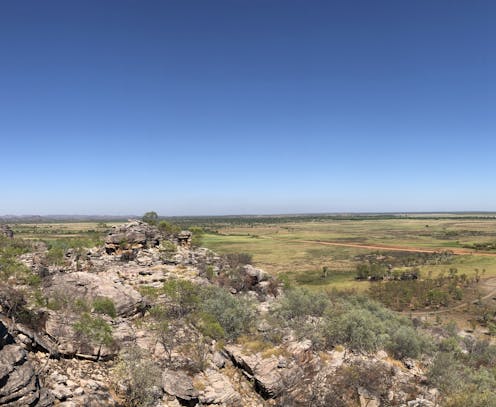
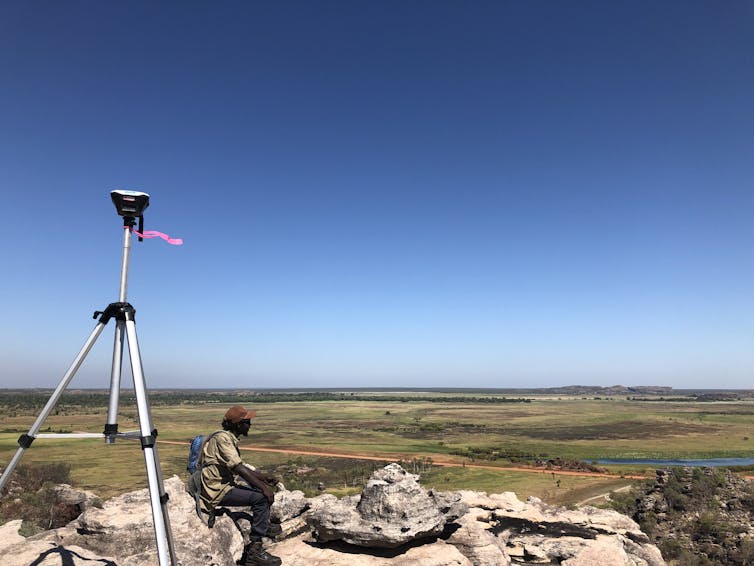
The view from the Arnhem Land escarpment over the floodplains that contain a hidden landscape. Ian Moffat, Author provided

Many visitors to Arnhem Land in the Northern Territory are struck by the magnificent cliffs, stunning bird life and extraordinary rock art. Some may know this landscape includes the earliest evidence of human occupation in what is now Australia, at Madjedbebe, where signs of habitation have been dated to 65,000 years ago.

Most people, however, ignore the expansive floodplains surrounding these sites, especially when they are covered by water during the wet season.

Our research, recently published in PLOS One, shows these floodplains hide a complex landscape buried deep underground critical to understanding the deep history of the region. We have mapped the cliffs and rivers, more than 15 metres below the current surface, which would have greeted the first people to arrive here.

Red Lily Lagoon

This landscape has been transformed by a sea-level rise of more than 120 metres, which brought the coastline from more than 200 kilometres away to lap directly on the cliffs in the Red Lily Lagoon area in Western Arnhem Land.

Since then, the East Alligator River has filled this region with sediment and the coast has retreated 60 kilometres to the northeast, leaving the current landscape of jagged sandstone cliffs surrounded by flat floodplains, which are seasonally flooded.

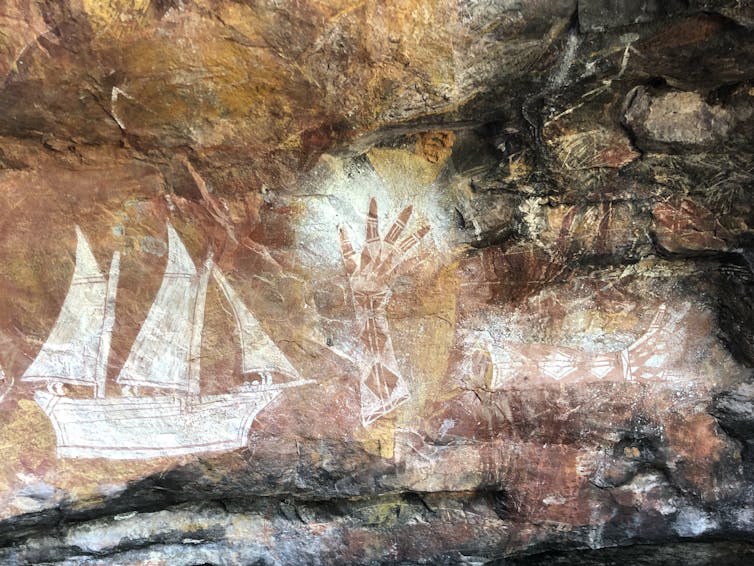
Arnhem Land is home to an extraordinary array of rock art.
Ian Moffat

The buried landscape we have mapped contains a sandstone escarpment, now buried underground, which has great potential to contain archaeological sites. This overlooked a deep valley that contained a river system, which is now buried by more than 15 metres of sediment.

Eventually, around 8,000 years ago, this river system was flooded by sea-level rise, leading to mangroves filling the valley and levelling it with marine sediments built up between the roots of the mangrove trees.

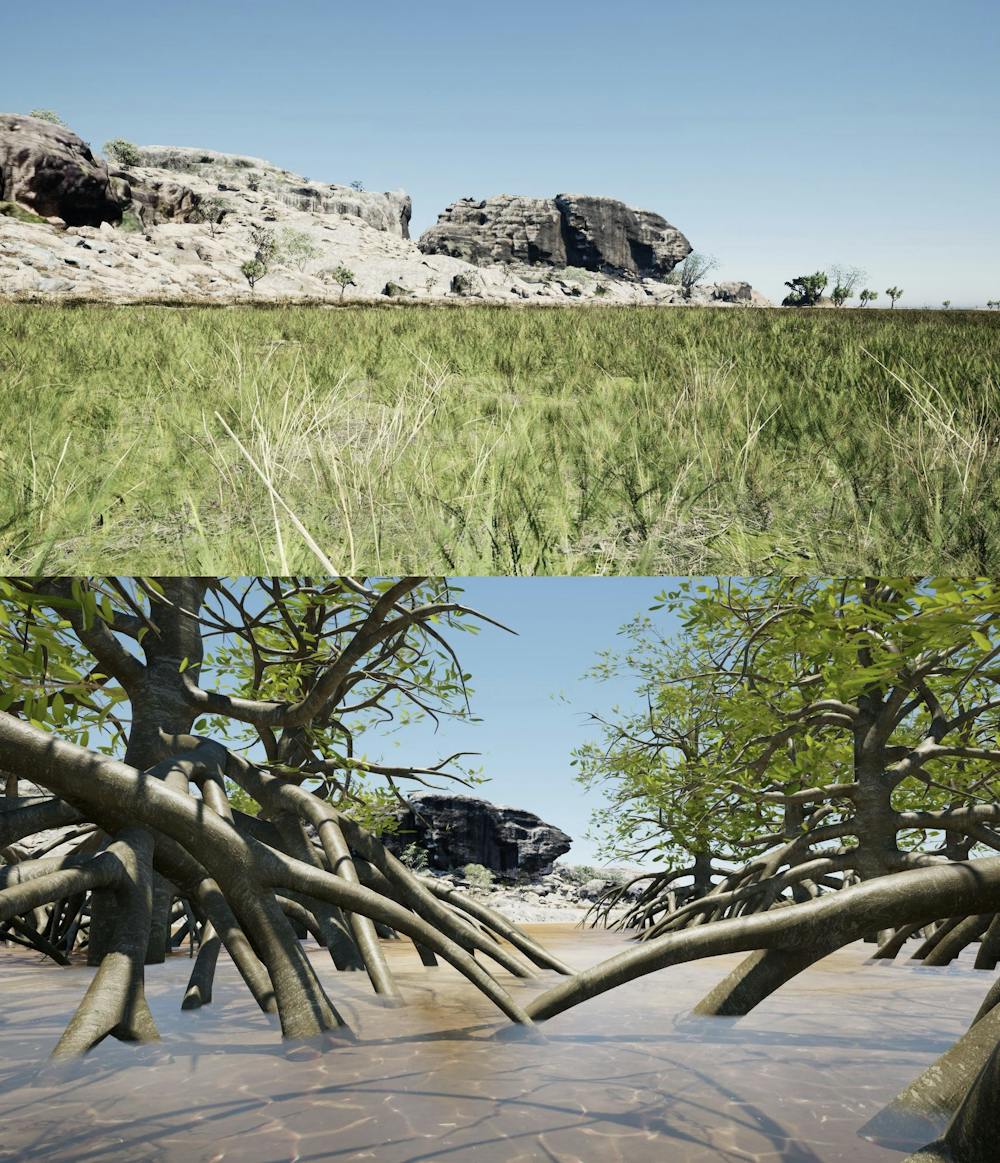
Two photos: the top one shows a flat plain with a rocky escarpment in the background, the bottom shows the same view but with the foreground filled with brackish water and mangrove trees.
A digital reconstruction shows a view of the Red Lily Lagoon area today (top) and the same view around 7,000 years ago (bottom), when the ocean lapped against the rocky escarpment.
Jarrad Kowlessar, Author provided

These major changes in the local environments are also visible through materials excavated from Madjedbebe and other sites in the area.

The excavations show people in the area ate land animals and freshwater fish before the valley flooded. But afterwards, diets changed to take advantage of the ample supply of shellfish.


À lire aussi :
Buried tools and pigments tell a new history of humans in Australia for 65,000 years


Modern maps of an ancient landscape

Previous work in Arnhem Land using drilling has provided some information about the history of the landscape, but our research achieves much greater detail.

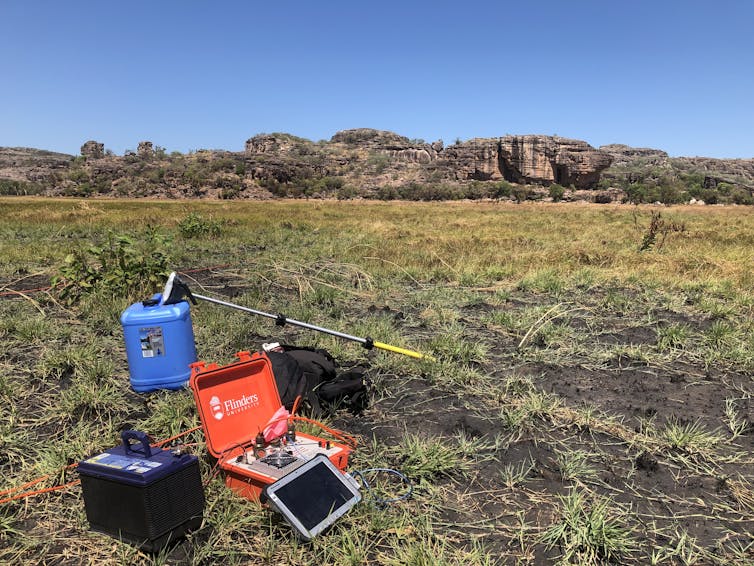
Our work used a technique called electrical resistivity tomography. This is when we pass an electrical current through the ground to measure the nature of the sediments and rocks beneath the surface. This method can map more than 50 metres below the surface, and because it doesn’t involve digging or drilling, we could work right up to existing archaeological sites.

Electrical resistivity tomography equipment used to image the subsurface of the floodplains near Red Lily Lagoon, Arnhem Land.
Ian Moffat

We combined this data with aerial mapping of the modern landscape undertaken with a drone and an airborne laser. This allows us to compare the subsurface results to the contemporary land surface and get a good understanding for just how much change has occurred up to the present day.

While geophysics techniques like these are often used to find and map archaeological sites, we instead focused on reconstructing the ancient landscape itself. Knowing how landscapes have changed provides important context for understanding choices people may have made about where to live, what to eat and how to move around.

What lies beneath?

This research paints a new picture of the landscape that greeted the First Peoples on their arrival. This older buried landscape, which is so different to the modern one, was occupied for most of the history of human activity in the area – starting over 60,000 years ago and lasting until just 8,000 years ago.

The past 8,000 years have seen dramatic changes, from a dry river valley to a mangrove forest to today’s seasonally inundated flood plains. These changes would have had important implications for people, including in terms of what they could eat and drink, and where they could live.

Some archaeologists have questioned the accuracy of the dates of occupation determined from the Madjebebe site. Criticism has focused on possible disturbance to the site by termite activity, and also the lack of other sites of a similar age in the region.

Our research shows why a lack of other sites may not be surprising: the most likely places for people to have lived when they first occupied this area are now buried more than 10 metres beneath the floodplain.

‘We want people to see’

Beyond Red Lily Lagoon, the methods we have used will give archaeologists a low cost, non-invasive way to understand ancient landscapes on a broad scale. Better models of how the environment has changed let us ask new questions about how people lived.

This is useful, not just as a tool for understanding why sites are where they are but also how people may have responded to the landscape around them. For example, we may have a different view of a rock art panel if we can understand what the artist could see around them when they painted it.

The research provides a new perspective on the history of the Arnhem Land region, which is important for First Nations people.
Ian Moffat

This research also has important implications for First Nations people. Alfred Nayinggul, a senior Erre Traditional Owner from Arnhem Land and co-author of this research, said:

We want people to see and want people to know what’s been happening many thousand years ago in the past. We need to know where those other places in Australia are, and that it was different before, and how it was formed, and we didn’t know what it was. We need to know, us Bininj, and everyone in the world with this new technology, bringing that up to our country. I need to know, and the rest of the world would see, what was in the past.

The Conversation

Jarrad Kowlessar receives funding from Flinders University.

Daryl Wesley receives funding from the Australian Research Council, the Australian Nuclear Science and Technology Organisation, the Museum and Art Gallery of the Northern Territory, National Geographic Research Scheme and Flinders University.

Ian Moffat receives funding from the Australian Research Council, the Australian Nuclear Science and Technology Organisation, the Museum and Art Gallery of the Northern Territory and Flinders University.

Alfred Nayinggul ne travaille pas, ne conseille pas, ne possède pas de parts, ne reçoit pas de fonds d’une organisation qui pourrait tirer profit de cet article, et n’a déclaré aucune autre affiliation que son organisme de recherche.

ref. Remarkable new tech has revealed the ancient landscape of Arnhem Land that greeted Australia’s First Peoples – https://theconversation.com/remarkable-new-tech-has-revealed-the-ancient-landscape-of-arnhem-land-that-greeted-australias-first-peoples-201394

Busting a king-sized myth: why Australia and NZ could become republics – and still stay in the Commonwealth

Source: The Conversation (Au and NZ) – By James Mehigan, Senior Lecturer in Law, University of Canterbury

Getty Images

The imminent coronation of King Charles III is an ideal time for Australia and New Zealand to take stock of the British monarchy and its role in national life – including certain myths about what becoming a republic might mean.

In particular, there is a common assumption that both nations must remain monarchies to retain membership of the Commonwealth of Nations. It might sound logical, but it’s entirely wrong.

There is no basis for it in the rules of the Commonwealth or the practice of its members. Australia could ditch the monarchy and stay in the club, and New Zealand can too, whether it has a king or a Kiwi as head of state.

Yet this peculiar myth persists at home and abroad. Students often ask me about it when I’m teaching the structure of government. And just this week a French TV station interpreted the New Zealand prime minister’s opinion that his country would one day ideally become a republic to mean he would like to see it leave the Commonwealth.

What does ‘Commonwealth’ mean?

The implication that breaking from the Commonwealth would be a precursor to, or consequence of, becoming a republic relies on a faulty premise which joins two entirely separate things: the way we pick our head of state, and our membership of the Commonwealth.

It would make just as much sense to ask whether Australia or New Zealand should leave the International Cricket Council and become a republic.


Read more:
From evolving colony to bicultural nation, Queen Elizabeth II walked a long road with Aotearoa New Zealand


The confusion may derive from the fact that the 15 countries that continue to have the British sovereign as their head of state are known as “Commonwealth Realms”.

What we usually refer to as the Commonwealth, on the other hand, is the organisation founded in 1926 as the British Commonwealth of Nations. This is the body whose membership determines the competing nations of the Commonwealth Games, the highest-profile aspect of the Commonwealth’s work.

King Charles III is the head of state of the 15 Commonwealth Realms and the head of the international governmental organisation that is the Commonwealth of Nations. The Commonwealth has 56 members – but only 15 of them continue to have the king as head of state.

Joining the Commonwealth club

To be fair, confusion over who heads the Commonwealth is nothing new. A 2010 poll conducted by the Royal Commonwealth Society found that, of the respondents in seven countries, only half knew the then queen was the head of the Commonwealth.

A quarter of Jamaicans believed the organisation was led by the then US president, Barack Obama. One in ten Indians and South Africans thought it was run by former UN secretary-general Kofi Annan.


Read more:
What is it about a republic that stumps our leaders?


Given the king’s overlapping leadership roles and the different use of the word in the contexts of Commonwealth Realms and the Commonwealth of Nations, these broad misunderstandings are perhaps understandable. In fact, it was this ambiguity that allowed for the development of an inclusive Commonwealth during the postwar years of decolonisation.

However the confusion arose, it is also very simple to correct. The Commonwealth relaxed its membership rules regarding republics when India became one in 1950.

According to Philip Murphy, the historian and former director of the Institute of Commonwealth Studies, this decision was based on the erroneous idea that India’s huge standing army would underwrite Britain’s great-power status in the postwar world.

From that point on the Commonwealth of Nations no longer comprised only members who admitted to the supremacy of one sovereign. To make the change palatable, a piece of conceptual chicanery was needed. Each country did not need a king, but the king was to be head of the organisation comprising equal members.


Read more:
God save the King: why the monarchy is safe in Aotearoa New Zealand – for now


Monarchy optional

Since then, the number of Commonwealth members has steadily increased to the 56 we have today.

As early as 1995, membership was extended to countries with no ties to the former British Empire. With the support of Nelson Mandela, Mozambique became a member, joining the six Commonwealth members with which it shared a border.

Rwanda, a former German and then Belgian colony, joined in 2009. It became an enthusiastic member and hosted the biennial meeting of states known as CHOGM (Commonwealth Heads of Government Meeting). The most recent countries to take up Commonwealth membership are the former French colonies of Togo and Gabon.

According to the Commonwealth’s own rules, membership is based on a variety of things, including commitment to democratic processes, human rights and good governance. Being a monarchy is entirely optional.

The new king offers the chance for a broader debate on the advantages of monarchy. But let’s do so knowing Commonwealth membership is entirely unaffected by the question of whether or not the country is a republic.

The Conversation

James Mehigan does not work for, consult, own shares in or receive funding from any company or organisation that would benefit from this article, and has disclosed no relevant affiliations beyond their academic appointment.

ref. Busting a king-sized myth: why Australia and NZ could become republics – and still stay in the Commonwealth – https://theconversation.com/busting-a-king-sized-myth-why-australia-and-nz-could-become-republics-and-still-stay-in-the-commonwealth-204750

What does a king actually do?

Source: The Conversation (Au and NZ) – By Jess Carniel, Senior Lecturer in Humanities, University of Southern Queensland

Stefan Rousseau/AP/AAP

This weekend’s coronation ceremony formally invests the monarch with their regnal powers – but King Charles III has been doing the job since he was proclaimed king in September 2022. So what does a monarch actually do?

Historically, the role of the monarch was to maintain the peace of the realm, oversee the administration of justice, and to upload the rule of law in the land. While the king still represented the nation symbolically, it was a far more hands-on, practical role than monarchs of today.

Roles and responsibilities

The monarch’s position description, so to speak, includes the roles of head of state, head of nation, head of the Church of England, head of the Armed Forces, and head of the Commonwealth. These are largely ceremonial and symbolic roles – the king does not intervene in the day-to-day running of these institutions.

As head of state, the king performs certain constitutional duties. These include appointing a prime minister and inviting them to form a government, forming and dissolving parliament, opening and closing parliament each year, and signing legislation.

Upon election, the prime minister meets with the king, who formally invites them to form a government. While monarchs are expected to remain non-partisan and apolitical, they are kept informed on state matters daily and meet with the prime minister each week. These meetings are private and no record is kept of what is discussed – so, yes, those scenes in The Crown are complete fiction. The king can consult and advise, but the prime minister is under no obligation to follow any advice he provides.

Meetings between a monarch and a prime minister are kept secret.
Aaron Chown/AP/AAP

The king’s parliamentary roles are largely ceremonial, with one exception. The king can dissolve parliament. The last king to do this was William IV in 1831 during the Reform Crisis.

Throughout the Commonwealth, such as Australia, the king is represented by governors-general. They perform for these nations the same constitutional duties performed by the king for the UK. Governor-General Sir John Kerr famously dismissed Prime Minister Gough Whitlam and dissolved Australian parliament in 1975. After decades of speculation about the role of the Queen in the dismissal, the so-called Palace Papers revealed that while the Palace was interested in the matter, Kerr had acted independently.


Read more:
Australian politics explainer: Gough Whitlam’s dismissal as prime minister


In international affairs, the king can act as a representative of the United Kingdom, such as meeting political leaders and hosting state functions, but cannot act politically on its behalf.

As head of nation, the king is a “focus for national identity”, symbolising its unity and continuity. In this role, the king recognises citizen achievements, attends events, and broadcasts special messages to the nation. This may include annual messages, such as the Christmas message, or special broadcasts, such as the Queen’s address at the height of the pandemic.

The king is also the head of the Church of England and Defender of the Faith. However, prior to his ascension to the throne, Charles expressed a more inclusive desire to be the defender of faiths, reflecting the multicultural and multi-faith reality of the UK and the Commonwealth.

Although the king served in all three arms of the British forces and still maintains several ceremonial rankings, the role of Head of Armed Forces is also symbolic. Should the UK go to war, the king won’t determine its defence strategy, but he will officially declare both when the country is at war and when it is over.

During the second world war, the royal family played an important role in fostering national and military morale. Then-Princess Elizabeth famously joined the Auxiliary Territorial Service when she turned 18, and trained as a mechanic.

In addition to these roles, the king also holds various royal patronages. This involves providing support to his chosen organisations by attending events and bringing publicity to the causes.

As the Prince of Wales, Charles held over 420 patronages. He inherited a further 600 following the death of Queen Elizabeth II. Some patronages were associated with the rank of Prince of Wales, so have been passed on to Prince William. Others may be redistributed amongst the senior royals in order to ensure a manageable royal workload.


Read more:
King Charles will redistribute hundreds of charity patronages – here’s why they are such an important part of royal life


Senior royals and Counsellors of State

Although there is only one monarch (it’s in the name, after all), the king does not work alone. He is often assisted in his representational duties by a group of family members referred to as the “senior” or “working royals”. These are members of the royal family who carries out duties on behalf of the Crown. Traditionally, the senior royals comprise the monarch’s consort, the heir and the heir’s spouse and children, and other children and their spouses. However, the current list of senior royals includes the king’s brother, Prince Edward, and his wife, Countess Sophie, and the king’s sister, Princess Anne.

The senior or ‘working’ royals also have an important role to play alongside the king.
Yui Mok/AP/AAP

The Duke and Duchess of Sussex (aka Harry and Meghan) famously resigned from their role as senior royals in early 2020. Prince Andrew has been removed from public duties due to allegations of sexual abuse and his association with the convicted sex trafficker, Jeffrey Epstein.

However, both Prince Harry and Prince Andrew remain among the Counsellors of State. Counsellors are determined by law – the Regency Act – and are authorised to carry out minor official constitutional duties of the king if he is overseas or unwell, such as attending Privy Council meetings and signing routine documents. But they can’t perform major duties such as appointing prime ministers or dissolving parliament.

Counsellors of State are appointed from the four adults next in succession who have reached the age of 21. The monarch’s spouse is also eligible for appointment, even though they are not in line to the throne. This meant that following the ascension of King Charles, the Counsellors of State were Queen Camilla, Prince William, Prince Harry, Prince Andrew, and Princess Beatrice.

However, as Prince Harry and Prince Andrew are not actively carrying out royal duties, and Prince Harry is no longer resident in the UK, there was some concern about the appropriateness and the sheer logistics of the current list of counsellors. To address this, the Counsellors of State Act 2022 expanded the Regency Act to specifically include Prince Edward and Princess Anne, providing the king with two more local, active, and experienced counsellors to call on.


Read more:
Why Prince Andrew and Prince Harry can fill in for the King, and how the law might change


Questioning the monarchy today

King Charles’ ascension to the throne in September 2022 prompted various national conversations around the Commonwealth of Nations about the prospect of becoming republics.

The monarch’s various duties may be largely symbolic, but symbols are powerful articulations of particular values, relationships, and histories. It is important for the various nations of the Commonwealth to reflect on their symbols and institutions as they look toward their futures.

The Conversation

Jess Carniel does not work for, consult, own shares in or receive funding from any company or organisation that would benefit from this article, and has disclosed no relevant affiliations beyond their academic appointment.

ref. What does a king actually do? – https://theconversation.com/what-does-a-king-actually-do-203842

Homelessness today sees workers and families with nowhere stable to live. No wonder their health is suffering

Source: The Conversation (Au and NZ) – By Rachel D Zordan, Research Fellow, St Vincent’s Hospital Melbourne and Honorary Research Fellow, Department of Medicine, The University of Melbourne

Shutterstock

During the current housing affordability crisis, we’re seeing people who work and families with children becoming homeless or living in unstable housing.

They may be living in a motel room, vehicle, tent or caravan park. They may be on a friend’s couch or on the street.

They may be exposed to health hazards, including excessive heat or cold, poor ventilation or mould, injury, overcrowding, vermin, violence, or a combination of these – all while trying to hold down a job or getting their kids to school.

The lack of affordable housing and its impact on homelessness is a talking point ahead of next week’s federal budget.

Here are some of the unique physical and mental health challenges of being homeless today.


Read more:
We identified who’s most at risk of homelessness and where they are. Now we must act, before it’s too late


Housing is too expensive

Unaffordable housing is a leading cause of homelessness in Australia. And having a job no longer guarantees secure housing.

A recent report from Anglicare Australia described just how hard it is to afford a private rental in 2023, even if working full time on the minimum wage.

Women tend to earn less than men and are among the fastest growing groups of people who experience homelessness in Australia.

Families with children are homeless and living in insecure housing, too. Figures from the last census show around 19,400 children aged up to 14 years were homeless that night, either with their families or alone.


Read more:
‘I left with the kids and ended up homeless with them’: the nightmare of housing wait lists for people fleeing domestic violence


Impacts on health

For decades, we’ve known people’s health suffers if they experience homelessness. This has included our own research into homelessness among people who attend emergency departments, which shows the long-term consequences of unstable housing.

We found that even being marginally housed (at risk of homelessness) was enough to increase mortality rates. These people died, on average, six years earlier than people who were housed.

Steep housing costs, poor dwelling conditions, overcrowding, and evictions leave people vulnerable to illness, injury, and victimisation.

For example, people who live in housing that’s too hot or too cold are more likely to have breathing problems, including asthma, or heart problems.

We know overcrowding directly contributes to poor physical health, such as infectious diseases and injuries.

Unstable housing contributes to unhealthy behaviours, such as substance use and poor diet, which can compound over time. Unstable housing may also disrupt access to health care, including to prescription medications, causing people to delay seeking care.

Being homeless increases the likelihood of being the victim of violent crime, which threatens physical and psychological health in the short and long term.


Read more:
Disempowered, shut off and less able to afford healthy choices – how financial hardship is bad for our health


Understandably, the psychological wellbeing of adults experiencing homelessness is worse than the general population.

Lack of routine and loss of a sense of home and community can lead to social isolation and onset or recurrence of mental illness. Indeed, post-traumatic stress disorder, substance use disorders, and suicidality (thinking about or attempting suicide) are more common in people who experience homelessness.


Read more:
How financial stress can affect your mental health and 5 things that can help


Impacts on children

Children and young people may be particularly vulnerable to the health consequences of poor housing. For instance, cold, damp conditions lead to higher rates of breathing problems.

When crammed into undersized spaces or places not meant for people to live, a lack of space for cooking, playing, or schoolwork can have their effects, particularly on children.

For instance, children who live in overcrowded homes are more likely to have poorer mental health and do less-well at school.

Children’s long-term health may also be affected if preventative health care, such as immunisations or dental visits, are missed.

Working while homeless has extra challenges

Working while homeless is uniquely challenging.

People who work and are homeless may hide their homelessness out of shame, fear of judgement, and worry about losing their job.

The stress of being homeless can affect work performance and the ability to hold down a job. Taking time off from work to seek stable accommodation may further jeopardise employment.

Workers who are rough sleeping report particular struggles. Getting adequate sleep is difficult and even risky. Maintaining good hygiene and clean clothing is tough. Transport to and from work may become difficult to afford.


Read more:
This is what the lives of Big Issue sellers tell us about working and being homeless


It’s a human rights issue

Health and housing are basic human rights. And stable housing is a critical determinant of health.

But as recent evidence shows, even renting is unaffordable for some, despite working full time.

It’s time we acknowledged the impact of structural issues on homelessness, including housing affordability and the job market, rather than blaming individual risk factors, such as substance use or mental health difficulties.

We also need to tailor support services for homeless people so they are suitable and affordable, as well as being close to family, friends and children’s schools.

The Conversation

Rachel D Zordan receives funding from St Vincent’s Health Australia.

Vijaya Sundararajan receives funding from St Vincent’s Research Endowment Fund.

Jessica L Mackelprang does not work for, consult, own shares in or receive funding from any company or organisation that would benefit from this article, and has disclosed no relevant affiliations beyond their academic appointment.

ref. Homelessness today sees workers and families with nowhere stable to live. No wonder their health is suffering – https://theconversation.com/homelessness-today-sees-workers-and-families-with-nowhere-stable-to-live-no-wonder-their-health-is-suffering-202955

We won’t solve the teacher shortage until we answer these 4 questions

Source: The Conversation (Au and NZ) – By Hugh Gundlach, Lecturer in Education, The University of Melbourne

Shutterstock

Schools and students around Australia continue to face a teacher shortage.

This means some schools have gone back for term two unable to offer certain subjects. Some might have composite classes, larger classes or disrupted units of study.

This also means some students will not have the best possible chance at learning skills, developing a passion for a subject, or achieving their potential.

There are already several national and state policy moves to try to address the shortage and its potential causes. As part of these, teachers’ workloads, wellbeing, working conditions and pay have been raised as key factors.

Over the past five years, I have studied the career decisions of more than 1,000 Australian teachers across all school years.

At the moment, we are trying to solve the teacher shortage without all the key information. Here are four questions we need to answer to really address this issue.

1. Who is leaving?

We know the teacher shortage is an issue around the country, at all year levels. But beyond this, it’s hard to get specific details.

One point often lost in discussions about the teacher shortage is teachers are not a homogeneous group: they teach students from the first years of schooling to the last, and specialise in everything from languages to science to music.

This means vacant roles are also not homogeneous.

In the past ten years there has been concern about shortages of teachers in science, maths and languages, as well as early career teachers, male primary teachers and teachers in remote, rural and disadvantaged schools. Each of these groups will not necessarily be retained with the same strategy.

There is also a potential mismatch between the supply of teachers being trained in certain areas and the demand from schools.

So we need to know who is leaving and what is their expertise.

2. How do turnover numbers connect with reasons for leaving?

In the past, teacher turnover research has been dominated by large-scale reports with national data from the United States. These do not adequately connect teacher departures with the reasons for leaving, or necessarily reflect Australian trends.

Smaller studies are more common in Australia, especially those looking at teachers’ motivations and reasons for leaving. These often rely on hypothetical career intentions only, not real quitting behaviours.

This is not enough, as many teachers stay in schools and the profession despite an intention to leave. Decisions to leave are also not always planned.

Quitting can be based on time (such as the number of years’ service or after earning long-service leave), life stage (such as starting a family), contingencies (such as a promotion or raise), and impulsivity (such as interpersonal conflict).

We need to connect how and why teachers leave with who they are.


Read more:
Higher salaries might attract teachers but pay isn’t one of the top 10 reasons for leaving


3. Are teachers leaving or simply changing jobs?

In a systematic review of the past 40 years of teacher turnover research, I found the majority of past studies did not adequately distinguish between teachers who simply go to a different school, and those who leave the profession altogether.

We also need to know who is just moving schools and who is leaving the profession. Policy makers and schools can help develop understanding of shortages by tracking destinations of departing teachers and their reasons for leaving through data collection and exit interviews.

This helps work out whether there is a migration issue or an attrition issue.

The effect of a teacher’s absence on students’ learning and schools’ operations may be the same. But the shortage solutions are likely to differ for migration and attrition.

4. Are we losing ‘quality’ teachers?

In my research, I also reviewed more than 200 quantitative studies with data on teacher turnover and retention. Only one study had a measure of teacher quality.

We need to consider the quality of teachers who are leaving and staying. We should worry most about losing high-performing teachers, as opposed to those who were not a good fit for the profession or who left for personal reasons or reasons outside a school’s control.

We should also be most concerned with teachers who are high-performing, who leave due to a difficult environment. After all, teachers’ working environments are the students’ learning environments.

Involuntary retention of employees – those who want to leave but cannot or do not – is not necessarily preferred to a teacher shortage.

We want children’s teachers to be in the classroom because they are satisfied in their jobs and passionate about education and young people, not because they are incentivised by another force such as extra pay or a lack of other employment opportunities.


Read more:
Australian teachers are dissatisfied with their jobs but their sense of professional belonging is strong


What next?

A uniform approach to the teacher shortage will not work. Solving it requires matching up teacher types, quitting types and the reasons for leaving, with relevant initiatives for retention.

Collecting teacher turnover figures along with information such as year level taught, subject area, location, age, gender and years of experience will help.

Schools, school systems and governments should work together to create a fuller picture of who is leaving and why.

The Conversation

This article is based on research partially funded by the Victorian Department of Education and Training’s Strengthening Teachers Initiative, and the Australian Department of Education, Skills and Employment Research Training Program Fees Offset and Stipend.

ref. We won’t solve the teacher shortage until we answer these 4 questions – https://theconversation.com/we-wont-solve-the-teacher-shortage-until-we-answer-these-4-questions-203843

Queen Charlotte has her own Bridgerton spinoff on Netflix – but who was she really? And why was she obsessed with Australia?

Source: The Conversation (Au and NZ) – By Lorinda Cramer, Research Fellow, Australian Catholic University

Netflix

Queen Charlotte captured viewers’ attention in the Netflix series Bridgerton as the snuff-sniffing, gossip-greedy, biracial wife of the “mad king” George III.

As the spin-off Queen Charlotte: A Bridgerton Story – billed as an “epic love story” – launches, just who was Charlotte? And why was she obsessed with Australia?

From German princess to British queen

Seventeen-year-old Princess Charlotte of Mecklenburg-Strelitz married George III in 1761, the year after his accession to the throne. She had been chosen, dispassionately, from a list of suitable wives for the young king.

Charlotte arrived in London from her northern German home speaking no English, though she would soon acquire it.

She brought with her a fascination of science – Charlotte adored botany – and the arts. A talented singer and harpsichord player, Charlotte would later be accompanied by a young Mozart.

She is also said to have brought the German tradition of the Christmas tree to Britain, with Queen Victoria making it popular.


Read more:
A story of legends, families and capitalism: a candid history of the Christmas tree


Charlotte and George III’s marriage was a success. Contemporaries spoke of their devotion to each other, unlike other kings who strayed.

They had 15 children, 13 living to adulthood. Two sons – George IV and William IV – would later be king. Their granddaughter, Victoria, served as the longest-reigning British monarch.

Some thought Charlotte dull, preferring domestic life to court. Others called her power-hungry as George III suffered a series of bouts of mental illness, possibly caused by the blood disorder porphyria, though this is still debated.

More recently, Charlotte’s ancestry has been examined, sparked by her “African features” in portraits by Allan Ramsay. As fascinating as this is, more historians are sceptical of the claim that Charlotte was Black than support it.

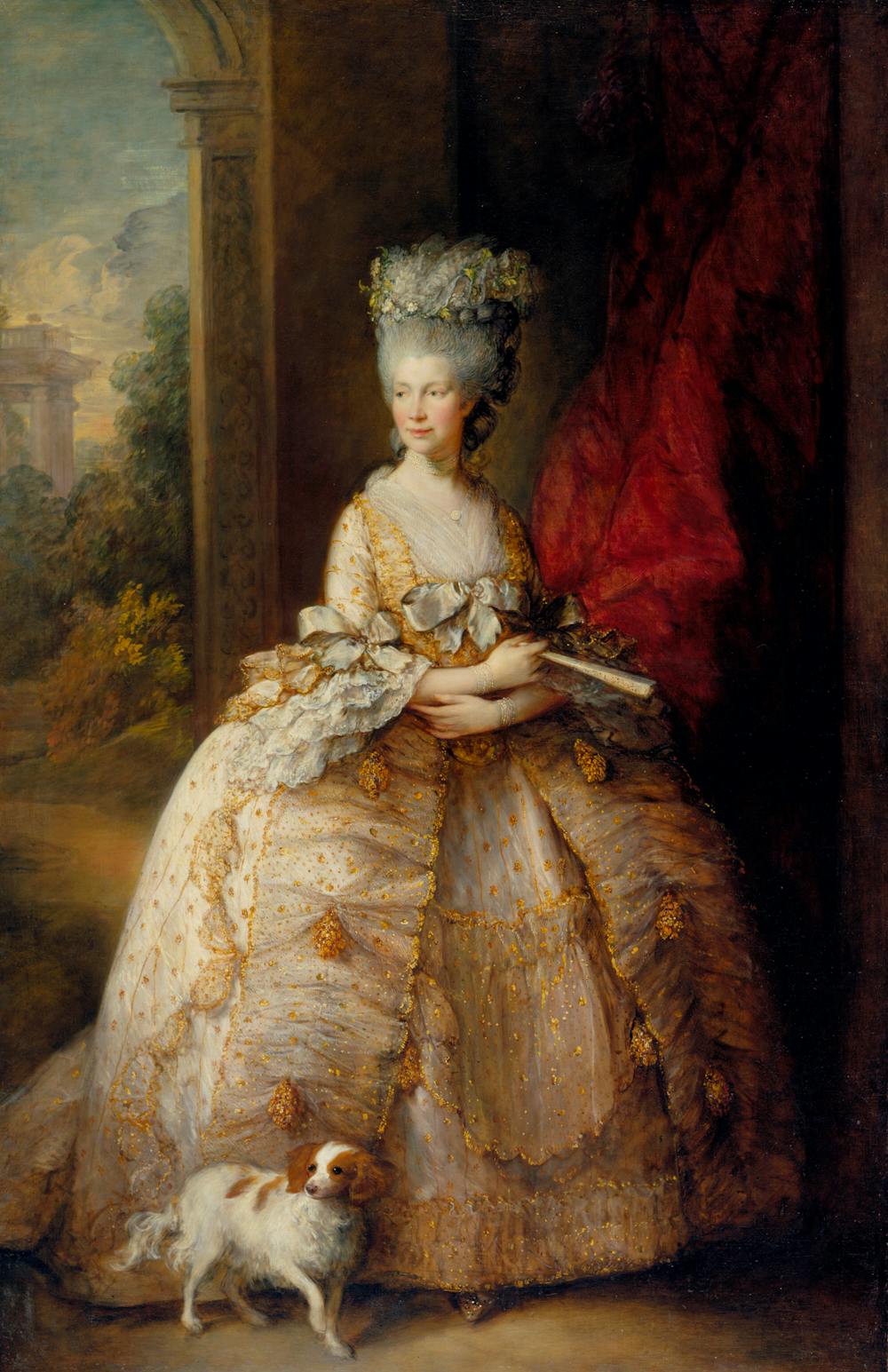
Portrait of Queen Charlotte by Thomas Gainsborough (1781)
Wikimedia

Charlotte and the natural world

Across the 57 years that Charlotte was queen consort, Britain undertook an ambitious program to expand its empire and further knowledge of the natural world.

In 1768, seven years after Charlotte married into the royal family, George III commissioned James Cook with an ambitious voyage of discovery: to view the transit of Venus in Tahiti, then search the oceans for the “undiscovered southern land”.

On a weather-beaten ship, Cook changed course to chart the eastern coastline of New Holland (Australia) in 1770. Across the four months that the Endeavour sailed up the coast, Joseph Banks – the naturalist and botanist who joined Cook’s voyage – collected plants and animals.

Banks returned to England with a staggering bounty of specimens, presenting them to Charlotte and George III shortly after. This launched the collection of Australian plants and animals across decades to follow.

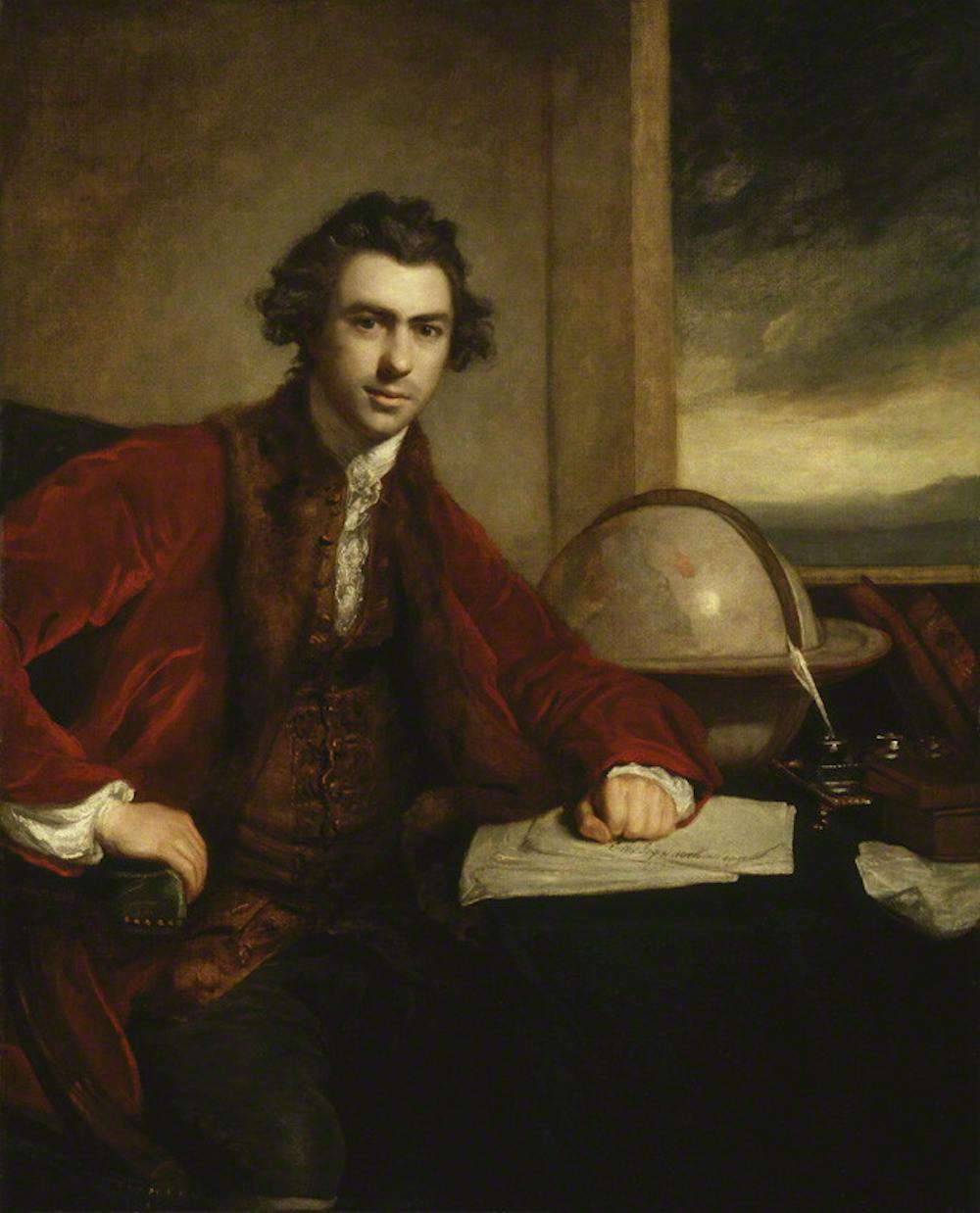
Portrait of Joseph Banks by Joshua Reynolds (1771-1773)
Wikimedia

Charlotte’s “cangaroos”

Charlotte penned an unusual passage in her diary in 1794. Describing some remarkable creatures that had been held beneath deck for months as they crossed the seas, then released into her menagerie, she wrote of glimpsing “the Young Cangeroo”.

“The Animal being of the Opossum kind Carries its Young in a Pouch”, Charlotte marvelled.

Banks and the Endeavour’s crew had been astonished from their first fleeting glimpse of the animals two decades earlier, likening them to greyhounds that flashed through the bush.

The kangaroos that later arrived in Britain alive – though many would not survive the crossing – symbolised power. They were coveted by the elite and other European rulers. Napoleon’s wife Josephine had kangaroos of her own.

Unlike anything seen before, Charlotte was awed by their tiny forelimbs and strong tail. She was fascinated by how kangaroos moved, hopping on their powerful hind legs.

She was especially intrigued by the kangaroo’s pouch. So were scientific men who studied the queen’s kangaroos, attempting to unravel the mystery of how they reproduced and cared for their young.

So successfully did Charlotte’s prized kangaroos breed that her flock grew to 20.

The Kongouro from New Holland (Kangaroo) 1772 by George Stubbs. The work was commissioned by Joseph Banks and based on the inflated skin of an animal he had collected from the east coast of Australia in 1770.
Wikimedia

Charlotte’s Australian plants

As Charlotte’s kangaroos hopped through her menagerie, the neighbouring Royal Gardens at Kew became the storehouse for plants from across the empire.

Banks, then Kew’s de facto director, encouraged his global networks to collect for the queen. To the second New South Wales governor, John Hunter, Banks urged:

[…]when you make your excursions or when you send parties into new districts, you will not forget that Kew Garden is the first in Europe & that its Royal Master & Mistress never fail to receive personal satisfaction from every Plant introduced there from foreign parts.

The year before, Banks had assessed a remarkable herbarium offered to Charlotte that included rare Australian specimens. Amassed by French botanist Jacques Labillardière, then seized during the French Revolutionary Wars, the gift was not to be. Returned to Labillardière, he used the specimens to write the most comprehensive description of Australia’s flora.

Death of the queen

Charlotte remained queen until her death in 1818. It took months for the news to reach Australia.

When it did, the Hobart Town Gazette declared that Britain’s loss “will be not less felt in its remotest Dependencies”.

The settlement mourned Charlotte by firing guns, flying flags at half-mast and tolling church bells, though she had never set foot on Australian soil.

The Conversation

Lorinda Cramer receives funding from the Australian Research Council.

ref. Queen Charlotte has her own Bridgerton spinoff on Netflix – but who was she really? And why was she obsessed with Australia? – https://theconversation.com/queen-charlotte-has-her-own-bridgerton-spinoff-on-netflix-but-who-was-she-really-and-why-was-she-obsessed-with-australia-200077

Research shows giraffes can use statistical reasoning. They’re the first animal with a relatively small brain known to do this

Source: The Conversation (Au and NZ) – By Scarlett Howard, Lecturer, School of Biological Sciences, Monash University

Bernard Dupont / Flickr

Humans make decisions using statistical information every day. Imagine you’re selecting a packet of jellybeans. If you prefer red jellybeans, you will probably try to find a packet that shows the most red (and less of the dreaded black ones) through the small window.

Since you can’t see all the jellybeans at once, you’re using statistical reasoning to make an informed decision. Even infants have this capability.

And as it turns out, humans aren’t alone in using statistical inferences to make decisions. Great apes, long-tailed macaques and keas have all been shown to use the relative frequencies of items to predict sampling events.

Now a new study has added giraffes to this list. The research, published today in Scientific Reports, shows giraffes can use statistical inferences to increase their likelihood of receiving carrot slices rather than zucchini – much like a human picking jellybeans.

The researchers worked with four giraffes – Nakuru (M), Njano (M), Nuru (F) and Yalinga (F) – living at the Zoo of Barcelona.
Alvaro L. Caicoya, CC BY-NC

Brain size and statistical skills

Until now, primates and birds were the only animals to show evidence of statistical reasoning. Both are considered to have large brains relative to body size, which is often linked with higher intelligence.

Researchers at the University of Barcelona, University of Leipzig, and Max Planck Institute for Evolutionary Anthropology wanted to test whether an animal with a small brain relative to its body size could perform statistical reasoning.

Giraffes were an ideal choice. They have already demonstrated an ability to perform quantity discrimination (being able to tell a larger amount of items from a smaller amount), and their social systems and dietary breadth have been linked with the emergence of complex cognition.


Read more:
Polly knows probability: this parrot can predict the chances of something happening


How does a giraffe demonstrate statistical reasoning?

As it turns out, giraffes love carrots but have only a lukewarm appreciation for zucchinis, making these foods ideal to use in a statistical reasoning task.

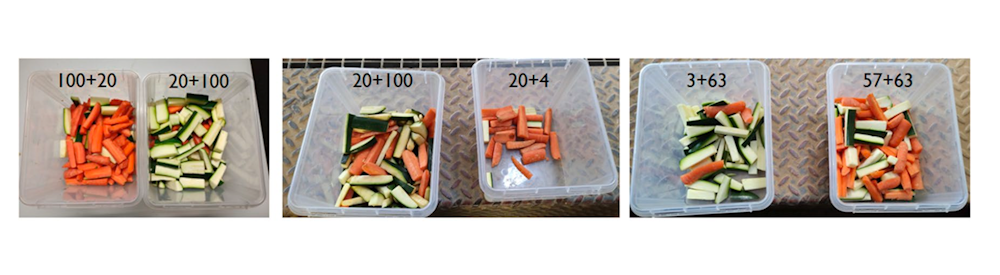
Working with four giraffes, the researchers placed different proportions of carrot and zucchini slices into transparent containers to test if the giraffes could predict a higher likelihood of receiving a carrot in three tests of different treat quantities.

Each test consisted of 20 trials in which a researcher selected a piece of food from each container without showing the giraffe. The giraffe then touched the hand it wanted to eat from, using only the information it had from the containers.

The giraffes were reliably able to select the correct container in the trials of the first test, wherein the correct choice had both a higher quantity of carrots and lower quantity of zucchini slices.

In the second test, the quantity of carrots was the same in both containers, but the correct choice had fewer zucchini slices. Again, the giraffes were able to select correctly.

In the third test, the quantity of zucchini slices remained the same, but the correct container had a larger quantity of carrots. Yet again the giraffes chose correctly.

Each test of the experiment used different stimuli. Left to right: test 1, test 2 and test 3.
Alvaro L. Caicoya et al/Scientific Reports

The combined results informed the researchers whether giraffes were using relative frequencies (statistical reasoning) or simply comparing absolute quantities of their preferred or non-preferred food.

Since the giraffes succeeded in all three tests, the researchers concluded they had used statistical inferences. If the giraffes had only been looking at the absolute quantities of the carrots, they would have succeeded in the first and second tests only, and failed the third.

Do you need a large brain for statistical reasoning?

Evidence of statistical reasoning in giraffes suggests relatively large brains are not required to evolve complex statistical skills – at least in vertebrates (animals with backbones). Furthermore, the authors propose the ability to make statistical inferences may actually be widespread in the animal kingdom.

The question now is: how many other animals with small brains relative to their body size could also succeed in this task?


Read more:
One, then some: how to count like a bee


The Conversation

Scarlett Howard received funding from Australian Government Research Training Program (RTP) Scholarship, RMIT University, Fyssen Foundation, L’Oreal-UNESCO for Women in Science Young Talents French Award, and Deakin University. She is affiliated with Pint of Science Australia as the Media Manager volunteer.

ref. Research shows giraffes can use statistical reasoning. They’re the first animal with a relatively small brain known to do this – https://theconversation.com/research-shows-giraffes-can-use-statistical-reasoning-theyre-the-first-animal-with-a-relatively-small-brain-known-to-do-this-204808

Controversial ParentsNext program to be scrapped next year

Source: The Conversation (Au and NZ) – By Michelle Grattan, Professorial Fellow, University of Canberra

The unpopular ParentsNext program is to be scrapped by the Albanese government from July 1 next year.

In the meantime, compulsory requirements for participants in the program, introduced by the Coalition government, are to be paused.

Abolishing ParentsNext was recommended by the government’s Economic Inclusion Advisory Committee and its Women’s Economic Equality Taskforce.

The Minister for Women, Katy Gallagher, and the Employment Minister, Tony Burke, said women around the country had been telling the government the program “is punitive, counterproductive and causes harm”.

Under the program, originally conceived as an attempt to help very young and vulnerable single mothers, participants have been required to attend appointments, negotiate participation plans, and report on agreed activities. If they fail to do what is required, they can have their benefits suspended.

The program was rolled out for women with children under six, with the Coalition government saying it would benefit those at risk of long term welfare dependency. The plan was to assist these parents prepare for jobs by the time their children went to school.

The welfare sector and a recent parliamentary inquiry have criticised the program. The inquiry said it was “locked into a punitive frame and does too much harm for the good it also does”.

The inquiry, which was set up by Burke, found the program was “polarising”.

“Numerous parents we met with explained that ParentsNext has helped them to build confidence, connect with employers, and find paid work. Yet many others think it’s something close to evil and must be scrapped, describing the compliance process as re-traumatising and akin to coercive control,” the committee chair, Labor’s Julian Hill. said in his forward to the inquiry’s report. “ParentsNext is not as bad as many say, but not as great as others claim.”

The inquiry recommended the program be scrapped and replaced with “a supportive pre-vocational service developed via a co-design process”. It said that in the interim the present program should have its onerous elements removed.

Gallagher and Burke said in a statement that at the election Labor “committed to listen to women’s experiences and make decisions that make their lives better and fairer”.

The women’s taskforce said ParentsNext should be replaced by “a new evidence-based program co-designed with young parents, and based in principles of encouragement, support, flexibility and meeting their needs”.

In another measure for women, next week’s budget is set to liberalise the eligibility for the single parent payment. At present a single mother loses this when her youngest child turns eight. She then has to go on JobSeeker, which is paid at a much lower rate. The new cut off point could be when the youngest child turns 13 or 14.

The Conversation

Michelle Grattan does not work for, consult, own shares in or receive funding from any company or organisation that would benefit from this article, and has disclosed no relevant affiliations beyond their academic appointment.

ref. Controversial ParentsNext program to be scrapped next year – https://theconversation.com/controversial-parentsnext-program-to-be-scrapped-next-year-205037

Grattan on Friday: Albanese enjoys London limelight while Chalmers sweats in budget spotlight

Source: The Conversation (Au and NZ) – By Michelle Grattan, Professorial Fellow, University of Canberra

The timing of history. How Anglophile and monarchist Tony Abbott would love to have been the prime minister attending the coronation. To say nothing of John Howard, a key figure in fending off an Australian republic in 1999.

Instead it is Anthony Albanese in London, explaining on British television how he, a leader dedicated to trying to make our country a republic, is happy to be affirming allegiance to its new head of state.

Albanese has not been doing a bad job of smoothing any perceived contradiction, once again showing he can be a man for all occasions, some of them challenging.

In his hour-long interview with conservative Sky broadcaster Piers Morgan (a surprising appearance in itself) Albanese navigated some awkward questions, retold his familiar childhood story (with detail about finding his father), which Morgan appeared to find fascinating, and juggled his republicanism with upholding Australia’s present loyalty to King Charles.

While vague about timing (we know he wants a republic referendum in a second term) Albanese said that when there was a public demand for another vote, “I’m sure a vote will be held”, but it wasn’t imminent.

Albanese notably reaffirmed his preference for “an appointed head of state”, referring to “some process whereby democratically elected institutions, in the House of Representatives and the Senate, have a say in that”.


Read more:
Nine things you should know about a potential Australian republic


Division among republicans over the model (having the president appointed by the parliament versus being popularly elected) helped sink the 1999 vote. In future, the pressure would be for a popularly elected model. The challenge for Labor, if and when it gets to a referendum, would be to deal with this demand, but avoid a model of potentially competing power centres.

While Albanese (who lands back in Australia on budget eve) basks in the international limelight, at home Treasurer Jim Chalmers this week has been feeling the heat of the spotlight.

In current politics, the days before a budget are as orchestrated by the government as budget day itself. What you read and hear about the measures are not “leaks” but so-called “drops” to the media, designed for a flow of good news ahead of time (or sometimes getting bad news out of the way).

More rarely there are genuine leaks – a journalist gets a real scoop, something the government didn’t intend to be out that day. Such was the Seven Network’s story of an anticipated rise in JobSeeker for people 55 and over (those 60-plus who’ve been out of work for nine months already get a higher rate).

Chalmers would not confirm the accuracy of the leak, but he put up a spirited defence of the case for such a measure, which was taken as a tick. One of his arguments is that it would particularly help women, with many older unemployed women especially vulnerable. Assisting them also fits well with Labor’s gendered lens.

Inevitably, however, there was an immediate backlash from those speaking up for the young. The debate became a microcosm of the government’s wider problem with this budget, as Chalmers has sought to balance the need for restraint (reinforced by the Reserve Bank’s interest rate rise this week) with the strong calls for the government to meet its oft-repeated election commitment to “not leave people behind”. Albanese told Morgan: “The philosophy I took to the election was two parts, no one held back and no one left behind.”


Read more:
Government to spend $11.3 billion over four years to fund 15% pay rise for aged care workers


We’ve seen in this intense tug of war both the influence of the crossbench and of the usually compliant caucus.

It was ACT independent senator David Pocock who secured (as part of a deal to pass legislation) the economic inclusion advisory committee that recommended a big increase in JobSeeker for everyone. A large number of Labor backbenchers publicly joined the call, adding to the squeeze on the government.

The budget will contain not just some welfare initiatives, including for single mothers, but other measures to address the cost-of-living crisis. The reaction to it can be expected to come from various directions.

The assault from the left will say that the government hasn’t done enough. Leaving “nobody behind” is a very subjective proposition. When it comes to attack, this budget is made for the Greens. The minor party has emerged as arguably more effective as an “opposition” voice than the official opposition (this is separate from a judgment on the content of what the Greens say). And Labor knows this is dangerous in the longer term, given the Greens are eating away at a few seats in the lower house.

For the Coalition, finding a length and line in responding to the budget could be trickier. Demanding more be done on welfare is not the Coalition’s bag. It will no doubt say not enough attention is being paid to the cost of living. But any suggestion that the budget should have spent more than whatever it does spend will undermine the Coalition argument about restraint.


Read more:
Word from The Hill: Another rate rise, higher tax on cigarettes, and likely JobSeeker boost for over-55s


If, as speculated, the budget predicts a 2022-23 surplus, that further complicates the opposition’s reaction. The Coalition is stymied, whether it attacks from the right or (less likely) the left.

Depending on its precise crafting, the budget could be a slippery beast for the opposition to handle. Meanwhile Peter Dutton faces his own personal test next week.

In theory, an opposition leader’s budget reply this early in the term shouldn’t be of great moment. But Dutton is under the pump, with bad polling numbers and divided ranks, and so the occasion will matter.

When he rises in the House of Representatives on Thursday night, Dutton will require both negative and positive messages.

The difficulty of his task will depend partly on how the budget has been received. Beyond that, Dutton needs to unveil something substantial in policy terms, filling at least a corner of the Coalition’s current policy vacuum.

Not that this is easy. The Coalition can’t afford to make itself the story in a bad way. It’s already done this on the Voice.

The Conversation

Michelle Grattan does not work for, consult, own shares in or receive funding from any company or organisation that would benefit from this article, and has disclosed no relevant affiliations beyond their academic appointment.

ref. Grattan on Friday: Albanese enjoys London limelight while Chalmers sweats in budget spotlight – https://theconversation.com/grattan-on-friday-albanese-enjoys-london-limelight-while-chalmers-sweats-in-budget-spotlight-205022

Deterring China isn’t all about submarines. Australia’s ‘cyber offence’ might be its most potent weapon

Source: The Conversation (Au and NZ) – By Greg Austin, Adjunct Professor, Australia-China Relations Institute, University of Technology Sydney

Shutterstock

Australia doesn’t need to wait ten or 20 years for its new submarines, or for long-range missiles, to project effective military power against China.

It has the ability to use its cyber forces to strike strategic targets inside China now, or for the sake of deterrence, to hold out that threat.

Cyber attacks are aimed at breaking into enemy military networks to disrupt or disable their systems. They can be used against a variety of weapons and communications systems.


Read more:
Russia is using an onslaught of cyber attacks to undermine Ukraine’s defence capabilities


Cyber forces are now an integral part of a country’s strike capability in wartime. The United States is even now planning wartime cyber attacks against China, should they be needed. According to 2018 figures, the Americans have a force of around 240,000 defence personnel and contractors in place to contribute to cyber defence and cyber attack, with up to one-third likely available to support the latter.

In the event of war, these US cyber attacks could be sustained across the full range of Chinese war capacity. The aim would be to gain what’s called “decision dominance”. This is the “disintegration” of China’s systems and decision-making, “thereby defeating their offensive capabilities” – if we can interpret remarks of the former commander of US Indo-Pacific Command, Admiral Philip Davidson, to be a reference to China.

Australia has been much more guarded in discussing cyber offence than the US, but the two allies are in step. Canberra is in the process of tripling the size of its offensive cyber forces under Project Redspice, announced last year.

It could attack military command and control assets anywhere in China in the event of war. Softer targets might include critical national infrastructure, such as the energy grid supporting the war effort.

Australia’s cyber force will remain small compared with the US. But it can also call on private domestic or foreign corporations to design attack packages against China, as the US does.


Read more:
Budget 2022: $9.9 billion towards cyber security aims to make Australia a key ‘offensive’ cyber player


Australia is aiming for world-class offensive options in cyberspace. The AUKUS allies coordinate closely together on cyber operations, and this area of activity is a prime focus for the new grouping.

In 2020, the United Kingdom set up a new organisation, its National Cyber Force, dedicated to offensive strike operations.

As part of this “cyber three” alliance with the US and UK, Australia’s cyber force will likely remain the country’s most powerful strike capability against China for decades to come.

China’s cyber security weakness

Of course, success isn’t assured with cyber attacks. But causing disruption on a significant scale can be achieved with a highly focused effort across all phases of offensive cyber operations, especially in coordination with our allies.

The most important phase is the first one: ensuring up-to-date intelligence on the other side’s systems. The effort put into cyber intelligence against China’s armed forces is actually the foundation of cyber offensive teams, even if the intelligence people aren’t counted as having an “offensive” role.

China is adept at cyber offence. But contrary to popular belief, cyber security isn’t a strong point for China, and this makes it particularly vulnerable to attack in wartime. The International Institute for Strategic Studies has assessed that China has certain fundamental weaknesses that will take many years to overcome, including in its cyber security industry, education and policy.

Chinese leaders believe they’re well behind the US and allies in terms of military cyber capability. This will likely constrain their choices about starting any war over Taiwan.

Political sensitivities?

There’s no need for Australia to be shy about this offensive capability against China on political grounds, because China is planning to do the same against us in the event of war.

China is already conducting cyber espionage on Australia and other countries in preparation for a major crisis. It’s almost certainly developing capabilities to disable enemy military systems and infrastructure if needed.

Defence Minister Richard Marles recently restated the long-held view that the more offensive capabilities we have, for example through submarines, the more the country can contribute to allied deterrence of potential aggressors.


Read more:
Australia is under sustained cyber attack, warns the government. What’s going on, and what should businesses do?


Australian political leaders must prioritise the military’s ability to attack targets in China at scale, in the unlikely event of war. And leaders need to ensure cyber forces have more highly trained people dedicated to this task and a more powerful domestic cyber industry.

For military and political leaders to go down this path more robustly, the Australian Defence Force will also need to reassess the military balance of power in the Asia-Pacific to take account of the US and its allies’ cyber superiority over China.

This might also allow Australians to feel more secure about possible Chinese military threats. The choices Chinese leaders might make in provoking a crisis will be shaped by their view that their armed forces aren’t as competitive in this dimension of US and allied military power.

The Conversation

Greg Austin does not work for, consult, own shares in or receive funding from any company or organisation that would benefit from this article, and has disclosed no relevant affiliations beyond their academic appointment.

ref. Deterring China isn’t all about submarines. Australia’s ‘cyber offence’ might be its most potent weapon – https://theconversation.com/deterring-china-isnt-all-about-submarines-australias-cyber-offence-might-be-its-most-potent-weapon-204749

I’m not an apologist for the Snowy 2.0 hydro scheme – but let’s not obsess over the delays and cost blowouts

Source: The Conversation (Au and NZ) – By Andrew Blakers, Professor of Engineering, Australian National University

The first power from the Snowy 2.0 pumped hydro project may not be delivered until 2028, it was revealed yesterday, triggering a fresh round of criticism over the controversial project.

The delay is undoubtedly inconvenient. But, despite speculation, the hold-up won’t noticeably slow the transition to renewable energy. The shift is driven by the compelling price advantage of solar and wind over coal and gas.

And in my view, we shouldn’t get too obsessed about exactly when Snowy 2.0 will be finished, or whether it costs more than first envisaged. In huge projects such as these, delays and cost blowouts are to be expected. And Snowy 2.0 offers us many lessons that will benefit subsequent pumped hydro projects.

I’m not an apologist for Snowy 2.0. I would have preferred it wasn’t built in a national park. But Australia’s renewable energy transformation will require a huge amount of energy storage – and the Snowy extension is an important part of the mix.

A big deal for powering Australia

Federal government-owned Snowy Hydro on Wednesday said Snowy 2.0 may not begin initial operation until the second half 2028 and may not be fully online until December 2029. It is also likely to suffer further cost blowouts beyond its current price tag of A$5.9 billion.

The project was originally costed at $2 billion and was expected to start operating in 2021.

In a statement, Snowy Hydro attributed the latest delay to COVID-19, global supply chain disruption, technical complications and geological issues.

Snowy 2.0 is the biggest energy storage project under construction in Australia. Pumped hydro storage involves two small reservoirs spaced a few kilometres apart, one built 400-800 metres higher than the other, with tunnels connecting them.

On sunny and windy days, electricity is stored by pumping water up to the higher reservoir. Later, when energy is needed, the water is released downhill through the turbine to produce electricity. The same water goes up and down the hill for the life of the project.

The Albanese government has set a national target of 82% renewable electricity by 2030 – most from solar and wind. These are intermittent energy sources, meaning they sometimes produce more energy than we need, and sometimes less. Energy storage helps smooth bumps in supply.

Solar and wind energy generation in the national electricity market meets about one-third of demand, up from 1% in 2009 and 9% in 2017. So at the moment, we don’t need much energy storage because existing coal, gas and hydroelectric power stations still help balance electricity demand.

But by 2028, solar and wind are expected to generate about 60% of electricity in the market. By then, many more coal plants will have closed, and we’ll need other ways to balance supply and demand. That’s where Snowy 2.0 and other projects come in.

A suite of options needed

So how do we make sure Australia’s electricity supplies remain reliable throughout the renewable energy transition? With a suite of technologies and projects.

The top priority is lots of new transmission infrastructure – mostly high-voltage cables and associated towers, as well as transformers.

This infrastructure is needed to move power generated by new solar and wind projects in rural areas to the cities, and also between states.

Importantly, strong energy transmission between states hugely reduces the need for energy storage by smoothing out local weather. If it’s a wet, windless week in Victoria, electricity can be sent from New South Wales and South Australia. The following week, Victoria might return the favour.

Many other current and future options exist to balance out electricity supplies. They include:

  • off-river pumped hydro
  • grid-scale batteries
  • hot water storage tanks in homes and factories
  • high temperature thermal storage in factories to displace gas furnaces
  • activities to reduce electricity demand at peak times (known as demand management)
  • legacy gas turbines operating only occasionally
  • electric vehicle batteries.

The Snowy 2.0 delays mean other storage methods will take a stronger role in the interim.


Read more:
What is the electricity transmission system, and why does it need fixing?


Pumped hydro vs the alternatives

Grid-scale batteries are useful for short-term energy storage – seconds, minutes and hours.

Several big battery projects are being deployed in Australia. This includes a project by German energy company RWE, which was just awarded a major NSW government contract. It will generate 50 megawatts of power continuously for eight hours, and so has an energy storage capacity of 400 megawatt-hours.

But pumped hydro excels at overnight and longer energy storage. Globally, pumped hydro constitutes about 95% of electricity storage.

Australia has about 5,500 potential pumped hydro sites. Since we only need ten or 20 pumped hydro systems, we can afford to be very choosy.

Australia has three operating pumped hydro energy storage systems. Two are under construction, including Snowy 2.0, and a dozen others are being planned including big systems in Queensland and Tasmania.

Pumped hydro uses water, whereas batteries use far more expensive electrochemicals. And hydro systems last much longer than big batteries. It’s not a question of choosing between batteries and pumped hydro. We need both.

Snowy 2.0 will have the capacity to generate 2,000 megawatts of continuous power for a whole week, and so will provide about 350,000 megawatt-hours of storage.

This is 40 times more power capacity than the 50 megawatt RWE battery, and about 900 times the energy storage.

The Pioneer-Burdekin pumped hydro system being developed in Queensland will be able to generate 5,000 megawatts of power for 24 hours. This is 100 times more power and 300 times more energy storage than the RWE big battery.

What about the cost?

Upwards of $6 billion is not an insubstantial amount of money. But Snowy 2.0 would have been a bargain if it was completed for $2 billion. And even at, say, $9 billion, the project is still small compared to the $17 billion Australia spends collectively each year on rooftop solar, windfarms, solar farms, electricity storage and powerlines.

The decision to locate Snowy 2.0 in a national park has been intensely criticised. Indeed, my colleagues and I recently identified several attractive alternative sites for 500,000 megawatt-hour pumped hydro projects just a few kilometres west of Snowy 2.0, outside national parks, which you can see in this interactive map. Each would require only a short tunnel and a single new reservoir.

However, at the time the Turnbull government committed to Snowy 2.0, it was the only large-scale storage option on the table. And it’s now fairly far down the construction track.


Read more:
Snowy 2.0 threatens to pollute our rivers and wipe out native fish


Snowy 2.0 is worth doing

Solar and wind could provide virtually all future energy both in Australia and globally.

This would eliminate three-quarters of Australia’s greenhouse emissions. But it requires a doubling of electricity generation, supported by up to one million megawatt-hours of energy storage.

So for the sake of the renewables transition, let’s hope Snowy 2.0’s technical and financial difficulties are resolved.


Read more:
Batteries of gravity and water: we found 1,500 new pumped hydro sites next to existing reservoirs


The Conversation

Andrew Blakers receives funding from the Australian Renewable Energy Agency and DFAT

ref. I’m not an apologist for the Snowy 2.0 hydro scheme – but let’s not obsess over the delays and cost blowouts – https://theconversation.com/im-not-an-apologist-for-the-snowy-2-0-hydro-scheme-but-lets-not-obsess-over-the-delays-and-cost-blowouts-204915

Lickable toads and magic mushrooms: wildlife traded on the dark web is the kind that gets you high

Source: The Conversation (Au and NZ) – By Phill Cassey, Head, Department of Ecology & Evolutionary Biology, University of Adelaide

Colorado River toad Shutterstock

The internet has made it easier for people to buy and sell a huge variety of wildlife – from orchids, cacti and fungi to thousands of birds, mammals, reptiles, amphibians and fish, as well as insects, corals and other invertebrates.

But alongside legal trade in wildlife, there’s a dark twin – illegal trading of wildlife. Endangered birds with very few left in the wild. Horns sawn off shot rhinos. The illegal wildlife trade is a blight. It puts yet more pressure on nature, adds to biodiversity loss and threatens biosecurity, sustainable development and human wellbeing globally.

In our new research, we probed the dark web – the secretive section of the internet deliberately set up out of view of search engines. Most people associate the dark web with illicit drug marketplaces. We wanted to see what types of wildlife were being sold there.

The result? Across 51 dark web marketplaces, we found 153 species being sold. These were almost entirely plants and fungi with psychoactive effects, indicating they are part of the well-known dark web drug trade. There were only a small number of advertisements offering vertebrates such as the infamous Colorado River toad, which faces poaching pressure because its skin secretes psychoactive toxins as a defence.

Why aren’t traders in illegal wildlife using the dark web? Mainly because the trade in illegally traded animals and animal parts is not hidden – it’s all over the open internet. For instance, the frog toxin kambo used in the ritual that killed a Mullumbimby woman in 2019 is still sold openly.

magic mushrooms
Magic mushrooms from the Psilocybe genus were commonly sold on the dark web.
Shutterstock

What was being sold on the dark web?

We found over 3,000 advertisements selling wildlife species on dark web marketplaces between 2014 and 2020. We searched these marketplaces for keywords relating to wildlife trade and species names.

What was for sale? Of the 153 species we found, we verified 68 as containing psychoactive chemicals.

The most commonly traded species was a South American tree Mimosa tenuiflora, commonly known as jurema preta, whose bark contains an extremely potent hallucinogen, DMT. Plants made up most of the species being sold, with many coming from Central and Southern America.

We also found 19 species of Psilocybe fungi being sold.


Read more:
‘Astonishing’: global demand for exotic pets is driving a massive trade in unprotected wildlife


Many species were being sold for their purported medical properties, as well a small number of species being sold for clothing, decoration or as pets.

Many of the animals we found on the dark web have a long history of being illegally traded, such as live African grey parrots, as well as elephant ivory, rhino horn, and the teeth and skins of tigers and lions.

We also found small amounts of less commonly documented wildlife, including the Goliath beetle, Chinese golden scorpion and Japanese sea cucumber.

Japanese sea cucumber
Japanese sea cucumbers were also being sold.
Shutterstock

The illegal wildlife trade is hard to stop

Globally, the wildlife trade is regulated by the Convention on International Trade in Endangered Species of Wild Fauna and Flora (CITES). But the regulated market is just a fraction of the whole. To date, CITES protects less than 5% of traded species. The number of species traded live outnumbers the regulated trade by at least three times, according to some estimates.

To date, there have been few effective disincentives to stop traffickers from selling illegal wildlife online. Punishments for convicted wildlife traffickers are not effective, with Australian traffickers continuing to harvest animals even after being caught.

Efforts to combat wildlife trafficking online are increasing. One positive recent initiative is the End Wildlife Trafficking Online coalition. It’s a collaboration between animal NGOs and online platforms like Facebook, Alibaba and eBay aimed at rooting out online trafficking.

While clamping down on illicit open web trade is crucial, crackdowns here make it more likely that a wider range of wildlife will surface on the dark web.

What can be done?

Australia and all other nations that have signed up to CITES have a responsibility to keep track of internet-based wildlife trade. At recent CITES conferences resolutions were made to track and report all internet trade – including on the dark web – in an effort to boost monitoring and enforcement of wildlife trafficked online.

One stumbling block is the legality of online trade, which depends on factors such as the laws of the country or countries involved and whether the sale actually took place.

Red tailed black cockatoo
Red-tailed black cockatoos are illegally trafficked overseas.
Shutterstock

To stop the trafficking of iconic Australian species such as shingleback lizards and red-tailed black cockatoos, authorities here have to monitor what native species are being bought and sold online, as well as the species trafficked into and through Australia.

Since 2019 we have been monitoring the wildlife trade in Australia, drawing data from over 80 websites and forums.

Datasets like this will be vital in monitoring and combating internet-facilitated wildlife crime as it continues to grow – especially if enforcement drives traffickers to harder-to-access parts of the internet like the dark web.


Read more:
New exposé of Australia’s exotic pet trade shows an alarming proliferation of alien, threatened and illegal species


The Conversation

Phill Cassey receives funding from the Australian Research Council and previously the Centre for Invasive Species Solutions.

Adam Toomes receives funding from the Australian Research Council and previously the Centre for Invasive Species Solutions.

Charlotte Lassaline previously received funding from the Centre for Invasive Species Solutions.

Freyja Watters receives funding from an Adelaide University Postgraduate Research Scholarship.

Jacob Maher previously received funding from the Centre for Invasive Species Solutions. He is affiliated with the National Tertiary Education Union.

Oliver C. Stringham previously received funding from the Centre for Invasive Species Solutions.

ref. Lickable toads and magic mushrooms: wildlife traded on the dark web is the kind that gets you high – https://theconversation.com/lickable-toads-and-magic-mushrooms-wildlife-traded-on-the-dark-web-is-the-kind-that-gets-you-high-201180

Could using open-source information online get you arrested for foreign interference?

Source: The Conversation (Au and NZ) – By Brendan Walker-Munro, Senior Research Fellow, The University of Queensland

Shutterstock

Two weeks ago, 55-year-old Sydney businessman Alexander Csergo was arrested on charges of “recklessly” engaging in foreign interference.

Csergo’s case reads like a spy novel. He allegedly met two Chinese people he knew as “Ken” and “Evelyn” in empty cafes in Shanghai, taking cash and agreeing to write reports for them about Australian defence, economic and security arrangements.

Csergo’s barrister, Bernard Collaery, has argued that he is innocent.

Collaery has some skin in the national security game. In 2018, he was charged with conspiring to release classified information after he allegedly asked a client (an ex-spy known only as Witness K) for information regarding an Australian spying operation. It wasn’t until last year that Attorney-General Mark Dreyfus dropped those charges.

Csergo’s defence is that he only accessed publicly available material. He claims he cooperated with police, and even turned over his devices to the Australian Security Intelligence Organisation (ASIO) to prove his innocence.

Putting aside Csergo’s guilt or innocence, his case does raise an interesting question: what does Australia’s raft of new foreign interference laws mean for people who deal in open-source information, for example, academics, analysts or journalists?

Could you be breaking the law by doing the “wrong” Google search and posting your results online?

What does the law say?

In 2018, the federal government overhauled Australia’s national security laws in an attempt to address the growing threat posed by foreign actors. This overhaul included the introduction of nine novel offences for foreign interference.

The new offences include a crime of “reckless foreign interference” – the crime Csergo has been charged with. Csergo is only the second person to be charged since the new laws were introduced in 2018. He faces up to 15 years in prison if convicted.

Reckless foreign interference prohibits covert, deceptive or threatening conduct on behalf of, or in collaboration with, a “foreign principal”. The person must also have been reckless as to whether the conduct will:

  • influence a political or governmental process or right,
  • support intelligence activities of a foreign principal, or
  • prejudice Australia’s national security.

Many of the terms used in this offence are wide-reaching or have not been clearly defined. This means the offence has the capacity to capture innocent people.

For example, covert or deceptive conduct could arise in relation to any part of a person’s actions, even if it only plays a minor role. So, for instance, an investigative journalist who uses hidden cameras or goes undercover to investigate a public interest story could be deemed as having acted covertly under the law.


Read more:
Why Australia’s tough national security laws cannot stop foreign interference in our elections


And a “foreign principal” could not only include foreign governments, but also entities that are owned, directed or controlled by foreign governments (such as media organisations, public universities or businesses). This means the offence has the capacity to capture, for example, Australian journalists, academics, researchers and businesspeople who work for or collaborate with an entity like this or its staff.

Lastly, the “recklessness” part of the law makes it extremely broad, criminalising people with a much lower level of personal culpability compared to offences that require an “intention” to commit a crime.

It is this element of the reckless foreign interference offence that could catch out people using open-source information online.

Could I inadvertently break the law?

It’s not a simple question to answer, but you might.

Ostensibly, this offence could be applied to anyone using open-source research to write an academic paper or policy report, provided it satisfies the other requirements under the law.

Even more at risk is “open source intelligence”, or the use of public information for intelligence assessments (think “market research” for spies). This is being used everywhere from the war in the Ukraine to combating hackers and identity thieves. Csergo’s case could set a precedent here.


Read more:
Amid warnings of ‘spy hives’, why isn’t Australia using its tough counter-espionage laws more?


One of the biggest pieces missing from Australia’s counter foreign interference strategy is an awareness and education effort on how these laws work in practice, as well as the “red flags” we should all look out for.

Individually, Australians also need to wake up to the reality that foreign interference is happening more often than we think.

Foreign interference, espionage and covert action aren’t abstract concepts. They’re real, and they’re happening in Australia. It is no coincidence the head of ASIO said our spy agencies are in “hand-to-hand combat”.

To be better protected, Australians should be alert, but not alarmed, and be more careful who they share information with. Just think like a spy: if I wanted to do something illegal with this information, what could I do?

The government also needs to consider whether these laws need to be clarified, reformed or even replaced. We will continue to need laws that prohibit other countries from interfering in our affairs. However, in doing so, we need to be careful we aren’t undermining the very freedoms Australia is known for.

The Conversation

Brendan Walker-Munro receives funding from the Australian Government through Trusted Autonomous Systems, a Defence Cooperative Research Centre funded through the Next Generation Technologies Fund. This article reflects the author’s view, and not those of any organisation, agency, or government.

This article was written in the author’s personal capacity as a PhD Candidate at The University of Queensland School of Law. It does not reflect the views of any organisation with which the author is affiliated.

ref. Could using open-source information online get you arrested for foreign interference? – https://theconversation.com/could-using-open-source-information-online-get-you-arrested-for-foreign-interference-204548

AI pioneer Geoffrey Hinton says AI is a new form of intelligence unlike our own. Have we been getting it wrong this whole time?

Source: The Conversation (Au and NZ) – By Olivier Salvado, Lead AI for Mission, CSIRO

Shutterstock

Debates about AI often characterise it as a technology that has come to compete with human intelligence. Indeed, one of the most widely pronounced fears is that AI may achieve human-like intelligence and render humans obsolete in the process.

However, one of the world’s top AI scientists is now describing AI as a new form of intelligence – one that poses unique risks, and will therefore require unique solutions.

Geoffrey Hinton, a leading AI scientist and winner of the 2018 Turing Award, just stepped down from his role at Google to warn the world about the dangers of AI. He follows in the steps of more than 1,000 technology leaders who signed an open letter calling for a global halt on the development of advanced AI for at least six months.

Hinton’s argument is nuanced. While he does think AI has the capacity to become smarter than humans, he also proposes it should be thought of as an altogether different form of intelligence to our own.

Why Hinton’s ideas matter

Although experts have been raising red flags for months, Hinton’s decision to voice his concerns is significant.

Dubbed the “godfather of AI”, he has helped pioneer many of the methods underlying the modern AI systems we see today. His early work on neural networks led to him being one of three individuals awarded the 2018 Turing Award. And one of his students, Ilya Sutskever, went on to become co-founder of OpenAI, the organisation behind ChatGPT.

When Hinton speaks, the AI world listens. And if we’re to seriously consider his framing of AI as an intelligent non-human entity, one could argue we’ve been thinking about it all wrong.

The false equivalence trap

On one hand, large language model-based tools such as ChatGPT produce text that’s very similar to what humans write. ChatGPT even makes stuff up, or “hallucinates”, which Hinton points out is something humans do as well. But we risk being reductive when we consider such similarities a basis for comparing AI intelligence with human intelligence.

We can find a useful analogy in the invention of artificial flight. For thousands of years, humans tried to fly by imitating birds: flapping their arms with some contraption mimicking feathers. This didn’t work. Eventually, we realised fixed wings create uplift, using a different principle, and this heralded the invention of flight.

Planes are no better or worse than birds; they are different. They do different things and face different risks.

AI (and computation, for that matter) is a similar story. Large language models such as GPT-3 are comparable to human intelligence in many ways, but work differently. ChatGPT crunches vast swathes of text to predict the next word in a sentence. Humans take a different approach to forming sentences. Both are impressive.


Read more:
I tried the Replika AI companion and can see why users are falling hard. The app raises serious ethical questions


How is AI intelligence unique?

Both AI experts and non-experts have long drawn a link between AI and human intelligence – not to mention the tendency to anthropomorphise AI. But AI is fundamentally different to us in several ways. As Hinton explains:

If you or I learn something and want to transfer that knowledge to someone else, we can’t just send them a copy […] But I can have 10,000 neural networks, each having their own experiences, and any of them can share what they learn instantly. That’s a huge difference. It’s as if there were 10,000 of us, and as soon as one person learns something, all of us know it.

AI outperforms humans on many tasks, including any task that relies on assembling patterns and information gleaned from large datasets. Humans are sluggishly slow in comparison, and have less than a fraction of AI’s memory.

Yet humans have the upper hand on some fronts. We make up for our poor memory and slow processing speed by using common sense and logic. We can quickly and easily learn how the world works, and use this knowledge to predict the likelihood of events. AI still struggles with this (although researchers are working on it).

Humans are also very energy-efficient, whereas AI requires powerful computers (especially for learning) that use orders of magnitude more energy than us. As Hinton puts it:

humans can imagine the future […] on a cup of coffee and a slice of toast.

Okay, so what if AI is different to us?

If AI is fundamentally a different intelligence to ours, then it follows that we can’t (or shouldn’t) compare it to ourselves.

A new intelligence presents new dangers to society and will require a paradigm shift in the way we talk about and manage AI systems. In particular, we may need to reassess the way we think about guarding against the risks of AI.

One of the basic questions that has dominated these debates is how to define AI. After all, AI is not binary; intelligence exists on a spectrum, and the spectrum for human intelligence may be very different from that for machine intelligence.

This very point was the downfall of one of the earliest attempts to regulate AI back in 2017 in New York, when auditors couldn’t agree on which systems should be classified as AI. Defining AI when designing regulation is very challenging

So perhaps we should focus less on defining AI in a binary fashion, and more on the specific consequences of AI-driven actions.

What risks are we facing?

The speed of AI uptake in industries has taken everyone by surprise, and some experts are worried about the future of work.

This week, IBM CEO Arvind Krishna announced the company could be replacing some 7,800 back-office jobs with AI in the next five years. We’ll need to adapt how we manage AI as it becomes increasingly deployed for tasks once completed by humans.

More worryingly, AI’s ability to generate fake text, images and video is leading us into a new age of information manipulation. Our current methods of dealing with human-generated misinformation won’t be enough to address it.


Read more:
AI could take your job, but it can also help you score a new one with these simple tips


Hinton is also worried about the dangers of AI-driven autonomous weapons, and how bad actors may leverage them to commit all forms of atrocity.

These are just some examples of how AI – and specifically, different characteristics of AI – can bring risk to the human world. To regulate AI productively and proactively, we need to consider these specific characteristics, and not apply recipes designed for human intelligence.

The good news is humans have learnt to manage potentially harmful technologies before, and AI is no different.

If you’d like to hear more about the issues discussed in this article, check out the CSIRO’s Everyday AI podcast.

The Conversation

Olivier Salvado works for CSIRO and lead AI for CSIRO Missions, which receives funding from The Australian Commonwealth and funding bodies.

Jon Whittle works for CSIRO as Director of Data61, which receives funding from the Australian Government. Jon is also Chair of UNSW AI Institute’s Advisory Board.

ref. AI pioneer Geoffrey Hinton says AI is a new form of intelligence unlike our own. Have we been getting it wrong this whole time? – https://theconversation.com/ai-pioneer-geoffrey-hinton-says-ai-is-a-new-form-of-intelligence-unlike-our-own-have-we-been-getting-it-wrong-this-whole-time-204911

The government says NDIS supports should be ‘evidence-based’ – but can they be?

Source: The Conversation (Au and NZ) – By Kobie Boshoff, Senior lecturer, Occupational Therapy, University of South Australia

Getty

The federal government and National Cabinet has committed to rebooting and fixing the National Disability Insurance Scheme (NDIS) for people with disabilities. It plans to invest more in the National Disability Insurance Agency (NDIA), which administers the scheme, and drive change to support participants better.

As part of these initiatives, the government has indicated a move towards prioritising evidence-based supports to ensure funds are appropriately and effectively spent. NDIS minister Bill Shorten promised “a renewed focus on evidence and data,” adding that he wanted to

[…] get rid of shoddy therapies that offer little to no value to participants or desperate parents.

The rhetoric raises important questions. How is “evidence” defined? And can it be usefully applied within the complex NDIS context?

Medical research origins

The term “evidence-based practice” comes from the medical field, mostly from research trials with a clear cause-and-effect relationship. A specific drug or treatment (termed “interventions”) might be given to certain subjects and then any changes are tracked with objective measurement tools, such as blood tests, improvements in health or changes in function.

Research evidence is ranked in a hierarchy to denote its reliability and significance. Expert opinion sits at the base, then case studies, then randomised control trials (in which subjects are randomly assigned to experimental or control groups) and systematic reviews (which look at the results of lots of different trials and studies combined) at the prestigious peak.

But this narrow idea of what evidence is can be problematic when applied to a complicated scheme like the NDIS.

Disability is different

Firstly, disability is not a medical condition. It is part of being human and affects everyone uniquely due to factors such as each person’s unique socio-, psychological and physical make-up and the context and environment they are in. Support services need to be tailored for each person and their circumstances.

This uniqueness of intervention and the multiple and often unpredictable benefits and outcomes of intervention makes measuring clear cause-and-effect relationships inaccurate or incomplete in many cases. This calls for a different approach to the definition of evidence.

To add to this complexity, each support service is unique in terms of set-up, context and resources available.

Finally, disability research has historically been overlooked and severely underfunded compared to medical research into drugs, detection or therapies. The quality and quantity of published research available is very limited.

3 things we can consider about supports

So, how can we judge NDIS supports and practice to ensure funds are appropriately spent?

Evidence within complex environments needs to incorporate:

1. Qualitative outcomes

The current focus on highly rigorously published research study outcomes, for example from Randomised Control Trails, should be complemented with qualitative research studies. These studies may involve fewer participants but incorporate the voices of people with disabilities. Participants can articulate their views on services provided, outcomes and benefits, and their preferences. Systematic reviews can then be formulated to survey and summarise quantitative and qualitative research studies.

2. NDIS participant feedback

Research takes a long time. Information can be gathered more quickly from NDIS participants that will reflect their choices, priorities, values, preferences and individual context. Service providers should be regularly surveying and monitoring their client groups. The NDIS Review is due to report in the coming months and they are also investing in a wellbeing measure and the government has developed a Disability Strategy Outcomes Framework to track and report improvements for people with disability.

3. Supports in context

Real-world supports don’t happen in a vacuum. To judge effectiveness and suitability we will need information about service provision. This might include the available resources to provide services (such as telecommunications access in remote areas of Australia), contexts (such as geographical or population demographics including culture and language), and organisational factors such as service delivery and set-up (for example, inter-disciplinary teams or sole-practitioner models).

NDIS building
Evidence sources in a real-world context need to take in quantitative and qualitative recommendations.
Shutterstock


Read more:
The NDIS is set for a reboot but we also need to reform disability services outside the scheme


Evidence-based recommendations in the real world

An example of how these three important components can inform evidence-based practice can be found in the recently released guidelines for supporting children with autism and their families.


Read more:
New national autism guideline will finally give families a roadmap for therapy decisions


Autism is the largest disability category for NDIS, with around one in three active NDIS participants receiving funding for the condition. The fresh guidelines include information from extensive systematic reviews, incorporate qualitative and quantitative research studies, and the voices of autistic people, families and service providers. The surrounding context of service provision – how and where supports are delivered in the real world – was described and applied to recommendations.

This broader view and application of evidence-based practice is more appropriate for the supports the NDIA provides funding for. However, these types of evidence sources are currently limited. We do not have them available for all disability groups or age groups.

Investments will need to be made to focus on developing these evidence sources and ensuring the government stays true to its commitment of working together with people with disability and the sector to provide “choice and control” and effective support.

The Conversation

Kobie Boshoff does not work for, consult, own shares in or receive funding from any company or organisation that would benefit from this article, and has disclosed no relevant affiliations beyond their academic appointment.

ref. The government says NDIS supports should be ‘evidence-based’ – but can they be? – https://theconversation.com/the-government-says-ndis-supports-should-be-evidence-based-but-can-they-be-204763

Timor-Leste makes top ten in 2023 World Press Freedom Index

Highlights of the 2023 World Press Freedom Index. Video: RSF

By David Robie

Timor-Leste has topped a stunning rise among Asia-Pacific countries to make it to into the “top ten” countries in this year’s World Press Freedom Index that saw island nations improve their rankings.

The youngest nation in Southeast Asia — which gained independence from Indonesia in 2002 — jumped from 17th last year to 10th as the Paris-based global media watchdog Reporters Without Borders (RSF) warned that this year’s survey demonstrated “enormous volatility” because of “growing animosity” towards journalists on social media and in the real world.

The 2023 RSF Index was launched today as Pacific nations marked the 30th anniversary of World Press Freedom Day with editorials, celebrations, seminars and rallies.

RSF's World Press Freedom Index 2023 launching today
RSF’s World Press Freedom Index 2023 launched today . . . tackling “polarisation and distrust.” Image: RSF

Timor-Leste’s success was hailed after the country had survived many challenges and threats to media freedom in the years following independence with Bob Howarth, a former newspaper executive in Papua New Guinea and editorial adviser and trainer in Dili, said it was partially thanks to a “vibrant media” scene.

The RSF report said that Timor-Leste was “one of this year’s surprises . . . a young democracy still under construction [entering] the Index’s top 10.” It previously had a track record of intimidating the media.

New Zealand, which had previously been a regular country in the top ten list slipped from 11th to 13th. Although the Index did not state why, it is believed that the hostile and threatening atmosphere against the media during last year’s anti-vaccination parliamentary protest contributed.

The Index describes NZ as a “regional press freedom model”.

Samoa rose dramatically 26 places to 19th to place it ahead of Australia. This was probably due to the change of government in the Pacific nation with the country’s first woman prime minister, Fiamē Naomi Mataʻafa, and her FAST party having ousted the authoritarian HRPP government of Tuila’epa Sa’ilele Malielegaoi and ushered in a more consultative relationship with the media.

Australia improves
Australia also improved 12 places to 27th, also thanks to a more relaxed media environment coinciding with a change of government and some positive media freedom moves.

Fiji did even better, rising 13 places to 89th, but should expect to significantly improve on this next year after the new coalition government scrapped the draconian Fiji Media Industry Development Act last month. This hated law was originally a decree imposed after the 2006 military coup and “weaponised” by the FijiFirst government and other recent media freedom initiatives.

However, this step along with other promising media freedom developments happened after the Index cut-off assessment period. The autocratic FijiFirst government was ousted in an election last December.

“Today is World Press Freedom Day,” wrote Fiji Times editor Fred Wesley today in an editorial.

“It is perhaps more significant than ever for journalists in Fiji now that we have the draconian piece of legislation, the MIDA Act repealed.”

Papua New Guinea rose three places to 59th in spite of the Index noting that direct political interference often “threatened editorial freedom at leading media outlets”. The report cited EMTV as an example, where the entire newsroom walked out in protest over the suspension of experienced news director Sincha Dimara in February 2022.

EMTV news team walk out in protest over suspension of their chief editor

Sacked, the journalists started their own online media, Inside PNG, and covered the 2022 general election, which was marred by violence.

Tonga rose five places to 44th although the Index said some political leaders “did not hesitate to go after reporters who embarrass them”.

Journalist José Belo
Flashback to earlier struggles for the Timor-Leste media . . . journalist José Belo wearing a gag at a media law seminar in Dili during 2014. Image: Jornal Independente/Pacific Scoop

Welcoming the elevation of Timor-Leste as an example to the Pacific region, media consultant Bob Howarth, a founding member of the Timorese journalists association AJTL, said there were several contributing factors.

Non-stop training
“The country has been running non-stop training for media with support from UNDP and several donor countries, a vibrant media scene including a huge community radio network and a government easily accessible for local journos — remember the Chinese minister [Wang Yi] who ignored media all over the Pacific but had to front in Dili?

“Plus they now host the Dili Dialogue, an annual gathering of Southeast Asian and some Pacific press councils.

“Not a single murder, assault or threat to local journos. And visiting reporters don’t need special visas like in Papua New Guinea.

“Plus Timor-Leste is free of religious or ethnic biases after 25 years of brutal occupation by Indonesia and it has a very active and united journalists’ association.”

In Paris, RSF noted how Norway had topped the Index for the seventh year running.

“But – unusually – a non-Nordic country is ranked second, namely Ireland (up 4 places at 2nd), ahead of Denmark (down 1 place at 3rd),” said the report.

The Netherlands had risen 22 places to 6th – “recovering the position it had in 2021, before [investigative crime reporter] Peter R. de Vries was murdered.”

Bottom of the scale
At the bottom of the scale, China – “the world’s biggest jailer of journalists and exporters of propaganda” – had dropped four places to 179th, just ahead of North Korea, unsurprisingly bottom at 180th.

According to Christophe Deloire, RSF’s secretary-general, “The World Press Freedom Index shows enormous volatility in situations, with major rises and falls and unprecedented changes, such as Brazil’s 18-place rise and Senegal’s 31-place fall.

“This instability is the result of increased aggressiveness on the part of the authorities in many countries and growing animosity towards journalists on social media and in the physical world.”

He also blamed the volatility on the “growth in the fake content industry, which produces and distributes disinformation and provides the tools for manufacturing it”.

The full RSF World Press Freedom Index

Print Friendly, PDF & Email

Article by AsiaPacificReport.nz

Australia is facing a 450,000-tonne mountain of used solar panels. Here’s how to turn it into a valuable asset

Source: The Conversation (Au and NZ) – By Archie Chapman, Senior Lecturer, School of IT and Electrical Engineering, The University of Queensland

CPVA, Author provided

There were an estimated 100 million individual solar photovoltaic (PV) panels in Australia at the end of 2022. We estimate this number will likely grow to over 2 billion if we are to meet Australia’s 2050 net-zero emissions target. This growth means Australia is facing a 450,000-tonne mountain of used PV panels by 2040.

Managing all those discarded PV panels will be a huge job. Rather than treating them as “waste”, though, these panels could be a source of social, environmental and economic value. Our new industry report outlines how we can realise that value.

PV panels contain a variety of valuable materials. The panels can also be put to new uses, such as on uninhabited community and sports club buildings, for agricultural irrigation pumps, or for camping and caravanning.

However, at present, they tend to follow a linear, “take, make, dispose” lifecycle. This results in many PV panels being sent to landfill or stockpiled. Much of their value is wasted.

hand lifts up one of a pile of old solar panels
PV panels are being discarded in large numbers, but sending them to landfill is a waste.
CPVA, Author provided


Read more:
Stop removing your solar panels early, please. It’s creating a huge waste problem for Australia


What did the research look at?

The University of Queensland and Circular PV Alliance have assessed the market for used and surplus PV panels, with funding from Energy Consumers Australia. Our findings are in the report launched today at the Smart Energy Council Expo in Sydney.

Our goal was to understand potential customers and value streams for used PV panels. We also wished to identify market or policy barriers to reusing, repurposing and recycling these panels.

We reviewed the academic research on the topic and conducted a series of interviews. Thirteen organisations with diverse interests in solar energy and PV panel reuse and recycling participated. A series of recurrent themes emerged that indicate potential or perceived opportunities and challenges for PV panel reuse.


Read more:
How to maximise savings from your home solar system and slash your power bills


What did the research find?

Overall, there was broad concern among interviewees that PV panels are being decommissioned before the end of their productive lives. A few key reasons stood out:

  • renewable energy certificates encourage PV investors to install new panels rather than extend the life of older panels, because the subsidy is paid in full on installation, rather than as power is generated

  • low-quality PV products have a high failure rate

  • an array that combines different PV panels can be limited by the lowest-performing panel.

These issues contribute to the already large amounts of discarded panels coming from solar farms, and warranty and insurance claims.

However, we also found reclaimed PV panels offer low-cost, clean energy options for households and community energy projects.


Read more:
Solar power can cut living costs, but it’s not an option for many people – they need better support


Young woman in hi-viz carries PV parts as she walks past two old solar panels
Several challenges must be overcome to scale up the work of repurposing and recycling the volume of panels discarded in Australia.
CPVA, Author provided

Even when not reusable, PV panels include valuable materials that can be recovered. The average silicon panel contains silver (47% of recycled materials value), aluminium (frame, 26%), silicon (cells, 11%), glass (8%) and copper (8%).

And PV panel recycling is becoming more efficient. This has led to better-quality outputs and higher recovery rates. For example, nano-silicon created by processing recovered silicon can sell for over A$44,000 per kilogram.

A shift towards viewing a PV panel as a valuable resource or asset, rather than “waste”, will improve both consumer and industry understanding of its inherent value, even when it’s not brand new.


Read more:
Solar is the cheapest power, and a literal light-bulb moment showed us we can cut costs and emissions even further


How do we turn ‘waste’ into an asset?

We can keep used PV panels out of landfill by treating them as an asset through a value-capture system. This will create a variety of benefits and opportunities.

The circular economy model loops the “take, make, reuse” phases into a self-sustaining cycle. It provides a foundation to grow markets for used PV panels. This will tap into consumer demands for credible and sustainable products and services.

There are already successful examples of similar solutions for other products in Australia and around the world. Australian examples include the National Television and Computer Recycling Scheme
and Tyre Stewardship Australia, as well as state-based beverage container deposit schemes.

So how do we set up a circular economy for PV panels? We found a combination of policies, regulations and commercial services can overcome the obstacles to reuse and recycling.

A consistent, national approach is needed to establish successful markets for used PV panels. Standards for testing and certifying these panels, as well as repair warranties, are essential to build consumer trust in this product.

Industry reporting and accreditation requirements as well as product traceability, so the reused and recycled panels can be accounted for, are all important elements of product stewardship and used PV panel markets.

Targeted engagement with a broader range of potential consumers, insurers and PV panel manufacturers will help overcome their perceived barriers to reusing panels.

Taken together, these actions are the building blocks of creating a circular economy for PV panels in Australia. The looming volumes of used panels and ever-increasing amount of solar energy being installed in Australia compel us to do this. Consumers, industry and the environment will all benefit.


The author acknowledges Megan Jones, Circular PV Alliance co-founder and director, for her contribution to this article.

The Conversation

Megan Jones, Circular PV Alliance co-founder and Director, was employed as a research assistant by The University of Queensland for the work discussed in this article and was an author of the industry report. Archie Chapman received funding from Energy Consumers Australia to conduct this research. He is affiliated with the Circular PV Alliance.

ref. Australia is facing a 450,000-tonne mountain of used solar panels. Here’s how to turn it into a valuable asset – https://theconversation.com/australia-is-facing-a-450-000-tonne-mountain-of-used-solar-panels-heres-how-to-turn-it-into-a-valuable-asset-204792

How the sculpture and ‘knitted paintings’ of Renee So explore colonial legacies, male authority and women’s bodies

Source: The Conversation (Au and NZ) – By Julie Shiels, Senior Industry Fellow, RMIT University

Renee So, Woman XI 2021, stoneware, 60 × 37 × 26 cm Courtesy of the artist and Kate MacGarry, London Photo: Angus Mill

At first glance it would be easy to presume the artworks in Renee So’s survey exhibition are from another time and have come from distant shores.

Her commanding busts and figurines and large textile wall hangings are telling stories about ancient civilisations or adventurers who sailed the seas in search of new lands.

However there is a twist. So’s ceramic objects and “knitted paintings” not only look contemporary, they also challenge orthodoxies about our colonial histories, male authority, gender representation and women’s bodies.

Provenance, now at the Monash University Museum of Art, brings together more than a decade of So’s artworks. Inspired by art history and collections in museums, So has drawn on the visual language, provenance and acquisition histories of figurative vessels and objects from Assyria, Egypt, Iran, Latin America and China.

Many of these antiquities were stolen and ransacked when colonising forces attempted to seize control of these countries. Some are on display in public museums in London where So has lived since 2010.


Read more:
Stolen cultural objects: what’s the role of Australian galleries?


Long beards, boots and booze

In the first rooms, So’s flat knitted paintings and bulbous figurative clay forms mock and expose the fragility of male authority figures. Repeating motifs of beards and boots are used to explore outward symbols of masculinity, entitlement and military power.

However, a series of large, knitted motifs of male dominance are humorously undercut by the introduction of booze.

Renee So, Nightfall 2019, knitted acrylic yarn and wool, and oak frame, 154 × 154 × 6 cm. Courtesy of the artist; Kate MacGarry, London; and Roslyn Oxley9 Gallery, Sydney. Photo: Angus Mill.

In Nightfall, the initial threats of the goose-stepping boots embellished with caricatures of bearded faces are neutralised by repeating, reversing and upending a mirrored set of legs.

In Sunset, big-arsed figures collapse against an oversized moon. Only a bottle remains upright: a decadent and pathetic end to spent power.

Renee So, Sunset 2016 knitted acrylic yarn and oak frame 154 x 154 x 6 cm (framed) Courtesy of the artist; Kate MacGarry, London; and Roslyn Oxley9 Gallery, Sydney.

Beards and booze also underpin So’s long-running interest in Bartmann (bearded man) or Bellarmine jugs, manufactured in Germany in the 16th and 17th centuries.

These ceramic vessels were decorated to look like bearded men – the necks of the bottle their head, with their bulbous bodies below – and used to ship wine and other commodities throughout Europe.

Translated into clay by So, the big beards threaten to take over the face and inflated trousers and add a satirical edge.

Renee So, Bellarmine Holding Bellarmine (Version II) 2020, earthenware, 49 × 22 × 27 cm. Powerhouse collection, Sydney, Barry Willoughby Bequest Commission, 2020. Photo: Stuart Humphreys.

In Bellarmine holding Bellarmine (Version II), the blocky head, scale and the bulk of the body are contrasted with spindly arms that cradle a wine jar, offering a critique of masculine archetypes and entitled authority.

In Steatopygous Bellarmine, the bravura of a hatted and bearded man is completely undone by skinny arms that connect to a body immobilised and emasculated by the heft and solidity of a pair of pantaloons – which can also be read as a magnificent set of breasts.

Renee So, Steatopygous Bellarmine 2022, glazed stoneware, 2 parts: figure 69 × 60 × 34 cm; hat 27 × 27 × 15 cm. Courtesy of the artist and Kate MacGarry, London. Photo: Angus Mill.

Drunken Bellarmine describes the ignominy of a drunken fall where a wayward pair of pantaloons have parted company from the body which dangles off the edges of what seems to be a stand or pedestal.

Renee So, Drunken Bellarmine 2012, knitted acrylic yarn and wool, and oak frame, 174 × 124 × 6 cm. Arts Council Collection, United Kingdom. Photo: Andy Keate.

Internal symbols and female bodies

In stark contrast to the externalised trappings of body hair and bad behaviour that So uses to parody and mock masculine figures, she emphasises agency when working with the female form.

So combines a visual language developed from figurative representations from the past with new visualisations of female anatomy drawn from Australian urologist Helen O’Connell’s work mapping the hidden shape of the clitoris using MRI technology.

So links this knowledge of the clitoris with ancient depictions of Venus, often equated with fertility.

Renee So, Woman I 2017 black stoneware 44 x 28 x 23 cm Buxton International Collection, Melbourne.

While similar in bulk and form to her masculine objects, her female archetypes have greater agency. The unglazed ceramic figures, many augmented with renderings of this “new clitoris”, have a fleshy fluidity and sexuality. The solidity of their three-legged bottoms give the figures gravitas.

In Woman XI, So’s interpretation of a pre-Columbian artefact has breasts shaped like the invisible clitoris.

Renee So, Woman X 2021, stoneware, 60 × 31 × 24 cm, Courtesy of the artist and Kate MacGarry, London. Photo: Angus Mill.

In Woman X, So draws on the similarity between the tip of this pleasure centre and an ancient Egyptian “bird faced” figurine dated 3500 to 3400 BCE. In a belated act of defiance, So cloths her bird-headed figure, Woman Sans Culottes XV, in the freedom cap and culottes worn by French Revolutionaries, a movement that did not welcome women.

Representations of the clitoris also appear in new two-dimensional works where So swaps her soft, flat-knitted, wool “paintings” for the rigidity of clay. The “bird head” and other translations of the clitoris are graphically interpreted and segmented onto hard shiny surfaces of glazed tiles.


Read more:
Why the clitoris doesn’t get the attention it deserves – and why this matters


Old with the new

So’s survey exhibition tracks the development of her complex visual language and illustrates how she draws on the origins of new and old cultural objects to communicate her messages.

Figurative ceramics, one of the oldest forms of art making, are contrasted with the creative outputs from the new technology of a knitting machine. Here, So has also added imagery produced by MRI to her library of references.

Her reflections and discoveries about colonialism and gender stretch across time and provide new insights into overlooked histories and past and present injustices.

Renee So: Provenance is at Monash University Museum of Art (MUMA) until July 9.

The Conversation

Julie Shiels does not work for, consult, own shares in or receive funding from any company or organisation that would benefit from this article, and has disclosed no relevant affiliations beyond their academic appointment.

ref. How the sculpture and ‘knitted paintings’ of Renee So explore colonial legacies, male authority and women’s bodies – https://theconversation.com/how-the-sculpture-and-knitted-paintings-of-renee-so-explore-colonial-legacies-male-authority-and-womens-bodies-204260

Why Ukraine’s fate rests on its imminent counteroffensive

Source: The Conversation (Au and NZ) – By Matthew Sussex, Fellow, Strategic and Defence Studies Centre, Australian National University

The war in Ukraine is approaching a tipping point.

Russia’s army has struggled to make meaningful advances after months of trying, and has still failed to capture the ruined town of Bakhmut. A persistent inability to establish air superiority, low troop morale, and equipment shortages all suggest President Vladimir Putin’s military machine will soon be incapable of mounting meaningful offensive operations.

One key to successful military planning lies in reliably identifying new ways to derive the greatest strategic benefit at the lowest overall cost. Ukraine’s decision to vigorously defend Bakhmut is an excellent example of this, even though it runs contrary to the logic that there was little strategic value in doing so.

By throwing its own forces into Bakhmut, Ukraine has tied up a large proportion of the Russian military, inflicting heavy losses. Its approach is both a strategy of corrosion – the gradual attrition of the invader – and absorption, soaking up repeated Russian assaults while taking the pressure off other parts of the conflict zone.

This has led to several important payoffs for Ukraine. First, Moscow’s commanders have been unable to shift forces to another axis of advance.

Second, the loss of personnel and materiel means fewer bodies and less equipment available for Russia to prosecute its war of aggression.

Third, it has created a buffer to construct Ukrainian defensive fortifications once Bakhmut finally falls.

Finally, it has bought time to train and equip its forces for its own counteroffensive operations.

When, where and how Ukraine goes on the counteroffensive represent the most crucial decisions President Volodymyr Zelensky will make about the war so far. Ukraine’s own vulnerabilities mean no obvious answers reveal themselves, and whatever Zelensky decides will carry significant risk.

Timing

One of the most important considerations is timing. Ukraine’s forces will want to advance under optimal conditions to liberate as much of its territory as possible before winter closes in again (winter makes ground operations, resupply and air support much more difficult to sustain).

Failure to do so will not only weaken Kyiv’s hand in any peace negotiations, but also potentially leave large swathes of Ukraine under Russian control for the foreseeable future. Russia’s forces are aware the strategic momentum will shift once Ukraine counterattacks, and have been constructing deep networks of tank traps, trenches and other defensive fortifications to arrest its momentum.

Taken together, these would suggest a counteroffensive sooner rather than later. Why wait until both the weather and the enemy conspire to stymie your attempts to liberate territory, especially when Russia is better placed to prosecute a lengthy war?

But that ignores even more crucial considerations around Ukraine’s capabilities, and its prospects for realising its war aims which have pushed the timeframes out.

Put simply, it’s absolutely crucial for Ukraine that its counteroffensive succeeds. If it doesn’t, the international coalition that has kept Ukraine in the fight with arms, training and aid may well come to favour a negotiated settlement.

Domestic politics will inevitably play a role in shaping the United States’ thinking as its election season gains momentum. While both sides of US politics are fairly solidly behind Kyiv, that may change.

Indeed, the surest way to encourage US populist isolationists will be a stalled Ukrainian advance. And since a multinational coalition is only as strong as its weakest link, Ukrainian planners will likewise be anxious not to give Berlin or Paris cause to waver.

Having the wherewithal, not just the will

Besides the need to maintain international support for full restoration of Ukrainian sovereignty, planning for offensive operations rests fundamentally on Kyiv’s ability to conduct them.

Attacking is far more costly than defending. A counteroffensive launched before Kyiv had the chance to recruit, prepare, arm and assemble the necessary personnel would peter out quickly. Such a failure would be a harsh blow to Ukrainian morale, hand momentum back to Russia, and lead to a pointless loss of life.

Counteroffensives therefore require the right kind of capabilities to increase the chances of success. Much of the public discussion about Ukraine’s war needs has centred on tanks and air power. Of course, these are very important, yet neither can actually hold territory. For that, you need ground forces – and lots of them.

What’s more, many of the likely lines of Ukrainian advance will feature choke points and vulnerable terrain. The retreating Russian army can be counted on to use mines, ambushes and scorched earth tactics to funnel viable routes for the Ukrainians into impenetrable and risky ones. That means Ukrainian forces will also need specialised equipment and personnel, from bridging units to those specialising in clearing terrain.

As their forces advance, Ukraine’s armoured vehicles will require refuelling and logistical support, and its army will need regular resupply of food, aid and ammunition. All those will need to be mobile to keep the counteroffensive going. The capability for aerial resupply of Ukrainian forces that penetrate deep into Russian-annexed areas will need to be developed too.

What’s more, re-establishing control over liberated territories will require significant planning to provide humanitarian supplies, shelter, medical care and public administration – not to mention security against any Russian forces left behind to cause chaos.

Scope and location

As to where the Ukrainian counterattack will come, a common view is that it’s most likely to occur around Zaporizhzhia in the southeast (made famous by its regularly besieged nuclear power plant). But war is about trying to gain strategic surprise, which Ukraine’s armed forces have shown themselves to be adept at.

Before the counteroffensive starts we should expect a variety of Ukrainian feints, probes, and “shaping” the battlespace – essentially, the use of tactical, strategic and political instruments to turn the situation on the battlefield to one’s advantage.

Finally, the status of Crimea in Ukraine’s plans deserves some attention. It will remain one of the thorniest problems in the war’s eventual resolution. The official position of the Zelensky government is clear: there can be no peace with Russia until Ukraine is fully restored, which includes the Crimean peninsula seized by Russia in 2014. This is understandable. Any hint of willingness to concede territory signals weakness domestically, to the Kremlin, and internationally.

Importantly, Ukraine retains agency. It will ultimately decide on the scope and location of its counteroffensive. But several factors make Crimea a potentially special case. It’s well defended and hard to assault. There are only about ten roads linking the peninsula to Kherson province. It’s home to the highest concentration of ethnic Russian (and Russia-leaning) people in Ukraine. And Western supporters of Ukraine remain concerned that Putin’s deep personal and political investment in Crimea would make a Ukrainian attempt to recapture it one of the Kremlin’s “red lines” for further escalation.

The lead-up to Ukraine’s imminent counteroffensive has so far been patient and careful, focusing on developing the best chance of operational success. With more than a year of evidence, we can expect Ukraine’s armed forces to perform better than their Russian adversaries. Time and again, Kyiv’s approach has been nimble, creative and efficient given limited means. Ukraine’s commanders have also sensibly followed the maxim of not interrupting your enemy while they are making a mistake (perhaps the sole thing Russia’s forces have excelled at).

But the stakes for Ukraine are no less than its national survival. The success or failure of its attempt to take back its territory will determine whether its future will revolve around rebuilding a damaged but restored state, or the pain of fashioning an existence in a shattered and partial one. And the repercussions outside Ukraine will be no less solemn, teaching dictators either that expansionism is rewarded, or that it’s a catastrophic mistake.

Ultimately, we owe it to the people of Ukraine, and to ourselves, to help ensure the latter lesson prevails.

The Conversation

Matthew Sussex has received funding from the Australian Research Council, the Lowy Institute, the Carnegie Foundation, Chatham House and various Australian government agencies.

ref. Why Ukraine’s fate rests on its imminent counteroffensive – https://theconversation.com/why-ukraines-fate-rests-on-its-imminent-counteroffensive-204900


Migrating birds could bring lethal avian flu to Australia’s vulnerable birds

Source: The Conversation (Au and NZ) – By Parwinder Kaur, Associate Professor | Director, DNA Zoo Australia, The University of Western Australia

Shutterstock

In 2021, avian influenza evolved into a new form – a new and remarkably lethal variant first found in Europe.

Bird flu is usually most dangerous to birds kept in close quarters, such as chicken farms. But as it spread around the world, the highly pathogenic HPAI A(H5N1) variant began killing millions and millions of wild birds too.

Seabird colonies in the UK have been decimated. The virus can kill up to half of the birds it infects. It has also spread into sea lions and seals.

Luckily, it doesn’t spread easily in humans. More than 50 million birds have already been culled over 37 countries in a bid to slow the spread.

Australia’s birds have so far dodged this bullet. Our isolation has kept us safe for now. Antarctica’s birds have stayed safe too. But if this variant makes it here in the lungs of a migratory shorebird, our unique birds will be at extreme risk. Black swans, for instance, are especially vulnerable to all types of avian flu.

The federal government will boost surveillance measures when large flocks of migratory birds begin arriving later this year. It’s unlikely to be enough, as we enter a time of high risk from September onwards.

Could it really get here?

Yes.

Surveillance of Australia’s vast coastlines is all but impossible. Instead, the government is likely to focus on the major wetlands and shallow inlets which attract migratory birds.

Every year, around eight million birds take the East Asian-Australasian Flyway – a route stretching from the Arctic Circle down through east and south-east Asia to Australia and New Zealand.

Is the H5N1 flu lethal enough to be self-limiting? Not necessarily. A bird could get a mild dose and still be infectious when it arrives. That means there’s a good chance this variant could arrive. It would only take one infectious shorebird to trigger outbreaks.

If it gets here, the virus would decimate poultry farms and wild birds, just as it has overseas. In densely populated farms, it can kill 90-100% of all birds.

It could pose an extinction threat to iconic birds such as black swans, which have an immune deficiency making them particularly at risk. Flocking birds like rainbow lorikeets and corellas would also be at extra risk of catching the virus.

black swan
Black swans are particularly vulnerable to this virus.
Mitchell Luo/Unsplash, CC BY

Federal Agriculture Minister Murray Watt has dismissed the idea Australia is unprepared.

He said his government had been “closely monitoring the global HPAI situation” and had boosted early warning efforts.

But what we don’t have is an action plan for what happens if the virus does arrive, as seems likely.

Responses like the mass destruction of beehives after the devastating varroa mite arrived are unlikely to work for a virus. A tailored vaccine could help domestic birds, but it would be all but impossible to administer to wild birds.

Over time, birds with natural resistance would survive and breed populations back up. But endangered species or those particularly vulnerable would find it much harder to bounce back.


Read more:
Australia’s iconic black swans have a worrying immune system deficiency, new genome study finds


Haven’t our birds survived bird flu before?

Yes, but not quite like this one.

In 2020, three egg producers in Victoria had an outbreak of another highly pathogenic influenza variant, H7N7. To stop it spreading, authorities culled all birds in the farms.

This variant emerged when low pathogenic viruses carried by local wild birds evolved into a deadlier form. While authorities stopped its spread on poultry farms, they could do nothing about the wild reservoir of the virus.

If H7N7 is still around, it could pose even more problems. When two different influenza virus subtypes infect the same host cell, their genetic material can mix to create a new virus, which could be milder – or more severe.

Australian scientists have researched the impact of low pathogenic avian influenza on many bird families, which gives some insight into how highly pathogenic avian influenza may spread in Australia. For instance, arid areas would likely be better protected from the virus, which does not like dry conditions.

But can we act in time? We know what to do when there’s an outbreak in domesticated birds. But if the virus gets into wild birds and takes off, we have no plan.

Rapid monitoring and surveillance of wildlife pathogens is a major gap in Australia’s biosecurity framework – and one we should fill.

We must prepare

COVID from bats or raccoon dogs. Ebola from bats. Avian flu from birds. As we back nature into a corner, we can find ourselves more exposed to the viruses wild animals carry.

So far, the HPAI H5N1 strain is only known to have jumped into humans a handful of times.

That’s lucky. Around 800 people have contracted one of the variants of bird flu since 2003. Of these, more than half died. That’s a similar death rate to many of the birds dying of the avian flu elsewhere in the world. The main protection we have at present is the fact avian flu finds it hard to infect us in the first place.
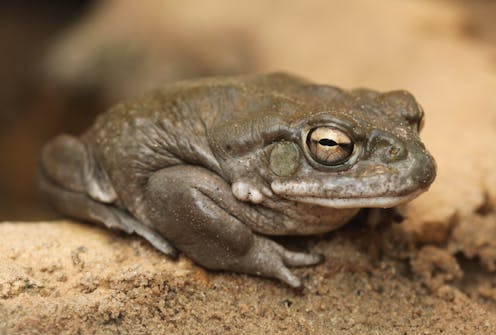
To save our birds – and potentially, ourselves – we need a better way to detect and track viral outbreaks in wildlife, particularly those which could jump across into humans.


Read more:
What is spillover? Bird flu outbreak underscores need for early detection to prevent the next big pandemic


The Conversation

Parwinder Kaur does not work for, consult, own shares in or receive funding from any company or organization that would benefit from this article, and has disclosed no relevant affiliations beyond their academic appointment.

ref. Migrating birds could bring lethal avian flu to Australia’s vulnerable birds – https://theconversation.com/migrating-birds-could-bring-lethal-avian-flu-to-australias-vulnerable-birds-204793

Fear and Wonder podcast: where to next on climate change? – Live bonus episode

Source: The Conversation (Au and NZ) – By Michael Green, Host + Producer, The Conversation

“I’m often asked if I feel hopeful for the future,” says Lesley Hughes, climate scientist and former Intergovernmental Panel on Climate Change (IPCC) author.

“For me, hope is a strategy, rather than an emotion. Because if we don’t have hope and optimism, then we all give up, and if we all give up, then we are truly lost.”

In this live bonus episode of Fear & Wonder, The Conversation’s climate podcast, recorded on May 1, host Michael Green spoke with Hughes, alongside current IPCC authors Mark Howden and Frank Jotzo.

All three guests have been at the forefront of climate science in Australia for decades. They trace how climate science went from a relatively peripheral topic to one of central importance to scientists and governments around the world.

They reflect on their respective journeys, the key takeaways from the IPCC’s most recent Synthesis Report, and the imminent challenges and opportunities for Australia and the world.

To listen and subscribe, click here, or click the icon for your favourite podcast app in the graphic above.


Fear and Wonder is sponsored by the Climate Council, an independent, evidence-based organisation working on climate science, impacts and solutions.

The Conversation

Michael Green does not work for, consult, own shares in or receive funding from any company or organisation that would benefit from this article, and has disclosed no relevant affiliations beyond their academic appointment.

ref. Fear and Wonder podcast: where to next on climate change? – Live bonus episode – https://theconversation.com/fear-and-wonder-podcast-where-to-next-on-climate-change-live-bonus-episode-204908

Jim Chalmers wants a truly independent RBA. He should be careful what he wishes for

Source: The Conversation (Au and NZ) – By Alex Millmow, Senior Fellow, Federation University Australia

Might Jim Chalmers have forgotten Labor Party history?

The treasurer says he is on board with all of the recommendations of the independent review of the Reserve Bank.

One of them – the first – is to make the bank truly independent of the government that owns it by removing the treasurer’s power overrule its board.

At the moment the Reserve Bank of Australia Act makes it clear that in the event of a disagreement between the government and bank’s board, the government has the right to force the bank to do its bidding.

In order to overrule the board, the treasurer must

submit a recommendation to the governor general, and the governor general, acting with the advice of the Federal Executive Council, may, by order, determine the policy to be adopted by the bank

The treasurer is required to inform the House of Representatives of his actions within 15 sitting days.

It’s a clause that has never been used, and the review didn’t think it was useful
to say that if an elected government controlled monetary policy, it could limit the credibility of the bank’s commitment to deliver low and stable inflation.

But Australian and Labor Party history suggests it’s there for a reason.

Theodore vs Gibson

In 1930, the Scullin Labor government was only in office two weeks before it was hit by the 1929 Wall Street crash and the beginning of the Great Depression.

The Australian government and the states had all borrowed heavily from London and faced a huge servicing cost at a time when the prices of Australia’s leading exports of wool and wheat slumped.

The London capital markets refused to lend anything else to Australia, and that, along with all of Australia’s state governments cutting back spending, put the Australian economy into free-fall.

Labor Treasurer Edward G. Theodore was economically enlightened and believed along with economist John Maynard Keynes that it made sense to use debt-financed public works to soak up unemployment.


Read more:
The RBA has got a lot right, but there’s still a case for an inquiry


Theodore wanted Australia’s Reserve Bank (then called the Commonwealth Bank) to issue treasury bills to finance the public works and provide relief to farmers.

In his way stood the independent Commonwealth Bank board and its austere chairman, Sir Robert Gibson who was an unswerving devotee of “sound finance” and wary of budgets that weren’t balanced.

In April 1931, Gibson wrote to Theodore warning that a point was being reached

beyond which it would be impossible for the Commonwealth Bank to provide further financial assistance for the government in the future

The bank was saying no to the treasurer.

Theodore replied that Gibson’s attitude

can only be regarded by the Commonwealth government as an attempt on the part of the Bank to arrogate to itself a supremacy over the government in the determination of the financial policy of the Commonwealth, a supremacy which, I am sure, was never contemplated by the framers of the Australian Constitution, and has never been sanctioned by the Australian people.

Gibson wouldn’t budge, and there was no mechanism to break the impasse.

Eventually, Theodore backed down. His successor, Joseph Chifley, was one of the commissioners on the 1937 Royal Commission into the Banking System.

The RBA was made subservient for a reason

The commission recommended that in any conflict between the bank board and the government over monetary policy, the government should prevail.

As prime minister, Chifley had the principle enshrined in the Commonwealth Bank Act of 1945, and it was later enshrined in the Reserve Bank Act of 1959.

The ultimate supremacy of the government over the Reserve Bank board was hard won – by Labor – and it is easy to imagine circumstances in which a government might need to use it.

Even the knowledge that the trigger is there, never pulled, lets the board know it is not able to go completely rogue and act against the wishes of a democratically elected government.

Chalmers ought to consider the wisdom of keeping his ultimate power in reserve.

One day, Chalmers or his successors might wish they had it.


Read more:
RBA revolution: how Chalmers will recraft the bank for the 21st century


The Conversation

Alex Millmow does not work for, consult, own shares in or receive funding from any company or organization that would benefit from this article, and has disclosed no relevant affiliations beyond their academic appointment.

ref. Jim Chalmers wants a truly independent RBA. He should be careful what he wishes for – https://theconversation.com/jim-chalmers-wants-a-truly-independent-rba-he-should-be-careful-what-he-wishes-for-204550

Who owned this Stone Age jewellery? New forensic tools offer an unprecedented answer

Source: The Conversation (Au and NZ) – By Michelle Langley, Associate Professor of Archaeology, Griffith University

Max Planck Institute for Evolutionary Anthropology

An international team of researchers has recovered DNA from the owner of a deer-tooth pendant that was buried inside a remote Siberian cave for tens of thousands of years.

In research published in Nature, Elena Essel of the Max Planck Institute for Evolutionary Anthropology in Germany and colleagues detail how they developed a new technique to extract DNA left behind on an artefact.

In much the same way police solve crimes using “touch DNA” – DNA recovered from skin cells or trace bodily fluids left behind when somebody touches an object – archaeologists will now be able to recover genetic traces of ancient humans from the artefacts they left behind.

These traces will reveal the biological sex and genetic ancestry of the individual who once held or wore a particular artefact, allowing archaeologists to link genetic and cultural evidence as they attempt to unravel the deep past.

Prehistoric artefacts and touch DNA

When archaeologists find artefacts such as tools and ornaments at a site, it’s not easy to work out who used them.

Until now, we have had to rely on finding artefacts in “direct association” with buried people. That is, we could only link an individual to an ornament if we found them buried wearing it.

Even then, this funerary association isn’t always a guide to what happened in life. The dead are buried with things their community think they should have, which may not have been theirs when they were alive.

This new method of ancient DNA extraction provides a more direct way of determining who used specific items in everyday life.

A photo of a woman in clean-room gear holding a small bone object inside a perspex box.
Elena Essel working on the pierced deer tooth discovered at Denisova Cave.
Max Planck Institute for Evolutionary Anthropology

The method can only be used for artefacts made from bone or tooth as these materials are porous and can soak up human DNA from repeated contact with bodily fluids (sweat, blood, saliva). Luckily, the bones and teeth of animals (and sometimes humans) were widely used throughout the past to create everyday tools, sacred items, and personal adornment.

These osseous artefacts were held in the hand or worn against the body for extended periods, resulting in sweat and other fluids soaking into their surfaces over time. As a result, the artefact records the genetic information of the wearer.

Through experimentation with different techniques, Essel and her team found a way to recover that DNA record in a form that is intact enough to be read.

Is this yours?

Using this new method of DNA extraction, the researchers were able to extract a wealth of archaeological information from a single tooth pendant recovered from the famous archaeological site of Denisova Cave in Siberia.

The cave, tucked away in the foothills of the Altai mountains, has fascinated researchers for decades as its past inhabitants included not only Homo sapiens but also Neanderthals and another enigmatic extinct human species known as Denisovans.

A photo of the entrance to a cave in a tree-covered hill.
Over the millennia, Denisova Cave has been inhabited by Homo sapiens as well as our extinct cousins the Neanderthals and Denisovans.
Richard G. Roberts

First, they were able to extract the DNA of the animal the tooth belonged to, a wapiti deer (Cervus canadensis).

They were then able to extract human DNA from the pores of the tooth and deduce that this DNA had come from a female individual whose ancestry is most similar to ancient people found further east in Siberia and with Native Americans.

They were also able to use the DNA data to estimate the date of the pendant’s creation, somewhere between 19,000 and 25,000 years ago. This date fits with previous radiocarbon dating of the layer of the cave floor sediment in which the artefact was found.

DNA found in soil, or “environmental DNA”, can also inform our understanding of who used an archaeological site such as Denisova Cave.

Without the extraction and analysis of the human DNA held in the tooth, archaeologists would have been able to tell what animal it had come from and how old it was. However, we could never have guessed the owner of this ornament. Now we can identify a specific individual.

Using the additional DNA information attached to individual artefacts, archaeologists will be able to create an understanding of past societies with a level of detail never before possible.


Read more:
Dirty secrets: sediment DNA reveals a 300,000-year timeline of ancient and modern humans living in Siberia


The Conversation

Michelle Langley is an Associate Professor of Archaeology in the Australian Research Centre for Human Evolution at Griffith University. She receives funding from the ARC.

ref. Who owned this Stone Age jewellery? New forensic tools offer an unprecedented answer – https://theconversation.com/who-owned-this-stone-age-jewellery-new-forensic-tools-offer-an-unprecedented-answer-204797

AI has potential to revolutionise health care – but we must first confront the risk of algorithmic bias

Source: The Conversation (Au and NZ) – By Mangor Pedersen, Associate Professor of Psychology and Neuroscience, Auckland University of Technology

Getty Images

Artificial Intelligence (AI) is moving fast and will become an important support tool in clinical care. Research suggests AI algorithms can accurately detect melanomas and predict future breast cancers.

But before AI can be integrated into routine clinical use, we must address the challenge of algorithmic bias. AI algorithms may have inherent biases that could lead to discrimination and privacy issues. AI systems could also be making decisions without the required oversight or human input.

An example of the potentially harmful effects of AI comes from an international project which aims to use AI to save lives by developing breakthrough medical treatments. In an experiment, the team reversed their “good” AI model to create options for a new AI model to do “harm”.

In less than six hours of training, the reversed AI algorithm generated tens of thousands of potential chemical warfare agents, with many more dangerous than current warfare agents. This is an extreme example concerning chemical compounds, but it serves as a wake-up call to evaluate AI’s known and conceivably unknowable ethical consequences.

AI in clinical care

In medicine, we deal with people’s most private data and often life-changing decisions. Robust AI ethics frameworks are imperative.

The Australian Epilepsy Project aims to improve people’s lives and make clinical care more widely available. Based on advanced brain imaging, genetic and cognitive information from thousands of people with epilepsy, we plan to use AI to answer currently unanswerable questions.

Will this person’s seizures continue? Which medicine is most effective? Is brain surgery a viable treatment option? These are fundamental questions that modern medicine struggles to address.

As the AI lead of this project, my main concern is that AI is moving fast and regulatory oversight is minimal. These issues are why we recently established an ethical framework for using AI as a clinical support tool. This framework intends to ensure our AI technologies are open, safe and trustworthy, while fostering inclusivity and fairness in clinical care.


Read more:
AI is transforming medicine – but it can only work with proper sharing of data


So how do we implement AI ethics in medicine to reduce bias and retain control over algorithms? The computer science principle “garbage in, garbage out” applies to AI. Suppose we collect biased data from small samples. Our AI algorithms will likely be biased and not replicable in another clinical setting.

Examples of biases are not hard to find in contemporary AI models. Popular large language models (ChatGPT for example) and latent diffusion models (DALL-E and Stable Diffusion) show how explicit biases regarding gender, ethnicity and socioeconomic status can occur.

Researchers found that simple user prompts generate images perpetuating ethnic, gendered and class stereotypes. For example, a prompt for a doctor generates mostly images of male doctors, which is inconsistent with reality as about half of all doctors in OECD countries are female.

Safe implementation of medical AI

The solution to preventing bias and discrimination is not trivial. Enabling health equality and fostering inclusivity in clinical studies are likely among the primary solutions to combating biases in medical AI.

Encouragingly, the US Food and Drug Administration recently proposed making diversity mandatory in clinical trials. This proposal represents a move towards less biased and community-based clinical studies.

Another obstacle to progress is limited research funding. AI algorithms typically require substantial amounts of data, which can be expensive. It is crucial to establish enhanced funding mechanisms that provide researchers with the necessary resources to gather clinically relevant data appropriate for AI applications.

We also argue we should always know the inner workings of AI algorithms and understand how they reach their conclusions and recommendations. This concept is often referred to as “explainability” in AI. It relates to the idea that humans and machines must work together for optimal results.

We prefer to view the implementation of prediction in models as “augmented” rather than “artificial” intelligence – algorithms should be part of the process and the medical professions must remain in control of the decision making.


Read more:
Biased AI can be bad for your health – here’s how to promote algorithmic fairness


In addition to encouraging the use of explainable algorithms, we support transparent and open science. Scientists should publish details of AI models and their methodology to enhance transparency and reproducibility.

What do we need in Aotearoa New Zealand to ensure the safe implementation of AI in medical care? AI ethics concerns are primarily led by experts within the field. However, targeted AI regulations, such as the EU-based Artificial Intelligence Act have been proposed, addressing these ethical considerations.

The European AI law is welcomed and will protect people working within “safe AI”. The UK government recently released their proactive approach to AI regulation, serving as a blueprint for other government responses to AI safety.

In Aotearoa, we argue for adopting a proactive rather than reactive stance to AI safety. It will establish an ethical framework for using AI in clinical care and other fields, yielding interpretable, secure and unbiased AI. Consequently, our confidence will grow that this powerful technology benefits society while safeguarding it from harm.

The Conversation

Mangor Pedersen receives funding from the Health Research Council of New Zealand and the Australian Medical Research Future Fund.

ref. AI has potential to revolutionise health care – but we must first confront the risk of algorithmic bias – https://theconversation.com/ai-has-potential-to-revolutionise-health-care-but-we-must-first-confront-the-risk-of-algorithmic-bias-204112

Teaching and research are the core functions of universities. But in Australia, we don’t value teaching

Source: The Conversation (Au and NZ) – By Sally Patfield, Senior Research Fellow, Teachers and Teaching Research Centre, University of Newcastle

Yan Krukau/Pexels

This article is part of our series on big ideas for the Universities Accord. The federal government is calling for ideas to “reshape and reimagine higher education, and set it up for the next decade and beyond”. A review team is due to finish a draft report in June and a final report in December 2023.


Teaching and research are the two core functions of Australian universities.

But teaching has long been treated as the poor cousin of higher education. It is generally considered low status, given little professional recognition, and sometimes even seen as the domain of those academics who are not successful researchers.

Indeed, the Universities Accord terms of reference, released in November 2022, didn’t explicitly include teaching as a priority theme for review. It was only mentioned in passing in relation to access and affordability.

It was more prominently included in the accord discussion paper released in February this year. This noted:

Strength in higher education teaching is a critical element in ensuring strength in the sector as a whole.

While this ambition reaffirms the core role of teaching, this goal must now be taken seriously. This needs to be through national and institutional commitments to support quality teaching.

The devaluing of teaching in higher education

Teaching lies at the heart of creating a high-quality learning environment and producing a high calibre of graduates.

Yet the teaching of university students has long been devalued in Australian higher education.

Academics are supposed to teach well, but it’s assumed simply being a subject expert is enough. Significantly, most undergraduate teaching is now done by casual academics, who are frequently paid exclusively to teach but receive no professional development to do so.


Read more:
‘Some of them do treat you like an idiot’: what it’s like to be a casual academic


Despite federal government talk about wanting to ensure better outcomes for students, industry and the community, cuts to national teaching initiatives have also signalled a disregard for teaching.

For example, in 2016, the Coalition government cut funding to the Office for Learning and Teaching, a peak body that drove quality and innovation in university teaching. Since then, there has been no equivalent body to replace it.

Teaching also takes a backseat to research as an indicator of success. In international rankings, the “best” universities are commonly the most research-intensive. Within institutions, academics also say research is highly regarded when applying for promotion, with relatively little merit given to teaching performance.

A woman writes on a whiteboard.
Academics are supposed to teach well, but it’s assumed simply being a subject expert is enough.
Christina Morillo/Pexels

What does ‘quality teaching’ mean?

Renewed commitment to teaching at university requires an urgent shift from narrow understandings of what constitutes “quality teaching” across the sector.

Quality teaching has many different meanings in higher education, but few – if any – get to the heart of supporting academic staff to deliver effective teaching.

The national Quality Indicators for Learning and Teaching focus on three different areas of quality: the student experience, graduate outcomes and employer satisfaction. These indicators speak to different stakeholder concerns and outcomes – which are important in and of themselves – but don’t provide any clarity or guidance on what constitutes “good teaching”.

Student evaluations and teaching awards are marketed by universities as evidence of “quality teaching”. However, evaluations do little more than reveal student biases. They reflect perceptions of a teacher rather than anything to do with their actual teaching. And awards only allow a small number of academics to be recognised as “good teachers”.

These examples demonstrate how the management of teaching has become the dominant focus rather than the practice of teaching.


Read more:
Australian unis could not function without casual staff: it is time to treat them as ‘real’ employees


A new way to ensure quality teaching

The Universities Accord could signal a genuine commitment to quality teaching if it reinstated a peak national body focused on the scholarship of teaching and learning in higher education.

At an institutional level, the accord must also invest in the professional development of academics, including casual staff.
Our research shows this can be achieved by providing a strong conceptual understanding of what quality teaching looks like in the university classroom.

In 2019–2020, we trialled the Quality Teaching Model as a mechanism to underpin teaching professional development with 27 academics. The QT Model is an evidence-based, practical framework to help academics generate constructive feedback and develop meaningful evidence to transform teaching and learning. This approach was adapted from a model education academics James Ladwig and Jenny Gore developed for the New South Wales Department of Education for use in schools.

The QT Model focuses attention on three core dimensions of “good” teaching practice. These are:

  1. intellectual quality: developing deep understanding of important ideas

  2. quality learning environment: ensuring positive classrooms that boost student learning

  3. significance: connecting learning to students’ lives and the wider world.

We worked with academics from a range of disciplines and at different career stages across designated teaching periods.
When interviewed, participants reported the QT Model helped them feel their teaching was valued. They reported it reinvigorated many aspects of academic work, including course planning, collaboration within and across disciplines, and improving students’ learning experiences.


Read more:
Our study found new teachers perform just as well in the classroom as their more experienced colleagues


Where to from here?

The key legislation guiding higher education in Australia mandates academics should not only have relevant disciplinary knowledge, but also skills in contemporary teaching, learning and assessment.

A book with marked by coloured tabs on a table.
We need to prioritise the scholarship of teaching and learning.
Cottonbro Studio/Pexels

But supporting quality teaching has always been a struggle.

The accord is a crucial opportunity to ensure universities deliver their core function of teaching. This is possible and achievable by reinvesting in the scholarship of teaching and learning, along with meaningful professional development in teaching for all academic staff.

This will require a strong commitment from government and the university sector.

Australian academics are already stressed, face huge workloads and are part of a workforce that has been casualised and endured mass redunancies. They also have to cope with the challenges of online learning and uncertainty around what Artificial Intelligence means for teaching and learning.

University students can’t receive a quality education without quality teaching. It is high time we recognise this and do something meaningful about it.

The Conversation

Sally Patfield currently receives funding from the NSW Department of Education and the Paul Ramsay Foundation. The study on which this piece is partially based was funded through the Vice-Chancellor’s Strategic Initiatives Fund at the University of Newcastle.

Elena Prieto-Rodriguez receives funding from from the Australian Research Council, Paul Ramsay Foundation, NSW Roads and Maritime Services, Glencore Coal Assets Australia, Google Australia, GHD, Bradken Resources, Newcastle Coal Infrastructure Group, BHP Billiton and the NSW Department of Education.

Jenny Gore receives funding from the Australian Research Council, Paul Ramsay Foundation and NSW Department of Education. With University of Newcastle colleague, James Ladwig, she developed the Quality Teaching Model for the NSW Department of Education.

ref. Teaching and research are the core functions of universities. But in Australia, we don’t value teaching – https://theconversation.com/teaching-and-research-are-the-core-functions-of-universities-but-in-australia-we-dont-value-teaching-203657

Government to spend $11.3 billion over four years to fund 15% pay rise for aged care workers

Source: The Conversation (Au and NZ) – By Michelle Grattan, Professorial Fellow, University of Canberra

Tuesday’s budget will include $11.3 billion over four years to fund the 15% pay rise aged care workers will receive from July 1.

The rise was awarded by the Fair Work Commission. Labor committed at last year’s election to fully fund a rise in pay for this sector.

Given acute staff shortages, it is hoped that the higher wages will attract more workers.

The pay rises will benefit more than 250,000 people.

A registered nurse on a level 2.3 award wage will receive an extra $196.08 a week – more than $10,000 a year.

A personal care worker on a level 4 (aged care award) or a home care worker on a level 3.1 (social, community, home care and disability services award) will get an extra $141.10 weekly – more than $7300 annually.

Recreational officers and chefs in the sector also are in line for increases.

Treasurer Jim Chalmers said that “for too long, those working in aged care have been asked to work harder for longer without enough reward, but with this budget that changes”.

Aged Care Minister Anika Wells said that “fair wages play a major role in attracting and retaining workers”.

Aged care is now the fifth-largest area of federal government spending.
This financial year the cost of aged care will increase from $24.8 billion to an estimated $29.6 billion (23%).


Read more:
Politics with Michelle Grattan: NDIA chair Kurt Fearnley on ‘fundamental’ reform of the disability scheme


There are about 1.5 million recipients of aged care in Australia, with growing pressures on the system ahead as the population ages.

In a round of Wednesday media appearances, Chalmers reiterated next week’s budget would contain “substantial cost-of-living relief”.

“It’ll prioritise the most vulnerable. It won’t just be limited by age, and it will be responsible.”

Chalmers said the budget would forecast the economy slowing considerably but not going into recession.

“The budget will be a difficult balancing act, between providing the cost-of-living relief that people need, being conscious of the pressures on the budget and all of that debt that we inherited, but also making sure that we can grow our way out of this slowing economy by investing in things like energy and laying some of these foundations for growth in our economy.”


Read more:
Word from The Hill: Another rate rise, higher tax on cigarettes, and likely JobSeeker boost for over-55s


Chalmers said the budget would also contain efforts “to get people into work if they want to work, including in communities where there has been for too long entrenched disadvantage”.

“We’ve got colleagues working on the job agency system to make sure that if people want to work, they can grab the opportunities of an economy that’s got unemployment currently running at three and a half per cent.”

The Conversation

Michelle Grattan does not work for, consult, own shares in or receive funding from any company or organization that would benefit from this article, and has disclosed no relevant affiliations beyond their academic appointment.

ref. Government to spend $11.3 billion over four years to fund 15% pay rise for aged care workers – https://theconversation.com/government-to-spend-11-3-billion-over-four-years-to-fund-15-pay-rise-for-aged-care-workers-204919

Politics with Michelle Grattan: NDIA chair Kurt Fearnley on ‘fundamental’ reform of the disability scheme

Source: The Conversation (Au and NZ) – By Michelle Grattan, Professorial Fellow, University of Canberra

The federal government is trying to contain the exploding cost of the landmark National Disability Insurance Scheme – especially difficult given the fears of vulnerable people who rely on it.

National cabinet’s decision last week to aim to reduce the cost increase from the current 14% annually down to 8% by 2026 received a sharp reaction from disability advocates. This financial year the NDIS will cost more than $35 billion, two thirds paid by the federal government.

The government has flagged areas for change and there is also a review being done.

In this podcast, former Paralympian Kurt Fearnley, chair of the National Disability Insurance Authority, which implements the scheme, discusses its issues and the road ahead.

Fearnley says the NDIS broadly “is working really well”, while acknowledging parts need significant overhaul if it is to be financially sustainable.

“There are parts of the scheme that would require pretty fundamental reform” – but that reform will need to “walk hand in hand” with participants.

The government has announced more than $720 million over four years for the NDIA: Fearnley says: “It will allow us to build an agency that is better positioned to answer and respond to the participant in a quick away, but also be able to build an agency that is better positioned to ensure that we are focused on the outcomes that we all fought for.”

“This scheme has been working for a lot of communities. Unfortunately, it’s also had its complications with ensuring that we are engaging with First Australians in a way that is appropriate, that allows the Indigenous Australians the ability to be able to thrive on this scheme.”

“So there’s lots of areas of reform, but it will all hinge on whether or not we’re able to create a system that has the participants’ voice heard at every step.”

A key area of reform is making the scheme less complex. Fearnley recounts a situation he experienced recently as an example.

One mother “broke down, she was in tears describing her interactions between the agency and a service provider. We encourage an evidence-based approach to the experience of the child within the scheme. And then this parent is speaking about how they felt like their child was considered an ATM to a third party service.

“Choice and control is beautiful to one and tough for others. We have built this incredible system […] It is there servicing 590,000 people, all with there unique experience with disability, and it’s the choice and control element that I think could be overwhelming for a new participant.

“It’s fundamentally reforming in an incredible, bloody amazing, empowering concept for an individual with disability who was never, in many instances, never asked what they want out of life.

But disability is “one of the most complex experiences in life. As a person with a disability, I’ve been able to find my pathway over a long period of time. And that’s where I think the choice and control element is amazing. But I do think it has its challenges in other parts.”

The Conversation

Michelle Grattan does not work for, consult, own shares in or receive funding from any company or organization that would benefit from this article, and has disclosed no relevant affiliations beyond their academic appointment.

ref. Politics with Michelle Grattan: NDIA chair Kurt Fearnley on ‘fundamental’ reform of the disability scheme – https://theconversation.com/politics-with-michelle-grattan-ndia-chair-kurt-fearnley-on-fundamental-reform-of-the-disability-scheme-204922

Job creation isn’t always a good thing. Hobart’s new stadium can only make Tasmania’s housing crisis worse

Source: The Conversation (Au and NZ) – By John Quiggin, Professor, School of Economics, The University of Queensland

The Albanese government’s announcement it will provide $240 million for a new stadium in Hobart has not had the favourable reception it might have hoped.

Those concerned with the proper operation of the federal system can point out that this kind of funding is the concern of state and local governments.

Anthony Albanese's Twitter account spruiks the federal funding for Tasmania.

Twitter, CC BY

Concerns about process are reinforced by the sorry history of “sports rorts”. Both Labor and Liberal federal governments have funded sports facilities to curry political favour.

To be fair, it is hard to see this project as targeted at a particular seat, but presumably the aim was to win support in Tasmania as a whole. Even compared with the dubious economics of sporting events such as the Formula 1 Grand Prix and the Olympic Games, stadium developments stand out as boondoggles.

Extensive research in the US is summarised by the conclusion that over the past 30 years, building sports stadiums has been a profitable undertaking for large sports teams, at the expense of the general public.

While there are some short-term benefits, the inescapable truth is the economic benefit of these projects for local communities is minimal. Indeed, they can be an obstacle to real development.


Read more:
Devils in the detail: an economist argues the case for a Tasmanian AFL team – and new stadium


Making the business case

The economic case for the Hobart Stadium is startlingly thin. The only clear-cut benefit attributable to the project is that the new Tasmanian AFL team will play its home games there, replacing the small number of AFL rounds played at Hobart’s existing stadium, Bellerive Oval.

In 2022, eight AFL men’s games were played in Tasmania – four at Bellerive, four at UTAS Stadium in Launceston. A local AFL team will play 11 home games.

The state government’s business case estimates that 5,000 interstate visitors will attend seven matches a year. It seems safe to assume some will fly in and out on the same day, and that few will stay more than two nights.

If we allow an average of one night per visitor, that’s 35,000 bed nights, or an increase of about 0.3% in current visitor nights for Tasmania (about 11 million a year in 2022).

Against that must be offset the Tasmanians who will travel to Melbourne and elsewhere for away games.

What about housing?

All of this is par for the course for projects of this kind. The big problem for both state and federal governments is that it comes at a time of a housing crisis.

The federal government’s press release contains some vague references to housing developments associated with the project. But this is little more than the sort of PR spin we’d expect from, for example, the proponents of a new coal mine.

The numbers here are quite startling. The centrepiece of federal Labor’s election platform was a $10 billion fund for housing, providing $500 million year to support social housing. (Labor’s bill is currently held up in the Senate, with the Coalition opposed, and the Greens demanding stronger action.)


Read more:
Labor’s proposed $10 billion social housing fund isn’t big as it seems, but it could work


If this $500 million were allocated proportionally by population, Tasmania would get about $10 million a year. The Commonwealth’s $240 million contribution to the stadium would cover this expenditure until nearly 2050. The total public outlay on the Hobart stadium (with $375 million from the Tasmanian government) would cover most of this century.

At a time of extreme fiscal stringency, such a massive outlay on a luxury project is very hard to justify.

What about job creation?

No serious benefit-cost analysis of this project has been made. Instead, supporters have relied on announcing the number of jobs it will create – 4,200 jobs during construction and 950 jobs when operational.

Such numbers are questionable. To make them bigger, governments typically count on the “multiplier effect” of work created for suppliers of various kinds. This is a long-standing tradition taken to new heights by the Albanese government. The announcement of the AUKUS submarine project, for example, was all about the jobs it would create.


Read more:
$18 million a job? The AUKUS subs plan will cost Australia way more than that


But wait a moment. At the same time as trumpeting the creation of jobs for construction workers, the government is seeking to solve Australia’s “skills shortage” arising from historically low unemployment.

Tasmania’s unemployment rate is 3.8%, marginally above the average for Australia, but lower than at any time since the economic crisis of the 1970s. This low rate represents a situation of full employment, where numbers of unemployed workers and job vacancies are roughly equal.

In such circumstances, creating a job means luring a worker away from another. If the new job is on a major construction project, that means one less worker available to build housing.

As I argue in my book, Economics in Two Lessons (Princeton University Press, 2019), the true costs of wasteful public expenditure are opportunity costs – the alternatives that are foregone.

Multiplier effects make opportunity costs even larger. The project diverts the workers employed directly, and takes all kinds of resources that could otherwise be used for socially useful purposes. This diversion of necessary resources is the truly pernicious aspect of publicly subsidising projects like the AFL stadium.

Tasmania, like the rest of Australia, does not need government action to create any more jobs, particularly in construction. It needs to ensure skilled workers are employed where they can be most valuable.

The Conversation

John Quiggin does not work for, consult, own shares in or receive funding from any company or organisation that would benefit from this article, and has disclosed no relevant affiliations beyond their academic appointment.

ref. Job creation isn’t always a good thing. Hobart’s new stadium can only make Tasmania’s housing crisis worse – https://theconversation.com/job-creation-isnt-always-a-good-thing-hobarts-new-stadium-can-only-make-tasmanias-housing-crisis-worse-204806

Can vaping help people quit smoking? It’s unlikely

Source: The Conversation (Au and NZ) – By Simon Chapman, Emeritus Professor in Public Health, University of Sydney

Shutterstock

Australian Health Minister Mark Butler has announced a major policy shift on vaping. Its two primary objectives are to make it harder for children and non-smokers to access vapes and to allow people trying to quit smoking to access nicotine vapes with a prescription.

Vapes are unquestionably popular, with many who vape saying they are trying to quit or to cut down on cigarettes. “Recreational” vapers of any age with no interest in quitting will find themselves frozen out.

But can vapes actually help significant numbers of people quit smoking? The evidence suggests it’s unlikely.


Read more:
A potted history of smoking, and how we’re making the same mistakes with vaping


Myth of the ‘hardened smokers’

First, let’s bust a widely believed myth. With smoking at an all time low, some experts argue today’s smokers are the die-hard addicts: frequently relapsing smokers who just can’t quit.

Whenever this hypothesis has been tested it has been found wanting. In nations where smoking prevalence has fallen most, we would expect (if the hypothesis was true) that indicators of hardened smokers (such as average number of cigarettes smoked per day) would be rising because the remaining smokers would be over-represented by heavy, addicted smokers.

But according to a 2020 review of 26 studies:

Some have argued that a greater emphasis on harm reduction or intensive treatment approaches is needed because remaining smokers are those who are less likely to stop with current methods. This review finds no or little evidence for this assumption.

In other words, there is no evidence long-term smokers are impervious to the suite of tobacco control policies and campaigns that have driven hundreds of millions of smokers around the world to quit.

Ashtray close up
The idea that ‘hardened smokers’ can’t quit is a myth.
Shutterstock

Vapes don’t help smokers cut back

The idea that vaping helps people smoke fewer cigarettes isn’t supported by the evidence. Studies of the number of cigarettes foregone by vapers who still smoke have shown that, compared with smokers who never vape, the average daily cigarette consumption is very similar.

Data from 2019 from the United Kingdom government’s annual Opinions and Lifestyle Survey also show the average number of cigarettes smoked daily by smokers who vape (8 a day) is almost identical to that by smokers who have never vaped (8.1 a day).

A 2018 paper considered the surge in e-cigarette use in England and whether this was reducing the number of cigarettes being smoked at the population level across the country. The authors concluded:

No statistically significant associations were found between changes in use of e-cigarettes […] while smoking and daily cigarette consumption. Neither did we find clear evidence for an association between e-cigarette use […] specifically for smoking reduction and temporary abstinence, respectively, and changes in daily cigarette consumption.

If use of e-cigarettes […] while smoking acted to reduce cigarette consumption in England between 2006 and 2016, the effect was likely very small at a population level.

How effective are vapes in quitting?

The most recent Cochrane review of randomised controlled trials compared vaping with nicotine replacement therapy (such as drugs, gums and patches). It found about 82% of people who vape are still smoking when followed up six or more months later.

This was better than those using nicotine replacement therapy: 90% were still smoking.

Neither nicotine replacement therapy or vapes are hugely disruptive of smoking. You certainly wouldn’t be confident using a drug for any health issue that had a 82-90% failure rate.


Read more:
Drugs, gums or patches won’t increase your chances of quitting


GP listens to patient
Nicotine replacement therapies aren’t very effective at helping people quit.
Shutterstock

Randomised controlled trials also poorly reflect the ways vapes and nicotine replacement therapy are used in the real world and aren’t representative of all smokers wanting to quit.

A review of 54 randomised controlled trials on quitting smoking, for example, found two-thirds of smokers with nicotine dependence would have been excluded from clinical trials by at least one criterion. This may result in participation biases, which reduce the applicability of the results to smokers at large, or even smokers at large who want to quit.

This, and other factors, make randomised controlled trials likely to overestimate effectiveness, as I outline in chapter two of my book.

What does the real-world evidence show?

The best evidence we have about how vapes perform comes from studies where large numbers of vapers are followed for several years. The US Population Assessment of Tobacco and Health (PATH) project, for example, has been collecting national cohort data on 46,000 Americans since 2013.

As the PATH data below show, when randomly selected groups of vapers are followed up at 12 months, the most common outcome is those who were smoking and vaping at the beginning of the study period will still be vaping and smoking at the end of the 12 months.

The most common outcome is those who were smoking and vaping at the start were still doing both 12 months later.
Data from the US Population Assessment of Tobacco and Health (PATH) project

I’ve summarised 16 other reviews and expert group conclusions of the evidence published since 2017. Words like “low quality”, “inconclusive”, “insufficient”, “weak”, “low level” and “limited” abound.

The upshot?

The prescription vapes access scheme’s most important population effect is likely to be that it will massively reduce access to vapes by children. State governments will start hitting retailers illegally selling with massive fines and Border Security will do the same with importing suppliers.

Taiwan fines sellers a maximum of US$1.65 million, with a minimum of US$330,000. The current maximum fine in New South Wales is currently only A$1,600. Such a fine would barely raise dust in big retailers’ petty cash drawers.

Based on the research, we might expect 10-18% of vapers using the prescription scheme to quit within 12 months (with some relapse expected), but many more will quit unassisted.

Preventing new generations of kids from becoming addicted to nicotine and more likely to start smoking is a huge policy advance that is hugely welcome.


Read more:
Vaping and behaviour in schools: what does the research tell us?


The Conversation

Simon Chapman does not work for, consult, own shares in or receive funding from any company or organisation that would benefit from this article, and has disclosed no relevant affiliations beyond their academic appointment.

ref. Can vaping help people quit smoking? It’s unlikely – https://theconversation.com/can-vaping-help-people-quit-smoking-its-unlikely-204812

60 years of The Australian Ballet and 90 years of ‘Australian’ ballet: Identity asks us to reflect on Australian dance today

Source: The Conversation (Au and NZ) – By Yvette Grant, PhD (Dance) Candidate and Dance History Tutor, The University of Melbourne

Daniel Boud/The Australian Ballet

When The Australian Ballet was founded in 1962, its charter stated that, alongside international repertoire and visiting international choreographers, it must engage Australian choreographers and produce Australian works.

But what does “Australian” look like in ballet?

In 1989, dancer, teacher, choreographer and director of The Ballet Guild (later Ballet Victoria) Laurel Martyn was asked about what it meant for ballet to be Australian:

It’s Australian because it comes out of our experience, what we think, how we do things […] It must come out of our own lives, our own way of seeing.

Martyn had choreographed her first Australian ballet in 1941. The project of creating Australian ballet is not a new one.

In 1964, Robert Helpmann claimed his ballet The Display was the first Australian ballet, because it was the first with an Australian score, designer, story and choreographer.

His ballet met all those criteria with its Aussie rules football, machismo, bush picnics and lyrebirds – but there had been many much earlier than his.

Like Helpmann’s ballet, some focused on Australian cultural life, such as Kira Bousloff’s The Beach Inspector (1958) and Rex Reid’s The Melbourne Cup (1963).

Others celebrated Australian industry. Joanna Priest’s The Lady Augusta (1946) was about the maiden voyage of a steamship along the Murray River to transport wool. Valrene Tweedie’s Wakooka (1955) was about life on a sheep station.

Still others looked to the rich natural environment, such as Martyn’s Voyageur about Australian migratory birds (1956).

And there were those that appropriated Australian Indigenous culture in their attempt to create an identity of this place. The most infamous of these was Beth Dean’s Corroboree with white dancers in blackface performing for Queen Elizabeth II in 1954.

Since then, Australian ballet has radically transformed the way that it includes First Nations identity in its construction of what it means to be Australian. The 1989 founding of Bangarra Dance Theatre was key to this new Australian identity in dance.

A reflection of this transformation was The Australian Ballet’s 1997 work Rites, a creation of then Bangarra artistic director Stephen Page. Page brought the two companies together in a First Nations’ reimagining of Stravinsky’s Rite of Spring.

At The Australian Ballet’s 30th anniversary in 1992, the company staged an Australian reimagining of The Nutcracker, choreographed by Graeme Murphy.

Murphy’s ballet told a story of the importance of migration to Australia: a history of how war in Europe had led many Russian dancers to stay, enriching our cultural landscape and firmly setting ballet’s roots in this country.

Now, for its 60th anniversary, the company is again asking what is an “Australian ballet”. This time it’s answering the question with a two-part program Identity. Identity features Wiradjuri man Daniel Riley’s THE HUM, a collaboration with Australian Dance Theatre, and Alice Topp’s Paragon, which brings back to the stage many company alumni.

Both works demonstrate an approach to creating an Australian ballet that, as the program suggests, “explores the community of the stage”. They each return to Martyn’s statement that for ballet to be Australian it must come from us.

Who is on that stage as part of that community, then, becomes critical.


Read more:
Explainer: what is contemporary dance?


THE HUM

THE HUM has a powerful First Nations presence including choreographer Riley, composer Deborah Cheetham Fraillon, costume designer Annette Sax and dancer Karra Nam, and engages a conversation not only with white settler Australia but also between contemporary dance and ballet.

Dancers encounter each other with a deep breath in. Holding their gaze, they drop twice at the knees with two short sharp outbreaths: confrontation and common ground.

Dancers on stage under a neon orange sun.
THE HUM brings together dancers of The Australian Ballet and Australian Dance Theatre.
Daniel Boud/The Australian Ballet

Black rock formations that frame the stage are turned around and repurposed, their constructed nature exposed, a metaphor for our inherited Australian identity.

Neon lights and projected computer-generated images combine with the natural moon, water and tree branches, reminding us we are both of country and city in the 21st century.

Dancers
Who is on the stage as part of a community becomes critical.
Daniel Boud/The Australian Ballet

THE HUM shows a community where members are finally facing each other but haven’t yet worked out who they are together – although they know where to begin. The audience is equally tasked with this provocation.

Paragon

In Paragon, Topp shows us who The Australian Ballet has been in footage, images, dance styles and in the returning dancers who carry the company’s history in their bodies. These include Marilyn Rowe, who had her debut with the company in 1965, Simon Dow, who joined in 1974, and Lucinda Dunn, who danced with the company for 24 years until 2014.

Topp also shows us who we might be into the future in the bodies of the company’s young dancers.

And in bringing these elements together on the one stage, she shows us where we are now.

David McAllister
Paragon brings company alumni to the stage with the current crop of dancers.
Daniel Boud/The Australian Ballet

The work exudes a combination of strength and tenderness. Avoiding any trumpet blowing, it offers a thoughtful and sometimes playful celebratory reflection: achingly nostalgic yet its own contemporary work.

Divided into 12 parts, it juxtaposes lyrical pas de deux in Grecian white with powerful ’80s Spartacus-style male corps de ballet in black; almost floating 19th-century ladies in long gold ball gowns moving through elegant formations with sets of duos in studio wear moving independently or in canon.

Amber Scott and Adam Bull
Paragon is achingly nostalgic yet its own contemporary work.
Daniel Boud/The Australian Ballet

The ages of the dancers are highly visible. Older and younger bodies dance on the ballet stage together, demanding our attention. Much like THE HUM, Paragon is a result of this community, an honouring of ancestors and a revelation of ever-present history.

The Australian identity is a work in progress, but in Identity it is heartening to witness that one of our iconic cultural institutions is up for the challenge.

Identity is at the Sydney Opera House until May 20, and then at Arts Centre Melbourne June 16-24.


Read more:
5 Australian women choreographers you should know (and where to see them in 2023)


The Conversation

Yvette Grant receives funding from an Australian Commonwealth Scholarship.

ref. 60 years of The Australian Ballet and 90 years of ‘Australian’ ballet: Identity asks us to reflect on Australian dance today – https://theconversation.com/60-years-of-the-australian-ballet-and-90-years-of-australian-ballet-identity-asks-us-to-reflect-on-australian-dance-today-203931

Samoa Observer: 2023 World Press Freedom Day – reflection, celebration

EDITORIAL: By the Samoa Observer editorial board

There will be celebrations as well as self-contemplation in newsrooms around the world today to mark World Press Freedom Day 2023, with the Fourth Estate facing some of its biggest challenges yet.

It was only close to two years ago when Samoa’s constitutional crisis tested the resolve of the media industry, with the nation, as well as families and households, split along political party lines, to also put further pressure on journalists and media practitioners who were working hard on the frontlines to keep the nation abreast of the historical political developments.

Battered and exhausted from the weeks of political turmoil at that time, sandwiched between two political camps, the task of informing the nation and its citizens of a new government was left to the Samoan media industry.

Samoa Observer
SAMOA OBSERVER

It was our job to pick up the pieces and report back to the nation as best as we can on what just occurred and to continue to give the message of hope and assurance to the general population that the seat of government didn’t change, it was just that the custodianship of the seat of government had changed hands.

And the journey of this great nation continues nonetheless.

So just over two years after the last general election, the trigger of the constitutional crisis, this newspaper demonstrates its ongoing commitment to improvement and growth by launching a new design to give our readers a more content-rich experience.

New features include “funday” pages and “news in numbers” while keeping a foot in the digital world with QR codes for “today’s top 10 stories” at a touch of a button on your smartphones.

Core business
This newspaper’s core business of informing, educating, and empowering its readership with the latest news and information has not changed.

In fact, the goal post hasn’t changed too with this newspaper committed to the values upheld by its founder, Gatoaitele Savea Sano Malifa to seek the truth, hold governments to account, and report without fear or favour.

The celebration of World Press Freedom Day 2023 today revolves around the theme “Shaping a Future of Rights: Freedom of expression as a driver for all other human rights”.

We believe the theme of today’s celebrations, set by the United Nations Educational, Scientific and Cultural Organisation (UNESCO), succinctly highlights the importance of freedom of expression and its intrinsic link to the media and how it is through freedom of expression that we get to promote all other human rights.

According to UNESCO, four fundamental freedoms are outlined in the Preamble of the 1948 Universal Declaration of Human Rights: freedom of speech, freedom of belief, freedom from fear, and freedom from want.

But it is the freedom of speech that comes first as it is the fundamental freedom that enables all the other rights.

“The right to freedom of expression and its corollary, the right to access information, allow us to seek, receive and impart information, ideas, concepts, and beliefs across borders and cultures.

Essential role
“And in this exercise, the media and journalists play an essential role: they help verify and disseminate facts, they create spaces for ideas to be debated and for the voiceless to be heard, and they render complex matters intelligible for the public at large.”

And we hope too for more press conferences convened by leaders in the government to enable us in the media to do our jobs and a better understanding and appreciation of the role of the media and its contribution to Samoa’s development.

On that note, we take this opportunity to wish our colleagues in Samoa’s media industry Happy World Press Freedom Day 2023 celebrations.

Seeing colleagues appear on television, listening to them on the radio, or seeing their bylines in their online content confirms that we’ve just got on with the business of informing the nation despite the challenges we’ve faced.

And there is no better gift to this nation of 200,000 than to maintain our focus on our primary responsibility to bring them news on issues that directly impact their lives.

Even though we fall and stumble sometimes, as we go about our work to keep the country informed, let’s strive to better ourselves for the good of our readers, listeners, and viewers.

The Samoa Observer has traditionally been one of the leading Pacific newspapers fighting for press freedom.This editorial was published on 3 May 2023 – World Press Freedom Day — and is republished with permission. 

Print Friendly, PDF & Email

Article by AsiaPacificReport.nz

What do white staff do in remote Indigenous art centres?

Source: The Conversation (Au and NZ) – By Una Rey, Senior Industry Affiliate, RMIT University

Shutterstock

In April, The Australian published the results of a four-month investigation into white staff “interference” at Tjala Arts, a member of the APY Arts Centre Collective of Indigenous art centres across South Australia.

It included a video of an art centre manager painting on Yaritji Young’s canvas, to “juice it up” a bit.

The ongoing media commentary has been divisive and confusing. One question it raises is what do art managers and studio assistants actually do in remote Indigenous community art centres?


50 years of arts centres

Remote art centres are central to today’s internationally successful Indigenous contemporary art industry. They typically have a white art centre manager and other staff overseen by an Indigenous board.

Papunya Tula Artists in Central Australia, incorporated in 1972, is the common ancestor of the publicly funded art centre model.

Papunya Tula marked the transition from the paternalism of the mission era to Indigenous self-determination, supported by the establishment of the Aboriginal Arts Board.

On May 3 1973, a press release from Prime Minister Gough Whitlam’s office announced:

Aboriginals have been given full responsibility for developing their own programs in the arts under a new Government policy to revitalise cultural activities through the Australian Council for the Arts.

What followed was a revolution, led by and for Aboriginal artists, with non-Indigenous staff employed to mediate with the art world.

Today, this workforce are mostly young women with degrees in visual art or arts management. They operate in around 90 Aboriginal-owned collectives across remote Australia. Staff turnover is high, and recruitment is a perennial task.


Read more:
40 years on: how Gough Whitlam gave Indigenous art a boost


A cross-cultural thing

The troubling fact is not that “Aboriginal art is a white thing”, as Aboriginal artist and activist Richard Bell famously declared in 2002. Rather, Aboriginal art is “a cross-cultural thing”, bringing Indigenous and non-Indigenous creative workers together.

Despite the shared goal and triumphs of the cultural industries in celebrating Indigenous art, the shadow of Australia’s colonisation is never far away.

The conditions in remote art centres have evolved since the 1970s, but the practicalities are essentially the same. Art centre staff support the artists socially, culturally and logistically to ensure artists are happy to create their work in a culturally safe space.

Staff also manage the external demands of the market, exhibition schedules, bureaucratic accountability (to funding bodies and institutions, for example) and advocacy.

Studio assistance involves purchasing art materials, stretching and priming canvas, harvesting raw material such as ochre, bark or timber, as well as packing, freighting and distributing the work and travelling with artists to exhibitions.

The level of support depends on an individual artist’s needs. Art centres often include the elderly and artists with a disability. Some artists have a strong creative drive; some work slowly or inconsistently.

Whatever the art form, good work takes considerable time. Art production is frequently interrupted “mid-canvas” to attend to other business such as cultural events, funerals or medical treatment.


Read more:
Aboriginal art: is it a white thing?


A collaborative space?

The APY Art Centre Collective management strongly denied allegations of any interference with the paintings or “the Tjukurrpa” (the Aṉangu term for their comprehensive spiritual belief system). Their website currently states hands-on assistance, such as “underpainting”, is common practice.

Selecting colours and mixing paint, priming and delegating canvases, washing brushes and general maintenance, as well as regular discussion and responsiveness to the art are all part of the studio assistant’s role.

Some aesthetic influence on the final product is only natural, but painting directly on the canvas is never part of the job description. Undeclared, many would consider it fraudulent.

In 1997, when I first went to work in a Western Desert art centre, the message from the artists was simple: sell our paintings, and be straight with us.

It was also clear the paintings offered for sale – to public institutions, knowledgeable collectors and souvenir buyers – would be of a certain standard.

“Quality control” is an ambivalent term, but it is implied and expected in the job.

In 1996 Kathleen Petyarre won the lucrative Telstra Art Award for her painting Storm in Atnangkere Country II. It was later revealed she was “assisted” by her white partner.

Following an inquiry, Petyarre retained her rightful authorship of the work, but this prompted art centres to recognise “creative labour”, when delegated by the artist and particularly among family, as culturally accepted practice — which should be attributed accordingly.

The right to determine who gets to collaborate on artwork, and how, applies to artists worldwide. The studios of Jeff Koons and Damien Hirst are extreme examples of art making being undertaken by studio assistants. So too, Aboriginal artists enjoy workshops with specialists in fields as varied as printmaking, bronze casting, animation or glassmaking.

It’s up to the artists first, and the institutions, curators, the market and art critics next, to evaluate such collaborations and exchanges case by case.

Cultural narratives and daily realities

A key role in art centres is “taking the story”. This is where art centre staff document the artist’s painting with a photo and the related Tjukurrpa or Country.

These “certificates of authenticity” documenting culturally important stories guarantee the works as genuine Aboriginal or Torres Strait Islander works. They also underpin the marketing, promotion and interpretation of many contemporary art exhibitions from remote communities.

It’s the disconnect between these purist cultural narratives and the realities of the busy cross-cultural studios that puts the artists, their staff and the entire industry in such a paradoxical position.

Trust and ethics lie at the heart of these working relationships. It’s impractical to create more rules and impossible to enforce the ways artists and staff interact in art centre settings, but it’s time to acknowledge these exchanges with a new story.


Read more:
Beware red flags and fakes: how to buy authentic First Nations designs that benefit creators and communities


The Conversation

Una Rey is editor of Artlink.

ref. What do white staff do in remote Indigenous art centres? – https://theconversation.com/what-do-white-staff-do-in-remote-indigenous-art-centres-204746

Alone Australia contestants are grappling with isolation and setbacks. Here’s what makes a winner

Source: The Conversation (Au and NZ) – By Lisa A Williams, Associate Professor, School of Psychology, UNSW Sydney

Will it be Gina? SBS TV

The winner of the reality TV show Alone Australia
will need more than “survival skills” to succeed. They will also need to draw on a host of psychological strengths.

Will the winner be the one who shows the most mental toughness or “grit”? Will it be the one who copes with being socially isolated in the Tasmanian wilderness for weeks? How about the contestant who takes a moment to feel awe watching a sunset?

I’m a social psychology researcher, specialising in the dynamics between social interactions and emotions. Here’s what happens when you take away those social interactions, and some thoughts on who’s most likely to thrive.


Read more:
What Alone Australia tells us about fear, and why we need it


Remind me, what’s Alone Australia?

Alone Australia on SBS TV involves ten contestants who are dropped into the wilds of a Tasmanian winter. Each has ten chosen items (from an approved list) and kilos of recording equipment.

Aside from medical check-ins, they have no social contact. Over the coming days and weeks, they film themselves building a shelter, making fire, and finding food and water. Some thrive, some clearly struggle.

Contestants can choose to “tap out” or can be removed for medical reasons. The contestant who lasts the longest wins A$250,000.

Contestants were selected on the basis of having survival skills and a personality likely to be engaging on camera.

But success on the show will likely also stem from a range of psychological capacities – and perhaps a bit of good luck.


Read more:
Woman spends 500 days alone in a cave – how extreme isolation can alter your sense of time


Mental toughness is key

Contestants face a gruelling environment. They are repeatedly challenged by the terrain and weather, as well as by hunger and setbacks.

Here, “mental toughness”, which is related to the popular idea of “grit”, plays a role.

Mental toughness is a group of personality characteristics originally identified in elite and successful athletes. It relates to coping with the pressures of competition, as well as setting and following through on training and performance goals.

Athletes higher in mental toughness tend to perform better. Mentally tough military recruits are more likely to be selected to join special forces.

Mike, contestant on Alone Australia, in Tasmanian wilderness
Will it be Mike?
SBS TV

Can mental toughness be cultivated in the moment? It appears so. Thinking back to past failures tends to spur people to stick to current tough goals. Future thinking also plays a role. Imagining a future in which you are confident and in control builds self-reported toughness.

We know mentally tough people use a few “performance strategies”. These include talking positively to themselves (either out loud or in their mind), controlling their emotions, and intentionally staying relaxed. People can practise and draw on these strategies in the face of adversity. Mentally tough people also avoid negative thinking such as leaning into thoughts of failure or engaging in self-blame.

But mental toughness has limits. When fatigued, mental toughness no longer predicts perseverance towards a difficult physical goal. Instead, underlying fitness levels appear to be critical.


Read more:
Grit or quit? How to help your child develop resilience


Combating loneliness is crucial

The main premise of the show – and its namesake – is total social isolation.

Research highlights the difference between social isolation (lack of opportunity for social interaction) and loneliness (the distressing feeling that one’s social needs aren’t being met). A person can be socially isolated but not feel lonely or feel lonely even in the presence of others.

Not everyone has the same needs for social interaction. Indeed, some people place high value on solitude and generally need less interaction to avoid loneliness.

But there’s a caveat. “Social anhedonia” (markedly low interest in and reward from interpersonal connection) is associated with poor functioning.

Even people who don’t prefer solitude can get creative about fulfilling social needs when people aren’t around.

Humans tend to anthropomorphise (or perceive as human) non-human objects and animals when feeling lonely.

You might remember Wilson the volleyball from the movie Cast Away. Wilson kept the lead character company during his years being stranded on an island.

People can also remember past, or anticipate future, social interactions. This “social daydreaming” may help people cope when their friends and family are not around.


Read more:
The politics of the castaway story


How about awe and pride?

Emotional experiences also likely have a role in pushing some contestants to endure longer. Others have written about the role of fear on the show (in a nutshell, fear has its place and isn’t to be avoided).

But research also points to the potential benefits of positive emotions in this situation, such as awe and pride.

Kate, contestant in Alone Australia, in Tasmanian wilderness
Will it be Kate?
SBS TV

Natural environments are in no short supply for contestants on the show. In fact, nature is nearly all they see. And nature is a prime trigger of
awe – the positive emotional experience when witnessing extraordinary things that are vast and complex.

Awe is linked to a variety of beneficial outcomes, including higher self-reported wellbeing, physical health, critical thinking and humility.

Most of us are familiar with pride – the emotional experience associated with achievement. Pride isn’t just felt upon attaining a goal, but also when making progress along the way.

Despite pride’s bad rap (for instance, as a deadly sin), my own research links the experience of pride to pursuing goals. People work harder at a goal when they’re feeling proud of earlier accomplishments.

One key to unlocking the benefits of positive emotions such as pride and awe is to mindfully find the opportunities to experience them. Specifically, savouring the moment is a documented strategy for intentionally increasing the experience of positive emotions such as awe and pride.


Read more:
Personalities that thrive in isolation and what we can all learn from time alone


Are you a future Alone Australia winner?

If you’re thinking of applying for future seasons of Alone Australia, you might be wondering if you have what it takes.

Given time, you can build both your survival and psychological skills.

You can develop mental toughness, your capacity to combat loneliness while socially isolated, and your ability to savour positive emotions such as awe and pride.


Read more:
What is hedonism and how does it affect your health?


The Conversation

Lisa A. Williams receives funding from the Australian government (Australian Research Council; Department of Industry, Science, and Resources).

ref. Alone Australia contestants are grappling with isolation and setbacks. Here’s what makes a winner – https://theconversation.com/alone-australia-contestants-are-grappling-with-isolation-and-setbacks-heres-what-makes-a-winner-204264

In a bad fire year, Australia records over 450,000 hotspots. These maps show where the risks have increased over 20 years

Source: The Conversation (Au and NZ) – By Rick McRae, Adjunct Professor, School of Science at UNSW Canberra, UNSW Sydney

The bushfire outlook for many parts of Australia has changed drastically over the past decade. Environmental conditions have transformed, producing larger and more destructive bushfires.

The frequency of bushfires that alter the atmospheric conditions around them has also increased. Nowhere was this more evident than during the Black Summer bushfires of 2019-2020.

As we continue to experience the effects of climate change, these environmental changes and destructive fire events will only become more prevalent.

Thanks to satellite imaging data collected over the past 20 years, we can map and quantify the region-by-region impact of climate change and how this has affected the prevalence of fire in different parts of Australia. With more accurate bushfire modelling, we can assist fire services and land managers to determine where they need to refocus their efforts as we adjust to the long haul of adaptation to climate change.

To this end, the maps in this article show where fires occurred in two consecutive decades, and show the changes between them. They also show regions where those changes exceed a threshold, indicating a significant increase in fire activity. This enables better-targeted fire risk management.


Read more:
200 experts dissected the Black Summer bushfires in unprecedented detail. Here are 6 lessons to heed


Two decades of satellite fire monitoring

More than 20 years ago NASA launched two satellites, (Terra in 1999 and on Aqua in 2002), to monitor the Earth’s surface with specialised sensors. One sensor, MODIS (MODerate resolution Imaging Spectroradiometer), was able to see both smoke plumes and the infrared signature of fires. An algorithm was developed to classify image pixels containing fire, producing a set of “hotspots”.

Both satellites have lasted well beyond their planned mission durations. This is significant for fire managers, who now have two decades of continuous hotspot data.

Mapping Australia’s fire hotspots

For many years I have been analysing MODIS data from the perspective of seasonality. I have been looking at when fires occurred and whether that reflected expectations. The aim is to validate seasonal bushfire outlooks.

Map showing peak seasons for fire activity around Australia
Peak fire activity seasons for zones around Australia.
Author analysis of NASA data, Author provided

The past 20 years of annual seasonality reviews are now available online. Each year the previous 12 months’ data were compared against those from a set time range or control period. This was a decade-long period covering a mix of El Niño and La Niña years, indicating “average” conditions.

Recently, we passed the end of the second decade of MODIS data. This opened the prospect of comparing two decades (starting in July 2002 and in July 2012) and looking for differences.

Map showing ratio of hotspots in 2019-20 to the decade average for zones around Australia
The ratio of hotspots in 2019-20 to the first decade average for zones around Australia.
Author analysis of NASA data, Author provided

In a year with a lot of fire, Australia creates more than 450,000 hotspots. This makes the 20 years of MODIS data an irreplaceable tool for seamless, quantitative assessments of fire dynamics across Australia. The datasets are freely available online and have been used to create useful products to assist fire managers.

Several caveats apply to hotspot datasets. Low-intensity fires (especially well-planned, hazard-reduction burns), fires under heavy cloud cover, and fire runs that burn out quickly may not produce a hotspot. The latter was the case for many of the worst fire events during the Black Summer fires.

There is also no way to separate wildfire from planned fire. This has to be a goal, as both contribute to the fire regime but the balance varies a lot between regions. Future burn planning may become a major challenge as big wildfire events like Black Summer put much of the landscape into a single fire age. This makes burning difficult until the forest recovers.


Read more:
Fire management in Australia has reached a crossroads and ‘business as usual’ won’t cut it


To determine how fire activity had changed between the first and second decades of data, hotspots were aggregated into grid-cells. Each spanned half a degree of both latitude and longitude.

Map showing hotspot counts for the first and second decade of the past 20 years
Hotspot count maps for decade one (left) and decade two (right). Larger symbols indicate higher counts.
Author analysis of NASA data, Author provided

By comparing the number and ratio of hotspots in the grid-cell count from decade one to that from decade two, we could determine where fire frequency was changing the most.

Map of hotspot count ratios based on first and second decade of satellite data
Hotspot count ratios from decade one to decade two, showing where fire activity has increased and decreased.
Author analysis of NASA data, Author provided

Some areas, such as eastern New South Wales, have a very high ratio of change between the first and second decade, reflecting Black Summer. Some areas, such as Arnhem Land, have a very high hotspot count and a slight increase from the first decade to the second, which may produce a significant challenge in future.


Read more:
We are professional fire watchers, and we’re astounded by the scale of fires in remote Australia right now


To encompass the effects of both high counts and high ratios, a threshold was set and any region that exceeded this was an area that needed the most attention.

This produced a set of geographic regions with consistent patterns.

Map combining decade two hotspot count and inter-decadal ratios (left) is used to create map showing regions of change (right).
Combinations of decade two hotspot counts and inter-decadal ratios (left) used to create regions of change, coloured separately (right).
Author analysis of NASA data, Author provided

The impacts detailed in the interactive map below (click on the dots for details) must be considered as longer-term management issues for the highlighted regions.


Year-to-year fire patterns have been showing extreme swings in recent years, which may swamp the longer-term trends. However, these trends have picked up many of the key operational challenges, including fire thunderstorms, of recent years.

These challenges are evident in forests in the south-east and south-west of Australia, south-east Queensland, central Tasmania and the tropics.


Read more:
Firestorms and flaming tornadoes: how bushfires create their own ferocious weather systems


Hotspot mapping in the future

Challenges as we move forward include developing ways to merge the MODIS data with data from the next generation of satellites, and to separate data for wildfire and prescribed burning.

This and other work will allow us to better anticipate what the next decade will bring.

The Conversation

Rick McRae was a senior emergency manager in the ACT for over three decades, and has now retired. He is now a Visiting Fellow at UNSW Canberra.

ref. In a bad fire year, Australia records over 450,000 hotspots. These maps show where the risks have increased over 20 years – https://theconversation.com/in-a-bad-fire-year-australia-records-over-450-000-hotspots-these-maps-show-where-the-risks-have-increased-over-20-years-204679

The AFL needs real cultural change. Can the new chief deliver it?

Source: The Conversation (Au and NZ) – By Michelle O’Shea, Senior Lecturer, School of Business, Western Sydney University

A long, competitive recruitment process to name a new Australian Football League chief executive has concluded with the appointment of an AFL insider.

By its own admission, the AFL has chosen a safe pair of hands in Andrew Dillon. AFL Commission Chair Richard Goyder described him as “an exceptional football person who had been involved in virtually every major decision across the AFL for many years”. To be exact, Dillon has been in the AFL for 23 years

Since 1897, 13 men have served as CEO of the AFL or its precursor, the Victorian Football League. All have been white, with an average age of 49 at the start of their tenure.

To be sure, Dillon is immensely qualified, but did the AFL miss an opportunity to transform Australia’s national sport with a history-making hire?

The bold pick: a woman in the role

The AFL had a chance to name a woman to the role, with an excellent candidate in Kylie Watson-Wheeler. She was unanimously appointed president of the Western Bulldogs in 2020 and also serves as senior vice president and managing director of the Walt Disney Company Australia & New Zealand.

The AFL continues to see double-digit growth in women’s grassroots football participation, in addition to sizeable commercial gains and future possibilities emanating from the AFL Women’s League.

Of the eight current serving AFL commissioners, two are also women (Helen Milroy and Gabrielle Trainor). And they are not the first to sit at the decision-making table. Sam Mostyn’s 2005 appointment as the league’s first female commissioner was a transformational moment, but she faced resistance and criticism in the job – highlighting the game’s complex cultural problems.

The AFL’s 2022-24 gender equity action plan set lofty aspirations for gender representation across the codes. But research shows the numbers of female hires often conceal the gendered workplace cultures and informal practices that can prevent women from progressing in sport management careers.


Read more:
‘Jobs for the boys’: women don’t get a fair go in sports administration


Dillon has refuted suggestions that his appointment is the result of the “AFL boys club”. Reflecting the AFL’s espoused diversity and inclusion strategy, he quickly turned the spotlight to “his talented, diverse workforce”.

Diversity is vital for developing the AFL, but the league needs to consider the structural and cultural barriers to attracting this diverse talent in the first place.

Dillon will also need to be sensitive to genuine equity and inclusion – an enduring problem for the AFL.

It is promising to see that Laura Kane will be the acting executive general manager of football, and she is expected to be among the candidates to fill the role permanently. But only time will tell if we will see real change in the codes’ hiring decisions.

Sexual harassment on and off the field

Historically, AFL House has not been a safe haven for women. Sports journalist Michael Warner’s 2021 book, The Boys Club: Power, Politics and the AFL, unearthed numerous egregious claims about the game’s treatment of female administrators.

As is often the case in male-dominated organisations, women’s voices have been quieted in the AFL through the use of payouts and nondisclosure agreements (NDAs) when they’ve made complaints of sexual harassment or bullying.

There are dangers for women on the field, as well. A 2022 report commissioned by the AFL (but not publicly released) reported that female and non-binary umpires were subjected to sexual abuse, assault and racial slurs at all levels of the game. The AFL offered a formal apology to the umpires.


Read more:
It’s not all about gender or ethnicity: a blind spot in diversity programs is holding equality back


These allegations came after the 2017 revision of the AFL’s policy for managing complaints and incidents, which sought to address the poor and inconsistent manner in which complaints levelled by women had been managed. The revised policy provides clear supportive processes for those making complaints, together with formal and transparent procedures for complaint management.

The number of complaints is higher now than under the 2005 policy, according to the AFL.

In another positive step, a recent pay deal almost doubled the salaries of AFLW players (albeit under a one-year collective bargaining agreement). The minimum AFLW wage increased from $20,239 to $39,184, though this is still well below other women’s professional sporting leagues.

AFLW players also remain on precarious six-month contracts and most still rely on income from outside sources. While a step forward, the AFL’s commitment to ensuring AFLW players are the best paid female athletes in Australia by 2030 will require much more attention.

Racism and homophobia need to be dealt with, too

In his first comments since being named to the role, Dillon said he had no intention of trying to fast-track or interfere with the inquiry into allegations of historic racism at Hawthorn.

Although he mentioned getting “the right outcome at the right time”, his statement lacked any mention of the deep personal costs and ongoing trauma for the people involved. This is a deeply concerning omission in response to an issue that continues to cast a dark shadow over the league since the allegations were made public last September.

And last month, in a span of less than 24 hours, racial and homophobic abuse was directed at four separate AFL players.

While the outgoing AFL chief executive, Gillon McLachlan, made calls to stop this sort of abuse from happening, it’s clear the sport needs wholesale cultural change.

Is Dillon the man for the job? Will his leadership be bold enough and his team diverse enough to put real action behind the promises? We are hopeful it is.

The Conversation

The authors do not work for, consult, own shares in or receive funding from any company or organisation that would benefit from this article, and have disclosed no relevant affiliations beyond their academic appointment.

ref. The AFL needs real cultural change. Can the new chief deliver it? – https://theconversation.com/the-afl-needs-real-cultural-change-can-the-new-chief-deliver-it-204761

Why tobacco companies’ warnings about a black market are inflated – and misleading

Source: The Conversation (Au and NZ) – By Janet Hoek, Professor of Public Health, University of Otago

Shutterstock/NeydtStock

Tobacco companies claim to be transforming their business by “reducing the health impact” of their products. Yet they often oppose the very policies that could achieve this goal.

British American Tobacco NZ supplies about two thirds of the New Zealand tobacco market. The company opposed policies outlined in the smokefree law that came into force in January this year. Instead, it proposed non-regulatory approaches.

Among a suite of objections, the company claimed denicotinisation, reduced availability of tobacco, and the introduction of a smokefree generation would lead to serious unintended consequences. These included a tobacco black market that would fuel “drug trafficking, money laundering and other nefarious activities”.

Independent research analysing the data tobacco companies use to support these claims has documented numerous problems with the data collection, analysis and presentation. The effect has been to inflate estimates of illicit tobacco trade.

Other international studies have examined the role tobacco companies themselves play in supporting illicit trade by attempting to control a global track and trace system and undermining the Protocol to Eliminate Illicit Trade in Tobacco Products.

Analyses of industry behaviour in low and middle-income countries found overwhelming historical evidence of the industry’s complicity in illicit trade. For more than two decades, studies have questioned tobacco companies’ claims that black market trade results from high taxation and noted how these companies are often the main beneficiaries of illicit trade.


Read more:
Smoke and mirrors: why claims that NZ’s smokefree policy could fuel an illicit tobacco trade don’t stack up


Who gains from black market scaremongering?

There are obvious risks to relying on industry evidence. In 2006, a US court found international tobacco companies acted with “intent to defraud or deceive” the public about the harms from smoking for decades.

A New Zealand lobby group supported by tobacco companies appears not to have critically reviewed industry evidence but instead amplified the claims. Its submission during the consultation process for New Zealand’s smokefree legislation erroneously argued the measures would amount to prohibition. It drew incorrect parallels with alcohol prohibition in the US.

Nicotine products will in fact remain available, either as approved treatments (such as nicotine replacement therapies) or through vaping products. Prohibition arguments are as baseless as they are misleading.

How do people who smoke view illicit tobacco?

We recently completed a study involving in-depth interviews with 24 people who smoke. Very few of them reported personal interest in illicit tobacco products or had purchased illegally imported or stolen tobacco. The wide availability of other nicotine products in Aotearoa New Zealand may explain their comments.

Although few had used illegally-traded tobacco, nearly all had accessed and smoked homegrown tobacco. However, none had enjoyed using what some call “chop chop” and instead described homegrown tobacco as “vile” and “feral”. Rather than seeing homegrown tobacco as a long-term alternative once measures under the smokefree law are implemented, participants viewed using this tobacco as unpleasant and unsafe.


Read more:
Forget tobacco industry arguments about choice. Here’s what young people think about NZ’s smokefree generation policy


We found numerous contradictions in how participants expected an illicit market to evolve. Some thought it would grow, yet had little idea how people would access it. Some envisaged black market products being more expensive, while others thought they would be less so. Several expressed concern about the safety of sourcing and smoking product obtained through a black market.

These contradictions and the participants’ unfamiliarity with illegally imported tobacco suggest tobacco companies and lobby groups may overstate the problem. Rather than opt for non-regulatory approaches over measures predicted to reduce smoking prevalence very quickly, we should instead actively manage any threat illicit tobacco may pose.

The government has allocated funding to a specialist team that will monitor and disrupt illicit tobacco. Ideally, this funding will enable greater X-ray surveillance of imports from countries identified as potential sources of illicit tobacco. New Zealand could also sign the Protocol to Eliminate Illicit Trade in Tobacco Products to access international illicit supply data.


Read more:
NZ’s smokefree law will reduce the number of tobacco retailers – here’s what people who smoke think of that


While improving monitoring and surveillance is important, reducing the size of any illicit market is arguably the strongest response to the alleged threat. The fewer people who smoke, the smaller the potential market size. The smaller the market, the less rewarding illicit trade will be.

The most potent response to claims that illicit tobacco trade will increase is to implement measures predicted to lead to a rapid drop in smoking prevalence. Far from creating a case to dismantle measures outlined in the law, tobacco companies’ claims provide a compelling rationale for implementing the policies as rapidly and comprehensively as possible.

The Conversation

Janet Hoek receives funding from the Health Research Council of New Zealand and New Zealand Cancer Society; she has previously received grants from the Royal Society Marsden Fund. She co-directs ASPIRE Aotearoa, a research centre whose members undertake research to inform and evaluate smokefree policies. She is also a member of the Health Coalition of Aotearoa Smokefree Expert Advisory Group.

Anna DeMello does not work for, consult, own shares in or receive funding from any company or organisation that would benefit from this article, and has disclosed no relevant affiliations beyond their academic appointment.

ref. Why tobacco companies’ warnings about a black market are inflated – and misleading – https://theconversation.com/why-tobacco-companies-warnings-about-a-black-market-are-inflated-and-misleading-204272