Paediatrician Dr Teuila Percival heads the list of Pacific recipients in the New Zealand King’s Birthday Honours List for 2023.
Dr Percival is one of at least 15 Pasifika people in New Zealand who are on the list. She is to be a Dame Companion of the New Zealand Order of Merit for services to health and the Pacific community.
For the past three decades she has been a strong advocate for Pacific children’s health in New Zealand and the Pacific.
Dr Teuila Percival . . . “It’s important for Pacific people to be recognised in the work they do.” Image: Pasifika Medical Association/RNZ
Dr Percival said she felt honoured to get the award after getting over the initial surprise.
“I think it’s important for Pacific people to be recognised in the work they do, so it’s really nice in that respect,” she said.
“It’s just a great job, I love working with kids. I think children are the most important thing.”
Dr Percival was a founding member of South Seas Healthcare, a community health service for Pacific people in Auckland since 1999.
She has also been deployed to Pacific nations after natural disasters like to Samoa in 2009 after the tsunami and to Vanuatu in 2015 following cyclone Pam.
Education Sacred Heart school counsellor Nua Silipa is to be an Officer of the New Zealand Order of Merit for her services to Pacific education.
Silipa said her experience struggling in the education system after immigrating from Samoa in 1962 had motivated her to help Pacific people in the classroom.
“When I look back now I think my journey was so hard as a minority in Christchurch,” Silipa said.
“It was a struggle because we weren’t in the classroom, the resources at that time were Janet and John . . . so as a learner I really struggled.”
She said the “whole experience of underachievement” motivated her to help “people who are different in the system”.
“It’s not a one size fits all in education.”
Nua Silipa said she felt humbled to be a recipient on the King’s Birthday Honours List.
She said the award also honoured the people who had been involved in improving education for Pasifika.
“I know there’s so, so many other people who are doing work quietly every day, helping our communities and I’m really in awe of them.
“There are many unsung heroes out in our community doing work for our people.”
Technology Mary Aue is to be a Member of the New Zealand Order of Merit for her services to education, technology and Pacific and Māori communities.
Coconut Wireless creator Mary Aue . . . “There was no communication back then, so I created an e-newsletter.” Image: RNZ Pacific
Mary Aue is to be a Member of the New Zealand Order of Merit for her services to education, technology and Pacific and Māori communitiesPhoto: Supplied
In 1999, she launched Coconut Wireless as an e-newsletter for Pasifika reaching 10,000 subscribers. It relaunched in 2014 as a social media platform and now has over 300,000 Facebook followers.
“There was a disconnect between community and government agencies and there was a disconnect between our communities,” she said.
“There was no communication back then, so I created an e-newsletter.”
The name Coconut Wireless was based on the island concept as a fast way of communicating through word of mouth.
Aue has also been an advocate for more Pacific and Māori learners in science, engineering, technology and mathematics (STEM).
Aue said she was originally going to decline the award as there were a lot of people in the community who do not get recognised behind the scenes.
“I have to thank my family, my friends and the amazing community that we’re all part of.”
Sport Teremoana Maua-Hodges said she “just about choked” on her cup of tea when she found out she had received the Queen’s Service Medal.
Maua-Hodges has been given the award for her contribution to sport and culture.
She said the award was the work of many people — including her parents — who travelled to New Zealand from the Cook Islands when she was a child.
“I’m very humbled by the award, but it’s not just me,” Maua-Hodges said.
“I stand on the shoulders of different heroes and heroines of our people in the community.
“It’s not my award, it’s our award.”
Maua-Hodges said the most important thing she had done was connect Cook Islanders.
“Uniting Cook Islanders who have come over from different islands in the Cook Islands and then to come here and be united here within their diversity makes me very proud.
“They’ve taken on the whole culture of Aotearoa but still as Cook Islanders . . . to show their voice, to show their flag, in the land of milk and honey.”
The Queen’s Service Medal will be renamed the King’s Service Medal once the necessary processes are done, and the updated Royal Warrant is approved by King Charles.
Pasifika recognised in the Queen’s Birthday Honours List for 2022:
Dame Companion of the New Zealand Order of Merit: Dr Teuila Mary Percival — for services to health and the Pacific community.
Officer of the New Zealand Order of Merit: Nua Semuā Silipa — for services to Pacific education.
Honorary Officer of the New Zealand Order of Merit: Meleane Pau’uvale — for services to the Tongan community and education.
Member of the New Zealand Order of Merit:
Mary Puatuki Aue — for services to education, technology and Pacific and Māori communities.
Dr Ofanaite Ana Dewes — for services to health and the Pacific community.
Fa’atili Iosua Esera — for services to Pacific education.
Dr Siale Alokihakau Foliaki — for services to mental health and the Pacific community.
Keni Upokotea Moeroa — for services to the Cook Islands community.
Talalelei Senetenari Taufale — for services to Pacific health.
Dr Semisi Pouvalu Taumoepeau — for services to education and tourism.
Honorary Member of the New Zealand Order of Merit: Fa’amoana Ioane Luafutu — for services to arts and the Pacific community.
Queen’s Service Medal:
Joseph Davis — for services to the Fijian community.
Reverend Alofa Ta’ase Lale — for services to the community.
Teremoana Maua-Hodges — for services to sport and culture.
Putiani Upoko — for services to the Pacific community.
This article is republished under a community partnership agreement with RNZ.
Former New Zealand prime minister Jacinda Ardern has received one of the top accolades in today’s King’s Birthday Honours.
Ardern, who was prime minister from September 2017 until January this year, has been appointed a Dame Grand Companion of the New Zealand Order of Merit.
She received the honour for services to the state.
Dame Jacinda declined to speak to RNZ about the award, but said in a statement she was “incredibly humbled”.
Jacinda Ardern after giving her valedictory speech. Image: Phil Smith/RNZ News
Former prime minister Jacinda Ardern featured on the NZ Herald front page today. Image: NZH screenshot APR
“I was in two minds about accepting this acknowledgement. So many of the things we went through as a nation over the last five years were about all of us rather than one individual,” Ardern said.
“But I have heard that said by so many Kiwis who I have encouraged to accept an honour over the years. And so for me this a way to say thank you — to my family, to my colleagues, and to the people who supported me to take on the most challenging and rewarding role of my life.”
Ardern’s official citation listed her leadership in response to the March 15 terrorist attacks and the covid-19 pandemic “positioning New Zealand as having one of the lowest covid-19 related death rates in the Western world.”
It noted she had been named top of Fortune Magazine‘s World’s 50 Greatest Leaders in 2021.
The citation also referenced Ardern’s focus on child poverty reduction and listed several policies her government introduced, including free school lunches in some schools.
Jacinda Ardern at a covid-19 vaccination clinic. Image: Angus Dreaver/RNZ
Ardern was first elected in 2008 and became leader of the Labour Party in 2017. She became prime minister later that year.
Jacinda Ardern meets with members of the Muslim community following the 2019 terrorist attack. Image: RNZ
She has also been appointed two fellowships at Harvard University.
In a statement, Prime Minister Chris Hipkins said Ardern was recognised for leading New Zealand through some of the “greatest challenges” the country has faced in modern times.
“Leading New Zealand’s response to the 2019 terrorist attacks and to the covid-19 pandemic represented periods of intense challenge for our 40th prime minister, during which time I saw first hand that her commitment to New Zealand remained absolute.”
This article is republished under a community partnership agreement with RNZ.
South Australia now joins New South Wales, Tasmania, Victoria and Queensland, states which have already passed anti-protest laws imposing severe penalties on people who engage in peaceful civil disobedience.
However, South Australia’s new law carries the harshest financial penalties in Australia.
Thirteen Upper House Labor and Liberal MPs voted for the Bill, opposed by two Green MPs and two SABest MPs. The government faced down the cross bench moves to hold an inquiry into the bill, to review it in a year, or add a defence of “reasonableness”.
The Summary Offences (Obstruction of Public Places) Amendment Bill 2023 was introduced into the House Assembly by Premier Peter Malinauskas the day after Extinction Rebellion protests were staged around the Australian Petroleum and Exploration Association (APPEA) annual conference on May 17.
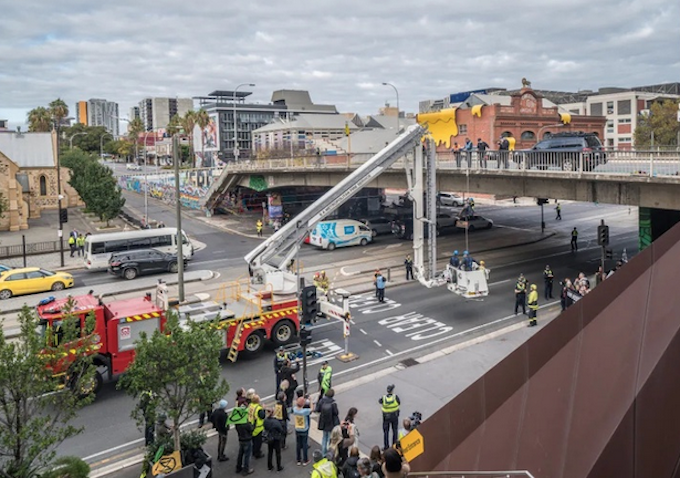
The most dramatic of these protests was staged by 69-year-old Meme Thorne who abseiled off a city bridge causing delays and traffic to be diverted.
Meanwhile, the gas lobby APPEA which is financed by foreign fossil fuel companies has stopped publishing its (public) financial statements. Questions put for this story were ignored but we will append a response should one be available.
The APPEA conference is a major gathering of oil and gas companies that was bound to attract protests. Its membership covers 95 pecent of Australia’s oil and gas industry and many other companies who supply goods and services to fossil fuel industries.
The dramatic climate protest staged by 69-year-old Meme Thorne who abseiled off an Adelaide bridge last month. Video: The Independent
The principal sponsors of this year’s conference were corporate giants Exxon-Mobil and Woodside.
Since March, Extinction Rebellion South Australia has been openly planning protests to draw attention to scientific evidence showing that any expansion of fossil fuel industries risks massive global disruption and millions of deaths.
The new laws will not apply to those arrested last week, several of whom have already been sentenced under existing laws.
In fact, when SA Attorney-General Kyam Maher was asked about the protests on May 17 shortly after the abseiling incident, he told the Upper House that “there are substantial penalties for doing things that can impede or restrict things like emergency services. I know that (police) . . . have in the past and will continue to do, enforce the laws that we have.”
Sensing that something was in the wind, he said he would be open to suggestions from the opposition.
Fines up 66 times, prison sentence introduced That afternoon, SA Opposition Leader and Liberal David Speirs handed the government a draft bill. This was finalised by parliamentary counsel overnight and whipped through the Lower House on May 18, without debate or scrutiny.
It took 20 minutes from start to finish: as one Upper House MP said, it would take “longer to do a load of washing”.
While Malinauskas and Speirs thanked each other for their cooperation, some MPs had not seen the unpublished bill before they passed it.
The new law introduces maximum penalties of A$50,000 (66 times the previous maximum fine) or a prison sentence of three months.
The maximum fine was previously $750, and there was no prison penalty.
If emergency services (police, fire, ambulance) are called to a protest, those convicted can also be required to pay emergency service costs. The scope of the law has also been widened to include “indirect” obstruction of a public place.
This means that if you stage a protest and the police use 20 emergency vehicles to divert traffic, you could be found guilty under the new section and be liable for the costs.
Even people handing out pamphlets about vaping harm in front of a shop, or workers gathering on a footpath to demand better pay, could fall foul of the laws.
An SABest amendment to the original bill removing the word “reckless” restricts its scope to intentional acts.
The APPEA oil and gas conference in Adelaide last month triggered protests. Image: Extinction Rebellion/Michael West Media
Peter Malinauskus told Radio Fiveaa on Friday that the new laws aimed to deter “extremists” who protested “with impunity” by crowd sourcing funds to pay their fines.
In speaking about the laws, Malinaukas, Maher and their right-wing media supporters have made constant references to emergency services, and ambulances. But no evidence has emerged that ambulances were delayed.
The author contacted SA Ambulances to ask if any ambulances were held up on May 17, and if they were delayed, whether Thorne was told. SA Ambulance Services acknowledged the question but have not yet answered.
The old ambulance excuse Significantly, the SA Ambulance Employees Union has complained about the “alarming breadth” of the laws and reminded the Malinauskas government that in the lead-up to last year’s state election, Labor joined Greens, SABest and others in protests about ambulance ramping, which caused significant traffic delays.
The constant references to emergencies are reminiscent of similar references in NSW. When protesters Violet Coco and firefighter Alan Glover were arrested on the Sydney Harbour Bridge last year, police included a reference to an ambulance in a statement of facts.
The ambulance did not exist and the false statement was withdrawn but this did not stop then Labor Opposition leader, now NSW Premier Chris Minns repeating the allegation when continuing to support harsh penalties even after a judge had released Coco from prison.
It later emerged that the protesters had agreed to move if it was necessary to make way for an ambulance.
The new SA law places a lot of discretion in the hands of the SA police to decide how to use resources and assess costs. The SA Police Commissioner Grant Stevens left no doubt about his hostility to disruptive protests when he said in reference to last week’s abseiling incident, “The ropes are fully extended across the street. So we can’t, as much as we might like to, cut the rope and let them drop.”
In Parliament, Green MP Robert Simms condemned this statement, noting that it had not been withdrawn.
In court, the police prosecutor (as NSW prosecutors have often done) argued that Thorne, who has been arrested in previous protests, should be refused bail.
Her lawyer Claire O’Connor SC reminded that courts around the country had ruled bail could not be denied to protesters as a form of punishment.
Shock jocks, News Corp, back new laws She said that, at worst, her client faced a maximum fine of $1250 and three-month prison term if convicted — but added she intended to plead not guilty.
“You cannot isolate a particular group of offenders because of their motivation and treat them differently because of their beliefs,” she said. The magistrate granted Thorne bail until July.
For now the South Australian government has satisfied the radio shock jocks, Newscorp’s Adelaide Advertiser (which applauded the tough penalties), authoritarian elements in the SA police, and the Opposition.
But it has been well and truly wedged. After a fairly smooth first year in power, it now finds itself offside with a massive coalition of civil society, environmental groups, South Australian unions, the SA Law Society and the Council for Social Services, the Greens and SA Best.
In less than two weeks, Premier Malinkauskas’s new law was condemned by a full page advertisement in the Adelaide Advertiser that was signed by human rights, legal, civil society, environmental and activist organisations; faced two angry street rallies organised to demonstrate opposition to the laws; and was roundly criticised by a range of peak legal and human rights organisations.
Back to the past Worst of all from the government’s point of view, SA Unions accused Malinkaskas of trashing South Australia’s proud progressive history.
“South Australian union members have fought for over a century to improve our living standards and rights at work. It took just 22 minutes for the government to pass a Bill in the House of Assembly attacking our rights to take the industrial action that made that possible.
“Their Bill is a mess and must be stopped,” SA Unions stated in a post on their official Facebook page.
In hours long speeches during the night, Green MPs Robert Simms and Tammie Franks and SABest Frank Pangano and Connie Bonaros detailed the history of protests that have led to progressive changes, including in South Australia.
They read onto the parliamentary record letters from organisations condemning both the content and unprecedented manner in which the laws were passed as undermining democracy.
Their message was crystal clear — peaceful disobedience is at the heart of democracy and there can be no peaceful disobedience without disruption.
Simms wore a LGBTQI activist pin to remind people that as a gay man he would never have been able to become a politician if it was not for the disruptive US-based Stonewall Riots and the early Sydney Mardi Gras, in which police arrested scores of people.
Protest is about “disrupting routines, people are making a noise and getting attention of people in power . . . change is led by people who are on the street, not made by those who stand meekly by,” he told Parliament.
Simms read from a letter by Australian Lawyers for Human Rights president Kerry Weste, who wrote, “Without the right to assemble en masse, disturb and disrupt, to speak up against injustice we would not have the eight-hour working day, and women would not be able to vote.
“Protests encourage the development of an engaged and informed citizenry and strengthen representative democracy by enabling direct participation in public affairs. When we violate the right to peaceful protest we undermine our democracy.”
At the same time as it was thumbing its nose at many of its supporters, the South Australian government left no one in doubt about its support for the expansion of the gas industry.
SA Energy Minister Tom Koutsantonis told the APPEA conference, “We are thankful you are here.
“We are happy to a be recipient of APPEA’s largesse in the form of coming here more often,” Koutsantonis said. “The South Australian government is at your disposal, we are here to help and we are here to offer you a pathway to the future.”
‘Gas grovelling’ not well received This did not impress David Mejia-Canales, senior lawyer at the Human Rights Law Centre, whose words were also quoted in Parliament:
“Two days after the Malinauskas government told gas corporations that the state is at their service, the SA government is making good on its word by rushing through laws to limit the right of climate defenders and others to protest. Australia’s democracy is stronger when people protest on issues they care about
“This knee-jerk reaction by the South Australian government will undermine the ability of everyone in SA to exercise their right to peacefully protest, from young people marching for climate action to workers protesting for better conditions. The Legislative Council must reject this Bill.”
During his five-hour speech in the early hours of Wednesday, SA Best Frank Pangano told Parliament that he could not recall when a bill has “seen so much wholesale opposition from sections of the community who are informed, who know what law making is about.
“You have got a wide section of the community saying in unison, ‘you are wrong’ to the Premier, you actually got it wrong. But we are getting a tin ear.”
And it was not just the climate and human rights activists who were “getting the tin ear”: the SA Australian Law Society released a letter expressing “serious concerns with the manner in which the [bill] was rushed through the House of Assembly”.
It wrote, “This is not how good laws are made.
“Good laws undergo a process of consultation, scrutiny, and debate before being put to a vote. The public did not even have a chance to examine the wording of the Bill before it passed the House of Assembly.
“This is particularly worrying in circumstances where the proposed law in question affects a democratic right as fundamental as the right to protest, and drastically increases penalties for those convicted of an offence.”
The Law Society also sent a list of questions to the government which were not answered.
One of the last speeches in the early morning was by SABest MLC Connie Balaros who, wearing a t-shirt that read “Arrest me Pete”, vowed to continue to campaign against the laws and accused Labor MPs of betraying their members, the community and their own history.
No more baby steps. No more excuses. No more greenwashing. No more bottomless greed of the fossil fuel industry and its enablers.
Early this year, UN Secretary-General Antonio Gutierrez declared, “2023 is a year of reckoning. It must be a year of game-changing climate action.
“We need disruption to end the destruction. No more baby steps. No more excuses. No more greenwashing. No more bottomless greed of the fossil fuel industry and its enablers.”
Climate disasters mount Since he made that statement, climate scientists have reported that Antarctic ice is melting faster than anticipated. This week, there has been record-beating heat in eastern Canada and the United States, Botswana in Africa, and South East China.
Right now, unprecedented out-of-control wildfires are ravaging Canada.
An international force of 1200 firefighters including Australians have joined the Canadian military battling to bring fires under control. Extreme rain and floods displaced millions in Pakistan and thousands in Australia in 2022.
Recently, extreme rain caused rivers to break their banks in Italy, causing landslides and turning streets into rivers. Homelessness drags on for years as affected communities struggle to recover long after the media moves on.
Is it any wonder that some people don’t continue as if it is ‘business as usual’. Protesters in London invaded Shell’s annual conference last week and in Paris, climate activists were tear gassed at Total Energies AGM.
Is it any wonder that some people don’t continue as if it is “business as usual”. Protesters in London invaded Shell’s annual conference last week and in Paris, climate activists were tear gassed at Total Energies AGM.
In The Netherlands last weekend, 1500 protesters who blocked a motorway to call attention to the climate emergency were water-cannoned and arrested.
On Thursday, May 30, Rising Tide protesters pleaded guilty to entering enclosed lands and attempting to block a coal train in Newcastle earlier this year. They received fines of between $450 and $750, most of which will be covered by crowdfunding.
Three of them were Knitting Nannas, a group of older women who stage frequent protests.
This week the Knitting Nannas and others formed a human chain around NAB headquarters in Sydney. They called for NAB to stop funding fossil fuel projects, including the Whitehaven coal mine.
Knitting Nannas, Rising Tide Two Knitting Nannas have mounted a legal challenge in the NSW Supreme Court seeking a declaration that the NSW anti-protest laws are invalid because they violate the implied right to freedom of communication in the Australian constitution.
A similar action is already been considered in South Australia.
In this context, fossil fuel industry get togethers may no longer be seen as a PR and networking opportunity for government and companies.
Australian protesters will not be impressed by Federal and State Labor politicians reassurances that they have a right to protest, providing that they meekly follow established legal procedures that empower police and councils to give or refuse permission for assemblies at prearranged places and times and do not inconvenience anyone else.
Wendy Bacon is an investigative journalist who was professor of journalism at University of Technology Sydney (UTS). She worked for Fairfax, Channel Nine and SBS and has published in The Guardian, New Matilda, City Hub and Overland. She has a long history in promoting independent and alternative journalism.Republished from Michael West Media with permission from the author and MWM.
The president of a West Papuan advocacy group has appealed to the militants holding New Zealand pilot Philip Mehrtens hostage to free him unconditionally and unharmed, describing him as an “innocent pawn”.
United Liberation Movement for West Papua (ULMWP) president Benny Wenda said he held “deepest concern” for the life of Mehrtens, captured on February 7 by guerillas fighting for the independence of Papua.
Fighters of the West Papua National Liberation Army (TPNPB), armed wing of the rebel West Papua Organisation (OPM), have demanded third party negotiations for independence and have recently called for Papua New Guinea Prime Minister James Marape as a “mediator”.
West Papuan leader Benny Wenda . . . condemns the “brutal martial law” imposed by Indonesian security forces. Image: ULMWP
“Currently, the priority of all parties involved in this tragic ordeal is to help and assist the pilot to return home safely and rejoin his family and friends,” said Wenda in a statement.
He condemned the impact of the “brutal martial law” imposed by Indonesian security forces in the West Papua region.
“Philip Mehrtens’ condition is being made significantly more precarious by the Indonesian government’s refusal of outside aid and determination to use military means,” he said.
Jakarta’s aggressive stance went hand-in-hand with its increased militarisation of the region.
Mehrtens ‘innocent human being’ “Mehrtens is an innocent human being who has been unwittingly made into a pawn in a decades-old conflict between the colonial power of Indonesia and the indigenous resistance of West Papua.
“Therefore, securing Mehrtens’ safe return must be the top priority for all parties involved, as his life has been thrown into chaos through no fault of his own.”
Wenda said he was aware of a threat made by the TPNPB last week to shoot the pilot.
“It is indeed tragic that the life of the pilot is at risk, and I understand where the Liberation Army is coming from; however, I cannot comprehend why the blood of an innocent family man should be shed on our ancestral land.
“For more than 60 years, the blood of hundreds of thousands of innocent Papuans has been shed on this sacred land as a result of Indonesian military operations.
“We do not need to shed the blood of another innocent.
“As Papuans, we do not take innocent lives; nor do we have a tradition of genocide, killings, massacres, or land theft.
Peaceful resolution “This is not a teaching handed down from our ancestors. We have dignity and tradition and as our ancestors always taught us, the killing of an innocent person is strictly prohibited.
“We believe in this, and every Papuan knows it.
Wenda said the ULMWP sought a peaceful resolution to “reclaim our stolen sovereignty”.
“This does not imply that we are weak or ineffective, nor does it indicate that the international community has turned a blind eye to the crimes committed by the Indonesian security forces.
“The world is currently watching Indonesia closely due to their inhumane treatment, barbaric behaviours, genocidal policies, ecocide, and acts of terror against our people.
In a message to the TPNPB, he warned the rebels to “reconsider the threat” made against and what the pilot’s death would “mean to his grieving family, as well as to our national liberation cause”.
“All West Papuans know that international law is on our side: Indonesia’s military occupation and initial claim on West Papua being clearly wrong under international law.
“But so too is taking the life of an innocent person who is not involved in the conflict.
Wenda said it should never be forgotten that “truth is on our side and Jakarta knows it”.
“One day we will win. Light will always overcome darkness.”
Mourning for Beanal
Papuan leader Tom Beanal . . . mourned over his death. Image: ULMWP
Meanwhile, West Papuans have mourned the death of Tom Beanal, a freedom fighter, head of the Papua Presidium Council, and leader of the Amungme Tribal Council.
Wenda said that on behalf of the ULMWP and the West Papuan people, he expressed sympathy and condolences to Beanal’s family, friends, and “everyone he inspired to join the struggle”.
Tom Beanal was a member of the Amungme tribe. Along with the Kamoro people, the Amungme have been the primary victims of the struggle over the Grasberg Mine, the world’s largest gold and second largest copper mine. It is opened and operated by the US mining company Freeport McMoran.
“Amungme and Kamoro people are the indigenous landowners – tribes who have tended and protected their forest for thousands of years. But they have been forced to watch as their lands have been destroyed, physically and spiritually, by an alliance of big corporations and the Indonesian government,” Wenda said.
While some women glide through menopause, more than 85% experience one or more unpleasant symptoms, which can impact their physical and mental health, daily activities and quality of life.
Hot flushes and night sweats are the most common of these, affecting 75% of women and the symptom for which most women seek treatment. Others include changes in weight and body composition, skin changes, poor sleep, headaches, joint pain, vaginal dryness, depression and brain fog.
While menopause hormone therapy is the most effective treatment for menopausal symptoms, it is sometimes not recommended (such as following breast cancer, as there is conflicting evidence about the safety of menopause hormone therapy following breast cancer) or avoided by people, who may seek non-hormonal therapies to manage symptoms. In Australia it is estimated more than one-third of women seek complementary or alternative medicines to manage menopausal symptoms.
But do they work? Or are they a waste of time and considerable amounts of money?
What’s on the market?
The complementary or alternative interventions for menopausal symptoms are almost as varied as the symptoms themselves. They include everything from mind-body practices (hypnosis, cognitive behavioural therapy and meditation) to alternative medicine approaches (traditional Chinese medicine and acupuncture) and natural products (herbal and dietary supplements).
There is some evidence to support the use of hypnosis and cognitive behaviour therapy for the treatment of hot flushes. Indeed these therapies are recommended in clinical treatment guidelines. But there is less certainty around the benefit of other commonly used complementary and alternative medicines, particularly nutritional supplements.
The most popular nutritional supplements for hot flushes are phytoestrogens (or plant estrogens). This trend has been driven in part by supplement companies that promote such agents as a safer or more natural alternative to hormone therapy.
Phytoestrogens are plant-derived substances that can show oestrogen-like activity when ingested.
There are numerous types including isoflavones, coumestans and lignans. These can be consumed in the form of food (from whole soybeans, soy-based foods such as tofu and soy milk, legumes, wholegrains, flaxseeds, fruits and vegetables) and in commercially produced supplements. In the latter category, extracts from soy and red clover yield isoflavones and flaxseed gives us lignans.
Because declining oestrogen levels drive menopausal symptoms, the theory is that consuming a “natural”, plant-based substance that acts like oestrogen will provide relief.
Phytoestrogens can be consumed in foods like tofu or soy milk. Shutterstock
What does the evidence say?
In the case of isoflavones, initial support came from epidemiological data showing women in Asian countries, consuming a traditional, phytoestrogen-rich diet (that is, one including tofu, miso and fermented or boiled soybeans), experienced fewer menopausal symptoms than women in Western countries.
However, several factors may influence the effect of dietary phytoestrogens on menopausal symptoms. This includes gut microbiota, with research showing only around 30% of women from Western populations possess the gut microbiota needed to convert isoflavones to their active form, known as equol, compared to an estimated 50–60% of menopausal women from Japanese populations.
Circulating oestrogen levels (which drop considerably during menopause) and the duration of soy intake (longer-term intake being more favourable) may also influence the effect of dietary phytoestrogens on menopausal symptoms.
Overall, evidence regarding the benefit of phytoestrogens for hot flushes is fairly mixed. A Cochrane review synthesised study results and failed to find conclusive evidence phytoestrogens, in food or supplement form, reduced the frequency or severity of hot flushes or night sweats in perimenopausal or postmenopausal women.
The review did note genistein extracts (an isoflavone found in soy and fava beans) may reduce the number of hot flushes experienced by symptomatic, postmenopausal women, though to a lesser extent than hormone therapy.
Another recent study showed marked reductions in hot flushes in women following a low fat, vegan diet supplemented with daily soybeans. However, it was questioned whether concurrent weight loss contributed to this benefit.
In Australia, clinical guidelines do not endorse the routine use of phytoestrogens. Guidelines for the United Kingdom note some support for the benefit of isoflavones, but highlight multiple preparations are available, their safety is uncertain and interactions with other medicines have been reported.
Can phytoestrogens help the psychological symptoms of menopause?
Less research has explored whether phytoestrogens improve psychological symptoms of menopause, such as depression, anxiety and brain fog.
A recent systematic review and meta-analysis found phytoestrogens reduce depression in post- but not perimenopausal women. Whereas a more recent clinical trial failed to find an improvement.
Some research suggests phytoestrogens may reduce the risk of dementia, but there are no conclusive findings regarding their effect on menopausal brain fog.
The bottom line
At present there is uncertainty about the benefit of phytoestrogens for menopause symptoms.
If you do wish to see if they might work for you, start by including more phytoestrogen-rich foods in your diet. Examples include tempeh, soybeans, tofu, miso, soy milk (from whole soybeans), oats, barley, quinoa, flaxseeds, sesame seeds, sunflower seeds, almonds, chickpeas, lentils, red kidney beans and alfalfa.
Try including one to two serves per day for around three months and monitor symptoms. These are nutritious and good for overall health, irrespective of the effects on menopausal symptoms.
Before you trial any supplements, discuss them first with your doctor (especially if you have a history of breast cancer), monitor your symptoms for around three months, and if there’s no improvement, stop taking them.
Caroline Gurvich has received funding from the NHMRC, the Rebecca Cooper Foundation and Perpetuel Trustees.
Jane Varney receives funding from the Medical Research Future Fund.
Jayashri Kulkarni receives funding from NHMRC, and has received honoraria from Servier , Janssen, Lundbeck pharmaceutical industries. She has also received two honoraria from Swisse, H&H companies.
Source: The Conversation (Au and NZ) – By Mark Patrick Taylor, Victoria’s Chief Environmental Scientist, EPA Victoria; Honorary Professor, School of Natural Sciences, Macquarie University
Shutterstock
Wastewater is a by-product of humanity produced all day, every day. At home, wastewater is the used water that disappears when you flush the toilet, empty the sink or drain the washing machine.
Industrial processes also produce wastewater. Around the world, 359 billion cubic metres of wastewater is produced each year – equal to 144 million Olympic-sized swimming pools.
In Australia, some of this water is treated and reused. This so-called “recycled” water is used, for example, to wash cars, water crops and gardens. Treated water is also released back into rivers as “discharge”, which is regulated under an operator’s licence.
So is treated wastewater safe? Our research, published today, found wastewater treatment removes a lot of particles, but some contaminants remain. While it’s not enough to affect human health, effects on the environment are less clearly established.
Recycled water is commonly used to irrigate gardens and crops. Shutterstock
Making the most of our water
Water is a precious, finite resource. There is no such things as “new” water. Our planet’s water dates back 4.5 billion years and is constantly recycled by Earth’s systems.
As Earth’s population grows and the climate dries, we need all the water we can get.
In light of this challenge, the state of Victoria has a plan to better use treated wastewater. Other Australian states and territories have similarplans.
Wastewater comes from homes, businesses, industrial sites and farms, as well as any stormwater or groundwater that enters the sewer system.
Specialised treatment plants process this wastewater. A combination of technologies is used to achieve the treatment objectives, based on the character of raw wastewater and use of the treated wastewater. These processes include primary, secondary and tertiary treatment.
Wastewater treatment seeks to remove:
organics (proteins, hydrocarbons, oils and fats)
suspended solids (small particles)
bacteria (such as E. coli).
In Victoria, as elsewhere in Australia, wastewater must meet strict standards. Water corporations achieve this by implementing stringent procedures and processes, and monitoring water quality.
But even after treatment, some contaminants can remain. These can be divided into “emerging” and “legacy” contaminants.
Emerging contaminants include pharmaceuticals, pesticides, phthalates (used to make plastic more durable), industrial chemicals and chemicals in personal care products.
They’re described as “emerging” because of the limited information we have about them, the risks they pose and the dose-response effects, especially at low, ultra-trace concentrations.
Legacy contaminants include, for example, PFAS, trace metals and insecticides such as DDT.
So should we be concerned about contaminants in treated wastewater? Our new research examined this question.
EPA scientists partnered with the Victorian Department of Energy, Environment and Climate Action and 13 state water corporations to investigate emerging contaminants in wastewater. As a science-based regulator, EPA undertakes problem-based research on pollution and waste to protect the health of Victoria’s community and environment. It uses data and evidence from studies like these to guide future actions.
We collected 230 samples of treated and untreated water at a range of wastewater treatment plants. We analysed these for the presence of 414 emerging and legacy contaminants.
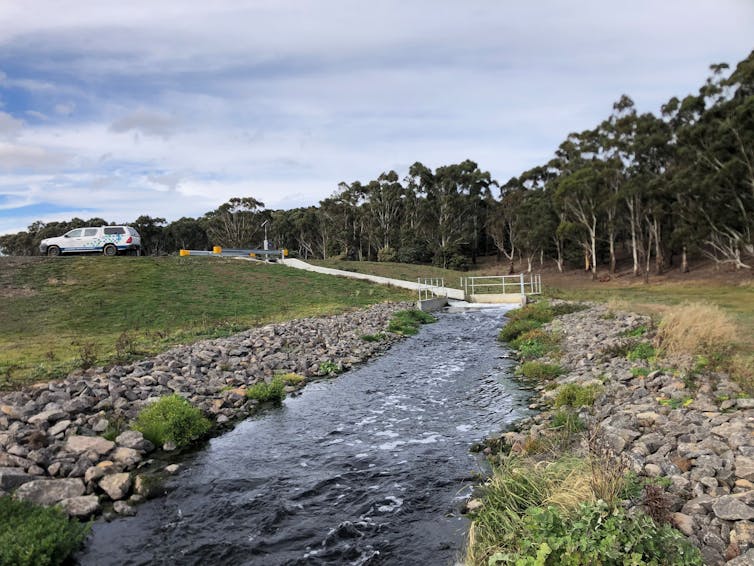
For the study, 230 samples of treated and untreated water were collected from wastewater treatment plants. Image: EPA, Author provided
We detected 180 contaminants in treated and untreated water. These included:
48 chemicals found in pharmaceuticals and personal care products
5 endocrine-disrupting chemicals
21 per- and polyfluoroalkyl substances (PFAS)
34 herbicides
8 insecticides
7 fungicides
12 industrial compounds
7 phenols
28 disinfection byproducts.
None of the contaminant levels in treated water exceeded human health guidelines for drinking water and water used for recreation.
As you might expect, concentrations of most emerging contaminants were lower in treated than untreated water. However, some contaminants remained in treated water. Examples included antidepressant venlafaxine and anticonvulsant medication carbamazepine.
So which treatment method is best? Based on our study, it’s one that combines all of the following:
an “activated sludge” process, which can be aerobic or anaerobic – if aerobic, air is needed and is introduced into the “mixed liquor” by aeration devices or by natural diffusion
extended aeration using a mechanical device to aerate the water
disinfection with ultraviolet light, which uses UV radiation to break down the DNA of pathogens
microfiltration, a membrane process that removes particles larger than 0.1 micron
reverse osmosis, which is another membrane process and removes most of the salt and large molecules, producing water with very low dissolved content
disinfection with chlorination, zonation or UV disinfection.
But treatment that combines all the above processes is relatively rare. It’s used by only four out of 200 wastewater treatment plants in Victoria. These plants produce the highest grade of recycled water.
None of the contaminants we detected in treated wastewater breached human health guidelines. However, we should not forget the environment.
Pharmaceutical pollution, in particular, is a pressing global issue. A recent study detected pharmaceuticals in 258 rivers in 104 countries across all continents. Pharmaceutical chemicals break down quickly in the environment, but are continually being replenished.
Environmental authorities regulate how businesses and industry use, store and dispose of their waste. However, your actions at home – no matter how small – can mean fewer contaminants make it to wastewater treatment plants.
Actions you can take include:
take medicines only as directed and return unwanted and expired medicines to a pharmacy
choose chemical-free cleaning products
minimise pesticide use in your garden and bug sprays in your home
if you have a wastewater management system at home, such as for greywater or blackwater, maintain it regularly and avoid using powerful chemicals.
Next steps
Further research is under way involving the Victorian EPA, water corporations and research institutions. It aims to build our understanding of what, if and how emerging contaminants are present in soil and taken up by crops irrigated with recycled water.
Ultimately, the work will reduce the potential risks to people and the environment posed by wastewater, by ensuring official advice is current and evidence-based.
The report’s authors are EPA Scientists Minna Saaristo, Simon Sharp, Shanli Zhang and Mark P. Taylor.
Mark Patrick Taylor is a full-time employee of EPA Victoria, appointed to the statutory role of Chief Environmental Scientist. He is also an Honorary Professor at Macquarie University. This research was supported by funding from the Department of Energy, Environment and Climate Action and Victorian water authorities to EPA Victoria.
Source: The Conversation (Au and NZ) – By Mark Patrick Taylor, Victoria’s Chief Environmental Scientist, EPA Victoria; Honorary Professor, School of Natural Sciences, Macquarie University
Shutterstock
Wastewater is a by-product of humanity produced all day, every day. At home, wastewater is the used water that disappears when you flush the toilet, empty the sink or drain the washing machine.
Industrial processes also produce wastewater. Around the world, 359 billion cubic metres of wastewater is produced each year – equal to 144 million Olympic-sized swimming pools.
In Australia, some of this water is treated and reused. This so-called “recycled” water is used, for example, to wash cars, water crops and gardens. Treated water is also released back into rivers as “discharge”, which is regulated under an operator’s licence.
So is treated wastewater safe? Our research, published today, found wastewater treatment removes a lot of particles, but some contaminants remain. While it’s not enough to affect human health, effects on the environment are less clearly established.
Recycled water is commonly used to irrigate gardens and crops. Shutterstock
Making the most of our water
Water is a precious, finite resource. There is no such things as “new” water. Our planet’s water dates back 4.5 billion years and is constantly recycled by Earth’s systems.
As Earth’s population grows and the climate dries, we need all the water we can get.
In light of this challenge, the state of Victoria has a plan to better use treated wastewater. Other Australian states and territories have similarplans.
Wastewater comes from homes, businesses, industrial sites and farms, as well as any stormwater or groundwater that enters the sewer system.
Specialised treatment plants process this wastewater. A combination of technologies is used to achieve the treatment objectives, based on the character of raw wastewater and use of the treated wastewater. These processes include primary, secondary and tertiary treatment.
Wastewater treatment seeks to remove:
organics (proteins, hydrocarbons, oils and fats)
suspended solids (small particles)
bacteria (such as E. coli).
In Victoria, as elsewhere in Australia, wastewater must meet strict standards. Water corporations achieve this by implementing stringent procedures and processes, and monitoring water quality.
But even after treatment, some contaminants can remain. These can be divided into “emerging” and “legacy” contaminants.
Emerging contaminants include pharmaceuticals, pesticides, phthalates (used to make plastic more durable), industrial chemicals and chemicals in personal care products.
They’re described as “emerging” because of the limited information we have about them, the risks they pose and the dose-response effects, especially at low, ultra-trace concentrations.
Legacy contaminants include, for example, PFAS, trace metals and insecticides such as DDT.
So should we be concerned about contaminants in treated wastewater? Our new research examined this question.
EPA scientists partnered with the Victorian Department of Energy, Environment and Climate Action and 13 state water corporations to investigate emerging contaminants in wastewater. As a science-based regulator, EPA undertakes problem-based research on pollution and waste to protect the health of Victoria’s community and environment. It uses data and evidence from studies like these to guide future actions.
We collected 230 samples of treated and untreated water at a range of wastewater treatment plants. We analysed these for the presence of 414 emerging and legacy contaminants.
For the study, 230 samples of treated and untreated water were collected from wastewater treatment plants. Image: EPA, Author provided
We detected 180 contaminants in treated and untreated water. These included:
48 chemicals found in pharmaceuticals and personal care products
5 endocrine-disrupting chemicals
21 per- and polyfluoroalkyl substances (PFAS)
34 herbicides
8 insecticides
7 fungicides
12 industrial compounds
7 phenols
28 disinfection byproducts.
None of the contaminant levels in treated water exceeded human health guidelines for drinking water and water used for recreation.
As you might expect, concentrations of most emerging contaminants were lower in treated than untreated water. However, some contaminants remained in treated water. Examples included antidepressant venlafaxine and anticonvulsant medication carbamazepine.
So which treatment method is best? Based on our study, it’s one that combines all of the following:
an “activated sludge” process, which can be aerobic or anaerobic – if aerobic, air is needed and is introduced into the “mixed liquor” by aeration devices or by natural diffusion
extended aeration using a mechanical device to aerate the water
disinfection with ultraviolet light, which uses UV radiation to break down the DNA of pathogens
microfiltration, a membrane process that removes particles larger than 0.1 micron
reverse osmosis, which is another membrane process and removes most of the salt and large molecules, producing water with very low dissolved content
disinfection with chlorination, zonation or UV disinfection.
But treatment that combines all the above processes is relatively rare. It’s used by only four out of 200 wastewater treatment plants in Victoria. These plants produce the highest grade of recycled water.
None of the contaminants we detected in treated wastewater breached human health guidelines. However, we should not forget the environment.
Pharmaceutical pollution, in particular, is a pressing global issue. A recent study detected pharmaceuticals in 258 rivers in 104 countries across all continents. Pharmaceutical chemicals break down quickly in the environment, but are continually being replenished.
Environmental authorities regulate how businesses and industry use, store and dispose of their waste. However, your actions at home – no matter how small – can mean fewer contaminants make it to wastewater treatment plants.
Actions you can take include:
take medicines only as directed and return unwanted and expired medicines to a pharmacy
choose chemical-free cleaning products
minimise pesticide use in your garden and bug sprays in your home
if you have a wastewater management system at home, such as for greywater or blackwater, maintain it regularly and avoid using powerful chemicals.
Next steps
Further research is under way involving the Victorian EPA, water corporations and research institutions. It aims to build our understanding of what, if and how emerging contaminants are present in soil and taken up by crops irrigated with recycled water.
Ultimately, the work will reduce the potential risks to people and the environment posed by wastewater, by ensuring official advice is current and evidence-based.
The report’s authors are EPA Scientists Minna Saaristo, Simon Sharp, Shanli Zhang and Mark P. Taylor.
Mark Patrick Taylor is a full-time employee of EPA Victoria, appointed to the statutory role of Chief Environmental Scientist. He is also an Honorary Professor at Macquarie University. This research was supported by funding from the Department of Energy, Environment and Climate Action and Victorian water authorities to EPA Victoria.
Source: The Conversation (Au and NZ) – By Helen Brand, Senior Beamline Scientist – Powder Diffraction, Australian Nuclear Science and Technology Organisation
Impact cratering happens on every solid body in the Solar System. In fact, it is the dominant process affecting the surfaces on most extraterrestrial bodies today.
On Earth, however, such craters are often lost over time by active geological processes, but elsewhere in the Solar System there are some truly majestic examples of impact craters preserved for all to see.
Here, we pick our highlights of what the Solar System has to offer.
1. South Pole–Aitken basin, the Moon
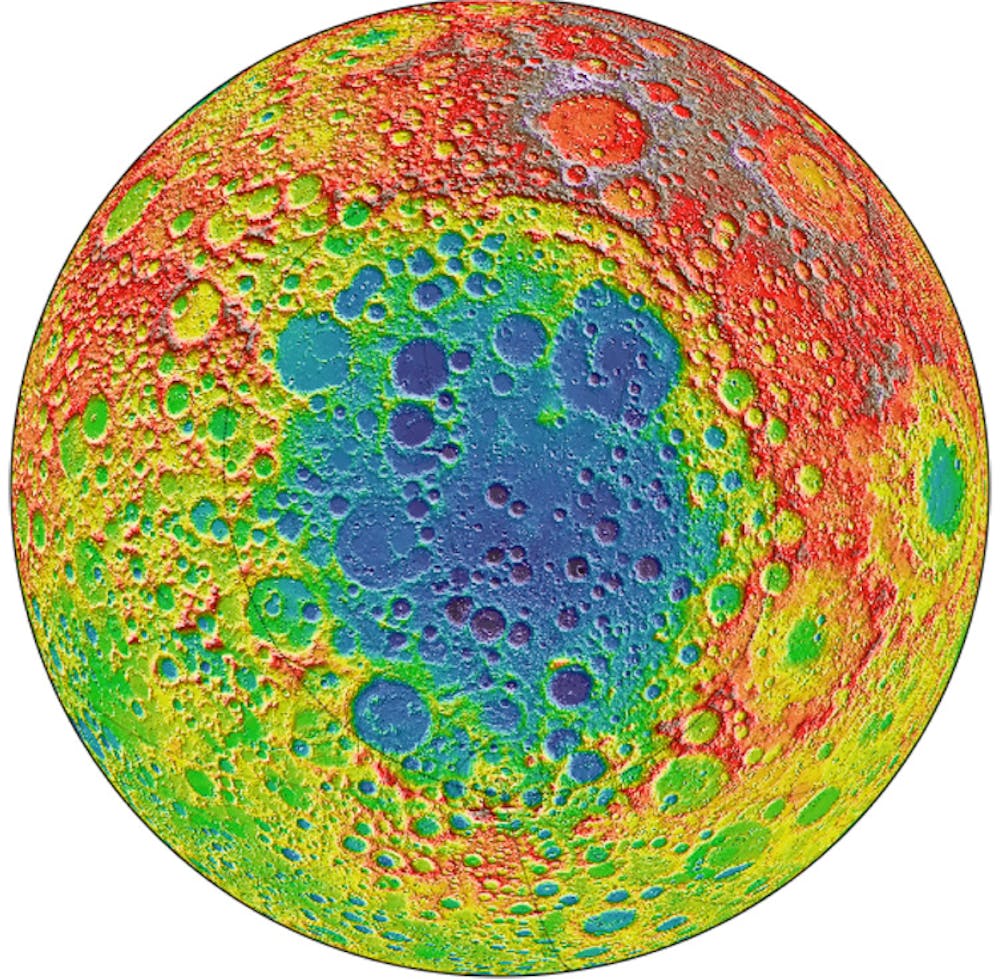
Our first crater is a big one: the biggest, deepest and oldest impact crater on the Moon. It is 2,500km diameter, 6.2 to 8.2km deep and formed roughly 4.2 billion years ago. As the name suggests, it is at the south pole on the far side of the Moon, although the crater rim can be seen from Earth as a dark mountain range, just on the border between the light and dark side of the moon.
A colour-coded topographical image taken by NASA’s Lunar Orbiter Laser Altimeter, showing the South Pole–Aitken basin in blue. NASA/Goddard
It is a prime site favoured by lunar scientists to visit and learn about our Moon’s geology. The depth excavated by the crater is almost as deep as the deepest ocean trenches on Earth. It gives us a unique view of the interior of the Moon’s crust, with 4.2 billion years of history exposed.
In 2019, a rover from the Chinese space agency, Chang’e 4, touched down in the basin and carried out the first scientific experiments there. One of the most interesting of these was the Lunar Micro Ecosystem, a collection of seeds and insect eggs designed to see if life could flourish in a tiny biosphere on the surface.
2. Unnamed Crater (S1094b), Mars
There are many famous craters on Mars, from the homes of Mars rovers (Gale Crater for Curiosity or Jezero for Perseverance) to the hypothesised source regions of Mars meteorites (Tooting or Mojave). But one of the newest craters on the red planet is actually quite a dramatic one.
The impact event on Mars on Christmas Eve 2021. NASA/JPL-Caltech/Malin Space Science Systems/Peter Grindrod, Author provided
While Mars rovers claim all the glory for exploring the Martian surface, the satellites orbiting Mars have been making discoveries of their own for decades. NASA’s Mars Reconnaissance Orbiter (MRO) was launched in 2005 but is still operational, and its 16+ years of Mars’s surface images allow us to make comparisons year on year, highlighting differences between data sets.
On Christmas Eve 2021, NASA’s InSight mission detected a large “Marsquake” on the red planet, which MRO data later helped to identify as a new impact on the other side of Mars.
The vibrant, fresh impact ejecta (“blankets” of material thrown aside by the impact) can be seen clearly from space using the context camera data aboard the orbiter, and thanks to InSight we even know what it sounded like.
A before-and-after comparison of the location on Mars’s Amazonis Planitia where a meteoroid impacted on December 24 2021. NASA/JPL-Caltech/MSSS
3. Enki Catena, Ganymede
Enki Catena is a chain crater on Ganymede, one of the Galilean satellites of Jupiter. At latest count, Jupiter has more than 90 moons, a mini planetary system of its own.
Jupiter’s gravity creates tidal forces which shape the moons and give us some of the most interesting geological features we have yet found, from the volcanoes of Io to the subsurface ocean of Europa. There are also strings of craters found on two of the moons, Callisto and Ganymede.
These crater chains were first spotted when the Voyager 1 spacecraft gave us some of the first pictures of the surface of these moons in 1979. They were thought to potentially be collapsed lava tubes, features that have been observed on Mars and the Moon.
However, their origin remained under debate until the Shoemaker-Levy 9 comet was observed as it smashed into Jupiter. The comet was seen breaking into multiple pieces and this gave an idea as to how these chains might form – the gravity from Jupiter pulls apart objects into many pieces that all impact close together.
Enki Catena is a chain of 13 craters which crosses from an area of dark to bright terrain on Ganymede. It is 162km in length and about 10km wide.
The European Space Agency’s Juice mission will visit the Jovian system in the 2030s and allow us to see the surfaces in greater detail than ever before. We might even find more of these crater chains.
Ceres is the largest body in the main asteroid belt between Mars and Jupiter. It is large and round enough to be considered a “dwarf planet” (along with Pluto and three less famous examples, Eris, Makemake and Haumea).
The Occator crater on Ceres is impressive because it contains a bright spot in the centre that has been observed both from space, and from Earth at Mauna Kea Observatory, Hawaii.
Occator crater with its bright spots as imaged by the Dawn mission. NASA
NASA’s Dawn mission entered an orbit around Ceres in 2015, and imaged the bright spot in Occator crater known as “Spot 5”. It’s a three kilometre wide dome covered in bright salts on the crater floor, likely resulting from hydrothermal activity.
Occator crater itself is 92km in diameter and 3km deep. Simulations indicate that the impactor (the space rock that created the crater) was rougly 5km across, striking Ceres between 20–25 million years ago.
This mosaic from NASA’s Dawn spacecraft combines images obtained from altitudes as low as 22 miles (35 km) above Ceres’ surface. NASA/JPL-Caltech/UCLA/MPS/DLR/IDA/PSI
5. Aurelia, Venus
Venus is sometimes called Earth’s twin. It is when it comes to size, but the surface images we have of Venus show the planets have very different features.
The best such images were taken in the 1990s by NASA’s Magellan spacecraft. Venus has a thick cloudy atmosphere, and visible-light cameras can’t see through to the surface. Magellan was equipped with a radar which can “see” the surface – but the images can be harder to interpret.
In radar, dark terrain is very smooth and bright terrain is very rough. This makes impact craters stand out really well in radar images. The ejecta are very rough, especially against the surrounding volcanic plains, so they appear bright in the images.
This is Aurelia, a 32km impact crater on Venus.
Aurelia crater on Venus, imaged by Magellan in 1996. NASA/JPL
You can see it stands out against the grey plains that surround it. The black terrain on the edges of the bright white ejecta are smooth flows of rock that melted when the impact hit.
Speaking of volcanoes on Venus, recently a group from the University of Alaska Fairbanks used this Magellan data to find the first active volcano on Venus
The authors do not work for, consult, own shares in or receive funding from any company or organisation that would benefit from this article, and have disclosed no relevant affiliations beyond their academic appointment.
Whales have long fascinated us with their size and beauty. Once we stopped whaling, their populations have begun to recover, in a major win for conservation.
Research has suggested healthy whale populations could help us in unexpected ways – by storing carbon for the long term.
How? Whales are usually huge. Among their number is the blue whale, the largest animal ever to have lived. At up to 30 metres long and 190 tonnes, they’re bigger than any dinosaur. This gives these mega-mammals an oversized role in the oceans. Their plumes of poo contains so many nutrients that phytoplankton blooms can form in its wake. These tiny photosynthesising creatures soak up carbon dioxide in their bodies. When they die, they can sink to the bottom and be covered in sediment, storing the carbon.
As we look desperately for good news on climate amid the accelerating crisis, whales seemed to offer one. Bring back the whales, store more carbon naturally.
But this is premature, as our new research points out. This area is riddled with uncertainties and a lack of data. While the story sounds good, we simply cannot say more whales means more carbon storage at this point. If we focus on unproven measures like encouraging whale populations, we risk taking attention away from proven climate measures such as steadily reducing emissions from fossil fuel burning or protecting our stores of blue carbon in mangroves and seagrass meadows.
Whale poo floating on the surface in Antarctica.
Why has there been so much focus on whales?
The climate crisis is intensifying. Our first year with over 1.5℃ of heating could come within five years. Given this, governments and researchers are looking for ways to tackle this global crisis by using nature to draw CO₂ back out of the air.
Trees and peatlands are natural carbon sinks. So is the ‘blue carbon’ stored in mangroves and seagrass meadows for thousands of years.
So why not whales? In recent years, there’s been mounting enthusiasm about whales – any marine animal able to boost phytoplankton growth is arguably adding to natural ways to store carbon.
Here’s how the chain of events would work. As whales feed and migrate, they pump large amounts of nutrients between different parts of the oceans and different depths – mainly through their poo. They also act as a conveyor belt, taking nutrients between different oceans. One species, the gray whale, is the largest animal involved in bioturbation, meaning they churn up sediment as they gouge the seafloor hunting shrimp.
These roles make whales ecosystem engineers. Their activities are significant enough to shape local ecosystems where they feed and fertilise the surface of the ocean through defecation. Whale poo, in particular, looks to have a significant effect on phytoplankton growth, especially in the Southern Ocean.
A whale pooing is quite an event, as this sperm whale shows. But is it enough to make a difference on an ecosystem scale? Shutterstock
Fish and other marine species also contribute to the biological carbon pump. In this process, CO₂ is stored in organic matter through photosynthesis and washed into the deeper ocean where some is stored for long periods of time.
Whales could also potentially capture carbon in other ways: in their flesh, where they keep it for their long lifespans, and when a whale falls and sinks to the bottom, where it might be covered in sediment.
These are the five main pathways through which whales might contribute to carbon sequestration.
So why should we be sceptical?
While it’s entirely possible whales can help sequester carbon, they are likely to make only a limited contribution.
Research in this area is challenging, with many complexities and uncertainties. How do you measure a whale’s lifetime contribution? We’ll need more research to find out either way.
For now, what we do know suggests blue carbon in mangroves, salt marshes and seagrasses is well beyond what large whales contribute to carbon storage.
For us to conclusively say whales can play a role in reducing CO₂ concentration in the atmosphere, we’d need to be able to trace a clear link between how they influence the biological carbon pump, with more whales leading to more organic carbon heading from the surface into the deep ocean, and how much of this then enters longer-term storage in sediments.
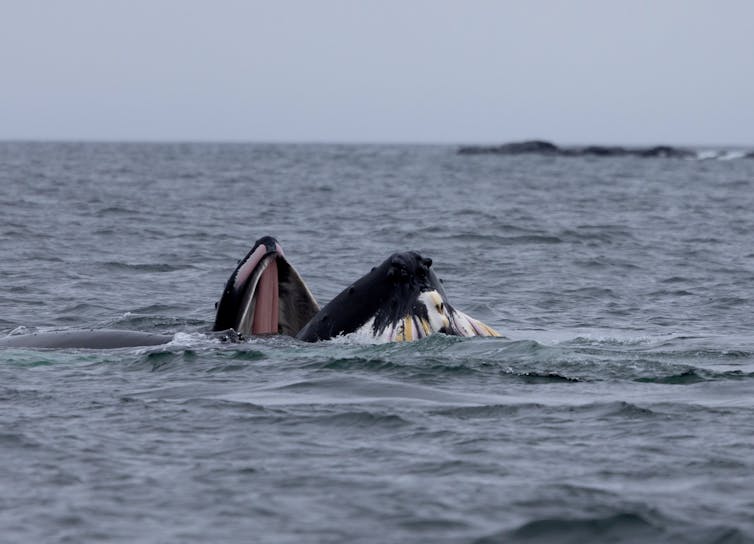
Whales are big. But we don’t know enough to say they’re good at storing carbon. This image shows a humpback whale feeding in Antarctic waters. Lauren Harrell
What we know about the way the oceans respond to carbon dioxide add further weight to whale scepticism. Of the carbon dioxide we emitted between 2009 and 2018, about 40% stayed in the atmosphere, 29% was soaked up by land ecosystems and 23% was absorbed by the oceans, largely due to the tireless photosynthesising of phytoplankton. The cold Southern Ocean is the major contributor among the oceans, accounting for 40% of all ocean absorption.
Zoomed out, all the world’s oceans take up an estimated 53 billion tonnes of carbon annually. Of this, 4 billion tonnes of organic matter sinks below the surface. But only 1% of this actually gets stored in sea floor sediment for the long term.
So when we look at the five ways whales could boost carbon removal, the most important one is through their huge poos, which can trigger plankton growth. The “whale pump” is also driven by their poo, and when gray whales or other species turn over sediment, it only has a local effect. When a dead whale falls to the seafloor and is eaten, some carbon may be stored long term if its bones are buried. But it’s unlikely to be a significant amount.
In short, we don’t know enough to say whales help carbon storage – and what we do know suggests the opposite.
Whales are more than their carbon
Whales are valuable for much more than their role in carbon cycles. They’re celebrated in cultures around the world. They support local economies through industries like whale-watching. Whales host many other species on them, provide a vital food source for deep-sea life when they die, and act as an indicator of ocean health.
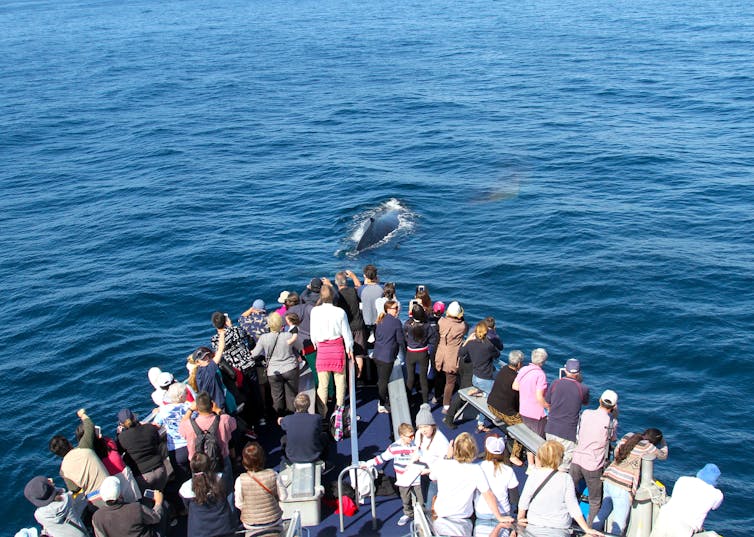
Whale watching in Australia.
And while some species hard-hit by whaling are now recovering, many whales face a very uncertain future in a quickly heating ocean.
Whales are unlikely to protect us from climate change. It’s more likely we’ll have to save them.
Source: The Conversation (Au and NZ) – By Adrian Beaumont, Election Analyst (Psephologist) at The Conversation; and Honorary Associate, School of Mathematics and Statistics, The University of Melbourne
Lukas Coch/AAP
A federal Newspoll, conducted May 31 to June 3 from a sample of 1,549, gave Labor a 55-45 lead, unchanged from the last Newspoll, three weeks ago. Primary votes were 38% Labor (steady), 34% Coalition (steady), 12% Greens (up one), 6% One Nation (down one) and 10% for all Others (steady).
The gain for the Greens at the expense of One Nation should have contributed to Labor’s two party vote, and implies that Labor was unlucky not to gain on Newspoll’s two party estimate; rounding explains this.
Prime Minister Anthony Albanese’s ratings were 55% satisfied (down two) and 37% dissatisfied (down one), for a net approval of +18, down one point. Opposition Leader Peter Dutton’s net approval was up one point to -14. Albanese led Dutton by 55-28 as better PM (56-29 three weeks ago). Newspoll figures are from The Poll Bludger.
Support for the Indigenous Voice to parliament slumped to a 46-43 lead for “yes” with 11% undecided, from a 53-39 lead in early April. This is the lowest lead for the Voice in any national poll so far. The question wording was changed to reflect the question that will be asked at the referendum.
In early May, I wrote that just one of 25 constitutional referendums held by Labor governments have succeeded in carrying the required four of six states as well as a national majority, and that early polling is not predictive, with support often collapsing in the lead-up to the vote.
The remainder of this article covers additional federal polls, WA Premier Mark McGowan’s resignation, the US debt limit compromise bill that passed Congress last week, and state polls from Victoria, NSW and Tasmania.
Essential poll: 52-43 to Labor including undecided
In last week’s Essential poll, conducted May 24-28 from a sample of 1,138, Labor led by 52-43 including undecided (53-42 the previous fortnight). Primary votes were 34% Labor (down one), 31% Coalition (steady), 15% Greens (up one), 6% One Nation (up one), 2% UAP (up one), 7% for all Others (down one) and 5% undecided (steady).
Asked about the government’s proposed $10 billion for housing development, 41% thought the $10 billion about the right amount, 30% too little and 9% too much. On sports betting advertising, 43% thought it should be banned at all times, 26% allowed but not during sports events and 16% always allowed.
Freshwater poll only gives Labor a 52-48 lead
The Poll Bludger reported on May 22 that a Freshwater poll for The Financial Review, conducted May 15-17 from a sample of 1,005, gave Labor a 52-48 lead, a two-point gain for the Coalition since December. Primary votes were 37% Coalition (steady), 34% Labor (down three), 12% Greens (steady) and 17% for all Others (up three).
Albanese’s approval was 42% (down six) and his disapproval 37% (up seven), for a net approval of +5, down 13 points. Dutton’s net approval was down three to -12. Albanese led as preferred PM by 51-33, from 55-29 in December.
On a two-answer basis, support for the Indigenous Voice to parliament narrowed to 55-45 from 65-35 in December. Initial views were 48% “yes” (down two), 39% “no” (up 13) and 13% undecided (down 11). An April Freshwater poll had given “yes” an overall 56-44 lead.
Just 9% thought the May 9 budget would put downward pressure on interest rates and inflation, while 52% thought the opposite. By 70-13, voters supported Dutton’s call to curtail sport gambling ads.
The Poll Bludger also reported that a Redbridge poll of Victorian federal voting intentions gave Labor 41% of the primary vote (32.9% at the May 2022 election), the Coalition 34% (33.1%) and the Greens 12% (13.7%). A Painted Dog WA poll for The West Australian gave Albanese a net +23 approval while Dutton was at net -32.
Opposition to Voice drops in Morgan poll
A Morgan SMS poll, conducted May 26-29 from a sample of 1,833, had support for an Indigenous Voice to parliament at 46% (steady since mid-April), opposition at 36% (down three) and 18% undecided (up three). Excluding undecided, “yes” led by 56-44, a two-point gain for “yes”.
Morgan’s weekly voting intentions poll gave Labor a 55.5-44.5 lead last week, unchanged on the previous week but a 1.5-point gain for the Coalition since three weeks ago. Primary votes were 36% Labor, 33.5% Coalition, 11.5% Greens and 19% for all Others. This poll was taken May 22-28 from a sample of 1,389.
WA Premier Mark McGowan resigns
Labor Western Australian Premier Mark McGowan announced his resignation as premier and member for Rockingham last Monday. At the March 2021 WA state election, McGowan led Labor to the biggest landslide win in Australian state or federal political history.
Labor won 59.9% of the primary vote at that election and won the two party vote by 69.7-30.3 over the Liberals and Nationals. They won 53 of the 59 lower house seats and 22 of the 36 upper house seats – the first WA Labor upper house majority.
Labor reformed the upper house in September 2021 to remove the heavy malapportionment towards the non-Perth regions of WA and abolish the group ticket voting system. At the next election, all 37 upper house seats will be elected by a statewide vote.
US debt limit deal passes Congress
I covered the passage of the US debt limit deal between President Joe Biden and Republican House Speaker Kevin McCarthy through Congress last week for The Poll Bludger. The House passed it by 314-117 with a 78% “yes” vote from Democrats and 68% from Republicans, while the Senate passed it by 63-36 with 90% “yes” from Democrats but just 35% from Republicans.
My tactical analysis of the deal was harsh on McCarthy, saying he was more like a pussycat than a tiger. Upcoming elections in New Zealand and Spain were also covered, with both currently looking good for the right. In a previous post for The Poll Bludger, I covered recent election results in Thailand, Greece and Northern Ireland councils.
Republican House Speaker Kevin McCarthy, and US President Joe Biden struck a deal on the debt ceiling. Alex Brandon/AP/AAP
Morgan Victorian poll: 61.5-38.5 to Labor
A Victorian SMS Morgan state poll, conducted May 17-22 from a sample of 2,095, gave Labor a 61.5-38.5 lead over the Coalition (55.0-45.0 at the November 2022 election). Primary votes were 42% Labor, 28.5% Coalition, 12.5% Greens and 17% for all Others.
By 52.5-47.5 voters approved of Labor Premier Daniel Andrews’ performance (57.5-42.5 in a November Morgan poll). Liberal leader John Pesutto was at 53.5-46.5 disapproval. Andrews led Pesutto as better premier by 64-36. Respondents were asked why they approved or disapproved, with many who disapproved of Pesutto citing his handling of the Moira Deeming affair.
NSW Resolve poll: Labor honeymoon after election win
A New South Wales state Resolve poll for The Sydney Morning Herald, presumably conducted with the federal Resolve polls in April and May from a sample of about 1,100, gave Labor 44% of the primary vote (37.0% at the March 25 election), the Coalition 31% (35.4%), the Greens 9% (9.7%) and all Others 15% (17.9%).
Two party estimates are not generally provided by Resolve, but Labor is far ahead. Incumbent Chris Minns led new Liberal leader Mark Speakman as preferred premier by 42-12.
Tasmanian EMRS poll: Liberals slump but Labor doesn’t benefit
A Tasmanian state EMRS poll, conducted May 15-19 from a sample of 1,000, gave the Liberals 36% of the vote (down six since February), Labor 31% (up one), the Greens 15% (up two) and all Others 18% (up three). Tasmania uses a proportional system for its lower house, so a two party estimate is not applicable.
Labor’s Rebecca White led incumbent Liberal Jeremy Rockliff as preferred premier by 40-38, reversing a 44-36 Rockliff lead in February. This poll was taken after two Liberal MPs defected to the crossbench over the proposed new AFL stadium, causing the Liberal government to lose its majority.
Adrian Beaumont does not work for, consult, own shares in or receive funding from any company or organisation that would benefit from this article, and has disclosed no relevant affiliations beyond their academic appointment.
Social media contains enormous amounts of data about people, our everyday lives, and our interactions with our surroundings. As a byproduct, it also contains a vast trove of information about the natural world.
In a new study published in Flora, we show how social media can be used for “incidental citizen science”. From photos posted to a social site, we mapped countrywide patterns in nature over a decade in relatively fine detail.
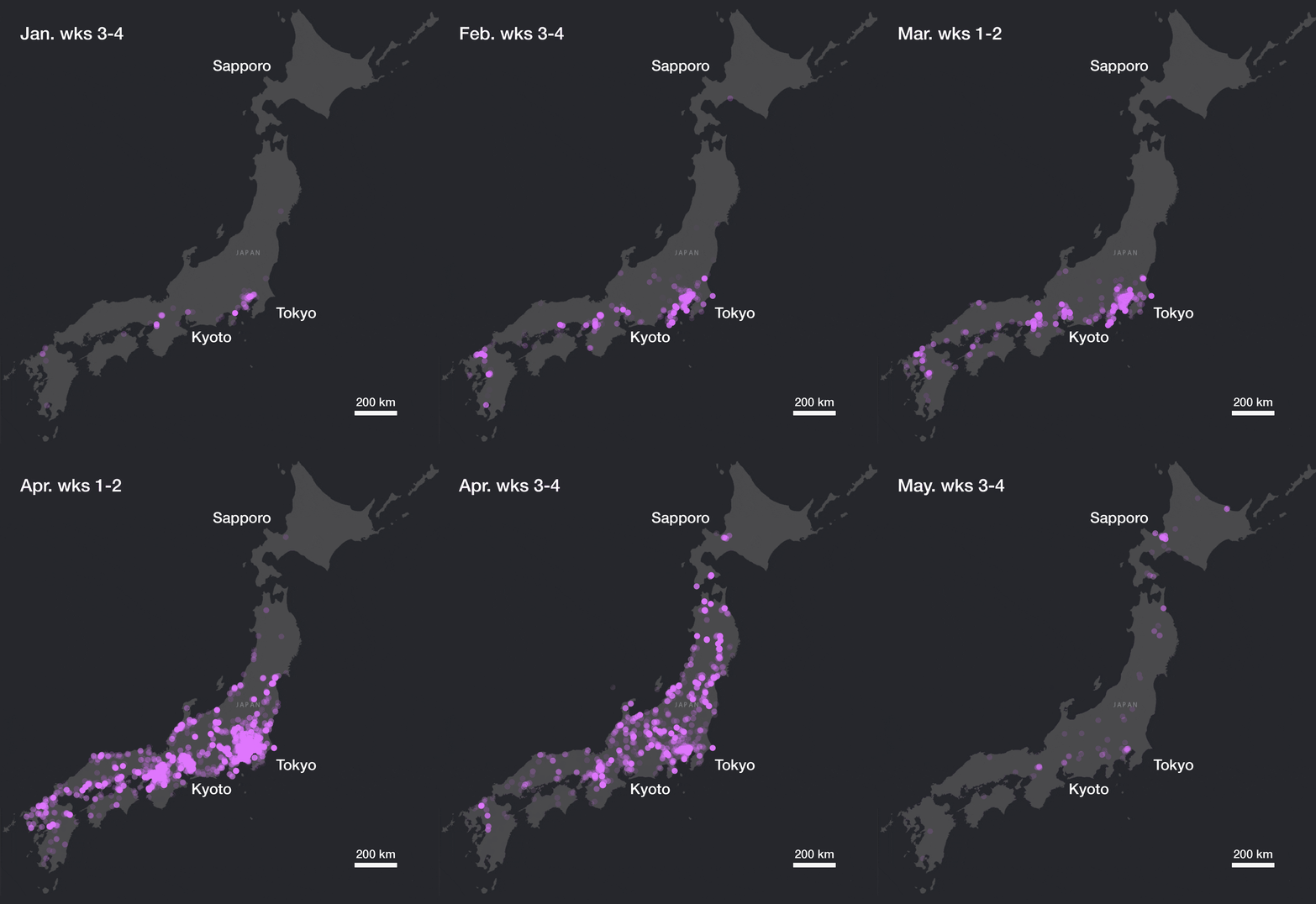
Our case study was the annual spread of cherry blossom flowering across Japan, where millions of people view the blooming each year in a cultural event called “hanami”. The flowering spreads across Japan in a wave (“sakura zensen” or 桜前線) following the warmth of the arriving spring season.
Celebrating the cherry blossom is a centuries-old tradition in Japan. Shutterstock
Why are flowers useful to understand how nature is being altered by climate change?
Many flowering plants, including the cherry blossoms of Japan (Prunus subgenus Cerasus), require insect pollination. To reproduce, plant flowers bloom at optimal times to receive visits from insects like bees.
Temperature is an important mechanism for plants to trigger this flowering. Previous research has highlighted how climate change may create mismatches in space or time between the blooming of plants and the emergence of pollinating insects.
It has been difficult for researchers to map the extent of this problem in detail, as its study requires simultaneous data collection over large areas. The use of citizen science images deliberately, or incidentally, uploaded to social network sites enables big data solutions.
How did we conduct our study?
We collected images from Japan uploaded to Flickr between 2008 and 2018 that were tagged by users as “cherry blossoms”. We used computer vision techniques to analyse these images, and to provide sets of keywords describing their image content.
Next, we automatically filtered out images appearing to contain content that the computer vision algorithms determined didn’t match our targeted cherry blossoms. For instance, many contained images of autumn leaves, another popular ecological event to view in Japan.
The locations and timestamps of the remaining cherry blossom images were then used to generate marks on a map of Japan showing the seasonal wave of sakura blossoms, and to estimate peak bloom times each year in different cities.
Checking the data
An important component of any scientific investigation is validation – how well does a proposed solution or data set represent the real-world phenomenon under study?
Blossom dates calculated from social media images compare well with official data. ElQadi et al., Author provided
Our study using social network site images was validated against the detailed information published by the Japan National Tourism Organization.
We also manually examined a subset of images to confirm the presence of cherry flowers.
Plum flowers (Prunus mume) look very similar to cherry blossoms, especially to tourists, and they are frequently mistaken and mislabelled as cherry blossoms. We used visible “notches” at the end of cherry petals, and other characteristics, to distinguish cherries from plums.
Taken together, the data let us map the flowering event as it unfolds across Japan.
Images uploaded to social media over a ten year period 2008-2018, let us map the cherry blossom front as it sweeps across Japan. ElQadi et al., Author provided
Out-of-season blooms
Our social network site analysis was sufficiently detailed to accurately pinpoint the annual peak spring bloom in the major cities of Tokyo and Kyoto, to within a few days of official records.
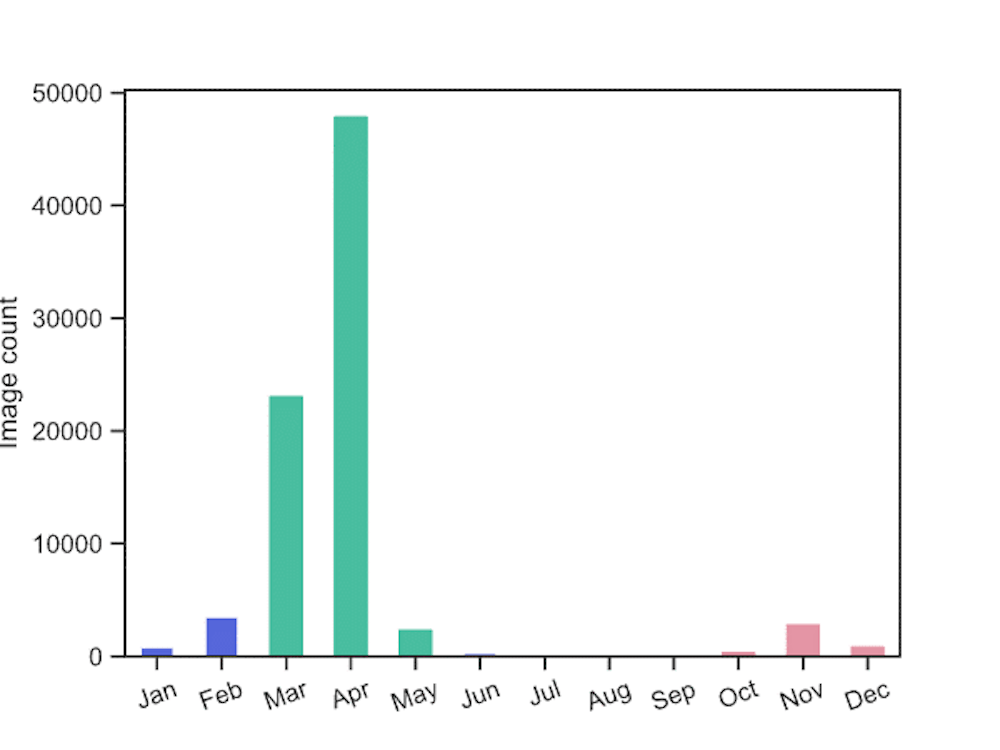
Our data also revealed the presence of a consistent, and persistent, out-of-season cherry bloom in autumn. Upon further searching, we discovered that this “unexpected” seasonal bloom had also been noted in mainstream media in recent years. We thus confirmed that this is a real event, not an artefact of our study.
Cherry blossom photographs from Flickr taken within Japan from 2008 to 2018 show an April peak as well as an unexpected smaller peak in November. ElQadi et al., Author provided
So, even without knowing it, many of us are already helping to understand how climate change influences our environment, simply by posting online photographs we capture. Dedicated sites like Wild Pollinator Count are excellent resources to contribute to the growing knowledge base.
The complex issues of climate change are still being mapped. Citizen science allows our daily observations to improve our understanding, and so better manage our relationship with the natural world.
Adrian Dyer receives funding from The Australian Research Council, and the Alexander von Humboldt Foundation (Germany).
Alan Dorin receives funding and/or support from the Australian Research Council, AgriFutures, Costa Group, Australian Blueberry Growers Association and Sunny Ridge berries.
Carolyn Vlasveld was undertaking a PhD at Monash University while collaborating on the study mentioned in this article. Her PhD was financially supported by an Australian Government Research Training Program (RTP) Scholarship, a Monash University Graduate Research Completion Award, an Ecological Society of Australia (ESA) Student Scholarship, a Denis and Maisie Carr Award and Travel Grant, and an Australian Society of Plant Scientists RN Robertson Travelling Fellowship.
Moataz ElQadi worked on this project as part of his PhD where he was supported by an Australian Government Research Training Program (RTP) scholarship and a Monash university stipend. Moataz also received an AI for Earth grant from Microsoft.
Relations between a centrist Labor government feeling its way and an ascendant Greens party have become surprisingly strained of late.
The rancorous tone of public exchanges reveals deep-seated enmities born of an increasingly direct electoral contest in the inner cities, legitimate policy differences, and a hyper-sensitivity to criticisms made of each other.
A current flashpoint is Labor’s housing policy, or, as the Greens would describe it, Labor’s failure to square up to a full-blown rental affordability crisis.
Among its suite of policies, Labor proposes a Housing Australia Future Fund (HAFF), which would use the earnings only on $10 billion in capital (up to a cap of $500 million a year) to build 30,000 social and affordable homes over three years.
Labor’s bill to create the HAFF is currently before the parliament. But it faces a difficult future with the Greens flagging they will join with the Coalition in the Senate to vote it down, insisting it lacks ambition. This is essentially the same rationale the Greens relied on to justify defeating the Rudd government’s 2009 Carbon Pollution Reduction Scheme Bill, which they said at the time, “locks in failure”.
Labor is apoplectic. It accuses the smaller party of hypocrisy in claiming to speak for society’s most vulnerable while lining up with the conservatives to deliver no new social and affordable housing.
In parliament, Prime Minister Anthony Albanese has described the Greens’ calls for a nationwide rent freeze – incentivised by a $1 billion federal fund – and a five-fold increase in social housing expenditure as “absolute pixie dust”.
Foreign Minister Penny Wong, who is also government leader in the Senate, rounded on the minor party’s housing spokesperson, Max Chandler-Mather, claiming he was engaging in stunts to boost his profile.
Responding to Greens senator Nick McKim in the Senate on May 11, a furious Wong said: “Your spokesman on housing (Chandler-Mather sits in the lower house) is now prioritising media attention (before) housing for women and kids fleeing domestic violence. That’s shameful you know, this man’s ego.”
McKim hit back, saying Wong’s anger showed “that Mr Chandler-Mather is getting right under the skin of this government”.
Such bitterness might seem curious given both Albanese and Wong hail from Labor’s left, the faction closest in values to the Greens party. But perhaps that closeness on the political spectrum is actually the problem.
Just as it is drily observed that the arguments in academia are so bitter because the stakes are so low, there is a sense that the deepest vitriol in parliamentary politics is actually reserved for parties of a similar philosophical hue: that is, parties competing for the same voters’ affections.
This tendency is not confined to the left. Even within the Coalition, subterranean antipathies between Liberal MPs holding rural-regional seats and Nationals occasionally bubble to the surface.
Liberals have also gone to extreme lengths to see off smaller right–wing parties. One notable case involved Tony Abbott in the late 1990s, when he urged One Nation members to take legal action against their fledgling party’s founder, Pauline Hanson. Abbott said in 2003:
I met with numerous One Nation dissidents back in 1998 because I was very keen to bring about an end to what I thought was the counterproductive and destabilising influence of One Nation.
While Labor MPs would be unlikely to say so publicly, it is likely many regard the Greens as a similarly “destabilising influence” on their end of the spectrum, if only because Greens MPs can propose spending, uninhibited by the likelihood of having to balance an entire budget themselves.
Current hostilities go back a long way. Labor resents being sniped at from its left flank for not moving fast enough on matters of climate, social policy and economic redistribution.
For its part, the Greens bristle at being labelled “ideologically pure” – a tag clearly intended in the pejorative sense.
Bad blood lingers from the legislative failure of Rudd’s CPRS. The country ended up with no economy-wide mechanism for emissions reduction. That situation continues to this day.
Indeed, it was probably memories of this that led to a compromise on the Albanese government’s toughened safeguards mechanism on industrial polluters earlier this year. This succeeded despite the Greens grumbling that the mechanism amounted to trying to put the climate fire out while pouring petrol on it.
However, on housing, the smaller party is taking a harder line.
How much of this is principle and how much is political positioning depends on perspective.
As the major parties’ share of first preference votes erodes, the minor party believes it can take a greater slice of the more progressive, younger vote by styling the Greens as the natural party of renters.
With Labor and the Coalition reluctant to curb generous tax breaks for property investors – negative gearing and capital gains tax concessions – the Greens believe they can specifically speak for those locked out of home ownership.
Last year, they recalled parliament around the country to put caps on energy prices, you see the treasurer get up and say, ‘we’ve put caps on energy prices. But all of a sudden, rents don’t matter. Why is it that a third of the country don’t get the sort of representation – renters – that a lot of other people in this country do?’.
At just 30, Chandler-Mather scored one the last election’s most surprising upsets when he seized the Labor-held Brisbane seat of Griffith for the minor party. It was one of three lower house seats the Greens won in Queensland, which along with Melbourne, held by party leader Adam Bandt, took their total to four.
At just 30, the Greens’ Max Chandler-Mather won the Queensland seat of Griffith from Labor at the 2022 federal election. He is now the party’s spokesperson on housing. Mick Tsikas/AAP
A savvier political operator than any of his predecessors, Bandt has proved to be a shrewd negotiator. He is also a clear communicator, capable of delivering sharp attack lines against the government even as he reaches compromises.
His brand of assertive, values-based politics, tempered with a higher degree of political realism, has proved effective with his party room now 16–strong.
But, in politics, growth brings its own challenges.
Presenting as a party of immovable principle, rather than one of practical government, means that backing down in order to achieve some level of progress can become difficult. Party members may view compromise as retreat, failure or, even worse, as the politics of orthodoxy, major-party style.
This probably explains why, when Bandt’s party eventually supported Labor’s safeguard mechanism legislation in March, its votes came wrapped in scathing rhetoric more consistent with having opposed the bill. Bandt said:
It’s become readily apparent that we are dealing here in this parliament with a government that is still captured by the coal and gas corporations.
A further difficulty for parties built on unwavering fidelity to principles, above all else, arises when strongly professed standards are not lived up to internally.
Claims of racism within the party – first made by a Victorian First Nations senator, Lidia Thorpe, who has become an independent senator, and then by a current Greens frontbencher, Pakistan-born NSW senator Mehreen Faruqi, present Bandt with a conundrum.
The Greens leader must be seen to be doing all he can to establish the facts behind the allegations while his instincts – just like his major party competitors – will be to reject the suggestions to protect the party’s reputation as uniquely enlightened.
“The Greens are an anti-racist party, the Greens are an anti-hate party,” he told Radio National Breakfast following the allegations.
There’s no doubt that this is his party’s policy, but is it also its practice in every interaction? It’s a big call, and another example of the interface between good intentions and competitive politics on the ground.
Mark Kenny does not work for, consult, own shares in or receive funding from any company or organisation that would benefit from this article, and has disclosed no relevant affiliations beyond their academic appointment.
The recent decision in “one of the most complex and long running” trademark cases in New Zealand was a loss for the country’s mānuka honey producers. But it also served to highlight just how ill-equipped our laws are for protecting Māori taonga (treasures) and mātauranga Māori (traditional knowledge).
The case, decided by the Intellectual Property Office of New Zealand (IPONZ), centred on whether the term “Manuka Honey” could be registered by the Mānuka Honey Appellation Society as a certification trademark in Aotearoa New Zealand. The society represents a group of New Zealand producers.
Registration would have allowed the society to exclusively use the Manuka Honey name (without the tohutō or macron over the “a”) when marketing honey made from the nectar of the mānuka (Leptospermum scoparium) plant. Honey producers in Australia opposed any such move.
Certification marks are a type of trademark where the owner independently certifies that their goods possess certain defined characteristics. The marks enable owners to commercialise products that are sourced from specific geographical areas or produced using particular methods.
If it had been successful, the society would have only allowed New Zealand-based producers to use the trademark on their products.
The question of distinctiveness
The mānuka case dates back to 2015, when New Zealand honey producers lodged an application for the Manuka Honey trademark. The Australian Manuka Honey Association opposed the application, arguing the proposed trademark was merely descriptive and not distinctive.
In other words, the Australian producers claimed the trademark simply described honey sourced from the nectar of the mānuka tree. This is important, because one of the key requirements to receive a certification trademark in New Zealand is that the mark must distinguish the goods of one producer from those of another.
The distinctiveness test involves assessing whether the “average consumer” would regard the certification mark as a normal way of designating characteristics of the goods in question.
IPONZ concluded that the average consumer would not find the proposed Manuka Honey mark to be distinctive. This was largely because this term was already used extensively by both New Zealand and Australian honey producers before the application was lodged.
Mānuka as taonga
Although mānuka is a kupu (word) sourced from te reo Māori, the Leptospermum plant is also native to Australia, where it is commonly known as “tea tree”. Some scientists believe that Leptospermum scoparium likely originated in Australia and travelled to New Zealand before the last ice age, probably with the assistance of birds.
Today, over 80 different Leptospermum species grow in Australia. All of these can provide a honey source.
Although Australian Leptospermum scoparium is the same species as mānuka in Aotearoa, there are differences between the plants, the honey produced from them and their cultural significance.
Mānuka, as both kupu and plant, is regarded as a taonga by Māori. Significant mātauranga Māori exists in relation to mānuka. Māori have long used the plant for various purposes, including in medical treatments, the fabrication of objects such as waka, and for cosmetic reasons.
Much of the knowledge about the unique characteristics of mānuka is directly derived from mātauranga Māori. However, Māori rarely, if ever, benefit from the commercialisation of mānuka honey, especially by overseas businesses.
Limitations of New Zealand IP law
The mānuka case reveals some of the gaps in the intellectual property system in Aotearoa, especially in relation to the protection of taonga plants and mātauranga Māori.
Assistant Commissioner of Trade Marks Natasha Alley said she “carefully considered” the taonga status of mānuka, in addition to tikanga Māori and Te Tiriti o Waitangi/Treaty of Waitangi in deciding the case. Alley also acknowledged the “critical importance” of Māori intellectual property rights.
But she concluded that these factors did not outweigh the “clear provisions” of the Trade Marks Act which does not require IPONZ to consider the taonga status of kupu or plants, or the existence of mātauranga Māori, when evaluating certification mark applications.
Protection of taonga and mātauranga Māori
The need to provide legal protection for taonga and mātauranga Māori – including through the intellectual property system – has been long discussed in Aotearoa. The 1991 Wai 262 claim asked the Waitangi Tribunal to redress Crown laws and policies that denied Māori control over taonga, in violation of Te Tiriti.
In 2011, the Waitangi Tribunal issued a report containing specific recommendations about how New Zealand intellectual property laws should be reformed to ensure that taonga and mātauranga are protected.
Although the Wai 262 report was published a dozen years ago, some of its recommendations remain unfulfilled. For instance, the law does not provide any form of protection for mātauranga Māori specifically. The government is considering a number of reforms to respond to Wai 262 concerns, but these will take years to fully implement.
In the meantime, mānuka producers in New Zealand could consider alternative certification trademarks or forms of cultural branding to distinguish their products from Australian-made Leptospermum honey.
While any new certification marks would need to pass the distinctiveness test, they should also require businesses that market mānuka to meet culturally appropriate standards, especially where mātauranga is involved.
Kiwis may have lost the naming battle, but it may still be possible to win over consumers who are looking for products that embody the uniquely bicultural character of Aotearoa.
David Jefferson has funding from the Borrin Foundation and from the University of Canterbury Vision Mātauranga Development Fund.
The number of people needing an organ transplant vastly outweighs the number of organs available.
In 2022 there were about 1,800 Australians waiting for an organ but only about 1,200 people received an organ transplant.
But in a recent paper, I outline one unexplored option for increasing the number of potential organ donors in Australia – transplanting organs from people undergoing voluntary assisted dying. This would involve transplanting organs only after someone had died.
It’s estimated about 10% of people eligible for voluntary assisted dying are likely to be medically suitable to donate their organs. Based on Victorian figures alone, this could lead to about an extra 40 potential organ donors each year.
This type of organ donation has taken place for more than 20 years in Europe, and more recently in Canada.
Organs transplanted from donors undergoing voluntary assisted dying havesimilarsuccess rates to more traditional donations.
Yet, this is a discussion we’ve yet to have in Australia. Here are some of the ethical and practical issues we need to start talking about.
The main ethical challenge is ensuring a person isn’t motivated to end their life prematurely so they can donate their organs.
Internationally, this challenge is mainly addressed by having independent assessments by multiple doctors. This is to ensure the motivation is genuine and honest, much like assessing someone before voluntary assisted dying.
Similarly, it is important the doctor of someone undergoing voluntary assisted dying isn’t persuading them to donate an organ. This means any doctor overseeing voluntary assisted dying may be limited in how much they can discuss organ donation with their patient.
Is this what people really want, with so little time left? Shutterstock
Organ donation may also affect the way voluntary assisted dying is conducted, which may impact participants’ very limited quality of life.
That’s because determining if someone is eligible to donate an organ involves a number of investigations. These may include blood tests, radiology (imaging) and numerous clinical encounters to exclude diseases such as cancer, which would prevent someone donating their organs. These investigations may be exhausting but necessary.
This burden must be weighed against the participant’s wishes and motivation to donate their organs. So people must also be informed of the impact organ donation will have on their limited life left.
The choices of people considering this option must be respected and they must be given multiple opportunities to review their decision, without undue influence or bias.
Practically, combining organ donation and voluntary assisted dying is challenging. This includes the difficulty organising and coordinating specialists in organ donation, voluntary assisted dying and transplantation.
This is why, internationally, organ donation of this nature mostly occurs in large hospitals, where it’s easier to coordinate.
So if people want to donate an organ this way, they may spend their last moments in an unfamiliar environment.
People may have to be moved to a large hospital with the facilities and staff on hand. Shutterstock
Efforts have been made internationally to prioritise these valuable last moments by giving people the choice of where voluntary assisted dying occurs (such as their home). But this currently only occurs in a minority of cases and increases the complexity of organ donation.
Regulating the process is also essential to developing a safe, trustworthy and effective program. Ideally a centralised organisation such as Australia’s national Organ and Tissue Authority would organise, undertake and regulate this.
However, this may be challenging given voluntary assisted dying practices are specific to each state.
If someone considering voluntary assisted dying wants to donate their organs and is deemed eligible, there is currently no legal barrier in Australia to stop them.
What might prevent them is how their doctor responds, and whether there are the services and organisations willing to fulfil this request ethically and practically.
The next step in considering this form of organ donation is to discuss the prospect publicly.
Every extra donated organ is potentially lifesaving. So we should make every effort to consider potential safe and ethical ways to increase donation and transplantation rates.
Dr Robert Ray is also a physician trainee at Barwon Health, Geelong.
Source: The Conversation (Au and NZ) – By David Lindenmayer, Professor, The Fenner School of Environment and Society, Australian National University
By the end of this year, native forest logging will cease in Victoria. Now begins a long and difficult process to recover vast areas of forest after more than 50 years of clearfelling and other destructive logging practices.
The supply of sawlogs in Victoria was close to being exhausted, and the state’s logging industry had long been financially unviable. Restoring the forest offers the opportunity to put something better in its place.
For many years, we’ve thought deeply about the problem of these degraded forests and the restoration needed. It’s a huge job, but it can be done. Here, we outline what’s needed.
After decades of protect, native logging in Victoria will end. Now beings the process of restoration. Joe Castro/AAP
The scale of the problem
Since the 1960s, clearcut logging has occurred across more than 300,000 hectares of Victoria’s forests. Aside from the direct destruction, the logging has left remaining forest ecosystems badly fragmented.
Young trees now dominate much of Victoria’s forest. It can take more than 120 years for trees to mature and form the hollows that animals require to breed, nest and shelter. Until then, artificial hollows such as nest boxes will be required. They must be designed, built and installed properly, and replaced as needed.
In many parts of Victoria, extensive stands of trees need to be re-established. Preliminary assessments suggest regeneration of tree cover has partially or completely failed in up to 30% of logged areas. In addition, large parts of a logging coupe can comprise cleared areas where trees were dragged, trimmed and loaded onto trucks.
It gets worse. Following successive major wildfires in many parts of Victoria, large areas of forest have failed to regrow. Vast amounts of seed must now be collected and sewn to re-establish forest.
And in many areas, logging has altered the mix of tree species. The leaves of trees that remain are often unsuitable as food for iconic animals such as the koala and southern greater glider. The right mix of tree species must now be restored.
Logging in Victoria’s native forests will be banned from next year. Pictured: a logging area burnt after clearfelling. Chris Taylor, Author provided
Yet more challenges
The types of restoration methods used needs careful consideration. Forestry industry advocates have promoted activities such as industrial tree thinning, but this can make things worse.
We must be careful, too, about industrial-scale prescribed burning. When done badly, it can harm forests and their biodiversity. This recently occurred south of Perth, when a population of the endangered western ringtail possum was decimated by a prescribed burn.
Neither burning nor thinning on an industrial scale will be appropriate in some ecosystems. These include those dominated by mountain ash and alpine ash, where a lot of logging in Victoria was concentrated over the past few decades. Industrial-scale prescribed burning would likely lead to their collapse.
Yet another restoration challenge will be controlling feral animals such introduced deer, which do enormous damage. Major and sustained efforts will be needed to control exploding numbers of these pest animals.
Robust monitoring programs are essential to guide forest restoration. Collecting reliable data on a forest’s condition and biodiversity can help determine whether restoration activities should continue or be changed.
Victoria already has monitoring programs that can perform this task. They should be maintained and expanded. Monitoring programs will also be crucial to the federal government’s so-called “nature repair market”, in which investors pay for habitat restoration in exchange for tradeable certificates. Monitoring is needed to ensure the integrity of this scheme.
Restoration programs must be coupled with an expansion of national parks and other protected areas in Victoria. In particular, the Victorian government should honour its 2015 promise to create a Great Forest National Park. This park along with others must be developed with First Nations people.
Restoring heavily logged forests will need an active workforce for many years to come. Meaningful and productive jobs will be available in areas such as tourism and forest management.
And First Nations people should now be given the opportunity to heal and manage Country. A Victorian government program to support Aboriginal jobseekers may be a way to support these activities.
First Nations people have already identified ways to heal and manage Country through self-determination and cultural practices. It’s involved a lot of work convening traditional knowledge-holders and working with government, including a Cultural Landscapes Strategy launched in 2021. The end to logging removes a key barrier to implementing the plan.
The First Peoples’ Assembly of Victoria is making serious headway towards powerful and practical statewide and local treaties. These would ensure First Nations people have the power to make decisions that affect Country.
However, the Federation of Victorian Traditional Owner Corporations says protection and restoration challenges must be urgently addressed, and land rights can’t wait for treaties.
Let’s get this right
Many parts of the world have successfully moved away from heavy extraction-based industries – both ecologically and economically. It is time for Victoria to do this in forests.
The decision to end native forest logging in Victoria came decades too late, but vast areas of badly damaged forest can be restored. And if it’s done right, people and the economy will benefit too.
David Lindenmayer receives funding from the Australian Government, the Victorian Government and the NSW Government. He is a member of the Biodiversity Council and Birds Australia.
Chris Taylor does not work for, consult, own shares in or receive funding from any company or organisation that would benefit from this article, and has disclosed no relevant affiliations beyond their academic appointment.
Australia’s energy transition is well under way. Some 3 million households have rooftop solar and sales of medium-sized electric cars are surging. But as we work towards fully electric households powered by renewable energy, have we overlooked a key enabling technology, the humble electric water heater?
By storing solar energy as hot water, a smart electric heater can effectively act as a household battery. Shutterstock
About half of Australian households use electric water heaters, while the rest use gas. So what’s so great about electric water heaters?
Electric water heaters offer a cheap way to store large amounts of energy, in the form of hot water. A heater with a 300-litre tank can store about as much energy as a second-generation Tesla Powerwall – at a fraction of the cost.
Our research at the UTS Institute for Sustainable Futures has found Australians could use household electric water heaters to store as much energy as over 2 million home batteries of that kind. This could eventually save over A$6 billion a year on our energy bills while getting us closer to net-zero carbon emissions.
Our report, published today and funded by the Australian Renewable Energy Agency (ARENA), recommends that, to halve emissions by 2030 and reach net zero by 2050, we urgently need policies to rapidly replace gas water heaters with “smart” electric water heaters. Smart heaters can be switched on and off in response to changes in electricity supply and demand across the grid.
This means these heaters can soak up excess “off-peak” renewable energy, particularly from solar, and so help us solve two key problems at once. They can help reduce and eventually eliminate greenhouse gas emissions. And they can make our electricity grid more stable by providing flexible demand that helps balance out the fluctuating supply from renewable sources.
Cutting emissions
There are three main types of electric water heater. A conventional “resistance” heater uses electricity to heat water directly. Solar water heaters use sunlight and electricity, but have become less popular as newer “heat pump” units emerged. These collect heat from the air and “pump” it into water. A heat pump uses three to four times less electricity than a resistance heater.
Back in 2010, a resistance electric water heater typically produced around four times more emissions than its gas equivalent. Heat pump emissions were about the same as for gas. That’s because electric water heaters use a lot of electricity, and most of it came from burning coal.
As we generate more electricity from renewables, this picture is changing dramatically. Australia’s energy market operator, AEMO, publishes regularly updated pathways to a clean-energy future. In the most likely outcome, the “step-change scenario”, gas will become the most greenhouse-intensive water-heating option by 2030.
By 2040, once the transition to a renewable electricity system is largely complete, emissions from resistance and heat pump water heaters will be much lower than for their gas counterparts.
The projected emissions intensity of resistance and heat pump water heaters in NSW will soon be much lower than for their gas counterparts. Results for Queensland, Victoria and the ACT are similar to those for NSW. Author provided
Water heaters can last 15 years or more. So the stock of heaters in our homes for the next two decades depends on what we install today. Replacing gas heaters with electric heaters should therefore be an immediate priority in our energy transition.
Our work explored a range of scenarios, each with a different mix of water-heating technologies. One was a business-as-usual baseline where gas water heaters remain prevalent. In alternative scenarios gas is phased out over the next 10–20 years.
We found that replacing gas with electric water heating would not only help us get to net-zero emissions sooner, it would save us money.
Gas is expensive and unlikely to get much cheaper. Abundant renewables offer an excess of cheap electricity that water heaters can help soak up. Embracing this opportunity could save over $6 billion a year on our energy bills by 2040.
In our modelling of the National Electricity Market, business-as-usual policy (left) locks in costly and high-emissions gas units for decades to come. In our rapid electrification scenario (right), electric water heaters rapidly replace gas units. Author provided
Boosting grid stability
Solar and wind are now the cheapest technologies we’ve ever had for generating electricity. But to maintain a stable electricity system, we need to match demand with the fluctuating supply from renewable sources. Batteries offer a partial solution, but are still relatively costly.
Electric water heaters offer a much cheaper way to store large amounts of energy and provide the demand flexibility the grid needs.
Our research found that, compared to the business-as-usual baseline, a scenario that emphasises demand flexibility using smart electric water heaters could provide an extra 30GWh of daily flexible demand capacity. That’s the equivalent of over 2 million home batteries across the National Electricity Market, which supplies electricity to eastern and southern Australia.
Back to the future for water heating
Since the 1950s, “off-peak hot water” has seen Australian electricity providers turning household water heaters off during the day and on at night to better match demand and supply. In return, customers received heavily discounted prices.
In recent decades we’ve moved away from off-peak electric hot water, as incentives dwindled and more homes connected to natural gas.
As we electrify our hot water, which technology should we embrace: resistance or heat pump? The answer is both.
Our research explored the trade-off between highly flexible resistance water heaters versus highly efficient but less flexible heat pumps.
Heat pumps use less electricity and cost less to run. Where electricity prices are high or power flow is limited, using heat pumps makes sense. However, they have a higher upfront cost and are not suited to all homes. Many apartments, for example, lack access to suitable outdoor space.
And because they use less electricity, heat pumps offer less flexible demand. As renewables, particularly solar, increasingly power our grid, the ability of resistance electric heaters to soak up excess “off-peak” renewable energy is a big advantage.
With the right policies and market reforms, we will all benefit from a system that once again rewards customers with cheap off-peak electricity in exchange for network operators being able to switch our water heaters off and on as needed.
David Roche works for the Institute for Sustainable Futures, which received funding for this work from the Australian Renewable Energy Agency (ARENA).
Source: The Conversation (Au and NZ) – By Dr Karen Peel, Senior Lecturer in Teacher Education, University of Southern Queenskand, University of Southern Queensland
Shutterstock.
There are an estimated 24,000-plus students who study by distance education in Australia.
While their lessons are delivered remotely, by law, all of these students still need to be supervised by somebody in person. This is the role of the “remote education tutor”, who is thelink betweenthe student and the teacher.
Despite the vital work they do, there is no prerequisite or formal qualification for this role, and no precise data on their number, as their work is often misrepresented as parenting, childcare or nannying.
We need to start recognising this key educational role as a career.
Who are remote tutors and what do they do?
For students who are unable to attend mainstream schooling, it is the tutor’s job to facilitate everyday classroom learning. The student will be provided instruction and given materials by their school, but the tutor needs to organise and supervise the completion of tasks and lessons.
They are either a family member (typically the mother) or an externally employed person. If it is a non-family member, these tutors come from a wide range of backgrounds, including young people on a gap year, university students who want to work while studying, and domestic and international travellers.
It is the tutor’s job to organise, supervise and support the ‘classroom’ at home. Shutterstock
This is not helped by a lack of government incentives for, say, teaching students to spend a “year in the bush”, or visa provisions to allow overseas-qualified teachers to stay for longer periods in these roles.
So there is a high turnover. Most are only in the job with the one family for one to two years before leaving the role altogether.
There is a federal government allowance for families doing distance education and some minor state government subsidies for internet access and computer hardware. But families say these are not enough to help parents recruit and retain a supervisor.
Why should we recognise tutors?
If there is formal recognition of remote educator tutors’ knowledge and skills, this provides status and makes the job a more attractive career pathway.
Tutors would not have to do a full education degree, like school teachers. Instead, they could be trained in specific components of a degree through microcredentials, or smaller courses of learning.
They could start with specific skills for setting up and managing a learning space, and strategies for teaching reading, spelling and basic numeracy. These examples are core to the remote educator tutor qualifications, which could also be later used as part of other qualifications, if they wanted to do future study.
Dedicated, targeted training for remote education tutors could be applied beyond this workforce as well. We know there are many school students studying at home for reasons other than being too far from the nearest school.
Growing numbers of students either study online at private schools or are home-schooled. They also need to be supervised (most often by parents).
Growing numbers of Australian students are doing their schooling from home, regardless of where they live. Shutterstock
Other groups who would benefit from these training opportunities include:
parents who are home tutors for their children enrolled in distance education
parents who home-school their children
parents who want to develop skills to tutor their child (or children) enrolled in general schooling.
teacher aides who want to boost their current qualifications.
This training could be done through online university courses or other vocational providers. It would not only support the professional needs of remote tutors but also empower families to better support their children as they navigate distance education.
Most of us look forward to a rare long weekend. But some Australians now enjoy a four-day week every week.
They’re lucky enough to work for the small number of organisations that are trialling or have permanently adopted what is known as the 100:80:100 model, in which employees keep 100% of what they were paid for five days while working 80% of their former hours – so long as they maintain 100% productivity.
This model has been attracting significant global attention. There have been glowing reports in the past few years about the success of trials in Iceland, the United Kingdom and elsewhere. Some of this reporting, however, has exaggerated the findings or failed to consider the complicating factors that may not make the model scalable.
To get a better sense of the reality, we’ve surveyed ten Australian organisations that have embraced the model.
We interviewed senior managers in each organisation about the benefits and challenges experienced. So our results do reflect a management perspective. But what they told us suggests the four-day work week can successfully deliver positive outcomes for both employers and employees across a range of different industries.
Who we surveyed
Four of the ten organisations in our research have adopted the change permanently after trials. The other six have extended their trials, though are still to formally make the move permanent.
We believe these ten organisations represent the bulk of Australian organisations using the 100:80:100 model. There may be others, but we looked hard to ensure our survey was as complete as possible. Four of the companies were part of the global studies referred to above. The other six weren’t, designing their own pilot schemes.
All are private-sector businesses. Two are management consulting firms, with the others being a shipping/logistics company; recruitment agency; marketing agency; mental health coaching company; software development company; creative design agency; health-care company, and management training company.
Six of the companies are small businesses (with fewer than 20 employees). The other four are medium-sized businesses (20-199 employees).
In each case, the initiatives were management-led, as a strategy to tackle employee burnout, increase productivity, and keep and attract talent in a tight labour market.
For example, EES Shipping, a medium-sized logistics company based in Perth, decided to trial a four-day week in July 2022, at a time of extreme pressure on global and local supply chains.
“We were starting to see cracks within the industry,” said managing director Brian Hack. “People were burning out, truck drivers were just walking out the door, and I really didn’t want to see that happen here.”
Three of the ten managers reported no loss of productivity despite a 20% reduction in hours – so effectively staff were about 20% more productive.
The other seven reported productivity being even higher than before.
Six said improvements in recruitment and retention had been the biggest success of the initiative so far. Five underlined important reductions in absenteeism.
Three companies needed to maintain their previous hours of availability for customers and clients, despite their staff now working 20% less time. This illustrates it is possible for “client-facing” organisations to implement four-day work weeks.
Three ‘client-facing’ companies maintained opening hours while reducing working hours. Shutterstock
Workers’ response
Based on internal surveys and anecdotal evidence, managers reported the extra day off each week meant workers felt more relaxed and re-energised, and helped avoid the “Sunday scaries” – the anxiety and dread felt on Sunday night at the prospect of another five-day week.
But there are also challenges facing any organisation wanting to adopt a four-day work week. Participating managers said the biggest barrier was overcoming scepticism both internally and from external stakeholders such as clients and customers. The biggest point of resistance was people simply not believing fewer hours didn’t have to mean lower productivity.
Overcoming that scepticism is likely to require more evidence from trials – including from larger companies, to see if the benefits reported by these small companies are scalable to the whole workforce.
One such trial is in the pipeline, though it will be of limited value.
Australia’s biggest hardware retailer, Bunnings, last month signed an agreement with the Shop Distributive and Allied Employees Association for a four-day work week trial. The company’s 40,000 employees, however, won’t be trialling the 100:80:100 model. They’ll be working the same number of hours over fewer days. So it won’t be possible to draw substantial conclusions from the outcome.
And while the “client-facing” companies we surveyed managed to maintain their operations, it remains to be seen if that’s the case for all workplaces, such as shops, hospitals and nursing homes where any reduction in hours worked by current employees would probably need to be covered by additional staff.
The only way to be sure will be through trials.
John L Hopkins does not work for, consult, own shares in or receive funding from any company or organisation that would benefit from this article, and has disclosed no relevant affiliations beyond their academic appointment.
Hot soup on a cold day brings warmth and comfort so simple that we don’t think too much about its origins. But its long history runs from the Stone Age and antiquity through to modernity, encompassing the birth of the restaurant, advances in chemistry, and a famous pop art icon.
The basic nature of soup has a fundamental appeal that feels primordial – because it is.
Archaeologists speculate the first soup might have been made by Neanderthals, boiling animal bones to extract fat essential for their diet and drinking the broth. Without the fats, their high intake of lean animal meats could have led to protein poisoning, so stone age soup was an important complement to primeval nutrition.
The fundamental benefit of these bone broths is confirmed by archaeological discoveries around the world, ranging from a gelatin broth in Egypt’s Giza plateau, to Shaanxi Province in China.
The widespread distribution of archaeological finds is a reminder soup not only has a long history, but is also a global food.
Today, our idea of soup is more refined, but the classic combination of stock and bread is embedded in the Latin root of the verb suppāre, meaning “to soak”.
As a noun, suppa became soupe in Old French, meaning bread soaked in broth, and sowpes in Middle English. This pairing was also an economical way of reclaiming stale bread and thickening a thin broth.
Wealthier households might have toasted fresh bread for the dish, but less prosperous diners used up stale bread that was too hard to chew unless softened in the hot liquid.
From rustic to creamy
New ideas about science and digestion in 17th century France promoted natural flavours and thick, rustic preparations gave way to the creamy and velvety smooth soups we know today.
The Soup Kitchen, Antonio de Puga, ca. 1630. Museo de Arte de Ponce
New versions of the liquid food were developed by early modern European chefs, such as the seafood bisque, extracting flavour from the shells of crustaceans.
The first restaurant as we understand them today opened in Paris in 1765, and was immortalised for a simple broth, a clear soup made from bone broth and fresh herbs.
Mathurin Roze de Chantoiseau, the original French restaurateur, created a new type of public space where weary diners could regain their lost appetites and soothe their delicate nerves at all hours.
It may appear to be a contradiction that the first restaurant specifically catered to clients who had lost their appetites, yet it seems perfectly natural soup was the cure.
Soup was not destined to be limited to fancy restaurants or the long simmering stock pots of peasants. Modern science made it convenient and less expensive for home cooks.
In 1897, a chemist at the Campbell soup company, John Dorrance, developed a condensed canned soup that dramatically reduced the water content. The new method halved the cost of shipping and made canned soup an affordable meal anyone could prepare.
Lunch (The Soup, Version II), Albin Egger-Lienz, 1910. Leopold Museum, Vienna
This revolutionary achievement was recognised at the 1900 Paris Exposition, winning an award for product excellence. Winning the prize was an achievement considering the competition at the world fair. The other technological advances exhibited at the turn of the century included the diesel engine, “talking” films, dry cell batteries and the Paris Metro.
The bronze medallion from 1900 still appears on the iconic red and white label, made famous by pop artist Andy Warhol’s 32 Campbell Soup Cans (1962).
In his work, Warhol appropriated images from consumer culture and the media ordinary people would instantly recognise, from Coca-Cola bottles to Marilyn Monroe. In his famous soup painting, 32 canvases – one for each flavour of soup – are lined up like cans on a supermarket shelf.
Some interpretations consider this a commentary on the link between art and consumerism, emphasising the ordinary quality of the everyday object. The artist may also have been influenced by his personal eating habits – he claimed he had soup for lunch every day for 20 years.
A steady diet of soup is not guaranteed to inspire famous art, but its appeal is universal. Soup can be humble or fancy, cutting across cultures and classes.
Deceptively simple, the warmth and comfort of soup provide a temporary refuge from the winter chill, comforting the diner from the inside.
The French chef Auguste Escoffier, famous for enshrining the five basic “mother sauces” in French cuisine, raised soups to perfection in the early 20th century, developing refined preparations that remain classics today.
Escoffier, known as “the king of chefs and the chef of kings”, had very high standards for soup, claiming “of all the items on the menu, soup is that which exacts the most delicate perfection”.
An Austrian apprentice of Escoffier, Louis P. De Gouy, was chef at the Waldorf Astoria for 30 years and wrote 13 cookbooks.
He summed up the appeal of soup in a volume dedicated to the dish with over 700 recipes:
Good soup is one of the prime ingredients of good living. For soup can do more to lift the spirits and stimulate the appetite than any other one dish.
From Neanderthal broth to pop art icon, this humble pantry staple has a rich and vibrant history, giving us both nourishment and food for thought.
Garritt C Van Dyk does not work for, consult, own shares in or receive funding from any company or organisation that would benefit from this article, and has disclosed no relevant affiliations beyond their academic appointment.
But the students did not keep their questions to cuts alone.
Hipkins got a mixed welcome with protesters chanting and asking for selfies with the prime minister.
Associate professor of politics Brian Roper said staff were already finding out that their courses were being cut and they were losing their jobs.
“I bumped into one of them. She was in tears, she’s absolutely distraught. What this government is doing to our universities is scandalous,” he said.
“Five out of eight of them are currently experiencing severe financial difficulties because of a chronic underfunding from this government.”
Declining enrolments Hipkins said declining enrolments meant universities across the motu were finding ways to rebalance their books.
“I know that’s a really uncertain and uncomfortable time for the staff. The universities make their own decisions about how they manage their finances so it’s not something we can intervene on as a government.”
The prime minister attended a student association forum yesterday afternoon, making a speech before opening the floor to questions from students.
“I was just in a lecture where we’re doing course evaluations and my lecturer was begging the class to give a positive evaluation to keep her job. We have a $60 million budget hole, why can’t you just fix it?”
Prime Minister Chris Hipkins got a mixed reception – with some protesting and others asking for selfies. Image: Tess Brunton/RNZ
Hipkins said there was a lot of demand on the government’s coffers, and they could not cover all of the requests they got.
He offered no policy promises, telling students they would hear them well before the election
“Our rent has increased, the university’s spiralling down. I’m just thinking why on Earth should I be voting for you?” one student asked.
‘Most political answer’ Hipkins said: “I’ll probably give you the most political answer I’ve given you so far. The biggest increase in tertiary funding that we’ve seen in 20 years in this year’s Budget versus a government that actually wants to do the opposite of that.”
But his responses in regards to the National Party did not go over well with multiple students telling him to stop the blame game or saying what the opposing party would not give them, and instead tell them his policies and what he would deliver.
Protesters, including the yellow-suited monkey, at Otago University yesterday. Image: Tess Brunton/RNZ
A yellow-suited monkey has become a feature of recent university protests — they want the government to bail out the university to save jobs and courses.
“I have a banana addiction as a monkey, but my Bachelor of Arts is being cut and I think that’s appalling. Millions and millions of dollars are sitting there which could bail out our university for underfunding, but he’s just not spending it, which he needs to,” the monkey said.
Earlier in the day, Hipkins toured KiwiRail’s Hillside Workshops in South Dunedin as it works on a multi-million dollar redevelopment to build a new wagon assembly facility.
Prime Minister Chris Hipkins (left) and ministers with Balancing Monkey Games co-founder Sam Barham (seated). Image: Tess Brunton/RNZ
Then he swapped a hard hat for a console, visiting three gaming development studios, after announcing $160 million to set up a 20 percent rebate for game developers in the recent Budget.
Hopeful over rebate Balancing Monkey Games co-founder Sam Barham is hopeful the rebate could help them hire more staff and continue to do what they love.
Currently, he said developers made most of their money straight after releasing a game and then lived off that until they released another one.
“It makes a huge difference in terms of our ability to survive. It’s not the least risky business out there so we’ve got to think about how do we keep going. Our main aim is to still be doing this. It’s a thing that we love doing.”
The details of the rebate will be consulted on, but up to $3 million in rebate funding is likely to be up for grabs per year for individual studios.
This article is republished under a community partnership agreement with RNZ.
Transparency International Papua New Guinea has welcomed the conviction of lawyer Paul Paraka as the police confirm they are widening the investigation into the fraud case.
Transparency PNG spokesperson, Peter Aitsi, said the evidence outlined the complex structures that Paraka and others put together.
Significant case He said it was a very significant case because of the amount of public money involved.
“And those are just the funds that have been identified within this case itself and paid to different parties as a result of Paraka’s activities.
“From a TI point of view we would encourage the agencies to continue to develop the evidence and if there are further charges to be laid against individuals then we would encourage them to ensure they uphold their duty and responsibility,” Aitsi said.
Paraka’s law firm, which he claimed was the biggest in the country, was engaged by the Attorney-General and Solicitor-General’s office in 2000, but this arrangement ceased in 2006.
However, from 2007 the state was still making payments to legal firms linked to Paraka.
Investigations have seesawed for 10 years and led to the replacement of the Attorney-General, the shutting down of the police fraud unit investigating the matter, and acccusations of politicians being involved.
Meanwhile, Paul Paraka threatened legal action amid claims the issues were simply administrative matters.
Police action Police Commissioner David Manning has confirmed an investigation into fraud, money laundering and misappropriation following Paraka’s conviction.
Manning said the Paraka case attracted significant national interest due to the huge amounts of public money involved in these corrupt dealings.
“The way and manner in which these funds were syphoned through the Department of Finance to various law firms, who would then transfer this money to Mr Paraka himself, has been the subject of public outrage,” he said.
Manning said police will continue to pursue, investigate, charge and arrest those involved, and to recoup all money lost in these illegal deals.
This article is republished under a community partnership agreement with RNZ.
An Australian author-poet and advocate for West Papuan independence has condemned a reported threat against the life of a New Zealand hostage pilot, Philip Mehrtens, held by Papuan liberation fighters and appealed to them to “keep Philip safe”.
Jim Aubrey, a human rights activist who has campaigned globally on freedom struggles in East Timor, West Papua and Tibet, declared such a threat was “not in his name”.
In a statement in English and Bahasa today, Aubrey said he would never support a “senseless and stupid act” such as killing pilot Mehrtens, who has been held captive in the remote Papuan highlands for more than three months since February 7.
A plea to keep the NZ hostage pilot safe. Pictured is a rebel leader, Egianus Kogoya. Image: jimaubrey.com
“Any acts of braggadocio and careless support by any West Papuan group and/or solidarity members of this current threat, in thinking that international governments are going to suddenly act with governance of care and respect are baseless and profoundly naive,” he said.
“The list of criminal accessories to Indonesia’s six decades of crimes against humanity is very long . . . long enough for anyone to know that they do not care.”
Aubrey said he believed that a third party, “such as an appropriate minister from Papua New Guinea who has previous and ongoing affiliation with OPM, should act as the intermediary on the ground to resolve the crisis”.
He called for immediate withdrawal of the more than 21,000 Indonesian security forces from the Melanesian region that shares an 820 km-long land border with Papua New Guinea.
“Included in this approach is the immediate cessation of all Indonesian air and ground combat operations and the immediate exit of Indonesian defence and security forces from all conflict regions in West Papua,” he said.
Other West Papuan activists and advocates have also criticised the reported threat.
According to Reuters news agency and reports carried by the ABC in Australia and RNZ today, the West Papuan rebels had threatened to shoot 37-year-old Mehrtens if countries did not comply with their demand to start independence talks within two months.
Citing a new video released yesterday by the West Papua National Liberation Army-OPM (TPNPB-OPM) yesterday, the news reports said the fighters, who want to free Papua from Indonesian rule, kidnapped Mehrtens after he landed a commercial plane in the mountainous area of Nduga. The guerillas set the aircraft ablaze.
In the new video, a Mehrtens holds the banned Morning Star flag, a symbol of West Papuan independence, and is surrounded by Papuan fighters brandishing what one analyst said were assault rifles manufactured in Indonesia.
New Zealand pilot Philip Mehrtens, flying for Susi Air, has been held hostage by the West Papua National Liberation Army (TPNPB) since February 7. Image: Jubi TV screenshot APR
Mehrtens is seen talking to the camera, saying the pro-independence rebels want countries other than Indonesia to engage in dialogue on Papuan independence.
“If it does not happen within two months then they say they will shoot me,” Mehrtens said in the video, which was shared by West Papuan rebel spokesperson Sebby Sambom.
The video was verified by Deka Anwar, an analyst at the Jakarta-based Institute for Policy Analysis of Conflict (IPAC), according to the news agency reports.
A spokesperson for New Zealand’s Ministry of Foreign Affairs said in an e-mail to Reuters today that they were aware of the photos and videos circulating.
“We’re doing everything we can to secure a peaceful resolution and Mr Mehrtens’ safe release,” the spokesperson added.
Indonesia’s military spokesperson Julius Widjojono said today that the military would continue to carry out “measureable actions” in accordance with standard operating procedure.
The Indonesian Foreign Ministry did not respond to requests for comment.
Prioritising ‘peaceful negotiations’ Indonesian authorities have previously said they were prioritising peaceful negotiations to secure the release of the Susi Air pilot, but have struggled to access the isolated and rugged highland terrain.
A low-level but increasingly deadly battle for independence has been waged in the resource-rich Papua region — now split into five provinces — ever since it was controversially brought under Indonesian control in a vote overseen by the United Nations in 1969.
The conflict has escalated significantly since 2018, with pro-independence fighters mounting deadlier and more frequent attacks, largely because they have managed to procure more sophisticated weapons.
Rumianus Wandikbo of the TPNPB — the armed wing of the Free Papua Movement — called on countries such as New Zealand, Australia and Western nations to kickstart talks with Indonesia and the pro-independence fighters, reports Reuters.
“We do not ask for money…We really demand our rights for sovereignty,” he said in a separate video.
This article is republished under a community partnership agreement with RNZ.
Members of Fijian communities in Auckland and Wellington are eager to meet Prime Minister Sitiveni Rabuka next week when he arrives on his first official state visit to Aotearoa New Zealand.
Rabuka and wife Sulueti are expected to arrive in Auckland on Monday before meeting with the local Fijian community in the afternoon.
They and the delegation accompanying them will then make the trip down to Wellington where they are scheduled to meet with the Fijian community in the capital on Tuesday evening.
Rabuka will also meet NZ Prime Minister Chris Hipkins on Wednesday before a bilateral lunch with Foreign Affairs Minister Nanaia Mahuta.
But it is the meeting with the Fijian communities that is expected to be the highlight of the tour.
Wellington’s Viti Community president Maciu Vucago said the group was excited to have the chance to meet Prime Minister Rabuka at the Wellington Indian Association centre.
“This is the first time he is coming here as Prime Minister after the elections of 2022,” he said.
“After 16 long years we have the opportunity to meet our own Prime Minister. Everyone is excited and we will use the opportunity to get updates on what is happening and hopefully ask some questions to help us understand what is happening,” he added.
The Fijian community meeting in Wellington will feature Fiji’s major ethnic groups — the iTaukei, Indo-Fijian and Rotuman — who have come together to prepare for the event.
“It will be a good day for all of us coming together to meet our Prime Minister,” Vucago said.
Rabuka and his delegation will return to Fiji on Thursday.
The Prime Minister is currently in Apia as part of the Pacific Leaders contingent there celebrating Samoa’s Independence Day.
According to the 2018 NZ Census, there are 36,000 Fiji islanders — including all ethnic groups — living in the country.
This article is republished under a community partnership agreement with RNZ.
A Fijian community gathering . . . Image: RNZ Pacific
Prime Minister Anthony Albanese has told a regional security forum that dialogue is a vital “guardrail” in dealing with China, and praised US President Joe Biden’s effort to establish “reliable and open” US-China channels of communication.
Delivering a keynote speech at the Shangri-La Dialogue in Singapore on Friday night, Albanese said “the silence of the diplomatic deep freeze” only bred suspicion, making it easier for countries “to assume the worst of one another”.
But the forum, attended by defence ministers, officials and military chiefs, comes amid tensions after China declined an American request for a meeting on the sidelines between US Defence Secretary Lloyd Austin and his counterpart, Li Shangfu.
Austin has not spoken with Li since he became the Chinese defence minister in March. He had met with Li’s predecessor, General Wei Fenghe, on the sidelines of the Shangri-La Dialogue last year.
Albanese, in an address promoted as the most important he has made as PM on foreign policy, warned of the dangers where there was not “the pressure valve of dialogue”.
“If you don’t have the capacity – at a decision-making level – to pick up the phone, to seek some clarity or provide some context, then there is always a much greater risk of assumptions spilling over into irretrievable action and reaction.
“The consequences of such a breakdown – whether in the Taiwan Strait or elsewhere – would not be confined to the big powers or the site of their conflict, they would be devastating for the world.
“That’s why as leaders in this region – and as citizens of it – we should be doing everything we can to support the building of that first and most fundamental guardrail.”
Albanese said Australia had put dialogue “at the heart of our efforts to stabilise our relationship with China”.
It was not naïve about the process or its limitations, he said.
“But we begin from the principle that whatever the issue, whether we agree or disagree, it is always better and more effective if we deal direct.”
Albanese said the government’s investments in new defence capability was “unapologetically about our national defence and our national sovereignty.”
“They are also an investment in regional stability, strengthening our capacity to contribute to the collective security of the Indo-Pacific.
“From shared peacekeeping missions such as the regional assistance mission in Solomon Islands, to providing essential support in times of humanitarian and environmental disaster, most recently in Vanuatu.
“Australia is determined to deepen this cooperation with more shared exercises, building on the recent success of Talisman Sabre and our flagship regional engagement activity Indo-Pacific Endeavour.
“In boosting our nation’s defence capability, Australia’s goal is not to prepare for war but to prevent it – through deterrence and reassurance and building resilience in the region.
“Doing our part to fulfil the shared responsibility all of us have to preserve peace and security.
“And making it crystal clear that when it comes to any unilateral attempt to change the status quo by force: be it in Taiwan, the South China Sea, the East China Sea or elsewhere, the risk of conflict will always far outweigh any potential reward.”
Albanese on Saturday will travel to Vietnam for a two-day official visit before returning home.
Michelle Grattan does not work for, consult, own shares in or receive funding from any company or organisation that would benefit from this article, and has disclosed no relevant affiliations beyond their academic appointment.
The University of the South Pacific will be receiving additional funding from the Fiji government in the 2023-2024 national budget, says Deputy Prime Minister and Minister for Finance Professor Biman Prasad.
Speaking at a public consultation in Lautoka this week, he said the additional funding was to pay off arrears owed by the Fijian government to the regional university.
As of February this year, the Fiji government owed USP F$116 million (NZ$86 million) in unpaid grants.
“We gave $10 million already,” the Deputy PM said.
“I attended their council meeting and I made a commitment.
“We are restoring the annual grant to the university which is about $34 million.
“From this year the annual contribution that the Fiji government always used to contribute will be included in the budget and that will be paid.
“We are going to include an additional amount to clear out the arrears from the past years and so the university will have a lot of money.”
Professor Prasad was responding to queries raised by USP staff member Teresa Ali on the government’s commitment to the university’s annual grant.
Deputy VC ‘dismissed’ Meanwhile, Fijivillage News reports that the University of the South Pacific management has confirmed that deputy vice-chancellor and vice-president Professor Janusz Jankowski’s arrangement with the institution has ended.
USP’s Professor Januscz Jankowski . . . appointed in November 2022, “sacked” on May 26 after his “whistleblower” allegations.
In response to an email sent by FBC News, USP management said Professor Jankowski was recently engaged as a fixed-term and part-time consultant.
It also said that, contrary to media reports, the vice-chancellor and president of USP did not have the delegated authority to terminate the employment of a deputy vice-chancellor.
News media reports say that a week before the termination of Professor Jankowski’s contract, he had written a damning 13-page “whistleblower” report to two of the university’s pro vice-chancellors alleging “nepotism, lack of transparency and accountability” at the university.
Repeka Nasikois a Fiji Times reporter. Republished with permission.
The National Court has ordered the Papua New Guinea government to disclose the full details of the gold refinery deal it entered into with a Singapore-based company, National Gold Corporation.
The court ordered Prime Minister James Marape (first defendant), Planning Minister Renbo Paita (second defendant), the NEC (third defendant) and Dr Eric Kwa (fourth defendant) to make full disclosure on the project agreement, which would eventually become law and change the entire landscape of PNG’s gold industry.
“The process of gold refinery, while it may be welcome news for the country as to [who is] owning it, especially when a company is proposed to be a proponent, developer or owner of resource, the country needs to know the good and bad of it and the justifications for such arrangements,” Deputy Chief Justice Ambeng Kandakasi ruled in his judgment.
The order follows a court challenge mounted by Justin Parker, owner of Golden Valley Enterprise Limited, PNG’s leading gold buyer and processor, about the validity of the gold refinery agreement between the state and National Gold Corporation.
“I was disappointed when I learnt that an agreement was signed.
“To my knowledge the foreign company will own 70 percent of the refinery whilst the PNG government will only own 30 per cent when we could own for a 100 per cent nationally owned refinery,” Parker said through his lawyer, Saulep Lawyers.
The project agreement which will eventually be made law, will completely change the landscape of PNG’s gold industry.
Accessed unsigned copy “Coupled with the media publications, I had the benefit of having accessed an unsigned copy of the agreement relating to the Refinery Project and I note with grave concerns how this purported agreement will be very detrimental to the state, as well as all industry stakeholders.
“This agreement will totally shut the doors completely on us local businesses, alluvial miners, gold miners and aggregators around the country.
“It is dangerous to note that there will be no more open market competition and trade, being the fundamentals of democratic society and therefore our Constitution,” Parker said.
Aggrieved with information gathered overtime, Parker filed an application in the National Court on 13 December 2021, seeking :
A declaration pursuant to Section 51 of the Constitution that the Plaintiff has the right to have access to all pertinent and relevant information regarding the National Gold Refinery and Mint Project relating to the downstream processing of gold in the country, including, policies, statutory business papers, National Gold Corporation Project Shareholder Agreement, all related NEC Decisions (NEC Decision No 73 & 74/2021 dated 17th May 2021, NEC Decision No 267/2021 dated 20th September 2021 and NEC Policy Submission No 208/2021.
An order that pursuant to Sections 51 and 155 (4) and of the Constitution, the Defendants make available forthwith to all the referenced documents to Parker.
Justice Kandakasi granted these orders and further ordered that: “As the plaintiff submits, there has been no broader, wider consultation and so who stands to benefit, who stands to lose, what are the arrangements and what are the safeguards for alluvial miners or other mining interest holders?
“There is no evidence of any meaningful consultation having being occurred so a disclosure of these documents will enable the plaintiff and such other persons to work out whether they should be challenging the decisions arrived at.”
The court orders:
The plaintiff is granted leave to proceed ex-parte conditional on the plaintiff filing and serving an affidavit annexing the various email communication between the plaintiff and the defendants in respect of the matter coming to court today.
Judgment is granted in favour of the plaintiff
A declaration that pursuant to Section 51 of the Constitution, the plaintiff has the right to have access to all the pertinent and relevant information regarding the National Gold Refinery and Mint Project including the following information:
– (a) Department of National Planning and Monitoring’s Policy Document on the Refinery, Smelting and downstream processing of Gold in the country; – (b) Statutory Business Papers regarding the National Gold Refinery and Mint Project; – (c) National Gold Corporation Project Shareholders Agreement; – (d) NEC Decisions No. 73 & 84/2021 dated 17th May 2021; (e) NEC Decision No. 267/2021 dated 20th September 2021; – (f) NEC Policy Submission No. 208/2021. – Pursuant to Section 155(4) and Section 51 of the Constitution, the Defendants make available forthwith to the Plaintiff copies of all pertinent and relevant information regarding the National Gold Refinery and Mint Project, namely: (a) Department of National Planning and Monitoring Policy Document on the Refinery, Smelting and downstream processing of Gold in the county; (b) Statutory Business Papers regarding the National Gold Refinery and Mint Project; (c) National Gold Corporation Project Shareholders Agreement, (d) NEC Decisions No. 73 & 84/2021 dated 17th May 2021; (e) NEC Decision No. 267/2021 dated 20* September 2021; (f) NEC Policy Submission No. 208/2021.
The defendants shall pay the plaintiff’s costs of and incidental to these proceedings on a party/party basis, to be taxed if not agreed.
Gorethy Kennethis a PNG Post-Courier journalist. Republished with permission.
A new edition of the Okinawan Journal of Island Studies features social justice island activism, including a case study of Aotearoa New Zealand’s Pacific Media Centre, in what the editors say brings a sense of “urgency” in the field of diversity, equity, and inclusion in scholarship.
In the editorial, the co-editors — Tiara R. Na’puti, Marina Karides, Ayano Ginoza, Evangelia Papoutsaki — describe this special issue of the journal as being guided by feminist methods of collaboration.
They say their call for research on social justice island activism has brought forth an issue that centres on the perspectives of Indigenous islanders and women.
“Our collection contains disciplinary and interdisciplinary research papers, a range of contributions in our forum section (essays, curated conversations, reflection pieces, and photo essays), and book reviews centred on island activist events and activities organised locally, nationally, or globally,” the editorial says.
“We are particularly pleased with our forum section; its development offers alternative forms of scholarship that combine elements of research, activism, and reflection.
“Our editorial objective has been to make visible diverse approaches for conceptualising island activisms as a category of analysis.
‘Complexity and nuance’ “The selections of writing here offer complexity and nuance as to how activism shapes and is shaped by island eco-cultures and islanders’ lives.”
The co-editors argue that “activisms encompass multiple ways that people engage in social change, including art, poetry, photographs, spoken word, language revitalisation, education, farming, building, cultural events, protests, and other activities locally and through larger networks or movements”.
Thus this edition of OJIS brings together island activisms that “inform, negotiate, and resist geopolitical designations” often applied to them.
Geographically, the islands featured in papers include Papua New Guinea, Prince Edward Island, and the island groups of Kanaky, Okinawa, and Fiji.
Dr Robie emphasises the need for critical and social justice perspectives in addressing the socio-political struggles in Fiji and environmental justice in the Pacific broadly, say the co-editors.
Inclusive feminist thinking The article engages with “women’s political activism and collaborative practice” of the podcast and radio show La Pause Décoloniale.
The co-editors say the edition’s forum section is a result of “inclusive feminist thinking to make space for a range of approaches combining scholarship and activism”.
They comment that the “abundance of submissions to this section demonstrates the desire for academic outlets that stray from traditional models of scholarship”.
“Feminist and Indigenous scholar-activists seem especially inclined towards alternative avenues for expressing and sharing their research,” the coeditors add.
Preliminary findings of a yet-to-be released Transparency International survey has found sextortion — demanding sexual favours in return for public services — is a major issue in parts of the Pacific.
Papua New Guinea, the Federated States of Micronesia and Solomon Islands have higher rates of sexual extortion, according to the research.
Transparency International New Zealand Pacific advisor Mariam Mathew told RNZ Pacific women reported corruption was on the rise and sextortion was widespread.
Transparency International NZ Pacific adviser Mariam Mathew . . . sextortion “is a form of currency and in order to access it they [women] have no other option, but to actually offer this sexual favour”. Image: TINZ/RNZ
“Sextortion is a term we refer to when a person is asked for sexual favours in exchange for them accessing public services,” Mathew said.
“It’s a form of currency and in order to access it they [women] have no other option, but to actually offer this sexual favour.”
She said initial findings show women in the Pacific were “significantly impacted” by sextortion, adding Transparency International has found the issue could be more prevalent than in other part of the world.
“This is the first time we’re getting this sort of data,” she said.
‘Need conversations’ “We need to have conversations with stakeholders [working] in this space to understand what the issue is, what is being done about it, what needs to be done about it?” she added.
Transparency International will use the initial analysis from the survey to conduct focus group discussions with key stakeholders.
Mathew said these discussions would be held at the national and regional levels by working with groups in the field of gender to validate the findings but also provide more context to it.
She added that the final report was expected to come out later this year.
This article is republished under a community partnership agreement with RNZ.
New Zealand’s Media Freedom Council has called Auckland Mayor Wayne Brown’s exclusion of some media outlets from his budget speech today “unacceptable”.
In an appearance at Auckland Transport’s Viaduct headquarters, Brown took time out of pitching his plan to sell the city’s holdings in Auckland Airport to complain about road cones, his “not financially literate” councillors and target the “nasty” media.
Brown’s team invited journalists from only a few organisations to the announcement. RNZ was allowed in, but Stuff, TVNZ and Newshub were not.
Stuff reported among those allowed in were “business leaders, former politicians and former rugby league coach Sir Graham Lowe”.
Some reporters threatened to walk out of the event in protest, drawing this response from the mayor: “They weren’t invited, but some of the media have been pretty nasty. We did invite media who are sensible; and the media who are not weren’t invited, and have now decided, some of them, to bugger off — well, that’s all right with me”.
Stuff queried the mayor’s decision, and was told only a “select few journalists… we feel were best able to convey the mayor’s message” were invited.
Media Freedom Council chair Richard Sutherland — also head of news at RNZ — wrote to Brown shortly afterwards, to “express our deep concern about the attempted exclusion of journalists from today’s budget presentation in Auckland”.
Media Freedom Council chair Richard Sutherland . . . wrote to say “it is unacceptable to cherry-pick journalists based on who you think will give you the easiest ride.”. Image: RNZ
In addition to RNZ, the MFC represents Newshub, Newsroom, NZME, Stuff, The Spinoff and TVNZ.
‘Today’s events troubling’ “Today’s events are troubling. The media plays a crucial role in informing the public and holding officials accountable. Denying access to journalists compromises the public’s right to be informed,” Sutherland wrote.
“Furthermore, we are aware that invitations that were issued were selectively targeted to specific journalists. It is imperative to ensure equal opportunities for all bone fide journalists to cover significant public events, irrespective of their perceived affiliations or perspectives.
“To be blunt, it’s unacceptable to cherry-pick journalists based on who you think will give you the easiest ride.”
Sutherland called Brown’s decision an “affront to the democratic process and an insult to voters”.
Brown did not take questions after his speech, saying he did not have time.
He has had a strained relationship with the media since taking the mayoral chains last year. Mediawatch in April described it as “frosty”, at best.
He has his deputy Desley Simpson on side. She told RNZ’s Midday Report she did not want to sell the shares at first, but had listened to advice and had been convinced.
She said the mayor’s second budget proposal was as good as it was going to get, and she hoped other councillors agreed to it.
“In my heart, I didn’t want to sell the airport shareholding. But professional staff advice has said ‘sell them all’. And you know, that’s a hard pill to swallow when in your heart, you want to keep them.
“It’s an emotional wrestle that I think a lot of people are struggling with.”
Simpson said selling shareholding was not just a short-term fix, and would save the council $100 million a year in debt interest.
The council’s debt is currently more than $11 billion.
This article is republished under a community partnership agreement with RNZ.
There are parallels between Indonesia’s Aceh where anAustralian surfer faced a flogging, and West Papua where a New Zealand pilot may be facing death. Both provinces have fought brutalguerrilla wars for independence. One has been settled through foreign peacekeepers. The other still rages as outsiders fear intervention.
By Duncan Graham in Malang, East Java
There were ten stories in a Google Alert media feed last week for “Indonesia-Australia”.
One covered illegal fishing in the Indo-Pacific claiming economic losses of more than US$6 billion a year — important indeed.
Another was an update on the plight of New Zealand pilot Philip Mehrtens, held hostage since February 7 by the Tentara Pembebasan Nasional Papua Barat (TPNPB-West Papua National Liberation Army).
This is the armed wing of the Organisasi Papua Merdeka, (OPM Free Papua Organisation) that has been pushing its cause since the 1970s.
There have been unverified reports of bombs dropped from helicopters on jungle camps where the pilot may have been held with uninvolved civilians.
The other eight stories were about Queenslander Bodhi Mani Risby-Jones who had been arrested in April for allegedly going on a nude drunken rampage and bashing a local in Indonesian Aceh.
Stupidities commonplace Had the 23-year-old surfer been a fool in his home country the yarn would have been a yawn. Such stupidities are commonplace.
But because he chose to be a slob in the strictly Muslim province of Aceh and facing up to five years jail plus a public flogging, his plight opened the issue of cultural differences and tourist arrogance. Small news, but legitimate.
He has now reportedly done a $25,000 deal to buy his way out of charges and pay restitution to his victim. This shows a flexible social and legal system displaying tolerance — which is how Christians are supposed to behave.
All noteworthy, easy to grasp. But more important than the threatened execution of an innocent victim of circumstances caught in a complex dispute that needs detailed explanations to understand?
Mehrtens landed a commercial company’s plane as part of his job for Susi Air flying people and goods into isolated airstrips when he was grabbed by armed men desperate to get Jakarta to pay attention to their grievances.
Ironically, Aceh where Risby-Jones got himself into strife, had also fought for independence and won. Like West Papua, it’s resource-rich so essential for the central government’s economy.
A vicious on-off war between the Gerakan Aceh Merdeka, (GAM-Free Aceh Movement) and the Indonesian military started in 1976 and reportedly took up to 30,000 lives across the following three decades.
Tsunami revived peace talks It only ended when the 2004 Boxing Day tsunami killed 160,000 people and former general Susilo Bambang Yudhoyono was elected president and revived peace talks. Other countries became involved, including the European Union and Finland where the Helsinki Agreement was signed.
Both sides bowed to a compromise. GAM leaders abandoned their demands for independence, settling for “self-government” within the Indonesian state, while soldiers were withdrawn. The bombings have stopped but at the cost of personal freedoms and angering human rights advocates.
Freed from Jakarta’s control, the province passed strict Shariah laws. These include public floggings for homosexual acts, drinking booze and being close to an opposite sex person who is not a relative. Morality Police patrols prowl shady spots, alert to any signs of affection.
Australian academic and former journalist Dr Damien Kingsbury was also instrumental in getting GAM and Jakarta to talk. He was involved with the West Papua standoff earlier this year but New Zealand is now using its own to negotiate.
Dr Kingsbury told the ABC the situation in West Papua is at a stalemate with neither Wellington nor Jakarta willing to make concessions. The Indonesian electorate has no truck for “separatists” so wants a bang-bang fix. NZ urges a softly-slowly approach.
A TPNPB spokesperson told the BBC: “The Indonesian government has to be bold and sit with us at a negotiation table and not [deploy] military and police to search for the pilot.”
The 2005 Aceh resolution means the Papua fighters have a strong model of what is possible when other countries intervene. So far it seems none have dared, fearing the wrath of nationalists who believe Western states, and particularly Australia, are trying to “Balkanise” the “unitary state” and plunder its riches.
Theory given energy This theory was given energy when Australia supported the 1999 East Timor referendum which led to the province splitting from Indonesia and becoming a separate nation.
Should Australia try to act as a go-between in the Papua conflict, we would be dragged into the upcoming Presidential election campaign with outraged candidates thumping lecterns claiming outside interference. That is something no one wants but sitting on hands won’t help Mehrtens.
In the meantime, Risby-Jones, whose boorish behaviour has confirmed Indonesian prejudices about Australian oafs, is expected to be deported.
Mehrtens will only get to tell his tale if the Indonesian government shows the forbearance displayed by the family of Edi Ron. The Aceh fisherman needed 50 stitches and copped broken bones and an infected foot from his Aussie encounter, but he still shook hands.
If the Kiwi pilot does get out alive, he deserves the media attention lavished on the Australian. This might shift international interest from a zonked twit to the issue of West Papua’s independence and remind diplomats that if Jakarta could bend in the far west of the archipelago, why not in the far east?
Lest Indonesians forget: Around 100,000 revolutionaries died during the four-year war against the returning colonial Dutch after Soekarno proclaimed independence in 1975. The Dutch only retreated after external pressure from the US and Australia.
Duncan Graham has been a journalist for more than 40 years in print, radio and TV. He is the author of People Next Door (UWA Press) and winner of the Walkley Award and Human Rights awards. He is now writing for the English language media in Indonesia from within Indonesia. This article was first published in Pearls & Irritations on 30 May 2023 and is republished with permission.
Many people who cannot lose weight through diet and exercise turn to medication. That includes the high-profile prescription medicine Ozempic, a diabetes drug that also leads to weight loss.
World-wide supply shortages of the drug and the need to get a prescription for it have likely driven people to look for alternatives available online or in pharmacies, such as berberine.
Berberine is a bitter tasting chemical extracted from the roots of plants, such as goldenseal and barberry.
It belongs to the class of plant chemicals called isoquinoline alkaloids. Other well known chemicals in this class include the pain-relieving medicines morphine and codeine.
Berberine extracts have been used in traditional medicines for disorders of the gut and to treat infections. It is mostly taken orally as a powder, capsule or tablet.
Berberine is not the same as Ozempic. Ozempic is the brand name of the drug semaglutide, which is used to treat people with type 2 diabetes.
Ozempic works by imitating a natural hormone called glucagon-like peptide-1 (GLP-1). This hormone is important because it helps the body produce insulin to regulate blood sugar levels.
More recently, Ozempic has been shown to be effective for weight loss in people who are overweight or obese. By mimicking GLP-1, Ozempic makes you feel full and less hungry.
In clinical studies, berberine leads to modest weight loss in people who are obese. But the data are not conclusive as most published studies are small and of varying quality.
The strongest evidence we have comes from two meta-analyses, types of studies that pool together and analyse the results of other studies.
These show that taking a 300-3,000mg berberine a day orally is associated with modest reductions in body mass index (BMI), waist circumference and body weight (around 3kg). These results were most significant in women with a BMI great than 30, taking at least 1,000mg daily for at least three months.
Studies have only been conducted with people who are overweight or obese. So we don’t know whether berberine leads to weight loss in others.
We also don’t yet have the data to say what happens when people stop taking berberine.
We don’t exactly know how berberine works to help people lose weight. But a recent systematic review (when researchers pool together evidence) gives some clues.
It influences GLP-1 levels like Ozempic, but probably results in weight loss in other ways too. It decreases blood sugar levels, stimulates insulin release, influences how the body absorbs cholesterol, and changes the way fat is processed in the body.
Just because berberine is sold over the counter, doesn’t mean it’s safe. It can have side effects and interfere with other drugs you may be taking.
Common side effects include diarrhoea, constipation, gas and an upset stomach. Large quantities may be fatal.
Berberine is not recommended for people who are pregnant as it is thought it can cross the placenta and may harm the fetus. It may also stimulate contractions of the uterus, which can inappropriately trigger birth. Because it can be transferred to breast milk it is not appropriate if breastfeeding.
Berberine can also interact with many other drugs and supplements. These include the immune-system drug ciclosporin, cough suppressants like dextromethorphan, and herbal remedies and medicines used to lower blood pressure, lower blood sugar levels, reduce blood clotting, and help with relaxation and sleep.
If you are obese or overweight and are having trouble losing weight through diet and exercise alone then berberine may be of some help.
However, before buying berberine, discuss it with your doctor or pharmacist to see if it will be safe for you, or if other medications might be more appropriate.
Associate Professor Tina Hinton has previously received funding from the Schizophrenia Research Institute (formerly Neuroscience Institute of Schizophrenia and Allied Disorders). She is currently a Board member of the Australasian Society of Clinical and Experimental Pharmacologists and Toxicologists.
Associate Professor Wheate in the past has received funding from the ACT Cancer Council, Tenovus Scotland, Medical Research Scotland, Scottish Crucible, and the Scottish Universities Life Sciences Alliance. He is a Fellow of the Royal Australian Chemical Institute, a member of the Australasian Pharmaceutical Science Association, and a member of the Australian Institute of Company Directors. Nial is the chief scientific officer of Vairea Skincare LLC, a director of SetDose Pty Ltd a medical device company, and a Standards Australia panel member for sunscreen agents.
Dr Roubin in the past had received funding from ARC Linkage, AusIndustry Biotechnology Innovation Fund, Clive & Vera Ramaciotti Foundation, Pharmacy Research Trust of NSW . She is a member of International Pharmaceutical Federation, a member of the Australasian Pharmaceutical Science Association, a member of the Australian & New Zealand Association for Health Professional Educators. Rebecca in the past was a research assistant for ADP Pharmaceuticals Pty Ltd a complementary medicines company.
Source: The Conversation (Au and NZ) – By Niraj Lal, Visiting Fellow at the ANU Centre for Sustainable Energy Systems, Australian National University
Pixabay
As we race to decarbonise by electrifying everything, solar panels – now cheaper per square metre than marine-grade plywood – will do much of the heavy lifting. But if we don’t rethink how our rooftop panels plug into the grid, the transition will be unfair and costly – for both people who own solar panels (and electric cars and smart appliances) and people who don’t.
Australia has the world’s highest solar installation rate per person. When solar panels generate more energy than a household is using, the excess electricity can be exported to the grid. Rooftop solar regularly provides more than a quarter of daytime electricity across the National Electricity Market. At times it exceeds 90% in South Australia.
Solar panel prices per square metre since 1970 (assuming 18% efficient modules). Data: IRENA Database. Graph: Niraj Lal, Author provided
The amount of solar in our grids is affecting how the Australian Energy Market Operator (AEMO) and distribution businesses (which own the powerlines) keep the lights on. The measures in place are costing households that are generating solar power, but also non-solar owners and network operators. So how can we make the system fairer for all?
We suggest solar panels should be thought of a little more like apple trees. If you have a tree in your backyard you should be able to use as many apples as you produce. But selling apples for profit creates extra responsibilities, along with uncertainties about supply and the fair selling price.
At times, the amount of solar energy being exported can be too much for the network to handle.
That’s why inverters (the box on the side of a house with solar panels) have settings that automatically reduce exported electricity when network capacity is under strain. Other mechanisms are also being put in place to allow AEMO to occasionally curtail output from rooftop solar to maintain power system security.
However, such measures not only reduce how much electricity is flowing from a home to the grid, but the entire output of the home’s rooftop system. There aren’t any fundamental reasons for this, just that appropriate inverter and control settings haven’t been enabled.
But this means a household, at times, can’t use any of the electricity it’s generating. In South Australia, the annual cost to customers of this sort of curtailment is already between A$1.2 million and A$4.5 million. This isn’t fair.
But it also isn’t fair when solar owners get paid to export electricity when prices are negative – that is, when other generators must pay to keeping exporting to the grid. This is happening more often, totalling more than half of all daytime hours in SA and Victoria last quarter.
Nor is it fair for distribution businesses to build more poles and wires to accommodate everyone’s solar exports all the time. Or if the system operator has to buy more reserves to cover for the uncertainties of rooftop solar output.
In these instances, all customers foot the bill whether they own solar panels or not. But non-owners are hit hardest when the costs of such measures are passed on. People without rooftop solar are completely exposed to the 20-25% electricity price rises from July 1.
Some solar owners will hardly notice the increase.
It’s time to rethink the social contract for grid electricity
Australia’s electrification will replace fossil fuels to run households, businesses, vehicles and industry. It’s expected rooftop solar will increase five-fold. How should households with these growing distributed energy resources interact with the grid in future?
We reckon the social contract for grid electricity needs to evolve from the pay-plug-play expectations dating from the 19th century to a two-way engagement to support fairness for all.
To return to the apple tree analogy, if you have a tree in your backyard you should be able to eat as many apples as you’d like, and make crumble, cider, whatever. But selling apples for profit comes with a responsibility not to carry codling moth. And selling crumble or cider is subject to food safety and licensing requirements.
If there’s an abundance of apples, you can’t expect to sell them for a high price. Shutterstock
And the prices? That depends on the availability of trucks and local market value. Maybe you or our government could pay more for trucks for everyone to be able to sell apples all the time, but it probably wouldn’t be efficient or fair.
The main distinction we draw is between growing for yourself and selling for profit. The analogy obviously isn’t perfect. Apples aren’t an essential service, apple trucks aren’t a regulated monopoly, and the supply and demand of apples doesn’t need to be balanced every second.
However, the principles remain – especially for a future where apple trees (rooftop solar) and apple warehouses (home batteries and electric vehicles) are everywhere.
The principles guiding a bill of rights and responsibilities for distributed energy resources. CC-BY-NC-SA. Author provided
A fairer balance of rights and responsibilities
In our research paper we distinguish between rights for passive use (using your own rooftop solar electricity) and responsibilities for active use (selling electricity).
No-one should be able to stop you using your own self-generated electricity (for the vast majority of the time). But making money from the grid will likely come with responsibilities to allow trusted parties such as network operators to manage your exports at times (a system known as flexible export limits).
In a country with lots of solar energy, prices for selling energy mightn’t be guaranteed all the time either.
We must think about this new social contract. If we don’t, electrifying everything will be harder, more expensive, less fair and more reliant on large-scale projects requiring new transmission lines, which are complex and costly to build.
The story of distributed electricity is incredible – the power is literally in our hands when we flick a switch, grab the wheel, buy a product. We have an opportunity now to make it work better and be fairer for all of us.
You can see a summary of the DER Bill of Rights and Responsibilities here.
This article was co-authored by Lee Brown Specialist – Market Design and Development at the Australian Energy Market Operator (AEMO), where he is leading Australia’s reforms of DER access and pricing. Niraj Lal and Lee Brown both work at AEMO, though the opinions in this article and associated research paper are solely those of the authors and not of AEMO.
Niraj Lal is additionally an Academic Expert for the International Energy Agency PV Task 14. He has been awarded funding from a range of organisations including the UK Government, the Australian Renewable Energy Agency, and the Australian Broadcasting Corporation.
On Thursday, Justice Anthony Besanko of the Federal Court dismissed defamation proceedings brought by former Special Air Service soldier Ben Roberts-Smith against several Australian news outlets.
The court found that reporting by Nick McKenzie, Chris Masters and David Wroe had satisfactorily established the truth of several serious imputations against Roberts-Smith. These included claims he committed war crimes during his service in Afghanistan.
The judgement is a landmark moment in Australian military history, with implications for the investigation and potential prosecution of other Australians suspected of war crimes. The explosive evidence heard in the case also underlines the need for the Army, the broader defence community and the Australian public to reckon fully with the conduct of Australian forces in the Afghanistan campaign.
Roberts-Smith could conceivably face criminal prosecution for the alleged murders at a future war crimes trial. This case was a civil proceeding, meaning the imputations only needed to be proven true on the balance of probabilities, a substantially lower requirement than proof beyond a reasonable doubt, which would be required in a criminal trial.
Because of the different standards of proof, it is not certain Roberts-Smith would be found guilty in a war crimes trial, assuming all the same evidence was called. Prosecutors will be concerned, moreover, that the outcome of the high-profile defamation trial might influence a future war crimes proceeding.
It is likely any criminal trial for Roberts-Smith will be held before a judge, without a jury. It is not unusual for a war crimes trial to be held without a jury; past Australian trials were held before a panel of three to five judges, all of whom were military officers.
Another way to overcome the problem of the defamation outcome poisoning a future criminal trial in Australia would be for the government to hand Roberts-Smith over to the International Criminal Court in the Hague, a court with long experience in dealing with very high profile war crimes cases. However, doing so would probably be deeply unpopular and signal to the world that Australia cannot dispense its own military justice.
Contextual truth
Some imputations against Roberts-Smith were not substantiated at the defamation trial. However, Justice Besanko found that these defamatory statements, which concerned threatening a fellow soldier and domestic violence, were nonetheless contextually true. This ruling means the newspapers are not liable for these imputations because the more injurious claims, including war crimes, were found to be true, so the defendant would suffer no further reputational damage.
Broader implications
It remains to be seen what the full reaction to Thursday’s judgement will be. Roberts-Smith still holds the Victoria Cross, the country’s highest military honour. He received financial support for the case from Kerry Stokes – who, from 2015 to 2022, was chair of the Australian War Memorial. Stokes allegedly referred to McKenzie and Masters as “scumbag journalists”.
While the memorial as an institution did not support Roberts-Smith with the case, Stokes remained as chair even after his role was publicly questioned. The interpretation from some quarters that reporting on Roberts-Smith constitutes unfair criticism of a war hero will persist. Others, of course, will see it as exactly the job investigative reporting is meant to do.
The Australian Defence Force has taken the allegations brought forward by journalists and other sources seriously. It commissioned Paul Brereton’s Afghanistan inquiry and appears to accept that the conduct of some Australian personnel was potentially illegal.
While the findings in the defamation case support the ADF’s position that an inquiry was needed, the case was not a “proxy war crimes trial”. It does not deliver justice for alleged war crimes. Only properly convened war crimes trials can answer the questions that hover over Australian conduct in Afghanistan, including the role of commanding officers.
War crimes trials, however, take significant institutional momentum to convene and sustain: they are costly, long-running and controversial. The challenge for the ADF now is to continue to support the thorough investigation of alleged war crimes and to pursue criminal prosecution where it is warranted.
Since the second world war, Australia has positioned itself internationally as a champion of the laws and proper conduct of war. Australian forces have been deployed to many difficult conflicts, where they have largely been trusted operators.
The judgement in this case ought to have minimal impact on Australian forces who are deployed overseas, as following the rules of war is assumed to be part of any mission they undertake. If the case does come as a wake-up call to some, then the ADF will have to further assess its training on the laws of war, its leadership, and its culture.
The Roberts-Smith case, the finding against him and the graphic detail in the publicly available evidence made headlines around the world. If public faith in the ADF is to be restored, together with its international reputation, there must now be an exhaustive process of investigation and prosecution of any war crimes committed in Afghanistan.
Dean Aszkielowicz has previously received funding from The Army Research Scheme.
Paul Taucher does not work for, consult, own shares in or receive funding from any company or organisation that would benefit from this article, and has disclosed no relevant affiliations beyond their academic appointment.
The world missed the boat with social media. It fuelled misinformation, fake news, and polarisation. We saw the harms too late, once they had already started to have a substantive impact on society.
With artificial intelligence – especially generative AI – we’re earlier to the party. Not a day goes by without a new deepfake, open letter, product release or interview raising the public’s concern.
Responding to this, the Australian government has just released two important documents. One is a report commissioned by the National Science and Technology Council (NSTC) on the opportunities and risks posed by generative AI, and the other is a consultation paper asking for input on possible regulatory and policy responses to those risks.
I was one of the external reviewers of the NSTC report. I’ve read both documents carefully so you don’t have to. Here’s what you need to know.
With AI, we see a multi-trillion dollar industry coming into existence before our eyes – and Australia could be well-placed to profit.
In the last few months, two local unicorns (billion dollar companies) pivoted to AI. Online graphic design company Canva introduced its “magic” AI tools to generate and edit content, and software development company Atlassian introduced “Atlassian intelligence” – a new virtual teammate to help with tasks such as summarising meetings and answering questions.
These are just two examples. We see many other opportunities across industry, government, education and health.
AI tools to predict early signs of Parkinson’s disease? Tick. AI tools to predict when solar storms will hit? Tick. Checkout-free, grab-and-go shopping, courtesy of AI? Tick.
The list of ways AI can improve our lives seems endless.
The NSTC report outlines the most obvious risks: job displacement, misinformation and polarisation, wealth concentration and regulatory misalignment.
For example, are entry level lawyers going to be replaced by robots? Are we going to drown in a sea of deepfakes and computer generated tweets? Will big tech companies capture even more wealth? And how can little old Australia have a say on global changes?
The Australian government’s consultation paper looks at how different nations are responding to these challenges. This includes the US, which is adopting a light touch approach with voluntary codes and standards; the UK, which looks to empower existing sector-specific regulators; and Europe’s forthcoming AI Act, which is one of the first AI-specific regulations.
Europe’s approach is worth watching if their previous data protection law – the General Data Protection Regulation (GDPR) – is anything to go by. The GDPR has become somewhat viral; 17 countries outside of Europe now have similar privacy laws.
The European Union’s GDPR regulations came into effect on May 25 2018, and have become a model for other nations around the world. Shutterstock
Indeed, the Australian government’s consultation paper specifically asks if we should adopt a similar risk and audit-based approach as the AI Act. The Act outlaws high-risk AI applications, such as AI-driven social scoring systems (like the system in use in China) and real-time remote biometric identification systems used by law enforcement in public spaces. It allows other riskier applications only after suitable safety audits.
China stands somewhat apart as far as regulating AI goes. It proposes to implement very strict rules, which would require AI-generated content to reflect the “core value of socialism”, “respect social morality and public order”, and not “subvert state power”, “undermine national unity” or encourage “violence, extremism, terrorism or discrimination”.
In addition, AI tools will need to go through a “security review” before release, and verify users’ identities and track usage.
It seems unlikely Australia will have the appetite for such strict state control over AI. Nonetheless, China’s approach reinforces how powerful AI is going to be, and how important it is to get right.
As the government’s consultation paper notes, AI is already subject to existing rules. These include general regulations (such as privacy and consumer protection laws that apply across industries) and sector-specific regulations (such as those that apply to financial services or therapeutic goods).
One of the major goals of the consultation is to decide whether to strengthen these rules or, as the EU has done, to introduce specific AI risk-based regulation – or perhaps some mixture of these two approaches.
Government itself is a (potential) major user of AI and therefore has a big role to play in setting regulation standards. For example, procurement rules used by government can become de facto rules across other industries.
Missing the boat
The biggest risk, in my view, is that Australia misses this opportunity.
A few weeks ago, when the UK government announced its approach to deal with the risks of AI, it also announced an additional £1 billion of investment in AI, alongside the several billion pounds already committed.
We’ve not seen any such ambition from the Australian government.
The technologies that gave us the iPhone, the internet, GPS, and wifi came about because of government investment in fundamental research and training for scientists and engineers. They didn’t come into existence because of venture funding in Silicon Valley.
We’re still waiting to see the government invest millions (or even billions) of dollars in fundamental research, and in the scientists and engineers that will allow Australia to compete in the AI race. There is still everything to play for.
AI is going to touch everyone’s lives, so I strongly encourage you to have your say. You only have eight weeks to do so.
Toby Walsh receives funding from the Australian Research Council via an ARC Laureate Fellowship in Trustworthy AI. He was an external reviewer of the NSTC Rapid Response Information Report on Generative AI.
Source: The Conversation (Au and NZ) – By Gregory Moore, Senior Research Associate, School of Ecosystem and Forest Sciences, The University of Melbourne
Shutterstock
While plants can’t walk, they can certainly travel. Some species have travelled vast distances over millennia, moving by different and varied modes.
Some found new habitats when the continent they were riding on slowly crashed into another. Others went on perilous ocean going journeys – think of coconuts washing up on new island shores. Others still have been carried as seeds by birds or other animals – including us.
Many have now become local, endemic to their region of Australia. Some may surprise you.
Native nuts – how macadamia trees began
Early in the age of jet aeroplanes, flying to America meant a stop-over in Hawaii to refuel. Here, many Australians tasted macadamia nuts for the first time and probably assumed they were a local delicacy. Imagine their surprise at discovering the truth. Hawaii’s macadamia industry began when a few nuts were sent from Australia in the 1880s.
Of course, this was not news to Australia’s First Nations people, many of whom had enjoyed macadamia nuts for millennia.
Macadamia nuts first gained notice in Hawaii – but they’re Australian as can be. Shutterstock
There are four species of Macadamia, of which two are the most important nut producers, namely Macadamia integrifolia and M
. tetraphylla. All species belong to the Proteaceae family, meaning they are related to banksias, grevilleas and proteas.
This family connection reveals the genus has a long evolutionary history, dating back about 100 million years. Macadamias travelled with the continent of Australia as it split off from Antarctica and South America.
In their natural habitat across northern New South Wales and southern Queensland, these subtropical trees can reach heights of 25 metres. But even though they are now widely farmed, they’re actually threatened in the wild – and may be further threatened by climate change.
Oranges, lemons – and native citrus?
Many of us are fond of tart and tasty citrus – oranges from southern China, lemons probably from northern India. All the world’s citrus trees stem from an ancestor species which grew in the foothills of the Himalayas, according to DNA evidence. Over time, these trees spread out and new species split off. Eventually, about 8–10 million years ago, they arrived in Australia.
The most well known is the finger lime, C. australasica, with tiny globes spilling out of the fruit like citrus caviar. But there are others, like the Australian lime, Citrus australis and the desert lime C. glauca. Like many citrus, they can be prickly customers with long painful spines. While most are shrubs and small trees, the Australian lime can reach heights of 20 metres.
Native raspberries
In recent years, the native raspberry, Rubus probus, has achieved celebrity status as a prickly, quick growing bramble with a good fruit.
But like its relative, the blackberry, Rubus fruticosus, you have to work hard to get fruit and rarely come away unscathed.
That’s why it was big news when a thornless specimen was found and propagated. This will make a big difference to the cultivation of our native raspberry.
Our native raspberry is becoming popular. Shutterstock
So how did Australia come to have raspberries? It seems likely their ancestors migrated from North America towards Europe and Asia between 10 and 15 million years ago and eventually made it to Oceania.
Exactly how the genus Rubus made it to Australia is unknown, but the most likely pathway is a few seeds stuck to the feathers of a migrating bird. It could have happened as recently as a few hundred thousand years ago.
Native geraniums? It’s true
I associate geraniums with my maternal grandmother, who had the most magnificent red geraniums along her back fence. Family folklore had it they were cuttings from a prize winner at a major horticultural exhibition – and I believe it.
While we associate garden geraniums with Europe, they’re actually African and only arrived in Europe in the 17th century.
But while we all know these geraniums, Australia has its own species. That fact still amazes me after decades of studying plants.
But first, let’s clear up the debate over names. In the 17th century, geraniums and closely-related pelargoniums were grouped together in a single genus. But early in the 18th century, Charles LeHeritier – the botanist who first described eucalypts – divided them and there has been confusion ever since.
The easiest way of telling them apart is that geraniums have five petals of the same size and shape but pelargoniums have two larger petals and three smaller ones.
Most of the Australian native plants commonly called geraniums are in fact pelargoniums. You may have stumbled across Pelargonium australe, the most common of our seven species, which is spread across much of southern Australia.
Native geranium? The pelargonium australe is the native plant most commonly thought of as a geranium. Wikimedia, CC BY
Native orchids: from flying ducks to the Queen of Sheba
There’s something about orchids. In the 19th century, so many Europeans went mad for their flowers that the name “orchidelirium” was coined.
We have some of the most iconic orchids as natives, such as the remarkable flying duck orchid and the stunning Queen of Sheba. Our 1800 species mostly grow in our tropical and subtropical areas.
Australia’s flying duck orchid (Caleana major) is world-famous for its resemblance. Shutterstock
Some orchids can be traced back to the last years of Gondwana. But curiously, we also have tropical species which must have island hopped from Papua New Guinea and Indonesia more recently.
That’s only the start of our surprising plants. We have native tamarinds, native rivermint, and a native rhododendron.
And did you know that cloves come from an Indonesian species of lilly pilly? This species is related to Australian lilly pillies, a genus which evolved as the final fragmentation of Gondwana occurred about 65 million years ago. They rapidly diversified and there are now over 1000 species.
The Eastern Queen of Sheba orchid is rightly famous. Shutterstock
Plants move slowly. But they move much more than you’d expect. Their success has enriched the biodiversity and novelty of our ecosystems in surprising ways. As for me, I love an Australian macadamia nut – and I’ll always love those imported red geraniums.
Gregory Moore does not work for, consult, own shares in or receive funding from any company or organization that would benefit from this article, and has disclosed no relevant affiliations beyond their academic appointment.
Source: The Conversation (Au and NZ) – By Geoffrey Browne, Postdoctoral Research Fellow, Melbourne School of Design, The University of Melbourne
Shutterstock
When a driver and a pedestrian approach a T-intersection, who has to give way?
In newly published research we tested over 1,000 road users’ knowledge of the Australian road rules. We presented them with the two scenarios shown below.
When asked who should give way in these scenarios, many road users answered incorrectly. Browne & Flower 2023
When asked who should give way, the green car or the pedestrian, in the first and second scenarios, 37% and 39% of road users respectively answered incorrectly.
(1) If a driver is turning from a road at an intersection –
(a) the driver is required to give way to a pedestrian who is crossing the road that the driver is entering […] and
(b) the driver is not required to give way to a pedestrian who is crossing the road the driver is leaving.
An obvious source of people’s confusion is the inconsistency between parts (a) and (b) of rule 353. In effect, it gives pedestrians “right of way across only half an intersection”.
Part (b) is also quite counter-intuitive. After all, most people would expect that a stop or give way sign would mean drivers have to stop for pedestrians as well as cars.
Changing the rules to require drivers to give way to pedestrians who are crossing the road the driver is leaving would create a “generalised and unambiguous duty to give way on turning”“. This change has been proposed before. But more recent developments have added to the case for such a rule change.
A driver approaching this stop sign isn’t required to give way to pedestrians, but a driver turning into the same street must give way. Shutterstock
The UK recently made the same change to its road rules. In late 2021, the UK Highway Code introduced rule H2 which, at a junction, requires drivers to give way to pedestrians crossing or waiting to cross a road into which or from which the driver is turning.
The change eliminated inconsistencies and the counter-intuitiveness about who has to give way.
Giving pedestrians an unambiguous right of way also encourages walking. Examples of apparently minor “urban acupuncture” like this can have long-term benefits for liveability and for public health and wellbeing.
The second recent development is that local councils around Melbourne have been installing zebra crossings at prioritised locations – but not all locations – within activity centres and on routes designated as part of the so-called Principal Pedestrian Network. The purpose has been to encourage and enable walking for transport, particularly since 2020 when COVID-19 lockdowns meant people were seeking more opportunities to exercise in their local area.
A zebra crossing improves safety where it has been installed, but can lead to confusion at intersections without such crossings. Geoffrey Browne, Author provided
Zebra crossings at T-intersections like the one pictured above are certainly well intentioned, and they over-ride rule 353(1)(b) to create pedestrian priority where it wouldn’t otherwise exist. The evidence suggests such zebras crossings do improve safety at the intersections where they are installed.
At the same time, however, there is a very real risk that, without a rule change, the crossings unintentionally undermine walkability more widely. This is because when they are installed at some but not all intersections, they can lead people to believe that at sites where they are not installed, drivers do not have to give way to a pedestrian who is crossing the street into which the driver is turning.
Our research, which was the first to examine this issue, found the risk of this unintended consequence is very real.
We also interviewed traffic engineers, local government planners and walking experts. A clear majority agreed a rule change that requires drivers to give way to pedestrians at a stop or give way sign would improve road safety and promote walking.
It would taking some getting used to, but road rules have been changed before.
In 1993 the road rules in Victoria were changed for vehicles turning left at intersections to have the right of way before vehicles turning right. Previously, and somewhat counter-intuitively, it was the other way around.
From April 2021, motorists across Australia were required to give cyclists clearance of at least one metre when overtaking.
Both of these rule changes were accompanied by public awareness campaigns to ensure the community knew about them.
Requiring drivers approaching and turning at a T-intersection from any direction to give way to pedestrians would be an important simplification of the road rules. And the more the rules are biased toward the convenience of walkers, the more walkers there will be.
Importantly, changes like this can send subtle but powerful social signals that society values walking for transport because it reduces pollution and encourages incidental exercise. Such changes can play a small part in shifting communities from being car-dominated to enabling everyone, but particularly children, older people and people with disabilities, to feel safe to walk more.
Geoffrey Browne receives funding from the Australian Research Council (DP200101378) and is affiliated with the Public Health Association of Australia.
Jonathan Flower receives research funding from the Department for Transport (UK), the National Institute for Health and Care Research (UK) and Innovate UK. He has previously received funding from the Road Safety Trust and Sustrans. He is affiliated with the Transport Planning Society as a Board Member.
Russia’s war with Ukraine is now at a critical turning point. The relentless missile and drone strikes on the capital Kyiv may look like a sign of strength, but appearances can be deceiving.
The Russian assault is a sign of weakness. It is an attempt to weaken Kyiv’s air defences in advance of a much-anticipated Ukrainian counteroffensive against Russian forces in Ukraine.
Earlier this week, a suspected Ukrainian drone attack damaged two residential buildings in Moscow. If confirmed, this would be the first strike by Kyiv on a civilian area in Moscow.
BBC Russia editor Steve Rosenberg, whose own Moscow home windows shook during the explosions, reported feeling “as if the hostilities are coming much closer to home now”.
But this was not the first drone attack on Moscow. In early May, the Russian government reported that two unmanned aerial vehicles had unsuccessfully attempted to attack the Kremlin.
The clear concern now is that the war is escalating. And the repercussions will affect the United States-China relationship, as well as Australia, New Zealand and the South Pacific.
Russia’s home front: a damaged Moscow apartment building after the drone attack on May 30. Getty Images
Diplomatic absence
As University of Chicago scholar John Mearsheimer wrote in the journal Foreign Affairs in August 2022:
The maximalist thinking that now prevails in Washington and Moscow gives each side more reason to win on the battlefield so that it can dictate the terms of the eventual peace. In effect, the absence of a possible diplomatic solution provides an added incentive for both sides to climb up the escalation ladder.
If this sounds alarmist, it shouldn’t. Does anyone doubt Vladimir Putin’s political (and possibly personal) survival rests on winning the first land war in Europe since the 1990s, one that directly involves NATO and Russia?
And does anyone doubt that NATO will not rest until its efforts in Ukraine secure Russia’s strategic defeat? That is the obvious interpretation of US Secretary of Defense Lloyd Austin’s April 2022 statement:
We want to see Ukraine remain a sovereign country, a democratic country able to protect its sovereign territory. We want to see Russia weakened to the point where it can’t do things like invade Ukraine.
While we may be sympathetic to that statement, its escalatory implications are clear.
An escalation triangle
The current regime in Russia is arguably its own worst enemy. As Stanford historian Stephen Kotkin has written, Putin is repeating a pattern of failed modernisation and unsuccessful aggression that can be traced back to Tsar Peter the Great (1672-1725).
The savagery of the Russian campaign in Ukraine demands the scrutiny of an international criminal court. Whether this happens or not, history should teach us not to expect a consolidated liberal democracy to emerge from the ashes of the Putin regime. Indeed, the only thing worse than its continuation could be what replaces it.
Russia’s war in Ukraine has also escalated existing tensions in the US relationship with China.
If that relationship was adversarial before the Ukraine war, it is far more so now. The war has turbocharged Beijing’s view of US expansionism, and the US sense that it should press its advantage against its Chinese and Russian rivals.
Evidence suggests Beijing will do all it can to ensure the Putin regime’s survival, and eventually support the transition to a more restrained Russian leader who remains aligned with China.
These escalations are now being felt within Australia and New Zealand’s strategic environment.
In recent years, China’s leader, Xi Jinping, has made clear that China’s “national rejuvenation” cannot be achieved without “reunification” with Taiwan. The present situation, he has said, “cannot go on [from] generation to generation”.
Since 2020, New Zealand’s sole alliance partner Australia has borne the brunt of a coercive economic and diplomatic sanctions policy initiated by China. Canberra responded with the ambitious 2021 AUKUS initiative, a strategic technology-sharing partnership with the US and UK.
China then escalated tensions by signing a security agreement with the Solomon Islands in May 2022. The operational details weren’t transparent but the strategic target was clear – Australia.
These developments profoundly affect New Zealand’s own security. This explains Minister of Defence Andrew Little’s announcement in April 2023 that Wellington is interested in hearing more detail about possible “pillar two” participation in AUKUS.
One necessary casualty of the current era of conflict escalation is a worldview based on plentiful security and few hard choices. How far we have come from the benign era when New Zealand signed a free trade agreement with China in 2008.
Nicholas Khoo has received funding from the Asia New Zealand Foundation, the Australian National University, Columbia University, the New Zealand Contemporary China Research Centre, and the University of Otago.
New Zealand Parliament Buildings, Wellington, New Zealand.
New Zealand Politics Daily is a collation of the most prominent issues being discussed in New Zealand. It is edited by Dr Bryce Edwards of The Democracy Project.
By withdrawing its support for the Medium Density Residential Standards (MDRS) it helped introduce in the first place, the National Party has essentially only made a soft policy even softer.
Lauded by many as progress towards increasing urban housing supply and density, the MDRS allows land owners to develop up to three housing units, three storeys high, on most urban lots without seeking consent.
The standards and the law behind them stipulate no requirements for higher housing densities, nor do they apply additional restrictions on any other form of building. It was always unlikely the MDRS would contribute significantly to housing supply or density.
That’s because while the law enables more housing units, it does not fundamentally change how land is developed. Considering this already light approach, National’s change of heart will likely push future development even further into undeveloped “greenfield” land.
Encouraging urban sprawl
Undeveloped or very lightly developed land surrounding cities, greenfields are typically agricultural. But they can also include wetlands, forests, floodplains or any other location not yet swallowed up by urban expansion.
Developing low-density residential and commercial units on greenfields creates what is known as sprawl – something of an obscenity in urban planning circles.
Characterised by single-family, car-dominated suburbs, these developments may provide affordable housing for those willing to drive longer to work, school or shopping. But they are also extremely costly for cities and ratepayers.
Sprawling suburbs require a lot of new infrastructure: roads, sewers, freshwater and stormwater pipes, power and broadband connections – and sometimes new schools, police and fire stations, and other social services. All this costs a lot.
This infrastructure is already well developed within the city, and often has extra capacity. Where there is an infrastructure deficit, such as in some parts of Auckland, the costs and benefits of adding and renewing infrastructure is spread across a large population.
Adding more users to existing infrastructure only reduces service and maintenance costs (providing it is sufficient, of course). A 200-unit apartment complex, for example, spreads the cost of all this infrastructure over many users and is unlikely to affect rates.
When the same infrastructure is used to service single-family units spaced half a hectare or more apart, the cost per user is exponentially higher. In many cases, it is subsidised by urban ratepayers while the infrastructure investment benefits only a few households.
The government’s recent budget committed billions of dollars to repair and strengthen existing road and rail networks. So it makes little sense to encourage development in places that will need even more potentially vulnerable infrastructure.
Urban sprawl, traffic crawls: public transport becomes difficult and private car use increases. Getty Images
Increasing carbon emissions
Sprawl also makes public transport inefficient or entirely impossible. In a dense urban environment, a single train or bus stop can service hundreds or thousands of potential riders. Again, the cost per rider is much lower than in sprawling, remote suburbs.
The same can be said about active transport modes. The cul-de-sac development style that characterises many modern suburbs can make it challenging to walk or cycle anywhere.
Embracing greenfield development means we are making a conscious decision that future generations must rely on cars as a primary mode of transport.
Cars are a major source of carbon emissions in cities. In Auckland, vehicle emissions account for up to 35% of emissions. Pushing more housing out to the edges of the city means households will need more cars to drive longer distances more frequently.
Sprawl means locking ourselves into increased carbon emissions when the Zero Carbon Act has committed New Zealand to reduce emissions by 30% below 2005 levels by 2030, and make the country carbon neutral by 2050.
New Zealand’s largest city has committed to reduce transport emissions by 64% by 2030, primarily by shifting to public and active transport modes. None of this is possible if it continues to grow outward rather than upward.
The medium density standards aren’t perfect. They’re probably not even very useful as a tool to grow the housing supply. But they are better than encouraging continued outward urban expansion.
The missing middle: townhouses and apartments are the future of urban housing development. Getty Images
Urban growth boundaries
What is missing from the MRDS, and especially from sprawling greenfield development, is true medium-density housing. Outside New Zealand, this “missing middle” in the urban equation is characterised by townhouses, row houses, and three- to five-storey apartment buildings.
This type of development is critical to providing a more plentiful and affordable housing supply in places with good existing infrastructure serviced by public transport and active mode connections.
Worldwide, cities are rapidly working towards creating more density and housing supply within existing urban areas. For decades, cities like Melbourne, Portland, Vancouver, Copenhagen and even Beijing have applied urban growth boundaries to help preserve undeveloped lands.
In the US, where sprawl has long dominated urban growth, cities have worked to increase density and housing supply by removing zoning requirements for single-family housing.
All in all, the MRDS could go much further. But throwing the baby out with the bathwater isn’t the answer. Greenfield development is more costly for everyone, while burdening future generations with car dependence and excess infrastructure.
Timothy Welch does not work for, consult, own shares in or receive funding from any company or organisation that would benefit from this article, and has disclosed no relevant affiliations beyond their academic appointment.
Source: The Conversation (Au and NZ) – By Justin Matthews, Senior Lecturer in Digital Media and Popular Culture Researcher, Auckland University of Technology
A hologram of Buddy Holly projected on stage at Madrid’s Teatro La Estación in 2021.Getty Images
Fans can mourn the passing of music legends for years, the hits echoing long after the original voice is silenced. Little wonder, then, that recent advances in holographic technology and artificial intelligence have found a ready market for performances from beyond the grave.
But this ability to resurrect deceased artists in spectral form raises fascinating questions about the ethics, artistry and the economic implications of these modern revival shows.
Since a holographic Tupac Shakur headlined at Coachella in 2012, there have been similar tributes to Frank Zappa and Roy Orbison. Posthumous tours have also been staged or proposed for Whitney Houston, Amy Winehouse and Ronnie James Dio.
But it’s the holographic performance by a still-living act that stands as the landmark case. ABBA, the Swedish pop sensation that ruled the charts during the 1970s and 1980s, launched their ABBA Voyage virtual reunion tour in 2021, describing the holographic versions of themselves as “ABBAtars”.
Our recent study of the “tour” found a mixture of fan reactions, from some who found it emotionally satisfying to others who questioned its authenticity. The results suggest we need to know more about the enormous cultural implications of these holographic experiences.
Virtual success
While the music industry routinely uses the term “hologram” to describe such shows, it’s not strictly accurate. A true hologram is a 3D object produced by the intersection of light and matter, designed to be observed from all perspectives.
With the exception of ABBA’s recently developed holographic concert, today’s holograms are more akin to digital videos, where images are projected onto a translucent screen in front of real musicians, with the virtual artist seeming to interact with the band and audience. It’s similar to the theatrical optical illusion known as “Pepper’s Ghost” used by 19th-century magicians.
Creating a convincing audience experience is a challenge, however, as fans can be cynical about such events, and the technology doesn’t translate well to YouTube or in photographs. Some find these shows feel too much like watching a movie.
Still, the demand and enthusiasm for virtual concerts is rising steadily, with impressive crowd turnouts and fans paying as much as US$125 for a ticket. The Roy Orbison hologram tour sold an average of 1,800 seats per show.
Our ABBA Voyage study confirmed the reasons for this popularity. After analysing upwards of 34,000 online comments discussing the virtual concert, we found audience members reported positive responses overall.
People mainly appreciated the opportunity to witness the legendary band “perform” once more. Two comments are indicative of the general feeling:
I don’t care if they’re avatars. Nobody expected ABBA to ever reunite in any way, shape, or form, so this is amazing!
It would be so wonderful to see them as I remember them and transport myself back to my childhood. It’s like the closest thing to time travel.
Fans also appreciated the technical wizardry responsible for recreating the band in its 1979 prime:
I find the fact they use the Abbatars instead of themselves on stage simply an amazing idea. It keeps us feeling young and them timeless.
Not everyone was emotionally moved, though, with some questioning the authenticity of the shows. This echoed previous criticism of holographic shows as lacking the essential “live” element of performance, and also being exploitative – what one critic called “ghost slavery”.
Technology has evolved since a ‘hologram’ of rapper Tupac Shakur ‘performed’ at Coachella in 2012. Getty Images
Replacing the irreplaceable
Recreating an artist is one thing, but capturing their spirit, charisma and spontaneous performance style is where motion capture and AI technologies are starting to make a real difference.
The process involves a detailed scan of the artist to create a 3D digital model which AI then refines. Next, movements are digitised through motion capture and transferred onto the model (again using AI), recreating an artist’s distinctive performance. AI is also used to analyse vast recording archives to mimic the artist’s voice.
For all that, AI’s ability to capture the spontaneity and charisma of live performances remains limited. The future of holographic concerts, then, will likely depend on continued technological progress, shifting audience reactions, and careful navigation of the ethical issues raised.
Future applications could also extend beyond music to educational displays of historical figures. Given the success of ABBA and their Voyage experience, it might even expand the touring capacity of living artists.
All this requires a delicate equilibrium: honouring the artist’s legacy, acknowledging fans’ emotions, and providing an experience that genuinely transcends present limitations. Replacing the irreplaceable may be possible at some level, but ultimately the audience will decide.
The authors do not work for, consult, own shares in or receive funding from any company or organisation that would benefit from this article, and have disclosed no relevant affiliations beyond their academic appointment.