Page 599

Solicitor-general confirms Voice model is legally sound, will not ‘fetter or impede’ parliament

Source: The Conversation (Au and NZ) – By Harry Hobbs, Associate professor, University of Technology Sydney

The federal government today released the long-awaited legal advice on the Voice to parliament from Australia’s solicitor-general, Stephen Donaghue.

In it, Donaghue states that the proposed model for the Voice “will not fetter or impede the exercise of existing powers of Parliament”, adding that the proposal

is not just compatible with the system of representative and responsible government prescribed by the Constitution, but an enhancement of that system.

The advice makes clear the Voice is legally sound.

The Voice to parliament

In the Uluru Statement from the Heart, Aboriginal and Torres Strait Islander people expressed the “torment of our powerlessness”. They explained that they do not feel they are heard in the design of law and policy that affects them. They called for a Voice to be put in the Constitution to allow them to have a say.

In our system of government, proposed laws are developed within the executive, which includes the cabinet and government departments. Then they’re presented to parliament. This means that if an Aboriginal and Torres Strait Islander Voice is to be able to inform law and policy, it needs to speak to both the parliament and the executive.

The Albanese government’s proposed constitutional amendment recognises this. Section 129(2) provides that the Aboriginal and Torres Strait Islander Voice “may make representations” to the parliament and the executive government on matters relating to Aboriginal and Torres Strait Islander people.

This language was developed with the advice of some of the nation’s leading constitutional law experts. However, some concerns have been raised about the proposal.

For example, Opposition Leader Peter Dutton has argued that allowing the Voice to present its views to the executive will mark a radical change in Australia’s system of government. Conservative commentators have suggested the Voice will delay or derail proper administration. They argue ministers and public servants will need to give the Voice time and information to enable the Voice to make representations. Ministers may even be obliged to consult and adopt those representations.

The solicitor-general has dismissed these concerns.


Read more:
Why can’t we just establish the Voice to Parliament through legislation? A constitutional law expert explains


Who is the solicitor-general?

The solicitor-general is Australia’s second highest-ranking law officer, after the attorney-general. However, while the attorney-general is a political position filled by a member of parliament, the solicitor-general is independent. Their job is to provide independent legal advice to the government and represent the Commonwealth in legal proceedings.

The solicitor-general was asked to advise the government on two questions.

  1. whether the proposed amendment is compatible with Australia’s system of government

  2. and whether the proposed amendment gives parliament the power to decide the legal effect of any representation, or whether parliament and the executive are required to consider or follow those representations.

What does the advice say?

Question 1

The solicitor-general was very clear. The Voice “would not pose any threat” to our system of government. In fact, it would “enhance” our system.

Donaghue reached this conclusion for two reasons. First, the Voice does not alter the powers of parliament or government in any way. Section 129(2) makes clear the Voice has no veto. Section 129(2) also does not impose any obligation on parliament or the executive to consult with the Voice or follow its advice.

Second, more fundamentally, the Voice would remedy a “distortion” in our system of government. The solicitor-general explained that the Voice would help overcome “barriers that have historically impeded effective participation by Aboriginal and Torres Strait Islander people in political discussions and decisions that affect them”. In short, it would improve our democracy by ensuring Indigenous people can have their voices heard.

Question 2

The second question was directed at the scope of the Voice’s power. It asked whether the parliament or executive would be required to consider or follow representations made by the Voice.

Once again, the solicitor-general was very clear: the answer is no. Donaghue explained that although it would “plainly be desirable for the Executive Government to consider any representations that the Voice makes to it”, parliament has the ultimate say.

This means parliament could enact a law to require ministers or public servants take the advice of the Voice into account when making decisions. However, parliament could always amend or remove such a requirement. The Voice is subject to parliament.

What happens next?

The Voice is a proposal which seeks to ensure Aboriginal and Torres Strait Islander people can participate “in the democratic life of the state”. It seeks to provide an opportunity for them to have their voices heard in the design and delivery of law and policy that affects them.

Prime Minister Anthony Albanese has argued the solicitor-general’s advice “puts to bed” concerns raised by Dutton and others. While the Opposition may disagree, the advice strengthens the view that the Voice is legally sound.

The Conversation

Harry Hobbs is a member of the ALP.

ref. Solicitor-general confirms Voice model is legally sound, will not ‘fetter or impede’ parliament – https://theconversation.com/solicitor-general-confirms-voice-model-is-legally-sound-will-not-fetter-or-impede-parliament-204266


UK minister grilled on West Papua human rights in House of Lords

By Finau Fonua, RNZ Pacific journalist

The United Kingdom’s commitments to upholding human rights have come under question this week over the West Papua issue, resulting in a heated exchange between a government representative and five members of the House of Lords.

The exchange occurred on Monday after the Minister of State for the United Nations, Lord Tariq Ahmad of Wimbledon, responded to a question posed by Lord Harries of Pentregarth on what progress had been made in obtaining access to West Papua for the UN High Commissioner for Human Rights.

Lord Ahmad said the UK government welcomed recent engagements between the UN and Indonesia to meet the recommendations of a Universal Periodic Review, calling for the UN to access and review the human rights situation in West Papua.

He said Indonesia was an important bilateral partner.

“We recognise that a significant amount of time has passed since the visit was first proposed, but we hope that both parties can come together to agree dates very soon,” Lord Ahmad said.

The statement was unsatisfactory for Lord Harries, who pointed out that the UK was not among the eight countries which had endorsed the universal periodic review, and demanded clarity on where the UK stood.

“He (Lord Ahmad) mentioned the universal periodic review of Indonesia. He will know that, at that review, a number of major countries, including the United States, Australia and Canada, called for an intervention from the UN in Indonesia and an immediate visit by the UN High Commissioner for Human Rights,” Lord Harries said.

Support not clear
“It is not at all clear that the United Kingdom was among those supporting that call. Perhaps the minister will be able to enlighten us.”

Lord Ahmad acknowledged a visit by the UN human rights chief to West Papua had been “pending for a long time” but added that the conservative government supported an earlier visit.

Lord Ahmad, House of Lords, 17 April 2023
Minister of State for the United Nations Lord Tariq Ahmad . . . acknowledges a visit by the UN human rights chief to West Papua has been “pending for a long time”. Image: UK Parliament TV/RNZ Pacific

The answer was not well received by Lord Lexden, who condemned Indonesia’s control over the Melanesian region.

“Is it not clear that this small country is suffering grievously under a colonial oppressor,” Lord Lexden said.

“Indonesia, which is busily exploiting the country’s rich mineral resources and extensive forests in its own interests? Will the government do all in their power, in conjunction with Commonwealth partners in the region, to get the UN to act and to act decisively?”

Lord Hanny of Chiswick, Lord Kennedy of Southwark and Lord Purvis of Tweed shared their frustrations, describing the details of human right reports on West Papua and pressing Lord Ahmad on why the UK was not among 8 countries that endorsed the Universal Periodic Review.

“It is over a year since the UN special rapporteur’s allegations of extrajudicial killings, enforced disappearances, and the forced displacement of thousands of indigenous Papuans,” Lord Kennedy said.

Foreign Office ‘does nothing’
“What is the point of the Foreign Office highlighting human rights concerns if it does nothing about them in its negotiations with the country in question?,” Lord Purvis said.

“Why the UK does not seem to have been part of that group of eight countries that pressed for an early visit by the High Commissioner for Human Rights?” Lord Hannay of Chiswick said.

“It is surely reasonable to ask a democratic country such as Indonesia to admit the high commissioner to look into abuses of human rights. That is what it should do, and I hope that we will press that strongly,” Lord Hannay added.

Lord Ahmad said he had spoken to the High Commissioner of Rights about the situation, and acknowledged that a visit was overdue.

He said, the alleged human rights abuses, are regularly brought up in bilateral talks between Indonesia and the UK.

“My Lords, I assure the noble Lord that we engage with them quite regularly,” he said.

“As I said earlier, Indonesia is an important bilateral and regional partner with which we engage widely on a range of issues of peace, conflict and stability in and across the region; it is a key partner.

“In all our meetings, we raise human rights in the broad range of issues, and we are seeing some progress in Indonesia, including on freedom of religion or belief,” he added.

This article is republished under a community partnership agreement with RNZ.

Print Friendly, PDF & Email

Article by AsiaPacificReport.nz

Senior PNG police officer calls for mandatory drug tests for all cops

By Miriam Zarriga in Port Moresby

A senior Papua New Guinea police officer has called for mandatory drug tests because the National Capital District (NCD) and Central police command has been hard hit by “rogue” trade and consumption of methamphetamine among its ranks.

NCD/Central divisional commander Anthony Wagambie Jr said this while confirming that the dangerous drug known as meth had hit the streets of Port Moresby.

“This is one of my worst fears. The illegal synthetic drug is a very potent and addictive drug which has worrying effects on the well being of the user,” he said.

“I will not hide the fact that certain rogue elements within the constabulary, more specifically and rampant in the NCD/Central command, have been facilitating the trade and also have become consumers.

“The actions by a few rogue elements are tarnishing the [image of the] constabulary and its members.

“We have to be trusted by the community and to do that we have to win back that trust and we need to weed out the drug dealers and users within the constabulary.

“So far arrests have been made on certain individuals by the special investigation team from Police HQ and national drug and vice squad. My office has been supporting this operation by utilising NCD internal investigations unit.

“Our police legal team will have to create a policy around this.

New challenge
This was a new and emerging challenge faced by the constabulary and the country, Commander Wagambie said.

“I have mobilised the majority of members for us to crack down on drug addicted personnel who have become traders. This is very dangerous not only for themselves but for their families, the public and other police personnel.

“I have reached a consensus among my senior officers that we should have a mandatory testing of all personnel.

“I have made this known to our deputy commissioners and Commissioner of Police that we request for mandatory testing to be done.”

Miriam Zarriga is a PNG Post-Courier reporter. Republished with permission.

Print Friendly, PDF & Email

Article by AsiaPacificReport.nz

Surgeon warns Fiji nurses exodus will put strain on health sector

RNZ Pacific

A senior health practitioner in Fiji has warned that the exodus of nurses will put significant strain on the country’s health sector.

According to orthopaedic surgeon Dr Eddie McCaig, nurses are leaving in droves, with more than 800 — more than a quarter of the workforce — migrating overseas in 2019 alone.

Dr McCaig told delegates at the inaugural National Economic Summit in Suva that healthcare workers were opting to exit because of several factors, but their primary concerns were poor compensation and working conditions, a challenging political environment, and to seek better opportunities for their children.

“Last year, we lost 807 nurses which equates to 26.7 percent of 3056 nurses,” he revealed on Thursday.

He said the standard of patient care provided by health care professionals had also declined because of socio-economic issues.

“We do not have the resources to provide all the care that is promoted by providers and desired and demanded by the public,” he said, adding that FijianS also had “unrealistic expectations”.

The Fiji government has allocated almost FJ$800 million to the health and medical services ministry in the 2021-2022 and 2022-2023 budget cycles.

However, ageing infrastructure and the inability to retain medical workers has remains a problem.

Less than a week ago, Health Minister Ratu Antonio Lalabalavu declared that his ministry would work to improve staff living and working standards.

Ratu Atonio Lalabalavu
Fiji’s Health Minister Ratu Antonio Lalabalavu . . . seeking to improve medical staff living and working standards. Image: Health Ministry/FB/RNZ Pacific

According to FBC News, Ratu Lalabalavu has toured more than 50 of the 220 medical services facilities in the country.

The Health Minister found that the majority of the medical facilities were in unsatisfactory condition due to damaged infrastructure, lack of maintenance, as well as poor water and sanitation, the state broadcaster reported.

“The government of the day is ready to work with nurses and find solutions to their grievances and this will be done in a consultative manner,” Ratu Lalabalavu said at the Fiji Nursing Association annual meeting on April 15.

This article is republished under a community partnership agreement with RNZ.

Print Friendly, PDF & Email

Article by AsiaPacificReport.nz

Tahiti’s Fritch warns against ‘chaos’ if his anti-independence party loses

By Walter Zweifel, RNZ Pacific reporter

French Polynesia’s President Édouard Fritch has warned of “chaos”, should his party lose power to the pro-independence Tavini Huira’atira.

In last Sunday’s first round of the territorial elections, his Tapura Huira’atira came second, winning 30 percent of the votes against Tavini’s 35 percent.

Fritch’s Tapura has now joined forces with the opposition Amuitahiraa to have a joint list of candidates in next week’s run-off round.

Amuitahiraa failed to get enough support to qualify for the run-off but with the list merger, four of its candidates are allowed to stand again.

Fritch said French Polynesia is now in a “state of emergency” and could not be allowed to go towards independence.

The Amuitahiraa leader, Gaston Flosse, who runs the party despite being ineligible because of corruption convictions, has been campaigning for French Polynesia to become a sovereign state in association with France.

In the last elections in 2018, the Tapura won two thirds of all seats.

This article is republished under a community partnership agreement with RNZ.

Print Friendly, PDF & Email

Article by AsiaPacificReport.nz

Australians lost more than $3bn to scammers in 2022. Here are 5 emerging scams to look out for

Source: The Conversation (Au and NZ) – By Cassandra Cross, Associate Dean (Learning & Teaching) Faculty of Creative Industries, Education and Social Justice, Queensland University of Technology

Facebook

The Australian Competition and Consumer Commission’s latest Targeting Scams report indicates Australians reported more than A$3 billion lost to fraud in 2022. This is about a $1 billion increase on reported losses from 2021.

Year upon year, we’re witnessing a rise in monetary losses to fraud. Behind these figures sit millions of Australians who experience a range of financial and non-financial harms.

Here’s what we’ve learned from the latest report – and some advice on what to look out for in the year ahead.

2022 at a glance

Of the reported $3 billion lost, about half was stolen as part of investment schemes – more than double the $701 million figure from 2021. A desire to invest in cryptocurrency has driven up these losses, with potential investors inadvertently transferring money to offenders advertising a range of falsehoods.

Remote access schemes – in which a scammer convinces the victim to grant them access to their computer – jumped into second place, with $229 million in reported losses. This was followed by payment redirection scams (also known as business email compromise fraud).

Those who reported directly to Scamwatch lost an average of $19,654 – an increase of 54% from the $12,742 reported in 2021.

The report also shows not all victims are targeted equally; people aged 65 years and older reported the highest losses across all demographics. Indigenous Australians, people with a disability, and those from culturally and linguistically diverse backgrounds were also overrepresented.

For the first time in many years, text message was the most popular method for offenders to target victims. And while bank transfers were the most popular way to send funds to offenders, cryptocurrency transfers continue to increase in popularity – rising 162.4% in one year.

Scammers are always looking for new ways to deceive people, and this often involves trying to build rapport.
Michael Lucy

There was, however, a reduction in fraudulent phone calls. This is likely attributable to the introduction of regulatory action to block known scam calls. It’s a bright spot in an otherwise dark report.


Read more:
Scammers can slip fake texts into legitimate SMS threads. Will a government crackdown stop them?


Trends to look out for

The Targeting Scams report demonstrates the many ways offenders seek to defraud victims. On one hand, people are becoming more aware of common scam tactics. On the other, criminals are adjusting their methods to gain the upper hand.

Here are five types of relatively lesser-known frauds everyone should be aware of.

1. Romance baiting

Also known as “cryptorom” or “pig butchering”, this scam is a convergence of investment fraud and traditional romance fraud approaches.

The offender first initiates a relationship with the victim – through dating apps, websites or social media platforms. Once they’ve established trust, they encourage the victim to put their money into an “investment” opportunity, often cryptocurrency. The victim will then unknowingly transfer their money to the offender, who is under a different guise.

This kind of romance baiting raises fewer red flags than directly asking for money, and is targeting a younger demographic compared to more traditional romance fraud.

Such deceptions are coded under investment schemes. This is likely driving the surge in investment scheme losses reported in recent years, while also accounting for a lack of substantial increases in romance fraud.

2. Online shopping fraud

Offenders are skilled at creating fake websites and product advertisements that look genuine.

Often these fake sites will have only subtle differences from their real counterparts. Consumers may not be able to tell the difference. Criminals can directly access funds through victims’ credit card details obtained on these sites.

Online shopping fraud targets a range of demographics. It’s happening on stand-alone websites, social media platforms and online marketplaces.

3. Jobs and employment fraud

Research has indicated that working from home and flexible working conditions are strong indicators of a fraudulent job listing.

But in a post-COVID world, flexibility at work is often a key criterion for job seekers, if not a deal-breaker. Offenders have noticed this, and are responding by posting attractive job advertisements that offer flexibility and high incomes.

Victims submit their CVs and personal credentials (setting themselves up for identity crime), or may be required to pay upfront for training or materials costs for a job that doesn’t exist.

Employment scams are targeting younger people in particular, as they’re more likely to have experienced job loss and insecurity in the wake of the pandemic.

4. Recovery schemes

Many fraud victims will want to take whatever action possible to recover lost funds.

To exploit this, offenders will trade the details of victims with each other. They will then pose as authorities (often law enforcement, banks or private agencies) who are aware of the victim’s circumstances and promote their ability to regain the missing funds for a fee.

In this way, victims who are desperate to recover losses are manipulated into paying even more money to offenders.

5. Remote access schemes

Receiving a phone call from a computer technician advising of a problem with your computer and offering to fix it is a common experience for many. While this approach isn’t new, it made a strong resurgence in 2022 – particularly targeting older people.

These scam calls often come through landlines and prey on people’s fear for the security of their bank details and other personal data. The fraudsters often invoke a sense of urgency about needing to rectify the “problem”, and victims are persuaded to give the offender remote access to their computer.

The criminal can then access a wealth of personal information. They can gain direct entry to bank accounts to transfer funds, and can access identity credentials and other sensitive details to commit identity crime in the future.

Change is needed to protect the public

The threat of fraud will only increase alongside technological evolution. Experts are concerned about artificial intelligence tools such as ChatGPT and image and video generators giving cybercriminals yet another tool to add to their arsenal.


Read more:
Scams, deepfake porn and romance bots: advanced AI is exciting, but incredibly dangerous in criminals’ hands


The latest Scamwatch report is further evidence banks and financial institutions need to implement measures to help reduce fraud losses; among these, the checking of account names against BSB numbers for all transactions. The UK has a confirmation-of-payee policy that does this.

The government is attempting to address the continued surge in fraud losses through the revision of its cybersecurity strategy and the potential establishment of a National Anti-Scams Centre.

These are both positive steps but it’s clear there’s a need for more work to be done.

If you or someone you know has been a victim of fraud, you can report it to ReportCyber. For support, contact iDcare. For prevention advice, consult Scamwatch.

The Conversation

Cassandra Cross has previously received funding from the Australian Institute of Criminology and the Cybersecurity Cooperative Research Centre.

ref. Australians lost more than $3bn to scammers in 2022. Here are 5 emerging scams to look out for – https://theconversation.com/australians-lost-more-than-3bn-to-scammers-in-2022-here-are-5-emerging-scams-to-look-out-for-204018

Challenging the Anzac ideal: the tragic stories of two Australian deserters in WWI

Source: The Conversation (Au and NZ) – By Martin Crotty, Associate Professor in Australian History, The University of Queensland

An Australian Imperial Force memorial card for Nicholas Permakoff, a Russian-born Australian private who deserted the AIF during WWI. Author provided

Anzac Day continues to feature on the Australian calendar as a day for celebrating and commemorating the deeds of our military personnel.

Traditionally focused on the first world war, the mythology of the Anzacs – bronzed bushmen storming the cliffs of Gallipoli or walking fearlessly through artillery bombardments on the western front – has long clouded the reality of the experience of fighting in what was then an unprecedented conflict.

Many Australian soldiers did not fit this Anzac myth. Some were taken prisoner of war and some broke down with shellshock. Others were just “bad characters”, whose trouble-making, both within and outside their units, caused endless headaches for military and civilian authorities.

Australian soldiers stationed in Egypt, England and France were charged with various transgressions, including insubordination, repeated malingering and theft. Some were accused of committing heinous acts, such as murder and rape.

In our research on these soldiers, we found that, in total, 115 Australians were court-martialled during WWI and sentenced to death for serious military crimes – primarily desertion.


Read more:
Why Australia is still grappling with the legacy of the first world war


Researching desertion

Desertion needs to be distinguished from being absent without, or overstaying, authorised leave from one’s unit. Under the military law that governed members of the Australian Imperial Force during WWI, desertion was defined as leaving or refusing to enter the front lines or being absent from areas behind the front lines for more than four weeks.

Desertion was considered such a serious offence because the soldier had refused to do the duty for which he had enlisted, wasted resources, weakened military strength and endangered comrades.

Not surprisingly, the sanction was severe. More than 3,000 members of the British empire’s forces were sentenced to death for desertion and similar offences during WWI, of whom 361 were executed by firing squad. (Among those were 25 Canadians and five New Zealanders.) The remaining deserters had their sentences commuted to something lesser – usually a substantial prison term.

The Shot at Dawn memorial in the UK, commemorating the British and Commonwealth soldiers executed for desertion and other offences during WWI.
Wikimedia Commons

But Australian law – specifically the Defence Act first passed in 1903 – effectively precluded the Australian Imperial Force from carrying out the death penalty. Soldiers could be sentenced to death, but none were executed.

In our research, we combed through amateur histories, theses and historical archives to unearth the 115 Australian soldiers who were sentenced to death in WWI (fewer than the usually cited number of 121, which we consider exaggerated). We then examined their service records, court-martial files and repatriation records.

Who were these men? We found them to be not just bad soldiers, but men for whom military service was just one unfortunate aspect of their lives.

As historians peering into their lives, we see them wrestle with their obligations in the armed forces and confront the military justice system. We witness their back-and-forth with the government repatriation authorities as they plead for financial and other assistance, and we all too often see their early or otherwise unfortunate deaths.

Two cases stick out for us: those of privates James McCormick and Nicholas Permakoff. Both had colourful service records prior to their sentences, including hospitalisation with venereal disease, insubordination and absences from their units. And both had sad and lonely, although very different, ends.


Read more:
The Anzac legend has blinded Australia to its war atrocities. It’s time for a reckoning


The chronic absentee

McCormick enlisted in Western Australia in June 1915 at the age of 36. He hardly saw any action on the battlefield; he spent more time in hospital suffering from venereal disease, episodes of epilepsy and stomach issues (he was identified as an alcoholic by military authorities), or in military prison.

He absconded almost as soon as he arrived in France in June 1916 and was sentenced to one year of hard labour. Reflecting the manpower issues faced by the Australian Imperial Force, his sentence was suspended in early 1917 so he could rejoin his battalion.

Two months later, McCormick again disappeared. This time, he was charged with desertion and sentenced to death. This was later commuted to ten years of penal servitude and eventually suspended again. And in May 1918 he transferred back to his battalion. He was almost immediately hospitalised for chronic stomach issues and was sent to England, where he stayed until almost the end of the war.

McCormick was finally discharged from the force as “medically unfit” in December 1918. His less-than-glorious service record made him ineligible for war medals or the war gratuity. He travelled around Australia picking up odd jobs, but continued to struggle from stomach complaints and alcoholism. He died in 1950.

McCormick’s body was found in a school shed in Albury, New South Wales, an empty wine bottle next to him and his feet in an old onion bag. The coroner attributed his death to chronic alcoholism and exposure. No next of kin was found, so the local police organised his funeral in Albury cemetery.

The deserter shot by his own side

An even more curious case – and just as sad – is that of Nicholas Permakoff. Born in Russia, he served for two years in the Russian Army before migrating to Australia where, at the time of his enlistment in 1916, he was a miner in NSW.

The headstone for Nicholas Permakoff in the Commonwealth War Graves cemetery in France.
Author provided

He later claimed he joined the Australian Imperial Force on the bizarre promise that he could transfer to the Russian Army once he was back in Europe. By the time he got there, however, the Russian Revolution was underway and Permakoff had decided he didn’t want any part of the war.

In November 1917, he told his superior officer “yes, fuck you” – or words to that effect – when ordered to put on his pack and march towards the front, earning himself a six-month prison term.

After his release, he was essentially forced to the front line, despite telling his officers he would not shoot. That night, according to Australian sentries, he was spotted without his weapon walking towards the Germans. Permakoff was fatally shot by his own side – an action later endorsed by a Court of Inquiry.

He left very sketchy next-of-kin details: “Mrs Permakoff, Archangel, c/- Imperial Russian Consul, Sydney”. Efforts to contact his mother in Archangel, a city in Russia, were unsuccessful, and the NSW public trustee could not find anyone to claim his few assets.

Permakoff is one of only five Australians who died in WWI to be excluded from the Australian War Memorial’s Roll of Honour. He lies in a Commonwealth War Graves cemetery in Esquelbecq, France.

The letter sent to Permakoff’s mother in Russia, returned to sender.
Author provided

Revealing the complexity of military service

There were long public campaigns in the 1990s and 2000s in Britain, New Zealand, Canada and Ireland to posthumously pardon those executed during the war.

But Australian deserters sentenced to death have remained largely overlooked. This is perhaps because they were not ultimately executed (with Permakoff’s odd exception), so they have not aroused an indignant sense of injustice.

Moreover, they present an uncomfortable counter-narrative to the idealised Anzac character and feats.

Our research seeks to rescue these men, their experiences and their voices from the historical void. Doing so enhances our understanding of the complexity and diversity of Australian military experiences and highlights the impossibility – for most – of the Anzac ideal.

The Conversation

Martin Crotty receives funding from the Australian Research Council. Part of this research was funded by an Australian Army History Unit grant.

Kate Ariotti receives funding from the Australian Research Council.

ref. Challenging the Anzac ideal: the tragic stories of two Australian deserters in WWI – https://theconversation.com/challenging-the-anzac-ideal-the-tragic-stories-of-two-australian-deserters-in-wwi-199516

Australia’s adoption of electric vehicles has been maddeningly slow, but we’re well placed to catch up fast

Source: The Conversation (Au and NZ) – By Scott Dwyer, Research Director – Energy Futures, University of Technology Sydney

Australia has long had a love affair with the internal combustion engine. Its first petrol-powered car was developed in 1901. (Admittedly, the engine was imported from Germany.)

Roll forward 122 years and there’s now a registered motor vehicle for every one of the 20 million people of driving age in Australia. And fossil fuels power 99.9% of these vehicles.

The slow pace at which Australia has adopted electric vehicles is maddening to many. But the transition to electric vehicles is changing gear in Australia, driven by both consumers and government.

The early signs of this shift can be seen in the latest quarterly vehicle sales data. Two-thirds of medium-sized cars sold were electric.

Also this week, the National Electric Vehicle Strategy filled a glaring hole in federal policy. All the states and territories and many local governments had for some time taken steps to boost the uptake of electric vehicles.

Electrifying the vehicle fleet is going to be one of Australia’s biggest challenges this century. But what makes Australia different from other countries? And why does it make sense to embrace a position as a fast follower?


Read more:
Australia finally has an electric vehicle strategy. How does it stack up?


A country wedded to the car

You can see why cars are so popular in a country like Australia. We’re the sixth-largest country in the world, but the 55th-most-populous. With only around three people per square kilometre, we regularly travel large distances through sparsely populated areas.

Australia also had a burgeoning automotive industry, which spawned fierce loyalties among fans of domestic brands. Its long decline began in the 1940s, with the last vehicle manufacturer shutting up shop in 2017.


Read more:
Made in Australia? The electric vehicle revolution gives us a chance to revive an industry


Globally, too, the time of internal combustion engine manufacturing seems to have passed. The impacts of human-induced climate change are intensifying, with the transport sector responsible for a large share of global emissions that stubbornly refuses to decline.

The electrification of transport offers a route to decarbonise this sector. It will also bring a host of other benefits such as improved health through reduced local air pollution.

Electric vehicles aren’t new. The first cars were electric but were eventually outcompeted by their fossil-fuelled counterparts. It wasn’t until the start of the last decade that upstarts such as Tesla began disrupting the automotive sector with fully electric offerings.

Not long after this Australia began a series of electric vehicle demonstration projects. The first was a Western Australian trial way back in 2010. However, sales and model availability remained stubbornly low. This was largely due to weak policies.


Read more:
The surprising history of how electric vehicles have played the long game and won


We have the resources to go electric

Adding to the frustration of EV advocates is Australia’s wealth of resources that can enhance the benefits electric vehicles offer.

Australia has some of the best wind energy resources in the world with an estimated 5 terawatts of potential. It also has the world’s highest rooftop solar capacity per person. Over 3 million households can power their homes (and potentially vehicles) for free when the sun is shining. There are also 180,000 residential batteries, helping households store the sun’s energy for later use.

The “lucky country” also boasts huge deposits of the minerals needed for making renewable energy technology like solar panels, wind turbines and batteries. Australia produces over 50% of the world’s lithium and 20% of its cobalt, as well as aluminium (27%), nickel (23%) and copper (11%).

And there’s expertise to accelerate the transition

While the new national strategy makes all the right noises, the main critique emerging is that it lacks real teeth. In particular, the specifics of a badly needed fuel-efficiency standard are still being developed.

However, there is still plenty in the strategy to offer promise. It identifies the need for:

  • better infrastructure planning and deployment
  • training and attracting a workforce with the necessary skills
  • product stewardship for end-of-life EV batteries
  • better access to charging for apartment residents
  • funding for more guidance and demonstrations.

We also have a vibrant and innovative domestic electric vehicle industry. It boasts exciting companies such as NASDAQ-listed Tritium, the ubiquitous JetCharge and a host of others including EVIE Networks, Jolt Charge, ACE EV and EVSE Australia. They have been creating a market without any federal government encouragement or support. Harnessing their innovation and drive will be key.

Australia’s world-class energy researchers have been exploring issues relating to a mostly renewables-powered electricity grid for decades. In recent years, they have been investigating how electric vehicles could become an important asset for the electricity grid as “batteries on wheels”. The renewable energy agency, ARENA, has spent over $2 billion to increase the renewable energy supply in Australia. Over $100 million has gone to transport-related projects.


Read more:
Australia’s electric vehicle numbers doubled last year. What’s the impact of charging them on a power grid under strain?


The RACE for 2030 Cooperative Research Centre is another major long-term industry and research collaboration. It has received $69 million in government funding and $280 million in cash and in-kind support from partners to accelerate the transition to reliable, affordable, clean energy. This year it allocated $3.4 million to the Australian Strategic EV Integration (SEVI) project.

The SEVI project will test how electric vehicles can be incorporated within government fleets, holiday parks, and residential areas and in three states (New South Wales, South Australia and Western Australia). To take one example, the South Australian part of the trial will examine how holiday parks could benefit from electric vehicles generating new sources of revenue and reinforcing the grid in rural areas. We can draw on the lessons from such trials to speed up the adoption of electric vehicles across Australia in ways that maximise the benefits for consumers, communities, businesses and the grid.


Read more:
A rapid shift to electric vehicles can save 24,000 lives and leave us $148bn better off over the next 2 decades


Australia now has impressive capacity within industry, government and academia to help drive the transition to an all-electric fleet. We will need to embrace our country’s unique features and harness its resources to translate the new electric vehicle strategy from good intent into real action.

The Conversation

Scott Dwyer has previously received funding from the RACE for 2030 Cooperative Research Centre and the Australian Renewable Energy Agency (ARENA).

ref. Australia’s adoption of electric vehicles has been maddeningly slow, but we’re well placed to catch up fast – https://theconversation.com/australias-adoption-of-electric-vehicles-has-been-maddeningly-slow-but-were-well-placed-to-catch-up-fast-203923

Plagues, poisons and magical thinking – how COVID lab leak hysteria could be straight from the Middle Ages

Source: The Conversation (Au and NZ) – By Simone Celine Marshall, Professor of Medieval Literature, University of Otago

Getty Images

The COVID “lab leak” story clearly isn’t going away soon. The theory that the pandemic began with an accidental release of the virus from a lab in Wuhan recurs like clockwork – most recently in a report from Senate Republicans in the US this week.

Earlier this year, the US Department of Energy and FBI endorsed the same theory. It’s a very modern story – but as medievalists, we can tell you we’ve been here before, and we should be wary of simple narratives of blame.

The lab leak theory remains a legitimate hypothesis to investigate. Yet much of the discussion surrounding it shows evidence of the “contagion effect” of magical thinking – the belief that a visible effect is somehow contaminated by a hidden essence linked to its origin.

The anxieties still whirling in conservative media echo the escalating accusations of well-poisoning in medieval Europe. These exploded into mass violence in the mid-14th century, and survive in later legends about witches’ ability to concoct poisonous agents.

In an age of antibiotics and scientific explanations, we like to consider ourselves more advanced than our forebears. But our research into the early history of conspiracy theories and xenophobia tells a more complicated story about how magical thinking continues to shape our response to disasters like the pandemic.

Poisonous powders and plagues

Fears of contagion often derive from anxieties about unknown or poorly understood aspects of disease. Who among us never felt compelled to disinfect our groceries or mail during the early months of the pandemic?

Our current research, “The First Era of Fake News: Witch-Hunting, Antisemitism and Islamophobia”, examines how myths that emerged during the Middle Ages are still being used to justify modern atrocities. It shows how the contagion effect also leads to scapegoating and faulty attributions of blame. The threat of disease is layered onto suspicious “others” – such as Jews during the Middle Ages, or Chinese labs today.

When Jews were accused of poisoning wells to cause outbreaks of plague in 1348-49, the “contagion” associated with them was both literal and metaphorical. Jews were accused of concocting poisonous powders from spiders, toads and human remains – the ingredients form a running list of items invoking disgust and fear of infection.


Read more:
COVID-19: why lab-leak theory is back despite little new evidence


But Jews were also considered suspicious simply because they were Jews – exotic religious outsiders who might have connections with coreligionists in other cities, or who might travel far from home. Jews were feared to contaminate Christian communities by their very presence, and medieval preachers weren’t shy about saying so.

We can call this kind of contagion “magical” – fear that simple contact with a mistrusted outsider somehow makes us vulnerable to influences or activities we do not understand. We should take heed: in the case of well-poisoning accusations, those fears led to the wholesale slaughter of Jewish communities in Central Europe.

Individual Jews were tortured into elaborate confessions of guilt, then murdered along with their communities. They were blamed for the plague’s spread and devastation. The contagion effect easily convinced medieval Christians that a terrible disease must originate with people already considered suspicious.

Fear and superstition: an etching depicts medieval flagellants praying for protection against the plague.
Getty Images

Conspiracy and Christianity

There are similar fears of magical contagion in theories about the lab leak being the pandemic’s origin. Blame is a powerful motivator. We continue to be swayed by the idea that some specific agency must be responsible, rather than unpredictable processes of virus mutation.

Even China has embraced this logic, with various suggestions made about the virus emerging somewhere (anywhere) outside its borders. The contagion effect has also been manipulated for political advantage. Donald Trump’s early fear mongering about a “China virus” was a convenient distraction from the failures of his own administration in the early days of the pandemic.


Read more:
Young people may be more likely to believe in conspiracy theories that deny COVID facts – here’s how to respond


Like medieval civic leaders, it was easier for some politicians to assuage the rage and anxiety of people with stories of blame than by acknowledging failures and unknowns.

There are bad as well as good reasons to investigate the lab-leak hypothesis. Using the theory as a way to target and punish enemies is a bad reason. So is the a priori assumption that nefarious intentions lie somewhere behind every major event, a cornerstone of conspiratorial thinking both ancient and modern.

We should be on the alert for this style of thinking. It tends to get people killed. When Jews were accused of poisoning wells in medieval Europe, they were believed by many to be doing so “in order to destroy and eradicate the whole Christian religion”.


Read more:
China’s only now revealed crucial COVID-19 origins data. Earlier disclosure may have saved us 3 years of political argy-bargy


Viral magical thinking

In some political quarters, the lab-leak theory operates as the thin edge of a similar civilisational struggle, with the Chinese as the villains working in secret on various schemes to dominate or destroy Western democracies.

Such accusations attempt to impose coherence on a profoundly uncertain situation, and suggest a reassuring narrative of clear cause and effect rather than random chance.


Read more:
From UFOs to COVID conspiracy theories, we all struggle with the ‘truth out there’


China’s tight-lipped approach to information-sharing isn’t helping to allay suspicions. In the eyes of lab-leak theory advocates, the desire to hide information suggests something more nefarious than a simple desire to avoid blame.

But embracing an argument built on a tissue of circumstantial evidence is also part of the conspiracy theory playbook: magical thinking enters the grey zone of unanswered questions to create elaborate narratives of false reassurance.

Some questions about the origin of COVID-19 may never be answered. For many, that is an unpalatable idea. Yet if we are to intervene in this historical pattern of overreaction, conspiracy theory and blame, we need to be honest about the limits of our knowledge.

The Conversation

Simone Celine Marshall and Hannah Johnson have received Fulbright funding for their project, “The First Era of Fake News: Witch-Hunting, Antisemitism and Islamophobia”.

Work on this project is being supported by a Fulbright fellowship. Neither Fulbright International nor Fulbright NZ pays fellowship recipients for publication. The authors’ opinions are entirely their own, and do not represent the views of any organisation.

ref. Plagues, poisons and magical thinking – how COVID lab leak hysteria could be straight from the Middle Ages – https://theconversation.com/plagues-poisons-and-magical-thinking-how-covid-lab-leak-hysteria-could-be-straight-from-the-middle-ages-204025

What are dead hangs? What are the shoulder pain risks and how do I do them safely?

Source: The Conversation (Au and NZ) – By Charlotte Ganderton, Senior lecturer (Physiotherapy), Swinburne University of Technology

Shutterstock

You might have seen media articles or fitness influencers online urging people to do “dead hangs”, where one hangs loosely from a bar – usually with feet off the floor. The goal is usually to improve upper-body strength and shoulder stability, or stretch out muscles around the shoulder.

But what does the science say? Are dead hangs good for shoulder health?

As with so many things health and fitness, it’s not an easy “yes” or “no”. It really depends on your reason for doing it, your individual biology, and how you do them. For some, dead hangs may risk musculoskeletal injury.

For some, dead hangs may risk musculoskeletal injury.
Shutterstock

The shoulder: a relatively unstable joint

Dead hangs may improve grip strength and endurance in rock climbers. This suggests that if you’re well adapted to this type of exercise and have very good upper-body strength, dead hangs may bring hand and forearm benefits.

But while dead hangs may be OK for people with good upper-body strength and no shoulder problems, they can be risky for others. People with shoulder hypermobility (excessive motion of the shoulder) or shoulder instability (such as those who easily dislocate their shoulder) may need to be cautious.

The shoulder, by design, is a relatively unstable joint. It has a large ball-type bone called a humerus, which sits in a relatively small socket called a glenoid.

The passive (non-muscle) tissue around these bones (the capsule, labrum and ligaments) creates a generous space around the shoulder joint – all so you can move your arm though a large range of motion.

Because there’s not much passive support in the shoulder, it relies heavily on active muscle coordination and strength to keep it stable.

The coordination of muscles around the shoulder blade help keep the socket in the right place, and the rotator cuff and deltoid muscles help to control the “ball” in the centre of the socket as you move.

All this means dead hangs, if not done correctly, could present a risk for people with hypermobility in their shoulders.

The shoulder, by design, is a relatively unstable joint.
Shutterstock

Hypermobility and the shoulder

Some people have excessive motion of their joints due to increased elasticity of joint tissue. This is called hypermobility and may be in the shoulder or all joints.

The overhead arm position of a complete dead hang puts you in a position where, inside your shoulder, the ball is pulled away from the socket. Hanging your entire body weight can, in hypermobile people, cause the tissue to stretch even more.

People with shoulder hypermobility are more likely to develop painful shoulder instability, which is when the ball often pops out of the socket.

Shoulder instability may be caused by acute trauma (such as dislocation). Or it can develop over time from a loss of muscle control, deriving from micro-trauma (by, for example, swimming laps in the pool with hand paddles).

Shoulder instability is associated with reduced strength and coordination in the shoulder muscles. In people under 40, it’s often misdiagnosed as “rotator cuff pain” or “shoulder muscle tightness”.

Some people are more flexible than others in the shoulder.
Shutterstock

What can I do instead of dead hangs?

Dead hangs require good baseline strength, can risk popping the ball from the socket for some people, and can stretch the passive tissue. They are not the best exercise for those for shoulder hypermobility and instability.

So what’s the alternative? A treatment known as the Watson Instability Program has had good results for resolving non-traumatic shoulder instability when compared to a general shoulder strength program.

This program focuses on gaining shoulder blade control (such as the upward rotation you get when you reach up to a high shelf). It involves recruiting the shoulder blade and shoulder joint muscles to improve the contact between the ball and the socket.

Building shoulder blade control and strength can help boost broader shoulder strength.

Still keen to try dead hangs?

If you are determined to do dead hangs, remember to:

  • start with small increments; hang for just ten seconds or fewer at first, and build from there

  • don’t allow yourself to get too fatigued; your shoulder joint can become less stable when it’s tired

  • try stepping off a box under the bar rather than jumping up to the bar

  • keep some “active” tone in your shoulders as you hang; hanging completely passively can come with risk.

Try to keep some active tone in your muscles as you hang.
Shutterstock

Our team is conducting a trial of the Watson Instability Program. We are investigating brain changes in patients with multidirectional instability of the shoulder.

If you’re female, aged 18-35, have non-traumatic, right-sided shoulder instability and would like to have the chance to receive six months of free Watson Instability Program physiotherapy treatment as part of our study, please contact either of us or read more about the study here.

The Conversation

Charlotte Ganderton receives funding from Arthritis Australia, Physiotherapy Research Foundation, Swinburne University of Technology, National Institute of Circus Arts and La Trobe University. Charlotte Ganderton is a member of the Australian Physiotherapy Association and Sports Medicine Australia.

Sarah Warby consults and receives research funds from the Melbourne Shoulder Group.

ref. What are dead hangs? What are the shoulder pain risks and how do I do them safely? – https://theconversation.com/what-are-dead-hangs-what-are-the-shoulder-pain-risks-and-how-do-i-do-them-safely-202346

New look at ‘Einstein rings’ around distant galaxies just got us closer to solving the dark matter debate

Source: The Conversation (Au and NZ) – By Rossana Ruggeri, Research Fellow in Cosmology, The University of Queensland

ESA / Hubble & NASA

Physicists believe most of the matter in the universe is made up of an invisible substance that we only know about by its indirect effects on the stars and galaxies we can see.

We’re not crazy! Without this “dark matter”, the universe as we see it would make no sense.

But the nature of dark matter is a longstanding puzzle. However, a new study by Alfred Amruth at the University of Hong Kong and colleagues, published in Nature Astronomy, uses the gravitational bending of light to bring us a step closer to understanding.

Invisible but omnipresent

The reason we think dark matter exists is that we can see the effects of its gravity in the behaviour of galaxies. Specifically, dark matter seems to make up about 85% of the universe’s mass, and most of the distant galaxies we can see appear to be surrounded by a halo of the mystery substance.

But it’s called dark matter because it doesn’t give off light, or absorb or reflect it, which makes it incredibly difficult to detect.

So what is this stuff? We think it must be some kind of unknown fundamental particle, but beyond that we’re not sure. All attempts to detect dark matter particles in laboratory experiments so far have failed, and physicists have been debating its nature for decades.


Read more:
Why do astronomers believe in dark matter?


Scientists have proposed two leading hypothetical candidates for dark matter: relatively heavy characters called weakly interacting massive particles (or WIMPs), and extremely lightweight particles called axions. In theory, WIMPs would behave like discrete particles, while axions would behave a lot more like waves due to quantum interference.

It has been difficult to distinguish between these two possibilities – but now light bent around distant galaxies has offered a clue.

Gravitational lensing and Einstein rings

When light travelling through the universe passes a massive object like a galaxy, its path is bent because – according to Albert Einstein’s theory of general relativity – the gravity of the massive object distorts space and time around itself.

As a result, sometimes when we look at a distant galaxy we can see distorted images of other galaxies behind it. And if things line up perfectly, the light from the background galaxy will be smeared out into a circle around the closer galaxy.

This distortion of light is called “gravitational lensing”, and the circles it can create are called “Einstein rings”.

By studying how the rings or other lensed images are distorted, astronomers can learn about the properties of the dark matter halo surrounding the closer galaxy.

Axions vs WIMPs

And that’s exactly what Amruth and his team have done in their new study. They looked at several systems where multiple copies of the same background object were visible around the foreground lensing galaxy, with a special focus on one called HS 0810+2554.

Multiple images of a background image created by gravitational lensing can be seen in the system HS 0810+2554.
Hubble Space Telescope / NASA / ESA

Using detailed modelling, they worked out how the images would be distorted if dark matter were made of WIMPs vs how they would if dark matter were made of axions. The WIMP model didn’t look much like the real thing, but the axion model accurately reproduced all features of the system.

The result suggests axions are a more probable candidate for dark matter, and their ability to explain lensing anomalies and other astrophysical observations has scientists buzzing with excitement.

Particles and galaxies

The new research builds on previous studies that have also pointed towards axions as the more likely form of dark matter. For example, one study looked at the effects of axion dark matter on the cosmic microwave background, while another examined the behaviour of dark matter in dwarf galaxies.

Although this research won’t yet end the scientific debate over the nature of dark matter, it does open new avenues for testing and experiment. For example, future gravitational lensing observations could be used to probe the wave-like nature of axions and potentially measure their mass.

A better understanding of dark matter will have implications for what we know about particle physics and the early universe. It could also help us to understand better how galaxies form and change over time.


Read more:
Explainer: Standard Model of Particle Physics


The Conversation

Rossana Ruggeri does not work for, consult, own shares in or receive funding from any company or organisation that would benefit from this article, and has disclosed no relevant affiliations beyond their academic appointment.

ref. New look at ‘Einstein rings’ around distant galaxies just got us closer to solving the dark matter debate – https://theconversation.com/new-look-at-einstein-rings-around-distant-galaxies-just-got-us-closer-to-solving-the-dark-matter-debate-204109

Less than illustrious: remembering the Anzacs means also not forgetting some committed war crimes

Source: The Conversation (Au and NZ) – By Jeffrey McNeill, Senior Lecturer in Resource & Environmental Planning, Massey University

Captured German trenches near Messines, June 1917. Daily Herald Archive / Getty Images

It was observed […] that the English had slain wounded and captured German prisoners.

So reads a disturbing war diary entry of the Bavarian 18th Regiment from June 7 1917, quoting one Schütze (Rifleman) Jakob Eickert of the 2. Machine Gun Company.

Another Bavarian soldier, Karl Kennel, was nearly one of those slain. He later wrote to the Red Cross that he and his friend Friedrich Christoffel were wounded when enemy troops bombed their dugout.

They emerged, belts unbuckled in surrender, and begged for mercy. Christoffel was on his knees with hands raised when a soldier pointed a gun at him and pulled the trigger. Kennel escaped death by rolling into a shell hole.

The Bavarians were fighting the New Zealand Division that day in 2017, at the very bloody Battle of Messines. Both Eickert and Kennel were describing New Zealand soldiers’ actions – then, as now, war crimes.

These days, New Zealanders and Australians tend to place their soldiers on pedestals on Anzac Day. We are led to believe these mostly volunteer civilian soldiers were an exceptional body of fighting men (something the men themselves also believed). But this reputation came at a price.

Luckier than some: wounded German soldiers captured at Messines arrive at the New Zealand field hospital.
Alexander Turnbull Library

‘It was quite common’

Anzac soldiers should have known such killing of enemy prisoners was forbidden. The British Manual of Military Law, which codified the 1907 Hague Convention on land warfare, forbade soldiers from killing or wounding an enemy who had surrendered at their own discretion. “This prohibition is clear and distinct”.

Furthermore, officers and men alike were expected to know these regulations. Yet as I show in my book, Taking the Ridge: Anzacs and Germans at the Battle of Messines 1917, New Zealand soldiers’ diaries and memoirs confirm that killing prisoners and the wounded was a feature of the fighting at Messines, and likely elsewhere.

Some diary entries were matter of fact: “Our fellows used the steel [bayonet] a great deal so there were not so many prisoners as there might have been,” wrote one soldier. “Lots of Germans were bayoneted on the ground, wounded men. It was quite common,” wrote another.


Read more:
An urgent rethink is needed on the idealised image of the ANZAC digger


One wrote of speaking to a German he took prisoner: “He was like the rest, full of the tales of British cruelty to prisoners. They all expect to be killed and I am afraid I saw some very dirty work done, which might account for the tales they hear.”

Others simply distanced themselves from such actions: “I’m proud to say it never entered my head to [kill wounded men] or shoot down people with their hands up,” wrote one.

There are also examples of compassion and soldiers comforting wounded Germans. But other actions were contingent on the circumstances – a case of “them or us”. When Rifleman Edward Miller and his officer struck a dugout of “Fritzes”, for example, they took prisoner a solitary German. But they took no chances with another group of Germans, one holding up a white handkerchief – they were “finished off”.

The past on a pedestal: commemoration service at the Messines Ridge (British) Cemetery in 2007.
Jeffrey McNeill, Author provided

‘Officially sanctioned’

The New Zealanders sent some 300 prisoners to the rear in the battle. But that is only half the number the adjacent British 25th Division took prisoner. The discrepancy suggests particularly savage fighting by the New Zealanders.

Individuals must bear responsibility for their actions, but so must their commanders. The New Zealanders’ senior officers’ support for killing prisoners tended to be tacit. A bloodcurdling lecture on bayonet use by the Scottish firebrand Major Ronald Campbell to the New Zealanders before the Somme attack in 1916 gives some insight.


Read more:
Anzacs behaving badly: Scott McIntyre and contested history


Campbell had discouraged taking prisoners. Rather, soldiers should bayonet surrendering enemy soldiers when they put they hands up – “that’s your chance to stick him in the soft part of the belly where the bayonet goes in easily and comes out quickly”, Campbell instructed.

The New Zealand Division’s commander, General Andrew Russell, approved: “Lecture by Major Campbell on bayonet fighting – very good indeed.” Captain Lindsay Inglis, a law clerk before the war and a brigadier in the next war, did not. He wrote in his diary:

It would be interesting to know to what extent [these lectures were] responsible for deeds of the kind which even in war amount to nothing less than brutal murder […] We were astonished that it should have been officially sanctioned.


Read more:
The Anzac legend has blinded Australia to its war atrocities. It’s time for a reckoning


Lest we forget

Airing this dirty laundry may seem inappropriate for Anzac Day, especially as many men did not commit war crimes. But knowing what happened in battle provides a more complete understanding of their experience.

War is brutal. Despite headlines at the time proclaiming Messines a great New Zealand victory “for extraordinarily light losses”, some 3,700 New Zealanders were killed or wounded in the battle. Around 3,600 of the Bavarians opposite them were killed, wounded or taken prisoner. Only three officers and 30 men of the three Bavarian front-line battalions returned.

And war is still brutal today, with similar consequences. Investigations into the behaviour of Australian and New Zealand troops in Afghanistan in recent decades only underline the contemporary relevance of older misdeeds.

This includes the inquiry into the conduct of New Zealand SAS troops during Operation Burnham, and the Australian Brereton Report, which found serious breaches of ethical, legal, professional and moral responsibilities by Australian Defence Force soldiers.

By acknowledging this kind of behaviour has occurred during past wars, the public will perhaps be less reluctant to accept evidence that it can still happen. It should also mean the military itself will work to ensure it doesn’t happen again in the future.

The Conversation

Jeffrey McNeill is the author of Taking the Ridge: Anzacs and Germans at the Battle of Messines 1917 (Rifleman Press, 2022) from which some of the material in this article is drawn.

ref. Less than illustrious: remembering the Anzacs means also not forgetting some committed war crimes – https://theconversation.com/less-than-illustrious-remembering-the-anzacs-means-also-not-forgetting-some-committed-war-crimes-203043

Like father, like son: new research shows how young men ‘copy’ their fathers’ masculinity

Source: The Conversation (Au and NZ) – By Francisco Perales, Adjunct Associate Professor, School of Social Science, The University of Queensland

Shutterstock

Today’s men express their maleness in different ways. Some adhere to more traditional models of masculinity, characterised by beliefs in male superiority and endorsement of risky or violent behaviours. Others embrace more progressive stances.

But how do men develop their ideas, beliefs and behaviours in relation to masculinity?

Our new study addresses this question by focusing on one important factor influencing how young men express their masculinity – their fathers.

Our research set out to ask: do young men “copy” their fathers’ masculinity?

We found that young men whose fathers support more traditional forms of masculinity are more likely to do so themselves.

This highlights the critical role fathers play in steering boys towards healthier ideas about masculinity.


Read more:
Who is a real man? Most Australians believe outdated ideals of masculinity are holding men back


Measuring masculinity

We analysed data from 839 pairs of 15-to-20-year-old men and their fathers. These data were taken from a large, Australian national survey on men’s health.

The survey asked men a set of 22 scientifically validated questions about how they felt and behaved in relation to many issues around masculinity. For example, they were asked about:

  • the significance of work and social status for their sense of identity

  • their take on showing emotions and being self-reliant

  • their endorsement of risk-taking and violent behaviours

  • the importance they assigned to appearing heterosexual and having multiple sex partners

  • and their beliefs about winning, dominance over others and men’s power over women.

Taken together, the answers to these questions offered us a window into whether the men participating in the survey adopted more of a traditional or progressive type of masculinity. They also enabled us to compare fathers’ and sons’ expressions of masculinity.

What we found

We found that, on average, young men are slightly more traditional in how they express their masculinity than their fathers.

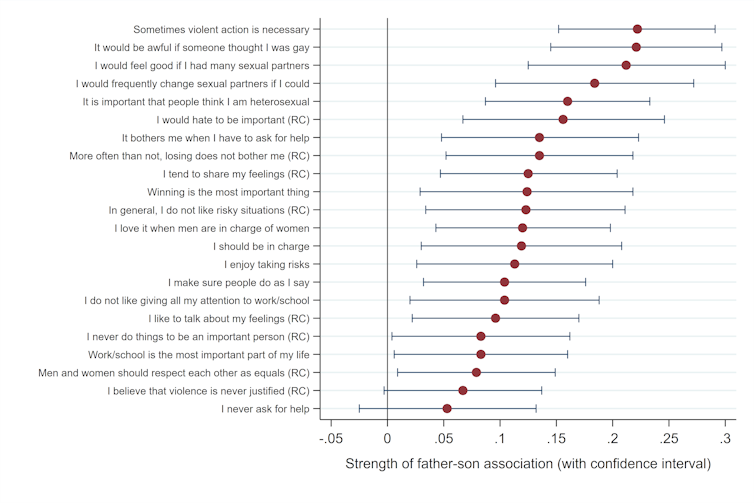
On a scale from 0 to 100, with 100 indicating high conformity to traditional masculinity and 0 indicating low conformity, the average masculinity score for young men was 44.1, and for their fathers, it was 41.

Using statistical models, we then examined whether there was an association between how traditional a father’s masculinity is and how traditional their son’s masculinity is. To make sure we isolated the effect of fathers’ masculinity, the models took into account other factors that may also shape young men’s expressions of masculinity. These included their age, education, sexual orientation, religion, household income and place of residence, among others.

The results were clear. Young men who scored highly on the traditional masculinity measures tended to have fathers who also scored highly.

The red dots denote the size of the association between the fathers’ and sons’ scores. The further away from zero, the stronger the association.
Francisco Perales et al, Sex Roles, Springer Nature, CC BY

We identified similar results for 20 of the 22 individual masculinity questions. The strongest father-son associations emerged for questions about the endorsement of violence, importance of appearing heterosexual, and desirability of having multiple sexual partners.

This indicates these aspects of masculinity are comparatively more likely to be “passed on” from fathers to sons.

What our findings mean

As is well-established, social learning is important in shaping young people’s attitudes and behaviours. While fathers aren’t the only influence, our study suggests young men learn a lot about how to be a man from their dads. This is an intuitive finding, but we had little empirical evidence of it until now.

Confirming that dads “pass on” their masculinity beliefs to their sons has far-reaching implications. For example, it goes a long way in explaining why traditional models of masculinity remain entrenched in today’s society. Our study indicates that breaking this cycle requires bringing fathers into the mix.


Read more:
The draw of the ‘manosphere’: understanding Andrew Tate’s appeal to lost men


Policies, interventions and programs aimed at promoting healthy masculinity among young people are more likely to work if they also target their dads. This proposition is consistent with a growing body of programs focused on engaging fathers in positive parenting.

What’s more, our findings underscore the potential long-term effects of successful intervention. If a program manages to help young people develop positive masculinity, it’s likely that — as they themselves become fathers — their own children’s masculinity is also positively affected.

The Conversation

Ella Kuskoff receives funding from the Australian Research Council’s Centre of Excellence for Children and Families over the Life Course (Project ID CE200100025).

Michael Flood has received funding from the AFL, Australia Institute, Australian Research Council, Australian Primary Health Care Research Institute Foundation, BHP, Department of Defence, Diversity Council of Australia, Human Rights Commission, Jesuit Social Services, NAPCAN, NRL, Our Watch, PwC, UNWomen, Victorian Government, Victorian Health Promotion Foundation, White Ribbon Australia, and World Health Organization.

Tania King receives funding from the Australian Research Council (DE200100607 & LP180100035)

Francisco Perales does not work for, consult, own shares in or receive funding from any company or organisation that would benefit from this article, and has disclosed no relevant affiliations beyond their academic appointment.

ref. Like father, like son: new research shows how young men ‘copy’ their fathers’ masculinity – https://theconversation.com/like-father-like-son-new-research-shows-how-young-men-copy-their-fathers-masculinity-203834

If you live in a bulk-billing ‘desert’ it’s hard to see a doctor for free. Here’s how to fix this

Source: The Conversation (Au and NZ) – By Peter Breadon, Program Director, Health and Aged Care, Grattan Institute

Shutterstock

GP fees are hitting more Australians than they did a few years ago. There’s a lot of talk about a crisis in bulk billing, with many people reporting they’re unable to see a doctor without paying an out-of-pocket fee.

But the biggest, most urgent problem is in the communities where most people pay fees, so called bulk-billing “deserts”. These deserts are more likely in poorer areas, so the people who most need bulk billing are missing out.

While Medicare funding changes are needed to address this problem, we also need to look at more innovative solutions. One option is for federal and state governments to step in and support or set up clinics that employ doctors, nurses and other health workers.

Bulk billing is falling, but from a historic high

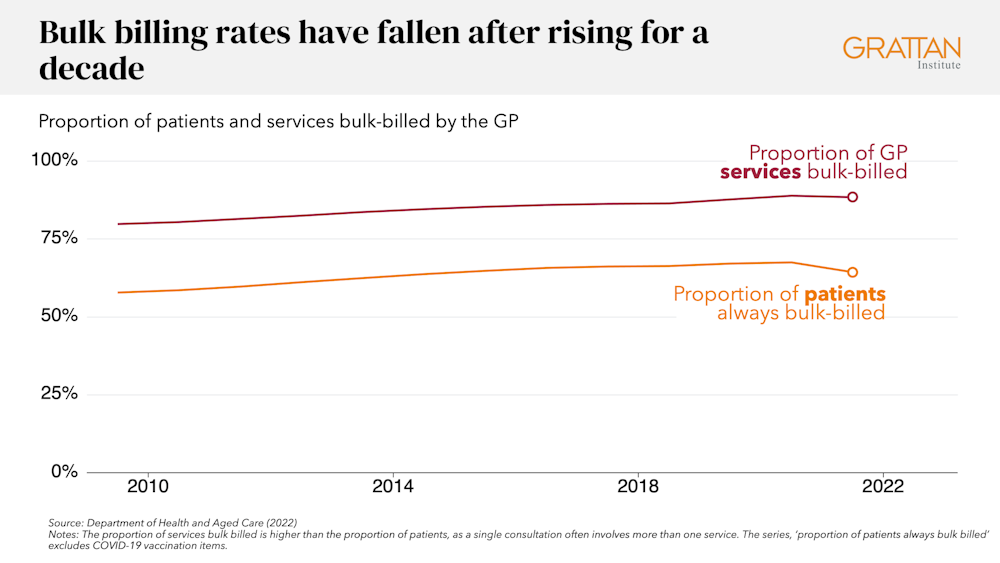
The share of patients who never paid a GP fee fell from 67% in 2020-21 to 64% in 2021-22. But those rates are still high by recent standards. The rate has only fallen back to the level of 2015, and it remains much higher than a decade ago.

Yes, it’s troubling to see bulk billing falling, especially when fees have risen a lot. Patients who are not bulk billed now pay on average A$45 out of pocket when they see a GP. This is up 20% in real terms over the past decade.

But while the national trend is concerning, it masks a much bigger problem.

Great disparity

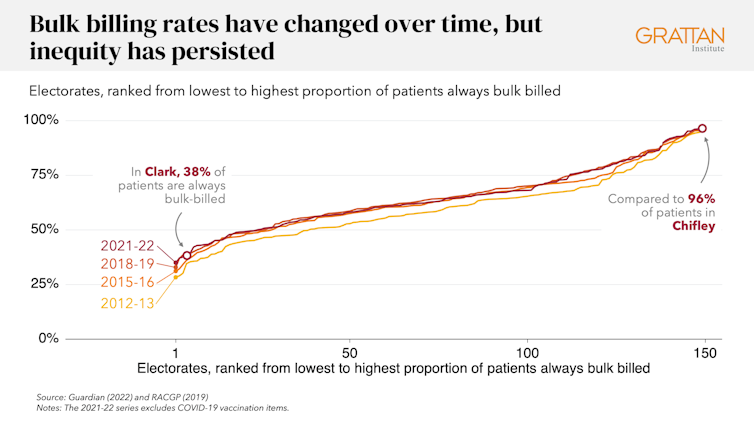
In some parts of Australia – for example, the electorates of Chiefly, Fowler, and Werriwa in outer-western Sydney – more than nine in ten GP patients are always bulk billed.

But in other parts – for example, the electorates of Canberra, and Franklin and Clark in southern Tasmania – that figure is less than four in ten.

Unlike the overall bulk-billing rate, these vast disparities have persisted for many years: the problem was just as bad a decade ago.

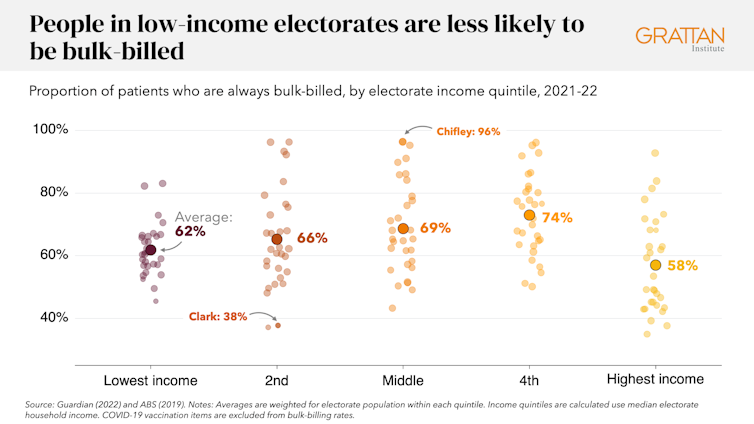
Bulk-billing deserts wouldn’t be such a problem if they were only in the wealthiest parts of Australia, because fees are less likely to stop wealthy people getting the care they need. But there are bulk-billing deserts in many poorer areas.

Compared to all but the wealthiest areas, the bottom fifth of electorates by income have the lowest bulk-billing rates. In 13 of the lowest-income electorates, less than 60% of patients are bulk billed.

Rural areas are worse off too: 60% of patients in rural areas are always bulked billed, compared to almost 69% in metropolitan areas.

The bulk-billing deserts in poorer parts of Australia represent a serious failure of the system. Nationally, about 3.5% of people say they skip GP care because of the cost, with higher rates in rural and poorer areas. Those figures will be far higher in bulk-billing deserts, putting many people’s health at risk.

What the government should do

There have been calls to pour billions of dollars into increasing the Medicare rebate and bulk billing incentives.

But while the government should make sure payments to GPs keep up with their costs, that won’t fix the problem of bulk-billing deserts.

It might help arrest the decline in bulk billing nationally, and in some areas where bulk billing is low. But the money will mostly flow to high-bulk billing areas – it won’t do much to provide more care where there is far too little.


Read more:
General practices are struggling. Here are 5 lessons from overseas to reform the funding system


Bulk billing deserts are an enduring problem that need new solutions. To turn them around, the government must tackle two of the structural problems causing them: one-size-fits-all funding of GPs, and areas that don’t have enough health care to go around.

The government has already signalled it will develop a new funding model that pays GPs for providing ongoing care, which would improve on the current outdated and dysfunctional system. That funding should give higher payments for patients with greater need.

That would boost income for clinics with patients who need free care the most, helping those clinics to avoid charging their patients. It would be a big step in the right direction.

Clinician checks a patient's blood pressure
Funding reform will help clinics avoid overcharging patients.
Shutterstock

But even then, there would still be areas without enough health-care workers to meet the community’s needs, including many rural areas, resulting in too little care, and too little bulk billing. Governments must go well beyond the Medicare rebate and other incentives to fix these broken health-care “markets”.

The federal and state governments need to step in to support existing clinics or set up new ones that employ salaried health-care workers. This support needs to be tailored to local needs. It could be employing a GP to work out of a rural hospital if there are no GPs in the area, or setting up a new community-controlled primary care service, or helping an existing clinic hire extra staff.

Rather than ad hoc announcements, there should be secure national funding for this care, targeted at the areas of greatest need – especially the poorest bulk-billing deserts.

This change should be accompanied by many other reforms to attract clinicians to areas where they’re needed most, such as further expanding new models of GP employment and training in rural areas, which give “rural generalist” doctors a single employer during their training across a range of different health settings in a region.

There should also be reforms to expand the teams supporting GPs in areas with too little care. This can reduce GP burnout, allow clinics to provide more care, and bring Australia in line with other countries. As well as administrative, allied health, pharmacist and other roles, some teams could include physician assistants, who work under the supervision of a doctor and can provide the full range of services a doctor provides.

One test for next month’s federal budget is whether it funds solutions to bulk-billing deserts – an enduring injustice in our health-care system.


Read more:
Medicare reform is off to a promising start. Now comes the hard part


The Conversation

Peter Breadon’s employer, Grattan Institute, has been supported in its work by government, corporates, and philanthropic gifts. A full list of supporting organisations is published at www.grattan.edu.au.

Lachlan Fox’s employer, Grattan Institute, has been supported in its work by government, corporates, and philanthropic gifts. A full list of supporting organisations is published at www.grattan.edu.au.

ref. If you live in a bulk-billing ‘desert’ it’s hard to see a doctor for free. Here’s how to fix this – https://theconversation.com/if-you-live-in-a-bulk-billing-desert-its-hard-to-see-a-doctor-for-free-heres-how-to-fix-this-204029

Whale-watching guidelines don’t include boat noise. It’s time they did

Source: The Conversation (Au and NZ) – By Kate Sprogis, Adjunct Research Fellow, UWA Oceans Institute, The University of Western Australia

Humpback whale breach at Ningaloo. Image: Kate Sprogis, Author provided

Imagine … eco-tourists enjoying views of undisturbed whales and dolphins, watching them doing what comes naturally.

This is ultimately what we all wish to see when spending time in nature watching animals. We can achieve this by using quieter boats.

But why do we need quieter boats? Whales and dolphins primarily use hearing to sense their surroundings (rather than sight like humans do). Sound travels almost five times faster underwater than it does in the air, so it’s an important sense for whales. They rely on sounds to communicate, navigate, feed and detect predators.

Our new research confirms noise from a boat watching whales at a distance of 300 metres can still disturb them. And watching whales involves a lot of boats and millions of tourists each year. This multi-billion-dollar industry is active in waters off more than 100 countries. The Australian whale-watching industry is one of the biggest in the world.

Because the industry actively seeks out whales and dolphins, using quieter boats should be a priority. Yet current whale-watching guidelines, including Australia’s, do not include noise levels. They should.

As the whale-watching season begins in Australia for humpback whales and southern right whales, we offer tips here for individual operators to reduce noise from their boats.

This year’s humpback whale-watching season begins soon in Australia. Wouldn’t it be great if whale-watching guidelines set a limit on boat noise?
Image: Kate Sprogis


Read more:
Thar she blows! An expert’s guide to whale watching 101


How does noise affect whales and dolphins?

Besides income for local communities, whale watching has education and conservation benefits if tourists are inspired to care for the environment.

Despite these benefits, watching whales from a motorised boat and swimming with whales can disturb their natural behaviour. For example, it might prevent them from resting or feeding, or change their breathing, swimming and dive patterns. These impacts are especially important for whales with young.

If the cumulative effects of these short-term impacts are not considered, they can lead to long-term consequences for the animals, such as population declines or leaving an area altogether.

Such outcomes are not only negative for the animals, but also for the whale-watching industry that depends on them.


Read more:
Drones gather new and useful data for marine research, but they can disturb whales and dolphins


Whale-watching guidelines overlook noise impacts

Many countries have guidelines on the boat’s minimum distance from the animals (typically around 100 metres), the speed at which it passes (typically below wake speed) and the approaching angle (typically from the side-rear). Guidelines, however, do not consider the noise level of the boat’s engine. A very loud boat is, in effect, considered to have the same impact on the animals as a very quiet boat.

An example of a vessel approach to an adult whale under Australia’s whale-watching guidelines; underwater vessel noise is not considered.
Australian National Guidelines for Whale and Dolphin Watching 2017

Research confirms louder boat noise disturbs whales more than quiet boat noise. Boats should be as quiet as possible.

We recommend a noise threshold be added to whale-watching regulations, ideally around the volume of the natural underwater background noise. At this level, boat noise is perhaps audible to the whales but with a low perceived loudness. This change to the guidelines will help minimise disturbance to whales and dolphins.

You can see how humpback whales change their behaviour in response to low, medium and high underwater boat noise in this video from our study.


Read more:
Underwater noise is a threat to marine life


What do whale-watching boats sound like underwater?

A range of different boats are used for whale watching worldwide. We have calculated the underwater noise level of whale-watching boats operating at low speeds. The quietest boat was a hybrid boat using its electric engines.

The vessel with the quieter electric engines was later used in an experiment with short-finned pilot whales. This study compared the whales’ responses to the boat’s quieter electric engines and its louder petrol engines.

A spectrogram of a motorised whale-watch vessel passing at slow speed
A spectrogram of a motorised whale-watch vessel passing at slow speed (about 4 knots). Red shows the higher-intensity noise and blue the lower-intensity noise.
Source: Whale-watch vessel noise levels with applications to whale-watching guidelines and conservation (2021), Author provided

What was the result? The louder engines did indeed disturb the behaviour of short-finned pilot whales compared to the quieter engines. Notably, resting and nursing of young decreased.

Ultimately, some vessels are better designed to minimise noise emissions. You can hear the quieter electric-engined boat in this recording from the study. This makes this boat more appropriate for whale watching.

This hybrid boat’s electric engine produces much less noise underwater than its petrol engine.
Author provided from Arranz et al 2021., Author provided1.38 MB (download)
A mother-calf pair of pilot whales resting on the surface.
Image: Patricia Arranz Alonso, Author provided


Read more:
Why scientists need your help to spot blue whales off Australia’s east coast


Noise when arriving and departing matters too

Having a quiet boat will reduce the disturbance to animals. However, even when a whale-watch operator adheres to current best-practice guidelines, there may still be disturbance.

This is because as a vessel increases in speed to leave the whales, it produces higher underwater noise levels. Our research shows this is likely to disturb whales. So we recommend boats maintain a slow speed when approaching and departing whales – say, less than 10 knots within 1km of the whales.

We know it is exciting to zoom off towards a breaching whale, leaving a sleeping whale behind, but the sudden increase in boat speed and noise may then disturb that sleeping whale.

5 tips to reduce boat noise

On an individual level, boat operators can easily reduce disturbance to whales and dolphins by considering the following five factors.

Speed increases noise from the propeller, so lower the speed, even when arriving/departing.

Distance: the closer a vessel is the greater the peak in noise, so keep to the regulated distance.

Gear shifts cause high-level noise changes, so minimise shifting.

Approach type to the animals can cause disturbance – driving in front of their path, for example, so drive in parallel to their path.

Movements of a boat, such as fast and erratic movements, can disturb animals, so drive consistently.

To further reduce noise, whale-watching companies can use larger, slower-moving propellers (to minimise the water disturbance that creates noise), quieter/electric engines and/or install noise absorption gear.

Both the industry and the whales will benefit from companies using quieter whale-watch boats and approaches.

The Conversation

The authors do not work for, consult, own shares in or receive funding from any company or organisation that would benefit from this article, and have disclosed no relevant affiliations beyond their academic appointment.

ref. Whale-watching guidelines don’t include boat noise. It’s time they did – https://theconversation.com/whale-watching-guidelines-dont-include-boat-noise-its-time-they-did-199977

South Auckland’s poor census turnout could cost it $130m in NZ health funding

By Stephen Forbes, Local Democracy Reporter

South Auckland’s poor turnout for the 2018 Aotearoa New Zealand national census could have cost the region $130 million in health funding.

And, according to an expert, that cash could have helped tackle the area’s battles with diabetes and obesity.

Te Whatu Ora Health New Zealand said the defunct Counties Manukau District Health Board lost $130m in health funding in its last four years due to the low turnout in the area during the 2018 census.

Local Democracy Reporting
LOCAL DEMOCRACY REPORTING: Winner 2022 Voyager Awards Best Reporting Local Government (Feliz Desmarais) and Community Journalist of the Year (Justin Latif)

Information from the five-yearly stocktake helps determine how billions of dollars in government spending is allocated across health, education, transport, infrastructure and other services.

Counties Manukau has more people with diabetes than any other health region in the country.

Te Whatu Ora (Counties Manukau) Director of Population Health Gary Jackson said additional money would help fund programmes to battle two issues affecting many people in the region.

He said there were 52,000 diabetics in Counties Manukau and that figure was growing by 2000 people a year. It is also home to 19 percent of all New Zealanders in the most extreme BMI group.

Only 71 percent response
Figures released by Stats NZ this week show only 71 percent of people in South Auckland have so far completed the census in 2023, compared to 83 percent nationwide.

Te Whatu Ora Chief Financial Officer Rosalie Percival said getting people to provide their details was vital to ensure areas like Counties Manukau got the healthcare services they needed.

“Health providers know about the people who turn up at their door needing care — but they have no other way of knowing about the presence of people who haven’t recently needed to use the health system,” she said.

“The data gained from the census helps to inform important decisions about planning for the needs of local areas and subsequently healthcare spending.”

However, Buttabean Motivation (BBM) founder Dave Letele said getting people to complete the census was not easy.

Buttabean Motivation (BBM) founder Dave Letele
Buttabean Motivation (BBM) founder Dave Letele . . . breaking down the barriers in South Auckland to get people to complete the census isn’t easy. Image: Greer Bland/LDR/RNZ

Letele, who is potentially standing for Te Pāti Māori this year, was an ambassador for Census 2023 and was involved in a social media campaign which kicked off late last year to get more people to take part.

“There’s a massive distrust between our people and the government and that’s what we need to overcome,” Letele said.

Wary about personal information
He said as a result a lot of people were wary about sharing their personal information with authorities.

“But it’s not just something you can throw money at to fix it.”

Deputy Government Statistician and deputy chief executive for census and collection operations Simon Mason confirmed the turnout at the last census in 2018 was poor in Counties Manukau.

“That is why it is critically important that people complete the census — so their communities are counted . . .”

Mason said the 2023 event was designed to address barriers to participation, including having more collectors and alternate formats for people to complete it and support a wider range of people.

A spokesperson for Stats NZ said it would still have field teams collecting people’s responses until May 3 and will be running census support events until June 4.

Pacific Media Watch reports that the Counties Manukau health population is ethnically diverse with the largest Pacific population and second largest Māori popukation of any New Zealand health board.

In the 2018 census, 16 percent of the population served by CM Health identified as Māori, 22 percent as Pacific, 28 percent as Asian and 34 percent as NZ European/other groups.

Local Democracy Reporting is Public Interest Journalism funded through NZ On Air. It is published by Asia Pacific Report in collaboration.

Print Friendly, PDF & Email

Article by AsiaPacificReport.nz

Grattan on Friday: The government invited ambit claims for the budget and now it will be judged against them

Source: The Conversation (Au and NZ) – By Michelle Grattan, Professorial Fellow, University of Canberra

Budgets are for stakeholders and interest groups like Christmas is for kids. They’re preceded by a multitude of letters to “Santa”, aka the treasurer, in the run-up.

For the May 9 budget, two key correspondents were appointed by the government itself. This week, the wish lists from the Economic Inclusion Advisory Committee and the Women’s Economic Equality Taskforce were released.

The inclusion committee, an ongoing body to review the adequacy of welfare support, was born out of a demand to Prime Minister Anthony Albanese from Senate crossbencher David Pocock last year, in exchange for his vote on the government’s industrial relations legislation.

It was always clear the committee would confront the government with more demands than could be met, and that would become a political challenge.

The taskforce, chaired by businesswoman and gender equity advocate Sam Mostyn, was set up to reflect the government’s desire to underline its policy tilt towards women.

Managing expectations before a budget is always tricky, and these committees are making this especially so for Treasurer Jim Chalmers ahead of his second budget.

The message from Chalmers is that funds are limited and the government can’t do all it might like to do (let alone all that others might want it to do).

Indeed, Chalmers is trying to find ways to constrain spending – to allow maximum room for budget repair – rather than expand it.

The Minister for the National Disability Insurance Scheme, Bill Shorten, this week outlined areas for reform of the NDIS to get it “back on track”. While Shorten stresses this is about improving outcomes, everyone in government knows the NDIS’s costs must be contained or the scheme will be totally unsustainable.

On Treasury figures, the inclusion report’s recommendations would cost more than $34 billion over the forward estimates.

The government has indicated it expects to adopt some of the proposals. But it has already shied away from the biggest one: a large increase in JobSeeker, which the report says should be taken to some 90% of the age pension (at a cost of $24 billion over the forward estimates).


Read more:
Boosting JobSeeker is the most effective way to tackle poverty: what the treasurer’s committee told him


That would restore the relativity of the mid-1990s. At present, the rate for singles is about 65% of the age pension.

Among the things on the “urgent” list of the women’s taskforce is reinstatement of the parenting payment (single) for women with children aged over eight, abolition of the childcare subsidy activity test, and investment in “an interim pay rise for all early childhood educators”.

Despite the government ruling out the “large” increase in JobSeeker, it is still possible the budget could make some change to it, among other pickings from the inclusion report.

Similarly, the government could take up the reinstatement of the parenting payment (single), for which there is considerable pressure.

The inclusion committee is chaired by former Labor minister Jenny Macklin, who has an extensive background in welfare policy, and includes substantial expertise among its members. Its report contains a plethora of detail and it is closely argued.

The report’s lens is squarely focused on issues of adequacy and poverty. While it says its JobSeeker recommendation would not be a significant discouragement to seeking paid work (and the current low rate is a barrier to doing so), some believe the recommended big lift would indeed create a disincentive in our present full employment labour market.

Many people, especially in Labor’s base, will see this report as a benchmark for what a Labor government should do to promote fairness for those at the bottom and create a more equitable society. The same applies with the women’s taskforce measures.

In that sense, the budget must inevitably fall short of the tests these reports pose for it.


Read more:
Grattan on Friday: Chalmers grapples with a budget where economics and politics pull in different directions


Commentators have already suggested a parallel, of sorts, between the proposed Indigenous Voice to Parliament and the inclusion committee. The comparison is a very long stretch, but in each case, special access is involved but the government isn’t bound by recommendations.

What we are seeing with the inclusion committee (and indeed the women’s taskforce) is that the demands may shape the public conversation. The same would apply with the Voice.

How the government responds to the inclusion committee in particular could affect its future relations with the Senate crossbench. Pocock is already out in the media rejecting the government’s arguments that it is constrained by a lack of resources. What about those $250 billion stage 3 tax cuts? he asks. (The government has said they won’t be touched in this budget.)


Read more:
Grattan on Friday: David Pocock has only just arrived in the Senate and now he’s negotiating with the PM


The way Pocock and other key crossbenchers react post-budget will depend on precisely what’s taken up. Pocock will be able to claim a victory if he can say his demand for the committee made a difference.

While the budget is a major juggling act for Chalmers, his reform of the Reserve Bank is shaping up, in political terms, as an easier task.

The changes in the report from the review panel, released on Thursday and accepted in principle by the government, are extensive. These include setting up an expert board that would decide monetary policy, which would be separate from the bank’s general board. The aim is to improve the decision-making of the bank, which has come under sharp criticism in the wake of its recent performance on interest rates.

Some of the changes will require legislation, for which Chalmers has been very anxious to get a bipartisan approach. He doesn’t want to have to haggle with the Senate crossbenchers, cutting deals and finding trade-offs, in this sensitive area.

So he has engaged the shadow treasurer, Angus Taylor, during the review process. Taylor has been briefed along the way and was given an advance copy of the report.

The strategy appears to have paid off. Taylor was positive about the review’s plan for a board of experts, and said: “It is the Coalition’s intention to continue to approach the implementation of this review with a spirit of bipartisanship.”

It’s a rare and welcome move away from the opposition’s usual hyper-negativity.

The Conversation

Michelle Grattan does not work for, consult, own shares in or receive funding from any company or organisation that would benefit from this article, and has disclosed no relevant affiliations beyond their academic appointment.

ref. Grattan on Friday: The government invited ambit claims for the budget and now it will be judged against them – https://theconversation.com/grattan-on-friday-the-government-invited-ambit-claims-for-the-budget-and-now-it-will-be-judged-against-them-204193

The rise of unaccountable ministerial advisors: why Victoria’s IBAC report should concern all Australians

Source: The Conversation (Au and NZ) – By William Partlett, Associate Professor, The University of Melbourne

This week, Victoria’s Independent Broad-Based Anti-corruption Commission (known as IBAC) issued a finding of “improper influence” on a public contract issued by the Victorian government in 2018.

IBAC did not find any “corrupt conduct” under the IBAC Act and no minister was directly involved.

On this basis, it might be possible to dismiss this report as the regrettable result of a complex governmental apparatus. After all, this was a small contract in the grand scheme of Victorian state spending, and you might think the news cycle should move on to focus on more important issues.

But this report should not be ignored. It casts important light on a growing threat to Australian parliamentary democracy: the exercise of public power by unaccountable ministerial advisors.

Operation Daintree

The Operation Daintree report investigated a $1.2 million contract between the Victorian health department and the Health Education Federation (HEF) to provide occupational violence and aggression training to health workers. The contract was signed in the hours before Victoria’s government went into caretaker mode prior to the 2018 election (the government can’t sign contracts in caretaker mode).

Despite having no relevant experience in this kind of training, HEF received this contract without a competitive tender process.

IBAC found two ministerial advisors “improperly influenced” this contract. These advisors – who are employed by the premier under Victorian law – put pressure on key public servants to award the contract to HEF.

Former Health Minister Jenny Mikakos described this pressure as a reflection of the interest of the “premier’s office” in “accommodat[ing] any union concerns”.

A threat to responsible government

Australian democracy is built on the concept of “responsible government” in which parliament holds governmental ministers to account through lawmaking and oversight. Although parliament doesn’t actually prosecute governmental misconduct, its role as overseer generates crucial information and publicity that holds these governmental ministers politically accountable.

Operation Daintree details an emerging gap in this traditional form of democratic oversight and accountability: the rise of powerful ministerial advisors.

Ministerial advisors are more powerful than ever at all levels of Australian government. For instance, former prime minister Tony Abbott’s chief of staff, Peta Credlin, was widely regarded as one of the powerful players in the federal government at the time. One Liberal Party insider said of her: “She’s tough, she’s a player, she makes demands, she gives directions, she bawls people out.”

While these advisors play an increasingly powerful role in governance, they tend to operate in the shadows. In contrast to the rigorous standards of independence for public servants, ministerial advisors are political appointees who are largely accountable only to their minister. For instance, advisors are generally thought to be immune from testifying to parliament.

In this position, they can operate in a way they think the minister would support, while providing plausible deniability to that same minister.


Read more:
‘Sports rorts’ shows the government misunderstands the public service


This problem isn’t unique to Victoria. It also emerged in the so-called “sports rorts” scandal under former prime minister Scott Morrison.

In that case, Commonwealth grants were awarded to sports clubs in important constituencies in the upcoming election. The relevant minister, Bridget McKenzie, sought to deflect blame for this allocation of money onto unnamed advisors.

Associate Professor Yee-Fui Ng at Monash University describes their rise broadly as contributing to the “erosion” of ministerial responsibility.

Injecting accountability back into the system

How can we address this increasing problem of unaccountable ministerial advisors?

One option is expanding the Ministerial Staff Code of Conduct to cover more of their activities. This would go some way to bringing them out of the shadows.

But another vital reform is to shine more light on advisors. Parliament must hold ministers – including the prime minister or premier – responsible for the actions of their advisors. This should happen through an independent parliamentary committee that has the explicit legal authority to call both ministers and their advisors to answer for their actions.

IBAC hints at this very solution in the report. In the report, IBAC says the Victorian parliament may hold the premier “personally responsible” for “the conduct of his staff and its consequences, where he was aware of their actions or ought reasonably to have been aware of them”.


Read more:
Will the National Anti-Corruption Commission actually stamp out corruption in government?


The obvious institution to do this would be an independent Parliamentary Ethics Committee, which IBAC and the ombudsman called for in the Operation Watts report in 2022.

This committee should have the power to call witnesses and further investigate unethical conduct that does not meet the definition of corrupt conduct. This kind of parliamentary inquiry would shine important light on bad governance and serve as a powerful deterrent for further actions like this.

This solution carries broader lessons, too. It suggests that improving governmental integrity – particularly the kind of so-called “grey corruption” at issue here – isn’t just the business of anti-corruption bodies. It also must be the business of parliament.

Independent committee scrutiny of unethical behaviour is just one example of parliamentary involvement. It could also include stronger legal requirements that ministers (including the premier or prime minister) respond openly to questions from parliament.

Overall, these reforms are critical in ensuring parliament is restored as the original integrity institution in Australian parliamentary democracy.

The Conversation

William Partlett does not work for, consult, own shares in or receive funding from any company or organisation that would benefit from this article, and has disclosed no relevant affiliations beyond their academic appointment.

ref. The rise of unaccountable ministerial advisors: why Victoria’s IBAC report should concern all Australians – https://theconversation.com/the-rise-of-unaccountable-ministerial-advisors-why-victorias-ibac-report-should-concern-all-australians-204191

A major review has recommended more independence for decisions about research funding in Australia

Source: The Conversation (Au and NZ) – By Gregory Michael McCarthy, Emeritus Professor, School of Social Sciences, The University of Western Australia

Pixabay/Pexels

Education Minister Jason Clare has just released a highly anticipated review into how research is funded in Australia.

This is the review of the federal legislation underpinning the Australian Research Council (ARC).

The ARC is the independent body that funds non-medical university research in Australia. So it has a hugely important role in the careers of academics.

This review follows years of concerns about political interference in ARC decisions and low success rates for academics applying for funding.

What does the review say?

The review began last year and was led by Queensland University of Technology Vice-Chancellor Margaret Sheil. It is a comprehensive product, containing ten considered recommendations on how to enhance the ARC’s procedures. The review says these

aim to enhance the trust in the ARC by the government and the research community.

They include:

  • clarifying the purpose of the ARC
  • further clarity and insight into the role and impact of the ARC in relation to supporting academic careers and
  • more ARC fellowships for Indigenous academics.

At the heart of the review is the recommendation for a new ARC board of directors, appointed by the education minister, to run the ARC separate from political interference.

This would remove the capacity of ministers to step in and block funding to certain projects at the last minute.

The objective is to make the ARC more independent – in legislation and practice – so it can act at arm’s length from the government of the day.

A more autonomous ARC

Historically, the review harks back to the foundation of the ARC as an autonomous non-government organisation in 1988. But even then, the final say over grants was given to the education minister of the day.

As the review notes, since its legislation was updated in 2001, the ARC’s autonomy has declined, along with trust in its work.

This was highlighted by ministerial interventions to veto grants in the humanities and social science in at least five separate occasions (most recently by former minister Stuart Robert in 2021).

Ministerial veto power change

Significantly, the review recommends the ARC be given the full power to make decisions over research grants (officially called the National Competitive Grants Program).

It notes there should be checks and balances and the minister could still intervene in the “extraordinary circumstance of a potential threat to national security”.

Here, the board will be critical. It will have responsibility for appointing the ARC’s CEO, as well as the the college of experts (who assess grant applications). It will then approve grant recommendations by the college.

The board would still be appointed by the minister. It would include a chair who is a “prominent Australian, held in high regard by the universities” and six other members with combined skills across ARC disciplines, including Aboriginal and Torres Strait Island leadership in research.

The minister’s role in appointing the board and chair does not guarantee these appointments are immune from party politics and ideology. However, the aim of keeping ministers at arm’s length from the ARC grant processes is a step in the right direction.

Simpler grant applications

One of the major frustrations researchers have with the ARC process is the time it takes to apply for grants and the low rates of success.

Here, the review recommends a constructive change. Under a new model, researchers would apply via a two-step process.

Firstly, they would provide a brief outline of the research objective to the ARC. The ARC would assess it and make recommendations on whether a full, second-round application is warranted.

It does not guarantee a rise in success rates as this is tied to the substantive issue of available funding. But it does alleviate the arduous and overly bureaucratic approach of the current model, both for researchers and university research branches.


Read more:
A review into how university research works in Australia has just begun – it must confront these 3 issues


A new auditing role

A decisive recommendation is for a change to the ARC’s role in auditing research for quality. Previously, this has been done through the Excellence in Research Australia process via university submissions.

The review strongly opposes the existing metric-driven model, noting “the evidence that metrics can be biased or inherently flawed”.

Instead, the review wants to see a new approach whereby the ARC would cooperate with TEQSA – the university regulatory body – to develop a framework for research quality and impact.

This change will be welcomed by universities and academics, as the previous model tended to be top-heavy in its approach.

What about funding?

One issue with the review is its silence about funding. While this silence was not unexpected (terms of reference were aimed at the procedures not financing), it is still an issue.

For universities, ARC funding does not currently meet their costs in both infrastructure and staffing to service the ARC grant.

So universities largely rely on overseas student fees to meet research costs. As the pandemic showed us, these are subject to fluctuations.

This unpredictability has ramifications for university budgets and staffing, as well as the quality of research.

A step forward

Overall, the review is a step in the right direction for the academic research community and for the clarity of purpose and procedures of the ARC.

But the big question remains: will the ARC be given more adequate funds for research in Australia?

On this matter, we must turn to the current review for the Universities Accord. The federal government says this ARC review will be considered as part of broader discussions around the accord. Here, we can expect a draft in June.

When it comes to the ARC review, Clare says he will “consider the findings […] and respond in due course”.


Read more:
Introducing our new series on the future of Australian higher education


The Conversation

Gregory Michael McCarthy received funding from the ARC in the past.

ref. A major review has recommended more independence for decisions about research funding in Australia – https://theconversation.com/a-major-review-has-recommended-more-independence-for-decisions-about-research-funding-in-australia-204184

Politics with Michelle Grattan: Labor MP Marion Scrymgour on the Voice and the need for a new NT jobs program

Source: The Conversation (Au and NZ) – By Michelle Grattan, Professorial Fellow, University of Canberra

With the Liberal Party formally opposing the Voice, Opposition Leader Peter Dutton last week kicked off his no campaign in Alice Springs. His claim that child sexual abuse is rife was quickly under attack from the government and others who accused him of politicking, using the issue as a political football.

Marion Scrymgour, a former deputy chief minister in the Northern Territory, is the federal Labor member for the seat of Lingiari, an electorate covering almost all the NT outside Darwin.

Scrymgour says Dutton is taking up the same theme as was heard in the Northern Territory intervention. “The same campaign that was done to justify the intervention is the same campaign that’s been happening with the Leader of the Opposition.

“I’m not saying that he doesn’t have a commitment to getting this issue dealt with,” she says. But she rejects the “excuse” by Dutton, his new shadow minister for Indigenous Australians, Jacinta Price and others that “he can’t put forward the names”.

“That’s a complete abrogation of their responsibility. Those stories and the names of people putting forward those stories could be done in a confidential way.”

Scrymgour has proposed a statutory Family Responsibility Commission, as operates in Queensland. “I think that the important part of the Family Responsibility Commission is that it’s Aboriginal community-controlled, that you get Aboriginal people, Aboriginal leaders that go through a vetting process.

“The families are brought before the commission: they look at school attendance, they look at all of the wellbeing of the child […] but also what are the supports that the family needs to be wrapped around.

“The family has to sign a family responsibility agreement and then those agreements get entered into by both the commissioner, who has legal standing, as well as the family”.

There has been a push lately, including from Senate crossbencher Jacqui Lambie, to reinstate a former employment program to bring jobs, skills and pride back the communities in the NT.

Scrymgour tells the podcast: “We need to get beyond talking about this […] and actually get this program rolled out. I agree with Jacqui Lambie.

“This is a program that was in the Northern Territory almost 15 years ago. Everyone in a lot of the communities were employed and communities were happy and healthy and we need to hurry up […] and we need to move on that.”

Scrymgour, who immediately before the podcast had been talking about the Voice in remote communities, admits there is a vast array of opinion on the ground, and more information and clarity is needed.

“Look, you’ve got people who’ve got different views in a lot of the communities and I’ve just come back from my own community on the on the Tiwi Islands, and there was some great discussion and support for the Voice. But before that support came, people needed to know about it.”

She does, however, believe the “vibe is good” on the ground and in the community.

“The vibe was really good. I found the vibe really, really interesting yesterday. It was good. There were people who weren’t convinced, but people who sort of didn’t understand it. And then when I talked about what was different about constitutional recognition and how that would apply, it generated the discussion about ATSIC [Aboriginal and Torres Strait Islander Commission], because a lot of communities still remember ATSIC, and often people talk about ATSIC and they say that they got rid of it and that was their voice. So it then generates another discussion about that. But this Voice won’t be able to be got rid of like that because it’ll be embedded in the Constitution.

“A lot of the Land Council men, you know, sort of stood up and said, Oh, well, we don’t agree with what you’re saying. We think that we’ve just got to talk about this. And, you know, this is a good thing. Let’s talk about how this could be something that we can all get behind.

“So I’m going to set another time where I can go back and sit down with my mob and go through it. But I’ll do that with all the communities.”

The Conversation

Michelle Grattan does not work for, consult, own shares in or receive funding from any company or organization that would benefit from this article, and has disclosed no relevant affiliations beyond their academic appointment.

ref. Politics with Michelle Grattan: Labor MP Marion Scrymgour on the Voice and the need for a new NT jobs program – https://theconversation.com/politics-with-michelle-grattan-labor-mp-marion-scrymgour-on-the-voice-and-the-need-for-a-new-nt-jobs-program-204129

Victoria’s plans for engineered wetlands on the Murray are environmentally dubious. Here’s a better option

Source: The Conversation (Au and NZ) – By Jamie Pittock, Professor, Fenner School of Environment & Society, Australian National University

John Morton/Flickr, CC BY-SA

Governments love the idea of a win-win – even when it doesn’t exist. That’s why Victoria has been spending millions on planning “red gum irrigation ponds” – essentially, engineered wetlands along the River Murray. These wetlands are designed to save some red gum ecosystems, leave many others to decline, and redirect billions of litres of water promised to the environment to farmers.

Controversy has followed these projects. Now, Victoria appears to have blinked, with the state’s water minister, Harriet Shing, halting the development of four of nine projects.

Victory for environmental water? Not quite. Victoria has spent around A$54 million just on planning these projects. By halting four of them, it sets the scene for a larger-scale federal buyback of water for the environment. This could signal a resumption of the Murray-Darling Basin water wars, with Victoria the last holdout. National Irrigators’ Council chair Jeremy Morton predicted “riot” if further water buybacks went ahead.

river red gum
Iconic Australian trees like river red gums need irregular deep soaking from floods.
Michael Rawle/Flickr, CC BY

What was Victoria trying to do?

Historically, flooding covered 6.3 million hectares of red gum, black box and coolibah forests, lakes and billabongs in the Murray-Darling Basin. These forests rely on regular floods to survive.

But the basin is also home to most of our thirsty crops, from rice to cotton to orchards. The demand for irrigation alongside the long-term drying trend from climate change means something has had to give. You guessed it: it’s the wetlands, which are drying out and dying.

In 2012, state and federal governments launched the Murray-Darling Basin Plan in a bid to solve longstanding tussles over water. The plan was intended to preserve environmental flows while allocating set volumes of water to farmers.

But it’s not working properly. As our research shows, only 2% of the basin’s wetlands have received managed environmental flows each year since.

To keep wetlands alive with less water, there are two basic options: use pulsed flows from dams to flood a larger area, or build floodplain infrastructure to maintain some wetlands while abandoning others.

Victoria has pursued infrastructure. As originally planned, these projects would have meant building $320 million of dams, pumps, levees and roads in conservation reserves to artificially pond water – while leaving less water in the main river channels. Similar projects were proposed in New South Wales at Menindee Lakes, but these are unlikely to proceed.

These projects are greenwashed as “environmental works”. Victoria brazenly calls its plan a “floodplain restoration project”.

It is not. Since the plan began, irrigators have been credited with 605 billion litres of water for 36 largely unimplemented projects under the sustainable diversion mechanism. In November 2022, basin authority chief
Andrew McConville laid out the problem:

The credit has been banked, but the payment still needs to be delivered. The payment is in the form of the [wetland] projects being in operation by 30 June 2024.

cotton farming NSW
Our thirstiest crops cluster around the rivers of the Murray Darling Basin and rely on water in irrigation channels like this.
Shutterstock

Water has been credited to irrigators before the wetland projects were built. As a result, actual environmental flows are 19% lower than the Basin Plan target of 3,200 billion litres per year.

Building wetland infrastructure is unprecedented

Around the world, nations are going the other way to Victoria and removing floodplain infrastructure. In China, across Europe and in the United States, efforts are under way to reconnect rivers to their floodplains. Why? To reduce flood impacts (levees intensify floods downstream), improve water quality, restore flood-dependent ecosystems, make river systems more recreation-friendly and diversify local economies.

Only in the Murray-Darling Basin are we seeing governments building infrastructure for environmental water offsetting on such a huge scale.

And just as controversies have dogged Australia’s attempts to offset biodiversity losses and carbon emissions, there are major problems with water offsetting.

The reason for this offsetting is political, not ecological. In 2012, Victoria’s then water minister, Peter Walsh, stated the plan was meant to:

stop irrigation water being stripped from rural communities and food and fibre producers, and to achieve better environmental outcomes.


À lire aussi :
It’s official: the Murray-Darling Basin Plan hasn’t met its promise to our precious rivers. So where to now?


In fact, these projects are environmentally dubious. Ponding water on floodplains may meet some ecological targets, but it cannot replicate unconstrained natural floods. Worse, it risks harming ecosystems by upending aquatic food webs and leading to lower native fish populations and worse water quality.

Victoria’s very expensive projects would water only 14,000 hectares of wetlands. By contrast, safe flood pulse releases from existing dams would water 27 times that area – 375,000 hectares.

In his royal commission report into how the Murray-Darling water-sharing system works, Commissioner Brett Walker found there was “real doubt” over whether projects like this were based on the best scientific knowledge.

Our research backs his conclusions. We have found flaws in how these projects are evaluated, which mean their environmental benefits are overstated.

What’s likely to happen now?

Four down – but what about the remaining five projects?

There’s a better option. In 2013, the basin’s governments agreed to a strategy that would allow pulsed releases from existing dams to fill river channels and spill onto the floodplains.

Under this strategy, the Commonwealth would pay for roads and bridges to be removed or raised to make way for restoration of natural floods, and for compensation to landowners.

Our research shows this approach would reduce flood damage by moving infrastructure off floodplains, and allow floods to spread out more, lowering water height and speed. It would also water a much larger wetland area at far less cost. But the strategy has not yet been implemented.

Next month, federal and state water ministers will meet to discuss the failing basin plan. If the new NSW water minister, Rose Jackson, backs her federal Labor colleagues, it will leave Victoria as the last state objecting to water purchases for river restoration.

The federal water minister, Tanya Plibersek, shows every indication of implementing Labor’s 2022 election policy of buying back the remaining water needed to meet the 3,200 billion litre environmental restoration target under the plan. (The federal government has bought back around 2,100 billion litres since 2008.)

The stage is set: will Plibersek prevail and finally achieve long-sought environmental restoration goals under the basin plan, or will Victoria hold out?


À lire aussi :
Money for dams dries up as good water management finally makes it into a federal budget


The Conversation

Jamie Pittock is affiliated with the Wentworth Group of Concerned Scientists and a number of other non-governmental environment organisations. In the past he has received funding from the National Climate Change Adaptation Research Facility.

Matthew Colloff is affiliated with the Wentworth Group of Concerned Scientists. In the past he has been a member of project teams within CSIRO that have received funding from the Murray-Darling Basin Authority and the Commonwealth Environmental Water Holder.

ref. Victoria’s plans for engineered wetlands on the Murray are environmentally dubious. Here’s a better option – https://theconversation.com/victorias-plans-for-engineered-wetlands-on-the-murray-are-environmentally-dubious-heres-a-better-option-204116

Politics with Michelle Grattan: Labor MP Marion Scrymgour on her yes campaign trail, and reinstating the CDP

Source: The Conversation (Au and NZ) – By Michelle Grattan, Professorial Fellow, University of Canberra

With the Liberal Party formally opposing the Voice, Peter Dutton last week kicked off his “no” campaign in Alice Springs. His claim that child sexual abuse is rife was quickly under attack from the government and others who accused him of politicking, using the issue as a political football.

Marion Scrymgour, a former deputy chief minister in the Northern Territory, is the federal Labor member for the seat of Lingiari, an electorate covering almost all the NT outside Darwin.

Scrymgour says Dutton is taking up the same theme as was heard in the Northern Territory intervention. “The same campaign that was done to justify the intervention is the same campaign that’s been happening with the Leader of the Opposition.

“I’m not saying that he doesn’t have a commitment to getting this issue dealt with,” she says. But she rejects the “excuse” by Dutton, his new shadow minister for Indigenous Australians, Jacinta Price and others that “he can’t put forward the names”.

“That’s a complete abrogation of their responsibility. Those stories and the names of people putting forward those stories could be done in a confidential way.”

Scrymgour has proposed a statutory Family Responsibility Commission, as operates in Queensland. “I think that the important part of the Family Responsibility Commission is that it’s Aboriginal community-controlled, that you get Aboriginal people, Aboriginal leaders that go through a vetting process.

“The families are brought before the commission: they look at school attendance, they look at all of the wellbeing of the child […] but also what are the supports that the family needs to be wrapped around.

“The family has to sign a family responsibility agreement and then those agreements get entered into by both the commissioner, who has legal standing, as well as the family”.

There has been a push lately, including from Senate crossbencher Jacqui Lambie, to reinstate the community development program to bring jobs, skills and pride back the communities in the NT.

Scrymgour tells the podcast: “We need to get beyond talking about this […] and actually get this program rolled out. I agree with Jacqui Lambie.

“This is a program that was in the Northern Territory almost 15 years ago. Everyone in a lot of the communities were employed and communities were happy and healthy and we need to hurry up and do it because all my trips out bush and when I’m getting around the regions, everyone asks about CDP, so we need to move on that.”

Scrymgour, who immediately before the podcast had been talking about the Voice in remote communities, admits there is a vast array of opinion on the ground, and more information and clarity is needed.

“Look, you’ve got people who’ve got different views in a lot of the communities and I’ve just come back from my own community on the on the Tiwi Islands, and there was some great discussion and support for the Voice. But before that support came, people needed to know about it.”

She does, however, believe the “vibe is good” on the ground and in the community.

“The vibe was really good. I found the vibe really, really interesting yesterday. It was good. There were people who weren’t convinced, but people who sort of didn’t understand it. And then when I talked about what was different about constitutional recognition and how that would apply, it generated the discussion about ATSIC [Aboriginal and Torres Strait Islander Commission], because a lot of communities still remember ATSIC, and often people talk about ATSIC and they say that they got rid of it and that was their voice. So it then generates another discussion about that. But this Voice won’t be able to be got rid of like that because it’ll be embedded in the Constitution.

“A lot of the Land Council men, you know, sort of stood up and said, Oh, well, we don’t agree with what you’re saying. We think that we’ve just got to talk about this. And, you know, this is a good thing. Let’s talk about how this could be something that we can all get behind.

“So I’m going to set another time where I can go back and sit down with my mob and go through it. But I’ll do that with all the communities.”

The Conversation

Michelle Grattan does not work for, consult, own shares in or receive funding from any company or organisation that would benefit from this article, and has disclosed no relevant affiliations beyond their academic appointment.

ref. Politics with Michelle Grattan: Labor MP Marion Scrymgour on her yes campaign trail, and reinstating the CDP – https://theconversation.com/politics-with-michelle-grattan-labor-mp-marion-scrymgour-on-her-yes-campaign-trail-and-reinstating-the-cdp-204129

Fiji’s economic summit addresses ‘daunting’ challenges, says Rabuka

By Viliame Tawanakoro in Suva

Fiji’s Coalition government strongly believes that addressing the country’s priorities head-on is the cornerstone to building a progressive and prosperous nation for future generations, says Prime Minister Sitiveni Rabuka.

Speaking at the National Economic Summit 2023 in Suva today, Rabuka said the event was an opportunity for Fiji to take stock, make necessary changes, and move forward decisively.

The last summit was held 15 years ago.

Rabuka said the meeting would address daunting challenges faced by Fiji, including unsustainable national debt levels, geopolitical and global economic uncertainties, and the impact of the covid-19 pandemic, particularly on small island developing economies like Fiji.

“As a Small Island Developing State, we are vulnerable to such events which are beyond our control,” he said at the Grand Pacific Hotel.

“It is critical that we must make timely adjustments so that we can cope and be able to survive in the global trading environment.

“We have just been through one of the world’s worst pandemics of modern times, with covid-19. It affected the whole world.

Russian-Ukrainian war
“The Russian-Ukrainian war in Europe made our efforts to recover from the pandemic more challenging, particularly due to the supply-chain issues. We must address these challenges collectively through this summit, and craft solutions together as a nation.”

Rabuka, wearing an Adam Smith tie, referenced the renowned economist’s 1776 book The Wealth of Nations, and urged those implementing the summit’s outcomes to be mindful of Smith’s principles of free market and capital formation for economic growth.

The Prime Minister also noted a need to strengthen laws and institutions, as well as restore investor confidence and improve the business environment while protecting the country’s natural resources.

“We need to rebuild our infrastructure which has been neglected, and most importantly look at ways to ease the burden of the high cost of living for our people,” he said.

“We need to strengthen the private sector which we so glibly call the ‘engine of growth’. It is important to promote trade and build the confidence of the private sector.”

Strengthening multilateral and bilateral relations with Fiji’s trading and development partners was also a key point raised by Rabuka as he shared that the findings and recommendations from the summit would contribute to the formulation of the national budget and “our National Development Plan”.

“Reshaping our future means more than just promoting economic growth and development.

Brighter future
“A brighter future for our nation requires our communities to be united and move away from divisions,” he said.

Deputy Prime Minister and Minister for Finance Professor Biman Prasad said plenary sessions had been organised to set the scene for more detailed discussions on macroeconomic management, key growth sectors, governance and reforms and human development.

“We have an intense two days ahead of us. We are putting special focus on critical issues such as water resource management, transport, energy and technology.

“We are also casting a wider net over rural and outer islands development, land and marine-based economic activities and indigenous participation in business.

“There are 32 specific subject areas for discussion,” Professor Prasad said.

It is understood each summit participant has been allocated a thematic working group with a communique expected to be issued at the conclusion of the event tomorrow.

Viliame Tawanakoro is a final-year journalism student at USP’s Laucala Campus. He is also the 2023 student editor for Wansolwara, USP Journalism’s student training newspaper and online publication. USP Journalism collaborates with Asia Pacific Report.

Participants of Fiji's National Economic Summit 2023 at the Grand Pacific Hotel in Suva 200423
Participants of Fiji’s National Economic Summit 2023 at the Grand Pacific Hotel in Suva today. Image: Viliame Tawanakoro/Wansolwara
Print Friendly, PDF & Email

Article by AsiaPacificReport.nz

NZ pledges almost $36m to USP — signs 10 year partnership

By Rashika Kumar in Suva

The New Zealand government has reaffirmed its 55-year partnership with the regional University of the South Pacific and will contribute NZ$35.8 million to the institution in the next five years to support USP’s long-term planning, innovation and stability.

This was confirmed by NZ’s Deputy Prime Minister and Associate Foreign Affairs (Pacific) Minister Carmel Sepuloni following bilateral talks with USP vice-chancellor Professor Pal Ahluwalia yesterday.

New Zealand and USP have also signed a new 10-year partnership.

Professor Ahluwalia said the money provided was for the university to deliver strategic plans which encompassed the best education over its campuses without which they would not survive.

Sepuloni said that now more than ever — and in true Pacific spirit — they must continue to maintain regional solidarity and be unified in what was a very important partnership for New Zealand.

She said the partnership further provided New Zealand with the opportunity to support the university’s strategic direction.

Blue Pacific strategy
It also would deliver against shared priorities while supporting Pacific action on the region’s 2050 Strategy for the Blue Pacific Continent, and working towards Pacific countries’ Sustainable Development Goals.

Sepuloni said New Zealand was committed to upholding regional security and stability in the Pacific.

She said it was even more important now to strengthen further the relationships with their Pacific whānau, and work with them to maintain and build on the institutions that had long maintained peace and security within the region.

Sepuloni added that this partnership was an excellent demonstration of NZ’s commitment to a regional approach making them stronger together.

Rashika Kumar is a Fijivillage reporter. Republished with permission.

Print Friendly, PDF & Email

Article by AsiaPacificReport.nz

You can’t beat the bank by paying $1 a day extra on your mortgage. Here’s how compound interest really works

Source: The Conversation (Au and NZ) – By Sagarika Mishra, Associate professor, Deakin University

Shutterstock

By paying just $1 a day extra on your mortgage, you can hack the banking system and cut the time to repay your home loan from 20 years to just five years.

Sounds too good to be true? Of course it is. But that hasn’t stopped someone “good at finance” from claiming this in a TikTok video that’s garnered millions of views and spurred dozens of other “finfluencers” to amplify its claims.

The best way to get attention on social media is to make sensational claims.
TikTok

According to the video: “The reason banks want you to pay interest monthly is because they rely on a thing called compound interest.” But if you pay the bank $1 every day you “will pay a big fat zero in interest”.

The video goes on to say “mortgage” is a Latin word, and the reason “they” stopped teaching Latin in schools is because “they” don’t want people understanding how the banking system works.

If this sounds like a conspiracy theory, it’s because it is. Like all conspiracy theories, this one is a falsehood built on a few grains of truth, taking advantage of people’s ignorance about complicated matters.

So let’s separate the facts from the fiction.

What is compound interest?

Compound interest, in a nutshell, is interest on interest.

Say you put $1,000 in a savings account that pays 10% interest. After the first year, you would have $1,100 ($1,000 + $100 in interest). At the end of the second year you will have $1,210 ($1,100 + $110 in interest). At the end of the third year you will have $1,331 (1,210 + $121 in interest). The interest compounds.

What if you’ve borrowed $1,000 at a 10% annual interest rate? Assuming you make no repayments, after one year you will owe $1,100 ($1,000 + $100 in interest), after two years $1,210 ($1,100 + $110 in interest), and after three years $1,331 ($1,210 + $121 in interest). Again, the interest compounds.

How to avoid compound interest

To minimise the amount of compound interest you pay, there is one effective strategy: pay off the loan as quickly as you can.

Let’s consider an example similar to the scenario mentioned in the TikTok video – a mortgage with a loan term of 20 years. To make the maths easy, let’s say the loan is for $500,000 with a 5% interest rate. To pay it off in the allotted time will require monthly repayments of about $3,300 – or $39,600 a year.

Over 20 years you will pay about $792,000 – with about $291,950 being interest. The following graph shows this.


Now let’s consider what would happen if, instead of paying $3,300 a month, you paid $1,650 a fortnight. At first glance, that might seem like the same thing.

Why? In a year there are 12 months, but 26 fortnights (because only February is exactly four weeks’ long). Paying half your monthly repayment every fortnight will mean you pay $42,900 a year, instead of $39,600.

If you can afford to do that, it would take just 17 years and six months to repay the loan, and you will pay about $41,750 less interest. The following graph illustrates this.


So what about paying daily?

Paying more frequently, such as weekly or daily, won’t make any difference unless you’re paying more.

There’s no magic trick to stopping compound interest. The following graph shows what an extra $1 a day would achieve with our hypothetical $500,000 loan.


Rather than taking 20 years to repay the loan, it will take 19 years and nine months. You would save about $5,470 in interest (paying about $286,480 rather than $291,950).

To repay the loan in five years, as claimed, would require paying an extra $201 a day – or about $113,220 a year instead of $39,600.

There are no secret hacks

So there’s no magic hack to avoid compound interest.

There are strategies to improve your loan conditions, such as refinancing when interest rates are declining, or using an offset account facility where these are offered.

But the only real way to minimise compound interest on your mortgage is to pay off what you owe as quickly as you can.

But before you do, check with your bank if there are fees involved if you make additional payments towards your home loan.

For instance, if you have a partially or fully fixed mortgage, there may be a limit on how much extra you’re allowed to pay off each year without penalty.

These penalties are intended to compensate the bank for the loss of interest income it would have received if the borrower had continued to make regular payments over the full loan term.

The Conversation

Sagarika Mishra does not work for, consult, own shares in or receive funding from any company or organisation that would benefit from this article, and has disclosed no relevant affiliations beyond their academic appointment.

ref. You can’t beat the bank by paying $1 a day extra on your mortgage. Here’s how compound interest really works – https://theconversation.com/you-cant-beat-the-bank-by-paying-1-a-day-extra-on-your-mortgage-heres-how-compound-interest-really-works-202838

Coronation Quiche anyone? You’ll need to fork out A$38. Here are cheaper and healthier options

Source: The Conversation (Au and NZ) – By Lauren Ball, Professor of Community Health and Wellbeing, The University of Queensland

www.royal.uk

If you are a monarchist, or just enjoy the tradition of the royal family, you may have heard about the Coronation Quiche – made with spinach, broad beans and tarragon.

The idea is for us to make it and share it with friends and family during the coronation celebrations in May. King Charles and Queen Consort Camilla have just shared a recipe.

As dietitians, we’re interested in the quiche’s nutritional value. So we analysed its contents and found that although it’s quite a healthy dish, we could make a healthier version. Spoiler alert: the original recipe contains lard (pork fat).

We’ve also found we could make the quiche using cheaper or more easily available ingredients.


Read more:
King Charles III will be crowned in May. The ritual has ancient origins – here’s what we can expect


What exactly is a quiche?

Today, most people consider quiche a French dish that’s essentially a savoury pie. It typically consists of a pastry crust filled with a mixture of eggs, cream and cheese, plus various other ingredients such as veggies, meat and herbs.

Quiche can be served hot or cold. You can have it for breakfast, lunch or dinner with salad or veggies.


Read more:
Platinum pudding: a history of desserts with royal connections


How much does it cost?

Quiches are usually quite economical to make. Most of the basic ingredients are cheap, and you can adapt the fillings depending on what’s in the fridge or left over from recent meals.

Let’s see if this applies to the Coronation Quiche. We split the costs into typical quantities you can buy at the shops (for instance, six eggs) and the costs to make the quiche (which only needs two eggs).

If you make the quiche from scratch and have to buy the ingredients in quantities sold in the shops, this will cost you almost A$38. Although this may seem a lot, you’ll have some ingredients left over for another meal.

So how much do the ingredients cost for one quiche? We worked it out at
$12 for the entire quiche, or $2 a serve. Quite reasonable!

Can you make it even cheaper?

Busy lives and the rising cost of living are front of mind right now. So here are a few things you can do to save time and money when making a Coronation Quiche:

  • buy pre-made pastry. Keep any sheets you don’t use for the quiche in the freezer

  • use home-brand products where possible

  • consider vegetable shortening as it is a little cheaper than lard

  • buy vegetables in season and from a farmers’ market

  • can’t find tarragon? Try seasonal and cheap herbs such as parsley, basil or rosemary

  • can’t find broad beans? Try cheaper pulses such as edamame or cannellini beans.


Read more:
Are home-brand foods healthy? If you read the label, you may be pleasantly surprised


How nutritious is the Coronation Quiche?

We also looked at the Coronation Quiche’s nutritional profile. We expressed quantities for the whole quiche, and per serve.

The healthy … and the not so healthy

This quiche has high amounts of healthy protein and fibre that come from the broad beans and eggs.

One serving of this quiche gives you about 18-25% of your daily protein and about 10% of your daily fibre requirements, which is great.

But the quiche has high levels of saturated fat, mostly from its high amounts of lard, butter and cream.

Saturated fat has been linked to an increased risk of cardiovascular events, such as heart attacks and stroke, because it raises levels of LDL cholesterol (the bad kind of cholesterol).

This LDL cholesterol can build up in the walls of arteries and form plaques, leading to arteries hardening over time and increasing the risk of heart attack and stroke. So, high amounts of saturated fats is something we want to avoid eating too much of, especially if we have cardiovascular disease. It’s also something we want to avoid if we’re trying to lose weight.

Pouring jug of cream into mixing bowl
The quiche has high levels of saturated fat, mostly from its high amounts of lard, butter and cream.
TayaJohnston/Shutterstock

For an average Aussie consuming roughly 9,000 kilojoules per day, the recommended maximum intake of saturated fat is about 24 grams.

Just one serve of this quiche has about 17g of saturated fat, which means there’s not much wriggle room for other foods after you have a slice.

You may be better off trying this quiche instead, as it has half the amount of saturated fat as the Coronation Quiche. You could even try a crustless quiche.


Read more:
Health Check: is margarine actually better for me than butter?


4 ways to make a healthier quiche

Here are a few swaps to help make this recipe healthier:

1. Use low-fat options. If you’re watching your weight and looking to reduce the kilojoules of the quiche, swap the full-fat cheddar cheese, milk and double cream to low-fat products. This will reduce the total fat content per serve from 29.6g to 15g and save 112.2 kilojoules per serve

2. Ditch the lard. Swap the lard for butter to save 15g of total fat per serve. This may change the texture of the quiche slightly but it will reduce the kilojoules

3. Use feta. Swap the cheddar cheese for feta cheese, which has fewer kilojoules per gram

4. Add extra veggies. This increases the fibre content of the quiche and adds loads of extra nutrients.

The Conversation

Lauren Ball works for The University of Queensland and receives funding from the National Health and Medical Research Council. She is a Director of Dietitians Australia, a Director of the Darling Downs and West Moreton Primary Health Network and an Associate Member of the Australian Academy of Health and Medical Sciences.

Emily Burch works for Southern Cross University.

ref. Coronation Quiche anyone? You’ll need to fork out A$38. Here are cheaper and healthier options – https://theconversation.com/coronation-quiche-anyone-youll-need-to-fork-out-a-38-here-are-cheaper-and-healthier-options-204100

Ending the ‘postcode lottery’ in health is more than a technical fix – it means fundamentally reorganising our systems

Source: The Conversation (Au and NZ) – By Anna Matheson, Associate Professor in Public Health and Policy, Te Herenga Waka — Victoria University of Wellington

Getty Images

In the face of multiple environmental and social crises, the long-term solution to achieving fairer and healthier societies on a liveable planet will not be a technical fix. It will be a fundamental change to the way communities work.

Although we are more connected than ever virtually, where we live continues to shape many aspects of our lives. This includes food security, the quality of services, the state of essential infrastructure, employment conditions, access to information and the ability to participate in democracy and governance.

Inequality is not only an outcome. It is a process that implicates a whole system of resource extraction, with impacts for all of us through the depletion of those resources and the polarisation of social groups through growing inequity.

For some communities, especially those already with less money, fewer decision-making opportunities and poorer connection to wider society, the impacts are worse.

For the health sector in particular, the global evidence shows a strong and enduring relationship between health outcomes and geographic areas, with people in poorer regions having shorter lives than those in wealthier places.

It is no surprise New Zealanders experience a “postcode lottery” in health. But the causes of health inequality extend beyond the influence of the now dismantled District Health Boards (DHBs).


Read more:
NZ’s health system has been under pressure for decades. Reforms need to think big and long-term to be effective


Inequality is a policy and governance choice

The sum of policy attempts to reduce inequality – from taxation and regulation to health and welfare delivery – have so far not even come close to stemming the flow of resources away from local communities.

I have heard plenty of times from people working for social change in socioeconomically under-served communities about the lack of improvement, or even deterioration, despite significant financial investment.

Don’t get me wrong. Money, and more of it, is needed. But it needs to be delivered differently and accompanied by better ways of organising and working. Our current policy systems prefer blunt, siloed, distant approaches that work against learning and adapting as we go. They keep some communities from meeting basic needs, let alone being able to transform.

Societal complexity has been increasing. Growing populations and their interaction, made possible through technologies such as social media, have created “communities” of people who are geographically distant from each other. This distance has increased the challenge for our policy systems to achieve health and social goals.

The demise of DHBs shows our longstanding problem with implementation. So do primary health organisations, which were established in 2002. The latter were intended to transform local health systems, but have not yet improved equitable access, let alone spread innovative practice.

Instead, Māori, Pacific and other community organisations continue to plug local health-system gaps, despite insecure and short-term funding and the challenging community needs they respond to.


Read more:
New authority could transform Māori health, but only if it’s a leader, not a partner


Where health funding hasn’t extended to the wider socioeconomic determinants such as poverty, these organisations have carried costs to provide for basic needs such as food and transport. Where contracts don’t allow long-term planning, they have provided continuity despite uncertainty.

Where a siloed policy focus discourages local cooperation, they have pooled resources. Where adaptation has not been supported and local information has no pathways, they have gathered their own evidence and used creative ways to reach populations.

A paradigm shift to acting within complexity

There is currently a burgeoning of better options for organising ourselves. These promote regenerative action and greater local focus through more sophisticated connections and whole-system goals.

Internationally, downscaled models of Doughnut economics and versions of the post-growth movement have been guiding governments to keep their activities from breaching planetary boundaries. These and other ways of focusing on enriching and keeping value within local communities have also been flourishing.

These approaches are making their way to Aotearoa but we already have our own policy lessons for strengthening local relationships to improve health and wellbeing, including:

  • building and linking up leadership

  • implementing high-trust contracting between government and communities

  • learning how to use scientific evidence for local action

  • developing insights as to what works to make collaboration and partnerships effective

  • building local communication capacity

  • recognising the value and sophistication of local social and environmental practices

  • and creating ways to learn from action and evolve what is working well.

But these new approaches are still marginalised by current hierarchical, technocratic and historical paradigms of organising for health. We do, however, have an opportunity to grasp some of this innovation.

New service and community networks within the current health reforms, known as “localities”, could be transformational if set up as learning systems.

Rather than being driven by data and technology, “human learning systems” support timely reflection on successes and failures, and share expert and local knowledge. They are better able to respond to changing needs and offer a way for all communities to have agency and a voice.

If done right, these new services could be central, adaptive cogs within the health system, turning information and resources into evidence-based change for better health and wellbeing. The co-benefits include strengthening societal cohesion and a head start for all communities to respond to threats such as pandemics, natural disasters and climate change.

How we organise the health system is critical. We need to think longer-term and short circuit the perpetual cycles of inequality that capitalism has wrought. Investing energy in how we organise locally could be that circuit breaker.

The Conversation

Anna Matheson receives funding from Te Whatu Ora – Health New Zealand, Te Pūnaha Matatini – the Aotearoa NZ Centre of Research Excellence in complex systems, Health Research Council of New Zealand.

ref. Ending the ‘postcode lottery’ in health is more than a technical fix – it means fundamentally reorganising our systems – https://theconversation.com/ending-the-postcode-lottery-in-health-is-more-than-a-technical-fix-it-means-fundamentally-reorganising-our-systems-202336

Ending the ‘post-code lottery’ in health is more than a technical fix – it means fundamentally reorganising our systems

Source: The Conversation (Au and NZ) – By Anna Matheson, Associate Professor in Public Health and Policy, Te Herenga Waka — Victoria University of Wellington

Getty Images

In the face of multiple environmental and social crises, the long-term solution to achieving fairer and healthier societies on a liveable planet will not be a technical fix. It will be a fundamental change to the way communities work.

Although we are more connected than ever virtually, where we live continues to shape many aspects of our lives. This includes food security, the quality of services, the state of essential infrastructure, employment conditions, access to information and the ability to participate in democracy and governance.

Inequality is not only an outcome. It is a process that implicates a whole system of resource extraction, with impacts for all of us through the depletion of those resources and the polarisation of social groups through growing inequity.

For some communities, especially those already with less money, fewer decision-making opportunities and poorer connection to wider society, the impacts are worse.

For the health sector in particular, the global evidence shows a strong and enduring relationship between health outcomes and geographic areas, with people in poorer regions having shorter lives than those in wealthier places.

It is no surprise New Zealanders experience a “post-code lottery” in health. But the causes of health inequality extend beyond the influence of the now dismantled District Health Boards (DHBs).


Read more:
NZ’s health system has been under pressure for decades. Reforms need to think big and long-term to be effective


Inequality is a policy and governance choice

The sum of policy attempts to reduce inequality – from taxation and regulation to health and welfare delivery – have so far not even come close to stemming the flow of resources away from local communities.

I have heard plenty of times from people working for social change in socioeconomically under-served communities about the lack of improvement, or even deterioration, despite significant financial investment.

Don’t get me wrong. Money, and more of it, is needed. But it needs to be delivered differently and accompanied by better ways of organising and working. Our current policy systems prefer blunt, siloed, distant approaches that work against learning and adapting as we go. They keep some communities from meeting basic needs, let alone being able to transform.

Societal complexity has been increasing. Growing populations and their interaction, made possible through technologies such as social media, have created “communities” of people who are geographically distant from each other. This distance has increased the challenge for our policy systems to achieve health and social goals.

The demise of DHBs shows our longstanding problem with implementation. So do primary health organisations, which were established in 2002. The latter were intended to transform local health systems, but have not yet improved equitable access, let alone spread innovative practice.

Instead, Māori, Pacific and other community organisations continue to plug local health-system gaps, despite insecure and short-term funding and the challenging community needs they respond to.


Read more:
New authority could transform Māori health, but only if it’s a leader, not a partner


Where health funding hasn’t extended to the wider socioeconomic determinants such as poverty, these organisations have carried costs to provide for basic needs such as food and transport. Where contracts don’t allow long-term planning, they have provided continuity despite uncertainty.

Where a siloed policy focus discourages local cooperation, they have pooled resources. Where adaptation has not been supported and local information has no pathways, they have gathered their own evidence and used creative ways to reach populations.

A paradigm shift to acting within complexity

There is currently a burgeoning of better options for organising ourselves. These promote regenerative action and greater local focus through more sophisticated connections and whole-system goals.

Internationally, downscaled models of Doughnut economics and versions of the post-growth movement have been guiding governments to keep their activities from breaching planetary boundaries. These and other ways of focusing on enriching and keeping value within local communities have also been flourishing.

These approaches are making their way to Aotearoa but we already have our own policy lessons for strengthening local relationships to improve health and wellbeing, including:

  • building and linking up leadership

  • implementing high-trust contracting between government and communities

  • learning how to use scientific evidence for local action

  • developing insights as to what works to make collaboration and partnerships effective

  • building local communication capacity

  • recognising the value and sophistication of local social and environmental practices

  • and creating ways to learn from action and evolve what is working well.

But these new approaches are still marginalised by current hierarchical, technocratic and historical paradigms of organising for health. We do, however, have an opportunity to grasp some of this innovation.

New service and community networks within the current health reforms, known as “localities”, could be transformational if set up as learning systems.

Rather than being driven by data and technology, “human learning systems” support timely reflection on successes and failures, and share expert and local knowledge. They are better able to respond to changing needs and offer a way for all communities to have agency and a voice.

If done right, these new services could be central, adaptive cogs within the health system, turning information and resources into evidence-based change for better health and wellbeing. The co-benefits include strengthening societal cohesion and a head start for all communities to respond to threats such as pandemics, natural disasters and climate change.

How we organise the health system is critical. We need to think longer-term and short circuit the perpetual cycles of inequality that capitalism has wrought. Investing energy in how we organise locally could be that circuit breaker.

The Conversation

Anna Matheson receives funding from Te Whatu Ora – Health New Zealand, Te Pūnaha Matatini – the Aotearoa NZ Centre of Research Excellence in complex systems, Health Research Council of New Zealand.

ref. Ending the ‘post-code lottery’ in health is more than a technical fix – it means fundamentally reorganising our systems – https://theconversation.com/ending-the-post-code-lottery-in-health-is-more-than-a-technical-fix-it-means-fundamentally-reorganising-our-systems-202336

Reserve Bank revolution: how Jim Chalmers will recraft the RBA for the 21st century

Source: The Conversation (Au and NZ) – By Isaac Gross, Lecturer in Economics, Monash University

The review into the Reserve Bank of Australia has just been published by Treasurer Jim Chalmers, and it’s a blockbuster.

The review has made 51 recommendations including:

  • taking away power over interest rates from the Reserve Bank board (which has traditionally been dominated by non-economists, usually corporate executives) and devolving it to a panel of experts

  • reducing the number of decision-making meetings from 11 to eight per year

  • boosting the transparency of its decision-making process and holding it more accountable for those decisions.

Chalmers offered in-principle agreement to all 51 of the panel’s recommendations and would be seeking support from the Opposition for any legislation needed to implement them. The review has briefed Opposition Treasury spokesman Angus Taylor on its thinking.

Chalmers set up the three-person review in July 2022, appointing Carolyn Wilkins, a former senior deputy governor of the Bank of Canada, Renée Fry-McKibbin, of the Crawford School of Public Policy at the Australian National University, and
Gordon de Brouwer, a specialist in public sector reform.

What was the problem?

While the apparent nature of the problem has changed over time, its root cause remains the same.

When the concept of the review was first mooted in 2020, the economy was in a bad state with inflation well below the bank’s target band of 2-3% and economic growth anaemic.

As a result, wage growth was too low and unemployment too high.

The most likely explanation is that the bank was focused too much on stabilising the financial system and too little on boosting the economy.

The bank was setting interest rates using its gut instead of its brain, in an almost literal sense – it was not doing what its computer model suggested it should do.


RBA Review

As the inquiry started, the problem had flipped. Inflation was too high.

But the underlying problem – that the board was populated by monetary policy amateurs rather than experts – remained the same.

The review concluded that monetary policy is a complex area of public policy and is best run by a team of experts who are highly informed about the current state of the economy.

Just as we have the country’s smartest legal minds on the High Court of Australia and our best health practitioners setting vaccine policy, it felt we should have Australia’s best macroeconomic minds running monetary policy at the Reserve Bank of Australia.

This lack of reliance on expertise might help explain why the bank made the ill-fated decision to indicate that interest rates would remain near 0% until 2024.

During the pandemic, bank staff explicitly recommended against forecasting how long interest rates would remain at 0%.

But the bank board ignored this advice and instead set out a three-year projection for how long rates would stay low.

When the economy recovered far quicker than expected and interest rates had to rise, many Australians interpreted the about-face as a broken promise.


Read more:
The RBA’s failure to cut rates faster may have cost 270,000 jobs


Culture club

The review says former and current staff have told it the bank’s culture is hierarchical and risk-averse.

It is obviously less than ideal to have an important institution in which diversity of thought is discouraged and staff feel unable to speak up.

Accordingly, the review has recommended that the bank improve its culture by appointing a chief operating officer with a mandate to open up the bank up to new ideas and staff and break down silos within the bank.

What’ll this mean for rates?

Whatever is changed as a result of the review, there are unlikely to be significant changes to its current approach of keeping interest rates relatively high.

Rates will remain high for as long as inflation is projected to stay above the 2-3% target band. The latest official inflation reading was 7.8%. It will be updated next Wednesday.

The review considered whether or not the 2-3% target remains optimal and concluded that it does. It considered alternatives such as a higher inflation target or targeting nominal gross domestic product, and found them lacking.

It recommends that a new monetary policy board meet eight times a year, rather than the 11 times the present board meets. It says this will give the external expert members of the board greater scope to “do deeper and better preparatory work for
each meeting”, helping them make better decisions.

Reserve Bank Governor Philip Lowe.
Mick Tsikas/AAP

What about RBA Governor Philip Lowe?

A review that found the bank was in good working order would have been a good reason to reappoint the present governor, whose five-year term ends in September.

The scale of the changes recommended by the review is large – there is an entire section devoted to a year-long implementation process.

The government might well decide that Lowe is the right person to carry out that process and that his term should be extended rather than dropping his successor into the middle of it.

However Chalmers plans to handle it, the review he commissioned has ushered in a revolution at the bank – one that will hopefully make it stronger, smarter and better-placed to serve the Australian people.

The Conversation

Isaac Gross does not work for, consult, own shares in or receive funding from any company or organisation that would benefit from this article, and has disclosed no relevant affiliations beyond their academic appointment.

ref. Reserve Bank revolution: how Jim Chalmers will recraft the RBA for the 21st century – https://theconversation.com/reserve-bank-revolution-how-jim-chalmers-will-recraft-the-rba-for-the-21st-century-204139

Reserve Bank revolution: How Jim Chalmers will re-craft the RBA for the 21st century

Source: The Conversation (Au and NZ) – By Isaac Gross, Lecturer in Economics, Monash University

The review into the Reserve Bank of Australia has just been published by Treasurer Jim Chalmers and the results are a blockbuster.

The review has made 51 recommendations including:

  • taking away power over interest rates from the Reserve Bank board (which has traditionally been dominated by non-economists, usually corporate executives) and devolving it to a panel of experts

  • reducing the number of decision-making meetings from 11 to eight per year

  • boosting the transparency of its decision-making process and holding it more accountable for those decisions.

Chalmers offered in-principle agreement to all 51 of the panel’s recommendations and would be seeking support from the Opposition for any legislation needed to implement them. The review has briefed Opposition Treasury spokesman Angus Taylor on its thinking.

Chalmers set up the three-person review in July 2022, appointing Carolyn Wilkins, a former senior deputy governor of the Bank of Canada, Renée Fry-McKibbin, of the Crawford School of Public Policy at the Australian National University, and
Gordon de Brouwer, a specialist in public sector reform.

What was the problem?

While the apparent nature of the problem has changed over time, its root cause remains the same.

When the concept of the review was first mooted in 2020, the economy was in a bad state with inflation well below the bank’s target band of 2-3% and economic growth anaemic.

As a result, wage growth was too low and unemployment too high.

The most likely explanation is that the bank was focused too much on stabilising the financial system and too little on boosting the economy.

The bank was setting interest rates using its gut instead of its brain, in an almost literal sense – it was not doing what its computer model suggested it should do.


RBA Review

As the inquiry started, the problem had flipped. Inflation was too high.

But the underlying problem – that the board was populated by monetary policy amateurs rather than experts – remained the same.

The review concluded that monetary policy is a complex area of public policy and is best run by a team of experts who are highly informed about the current state of the economy.

Just as we have the country’s smartest legal minds on the High Court of Australia and our best health practitioners setting vaccine policy, it felt we should have Australia’s best macroeconomic minds running monetary policy at the Reserve Bank of Australia.

This lack of reliance on expertise might help explain why the bank made the ill-fated decision to indicate that interest rates would remain near 0% until 2024.

During the pandemic, bank staff explicitly recommended against forecasting how long interest rates would remain at 0%.

But the bank board ignored this advice and instead set out a three-year projection for how long rates would stay low.

When the economy recovered far quicker than expected and interest rates had to rise, many Australians interpreted the about-face as a broken promise.


Read more:
The RBA’s failure to cut rates faster may have cost 270,000 jobs


Culture club

The review says former and current staff have told it the bank’s culture is hierarchical and risk-averse.

It is obviously less than ideal to have an important institution in which diversity of thought is discouraged and staff feel unable to speak up.

Accordingly, the review has recommended that the bank improve its culture by appointing a chief operating officer with a mandate to open up the bank up to new ideas and staff and break down silos within the bank.

What’ll this mean for rates?

Whatever is changed as a result of the review, there are unlikely to be significant changes to its current approach of keeping interest rates relatively high.

Rates will remain high for as long as inflation is projected to stay above the 2-3% target band. The latest official inflation reading was 7.8%. It will be updated next Wednesday.

The review considered whether or not the 2-3% target remains optimal and concluded that it does. It considered alternatives such as a higher inflation target or targeting nominal gross domestic product, and found them lacking.

It recommends that a new monetary policy board meet eight times a year, rather than the 11 times the present board meets. It says this will give the external expert members of the board greater scope to “do deeper and better preparatory work for
each meeting”, helping them make better decisions.


Read more:
Sure, the RBA froze interest rates this time, but there’s plenty of pain to come


What about RBA Governor Philip Lowe?

If the review found the bank was in good working order, that would be a good reason to reappoint the present governor, whose five-year term ends in September.

The scale of the changes recommended by the review is large – there is an entire section devoted to a year-long implementation process.

The government might well decide that Lowe is the right person to carry out that implementation process, rather than dropping his successor in the middle of it.

However Chalmers plans to handle it, the review he commissioned has ushered in a revolution at the bank – one that will hopefully make it stronger, smarter and better-placed to serve the Australian people.

The Conversation

Isaac Gross does not work for, consult, own shares in or receive funding from any company or organisation that would benefit from this article, and has disclosed no relevant affiliations beyond their academic appointment.

ref. Reserve Bank revolution: How Jim Chalmers will re-craft the RBA for the 21st century – https://theconversation.com/reserve-bank-revolution-how-jim-chalmers-will-re-craft-the-rba-for-the-21st-century-204139

Research on 2,400 languages shows nearly half the world’s language diversity is at risk

Source: The Conversation (Au and NZ) – By Hedvig Skirgård, Postdoctoral researcher, Australian National University

Shutterstock

There are more than 7,000 languages in the world, and their grammar can vary a lot. Linguists are interested in these differences because of what they tell us about our history, our cognitive abilities and what it means to be human.

But this great diversity is threatened as more and more languages aren’t taught to children and fall into slumber.

In a new paper published in Science Advances, we’ve launched an extensive database of language grammars called Grambank. With this resource, we can answer many research questions about language and see how much grammatical diversity we may lose if the crisis isn’t stopped.

Our findings are alarming: we’re losing languages, we’re losing language diversity, and unless we do something, these windows into our collective history will close.

What is grammar?

The grammar of a language is the set of rules that determines what a sentence is in that language, and what is gibberish. For example, tense is obligatory in English. To combine “Sarah”, “write” and “paper” into a well-formed sentence, I have to indicate a time. If you don’t have tense in an English sentence, then it’s not grammatical.

That’s not the case in all languages though. In the indigenous language of Hokkaido Ainu in Japan, speakers don’t need to specify time at all. They can add words such as “already” or “tomorrow” – but speakers consider the sentence correct without them.

As the great anthropologist Franz Boas once said:

grammar […] determines those aspects of each experience that must be expressed.

Linguists aren’t interested in “correct” grammar. We know grammar changes over time and from place to place – and that variation isn’t a bad thing to us, it’s amazing!

By studying these rules across languages, we can get an insight into how our minds work, and how we transfer meaning from ourselves to others. We can also learn about our history, where we come from, and how we got here. It’s rather extraordinary.


Read more:
Meet the remote Indigenous community where a few thousand people use 15 different languages


A huge linguistic database of grammar

We’re thrilled to release Grambank into the world. Our team of international colleagues built it over several years by reading many books about language rules, and speaking to experts and community members about specific languages.

It was a difficult task. Grammars of different languages can be very different from each other. Moreover, different people have different ways of describing how these rules work. Linguists love jargon, so it was a special challenge to understand them sometimes.

We had to read a lot of books for the Grambank project.
Hedvig Skirgård

In Grambank, we used 195 questions to compare more than 2,400 languages – including two signed languages. The map below provides an overview of what we have captured.

Each dot represents a language, and the more similar the colour, the more similar the languages. To create this map, we used a technique called “principal component analysis” – it reduced the 195 questions to three dimensions, which we then mapped onto red, green and blue.

The large variation in colours reveals how different all these languages are from each other. Where we get regions with similar colours, such as in the Pacific, this could mean the languages are related, or that they have borrowed a lot from each other.

World map of languages included in the Grambank dataset. The colour represents grammatical similarity – the more similar the colours, the more similar the grammars.
Skirgård et al. (2023), CC BY-SA

Language is very special to humans; it’s part of what makes us who we are.

Sadly, the world’s indigenous languages are facing an endangerment crisis due to colonisation and globalisation. We know each language lost heavily impacts the health of Indigenous individuals and communities by severing ties to ancestry and traditional knowledge.


Read more:
People on Vanuatu’s Malekula Island speak more than 30 Indigenous languages. Here’s why we must record them


Almost half the world’s linguistic diversity is threatened

In addition to the loss of individual languages, our team wanted to understand what we stand to lose in terms of grammatical diversity.

The Grambank database reveals a dazzling variety of languages around the world – a testament to the human capacity for change, variation and ingenuity.

Using an ecological measure of diversity, we assessed what kind of loss we could expect if languages that are currently under threat were to disappear. We found certain regions will be hit harder than others.

Frighteningly, some regions of the world such as South America and Australia are expected to lose all of their indigenous linguistic diversity, because all of the indigenous languages there are threatened. Even other regions where languages are relatively safe, such as the Pacific, South-East Asia and Europe, still show a dramatic decrease of about 25%.

Barplot of grammatical diversity (functional richness) across regions. Light green shows the current diversity, dark green shows the remaining diversity left after endangered languages are removed.
Author provided

What’s next?

Without sustained support for language revitalisation, many people will be harmed and our shared linguistic window into human history, cognition and culture will become seriously fragmented.

The United Nations declared 2022–2032 the Decade of Indigenous Languages. Around the world, grassroots organisations including the Ngukurr Language Centre, Noongar Boodjar Language Centre, and the Canadian Heiltsuk Cultural Education Centre are working towards language maintenance and revitalisation. To get a feel for what this can be like, check out this interactive animation by Angelina Joshua.

The Conversation

The authors do not work for, consult, own shares in or receive funding from any company or organisation that would benefit from this article, and have disclosed no relevant affiliations beyond their academic appointment.

ref. Research on 2,400 languages shows nearly half the world’s language diversity is at risk – https://theconversation.com/research-on-2-400-languages-shows-nearly-half-the-worlds-language-diversity-is-at-risk-204014

Fear and Wonder podcast: how climate change is affecting rainfall, droughts and floods

Source: The Conversation (Au and NZ) – By Joelle Gergis, Senior Lecturer in Climate Science, Australian National University

“The wet gets wetter and the dry gets drier”.

That’s one of the key messages from the Intergovernmental Panel on Climate Change’s (IPCC) Sixth Assessment Report on how climate change is impacting the Earth’s water cycle.

It’s the topic of the latest episode of Fear & Wonder, a new podcast from The Conversation taking you inside that era-defining IPCC report via the hearts and minds of the scientists who wrote it.

The water cycle describes the physical processes that move water around the planet. Simply speaking, when water evaporates it is transported through the atmosphere as water vapour. It then condenses to form clouds and precipitates as rain or snow. Without water, human societies and ecosystems would not be able to function, so understanding how climate changes is influencing the water cycle is vital.

In this episode, we hear from Professor Paola Arias from Colombia and Dr Krishnan Raghavan from India. They explain how climate change is intensifying wet and dry extremes, and how human influences like air pollution and land degradation are impacting regional rainfall patterns.

As temperatures increase over land, water evaporates more readily which can cause drier conditions and lead to more severe droughts. As a warmer atmosphere is able to hold more moisture, heavy rainfall events are also becoming more intense as temperatures continue to rise, increasing flood risks in many parts of the world.

We discuss the various impacts of this phenomenon, citing examples such as Australia’s east coast floods of 2022, extremes in the South Asian monsoon that impacts millions of people, and the devastating 2020 wildfires in South America’s Pantanal, the largest tropical wetland in the world.

To listen and subscribe, click here, or click the icon for your favourite podcast app in the graphic above.


Fear and Wonder is sponsored by the Climate Council, an independent, evidence-based organisation working on climate science, impacts and solutions.

The Conversation

Dr Joelle Gergis has received funding from the Australian Research Council and the Australian Government’s Department of Industry, Science, Energy and Resources in the past. She currently receives funding from the Australian National University.

Michael Green does not work for, consult, own shares in or receive funding from any company or organisation that would benefit from this article, and has disclosed no relevant affiliations beyond their academic appointment.

ref. Fear and Wonder podcast: how climate change is affecting rainfall, droughts and floods – https://theconversation.com/fear-and-wonder-podcast-how-climate-change-is-affecting-rainfall-droughts-and-floods-203900

Sex and the single gene: new research shows a genetic ‘master switch’ determines sex in most animals

Source: The Conversation (Au and NZ) – By Jenny Graves, Distinguished Professor of Genetics and Vice Chancellor’s Fellow, La Trobe University

Shutterstock

In humans and other animals, sex is usually determined by a single gene. However, there are claims that in some species, such as platyfish, it takes a whole “parliament” of genes acting together to determine whether offspring develop as a male or female.

In a new analysis, we took a close look at these claims. We found they describe abnormal situations, such as hybrids between two species with different sex-determining systems, or when one sex system is in the process of replacing another.

We conclude that sex is normally determined by a single gene. Evolutionary theory suggests this is the most stable state of affairs, as it ensures a 1:1 ratio of male and female animals.

The human ‘master switch’ for sex

In mammals, females have two X chromosomes, whereas males have an X and a Y. The Y chromosome bears a gene called SRY, which acts as a “master switch”: an XY embryo, carrying SRY, develops into a biological male, and an XX embryo, lacking SRY, develops into a biological female.

This makes the inheritance of sex simple. Females make eggs, which carry a single X chromosome, while males make sperm, half carrying an X and half carrying a Y.

Random fusion of eggs and sperm delivers half XX females and half XY males, for a 1:1 sex ratio.

Sex in other vertebrates

Among animals with backbones (vertebrates), there is a huge variety of systems that determine sex. However, they usually come down to the action of a single gene.

Many fish, frogs and some turtles have systems like ours, in which a male-dominant gene on the Y chromosome directs testis development. Some vertebrates have the opposite – a female-dominant gene on the X chromosome.

Other vertebrates use a dosage difference of a single gene. In birds, males have two copies of a Z chromosome with the sex-determining gene DMRT1. Females have a single Z and a W chromosome that lacks DMRT1. Sex depends on DMRT1 dosage: two copies in ZZ males, versus one in ZW females.


Read more:
How birds become male or female, and occasionally both


Surprisingly, many different genes act as the master switch in different species. But they all act by triggering the same male or female differentiation pathway.

These single-gene systems deliver equal numbers of males and females, which theory says is the optimal balance for a stable system. If the ratio favours one sex, individuals that produce more of the other sex will leave more descendants and their genes will spread until a 1:1 ratio is achieved.

Some exceptional species

Some aquarium fish have more complex systems. Genetic crosses in platyfish appear to show two or more genes that determine male or female development; the sea bass seems to have at least three sex genes.

Some frogs and lizards seem to determine sex using two or more sex genes.

A photo of a platypus swimming with a worm dangling from its beak.
The platypus genome carries five X chromosomes and five Y chromosomes.
Shutterstock

Then there are species with two or more pairs of sex chromosomes. The platypus has five X and five Y chromosomes. Is there a sex gene on each Y? How will a poor baby platypus know how to develop if it gets three Ys and two Xs from its dad?

And what about species, like the African clawed toad, which have two copies of their whole genome, so should have two pairs of sex chromosomes and sex genes?

So there are lots of exceptional species that seem to have multiple sex chromosomes and sex genes in defiance of the expectation that only a single sex gene can produce a stable system.

Polygenic sex – is there any such thing?

In species where we cannot find a single master switch gene, it is common to talk about “polygenic sex”. But how robust are these examples?

In our recent paper we examine classic examples and recent claims for polygenic sex determination. We conclude the few systems that qualify represent abnormal and transient situations.

Multiple sex chromosomes need not mean multiple sex genes. In the platypus, all five Y chromosomes move together into sperm, and a single gene on the smallest Y directs male development. The African clawed toad solved the problem of its doubled genome by evolving a novel female-determining gene on a newly minted W chromosome.

In several systems, two sex genes are detected, but they control different steps of the same pathway that are regulated by a single master gene.

In some of the classic fish systems, like platyfish, the different variants all spring from the same chromosome, suggesting sex is controlled by different variants of the same gene. A Japanese frog has different sex chromosomes on different islands, but they are all variants of the same chromosome.

A photo of zebrafish swimming
Laboratory zebrafish have lost a chromosome and evolved new systems for determining sex.
Shutterstock

Other examples suggest systems in transition. Sea bass shows different frequencies of variants over its range. There are signs of a new system gradually replacing an old one in a European frog.

The zebrafish is particularly interesting. Strains bred independently in laboratories for 30 or 40 years have aberrant sex ratios and multiple sex genes.

But it turns out wild zebrafish have a regular ZW sex chromosome system. Lab stocks independently lost their W chromosome during lab breeding. All the lab fish are ZZ, and sex of the hatchlings is determined by weaker sex-differentiating genes that were lurking in the background.

Winning the war of the sex genes

Many “polygenic” systems turn out to be hybrids between two species. Species hybrids often have problems with reproduction, such as sterility or skewed sex ratios.

Their problem is incompatibility of different sex chromosomes and sex genes. If an XY male mates with a ZW female, offspring have all sorts of combinations of sex genes.

Incompatibilities can play out differently. For instance, two species of cichlid fish living side by side in Lake Malawi in Africa have unrelated XY and ZW systems. In their XYZW offspring, the W partially overrides the male determining effect of the Y, so XYZW fish have intersex traits. But, in another species combination, the W gene triumphs and XYZW fish are fertile females.

A photo of cichlid fish
Some species of cichlid fish with different sex-determining systems can interbreed, with complicated results.
Shutterstock

Species hybrids may reveal many genes with major and minor effects on sex determination. For instance, crossing two catfish speciess revealed seven male-associated and 17 female-associated genes on different chromosomes.

So there are certainly species where two or more genes act together or in opposition. However, in the long term there is strong selection for one or the other to gain the upper hand. This will turn an inefficient polygenic system into a single-gene system, delivering fertile males and females in a 1:1 ratio.


Read more:
Men are slowly losing their Y chromosome, but a new sex gene discovery in spiny rats brings hope for humanity


The Conversation

Jenny Graves receives funding from the Australian Research Council.

ref. Sex and the single gene: new research shows a genetic ‘master switch’ determines sex in most animals – https://theconversation.com/sex-and-the-single-gene-new-research-shows-a-genetic-master-switch-determines-sex-in-most-animals-203055

Peace may finally be returning to Yemen, but can a fractured nation be put back together?

Source: The Conversation (Au and NZ) – By Leena Adel, PhD Candidate, Political Science and International Relations, Curtin University

Last month, China brokered a rapprochement between Saudi Arabia and Iran, a landmark deal that restored full diplomatic ties between the two bitter rivals.

There was hope the detente could also bring an end to one of the world’s longest-running – and virtually forgotten – proxy wars in Yemen, as well.

Indeed, peace talks have begun to end the eight years of a brutal conflict between a Saudi-led coalition of nine regional countries and the Iranian-backed Houthi rebels in Yemen. The war has created what is often referred to as the world’s worst humanitarian crisis.

Despite the exchange of hundreds of prisoners between the adversaries this past week and promising discussions of a permanent ceasefire and the lifting of the Saudi-led blockade of Yemen, however, the path towards peace remains incredibly shaky.

Even more uncertain is whether Yemen can ever recover once the hostilities end.

Houthi prisoners arrive at the Sana’a airport last week after being released by Saudi Arabia.
Hani Mohammed/AP

Yemen in pieces

On my trip to Yemen last July, I (Leena) was stopped by militias at over 40 checkpoints between the southern city of Aden and the capital, Sana’a. My driver, a doctor before the war, briefed me ahead of each stop regarding the background and affiliates of the checkpoint officers. The brief would change rapidly throughout the 12-hour drive!

On the ground, it was evident the humanitarian crisis had impacted every part of the country and robbed Yemenis of any meaningful prospects. This proxy war, riddled with foreign interests and fuelled by regional and local competition, has left Yemen a fractured nation.

Multiple armed groups are vying for influence all over the country. In 2014, Houthi rebels drove Yemen’s internationally recognised government into exile and assumed control over Sana’a. Months later, the Saudi-led coalition – backed by the United States, the United Kingdom, Canada and France – launched a military intervention to try to restore the government to power.


Read more:
Senate vote could end US complicity in the Saudi-led genocide in Yemen


The Houthis have since tried to hold onto their gains in northern Yemen, while occasionally launching strikes inside Saudi Arabia itself.

In the south, the United Arab Emirates is backing the two secessionist movements – the Southern Transitional Council and the Giant Brigades – and militarising two Yemeni islands off the southern coast.

Saudi Arabia and Oman, meanwhile, have vested interests in the Mahra region in eastern Yemen and are meddling with tribal politics. And Yemen’s largest Islamist political party, known as al-Islah, controls the Marib province northeast of the capital and parts of two other regions, Taiz and Hadramawt.

The division in the country appears in other ways, too. The currency used in the south differs from the one in Sana’a. In Aden, the secessionist flag is visible at every turn. In the north, I caught the image of Iranian General Qassem Soleimani, who was assassinated by the US three years ago, hanging in one of the main streets of Sana’a.

Second only to the devastating humanitarian crisis, Yemen’s fragmentation is arguably the most detrimental outcome of this war – and the most glaring obstacle to any real solutions to end the crisis.

People run after an explosion at the airport in Aden in 2020 shortly after a plane carrying the newly formed cabinet landed.
AP


Read more:
Yemen’s Houthis – and why they’re not simply a proxy of Iran


Saudi foreign policy moderation

For the Saudis, the peace process appears to be part of a wider trend of foreign policy moderation as the kingdom seeks to retreat from nearly a decade of gaffes, miscalculations and destructive forays abroad.

Since the kingdom’s inception in 1932, Saudi diplomacy and security policy have been typified by caution and a desire to maintain the status quo of a regional balance of power.

In this, Riyadh never sought overt domination of the region. It focused its efforts to thwart those who did, such as Egypt under Gamal Abdel Nasser, Iraq under Saddam Hussein and post-revolutionary Iran. Importantly, the Saudis also aimed to avoid direct confrontations, instead utilising their petro wealth and diplomatic influence and alliances when dealing with rivals.

The kingdom’s first six monarchs adhered to this approach. But things took a dramatic turn with the ascension of King Salman and the elevation of his heir, Crown Prince Mohammed bin Salman, to key positions in Saudi government in 2015.

Known for his disdain for tradition and self-assured confidence, bin Salman quickly set about defining a new, aggressive foreign policy for the kingdom that eschewed the lessons of the past.

Saudi Crown Prince Mohammed bin Salman welcoming Chinese President Xi Jinping in Riyadh in 2022.
Bandar Al-Jaloud/Saudi Royal Court Handout/EPA

Among other things, this included imposing a blockade on Qatar and only just stopping short of outright invasion, abducting the prime minister of Lebanon, assassinating journalist Jamal Khashoggi and pursuing a provocative approach to its regional rival, Iran.

Under this new muscular foreign policy, the 2015 invasion of Yemen – Saudi Arabia’s first-ever major military operation abroad – was intended to be a brief operation that would demonstrate the military and technological prowess of a dynamic and capable kingdom.


Read more:
Is it too soon to herald the ‘dawn of a new Middle East’? It all depends what the Saudis do next


Instead, the invasion quickly devolved into a protracted and wasteful quagmire. It has cost the country immensely in terms of lives, resources and reputation. At the same time, it inflicted endless amounts of misery and human suffering on the Yemeni people.

Eight years on, Riyadh is edging back to a less confrontational posture in the region. After the detente with Iran, resolving the Yemen war would be another important step towards resuming a more “normal” approach to Saudi foreign policy.

What next for the Yemeni people?

After eight years of bombs, missiles, destruction and hundreds of thousands of civilian deaths, it is the Yemeni people who have lost the most in this war.

Houthi and Saudi officials may claim work on a political solution is under way, but whether this will have a serious and much-needed humanitarian component remains a big question. For the people of Yemen, the journey to peace will be gruelling as they navigate the broken nation left behind.

If the goal is to ensure lasting peace, the Saudis must honour the requests of the Yemeni negotiators, starting with a permanent ceasefire and lifting the blockade.

It is also imperative the currently exclusive Houthi-Saudi peace talks open up to include leaders from all factions nationwide. A realistic plan for transitional and restorative justice is necessary to address the more pressing humanitarian issues. This requires all parties to be present in discussions.

Finally, peace talks must remain Yemeni-led to eventually pave the path for a Yemeni-led and UN-supported political transition that allows Yemenis to determine the future of their nation.

The Conversation

The authors do not work for, consult, own shares in or receive funding from any company or organisation that would benefit from this article, and have disclosed no relevant affiliations beyond their academic appointment.

ref. Peace may finally be returning to Yemen, but can a fractured nation be put back together? – https://theconversation.com/peace-may-finally-be-returning-to-yemen-but-can-a-fractured-nation-be-put-back-together-203668

Lobbying regulations are vital to any well functioning democracy – it’s time NZ got some

Source: The Conversation (Au and NZ) – By Marta Rychert, Senior Researcher in Drug Policy, Massey University

Getty Images

The recently announced review of New Zealand’s lobbying sector needs to tackle questions of transparency and access if it is to make any real difference to how industries influence decision making. This includes establishing an enforceable register of lobbyists and introducing a cooling off period for former politicians before they can begin lobbying.

The review was announced after revelations former police minister Stuart Nash shared confidential cabinet information with political donors. In the aftermath, Prime Minister Chris Hipkins requested lobbyists’ swipe-card access to Parliament be revoked. He also called on the lobbying industry to develop its own voluntary “code of conduct”.

Unlike many countries, New Zealand does not require lobbyists to register, disclose their clients or funding sources, or adhere to ethical standards.

But our research into alcohol, tobacco and cannabis industry lobbying highlights how corporations wield their influence over public officials and the public to achieve their interests.

The problems with political lobbying

On one hand, private sector engagement is often valuable and can lead to better government policies. Businesses have expertise that can help policymakers understand innovation and assess the feasibility of proposed policies.

Yet the political system is not always transparent and equally inclusive. Corporations have considerably more money, expertise and time than everyday citizens to engage with politicians.


Read more:
Revealed: the extent of job-swapping between public servants and fossil fuel lobbyists


This influence can result in weak and ineffectual responses from government, including decision makers deferring responses with long consultation periods or distant targets.

Tobacco lobbyists, for example, have long pushed back against plain packaging and tax increases on tobacco products, despite evidence of their effectiveness to reduce smoking harm. Instead, lobbyists have also argued that raising tobacco taxes merely contributes to a tobacco black market.

The dark art of influencing

Researchers looking at tobacco and alcohol lobbying have found corporate influence often involves long-term strategies rather than directly “visible” attempts to influence politicians.

One study in the United Kingdom showed how alcohol interests adopted a long-term strategy to influence policy. Personal contacts with key policymakers were nurtured well before they entered government.

This sort of relationship building can also include gift giving, from small consumables such as rugby tickets and dinner, to speaking roles, international travel, club membership and the promise of future employment.


Read more:
Why businesses want the ear of government and are willing to pay for it


Social media is also increasingly used in lobbying. Digital platforms offer opportunities to initiate, target and foster contacts between corporations and politicians. They can also be used to persuade the public to put pressure on policy makers, thereby indirectly influencing government decisions.

While direct corporate donations to political parties and candidates are often easy to trace, corporate funding can also be re-channelled through supposedly independent organisations, via non-governmental organisations (NGOs) and “think tanks”.

The alcohol and tobacco industries fund not-for-profit organisations to conduct social campaigns or engage in research. They are often presented as “independent”, despite their industry connections. An Australian study found the alcohol industry used these organisations to promote ineffective responses in policy submissions and to campaign against higher alcohol taxes.

The “revolving door” phenomenon, where industry personnel enter policy making and vice versa, is another influence pathway. One recent example from the tobacco sector involves an ex-senior official from the World Health Organisation moving to a leadership role in a non-profit funded by one of the biggest tobacco producers in the world.

In New Zealand, investigative reporting has highlighted the easy movement between lobbying roles for the alcohol industry and subsequent senior public policy roles.

What can be done?

Key proposals for the long-term regulation of lobbying in New Zealand have focused on establishing a lobbying register and introducing a cooling off period for former ministers before they can enter the lobbying sector.

This is a good start to providing transparency.

According to a 2022 review of lobbying regulations by the OECD, the register needs to be enforceable, and provide enough detail about lobbying activities, to be effective. This includes who is conducting lobbying, their key objectives and targeted politicians.


Read more:
In a climate crisis, how do we treat businesses that profit from carbon pollution?


In New Zealand, the opposition suggested a 12 month stand-down period for former ministers before they can enter lobbying. In Canada, the cooling-off period for designated public officials is five years.

And – as we showed with examples above – there are other political roles beyond ministers that need to be considered, including MPs and local government officials. The hiring of former private corporate employees into the public sector should also be looked at.

Defining who should be covered by the transparency requirements is another challenge. A range of actors beyond professional lobbyists compete for policymakers’ attention.

These include think-tanks, NGOs and even researchers who may receive funding from corporations. The OECD review found those third-party actors are not always covered by transparency requirements and some activities, such as the use of social media as a lobbying tool, are exempt.

Corporations may have legitimate demands to protect market-sensitive information. Yet modern lobbying regulations need to ensure citizens can access key information on all forms of lobbying, including on social media.

The Conversation

Marta Rychert receives funding from the Marsden Royal Society Te Apārangi and the NZ Health Research Council.

Chris Wilkins receives funding from the NZ Marsden Royal Society Te Apārangi and the NZ Health Research Council.

ref. Lobbying regulations are vital to any well functioning democracy – it’s time NZ got some – https://theconversation.com/lobbying-regulations-are-vital-to-any-well-functioning-democracy-its-time-nz-got-some-203404

Floods of nutrients from fertilisers and wastewater trash our rivers. Could offsetting help?

Source: The Conversation (Au and NZ) – By Michele Burford, Professor – Australian Rivers Institute, and Dean – Research Infrastructure, Griffith University

Shutterstock

The rivers running through the hearts of Australia’s major cities and towns are often carrying heavy loads of nutrients and sediments.

This is a problem. While nutrients like nitrogen and phosphorus are essential to life in small quantities, in large quantities they become destructive to river and ocean ecosystems.

When rivers are pumped too full of nutrients washing out from farms or from wastewater treatment, bacteria and algae numbers soar. We see the effects in dangerous blue-green algal blooms and in oxygen levels dropping so low that millions of fish can die, as we saw recently in Menindee, New South Wales.

Fixing the problem can be expensive and difficult for landholders. That’s where a new idea could help: nutrient offsetting. Here, large wastewater plants can meet stringent requirements to keep nutrient levels low by fixing eroded riverbanks and gullies upstream, creating wetlands, and preventing fertiliser runoff. The end result: cleaner rivers.

While offsetting schemes for carbon have come under significant scrutiny, nutrient offsetting is a simpler market, with fewer participants and clear ways of measuring success.

Early trials in southeast Queensland by water utilities have proven it can work, as our new report shows.

Why are our rivers too full of nutrients?

In the early industrial period, rivers around the world were seen as dumping grounds, from factory chemicals to tannery waste. Since then, many countries have worked hard to clean up their waterways, with major successes including the UK’s Thames river.

It’s comparatively easy to stop the dumping of chemicals. You can see the pipes and pinpoint who’s doing it. But nutrient overloading is a harder problem, which is why we’re still wrestling with it.

Our cities and towns are growing. Almost seven million more people live in Australia now compared to the year 2000. As our population grows, we need more food, and we create more human waste. Our agriculture sector has also boomed and is exporting more and more food. To make our famously poor soils fertile requires fertiliser. When too much fertiliser is applied, heavy rains can wash it into rivers. Erosion on riverbanks and in gullies make the problem worse.


Read more:
Would a nature repair market really work? Evidence suggests it’s highly unlikely


Some rivers, estuaries and coastal waters are in real trouble, such as parts of the Murray-Darling, and some urban creeks in our capital cities. We’ve hit their natural limit to handle nutrient loads and gone past it. This can cause algal blooms, fish kills and water too disgusting to drink without expensive treatment.

Erosion in queensland
Erosion accelerates nutrient runoff from farms.
Shutterstock

Why do we need offsetting at all?

Chemical dumping can be solved with laws and enforcement. But while we can fix degraded river catchments to reduce nutrient loads, this is rarely done. That’s because the costs are too high to be borne by any one sector, such as farmers.

By contrast, regulations on nutrients discharged by sewage treatment plants place limits of how much can be released into rivers and estuaries. The costs of further upgrades to sewage treatment plants to reduce nutrients to the required low levels is prohibitively expensive, because ratepayers would end up paying much more for water treatment.

That’s why offsetting can be useful, as it offers a win-win. Urban polluters like wastewater treatment plants can meet their regulatory requirements by restoring eroded and degraded catchment areas upstream to reduce nitrogen and phosphorus flows from farmland. Better, this can be done reasonably cheaply when done at scale. Depending on the available sites, this can be done along rivers and creeks on rural properties, or on council owned land in cities and towns.

Making this viable means using a market. Polluters looking for low-cost ways to comply with regulation of nutrient flows are linked with landholders upstream with degraded land.

This is an emerging solution, but early trials show it has promise. Population-dense south east Queensland has large waterways like the Brisbane and Logan Rivers. Wastewater plant operators such as Logan Water, Urban Utilities and Unity Water have replanted shrubs, grasses and trees along riverbanks, as well as undertaking engineering work to stabilise eroding banks.

This led to significant cost savings. Urban Utilities avoided spending A$8 million in upgrading a sewage treatment plant to cut nutrients and got the same result by spending $800,000 in erosion control and revegetation upriver, which prevented five tonnes of nitrogen entering waterways. Operational costs were also much lower, saving $5 million over ten years.

Controlling erosion keeps nutrients in the soil to help crops and grasses to grow, benefiting farmers, rather than having it washed downstream. Healthier riverbanks create better habitat for birds, reptiles and mammals and makes rivers healthier for fish and other species.

What’s next?

Nutrient offsetting is still new in Australia. For it to gain traction across Australia means working to make sure the systems and science are mature.

To maximise benefits and give participants certainty, we’ll need to shift from a piecemeal trial approach to a coordinated trading scheme. Successful overseas examples typically have a third party coordinating buying and selling, and ensure there’s a robust structure to set up and assess these projects.

Canada has seen successes here, such as the South Nation River trading program which has reduced phosphorus in the river, while America has examples such as the nutrient credit trading program in Chesapeake Bay. In Australia, a voluntary reef trading scheme is underway in the catchments of rivers flowing into the waters of the Great Barrier Reef, involving farmers and a range of investors.

To make sure this works, we need detailed scientific knowledge on comparing nutrient pollution from different sources. Catchment runoff nutrients are mostly bound to soil particles, while sewage treatment plants have much more dissolved nutrients. As yet we don’t know how these sources differ.

We also need to know what methods of land management are best suited to stopping nutrients from washing into rivers, to ensure the best outcome for the money spent.

Creative solutions are necessary

Despite our efforts in cleaning up many of our rivers, traditional approaches haven’t been enough to stop nutrient pollution. It’s time to explore creative new approaches to make our rivers and reefs healthier.


Read more:
How did millions of fish die gasping in the Darling – after three years of rain?


The Conversation

Michele Burford receives funding from an Australian Research Council Linkage grant, and a Water Services Association of Australia grant

ref. Floods of nutrients from fertilisers and wastewater trash our rivers. Could offsetting help? – https://theconversation.com/floods-of-nutrients-from-fertilisers-and-wastewater-trash-our-rivers-could-offsetting-help-203235

Many teachers find planning with colleagues a waste of time. Here’s how to improve it

Source: The Conversation (Au and NZ) – By Jordana Hunter, School Education Program Director, Grattan Institute

Shutterstock

Creating protected time for teachers to collaborate with colleagues provides – in theory – an opportunity for teachers to improve teaching, and reduces the time they have to spend in the evenings and on weekends preparing for class.

Teachers now report spending an average of four hours a week collaborating with colleagues.

But the unfortunate reality is many Australian teachers find collaborative planning a frustrating waste of time.

That’s a disturbing finding from two recent Grattan Institute surveys of more than 7,000 Australian principals and teachers on teacher workload and curriculum planning.

Two teachers discuss work together.
In theory, creating protected time for teachers to collaborate with colleagues provides an opportunity to improve teaching.
Shutterstock


Read more:
Treasurer Chalmers has a $70 billion a year budget hole: we’ve found 13 ways to fill it


What teachers told us

In Grattan’s 2021 survey on teacher workload, nearly half of teachers (49%) said collaborative planning meetings at their school were a barrier to having enough time for effective classroom preparation.

These findings were replicated across the country, and were apparent in both government and non-government schools.

And while nine in ten teachers in Grattan’s 2022 survey wanted access to curriculum materials they could share with their colleagues, a majority had significant concerns about the extent to which collaborative planning time is used effectively to support this goal.

Teachers told us that time for collaborative planning is often derailed by other issues.

Fifty-five percent said they usually or always end up discussing non-instructional matters during collaborative planning meetings.

Only about a third said that in these meetings they “usually” or “always” consider how to revise or improve instructional materials, or discuss how to use instructional materials effectively in the classroom.


Sample size ranged from 1,129 to 1,132 because not all teachers responded to each statement. Response options included ‘never true’, ‘rarely true’, ‘sometimes true’, ‘usually true’, ‘always true’, and ‘not applicable’.
2022 Grattan survey on curriculum planning and resources.

One secondary school teacher said:

For the dedicated and hard-working teachers, collaborative planning time simply increases their workload […] The ‘spin’ around the benefits of collaborative planning all too often does not reflect the experience.

Three-quarters of the teachers we surveyed identified a lack of effective leadership as a barrier to establishing shared curriculum materials at their school.

One teacher told us their collaborative planning meetings were unproductive because there was “nobody moderating different perspectives to ensure a middle ground is reached”.

Another said, “everyone has their own thoughts and there’s little vision to guide everyone in the same direction”.


Total sample size ranged from 1,168 to 1,178. Teachers were asked the question in relation to either the first lesson in their timetable, the first lesson after recess, or the first lesson after lunch.
2022 Grattan survey on curriculum planning and resources.

How to improve things

Grattan Institute’s research on curriculum planning in schools points to two concrete strategies to increase the value of collaborative planning time.

First, use this time to select, establish or refine shared curriculum materials as part of a whole-school approach to teaching and learning.

This is good for student learning: well-planned curriculum materials improve opportunities for students to create deeper knowledge and stronger skills across year levels and subjects.

The Grattan Institute’s research suggests shared school-wide curriculum materials are also associated with increased professional agreement between teachers about what to teach and how to teach it.

Once established, shared curriculum materials can provide a stronger “common language” for teachers to engage in effective forms of professional development and deliver higher levels of teacher satisfaction with planning processes in their school.

Second, strengthen the leadership capacity and curriculum expertise of middle leaders, so that collaborative planning meetings are led more effectively. Without effective leadership, collaborative planning meetings often flounder.

Putting collaborative planning time to work

Grattan Institute’s latest Guide for Principals profiles five schools across Australia which are making the most of this precious time.

At one of the case study schools, Ballarat Clarendon College in regional Victoria, teachers have worked together to develop shared, high-quality curriculum materials across all subjects and year levels.

With this strong foundation in place, teaching teams collaborate in regular “phase two” meetings, which are set up to identify and share great teaching practices.

In the maths department, for example, teaching teams come together roughly once a fortnight to examine student results from recent assessments. If one teacher’s class has excelled, the teacher demonstrates to the group how they taught that specific point to help identify whether a particular approach – such as how they unpacked a worked example – contributed to better learning.

As the teaching teams identify effective strategies, the strategies are noted in the curriculum materials for the benefit of future teachers and students.

These are often small instructional details, such as the best questions for teachers to ask students, the specific words used to describe a process, or common student misconceptions to address.

As one teacher explained

The point is to get the best teaching practice possible. When someone explains in a phase two meeting what they did, we put it in the slides for next year.

The lesson is clear.

Simply setting aside time for collaboration doesn’t always lead to better outcomes for teachers or students.

Effective collaboration requires skilful leadership and a common language.

A whole-school commitment to shared curriculum materials can bring these elements together and create a strong foundation for teachers to work collaboratively on what matters most: great teaching in the classroom that sets students up for learning success.


Read more:
Super has become a taxpayer-funded inheritance scheme for the rich. Here’s how to fix it – and save billions


The Conversation

Jordana Hunter is the Director of the Education Program at the Grattan Institute. The Grattan Institute has been supported in its work by government, corporates, and philanthropic gifts. A full list of supporting organisations is published at www.grattan.edu.au.

Nick is an Associate at the Grattan Institute and is currently training to be a teacher at the Melbourne University’s Graduate School of Education.

ref. Many teachers find planning with colleagues a waste of time. Here’s how to improve it – https://theconversation.com/many-teachers-find-planning-with-colleagues-a-waste-of-time-heres-how-to-improve-it-203413

New Aussie black comedy Totally Completely Fine explores suicide, grief, isolation – and the power of human connection

Source: The Conversation (Au and NZ) – By Emma Maguire, Lecturer in English and Writing, James Cook University

Stan

Chaotic 20-something Vivian (Thomasin McKenzie) can’t believe her luck when she inherits her granddad’s Sydney waterfront house. Decked out with grandpa-chic mid-century décor that suits Vivian’s vintage rocker aesthetic, the art deco home backs onto a stunning cliffside vista looking out over the ocean.

But it comes with a catch: Vivian’s cliff, with its sheer drop into the sea, is known as a place where people come to end their lives.

Vivian’s grandfather has left her in charge of saving these lost souls and preventing their deaths – a responsibility that seems insurmountable for Vivian, who can’t even seem to curb her own self-destructive ways.

It becomes clear if Viv is to take on the property she must face the trauma of the childhood accident that claimed the lives of her parents, repair her relationship with her brothers, and stop pushing away those who try to connect with her.

This six-part black comedy explores suicide, grief, isolation and the power of human connection.

Complicated grief

Through the character of Vivian, Totally Completely Fine looks at something called complicated grief, also known as Prolonged Grief Disorder.

Complicated grief occurs when the effects of grief remain pervasive and overpowering, interrupting the lives of bereaved people. As expert Katherine Shear describes it, those living with complicated grief often feel like they are facing a bleak future, can criticise themselves when they do feel pleasure, struggle with relationships, and may deal with suicidal thoughts.

Plagued by distorted flashbacks of the moments leading up to her parents’ death, and the accompanying shame and guilt, Vivian uses alcohol, drugs and detached sex to distract herself.

Thomasin McKenzie, Brandon McClelland and Rowan Witt sitting in a lawyer's office
The three siblings face their grief in different ways.
Stan

She takes on destruction as part of her identity, explaining to other characters she is “a ruiner”.

She pushes away everyone who could be a source of support for her.

Her siblings have their own particular responses to their grief. Viv’s oldest brother, John (Rowan Witt), locks down his emotions and becomes a control freak. Her emotionally open brother, Hendrix (Brandon McClelland), throws his life into creating the perfect family, even at the cost of his wife’s happiness.


Read more:
What Prince Harry’s memoir Spare tells us about ‘complicated grief’ and the long-term impact of losing a mother so young


Human connection

The show’s ironic title echoes through the lives of the characters as they each struggle with their own difficulties while trying to appear to be totally, completely fine.

Highly strung PhD student Dale (Devon Terrell) struggles with anxiety. Charming paperboy Louis (Max Crean) has more going on than his chipper demeanour lets on. Hendrix’s wife, Laura (Mia Morrissey), hides how unhappy she is with motherhood. And Amy – a “jumper” (as the show describes those attempting suicide on the cliff edge) Vivian saves – hides the coercive controlling nature of her “perfect” fiancé.

Thomasin McKenzie on the couch with a bottle of beer.
The characters become increasingly isolated, adding to their distress.
Stan

In each of the characters’ lives, the show hints the support they need is right next to them, but none seem able to reach out for help. They become increasingly isolated, adding to their distress.

But John’s boyfriend, the handsome and emotionally intelligent Alejandro (Édgar Vittorino), models the compassion these characters need.

Where the relationships between Viv, John and Hendrix are weighed down by the baggage of their past, Alejandro shows the value of actively reaching out, listening – really listening – to people, and affirming their value as individual human beings.


Read more:
How to ask someone you’re worried about if they’re thinking of suicide


The taboo of psychological struggles

An old friend of Viv’s grandpa talks with her about suicide and the alienation felt by those who have attempted to take their own lives.

“Lots of people think that the line between them and what happens out there [on the cliff] is a thick one,” she says.

“Makes them intellectualise it, treat people like they’re fuckin’ aliens. When really you and I know that that line is as thin as the fucking wind.”

Zindzi Okenyo stands on the cliff edge.
Support is out there – but it can be hard to see.
Stan

One in six Australians will have thoughts of suicide at some point in their lives. It is common for people not to tell anyone about suicidal thoughts, and it remains a taboo in contemporary society. This can compound effects of psychological distress by increasing feelings of shame and isolation.

Totally Completely Fine opens up this discussion in a human, heartfelt way without ever being cheesy or didactic.

As Vivian stumbles through a journey to healing, she makes mistakes and hurts the people she cares about. But the series ultimately shows the value of friendships, family and chosen family. Even though the characters all have their own pain to cope with, they find ways to be there for one another even when things seem hopeless.

This is a black comedy with huge doses of heart and hope.

Totally Completely Fine is on Stan from today.

If this article has raised issues for you, or if you’re concerned about someone you know, call Lifeline on 13 11 14.


Read more:
Most people thinking about suicide don’t tell anyone. Here’s why and what we can do about it


The Conversation

Emma Maguire does not work for, consult, own shares in or receive funding from any company or organisation that would benefit from this article, and has disclosed no relevant affiliations beyond their academic appointment.

ref. New Aussie black comedy Totally Completely Fine explores suicide, grief, isolation – and the power of human connection – https://theconversation.com/new-aussie-black-comedy-totally-completely-fine-explores-suicide-grief-isolation-and-the-power-of-human-connection-202959