An Australian author-poet and advocate for West Papuan independence has condemned a reported threat against the life of a New Zealand hostage pilot, Philip Mehrtens, held by Papuan liberation fighters and appealed to them to “keep Philip safe”.
Jim Aubrey, a human rights activist who has campaigned globally on freedom struggles in East Timor, West Papua and Tibet, declared such a threat was “not in his name”.
In a statement in English and Bahasa today, Aubrey said he would never support a “senseless and stupid act” such as killing pilot Mehrtens, who has been held captive in the remote Papuan highlands for more than three months since February 7.
A plea to keep the NZ hostage pilot safe. Pictured is a rebel leader, Egianus Kogoya. Image: jimaubrey.com
“Any acts of braggadocio and careless support by any West Papuan group and/or solidarity members of this current threat, in thinking that international governments are going to suddenly act with governance of care and respect are baseless and profoundly naive,” he said.
“The list of criminal accessories to Indonesia’s six decades of crimes against humanity is very long . . . long enough for anyone to know that they do not care.”
Aubrey said he believed that a third party, “such as an appropriate minister from Papua New Guinea who has previous and ongoing affiliation with OPM, should act as the intermediary on the ground to resolve the crisis”.
He called for immediate withdrawal of the more than 21,000 Indonesian security forces from the Melanesian region that shares an 820 km-long land border with Papua New Guinea.
“Included in this approach is the immediate cessation of all Indonesian air and ground combat operations and the immediate exit of Indonesian defence and security forces from all conflict regions in West Papua,” he said.
Other West Papuan activists and advocates have also criticised the reported threat.
According to Reuters news agency and reports carried by the ABC in Australia and RNZ today, the West Papuan rebels had threatened to shoot 37-year-old Mehrtens if countries did not comply with their demand to start independence talks within two months.
Citing a new video released yesterday by the West Papua National Liberation Army-OPM (TPNPB-OPM) yesterday, the news reports said the fighters, who want to free Papua from Indonesian rule, kidnapped Mehrtens after he landed a commercial plane in the mountainous area of Nduga. The guerillas set the aircraft ablaze.
In the new video, a Mehrtens holds the banned Morning Star flag, a symbol of West Papuan independence, and is surrounded by Papuan fighters brandishing what one analyst said were assault rifles manufactured in Indonesia.
New Zealand pilot Philip Mehrtens, flying for Susi Air, has been held hostage by the West Papua National Liberation Army (TPNPB) since February 7. Image: Jubi TV screenshot APR
Mehrtens is seen talking to the camera, saying the pro-independence rebels want countries other than Indonesia to engage in dialogue on Papuan independence.
“If it does not happen within two months then they say they will shoot me,” Mehrtens said in the video, which was shared by West Papuan rebel spokesperson Sebby Sambom.
The video was verified by Deka Anwar, an analyst at the Jakarta-based Institute for Policy Analysis of Conflict (IPAC), according to the news agency reports.
A spokesperson for New Zealand’s Ministry of Foreign Affairs said in an e-mail to Reuters today that they were aware of the photos and videos circulating.
“We’re doing everything we can to secure a peaceful resolution and Mr Mehrtens’ safe release,” the spokesperson added.
Indonesia’s military spokesperson Julius Widjojono said today that the military would continue to carry out “measureable actions” in accordance with standard operating procedure.
The Indonesian Foreign Ministry did not respond to requests for comment.
Prioritising ‘peaceful negotiations’ Indonesian authorities have previously said they were prioritising peaceful negotiations to secure the release of the Susi Air pilot, but have struggled to access the isolated and rugged highland terrain.
A low-level but increasingly deadly battle for independence has been waged in the resource-rich Papua region — now split into five provinces — ever since it was controversially brought under Indonesian control in a vote overseen by the United Nations in 1969.
The conflict has escalated significantly since 2018, with pro-independence fighters mounting deadlier and more frequent attacks, largely because they have managed to procure more sophisticated weapons.
Rumianus Wandikbo of the TPNPB — the armed wing of the Free Papua Movement — called on countries such as New Zealand, Australia and Western nations to kickstart talks with Indonesia and the pro-independence fighters, reports Reuters.
“We do not ask for money…We really demand our rights for sovereignty,” he said in a separate video.
This article is republished under a community partnership agreement with RNZ.
Members of Fijian communities in Auckland and Wellington are eager to meet Prime Minister Sitiveni Rabuka next week when he arrives on his first official state visit to Aotearoa New Zealand.
Rabuka and wife Sulueti are expected to arrive in Auckland on Monday before meeting with the local Fijian community in the afternoon.
They and the delegation accompanying them will then make the trip down to Wellington where they are scheduled to meet with the Fijian community in the capital on Tuesday evening.
Rabuka will also meet NZ Prime Minister Chris Hipkins on Wednesday before a bilateral lunch with Foreign Affairs Minister Nanaia Mahuta.
But it is the meeting with the Fijian communities that is expected to be the highlight of the tour.
Wellington’s Viti Community president Maciu Vucago said the group was excited to have the chance to meet Prime Minister Rabuka at the Wellington Indian Association centre.
“This is the first time he is coming here as Prime Minister after the elections of 2022,” he said.
“After 16 long years we have the opportunity to meet our own Prime Minister. Everyone is excited and we will use the opportunity to get updates on what is happening and hopefully ask some questions to help us understand what is happening,” he added.
The Fijian community meeting in Wellington will feature Fiji’s major ethnic groups — the iTaukei, Indo-Fijian and Rotuman — who have come together to prepare for the event.
“It will be a good day for all of us coming together to meet our Prime Minister,” Vucago said.
Rabuka and his delegation will return to Fiji on Thursday.
The Prime Minister is currently in Apia as part of the Pacific Leaders contingent there celebrating Samoa’s Independence Day.
According to the 2018 NZ Census, there are 36,000 Fiji islanders — including all ethnic groups — living in the country.
This article is republished under a community partnership agreement with RNZ.
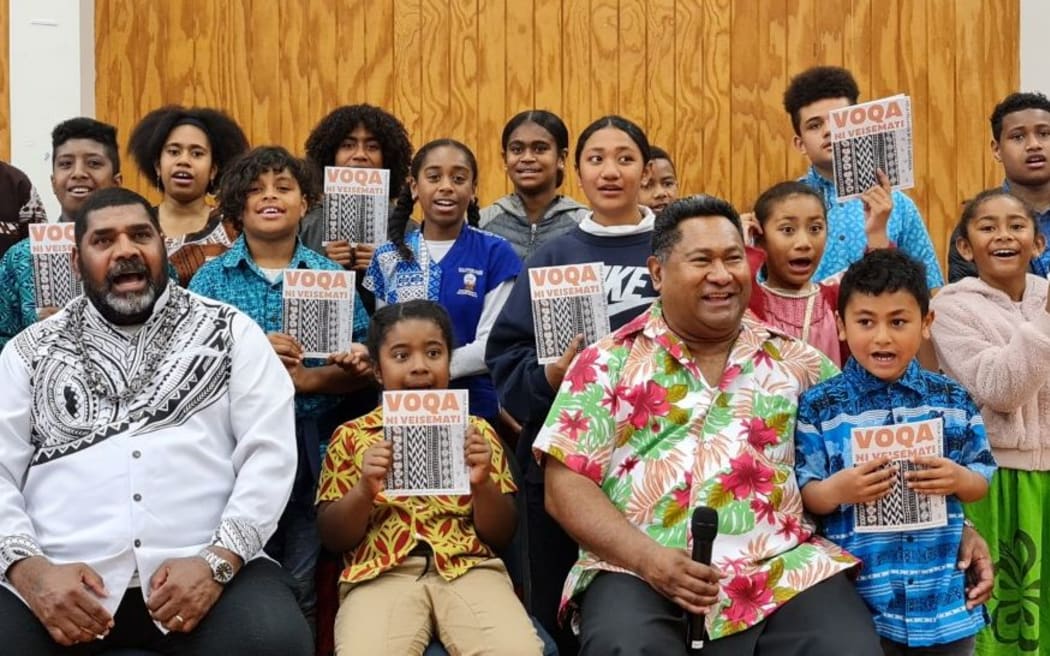
A Fijian community gathering . . . Image: RNZ Pacific
Prime Minister Anthony Albanese has told a regional security forum that dialogue is a vital “guardrail” in dealing with China, and praised US President Joe Biden’s effort to establish “reliable and open” US-China channels of communication.
Delivering a keynote speech at the Shangri-La Dialogue in Singapore on Friday night, Albanese said “the silence of the diplomatic deep freeze” only bred suspicion, making it easier for countries “to assume the worst of one another”.
But the forum, attended by defence ministers, officials and military chiefs, comes amid tensions after China declined an American request for a meeting on the sidelines between US Defence Secretary Lloyd Austin and his counterpart, Li Shangfu.
Austin has not spoken with Li since he became the Chinese defence minister in March. He had met with Li’s predecessor, General Wei Fenghe, on the sidelines of the Shangri-La Dialogue last year.
Albanese, in an address promoted as the most important he has made as PM on foreign policy, warned of the dangers where there was not “the pressure valve of dialogue”.
“If you don’t have the capacity – at a decision-making level – to pick up the phone, to seek some clarity or provide some context, then there is always a much greater risk of assumptions spilling over into irretrievable action and reaction.
“The consequences of such a breakdown – whether in the Taiwan Strait or elsewhere – would not be confined to the big powers or the site of their conflict, they would be devastating for the world.
“That’s why as leaders in this region – and as citizens of it – we should be doing everything we can to support the building of that first and most fundamental guardrail.”
Albanese said Australia had put dialogue “at the heart of our efforts to stabilise our relationship with China”.
It was not naïve about the process or its limitations, he said.
“But we begin from the principle that whatever the issue, whether we agree or disagree, it is always better and more effective if we deal direct.”
Albanese said the government’s investments in new defence capability was “unapologetically about our national defence and our national sovereignty.”
“They are also an investment in regional stability, strengthening our capacity to contribute to the collective security of the Indo-Pacific.
“From shared peacekeeping missions such as the regional assistance mission in Solomon Islands, to providing essential support in times of humanitarian and environmental disaster, most recently in Vanuatu.
“Australia is determined to deepen this cooperation with more shared exercises, building on the recent success of Talisman Sabre and our flagship regional engagement activity Indo-Pacific Endeavour.
“In boosting our nation’s defence capability, Australia’s goal is not to prepare for war but to prevent it – through deterrence and reassurance and building resilience in the region.
“Doing our part to fulfil the shared responsibility all of us have to preserve peace and security.
“And making it crystal clear that when it comes to any unilateral attempt to change the status quo by force: be it in Taiwan, the South China Sea, the East China Sea or elsewhere, the risk of conflict will always far outweigh any potential reward.”
Albanese on Saturday will travel to Vietnam for a two-day official visit before returning home.
Michelle Grattan does not work for, consult, own shares in or receive funding from any company or organisation that would benefit from this article, and has disclosed no relevant affiliations beyond their academic appointment.
The University of the South Pacific will be receiving additional funding from the Fiji government in the 2023-2024 national budget, says Deputy Prime Minister and Minister for Finance Professor Biman Prasad.
Speaking at a public consultation in Lautoka this week, he said the additional funding was to pay off arrears owed by the Fijian government to the regional university.
As of February this year, the Fiji government owed USP F$116 million (NZ$86 million) in unpaid grants.
“We gave $10 million already,” the Deputy PM said.
“I attended their council meeting and I made a commitment.
“We are restoring the annual grant to the university which is about $34 million.
“From this year the annual contribution that the Fiji government always used to contribute will be included in the budget and that will be paid.
“We are going to include an additional amount to clear out the arrears from the past years and so the university will have a lot of money.”
Professor Prasad was responding to queries raised by USP staff member Teresa Ali on the government’s commitment to the university’s annual grant.
Deputy VC ‘dismissed’ Meanwhile, Fijivillage News reports that the University of the South Pacific management has confirmed that deputy vice-chancellor and vice-president Professor Janusz Jankowski’s arrangement with the institution has ended.
USP’s Professor Januscz Jankowski . . . appointed in November 2022, “sacked” on May 26 after his “whistleblower” allegations.
In response to an email sent by FBC News, USP management said Professor Jankowski was recently engaged as a fixed-term and part-time consultant.
It also said that, contrary to media reports, the vice-chancellor and president of USP did not have the delegated authority to terminate the employment of a deputy vice-chancellor.
News media reports say that a week before the termination of Professor Jankowski’s contract, he had written a damning 13-page “whistleblower” report to two of the university’s pro vice-chancellors alleging “nepotism, lack of transparency and accountability” at the university.
Repeka Nasikois a Fiji Times reporter. Republished with permission.
The National Court has ordered the Papua New Guinea government to disclose the full details of the gold refinery deal it entered into with a Singapore-based company, National Gold Corporation.
The court ordered Prime Minister James Marape (first defendant), Planning Minister Renbo Paita (second defendant), the NEC (third defendant) and Dr Eric Kwa (fourth defendant) to make full disclosure on the project agreement, which would eventually become law and change the entire landscape of PNG’s gold industry.
“The process of gold refinery, while it may be welcome news for the country as to [who is] owning it, especially when a company is proposed to be a proponent, developer or owner of resource, the country needs to know the good and bad of it and the justifications for such arrangements,” Deputy Chief Justice Ambeng Kandakasi ruled in his judgment.
The order follows a court challenge mounted by Justin Parker, owner of Golden Valley Enterprise Limited, PNG’s leading gold buyer and processor, about the validity of the gold refinery agreement between the state and National Gold Corporation.
“I was disappointed when I learnt that an agreement was signed.
“To my knowledge the foreign company will own 70 percent of the refinery whilst the PNG government will only own 30 per cent when we could own for a 100 per cent nationally owned refinery,” Parker said through his lawyer, Saulep Lawyers.
The project agreement which will eventually be made law, will completely change the landscape of PNG’s gold industry.
Accessed unsigned copy “Coupled with the media publications, I had the benefit of having accessed an unsigned copy of the agreement relating to the Refinery Project and I note with grave concerns how this purported agreement will be very detrimental to the state, as well as all industry stakeholders.
“This agreement will totally shut the doors completely on us local businesses, alluvial miners, gold miners and aggregators around the country.
“It is dangerous to note that there will be no more open market competition and trade, being the fundamentals of democratic society and therefore our Constitution,” Parker said.
Aggrieved with information gathered overtime, Parker filed an application in the National Court on 13 December 2021, seeking :
A declaration pursuant to Section 51 of the Constitution that the Plaintiff has the right to have access to all pertinent and relevant information regarding the National Gold Refinery and Mint Project relating to the downstream processing of gold in the country, including, policies, statutory business papers, National Gold Corporation Project Shareholder Agreement, all related NEC Decisions (NEC Decision No 73 & 74/2021 dated 17th May 2021, NEC Decision No 267/2021 dated 20th September 2021 and NEC Policy Submission No 208/2021.
An order that pursuant to Sections 51 and 155 (4) and of the Constitution, the Defendants make available forthwith to all the referenced documents to Parker.
Justice Kandakasi granted these orders and further ordered that: “As the plaintiff submits, there has been no broader, wider consultation and so who stands to benefit, who stands to lose, what are the arrangements and what are the safeguards for alluvial miners or other mining interest holders?
“There is no evidence of any meaningful consultation having being occurred so a disclosure of these documents will enable the plaintiff and such other persons to work out whether they should be challenging the decisions arrived at.”
The court orders:
The plaintiff is granted leave to proceed ex-parte conditional on the plaintiff filing and serving an affidavit annexing the various email communication between the plaintiff and the defendants in respect of the matter coming to court today.
Judgment is granted in favour of the plaintiff
A declaration that pursuant to Section 51 of the Constitution, the plaintiff has the right to have access to all the pertinent and relevant information regarding the National Gold Refinery and Mint Project including the following information:
– (a) Department of National Planning and Monitoring’s Policy Document on the Refinery, Smelting and downstream processing of Gold in the country; – (b) Statutory Business Papers regarding the National Gold Refinery and Mint Project; – (c) National Gold Corporation Project Shareholders Agreement; – (d) NEC Decisions No. 73 & 84/2021 dated 17th May 2021; (e) NEC Decision No. 267/2021 dated 20th September 2021; – (f) NEC Policy Submission No. 208/2021. – Pursuant to Section 155(4) and Section 51 of the Constitution, the Defendants make available forthwith to the Plaintiff copies of all pertinent and relevant information regarding the National Gold Refinery and Mint Project, namely: (a) Department of National Planning and Monitoring Policy Document on the Refinery, Smelting and downstream processing of Gold in the county; (b) Statutory Business Papers regarding the National Gold Refinery and Mint Project; (c) National Gold Corporation Project Shareholders Agreement, (d) NEC Decisions No. 73 & 84/2021 dated 17th May 2021; (e) NEC Decision No. 267/2021 dated 20* September 2021; (f) NEC Policy Submission No. 208/2021.
The defendants shall pay the plaintiff’s costs of and incidental to these proceedings on a party/party basis, to be taxed if not agreed.
Gorethy Kennethis a PNG Post-Courier journalist. Republished with permission.
A new edition of the Okinawan Journal of Island Studies features social justice island activism, including a case study of Aotearoa New Zealand’s Pacific Media Centre, in what the editors say brings a sense of “urgency” in the field of diversity, equity, and inclusion in scholarship.
In the editorial, the co-editors — Tiara R. Na’puti, Marina Karides, Ayano Ginoza, Evangelia Papoutsaki — describe this special issue of the journal as being guided by feminist methods of collaboration.
They say their call for research on social justice island activism has brought forth an issue that centres on the perspectives of Indigenous islanders and women.
“Our collection contains disciplinary and interdisciplinary research papers, a range of contributions in our forum section (essays, curated conversations, reflection pieces, and photo essays), and book reviews centred on island activist events and activities organised locally, nationally, or globally,” the editorial says.
“We are particularly pleased with our forum section; its development offers alternative forms of scholarship that combine elements of research, activism, and reflection.
“Our editorial objective has been to make visible diverse approaches for conceptualising island activisms as a category of analysis.
‘Complexity and nuance’ “The selections of writing here offer complexity and nuance as to how activism shapes and is shaped by island eco-cultures and islanders’ lives.”
The co-editors argue that “activisms encompass multiple ways that people engage in social change, including art, poetry, photographs, spoken word, language revitalisation, education, farming, building, cultural events, protests, and other activities locally and through larger networks or movements”.
Thus this edition of OJIS brings together island activisms that “inform, negotiate, and resist geopolitical designations” often applied to them.
Geographically, the islands featured in papers include Papua New Guinea, Prince Edward Island, and the island groups of Kanaky, Okinawa, and Fiji.
Dr Robie emphasises the need for critical and social justice perspectives in addressing the socio-political struggles in Fiji and environmental justice in the Pacific broadly, say the co-editors.
Inclusive feminist thinking The article engages with “women’s political activism and collaborative practice” of the podcast and radio show La Pause Décoloniale.
The co-editors say the edition’s forum section is a result of “inclusive feminist thinking to make space for a range of approaches combining scholarship and activism”.
They comment that the “abundance of submissions to this section demonstrates the desire for academic outlets that stray from traditional models of scholarship”.
“Feminist and Indigenous scholar-activists seem especially inclined towards alternative avenues for expressing and sharing their research,” the coeditors add.
Preliminary findings of a yet-to-be released Transparency International survey has found sextortion — demanding sexual favours in return for public services — is a major issue in parts of the Pacific.
Papua New Guinea, the Federated States of Micronesia and Solomon Islands have higher rates of sexual extortion, according to the research.
Transparency International New Zealand Pacific advisor Mariam Mathew told RNZ Pacific women reported corruption was on the rise and sextortion was widespread.
Transparency International NZ Pacific adviser Mariam Mathew . . . sextortion “is a form of currency and in order to access it they [women] have no other option, but to actually offer this sexual favour”. Image: TINZ/RNZ
“Sextortion is a term we refer to when a person is asked for sexual favours in exchange for them accessing public services,” Mathew said.
“It’s a form of currency and in order to access it they [women] have no other option, but to actually offer this sexual favour.”
She said initial findings show women in the Pacific were “significantly impacted” by sextortion, adding Transparency International has found the issue could be more prevalent than in other part of the world.
“This is the first time we’re getting this sort of data,” she said.
‘Need conversations’ “We need to have conversations with stakeholders [working] in this space to understand what the issue is, what is being done about it, what needs to be done about it?” she added.
Transparency International will use the initial analysis from the survey to conduct focus group discussions with key stakeholders.
Mathew said these discussions would be held at the national and regional levels by working with groups in the field of gender to validate the findings but also provide more context to it.
She added that the final report was expected to come out later this year.
This article is republished under a community partnership agreement with RNZ.
New Zealand’s Media Freedom Council has called Auckland Mayor Wayne Brown’s exclusion of some media outlets from his budget speech today “unacceptable”.
In an appearance at Auckland Transport’s Viaduct headquarters, Brown took time out of pitching his plan to sell the city’s holdings in Auckland Airport to complain about road cones, his “not financially literate” councillors and target the “nasty” media.
Brown’s team invited journalists from only a few organisations to the announcement. RNZ was allowed in, but Stuff, TVNZ and Newshub were not.
Stuff reported among those allowed in were “business leaders, former politicians and former rugby league coach Sir Graham Lowe”.
Some reporters threatened to walk out of the event in protest, drawing this response from the mayor: “They weren’t invited, but some of the media have been pretty nasty. We did invite media who are sensible; and the media who are not weren’t invited, and have now decided, some of them, to bugger off — well, that’s all right with me”.
Stuff queried the mayor’s decision, and was told only a “select few journalists… we feel were best able to convey the mayor’s message” were invited.
Media Freedom Council chair Richard Sutherland — also head of news at RNZ — wrote to Brown shortly afterwards, to “express our deep concern about the attempted exclusion of journalists from today’s budget presentation in Auckland”.
Media Freedom Council chair Richard Sutherland . . . wrote to say “it is unacceptable to cherry-pick journalists based on who you think will give you the easiest ride.”. Image: RNZ
In addition to RNZ, the MFC represents Newshub, Newsroom, NZME, Stuff, The Spinoff and TVNZ.
‘Today’s events troubling’ “Today’s events are troubling. The media plays a crucial role in informing the public and holding officials accountable. Denying access to journalists compromises the public’s right to be informed,” Sutherland wrote.
“Furthermore, we are aware that invitations that were issued were selectively targeted to specific journalists. It is imperative to ensure equal opportunities for all bone fide journalists to cover significant public events, irrespective of their perceived affiliations or perspectives.
“To be blunt, it’s unacceptable to cherry-pick journalists based on who you think will give you the easiest ride.”
Sutherland called Brown’s decision an “affront to the democratic process and an insult to voters”.
Brown did not take questions after his speech, saying he did not have time.
He has had a strained relationship with the media since taking the mayoral chains last year. Mediawatch in April described it as “frosty”, at best.
He has his deputy Desley Simpson on side. She told RNZ’s Midday Report she did not want to sell the shares at first, but had listened to advice and had been convinced.
She said the mayor’s second budget proposal was as good as it was going to get, and she hoped other councillors agreed to it.
“In my heart, I didn’t want to sell the airport shareholding. But professional staff advice has said ‘sell them all’. And you know, that’s a hard pill to swallow when in your heart, you want to keep them.
“It’s an emotional wrestle that I think a lot of people are struggling with.”
Simpson said selling shareholding was not just a short-term fix, and would save the council $100 million a year in debt interest.
The council’s debt is currently more than $11 billion.
This article is republished under a community partnership agreement with RNZ.
There are parallels between Indonesia’s Aceh where anAustralian surfer faced a flogging, and West Papua where a New Zealand pilot may be facing death. Both provinces have fought brutalguerrilla wars for independence. One has been settled through foreign peacekeepers. The other still rages as outsiders fear intervention.
By Duncan Graham in Malang, East Java
There were ten stories in a Google Alert media feed last week for “Indonesia-Australia”.
One covered illegal fishing in the Indo-Pacific claiming economic losses of more than US$6 billion a year — important indeed.
Another was an update on the plight of New Zealand pilot Philip Mehrtens, held hostage since February 7 by the Tentara Pembebasan Nasional Papua Barat (TPNPB-West Papua National Liberation Army).
This is the armed wing of the Organisasi Papua Merdeka, (OPM Free Papua Organisation) that has been pushing its cause since the 1970s.
There have been unverified reports of bombs dropped from helicopters on jungle camps where the pilot may have been held with uninvolved civilians.
The other eight stories were about Queenslander Bodhi Mani Risby-Jones who had been arrested in April for allegedly going on a nude drunken rampage and bashing a local in Indonesian Aceh.
Stupidities commonplace Had the 23-year-old surfer been a fool in his home country the yarn would have been a yawn. Such stupidities are commonplace.
But because he chose to be a slob in the strictly Muslim province of Aceh and facing up to five years jail plus a public flogging, his plight opened the issue of cultural differences and tourist arrogance. Small news, but legitimate.
He has now reportedly done a $25,000 deal to buy his way out of charges and pay restitution to his victim. This shows a flexible social and legal system displaying tolerance — which is how Christians are supposed to behave.
All noteworthy, easy to grasp. But more important than the threatened execution of an innocent victim of circumstances caught in a complex dispute that needs detailed explanations to understand?
Mehrtens landed a commercial company’s plane as part of his job for Susi Air flying people and goods into isolated airstrips when he was grabbed by armed men desperate to get Jakarta to pay attention to their grievances.
Ironically, Aceh where Risby-Jones got himself into strife, had also fought for independence and won. Like West Papua, it’s resource-rich so essential for the central government’s economy.
A vicious on-off war between the Gerakan Aceh Merdeka, (GAM-Free Aceh Movement) and the Indonesian military started in 1976 and reportedly took up to 30,000 lives across the following three decades.
Tsunami revived peace talks It only ended when the 2004 Boxing Day tsunami killed 160,000 people and former general Susilo Bambang Yudhoyono was elected president and revived peace talks. Other countries became involved, including the European Union and Finland where the Helsinki Agreement was signed.
Both sides bowed to a compromise. GAM leaders abandoned their demands for independence, settling for “self-government” within the Indonesian state, while soldiers were withdrawn. The bombings have stopped but at the cost of personal freedoms and angering human rights advocates.
Freed from Jakarta’s control, the province passed strict Shariah laws. These include public floggings for homosexual acts, drinking booze and being close to an opposite sex person who is not a relative. Morality Police patrols prowl shady spots, alert to any signs of affection.
Australian academic and former journalist Dr Damien Kingsbury was also instrumental in getting GAM and Jakarta to talk. He was involved with the West Papua standoff earlier this year but New Zealand is now using its own to negotiate.
Dr Kingsbury told the ABC the situation in West Papua is at a stalemate with neither Wellington nor Jakarta willing to make concessions. The Indonesian electorate has no truck for “separatists” so wants a bang-bang fix. NZ urges a softly-slowly approach.
A TPNPB spokesperson told the BBC: “The Indonesian government has to be bold and sit with us at a negotiation table and not [deploy] military and police to search for the pilot.”
The 2005 Aceh resolution means the Papua fighters have a strong model of what is possible when other countries intervene. So far it seems none have dared, fearing the wrath of nationalists who believe Western states, and particularly Australia, are trying to “Balkanise” the “unitary state” and plunder its riches.
Theory given energy This theory was given energy when Australia supported the 1999 East Timor referendum which led to the province splitting from Indonesia and becoming a separate nation.
Should Australia try to act as a go-between in the Papua conflict, we would be dragged into the upcoming Presidential election campaign with outraged candidates thumping lecterns claiming outside interference. That is something no one wants but sitting on hands won’t help Mehrtens.
In the meantime, Risby-Jones, whose boorish behaviour has confirmed Indonesian prejudices about Australian oafs, is expected to be deported.
Mehrtens will only get to tell his tale if the Indonesian government shows the forbearance displayed by the family of Edi Ron. The Aceh fisherman needed 50 stitches and copped broken bones and an infected foot from his Aussie encounter, but he still shook hands.
If the Kiwi pilot does get out alive, he deserves the media attention lavished on the Australian. This might shift international interest from a zonked twit to the issue of West Papua’s independence and remind diplomats that if Jakarta could bend in the far west of the archipelago, why not in the far east?
Lest Indonesians forget: Around 100,000 revolutionaries died during the four-year war against the returning colonial Dutch after Soekarno proclaimed independence in 1975. The Dutch only retreated after external pressure from the US and Australia.
Duncan Graham has been a journalist for more than 40 years in print, radio and TV. He is the author of People Next Door (UWA Press) and winner of the Walkley Award and Human Rights awards. He is now writing for the English language media in Indonesia from within Indonesia. This article was first published in Pearls & Irritations on 30 May 2023 and is republished with permission.
Many people who cannot lose weight through diet and exercise turn to medication. That includes the high-profile prescription medicine Ozempic, a diabetes drug that also leads to weight loss.
World-wide supply shortages of the drug and the need to get a prescription for it have likely driven people to look for alternatives available online or in pharmacies, such as berberine.
Berberine is a bitter tasting chemical extracted from the roots of plants, such as goldenseal and barberry.
It belongs to the class of plant chemicals called isoquinoline alkaloids. Other well known chemicals in this class include the pain-relieving medicines morphine and codeine.
Berberine extracts have been used in traditional medicines for disorders of the gut and to treat infections. It is mostly taken orally as a powder, capsule or tablet.
Berberine is not the same as Ozempic. Ozempic is the brand name of the drug semaglutide, which is used to treat people with type 2 diabetes.
Ozempic works by imitating a natural hormone called glucagon-like peptide-1 (GLP-1). This hormone is important because it helps the body produce insulin to regulate blood sugar levels.
More recently, Ozempic has been shown to be effective for weight loss in people who are overweight or obese. By mimicking GLP-1, Ozempic makes you feel full and less hungry.
In clinical studies, berberine leads to modest weight loss in people who are obese. But the data are not conclusive as most published studies are small and of varying quality.
The strongest evidence we have comes from two meta-analyses, types of studies that pool together and analyse the results of other studies.
These show that taking a 300-3,000mg berberine a day orally is associated with modest reductions in body mass index (BMI), waist circumference and body weight (around 3kg). These results were most significant in women with a BMI great than 30, taking at least 1,000mg daily for at least three months.
Studies have only been conducted with people who are overweight or obese. So we don’t know whether berberine leads to weight loss in others.
We also don’t yet have the data to say what happens when people stop taking berberine.
We don’t exactly know how berberine works to help people lose weight. But a recent systematic review (when researchers pool together evidence) gives some clues.
It influences GLP-1 levels like Ozempic, but probably results in weight loss in other ways too. It decreases blood sugar levels, stimulates insulin release, influences how the body absorbs cholesterol, and changes the way fat is processed in the body.
Just because berberine is sold over the counter, doesn’t mean it’s safe. It can have side effects and interfere with other drugs you may be taking.
Common side effects include diarrhoea, constipation, gas and an upset stomach. Large quantities may be fatal.
Berberine is not recommended for people who are pregnant as it is thought it can cross the placenta and may harm the fetus. It may also stimulate contractions of the uterus, which can inappropriately trigger birth. Because it can be transferred to breast milk it is not appropriate if breastfeeding.
Berberine can also interact with many other drugs and supplements. These include the immune-system drug ciclosporin, cough suppressants like dextromethorphan, and herbal remedies and medicines used to lower blood pressure, lower blood sugar levels, reduce blood clotting, and help with relaxation and sleep.
If you are obese or overweight and are having trouble losing weight through diet and exercise alone then berberine may be of some help.
However, before buying berberine, discuss it with your doctor or pharmacist to see if it will be safe for you, or if other medications might be more appropriate.
Associate Professor Tina Hinton has previously received funding from the Schizophrenia Research Institute (formerly Neuroscience Institute of Schizophrenia and Allied Disorders). She is currently a Board member of the Australasian Society of Clinical and Experimental Pharmacologists and Toxicologists.
Associate Professor Wheate in the past has received funding from the ACT Cancer Council, Tenovus Scotland, Medical Research Scotland, Scottish Crucible, and the Scottish Universities Life Sciences Alliance. He is a Fellow of the Royal Australian Chemical Institute, a member of the Australasian Pharmaceutical Science Association, and a member of the Australian Institute of Company Directors. Nial is the chief scientific officer of Vairea Skincare LLC, a director of SetDose Pty Ltd a medical device company, and a Standards Australia panel member for sunscreen agents.
Dr Roubin in the past had received funding from ARC Linkage, AusIndustry Biotechnology Innovation Fund, Clive & Vera Ramaciotti Foundation, Pharmacy Research Trust of NSW . She is a member of International Pharmaceutical Federation, a member of the Australasian Pharmaceutical Science Association, a member of the Australian & New Zealand Association for Health Professional Educators. Rebecca in the past was a research assistant for ADP Pharmaceuticals Pty Ltd a complementary medicines company.
Source: The Conversation (Au and NZ) – By Niraj Lal, Visiting Fellow at the ANU Centre for Sustainable Energy Systems, Australian National University
Pixabay
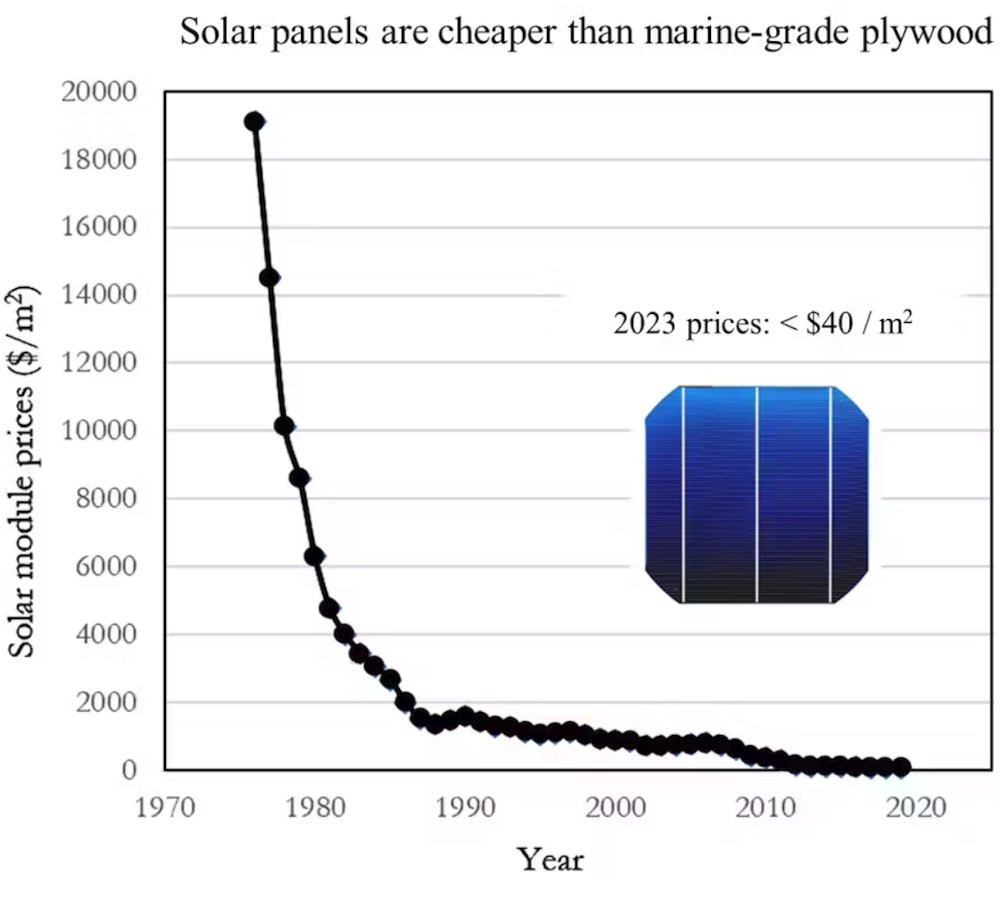
As we race to decarbonise by electrifying everything, solar panels – now cheaper per square metre than marine-grade plywood – will do much of the heavy lifting. But if we don’t rethink how our rooftop panels plug into the grid, the transition will be unfair and costly – for both people who own solar panels (and electric cars and smart appliances) and people who don’t.
Australia has the world’s highest solar installation rate per person. When solar panels generate more energy than a household is using, the excess electricity can be exported to the grid. Rooftop solar regularly provides more than a quarter of daytime electricity across the National Electricity Market. At times it exceeds 90% in South Australia.
Solar panel prices per square metre since 1970 (assuming 18% efficient modules). Data: IRENA Database. Graph: Niraj Lal, Author provided
The amount of solar in our grids is affecting how the Australian Energy Market Operator (AEMO) and distribution businesses (which own the powerlines) keep the lights on. The measures in place are costing households that are generating solar power, but also non-solar owners and network operators. So how can we make the system fairer for all?
We suggest solar panels should be thought of a little more like apple trees. If you have a tree in your backyard you should be able to use as many apples as you produce. But selling apples for profit creates extra responsibilities, along with uncertainties about supply and the fair selling price.
At times, the amount of solar energy being exported can be too much for the network to handle.
That’s why inverters (the box on the side of a house with solar panels) have settings that automatically reduce exported electricity when network capacity is under strain. Other mechanisms are also being put in place to allow AEMO to occasionally curtail output from rooftop solar to maintain power system security.
However, such measures not only reduce how much electricity is flowing from a home to the grid, but the entire output of the home’s rooftop system. There aren’t any fundamental reasons for this, just that appropriate inverter and control settings haven’t been enabled.
But this means a household, at times, can’t use any of the electricity it’s generating. In South Australia, the annual cost to customers of this sort of curtailment is already between A$1.2 million and A$4.5 million. This isn’t fair.
But it also isn’t fair when solar owners get paid to export electricity when prices are negative – that is, when other generators must pay to keeping exporting to the grid. This is happening more often, totalling more than half of all daytime hours in SA and Victoria last quarter.
Nor is it fair for distribution businesses to build more poles and wires to accommodate everyone’s solar exports all the time. Or if the system operator has to buy more reserves to cover for the uncertainties of rooftop solar output.
In these instances, all customers foot the bill whether they own solar panels or not. But non-owners are hit hardest when the costs of such measures are passed on. People without rooftop solar are completely exposed to the 20-25% electricity price rises from July 1.
Some solar owners will hardly notice the increase.
It’s time to rethink the social contract for grid electricity
Australia’s electrification will replace fossil fuels to run households, businesses, vehicles and industry. It’s expected rooftop solar will increase five-fold. How should households with these growing distributed energy resources interact with the grid in future?
We reckon the social contract for grid electricity needs to evolve from the pay-plug-play expectations dating from the 19th century to a two-way engagement to support fairness for all.
To return to the apple tree analogy, if you have a tree in your backyard you should be able to eat as many apples as you’d like, and make crumble, cider, whatever. But selling apples for profit comes with a responsibility not to carry codling moth. And selling crumble or cider is subject to food safety and licensing requirements.
If there’s an abundance of apples, you can’t expect to sell them for a high price. Shutterstock
And the prices? That depends on the availability of trucks and local market value. Maybe you or our government could pay more for trucks for everyone to be able to sell apples all the time, but it probably wouldn’t be efficient or fair.
The main distinction we draw is between growing for yourself and selling for profit. The analogy obviously isn’t perfect. Apples aren’t an essential service, apple trucks aren’t a regulated monopoly, and the supply and demand of apples doesn’t need to be balanced every second.
However, the principles remain – especially for a future where apple trees (rooftop solar) and apple warehouses (home batteries and electric vehicles) are everywhere.
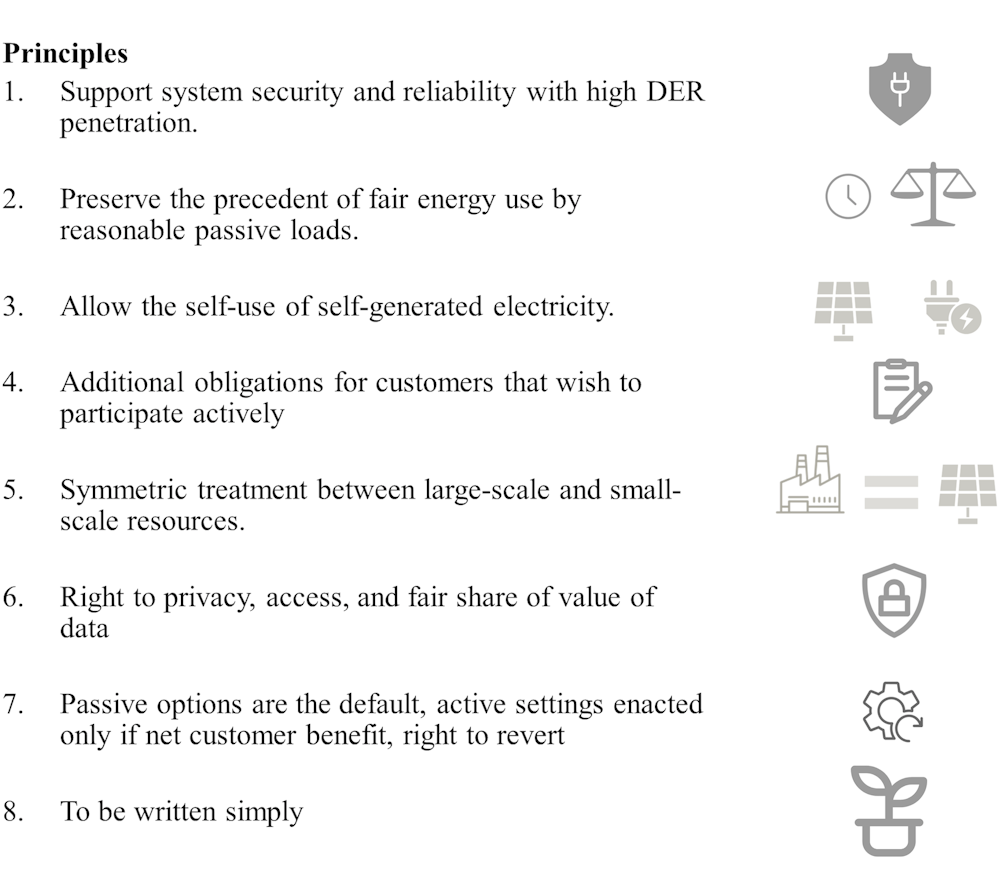
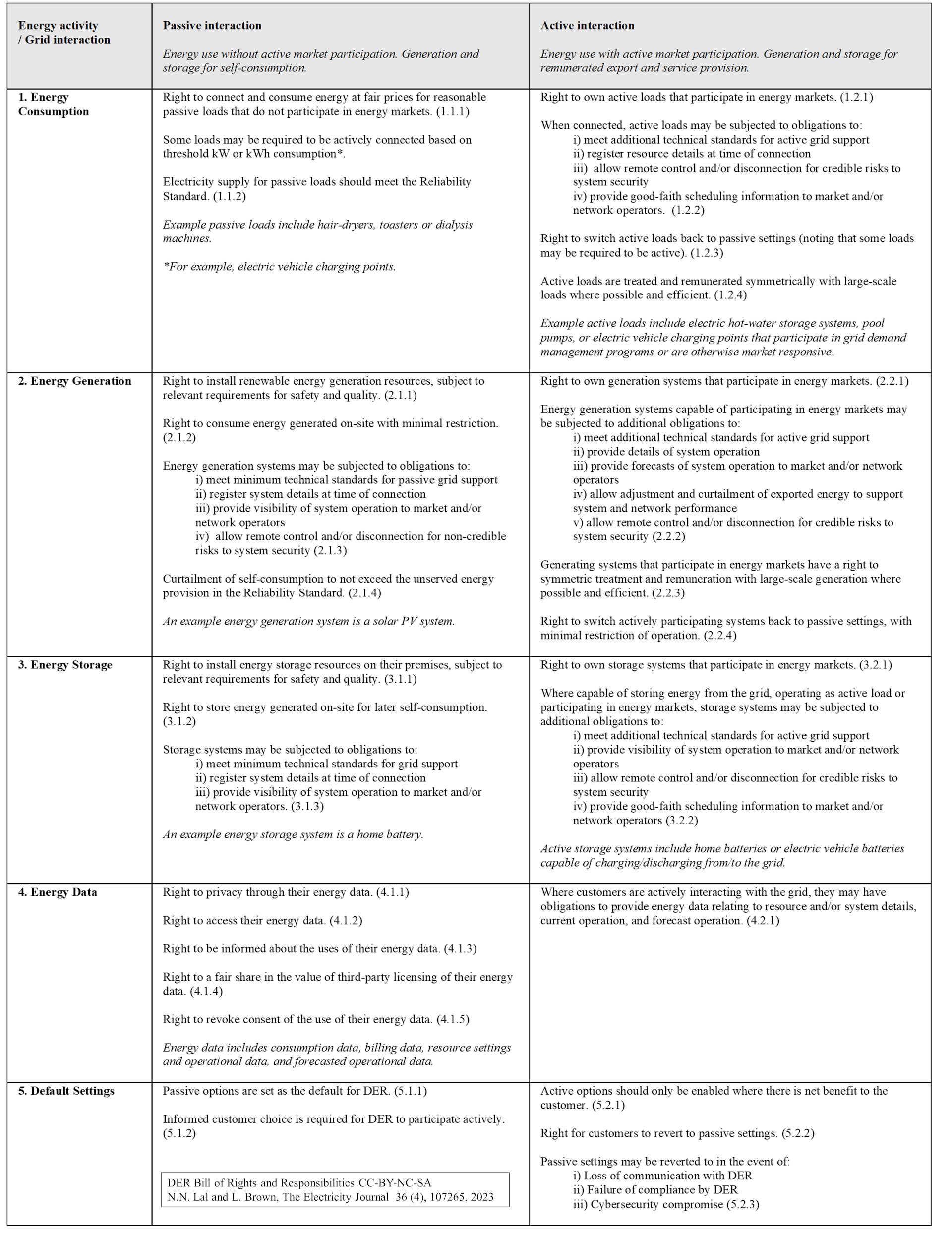
The principles guiding a bill of rights and responsibilities for distributed energy resources. CC-BY-NC-SA. Author provided
A fairer balance of rights and responsibilities
In our research paper we distinguish between rights for passive use (using your own rooftop solar electricity) and responsibilities for active use (selling electricity).
No-one should be able to stop you using your own self-generated electricity (for the vast majority of the time). But making money from the grid will likely come with responsibilities to allow trusted parties such as network operators to manage your exports at times (a system known as flexible export limits).
In a country with lots of solar energy, prices for selling energy mightn’t be guaranteed all the time either.
We must think about this new social contract. If we don’t, electrifying everything will be harder, more expensive, less fair and more reliant on large-scale projects requiring new transmission lines, which are complex and costly to build.
The story of distributed electricity is incredible – the power is literally in our hands when we flick a switch, grab the wheel, buy a product. We have an opportunity now to make it work better and be fairer for all of us.
You can see a summary of the DER Bill of Rights and Responsibilities here.
This article was co-authored by Lee Brown Specialist – Market Design and Development at the Australian Energy Market Operator (AEMO), where he is leading Australia’s reforms of DER access and pricing. Niraj Lal and Lee Brown both work at AEMO, though the opinions in this article and associated research paper are solely those of the authors and not of AEMO.
Niraj Lal is additionally an Academic Expert for the International Energy Agency PV Task 14. He has been awarded funding from a range of organisations including the UK Government, the Australian Renewable Energy Agency, and the Australian Broadcasting Corporation.
On Thursday, Justice Anthony Besanko of the Federal Court dismissed defamation proceedings brought by former Special Air Service soldier Ben Roberts-Smith against several Australian news outlets.
The court found that reporting by Nick McKenzie, Chris Masters and David Wroe had satisfactorily established the truth of several serious imputations against Roberts-Smith. These included claims he committed war crimes during his service in Afghanistan.
The judgement is a landmark moment in Australian military history, with implications for the investigation and potential prosecution of other Australians suspected of war crimes. The explosive evidence heard in the case also underlines the need for the Army, the broader defence community and the Australian public to reckon fully with the conduct of Australian forces in the Afghanistan campaign.
Roberts-Smith could conceivably face criminal prosecution for the alleged murders at a future war crimes trial. This case was a civil proceeding, meaning the imputations only needed to be proven true on the balance of probabilities, a substantially lower requirement than proof beyond a reasonable doubt, which would be required in a criminal trial.
Because of the different standards of proof, it is not certain Roberts-Smith would be found guilty in a war crimes trial, assuming all the same evidence was called. Prosecutors will be concerned, moreover, that the outcome of the high-profile defamation trial might influence a future war crimes proceeding.
It is likely any criminal trial for Roberts-Smith will be held before a judge, without a jury. It is not unusual for a war crimes trial to be held without a jury; past Australian trials were held before a panel of three to five judges, all of whom were military officers.
Another way to overcome the problem of the defamation outcome poisoning a future criminal trial in Australia would be for the government to hand Roberts-Smith over to the International Criminal Court in the Hague, a court with long experience in dealing with very high profile war crimes cases. However, doing so would probably be deeply unpopular and signal to the world that Australia cannot dispense its own military justice.
Contextual truth
Some imputations against Roberts-Smith were not substantiated at the defamation trial. However, Justice Besanko found that these defamatory statements, which concerned threatening a fellow soldier and domestic violence, were nonetheless contextually true. This ruling means the newspapers are not liable for these imputations because the more injurious claims, including war crimes, were found to be true, so the defendant would suffer no further reputational damage.
Broader implications
It remains to be seen what the full reaction to Thursday’s judgement will be. Roberts-Smith still holds the Victoria Cross, the country’s highest military honour. He received financial support for the case from Kerry Stokes – who, from 2015 to 2022, was chair of the Australian War Memorial. Stokes allegedly referred to McKenzie and Masters as “scumbag journalists”.
While the memorial as an institution did not support Roberts-Smith with the case, Stokes remained as chair even after his role was publicly questioned. The interpretation from some quarters that reporting on Roberts-Smith constitutes unfair criticism of a war hero will persist. Others, of course, will see it as exactly the job investigative reporting is meant to do.
The Australian Defence Force has taken the allegations brought forward by journalists and other sources seriously. It commissioned Paul Brereton’s Afghanistan inquiry and appears to accept that the conduct of some Australian personnel was potentially illegal.
While the findings in the defamation case support the ADF’s position that an inquiry was needed, the case was not a “proxy war crimes trial”. It does not deliver justice for alleged war crimes. Only properly convened war crimes trials can answer the questions that hover over Australian conduct in Afghanistan, including the role of commanding officers.
War crimes trials, however, take significant institutional momentum to convene and sustain: they are costly, long-running and controversial. The challenge for the ADF now is to continue to support the thorough investigation of alleged war crimes and to pursue criminal prosecution where it is warranted.
Since the second world war, Australia has positioned itself internationally as a champion of the laws and proper conduct of war. Australian forces have been deployed to many difficult conflicts, where they have largely been trusted operators.
The judgement in this case ought to have minimal impact on Australian forces who are deployed overseas, as following the rules of war is assumed to be part of any mission they undertake. If the case does come as a wake-up call to some, then the ADF will have to further assess its training on the laws of war, its leadership, and its culture.
The Roberts-Smith case, the finding against him and the graphic detail in the publicly available evidence made headlines around the world. If public faith in the ADF is to be restored, together with its international reputation, there must now be an exhaustive process of investigation and prosecution of any war crimes committed in Afghanistan.
Dean Aszkielowicz has previously received funding from The Army Research Scheme.
Paul Taucher does not work for, consult, own shares in or receive funding from any company or organisation that would benefit from this article, and has disclosed no relevant affiliations beyond their academic appointment.
The world missed the boat with social media. It fuelled misinformation, fake news, and polarisation. We saw the harms too late, once they had already started to have a substantive impact on society.
With artificial intelligence – especially generative AI – we’re earlier to the party. Not a day goes by without a new deepfake, open letter, product release or interview raising the public’s concern.
Responding to this, the Australian government has just released two important documents. One is a report commissioned by the National Science and Technology Council (NSTC) on the opportunities and risks posed by generative AI, and the other is a consultation paper asking for input on possible regulatory and policy responses to those risks.
I was one of the external reviewers of the NSTC report. I’ve read both documents carefully so you don’t have to. Here’s what you need to know.
With AI, we see a multi-trillion dollar industry coming into existence before our eyes – and Australia could be well-placed to profit.
In the last few months, two local unicorns (billion dollar companies) pivoted to AI. Online graphic design company Canva introduced its “magic” AI tools to generate and edit content, and software development company Atlassian introduced “Atlassian intelligence” – a new virtual teammate to help with tasks such as summarising meetings and answering questions.
These are just two examples. We see many other opportunities across industry, government, education and health.
AI tools to predict early signs of Parkinson’s disease? Tick. AI tools to predict when solar storms will hit? Tick. Checkout-free, grab-and-go shopping, courtesy of AI? Tick.
The list of ways AI can improve our lives seems endless.
The NSTC report outlines the most obvious risks: job displacement, misinformation and polarisation, wealth concentration and regulatory misalignment.
For example, are entry level lawyers going to be replaced by robots? Are we going to drown in a sea of deepfakes and computer generated tweets? Will big tech companies capture even more wealth? And how can little old Australia have a say on global changes?
The Australian government’s consultation paper looks at how different nations are responding to these challenges. This includes the US, which is adopting a light touch approach with voluntary codes and standards; the UK, which looks to empower existing sector-specific regulators; and Europe’s forthcoming AI Act, which is one of the first AI-specific regulations.
Europe’s approach is worth watching if their previous data protection law – the General Data Protection Regulation (GDPR) – is anything to go by. The GDPR has become somewhat viral; 17 countries outside of Europe now have similar privacy laws.
The European Union’s GDPR regulations came into effect on May 25 2018, and have become a model for other nations around the world. Shutterstock
Indeed, the Australian government’s consultation paper specifically asks if we should adopt a similar risk and audit-based approach as the AI Act. The Act outlaws high-risk AI applications, such as AI-driven social scoring systems (like the system in use in China) and real-time remote biometric identification systems used by law enforcement in public spaces. It allows other riskier applications only after suitable safety audits.
China stands somewhat apart as far as regulating AI goes. It proposes to implement very strict rules, which would require AI-generated content to reflect the “core value of socialism”, “respect social morality and public order”, and not “subvert state power”, “undermine national unity” or encourage “violence, extremism, terrorism or discrimination”.
In addition, AI tools will need to go through a “security review” before release, and verify users’ identities and track usage.
It seems unlikely Australia will have the appetite for such strict state control over AI. Nonetheless, China’s approach reinforces how powerful AI is going to be, and how important it is to get right.
As the government’s consultation paper notes, AI is already subject to existing rules. These include general regulations (such as privacy and consumer protection laws that apply across industries) and sector-specific regulations (such as those that apply to financial services or therapeutic goods).
One of the major goals of the consultation is to decide whether to strengthen these rules or, as the EU has done, to introduce specific AI risk-based regulation – or perhaps some mixture of these two approaches.
Government itself is a (potential) major user of AI and therefore has a big role to play in setting regulation standards. For example, procurement rules used by government can become de facto rules across other industries.
Missing the boat
The biggest risk, in my view, is that Australia misses this opportunity.
A few weeks ago, when the UK government announced its approach to deal with the risks of AI, it also announced an additional £1 billion of investment in AI, alongside the several billion pounds already committed.
We’ve not seen any such ambition from the Australian government.
The technologies that gave us the iPhone, the internet, GPS, and wifi came about because of government investment in fundamental research and training for scientists and engineers. They didn’t come into existence because of venture funding in Silicon Valley.
We’re still waiting to see the government invest millions (or even billions) of dollars in fundamental research, and in the scientists and engineers that will allow Australia to compete in the AI race. There is still everything to play for.
AI is going to touch everyone’s lives, so I strongly encourage you to have your say. You only have eight weeks to do so.
Toby Walsh receives funding from the Australian Research Council via an ARC Laureate Fellowship in Trustworthy AI. He was an external reviewer of the NSTC Rapid Response Information Report on Generative AI.
Source: The Conversation (Au and NZ) – By Gregory Moore, Senior Research Associate, School of Ecosystem and Forest Sciences, The University of Melbourne
Shutterstock
While plants can’t walk, they can certainly travel. Some species have travelled vast distances over millennia, moving by different and varied modes.
Some found new habitats when the continent they were riding on slowly crashed into another. Others went on perilous ocean going journeys – think of coconuts washing up on new island shores. Others still have been carried as seeds by birds or other animals – including us.
Many have now become local, endemic to their region of Australia. Some may surprise you.
Native nuts – how macadamia trees began
Early in the age of jet aeroplanes, flying to America meant a stop-over in Hawaii to refuel. Here, many Australians tasted macadamia nuts for the first time and probably assumed they were a local delicacy. Imagine their surprise at discovering the truth. Hawaii’s macadamia industry began when a few nuts were sent from Australia in the 1880s.
Of course, this was not news to Australia’s First Nations people, many of whom had enjoyed macadamia nuts for millennia.
Macadamia nuts first gained notice in Hawaii – but they’re Australian as can be. Shutterstock
There are four species of Macadamia, of which two are the most important nut producers, namely Macadamia integrifolia and M
. tetraphylla. All species belong to the Proteaceae family, meaning they are related to banksias, grevilleas and proteas.
This family connection reveals the genus has a long evolutionary history, dating back about 100 million years. Macadamias travelled with the continent of Australia as it split off from Antarctica and South America.
In their natural habitat across northern New South Wales and southern Queensland, these subtropical trees can reach heights of 25 metres. But even though they are now widely farmed, they’re actually threatened in the wild – and may be further threatened by climate change.
Oranges, lemons – and native citrus?
Many of us are fond of tart and tasty citrus – oranges from southern China, lemons probably from northern India. All the world’s citrus trees stem from an ancestor species which grew in the foothills of the Himalayas, according to DNA evidence. Over time, these trees spread out and new species split off. Eventually, about 8–10 million years ago, they arrived in Australia.
The most well known is the finger lime, C. australasica, with tiny globes spilling out of the fruit like citrus caviar. But there are others, like the Australian lime, Citrus australis and the desert lime C. glauca. Like many citrus, they can be prickly customers with long painful spines. While most are shrubs and small trees, the Australian lime can reach heights of 20 metres.
Native raspberries
In recent years, the native raspberry, Rubus probus, has achieved celebrity status as a prickly, quick growing bramble with a good fruit.
But like its relative, the blackberry, Rubus fruticosus, you have to work hard to get fruit and rarely come away unscathed.
That’s why it was big news when a thornless specimen was found and propagated. This will make a big difference to the cultivation of our native raspberry.
Our native raspberry is becoming popular. Shutterstock
So how did Australia come to have raspberries? It seems likely their ancestors migrated from North America towards Europe and Asia between 10 and 15 million years ago and eventually made it to Oceania.
Exactly how the genus Rubus made it to Australia is unknown, but the most likely pathway is a few seeds stuck to the feathers of a migrating bird. It could have happened as recently as a few hundred thousand years ago.
Native geraniums? It’s true
I associate geraniums with my maternal grandmother, who had the most magnificent red geraniums along her back fence. Family folklore had it they were cuttings from a prize winner at a major horticultural exhibition – and I believe it.
While we associate garden geraniums with Europe, they’re actually African and only arrived in Europe in the 17th century.
But while we all know these geraniums, Australia has its own species. That fact still amazes me after decades of studying plants.
But first, let’s clear up the debate over names. In the 17th century, geraniums and closely-related pelargoniums were grouped together in a single genus. But early in the 18th century, Charles LeHeritier – the botanist who first described eucalypts – divided them and there has been confusion ever since.
The easiest way of telling them apart is that geraniums have five petals of the same size and shape but pelargoniums have two larger petals and three smaller ones.
Most of the Australian native plants commonly called geraniums are in fact pelargoniums. You may have stumbled across Pelargonium australe, the most common of our seven species, which is spread across much of southern Australia.
Native geranium? The pelargonium australe is the native plant most commonly thought of as a geranium. Wikimedia, CC BY
Native orchids: from flying ducks to the Queen of Sheba
There’s something about orchids. In the 19th century, so many Europeans went mad for their flowers that the name “orchidelirium” was coined.
We have some of the most iconic orchids as natives, such as the remarkable flying duck orchid and the stunning Queen of Sheba. Our 1800 species mostly grow in our tropical and subtropical areas.
Australia’s flying duck orchid (Caleana major) is world-famous for its resemblance. Shutterstock
Some orchids can be traced back to the last years of Gondwana. But curiously, we also have tropical species which must have island hopped from Papua New Guinea and Indonesia more recently.
That’s only the start of our surprising plants. We have native tamarinds, native rivermint, and a native rhododendron.
And did you know that cloves come from an Indonesian species of lilly pilly? This species is related to Australian lilly pillies, a genus which evolved as the final fragmentation of Gondwana occurred about 65 million years ago. They rapidly diversified and there are now over 1000 species.
The Eastern Queen of Sheba orchid is rightly famous. Shutterstock
Plants move slowly. But they move much more than you’d expect. Their success has enriched the biodiversity and novelty of our ecosystems in surprising ways. As for me, I love an Australian macadamia nut – and I’ll always love those imported red geraniums.
Gregory Moore does not work for, consult, own shares in or receive funding from any company or organization that would benefit from this article, and has disclosed no relevant affiliations beyond their academic appointment.
Source: The Conversation (Au and NZ) – By Geoffrey Browne, Postdoctoral Research Fellow, Melbourne School of Design, The University of Melbourne
Shutterstock
When a driver and a pedestrian approach a T-intersection, who has to give way?
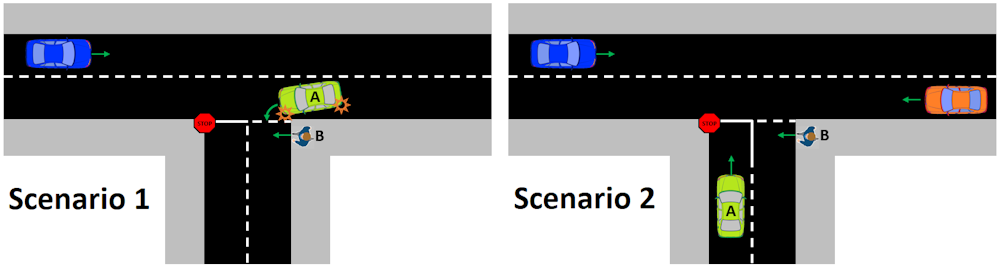
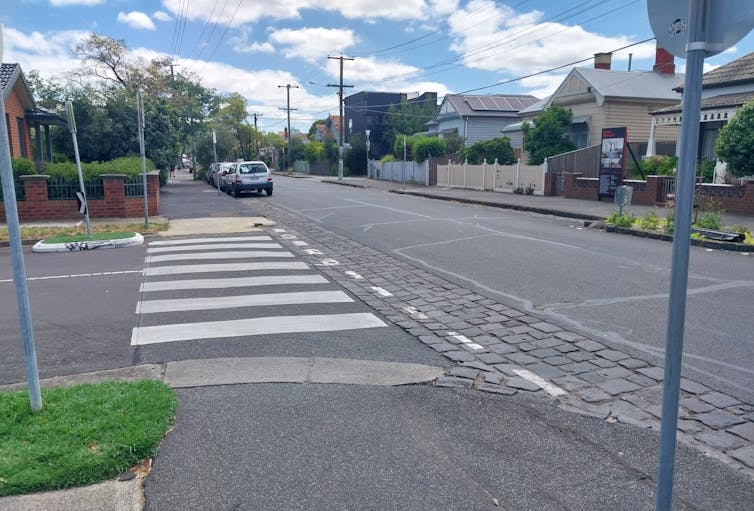
In newly published research we tested over 1,000 road users’ knowledge of the Australian road rules. We presented them with the two scenarios shown below.
When asked who should give way in these scenarios, many road users answered incorrectly. Browne & Flower 2023
When asked who should give way, the green car or the pedestrian, in the first and second scenarios, 37% and 39% of road users respectively answered incorrectly.
(1) If a driver is turning from a road at an intersection –
(a) the driver is required to give way to a pedestrian who is crossing the road that the driver is entering […] and
(b) the driver is not required to give way to a pedestrian who is crossing the road the driver is leaving.
An obvious source of people’s confusion is the inconsistency between parts (a) and (b) of rule 353. In effect, it gives pedestrians “right of way across only half an intersection”.
Part (b) is also quite counter-intuitive. After all, most people would expect that a stop or give way sign would mean drivers have to stop for pedestrians as well as cars.
Changing the rules to require drivers to give way to pedestrians who are crossing the road the driver is leaving would create a “generalised and unambiguous duty to give way on turning”“. This change has been proposed before. But more recent developments have added to the case for such a rule change.
A driver approaching this stop sign isn’t required to give way to pedestrians, but a driver turning into the same street must give way. Shutterstock
The UK recently made the same change to its road rules. In late 2021, the UK Highway Code introduced rule H2 which, at a junction, requires drivers to give way to pedestrians crossing or waiting to cross a road into which or from which the driver is turning.
The change eliminated inconsistencies and the counter-intuitiveness about who has to give way.
Giving pedestrians an unambiguous right of way also encourages walking. Examples of apparently minor “urban acupuncture” like this can have long-term benefits for liveability and for public health and wellbeing.
The second recent development is that local councils around Melbourne have been installing zebra crossings at prioritised locations – but not all locations – within activity centres and on routes designated as part of the so-called Principal Pedestrian Network. The purpose has been to encourage and enable walking for transport, particularly since 2020 when COVID-19 lockdowns meant people were seeking more opportunities to exercise in their local area.
A zebra crossing improves safety where it has been installed, but can lead to confusion at intersections without such crossings. Geoffrey Browne, Author provided
Zebra crossings at T-intersections like the one pictured above are certainly well intentioned, and they over-ride rule 353(1)(b) to create pedestrian priority where it wouldn’t otherwise exist. The evidence suggests such zebras crossings do improve safety at the intersections where they are installed.
At the same time, however, there is a very real risk that, without a rule change, the crossings unintentionally undermine walkability more widely. This is because when they are installed at some but not all intersections, they can lead people to believe that at sites where they are not installed, drivers do not have to give way to a pedestrian who is crossing the street into which the driver is turning.
Our research, which was the first to examine this issue, found the risk of this unintended consequence is very real.
We also interviewed traffic engineers, local government planners and walking experts. A clear majority agreed a rule change that requires drivers to give way to pedestrians at a stop or give way sign would improve road safety and promote walking.
It would taking some getting used to, but road rules have been changed before.
In 1993 the road rules in Victoria were changed for vehicles turning left at intersections to have the right of way before vehicles turning right. Previously, and somewhat counter-intuitively, it was the other way around.
From April 2021, motorists across Australia were required to give cyclists clearance of at least one metre when overtaking.
Both of these rule changes were accompanied by public awareness campaigns to ensure the community knew about them.
Requiring drivers approaching and turning at a T-intersection from any direction to give way to pedestrians would be an important simplification of the road rules. And the more the rules are biased toward the convenience of walkers, the more walkers there will be.
Importantly, changes like this can send subtle but powerful social signals that society values walking for transport because it reduces pollution and encourages incidental exercise. Such changes can play a small part in shifting communities from being car-dominated to enabling everyone, but particularly children, older people and people with disabilities, to feel safe to walk more.
Geoffrey Browne receives funding from the Australian Research Council (DP200101378) and is affiliated with the Public Health Association of Australia.
Jonathan Flower receives research funding from the Department for Transport (UK), the National Institute for Health and Care Research (UK) and Innovate UK. He has previously received funding from the Road Safety Trust and Sustrans. He is affiliated with the Transport Planning Society as a Board Member.
Russia’s war with Ukraine is now at a critical turning point. The relentless missile and drone strikes on the capital Kyiv may look like a sign of strength, but appearances can be deceiving.
The Russian assault is a sign of weakness. It is an attempt to weaken Kyiv’s air defences in advance of a much-anticipated Ukrainian counteroffensive against Russian forces in Ukraine.
Earlier this week, a suspected Ukrainian drone attack damaged two residential buildings in Moscow. If confirmed, this would be the first strike by Kyiv on a civilian area in Moscow.
BBC Russia editor Steve Rosenberg, whose own Moscow home windows shook during the explosions, reported feeling “as if the hostilities are coming much closer to home now”.
But this was not the first drone attack on Moscow. In early May, the Russian government reported that two unmanned aerial vehicles had unsuccessfully attempted to attack the Kremlin.
The clear concern now is that the war is escalating. And the repercussions will affect the United States-China relationship, as well as Australia, New Zealand and the South Pacific.
Russia’s home front: a damaged Moscow apartment building after the drone attack on May 30. Getty Images
Diplomatic absence
As University of Chicago scholar John Mearsheimer wrote in the journal Foreign Affairs in August 2022:
The maximalist thinking that now prevails in Washington and Moscow gives each side more reason to win on the battlefield so that it can dictate the terms of the eventual peace. In effect, the absence of a possible diplomatic solution provides an added incentive for both sides to climb up the escalation ladder.
If this sounds alarmist, it shouldn’t. Does anyone doubt Vladimir Putin’s political (and possibly personal) survival rests on winning the first land war in Europe since the 1990s, one that directly involves NATO and Russia?
And does anyone doubt that NATO will not rest until its efforts in Ukraine secure Russia’s strategic defeat? That is the obvious interpretation of US Secretary of Defense Lloyd Austin’s April 2022 statement:
We want to see Ukraine remain a sovereign country, a democratic country able to protect its sovereign territory. We want to see Russia weakened to the point where it can’t do things like invade Ukraine.
While we may be sympathetic to that statement, its escalatory implications are clear.
An escalation triangle
The current regime in Russia is arguably its own worst enemy. As Stanford historian Stephen Kotkin has written, Putin is repeating a pattern of failed modernisation and unsuccessful aggression that can be traced back to Tsar Peter the Great (1672-1725).
The savagery of the Russian campaign in Ukraine demands the scrutiny of an international criminal court. Whether this happens or not, history should teach us not to expect a consolidated liberal democracy to emerge from the ashes of the Putin regime. Indeed, the only thing worse than its continuation could be what replaces it.
Russia’s war in Ukraine has also escalated existing tensions in the US relationship with China.
If that relationship was adversarial before the Ukraine war, it is far more so now. The war has turbocharged Beijing’s view of US expansionism, and the US sense that it should press its advantage against its Chinese and Russian rivals.
Evidence suggests Beijing will do all it can to ensure the Putin regime’s survival, and eventually support the transition to a more restrained Russian leader who remains aligned with China.
These escalations are now being felt within Australia and New Zealand’s strategic environment.
In recent years, China’s leader, Xi Jinping, has made clear that China’s “national rejuvenation” cannot be achieved without “reunification” with Taiwan. The present situation, he has said, “cannot go on [from] generation to generation”.
Since 2020, New Zealand’s sole alliance partner Australia has borne the brunt of a coercive economic and diplomatic sanctions policy initiated by China. Canberra responded with the ambitious 2021 AUKUS initiative, a strategic technology-sharing partnership with the US and UK.
China then escalated tensions by signing a security agreement with the Solomon Islands in May 2022. The operational details weren’t transparent but the strategic target was clear – Australia.
These developments profoundly affect New Zealand’s own security. This explains Minister of Defence Andrew Little’s announcement in April 2023 that Wellington is interested in hearing more detail about possible “pillar two” participation in AUKUS.
One necessary casualty of the current era of conflict escalation is a worldview based on plentiful security and few hard choices. How far we have come from the benign era when New Zealand signed a free trade agreement with China in 2008.
Nicholas Khoo has received funding from the Asia New Zealand Foundation, the Australian National University, Columbia University, the New Zealand Contemporary China Research Centre, and the University of Otago.
New Zealand Parliament Buildings, Wellington, New Zealand.
New Zealand Politics Daily is a collation of the most prominent issues being discussed in New Zealand. It is edited by Dr Bryce Edwards of The Democracy Project.
By withdrawing its support for the Medium Density Residential Standards (MDRS) it helped introduce in the first place, the National Party has essentially only made a soft policy even softer.
Lauded by many as progress towards increasing urban housing supply and density, the MDRS allows land owners to develop up to three housing units, three storeys high, on most urban lots without seeking consent.
The standards and the law behind them stipulate no requirements for higher housing densities, nor do they apply additional restrictions on any other form of building. It was always unlikely the MDRS would contribute significantly to housing supply or density.
That’s because while the law enables more housing units, it does not fundamentally change how land is developed. Considering this already light approach, National’s change of heart will likely push future development even further into undeveloped “greenfield” land.
Encouraging urban sprawl
Undeveloped or very lightly developed land surrounding cities, greenfields are typically agricultural. But they can also include wetlands, forests, floodplains or any other location not yet swallowed up by urban expansion.
Developing low-density residential and commercial units on greenfields creates what is known as sprawl – something of an obscenity in urban planning circles.
Characterised by single-family, car-dominated suburbs, these developments may provide affordable housing for those willing to drive longer to work, school or shopping. But they are also extremely costly for cities and ratepayers.
Sprawling suburbs require a lot of new infrastructure: roads, sewers, freshwater and stormwater pipes, power and broadband connections – and sometimes new schools, police and fire stations, and other social services. All this costs a lot.
This infrastructure is already well developed within the city, and often has extra capacity. Where there is an infrastructure deficit, such as in some parts of Auckland, the costs and benefits of adding and renewing infrastructure is spread across a large population.
Adding more users to existing infrastructure only reduces service and maintenance costs (providing it is sufficient, of course). A 200-unit apartment complex, for example, spreads the cost of all this infrastructure over many users and is unlikely to affect rates.
When the same infrastructure is used to service single-family units spaced half a hectare or more apart, the cost per user is exponentially higher. In many cases, it is subsidised by urban ratepayers while the infrastructure investment benefits only a few households.
The government’s recent budget committed billions of dollars to repair and strengthen existing road and rail networks. So it makes little sense to encourage development in places that will need even more potentially vulnerable infrastructure.
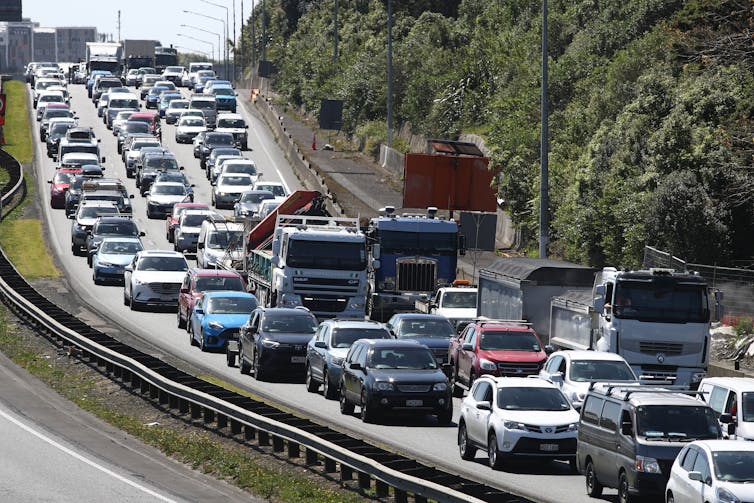
Urban sprawl, traffic crawls: public transport becomes difficult and private car use increases. Getty Images
Increasing carbon emissions
Sprawl also makes public transport inefficient or entirely impossible. In a dense urban environment, a single train or bus stop can service hundreds or thousands of potential riders. Again, the cost per rider is much lower than in sprawling, remote suburbs.
The same can be said about active transport modes. The cul-de-sac development style that characterises many modern suburbs can make it challenging to walk or cycle anywhere.
Embracing greenfield development means we are making a conscious decision that future generations must rely on cars as a primary mode of transport.
Cars are a major source of carbon emissions in cities. In Auckland, vehicle emissions account for up to 35% of emissions. Pushing more housing out to the edges of the city means households will need more cars to drive longer distances more frequently.
Sprawl means locking ourselves into increased carbon emissions when the Zero Carbon Act has committed New Zealand to reduce emissions by 30% below 2005 levels by 2030, and make the country carbon neutral by 2050.
New Zealand’s largest city has committed to reduce transport emissions by 64% by 2030, primarily by shifting to public and active transport modes. None of this is possible if it continues to grow outward rather than upward.
The medium density standards aren’t perfect. They’re probably not even very useful as a tool to grow the housing supply. But they are better than encouraging continued outward urban expansion.
The missing middle: townhouses and apartments are the future of urban housing development. Getty Images
Urban growth boundaries
What is missing from the MRDS, and especially from sprawling greenfield development, is true medium-density housing. Outside New Zealand, this “missing middle” in the urban equation is characterised by townhouses, row houses, and three- to five-storey apartment buildings.
This type of development is critical to providing a more plentiful and affordable housing supply in places with good existing infrastructure serviced by public transport and active mode connections.
Worldwide, cities are rapidly working towards creating more density and housing supply within existing urban areas. For decades, cities like Melbourne, Portland, Vancouver, Copenhagen and even Beijing have applied urban growth boundaries to help preserve undeveloped lands.
In the US, where sprawl has long dominated urban growth, cities have worked to increase density and housing supply by removing zoning requirements for single-family housing.
All in all, the MRDS could go much further. But throwing the baby out with the bathwater isn’t the answer. Greenfield development is more costly for everyone, while burdening future generations with car dependence and excess infrastructure.
Timothy Welch does not work for, consult, own shares in or receive funding from any company or organisation that would benefit from this article, and has disclosed no relevant affiliations beyond their academic appointment.
Source: The Conversation (Au and NZ) – By Justin Matthews, Senior Lecturer in Digital Media and Popular Culture Researcher, Auckland University of Technology
A hologram of Buddy Holly projected on stage at Madrid’s Teatro La Estación in 2021.Getty Images
Fans can mourn the passing of music legends for years, the hits echoing long after the original voice is silenced. Little wonder, then, that recent advances in holographic technology and artificial intelligence have found a ready market for performances from beyond the grave.
But this ability to resurrect deceased artists in spectral form raises fascinating questions about the ethics, artistry and the economic implications of these modern revival shows.
Since a holographic Tupac Shakur headlined at Coachella in 2012, there have been similar tributes to Frank Zappa and Roy Orbison. Posthumous tours have also been staged or proposed for Whitney Houston, Amy Winehouse and Ronnie James Dio.
But it’s the holographic performance by a still-living act that stands as the landmark case. ABBA, the Swedish pop sensation that ruled the charts during the 1970s and 1980s, launched their ABBA Voyage virtual reunion tour in 2021, describing the holographic versions of themselves as “ABBAtars”.
Our recent study of the “tour” found a mixture of fan reactions, from some who found it emotionally satisfying to others who questioned its authenticity. The results suggest we need to know more about the enormous cultural implications of these holographic experiences.
Virtual success
While the music industry routinely uses the term “hologram” to describe such shows, it’s not strictly accurate. A true hologram is a 3D object produced by the intersection of light and matter, designed to be observed from all perspectives.
With the exception of ABBA’s recently developed holographic concert, today’s holograms are more akin to digital videos, where images are projected onto a translucent screen in front of real musicians, with the virtual artist seeming to interact with the band and audience. It’s similar to the theatrical optical illusion known as “Pepper’s Ghost” used by 19th-century magicians.
Creating a convincing audience experience is a challenge, however, as fans can be cynical about such events, and the technology doesn’t translate well to YouTube or in photographs. Some find these shows feel too much like watching a movie.
Still, the demand and enthusiasm for virtual concerts is rising steadily, with impressive crowd turnouts and fans paying as much as US$125 for a ticket. The Roy Orbison hologram tour sold an average of 1,800 seats per show.
Our ABBA Voyage study confirmed the reasons for this popularity. After analysing upwards of 34,000 online comments discussing the virtual concert, we found audience members reported positive responses overall.
People mainly appreciated the opportunity to witness the legendary band “perform” once more. Two comments are indicative of the general feeling:
I don’t care if they’re avatars. Nobody expected ABBA to ever reunite in any way, shape, or form, so this is amazing!
It would be so wonderful to see them as I remember them and transport myself back to my childhood. It’s like the closest thing to time travel.
Fans also appreciated the technical wizardry responsible for recreating the band in its 1979 prime:
I find the fact they use the Abbatars instead of themselves on stage simply an amazing idea. It keeps us feeling young and them timeless.
Not everyone was emotionally moved, though, with some questioning the authenticity of the shows. This echoed previous criticism of holographic shows as lacking the essential “live” element of performance, and also being exploitative – what one critic called “ghost slavery”.
Technology has evolved since a ‘hologram’ of rapper Tupac Shakur ‘performed’ at Coachella in 2012. Getty Images
Replacing the irreplaceable
Recreating an artist is one thing, but capturing their spirit, charisma and spontaneous performance style is where motion capture and AI technologies are starting to make a real difference.
The process involves a detailed scan of the artist to create a 3D digital model which AI then refines. Next, movements are digitised through motion capture and transferred onto the model (again using AI), recreating an artist’s distinctive performance. AI is also used to analyse vast recording archives to mimic the artist’s voice.
For all that, AI’s ability to capture the spontaneity and charisma of live performances remains limited. The future of holographic concerts, then, will likely depend on continued technological progress, shifting audience reactions, and careful navigation of the ethical issues raised.
Future applications could also extend beyond music to educational displays of historical figures. Given the success of ABBA and their Voyage experience, it might even expand the touring capacity of living artists.
All this requires a delicate equilibrium: honouring the artist’s legacy, acknowledging fans’ emotions, and providing an experience that genuinely transcends present limitations. Replacing the irreplaceable may be possible at some level, but ultimately the audience will decide.
The authors do not work for, consult, own shares in or receive funding from any company or organisation that would benefit from this article, and have disclosed no relevant affiliations beyond their academic appointment.
Source: The Conversation (Au and NZ) – By Vasso Apostolopoulos, Professor of Immunology and Pro Vice-Chancellor, Research Partnerships, Victoria University
Cases of influenza (the flu) and COVID are set to rise over winter, with many Australians looking to protect themselves from both of these respiratory viruses.
For most adults, if it has been six months since you had COVID or your last vaccination, you’re likely eligible to book in your next dose.
Meanwhile, the flu vaccine is recommended for everyone over the age of six months.
But can you get both at once? Yes, you can get your flu vaccine and COVID booster safely at the same time, saving you a trip to the GP, nurse or pharmacy.
When COVID vaccines were first rolled out, a gap was recommended between COVID and flu vaccines. This is because we didn’t have adequate data of the individual and long-term effects of the new COVID vaccines.
After examining the latest available evidence on safety and efficacy, the World Health Organization updated its interim guidelines. It suggests getting an influenza vaccine and any dose of any approved COVID vaccine at the same time is a practical option.
However, until more data becomes available, the WHO advises using different arms for vaccination. This is to prevent the ingredients of the vaccines mixing and to limit the initial immune response to a different group of lymph nodes.
Getting multiple vaccinations at once isn’t new. Childhood vaccinations are routinely and safely administered at the same time.
For COVID and flu vaccines, randomised controlled trials show no significant difference in the immune responses of the people who had both vaccines at once compared to those who had them on different days.
Participants who had both vaccines at once reported the same types of side effects from the body’s inflammatory response to vaccination (injection-site pain, redness, swelling at the injection site) as well as general symptoms associated with both COVID and flu vaccines, such as fever, muscle pain and a headache.
These minor side-effects were of similar intensity and duration to those who had either vaccine administered alone.
Side effects are similar when you have the vaccines individually or at once. Annie Sprat/Unsplash
Getting both COVID and flu vaccines is also more cost-effective, the uptake is higher when people don’t have to make multiple trips, and it saves health practitioners’ time.
What about the viruses? Can you get COVID and the flu at the same time?
Although simultaneous infections with two different viruses are common, SARS-CoV-2 has been infecting humans for a relatively short time. We therefore have limited data on how influenza strains and SARS-CoV-2 interact with the host at the same time, and if there is any interaction between the viruses.
However, one large study in England reported that people positive for influenza had lower odds of also testing positive for SARS-CoV-2. This was attributed to possible cross-reactive immunity between viruses.
It did, however, find people infected with both viruses at the same time had worse outcomes and were twice as likely to die as those who were only infected with SARS-CoV-2.
Some experimental evidence suggested prior infection with type A influenza virus promotes SARS-CoV-2 entry and infectiousness. This could be due to a unique feature of the influenza A virus which allows COVID to take hold more easily.
Where can I get vaccinated and how much will it cost?
Influenza and COVID vaccines are available at GP clinics and pharmacies.
Australians aged five years and over are eligible for a free COVID vaccination. The flu vaccine is free for people at higher risk of complications, including:
pregnant women
people six months and older with selected chronic conditions
Aboriginal and Torres Strait Islander people.
For the rest of the population, the flu vaccine costs around A$20-30. Some practitioners also charge a consultation fee.
The authors do not work for, consult, own shares in or receive funding from any company or organisation that would benefit from this article, and have disclosed no relevant affiliations beyond their academic appointment.
The recently released findings of the senate inquiry into reproductive health care sets the stage for potential transformative change.
Its recommendations are aimed at dismantling the barriers that have long hindered the sexual, maternal, and reproductive health care of women, non-binary, trans, and gender-diverse people, including people with disability.
Its recommendations are strong, welcome and important. For too long, people with disability have been stripped of their autonomy, self-determination and dignity when it comes to accessing sexual and reproductive health care.
But the latest recommendations are not enough to dismantle entrenched biases and stereotypes. Here’s what needs to happen next.
The report outlined two key recommendations focused on people with disability, including:
improved training for health practitioners on the ways to engage and communicate with people with disability
developing accessible, inclusive and empowering sexual and reproductive health education programs and resources for people with disability, and their family and carers.
These recommendations came after the senate inquiry received a number of submissions that highlighted the struggle women with disability face in engaging with sexual and reproductive health care.
The most obvious and well-known barriers are inaccessible health care settings and services, lack of relevant and complete information about options available to them, and inadequately educated and trained health workers. The recommendations only partially deal with these barriers.
However, the covert, ableist barriers women with disability face are much more pervasive and harmful.
Women with disability are often stereotyped as being incapable of controlling their sexual impulses, or being non-sexual and child-like with no desire or capacity for intimate relationships. Other stereotypes include lacking capacity to care for their children, manage menstruation or control their sexuality and fertility.
These disabilist views have endured, largely unchallenged and with pervasive influence. As a result, sexual and reproductive education for people with disability and health professionals tends to adopt a narrow perspective. It disregards the diverse identities and concerns of the disabled community, driven instead by cis-heteronormative, ableist, and Eurocentric values.
Current practice often centres on disease and pregnancy prevention, with an emphasis on paternalistic safeguarding of “vulnerable” women.
The impact of these stereotypes means people with disability of diverse genders continue to experience menstrual suppression using pharmaceuticals, forced contraception, sterilisation, and forced abortion, particularly those in guardianship arrangements.
Women with disability are also disproportionately affected by sexual violence and abuse. A total of 90% of women with intellectual disability have endured sexual abuse at some time in their lives. Women with disability are nearly twice as likely as non-disabled women to experience sexual violence.
When it comes to expectant and new mothers with disability, appropriate and accessible health care is also hard to find. Many receive no tailored pre- and post-natal care and people with disability and are often prevented from receiving a full complement of care that non-disabled women receive.
The question remains whether the senate inquiry’s recommendations will be enough to tackle the deeply ingrained stigma and discrimination women with disability face when it comes to accessing sexual health care, unbiased fertility and reproductive information, affordable contraception, and support for sexual choices.
It’s unlikely the barriers created by inherent ableism will be easily dismantled through education alone. So, what else is needed?
Sexual and reproductive rights are inherent entitlements of every being, regardless of gender or disability. However, the right to parenthood is particularly precarious for people with disability in Australia.
Article 23 of the UN Convention on the Rights of Persons with Disabilities unequivocally upholds the right to a family, including the right to marry and have children.
Those who do have children, face additional pressures. About 15% of Australian children have at least one parent who has a disability but three out of every five of these children face the possibility of being removed from their parents.
People with disability want their right as a decision-maker over their own health, life and bodily integrity to be validated.
So we need to move beyond educating people with disability, their families and health professionals. We need a courageous examination of systemic deeply rooted stereotypes and biases in how sexual and reproductive health care is understood and delivered. And health systems need to be accountable.
We can do this partly with human rights legislation that specifically affirms and acknowledges the rights of people with disability and their health care. Establishing a legal mechanism for rights would, at a minimum, provide disabled Australians with some protection.
Little change will occur in Australia until we align with the global shift to support people with disability to make their own decisions about their health care. Australia is starting to do this, but we still lag behind many other countries.
Accessibility – physical, sensory, cognitive – remains a major challenge to sexual and reproductive health care. Without it, we limit access to essential services. Education alone will not shift these barriers.
The success of the senate inquiry’s recommendations will also hinge on the provision of accessible and inclusive health information in various formats, such as Braille, large print Easy English, audio, with sign language interpretation.
Accessible communication and personally relevant, transparent, and complete information are critical for people with disability to feel their rights are protected, their treatment is dignified and they are supported to make informed choices and decisions.
Close collaboration between the government and the disability sector is needed if we are to successfully implement the senate inquiry’s recommendations. This means active involvement of disabled people’s organisations, advocates, and people with disability. Sufficient funding for genuine co-design and authentic engagement will also be essential.
People with disability need to share their experiences and knowledge if we are to design better health care. Disabled And Here, CC BY-SA
4. Change attitudes
To effectively implement these recommendations and make any meaningful and lasting change, we must also invest heavily in influencing public perceptions.
That includes challenging the ableist view that sexuality is “taboo” for people with disability, and eliminating stigma, misconceptions and misunderstandings about parenting by people with disability.
This article was co-authored by Karin Swift. Karin is an Adjunct Citizen Scientist at Griffith University, President of Women with Disabilities Australia and a private consultant on disability, human rights, gender advocacy and social policy. She was Senior Engagement and Policy Consultant at Queenslanders with Disability Network.
The authors do not work for, consult, own shares in or receive funding from any company or organisation that would benefit from this article, and have disclosed no relevant affiliations beyond their academic appointment.
Have you ever wondered why your dog is eating your beautifully cropped lawn or nibbling at the grass at the dog park?
Eating grass is a common behaviour in pet dogs. Some surveys show up to 80% of guardians notice their dog regularly snacking on the grass.
Grass eating isn’t a new behaviour either, or only done by our new designer dog breeds. Studies in Yellowstone National Park show plant matter (mostly grass) is found in up to 74% of wolf scats, suggesting the behaviour is possibly inherited from the beginning of doggy time.
The answer to why your dog eats grass may simply be: because they like to. Shutterstock
A lot of people think dogs eat grass when they have a sore stomach, believing grass causes dogs to vomit. This is probably not the case; a study with 12 dogs that ate grass daily found there were few vomiting episodes and the ones that did occur came after the dog had eaten a meal.
And if a dog has a mild gastrointestinal disturbance because of something they’ve been fed, they are in fact less likely to eat grass than if they are fed a normal diet.
Other theories include that dogs eat grass because they want a laxative or that it provides roughage in their diet (get that fibre!).
Like the vomiting discussed above, there is little to no scientific proof for most of these theories. For example, in the study of 12 dogs mentioned above, all of them were wormed and had no previous digestive problems. Yet all 12 still happily ate grass (709 times).
Their main finding was that when the dog had not yet had their daily meal, they were more likely to eat grass. In short, the hungrier the dog, the more likely they were to eat some grass.
The answer to why your dog eats grass may simply be: because they like to. Your dog may be bored, and chewing on grass is something to do.
Maybe your dog just enjoys eating grass. Ripping grass from the ground can be satisfying. The texture and taste of grass offers something different to what they usually eat. You may even notice they prefer grass in certain seasons; perhaps fresh spring grass a favourite delicacy.
You may even notice your dog prefers grass in certain seasons. Shutterstock
Is there any reason why you shouldn’t let your dog eat grass?
Well, yes, there are several. Firstly, you may not want your dog eating your neighbour’s immaculately presented fancy Kikuyu lawn.
More importantly, though, grass is sometimes treated with herbicides. Grass at the local oval or parkland may have been treated or sprayed. Some local councils use a non-hazardous dye to show where grass has been sprayed with herbicide, which is very helpful.
Lawn chemicals are frequently detected in lawn for up to 48 hours after they’re applied, and have also been detected in the urine of dogs with access to grass treated this way.
Research has suggested there may be a link between bladder cancer in dogs and exposure to herbicides.
In fact, dogs may even act as sentinels; the same chemical exposures appear in the urine of dogs and people sharing the same environment.
There are some circumstances in which it’s better for your dog not to eat the grass. Shutterstock
If you are using herbicides on your own grass, remove your dog, their toys, food and water bowls from the area prior to any application.
Make sure the pesticide has completely dried out before you allow the dog back in the area, and be certain to check the packaging for the appropriate drying time period.
This is particularly the case for granular pesticides or fertilisers that soak into the soil, as these can require up to 24 hours or longer.
If you want to reduce the risk even further, hand weeding may be a better option.
Apart from grass, many leaves, flowers and berries from common plants can be toxic to your dog. This includes plants such as oleander and arum lily; even oregano and bay leaves can cause vomiting and diarrhoea in dogs.
One of the best things you can do for your dog is take them for a walk. And if they eat some grass along the way, provided it has not been sprayed with herbicide, you have nothing to worry about.
Don’t worry if they occasionally vomit. If there is more serious vomiting or diarrhoea, however, please consult your vet.
Susan Hazel is affiliated with the Dog & Cat Management Board of South Australia and the RSPCA South Australia.
Joshua Zoanetti ne travaille pas, ne conseille pas, ne possède pas de parts, ne reçoit pas de fonds d’une organisation qui pourrait tirer profit de cet article, et n’a déclaré aucune autre affiliation que son organisme de recherche.
Sailor Moon has been with us for over 30 years, but the cartoon series is popular enough that brands are still producing themed merchandise – everything from high end, crystal-encrusted Jimmy Choos to Black Milk leggings and speciality stationary.
As we approach the release of the final instalment of the Sailor Moon Crystal reboot, I can’t help but wonder: why are we still obsessed with fighting evil by moonlight and winning love by daylight?
Pretty Guardian Sailor Moon
Sailor Moon was not not the first “magical girl” series in anime. “Magical girl” is a genre of anime, usually a TV or comic book series with a female lead with special powers and a cute wardrobe, aimed at girls. Yet there was something about Sailor Moon that caught the public’s imagination, and changed anime in Japan – and later the rest of the world – for good.
Written by Naoko Takeuchi as a continuation of her series Code Name: V, Bishōjo Senshi Sērā Mūn (Pretty Guardian Sailor Moon) ran from 1991-97. An animated series followed in 1992 and an English-language dub was released in 1995 by DIC.
The series follows Usagi Tsukino (Serena, in the 1995 dub) and her school friends as they battle against the forces of evil, fall in love and try to get their homework in on time. Sailor Moon revolutionised magical girl series by mixing girls’ story lines with elements from the Super Sentai series, which audiences might remember as being adapted into Mighty Morphin’ Power Rangers.
Sailor Moon takes stories about friendship and love and mixes them with a monster of the day format and colour-coded superheroes.
Girls comics
Sailor Moon was published as a shōjo manga or “girls comic” – but it’s important to remember this is a marketing term to indicate an intended readership. These days we can think of these terms as an indicator of genre or style.
Both shōjo (girls) and shōnen (boys) manga can include fast-paced, action-packed narratives, love stories, science fiction, high fantasy and suspense. Manga for girls and young women are more likely to be linked to fashion and will often include full body images of characters to illustrate the latest styles. Takeuchi famously referenced collections by Dior, Mugler and Christian Lacroix and has recently illustrated the 2023 Chanel Collection.
For western and Anglophone viewers in the late 1990s, Sailor Moon provided a role model alongside Buffy the Vampire Slayer and Xena: Warrior Princess for girls and young women, showing that being a princess didn’t preclude kicking arse.
For the 20th anniversary of the series, Sailor Moon and her friends were redrawn into something a little softer for the Sailor Moon Crystal re-release, which began in 2014. Three anime series and two films later, it is this version of Sailor Moon that perhaps resonates best with a younger generation of anime viewers.
Anniversary fancy goods
Girls magazines have a long tradition of including “fancy goods” as gifts with their magazines. These might be as simple as pre-cut cardboard toys that can be torn out and folded, or designer collaborations on bags, pencil cases and other accessories.
The Jimmy Choo Sailor Moon collaboration. Jimmy Choo
Causing more of a stir was a collaboration with lingerie company Peach John, which saw sailor collar padded bras and matching panties released as part of Sailor Moon’s 20th anniversary. At that time, 20 was the legal age of adulthood in Japan (this has recently been lowered to 18).
It seemed an odd statement to make about coming of age – especially as this occasion also marked the re-release of the Sailor Moon anime as Sailor Moon Crystal, meaning that, rather than an adult women, Usagi and her friends were once again 14-year-olds.
There is something delightful about the Jimmy Choo collaboration being paired with Sailor Moon’s 30th anniversary. The characters are now at the age of shoe appreciation – as is her global audience of fans, similar to Sex and the City protagonists.
Sex and the City was very popular in Japan and it may have launched something of a sexual revolution, allowing late 1990s viewers to start having frank conversations about sex and desire.
For many though, the most surprising collaboration was a line of condoms released to help raise awareness of Japan’s syphilis and STI epidemic. While some questioned Sailor Moon’s suitability as a mascot for STI awareness, in many ways this is just another monster of the day to be vanquished.
The STI awareness ad from Japan featuring Sailor Moon. Wikimedia
This arc is some of the queerest in the series. It introduces the Sailor Starlights who transform from male idols to female Sailor Scouts.
Given the on going resistance to LGBTQI+ equality in countries such as Japan, the US and Australia, it will be interesting to see how Sailor Moon Cosmos will be received.
Will she remain a bastion of 1990s Girl Power? Or will she and the Sailor Stars once again act as champions of truth and justice, righting wrongs and triumphing over evil in the name of the moon?
Emerald L King does not work for, consult, own shares in or receive funding from any company or organisation that would benefit from this article, and has disclosed no relevant affiliations beyond their academic appointment.
By coincidence, the furore around the consultancy firm PwC is raging just as the National Anti-Corruption Commission is gearing up for its start of business on July 1.
The PwC scandal, involving the use of confidential government information for financial gain, would seem an ideal probe for the NACC to cut its teeth on.
Despite this, Anthony Albanese sounded less than enthusiastic when asked by Greens leader Adam Bandt in question time this week whether he would make a referral. The police were already looking at the matter, the PM said, “so it’s gone well beyond the step that the member suggests”.
Regardless of whether the government (or anyone else) refers the matter, a decision on whether to look at PwC’s behaviour will be totally up to the NACC, which is headed by Paul Brereton (formerly of the Afghanistan war crimes inquiry). It’s an independent body and can undertake inquiries on its own initiative.
Meanwhile the Senate estimates hearings – which delve deeply into government processes – have already done a pretty good job laying bare the outrageous behaviour by the consultancy firm, although there are a lot more names to be made public.
At its heart, the PwC affair is simple, a stark example of improper behaviour by a firm taken into the government’s confidence. PwC was consulted by the Abbott government on its planned tax avoidance legislation and was privy to confidential information. It then used the knowledge obtained in discussions with Treasury to tell clients how to avoid the crackdown.
While what happened is simple, the questions arising from this egregious breach of confidentiality and ethics – which Treasury has referred to the Australian Federal Police – are less so. The affair has far-reaching and complex implications, obviously for PwC – the Australian arm of which is now on its knees – but also for government (including the public service) and how it relates to outside consultants.
In her open “mea culpa” letter this week, Kristin Stubbins, the acting chief executive of PwC Australia, listed three ways the company had “failed”. PwC had breached confidentiality, had poor governance, and had a culture at the time of “aggressive marketing” in its tax business that allowed inappropriate behaviour.
Obviously there is always the potential for conflict of interest for firms that, on one hand, consult with government and, on the other, advise clients who are dealing with the actions of government. The question some ask is: can this dual role be tenable in one firm?
On another front, what’s happened has underscored how dependent the federal government has become on outside consultants, particularly the “big four” consultancy firms.
PwC is like a giant octopus reaching into officialdom. As canvassed in the Senate hearings this week, it is an external auditor for the Treasury, and it also undertakes work for the Reserve Bank. It deals with a large slice of defence procurement.
Under the Morrison government, ministers such as Stuart Robert were always urging the use of outside consultancies, rather than the bureaucracy, to give advice or undertake reviews. And in ministerial appointments to various agencies and the like, people who’d worked in these firms were often favoured candidates.
Notably, the Coalition has not shown great interest in pursuing the PwC affair. In contrast, Labor senator Deb O’Neill has been a bulldog in chasing material, and Greens senator Barbara Pocock has carried the issue for her party.
In opposition, Labor strongly condemned the Coalition government’s extensive contracting-out of work that public servants would once have done. In office, Labor is now cutting back on outsourcing and beefing up the bureaucracy.
Even so, the recourse to outside expertise can’t be avoided entirely. Some issues (including relating to taxation) require tapping into non-government specialists. So stronger belts and braces will still be needed.
The government already has some initiatives under way to strengthen protections. Treasury is working on what more might be needed.
Treasurer Jim Chalmers is particularly angered by the breach of faith, not least because of the importance he puts on consultations in developing policy. Such an approach is undermined by any risk of those consulted misusing their access.
While PwC is a totally black-and-white case, there can be shades of grey in the issue of access to confidential information and government thinking, which can give recipients an inside run, even when financial advantage isn’t involved.
To an extent, the fallout from the PwC affair will itself provide a degree of protection for the future. Whatever the outcome of the police inquiry, the huge reputational and financial damage to the firm will be a powerful deterrent to such behaviour by others.
PwC itself will have difficulty getting much fresh government work for the time being. Finance Department Secretary Jenny Wilkinson reminded the public service last week that ethical considerations must be taken into account in awarding contracts.
On Wednesday Reserve Bank Governor Philip Lowe told an estimates hearing the bank was not ditching present contracts with PwC, but would not enter into new contracts with it until it had made a “satisfactory response”, which included “complete transparency and accountability for those involved”.
So how far should the government go in punishing PwC? Once the present crisis has passed should there be a moratorium for a specified period on the use of the firm?
Simon Longstaff, director of The Ethics Centre, suggests a temporary moratorium on government contracts while the firm gets its house in order. This time in purgatory would be followed by a period in which the firm would have to demonstrate (according to an independent assessment) that its culture underpins a genuine commitment to the public interest as a condition of obtaining contracts. This special requirement would fall away once the basis for trust had been re-established.
Barbara Pocock wants the book and more thrown at PwC. She has urged a ban on any new government contracts being awarded to the firm until it has re-established trust – “which is likely to be quite some time” – plus the termination of any existing contracts where there is a conflict of interest.
Pocock also says the NACC should investigate the extent of involvement of PwC operatives and the roles and slow action of staff at the Australian Taxation Office, the Treasury and the Taxation Practitioners Board. This should be in addition to the police investigation.
Whether or not the NACC takes up the PwC case, what’s happened there reinforces the argument for the anti-corruption body.
Michelle Grattan does not work for, consult, own shares in or receive funding from any company or organisation that would benefit from this article, and has disclosed no relevant affiliations beyond their academic appointment.
Today, Federal Court Justice Anthony Besanko handed down his long-awaited judgment in the defamation case that Ben Roberts-Smith, Australia’s most decorated living former SAS soldier, brought against the Age, the Sydney Morning Herald and the Canberra Times.
The civil trial ended in July 2022 after an astonishing 110 days of evidence and legal submissions. The case was also interrupted by COVID lockdowns.
Besanko determined the newspapers did establish the “substantial truth” of some of the allegations, though not of others. He concluded that in light of these findings, “each proceeding must be dismissed”.
In his judgment, the judge said he was satisfied the most serious imputations were proven on the balance of probabilities, which is the test in such civil cases.
This included allegations Roberts-Smith, in an area known as Darwan in 2012, kicked a handcuffed prisoner over a cliff and ordered other soldiers to shoot him.
Justice Besanko also found the papers established substantial truth in the allegations that in 2009 in the village of Kakarak, Roberts-Smith carried a man with a prosthetic leg to a place outside the Whiskey 108 compound and shot him dead.
Further claims were made that Roberts-Smith had forced a young recruit to execute an unarmed elderly man as a form of “blooding”, which Besanko also found to be substantially true.
All of these allegations were particularly galling to a man who had been awarded the Medal of Gallantry for his actions in Afghanistan in 2006, the Victoria Cross for his bravery in Tizak in 2010, and a Commendation for Distinguished Services for his outstanding leadership in more than 50 high-risk operations in 2012.
Substantial and contextual truth
The legal battle began after a series of articles were published in the Sydney Morning Herald, the Canberra Times and the Age in 2018, alleging that Roberts-Smith, a patrol commander with the Special Air Service Regiment, was a war criminal.
The allegations were based upon witnesses’ accounts of events that took place in Afghanistan between 2006 and 2012.
The newspapers also alleged he had bullied, harassed and intimidated soldiers under his command, and that he committed an act of domestic violence in 2018.
Besanko also found allegations of bullying by Roberts-Smith to be substantially true, but did not find that the newspapers had established the substantial truth of the domestic violence allegations.
The allegations of domestic violence and threats were held to warrant the defence of “contextual truth”. That is, given the newspapers had proved the most serious allegations were substantially true, they could rely on the defence of “contextual truth”. This meant Besanko was satisifed the domestic violence allegations would not further harm Roberts-Smith’s reputation, even though the claims weren’t proven to be substantially true.
The “contextual” truth changes came in a push to have uniformity in defamation laws back in 2005.
According to Australian common law, a statement is defamatory if it exposes a person to hatred, contempt or ridicule, or would tend to make right-minded observers shun or avoid that person. Saying a decorated soldier is a war criminal invariably drew the papers deep into potentially defamatory territory.
The papers had to establish a defence, and their defence was that all of what they had reported was true.
Under the law, they needed only to show the “substantial” truth of what they had alleged. A defendant is thus given some leeway; they do not have to prove every last item is completely true.
Because the papers were able to establish the substantial truth of key aspects of the reporting, Roberts-Smith’s case failed.
In one case, the lawyers argued this was because the claims were framed in jealousy and based upon an “obsession” with their leader, and in another case that witnesses were “fabulists” and “fantasists”.
However, the imputations supported by the oral evidence of nearly all the witnesses were held to be reliable by Besanko.
What happens next?
It will now be up to the judge, in a further hearing, to determine how much the newspapers will be able to claim back from Roberts-Smith for their reasonable legal costs.
The newspapers requested three weeks to consider how much to seek for costs and third-party costs.
There’s little doubt that both sides have each spent millions on their respective legal teams. The issue of costs may prove just as interesting for observers as the defamation case itself.
Roberts-Smith’s barrister has already raised the possibility that he will appeal.
Rick Sarre is an office bearer with the SA Labor Party.
Ricardo Villegas does not work for, consult, own shares in or receive funding from any company or organisation that would benefit from this article, and has disclosed no relevant affiliations beyond their academic appointment.
At the heart of the spectacular defamation trial brought by decorated Australian soldier Ben Roberts-Smith were two key questions.
Had the Age, the Sydney Morning Herald and the Canberra Times damaged his reputation when they published in 2018 a series of explosive stories accusing him of murder and other crimes while in Afghanistan?
And could the newspapers successfully defend their reporting as true?
Today, in Sydney, Federal Court Justice Anthony Besanko found the newspapers were indeed able to establish the “substantial truth” of key allegations around killing of unarmed Afghan male prisoners.
An appeal may still be on the cards, but this is a high-profile loss for a very prominent person. The costs will be substantial. The usual rule is that the losing party pays their own costs and those of the winning party.
So, even though people say defamation law in Australia has a reputation for favouring plaintiffs, this case shows even plaintiffs do sometimes lose defamation cases in Australia.
More broadly, this case shows how hard it is to use defamation law to repair any perceived damage to your reputation. Once a case begins, you never can control what will be said in court.
The case centred on several defamatory meanings (or, as they’re known in defamation law, “imputations”) that Roberts-Smith said the papers had made against him.
Among these were that he’d killed unarmed Afghan male prisoners and ordered junior soldiers to execute others in Afghanistan between 2006 and 2012.
Roberts-Smith denied wrongdoing, but the newspapers had pleaded a defence of truth. That means to win this case, they needed to prove the meanings conveyed by their reporting – even if those meanings were unintended – were true.
Besanko, reading a summary judgment today, said the newspapers were able to establish the substantial truth of some of the most serious imputations in the case.
For other imputations, Besanko found the newspapers were able to establish “contextual truth”.
Substantial truth means what is sounds like – that the allegation published was, in substance, true. Defamation law does not require strict, complete or absolute accuracy. Minor or inconsequential errors of detail are irrelevant. What matters is: has the publisher established what they published was, in substance, true?
Contextual truth is a fallback defence. The court has to weigh what has been found to be true against what has been found to be unproven. If the true statements about the plaintiff were worse than the unproven statements, then the plaintiff’s reputation was not overall damaged by the unproven statements, and the publisher has a complete defence.
In other words, Besanko found most of the imputations to be true. And, when considered against those which were not proven to be true, the remaining unproven imputations did not damage Roberts-Smith’s reputation.
What does this case tell us about defamation in Australia?
The court heard several explosive claims during the course of this trial, including that evidence on USB sticks had been put into a lunchbox and buried in a backyard and that Roberts-Smith had allegedly punched a woman in their hotel room.
Roberts-Smith said he didn’t bury the USBs or withhold information from a war crimes inquiry and denied that he had punched the woman.
But the fact this widely scrutinised case yielded such astonishing testimony, day in and day out, shows how risky it is to use defamation law to restore perceived injury to one’s reputation.
Defamation law is seeking to correct people’s views about the plaintiff. But it’s open to doubt that defamation law is actually any good at securing its own stated purpose of changing people’s minds about the plaintiff.
The problem is the law is a very blunt instrument. It’s very hard to get people to change their minds about what they think of you.
All litigation involves risk and defamation trials are even riskier. You never can control what can come out in court, as this litigation demonstrates so clearly.
Roberts-Smith has sued to protect his reputation, but in doing so, a range of adverse things have been said in court. And whatever is said in court is covered by the defence of absolute privilege; you can’t sue for defamation for anything said in court that is reported accurately and fairly.
The 2021 defamation law reforms
The law that applies in the Roberts-Smith case is the defamation law we had before major reforms introduced in July 2021 across most of Australia.
These reforms introduced a new defence known as the public interest defence. To use this defence, a publisher has to demonstrate that they reasonably believed the matter covered in their published material is in the public interest.
As this defence didn’t exist prior to 2021, the publishers in the Roberts-Smith case used the defence of truth.
If a case like this were litigated today following these reforms, it is highly likely the publisher would use the new public interest defence.
Given the Murdoch versus Crikey case was settled, we may yet wait some time to see what’s required to satisfy the public interest test in a defamation case.
But as today’s decision demonstrates, sometimes the truth alone will prevail.
Australians’ access to a range of contraceptive options depends on where they live and how wealthy they are. A recent parliamentary inquiry recommends ways to end this “postcode lottery” for people who want to use long-acting reversible contraception.
There are several types of long-acting reversible contraception: the hormonal contraceptive implant, the hormonal intrauterine devices (IUD) and copper IUDs.
With fewer than one in 100 users becoming pregnant in a year while using them (compared to up to seven in 100 contraceptive pill users) these are the most effective contraceptives available. Once they’re inserted into the body, you don’t need to remember to carry a condom, take a daily pill or fill a new script.
So why are they so hard to access in Australia? And what needs to change?
The contraceptive implant (known as Implanon NXT in Australia) is a small flexible rod, inserted just under the skin of the upper inner arm. It releases a progestogen hormone which prevents monthly egg release from the ovary for up to three years.
IUDs are small T-shaped devices which are inserted into the uterus. Hormonal IUDs contain a progestogen hormone and mainly work by thickening the cervical mucus and preventing sperm from swimming up into the uterus. There are two types of hormonal IUDs: Mirena and Kyleena. Both last up to five years. Kyleena is slightly smaller and contains a lower dose of hormone than Mirena.
Copper IUDs are hormone-free and last up to ten years. They work through their toxic effect on sperm and the egg to prevent fertilisation.
They have additional benefits for some users
As well as better protection from pregnancy, some long-acting reversible contraception methods have other benefits.
Hormonal pills (containing estrogen) and the vaginal ring can’t be used by people with certain conditions, such as migraine with aura, or by people aged 35 years or older who smoke. This isn’t the case for long-acting reversible contraception methods, which most people can safely use.
Copper IUDs are an essential option for people who cannot or prefer not to use hormones. This includes people with hormone-driven cancers such as breast cancer, for whom any hormonal contraceptive would be considered unsafe.
Why aren’t they more available?
Access to long-acting reversible contraception is not universal in Australia.
Cost can be a considerable barrier to uptake for some people. While the implant and hormonal IUDs are subsidised by the Pharmaceutical Benefits Schedule (PBS), this is not the case for copper IUDs, which can cost up to A$120 for the device.
Out-of-pocket IUD insertion-related costs can also vary from zero to hundreds of dollars if people don’t have access to publicly funded services.
On the supply side, too few health professionals provide these essential services.
Inadequate remuneration for insertion procedures act as a deterrent. An IUD takes 30 minutes of inserter and assistant time, and the equipment costs around A$25 per insertion. Yet the Medicare rebate is just A$72.05. Costs may be higher in rural areas, due to higher set-up costs and reduced access to things like sterilising services for procedural equipment.
Insertion and removal of long-acting reversible contraception also requires practical training. This can be costly for GPs and nurses, especially for IUD training, which also means taking around three days off work to achieve the necessary number of supervised IUD insertions. This can be even longer and more costly for rural practitioners, with additional travel time and accommodation costs.
This lack of trained inserters contributes to inequities for people who have chosen a long-acting reversible contraception but can’t find a local practitioner to insert their IUD or implant.
Nurses and midwives could ably fill this gap. There are multiple successful models of nurse-led long-acting reversible contraception services and postpartum insertion of implants by midwifes nationally and internationally.
However, most nurses aren’t able to access Medicare remuneration, which creates additional barriers for this highly skilled workforce to provide these services.
What are the recommendations for reform?
The Senate inquiry has recognised these barriers and recommends making contraception universally affordable, and specifically, subsidising copper IUDs.
It also recommends adequate remuneration through Medicare for GPs, nurses and midwives to provide long-acting reversible contraception insertion and removal, and collaborative efforts between the government and medical colleges to improve access to workforce training.
While the recommendations are welcome, they now need to be turned into actions through adequate funding.
The government also needs to fund every Primary Health Network (which plan services) across Australia to identify local gaps and ensure the contraceptive needs of the communities they serve are met equitably, affordably and transparently.
While one size does not fit all, and people must be provided with sufficient and accessible information to make an informed choice, no one who wants an IUD or implant should be denied this choice based on where they live and how much they can pay.
Deborah Bateson has received honoraria for attending advisory committees and providing education to health professionals sponsored by Organon and Bayer, and has received untied research support from Organon.
Kathleen McNamee’s employer, Sexual Health Victoria, receives funding from Organon, Mayne Pharma, and Bayer Australia and New Zealand to train and support doctors and nurses in the provision of contraception. She has not received any personal remuneration for these activities.
The Coalition’s decision to oppose the Voice to Parliament has put its moderate members in a jam. Some moderates are active yes advocates, while others are trying to keep low profiles.
Bridget Archer, the outspoken Liberal MP for Bass, is a vocal yes campaigner. More generally, she is also taking a lead in urging the Liberal party to undertake root-and-branch reform.
Archer is pushing for extensive change in a party that is electorally on the ropes, out of office everywhere except her home state of Tasmania.
Since entering parliament in 2019, Archer has crossed the floor on 27 occasion to vote against her party. She admits there are those colleagues who avoid her, but says her decisions are always based on what is in the best interest of her community, and argues the strength of the Liberal Party historically has been for members to be able to sometimes disagree and to do so respectfully.
Her independent stance on a range of issues has brought varied feedback from her local community. “It’s mixed, but generally positive. If I get negative feedback, it is sometimes from Liberal Party members or conservative voters that say ‘I think that you should toe the line’ – there’s this idea that if you have a divergent view, that you’re not a team player.”
But Archer believes “it is possible to be part of a team and to have differences of opinion (sometimes), and that it’s my job to represent to the best of my ability everybody in the electorate, even the people who don’t or didn’t vote for you, I guess.”
In a recent Good Weekend profile Archer called for a “revolution” in the Liberal Party, claiming it is currently “unelectable”. She tells the podcast: “I think this was again borne out in the 2022 election with the rise of community independents […] where people, particularly in some of those metropolitan seats, are not feeling that the party is representing their views anymore […] In regional areas that is not necessarily the case. And we’ve seen with the Coalition, of course, the Nationals holding the seats that they had.
“The great challenge for us is to get back to what I think was the strength of the Liberal Party at one stage, which is the ability to speak across the country, to talk to middle Australia.
“And I think that we’ve lost our way in that.”
Archer also argues Liberal Party values need to shift with the times, particularly its ideology on “the family and home ownership”.
“We have historically talked a lot about home ownership, but we don’t focus so much on rental affordability. […] It’s front of mind for many people in those metropolitan areas and for younger people as well, who have also deserted us in droves.”
The moderates in the party were decimated at the 2022 election. It has left the moderate faction in tatters, and Archer often finds herself isolated when she speaks out against the party line.
“I think it’s a bit frustrating for me sometimes that I feel that I know that there are other people who share my views on some things, but they don’t speak up, which I think sometimes does leave me sort of hanging there as this rogue person when I know that that’s not necessarily the case.”
“I also think it really goes to the heart of some of the reasons why those colleagues did lose their seats at the last election and why we have seen a rise of the teals. In those seats, in many cases people were wanting to vote for Liberals, and they were looking around [to] have a reason to vote for Liberals and they were coming up empty handed.”
Asked if she thought the party was “walking off a cliff,” she doesn’t jeritate.
“Oh, absolutely. Yeah, absolutely.”
Michelle Grattan does not work for, consult, own shares in or receive funding from any company or organization that would benefit from this article, and has disclosed no relevant affiliations beyond their academic appointment.
Source: The Conversation (Au and NZ) – By Matthew Klugman, Research Fellow, Institute for Health & Sport, member of the Community, Identity and Displacement Research Network, and Co-convenor of the Olympic Research Network, Victoria University
Aboriginal and Torres Strait Islander readers are advised this article contains mention of the Stolen Generations.
On April 18, a Ngarra Jarra Noun Healing Ceremony was held to mark the 30th anniversary of the most famous response to racism in the Australian Football League – the moment Noongar man Nicky Winmar lifted his top, pointed to his skin and declared that he was Black and proud. The Indigenous-led ceremony was a deeply moving instance of community care, love and solidarity.
Tuesday’s announcement by the AFL of the termination of the investigation into allegations of racism at Hawthorn was the antithesis of such healing.
After eight months of an inquiry there are “no adverse findings” against former coaches Alastair Clarkson and Chris Fagan, and ex-welfare manager Jason Burt. (Clarkson, Fagan and Burt have all strenuously denied any wrongdoing.)
The outcome is at once shocking and not surprising of a league that still refuses to make any attempts to redress the systemic racism that remains a foundational aspect of Australian Rules football.
The Age reports that the complainants at the centre of the allegations are preparing to take their cases to the Australian Human Rights Commission. The AFL has also hinted it may charge Hawthorn with bringing the game into disrepute over its handling of the internal report.
It’s hard not to be cynical about the release of this news after the conclusion of the Sir Doug Nicholls “Indigenous round”, and Sorry Day. Only after the celebration of Aboriginal and Torres Straight Islander players and culture, and the commemoration of Indigenous children stolen from their families, did the AFL announce it was ending its investigation.
Indeed, the claims at the centre of the investigation resonate disturbingly with the histories of stealing Indigenous children and associated genocidal actions in the lands of this continent and the surrounding islands.
Namely, the allegations that Hawthorn officials actively sought to separate Indigenous players from their partners, pressured them to break up and in at least one instance allegedly pushed a couple to terminate a pregnancy for the sake of the player’s career, according to reporting by the ABC.
If the allegations are true, it could be argued the Hawthorn officials who were involved thought they were acting in the “best interests” of the players.
However, the theft of children, including Doug Nicholls’ sister, was frequently justified in such terms. As was the tearing apart of Indigenous families and placing them in reserves for their own “protection”.
To break Indigenous couples up, to remove Indigenous players from their cultural support and to then place these players in houses with only white people – all of these would be heinous acts if true, and can be understood as a form of cultural genocide. That is, acts of “assimilation” that destroy the relationships, connections and practices which allow people to continue to be part of a broader cultural group.
How could the AFL not wish to find out the truth of the matter when the allegations concern such egregious conduct?
The AFL claims it shut down the investigation in accordance with the wishes of the players willing to participate in the inquiry. But after eight months, these players had not even been interviewed.
Outgoing AFL chief executive Gillon McLachlan also claimed that the defendants had been “cleared” and the complainants “feel heard”. Yet, their voices were starkly missing from the AFL’s announcement.
(Not) listening to Indigenous voices
On March 17, the AFL announced it supported the “Yes” vote for the forthcoming referendum on the Indigenous Voice to Parliament, stating:
The AFL is privileged to have a long history of Aboriginal and Torres Strait Islander leadership in our game, from the grassroots in every state and territory, through to the AFL and AFLW competitions.
Yet, in electing to set up its own investigation into the allegations of racism at Hawthorn, the AFL was clearly going against the voices of key Indigenous women at the centre of these allegations. They had called for an inquiry that was fully independent of the AFL.
And in declaring Clarkson, Fagan and Burt to have been cleared – without even having interviewed the players participating in the inquiry – the AFL is ignoring the voices of players and partners who have spoken out publicly, as recently as this past weekend.
The erasure of Indigenous women’s voices and experiences is also emblematic of life on this continent. Indigenous women in Australia are eight times more likely to be murdered than non-Indigenous women, yet the violence they experience receives far less attention.
Truth-telling
McLachlan’s tenure as CEO of the AFL has been marked by a stream of scandals regarding racism, yet he has never opened up the whole league to full independent scrutiny regarding past and present racism.
What’s clearly needed is for the AFL to engage in a full process of truth-telling. The AFL Players Association is the most recent group to note that the AFL’s investigation into Hawthorn was “not truly independent”.
Colonial institutions cannot be relied upon to provide justice when investigating themselves. The lack of even one conviction related to the more than 500 Indigenous deaths in custody since the Royal Commission published its findings and recommendations is testament to that.
Instead, a form of truth-telling overseen by an independent Indigenous-run organisation is paramount. The Yoorook Justice Commission – set up to examine the “impacts of colonisation on First Peoples in Victoria” – is an excellent model of what such a process could look like.
Incoming AFL chief executive Andrew Dillon has proclaimed he is not part of a (white) boys club. A test of this claim lies in whether he is willing to take the necessary steps to help turn the AFL from being a place of systemic injustice to an organisation that creates the conditions for systemic justice and healing.
Matthew Klugman has received funding from the Australian Research Council, and currently receives funding from VicHealth.
Tracey Cooper does not work for, consult, own shares in or receive funding from any company or organization that would benefit from this article, and has disclosed no relevant affiliations beyond their academic appointment.
The human costs of tobacco and smoking worldwide are huge. 1.3 billion people use tobacco, mostly in low- and middle-income countries. More than 8 million people die prematurely because of tobacco, at an annual economic loss of at least US$1.4 trillion. And you don’t have to be a smoker to be harmed: secondhand smoke exposure kills nearly 400,000 women every year.
Asia is home to seven of the world’s top 10 countries with the highest number of smokers: Bangladesh, China, India, Indonesia, Japan, the Philippines, and Viet Nam. Yet, according to our recent research for the United Nations Development Programme, not enough being done to reduce tobacco’s harms.
That’s why it’s worth pointing out a solution that really works, yet not enough Asian nations have acted on it: raising tobacco prices through higher taxes.
As the Philippines, Australia and Aotearoa New Zealand have shown, doing that – coupled with other policy changes – can make a real difference.
The pay-off for higher taxes
Increasing tobacco taxes costs relatively little, but yields a high impact.
In our study of six Asia-Pacific countries, we found that for every unit of local currency invested in increasing tobacco taxes, the countries would gain between 20 and 1,057 units in return over 15 years. That’s a remarkable return on investment ratio of between 20:1 and 1,057:1.
One direct benefit is a substantial increase in government revenue. In Cambodia alone, the projected additional government revenue would be US$230 million over five years from the recommended levels of tobacco tax increases.
And it would be pro-poor, pro-development, and pro-women.
Who would benefit most?
Smoking is responsible for nearly half of the difference in death rates between wealthy and poor people, meaning measures that reduce smoking disproportionately benefit poor people.
People with low incomes – both men and women – are more likely to use tobacco than their wealthier counterparts. In Myanmar, for example, 41% of men and 4% of women in the lowest income group smoke, compared with 25% of men and 0.4% of women in the highest group.
It is true that tax increases initially make the low earners who don’t cut back worse off, but over time the health gains to low earners become more important.
Although the reductions in smoking-related deaths from higher taxes are concentrated in men, the financial benefits appear to flow to women.
As smokers quit, household budgets become easier, facilitating what a study in the British Medical Journal describes as an income transfer from male smokers to females and other family members.
Lower smoking rates also protect female non-smokers from exposure to second-hand smoke at home and work.
How the Philippines became an Asia-Pacific leader
In the Philippines, half of the excise tax collected from tobacco products and sugar-sweetened beverages, and 80% of the excise tax collected from alcohol and vaping products is used to fund healthcare services.
The remaining 20% of alcohol and vaping excise revenue is allocated to social development, while 5% of tobacco excise tax revenue is earmarked to support tobacco farmers, including to help them switch crops.
Among its many reforms, the Philippines also instituted a whole-of-public sector code of conduct to prevent tobacco industry interference in its public policymaking.
Between 2012 and 2015, substantial tax increases in the Philippines cut cigarette sales by 28% and cut the number smokers by 3 million, with the largest reductions among the poorest parts of the population.
Yet despite the Philippines’ example and the clear benefits of significant tobacco tax increases, tobacco tax rates in most low income countries remain low. On average, tax accounts for only 19% of the retail price of cigarettes in low-income countries, compared to 51% in high-income countries.
Higher taxes, fewer smokers in Australia & NZ
Among other Asia-Pacific nations, Australia’s rate of tobacco excise has climbed from 19 cents per cigarette in 1999 to A$1.16, and will climb again by 5% per year for each of the next three years in addition to normal indexation.
Over that time the proportion of Australians aged 14 and over who smoke daily has plummeted from 22% to 11%. The Australian government says it wants to get it below 10% by 2025 and to 5% by 2030.
Aotearoa New Zealand has gone even further with its “Smokefree 2025” policy, with a goal that by 2025, fewer than 5% of New Zealanders will be smokers. This strategy includes banning the sale of tobacco products to anyone born after Jan 1, 2009.
The NZ government increased the tobacco excise tax by inflation plus 10% each year between 2010 and 2020. Decades of efforts in tobacco control, including tobacco taxation, have resulted in smoking rates declining from 36% in 1976 to 13% in 2020.
Even smokers back higher tax – if it goes to health
Higher taxes on cigarettes are overwhelmingly supported by non-smokers.
60% of smokers in a US survey backed higher tax if it’s used for healthcare. Shutterstock
But a US study has found that when the extra tax revenue is directed to healthcare programs, they are also overwhelmingly supported by smokers: 60% of those surveyed, up from 25% if the extra revenue is unallocated.
The tax gap between rich and poorer countries might be partly due to myths such as that increasing tobacco taxes
disproportionately hurts poor people,
leads to massive job losses, and
substantially diminishes government revenue.
Our policy brief debunks these myths with evidence.
Economic stress is brewing in many Asia-Pacific countries, with many under unprecedented pressure from stagnating revenue and growing needs for spending on health, education and social protection.
The United Nations’ Human Development Index has declined for two consecutive years for the first time since data became available.
These extraordinary circumstances offer an extraordinary opportunity to act decisively. Taxation on tobacco and other harmful products should be one of them.
* This article was co-authored with Kazuyuki Uji, Policy Specialist, Health and Inclusive Development, United Nations Development Programme Bangkok Regional Hub.
This article was co-authored with Kazuyuki Uji, Policy Specialist, Health and Inclusive Development, United Nations Development Programme (UNDP) Bangkok Regional Hub. He has a long experience working on non-communicable diseases, including tobacco control, universal health coverage, access to health technologies, and disability rights. Sudyumna Dahal and Kazuyuki Uji both work for the UNDP.
Virtual Australian Museum of Palaeontology, Author provided
Palaeontology is the study of evolution and prehistoric life, usually preserved as fossils in rocks. It combines aspects of geology with biology and many other scientific disciplines.
But a lot of palaeontology really is about rocks. For 200 years, hammers and chisels have been some of its most commonly used tools.
However, advances in modern scanning technology are revolutionising the way we do palaeontology. Precise scans of the internal and external features of fossils let us see them in new ways.
And these digitised scans can readily be made available to the public online. At the new Virtual Australian Museum of Palaeontology, we offer free access to 600 million years of digital Australian fossils, from enigmatic early lifeforms to gigantic extinct marsupials.
How do palaeontologists learn about the past?
There are many different types of fossils. For example, a dinosaur leg bone can become a fossil, but so can a leaf from a tree, the footprint of an extinct kangaroo, poo from a shark, or even geochemical traces preserved in ancient soils.
The field of palaeontology was formally solidified into scientific enquiry by people such as Georges Cuvier (1769-1832). Cuvier was a French naturalist and zoologist sometimes referred to as the “founding father of palaeontology”. Others such as the Scottish geologist Charles Lyell (1797-1875) gave us the geological framework through which fossils could be classified and compared.
Palaeontologist Aaron Camens digging up fossils. Aaron Camens, Author provided
Palaeontology has come a long way in the past 200 years.
Records of long-extinct animals also survive in the rock art and oral traditions of First Nations peoples. These are increasingly being recognised as an important complement to traditional Eurocentric approaches.
Different kinds of scanning technology are playing an increasing role in palaeontology. Computed tomography, or CT scanning, uses x-rays to create three-dimensional models of the internal and external features of dense objects.
A photo of a fossil fish (far left), an x-ray image (middle left), a ‘tomogram’ or slice through the scan data (middle right), and a 3D virtual model (far right). Alice Clement, Author provided
Other imaging methods include photogrammetry, or surface scanning using lasers or projected patterns of light. These methods capture the external three-dimensional shape of an object or site, sometimes with colour and textural detail. They also have the advantage of being more portable and can often be taken directly to the fossil.
Palaeontologist Jacob van Zoelen using a surface scanner on a fossil marsupial skull. Alice Clement, Author provided
The most powerful scanning methods are the synchrotron and neutron imaging. A synchrotron works on the same principles as CT scanning, using radiation to look inside an object, but uses much stronger radiation. Neutron imaging uses neutrons instead of x-rays or other radiation, and it can be useful for particularly dense or large objects.
These advances in scanning technology are opening up whole new avenues for exploring, sharing and analysing Australia’s unique fossils. Now what to do with all our digital palaeontology data?
Palaeontologist Alice Clement in the field with a new fossil discovery. Alice Clement, Author provided
We are a group of researchers at Flinders University, working with the South Australian Museum, the Western Australian Museum, and the Museum and Art Gallery of the Northern Territory. Between us, we have spent many hours scanning, processing and uploading hundreds of three-dimensional virtual models.
Australia is geologically old with a rich fossil heritage. We are fortunate to have captured high-quality examples spanning nearly 600 million years of evolution on our continent.
We have scans of some of the earliest complex life from Ediacaran and Cambrian sites from over 500 million years ago. We have exquisite examples from the best ancient fish deposit in the world, and many amazing extinct megafauna not known from anywhere else.
Examples include the marsupial lion Thylacoleo, the giant wombat-like Diprotodon, and huge short-faced kangaroos such as Sthenurus.
Many giant creatures that once roamed Australia are now known only from fossils. Peter Trusler
In the pilot phase of this project we have digitised more than 500 fossils across more than 30 genera. Some highlights include:
one of the world’s most complete marsupial lion skeletons (almost every bone from the skull to the toe bones)
one of the only known bones of a pterosaur (flying reptile) from South Australia
scans of one of the oldest known sharks in the world
fossil mammal footprints that are now known only from our digital data, as the original trackways have been destroyed.
Six digital models of scanned fossil specimens from the museum. Virtual Australian Museum of Palaeontology, Author provided
You can explore the VAMP website yourself. All you need to dig into a world of 3D fossil scans is a computer or a smartphone.
Alice Clement receives funding from the Australian Research Council and is employed by Flinders University.
Aaron Camens works for Flinders University.
Jacob van Zoelen is employed by Flinders University.
Doomsaying is an old occupation. Artificial intelligence (AI) is a complex subject. It’s easy to fear what you don’t understand. These three truths go some way towards explaining the oversimplification and dramatisation plaguing discussions about AI.
Yesterday outlets around the world were plastered with news of yet another open letter claiming AI poses an existential threat to humankind. This letter, published through the nonprofit Center for AI Safety, has been signed by industry figureheads including Geoffrey Hinton and the chief executives of Google DeepMind, Open AI and Anthropic.
However, I’d argue a healthy dose of scepticism is warranted when considering the AI doomsayer narrative. Upon close inspection, we see there are commercial incentives to manufacture fear in the AI space.
And as a researcher of artificial general intelligence (AGI), it seems to me the framing of AI as an existential threat has more in common with 17th-century philosophy than computer science.
Was ChatGPT a ‘breaththrough’?
When ChatGPT was released late last year, people were delighted, entertained and horrified.
But ChatGPT isn’t a research breakthrough as much as it is a product. The technology it’s based on is several years old. An early version of its underlying model, GPT-3, was released in 2020 with many of the same capabilities. It just wasn’t easily accessible online for everyone to play with.
Back in 2020 and 2021, I and many others wrote papers discussing the capabilities and shortcomings of GPT-3 and similar models – and the world carried on as always. Forward to today, and ChatGPT has had an incredible impact on society. What changed?
In March, Microsoft researchers published a paper claiming GPT-4 showed “sparks of artificial general intelligence”. AGI is the subject of a variety of competing definitions, but for the sake of simplicity can be understood as AI with human-level intelligence.
Some immediately interpreted the Microsoft research as saying GPT-4 is an AGI. By the definitions of AGI I’m familiar with, this is certainly not true. Nonetheless, it added to the hype and furore, and it was hard not to get caught up in the panic. Scientists are no more immune to group think than anyone else.
The same day that paper was submitted, The Future of Life Institute published an open letter calling for a six-month pause on training AI models more powerful than GPT-4, to allow everyone to take stock and plan ahead. Some of the AI luminaries who signed it expressed concern that AGI poses an existential threat to humans, and that ChatGPT is too close to AGI for comfort.
Soon after, prominent AI safety researcher Eliezer Yudkowsky – who has been commenting on the dangers of superintelligent AI since well before 2020 – took things a step further. He claimed we were on a path to building a “superhumanly smart AI”, in which case “the obvious thing that would happen” is “literally everyone on Earth will die”. He even suggested countries need to be willing to risk nuclear war to enforce compliance with AI regulation across borders.
I don’t consider AI an imminent existential threat
One aspect of AI safety research is to address potential dangers AGI might present. It’s a difficult topic to study because there is little agreement on what intelligence is and how it functions, let alone what a superintelligence might entail. As such, researchers must rely as much on speculation and philosophical argument as evidence and mathematical proof.
There are two reasons I’m not concerned by ChatGPT and its byproducts.
First, it isn’t even close to the sort of artificial superintelligence that might conceivably pose a threat to humankind. The models underpinning it are slow learners that require immense volumes of data to construct anything akin to the versatile concepts humans can concoct from only a few examples. In this sense, it’s not “intelligent”.
Second, many of the more catastrophic AGI scenarios depend on premises I find implausible. For instance, there seems to be a prevailing (but unspoken) assumption that sufficient intelligence amounts to limitless real-world power. If this was true, more scientists would be billionaires.
Cognition, as we understand it in humans, takes place as part of a physical environment (which includes our bodies) – and this environment imposes limitations. The concept of AI as a “software mind” unconstrained by hardware has more in common with 17th-century dualism (the idea that the mind and body are separable) than with contemporary theories of the mind existing as part of the physical world.
Why the sudden concern?
Still, doomsaying is old hat, and the events of the last few years probably haven’t helped. But there may be more to this story than meets the eye.
Among the prominent figures calling for AI regulation, many work for or have ties to incumbent AI companies. This technology is useful, and there is money and power at stake – so fearmongering presents an opportunity.
Almost everything involved in building ChatGPT has been published in research anyone can access. OpenAI’s competitors can (and have) replicated the process, and it won’t be long before free and open-source alternatives flood the market.
This point was made clearly in a memo purportedly leaked from Google entitled “We have no moat, and neither does OpenAI”. A moat is jargon for a way to secure your business against competitors.
Yann LeCun, who leads AI research at Meta, says these models should be open since they will become public infrastructure. He and many others are unconvinced by the AGI doom narrative.
Notably, Meta wasn’t invited when US President Joe Biden recently met with the leadership of Google DeepMind and OpenAI. That’s despite the fact that Meta is almost certainly a leader in AI research; it produced PyTorch, the machine-learning framework OpenAI used to make GPT-3.
At the White House meetings, OpenAI chief executive Sam Altman suggested the US government should issue licences to those who are trusted to responsibly train AI models. Licences, as Stability AI chief executive Emad Mostaque puts it, “are a kinda moat”.
Companies such as Google, OpenAI and Microsoft have everything to lose by allowing small, independent competitors to flourish. Bringing in licensing and regulation would help cement their position as market leaders, and hamstring competition before it can emerge.
While regulation is appropriate in some circumstances, regulations that are rushed through will favour incumbents and suffocate small, free and open-source competition.
Michael Timothy Bennett does not work for, consult, own shares in or receive funding from any company or organisation that would benefit from this article, and has disclosed no relevant affiliations beyond their academic appointment.
But Police Ten 7 – TVNZ’s longest-running reality series – was already controversial for its depiction of criminal behaviour as popular entertainment, and for an alleged over-representation of Māori and Pacific offenders or suspects.
In 2021, Auckland Councillor Efeso Collins was threatened after tweeting that the show should be scrapped because it “feeds on racial stereotypes”. TVNZ subsequently commissioned an independent review of the show and renamed it Ten 7 Aotearoa, but eventually decided to end its run.
The controversy inspired us to analyse Police Ten 7 more closely and measure its treatment of Māori, Pasifika and European suspects – as well as police officers. Our soon-to-be-published findings support claims the show was not evenhanded in its depiction of these groups.
Framing the ‘bad guys’
We focused on the calendar year previous to Collins’ criticism of Police Ten 7, and critically analysed 12 episodes that aired between September and December 2020. Among other data, we recorded the range of alleged offences and the airtime spent on each suspect.
Because people tend to recognise faces more readily when they belong to the same racial group (so-called “cross-race bias”), one of the two Māori members on the research team recorded the racial identity of suspects and officers.
He identified “brown people” based on information provided directly in the show (“our offender tonight is of Polynesian descent”) or by making a holistic assessment of people’s looks, names, culturally significant tattoos, accents and so on.
We then compared our data with 2020 police data on types of crime and ethnicity (including ethnicity of officers). Our findings confirm US research on reality TV police shows, which has found a tendency to portray non-white people as the “bad guys”.
While TVNZ’s independent review found Police Ten 7 was “reflective of the reality of patterns of crime and offending in Aotearoa”, our analysis found otherwise.
Suspect airtime
Of all actual New Zealand police suspects in 2020, 53% were Polynesian. However, Māori and Pasifika made up 71% of suspects featured in the episodes of Police Ten 7 we sampled.
In comparison, Europeans made up 36% of actual police proceedings, and 29% of suspects on the show. (The remaining 11% in police statistics covers other ethnicities.)
We also looked at the airtime Police Ten 7 gave different suspects, compared to how often police dealt with them according to the data. Of the total airtime spent on suspects, 62% was spent on Māori or Pasifika, compared to 53% of total police proceedings in 2020.
In comparison, the portion of airtime spent on European suspects (38%) more closely reflected how often police proceeded against Europeans in 2020 (36%).
Types of crime
Police Ten 7 also portrayed Māori and Pasifika as more violent than police statistics show. Over the 12 episodes sampled, 100% of those suspected of violent crime (homicide, sexual assault, endangering persons, property damage) were Polynesian. This compares to 40% in police statistics.
By contrast, police statistics show Māori and Pasifika made up 43% of traffic offence suspects, compared to only 6% on Police Ten 7.
Police data show Europeans made up 34% of suspects for violent crime. Yet Police Ten 7 tended to disproportionately portray Europeans as lower-level offenders or suspects.
According to police statistics, Europeans made up 26% of traffic offence suspects compared to 41% on the show. Europeans constituted 35% of public order offenders, compared to 67% on Police Ten 7.
We argue that over-representing Europeans in less serious offence categories suggests to TV audiences that any harm Europeans cause is somewhat unintended or easily explained.
Finally, we found the same disparities applied to the police officers featured in the sampled episodes. While Māori and Pasifika officers constitute nearly 20% of the NZ police force, they made up only 6% of the officers on Police Ten 7.
Others and ourselves
Most people have little first-hand experience of crime and rely on media for information. Consequently, news and entertainment programmes help shape views of the criminal justice system and those involved in it.
Based on our sampled episodes, a case can be made that Police Ten 7 did reinforce racial stereotypes of Māori and Pasifika as more criminal and violent. We argue this stereotyping was exacerbated by the under-representation of violent European suspects.
We also suggest the under-represention of Māori and Pasifika police officers would not have helped police recruitment efforts, given the police themselves later acknowledged the need to remove barriers to wahine Māori in particular.
After all, the media shape not only how we see others, but also how we see ourselves. Any future New Zealand reality TV crime or police show would need to be mindful of these pitfalls and effects.
The authors acknowledge the assistance of postgraduate student Wairua Busby-Pukeiti in gathering the data for this article.
The authors do not work for, consult, own shares in or receive funding from any company or organisation that would benefit from this article, and have disclosed no relevant affiliations beyond their academic appointment.
The human brain is made up of around 86 billion neurons, linked by trillions of connections. For decades, scientists have believed that we need to map this intricate connectivity in detail to understand how the structured patterns of activity defining our thoughts, feelings and behaviour emerge.
Our new study, published in Nature, challenges this view. We have discovered that patterns of activity in our neurons are more influenced by the shape of the brain – its grooves, contours, and folds – than by its complex interconnections.
The conventional view is that specific thoughts or sensations elicit activity in specific parts of the brain. However, our study reveals structured patterns of activity across nearly the entire brain, relating to thoughts and sensations in much the same way that a musical note arises from vibrations occurring along the entire length of a violin string, not just an isolated segment.
Function follows form
We uncovered this close relationship between shape and function by examining the natural patterns of excitation that can be supported by the anatomy of the brain. In these patterns, called “eigenmodes”, different parts of the brain are all excited at the same frequency.
Consider the musical notes played by a violin string. The notes arise from preferred vibrational patterns of the string that occur at specific, resonant frequencies. These preferred patterns are the eigenmodes of the string. They are determined by the string’s physical properties, such as its length, density, and tension.
In a similar way, the brain has its own preferred patterns of excitation, which are determined by its anatomical and physical properties. We set out to identify which specific anatomical properties of the brain most strongly affect these patterns.
This perspective views the brain as a collection of discrete regions, each specialised for a specific function, such as vision or speech. These regions communicate via interconnecting fibres called axons.
Conventional models divide the brain into a web of discrete nodes. Our analysis suggests large-scale brain activity is instead dominated by waves of excitation. James Pang, Author provided
An alternative view, embodied by an approach to modelling brain activity called neural field theory, eschews this division of the brain into discrete areas.
This view focuses on how waves of cellular excitation move continuously through brain tissue, like the ripples formed by raindrops falling into a pond. Just as the shape of the pond constrains the possible patterns formed by the ripples, wavelike patterns of activity are influenced by the three-dimensional shape of the brain.
Comparing the two views
To compare the two views of the brain, we tested how easily the conventional, discrete view and the continuous, wave-based view can explain more than 10,000 different maps of brain activity. The activity maps were obtained from thousands of functional magnetic resonance imaging (fMRI) experiments as people performed a wide array of cognitive, emotional, sensory, and motor tasks.
We attempted to describe each activity map using eigenmodes based on the brain’s connectivity and eigenmodes based on the brain’s shape. We found that eigenmodes of brain shape – not connectivity – offer the most accurate account of these different activation patterns.
Brain waves and icebergs
We used computer simulations to confirm that the close link between brain
shape and function is driven by wavelike activity propagating throughout the brain.
The simulations relied on a simple wave model that is widely used to study other physical phenomena, such as earthquakes and ocean currents. The model only uses the shape of the brain to constrain how the waves evolve through time and space.
Simulations of waves in the brain resemble real activity. James Pang, Author provided
Despite its simplicity, this model explained brain activity better than a more sophisticated, state-of-the-art model that tries to capture key physiological details of neuronal activity and the intricate pattern of connectivity between different brain regions.
We also found that most of the 10,000 different brain maps that we studied were associated with activity patterns spanning nearly the entire brain. This result again challenges conventional wisdom that activity during tasks occurs in discrete, isolated regions of the brain. In fact, it indicates that traditional approaches to brain mapping may only reveal the tip of the iceberg when it comes to understanding how the brain works.
Together, our findings suggest that current models of brain function need to be updated. Rather than focusing solely on how signals pass between discrete regions, we should also investigate how waves of excitation travel through the brain.
In other words, ripples in a pond may be a more appropriate analogy for large-scale brain function than a telecommunication network.
A new approach to brain mapping
Our approach draws on centuries of work in physics and engineering. In these fields, the function of a system is understood with respect to the constraints imposed by its structure, as embodied by the system’s eigenmodes.
This approach has not been traditionally used in neuroscience. Instead, typical brain mapping methods rely on complex statistics to quantify brain activity without any reference to the underlying physical and anatomical basis of those patterns.
The use of eigenmodes offers a way to use physical principles to understand how diverse patterns of activity arise from brain anatomy.
Our discovery also offers immediate practical benefits, since eigenmodes of brain shape are much simpler to quantify than those of brain connectivity.
This new approach opens possibilities for studying how brain shape affects function through evolution, development and ageing, and in brain disease.
Alex Fornito receives funding from the National Health and Medical Research Council of Australia, the Australian Research Council, and the Sylvia and Charles Viertel Charitable Foundation..
James Pang does not work for, consult, own shares in or receive funding from any company or organisation that would benefit from this article, and has disclosed no relevant affiliations beyond their academic appointment.
Benjamin Duterrau, The Conciliation 1840, oil on canvas. Purchased by the Friends of TMAG and the Board of Trustees, 1945. Collection: Tasmanian Museum and Art Gallery, AG79.
Note of warning: This article refers to deceased Aboriginal people, their words, names and images. Words attributed to them and images in the article are already in the public domain. Also, historical language is used in this article that may cause offence.
As we head toward the referendum on the Aboriginal and Torres Strait Islander Voice to Parliament later this year, it is worth considering the long history of how governments have tried and failed to authentically listen to First Nations people.
And not just post-federation governments. During Australia’s colonial period in the 19th century, the office of the Protector of Aborigines was established in an effort to hear to the “wants, wishes and grievances” of Aboriginal people, as the secretary for the colonies, Lord Glenelg, put it in 1838.
However, this office not only failed to genuinely listen to First Nations peoples, it led to policies that actually underpinned the erasure of Aboriginal and Torres Strait Islander people from the Australian Constitution of 1901.
Spotlight on the treatment of Indigenous people
During the 1830s, slave rebellions in Britain’s colonies and a growing humanitarian movement in the UK pushed the government to abolish slavery. The spotlight was then turned on the treatment of Indigenous peoples, both within and on the edges of the rapidly expanding British Empire.
In 1836, the British government established a Select Committee of the House of Commons on Aborigines to hear testimony from church leaders, missionaries and colonial officials about the situation of Aboriginal people in the Australian colonies.
The hearings focused particular attention on the conduct of militia forces in the so-called Black War in Tasmania, where roving parties of white men hunted down and killed Palawa people and massacres were seen as part and parcel of occupying Aboriginal lands.
In January 1838, Glenelg wrote to the governor of New South Wales, Sir George Gipps, that the British government
[had] directed their anxious attention to the adoption of some plan for the better protection and civilisation of the native tribes.
Photographic reproduction of a 1837 portrait of Charles Grant, the first Baron Glenelg. Wikimedia Commons
Glenelg told Gipps that as part of the scheme, the British government had decided to “appoint a small number of persons qualified to fill the office of Protector of Aborigines”. The chief protector, a non-Indigenous person, was to be aided by four assistant protectors and to “fix his principal station at Port Phillip” (later to become Melbourne), only recently occupied by the British.
According to Glenelg, George Augustus Robinson was bestowed with the office of chief protector as he had
shewn [sic] himself to be eminently qualified by his charge of the Aboriginal Establishment at Flinders Island.
Robinson’s so-called “Friendly Mission” – a series of journeys around Tasmania in the early 1830s to convince Palawa of Governor George Arthur’s humane intentions – was lauded by Gipps as a success, as it had peacefully convinced some people to move to a reserve at Flinders Island. Historians now consider this mission to be nothing more than ethnic cleansing.
For Glenelg, appointing Robinson to the new position of chief protector appeared to be the only plan available that did not involve military or police, or armed settlers dispensing their own “justice”.
Portrait of George Augustus Robinson, 1853, by Bernardino Giani. Wikimedia Commons
An aim to convey ‘wants, wishes or grievances’
The plan for establishing Aboriginal protectorates followed Robinson’s Friendly Mission model in Tasmania.
Protectors were to “watch over the rights and interests of the natives” and protect them from “acts of cruelty, of oppression or injustice”. The protector was also to be a kind of conduit to express the “wants, wishes or grievances” of Aboriginal peoples to the colonial governments. For this purpose, each protector was commissioned as a magistrate.
Protectors were encouraged to learn the “language of the natives” and “obtain accurate information” on the “number of the natives within his district”.
On paper at least, the “plan for the better protection and civilisation of the native tribes” seemed a remarkable step forward from previous years. Indeed, there was no plan prior to this that attempted to deal with the situation in Aboriginal lands beyond the official boundaries of the colonies – boundaries that were being increasingly crossed by hundreds of squatters and stockmen, and tens of thousands of cattle and sheep.
The establishment of the role of protectors, who would live among Aboriginal people and learn their languages, was arguably an early attempt at a conduit for an Aboriginal voice to government.
But the scheme did not stop the conflicts and massacres. Shortly after the commission’s report appeared in print in Australia, dozens of Gamilaraay people were killed at Waterloo Creek and Myall Creek in northern inland New South Wales in January and June 1838.
A tinted lithograph depicting the Waterloo Creek massacre by the New South Wales Military Mounted Police. Wikimedia Commons
The scheme also did little to stop the resistance warfare that broke out across the entire length of the frontier in the late 1830s and early 1840s – a counteroffensive that has been described by some contemporary observers as a “general uprising”.
The protectorates scheme was also bound up in the supposed superiority of the colonisers’ race and Christian religion. The ultimate goal was for Aboriginal people to become “civilised” and Christian – just like white people apparently were. It was a paternalistic concept that ultimately turned humanitarian ideals into an even more violent and coercive colonial system.
The protectors, as they had been directed to, could report to the government the “grievances” of Aboriginal people. These were often found to be, as one observer at the time wrote,
[an] explosion of long-pent feelings of revenge and hatred towards the whites, resulting from a long course of violence and injustice.
The attempt by the colonial authorities to understand the “wants, wishes and grievances” of Aboriginal people, however, failed in its mission to actually protect people. The system was abandoned in 1849.
From the 1860s, the various colonial governments developed even more coercive policies of “protection”, which controlled peoples’ lives and corralled them into missions and reserves, so their lands and children could be taken from them.
The Protector of Aborigines office was an important historical moment that embedded this idea of government control over First Nations’ people’s lives into the social and political fabric of this nation. These supposedly moral standards around “protection” and “civilisation” ultimately forced Indigenous people to become less Indigenous.
These beliefs continue to permeate our government today through failed paternalistic policies such as Closing the Gap. Such racialised policies draw on Australia’s history of containment of Aboriginal land and the ongoing colonial violence of “protection”.
Because of this, we have yet to generate new possibilities of truly meaningful dialogue.
The long struggle for rights and recognition by Aboriginal people has been punctuated by (all too few) moments of support by non-Aboriginal people. As the referendum for the Voice approaches, another such moment beckons. Will this be history repeating itself?
Stephen Gapps is an Historian with Artefact Heritage Services and a member of The Greens.
Lynda-June Coe is a current member of the Greens NSW.
Influenza, or the flu, is a virus transmitted by respiratory droplets from coughing and sneezing. It can cause the sudden onset of a fever, cough, runny nose, sore throat, headache, muscle and joint pain.
In Australia, the flu is responsible for more than 5,000 hospitalisation and 100 deaths a year. The highest rates are among those over 65, whose immune systems aren’t as effective as they used to be, and children under five, whose immune systems are yet to mature.
To combat the decline in immunity as we age, specific vaccines are available for people aged 65 and over. So how do they work, and why exactly are they needed?
The immune system uses multiple mechanisms to fight viral infections, which can be divided into two major arms of the immune system, called innate and adaptive immunity.
Innate immunity involves multiple inflammatory cells and chemicals that are triggered immediately, or within hours of encountering an infection. They activate the immune system to clear the infection.
Adaptive immunity takes a little longer (weeks) to work and involves memory T cells and antibody-producing B cells, which can be reactivated when the body encounters a virus or other pathogen.
The combined innate and adaptive immune response determines how well we respond to an invading virus like influenza.
Why are older people more at risk from the flu?
Generally, as we age past 65, the innate cells become less effective at their job of clearing infections. They also start producing more inflammation.
New T and B cell numbers also decrease with increasing age and hence the adaptive immune response is also not as effective as when we are younger. This immune system decline is called immunosenescence, which leads to increased susceptibility, hospitalisation and death from influenza.
Certain medical conditions, such as cancer and heart and lung conditions, increase susceptibility to severe influenza, with older people being more likely to have additional medical conditions than younger people.
What flu vaccines are available?
Annual flu vaccines are recommended to protect against the common circulating strains of influenza, which can differ from year to year.
The standard flu vaccines offered to adults aged under 65 consist of surface proteins of the virus or inactivated (killed) virus from four influenza strains: two A strains (H1N1 and H3N2) and two B strains.
When you’re vaccinated, your immune system makes antibodies from B cells which protect you if you become exposed to these strains of the virus.
However, the standard influenza vaccine is less effective in older people.
The standard flu vaccines aren’t as effective for older people. Katarzyna Grabowska
Two stronger or augmented vaccines have been made targeting this age group. They contain the same components as the standard vaccine, but one vaccine – called Fluad – uses a strong adjuvant (an agent used to increase the immune response to vaccination) called MF59 to stimulate better immunity.
The other augmented vaccine, called Fluzone, uses a four-fold higher dose of each influenza strain to increase immunity.
Studies comparing Fluad and Fluzone show both vaccines stimulate stronger immunity against influenza than the standard flu vaccine and are therefore likely to provide better protection.
Studies directly testing for improved clinical outcomes with vaccines for over-65s show a small benefit of receiving either of the vaccines over the standard vaccine, including a modest decrease in lab-confirmed influenza, hospitalisations and emergency department visits compared to the standard influenza vaccine.
They are however yet to show and impact on flu-related deaths.
Fluad and Fluzone provide better protection for older people against the flu than the regular vaccine. Raychan/Unsplash
While both have been Therapeutic Goods Administration (TGA) approved since 2020, only Fluad is available for free on the National Immunisation Program for people aged 65 and over.
Fluzone is only available with a private prescription if you’re 60 years and over, at a cost of around A$65-70.
If neither augmented vaccine is available, a standard influenza vaccine is also acceptable for older people, since any influenza vaccine is preferable to receiving none.
Flu vaccines can also be given at the same time as COVID vaccines.
How else can we protect against the flu?
While influenza vaccination is the single most effective way of preventing influenza, other measures such as social distancing and wearing a mask or N95 respirator can also provide some community protection.
Wearing a mask or N95 respirator significantly reduces the risk of infecting others when infected.
The evidence for protecting oneself against infection is less conclusive, mainly because it’s linked to early, consistent and, importantly, the correct use of masks.
Magdalena Plebanski receives Grant funding from National Health and Medical Research Council (NHMRC) to conduct fundamental immunology research on Flu and DTP vaccines in older adults. She conducts research on ovarian cancer, including a Phase II human trial part funded by Astrazeneca and ANZGOG (Australia and New Zealand Gynecological and Oncological Group).
Katie Louise Flanagan receives funding from NHMRC, MRFF, BMGF and Clifford Craig Foundation. She was previously on Vaccine Advisory Boards for Seqiris (2016-19) and Sanofi-Pasteur (2016-18). She is President of the Australasian Society for Infectious Diseases and a member of the Australian Technical Advisory Group on Immunisation. These are her own personal views.
Jennifer Boer et Kirsty Wilson ne travaillent pas, ne conseillent pas, ne possèdent pas de parts, ne reçoivent pas de fonds d’une organisation qui pourrait tirer profit de cet article, et n’ont déclaré aucune autre affiliation que leur poste universitaire.
Source: The Conversation (Au and NZ) – By Steven J Lade, Resilience researcher at Australian National University, Australian National University
Shutterstock
People once believed the planet could always accommodate us. That the resilience of the Earth system meant nature would always provide. But we now know this is not necessarily the case. As big as the world is, our impact is bigger.
In research released today, an international team of scientists from the Earth Commission, of which we were part, identified eight “safe” and “just” boundaries spanning five vital planetary systems: climate change, the biosphere, freshwater, nutrient use in fertilisers and air pollution. This is the first time an assessment of boundaries has quantified the harms to people from changes to the Earth system.
“Safe” means boundaries maintaining stability and resilience of our planetary systems on which we rely. “Just”, in this work, means boundaries which minimise significant harm to people. Together, they’re a health barometer for the planet.
Assessing our planet’s health is a big task. It took the expertise of 51 world-leading researchers from natural and social sciences. Our methods included modelling, literature reviews and expert judgement. We assessed factors such as tipping point risks, declines in Earth system functions, historical variability and effects on people.
Alarmingly, we found humanity has exceeded the safe and just limits for four of five systems. Aerosol pollution is the sole exception. Urgent action, based on the best available science, is now needed.
This illustration shows how we’ve breached almost all the eight safe and just Earth system boundaries globally. Author provided
So, what did we find?
Our work builds on the influential concepts of planetary boundaries by finding ways to quantify what just systems look like alongside safety.
Importantly, the safe and just boundaries are defined at local to global spatial scales appropriate for assessing and managing planetary systems – as small as one square kilometre in the case of biodiversity. This is crucial because many natural functions act at local scales.
But even now, with warming at 1.2℃, many people around the world are being hit hard by climate-linked disasters, such as the recent extreme heat in China, fires in Canada, severe floods in Pakistan and droughts in the United States and the Horn of Africa.
At 1.5℃, hundreds of millions of people could be exposed to average annual temperatures over 29℃, which is outside the human climate niche and can be fatal. That means a just boundary for climate is nearer to 1°C. This makes the need to halt further carbon emissions even more urgent.
2. Biosphere boundaries: Expand intact ecosystems to cover 50-60% of the earth
A healthy biosphere ensures a safe and just planet by storing carbon, maintaining global water cycles and soil quality, protecting pollinators and many other ecosystem services. To safeguard these services, we need 50 to 60% of the world’s land to have largely intact natural ecosystems.
Recent research puts the current figure at between 45% and 50%, which includes vast areas of land with relatively low populations, including parts of Australia and the Amazon rainforest. These areas are already under pressure from climate change and other human activity.
Locally, we need about 20-25% of each square kilometre of farms, towns, cities or other human-dominated landscapes to contain largely intact natural ecosystems. At present, only a third of our human-dominated landscapes meet this threshold.
To safeguard the biosphere means making sure natural ecosystems survive even in human-dominated areas. Shutterstock
3. Freshwater boundaries: Keep groundwater levels up and don’t suck rivers dry
Too much freshwater is a problem, as unprecedented floods in Australia and Pakistan show. And too little is also a problem, with unprecedented droughts taking their toll on food production.
To bring fresh water systems back into balance, a rule of thumb is to avoid taking or adding more than 20% of a river or stream’s water in any one month, in the absence of local knowledge of environmental flows.
At present, 66% of the world’s land area meets this boundary, when flows are averaged over the year. But human settlement has a major impact: less than half of the world’s population lives in these areas. Groundwater, too, is overused. At present, almost half the world’s land is subject to groundwater overextraction.
Fresh water is vital to life on land. Over-extraction is dangerous. Shutterstock
4. Fertiliser and nutrient boundaries: Halve the runoff from fertilisers
When farmers overuse fertilisers on their fields, rain washes nitrogen and phosphorus runoff into rivers and oceans. These nutrients can trigger algal blooms, damage ecosystems and worsen drinking water quality.
Yet many farming regions in poorer countries don’t have enough fertiliser, which is unjust.
Worldwide, our nitrogen and phosphorus use are up to double their safe and just boundaries. While this needs to be reduced in many countries, in other parts of the world fertiliser use can safely increase.
5. Aerosol pollution boundary: Sharply reduce dangerous air pollution and reduce regional differences
New research shows differences in concentration of aerosol pollutants between Northern and Southern hemispheres could disrupt wind patterns and monsoons if pollutant levels keep increasing. That is, air pollution could actually upend weather systems.
At present, aerosol concentrations have not yet reached weather-changing levels. But much of the world is exposed to dangerous levels of fine particle pollution (known as PM 2.5) in the air, causing an estimated 4.2 million deaths a year.
We must significantly reduce these pollutants to safer levels – under 15 micrograms per cubic metre of air.
We must act
We must urgently navigate towards a safe and just future, and strive to return our planetary systems back within safe and just boundaries through just means.
To stop human civilisation from pushing the Earths’s systems out of balance, we will have to tackle the many ways we damage the planet.
To work towards a world compatible with the Earth’s limits means setting and achieving science-based targets. To translate these boundaries to actions will require urgent support from government to create regulatory and incentive-based systems to drive the changes needed.
Setting boundaries and targets is vital. The Paris Agreement galvanised faster action on climate. But we need similar boundaries to ensure the future holds fresh water, clean air, a planet still full of life and a good life for humans.
Steven J Lade receives funding from the Australian Government (Australian Research Council Future Fellowship FT200100381) and the Swedish Research Council Formas (Grant 2020-00371). He is affiliated with Future Earth and the Stockholm Resilience Centre at Stockholm University. This work is part of the Earth Commission, which is hosted by Future
Earth and is the science component of the Global Commons Alliance. The Global Commons Alliance is a sponsored project of Rockefeller Philanthropy Advisors, with support from the Oak Foundation, MAVA, Porticus, the Gordon and Betty Moore Foundation, the Tiina and Antti Herlin Foundation, William and Flora Hewlett Foundation and the Global Environment
Facility. The Earth Commission is also supported by the Global Challenges Foundation and the Frontiers Research Foundation.
Ben Stewart-Koster receives funding from Future Earth for his role in the Earth Commission under the Global Commons Alliance. The Global Commons Alliance is a sponsored project of Rockefeller Philanthropy Advisors, with support from the Oak Foundation, MAVA, Porticus, the Gordon and Betty Moore Foundation, the Tiina and Antti Herlin Foundation, William and Flora Hewlett Foundation and the Global Environment Facility. The Earth Commission is also supported by the Global Challenges Foundation and the Frontiers Research Foundation..
Stuart Bunn receives funding from Future Earth for his role in the Earth Commission under the Global Commons Alliance. This is a sponsored project of Rockefeller Philanthropy Advisors, with support from the Oak Foundation, MAVA, Porticus, the Gordon and Betty Moore Foundation, the Tiina and Antti Herlin Foundation, William and Flora Hewlett Foundation and the Global Environment Facility. The Earth Commission is also supported by the Global Challenges Foundation and the Frontiers Research Foundation.
Syezlin Hasan receives funding from Future Earth for her role in the Earth Commission under the Global Commons Alliance. The Global Commons Alliance is a sponsored project of Rockefeller Philanthropy Advisors, with support from the Oak Foundation, MAVA, Porticus, the Gordon and Betty Moore Foundation, the Tiina and Antti Herlin Foundation, William and Flora Hewlett Foundation and the Global Environment Facility. The Earth Commission is also supported by the Global Challenges Foundation and the Frontiers Research Foundation.
This paper was made possible through the voluntary commitment of
time and research by the Earth Commissioners and the support of the
researchers and secretariat from the Global Challenges Foundation;
the Global Commons Alliance, a sponsored project of Rockefeller
Philanthropy Advisors (with support from Oak Foundation, MAVA,
Porticus, Gordon and Betty Moore Foundation, Herlin Foundation and
the Global Environment Facility).
Australia’s dingo fence is an internationally renowned mega-structure. Stretching more than 5,600 kilometres, it was completed in the 1950s to keep sheep safe from dingoes. But it also inadvertently protects some native species.
This makes the fence an unintentional experiment in the relationship between predators and prey. Our new research examined how the fence affects a favourite prey of the dingo: red kangaroos.
We found young kangaroos on the side exposed to dingoes grew more quickly than their protected counterparts. This has potentially big repercussions for the health of these juveniles.
The merits of the dingo fence are hotly debated, and there have been calls to pull it down or move it. That’s why we must seek a better understanding of how the fence affects the animals that live along it.
Australia’s dingo fence runs for more than 5,600 kilometres. Shutterstock
‘Stressful’ lives
The dingo fence, formally known as the “wild dog barrier fence”, runs through Queensland, New South Wales and South Australia. It protects sheep and cattle to the southeast.
Extensive fencing can fragment habitats and disrupt ecosystems. Maintaining the fence costs about A$10 million per year. For these and other reasons, some have suggested the fence be pulled down.
But how would removing the fence affect kangaroos that have lived without dingoes for up to 70 years? Our research sought to answer this question.
We assessed 166 red kangaroos from two isolated populations on either side of the fence in far northwest NSW. We did this using data collected as part of a licensed shooting program. We compared population size, age structure, sex ratio, growth rate and skull shape.
We expected kangaroos north of the fence – those hunted by dingoes – to differ from their dingo-free cousins to the south. That’s because their lives are more stressful, especially for young kangaroos and females that are killed by dingoes more often than adult males.
Female and young red kangaroos are targeted by dingoes. Shutterstock
What we found
As anticipated, we found more young and female kangaroos in the dingo-protected population south of the fence. But the story is more complex than that.
Young kangaroos south of the fence, up to about the age of four years, grew more slowly than those in the north. They were substantially smaller and lighter than their dingo-exposed counterparts.
This raises an exciting possibility: that the growth of kangaroos south of the fence has slowed in the absence of the dingo threat.
But maybe there was just more plant food available in the north, where there are fewer kangaroos compared to the south. Was this the reason the northern kangaroos grew more quickly?
As it turns out, no. We assessed the vegetation on each side of the fence using a decade of satellite measurements. We found there was probably less, not more, food overall for kangaroos in the north compared to the south.
More detailed investigation is needed into whether the types of plants differed on each side of the fence. But our results suggest the different growth rates were driven by predators, not food availability.
There was probably less vegetation north of the dingo fence than in the south. Shutterstock
This raises important questions
The differences between populations are even more striking considering the dingo fence in the area we studied was in disrepair until 1975. Before then, dingoes and kangaroos probably moved freely. So the changes we observed could have come about in as little as 17 kangaroo generations.
This would be unusually fast for an evolutionary adaptation. Instead, we suspect it’s the result of a more immediate response to the absence of dingoes, such as lower concentrations of stress-related hormones. These affect the health of mammals, and might have affected kangaroo growth rates in this case.
After about the age of four, the protected kangaroos had caught up and were the same size as their unprotected counterparts. But the unprotected kangaroos would have invested a lot more bodily resources into growing so quickly.
This would have left less energy for the animals to develop important functions such as their immune or reproductive systems. Or they might have had less fat reserves.
Conversely, protected kangaroos might have been healthier, or more fertile, because of their slower growth rates.
The research raises questions about how mammals respond to changes such as the absence of dingoes. Shutterstock
Understanding the mammal response
Our study involved only a single sample at one point in time. But it’s the first to comprehensively assess differences in a dingo prey species on either side of a fence.
Our results provide an insight into how prey populations might fare if the dingo fence is removed. But the implications are potentially even broader.
We must now investigate whether other native mammal species share similar differences across the fence. If so, this could help us predict how animals elsewhere in Australia are coping with rapid environmental change.
Vera Weisbecker receives funding from the Australian Research Council Centre of Excellence for Australian Biodiversity and Heritage (CABAH; CE170100015) and Future Fellowship FT180100634. She is a member of the Greens Party.
Corey J. A. Bradshaw receives funding from the Australian Research Council.
Frédérik Saltré receives funding from the Australian Research Council
D. Rex Mitchell receives funding from Australian Research Council Centre of Excellence for Australian Biodiversity and Heritage (CABAH).
In 2008 Australia’s federal, state and territory governments set the goal of halving the employment gap between First Nations Australians and others within a decade. That required, by 2018, lifting the employment rate for First Nations Australians from 48% to 60%, with the rate for other Australians being 72%.
So how are things going? Not well.
At the 2021 census the employment rate for First Nations Australians was 51%, while the rate for other Australians was 74%.
Assuming the employment rate for other Australians does not change, the rate of incremental gains in First Nations employment since 2008 suggests that closing the employment gap is going to take 100 years.
We have analysed the employment data published by the Australian Bureau of Statistics to get a more granular picture of why so little progress has been made.
Our results show the ongoing problems of low educational attainment and lack of employment opportunities in rural and remote areas, where the majority of First Nations Australians live.
What these statistics show
Before we continue, it’s important to note the following statistics use a slightly different way to measure employment (and unemployment) rates than that used in the Australian government’s Closing the Gap reports, referenced above.
The Closing the Gap methodology measures employment as a percentage of all people aged 15 to 64. We’ve adopted the approach used by the Australian Bureau of Statistics for its unemployment data. This approach measures the employment rate as the percentage of people employed in the labour force – the labour force being anyone working or registered as looking for work.
The rationale for the Closing the Gap methodology is that the bureau’s measure overstates Indigenous employment, because First Nations Australians have a lower labour-force participation rate. That is, there is a greater proportion of Indigenous Australians that don’t have jobs but are not counted as unemployed because they aren’t registered as unemployed.
There are pros and cons to both approaches. We’re using Australian Bureau of Statistics data, so we’ve stuck with the bureau’s approach. It doesn’t substantially change the results, but it’s important to acknowledge the subtle distinction.
Educational attainment matters
Our first two graphs demonstrate the importance of educational outcomes.
Almost half of the First Nations Australians (49%) do not have a qualification beyond secondary education, compared with 31% of other Australians. About 12% of First Nations Australians attain university qualifications of a bachelor’s degree and above (graduate diploma or postgraduate), compared with about 37% of other Australians.
These differences in educational attainment are reflected in employment outcomes.
For the 6.7% of First Nations Australians who leave school before year 10, the unemployment rate is more than 25%. For those with no qualification beyond year 10 to 12 of secondary school, the rate is 16.7%.
Unemployment rates begin to equalise only with university qualifications.
For every level of educational attainment less than a diploma, First Nations unemployment rate is at least double that of other Australians.
Location counts
There are likely multiple reasons for these stark differences in employment outcomes by education, including discrimination. But one clear factor is geographic location.
First Nations Australians in remote and very remote locations are twice more likely to be unemployed than their peers in major cities (where the unemployment rate is still double that of other Australians). The more remote, the higher the rate of unemployment.
Why do the unemployment rates for other Australians show the opposite trend, with lower rates the more remote? Our best guess is this disparity reflects a combination of the effects of educational attainment, job opportunities available and labour mobility.
Non-Indigenous Australians in remote regions are more likely to have moved to these areas only after securing jobs upon attaining their schooling and qualifications in a big city. Governments often provide incentives for those with the right skills to relocate to these regions.
This disparity presents a stark challenge for employment programs, given almost 60% of First Nations Australians live outside the major cities, compared with only a quarter of other Australians.
Commonwealth employment programs for remote regions have a vexed history, with the most recent program, known as the Community Development Program, being cancelled in 2021. The Albanese government announced a replacement remote jobs program in the May federal budget.
The unemployment-related factors lead to differences in the occupational profile of First Nations Australians. They are more likely than other Australians to be employed in community and personal services or manual labour, and significantly less likely to be in a professional or managerial role.
Different approaches needed
These statistics show that, with the exception of those achieving postgraduate qualifications, First Nations Australians face multiple disadvantages in employment.
The lack of any significant progress in the past 25 years suggests just continuing with the same policies will achieve little.
Something has to change. Listening to those closest to the problem, and giving First Nations Australians a greater say in designing and implementing solutions would be a good start.
The authors do not work for, consult, own shares in or receive funding from any company or organisation that would benefit from this article, and have disclosed no relevant affiliations beyond their academic appointment.
Source: The Conversation (Au and NZ) – By Jonathan Barrett, Associate Professor in Commercial Law and Taxation, Te Herenga Waka — Victoria University of Wellington
Getty Images
It’s no secret that Revenue Minister David Parker has long been interested in tax reform in New Zealand. In 2022, he announced plans for legislation requiring future tax policy changes to be measured against a set of tax principles, notably fairness.
The Taxation Principles Reporting Bill, just released for public submissions, is the result of Parker’s ambition. But while it is reasonable to support a tax system that is fairer than the current system, I believe the bill is confusing, unnecessary and pointless.
Unlike the Tax Working Group, which clearly and adequately stated tax principles that most people could understand, the bill introduces highly technical ideas that could exclude ordinary people from the debate.
The bill also attempts to tie the hands of future governments by legislating principles that are not accepted across the political spectrum.
My main concern, then, is that the bill appears to close down democratic debate about taxation by claiming certain viewpoints are universally accepted. Secondly, the tax principles, as they are stated, are vague and poorly explained.
Horizontal equity
The bill introduces the concept of “horizontal equity” and defines this as meaning “people with similar levels of income should pay similar amounts of tax”.
But a more accurate way to explain horizontal equity would be to say “people who are in similar situations should be treated similarly”.
For instance, tax systems often view people with young children as being in a different situation from people with adult or no children. The Working for Families (WFF) programme is an example of such a distinction based on a political value judgment.
The principle of horizontal equity as outlined in the bill is incompatible with the Income Tax Act because people with similar levels of income won’t pay similar levels of tax due to programmes like WFF.
If the principle of horizontal equity needs to be stated, it should be that “taxpayers in similar circumstances should pay a similar amount of tax”.
Revenue Minister David Parker has long been interested in making changes to the New Zealand tax system. Hagen Hopkin/Getty Images
Time and money
There is also no concept of income that everyone accepts. A standard tax textbook distinguishes between legal, accounting and economic conceptions of income.
According to the bill, “the time value of money matters when considering horizontal equity”. I presume the authors of the bill mean that some will get a tax benefit by deferring their tax liability when others with a similar income can’t.
But the phrasing in the bill makes it difficult to understand. A set of principles that affect everyone should be understandable by as many people as possible.
The bill also introduces the phrase “economic income”, but again a clear definition isn’t included.
The bill’s authors then appear to endorse a particular conception of comprehensive income – that is, the increase in economic capacity during the tax assessment period.
Understood broadly, this conception of income not only includes increases in wealth that a taxpayer hasn’t received (unrealised gains), but also capital gains and capital transfers. But New Zealand doesn’t currently tax capital gains or capital transfers.
This means there would be a significant gap between the ideas set down in the principles and how most people think of income.
Vertical equity
The bill also states: “The tax system should be progressive. Tax is progressive if people with higher levels of economic income pay a higher proportion of that income in tax.” This is in line with the principle of “vertical equity”, which requires people in different circumstances to be treated differently.
It is not uncommon for countries to lock in the ability to pay tax, which traditionally includes both horizontal and vertical equity, within their constitutions. But the bill is not a constitutional document and represents the opinion of one government – and perhaps just one minister – at a particular point in time.
Using the word “economic” in the explanation of vertical equity is unnecessary. The OECD defines progression as meaning “an increasing proportion of income must be paid in tax as the income increases”.
The inclusion of “economic” in this context could be seen as an attempt to neutralise debate about a particular theory of income that isn’t universally accepted.
The bill doesn’t solve our tax problems
The bill then states: “A progressive tax system does not mean that every tax should be progressive (e.g. GST is regressive) but the overall system ought to be.”
This is a reasonable and pragmatic approach to including GST in the tax mix. But the following sentence is problematic: “In practice, wealthy people should at the very least pay no lower a rate of tax on their economic income than middle-income New Zealanders already do.”
Why “in practice” and not in principle? The income of so-called “middle-income New Zealanders” is most likely fully taxed under the current provisions of the Income Tax Act.
Certainly, some wealthy people may engage in arrangements to reduce their income tax liabilities. But most don’t pay “enough” tax because successive governments have lacked the courage to tax capital gains, wealth, and gifts and inheritances.
The Tax Principles Reporting Bill does nothing to remedy this.
Jonathan Barrett ne travaille pas, ne conseille pas, ne possède pas de parts, ne reçoit pas de fonds d’une organisation qui pourrait tirer profit de cet article, et n’a déclaré aucune autre affiliation que son organisme de recherche.